
Dedication
I wish to inscribe this book to Five Young Friends, whose names, in the approximate order of their ages,1 are here set down:—
Preface
More than fifty years ago the Board of Managers of the Royal Institution resolved to extend its usefulness, as a centre of scientific instruction, by giving, during the Christmas and Easter holidays of each year, two courses of Lectures suited to the intelligence of boys and girls.
On December 12, 1825, a Committee appointed by the Managers reported 'that they had consulted Mr. Faraday on the subject of engaging him to take a part in the juvenile lectures proposed to be given during the Christmas and Easter recesses, and they found his occupations were such that it would be exceedingly inconvenient for him to engage in such lectures.'
Faraday's holding aloof was, however, but temporary, for at Christmas 1827 we find him giving a 'Course of Six Elementary Lectures on Chemistry, adapted to a Juvenile Auditory.'
The Easter lectures were soon abandoned, but from the date mentioned to the present time the Christmas lectures have been a marked feature of the Royal Institution.2
Last Christmas it fell to my lot to give one of these courses. I had heard doubts expressed as to the value of Science-teaching in schools, and I had heard objections urged on the score of the expensiveness of apparatus. Both doubts and objections would, I considered, be most practically met by showing what could be done, in the way of discipline and instruction, by experimental lessons involving the use of apparatus so simple and inexpensive as to be within everybody's reach.
With some amplification, the substance of our Christmas Lessons is given in the present little volume.
§ 1. Introduction
Many centuries before Christ, it had been observed that yellow amber (elektron), when rubbed, possessed the power of attracting light bodies.
Thales, the founder of the Ionic philosophy (B.C. 580), imagined the amber to be endowed with a kind of life.
This is the germ out of which has grown the science of electricity, a name derived from the substance in which this power of attraction was first observed.
It will be my aim, during six hours of these Christmas holidays, to make you, to some extent, acquainted with the history, facts, and principles, of this science, and to teach you how to work at it.
The science has two great divisions; the one called 'Frictional Electricity,' the other 'Voltaic Electricity.' For the present, our studies will be confined to the first, or older portion of the science, which is called 'Frictional Electricity,' because in it the electrical power is obtained from the rubbing of bodies together.
§ 2. Historic Notes
The attraction of light bodies by rubbed amber was the sum of the world's knowledge of electricity for more than 2,000 years. In 1600 Dr. Gilbert, physician to Queen Elizabeth, whose attention had been previously directed with great success to magnetism, vastly expanded the domain of electricity. He showed that not only amber, but various spars, gems, fossils, stones, glasses and resins, exhibited, when rubbed, the same power as amber.
Robert Boyle (1675) proved that a suspended piece of rubbed amber, which attracted other bodies to itself, was in turn attracted by a body brought near it. He also observed the light of electricity, a diamond, with which he experimented, being found to emit light when rubbed in the dark.
Boyle imagined that the electrified body threw out an invisible, glutinous substance, which laid hold of light bodies and, returning to the source from which it emanated, carried them along with it.
Otto von Guericke, Burgomaster of Magdeburg, contemporary of Boyle, and inventor of the air-pump, intensified the electric power previously obtained. He devised what may be called the first electrical machine, which was a ball of sulphur, about the size of a child's head. Turned by a handle, and rubbed by the dry hand, the sulphur sphere emitted light in the dark.
Von Guericke also noticed, and this is important, that a feather, having been first attracted to his sulphur globe, was afterwards repelled, and kept at a distance from it, until, having touched another body, it was again attracted. He heard the hissing of the 'electric fire,' and also observed that an unelectrified body, when brought near his excited sphere, became electrical and capable of being attracted.
The members of the Academy del Cimento examined various substances electrically. They proved smoke to be attracted, but not flame, which, they found, deprived an electrified body of its power.
They also proved liquids to be sensible to the electric attraction, showing that when rubbed amber was held over the surface of a liquid, a little eminence was formed, from which the liquid was finally discharged against the amber.
Sir Isaac Newton, by rubbing a flat glass, caused light bodies to jump between it and a table. He also noticed the influence of the rubber in electric excitation. His gown, for example, was found to be much more effective than a napkin.
Newton imagined that the excited body emitted an elastic fluid which penetrated glass.
In the efforts of Thales, Boyle, and Newton to form a mental picture of electricity we have an illustration of the tendency of the human mind, not to rest satisfied with the facts of observation, but to pass beyond the facts to their invisible causes.
Dr. Wall (1708) experimented with large, elongated pieces of amber. He found wool to be the best rubber of amber. 'A prodigious number of little cracklings' was produced by the friction, every one of them being accompanied by a flash of light. 'This light and crackling,' says Dr. Wall, 'seem in some degree to represent thunder and lightning.'3 This is the first published allusion to thunder and lightning in connection with electricity.
Stephen Gray (1729) also observed the electric brush, snappings, and sparks. He made the prophetic remark that 'though these effects are at present only minute, it is probable that in time there may be found out a way to collect a greater quantity of the electric fire, and, consequently, to increase the force of that power which by several of those experiments, if we are permitted to compare great things with small, seems to be of the same nature with that of thunder and lightning.'4 This, you will observe, is far more definite than the remark of Dr. Wall.
§ 3. The Art of Experiment
We have thus broken ground with a few historic notes, intended to show the gradual growth of electrical science. Our next step must be to get some knowledge of the facts referred to, and to learn how they may be produced and extended. The art of producing and extending such facts, and of enquiring into them by proper instruments, is the art of experiment. It is an art of extreme importance, for by its means we can, as it were, converse with Nature, asking her questions and receiving from her replies.
It was the neglect of experiment, and of the reasoning based upon it, which kept the knowledge of the ancient world confined to the single fact of attraction by amber for more than 2,000 years.
Skill in the art of experimenting does not come of itself; it is only to be acquired by labour. When you first take a billiard cue in your hand, your strokes are awkward and ill-directed. When you learn to dance, your first movements are neither graceful nor pleasant. By practice alone, you learn to dance and to play. This also is the only way of learning the art of experiment. You must not, therefore, be daunted by your clumsiness at first; you must overcome it, and acquire skill in the art by repetition.
In this way you will come into direct contact with natural truth—you will think and reason not on what has been said to you in books, but on what has been said to you by Nature. Thought springing from this source has a vitality not derivable from mere book-knowledge.
§ 4. Materials for Experiment
At this stage of our labours we are to provide ourselves with the following materials:—
a. Some sticks of sealing-wax;
b. Two pieces of gutta-percha tubing, about 18 inches long and ¾ of an inch outside diameter;
c. Two or three glass tubes, about 18 inches long and ¾ of an inch wide, closed at one end, and not too thin, lest they should break in your hand and cut it;
d. Two or three pieces of clean flannel, capable of being folded into pads of two or three layers, about eight or ten inches square;
e. A couple of pads, composed of three or four layers of silk, about eight or ten inches square;
f. A board about 18 inches square, and a piece of india-rubber;
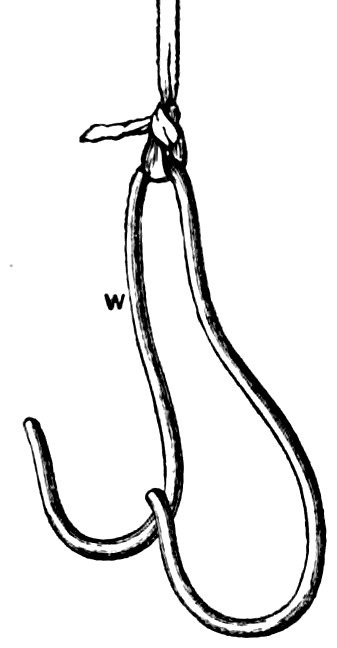
g. Some very narrow silk ribbon, R, and a wire loop, W, like that shown in fig. 1, in which sticks of sealing-wax, tubes of gutta-percha, rods of glass, or a walking-stick, may be suspended. I choose a narrow ribbon because it is convenient to have a suspending cord that will neither twist nor untwist of itself.
(I usually employ a loop with the two ends, which are here shown free, soldered together. The loop would thus be unbroken. But you may not be skilled in the art of soldering, and I therefore choose the free loop, which is very easily constructed. For the purpose of suspension an arrangement resembling a towel-horse, with a single horizontal rail, will be found convenient.)
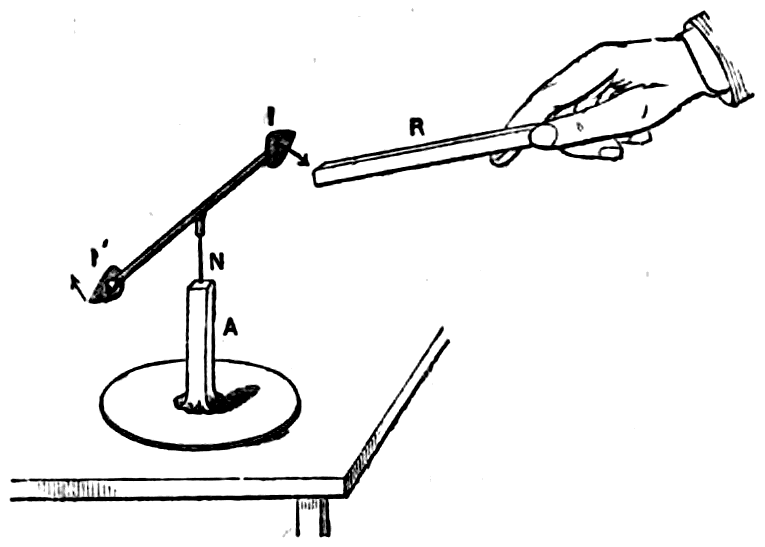
h. A straw, I I′, fig. 2, delicately supported on the point of a sewing needle N. This is inserted in a stick of sealing-wax A, attached below to a little circular plate of tin, the whole forming a stand. In fig. 3 the straw is shown on a larger scale, and separate from its needle. The short bit of straw in the middle, which serves as a cap, is stuck on by sealing-wax.

i. The name 'amalgam' is given to a mixture of mercury with other metals. Experience has shown that the efficacy of a silk rubber is vastly increased when it is smeared over with an amalgam formed of 1 part by weight of tin, 2 of zinc, and 6 of mercury. A little lard is to be first smeared on the silk, and the amalgam is to be applied to the lard. The amalgam, if hard, must be pounded or bruised with a pestle or a hammer until it is soft. You can purchase sixpennyworth of it at a philosophical instrument maker's. It is to be added to your materials.
k. I should like to make these pages suitable for boys without much pocket-money, and, therefore, aim at economy in my list of materials. But provide by all means, if you can, a fox's brush, such as those usually employed in dusting furniture.
§ 5. Electric Attractions
Place your sealing-wax, gutta-percha tubing, and flannel and silk rubbers before a fire, to ensure their dryness. Be specially careful to make your glass tubes and silk rubbers not only warm, but hot. Pass the dried flannel briskly once or twice over a stick of sealing-wax or over a gutta-percha tube. A very small amount of friction will excite the power of attracting the suspended straw, as shown in fig. 2. Repeat the experiment several times and cause the straw to follow the attracting body round and round. Do the same with a glass tube rubbed with silk.
I lay particular stress on the heating of the glass tube, because glass has the power, which it exercises, of condensing upon its surface into a liquid film, the aqueous vapour of the surrounding air. This film must be removed.
I would also insist on practice, in order to render you expert. You will therefore attract bran, scraps of paper, gold leaf, soap bubbles, and other light bodies by rubbed glass, sealing-wax, and gutta-percha. Faraday was fond of making empty egg-shells, hoops of paper, and other light objects roll after his excited tubes.
It is only when the electric power is very weak, that you require your delicately suspended straw. With the sticks of wax, tubes, and rubbers here mentioned, even heavy bodies, when properly suspended, may be attracted. Place, for instance, a common walking-stick in the wire loop attached to the narrow ribbon, fig. 1, and let it swing horizontally. The glass, rubbed with its silk, or the sealing-wax, or gutta-percha, rubbed with its flannel, will pull the stick quite round.
Abandon the wire loop; place an egg in an egg-cup, and balance a long lath upon the egg, as shown in fig. 4. The lath, though it may be almost a plank, will obediently follow the rubbed glass, gutta-percha or sealing-wax.
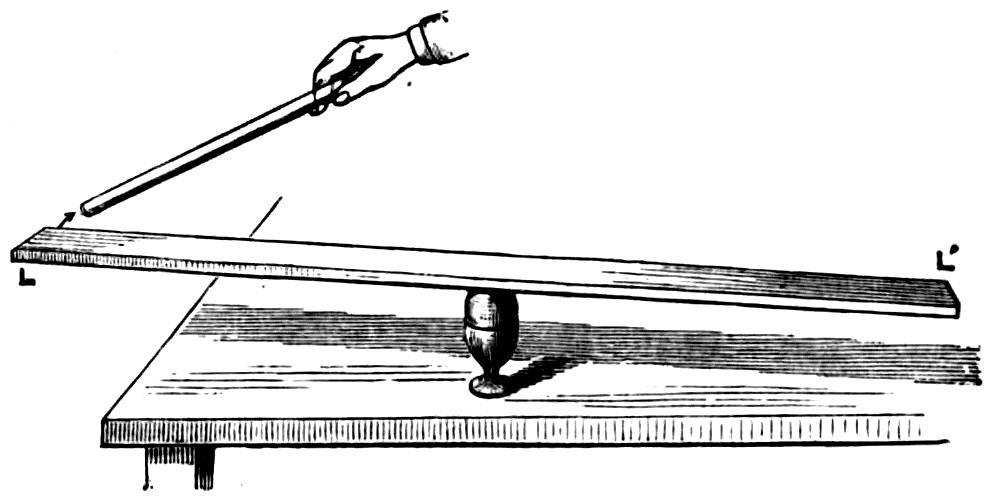
Nothing can be simpler than this lath and egg arrangement, and hardly anything could be more impressive. The more you work with it, the better you will like it.
Pass an ebonite comb through the hair. In dry weather it produces a crackling noise; but its action upon the lath may be made plain in any weather. It is rendered electrical by friction against the hair, and with it you can pull the lath quite round.
If you moisten the hair with oil, the comb will still be excited and exert attraction; but if you moisten it with water, the excitement ceases; a comb passed through wetted hair, has no power over the lath. You will understand the meaning of this subsequently.
After its passage through dry or oiled hair, balance the comb itself upon the egg: it is attracted by the lath. You thus prove the attraction to be mutual: the comb attracts the lath, and the lath attracts the comb. Suspend your rubbed glass, rubbed gutta-percha, and rubbed sealing-wax in your wire loop. They are all just as much attracted by the lath as the lath was attracted by them. This is an extension of Boyle's experiment with the suspended amber (§ 2).
How it is that any unelectrified body attracts, and is attracted by the excited glass, sealing-wax and gutta-percha, we shall learn by and by.
A very striking illustration of electric attraction may be obtained with the board and india-rubber mentioned in our list of materials (§ 4). Place the board before the fire and make it hot; heat also a sheet of foolscap paper and place it on the board. There is no attraction between them. Pass the india-rubber briskly over the paper. It now clings firmly to the board. Tear it away, and hold it at arm's length, for it will move to your body if it can. Bring it near a door or wall, it will cling tenaciously to either. The electrified paper also powerfully attracts the balanced lath from a great distance.
The friction of the hand, of a cambric handkerchief, or of wash-leather fails to electrify the paper in any high degree. It requires friction by a special substance to make the excitement strong. This we learn by experience. It is also experience that has taught us that resinous bodies are best excited by flannel, and vitreous bodies by silk.
Take nothing for granted in this enquiry, and neglect no effort to render your knowledge complete and sure. Try various rubbers, and satisfy yourself that differences like that first observed by Newton exist between them.
Vary also the body rubbed. Excite by friction paraffin and composite candles, resin, sulphur, bees'-wax, ebonite, and shellac. Also rock-crystal and other vitreous substances, and attract with all of them the balanced lath. A film of collodion, a sheet of vulcanised india-rubber, or brown paper heated before the fire, rubbed briskly with the dry hand, attracts and is attracted by the lath.
Lay bare also the true influence of heat in the case of our rubbed paper. Spread a cold sheet of foolscap on a cold board—on a table, for example. If the air be not very dry, rubbing, even with the india-rubber, will not make them cling together. But is it because they were hot that they attracted each other in the first instance? No, for you may heat your board by plunging it into boiling water, and your paper by holding it in a cloud of steam. Thus heated they cannot be made to cling together. The heat really acts by expelling the moisture. Cold weather, if it be only dry, is highly favourable to electric excitation. During frost the whisking of the hand over silk or flannel, or over a cat's back, renders it electrical.
The experiment of the Florentine academicians, whereby they proved the electric attraction of a liquid, is pretty, and worthy of repetition. Fill a very small watch-glass with oil, until the liquid forms a round curved surface, rising a little over the rim of the glass. A strongly excited glass tube, held over the oil, raises not one eminence only, but several, each of which finally discharges a shower of drops against the attracting glass. The effect is shown in fig. 5, where G is the watch-glass on the stand T, and R the excited glass tube.5
Cause the excited glass tube to pass close by your face, without touching it. You feel, like Hauksbee, as if a cobweb were drawn over the face. You also sometimes smell a peculiar odour, due to a substance developed by the electricity, and called ozone.
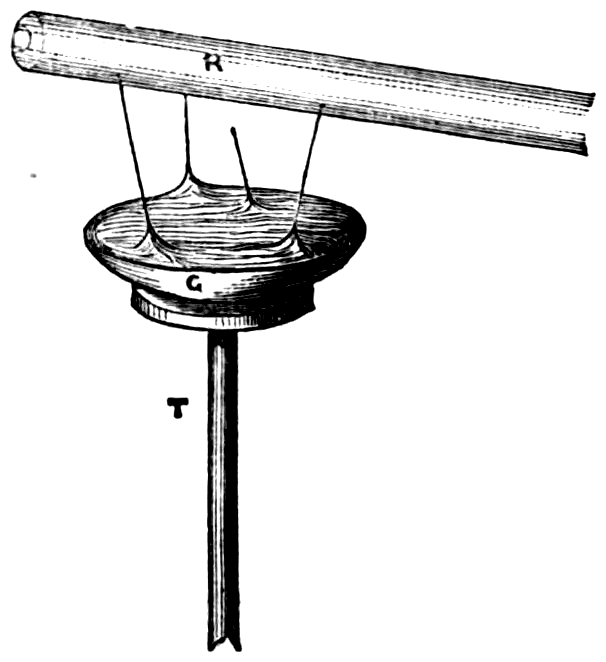
Long ere this, while rubbing your tubes, you will have heard the 'hissing' and 'crackling' so often referred to by the earlier electricians; and if you have rubbed your glass tube briskly in the dark, you will have seen what they called the 'electric fire.' Using, instead of a tube, a tall glass jar, rendered hot, a good warm rubber, and vigorous friction, the streams of electric fire are very surprising in the dark.
§ 6. Discovery of Conduction and Insulation
Here I must again refer to that most meritorious philosopher Stephen Gray. In 1729, he experimented with a glass tube stopped by a cork. When the tube was rubbed, the cork attracted light bodies. Gray states that he was 'much surprised' at this, and he 'concluded that there was certainly an attractive virtue communicated to the cork.' This was the starting point of our knowledge of electric Conduction.
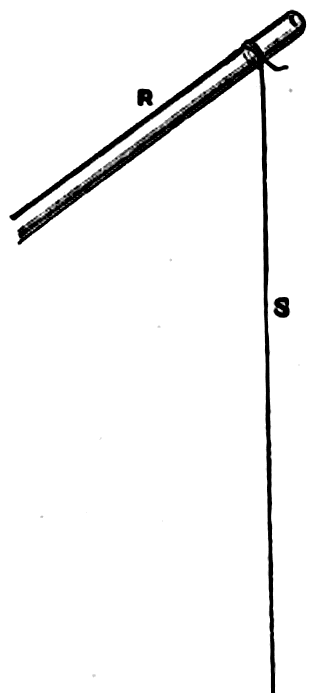
A fir stick 4 inches long, stuck into the cork, was also found by Gray to attract light bodies. He made his sticks longer, but still found a power of attraction at their ends. He then passed on to packthread and wire. Hanging a thread S, fig. 6, from the top window of a house, so that the lower end nearly touched the ground, and twisting the upper end of the thread round his glass tube R, on briskly rubbing the tube, light bodies were attracted by the lower end B of the thread.
But Gray's most remarkable experiment was this:—He suspended a long hempen line horizontally by loops of packthread, but failed to transmit through it the electric power. He then suspended it by loops of silk and succeeded in sending the 'attractive virtue' through 765 feet of thread. He at first thought the silk was effectual because it was thin; but on replacing a broken silk loop by a still thinner wire, he obtained no action. Finally, he came to the conclusion that his loops were effectual, not because they were thin but because they were silk. This was the starting point of our knowledge of Insulation.
It is interesting to notice the devotion of some men of science to their work. Dr. Wells, who wrote a beautiful essay, wherein he explained the origin of dew, finished it when he was on the brink of the grave. Stephen Gray was so near dying when his last experiments were made, that he was unable to write out an account of them. On his death-bed, and indeed the very day before his death, his description of them was taken from his lips by Dr. Mortimer, Secretary of the Royal Society, and afterwards printed in the 'Philosophical Transactions.'
One word of definition will be useful here. Some substances, as proved by Stephen Gray, possess in a very high degree the power of permitting electricity to pass through them; other substances stop the passage of the electricity. Bodies of the first class are called conductors; bodies of the second class are called insulators.
You cannot do better than repeat here the experiments of Gray. Push a cork into the open end of your glass tube; rub the tube, carrying the friction up to the end holding the cork. The cork will attract the balanced lath, shown in fig. 4, with which you have already worked so much.
But the excited glass is here so near the end of the cork that you may not feel certain that the observed attraction is that of the cork. You can, however, prove that the cork attracts by its action upon light bodies which cling to it. Stick a pen-holder into the cork, and rub the glass tube as before. The free end of the holder will attract the lath. Stick a deal rod three or four feet long into the cork; its free end will attract the lath when the glass tube is excited. In this way, you prove to demonstration that the electric power is conveyed along the rod.
§ 7. The Electroscope. Further Enquiries on Conduction and Insulation
A little addition to our apparatus will now be desirable. You can buy a book of 'Dutch metal' for fourpence; and a globular flask like that shown in fig. 7, for sixpence, or at the most a shilling. Find a cork, C, which fits the flask; pass a wire, W, through the cork and bend it near one end at a right angle. Attach by means of wax to the bent arm, which ought to be about three quarters of an inch long, two strips, L, of the Dutch metal, about three inches long and from half an inch to three-quarters of an inch wide. The strips will hang down face to face, in contact with each other. Stick by sealing-wax upon the other end of the wire a little plate of tin or sheet-zinc, T, about two inches in diameter. In all cases you must be careful so to use your wax as not to interrupt the metallic connection of the various parts of your apparatus, which we will name an electroscope. Gold leaf, instead of Dutch metal, is usually employed for electroscopes. I recommend the 'metal' because it is cheaper, and will stand rougher usage.
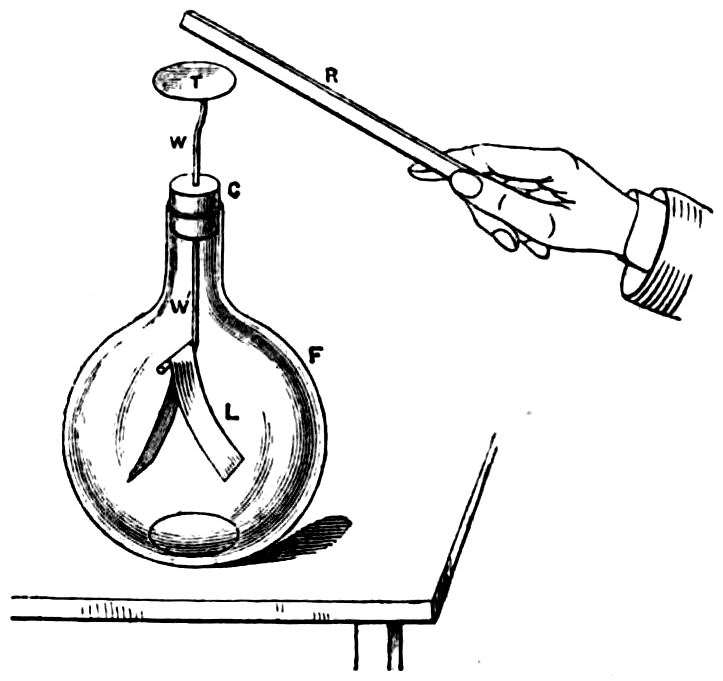
See that your globular flask is dry and free from dust. Bring your rubbed sealing-wax, R, or your rubbed glass, near the little plate of tin, the leaves of Dutch metal open out; withdraw the excited body, the leaves fall together. We shall enquire into the cause of this action immediately. Practise the approach and withdrawal for a little time. Now draw your rubbed sealing-wax or glass along the edge of the tin plate, T. The leaves diverge, and after the sealing-wax or glass is withdrawn they remain divergent. In the first experiment you communicated no electricity to the electroscope; in the second experiment you did. At present I will only ask you to take the opening out of the leaves as a proof that electricity has been communicated to them.
And now we are ready for Gray's experiments in a form different from his. Connect the end of a long wire with the tin plate of the electroscope; coil the other end round your glass tube. Rub the tube briskly, carrying the friction close to the coiled wire. A single stroke of your rubber, if skilfully given, will cause the leaves to diverge. The electricity has obviously passed through the wire to the electroscope.
Substitute for the wire a string of common twine, rub briskly and you will cause the leaves to diverge; but there is a notable difference as regards the promptness of the divergence. You soon satisfy yourself that the electricity passes with greater facility through the wire than through the string. Substitute for the twine a string of silk. No matter how vigorously you rub you can now produce no divergence. The electricity cannot get through the silk at all.
This is the place to demonstrate in a manner never to be forgotten the influence of moisture. Wet your dry silk string throughout, and squeeze it a little so that the water from it may not trickle over your glass tube. Coil it round the tube as before, and excite the tube. The leaves of the electroscope immediately diverge. The water is here the conductor. The influence of moisture was first demonstrated by Du Fay (1733 to 1737), who succeeded in sending electricity through 1,256 feet of moist packthread.
It is hardly necessary to point out the meaning of Gray's experiment where he found that, with loops of wire or of packthread, he could not send the electricity from end to end of his suspended string. Obviously the electricity escaped in each of these cases through the conducting support to the earth.
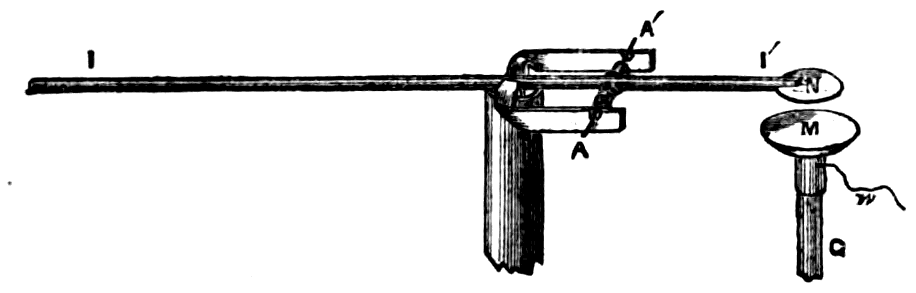
My assistant, Mr. Cottrell, who has been working very hard for you and me, has devised an electroscope which we shall frequently employ in our lessons. M, fig. 8, is a little plate of metal, or of wood covered with tin-foil, supported on a rod G of glass or of sealing-wax. N is another plate of Dutch metal paper, separated about an inch from M, and attached by sealing-wax to the long straw I I′ (broken off in the figure); A A′ is a horizontal pivot formed by a sewing needle, and supported on a bent strip of metal, as shown in the figure. By weighting the straw with a little wire near I′, you so balance it that the plate N shall be just lifted away from M. The wire w, which may be 100 feet long, proceeds from M to your glass tube, round which it is coiled. A single vigorous stroke of the tube by the rubber sends electricity along w to M; N is attracted downwards, the other end of the long straw being lifted through a considerable distance. In subsequent figures you will see the complete straw-index, and its modes of application.
A few experiments with either of these instruments will enable you to classify bodies as conductors, semi-conductors, and insulators. Here is a list of a few of each, which, however, differ much among themselves.
Conductors.
	The common metals
	Well-burned charcoal
	Concentrated acids
	Solutions of salts
	Rain water
	Linen
	Living vegetables and animals.
Semi-conductors.
	Alcohol and ether | Paper
	Dry wood | Straw.
	Marble
Insulators.
| Fatty oils | Silk |
| Chalk | Glass |
| India-rubber | Wax |
| Dry paper | Sulphur |
| Hair | Shellac. |
A little reflection will enable you to vary these experiments indefinitely. Rub your excited sealing-wax or glass against the tin plate of your electroscope, and cause the leaves to diverge. Touch the plate with any one of the conductors mentioned in the list; the electroscope is immediately discharged. Touch it with a semi-conductor; the leaves fall as before, but less promptly. Touch the plate finally with an insulator, the electricity cannot pass, and the leaves remain unchanged.
§ 8. Electrics and Non-Electrics
For a long period, bodies were divided into electrics and non-electrics, the former deemed capable of being electrified, the latter not. Thus the amber of the ancients, and the spars, gems, fossils, stones, glasses, and resins, operated on by Dr. Gilbert, were called electrics, while all the metals were called non-electrics. We must now determine the true meaning of this distinction.
Take in succession a piece of brass, of wood coated with tin-foil, a lead bullet, apples, pears, turnips, carrots, cucumbers—uncoated wood not very dry will also answer—in the hand, and strike them briskly with flannel, or the fox's brush; none of them will attract the balanced lath, fig. 4, or show any other symptom of electric excitement. All of them therefore would have been once called non-electrics.
But suspend them in succession by a string of silk held in the hand, and strike them again; every one of them will now attract the lath.
Reflect upon the meaning of this experiment. We have introduced an insulator—the silk string—between the hand and the body struck, and we find that by its introduction the non-electric has been converted into an electric.
The meaning is obvious. When held in the hand, though electricity was developed in each case by the friction, it passed immediately through the hand and body to the earth. This transfer being prevented by the silk, the electricity, once excited, is retained, and the attraction of the lath is the consequence.
In like manner, a brass tube, held in the hand and struck with a fox's brush, shows no attractive power; but when a stick of sealing-wax, ebonite, or gutta-percha is thrust into the tube as a handle, the striking of the tube at once develops the power of attraction.
And now you see more clearly than you did at first the meaning of the experiment with the heated foolscap and india-rubber. Paper and wood always imbibe a certain amount of moisture from the air. When the rubber was passed over the cold paper electricity was excited, but the paper, being rendered a conductor by its moisture, allowed the electricity to pass away.
Prove all things. Lay your cold foolscap on a cold board supported by dry tumblers; pass your india-rubber over the paper; lift it by a loop of silk, which has been previously attached to it, for if you touch it it will discharge itself. You will find it electric; and with it you can charge your electroscope, or attract from a distance your balanced lath.
The human body was ranked among the non-electrics. Make plain to yourself the reason. Stand upon the floor and permit a friend to strike you briskly with the fox's brush. Present your knuckle to the balanced lath, you will find no attraction. Here, however, you stand upon the earth, so that even if electricity had been developed, there is nothing to hinder it from passing away.
But, place upon the ground four warm glass tumblers, and upon the tumblers a board.6 Stand upon the board, and present your knuckle to the lath. A single stroke of the fox's fur, if skilfully given, will produce attraction. If you stand upon a cake of resin, of ebonite, or upon a sheet of good india-rubber, the effect will be the same. You can also charge your electroscope with this electricity.
Throw a mackintosh over your shoulders and let a friend strike it with the fox's brush, the attractive force is greatly augmented.
After brisk striking, present your knuckle to the knuckle of your friend. A spark will pass between you.
This experiment with the mackintosh further illustrates what you have already frequently observed, namely, that it is not friction alone, but the friction of special substances against each other, that produces electricity.
Thus we prove that non-electrics, like electrics, can be excited, the condition of success being, that an insulator shall be interposed between the non-electric and the earth. It is obvious that the old division into electrics and non-electrics, really meant a division into insulators and conductors.
§ 9. Electric Repulsions. Discovery of two Electricities
We have hitherto dealt almost exclusively with electric attractions, but in an experiment already referred to (§ 2), Otto von Guericke observed the repulsion of a feather by his sulphur globe. I also anticipated matters in the use of our Dutch metal electroscope (§ 7), where the repulsion of the leaves informed us of the arrival of the electricity.
Du Fay, who was the real discoverer here, found a gold-leaf floating in the air to be first attracted and then repelled by the same excited body. He afterwards proved that when the floating leaf was repelled by rubbed glass, it was attracted by rubbed resin,—and that when it was repelled by rubbed resin, it was attracted by rubbed glass. Hence the important announcement, by Du Fay, that there are two kinds of electricity.
The electricity excited on glass was for a time called vitreous electricity,—while that excited on sealing-wax was called resinous electricity. These terms are however improper; because, by changing the rubber, we can obtain the electricity of sealing-wax upon glass, and the electricity of glass upon sealing-wax.
Roughen, for example, the surface of your glass tube with a grindstone, and rub it with flannel, the electricity of sealing-wax will be found upon the vitreous surface. Rub your sealing-wax with vulcanised india-rubber, the electricity of glass will be found upon the resinous surface. You will be able to prove this immediately.
We now use the term positive or plus electricity to denote that developed on glass by the friction of silk; and negative or minus electricity to denote that developed on sealing-wax by the friction of flannel. These terms are adopted purely for the sake of convenience. There is no reason in nature why the resinous electricity should not be called positive, and the vitreous electricity negative. Once agreed, however, to apply the terms as here fixed, we must adhere to this agreement throughout.
§ 10. Fundamental Law of Electric Action
In all the experiments which we have hitherto made, one of the substances operated on has been electrified by friction, and the other not. But once engaged in enquiries of this description, questions incessantly occur to the mind, the answering of which extends our knowledge, and suggests other questions. Suppose, instead of exciting only one of the bodies presented to each other, we were to excite both of them, what would occur? This is the question which was asked and answered by Du Fay, and which we must now answer for ourselves.
Here your wire loop, fig. 1, comes again into play.
Place an un-rubbed gutta-percha tube, or a stick of sealing-wax, in the loop, and be sure that it is un-rubbed—that no electricity adheres to it from former experiments. If it fail to attract light bodies, it is unexcited; if it attract them, pass your hand over it several times, or, better still, pass it over or through the flame of a spirit lamp. This will remove every trace of electricity. Satisfy yourself that the un-rubbed gutta-percha tube is attracted by a rubbed one.
Remove the un-rubbed tube from the loop, and excite it with its flannel rubber. One end of the tube is held in your hand and is therefore unexcited. Return the tube to the loop, keeping your eye upon the excited end. Bring a second rubbed tube near the excited end of the suspended one: strong repulsion is the consequence. Drive the suspended tube round and round by this force of repulsion.
Bring a rubbed glass tube near the excited end of the gutta-percha tube: strong attraction is the result.
Repeat this experiment step by step with two glass tubes. Prove that the rubbed glass tube attracts the un-rubbed one. Remove the un-rubbed tube from the loop, excite it by its rubber, return it to the loop, and establish the repulsion of glass by glass. Bring rubbed gutta-percha or sealing-wax near the rubbed glass: strong attraction is the consequence.
These experiments lead you directly to the fundamental law of electric action, which is this:—Bodies charged with the same electricity repel each other, while bodies charged with opposite electricities attract each other. Positive repels positive, and attracts negative. Negative repels negative, and attracts positive.
Devise experiments which shall still further illustrate this law. Repeat, for example, Otto von Guericke's experiment. Hang a feather by a silk thread and bring your rubbed glass tube near it: the feather is attracted, touches the tube, charges itself with the electricity of the tube, and is then repelled. Cause it to retreat from the tube in various directions. Du Fay's experiment with the gold-leaf will be repeated and explained further on. See § 18.
Hang your feather by a common thread: if no insulating substance intervenes between the feather and the earth, you can get no repulsion. Why? Obviously because the charge of positive electricity communicated by the rod, is not retained by the feather, but passes away to the earth. Hence, you have not positive acting against positive at all. Why the neutral body is attracted by the electrified one, will, as already stated, appear by and by.
Attract your straw needle by your rubbed glass tube. Let the straw strike the tube, so that the one shall rub against the other. The straw accepts the electricity of the tube and repulsion immediately follows attraction, as shown in fig. 9.
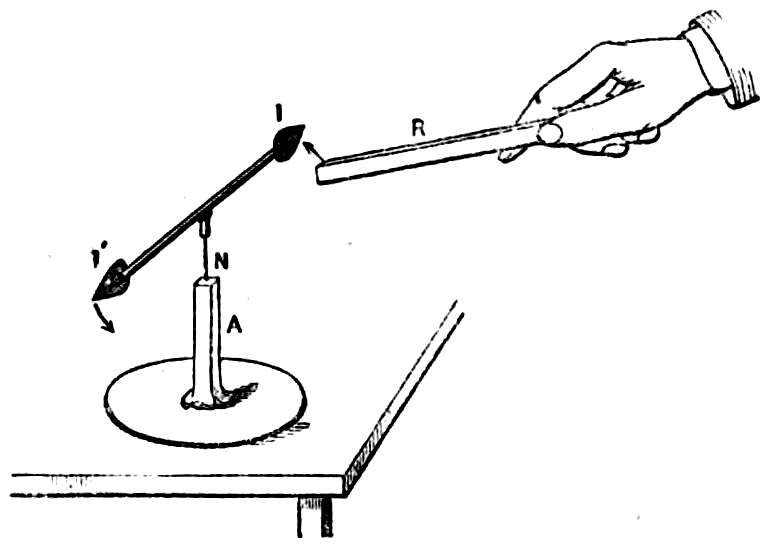
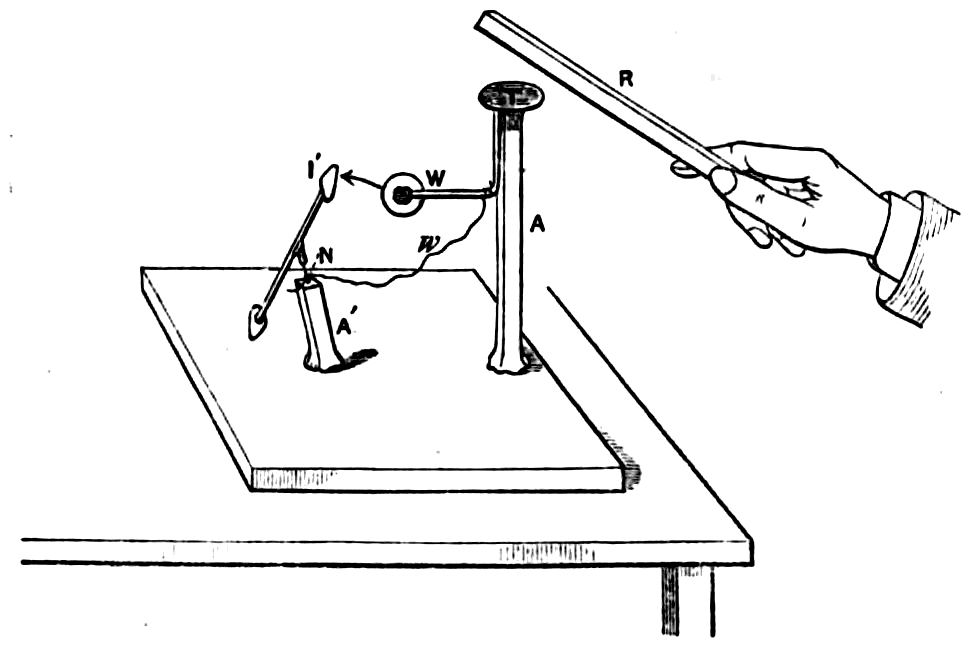
Mr. Cottrell has devised the simple electroscope represented in fig. 10 to show repulsion. A is a stem of sealing-wax with a small circle of tin T at the top. W is a bent wire proceeding from T, with a small disk attached to it by wax. I I′ is a little straw index, supported by the needle N, as shown in fig. 10. The stem A′, also of sealing-wax, is not quite vertical, the object being to cause the bit of paper I′, to rest close to W when the apparatus is not electrified. When electricity is imparted to T, it flows through the wires W and w, over both disk and index: immediate repulsion of the straw is the consequence.
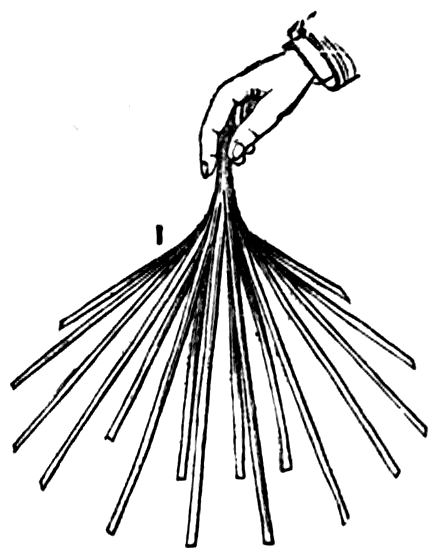
No better experiment can be made to illustrate the self-repulsive character of electricity than the following one. Heat your square board (§ 5), and warm, as before, your sheet of foolscap. Spread the paper upon the board, and excite it by the friction of india-rubber. Cut from the sheet two long strips with your penknife. Hold the strips together at one end. Separate them from the board, and lift them into the air: they forcibly drive each other apart, producing a wide divergence.
Cut several strips, so as to form a kind of tassel. Hold them together at one end. Separate them from the board, and lift them into the air: they are driven asunder by the self-repellent electricity, presenting an appearance which may remind you of the hair of Medusa. The effect is represented in fig. 11.7
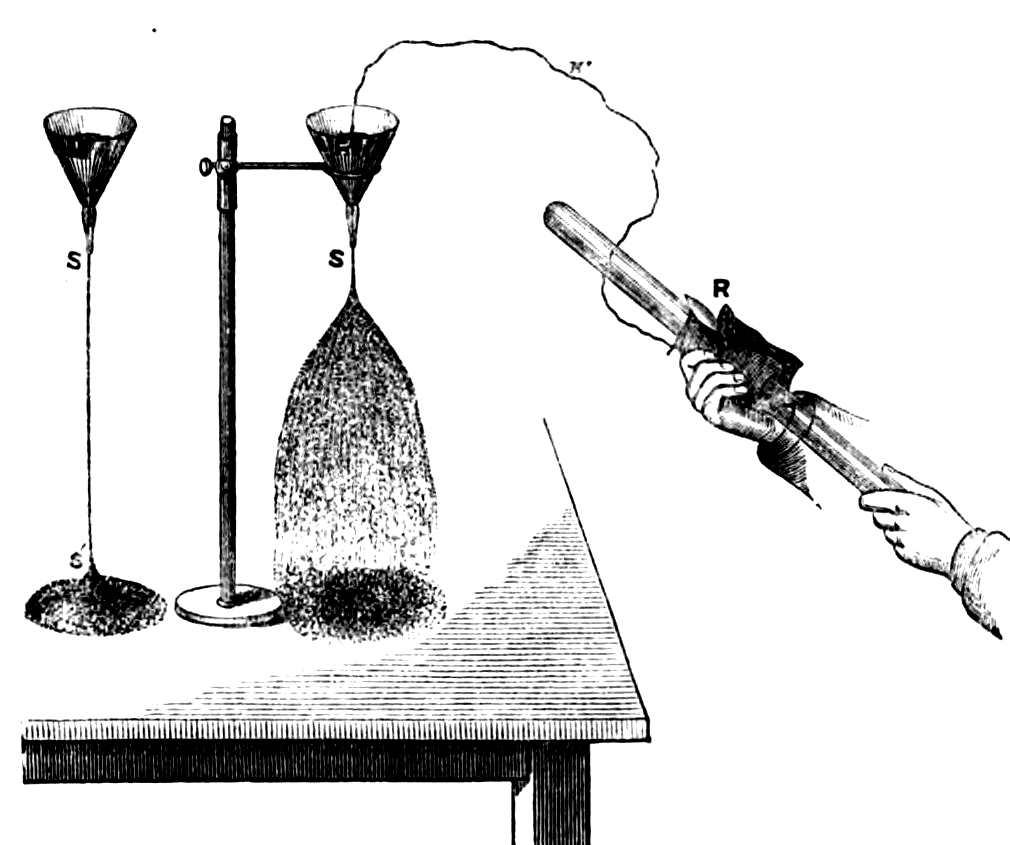
Another very beautiful experiment fits in here. Let fine silver sand, S, fig. 12, issue in a stream from a glass funnel, through an aperture one-eighth of an inch in diameter. Connect the sand in the funnel by a fine wire w, fig. 13, with your warm glass tube. Unelectrified, the sand particles descend as a continuous stream, S S′, fig. 12, but at every stroke of the rubber they fly asunder, as in fig. 13, through self-repulsion.8
Or let three or four fine fillets of water issue from three or four pin-holes in the bottom of a vessel close to each other. Connect the water of the vessel with your glass tube, and rub as before. The liquid veins are scattered into spray by every stroke of the rubber.
These experiments are best made with 'Cottrell's rubber,' described in § 24.
And now you must learn to determine with certainty the quality of the electricity with which any body presented to you may be charged. You see immediately that attraction is no sure test, because un-electrified bodies are attracted. Further on (§ 14) you will be able to grapple with another possible source of error in the employment of attraction.
In determining quality, you must ascertain, by trial, the kind of electricity by which the charged body is repelled; if, for example, any electrified body repel, or is repelled by, sealing-wax rubbed with flannel, the electricity of the body is negative; if it repel, or is repelled by, glass, rubbed with silk, its electricity is positive. Du Fay had the sagacity to propose this mode of testing quality.
Apply this test to the strips of foolscap paper excited by the india-rubber. Bring a rubbed gutta-percha tube near the electrified strips, you have strong attraction. Bring a rubbed glass tube between the strips, you have strong repulsion and augmented divergence. Hence, the electricity, being repelled by the positive glass, is itself positive.
§ 11. Electricity of the Rubber. Double or 'Polar' Character of the Electric Force
We have examined the action of each kind of electricity upon itself, and upon the other kind; but hitherto we have kept the rubber out of view. One of the questions which inevitably occur to the enquiring scientific mind would be: how is the rubber affected by the act of friction? Here, as elsewhere, you must examine the subject for yourself, and base your conclusions on the facts you establish.
Test your rubber then, by your balanced lath. The lath is attracted by the flannel which has rubbed against gutta-percha; and it is attracted by the silk, which has rubbed against glass.
Regarding the quality of the electricity of the flannel or of the silk rubber, the attraction of the lath teaches you nothing. But, suspend your rubbed glass tube, and bring the flannel rubber near it: repulsion follows. The silk rubber, on the contrary, attracts the glass tube. Suspend your rubbed gutta-percha tube, and bring the silk rubber near it: repulsion follows. The flannel, on the contrary, attracts the tube.
The conclusion is obvious: the electricity of the flannel is positive, that of the silk is negative.
But the flannel is the rubber of the gutta-percha, whose electricity is negative; and the silk is the rubber of the glass, whose electricity is positive. Consequently, we have not only proved the rubber to be electrified by the friction, but also proved the electricity of the rubber to be opposite in quality to that of the body rubbed.
All your subsequent experience will verify the statement that the two electricities always go together; that you cannot excite one of them without at the same time exciting the other, and that the electricity of the rubber, though opposite in quality, is in all cases precisely equal in quantity to that of the body rubbed.
And now we will test these principles by a new experiment. In § 5 we learned that an ebonite comb is electrified by its passage through dry hair. You can readily prove the electricity of the comb to be negative. But the hair is here the rubber, and, in accordance with the principle just laid down, an equal quantity of positive electricity has been excited in the hair. If you stand on the ground uninsulated, the electricity of the hair passes freely through your body to the earth.
But stand upon an insulating stool 9—on your board, for example, supported by four warm tumblers—while I, standing on the ground, pass the comb briskly through your hair. I pass it ten, twenty, thirty times, and then ask you to attract your balanced lath. You present your knuckle, but there is no attraction.
Here the comb and the hair soon reach their maximum excitement, beyond which no further development of electricity occurs. Now, though the comb, as shown in § 5, is competent to attract the lath, while your body is here incompetent to do so, this may be because the small quantity of electricity existing in a concentrated form upon the comb becomes, when diffused over the body, too feeble to produce attraction.
Can we not exalt the electricity of your body? Guided by the principles laid down, let us try to do so. First I pass the unelectrified comb through your hair; it comes away electrified. After discharging the comb by passing my hand closely over it, I pass it again through the hair. As before, it quits the hair electrified, and I again discharge it. I do this ten or twenty times, always depriving the comb of its electricity after it has quitted the hair. Now present your knuckle to the balanced lath. It is powerfully attracted.
Here, as I have said, the unelectrified comb carried in each case electricity away with it; but, in accordance with the foregoing principles, it left an equal quantity of the opposite electricity behind it. And though the amount of electricity corresponding to a single charge of the comb, when diffused over the body, proved insensible to our tests, that amount ten or twenty times multiplied became not only sensible, but strong. Indeed, by discharging the comb, and passing it in each case unelectrified through the hair, the insulated human body can be rendered highly electrical.
Near the beginning of this section I said, in rather an off-hand way, that rubbed flannel repels rubbed glass, while rubbed silk repels rubbed gutta-percha. Now, while it is generally easy to obtain the repulsion by the flannel, it is by no means always easy to obtain the repulsion by the silk. Over and over again I have been foiled in my attempts to show this repulsion. I wish you, therefore, to be aware of an infallible method of obtaining it.
Stand on your insulating stool, and rub your glass tube briskly with the amalgamated silk; hand me the tube. I pass my hand closely over its surface, removing from that surface nearly the whole of its electricity. I hand you the tube again, and you again excite it. You hand it to me, and I again discharge it. In each case, therefore, you excite an unelectrified glass tube, and in each case the tube leaves behind upon the rubber an amount of negative electricity equal in quantity to the positive carried away. By thus adding charge to charge, the rubber is rendered highly electrical; and, even should its insulating power be impaired by the amalgam, it can now afford to yield a portion of its electricity to your hand and body, and still powerfully repel rubbed gutta-percha. The principle, which might be further illustrated, is obviously the same as that applied in the case of the comb.
§ 12. What is Electricity?
Thus far we have proceeded from fact to fact, acquiring knowledge of a very valuable kind. But facts alone cannot satisfy us. We seek a knowledge of the principles which lie behind the facts, and which are to be discerned by the mind alone. Thus, having spoken as we have done, of electricity passing hither and thither, and of its being prevented from passing; hardly any thoughtful boy or girl can avoid asking what is it that thus passes?—what is electricity? Boyle and Newton betrayed their need of an answer to this question when the one imagined his unctuous threads issuing from and returning to the electrified body; and when the other imagined that an elastic fluid existed which penetrated his rubbed glass.
When I say 'imagined' I do not intend to represent the notions of these great men as vain fancies. Without imagination we can do nothing here. By imagination I mean the power of picturing mentally things which, though they have an existence as real as that of the world around us, cannot be touched directly by the organs of sense. I mean the purified scientific imagination, without the exercise of which we cannot take a single step into the region of causes and principles.
It was by the exercise of the scientific imagination that Franklin devised the theory of a single electric fluid to explain electrical phenomena. This fluid he supposed to be self-repulsive, and diffused in definite quantities through all bodies. He supposed that when a body has more than its proper share it is positively, when less than its proper share it is negatively electrified. It was by the exercise of the same faculty that Symmer devised the theory of two electric fluids, each self-repulsive, but both mutually attractive.
At first sight Franklin's theory seems by far the simpler of the two. But its simplicity is only apparent. For though Franklin assumed only one fluid, he was obliged to assume three distinct actions. Firstly, he had the self-repulsion of the electric particles. Secondly, the mutual attraction of the electric particles and the ponderable particles of the body through which the electricity was diffused. Thirdly, these two assumptions when strictly followed out lead to the unavoidable conclusion that the material particles also mutually repel each other. Thus the theory is by no means so simple as it appears.
The theory of Symmer, though at first sight the most complicated, is in reality by far the simpler of the two. According to it electrical actions are produced by two fluids, each self-repulsive, but both mutually attractive. These fluids cling to the atoms of matter, and carry the matter to which they cling along with them. Every body, in its natural condition, possesses both fluids in equal quantities. As long as the fluids are mixed together they neutralise each other, the body in which they are thus mixed being in its natural or unelectrical condition.
By friction (and by various other means) these two fluids may be torn asunder, the one clinging by preference to the rubber, the other to the body rubbed.
According to this theory there must always be attraction between the rubber and the body rubbed, because, as we have proved, they are oppositely electrified. This is in fact the case. And mark what I now say. Over and above the common friction, this electrical attraction has to be overcome whenever we rub glass with silk, or sealing-wax with flannel.
You are too young to fully grasp this subject yet; and indeed it would lead us too far away to enter fully into it. But I will throw out for future reflection the remark, that the overcoming of the ordinary friction produces heat then and there upon the surfaces rubbed, while the force expended in overcoming the electric attraction may be converted into heat which shall appear a thousand miles away from the place where it was generated.
Theoretic conceptions are incessantly checked and corrected by the advance of knowledge, and this theory of electric fluids is doubted by many eminent scientific men. It will, at all events, have to be translated into a form which shall connect it with heat and light, before it can be accepted as complete. Nevertheless, keeping ourselves unpledged to the theory, we shall find it of exceeding service both in unravelling and in connecting together electrical phenomena.
§ 13. Electric Induction. Definition of the Term
We have now to apply the theory of electric fluids to the important subject of electric induction.
It was noticed by early observers that contact was not necessary to electrical excitement. Otto von Guericke, as we have already seen (§ 2), found that a body brought near his sulphur globe became electrical. By bringing his excited glass tube near one end of a conductor, Stephen Gray attracted light bodies at the other end. He also obtained attraction through the human body. From the human body also Du Fay, to his astonishment, obtained a spark. Canton, in 1753, suspended pith-balls by thread, and holding an excited glass tube, at a considerable distance from them, caused them to diverge. On removing the tube the balls fell together, no permanent charge being imparted to them. Such phenomena were further studied and developed by Wilcke and Æpinus, Coulomb and Poisson.
These and all similar results are embraced by the law, that when an electrified body is brought near an unelectrified conductor, the neutral fluid of the latter is decomposed; one of its constituents being attracted, the other repelled. When the electrified body is withdrawn, the separated electricities flow again together and render the conductor unelectric.
This decomposition of the neutral fluid by the mere presence of an electrified body is called induction. It is also called electrification by influence.
If, while it is under the influence of the electrified body, the body influenced be touched, the free electricity (which is always of the same kind as that of the influencing body) passes away, the opposite electricity being held captive.
On removing the electrified body the captive electricity is set free, the conductor being charged with electricity opposite in kind to that of the body which electrified it.
You cannot do better here than repeat Stephen Gray's experiment. Support a small plank or lath, L L′, fig. 14, upon a warm tumbler, G, and bring under one of its ends, L, and within four or five inches of that end, scraps of light paper or of gold leaf. Excite your glass tube, R, vigorously, and bring it over the other end of the plank, without touching it. The ends may be six or eight feet apart; the light bodies will be attracted. The experiment is easily made, and you are not to rest satisfied till you can make it with ease and certainty.
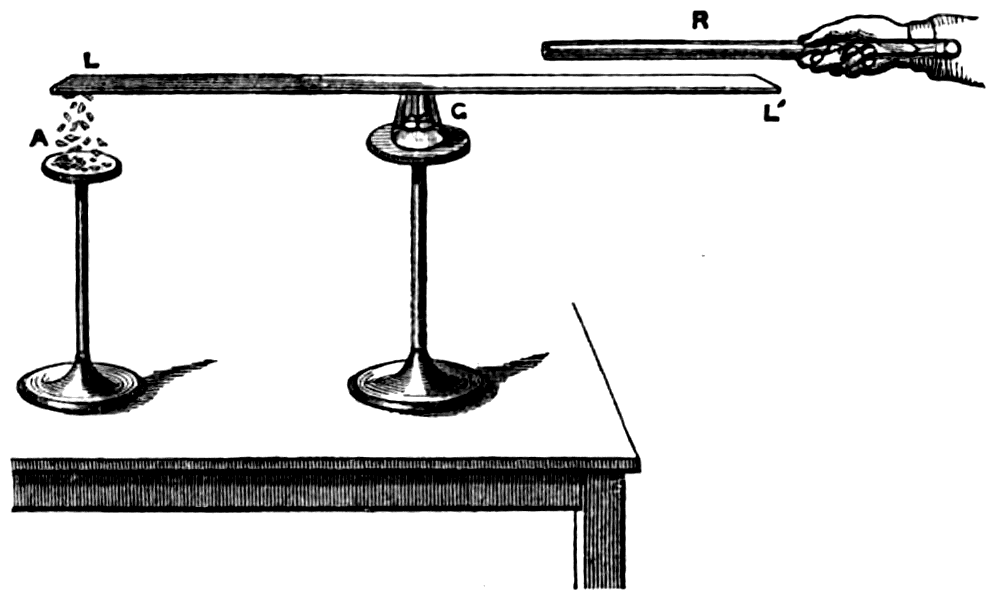
This is a fit place to repeat that you must keep a close eye upon the tumblers you employ for insulation. Some of them, made of common glass, are hardly to be accounted insulators at all.
§ 14. Experimental Researches on Electric Induction
Our mastery over this subject of induction must be complete; for it underlies all our subsequent enquiries. Without reference to it nothing is to be explained; possessed of it you will enjoy not only a wonderful power of explanation, but of prediction. We will attack it, therefore, with the determination to exhaust it.
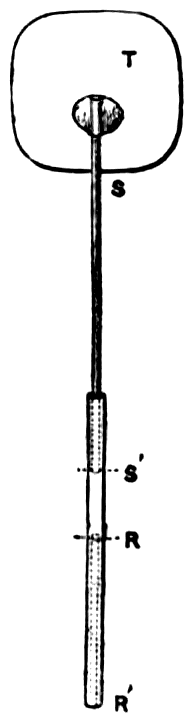
And here a slight addition must be made to our apparatus. We must be in a condition to take samples of electricity, and to convey them, with the view of testing them, from place to place. For this purpose the little 'carrier,' shown in fig. 15, will be found convenient. T is a bit of tin-foil, two or three inches square. A straw stem is stuck on to it by sealing-wax, the lower end of the stem being covered by sealing-wax. To make the insulation sure, the part between R and S′ is wholly of sealing-wax. You can have stems of ebonite, which are stronger, for a few pence; but you can have this one for a fraction of a penny. The end R′ is to be held in the hand; the electrified body is to be touched by T, and the electricity conveyed to an electroscope to be tested.
Touch your rubbed glass rod with T, and then touch your electroscope: the leaves diverge with positive electricity. Touch your rubbed gutta-percha or sealing-wax with T, and then touch your electroscope: the leaves diverge with negative electricity. If the electricity of any body augment the divergence produced by the glass, the electricity of that body is positive. If it augment the divergence produced by the gutta-percha, the electricity is negative. And now we are ready for further work.
Place an egg, E, fig. 16, on its side upon a dry wine-glass; bring your excited glass tube, G, within an inch or so of the end of the egg. What is the condition of the egg? Its electricity is decomposed; the negative fluid covering the end a adjacent to the glass, the positive covering the other end b. Remove the glass tube: what occurs? The two electricities flow together and neutrality is restored. Prove this neutrality. Neither a carrier touching the egg, nor the egg itself, has any power to affect your electroscope, or to attract your balanced lath.
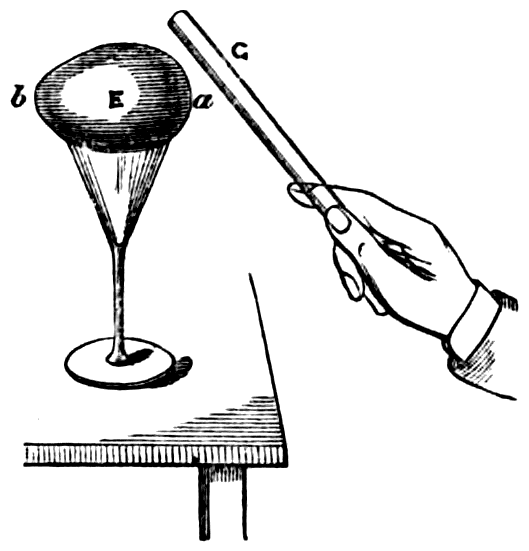
Again, bring the excited tube near the egg. Touch its distant part b with your carrier. The carrier now attracts the straw (fig. 2) or the balanced lath (fig. 4). It also causes the leaves of your electroscope to diverge. What is the quality of the electricity? It repels and is repelled by rubbed glass; the electricity at b is therefore positive. Discharge the carrier by touching it, and bring it into contact with the end a of the egg nearest to the glass tube. The electricity you take away repels and is repelled by gutta-percha. It is therefore negative. Test the quality also by the electroscope.
While the tube G is near the egg touch the end b with your finger; now try to charge the carrier by touching b: you cannot do so—the positive electricity has disappeared. Has the negative disappeared also? No. Remove the glass tube, and once more touch the egg at b by the carrier. It is charged, not with positive, but with negative electricity: Clearly understand this experiment. The neutral electricity of the egg is first decomposed into negative and positive; the former attracted, the latter repelled by the excited glass. The repelled electricity is free to escape, and it has escaped on your touching the egg with your finger. But the attracted electricity cannot escape as long as the influencing tube is held near. On removing the tube which holds the negative fluid in bondage, that fluid immediately diffuses itself over the whole egg. An apple, or a turnip, will answer for these experiments at least as well as an egg.
Discharge the egg by touching it. Re-excite the glass tube and bring it again near. Touch the egg with a wire or with your finger at a. Is it the negative at a, into which you plunge your finger, that escapes? No such thing. The free positive fluid passes through the negative, and through your finger to the earth. Prove this by removing, first, your finger, and then the glass tube. The egg is charged negatively.
Again; place two eggs, E E, fig. 17, lengthwise on two dry wine-glasses, g g, and cause two of their ends to touch each other, as at C. Bring your rubbed glass rod near the end a, and while it is there separate the eggs by moving one glass away from the other. Withdraw the rod and test both eggs. a repels rubbed sealing-wax, and b repels rubbed glass; a is therefore negative, b is positive. The two charges, moreover, exactly neutralise each other in the electroscope. Again bring the eggs together and restore the rubbed tube to its place near a. Touch a and then separate the eggs. Remove the glass rod and test the eggs. a is negative, b is neutral. Its electricity has escaped through the finger, though placed at a.
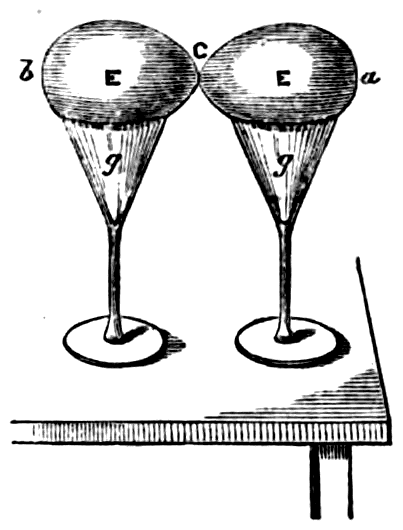
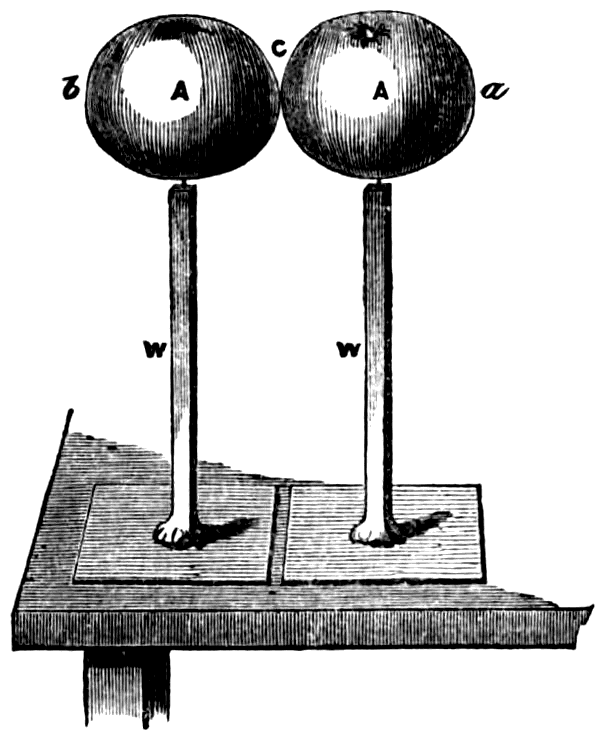
Equally good, if not indeed more handy, for these experiments are two apples A A, fig. 18, supported on stems of sealing-wax. A needle is heated and sunk in each case into the stick of wax at the top, and on to the needle the apple is pushed. The sealing-wax stems are stuck on by melting to little foot-boards. By arrangements of this kind you make experiments which are more instructive than those usually made with instruments twenty times more expensive.
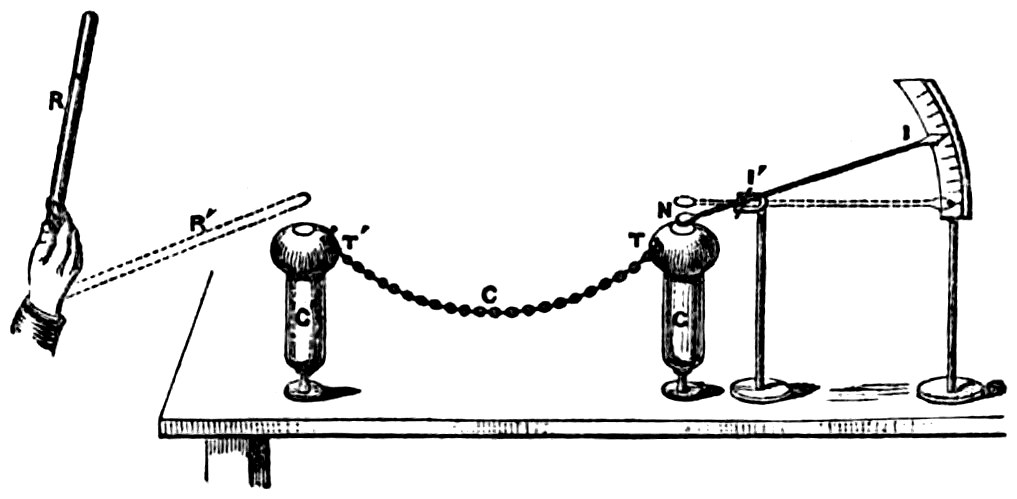
Push your researches still farther, and instead of bringing the eggs or apples together, place them six feet or so apart, and let a light chain, C, fig. 19, or a wire, stretch from one to the other. Two brass balls, or wooden balls covered with tin-foil, supported by tall drinking glasses, G G′, will be better than the eggs for this experiment, for they will bear better the strain of the chain; but you can make the experiment with the eggs, or very readily with the two apples or two turnips. For the present we will suppose the straw-index I I′ not to be there. Rub your glass tube R, and bring it near one of the balls; test both: the near one, T′, is negative, the distant one, T, positive. Touch the near one, the positive electricity, which had been driven along the chain to the remotest part of the system, returns along the chain, passes through the negative, which is held captive by the tube, and escapes to the earth. When the tube R is removed, negative electricity overspreads both chain and balls.
In fig. 8 you made the acquaintance of the plate N, and the straw-index I I′, shown on a smaller scale in fig. 19. By their means you immediately see both the effect of the first induction, and the consequence of touching any part of the system with the finger. The plate N rests over the ball or turnip T, the position of the straw-index being that shown by the dots. Bring the rubbed tube near T′: the end N of the index immediately descends and the other end rises along the graduated scale. Remove the glass rod; the index I I′ immediately falls. Practise this approach and withdrawal, and observe how promptly the index declares the separation and recomposition of the fluids.
While the tube is near T′, and the end N of the index is attracted, let T′ be touched by the finger. The end N is immediately liberated, for the electricity which pulled it down escapes along the chain and through the finger to the earth. Now remove your excited tube. The captive negative electricity diffuses itself over both balls, and the index is again attracted.
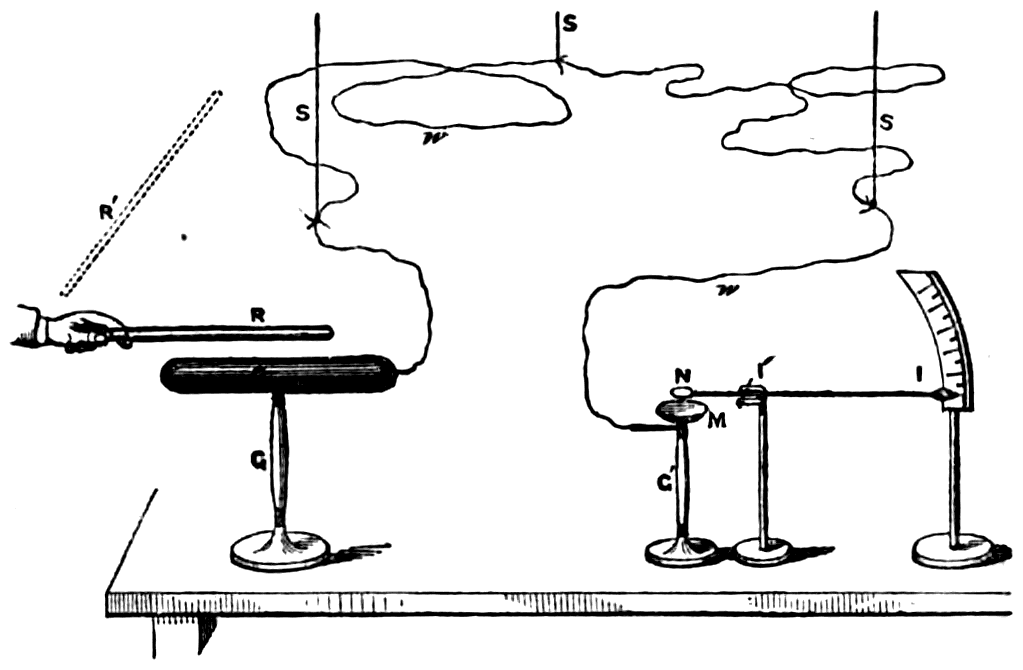
Instead of the chain you may interpose between the balls 100 feet of wire supported by silk loops. This is done in fig. 20, which shows the wire w supported by the silk strings S S S. For the ball or turnip T′, fig. 19, the cylinder C, on a glass support G, is substituted, the little table M taking the place of the ball T. Every approach and withdrawal of the rubbed glass tube R is followed obediently by the attraction and liberation of N, and the corresponding motion of the index N I.
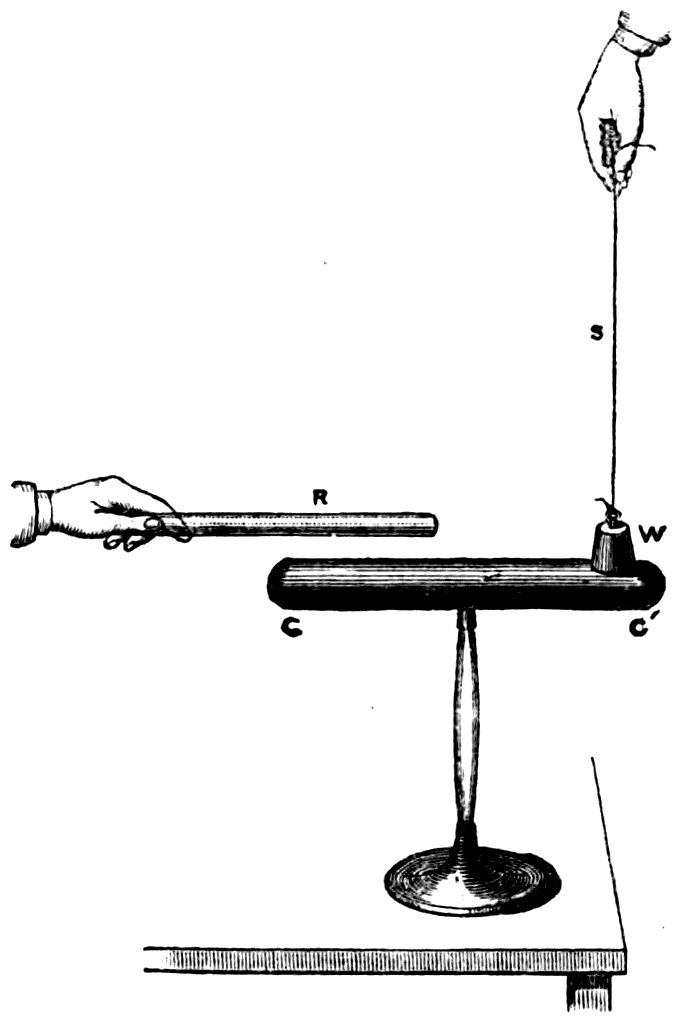
Repeat here an experiment, first made by a great electrician named Æpinus. I wish you to make these historic experiments. Insulate an elongated metal conductor, C C′, fig. 21, or one formed of wood coated with tin-foil—even a carrot, cucumber, or parsnip, so that it be insulated, will answer. Let a small weight, W, suspended from a silk string, S, rest on one end of the conductor, and hold your rubbed glass tube, R, over the other end. You can predict beforehand what will occur when you remove the weight. It carries away with it electricity, which repels rubbed glass, and attracts your balanced lath.
Stand on an insulating stool; or make one by placing a board on four warm tumblers. Present the knuckles of your right hand to the end of the balanced lath, and stretch forth your left arm. There is no attraction. But let a friend or an assistant bring the rubbed glass tube over the left arm; the lath immediately follows the right hand.
Touch the lath, or any other uninsulated body; the 'attractive virtue,' as it was called by Gray, disappears. After this, as long as the excited tube is held over the arm there is no attraction. But when the tube is removed the attractive power of the hand is restored. Here the first attraction was by positive electricity driven to the right hand from the left, and the second attraction by negative electricity, liberated by the removal of the glass rod. Experiment proves the logic of theory to be without a flaw.
Stand on an insulating stool, and place your right hand on the electroscope: there is no action. Stretch forth the left arm and permit an assistant alternately to bring near, and to withdraw, an excited glass tube. The gold leaves open and collapse in similar alternation. At every approach, positive electricity is driven over the gold leaves; at every withdrawal, the equilibrium is restored.
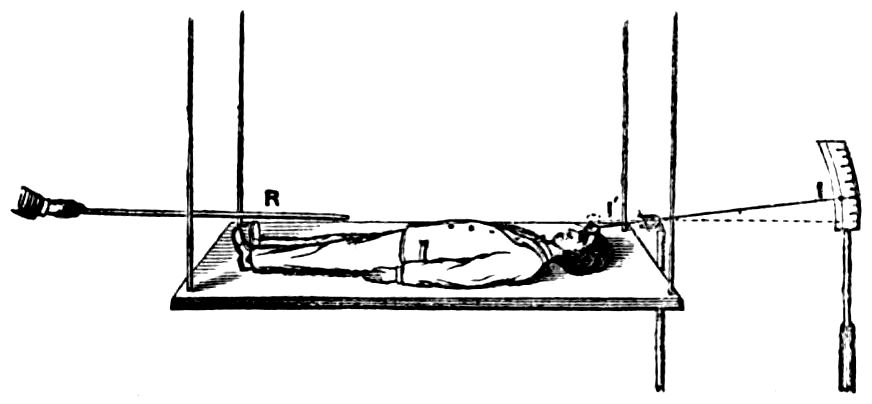
We are now in a condition to repeat, with ease, the experiment of Du Fay mentioned in § 13. A board is supported by four silk ropes, and on the board is stretched a boy. Bring his forehead, or better still his nose, under the end of your straw index I I′, fig. 22. Then bring down over his legs your rubbed glass tube; instantly the end I′ is attracted and the end I rises along the graduated scale. Before the end I′ comes into contact with the nose or forehead a spark passes between it and the boy.
I will now ask you to charge your Dutch metal electroscope (fig. 7) positively by rubbed gutta-percha, and to charge it negatively by rubbed glass. A moment's reflection will enable you to do it. You bring your excited body near: the same electricity as that of the excited body is driven over the leaves, and they diverge by repulsion. Touch the electroscope, the leaves collapse. Withdraw your finger, and withdraw afterwards the excited body: the leaves then diverge with the opposite electricity.
The simplest way of testing the quality of electricity is to charge the electroscope with electricity of a known kind. If, on the approach of the body to be tested, the leaves diverge still wider, the leaves and the body are similarly electrified. The reason is obvious.
Omitting the last experiment, the wealth of knowledge which these researches involve might be placed within any intelligent boy's reach by the wise expenditure of half-a-crown.
Once firmly possessed of the principle of induction and versed in its application, the difficulties of our subject will melt away before us. In fact our subsequent work will consist mainly in unravelling phenomena by the aid of this principle.
Without a knowledge of this principle we could render no account of the attraction of neutral bodies by our excited tubes. In reality the attracted bodies are not neutral: they are first electrified by influence, and it is because they are thus electrified that they are attracted.
This is the place to refer more fully to a point already alluded to. Neutral bodies, as just stated, are attracted, because they are really converted into electrified bodies by induction. Suppose a body to be feebly electrified positively, and that you bring your rubbed glass tube to bear upon the body. You clearly see that the induced negative electricity may be strong enough to mask and overcome the weak positive charge possessed by the body. We should thus have two bodies electrified alike, attracting each other. This is the danger against which I promised to warn you in § 10, where the test of attraction was rejected.
We will now apply the principle of induction to explain a very beautiful invention, made known by the celebrated Volta in 1775.
§ 15. The Electrophorus
Cut a circle, T, fig. 23, 6 inches in diameter out of sheet zinc, or out of common tin. Heat it at its centre by the flame of a spirit-lamp or of a candle. Attach to it there a stick of sealing-wax, H, which, when the metal cools, is to serve as an insulating handle.—You have now the lid of the electrophorus. A resinous surface, or what is simpler a sheet of vulcanised india-rubber, P, or even of hot brown paper, will answer for the plate of the electrophorus.
Rub your 'plate' with flannel, or whisk it briskly with a fox's brush. It is thereby negatively electrified. Place the 'lid' of your electrophorus on the excited surface: it touches it at a few points only. For the most part lid and plate are separated by a film of air.
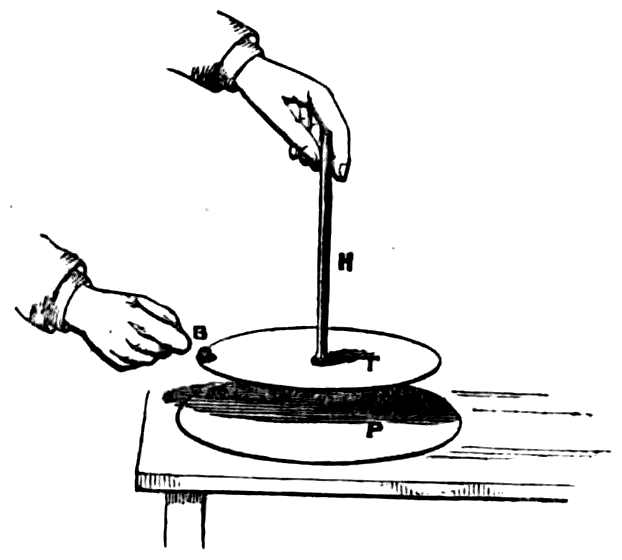
The excited surface acts by induction across this film upon the lid, attracting its positive and repelling its negative electricity. You have in fact in the lid two layers of electricity, the lower one, which is 'bound,' positive; the upper one, which is 'free,' negative. Lift the lid: the electricities flow again together; neutrality is restored, and your lid fails to attract your balanced lath.
Once more place the lid upon the excited surface: touch it with the finger. What occurs? You ought to know. The free electricity, which is negative, will escape through your body to the earth, leaving the chained positive behind.
Now lift the lid by the handle: what is its condition? Again I say you ought to know. It is covered with free positive electricity. If it be presented to the lath it will strongly attract it: if it be presented to the knuckle it will yield a spark.
A smooth half-crown, or a penny, will answer for this experiment. Stick to the coin an inch of sealing-wax as an insulating handle: bring it down upon the excited india-rubber: touch it, lift it, and present it to your lath. The lath may be six or eight feet long, three inches wide and half an inch thick; the little electrophorus lid, formed by the half crown, will pull it round and round. The experiment is a very impressive one.
Scrutinise your instrument still further. Let the end of a thin wire rest upon the lid of your electrophorus, under a little weight if necessary; and connect the other end of the wire with the electroscope. As you lower the lid down towards the excited plate of the electrophorus, what must occur? The power of prevision now belongs to you and you must exercise it. The repelled electricity will flow over the leaves of the electroscope, causing them to diverge. Lift the lid, they collapse. Lower and raise the lid several times, and observe the corresponding rhythmic action of the electroscope leaves.
A little knob of sealing-wax, B, coated with tin-foil, or indeed any knob with a conducting surface, stuck to the lid of the electrophorus, will enable you to obtain a better spark. The reason of this will immediately appear.
More than half the value of your present labour consists in arranging each experiment in thought before it is realised in fact; and more than half the delight of your work will consist in observing the verification of what you have foreseen and predicted.
§ 16. Action of Points and Flames
The course of exposition proceeds naturally from the electrophorus to the electrical machine. But before we take up the machine we must make our minds clear regarding the manner in which electricity diffuses itself over conductors, and more especially over elongated and pointed conductors.
Rub your glass tube and draw it over an insulated sphere of metal—of wood covered with tin-foil, or indeed any other insulated spherical conductor. Repeat the process several times, so as to impart a good charge to the sphere. Touch the charged sphere with your carrier, and transfer the charge to the electroscope. Note the divergence of the leaves. Discharge the electroscope, and repeat the experiment, touching, however, some other point of the sphere. The electroscope shows sensibly the same amount of divergence. Even when the greatest exactness of the most practised experimenter is brought into play, the spherical conductor is found to be equally charged at all points of its surface. You may figure the electric fluid as a little ocean encompassing the sphere, and of the same depth everywhere.
But supposing the conductor, instead of being a sphere, to be a cube, an elongated cylinder, a cone, or a disk. The depth, or as it is sometimes called the density of the electricity, will not be everywhere the same. The corners of the cube will impart a stronger charge to your carrier than the sides. The end of the cylinder will impart a stronger charge than its middle. The edge of the disk will impart a stronger charge than its flat surface. The apex or point of the cone will impart a stronger charge than its curved surface or its base.
You can satisfy yourself of the truth of all this in a rough, but certain way, by charging, after the sphere, a turnip cut into the form of a cube; or a cigar-box coated with tin-foil; a metal cylinder, or a wooden one coated with tin-foil; a disk of tin or of sheet zinc; a carrot or parsnip with its natural shape improved so as to make it a sharp cone. You will find the charge imparted to the carrier by the sharp corners and points of such bodies, when electrified, to be greater than that communicated by the gently rounded or flat surfaces. The difference may not be great, but it will be distinct. Indeed an egg laid on its side, as we have already used it in our experiments on induction (fig. 16), yields a stronger charge from its ends than from its middle.
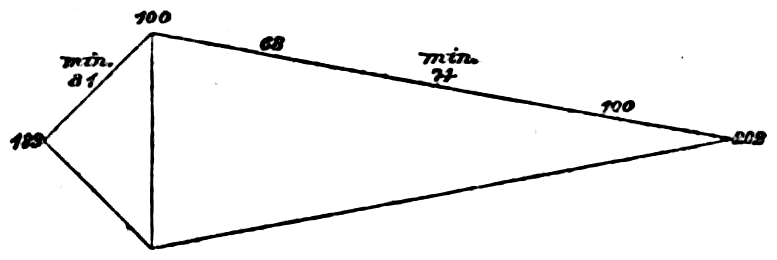
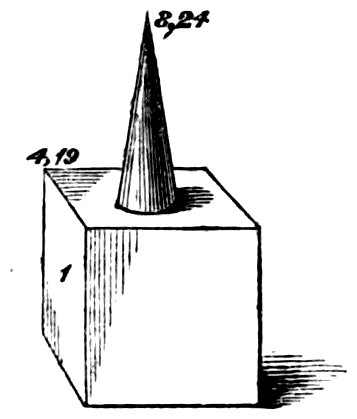
Let me place before you an example of this distribution, taken from the excellent work on 'Frictional Electricity' by Professor Riess of Berlin. Two cones, fig. 24, are placed together base to base. Calling the strength of the charge along the circular edge where the two bases join each other 100, the charge at the apex of the blunter cone is 133; and at the apex of the sharper one 202. The other numbers give the charges taken from the points where they are placed. Fig. 25, moreover, represents a cube with a cone placed upon it. The charge on the face of the cube being 1, the charges at the corners of the cube and at the apex of the cone are given by the other numbers; they are all far in excess of the electricity on the flat surface.
Riess found that he could deduce with great accuracy the sharpness of a point, from the charge which it imparted. He compared in this way the sharpness of various thorns, with that of a fine English sewing needle. The following is the result:—Euphorbia thorn was sharper than the needle; gooseberry thorn of the same sharpness as the needle; while cactus, blackthorn, and rose, fell more and more behind the needle in sharpness. Calling, for example, the charge obtained from euphorbia 90; that obtained from the needle was 80, and from the rose only 53.
Considering that each electricity is self-repulsive, and that it heaps itself up upon a point in the manner here shown, you will have little difficulty in conceiving that when the charge of a conductor carrying a point is sufficiently strong, the electricity will finally disperse itself by streaming from the point.
The following experiments are theoretically important:—Attach a stick of sealing-wax to a small plate of tin or of wood, so that the stick may stand upright. Heat a needle and insert it into the top of the stick of wax; on this needle mount horizontally a carrot. You have thus an insulated conductor. Stick into your carrot at one of its ends a sewing needle; and hold for an instant your rubbed glass tube in front of this needle without touching it. What occurs? The negative electricity of the carrot is immediately discharged from the point against the glass tube. Remove the tube, test the carrot: it is positively electrified.
And now for another experiment, not so easily made, but still certain to succeed if you are careful. Excite your glass rod, turn your needle away from it, and bring the rod near the other end of the carrot. What occurs? The positive electricity is now repelled to the point, from which it will stream into the air. Remove the rod and test the carrot: it is negatively electrified.
Again turn the point towards you, and place in front of it a plate of dry glass, wax, resin, shellac, paraffin, gutta-percha, or any other insulator. Pass your rubbed glass tube once downwards or upwards, the insulating plate being between the excited tube and the point. The point will discharge its electricity against the insulating plate, which on trial will be found negatively electrified.
§ 17. The Electrical Machine
An electrical machine consists of two principal parts; the insulator which is excited by friction, and the 'prime conductor.'
The sulphur sphere of Otto von Guericke was, as already stated, the first electrical machine. The hand was the rubber, and indeed it long continued to be so. For the sulphur sphere, Hauksbee and Winckler substituted globes of glass. Boze of Wittenberg (1741) added the prime conductor, which was at first a tin tube supported by resin, or suspended by silk. Soon afterwards Gordon substituted a glass cylinder for the globe. It was sometimes mounted vertically, sometimes horizontally. Gordon so intensified his discharges as to be able to kill small birds with them. In 1760 Planta introduced the plate machine now commonly in use.
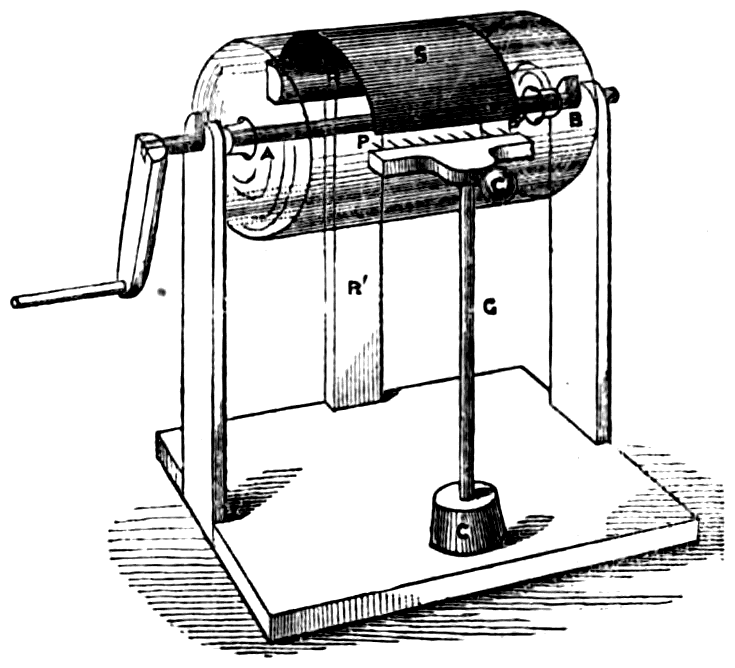
Mr. Cottrell has constructed for these Lessons the small cylinder machine shown in fig. 26. The glass cylinder is about 7 inches long and 4 inches in diameter: its cost is eighteen pence. Through the cylinder passes tightly, as an axis, a piece of lath, rendered secure by sealing-wax where it enters and where it quits the cylinder. G is a glass rod supporting the conductor C, which is a piece of lath coated with tin-foil. Into the lath is driven the series of pin points, P, P. The rubber R, is seen at the further side of the cylinder, supported by the upright lath R′, and caused to press against the glass. S′ is a flap of silk attached to the rubber. When the handle is turned sparks may be taken, or a Leyden jar10 charged at the knob C.
A plate machine is shown in fig. 27. P is the plate, which turns on an axis passing through its centre; R and R′ are two rubbers which clasp the plate, with the flaps of silk S S′ attached to them. A and A′ are rows of points forming part of the prime conductor, C. G G′ is an insulating rod of glass, which cuts off the connection between the conductor and the handle of the machine.
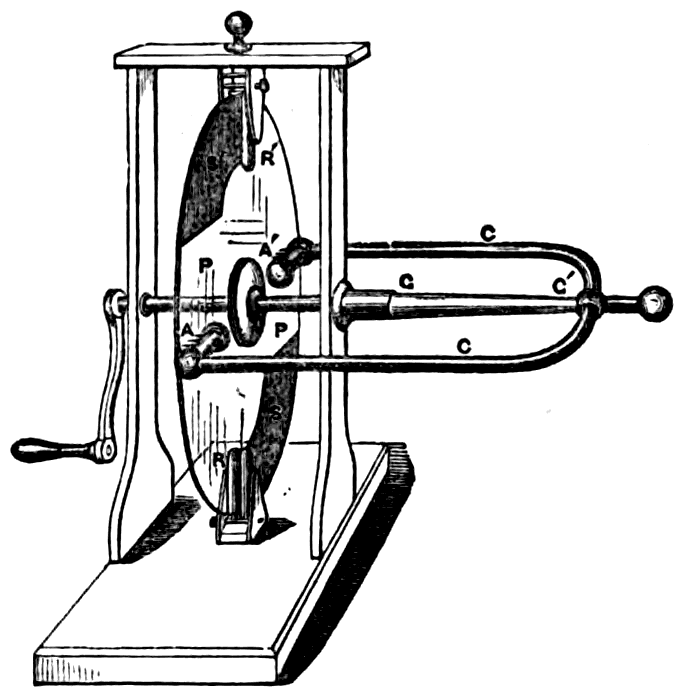
The prime conductor is charged in the following manner. When the glass plate is turned, as it passes each rubber it is positively electrified. Facing the electrified glass is the row of points, placed midway between the two rubbers. On these points the glass acts by induction, attracting the negative and repelling the positive. In accordance with the principles already explained in § 16, the negative electricity streams from the points against the excited glass, which then passes on neutralised to the next rubber, where it is again excited.
Thus the prime conductor is charged, not by the direct communication to it of positive electricity, but by depriving it of its negative.
If when the conductor is charged you bring the knuckle near it, the electricity passes from the conductor to the knuckle in the form of a spark.
Take this spark with the blunt knuckle while the machine is being turned; and then try the effect of presenting the finger ends, instead of the knuckle, to the conductor. The spark falls exceedingly in brilliancy. Substitute for the finger ends a needle point: you fail to get a spark at all. To obtain a good spark the electricity upon the prime conductor must reach a sufficient density (or tension as it is sometimes called); and to secure this no points from which the electricity can stream out must exist on the conductor, or be presented to it. All parts of the conductor are therefore carefully rounded off, sharp points and edges being avoided.
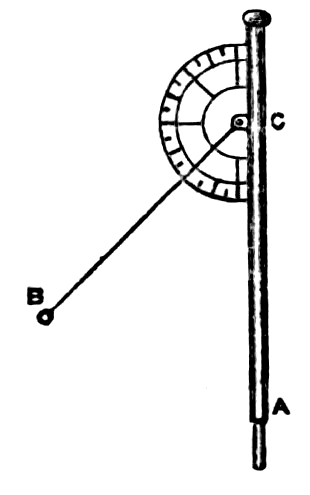
It is usual to attach to the conductor an electroscope consisting of an upright metal stem, A C, fig. 28, to which a straw with a pith ball, B, at its free end, is attached. The straw turns loosely upon a pivot at C. The electricity passing from the conductor is diffused over the whole electroscope, and the straw and stem being both positively electrified, repel each other. The straw, being the movable body, flies away. The amount of the divergence is measured upon a graduated arc.
§ 18. Further Experiments on the Action of Points. The Electric Mill. The Golden Fish. Lightning Conductors
If no point exist on the conductor, a single turn of the handle of the machine usually suffices to cause the straw to stand out at a large angle to the stem. If, on the contrary, a point be attached to the conductor, you cannot produce a large divergence, because the electricity, as fast as it is generated, is dispersed by the point. The same effect is observed when you present a point to the conductor. The conductor acts by induction upon the point, causing the negative electricity to stream from it against the conductor, which is thus neutralised almost as fast as it is charged. Flames and glowing embers act like points; they also rapidly discharge electricity.
The electricity escaping from a point or flame into the air renders the air self-repulsive. The consequence is that when the hand is placed over a point mounted on the prime conductor of a machine in good action, a cold blast is distinctly felt. Dr. Watson noticed this blast from a flame placed on an electrified conductor; while Wilson noticed the blast from a point. Jallabert and the Abbé Nollet also observed and described the influence of points and flames. The blast is called the 'electric wind.' Wilson moved bodies by its action: Faraday caused it to depress the surface of a liquid: Hamilton employed the reaction of the electric wind to make pointed wires rotate. The 'wind' was also found to promote evaporation.
Hamilton's apparatus is called the 'electric mill.' Make one for yourself thus: Place two straws S S, S′ S′, fig. 29, about eight inches long, across each other at a right angle. Stick them together at their centres by a bit of sealing-wax. Pass a fine wire through each straw and bend it where it issues from the straw, so as to form a little pointed arm perpendicular to the straw, and from half an inch to three-quarters of an inch long. It is easy, by means of a bit of cork or sealing-wax, to fix the wire so that the little bent arms shall point not upwards or downwards, but sideways, when the cross is horizontal. The points of sewing needles may also be employed for the bent arms. A little bit of straw stuck into the cross at the centre, forms a cap. This slips over a sewing needle, N, supported by a stick of sealing-wax, A. Connect the sewing needle with the electric machine, and turn. A wind of a certain force is discharged from every point, and the cross is urged round with the same force in the opposite direction.
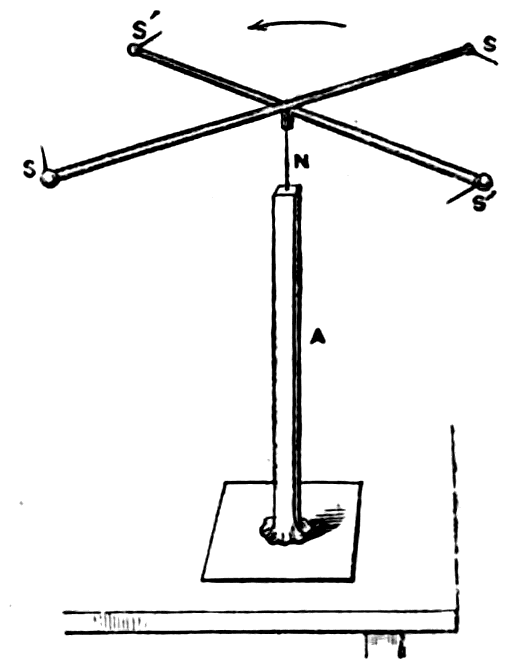
You might easily, of course, so arrange the points that the wind from some of them would neutralise the wind from others. But the little pointed arms are to be so bent that the reaction in every case shall not oppose but add itself to the others.
The following experiments will yield you important information regarding the action of points. Stand, as you have so often done before, upon a board supported by four warm tumblers. Hold a small sewing needle, with its point defended by the fore finger of your right hand, towards your Dutch metal electroscope. Place your left hand on the prime conductor of your machine. Let the handle be turned by a friend or an assistant: the leaves of the electroscope open out a little. Uncover the needle point by the removal of your finger; the leaves at once fly violently apart.
Mount a stout wire upright on the conductor, C, fig. 30, of your machine; or support the wire by sealing-wax, gutta-percha or glass, at a distance from the conductor, and connect both by a fine wire. Bend your stout wire into a hook, and hang from it a tassel, T, composed of many strips of light tissue paper. Work the machine. Electricity from the conductor flows over the tassel, and the strips diverge.11 Hold your closed fist towards the tassel, the strips of paper stretch towards it. Hold the needle, defended by the finger, towards the tassel: attraction also ensues. Uncover the needle without moving the hand; the strips retreat as if blown away by a wind. Holding the needle N, fig. 31, upright underneath the tassel, its strips discharge themselves and collapse utterly.
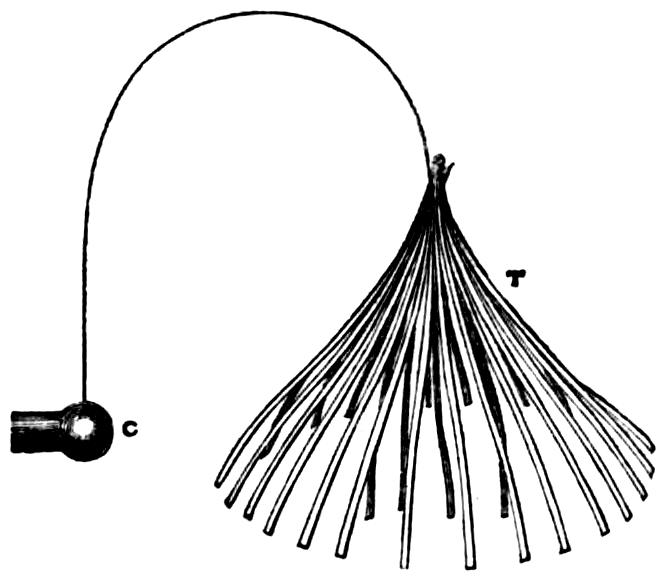
And now repeat Du Fay's experiment which led to the discovery of two electricities. Excite your glass tube, and hold it in readiness while a friend, or an assistant, liberates a real gold or silver leaf in the air. Bring the tube near the leaf: it plunges towards the tube, stops suddenly, and then flies away. You may chase it round the room for hours without permitting it to reach the ground. The leaf is first acted upon inductively by the tube. It is powerfully attracted for a moment, and rushes towards the tube. But from its thin edges and corners the negative electricity streams forth, leaving the leaf positively electrified. Repulsion then sets in, because tube and leaf are electrified alike, as shown in fig. 32. The retreat of the tassel in the last experiment is due to a similar cause.
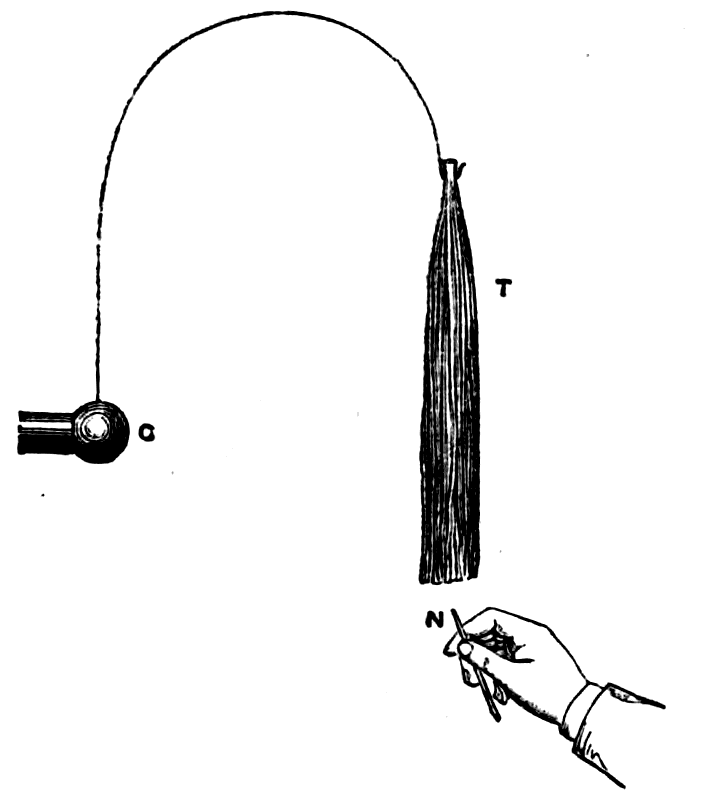
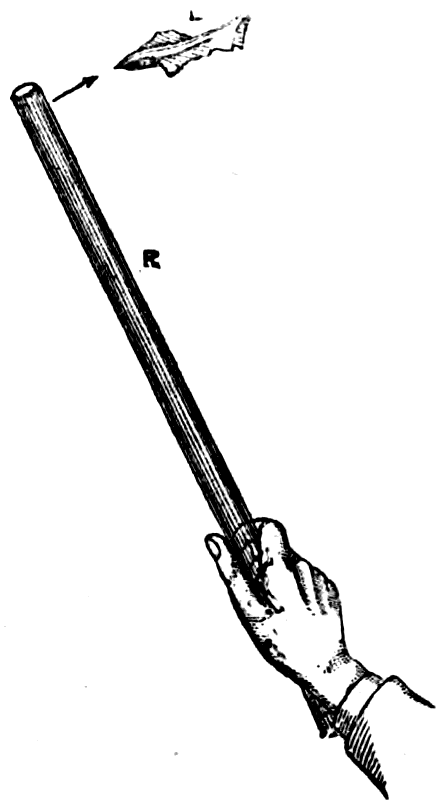
There is also a discharge of positive electricity into the air from the more distant portions of the gold-leaf, to which that electricity is repelled. Both discharges are accompanied by an electric wind. It is possible to give the gold-leaf a shape which shall enable it to float securely in the air, by the reaction of the two winds issuing from its opposite ends. This is Franklin's experiment of the Golden Fish. It was first made with the charged conductor of an electrical machine. M. Srtsczek revived it in a more convenient form, using instead of the conductor the knob of a charged Leyden jar. You may walk round a room with the jar in your hand; the 'fish' will obediently follow in the air an inch or two, or even three inches, from the knob. See A B, fig. 33. Even a hasty motion of the jar will not shake it away.
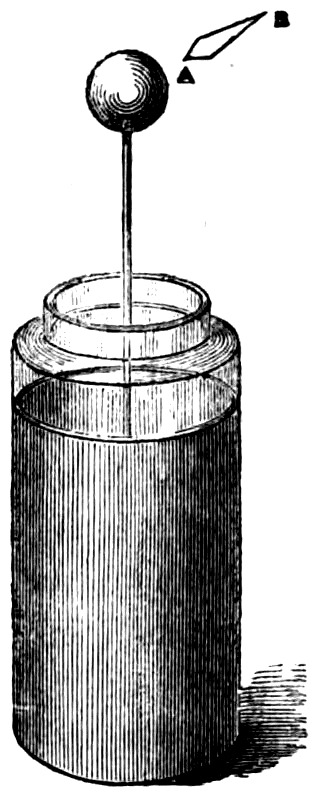
Well-pointed lightning conductors, when acted on by a thunder cloud, discharge their induced electricity against the cloud. Franklin saw this with great clearness, and illustrated it with great ingenuity. The under side of a thunder cloud, when viewed horizontally, he observed to be ragged, composed, in fact, of fragments one below the other, sometimes reaching near the earth. These he regarded as so many stepping-stones which assist in conducting the stroke of the cloud. To represent these by experiment he took two or three locks of fine loose cotton, tied them in a row, and hung them from his prime conductor. When this was excited the locks stretched downwards towards the earth; but by presenting a sharp point erect under the lowest bunch of cotton, it shrunk upwards to that above it, nor did the shrinking cease till all the locks had retreated to the prime conductor itself. 'May not,' says Franklin, 'the small electrified clouds, whose equilibrium with the earth is so soon restored by the point, rise up to the main body, and by that means occasion so large a vacancy, that the grand cloud cannot strike in that place?'
§ 19. History of the Leyden Jar. The Leyden Battery
The next discovery which we have to master throws all former ones into the shade. It was first announced in a letter addressed on the 4th of November, 1745, to Dr. Lieberkühn, of Berlin, by Kleist, a clergyman of Cammin, in Pomerania. By means of a cork, C, fig. 34, he fixed a nail, N, in a phial, G, into which he had poured a little mercury, spirits, or water, W. On electrifying the nail he was able to pass from one room into another with the phial in his hand and to ignite spirits of wine with it. 'If,' said he, 'while it is electrifying I put my finger, or a piece of gold which I hold in my hand, to the nail, I receive a shock which stuns my arms and shoulders.'
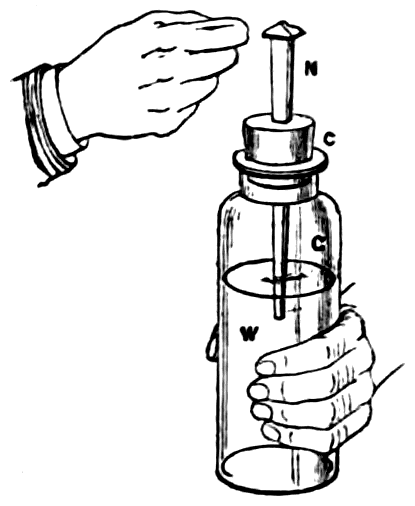
In the following year Cunæus of Leyden made substantially the same discovery. It caused great wonder and dread, which arose chiefly from the excited imagination. Musschenbroek felt the shock, and declared in a letter to a friend that he would not take a second one for the crown of France. Bleeding at the nose, ardent fever, a heaviness of head which endured for days, were all ascribed to the shock. Boze wished that he might die of it, so that he might enjoy the honour of having his death chronicled in the Paris 'Academy of Sciences.' Kleist missed the explanation of the phenomenon; while the Leyden philosophers correctly stated the conditions necessary to the success of the experiment. Hence the phial received the name of the Leyden phial, or Leyden jar.
The discovery of Kleist and Cunæus excited the most profound interest, and the subject was explored in all directions. Wilson in 1746 filled a phial partially with water, and plunged it into water, so as to bring the water surfaces, within and without the phial, to the same level. On charging such a phial the strength of the shock was found greater than had been observed before.
Two years subsequently Dr. Watson and Dr. Bevis noticed how the charge grew stronger as the area of the conductor in contact with the outer surface of the phial increased. They substituted shot for water inside the jar, and obtained substantially the same effect. Dr. Bevis then coated a plate of glass on both sides with silver foil, to within about an inch of the edge, and obtained from it discharges as strong as those obtained from a phial containing half a pint of water. Finally Dr. Watson coated his phial inside and out with silver foil. By these steps the Leyden jar reached the form which it possesses to-day.
It is easy to repeat the experiment of Dr. Bevis. Procure a glass plate nine inches square; cover it on both sides, as he did, with tin-foil seven inches square, leaving the rim uncovered. Connect one side with the earth and the other with the machine. Charge and discharge: you obtain a brilliant spark.
In our experiment with the Golden Fish (fig. 33), we employed a common form of the Leyden jar, only with the difference that to get to a sufficient distance from the glass, so as to avoid the attraction of the fish by the jar itself, the knob was placed higher than usual. But with a good flint-glass tumbler, a piece of tin-foil, and a bit of stout wire, you can make a jar for yourself. Bad glass, remember, is not rare.12 In fig. 35 you have such a jar. T is the outer, T′ the inner coating, reaching to within an inch of the edge of the tumbler G. W is the wire fastened below by wax, and surmounted by a knob, which may be of metal, or of wax or wood, coated with tin-foil. In charging the jar you connect the outer coating with the earth—say with a gas-pipe or a water-pipe—and present the knob to the conductor of your machine. A few turns will charge the jar. It is discharged by laying one knob of a 'discharger' against the outer coating, and causing the other knob to approach the knob of the jar. Before contact, the electricity flies from knob to knob in the form of a spark.
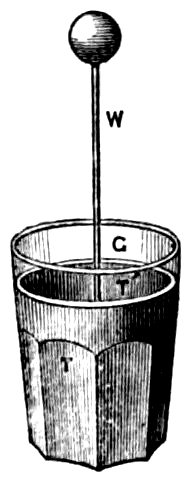
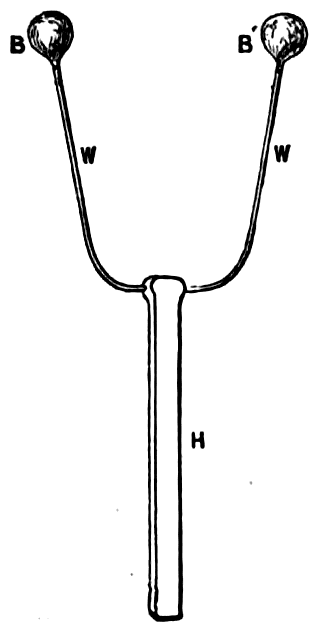
A 'discharger' suited to our means and purposes is shown in fig. 36. H is a stick of sealing-wax, or, better still, of ebonite: W W a stout wire bent as in the figure, and ending in the knobs B B′. These may be of wax coated with tin-foil. Any other light conducting knobs would of course answer. The insulating handle H protects you effectually from the shock.
You must render yourself expert in the use of the discharger. The mode of using it is shown in fig. 37.
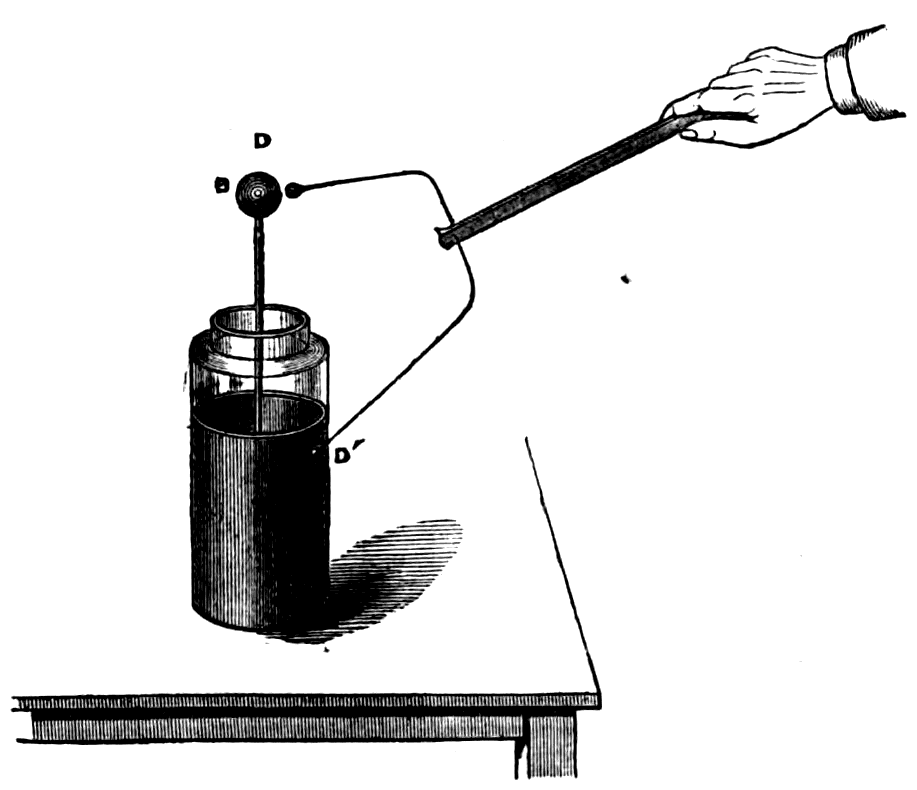
By augmenting the size of a Leyden jar we render it capable of accepting a larger charge of electricity. But there is a limit to the size of a jar. When, therefore, larger charges are required than a single jar can furnish, we make use of a number of jars. In fig. 38 nine of them are shown. All their interior coatings are united together by brass rods, while all the outer coatings rest upon a metal surface in free communication with the earth.
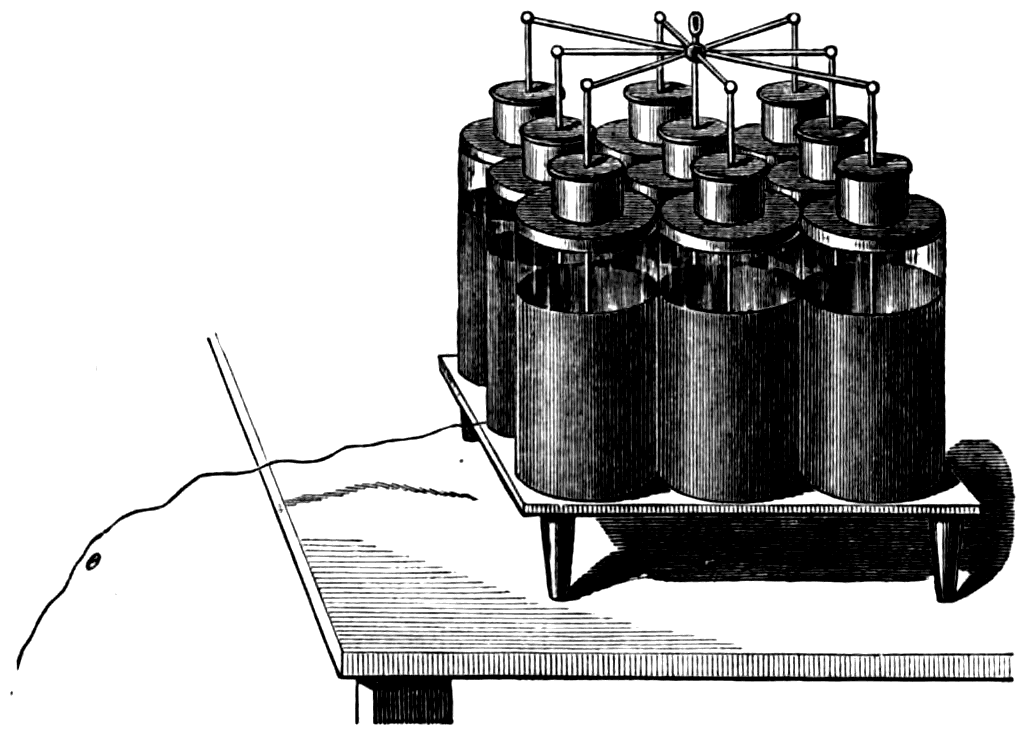
This combination of Leyden jars constitutes the Leyden Battery, the effect of which is equal to that of a single jar of nine times the size of one of the jars.
§ 20. Explanation of the Leyden Jar
The principles of electrical induction with which you are now so familiar will enable you to thoroughly analyse and understand the action of the Leyden jar. In charging the jar the outer coating is connected with the earth, and the inner coating with the electrical machine. Let the machine, as usual, be of glass yielding positive electricity. When it is worked the electricity poured into the jar acts inductively across the glass upon the outer coating; attracting its negative and repelling its positive to the earth. Two mutually attractive electric layers are thus in presence of each other, being separated merely by the glass. When the machine is in good order and the glass of the jar is thin, the attraction may be rendered strong enough to perforate the jar. By means of the discharger the opposite electricities are enabled to unite in the form of a spark.
Franklin saw and announced with clearness the escape of the electricity from the outer coating of the jar. His statement is that whatever be the quantity of the 'electric fire' thrown into the jar, an equal quantity was dislodged from the outside. We have now to prove by actual experiment that this explanation is correct.
Place your Leyden jar upon a table, and connect the outer coating with your electroscope. There is no divergence of the leaves when electricity is poured into the jar.
But here the outer coating is connected through the table with the earth. Let us cut off this communication by an insulator. Place the jar upon a board supported by warm tumblers, or upon a piece of vulcanised india-rubber cloth, and again connect the outer coating with the electroscope. The moment electricity is communicated to the knob of the jar the leaves of Dutch metal diverge. Detach the wire by your discharger and test the quality of the electricity—it is positive, as theory declares it must be.
Consider now the experiment of Kleist and Cunæus (fig. 34). You will, I doubt not, penetrate its meaning. You will see that in their case the hand formed the outer coating of the jar. When electricity was communicated through the nail to the water within, that electricity acted across the glass inductively upon the hand, attracting the one fluid and repelling the other to the earth.
Again I say, prove all things; and what is here affirmed may be proved by the following beautiful and conclusive experiment:—Stand on your board, I I′, fig. 39, insulated by its four tumblers; or upon a sheet of gutta-percha, or vulcanised india-rubber. Seize the old Leyden phial, J, with your left hand, and present the knuckle of your right hand to your balanced lath, L′ L. When electricity is communicated to the nail, the lath is immediately attracted by the knuckle. Or touch your electroscope with your right hand: when the phial is charged the leaves immediately diverge, by the electricity driven from your left hand to the electroscope.
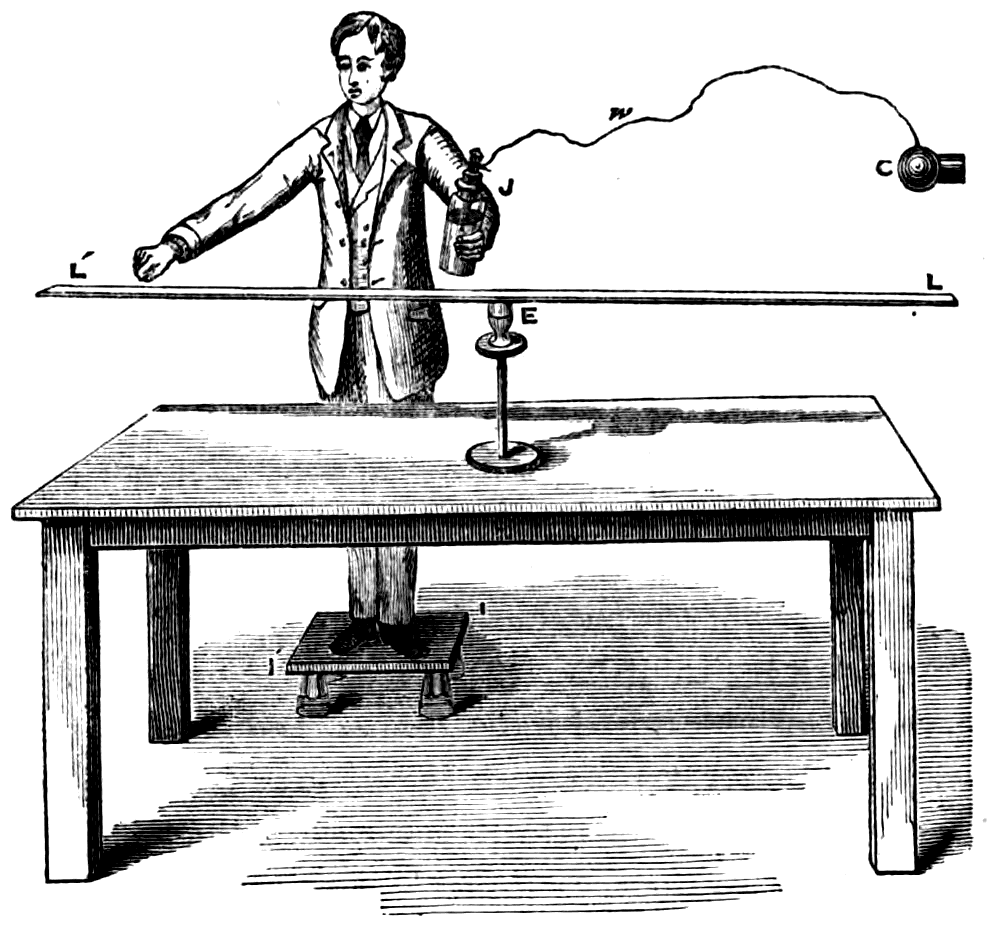
Here the nail may be electrified either by connecting it with the prime conductor of the machine, or by rubbing it with an excited glass rod. Indeed I should prefer your resorting to the simplest and cheapest means in making these experiments.
§ 21. Franklin's Cascade Buttery
As a thoughtful and reflective boy or girl you cannot, I think, help wondering at the power which your thorough mastery of the principles of induction gives you over these wonderful and complicated phenomena. By those principles the various facts of our science are bound together into an organic whole. But we have not yet exhausted the fruitfulness of this principle.
Consider the following problem. Usually we allow the electricity of the outer coating to escape to the earth. Suppose we try to utilise it. Place, then, your jar A B, fig. 40, upon vulcanised india-rubber, and connect by a wire B C its outer coating with the knob or inner coating of a second jar C D. What will occur when the first jar is charged? Why, the second one will be charged also by the electricity which has escaped from the outer coating of the first. And suppose you connect the outer coating of the second insulated jar with the inner coating of a third, E F; what occurs? The third jar will obviously be charged with the electricity repelled from the outer coating of the second. Of course we need not stop here. We may have a long series of insulated jars, the outer coating of each being connected with the inner coating of the next succeeding one. Connect the outer coating of the last jar I K by a wire e with the earth, and charge the first jar. You charge thereby the entire series of jars. In this simple way you master practically, and grasp the theory of Franklin's celebrated 'cascade battery.'
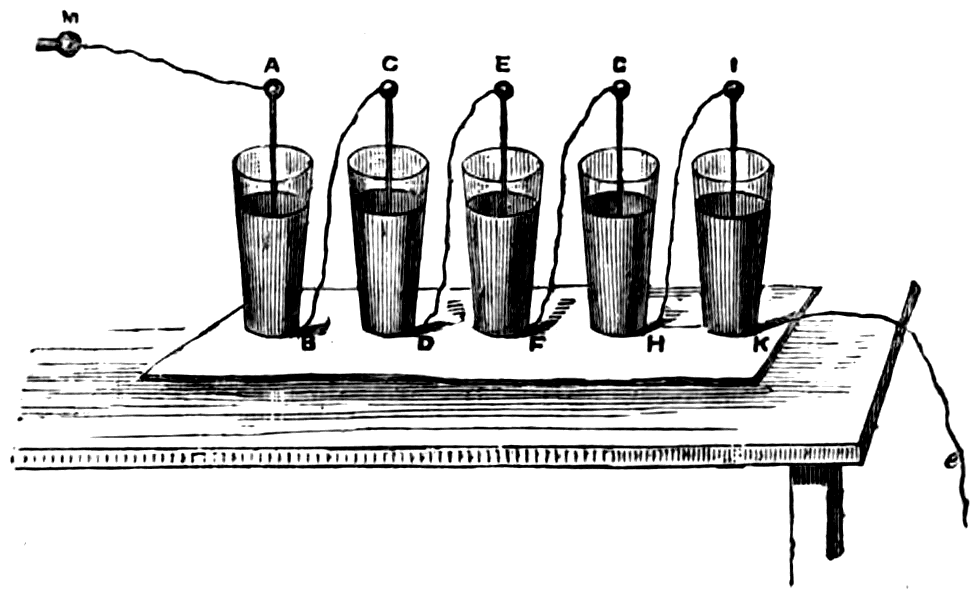
You must see that before making this important experiment you could really have predicted what would occur. This power of prevision is one of the most striking characteristics of science.
§ 22. Novel Leyden Jars of the Simplest Form
Possessed of its principles, we can reduce the Leyden jar to far simpler forms than any hitherto dealt with. Spread a sheet of tin-foil smoothly upon a table, and lay upon the foil a pane of glass. Remember that the glass, as usual, must be dry. Stick on to the glass by sealing-wax two loops of narrow silk ribbon, by which the pane may be lifted; and then lay smoothly upon the glass a second sheet of tin-foil, less than the pane in size, leaving a rim of uncovered glass all round. Carry a fine wire from the upper sheet of tin-foil to your electroscope. A little weight will keep the end of the wire attached to the tin-foil.
Rub this weight with your excited glass tube, two or three times if necessary, until you see a slight divergence of the Dutch metal leaves. Or connecting the weight with the conductor of your machine, turn very carefully until the slight divergence is observed. What is the condition of things here? You have poured, say positive electricity on to the upper sheet of metal. It acts inductively across the glass upon the under sheet, the positive fluid of which escapes to the earth, leaving the negative behind. You see before your mind's eye two layers holding each other in bondage. Now take hold of your loops and lift the glass plate, so as to separate the upper tin-foil from the lower. What would you expect to occur? Freed from the grasp of the lower layer, the electricity of the upper one will diffuse itself over the electroscope so promptly and powerfully, that if you are not careful you will destroy the instrument by the mutual repulsion of its leaves.
Practise this experiment, which is a very old one of mine, by lowering and lifting the glass plate, and observing the corresponding rhythmic action of the leaves of the electroscope.
Common tin-plate may be used in this experiment instead of tin-foil, and a sheet of vulcanised india-rubber instead of the pane of glass. Or simpler still, for the tin-foil a sheet of common unwarmed foolscap may be employed. Satisfy yourself of this. Spread a sheet of foolscap on a table; lay the plate of glass upon it, and spread a leaf of foolscap, less than the glass in size, on the plate of glass. Connect the leaf with the electroscope, and charge it, exactly as you charged the tin-foil. On lifting the glass with its leaf of foolscap, the leaves of the electroscope instantly fly apart; on lowering the glass they again fall together. Abandon the under sheet altogether, and make the table the outer coating; if it be not of very dry wood, or covered by an insulating varnish, you will obtain with it the results obtained with the tin-foil, tin, and foolscap. Thus by the simplest means we illustrate great principles.
The withdrawal of the electricity from the electroscope, by lowering the plate of glass, so as to bring the electricity of the upper coating within the grasp of the lower one, is sometimes called 'condensation.' The electricity on one plate or sheet was figured as squeezed together, or condensed, by the attraction of the other. A special instrument called a condenser is constructed by instrument makers to illustrate the action here explained.
You may readily make a condenser for yourself. Take two circles, P P′, fig. 41, of tin or of sheet zinc, and support the one, P′, by a stick of sealing-wax or glass, G; the other, P, by a metal stem, connected with the earth. The insulated plate, P′, is called the collecting plate; the uninsulated one, P, the condensing plate. Connect the collecting plate with your electroscope by the wire w, and bring the condensing plate near it, leaving, however, a thin space of air between them. Charge the collector, P′, or the wire, w, with your glass rod, until the leaves of the electroscope begin to diverge. Withdraw the condensing plate, the leaves fly asunder; bring the condensing plate near, the leaves again collapse.
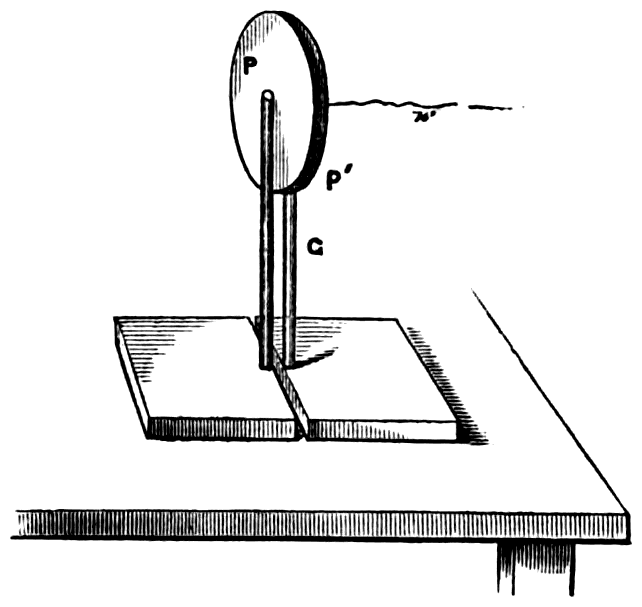
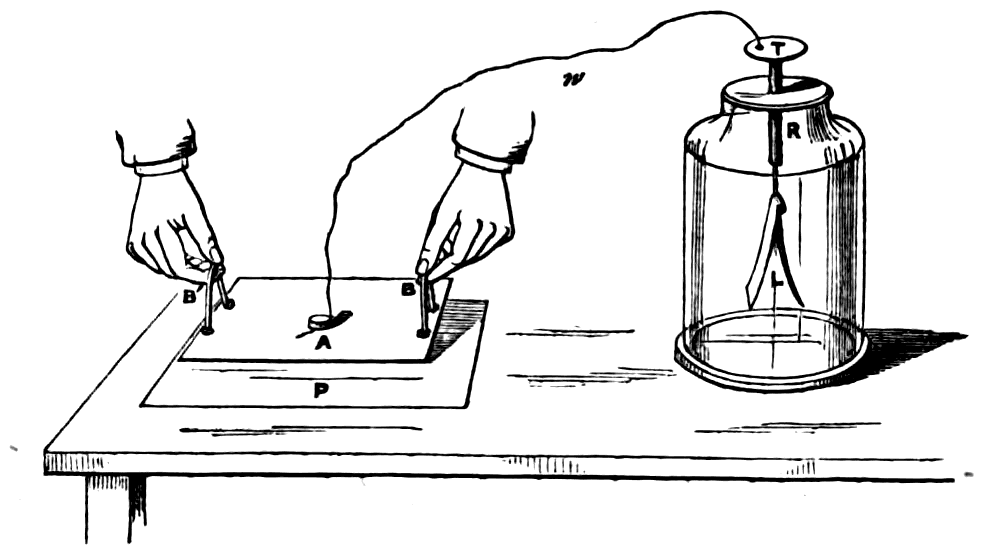
Or vary your construction, and make your condenser thus. Employing the table, or a sheet of foolscap if the table be an insulator, as one plate of the condenser, spread upon it the sheet of india-rubber, P, fig. 42, and lay upon the rubber the sheet of block-tin A B. Connect the tin by the wire, w, with the electroscope, T. Impart electricity to the little weight, A, till the leaves, L, begin to diverge; then lift the tin-plate by its two silk loops; the leaves at once fly asunder.
Finally show your complete knowledge of the Leyden jar, and your freedom from the routine of the instrument makers, by making a 'jar' in the following novel way. Stand upon a board supported by warm tumblers. Hold in your right hand a sheet of vulcanised india-rubber, and clasp, with it between you, the left hand of a friend in connection with the earth. Place your left hand on the conductor of the machine, and let it be worked. You and your friend soon feel a crackling and a tickling of the hands, due to the heightening attraction of the opposite electricities across the india-rubber. The 'hand-jar' is then charged. To discharge it you have only to bring your other hands together: the shock of the Leyden jar is then felt and its spark seen and heard.
By the discharge of the hand-jar you can fire gunpowder. But this will be referred to more particularly further on. (See § 25.)
§ 23. Seat of Charge in the Leyden Jar
Franklin sought to determine how the charge was hidden in the Leyden jar. He charged with electricity a bottle half-filled with water and coated on the outside with tin-foil: dipping the finger of one hand into the water, and touching the outside coating with the other, he received a shock. He was thus led to inquire, is the electricity in the water? He poured the water into a second bottle, examined it, and found that it had carried no electricity along with it.
His conclusion was 'that the electric fire must either have been lost in the decanting, or must have remained in the bottle. The latter he found to be true; for, filling the charged bottle with fresh water, he obtained the shock, and was therefore satisfied that the power of giving it resided in the glass itself.'13
(An account of Franklin's discoveries was given by him in a series of letters addressed to Peter Collinson, Esq., F.R.S., from 1747 to 1754.)
So much for history; but you are to verify the history by repeating Franklin's experiments. Place water in a wide glass vessel; place a second glass vessel within the first, and fill it to the same height with water. Connect the outer water by a wire with the earth, and the inner water by a wire with the electric machine. One or two turns furnish a sufficient charge. Removing the inner wire, and dipping one finger into the outside and the other into the inside water, a smart shock is felt. This was Franklin's first experiment.
Pass on to the second. Coat a glass jar with tin-foil (not too high); fill it to the same height with water, and place it on india-rubber cloth. Charge it by connecting the outside coating with the earth, and the water inside (by means of a stem cemented to the bottom of the jar and ending above in a knob) with an electric machine. You obtain a bright spark on discharging. This proves your apparatus to be in good order.
Re-charge. Take hold of the charged jar with the india-rubber, and pour the water into a second similar jar. No sensible charge is imparted to the latter. Pour fresh unelectrified water into the first jar, and discharge it. The retention of the charge is shown by a brilliant spark. Be careful in these experiments, or you will fail as I did at first. The edge of the jar out of which the water is poured has to be surrounded by a band of bibulous paper to catch the final drop, which, trickling down, would discharge the jar.
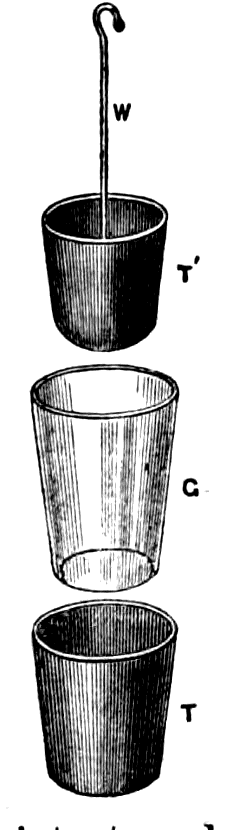
Experiments like those of Franklin are now made by rendering the coatings of the Leyden jar movable. Such a jar being charged, the interior coating may be lifted out and proved unelectric. The glass may then be removed from the outer coating and the latter proved unelectric. Restoring the jar and coatings, on connecting the two latter, the discharge passes in a brilliant spark.
Make a jar with movable coatings thus:—Roll cartridge paper round a good flint-glass tumbler, G, fig. 43, to within about an inch of the top. Paste down the lower edge of the paper, and put a paper bottom to it corresponding to the bottom of the glass. Coat the paper, T, inside and out with tin-foil. Make a similar coating, T′, for the inside of the tumbler, attaching to it an upright wire, W, ending in a hook. You have then to all intents and purposes a Leyden jar.
Put the pieces together and charge the jar. By means of a rod of glass, sealing-wax, or gutta-percha, lift out the interior coating. It will carry a little electricity away with it. Place it upon a table and discharge it wholly. Then by the hand lift the glass out of the outer coating. Neither of the coatings now shows the slightest symptom of electricity. Restore the tumbler to its outer coating, and, by means of the hook and insulating rod, restore the inner coating to its place. Discharge the jar: you obtain a brilliant spark. The electricity which produces this spark must have been resident in and on the glass.
Here, as in all other cases, you can charge your jar with a rubbed glass tube, though a machine in good working order will do it more rapidly. With 'Cottrell's rubber,' described in the next section, you may greatly exalt the performance of your glass tube.
§ 24. Ignition by the Electric Spark. Cottrell's Rubber. The Tube-machine
Various attempts had been vainly made by Nollet and others to ignite inflammable substances by the electric spark. This was first effected by Ludolf, at the opening of the Academy of Sciences by Frederick the Great at Berlin, on the 23rd of January, 1744. With a spark from the sword of one of the court cavaliers present on the occasion, Ludolf ignited sulphuric ether.
Dr. Watson also made numerous experiments on the ignition of bodies by the electric spark. He fired gunpowder and discharged guns. Causing, moreover, a spoon containing ether to be held by an electrified person, he ignited the ether by the finger of an unelectrified person. He also noticed that the spark varied in colour when the substances between which it passed varied.
These, and numerous other experiments may be made with a far simpler 'machine' than any hitherto described. It was devised for your benefit by Mr. Cottrell. In the electric machine, as we have learned, the prime conductor is flooded with positive electricity through the discharge of the negative from the points against the excited glass. Your glass tube and rubber may be similarly turned to account. A strip of sheet-brass or copper, P, fig. 44, is sewn on to the edge of the silk pad, R, employed as a rubber. Through apertures in the strip about twenty pin-points are introduced, and soldered to the metal. When the tube is clasped by the rubber, the metal strip and points quite encircle the tube.
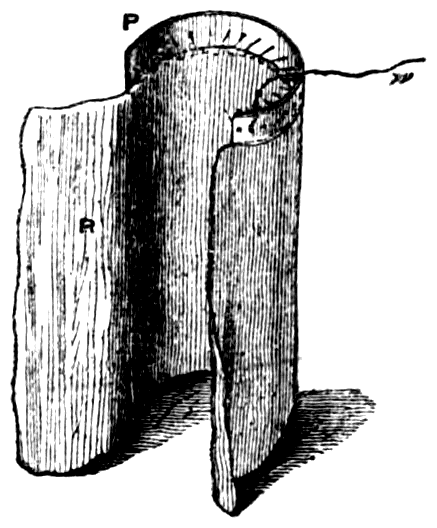
When a fine wire, w, connects the strip of metal with the knob of a Leyden jar, by every downward stroke of the rubber the glass tube is powerfully excited, and hotly following the exciting rubber is the circle of points. From these, against the rod, negative electricity is discharged, the free positive electricity escaping along the wire to the jar, which is thus rapidly charged.
The ignition of gas is readily effected by Cottrell's rubber. Connecting the strip of metal, R, fig. 45, with an insulated metallic knob, B, placed within a quarter or an eighth of an inch of an uninsulated argand burner connected with the earth, at every downward stroke of the rubber a stream of sparks passes between the knob and burner. If gas be turned on, it is immediately ignited by the stream of sparks. Blowing out the flame and repeating the experiment, every stroke of the rubber infallibly ignites the gas.
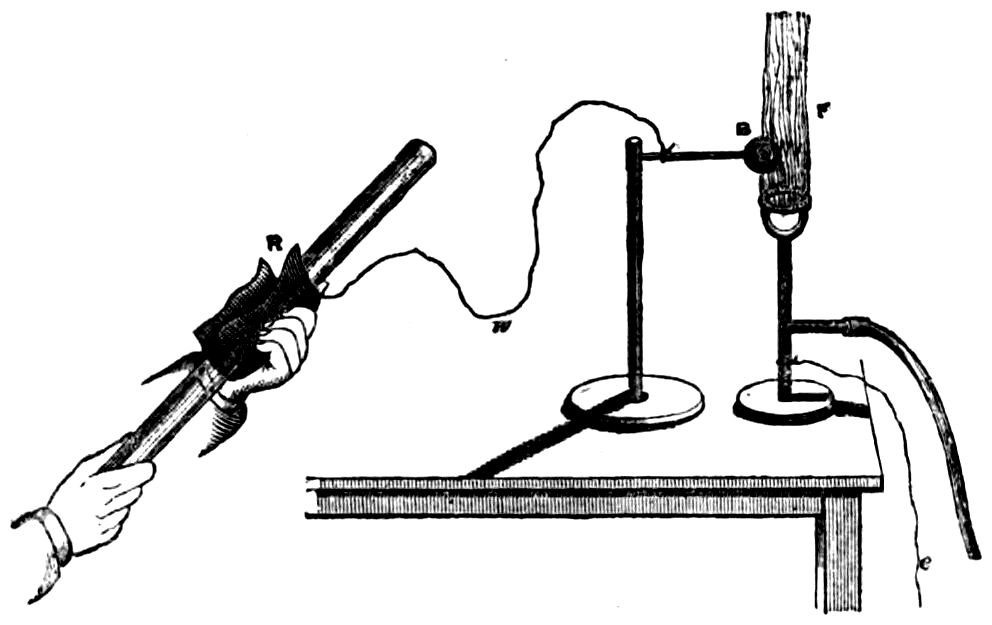
Sulphuric ether, in a spoon which has been previously warmed, is thus ignited: but the ether soon cools by evaporation; its vapour is diminished by the cold, and it is then less easy to ignite. Bisulphide of carbon may be substituted for the ether, with the certainty that every stroke of the rubber will set it ablaze.14 The spark thus obtained also fires a mixture of oxygen and hydrogen. The two gases unite with explosion to form water, when an electric spark is passed through them.
Mr. Cottrell has also mounted his glass tube so as to render friction in both directions available. The tube-machine is represented in fig. 46. A B is the glass tube, clasped by the rubber, R. P P′ are two strips of metal furnished with rows of points. From P P′ wires proceed to the knob C, which is insulated by the horizontal stem, G. This insulating stem may be abolished with advantage, the wires from P and P′ being rendered strong enough to support the ball C.
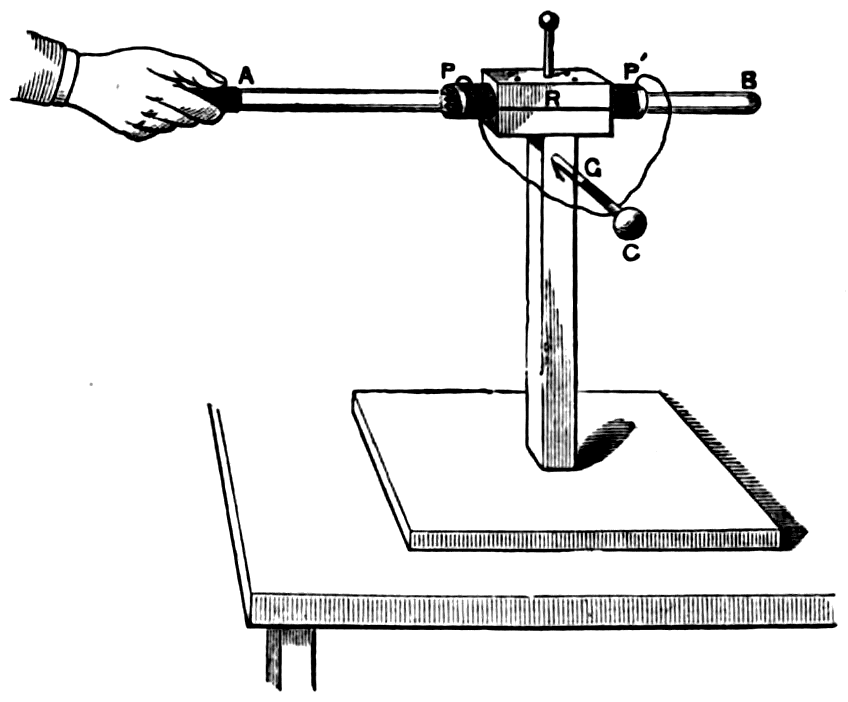
At C sparks may be taken, a Leyden jar charged, the electric mill turned, while wires carried from it may be employed in experiments on ignition. I however strongly recommend to your attention the more simple rubber shown in fig. 44.
'Seldom,' says Riess, 'has an experiment done so much to develope the science to which it belongs as this of the ignition of bodies by the electric spark.' It aroused universal interest; and was repeated in all Royal houses. Money was ready for the further prosecution of electrical research. The experiment afterwards spread among the people. Riess considers it probable that the general interest thus excited led to the discovery of the Leyden jar, which was made soon afterwards.
Klingenstierna astonished King Frederick of Sweden by igniting a spoon of alcohol with a piece of ice. With Cottrell's rubber and bisulphide of carbon this striking experiment is easily made, and you ought to render your knowledge complete by repeating it. At every stroke of the rubber the spark from the end of a pointed rod of ice infallibly sets the bisulphide on fire.
Cadogan Morgan, in 1785, sought to produce the electric spark in the interior of solid bodies. He inserted two wires into wood, and caused the spark to pass between them: the wood was illuminated with blood-red light, or with yellow light, according as the depth at which the spark was produced was greater or less. The spark of the Leyden jar produced within an ivory ball, an orange, an apple, or under the thumb, illuminates these bodies throughout. A lemon is especially suited to this experiment; flashing forth at every spark as a spheroid of brilliant golden light. The manner in which the lemon is mounted on the brass stem B is shown in fig. 47. The spark occurs at s, in the interval between the stems A and B. A row of eggs in a glass cylinder is also brilliantly illuminated at the passage of every spark from a Leyden jar.
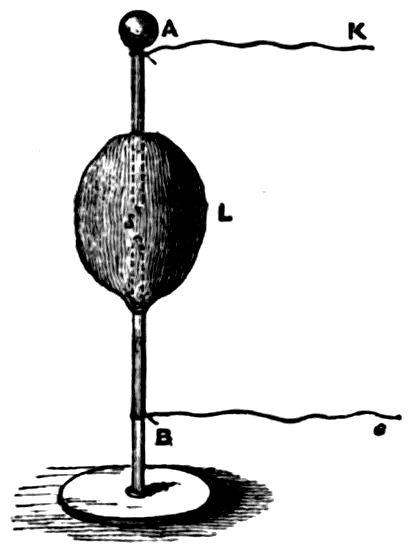
§ 25. Duration of the Electric Spark
The duration of the electric spark is very brief: in a special case, Sir Charles Wheatstone found it to be 1/24000th of a second. This, however, was the maximum duration. In other cases it was less than the millionth of a second.
When a body is illuminated for an instant, the image of the body remains upon the retina of the eye for about one-fifth of a second. If, then, a body in swift motion be illuminated by an instantaneous flash, it will be seen to stand motionless for one-fifth of a second at the point where the flash falls upon it. A rifle bullet passing through the air, and illuminated by an electric flash, would be seen thus motionless; a circle like D D′, fig. 48, divided into black and white sectors, and rotating so quickly as to cause the sectors to blend to a uniform grey, appears, when illuminated by the spark of a Leyden jar, perfectly motionless, with all its sectors revealed. A falling jet of water, which appears continuous, is resolved by the electric flash into its constituent drops. Lightning, as shown by Professor Dove, is similarly rapid in its discharge.
For a long time it was found almost impossible to ignite gunpowder by the electric spark. Its duration is so brief that the powder, when the discharge occurred in its midst, was simply scattered violently about. In 1787 Wolff introduced into the circuit through which the discharge passed a glass tube wetted on the inside. He thereby rendered the ignition certain. This was owing to the retardation of the spark by the imperfect conductor. Gun-cotton, phosphorus, and amadou, which are torn asunder by the unretarded spark, are ignited when the discharge is retarded by a tube of water. A wetted string is the usual means resorted to for retardation when gunpowder is to be discharged.
The instrument usually employed for the ignition of powder is the universal discharger. We make our own discharger thus:—I and I′ (fig. 49) are insulating rods of glass or sealing-wax, supporting two metal arms, the ends of which can be brought down upon the little central table S. One of the metal arms of the discharger being connected by a wire e with the earth, the separated ends of the two arms are surrounded with powder at S. Sending through it the unretarded charge, the powder is scattered mechanically. Introducing the wet string w into the circuit, ignition infallibly occurs when the spark passes.
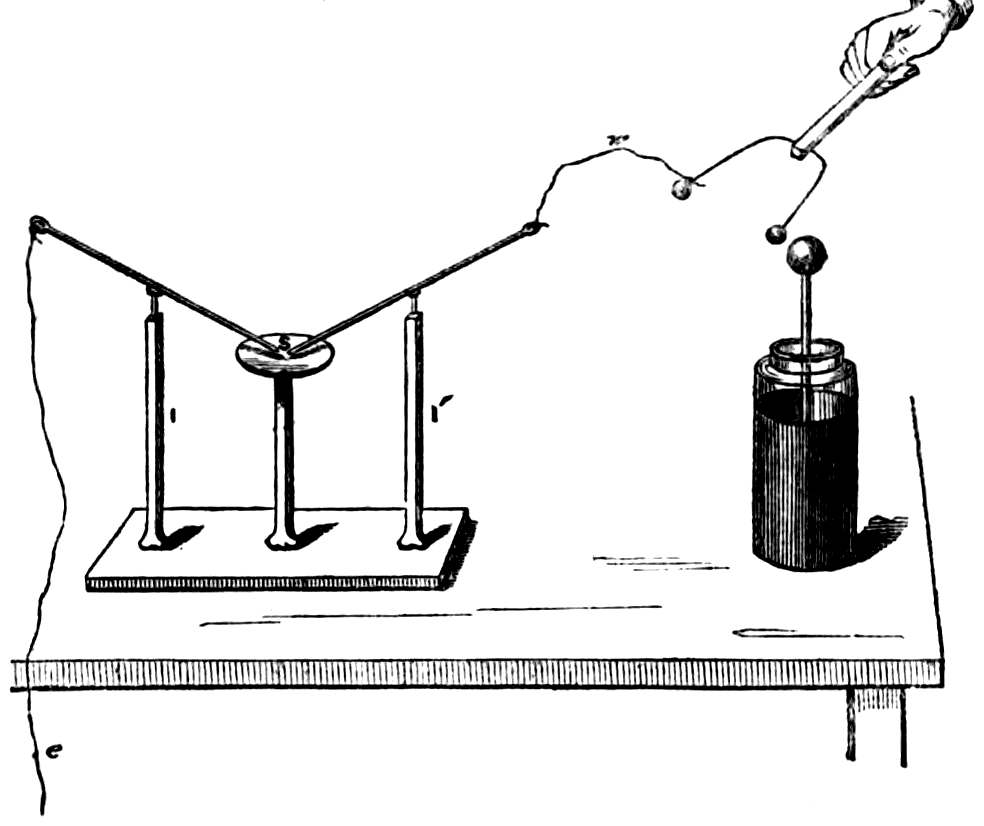
This is the place to fulfil our promise to ignite gunpowder by the 'hand-jar.' Fig. 50 explains the arrangement. H H′ are the hands of the insulated person, F the hand of the uninsulated friend, I the india-rubber between both hands. The lead ball B is suspended by a wet string S. On the little stand P, connected with the earth, is placed the powder. The charging of the hand-jar is described in § 22. When charged, it is only necessary to bring the ball B down upon the powder to cause it to explode.
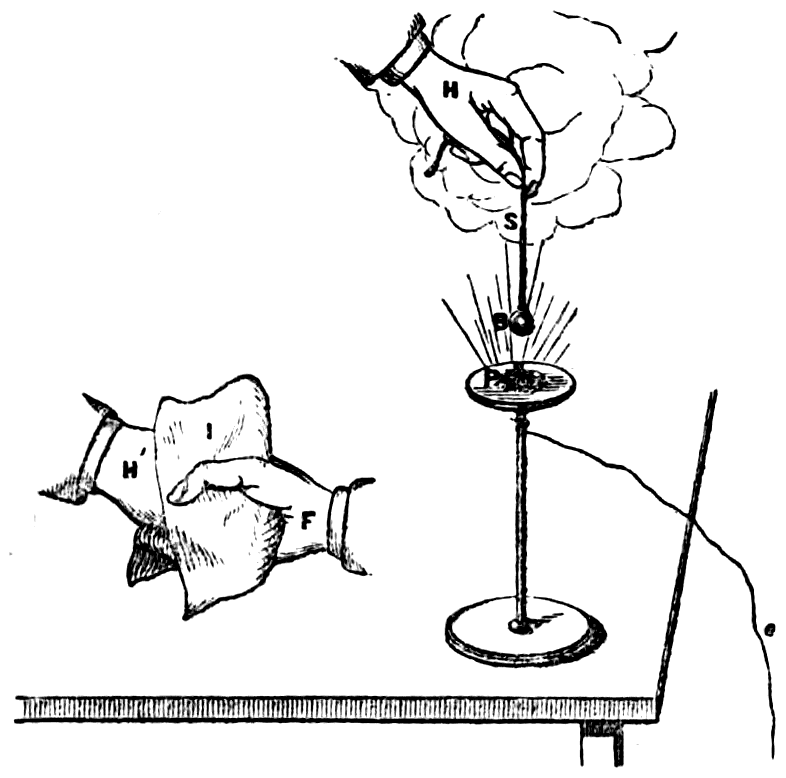
§ 26. Electric Light in Vacuo
The electric light in vacuo was first observed by Picard in 1675. While carrying a barometer from the Observatory to the Porte St. Michel in Paris, he saw light in the upper portion of the tube. Sebastien and Cassini observed it afterwards in other barometers. John Bernouilli devised a 'mercurial phosphorus,' by shaking mercury in a tube which had been exhausted by an air-pump. This was handed to the King of Prussia—Frederick I.—who awarded for it a medal of forty ducats value. The great mathematician wrote a poem in honour of the occasion.
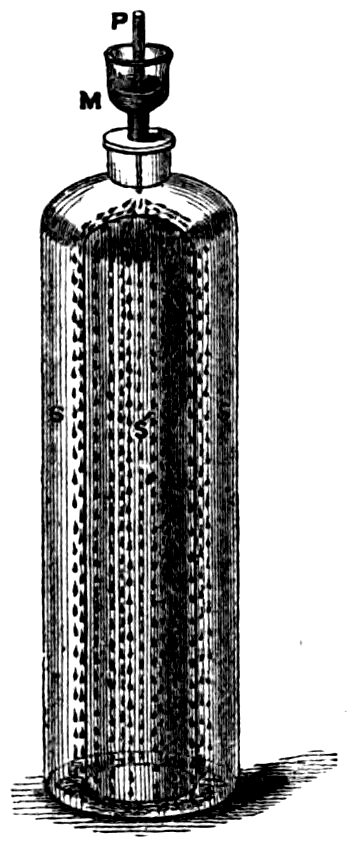
Bernouilli failed to explain the effect. The explanation was reserved for Hauksbee, who in 1705 took up the subject and experimented upon it before the Royal Society. On the plate of an air-pump he placed two bell-jars, one over the other. The outer and larger jar was open at the top. Into the opening Hauksbee fixed, air-tight, a funnel, which he stopped with a plug of wood and filled with mercury. He exhausted the space between the two jars, withdrew the wooden plug and allowed the mercury to stream against the outer surface of the inner jar. He thus obtained a shower of fire. This is a truly beautiful experiment when witnessed by an observer close at hand.
A copy of Hauksbee's own figure illustrating this experiment is annexed, fig. 51. M is the funnel containing the mercury, P the plug of wood, S the outer and S′ the inner bell-jar. Instead of the plug P, an india-rubber tube, held by a clip, may be employed with advantage to connect the funnel with the exhausted jar. By gradually relaxing the clip the mercury may be made to fall at a rate corresponding to the maximum luminous effect. The streams of light produced are very beautiful, but they are more continuous than they are shown to be by Hauksbee.
In 1706 Hauksbee referred the phenomenon to its true cause, namely, the friction between mercury and glass in the highly rarefied air. John Bernouilli ridiculed Hauksbee's explanation. But truth outlives ridicule, and it is now universally admitted that Hauksbee was right.
Hauksbee also made the following experiment, which, as shown by Riess, is explained by reference to the principle of induction. A hollow glass globe was mounted so as to be capable of quick rotation. It was exhausted, and while it rotated the hand was placed against it in the dark. It was positively electrified by the hand. This positive electricity acted inductively on the glass itself, attracting its negative, but discharging its positive as a luminous glow through the rarefied air within. Hauksbee was able to read by the light thus produced.
By such experiments it was shown that rarefied air favoured the passage of electricity. Dry air is in fact an insulator, which must be broken through to produce the electric spark. Through an exhausted glass tube six feet long a discharge freely passes which would be incompetent to leap over the fiftieth part of this interval in air. But whereas the spark in air is dense and brilliant, the discharge in vacuo fills the exhausted tube with a diffuse light.
(It is here worthy of remark that at a very early period Grummert, a Pole, proposed the employment of this diffuse electric light to illuminate coal mines—a notion which has been revived in our day. The light in this form is not competent to ignite the explosive gases which produce such terrible disasters in mines.)
Priestley, in his 'History of Electricity,' thus describes the light in vacuo. 'Take a tall receiver, very dry, and in the top of it insert with cement a wire not very acutely pointed, then exhaust the receiver and present the knob of the wire to the conductor, and every spark will pass through the vacuum in a broad stream of light, visible through the whole length of the receiver, be it ever so tall. This stream often divides itself into a variety of beautiful rivulets, which are continually changing their course, uniting and dividing again in the most pleasing manner. If a jar be discharged through this vacuum, it gives the appearance of a very dense body of fire, darting directly through the centre of the vacuum without ever touching the sides.'
Cavendish employed a double barometer-tube, bent into the form of a horseshoe, with its curved portion empty, to show the passage of electricity through a vacuum. It is really not the vacuum which conducts the electricity, but the highly attenuated air and vapour which fill the space above the barometric columns. When the mercury employed is carefully purged of air and moisture by previous boiling, the space above the mercury, as proved by Walsh, De Luc, Morgan, and Davy, is wholly incapable of conducting electricity. Similar experiments have been made in the laboratory of Mr. Gassiot, to whom we are indebted for so many beautiful electrical experiments. Professor Dewar has also brought his experimental skill to bear with success upon this subject.
Electricity therefore does not pass through a true vacuum; it requires ponderable matter to carry it. If a gold-leaf electroscope be kept at a distance from all conductors, it may be kept charged for an almost indefinite period in a good air-pump vacuum.
The matter rendered thus luminous by the electrical discharge is attracted and repelled like other electrified matter. 'A finger,' says Priestley, 'put on the outside of the glass will draw it [the luminous stream] wherever a person pleases. If the vessel be grasped with both hands, every spark is felt like the pulsation of a great artery, and all the fire makes towards the hands. This pulsation is felt at some distance from the receiver; and in the dark a light is seen betwixt the hands and glass.'
'All this,' continues the historian of Electricity, 'while the pointed wire is supposed to be electrified positively; if it be electrified negatively the appearance is remarkably different. Instead of streams of fire, nothing is seen but one uniform luminous appearance, like a white cloud, or the milky-way on a clear starlight night. It seldom reaches the whole length of the vessel, but is generally only like a lucid ball at the end of the wire.'
Of the two appearances here described the former is now known as the electric brush, and the latter as the electric glow. Both can be produced in unconfined air. The glow is sometimes seen on the masts of ships, and it is mentioned by the ancients as appearing on the points of lances. It is called St. Ermo's or St. Elmo's fire, after the sailor's saint, Erasmus, who suffered martyrdom at Gaeta at the beginning of the fourth century.
The purple colour of the diffused light in attenuated air was noticed by Hauksbee. The colour depends upon the residue of attenuated gas, or vapour, through which the discharge passes. If it be an oxygen-residue the light is whitish, if it be a hydrogen-residue the light is red, if a nitrogen-residue the light is purple, exactly resembling that displayed at times by the aurora borealis—a colour doubtless due to the discharge of electricity through the attenuated nitrogen of the air.
Electric light in vacuo is readily produced by the friction of an amalgamated rubber against the outside of an exhausted tube. The light also is produced by the friction of mercury within a barometric vacuum. The discharges through tubes many feet in length and exhausted by an air-pump are very fine. The double barometer tube of Cavendish also yields a truly splendid bow of light, when a strong electric discharge is sent through it. For this experiment fig. 52 shows the best arrangement. P is the prime conductor of an electrical machine, I an insulated metal ball, connected by a wire with the mercury trough A. The trough B is connected by a wire with the earth. C and C′ mark the height of the mercurial columns. When the machine is worked sparks pass from P to I, a vivid bow of light at each passage stretching from C to C′. By causing I to approach P, the discharges become more frequent, but more feeble; by augmenting the distance P I, the sparks become rarer, but more strong. When very strong, a bow of dazzling brilliancy accompanies every spark.15
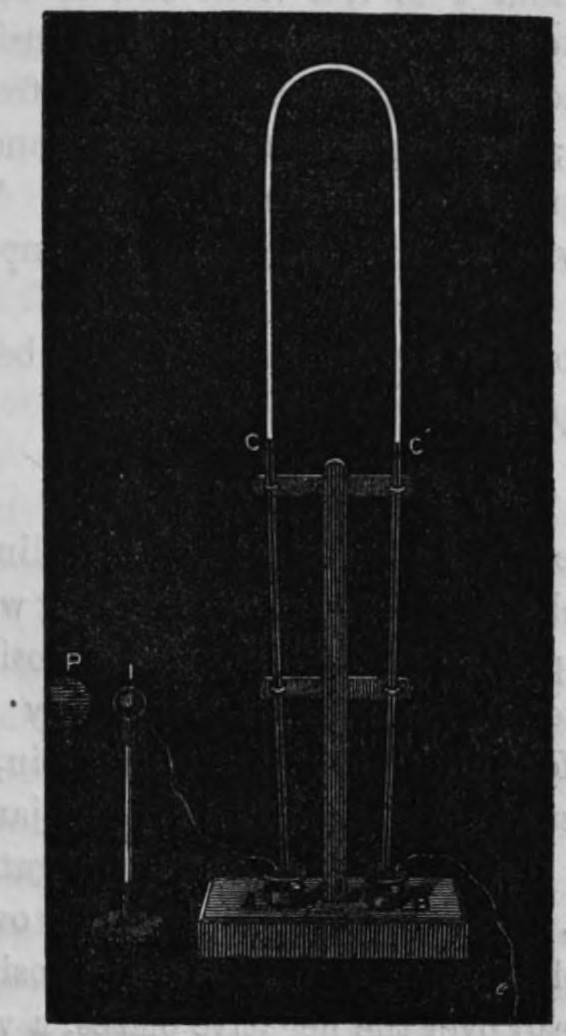
Small tubes for these experiments are best obtained from philosophical instrument makers.
§ 27. Lichtenberg's Figures
Lichtenberg devised a means of revealing the condition of an electrified surface by dusting it with powder. Red lead, in passing through muslin, is positively electrified; flower of sulphur is negatively electrified. Whisking a fox's brush over a cake of resin, and drawing over the surface the knob of a Leyden jar, positively charged, the resin is rendered in part negative and in part positive. Dusting the mixed powder over the surface, the sulphur arranges itself over the positive places, and the red lead over the negative places, a very beautiful pattern being the result.
This experiment of Lichtenberg's constituted the germ of Chladni's important acoustical researches. 'Chladni's figures' were the direct offspring of 'Lichtenberg's figures.'
§ 28. Surface Compared with Mass. Distribution of Electricity in Hollow Conductors
Monnier proved that the charge of a conductor depended upon its surface, and not upon its solid contents. An anvil weighing 200 lbs. gave a smaller spark than a speaking trumpet weighing 10 lbs. A solid ball of lead gave a spark only of the same force as that obtained from a piece of thin lead of the same superficies, bent into the form of a hoop. Finally Monnier obtained a strong spark from a long strip of sheet lead, but a very small one when it was rolled into a lump.
Le Roi and D'Arcy showed that a hollow sphere accepted the same charge when empty as when filled with mercury, which augmented its weight 60-fold. All this proves the influence of surface as distinguished from mass.
The distribution of electricity is well illustrated by the deportment of hollow bodies. Impart by your carrier (fig. 15) successive measures of electricity to the interior of an insulated ice-pail, or a pewter pot. On testing the interior of the vessel with the carrier and an electroscope no electricity is found there; but it is found on the external surface. A hat suspended by silk strings answers as well as the ice-pail.
This experiment with the hat is a very instructive one. The hat may be charged either with Cottrell's rubber or with your rubbed glass tube.
Notice, when testing, that you take your strongest charges from the edges and not from the round or flat surface of the hat. The strongest charge of all is communicated to the carrier by the leaf of the hat.
The successive charges may be communicated to the hat by a metal ball suspended by silk. The charged ball, on touching the interior surface, becomes completely unelectric.
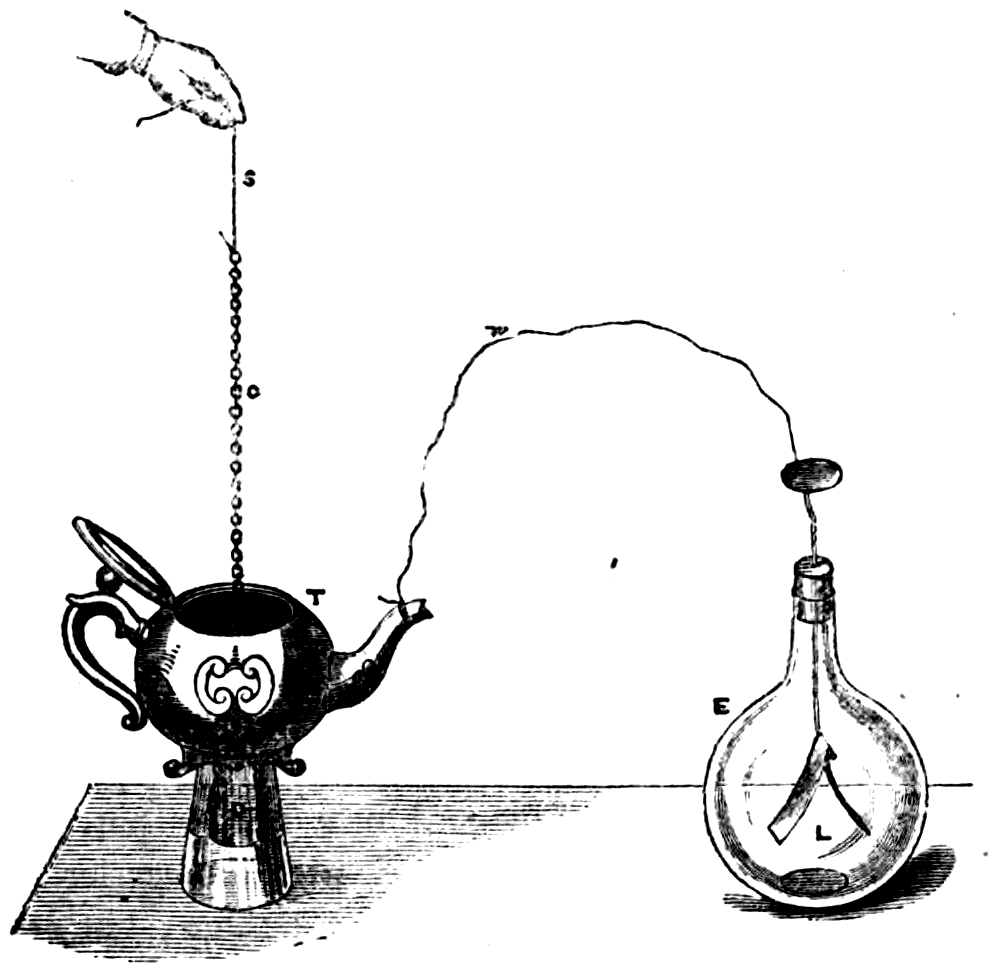
Franklin placed a long chain in a silver teapot which he electrified. Connecting his teapot with a pith-ball electroscope he produced a divergence. Then lifting the chain by a silk string he found that over the portion outside the teapot the electricity diffused itself, this withdrawal of the electricity from the electroscope being announced by the partial collapse of the divergent pith-balls.
The mode of repeating this experiment is shown in fig. 53, where T is the teapot, supported on a good glass tumbler G, and connected by the wire w with the electroscope E. The effect is small, but distinct.
The greatest experiment with hollow conductors was made by Faraday, who placed himself in a cubical chamber built of laths and covered with paper and wire gauze. It was suspended by silk ropes. Within this chamber he could not detect the slightest sign of electricity, however delicate his electroscope, and however strongly the sides of the chamber might be electrified.
§ 29. Physiological Effects of the Electric Discharge
The physiological effect of the electric shock has been studied in various ways. Graham caused a number of persons to lay hold of the same metal plate, which was connected with the outer coating of a charged Leyden jar, and also to lay hold of a rod by which the jar was discharged. The shock divided itself equally among them.
The Abbé Nollet formed a line of one hundred and eighty guardsmen, and sent the discharge through them all. He also killed sparrows and fishes by the shock. The analogy of these effects with those produced by thunder and lightning could not escape attention, nor fail to stimulate enquiry.
Indeed, as experimental knowledge increased, men's thoughts became more definite and exact as regards the relation of electrical effects to thunder and lightning.
The Abbé Nollet thus quaintly expresses himself: 'If any one should take upon him to prove, from a well-connected comparison of phenomena, that thunder is, in the hands of Nature, what electricity is in ours, and that the wonders which we now exhibit at our pleasure are little imitations of those great effects which frighten us; I avow that this idea, if it was well supported, would give me a great deal of pleasure.' He then points out the analogies between both, and continues thus: 'All those points of analogy, which I have been some time meditating, begin to make me believe that one might, by taking electricity as the model, form to one's self, in relation to thunder and lightning, more perfect and more probable ideas than what have been offered hitherto.'16
These views were prevalent at the time now referred to, and out of them grew the experimental proof by the great physical philosopher, Franklin, of the substantial identity of the lightning flash and the electric spark.
Franklin was twice struck senseless by the electric shock. He afterwards sent the discharge of two large jars through six robust men; they fell to the ground and got up again without knowing what had happened; they neither heard nor felt the discharge. Priestley, who made many valuable contributions to electricity, received the charge of two jars, but did not find it painful.
This experience agrees with mine. Some time ago I stood in this room with a charged battery of fifteen large Leyden jars beside me. Through some awkwardness on my part I touched the wire leading from the battery, and the discharge went through me. For a sensible interval life was absolutely blotted out, but there was no trace of pain. After a little time consciousness returned; I saw confusedly both the audience and the apparatus, and concluded from this, and from my own condition, that I had received the discharge. To prevent the audience from being alarmed, I made the remark that it had often been my desire to receive such a shock accidentally, and that my wish had at length been fulfilled. But though the intellectual consciousness of my position returned with exceeding rapidity, it was not so with the optical consciousness. For, while making the foregoing remark, my body presented to my eyes the appearance of a number of separate pieces. The arms, for example, were detached from the trunk and suspended in the air. In fact, memory, and the power of reasoning, appeared to be complete, long before the restoration of the optic nerve to healthy action.
This may be regarded as an experimental proof that people killed by lightning suffer no pain.
§ 30. Atmospheric Electricity
The air at all times can be proved to be a reservoir of electricity, which undergoes periodic variation. We have seen that ingenious men began soon to suspect a common origin for the crackling and light of the electric spark, and thunder and lightning. The greatest investigator in this field is the celebrated Dr. Franklin. He made an exhaustive comparison of the effects of electricity and those of lightning. The lightning flash he saw was of the same shape as the elongated electric spark; like electricity, lightning strikes pointed objects in preference to others; lightning pursues the path of least resistance; it burns, dissolves metals, rends bodies asunder, and strikes men blind. Franklin imitated all these effects, striking a pigeon blind, and killing a hen and turkey by the electrical discharge. I place before you in fig. 54, with a view to its comparison with a discharge of forked lightning, the long spark obtained from an effective ebonite machine, furnished with a conductor of a special construction, which favours length of spark.
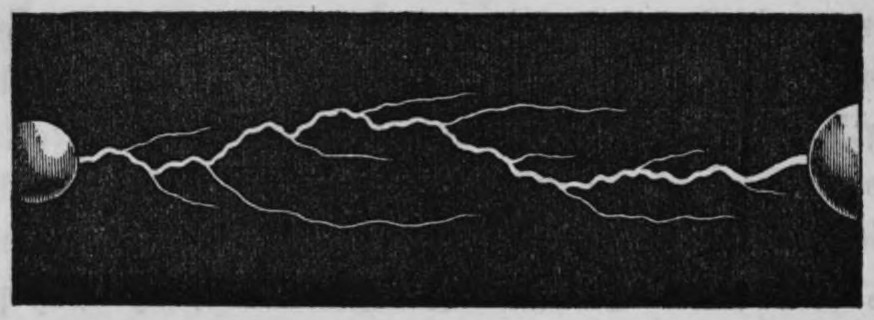
Having completely satisfied his mind by this comparison of the identity of both agents, Franklin proposed to draw electricity from the clouds by a pointed rod erected on a high tower. But before the tower could be built he succeeded in his object by means of a kite with a pointed wire attached to it. The electricity descended by the hempen string which held the kite, to a key at the end of it, the key being separated from the observer by a silken string held in the hand. Franklin thus obtained sparks, and charged a Leyden phial with atmospheric electricity.
But, spurred by Franklin's researches, an observer in France had previously proved the electrical character of lightning. A translation of Franklin's writings on the subject fell into the hands of the naturalist Buffon, who requested his friend D'Alibard to revise the translation. D'Alibard was thus induced to erect an iron rod 40 feet long, supported by silk strings, and ending in a sentry-box. It was watched by an old dragoon named Coiffier, who on the 10th of May, 1752, heard a clap of thunder, and immediately afterwards drew sparks from the end of the iron rod.
The danger of experiments with metal rods was soon illustrated. Professor Richmann of St. Petersburg had a rod raised three or four feet above the tiles of his house. It was connected by a chain with another rod in his room; the latter rod resting in a glass vessel, and being therefore insulated from the earth. On the 6th of August, 1753, a thunder cloud discharged itself against the external rod; the electricity passed downwards along the chain; on reaching the rod below, it was stopped by the glass vessel, darted to Richmann's head, which was about a foot distant, and killed him on the spot. Had a perfect communication existed between the lower rod and the earth, the lightning in this case would have expended itself harmlessly.
In 1749 Franklin proposed lightning conductors. He repeated his recommendation in 1753. He was opposed on two grounds. The Abbé Nollet, and those who thought with him, considered it as impious to ward off heaven's lightnings, as for a child to ward off the chastening rod of its father. Others thought that the conductors would 'invite' the lightning to break upon them. A long discussion was also carried on as to whether the conductors should be blunt or pointed. Wilson advocated blunt conductors against Franklin, Cavendish, and Watson. He so influenced George III., hinting that the points were a republican device to injure his Majesty, that the pointed conductors on Buckingham House were changed for others ending in balls. Experience of the most varied kind has justified the employment of pointed conductors. In 1769 St. Paul's Cathedral was first protected.
The most decisive evidence in favour of conductors was obtained from ships; and such evidence was needed, to overcome the obstinate prejudice of seamen. Case after case occurred in which ships unprotected by conductors were singled out from protected ships, and shattered or destroyed by lightning. The conductors were at first made movable, being hoisted on the approach of a thunderstorm; but these were finally abandoned for the fixed lightning conductors devised by the late Sir Snow Harris. The saving of property and life by this obvious outgrowth of electrical research is incalculable.
§ 31. The Returning Stroke
In the year 1779 Charles, Viscount Mahon, afterwards Earl Stanhope, published his 'Principles of Electricity.' On the title-page of the book stands the following remark:—'This treatise comprehends an explanation of an electrical returning stroke, by which fatal effects may be produced even at a vast distance from the place where the lightning falls.'
Lord Mahon's experiments, which are models of scientific clearness and precision, will be readily understood by reference to the principles of electric induction, with which you are now so familiar. It need only be noted here that whenever he speaks of a body being plunged in an 'electrical atmosphere,' he means that the body is exposed to the inductive action of a second electrified body, which latter he supposed to be surrounded by such an atmosphere.
A few extracts from his work will give a clear notion of the nature of his discovery:—
'I placed an insulated metallic cylinder, AB, fig. 55, within the electrical atmosphere of the prime conductor [P C] when charged, but beyond the striking distance. The distance between the near end A of the insulated metallic body and the side of the prime conductor was 20 inches. The body AB was of brass, of a cylindrical form, 18 inches long by 2 inches in diameter. I then placed another insulated brass body EF, 40 inches long by about 3¾ inches in diameter, with its end E at the distance of about one-tenth of an inch from the end B of the other metallic body AB. I electrified the prime conductor. All the time that it was receiving its plus charge of electricity there passed a great number of weak (red or purple) sparks from the end B of the near body AB into the end E of the remote body EF.'
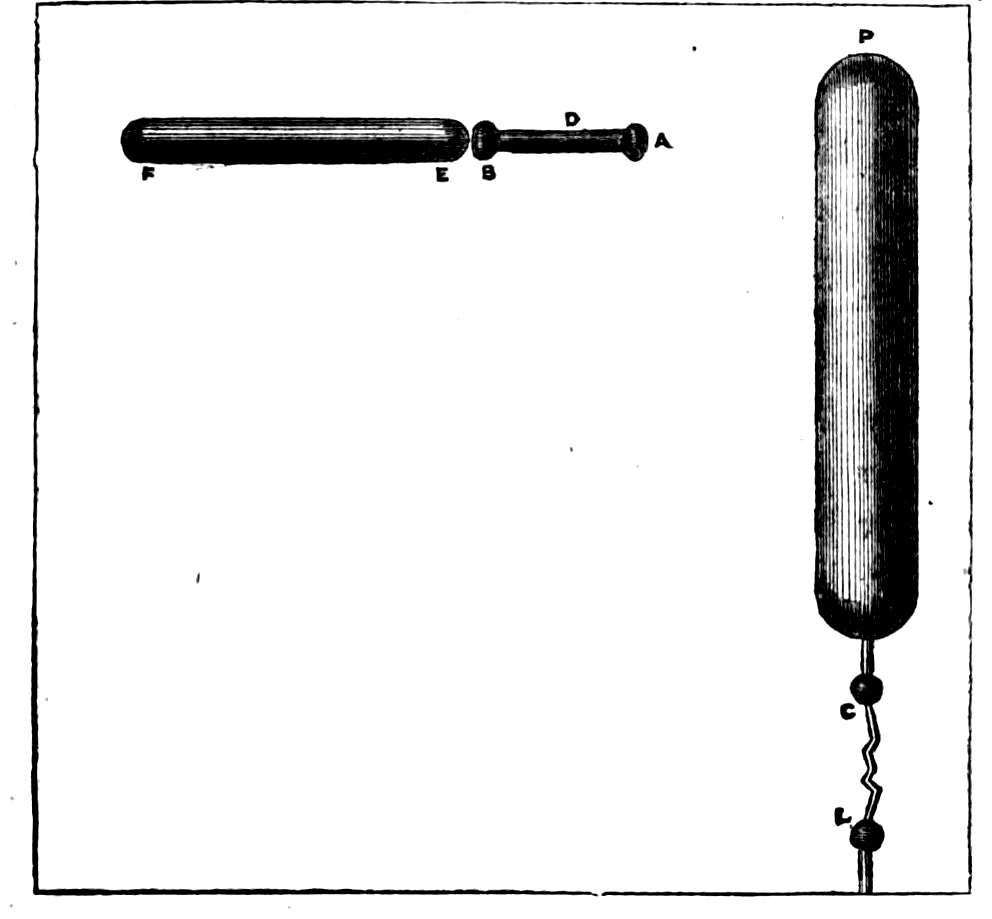
Make clear to your mind the origin of this stream of weak red or purple sparks. It is obviously due to the inductive action of the prime conductor P C upon the body AB. The positive electricity of AB being repelled by the prime conductor, passed as a stream of sparks to E F.
'When the prime conductor, having received its full charge, came suddenly to discharge, with an explosion, its superabundant electricity on a large brass ball L, which was made to communicate with the earth, it always happened that the electrical fluid, which had been gradually expelled from the body A B and driven into the body E F, did suddenly return from the body E F into the body A B, in a strong and bright spark, at the very instant that the explosion took place upon the ball L.
'This I call the electrical returning stroke.'
For the two conductors Lord Mahon then substituted his own body and that of another person, both of them standing upon insulating stools. He continues thus:—
'I placed myself upon an insulating stool E (fig. 56), so as to have my right arm A at the distance of about 20 inches from a large prime conductor; another person, standing upon another insulating stool K, brought his right hand F within one-quarter of an inch of my left hand B.
'When the prime conductor began to receive its plus charge of electricity, we felt the electrical fluid running out of my hand B into his hand F.
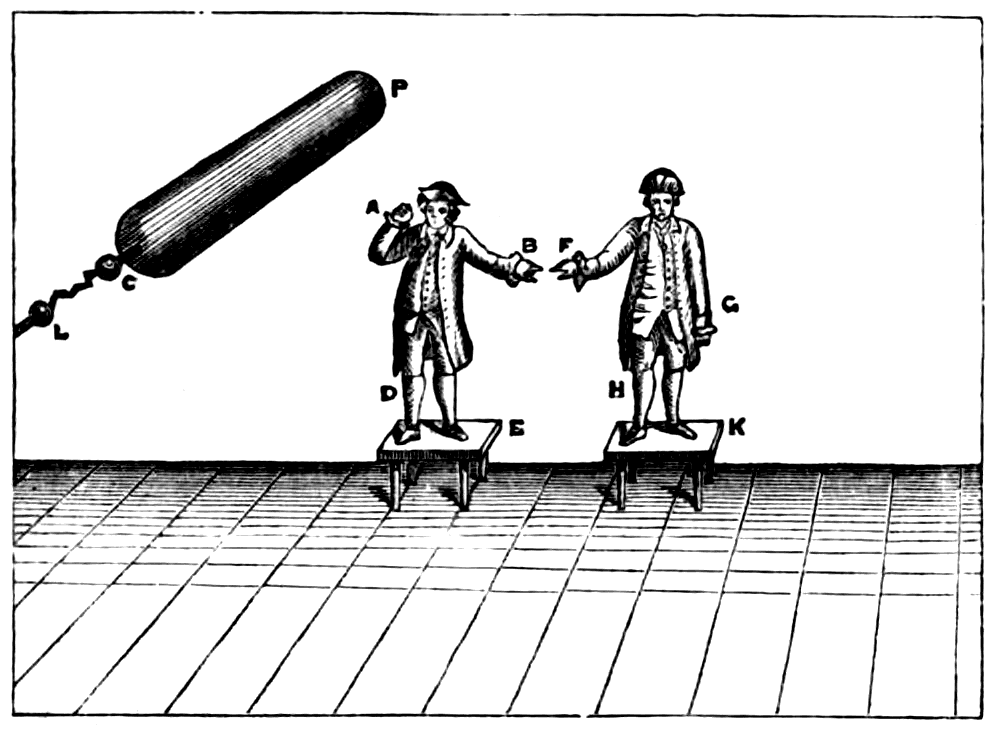
'When we separated our hands B and F a little, the electricity passed between us in small sparks, which sparks increased in sharpness the farther we removed our hands B and F asunder, until we had brought them quite out of a striking distance. The intervals of time between these departing sparks increased also the more the distance between our hands B and F was increased, as must necessarily be the case.
'As soon as the prime conductor came suddenly to discharge its electricity upon the ball L, the superabundant electricity which the other person had received from my body did then return from him to me in a sharp spark, which issued from his hand F at the very instant that the explosion of the prime conductor took place upon the ball L.
'I still continued upon the insulating stool E, and I desired the other person to stand upon the floor. The returning stroke between us was still stronger than it had yet been. The reason of it was this:—the other person being no longer insulated, transmitted his superabundant electricity freely into the earth. I consequently became still more negative than before.
'Now, when the returning stroke came to take place, not only the electricity which had passed from my body into the body of the other person, but also the electricity which had passed from my body into the earth (through the other person), did suddenly return upon me from his hand F to my hand B, at the same instant that the discharge of the prime conductor took place upon the ball L. This caused the returning stroke to be stronger than before.'
Lord Mahon fused metals, and produced strong physiological effects by the return stroke.
In nature disastrous effects may be produced by the return stroke. The earth's surface, and animals or men upon it, may be powerfully influenced by one end of an electrified cloud. Discharge may occur at the other end, possibly miles away. The restoration of the electric equilibrium by the return shock may be so violent as to cause death.
This was clearly seen and illustrated by Lord Mahon. Fig. 57 is a reduced copy of his illustration. ABC is the electrified cloud, the two ends of which, A and C, come near the earth. The discharge occurs at C. A man at F is killed by the returning stroke, while the people at D, nearer to the place of discharge, but farther from the cloud, are uninjured.
With the view of still further testing your knowledge of induction, I have here copied a portion of this admirable essay; but the entire memoir of Lord Mahon would constitute a most useful and interesting lesson in electricity.
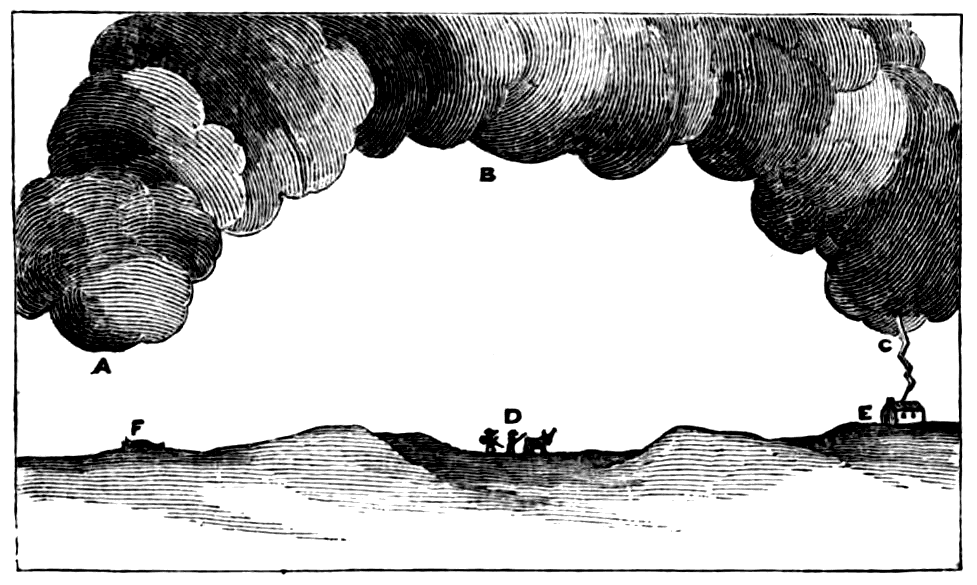
For our own instruction we can illustrate the return shock thus:—Connect one arm of your universal discharger, fig. 49, with a conductor like C, fig. 20, and the other arm with the earth. Bring C within a few inches of your prime conductor, but not within striking distance; on working the machine a stream of feeble sparks will pass from point to point of the discharger. Let the prime conductor be discharged from time to time by an assistant; at every discharge the returning stroke is announced by a flash between the points of the discharger at s. If gun-cotton with a little fulminating powder scattered on it, or a fine silver wire, be introduced between the points of the discharger, the one is exploded and the other deflagrated.
The stream of repelled sparks first seen may be entirely abolished by establishing an imperfect connexion between the conductor C and the earth: a chain resting upon the dry table on which the conductor stands will do. The chain permits the feebler sparks to pass through it in preference to crossing the space s; but the returning stroke is too strong and sudden to find a sufficiently open channel through the table and chain, and on the discharge of the prime conductor the spark is seen.
It was the action of the return shock upon a dead frog's limbs, observed in the laboratory of Professor Galvani, that led to Galvani's experiments on animal electricity; and led further to the discovery, by Volta, of the electricity which bears his name.
§ 32. The Leyden Battery, its Currents, and some of their Effects
In the ordinary Leyden battery described in § 19 all the inner coatings are connected together, and all the outer coatings are also connected together. Such a battery acts as a single large jar of extraordinary dimensions.
Wires are warmed by a moderate electric discharge; by augmenting the charge they are caused to glow; with a strengthened charge the metal is torn to pieces; fusion follows; and by still stronger charges the wires are reduced to metallic dust and vapour.
For such experiments the wire must be thin. Without resistance we can have no heat, and when the wire is thick we have little resistance. The mechanism of the discharge, as shown by the figures produced, is different in different wires. The figure produced by the dust of a deflagrated silver wire on white paper is shown in fig. 58.
When the discharge of a powerful battery is sent through a long steel chain with the ends of its links unsoldered, the sparks between the unsoldered links carry the incandescent particles of the steel along with them. These are consumed in the air, a momentary blaze occurring along the entire chain. Chain cables have been fused by being made the channels of a flash of lightning.
Retaining our conception of an electric fluid, at this point we naturally add to it the conception of a current. It is the electric current which produces the effects just described. In many of our former experiments we had electricity at rest (static electricity), here we have electricity in motion (dynamic electricity).
Sending the current from a battery through a flat spiral (the primary) formed of fifty or sixty feet of copper wire, and placing within a little distance of it a second similar spiral (the secondary) with its ends connected; the passage of the current in the first spiral excites in the second a current, which is competent to deflagrate wires, and to produce all the other effects of the electrical discharge. Even when the spirals are some feet asunder, the shock produced by the secondary current is still manifest.
The current from the secondary spiral may be carried round a third; and this third spiral may be allowed to act upon a fourth, exactly as the primary did upon the secondary. A tertiary current is thus evoked by the secondary in the fourth spiral.
Carrying this tertiary current round a fifth spiral, and causing it to act inductively upon a sixth, we obtain in the latter a current of the fourth order. In this way we generate a long progeny of currents, all of them having the current sent from the battery through the first spiral, for a common progenitor. To Prof. Henry of the United States, and to Prof. Riess of Berlin, we are indebted for the investigation of the laws of these currents. These researches, however, were subsequent to, and were indeed suggested by, experiments of a similar character previously made by Faraday with Voltaic electricity.
Besides the electricity of friction and induction we have the following sources and forms of this power.
The contact of dissimilar metals produces electricity.
The contact of metals with liquids produces electricity.
A mere variation of the character of the contact of two bodies produces electricity.
Chemical action produces a continuous flow of electricity (Voltaic electricity).
Heat, suitably applied to dissimilar metals, produces a continuous flow of electricity (thermo-electricity).
The heating and cooling of certain crystals produce electricity (pyro-electricity).
The motion of magnets, and of bodies carrying electric currents, produces electricity (magneto-electricity).
The friction of sand against a metal plate produces electricity.
The friction of condensed water-particles against a safety valve, or better still against a box-wood nozzle through which steam is driven, produces electricity (Armstrong's hydro-electric machine).
These are different manifestations of one and the same power; and they are all evoked by an equivalent expenditure of some other power.
Conclusion
Our experimental researches end here. I would now bespeak your attention for five minutes longer. The expensiveness of apparatus is sometimes urged as an obstacle to the introduction of science into schools. I hope it has been shown that the obstacle is not a real one. Leaving out of account the few larger experiments, which have contributed but little to our knowledge, it is manifest that the wise expenditure of a couple of guineas would enable any competent teacher to place the leading facts and principles of frictional electricity completely at the command of his pupils; giving them thereby precious knowledge, and still more precious intellectual discipline—a discipline which invokes observation, reflection, prevision by the exercise of reason, and experimental verification.
And here, if I might venture to do so, I would urge upon the science teachers of our public and other schools that the immediate future of science as a factor in English education depends mainly upon them. I would respectfully submit to them whether it would not be a mistake to direct their attention at present to the collection of costly apparatus. Their principal function just now is to arouse a love for scientific study. This is best done by the exhibition of the needful facts and principles with the simplest possible appliances, and by bringing their pupils into contact with actual experimental work.
The very time and thought spent in devising such simple instruments will give the teacher himself a grasp and mastery of his subject which he could not otherwise obtain; but it ought to be known by the head masters of our schools that time is needed, not only for devising such instruments, but also for preparing the experiments to be made with them after they have been devised. No science teacher is fit to meet his class without this distinct and special preparation before every lesson. His experiments are part and parcel of his language, and they ought to be as strict in logic, and as free from stammering, as his spoken words. To make them so may imply an expenditure of time which few head masters now contemplate, but it is a necessary expenditure, and they will act wisely in making provision for it.
To them, moreover, in words of friendly warning, I would say, make room for science by your own healthy and spontaneous action, and do not wait until it is forced upon you by revolutionary pressure from without. The condition of things now existing cannot continue. Its simple statement suffices to call down upon it the condemnation of every thoughtful mind. With reference to the report of a Commission appointed last year to enquire into the scientific instruction of this country, Sir John Lubbock writes as follows:—'The Commissioners have published returns from more than a hundred and twenty of the larger endowed schools. In more than half of these no science whatever is taught; only thirteen have a laboratory, and only eighteen possess any scientific apparatus. Out of the whole number, less than twenty schools devote as much as four hours a week to science, and only thirteen attach any weight at all to scientific subjects in the examinations.'
Well may the Commissioners pronounce such a state of things to be nothing less than a national calamity! If persisted in, it will assuredly be followed by a reaction which the truest friends of classical culture in England will have the greatest reason to deplore.
Price List of Apparatus
| £ s. d. | |
| 1. A horizontally supported rail, with wire cradle and silk ribbon for suspending excited rods and light bodies | 0 3 0 |
| 2. A wooden balancing lath and support | 0 1 0 |
| 3. A delicate straw index on an insulated balancing-point on stand | 0 0 9 |
| 4. Two sticks of sealing-wax | 0 0 8 |
| 5. Two sticks of gutta-percha | 0 6 0 |
| 6. Two small glass tubes | 0 2 6 |
| 7. One large tube | 0 3 0 |
| 8. One rubber of flannel | 0 0 6 |
| 9. One rubber of silk | 0 2 0 |
| 10. Box of amalgam | 0 0 6 |
| 11. Ebonite comb | 0 1 0 |
| 12. Foolscap paper | 0 0 1 |
| 13. Mahogany board | 0 2 6 |
| 14. Piece of india-rubber | 0 0 6 |
| 15. Watch-glass for Florentine experiment (with oil) | 0 0 2 |
| 16. Roughened glass tube | 0 4 0 |
| 17. Straw electroscope | 0 2 3 |
| 18. Dutch metal electroscope | 0 2 6 |
Apparatus for Conduction, Insulation, and Induction.
| 19. Long cylindrical conductor | 0 2 6 |
| 20. Cork and rod for insertion into glass tube | 0 0 2 |
| 21. Box containing fragments of paper for attraction | 0 0 2 |
| 22. Book of Dutch metal for attraction | 0 0 4 |
| 23. Long length of copper wire | 0 0 3 |
| 24. Silk thread for suspending copper wire | 0 0 3 |
| 25. Long straw index and stand | 0 2 0 |
| 26. Metal table on insulating stand | 0 1 3 |
| 27. A length of packthread | 0 0 1 |
| 28. A fox's brush | 0 2 6 |
| 29. A brass tube to fit over end of gutta-percha tube | 0 0 9 |
| 30. Two metal balls and insulated supports | 0 5 0 |
| 31. Electric Carrier | 0 0 6 |
| 32. Length of Chain | 0 0 6 |
The Electrophorus.
| 33. Circular metal plate, with ball and insulated handle attached; and sheet of vulcanised rubber | 0 5 6 |
Illustration of the Action of Points.
| 34. An electric machine | 1 1 0 |
| 35. A conical metal conductor | 0 2 6 |
| £ s. d. | |
| 36. Number of needles | 0 0 2 |
| 37. Reel of fine wire for connecting conductor with machine | 0 0 3 |
| 38. Point or wire fitting into prime conductor of machine for the action of electric wind on candle-flame | 0 0 6 |
| 39. Electric Mill | 0 1 0 |
| 40. Paper tassel and wire | 0 0 6 |
| 41. Book of silver leaf | 0 1 6 |
The Leyden Jar.
| 42. First form of Leyden jar | 0 0 9 |
| 43. An ordinary Leyden jar | 0 4 0 |
| 44. Bevis's plate | 0 1 0 |
| 45. Insulated discharger with metal knobs | 0 0 8 |
| 46. Two sheets of tin with silk holders | 0 1 0 |
| 47. Glass plate for ditto with silk holders | 0 1 0 |
| 48. Leyden jar with moveable coatings | 0 2 6 |
Ignition by Electric Spark, etc.
| 49. Cottrell's rubber | 0 2 6 |
| 50. An insulated brass ball | 0 1 0 |
| 51. An Argand burner and flexible tubing | 0 3 0 |
| 52. An iron spoon for igniting bisulphide of carbon, ether, etc. | 0 0 2 |
Duration of Electric Spark.
| 53. A rotating disc with black and white sectors | 0 2 6 |
| 54. Spark apparatus for connection with Leyden jar | 0 2 6 |
| 55. Vacuum tube (electric light in vacuo) | 0 2 6 |
Lichtenberg's Figures.
| 56. A resin cake | 0 1 6 |
| 57. Bottle containing a mixture of flowers of sulphur and red lead; muslin gauze for dusting powder on resin surface | 0 0 6 |
| 58. Box and packing | 0 8 0 |
This apparatus is supplied by Mr. Stanley, of 13 Railway Approach, London Bridge. The instruments may be had singly or collectively in a box; each box being guaranteed by the signature of Mr. Cottrell. Price of the whole collection, box included, 5l. 10s.