Not every old book needs retelling. Some are already clear and simply deserve a better edition than they have. In these volumes the prose is the author’s, unchanged; what has been added is the apparatus — a caption and descriptive alt text for every plate, modern typesetting, and an ebook worth reading on a real device. Where a book captioned its own illustrations, those captions are the author’s and stand as printed.
Mathematics
-
1847
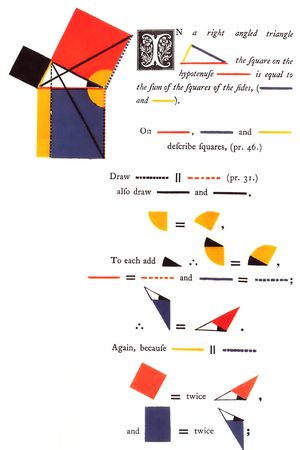
The First Six Books of the Elements of Euclid
Euclid with the letters replaced by colour, 1847: every proof written in coloured pictures of its parts. CC BY-SA, after Slyusarev's recreation. 212 plates.
-
1885
A Tangled Tale
Carroll’s ten Knots as they ran in The Monthly Packet, with his answers and Frost’s drawings. 9 plates.
-
1887
The Game of Logic
Logic as a board game with red and grey counters, the rulebook for the card that came in its envelope. 200 plates.
-
1893
Pillow Problems
Seventy-two problems solved in bed in the dark, in Carroll’s own Victorian notation. 64 plates.
-
1896
Symbolic Logic
Carroll’s own text of 1896, notation and all, with every diagram described by which cell holds which counter. 308 plates.
-
1910
Calculus Made Easy
“What one fool can do, another can.” The 1914 edition, with every formula typeset rather than pictured. 66 plates.
-
1911
An Introduction to Mathematics
What mathematics is, from variables to the calculus, by the co-author of Principia Mathematica. Typeset from the transcription's TeX. 35 plates.
-
1919
Introduction to Mathematical Philosophy
What a number is, and the sizes of infinity, written in prison as the plain road into Principia Mathematica. The 1920 text, its formulas typeset. 2 plates.
-
1958
Gödel's Proof
Nagel and Newman's 1958 classic: how Gödel showed that arithmetic holds truths it cannot prove, with the figures redrawn. 3 plates.

Physical sciences
-
1860
On the Various Forces of Nature
The Christmas course of 1859, the winter before the Candle, driving at the idea that the forces of nature are one. 50 plates.
-
1861
The Chemical History of a Candle
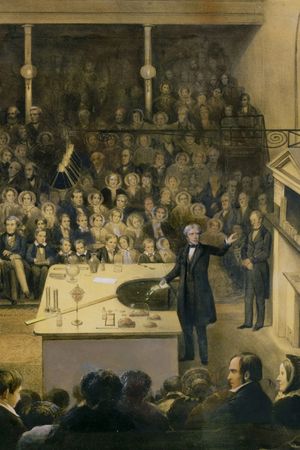
Faraday’s last Christmas course, and the most famous science lectures ever given. 38 plates.
-
1863
On the Sensations of Tone
Why some chords sound smooth and others rough: the physics of tone and the history of scales, in Ellis's annotated translation, every page read from the scan. 181 plates.
-
1867
Sound
Eighteen sixty-seven, and the book every later Royal Institution lecturer is imitating. 187 plates.
-
1889
Star-land
Six lectures from the sun out to the nebulae, by the funniest of the lecturers; Ball’s own captions are frequently the joke. 94 plates.
-
1890
Soap Bubbles and the Forces Which Mould Them
Three Christmas lectures on why a bubble is round, with the recipes for doing every experiment yourself. 70 plates.
-
1897
Light Visible and Invisible
The Christmas course given twelve months after Röntgen announced the X-ray, with one lecture on nothing else. The plates were recut and cleaned from the page scans. 127 plates.
-
1902
Astronomy for Everybody
The sky from the turning earth out to the fixed stars, as America's great calculator of the planets told it in 1902, with all sixty-four figures. 62 plates.
-
1902
Waves and Ripples in Water, Air, and Aether
Christmas 1901, weeks after Marconi pushed a signal across the Atlantic, reported here as current news. 87 plates.
-
1905
Science and Hypothesis
Why one geometry cannot be more true than another, only more convenient. Greenstreet's 1905 translation, with Larmor's introduction.
-
1908
A Study of Splashes
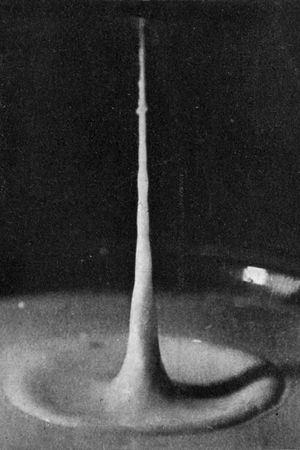
The splash of a drop, photographed by electric spark in hundredths of a second — with Worthington’s 1894 Royal Institution discourse on the same subject. 247 plates.
-
1920
Relativity: The Special and General Theory
A train, an embankment and two strokes of lightning. Lawson's 1920 text, with the formulas typeset. 5 plates.
-
1922
Dimensional Analysis
What a pendulum, a drop of liquid and an airplane model have in common: the Π theorem, read from the 1922 printing.
-
1945
Science, the Endless Frontier
Vannevar Bush's 1945 report to the President: basic research as the pacemaker of progress, and the plan that became the National Science Foundation. 1 plates.



Life sciences
-
1858
How Plants Grow
Botany for young people, 1858: how plants grow, and a Popular Flora of 105 families with keys and 467 woodcuts. 467 plates.
-
1868
On a Piece of Chalk
What a carpenter's piece of chalk can tell working men about the floor of the Atlantic, deep time and evolution: Huxley's Norwich lecture of 1868.
-
1892
Psychology: Briefer Course
Habit, the stream of consciousness, the self and the will, in James's own one-volume version of the Principles. 62 plates.
-
1902
Mutual Aid: A Factor of Evolution
Cooperation among ants, birds, villagers, guildsmen and strikers as a factor of evolution: Kropotkin's reply to Huxley, in the revised edition of 1904.
-
1926
Microbe Hunters
Leeuwenhoek, Pasteur, Koch, Reed and Ehrlich, one discoverer to a chapter, told as adventure stories. The 1926 text, with its plates described. 15 plates.
-
1926
On Being the Right Size
Why a mouse survives a fall down a mine shaft and a horse splashes, why insects fear getting wet, and what size a state should be: Haldane's essay, as printed in 1927.
-
1947
Conservation in Action
Rachel Carson's Conservation in Action booklets for the Fish and Wildlife Service: four wildlife refuges, and why wild creatures, like men, must have a place to live. 137 plates.
Law
-
1881
The Common Law
-
1921
The Nature of the Judicial Process
A judge on what judges do: logic, history, custom and social welfare, and legislating only between the gaps.
-
1944
Simple Sabotage Field Manual
The OSS's 1944 manual for occupied Europe: slow the enemy with dull tools, wrong switches and endless committees.
Humanities
-
1902
Garden Cities of To-morrow
The Three Magnets and the town of 32,000 in its belt of farmland: the book that invented the garden city, its diagrams transcribed. 6 plates.
-
1912
The Problems of Philosophy
A table, its colour and its shape, and what if anything we know about it. The 1912 text.
-
1920
The Elements of Style
Eighteen numbered rules, the words most often misused, and every faulty sentence beside its correction. The 1920 text, before the later revisions.
-
1922
A Short History of the World
From the nebulae to the peace of 1922 in sixty-seven chapters, with all 208 plates and the preface restored. 208 plates.
-
1926
A Dictionary of Modern English Usage
Which spelling, which plural, how to say it, and the essays on Elegant Variation and the Split Infinitive: the 1926 first edition, every cross-reference a link.
-
1930
The Conquest of Happiness
Envy, boredom, fatigue and fear of the neighbours, then zest, affection and work: Russell's 1930 book for the unhappy, not the learned.
-
1983
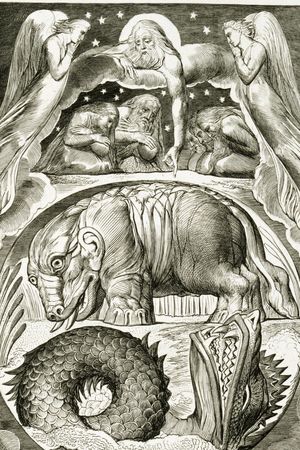
Against His-story, Against Leviathan!
Civilization from Sumer to Detroit as the life of a monster, Hobbes's Leviathan, and of everyone who walked away from it: Perlman's 1983 polemic, with its Blake plates. 27 plates.



Stories and verse
-
1855
The Age of Fable
The myths of Greece and Rome, the East and the North, each followed into the English poets who borrowed it. The first edition's text of 1855.
-
1876
The Hunting of the Snark
An agony in eight fits, with Holiday's nine illustrations and both of his cover designs. 11 plates.
-
1901
Old Indian Legends
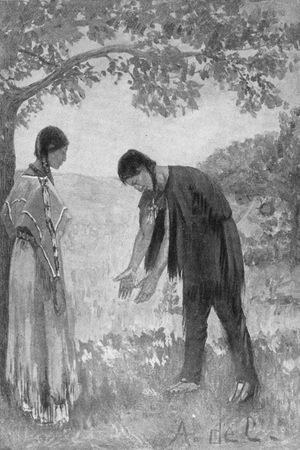
Fourteen Dakota legends of Iktomi the trickster and his neighbours, with the preface and Angel De Cora’s plates that Gutenberg dropped. 14 plates.
-
1907
Alice’s Adventures in Wonderland
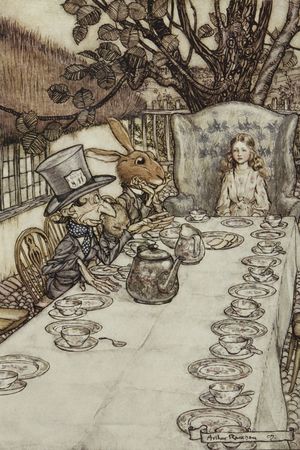
The 1907 Wonderland, with Rackham's colour plates at full size and the Mouse's tale in its shape. 30 plates.
-
1912
Aesop's Fables
All 284 fables in Vernon Jones’s 1912 translation, with Chesterton’s introduction and every Rackham plate and silhouette. 80 plates.
-
1920
Irish Fairy Tales
Ten stories of Fionn, the Fianna and the Shi’, with Rackham’s colour plates and drawings, and the captions Gutenberg dropped. 37 plates.
-
1921
American Indian Stories
Her childhood on the Yankton reservation, her schooldays in the East, her stories, and her 1921 case against the Indian Bureau.


Home, craft and arts
-
1869
The American Woman's Home
Catharine Beecher and Harriet Beecher Stowe's 1869 manual of domestic science, from house plans and ventilation to cooking and the sick room, with its illustrations restored. 81 plates.
-
1876
Modern Magic
Cards, coins, the cups and balls and the great stage illusions, explained trick by trick, with every drawing described. 302 plates.
-
1896
The Boston Cooking-School Cook Book
Level measurements, from bread to the chafing-dish: the author's own 1910 revision, every photograph described. 133 plates.
-
1902
The Expert at the Card Table
The 1902 manual of card handling, at the card table and on the stage, with all of M. D. Smith's drawings from life. 101 plates.
-
1913
The Practice and Science of Drawing
Line and mass, rhythm and balance: a painter on what drawing is and how to learn it, with all eighty-eight illustrations described. 88 plates.
-
1917
Knots, Splices and Rope Work
Every useful knot, from the square knot to the Turk's head, with all 148 drawings described so the rope can be followed. 148 plates.
-
1921
Chess Fundamentals
From the simplest mates to fourteen annotated games, by the new world champion. Every diagram described square by square. 151 plates.
-
1942
The Tarbell Course in Magic, Volume II
Volume II of Harlan Tarbell's correspondence course in stage magic, from coins and cards to ropes and illusions, with his drawings restored and described. 1046 plates.