
1847
This is a restored edition of The First Six Books of the Elements of Euclid: the author's own words, unchanged. Every plate carries a caption and alt text written for this edition, beginning with the label the book printed. The original is available from Sergey Slyusarev's recreation. Also available as an epub. More restored editions.
Oliver Byrne (1810–1880) was an Irish civil engineer and a writer of mathematics textbooks, and on the title page of this book he calls himself Surveyor of Her Majesty's Settlements in the Falkland Islands. In 1847 the London publisher William Pickering brought out his edition of the first six books of Euclid's Elements, the geometry every schoolboy was made to learn, with nearly every letter in it replaced by colour.
Euclid names his figures by letters: the angle BAC, the triangle ABC, the line AB. A reader has to hold those letters in mind, look across at the diagram, find them, and come back. Byrne thought the letters were the difficulty. In his book the diagram is drawn in red, yellow, blue and black, and the proof is written with small pictures of its parts set into the sentences: to prove that two lines are equal, he puts the red line, an equals sign and the blue line on the page, and the reader sees them. His introduction claims that Euclid can be learned this way in less than a third of the usual time. The printing, in several colours on nearly every page, was difficult and expensive, and the book did not sell. It is now better known as a piece of design than as a textbook.
The book follows Euclid closely: Book I on triangles and parallels, ending with Pythagoras' theorem and its converse; Book II on areas; Books III and IV on circles; Book V on proportion, where Byrne draws his magnitudes as rows of coloured tokens; and Book VI on similar figures. The small references in brackets, such as "(post. I.3)" or "(prop. I.1)", are to the postulate, axiom, definition or proposition that justifies each step. "Q. E. D." marks the end of a proof.
This edition is built on Sergey Slyusarev's recreation of the book in LaTeX and MetaPost, which redraws every diagram in Byrne's colours. Byrne's 1847 text is in the public domain, but the recreation is licensed CC BY-SA 4.0, and so is this edition. The recreation was typeset and its output read directly: the words exactly as it prints them, and each of its 6,115 pictures kept as a vector image in its place in the sentence. Each small picture is described for readers who cannot see it by its colour and the letters Euclid would have used, so that "the red line" is also "line BC". The recreation's table of contents, which lists pages, is left out.
Book I
Book II
Book III
Book IV
Book V
Book VI
The arts and sciences have become so extensive, that to facilitate their acquirement is of as much importance as to extend their boundaries. Illustration, if it does not shorten the time of study, will at least make it more agreeable. This Work has a greater aim than mere illustration; we do not introduce colors for the purpose of entertainment, or to amuse by certain combinations of tint and form, but to assist the mind in its researches after truth, to increase the facilities of introduction, and to diffuse permanent knowledge. If we wanted authorities to prove the importance and usefulness of geometry, we might quote every philosopher since the day of Plato. Among the Greeks, in ancient, as in the school of Pestalozzi and others in recent times, geometry was adopted as the best gymnastic of the mind. In fact, Euclid’s Elements have become, by common consent, the basis of mathematical science all over the civilized globe. But this will not appear extraordinary, if we consider that this sublime science is not only better calculated than any other to call forth the spirit of inquiry, to elevate the mind, and to strengthen the reasoning faculties, but also it forms the best introduction to most of the useful and important vocations of human life. Arithmetic, land-surveying, hydrostatics, pneumatics, optics, physical astronomy, &c. are all dependent on the propositions of geometry.
Much however depends on the first communication of any science to a learner, though the best and most easy methods are seldom adopted. Propositions are placed before a student, who though having a sufficient understanding, is told just as much about them on entering at the very threshold of the science, as given him a prepossession most unfavorable to his future study of this delightful subject; or “ the formalities and paraphernalia of rigour are so ostentatiously put forward, as almost to hide the reality. Endless and perplexing repetitions, which do not confer greater exactitude on the reasoning, render the demonstrations involved and obscure, and conceal from the view of the student the consecution of evidence.” Thus an aversion is created in the mind of the pupil, and a subject so calculated to improve the reasoning powers, and give the habit of close thinking, is degraded by a dry and rigid course of instruction into an uninteresting exercise of the memory. To rise the curiosity, and to awaken the listless and dormant powers of younger minds should be the aim of every teacher; but where examples of excellence are wanting, the attempts to attain it are but few, while eminence excites attention and produces imitation. The object of this Work is to introduce a method of teaching geometry, which has been much approved of by many scientific men in this country, as well as in France and America. The plan here adopted forcibly appeals to the eye, the most sensitive and the most comprehensive of our external organs, and its pre-eminence to imprint its subject on the mind is supported by the incontrovertible maxim expressed in the well known words of Horace:—
Segnius irritant animos demissa per aurem
Quam quae sunt oculis subjecta fidelibus
A feebler impress through the ear is made,
Than what is by the faithful eye conveyed.
All language consists of representative signs, and those signs are the best which effect their purposes with the greatest precision and dispatch. Such for all common purposes are the audible signs called words, which are still considered as audible, whether addressed immediately to the ear, or through the medium of letters to the eye. Geometrical diagrams are not signs, but the materials of geometrical science, the object of which is to show the relative quantities of their parts by a process of reasoning called Demonstration. This reasoning has been generally carried on by words, letters, and black or uncoloured diagrams; but as the use of coloured symbols, signs, and diagrams in the linear arts and sciences, renders the process of reasoning more precise, and the attainment more expeditious, they have been in this instance accordingly adopted.
Such is the expedition of this enticing mode of communicating knowledge, that the Elements of Euclid can be acquired in less that one third of the time usually employed, and the retention by the memory is much more permanent; these facts have been ascertained by numerous experiments made by the inventor, and several others who have adopted his plans. The particulars of which are few and obvious; the letters annexed to points, lines, or other parts of a diagram are in fact but arbitrary names, and represent them in the demonstration; instead of these, the parts being differently coloured, are made to name themselves, for their forms in corresponding colours represent them in the demonstration.
In order to give a better idea of this system, and of advantages gained by its adoption, let us take a right angled triangle, and express some of its properties both by colours and the method generally employed.
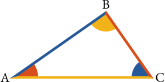
Some of the properties of the right angled triangle ABC, expressed by the method generally employed:
1. The angle BAC, together with the angles BCA and ABC are equal to two right angles, or twice the angle ABC.
2. The angle CAB added to the angle ACB will be equal to the angle ABC.
3. The angle ABC is greater than either of the angles BAC or BCA.
4. The angle BCA or the angle CAB is less than the angle ABC.
5. If from the angle ABC, there be taken the angle BAC, the remainder will be equal to the angle ACB.
6. The square of AC is equal to the sum of the squares of AB and BC.
The same properties expressed by colouring the different parts:
1.  +
+  +
+  = 2 =
= 2 =  .That is, the red angle added to the yellow angle added to the blue angle, equal twice the yellow angle, equal two right angles.
2. + = .Or in words, the red angle added to the blue angle, equal the yellow angle.
3. > or > .The yellow angle is greater than either the red or blue angle.
4. or < .Either the red or blue angle is less that the yellow angle.
5. − = .In other terms, the yellow angle made less be the blue angle equal red angle.
6.  2 =
2 =  2 +
2 +  2.That is, the square of the yellow line is equal to the sum of the squares of the blue and red lines.
In oral demonstrations we gain with colours this important advantage, the eye and the ear can be addressed at the same moment, so that for teaching geometry, and other linear arts and sciences, in classes, the system is best ever proposed, this is apparent from the examples given.
Whence it is evident that a reference from the text to the diagram is more rapid and sure, by giving the forms and colours of the parts, or by naming the parts and their colours, than naming the parts and letters on the diagram. Besides the superior simplicity, this system is likewise conspicuous for concentration, and wholly excludes the injurious though prevalent practice of allowing the student to commit the demonstration to memory; until reason, and fact, and proof only make impressions of the understanding.
Again, when lecturing on the principles or properties of figures, if we mention the colour of the part or parts referred to, as in saying, the red angle, the blue line, or lines, &c, the part or parts thus named will be immediately seen by all the class at the same instant; not so if we say the angle ABC, the triangle PFQ, the figure EGKt, and so on; for the letters must be traced one by one before students arrange in their minds the particular magnitude referred to, which often occasions confusion and error, as well as loss of time. Also if the parts which are given as equal, have the same colours in any diagram, the mind will not wander from the object before it; that is, such an arrangement presents an ocular demonstration of the parts to be proved equal, and the learner retains the data throughout the whole of reasoning. But whatever may be the advantages of the present plan, if it be not substituted for, it can always be made a powerful auxiliary to the other methods, for the purpose of introduction, or of a more speedy reminiscence, or of more permanent retention by the memory.
The experience of all who have formed systems to impress facts on the understanding, agree in proving that coloured representations, as pictures, cuts, diagrams, &c. are more easily fixed in the mind than mere sentences unmarked by any peculiarity. Curious as it may appear, poets seem to be aware of this fact more than mathematicians; many modern poets allude to this visible system of communicating knowledge, one of them has thus expressed himself:
Sounds which address the ear are lost and die
In one short hour, but these which strike the eye,
Live long upon the mind, the faithful sight
Engraves the knowledge with a beam of light.
This perhaps may be reckoned the only improvement which plain geometry has received since the days of Euclid, and if there were any geometers of note before that time, Euclid’s success has quite eclipsed their memory, and even occasioned all good things of that kind to be assigned to him; like Æsop among the writers of Fables. It may also be worthy of remark, as tangible diagrams afford the only medium through which geometry and other linear arts can be taught to the blind, the visible system is no less adapted to the exigencies of the deaf and dumb.
Care must be taken to show that colour has nothing to do with the lines, angles, or magnitudes, except merely to name them. A mathematical line, which is length without breadth, cannot possess colour, yet the junction of two colours on the same plane gives a good idea of what is meant by a mathematical line; recollect we are speaking familiarly, such a junction is to be understood and not the colour, when we say the black line, the red line or lines, &c.
Colours and coloured diagrams may at first appear a clumsy method to convey proper notions of the properties and parts of mathematical figures and magnitudes, however they will be found to afford a means more refined and extensive than any that has hitherto proposed.
We shall here define a point a line, and a surface, and demonstrate a proposition in order to show the truth of this assertion.
A point is that which has position, but not magnitude; or a point is position only, abstracted from the consideration of length, breadth, and thickness. Perhaps the following description is better calculated to explain the nature of mathematical point to those who have not acquired the idea, than the above specious definition.

Let three colours meet and cover a portion of the paper, where they meet is not blue, nor is it yellow, nor is it red, as it occupies no portion of the plane, for if it did, it would belong to the blue, the red, or the yellow part; yet it exists, and has position without magnitude, so that with a little reflection, this junction of three colours on a plane, gives a good idea of a mathematical point.
A line is length without breadth. With the assistance of colours, nearly in the same manner as before, an idea of a line may be thus given:—

Let two colours meet and cover a portion of paper; where they meet is not red, nor is it blue; therefore the junction occupies no portion of the plane, and therefore it cannot have breadth, but only length: from which we can readily form an idea of what is meant by a mathematical line. For the purpose of illustration, one colour differing from the colour of the paper, or plane upon which it is drawn, would have been sufficient; hence in future, if we say the red line, the blue line or lines, &c. it is the junctions with the plane upon which they are drawn are to be understood.
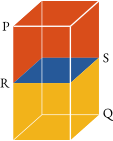
Surface if that which has length and breadth without thickness.
When we consider a solid body (PQ), we perceive at once that it has three dimensions, namely :— length, breadth, and thickness; suppose one part of this solid (PS) to be red, and the other part (QR) yellow, and that the colours be distinct without commingling, the blue surface (RS) which separates these parts, or which is the same thing, that which divides the solid without loss of material, must be without thickness, and only possesses length and breadth; this plainly appears from reasoning, similar to that just employed in defining, or rather describing a point and a line.
The proposition which we have selected to elucidate the manner in which the principles are applied, is the fifth of the first Book.
In an isosceles triangle ABC, the internal angles at the base ABC, ACB are equal, and when the sides AB, AC are produced, the external angles at the base BCE, CBD are also equal.
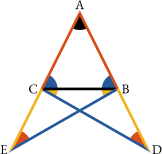
Produce and ,
make  = , draw
  and .
and .
In  and
and 
we have  = ,
= ,
 common and = :
∴  =
=  , =
, =
and  =
=  (prop. I.4).
Again in  and
and  ,
,
= , =
and = ;
∴  =
=  and
and  =
=  (prop. I.4)
But = , ∴  =
=  .
.
Q. E. D.
By annexing Letters to the Diagram.
Let the equal sides AB and AC be produced through the extremities BC, of the third side, and in the produced part BD of either, let any point D be assumed, and from the other let AE be cut off equal to AD (prop. I.3). Let points E and D, so taken in the produced sides, be connected by straight lines DC and BE with the alternate extremities of the third side of the triangle.
In the triangles DAC and EAB the sides DA and AC are respectively equal to EA and AB, and the included angle A is common to both triangles. Hence (prop. I.4) the line DC is equal to BE, the angle ADC to the angle AEB, and the angle ACD to the angle ABE; if from the equal lines AD and AE the equal sides AB and AC be taken, the remainders BD and CE will be equal. Hence in the triangles BDC and CEB, the sides BD and DC are respectively equal to CE and EB, and the angles D and E included by those sides are also equal. Hence (prop. I.4) the angles DBC and ECB, which are those included by the third side BC and the productions of the equal sides AB and AC are equal. Also the angles DCB and EBC are equal if those equals be taken from the angles DCA and EBA before proved equal, the remainders, which are the angles ABC and ACB opposite to the equal sides, will be equal.
Therefore in an isosceles triangle, &c.
Q. E. D.
Our object in this place being to introduce system rather than to teach any particular set of propositions, we have therefore selected the foregoing out of the regular course. For schools and other public places of instruction, dyed chalks will answer to describe the diagrams, &c. for private use coloured pencils will be found very convenient.
We are happy to find that the Elements of Mathematics now forms a considerable part of every sound female education, therefore we call the attention to those interested or engaged in the education of ladies to this very attractive mode of communicating knowledge, and to the succeeding work for its future developement.
We shall for the present conclude by observing, as the senses of sight and hearing can be so forcibly and instantaneously addressed alike with one thousand as with one, the million might be taught geometry and other branches of mathematics with great ease, this would advance the purpose of education more than any thing might be named, for it would teach the people how to think, and not what to think; it is in this particular the great error of education originates.
Geometry has for its principal objects the exposition and explanation of the properties of figure, and figure is defined to be the relation which subsists between the boundaries of space. Space or magnitude is of three kinds, linear, superficial, and solid.

Angles might properly be considered as a fourth species of magnitude. Angular magnitude evidently consists of parts, and must therefore be admitted to be a species of quantity. The student must not suppose that the magnitude of an angle is affected by the length of the straight lines which include it and of whose mutual divergence it is the measure. The vertex of an angle is the point the sides of the legs of the angle meet, as A.
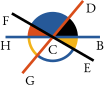
An angle is often designated by a single letter when its legs are the only lines which meet together at its vertex. Thus the red and blue lines form the yellow angle, which in other systems would be called angle A. But when more than two lines meet in the same point, it was necessary by former methods, in order to avoid confusion, to employ three letters to designate an angle about that point, the letter which marked the vertex of the angle being always placed in the middle. Thus the black and red lines meeting together at C, form the blue angle, and has been usually denominated the angle FCD or DCF. The lines FC and CD are the legs of the angle; the point C is its vertex. In like manner the black angle would be designated the angle DCB or BCD. The red and blue angles added together, or the angle HCF added to FCD, make the angle HCD; and so of other angles.
When the legs of an angle are produced or prolonged beyond its vertex, the angles made by them on both sides of the vertex are said to be vertically opposite to each other: thus the red and yellow angles are said to be vertically opposite angles.
Superposition is the process by which one magnitude may be conceived to be placed upon another, so as exactly to cover it, or so that every part of each shall exactly coincide.
A line is said to be produced, when it is extended, prolonged, or it has length increased, and the increase of length which it receives is called produced part, or its production.
The entire length of the line or lines which enclose a figure, is called its perimeter. The first six books of Euclid treat of plain figures only. A line drawn from the centre of a circle to its circumference, is called a radius. That side of a right angled triangle, which is opposite to the right angle, is called the hypotenuse. An oblong is defined in the second book, and called a rectangle. All lines which are considered in the first six books of the Elements are supposed to be in the same plane.
The straight-edge and compasses are the only instruments, the use of which is permitted in Euclid, or plain Geometry. To declare this restriction is the object of the postulates.
The Axioms of geometry are certain general propositions, the truth of which is taken to be self-evident and incapable of being established by demonstration.
Propositions are those results which are obtained in geometry by a process of reasoning. There are two species of propositions in geometry, problems and theorems.
A Problem is a proposition in which something is proposed to be done; as a line to be drawn under some given conditions, a circle to be described, some figure to be constructed, &c.
The solution of the problem consists in showing how the thing required may be done by the aid of the rule or straight-edge and compasses.
The demonstration consists in proving that the process indicated in the solution attains the required end.
A Theorem is a proposition in which the truth of some principle is asserted. This principle must be deduced from the axioms and definitions, or other truths previously and independently established. To show this is the object of demonstration.
A Problem is analogous to a postulate.
A Theorem resembles an axiom.
A Postulate is a problem, the solution to which is assumed.
An Axiom is a theorem, the truth of which is granted without demonstration.
A Corollary is an inference deduced immediately from a proposition.
A Scholium is a note or observation on a proposition not containing an inference of sufficient importance to entitle it to the name of corollary.
A Lemma is a proposition merely introduced for the purpose of establishing some more important proposition.
∴ expresses the word therefore.
∵ expresses the word because.
= expresses the word equal. This sign of equality may be read equal to, or is equal to, or are equal to; but the discrepancy in regard to the introduction of the auxiliary verbs is, are, &c. cannot affect the geometrical rigour.
≠ means the same as if the words ‘not equal’ were written.
> signifies greater than.
< signifies less than.
≯ signifies not greater than.
≮ signifies not less than.
+ is read plus (more), the sign of addition; when interposed between two or more magnitudes, signifies their sum.
− is read minus (less), signifies subtraction; and when placed between two quantities denotes that the latter is taken from the former.
× this sign expresses the product of two or more numbers when placed between them in arithmetic and algebra; but in geometry it is generally used to express a rectangle, when placed between “ two straight lines which contain one of its right angles.” A rectangle may also be represented by placing a point between two of its conterminous sides.
: :: : expresses an analogy or proportion; thus if A, B, C and D represent four magnitudes, and A has to B the same ratio that C has to D, the proportion is thus briefly written
A : B :: C : D, A : B = C : D, or AB = CD.
This equality or sameness of ratio is read,
as A is to B, so is C to D;
or A is to B, as C is to D.
∥ signifies parallel to.
⊥ signifies perpendicular to.
 signifies angle.
 signifies right angle.
 signifies two right angles.
 or
or  briefly designates a point.
The square described on a line is concisely written thus,  2.
2.
In the same manner twice the square of, is expressed by 2 · 2.
def. signifies definition.
post. signifies postulate.
ax. signifies axiom.
hyp. signifies hypothesis. It may be necessary here to remark, that hypothesis is the condition assumed or taken for granted. Thus, the hypothesis of the proposition given in the Introduction, is that the triangle is isosceles, or that its legs are equal.
const. signifies construction. The construction is the change made in the original figure, by drawing lines, making angles, describing circles, &c. in order to adapt it to the argument of the demonstration or the solution of the problem. The conditions under which these changes are made, are as indisputable as those contained in the hypothesis. For instance, if we make an angle equal to a given angle, these two angles are equal by construction.
Q. E. D. signifies Quod erat demonstrandum. Which was to be demonstrated.
A point is that which has no parts.
A line is length without breadth.
The extremities of a line are points.
The straight or right line is that which lies evenly between its extremities.
A surface is that which has length and breadth only.
The extremities of a surface are lines.
A plane surface is that which lies evenly between its extremities.
A plane angle is the inclination of two lines to one another, in a plane, which meet together, but are not in the same direction.

A plane rectilinear angle is the inclination of two straight lines to one another, which meet together, but are not in the same straight line.

When one straight line standing on another straight line makes the adjacent angles equal, each of these angles is called a right angle, and each of these lines is said to be perpendicular to one another.

An obtuse angle is an angle greater than a right angle

An acute angle is an angle less than a right angle.
A term or boundary is the extremity of any thing.
A figure is a surface enclosed on all sides by a line or lines.

A circle is a plane figure, bounded by one continued line, called its circumference or periphery; and having a certain point within it, from which all straight lines drawn to its circumference are equal.
This point (from which the equal lines are drawn) is called the centre of the circle.

A diameter of a circle is a straight line drawn through the centre, terminated both ways in the circumference.

A semicircle is the figure contained by the diameter, and the part of the circle cut off by the diameter.

A segment of a circle is a figure contained by straight line and the part of the circumference which it cuts off.
A figure contained by straight lines only, is called a rectilinear figure.
A triangle is a rectilinear figure included by three sides.

A quadrilateral figure is one which is bounded by four sides. The straight lines  and
and  connecting the vertices of the opposite angles of a quadrilateral figure, are called its diagonals.
A polygon is a rectilinear figure bounded by more than four sides.

A triangle whose sides are equal, is said to be equilateral.

A triangle which has only two sides equal is called an isosceles triangles.
A scalene triangle is one which has no two sides equal.

A right angled triangle is that which has a right angle.

An obtuse angled triangle is that which has an obtuse angle.

An acute angled triangle is that which has three acute angles.

Of four-sided figures, a square is that which has all its sides equal, and all its angles right angles.

A rhombus is that which has all its sides equal, but its angles are not right angles.

An oblong is that which has all its angles right angles, but has not all its sides equal.

A rhomboid is that which has its opposite sides equal to one another, but all its sides are not equal nor its angles right angles.
All other quadrilateral figures are called trapeziums.

Parallel straight lines are such as are in the same plane, and which being produced continually in both directions would never meet.
Let it be granted that a straight line may be drawn from any one point to any other point.
Let it be granted that a finite straight line may be produced to any length in a straight line.
Let it be granted that a circle may be described with any centre at any distance from that centre.
Magnitudes which are equal to the same are equal to each other.
If equals be added to equals the sums will be equal.
If equals be taken away from equals the remainders will be equal.
If equals be added to unequals the sums will be unequal.
If equals be taken away from unequals the remainders will be unequal.
The doubles of the same or equal magnitudes are equal.
The halves of the same or equal magnitudes are equal.
The magnitudes which coincide with one another, or exactly fill the same space, are equal.
The whole is greater than its part.
Two straight lines cannot include a space.
All right angles are equal.

If two straight lines ( ) meet a third straight line (
 ) so as to make the two interior angles (
 and
and  ) on the same side less than two straight angles, these two straight lines will meet if they be produced on that side on which the angles are less than two right angles.
The twelfth axiom may be expressed in any of the following ways:
1. Two diverging straight lines cannot be both parallel to the same straight line.
2. If a straight line intersect one of the two parallel straight lines it must also intersect the other.
3. Only one straight line can be drawn through a given point, parallel to a given straight line.
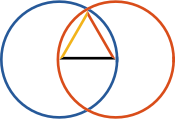
On a given finite straight line ( ) to describe an equilateral triangle.
Describe  and
and  (post. I.3);
draw  and
and  (post. I.1).
Then will  be equilateral.
For = (def. I.15);
and = (def. I.15);
∴ = (ax. I.1);
and therefore is the equilateral triangle required.
Q. E. D.
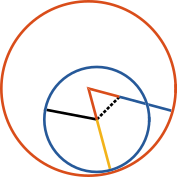
From a given point ( ), to draw a straight line equal to a given straight line (
 ).
).
Draw  (post. I.1), describe
  (prop. I.1),
produce (post. I.2),
describe  (post. I.3), and
  (post. I.3);
produce  (post. I.2),
then  is the line required.
For  =
=  (def. I.15),
and = (const.),
∴  = (post. I.3),
but (def. I.15) = = ;
∴ drawn from the given point (), is equal to the given line .
Q. E. D.
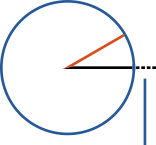
From the greater ( ) of two given straight lines, to cut off a part equal to the less (
 ).
).
Draw = (prop. I.2);
describe  (post. I.3),
then =
For = (def. I.15),
and = (const.);
∴ = (ax. I.1).
Q. E. D.
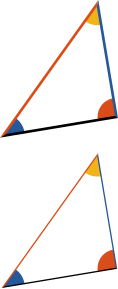
If two triangles have two sides of the one respectively equal to two sides of the other, ( to  and
and  to
to  ) and the angles (
 and
and  ) contained by those equal sides also equal; then their bases or their sides ( and
  ) are also equal: and the remaining angles opposite to equal sides are respectively equal (
  =
=  and
and  =
=  ): and the triangles are equal in every respect.
Let two triangles be conceived, to be so placed, that the vertex of the one of the equal angles, or ; shall fall upon that of the other, and to coincide with , then will coincide with if applied: consequently will coincide with , or two straight lines will enclose a space, which is impossible (ax. I.10), therefore = , = and = , and as the triangles  and
and  coincide, when applied, they are equal in every respect.
Q. E. D.
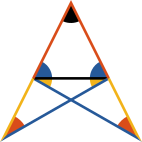
In any isosceles triangle  if the equal sides be produced, the external angles at the base are equal, and the internal angles at the base are also equal.
Produce  and (post. I.2),
take  = (prop. I.3);
draw  and .
and .
Then in  and
and 
we have  = (const.),
 common to both,
and = (hyp.)
∴  =
=  , = and
  =
=  (prop. I.4).
Again in  and
and 
we have = , = and = ,
∴  =
=  and
and  =
=  (prop. I.4)
but = , ∴  =
=  (ax. I.3).
Q. E. D.
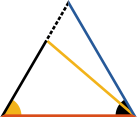
In any triangle ( ) if two angles (
 and
and  ) are equal, the sides (
 and
and  ) opposite to them are also equal.
For if the sides be not equal, let one of them be greater than the other , and from it to cut off  = (prop. I.3), draw
  .
.
Then in  and ,
and ,
= (const.),
= (hyp.)
and common,
∴ the triangles are equal (prop. I.4)
a part equal to the whole, which is absurd;
∴ neither of the sides or is greater than the other,
hence they are equal.
Q. E. D.
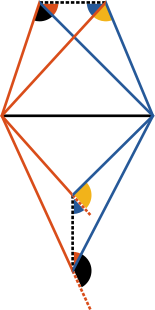
On the same base (), and on the same side of it there cannot be two triangles having their conterminous sides ( and  ,
,  and
and  ) at both extremities of the base, equal to each other.
When two triangles stand on the same base, and on the same side of it, the vertex of the one shall either fall outside of the other triangle, or within it; or, lastly, on one of its sides.
If it be possible let the two triangles be constructed so that ( = = ) , then draw  and,
and,
 =
=  (prop. I.5)
∴  < and
< and
∴ <  but (prop. I.5) = } which is absurd,
therefore the two triangles cannot have their conterminous sides equal at both extremities of the base.
Q. E. D.
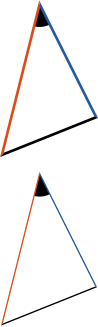
If two triangles have two sides of the one respectively equal to two sides of the other (  =
=  and =
and =  ) and also their bases (
  =
=  ), equal; then the angles (
 and
and  ) contained by their equal sides are also equal.
If the equal bases and be conceived to be placed one upon the other, so that the triangles shall lie at the same side of them, and that the equal sides and , and be conterminous, the vertex of the one must fall on the vertex of the other; for to suppose them not coincident would contradict the last proposition.
Therefore sides and , being coincident with and , ∴  =
=  .
.
Q. E. D.
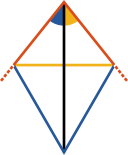
To bisect a given rectilinear angle ( ).
).
Take  = (prop. I.3)
draw , upon which describe  (prop. I.1),
draw  .
.
∵ = (const.)
and common to the two triangles
and = (const.),
∴  =
=  (prop. I.8).
Q. E. D.
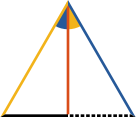
To bisect a given finite straight line ( ).
).
Construct  (prop. I.1),
draw  , making
  =
=  (prop. I.9).
Then  =
=  by (prop. I.4),
for  = (const.) =
and common to the two triangles.
Therefore the given line is bisected.
Q. E. D.
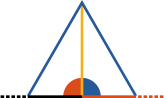
From a given point ( ), in a given straight line (
 ), to draw a perpendicular.
Take any point ( ) in the given line,
cut off  =
=  (prop. I.3),
construct  (prop. I.1),
draw  and it shall be perpendicular to the given line.
For = (const.)
= (const.)
and common to the two triangles.
Therefore  =
=  (prop. I.8)
∴ ⊥  (def. I.10).
Q. E. D.
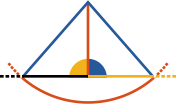
To draw a straight line perpendicular to a given indefinite straight line ( ) from a given point (
 ) without.
With the given point as centre, at one side of the line, and any distance capable of extending to the other side, describe  .
.
Make =  (prop. I.10),
draw  , and
, and  ,
,
then ⊥  .
.
For (prop. I.8) since = (const.),
common to both,
and = (def. I.15),
∴  = , and
∴ ⊥ (def. I.10).
Q. E. D.

When a straight line ( ) standing upon another straight line (
 ) makes angles with it; they are either two right angles or together equal to two right angles.
If be ⊥ to then,
 and
and  = (def. I.10),
but if be not ⊥ to ,
draw  ⊥ (prop. I.11);
+  = (const.),
= =  +
+
∴ + = + + (ax. I.2)
= + = .
Q. E. D.

If two straight lines ( and ), meeting a third straight line (
 ), at the same point, and at opposite sides of it, make with it adjacent angles (
 and
and  ) equal to two right angles; these straight lines lie in one continuous straight line.
For, if possible let , and not ,
be the continuation of ,
then +  =
=
but by the hypothesis + =
∴ = (ax. I.3); which is absurd (ax. I.9).
∴ is not the continuation of , and the like may be demonstrated of any other straight line except , ∴ is the continuation of .
Q. E. D.

If two right lines ( and ) intersect one another, the vertical angles  and
and  ,
,  and
and  are equal.
+ =
+ =
∴ = .
In the same manner it may be shown that
= .
Q. E. D.
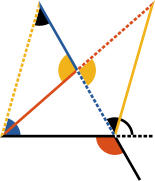
If a side of a triangle ( ) is produced, the external angle (
 ) is greater than either of the internal remote angles (
 or
or  ).
).
Make =  (prop. I.10);
Draw and produce it until  = ;
= ;
draw  .
.
In  and
and  ;
;
= ,  =
=  and = (const. and prop. I.15),
∴ =  (prop. I.4),
∴ > .
In like manner it can be shown, that if  be produced,
  >
>
and therefore which is = is > .
Q. E. D.

Any two angles of a triangle  are together less than two right angles.
Produce , then will
 +
+  = .
= .
But >  (prop. I.16)
∴ + < ,
and in the same manner it may be shown that any other two angles of the triangle taken together are less than two right angles.
Q. E. D.
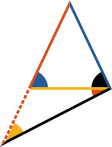
In any triangle  if one side
  be greater than another , the angle opposite to the greater side is greater than the angle opposite to the less. I. e.
  >
>  .
.
Make = (prop. I.3), draw  .
.
Then will  =
=  (prop. I.5);
but > (prop. I.16)
∴ > and much more
is > .
Q. E. D.
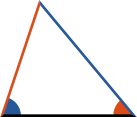
If in any triangle  one angle
  be greater than another
  the side
  which is opposite to the greater angle, is greater than the side
  opposite the less.
If be not greater than then must
= or < .
If = then
= (prop. I.5);
which is contrary to the hypothesis.
is not less than ; for if it were,
< (prop. I.18)
which is contrary to the hypothesis:
∴ > .
Q. E. D.
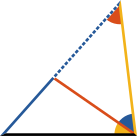
Any two sides  and
and  of a triangle
  taken together are greater than the third side (
 ).
).
, andmake  = (prop. I.3);
draw  .
.
Then ∵ = (const.),
 =
=  (prop. I.5)
∴  > (ax. I.9)
∴ + > (prop. I.19)
and ∴ + > .
Q. E. D.
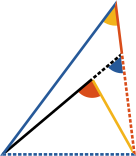
If from any point ( ) within a triangle
  straight lines be drawn to the extremities of one side (
 ), these lines must be together less than the other two sides, but must contain a greater angle.
Produce  ,
,
 +
+  >
>  (prop. I.20),
add  to each,
+  > + (ax. I.4)
in the same manner it may be shown that
+ > +  ,
,
∴ + > + ,
which was to be proved.
Again  >
>  (prop. I.16),
and also  > (prop. I.16),
∴ > .
Q. E. D.
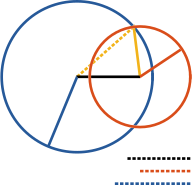
Given three right lines 
 the sum of any two greater than the third, to construct a triangle whose sides shall be respectively equal to the given lines.
Assume  = (prop. I.3).
Draw  = and
= and  = ) (prop. I.2).
With and as radii, describe  and
and  (post. I.3);
draw  and
and  ,
,
then will  be the triangle required.
For = , = = ,and = = .} (const.)
Q. E. D.
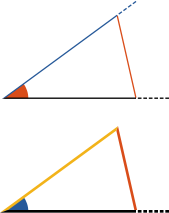
At a given point ( ) in a given straight line (
 ), to make an angle equal to a given rectilinear angle (
 ).
).
Draw  between any two points in the legs of the given angle.
 (prop. I.22)
so that =  ,
,  =
= 
and = .
Then =  (prop. I.8).
Q. E. D.
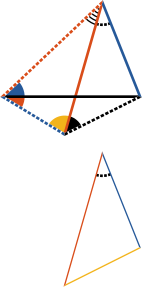
If two triangles have two sides of the one respectively equal to two sides of the other ( to
to  and
and  to ), and if one of the angles (
 ) contained by the equal sides be greater than the other (
 ), the side (
 ) which is opposite to the greater angle is greater than the side (
 ) which is opposite to the less angle.
Make  = (prop. I.23),
and = (prop. I.3),
draw  and .
and .
∵ = (ax. I.1, hyp., and const.)
∴  =
=  (prop. I.5)
but  < ,
< ,
and ∴ <  ,
,
∴ > (prop. I.19)
but = (prop. I.4)
∴ > .
Q. E. D.
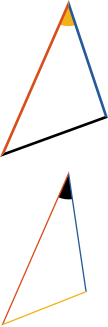
If two triangles have two sides ( and
and  ) of the one respectively equal to two sides (
 and
and  ) of the other, but their bases unequal, the angle subtended by the greater base (
 ) of the one, must be greater than the angle subtended by the less base (
 ) of the other.
 = , > or <
is not equal to
for if = then = (prop. I.4)
which is contrary to the hypothesis;
is not less than
for if <
then < (prop. I.24),
which is also contrary to the hypothesis:
∴ > .
Q. E. D.
If two triangles have two angles of the one respectively equal to two angles of the other (  =
=  and
and  =
=  ), and a side of the one equal to a side of the other similarly placed with respect to the equal angles, the remaining sides and angles are respectively equal to one another.
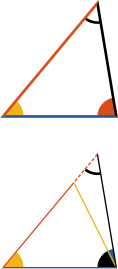
Case I.
Let  and
and  which lie between the equal angles be equal,
then =  .
.
For if it be possible, let one of them be greater than the other;
make =  , draw
  .
.
In  and
and  we have
= , = , = ;
∴ =  (prop. I.4)
but = (hyp.)
and therefore = , which is absurd;
hence neither of the sides and is greater than the other;
and ∴ they are equal;
∴  =
=  , and
, and  =
=  , (prop. I.4).
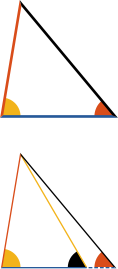
Case II.
Again, let = , which lie opposite the equal angles  and
and  .
.
If it be possible, let  > , then take
  = , draw
  .
.
Then in  and
and  we have = , = and
  =
=  ,
,
∴ =  (prop. I.4)
but = (hyp.)
∴ = which is absurd (prop. I.16).
Consequently, neither of the sides or is greater than the other, hence they must be equal. It follows (by (prop. I.4)) that the triangles are equal in all respects.
Q. E. D.
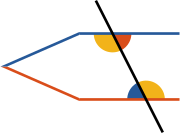
If a straight line ( ) meeting two other straight lines ( and ) makes with them the alternate angles (
 and
and  ;
;  and
and  ) equal, these two straight lines are parallel.
If be not parallel to they shall meet when produced.
If it be possible, let those lines be not parallel, but meet when produced; then the external angle is greater than (prop. I.16), but they are also equal (hyp.), which is absurd: in the same manner it may be shown that they cannot meet on the other side; ∴ they are parallel.
Q. E. D.

If a straight line ( ), cutting two other straight lines ( and
  ), makes the external equal to the internal and opposite angle, at the same side of the cutting line (namely
  =
=  or
or  =
=  ), or if it makes the two internal angles at the same side ( and
  , or and
  ) together equal to two right angles, those two straight lines are parallel.
First, if = , then = (prop. I.15),
∴ = ∴ ∥ (prop. I.27).
Secondly, if + = ,
then + = (prop. I.13),
∴ + = + (ax. I.3)
∴ =
∴ ∥ (prop. I.27).
Q. E. D.
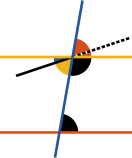
Astraight line () falling on two parallel straight lines ( and ), makes the alternate angles equal to one another; and also the external equal to the internal and opposite angle on the same side; and the two internal angles on the same side together equal to two right angles.
For if the alternate angles  and
and  be not equal, draw
  , making
  = (prop. I.23).
Therefore  ∥ (prop. I.27) and therefore two straight lines which intersect are parallel to the same straight line, which is impossible (ax. I.12).
Hence and are not unequal, that is, they are equal: =  (prop. I.15); ∴ = , the external angle equal to the internal and opposite on the same side: if
  be added to both, then + =
  = (prop. I.13). That is to say, the two internal angles at the same side of the cutting line are equal to two right angles.
Q. E. D.
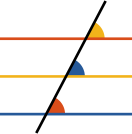
Straight lines ( and ) which are parallel to the same straight line (), are parallel to one another.
Let  intersect ;
Then,  =
=  =
=  (prop. I.29),
∴ =
∴ ∥ (prop. I.28).
Q. E. D.

From a given point  to draw a straight line parallel to a given straight line (
 ).
).
Draw from the point to any point  in ,
in ,
make  =
=  (prop. I.23),
then  ∥ (prop. I.27).
Q. E. D.
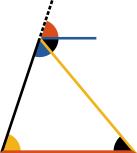
If any side ( ) of a triangle be produced, the external angle (
 ) is equal to the sum of the two internal and opposite angles (
 and
and  ), and the three internal angles of any triangle taken together are equal to two right angles.
Through the point  draw
draw
∥ (prop. I.31).
Then ( =
=  = ) (prop. I.29),
∴ + = (ax. I.2),
and therefore
+  + =
+ =  = (prop. I.13).
Q. E. D.
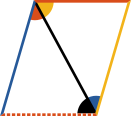
Straight lines ( and ) which join the adjacent extremities of two equal and parallel straight lines ( and
and  ), are themselves equal and parallel.
Draw  the diagonal.
= (hyp.)
 =
=  (prop. I.29)
and common to the two triangles;
∴ = , and  =
=  (prop. I.4);
and ∴ ∥ (prop. I.27).
Q. E. D.

The opposite sides and angles of any parallelogram are equal, and the diagonal () divides it into two equal parts.
Since { =
=  =
=  } (prop. I.29)
and common to the two triangles.
∴ { = =
= =  =
=  } (prop. I.26)
and  =
=  (ax. I.2).
Therefore the opposite sides and angles of the parallelogram are equal: and as the triangles  and
and  are equal in every respect (prop. I.4), the diagonal divides the parallelogram into two equal parts.
Q. E. D.

Parallelograms on the same base, and between the same parallels, are (in area) equal.
On account of the parallels,
 =
=  ;
; =
=  ;and = } (prop. I.29)(prop. I.29)(prop. I.34).
But  =
=  (prop. I.8)
∴  − =
− =  ,
,
and − =  ;
;
∴ = .
Q. E. D.

Parallelograms ( and
and  ) on equal bases, and between the same parallels, are equal.
Draw  and
and 
= = by (prop. I.34 and hyp.);
∴ = and ∥ ;
∴ = and ∥ (prop. I.33)
And therefore  is a parallelogram:
but = = (prop. I.35)
∴ = (ax. I.1).
Q. E. D.

Triangles  and
and  on the same base () and between the same parallels are equal.
Draw  ∥
∥  ∥
∥  ) (prop. I.31)
Produce .
 and
and  are parallelograms on the same base and between the same parallels, and therefore equal. (prop. I.35)
∴ { = twice = twice } (prop. I.34) ∴ = .
Q. E. D.

Triangles ( and
and  ) on equal bases and between the same parallels are equal.
Draw  ∥ and
∥ and  ∥ ) (prop. I.31)
 =
=  (prop. I.36);
but = twice (prop. I.34),
and = twice (prop. I.34),
∴ = (ax. I.7).
Q. E. D.
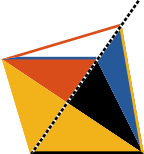
Equal triangles  and
and  on the same base () and on the same side of it, are between the same parallels.
If , which joins the vertices of the triangles, be not ∥ , draw ∥ (prop. I.31), meeting  .
.
Draw  .
.
∵ ∥ (const.)
=  (prop. I.37);
but = (hyp.);
∴ = , a part equal to the whole, which is absurd.
∴ ∦ ; and in the same manner it can be demonstrated, that no other line except is ∥ ; ∴ ∥ .
Q. E. D.
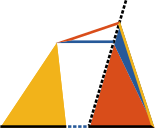
Equal triangles ( and
and  ) on equal bases, and on the same side, are between the same parallels.
If  which joins the vertices of triangles be not ∥
  ,
,
draw  ∥ (prop. I.31),
meeting  .
.
Draw  .
.
∵ ∥ (const.)
=  but =
but =
∴ = , a part equal to the whole, which is absurd.
∴ ∦ : and in the same manner it can be demonstrated, that no other line except is ∥ : ∴ ∥ .
Q. E. D.

If a parallelogram  and a triangle
  are upon the same base and between the same parallels
  and , the parallelogram is double the triangle.
Draw the diagonal.
Then  = (prop. I.37)
= twice (prop. I.34)
∴ = twice .
Q. E. D.

To construct a parallelogram equal to a given triangle  and having an angle equal to a given rectilinear angle
  .
.
Make =  (prop. I.10)
Draw .
Make  = (prop. I.23)
Draw ( ∥  ∥ ) (prop. I.31)
 = twice
  (prop. I.41)
but =  (prop. I.38)
∴ = .
Q. E. D.

The complements  and
and  of the parallelograms which are about the diagonal of a parallelogram are equal.
 =
=  (prop. I.34)
and  =
=  (prop. I.34)
∴ = (ax. I.3).
Q. E. D.
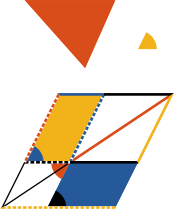
To a given straight line ( ) to apply a parallelogram equal to a given triangle (
 ), and having an angle equal to a given rectilinear angle (
 ).
).
Make  = with
  = (prop. I.42)
and having one of its sides conterminous with and in continuation of .
Produce till it meets  ∥
∥ 
draw  produce it till it meets
  continued;
draw  ∥
∥  meeting produced and produce .
=  (prop. I.43)
but = (const.)
∴ = ;
and =  =
=  = (prop. I.29 and const.).
Q. E. D.

To construct a parallelogram equal to a given rectilinear figure ( ) and having an angle equal to a given rectilinear angle (
 ).
).
Draw and dividing the rectilinear figure into triangles.
Construct  =
= 
having  = (prop. I.42)
to apply  =
= 
having  = (prop. I.44)
to apply  =
= 
having  = (prop. I.44)
∴  =
=
and is a parallelogram. (prop. I.14, I.29 and I.30)
having = .
Q. E. D.

Upon a given straight line () to construct a square.
Draw ⊥ and = (prop. I.3 and I.11)
Draw ∥ ,
and meeting drawn ∥ .
In  = (const.)
 = a right angle (const.)
∴  = = a right angle (prop. I.29),
and the remaining sides and angles must be equal (prop. I.34).
And ∴ is a square (def. I.30).
Q. E. D.

In a right angled triangle  the square on the hypotenuse is equal to the sum of the squares of the sides ( and ).
On , , describe squares, (prop. I.46)
Draw  ∥ (prop. I.31)
also draw and .
 =
=  .
.
To each add  ∴
∴  =
=  ,
,
= and =  ;
;
∴  =
=  .
.
Again, ∵ ∥
 = twice ,
and  = twice ;
∴ = .
In the same manner it may be shown that  =
=  ;
;
hence  =
=  .
.
Q. E. D.
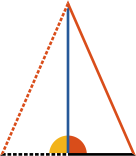
If the square of one side () of a triangle is equal to the squares of the other two sides ( and ), the angle ( ) subtended by that side is a right angle.
Draw ⊥ and = (prop. I.3 and I.11)
and draw  also.
also.
Since = (const.)
2 = 2;
∴ 2 + 2 = 2 + 2
but 2 + 2 = 2 (prop. I.47),
and 2 + 2 = 2 (hyp.)
∴ 2 = 2,
∴ = ;
and ∴  = (prop. I.8),
consequently is a right angle.
Q. E. D.

Arectangle or a right angled parallelogram is said to be contained by any two of its adjacent or conterminous sides.
Thus: the right angled parallelogram  is said to be contained by the sides and ; or it may be briefly designated by · .
If the adjacent sides are equal; i. e. = , then · which is the expression for the rectangle under and is a square, and
is equal to ( · or 2 · or 2

In a parallelogram, the figure composed of one of the parallelograms about the diagonal, together with the two complements, is called a Gnomon.
Thus  and
and  are called Gnomons.

The rectangle contained by two straight lines, one of which is divided into any number of parts,  ·
·  = { ·
= { ·  + ·
+ ·  + ·
+ ·  is equal to the sum of the rectangles contained by the undivided line, and the several parts of the divided line.
Draw ⊥ and = (prop. I.3 and I.11); complete the parallelograms, that is to say,
draw ( ∥
∥  ∥ ) (prop. I.31)
 =
=  +
+  +
+ 
= ·
= · , = · ,
= ·
∴ · = · + · + · .
Q. E. D.

If a straight line be divided into any two parts  , the square of the whole line is equal to the sum of the rectangles contained by the whole line and each of its parts. 2 = ( ·
  + ·
+ · 
 (prop. I.46)
Draw  parallel to
  (prop. I.31)
= 2
 = · = ·
 = · = ·
= +
∴ 2 = · + · .
Q. E. D.

If a straight line be divided into any two parts  , the rectangle contained by the whole line and either of its parts, is equal to the square of that part, together with the rectangle under the parts. ·
  = 2 + ·
  , or · = 2 + · .
 (prop. I.46)
 (prop. I.31)
Then  = + , but
= · and
= 2, = · ,
∴ · = 2 + · .
In a similar manner it may be readily shown that · = 2 + · .
Q. E. D.

If a straight line be divided into any two parts  , the square of the whole line is equal to the squares of the parts, together with twice the rectangle contained by the parts. 2 =
  2 +
2 +  2 + twice ·
 (prop. I.46)
draw  (post. I.1)
and ( ∥
∥  ∥ ) (prop. I.31)
 =
=  (prop. I.5),
=  (prop. I.29),
∴ =
 is a square = 2.
For the same reasons  is a square = 2,
 =
=  = · (prop. I.43)
But  = + + + ,
∴ 2 = 2 + 2 + twice · .
Q. E. D.

If a straight line be divided 
 into two equal parts and also
 into two unequal parts, the rectangle contained by the unequal parts, together with the square of the line between the points of section, is equal to the square of half that line · +
  2 = 2 = 2*.*
Describe  (prop. I.46),
draw 
and { ∥
∥ 
 ∥
∥ 
 ∥ } (prop. I.31)
 =
=  (prop. I.36)
 =
=  (prop. I.43)
∴ (ax. I.2)  =
=  = · but
  = 2 (prop. II.4)
and = 2 (const.)
∴ (ax. I.2) = 
∴ · + 2 = 2 = 2.
Q. E. D.

If a straight line be bisected  and produced to any point
  , the rectangle contained by the whole line so increased, and the part produced, together with the square of half the line, is equal to the square of the line made up of the half, and the produced part. ·
  +
+  2 =
2 =  2
2
Describe  (prop. I.46), draw
and { ∥
∥ 
 ∥
∥  ∥ } (prop. I.31)
 =
=  =
=  (prop. I.36 and I.43)
∴  =
=  = · ;
= · ;
but  = 2 (prop. II.4)
∴ =  2 =
2 =  (const. and ax. I.2)
∴ · + 2 = 2.
Q. E. D.
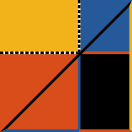
If a straight line be divided into any two parts  , the squares of the whole line and one of the parts are equal to twice the rectangle contained by the whole line and that part, together with the square of the other parts. 2 +
  2 = 2 · +
  2
2
Describe  (prop. I.46), draw
  (post. I.1),
and ( ∥
∥ 
 ∥ )
∥ )
 =
=  (prop. I.43),
add  = 2 to both (prop. II.4)
 =
=  = ·
= ·
 = 2 (prop. II.4)
+ + = 2 · + 2 = + ;
2 + 2 = 2 · + 2.
Q. E. D.
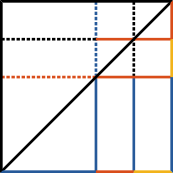
If a straight line be divided into any two parts  , the square of the sum of the whole line and any one of its parts is equal to four times the rectangle contained by the whole line, and that part together with the square of the other part.
  2 = 4 · · +
  2
2
Produce and make  =
=
Construct  (prop. I.46);
draw  ,
,

 } ∥
} ∥ 

 } ∥ ) (prop. I.31)
2 = 2 + 2 + 2 · · (prop. II.4)
but 2 + 2 = 2 · · + 2 (prop. II.7)
∴ 2 = 4 · · + 2.
Q. E. D.
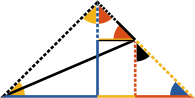
If a straight line be divided into two equal parts  and also into two unequal parts
 , the squares of the unequal parts are together double the squares of half the line, and of the part between the points of section. 2 + 2 = 2 · 2 + 2 · 2
Make  ⊥ and = or ,
Draw  and
and  ,
,
 ∥ ,
∥ ,  ∥ and draw
  .
.
 =
=  (prop. I.5) = half a right angle (prop. I.32)
 =
=  (prop. I.5) = half a right angle (prop. I.32)
∴  = a right angle.
=  =
=  = (prop. I.5 and I.29).
hence = ,  = = (prop. I.6 and I.34)
2 = { 2 + 2, or + 2= (= 2 +  2= 2 · 2 + 2 · 2 (prop. I.47)
∴ 2 + 2 = 2 · 2 + 2 · 2.
Q. E. D.
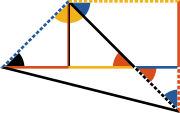
If a straight line  be bisected and produced to any point
  , the squares of the whole produced line, and of the produced part, are together double of the squares of the half line, and of the line made up of the half and produced part. 2 +
  2 = 2 ·
  2 + 2 ·
  2
2
Make  ⊥ and = to
  or ,
or ,
draw  and
and  ,
,
and ( ∥
∥  ∥ ) (prop. I.31)
draw  also.
also.
 =
=  (prop. I.5) = half a right angle (prop. I.32)
 =
=  (prop. I.5) = half a right angle (prop. I.32)
∴  = a right angle.
 = = =
= = =  =
=  =
=
half a right angle (prop. I.5, I.29, I.32 and I.34),
and =  , = = , (prop. I.6 and I.34).
2 = { 2 + 2 or 2(+ 2 = 2 · 2+ 2 = 2 · 2
∴ 2 + 2 = 2 · 2 + 2 · 2.
Q. E. D.
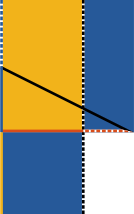
To divide a given straight line  in such a manner, that the rectangle contained by the whole line and one of its parts may be equal to the square of the other. ·
  =
=  2
2
Describe  (prop. I.46),
make  =
=  (prop. I.10),
draw  ,
,
take  = (prop. I.3),
on  describe
  (prop. I.46).
Produce  (post. I.2).
Then, (prop. II.6)  · + 2 = 2 = 2 = 2 + 2 ∴ · = 2, or,
 = ∴ =
= ∴ = 
∴ · = 2.
Q. E. D.
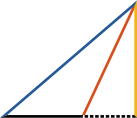
In any obtuse angled triangle, the square of the side subtending the obtuse angle exceeds the sum of the squares of the sides containing the obtuse angle, by twice the rectangle contained by either of these sides and the produced parts of the same from the obtuse angle to the perpendicular let fall on it from the opposite acute angle.  2 >
2 >  2 +
2 +  2 by 2 · ·
 2 = 2 + 2 + 2 · · :
add  2 to both
2 + 2 = 2 (prop. I.47)
= 2 · · + 2 + ( 2 2) or
+ 2 (prop. I.47).
∴ 2 = 2 · · + 2 + 2: hence 2 > 2 + 2 by 2 · · .
Q. E. D.
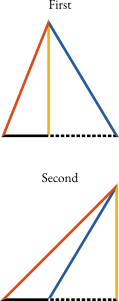
In any triangle, the square of the side subtending an acute angle, is less than the sum of the squares of the sides containing that angle, by twice the rectangle contained by either of these sides, and the part of it intercepted between the foot of the perpendicular let fall on it from the opposite angle, and the angular point of the acute angle.First.  2 <
2 <  2 +
2 +  2 by 2 · ·
  .Second. 2 <
  2 + 2 by 2 · · .
First, suppose the perpendicular to fall within the triangle, then (prop. II.7)
2 + 2 = 2 · · +  2,
2,
add to each 2 then,
2 + 2 + 2 = 2 · · + 2 + 2
2 + 2 = 2 · · + 2,
and ∴ 2 < 2 + 2 by 2 · ·
Next suppose the perpendicular to fall without the triangle, then (prop. II.7)
2 + 2 = 2 · · + 2,
add to each 2 then
2 + 2 + 2 = 2 · · + 2 + 2
2 + 2 = 2 · · + 2,
∴ 2 < 2 + 2 by 2 · · .
Q. E. D.
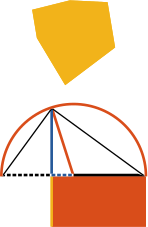
To draw a right line of which the square shall be equal to a given rectilinear figure.To draw  such that, 2 =
Make  = (prop. I.45), produce
  until
until  =
=  ;
;
take  =
=  (prop. I.10).
Describe  (post. I.3),
and produce to meet it: draw  .
.
2 or 2 = · +  2 (prop. II.5),
but 2 = 2 + 2 (prop. I.47);
∴ 2 + 2 = · + 2
∴ 2 = · , and
∴ 2 = = .
Q. E. D.
Equal circles are those whose diameters are equal.

A right line is said to touch a circle when it meets the circle, and being produced does not cut it.

Circles are said to touch one another which meet, but do not cut one another.

Right lines are said to be equally distant from the centre of a circle when the perpendiculars drawn to them from the centre are equal.
And the straight line on which the greater perpendicular falls is said to be farther from the centre.

A segment of a circle is the figure contained by a straight line and the part of the circumference it cuts off.
An angle of a segment is that contained by a straight line and a circumference of a circle.

An angle in a segment is the angle contained by two straight lines drawn from any point in the circumference of the segment to the extremities of the straight line which is the base of the segment.

An angle is said to stand on the part of the circumference, or the arch, intercepted between the right lines that contain the angle.

A sector of a circle is the figure contained by two radii and the arch between them.

Similar segments of circles are those which contain equal angles.

Circles which have the same centre are called concentric circles.
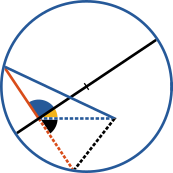
To find the centre of a given circle  .
.
Draw within the circle any straight line  , make = , draw ⊥ ; bisect , and the point of bisection is the centre.
For, if it be possible, let any other point as the point of concourse of ,  and
and  be the centre.
Because in  and
and  = (hyp. and def. I.15), = (const.) and common,
  =
=  (prop. I.8), and are therefore right angles; but
  =
=  (const.) = (ax. I.11) which is absurd; therefore the assumed point is not the centre of the circle; and in the same manner it can be proved that no other point which is not on is the centre, therefore the centre is in , and therefore the point where is bisected is the centre.
Q. E. D.
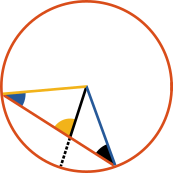
Astraight line ( ) joining two points in the circumference of a circle
  , lies wholly within the circle.
Find the centre of (prop. III.1);
from the centre draw  to any point in , meeting the circumference from the centre;
draw  and
and  .
.
Then  =
=  (prop. I.5)
but  > or > (prop. I.16)
∴ > (prop. I.19)
but =  ,
,
∴ > ;
∴ < ;
∴ every point in lies within the circle.
Q. E. D.
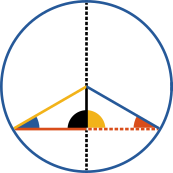
If a straight line () drawn through the centre of a circle  bisects a chord (
 ) which does not pass through the centre, it is perpendicular to it; or, if perpendicular to it, it bisects it.
Draw  and to the centre of the circle.
In  and
and 
= , common,
and =  ∴
∴  =
=  (prop. I.8)
and ∴ ⊥ (def. I.10)
Again let ⊥
Then in and
 =
=  (prop. I.5)
= (hyp.)
and =
∴ = (prop. I.26)
and ∴ bisects .
Q. E. D.
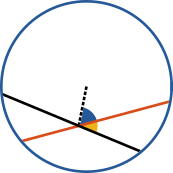
If in a circle two straight lines cut one another, which do not both pass through the centre, they do not bisect one another.
If one of the lines pass through the centre, it is evident that it cannot be bisected by the other, which does not pass through the centre.
But if neither of the lines  or
or  pass through the centre, draw
  from the centre to their intersection.
If be bisected, ⊥ to it (prop. III.3)
∴  =
=
and if be bisected, ⊥ (prop. III.3)
∴  = ;
= ;
and ∴ = ;
a part equal to the whole, which is absurd:
∴ and do not bisect one another.
Q. E. D.
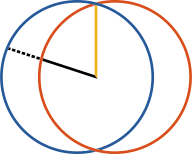
If two circles intersect  , they have not the same centre.
Suppose it possible that two intersecting circles have a common centre; from such supposed centre draw to the intersecting point, and  meeting the circumferences of the circles.
Then = (def. I.15)
and = (def. I.15)
∴ =
a part equal to the whole, which is absurd:
∴ circles supposed to intersect in any point cannot have the same centre.
Q. E. D.
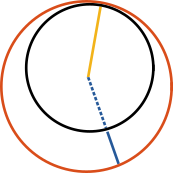
If two circles  touch one another internally, they have not the same centre.
For, if it be possible, let both circles have the same centre; from such a supposed centre draw  , and to the point of contact.
Then =  (def. I.15)
and = (def. I.15)
∴ = ;
a part equal to the whole, which is absurd; therefore the assumed point is not the centre of both circles, and in the same manner it can be demonstrated that no other point is.
Q. E. D.
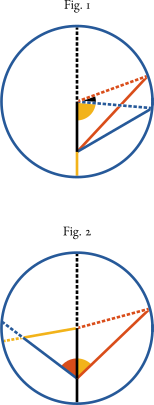
If from any point within a circle  which is not the centre, lines

 *are drawn to the circumference; the greatest of those lines is that () which passes through the centre, and the least is the remaining part () of the diameter.Of the others, that () which is nearer to the line passing through the centre, is greater than that () which is more remote.Fig. 2. The two lines (
 and ) which make equal angles with that passing through the centre, on opposite sides of it, are equal to each other; and there cannot be drawn a third line equal to them, from the same point to the circumference.*
Figure I.
To the centre of the circle draw  and
and  ; then = (def. I.15) = + > (prop. I.20) in like manner may be shown to be greater than , or any other line drawn from the same point to the circumference. Again, by (prop. I.20) + > = + , take from both; ∴ > (ax. I.3), and in like manner it may be shown that is less than any other line drawn from the same point to the circumference. Again, in
  and
and  , common,
  >
>  , and = ∴ > (prop. I.24) and may in like manner to be proved greater than any other line drawn from the same point to the circumference more remote from .
Figure II.
If  =
=  then = ,
if not take = draw 
then in  and
and  , common,
= and =
∴  = (prop. I.4)
∴ = =
a part equal to the whole, which is absurd:
∴ = ; and no other line is equal to drawn from the same point to the circumference; for if it were nearer to the one passing through the centre it would be greater, and if it were more remote it would be less.
Q. E. D.
The original text of this proposition is here divided into three parts.
I.
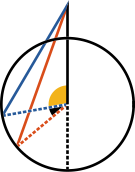
If from a point without a circle, straight lines 

 are drawn to the circumference; of those falling upon the concave circumference the greatest is that (
 ) which passes through the centre, and the line () which is nearer the greatest is greater than that () which is more remote.
Draw  and to the centre.
Then,  which passes through the centre, is greatest;
for since  =
=  , if
, if  be added to both = + ; but >
  (prop. I.20)
∴ is greater than any other line drawn from the same point to the concave circumference.
Again in  and
and  ,
,  =
=  , and
, and  common,
but  >
>  , ∴ > (prop. I.24);
and in like manner may be shown > than any other line more remote from .
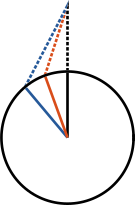
II.
Of those lines falling on the convex circumference the least is that () which being produced would pass through the centre, and the line which is nearer to least is less than that which is more remote.
For, since +  >
>  (prop. I.20)
and = , ∴ > (ax. I.5)
And again, since  +
+  >
>  +
+  (prop. I.21), and = ,
∴ <  . And so of others.
III.
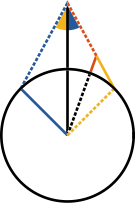
Also the lines making equal angles with that which passes through the centre are equal, whether falling on the concave or convex circumference; and no third line can be drawn equal to them from the same point to the circumference.
For if  > , but making
  =
=  ;
;
make = , and draw  .
.
Then in  and
and  we have =
and common, and also = ,
∴ = (prop. I.4);
but = ;
∴ = , which is absurd.
∴ is ≠ , nor to any part of , ∴ is ≯ .
Neither is > , they are ∴= to each other.
And any other line drawn from the same point to the circumference must lie at the same side with one of these lines, and be more or less remote than it from the line passing through the centre, and cannot therefore be equal to it.
Q. E. D.
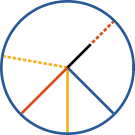
If a point be taken within a circle  , from which more than two equal straight lines (
 , , ) can be drawn to the circumference, that point must be the centre of the circle.
For if it be supposed that the point  in which more than two equal straight lines meet is not the centre, some other point
  must be; join these two points by and produce it both ways to the circumference.
Then since more than two equal straight lines are drawn from a point which is not the centre, to the circumference, two of them at least must lie at the same side of the diameter  ; and since from a point
  , which is not the centre, straight lines are drawn to the circumference; the greatest is
  , which passes through the centre: and which is nearer to , > which is more remote (prop. III.8); but = (hyp.) which is absurd.
The same may be demonstrated of any other point, different from , which must be the centre of the circle.
Q. E. D.
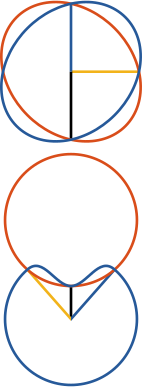
One circle  cannot intersect another
  in more points than two.
For, if it be possible, let it intersect in three points; from the centre of draw  , and
, and  to the points of intersection;
∴ = = (def. I.15), but as the circles intersect, they have not the same centre (prop. III.5):
∴ the assumed point is not the centre of , and ∴ as , and are drawn from a point not the centre, they are not equal (prop. III.7 and III.8); but it was shown before that they were equal, which is absurd; the circles therefore do not intersect in three points.
Q. E. D.
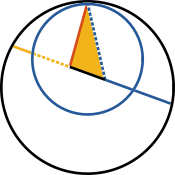
If two circles  and
and  touch one another internally, the right line joining their centres, being produced, shall pass through a point of contact.
For, if it be possible, let  join their centres, and produce it both ways; from a point of contact draw
  to the centre of , and from the same point of contact draw
  to the centre of .
Because in  ; + > (prop. I.20),
and =  as they are radii of ,
but + > ;
take away which is common,
and >  ;
;
but =  ,
,
because they are radii of ,
and ∴ > a part greater than the whole, which is absurd.
The centres are not therefore so placed, that a line joining them can pass through any point but a point of contact.
Q. E. D.
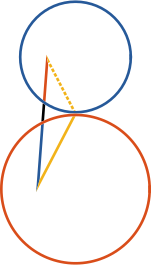
If two circle  and
and  touch one another externally, the straight line
  joining their centres, passes through the point of contact.
If it be possible, let joining the centres, and not pass through a point of contact; then from a point of contact draw and to the centres.
∵ + > (prop. I.20)
and  = (def. I.15),
and = (def. I.15),
∴ + > ,
a part greater than the whole, which is absurd.
The centres are not therefore so placed, that the line joining them can pass through any point but the point of contact.
Q. E. D.
One circle cannot touch another, either externally or internally, in more points than one
Figure I.
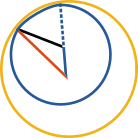
For, if it possible, let  and
and  touch one another internally in two points; draw joining their centres, and produce it until it pass through one of the points of contact (prop. III.11);
draw and  .
.
But = (def. I.15),
∴ if be added to both,
 = + ;
= + ;
but = (def. I.15),
and ∴ + = ;
but ∴ + > (prop. I.20),
which is absurd.
Figure II.

But if the points of contact be the extremities of the right line joining the centres, this straight line must be bisected in two different points for the two centres; because it is the diameter of both circles, which is absurd.
Figure III.
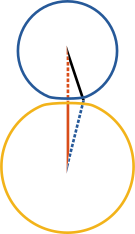
Next, if it be possible, let and  touch externally in two points; draw
  joining the centres of the circles, and passing through one of the points of contact, and draw and .
= (def. I.15);
and  = (def. I.15);
∴ + = ;
but + > (prop. I.20), which is absurd.
There is therefore no case in which two circles can touch one another in two points.
Q. E. D.
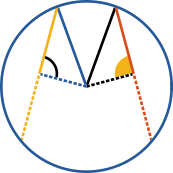
Equal straight lines (
 ) inscribed in a circle are equally distant from the centre; and also, straight lines equally distant from the centre are equal.
From the centre of  draw
draw  ⊥ to and
  ⊥ , join
  and
and  .
.
Then  = half (prop. III.3)
and  = 12 (prop. III.3),
since = (hyp.)
∴ = ,
and = (def. I.15)
∴ 2 = 2;
but since  is a right angle
2 = 2 + 2 (prop. I.47)
and 2 = 2 + 2 for the same reason,
∴ 2 + 2 = 2 + 2
∴ 2 = 2
∴ =
Also, if the lines and be equally distant from the centre; that is to say, if the perpendiculars and be given equal, then = .
For, as in the preceding case,
2 + 2 = 2 + 2
but 2 = 2
∴ = , and the doubles of these and are also equal.
Q. E. D.
The diameter is the greatest straight line in a circle: and, of all others, that which is nearest to the centre is greater than the more remote.
Figure I.
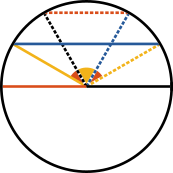
The diameter  is > any line
  .
.
For draw and  .
.
Then = 
and =  ,
,
∴ + =
but + > (prop. I.20)
∴ > .
Again, the line which is nearer the centre is greater than the one more remote.
First, let the given lines be and  , which are at the same side of the centre and do not intersect;
draw ,, ,
, .
.
In  and
and  ,
,
and = and ;
but  >
>  ,
,
∴ > (prop. I.24)
Figure II.
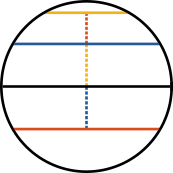
Let the given lines be  and which either are at different sides of the centre, or intersect; from the centre draw
  and
and  ⊥ and ,
make =  ,
,
and draw ⊥ .
Since and are equally distant from the centre, = (prop. III.14);
but > (prop. III.15),
∴ > .
Q. E. D.
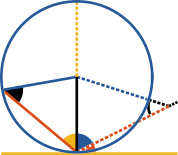
The straight line drawn from the extremity of the diameter  of a circle perpendicular to it falls without the circleAnd if any straight line
  by drawn from a point within that perpendicular to the point of contact, it cuts the circle.
Part I.
If it be possible, let , which meets the circle again, be ⊥ , and draw  .
.
Then, ∵ = ,  =
=  (prop. I.5),
and ∴ each of these angles is acute (prop. I.17)
but = (hyp.), which is absurd,
therefore drawn ⊥ does not meet the circle again.
Part II.
Let be ⊥ and let be drawn from a point  between and the circle, which, if it be possible, does not cut the circle.
∵  = ,
= ,
∴  is an acute angle;
suppose  ⊥ , drawn from the centre of the circle, it must fall at the side of the acute angle.
∴  which is supposed to be a right angle, is > ,
∴ > ;
but = ,
and ∴ > , a part greater than the whole, which is absurd. Therefore the point does not fall outside the circle, and therefore the straight line cuts the circle.
Q. E. D.
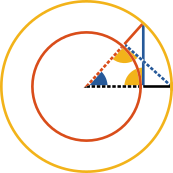
To draw a tangent to a given circle  from a given point, either in or outside of its circumference.
If a given point be in the circumference, as at  , it is plain that the straight line ⊥ the radius, will be the required tangent (prop. III.16).
But if the given point  be outside of the circumference,
draw  from it to the centre, cutting ;
and draw ⊥  ,
,
describe  concentric with radius = ,
draw  to the centre from the point where falls on circumference,
draw ⊥ from the point where it cuts ,
Then will be the tangent required.
For in  and
and 
 =
=  ,
,  common,
and = ,
∴ (prop. I.4)  =
=  = ,
= ,
∴ is a tangent to .
Q. E. D.
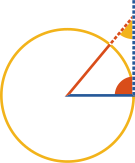
If a straight line  be a tangent to a circle, the straight line drawn from the centre to the point of contact, is perpendicular to it.
For, if it be possible, let  be ⊥ ,
then ∵  = ,
= ,  is acute (prop. I.17)
∴ > (prop. I.19);
but = ,
and ∴ > , a part greater than the whole, which is absurd.
∴ is not ⊥ ;
and in the same manner it can be demonstrated, that no other line except is perpendicular to .
Q. E. D.
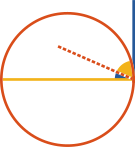
If a straight line  be a tangent to a circle, the straight line , drawn perpendicular to it from point of the contact, passes through the centre of the circle.
For, if it be possible, let the centre be without , and draw  from the supposed centre to the point of contact.
∵ ⊥ (prop. III.18)
∴  = , a right angle;
but  = (hyp.),
and ∴ = , a part equal to the whole, which is absurd.
Therefore the assumed point is not the centre; and in the same manner it can be demonstrated, that no other point without is the centre.
Q. E. D.
The angle at the centre of a circle is double the angle at the circumference, when they have the same part of the circumference for their base.
Figure I.
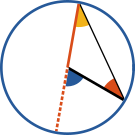
Let the centre of the circle be on 
a side of  .
.
∵ = ,
=  (prop. I.5).
But  = + ,
= + ,
or = twice (prop. I.32).
Figure II.
Let the centre be within  , the angle at the circumference;
draw  from the angular point through the centre of the circle;
then  =
=  , and
, and  = , because of the equality of the sides (prop. I.5).
Hence + + + = twice .
But  = + ,
= + ,
and = + ,
∴  = twice .
Figure III.

Let the centre be without 
and draw  , the diameter.
∵  = twice
  ;
;
and  = twice
  (case I.);
∴  = twice .
Q. E. D.
The angles in the same segment of a circle are equal.
Figure I.

Let the segment be greater than a semicircle, and draw and  to the centre.
 = twice
  or twice =
  (prop. III.20);
∴ =
Figure II.
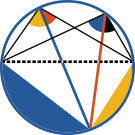
Let the segment be a semicircle, or less than a semicircle, draw the diameter, also draw .
 =
=  and
and  =
=  (case I.)
∴  =
=  .
.
Q. E. D.
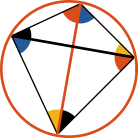
The opposite angles  and
and  ,
,  and
and  of any quadrilateral figure inscribed in a circle, are together equal to two right angles.
Draw and  the diagonals;
and because angles in the same segment are equal
 =
=  ,
,
and  =
=  ;
;
add to both.
+ = + + = two right angles (prop. I.32).
In like manner it may be shown that,
+ = .
Q. E. D.

Upon the same straight line, and upon the same side of it, two similar segments of circles cannot be constructed, which do not coincide.
For if it be possible, let two similar segments
 and
and  be constructed;
draw any right line  cutting both the segments,
draw  and .
and .
Because the segments are similar,
 =
=  (def. III.11),
but > (prop. I.16)
which is absurd;
therefore no point in either of the segments falls without the other, and therefore the segments coincide.
Q. E. D.

Similar segments  and
and  , of circles upon equal straight lines ( and ) are each equal to the other.
For, if  be so applied to
  ,
,
that may fall on ,
the extremities of may be on the extremities
and  at the same side as
  ;
;
∵ = ,
must wholly coincide with ;
and the similar segments being then upon the same straight line and at the same side of it, must also coincide (prop. III.23), and are therefore equal.
Q. E. D.
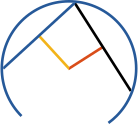
Asegment of a circle being given, to describe the circle of which it is the segment.
From any point in the segment draw and ,
bisect them, and from the points of bisection
draw ⊥
and ⊥
where they meet is the centre of the circle.
Because terminated in the circle is bisected perpendicularly by , it passes through the centre (prop. III.1), likewise passes through the centre, therefore the centre is in the intersection of these perpendiculars.
Q. E. D.
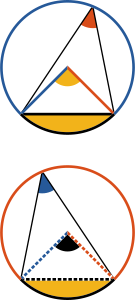
In equal circles and  , the arcs
  ,
,  on which stand equal angles, whether at the centre or circumference, are equal.
For, let  =
=  at the centre,
draw  and
and  .
.
Then since = ,
 and
and  have
have
= =  =
=  ,
,
and = ,
∴ = (prop. I.4).
But  =
=  (prop. III.20);
∴  and
and  are similar (def. III.11);
they are also equal (prop. III.24)
If therefore the equal segments be taken from the equal circles, the remaining segments will be equal;
hence  =
=  (ax. I.3);
and ∴ = .
But if the given equal angles be at the circumference, it is evident that the angles at the centre, being double of those at the circumference, are also equal, and therefore the arcs on which they stand are equal.
Q. E. D.

In equal circles  and
and  the angles
  and
and  which stand upon equal arches are equal, whether they be at the centres or at the circumferences.
For if it be possible, let one of them
be greater than the other
and make  =
=
∴  =
=  (prop. III.26)
but  = (hyp.)
∴ = a part equal to the whole, which is absurd;
∴ neither angle is greater than the other,
and ∴ they are equal.
Q. E. D.
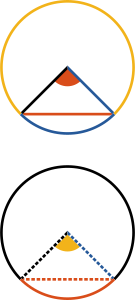
In equal circles and  , equal chords , cut off equal arches.
From the centres of the equal circles,
draw ,  and , ;
and ∵ =
, = ,
also = (hyp.)
∴  =
= 
∴  =
=  (prop. III.26)
and ∴  =
=  (ax. I.3).
Q. E. D.
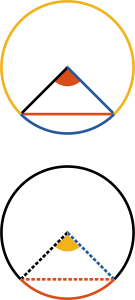
In equal circles and the chords and which subtend equal arcs are equal.
If the equal arcs be semicircles the proposition is evident. But if not,
let , and , be drawn to the centres;
∵ = (hyp.)
and = (prop. III.27);
but and = and
∴ = (prop. I.4);
but these are the chords subtending the equal arcs.
Q. E. D.
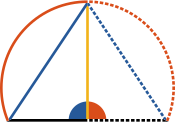
To bisect a given arc  .
.
Draw  ;
;
make = ,
draw  ⊥ , and it bisects the arc.
Draw and .
= (const.)
is common,
and  =
=  (const.)
∴ = (prop. I.4)
 =
=  (prop. III.28),
and therefore the given arc is bisected.
Q. E. D.
In a circle the angle in a semicircle is a right angle, the angle in a segment greater than a semicircle is acute, and the angle in a segment less than a semicircle is obtuse.
Figure I.
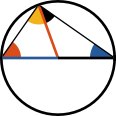
The angle  in a semicircle is a right angle.
Draw and 
 =
=  and
and  =
=  (prop. I.5)
+ = = the half of = (prop. I.32)
Figure II.
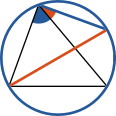
The angle  in a segment greater than a semicircle is acute
Draw the diameter, and
∴  = a right angle, ∴ is acute.
Figure III.

The angle  in a segment less than a semicircle is obtuse.
Take in the opposite circumference any point, to which draw and  .
.
∵  + = (prop. III.22)
but < (figure II.), ∴ is obtuse.
Q. E. D.
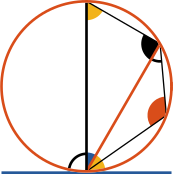
If a right line  be a tangent to a circle, and from the point of contact a right line be drawn cutting the circle, the angle
  made by this line with the tangent is equal to the angle
  in the alternate segment of the circle.
If the chord should pass through the centre, it is evident the angles are equal, for each of them is a right angle. (prop. III.16 and III.31)
But if not, draw ⊥ from the point of contact, it must pass through the centre of the circle, (prop. III.19)
∴  =
=  (prop. III.31)
+  = =
= =  (prop. I.32)
∴ = (ax. I.3).
Again  = = +
= = +  (prop. III.22)
∴  = , (ax. I.3), which is the angle in the alternate segment.
Q. E. D.
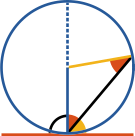
On a given straight line to describe a segment of a circle that shall contain an angle equal to a given angle  ,
,  ,
,  .
.
If a given angle be a right angle, bisect the given line, and describe a semicircle on it, this will evidently contain a right angle. (prop. III.31)
If the given angle be acute or obtuse, make with the given line, at its extremity,
 = ,
= ,
draw ⊥
and make  =
=  ,
,
describe  with or as radius, for they are equal.
is tangent to (prop. III.16)
∴ divides the circle into two segments capable of containing angles equal to and which were made respectively equal to and (prop. III.32).
Q. E. D.

To cut off from a given circle  a segment which shall contain an angle equal to a given angle
  .
.
Draw (prop. III.17), a tangent to the circle at any point;
at the point of contact make  = the given angle;
and  contains an angle = the given angle.
Because is a tangent,
and cuts it,
the angle in = (prop. III.32),
but = (const.).
Q. E. D.
If two chords 
 in a circle intersect each other, the rectangle contained by the segments of the one is equal to the rectangle contained by the segments of the other.
Figure I.

If the given right lines pass through the centre, they are bisected in the point of intersection, hence the rectangles under their segments are squares of their halves, and therefore equal.
Figure II.

Let  pass through the centre, and
  not; draw
  and
and  .
.
Then  ×
×  = 2 −
= 2 −  2 (prop. II.6), or × =
  2 − 2.
∴ × =  ×
×  (prop. II.5).
Figure III.

Let neither of the given lines pass through the centre, draw through their intersection a diameter  ,
,
and  ×
×  =
=  ×
×  (part 2.),
also × =  ×
×  (part 2.);
∴ × = × .
Q. E. D.
If from a point without a circle two straight lines be drawn to it, one of which  is a tangent to the circle, and the other
  cuts it; the rectangle under the whole cutting line and the external segment
  is equal to the square of the tangent .
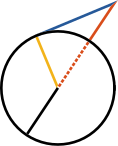
Figure I.
Let pass through the centre;
draw  from the centre to the point of contact;
2 =  2 − 2 (prop. I.47),
or 2 = 2 −  2,
2,
∴ 2 = × (prop. II.6).
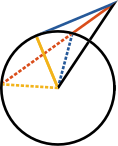
Figure II.
If  do not pass through the centre,
draw  and
and  .
.
Then ×  =
=  2 − 2 (prop. II.6),
that is, × = 2 − 2,
∴ × = 2 (prop. III.18).
Q. E. D.
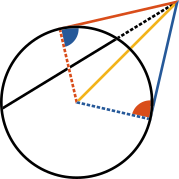
If from a point outside of a circle two straight lines be drawn, the one  cutting the circle, the other
  meeting it, and if the rectangle contained by the whole cutting line and its external segment
  be equal to the square of the line meeting the circle, the latter is a tangent to the circle.
Draw from the given point  , a tangent to the circle,
and draw from the centre  ,
,  , and
, and  ,
,
2 = × (prop. III.36)
but 2 = × (hyp.),
∴ 2 = 2,
and ∴ = .
Then in  and
and 
and = and ,
and is common,
∴  =
=  (prop. I.8);
but = a right angle (prop. III.18),
∴ = a right angle,
and ∴ is a tangent to the circle (prop. III.16).
Q. E. D.

A rectilinear figure is said to be inscribed in another, when all the angular points of the inscribed figure are on the sides of the figure in which it is said to be inscribed.
A figure is said to be described about another figure, when all the sides of the circumscribed figure pass through the angular points of the other figure.

A rectilinear figure is said to be inscribed in a circle, when the vertex of each angle of the figure is in the circumference of the circle.

A rectilinear figure is said to be circumscribed about a circle, when each of its sides is a tangent to the circle.

A circle is said to be inscribed in a rectilinear figure, when each side of the figure is a tangent to the circle.
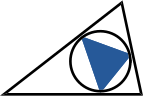
A circle is said to be circumscribed about a rectilinear figure, when the circumference passes through the vertex of each angle of the figure.
 is circumscribed.

A straight line is said to be inscribed in a circle, when its extremities are in the circumference.
The Fourth Book of the Elements is devoted to the solution of problems, chiefly relating to the inscription and circumscription of regular polygons and circles.
A regular polygon is one whose angles and sides are equal.
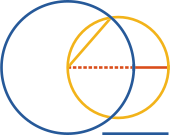
In a given circle  to place a straight line, equal to a given straight line (), not greater than the diameter of the circle.
Draw  , the diameter of ;
and if = , then the problem is solved.
But if be not equal to ,
> (hyp.);
make = (prop. I.3)
with as radius,
describe  , cutting ,
and draw  , which is the line required.
For = = (prop. I.15 and const.).
Q. E. D.
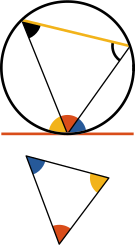
In a given circle  to inscribe a triangle equiangular to a given triangle.
To any point of the given circle draw , a tangent (prop. III.17);
and at the point of contact make  =
=  (prop. I.23)
and in like manner  =
=  ,
,
and draw .
∵ = (const.)
and =  (prop. III.32)
∴ = ;
also  = for the same reason.
∴  =
=  (prop. I.32),
and therefore the triangle inscribed in the circle is equiangular to the given one.
Q. E. D.
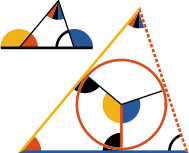
About a given circle  to circumscribe a triangle equiangular to a given triangle.
Produce any side  , of the given triangle both ways;
from the centre of the given circle draw , any radius.
Make  =
=  (prop. I.23)
and  =
=  .
.
At the extremities of the radii, draw  , and , tangents to the given circle. (prop. III.17)
The four angles of  , taken together are equal to four right angles. (prop. I.32)
but  and
and  are right angles (const.)
∴  + = , two right angles
but  = (prop. I.13)
and = (const.) and ∴ =  .
.
In the same manner it can be demonstrated that
 =
=  ;
;
∴  =
=  (prop. I.32)
and therefore the triangle circumscribed about the given circle is equiangular to the given triangle.
Q. E. D.
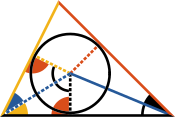
In a given triangle  to inscribe a circle.
Bisect  and
and  (prop. I.9) by and ; from the point where these lines meet draw ,
  and respectively perpendicular to , and .
In  and
and 
 =
=  ,
,  =
=  and common,
∴ = (prop. I.4 and I.26).
In like manner, it may be shown also that = ,
∴ = = ;
hence with any one of these lines as radius, describe  and it will pass through the extremities of the other two; and the sides of the given triangle, being perpendicular to the three radii at their extremities, touch the circle (prop. III.16), which is therefore inscribed in the given triangle.
Q. E. D.
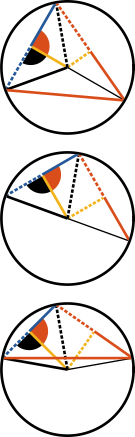
To describe a circle about a given triangle.
Make = and =  (prop. I.10)
From the points of bisection draw and ⊥ and respectively (prop. I.11), and from their point of concourse draw ,  and
and  and describe a circle with any one of them, and it will be the circle required.
In  and
and 
= (const.),
common,
 =
=  (const.),
∴ = (prop. I.4).
In like manner it may be shown that = .
∴ = = ; and therefore a circle described from the concourse of these three lines with any one of them as a radius will circumscribe the given triangle.
Q. E. D.
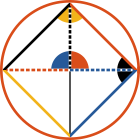
In a given circle  to inscribe a square.
Draw the two diameters of the circle ⊥ to each other, and draw , , and .
 is a square.
For, since  and
and  are, each of them, in a semicircle, they are right angles (prop. III.31),
∴ ∥ (prop. I.28):
and in like manner ∥ .
And ∵  =
=  (const.),
and = = (def. I.15).
∴ = (prop. I.4);
and since the adjacent sides and angles of the parallelogram are equal, they are all equal (prop. I.34); and ∴ , inscribed in the given circle, is a square.
Q. E. D.
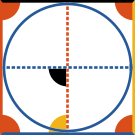
About a given circle  to circumscribe a square.
Draw two diameters of the given circle perpendicular to each other, and through their extremities draw , , and tangents to the circle;
and  is a square.
 = a right angle, (prop. III.18)
also  = (const.),
∴ ∥ ; in the same manner it can be demonstrated that ∥ , and also that and ∥ ;
∴ is a parallelogram,
and ∵ =  =
=  =
=  =
=  they are all right angles (prop. I.34);
it is also evident that , , and are equal.
∴ is a square.
Q. E. D.

To inscribe a circle in a given square.
Make = ,
and = ,
draw  ∥
∥  ,
,
and  ∥
∥ 
∴  is a parallelogram;
and since = (hyp.)
=
∴ is equilateral (prop. I.34)
In like manner it can be shown that  =
=  are equilateral parallelograms;
∴ =  = = .
= = .
and therefore if a circle be described from the concourse of these lines with any one of them as radius, it will be inscribed in the given square (prop. III.16).
Q. E. D.

To describe a circle about a given square  .
.
Draw the diagonals  and
and  intersecting each other;
then, because  and
and  have their sides equal, and the base common to both,
 =
=  (prop. I.8),
or  is bisected:
in like manner it can be shown that  is bisected;
but = ,
hence =  their halves,
∴ = (prop. I.6);
and in like manner it can be proved that
= =  = .
= .
If from the confluence of these lines with any one of them as radius, a circle be described, it will circumscribe the given square.
Q. E. D.
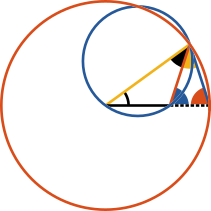
To construct an isosceles triangle, in which each of the angles at the base shall be double of the vertical angle.
Take any straight line 
and divide it so that ×  =
=  2 (prop. II.11)
With as radius, describe  and place in it from the extremity of the radius,
  = (prop. IV.1);
draw  .
.
Then  is the required triangle.
For, draw  and describe
  about
about  (prop. IV.5)
Since × = 2 = 2,
∴ is tangent to (prop. III.37)
∴  =
=  (prop. III.32),
add  to each, ∴ + = + ;
but + or  =
=  (prop. I.5):
since = (prop. I.5)
consequently = + =  (prop. I.32)
∴ = (prop. I.6)
∴ = = (const.)
∴ = (prop. I.5)
∴ = = = + = twice ;
and consequently each angle at the base is double of the vertical angle.
Q. E. D.
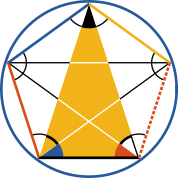
In a given circle  to inscribe an equilateral and equiangular pentagon.
Construct an isosceles triangle, in which each of the angles at the base shall be double of the angle at the vertex, and inscribe in the given circle a triangle  equiangular to it (prop. IV.2);
Bisect  and
and  (prop. I.9),
draw , ,  and .
and .
Because each of the angles  ,
,  ,
,  ,
,  and
and  are equal, the arcs upon which they stand are equal (prop. III.26); and ∴ , , , and which subtend these arcs are equal (prop. III.29) and ∴ the pentagon is equilateral, it is also equiangular, as each of its angles stand upon equal arcs (prop. III.27).
Q. E. D.
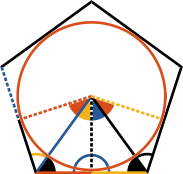
To describe an equilateral and equiangular pentagon about a given circle  .
.
Draw five tangents through the vertices of the angles of any regular pentagon inscribed in the given circle (prop. III.17).
These five tangents will form the required pentagon.
Draw 


 .
.
In  and
and 
 =
=  (prop. I.47)
= , and common;
∴  =
=  and ∴
and ∴  =
=  (prop. I.8)
∴  = twice , and
  = twice .
In the same manner it can be demonstrated that
 = twice
  , and
, and  = twice
  ;
;
but = (prop. III.27),
∴ their halves = , also  =
=  ,
,
and common;
∴ = and =  ,
,
∴  = twice .
In the same manner it can be demonstrated that  = twice ,
but =
∴ = ;
In the same manner it can be demonstrated that the other sides are equal, and therefore the pentagon is equilateral, it is also equiangular, for
= twice and = twice ,
and therefore = ,
∴ = ;
in the same manner it can be demonstrated that the other angles of the described pentagon are equal.
Q. E. D.
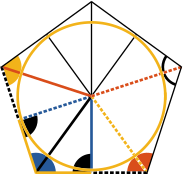
To inscribe a circle in a given equiangular and equilateral pentagon.
Let  be a given equiangular and equilateral pentagon; it is required to inscribe a circle in it.
Make  =
=  , and
, and  =
=  (prop. I.9)
Draw , , , , &c.
∵  =
=  , = , and common to the two triangles
 and
and  ;
;
∴ = and  = (prop. I.4)
And ∵  =
=  = twice
∴= twice , hence is bisected by .
In like manner it may be demonstrated that  is bisected by , and that the remaining angle of the polygon is bisected in a similar manner.
Draw , , &c. perpendicular to the sides of the pentagon.
Then in the two triangles  and
and 
we have = (const.), common,
and  =
=  = a right angle ;
∴ = (prop. I.26)
In the same way it may be shown that the five perpendiculars on the sides of the pentagon are equal to one another.
Describe  with any one of the perpendiculars as radius, and it will be the inscribed circle required. For if it does not touch the sides of the pentagon, but cut them, then a line drawn from the extremity at right angles to the diameter of a circle will fall within the circle, which has been shown to be absurd (prop. III.16).
Q. E. D.
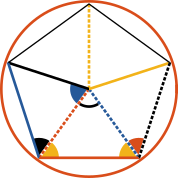
To describe a circle about a given equilateral and equiangular pentagon.
Bisect  and
and  by and , and from the point of section, draw
  , and
, and  .
.
= ,
 =
=  ,
,
∴ = (prop. I.6);
and since in  and
and  ,
,
= , and common,
also  = ;
= ;
∴ = (prop. I.4).
In like manner it may be proved that
= = .
and therefore = = = = .
Therefore if a circle be described from the point where these five lines meet, with any one of them as a radius, it will circumscribe the given pentagon.
Q. E. D.
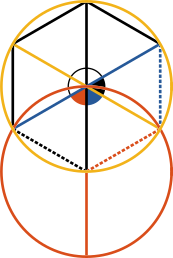
To inscribe an equilateral and equiangular hexagon in a given circle  .
.
From any point in the circumference of the given circle describe  passing through its centre, and draw the diameters , and ; draw ,
  , , &c. and the required hexagon is inscribed in the given circle.
Since passes through the centres of the circles,  and
and  are equilateral triangles, hence
  =
=  = one-third of (prop. I.32) but
  = (prop. I.13);
∴ = =  = one-third of (prop. I.32), and the angles vertically opposite to these are all equal to one another (prop. I.15), and stand on equal arches (prop. III.26), which are subtended by equal chords (prop. III.29); and since each of the angles of the hexagon is double of the angle of an equilateral triangle, it is also equiangular.
Q. E. D.
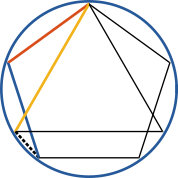
To inscribe an equilateral and equiangular quindecagon in a given circle.
Let and be the sides of an equilateral pentagon inscribed in the given circle, and the side of an inscribed equilateral triangle.
The arc subtendedby and } = 25 = 615 of the wholecircumference
The arc subtendedby } = 13 = 515 of the wholecircumference
Their difference = 115
∴ the arc subtended by  = 115 difference of the whole circumference.
Hence if straight lines equal to be placed in the circle (prop. IV.1), an equilateral and equiangular quindecagon will be thus inscribed in the circle.
Q. E. D.
A less magnitude is said to be an aliquot part or submultiple of a greater magnitude, when the less measures the greater; that is, when the less is contained a certain number of times exactly in the greater.
A greater magnitude is said to be a multiple of a less, when the greater is measured be the less; that is, when the greater contains the less a certain number of times exactly.
Ratio is the relation which one quantity bears to another of the same kind, with respect to magnitude.
Magnitudes are said to have a ratio to one another, when they are of the same kind; and the one which is not the greater can be multiplied so as to exceed the other.
The other definitions will be given throughout the book where their aid is first required.
Equimultiples or equisubmultiples of the same, or of equal magnitudes, are equal.
If A = B, thentwice A = twice B,that is, 2A = 2B;3A = 3B;4A = 4B;&c. &c.and 12 of A = 12 of B;13 of A = 13 of B;14 of A = 14 of B;&c. &c.
A multiple of a greater magnitude is greater than the same multiple of a less.
Let A > B,then 2A > 2B;3A > 3B;4A > 4B;&c. &c.
That magnitude, of which a multiple is greater than the same multiple of another, is greater than the other.
Let 2A > 2B,then A > B;or, let 3A > 3B,then A > B;or, let mA > mB,then A > B.
If any number of magnitudes be equimultiples of as many others, each of each: what multiple soever any one of the first is of its part, the same multiple shall of the first magnitudes taken together be of all the others taken together.
Let  be the same multiple of
  ,
,
that  is of
is of  ,
,
that  is of
is of  .
.
Then is evident that
} is the same multiple of {
which that is of ;
because there are as many magnitudes
in {} = {
as there are in = .
The same demonstration holds in any number of magnitudes, which has here been applied to three.
∴ If any number of magnitudes, &c.
If the first magnitude be the same multiple of the second that the third of the fourth, and the fifth the same multiple of the second that the sixth is of the fourth, then shall the first, together with the fifth, be the same multiple of the second that the third, together with the sixth, is of the fourth.
Let  , the first, be the same multiple of
  , the second, that
  , the third, is of
  , the fourth; and let
  , the fifth, be the same multiple of , the second, that
  , the sixth, is of , the fourth.
Then it is evident, that , the first and fifth together, is the same multiple of , the second, that , the third and sixth together, is of the same multiple of , the fourth; because there are as many magnitudes in = as there are in = .
∴ If the first magnitude, &c.
If the first of four magnitudes be the same multiple of the second that the third is to the fourth, and if any equimultiples whatever of the first and third be taken, those shall be equimultiples; one of the second, and the other of the fourth.
Let {  } be the same multiple of
which (  ) is of
  ;
;
take {  } the same multiple of { ,
which {  } is of ( .
Then it is evident,
that { } is the same multiple of
which { } if of ;
∵ { } contains { } contains
as many times as
} contains ( ) contains .
The same reasoning is applicable in all cases.
∴ If the first of four, &c.
V.5 Definition V.
Four magnitudes,  ,
,  , ,
, ,  , are said to be proportionals when every equimultiple of the first and third be taken, and every equimultiple of the second and fourth, as,
of the first &c. of the third
 &c.
&c.
of the second &c. of the fourth
 &c.
&c.
Then taking every pair of equimultiples of the first and third, and every pair of equimultiples of the second and fourth,
If { >, = or <
  >, = or <
  >, = or <
  >, = or <
  >, = or <
thenwill { >, = or <
  >, = or <
  >, = or <
  >, = or <
  >, = or <
That is, if twice the first be greater, equal, or less than twice the second, twice the third will be greater, equal, or less than twice the fourth; or, if twice the first be greater, equal, or less than three times the second, twice the third will be greater, equal, or less than three times the fourth, and so on, as above expressed.
If { >, = or < >, = or < >, = or < >, = or < >, = or <
thenwill { >, = or < >, = or < >, = or < >, = or < >, = or <
In other terms, if three times the first be greater, equal, or less than twice the second, three times the third will be greater, equal, or less than twice the fourth; or, if three times the first be greater, equal, or less than three times the second, then will three times the third be greater, equal, or less than three times the fourth; or if three times the first be greater, equal, or less than four times the second, then will three times the third be greater, equal, or less than four times the fourth, and so on. Again,
If { >, = or < >, = or < >, = or < >, = or < >, = or <
thenwill { >, = or < >, = or < >, = or < >, = or < >, = or <
And so on, with any other equimultiples of the four magnitudes, taken in the same manner.
Euclid expresses this definition as follows :—
The first of four magnitudes is said to have the same ratio to the second, which the third has to the fourth, when equimultiples whatsoever of the first and third being taken, and any equimultiples whatsoever of the second and fourth; if the multiple of the first be less than that of the second, and the multiple of the third is also less than that of the fourth; or, if the multiple of the first be equal to that of the second, the multiple of the third is also equal to that of the fourth; or, if the multiple of the first be greater than that of the second, the multiple of the third is also greater than that of the fourth.
In future we shall express this definition generally, thus:
If M >, = or < m ,when M >, = or < m ,
Then we infer that , the first, has the same ratio to , the second, which , the third, has to the fourth; expressed in the succeeding demonstrations thus:
: :: : ;or thus, : = : ;or thus, = :
and is read,
“ as is to , so is to .”
And if : :: : we shall infer if
M >, = or < m , then will
M >, = or < m .
That is, if the first be to the second, as the third is to the fourth; then if M times the first be greater than, equal to, or less than m times the second, then shall M times third be greater than, equal to, or less than m times the fourth, in which M and m are not to be considered particular multiples, but every pair of multiples whatever; nor are such marks as , , , &c. to be considered any more than representatives of geometrical magnitudes.
The student should throughly understand this definition before proceeding further.
If the first of four magnitudes have the same ratio to the second, which the third has to the fourth, then any equimultiples whatever of the first and third shall have the same ratio to any equimultiples of the second and fourth; viz., the equimultiple of the first shall have the same ratio to that of the second, which the equimultiple of the third has to that of the fourth.
Let :  ::
::  :
:  , then 3 : 2 :: 3 : 2 , every equimultiple of 3 and 3 are equimultiples of and , and every equimultiple of 2 and 2 , are equimultiples of and (prop. V.3)
That is, M times 3 and M times 3 are equimultiples of and , and m times 2 and m2 are equimultiples of 2 and 2 ; but : :: : (hyp.); ∴ if M3 <, =, or > m2 , then M3 <, =, or > m2 (def. V.5) and therefore 3 : 2 :: 3 : 2 (def. V.5)
The same reasoning holds good if any other equimultiple of the first and third be taken, any other equimultiple of the second and fourth.
∴ If the first four magnitudes, &c.
If one magnitude be the same multiple of another, which a magnitude taken from the first is of a magnitude taken from the other, the remainder shall be the same multiple of the remainder, that the whole is of the whole.
 = M′
= M′ 
and  = M′
= M′  ,
,
∴ − = M′ − M′ ,
∴  = M′( − ),
and ∴ = M′  .
.
∴ If one magnitude, &c.
If two magnitudes be equimultiples of two others, and if equimultiples of these be taken from the first two, the remainders are either equal to these others, or equimultiples of them.
Let  = M′ ; and
  = M′
= M′ 
then − m′ = M′ − m′ = (M′ − m′)
and − m′ = M′ − m′ = (M′ − m′) .
Hence, (M′ − m′) and (M′ − m′) are equimultiples of and , and equal to and , when M′ − m′ = 1.
∴ If two magnitudes be equimultiples, &c.
If the first of the four magnitudes has the same ratio to the second which the third has to the fourth, then if the first be greater than the second, the third is also greater than the fourth; and if equal, equal; if less, less.
Let : :: :  ; therefore, by the fifth definition, if
  >
>  , then will
  >
>  ;
;
but if > , then > and > ,
and ∴ > .
Similarly, if =, or < , then will =, or < .
∴ If the first of four, &c.
Geometricians make use of the technical term “ Invertendo,” by inversion, when there are four proportionals, and it is inferred, that the second is to the first as the fourth to the third.
Let A : B :: C : D, then, by “ invertendo” it is inferred B : A :: D : C
If four magnitudes are proportionals, they are proportionals also when taken inversely.
Let :  :: : ,
then, inversely, : :: : .
If M < m , then M < m
by the fifth definition.
Let M < m , that is, m > M ,
∴ M < m , or, m > M ;
∴ if m > M , then will m > M .
In the same manner it may be shown,
that if m = or < M ,
then will m =, or < M ;
and therefore, by the fifth definition, we infer
that : :: : .
∴ If four magnitudes, &c.
If the first be the same multiple of the second, or the same part of it, that the third is of the fourth; the first is to the second, as the third is to the fourth.
, I f the first be the same multiple of the second,or the same part of it, that the third is of thefourth; the first is to the second, as the third isto the fourth.
Let  , the first, be the same multiple of
  , the second,
that  , the third, is of
  , the fourth.
Then : :: :
take M , m , M , m ;
because is the same multiple of
that is of (according to the hypothesis);
and M if taken the same multiple of
that M is of ,
∴ (according to the third proposition),
M is the same multiple of
that M is of .
Therefore, if M be of a greater multiple than m is,
then M is a greater multiple of than m is;
that is, if M be greater than m , then M will be greater than m ;
in the same manner it can be shown, if M be equal m , then M will be equal m .
And, generally, if M >, = or < m
than M will be >, = or < m ;
∴ by the fifth definition,
: :: :
Next, let be the same part of
that is of .
In this case also : :: : .
For, because is the same part of that is of ,
therefore is the same multiple of
that is of .
Therefore, by the preceding case,
: :: : ;
and ∴ : :: : ,
by proposition B.
∴ If the first be the same multiple, &c.
If the first be to the second as the third to the fourth, and if the first be a multiple, or a part of the second; the third is the same multiple, or the same part of the fourth.
Let  : ::
: ::  : ;
: ;
and first, let be a multiple ;
shall be the same multiple of .
First Second Third Fourth 

Take = .
Whatever multiple is of
take the same multiple of ,
then, ∵ : :: :
and of the second and fourth, we have taken equimultiples,
and therefore (prop. V.4)
: :: : , but (const.),
= ∴ (prop. V.A) =
and is the same multiple of
that is of .
Next, let : :: : ,
and also a part of ;
then shall be the same part of .
Inversely (prop. V.B), : :: : ,
but is a part of ;
that is, is a multiple of ;
∴ by the preceding case, is the same multiple of
that is, is the same part of
that is of .
∴ if the first be to the second, &c.
Equal magnitudes have the same ratio to the same magnitude, and the same has the same ratio to equal magnitudes.
Let = and any other magnitude;
then : = : and : = : .
∵ = ,
∴ M = M ;
∴ if M >, = or < m , then
M >, = or < m ,
and ∴ : = : (def. V.5).
From the foregoing reasoning it is evident that,
if m >, = or < M , then
m >, = or < M
∴ : = : (def. V.5).
∴ Equal magnitudes, &c.
V.15 Definition VII.
When of the equimultiples of four magnitudes (taken as in the fifth definition), the multiple of the first is greater than that of the second, but multiple of the third is not greater than the multiple of the fourth; then the first is said to have to the second a greater ratio than the third magnitude has to the fourth: and, on the contrary, the third is said to have to the fourth a less ratio than the first has to the second.
If, among the equimultiples of four magnitudes, compared in the fifth definition, we should find  >
>  , but
, but  = or >
  , or if we should find any particular multiple M′ of the first and third, and a particular multiple m′ of the second and fourth, such, that M′ times the first is > m′ times the second, but M′ times the third is not > m′ times the fourth, i. e. = or < m′ times the fourth; then the first is said to have to the second a greater ratio than the third has to the fourth; or the third has to the fourth, under such circumstances, a less ratio than the first has to the second: although several other equimultiples may tend to show that the four magnitudes are proportionals.
This definition will in future be expressed thus :—
If M′  > m′
> m′  , but M′
  = or < m′
  ,
,
then : > : .
In the above general expression, M′ and m′ are to be considered particular multiples, not like the multiples M and m introduced in the fifth definition, which are in that definition considered to be every pair of multiples that can be taken. It must also be here observed, that , , , and the like symbols are to be considered merely the representatives of geometrical magnitudes.
In a partial arithmetical way, this may be set forth as follows:
Let us take the four numbers 8, 7, 10, and 9.
First Second Third Fourth8 7 10 916 14 20 1824 21 30 2732 28 40 3640 35 50 4548 42 60 5456 49 70 6364 56 80 7272 63 90 8180 70 100 9088 77 110 9996 84 120 108104 91 130 117112 98 140 126&c. &c. &c. &c.
Among the above multiples we find 16 > 14 and 20 > 18; that is, twice the first is greater than twice the second, and twice the third is greater than twice the fourth; and 16 < 21 and 20 < 27; that is, twice the first is less than three times the second, and twice the third is less than three times the fourth; and among the same multiples we can find 72 > 56 and 90 > 72; that is, 9 times the first is greater than 8 times the second, and 9 times the third is greater than 8 times the fourth. Many other equimultiples might be selected, which would tend to show that the numbers 8, 7, 10, and 9 were proportionals, but they are not, for we can find multiple of the first > a multiple of the second, but the same multiple of the third that has been taken of the first not > the same multiple of the fourth which has been taken to the second; for instance, 9 times the first is > 10 times the second, but 9 times the third is not > 10 times the fourth, that is 72 > 70, but 90 ≯ 90, or 8 times the first we find > 9 times the second, but 8 times the third is not greater than 9 times the fourth, that is, 64 > 63, but 80 not > 81. When any such multiples as these can be found, the first (8) is said to have the second (7) a greater ratio than the third (10) has to the fourth (9), and on the contrary the third (10) is said to have to the fourth (9) a less ratio than the first (8) has to the second (7).
Of unequal magnitudes the greater has a greater ratio to the same than the less has: and the same magnitude has a greater ratio to the less than it has to the greater.
Let  and be two unequal magnitudes,
and  any other.
We shall first prove that which is the greater of the two unequal magnitudes, has a greater ratio to than , the less, has to ; that is, : > : ;
take M′ , m′ , M′ , m′ ;
such, that M′ and M′ shall be each > ;
also take m′ the least multiple of ,
which will make m′ > M′ = M′ ;
∴ M′ is ≯ m′ ,
but M′ is > m′ , for,
as m′ is the first multiple which first becomes > M′ , than (m′ − 1) or m′ − is ≯ M′ , and ≯ M′
∴ m′ − + must be < M′ + M′ ;
that is, m′ must be < M′ ;
∴ M′ is > m′ ; but it has been shown above that M′ is ≯ m′ , therefore, by the seventh definition, has to a greater ratio than : .
Next we shall prove that has a greater ratio to , the less, than it has to , the greater;
or, : > : .
Take m′ , M′ , m′ and M′ ,
the same as in the first case, such that
M′ and M′ will be each > , and m′ the least multiple of , which first becomes greater than M′ = M′ .
∴ m′ − is ≯ M′ ,
and is ≯ M′ ; consequently
m′ − + is < M′ + M′ ;
∴ m′ is < M′ , and ∴ by the seventh definition, has to a greater ratio than has to .
∴ Of unequal magnitudes, &c.
The contrivance employed in this proposition for finding among the multiples taken, as in the fifth definition, a multiple of the first greater than the multiple of the second, but the same multiple of the third which has been taken of the first, not greater than the same multiple of the fourth which has been taken of the second, may be illustrated numerically as follows :—
The number 9 has a greater ratio to 7 than 8 has to 7: that is, 9 : 7 > 8 : 7; or 8 + 1 : 7 > 8 : 7.
The multiple of 1, which first becomes greater than 7, is 8 times, therefore, we may multiply the first and third by 8, 9, 10, or any other greater number; in this case, let us multiply the first and third by 8, and we have 64 + 8 and 64: again, the first multiple of 7 which becomes greater than 64 is 10 times; then, by multiplying the second and fourth by 10, we shall have 70 and 70; then, arranging these multiples, we have—
8 times 10 times 8 times 10 timesthe first the second the third the fourth64 + 8 70 64 70
Consequently 64 + 8, or 72, is greater than 70, but 64 is not greater than 70, ∴ by the seventh definition 9 has a greater ratio to 7 than 8 has to 7.
The above is merely illustrative of the foregoing demonstration, for this property could be shown of these or other numbers very readily in the following manner; because, if an antecedent contains its consequent a greater number of times than another antecedent contains its consequent, or when a fraction is formed of an antecedent for the numerator, and its consequent for the denominator be greater than another fraction which is formed of another antecedent for the numerator and its consequent for the denominator, the ratio of the first antecedent to its consequent is greater than the ratio of the last antecedent to its consequent.
Thus, the number 9 has a greater ratio to 7, than 8 has to 7, for 97 is greater than 87.
Again, 17 : 19 is a greater ratio than 13 : 15, because 1719 = 17×1519×15 = 255185, and 1315 = 13×1915×19 = 247185, hence it is evident that 255185 is greater than 247185, ∴ 1719 is greater than 1315, and, according to what has been above shown, 17 has to 19 a greater ratio than 13 has to 15.
So that the general terms upon which a greater, equal, or less ratio exists are as follows :—
If AB be greater than CD, A is said to have to B a greater ratio than C has to D; if AB be equal to CD, then A has to B the same ratio which C has to D; and if AB be less to CD, A is said to have to B a less ratio than C has to D.
The student should understand all up to this proposition perfectly before proceeding further, in order fully to comprehend the following propositions of this book. We therefore strongly recommend the learner to commence again, and read up to this slowly, and carefully reason at each step, as he proceeds, particularly guarding against the mischievous system of depending wholly on the memory. By following these instructions, he will find that the parts which usually present considerable difficulties will present no difficulties whatever, in prosecuting the study of this important book.
Magnitudes which have the same ratio to the same magnitude are equal to one another; and those to which the same magnitude has the same ratio are equal to one another.
Let : :: : , then = .
For, if not, let > , then will
: > : (prop. V.8), which is absurd according to the hypothesis.
∴ is ≯ .
In the same manner it may be shown, that
is ≯ ,
∴ = .
Again, let : :: : ,
then will = .
For (invert.) : :: : ,
therefore, by the first case, = .
∴ Magnitudes which have the same ratio, &c.
This may be shown otherwise, as follows :—
Let A : B = A : C, then B = C, for, as the fraction AB = the fraction AC, and the numerator of one equal to the numerator of the other, therefore, denominators of these fractions are equal, that is B = C.
Again, if B : A = C : A, B = C. For, as BA = CA, B must = C.
That magnitude which has a greater ratio than another has unto the same magnitude, is the greater of the two; and that magnitude to which the same has a greater ratio than it has unto another magnitude, is the less of the two.
Let : > : , then > .
For if not, let = or < ;
then, : = : (prop. V.7) or
: < : (prop. V.8 and invert.), which is absurd according to the hypothesis.
∴ is not = or < , and
∴ must be > .
Again, let : > : ,
then, < .
For if not, must be > or = ,
then : < : (prop. V.8 and invert.);
or : = : (prop. V.7), which is absurd (hyp.);
∴ is is not > or = ,
and ∴ must be < .
∴ That magnitude which has, &c.
Ratios that are the same to the same ratio, are the same to each other.
Let :  = : and : = :
  ,
,
then will : = : .
For if M >, = or < m ,
then M >, = or < m ,
and if M >, = or < m ,
then M >, = or < m (def. V.5);
∴ if M >, = or < m , M >, = or < m
and ∴ (def. V.5) : = : .
∴ Ratios that are the same &c.
If any number of magnitudes be proportionals, as one of the antecedents is to its consequent, so shall all the antecedents taken together be to all the consequents.
Let : = :  = : =
= : =  :
:  = : ;
= : ;
then will : = + + + + : + + + + .
For if M > m , then M > m ,
and M > m , M > m ,
also M > m (def. V.5)
Therefore, if M > m , then will
M + M + M + M + M , or M( + + + + ) be greater than m + m + m + m + m , or m( + + + + ).
In the same way it may be shown, if M times one of the antecedents be equal to or less than m times one of the consequents, M times all the antecedents taken together, will be equal to or less than m times all the consequents taken together. Therefore, by the fifth definition, as one of the antecedents is to its consequent, so are all the antecedents taken together to all the consequents taken together.
∴ If any number of magnitudes, &c.
If the first has to the second the same ratio which the third has to the fourth, but the third to the fourth a greater ratio than the fifth has to the sixth; the first shall also have to the second a greater ratio than the fifth to the sixth.
Let :  = : , but : > : ,
then : > :
For, ∵ : > : , there are some multiples (M′ and m′) of and , and of and ,
such that M′ > m′ ,
but M′ ≯ m′ , by the seventh definition.
Let these multiples be taken, and take the same multiples of and .
∴ (def. V.5) if M′ >, =, or < m′ ;
then will M′ >, =, or < m′ ,
but M′ > m′ (construction);
∴ M′ > m′ ,
but M′ is ≯ m′ (construction);
and therefore by the seventh definition,
: > :
∴ If the first has to the second, &c.
If the first has the same ratio to the second which the third has to the fourth; then, if the first be greater than the third, the second shall be greater than the fourth; and if equal, equal; and if less, less.
Let  : :: : , and first suppose
> , then will > .
For : > : (prop. V.8), and by the hypothesis : = : ;
∴ : > : (prop. V.13),
∴ < (prop. V.10), or > .
Secondly, let = , then will = .
For : = : (prop. V.7),
and : = : (hyp.);
∴ : = : (prop. V.11),
and ∴ = (prop. V.9).
Thirdly, if < , then will < ;
∵ > and : = : ;
∴ > , by the first case,
that is, < .
∴ If the first has the same ratio, &c.
Magnitudes have the same ratio to one another which their equimultiples have.
Let and be two magnitudes;
then, : :: M′ : M′ .
For : = : = : = :
∴ : :: 4 : 4 . (prop. V.12).
And as the same reasoning is generally applicable, we have
: :: M′ : M′ .
∴ Magnitudes have the same ratio, &c.
The technical term permutando, or alternando, by permutation or alternately, is used when there are four proportionals, and it is inferred that the first has the same ratio to the third which the second has to the fourth; or that the first is to the third as the second to the fourth: as is shown in the following proposition :—
Let :  :: : ,
by “ permutando” or “ alternando” it is inferred
: :: : .
It may be necessary here to remark that the magnitudes , , , , must be homogeneous, that is, of the same nature or similitude of kind; we must therefore, in such cases, compare lines with lines, surfaces with surfaces, solids with solids, &c. Hence the student will readily perceive that a line and a surface, a surface and a solid, or other heterogenous magnitudes, can never stand in the relation of antecedent and consequent.
If four magnitudes of the same kind be proportionals, they are also proportionals when taken alternately.
Let : :: : , then : :: : .
For M : M :: : (prop. V.15),
and M : M :: : (hyp.) and (prop. V.11);
also m : m :: : (prop. V.15);
∴ M : M :: m : m (prop. V.14),
and ∴ if M >, = or < m ,
then will M >, =, or < m (prop. V.14);
therefore, by the fifth definition,
: :: :
∴ If four magnitudes of the same kind, &c.
Dividendo, by division, when there are four proportionals, and it is inferred, that the excess of the first above the second is to the second, as the excess of the third above the fourth, is to the fourth.
Let A : B :: C : D;
by “ dividendo” it is inferred
A − B : B :: C − D : D.
According to the above, A is supposed to be greater than B, and C greater than D; if this be not the case, but to have B greater than A, and D greater than C, B and D can be made to stand as antecedents, and A and C as consequents, by “ invertion”
B : A :: D : C;
then, by “ dividendo,” we infer
If magnitudes, taken jointly, be proportionals, they shall also be proportionals when taken separately: that is, if two magnitudes together have to one of them the same ratio which two others have to one of these, the remaining one of the first two shall have to the other the same ratio which the remaining one of the last two has to the other of these.
Let + : :: + : ,
then will : :: : .
Take > m to each add M ,
then we have M + M > m + M ,
or M( + ) > (m + M) :
but ∵ + : :: + : (hyp.),
and M( + ) > (m + M) ;
∴ M( + ) > (m + M) (def. V.5);
∴ M + M > m + M ;
∴ M > m , by taking M from both sides:
that is, when M > m , then M > m .
In the same manner it may be proved, that if M = or < m , then will M = or < m ;
and ∴ : :: : (def. V.5)
∴ If magnitudes taken jointly, &c.
The term componendo, by composition, is used when there are four proportionals; and it is inferred that the first together with the second is to the second as the third together with the fourth is to fourth.
Let A : B :: C : D;
then, by term “ componendo,” it is inferred that
Bу “ invertion” B and D may become the first and the third, and A and C the second and fourth, as
B : A :: D : C,
then, by “ componendo,” we infer that
B + A : A :: D + C : C.
If magnitudes, taken separately, be proportionals, they shall also be proportionals taken jointly: that is, if the first be to the second as the third is to the fourth, the first and second together shall be to the second as the third and fourth together is to the fourth.
Let : :: : ,
then + : :: + : ;
for if not, let + : :: + : ,
supposing ≠ ;
∴ : :: : (prop. V.17)
but : :: : (hyp.);
∴ : :: : (prop. V.11);
∴ = (prop. V.9),
which is contrary to the supposition;
∴ is not unequal to ;
that is = ;
∴ + : :: + : .
∴ If magnitudes, taken separately, &c.
If a whole magnitude be to a whole, as a magnitude taken from the first, is to a magnitude taken from the other; the remainder shall be to the reminder, as the whole to the whole.
Let + : + :: : ,
then will : :: + : + .
For + : :: + : (alter.),
∴ : :: : (divid.),
again : :: : (alter.),
but + : + :: : (hyp.);
therefore : :: + : + (prop. V.11).
∴ If a whole magnitude be to a whole, &c.
The term “ convertendo,” by conversion, is made use of by geometricians, when there are four proportionals, and it is inferred, that the first is to its excess above the second, as the third is to its excess above the fourth. See the following proposition :—
If four magnitudes be proportionals, they are also proportionals by conversion: that is, the first is to its excess above the second, as the third is to its excess above the fourth.
Let + : :: + : ,
then shall + : :: + : .
∵ + : :: + : ;
∴ : :: : (divid.),
∴ : :: : (invert.),
∴ + : :: + : (compo.).
∴ If four magnitudes, &c.
“ Ex æquali” (sc. distantiâ), or ex æquo, from equality of distance: when there is any number of magnitudes more than two, and as many others, such that they are proportionals when taken two and two of each rank, and it is inferred that the first is to the last of the first rank of magnitudes, as the first is to the last of the others: “ of this there are two following kinds, which arise from the different order in which the magnitudes are taken, two and two.”
“ Ex æquali,” from equality. This term is used simply by itself, when the first magnitude is to the second of the first rank, as the first to the second of the other rank; and as the second to the third of the first rank, so is the second to the third of the other; and so in order: and the inference is as mentioned in the preceding definition; whence this is called ordinate proposition. It is demonstrated in (prop. V.22).
Thus, if there be two ranks of magnitudes,
A, B, C, D, E, F, the first rank, and L, M, N, O, P, Q, the second, such that A : B :: L : M, B : C :: M : N, C : D :: N : O, D : E :: O : P, E : F :: P : Q;
we infer by the term “ ex æquali” that A : F :: L : Q
“ Ex æquali in proportione perturbatâ seu inordinatâ,” from equality in perturbate, or disorderly proportion. This term is used when the first magnitude is to the second of the first rank as the last but one is to the last of the second rank; and as the second is to the third of the first rank, so is the last but two to the last but one of the second rank; and as the third is to the fourth of the first rank, so is the third from the last to the last but two of the second rank; and so on in a cross order: and the inference is in the 18th definition. It is demonstrated in (prop. V.23).
Thus, if there be two ranks of magnitudes,
A, B, C, D, E, F, the first rank, and L, M, N, O, P, Q, the second, such that A : B :: P : Q, B : C :: O : P, C : D :: N : O, D : E :: M : N, E : F :: L : M;
the term “ ex æquali in proportione perturbatâ seu inordinatâ” infers that A : F :: L : Q
If there be three magnitudes, and other three, which taken two and two, have the same ratio; then, if the first be greater than the third, the fourth shall be greater than the sixth; and if equal, equal; and if less, less.
Let ,  , , the first three magnitudes,
and , , , be the other three,
such that : :: : , and : :: : .
Then, if >, =, or < ,
then will >, =, or < .
From the hypothesis, by alternando, we have
: :: : ,
and : :: :
∴ : :: : (prop. V.11);
∴ if >, =, or < ,
then will >, =, or < (prop. V.14).
∴ If there be three magnitudes, &c.
If there be three magnitudes, and other three which have the same ratio, taken two and two, but in a cross order; then if the first magnitude be greater than the third, the fourth shall be greater than the sixth; and if equal, equal, and if less, less.
Let , , , be the first three magnitudes,
and , , , the other three,
such that : :: : ,
and : :: : .
Then if >, =, or < ,
then will >, =, or < .
First, let be > :
then, because is any other magnitude,
: > : (prop. V.8);
but : :: : (hyp.);
∴ : > : (prop. V.13);
and ∵ : :: : (hyp.);
∴ : :: : (invert.),
and it was shown that : > : , ∴ : > : (prop. V.13);
∴ < ,
that is > .
Secondly, let = ; then shall = .
For ∵ = ,
: = : (prop. V.7);
but : = : (hyp.),
and : = : (hyp. and invert.),
∴ : = : (prop. V.11),
∴ = (prop. V.9).
Next, let be < , then shall be < ;
for > ,
and it has been shown that : = : ,
and : = : ;
∴ by the first case is > ,
that is, < .
∴ If there be three, &c.
If there be any number of magnitudes, and as many others, which, taken two and two in order, have the same ratio; the first shall have to the last of the first magnitudes the same ratio which the first of the others has to the last of the same.N.B.— This is usually cited by the words “ ex æquali,” or “ ex æquo.”
First, let there be magnitudes , , ,
and as many others ,  , ,
, ,
such that
: :: : ,
and : :: : ,
then shall : :: : .
Let these magnitudes, as well as any equimultiples whatever of the antecedents and consequents of the ratios, stand as follows :—
, , , , , ,
and
M , m , N , M , m , N ,
∵ : :: : ,
∴ M : m :: M : m (prop. V.4).
For the same reason
m : N :: m : N ;
and because there are three magnitudes
M , m , N ,
and other three, M , m , N ,
which, taken two and two, have the same ratio;
∴ if M >, = or < N
then will M >, = or < N , by (prop. V.20),
and ∴ : :: : (def. V.5).
Next, let there be four magnitudes, , , , ,
and other four, , ,  ,
,  ,
,
which, taken two and two, have the same ratio,
that is to say, : :: : ,
: :: : ,
and : :: : ,
then shall : :: : ;
for, ∵ , , , are three magnitudes,
and , , , other three,
which, taken two and two, have the same ratio;
therefore, by the foregoing case : :: : ,
but : :: : ;
therefore again, by the first case, : :: : ;
and so on, whatever the number of magnitudes be.
∴ If there be any number, &c.
If there be any number of magnitudes, and as many others, which, taken two and two in a cross order, have the same ratio; the first shall have to the last of the first magnitudes the same ratio which the first of the others has to the last of the same.N.B.— This is usually cited by the words “ ex æquali in proportione perturbatâ;” or “ ex æquo perturbato.”
First, let there be three magnitudes , , ,
and other three, , , ,
which, taken two and two in a cross order, have the same ratio;
that is, : :: : ,
and : :: : ,
then shall : :: : .
Let these magnitudes and their respective equimultiples be arranged as follows :—
, , , , , ,
M , M , m , M , m , m ,
then : :: M : M (prop. V.15);
and for the same reason
: :: m : m ;
but : :: : (hyp.),
∴ M : M :: : (prop. V.11);
and ∵ : :: : (hyp.),
∴ M : m :: M : m (prop. V.4);
then, because there are three magnitudes,
M , M , m ,
and other three M , m , m ,
which, taken two and two in a cross order, have the same ratio;
therefore, if M >, =, or < m ,
then will M >, =, or < m (prop. V.21),
and ∴ : :: : (def. V.5).
Next, let there be four magnitudes,
, , , ,
and other four,
, ,  ,
,  ,
,
which, when taken two and two in a cross order, have the same ratio;
namely, : :: : ,
: :: : ,
and : :: : ,
then shall : :: : .
For, ∵ , , are three magnitudes,
and , , , other three,
which, taken two and two in a cross order have the same ratio,
therefore, by the first case, : :: : ,
but : :: : ,
therefore again, by the first case,
: :: : ;
and so on, whatever be the number of such magnitudes.
∴ If there be any number, &c.
If the first has to the second the same ratio which the third has to the fourth, and the fifth to the second the same which the sixth has to the fourth, the first and fifth together shall have to the second the same ratio which the third and sixth together have to the fourth.
First Second Third Fourth Fifth Sixth
Let : :: : ,
and : :: : ,
then + : :: + : .
For : :: : (hyp.),
and : :: : (hyp. and invert.),
∴ : :: : (prop. V.22);
and, because these magnitudes are proportionals, they are proportionals when taken jointly,
∴ + : :: + : (prop. V.18),
but : :: : (hyp.),
∴ + : :: + : (prop. V.22)
∴ If the first, &c.
If four magnitudes of the same kind are proportionals, the greatest and least of them together are greater than the other two together.
Let four magnitudes, + , + , , and , of the same kind, be proportionals, that is to say,
+ : + :: : ,
and let + be the greatest of the four, and consequently by (prop. V.A and prop. V.14), is the least;
then will + + be > + + ;
∵ + : + :: : ,
∴ : :: + : + (prop. V.19),
but + > + (hyp.),
∴ > (prop. V.A);
to each of these add + ,
∴ + + > + + .
∴ If four magnitudes, &c.
When three magnitudes are proportionals, the first is said to have to the third the duplicate ratio of that which it has to the second.
For example, if A, B, C, be continued proportionals, that is, A : B :: B : C, A is said to have to C the duplicate ratio of A : B;
or AC = the square of AB.
This property will be more readily seen of the quantities ar2, ar, a, for ar2 : ar :: ar : a;
and ar2a = r2 = the square of ar2ar = r,
or of a, ar, ar2;
for aar2 = 1r2 = the square of aar = 1r.
When four magnitudes are continual proportionals, the first is said to have to the fourth the triplicate ratio of that which is has to the second; and so on, quadruplicate, &c. increasing the denomination still by unity, in any number of proportionals.
For example, let A, B, C, D, be four continued proportionals, that is, A : B :: B : C :: C : D; A is said to have to D, the triplicate ratio of A to B;
or AD = the cube of AB.
This definition will be better understood, and applied to a greater number of magnitudes than four that are continued proportionals, as follows :—
Let ar3, ar2, ar, a, be four magnitudes in continued proportion, that is, ar3 : ar2 :: ar2 : ar :: ar : a,
then ar3a = r3 = the cube of ar3ar2 = r.
Or, let ar5, ar4, ar3, ar2, ar, a, be six magnitudes in proportion, that is
ar5 : ar4 :: ar4 : ar3 :: ar3 : ar2 :: ar2 : ar :: ar : a,
then the ratio ar5a = r5 = the fifth power of ar5ar4 = r
Or, let a, ar, ar2, ar3, ar4, be five magnitudes in continued proportion; then aar4 = 1r4 = the fourth power of aar = 1r.
To know a compound ratio :—
When there are any number of magnitudes of the same kind, the first is said to have to the last of them the ratio compounded of the ratio which the first has to the second, and of the ratio which the second has to the third, and of the ratio which the third has to the fourth; and so on, unto the last magnitude.
For example, if A, B, C, D, be four magnitudes of the same kind, the first A is said to have to the last D the ratio compounded of the ratio of A to B, and of the ratio of B to C, and of the ratio of C to D; or, the ratio of A to D is said to be compounded of the ratios of A to B, B to C, and C to D.
And if A has to B the same ratio which E has to F, and B to C the same ratio that G has to H, and C to D the same that K has to L; then by this definition, A is said to have to D the ratio compounded of ratios which are the same with the ratios of E to F, G to H, and K to L. And the same thing is to be saying, A has to D the ratio compounded of the ratios of E to F, G to H, and K to L.
In like manner, the same things being supposed; if M has to N the same ratio which A has to D, then for shortness sake, M is said to have to N the ratio compounded of the ratios E to F, G to H, and K to L.
This definition may be better understood from an arithmetical or algebraical illustration; for, in fact, a ratio compounded of several other ratios, is nothing more than a ratio which has for its antecedent the continued product of all antecedents of the ratios compounded, and for its consequent the continued product of all the consequents of the ratios compounded.
Thus, the ratio compounded of the ratios of
2 : 3, 4 : 7, 6 : 11, 2 : 5,
is the ratio of 2 × 4 × 6 × 2 : 3 × 7 × 11 × 5,
or the ratio of 96 : 1155, or 32 : 385.
And of the magnitudes A, B, C, D, E, F, of the same kind, A : F is the ratio compounded of the ratios of
A : B, B : C, C : D, D : E, E : F;
for A × B × C × D × E : B × C × D × E × F,
or A × B × C × D × EB × C × D × E × F = AF, or the ratio of A : F.
Ratios which are compounded of the same ratios are same to one another.
Let A : B :: F : G,
B : C :: G : H,
C : D :: H : K,
and D : E :: K : L,
Then the ratio which is compounded by the ratios of A : B, B : C, C : D, D : E, or the ratio of A : E, is the same as the ratio compounded of the ratios F : G, G : H, H : K, K : L, or the ratio of F : L.
For AB = FG,
BC = GH,
CD = HK,
and DE = KL;
∴ A × B × C × DB × C × D × E = F × G × H × KG × H × K × L,
and ∴ AE = FL,
or the ratio of A : E is the same as the ratio F : L.
The same may be demonstrated of any number of ratios so circumstanced.
Next, let A : B :: K : L,
B : C :: H : K,
C : D :: G : H,
D : E :: F : G,
Then the ratio which is compounded of the ratios of A : B, B : C, C : D, D : E, or the ratio of A : E, is the same as the ratio compounded of the ratios of K : L, H : K, G : H, F : G, or the ratio of F : L
For AB = KL,
BC = HK,
CD = GH,
and DE = FG;
∴ A × B × C × DB × C × D × E = K × H × G × FL × K × H × G,
and ∴ AE = FL,
or the ratio of A : E is the same as the ratio F : L.
∴ Ratios which are compounded, &c.
If several ratios be the same to several ratios, each to each, the ratio which is compounded of ratios which are the same to the first ratios, each to each, shall be the same to the ratio compounded of ratios which are the same to the other ratios, each to each.
If A : B :: a : bC : D :: c : dE : F :: e : fand G : H :: g : h and A : B :: P : QC : D :: Q : RE : F :: R : SG : H :: S : T and a : b :: V : Wc : d :: W : Xe : f :: X : Yf : h :: Y : Z
then P : T = V : Z.
For PQ = AB = ab = VWQR = CD = cd = WXRS = EF = ef = XYST = GH = gh = YZ
and ∴ P × Q × R × SQ × R × S × T = V × W × X × YW × X × Y × Z,
and ∴ PT = VZ,
or P : T = V : Z.
∴ If several ratios, &c.
If *a ratio which is compounded of several ratios be the same to a ratio which is compounded of several other ratios; and if one of the first ratios, or the ratio which is compounded of several of them, be the same to one of the last ratios, or to the ratio which is compounded of several of them; then the remaining ratio of the first, or, if there be more than one, the ratio compounded of the remaining ratios, shall be the same to the remaining ratios, shall be the same to the remaining ratio of the last, or, if there be more than one, to the ratio, compounded of these remaining ratios.*
Let A : B, B : C, C : D, D : E, E : F, F : G, G : H, be the first ratios, and P : Q, Q : R, R : S, S : T, T : X, the other ratios; also, let A : H, which is compounded of the first ratios, be the same as the ratio of P : X, which is the ratio compounded of the other ratios; and, let the ratio of A : E, which is compounded of the ratios of A : B, B : C, C : D, D : E, be the same as the ratio of P : R, which is compounded of the ratios P : Q, Q : R.
Then the ratio which is compounded of the remaining first ratios, that is, the ratio compounded of the ratios E : F, F : G, G : H, that is, the ratio of E : H, shall be the same as the ratio of R : X, which is compounded of the ratios of R : S, S : T, T : X, the remaining other ratios.
Because A × B × C × D × E × F × GB × C × D × E × F × G × H = P × Q × R × S × TQ × R × S × T × X,
or A × B × C × DB × C × D × E × E × F × GF × G × H = P × QQ × R × R × S × TS × T × X,
and A × B × C × DB × C × D × E = P × QQ × R
∴ E × F × GF × G × H = R × S × TS × T × X,
∴ EH = RX,
∴ E : H = R : X.
∴ If a ratio which, &c.
If *there be any number of ratios, and any number of other ratios, such that the ratio which is compounded of ratios, which are the same to the first ratios, each to each, is the same to the ratio which is compounded of ratios, which are the same, each to each, to the last ratios—and if one of the first ratios, or the ratio which is compounded of ratios, which are the same to several of the first ratios, each to each, be the same to one of the last ratios, or to the ratio which is compounded of ratios, which are the same, each to each, to several of the last ratios—then the remaining ratio of the first; or, if there be more than one, the ratio which is compounded of ratios, which are the same, each to each, to the remaining ratios of the first, shall be the same to the remaining ratio of the last; or, if there be more than one, to the ratio which is compounded of ratios, which are the same, each to each, to these remaining ratios.*
h k m n sA B, C D, E F, G H, K L, M N a b c d e f gO P, Q R, S T, V W, X Y h k l m n pa b k m e f g
Let A : B, C : D, E : F, G : H, K : L, M : N, be the first ratios, and O : P, Q : R, S : T, V : W, X : Y, the other ratios;
and let A : B = a : b,C : D = b : c,E : F = c : f,G : H = d : e,K : L = e : f,M : N = f : g.
Then, by the definition of a compound ratio, the ratio of a : g is compounded of the ratios of a : b, b : c, c : d, d : e, e : f, f : g, which are the same as the ratio of A : B, C : D, E : F, G : H, K : L, M : N, each to each.
Also, O : P = h : k,Q : R = k : l,S : T = l : m,V : W = m : n,X : Y = n : p,
Then will the ratio of h : p be the ratio compounded of the ratios of h : k, k : l, l : m, m : n, n : p, which are the same as the ratios of O : P, Q : R, S : T, V : W, X : Y, each to each.
∴ by the hypothesis a : g = h : p.
Also, let the ratio which is compounded of the ratios of A : B, C : D, two of the first ratios (or the ratios of a : c for A : B = a : b, and C : D = b : c), be the same as the ratio of a : d, which is compounded of the ratios of a : b, b : c, c : d, which are the same as the ratios of O : P, Q : R, S : T, three of the other ratios.
And let the ratios of h : s, which is compounded of the ratios of h : k, k : m, m : n, n : s, which are the same as the remaining first ratios, namely, E : F, G : H, K : L, M : N; also, let the ratio of e : g, be that which is compounded of the ratios e : f , f : g, which are the same, each to each, to the remaining other ratios, namely V : W, X : Y. Then the ratios of h : s shall be the same as the ratio of e : g; or h : s = e : g.
For A × C × E × G × K × MB × D × F × H × L × N = a × b × c × d × e × fb × c × d × e × f × g,
and O × Q × S × V × XP × R × T × W × Y = h × k × l × m × nk × l × m × n × p,
by the composition of the ratios;
∴ a × b × c × d × e × fb × c × d × e × f × g = h × k × l × m × nk × l × m × n × p (hyp.),
or a × bb × c × c × d × e × fd × e × f × g = h × k × lk × l × m × m × nn × p,
but a × bb × c = A × CB × D = O × Q × SP × R × T = a × b × cb × c × d = h × k × lk × l × m;
∴ c × d × e × fd × e × f × g = m × nn × p.
And c × d × e × fd × e × f × g = h × k × l × m × nk × l × m × n × p (hyp.),
and m × nn × p = e × ff × g (hyp.),
∴ h × k × l × m × nk × l × m × n × p = effg,
∴ hs = eg,
∴ h : s = e : g.
∴ If there be any number, &c.

Rectilinear figures are said to be similar, when they have their several angles equal, each to each, and the sides about the equal angles proportional.
Two sides of one figure are said to be reciprocally proportional to two sides of another figure when one of the sides of the first is to the second, as the remaining side of the second is to the remaining side of the first.
A straight line is said to be cut in extreme and mean ratio, when the whole is to the greater segment, as the greater segment is to the less.
The altitude of any figure is the straight line drawn from its vertex perpendicular to its base, or the base produced.


Triangles and parallelograms having the same altitude are to one another as their bases.
Let the triangles  and
and  have a common vertex, and their bases and in the same straight line.
Produce  both ways, take successively on produced lines equal to it; and on produced lines successively equal to it; and draw lines from the common vertex to their extremities.
The triangles  thus formed are all equal to one another, since their bases are equal. (prop. I.38)
∴ and its base are respectively equimultiples of and the base .
In like manner  and its base are respectively equimultiples of and the base .
∴ if m or 6 times >, = or < n or 5 times then m or 6 times >, = or < n or 5 times , m and n stand for every multiple taken as in the fifth definition of the Fifth Book. Although we have only shown that this property exists when m equal 6, and n equal 5, yet it is evident that the property holds good for every multiple value that may be given to m, and to n.
∴ : :: : (def. V.5)
Parallelograms having the same altitude are the doubles of the triangles, on their bases, and are proportional to them (Part I), and hence their doubles, the parallelograms, are as their bases (prop. V.15).
Q. E. D.
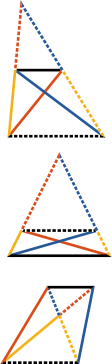
If a straight line be drawn parallel to any side  of a triangle, it shall cut the other sides, or those sides produced, into proportional segmentsAnd if any straight line divide the sides of a triangle, or those sides produced, into proportional segments, it is parallel to the remaining side .
Part I.
Let ∥ , then shall
: ::  : .
: .
Draw and ,
and  =
=  (prop. I.37);
∴ :  :: : (prop. V.7);
but : :: : (prop. VI.1),
∴ : :: : (prop. V.11).
Part II.
Let : :: : .
then ∥ .
Let the same construction remain,
∵ : :: : and : :: : } (prop. VI.1) ;
but : :: : (hyp.)
∴ : :: : (prop. V.11)
∴ = (prop. V.9);
but they are on the same base , and at the same side of it, and
∴ ∥ (prop. I.39).
Q. E. D.
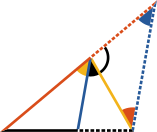
Aright line () bisecting the angle of a triangle, divides the opposite side into segments (, ) proportional to the conterminous sides (, ).And if a straight line () drawn from any angle of a triangle divide the opposite side ( ) into segments (, ) proportional to the conterminous sides (, ), it bisects the angle.
Part I.
Draw  ∥ , to meet
  ;
;
then,  =
=  (prop. I.29).
∴  = ; but =
  , ∴ = ,
∴ = (prop. I.6);
and ∵ ∥ ,
: :: : (prop. VI.2);
but = ;
∴ : :: : (prop. V.7).
Part II.
Let the same construction remain,
and : :: : (prop. VI.2);
but : :: : (hyp.)
∴ : :: : (prop. V.11).
and ∴ = (prop. V.9),
and ∴ = (prop. I.5);
but since ∥ ; = ,
and = (prop. I.29);
∴ = , and = ,
and ∴ bisects  .
.
Q. E. D.
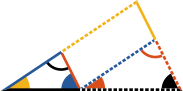
In equiangular triangles ( and
and  ) the sides about the equal angles are proportional, and the sides which are opposite to the equal angles are homologous.
Let the equiangular triangles be so placed that two sides  ,
,  opposite to equal angles
  and
and  may be conterminous, and in the same straight line; and that the triangles lying at the same side of that straight line; and that the triangles lying at the same side of that straight line, may have the equal angles not conterminous, i. e.
  opposite to
  , and
, and  to
to  .
.
Draw and .
Then, ∵ = , ∥  (prop. I.28);
and for a like reason ∥  ,
,
∴  is a parallelogram.
But : :: : (prop. VI.2);
and since = (prop. I.34),
: :: : ;
and by alternation : :: : (prop. V.16).
In like manner it may be shown, that
: :: : ;
and by alternation, that
: :: : ;
but it has been already proved that
: :: :
and therefore, ex æquali,
: :: : (prop. V.22),
therefore the sides about the equal angles are proportional, and those which are opposite to the equal angles are homologous.
Q. E. D.
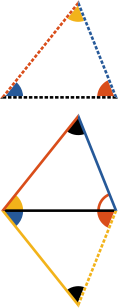
If two triangles have their sides proportional (  : :: : ) and ( : :: :
  ) they are equiangular, and the equal angles are subtended by the homologous sides.
From the extremities of , draw  and , making
 = ,
= ,  =
=  (prop. I.23);
and consequently  =
=  (prop. I.32),
and since the triangles are equiangular,
: :: : (prop. VI.4);
but : :: : (hyp.);
∴ : :: : , and consequently = (prop. V.9). In like manner it may be shown that
= .
Therefore, the two triangles having a common base , and their sides equal, have also equal angles opposite to equal sides, i. e.
 = and
= and  = (prop. I.8).
but = (const.) and ∴ = ;
for the same reason = ,
and consequently  = (prop. I.32);
and therefore the triangles are equiangular, and it is evident that the homologous sides subtended by the equal angles.
Q. E. D.
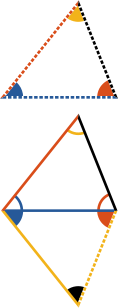
If two triangles ( and
and  ) have one angle (
 ) of the one, equal to one angle (
 ) of the other, and the sides about the equal angles proportional, the triangles shall be equiangular, and have those angles equal which the homologous sides subtend.
From the extremities of , one of the sides of , about ,
draw and  ,
,
making  = ,
= ,
and  = ;
= ;
then  =
=  (prop. I.32),
and two triangles being equiangular,
: :: : (prop. VI.4);
but : :: : (hyp.)
∴ : :: : (prop. V.11),
and consequently = (prop. V.9);
∴ =  in every respect (prop. I.4).
But = (const.),
and ∴  = ;
= ;
and since also = ,
 = (prop. I.32);
and ∴ and are equiangular, with their equal angles opposite to homologous sides.
Q. E. D.
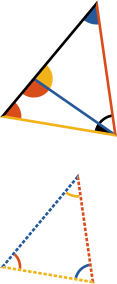
If two triangles ( and
and  ) have one angle in each equal (
 equal to
  ), the sides about two other angles ( : ::
  :
:  ), and each of the remaining angles (
 and
and  ) either less or not less than a right angle, the triangles are equiangular, and those angles are equal about which the sides are proportional.
First let it be assumed that the angles and are each less than a right angle: then if it be supposed that  and
and  contained by the proportional sides, are not equal, let be greater, and make
  = .
= .
∵ = (hyp.) and = (const.)
∴  = (prop. I.32);
∴ : :: : (prop. VI.4),
but : :: : (hyp.)
∴ : :: : ;
∴ = (prop. V.9),
and ∴ =  (prop. I.5).
But is less than a right angle (hyp.)
∴ is less than a right angle;
and ∴ must be greater than a right angle (prop. I.13), but it has been proven = and therefore less than a right angle, which is absurd. ∴ and are not unequal;
∴ they are equal, and since = (hyp.)
∴ = (prop. I.32), and therefore the triangles are equiangular.
But if and be assumed to be each not less than a right angle, it may be proved as before, that the triangles are equiangular, and have the sides about equal the angles proportional (prop. VI.4).
Q. E. D.

In a right angled tiangle ( ), if a perpendicular () be drawn from the right angle to the opposite side, the triangles (
 ,
,  ) on each side of it are similar to the whole triangle and to each other.
∵  =
=  (ax. I.11),
and  common to and ;
 =
=  (prop. I.32);
∴ and are equiangular; and consequently have their sides about the equal angles proportional (prop. VI.4), and are therefore similar (def. VI.1).
In like manner it may be proved that is similar to ; but has been shown to be similar to ;
∴ and are similar to the whole and to each other.
Q. E. D.
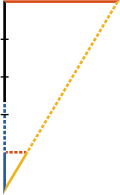
From a given straight line ( ) to cut off any required part.
From either extremity of the given line draw  making any angle with ;
and produce till the whole produced line  contains
  as often as contains the required part.
Draw  ,
,
and draw  ∥ .
∥ .
 is the required part of .
For since ∥
:  :: :
:: :  (prop. VI.2),
and by composition (prop. V.18);
: :: : ;
but contains as often as contains the required part (const.);
∴ is the required part.
Q. E. D.
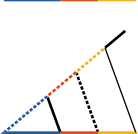
To divide a given straight line ( ) similarly to a given divided line (
 ).
).
From either extremity of the given line draw  making any angle;
take  ,
,  and
and  equal to ,
  and
and  respectively (prop. I.2);
draw  , and draw
  and
and  ∥ to it.
Since are ∥,
 :
:  :: : (prop. VI.2),
or : :: : (const.),
and : :: : (prop. VI.2),
: :: : (const.),
and ∴ the given line is divided similarly to .
Q. E. D.
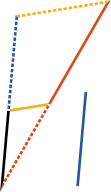
To find a third proportional to two given straight lines ( and
and  ).
).
At either extremity of the given line draw  making an angle;
take  = , and draw
  ;
;
make  = ,
= ,
and draw  ∥ ; (prop. I.31)
 is the third proportional to and .
For since ∥ ,
∴ : :: : (prop. VI.2);
but = = (const.);
∴ : :: : (prop. V.7).
Q. E. D.
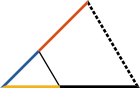
To find a fourth proportional to three given lines 

 .
.
Draw  and
and  making any angle;
take = ,
and = ,
also = ,
draw  ,
,
and ∥ (prop. I.31);
 is the fourth proportional.
On account of the parallels,
: :: : (prop. VI.2);
but = 

 (const.);
∴ : :: : (prop. V.7).
Q. E. D.
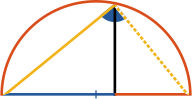
To find a mean proportional between two given straight lines  .
.
Draw any straight line  ,
,
make  = and
= and  = ;
= ;
bisect ; and from the point of bisection as a centre, and half line as a radius, describe a semicircle  ,
,
draw  ⊥ :
⊥ :
is the mean proportional required.
Draw and  .
.
Since  is a right angle (prop. III.31),
and is ⊥ from it upon the opposite side,
∴ is a mean proportional between and (prop. VI.8),
and ∴ between and (const.).
Q. E. D.

Equal parallelograms  and
and  , which have one angle in each equal, have the sides about the equal angles reciprocally proportional( : :: : )And parallelograms which have one angle in each equal, and the sides about them reciprocally proportional, are equal.
Let and ; and and , be so placed that  and
and  may be continued right lines. It is evident that they may assume this position. (prop. I.13 to I.15)
Complete  .
.
Since = ;
∴ : :: : (prop. V.7)
∴ : :: : (prop. VI.1)
The same construction remaining:
: :: { : (prop. VI.1) : (hyp.) : (prop. VI.1)
∴ : :: : (prop. V.11)
and ∴ = (prop. V.9).
Q. E. D.

Equal triangles, which have one angle in each equal (  =
=  ), have the sides about the equal angles reciprocally proportional( : :: : )And two triangles which have an angle of the one equal to an angle of the other, and the sides about the equal angles reciprocally proportional, are equal.
I.
Let the triangles be so placed that the equal angles and may be vertically opposite, that is to say, so that and may be in the same straight line. Whence also and must be in the same straight line (prop. I.14).
, then : ::  :
:  (prop. VI.1)::
  : (prop. V.7):: : (prop. VI.1)
∴ : :: : (prop. V.11).
II.
Let the same construction remain, and
: :: : (prop. VI.1)
and : :: : (prop. VI.1)
but : :: : , (hyp.)
∴ : :: : (prop. V.11);
∴ = (prop. V.9).
Q. E. D.

If four straight lines be proportional ( : :: : ) the rectangle ( × ) contained by the extremes, is equal to the rectangle ( × ) contained by the means.And if the rectangle contained by the extremes be equal to the rectangle contained by the means, the four straight lines are proportional.
Part I.
From the extremities of and draw and ⊥ to them and = and respectively:
complete the parallelograms  and
and  .
.
and since,
: :: : (hyp.)
∴ : :: : (const.)
∴ = (prop. VI.14),
that is, the rectangle contained be the extremes, equal to the rectangle contained be the means.
Part II.
Let the same construction remain;
∵ = , =
and = .
∴ : :: : (prop. VI.14)
But = ,
and = (const.)
∴ : :: : (prop. V.7).
Q. E. D.

If three striaght lines be proportional ( : :: : ) the rectangle under the extremes is equal to the square of the mean.And if the rectangle under the extremes be equal to the square of the mean, the three straight lines are proportional.
Part I.
Assume = ,and since : :: : ,then : :: : ,∴ × = ×
(prop. VI.16).
But = ,
∴ × = × or = 2;
therefore, if the three straight lines are proportional, the rectangle contained be the extremes is equal to the square of the mean.
Part II.
Assume = ,
then × = × ,
∴ : :: : (prop. VI.16),
and : :: : .
Q. E. D.

On a given straight line () to construct a rectilinear figure similar to a given one ( ) and similarly placed.
Resolve the given figure into triangles by drawing the lines and  .
.
At the extremities of make
 =
=  and
and  =
=  ;
;
again at the extremities of make
 =
=  and
and  =
=  ;
;
in like manner make
 =
=  and
and  =
=  .
.
Then =  .
.
It is evident from the construction and (prop. I.32) that the figures are equiangular; and since the triangles  and
and  are equiangular;
then by (prop. VI.4), : :: : 
and : :: :
Again, because  and
and  are equiangular,
: :: :
∴ ex æquali,
: :: : (prop. V.22)
In like manner it may be shown that the remaining sides of the two figures are proportional.
∴ by (prop. VI.1)
is similar to and similarly situated; and on the given line .
Q. E. D.

Similar triangles ( and
and  ) are to one another in the duplicate ratio of their homologous sides.
Let  and
and  be equal angles, and
  and homologous sides of the similar triangles and and on the greater of these lines take
  a third proportional, so that
: :: : ;
draw .
: :: : (prop. VI.4);
∴ : :: : (prop. V.16),
but : :: : (const.),
∴ : :: :
consequently =  for they have the sides about the equal angles and reciprocally proportional (prop. VI.15);
∴ : :: : (prop. V.7);
but : :: : (prop. VI.1),
∴ : :: : ,
that is to say, the triangles are to one another in the duplicate ratio of their homologous sides and (def. V.11).
Q. E. D.
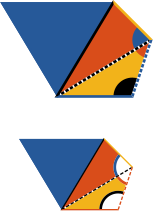
Similar polygons may be divided into the same number of similar triangles, each similar pair of which are proportional to the polygons; and the polygons are to each other in the duplicate ratio of their homologous sides.
Draw and , and  and
and  , resolving the polygons into triangles. Then because the polygons are similar,
  =
=  , and : ::
  :
: 
∴  and
and  are similar,
and  =
=  (prop. VI.6);
but  =
=  because they are angles of similar polygons; therefore the remainders
  and
and  are equal;
hence : :: : ,
on account of the similar triangles,
and : :: :  ,
,
on account of the similar polygons,
∴ : :: : ,
ex æquali (prop. V.22), and as these proportional sides contain equal angles, the triangles  and
and  are similar (prop. VI.6).
In like manner it may be shown that the triangles  and
and  are similar.
But is to in the duplicate ratio of to (prop. VI.19),
and is to in like manner, in the duplicate ratio of to ;
∴ : :: : (prop. V.11).
Again is to in the duplicate ratio of to , and is to in the duplicate ratio of to .
: :: : :: : ;
and as one of the antecedents is to one of the consequents, so is the sum of all the antecedents to the sum of all the consequents; that is to say, the similar triangles have to one another the same ratio as the polygons (prop. V.12).
But is to in the duplicate ratio of to ;
∴  is to
is to  in the duplicate ratio of to .
Q. E. D.

Rectilinear figures ( and
and  ) which are similar to the same figure (
 ) are similar also to each other.
Since and are similar, they are equiangular, and have the sides about the equal angles proportional (def. VI.1); and since the figures and are also similar, they are equiangular, and have the sides about the equal angles proportional; therefore and are also equiangular, and have the sides about the equal angles proportional (prop. V.11), and are therefore similar.
Q. E. D.
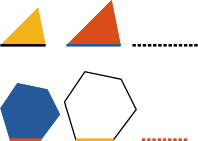
If four straight lines be proportional ( : :: : ), the similar rectilinear figures similarly described on them are also proportional.And if four similar rectilinear figures, similarly described on four straight lines, be proportional, the straight lines are also proportional.
Part I.
Take  a third proportional to and , and a third proportional to and (prop. VI.11);
since : :: : (hyp.)
: :: : (const.)
∴ ex æquali,
: :: : ;
but  :
:  :: : (prop. VI.20),
and  :
:  :: : ;
∴ : :: : (prop. V.11).
Part II.
Let the same construction remain;
: :: : (hyp.),
∴ : :: : (const.),
and ∴ : :: : (prop. V.11).
Q. E. D.

Equiangular parallelograms ( and
and  ) are to one another in a ratio compounded of the ratios of their sides.
Let two of the sides and about the equal angles be placed so that they may form one straight line.
Since  +
+  = ,
= ,
and  = (hyp.),
+ = ,
and ∴ and form one straight line (prop. I.14);
complete  .
.
Since : :: : (prop. VI.1),
and : :: : (prop. VI.1),
has to a ratio compounded of the ratios of to , and of to .
Q. E. D.
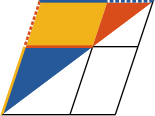
In any parallelogram ( ) the parallelograms (
 and
and  ) which are about the diagonal are similar to the whole, and to each other.
As and have a common angle they are equiangular;
but ∵ ∥ 
 and
and  are similar (prop. VI.4),
∴ : ::  : ;
: ;
and the remaining opposite sides are equal to those,
∴ and have the sides about the equal angles proportional, and are therefore similar.
In the same manner it can be demonstrated that the parallelograms and are similar.
Since, therefore, each of the parallelograms and is similar to , they are similar to each other.
Q. E. D.
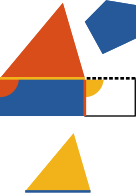
To describe a rectilinear figure, which shall be similar to a given rectilinear figure ( ), and equal to another (
 ).
).
Upon describe  = ,
= ,
and upon describe  = ,
= ,
and having  =
=  (prop. I.45),
and then and  will lie in the same straight line (prop. I.14 and I.29).
Between and find a mean proportional (prop. VI.13),
and upon describe  , similar to , and similarly situated.
Then = .
For since and are similar, and
: :: : (const.),
: :: : (prop. VI.20);
but : :: : (prop. VI.1);
∴ : :: : (prop. V.11);
but = (const.),
and ∴ = (prop. V.14);
and = (const.);
consequently, which is similar to is also = .
Q. E. D.

If similar and similarly posited parallelograms ( and
and  ) have a common angle, they are about the same diagonal.
For, if possible, let  be the diagonal of and draw ∥ (prop. I.31).
Since  and are about the same diagonal , and have
  common, they are similar (prop. VI.24);
∴  :
:  ::
::  :
:  ;
;
but :  :: : (hyp.),
∴ : :: : ,
and ∴ = (prop. V.9), which is absurd.
∴ is not the diagonal of in the same manner it can be demonstrated that no other line is except  .
.
Q. E. D.

Of all the rectangles contained by the segments of a given straight line, the greatest is the square which is described on half the line.
Let  be the given line,
 and
and  unequal segments,
and  and
and  equal segments;
then  >
>  .
.
For it has been demonstrated already (prop. II.5), that the square of half the line is equal to the rectangle contained by any unequal segments together with the square of the part intermediate between the middle point and the point of unequal section. The square described on half the line exceeds therefore the rectangle contained by any unequal segments of the line.
Q. E. D.
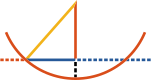
To divide a given straight line ( ) so that the rectangle contained by its segments may be equal to a given area, not exceeding the square of half the line.
Let the given area be =  2.
2.
Bisect , or make  = ;
= ;
and if 2 = 2,
the problem is solved.
But if 2 ≠ 2,
then must > (hyp.).
Draw  ⊥ = ;
⊥ = ;
make  = or ;
with as radius describe a circle cutting the given line; draw  .
.
Then  ×
×  +
+  2 = 2 (prop. II.5) = 2.
But 2 = 2 + 2 (prop. I.47);
∴ × + 2 = 2 + 2,
from both, take 2,
and × = 2.
But = (const.),
and ∴ is so divided that × = 2.
Q. E. D.
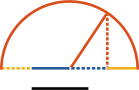
To produce a given straight line ( ), so that the rectangle contained by the segments between the extremities of the given line and the point to which it is produced, may be equal to a given area, i. e. equal to the square on
  .
.
Make  =
=  ,
,
and draw  ⊥ = ;
⊥ = ;
draw  ;
;
and with the radius , describe a circle meeting produced.
Then  ×
×  + 2 =
+ 2 =  2 (prop. II.6) = 2.
But 2 = 2 + 2 (prop. I.47)
∴ × + 2 = 2 + 2,
from both take 2,
and ∴ × = 2
but = ,
∴ 2 = the given area.
Q. E. D.

To cut a given finite straight line ( ) in extreme and mean ratio.
On describe the square  (prop. I.46);
and produce  , so that
  ×
×  = 2 (prop. VI.29);
take  = ,
= ,
and draw  ∥ ,
∥ ,
meeting  ∥ (prop. I.31).
Then  = × , and is ∴ = ;
and if from both these equals be taken the common part  ,
,
 , which is the square of ,
will be =  , which is = ×
  ;
;
that is 2 = × ;
∴ : :: : ,
and is divided in extreme and mean ratio (def. VI.3).
Q. E. D.
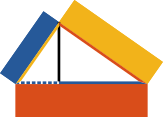
If any similar rectilinear figures be similarly described on the sides of a right angled triangle ( ), the figure described on the side (
 ) subtending the right angle is equal to the sum of the figures on the other sides.
From the right angle draw  perpendicular to ;
then :  :: :
:: :  (prop. VI.8).
∴  :
:  :: : (prop. VI.20).
but :  :: :
:: :  (prop. VI.20).
Hence + : :: + : ;
but + = ;
and ∴ + = .
Q. E. D.

If two triangles ( and
and  ), have two sides proportional ( : :: : ), and be so placed at an angle that the homologous sides are parallel, the remaining sides ( and ) form one right line.
Since ∥ ,
 =
=  (prop. I.29);
and also since ∥ ,
=  (prop. I.29);
∴ = ;
and since : :: : (hyp.),
the triangles are equiangular (prop. VI.6);
∴  =
=  ;
;
but = ;
∴  + + = + + = (prop. I.32),
and ∴ and lie in the same straight line (prop. I.14).
Q. E. D.
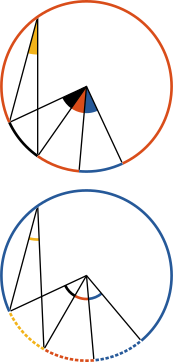
In equal circles (,  ), angles, whether at the centre or circumference, are in the same ratio to one another as the arcs on which they stand (
  :
:  ::
::  :
:  ); so also are sectors.
Take in the circumference of any number of arcs  ,
,  , &c. each = , and also in the circumference of take any number of arcs
  ,
,  , &c. each = , draw the radii to the extremities of the equal arcs.
The since the arcs , , , &c. are all equal, the angles ,  ,
,  , &c. are also equal (prop. III.27); ∴
  is the same multiple of which the arc
  is of ; and in the same manner
  is the same multiple of , which the arc
  is of the arc .
Then it is evident (prop. III.27),
if (or if m times ) >, =, < (or n times )
then (or m times ) >, =, < (or n times );
∴ : :: : (def. V.5), or the angles at the centre are as the arcs on which they stand; but the angles at the circumference being halves of the angles at the centre (prop. III.20) are in the same ratio (prop. V.15), and therefore are as the arcs on which they stand.
It is evident, that sectors in equal circles, and on equal arcs are equal (prop. I.4, III.24 and III.27 and def. III.9). Hence, if the sectors be substituted for the angles in the above demonstration, the second part of the proportion will be established, that is, in equal circles the sectors have the same ratio to one another as the arcs on which they stand.
Q. E. D.
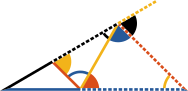
If the right line ( ) bisecting an external angle
  of the triangle
  meet the opposite side (
 ) produced, that whole produced side (
 ), and its external segment (
 ) will be proportional to the sides (
 and
and  ), which contain the angle adjacent to the external bisected angle.
For if  be drawn ∥ ,
then  =
=  , (prop. I.29);=
  , (hyp.),=
  , (prop. I.29);
and ∴  = , (prop. I.6),
and : :: : (prop. V.7);
But also, : :: : (prop. VI.2);
and therefore : :: : (prop. V.11).
Q. E. D.
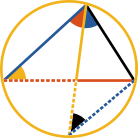
If an angle of a triangle be bisected by a straight line, which likewise cuts the base; the rectangle contained by the sides of the triangle is equal to the rectangle contained by the segments of the base, together with the square of the straight line which bisects the angle.
Let  be drawn, making
  =
=  ;
;
then shall  ×
×  =
=  ×
×  + 2.
+ 2.
About  describe
  (prop. IV.5),
produce to meet the circle, and draw  .
.
Since = (hyp.),
and  =
=  (prop. III.21),
∴  and
and  are equiangular (prop. I.32);
∴ : ::  : (prop. VI.4);
∴ × = × (prop. VI.16)
=  × + 2 (prop. II.3);
but × = × (prop. III.35);
∴ × = × + 2
Q. E. D.
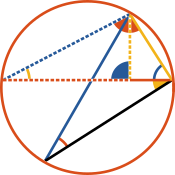
If from any angle of a triangle a straight line be drawn perpendicular to the base; the rectangle contained by the sides of the triangle is equal to the rectangle contained by the perpendicular and the diameter of the circle described about the triangle.
From  of
of 
draw  ⊥
⊥  ;
;
then shall × = × the diameter of the described circle.
Describe  (prop. IV.5), draw its diameter , and draw ;
then ∵  =
=  (const. and prop. III.31);
and  =
=  (prop. III.21);
∴  is equiangular to
  (prop. VI.4);
∴ : :: : ;
and ∴ × = × (prop. VI.16).
Q. E. D.
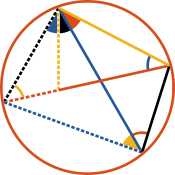
The rectangle contained by the diagonals of a quadrilateral figure inscribed in a circle, is equal to both the rectangles contained by its opposite sides.
Let  be any quadrilateral figure inscribed in
  ;
;
and draw  and ;
and ;
then × = × + ×  .
.
Make  =
=  (prop. I.23),
∴  =
=  ; and
; and  =
=  (prop. III.21);
∴ : :: : (prop. VI.4);
and ∴ × = × (prop. VI.16);
again, ∵ = (const.),
and  =
=  (prop. III.21);
∴ : :: : (prop. VI.4);
and ∴ × = × (prop. VI.16);
but, from above, × = × ;
∴ × = × + × (prop. II.1).
Q. E. D.