

Frontispiece
American Preface to the International Scientific Series
Science is advancing fast in our time, and the public is more and more interested in what it finds. That makes it important to do everything possible to raise the standard of popular writing about it. Careless and unscrupulous book-makers have long catered to public ignorance and to the love of the marvellous, palming off their crude productions on readers who know too little to judge them, and they have done it so successfully that the very idea of "popular science" has fallen into discredit. The cure is to give the public popular scientific books of a better kind. This volume is the first step in a systematic attempt to do exactly that. It opens a series of such works, on a wide range of scientific subjects, to be written by leading thinkers of several countries and known as the "International Scientific Series."
The series is planned as a set of compact treatises, each giving the latest thinking on a subject of general interest, theoretical and practical, for readers of every kind. The familiar phenomena of the natural world around us, in their physical and chemical aspects, where knowledge has lately been much extended or revised, will be explained in their newest interpretations. Biology, the general science of life, which has recently come to the front, will be set out in its leading principles. The study of mind, which is giving rise to a new psychology now that it proceeds by the inductive method and on the basis of the mind's physical accompaniments and conditions, will be treated as fully as it deserves. The laws of human social development, the natural history of society, which are now being studied by the scientific method, will also get their share of attention. The books will range over very different topics, but a leading aim of the whole enterprise is to show how inquiry bears on the larger questions of the day, and to throw the newest light of science on human nature and on the conduct of human life.
Since the first requirement of such a series is that it can be trusted, its books have been entrusted only to men of eminent ability who are recognised authorities in their fields. Since they are written for the general public, a further requirement is that they be written in familiar, intelligible language. Not every author can be expected to reach the same standard here, but all are pledged to the greatest simplicity of explanation that is consistent with a clear and accurate account.
Science is now the supreme interest of civilisation and concerns the people of every country alike. It also offers common ground on which men of every race, language, faith and nation can work together in harmony. It therefore seemed right that an undertaking of this kind should be broad in scope and stand on an international footing. With a growing feeling of sympathy and brotherhood among students of Nature in the most widely separated places, and with the wide facilities for doing business that now exist, there seemed no reason why authors and publishers in several countries should not combine in a way that served their own interests and the public's equally. One distinct purpose of the enterprise is to secure authors better pay for their work. But there was a difficulty in the way. Every other civilised government protects the rights of foreign authors; the government of the United States does not. To get round this and secure American cooperation, the first thing needed was an American publishing house willing to grant foreign authors, of its own accord, the justice our government denies them. Messrs. Appleton agreed to pay the foreign contributors to the series the full copyright rates usually allowed to American authors. With that settled, engagements were made with distinguished scientists in England, France, Germany and the United States to write books for the series, and with Henry S. King & Co. of London, Germer Baillière of Paris and Messrs. Brockhaus of Leipzig to publish them. Negotiations are under way for bringing out the series in other countries as well, but the present arrangements already give the authors the benefit of the four leading markets of the world.
It is a fact worth noting that the eminent men of science who were asked to help with the enterprise welcomed it most warmly. Most of them agreed at once. Some were too heavily loaded with work to take on anything immediately, but not one declined, and all promised to contribute at the earliest opportunity they could. The feeling that such an undertaking was wanted was strong and unanimous. The old reluctance of scientific men to take part in popular teaching seems largely to have passed away, and in England, France and Germany alike it was freely acknowledged that savants have a pressing duty to the general scientific education of the public. As Professor Virchow of Berlin has put it, "the destiny of science is the service of humanity."
The authors stipulated that they should have ample time to prepare their books, and since the arrangements were made only recently, few of the works are ready yet. Several, however, are now in the press and will appear shortly.
Everyone interested in the series owes much to Professor Tyndall for kindly agreeing to furnish its opening volume. He wrote it in a short time, under heavy pressure of laboratory and literary work, so it contains rather less matter than the volumes that follow may be expected to. It deals with subjects on which he is perhaps the greatest living authority, and it is an admirable example of the vivid, stirring, impressive style for which he is so well known. Professor Tyndall is a master not only of the "scientific use of the imagination" but of kindling that faculty in his readers. He writes in pictures, so that they see what he sees. In this volume he speaks directly to his young friends, gathers them round him, takes them with him to his favourite mountains, and so adds drama and personal warmth to plain, conversational explanation.
The "International Scientific Series" will make an elegant and valuable library of popular science: fresh in treatment, attractive in form, strong in character, moderate in price, and indispensable to everyone who cares about acquiring solid and useful knowledge. It is commended to American readers as an aid to the important work of sound public education.
E. L. Y.
New York, September 1872.
Author’s Preface
Last June I visited the Mer de Glace after an absence of twelve years. It showed, very strikingly, that excess of melting over supply which, if it goes on, will in the end reduce the Swiss glaciers to mere ghosts of what they were. When I first saw the Mer de Glace, its ice-cliffs towered over Les Mottets, and an arm of the Arveiron burst from those cliffs and plunged down the rocks as a powerful waterfall. The ice has now shrunk far back behind them. A huge moraine, left behind by the retreating glacier, will mark for some time to come how large it recently was. The vault of the Arveiron has dwindled a good deal. The path up to the Chapeau runs along the top of a lateral moraine which, a few years ago, the surface of the glacier came up to; today the surface lies far below. These moraines, left stranded on the mountainside, can be seen breaking away continually, and that explains why no ancient ridges are found on mountains where the slopes are steep. The ice-cascade of the Géant has suffered badly from the general wasting. Its crevasses are still wild, but the ice-cliffs and séracs of former days are poorly represented now.
The great Aletsch and its neighbours show the same signs of shrinking. I found this year, moreover, that the two ancient moraines mentioned in paragraph 364 are parts of one great lateral moraine, which flanked the glacier for a long period during which the glacier's size must have stayed practically constant. This well-preserved boundary makes the bed of the ancient ice-river strikingly plain.
While I was staying at the Bel Alp this year, a catastrophe took place which, for the time being, makes the description of the Märgelin See in § 50 out of date. With two young friends I had gone down the glacier and through the gorge of the Massa. When we got back to the Bel Alp we found the hotel staff leaning out of the windows and staring excitedly towards the glacier. From it came a sound like the roar of a great waterfall. The servants said the Märgelin See must have broken loose, and so it had. For a while the water ran underneath the glacier; but at a point about halfway between the Bel Alp and the Æggischhorn it burst out on the Æggischhorn side and formed a torrent between the glacier and the mountain slope. In places this river was more than sixty yards wide; in others it was squeezed to less than a fifth of that. Successive ledges of ice broke it here and there into cascades of great height, and the torrent leapt from ledge to ledge with a fury beyond description, throwing a smoke of spray into the air. At one place the bed of the torrent was deep soft sand, and after the water had gone by you could see that the whirling eddies overhead had tortured it into huge funnels.
Soon after we reached the Bel Alp that day, the front of the torrent appeared on the far side of the valley, carrying everything movable before it, and a moment later it swept through the hollow we had crossed a little earlier. When I was at the end of the glacier I had been struck by the force and volume of the Massa and the grandeur of its ice vault, but I could not then account for the huge blocks of ice it kept carrying down. No doubt the lake had already begun to break out, partially, before the great rush came. The Rhone rose considerably, crops were damaged or ruined, and the driver of the stagecoach was sorely puzzled to find himself, for no reason he could see, in three feet of water on the public highway. Two or three days later I learned at the Æggischhorn that an engineer had been sent up to report on whether a channel could be cut to stop the water collecting in the Märgelin See again. If that is done, a useful end will be served, though at the cost of doing away with one of the most beautiful things in Switzerland.
J. Tyndall.
September 1872.
Preface to the Fourth Edition
At a meeting of the Managers of the Royal Institution on December 12, 1825, "the Committee appointed to consider what lectures should be delivered in the Institution in the next session" reported "that they had consulted Mr. Faraday on the subject of engaging him to take a part in the juvenile lectures proposed to be given during the Christmas and Easter recesses, and they found his avocations were such that it would be exceedingly inconvenient for him to engage in such lectures."
At a general monthly meeting of the members of the Royal Institution on December 4, 1826, the Managers reported "that they had engaged Mr. Wallis to deliver a course of lectures on Astronomy, adapted to a juvenile auditory, during the Christmas vacation."
In a report dated April 16, 1827, the Board of Visitors expressed "their satisfaction at finding that the plan of juvenile courses of lectures had been resorted to. They feel sure that the influence of the Institution cannot be extended too far, and that the system of instructing the younger portion of the community is one of the most effective means which the Institution possesses for the diffusion of science."
Faraday did not hold back for long: at Christmas 1827 we find him giving a "Course of Six Elementary Lectures on Chemistry, adapted to a Juvenile Auditory."1
The Easter lectures were soon given up, but from that day to this the Christmas lectures have been a distinctive feature of the Royal Institution.
In 1871 it fell to me to give one of these courses. I had often been asked to write about glaciers for encyclopaedias, journals and magazines, and had always declined. I had also avoided making them the subject of a course of lectures. I did not want to take advantage of my position here, and I wanted to avoid writing a line or saying a sentence on the subject for which I could not be held personally responsible. Given the arguments the subject had stirred up, I thought this the fairest course.
But in 1871 the time had come, I imagined, when I might tell our young people something, without risk of giving offence, about the labours of those who had worked out for them the various problems of the world of ice. My dear late friend and ever-helpful adviser, Dr. Bence Jones, thought it a good subject, and so it was chosen. I have a strong sympathy with the young, and I remembered the damage that bad explanation had done to my own young mind, so I tried, as well as I was able, to give these lectures clearness, thoroughness and life.
I wanted them, besides, to be of lasting value, so I wrote out full Notes of the course and had them handed round among the boys and girls. In preparing these Notes I aimed at nothing less than giving my young audience, in a concentrated but perfectly digestible form, every essential point in the literature of glaciers, together with some things more, drawn from my own recent researches, which no book on the subject had yet contained.
But my theory of education is Emerson's: teaching is only half the battle, and the other half is what he calls provocation. He means the teacher's power, through the force of his character and the life of his thought, to bring out all the hidden strength of his pupil and to make even the driest details interesting. This time I was determined to shirk nothing essential, however dry. To keep my own mind alert to what my pupil needed, I planned a series of imaginary rambles in which he would always be at my side. Oddly enough, though I was dealing here with what might be called the abstract idea of a boy, I felt his presence so fully that before our excursions were over I had come to feel for him an affection that was warm and real, and that I knew to be so.
The "Notes" I speak of were at first meant for my audience alone. At the urgent request of a friend I expanded them a little and turned them into the small book now offered to the reader.
The amount of attention the volume has received leads me to give this short history of how it began.
A German critic, whom I have no reason to think especially well disposed towards either me or it, makes this remark on the book's style: "This passion [for the mountains] tempts him frequently to reveal more of his Alpine wanderings than is necessary for his demonstrations. The reader, however, will not find this a disagreeable interruption of the course of thought; for the book thereby gains wonderfully in vividness." That, I would say, was exactly the purpose of the breaks he mentions. I wanted to keep my companion fresh as well as instructed, and these interruptions were so many breathing-places, where the intellectual tension was relaxed on purpose and the pupil's mind braced for fresh effort.
Of other criticisms, flattering and otherwise, I will say nothing. As regards some of them, indeed, it would be a reproach to that manliness I have tried to encourage in my pupil to return blow for blow. If the reader knows them, this will tell him how I regard them; if he does not, I would advise him to ignore them and form his own judgment of this book. No fair-minded person who reads it will dream that in writing it I had any thought of acting otherwise than justly and generously towards my predecessors, the last of whom, to the grief of all who knew him, has recently died.
John Tyndall.
April 1874.
§ 1. Clouds, Rains, and Rivers
1. Everything that happens in Nature is preceded by other happenings, which are its causes, and followed by others, which are its effects. The human mind is not content to watch and study a natural event on its own. It takes pleasure in linking every fact of nature with what came before it and with what will come after.
2. When we set out to study rivers and glaciers, then, we shall find them far more interesting if we look not only at how they appear but at their causes and their effects.
3. Let us trace a river to its source. Start where it pours into the sea and follow it backwards, and from time to time you find it joined by tributaries that swell its waters. Naturally, the river grows smaller as you pass these tributaries. It shrinks first to a brook, then to a stream; the stream splits into a number of smaller streamlets, and these end in mere threads of water. Those threads are the source of the river, and they are usually found among hills.
4. The Severn has its source in the Welsh mountains; the Thames in the Cotswold Hills; the Danube in the hills of the Black Forest; the Rhine and the Rhone in the Alps; the Ganges in the Himalayas; the Euphrates near Mount Ararat; the Garonne in the Pyrenees; the Elbe in the Giant Mountains of Bohemia; the Missouri in the Rocky Mountains; and the Amazon in the Andes of Peru.
5. But plainly we have not yet reached the real beginning of the rivers. Where do the earliest streams get their water? A short stay among the mountains would show you that they are fed by rain. In dry weather you would find the streams feeble, sometimes dried up altogether. In wet weather you would see them as foaming torrents. Usually these streams fade out on the hillsides as little threads of water, but now and then you can trace a river to a definite spring. The river Albula in Switzerland, for instance, gushes out of a mountainside in considerable volume right at its origin. You soon satisfy yourself, though, that springs like this are fed by rain too: rain that has soaked down through rock or soil and comes back to daylight through some opening it has found or made.
6. We cannot stop there. Where does the rain come from that forms the mountain streams? Observation gives you the answer. Rain does not fall from a clear sky. It comes from clouds. But what are clouds? Is there nothing you know that they resemble? You see at once that they are like the condensed steam of a locomotive. At every puff of the engine a cloud is shot into the air. Watch that cloud closely and you notice that it first appears a little distance above the top of the funnel. Look hard and you will sometimes see a perfectly clear space between the funnel and the cloud. Whatever makes the cloud must pass through that clear space. What, then, is this thing, transparent and invisible one moment and a dense, opaque cloud the next?
7. It is the steam, or water vapour, from the boiler. Inside the boiler the steam is transparent and invisible; but to keep it invisible you would need a heat as great as the heat inside the boiler. When the vapour mixes with the cold air above the hot funnel it stops being vapour. Every bit of steam, when chilled, shrinks to a far smaller particle of water. The liquid particles made this way form a kind of water-dust of extreme fineness, which floats in the air and is called a cloud.
8. Watch the cloud-banner streaming from the funnel of a running locomotive and you see it thin out little by little. In the end it melts away altogether, and if you keep watching you cannot help noticing that how fast it disappears depends on the kind of day. In damp weather the cloud hangs long and lazily in the air; in dry weather it is quickly licked up. Where has it gone? It has turned back into true, invisible vapour.
9. The drier the air and the hotter the air, the more cloud can be dissolved in it this way. When the cloud first forms, there is far more of it than the air can hold in an invisible state. But as it gradually mixes with a larger mass of air, more and more of it dissolves, until it has passed entirely from a finely divided liquid into transparent vapour, or gas.
10. Make the lid of a kettle airtight and let the steam escape from the spout: a cloud forms that is in every way like the one from the locomotive's funnel.
11. Now let the steam pass through the flame of a spirit lamp as it leaves the spout. The heat dissolves the cloud instantly, and it does not form again. With a special boiler and a special nozzle the experiment can be made more striking, but no more instructive, than with the kettle.
12. Look at your bedroom windows when it is very cold outside. They sometimes stream with water condensed from the vapour of your own breath. The windows of railway carriages in winter show this condensation strikingly. Pour cold water into a dry glass on a summer's day and the outside of the glass is instantly dimmed by moisture settling on it. On a warm day you see no vapour in front of your mouth, but on a cold day you make a little cloud there, condensed from the vapour of your lungs.
13. You may notice in a ballroom that as long as the doors and windows stay shut and the room stays hot, the air stays clear. But open the doors or windows and a dimness appears: the vapour in the ballroom is being thrown down as fog. If the weather is bitterly cold, the rush of fresh air may even make snow fall. This has been seen in Russian ballrooms, and also in the underground stables at Erzurum when the doors are opened and the cold morning air comes in.
14. Even on the driest day this vapour is never absent from our air. The vapour spread through the air of this room can be frozen into hoarfrost before your eyes. I do it by filling a vessel with a mixture of pounded ice and salt, which is colder than ice itself and therefore condenses the vapour and freezes it. In the end the outside of the vessel is coated with a frozen fur so thick that you can scrape it off and make a snowball of it.
15. To produce a cloud from the locomotive or the kettle you need heat. By heating the water we first turn it into steam, and then by chilling the steam we turn it into cloud. Is there a fire in nature that makes the clouds of our atmosphere? There is: the fire of the sun.
16. By tracing our river backwards, then, from its end to its true beginnings, without a single break in the chain of events, we arrive at last at the sun.
§ 2.
17. Some rivers, however, have rather different sources from those just described. They do not begin as trickles on a hillside, and they cannot be traced to a spring. Go, for example, to the mouth of the Rhone and trace it back to Lyons, where it turns east. Bend round by Chambéry and you come at last to the Lake of Geneva. The river rushes out of the lake, and you might be tempted to call the lake its source. But go to the head of the lake and you find the Rhone flowing into it there: the lake is really a kind of widening of the river. Follow the river upwards. You find smaller rivers joining it from the mountains on either side. Pass these and push higher still. At last you reach a huge mass of ice, the end of a glacier, which fills the Rhone valley, and from the bottom of the glacier the river rushes out. In the Rhone glacier, then, you find the source of the river Rhone.
18. But once again we have not reached the river's real beginning. You soon convince yourself that this first water of the Rhone comes from the melting of the ice. Climb onto the glacier and walk up it. After a while the ice gives way to snow. If you are a competent mountaineer you can go right to the top of this great snowfield, and if you cross the top and go down the other side you leave the snow at last and step onto another glacier, the Trift, from whose end a river smaller than the Rhone rushes out.
19. You soon learn that the mountain snow feeds the glacier. Somehow or other the snow is turned into ice. But where does the snow come from? Like the rain, it comes from the clouds, and the clouds, as before, can be traced to vapour raised by the sun. Without the sun's fire we could have no vapour in the air; without vapour, no clouds; without clouds, no snow; and without snow, no glaciers. Strange as the conclusion may seem, the cold ice of the Alps has its origin in the heat of the sun.
§ 3. The Waves of Light
20. But what is the sun? We know its size and its weight. We know, too, that it is a globe of fire far hotter than any fire on earth. Now, though, we start on a different inquiry. We have to learn exactly what solar light and solar heat are; how they make themselves known to our senses; how they travel from the sun to the earth; and how, once here, they produce the clouds of our atmosphere and so give rise to our rivers and our glaciers.
21. If you shut your eyes in a dark room and press on the eyelid with your fingernail, you will see a ring of light opposite the point you are pressing, and a sharp blow on the eye gives the impression of a flash of light. A nerve devoted especially to sight runs from the brain to the back of the eye, and there it branches into fine filaments that are woven together into a kind of screen called the retina. The retina can be stirred in various ways so as to produce the sensation of light; it can even be stirred, as we have just seen, by the crude mechanical action of a blow to the eye.
22. A healthy eye never makes light of its own accord. To produce sight, the retina must be acted on by something coming from outside. What is that something? Somehow or other, luminous bodies have the power of acting on the retina. But how?
23. For a long time it was thought that such bodies gave off, at an inconceivable speed, an inconceivably fine kind of matter, which flew through space, passed through pores supposed to exist in the fluids of the eye, reached the retina at the back, and by striking it roused the sensation of light.
24. This theory was supported by the greatest men, Sir Isaac Newton among them, and it proved able to explain a great many of the phenomena of light. It could not explain all of them. As experimenters grew more skilful and knew more, they uncovered whole classes of facts that could be explained only by supposing that light is produced not by a fine matter flying through space and hitting the retina, but by the shock of tiny waves against it.
25. Dip your finger into a basin of water and make it quiver rapidly to and fro. Small ripples spread out from the point of disturbance, carried along by the water, and finally strike the side of the basin. In the vibrating finger you have a source of agitation; in the water you have a carrier through which the finger's motion is passed on; and in the side of the basin you have something that receives the shock of the little waves.
26. In the same way, according to the wave theory of light, there is a source of agitation in the vibrating atoms, the smallest particles, of the luminous body; there is a carrier in a substance supposed to fill all space and to be spread through the fluids of the eye; and finally there is the retina, which receives the waves' successive shocks. These shocks are supposed to produce the sensation of light.
27. For the most part we are dealing here with suppositions and assumptions, nothing more. We have never seen the atoms of a luminous body, or their motions. We have never seen the medium that passes their motions on, or the waves in that medium. How, then, do we come to assume that they exist?
28. Before an idea like this could take real root in the human mind, the mind had to be trained and prepared by observing and calculating ordinary wave-motion. It was necessary to know how water waves and sound waves are formed and how they travel. Above all, it was necessary to know how waves moving through the same medium act on one another. Trained in this way, the mind was ready to catch any likeness between the behaviour of light and the behaviour of waves. And whole classes of optical phenomena did appear which could be accounted for completely and satisfactorily by supposing them to be produced by waves, and which could be accounted for in no other way. It is because it can explain all the phenomena of light that the wave theory is now universally accepted by scientific men.
Let me give you an illustration. From the flint tools lately found in such numbers all over England and in other countries, we infer that they were made by men; we infer, too, that the Pyramids of Egypt were built by men; because, as far as our experience goes, nothing but men could shape such tools or build such Pyramids. In the same way we infer from the phenomena of light that waves are at work, because, as far as our experience goes, nothing else could produce those phenomena.
§ 4. The Waves of Heat which produce the Vapour of our Atmosphere and melt our Glaciers
29. That, in a general way, is the idea that light is the product of wave-motion, together with the grounds for it. But we must go further and follow the idea into some of its details. We have all seen waves on water, and we know they come in different sizes: different in length and different in height. When you are told, then, that the atoms of the sun, and of almost every other luminous body, vibrate at different rates and produce waves of different sizes, your experience of water waves will give you a fairly clear notion of what is meant.
30. As I said, we have never seen the waves of light. We judge their presence, their position and their size by their effects. Their lengths have been measured in this way and found to range from about 1/30000th to 1/60000th of an inch.
31. Besides the waves that produce light, the sun sends out, without pause, a multitude of waves that produce no light at all. The largest waves the sun sends out are of this dark kind, though they have the greatest heating power.
32. An ordinary sunbeam contains waves of every kind, but the beam can be sifted, or filtered, so as to stop all its light while letting its obscure heat through unhindered. Substances have been found that are intensely opaque to the waves of light and yet almost perfectly transparent to the others. On the other hand, by choosing the right substances, you can stop most of the pure heat waves and let the pure light waves through freely. This second separation, however, is not as complete as the first.
33. We shall learn presently how to separate the one class of waves from the other, and how to prove that waves able to light a fire, melt metal, or burn the hand like a hot solid can exist in a perfectly dark place.
34. Suppose, then, that we first take away the large heat waves and let the light waves through alone. These can be gathered by suitable lenses and sent into water without noticeably warming it. Now take away the light waves and gather the larger heat waves in the same way: they can be made to boil the water almost instantly.
35. This is the point I wanted to bring you to, and it could not have been understood without the preparation. You now see the important part these large darkness-waves, if I may call them that, play in the work of evaporation. When they plunge into seas, lakes and rivers, they are stopped close to the surface, and there they heat the water and make it evaporate, while the light waves pass to great depths without noticeably heating the water they travel through. It is not only the sun's fire that causes evaporation, then, but one particular ingredient of that fire, which you probably never knew existed.
36. More than that, it is these same lightless waves that fall on the glaciers of the Alps, melt the ice, and produce all the rivers that flow from the glaciers. For I shall prove to you presently that the light waves, even concentrated as far as they can be, cannot melt the most delicate hoarfrost, much less produce the copious melting we see on the glaciers.
37. These large, lightless waves from the sun, together with the heat waves given off by hot bodies that do not glow, are often called obscure, or invisible, heat.
Here we have an example of the way phenomena that seem far apart are linked together in this wonderful system of things we call Nature. You cannot study a snowflake thoroughly without being led back by it, step by step, to the constitution of the sun. It is the same throughout Nature. All its parts depend on one another, and to study any one part completely would really mean studying the whole.
§ 5. Experiments to prove the foregoing Statements
38. Heat from a source that is not visibly red-hot cannot be concentrated enough to produce the powerful effects I have just described. For those you need the dark heat of a body raised to the highest possible pitch of incandescence. The sun is such a body, and so its dark heat is suitable for experiments of this kind.
39. But in the air of London, and for experiments like ours, the heat waves given off by coke driven to an intense white glow by an electric current are much easier to manage than the sun's. The electric light has another advantage too: its dark radiation makes up a larger share of its total radiation than the sun's dark heat does of the sun's. In fact the force, or energy, if I may use the word, of the dark waves of the electric light is fully seven times that of its light waves. We shall use the electric light, then, for our demonstrations.
40. From this source a powerful beam is sent across the room, showing its track by the motes floating in the air; if there were no motes at all, the beam would be invisible. It falls on a concave mirror (a glass one silvered at the back will do) and the mirror gathers it into a cone of reflected rays. The bright tip of the cone, which is the focus of the mirror, lies about fifteen inches from the mirror's surface. Let us mark the focus exactly with a pointer.
41. Now let us put in the path of the beam a substance perfectly opaque to light: iodine dissolved in a liquid called carbon disulphide. The moment the dark solution is put in, the light at the focus vanishes. But the solution is remarkably transparent to the dark waves, and a focus of those waves stays in the air of the room after the light has been done away with. You can feel the heat of these waves with your hand; you can let them fall on a thermometer and so prove that they are there; or, best of all, you can make them produce an electric current that swings a large magnetic needle aside. The size of the swing is a measure of the heat.
42. Our aim now is to strengthen the effect we have just made so plain, by using a more powerful lamp and a better mirror (one silvered on the front, with a shorter focal length). As before, the focus shows up vividly because the dust particles there are so brightly lit. First we will filter the beam so as to stop its dark waves, and then let the purely luminous waves do their utmost on a small tuft of guncotton placed at the focus.
43. Nothing whatever happens. The guncotton could stay there a week without catching fire. Now let the unfiltered beam act on the cotton. It vanishes at once in an explosive flash. This experiment proves that the light waves cannot explode the cotton while the waves of the full beam can, and from it we may conclude that the dark waves are the real agents of the explosion.
44. But that conclusion would only be probable, for someone might argue that it takes the mixture of dark waves and light waves to produce the result. Let us, then, use our opaque solution to isolate the dark waves and bring them to a focus on the cotton. It explodes as before.
45. It is the dark waves, then, and they alone, that set the cotton off.
46. At the same dark focus, sheets of platinum are heated to a vivid red; zinc burns up; paper bursts into flame at once; magnesium wire catches fire; charcoal inside a glass jar of oxygen is set burning; a diamond placed the same way glows like a star and is afterwards slowly burnt away. And all the while the air at the focus stays as cool as anywhere else in the room.
47. To get the light waves alone we use a clear solution of alum in water; to get the dark waves alone we use the iodine solution described above. But, as I said before (32), alum is not as perfect a filter as iodine, for it lets through part of the obscure heat.
48. Although the light waves here prove unable to ignite guncotton, they can burn up black paper, and they can even explode the cotton if it has been blackened. White cotton does not absorb the light, and without absorption there is no heating. Blackened cotton absorbs it, heats up and explodes.
49. For the next experiment, instead of a solution of alum we use a cell of pure water, through which light passes without noticeable absorption. At the focus we place a test tube, also holding water, and turn the full force of the light on it. The concentrated waves do not noticeably warm the water. Now we take away the cell of water. You see no change in the beam, but the water in the test tube boils.
50. The light waves having been proved useless and the full beam effective, we may infer that it is the dark waves that do the heating. But we clinch the inference with our opaque iodine filter. Put in the path of the beam, it stops the light completely, and the water boils exactly as it did under the full beam.
51. This proves the statement made in paragraph (34).
52. Now for the melting of ice. On the outside of a flask holding a freezing mixture we grow a thick fur of hoarfrost. We send the beam through a cell of water and focus its luminous waves on the flask. Not a single needle of frost melts. We take the water cell away, and in a moment a patch of the frozen fur as large as a half-crown (a coin about an inch and a quarter across) has melted. Since the full beam does this and the luminous part of the beam does not, we lay the melting of the frost at the door of the dark part.
53. As before, we clinch this inference by focusing the dark waves alone on the flask. The frost vanishes exactly as it did under the full beam.
54. These effects can be made strikingly visible by blackening the freezing mixture inside the flask with ink. Where the hoarfrost has been melted away, the black surface beneath stands out sharply against the snowy white around it. If you blacken the flask itself instead of the mixture, the glass absorbs the purely luminous waves and is warmed by them; the glass then acts on the frost and melts it. That is why it is wise to darken the mixture inside the flask, not the flask itself.
55. This experiment proves beyond question the statement in paragraph (36): that it is the dark waves of the sun that melt the snow and ice of the mountains and give rise to all the rivers that come from glaciers.
Some writers seem to think of science as a heap of facts, and so doubt whether it is any exercise for the reasoning powers. But everything I have taught you here is the result of reasoning, standing, it is true, on the firm ground of observation and experiment. And that is the spirit in which we shall go on with our studies.
§ 6. Oceanic Distillation
56. The sun, as you know, is never exactly overhead in England. But at the equator, and within certain limits north and south of it, the sun stands directly overhead at noon at certain times of the year. Those limits are called the Tropics of Cancer and of Capricorn. On the belt between these two circles the sun's rays fall with their greatest power, because here they shoot straight down and heat both land and sea more than when they strike at a slant.
57. When the vertical sunbeams strike the land they heat it, and the air touching the hot soil is heated in turn. But air expands when it is heated, and when it expands it becomes lighter. This lighter air rises through the heavier air above it, as a piece of wood pushed under water rises through the water.
58. When the sunbeams fall on the sea the water is warmed, though not as much as the land. The warmed water expands, becomes lighter, and so stays floating on top. This upper layer warms the air touching it to some degree, but it also sends up a quantity of water vapour, which is far lighter than air and helps the air to rise. From both land and sea, then, the sun sets rising currents going.
59. When these currents reach a certain height they divide, some flowing north and some south, while a flow of heavier, colder air sets in from north and south to take the place of the warm air rising.
60. In this way a ceaseless circulation is set up in the atmosphere. The air and vapour from the equator flow high up towards the north and south poles, while the polar air flows low down towards the equator. These two currents are called the upper and the lower trade winds.
61. But before the air comes back from the poles, great changes have taken place. When it left the equatorial regions it was loaded with water vapour, and that vapour cannot survive in the cold of the polar regions. There it is thrown down, sometimes as rain, more often as snow. The land near the pole is covered with this snow, which gives birth to vast glaciers in a way I shall explain later.
62. You must see this process perfectly clearly, because great mistakes have been made about how glaciers are related to the heat of the sun.
63. It used to be supposed that if the sun's heat were reduced, glaciers greater than those now existing would result. But reducing the sun's heat would infallibly reduce the amount of water vapour, and so cut the glaciers off at their source. One short illustration will complete your understanding here.
64. In ordinary distillation, the liquid is heated and turned to vapour in one vessel, then chilled and turned back into liquid in another. What I have just said makes it plain that the earth and its atmosphere form a vast distilling apparatus, in which the equatorial ocean plays the part of the boiler and the chill regions of the poles the part of the condenser. In this distillation heat plays just as necessary a part as cold, and before Bishop Heber could write of "Greenland's icy mountains," the equatorial ocean had to be warmed by the sun. We shall have more to say on this question later.
Illustrative Experiments
65. I have said that air expands when it is heated. If you want to check this for yourself, here is how. Take an empty flask and close it with a cork. Pass a narrow glass tube through the cork. By heating the tube in a spirit lamp you can bend it downwards, so that when the flask stands upright the open end of the tube dips into water. Now let the flame of your spirit lamp play on the flask. The flame heats the glass, and the glass heats the air; the air expands, is driven through the narrow tube, and comes out of the water in a storm of bubbles.
66. If the heated air were not shut in, it would rise through the heavier cold air. Let a sunbeam, or any other strong light, fall on a white wall or screen in a dark room. Hold a hot poker, a candle or a gas flame under the beam. A rising current climbs from the hot body through the beam, and the air acts on the light in such a way that the current's wreathing and waving show up vividly on the screen. When the air is hot enough, and therefore light enough, it will carry a paper bag upwards if it is trapped inside one, and you have the fire balloon.
67. Fold two sheets of paper into cones and hang them, closed points upwards, from the two ends of a sensitive balance. Make sure the cones balance each other. Then hold the flame of a spirit lamp for a moment under the open base of one of them: the hot air rising from the lamp instantly tosses the cone above it upwards.
68. Put a little smoke into a glass bell jar turned mouth downwards. Let the air settle, and then simply hold your hand at the open mouth of the jar. The air warmed by your hand produces miniature hurricanes, which show up vividly when the smoke is lit by a strong light.
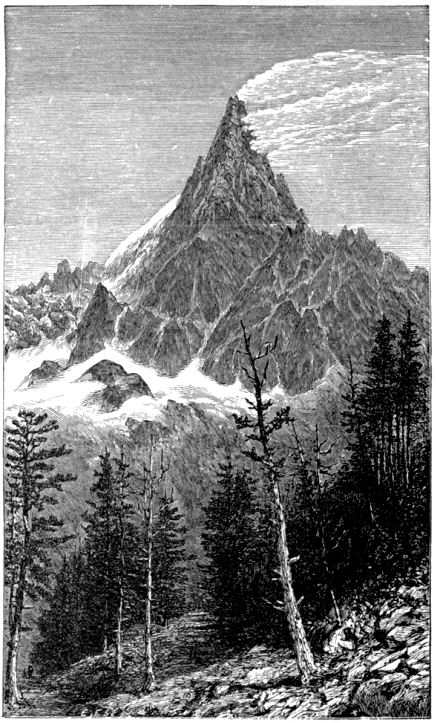
69. The sun heats the tropical air indirectly. Its beams have hardly any power to heat the air they pass through; but they heat the land and the ocean, and these pass their heat on to the air touching them. The air and vapour then start upwards, carrying the heat they have received.
§ 7. Tropical Rains
70. Long before the air and vapour from the equator reach the poles, however, some of the vapour falls. Wherever a warm, moist wind mixes with a cold, dry one, rain falls. In fact the heaviest rains of all occur where the sun is directly overhead. We must look a little more closely at where they come from.
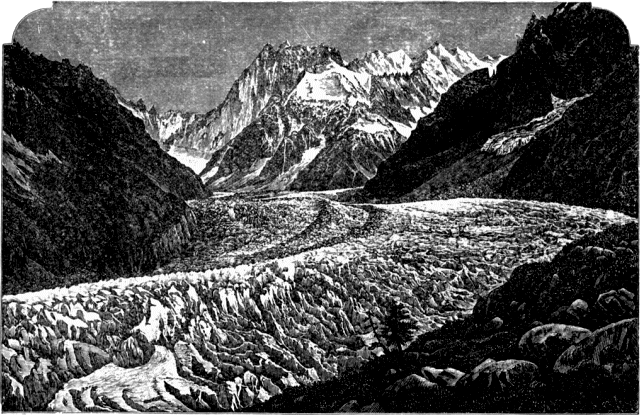
71. Fill a bladder about two-thirds full of air at sea level and carry it to the top of Mont Blanc. As you climb, the bladder swells more and more; at the summit it is fully swollen and is clearly bearing a pressure from inside. Come back down to sea level and you find the tightness gone, until the bladder is as limp as it was at first.
72. The reason is plain. At sea level the air inside the bladder has to bear the weight of the whole atmosphere, and is squeezed by it into a fairly small volume. As you climb the mountain you leave more and more of the atmosphere below you; the pressure grows less and less, and the air in the bladder, by its own springiness, swells as the pressure outside it falls. At the top of the mountain the expansion is quite enough to make the bladder tight, because the pressure inside is now actually greater than the pressure outside. With an air pump we can show a balloon partly filled with air swelling up when part of the outside pressure is taken away.
73. Why do I dwell on this? Simply to make it plain to you that unconfined air, heated at the earth's surface and rising because it is light, must expand more and more the higher it climbs in the atmosphere.
74. And now I have a new fact to introduce, one I have been working towards for some time. It is this: rising air is chilled by its own expansion. This chilling is, in fact, one cause of the coldness of the upper air. Now fix your eye on those mixed currents of air and water vapour rising from the warm tropical ocean. They start out with plenty of heat to keep the vapour as vapour; but as they rise they come into regions that are already cold, and they are chilled still further by their own expansion. The result could have been predicted. A great part of the load of vapour is thrown down, dense clouds form, and their particles run together into raindrops, which come down every day in such floods that the word "torrential" is used to describe the rainfall. I could show you this chilling by expansion, and the clouds it throws down.
75. Long before the air from the equator reaches the poles, then, a great part of its vapour has gone from it, having come back down to the earth as rain. A good deal of vapour is still carried onwards, though, and yields hail, rain and snow in northern and southern lands.
Illustrative Experiments
76. I have said that air is chilled as it expands. You can prove it, if you like, like this. With a condensing syringe you can force air into an iron box fitted with a stopcock, to which the syringe is screwed. Keep going until the air inside the box is two or three times its ordinary density. Immediately after this compression both the box and the air inside it are warm, as a suitable thermometer will show. Now simply turn the stopcock and let the compressed air stream out into the open. If you let the jet strike the thermometer, it visibly chills it, and with other instruments the chill can be made plainer still. Even your hand feels the chill of the expanding air.
77. Throw a strong light, a concentrated sunbeam for instance, across the escaping jet. If the compressed air is ordinary moist air, you see a little cloud thrown down by the chill that goes with the expansion. This cloud-making can be shown better, though, in the following way.
78. In a darkened room, send a strong beam of light through a glass tube three feet long and three inches wide, closed at both ends with glass plates. Connect the tube, through a stopcock, to a vessel about a quarter of its size from which the air has been pumped out. The emptied barrel of the air pump itself does very well. Fill the glass tube with moist air, then simply open the stopcock between it and the empty vessel. The air, having more room, expands; cold comes with the expansion; and at once a dense, brilliant cloud fills the tube. If you are doing the experiment for yourself alone, you can see the cloud in ordinary daylight; indeed, it is well known that briskly pumping the air out of any jar filled with moist air produces this condensation.
79. Vapours other than water vapour can be thrown down in the same way, and some of them give clouds of intense brilliance, showing iridescent colours of the kind seen sometimes, though not often, in the clouds that float over the Alps.
80. In science, what is true of the small is true of the large. By putting together, on a small scale, the conditions we observe on a large scale in nature, we obtain the phenomena of the clouds of the atmosphere.
§ 8. Mountain Condensers
81. To complete our picture of how the atmosphere sheds its water, we must take account of what mountains do. Imagine a south-west wind blowing across the Atlantic towards Ireland. On the way it loads itself with water vapour. In the south of Ireland it meets the mountains of Kerry, the highest of which is Macgillycuddy's Reeks, near Killarney. Now the lowest layer of this Atlantic wind is the one most fully loaded with vapour. When it strikes the foot of the Kerry mountains it is tilted upwards and flows bodily over them. Its load of vapour is lifted to a height; there it expands; the expansion chills it; and down it comes in heavy showers of rain. That, in fact, is where the rich vegetation of Killarney comes from, and it is what keeps the lakes supplied with water. The cold crests of the mountains also help with the work of condensation.
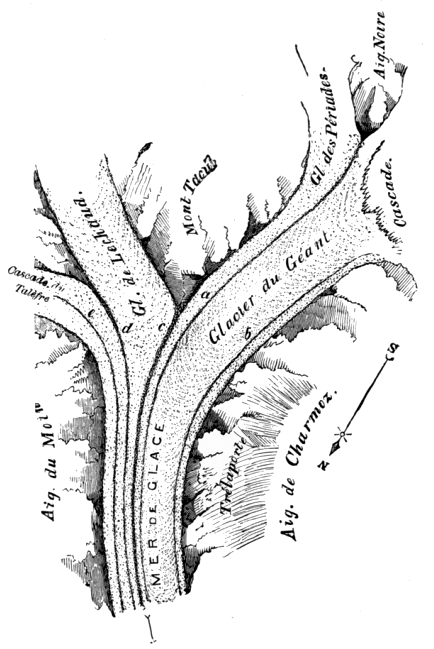
82. Notice what follows. There is a town called Cahirciveen to the south-west of Macgillycuddy's Reeks, where the rainfall has been measured, and a good way farther north-east, right in the path of the south-west wind, there is another town, Portarlington, where it has been measured too. But before the wind reaches Portarlington it has crossed the mountains of Kerry and left a great part of its moisture behind. The result? At Cahirciveen, as Dr. Lloyd has shown, the rainfall comes to 59 inches a year, while at Portarlington it is only 21 inches.
83. Again, you may sometimes come down from the Alps into Italy while rain and snow are falling heavily and without a break on the heights, and find the sky over the plains of Lombardy blue and cloudless, with the wind all the while blowing across the plain towards the Alps. Down below, the wind is warm enough to keep its vapour perfectly transparent; but it meets the mountains and is tilted up, expanded and chilled. The cold of the higher summits adds to the chill. As a result the vapour falls as rain or snow, giving bad weather on the heights, while the plains below, bathed in the very same air, enjoy a cloudless summer sun. Clouds blowing from the Alps are sometimes dissolved over the plains of Lombardy as well.
84. One especially instructive effect of the way mountains make clouds is worth noticing here. You often see a streamer of cloud, many hundreds of yards long, drawn out from an Alpine peak. It looks perfectly steady, though a strong wind may be blowing over the summit at the same moment. Why is the cloud not blown away? It is blown away; its permanence is only apparent. At one end it is constantly being dissolved, and at the other it is constantly being renewed. Supply and loss balance, and so the cloud looks as changeless as the mountain it seems to cling to. When the red evening sun shines on these streamers of cloud, they look like vast torches with their flames blown out across the sky.
§ 9. Architecture of Snow
85. We are now like people who have climbed a difficult peak and earned the enjoyment of a wide view. Having mastered the conditions needed to produce mountain snow, we can take a broad and intelligent view of the phenomena of glaciers.
86. A few words are still needed on how snow forms. The molecules and atoms of every substance, when left free to do so, build themselves into definite and, for the most part, beautiful shapes called crystals. Iron, copper, gold, silver, lead and sulphur all show this crystallising power when they are melted and allowed to cool slowly. The metal bismuth shows it especially strikingly: melted and set properly, it builds itself into crystals of great size and beauty.
87. If you dissolve saltpetre in water and let the solution evaporate slowly, you can get large crystals, for none of the salt turns into vapour. (That is why the water in our atmosphere is fresh, though it comes from the salt sea.) Sugar dissolved in water and left to evaporate gives crystals of sugar candy. Alum crystallises readily in the same way. Flint, dissolved as it sometimes is in nature and left to crystallise, gives the prisms and pyramids of rock crystal. Chalk dissolved and crystallised gives Iceland spar. The diamond is crystallised carbon. All our precious stones, the ruby, sapphire, beryl, topaz and emerald, are examples of this crystallising power.
88. You have heard of the force of gravitation, and you know it is an attraction of every particle of matter for every other particle. You know that planets and moons are held in their orbits by this attraction. But gravitation is a very simple affair compared with the force, or rather the forces, of crystallisation. Here the ultimate particles of matter, inconceivably small as they are, turn out to have attracting and repelling poles, and it is the action of these poles on one another that settles the shape and structure of the crystal. In the solid state the attracting poles are rigidly locked together; but apply enough heat and the bond is dissolved, and in the melted state the poles are pushed so far apart that they are practically out of one another's reach. The molecules' natural tendency to build themselves together is then cancelled.
89. This is the case with water, which as a liquid has, to all appearance, no form at all. When it is cooled enough, the molecules come within reach of the crystallising force and arrange themselves in shapes of indescribable beauty. When snow forms in still air, the particles of ice build themselves into beautiful star shapes, every star with six rays. There is no departure from this pattern, though in other ways the snow stars vary without end. Dr. Scoresby observed these exquisite forms in the polar regions and made many drawings of them. I have seen them in midwinter filling the air and heaping the slopes of the Alps. But they can be seen in England too, and no words of mine could give you as vivid an impression of their beauty as the drawings of a few of them shown here, made at Greenwich by Mr. Glaisher.
90. It is worth stopping to think what wonderful work goes on in the atmosphere as every snow shower forms and falls: what building power is brought into play! And how imperfect the works of human minds and hands seem beside those formed by the blind forces of nature!
91. But who dares to call the forces of nature blind? When we talk like that we are really describing ourselves. The blindness is ours; and what we ought to say, and to confess, is that our powers are utterly unable to grasp either the origin or the end of nature's workings.
92. Yet while we admit our limits, there is also reason to wonder at how far science has mastered the system of nature. From age to age and generation to generation, fact has been added to fact and law to law, and the true method and order of the universe have been revealed more and more. Along the way science has met and overthrown many forms of superstition and deceit, of credulity and imposture. But the world goes on producing weak people and wicked people, and as long as the two go on living side by side, as they do in our own day, some very degrading beliefs will go on infesting the world.
§ 10. Atomic Poles
93. "What did I mean when, a few moments ago (88), I spoke of attracting and repelling poles?" Let me try to answer that question. You know that astronomers and geographers speak of the earth's poles, and you have also heard of magnetic poles: the poles of a magnet are the points where its attraction and repulsion are, so to speak, concentrated.
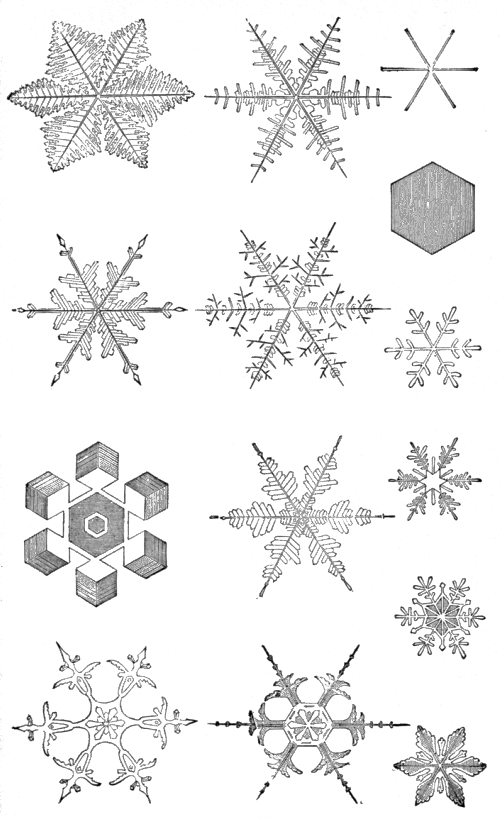
94. Every magnet has two such poles, and if you scatter iron filings over a magnet, each filing acquires two poles of its own. Suppose such particles had no weight and floated in our air: what must happen when they come near one another? Plainly the repelling poles will back away from each other, while the attracting poles will draw together and finally lock. Now suppose that each particle has not just one pair of poles but several pairs, set at definite points over its surface. You can then picture the particles, obeying their mutual attractions and repulsions, building themselves together into masses of definite shape and structure.
95. Imagine the molecules of water in calm, cold air to be gifted with poles of this kind, which force the particles to lay themselves together in a definite order, and you have before your mind's eye the unseen architecture that finally produces the visible, beautiful crystals of snow. Our first notions of poles, then, come from what our eyes see when we look at the effects of magnetism; and we carry these notions over to particles no eye has ever seen. The power by which we picture to ourselves effects beyond the reach of the senses is what philosophers call the Imagination, and the mind's effort to grasp the unseen architecture of crystals is an example of the "scientific use" of this faculty. Without imagination we might have critical power in science, but not creative power.
§ 11. Architecture of Lake Ice
96. We have now become acquainted with the beautiful snow flowers that the molecules of water build for themselves in calm, cold air. Do the molecules show this architectural power when ordinary water freezes? What, for instance, is the structure of the ice we skate on in winter? It is every bit as wonderful as the flowers of the snow. The observation is rare, if it is not new, but I have seen six-rayed stars of ice form in slowly freezing water and float free on the surface. And a six-rayed star is the pattern on which all our lake ice is built. It is made of such forms, wonderfully interlaced.
97. Take a slab of lake ice and put it in the path of a concentrated sunbeam. Watch the beam's track through the ice. Part of the beam is stopped and part of it goes through. The part that is stopped melts the ice inside; the part that goes through has no effect on the ice at all. But the melting is not spread evenly. Little shining points flash out from separate spots in the ice, and every one of them is surrounded by a beautiful liquid flower with six petals.
98. Ice and water look so alike to the eye that unless the light falls on these flowers in the right way you cannot see them. But what is the shining spot in the middle? A vacuum. Ice floats on water because, bulk for bulk, it is lighter than water, and so when ice melts it shrinks. Can the liquid flowers, then, fill the whole space of the ice that melted? Plainly not. A little empty space forms along with the flowers, and that space, or rather its surface, shines in the sun like burnished silver.
99. The flowers always form parallel to the surface at which the water froze. They appear whenever the sun shines on the ice of any lake, sometimes in myriads, and so small that you need a magnifying glass to see them. You can always get them, but flaws inside the ice often spoil their beauty. One part of a piece of ice may show them exquisitely while another part of the same piece shows them badly.
100. Here is a very imperfect sketch of these beautiful figures.
101. What we have here is crystallisation run backwards. The searching sunbeam is delicate enough to take the molecules apart without disturbing the order of their architecture. Try the experiment for yourself with a pocket lens on a sunny day. You will not find the flowers jumbled; they all lie parallel to the surface of freezing. That is the exquisite way in which every bit of the ice our skaters glide over in winter is put together.
102. I said in (97) that part of the sunbeam was stopped by the ice and melted it. What part is that? The dark heat of the sun. Most of the light waves, and even some of the dark ones, pass through the ice without losing any of their heating power. Properly concentrated on something that will burn, they show their burning power even after passing through the ice.
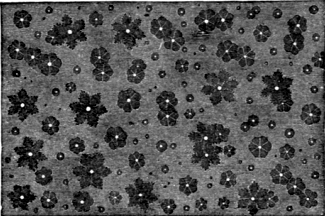
103. The ice itself can be used to concentrate them. In the polar regions Dr. Scoresby often focused the sun's rays with a lens of ice so as to make them burn wood, fire gunpowder and melt lead, proving that the rays keep their heating power even after passing through so cold a substance.
104. By making the rays of the electric lamp parallel and then sending them through a lens of ice, we obtain all the effects Dr. Scoresby obtained with the rays of the sun.
§ 12. The Source of the Arveiron. Ice Pinnacles, Towers, and Chasms of the Glacier des Bois. Passage to the Montanvert
105. Our preparatory studies are over for now, and, armed with them, let us go to the Alps. Through the village of Chamonix, in Savoy, rushes a river called the Arve. Let us trace it backwards from Chamonix. A little way from the village the river forks: one branch keeps the name Arve, and the other is the Arveiron. Follow the Arveiron and you come to what is called the "source of the Arveiron," a short hour's walk from Chamonix. Here, as with the Rhone, you find yourself facing a huge mass of ice, the end of a glacier, and the Arveiron pours out from an arch in the ice. Do not trust that arch in summer. Its roof falls from time to time with a startling crash, and it would certainly crush anyone it fell on.
106. Now we must keep our eyes open. Looking about us here, we find curious heaps and ridges of rubble in front of the ice, lying in rough rings one inside another. These are the terminal moraines of the glacier. We shall examine them later.
107. Now we turn left and climb the slope beside the glacier. As we climb, the view improves, and we find that the ice here fills a narrow valley. We come upon another remarkable ridge. It is not made of fresh rubble like those lower down; it is partly covered with trees, and looks literally "as old as the hills." It tells a wonderful story. We soon satisfy ourselves that it is an ancient moraine, and we conclude at once that at some time in its past the glacier was vastly larger than it is now. This old moraine stretches right across the main valley and butts against the mountains on the far side.
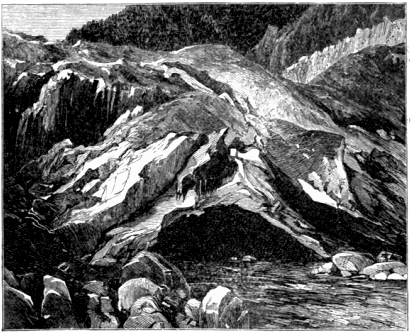
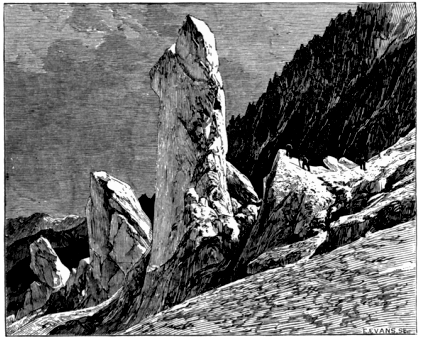
108. Once past the end of the glacier, which is covered with stones and rubbish, we find ourselves beside a truly wonderful display of ice. The glacier comes down a steep gorge, and on the way it is split and smashed in the most extraordinary manner. Here are towers and pinnacles and fantastic shapes carved by the weather, which remind you of rough sculpture. A sketch of one ice pinnacle is shown here. From deep chasms in the glacier comes a delicate shimmer of blue light. Now and then we hear a sound like thunder: a tower of ice has fallen, or a huge stone has tumbled into a chasm. The glacier keeps up this wild and chaotic character for some distance, and the best iceman alive would be beaten if he tried to make his way along it.
109. We reach a place called the Chapeau, where we can have something to eat and drink in a little mountain hut if we want to. Then we pass the Mauvais Pas, a sheer rock with steps cut in its face, where an inexperienced traveller is helped along by a rope. We go on, partly along the mountainside and partly along a ridge that looks strangely man-made: a lateral moraine. At last we face a house perched on a rise on the far side of the glacier. This is the inn of the Montanvert, well known to everyone who visits this part of the Alps.
110. Here we cross the glacier. I should have told you that its lower part, including the broken stretch we have passed, is called the Glacier des Bois, while the place we are about to cross is the beginning of the Mer de Glace, the "Sea of Ice." You feel that the name does not quite fit, for the glacier here is much more like a river of ice than a sea. The valley it fills is about half a mile wide.
111. The ice may be split where we step onto it, but with proper care there is no difficulty in crossing this part of the Mer de Glace. The clefts and chasms in the ice are called crevasses; we shall get to know them on a grander scale by and by.
112. Look up and down this side of the glacier. It is a good deal split, but as we go on the crevasses will grow fewer, and on the far side we shall find very few of them. Remember this; we shall use it later. At first the ice is dirty, but the dirt soon stops and you come onto the clean, crisp surface of the glacier. You have already noticed that the clean ice is white, and that from a distance it looks more like snow than ice. That is because the sun's heat breaks up the surface. Pound clear rock salt into powder and it is as white as table salt, and in the same way it is the fine cracking of the glacier's surface by the sun's rays that makes it look white. Inside the glacier the ice is transparent. After an exhilarating crossing we step onto the lateral moraine on the far side and climb the steep slope from it to the Montanvert Inn.
§ 13. The Mer de Glace and its Sources. Our First Climb to the Cleft Station
113. The view from here is very grand. Across the glacier we look at the beautiful pyramid of the Aiguille du Dru (shown in our frontispiece), and to the right at the Aiguille des Charmoz, whose sharp pinnacles are bent as though they were made of something that could be drawn out like wire. Looking straight up the glacier, the view is closed by the great crests of La Grande Jorasse, nearly 14,000 feet high. Our aim now is to get into the very heart of the mountains and follow this wonderful frozen river, which we have just crossed, to its origin.
114. We set out from the Montanvert with the glacier below us on our left, and soon reach some rocks like the Mauvais Pas; they are called les Ponts. We cross them and reach l'Angle, where we leave the land for the ice. We walk up the glacier, but before reaching the promontory called Trélaporte we take to the mountainside again. The path here has been abandoned because it is dangerous, but for the sake of knowledge we are prepared to face a reasonable amount of danger. A little glacier rests on the slope to our right. We may see a huge boulder or two balanced on its end, and, if we are lucky, see one break loose and plunge violently down the slope. Presence of mind is all you need to be perfectly safe; but travellers do not always show presence of mind, and that is why the path that used to cross this slope has been abandoned. The whole slope is littered with masses of rock that this little glacier has sent down. I wanted you to see them; by and by they will be fully explained.
115. Above Trélaporte, to the right, you see a most remarkable cleft in the rocks, with a single pillar, carved out by the weather, standing in the middle of it. Our next goal is the tower of rock to the left of that cleft, for from there we shall have a most commanding and instructive view of the Mer de Glace and its sources.
116. The cleft, with its pillar, can be seen at the right of the picture of the Mer de Glace above. Below the cleft you can also see the little glacier I mentioned just now.
117. We could reach the cleft by a steep gully, which we can see from where we stand, running straight up to it. But these gullies, or couloirs, are very dangerous, because they are the paths taken by stones falling from the heights. We shall therefore take to the rocks on the left of the gully, find out by close inspection where they can be climbed, and attack them there. In the Alps, as elsewhere, wonderful things can be done by looking steadily at difficulties and testing them wherever they seem open to attack. In this way we reach our station, where the glory of the view, and what we learn about how the Mer de Glace is formed, repay the labour of the climb many times over.
118. For we see the glacier below us, stretching its frozen tongue down past the Montanvert. And now we find this one glacier branching into three others, some of them wider than itself. Look at the branch on the right, the Glacier du Géant. It stretches smoothly upwards for a long way, then becomes disturbed, and then turns into a great frozen cascade down which the ice seems to tumble in wild confusion. Above the cascade you see a sheet of shining snow covering an area of some square miles.
§ 14. Ice-cascade and Snows of the Col du Géant
119. Instead of climbing to where we now stand, we could have kept walking on the Mer de Glace, turned round the promontory of Trélaporte, and walked straight up the Glacier du Géant. We should have had ice under our feet all the way to the bottom of the cascade. It is not as compact as the ice lower down, but you would never think of refusing to call it ice.
120. As we near the fall, the glacier loses more and more of its smooth, unbroken character. We meet ridges running across it, one after another, each steeper than the last. The ice becomes more and more split and confused. We wind through twisting ravines, climb huge mounds of ice, and creep carefully along crumbling crests with crevasses on either hand. The confusion grows until it is impossible to go any further up the middle of the glacier.
121. But with an axe to cut steps in the steeper walls and slopes of ice, we could swerve to one side of the glacier or the other and work our way to the top of the cascade. If we climbed on the right, we should have to watch out for the avalanches of ice that sometimes thunder down the slopes; if on the left, for the stones knocked loose from the Aiguille Noire. Once clear of the cascade, we should have to beware for a while of the crevasses, which gape terribly for some distance above the fall. With caution, though, we could get round them, and sometimes cross them on bridges of snow. Here the skill and knowledge that only long practice can give come into play, and here, too, the use of the Alpine rope suggests itself. For not only are the snow bridges often frail, but sometimes whole crevasses are covered over, and the unlucky traveller first learns they are there when the snow gives way under his feet. Many lives have been lost this way, some of them quite recently.
122. Once on the plateau above the ice-fall, we find the surface completely changed. Below the fall we walked on ice; here we are on snow. After a long but gentle climb we reach a dip in the ridge that bounds the snowfield at the top, and now we look out over Italy. We are standing on the famous Col du Géant.
123. It was no idle scramblers on the mountains who first made these wild recesses known. It was not the hope of health, which brings some people here now, nor the love of grandeur and beauty, which brings others, nor the wish to be able to say they have climbed a mountain or crossed a pass, which I am afraid brings a good many more. It was the desire for knowledge that brought the first explorers here, and on this col the celebrated De Saussure lived for seventeen days, making scientific observations.
§ 15. Questioning the Glaciers
124. I would ask you now to think for a moment about the facts an excursion like this has given us. The snow we have trudged through in imagination is the snow of last winter and spring. If we had put a proper mark on the surface of the snow last August, we should find it this August at a certain depth below the surface. A good deal of the snow has been melted by the summer sun, but a good deal remains, and it will stay until the snows of the coming winter fall and cover it. Part of that, again, will survive until next August, a good deal of it lasting until it is covered by the snow of the winter after. We arrive, then, at the certain conclusion that on the plateau of the Col du Géant more snow falls each year than is melted.
125. Had we come in April or May, we should have found the glacier below the ice-fall covered with snow too, snow that the summer heat has now entirely cleared away. More than that, the ice there is plainly melting: it forms running brooks that cut channels in the ice and widen here and there into little blue-green lakes. You conclude with certainty, then, that below the ice-fall less frozen material falls on the glacier than is melted.
126. And this forces another conclusion on us. Somewhere between the glacier below the ice-fall and the plateau above it there must be a line where the amount of snow that falls is exactly equal to the amount melted each year. This is the snow-line. On some glaciers it is quite distinct, and it would be distinct here if the ice were less broken and confused than it is.
127. The French word névé is used for the glacier region above the snow-line, and the word glacier is kept for the ice below it. The snows of the Col du Géant, then, are the névé of the Glacier du Géant and, in part, the névé of the Mer de Glace.
128. But if every year leaves a residue of snow on the plateau of the Col du Géant, it follows that the plateau must grow higher every year, provided the snow stays on it. It follows just as surely that the whole length of the glacier below the cascade must sink lower little by little, unless the loss from each year's melting is made good. Suppose two feet of snow a year stayed on the col: in five thousand years that would raise it far above the height of Mont Blanc. That pile-up must happen if the snow stays on the col; but the pile-up does not happen; and so the snow does not stay on the col. The question is, then: where does it go?
§ 16. Branches and Medial Moraines of the Mer de Glace from the Cleft Station
129. We shall tackle this question in a moment. Meanwhile, look at that valley of ice in front of us, stretching up between Mont Tacul and the Aiguille de Léchaud to the foot of the great ridge called the Grande Jorasse. It is called the Glacier de Léchaud. At its head it receives the snows of the Jorasse and of Mont Mallet, and it joins the Glacier du Géant at the promontory of the Tacul. Where they meet, the glaciers seem welded together, but they stay distinct. Between them you can plainly follow a stripe of rubble (c on the sketch-plan above), and you can follow a similar but smaller stripe (a on the sketch) from the meeting of the Glacier du Géant with the Glacier des Périades at the foot of the Aiguille Noire, and you can trace that too along the Mer de Glace.
130. We also see another glacier, or part of one, on the left, apparently falling in broken pieces through a narrow gorge (the Cascade du Talèfre on the sketch) and joining the Léchaud, and from the point where they meet another stripe of rubble (d) runs down the Mer de Glace. Beyond this again we notice another stripe (e), which seems to begin at the bottom of the ice-fall, rising, as it were, out of the body of the glacier. Beyond all these we can make out the lateral moraine of the Mer de Glace.
131. These stripes are the medial moraines of the Mer de Glace. We shall learn more about them shortly.
132. And now that we have stocked our minds with these observations, let our eyes wander over the whole glorious scene: the splintered peaks and the hacked and jagged crests, the far-stretching snowfields, the smaller glaciers tucked away on the heights, the deep blue sky and the sailing clouds. Is it not worth some labour to win a view like this? And the delight it gives is all the greater because we did not come on purpose to see it. We came to learn about the glacier, and this high enjoyment has come to us in the course of our work. You will find it so all through life: without honest labour there can be no deep joy.
§ 17. The Talèfre and the Jardin. Work among the Crevasses
133. Now let us go down to the Mer de Glace, for I want to take you across the glacier to that broken ice-fall whose origin we have not yet seen. We are making for the far side of the glacier, and to get there we must cross those dark stripes of rubble we saw from the heights. From above, these moraines looked flat; now we find they are ridges of stones and rubbish twenty to thirty feet high.
134. We leave the ice at a place called the Couvercle and wind round this promontory, climbing all the time. We squeeze ourselves up the Égralets, a kind of natural staircase in the rock, and soon afterwards we have a full view of the ice-fall whose origin we want to find. The ice on the fall is badly broken. There are pinnacles and towers, some upright, some leaning, and some, if we are lucky, falling, like those on the Glacier des Bois; and there are chasms giving out a delicate blue light. With the ice-fall on our right we keep climbing, until at last we look out over a huge, almost level basin of glacier with a single island standing in the middle of it, ringed all round by ice. We are at the edge of the Glacier du Talèfre, and we see that it is what feeds the ice-fall we have passed. The glacier is walled in by ridges of rock, hacked and torn along the top into teeth and edges, and buttressed with snow fluted by falling stones.
135. We cross the basin to the island in the middle and find grass and flowers where we step onto it. This is the famous Jardin, the "Garden," which you have often heard of. The upper part of the Jardin is bare rock. Close at hand stands one of the noblest peaks in this part of the Alps, the Aiguille Verte. It is between thirteen and fourteen thousand feet high, and after a fresh fall of snow avalanches thunder down its sides without a pause. From one of its spurs a streak of moraine starts down the Talèfre; another streak issues from the Jardin. The two run side by side to the top of the ice-fall, where the chasms swallow them up. But at the bottom of the fall they reappear, as if rising fresh out of the body of the glacier, and after that they continue down the Mer de Glace.
136. Walk with me now beside the moraine from the Jardin, down towards the ice-fall. For a while the going is easy; such cracks as appear do not hold us up at all. But the crevasses grow steadily wider and wilder, until at last they follow one another so closely that only walls of ice are left between them. Here you need a perfectly steady foot: a slip would mean death. We look towards the fall and see the confusion of walls and blocks and chasms below us growing worse. At last prudence and reason cry "Halt!" We may turn to the right or to the left and, making our way along crests of ice with chasms on both sides, reach either the right-hand or the left-hand lateral moraine of the glacier.
§ 18. First Questions regarding Glacier Motion. Drifting of Bodies buried in a Crevasse
137. But what are these lateral moraines? As you and I go along the glaciers day after day, their origin gradually becomes plain. Every so often we see stones and rubbish coming down the mountainsides and being stopped by the ice. All along the fringe of the glacier stones and rubbish fall, and it soon becomes clear that here is the source of the lateral moraines.
138. But how are the medial moraines to be explained? How does the rubble arrange itself in stripes on the glacier some hundreds of yards from its edge, leaving the space between the stripes and the edge clear? Some people have supposed that the stones rolled out over the glacier from the sides, but that idea will not stand examination. Remember now our reasoning about the excess of snow that falls above the snow-line, and the question that followed: what becomes of that snow? Can it be that the whole mass is moving slowly downwards? If so, the lateral moraines would be carried along by the ice they rest on, and when two branch glaciers joined, they would lay their neighbouring lateral moraines side by side to form a medial moraine on the trunk glacier.
139. In fact, there is no way we can see of getting rid of the excess snow above the snow-line, no way of making good the constant wasting of the ice below the snow-line, and no way of accounting for the medial moraines, except by supposing that the whole mass of frozen matter is moving downwards, from the highest snowfields of the Col du Géant, the Léchaud and the Talèfre to the very end of the Glacier des Bois.
140. If you were older, I should enjoy taking you up Mont Blanc. Starting from Chamonix, we should first pass through woods and pastures, then climb the steep hillside, with the Glacier des Bossons on our right, to a rock known as the Pierre Pointue, and from there to a higher rock called the Pierre l'Échelle, the "Ladder Stone," because a ladder is usually kept here to help in crossing the chasms of the glacier. At the Pierre l'Échelle we should take to the ice, and, passing under the Aiguille du Midi, which towers on the left and sometimes sweeps part of the track with avalanches of stones, we should cross the Glacier des Bossons: among heaped-up mounds and broken towers of ice, up steep slopes, over chasms so deep that their bottoms are lost in darkness.
141. We reach the rocks of the Grands Mulets, which form a sort of barren island in the sea of ice, and go on from there to the higher snowfields, crossing the Petit Plateau, which we should find littered with blocks of ice. Looking to the right, we should see where they came from, for high above us here, threatening, rise the broken ice-crags of the Dôme du Goûter. The guides like to pass this place in silence, and it is just as well to humour them, however much you may doubt that the human voice can bring the ice-crags down. From the Petit Plateau a steep slope of snow would take us up to the Grand Plateau, and at dawn I know nothing in all the Alps grander or more solemn than this place.2
142. One purpose of our climb would now be achieved. For here, at the head of the Grand Plateau and the foot of the last slope of Mont Blanc, I should show you a great crevasse into which three guides were poured by an avalanche in the year 1820.
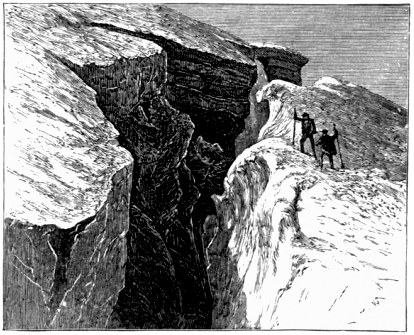
143. Is that the right way to put it? A crevasse hardly distinguishable from this one certainly existed here in 1820. But was it the very same crevasse that exists now? Is the ice split here today the same ice that was split fifty-one years ago? Not at all. How is that proved? By the fact that more than forty years after the three guides were buried, their remains were found near the end of the Glacier des Bossons, many miles below the present crevasse.
144. The same observation proves beyond doubt that the ice near the bottom of the higher névé becomes the surface ice of the glacier near its end. As the surface below the snow-line wastes away, the deeper parts of the ice are brought more and more into daylight.
145. There are many plain signs that glaciers move, though the motion is too slow to catch the eye at once. The crevasses change within certain limits from year to year, and sometimes from month to month, which could not happen if the ice did not move. Rocks and stones are seen that have plainly been torn from the mountainsides. Blocks seen to fall from particular places are later found lower down. On the moraines you find rocks of a completely different mineral character from those that make up the mountains on either hand, and in every such case rock beds of that same character are found bordering the glacier higher up. Hence the conclusion that these foreign boulders have been floated down by the ice. Again, the ends, or "snouts," of many glaciers act like ploughshares on the land in front of them, overturning huts and chalets in their way with slow but merciless energy. Facts like these have long been known to the people of the High Alps, who in this way knew, vaguely and in general, that the glaciers move.
§ 19. The Motion of Glaciers. Measurements by Hugi and Agassiz. Drifting of Huts on the Ice
146. But knowledge grows from vagueness towards precision, and before long people wanted exact measurements of how fast glaciers move. For such measurements one glacier in the Bernese Oberland will always be remembered. From the little town of Meiringen in Switzerland you go up the valley of Hasli, past the famous waterfall of Handeck, where the river Aar plunges into a chasm more than 200 feet deep. You approach the Grimsel Pass, but instead of crossing it you turn right and follow the Aar upwards. Like the Rhone and the Arveiron, you find the Aar coming out of a glacier.
147. Get onto the ice, or rather onto the deep moraine shingle that covers the ice, and walk upwards. It is hard going, but after a while you get clear of the rubbish and onto a wide glacier with a great medial moraine running along its back. This moraine is formed where two branch glaciers, the Lauteraar and the Finsteraar, meet at a promontory called the Abschwung to form the trunk glacier of the Unteraar.
148. On this great medial moraine, in 1827, a bold and enthusiastic Swiss professor, Hugi of Solothurn (in French, Soleure), built a hut so as to make observations on the glacier. His hut moved, and he measured how far. In the three years from 1827 to 1830 it had moved 330 feet downwards. By 1836 it had moved 2,354 feet; and in 1841 M. Agassiz found it 4,712 feet below where it had started.
149. In 1840 M. Agassiz himself and some bold companions took shelter under a great overhanging slab of rock on the same moraine, and added side walls and other protection to it. Because he and his comrades came from Neuchâtel, the hut was known for long afterwards as the "Hôtel des Neuchâtelois." Two years after it was built, M. Agassiz found that the "hotel" had moved 486 feet downwards.
§ 20. Precise Measurements of Agassiz and Forbes. Motion of a Glacier proved to resemble the Motion of a River
150. We now come to a turning point in the scientific history of glaciers. Had the first observers been familiar in practice with the precision instruments of surveying, accurate measurements of glacier motion would probably have been made sooner. We are now about to see such instruments brought in, almost at the same moment, by M. Agassiz on the glacier of the Unteraar and by Professor Forbes on the Mer de Glace. M. Escher de la Linth had tried to measure the motion of a row of wooden stakes driven into the Aletsch glacier, but the melting was so fast that the stakes soon fell over. To get round this, M. Agassiz in 1841 took on the great labour of carrying boring tools up to his "hotel" and drilling into the Unteraar glacier at six places, in a straight line across it, to a depth of ten feet. Six piles were driven into the holes so firmly that they stayed in the glacier for a year, and in 1842 the distance each had moved was measured. The figures were 160 feet, 225 feet, 269 feet, 245 feet, 210 feet and 125 feet.
151. Here a great step has been taken. You notice that the middle numbers are the largest. They belong to the central part of the glacier. These measurements prove conclusively, then, not only that glaciers move, but that the centre of a glacier, like the centre of a river, moves faster than the sides.
152. With the help of trained engineers M. Agassiz followed up these measurements in later years. His researches are set down in a work called "Système glaciaire," which comes with a very fine Atlas of the Glacier of the Unteraar, published in 1847.
153. These measurements were made with a theodolite, an instrument I shall describe to you shortly. The same instrument was used in the same year by the late Principal Forbes on the Mer de Glace. He established the faster motion of the centre independently. He showed, moreover, that you need not wait a year, or even a week, to measure the motion of a glacier: with a correctly adjusted theodolite he could measure the motion of various points on the Mer de Glace from one day to the next. He stated, and rightly, that the motion of a glacier could be measured from hour to hour. We shall prove this later (162). Professor Forbes also triangulated the Mer de Glace and drew an excellent map of it. His first observations and his survey are recorded in a famous book published in 1843 under the title "Travels in the Alps."
154. He too followed up these observations in later years, and set down the results in a series of separate letters and essays of great interest. These were later collected in a volume called "Occasional Papers on the Theory of Glaciers," published in 1859. The labours of Agassiz and Forbes are the two chief sources of our knowledge of glaciers.
§ 21. The Theodolite and its Use. Our own Measurements
155. I have done what I set out to do so far. I have given you the proofs that glaciers move and an account of how their motion has been measured. Now we must try to add a little to what is known about glaciers by our own work on the ice. We shall need resolution to start our work and steady patience to carry it through. Look, then, at this theodolite. It consists mainly of a telescope and a graduated circle. The telescope can tilt up and down, and the circle, carrying the telescope with it, can turn left and right. When the movement has to be extremely fine, we use special screws called tangent screws. The instrument stands on three legs, which can be moved but stand firm when properly planted.
156. Two spirit levels are fixed at right angles to each other on the circle. With practice you can take hold of the legs and set them so that the circle is nearly level, and with four levelling screws we make it exactly level. Directly under the centre of the instrument is a small hook from which a plumb line hangs. The point of the bob just touches a rock, and we make a mark on the rock there; or if the ground below is soft, we drive a stake into it exactly under the plumb bob. By hanging the plumb line again at any later time, we can find, to a hair's breadth, the spot where the instrument stands today.
157. Look through the telescope. You see two fibres of the finest spider's thread crossing it. In actual work we first aim the telescope across the glacier until the point where the two fibres cross exactly covers some clearly marked point of rock or tree on the far side of the valley. We sketch this point, our fixed standard, with its surroundings in a notebook, so that we can recognise it at once when we come back here. Imagine a straight line drawn from the centre of the telescope to this point, and imagine that line allowed to drop straight down onto the glacier, every point of it falling as a stone would fall. Along that line we now have to fix a row of stakes.
158. A trained assistant is already out on the glacier. He sets up his staff and stands behind it. The telescope is lowered without swinging to right or left; in mathematical language, it stays in the same vertical plane. The crossed fibres will probably meet the ice a little way from the assistant's staff. At a wave of the arm he moves right or left; he may move too far, and we wave him back. After a try or two he knows whether he is near the right point, and if he is, he makes his movements small. He soon hits exactly the point covered by the crossing of the fibres. A signal tells him he is right; he bores into the ice with an auger and drives in a stake. Then he moves on and picks up another point in exactly the same way. After one or two stakes have gone in, the assistant can pick up the other points very quickly. In this way we can set as many stakes as we need in a straight line across the glacier.
159. Next morning we measure how far all the stakes have moved. The theodolite is set up in its old position and carefully levelled. The telescope is first aimed at the standard point on the far side of the valley and moved with a tangent screw until the crossing of the spider's threads covers the point exactly. Then the telescope is lowered to the first stake, beside which our trained assistant is already standing. He carries a staff marked in feet and inches. One glance shows us the stake has moved down. Guided by our signals, the assistant finds again the point we started from yesterday and then measures the distance from that point to the stake. It is, say, 6 inches: that is how far the stake has moved.
160. We take care to note the hour and minute at which each stake was driven in, and the hour and minute at which its distance from its first position is measured. That lets us work out the exact daily motion of the point. The distances moved by all the other points are found in exactly the same way.
161. This is how we shall go to work: first making clear in our minds what is to be done, and then making sure it is done accurately. To give our work reality, I shall record here the actual measurements made, and the actual thoughts they prompted, on the Mer de Glace in 1857. The only make-believe I ask you to allow is that you and I are supposed to be making the observations together. Most of the labour of measuring was done by Mr. Hirst.
§ 22. Motion of the Mer de Glace
162. On July 14, then, we find ourselves at the end of the Glacier des Bois, not far from the source of the Arveiron. We aim our telescope across the glacier and set the crossing of its spider's threads exactly on the edge of a pinnacle of ice. We leave the instrument untouched and look through it from hour to hour. The edge of the ice moves slowly, but plainly, past the fibres, and at the end of three hours we are satisfied that it has moved several inches. While we are standing near the vault of the Arveiron, talking about going inside it, its roof gives way and falls with a sound like thunder. It was not without reason, then, that I warned you against going into these vaults in summer.
163. We climb to the Montanvert Inn and settle on it as our lodging, then go down to the lateral moraine of the glacier a little below the inn. Here we set up our theodolite and mark its exact position with a plumb line. First we must make sure that our line is at right angles, or nearly so, to the axis, the middle line, of the glacier. Our trained assistant lays a long staff on the ice pointing along the axis, checking by looking up and down the glacier that it points the true way. With another staff in his hand, pointed towards our theodolite, he shifts his position until the second staff is at right angles to the first. There he signals to us. We aim our telescope at him, then slowly raise its end in a vertical plane until we find a standard point on the far side of the glacier, which we note with a sketch. Knowing this point and our plumb mark, we can find our line again on any future day. (To make the measurements easier to follow, I give below an outline diagram of the Mer de Glace and its tributaries.)
164. Along the line just described, ten stakes were set on July 17, 1857. How far they had moved was measured the next day. Two of them had fallen, but here are the distances travelled in twenty-four hours by the eight that were left.
Daily Motion of the Mer de Glace
First Line: A A′ upon the Sketch.
          East                 West
    Stake   1  2  3  4  5  7  9 10
    Inches 12 17 23 26 25 26 27 33
165. You have already satisfied yourself, by touching it, that the body of the glacier is real ice, and you may have read that glaciers move; but actually watching a body that looks so rigid in motion is strangely fascinating. And not only does the ice move as a whole, but one part of it moves past another, the rate rising steadily from 12 inches a day at the side to 33 inches a day some distance out from it. This faster movement of the central ice of glaciers had already been seen by Agassiz and Forbes. We confirm their results, and now go on to something new. Crossing the Glacier du Géant, which takes up more than half the valley, we find that our line of stakes has not yet come to an end. The 10th stake stands on the part of the ice that comes from the Talèfre.
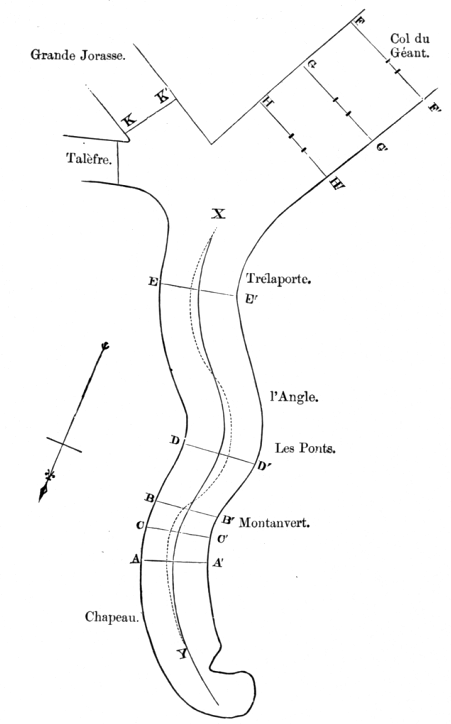
166. Now the sides move slowly because of the friction of the ice against its banks. But then you would expect the motion to be greatest halfway between the banks, where the friction of the sides is least. That is plainly not the case: though the 10th stake is nearer than the 9th to the eastern, or Chapeau, side of the valley, the 10th stake beats the 9th by 6 inches a day.
167. Here is something to think about; but before a natural philosopher can think in comfort he must be perfectly sure of his facts. The line we have just measured ran across the glacier a little below the Montanvert. We will run another across a little way above the hotel. On July 18 we set out this line, and to multiply our chances of discovery we place 31 stakes along it. The next day five of them were found unfit for use, but here are the distances travelled in 24 hours by the remaining twenty-six.
Second Line: B B′ upon the Sketch.
           West
    Stake   2  3  4  5  6  7  8  9 10 11 12 13
    Inches 11 12 15 15 16 17 18 19 20 20 21 21
    Stake  15 16 17 18 19 20 21 22 23 24 25 26
    Inches 23 23 23 21 23 21 25 22 22 23 25 26
                                           East
168. Look at these numbers. The first broad fact they show is the rise in the rate of motion from first to last. There are some irregularities, though. From 23 inches at the 17th stake we drop to 21 inches at the 18th; from 23 inches at the 19th we drop to 21 inches at the 20th; from 25 inches at the 21st we drop to 22 inches at the 22nd and 23rd. In spite of these small ups and downs, the general rise in the rate of motion is plain. Now some slight shifting of the stakes by melting may account for these small departures from a steady increase. But another explanation is possible as well. We shall learn later that the glacier is held back not only by its sides but by its bed, and that the upper layers of the ice slide over the lower ones. If the bed of the Mer de Glace has humps here and there that come near enough to the surface to hold the surface back, they could produce the small irregularities we noticed.
169. While we are on the ice we take particular note that the 26th stake, like the 10th stake in our last line, stands much nearer to the eastern side of the glacier than to the western. The measurements give us further proof, then, that the centre of this part of the glacier is not where it moves fastest.
§ 23. Unequal Motion of the two Sides of the Mer de Glace
170. But on neither the first line nor the second could we carry our measurements right across the glacier. Why not? In trying to do one thing we are often taught another, and so in science, if only we keep steadily at our work, our very defeats become a means of learning. We first planted our theodolite on the lateral moraine of the Mer de Glace, expecting to be able to see across the glacier from side to side. Now we know better. The centre of the glacier turns out to be higher than its sides, and from our last two positions the hump in the middle hid the ice near the far side from view. The fact is that the mountain slopes are warm in summer and melt the ice nearest them, so that the glacier falls away from the centre to the sides.
171. But up there on the heights on the other side of the glacier we see a likely spot for our theodolite. We cross the glacier and plant the instrument where we can sweep the glacier from side to side. Our first line was below the Montanvert and our second above it; this third line is exactly opposite the Montanvert. In fact the mark on which we have set the theodolite's cross-hairs is a corner of one of the windows of the little inn. Along this line we fix twelve stakes on July 20. By the 21st one of them had fallen, but the speeds of the remaining eleven over 24 hours were found to be as follows.
Third Line: C C′ upon the Sketch.
            East                         West
    Stake     1  2  3  4  5  6  7  8  9 10 11
    Inches   20 23 29 30 34 28 25 25 25 18  9
172. The first stake and the eleventh in this row both stood near the sides of the glacier. On the eastern side the motion is 20 inches, while on the western side it is only 9. On the eastern side it rises from 20 inches to 34 at the 5th stake, which we, standing on the glacier, can see is much nearer the eastern side than the western. The evidence of these three lines together puts it beyond doubt that opposite the Montanvert, and for some distance above and below it, the whole eastern side of the glacier is moving faster than the western side.
§ 24. Suggestion of a new Likeness of Glacier Motion to River Motion. Conjecture tested
173. Here is cause for reflection, and facts are worth comparatively little if they do not provoke the mind to that exercise. It is because the facts of nature are not isolated but connected that science, if it is to follow them, must also form a connected whole. The mind of the natural philosopher must be, as it were, a web of thought whose every fibre answers to the web of fact in nature.
174. Let us climb, then, to a point with a good view of this part of the Mer de Glace. The ice-river we see is not straight but curved, and it curves away from the Montanvert: its convex side is to the east and its concave side to the west (look at the sketch). You have already thought about the fact that a glacier moves, in some respects, like a river. How would a river move through a curved channel? That is known. If the ice of the Mer de Glace were replaced by water, the point of swiftest motion opposite the Montanvert would not be the centre, but a point east of the centre. Can it be, then, that this "water-rock," as ice is sometimes called, behaves like water in this respect too?
175. This is a thought that occurred to us on the spot. It may be true or it may not, but the means of testing it are close at hand. Looking up the glacier, we see that it bends again at les Ponts, but that there its convex side is towards the western side of the valley (look at the sketch again). If our guess is right, the point of swiftest motion opposite les Ponts ought to lie west of the glacier's axis.
176. Let us test the guess. On July 25 we fix seventeen stakes in a line across this part of the glacier. Every one of them stays firm, and on the 26th we find their motion over 24 hours to be as follows.
Fourth Line: D D′ upon the Sketch.
          East                                    West
    Stake   1 2  3  4  5  6  7  8  9 10 11 12 13 14 15
    Inches  7 8 13 15 16 19 20 21 21 23 23 21 22 17 15
177. Even to the naked eye, the stakes 10 and 11, where the glacier moves fastest, are seen to stand well to the west of its axis. Up to this point, then, the guess that prompted these measurements is perfectly borne out. Notice here that the "guesses" of science are not the work of chance but of thoughtful pondering over facts already known. The guess is the "induction" from the facts, to be confirmed or blown up by the test of later experiment.
178. And though even now we have very strong reason to hold that the point of greatest speed obeys the law of liquid motion, our conclusion will be twice as strong if we can show that the point shifts back to the eastern side of the axis at another bend. Luckily there is such a place, opposite Trélaporte. Here the convex side of the valley's curve turns east again. A line was set out across this part of the glacier on July 28, and from measurements on the 31st the rate of motion over 24 hours was worked out.
Fifth Line: E E′ upon the Sketch.
            West                                     East
    Stake     1  2  3  4  5  6  7  8  9 10 11 12 13 14 15
    Inches   11 14 13 15 15 16 17 19 20 19 20 18 16 15 10
179. Here again, merely judging distances by eye would show us that the three stakes that moved fastest, the 9th, 10th and 11th, all stood east of the middle line of the glacier. The proof that the point of swiftest motion wanders to and fro across the axis as the bend of the valley changes is, then (shall I say?) complete.
180. Not yet. If surer means are open to us, we must not be content with estimates by eye. We have a surveying chain with us: let us shake it out and measure these lines, noting the distance of every stake from the side of the glacier. It is no easy work among the crevasses, but I trust it confidently to Mr. Hirst and you. Afterwards we can compare a number of stakes on the eastern side with the same number at the same distances from the western side. For example, we can compare a pair of stakes, one ten yards from the eastern side and the other ten yards from the western side; another pair, one fifty yards from the eastern side and the other fifty yards from the western; and so on. For easy reference, let us call the points compared in pairs like this equivalent points.
181. There were five pairs of such points on our fourth line, D D′, and here are their speeds:
    Eastern points; motion in inches    13 15 16 18 20
    Western points; motion in inches    15 17 22 23 23
In every case the stake on the western side moved faster than the equivalent stake on the eastern side.
182. Treating our fifth line, E E′, in the same way, we get the following speeds for three pairs of equivalent points:
    Eastern points; motion in inches    15 18 19
    Western points; motion in inches    13 15 17
183. Here the three points on the eastern side move faster than the equivalent points on the western side.
184. It is proved, then:
1. That opposite the Montanvert the eastern half of the Mer de Glace moves faster than the western half.
2. That opposite les Ponts the western half of the glacier moves faster than the eastern half.
3. That opposite Trélaporte the eastern half of the glacier again moves faster than the western half.
4. That these changes in the place of greatest motion are governed by the bends of the valley the Mer de Glace moves through.
§ 25. New Law of Glacier Motion
185. Let us put these facts another way. Suppose the points of swiftest motion were found for a very great number of lines across the Mer de Glace. The line joining all those points together is what mathematicians would call the locus of the point of swiftest motion.
186. At Trélaporte this line would lie east of the centre; at the Ponts it would lie west of the centre; so between Trélaporte and the Ponts it would cross the centre. But at the Montanvert it would lie east of the centre again, so between the Ponts and the Montanvert it must cross the centre a second time. If the Mer de Glace had more windings, there would be more crossings of its axis.
187. The points on the axis that mark the change from an eastward bend to a westward one, and the reverse, may be called points of contrary flexure.
188. Now what is true of the Mer de Glace is true of every other glacier moving through a winding valley, and so the facts established on the Mer de Glace can be widened into the following general law of glacier motion:
When a glacier moves through a winding valley, the locus of the points of greatest motion does not coincide with the centre of the glacier, but always lies on the convex side of the central line. The locus is therefore a curved line, more deeply winding than the valley itself, and it crosses the axis of the glacier at each point of contrary flexure.
189. The dotted line on the Outline Plan above shows the locus of the point of greatest motion; the firm line marks the centre of the glacier.
190. Put the word river in place of glacier and the law is still true. The motion of the water is governed by exactly the same conditions as the motion of the ice.
191. Let us now use our law to clear up a difficulty. Turning to the careful measurements made by M. Agassiz on the glacier of the Unteraar, we find, in his discussion of them, a section of the "Système glaciaire" given to the "Migrations of the Centre." It is shown there that the middle of the Unteraar glacier is not always the point of swiftest motion. Until now this fact has gone unexplained; but one look at the Unteraar valley, or at a map of it, shows that the puzzle is an example of the law we have just established on the Mer de Glace.
§ 26. Motion of Axis of Mer de Glace
192. We have now measured the speed of five different lines across the trunk of the Mer de Glace. Do they all move alike? No. Like a river, a glacier moves at different speeds in different places. Comparing the points of greatest motion on all five lines, we get this result:
Motion of Mer de Glace
    At Trélaporte          20 inches a day
    At les Ponts           23 inches a day
    Above the Montanvert   26 inches a day
    At the Montanvert      34 inches a day
    Below the Montanvert   33 inches a day3
193. The glacier moves faster, then, as we go down it from Trélaporte to the Montanvert, the greatest motion at the Montanvert being fourteen inches a day more than at Trélaporte.
§ 27. Motion of Tributary Glaciers
194. That is enough about the trunk glacier. Let us now look into the branches, letting reflection on known facts come before our attempts to discover unknown ones, as we have done all along.
195. As we stood at our "cleft station," which gave us such a splendid view of the Mer de Glace, we were struck by the fact that some of the glacier's tributaries were wider than the glacier itself. If the ice were replaced by water, how do you suppose the water would behave? You would surely conclude that it would move fairly slowly down the broad, gently sloping valleys of the Géant and the Léchaud, but would force its way faster through the "narrows" of Trélaporte. Let us test this idea on the ice.
196. We plant our theodolite in the shadow of Mont Tacul, choose a suitable point on the far side of the Glacier du Géant, and on July 29 fix a row of ten stakes across the glacier. In twenty-four hours this line moved as follows.
Motion of Glacier du Géant
Sixth Line: H H′ upon Sketch.
    Stake     1  2  3  4  5  6  7  8 9 10
    Inches   11 10 12 13 12 13 11 10 9  5
197. Our guess is fully borne out. The greatest motion here is seven inches a day less than that of the Mer de Glace at Trélaporte (192).
198. Now for the Léchaud branch. On August 1 we fix ten stakes across this glacier above the point where the Talèfre joins it. Measured on August 3 and reduced to twenty-four hours, the motion was found to be:
Motion of Glacier de Léchaud
Seventh Line: K K′ upon Sketch.
    Stake  1 2  3 4 5 6 7 8 9 10
    Inches 5 8 10 9 9 8 6 9 7  6
199. Here our guess is borne out further still, for this glacier moves even more slowly than the Glacier du Géant.
§ 28. Motion of Top and Bottom of Glacier
200. We have abundant and varied evidence here that the sides of a glacier, like the sides of a river, are held back by friction against their banks. But the likeness does not end there. A river is held back by friction against its bed, and two observers, Professor Forbes and M. Charles Martins, agree in showing that the same is true of a glacier. Objections have been raised to the observations of both, and that makes it all the more our duty to look for decisive evidence.
201. At the Tacul (near the point a on the sketch-plan of the moraines) a wall of ice about 150 feet high has already caught our attention. As the Glacier du Géant bends round to join the Léchaud, it is pulled away from the mountainside here and lays bare a fine section. We try to measure it at the top, the bottom and the middle, and are beaten twice. We try a third time and succeed. One stake is fixed at the top of the ice cliff, another 4 feet from the bottom, and a third 35 feet above the bottom. The lower stakes are fixed at some risk of boulders falling on us from above, but by skill and caution we manage to measure the motions of all three. Over 24 hours the motions are:
    Top stake      6 inches
    Middle stake   4½ inches
    Bottom stake   2⅔ inches
202. These measurements prove the holding-back effect of the glacier's bed beyond question. The bottom moves at less than half the speed of the surface.
§ 29. Lateral Compression of a Glacier
203. Armed with what these labours and measurements have taught us, let us climb once more to our station beside the Cleft under the Aiguille des Charmoz. On our first visit we saw the medial moraines of the glacier but knew nothing of their cause. Now we know that they mark out its tributary glaciers on the trunk. Look first, then, at the Glacier du Géant. Take in how wide it is in its own valley, and see how much narrower it becomes at Trélaporte. The broad ice-stream of the Léchaud is more surprising still: on the Mer de Glace it is squeezed into a narrow white band between the moraines that bound it. The Talèfre is squeezed in the same way. Let us go down now, shake out our chain, measure, and put into numbers the width of the tributaries and the actual amount of squeezing they undergo at Trélaporte.
204. We find the width of the Glacier du Géant to be 5,155 links, or 1,134 yards.
205. We find the width of the Glacier de Léchaud to be 3,750 links, or 825 yards.4
206. We find the width of the Talèfre to be 2,900 links, or 638 yards.
207. The widths of the three branch glaciers add up, then, to 2,597 yards.
208. At Trélaporte these three branches are forced, at the rate of twenty inches a day, through a gorge 893 yards wide, a third of their former width.
209. If we look at the Glacier de Léchaud alone, the facts are more astonishing still. Before it joins the Talèfre this glacier is 825 yards wide; passing through the jaws of the granite vice at Trélaporte, it is narrowed to eighty-eight yards, roughly a tenth of its former width. (Look at the sketch below.)
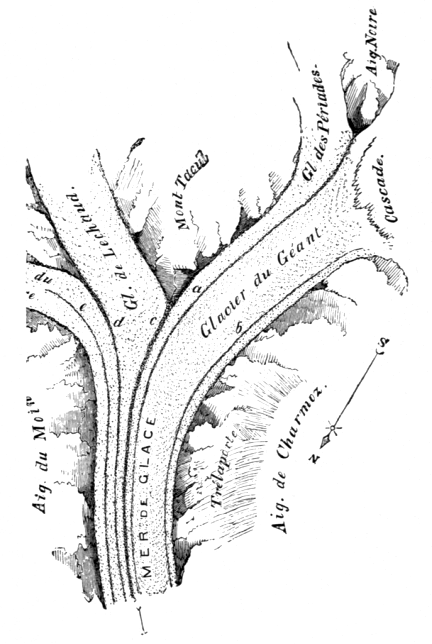
210. Are we to take this to mean that the ice of the Léchaud is squeezed to a tenth of its former volume? Not at all. What happens at Trélaporte is mainly a change of shape, not of volume. Before it is squeezed, the glacier is like a plate of ice lying flat on its bed; afterwards it is like a plate standing on its edge. No doubt the squeezing has made the ice deeper.
§ 30. Longitudinal Compression of a Glacier
211. The ice is forced through the gorge at Trélaporte by pressure from behind. In fact the Glacier du Géant, just above Trélaporte, acts as a piston or plug that drives the ice through the gorge. What effect must this pressure have on the plug itself? Reasoning alone makes it likely that the pressure will shorten the plug, and that the lower part of the Glacier du Géant will give way to some extent under the pressure from behind.
212. Let us test the idea. About three-quarters of a mile above the Tacul, on the mountain slope to our left as we go up, we notice a patch of green. We climb to it, plant our theodolite there, and set out a line across the Glacier du Géant, which we will call line No. 1 (F F′ on the Outline Plan).
213. About a quarter of a mile lower down we find a gully on the mountainside that can be climbed. We go up it, reach a suitable ledge, plant the instrument, and set out a second line, No. 2 (G G′ on the plan). We must work fast here, for stones come down this gully from a small glacier resting on the slope of Mont Tacul.
214. A quarter of a mile lower still, which brings us near the Tacul, we set out a third line, No. 3 (H H′ on the plan), across the glacier.
215. The daily motion of the centres of these three lines is as follows:
            Daily motion   Distance to the next line
    No. 1   20.55 inches   545 yards
    No. 2   15.43 inches   487 yards
    No. 3   12.75 inches
216. The first line moves five inches a day more than the second, and the second nearly three inches a day more than the third. Our reasoning is confirmed, then. The plug of ice, roughly a thousand yards long, is being shortened by the pressure on its front at about eight inches a day.
217. A river coming down the valley of the Géant would behave in much the same way. Its motion would slow as it approached Trélaporte, and it would pour through the narrow pass faster than the water behind it.
§ 31. Sliding and Flowing. Hard Ice and Soft Ice
218. Until now we have kept to measuring and discussing glacier motion, but on our excursions we have noticed many other things. Here and there, where the ice has drawn back from the mountainside, we have seen the rocks fluted, scored and polished, which proves that the ice has slid over them and ground them down. At the source of the Arveiron we saw the water rushing out from under the glacier loaded with fine matter. Every glacier river carries such a load. The Rhone carries its load into the Lake of Geneva. There the river's rush is stopped, the matter settles, and the Rhone leaves the lake clear and blue. The Lake of Geneva and many other Swiss lakes are partly filled with this matter, and in all likelihood it will blot them out in the end.
219. Part of a glacier's motion comes from this sliding of the whole mass over its bed.
220. On our walks over the glacier we have seen streams formed by the melting ice running away through cracks and crevasses to the glacier's bed. In this way the fine ground-up matter is washed away, the bed is kept lubricated, and the ice slides more easily than it otherwise would.
221. As a skater, too, you know how much a thaw weakens ice. Before it actually melts it turns rotten and unsafe. Test such ice with your penknife: the blade digs in readily, and the ice cuts easily. Try good sound ice the same way and you find it much tougher. The one is like soft chalk, the other like hard stone.
222. Now in summer the Mer de Glace is in this thawing condition. The sun makes its ice soft and yielding, and that makes its motion easier. We have seen that the glacier not only slides over its bed, but that the upper layers slide over the lower ones and the centre slides past the sides. The softer and more yielding the ice, the freer this motion will be, and the more readily the ice will be forced through a narrow pass like Trélaporte.
223. But in winter the thaw stops. Less water reaches the bed of the glacier, or none at all. The ice, too, is frozen hard, at least to a certain depth. All this would justify the opinion that in winter the glacier, if it moves at all, must move more slowly than in summer. At any rate, the summer measurements give us no clue to the winter motion.
224. The point deserves to be looked into. I shall not ask you, though, to visit the Alps in midwinter; if you will allow me, I shall go to the mountains as your deputy and report to you faithfully how the region looks and how the ice behaves.
§ 32. Winter on the Mer de Glace
225. The winter chosen is a bitter one. There is snow in London, snow in Paris, snow in Geneva, and snow near Chamonix so deep that the fences along the road have disappeared under it. On Christmas night of 1859, close to midnight, your deputy reaches Chamonix.
226. Snow fell heavily on December 26, but on the 27th, in a lull in the storm, we set out. I have four good guides and a porter with me. They tie boards to their feet to keep from sinking into the snow; I neglect this precaution and often sink to the waist. Four or five times on the way up the slope cracks with a sound like an explosion, and the snow threatens to come down in avalanches.5
The fresh snow was in the particular state that makes its grains stick together, and so every flake that fell on the trees had stayed there. The loaded pines took on beautiful and often fantastic shapes.
227. After five and a half hours of hard work we reached the Montanvert. We unlocked the deserted inn, around which the snow was piled up in buttresses. I have already spoken of the complicated play of the crystallising forces. The frost figures on the windowpanes of the inn were wonderful: miniature shrubs and ferns made by the building power as it worked, hampered by the clinging of its watery film to the glass. The glacier was very impressive. Every sound was stilled. The waterfalls that fill the air with music in summer were silent, hanging from the rock ledges in fluted columns of ice. The surface of the glacier was plainly higher than it had been in summer, which suggested that while the winter cold kept the lower end of the glacier jammed between its banks, the upper parts were still moving down and thickening the ice. The peak of the Aiguille du Dru shook out a cloud-banner, whose origin and nature have already been explained (84). (See the frontispiece.)
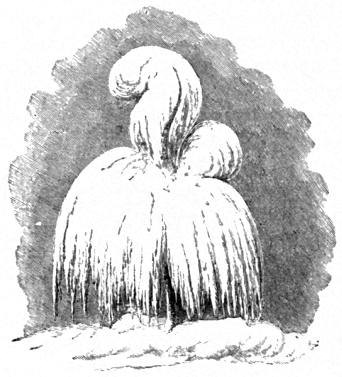
228. On the morning of the 28th this banner was remarkably large and grand, and, reddened by the light of the rising sun, it glowed like a flame. Rosy clouds clustered, too, round the crests of the Grande Jorasse and hung on the pinnacles of the Charmoz. Four men, well roped together, went down to the glacier. I had trained one of them in 1857, and he was now to fix the stakes. The storm had spread the snow so that stretches of the glacier lay bare and thickly covered by turns. Where the snow lay deep, great care was needed, for there were hidden crevasses underneath. The men sounded the snow with their staffs at every step. Once, while I was watching the party through my telescope, the leader suddenly vanished: the roof of a crevasse had given way under him. But the other three gathered round at once and lifted him out of the crack. The theodolite soon picked up the true line, and one by one the stakes were fixed, until eleven of them stood in a row across the glacier.
229. Going higher up the valley was out of the question: the snow was too deep and the weather looked too threatening. The theodolite was therefore planted among the pines a little way below the Montanvert, where a gap in the trees let me see across the glacier. Every now and then the men were wrapped in whirling wreaths of snow that hid them completely, and we had to make use of the lulls in the wind. It came up the valley in gusts, darkening the air, catching up the snow on the glacier and tossing it, all along the glacier's length, into high, violently churning clouds, with clear spaces between them where the ice was bare. In the middle of this turmoil the men kept working. Bravely and steadily, stake after stake was set, until at last ten of them were fixed in a row across the glacier.
230. Many of the stakes were fixed in snow. They were four feet long and were driven in to a depth of about three feet. But that night, as I listened to the wild onset of the storm, I thought the stakes and the snow that held them might be swept bodily away before morning. The wind dropped, however. We got up at dawn, but the air was thick with falling snow. It was made entirely of those exquisite six-petalled flowers, or six-rayed stars, which have already been drawn and described (§ 9). When the weather brightened, the theodolite was planted at the end of the first line. The men went down and, taught by their earlier experience, made the measurements quickly. The first line was finished before 11 in the morning. Then the snow began to fall again, filling the whole air. Countless spangles showered down on the heights. Against expectation, the men could still be seen and directed through the shower.
231. To reach the place where the theodolite stood at the end of our second line, I had to wade breast-deep through snow that seemed as dry and soft as flour. The men's labour on the glacier in breaking a way through the snow was tremendous. But they did not flinch, and after a while the leader stood behind the farthest stake and called out, Nous avons fini, "We've finished." I was surprised to hear him so clearly, for falling snow had been thought to deaden sound a great deal. The work was done, and I struck my theodolite feeling like a general who had won a small battle.
232. We put the house in order, packed up, and shot down the steep slopes of La Filia in a glissade, sliding on our feet, to the vault of the Arveiron. We found the river feeble, but not dried up. Many weeks must have passed since any water had come down from the surface of the glacier. But when winter set in, the cracks in the glacier were largely full of water, and the Arveiron we saw that day was probably the glacier slowly draining. There was no danger now in going into the vault, for the ice seemed as firm as marble. In the cavern we were bathed in blue light. The strange beauty of the place suggested magic and reminded me of stories about fairy caves I had read as a boy. Our winter visit to the Mer de Glace ends at the source of the Arveiron; the next morning your deputy was on his way to London.
§ 33. Winter Motion of the Mer de Glace
233. Here are the measurements made in the winter of 1859:
Line No. I.
    Stake  1  2  3  4  5  6  7  8  9 10 11
    Inches 7 11 14 13 14 14 16 16 12 12  7
Line No. II.
    Stake  1  2  3  4  5  6  7  8  9 10
    Inches 8 10 14 16 16 16 18 17 15 14
234. In winter, then, the Mer de Glace near the Montanvert moves, in round numbers, at half its summer speed.
235. As in summer, the eastern side of the glacier at this spot moved faster than the western.
§ 34. Motion of the Grindelwald and Aletsch Glaciers
236. As far as motion is concerned, we have given ourselves to no other glacier as thoroughly as to the Mer de Glace, but we can add a few measurements of other famous glaciers. Near the village of Grindelwald in the Bernese Oberland there are two great ice-streams, the Upper and the Lower Grindelwald glaciers, the second of which is often visited by travellers in the Alps. On August 6, 1860, Mr. Vaughan Hawkins and I fixed a row of twelve stakes across it. Measured on the 8th and reduced to a daily rate, the motion of the stakes was as follows.
Motion of Lower Grindelwald Glacier
          East                                West
    Stake   1  2  3  4  5  6  7  8  9 10 11 12
    Inches 18 19 20 21 21 21 22 20 19 18 17 14
237. The theodolite was planted here a little below the footpath that leads up to the higher glacier, about a mile above the end of the glacier. Crevasses made the measurement difficult.
238. The largest glacier in Switzerland is the Great Aletsch, which we shall come back to later. On August 14, 1860, Mr. Hawkins and I planted a row of thirty-four stakes across it. Measured on the 16th and reduced to a daily rate, their speeds were found to be as follows.
Motion of Great Aletsch Glacier
            East
    Stake    1 2 3 4  5  6  7  8  9 10 11 12
    Inches   2 3 4 6  8 11 13 14 16 17 17 19
    Stake   13 14 15 16 17 18 19 20 21 22 23
    Inches  19 18 18 17 19 19 19 19 17 17 15
    Stake   24 25 26 27 28 29 30 31 32 33 34
    Inches  16 17 17 17 17 17 17 17 16 12 12
                                        West
239. The greatest motion here is nineteen inches a day. The eastern side of the glacier is probably shallow, so that the drag of the bed keeps the motion of the eastern stakes small. The glacier here is 9,030 links wide, about a mile and a furlong. The theodolite was planted high among the rocks on the western flank of the mountain, about half a mile above the Märgelin See.
§ 35. Motion of Morteratsch Glacier
240. Far to the east of the Oberland, in the interesting part of Switzerland called the Upper Engadine, stands a noble group of mountains, lower than those of the Oberland but still commandingly high. The group takes its name from its highest peak, the Piz Bernina. To get there we go by railway from Basel to Zürich and from Zürich to Chur (in French, Coire), and from there by stagecoach over either the Albula pass or the Julier pass to the village of Pontresina. Here we are right beside the Bernina mountains.
241. From Pontresina you can walk or drive along a good coach road over the Bernina pass into Italy. About an hour above the village you would look from the road into the heart of the mountains, your line of sight running up a valley in which a glacier of considerable size lies bedded. Along its back you would trace a medial moraine, and you could hardly miss how the moraine, a mere narrow streak at first, widens little by little as it comes down, until at last it covers the lower end of the glacier entirely. Nor is this an effect of perspective. If you stood on the mountain slopes that feed the glacier, you would see the streak of rubbish widening from there too, though from there the perspective would tend to make the moraine narrower as it drew away downwards.
242. The ice-stream I am speaking of is the Morteratsch glacier, whose end is a short hour's walk from the village of Pontresina. We now have to find out how fast it moves and to account for the widening of its medial moraine.
243. In the summer of 1864 Mr. Hirst and I set out three lines of stakes across the glacier. The first line crossed the ice high up, the second a good way lower down, and the third lower still. Even the third line, though, was a considerable distance above the actual snout of the glacier. The daily motion of the three lines was as follows.
First Line.
    Stake      1  2  3  4  5  6  7  8  9 10 11
    Inches     8 12 13 13 14 13 12 12 10  7  5
Second Line.
    Stake      1 2 3 4  5  6  7  8  9 10 11
    Inches     1 4 6 8 10 11 11 11 11 11 11
Third Line.
    Stake      1 2 3 4 5 6 7 8 9 10 11
    Inches     1 2 4 5 6 6 7 7 5  5  4
244. Compare these lines with one another. You notice that the first moves faster than the second, and the second faster than the third.
245. The lines were left to move downwards for 100 hours, and at the end of that time the distances travelled by the points of swiftest motion on the three lines were as follows:
Maximum Motion in 100 Hours.
    First line   56 inches
    Second line  45 inches
    Third line   30 inches
246. Here, then, is proof that the upper parts of the Morteratsch glacier are gaining on the lower ones. In 1871 a point in the middle of the glacier near its snout was found to be moving less than two inches a day!
247. What, then, follows from the faster march of the upper glacier? Plainly, that the medial moraine is squeezed lengthwise and made to spread out sideways. Here the cause of the widening of the medial moraine is laid bare.
248. Whether a glacier can scoop out or deepen the valley it moves through is a much-debated question, and this very Morteratsch glacier has been cited as proof that it cannot. Observers went to the snout of the glacier, found it practically at rest, and concluded that no scooping was going on. But those who argued that glaciers can dig out valleys never said, or meant to say, that the snout of the glacier did the work. In the Morteratsch glacier the digging, which certainly goes on to a greater or lesser degree, must be far more effective high up the valley than at the end of the glacier.
§ 36. Birth of a Crevasse: Reflections
249. Keeping up the idea that we are working together, we now enter a new field of inquiry. We have rolled up our chain and are turning for home after a hard day's work on the Glacier du Géant, when under our feet, as if from the body of the glacier, we hear an explosion. A little startled, we look questioningly over the ice. The sound comes again, several shots fired in quick succession. Sometimes they seem to be on our right, sometimes on our left, and we feel as though the glacier were breaking up all round us. Still there is nothing to be seen.
250. We search the ice closely, and after an hour of careful hunting we find the cause of the reports. They announce the birth of a crevasse. In a pool on the glacier we see air bubbles rising, and find the bottom of the pool crossed by a narrow crack from which the bubbles come. Right and left of this pool we trace the young fissure for long distances. In places it is almost too faint to be seen, and nowhere is it wide enough to take a knife blade.
251. It is hard to believe that the fearsome chasms you and I have so often walked among in awe could begin in this small way. Yet that is how they begin. The great gaping chasms on and above the ice-falls of the Géant and the Talèfre start as narrow cracks that open gradually into crevasses. We are taught here, instructively and impressively, that appearances suggesting very violent action may really be produced by processes so slow that it takes refined observation to detect them. Two things always come into play in producing natural phenomena: the intensity of the force at work and the time during which it works. Make the intensity great and the time small, and you have sudden upheaval; but exactly the same visible effect can be produced by making the intensity small and the time great. The ice-falls and crevasses of the Alps illustrate this truth strikingly, and many geological phenomena that at first sight suggest violent upheaval may really have been produced in the same, almost imperceptible way.
§ 37. Icicles
252. The crevasses are grandest on the higher névés. Sometimes they appear as long, yawning fissures, sometimes as chasms of irregular outline. A delicate blue light shimmers from them, fading little by little into the darkness of their deeper parts. Over the edges of the chasms, mostly over the southern edges, hangs a coping of snow, and from this hang rows of transparent icicles, like stalactites, 10, 20, 30 feet long. These hanging spears are one of the loveliest features of the higher crevasses.
253. How are they made? Plainly by the thawing of the snow. But once the snow has thawed, why should the water freeze again into solid spears? You have seen icicles hanging from the eaves of a house, plainly made by the thawing of snow on the roof. If we understand these, we shall understand the far bigger stalactites of the Alpine crevasses too.
254. Let us gather up what knowledge we have, think about it patiently, and build on it, if we can, a theory of icicles.
255. First, you must know that the air of our atmosphere is hardly heated at all by the sun's rays, visible or invisible. The air is highly transparent to rays of every kind, and only the small fraction of rays to which it is not transparent spend their force in warming it.
256. It is not so with the snow the sunbeams fall on. The snow absorbs the sun's heat, and on a sunny day you can see the summits of the high Alps glistening with meltwater, while the air above and around the mountains may be many degrees below freezing.
257. You only have to step from sunshine into shade to prove it. A single step carries you from a place where the thermometer stands high to one where it stands low, and the change is due not to any difference in the temperature of the air but simply to taking the thermometer out of the direct rays of the sun. Indeed, you need not move the thermometer at all: put a suitable screen in the way to cut off the sun's rays, and the coldness of the air shows itself.
258. Now look at the snow on your roof. The sun plays on it and melts it; the water trickles to the eaves and drips off. If the eaves face the sun, the water stays water. But if they do not, the drop, before it leaves the snow it came from, is already in shadow. And the shaded space, as we have learned, may be below freezing. If it is, the drop freezes instead of falling, and the beginning of an icicle is made. More drops and trickles follow, run over this beginning, partly freeze on it and thicken it at the root. But some of the water reaches the free end of the icicle, hangs there, and freezes before it can drop off, and the icicle grows longer. In the Alps, where there is plenty of melting and the cold of the shaded crevasse is intense, icicles made in exactly the same way naturally grow bigger. The snow draining away after the sun's power has gone also makes icicles.
259. It is interesting, and useful, to be able to explain how an icicle forms; but it is far more important to see how the different threads of what we call Nature are woven together. You cannot fully understand an icicle without first knowing that sunbeams strong enough to melt the snows and blister human skin, strong enough indeed, when concentrated, to burn up a human body, can pass through the air and still leave it icy cold.
§ 38. The Bergschrund
260. With that difficulty cleared away, let us turn back to the crevasses and take them in the order in which they form. First, then, above the névé are the topmost Alpine peaks and crests, against which the snow is often piled up as a steep buttress. We have learned already that both névés and glaciers are moving slowly downwards; but usually the top of the buttress is fastened to the rocks firmly enough to hold on while the lower part breaks away. A very characteristic crevasse forms in this way, called in the German-speaking Alps a Bergschrund. It often runs round a peak like a moat, as though to defend it against the attacks of climbers.
261. Look more closely at how it forms. Imagine the snow still unbroken. Its upper parts cling to the rocks and move down extremely slowly. But its lower parts, whether because they are deeper and heavier or because they are less firmly attached, are forced to move faster. A pull is therefore set up, tending to tear the lower snow from the upper. For a while the cohesion of the névé resists this pull, but at last it gives way, and a crack forms straight across the line along which the pull acts. In other words, a crevasse forms at right angles to the line of tension.
§ 39. Transverse Crevasses
262. The crevasses on the névé and on the glacier have the same origin. For one reason or another the ice is put under strain, and since it cannot stretch, it breaks across the line of tension. Take, for example, the ice-fall of the Géant, or that of the Talèfre, above which, as you know, the crevasses gape terribly. Imagine the névé and the glacier peeled away entirely, so as to lay bare the surface they move over. From the Col du Géant we should see this surface falling gently to the place where the brow of the cascade now is. There it would plunge steeply down to the bed of the present Glacier du Géant, where the slope would become gentle again.
263. Picture the névé moving over such a surface. It comes down from the col until it reaches the brow. It goes over the brow and must bend downwards to stay on its bed. Think clearly about what must happen. The surface of the névé is plainly put under strain; it breaks and forms a crevasse. Each fresh stretch of the névé is broken in the same way as it goes over the brow, and so a procession of crevasses is sent down the fall. Between every two chasms there is a great ridge running across the glacier. Local strains on the fall often break these ridges across too, and towers of ice, séracs, are the result. Ridges and séracs alike are carried down the fall, and the wreckage grows worse on the way down.
264. What must happen at the foot of the fall? Here the slope suddenly becomes gentler. Plainly the crevasses must not only stop opening here but must close up, wholly or partly. At the top of the fall the bending made the surface convex; at the bottom the bending makes it concave. In the one case there is strain, in the other pressure; in the one case, therefore, crevasses open, and in the other they close. This reasoning matches what we observe exactly.
265. Bare your arm and hold it out straight. Make two ink dots half an inch or an inch apart, right opposite the elbow. Bend your arm: the dots come closer and finally meet. Let the two dots stand for the two sides of a crevasse at the bottom of an ice-fall. The bending of your arm is like the bending of the ice, and the meeting of the dots is like the closing of the cracks.
266. The same is true of various parts of the Mer de Glace. In certain places the slope changes from gentler to steeper, and going over the brow between them the glacier breaks its back. Transverse crevasses are formed this way. There is such a change of slope opposite l'Angle, and a still greater one of the same kind at the head of the Glacier des Bois. As a result the Mer de Glace cannot be crossed at the first place, and at the second it is torn and wrecked in the way we have seen and described. Below l'Angle, and at the bottom of the Glacier des Bois, the slope eases off, the crevasses heal, and the glacier becomes whole and compact once more.
§ 40. Marginal Crevasses
267. Suppose, then, there were no changes of slope at all: should we have no crevasses? We should certainly have fewer, but they would not vanish altogether. Other things put the ice under strain and decide where it breaks, and the chief of these is the faster motion of the centre of the glacier.
268. With the help of the labours of an eminent man now dead, the late Mr. William Hopkins of Cambridge, let us master the explanation of this point together. But mastering it would be all the more pleasant if we could first see the puzzling and misleading appearances the explanation accounts for. If I had my way, I would carry you off with me at this point in our researches to Basel, then to Thun, then to Interlaken, then to Grindelwald, where you would stand face to face with the Wetterhorn and the Eiger, with all the greatest peaks of the Bernese Oberland, the Finsteraarhorn, the Schreckhorn, the Mönch and the Jungfrau, close at hand. At Grindelwald, as we have learned, there are two well-known glaciers, the Upper and the Lower Grindelwald glaciers, and we should begin our observations on the second.
269. Dropping down from the village to the bottom of the valley, we should climb the mountain opposite, and with the great limestone cliffs of the Wetterhorn on our left we should reach a path with a view of the glacier. Here we should see fine examples of crevasses opening at the top of a brow and closing at the bottom. But the main interest would be the crevasses formed at the side of this glacier: the marginal crevasses, as we may call them.
270. We should find the side heavily fissured, even where the centre is compact, and we should particularly notice that the fissures run neither along the glacier nor straight across it, but slantwise, at an angle of about 45 degrees to the sides. Starting from the side of the glacier, the crevasses would be seen to point upwards: the ends of the fissures that butt against the mountain would seem to be dragged down. If you knew less than you do now, I would bet you that the look of these fissures would lead you to conclude that the centre of the glacier is left behind by the faster motion of the sides.
271. That, indeed, is the conclusion M. Agassiz drew from this very appearance, before he had measured the motion of the sides and centre of the glacier of the Unteraar. Mr. Hopkins, who was thoroughly at home with mechanical problems, at once deduced the slant of the side crevasses from the faster flow of the centre. Standing beside the glacier with pencil and notebook, I would make the matter clear to you straight away, like this.
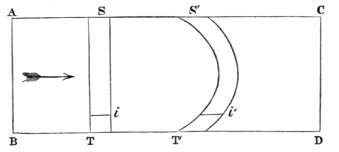
272. Let A C in the figure be one side of the glacier and B D the other, and let the direction of motion be the one shown by the arrow. Let S T be a slice of the glacier taken straight across it, say today. A few days or weeks from now this slice will have been carried down, and because the centre moves faster than the sides, it will not stay straight but will bend into the shape S′ T′.
273. Suppose T i is a small square of the original slice near the side of the glacier. In its new position the square will be pulled out of shape into the lozenge T′ i′. Fix your attention on the diagonal T i of the square. In the lower position this diagonal, if the ice could stretch, would be lengthened to T′ i′. But the ice does not stretch; it breaks, and a crevasse forms at right angles to T′ i′. One look at the diagram will satisfy you that the crevasse will point slantwise upwards.
274. All along the side of the glacier the faster motion of the centre sets up the same kind of strain, and as a result the sides are heavily cut by these slanting crevasses, even where the centre is free of them.
275. It is curious to see, in other places, the transverse fissures of the centre joining up with those at the sides to form great curved crevasses that stretch across the glacier from side to side. The curve bulges upwards, as mechanical principles say it should. (See the sketch below.) But if you did not know those principles, you would never guess from the look of these curves that the centre moves faster. In landslides, and in the motion of mud that has partly hardened, you may sometimes see appearances like those the ice shows.
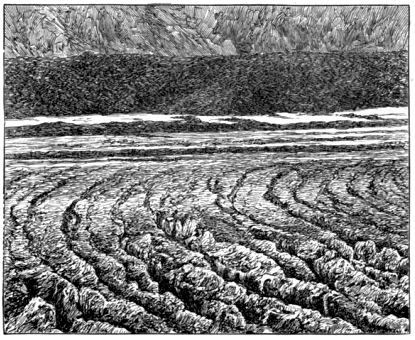
§ 41. Longitudinal Crevasses
276. We have now worked out the origin of both transverse and marginal crevasses. But where a glacier comes out of a steep, narrow pass onto a fairly level plain where it has room to spread sideways, its motion is partly checked, and the level part has to bear the thrust of the steeper parts behind. Here the line of thrust runs along the glacier, while the direction at right angles to it is one of tension. The glacier breaks across this second direction, and longitudinal crevasses are formed.
277. Examples of this kind of crevasse can be seen in the lower part of the Rhone glacier, looking down on it from the Grimsel Pass or from any high point on the mountains beside it.
§ 42. Crevasses in relation to Curvature of Glacier
278. One more point remains to be discussed, and what you know now will let you master it in a moment. You remember that early in our researches we crossed the Mer de Glace from the Chapeau side to the Montanvert side. I asked you then to notice that the Chapeau side of the glacier was more fissured than either the centre or the Montanvert side (112). Why should that be? Knowing as we now do that the Chapeau side of the glacier moves faster than the other, and that the point of greatest motion lies not on the centre but far to the east of it, we are ready to answer the question perfectly satisfactorily.
279. Let A B and C D in the diagram below stand for the two curved sides of the Mer de Glace at the Montanvert, and let m n be a straight line across the glacier. Let o be the point of greatest motion. The mechanical state of the two sides of the glacier can be made plain like this. Suppose the line m n is a straight elastic string with its ends fixed. Grip it firmly at the point o between finger and thumb and pull it to o′, keeping the distance between o′ and the side C D the same. The length n o of the string would then have stretched to n o′, and the length m o to m o′, and you can see plainly that the short piece has stretched more, for its length, than the long piece has for its length. In other words, the strain on n o′ is greater than that on m o′, so that if one of them broke under the strain, it would be the short one.
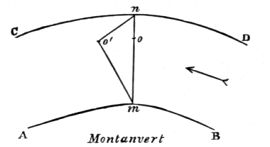
280. These two pieces of string stand for the strain on the two sides of the glacier. The sides are held back and the centre tries to move on, and so a strain is set up between the centre and the sides. But because the bend of the valley shifts the point of greatest motion, the strain on the eastern ice is greater than that on the western. The eastern side of the glacier is therefore more crevassed than the western.
281. Here, in fact, lies the difficulty of getting along the eastern side of the Mer de Glace, a difficulty that was one of our reasons for crossing the glacier opposite the Montanvert. There are two convex sweeps on the eastern side to one on the western, and so on the whole the eastern side of the Mer de Glace is the more torn.
§ 43. Moraine-ridges, Glacier Tables, and Sand-Cones
282. When you and I first crossed the Mer de Glace from Trélaporte to the Couvercle, we found that the stripes of rocks and rubbish making up the medial moraines were ridges standing above the general level of the glacier, in some places to a height of twenty or thirty feet. Looking into these ridges, we found that the rubbish was only a surface layer, resting on a great spine of ice that ran along the back of the glacier. What has raised this ridge of ice?
283. Most boys have read the story of Dr. Franklin putting bits of cloth of various colours on the snow on a sunny day. The bits of cloth sank into the snow, the dark ones most.
284. Think about this experiment. The sun's rays first fall on the upper surface of the cloth and warm it. The heat is then conducted through the cloth to its under surface, and the under surface passes it on to the snow, which the heat finally melts. Plainly, the amount of snow melted depends entirely on the amount of heat that gets from the upper surface of the cloth to the under one.
285. Now cloth is what is called a bad conductor: it does not let heat travel freely through it. Still, when the heat only has to cross the thickness of a single bit of cloth, a good deal of it gets through. But double or treble or quintuple the thickness of the cloth, or, more simply, lay several pieces one on top of another, and you reach a point at last where no appreciable heat can get through from the upper surface to the under one.
286. What must happen if such a thick piece of cloth, or such a pile of pieces, is laid on snow under a strong sun? The snow round the cloth melts, but the snow under it is protected. Keep this up long enough, and the inevitable result is that the level of the snow all round the cloth sinks, and the cloth is left behind, perched on a little hill of snow.
287. If you understand this, you have already mastered the cause of the moraine-ridges. They are not made by any swelling of the ice upwards. The ice under the rocks and rubbish is shielded from the sun, the glacier to the right and left of it melts away, and a ridge is left behind.
288. Several other things seen on the glacier are explained the same way. Here on the Mer de Glace there are flat slabs of rock, sometimes lifted up on pillars of ice. These are the so-called Glacier Tables. They are made not by a stalk of ice growing up out of the glacier, but by the glacier melting all round the ice the stone protects. Here is a sketch of one of the Tables of the Mer de Glace.
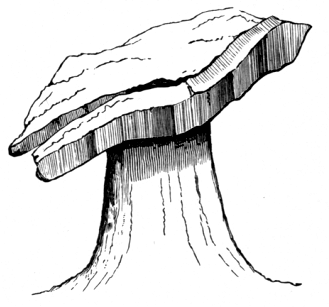
289. Notice, too, that a glacier table hardly ever sits square on its pillar. It generally leans to one side, and repeated observation teaches you that it leans in a way that always lets you draw the north and south line on the glacier. At noon the sun stands south of the zenith and pours its rays against the southern end of the table, while the northern end stays in shadow. The southern end, being warmed most, protects the ice beneath it less well than the northern end does. The table tilts, and in the end slides bodily off its pedestal.
290. In the next figure we have what may be called an ideal Table. The slanting lines stand for the direction of the sunbeams, and the tilt of the table they produce is like the tilt seen on the glaciers.
291. A pebble will not rise like this. Like Franklin's single bit of cloth, a dark pebble sinks into the ice. A spot of black earth will not stay on the surface but will sink, and in various places the Glacier du Géant is honeycombed by spots of dirt that have sunk into the ice this way.
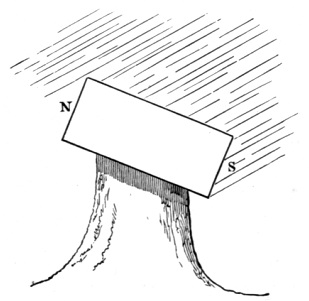
292. But when the dirt lies thick enough to protect the ice, things are different. Sand is often washed down by a stream from the mountains or from the moraines and spread over parts of the glacier. Something very curious follows: the sanded surface rises, and the part where the sand lies thickest rises highest. Little peaks and hillocks jut up, and when the sand is spread favourably and the action goes on long enough, little mountains form, sometimes singly and sometimes in groups that mimic the Alps themselves. The Sand-Cones of the Mer de Glace are not striking, but on the Görner, the Aletsch, the Morteratsch and other glaciers they form singly and in groups, sometimes reaching a height of ten or twenty feet.
§ 44. The Glacier Mills or Moulins
293. You and I have learned the character of the Mer de Glace by long experience. We have marched over it every day with a definite object in view, but we have not shut our eyes to other things. In scientific investigation, new subjects of inquiry spring from side glimpses of things that are not, at the moment, holding our attention.
294. When we were marching over the ice near Trélaporte, for example, we were often struck by a sound like low, rumbling thunder. Later we went looking for the source of this sound, and found it.
295. A large stretch of this part of the glacier is unbroken. Trickles of water have room to form rills; rills join to form streams; streams combine to form rushing brooks, which sometimes cut deep channels in the ice. Sooner or later these streams reach a part of the glacier under strain, where a crack opens across the stream. A way is thus opened for the water to the bottom of the glacier. Working on it for a long time, the stream hollows out a shaft, and the crack becomes the mouth of a funnel of unseen depth, into which the water leaps with a sound like thunder.
296. This funnel and its waterfall make a glacier mill, or moulin.
297. Let me hold your hand tightly while you stand on the edge of this shaft and look in. The hole, with its pure blue shimmer, is beautiful, but it is terrible. Careless people have fallen into these shafts, and a second or two of bewilderment has been followed by sudden death. But for explorers like you and me, caution on the glaciers and mountains ought to be made, by habit, a second nature.
298. The crack the stream first plunged into to form the moulin moves down with the glacier. A fresh stretch of ice arrives at the place where the breaking strain acts. A new crack then opens above the moulin, the stream forsakes the old one, and it travels on downwards as an empty shaft. Here on the Mer de Glace, below the Grand Moulin, we see no fewer than six of these forsaken holes. We sound some of them to a depth of 90 feet.
299. But you and I both want, if we can, to find the whole depth of the Mer de Glace. The Grand Moulin gives us a chance to do it that we must not miss. Our first attempt to sound the moulin fails: the headlong plunge of the water breaks our cord. A sailor judges the sea bottom by a lump of grease in the hollow of his lead weight. We use such a weight, but cannot reach the bed of the glacier. Our plummet reaches 163 feet at most.
300. From July 28 to August 8 we have watched the progress of the Grand Moulin. Its position was fixed on the first of those dates. By the 31st it had moved down 50 inches; a little more than a day later it had moved 74 inches. By August 8 it had moved 198 inches, an average of about 18 inches every twenty-four hours. No doubt next summer a Grand Moulin will be found thundering near Trélaporte on the Mer de Glace; but like the crevasse of the Grand Plateau we spoke of earlier (142), it will not be our moulin. Ours, or rather the ice it pierced, is now probably more than a mile lower down than it was in 1857.
§ 45. The Changes of Volume of Water by Heat and Cold
301. On the glacier we have noticed shafts and pits filled with water of the most delicate blue. Some of them have been the shafts of dead moulins, closed at the bottom. A theory has been put forward to account for them which, though it may not hold up, opens out some points about the properties of water that inquirers like you and me ought to know well.
302. When we took lake ice apart with a beam of heat (§ 11), we noticed little empty spots at the centres of the liquid flowers the beam produced. We put these spots down to the fact that when ice melts, the water it makes takes up less room than the ice did, so that the water of the flower could not fill the whole space the flower covered.
303. Let us illustrate this more fully. Stop up a small flask with a watertight cork, and pass a narrow glass tube through the cork, also watertight. It is easy to fill the flask with water so that the liquid stands at a certain height in the glass tube.
304. Now let us warm the flask with the flame of a spirit lamp. When the flame is first applied, you notice the liquid in the tube sink for a moment. This is because the flask itself expands for a moment with the heat: it suddenly grows larger when the flame first touches it.
305. But the expansion of the water soon catches up with that of the flask and outstrips it. At once we see the column of liquid rise in the glass tube, exactly as mercury rises in the tube of a warmed thermometer.
306. Our glass tube is ten inches long, and at the start the water stood in it at a height of five inches. We keep the spirit-lamp flame on until the water rises right to the top of the tube and trickles over. This is enough to show that water expands with heat.
307. Now we take an ordinary finger bowl and put a little crushed ice and salt into it. We set the flask on this and pack the freezing mixture round it. The column of liquid retreats down the tube, proving that the liquid contracts with cold. We let the shrinking go on for some minutes, and notice that the retreat of the liquid gradually slows and finally stops altogether.
308. Keep your eye on the column of liquid. It stays still for a fraction of a minute, and then moves again. But now it moves upwards instead of downwards. The freezing mixture is now acting exactly like the flame.
309. It would not be hard to pass a thermometer through the cork into the flask, and it would tell us the exact temperature at which the liquid stopped contracting and began to expand. At that moment we should find the temperature of the liquid a shade over 39° Fahr.
310. At this temperature, then, water reaches its greatest density.
311. Seven degrees below it, at 32° Fahr., the liquid begins to turn into solid crystals of ice, which, as you know, floats on water because, weight for weight, it is bulkier. In fact, this halt of the approaching molecules at 39° is only the preparation for the act of crystallisation to come, in which the expansion by cold reaches its climax. Up to the point of freezing, the increase in volume is slow and gradual; in the act of freezing it is sudden and overwhelmingly strong.
312. By this force of expansion the Florentine Academicians long ago burst a sphere of copper nearly three quarters of an inch thick. By the same force the celebrated astronomer Huygens in 1667 burst iron cannons a finger's breadth thick. Such experiments have often been made since. During a severe winter at Quebec, Major Williams filled a mortar with water and closed it by driving a wooden plug into its muzzle. Exposed to a temperature 50° Fahr. below the freezing point of water, the metal stood the strain, but the plug gave way and was shot out to a distance of 400 feet. At Warsaw, howitzer shells have been burst the same way, and you and I have shattered thick bombshells to pieces by setting them in a freezing mixture for half an hour.
313. The theory of the shafts and pits mentioned at the start of this section is this. The water at the top of the shaft is warmed by the sun, say to a temperature of 39° Fahr. The water at the bottom, touching the ice, must be at 32° or near it. The heavier water is therefore on top; it will sink to the bottom, melt the ice there, and so deepen the shaft.
314. The circulation described here certainly goes on, and some curious effects are due to it; but not, I think, this one. For a shaft to deepen, its bottom must melt faster than the surface of the glacier. It is not easy to see how the sun's heat, by being first absorbed by water and then carried by it to the bottom of the shaft, could melt the bottom faster than it melts the ice that takes the full direct blow of the sun's rays. The surface of the glacier must sink at least as fast as the bottom of the pit, so the circulation, though it really exists, cannot produce the effect put down to it.
§ 46. Consequences flowing from the foregoing Properties of Water. Correction of Errors
315. I was not much older than you are when I first learned that water stops contracting with cold at a temperature of 39° Fahr., and I still remember the impression it made on me. I was asked to consider what would happen if this solitary exception to an otherwise universal law did not exist.
316. I was asked to think about a lake stocked with fish, its surface exposed to very cold air. It was made clear to me that the water, when first chilled, would shrink and grow heavier, and would therefore sink, its place being taken by the warmer and lighter water from the deeper parts of the lake.
317. It was pointed out to me that, without the law in question, this circulation would go on until the whole of the lake had been cooled to the freezing point. Freezing would then begin and continue as long as any water was left to freeze. One result would be the death of every living thing in the lake. Other disasters were added, and all of them, I was told, were prevented by the quite exceptional arrangement that after a certain point the colder water becomes the lighter, floats on the surface of the lake, and freezes there, throwing a protecting roof over the life below.
318. Count Rumford, one of the most solid of scientific men, writes on this question in the following strain: "It does not appear to me that there is anything which human sagacity can fathom, within the wide-extended bounds of the visible creation, which affords a more striking or more palpable proof of the wisdom of the Creator, and of the special care He has taken in the general arrangement of the universe, to preserve animal life, than this wonderful contrivance.
319. "Let me beg the attention of my readers while I endeavour to investigate this most interesting subject; and let me at the same time bespeak his candour and indulgence. I feel the danger to which a mortal exposes himself who has the temerity to explain the designs of Infinite Wisdom. The enterprise is adventurous, but it surely cannot be improper.
320. "Had not Providence interfered on this occasion in a manner which may well be considered as miraculous, all the fresh water within the polar circle must inevitably have been frozen to a very great depth in winter, and every plant and tree destroyed."
321. Through many pages of his book Count Rumford goes on in this strain, expounding the ways and intentions of the Almighty, and he does not hesitate to use very harsh words of those who cannot share his views. He calls them hardened and degraded. Here we are warned of something too often forgotten: the pleasure or comfort a belief gives, or the warmth or exaltation of feeling it stirs, is no guarantee that it is true. For all Count Rumford's delight and enthusiasm on this subject, and all his anger against those who did not share his opinions, rested on a mistaken idea.
322. Water is not a solitary exception to an otherwise general law. There are molecules besides those of water that need more room in the solid crystalline state than in the molten state next to it. Iron is a case in point: solid iron floats on molten iron exactly as ice floats on water. Bismuth is a still more striking case, and we could burst a bombshell as surely by the freezing of bismuth as by that of water. There are no fish to be taken care of here, and still the "contrivance" is the same.
323. I am reluctant to mention them in the same breath as Count Rumford, but I am told that in our own day there are people who claim to find the comforts of a religion in a superstition lower than any that has yet degraded the civilized human mind. The happiness a faith gives and the truth of that faith, then, are two entirely different things.
324. Life and the conditions of life are necessarily in harmony. This is a truism, for without the right conditions life could not exist. But both life and its conditions display the workings of an inscrutable Power. We do not know its origin; we do not know its end. And the presumption, if not the degradation, lies with those who set a magnified image of themselves on the throne of the universe and make its doings a mere colossal copy of their own.
§ 47. The Molecular Mechanism of Water-Congelation
325. But let us get back to our science. How are we to picture this expansion of freezing water? By what process do the molecules demand, so irresistibly, more room in the solid state than in the liquid state next to it? In every case of this kind we have to draw our ideas from the world of the senses and then carry them over into a world beyond the reach of the senses.
326. You have not forgotten our conversation about "atomic poles" (§ 10), and how the idea of polar force came to be applied to crystals. With that fresh in your mind, you will not find it hard to understand how an increase in volume can go along with the act of crystallisation.
327. I set a number of magnets in front of you. Being matter, they are acted on by gravity, and if they were perfectly free they would move towards one another under the pull of gravity.
328. But they are not just matter; they are magnetic matter. They act on one another not only by the simple force of gravity but also by the polar force of magnetism. Imagine them set some distance apart and perfectly free to move. Gravity makes itself felt first and draws them together. For a while the magnetic force coming from the poles cannot be felt; but once they get close enough, the polar force comes into play. The points that attract each other close up, the points that repel each other draw back, and it is easy to see that this can produce an arrangement of the magnets that takes up more room. Suppose they are packed in a box that exactly encloses them at the moment the polar force first comes into play. It is easy to see that as they rearrange themselves afterwards, the repelled corners and ends of the magnets may press against the sides of the box, and may even burst it if the forces are strong enough.
329. Here, then, is an idea that can be applied to the molecules of water. Like the magnets, they are acted on by two distinct forces. For a while, as the liquid cools, they draw closer together, obeying their general attraction for one another. But at a certain point new forces come into play, some attracting, some repelling, coming from particular points on the molecules. The attracted points close up and the repelled points draw back. The molecules turn and rearrange themselves, and as they do so they demand more room, overcoming all ordinary resistance by the force of their demand. This, in general terms, explains why water expands when it freezes. It would be easy to build an apparatus to illustrate it.
§ 48. The Dirt Bands of the Mer de Glace
330. Go from bright sunshine into a dimly lit room, and for a while everything looks so dark that you cannot make out the objects in the room clearly. Battered by the waves of light (§ 3), the optic nerve is numbed, and it takes time to recover its sensitivity.
331. That is why I choose this hour for a special observation on the Mer de Glace. The sun has sunk behind the ridge of the Charmoz, and the surface of the glacier lies in quiet shade. The main part of our day's work is done, but we still have energy enough to climb the slopes beside the Montanvert to a height of a thousand feet or so above the ice.
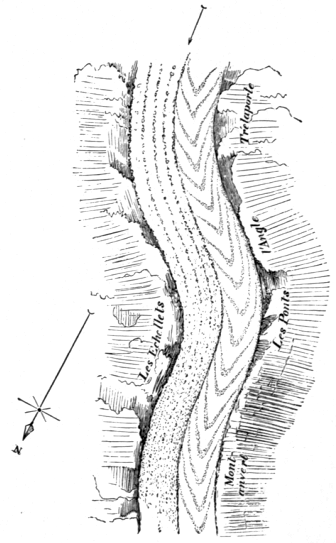
332. Now we look straight down on the glacier and see it less foreshortened than from the Montanvert. We notice the dirt covering its eastern side, the result of its medial moraines crowding together. We see the fairly clean surface of the Glacier du Géant, but on this surface we notice something we have not seen before. It is crossed by a series of grey, bent bands, following one after another from Trélaporte downwards. From where we stand we count eighteen of them. (See the sketch above.)
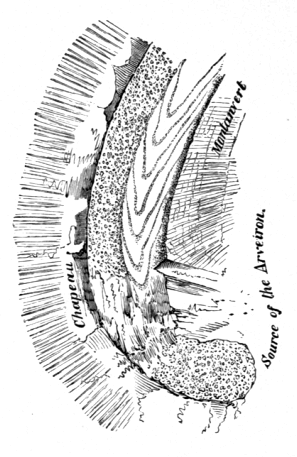
333. These are the Dirt Bands of the Mer de Glace. They were first noticed by Professor Forbes in 1842.
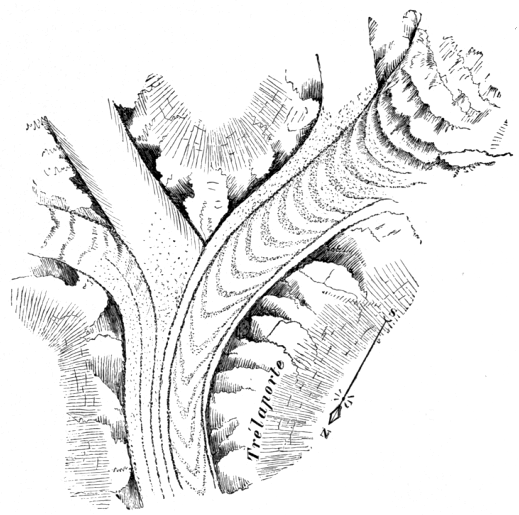
334. They run on down the glacier farther than we can see. If we cross the valley of Chamonix and climb the mountains on the other side to a point near the little inn called La Flégère, we shall have a view of the end of the glacier and see the series of bands completed. We notice that from start to finish they are confined to the part of the glacier that comes from the Col du Géant. (See the second sketch.)
335. We must trace them to their source. You know what a noble and complete view of the glacier and the Col du Géant the Cleft Station above Trélaporte gives. We must climb there once more, and from there we can see the series of bands stretching down to the Montanvert and up to the foot of the ice-cascade on the Glacier du Géant. The cascade plainly has something to do with how they form. (See the third sketch.)
336. And how? Simply enough. The glacier, as we know, is broken across at the top of the ice-fall and comes down the slope as a series of great ridges lying across it. At the foot of the fall the chasms close, but the ridges partly remain as swellings that run like huge wrinkles across the glacier. These swellings are bent more and more by the faster motion of the centre, and the hollows between them catch the fine mud and grit washed down by the little rills from the slopes beside them.
337. The swellings gradually sink as the sun wastes them away, and long before Trélaporte is reached they have vanished altogether. Not so the dirt they collected: it stays on the flat surface of the glacier in bands lying across it. At Trélaporte, moreover, where the valley narrows, the bands are sharpened a good deal, and take on there the character they keep all the way down the Mer de Glace. Other glaciers with cascades show bands of the same kind.
§ 49. Sea Ice and Icebergs
338. We are now equipped in mind for a campaign in another territory. Water becomes heavier and harder to freeze when salt is dissolved in it. Sea water is therefore heavier than fresh, and the water of the Greenland Ocean needs a temperature 3½ degrees lower than fresh water does to freeze it. Concentrated until its specific gravity reaches 1.1045, sea water needs a temperature 18⅓ degrees below the ordinary freezing point.6
339. But even when the water is saturated with salt, the crystallising force carefully rejects the salt and gives itself to freezing the water alone. That is why the ice of sea water gives fresh water when it melts. The only salt in such ice is what is trapped mechanically in its pores. It has no part or share in the structure of the crystal.
340. This exclusiveness of the water molecules, if I may call it that, this total rejection of every foreign element from the buildings they put up, is carried to a surprising degree. Sulphuric acid has so strong an attraction for water that it is one of the most powerful substances a chemist knows for drawing moisture out of the air. Yet, as Faraday showed, when a mixture of sulphuric acid and water is frozen, the crystal formed is perfectly sweet and free from acid. The water alone has lent itself to the crystallising force.
341. Every winter in the Arctic the sea freezes, roofing itself over with ice of enormous thickness and vast extent. The summer heat and the tossing of the waves break this up, and the pieces are drifted by the winds and carried by the currents. They clash, crush one another, and pile themselves into heaps, and they are the chief danger sailors meet in the polar seas.
342. But among the drifting masses of flat sea ice sail far vaster masses that spring from a quite different source. These are the Icebergs of the Arctic seas. They sometimes rise hundreds of feet above the water, while the weight of ice below the surface is about seven times what shows above it.
343. The first people to see striking natural phenomena generally give wonder and imagination more than their due. To rule out any error from that cause, I shall turn to the journal of a cool and fearless Arctic navigator, Sir Leopold McClintock. He describes an iceberg 250 feet high that was aground in 500 feet of water. That would make the whole height of the berg 750 feet, not an unusual height for the greater icebergs.
344. From Baffin Bay these mighty masses come sailing down through Davis Strait into the open Atlantic. Simply melting ice takes an immense amount of heat (383), and for that reason icebergs melt so slowly that the large ones sometimes last until they have drifted 2000 miles from where they were born.
345. Where do they come from? From the Arctic glaciers. The hardened snows slide from the mountains of the interior into the valleys and fill them with ice. The glaciers formed this way move ceaselessly downwards, like the Swiss ones. But the Arctic glaciers reach the sea and go into it, often ploughing up its floor into underwater moraines. Undermined by the lapping waves and unable to bear the strain of their own weight, they break across and drop vast masses into the ocean. Some of these run aground on the nearby shores and often last there for years. Others escape southwards, to melt at last in the warm waters of the Atlantic. The first of the two engravings below is copied from a photograph taken by Mr. Bradford on a recent expedition to the northern seas. The second shows a mass of ice on the Glacier des Bossons. Their likeness suggests their common origin.
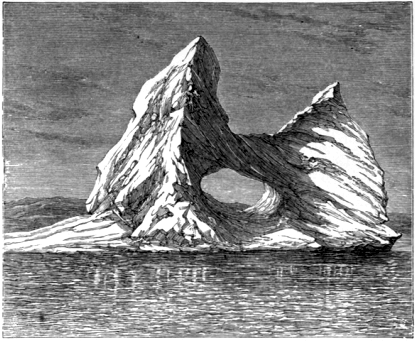
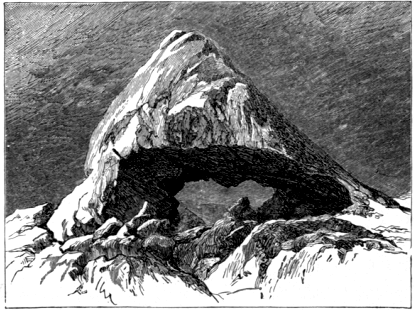
§ 50. The Æggischhorn, the Märgelin See and its Icebergs
346. Still, I do not want you to leave Switzerland without seeing such icebergs as it has to show, and in fact there are glaciers nobler still than the Mer de Glace that you ought to know. In tracing the Rhone to its source, you have already gone up the valley of the Rhone. Let us visit it again together, stop at the little town of Fiesch, and go straight up from there to the excellent hotel on the slope of the Æggischhorn. We shall make this our headquarters while we explore that monarch of European ice-streams, the great Aletsch glacier.
347. Counting the longest of its branches, this noble river of ice is about twenty miles long, and at the middle of its trunk it measures nearly a mile and a quarter from side to side. The grandest mountains of the Bernese Oberland, the Jungfrau, the Mönch, the Trugberg, the Aletschhorn, the Breithorn, the Gletscherhorn and many another noble peak and ridge, gather its névés. These névés pour out of three great valleys in the heart of the mountains and unite to form the trunk of the Aletsch at a spot a witty mountaineer named the "Place de la Concorde of Nature." If the phrase is meant to suggest calm grandeur, beauty of form and purity of colour, it is well chosen.
348. Our hotel is not on the peak of the Æggischhorn, but a brisk morning walk soon puts us on the top. From there we see the glacier like a broad river, stretching up to the roots of the Jungfrau and down past the Bel Alp towards its end. Carrying our gaze on downwards, we come to the noblest group of mountains in all the Alps: the Dom and its attendant peaks, the Matterhorn and the Weisshorn. It is a scene of awe-inspiring grandeur, and a host of peaks and crests not named here add to its glory.
349. But low down on our right, sheltered by the mountains round it, is something whose beauty startles anyone not ready for it. Over there we see the bare side of the glacier, showing glistening ice cliffs sixty or seventy feet high. It looks as though the Aletsch were trying, in vain, to thrust an arm through a side valley. It once did so; but now the arm is constantly broken off close to the body of the glacier, and a large space the ice used to cover is taken up by its meltwater. A lake of the loveliest blue is formed this way. It reaches right to the foot of the ice cliffs and undermines them, as the Arctic waves undermine the Greenland glaciers, and receives the broken masses it has undercut. As we look down on the lake, small icebergs sail over its calm surface, each like a snowy swan with its shadow.
350. This is the beautiful little lake of Märgelin, the Märgelin See, as the Swiss here call it. You see that splash, and a moment later hear the sound of plunging ice. The glacier has broken before our eyes and dropped an iceberg into the lake. All over the lake the water is set moving, showing on a small scale the swamping waves raised when vast islands of ice drop from the Arctic glaciers. Look at the far end of the lake. It is cluttered with the remains of icebergs, now aground, carried there partly by the wind and partly by the water, which moves gently in that direction.
351. Imagine us down on the shore of the lake, as I happened to be once. There is one large, lonely iceberg near the middle. Suddenly we hear a sound like a waterfall; we look at the iceberg and see water pouring off its sides. Where does the water come from? The berg has grown top-heavy because it has melted underneath. It is turning a somersault, and as it rolls over it carries a great quantity of water with it, which rushes down its sides like a waterfall. And notice that the iceberg, snowy white a moment ago, now shows the delicate blue colour of compact ice. The sun will soon whiten it again, though. The vaster icebergs of the northern seas sometimes roll over in the same way. A week at the Æggischhorn can be spent with delight and profit.
§ 51. The Bel Alp
352. From the Æggischhorn I might lead you along the mountain ridge by the Betten See, whose fish we have already tasted, to the Rieder Alp, and from there across the Aletsch to the Bel Alp. It is a fine mountain ramble, but you and I prefer to make the glacier our highway down. Easy in some places, unravelling its crevasses is by no means child's play in others. But the steady perseverance and close observation that have served us in hard places so far do not let us down here. We get clear of the fissures, and after four hours of exhilarating work we find ourselves on the slope leading up to the Bel Alp hotel.
353. This is one of the finest stopping places in the Alps. Stretching away in front of us, up to the Æggischhorn and the Märgelin See, is the long last reach of the Aletsch, with its great medial moraine running along its back. Close by is the wild gorge of the Massa, in which the snout of the glacier lies coiled like the head of a snake. The beautiful system of the Oberaletsch glaciers is within easy reach. Above us is a peak called the Sparrenhorn, within the powers of the most modest climber, and little more than an hour's effort will put you and me on its summit. Below us now is the Oberaletsch glacier, with the most perfect of medial moraines. Near us is the great mass of the Aletschhorn, clasped by its névés and crowned with brown rock. It is backed by other peaks almost as noble as itself. The Nesthorn is close at hand, and sweeping round to the west we come to the glorious trio already mentioned, the Weisshorn, the Matterhorn and the Dom. Take one look at the crevasses of the glacier just below us. At its end it tumbles down a steep slope and is badly torn. But the crevasses open before the steep part is reached, and you can see the marginal and transverse crevasses joining up into a system of curved fissures, the bulges of the curves pointing upwards. You know the mechanical reason for this now. The glacier tables, too, are many and fine. I should like to stay here with you for a week, exploring the glaciers that exist and tracing the evidence of others that have passed away.
§ 52. The Riffelberg and Görner Glacier
354. Our measurements and observations on the Mer de Glace stand, more or less, for everything that can be measured or worked out elsewhere. Even so, I do not want to leave you a stranger to the great system of glaciers that streams down the northern slopes of Monte Rosa and the mountains beside it. From the Bel Alp we could go down to Brig and drive from there to Visp; but you and I prefer the breezy heights, so we sweep round the shoulder of the Nessel until we stand above the Rhone valley, opposite Visp. From this village an hour's walk takes us to Stalden, where the valley divides into two branches, one leading through Saas over the Monte Moro, the other through St. Niklaus to Zermatt. The second is our route.
355. We reach Zermatt, but do not stop there. On the mountain ridge, 4,000 feet above the valley, we make out the Riffelberg hotel, and we go on up to it. Right in front of us is the pinnacle of the Matterhorn, and it must seem unbelievable to you that a human foot could ever have trodden its top. Perseverance and skill did it, however, though the first time at a terrible price. In the little churchyard of Zermatt we have seen the graves of two of the greatest mountaineers Savoy and England have produced, who fell from the Matterhorn in 1865 with two gallant young companions.
356. At the Riffelberg we are within an hour's walk of the famous Görner Grat, with its grand view of the glaciers of Monte Rosa. But that huge knob of perfectly bare rock over there, called the Riffelhorn, must be our station. What the Cleft Station is to the Mer de Glace, the Riffelhorn is to the Görner glacier and its tributaries. From its lower side, easy as it may look, the rock cannot be climbed. Here, in fact, in 1865, a fifth good man met his end, and he too lies beside his countrymen in the churchyard of Zermatt. Passing a little tarn, or lake, called the Riffel See, we attack the Riffelhorn from its upper side. Getting to the summit is first-rate practice on rock, and from the top we look out on an extraordinary scene.
357. The huge, many-peaked mass of Monte Rosa faces us, and we scan its snows from bottom to top. To the right is the mighty ridge of the Lyskamm, also loaded with snow, and between the two lies the Western Glacier of Monte Rosa. This glacier meets another from the vast snowfields of the Cima di Jazzi; they join to form the Görner glacier, and from the point where they meet stretches the usual medial moraine. On this side of the Lyskamm rise two beautiful snowy summits, the Twins, Castor and Pollux; then come the brown crags of the Breithorn, then the Little Matterhorn, and then the broad snowfield of the Théodule, out of which the Great Matterhorn springs, and which you and I will cross later into Italy.
358. The valleys and hollows between these mountains are filled with glaciers. Down the flanks of Castor comes the Glacier des Jumeaux; from Pollux comes the Schwarze glacier; from the Breithorn, the Trifti glacier; then come the Little Matterhorn glacier and the Théodule glacier, each bringing its medial moraine with it as it welds itself to the trunk. From where we stand we can count nine such moraines. And to an even more surprising degree than on the Mer de Glace, we notice the power of the ice to yield to pressure: the broad névés are squeezed on the trunk of the Görner into white stripes, which grow ever narrower between the moraines that bound them and finally vanish under their own gravel.
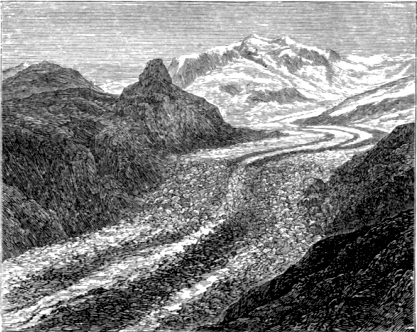
359. On the two main tributaries we also notice moraines that seem in each case to rise out of the body of the glacier, appearing in the middle of the ice with no visible source higher up. At their sources these are moraines from under the glacier, rubbed off rocky spurs completely covered by ice. They lie hidden for a while in the body of the glacier and come to the surface where the sun has melted away the ice above them.
360. This is the place to mention a belief long held by the people of the high Alps, that glaciers have the power to push all impurities out of themselves. On the Mer de Glace you and I have seen large patches of clay and black mud that plainly came out of the body of the glacier, so we can understand how natural this idea of pushing out must have seemed to people not used to close observation. But the glacier's power here is really the power of the sun, which melts the ice above the hidden impurities and, as with the bodies of the guides on the Glacier des Bossons (143), brings them to the light of day.
361. You will find more things of interest on the Görner than on any other glacier: sand-cones, glacier tables, deep gorges cut in the ice by streams and fantastically bridged by boulders, moulins, and sometimes arched ice caverns of extraordinary size and beauty. On the lower part of the glacier we notice the medial moraine partly disappearing into the crevasses and reappearing at the foot of the slope. For many years this glacier advanced steadily on the meadow in front of it, ploughing up the soil and overturning the chalets in its way. Now it shares in the general retreat the glaciers of the Alps have shown over the last fifteen years. As usual, a river, the Visp, rushes out of a vault at the end of the Görner glacier.
§ 53. Ancient Glaciers of Switzerland
362. You have not forgotten the old moraine that interested us so much on our first climb from the source of the Arveiron, for it opened our minds to the fact that at one time in its history the Mer de Glace was far bigger than it is now. What we have seen since has let us follow these signs of ice action much farther than we then had any idea of.
363. Right beside the present glacier, for example, we have often seen the mountainside laid bare where the ice has drawn back. This is especially noticeable just now, because for the last fifteen or sixteen years the glaciers of the Alps have been shrinking steadily, so that it is quite common to see the rocks along the edge laid bare to a height of fifty, sixty, eighty or even a hundred feet above the present glacier. On the rocks laid bare this way we see the plain marks of the ice sliding over them, and our eyes and minds have been so trained in noticing such things that we can now pick out ice marks and moraines, ancient or modern, with certainty wherever they occur.
364. But the heights at which we have found such evidence might well shake our belief in the conclusions it points to. Beside the Massa Gorge, 1,000 feet above the present Aletsch, we found a great old moraine. Coming down the meadows between the Bel Alp and Flatten, we found another, now grassed over and carrying a village on its back. But I want to take you to a region that shows this evidence on a still grander and more impressive scale. We have already made a short flight to the valley of Hasli and the glacier of the Aar. Let us start from that glacier. Walking down from it towards the Grimsel, we pass everywhere over rocks remarkably rounded, fluted and scarred. These are plainly the work of the glacier in recent times. But as we approach the Grimsel, at the turn of the valley we stand before the sheer granite flank of the mountain, and here the traces of the ancient ice are as plain as they are amazing. The rocks are so hard that not only the fluting and polishing but even the fine scratches, which go back untold thousands of years, are as clear as if they had been made yesterday. We can trace this evidence to a height of two thousand feet above the present floor of the valley. There can be no doubt that a river of ice of this astonishing depth once flowed through the vale of Hasli.
365. Over there is the summit of the Siedelhorn, and if we get to it, the Unteraar glacier will lie below us like a map. From this commanding point we can plainly see, marked on the mountainsides, the height the ancient ice reached. The part of the mountains ground by the ice stands out clearly from the splintered crests that in those far-off days rose above the surface of the glacier, and must then have looked like island peaks and ridges in the middle of an ocean of ice.
366. Now we scramble down the Siedelhorn and get back into the valley of Hasli, along which we follow the traces of the ice for more than twenty miles: fluted precipices, polished slabs, beautifully rounded domes of granite. Right and left, high on the mountain flanks, the evidence appears. We follow the glacier's footsteps to the Lake of Brienz, and if we carried our inquiries further, we should learn that at the time we are speaking of, all the lake basins of this region bore the weight of immense masses of ice.
367. Instead of the vale of Hasli, we might take the valley of the Rhone. The traces of a mighty glacier that once filled it can be followed all the way to Martigny, 60 miles from the present ice. At Martigny the Rhone glacier was joined by another from Mont Blanc, and the welded masses moved on, planing the mountains right and left, to the Lake of Geneva, whose basin they filled entirely. Other evidence proves that the glacier did not end there but pushed on across the low country until it met the limestone barrier of the Jura Mountains.
§ 54. Erratic Blocks
368. What is this other evidence? We have seen huge rocks perched on the moraines of the Mer de Glace, and we now know that unless the frost splits and shatters them, these rocks will one distant day be set down whole in the valley of Chamonix by the Glacier des Bois. You have already learned that such boulders often show what kind of rock makes up the mountains the glacier has passed among, so that samples are carried down quite unlike the rocks where they are finally set down. This is strikingly true of the erratic blocks stranded along the Jura.
369. For the Jura itself, as I have said, is limestone; no native granite is to be found anywhere in these hills. Yet along the breast of the mountain above the town of Neuchâtel, about 800 feet above the lake of Neuchâtel, we find a belt of granite boulders from Mont Blanc stranded there. And when we clear the soil from the mountainside next to them, we find on the limestone the scratches of the ancient glacier that brought the boulders.
370. The most famous of these rocks, called the Pierre à Bôt, measures 50 feet long, 40 high and 20 wide. Multiplying these three numbers together, we get 40,000 cubic feet as the volume of the boulder.
371. But this is small beside some of the rocks that make up the freight of even present-day glaciers. Let us visit another of them. We have already been to Stalden, where the valley divides into two branches, the right running to St. Niklaus and Zermatt, the left to Saas and the Monte Moro. Three hours above Saas we come on the end of the Allalin glacier, which does not fill the main valley but lies slantwise across it and blocks its drainage like a dam. Above this dam of ice lies the Mattmark Lake, and at the head of the lake a small inn well known to travellers over the Monte Moro.
372. Close to this inn is the greatest boulder we have ever seen. It measures 240,000 cubic feet. Looking across the valley, we notice a glacier whose end is now half a mile from the boulder. The stone, I believe, is serpentine, and if you and I explored the Schwarzberg glacier up to its highest recesses, we should find among them the birthplace of this gigantic stone. Twenty-four years ago the glacier reached the spot where the boulder now stands, set down its mighty freight there, and then drew back. Close by is a second ice-borne rock that would be thought huge if its bigger neighbour did not dwarf it.
373. Evidence of this kind could be multiplied without end. In fact, at this very moment distinguished men like Professor Favre of Geneva are working out the extent of the ancient glaciers of Switzerland from the way the erratic blocks are spread. It was an engineer named Venetz, however, who first brought this evidence to light and announced to an unbelieving world the vast extent of the ancient ice. M. Agassiz afterwards developed the discovery and enlarged it wonderfully. Perhaps the most interesting observation about ancient glaciers is Dr. Hooker's: on a recent visit to Palestine he found the celebrated Cedars of Lebanon growing on ancient moraines.
§ 55. Ancient Glaciers of England, Ireland, Scotland, and Wales
374. At the time when the ice reached this extraordinary size in the Alps, many other parts of Europe where no glaciers exist now were covered by them. In the Highlands of Scotland, and among the mountains of England, Ireland and Wales, the ancient glaciers have written their story as plainly as in the Alps themselves. I should like to wander with you through Borrowdale in Cumberland, or through the valleys near Beddgelert in Wales. Under all the beauty of the present scenery we should find the memorials of a time when the whole region was locked in the grip of ice. Professor Ramsay is especially distinguished for his writings on the ancient glaciers of Wales.
375. We have already met Macgillycuddy's Reeks as the great condensers of the water vapour of the Atlantic. In the age we are speaking of, this moisture fell not as soft, fruitful rain but as snow, which fed great glaciers. A chain of lakes, the Lower, the Middle and the Upper Lake, is now the chief attraction of Killarney. Imagine us rowing towards the head of the Upper Lake with the Purple Mountain on our left. Remembering our travels in the Alps, you would be sure to point out to me how the rocks have been planed, and declare that it was unmistakably the work of glaciers. With our attention sharpened this way, we land at the head of the lake and walk up the Black Valley to the foot of Macgillycuddy's Reeks. Your conclusion would be that this valley tells a story as wonderful as that of Hasli.
376. We get back to our boat and row home along the Upper Lake. Its islands now have a new interest for us. Some are bare, others are covered wholly or partly with lush vegetation; but bare and clothed alike, they have all been shaped by ice. The weathering of the ages has not changed their forms: there are the Cannon Rock, the Giant's Coffin, the Man of War, all carved as if the chisel had passed over them in our own lifetime. These lakes, now fringed with delicate woodland beauty, were all filled by the ancient ice. It has gone, and seeds have been carried there from other regions to sow the trees, shrubs, ferns and grasses that now make Killarney beautiful. Man himself, they say, has appeared in the world since that age of ice; but little is claimed to be known of when and how man really arrived, now that new meanings have been found for the beautiful myths and stories of the Bible to make them square with science.
377. It is the nature and tendency of the human mind to look backward and forward, to try to restore the past and foretell the future. Endowed this way, and working from facts won patiently and painfully, we recover in thought a state of things that existed thousands, perhaps millions, of years before the history of the human race began.
§ 56. The Glacial Epoch
378. This period when the ice spread so far has been named the Glacial Epoch. In trying to account for it, great minds have fallen into serious errors, as we shall soon see.
379. The substance we have been working on all along exists in three different states: as a solid in ice, as a liquid in water, and as a gas in vapour. To make it pass from one of these states to the next, heat is needed.
380. Dig a hole in the ice of the Mer de Glace in summer and put a thermometer in it: it will stand at 32° Fahr. Dip your thermometer into one of the glacier streams: it will still read 32°. The water, then, is as cold as the ice.
381. It follows that all the heat the sun pours onto the glacier, and the glacier absorbs, is spent simply in melting the ice, and not in making either ice or water a single degree warmer.
382. Put water over a fire and it grows hotter for a while. It boils, and from that moment it stops getting hotter. Once it has begun to boil, all the heat the fire gives it is carried off by the steam, though the steam itself is not the smallest fraction of a degree hotter than the water.
383. In fact, it takes a large amount of heat simply to melt ice, and a still larger amount to turn water into vapour. And because this heat does not make the water warmer than the ice, or the steam warmer than the water, it was once thought to be hidden in the water and in the steam, and so it was called latent heat.
384. Let us ask how much heat the sun must spend to turn a pound of the tropical ocean into vapour. Experiment has answered this question accurately. In round numbers it takes 1,000 times the heat needed to raise one pound of water one degree in temperature.
385. But the heat that would raise a pound of water one degree would raise a pound of iron ten degrees. This too has been proved by experiment. To turn one pound of the tropical ocean into vapour, then, the sun must spend 10,000 times as much heat as would raise one pound of iron one degree.
386. That much heat would raise 5 lbs. of iron by 2,000 degrees, which is the melting point of cast iron. At that temperature the metal would not only be white-hot but would be starting to turn molten.
387. Think about the conclusion we have now reached. For every pound of tropical vapour, or every pound of Alpine ice made by the freezing of that vapour, the sun has spent enough heat to raise 5 lbs. of cast iron to its melting point.
388. It would not be hard to work out roughly the weight of the Mer de Glace and its tributaries, and to say, for example, that they hold so many millions of millions of tons of ice and snow. Now put in place of the ice a mass of white-hot iron five times as heavy. With that picture in your mind, you get some idea of the enormous amount of heat the sun has paid out to make the present glacier.
389. You must think this over until it is as clear as sunshine, for from now on you must never fall into the error I mentioned, which has caught so many. Ice and cold went together so naturally in people's minds that even celebrated men assumed that all it takes to make our glaciers spread far and wide is a drop in the sun's temperature. Had they gone through the reasoning and calculations above, they would probably have called for more heat, not less, to produce a "glacial epoch." What they really needed were condensers powerful enough to freeze the vapour raised by the heat of the sun.
§ 57. Glacier Theories
390. You have not forgotten, and can hardly ever forget, our climbs to the Cleft Station. Thoughts came to us there that we have not yet talked about. We saw the branch glaciers coming down from their névés, welding themselves together, pushing through Trélaporte, and then moving down the winding valley of the Mer de Glace. These sights alone, without counting the observations that came later, were enough to suggest that glacier ice, however hard and brittle it may look, is really a viscous substance, like treacle, or honey, or tar, or lava.
§ 58. Dilatation and Sliding Theories
391. Still, this was not the idea put forward by most writers on glaciers. Scheuchzer of Zürich, a great naturalist, visited the glaciers in 1705 and proposed a theory of their motion. He knew that water expands when it freezes, and that the force of the expansion is so great that thick bombshells filled with water and left to freeze are, as we know (312), shattered to pieces by the ice inside. Scheuchzer supposed that the water in the cracks of the glaciers, freezing there and expanding with irresistible force, was the power that drove the glacier downwards. He added to this theory other ideas of a less scientific kind.
392. Many years later De Charpentier of Bex revived this theory and worked it out so ably and completely that it was long known as Charpentier's Theory of Dilatation. M. Agassiz took it up for a time, and other writers held it more or less clearly too. The glacier, in fact, was thought of as a storehouse of cold, able to freeze all the water seeping through it. The theory was dropped when M. Agassiz proved that this idea of glacier cold could not be held.
393. In 1760 Altmann and Grüner put forward the view that glaciers move by sliding over their beds. Nearly forty years later De Saussure revived the idea, and so it has been called "De Saussure's Theory," or the "Sliding Theory" of glacier motion.
394. There was little reason, though, to tie De Saussure's name to this or any other theory of glaciers. Constantly busy with observations of other kinds, that celebrated man gave very little time or thought to the question of glacier motion. What he wrote on the subject reads less like a worked-out theory than like the statement of an opinion.
§ 59. Plastic Theory
395. None of these writers credited glacier ice with viscosity or plasticity. Yet many glaciers look so strongly suggestive of the idea that we may be sure it would have been put forward more often, if it did not seem so flatly contrary to our everyday experience of ice.
396. Still, the idea found its champions. In a little book published in 1773 under the title "Picturesque Journey to the Glaciers of Savoy," Bordier of Geneva wrote: "It is now time to look at all these objects with the eyes of reason; to study, in the first place, the position and the progression of glaciers, and to seek the solution of their principal phenomena. At the first aspect of the ice-mountains an observation presents itself, which appears sufficient to explain all. It is that the entire mass of ice is connected together, and presses from above downwards after the manner of fluids. Let us then regard the ice, not as a mass entirely rigid and immobile, but as a heap of coagulated matter, or as softened wax, flexible and ductile to a certain point." Here, probably for the first time, the quality of plasticity is credited to the ice of glaciers.7
397. To us, who know how glaciers look, it must seem strange that once this idea had been put forward it was not recognised and developed at once. But in those early days explorers were few, and the "Picturesque Journey" was probably little known, so the idea of plasticity lay dormant for more than half a century. At length, though, Bordier was followed by a man of far greater scientific grasp and insight than himself. This was Rendu, a Catholic priest and canon when he wrote, and afterwards Bishop of Annecy. In 1841 Rendu laid before the Royal Academy of Sciences of Savoy his "Theory of the Glaciers of Savoy," a contribution forever memorable in the history of this subject.8
398. Rendu grasped the idea of glacier plasticity with great power and clarity, and followed it resolutely to its consequences. There is no knowing whether he had ever seen Bordier's work; probably not, since he never mentions it. Let me quote some of Rendu's own words for you, though they fall short of showing his insight and precision of thought: "Between the Mer de Glace and a river there is a resemblance so complete that it is impossible to find in the glacier a circumstance which does not exist in the river. In currents of water the motion is not uniform either throughout their width or throughout their depth. The friction of the bottom and of the sides, with the action of local hindrances, causes the motion to vary, and only towards the middle of the surface do we obtain the full motion."
399. This reads like a prediction of what measurement has since established. Looking at the glacier of Mont Dolent, shaped like a sheaf, wide at both ends and narrow in the middle, and reflecting that the wide upper part had become narrow and the narrow middle had widened again, Rendu remarks: "There is a multitude of facts which seem to necessitate the belief that glacier ice enjoys a kind of ductility which enables it to mould itself to its locality, to thin out, to swell, and to contract as if it were a soft paste."
400. To test his conclusions fully, Rendu needed accurate measurements of glacier motion. Had he added to his other gifts the practical skill of a land surveyor, he would now be thought of as the prince of glacier scientists. As it was, he had to make do with rough measurements. On one of his excursions he questioned the guides about the successive positions of a huge rock he found on the ice close to the side of the glacier. The average of five years gave him a motion for this block of 40 feet a year.
401. Another block, whose travel he later measured more accurately, gave him a speed of 400 feet a year. Notice how he explains the difference: "The enormous difference of these two observations arises from the fact that one block stood near the centre of the glacier, which moves most rapidly, while the other stood near the side, where the ice is held back by friction." Rendu's ideas of the plastic motion of glaciers were so clear and definite that, had the question of curvature occurred to him, I have no doubt he would have predicted the shifting of the point of greatest motion from side to side across the axis of the glacier (§ 25).
402. You ought to know that scientific men do not always agree in how they weigh the value of facts against ideas; and above all you ought to know that your present tutor sets a very high value on ideas when they spring from the deep and persistent pondering of superior minds, and are not, as too often happens, thrown out without the warrant of either deep thought or natural ability. It is because I believe Rendu's work meets this condition that I value it so highly. But when you are older and better informed you may disagree with me, and I write these words so that you will not accept my opinion of Rendu too readily. Judge me, if you care to, when your knowledge has matured. I certainly shall not fear your verdict.
403. But much as I prize the idea that prompts, and firmly as I believe that the force of genius often lies chiefly in it, it would in my opinion be an error of omission of the gravest kind to neglect testing our ideas, and giving them outward reality and substance, when the means of doing so are at hand; and that error, if it became a habit, would ensure the eventual decay of natural knowledge. In science, thought ought, as far as possible, to be wedded to fact. Rendu attempted this, and Agassiz and Forbes partly accomplished it.
§ 60. Viscous Theory
404. Here, indeed, the merits of the distinguished glacier scientist last named stand out conspicuously. What the public knows of this doctrine of glacier plasticity comes almost entirely from the able and earnest advocacy of Professor Forbes. He gave the doctrine a more distinct form; he was the first to call glacier ice viscous, and he set out to found a "Viscous Theory" of glacier motion on precise measurements.
405. Here I am obliged to state the facts in their historical order. When Professor Forbes began his investigations he knew Rendu's work. In his earliest book on the Alps he refers to it in terms of flattering recognition. But though Rendu's ideas were in fact there to prompt him, it would be too much to say that he needed their inspiration. Had Rendu not gone before him, he might all the same have grasped the idea of viscosity, carried out his measurements and used his knowledge to uphold it. However that may be, Professor Forbes's appearance on the Unteraar glacier in 1841 and on the Mer de Glace in 1842, and his work then and afterwards, have given him a name not to be forgotten in the scientific history of glaciers.
406. Professor Forbes stated the theory he championed in these words: "A glacier is an imperfect fluid, or viscous body, which is urged down slopes of certain inclination by the natural pressure of its parts." In 1773 Bordier wrote: "As the glaciers always advance upon the plain, and never disappear, it is absolutely essential that new ice shall perpetually take the place of that which is melted: it must therefore be pressed forward from above. One can hardly refuse then to accept the astonishing truth, that this vast extent of hard and solid ice moves as a single piece downwards." In the passage already quoted he speaks of the ice being pressed from above like a fluid. These, I believe, make up Bordier's contributions to the subject. The quotations show his shrewdness at an early date; but for completeness his views are not to be compared with those of Rendu and Forbes.
407. I must not leave out here that, though M. Agassiz has not taken up the idea of viscosity, his measurements, and maps of measurements, on the Unteraar glacier have lately been cited as the clearest and most conclusive illustrations of a quality that, at any rate, closely resembles viscosity.
408. But why does M. Agassiz, with proofs in front of him more plentiful and telling than any other observer's, hesitate to accept the idea of viscosity for ice? No doubt because he believes our everyday experience of the substance contradicts it.
409. Take a block of ice ten or even fifteen cubic feet in volume, draw a saw across it to a depth of half an inch or an inch, and strike a pointed pricker, no thicker than a very small round file, into the groove: the block will split from top to bottom with a clean crystalline fracture. How is this brittleness to be squared with the idea of viscosity?
410. Besides, we have been on the glacier and seen crevasses born. We have seen them begin as narrow cracks that form suddenly and then take days to open a single inch. In many glaciers, narrow, deep fissures can be traced through the ice for hundreds of yards. What does this prove? If the ice had even a tiny share of the power of stretching that is characteristic of a viscous substance, such crevasses could not form.
411. Still, there is no doubt that the glacier moves like a viscous body. The centre flows past the sides, the top flows over the bottom, and the motion through a curved valley matches the motion of a fluid. Mr. Mathews, Mr. Froude and, above all, Signor Bianconi have moreover lately made experiments on ice that strikingly show how flexible the substance is. These experiments deserve, and will no doubt receive, full attention at some future time.
§ 61. Regelation Theory
412. I will now describe an attempt made in recent years to reconcile the brittleness of ice with its motion in glaciers. It rests on an observation made by Mr. Faraday in 1850: that when two pieces of thawing ice are put together, they freeze together where they touch.
413. This fact may not surprise you; still, it surprised Mr. Faraday and others, and men of very great distinction in science have disagreed over how to explain it. The difficulty is to say where or how, in ice that is already thawing, the cold is to be found that is needed to freeze the film of water between the two touching surfaces.
414. The word Regelation was proposed by Dr. Hooker for the freezing together of two pieces of thawing ice that Faraday had observed, and the paper in which the term was first used was published by Mr. Huxley and Mr. Tyndall in the Philosophical Transactions for 1857.
415. The fact of regelation, and its uses, apart from the cause of regelation, can be shown like this. Saw two slabs from a block of ice and bring their flat faces together: they freeze together at once. Two plates of ice laid one on the other and wrapped in flannel overnight are sometimes frozen so firmly by morning that they would sooner break somewhere else than along the surface where they join. If you go into one of the dripping ice caves of Switzerland, you only have to press a slab of ice against the roof of the cave for a moment to make it freeze there and stick to the roof.
416. Put a number of pieces of ice in a basin of water and make them touch one another: they freeze together where they touch. You can make a chain of such pieces, and then, taking hold of one end of the chain, draw the whole string after it. Chains of icebergs are sometimes formed this way in the Arctic seas.
417. Think what follows from these observations. Snow is made of small particles of ice. If we use pressure to squeeze out the air trapped in thawing snow and bring the little grains of ice into close contact, we can expect them to freeze together; and if all the air is driven out, we can expect the squeezed snow to take on the look of compact ice.
418. We reach this conclusion by reasoning; now let us test it by experiment, using a suitable hydraulic press and a mould to hold the snow. Exactly as we expected, pressure turns the snow into ice.9
419. Put a compact lump of ice in a suitable mould and squeeze it. It breaks into pieces. Squeeze the pieces hard together and they join up again by regelation, and a compact piece of ice of quite a different shape from the first comes out of the press. To produce this effect the ice must be thawing. When its temperature is far below the melting point, pressure crushes it not into a clear mass of another shape but into a white powder.
420. With suitable moulds you can in this way change the shape of ice as much as you like, turning out spheres, cups, rings and twisted ropes of it. In these cases the change of shape is brought about by rough breaking and regelation.
421. By applying the pressure carefully, rough breaking can be avoided, and the ice made to change its shape slowly, as if it were a plastic substance.
422. Now our first experiment shows how the snows of the higher Alps are packed solid. The deeper layers of the névé have to bear the weight of everything above them, and are turned by it into more or less perfect ice. And our last experiment shows the changes of shape seen on the glacier, where the slow, steady application of pressure makes the ice gradually mould itself to the valley it fills.
423. In glaciers, though, we also have plenty of examples of rough breaking and regelation. The opening and closing of crevasses shows it. The glacier is broken on the ice-falls and mended at their feet. When two branch glaciers lay their sides together, the regelation is so firm that they at once begin to flow in the trunk glacier as a single stream. The medial moraine gives no sign, by moving slowly, that it comes from the sluggish ice at the sides of the branch glaciers.
424. The heart of the Regelation Theory is this: the ice of glaciers changes its shape and keeps itself whole under pressure, which holds its particles together. But when it is put under tension, it breaks rather than stretch, and no longer behaves like a viscous body.
§ 62. Cause of Regelation
425. Here the fact of regelation is used to explain the plasticity of glacier ice, with no attempt to give the cause of regelation itself. These are two entirely separate questions. But a little time will be well spent looking more closely into the cause of regelation. You may be a little surprised that eminent men should give their attention to so small a point, but we must not forget that in nature nothing is small. Laws and principles are what interest the student of science most, and small things can illustrate them as well as large ones.
426. The question of regelation is bound up at once with that of "latent heat," which we touched on earlier (383) but must now look into further. To melt ice, as I have said, takes a large amount of heat, and in the case of the glaciers this heat comes from the sun. Neither the ice so melted nor the water it melts into can fall below 32° Fahrenheit. At this temperature the freezing point of water and the melting point of ice touch each other, so to speak. A hair's breadth lower and water freezes; a hair's breadth higher and ice melts.
427. But if the ice could be made to melt without this supply of heat from the sun, a temperature lower than that of ordinary thawing ice would result. When snow and salt, or crushed ice and salt, are mixed together, the salt makes the ice melt, and in this way a cold of 20 or 30 degrees below the freezing point can be produced. Here, in fact, the ice uses up its own warmth in the work of melting. Such a mixture of ice and salt is called "a freezing mixture."
428. And if ice at a temperature of 32° Fahrenheit could be melted by any other means, without heat getting in from outside, the water produced would be colder than the ice. Now Professor James Thomson has proved that ice can be liquefied by pressure alone, and his brother, Sir William Thomson, has shown too that water under pressure needs a lower temperature to freeze it than when the pressure is taken off. Professor Mousson later melted large masses of ice with a hydraulic press, and by a beautiful experiment Professor Helmholtz has proved that water in a vessel with the air pumped out, and therefore relieved of the pressure of the atmosphere, freezes and forms ice crystals when it is surrounded by melting ice. All these facts are summed up in the short statement that pressure lowers the freezing point of water.10
429. For our own instruction we can produce the liquefaction of ice by pressure in the following way. You remember the beautiful flowers produced when a sunbeam is sent through lake ice (§ 11), and you have not forgotten that the flowers always form parallel to the surface of freezing. Let us cut a prism, or small column, of ice with the planes of freezing running across it at right angles, put the prism between two slabs of wood, and carefully bring the squeezing force of a small hydraulic press to bear on it.
430. It is a good idea to gather a strong light onto the ice with a concave mirror and to watch it through a magnifying lens. Already you see the result. Hazy surfaces form in the very body of the ice and slowly spread as the pressure is gradually increased. Here and there you notice something like crystallisation: fern-shaped figures run quite fast through the ice, and when you look carefully at their points and edges you find them visibly moving. These hazy surfaces are spaces of liquefaction, and the motion you see is the ice turning to water under the pressure. That water is colder than the ice was before the pressure was put on, and if the pressure is taken off, the melting not only stops but the water freezes again. The cold produced by its melting under pressure is enough to freeze it again once the pressure is removed.
431. If we concentrate the pressure on a small surface instead of spreading it over large ones, the melting will naturally be faster, and this is what Mr. Bottomley has lately done in an experiment of remarkable beauty and interest. Let us rest the two ends of a bar of ice 10 inches long, 4 inches deep and 3 wide on blocks of wood, and loop over its middle a copper wire a twentieth or even a tenth of an inch thick. Join the two ends of the wire together and hang a weight of 12 or 14 pounds from it, and the whole pressure of this weight is concentrated on the ice that holds up the wire. What happens? The ice under the wire melts. The meltwater escapes round the wire, but the moment it is freed from the pressure it freezes, and round the wire, even before the wire has entered the ice, you have a frozen casing. The wire goes on sinking into the ice, and the water keeps escaping, freezing behind the wire as it does so. In half an hour the weight drops: the wire has gone clean through the ice. You can plainly see where it has passed, but the two severed pieces of ice are frozen together so firmly that they would break somewhere else as soon as along the surface of regelation.
432. Another beautiful experiment bearing on this point has lately been made by M. Boussingault. He filled a hollow steel cylinder with water and chilled it. Water, as you know, expands in turning to ice (§ 45); in fact, room to expand is a necessary condition for its freezing. But in this case the strong steel resisted the expansion, and as a result the water stayed liquid at a temperature more than 30° Fahr. below the ordinary freezing point. A bullet inside the cylinder rattled about at this temperature, showing that the water was still liquid. When the tap was opened, the liquid, freed from the pressure, turned to ice instantly.
433. Only substances that expand when they solidify behave like this. The metal bismuth, as we know, is a case like water; while lead, wax and sulphur, which all contract when they solidify, have their melting points raised by pressure.
434. Now you are ready to understand Professor James Thomson's theory of regelation. When two pieces of ice are pressed together, he argues, liquefaction results. The water spreads out round the points of pressure and freezes again when it is freed, making a kind of cement between the pieces of ice.
§ 63. Faraday’s View of Regelation
435. Faraday's view of regelation is not so easy to put into words, but I will try to give you some idea of it, starting with facts everyone accepts. Water, even in open vessels, can be cooled many degrees below its freezing point and still stay liquid; it can also be heated far above its boiling point and still refuse to boil. This is due to the cohesion of the particles of water, which resists the change of the liquid into either the solid or the vapour state.
436. But throw a particle of ice into the overcooled water, and the cohesion is broken and freezing sets in at once. And put a bubble of air or steam into the overheated water, and the cohesion is broken just the same and boiling begins at once.
437. Faraday concluded that in the interior of any body, solid or liquid, where every particle is gripped, so to speak, by the particles round it and grips them in turn, the bond of cohesion is so strong that it takes a higher temperature to change the state of the body than is needed at the surface. At the surface of a piece of ice, for example, the molecules are free on one side from the control of other molecules, and so they yield to heat more readily than those inside. The bubble of air or steam in overheated water frees the molecules on one side too, and that is why boiling follows when it is put in. For practical purposes, then, the melting point of the ice inside is higher than that of the ice on the surface. Faraday also points to the special solidifying power that substances have over their own molecules. Camphor in a glass bottle fills the bottle with an atmosphere of camphor. In such an atmosphere large crystals of camphor can grow, as camphor molecules settle continually on camphor, at a temperature too high to let the slightest deposit form on the glass beside them. The same is true of sulphur, phosphorus and the metals when molten: they are deposited on solid pieces of their own substance at temperatures not low enough to make them solidify against other substances.
438. Water is an outstanding example of this special solidifying power. It can be cooled ten degrees or more below its freezing point without freezing. But this is impossible if the tiniest scrap of ice is floating in the water. Then it freezes precisely at 32° Fahr., depositing itself not on the sides of the vessel holding it but on the ice. In a freezing apparatus, Faraday watched thin crystals of ice grow in ice-cold water to a length of six, eight or ten inches, at a temperature not low enough to make ice deposit on the sides of the vessel.
439. Now we are ready for Faraday's view of regelation. When the surfaces of two pieces of ice, each covered with a film of meltwater, are brought together, the film is moved from the surface to the inside of the ice, where, as we have seen, the melting point is higher than at the surface. The special solidifying power of ice over water now comes into play on both sides of the film. In these circumstances, Faraday held, the film would freeze and bind the two surfaces together.
440. Pressure lowers the freezing point by no more than a seventieth of a degree Fahrenheit for a whole atmosphere. Considering how tiny a fraction of that pressure is at work in some cases of regelation, Faraday thought its effect imperceptible. He hung up pieces of ice and brought them into contact without any appreciable pressure, and still they froze together. Professor James Thomson, however, held that even the capillary attraction between two such pieces would be enough to produce regelation. You can make the following experiments to illustrate the subject further.
441. Put a small piece of ice in water and push it under the surface with a second piece. The piece underneath may be so small as to make the pressure next to nothing; still, it will freeze to the under surface of the piece above.
442. Put two pieces of ice in a basin of warm water and let them come together: they freeze together where they touch. The parts round the point of contact melt away, but for a while the pieces stay joined by a narrow bridge of ice. At last the bridge melts and the pieces are separated for a moment. But capillary attraction draws them together again at once, and regelation sets in once more. A new bridge forms, which in its turn melts away, and the separated pieces close up again. A kind of pulse is set up between the two pieces of ice. They touch, they freeze, a bridge forms and melts, and the rhythm goes on until the ice is gone.
443. On Professor James Thomson's theory, pressure is needed to liquefy the ice. The heat needed for liquefaction must be drawn from the ice itself, and the cold water must escape from the pressure to be frozen again. Now in the experiments just described, the cold water, instead of being allowed to freeze, flows out into the warm water, and still the floating pieces freeze together in a moment. The touching surfaces may, moreover, be convex: they may be narrowed practically to points, surrounded on every side by warm water, which in fact melts them fast as they approach each other; still, they freeze the instant they touch.
444. You may learn from this discussion that in matters of science, as in all others, there is room for differences of opinion. The frame of mind to cultivate here is to suspend judgment as long as the meaning is in doubt. It may be that Faraday's action and Thomson's action both come into play. I cannot do better than end these remarks with Faraday's own closing words, which show how, in his mind, scientific conviction lived apart from dogmatism: "No doubt," he says, "nice experiments will enable us hereafter to criticise such results as these, and separating the true from the untrue will establish the correct theory of regelation."
§ 64. The Blue Veins of Glaciers
445. We are nearing the end now, with only one important question left to discuss. We have held it back until now, because answering it needed a wide acquaintance with the glaciers. We also had to learn, by actual experiment, how ice softened by thaw yields to pressure and melts under it.
446. Snow is white. But if you look at its separate particles, you would call them transparent, not white. The whiteness comes from the ice particles being mixed with tiny spaces of air. With every transparent substance, whiteness comes from a mixture of this kind. The clearest glass or crystal becomes a white powder when crushed. The foam of champagne is white because a transparent liquid is intimately mixed with transparent carbonic acid gas. The whitest paper, too, is made of fibres that are each transparent.
447. It is not the air or the gas itself, though, that produces the whiteness, but the optical separation of the particles, which gives rise to a multitude of reflections of the sun's white light from their surfaces.
448. We have already traced the whiteness of the surface of a clean glacier (112), and of the icebergs of the Märgelin See (351), to a similar cause. The sun's heat breaks the surface into countless tiny fissures, and the reflection of sunlight from the sides of these little fissures produces the appearance we see.
449. In the same way, if you freeze water in a test tube by plunging it into a freezing mixture, the ice you get is white. The ice made in freezing machines is mostly white too. Look at such ice and you will find it full of small air bubbles. When freezing is extremely slow, the crystallising force pushes the air aside thoroughly and the ice formed is transparent; when freezing is fast, the air is trapped before it can escape and the ice is translucent. But even with quick freezing, Mr. Faraday got transparent ice by deftly removing the air bubbles with a feather as fast as they appeared.
450. With lake ice the freezing does not go on evenly but by fits and starts, sometimes slowly, sometimes fast. When it is slow, the air dissolved in the water is thoroughly squeezed out and forms a layer of bubbles on the underside of the ice. A spell of sudden freezing traps the air, and that is why lake ice is usually made up of layers that are clear and full of bubbles by turns. These layers make it easy to pick out the planes of freezing in lake ice.
451. Now for where these facts lead. Under the fall of the Géant, at the foot of the Talèfre cascade and lower down the Mer de Glace, and in the higher parts of the Grindelwald, Aar, Aletsch and Görner glaciers, the ice is not as transparent as it is near the ends of the glaciers. It is white or whitish. Why? Looked at closely, it turns out to be full of small air bubbles, and these, as we now know, are the cause of its whiteness.
452. They are what is left of the air first trapped in the snow, the air that, as I said, has to do with the whiteness of snow. As the glacier comes down, the bubbles are slowly driven out by the enormous pressures brought to bear on the ice. They are driven out not only by the mechanical yielding of the soft, thawing ice but also by the melting of the ice where the pressure is violent, which opens cracks for the air to escape and must play an important part in making the glacier solid.
453. The bubbles are not driven out evenly, however, for neither ice nor any other substance resists pressure with perfect evenness. At the foot of every cascade we have visited, and on the walls of the crevasses there, we have noticed countless blue streaks running through the white, translucent ice and giving the whole mass the appearance of lamination. When we examined these blue veins, they turned out to be spaces from which the air bubbles had been almost entirely driven out, so that translucent ice had been turned into transparent ice.
454. This is the veined or ribboned structure of glaciers, about whose origin different opinions are held today.
455. It is now our duty to take up the problem and solve it if we can. On the névés of the Col du Géant and other glaciers, we have found great cracks, faults and bergschrunds exposing deep sections of the névé, and on these sections we have found the edges of half-solidified layers marked, plainly laid down by successive snowfalls. The névé is stratified because the supply of material it gets from the atmosphere comes and goes, and when we first noticed the blue veins we were inclined to think they came from this stratification.
456. But observation and reflection soon put that idea out of our heads. Indeed, it could hardly survive the single fact that at the foot of the ice-falls the veins are always vertical, or nearly so. We could see no way of explaining how the horizontal layers of the névé could be tipped up so far at the foot of the fall as to stand on edge. Nor do the veins look like stratification.
457. On the middle parts of the cascades, moreover, there is no sign of the veins. They first appear at the foot, and in each case they are most fully developed a little below it. As you and I stood on the heights above the Zäsenberg and studied the cascade of the Strahlegg branch of the Grindelwald glacier, we could not doubt that the foot of the fall was where the veins were born. We called this part of the glacier a "Structure Mill," meaning that here, and not on the névé, the veined structure was manufactured.
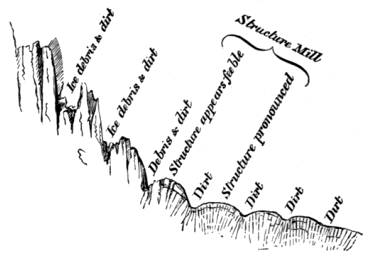
458. This, however, is at bottom only the language of strong opinion, not of proof; and in science opinion should satisfy us only as long as positive proof is out of reach. Love of comfort must not stop us from looking for that proof. There is no sterner conscience than the scientific conscience, and in every case where it is possible it demands that private conviction give way to proof that will convince everyone.
459. Let us be shown, for example, a case where the stratification of the névé carries on into the glacier; let us see the planes of bedding and the planes of lamination side by side and still beyond doubt distinct. Such an observation would rule stratification out of the problem of the veined structure once and for all, and with that tempting source of error out of the way, we should be freer to pursue the truth.
460. We looked for this conclusive test on the Mer de Glace, but did not find it. We looked for it on the Grindelwald and Aar glaciers, with no better luck. On the Aletsch glacier we saw, for the first time, what looked like bedding and structure existing together, the one cutting across the other on the walls of the same crevasse. Still, the case was not clear enough to convince us completely, and we went to the Görner glacier to follow up our search.11
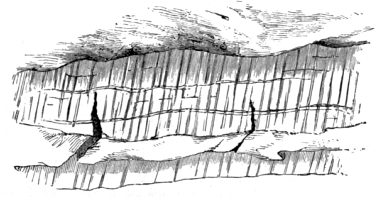
461. Here every day added to our conviction that the bedding and the structure were two different things. Yet day after day went by without showing us the final proof. Surely we have not let our own comfort stand in the way of getting it, and if we retreat beaten, we shall do so knowing we did our best. Over there, though, at the foot of the Matterhorn, is the Furgge glacier, which we have not yet explored. Our last attempt must be made on it.
462. We get onto the glacier near its end and climb it. Soon we face a barrier made of three walls of névé, one rising above the other and each set back behind the one below. The bottom of each wall is separated from the top of the next by a ledge, on which threatening masses of broken névé are now resting. We are standing among blocks and rubble that have plainly come down from these ledges, where other masses, apparently ready to tumble, are now perched.
463. On the vertical walls of this barrier we see the horizontal lines of stratification marked as plainly as could be, while something very like the veined structure seems to cross the lines of bedding nearly at right angles. The vertical face is weathered, however, and the lines of structure, if that is what they are, are blurred. The problem now is to clear away the surface and lay bare the ice beneath. It is one of the many cases we have met where the value of an observation has to be weighed against the danger it involves.
464. We do nothing rashly; but after scanning the ledges and choosing a point of attack, we decide that the danger is not too great to accept. We go up to the wall, clear away the surface, and are rewarded by finding the true blue veins beneath it. What is more, they are vertical, while the bedding is horizontal. Robert the Bruce, as you know, was beaten in many a battle, but he kept on and won at last. Here on the Furgge glacier you too have fought and won your little Bannockburn.
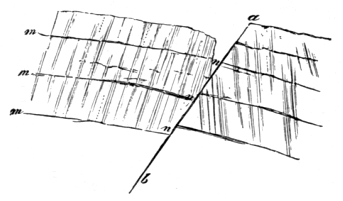
465. But let us not talk of victory too soon. The stratification theory has been put out of the running as an explanation, but nothing has yet been offered in its place.
§ 65. Relation of Structure to Pressure
466. This veined structure was first described by the distinguished Swiss naturalist Guyot, who now lives in the United States. From the Grimsel Pass I have already pointed out to you the Gries glacier spread over the mountains on the far side of the Rhone valley. It was on this glacier that M. Guyot made his observation.
467. "I saw," he said, "under my feet the surface of the entire glacier covered with regular furrows, from one to two inches wide, hollowed out in a half-snowy mass, and separated by protruding plates of harder and more transparent ice. It was evident that the glacier here was composed of two kinds of ice, one that of the furrows, snowy and more easily melted; the other of the plates, more perfect, crystalline, glassy, and resistant; and that the unequal resistance which the two kinds of ice presented to the atmosphere was the cause of the ridges.
468. "After having followed them for several hundred yards, I reached a crevasse twenty or thirty feet wide, which, as it cut the plates and furrows at right angles, exposed the interior of the glacier to a depth of thirty or forty feet, and gave a beautiful transverse section of the structure. As far as my eyes could reach, I saw the mass of the glacier composed of layers of snowy ice, each two of which were separated by one of the hard plates of which I have spoken, the whole forming a regularly laminated mass, which resembled certain calcareous slates."
469. On every glacier we have visited I have made sure to point out to you the little surface furrows described here, and you have noticed, too, that the finer dirt scattered over the glacier lodges mostly in these furrows. They make you think of a rake drawn over the ice. And wherever a crevasse broke the line of these furrows, the veined structure always showed itself on the walls of the fissure. The grooving of the surface is, in fact, a sure sign of the lamination inside the ice.
470. We have followed the structure through the parts of the glaciers where it showed most clearly, and we have paid particular attention to the state of the ice in those places. The very fact that it cuts the crevasses at right angles tells us something. We know how the crevasses are made mechanically: they are cracks formed at right angles to the lines of tension. But since the crevasses are also at right angles to the planes of the structure, those planes must run parallel to the lines of tension.
471. On the glaciers, though, tension rarely acts alone. At the sides of the glacier, for example, where marginal crevasses form, the tension always goes with pressure, the one force acting at right angles to the other. Here, then, the veined structure, which is parallel to the lines of tension, is at right angles to the lines of pressure.
472. You will see in a moment that this is so. Let the figure below stand for the channel of the glacier, moving in the direction of the arrow. Suppose three circles are marked on the ice, one in the centre and the other two at the sides. In a glacier of even slope, all these circles would move downwards, and only the central one would stay a circle. Because the sides are held back, the circles at the edges would be drawn out into ovals. These two circles would be stretched in one direction and squeezed in another. Across the long diameter, which is the direction of strain, we have the marginal crevasses; across the short diameter m n, which is the direction of pressure, we have the marginal veined structure.
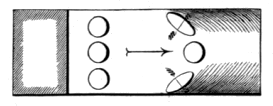
473. This link between pressure and structure never fails. At the foot of the cascades, where the slope of the glacier's bed changes suddenly, the pressure is often enough not only to close the crevasses but to squeeze the ice violently. In such places the structure always appears, sweeping right across the glacier. When two branch glaciers unite, their thrust against each other strengthens the marginal structure the branches already had and develops new planes of lamination. Under the medial moraines, therefore, the structure is usually well developed. It is finely shown, for example, under the great medial moraine of the glacier of the Aar.
474. On this glacier, in fact, the blue veins were noticed independently three years after M. Guyot first described them. I say independently, because M. Guyot's description, though written in 1838, remained unprinted and was unknown in 1841 to the observers on the Aar. These were M. Agassiz and Professor Forbes. Professor Forbes afterwards gave the question of structure much attention, and it was chiefly his observations and reasoning that won it the important place it now holds among the phenomena of glaciers.
475. Without leaving the glaciers themselves, then, we have established the link between pressure and structure. Is there anything in our earlier scientific experience to which these facts can be tied? New knowledge of nature must always strike its roots into the old and grow out of it as a living thing.
§ 66. Slate Cleavage and Glacier Lamination
476. M. Guyot dropped an extremely shrewd hint when he compared the veined structure to the cleavage of slate rocks. We must learn something about this cleavage, for it really holds the key to the problem in front of us. Let us go, then, to the quarries of Bangor or Cumberland and watch the quarrymen in their sheds splitting the rock. Striking a sharp point skilfully into the edge of the slate, they make it divide into thin plates, fit for roofing or for schoolchildren's writing slates, as the case may be. The surfaces along which the rock splits are called its planes of cleavage.
477. All through the quarry you notice that these planes run in exactly the same direction. How is this layered structure to be accounted for?
478. You might be inclined to think that cleavage is a case of stratification or bedding, for it is true that in various parts of England there are rocks that can be split into thin flagstones along the planes of bedding. But when we examine these slate rocks, we confirm the observation, first made, I believe, by the eminent and venerable Professor Sedgwick, that the planes of bedding usually run across the planes of cleavage.
479. Here, as you see, we have a case exactly like that of glacier lamination, which at first we were inclined to put down to stratification. Later, however, we found planes of lamination crossing the layers of the névé, exactly as the planes of cleavage cross the beds of slate rock.
480. But the likeness goes further. Slate cleavage remained a puzzle to geologists until the late Mr. Daniel Sharpe discovered that shells, other fossils, and other objects found in slate rocks are always flattened out in the planes of cleavage.
481. Go into any well-arranged museum, the School of Mines in Jermyn Street, for example, and look at the evidence collected there. Look especially at the fossil trilobites taken from slate rock. In some cases they are squeezed to a third of their original thickness. Many other specimens show the flattening of shells in the most striking way.
482. To the evidence Mr. Sharpe brought forward, Mr. Sorby added more powerful evidence, based on examining slate rock under the microscope. Taking both together, the conclusion is irresistible: such rocks have suffered enormous pressure at right angles to their planes of cleavage, exactly as the glacier has provably suffered great pressure at right angles to its planes of lamination.
483. The link between pressure and cleavage is proved, then; but the question arises whether they stand to each other as cause and effect. The only way to answer is to put nature's conditions together artificially and see whether we can produce her results.
484. The stuff of slate rocks was once a plastic mud with fossils buried in it. Let us imitate the action of pressure on such mud, using softened white wax in its place. We put a ball of the wax between two glass plates, wetted to keep it from sticking, apply pressure, and flatten the wax out.
485. At first the flattened mass is too soft to split cleanly, but you can see by tearing it that it is layered. Let us chill it with ice. Afterwards we find that no slate rock ever showed so fine a cleavage. The layers, it hardly needs saying, are at right angles to the pressure.
486. One cause of this lamination is that the wax is a mass of tiny grains whose surfaces are places of weak cohesion, and the pressure squeezes these grains flat, producing planes of weakness at right angles to the pressure.
487. But the main cause of the cleavage, I take it, is the particles of wax sliding sideways over one another. Old attachments are broken in this way, and the new ones fail to make up for them. The sideways sliding produces lamination, just as the rails near a station are made to peel in flakes by the gliding of the wheels.
488. Instead of wax we can take the slate itself, grind it to a fine powder, add water, and so make the original mud again. Squeeze this mud properly in one direction, and the cleavage comes back.
489. Now call to mind the evidence we have seen of the power of thawing ice to yield to pressure. Remember the shortening of the Glacier du Géant and the squeezing of the Glacier de Léchaud at Trélaporte. Such a substance, slowly worked on by pressure, will give way sideways. Its particles will slide over one another, and regelation will at once make good the broken attachments. It will not give way evenly, but along particular planes. It will also melt, not evenly, but along particular surfaces. Both the sliding and the melting will happen mainly at right angles to the pressure, and glacier lamination is the result.
490. As long as it is sound, the layered glacier ice resists splitting: regelation, as I have said, makes good the broken attachments. But when such ice is exposed to the weather, the structure shows itself, and the ice can then be split into tablets a square foot or even a square yard in area.
§ 67. Conclusion
491. Here, my friend, our labours end. It has been a real pleasure to have you at my side so long. We have often reached the heights where our work lay by the sweat of our brows, but you have been steady and hardworking throughout, using your own muscles wherever possible instead of leaning on mine. Here and there I have reached out an arm and helped you onto a ledge, but the climbing has been almost entirely your own. That is how I should like to teach you everything: showing you the way to effort that pays, but leaving the effort to you. I am more anxious to bring out your grit in the face of difficulty than to smooth your way by watering the difficulties down.
492. Steady, careful, without fear, though not always without awe: that is how I have found you on rock and ice, and you have shown the still rarer quality of steadiness in the effort of thinking. Set out here, our task looks plain enough, but you and I know how often we have had to wrestle stubbornly with the facts to bring out their meaning. The work is done now, though, and you are master of a fragment of that sure and certain knowledge which is founded on the faithful study of nature. Is it not worth the price paid for it? Or rather, was not the paying of the price, the healthy, if sometimes hard, exercise of mind and body on alp and glacier, a part of our delight?
493. Here, then, we part. And should we not meet again, the memory of these days will still unite us. Give me your hand. Goodbye.