

The Six-Cornered Snowflake
To the illustrious Johannes Matthäus Wacker von Wackenfels, Imperial Aulic Councillor to His Sacred Imperial Majesty, Knight of the Golden Spur, and so on, patron of scholars and philosophers, my generous lord.
I know how fond you are of Nothing, not because it's cheap but for the sparrow's game, that playful poem, as witty as it is charming; and so I can easily guess that the closer a present comes to Nothing, the better you'll like it and the more welcome it will be.1
Whatever it is that might please you by putting you in mind of Nothing, it has to be little and slight and next to worthless and gone in a moment, which is to say almost nothing. Nature is full of things like that, but even among them you have to choose. You might think of one of Epicurus' atoms. But an atom is Nothing, and Nothing you've already had from me. Let's go through the elements, then, by which I mean the smallest thing there is in each kind of stuff.
Start with earth. Don't dream that I'll give you my old friend Archimedes' treasure: he's the one who broke the earth down into sand and found ten thousand specks of dust in a single poppy seed. If I took even one away from him I'd wreck all his arithmetic and his myriads with it. Besides, the shape of such tiny bodies can't be seen, and Archimedes never told us what it was. There's nothing in them for the mind to work on, and nobody longs for a thing he's never seen. And dust lasts, too. It settles on beams that age has beaten and rot has eaten through, and it lords it over them. Give you that, and I'd be giving you too much.
Then there's the spark of fire. It's small, and it's gone in an instant, but it's never smaller than the grains of pyrite struck off in making it, or the flakes of a glowing coal, and I've already thrown those out with the dust. As for the shaped pyramids of fire, which I've never seen, I leave them to Plato, to build his fire out of them however he likes. On, then, to the elements in between.
I could give you wind, or smoke, but those are for sale, and not only in Icelandic bags but on paper as well, and in words, all over the world. Smoke is a precious commodity, then, and it costs me plenty. And it's no use to the mind, besides, being crude and shapeless.
Down we come, then, to water. The holy prophets reckon a drop hanging on the rim of a bucket the most contemptible thing there is. And our Germans count nothing less than that little drop of wine they shake out onto a thumbnail after draining the cup, where it sits, held up by its own bulk. If I offered you that drop, I'd certainly be giving less than the Persian who cupped his hand in the river Choaspes and poured the water out for his king. It would be a more decent present, too, that drop of wine from a German's thumbnail, than the sliver an Italian bites off his own nail at you, gnashing his teeth, to say you won't get even that much. And then the drop is round, and its roundness already promises a little geometry; but I'm afraid even that would be too much for a man who takes such delight in Nothing.
What if we turned to the animals? I'm afraid that would be carrying owls to Athens. Only the other day I saw on your shelves those volumes of strange and rare things by the man of the old school of Parmenides who abolishes motion, because a motion never has even one part complete, not even the part that's already past. There are monsters galore in that work, and I don't doubt it has animals of miraculous smallness too. But there's no need to guess. You have Scaliger's critique of Cardano's book On Subtlety. In Exercise 194, number 7, you'll find the smallest animal there is, the itch mite, a little burrower that tunnels under the skin. But that's too much as well. The creature walks, so it has a soul. And why should I give you a soul, when I balk at giving you even a drop that has none? Unless perhaps you hope to make some discovery by cutting up the corpse of this prowling beast. That I leave to Dr. Jessenius, the anatomist.
I was turning all this over anxiously as I crossed the bridge, embarrassed at my bad manners in coming before you without a New Year's present, except that, harping forever on the same string, I bring Nothing time and again; and I couldn't find what came closest to Nothing and still gave the mind something to bite on. And then, as luck would have it, the cold was turning the vapor in the air into snow, and here and there flakes fell on my coat, every one of them with six corners and feathery rays. Good heavens, here was a thing smaller than any drop, and yet with a shape! Here was the very New Year's present for a lover of Nothing, and a fit one for a mathematician to give, who has Nothing and receives Nothing, because it comes down from the sky and looks like a star.
Back to my patron, then, while the little gift lasts, before the warmth of my breath melts it into nothing.
And look, the name itself is a sign! What a delight for Wacker, the lover of Nothing! Ask a German what nix is, and if he has any Latin he'll tell you: nihil, nothing.
Take this addition to your Nothing with a smile, then. And if you're wise, hold your breath, or you'll be getting nothing all over again.2
For here's a question for Socrates, as good as the flea's jump he measured in Aristophanes' comedy. Why does snow, when it first falls, before it gets tangled up into big flakes, always come down with six corners and six rays, feathered like little plumes?
No, away with Aristophanes, that pimp for popular scorn and ignorance! What do I need Socrates for, the butt of his play? I look instead to the royal Psalmist, who, among the praises of God, says that He "gives snow like wool." With that word, unless I'm mistaken, he meant the feathery rays of my little snowflake. It's likely enough that as he sat tired, or stood leaning on his crook, watching his flock, he saw and marked these little stars of snow falling on the sheep's wool and sticking there.
Little Stars of Snow
But joking aside, let's get down to business. Whenever it begins to snow, the very first specks come down shaped like little six-cornered stars. It happens every time, and anything that happens every time must have a definite cause. If chance did it, why shouldn't they fall with five corners just as often, or with seven? Why always six, when they haven't yet been jumbled together in a crowd and knocked about every which way, but are still falling one by one, scattered and separate?
I was talking this over not long ago with someone, and the first thing we agreed on was where not to look. The cause isn't in the matter but in whatever acts on the matter. The matter of snow is vapor, and vapor, as it rises from the earth, carried up by a heat of its own, is one continuous stuff, almost a fluid. Nothing in it is divided up into little separate stars like these.
How can I know that, you'll ask, when vapor is transparent, and nobody could see it even if it were made of little stars? Here is my answer. Vapor comes from moisture underground dissolving, as its lightness and its rising show; and when a thing dissolves, shapes have no place in it. A thing has a shape of its own only when it bounds itself, because it's the boundaries that make the shape. Dissolved vapor belongs to the family of wet things. It flows, which is to say it doesn't bound itself, and so it keeps no shape at all until it condenses into snow, or into a drop.
With that settled, and the six corners put down to whatever acts on the vapor, we went on to wonder what that agent might be, and how it works. Is it a form that lives inside the thing, or a cause pushing from outside? Does it make six corners because the matter leaves it no choice, or because that is its own nature? And if it's its nature, is that because the pattern of the beauty in a hexagon was born in it, or because it knows some purpose that the shape will serve?
To see how these questions differ, let's take some famous examples and look at them the way a geometer would. The detour will do a great deal for our question.
The Cells of the Bees
Ask a geometer how the bees build their cells and he'll say: in hexagons. That's the simple answer, and it comes from a simple look at the openings, the doors of the cells, and at the walls around them. Each cell stands in a ring of six others, and shares one wall with each of them, the way neighboring houses share a party wall.
Now look down into a cell, at its bottom. It isn't a flat floor. It sinks, in three slanting faces, to a blunt point at the very bottom, like the keel of a boat, and keel is the better name for it. Where those three faces meet the six walls, they make six more corners around the rim of the keel, taking turns high and low. The three high ones each have three edges, just like the point at the bottom. The three low ones, set between them, each have four.
There's more to see if you take the comb apart. It's made of two layers of cells, with their doors facing opposite ways and their backs pressed tight together, and the point of each keel in one layer is tucked in among the points of three keels in the other. The fit is so clever that each cell shares walls not only with the six cells around it in its own layer, through its six sides, but also with three cells in the layer behind, through the three faces of its floor. Every bee therefore has nine neighbors, and a single shared wall between it and each of them. And the three faces of every keel are all alike, each of them the figure geometers call a rhombus.
Solids Made of Rhombs
Those rhombs sent me off into geometry, to see whether a solid like the five regular ones, or the fourteen Archimedean ones, could be built from rhombs and nothing else. I found two. One belongs to the family of the cube and the octahedron, the other to the dodecahedron and the icosahedron. (The cube itself stands in for a third of the kind, since it's related to two tetrahedra fitted through each other.) The first is closed by twelve rhombs, and today it's called the rhombic dodecahedron; the second by thirty.
The first of them shares a talent with the cube. Bring eight cubes together with a corner each at one point, and they fill all the space around that point without leaving a gap. The rhombic solid does the same with its corners. It has two kinds: blunt ones, where three edges meet, and ones where four edges meet. Four of the three-edged corners filled around a point leave no gap, and neither do six of the four-edged ones. You can therefore build up solid space out of these rhombic solids alone, with four three-edged corners always meeting at one point and six four-edged corners at another.
Let's count the contacts. Fill space with equal cubes set squarely in rows, and pick any one of them: thirty-two other cubes touch it, corner to corner, a single corner each, and six more touch it with four corners apiece, thirty-eight in all. Fill space instead with equal rhombic solids, and pick any one: six others touch it at a single four-edged corner each, and twelve more meet it with four corners apiece, eighteen in all, counting every kind of contact.3
This, then, is the solid figure that comes as near to regular as anything can and still fills space, just as the hexagon, the square and the triangle fill a plane. This, I say, is the figure the bees model in their combs, with one thing left out: the cells have no roofs to match their keels.
And no wonder, because if the bees put roofs on as well, each of them would be walled in on every side by twelve others, or by eighteen, with no way out. They needed no roofs. That left them free to draw the six walls out as long as their little bodies required, well past the size of the rhombs in the keel, which makes the walls unlike the rhombs that border them.
The Shape of a Pomegranate Seed
Next, cut open a good large pomegranate. You'll find most of its seeds squeezed into this very shape, except where the rows of stalks that bring them their food get in the way.
Here, then, are two examples, and the question is who made the rhombic shape in each, in the bee's cell and in the pomegranate seed. It isn't the matter. Bees don't find little rhombic leaves lying about ready made, to gather up and fit together into their little houses. Nor is it likely that the seeds of the pomegranate, alone among fruits, sprout corners of their own accord. In every other fruit the seeds come out round wherever nothing stops them, as the juice pours into their soft skins and stuffs them until they swell and bulge wherever there's room.
The cause of the shape in the pomegranate seed does lie in the soul of the plant, which looks after the fruit as it grows. But the soul alone can't account for it. The plant's soul doesn't give the fruit this shape out of any property of its own form; it has help, and the help is material necessity.
How Peas Are Pressed
While the seeds are young and small they're round, for as long as there's room for them inside the rind. Then the rind hardens, while the seeds keep on, and they end up crowded and squeezed together, like peas in a pod. Peas, though, have nowhere to go. They sit in a single row in their long pods, so they're pressed from two sides only. The pomegranate's round seeds have had more room from the start. Each one slips easily in among three bulging seeds of the layer facing it, helped by its roundness, and moves its juice out of the places where it's pressed and into the empty spaces.
You can do the same thing yourself. Take a heap of round balls of some soft stuff, all the same size, shut them in a round vessel, and start tightening brass hoops around it so that it's squeezed from every side. Most of the balls will come out pressed into the rhombic shape, especially if you first shake the vessel carefully, so that the balls can roll about freely and settle into less room. Line the balls up straight instead, in rows that can't be disturbed, then squeeze, and you'll get cubes.
That's because equal balls gathered in a vessel arrange themselves, broadly speaking, in two ways, to match the two ways they can be arranged on a flat surface.
Take some equal balls rolling loose about a level table and herd them together until they touch. They'll settle into one of two patterns, triangles or squares. In the triangular one each ball has six around it; in the square one, four. Either way, every ball is touched in the same pattern as every other, except those at the edges. A pentagonal pattern can't be kept up when all the balls are equal, and a hexagon falls apart into triangles, which leaves these two orders as the only ones.
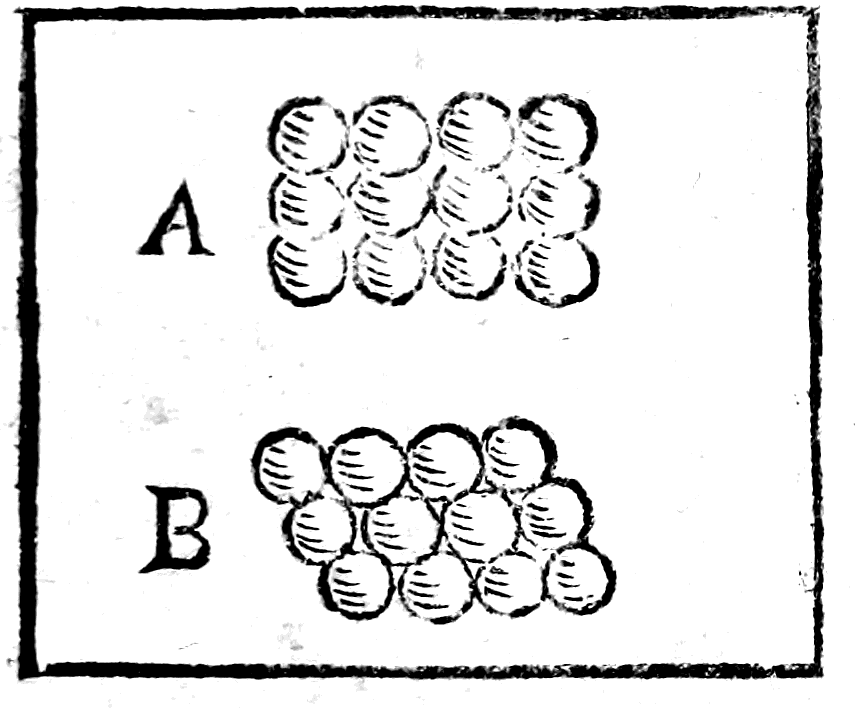
Now build upward, packing as tightly as you can, by laying one flat layer on top of another. Each layer is either square, as at A, or triangular, as at B.
Start with square layers. You can set the upper layer so that each of its balls stands right on top of a ball below, or so that each of its balls sinks into the hollow among four balls below. Stacked the first way, a ball touches four around it in its own layer, one directly above and one directly below, six in all. That's the cubic order, and squeezing it makes cubes, but it isn't the tightest packing. Stacked the second way, a ball touches the same four around it in its own layer, and also four below it and four above it, twelve in all, and squeezing turns the balls into rhombic solids. This order looks more like the octahedron and the pyramid. It is the tightest packing there is: in no other arrangement could more balls be stuffed into the same container.
Now take triangular layers. Again you can set each ball of the upper layer squarely on a ball of the lower, which makes another loose packing, or let each one sink into a hollow among three. Stacked the first way, a ball touches six around it in its own layer, one above and one below, eight in all. That order is like a prism, and squeezing turns the balls into columns, each with six four-sided walls and two hexagons for its ends. Stacked the second way, the triangles give you nothing new: it's the same as the second stacking of the square layers.
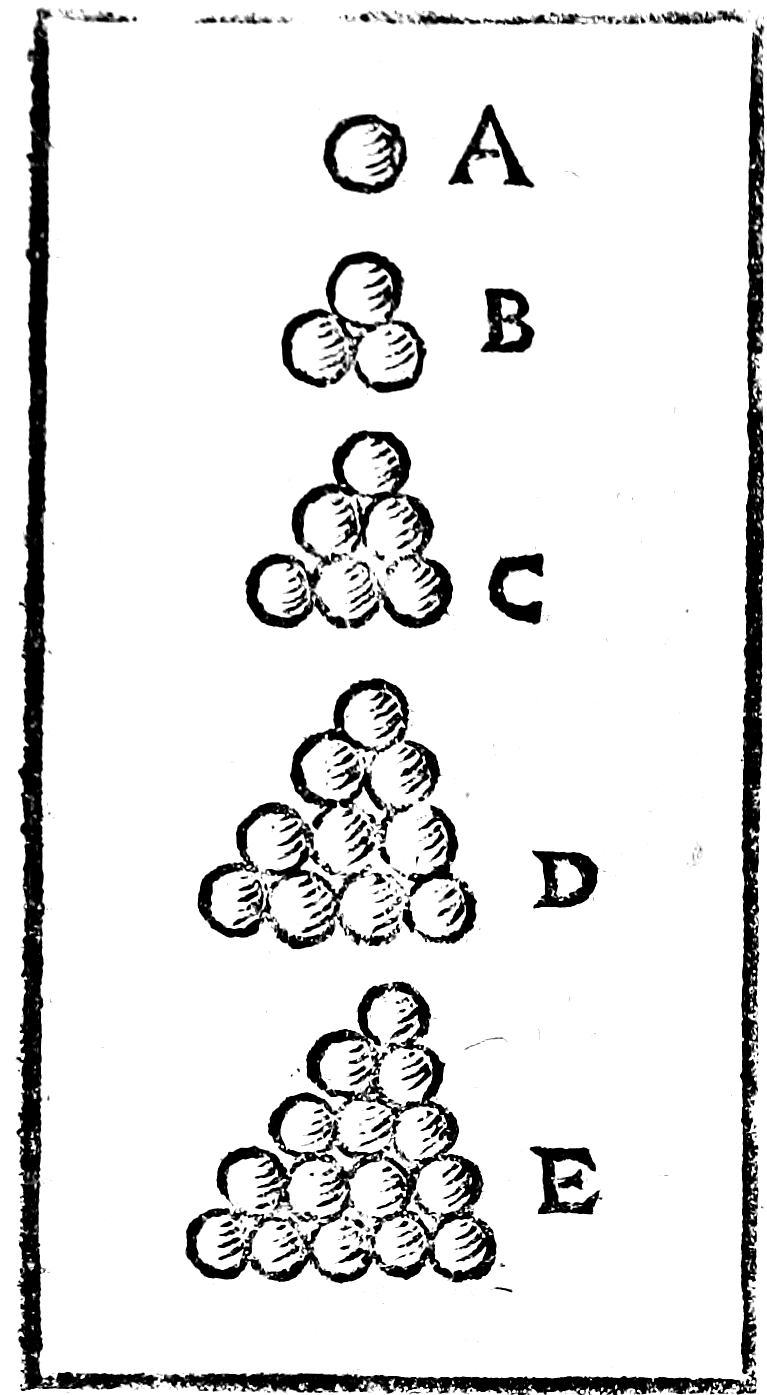
Here's how to see it. Let B be a cluster of three balls, and set a single ball, A, on top of them for the peak. Then make more layers: six balls for C, ten for D, fifteen for E. Always set the smaller layer on the larger, so that the whole heap becomes a pyramid. Built that way, every ball above sits in a hollow among three below. Now turn the pyramid over, so that what lies on top is no longer its point but one whole edge, running along the top like the ridge of a roof. Peel off any ball from that ridge, and under it you'll find four balls in a square. And each ball is still touched by twelve others, just as before: six around it in its own layer, three above and three below. In the tightest solid packing, then, you can't have the triangular order without the square one, or the square without the triangular.
Why Pomegranate Seeds Have Their Shape
That settles the pomegranate. Its seeds are pressed into the shape of the rhombic solid by material necessity working hand in hand with the way they grow. The round seeds don't butt stubbornly head to head against the seeds facing them. They give way, and are pushed into the hollows between three or four seeds of the layer opposite.
Where Do Snail Shells Get Their Shape?
Why the Bees' Cells Have Their Shape
The bees in their hives are another story. They don't heap up together anyhow, like the seeds in a pomegranate. They line up in ranks of their own choosing, heads all pointing one way or the opposite way, tails braced against each other. If their shape came from bunching together like that, the cells would have to grow over the bees out of some sticky stuff they sweated, the way a little house grows over a snail as it coils. But we know for certain that the bees make their cells themselves, and put up the whole structure from the foundations.
It's the bee's own nature, then, that carries this instinct, to build in this shape and no other. The Creator stamped the pattern on it. The matter has no say here, neither the wax nor the bee's little body, and growth has none either.
That brings us to purpose. I don't mean a purpose the bee works out for itself, but the one God Himself, who made the little bee, had in mind when He laid down the rules for its architecture.
And here, now that we're asking about purpose, bodies and matter come back into the reckoning, because there are three things to be said.
The Hexagon Holds the Most
The first is a commonplace among the natural philosophers, who look only at the hexagons, as the comb shows them from outside, with their open mouths. Only three figures can cover a flat surface without leaving gaps: the triangle, the square and the hexagon. Of the three, the hexagon holds the most, and room is what bees want, for storing honey.
You can stretch the argument to solids. Solid space can't be divided without gaps except into cubes or rhombic solids, and the rhombic solids hold more than the cubes. But the argument doesn't go far enough. If room were what they were after, why wouldn't each bee build itself a round nest? Why scrimp over every scrap of space, as though there were none to spare in the whole hive? A second reason is likelier, though it too falls short, for the same objections: the bees' soft little bodies lie more comfortably in a nest with more corners, and blunter ones, closer to a sphere, than they would in a cube, with its few corners sticking far out and its flat floor, the last thing a rounded body wants to lie on.
What the Rhombic Cell Is For
We need a third reason, and it has three parts. The bees save labor if every wall is built in common by two of them. Straight joints make the whole comb stronger, better able to bear its weight, than if every little house were round and easily squashed. And round shapes leave gaps, however tightly they're packed, so that the cold would creep in through the chinks. The rhombic cell takes care of all of this, because, in Virgil's line, "they share the houses of their city."
These reasons, which all look to material necessity, are enough in my view. I see no need here to philosophize about the perfection, beauty or nobility of the rhombic shape, or to labor at prying out the essence of the bee's little soul from the shape it builds. We'd have had to try something like that if the shape had turned out to have no use.
The same goes for the pomegranate. It's plain that material necessity brings its seeds to the rhombic shape as they grow, and it would be a waste of thought to speculate about some essence in the tree's soul whose special business is making rhombic solids.
Why Flowers Have Five Petals
Now take the opposite case. Ask why nearly every tree and shrub, or most of them anyway, opens its flowers as a pentagon, with five petals. In apples and pears the fruit follows the flower in the same number, or a related one, five or ten: five little chambers inside for the seeds, and ten threads. Cucumbers and their kind do the same. Here, I say, there is room to wonder about the beauty, or the particular property, of the figure that has put its stamp on the souls of these plants. And I'll let you in on my thoughts about it along the way.
The Five-Fold Solids Come from the Divine Proportion
Of the regular solids, two are built on fives: the dodecahedron and the icosahedron. The dodecahedron wears its fives openly, as pentagons; the icosahedron is made of triangles, but the triangles gather in fives around every corner. Neither of them, and not even the pentagon itself, can be built without the proportion that geometers today call divine. It works like this. In a continued proportion of this kind, the two smaller terms added together make the third, and any two neighbors added together make the one after, with the proportion staying the same all the way out to infinity. You can't give a perfect example in whole numbers, but the farther you go from one, the closer the example comes. Start with the smallest, 1 and 1, which you must think of as unequal. Add them and you get 2. Add the larger 1 to that and you get 3; add 2 and you get 5; add 3 and you get 8; add 5 and you get 13; add 8 and you get 21. And always, near enough, as 5 is to 8, so 8 is to 13, and as 8 is to 13, so 13 is to 21.
My belief is that the power a plant has to make seed was modeled on this proportion, which keeps breeding more of itself, and that this is why the flower flies the seed-making power's own true flag, the pentagon. I'll leave aside everything else that could be brought in to confirm this, though it would be the greatest pleasure to think it through; those things deserve a place of their own. I've laid all this out here only as an example, so that we come to the six-cornered shape of snow better trained and in better practice.
Is Cold the Cause of the Star in Snow?
We had set out to look for the origin of the snow's shape, then, among causes from outside the vapor and causes from within it. The first outside cause to come forward was cold. Cold certainly causes condensation, and in condensing the vapor gathers into a star, so it seemed that the cold gave it its star shape. That raised another question: is cold a nature of its own, like the innate heat the physicians talk about? It seemed to be a mere absence, which has no mind to design a hexagon with, and no workings of its own at all.
But let's not tangle our questions together. Grant the cold its condensing. Even so, condensation, it seems, would more naturally have made a ball. In fact, if you think of the cold spread far and wide and the vapor meeting it along a surface, it would make better sense for condensation to produce something entirely flat, like the surface itself, with any outline at all. Suppose the whole outer skin of the vapor got density from the cold, weight from the density, a fall from the weight, and from the fall a breaking up into scraps or flakes. Certainly not all the flakes would come out six-cornered. Very few would, and I'm not sure any would, least of all with rays so neatly ribbed.
What Shapes the Frost on Windows
Those ribs put us in mind of something that happens in a steamy heated room, when the winter frost lays siege to a window full of chinks. Around those narrow openings, cold air and vapor wrestle. Wherever they meet, the heat makes for the top and the cold for the bottom, because heat spreads matter out, while cold gives it density and weight and drives the warm stuff upward. As the vapor crowds to get out, nature's horror of a vacuum brings the cold air crowding in, and the edges of the open window, or of a crack, turn bitterly cold. Any vapor that strikes those edges freezes on the spot, and the new frost turns just as cold as the edge it froze on. The next vapor to strike it freezes too, and so the frost grows, layer laid on layer. All the while, though, the cold air keeps forcing its way in between, in straight lines, and this back and forth, air coming in and vapor going out, is what gives the frosty growths their ribs and their sharp rays.
None of this can explain how our little snowflake gets its shape. Out in the wide-open fields of the air, what coming in is there, what going out, what narrow gap, what wrestling? I'll grant that as it falls from on high through damp air, the vapor it brushes against may add something to its feathers. But why in six places? Where does this six-ness start? Who carved the little head into six cold horns before it ever fell? What cause marked out six points on that surface just as it was about to condense, for the six rays around it to be fixed to?
The cold, then, a cause from outside, can't do any of this. There must be some cause inside, either traveling along with the vapor or belonging to it in some other way.
But as I weighed all this, something else astonished me. Why aren't the rays set out instead all the way around, in a sphere? If the inner heat is behind it, why does it work only in a flat surface? The heat is the same in every direction, and it isn't found only in the flat surface of the vapor.
While I was wrestling with these thoughts, and reason was demanding rays in every direction, I remembered something I had often watched before and wondered at. These little stars don't lie flat the moment they land. They stand propped up on some of their parts, and only after a while do they settle down flat.
A Theory of Nothing
That reasoning was the father, and this experience the mother, and between them they gave birth to a theory. While these little stars are falling, I said to myself, they aren't flat at all. Each is made of three feathery diameters crossed at a single point, with their six ends spaced evenly around it. When the star lands, it lands on three of its feathery rays only, while the other three, the ones opposite them on the same straight diameters, stand up in the air. Then the three it was standing on bend, and the three that had been standing up fall down into the same plane as the first, into the spaces between them.
I'll follow the theory out as far as it will go before I ask whether it's true. If I found out too early that it was hollow, I might be stopped from doing what I set out to do, which was to spend my words on a thing of Nothing.
Let this be laid down to begin with: whatever causes these six rays acts equally, spreading in every direction. If cold causes the six rays, then the cold surrounds each little portion of vapor equally, or at least at equal distances all the way around. If the inner heat causes them, then the heat too works outward in every direction of a sphere, from one and the same center.
But that only moves the question; it doesn't settle it. We still can't see why exactly six feathery rays should be fitted to one center, and not five or seven.
Ask a geometer which figure has three diameters cutting each other at right angles at one center, in the shape of a double cross, and he'll tell you: the octahedron, once you join its opposite corners. The octahedron has six corners. Then why should snow, as it falls and before it's flattened, rest on three feathery diameters crossing at right angles, which are the very skeleton of the octahedron? Join the neighboring tips of the rays with twelve straight lines, and you'd have drawn the whole solid octahedron.
What makes the condensation run into these three feathery rays, then, rather than into a whole ball?
I can tell you one way this might come about by material necessity, but it takes for granted something more astonishing than the thing we set out to explain. I'll tell it anyway, in case the truth can be coaxed out by comparing a number of mistakes. Suppose that vapor, the moment it feels the cold rush in, clots into little spheres of a definite size. That's reasonable. In water, the drop is the smallest piece of fluid nature allows, because water smaller than a drop no longer runs apart under its own weight. In the same way it's easy to grant that the stuff of vapor has a certain stickiness that lets it hold out against the cold in some definite amount, the size of a drop of vapor, say.
Suppose, second, that these drops of vapor touch each other in a definite arrangement: square on a flat surface, say, and cubic in a solid, as I described above. That way each little sphere is touched by six others. Only four of them can be drawn here on a flat page; you'll have to take the fifth and sixth as lying on top and underneath. Lay all that down, take it as given, and now let the cold come rushing in through the gaps. Along the straight line from each point of contact to the point opposite, each sphere is shielded from the cold by its neighbors. The condensation will therefore run toward the center of each sphere, but in such a way that it also runs along the diameters that join the points of contact, since those are the places safe from the cold.
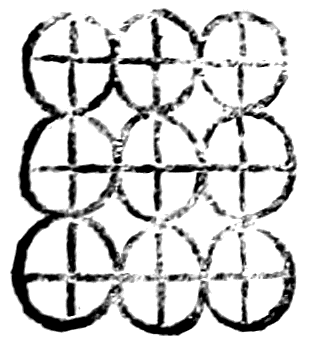
But someone may fairly ask, as I warned, what force lines the little spheres up in rows like this.
If matter allowed no other way, the case would be closed. But matter can arrange them in two other ways, as I said above, and besides that, all three orderly arrangements can be mixed up into a jumble.
Shall we take as the cause the fact that this arrangement alone is the same in every direction, with its points of contact spaced evenly, which isn't true of the others at all? In the tightest packing, as I said above, each ball is touched by twelve others, but the gaps between the balls go triangle, square, triangle, square, by turns; here they are squares everywhere. There, of the diameters joining opposite points of contact, two cross at right angles and the other four don't; here all three cross evenly, and at right angles. There, if you join the ends of the diameters you get a cuboctahedron; here you get an octahedron inside every little sphere.
That shows the straight arrangement has the advantage over the slanting one. But it still doesn't show us any cause that would set the spheres out this way rather than that. Does the cold do it? But how?
If the cold does anything, it condenses or pierces the matter where the matter gapes open or offers only feeble resistance. And to be generous, the straight lining up from top to bottom might come from the straight fall toward the earth. But the straight lining up from side to side, where does that come from?
What's left is that the inner heat of the vapor makes this cubic arrangement of drops, if the arrangement is cubic at all; that is, if our Nothing is Something.
Once we've come down to that, it makes no difference whether the heat arranges each drop, all by itself, into the form of an octahedron, or parcels out the whole mass of vapor into orderly rows of stars, so that the outer arrangement of the whole crowd helps along the inner arrangement of each sphere. Neither way could chance produce order so reliably where, as here, confusion comes so easily.
There are reasons, too, for believing it's rather each drop that arranges itself, without help from contact with anything outside. If each one's shape came from the orderly contact of many, the little stars would all have to be the same size. In fact you see great differences of size among them. And an orderly arrangement of many drops at once would be a most unusual thing besides.
We're no further on, then, unless we can see how the inner heat sets the drop of vapor firm along three diameters, in the form of an octahedron, or at least of a hexagon, so that as it condenses the matter can gather along them. (Remember I warned you that this theory of three crossed diameters is a theory of Nothing.)
Someone might suppose that these feathery wisps fly about on their own and just happen to meet crosswise as they fall. But that's false. If it were chance, they wouldn't always meet three at a time, or at their middles, or all at one point. Besides, all the little feathers point outward, away from the center of the star, or of the double cross, very much like the needles along the twigs of a fir. That's a sign that the formative faculty makes its nest at the center and spreads out from there equally in every direction.
Why Animals Have Six Directions
But perhaps there are three diameters because animals have three, running through their six directions? An animal has a top and a bottom, a front and a back, a right side and a left. Anyone who says this is coming close to my own view, but he'll find that what he has granted drags him into paradoxes he never bargained for. First, let him consider what sort of heat this could be, that builds the likeness of an animal into a star of snow. Next, let him ask what good it does. What does an animal have in common with snow? Snow has no life, and needs none of these directions to live by.
Third, let him weigh this: an animal's parts aren't fitted to the geometrical figures, or to the cube, the first of the solid figures, as to a pattern. Necessity steered them, toward getting something done. The first distinction, top and bottom, comes from the animal's place, which is the surface of the earth. The feet point down to brace against the body's weight. The head is on top for several reasons: to keep the nerves moist with a timely shower from above; so that the eyes and ears, being farthest from the ground, can take in the widest circle of it, with nothing in the way; and so that food by its weight and drink by its wetness can drop down to where they belong, without any need for steady drawing up, as in plants rooted to one spot. The second distinction, front and back, was given to animals for getting about, which means moving in a straight line over the earth's surface from place to place. These two diameters, then, have to cross at right angles, and between them they mark out a surface. But an animal can't be a surface. It has to have a body, and its bulk required a third diameter, right and left. That makes an animal a kind of twin, so that in walking each half can take its turn at moving and being moved. It isn't that cubic things look like a man because of some beauty in the figure; man has come to look like a cube, put together, as it were, out of so many uses, or elements.
Principles Not Made of Nothing
I've gone through everything that occurred to me, and here is what I think. The six-cornered shape of snow has the same cause as the orderly shapes and fixed numbers in plants. In plants nothing happens without the highest reason: not a reason worked out by argument, but one that was in the Creator's plan from the beginning, and has been kept up ever since by the marvelous nature of the living faculties. Nor, I believe, does this orderly shape come about at random in snow.
There is, then, a formative faculty in the body of the Earth, and vapor is its vehicle, as the spirits are the vehicle of the human soul. A certain heat made vapor what it is called, vapor, and the same heat keeps it in being, so that it goes on being vapor; and in just the same way, no vapor exists anywhere that isn't also held together by a formative reason, which others call a craftsman heat.
What remains of my view I'll explain by answering two objections. Here is the first. In plants, you might say, the end that comes after, the making of a definite natural body, proves that a formative reason was at work in the matter beforehand. Where means are set in order toward a definite end, there is order, there is no chance, there is pure mind and pure reason. But no end can be seen in the forming of snow. Its six corners don't make it last, or turn it into a definite natural body of fixed and lasting form.
My answer is that the formative reason acts not only for an end but also for ornament. It doesn't aim only at making natural bodies; it has a habit of playing with passing things too, as you can see in many stones dug out of the earth. I take my explanation of all these things out of play (as when we say that nature plays) and put it to serious use. Here is what I think happens. The heat has been guarding the matter. When the cold surrounding it begins to win, it keeps to its old ways. It had acted in order, steeped as it is in the formative reason, and it had fought in order, and now, in an order of its own, it prepares to retreat. It falls back step by step, and holds out longer in those scattered branches, drawn up in order like soldiers in a battle line, than in all the rest of the matter. And like Olympias in the histories, it takes care to fall with grace and modesty.4
Someone else might object as follows. Each plant has a living faculty of its own, since each plant's body also stands on its own, and so it's no wonder that each is fitted with a shape of its own. But to give every little star of snow a soul of its own would be absurd. The shapes of snow, therefore, can't be traced to the work of a soul the way the shapes of plants are.
My answer is that the two cases are more alike than the objector can believe. Grant that each plant has its own faculty; but they're all children of one and the same universal faculty that lives in the Earth. It stands to the plants as the faculty of water stands to fish, the human body's to lice, the dog's to fleas, the sheep's to another kind of louse. Not all plants come from seed, after all. Most of them first sprang up of their own accord, though they have seeded themselves ever since. The faculty of the Earth is in itself one and the same, but it divides itself out into bodies and along with bodies, grows into them, and builds now one thing and now another to suit the condition of each kind of matter, inside and out. The soul had held the vapor too, the whole of it, undivided. When the cold sets about breaking up that continuous mass, and the parts draw in around their own centers, it's no wonder if the soul busies itself with shaping each part as though each were a whole.
What a living death life is without philosophy! If the adulteress in Aesop's fable had known about this formative faculty in snow, she could have persuaded her husband that she had conceived by snow, and his cunning wouldn't so easily have robbed her of her bastard.5
That's enough about the maker of the shape. It remains to look into the shape itself, and whether it comes from three diameters crossing, which so far we've been assuming, or whether it's six-cornered from the start, which I'll come to later. For now, let's keep to the road we've started on.
The Mind, an Image of Its Creator
Here, then, may be the reason why this faculty copies the arrangement of the octahedron's corners rather than any other. To begin with, the whole race of souls is akin to the geometrical figures, the regular ones out of which the world is built, as a great deal of evidence can show. Souls are, in a sense, copies of God the Creator, and the truth of these figures certainly lives in the mind of God the Creator, as everlasting as God. Further, it's quite certain that souls themselves, in the inmost depths of their being, take on quantities. Whether they do so without physical matter or with it, I won't argue. Then it stands to reason that they take on shaped quantities rather than shapeless ones; and if shaped, then regular figures; and solid ones, because souls belong not to surfaces but to solid bodies.
Back to the Theory of Nothing
Now among the regular solids the cube comes first, the firstborn, the parent of the rest. The octahedron is its female, its mate, so to speak. It has as many corners as the cube has faces, and each corner of the octahedron answers to one face of the cube, and to the center of that face.
Take, then, a little portion of vapor that its heat is about to desert. If it's to take on a figure at all (and we've already made that reasonable), it will seize first on the cube, and on the cube's partner, the octahedron. The material necessity we met above, when equal balls were heaped together, was hinting at this too, since the points where the balls touched sketched out the beginnings of the cube and the octahedron, blurred together. But why the octahedron rather than the cube? Is it because the cube is the figure of spreading out, and the octahedron the figure of drawing in? Under the cold's attack, the matter and the power of the heat are both drawing in. But how can we be sure that one is the figure of spreading out and the other of drawing in? Because the eight corners by which the cube reaches outward are the same eight that, in the octahedron, crowd inward around its center. Slice the eight corners off a cube, each cut with equal sides, then fit the eight pieces together with their points turned inward to meet, and you'll have made an octahedron exactly. And the cube spreads out into more corners, eight, the octahedron into fewer, six.
Jewelers say that octahedra grow naturally among diamonds, flawlessly formed and finely finished. If that's so, it backs us up strongly. The living faculty that gave the diamond in the earth its octahedral shape, drawn from the deepest recesses of its own nature, rose from the earth along with the vapor, and gave the same shape to the snow that forms from that vapor.
And yet, as far as three crossing diameters go, there's no more of the octahedron in them than of the cube. Three such diameters join the corners of the one and the centers of the faces of the other. In the octahedron, what they show is the corner they make at the center; in the cube, the corner that closes off the solid. It's a waste of effort, then, to fuss over which whole figure was chosen, when there's barely the beginning of either.
But where am I being carried off to, fool that I am? I set out to give next to Nothing, and I'm achieving next to nothing, because out of this next to Nothing I've built next to the whole world, with everything in it. A little way back I shied away from giving you the little soul of the tiniest of animals, and now here I am serving up the soul of the thrice-greatest of animals, the globe of the Earth, in an atom of snow.
I'll back off, then, and take care that what I've given you and what I've said both come to nothing. And they will, if, as fast as my little snowflake melts, I rout these little arguments of mine with little arguments against them, and reduce them to nothing.
At Last, in Earnest: The Star Shape of Snow
Because while I've been writing all this, it has snowed again, and more thickly than the last time. I studied the little bodies of snow carefully. Every one of them came down with rays, but there were two kinds. Most were very small, bristling all round with rays, no fixed number of them, plain and extremely fine, with no feathers and no ribs, all bound together at the center in a largish little ball. Scattered among them, more rarely, came the second kind, little six-cornered stars. Not one of these fluttered or landed in any way but flat, with the feathers too laid out in the same plane as their stems. Under each star, though, a seventh little ray pointed straight down, like a root, and when they landed they rested on it and stood propped up on it for a while. I'd seen that much before, but I read it wrongly, as though the three diameters didn't lie in one plane. What I've said so far, then, comes as close to Nothing as the thing I said it about.
The first kind, the lumpy ones, I think come from vapor that its heat has all but deserted, on the very point of condensing into drops of water. That's why they're round, and why they get no beautiful shape, now that the architect has left them; and they have rays on every side for the same reasons I gave above for the frosty growths on windows.
In the second kind, the little stars, there's no room for the idea of a cube or an octahedron, or for drops touching each other at all, since they land flat, and not crossed by three diameters, as I supposed above.
The formative soul keeps its place here too, then, and is still the cause, but the question of how it chooses the shape has to be opened all over again. First, why flat? Was I wrong, back there, to deny flat figures to the powers that form bodies? After all, every flower has a flat pentagon in it, not a solid dodecahedron. If so, the real reason for the flat shape would be that the cold touches the warm vapor along some plane, and doesn't surround the vapor evenly on every side when the little stars are born, the way it does when the lumps fall.
Why Six Corners Above All?
But why six corners? Is it because the hexagon is the first regular figure that is really flat, the first that can't be gathered up with copies of itself into any solid? Triangles, squares and pentagons all close up into solids. Is it because the hexagon covers a plane and leaves no gap? But the triangle and the square do that too. Is it because, of the figures that cover a plane without gaps, the hexagon comes nearest the circle? Is it the difference between the faculty that shapes barren things and the one that shapes fruitful things, so that the first makes triangles or hexagons and the second pentagons? Or, last, does this formative faculty share in the hexagon by its very nature, deep in the inmost recesses of its being?
Of these five causes, the first three all assume that the formative faculty takes its counsel from the situation, like a general who draws up his battle line to suit the ground. The fight between the warm vapor and the cold air takes place on a plane, not through any bulk, and so the faculty picks a figure that belongs to planes rather than to solids. In the second and third causes it would be taking material necessity into account as well. The first cause rests on a property of the hexagon alone, and looks only to how fitting and becoming the figure is for this fight. A fight on a plane needs a flat figure. It doesn't need one that can't be gathered up with copies of itself into any solid; the hexagon is chosen for that only because, just as physical bodies are matched by the figures that close up into solids, planes are matched by the figures that don't. What counts here is fitness of form, not material necessity.
Or should we say, of the second and third causes, that the formative faculty chooses the hexagon out of material necessity too, so as to leave no gaps, and so that the vapor can gather more conveniently into the substance of snow?
A circle would be most convenient of all; but little circles leave empty spaces between them, and so the faculty chooses the figure most like a circle. Against this I've already set the unevenness of the little stars, some of them tiny, with very thin, plain rays and no feathers. That shows the snow doesn't form from a great sheet of vapor all at once, but from tiny separate patches, one after another, and of unequal sizes. The business of leaving no gaps has no place here, because it rules only when a whole surface is being divided into equal hexagons. That strikes the second and third causes off the list, except so far as they can be folded into the first. The formative faculty chooses the hexagon not because any necessity of matter or space forces it to, but only because it's drawn by the hexagon's fitness: elsewhere the hexagon covers a plane without gaps, and of all the figures that can do the same, it is the most like a circle.
Which Flowers Have Six Petals, or Three?
The fourth cause can't stand as baldly as that. White lilies are shaped with three petals and with six, and they aren't barren, and the same is true of the cups of many flowers, mostly wild ones.
A Question for the Botanists
Unless perhaps the difference is this. Under a five-cornered flower grows a fruit that is fleshy, as in apples and pears, or pulpy, as in the rose and in cucumbers, with its seeds hidden in the flesh or the pulp. Under a six-cornered flower nothing grows but a seed in a dry chamber, and the fruit, so to speak, is inside the flower. Or perhaps the difference is that no six-cornered flower grows on trees or shrubs, only on herbs, and mostly on plants that grow from bulbs. Or someone else might look into the juices themselves, to see whether they differ according to the shapes of the flowers.
I haven't found this out yet, so let it be enough to have given others a gentle nudge toward this fourth cause.
The Shapes of Stones: Crystals Are Six-Sided
On the side of the fifth cause stand the other works of this formative faculty, the crystals, for instance, which are all six-cornered, while octahedral diamonds are very rare. But the Earth's formative faculty doesn't stick to one figure. It knows the whole of geometry and is well practiced in it. In Dresden, in the royal building they call the Stable, I saw a panel decorated with silver ore, and out of it, as if it were blossoming there, a dodecahedron the size of a small hazelnut stood half out of the ore. And among the fossils in the published description of the warm springs at Boll, there is the front part of an icosahedron.
A Question for Miners and Alchemists
It seems likely, then, that this formative faculty works differently according to the different juices it works in. In vitriol the cubic and the rhombic shape is common, and saltpeter has a shape of its own. Let the chemists tell us, then, whether there is any salt in snow, and what kind of salt, and what shape that salt takes elsewhere. As for me, I've knocked at the door of chemistry, and seeing how much would still have to be said before we had the cause, I would rather hear what you think, my most ingenious friend, than wear myself out with any more argument.
Nothing follows.