

Introduction
It may help to explain to American readers, for whom this special edition is published, that the Juvenile Lectures of the Royal Institution were first set up in 1825. At a general meeting of the members in December of that year, the Managers reported "that Mr. Millington had engaged to deliver a set of Lectures on Natural Philosophy, suited to a Juvenile Auditory, during the Christmas recess, to be continued and concluded in those of Easter and Whitsuntide." For some reason the course did not actually begin until Christmas 1826, when J. Wallis lectured on "Astronomy."
In February 1826 the Managers reported that "they had consulted with Mr. Faraday on the subject of engaging him to take part in the Juvenile Lectures proposed to be given during the Christmas and Easter recesses. The Managers found it would be exceedingly inconvenient to withdraw Mr. Faraday from his experimental investigations to conduct such lectures." All the same, Faraday found time in later years to give no fewer than nineteen courses of Christmas Lectures. He cared a great deal about science lectures for young people, and his Juvenile Lectures were masterpieces of explanation.
Tyndall gave a number of these courses, and others were given by Dewar, Ball, Fleming, S. P. Thompson, Lodge, Boys and other well-known lecturers.
It has become a tradition at the Royal Institution that the lectures are fully illustrated by experiments, and as a rule both the lectures and the experiments have been to some degree new, in what they explain and in how they explain it. The audience is made up not only of the young people for whom the lectures are chiefly meant, but also of their elders, who come to see new points explained or new demonstrations shown.
I have written this in the hope that those in America who do me the honour of reading this book will feel some sympathy with the problem of explanation I have tried to solve. The English edition has a preface, which is reprinted in the following pages and will help to explain further what the lectures were for.
W. B.
London, January 1925.
Preface to the English Edition
In the Christmas Lectures I gave at the Royal Institution in 1923-24, I set out to describe some features of the recent discoveries in physical science. Many of the facts that have come to light might well make the subject of "Lectures adapted to a Juvenile Auditory," and would be both interesting and helpful: interesting because they reveal a beautiful order in the basic arrangement of Nature, and helpful because they have thrown light on many old questions and will surely help us with many new ones.
I knew there were two special difficulties. The first was the difficulty of grasping how tiny the scale is on which the actions and properties of the atoms have to be pictured; but that, after all, was only a matter of unfamiliarity and would pass in good time. The other was the difficulty of grasping arrangements in space. Some people think this difficulty cannot be cured, and that it comes from lacking a special gift that only a few possess. I am convinced this is not so. We should find it nearly as hard to grasp things in two dimensions as in three, if we could not so easily illustrate our two-dimensional thoughts with pencil and paper. If we can turn a model over in our hands, we can seize an idea in a mere fraction of the time it takes to read about it, and a still smaller fraction of the time it takes to write the description.
Perhaps some readers of this book will be interested enough to make models of the few crystal structures it mentions, and may even go on to other structures described in larger books or in the original papers.
I have added a little to the lectures as they were first given. The additions are meant to make the treatment of the subject a little more complete. They did not suit the lectures very well, but they may be allowed in the book, because the reader can skip them if he likes, or read them more than once, or think them over with a model in his hand.
At the end of the book there is a short note on making models.
Chapter One: The Atoms of Which Things Are Made
Nearly two thousand years ago the Latin poet Lucretius wrote a long poem called De rerum natura, "Concerning the Nature of Things." In it he argued that air and earth and water and everything else are made of countless small bodies, or corpuscles, each far too small to be seen, and all in rapid motion. He tried to show that this was enough to explain how material things behave. The ideas were not all his own. He was the spokesman for a school of thinkers whose views he had come to believe were true. Against them stood a rival school, which held that however closely you looked into a thing you would never find any structure at all. Take a bowl of water, they said, and divide it into drops, and those drops into smaller drops, and so on for ever: the tiniest portion would still be just like the bowlful in every property. On Lucretius's view, if you carried the dividing far enough you would come at last to the individual corpuscles, the atoms, using the word in its original sense of something that cannot be cut.
The difference between the two views is enormous. On the first, there is nothing to be gained by looking more closely into the structure of substances, because however far you go you never come to anything new. On the second, the nature of things as we know them depends on the properties of the atoms they are made of, and it becomes both fascinating and important to find out, if we can, what those atoms are like. The second view turns out to be far nearer the truth than the first, and everyone who loves to inquire into the ways of Nature may be grateful for it.
Still, Lucretius had no notion of atomic theory as it stands today. He did not realise that atoms fall into a number of distinct kinds, and that all the atoms of one kind are alike. That idea is fairly new. John Dalton set it out with great clearness at the beginning of the nineteenth century, and it made possible the great advances of modern chemistry and of every other science that leans on chemistry in any degree. It is easy to see why the newer idea made everything so much simpler. We have to deal with a limited number of sorts, not with a vast crowd of different individuals. We should be in despair if we had to study a multitude of different atoms in a piece of copper, say. But once we find that there is only one kind of atom in a piece of pure copper, and not many different kinds in the whole world, we can press on with enthusiasm and hope to study their properties and the laws by which they combine. And it is in their combinations, of course, that their importance lies. The atoms are like the letters of the alphabet, which can be put together in countless ways to make words. In the same way the atoms are combined, in just as great a variety, to make what are called molecules. We can even push the comparison a little further. Words go together into sentences and passages that carry every kind of meaning; molecules of every kind go together, in every proportion, to make structures and materials with an endless variety of appearances and properties, materials that can carry what we call life.
The atomic theory of Lucretius, then, lacked the one idea it needed to grow. It withered away, and the word atom itself came to be used loosely, and wrongly, to mean simply something very small, as it sometimes is in Shakespeare's plays. In another and quite different use of "atomic" theory Lucretius was strangely successful. He believed that disease was spread by tiny particles. At the time of the Renaissance, Fracastoro took up the atomic theory of infection after reading it in Lucretius's poem; but after his day the secret of bacteriology was covered up again, until Pasteur laid it bare.1
Let us think of Nature as a builder, making everything we see out of a limited number of kinds of atoms, just as a builder puts up a house from so many different kinds of material: bricks, slates, planks, panes of glass and so on. There are only about ninety sorts of atoms, and a good many of those are used only now and then. It is a wonderful thing that everything in the world, and in the universe as far as we know it, is made of so few elements. The universe is so rich in variety: the earth and all that rests on it and grows on it, the waters of the seas, the air and the clouds, every living thing that moves on land or in the sea or in the air, our bodies and every different part of our bodies, the sun and the moon and the stars. Every single one of them is made of these few kinds of atoms.
Yes, you might say, that is so; but give a builder bricks and mortar and iron girders and he will build you an endless variety of buildings, palaces or cottages or bridges. Why should Nature not do something of the kind? But think what a builder does when he sets out to make something. He has a plan, which has cost thought to work out, and he gives instructions to the workmen who are to carry out his wishes, and so the building grows. We see him walking about with his plans in his hand. The plans of Nature's structures, though, are locked up inside the atoms themselves. That is what makes the atoms so full of wonder and mystery: out of them alone, and out of what they contain, grows the endless variety of the world. How they came to be such treasure-houses is not our question now. We are asking what these atoms are like. People have been asking that ever since their enormous importance began to be realised, more than a hundred years ago. Do they have size and shape and the other characteristics of the bodies we are used to? We must look into these points.
First, though, we should realise that in the last twenty-five years or so we have been given new eyes, so to speak. The discoveries of radioactivity and of X-rays have changed the whole situation, and that is exactly why I chose this subject for these lectures. We can now understand a great many things that used to be dim, and we can see a wonderful new world opening up in front of us, waiting to be explored. I do not think it is very hard to reach, or to walk about in once you are there. In fact the new knowledge, like every sudden revelation of the truth, lights up the ground we have already travelled and makes easy what used to be hard. It is true that the new lines of advance lead on to fresh difficulties; but that is where the whole interest and spirit of research lies. We will try to take the first steps into the new country, so that we can share in the knowledge that has already arrived, and that keeps arriving faster every day.
Back, then, to our questions about the atoms. Before the new period began, remarkably accurate answers had already been given to some of them. In this very theatre of the Royal Institution Lord Kelvin gave several addresses on the properties of atoms, and especially on their sizes. By a number of very ingenious and indirect devices he reached conclusions that we can now test by accurate methods, and we find he was remarkably close to the truth. Of course it was far harder to say how big any particular atom was than to say how much bigger one atom was than another. The sizes of the potassium atom and the carbon atom, for instance, could be roughly compared by weighing equal volumes of solid potassium metal and of diamond, which is a form of pure carbon. Potassium is lighter than water; diamond is three and a half times as heavy. We know from chemistry that a single potassium atom is rather more than three times as heavy as a carbon atom. If we suppose that the atoms are packed in the same way in both (in fact we now know that this is only roughly true), we must conclude that the atoms in potassium metal are much larger than the carbon atoms in diamond, because although each one is heavier, they pack together to make a lighter material.
Making a sensible estimate of the actual size of any one atom is a much harder matter. But Kelvin used four separate lines of reasoning, and all four brought him to very nearly the same result. "The atoms or molecules of ordinary matter must be something like the 1/10,000,000th or from the 1/10,000,000th to the 1/100,000,000th of a centimetre in diameter."2 Our new methods tell us that the diameter of the carbon atom in diamond is 1.54 hundred-millionths of a centimetre, and that of the atom in potassium metal is 4.50 hundred-millionths. Considering the indirect and inexact methods that were all he had, Lord Kelvin's estimate was wonderfully near the truth.
Figure 1 shows sections of certain atoms on a scale of fifty million to one. The numbers written in give, in each case, the distance in hundred-millionths of a centimetre between the centres of two neighbouring atoms in the pure substance. The distance between two carbon atoms in diamond, for example, is 1.54 hundred-millionths of a centimetre. For oxygen, the diameter has been worked out from the structure of crystals in which oxygen occurs. If the lecture theatre of the Royal Institution were magnified as much as the atoms in Figure 1, it would be taller than the distance from the earth to the moon. We need some comparison of that kind to make us feel how extremely small the things we are talking about really are.
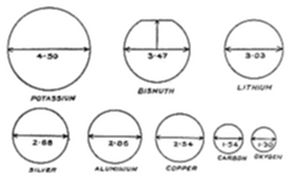
At the same time we must remember that atoms are not to be ignored because they are small. They are the actual building blocks of the world and of the universe, and their size has nothing to do with their importance. Their smallness does explain how easily we all overlook them, and how hard it is to examine them once we have at last realised what they mean to us. The value of the new methods I am going to talk about is that they let us deal with atoms in spite of their smallness.
In a way, then, we have answered the question of how big atoms are. When we go further and ask about their shape, we are less successful.
The chemist, whose science is directly concerned with the ways atoms combine, has seldom needed to discuss their shapes, and gives them no particular form in his diagrams. That does not mean the shapes are unimportant. It means that the older methods could not pin them down. In one sense, though, the chemist pays close attention to form. The atoms in a compound are arranged in some definite way that matters to the combination. If you could see the arrangement and sketch it, you would have to draw it in perspective. In organic chemistry especially, chemists find they must imagine these arrangements in space. Laying them out flat, with no perspective at all, is not enough; indeed any flat design is bound to fall short as a chemical picture. Unfortunately we are forced to draw on the flat: solid models are expensive to make, while paper and pencil are cheap. It is curious to think how badly this practical difficulty has held back a very important subject. Now, when we come to lay down how an atom is arranged among its neighbours, and say that if one neighbour lies in this direction another must lie in that, we are in effect giving our atoms a shape. At any rate it is all the shaping we can do at present. We cannot do more until we know more about the inside of the atom: what its parts are, and how they are placed in relation to one another.
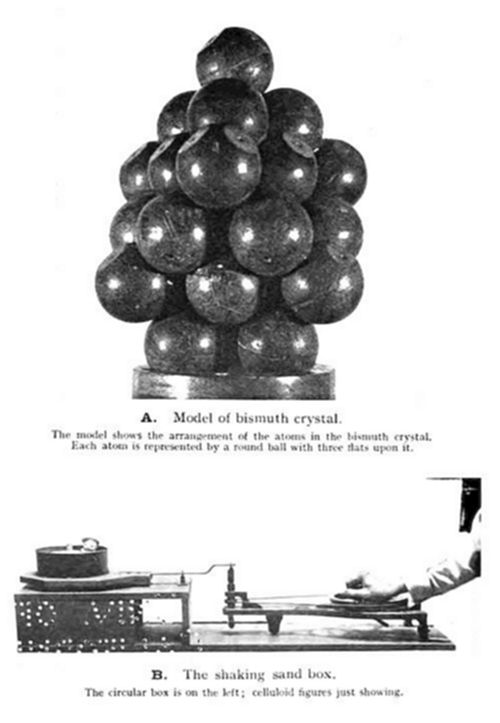
In the newer work, as we shall see, the arrangement of the atoms is examined much more closely, and for the first time their actual distances apart are measured. We find we simply have to make models, because drawing on paper does not let us see clearly enough. We represent our atoms as round balls, and it turns out that most of our discoveries can be shown in this way. What this really means is that when an atom has several neighbours of the same kind, it is the same distance from all of them, and that is actually the case. There are exceptions. In a crystal of pure bismuth each atom has six neighbours, and three of them are closer than the other three, so for the bismuth model we have to make a ball with three flats on it (Plate I, A).
Now let us ask what binds the atoms together into their various combinations and structures. Like our builder, we have our materials in, the bricks and slates and beams; we have our various kinds of atoms. But when we look round for mortar and nails, we find we have none. Nature does not allow any new material to be used as a cement. The atoms cling together of themselves. The chemist tells us that they must be brought together under the right conditions, some of them very odd ones; but the combination does take place, and something in the atoms themselves holds it together once the conditions are met. The whole of chemistry is about what those conditions are and what follows from them.
Atoms seem to cling to one another rather as two magnets do when opposite poles are brought together, or as two charges of electricity of opposite kinds do. There is no doubt, in fact, that both magnetic and electric attractions are at work. We are not entirely ignorant of how they act, but we know much more about the rules of combination, which is to say the facts of chemistry, than about the details of the attractions. We need not trouble about these matters for now. All we need to grasp is that there are forces drawing atoms together.
Then why, if there are such forces, do the atoms not all join up into one solid mass? Why are there any gases, or even liquids? How is it that any atoms at all stay unlinked from their neighbours? What keeps the earth from falling into the sun, and the whole universe from setting solid at last?
The earth does not fall into the sun because it is moving round the sun, or, to put it more correctly, because the two bodies are moving round each other. It is motion that keeps them apart. And when we look closely into the matter, we find that motion plays a part of the very first importance in everything we see, because it sets itself against the binding forces that would join the atoms together in one lump. In a gas, motion has the upper hand. The atoms are moving so fast that they have no time to form any sort of combination with one another. Now and then atom must meet atom, and each, so to speak, holds out its hands to the other in vain; but the pace is too great, and a moment later they are far apart again. Even in a liquid, where there is more combining and the atoms are touching one another all the time, the motion is so great that no joint is permanent.
In a solid the balance between the attracting forces and the motion shifts again. Now the forces hold sway, and the atoms and molecules are locked in their places. Even in a solid, though, the atoms are never perfectly still. At the very least they vibrate and quiver about their average positions, just as the parts of an iron bridge quiver when a train goes over it. It is hard to believe that the atoms and molecules of things that seem perfectly at rest, the table, a sheet of paper, the water in a glass, are all in motion. Yet many of the older philosophers grasped it. Hooke, an English physicist of the seventeenth century, explained by a clear comparison the difference he supposed there to be between the solid and the liquid state: the parts of a liquid, he thought, are moving more than the parts of a solid. "First," he says, "what is the cause of fluidness? This I conceive to be nothing else but a very brisk and vehement agitation of the parts of a body (as I have elsewhere made probable); the parts of a body are thereby made so loose from one another that they easily move any way, and become fluid. That I may explain this a little by a gross similitude, let us suppose a dish of sand set upon some body that is very much agitated, and shaken with some quick and strong vibrating motion, as on a millstone turn'd round upon the under stone very violently whilst it is empty; or on a very stiff drum-head, which is vehemently or very nimbly beaten with the drumsticks. By this means the sand in the dish, which before lay like a dull and unactive body, becomes a perfect fluid; and ye can no sooner make a hole in it with your finger, but it is immediately filled up again, and the upper surface of it leveled.
"Nor can ye bury a light body, as a piece of cork under it, but it presently emerges or swims, as 'twere on the top; nor can ye lay a heavier on the top of it, as a piece of lead, but it is immediately buried in sand, and (as 'twere) sinks to the bottom. Nor can ye make a hole in the side of the dish, but the sand shall run out of it to a level. Not an obvious property of a fluid body, as such, but this does imitate; and all this merely caused by the vehement agitation of the containing vessel; for by this means, each sand becomes to have a vibrative or dancing motion, so as no other heavier body can rest on it, unless sustein'd by some other on either side: nor will it suffer any body to be beneath it, unless it be a heavier than itself."
Hooke's experiment can be repeated in a slightly different form. A round metal box, ten inches across and three inches deep, is fixed on a platform that rests on metal balls so that it moves easily. It is connected by an eccentric joint to a turning wheel, as you can see in Plate I, B. When the wheel is turned fast, the box and the sand inside it are shaken violently, just as Hooke prescribes. The mechanism is easiest to follow from the picture. A heavy metal ball laid on top of the sand vanishes at once, and light things, such as ping-pong balls, come up to the surface. The funniest effect of all comes from burying some of those celluloid figures that cannot be made to lie down because they are weighted at the bottom. The figures slowly rise out of the sand and end up standing upright (Plate I, B, and Figure 1a).
We now know that the motion of the atoms of a body is really its heat: the faster they move or vibrate, the hotter the body. Whenever we warm our hands at the fire, we let the energy the fire radiates speed up the movements of the atoms our hands are made of. Whenever we cool something, we slow those movements down. If we could stop them altogether, we would bring the temperature down to a point below which it is impossible to go: the absolute zero, as it is usually called, 273 degrees centigrade below zero.
As I have said, we have found two new allies in our attempt to see the very tiny atom: radioactivity and the X-rays. Between them they have made our vision some ten thousand times finer. The microscope had done its best for us, but the smallest thing it could show us was made of billions of atoms. The lenses could not be improved: the craft had reached its limit. The real difficulty is that light is a wave motion, and light waves cannot show us the details of an object unless the object is much larger in every direction than the length of the wave. We needed a new light with a very short wave length, and it came in the form of the X-rays. At the same time radioactivity arrived to show us what a single atom could do on its own if it were given a tremendous speed. We can now see the single atom, indirectly, no doubt, but quite usefully, and we can also watch something it does. The X-rays help us with the first and radioactivity with the second. I hope to explain how both of them are adding to our knowledge, and I shall take radioactivity first.
The atom of radium could be roughly represented in size by one of the larger balls lying in front of you. It is one of the heaviest and largest of the atoms; a quantity of them together make a metal, like iron or gold. There is nothing obviously odd about it as long as it stays an atom of radium. But for some reason that nobody understands, there comes a moment when it bursts. A small piece is hurled away like the shot from a gun, and the rest recoils like the gun itself. What is left is not radium any more. It is a smaller atom with entirely different properties: the radium has turned into a new substance. In fact the new substance is a gas, and the projectile turns out to be an atom whose weight comes low down in the list of atomic weights, the lowest but one: it is called helium. Nobody knows what sets off the explosion, and nobody knows any way of hurrying it or holding it back. A radium atom is just as likely to explode at any given moment in a furnace as in liquid air. Its indifference to its surroundings, as far as the timing of the explosion goes, is shown even more strikingly by the fact that combining it with other atoms makes no difference. Combining, or forming molecules, is no doubt a matter of the outside arrangements of the atoms, but the bursting of the atom comes from inside.
The old alchemists tried to find a way of turning one kind of atom into another, preferably lead into gold. In the action of radium there is a transmutation, to use their old word, of exactly the kind they dreamt of. But it is not quite what they were striving for, in two ways. First, it cannot be controlled by human will. That is extraordinary, because there are not many things of which this can be said. Even when a process is far beyond our understanding, we can often decide whether or not it shall happen. We cannot understand how a seed germinates, much less make one that will; but we can lock seeds up in a drawer and keep them from germinating for as long as we like. The radium explosion waits on nothing we do.
Second, the transmutation does not end in gold. It ends in lead. The gas made of radium atoms that have shot off one helium atom is very short-lived: each of its atoms lasts on average a little less than four days, against the radium atom's average life of about two thousand years. The second explosion "transmutes" the gas atom into a new substance called Radium A, and another helium atom is shot away as it happens. A whole series of explosions follows, at very different average intervals, and the final product is actually lead, not gold. Rutherford, who discovered the gas, called it the "radium emanation."
The whole business is very wonderful, but what I want you to notice is what happens to the projectile once it has left the gun. It starts at a speed so great that nobody could ever have imagined a particle of matter possessing it. When Huygens argued with Newton about the nature of light, he rejected Newton's idea that light was a flight of corpuscles on the ground that material particles could not possibly travel as fast as light had just been found to move. It is curious that we now find atoms moving at speeds comparable with that impossible one: a tenth or a twentieth of it. There are even particles called electrons, also shot out by radioactive substances, which in some cases travel very nearly as fast as light. Huygens's second argument has turned out just as unlucky in the light of radioactivity. On Newton's theory, he said, two people could never look into each other's eyes, because the particles would meet and fall to the ground. We shall soon see that the facts of radioactivity knock this argument down as well.
The helium atom starts its flight at something like 10,000 miles a second. If it kept up that speed it could go to the moon and back in less than a minute. The curious thing is that for all the speed and energy it starts with, it never gets far once it has to pass through anything material. Even when it is left to finish its course in air, its speed has dropped to something quite ordinary after it has gone two or three inches. And its path, in general, is perfectly straight, as we shall see in an actual experiment in a moment. That is the very important point, and we must think about it carefully.
At first sight you do not realise how remarkable it is that the path should be straight. You think of a bullet fired through a block of wood, say, and leaving a round hole, or of a bullet flying straight through the air. But the comparison is unfair. The bullet is a lump of lead enormously heavier than any molecule it meets, and it brushes the air aside. The helium atom is lighter and smaller than the atoms of nitrogen and oxygen that make up most of the atmosphere, and we need a more honest comparison. Suppose a number of billiard balls are lying on a billiard table, and let them stand for the molecules of the air. If they were moving the picture would be more correct, but that does not really matter here. Now drive a ball across the table, aiming at a point on the opposite cushion, and watch what happens as it tries to get through the crowd on the table, moving or not. It hits one of the balls and is turned aside. It hits several more, one after another, and soon loses all trace of the direction it started in. Shall we drive it now with all the force we can, and see whether it keeps any closer to a straight line? We try, and there is no improvement at all. No increase of speed, however great, will give us the straight path.
This picture is much truer than the bullet, and it shows more clearly how remarkable the radium effect is. If the atoms are anything like the size we have supposed, a helium atom travelling in a straight line must run into an enormous number of air molecules. In fact the molecules lie far more thickly on its path than the billiard table can show. We can calculate how many air molecules, some oxygen and some nitrogen, a straight line three inches long would pierce if it were drawn suddenly through the air at any moment, and the answer runs to hundreds of thousands. How can the helium atom charge straight through this crowd, every member of which is heavier than itself? Yet it does, and we have to find some explanation.
Perhaps the straightness of the path is only apparent, you might think. If we could look at it in enough detail, perhaps we should find it made up of countless zigzags round the molecules it meets. But a moment's thought shows that the idea is absurd. The atom would need the intelligence of a living thing to be able to recover a line once it had lost it. If there were a cake shop on the other side of a crowded street, and we gave a boy sixpence and pointed him at the shop, he would no doubt take a path that was straight for all practical purposes, though it would be broken up by dodging the people and carts he met on the way. But no one can imagine a helium atom doing anything of the sort.
There is only one way to explain the marvel of the straight path. We must suppose that the helium atom goes through the molecules it meets, and that somehow it can do so because it is moving at such an extraordinary speed. It is a very startling idea.
No other explanation suggests itself, though; and as it happens we can explain a good many other things with its help. That makes us feel sure we are on the right track.
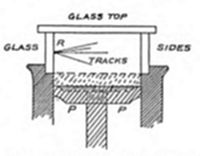
It is time we saw this with our own eyes. The conclusion we have reached is so new and so full of meaning that we would like an experiment to show it, if we can, and to convince ourselves that these straight paths are real. We owe to Mr. C. T. R. Wilson a beautiful piece of apparatus that gives us a vivid picture of what happens, and we will use it at once. In my opinion the experiment is one of the most wonderful in the whole of science. We are going to see the actual tracks of single helium atoms, each of which starts out at ten thousand miles a second and yet finishes its course after about three inches of air. First, though, I must explain how the apparatus works, because there are some clever devices in it.
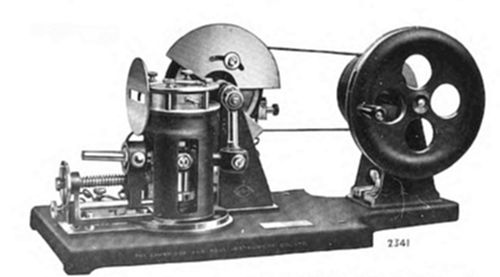
There is a round brass box with a glass top and a bottom that can be raised or lowered to change the depth of the box. A set of wheels, cranks and levers drops the bottom of the box suddenly, at convenient intervals. Every time this happens, the air or other gas in the box is chilled by the sudden expansion. We shall look at effects of this kind more closely in the next chapter. Inside the box, at one side, a tiny speck of radium is mounted on a holder. Every moment some of its atoms break up and throw out helium atoms, and a certain number of these are shot straight into the box. The box is wide enough for the atoms to finish their courses in the air inside it. The average life of radium is so long that even if the apparatus held together for two thousand years, half the speck of radium would still be there. Yet every second ten, twenty or a hundred of its atoms disappear in shooting out their helium atoms. There may be no better way of showing how many atoms are packed into a small space.
The air in the chamber is kept damp, so the chill from the expansion tends to make a fog. When fog has to settle, it prefers to settle on some solid speck rather than form drops on its own in the air. It uses the little particles of dust, if there are any, and that is why fogs form so easily in dirty air. But above all, moisture prefers to settle on the atoms the helium atom has passed through. The reason is that the passage damages the atom for a while: a small piece has usually been chipped off it. The piece knocked away is what we now call an "electron." It carries a charge of negative electricity, and the atom that has lost it is left with a matching charge of positive electricity. Sooner or later the freed electron settles on some neighbouring atom, and so where there were no charged atoms before there are now two, one positive and one negative. Charged atoms have a great attraction for moisture, and the fog forms on them in preference to anything else. If a helium atom has just made its straight road through the gas, then, leaving a trail of charged atoms behind it, and at that moment the sudden expansion brings a chill, fog settles all along the track. A bright light shines into the chamber, so that the fog tracks show up as bright straight lines against the blackened floor of the cylinder. They last a few seconds, and then the fog particles slowly drift apart. If the helium atom finishes its track just before the fog forms, the line is sharp and clear, because the charged atoms have not had time to wander off it. If the track was made some time before the expansion, the line of fog is more blurred. Remember that the helium atoms are being shot out all the time, day and night; it is only when an expansion is made that their tracks become visible.3
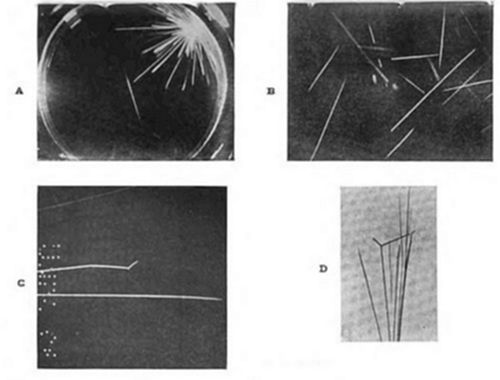
If we watch the expansions one after another, we see that the tracks, though perfectly straight over most of their length, do sometimes bend sharply all of a sudden, especially near the end. This remarkable effect turns out to be most important, and we must come back to it shortly.
Let us try to picture how we must change our first idea of the atom to explain what we now see. The atoms must be built so that when they meet in the ordinary way, as when molecules of oxygen collide in the air, each behaves as though it had a territory of its own that no other may enter. Or when they are pressed together, as in a solid, they take up between them enough space to make room for them all. But when one atom (the helium atom is our chief example) is hurled at others fast enough, it goes right through them, as if the defences round their territories had been broken down. We find a satisfying explanation if we imagine each atom as a solar system in miniature. There is a nucleus, which corresponds to the sun, and round the nucleus are satellites, or planets, which we call electrons. The nucleus carries a charge of positive electricity; each electron carries a charge of negative electricity, and all electrons are alike. The positive charge on the nucleus is just enough to balance the negative charges of all the electrons together. The electrons are supposed to be moving, just as the planets go round the sun, but their movements are no doubt complicated, and what they are need not concern us for the moment.
Instead of a round hard ball of a certain size, then, which was our first rough picture of an atom, we have something like a little solar system. We can see at once how one atom of this kind can pass through another, just as we might imagine one solar system passing through another without harm to either, provided no body in one system made a direct hit on a body in the other, and provided the motion was quick enough. That second condition matters, because if one solar system stayed too long inside another, or near it, the courses of the planets would certainly be thrown into serious disorder.
But then, we may ask, if this is what an atom is like, how can it keep another atom out of its territory? How can it claim any part of space for itself, and stop another atom from intruding when they meet at low speed? The explanation becomes clear when we look at how the positive and negative charges are arranged. Every atom is surrounded by a shell, or cloak, of electrons, and when two atoms collide it is their shells that come close together first. Since like charges of electricity repel one another, the two atoms feel a force that tends to keep them apart: in other words, each resists any trespass on its own territory. This is no doubt a very rough picture of what really happens, and in fact it is hard to account for the strength of the resisting forces on so simple an idea. Still, it is surely on the right lines. When two atoms meet at high speed, the electrons and nucleus of one slip through those of the other. A model will help to show the point.
Plate IV, A, shows a set of bar magnets mounted upright on spiral springs. The top of the magnet in the middle is a north pole, and the tops of the magnets in the ring round it are south poles. The model stands roughly for the central nucleus with a ring of electrons round it. In the model everything lies in one plane, which is not so in the atom, but that does not matter here. A single magnet hangs on a long thread from a point straight above the "nucleus" magnet. Its lower end is a south pole, and the thread is just long enough for the swinging magnet to clear the fixed ones. Now watch. If we pull the swinging magnet to one side (S in Figure 3, a), but not too far, it swings towards the fixed set and cannot get in. It seems to knock at the door at one place after another, but it always bounces back. In just the same way an electron would beat in vain against the outer defences of an atom if it did not beat hard enough. And it is easy to imagine that if we replaced the single swinging magnet with a whole set of magnets, like the fixed one, the same thing would happen.
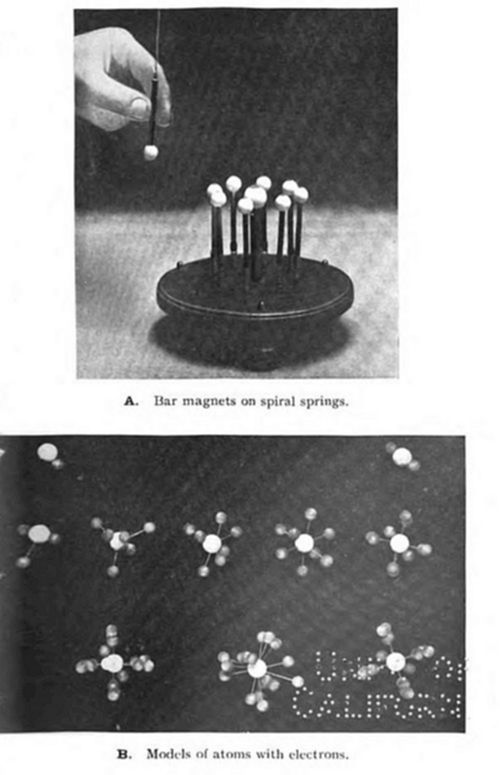
Here, then, is a picture of our atoms as we now think of them, beating against one another and bouncing off; each holds a certain territory of space and keeps every other atom out.
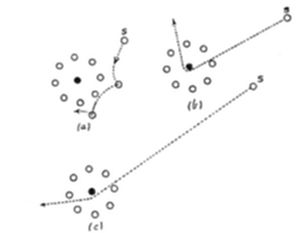
But if we draw the swinging magnet far enough to one side that it is going faster by the time it reaches the fixed set, its momentum carries it through. If its speed is very great, its motion shows no noticeable change from the passage (Figure 3, c). If it is a little slower, it often suffers on the way through (Figure 3, b). It comes out with less vigour than it went in with; often its direction has changed too; and it has plainly left energy behind, because the fixed magnets are left quivering. This happens whichever pole of the swinging magnet is at the bottom, and clearly the same thing would happen if we replaced the single swinging magnet with a more complicated set of nucleus and attendant satellites.
The way the model behaves helps us to predict what we should find when atoms of our new design run into one another. If they meet at moderate speed, they may bounce off each other. At high speed they go through each other, and the higher the speed, the better the chance of a passage with no visible result. But there is always a chance that the nucleus of the moving atom will pass so close to the nucleus of the atom it is going through that it is turned noticeably aside. The smaller the nuclei, the less likely this is.
You will have guessed already that you have actually seen deflections of this kind in the film, and they appear in Plate III, A to D as well. The tracks of the helium atom are straight for most of their length, but there are distinct breaks in the lines, usually not more than one or two in each track. They come mostly towards the end, which is just what we should expect, because by then the atom is moving more slowly. Several appear in Plate III, A, and a very good example is reproduced on a large scale in Plate III, C. The upper track shows a slight but sharp bend a little way from the end of its course, and a stronger bend further on. Nearly every track shows some swerving at the very end. The new idea of the atom's structure, then, explains every one of these effects in a satisfying way.
It is strange to think of an atom as being as empty as a solar system: not a round, hard ball that nothing can get into, but a nucleus and electrons together holding a certain space, rather as an army holds a country. The soldiers' bodies do not fill the country from border to border, but enemy soldiers may not enter all the same.
These very telling pictures are the fruit of a great deal of watching and photographing. Every expansion shows some breaks, but you may have to wait a long while for a really good one. A very fine picture appears in Plate III, D. It is due to Mr. P. Blackett. In this case the chamber held helium instead of air. The nucleus of the flying helium atom, passing through one of the helium atoms of the gas, has made an almost direct hit on that atom's nucleus: it has cannoned off it, as a billiard player would say. Both atoms now move off at not very different speeds, and both make fog tracks, as the picture shows. If we look carefully at Plate III, C, we can see a tiny spur on the last bend of the track already mentioned. That means an atom of oxygen or nitrogen has turned the helium atom aside and recoiled in its turn. Its track is very short, because it is much heavier than the atom that struck it, and so the speed it was given was fairly small.
One curious thing in some of the photographs is worth explaining. Some of the tracks have gaps in them, as though the fog had failed to settle. That is exactly what has happened. There is no moisture there to settle, because another helium atom passed that way a very short time before and used up the moisture round about. Plate III, B, shows several tracks made by the radium emanation. They seem to start from anywhere in the chamber, because the atoms of the emanation have wandered about the chamber before blowing up.
The next question is how many electron satellites each atom has. Here we come to one of the most beautiful and remarkable features of the new discoveries. There is no need to explain in full how it was found out; we will be content to describe it.
In the atom as we now have it, the nucleus carries a positive charge of electricity, just big enough to cancel the negative charges on the attendant electrons. All electrons, as we have seen, are alike. We find that atoms differ in the number of attendants they can keep, and that this number describes the atom completely, as far as its behaviour towards other atoms is concerned. The carbon atom, for instance, can hold six electrons: the positive charge on its nucleus matches six standard negative charges. Every atom that can keep six electrons is a carbon atom, and no other definition of carbon is needed. In the same way the "seven-electron" atom is nitrogen, the "eight-electron" atom is oxygen, and so on. With very few exceptions every number is found in nature, from the "one-electron" atom, hydrogen, up to the "ninety-two-electron" atom, uranium. The missing numbers will probably turn up some day, quite possibly more or less by accident.
We can use models as a rough illustration. The nucleus (Plate IV, B) is a white ball of solid rubber, and the electrons are smaller balls forming the heads of pins stuck into the centre ball. The pins may be of different lengths, for a reason we shall come to in the next chapter.
It is strange that the immense variety of nature can be boiled down to a series of numbers. People once thought the different sorts of atoms owed their variety to something more than that, and it is a great surprise to find so simple a difference between one atom and another. What never changes in a particular sort of atom is the positive charge of electricity on its nucleus. Because of that charge, the right number of electrons gathers round. We may expect them to arrange themselves in some pattern, and we shall see later that they certainly do. What pattern they take in each case, and what forces go into it, are very hard questions, and most of them we can set aside for now and content ourselves with one or two simple sides of the problem.
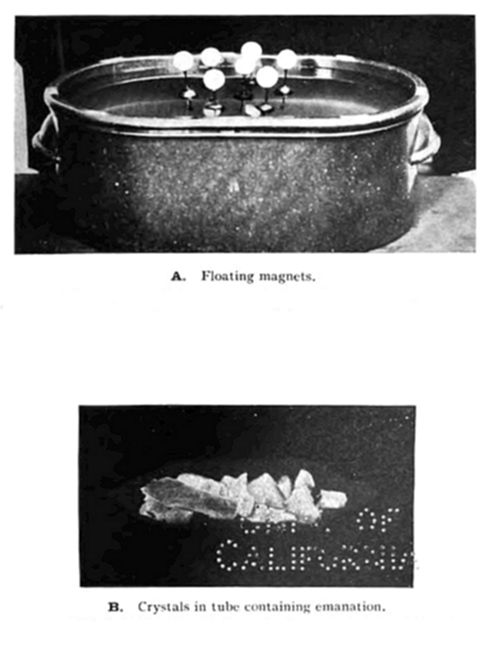
First, it is interesting to watch the little upright magnets floating in the glass tank gather together (Plate V, A). They are held up by ping-pong balls painted black, and to make them easy to see they carry white ping-pong balls on top. The magnets are all the same way up, so of course they repel one another and crowd round the edge of the basin. But there is an electromagnet underneath the bowl, and when it is switched on it draws the small magnets together. The pattern they finally settle into depends partly on the pull towards the centre and partly on their pushing against one another. Something of this kind must happen in the atom, but we must not press the comparison too far, because the forces may be quite unlike those in the model. We must be content to notice that when only a few magnets are afloat they group themselves in a ring, but when there are more they arrange themselves in rings one inside another. It is a pretty sight to put each new magnet in at the edge of the basin and watch it sail off in a stately way to take its proper place.
A similar division into shells or groups, one inside another, is found in the way the electrons are arranged round the central nucleus of the atom. We will look at this more carefully in the next chapter. The experiment does not prove that there ought to be such an arrangement, but it certainly suggests it.
Now we can see more clearly what happens when the helium atom damages the atoms it passes through and makes them attractive to the particles of moisture that make the fog. An atom can, in fact, be robbed of one of its attendant electrons. Once it has lost one, it resists losing a second more strongly, and a third more strongly still. As the helium atom goes on its way it strips one atom after another of an attendant, and each electron set free goes off on a course of its own. But its separate life is very short: it soon attaches itself to another atom.
The atom that has lost an electron now has a positive charge, and the one that has gained it a negative charge. The two atoms would even things up again if they came close enough together, and as they move about in the gas the negatives and the positives do in the end give and take electrons, and the whole gas is neutral once more.
There is a beautiful experiment to end this chapter. When helium atoms strike certain substances they make them glow with a phosphorescent light. Looked at closely, the glow is really a crowd of tiny flashes, one for each atom that strikes; under a microscope it looks like pebbles dropping into a phosphorescent sea. The glass vessel (Plate V, B) holds crystals that glow when the fast helium atoms hit them: one is kunzite, another zinc sulphide, another willemite. Another tube holds a quantity of radium emanation, the gas which, you will remember, is the immediate offspring of radium itself. When it is let out and allowed to pass into the tubes holding the crystals, they glow in brilliant colours. In the picture the crystals have been made to photograph themselves by their own light.
The radium action, then, has given us a remarkable insight into the structure of the atom, and there is a general reason for it. Students of science have long known that there are various atoms and what their properties are, but no one has ever seen one, or the effects of one. They have handled atoms only in crowds. When a chemist makes elements form compounds, or breaks compounds down into elements, any operation big enough to see involves enormous numbers of atoms. But in this radioactive effect we watch one atom acting at a time, and that is the secret of the advance. The speed of the helium projectile, a hundred thousand times the speed at which atoms ordinarily move in a gas, lets the single atom make itself felt. When we look at the fog tracks we are watching single atoms at work. We are seeing something that would have filled the early champions of the atomic theory with astonishment and delight. One atom of helium passes through one atom of oxygen, say, and comes out the other side, and both may bear the marks of the encounter. We use that evidence to help us work out what atoms are. The helium atom is like a spy who has slipped into a foreign country and come out again with a tale to tell.
Chapter Two: The Nature of Gases
We have seen that everything is made of about ninety kinds of atoms, and that inside them is wrapped up the mystery and the endless variety of the material world. Each has a nucleus with a positive charge, and round the nucleus are electrons, which are units of negative electricity. The positive charge of the nucleus is a whole number of times a certain unit charge, equal to the charge on the electron but of the opposite sign. The number of electrons every atom has under normal conditions exactly balances the positive charge on its nucleus, so that the atom as a whole is not charged: its positive and negative charges cancel. Whether the electrons go round the central nucleus like planets round a sun, or have some other more complicated motion, does not matter to us for the moment. Something is known about it, but the whole question is difficult. The only consequences of this strange arrangement of nucleus and electrons that we need consider can be drawn without thinking about the motions at all.
One consequence is that atoms do not trespass on one another's territory in ordinary circumstances. Each has an outer cloak, or shell, of electrons, and when two atoms are brought close together there is a resisting force, which we may suppose comes from the two shells repelling each other. But when two atoms are hurled at each other fast enough, the outer defences may give way and the atoms pass through each other. When that happens they may untangle themselves afterwards and go on their way as if they had never met. One or both may have lost an electron or two, but the damage is soon made good. Only when the nucleus of one comes close enough to the nucleus of the other is there a change of motion like the one you get when two balls meet. Changes of that kind are so rare, and mean such a close approach, that we are bound to think of the nucleus as very small indeed. We learn of these break-ins through the action of radium and similar substances, as explained in the first chapter, and they matter to us because they make us realise how empty the atom is, and how like a sun with its planets. They do not happen in the everyday dealings of atoms with one another, because the speeds are far too low. The territory an atom holds against all others is about a hundred-millionth of an inch across, and inside that tiny space the nucleus and the electrons carry on their motions. Light atoms have smaller territories and heavy ones somewhat larger: a factor of three or four takes us from the smallest to the largest.
I have said that all atoms are in motion, and that there is a constant struggle between some kind of attracting force, which would draw all the atoms together, and the motion, which would keep them apart. At first sight an attracting force, which we are treating here as something very important, does not seem to fit the structure of the atom we have just described, because there we supposed that the outer shells of electrons would keep atoms from coming too close to one another. It is a hard point, because both views are certainly correct. No doubt it is our present ignorance of what these forces are that keeps us from seeing it clearly. We have seen how two atoms that meet at great speed go through each other, while at moderate speeds they bounce off each other like two billiard balls. We must go a step further and see how, when they meet very slowly, they may actually stick together. We have all seen those swinging gates that go to and fro without catching as long as the swing is wide. When the swing dies down, though, the latch suddenly drops into its place, the gate is held, and after a short rattle the motion is over. We have to explain something like that. When two atoms meet, the repulsion of their electron shells usually makes them recoil; but if the motion is small and the atoms spend longer near each other, there is time for something to happen inside both atoms, like the latch dropping into its socket, and the atoms are held. It all depends on some structure of the atom that makes it uneven over its surface, so that usually there is a repulsion; but the repulsion turns into an attraction if the two atoms are given time to make the necessary arrangements, or even if they are presented to each other the right way round from the start. We shall see several very interesting examples of this later.
In this chapter we shall consider the case where the attracting forces between the atoms do not act, whether for lack of time, or because they are too feeble, or for any other reason. A crowd of atoms in that condition is a gas.
There are a great many such cases. Some atoms are especially good examples: Nos. 2, 10, 18, 36, 54 and 86. That is, they are the atoms whose nuclei carry positive charges of those sizes, and which normally have negative electrons to match. These atoms have only the feeblest wish to join up with one another. They do not combine with atoms of other kinds; in other words, they do not form chemical compounds. We may call them the "unsociable" atoms. They take no visible part in the doings of the world, and their existence was entirely overlooked until a few years ago. It was only when the late Lord Rayleigh was making careful measurements of the weight of nitrogen from various sources that he noticed a small but unmistakable difference. Nitrogen made by breaking up a known compound of nitrogen did not have quite the same density as what was left of air when every known gas had been taken out of it. On the views held at the time, that remainder should have been pure nitrogen. In fact the air contains a small percentage of one of these "unsociable" atoms, or gases: No. 18, the one with eighteen units of positive electricity in its nucleus. Rayleigh's very careful measurements led in this way to the discovery of a substance nobody had known about. It was named argon, "the lazy one." The name does not really describe it, perhaps, since the atom is as quick in its movements as any other of its size. The air in the lecture theatre of the Royal Institution weighs about 15 hundredweight, three quarters of a ton, and it contains about 18 pounds of argon. If the gas had had the slightest tendency to combine with anything, that much of it, small as it is by comparison, would have been easily caught by the delicate methods of chemical analysis.
The helium atom, the smallest of the series, is the very same atom that radium and other radioactive substances shoot out when they break up. Normally it has two electrons, though when it flies through matter after radium has thrown it out, its electrons are apt to be torn away for the time being. The positive charge on its nucleus is not affected by the flight, so when the atom comes to the end of it, it soon makes up its missing electrons: there are always stray ones to be picked up. Then the atom settles into the quiet, independent existence that is typical of it. Perhaps most of the helium in the world has at some time been fired off, atom by atom, from radioactive substances. At any rate, it is found in places where that must have happened. Helium is now collected in large quantities in America and Canada, where it is found bubbling up in certain springs. It is used to fill airships, and its chief properties suit it very well for the job. It is light, and its lifting power is almost as great as that of hydrogen, the one-electron atom (on the whole, the atomic weight goes up with the number of electrons). The lifting power of a gas, we must remember, depends not on its density but on the difference between its density and the density of the air. The densities of hydrogen, helium and air are in the proportion 1:2:14.4, and so the lifting powers of hydrogen and helium are in the proportion 13.4 to 12.4. But helium's great virtue is that it does not burn. The hydrogen atom is very sociable, and in particular it has a violent longing to join up with oxygen: mix hydrogen and oxygen and a spark is all it takes to start them combining, with fire and explosion as the result. A balloon filled with hydrogen is always at risk of disaster; but helium wants no change, and there is no danger of fire. The gas is named after its discovery in the sun. A bright line in the sun's spectrum could not be matched with the lines of any element known on earth, and so the unknown substance responsible for it was called "helium," "sun-stuff." Only later was helium found to belong to the family of gases that Lord Rayleigh and Sir William Ramsay came to examine as a result of Rayleigh's nitrogen experiments.
The ten-electron atom, neon, "the new one," is less common than argon. It glows easily and brightly when an electric discharge passes through it, and it is often used in electric lamps: we have all seen the reddish-orange glow of the neon lamp.
Krypton (36), "the hidden one," and xenon (54), "the stranger," are very rare. The last of the series, with eighty-six electrons normally, is the heavier fragment left when the radium atom breaks up. Like the rest, it tends to lead an independent life, so that radium, when it breaks up, turns into two gases. In some of Wilson's pictures of helium tracks (Plate III, A and B) we can see a track that starts in the middle of the chamber. It comes from the break-up, in its turn, of an atom of this heavy gas, because it too is radioactive. Its average life, in fact, is only three and a half days.
We must not suppose that these strange atoms can never be made to keep company. They can be made to join together as a liquid, but only at extremely low temperatures; at ordinary temperatures they are all gases. Liquefying helium is one of the achievements of Kamerlingh Onnes's laboratory at Leiden, where the making of low temperatures has been brought to a very high pitch.
Certain other atoms, among them hydrogen, nitrogen and oxygen, readily form small companies, or molecules, and each of these molecules is almost as free of any wish to join other molecules of its own kind, and often of other kinds, as the atoms of helium and argon are. Two atoms of hydrogen make a very stable and "unsociable" molecule; so do two atoms of nitrogen, or of oxygen. In these cases the substance behaves as a gas at ordinary temperatures. Hydrogen was first liquefied by Sir James Dewar in the laboratories of the Royal Institution in London, and his machinery is still there. In the anteroom hangs a picture of Dewar pouring liquid hydrogen from one of his vacuum flasks into another during one of his lectures. The air is mainly a mixture of oxygen and nitrogen molecules. Other well-known molecules that make gases in ordinary circumstances are carbon monoxide (CO), carbon dioxide (CO2), methane (CH4) and so on. In all these cases, when two of the molecules meet at the speeds that belong to ordinary temperatures, they bounce off each other and so keep their independence. What we have to consider now is what we should expect to follow from that independence.
Let us imagine a closed vessel with a number of atoms or molecules moving about inside it: a vessel holding a gas, as we would say. They keep meeting one another and the walls of the vessel, and they behave as a number of billiard balls set rolling on a table would behave if their motion had no friction and so went on for ever. In fact a small billiard table is a handy illustration, and Messrs. Burroughs and Watts have very kindly given us one for the purpose.
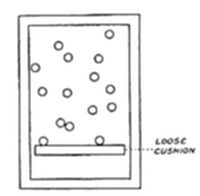
The balls soon come to rest on the table, because the cushions, like the balls, are not perfectly elastic, and because there are losses to friction as the balls run over the cloth, smooth as it is. Still, once started, the motion lasts long enough to give an idea of what must happen if it were kept up for ever.
It is natural to ask how the force of gravity would affect the movement of the atoms in our closed vessel. Would it not bring them all to the bottom? Why should the gas fill the top of the vessel as well as the bottom? The answer is that gravity certainly has its full effect, but it is so very small that we cannot see it in our case. If we could imagine all the heat taken out of the gas, so that its movements stopped, and if we could ignore the attracting forces, the atoms would of course lie at rest on the floor of the vessel. If we now gave them a very little heat, we could imagine them starting to dance up and down like perfectly elastic balls on a perfectly elastic floor. A rise of a thousandth of a degree Fahrenheit would make them bounce to a height of about seven inches. Give them enough heat and they would start hitting the top of the vessel as well; we might suppose there were so few of them that they did not often hit one another. But at ordinary temperatures their movements would be so fast, something like 6,000 feet a second, that gravity would make little difference to their speed as they went up and came down, and at any moment there would be as many at the top of the vessel as at the bottom. If there were as many of them as there are molecules in ordinary air, they would hit one another more often than the walls. In air, the usual length of path between one collision with another molecule and the next is only about four-millionths of an inch. Since gravity has no visible effect, the billiard table is all the better as an illustration. We could imitate gravity by tilting it slightly, but it would not be worth the trouble.
If the atoms or molecules of a gas keep hitting the walls, the walls must always feel an outward push. We speak, in fact, of the pressure of a gas on its container. A balloon is blown out by the molecules bombarding its skin. If we put a loose cushion on our table and set the balls rolling, the cushion is driven back. With twice as many balls there would be twice as much pressure. This is the well-known gas law that pressure is proportional to density, other things being equal. If we make the balls move faster, we raise the pressure on the cushions; in the same way, the pressure of a gas goes up with its temperature.
Now suppose I suddenly push this loose cushion forward while the balls are moving and striking it. Plainly the balls move faster. In the same way, if one wall of a gas vessel is pushed in, as when a piston is driven deeper into a cylinder, the atoms move faster. In other words, the temperature goes up. We all know how hot a bicycle pump gets when we use it to force air into a tyre. The reverse is just as true. If we draw the cushion back as the balls strike it, their motion is reduced. If you have played cricket, you know that to catch a ball you must draw your hands back as the ball begins to touch them: the retreating hands kill the ball's motion gradually. Hold them stiffly in one place and the ball is sure to jump out again. A lacrosse player catching a ball, in the same way, draws his stick down as the ball first enters the net, and spreads the stopping of it over two or three feet of its path. You can catch a tennis ball on a racquet in the same way, but the timing must be good, because the face of the racquet is so stiff. In a gas, the matching effect is the chill it suffers when it expands. We had an example with Mr. Wilson's apparatus, where suddenly enlarging a space full of moist air chilled it so much that the moisture settled as fog on the tracks of the helium atoms.
The expansion had to be fairly sudden. Otherwise heat would have had time to flow in from outside while it was going on, and the low temperature we wanted would never have been reached.
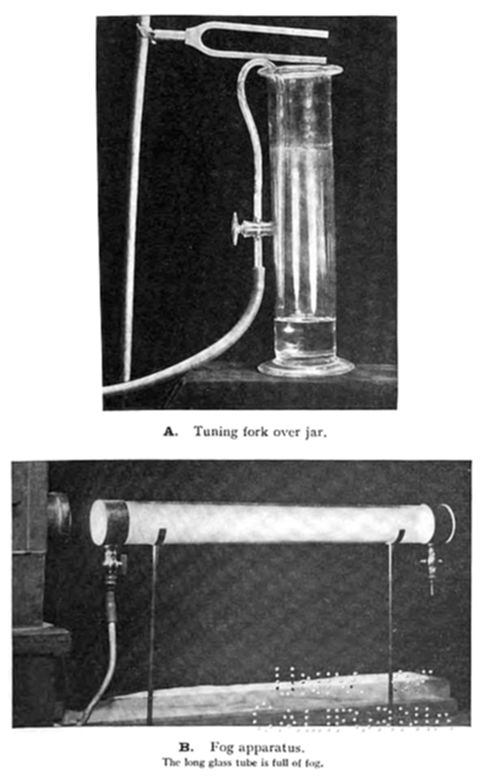
The expansion of great masses of air in the atmosphere is a common source of rain and snow. In the constant movement of the winds, some huge body of damp air may spread out into a region where the pressure has dropped, and grow so cold that its water vapour begins to condense. It is easy to repeat the experiment on a small scale. The glass tube on the table (Plate VI, B) holds air that picked up moisture by bubbling through water on its way in. The road it came by is now shut off by a tap. At the other end of the tube is a second tap, closed for the moment, which cuts the tube off from a vacuum pump. When I open this second tap, the air in the tube expands, and at once a white mist fills the tube; a beam from the lantern runs down the tube and lights it up. We can let the vacuum pump draw the air off, and repeat the experiment as often as we like. Every time we fill the tube with damp air that has been filtered clean of floating specks of dirt and smoke, we get the same kind of white mist we sometimes see in clean country air. But if we let air from the room flow straight into the tube without filtering it, the expansion makes a thick fog, the kind London air is ready to make at any moment, as we know only too well.
The billiard table will help us understand other properties of a gas. Let us mix a number of light ping-pong balls in with the ordinary billiard balls and set the whole lot moving. We see at once that in the general scramble the ping-pong balls pick up higher speeds than the others. In just the same way, if a gas contains two kinds of atom, one heavy and one light, the light ones end up, through the constant exchange of motion, with a higher average speed than the heavy ones. When hydrogen is mixed with oxygen, the hydrogen molecules actually move four times as fast as the oxygen molecules on average. A calculation we need not go into tells us that atoms mixed together all have the same average energy, the lighter ones making up for their want of weight with extra speed. The same rule holds even when the gases are not mixed but kept in separate vessels, as long as they are at the same temperature. The atoms of the two gases cannot exchange and balance their energies directly, but they do so in effect through the various kinds of matter that reach from one to the other: the walls of the vessels, the table they may both be standing on, and the air. In fact, the average motion of an atom is fixed by the temperature.
It is easy to find an illustration. Sound is a movement handed on from atom to atom through the gas it is passing through, just as a chain of people hands buckets of water along to a fire. The faster they move their hands and arms, the faster the water travels. In the same way sound travels faster the faster the atoms move, or, what comes to the same thing, the lighter the atoms are. An organ pipe blown with coal gas gives a higher note than when it is blown with air, because the molecules of the lighter gas move faster and the pipe vibrates more often. A simple experiment will make this clear. On the table is a glass jar with water poured in until the column of air left above it answers loudly to a tuning fork held over it (Plate VI, A). The air waves run up and down the jar in exact time with the swings of the fork: the jar's own natural period matches the note of the fork, as I can show by blowing gently across the top of the jar and drawing a whispering note out of it. Now I let gas into the jar through a rubber tube, and the answering note fades away. Movements now run up and down the jar faster, and its natural period no longer matches the fork. If I pour out some of the water and start again with a filling of air, there is no answer to the fork until I let in a certain amount of gas. Then the note swells out, as soon as the mixture is such that the timing of the gas movements in the jar agrees with the beat of the fork.
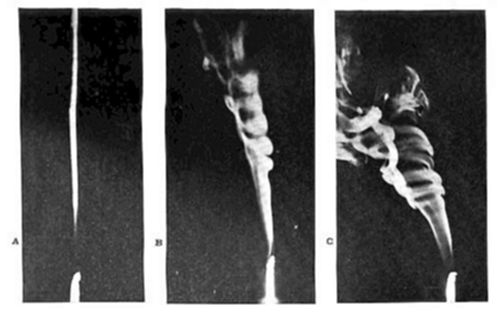
Now imagine a very small hole made in the wall of a vessel holding a gas. Every time an atom, or molecule, hits the hole, it goes out and never comes back. Plainly a light gas will leak away faster than a heavy one, because its atoms are moving about the vessel faster and more of them hit the hole every second. The effect is often used to separate two gases when nothing else will do it. Rayleigh and Ramsay used it to separate argon from nitrogen, the mixture of the two being what was left of the air once every other gas had been taken out. They made the mixture flow along a row of clay tobacco-pipe stems, and the nitrogen leaked out through the pores of the clay faster than the argon. The argon atom is forty times as heavy as the hydrogen atom, and the nitrogen molecule twenty-eight times, so the nitrogen leaks away faster through the porous walls of the pipe stems, and the gas that comes out of the far end is richer in argon than the mixture that went in. The spreading of one gas into another, which we call diffusion, is really the same sort of process, because the gaps between the atoms or molecules of one gas are like the pores in the clay pipe. In spite of the great speed of the atoms, diffusion is very slow, because the collisions are so many. It is easy to think that one gas spreads into another quickly: if a gas tap is left on, after all, the smell is soon noticed all over the room. But that spreading comes from convection currents rather than diffusion: streams of house gas running through the air still undiluted. The effect is beautifully seen in the smoke rising from a cigarette (Plate VII). If the cigarette is laid down on the ashtray, a fine stream of blue smoke rises in a waving pencil, which spreads and bends and twists into delicate spirals and curved sheets. As the stream finally mingles with the air, it gives us an example of convection. Diffusion between the smoky stream and the clean air is going on all the time as well, but it is so slow that the edges of the clouds stay sharp for a long while. In the same way, when a room is warmed by hot air, the heat is spread by convection currents, streams of hot air working their way through the cold.
It does not come from the molecules of hot air making their way one by one among the molecules of the cold. That does go on, but slowly. Convection does the job better than conduction.
The movements of bodies of hot gas in cold gas obey the laws of gravity, of course: the lighter body, if it keeps together, tends to rise through the heavier. The smoke of the cigarette rises because the air above the glowing tip is warmed and made light. Colder currents flow in from all round, meet, and rise together on either side of the thin sheet of smoke, which is their common boundary. If the air is still and the currents are steady, the upright column grows long; but a slight movement of the cigarette upsets the even flow, and the column breaks into beautiful curves. Everyone knows how a chimney makes a draught, no doubt, but it is worth looking again at an old experiment of Faraday's. A little spirit is lit on some tow and held over the mouth of the shorter arm of the bent tube in the figure. A moment's blowing makes the flame go down the short arm and up the long one, and once it has started downwards it keeps going that way after the blowing stops. The flues of fireplaces in hospital wards are often built on this plan, with the draught running under the floor. The movement comes, of course, from the hot air in the long arm being lighter than the same volume of air outside.
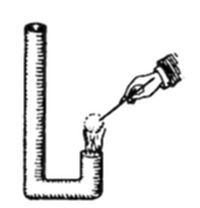
The reverse sometimes happens in a house, when the chimney is colder than the air outside and a down draught brings a sooty smell into the room.
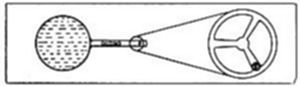
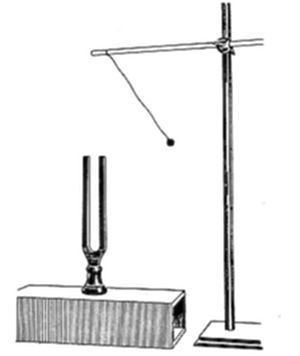
Something closer to conduction happens when the gas in a vessel is heated through its walls. When the molecules reach the wall in the course of their wanderings, they get knocks from the vibrating solid, rather as the ball in the figure gets a violent knock from the vibrating prong of the tuning fork.
When Sir James Dewar designed the "vacuum flask" to hold his liquid air, he made a double-walled glass vessel and pumped the air out from between the walls. He left no molecules to pick up energy from the outer wall and carry it to the inner one.
No heat could reach the liquid air by conduction or by convection. Heat can also travel by radiation through the ether, but that can be stopped by silvering the glass surfaces inside the double walls. Once this is done, the liquid air is almost perfectly cut off.
Because the atoms or molecules of a gas are entirely independent of one another, a gas can be divided perfectly.
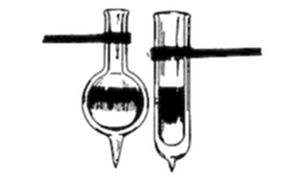
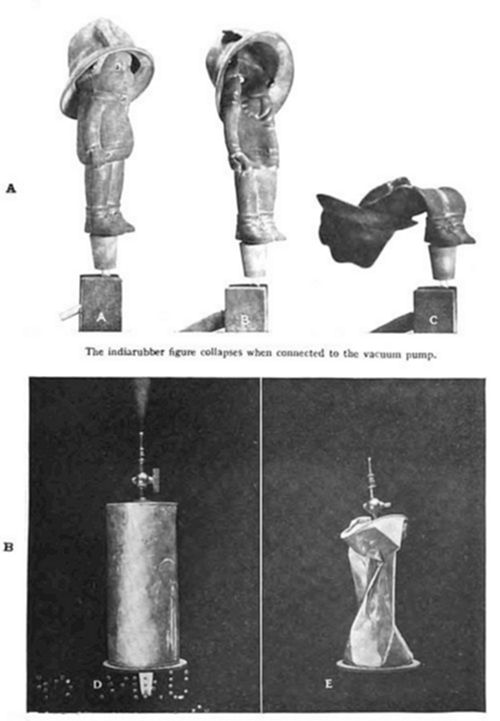
When we cut a solid with a knife we have to use force to tear its molecules apart, but in a gas the binding forces are too small to count. Anything moving through the air meets resistance only because it has to set some of the air moving, and that takes energy. Gases are light, of course, and so the energy needed to move them is small. Because air is so light and we pass through it so easily, it is easy to forget how great the pressure of the air at the surface of the earth is, and how much the air in any large space, such as this room, weighs. The air presses with about a ton on every square foot of our bodies. We do not collapse under it because any air inside our bodies is at practically the same pressure as the air outside. The little rubber figure in the picture (Plate VIII, A) collapses completely when the air inside it is drawn out. The thin tin can shown in Plate VIII, B, held a little water, which was boiled until the steam had driven out all the air. The opening the steam was coming out of is then closed, and cold water is poured over the can. The steam inside condenses, the pressure drops almost to nothing, and the can crumples up under the pressure from outside. Perhaps the size of the air's pressure comes home to us even more strikingly when we think that an iron bar one inch square and nearly five feet long, standing upright on the table, presses with its own weight on the square inch of table it stands on no harder than the air does.
Once we take proper account of the weight of the air, then, it is no surprise that it takes a great force to set it moving fast, or that, when it is moving fast, it can press hard on anything standing in its way. We all know the pressure of the wind, and the havoc a gale can do. The spinning propeller of an aeroplane, in the same way, drives back a mass of air at high speed, and the large force of the reaction gives the aeroplane its speed. Again, when it is in flight the aeroplane, like a bird, is always tending to fall and to carry with it masses of air underneath and round it. But it takes force to set those masses of air moving, and the reaction gives the aeroplane its lift. If the aeroplane had no forward motion, it would soon start a downward movement in the air beneath it and fall with it; but it is always riding on to fresh air that has not begun to fall. A simple little experiment shows the point.
Take a piece of paper of any handy size, say three inches by one, and launch it as the figure shows. It turns over and over and comes to the ground along a sloping path. The direction it turns in is related to the direction it slides in, just as for a ball rolling down the underside of a sloping board.
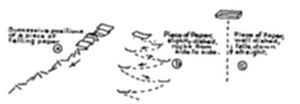
The explanation is that the leading edge of the paper keeps running on to fresh air that has not begun to fall, while the trailing half is on air that has already started moving down, because the leading edge was resting on it a moment before. The trailing half falls and the leading half does not, and the paper turns over, as the picture shows, until it starts moving forward again. But now the edge that was trailing has become the leading edge, and the other way round.
The paper turns over and over, and the cause is its very simple shape. A bird or an aeroplane gliding, by contrast, moves in a steady, stately way, and the design of its wing is anything but simple, as the builders of aeroplanes have found. The exact shape of the wing, and especially of its leading edge, matters in all sorts of subtle ways. (We call it a plane, but it is really nothing of the kind.)
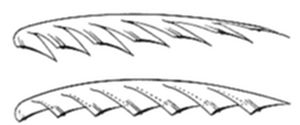
A bird uses its wings not only for gliding but for flapping, and a beautiful mechanism fits them for the job. The wing is really a set of valves, which open as the wing rises and close as it comes down, so that the air presses less on the wing in the up stroke than in the down stroke. The effect is something like that of a duck's webbed foot, which spreads out and presses harder on the water as it is kicked back than when it is drawn forward; but the way it works is quite different. The rib of a feather does not always run down the middle; often it lies well to one side, and a row of feathers is arranged so that they overlap and can turn a little on their ribs. When the wing is lifted they open like a louvred window and the air passes through. When the wing is forced down they close, pressing tight against one another.
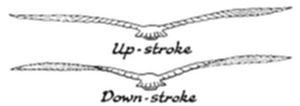
The two drawings of Figure 9 are adapted from Otto Lilienthal's book Birdflight, page 101. They are sections of the condor's wing. As Lilienthal says, "Every observer of the flight of storks knows that one is able to periodically see through the wings." Even the countless small parts of each feather take part in this valve action. Plainly, with a mechanism like this the mere flapping of the wings must give lift, quite apart from anything else about the motion. The forward thrust comes from the wing bending about its stiff leading edge, as you can see in the two drawings of a gull in flight (Birdflight, page 96). They were made in sunshine. As the wing rises, its back parts are turned down and show the bright upper surface; as it comes down, it twists so as to show the darker underside. It must also be true that even if the wings are held outstretched and still, there will be some lift if the air is full of little motions, swirls and quiverings. The wonderful gliding of birds that travel for miles without moving their wings or seeming to make any effort may possibly be connected with this. It is said not to happen when the air is perfectly still.
A very pretty example of the laws governing moving air is the swerve of a spinning ball, which will probably interest most of my readers. We see it and use it in nearly every game, though perhaps the golf ball shows it best, because it goes fastest. Suppose a golfer "slices" his ball: instead of flying straight off in the direction it seemed to be hit, it curls away to the right. The ball is spinning. As the golfer watches it go, the front of the ball is moving from his left to his right and the back of it the other way. Plainly he has not hit the ball cleanly but has drawn the head of the club across it; perhaps he pulled his arms in as he struck and did not follow through properly. As the ball flies forward there is a dense cushion of air in front of it that has not had time to get out of the way. If the ball is spinning as we supposed, its left-hand side (seen from where the golfer stands) is turning forward, in the direction of flight, and its right-hand side the opposite way, as far as the spin goes. The result is that friction carries the air forward more on the left-hand side than on the right, and the cushion in front of the ball is denser on the left than on the right. And the ball swerves to the right.
A golf ball's long carry always comes from the right kind of spin. The stroke must set the ball turning about a level axis, with the lowest part of the ball moving forward as far as the spin goes. This makes the ball tend to rise as it flies, and sometimes we see it actually follow a path that curves upward, bulging away from the ground. Without this effect the ball would not go half as far as it does.
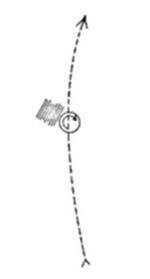
We may also notice that if there were no air at all, the ball would carry two or three times as far as it normally does, because the air's resistance to a ball moving so fast is very great. We would drive a ball much further if we could get rid of the air's resistance; but since we cannot, we make the most of what we can do by giving the ball spin.
A rugby ball, like a golf ball with plenty of spin, often flies on a path curving upward when the kick has gone a little under the ball. Of course this shows most when the kick is against the wind, but I think it can be seen in still air too. In tennis the player often draws his racquet over the top of the ball, giving it the opposite kind of spin, with the top moving forward faster than the bottom. This makes the ball duck, so that although it has been hit very hard it still lands in the court after clearing the net.
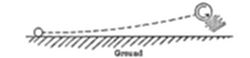
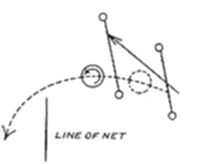
Heavy balls swerve less than light balls going at the same speed. Still, we all know the swerve that can be put on a cricket ball, and the swerve a pitcher can put on a baseball is a marvellous thing to watch. The simplest way of all to study the effect is perhaps with toy balloons, which are made tough enough nowadays to stand plenty of knocking about. It is easy, by hitting one with your hand, or with a racquet if you like, to give it any spin you want, and to watch every sort of swerve and soar and duck.
All the properties of gases we have been looking at can be explained, as we have seen, by supposing that some kinds of atoms have very little tendency to join other atoms, whether of their own kind or of others. I have called them the "unsociable atoms." Other atoms, such as hydrogen or oxygen, are very sociable on their own but tend to form fairly unsociable molecules. The air is a mixture of unsociable atoms and molecules: there are molecules of oxygen, each made of two atoms, molecules of nitrogen built the same way, a few molecules of carbon dioxide, each made of one atom of carbon and two of oxygen, a certain number of single argon atoms, and probably small percentages of other gases. They all form gases because they have no tendency to join up. The independence that follows from that, together with their motion, makes their behaviour easy to understand.
Now we ask whether we can see any way of connecting the properties of these atoms with the general idea of the atom's structure put forward in the last chapter. How does the picture of a sun with its planets tie in with these tendencies to join up or not to join up, with the forming of molecules that have tendencies of their own, and so on? To answer fully would mean giving an account of chemistry as far as it is known, and that is plainly beyond our purpose. But there are certain simple rules which, though they cannot be explained, and though they often seem to be broken, give us a most useful thread on which to string our facts. Let us go back to our unsociable atoms, Nos. 2, 10, 18, 36, 54 and 86. The first thing that strikes us is that there are curious connections between these numbers. If we write down the differences between them in turn, we get 2, 8, 8, 18, 18, 32. The numbers 2, 8, 18 and 32 are twice the squares of 1, 2, 3 and 4. We have already seen that the difference between the various kinds of atoms is simply a matter of number. I have not tried to explain the experiments and the theory that prove how many electrons the various atoms have; they are complicated, while the result is simple and is all we need. Since the number of electrons on the atom, or rather the number that gives the positive charge on its nucleus, matters so uniquely, we cannot help thinking there must be something behind the curious differences we have just noticed. The likelihood grows much stronger when we look at the question from another side.
Chemists found out long ago that there are remarkable likenesses between the properties of different kinds of atoms. For our purpose it will be handy to put their discoveries in terms of the numbers. We write some of them down in the following way. We take first the eight atoms, in order of number, that begin with helium, and under them we put the next eight, beginning with neon. Carrying the arrangement on as far as No. 20, we have this (see Plate IV, B, for rough models):
    Helium.  Lithium.  Beryllium.  Boron.      Carbon.   Nitrogen.   Oxygen.   Fluorine.
       2        3          4          5           6          7          8          9
    Neon.    Sodium.   Magnesium.  Aluminium.  Silicon.  Phosphorus. Sulphur.
      10       11         12          13          14         15         16
    Chlorine. Argon.   Potassium.  Calcium; and so on.
      17        18        19          20
What we have written down is a piece of the "periodic table." It is set out so that helium, neon and argon, which are so alike in their main property of unsociability, come in the same column. And then it turns out that lithium, sodium and potassium, which are also very like one another, come in the next column, and the same remarkable sorting runs right across the page. Things in the same column resemble one another in countless ways; it is one of the great features of chemistry. The very name "periodic table" was chosen to describe the fact.
Now it is reasonable to suppose that the way one atom behaves towards another may well be settled by some arrangement of its electrons, and especially of those nearest the surface, which are the first to meet the other atom. Lithium, sodium and potassium probably behave alike, then, because they all present the same outward face of electrons; and the same goes for carbon and silicon, for fluorine and chlorine, and so on.
Thoughts of this kind have led to the following hypothesis. Let the two electrons of helium be arranged as a pair, one on either side of the helium nucleus. Let every atom after it have this same arrangement, and in addition a further set of electrons in an outer shell. Lithium, then, has two, like helium, and one more as the start of a new outer group. Beryllium has two in the outer group, boron three, carbon four, nitrogen five, oxygen six and fluorine seven. We will suppose that this group is complete at neon, and that every atom of higher number keeps the inner group of two and the newly completed group of eight, its extra electrons taking their places in new groups. Sodium, like lithium, has one in its outermost group; magnesium, like beryllium, has two; and so on. Chlorine, like fluorine, has all but completed an outer shell of eight, and argon, like neon, has completed it. With potassium yet another group begins; calcium has two in this newest group, and so on. The evidence of chemistry tells us that this last group is not complete until it holds eighteen electrons. But we need not follow the question further, especially as it gets more complicated from here.
Reasoning in this way, we see why atoms in the same column should have the same properties. Then we ask what an atom's particular properties have to do with the particular number of electrons in its outer shell, which is the same for every atom in a column. We can find some sort of answer to this too, and it is best put like this. From a general survey of the vast store of chemical knowledge about how atoms tend to combine, and under the right conditions to break up old combinations and form new ones, certain rules emerge that are directly connected with the numbers of electrons in the outermost groups. First, there is always a tendency to fill up the empty places in an unfinished group. If chlorine had one more electron in its outer group, that group would be complete, in the sense that no more are added to it as we go from atom to atom further along the table. Chlorine is therefore on the hunt, so to speak, for the electron it lacks, and it can be very forceful about dragging one away from other atoms that are not holding on to it hard enough. It is true that the atom's electricity is then thrown out of balance: the extra electron gives it a negative charge. But in spite of that, some force whose origin we do not understand works to complete the outer shell of eight electrons. It is in fact this power of chlorine to drag an electron to itself from other atoms, wrecking their combinations to get it, that makes the gas so violently poisonous. In the same way sulphur has two gaps to fill, and that largely governs how it behaves.
Lithium, sodium and potassium, on the other hand, each have a group that has only just begun to form: so far there is only one electron in it. They hold that electron feebly, and when a chlorine atom demands it, it changes hands at once. After the transfer, the outer group of each atom is a completed group: the chlorine looks like argon from outside, and the other atom, if it is sodium, now looks like neon. Both atoms now carry a charge of electricity. The chlorine is negative, because it has one electron more than its proper number, and the sodium atom is positive, because it has one too few to balance the positive charge on its nucleus against the negative charges of the electrons it has left. As a result the two atoms attract each other electrically: they have formed a molecule of ordinary salt. Sodium is a soft white metal. As we shall see later, what marks out the metals is that they have one or two electrons that are easily torn away. In this combination the white metal and the poisonous gas have joined to make clear crystals of salt. It is a violent change of character, but it will not surprise us if we remember that the electrons on the outside of the molecule must be arranged quite differently from those on either atom before they became partners, and that the character of an atom or a molecule depends on that arrangement.
There are countless combinations of this kind. As a slightly more complicated one we may take calcium fluoride, which as a crystal goes by the name of fluorspar. Here two atoms of fluorine, each one electron short (see the table above), join in an attack on calcium, which has two electrons in its outer group, and each takes one electron into its own system. The molecule therefore contains three atoms. Or again, in alumina, which in crystal form makes ruby or sapphire, there are two atoms of aluminium, each forced to hand over the three electrons in its outer group to three oxygen atoms, each of which takes two.
Besides this give and take, there is another way for atoms to complete their outer groups. They can share electrons, each apparently able to count the shared ones as part of its own structure, just as two houses can share a party wall. Two hydrogen atoms each put in one electron and combine so as to own a group of two between them, as helium does, and that is the hydrogen molecule. Two atoms of oxygen combine to form the oxygen molecule, in which each oxygen atom is surrounded by eight electrons, four of them held in common by both atoms. In diamond, as we shall see, each carbon atom is surrounded by four other carbon atoms, with each of which it shares two electrons. Every atom is thus given an outer shell of eight electrons, not one of which it has entirely to itself. Combinations of this kind are generally very strong, and molecules formed in this way hold together well. What is more, many molecules formed like this are, so to speak, content with their own company: they have little tendency to join other molecules, and they tend to form gases. But on the whole the most lasting gases are those that have a completed outer shell by nature: helium, neon, argon and the rest. They show most fully the properties of a gas that we have been considering, the result of weak tendencies to join up and of motion's undisputed rule.
Chapter Three: The Nature of Liquids
The difference between a gas and a liquid is that in a gas the atoms and molecules fly to and fro, each leading an independent life, while in a liquid they are always touching one another, though they keep changing partners. In the contest between motion and the attracting forces, motion is no longer in complete control. The attracting forces are now strong enough to keep the general body of molecules together, or at least enough of them to make a definite volume of liquid with a surface we can see. But their control is not absolute: a process goes on all the time that we call evaporation. Suppose a bowl of water is put in an empty room. The molecules of the water are all moving: vibrating, turning, shifting and changing partners all the time. But their motion is not enough to make them break away from one another, except at the surface, where conditions are special. The molecules hold together, then, as a body with a definite volume, and that volume has boundaries. Only at the surface are there breakaways. In the constant exchange of motion some of the molecules on the outside are bound to get knocks hard enough to break their hold on the molecules below, and they leave the surface for good. If that had happened to molecules inside the liquid, they would have been caught again. The room with the bowl of water in it will therefore hold a slowly growing number of water molecules flying about on their own as a gas. If the room is shut up, the growth will not go on for ever, because a time will come when there are so many free water molecules in the room that they strike the surface and go back into the water as fast as others leave it. The room is then saturated with water vapour. That may happen before the bowl is empty; but if the air in the room is constantly carried away, taking the water vapour with it, all the water in the bowl will evaporate in time.
The molecules that leave the surface are always ones with more than the average amount of energy, and they spend part of it in tearing themselves away from their companions. The average energy of the main body therefore falls steadily as evaporation goes on. In other words, the water gets colder and colder. We all know the effect well. If we wave our hands about when they are wet, we feel the chill: we are in fact overdoing a process that nature uses to cool our bodies to the right temperature. Our bodies are called on to make up the extra energy the evaporating molecules have carried off. The chilling can be made faster by using a liquid that evaporates faster than water; surgeons at one time, for example, used a spray of ether to freeze a spot on the body. In hot, dry countries drinking water is cooled by putting it in a bag of porous canvas, hung where it is shaded from the sun but open to the wind, and the hotter and drier the wind, the better.
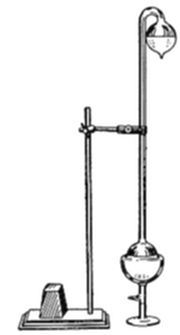
In the hot Australian summer you usually see such a bag hanging under the veranda of a house, or under the roof of the railway station in a country town. The water seeps through the canvas and is quickly evaporated by the passing air, and the water left inside grows cool.
We can do the experiment in a very striking way on the lecture table. The two bulbs in the figure contain water and nothing else: no air. First the water is brought into the upper bulb, and then the lower bulb is dipped in liquid air. In two or three minutes the water is frozen, though the upper bulb has been nowhere near the liquid air. The explanation is that the water molecules that fling themselves off the surface of the water travel down the tube to the lower bulb. That would happen whether or not there was liquid air round the lower bulb, but then they would come back again, most of them at least, bringing their extra energy back into the water with them, and the water would hardly cool at all. When the lower bulb is chilled by the liquid air, though, the molecules do not come back. Their motion is taken from them, and they collect in the lower bulb, first as water and then as ice. The water in the upper bulb cools fast and is soon frozen. The air is taken out of the bulbs to give the water molecules a clear road, so that the evaporation can go fast. If it were too slow, heat would leak in from the air outside so quickly that the water would never freeze. Air does not stop the energetic molecules leaving the surface, but it gets in the way of their movements afterwards and cuts the action down to the slow process of diffusion we have already looked at.
When a liquid boils, its temperature has been raised so high that the evaporating molecules are numerous enough, and fast enough, to lift the air off the surface of the liquid and push it back in a body. The single molecules no longer have to thread their way through a crowd. Boiling looks so very different from evaporation that it is easy to miss the fact that they are essentially the same. The temperature at which a liquid boils depends on the pressure the evaporating molecules have to overcome: on top of Mont Blanc boiling water is 27° F. cooler than it is at the foot.
The heat needed to evaporate a liquid measures the energy needed to tear its molecules away from one another. Perhaps that does not make us feel how important these forces are, tiny one by one but so powerful in the mass. We can remind ourselves, though, how much heat it takes to turn water into steam, and how much work steam can do. We see the forces more directly in every hanging drop of water or any other liquid. The molecules are clinging to one another like bees in a swarm. The links that fasten the molecules of the top layer to the surface the drop hangs from are carrying the whole weight of the drop.
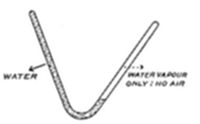
Again, this simple effect does not really give a fair idea of how large and important the forces are; but the experiment can be made more impressive.
Here is a bent glass tube containing water and no air. The water is made to fill one arm completely. If there is a little bubble of air in it, it has to be coaxed over into the other arm by holding the tube at the right angle and tapping it gently on the table. Once that is done, the tube can be held so that the free end of the water column is far below the other end, where the water is clinging to the closed end of the tube. The whole weight of the extra column on one side is carried by the hold of the water molecules on the glass at the other side, and of more water molecules on them. In fact we have a drop of water about a foot long. We cannot make a drop that long hang from a finger, because the water can break away by changing its shape. When that is prevented, as it is in the glass tube, the size of these molecular forces is easier to see. When we try to stretch a bar of iron, the difficulty makes us realise how great the forces are that hold the molecules of solid iron together. We tend to think it is easy to stretch a mass of water, but it is not. It is easy to make water change its shape, but not to pull one layer of molecules straight away from another layer it is touching. Water is really just as hard to stretch as to squeeze.
Here we can turn aside for a moment, because a curious thing happens when we handle this bent tube. If we tilt the tube so that the water runs along it and is brought up short at one end, we hear a knock like two hard things striking together, and the hand holding the tube feels the blow. The effect is sometimes called water hammer, and the explanation is simple enough. There is no air in the tube, and the water strikes the end of the tube as though it were a rigid body; indeed it behaves like one, because it is just as incompressible. The tubes have to be handled very carefully, because it is so easy to knock an end out: it is just like hitting a glass vessel with a hammer.
A very curious, and as it happens very serious, example of the effect has turned up in recent years in the wearing away of the propellers of ships driven by fast-turning screws. The picture shows the eating away of a propeller blade of the Mauretania (Plate IX, A). The trouble first appeared when the Parsons steam turbine made the screws turn faster and ships began to go faster, and at first it caused great losses, of money and of other kinds. The explanation turned out to be that the ship was moving so fast, and the screws turning so quickly, that the water could not entirely fill the holes the blades left behind them.
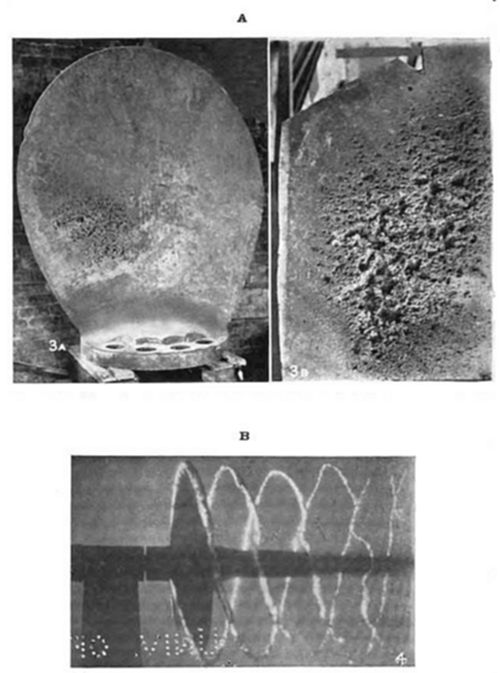
The picture shows the cavities as they form in a model tank at the Turbinia Works at Newcastle (Plate IX, B). They are arranged in spirals, and we can follow in the picture the spiral that belongs to each of the propeller blades.
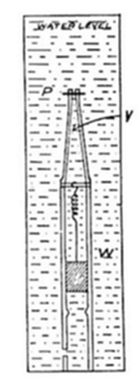
Now these cavities close up under the pressure of the water round them, and since there is no air in them, their sides strike one another as hard and as sharply when they come together as the water in our tube could be made to strike the glass. If part of the propeller blade forms part of the wall of a cavity, the blow may be hard enough to tear pieces out of the metal. It took a great deal of work to reach the full explanation and to find a cure. Propeller blades are now made of an alloy specially designed to stand up to erosion, and the design of the blade has been improved as well. A very striking experiment made in the course of this research is shown in Figure 15. The strong metal vessel shown in the middle of the figure is filled with water and dropped to the bottom of a tank, also full of water, where its motion is suddenly stopped. The momentum of the water in the cone, helped by that of the heavy weight W, is enough to make the water carry on moving and leave an empty space at the top of the cone, at V. That space fills up again at once, because of the pressure of the water round it, and as it does, the water in the cone, gaining speed as it rushes up into the narrowing space, hits the top of the cavity so hard that it punches a hole in the brass plate fitted at P.
The collapse of the cavities made by the screw makes quite a noise in the water, so that a ship can be heard a very long way off with an underwater receiver for sound.
Many of my readers will know a less serious example of the blow a mass of water can give because it will not give way: it hurts a good deal if you dive from any height and do not enter the water properly!
Since the molecules of a liquid all try to draw together under their combined attractions, they will bunch themselves into a sphere if they are allowed to. You can see this plainly when mercury is dropped on the table and breaks up into round drops that run about as though they were round and hard.

Water will do the same if it does not wet the table. Generally it does wet the solid it rests on, but we see plenty of exceptions, for example when it is spilt on a dusty surface. What wetting means, and what follows from it, we have still to consider; it is a very important part of our subject. Gravity, too, interferes with a liquid's tendency to gather into spheres. When the drops of mercury are very small they look perfectly round, but larger ones are more like thick discs with rounded edges. If we want good examples of spheres formed by the general attraction of the molecules for one another, we must find a way of escaping the effects both of wetting and of gravity. The small drops of mercury are one good illustration. Another is the making of lead shot. The molten lead is let fall in a shower from the top of the shot tower, and it gathers into round drops as it falls, just as rain does.
That may seem to contradict what has just been said: gravity has not been escaped, and is indeed in full action, yet the drops are formed. But the damage gravity does is indirect. What spoils the spheres is the resistance to gravity. With the large drops of mercury, the flattening comes not from gravity directly but from the table pushing up on them as it resists gravity. When the drops of lead reach the bottom of the tower they fall into water, which sets them solid in the shape they have taken.
Here is an experiment to illustrate the point. The dark-looking liquid, ortho-toluidine, does not mix with water; in other words, water does not "wet" it. Its density is such that it floats nicely in a layer of pure water riding on a layer of salt water (Plate X, A). Even when it is a sphere it is held up at every point by the water round it, not at one point only, as a drop of mercury would be if it were a sphere resting on a hard surface. In our experiment neither wetting nor gravity has any influence, and as you see a large drop forms, perhaps a couple of inches across. If you pull it about with a glass rod it slowly recovers; or after wobbling heavily through a series of strange shapes it may break up into smaller spheres. When the rod is pressed gently against the sphere it makes a hollow, or dimple, in the surface: the toluidine's effort to form a spherical drop is spoilt for the moment, but it fits itself to the circumstances as best it can. In the same way, if we float some solid, an iron ball, say, on mercury, a dimple forms; the surface of the mercury near the ball has the shape shown in the figure. If we look at the mercury surface close to the wall of the vessel holding it, we see the same curve.
It is different when the liquid wets the wall of its vessel, or the body floating in it. If we pour clean water into a clean glass vessel, we see the water heaping itself up against the side.
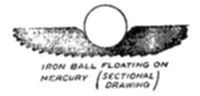
This is a more complicated effect than the other; plainly there are attracting forces between the glass and the water. If a glass plate is forced down into a dish of mercury and made to touch the bottom, so that the mercury is squeezed out and none is left between the plate and the bottom of the dish, the plate will stay where it is put, and it takes great force to shift it. The explanation is simple and fits the principles we have been considering.
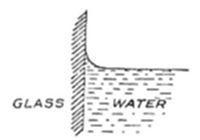
For the plate to rise, the mercury must be made to get underneath it again. Otherwise the plate cannot rise far, because there is either a vacuum under it or at most a little air, whose pressure would fall fast if the plate were lifted.
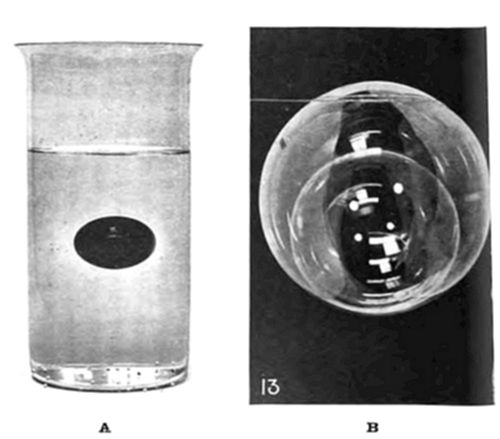
Since the pressure on top of the plate is more than that of the atmosphere, the forces pushing it down are greater than those trying to lift it. At the edge of the plate the mercury surface has the shape shown in the figure: the mercury refuses to be drawn out into a thin sheet between the plate and the bottom of the dish.
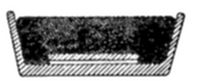
A drop of liquid trying to draw itself into a sphere looks as though it were held in an elastic bag. The atoms of mercury at the surface are not quite in the same situation as those inside, because they are exposed on one side, but only in that sense is there a surface film. We use the idea of a surface film all the same, finding it a convenient term, and we speak of its tendency to contract and of its tension. Sometimes, though, there really is a film on the surface, different in make-up from the liquid inside, and then we find many strange and beautiful results. The one we know best is no doubt the soap bubble. We put a little soap in the water, and at once we find we can whip the soapy water into a pile of froth or blow it out into bubbles. What has the soap to do with it? The answer lies in the properties of the soap molecule. It has a very curious shape, many times as long as it is broad. It is made of a chain of carbon atoms fringed with hydrogens along its length, ending at one end in a little bunch of three hydrogen atoms and at the other in a little group of oxygen and sodium. The first of these bunches keeps itself to itself: it has little attraction for other atoms and molecules. The second is not unsociable at all. It is an active group, eager to join up with others, and above all it longs to join molecules of water, which is why soap dissolves in water. But because only one end of the chain is very active in this way, while the other end and the sides of the chain behave differently, soap molecules tend to stay on the outer edge of the water if they arrive there in the course of their wanderings. In this way a real film forms on the surface of the water, made of soap molecules standing on end, so to speak, one end rooted in the water and the other out in the air. They are packed side by side like corn in a field, or the pile on a piece of velvet. They are not as free as the hairs of the pile, though: they are tied together side by side, because some force of attraction acts between them when they lie alongside one another. We shall find that effect again in other places later. They make a sort of chain mail over the surface of the water, a real envelope. The sheet can be stretched, in the sense that if it has to grow, more long molecules come out of the body of the liquid and take their places with the rest.
The soap bubble is a thin-walled sphere of solution, bounded inside and out by soap films, and it holds together so well because the films are there. It shrinks if the air inside is let out: plainly the long molecules would gather in with the water molecules as closely as possible. But there has to be an outside, of course, and where both kinds of molecule are present it is the long chain molecules that form the outer layer. A very simple experiment shows the tendency to shrink even more clearly. A wire ring is dipped in soap solution, and when it is lifted out it carries a soap film stretched across it.
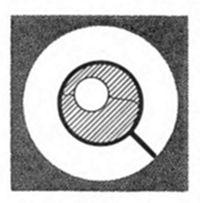
Floating in the film is a loop of fine cotton, which was tied to the wire ring before the ring was dipped in the solution. If the film inside the cotton loop is burst by touching it with a hot needle, the loop flies at once into a perfect circle, as the figure shows. Plainly the whole film is under tension and trying to contract.
A very curious thing about soap bubbles is how unwilling they are to join up with another bubble. If we blow a bubble on a ring (see Figure 21), we can take a second bubble and knock it against the first with force enough, you would think, to burst them both. But the bubbles bounce off each other like rubber balloons. Perhaps the explanation is that in both bubbles the outer layer is made of those ends of the molecules which, as we saw, have very little tendency to join other molecules or parts of molecules.
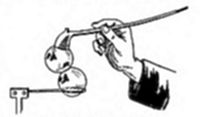
There is no tendency for one bubble to merge with the other when they are pressed together, because the parts that touch first do not attract each other.
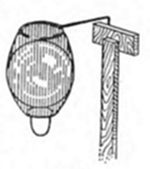
This shows very clearly in another of C. V. Boys's wonderful experiments.4 A bubble is blown on a ring held in a stand (Figure 21a).
A small ring carrying a tiny weight is attached to the bottom of the bubble, as shown. A glass pipe is wetted with solution and pushed through the top of the bubble. When it is blown, a second bubble appears inside the first, and when it has reached a suitable size it is set free by a deft twist of the pipe. The inner bubble sinks gently to rest on the bottom of the outer one, which it touches round a ring, not at the lowest point. That is deliberate: it is what the weight on the outer bubble was for. The two show no wish to merge, although they touch all the way round a line, no doubt because the surfaces they present to each other are made of the inactive, unsociable ends of the chains. If the outer bubble had not been pulled out of shape, the two would have touched at their lowest points. Now there is usually a drop of solution at the lowest point of the inner bubble, and when it touches the outer bubble the two generally merge: somehow the drop makes a bridge between them. If the glass pipe is pushed through the outer bubble and made to touch the bottom of the inner one, so draining it, the weight hanging from the outer bubble can be peeled off, and then the two can touch at their lowest points without disaster (Plate X, B).
Liquids often froth because they contain molecules with this same habit of forming a skin over the surface. The foam that gathers on a brook comes from molecules such as those of the various saponins, chain-like molecules found in many plants and trees. The foam that gathers on the seashore is believed, in the same way, to come from similar molecules made in seaweeds.
In recent years we have learned a great deal about the shape of these long-chain molecules. In particular we owe much to the late Lord Rayleigh, to Devaux in France, to Langmuir in America, and to Hardy and Adam in England, for their study of what happens when oils spread on the surface of water. We can repeat one or two of the experiments to get an idea of the size of the effects we are talking about. We take a clean water surface, that is, one free of any trace of oil or grease. A handy way is to fix a rubber tube to the tap and let its free end lie on the bottom of a basin, so that the water wells up and spills over the edges, carrying away any dirt that has settled on the surface. Now we sprinkle a thin dusting of talc powder, or anything else handy, over the water. Next we take a fine-drawn glass point, or a needle, dip it in oil (olive oil will do), wipe nearly all the oil off, and dip the point of the slightly greasy needle into the surface. At once a circle is cleared round the needle (Plate XI, A). The long molecules, it seems, line up side by side on the surface as before. In the soap bubble they came from inside; now we are putting them on from outside. Each molecule hurries to root itself in the water by its active end and stands upright, like a water plant rooted and growing in the water. In the end they all succeed, and a thin sheet, one molecule thick, covers the surface of the water. Its thickness is something like a ten-millionth of an inch. By weighing the oil put on the water (a hard task, since there is so little of it) and measuring the area it covers, we can find the thickness of the film.
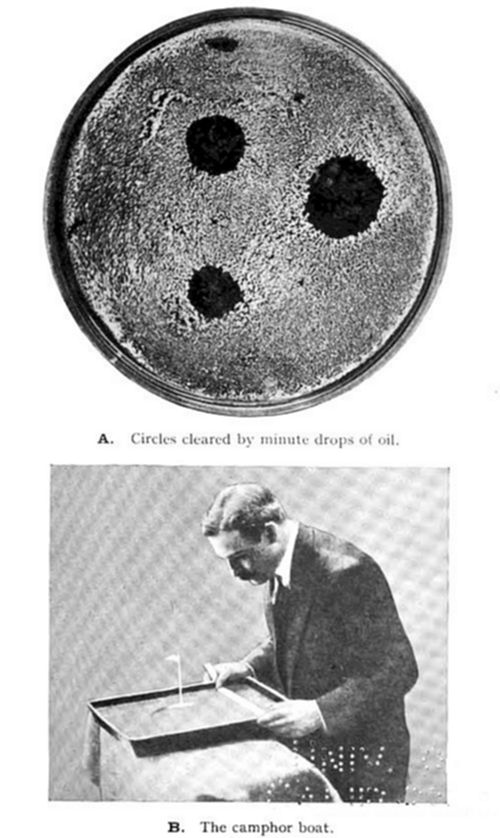
That is, in fact, the method the workers I named have used. More recently a new method has become possible, based on X-rays, for measuring the same quantity exactly, and I hope to show you before long how it is done. On the earlier results it could be said that the layer was as thick as it should be if it were one molecule thick. The argument was greatly strengthened by the fact that when different substances, known to chemists as chain molecules of different lengths, were put on the water, the thickness changed with the length, as it ought to.
If the drop of oil is small enough and the dust finely scattered, the cleared patch is exactly round. If we prick the surface somewhere else, another circle forms, and each circle is entirely unaffected by the others. Devaux relied on this to show that each drop acted only on the surface round it, over which its oil spread, and had no general effect on the body of the liquid. It is just what we should expect if the drop of oil had spread out until it was thinned to a certain thickness and could then spread no further. With a larger drop we see larger spaces cleared. We could pour a few drops into a large bath, for instance, and clear the whole surface. When the dust on the water has been broken up into small patches by several tiny drops in different places, and the surface is not yet covered all over with the oil film, we can see how fast the spreading is by touching the surface with the oiled needle a little way from a floating patch and watching how suddenly the patch is hurried away from the spot. Pushes of this kind are what make fragments of camphor dance about so lively when they are dropped on water, an old experiment. As the camphor dissolves, the solution shoots over the surface as a film, and the camphor itself recoils like a gun when it is fired, or a rocket when the hot gases stream from its tail. Sometimes the fragments dart to and fro, and sometimes they spin merrily round. A tiny boat can be made to sail about on the water by fixing a small piece of camphor on its stern so that it touches the water (Plate XI, B). When a number of camphor boats and pieces of camphor are all on the move, it is comical to see how suddenly everything goes dead when a little oil is poured on the water. The oil film has covered the water in an instant, and the dissolved camphor can no longer spread over the surface.
We have all heard of oil being poured on the sea to still the waves. We can watch it happen by making a series of waves run along the long tank Lord Rayleigh once used here for the same purpose. A vacuum cleaner gives us the wind, and you see quite a heavy storm on the water (Plate XII, A and B). It is stilled as if by magic when a few drops of oil fall in the middle of the storm. After a few moments the sheet of oil is blown to the end of the tank and the waves rise again, and we can repeat the experiment as often as we like. In this case we must suppose that the wind gets no "bite" on the water. The water is covered, as we know, with a film of oil, and the top surface of that film is made of the inactive ends of the long-chain molecules. It may well be that the molecules of the air bounce off it as from a smooth surface. A rough surface would be driven forward by the blows of the air molecules: rough, that is, in the sense that the spaces between the exposed molecules are about the size of the molecules striking them. But if the surface of the oil film is very smooth and has little tendency to hold on to any molecule that strikes it, the air cannot push it and raise it into little waves that later grow into big ones. The oil stills the waves, then, by stopping the action of the wind, and the waves' motion dies away through their own friction.
Now we come to the question of the "wetting" of a surface. We know, for example, that water wets a clean glass surface, but not one smeared with grease, even if the film is almost invisible. The water molecules plainly refuse to have anything to do with the molecules of the grease. That is not surprising, perhaps, because we have seen that in some cases at least the long molecules that make up fats and oils turn their inactive ends outward, and these have very little attraction for water molecules. Water spilt on a greasy surface therefore gathers into drops, just as mercury does when it is spilt on the table: the shape of the water comes from the general attraction of its molecules for one another. An oiled needle can be laid gently on water and will only press a dent in the surface, just as though there were a skin on the water that gave a little under the weight. Still more striking, perhaps, is a greased wire sieve floating (Figure 22).
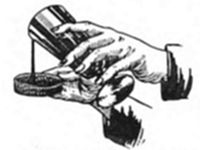
The sieve is dipped in melted paraffin wax, shaken to clear the holes, and left to dry; it is best not to touch it with your fingers. It floats easily and will carry quite a cargo, as Boys showed at the Christmas lectures many years ago. Or it can be filled with water; but the water must not be poured in roughly. It must be let flow gently on to a piece of paper laid in the sieve, which can be taken out afterwards. To show that the holes are quite open, we give the sieve a sharp jerk: the water film gives way, and the water falls in a heavy shower on the floor.
When soda water is poured into a clean, smooth tumbler, very few bubbles come to the surface; but if the inside of the tumbler is at all dirty or rough, we may see streams of bubbles rising. A beautiful old experiment shows this, "the grape and the champagne," though we must use soda water instead of champagne. Water does not wet a grape, and so when a grape is dropped into the tumbler it sinks to the bottom of the soda water, where it collects bubbles at a great rate (Plate XII, C). Soon it is covered in a sheet of bubbles that look like seed pearls, and their buoyancy carries it to the surface. The grape is not much heavier than water and does not need much to lift it. At the surface the grape loses some of its bubbles, which burst into the open air, and this goes on until it sinks again, only to collect some more bubbles and float up once more. This keeps repeating itself for many minutes, until the soda water has gone flat.
It is interesting to put in two glass beads instead of the grape. They have been cleaned, and washing with soap and water does the job well. No bubbles form on them, and they stay at the bottom.
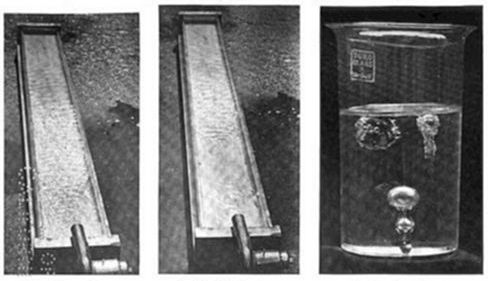
We take one bead out, rub it with a greasy finger, and now it behaves like the grape: it collects bubbles, rises, loses some of them, falls, and so on.
We must realise that when a bubble of carbon dioxide gas forms in the soda water, the particles of the gas have to gather together and push back the water all round them. Now the water molecules are holding on to one another tightly and resist being torn apart, and that is why we do not see bubbles forming in the middle of the water. At the side, when the glass is clean, the water wets the glass; in other words, the water molecules are clinging to the glass even harder than they cling to one another. Bubbles cannot form there either, then, because they would have to tear the molecules away from the glass. But it is different if the surface is greasy, and the molecules are not really holding on to the glass at all, only pressed against it by the weight of the rest of the water behind them. Then the gas bubbles find somewhere to grow, and they quickly get bigger. It is easier to push back the water round them once the bubbles have grown a little. One of the most beautiful ways of showing this is another of Boys's soap bubble experiments. Two bubbles of different sizes are blown on the two ends of the same tube. When a tap is opened to let them connect, the little bubble blows out the big one and disappears. Of the mass of bubbles in the soda water lying side by side on the glass or the grape, the larger ones tend to swallow up the smaller, and all of them to run together.
The little streams of bubbles we sometimes see rising from particular spots on the side of the tumbler come from some flaw in the glass, a tiny bump, perhaps, where a bubble that starts to form is already past the earliest, smallest stages.
This habit of things under water of collecting bubbles and rising to the surface has become in recent years the basis of a great metal-working industry. Various metal ores, when crushed to powder, make a mixture of particles of rock, such as quartz and various silicates, and particles of metal sulphides. It turns out that the mixture can be treated so as to coat the particles containing metal with a thin film of oil, which water does not wet, while the particles of rock stay clean and the water wets them. The whole mass is then churned into a froth. All the particles carrying metal are made buoyant by the bubbles sticking to them and rise to the top as a thick frothy scum. The rest of the ore stays at the bottom of the vat, and the two parts are easily separated.
One more experiment will help to illustrate these principles. We know that water heaps itself up against the side of a clean glass vessel holding it. The molecules cling to the glass, and climb up the wall, as it were, on one another's shoulders in their eagerness to fasten on to it. If we dip two glass plates side by side into water, the water rises higher in the space between them than it does outside: those climbing one wall now help those climbing the other. The effect is said to be due to "capillary action," a name given to it because it is so marked in a fine, or "capillary," tube. The water in the fine bore is lifted to a great height: one inch in a tube one-twentieth of an inch across. If we float a small hollow glass ball on water, the water rises up the sides of the ball. If we bring two floating balls towards each other, then when they are a short distance apart, perhaps half an inch, they move together, quite violently at the end.
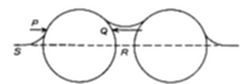
We shall understand this if we look at the diagram in Figure 23. Two glass balls are floating in the water. The pressure at Q is less than the pressure at the level of the dotted line, because Q is higher up in the water. The pressure at the level of the dotted line is the pressure of the atmosphere, because the line continues the level of the water outside. The two pressures marked P, both for practical purposes equal to the pressure of the atmosphere, therefore overcome the two pressures marked Q and drive the balls together.
If we float two balls made of paraffin wax on the water, or two glass balls coated with paraffin, they attract each other as the clean glass balls did, though the action is a little different.
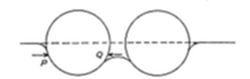
As the figure shows, the balls join in making a dimple in the water, and again, if we work out the forces on the balls, we find the pressures are such as to drive them together. But the clean glass balls keep away from the paraffin balls. This is a little more complicated, but it can be followed from the figure, which shows the forces at work. When the vessel holding the water is clean and the water is heaped up against its side, the clean glass balls are drawn to the side, just as they are drawn to each other. The paraffin balls, on the other hand, keep away from the side of the vessel. Now if we carefully fill the vessel with water until it is ready to brim over, so that the edge of the water no longer curls up against the side but curls down towards the rim, the clean balls leave for the middle and the paraffin balls come to the side and stay there.
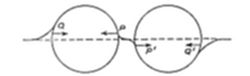
All the facts we have been looking at illustrate the one principle a liquid depends on: the attractions between its atoms and molecules are strong enough to keep them constantly together, but not strong enough to bind them into a rigid, solid body. And it is important to remember that molecule fastens on to molecule at particular points. One part of a molecule may be able to take a strong hold on a particular part of another; presented to each other differently, the two may have little or no tendency to join.
Chapter Four: The Nature of Crystals: Diamond
We have seen that when the effects of motion overcome the forces of attraction, the atoms and molecules lead independent lives and form a gas; and that when the attracting forces are a little stronger, or the effects of motion a little weaker, the molecules may cling together and form a liquid. In that state we suppose the links between the molecules are loose enough to let a molecule change its place and its partners easily. Now we have to consider a last state, in which the attracting forces have the upper hand completely. The bonds between the molecules are more numerous, and perhaps stronger. Each molecule is tied to its neighbours at more than one point of its structure, so that it is riveted into place, and that is how the solid is formed.
Molecules differ a great deal from one another in shape and in the forces they exert on one another. When the forces are strong, it takes a lot of motion to stop them binding the molecules into a solid; in other words, the melting point is fairly high. Substances like diamond, or tungsten, which the filaments of electric lamps are made of, are bound together so tightly that they must be heated to several thousand degrees centigrade before the molecules are forced to let go. Substances such as butter or naphthalene only just manage to stay solid at ordinary temperatures. Others again, like carbon dioxide, and still more oxygen or hydrogen, have to be cooled a long way before they turn solid. It is all a matter of the balance between the two opposing agents, motion and mutual attraction, and it is easy to see that melting points may differ very widely.
Again, a molecule is not to be thought of as a body of vague and uncertain shape exerting a loosely aimed attraction on its neighbours. When two molecules are brought together they may or may not draw tightly together: everything depends on the way they are presented to each other. Each molecule has a definite shape or outline, we may say, though we must remember that these words will need careful thought when we look more closely into the matter. Molecules join as though each had definite points of attachment, and joining meant bringing the right points together. The action between them is not usually like the general attraction between two bodies with opposite electric charges. It is more like the riveting together of two parts of a machine or structure, such as two parts of an iron bridge. Just as the parts of the bridge must be brought into the right positions before the rivets can be dropped into their holes, two molecules of a solid tend to arrange themselves so that certain parts of one are fastened quite rigidly to the matching parts of the other. Molecules may join up in more than one way, and so different structures can be built from the same molecules: there are different forms of sulphur, of quartz, and of many other things. Often one arrangement is taken up at one temperature and a different one at another.
The result is that when the molecule contains many atoms, and so is probably of complicated structure and odd shape, the solid formed when such molecules join is a sort of lacework in space. We can compare it to a bridge made of iron struts and stays. That is a very empty structure, because each member has its own special shape, generally long and narrow, and is fastened to its neighbours at definite points. Most organic substances, like naphthalene or one of the solid paraffins, are complicated in this way, and the emptiness of the structure makes for a low density: few organic substances are much heavier than water. When the molecules are less complicated and less irregular in outline, they can pack together more closely. If the molecule contains only one or two atoms, like the molecule of ruby or of iron pyrites, and still more if it contains only one atom, so that atom and molecule mean the same thing, as in gold or iron, the packing can be very close, and we get a fairly heavy substance.
The endless variety in the properties of the solid materials we find in the world is really the expression of the endless variety of the ways in which atoms and molecules can be tied together, and of the strength of those ties. We shall never thoroughly understand the materials we use every day, or see how they are designed, until we have found out at least how the atoms and molecules are arranged in the solid, and can test the strength and other qualities of the forces that hold them together.
Now, within the last few years, the discovery of the X-rays has given us a way of looking deep into the structure of solid bodies and seeing the details of how they are put together. We have come a whole stage nearer our ideal, the point from which we can see why a material made of such and such atoms has such and such qualities: density, strength, elasticity, conduction of heat or electricity, and so on; or, in other words, why it responds in such and such ways to electricity or magnetism, to mechanical forces, or to light or heat. How far our new powers will carry us we do not yet know. But they will certainly take us a long way, and give us new insight into all the ways in which material things and structures are handled, knowingly or unknowingly, whether in some industrial process or in some action of a living body.
The new process applies especially to solids, and I hope to describe it in this chapter and the ones that follow, which are mostly about the solid state. It depends on using crystals and X-rays together, and we must give a little thought to each. Let us take the crystal first.
Imagine a slowly cooling liquid reaching the stage I have already spoken of, when the heat motions have died down so far that the molecules or atoms begin to fasten themselves rigidly together. They will lay themselves side by side, arranged so that the attractions between various points on one and various points on the other are satisfied as far as possible. We can imagine two molecules, already tied together at one point, swinging about each other with smaller and smaller movements until at last a second tie is made, quite suddenly, perhaps. Then each molecule may quickly make a third tie, either to the other of the pair or to a third molecule, and so it is locked into position. As the liquid cools, then, molecule after molecule takes its place beside others already locked together, and the solid grows.
Or a solid may form out of a solution it has been dissolved in. The solution evaporates, the molecules meet one another more often, and so they are encouraged to join up. When the liquid has entirely gone, the substance is all solid. If the evaporation has been slow, the molecules wandering through the solution come to places where a few molecules have already tied themselves together, and join them, quietly and deliberately arranging themselves before they finally settle down, or refusing to take their places until they are presented to one another the right way.
We can well imagine that under such conditions a regular arrangement will result. Suppose a flat body, shaped like A, had four centres of attraction, two positive and two negative, placed as shown. If we had to lay a number of such bodies on a flat surface and join them so that a positive and a negative centre always lay close together, we might arrive at some such arrangement as Figure 26 shows.
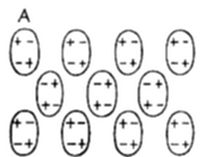
Whatever arrangement we chose, we should naturally find a certain regularity in the result, as in the figure. And nature apparently works in some such way: the molecules lie side by side in an orderly array. The point is of the greatest importance. Order and regularity follow from the complete satisfaction of the attractions the atoms or molecules exert on one another. When the structure has grown big enough to be seen under the microscope, or even with the naked eye, its regularity shows in the shape of the solid: it is what we call a crystal. It is bounded by a number of flat faces, often looking highly polished, so that a crystal has a charm that comes partly from its glitter and sparkle and partly from the perfect regularity of its outline. We feel there must be some mystery and beauty beneath the qualities that please us, and so there is.
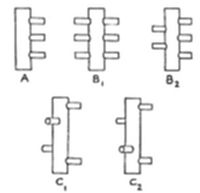
Nature is telling us how she arranges the molecules when she is given every chance. There are only two or three in her unit of pattern, and when the unit is complete it contains every property of the whole crystal, because nothing follows but the repetition of the first design. Through the crystal, then, we look down into nature's first structures, though our eyes cannot read what is there without strong spectacles, so to speak, and those spectacles are the X-ray methods. A few crystal forms are shown in Plate XIII.
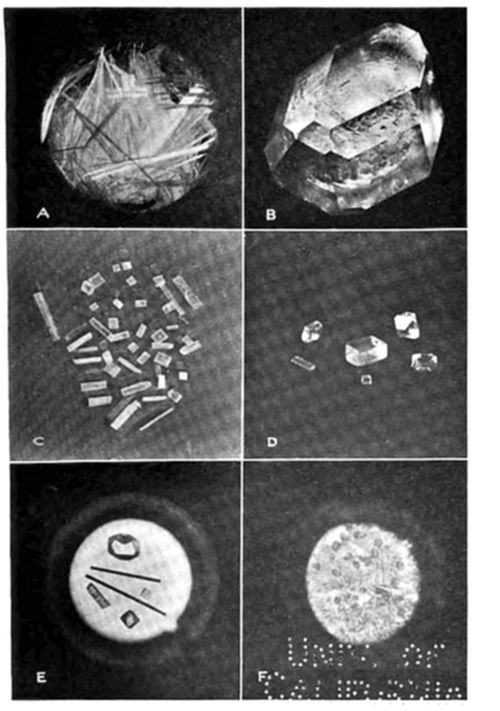
There are three stages in the arrangement of matter: the single atom, as we find it in helium gas; the molecule, as the chemist studies it; and the crystal unit, which we now examine by X-ray analysis. Take an example. There are the atoms of silicon and of oxygen. The molecule of silicon dioxide contains one unit of silicon and two of oxygen, arranged no doubt in some particular way. Last, there is the substance quartz, whose crystal unit is made of three molecules of silicon dioxide, again arranged in a particular way, which we now know has a kind of screw to it. A quartz crystal holds a countless multitude of these units. Each unit has all the properties of quartz, and is in fact quartz; but a single molecule of silicon dioxide is not quartz. One of the best-known properties of quartz, for example, is its power of rotating the plane of polarisation of light, and this property goes with the screw in the crystal unit. It takes three molecules to make the screw. If we stick pegs into a round stick, as in the figure, and make all the pegs the same in every respect (if, that is, our unit of pattern holds one peg only), we can make an arrangement like A. With two pegs to the unit of pattern we can make an arrangement like B1 or B2. With three pegs to the unit we can make one like C, which may twist either of two ways, C1 or C2, or, as it is usually put, may be either right-handed or left-handed.
The X-rays actually tell us that the quartz unit contains three molecules and that they are arranged in a screw, and the shape of the quartz crystal agrees with this completely, because the crystal comes in two varieties, as Figure 27a shows. In one there is a sequence of faces, x, s, r', that screw off to the right, while in the other they go to the left. A double arrangement of this kind is just what we might expect from the existence of two kinds of screw, though we do not yet know enough to guess why these particular faces stand out. Quartz, or "rock crystal," was called krystallos by the Greeks, and the name was given to ice too, because the two were confused with each other. It is fitting, then, that we should use quartz to show what is meant by crystal structure and the crystal unit.
Now we may ask why, if the natural arrangement of molecules is regular, we do not find everything in crystal form. The first answer is that a large perfect crystal must grow from a single seed. It is hard to say what first stops the motion of two or three molecules of the cooling liquid relative to one another, joining them together and making a start to which other molecules can fasten. Perhaps it is just the accident of their meeting; perhaps some tiny speck of foreign matter is there to act as a base, or some roughness on the wall of the vessel. If there are a great many seeds in the liquid, a great many crystals will grow, and since they are not likely to be lined up with one another when they meet, they will end as a shapeless mass of small crystals, not as a single crystal. They may be so small that to the eye the whole thing looks like a solid lump with no regularity of shape at all. If a large perfect crystal is to form, things must be arranged so that the molecules find few centres to grow on. And as a rule they must grow very slowly and quietly, so that each molecule has time to settle into its proper place. The molecules must have enough movement to allow this adjustment. These conditions come out clearly in the methods the crystallographer uses to grow crystals. If he is growing a large crystal of salt from a solution of brine, for example, he hangs a tiny, well-formed crystal in the brine and keeps the temperature so carefully adjusted that the atoms of sodium and chlorine are only tempted to give up their freedom when they meet a gathering of atoms already in perfect array; that is, when they come upon the hanging crystal. If the solution is too warm, the hanging crystal will dissolve in it; if it is too cold, crystals will start to grow in many places. Sometimes the liquid is kept gently moving, so that the different parts of it are brought past the hanging crystal in turn.
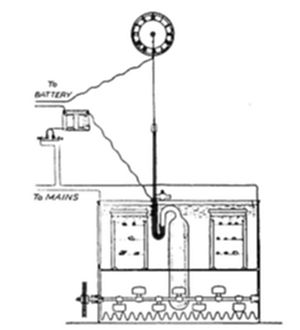
The chief conditions are time and quiet; a solution of the salt just ready to give up what it holds, its temperature and strength properly adjusted for the purpose; a small perfect crystal; and a gentle flow of the solution past it. We do not, of course, quite understand how these conditions, or some like them, come about while a diamond or a ruby is growing; but we find we need them in the laboratory when we try to grow crystals ourselves.
When the conditions are only partly met, we may get a mass of tiny crystals in disorder, or even a structure with no regularity at all: an amorphous substance, to use the usual word. That alone would explain why crystals seem rare. We must also remember that many bodies are highly mixed, made of many substances, each with its own natural form. The X-rays show us that the crystal is not as rare as we had been inclined to think. Even where there is no obvious crystallisation, Nature has been trying to make regular arrangements, and we have missed them until now because our means of detecting them were not good enough. The regularity of Nature's arrangement shows itself in the visible crystal, but it can be found elsewhere too. And this regularity, as we shall see, is one of the foundations of the success of the new methods of analysis.
Now let us turn to the X-rays. The reason they can help us at this point can be given first in general terms.
The X-rays are a form of light, differing from it only in wave length. The light waves sent out by the sun or an electric lamp or a candle, the ones our eyes can see, cover a narrow range of sizes. The longest are about a thirty-thousandth of an inch long and the shortest about half that. These sizes suit the job we use them for very well. Remember that when we see an object, we do it by noticing the changes the object makes in the light that travels from the source, by way of the object, to our eyes. With long practice our eyes and brains have become marvellously skilled at catching and interpreting such changes. But we may fail if the object is too small, and not only because a small object can only make a small change in the light. There is a second, subtler reason: the nature of the effect changes when the object is about the same size as the wave length, or smaller.
Imagine we are walking along the seashore watching the waves come in. We reach a place where the waves are weaker, and when we look for the reason we see a reef out at sea sheltering the beach. Here we have a match for an optical shadow. The distant storm that raised the waves is like the sun, the shore the waves beat on is like the sunlit earth, and the reef is like a cloud casting a shadow. The optical shadow lets us detect the cloud, and the quiet on the shore makes us suspect the reef. Now the reef is probably much bigger than the length of a wave. If we put in its place a pole driven into the sea bed and standing out of the water, the effect would be too small to see. That is obvious, of course. But even if we planted a great many poles, enough for the effect to add up to as much as the reef's, the shadow would tell us nothing about any single pole. The pole is too thin compared with the length of the wave to stamp any lasting mark on it: the wave sweeps past, closes up again, and that is the end of it. If, though, the sea were smooth except for a tiny ripple raised by a breath of wind, each pole could cast a shadow that would last for at least a short way downwind of it. The ripple is narrower than the pole, and so each pole has a shadow.
In just the same way, light waves sweeping over molecules much smaller than themselves pick up no impressions that can be carried to the eye and brain and seen as the separate effects of the molecules. And no instrument will get us round the difficulty. The microscope increases our power of seeing small things: with it we may be able to make out objects thousands of times smaller than the naked eye can see. But it fails when we try to see things the size of a wave length of light, and no improvement in workmanship will take us any further. The X-rays, though, are some ten thousand times finer than ordinary light, and if we can find suitable and sensitive substitutes for our eyes, they may let us go ten thousand times deeper into the fineness of structure. That brings us comfortably down to the world of atoms and molecules, which measure something like a hundred-millionth of an inch in their various directions, and that is also about the wave length of X-rays. Broadly speaking, the discovery of X-rays has made our sight ten thousand times keener, and we can now "see" the separate atoms and molecules.
Now we must connect the X-rays with the crystal, and again we can first put the point broadly. A single molecule can now affect the X-rays, just as in our comparison a single pole can cast a shadow in the fine ripples; but the single effect is too tiny. In a crystal, though, there is an enormous number of molecules in regular array, and when a train of X-rays falls on the crystal the effects on all the molecules may add together and become large enough to detect. Here is another comparison. If a single soldier made some movement with his rifle and bayonet, the flash it made in the sunlight might go unseen a mile away because it was so small. But if he were one of a body of men marching in close order the same way, all doing the same thing at the same moment, the combined effect might be easy to see. The fineness of the X-rays lets each atom or molecule have some effect, and the regular arrangement of the crystal adds all the effects together.
Now we can look more closely at how the properties of X-rays and of crystals are combined in the new method of analysis. The explanation is perhaps a little difficult, and I am trying to put what comes before it and after it so that anyone who wants to skip it for the time being can do so. But everyone who wants to use the new methods will have to master it sooner or later.
We have seen that the atoms and molecules of a crystal are in regular array, and we have even found reasons to expect it. Suppose we stand in front of the papered wall of a room and look at the pattern on it. It is the repetition of some unit (Plate XIV, B). Mark one particular point of the pattern every time it occurs; if we are not allowed to make real marks, marks in the mind will do.
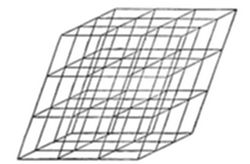
We shall find that the marks lie on a lattice of diamond or rhombus shapes, and that the lattice has the same form whatever point of the pattern we chose to mark. The rhombus will have different sizes and shapes in different wallpapers, though its four sides will always be equal; or else it may be a rectangle, because nobody could bear a wallpaper in which this was not so. The whole pattern of marked points may be called a "lattice." Each rhombus contains the material of one whole unit of pattern, with all its details, and no more.
The units of a crystal are arranged in space just as the units of the wallpaper design are arranged on the wall, except that the flat lattice is replaced by a "space lattice" (Figure 29).
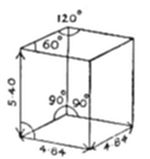
Each little cell of the lattice is bounded by six faces, parallel in pairs. The cell can have any lengths of side and any angles; its simplest and most regular form is a cube. Each cell contains one full unit of pattern, with all its details, and no more: it is the crystal unit, which has all the qualities of the crystal, however big the crystal may be. In quartz, for instance, it has the particular shape shown in Figure 30, and it contains three molecules of silicon dioxide. The X-ray methods find this out easily, along with the size and shape of the cell, as we shall see; but it is far harder to discover how the atoms and molecules are arranged inside the cell.
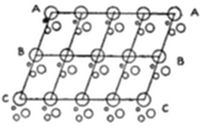
Suppose we could look into a crystal along one of the cell edges of Figure 29, and could draw what we saw in something like the way shown in Figure 31. With each point of the lattice goes a grouping of atoms, which we represent by the entirely imaginary set of circles in the figure. The form of the grouping does not matter, nor what is in it. It may hold any number of atoms and molecules; the essential point is that exactly the same group goes with every point of the lattice, as in the wallpaper design. Now suppose a train of X-ray waves strikes the crystal. In Figure 32, A, the waves are shown by the line WW and the lines parallel to it.
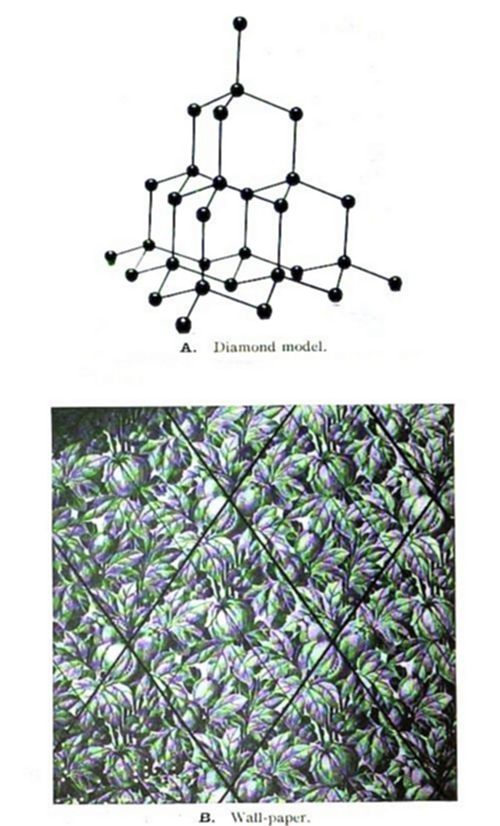
When these waves strike the row of groupings strung along AA (each grouping is now shown as a single dot), a new set of similar waves starts out from every grouping, though the wave as a whole sweeps on, just as each of a row of posts planted in the sea would become the centre of a disturbance as a wave went by.
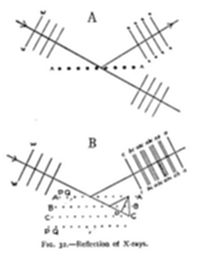
A little way from the row AA these small disturbances link up into a connected set of waves, shown by the parallel lines aa. It is like the reflection of sound by a row of railings, or by a stretched piece of muslin. In every case the bulk of the wave goes on, but there is a reflected wave that makes the same angle with the reflecting layer as the original waves did. The reflected waves form a simple train, with the same wave length as the original, though far weaker of course. You might think the reflection would just be a muddle of ripples, but it is not so. Very close to the groupings there is some apparent confusion, but a little further along the path of the reflection the wavelets melt into the steadily moving train aa.
Behind the row of groupings strung along AA there is another exactly like it, strung along BB (Figure 32, B). The original waves, which experiment shows are hardly weakened at all by passing over AA, sweep over BB in their turn, and again there is a reflection, shown by the set of parallel lines bb. Behind that is a row CC making a train cc, a row DD making a train dd, and so on.
As a rule the lines aa, bb, cc do not fall on top of one another. But if the wave length of the rays, the distance between AA and BB (which are really planes seen edge on), and the angle at which the waves meet AA and BB are correctly matched, then the lines aa, bb and the rest do fall together. In practice thousands of reflecting planes come into play, and when their reflections all fit together exactly in this way, the whole reflection is strong. If the matching is wrong, as it is drawn in the diagram, the reflections do not add up to anything we can detect. Some throw their crests, or what corresponds to the crests of a water wave, into the hollows of others, and they interfere with and cancel one another. The matching has to be extremely exact, because there are so many reflecting planes one behind another. It is easy to find a formula for the condition of correct matching, and so for reflection. The line A'B'B must be longer than AB by a whole number of wave lengths. If λ is the wave length, d the distance between the planes (or spacing, as it is usually called), and θ the angle shown, then
nλ = A'B'B − AB = A'D − AB = DN = 2 d sin θ,
where n is any whole number.
As I have said, the reader need not go through the working just given, from which the fundamental equation of the subject comes.
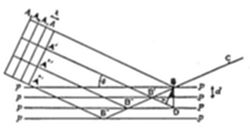
The essential point is this. If the direction of the original rays is altered little by little with respect to the planes AA, BB and the rest, there is no reflection to be seen until the right angle is reached, and then there is a sudden flash of reflection. The angle is observed; and when the wave length of the rays is known, as it always is in crystal analysis, we can measure the spacing.
The reflected rays cannot, of course, be seen by the eye, but they can leave their mark on a photographic plate, and be detected in other ways we need not go into here. The instrument made for the experiment is called an X-ray spectrometer. It measures the angles at which reflection happens, and its readings are used first to find the spacings and then to find the angles between the various planes of the crystal. It gives, for instance, not only the spacing between AA and BB but also that between PP and QQ (see Figure 32, B), and the angle between AA and PP. It gives, in fact, the size and shape of the unit cell.
It is generally simple to find the density of the crystal by experiment, and from that the weight of the material in the cell. Since we always know the weight of the molecule, it is easy to work out how many molecules go to the unit; as I said, it is always a very small number. The readings of the X-ray spectrometer also tell us something about the relative positions of the molecules that make up the unit of pattern. They would tell us far more if only we knew how to read them, but we are still too inexperienced. We have found our Rosetta Stone, but we are only beginners in the new language.
The most important thing to remember is that the X-rays give us the distance from any sheet over which the atom groups are spread to the next sheet, which is exactly like the first and so has another set of atom groups spread over it. This spacing is the same as the distance between two opposite faces of the unit cell. We can draw the cell in many ways, by joining up different corners of the space lattice. There are not just three spacings to be measured in a crystal, then, but really any number of them; usually we are content to find a few.
In a few cases the analysis of a crystal has already gone so far that we know where every atom sits in the unit of pattern. To get that far we have used not only our X-ray analysis but many facts of chemistry and physics. I shall not go into these further details at all; the general explanation I have given will be enough to show the methods that have been followed. But I think we shall be interested in some of the results.
First of all let us take the diamond, which is a prince among crystals. It is not only a beautiful and valuable gem: its structure teaches us a great deal about the most fundamental truths of chemistry, and especially organic chemistry. Only one kind of atom, carbon, goes into the building of diamond, but that atom matters enormously to us. It is a basic ingredient of foods and fuels, dyes and explosives, our own bodies and many other things. The structure of diamond is remarkably simple, though, like every construction in space, it is hard to take in quickly. We are so used to drawings on the flat, and paper and pencil are so handy, that our minds grasp the details of a flat design easily. But we cannot draw in space. We can only build models, at great cost of time and energy, and so our power of imagining arrangements in space is weak for want of practice. A few people have the gift naturally, and some, being crystallographers, have trained themselves to think in three dimensions. Most of us find our first efforts to picture how the atoms and molecules of a crystal are arranged very hard going. Still, the diamond structure in Plate XIV, A, will become clear with a little thought. The black balls stand for carbon atoms, as to their positions only, and say nothing about their size and shape, of which we know very little. Every carbon atom sits at the centre of gravity of four others. These four lie at the corners of a four-cornered pyramid, or tetrahedron, and the first carbon atom is of course the same distance from each of them. We have reason to believe that the ties between the atoms are very strong, and there is only one kind of tie in the whole structure. In this uniform simplicity and regularity we can surely see why diamond stands at the top of the scale of hardness. If it is pressed against any other crystal, it is the atoms of the other that must give way, not those of the diamond. Diamond has a cleavage plane, along which it splits. In the picture it is parallel to the table the model stands on, and there are four such planes, one parallel to each face of the four-faced pyramid: the model can be turned over to rest on any one of its four faces, and it looks exactly the same each way. The distance between the centres of two neighbouring carbon atoms is 1.54 Ångström units, and this unit is a hundred-millionth of a centimetre. It does not seem surprising that this particular plane should be the cleavage plane, because it cuts straight across the upright links between the level layers that appear in the picture. Each of these layers can be described as a puckered network of hexagons.
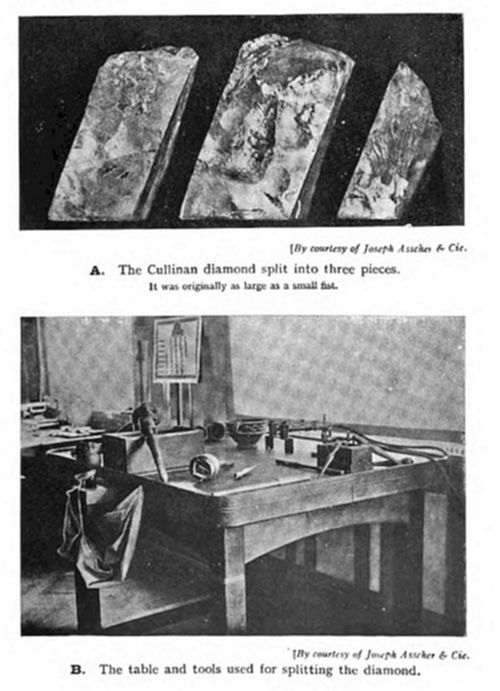
The crystal can of course be thought of as layers parallel to any one of the four faces of the tetrahedron, not only the face the model happens to be standing on.
Diamond cutters know all about this cleavage and save themselves a great deal of work by using it. In the Tower of London you can see the tools with which the great Cullinan diamond was split during its "cutting." Plate XV, A, shows the diamond in three pieces, and Plate XV, B, the tools used to split it. A diamond can also be cleaved along one other plane, which contains any one edge of the tetrahedron and stands square to the opposite edge; but the job is difficult and seldom done.
When we look at the diamond construction we cannot help noticing that in every part of the model the carbon atoms are arranged in rings of six, hexagons. If we take one of these rings out of the model, it looks like Plate XVI, B, 2: a perfect hexagon seen from above, but not a flat ring.
Now the ring of six carbon atoms already has a famous place in chemistry. Nobody has ever seen it: it is too small. But chemists have deduced that it exists by arguments that are most ingenious and most interesting, and even those of us who are not chemists may not find them too hard to follow. It was well known by the middle of the last century, for instance, that certain molecules could be made whose basic structure was a row, or chain, of carbon atoms, and that hydrogen atoms could be fastened to the carbon atoms so that every carbon atom had four other atoms attached to it. People knew this because the molecule could not be made to take on any more hydrogens. It was full, or "saturated," as chemists say, a single carbon atom being "saturated" when it has four other atoms attached to it, as in marsh gas, or methane (CH4). The numbers of carbons and hydrogens were exactly what this idea predicts. With six carbon atoms there ought to be fourteen hydrogen atoms, as the diagram shows, and experiment finds that there are. These substances are called the "paraffins" (see the later part of the next chapter), the various members of the series having different numbers of carbons in the chain. The particular one in the figure is called hexane.
Now in 1825 Faraday got a certain substance out of the residue left in gas retorts, and called it bicarburet of hydrogen; we now know it as benzene. A few drops of Faraday's first sample are kept in the Royal Institution as a historical treasure.
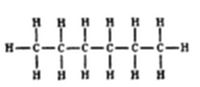
The molecule of benzene contains six carbon atoms, like hexane, and six hydrogen atoms. It can be made to take on six more hydrogen atoms, twelve in all, but no more, and the new molecule then behaves chemically like hexane in most of its properties. But it cannot have the same structure as hexane, because it has two hydrogen atoms fewer. Kekulé solved the riddle in 1867. He suggested that the framework of benzene is a ring of six carbon atoms, not a chain. We can think of it as made from the chain of Figure 34 by taking off the two hydrogen atoms at the ends and bending the chain round until the two ends meet and join. That gives us the structure shown in Figure 35. Its chemical name is hexahydrobenzene. Benzene itself has only one hydrogen at each corner of the hexagon.
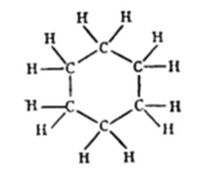
The carbon chain and the carbon ring are the foundations of the two great divisions of organic chemistry. Chain molecules are found not only in the paraffins but in fats, oils, soaps and many other important families of substances. The ring is the basis of many thousands of known molecules, among them dyes and explosives, and drugs such as quinine and saccharin.
The idea of the closed ring of six leads at once to a simple and beautiful explanation of a number of remarkable chemical facts, and we will look at one example. The benzene molecule is the hexagonal ring of carbon atoms with one hydrogen at each corner. Each carbon atom has only three neighbours in this molecule. It can take on a fourth, so there is room in all for six more atoms or groups of atoms to be tied on at the corners, and they can be added. But the benzene molecule can get along perfectly happily without them.
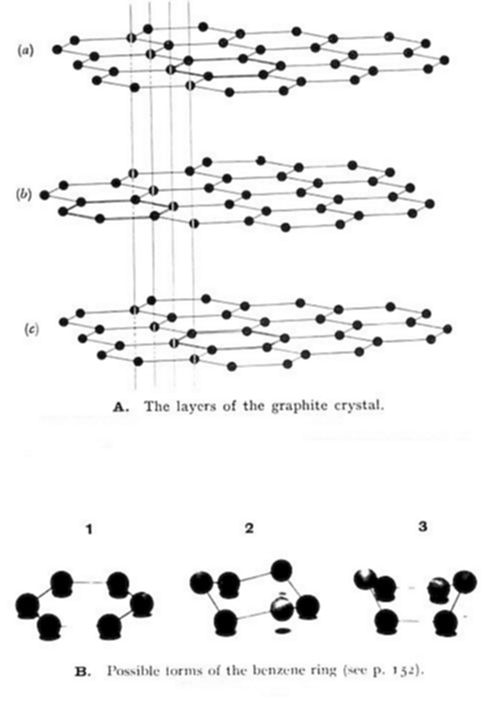
Taking the benzene molecule as it is, chemists find they can change its make-up, pulling off one or more of the hydrogen atoms and putting other atoms or groups of atoms in their place. In one well-known and important case a single hydrogen is taken off and replaced by a group of one carbon and three hydrogen atoms, known as the methyl group.
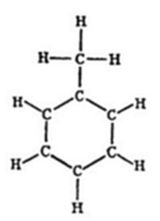
The new molecule has the structure shown in Figure 36 and is called toluene, a very important substance, liquid at ordinary temperatures. A second hydrogen can be taken off the ring and replaced, let us say, by an atom of bromine, and the new substance is called bromotoluene. It is very remarkable that when this is done we get three different substances, all with the same make-up: six carbon atoms, four hydrogen atoms, one bromine atom, and one methyl group, which we will assume stays whole. How can there be three of them, each with different properties, yet all built of the same parts? The ring idea answers at once. There are three ways, and no more, of making the substitutions, and they are shown in the figure. The bromine atom may be next to the methyl group, or next but one, or next but two.
The three molecules have different shapes, and so we might expect them to have different properties; and there is no doubt that there really are three different substances. Chemists have even been able to tell which is which. Many similar examples could be given, but this one is enough to show how much position matters as well as make-up: the three molecules differ only in where the two substituted pieces sit. The methods of X-ray analysis are particularly well suited to differences like these, because they measure the size of the unit of pattern into which two or more molecules are packed, and so can detect the effects of changing the shape of the molecule. A little work of this kind has already been done.
It is very interesting that in chain molecules the number of carbon atoms varies widely. Butyric acid, the substance typical of rancid butter, contains four carbon atoms, while palmitic acid, found in palm oil and elsewhere, contains sixteen (see the later part of the next chapter). The ring of six carbon atoms, on the other hand, turns up far more often than any other ring. It must be the easiest to form and the strongest in construction. Now diamond, the only crystal besides graphite made of carbon atoms alone, is full of rings of six. It is natural to suppose that the reason for the ring of six lies in the diamond structure. But that structure rests simply on the rule that each carbon atom is surrounded by four others arranged evenly round it. The two lines joining a carbon atom to two of its neighbours are tilted to each other at an angle easily worked out to be 109° 28'. If, in certain circumstances, the rule is that two carbon atoms must always join a third so as to make this angle (see Figure 50), then the smallest ring that will close up contains six carbon atoms. (A model can be made to show the point. Wooden balls of regular enough shape can be bought in large numbers, since they are used in making large buttons. Drill four holes at the right places in each ball, and use gramophone needles to join them. Models of diamond, and of many forms of ring and chain molecules, can then be put together.) Five carbon atoms lying flat almost make a ring, because the angle of a pentagon is 108°. But if the angle is to be 109° 28', we must take six and arrange them in the puckered form of Plate XVI, B, 2. Whether the benzene ring is actually puckered in all circumstances, or sometimes flat, in which case the angle is 120° (Plate XVI, B, 1), or even has the shape shown in Plate XVI, B, 3, which is another form based on the tetrahedral angle, we find it hard to say with any certainty at present. Evidence from experiment is piling up, but it is not yet decisive on this particular point; perhaps all three forms occur. Meanwhile many facts come out in the course of the work that are definite and very interesting.
Graphite, a remarkable substance, is made of carbon atoms only, like diamond. It is much lighter: its density is nearly 2.30, against 3.52 for diamond. Plainly the atoms have been rearranged so that on average they are spaced a good deal further apart. The X-rays show that the whole increase has happened in one direction. There are layers in graphite as there are in the diamond structure (Plate XVI, A). Looked at from above, a layer shows the same network of hexagons, and the side of the hexagon is almost exactly the same length. But the distance from one layer to the next has grown a great deal, and that is what has made the substance so much lighter. Recent experiments seem to show that the layers have been flattened out, so that each carbon is now surrounded by three atoms in its own plane. If the ties between the atoms in each layer have changed at all, they have at least lost none of their strength; but the ties between one layer and the next are much weakened. For these reasons the layers slide over one another very easily, while each layer is tough in itself. The two together are what make graphite such a good lubricant. Its readiness to slip matters, but so does the fact that a layer does not easily crumble into powder. When you slip on a black-leaded hearthstone, some of the layers are clinging to the stone and some to the sole of your boot, and it is these that slide over one another. It is very curious that a single change, whose real nature is still a mystery, should turn the substance we take as the very type of hardness into one of the best lubricants we have.
Another set of facts that supports the idea that the ring is a real thing, with a size that can be measured and allowed for, comes from comparing two crystals, naphthalene and anthracene. Both matter greatly to the dye industry, naphthalene for making artificial indigo and anthracene for making alizarin, the active ingredient of madder.
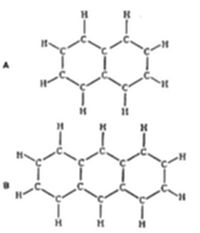
Naphthalene is a common substance; most of us no doubt know it as the white, strong-smelling balls we put in drawers to keep the moth away. If naphthalene is dissolved in ether and the solution left to dry off slowly, crystals form easily. In general look they resemble the crystals in Plate XIII, D.
The chemist finds that naphthalene is made of a double benzene ring, which we draw as in Figure 38, A, and that anthracene is based on a triple ring, Figure 38, B. When crystals of the two are put through X-ray analysis, it turns out that the unit of pattern contains two molecules and that the cell holding the unit has the shape shown in Figure 39. The sizes of the cells are given below the figures. If we compare the two cells, it is striking that along two of their edges they are very nearly the same size, while along the third there is a great difference.
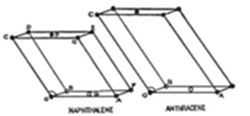
    Naphthalene   OA 8.34   OB 6.05   OC 8.69
    Anthracene    OA 8.58   OB 6.02   OC 11.18
The natural conclusion is that the double and triple ring molecules lie along OC in the two crystals, and that the difference between 11.18 and 8.69 is to be put down to the extra length of the molecule. Anthracene has one more ring than naphthalene, and that gives it the extra length, 2.49. Now if we measure the width of the ring as it occurs in diamond, we find it is 2.50. Here again is support for the view that the ring has a definite shape and very nearly fixed dimensions, which gives us something to go on when we try to discover the structure of a crystal that has the ring as one of its parts. The X-rays tell us the size and shape of the unit cell and how many molecules it contains, and give us some information about where the molecules sit relative to one another. If we know, more or less exactly, the size of the ring or rings that form part of the molecule, we can set out to work out the structure knowing that bodies of definite size have to be fitted into cells of definite shape. Work of this kind is extraordinarily interesting, because it gives us new knowledge of how the atoms are arranged in organic molecules, and of the forces that bind the atoms in the molecule and the molecule in the crystal. It is a new field of inquiry, in which some results are definite and clear, and others are more obscure and hard to interpret until we have more experience.
Up to now the organic molecule has looked to us like a light, rigid framework, held tightly together in itself but weakly joined to its neighbours in the crystal. Organic substances are nearly always light, not much heavier than water. The density of naphthalene is only 1.15, which shows how empty its structure is. Even diamond is full of holes, like a sponge. If the holes were filled with more carbon atoms, the density of diamond would double, because each hole is just big enough to take one more carbon atom, and there are as many holes as there are atoms.
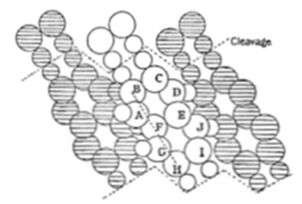
The weakness of the bonds joining molecule to molecule is why an organic crystal is soft and so easily melted. For the same reason naphthalene "sublimes": it evaporates while it is still solid. Whole molecules fly off from the solid and form a vapour, which may crystallise again in a cooler part of the vessel.
Naphthalene and anthracene are flaky in structure: they have, as the saying is, a well-developed cleavage. The dotted lines show the cleavage plane; plainly the molecules come apart more easily at their ends than at their sides. In each flake the molecules stand nearly upright, like corn leaning over in the wind.
The general conclusion these considerations lead us to is that the "benzene ring" is a real material object of definite shape and size, built into crystal structures with little change of form. We must go on now to the "chain" molecule, the basis of as large a part of organic chemistry as the part that rests on the ring. Since this chapter is long enough already, we can look at the chain in the next chapter, along with the ice crystal, which will be its main subject.
Chapter Five: The Nature of Crystals: Ice and Snow
When we look round for crystals to examine by our new X-ray analysis, the crystals of ice and snow catch the imagination at once. Water is one of the most familiar substances in the world. It touches our lives in countless ways, and we are interested in every form it can take. Then again, as scientists we would like to find out what structure is built from so simple a molecule, one oxygen and two hydrogens, and we might find it within our power to do so. But there is one very compelling reason in the beauty of the snow crystal, with its tracery so delicate and so finished, and of the frost crystals on the windowpane, so odd and charming in outline. It is true that the blocks of ice that come from the freezing works are not remarkable for grace of outline, though there is a fascination in watching them slither across the pavement in the grip of the iceman's tongs.
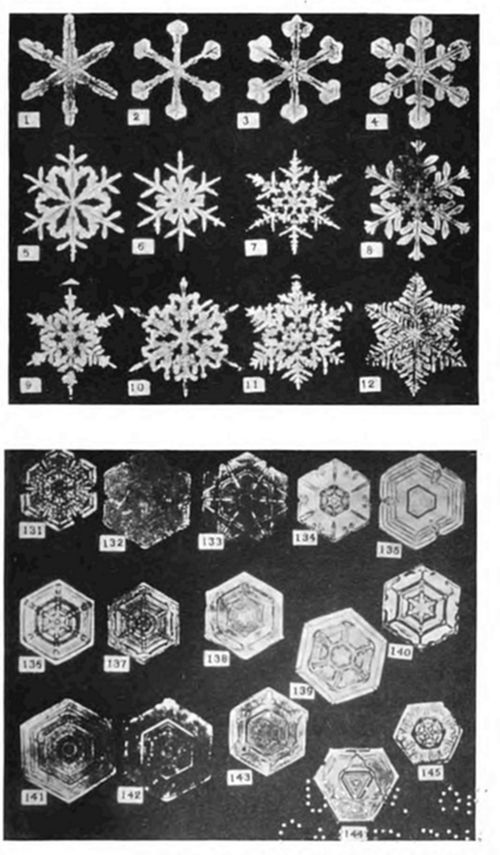
Commercial ice is made too fast for the ice design to come out. The crystal structure is there, but the block holds a multitude of tiny invisible crystals pointing in every direction, and it is full of bubbles and sheets of air.
If we want to see what Nature will do when she is left to work out her design in peace, we must look at the snowflakes that fall in a hard northern winter. In England we do not see the best crystals: it is not cold enough. Observers in other countries, such as Sweden and America, have made many exquisite drawings, which are to be found scattered through the publications of physicists and weather scientists. Some of them are reproduced in Plates XVII and XVIII.
We can imagine how the snowflakes grow. One or two molecules of water join up in the upper air. Molecule after molecule adds itself to the growing, falling crystal, filling in the details of the pattern, until at last the six-pointed snowflake comes gently to rest on the ground. If the weather is cold, the flake may go on growing in the same way, and the crystals develop perfect little faces, which glitter like diamonds in the sunshine. When the snow crystal first forms it is very often feathery. The six arms grow outward, and smaller arms grow from each of them to right and left, and still smaller arms from those, and so on, every arm meeting another at an angle of 60°, so that the whole thing is like a six-pointed star of fine lace. These feathery forms belong to the early stage of crystallisation, and seem to come from sudden, rapid freezing. The arms stretch out from the centre because they have used up the nearby molecules that are ready to join the structure, and they have to reach out into fresh ground. The same thing is often found in other kinds of rapid crystallisation. A notable example is the skeleton crystals of iron that form in a crucible of molten metal as it cools. To keep them, the rest of the liquid must be poured off before the crystal has had time to fill in the empty spaces. They are called "dendrites," because they look rather like trees, with trunks, big branches, small branches and so on; but in an iron crystal two branches meet at a right angle, not at 60°, and the form is far less graceful than that of ice.
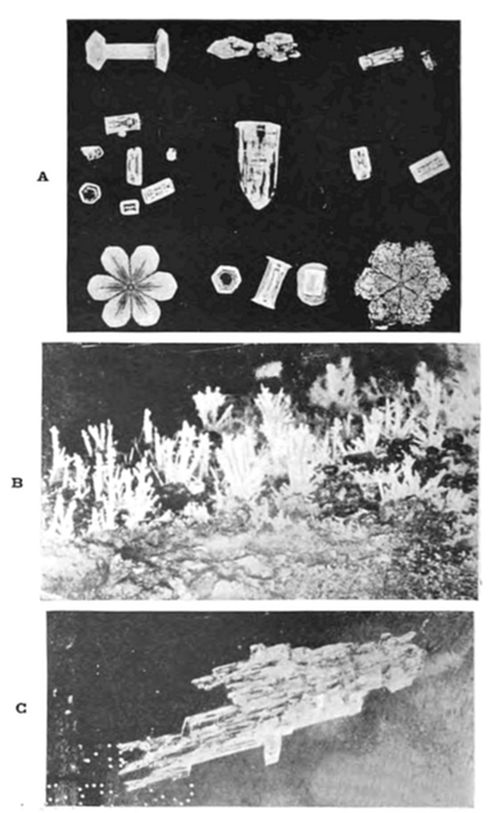
When the snow crystal has had time to grow and there is a supply of molecules to hand, the gaps fill up and the crystal becomes a six-sided plate (the lower panel of Plate XVII).
Sometimes, it is thought, the plates grow in that form from the very start. Oddly enough, the plates are often joined in pairs by a six-sided prism. One plate is generally larger than the other, and the whole thing looks like a fairy tea table (Plate XVIII, A). The prism also appears in the curious formations of Plate XVIII, C, which is taken from Wright and Priestley's Glaciology, British Antarctic Expedition, 1910-1913.
The prisms and plates and "tea tables" are believed to cause the mock suns and haloes that are seen in high latitudes (Plate XIX).
Suppose the hexagon in Figure 41 stands for a section of one of these prisms or plates, and let ABCD be the path of a ray of light through it. It is bent, or refracted, at B and at C, and on the whole it is turned through an angle of at least 21° 50', which in the language of physics is the angle of minimum deviation.
If in Figure 42 S is a source of light and E the eye, a ray from S is bent in going through P, and will reach the eye if P is in the right place. In the figure the prism is placed symmetrically, and in that position, as is known, the deviation SPE is as small as it can be. Any prism lying between SPE and SP'E, such as P0, will bend the ray from S in a direction that cannot possibly reach the eye, however the prism is turned. The eye cannot receive a refracted ray from any such prism.
A prism P1 may send light to the eye if it is set at a slant, as the figure shows. The angle of deviation then has to be more than the least possible, and that is why the prism must be set crooked, as it is in the figure. If an observer at E stands facing the sun at S, then, he will see light coming from the directions PE and P'E, and from other directions outside them too. But the light from outside will be fairly weak, because most of the deviations are not far from the smallest value: the further they are from it, the fewer they are, by a known law of greatest and least values. And no light at all comes from within PEP', so the strong light of the smallest deviations stands out all the more sharply.
This applies to rays coming from all round the sun, and so on the whole the observer must see a ring round the sun, sharp on the inside and rather more blurred on the outside. For red light the angle PEP' is a little smaller than for blue, so the halo is not quite white: it is coloured, red on the inside and blue on the outside. The halo is seen when there are enough ice prisms in the air, just as a rainbow is seen when there are enough drops of rain. When a ray of light goes into a raindrop and out again, it is bent through more than two right angles, and that is why to see a rainbow you must have the sun at your back.
A little model may make the explanation clearer. The arc lamp at S in the figure is the source of light, and the eye is at E. Between S and E is a stand with an arm mounted on it, and the arm carries a glass prism. The model is laid out so that a ray of light refracted by the prism falls on E. If the arm swings round J, the eye stays lit. If there were prisms all round the circle, the eye would see a ring of light round the central spot.
If for some reason the prisms tended to settle in certain positions only, the halo would be incomplete. Something of the kind really happens. When a long prism falls through the air, its axis tends to settle level. But if it has the tables at its ends, as in Plate XVIII, A, or if it is simply a six-sided table, which we can think of as a very short prism, its axis tends to turn upright; in other words, the table itself tends to lie level.
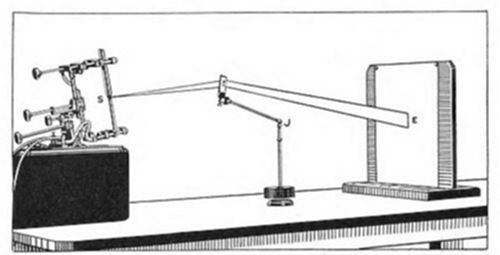
This rather strange effect follows a well-known rule about bodies moving through gases or liquids: they tend to settle so as to put up as much opposition to the motion as possible. Make a packet of two or three letters or postcards and drop it from a height, holding it level and whipping your hand away from underneath, and it stays level all the way down. But let it fall edge first, and it turns over and over afterwards. When we drop a white plate into water we see it swaying from side to side, but always tending to lie level. The result is that a falling shower of ice crystals holds more than its fair share of upright and level crystals. The parts of the halo at the ends of its level and upright diameters are strengthened, and look like bright spots on the ring; they are often called mock suns.
It is easy to show how the "tea-table" forms tend to turn upright as they fall. We make a number of models out of ebonite and let them fall through a tall jar of water. A very tall jar is best, but even if the water is no more than eighteen inches deep the tendency is quite plain.
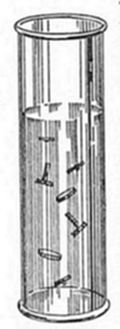
Curiously enough, some of the bodies tend to fall plate first and some with the plate behind. Besson worked the question out mathematically and showed that when the plate is small across compared with the length of the prism, the plate tends to go first, and the other way round. We can prove it by experiment; it is best to hold the axis level just under the surface of the water and then let go.
The whole of the upright line through the centre of the halo is often lit up as well, but for quite a different reason: it comes from reflection at the flat faces of the snow crystals and plates. The observer receives reflections of the sun from snowflakes at every height, but they must all lie in an upright plane through the sun. The bright upright line is called a "sun-pillar."
When ice forms quietly on a water surface open to the sky, it crystallises in a form like that of the snow crystal, with all the six-sided figures lying level. This is not usually very easy to see, though in books of Arctic exploration there are pictures of table ice breaking up into six-sided upright columns, like the basalt columns of the Giant's Causeway. It is also said that when the ice on a lake breaks up, it first splits into upright columns, which hold one another up for a while; but once the ice starts to move, the collapse is quick and the lake soon clears.
The accounts of Antarctic explorers make a special point of the ice on freshwater lakes being divided into six-sided prisms, all standing upright on the surface, with the planes between them marked by lines of air bubbles. On the sea ice, as the crystals formed they drove out the salt, which was left in the spaces between the crystals and sometimes squeezed up above the top surface. Inside, the prisms were almost free of salt, and fairly fresh water could be had if the outside layers were melted off first. They were clear crystals, and you could look through them at the rocks beneath as though through tubes.
There is a very beautiful way of seeing the crystal structure of ice, which Tyndall describes in his book on Heat.
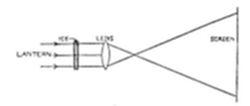
A slab of clear ice is set in the beam of an arc lamp and focused on the screen, as in Figure 45. The heat of the lantern begins to "undo" the crystals, which come apart in the reverse order to the one in which they were put together. Little six-rayed hollows appear and grow, looking like flowers with six petals, along with other hollows shaped like ferns, whose fronds meet the stem at an angle of 60°. Soon the whole screen is covered with these "flowers of ice," as they are called; it looks like a beautiful carving in low relief.
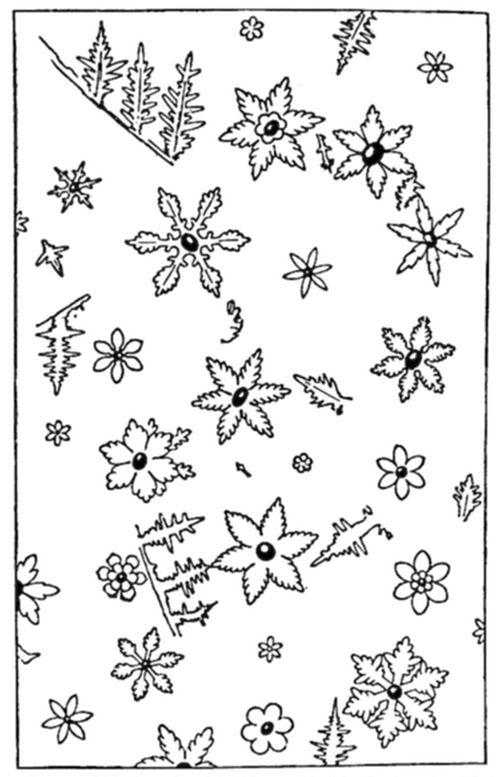
Ordinary commercial ice does not show the effect. There is a specially made "plate ice" that does fairly well, but natural ice formed out of doors at night is far better than anything frozen in the usual way at an ice works. We made many disappointing attempts to get a satisfactory experiment. Then at last came a kindly frost one night, and the next day a young enthusiast rode out on his bicycle and brought back from a pond a number of pieces that showed the effect splendidly. Plainly the ice must grow quietly, and probably the water must also lose its heat quietly through one face, as the water of a pond does on a still, frosty night.
A little black spot often appears in the middle of an ice flower. Tyndall was very interested in it and explained it. When the ice melts inside the block and a hollow forms, the water from the melting takes up less room than the ice it came from. Perhaps at first it holds together in a highly strained state and fills, as water, the space it filled as ice. But if so, the strain must be very great: it breaks away from the ice and shrinks to its natural volume. An empty space is left, which acts as a tiny lens and scatters the light crossing it. Hence the black spot, which means that no light is going straight through the hollow.
The ice flowers can be seen in glacier ice, where the heat of the sun makes them. When a glacier is built up from ice brought in by side glaciers, or from blocks that have fallen in at the edges, it may be a heap of ice masses all frozen together, each showing its ice flowers. The way the flowers lie shows in each case how the block originally lay, because they always form in planes that were once level. In the picture (Plate XX, A), taken from an old book by Agassiz, a section of glacier ice shows the various positions of the hollows well: some seen full face, some edge on, and some in between.
Now let us turn to the analysis of the structure of the ice crystal that the X-rays have made possible. We must hope to find in it some explanation of its shape and of the other physical properties we have been looking at. It turns out that the structure is rather like that of diamond. There is the same even arrangement of four neighbours of the same kind round every atom: here it is the oxygen atom that stands at the centre of a tetrahedron, with four other oxygen atoms at its four corners. There are some smaller differences of structure, though. For one thing, in diamond the carbon atoms join directly on to one another, while in ice there are the hydrogens to be placed. If we put one hydrogen between each pair of oxygens, we get an even arrangement with the atoms in the right proportion. Every oxygen has four hydrogen neighbours and every hydrogen has two oxygen neighbours, which means there are twice as many hydrogens as oxygens. A model showing the arrangement on these terms appears in Plate XX, B and C. The large balls stand for oxygen and the small ones for hydrogen. It must be clearly understood that the X-ray methods do not measure the size of the oxygen atom, or of the hydrogen. All they do is find the distance from the centre of one oxygen to the centre of a neighbouring oxygen, a distance that is the sum of the diameters of oxygen and hydrogen. The oxygen atom may take up all the room and the hydrogen none, because the hydrogen atom is supposed to hand over its electron to the oxygen and be left a bare nucleus. Nobody can say how its size should then be shown. To make a model we must choose some sizes for the balls that stand for the atoms, and the model must be read with that reservation in mind.
There is a second difference between diamond and ice, subtler and harder to picture, but worth the effort of understanding. If the reader finds it too hard to grasp, he can skip it without any fear of losing the thread of the story.
Suppose we look down on the diamond model from above and see a single puckered layer, as in Figure 46, A. The carbon atoms are marked 1 if they lie right on the base of the crystal, and 1' if they are raised a little above their neighbours in the layer. Take another layer exactly like the first, write 2 everywhere instead of 1, and lay it on the first so that each 2 comes over a 1'; that is, so that an atom in the lower level of the second layer comes over an atom in the upper level of the first.
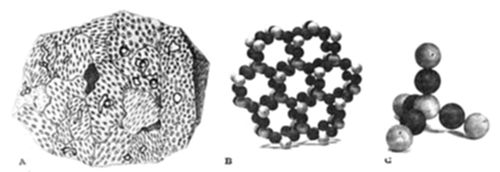
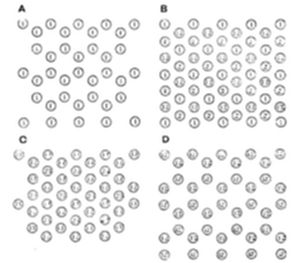
This is what happens in diamond. The combination is shown in Figure 46, B, where 1'2 means that atom 2 lies over atom 1'. Now take a third layer, which we can mark with 3s, and lay it so that each 3 comes over a 2'. That gives the arrangement of Figure 46, C, and when this is repeated over and over in the same order, 1 2 3 1 2 3, we get the diamond structure.
Now begin again with a layer of 1s, but take for the layer of 2s the arrangement shown in Figure 46, D. Notice carefully that this is not the same as before: the layer of 2s has been turned round in its own plane through 180°. Then repeat the first layer, and go on alternating 1 and 2. This gives us the arrangement of the oxygens in ice. The structure is complete when we put a hydrogen between each pair of oxygens.
If we look at the picture of the ice model in Plate XX, B, we may be able to see the arrangement. Why one crystal should keep repeating a series of three layers and the other a series of only two, we cannot imagine.
Looking at the model of the ice structure, we can see many interesting features in it that help to explain what we know of the properties of ice. The six-sided structure is there, of course, and the emptiness of the model is surely connected with the lightness of ice and the featheriness of snow. Ice floats on water, and we can see that when the molecules of water join up in the crystal structure they must take up more room than before. We could plainly crush the model into a smaller space, and no doubt that is what happens when ice melts under pressure. A well-known experiment shows the point. A block of ice is supported at its ends, and a fine wire carrying heavy weights is slung over it, as in Figure 47.
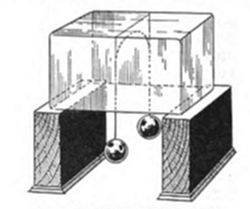
The wire slowly sinks into the ice, but as it does the ice closes up behind it, and when at last the wire works its way right through the block and drops to the floor with its weights, the block is still whole. It seems that the pressure of the wire on the block breaks down the structure of the ice and sets some of the molecules free. In other words, a little ice is melted by the pressure and becomes water, which is squeezed out from under the wire and slips round to the empty space above it. There it joins up again with the ice on either side. We can imagine the molecules settling into their places, because on either side there is crystalline ice holding out its hands to them.
Crushed ice can be moulded into various shapes under great pressure. We can make a crystal cup, for instance, with two or three boxwood moulds of the right shapes. In one we form the bowl of the cup, in another the stem, and in another the foot; then we join them into one piece by holding them together in position for a few moments. The moulds we use to make the cup in Figure 48 were once used by Tyndall for the same purpose.
When Tyndall showed these experiments he was putting forward a theory of the movement of glaciers, and he used them to illustrate his arguments. Tyndall, we may remember, spent a great deal of time measuring the movements of glaciers. He was interested in them as a scientist and also because he loved mountaineering.
Glaciers come down from the snow-covered mountains, glide along the valleys and pour out into the plains almost as if they were fluid, a very thick, treacly fluid, since the motion is so slow: a few inches a day or even less in some cases, many feet a day in others. What has always stirred wonder and interest is the stateliness of the motion, and the strange way a substance so brittle and crystalline can flow like a river, go round the bends of a valley, or fall over a cliff and still stay whole. In Tyndall's time a great deal of thought was given to a theory that the glacier melted inside wherever the strain was great, and that the water so formed slipped away and relieved the pressure. It would freeze again, people said, if it found its way into empty cracks or spaces where there was no longer the pressure needed to keep it liquid. In this way the glacier would, so to speak, shrink where it was squeezed and swell elsewhere, and so fit itself to its bed. The explanation runs into difficulties when we think of the glaciers of the Arctic and Antarctic, which flow too, though the temperature there is so low that no conceivable pressure would melt anything.
When we look a little more closely at the behaviour of a crystal structure, we may find another way of picturing how the motion happens: not so very different in reality from Tyndall's view, but less open to criticism. There are many substances that can be made to flow like a glacier. Metals can be squirted through holes; wires can be drawn; plates can be rolled. Even the surface of glass, or of a perfect crystal such as Iceland spar, can be made to "flow," as Sir George Beilby has shown. Now all these things are crystalline (if we did not know it before, the X-rays have driven the fact home for us), and they are just as crystalline after flowing as before. We shall see some examples when we come to the metals. The substance gives way to pressure, changing its shape as it does so. Whole layers of atoms or molecules are torn up from their places for a moment, ride over the tops, so to speak, of the atoms they lie on, and settle into a new position, or perhaps are kept on the move for some time. When they settle down again for a moment the crystal is perfect once more, and when they are torn up the bonds are broken as though the substance were about to melt. This must be especially true when, as in ice, the substance shrinks on melting, so that the bonds, breaking under pressure, let the atoms and molecules take up positions that need less room than before. When a piece of metal is bent or squeezed into a new shape, the crystals it is made of, few or many, are "sheared": one part slides over another. And we can see how many shears, one after another, can bring about any change of shape. It may be the same with ice, and both shearing and melting may play their part in the change of shape. The "shearing" of ice has often been seen. A block is cut from ice that has formed naturally on the surface of water. If the block is supported at its ends, lying the same way up as it grew, it bends under a weight, just as a beam would (Figure 49, A).
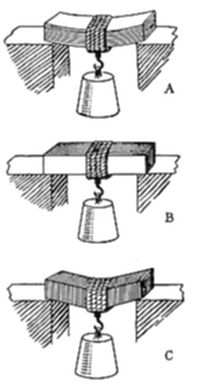
If it is turned on its edge, so that the layers that were level are now upright and their plane runs along the line joining the supports (Figure 49, B), the block gives very little indeed. If the planes that were level stand across the line joining the supports, they slide over one another and the block changes shape (Figure 49, C). If pressure and local melting set a few molecules free enough to move as a liquid to a new place, they will join on to the ice structure on either side readily, as they did with the wire, simply because there is always a place waiting for them. But in a general way we can think of the effect as the planes moving over one another.
It is curious how readily pieces of ice join together. If we rest one fairly flat piece on another for a few moments, we can hold the lower piece and turn the pair upside down, and the top piece does not fall off. When two pieces of ice are held together under water, even warm water, they join.
Now we can go back to the peculiar chain molecules of carbon atoms we spoke of in the last chapter. When we looked at the structure of diamond, we saw a certain arrangement of the carbon atoms that turned up everywhere in it: six atoms in a ring. We saw that a similar arrangement is the basis of the so-called benzene ring, a molecule made by fringing the six-sided ring of carbon with six hydrogen atoms, and that a very large number of other important molecules are founded on the same arrangement, with the hydrogens replaced by various other atoms or groups of atoms. The study of these molecules is the business of one of the great branches of organic chemistry. The substances they form are called "aromatic," because many of them have a fragrant smell.
A second great branch of organic chemistry deals with substances of a different kind. They are called "aliphatic," a word meaning that oils and fats are good examples of them. The chemist has been able to prove that here the molecule is a chain of carbon atoms, to which various atoms, especially hydrogens, may be attached along its length and at its ends. The ring was obvious in the diamond structure. It seems from recent experiments that we can find the chain in diamond too, so that diamond holds the essentials of both the great branches.
We looked at a few examples of the ring in the last chapter but left the chain until now. The chain is made of any number of links, each of which, in general, is one atom of carbon and two atoms of hydrogen. The ends are made of various groups of atoms, some of them very common, which give the chain well-known characters. In the simplest case the ends are hydrogen atoms, and then we have the hydrocarbon, or paraffin, molecule. The chemist writes the symbol of pentane, for example, like this:
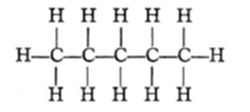
Pentane is a liquid that burns, and it is used in standard lamps: that is, lamps that serve as a standard to compare other lamps with, because they burn with a steady, unchanging flame. The diagram is meant to show how the various atoms are fastened to one another. Each carbon is joined to four other atoms. The carbon atom cannot link up closely with more than four, so nothing can be added to the molecule without first breaking it somewhere: it is said to be saturated. In the diagram it is drawn lying all in one plane, partly because that is convenient to draw and partly because so little is known of how it is really arranged. One of the aims of X-ray analysis is to find the positions of the atoms in a molecule more exactly than has been possible so far, and to measure its dimensions. With these long-chain molecules the X-rays have lately had an unexpected success. To show this new knowledge we really need a model, or a sketch in perspective; a model of the probable shape of the pentane molecule is shown in Plate XXI, A.
Many members of the paraffin series are found mixed together in oil wells. They burn readily, because with the right nudge and oxygen at hand they break up easily, and their atoms rush into fresh combinations, giving out a great deal of heat as they do. The shortest member of the series has only one link. It is a gas, called methane or marsh gas, and it is drawn like this:
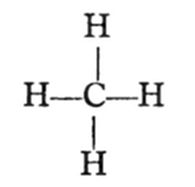
It bubbles up from stagnant water where plant matter is rotting. As the chain grows longer, the substance holds together better. Pentane, with five links, is a liquid at ordinary temperatures and boils at 36° C.; pentadecane, with fifteen links, boils at 257° C.; and pentacosane, with twenty-five links, is a solid at ordinary temperatures and melts at 54° C. The long molecules are thought to have a habit of lying side by side, like matches in a box, and we shall see that the X-ray results back this view strongly. We may expect, then, that the longer they are, the more force it takes to tear them apart, and for that reason alone the longer the chain, the higher its boiling point and melting point. As a class they have no strong hold on one another, and their boiling and melting points are low. The cloak of hydrogens they are wrapped in seems to keep them from joining up with other molecules, such as those of acids. In fact the word paraffin comes from two Latin words meaning "little" and "affinity." Still, as I have said, they combine very readily with oxygen when the conditions are right.
The behaviour of these chains changes a great deal if we take off an end group and put a different one in its place. If we replace one of the end hydrogens with a certain group made of a carbon, two oxygens and a hydrogen, we get another highly important series of compounds, the "fatty acids." The group is called the carboxyl group. Here again the chain may be of any length.
When there is only one carbon in it, the chemist draws it thus:
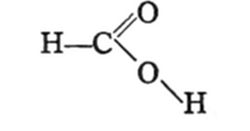
meaning that of the four bonds a carbon atom can make, each drawing another atom to it, one goes to a hydrogen, another to an oxygen that carries a hydrogen, and two go to a separate oxygen and bind it very tightly. This substance is formic acid. Ants make it, and as we all know it stings the skin badly. Add a fresh link to the chain and we have acetic acid, the stuff that makes vinegar sour; the name in fact comes from the Latin word for vinegar. The formula is now:
Butyric acid has four carbons; it is what gives rancid butter its peculiar taste and smell. Lauric acid has twelve carbons and is found in laurel oil and coconut oil. Myristic acid has fourteen and is found in the butters of mace and nutmeg. All these are liquids. Palmitic acid, found in palm oil, has sixteen, and stearic acid has eighteen. These last two are solids at ordinary temperatures. They are used to make stearine candles, and, slightly altered, they are the chief ingredients of animal fat.
The alcohols make up another of these chain series. They are formed from the paraffins by taking a hydrogen off one end and putting an oxygen and a hydrogen, joined together, in its place. Thus,
is ordinary alcohol.
We could go on like this, describing an immense number of substances, all made of links of CH2 with different ends. Sometimes one or more hydrogens are taken off the side of the chain and replaced by other atoms or groups of atoms; sometimes there are further complications. The simplicity of the general principle is fascinating, and so are the wonderful variety and power of the details. Why should different plants or different animals, or different parts of the same plant or animal, contain carbon chains of different lengths, on which their growth and properties and character so much depend? The whole effect rests, of course, first of all on the properties of the carbon atom, and that is what gives the crystal forms of carbon, diamond and graphite, their peculiar interest.
Let us look again at the diamond model and ask whether we can see the skeleton of the chain in it, just as we saw the skeleton of the ring. The model (Plate XIV, A) shows that it can be cut into chains of any length, of this form, and the angle that comes back at every bend can be calculated: it is 109° 28'.
We might suppose that this is a simple form of the chain. We are only speculating, of course: trying to imagine possible answers to our problems, which we can then put to the test of experiment, and not counting on them too much even when they seem to succeed. If this were the chain, two hydrogens would naturally be attached to each carbon, at points which, with the two points where its carbon neighbours are attached, would make four points arranged evenly, like the four points where each carbon atom is joined to its four neighbours in diamond. This is shown in Plate XXI, A. The picture goes into more detail than the kind of drawing the chemist usually uses: his is drawn on the flat, while our new figure is in three dimensions. And no doubt the true figure is in three dimensions. The chemist has not drawn it that way until now because he has had no direct evidence of how to do it. We are trying to go one step further, a little hesitantly, because we have not yet learned to read our new methods perfectly, though we are very hopeful that they will prove their worth in the end.
In the last year or two we have been able to measure the lengths of the chain molecules accurately by means of X-rays. The method was discovered through a curious accident. A certain crystal was being examined by X-rays, and since moisture in the air would quickly spoil it, it was covered with a thin layer of the solid paraffin that laboratories commonly use as an electrical insulator. Some reflections of the X-rays turned up that could not be squared with anything known.
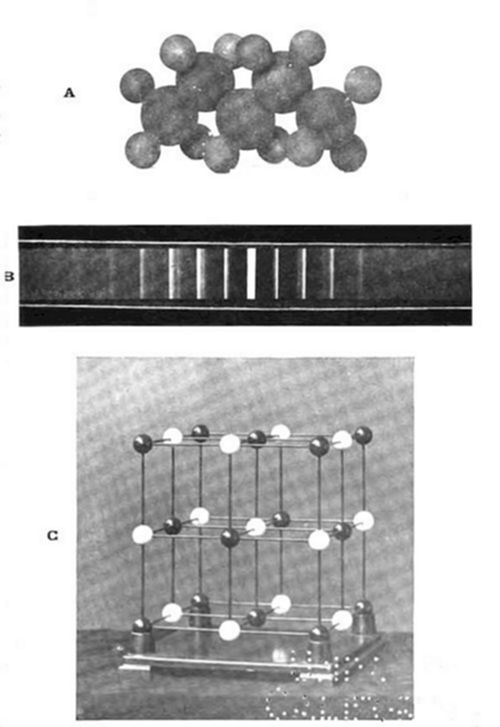
They turned out to come from the paraffin. Commercial paraffin is a mixture of chains of several lengths and is no use for accurate experiments. As it happened, though, an enthusiastic student of organic chemistry, Dr. Le Sueur, had prepared a great many of these chain substances in a pure state, and they were luckily on hand. These and many others have now been examined, with very interesting and, on the whole, simple results.
The method is a good example of how the X-rays can be put to work. A little of the solid substance is put on a piece of glass and pressed flat; we shall come to the point of the pressing in a moment. The substance now lies, as it turns out, in layers parallel to the glass. The molecules in each layer stand more or less upright to it and are linked together side by side. We can picture them as in Figure 51, where three layers are drawn. Each layer is perhaps a fifty-millionth of an inch thick, and its thickness goes with the length of the molecule. When a beam of X-rays passes through a sheet made of layers like these, each layer reflects a little of it, just as would happen with a beam of light passing through a pile of glass plates. The principle of the experiment was described in the chapter on diamond. Suppose S is the source of X-rays and P1P1 is the glass plate with its layers on it. When the X-ray beam along SC strikes the plate at the right angle, the reflections from the different layers are all in step and the reflection is strong. We can imagine the reflected ray going off along the line CR1 and making its mark at R1 on the photographic plate DD. If the glass plate is then turned about the upright line through C (the figure shows the experiment seen from above), the reflection as a whole dies away, because the separate reflections from the various layers fall out of step and destroy one another. But when the plate has been turned far enough, another general reflection appears, because the reflections from the different layers have fallen back into step. The first general reflection comes when the reflection from one layer is one wave-length behind or ahead of the reflections from the layers on either side of it; the next comes when the difference is two wave-lengths; and so on. The developed photographic plate therefore shows a whole series of these general reflections. Usually the glass plate is turned so as to throw reflections both above and below the line (Figure 52).
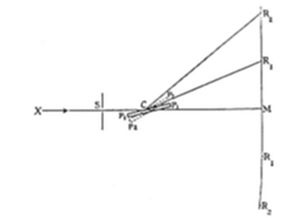
A central mark M is made by the X-rays striking the plate directly. This part of the plate is usually shielded, so that the direct effect is not too strong, and all the different orders of reflection appear on either side of it. A real example, the reflection from a paraffin of eighteen carbons, is shown in Plate XXI, B. Dr. Müller made it. The reflections are very sharply marked, as you can see. Their distance apart can be measured accurately, and from it we calculate the thickness of one of the layers in the reflecting material. We cannot be quite sure that the molecules stand straight up from the layer, but we have good grounds for thinking so, which we need not go into here. We find that the length of the chain grows with perfect regularity as carbon links are added to it. In fact many of them have exactly the length we should expect if they were shaped as in Figure 50.
The whole series of experiments of this kind bears out the picture the chemist had formed of the shape of these molecules: his drawing has been wonderfully correct. The X-rays have made the picture precise, suggesting too that the molecule must be drawn in three dimensions, and measuring its length at the same time. I may add that its width can be measured as well.
Now we can go back to the curious fact that we get much better X-ray reflections if the material is pressed on to the glass plate. It seems likely that the material naturally forms flakes, and that in each flake the molecules stand upright to the flake. They join together side by side, as I have said, and hold together much more firmly that way than one flake holds to another, for that second link depends on the ties at the ends of the molecules, which are much weaker. It is exactly the effect we found in graphite, where the flakes held together strongly as flakes but slid easily over one another. It is what gives greases and fats, and graphite too, their greasy, slippery feel. When we press the material, the layers are squeezed flat, just as when graphite is rubbed on a surface, and the X-ray reflections are good because the layers have been made to lie regularly. When the material is melted and cooled again, the layers are broken up, and though they no doubt form again, they lie every which way, and the X-ray reflection is poor. We find the same effect in gold leaf, as we shall see in the next chapter.
The long-chain molecules have another curious property worth our attention. The paraffin chain has hydrogens at both ends, and each flake is one molecule thick. But with the fatty acids, which we met a few pages back, the X-rays show that there are two molecules in each layer, end to end. This is just what we should expect, since a carboxyl group is known to have a tendency to join up with another of its own kind. The chains therefore attach themselves in pairs, making a chain of double length with hydrogen at both ends and the two carboxyl groups in the middle. This result comes from the X-ray measurements. Here again the X-rays confirm a conclusion of the chemist's and throw fresh light on it.
There is one more type of crystal structure, quite unlike those we have looked at, which is so important that we must not pass it by. The crystals of ordinary salt are good examples.
Sometimes, as we have already seen, a molecule is formed from two atoms, one of which, greedy for an extra electron, has helped itself at the expense of the other. The other atom, before the handover, held one electron only loosely. Chlorine, for example, has seventeen electrons: two in an innermost shell, or coating, and eight in the next. In the outer shell there are seven, and the chlorine atom pulls hard to complete that shell, which holds eight when it is full. It will then look, from the outside, like argon. Sodium normally has eleven electrons: two in the innermost shell and eight in the next, but only one in the outer shell instead of chlorine's seven. The sodium atom has no firm hold on this odd electron, and the chlorine takes it. The sodium atom then looks, from the outside, like a neon atom (see the table in Chapter Two).
The two atoms are now electrically charged. The chlorine is negative, because it has one negative charge more than its proper number, and the sodium is positive, because it has one too few. The rule that governs the growth of the crystal is the effort of the atoms to satisfy as fully as they can the attraction between the positive sodiums and the negative chlorines. The way of packing that nature chooses is the one in which each chlorine is surrounded by six sodiums, and each sodium by six chlorines. It is shown in Plate XXI, C. It is very simple: a cubic arrangement in which every line of atoms running parallel to the edges is made of sodium and chlorine atoms by turns. The white balls may stand for chlorine and the black for sodium, or the other way round. This arrangement is why salt crystallises out of brine in cubes. The crystals are not necessarily cubes, but they are rectangular blocks whose faces are all of the same kind. The differences we often see in their sizes and looks are just accidents of growth.
A great many crystals are built on this principle, in particular all the salts of the metals, in which the metal has lost one or more electrons and the rest of the molecule, as a group, has gained them. The structure is not always as simple as that of salt, because the group, for instance, may be more irregular in outline than a single chlorine. In calcite the metal atom, calcium, loses two electrons to the group CO3, and the result is the rhomb of Iceland spar. It is still true that each metal atom is surrounded by six negatively charged bodies and each of these by six metal atoms; the crystal is no longer rectangular, because the CO3 group is not round.
Chapter Six: The Nature of Crystals: Metals
The use of metals has been one of the great forces in the growth of human activity. The story begins so far back in time that we can only guess how people first made metal tools and weapons. Perhaps copper was picked up lying about in its pure state, and its weight suggested it would be useful in a fight. Copper is too soft to take a cutting edge, and it may not have been long before someone found that an alloy of copper and tin was far harder and more serviceable than copper alone. Perhaps there was tin in the stones the copper-smelting furnace was built of; perhaps copper and tin turned up together in the same ore. And so the Bronze Age began. Iron came later, of course. From that day to this there have been metalworkers, and they have been important members of every community. We need only think of the size of the metal industry in this country alone to see how large a part the metals play in the life of the world.
In all these thousands of years a vast store of experience has been built up. Some of it is in books; some of it is still a tradition handed down by the skilled workman to his apprentice. There is even a feeling for the nature, or condition, or quality of a metal that cannot be put into words and can only be taught by example, to those who have the gift of understanding it. Nor is this a trifling matter: the whole flow of trade and the welfare of a nation may depend on it.
On the other hand, the properties of the metals must depend first on the properties of the individual atoms and second on the way the atoms are arranged, which amounts to the way the metal has crystallised. In recent years, in the very heart of the metal industries, people have come to realise that the scientist with his microscope can bring some order into this mass of untidy knowledge, and can improve both the quality of the product and the certainty of getting it.
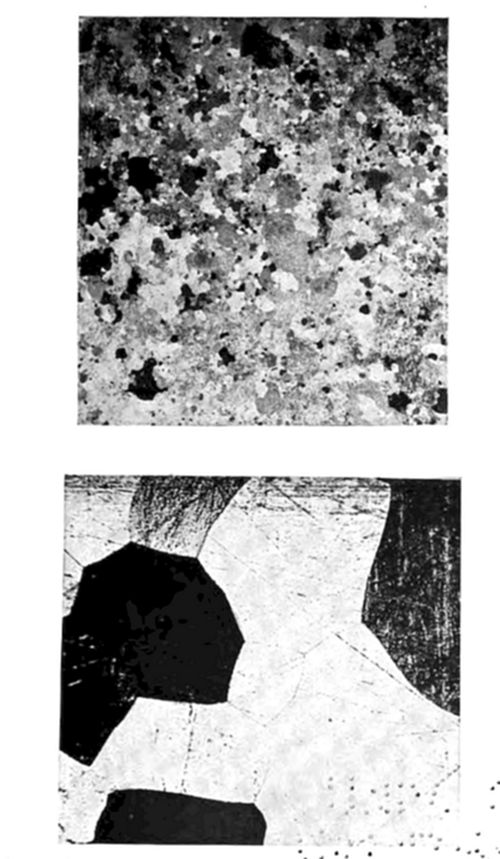
Yet, as I have said already, the microscope can only go so far. It stops well short of the point we must reach if we are to understand how the atoms act to give the various materials their own particular properties. It can show the separate crystals in the metal, but not the arrangement of the atoms inside the crystals (Plates XXII and XXIII). In the X-rays we find a new hope; indeed it is more than a hope. We can be sure that the close knowledge they give us will in the end throw a flood of light on what lies behind all the complicated properties of metals. It may be a long time before the new movement grows great and obvious, because the experience of thousands of years has to be caught up with and explained. It is quite different with a subject such as electrical engineering, or wireless telephony, which is a branch of it. There the whole business is rooted in the work of the physics laboratory, and its growth has been steered by knowledge and foresight. The metalworker has been guided down the ages by trial and error, by experiments with little knowledge to direct them. It is a very slow process, but it has been going on for a long time, and what it has found deserves respect. It must be studied very carefully in the new light the X-rays give us.
We are already beginning to find explanations, as we may call them, of some of the properties of the metals. They depend on the crystal structure, as we might have expected. Sometimes the crystals can be seen with the naked eye; sometimes they show up when the surface is properly prepared and put under the microscope. But the easiest and most thorough way of finding them is with the X-rays, which see so finely.
The X-rays have worked out the structures of nearly all the metal crystals, and it turns out that they are usually very simple. The atoms of gold, silver, copper and aluminium, for instance, are stacked like the piles of round cannon shot that used to stand beside the guns a hundred years ago. It is worth looking at this arrangement a little carefully, even though we are really going over again the comparison we made between the structures of ice and diamond in the last chapter.
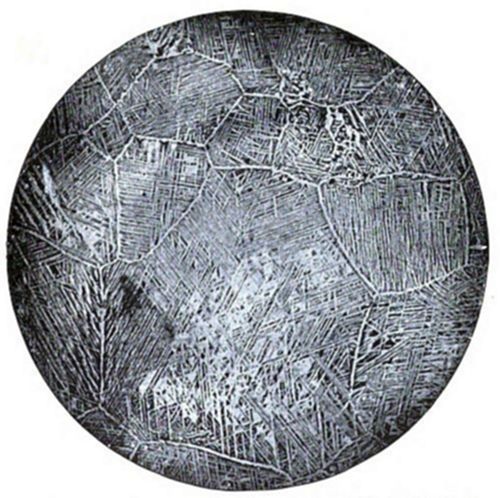
Suppose we put a number of balls together in the triangular arrangement of Figure 53 and surround them with a triangular frame, as shown, just as the balls are packed for a game of pool on the billiard table.
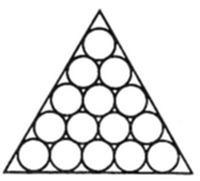
On these we lay another layer, making a triangle a little smaller than the first, and then more layers, until the triangular pyramid is finished (Plate XXIV, B). Plainly there can be no closer way of packing round balls together. Now if we look at how the layers lie one above another, we find that the balls in any layer sit exactly over the balls in the next layer but two. Without a model, Figure 54 will help us see this. The crosses mark the centres of the balls in one layer, the circles the centres in the next layer, and the black spots the centres in the third. The centres in the fourth will be over the crosses, those in the fifth over the circles, those in the sixth over the spots, and so on.
When balls are stacked this way, we can cut cubes out of the pile, as in Plate XXV, A. This always comes as a surprise the first time we notice it, but the reason is worth understanding, because so many crystals are made of atoms piled together this way, and they so often grow as cubes or show in some other way their close kinship with the cube.
Now suppose that when we have laid down two layers and come to the third, we place it so that each ball sits exactly over a ball in the first layer, which is the only other choice besides the one we made before. That gives us another way of packing the balls, every bit as close as the first. This time the balls in any layer sit exactly over the balls in the next layer but one. Figure 54, A, is replaced by Figure 54, B, and the arrangement of Plate XXV, A, by that of Plate XXV, B. Without walls to hold it in, this arrangement will not stand up unless we use an unreasonable number of balls, and we must pin them together somehow. When we look down on this model from above, we see six-sided tunnels running right through it, and we see nothing of the kind when we look at it from any other direction.
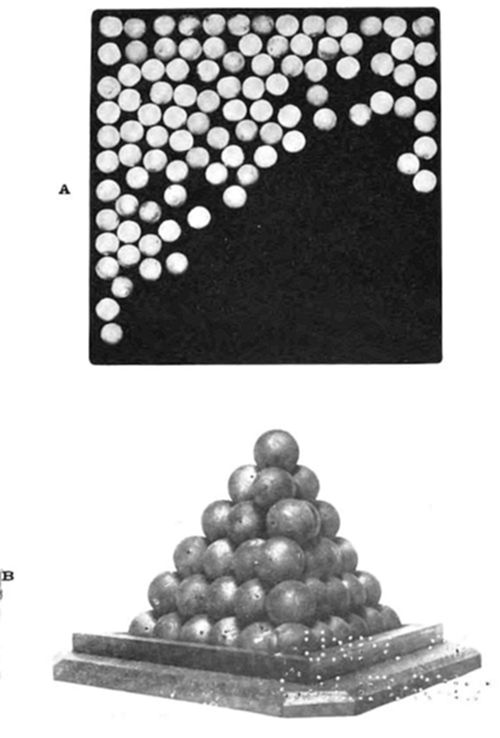
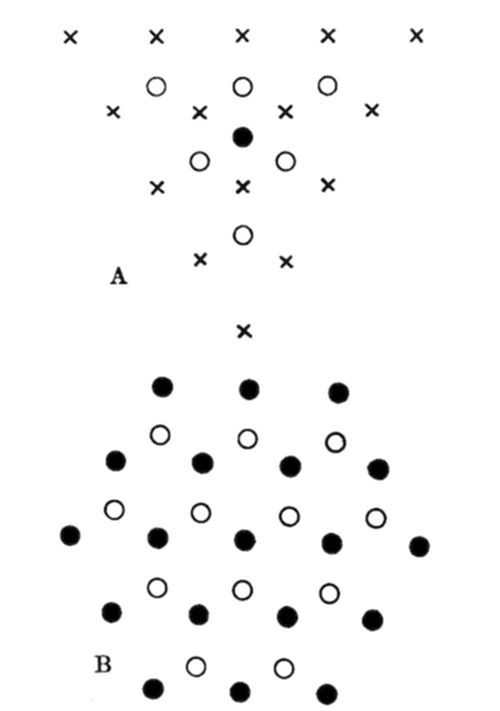
The model has a single axis, running straight up, and round that axis the balls are arranged in such a way that a crystal built on this plan would naturally form six-sided columns.
With the cube there are four ways of thinking of the layers. There is a set of layers standing square to each diagonal of the cube, and since a cube has four diagonals, there are four sets of layers. This does not mean that the atoms in any one layer are specially tied together within it, only that the atoms of the crystal can be sorted into layers of this kind in four different ways.
Now these layers turn out to matter a great deal for the properties of the metal crystals built on the close-packed cubic plan. Gold, silver, copper, aluminium and other metals like them can be drawn into wires, rolled into sheets and beaten into all kinds of shapes. They are, as we say, ductile, and their ductility is one of the things that make them so useful. They can be bent and pulled into all sorts of handy forms. It seems possible to make a metal flow like treacle. Gold can be hammered into leaves so thin that the metal in a gold sovereign would cover a large field, and the others can be beaten nearly as thin.
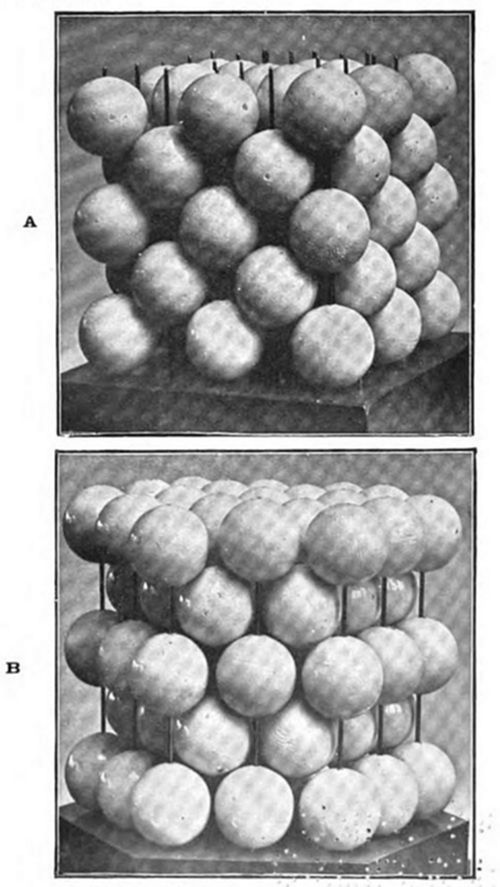
Cups and vessels of every sort, chains and ornaments, and countless useful things are made by taking advantage of this remarkable property of ductility. The first thing we should like the X-rays to explain to us, if we can get them to, is the feature of the structure that accounts for this most valuable property. We should also like to understand what lies behind the hardening and other changes brought about by "cold-working," as it is called, which means hammering or straining the metal while it is cold. And what is annealing, the softening and relief from strain that heat brings about? Why are all these things so obvious in a metal, while they do not show at all in, say, diamond or rock salt or quartz?
We are already beginning to see a little way into these hard questions. In particular we have found out something about the way a metal gives way to a pull or any other strain, and we have learned that it has to do with the layers I have described.
A metal is seldom a single crystal. In general it is a collection of crystals pointing every which way. Sometimes these crystals are easy to see; sometimes it takes the microscope to show them. Very often they are too small even for the microscope, and only the X-rays can reveal them.
If we put a number of shot on a tray and let them all run together by tilting the tray slightly (Plate XXIV, A), we notice that the shot tend to arrange themselves like the balls in Figure 53. It will seldom happen that all the shot form a single arrangement. There will be groups, each properly arranged in itself but not lined up correctly with its neighbours. In just the same way there will be local arrangements among the atoms of a metal: in other words, the metal crystallises in groups, larger or smaller, and the joins between the groups are somewhat irregular. We may notice straight away that the join between one group and the next is not necessarily any weaker than the links between the atoms within a group. Why this should be is hard to say. It need not surprise us, because the ties between atoms are complicated things that we understand only imperfectly, and we cannot predict exactly what will happen in every case.
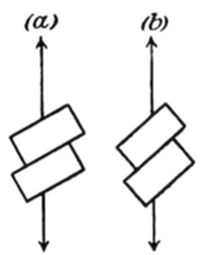
It is said that when gold is very hot a crack runs through the crystals, but when the gold is cold it goes round them, and this shows how complicated the effect is.
We may reasonably expect, then, that a block of one of these metals is a mass of crystals, large and small, and that is exactly what the X-rays show, even when the microscope fails because the crystals are too small for it.
Now when we take a single crystal and try to bend it or pull it out of shape, we find that it always gives in the end by slipping along a plane: everything on one side of the plane slides past everything on the other. These planes are the ones we spoke of before, those in which the atoms are arranged as in Figure 53. A single metal crystal does not give way exactly in the direction it is pulled. If we had two blocks of glass, say, held together with grease as in Figure 55, and pulled them, they would give along the plane between them.
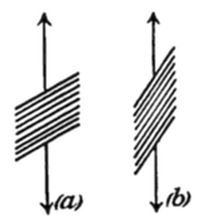
Naturally they will slide over each other along that plane rather than tear themselves apart. In a metal there is not just one plane but many, and many of them will slide, either together or one after another. We might picture the crystal as a set of lines, as in Figure 56 (a), which, pulled in the direction of the arrows, would give way as in Figure 56 (b). Often, when a single metal crystal has been stretched, we can see marks on its surface showing the lines along which it has slipped.
Professor Carpenter and Miss Elam have recently shown some beautiful examples of this kind of effect in large crystals of aluminium. An ordinary piece of the metal is made of a multitude of crystals pointing all ways, as we have already seen. By a rather complicated process of heating and stretching, the many small crystals can be made to line up and form a few large crystals, just as we might imagine that by shaking or tapping the tray of shot in Plate XXIV, A, in some way found by experience, we could merge all the small orderly groups into one large one.
The pieces chosen for the experiment had a shape often used for testing how well a metal resists a pull; the shape is shown in Plate XXVI, and each piece was eight inches long to begin with. The broad ends are meant to be gripped in the jaws of the machine that stretches the piece. The narrower part is the part meant to give way, and the way it gives, together with the pull needed, shows how well the metal can resist the forces that would strain it.
When one of the test pieces treated this way is put into the testing machine and pulled, it gives way in a curious fashion, which differs from one specimen to another (Plate XXVI, 1 to 4). Sometimes the piece keeps its width and grows thinner bit by bit as it lengthens under the pull, and it may stretch by several inches before it breaks. Sometimes it keeps its thickness and shrinks sideways, developing a waist that finally becomes the place where it breaks. At other times there are stranger changes still. These pieces have been examined with the X-rays, and it turns out that the way each one gives depends entirely on how its large crystals are set toward the line of the pull. The metal gives way along the plane of slip. If, for example, the crystal happens to be set (and there is no telling, during the heating and straining, how the growing crystal will lie) so that the layers we spoke of lie as in Figure 56, then stretching will make the piece draw in at the sides.
Sometimes the direction in which the crystal gives way depends on a more complicated use of two sets of slip planes in turn. When the crystal could slip on more than one set of planes, it tends to choose the one that stands more nearly square to the line of the pull. We can imagine why. A slip means one set of atoms riding over another, and the motion would be helped by a force that tends to pull one layer away from the other. If we had a solid made of a row of balls like the top layer in Figure 57, resting on a similar row like the bottom layer, it might be easier to drag the top layer over the bottom one if the pull were along P rather than along Q.
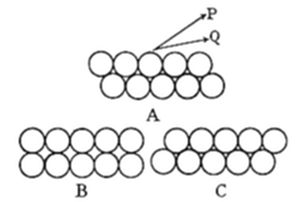
Since the pull always tends to swing the plane of slip more nearly into its own line (see Figure 55), a sort of seesaw sets in: the crystal slips along one set of planes until that set comes too nearly into line with the pull, and then along another. In the end the line of the pull cuts the angle between the two sets exactly in half. The balance often shows in the shape of the broken ends. In Plate XXVI, 3, for example, there is a kind of knife-edge at the point of the break. The two sides of the edge run parallel to two different sets of slip planes, and they slope equally to the line of the pull that finally tore the metal in two.
Aluminium gives way so easily that a fairly thick sheet made of a single crystal can be bent with one's fingers without any trouble. An ordinary piece of aluminium sheet, though, is quite stiff, and the reason for the difference is that when there are crystals pointing in all directions, some are always ready to take and bear the strain, whichever way it comes. A chain is only as strong as its weakest link, and the weak part of a crystal is its slip plane. This point matters enormously in making metals, though it is so often tangled up with others that its own effect is hard to sort out from the rest. Many things go into designing a steel, say, for some particular purpose, but one of them is certainly how fine the crystal grains are that it is made of. Fineness, and evenness of size, both add to the toughness of steel and to its quality in general.
When a single crystal of aluminium gives way along a layer, we may suppose there is a moment when one set of atoms is riding over the other, and then a drop back into place: A goes through B to C (Figure 57). When C is reached, the close-packed arrangement is restored and the metal is still a crystal. Now, as we know, the regular crystal arrangement is the natural one, and the substance slips easily from one natural arrangement to another, fitting itself to the pull or other strain as it does so. No doubt this is one of the causes of ductility, and a very important one.
But why does a metal often grow harder when it is hammered? And what happens to it when it is annealed? We may find a clue to the answer in what happens to gold when it is beaten into leaf and then heated. Gold leaf is very thin, as we have seen. It is even transparent, though it soaks up part of the light that passes through it and lets a greenish light filter through. Seen by reflected light it is yellow, as we know. The curious thing is that once it has been heated to a dull red it becomes permanently transparent, and white by reflected light. Faraday was very interested in this. He suggested, as a partial explanation, that the thin layer of gold broke up, the metal gathering itself into little heaps, and that the light went through the holes left behind. Sir George Beilby has made many experiments and added a good deal to what we know about how this and other substances behave when they are heated in the same way. If there are holes in the heated leaf, he says, they are exceedingly small, too small for the microscope to see. Now the X-rays have something to say on this point. When gold leaf is examined with their help, it turns out to be made of masses of cubic crystals of gold, all lying with their faces parallel to the leaf. They are not necessarily cubes, of course. Like ordinary salt, which is cubic, they are rectangular blocks of all sizes. They must be exceedingly thin blocks, no doubt far thinner than they are wide or long. When the leaf has been heated, the blocks are piled up anyhow, perhaps gathered to some extent into heaps, as Faraday supposed, even if the heaps are too small for the microscope to see; and perhaps this is why gold and silver leaf become transparent when heated. Why gold should look green when we look through it is a mystery. But we can see that beating the gold has spread out the crystal blocks so that they all lie with one face in the surface of the leaf, and that heat has destroyed this much regularity in their arrangement. When the heated gold leaf is pressed with something that has a smooth, hard surface, such as an agate, it goes back to its first state, as we might expect, since the pressure would force the blocks flat once more. Either way the metal is crystalline, but there is more order in the ordinary gold leaf than in the annealed. The same effect is found with silver. To show it with copper we should have to do the experiment in such a way that the air could not get at the metal. When copper is heated in the open, a film of copper oxide quickly forms all over it, and that change too can be followed by the X-rays. We often see this tarnish form slowly on copper even without any heating. But the X-rays easily show that the crystal blocks in copper foil are arranged just as they are in gold leaf. A block of ordinary copper, on the other hand, shows no such arrangement; its crystals lie anyhow.
The hardening of these metals by cold-working is therefore due somehow to the strain they are put under by the rearrangement of the crystals that the X-rays reveal, and annealing is the release of this strain and the undoing of the arrangement. Why this should be so we are still very much in the dark; we can only be content that we have taken one step forward.
It is worth noticing that, in general, a metal strained in this way is more easily attacked by chemicals, as we might expect. It has not settled down so well into what we might call a comfortable state.
We ought now to go on to other peculiarities of the metals, since we may expect them all to spring from much the same causes, and we must study them together. Two of their most remarkable properties are their power to conduct heat and their power to conduct electricity. We all know how quickly heat spreads through a metal; we might almost say that a metal can be recognised by that property alone. We all know too how metals, especially copper, are used to carry electric current.
If we go back to our first look at the nature of the atoms, and at the differences between them, we find at once a feature that on the whole seems to give a satisfactory explanation of their power to conduct; and no doubt it has a great deal to do with their crystal structure and their ductility too. The atoms of the metals always have one or more electrons that are held only lightly. Sodium, for instance, has eleven electrons. Two of them are very close to the nucleus, and eight more form a very firmly held system round those two. The odd electron belongs to an outer system altogether, which fills up as we go from sodium to magnesium, with two in the outermost system, then to aluminium with three, and so on. This odd electron is not held tightly. When it is stripped off for any reason, the atom is reduced outwardly to the form of the unsociable atom, neon, except that as a whole it carries a positive electric charge, because losing an electron has upset the balance. An aluminium crystal is a collection of spheres like neon, all close-packed in the way described, and all the odd electrons are more or less free to wander about in the structure. It must be said, though, that this picture is no doubt much too crude to be the whole truth; there must be much more in the design that we know nothing of yet. Still, it must be right up to a point. It shows us at once why metals conduct electricity: the electrons, the basic charges of negative electricity, can move about so easily. When a current of electricity runs along a metal wire, it is the electrons that make up the flowing stream. Oddly enough, being negatively charged, they must move in the opposite direction to the one in which the so-called current of electricity has always been imagined to flow. All this talk of a flowing current of electricity was always a manner of speaking. That anything moves at all is quite a new discovery, and we need not be surprised that the real direction of flow is the opposite of the one people had supposed.
We must think of the battery or the dynamo, then, not as manufacturing electricity, but as driving round a circuit a stream of electrons that are there already and are more or less free to move.
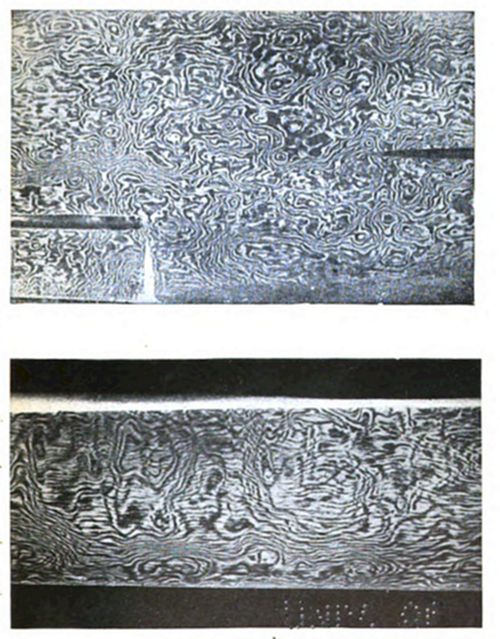
In the same way the engine in a factory keeps a leather belt travelling round and round a certain circuit, but the engine does not manufacture leather.
When a metal is heated, the electrons inside it dance to and fro faster and may break away into the open. In the "valve" of a wireless set, electrons pour from the hot wire in a continuous stream, and the valve cannot work without that outpouring.
Electrons do not move as easily through a metal when it is hot as when it is cold. Here again it is easy to imagine why. The electrons will have more trouble threading their way among the atoms of the metal if heat is making the atoms swing to and fro and get in their way. It is much harder to explain the strange fact, discovered at Leiden by Kamerlingh Onnes, that some substances, once their temperature has been brought down to a certain very low point, which differs from metal to metal, offer no resistance at all to the movement of the electrons. A current once started will keep running for days before it finally fades away, as long as the metal is kept at this extremely low temperature the whole time.
The electrons must also help to some extent in carrying heat through a metal as well as electricity, because the electrons at the hot end of a metal bar must pass on some of their extra energy to the electrons at the cold end.
The presence in the metal of electrons that can move with some freedom among the atoms of the structure gives a very good reason, then, why the metal conducts both heat and electricity. Of course the picture we have drawn is only a rough one. Many details still have to be filled in, and no doubt many really important facts have been left out altogether because we do not know them.
Let us go back to the ductility of metals and see whether the electrons help us here as well. We now picture our atoms as spheres, all charged with positive electricity and closely packed, and we may perhaps be right in thinking that the electrons hold them together like a cement.
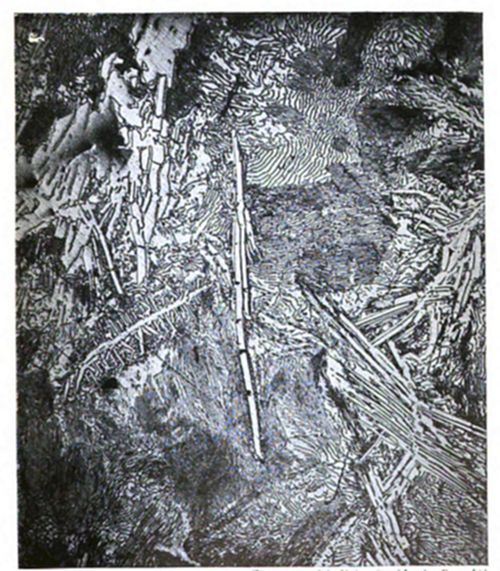
But the most important point is that the atoms are not tied together by sharing electrons, as they are in diamond. Since they all carry positive charges, they must if anything push one another away. They are free to roll or slide over one another, because they are not fastened to one another at fixed points, as so often happens in other crystals. All this seems to help us understand how one plane slips over another.
Up to now we have been looking at the crystal structure and properties of a few metals in the pure state. In practice, though, we meet alloys far more often than pure metals, for the good reason that alloys have properties of their own that are of the greatest value. Alloys are, in fact, extraordinarily interesting in their immense variety and in the wide range of their uses. New ones are being discovered all the time. Whatever special virtue is wanted for some particular job, some alloy or other turns up that meets the need more or less completely. We must try, if we can, to see some reason for these things in what we have lately discovered. Of course we know so little as yet, and there is so much to explain, that in a few years' time we may think very little of our present attempts; but we have to make a start.
It very often happens that adding quite a small amount of a second metal, or even of a non-metal, to a metal makes it noticeably harder. Pure metals are generally very soft, because their slip planes give so readily. The first of all the great alloys was bronze, a mixture of copper and tin, which is far harder than either metal alone. Copper and zinc together make serviceable brass, which comes in various qualities, depending on the proportions of the mixture. Steel is made by adding a small percentage of carbon to pure iron. There are alloys of copper and aluminium that are very tough and do not corrode, but are hard to work in the shaping machine. There is an alloy of copper and nickel that does not corrode and is easily moulded; it is used for the jackets of bullets. German silver is a white, ductile alloy that does not corrode. It is used to make such things as spoons and forks, which are afterwards coated with silver by the process known as electroplating. An alloy of nickel and chromium stands very great heat and is used for the wiring of electric furnaces.
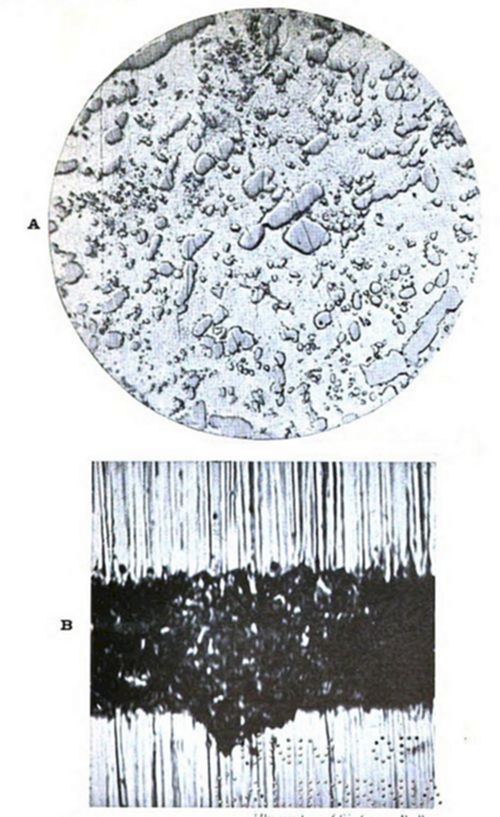
Chromium, cobalt and tungsten combined in fixed proportions make stellite, an extraordinarily hard substance that does not corrode; some of the standard weights at the National Physical Laboratory are being made of it. There are alloys for making bells, very soft alloys for type metal, and a great variety of solders. There is aluminium bronze, used for cheap jewellery, which is aluminium with a small percentage of copper. And so on, in a long list, if there were any need to make one.
Let us take one of the simpler cases, for instance the one in which adding a little aluminium to copper makes it harder. The X-rays show that the structure of the copper crystals stays the same, except that here and there an aluminium atom has taken the place of a copper atom. Now the weakness of the crystal lies, as we have seen, in the way one part slides over another along a certain plane. That plane is no longer smooth: there are aluminium atoms scattered through it, and we can easily suppose that slipping has become harder and that this is the cause of the hardening.5 There is a remarkable effect which makes us think we are right. The aluminium atoms must strain the structure of the copper crystal, because the copper will not take more than a certain number of them. If an alloy is made with more than about 10 per cent of aluminium, the X-rays tell us that the copper crystals break up altogether and a new structure forms.6 The aluminium atoms must be distorting the copper crystal, and this fits very well with the fact that they harden the copper. When nickel is added to copper, on the other hand, its atoms replace the copper atoms to any extent at all: plainly they can slip into the copper atoms' places without straining the copper crystals in the least. And in this case there is no hardening, which is just what we should expect. Only when we push in atoms that really strain the copper crystal and make its planes uneven do we get hardening. We have jammed the sliding planes.
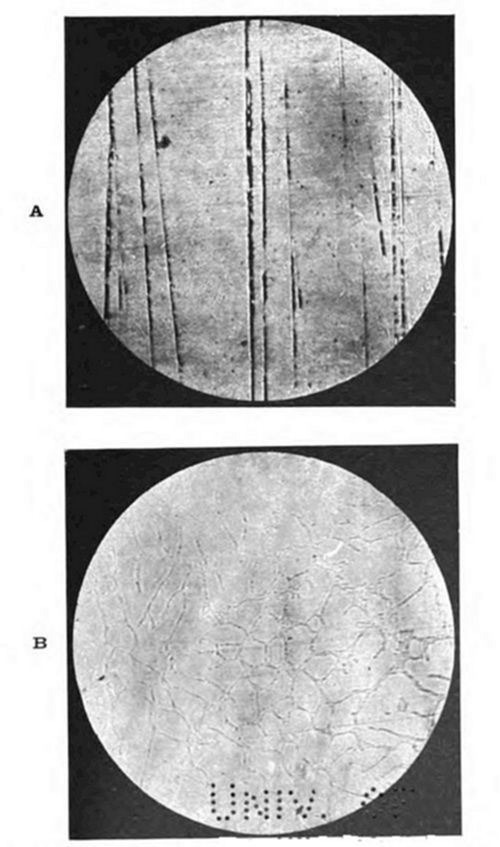
With steel the action is of the same kind, except that the carbon atoms that cause the hardening do not replace the iron atoms but are forced into the empty spaces between them. We can easily see that this may distort the iron crystal and, as before, block movement along a plane of slip. Once again there is a limit to how much of the alloying substance can go in: only a small percentage of carbon can be put into iron without breaking up its ordinary simple structure.
The problems of iron and steel hold many more complications than this, however. We have only to ask what happens when more carbon is put in than the iron structure can hold, and we find ourselves with a new problem. Among other things, a new crystal appears, made of molecules each containing three atoms of iron and one of carbon; it is called cementite. These new crystals are very hard and unyielding, and shaped like needles (Plate XXVIII). They harden the iron very greatly and make it hard to work. A beautiful example of their effect on steel is found in the old swords that once made their way from India through Damascus into Europe. Damascus steel was prized for its excellent qualities. Fine specimens can be seen in the Wallace Collection in London; they show the typical wavy pattern (Plate XXVII) that has always been taken as the mark of the genuine article. Under the microscope the lines of the pattern turn out to be made of multitudes of dots, a sort of Milky Way in the steel. These dots are the tiny crystals of cementite. As Colonel Belaiew tells us, the steel was very hard to work when it was first made. The smith, with his little furnace, would heat the steel red hot, but after only a few blows, once he had made a slight dent in it, the brief softening was gone. The hardness due to the cementite crystals had been lifted only for an instant. More heating, a few more blows, and slowly the steel grew less rigid. What was happening was that the cementite crystals were changing their form. They were growing less like needles and gathering themselves into rounder shapes, and as they did so the steel became more pliable (Plate XXIX, A). At last the smith arrived at the fine Damascus steel, so strong and yet so springy.
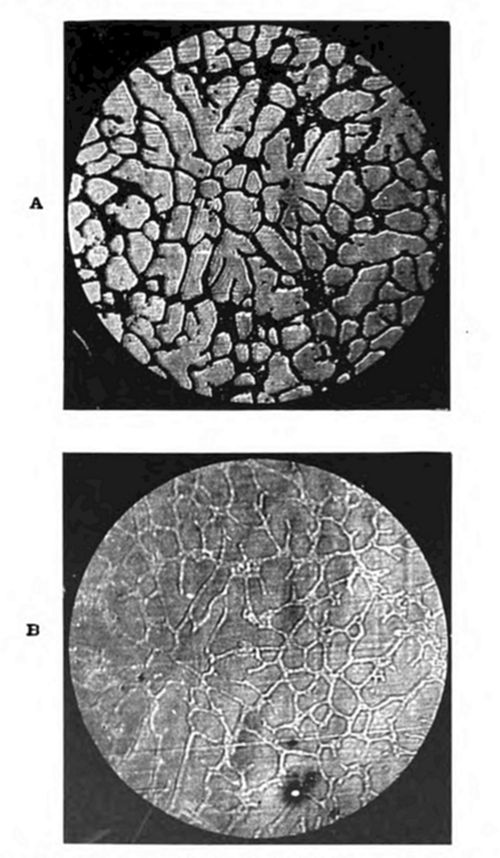
Very likely much of the keen edge these swords would take came from the very hard particles set fast in the softer iron. The edge would be like a saw with extremely fine teeth. In the contest of skill between Saladin and King Richard that Walter Scott describes in The Talisman, Saladin threw a gossamer veil into the air and cut it in two by drawing his scimitar across it, a fine test both of keenness and of skill. Richard, for his part, used his sword like an axe and split in two an iron bar, the mace of one of his knights. That too was a test that called for great qualities in the steel, but the man's skill lay more in the power to strike a tremendous blow than in delicacy of touch.
Grinding, sharpening and polishing are really very interesting operations. When we put a knife to the grindstone, we let the hard crystals in the stone cut tiny furrows in the steel, actually carrying away the material. That is one stage of sharpening. But polishing on the oilstone or the strop is a different thing altogether. Here we actually make the steel flow, smoothing down the furrows, and sometimes, as Sir George Beilby has shown, even drawing a skin of metal over the deeper hollows. The metal seems to stay crystalline the whole time; the X-rays readily show the crystals in a razor blade. Probably the action is the same as the one that took place in the gold leaf when it was heated. The oil we use helps the smoothing. The metal is strained by the flow; in time the strain tends to come undone, and heat in particular can take away the keenness of the edge (Plates XXIX, B, XXX and XXXI).
An alloy generally conducts electricity much worse than a pure metal does. It may well be that when the stranger atoms are forced into the structure of the pure metal and the planes of atoms are made uneven, the electrons find their way through the metal more hampered. More energy is needed to drive them along, and the metal grows hotter as the current passes than it would if it were pure. With a pure metal, as I said before, the resistance to the movement of the electrons grows if the temperature is raised. We can imagine that the electrons find it harder to get past the atoms when the atoms are livelier, since heat makes them swing to and fro faster about their proper places.
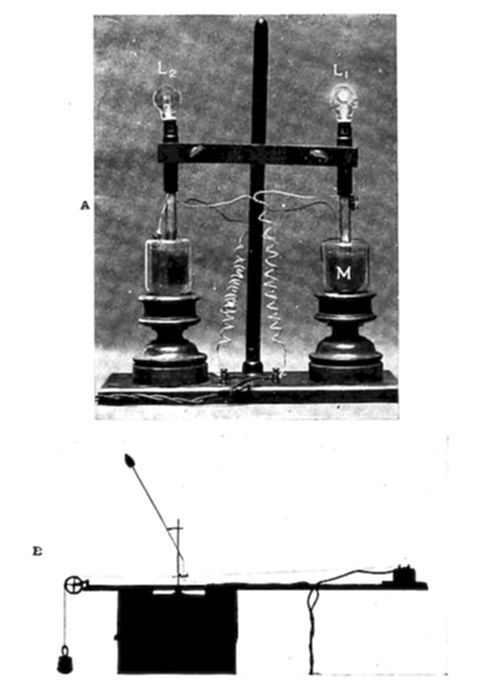
Heat makes much less difference to alloys, though, because the electrons already have so much trouble getting through that heat changes very little. A simple experiment shows this.
A battery sends a current round a circuit that has two branches, as in the photograph (Plate XXXII, A). One branch holds a coil of copper wire, M, and a lamp, L1; the other holds a coil of an alloy, such as German silver, and a lamp, L2. The coils are adjusted, as to the resistance they offer to the current passing through them, so that both lamps burn dimly. A vessel of liquid air is brought up so as to surround the coil M, and at once the lamp L1 burns brightly. Cooling the copper wire has lowered its resistance to the passage of electrons, and more current flows through the lamp. But when the alloy in its turn is dipped in liquid air, nothing changes.
Sometimes a metal crystallises in more than one way. Iron gives one of the simplest and most striking examples. At ordinary temperatures the iron atoms are arranged so that each atom has eight neighbours, sitting at the corners of a tiny cube with the first atom at its centre. This is not the closest way of packing, as anyone will soon find by trying it. The pile of shot I spoke of before gives the closest packing, and in it each shot has twelve neighbours: six touching it round its equator, and three more round a line of latitude in each hemisphere. To put it another way, it has six in its own layer and three in each of the layers on either side. This is the packing of gold, silver, copper and aluminium. The curious thing is that when iron is heated to a cherry red, the atoms change their arrangement and pack in the tightest form, that of the pile of shot. The effect is easiest to see when an iron wire is heated past this point and then allowed to cool. When it reaches the critical temperature, the atoms suddenly go back to the looser packing and the wire stretches a little, and the increase in length is easy to see with some magnifying device. It is curious too that when the old form changes to the new, some energy is set free and the iron suddenly glows brighter again. The stretching and the brightening have been noticed for a long time, but only quite recently have we found out that the packing of the atoms in two different crystal forms lies at the bottom of what we see (Plate XXXII, B).
These very few examples of the link between the properties of a metal and its crystal structure are taken from an immense subject, most of it still waiting to be explored with our new helpers, the X-rays. We cannot say in advance what will be found. But we can be very sure of one thing: the better we understand our materials, the better use we can make of them.
Note
After trying many ways of making models of atomic structures, and models of many substances, I find that two things have real merit.
Balls to stand for the atoms can be made of hard dentists' wax, which softens in boiling water and can then be pressed into shape in metal moulds made for the purpose, just as we used to remould our golf balls in the old days. The round mould is made in two halves, and it is handy to mount them in the lathe, one on the headstock and one on the tailstock centre. Small balls harden at once and can be made very quickly; larger ones must be left in the mould for a little while. The hard wax can be drilled without being softened and bent out of shape by the heat the drilling makes. Models made of the wax look very finished and will stand any ordinary temperature. The wax is rather expensive.
Gramophone needles make good connectors, the balls, whether wax or wood, being drilled to take them. The holes must be drilled true and in exactly the right places. Handy little gadgets can be made for doing this on the lathe.