Dedication
TO
PEGGY, GWENDY, AND PHYLLIS
WHO DISCUSSED WITH ME SO MANY OF THE THINGS IN THIS BOOK AS WE WALKED TO SCHOOL IN THE MORNINGS
AND TO
ALL THE OTHER JUVENILES
(INCLUDING THOSE OF THE GROWN-UP VARIETY) WHO CAME TO THE CHRISTMAS LECTURES AND MADE SUCH A KINDLY AUDIENCE
Illustrations
The decorative headings and tail-pieces to the Lectures, and the pencil vignettes in the text, are reproduced from drawings by Miss Audrey Weber; while the illustrations of the actual experiments are by Mr. W. B. Robinson, from material supplied by the Author.
Lecture I: What is Sound?
All around us are material objects of many kinds, and it is quite difficult to move without shaking some of them more or less. If we walk about on the floor, it quivers a little under the fall of our feet; if we put down a cup on the table, we cannot avoid giving a small vibration to the table and the cup. If an animal walks in the forest, it must often shake the leaves or the twigs or the grass, and unless it walks softly with padded feet it shakes the ground. The motions may be very minute, far too small to see, but they are there nevertheless.
Besides the obvious surroundings of material things, there is an ocean of air in which we live. We cannot move without stirring it; and, moreover, whenever we make anything else move, as when we shake the ground or the branches or the table or whatever it may be, the air is shaken too because it touches all these objects and moves when they move. It is very easy to set the air quivering, and when once a quiver is started it runs through the air in all directions till it has spread and weakened and died away. Also it is a very curious thing that the air can carry ever so many quivers at the same time, going in many different directions, and of many varieties. But each travels as if there were no other there. We will presently consider an experimental illustration of this fact.
Now since nothing can be done without starting shakes and quivers, in solids or in liquids or in air, in some or all of them, and since it is very important to every one to know what is happening round about him, so far as it is possible to do so, it is not surprising to find that we human beings, and most animals, possess organs especially fitted to detect these shakes and quivers, and that we make great use of them. The ear is marvellously sensitive to the minute quiverings that come to it through the air, and then pass down the tube of the ear and come finally to the delicate organs within. We say that we hear a sound, which means that somewhere or other an air quiver has been started and has reached our ears. As the life and processes of the world go on, the actions which take place are accompanied by these tremors, and we live in this world of sound. We can interpret what we hear because all the tremors are different and we have learnt to know them all. We can tell the sort of tremor that is made by the rustle of the leaves from the sort that is made by thunder or the call of an animal. In fact, it seems quite absurd to think that there is anything wonderful in it, because the "sounds seem so different." But of course that is just where the wonder lies; only air tremors in every case, and yet the ear has such marvellous powers that it can sort them all out from each other, can tell one person's voice from another, can tell one word from another, can even tell by the minutely differing shades of inflection the spirit that lies behind the word. The more one thinks about it the more wonderful one finds it to be.
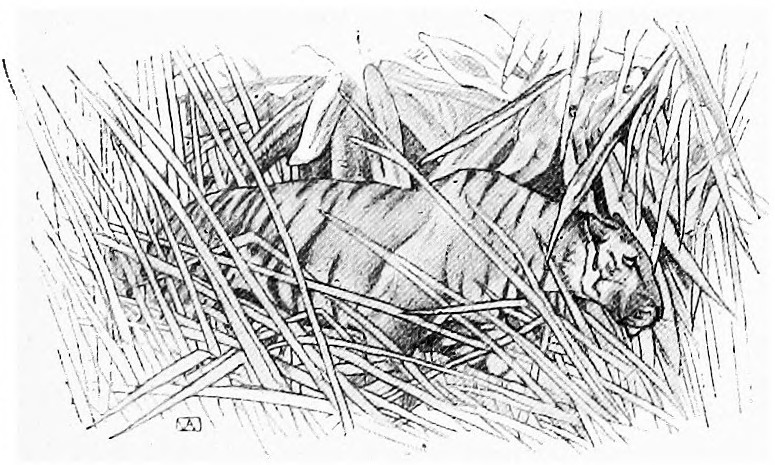
No doubt the reason why ears can be and are so finely trained is because the information they give is so important and so interesting. Sometimes it is a matter of life or death, as in the case of the animal who hunts or of the animal that is hunted. It is everything to us to be able to talk to our friends, to use our voices, and to set in motion air quiverings that have special meanings to those that hear them. If we walked in the country how much we should miss if we could not hear the birds or the wind or the brook or the passers-by! Think what it would mean to us if we could have no singing and no music. The quiverings of the air, and our ears that hear them, link us closely to the world about us and to our fellow-creatures.
In this first lecture I want to show you some of the things that happen when sound tremors pass from place to place. And first of all we will repeat some of the experiments that Tyndall used to show in this room half a century ago. Perhaps you do not all know that Tyndall was a very famous lecturer on the staff of the Royal Institution. He gave once a series of lectures on the laws of sound, which he illustrated by beautiful experiments. Most of the apparatus which he used is still here, and it will be quite interesting to use some of it once again.
In the basement of this building, two floors below us, there is a powerful musical box. It is playing now, but we do not hear it because none of the quivers which it makes, whether in the air or the floor or the walls, is strong enough to get to us. They cannot come by the air because there are floors and shut doors which they cannot pass through easily; and they do not come by way of the walls because the quivers which get into the floor and walls are far too weak. But there is a long rod which rests on the musical box and comes up to this room through holes in the floors which are between. Up this rod the quivers come quite strongly; if I put my ear to the rod I can hear the musical box very plainly. There are probably few in the audience who can hear it, and the reason for that is that the rod is so small in cross section that when the quivers reach the end they do not give enough motion to the air. Some bigger surface is wanted which will take the motion from the rod and be broad enough to shake the air over a large surface. When a tea tray is put on to the top of the rod every one can hear the musical box with ease; a violin does just as well; even a soft felt hat makes the music plain. The chain of communications is now complete. First of all the springs in the musical box are shaken by the mechanism, then the quivers run into the sounding-board; they come up the rod, and by means of the broad surface of the violin or other object they are given to the air in such quantity that, even allowing for the spreading through the room, they are strong enough to affect every ear that they reach.
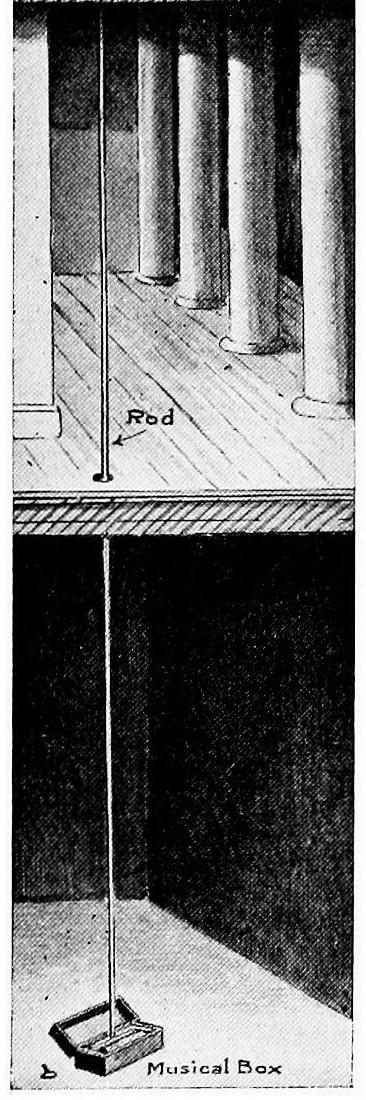
Observe, too, that there is no mistaking the nature of the source; the notes are obviously those of a musical box; the rod, the tray, the violin, the hat, have merely handed on the vibrations, with little change. It is a very common practice, as we shall see later (p. 42), to use a large surface for the purpose of launching enough movement into the air, as we have used the violin.
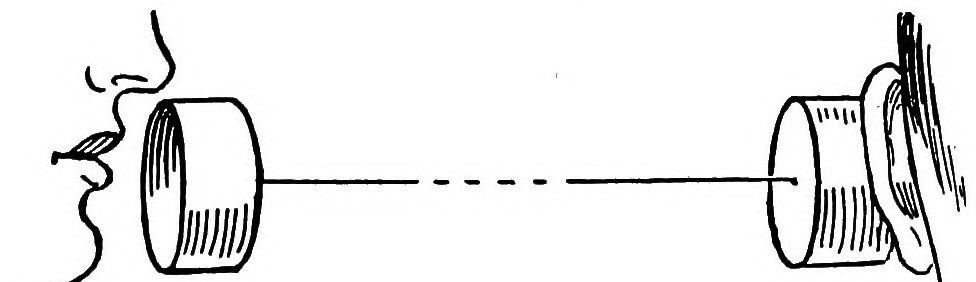
The experiment we have just made illustrates the passage of sound along a solid body—in this case the long rod. It is easy to find many other examples. The water-pipes in the house often carry sounds. Sometimes there is a "singing" or a "hammer" in the pipes when a tap is opened or closed; and the sound runs along the pipes into other rooms. We all know the thrilling moments in the stories of adventure when the hero puts his ear to the ground and hears the thudding of the feet of the pursuing horses. In the "string telephones" that have sometimes been so popular, the sound runs along the tightly stretched thread. People who have lost the power of hearing through the air may still in some cases hear music when they rest one end of a rod on the sounding-board of a musical instrument and put the other end to their teeth. The sound runs through the bones of the head and reaches in this way the mechanism of the inner ear, which must of course be uninjured.
Sound can be conveyed by liquids as well as by solids. In some of the experiments carried out for the Admiralty during the war an under-water "buzzer" was used. It is a small water-tight metal case in which a hammer is made by electrical means to rain blows upon one of the sides. When I lower it into a tank of water and put it into action by pressing an electrical key, it sounds out loudly through the room. The hammer in the buzzer starts vibrations in the metal case, and these run through the water to the walls and so out into the air. The sound has been carried by the water over one part of its journey.
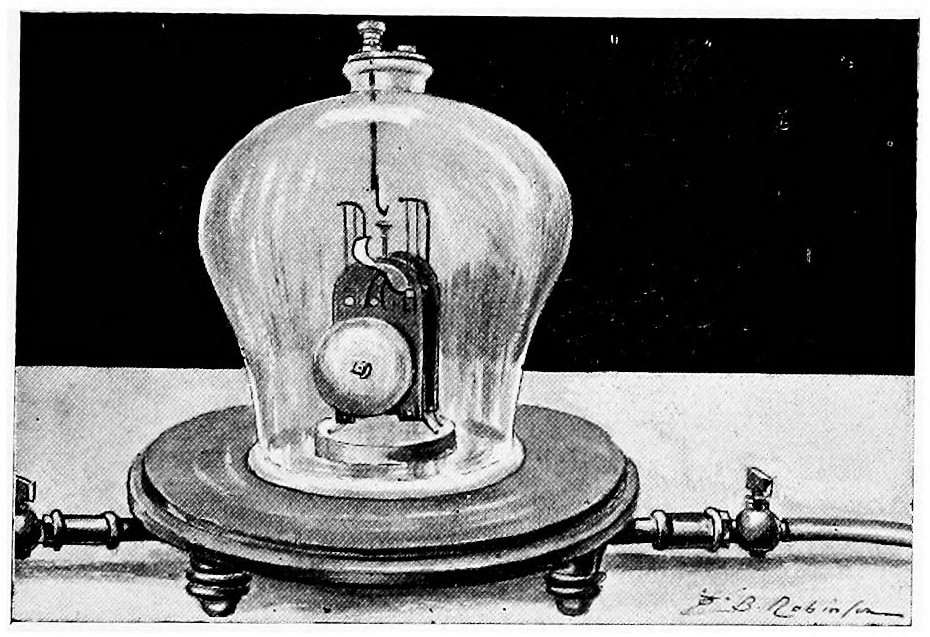
Next we must show the passage of sound through the air, and we will make use of another of Tyndall's famous experimental illustrations. Under this large glass cover there is a clockwork mechanism which can ring a bell. The bell is supported by elastic strings which do not carry sound at all well, so that when it rings, the sound, if it gets to our ears, must have come through the air. The quivers of the bell launch a quivering motion into the air, which gets to the glass wall of the cover and starts it in motion. In its turn the glass shakes the air outside, and the quivers once more run through air and finally reach our ears. Now the cover stands on a plate to which it is firmly waxed down. There is a hole at the centre of the plate which opens into a pipe communicating with an air-pump. The air-pump is worked, and gradually the air is drawn away from underneath the cover. When there is little air left we notice that the sound of the bell has become much weaker. And at last, when every trace of air has been removed, it dies away altogether. That shows that the air was wanted to carry the sound. When we let the air in again the bell sounds out as before.
We have now heard sounds travelling through solid bodies such as the rod that came from the musical box in the basement, through the water in the tank, and through the air of the room, and we have observed that when there is neither solid nor liquid nor gas, sound is not conveyed at all. It cannot travel across what we call a vacuum. Between us and the sun there is space, more empty of gas or air or any other substance even than the glass container which we used just now. No sound can travel across such a space. Light on the other hand travels quite easily. Light and our eyes that see it deal with the doings of the whole universe; sound belongs to the world only. I may talk of the universe of light, but I can only talk of the world of sound.
As soon as you understand that sound is a quivering motion which goes from one place to another you will realise that most likely it takes a certain time to make the journey, and so it does. When, for example, a sound travels through the air it takes nearly five seconds to go a mile, and it is a very strange thing that all sorts of sounds, shrill whistles and deep boomings, take just the same amount of time to travel. If a band is playing a long way away, you hear all the instruments keeping time correctly with each other, piccolo and cornet and drum, no matter how far away they are. If some sounds travelled more quickly than others you would only be able to hear music properly when you were quite close to it. It is a very common thing to find examples of the fact that sound takes time to travel. If you are standing on one side of a valley and you watch a train approach a station a mile or two away on the other side, you may notice when the steam first issues in a white cloud from the whistle as the engine-driver gives warning that he is coming; and light travels so fast that you see the steam practically on the instant that the engine-driver opens his whistle. But it may be many seconds before you hear it. I have often watched the woodcutters at work in Australia, where the clear still air makes it easy to see and hear at long distances. From one side of a wide gully I have seen the strokes of the axe fall noiselessly far away on the other side, and then when the man has straightened himself and begun to move away, the noise of the blows has reached my ears. If you watch a long procession going along a street, marching to the music that heads it, every man puts his foot down at the beat of the drum, but of course the rear ranks do not hear it as soon as the front ranks, so that really they do not march in step. If you look sharply you will see a ripple run along the line as the heads go up and down slightly to the movement of the feet.
Sound travels at different rates through different substances. For example, it travels about fifteen times as fast through iron as it does through the air. You can make an experiment on this in the Park, or anywhere else where you can get a long uninterrupted stretch of iron railing. If you put your ear to the railing and get a friend to strike it with a hammer a hundred yards or so away, you hear the sound twice; first it comes by the iron and afterwards through the air. In water sound travels about four times as fast as in air. It has been necessary, as we shall see later, to measure this velocity very carefully during the war. In the air the actual rate is nearly eleven hundred feet per second.
As the pulses go to greater and greater distances from their source they spread over wider and wider surfaces and become weaker. The farther away the source of sound is from the listener the feebler it seems to be. But, if we wish to do so, we can prevent the sound from spreading itself over wide surfaces, and it will then carry much farther, as, for example, when we use speaking-tubes, which carry the sound pulses with little loss for quite considerable distances. The walls of the tubes inside ought to be smooth, because, if they are not, the rubbing of the air against the walls, as it moves to and fro when the quivers pass over it, spoils the true shape of the waves, turning them into little whirlpools in which the energy is wasted. Moreover, there must be no sharp corners, no right angles in the tubes, because at a corner some of the sound is reflected and goes back the way it came. When a man uses a speaking-trumpet he does something of this kind also, because the trumpet tends to direct the sound in the way the speaker wants it to go. But the action of the speaking-trumpet depends more on the fact that the speaker can actually get a greater amount of sound out of his own throat. You feel that you are working harder when you are using one. The rigid walls of the trumpet do not allow the sound waves to spread sideways very readily, and, in a sense, hold them for the vocal organs to work on.
When the sound spreads away without the artificial confinement of a speaking-tube or anything of that kind it is sure to run up against obstacles of one kind or another. What happens to it then is really a subject of great importance. I think you will find it easier to understand this and many other problems connected with the spreading of sound waves if you take the analogous case of waves on the surface of water. If you watch what happens to ripples in various cases you will be much more able to understand what happens in the case of sound.
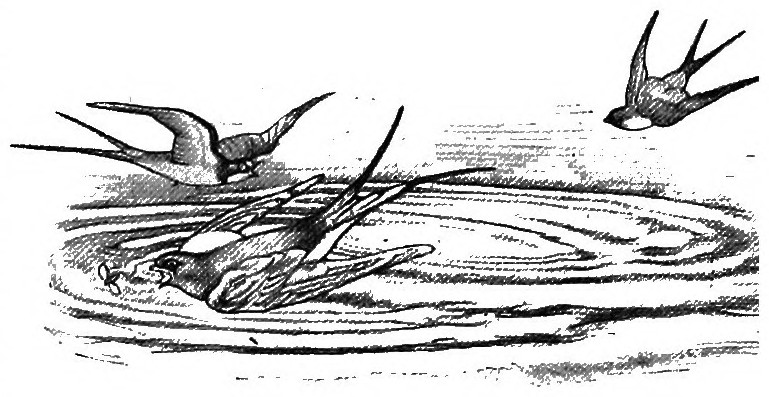
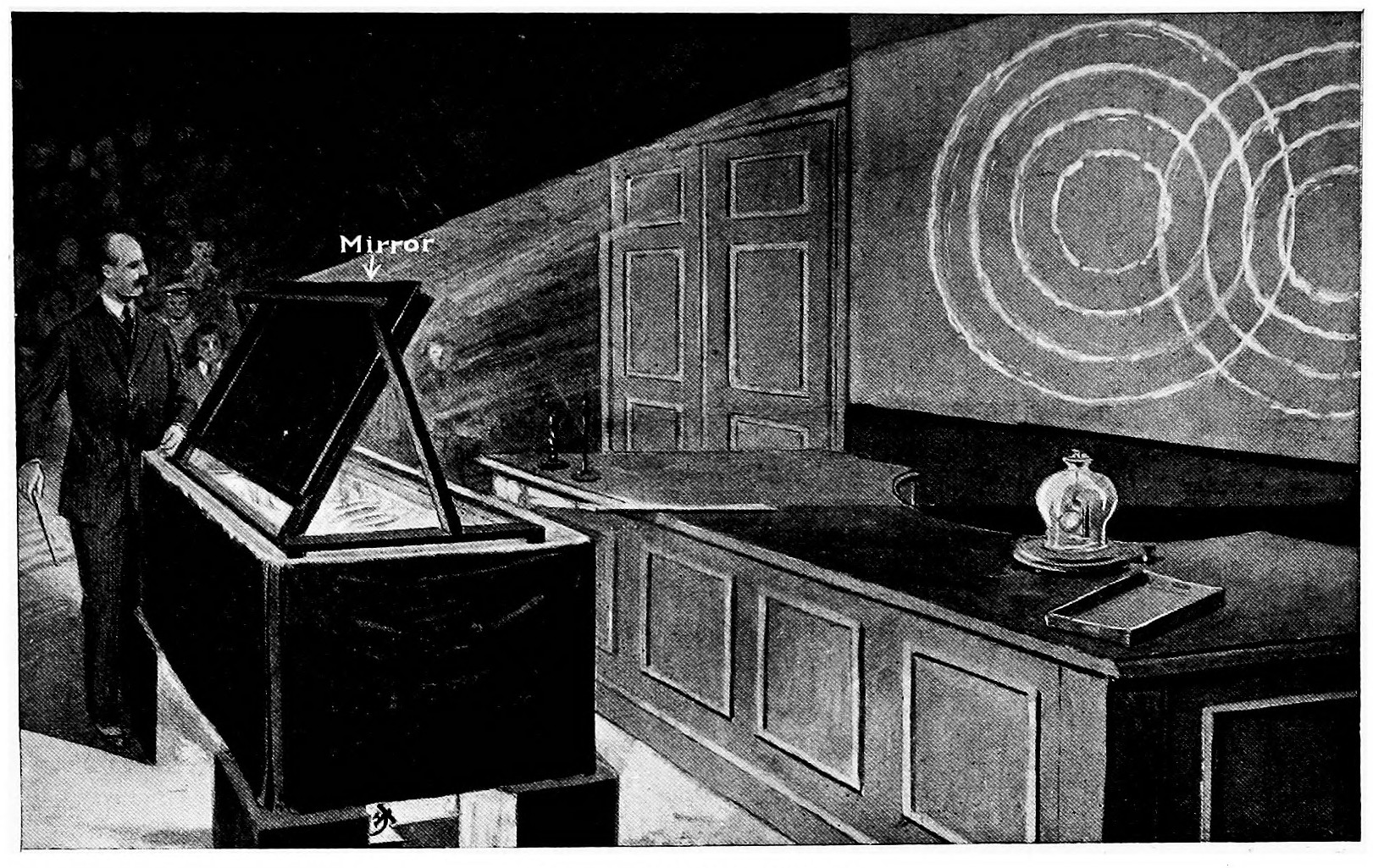
Here is a ripple tank made for the purpose of such experiments. It is a shallow trough about a yard square, with a plate-glass bottom, filled with a thin layer of water about a quarter of an inch deep. Underneath it on the floor is a naked arc light. The light comes up through the tank and then falls on a sloping mirror1 which reflects it on the wall. Any ripples which are made on the surface of the water show like lines of light and shade on the screen. If I touch the water with my finger, circular ripples spread away just as you have often seen them do when a stone is dropped into a pond. The ripples fade away as the circles become wider. So does the energy of the sound die away as it spreads from its source, and even faster than the ripples do on the water. If I touch in two places at once, two sets of interlacing ripples start out. Notice at once how each set goes on its own way right through the other set, as if it was not there. Probably you have noticed this effect also on the surface of a lake or the sea. This is really a point of the very greatest importance to us, for it means that in the case of sound any number of sounds can use the air at the same time, which is a much more wonderful thing than one is apt to imagine at first sight. Suppose it did happen that when a sound was travelling across a certain air-space no other sound could go that way at the same time, or suppose that two or more sounds when trying to cross the same place at the same time had some effect on each other, what a complete confusion of all speech and sound there would be! No ear could ever disentangle it. It is therefore a most remarkable and important thing that however much sound is crossing an air-space a new sound can find its way across that space just as easily as if no other sound were there. I do not say, of course, that the ear, which has already been filled with various sounds, will be as sensitive to a new sound as if there had been silence until the new one came.
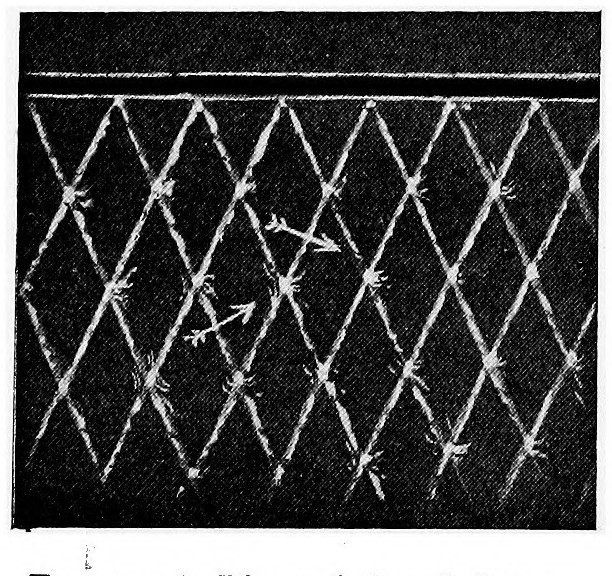
Next we notice in the ripple tank that waves are reflected at the boundaries of the tank. Sometimes we see this effect on the shore of the sea or of a lake, or in the bath, but here it is shown more regularly. If I produce a succession of waves following one another at steady intervals, the reflections and the original waves acting together cover the surface of the water with a beautiful diamond-shaped pattern whose motion across the screen is quite interesting to follow. The original waves and the reflected waves are equally inclined, as you see, to the reflecting surface. This illustrates a very important phenomenon in sound, or for that matter in any other form of wave motion. Waves beating up against a plane surface are thrown back in such a way that the new lines of waves make the same angle with the surface as the old. This is really the essential property of the ordinary mirror or looking-glass, by which you see behind it an "image" of objects which are really in front. The light-waves that roll up against the mirror from the source in front are thrown back and seem to us to have come from behind. The same effect occurs with sound waves, and then we speak of hearing an echo, especially when the reflecting surface is so far away that we hear the echo some time after the original sound is made, so that the reflection is heard separately and distinctly.
Another very pretty way of watching reflection in the ripple tank is to set down in it a wooden square, enclosing a little pond. If we jerk the wooden square, waves roll backwards and forwards from side to side and make a pattern on the screen like a Scotch tartan.
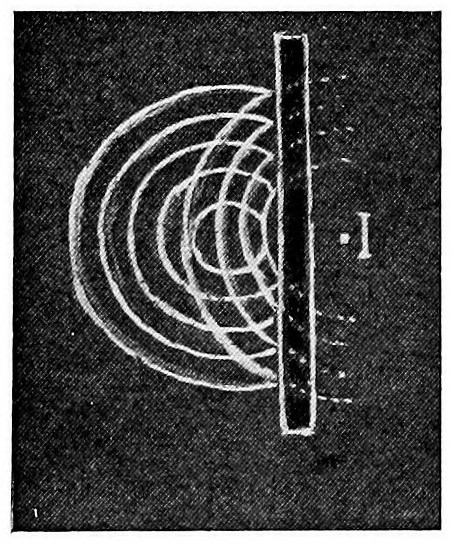
Keeping the square at rest and touching the water at some point inside it, we get circular ripples which are reflected at the sides. Notice how the reflected ripples are also circular, but that their centre is on the other side of the wall which has reflected them, and just as far behind it as the starting-point was in front. The centre is the "image" of the real source, and is denoted by the letter I in the figure.
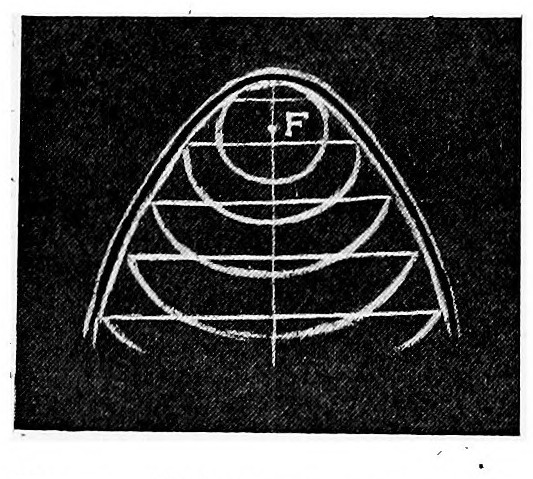
A curved surface has very special properties. Here is a piece of brass shaped into the form of a parabola. If I roll a wave into the mouth of it, observe how the waves are gradually turned into circular waves moving in on to their centre; the point on which they converge is called the focus of the parabola. If I dip my finger into the water at the focus, exactly the reverse effect takes place: circular waves spread out from the point, which are converted by the parabola into waves with a straight front. You know that bicycle lamps and motor lamps are often made with parabolic reflectors, and that the light itself is put at the focus; the light is thus sent out in a straight shaft without spreading. Curved surfaces like this have the power of concentrating waves on to particular points. So in some of the great reflecting telescopes the parabolic mirror gathers the light from a star and focuses it on to the field of view of the observer, who studies it there through the "eyepiece."
Here is a block of wood with a long row of nails sticking out from it like a rake. When this row of nails is put into the water in place of the blocks which I was previously using as reflectors, you will notice that most of the energy of the waves passes through and between the nails, but it is clearly seen that a little of it is reflected. There is an interesting parallel in the case of sound. Sound is reflected, not only from a flat and complete surface, but even from a set of iron railings or from the foliage of a tree. So when you are driving along in a motor-car you can often hear reflections from the fences and hedges that you pass. If it is a long way to the hedge on either side, there is much less noise than when the hedges close in on you. There is a sudden change in the nature of the sound when you have been running between, let us say, steep banks and come to an iron railway bridge, or to a paling fence. If there is a row of posts that you pass you can notice that each sends to you a little special reflection, so that you get as it were a regular succession of whispers2 into your ear.
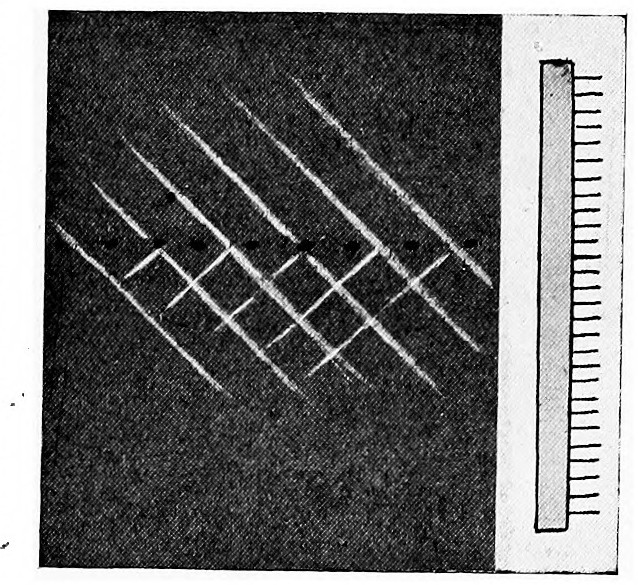
If we dip the nails simultaneously into the water, each nail starts circular ripples, and the many sets join finally into a straight wave. When you come to a deeper study of optics you will find in this pretty experiment an illustration of what is known as the principle of Huyghens.
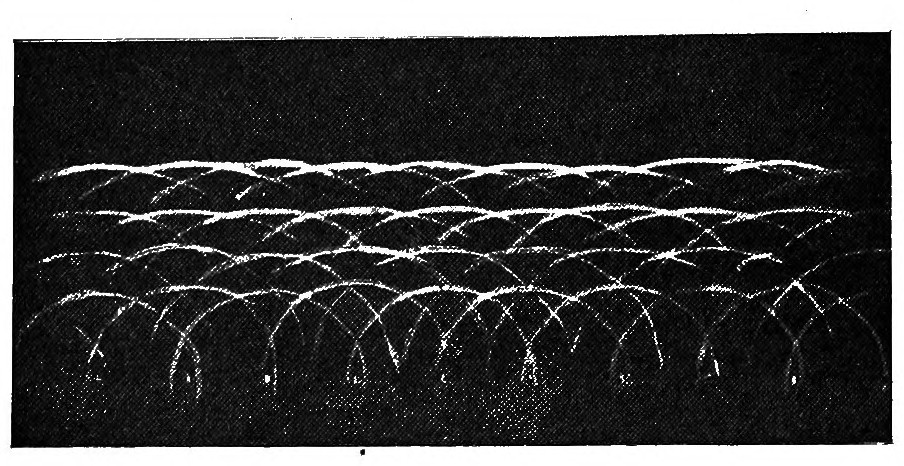
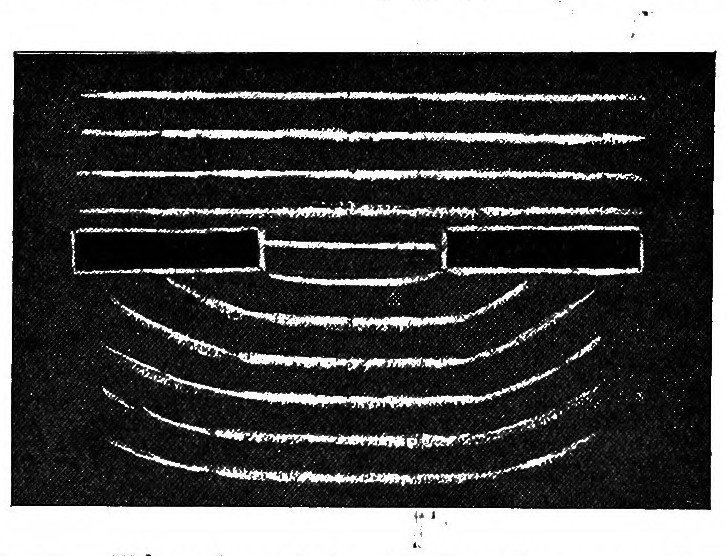
I am presently going to put aside the ripple tank and take up another means of following the behaviour of sound-waves. But we need one last experiment with the tank in order to explain the reason for our change of course. Notice that when a set of ripples moves past the edge of an obstacle they swing round it. If we put two blocks of wood side by side so as to leave a little opening or gate and roll up waves against the gate, the portion that gets through opens out at once into semicircular waves which fill all the space on the other side. So does a great ocean-wave surge through the narrow opening into a harbour, sending in a disturbance which spreads and fills the harbour with commotion. This thing always happens when the length of the wave is as large as the opening of the harbour, or indeed in any way comparable with it. But if I open the gate in the ripple tank and make waves succeed one another very quickly so that the ripples are now much closer together than the posts of the gate, then there is really a stream of waves across the tank which does not spread to left and right anything like so much as before. The walls have, as it were, cast a definite shadow. You will often see this at the mouth of the harbour when a gentle wind blows in ripples which carry forward in a stream some way within the entrance.
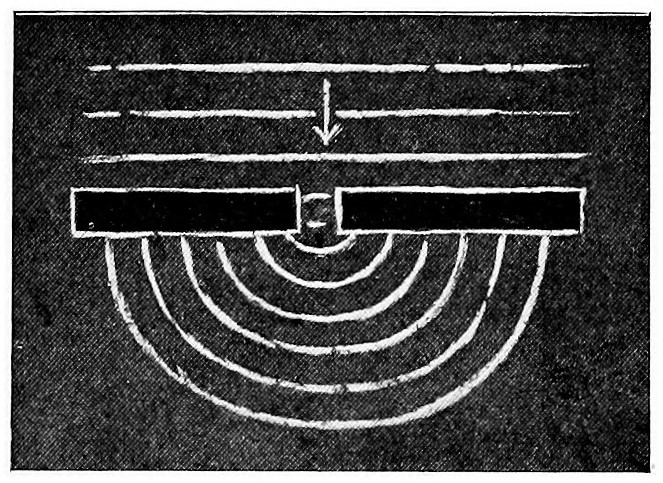
Exactly the same thing happens in the case of sound, where the long waves, which, as we shall see later, give deep notes, sweep round corners easily. It is the tiny waves, i.e. the very high notes, of which alone shadows can be cast by objects of ordinary size.
In this next series of experiments we are going to use sound-waves themselves; but we cannot with any satisfaction use ordinary sound. The distances between the successive waves of such sounds as the voice, or the note of an organ-pipe or a tuning-fork, are anything from one to several feet. If we tried to block them by obstacles or turn them by reflecting surfaces, they would scarcely obey us at all: the waves swing round obstacles which are of the same size as the distances between the waves, just as the ripples did in the tank. If we are to handle actual sound-waves, they must be such as belong to high-pitched sounds.
It is a very old question this; one of the great questions of Physics, one which troubled Newton himself. He found it hard to admit that light might consist of waves of any kind, because he thought that if it did, the waves should be able to swing round the edges of obstacles—that we should in fact be able to see round the corner, just as we can hear round the corner. A light on one side of a screen cannot be seen from the other; but the voice of a speaker can be heard when the light he is holding is invisible. The explanation lies in the fact that the wave-length of sound is a matter of feet, whereas in the case of light it is a matter of hundred-thousandths of an inch. So the light-shadows are sharp and definite, but sound-shadows are apt to be vague and partial.
We must, then, use very high-pitched sounds if we are going to carry out experiments with rays of sound in this room, and the higher the pitch the better, because high pitch goes with short waves. We will therefore use a whistle so high in pitch that probably it is out of range for most people in this room: they will not hear it at all. But here is a so-called sensitive flame. Gas is forced under great pressure (eight to ten inches of water) along a narrow tube, from which it emerges through a very small circular nipple into the open air, where it burns in a tall, narrow flame. It is on the point of flaring. If the pressure on the gas were increased a little more the gas, in its hurry to get out, would churn itself up into little whirlpools, mix with the air and burn in a noisy blue flame.
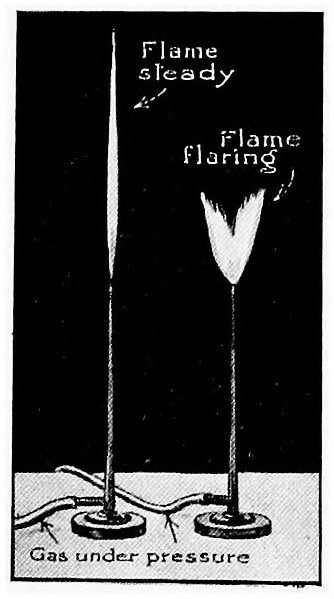
But not only will extra pressure cause this to happen; any high-pitched sound will do the same. It appears that such a sound disturbs the even flow of the gas just where it comes out of the nipple, so that in this case also the turbulent flow and the mixing with the air give the blue flaring flame. Here are the whistles so high in pitch that they are difficult to hear, but you see that they affect the flame even though I go as far away from it as I can and blow the whistle gently—at each blast it ducks in the most marked way. If anybody in the room will drop one coin on another or rattle a bunch of keys, the flame will respond instantly. Every time the letter "s" occurs in what I say the flame responds. All these sounds are essentially of high pitch. Here then we have a flame sensitive to the very sounds which we want to use, and to them only. Tyndall used this sensitive flame largely, and I believe that some of the apparatus on the table is just as he left it and as he described it in his book on Sound.
The specially high-pitched whistle, known as a "bird-call," was not known to him, but the late Lord Rayleigh made great use of it. It consists of two pieces of thin metal, brass or tin, perhaps half an inch across, placed parallel to one another at a distance of a tenth of an inch or even less. Two very small holes, perhaps a fiftieth of an inch in diameter, are bored through the two parallel pieces so as to face one another exactly. This arrangement is now soldered on to the end of a piece of brass tubing, and a steady stream of air is forced along the tube in order to sound the call. These dimensions can be varied considerably; the smaller they are, and the finer the holes, the higher is the pitch.
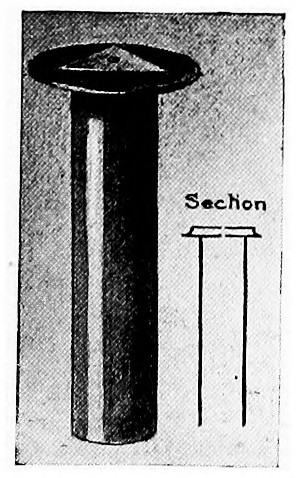
With a special piece of apparatus, due to Tyndall, consisting of two tubes hinged together (Fig. 14), it is easy to show the reflection of sound. The waves come down one tube, and if any suitable object is placed as a reflector they are thrown back along the other and cause the flame to flare. You will see that a board or a piece of glass or a sheet of paper can all reflect these sounds. A piece of linen does not reflect much until it is wetted, when it becomes quite a good reflector.
In these experiments we are doing with the waves of sound exactly what we did with ripples in the tank, causing them to be reflected at flat surfaces.
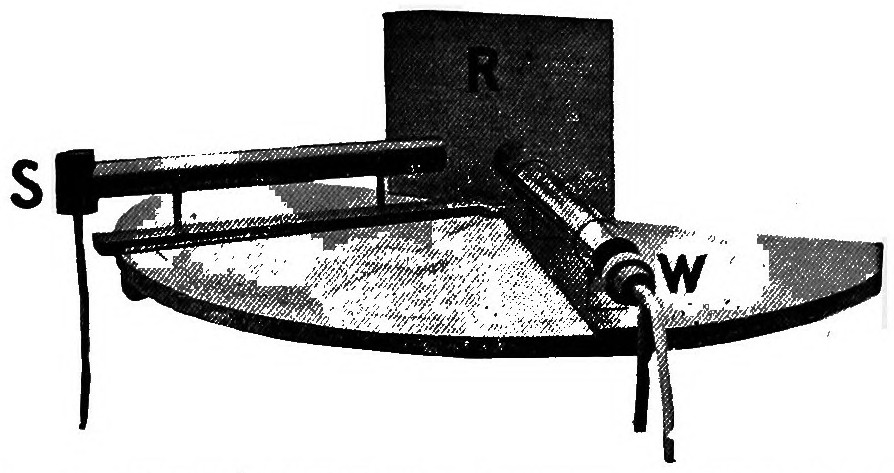
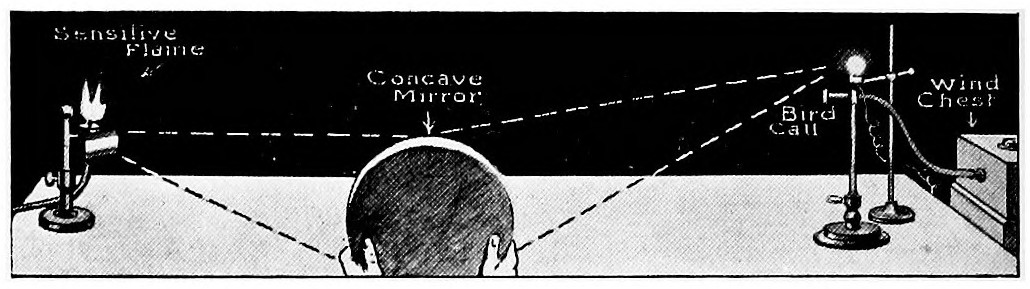
There is another way in which the reflection of waves by a flat surface can be shown very easily. First of all consider this curious property of the sensitive flame which Rayleigh described and found very useful. It is not equally sensitive to sounds coming from all directions; this particular flame is deaf to the whistle when I place it in position A (Fig. 15), and very sensitive when I turn it round to position B. The peculiarity is probably due to some irregularity in the shape of the nipple. Let us place it in the first of these two positions so that it no longer responds to the bird-call. When I hold the mirror in the position shown in the figure it responds readily, because a reflected beam of sound is being thrown upon it.
A still more striking experiment shows the reflection by a curved mirror. Here is a concave or hollowed mirror (Fig. 16) which is used to reflect light and to focus it upon a point: we will use it to focus both light and sound. We place an electric lamp just over the bird-call, and mount a piece of paper just below the sensitive flame. I stand quite a long way from both bird-call and flame, which latter I have put into the position which is insensitive to the direct action of the whistle, and hold the mirror so that it collects a bundle of light-rays from the lamp and focuses them on the paper. When this is done the sound-waves from the bird-call are focused on the nipple whence the gas issues, which is, as I have said, the sensitive point of the flame, and so, you see, it flares violently.
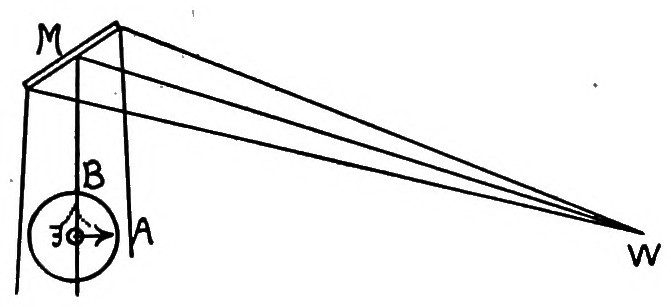
The least movement of the mirror up or down, right or left, so that the light no longer falls on the paper, and the flame rises up and becomes silent again.
There is one more experiment which I should like to show: a little more difficult to understand, but it is a beautiful one and very few people have seen it. It is due to Lord Rayleigh. I turn the flame so that it is not entirely deaf to the bird-call and then place a flat mirror so that the sound of the bird-call passes over the flame and is reflected back perpendicularly by the glass. There are now two sets of waves sweeping over the flame in opposite directions; and their combination results in the formation of what are called "stationary waves," waves which rise and fall without moving forward. They may be seen sometimes when waves roll up against a vertical cliff and recoil therefrom. In such cases there are places at regular intervals where the water does not move up and down at all; while in between such places the water rises and falls alternately. So in the case where sound-waves and their reflections are travelling opposite ways over the same part of the air, there are places where the air does not move: such places are called "nodes." In between them the air is in motion, vibrating to and fro. For some positions of the flat mirror the flame happens to be in one of the lines where there is no motion, and it does not flare. But if the reflector is moved a little farther away, or a little closer, the jet flares. And if the motion of the reflector is continued the flame is once more silent, then once more noisy, and so on; it is easy to count forty or fifty such alternations. It is possible to measure the wave length of the sound in this way.
When sound spreads away through air or water or a solid it weakens because it spreads; but there is also a second cause of weakening, which in some substances is very effective. There is in fact a real loss of energy as the sound tries to go through any substance, and we speak of the "absorption of sound," of "sound-absorbing substances," and so on. The "silent cabinets" for telephones are packed round with felt, or cork dust, or something of the kind: some substance, generally, which is much divided and contains many air-pockets. There is a convenient way of studying such effects which we can easily try. Here is a tuning-fork; it is made to vibrate, but is not audible until I stand it upon its proper box. Then the sound rings out loudly. Now let us put various materials between the fork and the box and see if the sound will get through. Wood and metal and such hard things are quite transparent to the sound: even a cork or a piece of rubber transmits a fair amount. A ball of wool does not cut off the sound entirely when the fork is pressed firmly on it. A lump of soft car grease transmits sound quite well. One of the best insulators of all is a pneumatic cushion, and that is why it is a good thing to put an air cushion under your pillow when you are sleeping in the train, or to use a pneumatic tyre when you want to support some apparatus which is to be kept free from vibration.
Lecture II: Sound in Music

We have been thinking of sound as a means of communication or as something which accompanies most movements and gives information about them to ears that listen. To-day we want to consider sound from another point of view. It is a fact that certain sounds and certain successions of sounds are very pleasing to our senses. In order to produce them we make musical instruments. Let us consider some of the simpler rules of construction that must be followed if we are to be able to draw from the instruments the melody and harmony that we like to hear.
The first thing that we have to do is to learn how to make a sound that remains for some time unchanged: that has, as we say, a definite pitch. Perhaps one of the first notes of this kind that men listened to was the twang of the bowstring; and this may have been the beginning of all the stringed instruments. Let us ask ourselves what is the real distinction between such a steady note and an irregular noise such as the coalman makes when he empties his sack on the pavement. The one sound is of the kind of which music can be made; nothing at all can be done with the other. I will try to make the difference clear in the following way. If I wave my hand towards you a pulse travels away in the air at a great rate, eleven hundred feet a second, as we have already seen, but it makes no impression on your ears. They have no power to detect a single pulse like that. If I were to wave my hand as fast as I could there would still be no resulting sound. But if I could wave it fifty times a second your ears would be filled with a deep booming noise: there must in fact be a sufficiently rapid succession of pulses before the ear hears.
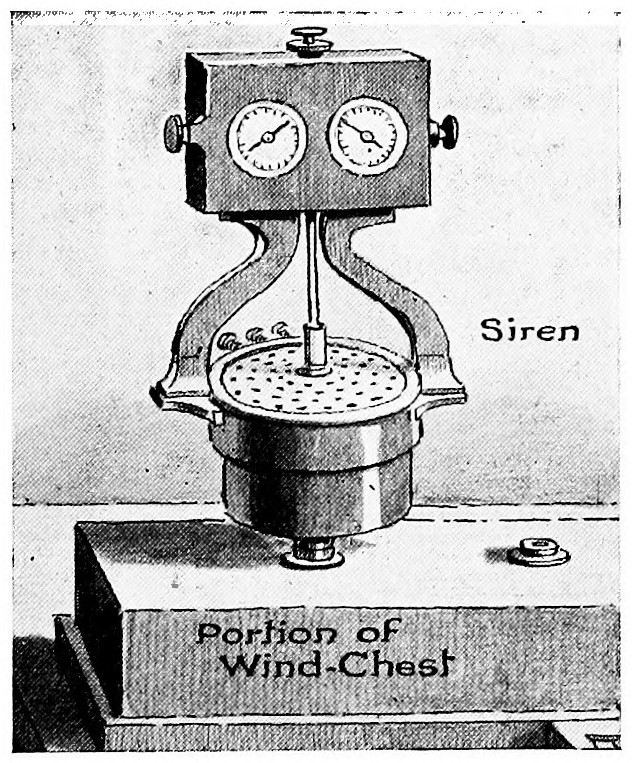
As I cannot myself move anything so quickly as that, we must have recourse to some mechanical method of carrying out the experiment. Instead of sending a pulse to you by moving my hand, I will cause a pulse to be sent out into the air by suddenly opening a hole behind which is compressed air ready to force itself out into the open. The instrument I am going to use has been called a siren. There is a cylindrical box, in the lid of which are cut small holes out of which the air is to come, and the box is in communication with the organ bellows. Just above the lid is a metal disc which as you see can turn round freely. The disc also is pierced with holes, and, when the holes in the top disc are just over the holes in the lid, air spurts through them all at the same time and makes one of those pulses which are going to be linked together in a sound. As the disc is made to turn round, the series of holes is alternately open and shut, all of them acting together, and so a set of pulses is sent out into the air in regular succession. When the disc spins slowly you can hear the separate puffs. As a matter of fact, each puff is accompanied by a little whistling noise, such as always goes with the issue of compressed air, and that is why you hear anything at all of the individual puff. But of the main shove given to the air your ears are quite unconscious. If I leave the disc alone after giving it a little start and keep up the supply of air under pressure the speed of the disc rapidly increases. That is because the little holes are so cut in a slanting fashion that the issuing air drives the top disc round. Now the important thing to observe is that as soon as the speed increases sufficiently we begin to be aware of a very deep note. As it goes faster and faster the note rises in pitch and finally ends in a shrill scream.
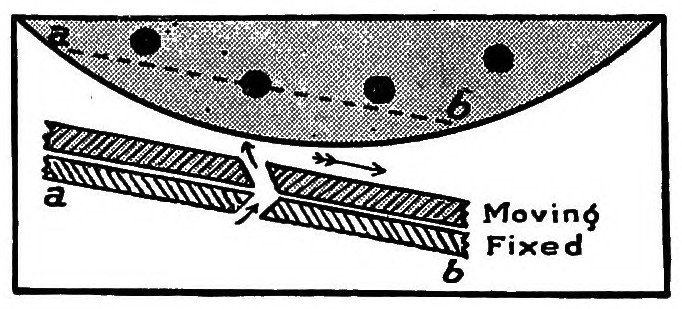
It is really because the successive puffs are all like one another, and because they succeed each other sufficiently fast, that the ear hears a sound of definite pitch. We find, too, that the more rapid the succession the higher the note. Here, then, is the whole difference between an irregular noise and a note. We find that in whatever way we make pulses start off in the air, if only the number of them that start off in a second is regular and sufficient, the ear hears a note; and the pitch of it depends on how many there are in a second. If I can arrange for some operation, no matter what it may be, to be repeated two hundred times a second, I shall always get the note of that frequency; and conversely, whenever a note of that pitch is heard, it is quite certain that something or other is being done two hundred times a second. The siren gave that note when it revolved so fast that in every second there were two hundred puffs.
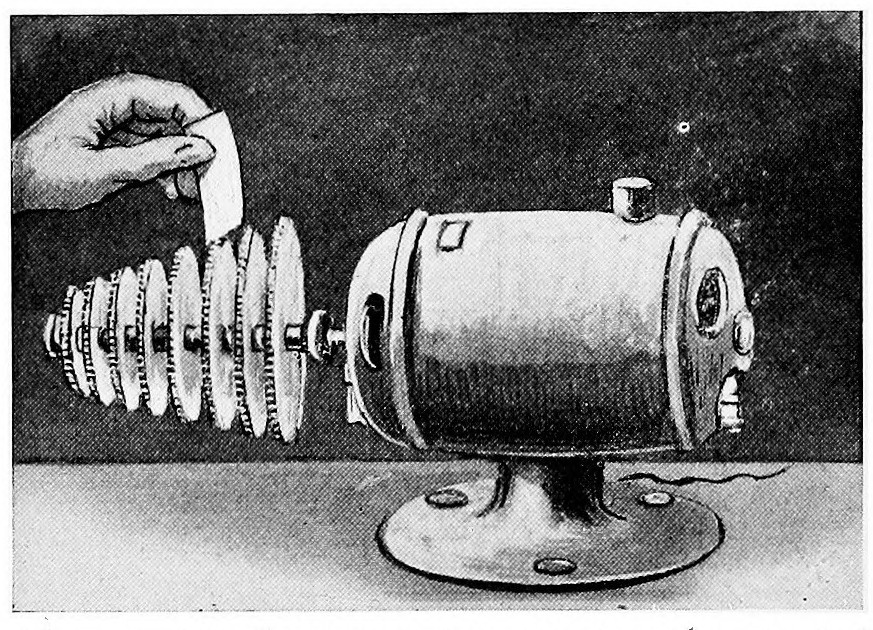
Here is a set of cogged wheels driven by an electric motor. I can hold a card to one of the wheels so that, as it turns, the card flops continually from one tooth to the next. Each time it does so it makes a little disturbance in the air and starts a pulse on its travels. When the wheel turns fast enough, the succession of pulses makes a note which is higher the faster the wheel is turned. When two hundred teeth pass under the card in the second we get the same note as before. There are eight wheels on the axis of the electromotor, and the numbers of the teeth on the different wheels are 24, 27, 30, 32, 36, 40, 45, 48. Notice in passing that as they are touched in succession with the card we get the notes of the ordinary musical scale; and this is so, no matter how fast the motor is turning. The wheel of 48 teeth always gives the octave above the wheel of 24 teeth; clearly the octave depends on the 2:1 ratio. The wheels of 36 and 24 teeth are a "fifth" apart; the ratio 3:2 belongs to the interval of the fifth. We find in this way that all the intervals of the musicians correspond to definite numerical ratios.
When two wheels are geared into one another, as in the gear-box of a motor-car, each time the teeth of one wheel enter and leave the spaces of another, there is a tiny shock which starts a quiver in the metalwork of the car and in turn a pulse into the air. The better made the wheels, the more silent is their play. But there is always a little hum, and the driver instinctively listens to it because it tells him whether the car is running smoothly and whether it is altering its speed. The note of the hum tells how many teeth pass each other in a second. When a motor-car with a studded tyre goes past on a wooden or asphalt pavement, there is often a shrill scream which comes from the tapping of the studs on the road, and the note tells you how many taps take place per second. Here is a piece of ribbed silk. If I draw my finger-nail over it, each time the nail slips into a depression between two of the ridges, it starts a little pulse. This happens many hundreds of times a second, and a shrill sound is caused thereby. I cannot get the same effect from a piece of soft cloth, because the separate little risings and fallings of the finger-nail are only made with sufficient sharpness and intensity on the hard ridges of the silk. So also when two pieces of silk rub together, little shrill sounds are made with which we are all familiar. When we were very small we may have puzzled ourselves over them. As Stevenson says in his Child's Garden of Verses:
	"Whenever Auntie moves around,
	Her dresses make a curious sound.
	They trail behind her up the floor
	And trundle after through the door."
In the same way we get a note when we draw the finger across the cover of a book, provided it has a regular succession of ridges and hollows; but when the material has irregular depressions all over it, we have only a "noise," in which we can recognise no pitch. When we tear a piece of calico, the regular successive breaking of the threads causes a corresponding succession of pulses in the air by way of the jerking motions of the material and the hands, and there is a sound of definite pitch, which rises if we tear faster.
In general the sensitiveness to high-pitched sounds weakens with age: it is quite usual to find that old people cannot hear the shrill squeak of a bat. The late Francis Galton was very interested in observing the range of hearing possessed by different ears, and used a specially high-pitched whistle for the purpose of determining the upper limit. To many people very high sounds are all alike: they can tell that there is a sound, but can assign no pitch to it.
At the extreme low-frequency end of the range of hearing there is a special difficulty in recognising by the ear the existence of a note because the body can actually feel the vibration. When the lowest notes of an organ are sounding in a church, it is often doubtful whether we really detect any sound or whether we merely feel the shaking of the pews.
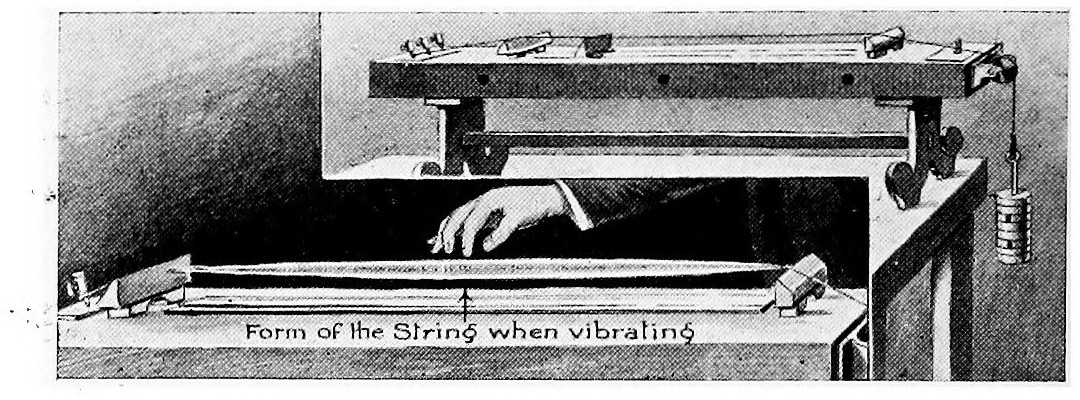
If, then, I want to make a musical instrument, I must find some mechanism which can conveniently be made to do something over and over again at the rate required for each different note. There are ever so many ways in which this can be done; but there are two or three which have been found far more convenient than the rest. And first we may consider the vibrating string. If we stretch a string between two points, and then, taking hold of the middle, pull it to one side and let go, it swings backwards and forwards for a long time, making hundreds of vibrations, as we call them, before it finally comes to rest. That is the sort of thing we want. It would be no use if when we pulled it aside it stayed where we put it, or even if it slowly went back to its first position. It has to be like a pendulum. When the bob is pulled to one side and let go, its weight carries it down to the central position, but it does not stop there. The way which it has gathered carries it through, and it climbs up the other side till the effort exhausts its energy, then it falls back again, and so a continual to-and-fro movement is set up. The string, like the pendulum, rushes back to its central position, overswings itself, reaches a limiting position on the other side, recoils, and repeats the motion again and again. It is very important to observe that both string and pendulum take the same length of time over each swing, no matter whether that swing is large or small. Vibrating or oscillating bodies of whatever kind most commonly obey this rule, and it is very fortunate for us that it is so. Suppose for a moment that the rate of vibration altered as the swing diminished.
Imagine trying to play on a piano if the pitch of the note depended on how hard one struck it, and changed as the sound died away!
If the bob of the pendulum is set swinging in water it soon stops, because the energy is given to the water and wasted in little eddies and whirls. When the pendulum swings in the air there are eddies also, but relatively the waste of energy is far less. A vibrating string causes little disturbance in the air, because it is so thin and slips through so easily. Very little of its energy is given out in this way, but as it moves it shakes its supports, and these again anything on which they stand, and all these motions mean a gradual frittering away of the energy of the string.
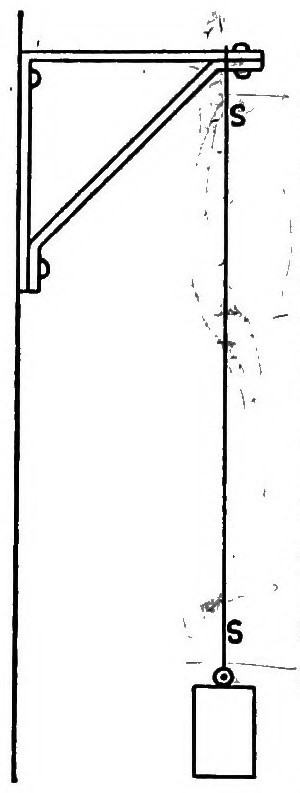
There is one way in which we particularly want the energy to spread itself, and that is in pulses through the air; in order to get these well under way it is usual to mount one or other of the supports of the string on a broad surface which, when made to vibrate, has a large effect on the air which is in contact with it. This surface is called a sounding-board. If you remember our previous experiment with the musical box you will appreciate its importance. Here is a string (Fig. 21) which is suspended from a bracket on the wall, and is tightly stretched by the large weight attached to it. If it is plucked it vibrates freely, but there is very little noise. In the case of the monochord the string is mounted on its proper sounding-board: when it vibrates we hear it well. The sounds that you hear when a violin is played come really from the body of the violin, not from the strings; and because the body is apt to alter the quality of the notes which originally come from the string, and because it is the interpretation given by the body which you really hear, therefore the body has to be made most carefully, and a first-class violin is a great treasure. Strings must be good, of course, but it is not the strings which are costly.
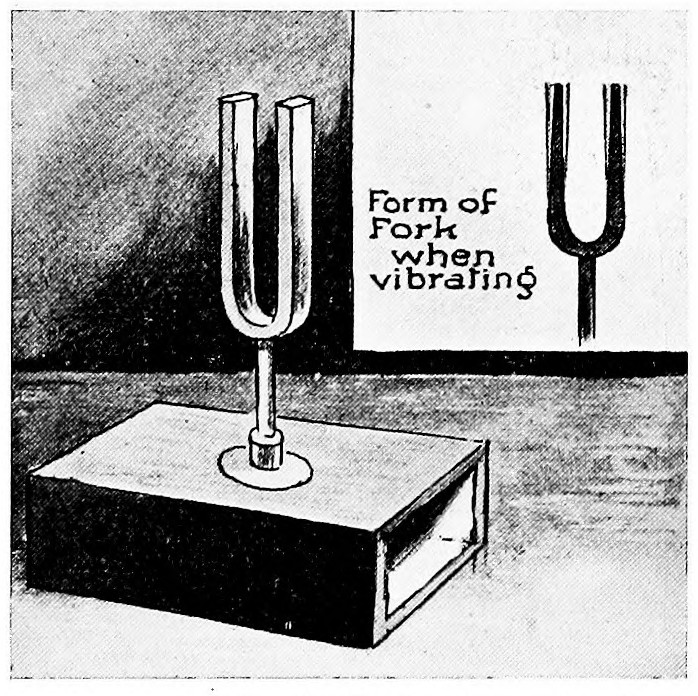
Here, again, is a tuning-fork (Fig. 22). When it is made to vibrate it is comparatively silent unless its stem is pressed upon some surface which it can set into vibration so that strong pulses can be sent out into the air. It is sometimes mounted on a sounding-box of such a form as to be highly efficient for the purpose of launching the sound.
A string, then, gives a continuous note in a very convenient way. Notice too that we have the pitch of the string quite under command. We can raise the pitch either by shortening the string or by stretching it more tightly; both effects are readily shown on the monochord. But a musical instrument must be capable of giving out, not one, but many notes, and when we take the string as the basis of construction we must in some way arrange that the player shall have many strings at his command, or at least be able to produce all the notes he wants from a limited number of strings. The violinist uses four strings only, and makes the different notes by placing his fingers on one or more of them at different points, thus artificially altering their length. He holds the string down firmly with his finger so that the vibrating portion reaches from that finger to the bridge. All the responsibility of getting the right note is thrown on the player himself. That is the way to obtain the finest, most delicately shaded results.
In the piano and harp a different string is provided for every note that is required. In one way the task of the player is very much lightened, but at the same time he loses the power of making certain minute changes in pitch which are required, as we shall see later, for perfect music.
Any changes of pitch which are required to put a stringed instrument into tune before playing are, of course, made by altering the tensions of the strings concerned.
There is yet one other method of obtaining several notes from one string which we can explain by means of the monochord. I draw the bow across the string and bring out the lowest note which it can give. If now I touch the string in the centre and bow again, I get a note which is an octave higher. On examining the string closely it is easy to see that each half of the string is now vibrating separately. We have already learnt that when one of two notes is an octave above the other it makes twice as many vibrations each second; and so the half string vibrates twice as fast as the whole string. There is another point to be observed. If I do not touch the string exactly in the middle, I get no good note at all—only a horrible groan, which shows that the string does not care to vibrate in that way. It is easy to see why. The string can vibrate in two equal vibrating parts, because in that case the two will always vibrate at the same rate and will always pull against each other in exactly opposite directions at the point of division between them. This is necessary if the point is always to be kept at rest. If the parts were unequal, the string would have to get sometimes into the shape shown in the figure, which would be impossible. The lightest touch at the centre will make the string vibrate in two equal parts: it is quite a natural form of vibration We call the lowest note, which is that given by the whole string vibrating together, the note or tone of the string; we call this new note an overtone.

In just the same way if we touch the string exactly at one-third of the distance from one end, and draw the bow across it, we can make the string vibrate in three equal parts. The note then given is recognised by the musical ear as the fifth of the note corresponding to the division into two. From the toothed wheel apparatus we can satisfy ourselves that whenever two notes are a fifth apart the upper has three vibrations or pulses to the lower's two; we infer that each part of the string divided into three makes three vibrations, in the same time that each part of the string divided into two parts makes two vibrations. And so we go on to higher numbers: it is easy to get notes making 4, 5, 6, etc., up to 12, 13, or more times the vibrations of the bottom note in each second. So we can get many notes from one string.
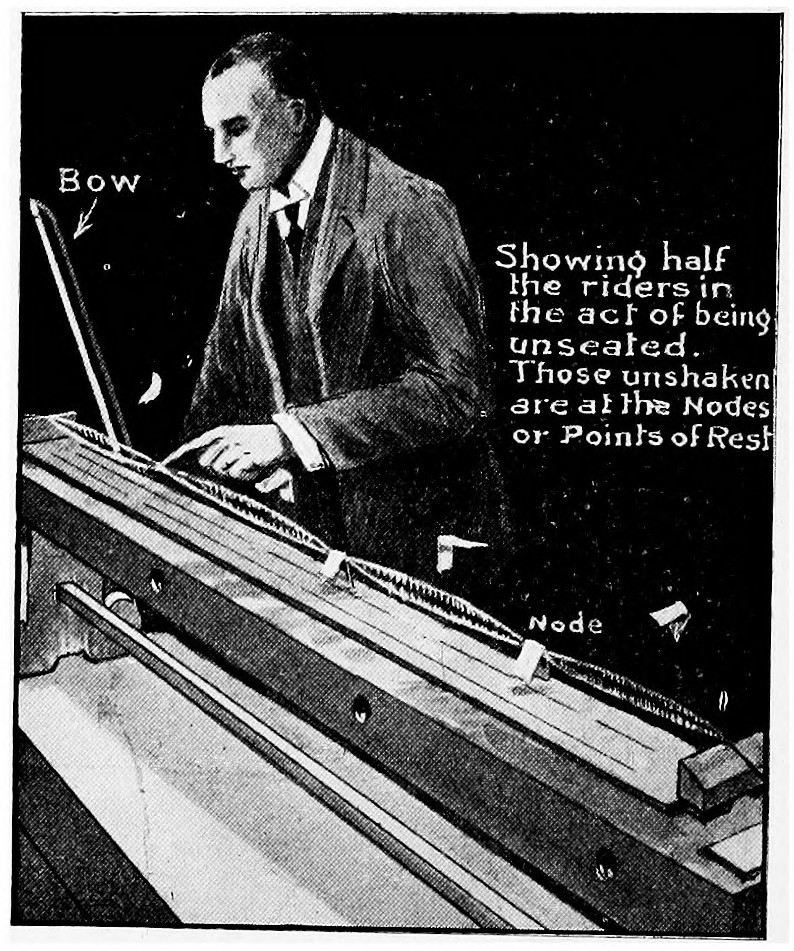
There is a beautiful little experiment which illustrates the division into parts. Let us show, or example, the division into four. I put riders of blue paper on the string at the first and second points of division of the string into four, leaving the third point of division to be touched by my finger. Half-way between the end of the string and the first point, and between the first and second points and between the second and third, I mount riders of yellow paper. When the string vibrates in four parts the points where the blue papers are riding are points of rest; but, where the yellow papers are, there will be the movement of the vibration of the string. So when I put my finger on the right spot, and just give the slightest touch with the bow, all the yellow papers are thrown off but the blue stay where they are.
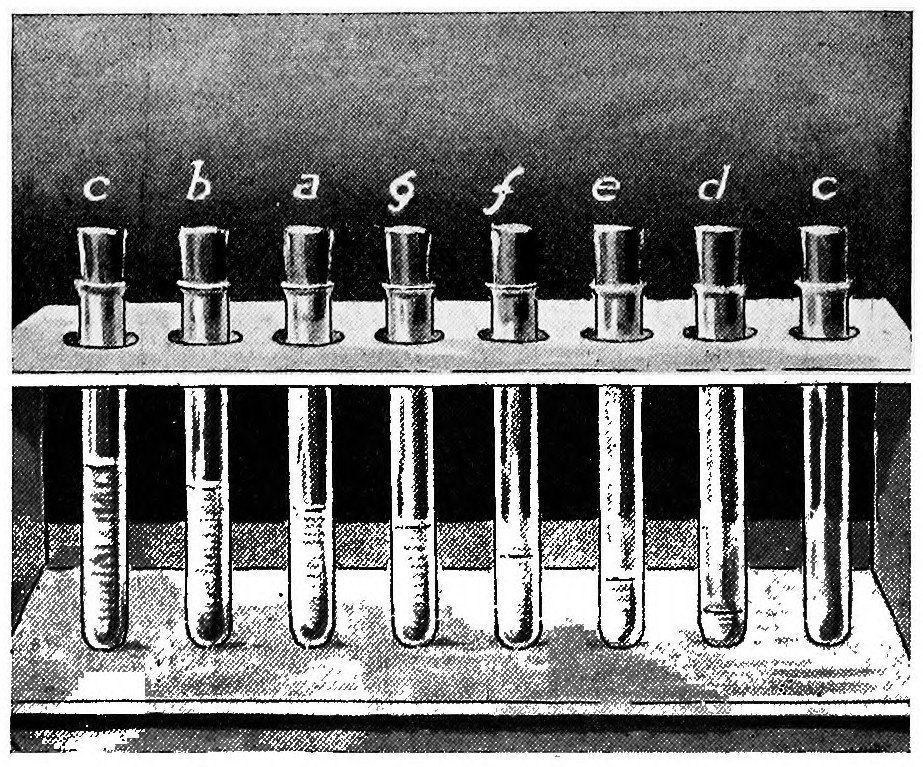
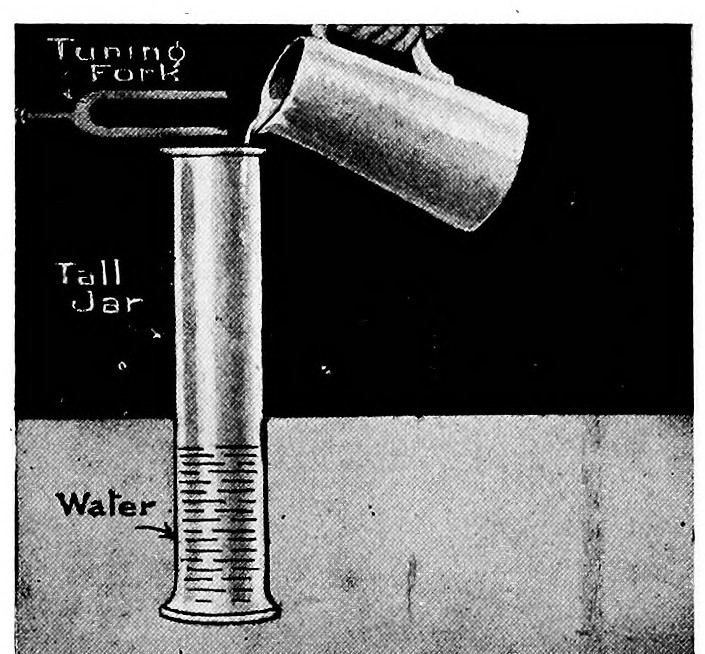
A second very important class of musical instruments is based on the movements of columns of air contained in tubes, or of masses of air contained in vessels of any form. For instance, here is a tall jar (see later, Fig. 28); the air inside it may be set into vibration, swinging in and out of the jar at a rate which depends mainly on the length of the jar. In the case of the string we started the vibrations by pulling the string to one side and letting go, after which the string continued to vibrate and radiate sound for some time. We cannot do the parallel experiment with an air column; or rather we cannot do it so successfully. To show how much can be done, I take a set of test-tubes, some containing water, some nearly empty, arranged in the order of their emptiness. When I draw the corks, the columns of air inside the tubes are set into vibration just as a string is excited by plucking it. Notice that as the corks are pulled out in succession we are going up the musical scale. But the notes only last for a very short time: in fact, the energy is quickly radiated away—much more quickly than in the case of the string. The sound lasts long enough for you to get an idea of pitch nevertheless.
When the water is poured out from a full bottle, the gurgling noise consists of a succession of short-lived notes: it is readily observed that they fall in pitch as the air-space becomes larger. Noise is made, too, when the bottle is filled again; and in this case the pitch rises with the diminishing air-space, as we have occasion to observe often enough whenever, for example, a jug is filled at a tap.
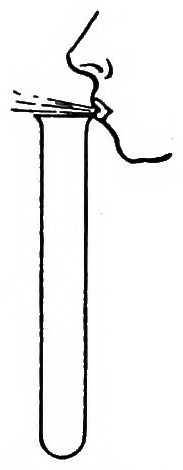
It is just as easy to get a variety of notes with these vibrating air masses as it was with the strings. We have to use long columns or large masses of air to get the deep notes, and short columns or small masses to get the high notes.
If we want to make a continuous note with a mass of air we must do something more than give it a single shock, we must keep the note going. There are ever so many ways of doing this, some of which we must look into carefully. Sometimes we blow across the mouth of the tube or body of air. I will explain later how that may set the air in the flask or tube in vigorous and continuous vibration. For the present it is enough to give examples. When I blow across the mouth of the test-tubes, it is easy to get a response which gives the same notes as we got when the corks were drawn. By blowing in the right way, loud notes can be obtained.
In organ-pipes and whistles there are channels to guide the air up to and across the mouth of the pipe, so that the player cannot make a mistake; the flute and the fife leave the player to do the directing of the stream himself, and that is why it takes a little practice to get the proper sound out of them. When we make whistles out of young willow branches the art is to shape the mouthpiece rightly so that the stream of air is correctly formed, and it is not always an easy thing to do. When the organ-builder is finishing off his pipes he has to pay his last attentions to the wooden edge on which the air-stream blows; often he has to score it with fine grooves in a way which long practice has shown to be successful. He calls the operation "voicing," and considers that he has successfully accomplished his work when the sound of the pipe is pure and strong.
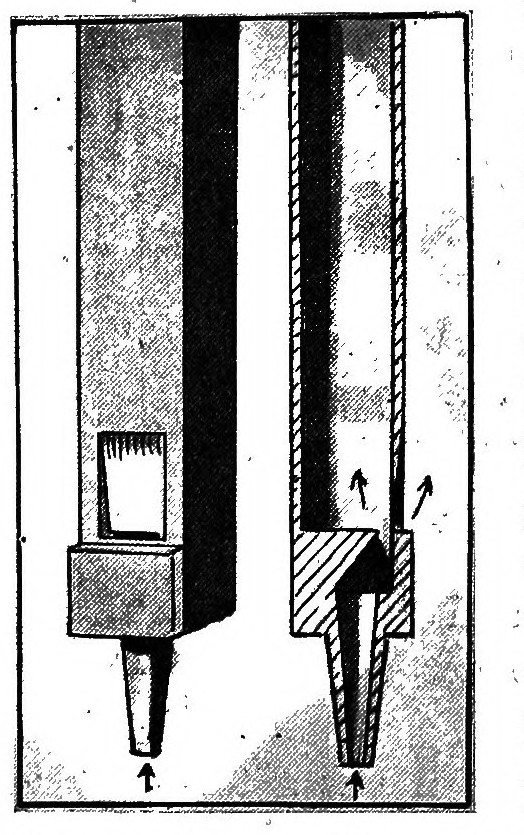
We can start the vibration of the air in the jar before you in another and more brutal way. Instead of coaxing it to vibrate at its own rate by blowing across the mouth, I can hold a vibrating tuning-fork over it. Of course the tuning-fork is so strong that the pliant column of air has to obey its motions; but the response is not very vigorous until the length of the column of air is adjusted to a proper value. When this is done and the natural note of the column is the same as that of the fork there is a loud response. In that case the column is acting as an agent for the fork, taking energy from it and distributing it widely. The energy of the fork must be more quickly spent in consequence.
The movements of air columns are quite invisible, and it is rather hard for a beginner to picture what is going on.
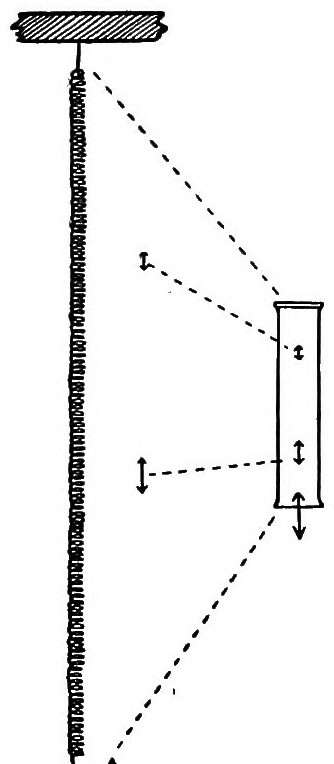
I have always found that it helps to consider the action of models made of long spiral springs. Here, for example, is such a spring made of iron wire and about fifteen feet long. It is hung from the roof by a cord so that when the lower end is gently moved up and down the top stays still and the whole spring vibrates. This represents the to-and-fro movement of the air in a jar. If we hold the jar upside down, the open end, now at the bottom, corresponds to the bottom end of the spring. In one case there is free movement of the spring; in the other, of the air, which can pour freely in and out of the mouth of the jar. In both cases there is no motion at the top.
The spring's movements are so leisurely that we can count them with ease. That helps us to work out a point of great importance. Suppose that the spring is tweaked sharply instead of being gently set in motion. When the spring is quite quiet I suddenly depress the lower end four or five inches: observe that it stays where it is put—for a moment. A pulse which I have called into being runs up the wire and down again, and it is not until it returns that the spring suddenly flies back again. It overshoots itself, as a matter of fact, and a pulse of the opposite kind runs up and down the wire. If now we count how fast these sudden up-and-down motions succeed one another, we find that the rate is just the same as when the motions were gentle pulsations of the spring. So we learn that the time of vibration is governed by the time taken by a pulse to run up and down the spring. Between an instant when the spring is most extended and the next instant when it is again most extended a pulse can run twice up and twice down the spring. So if we count the number of vibrations of the spring in that time we can find out how fast a pulse travels over the spring. Observe too that all sorts of pulses—sharp and slow, single tweaks and double tweaks, any kind in fact—all travel at the same rate.
Now it is just the same for the air column; and we can actually find the velocity of sound in air by measuring the length of the air column which answers to the fork, and multiplying that by four and by the number of vibrations which the fork makes in a second.
It is sometimes very important to measure the velocity of sound in a given substance, and there may be no other way of doing it than this. It is very seldom that we can get enough of a substance to make it possible to give a straight course for a sound for a whole second. It is only air or water or earth which gives range enough.
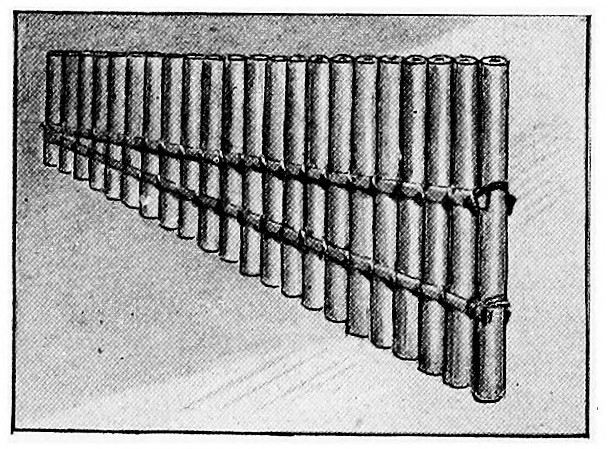
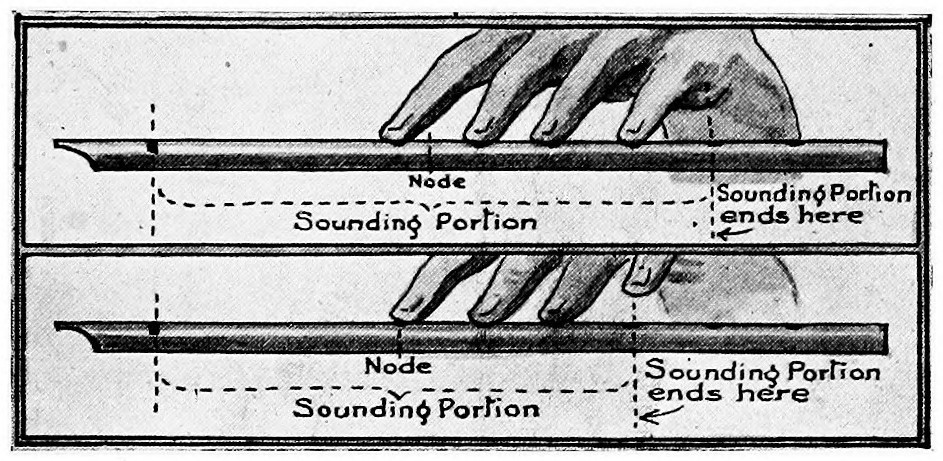
We have seen that we can get a note of any pitch from a tube of the right length; and an organ-builder can complete a scale of notes by putting together a sufficient number of tubes of different sizes. After all, that is the way in which they made the oldest organs of all, the Pan-pipes. Or we may have but one pipe and alter its length as we play. In the whistle the player has his fingers on a series of holes; when he lifts his fingers in succession, beginning at the one farthest from his lips, it is as if he were gradually shortening the pipe, because the effective portion reaches from the mouthpiece to the next hole which is open. The rest of the pipe is generally idle; except in certain special cases depending on another development of the principle of the sounding pipe, which we will now consider.
It is possible to obtain several notes out of the same tube, just as we were able to obtain several notes from one length of string. For instance, here is a piece of glass tubing six inches long, closed at one end. By blowing across the open end I get a certain note, by blowing harder another note much higher in pitch, and by blowing harder still a very shrill note. We have found that high notes are associated with short lengths, and we may suspect that in the case of the pipes, as in the corresponding case of the strings, the high notes come from a subdivision of the long column into short columns.
It is convenient to use the spring model once more. Here are five spiral springs of different lengths: one ten inches, another twenty, and others thirty, forty, and fifty inches. Of the first, third, and fifth springs, each is attached to a fixed point at its upper end, and at its lower dips into a pool of mercury. The second and fourth are fixed at both ends. An electric current runs through all the springs, the same for all, and the springs try to contract in consequence. This is because neighbouring convolutions when traversed by the current attract one another according to a well-known electrical law. Now the smallest spring only just touches the mercury in its cup when it is at rest and of its normal length; when it contracts, the bottom end comes out of the mercury and the electric current is broken. There is a brilliant spark whenever that happens. The current then stops in all the springs at once, and they no longer tend to contract. So the short spring drops its lower end into the mercury once more, the current is re-established, and once more the springs contract. This cycle of events repeats itself regularly, and all the springs feel a contractive force repeated at a rate which is governed by the natural vibrations of the smallest spring. The actual motion of the springs is not very large, and it is convenient to throw their shadows upon a screen, so that their movements are considerably magnified.
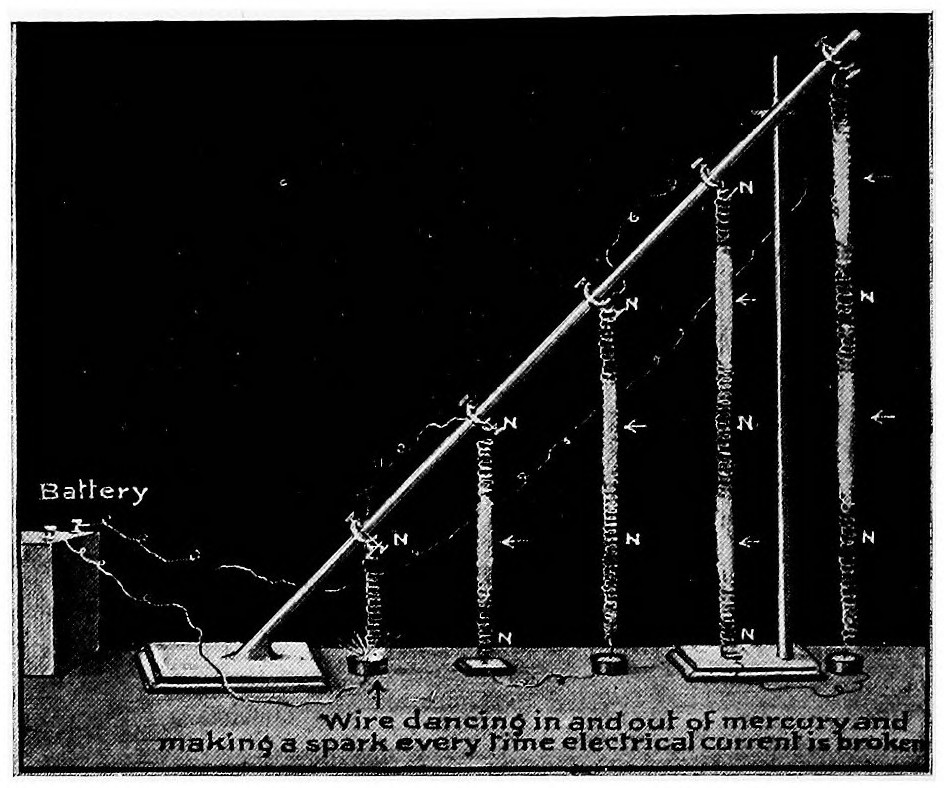
It is now clear that such a subdivision as we have pictured is actually occurring in these springs. There is a point of rest in the middle-sized spring at one-third of its height from the bottom; at two-thirds of the way up the motion is as large as it is at the bottom. It is vibrating in three parts, each of which is fixed at one end and moving at the other. The point which is at rest is called a node. In the longest of the springs there are two nodes, and the spring is vibrating in five parts. Thus it is clear that any spring which is fixed at one end and free at the other can vibrate in one, three, or five, or indeed any odd number of parts. When I blew the three notes from the short piece of glass tube just now, they corresponded to division into one, three, and five parts; the upper notes had three and five times the frequency of the lowest.
The second and fourth springs are fixed both at top and bottom, and can also be made to vibrate through the action of the same short spring: when in motion they divide into two and four parts respectively. The current passes through the whole length of each spring, and if it were not for an iron bar, which is put inside the spring in one of the subdivisions, there would be no motion, because just as many coils of the spring are expanding as are contracting at any one moment. The iron bar, however, so strengthens the magnetic attractions in its own subdivision that on the whole there is a balance of force to make the spring vibrate.
Thus a spring fixed at both ends divides into any even number of parts.
So also does a spring free to move at both ends. Such a spring is realised in the double spring before you where the two parts are suspended from a fine cord passing over pulleys in the roof. It is true that the pulleys by their inertia and friction—both very small, however—somewhat interfere with the full action of the model; but it is easy to show the division into two parts. If I set one half in motion by pulling it gently at the proper times, the other half, though untouched, takes up an equal motion, the two parts being separated by a node in the centre: the connecting string at the top does not move perceptibly.
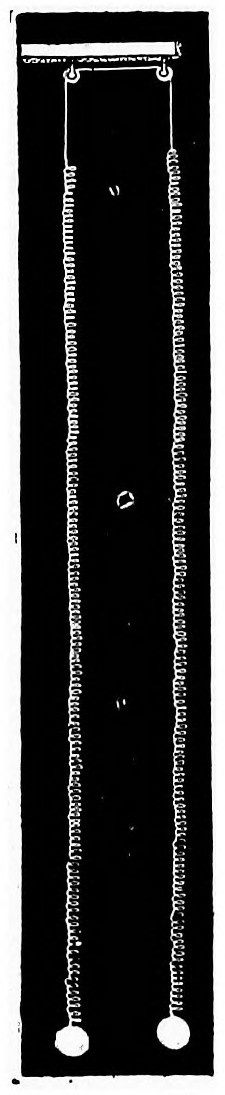
The double spring shows very nicely how a sudden pull at one end starts an extension pulse that runs up one spring and down the other; the end of the latter making a sudden jump upwards on its arrival. A contraction pulse is returned up the second spring and down the first, which shows a sudden dart downwards at its lower end when the pulse gets there. Another contraction pulse starts out once more, and the process repeats itself.
The double spring as a whole moves in the direction in which the first impulse was given; but it moves like a worm, alternately stretching out in front and contracting in the rear.
The pipe which is closed at both ends would be of no use to the musician, because none of its energy would get out into the outside air and no one would hear it. But the pipe that is open at both ends is very commonly used—more often, indeed, than the pipe that is open at one end and closed at the other. Here, for example, is such a pipe—simply a plain long glass tube. I can blow across one end and start a feeble vibration which you can hear. It is much harder to get a strong note from a tube when both ends are open than when one is closed: that may be partly because the energy is radiated away too fast when there are two ends to radiate it, but I suspect there are more fundamental reasons. I get a far better note when I put on a wooden mouthpiece like a whistle and blow through it, because the sheet of air is then directed correctly. It is now possible to get many notes. The lowest note of the tube is given when the tube is vibrating in two parts, and since the tube is forty inches long the length of each part is nearly twenty inches. The wavelength is therefore eighty inches and the frequency is 12×1100/80 or 165—quite a low note. It is rather hard to sound the lowest note; I must do no more than breathe into the whistle as gently as I can. The note is very weak and can only just be heard. By blowing a little harder I get a higher note which sounds when the tube divides into four parts, each half the length of the former. The resultant note is the octave above the first note we obtained. By blowing harder and harder the parts become shorter and shorter, and the frequency of the notes are successively three, four, five . . . times as great. Quite a number of notes can be got from this tube, though it would require some practice to be able to strike any desired note without hesitation. It is interesting to observe that the frequency which is seven times the fundamental seems out of tune to us because we do not include that note in the musical scale. We shall come to this point again.
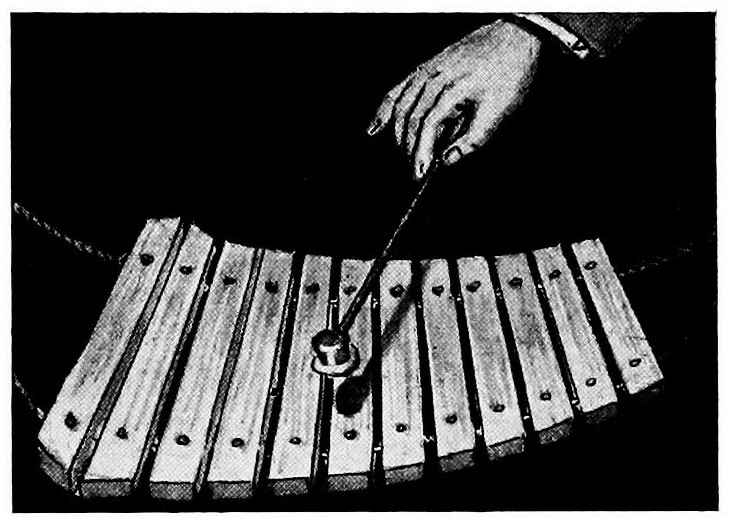
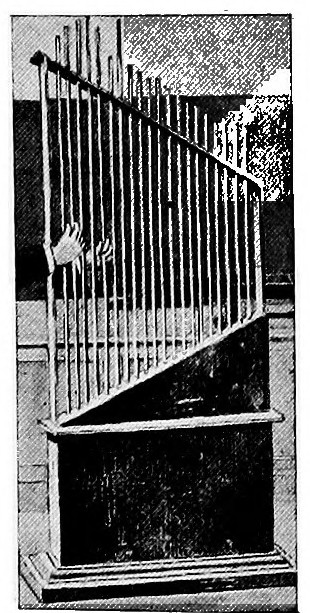
There are several other methods of producing musical sounds which we may consider as further illustration of the principles we are considering. Here, for instance, is a wooden dulcimer, consisting of blocks of wood, graded in size, and arranged upon two cords. They give, between them, all the notes of the musical scale. Here, again, is a set of lengths of bamboo so arranged as to make an instrument from which we may draw music of a kind by stroking with a gloved hand and using plenty of resin. This "bamboo harp" was used by Tyndall, and is described in his book. Here, again, are a set of loose pieces of wood: when I throw them down on the table in turn, we get once more the musical scale.
We saw just now, when we were using the eight wheels and the card, that there were certain simple numerical relations between the frequencies of the notes of the musical scale which we employ. It is important to realise that we have not chosen these notes because of the simplicity of the relations, but that, having chosen the notes to suit our tastes and spent centuries in doing so, we find that the frequencies of the notes have these relations. It is not surprising to find that some peoples have chosen differently. For instance, the old Gaelic scale, which is used in some tunes well known to us all, had no fourth and no seventh. A very easy way to realise it is to use only the black keys of the piano and no white keys: F sharp is the keynote, and the fourth and seventh to this are C natural and F natural, which are not to be played. "Auld Lang Syne," for example, can be played on the black notes alone. Some nations, like the Arabs, have still more fundamental differences, because they recognise quarter-tones, equal to half the smallest difference of our own scales.
There is one very curious matter which I should like you to consider for a moment. Let us suppose we were making up an instrument consisting of all the different notes required. We start by putting together one set of notes, beginning, let us say, with a keynote having a frequency of 256. We find then that we must have others as follows:
| 256 | 288 | 320 | 341⅓ | 384 | 426⅔ | 480 | 512 |
| C | D | E | F | G | A | B | C |
The numbers are in the same proportion as the teeth on the eight wheels which gave the musical scale.
So far so good. But we want to be able to play music in more keys than one: musicians depend on being able to change over from one key to another in order to get certain effects. Suppose that we arrange that it shall be possible to play also in the key of D; we must therefore provide a set of notes whose frequencies shall bear to 288 the same proportion that those already provided bear to 256. I will write these down under the others:
| 256 | 288 | 320 | 341⅓ | 384 | 426⅔ | 480 | 512 | |
| 288 | 324 | 360 | 384 | 432 | 480 | 540 | 576 |
We then find that arithmetic is too much for us: not that we cannot do the sums, but that the results we get cannot be reconciled with our capacities for building instruments. The note which we have made to be the third in the C scale is not quite right for the second in the scale of D; and the problem at once arises, shall we provide a new pipe or string, or shall we make the old one do, or shall we adopt some middle course? And again a little farther along the row we find the note 360, which is nowhere near F or G; and we learn why it has been found necessary to put in a new note called F sharp which is played on the piano by a black key. There is a new note of frequency 432 which is nearly the same as A, and also a note of 540 which is about half-way between C and D and the origin of another of the black keys on the piano.
We are therefore in trouble the moment we try to provide the notes required for any large number of different keys. Several solutions of the difficulties have been proposed, which are based on the plan of providing new notes in the worst cases, and putting up with those we can manage to endure. For example, we might have decided that we could not afford room for two strings or pipes of frequencies 320 and 324 respectively, and have contented ourselves with one of frequency 322, which would have to do duty for both the others. But we should be compelled to provide new notes at 360 and 540, because it would really be impossible to make one or other of the old notes do instead.
But the particular compromise would be unsatisfactory, because we have not only the keys of C and D to consider, but many others as well. The general solution which is now adopted is a very drastic one; it amounts to supplying five new notes, the black keys in addition to the white, and so tuning all the notes that we can play equally well—or, we might say, equally badly—in all the keys. There are twelve intervals in the octave, C to C sharp, C sharp to D, D to D sharp, D sharp to E, E to F, and so on; and all are equal. The correct intervals, with the exception of the octave, do not exist on a piano or organ as it is tuned to-day. But the inaccuracies are not large and the ear has grown accustomed to them.
It is here that the singer or the violin player has such an advantage, seeing that he has power to produce a note of any frequency whatever: he gets this power in return for the labour of hard practice, for his courage in running the dangers of going out of tune, and his skill in avoiding them. Other instruments, like the flute, are provided with keys which take most of the responsibility from the performer, but leave some power of adjustment: the flute player can modify his pitch by altering the way in which he blows across the mouthpiece.
But although this is the modern way of getting over the arithmetical difficulties, it is far from being the only one. A hundred years ago, with the same number of keys as at present, five black and eight white in the octave, the tuning was so carried out that a certain number of keys were nearly correct. The rest were left to take care of themselves: "wolves" they were called, because they howled so badly.
Lecture III: Sounds of the Town

Sounds made in the open air travel away, and, for the most part, do not return. Sometimes they do, and we say we have heard an echo. But the effect is feeble compared to the reverberation of sounds made within a room or in the street. A room in which walls, ceiling, and floor are bare behaves to sound in the same way as it would behave to light if it were lined with mirrors. There are countless reflections, and a sound once made rings round the room for a long time afterwards. Curtains, furniture, and all things which break up and absorb the waves of sound reduce the resonance. Sometimes on entering a house one notices the difference in the sound when the stair-carpets are up. "The late blind Justice Fielding walked for the first time into my room when he once visited me, and after speaking a few words said: 'This room is about 22 feet long, 18 wide, and 12 high': all of which he guessed by the ear with great accuracy" (Darwin's Zoonomia).
The blind are very quick to detect the special resonance of a room and to judge its size thereby. They are very sensitive also to the reflecting powers of surfaces near them, and can tell their nature and how far they are away. Those of us who have sight do not make much use of this power; nevertheless, if we move about in the dark we often find that we are relying on it, as when we are conscious of our near approach to the end of a long passage. If we try an empty room we can find certain notes to which it specially responds. In the bathroom, generally the barest in the house, we soon know the natural pitch of the room; the plashing water calls it out, or the sound of our voices. I think that is one reason why we are so often tempted to break out into song; the keynote is set for us and the resonance makes us feel we have passable voices. Humiliation awaits us when we get back to the dressing-room!
When the water has been turned off, the drops still falling from the tap call up quaint little noises which have a peculiar interest of their own.
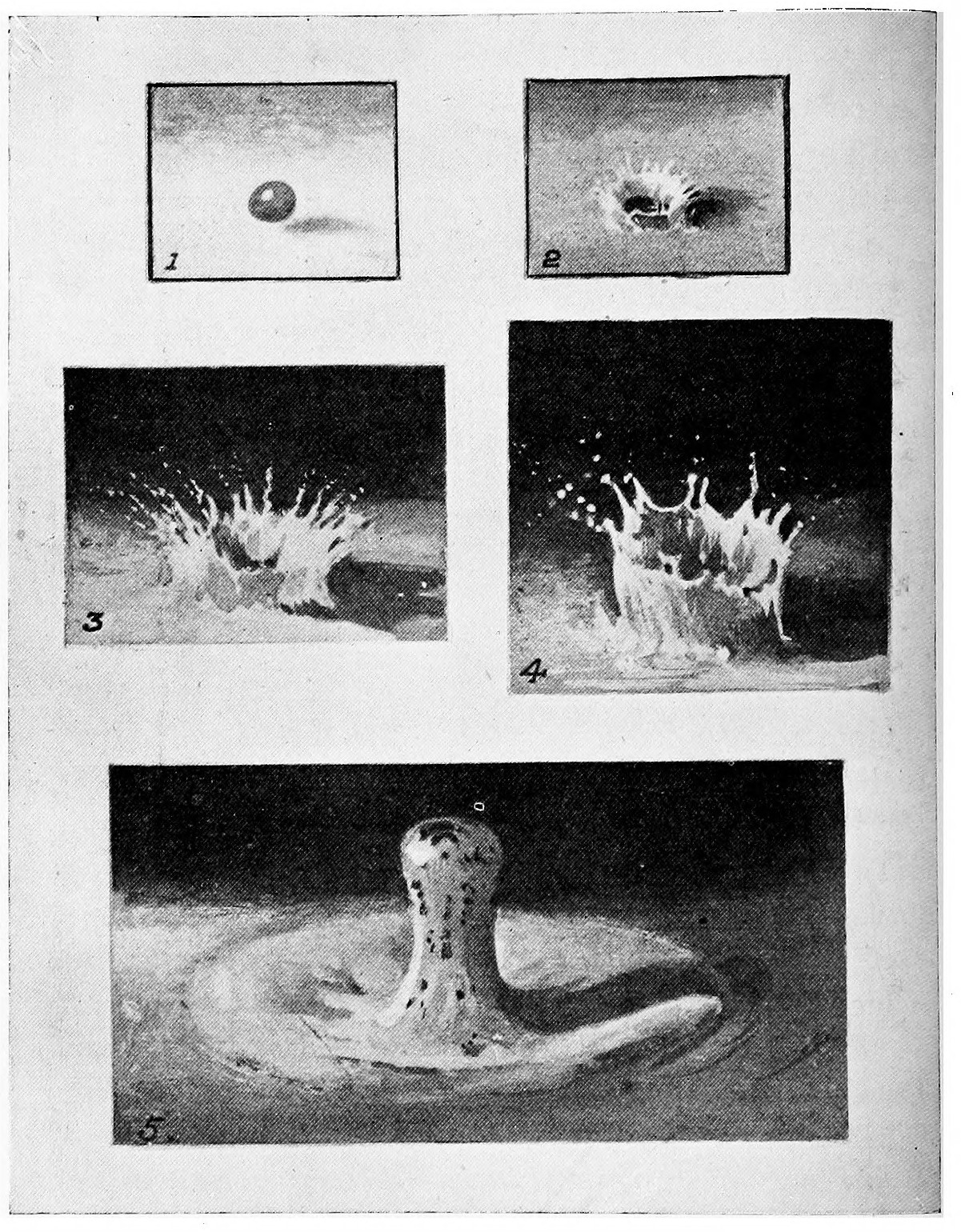
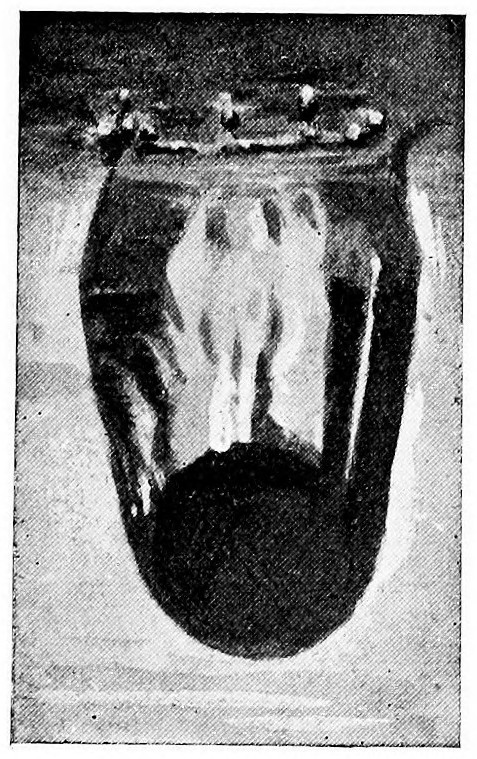
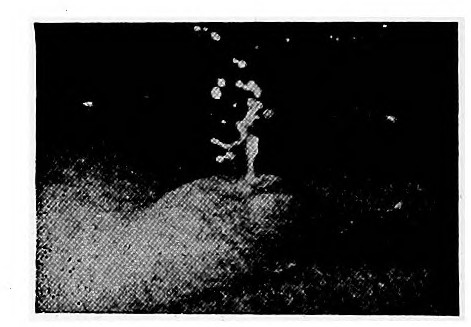
The series of events which take place every time a drop falls into the water is too quick for the eye to follow, but the late Mr. Worthington used instantaneous photography to record what happens, and I will show you some of his results. His method of working consisted in allowing a small metal ball to fall at the same time as the drop of water. The heights through which ball and drop had to fall, and the times of release, were very carefully adjusted. When the water drop arrived at the water surface or reached the particular stage of its subsequent history of which a record was required, the metal ball at that moment reached a spot where it started a brilliant electric spark. For a very brief moment the water and the drop were strongly illuminated. The camera stood ready and the photograph was taken. By varying the conditions of release of the ball and drop, he obtained in successive pictures records of all the stages in the series of events that took place when the drop fell into the water. In one set (Fig. 36, Nos. 1 to 5) a drop of water containing lampblack is falling into a mixture of milk and water. You can see in (1) the falling drop, in (2) the splash which is thrown up as the drop enters, and in (3) and (4) the subsequent growth of the splash. In (5) you see the column which leaps up a little while later with the original drop on top of it.3 When photographs are taken from below the surface, it becomes clear that an air cavity is often formed. In Fig. 37, for example, we see the cavity formed behind a shot which has been dropped into water. Now it appears that the note which we hear is the resonant note of this cavity, probably given out when the cavity has closed over at the top and burst again. My friend Sir Richard Paget has actually measured these cavities in various cases and then made models of them in plasticine. Blowing across the top of the model cavity, he finds that its note is practically the same as that which the drop makes when it falls. The note is very high, and has a frequency of two to three thousand vibrations a second.
Worthington showed also that a very clean dry ball makes little or no splash or noise when it is dropped into the water from not too great a height. Photographs show that in this case the water clings to the surface of the ball and laps round it as it enters; this is shown in Fig. 39. Worthington spoke of this effect as a sheath splash: the more common and noisy effect he called a basket splash. It is easy to understand that there will be no noise when the water closes up over the ball at once, so that there is no cavity behind it. These experiments are very interesting and easy to try for one's self. Bicycle balls give good sheath splashes when they are bright and dry: it is extraordinary what a difference is made if the ball is wet, or is rusty, or roughened in any way. It is a convenient plan to put a piece of cloth or rubber at the bottom of the basin into which the balls are dropped. Sir Richard Paget observes that there is no noise unless the water is deep enough for the cavity to be formed in it.
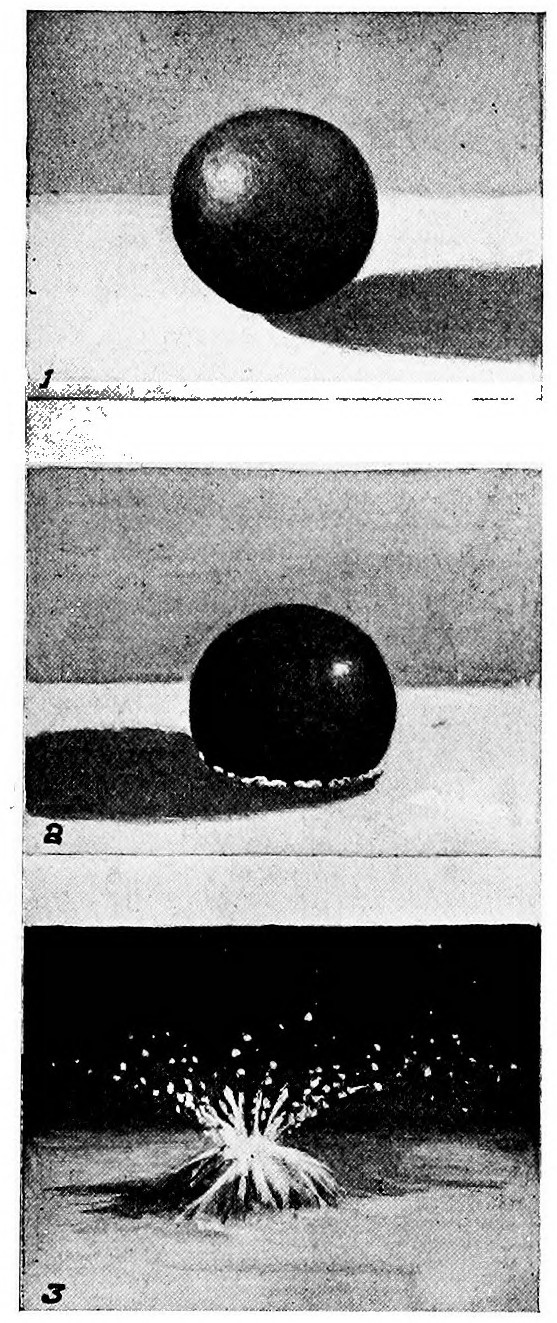
No doubt the reason why the drops falling in succession under the same circumstances make notes of different pitch is that the form of the cavity is altered by slight changes in the shape of the drop when it reaches the surface, or in the form of the surface itself. A drop oscillates, as it falls, between a flattened and a pointed form; and the shape of the cavity must depend considerably on what form the drop has at the moment of striking. We have to remember also that the note of the cavity may possibly depend on the size of the opening which it has at the moment of sounding. If we make a model cavity in plasticine and find its note by blowing across the top, we observe that the note falls in pitch when we close in the opening more and more.
This last effect manifests itself in many other interesting ways, a number of which were considered by the late Lord Rayleigh, and will repay our special attention. Here, for example, are two flasks of the same volume but differing in the size of the opening; when I blow across the mouth the flask with the narrower opening gives the lower note. A still simpler experiment can be made with an ordinary cigarette-holder, which is just a short tube wider at one end than the other. If I close the smaller end with my finger and blow sharply across the wider, I get a much higher note than when I do the same thing with the tube reversed.
After all, this is what might be expected. Consider, for instance, a vessel A of the shape shown in the figure. When it is sounding its simplest and deepest note the air alternately rushes in and out of the opening. When it rushes in it compresses the air in the vessel, the pressure inside increases, and presently has increased so much that the tide is turned and the air is forced out again. Its momentum carries it too far, and after a time the tide begins to flow once more; the constant repetition of these events constitutes the vibrating motion. Suppose that the same effects were occurring in the vessel B of the same size as A but having a wider opening, and that the same amount of air was flowing in and out, then the maximum pressure would be the same as in A; but since the opening in B is wider the in-and-out motions of the air are less restricted and the vessel will empty and refill itself more quickly. The pitch of the note is therefore higher.
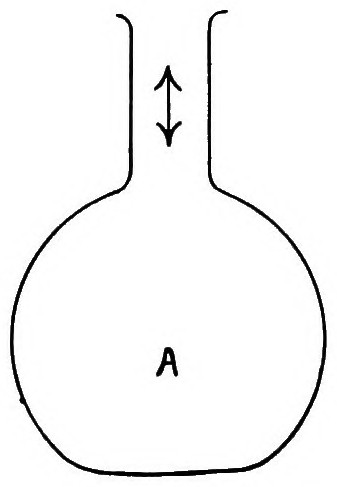
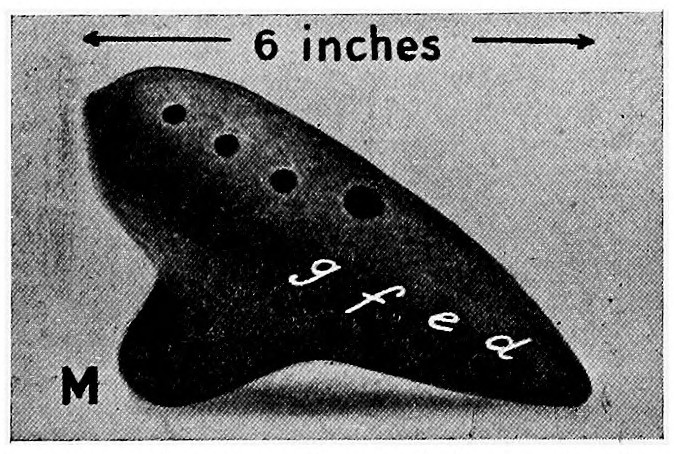
A good illustration of this effect is to be found in the ocarina. It is blown like a whistle, and as in the whistle there are rows of small holes which may be covered by the fingers. But the shape of the body is peculiar, as the illustration shows. The behaviour is like that of a flask, rather than like that of a long tube. When a hole is opened by lifting a finger and the player blows across the main opening the air inside vibrates in such a way that it surges in and out of the open holes. If two holes are opened the pitch rises because the air can move in and out more easily, using both at once. If three, four, five holes are open the pitch still rises. The curious point is that the pitch depends much more on how many holes are open, than on what particular holes they are. If only one hole is open it does not make much difference whether that hole is, for example, 1, 2, 3, or 4.
When we go out into the street we meet with the roar of the traffic. It is curious how quickly we lose it if we turn aside from the main thoroughfare. The houses cast shadows of the sound, and more particularly of the sounds of high pitch; so that in the side streets the sound of the traffic has become "muffled," that is to say, the deeper notes only are left.
When a car goes by there is a drop in the pitch of all the noises that it makes; the effect is most easily observed when the pace is swift and the drop is great in consequence. When the fire-engine dashes by, the sound of the bell which is being rung continuously is obviously lowered in pitch as the engine passes.
We may explain the effect in the following way. As the car or the fire-engine is coming towards an observer, the sound pulses, which it is pouring out at the rate of so many in each second, run ahead to the observer, whose sense of the pitch of the note depends on how many pulses reach him every second. This number is artificially increased by the movement of the source. Each pulse is given a little handicap on the pulse before it, so that it follows its predecessor at a smaller interval than it would have done if the source had been at rest. It may be helpful to consider one or two illustrations. Suppose that a man travelling home to London from Rome in a leisurely fashion, one or two hundred miles each day, were to write daily to a London friend; the friend would, on an average, receive rather more than a letter a day. Or again, suppose men marching in single file up an escalator in a tube station, and mounting at the rate of one step a second; when the men get to the top they step off and walk away at their natural pace, past an observer who counts them as they go by. Let him first make a count when the escalator is not working; then if the escalator begins to move, he will find that the number passing him in each minute is greater than before.
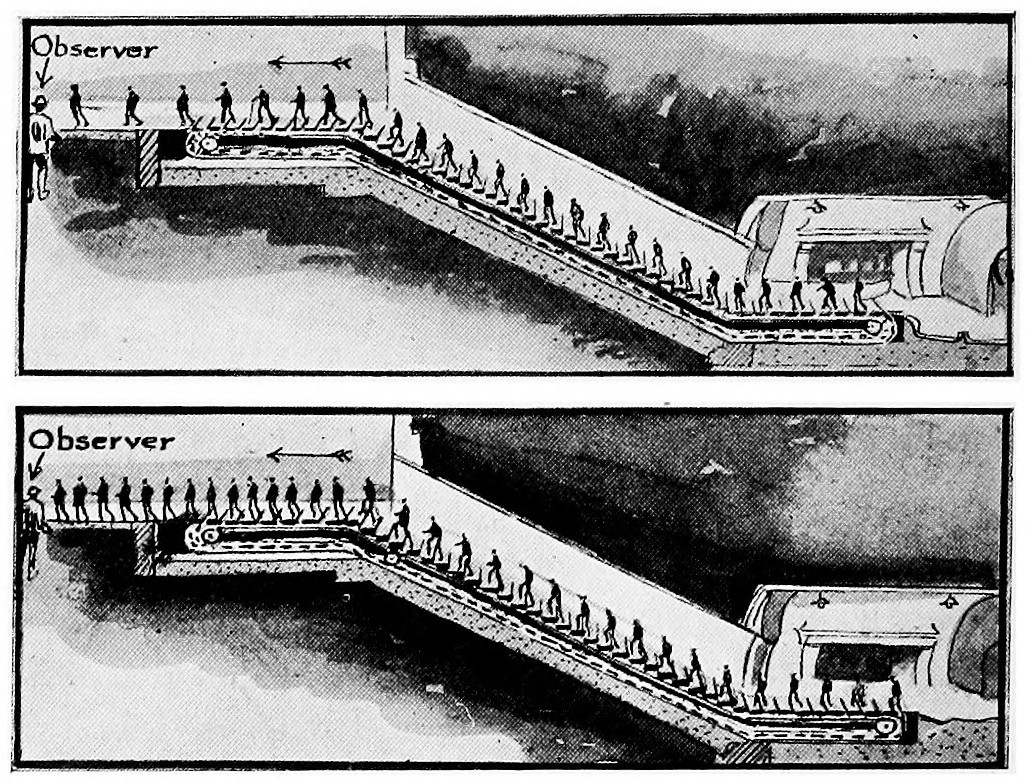
Just so in the case of the approaching car the observer receives more pulses in each second than the car is giving out, and the pitch of the notes is raised in consequence. The increase in the number of pulses received is nearly in the same proportion to the frequency of the note as the speed of the car is to the speed of sound. An accurate calculation can be found in any text-book.4 If the car is approaching at twenty-five miles an hour, the proportion is 1:30, because sound travels at the rate of 750 miles an hour. If the car is going away from the observer at the same rate, the note is equally lowered; the number of waves reaching the observer in each second is less by nearly one-thirtieth of their true number. If we compare the note of the approaching car with the note of the receding car, the double change amounts to one-fifteenth of the true number. This corresponds to a drop in pitch of half a tone: that is to say, from any note to its flat. When an express rushes through a station the pitch of the whistle of the engine drops about a whole tone, and the drop is twice as much when the observer is in one express and listens to the notes of another that is passing.
The drop in pitch is exactly the same for every note that is made by a passing car. The wind makes a very small difference, imperceptible by ordinary means. We might imagine an intelligent and musical policeman listening for the drop in pitch, knowing that if he could estimate it correctly he would know at once the speed of the car. Of course we might try to circumvent the policeman, if we were driving the car, by putting on a little extra speed just as we went by so as to make the drop appear less. But we should have to be careful not to overdo it, lest the pitch did not fall at all, or even rose! I have been trying to imagine what the policeman would think in the latter case. If he stuck too closely to his formula he might be led to the conclusion that, in spite of appearances, the car was really going backwards!
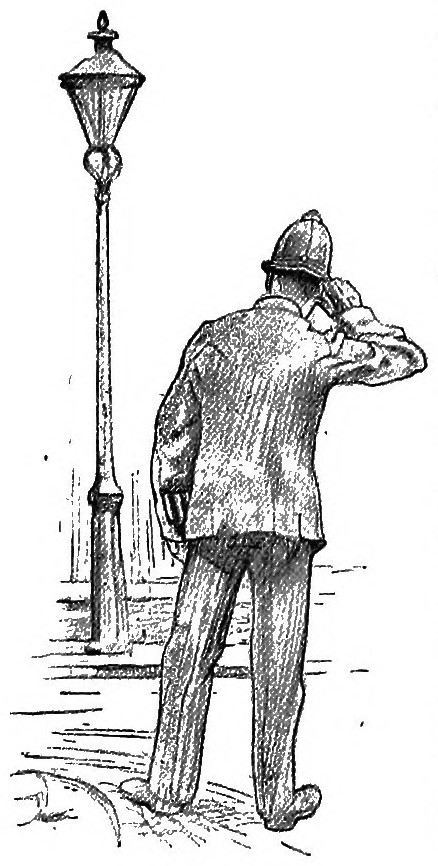
The effect we have been considering is met with in the case of light as well as that of sound; and it was in fact in connection with light that it was explained by Doppler eighty years ago. The results in the case of astronomy have been very wonderful. If a star is moving towards us, light waves which it emits crowd on us a little too quickly and the light "rises in pitch," that is, it moves a little way along the spectrum from the red to the blue; and by measuring the shift the velocity with which the star is approaching can be calculated. In the terrific storms which take place on the sun, when masses of heated and incandescent vapour are whirled and blown about at speeds of hundreds of miles a second, the velocities in the line of sight can be measured and the course of the storm can be followed. It is very curious that by means of this principle it is easy to find the velocity with which a star is moving to or from us when the star is so far away that any motion across the line of sight is imperceptible: just the opposite to our common experience of objects moving on the earth.
One of the most interesting of town sounds is the reverberation sometimes found in public buildings, an effect which makes it difficult to hear a speaker. The sounds that he utters go ringing round the room for some seconds, and confuse the words that follow after. The walls, ceiling, and floor reflect the sound just as the ripples were reflected by the walls of the tank. Suppose, for example, that a sound, let us say a handclap, can be heard for five seconds after it has been made, which is not at all unusual. During that time it has travelled about a mile, and must have been reflected dozens of times. The sound lasts longer than in a smaller space like a room, because it has to travel farther before it has experienced enough reflections to destroy it; for there is always some absorption at each reflection. If we clap our hands in a hall when no audience is present and find that we can hear echoes for more than two or perhaps three seconds, it is certain that the hall is not good for public speaking. The surfaces in the hall are too efficient as reflectors, and their efficiency must be destroyed before good hearing is possible. This can be done by covering the walls and floor with a sufficient quantity of material which will absorb sound—curtains, carpet, felt, and so on.
A long series of experiments has been made in America by W. C. Sabine, who has arrived at certain very simple conclusions.5 He found, in the first place, that a given quantity of material, such as so many square yards of carpet or curtain, has the same effect no matter where it is placed: which is what might be expected, because a sound which lasts for several seconds must have hit every part of the room—walls, ceiling, or floor—and have run up against the material at some time or other. In the second place, he found that he could calculate beforehand how long a sound would last if he knew the volume of the hall and the nature and extent of all the various surfaces in it. Given, therefore, the volume of a hall, we know how much absorbing material should be placed in it if hearing is not to be interfered with by reverberation.
Of course, reverberation is not the only cause of bad hearing. It may be that the space to be filled with sound is really too big, and is as difficult to cope with as the open air. Or again, the form of the building may be such that sound is dissipated too quickly: there may be too much absorbing material, or too many recesses and openings into which sound passes never to return. It does not appear to be advisable that a hall should be quite "dead." A period of two to three seconds between the moment when a sound like a handclap is made and the moment when it ceases to be audible does not seem to be unreasonable, especially if the experiment is made when there are no people in the room. The presence of an audience does a great deal to stop reverberation. A concert room should be rather more resonant than a room for speaking.
Sometimes the more distressing features due to too much reflection can be removed with very little trouble. In a very bare and plain room in the basement of the Conservatorium at Adelaide piano recitals were at first almost impossible, because the room rang with shrill and piercing notes. The evil was practically cured by hanging two or three strips of serge two feet wide from the ceiling across the room.
The reflection of sound by the walls of a building leads to curious results in certain cases. One of the best known has given its name to the Whispering Gallery in St. Paul's. Any one who whispers to the wall on one side of the great dome can be heard by a listener even as far away as the opposite side, provided that he also is close to the wall. Lord Rayleigh gave the explanation of the effect long ago, and later (in 1904) showed in this room an experiment in illustration of it. He pointed out that sound tended to creep round the inside of a curved wall, being continuously reflected by the wall without ever getting far away from it.
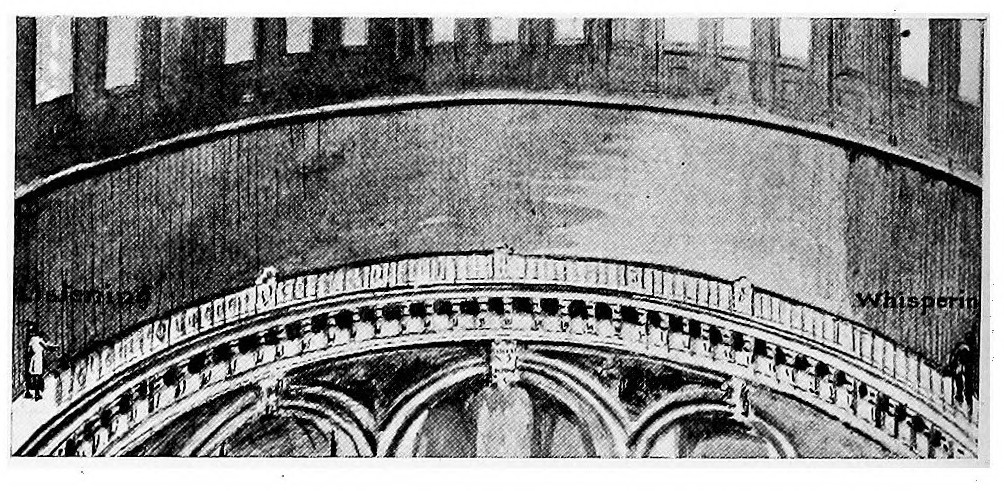
We will repeat his experiment. A sheet of iron, twelve feet by two feet, is bent into the arc of a circle, in order to represent a piece of the circular Gallery wall. At one end is a bird-call, at the other a sensitive flame. When the bird-call is sounded the flame flares; and it is easy to prove that the sound is creeping round the inside of the wall and close to it, because a screen, four inches wide, placed close to the wall as at b in the figure, or at a or c, cuts off the sound entirely and the flame ceases to flare. If the screen is withdrawn a few inches from the wall, the sound gets through between the wall and the screen, as the flame shows. In fact, the screen is no use anywhere except near the wall; but any point along it will do equally well.
Before Lord Rayleigh gave this explanation, it was thought that the sound was focused from one point to another by the dome above the Whispering Gallery, and that the speaker and listener should be exactly opposite to one another. It is not necessary, however, that the whisperer and listener should be in any particular positions. Moreover, whispering is heard more distinctly than ordinary conversation, especially if the whisperer's face is directed along the Gallery towards the listener. Whispers contain a larger proportion of high-pitched sounds than ordinary speech: we have seen that such sounds do not spread sideways so obviously, and are more easily directed and controlled. A whisper which is heard easily in front of the whisperer, cannot be heard behind him; the same cannot be said of the sounds of the natural voice.
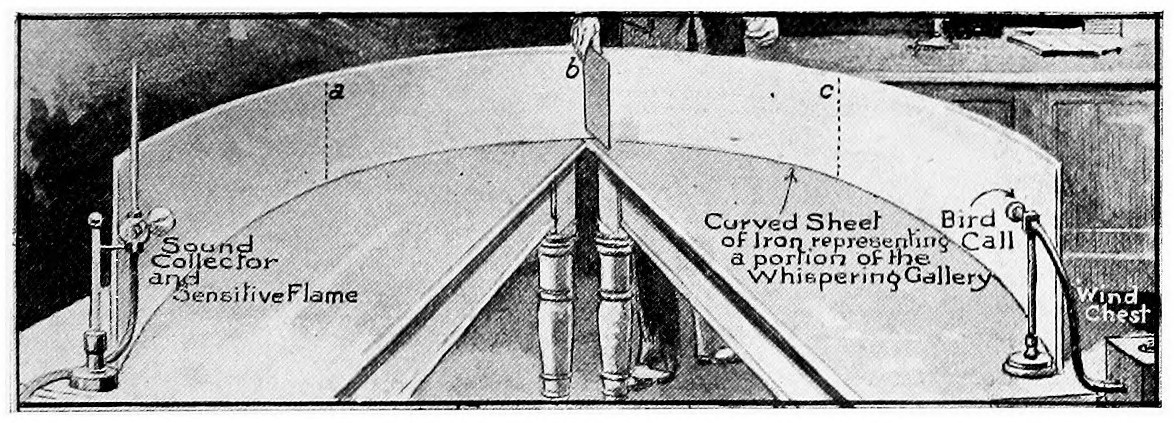
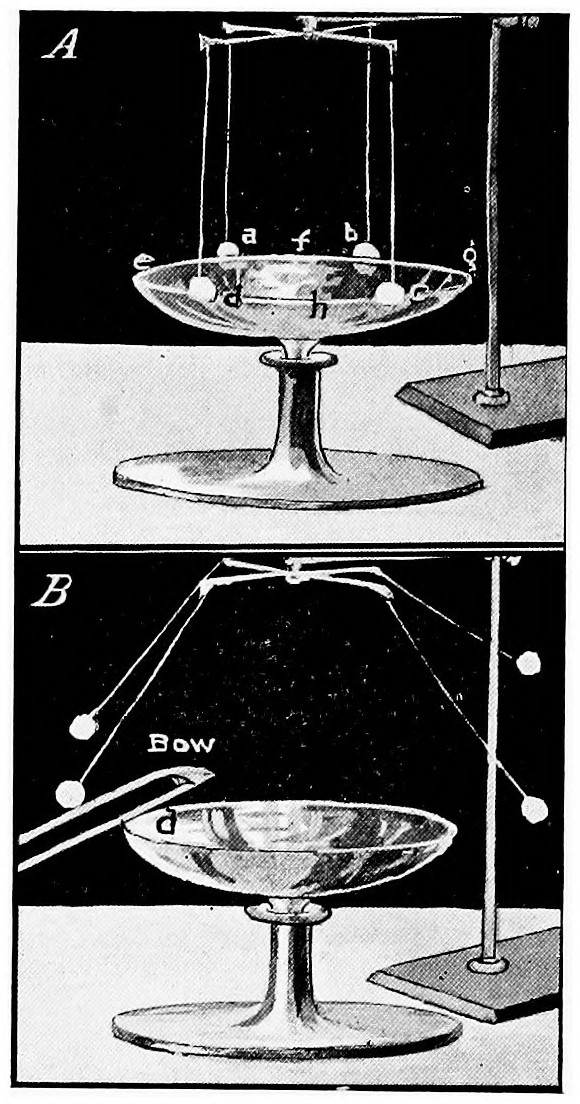
Mr. Child has called my attention to a remarkable echo in the Victoria and Albert Museum. A stamp of the foot on the floor under the centre of the octagonal dome is followed by a number of echoes from different reflecting surfaces which are contained in the structure of the building.
We must not forget the bells of London Town. Bells are a study in themselves, and we shall have time for only one or two simple points. Their vibrations are of much the same character as those which we can set up in a finger-bowl by rubbing it along its edge with a wetted finger, or drawing a violin bow across it. Here is a large plain glass bowl which Tyndall used: it has a glass stem by which it can be held. Four pith-balls suspended by fine silk threads rest against the edge at equidistant points (Fig. 45, A). If I use the bow to excite its main note, we see how the pith-balls are flung out and away by the vibrating glass (Fig. 45, B). But the effect depends greatly on where the bow is drawn over the edge. If it is at a point half-way between two balls they scarcely move, because in fact the points where the balls touch are now nodes. The rim of the vibrating bell alternates between the two forms shown in firm line in Fig. 46. There are four points—a, b, c, and d—where the rim moves in and out most, and four others—e, f, g, and h—where it does not move in and out at all. One of the former always coincides with the place of bowing, so that if the bow is drawn across the edge near one of the pith-balls they all fly out, but if half-way between two of them they are all still. The four points on the edge—e, f, g, and h—are not altogether at rest; they really vibrate to and fro along the edge; and if a wet finger is used to excite the notes in a finger-bowl, it will be observed that there are no ripples just opposite the finger, because the ripples are due to the in-and-out movement of the glass, and there are no such movements underneath the finger. The bow is drawn across the edge of the bowl, but the finger is generally moved along it. The ripples caused by the bow may be so violent as to break into showers of spray (Fig. 47).
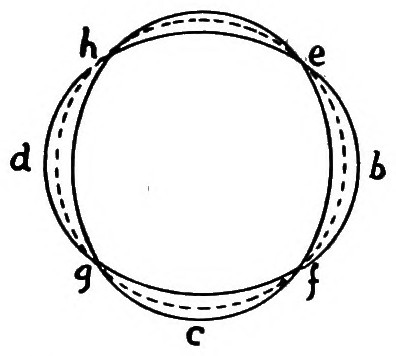
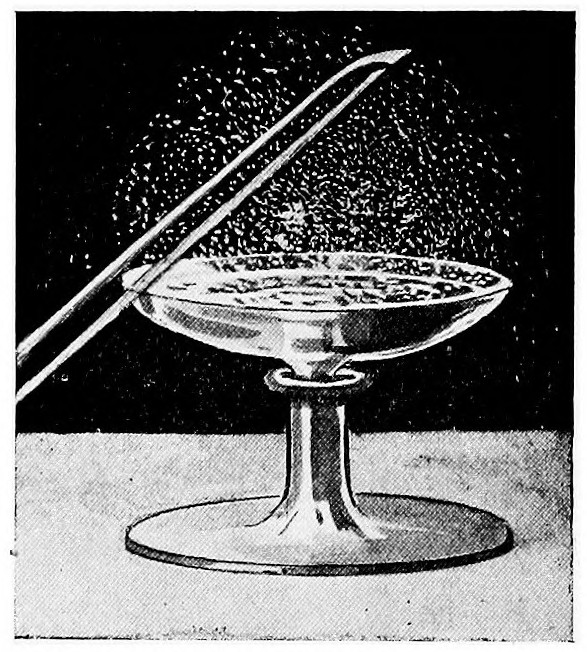
When we come home to our own fireside in the evening at this time of the year there are pleasant sounds to greet us in the singing of the kettle and the sounds of the chimney up which the flames are darting.
The sounds of the kettle are very interesting. The bottom of the kettle where the flames touch it is the hottest part of it; and it is there that the water first rises to the temperature at which steam is formed. The little bubbles of steam are at first at a pressure strong enough to stand the pressure of the surrounding water; but as they rise to the surface and come to the colder parts of the water, their temperature falls, and their own pressure with it. There comes a moment when they can no longer hold up against the pressure round them; they collapse, and do so with the greatest suddenness, so that the sides strike against each other with a sharp smack. The blow is as hard and unyielding as when steel meets steel, and so there arises a noise from the kettle as if blows were rained upon it by innumerable tiny hammers; because the water carries shocks of this kind to the metal walls, and the blows might as well have been given to the walls themselves. We shall meet with this effect again when we come to consider under-water sound. The kettle stops singing when the water all through has reached the boiling-point and the bubbles rise to the very top without collapsing on the way.
Drops of water hiss if they fall on a surface hot enough to turn the water into steam. I do not know of any thorough explanation of how this happens. Hissing noises are caused by very rapid vibrations, so that somehow small but rapid fluctuations are taking place where the water comes near to the surface. If the water actually touches the surface for a moment, there will be a sudden formation of steam, so sudden as to have the effect of a small explosion, and this will start a sharp pulse in the air. The water will be lifted up, fall, and touch again, and so on. In the multitude of minute explosions due to the many contacts of the water with the hot surface the explanation of the hissing is no doubt to be found.
When the frying-pan is on the stove and spluttering noisily, the sound is due, I believe, to the explosions of small drops of water. The melted fat is much hotter than boiling water, but little drops of water remain suspended in it in the liquid state although they should have turned into steam at a lower temperature. It is a well-known effect; as a matter of fact, the drop wants something to start the conversion into steam. When the laboratory worker finds that water or some other liquid has got past its boiling temperature and yet will not begin to boil, he drops in a lead shot or anything with a roughened surface which will carry down a few minute bubbles of air; the boiling then begins at once. But little drops of water contained in the melting fat are wrapped in the smoothest of envelopes, and it often happens that they rise in temperature until their boiling is long overdue. Something or other starts it, and then the drop boils so fast that its sudden conversion into steam has all the effect of an explosion.
The roaring of the wind in the empty chimney is, after all, only the result of its blowing across the top; it makes a noise just in the same way as when one blows across the end of an empty tube, and the notes we hear are very deep because the chimney is so long. A fire makes a confused noise because the heated gases flaming upwards tear the air into multitudes of tiny eddies as they flicker to and fro. Neither of these sets of noises is very powerful in itself, but the combination of a flame and a tube may under certain circumstances, which do not often occur in practice, be the cause of very loud sounds indeed. It is easy to provide these special causes, and the results are very interesting and instructive.
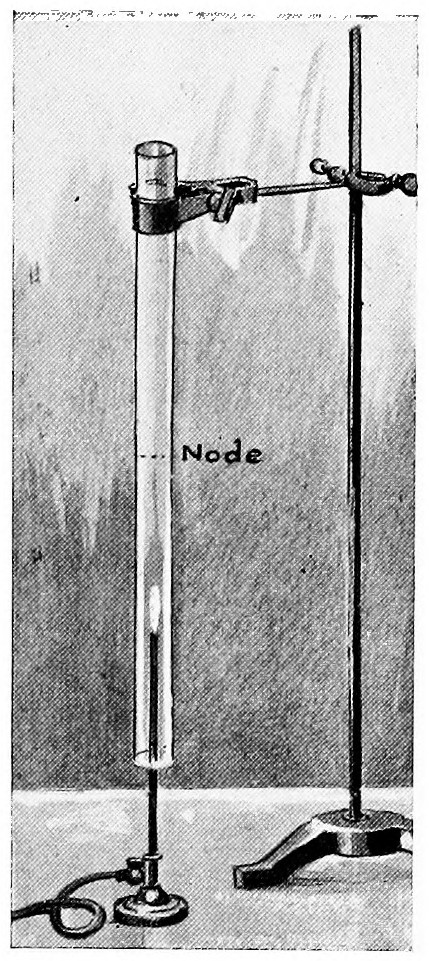
Let me describe first of all a very old and simple experiment. Here (Fig. 48) is a glass tube eighteen inches long and half an inch in diameter; and a long tapering gas jet at the end of which a little gas flame is burning. I pass the flame up the tube, and when it is three or four inches from the bottom it begins to sing with a steady musical note. It is often called the singing flame. The note is that of the tube, in which the air is vibrating in the simplest manner possible to it; there is a node or quiet point at the centre, while at the two ends the air pours in and out. The motion must be considerable, because the note is loud, and we have to explain how the flame manages to keep the vibration going. The answer to this question is that the flame itself is fluctuating, large and hot one moment, small and not so hot the next. The fluctuations keep pace with the vibrations of the air in the tube, and are compelled to do so in fact; and the secret of the effect is that the flame, when it is hot, supplies extra heat at just the right moment to make the air in the tube expand and push itself out when it ought to be doing so. I will try to make this clear by a simple example. Fig. 49 shows a bulb containing air, fixed by means of a cork to one end of a U-shaped tube containing mercury. Inside the bulb is a spiral of fine platinum wire through which a battery can send a current of electricity raising it to a bright red heat, The current runs from one end of the battery by way of a wire passed through the cork, goes through the spiral, and down inside the U-tube by means of a wire which just dips into the mercury. Then the current runs to the other end of the mercury, and out by a wire which dips well in, and so back to the battery.
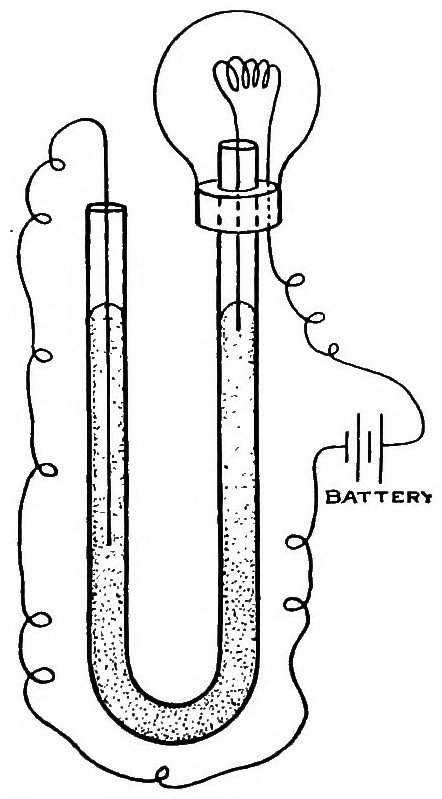
As soon as the battery is connected the spiral becomes hot, the air inside becomes heated and expands so that it presses the mercury down on the bulb side. But this breaks the electrical connection, because the mercury drops below the wire; the spiral grows cold, the air contracts, and the mercury comes back; the same series of events then repeats itself. You see that the mercury is soon oscillating violently. The point to be observed is that by means of the application of heat we have set a mass of air into regular vibration: just the same thing that happened in the case of the singing flame. But here the motion is so slow that we can watch it, and puzzle out for ourselves how the heat manages to keep the vibration going, and the conditions under which it can manage to do it. The principle is so important, and has so many parallels in other subjects, that it is worth while to examine it very carefully.
The important point is that the heat is supplied to the air in the bulb mainly when it is expanding. Heat tends to make the air expand, so that the heat encourages it to do what it is already doing, and therefore the motion is increased. Just so, if you are giving some one a swing, you will always increase the extent of the swing if you push him the way he is already going. You will stop him if you push in one direction when the swing is going in the opposite direction. In thinking how this is to apply to the experiment before you, there is one more thing to realise before the explanation is complete. I said that heat is applied to the bulb mainly when the air is expanding, but it is not applied only when it is expanding, for the reason that it is very difficult to arrange that it should be so; and in fact in the case of singing flames and parallel phenomena the word mainly must of necessity be used.
The spiral warms up as soon as the mercury on the right-hand side in its upward rise touches the dipping wire, and there is still much upward movement to take place and much compression of the air. All this is to the bad; the heat is applied when the air wants to contract. But the wire does not get hot at once; and what is more, on the following downward move the wire remains hot for a moment after the connection is broken. So, on the whole, there is more heat supplied to the air when it is expanding than when it is contracting. It is absolutely necessary that this should be so if the vibration is to be maintained.
Now let us see how this condition is satisfied in the case of the singing flame. When the air in the tube is vibrating the gas in the supply tube is vibrating in sympathy, so that it comes out in gulps and the flame is alternately large and small. The gas rushes out fast when the air in the lower half of the tube is moving up in the course of its vibration to the node in the centre, and the air in the top half is moving down. The heat of the big flame comes, just as in our model, mainly when the air is expanding from the node; on the whole, it helps the air to expand just when it ought to, and that is how the vibration is kept up.
Now let us try with a tube of some size, more like a real chimney. Fig. 50 shows one about fifteen feet long, hanging vertically from the roof and so arranged that we can conveniently push a large Bunsen gas-burner up it. The gas-burner has been specially lengthened in order that this may be done. Even when the burner gets near to the mouth of the tube we hear a noise due to the gas-flames which are fluttering wildly and are torn by the draught now rushing up the tube; this kind of noise is such as we actually get when the flames roar up the chimney. But when the gas burner is well inside, two or three feet from the opening, the effect I have been trying to explain manifests itself gloriously, and the tube breaks out into peals of banging thunder.
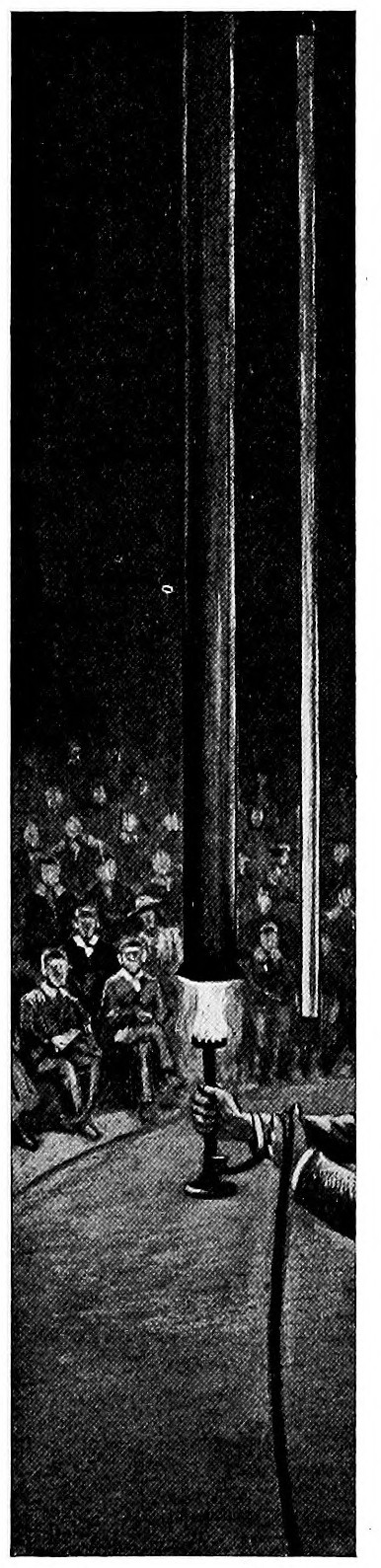
Another tube hangs alongside which can also be made to sing, but not exactly in the same way. About eighteen inches from the bottom a piece of gauze is fixed across the tube; a gas flame is pushed up sufficiently far to play on the gauze and make it red-hot. We withdraw the flame, and then, after a moment's waiting, a strong steady note issues from the tube and continues for a minute or so. In this case the air rushing past the gauze towards the node, during the time when the air in each half of the tube is moving towards the middle and making a condensation there, draws heat from the gauze as it goes by. But, it may be said, the same thing will happen in the other half of the vibrations when the air is expanding, and so heat will be extracted from the gauze at the wrong time as well as at the right. We have to take into account, however, that there is a draught up the tube all the time; the air really moves in leaps: it is always a new lot of air that rushes past the gauze and takes the heat to the middle.
When the house is still at night there are odd creakings, many of which are due to changes of temperature. Parts of the house structure shrink more than others as they cool, and a strain is set up which gives way suddenly. In hot countries, wherever houses have roofs of corrugated iron, the sound due to the contracting roof is very common. A stove creaks sometimes after the gas has been turned off, or the cinders as they cool in the grate. There is a great statue in Egypt, near Luxor, which, about the beginning of our era, used to emit a sound in the early hours of the day, when the sun first shone upon it. Pilgrimages were made to hear it; names of proconsuls and others are inscribed upon the legs of the statue. It was a ruin even then, and it is now suggested that the sound was due to the ringing note of one stone sliding on another, the heat having caused the stone to expand and strain until at last something gave way. Eminent archæologists differ on the point, some saying that the noise was made by a priest hidden in the stone. But I think that in the beginning the effect must have been natural; though the priest may have assisted nature when some important visitor was waiting to hear, and it was advisable that he should not be disappointed.
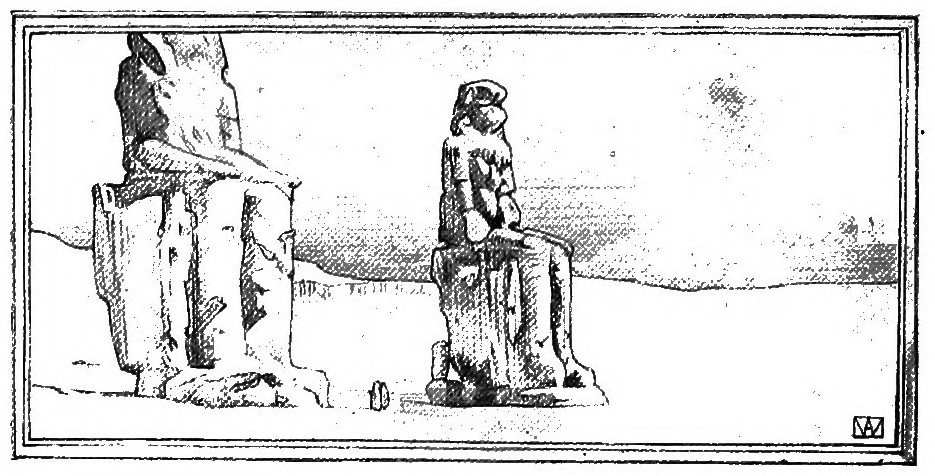
Lecture IV: Sounds of the Country
In the country are many most interesting sounds; in a certain sense they are more interesting than any others, because many of them are the very sounds of nature which ears were made to hear, and others are the signals of living beings to one another, which have grown in richness of meaning as ears have grown in delicacy of perception. First of all, the songs of birds will come to our minds when we think of country sounds, and the cries of insects, and of the animals. The songs of birds raise many questions which we must not stop to consider, because they are too difficult to think of in the short time that we have. There is just one point that I would mention. We do not really know that we hear all the notes of the birds; for our ears have only a certain range and are not sensitive to notes above a certain pitch; the range of hearing varies with different people, becoming restricted as we grow old. For example, do we hear all the notes of a wren or a blackbird? Mr. Wilkinson of Leeds, a blind naturalist of whom I will tell you presently, thinks that the songs of birds sometimes go out of our range of hearing. We know that some people do not hear the squeak of a bat or the shrilling of a cicada. After all, the birds do not sing to please us but one another, and as far as that goes there is no reason why they should suit themselves to our ears.
In the insect sounds we find a number which we can understand by means of the simple principles of sound we have already been considering. When an insect beats its wings so fast in flying that the successive little pulses of air link themselves together into a musical note we realise that we have a very simple illustration of the way in which a sound of definite pitch is made. Some of the insects actually make sounds in the very same fashion as we did ourselves when we held a card against the teeth of a revolving wheel. We may take one of the members of the grasshopper family for an example. It has on the edge of one wing-case a roughened or serrated edge, like a blunted saw; on the other is a ridge so placed that when one wing-case is moved over the other the teeth of the "saw" are drawn rapidly across the ridge. Every time the ridge slips over a tooth and down into the next hollow a little quiver is given to the wing, and a pulse goes out into the air. There is a beautiful little tambourine set in the wing—you can see it in the representation of the wing upon the screen (Fig. 51)—and apparently the use of it is to give a better send-off to the air-pulse. The flat surface of the tambourine vibrates as a whole up and down when the ridge beside it is shaken, and its comparatively broad surface launches a correspondingly large amount of sound. When we press a card against the revolving toothed wheels the volume of sound is increased by using a larger card, though of course the pitch does not alter when we do so.
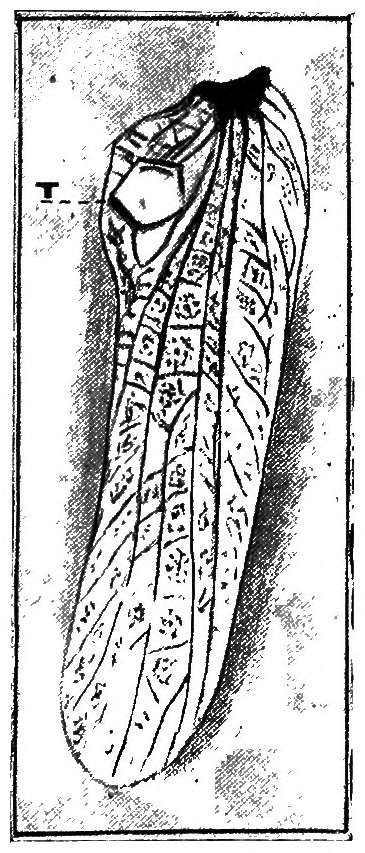
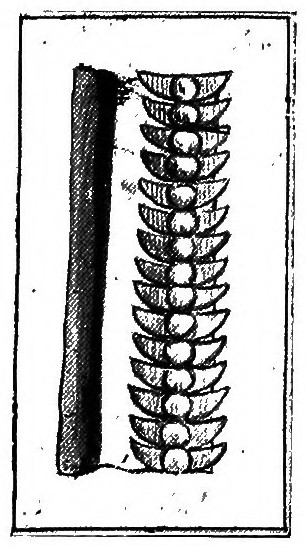
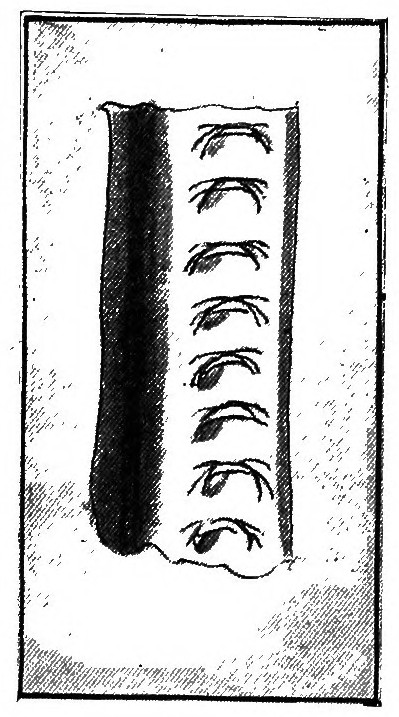
The crickets have something of the same arrangement. Fig. 52 is an enlarged drawing of the "bow" which is used by the house cricket; it shows the little teeth which correspond to the teeth of the wheel we have used in our experiments. Fig. 53 shows the "bow" of the field cricket; the little projections are less rigid and are farther apart so that the chirp is not so loud and is a little lower in pitch.
Chirping insects mount the "bow" and the edge which is to be bowed in all sorts of places on their bodies. Here, for example, is a beetle called Cacicus Americanus in which the rasping surfaces are neatly arranged to fit one another in the manner shown in the picture (Fig. 54). Along the insect's side is a dark streak which when examined closely shows to the naked eye a series of regular ridges. The leg of the beetle has a corresponding series of ridges along its length which just fit into those of the side; in fact, the latter are so arranged that as the leg moves along them the direction of the ridges on the leg corresponds always with the direction of the ridges on the side at the place where they are touching each other at the time.6 Other insects have a rasp which is worked by moving the head, as if a man were rubbing an unshaven chin against a stiff collar. I have read of an observer, who, anxious to find out from what part of a beetle the rasping noise was coming, oiled it in different places until the noise ceased!
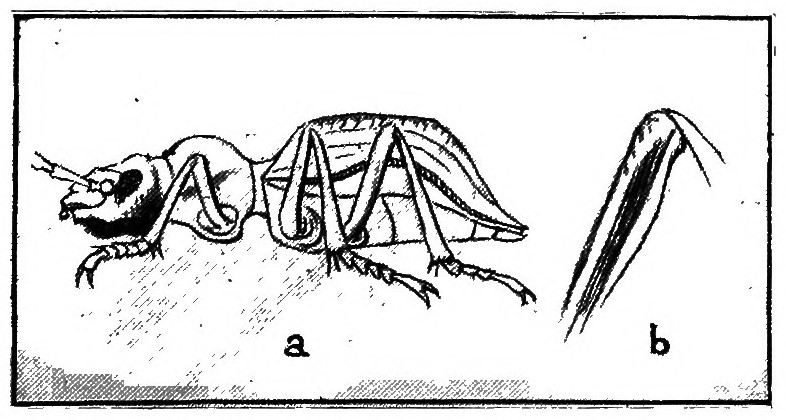
Another way of making a sound is used by the cicadas. They have a little stretched membrane to which, near one edge, is fastened one end of a muscle. By making the muscle shiver they cause the membrane to vibrate. The figure (Fig. 55) shows a remarkable Australian variety, which the Queensland boys call "hollow-bellies." There is a toy which makes a noise in somewhat the same way. A piece of parchment is tied across the mouth of a short piece of tube—a little piece of tin, bent into a cylinder one or two inches long and an inch in diameter, will do very well. A string is fastened to the middle of the parchment, and the fingers are drawn along it: a little resin on the fingers is very desirable. The noise is surprisingly loud, and resembles that of a small "Klaxon" motor horn. The Australian insect—it is only the male cicada which makes the noise— has an extraordinary distension which is the origin of its local name. Presumably it is intended to increase the sound, not because the hollow resonates to the note, but because the whole light structure will vibrate with the membrane and as in other cases launch stronger pulses into the air.
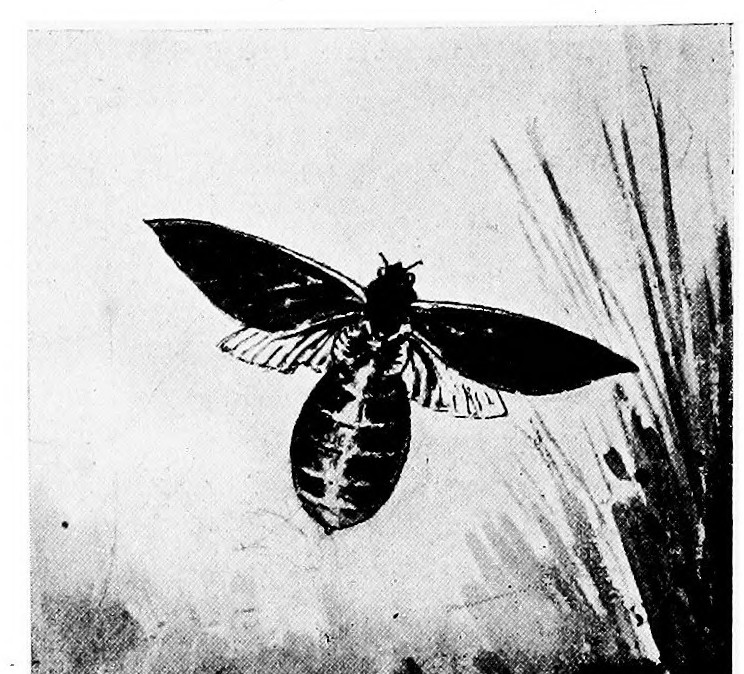
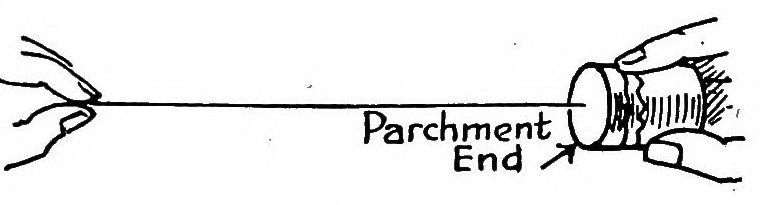
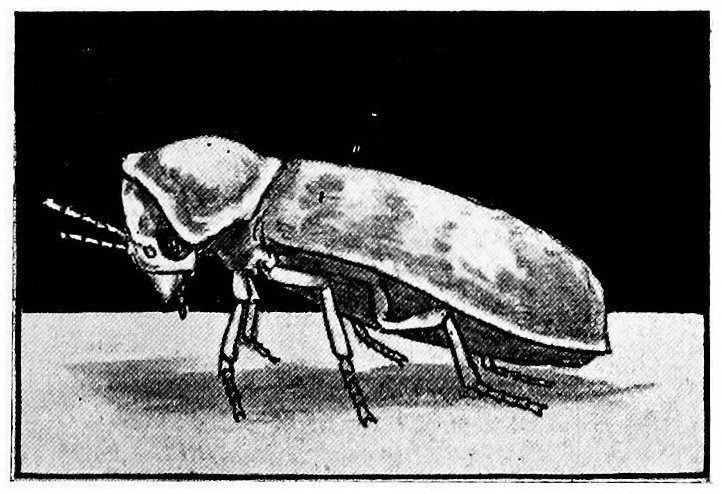
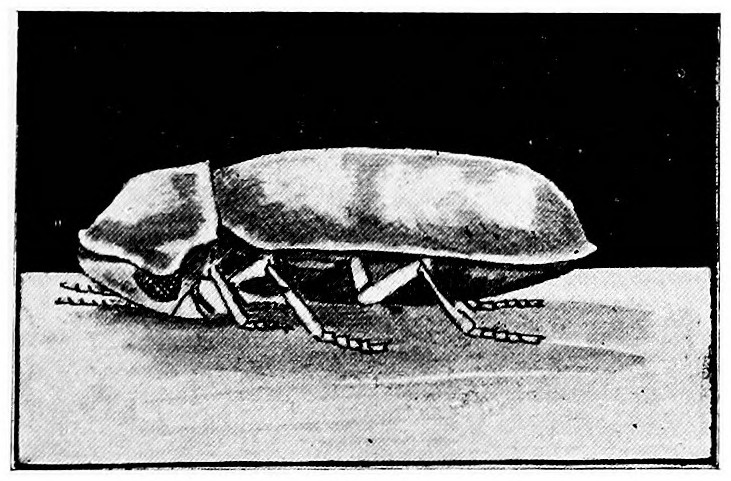
There is a small beetle known as the "death-watch" whose ticking sound is much feared by superstitious people. The little creature is, however, only sending signals to its kind, and has chosen a very simple way of doing it. It lives in wood, and signals by rapping its head thereon, which seems very appropriate considering that wood carries rapping sounds so well. The figures (Fig. 57, a, b) show how the beetle carries out the rapping process. Dr. Gahan has told me that he has kept one of the beetles for quite a long time, and could easily make it respond to the tapping of a pencil on the table.7
The ways and mechanism employed by insects of all kinds in making noises are very varied and interesting; but it would need a naturalist to tell you about them at any length, because so much depends on why each particular way has been chosen, and that again on the life and history of the creature. There are larvæ, for example, whose hind legs have no purpose whatever except to make a noise by scraping certain ribbed areas on the middle legs. The hind legs are of such size and form that they do this very well, though they are quite incapable of doing anything else; they simply move to and fro like the right hand of a negro minstrel playing the banjo.
There are insects which may be said to play wind instruments, such as the blue-bottle and the death's-head moth. There are butterflies that make sounds, as Darwin tells us in his account of his travels in South America. There are insects that are considered to make such pleasant noises that the Japanese breed and sell them for the purpose. In fact, there is here a great field of natural history which is full of interest, but on which very little has been written systematically. I am told that no book on the subject has been published since that of Landois in 1874, Die Thierstimmen.
The noises of the wind are easily the most notable of the country sounds. That is because our ears are especially fitted to detect vibrations or quiverings of the air; and such air-quiverings are set up whenever the wind blows through the trees and hedges or over the irregularities of the ground. We may take two cases of sound caused in this way and, considering them carefully, understand the general problem sufficiently well. Imagine an ever-flowing stream of air to meet an obstacle like a branch of a tree or a fence wire. It might be thought that the stream would simply divide and join up again, leaving a little backwater, or back-air we ought perhaps to call it, just behind the obstacle which parted it. But, if the speed of the air is not too small, something happens which is less simple, and very interesting. Little whirlwinds are formed in the air, first on one side of the backwater and then on the other, as in Fig. 58; and these pass on with the wind, so that there is a long double series of them, those on one side spinning one way, those on the other side the opposite way.
The flow past the obstacle wavers from side to side, and this happens even though the obstacle is quite still.
Every time this alteration of flow from side to side takes place an impulse is given to the surrounding air and a pulse or wave runs away in all directions. If there is an ear close by, a part of the pulse runs up against the drum of the ear and affects the mechanism attached to it. As we have already seen, one such pulse by itself cannot create the sensation we call sound, but if several pulses arrive in regular succession and repeat at equal intervals the blow upon the drum, a sound is heard of definite pitch.
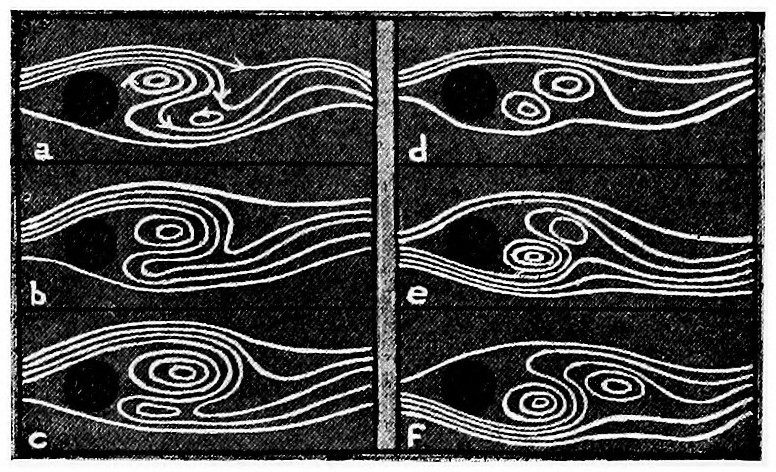
So, when the wind blows past a wire or branch, it sets up a regular succession of small whirlwinds, and a regular series of pulses is launched into the air. These when they reach the ear cause, by virtue of their regularity, a note of given pitch. This is the origin of the singing of the wind.
It is known that the number of pulses set going each second by a wind flowing past a wire or other cylindrical object is nearly one-fifth of the number obtained by dividing the velocity of the wind by the diameter of the wire. Suppose that the velocity is ten miles an hour, which is nearly fifteen feet per second, and that the diameter of the wire is a fourth of an inch. Then the velocity divided by the diameter is 720, and the number of pulses is nearly 140: the corresponding note lies about the centre of the usual compass of a male voice. When the wind blows twice as fast, or the obstacle is only half the diameter, the note is an octave higher, and so on. When in summer we lie down in the thin dry upland grasses there is the gentlest of whistling noises in our ears: the notes are so high because the grass stems are so fine. When in winter the gale roars through the bare branches it is torn into whirls which succeed one another regularly enough to give notes; and yet there are so many of them, and they vary so from time to time, that the sounds link themselves together in a babel of noise. When an extra gust comes the pitch of all the notes rises together and the roar becomes a shriek.
This curious partition of the stream with its accompanying whirls is the cause of many other familiar effects. As the whirls are formed first on one side, then on the other, the unequal flow of air right and left of the obstacle tends to make the obstacle itself rock from side to side across the stream of air. That is why the stays of a flagpole throb in the wind, and the flagpole itself, while in the fluttering of the flag we can almost see the whirls chasing each other down the sides. The same effects are found in the water as in the air. Whirlpools are formed if the water flows with sufficient speed past a pile. The anchor-chain throbs when a boat is moored in a tideway; the fishing-line vibrates when it has a heavy sinker to keep it down in the running water. A stick held in the hand and trailed behind a boat tries to go from side to side. In all cases the vibratory movement is transverse to the stream.
When it happens that the note of the wind, which depends only on its speed, and on the size of the obstacle past which it is flowing, is the same as some natural note of the obstacle itself, then there is strong resonance and the note rings out loudly. This is why the telegraph wires sing in the wind. The æolian harp depends on this effect for its music. A great number of wires, tuned to one and the same very low pitch, are stretched on one sounding-board, and placed so that the wind may play across them: that is all. When the wind blows over the harp the "wind note" for any one string depends, as we have seen, on the thickness of the string and the speed of the wind. All the strings will not be of equal thickness, so that the note will not be the same for all of the strings at the same time. If it happens to be the same as one of the natural notes, that is to say, of the overtones of the string, then that overtone will begin to sound strongly. Sometimes one overtone of one string and another overtone of another string may be sounding at the same time. All the overtones of all the strings are in harmony with each other, because the strings are tuned to the same note—a very low note, because it is intended that the wind should excite overtones rather than the low note of the full string. The music as it rises and falls has a certain wild quaintness, because among the overtones is one that is given by a string when divided into seven, and this is not found in our musical scale.

Lord Rayleigh used a simple method of illustrating this alternate dividing of a stream, which we will copy. He mounted a basin of water on a revolving table and set it going at a uniform rate: we are now using a small electromotor for the purpose (Fig. 60). Over the water and near to one edge of the basin is a pendulum, the lower end of which dips an inch or two into the water. The pendulum is so mounted that it can only swing across the direction in which the water is moving. We start the motor, and the basin begins to move at once; but it will be a minute or two before the water inside the basin picks up the motion. It begins to move at the edges first, and gradually the motion spreads inwards towards the centre. After a time the whole of the water is going round as if it were part of the basin. Meanwhile the pendulum has begun to show the side to side movement which we have learnt to expect. Even when the pendulum was quite still, the alternate dividing of the stream, with the formation of whirls, was set up as soon as the water moved fast enough. The time of swing of the water stream from one side to the other of the pendulum rod grew shorter and shorter as the water went faster. Now the pendulum has its own natural time of swing, which, if we wish to do so, we can alter by changing the position of the sliding weight. We have, in fact, adjusted the times of swing of the pendulum and the rate of the driving electromotor so that the former is a little slower than the time of division of the stream when the water is going its fastest. So, as we watch the water growing in speed, there comes a time when the impulses to the pendulum given by the dividing stream are just suited to set the pendulum swinging, and at last, as we see, its movement from side to side is quite considerable. If the bowl goes too fast, the pendulum swings fall off again; so we reduce the speed, and again the swings are large.
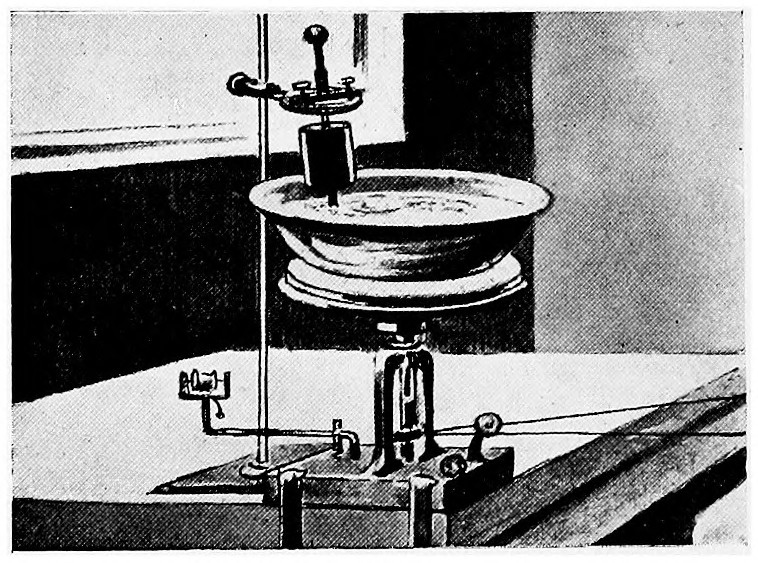
In this experiment we actually see the side to side movements of the pendulum just as I have been describing them, but they are reduced to a rate which we can easily follow. The whirls can be seen as well if we scatter a little light powder on the water; we can watch the whirlpools forming first on one side and then on the other. We must remember that in the first place the whirls are there, whether the pendulum is allowed to move or not; and that in the second place there is a vigorous response by the pendulum if the timing is right. The experiment illustrates two facts: the first, that there is a note when the wind blows past a wire, even if the latter cannot move; and the second, that if the wire can move, and the timing is right, the wire may be made to give out a considerable note, as in the case of the telegraph wire at the side of the road.
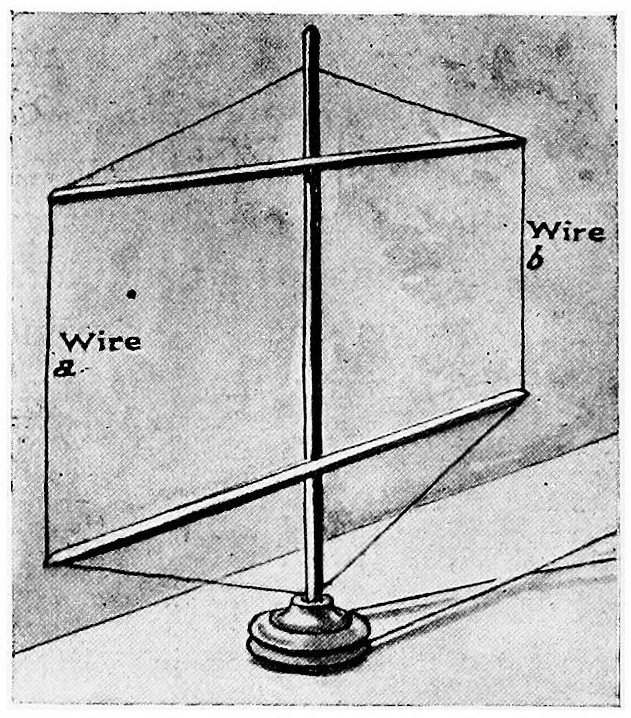
Another way of examining the wind notes was used by a German experimenter, Strouhal, forty years ago. I have copied his apparatus, and we can use it to repeat some of his experiments. A framework is mounted on a whirling-table so that it can be made to revolve rapidly; and it carries one or more vertical wires. When the apparatus is set in motion, we hear the whistling due to the rapid movement of the wire through the air. When we change the wire for a thicker one, the note is not so high for the same speed.
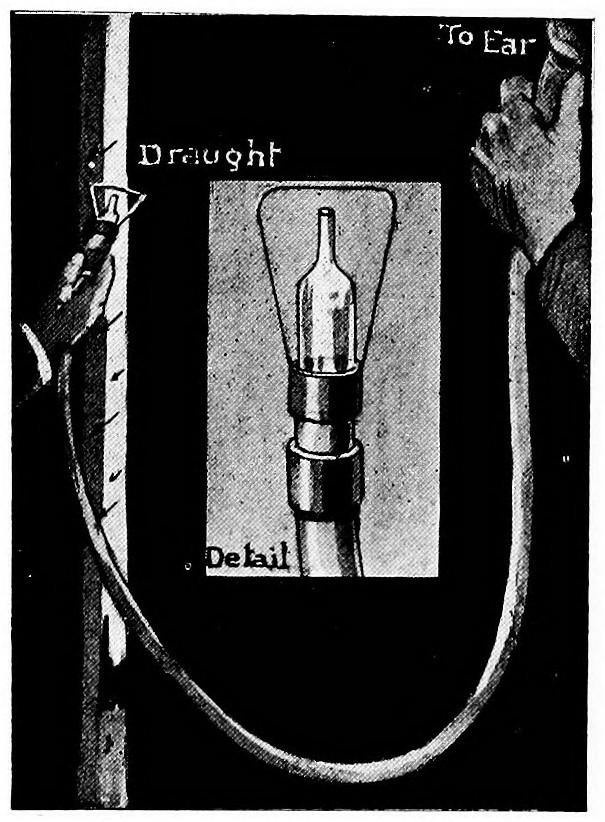
Rayleigh also used a very simple way of listening to the wind note directly, which it is easy to try for ourselves. We take a piece of glass tubing, narrowed down to a small opening, as in the figure, and fasten to it a piece of wire as in the manner shown, so that the wire, which may be a twentieth or thirtieth of an inch in diameter, is a quarter of an inch or so from the narrow end of the glass tube. A piece of rubber tubing is attached to the other end of the glass tube, and led to a stethoscope or a short length of plain tube which can be inserted in the ear; or the rubber tube may be applied to the ear directly. If now the wire is held in a draught, such as passes through a nearly closed door or window, the wind note is easily heard. In this case, of course, the wire is not vibrating, so that the resonance of the æolian harp does not come in at all. The instrument must be pointed towards the draught, so that the little whirls pass by or into the mouth of the tube after they have been formed by the wire. If it is put the other way there is no sound, because the mouth of the tube is now too far from where the pulses are formed, and they are too weak when they get to the tube to have a perceptible effect. The wire may be changed for one of another diameter in order to observe the corresponding change of pitch; and the effect of changes in the velocity of the wind is easily examined also.
There is a second way in which the wind makes a sound: it sets the leaves of the trees rustling against one another. When they are made to rub in this way they start little shivering vibrations to which the ear is sensitive.
The way in which a leaf shivers in the wind may be studied by allowing pieces of paper of different forms to flutter to the ground. The pieces make their own wind as they fall. When a flat piece of paper, two or three times as long as it is broad, is allowed to fall, it is readily seen that it acquires a uniform rotation, and goes to the earth as if it were a wheel rolling down the under side of an inclined plane. The fact is that, as it slides down and sideways, the fore part rides on to air which is still at rest, while the hinder part rests on air which has begun to give way. This cocks up the fore part, so that it "pays off." before the wind: the paper runs uphill, stops, and begins to fall, back end now foremost. The "bull-roarers" of the Australian aborigines work in this way. They are pieces of wood several inches long and an inch or two wide. Swung round at the end of a string, say three feet long, they rotate rapidly, twisting up the string as they do so. Their motion is exactly the same as that of the rotating pieces of paper, except that the bull-roarer is held by a string which it has to twist up as it turns. When it has twisted the string until it will twist no more, the twisting stops and begins to reverse. As it spins round some fifty or a hundred times a second, it creates in the air a corresponding number of disturbances or pulses and so causes a "note." The noise consists of a series of loud groans or booings, one for each twisting of the string, and is well calculated to frighten the women and children, who are taught that they hear the voice of a spirit. Bull-roarers are easily made, but must be swung with a good piece of string, because the string is well twisted when in action and a poor piece may become unravelled and break. A piece of good linen tape is best; it twists easily for its strength.
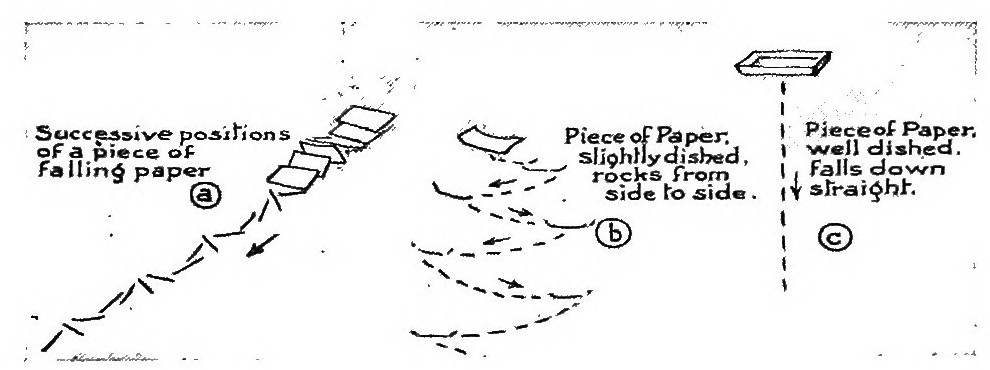
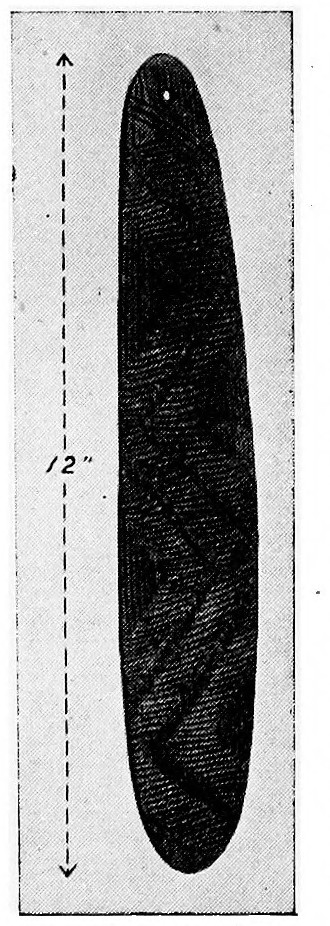
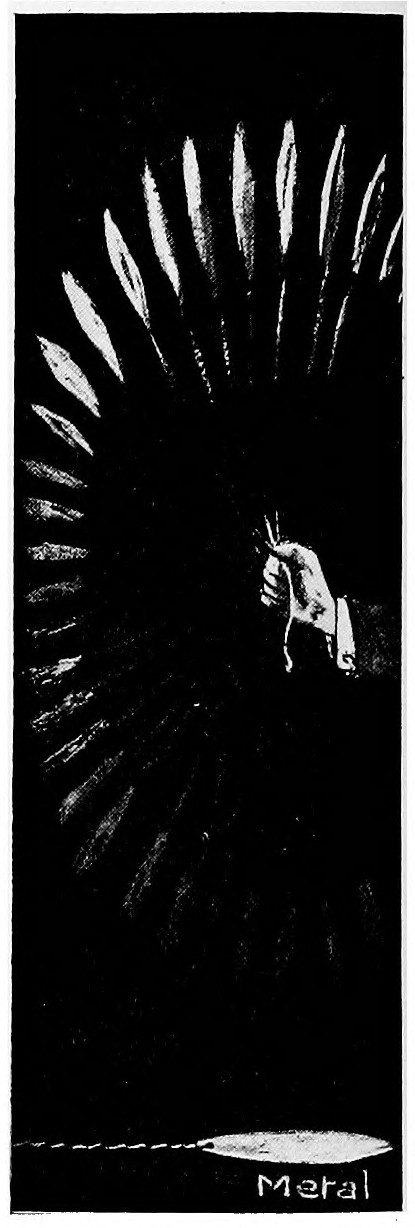
A leaf at the end of its stem cannot go round and round like the paper or the bull-roarer, but when the wind blows it goes as far as the twisting of its stalk will permit it, then it stops and goes the other way. Thus it starts to flutter even though the wind is normally quite steady. Sometimes one may notice a leaf to be fluttering wildly to and fro, far more than its neighbours, probably because the period of each flutter, which depends on the velocity of the wind among other things, happens to coincide with a natural period of vibration of the leaf.
The leaves that flutter in this way rub against each other, and hence the rustling in the trees. The poplars rustle most, because the stem of the poplar leaf is pinched, and in section is more like a piece of tape than a round piece of string: consequently it twists more easily under the pressure of the wind. Mr. Wilkinson observes that the rustle is soft when the leaves are young and tender in the spring, but becomes harsher as the leaves stiffen in the autumn.
If we consider the illustration of the swinging bull-roarer we observe that it is not going round and round in a circle about the hand of the man who holds it. It describes a circle indeed, but the plane of the circle does not contain the hand. When you swing it you feel that when the spin is one way the bull-roarer is edging away from you; when the noise stops for the moment because the string is fully twisted one way and now reverses, then the bull-roarer quickly changes over and edges in to you so that you must be careful that it does not hit your legs. This is just what we should expect from our observations on the falling paper which turned over and over. The edge of the falling paper slid to one side, according to which way it was turning, and the whole paper followed it, so that it did not fall straight down but in a slanting direction. Just so the bull-roarer does not go straight, but edges away to one side.
A piece of paper which is not flat does not turn over and over: it all depends on whether it slips sideways sufficiently easily. Take a piece of paper and turn up the edges as in Fig. 63 and it will not turn over at all when you drop it, but go down quite straight without changing its level. One or two letters laid on top of one another to make a packet can be dropped down the well of the stairs in a set of flats and will go down all the way without deviating to one side. One letter is not likely to get down by itself, still less a post card: there is too little opposition to a glide to one side. Once that happens there is no hope, because the leading edge, that is to say, the edge that leads the slipping, gets on to "new air" which has not begun to fall. This checks the descent and by comparison encourages the sideslip.
The effect of getting on to new air gives of course the explanation of the motion of an aeroplane or of a bird. If an aeroplane "stalls," that is to say, loses too much way, it begins to fall like a stone. We see birds flying round into the wind when they want to alight; they then "stall" themselves and drop gently on to their feet. The same thing happens on the water. When a boat is tacking—sailing across the wind—the water on the lee side is always beginning to give way and let the boat go bodily to leeward. But before that happens the boat is away and leaning against a new lot of water. Suppose we are just able to sail up a certain reach of a river. If the wind were a little more ahead it could not be done, so that everything then depends on keeping going. If the boat loses any of her way, by running into some floating reeds, for example, she does not quickly enough get on to new water; in consequence, she and all the water to leeward begin to drift sideways together and she is soon into the bank. It is sometimes difficult to get going again. Or, again, a rower when pulling has a mass of water in front of his blade which is giving way all the time. If the boat is very heavy and slow, and the stroke is prolonged, the water may begin to give way so much that it is much better to shift the blade of the oar on to a new lot of water. Men rowing heavy sweeps may sometimes be seen to shift the blade up or down for this purpose. Take a broad, thin piece of wood, such as a paperknife, and move it at a certain rate through the water, broadways on, and keep in mind the force exerted. Now repeat the experiment, but keep moving the wood edgeways from side to side, taking care to cover nearly the same distance in the same time. In the second case much more effort is required than in the first.
There is one other point which we ought to consider very briefly. It may be considered remarkable that a piece of paper, even when its edges are turned up, can go down straight, because the least tilt would cause a side-slip and a move on to new air. But there is a well-known principle according to which a flat plate which is held against a stream of air or water tries always to turn so as to present its broadside, not its edge, to the stream.
These, then, are two ways in which noises are caused by the wind: the "æolian tones" and the rustling of the leaves. With kindred noises, they account for most of the wind sounds. The air that shears past all sharp corners or through openings is torn into whirls, though not perhaps in the same easily described fashion as when it flows past a rod or wire. When the wind blows over irregularities of the ground and through the trees, it must always become unstable and irregular in its movements: all the more so when trees bend before it and objects sway from side to side. So the whole air is churned up into quiverings and whirls large and small, and the drums of the ears are hammered by the multitude of pulses. That is how the noises of a windy day are called into being.
The sound of the wind in a wood depends on the nature of the trees. The fine stems of the pine-needles break the wind into whirls succeeding one another with great frequency, and the sound is high-pitched but soft; but the broad surfaces of the beech leaves tear the wind to bits and themselves start strong pulses in the air, so that a beech wood is noisy. When a heavy rainstorm falls into a pine wood it hisses; but in a beech wood it roars.
Echoes in the country are made by reflection from a distant building or cliff or even the edge of a forest. The sound has to go and return before we hear it again, so that if we halve the time it takes to do so and multiply by 1100 we shall know how far away the reflector is. If the time is too short to measure easily, we may use an old trick and clap or shout again just when the echo gets back. We repeat this, and count the number of times we do it, for such a time as is convenient to measure, and then get what we want by a short calculation.
It sometimes happens that the echo is not apparently of the same pitch as the original. Perhaps the explanation is not always the same. In one very interesting case which Lord Rayleigh describes, the sound of a woman's voice came back an octave higher than it went, and he gives a very simple theory of how this happened. In the first place, let us realise at once that there cannot be any actual change in the pitch of a sound during reflection. But a person's voice contains many upper notes or overtones, besides the bottom or main note; although it is by no means easy to detect the fact with the unaided ear, so accustomed are we to pay attention to the main note only. If in some way an upper note is returned by the echo more strongly than the main note, the echo will seem to be an octave higher than the original.
In this particular case the echo came back from a pine wood. Rayleigh suggested that the longer, deeper notes of the voice would not be reflected so well by the pine trees as the higher notes. The fine needles of the pines would let the longer waves through when they might turn the short waves to one side or send them right back again.
We are all very familiar with parallel effects in the case of light. The fine smoke that curls up from a wood fire is very blue against a dark background, because the tiny unburnt particles of carbon in the smoke turn aside the short blue waves more easily than the longer red waves. If you look through the same smoke at a distant light, it is red, not blue. While the blue is turned aside the red goes on. The smoke that rises from the lighted end of a cigarette is of a beautiful pale blue for the same reason, but when it has been in the smoker's mouth it has lost its delicate colour. The fine particles of carbon are now covered over with water, which has settled on them, and the drops are so big that they reflect other colours as well as the blue—the whole spectrum, in fact. The finest example of all is in the air, where the minute particles in suspension, and even the molecules of the air itself, turn aside the blue rays from the sunlight that is passing through the air, and so make the blue of the sky. When the sun's rays go through a great length of air, as they do at sunrise or sunset, the short waves are so well removed that the remaining light is of crimson and gold. Remember that the sun as it goes, apparently, round the earth is always trailing a sunset behind it and pushing a sunrise on before, and the same action gives here the blue colours of the sky and there the colours that we see when the sun is low.
There is a beautiful old experiment which we may well repeat. We mix two colourless liquids together in certain proportions in a glass tank through which a beam of light passes on its way to the screen, where it makes a circular patch on the wall; and then we wait for a few moments. Presently sulphur in an extremely fine state of subdivision makes its appearance all through the liquid as a consequence of chemical action. When that happens a beautiful deep blue shines out from where the light goes through the tank; and correspondingly the white patch on the screen turns a bright yellow. The sulphur particles become larger, and so the blue becomes paler, because longer waves are added to those of the extreme blue end of the spectrum; the yellow patch turns red, till it has the crimson look of the sun in a fog. So too when a heavy shower washes the sky—a description which is literally true—and brings down all the floating particles of various sizes, the blue becomes purer and deeper because the finer particles of moisture and the molecules of the air itself are alone left to scatter the light. At the same time the sunlight is no longer weakened so much by scattering; when it strikes the cloud masses and is reflected by them into our eyes it has lost very little, even of its proportion of blue, and the clouds are a dazzling white.
Lord Rayleigh's echo is no doubt an analogous effect: the pines return the shorter waves or scatter them, while they let the longer waves pass on. It would be interesting to test the result of the passage of a sound-wave through a pine wood: it might be possible to detect the special loss of the shorter waves and to find the note muffled and dull.
The change made in the character of sound by reflection at a plantation of firs is only one instance of many such effects. There are well-known echoes at Killarney which are said to return notes that are not the same as the original, though they are in harmony therewith. It is not possible, however, for one note to be changed into another by a single reflection: the explanation of any such effect must always be that the original contained several notes, of which the reflector—cliff or trees or whatever it may be—favours one or more in the act of reflection.
Distinct and obvious changes like this may not be very numerous; but the smaller and less obvious reflections that take place continually all return notes differing more or less from the original. The original is never one simple sound, but always a complex of many simple sounds, and some of the sounds are sure to be favoured more than the others. If we depended on our ears more than we do, we should appreciate this point more thoroughly. I have already referred to the blind Mr. Wilkinson of Leeds, well known to naturalists as a very skilful observer, who possesses in fact an astonishing power of naming plants and trees by touch, smell, and taste. In his country excursions Mr. Wilkinson has been obliged to rely largely on his sense of hearing. He can interpret differences in the sounds of nature which the ordinary person scarcely notices, and certainly takes no account of. Which of us thinks of the difference in the rustlings of the different trees in the wood, or of the same tree at different times of the year, or of the character of the reflections of sound by fir trees, oaks, and beeches? He knows there are meadows in one direction, because the skylarks are singing over them; here blackbirds mean hedges, a "hush" in another direction means that at some distance away there is a wood. It is only necessary to talk for a short time to Mr. Wilkinson to realise that in the country is a very interesting world of sound which most of us have not yet explored.
There is just one more country sound of which I want to say a word: it is the murmuring of the brook. If you stand beside a stream where the water is running, now silently and then with a gentle plashing noise, you will find that all sound comes from places where the water is white. The water coming over some little fall has caught and taken down bubbles of air; there is a multitude of little sharp noises as the bubbles burst, noises of the same nature and origin as those made when a drop falls into the water, and it is these that make the sound of the brook. Where the dark water slides smoothly over a stone into the pool below there is no noise at all.
Lecture V: Sounds of the Sea
The depths of the sea are very silent: in striking contrast to the noisiness of the land. We have seen that one great cause of the sounds heard by us, who live in the open air, is the movement of the winds. In the deep sea there is very little movement of the water. Near the shore there is the flow and ebb of the tides, but even that is by comparison slower and far quieter. There is noise where the waves break on the shore, as we should expect, because of the churning of the water into foam.
The inhabitants of the sea are quiet in their movements. Fishes swim in a medium which floats them. When they move they do not strike a succession of blows as land animals must do when their feet fall on the ground; nor is there anything to correspond to the rapid beating of the air by the wings of birds and insects. Everything is in favour of a noiseless motion.
In a recent experiment at the Zoological Gardens, observers were stationed round a tank into which they lowered very delicate listening instruments. Fish were thrown in by a keeper, and diving birds went in after them. Not a sound was audible as the birds darted about underneath the water, except when one or two very small air bubbles, carried down by the feathers of one of the birds, came to the surface and burst. The only really exciting noise was made when a penguin mistook the listening apparatus for something to eat and bit hard! And fishes must certainly make less noise, if possible, than diving birds.
Even when an animal dives from the air into the water it is practically noiseless. We have seen that a very clean metal ball dropped into water goes in almost without a sound, and Mr. Worthington's photographs have shown us that in that case the water laps quickly round the ball as it enters, leaving no air-bubble to make a sound by subsequent bursting. Noise is made when for some reason or other bubbles are formed, as when the entry of the ball is so rapid that the water cannot close round it quickly enough—an effect which occurs much more easily when the ball is wet or dirty or rough. When an animal dives into the water it leaves no air-cavity to make a noise; it is quite different when we throw a big stone into the water, for we then hear a hollow sounding noise a moment after it has struck.
We have seen that when a stream of air or water flows past an obstacle there is a constant forming of little whirlpools, which in the case of the air may be so frequent that they cause a note that we can hear. We do not often find the corresponding effect in water; we may get vibrations, as when the fishing-line with a sinker on it trembles in our fingers; but they are slow. On the other hand, there is another way in which sounds may be made in the water which is very striking. The effect occurs whenever a body is moved so quickly through the water that it leaves a cavity behind it which the water from the sides has not time to fill up as fast as the body makes it. It is not filled with air, because the cavity is entirely under water. The rapidly revolving screw of a steamer often makes cavities of this kind. Their chief characteristic is that, when they are fully closed up again by the water crowding in from all round, there is no cushion of air to break the force of the blow when the sides meet each other. The blow has all the suddenness of an explosion. A sharp impulse given to the water in this way travels well and far and is, as we shall see later, the basis of the noise made by moving steamships. The effect is well known to naval engineers, because it often has a destructive effect on ship propellers; the blows are as violent as if they had been struck by hammers.
Now a fish moves very quickly through the water. How does it avoid this effect?
There is a second important question relating to the motion of a fish which can be answered at the same time as the first. Even if the rate at which a body is drawn through the water is not enough to cause cavitation, there is the possibility of whirls being formed, and a backwater in which whirling is taking place, so that the body leaves behind it a mass of moving water which has robbed it of some of its own energy. If a body can be driven through the water without leaving cavities or whirls, then unnecessary energy will not be spent in driving it. A fish moves with extremely little fuss, even when it is travelling fast. How does it do it?
This particular question has been very greatly studied during the War: by the Navy on the one hand, because ships, torpedoes, submarines, and other things are driven through the water partly or wholly submerged at far greater speeds than used to be the case; and by the Air Service, because the question is of the highest importance to the aeroplane.
Everything, it is found, turns on giving the body the right shape—a shape which, after all, is much the shape of a fish. Somewhat blunt in front it may be, but the tail must be tapering. The reason is simply that provision must be made for the quiet closing in of the water or air in the rear of the object that is going through it. It is far more important to do that than to arrange for a gradual opening out in front. One would naturally think that the most important thing is to have a knife-like or pointed front which cuts the water sharply; but it is not so.
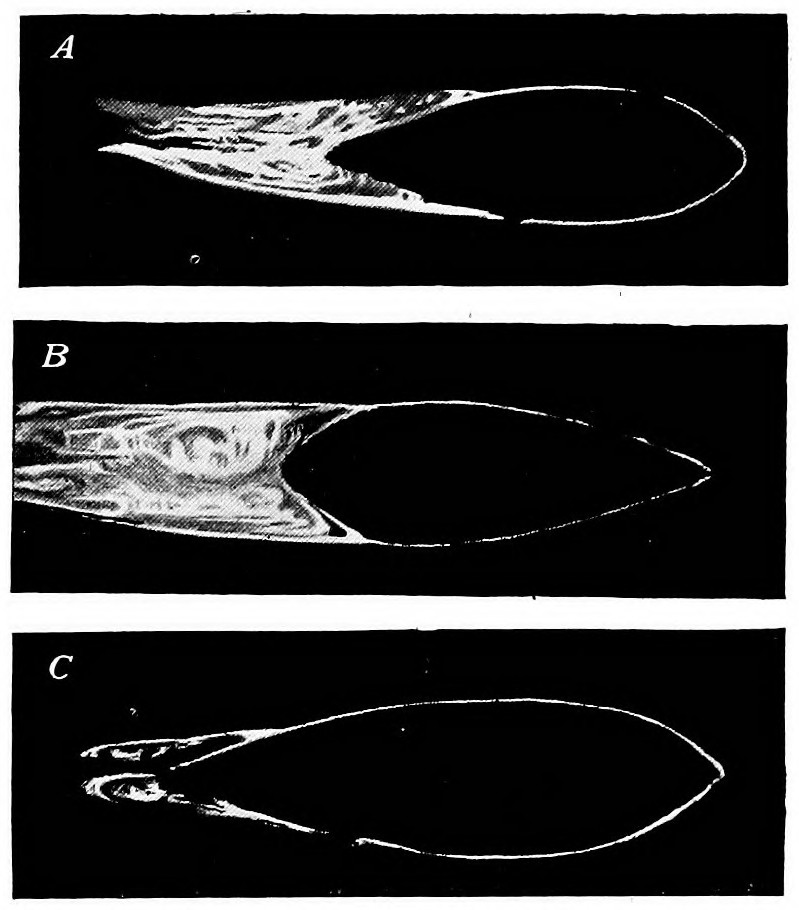
The fish has the right shape for moving through the water without noise and without unnecessary effort.
If animals that move under water can do so with such little noise, it is to be expected that they cannot or do not listen for sounds. Animals need to know what is going on round about them, and especially what other animals are doing. But if these doings take place without noise, it is not to be expected that listening for them will be practised. We shall see later that sound travels in water very well indeed, so that if there is not much listening in the sea, as we understand it, the fault does not lie in the sound-carrying properties of the water.
Those who have studied the development of living things tell us that, at an early stage in the history of the world, animals that lived in the sea and were the ancestors of the vertebrates which now live on land and in the air, developed a pair of pits in the skin on the two sides of the head.8 The linings of these pits were protected by their sunk position and were more highly sensitive than other parts of the body to outside effects such as the flow of water or any changing pressure. These pits were not at first organs of hearing; they were very far indeed from the refined and delicate ears of land animals that came afterwards. But they were able to detect the changes of pressure produced by the fish's own movements. It is to be remembered that though a fish does not produce vibration rapid enough to cause sound, yet it cannot move without causing the water to move also, and when water moves the pressure in it is not the same all over, but changes from place to place and from time to time. There will be special changes of pressure when the fish swims by a rock, or when it is passed by another fish. The sensitive pits could be used to give information, when practice had developed the power of interpreting the pressure changes to which they were sensitive. The use of these organs was developed in two different directions. In the first place, they were used by the fish to regulate its own changes of position, and in doing so took finally, no doubt after long ages of development, the form shown in the figure. Here there are three canals put curiously together; each of them contains liquid, which is set into relative motion whenever a sudden turn is made, if the turn is made in the plane of the canal that contains it. Suppose that we had a vessel lined with long fur, and filled it with water, and that we then turned the vessel round quickly. The water inside would for the moment stay still, and all the hairs which had been sticking straight out from the side towards the centre would now be brushed flat against the moving vessel. Just so when this canal system is turned round suddenly, the liquid in some one or more of the canals stands still while the canal goes round, and certain hairs inside the canals are bent by the relative movement. It is supposed that these hairs are sensitive and can report to the brain that the liquid has moved past them, or rather they past the liquid, and that therefore a turning movement has been made.
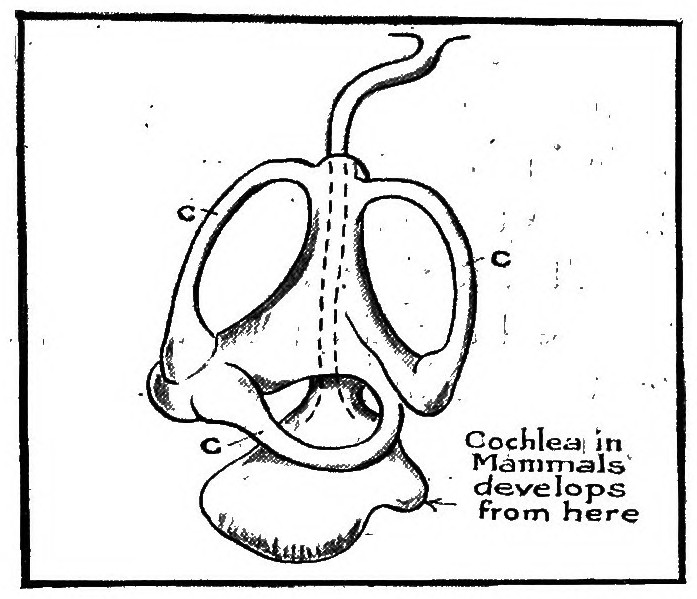
We all still have and use these canals, and depend on them for knowledge of our position and our movements. It is they that are affected by a too rapid turning motion, as when we spin round too much and feel giddy.
The fish's rudimentary ears were also sensitive to pressure and to impulses from outside; and, it is supposed, were used to detect them. There were also, it appears, other organs running down the side of the fish which were used for the same purpose.
There came a time in the history of the world when certain fish-like animals no longer lived wholly under water, but became amphibious. They lived two lives: one in the air, and one in the water. It appears that the rudimentary ear had become so sensitive to changes of pressure that it could be used in the air, although these changes in the air were so very different in character. Air is a thousand times lighter than water, and is very yielding; water is comparatively unyielding. But we know that the organs of hearing must have been useful to some extent, because further progress took place and the ear became what it is now. If they had been useless they would have "atrophied" or ceased to work. The great addition was that of the cochlea—the very delicate and complicated mechanism which is found in all animals whose sense of hearing is strongly developed (Fig. 69). There is no clear understanding as to how the cochlea acts; we know only that it is essential to the more highly developed of the animals that live in the air.
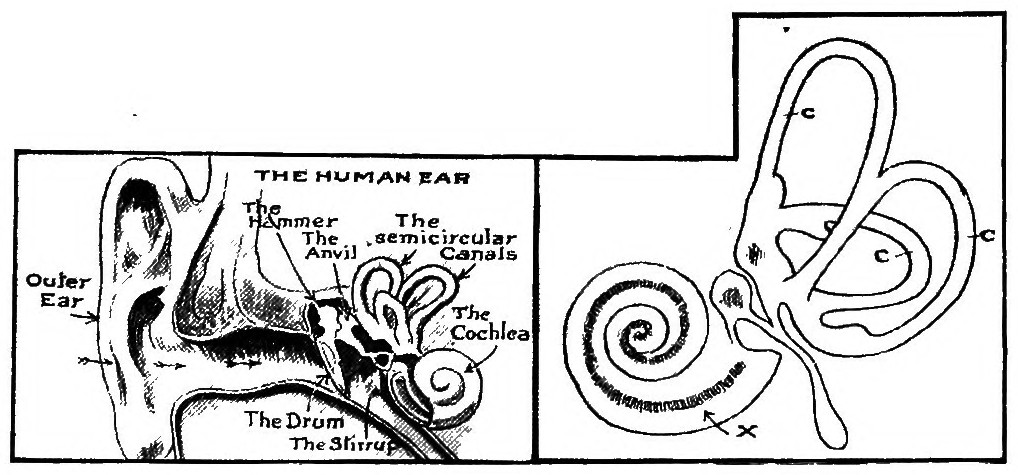
Although fishes have a less developed organ of hearing, it does not follow that fishes do not hear at all. It is fairly certain, in fact, that some fishes do respond to sound, or at any rate they are sensitive to shocks which go with sound or are the cause of sound. When we throw a stone into the brook, we see the trout scatter. They must have felt the shock when the stone hit the water, for we know from other experiences that a shock runs extremely well through the water, and must have gone through the whole body of the fish that swims in the water. The sound of the air-cavity left by the stone, which is the principal thing we hear when we stand on the bank, may or may not have been perceived by the fish.
The more developed the cochlea is, the more perfect is the hearing and the more we find that the animal relies on its ears. The crocodile, for example, is obliged to depend greatly on its sense of hearing, because it has not much chance of using its sense of smell, and when it is on land it is so near the ground that its range of view is very limited. So its sense of hearing is very acute. Its cochlea is much better developed than in the case of lizards or snakes. In birds the sense of hearing is very highly developed and also in mammals, especially such mammals as bats and flying-foxes, seals and apes, and man.
The silence of the sea no doubt goes with the fact that fishes do not make much, if any, use of hearing as we land animals understand it.
Let us follow the development of the ear and see what extraordinary things it can now do. We shall find that it will help us to understand some of the things I wish to speak about in the last lecture, which concern the use of sound in war.
In the first place, it is very remarkable that the ear should be able to adjust itself to very different intensities of sound. The same ear that can listen in the stillness of the night to a watch ticking quietly in the room can stand within a few yards of a whistling locomotive and not be ruined. Instrument makers know very well how difficult it is to make instruments of any kind with a hundredth of such a range. Of course the ear cannot be sensitive to these extremely different sounds at the same moment: whether we can or cannot hear a sound depends very greatly indeed on how much other sound is being made at the same time. We all know how hard it is to talk to one another in a busy street. When there is a very feeble noise that we wish to hear, such as the sound of a submarine under water, we may easily find instruments which magnify sound, but they are of no use at all if they magnify all other sounds at the same time.
It is very striking nevertheless how well the ear can in many cases hear and listen to a weak sound although there is a "background" of much louder noise. In a workroom filled with the roar and clatter of machinery the ear can pick out a human voice when its intensity is but a minute fraction of the general deluge of sound. A wireless operator can listen to one set of signals coming in over his instrument and ignore others arriving at the same time. We observe that in each of these cases the sound to be distinguished has something for the ear and brain to catch hold of, something that distinguishes it from the distracting background. The signals to which the operator is listening are spelling out a connected message, and the fact links them together in the operator's mind. Given this to build on, his power of concentration on the one set of signals can be greatly improved by practice. Sometimes, during his course of training, he is made to listen and record very feeble signals while a noisy gramophone is pounding out a catching tune.
In the other case, there is a certain quality which distinguishes the human voice from the noise of the machinery; the character and the cadence of the two sounds are quite different. All our lives we have practised ourselves in making the most of the special quality of the human voice, because it is, to us, one of the most important sounds in the whole world.
What is this quality which distinguishes one sound from another and on which we build so much? Clearly we must examine carefully a property of sound without which sound would be of little use to us.
In order to understand this extremely important point let us begin with a simple case. If I pluck the string of the monochord in different places, the pitch of the note is always the same, but there is a certain difference in the sound: the general character of it is not the same; there is, we say, "a difference in quality." Our ears have surely detected some sort of effect; we can soon convince ourselves of the way in which it arises. If I pluck the string at A (Fig. 70) and we listen very carefully, we find that not only the fundamental note of the string is sounding, but the octave as well. There are two notes sounding at once.
To make this easier to observe, I touch the string gently in the centre, after plucking at A, with the effect of destroying more or less the fundamental note, and now the octave is clearly heard. It is surprising how strong it is, and we wonder how we could have passed it over before; in fact, if we once more pluck at A and listen to the full sound we can now hear both notes well enough.
But now I pluck the string at the centre; the octave is no longer there. When I try to damp the fundamental note by touching gently at the centre as I did before, all the sound ceases. So we have learnt that while the fundamental note is there no matter where I pluck the string, the octave is present when I pluck at A and absent when I pluck in the centre. Here is a possible explanation of why the "quality" of the sound differs in the two cases.
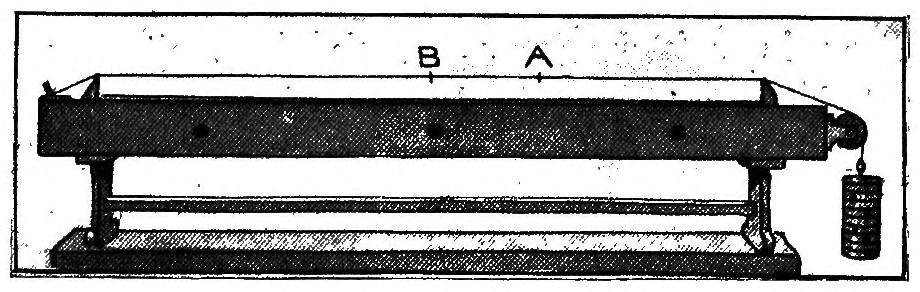
The octave is given by the string vibrating in two equal parts, with a point of rest at the centre; and we notice that when I pluck at the centre, and would make the centre part of the string vibrate, I do not call into existence the octave, for which the centre has to be at rest. Following on this we may anticipate that if I pluck the string at the centre a vibration of the string in three equal parts may be called into action; and this is found to be the case. The note is well heard if I damp the fundamental note by touching the string gently at one of the points of division of the string into three equal parts. And if I pluck the string at one of these points there is no vestige of this note in the sound of the string.
We learn two things: the first, that the same string may give off several different overtones of the fundamental note (this we found before), and that more than one can be sounded at the same time. Secondly, we find that we can call up different overtones in different strengths by plucking the string in different places, although we always call up at the same time the same fundamental note: we can, in fact, account for the differences of quality of the string.
We find exactly the same effect in every kind of sound-producing mechanism. We can take a further illustration from the famous old experiment of the Chladni plates.
Here is a square brass plate held at its centre and mounted on a stand. When the bow is drawn across the edge of the plate at different points the note varies very much with the position of the point, and can be made to vary still more by touching the plate at different places with the fingers. Chladni showed how to make clear what happens in the different cases. We scatter a little sand over the plate, touch it at two points as in the figure, and draw the bow across the edge; the sand instantly gathers itself into lines and makes a pattern on the plate (Fig. 71). We touch at two other points, and again draw the bow across: the old pattern disappears, and a new one takes its place.
The explanation is simply that the plate vibrates in separate portions, just as the string vibrated in separate lengths. The point of rest on the string becomes a line of rest on the plate: when the plate on one side of a line is moving upwards in the course of its vibration, the plate on the other side is going down, and vice versa. As the plate vibrates the dancing sand moves till it settles on these lines of rest. Each different sand pattern shows a different mode of vibration, corresponding to a different note given out by the plate. There are dozens of different notes which the same plate gives out when it vibrates in as many different ways.
A little very light powder (lycopodium), when scattered over the plate, is caught by the air-whirls and tends to gather in heaps where the motion is greatest.
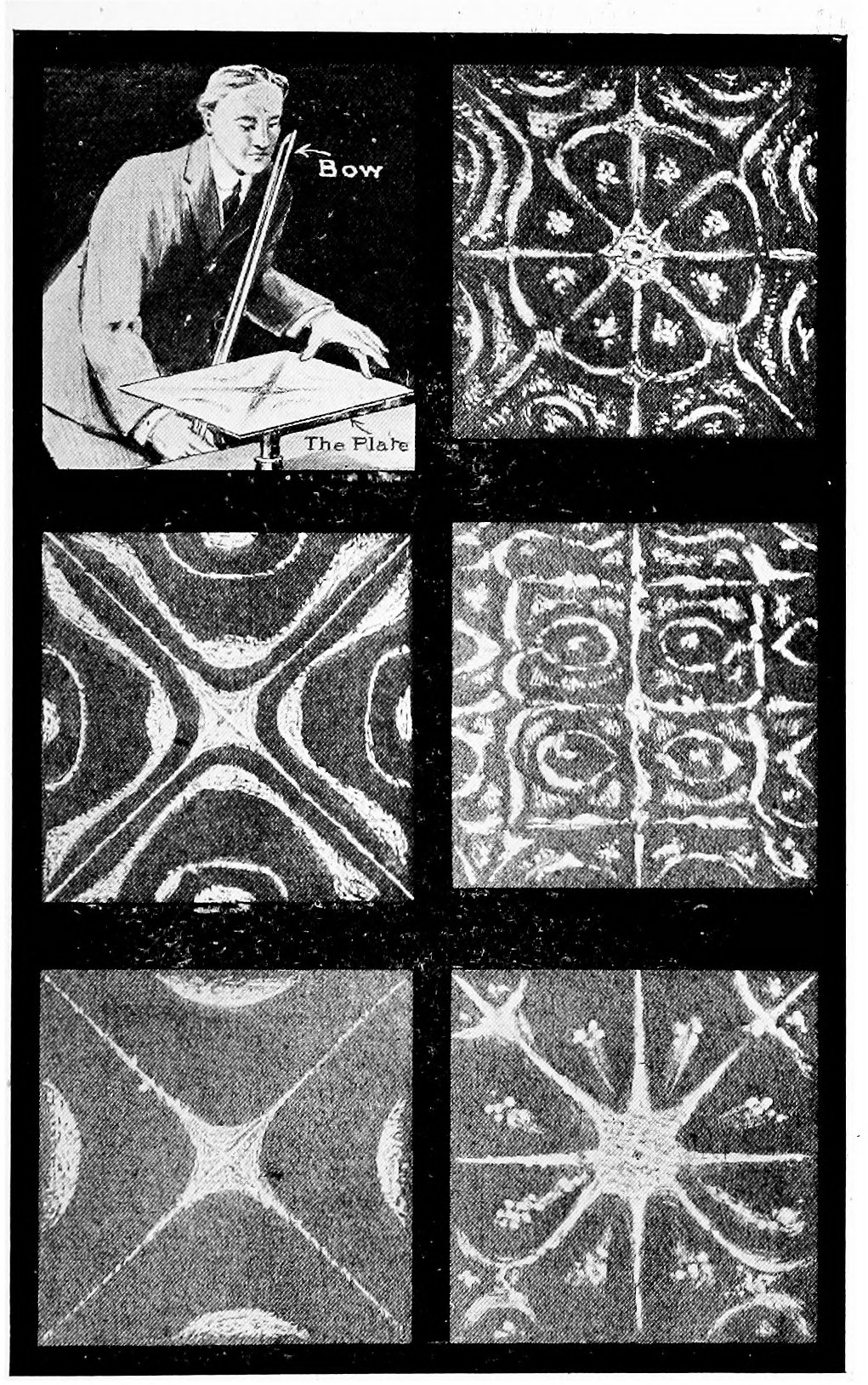
When the plate is struck or bowed without any attempt to control the mode of vibration, the result is a jangle of all sorts of notes. These notes are not in tune with each other, as were the overtones of a string or a pipe; we perceive readily when we hear the noise that there are many simple notes in it, whereas in the case of the string we had to use special devices to convince ourselves that there was more than the fundamental note.
We notice too that if we strike the plate in different places we excite sounds which are of different quality; and again we are led to think that differences in quality are due simply to variety in composition, some of the overtones of the plate being more strongly excited when we strike in one place and others when we strike in others. A metal tray or a gong may serve to show this effect in the absence of a regular Chladni plate.
If we think further of all the different sorts of ways in which sound is made, we find that practically every instrument we use gives us more than one note when it is sounded. The string we have already examined. The air column behaves very much like the string: it has overtones like the string, and, when it is sounding, some of the overtones are always there as well as the fundamental note. If we take an organ-pipe, or even a penny whistle, we get its fundamental note and little more; but if we blow harder the octave comes in strongly as well, and if we blow hard enough the fundamental drops out altogether. The quality changes as the composition changes. Why the change depends on how hard we blow may be understood if we take into account the experiment with the air streaming past an obstacle. A sheet of wind is directed—by the mouth in the case of a flute, by a channel in the case of a pipe or whistle—against a sharp edge. Whirls tend to form alternately on each side of the edge. The alternating motion tends to set up vibrations in the column of air in the pipe; and these are generally, as a matter of fact, so strong that they take charge of the whole movement. The period of vibration is set by the column of air, not by the wind note. Still, the latter has some influence: when the pipe is blown harder, and the wind note becomes higher in pitch, the fundamental note of the pipe suddenly ceases and the octave becomes the principal note that is sounding.
It is found that the number and strength of the overtones that accompany the fundamental note depend on the shape of the organ-pipe: a wide pipe, for instance, has few of them, and the quality of the note is dull. The quality changes if the pipe is made conical instead of cylindrical, and even differs according as to whether it is made of metal or wood. In the course of centuries organ-builders have learnt to give various shapes to organ-pipes, some of them very curious, each shape conferring a certain quality on the note and constituting a particular "stop."

Some of the most interesting examples of the relation between quality and overtones are to be found in the "reed" instruments, especially as they resemble the human organs of speech more closely than any other source of sound. The reed goes far back into ancient times. Here is an example of a primitive form of instrument which is the ancestor of our clarinet and oboe. It is made of bamboo and comes from Luxor on the Nile—so far as its essential parts are concerned, I suspect that the trappings may have come from Birmingham. At one end of the bamboo pipe is a hole which is covered by a thin slip of bamboo tied on at one end and free to move otherwise, so that it can close down and shut the hole, or, as in the figure, leave it partly open. There is also a series of holes to be closed by the fingers as in a flute. To play it one must put the end of it up to the point A in one's mouth and blow. The air rushes through the opening as the figure shows and carries the slip with it until the hole is closed. The flow stops, the slip lifts, the air current begins again, and so the motion repeats itself. The pace is set by the vibration of the air in the pipe. The reed is so weakly hung that it obeys the vibrations of the air column, and yet its motion is the cause of their existence.
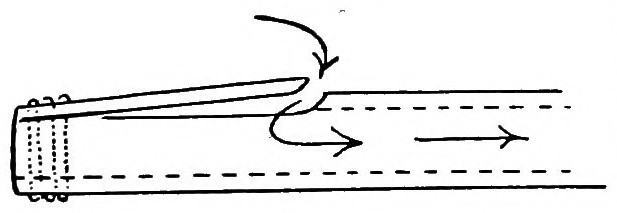
The quality of the instrument is distinctly rich, even to harshness—much more so than that of the whistle or flute—and the cause is that its overtones are very strong, and in particular there are many overtones of high pitch. That is because the reed shuts the hole very suddenly at the end of its stroke. In the same way the gong which is struck by a heavily padded ball gives a duller note than if a hammer is used to strike a sharp and sudden blow.
There are also reeds in the concertina, the harmonium, and the mouth-organ, which, however, differ from the clarinet reed in one important respect. They are made of metal and stand over a hole (Fig. 74), which they alternately open and close in much the same way. But they are so strong that they vibrate at their own rate: they themselves determine the pitch of the note, and do not leave it to the vibrations of the air in a pipe. In fact, they need not have any pipes attached to them.
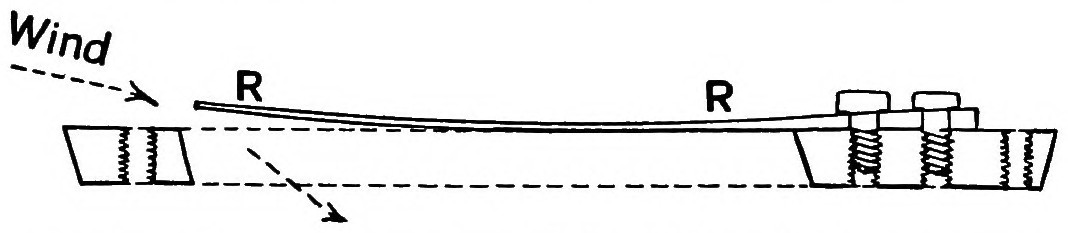
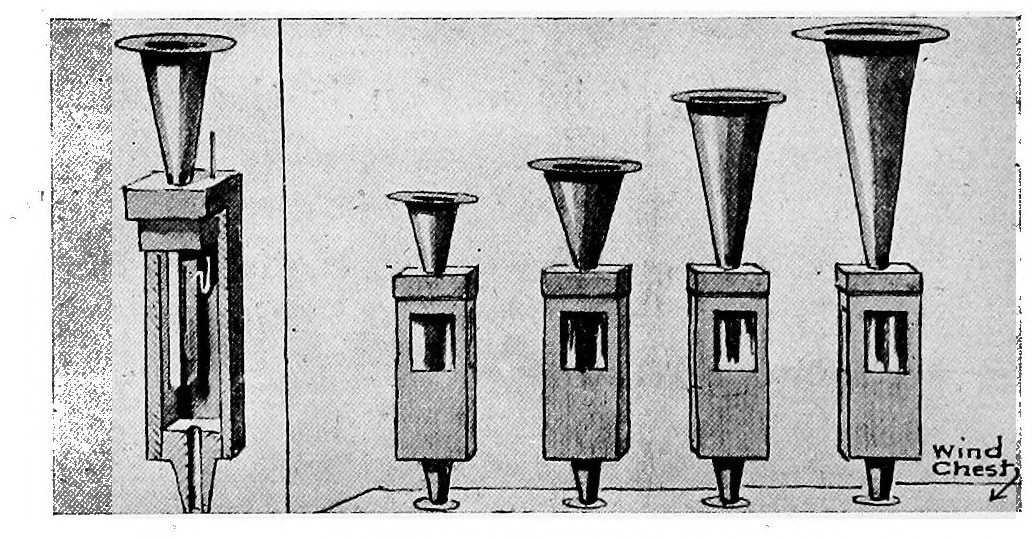
Metal reeds which themselves determine the rate at which they vibrate are used in the organ also; and here pipes are often attached for the purpose of giving some distinct quality. Here is a reed of this kind, which is blown from the organ bellows: there is a series of pipes of different shapes which I can fit on to the reed in turn. We notice the very marked differences in the quality; and our explanation is that each different pipe encourages a different set of overtones, while the fundamental note is not altered in pitch.
So we come finally to the most wonderful instrument of all, the organ of the voice, and especially the human voice. In the throat is a reed—the larynx—which may be compared to the reed we have just been using; and when we set our lips, teeth, and tongue into various positions we do something which corresponds to the placing of different-shaped pipes over the reed. By these changes and by subtle variations in the way in which we go from one set position to another, we arrange for a running accompaniment of overtones which are the means of speech, vowels, and consonants of every shade of inflection. And the infinite delicacy and variety of all the tones we produce is matched only by the wonderful delicacy of the ear which distinguishes them and the brain which interprets them. We now possess these powers, though long ago, as the biologists tell us, the origin of them lay in the detection of the changes of water pressure and of water movement by the rudimentary depressions in the heads of animals living under water.
There is yet one other wonderful power which the ears possess: they can tell the direction from which a sound is coming. We exercise it continually. In the country we can listen for a moment and say, "The lark that is singing is in this or that direction." In the War we became accustomed to the hum of the aeroplane, and could quickly find out in what part of the sky it was flying.
Now there is one very curious thing to be noted. We have, all of us I think, the feeling that when a sound is to the right of us and we feel it to be in that direction, we then hear it in the right ear only. As a matter of fact it can be shown, both by direct experiment and by theory based on other experiments, that one ear is generally receiving nearly as much sound as the other. Much work has been spent in trying to find out how we exercise this faculty, but the explanation is still very imperfect. We have learnt, however, that it depends on the combined action of the two ears,—we speak now of the "binaural" or "two-ear" sense,—and that in some way or other the brain knows which ear gets a given sound-pulse first. That is probably true even if the pulse is one of a long succession of pulses all like one another.
It is certainly true if it is a single pulse or a well-marked effect or change in a continuous noise. For instance, in an experiment represented in the diagram, the sound from the tuning-fork is carried by the two pipes to the two ears of a listener whose head is represented by the circle H. When the two pipe-lengths are equal the observer thinks the sound is neither to the right nor to the left of him.
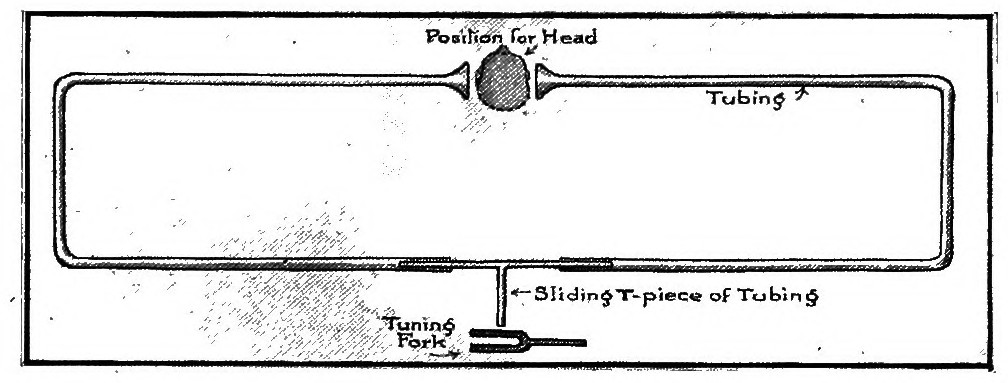
But the tube AB, and the tuning-fork with it, can be moved a few inches to right or left, and at once the listener seems to hear the sound in one ear or in the other, and describes it as being on the corresponding side. Yet there is no appreciable difference in the strength of the sound in his two ears. Moreover, people who are deaf in one ear seem to find much difficulty in determining direction. It is quite easy to test this property of the ears by blindfolding an observer and seating him on a chair on an open lawn; some one else can then move noiselessly to different positions on the lawn and make various sounds.
We have now considered very briefly the main properties of the ear, and will be able when we go on to the question of the use of sound in war to appreciate its difficulties and successes.
Meanwhile there are one or two sounds connected with the sea which I have still to describe.
Sometimes, when we walk on the sand of the sea-shore we find it giving out curious sounds as it shifts under the pressure of our feet. They are squeals more nearly than anything else. These effects have been studied very carefully by Mr. Carus Wilson, who has most kindly lent me for this lecture some very musical sand from the Isle of Eigg in Scotland.
It squeaks loudly if it is put into a cup of porcelain or hard wood and pounded with a hard pestle. There is a distinct pitch to the note, which alters if we change the pestle or the cup; the note falling in pitch if a larger cup is taken, or if the pestle is loaded with a weight. There is no sound at all if the cup is made of rubber, or if a rubber cover is put over the head of the pestle. When the sand is examined under the microscope it is found to consist of grains more or less of the same size: they are not quite round. If a little dust or flour is mixed with the sand, or if some of the sand is ground to powder by pounding, the noise becomes feeble or stops. The sand recovers its properties if the powder is washed out of it.
There is little doubt that the sound belongs to the "stick and slip" noises. A pencil squeaking on a slate is a familiar sound which is caused by the pencil sticking and slipping quite regularly as it is pushed across the slate. In fact, if it is held lightly as it is pushed we can see a regular succession of dots. A cork-screw and a cork stick and slip very rapidly with respect to each other and make a shrill squeak. Little toys which imitate the singing of a bird are made of a piece of soft metal turning in a wooden seat. These work in the same way. A bearing squeaks when it wants oil; and the oil turns the jumping motion into a steady one. In the case of the musical sand the grains pack, and then the packing is broken at one or more layers and there is a shift to a new position of packing and sticking. When the bow is drawn across the string of the violin, there is an action of a similar kind, but it is not absolutely clear that the bow and string stick and move at the same rate during any part of the vibration of the string. It is not necessary that they should: all that is wanted is that the bow should more nearly stick and be able to exert more force when bow and string are going the same way than when they are going in opposite ways. In all these cases there must be something to set the pitch. In the violin it is of course the string; in the other cases, probably one or other of the bodies rubbing over one another is vibrating at some natural rate.
When sound travels through water we always find that it is seriously interrupted if it meets with a mass of bubbles. One effect of the sound-bubbles is to absorb the sound energy. This is very easily shown by tapping with a spoon or knife a tumbler containing beer or stout with a layer of foam on it. The sound is absolutely dead: quite different from the tinkling sound that the tumbler gives when empty or when partly filled with water. The foam absorbs the energy of the vibrating glass.
It is to be remembered that air-bubbles in water are like a crack in a bell. No vibration, such as sound, can cross from one side to the other of the gap in the bell-metal, because the air cannot hand across the very great strains that come up to one side of the gap: they must return—that is to say, they are reflected. But the ringing of the bell cannot take place if the regular flow of sound-waves in it is interfered with; so the bell is mute. In the same way the bubbles can be looked on as a partial crack, interrupting the water partly, but not completely. The interruption is enough, however, to prevent sound-waves crossing the barrier of bubbles if the latter are present in sufficient numbers. The sound of a ship's screw does not pass very well through the bubbly water in the wake, though still farther astern it appears to have got right round the obstacle.
Lastly, there is a beautiful application, due to Lord Rayleigh, of certain main principles of wave-motion to the sound of the fog-horn. It is of course desirable that the sound of the horn should spread over the surface of the sea in a sheet, but should not go up into the air, or, what is just as bad, come down too much on the surface of the water near the horn and then be reflected upwards and go to waste.
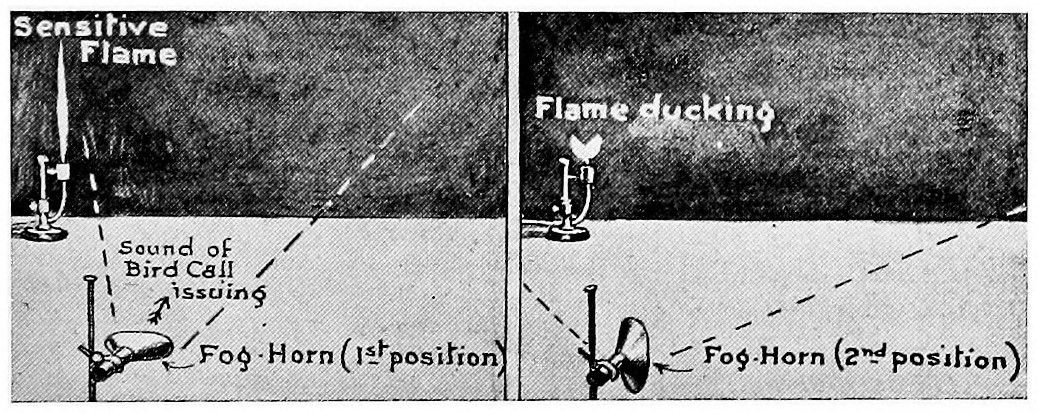
In one of our experiments with the tank we saw that waves spread quickly in all directions after passing through a narrow opening—that is to say, through an opening no wider or not so wide as the length of the wave. There was actually better direction and the waves kept more within the bounds of a definite path when the opening was wider.
Lord Rayleigh therefore suggested that the fog-horn should be fitted with a trumpet having an opening much wider one way than the other; and that the wide way should be vertical. The sound then spreads horizontally, and goes over the sea in a flat sheet. It is a little surprising that the wide end of the funnel should be up and down, unless we think of what the tank experiment told us.
We can repeat Lord Rayleigh's experiment illustrating the effect. The bird-call is fitted with a funnel of the right shape and represents the fog-horn. The sensitive flame is actually outside the beam of sound which is sent out from the funnel when held with the long way of it horizontal, and does not respond. But when we turn the funnel through a right angle we see that the flame now answers and shows that the sound has reached it.
Lecture VI: Sound in War
It is ages and ages ago since animals left the water for the land, and developed the present ear with its marvellous powers of detecting sound. And now after all this time we have, some of us, to fight once more a great enemy lurking in the sea, and once more it is the question how best to be aware of him. How shall we detect the submarine? Can we again use pressure-waves, or shall we be able now to use sound-vibrations, or is there any new method which we can devise?
Most of the methods which first suggest themselves fail completely in one way or another. It has often been proposed that powerful underwater lamps should be employed to light up the sea and make the submarine visible: nowadays we can make very powerful lamps indeed. But unfortunately light cannot be made to penetrate sea water to any great extent. The water is so full of matter in suspension that light-rays are scattered in all directions as they try to go through it. The same problem confronts the motor-driver in a fog, when he gains nothing by lighting the powerful head-lights of the car: all he does is to light up the particles of the fog in front of him, and to dazzle his eye so that he finds greater difficulty in seeing ahead of him than if he had left the lights unlit. It is to be remembered that whether an object is distinctly seen or not depends much more on contrast with the background than on the actual amount of light thrown on the object itself. The eye has the power of adjusting its sensitivity over an extraordinarily wide range: in the daytime the light of a candle seems nothing; at night, in a room where there is no other light, it seems dazzling. Some friends of mine once measured, as it is possible to do, the actual illumination of a piece of white paper beside an artist who was sketching out of doors; they were curious to observe how the illumination would change as the evening wore on. There came a time when the artist said he must stop, as the light was going and he could not see to paint any more. The light was then found to be nearly ten thousand times less than when they made their first measurement.
It is no use, therefore, to send great beams of light into the sea in the hopes of lighting up what may be there; and the most powerful light is little better than any other. The full range of visibility in the clear sea water of the West Indies or the Mediterranean is one or two hundred feet; in the muddy water of the North Sea the range is often no more than a few feet.
Next we have electricity and magnetism at our disposal. But we can make very little use of them for detecting a submarine at any distance. The reason is simple: all electric and magnetic effects fall off very rapidly as the distance from their source is increased. At a few hundred feet away from a submarine neither its magnetism, nor any other electric or magnetic quality which it possesses, can produce an effect which can be detected among the crowd of other like, though small, effects which are always present. Our modern instruments are fine enough to detect exceedingly minute disturbances; but again it is a question of background. If a delicate instrument could be mounted on an extremely quiet concrete foundation, and if there were no other electric or magnetic disturbances, it might be possible to detect the submarine at say half a mile or so; but then it is hopeless to ask for such conditions. Unless we can detect at a mile or so with fair certainty, we are practically helpless, for reasons easy to understand. If ships are chasing submarines they will never find them in the wide seas unless they know when they are within a mile of them at least. The position would be like that of a very short-sighted golfer who had not seen which way his ball went, the ball being probably able to see him, and in any case anxious and able to keep out of his road. If, on the other hand, a ship is being stalked by a submarine, the ship is in the gravest danger unless the presence of the enemy can be observed while he is yet a mile away. Judged by the "mile" standard, electricity and magnetism fail entirely.
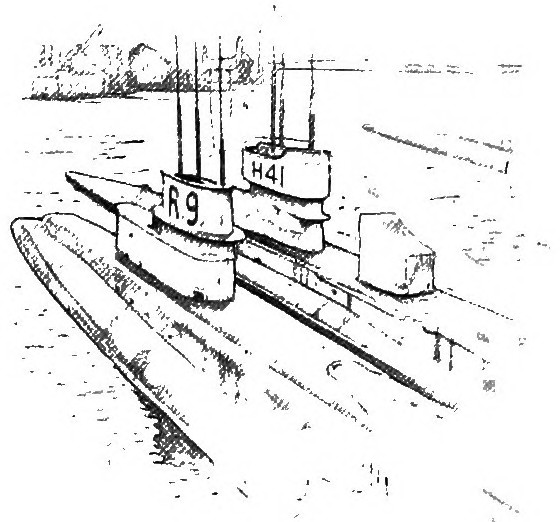
We must therefore fall back on sound: on listening to vibrations in the water which are due to the presence of the enemy, which vibrations we are to detect by suitable means. Sound can at least, under certain circumstances, be heard at a distance of more than a mile.
Our ears are far more efficient and highly trained than the primitive hearing organs of the fishes; and moreover a submarine cannot move as noiselessly as a fish. Both these things are to the good. But there are many other things to consider.
We are no longer able to use our ears under water in any way useful to our present purpose. We are obliged to use some mechanical means, some intermediate agent, to bring the sound out of the water and to deliver it to the ear; and here lies one of our greatest difficulties—the fact that we can never transfer the sound without distorting it more or less. The great delicacy of the ear is accompanied by a certain disadvantage, in that, having become highly trained in the perception of delicate shadings and gradations of sound, it is all the more easily upset when the sounds have been juggled with.
There is one very simple way of transferring the sound which can readily be tried; it was used long ago by Colladon when he measured the velocity of sound on the Lake of Geneva. It is enough to lower into the water a hollow body, such as a tin can or a rubber ball or even a piece of rubber tube plugged at one end, and connect the air inside with the ear by a sufficient length of tubing or pipe (Fig. 79): a stethoscope makes a convenient finish, but is not absolutely necessary. Sound-pulses under water press on the submerged cavity, sending pulses up the air of the tube into the ear. With this you may listen to the ticking of a watch contained in a tin floating in a tank as shown in the figure. This simple contrivance does not distort the sound much when the cavity has rubber walls. If one of the walls is made of thin metal plate the instrument is far noisier and there is considerable distortion or alteration of the sound. The wall has vibrations of its own which are excited whenever it is struck. A perfectly steady sound does not excite them; but a sudden impulse calls them forth. They are strong at the moment when the first stroke of a submarine bell reaches the plate, and their importance dies down during the following ring. Every change in a sound counts as a blow, and of course there are continual changes during any series of sounds such as we want to listen to under water. Consequently the original sound is overlaid with the jangling sound of the wall, and much of the finer analysing power of the ear is wasted.
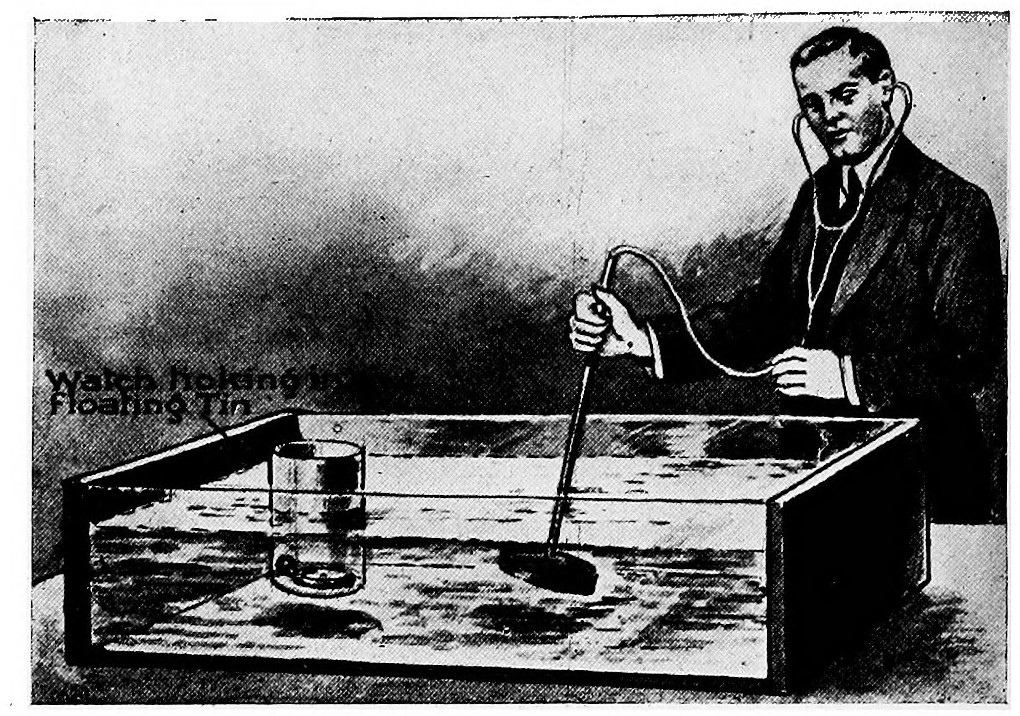
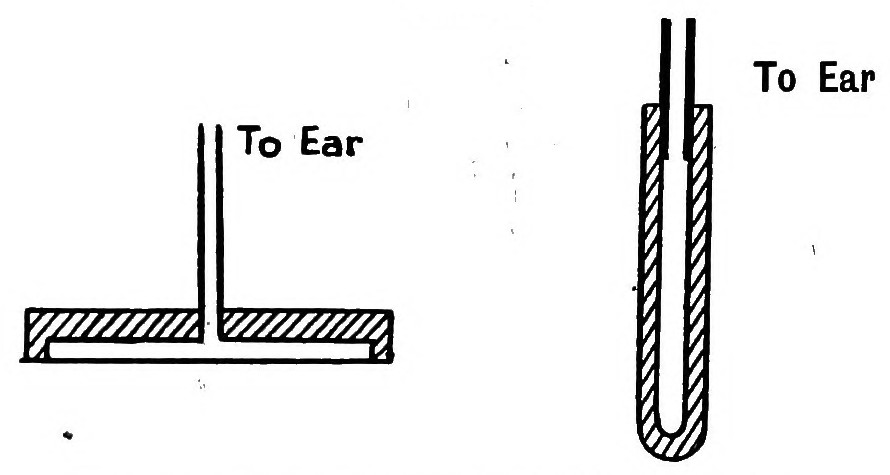
The same sort of effect occurs when we use a telephone, or when a gramophone record is made or used. There are always some parts of the instrument, such as the mica disc, or the walls of the horn, or air cavities, which have notes of their own and spoil the true rendering of the sound. And from what we have already seen we know that faithfulness is far more important than mere volume of sound. It is always noticeable that those who have to use listening instruments prefer such as are less intense if only they are more faithful: it is the beginner who likes something that is loud.
The unfaithfulness is much increased if there is any action of "resonance." This is an effect which we will illustrate by means of two tuning-forks which are exactly alike. I sound A strongly, and stop it with my hand almost at once; I then find that B is sounding, although I have not touched it. I take my hand away from A and after a few seconds put it on B so as to stop B's vibrations. I then find that A is sounding again. Thus the sound has been handed backwards and forwards. But if B is not of the same pitch as A, the effect does not occur. If, therefore, there is a steady note in the sound to be listened to which corresponds to some note belonging to the instrument itself, this note is unduly emphasised, and for this reason also the sound is distorted.
Sometimes electrical means are used to transfer the sound from the receiver to the ear. It is not always convenient or even possible to connect the listening instrument to the ear by means of an air channel as in Fig. 78: the tube would be too long and cumbersome. An electric system is much more flexible; in such cases a microphone is attached to the inside of the receiving plate as in Fig. 80, and the sound is transferred by electric current in the ordinary way. In fact the receiving instrument is now nothing else than a telephone which can be used under water. The instrument is sometimes put into a tank full of water, one side of the tank being part of one side of the ship. The bell's sounds come through the ship's side into the water of the tank and excite vibrations in the metal plate; these are transmitted in electrical form by means of the microphone and the electrical equipment to the listener's cabin. The apparatus, though more convenient, is more complicated than the simple arrangement described above, and every addition brings in fresh opportunities (Fig. 78) for unfaithfulness of rendering. An instrument of this construction was made in great numbers during the war and issued to the small vessels, mostly "drifters," which guarded the coasts. It is shown in Fig. 80.
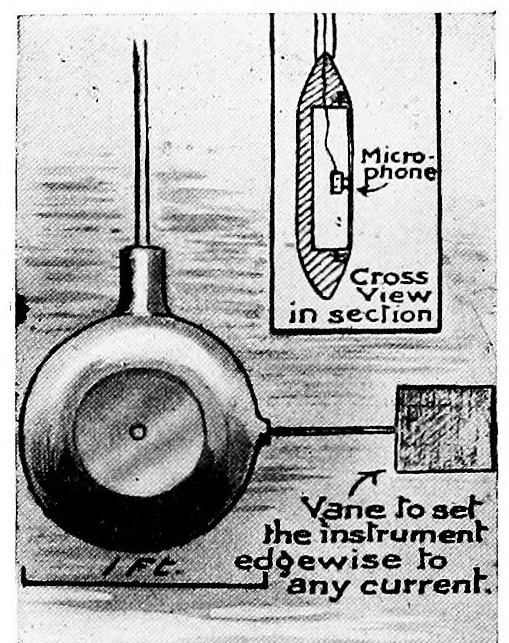
It is curious to observe the change in a sound-record when a difficulty of this kind is removed. The two lines in Fig. 81 are sound-records made visible; the electrical currents which pass through the microphone are made to move a very light mirror, which throws a spot of light on a moving kinematograph film, so making the photographic record of the figure. Two under-water instruments are recording the sound made by a passing vessel, though not exactly at the same moment. The upper record comes from a microphone mounted on a small metal plate as in Fig. 80, the lower from a microphone mounted inside a block of rubber. In the latter case there is no metal sheet to have vibrations of its own; the rubber is free from them. We see the corresponding difference in the shape of the records; in particular, there is between a and b in the top record a series of regular vibrations which is really due to the instrument and forms no part of the original sound. We do not find any such series in the lower record.
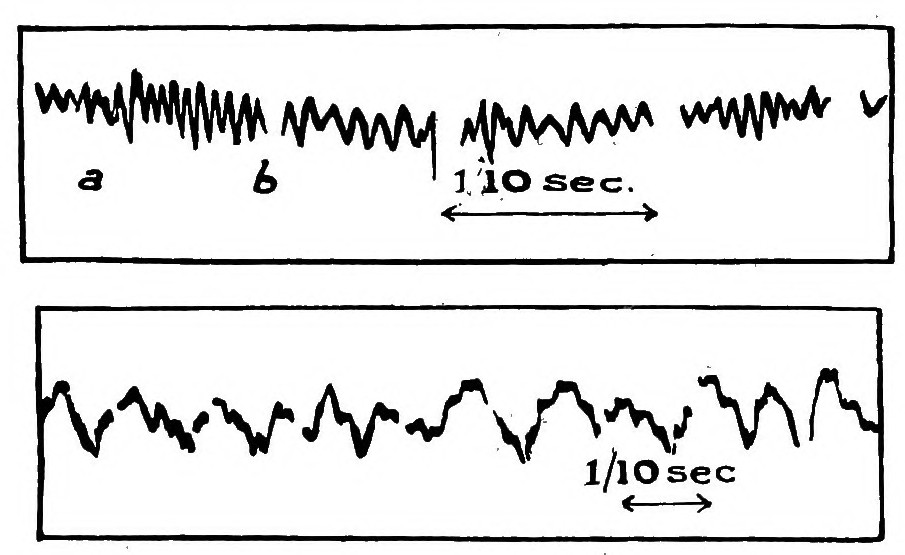
Suppose that we have overcome, as satisfactorily as may be, the difficulty of transferring the sound from the water to the ear without distortion, we have still a difficulty to face, greater even than the first. If we take one of the instruments we have devised and try to use it on board ship we find that the water round the ship is often full of noise which may drown the sounds we want to hear. There is, of course, no disturbing noise round a stationary ship in a smooth sea, supposing that no engines are working on board. But if the sea is rough there is a noise due to the crashing of the water against the ship's sides; if the ship is under way there is a noise due to the movement through the water, in some cases particularly to the movement of the instrument through the water; and if the ship is driven by engines there is a great volume of noise due to the screw and the engines, main and auxiliary. Under such conditions it is as difficult to hear a submarine as it would be for the occupant of a motor-car to hear a sparrow moving in a hedge as he went by. And in war it is generally too dangerous to stop for the purpose of listening.
Finally, the modern submarine can go very quietly if it does not go too fast. Most of the noise of a moving ship comes from the screw. As it revolves it leaves holes in the water, just behind its blades—cavitations, as they are called. When the walls of the cavitations collapse together, noise is started; and the accumulation of sounds of this kind is mainly what we hear in the listening instruments. Through it all we hear the beat of the engines or the whirr of the turbines or other special noises, largely through the agency of the cavitations. If the screw goes slow the cavitations are not formed and there is very little noise. A submarine need not hurry if its presence is unknown.9
We see, therefore, that the transference of sound from the sea to the ear is a matter of many difficulties. In practice it is found that ways of avoiding them can be devised which will be effective under suitable conditions. But I may not follow the subject further in this direction. We must not try to consider what further developments may be in the purposes of the Admiralty.
There is a different aspect of the problem which has points of great interest. If by listening an observer can be sure that a submarine is in the neighbourhood, it does not help him much unless he can find in what direction it lies from his own vessel. It is necessary to devise an instrument which will indicate the direction from which a sound is coming. One method is based on a principle described by the late Lord Rayleigh and others. Suppose that a flat plate is vibrating and giving off sound-pulses into the air. It is found that little or no sound travels away in the plane of the plate: it is all to be found on one side or the other. The converse is true: when a plate is placed edgeways on to a distant sound, the sound-waves pass by on either side of the plate, and their actions on the plate balance, so that it does not move.
Here, for instance, is a sheet of mica mounted on a ring; at the centre of the sheet is a microphone from which wires are led to a loud-speaking telephone-set in the usual way. When I sound a tuning-fork and hold it on one side of the mica we can all hear the sound in the telephone; but when I move the fork so that it is in the plane of the mica we hear it no longer. The mica has ceased to vibrate in response to the fork because the sound-waves now sweep by on either side and their pressures on the mica balance each other. In this experiment I am obliged to use a loud-speaking telephone and to put the tuning-fork very close to the sheet so that the effect is great enough for all to hear.
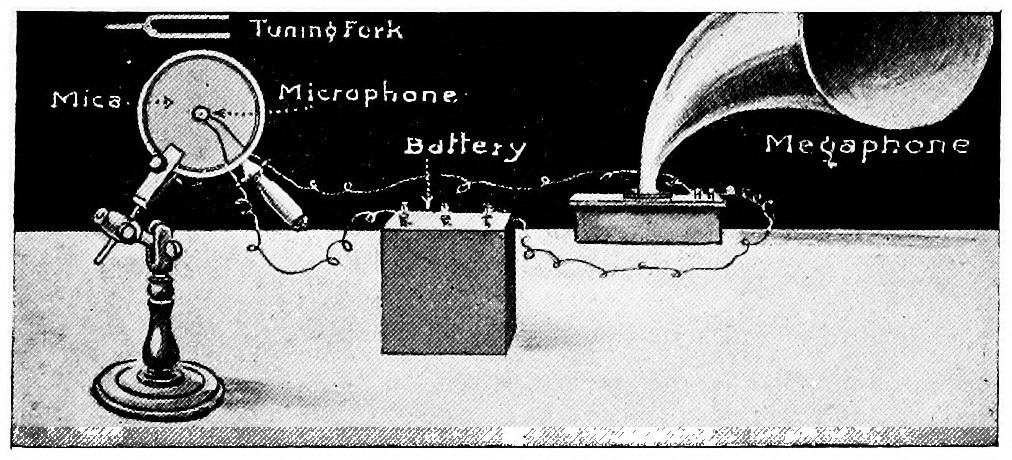
Were we content to hear one at a time and use ordinary telephones we could put the source of sound a long way away.
An experiment with a model will make this principle clearer. A short pendulum is suspended over a tank in which is a shallow layer of water. The bottom of the pendulum has a paddle which dips into the water. The pendulum is now arranged so that it can swing along the tank, and the paddle is across it. I start a wave at one end of the tank, which runs slowly along it; when the wave reaches the paddle the pendulum swings. But now I turn the pendulum round through a right angle so that it can only swing across the tank and the paddle points along it. When a wave reaches it, the pendulum does not now swing at all.
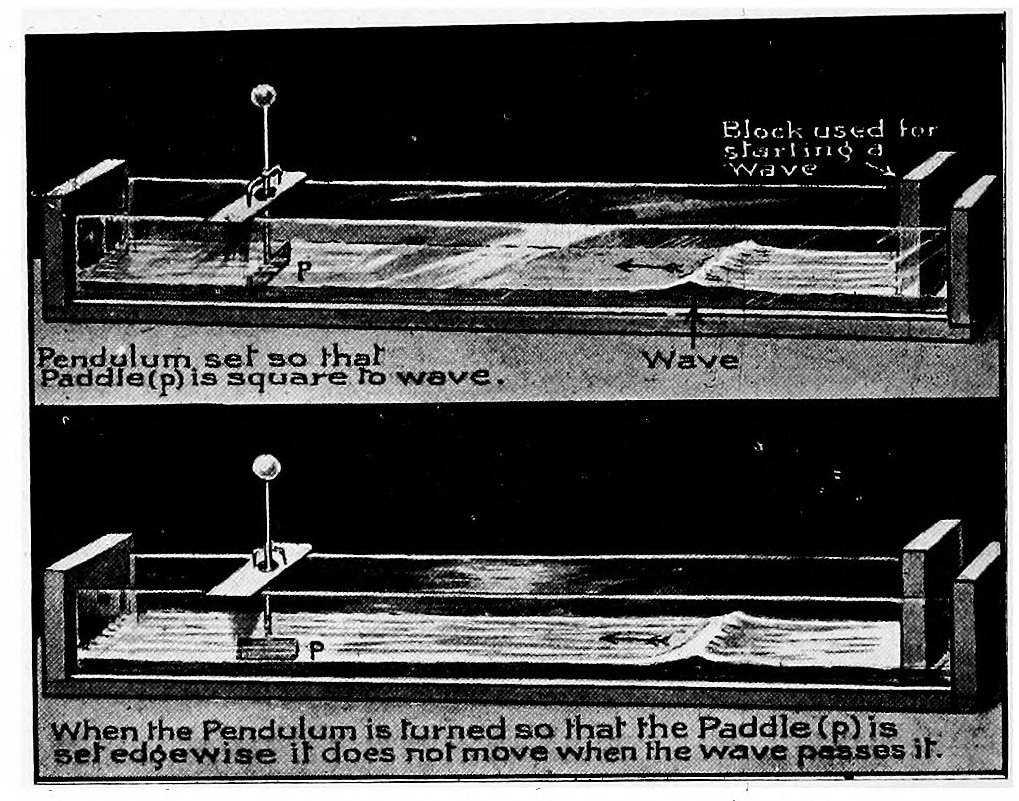
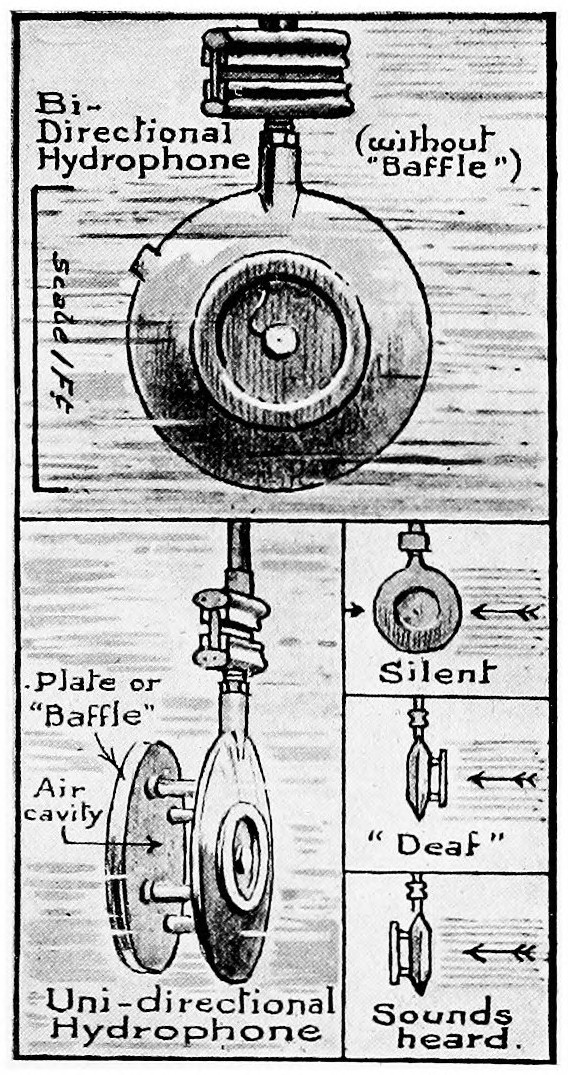
Just so when a plate on which a microphone is mounted is held edgeways to a source of sound, it hears nothing; the noise is heard as soon as the plate is turned so as to present one face to the source.
An instrument made up in this way for use at sea is shown in the figure. A heavy ring serves as a mounting for a sheet of metal carrying at the centre a small watertight box which contains a microphone. This is lowered into the sea at the end of a long tube, which serves also to carry the electrical connections. When in use the instrument is rotated; and the position in which the instrument does not hear gives the direction from which the sound is coming. There is, however, no means of deciding which of the two directions in the plane of the instrument is the right one. A very curious discovery was made in one of the Admiralty laboratories which removed this difficulty. It was found that the instrument could be made deaf on one side by placing near it on that side a block of some material which must be non-resonant (that is to say, must give a dull sound when struck) and which must contain an air-cavity of a certain size. Moreover, the block must be placed at just the right distance from the microphone. With this addition to the instrument there is no longer any doubt as to which of the two opposite directions is the right one. The instrument hears best when the sound comes in on the side away from the block; it hears very little if the other face or either of the edges is presented to the sound.
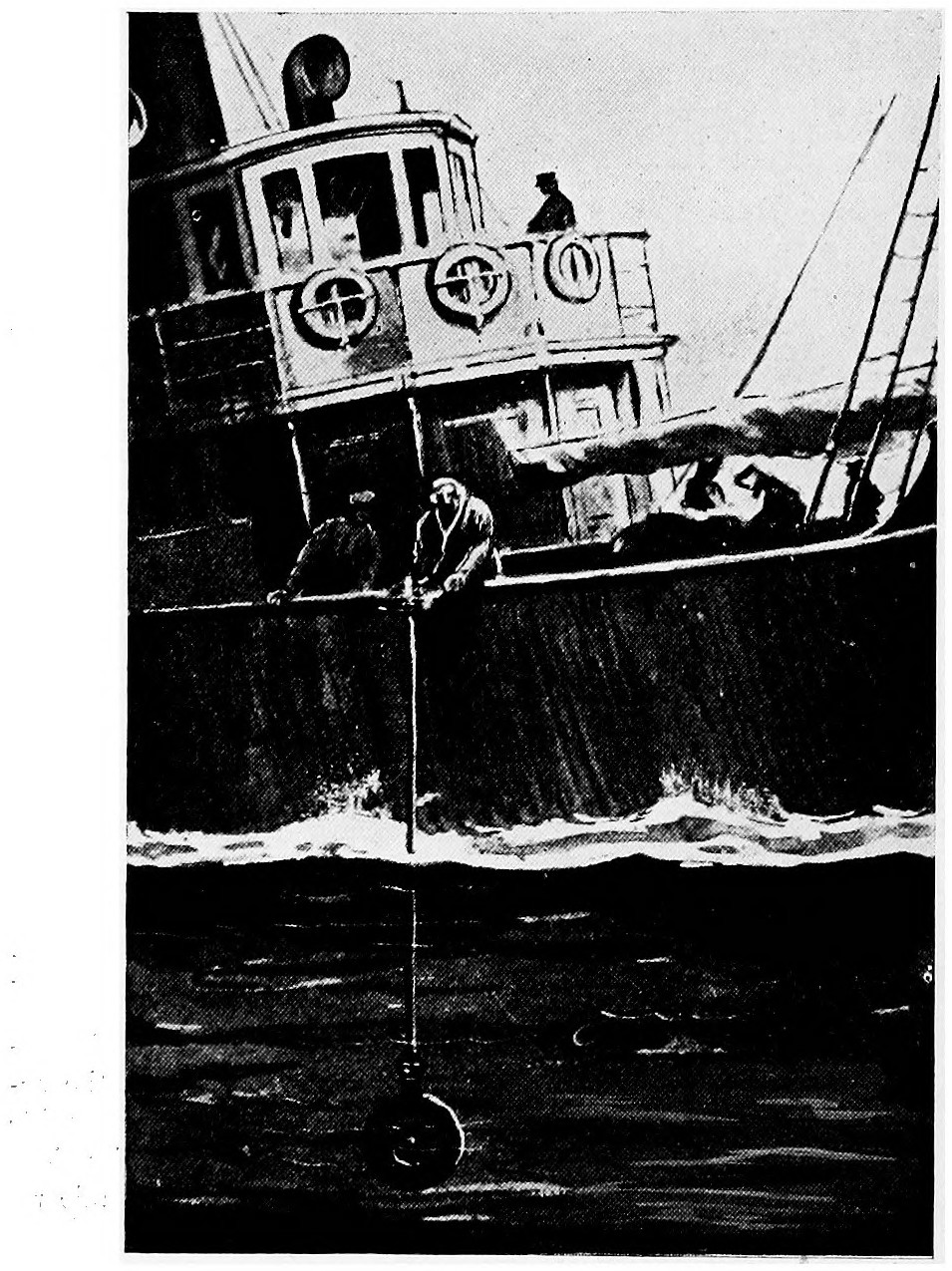
Another way of determining direction is based on the binaural principle we have already considered. Imagine two ordinary hydrophones (such as in Fig. 80, or the simple non-electrical receivers of Fig. 79) to be lowered into the sea, and each to be connected to one ear. If our ears were where the hydrophones are and could be used in that position, we should be able to judge direction just as we do in the air. If the hydrophones rendered to the ears the sounds as received by them, it would be possible to find the direction of the sound by moving the hydrophones until the sound seemed to be equally heard in each ear. There would still be a doubt as to whether the sound was in front or behind the imaginary head in the water; but the doubt could be removed at once by turning the pair of hydrophones a little one way or the other and observing which ear now seemed to have the sound. In practice it is found that the electrical hydrophones so distort the sounds that the ears cannot find direction satisfactorily, but the simple receivers of Fig. 79 when made of rubber work very well.
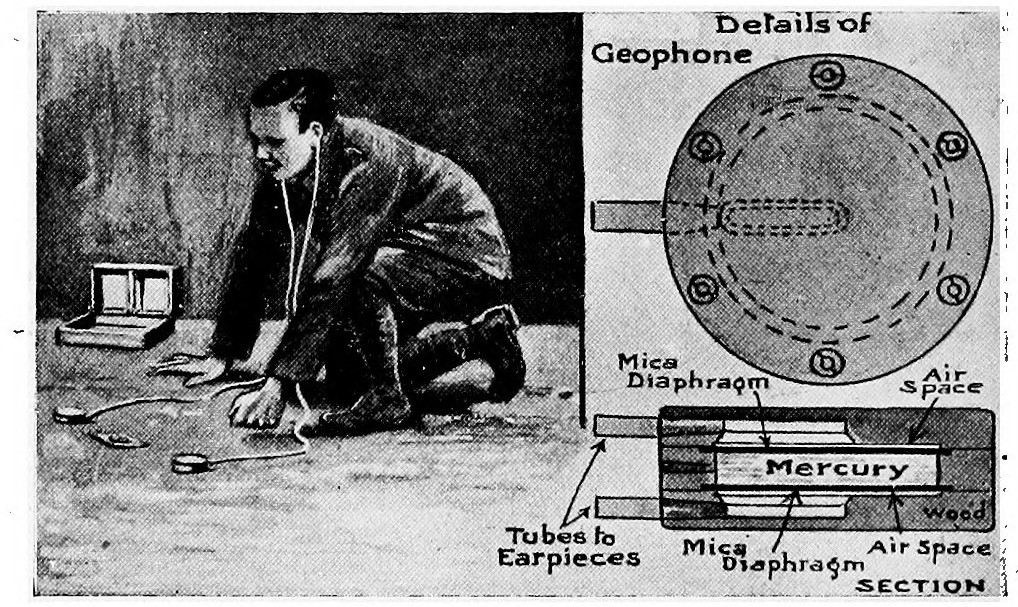
The binaural principle was put to most excellent use by the miners of the Allied armies. When our men were tunnelling towards the enemy lines, they could often overhear noises made by the picks or other tools of the enemy or by their movements. It was then very necessary to find the direction from which the sound came. For this purpose a pair of instruments as shown in Fig. 86 was used. Inside a wooden box, about three inches across and two deep, are two mica discs which hold a heavy mass of mercury between them; above and below the discs are empty spaces which can be connected to the ears by tubes. When simple listening was required, without any attempt to find the direction from which the sound was coming, a geophone was laid on the ground and the two air spaces were connected to the two ears, one to each. Any sound pulses that came through the earth shook the geophone, but the heavy mercury stayed still while the box moved relatively to the mercury. Consequently the air spaces above and below the mercury were alternately compressed and expanded, and pulses ran up the tubes to the ears. Movements of the enemy might be heard at twenty or fifty or a hundred feet, according to the conditions.
Two geophones were used when direction was required. One tube in each geophone was closed by a cork and the other connected to one of the observer's ears, as shown in the figure. Unless the line joining the geophones was at right angles to the direction from which the sound was coming, the pulses would reach one geophone before the other, and it would seem to the observer that the sound was in the ear connected to that geophone. He could turn the geophones to new positions on the floor until the sound was equally heard in the two ears. He would then know the direction of the enemy; in this case there would be no doubt, as there was in the corresponding case at sea, because the enemy was certainly in front. If the geophones were then used to find the direction at another place, the two directions could be marked on the map and the actual position of the enemy workers could be found. If the geophones were placed against a wall above each other, it was possible to get the up-and-down direction, which would also of course be required.10
The paper from which this description of geophones is taken gives an account of an operation which illustrates their use very well. On a certain occasion a tunnel had to be driven forward in order to get under and blow up some enemy wire. When the work was nearly done, it was found that the enemy, who had been heard at intervals, were only six feet away, and their laughing and talking could be plainly heard. It was of the greatest importance to know whether they were going to break through, for this would bring the British operations to a premature end and spoil the plans that had been made. However, it was found, by a comparison of all the geophone records that had been made, that the enemy gallery, though close to our own, was being driven parallel to it and a break through was not likely to occur. Accordingly the British work was not interrupted, and was finally brought to a successful conclusion.
We now come to one of the most important uses of sound in the war: the location of enemy guns. Our French allies made the first attempts to apply sound to this purpose; our own work began a year later than theirs.
The shell from a modern high-velocity gun makes a sound as it passes like the crack of an explosion. The position of the gun can be calculated either from observations on the sound of the shell or on the sound of the firing of the gun itself. The first method was used during the early part of the war, but the second was finally adopted by our own armies.
There are points of great interest in both methods. Let us first consider the sound made by the shell.
When a boat or a swimming animal moves sufficiently fast over the surface of a still lake, we see a V-shaped boundary to the ripples that spread away on either side, as is shown in the drawing. The effect does not appear unless the object is moving faster than the waves which it sets up, so that it is always, so to speak, on the top of these waves. Exactly the same thing occurs in the air when a bullet or a shell is moving faster the velocity of sound, which is with modern guns a very common occurrence. When this happens there is the same V-shaped wave, but now it is in the air. The effect is most beautifully shown in photographs taken some years ago by C. V. Boys. Here is the picture of a bullet from a Martini-Henry rifle (Fig. 87), travelling faster than sound and yet seemingly at rest because the electric spark which cast a shadow of the bullet on the photographic plate lasted but a minute fraction of a second. The V-shaped wave is highly compressed and has refracted the waves of light in much the same way as happens when you look over the top of a fire burning in the open and see the objects beyond "quivering in the heat." In this case, however, it is the mingling of hot and cold air which bends the rays of light, whereas in the former case it is rather the compression of the air in the wave. Besides the V-shaped wave from the front of the bullet there is also a V wave from the back of it; and it is worth while too to notice the turbulent backwater behind it, which effect we have seen before. Another interesting thing in the picture is the reflection of part of a V wave by a screen at the side.
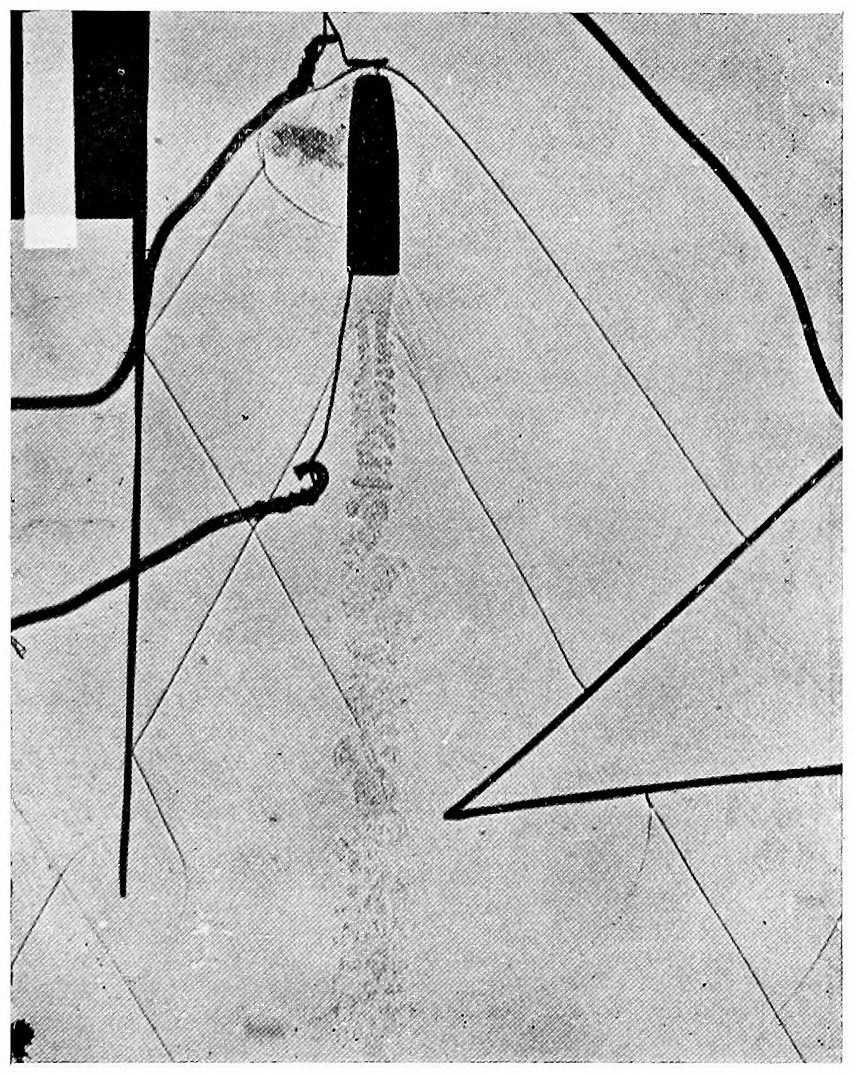
When the V-shaped wave made in this way by a high velocity shell passes over an observer, he hears a sound like an explosion of a gun because the wave contains highly compressed air. The change from the pressure of the ordinary air beside the observer's head to the pressure when the wave is going over it is very sudden and has a violent action on the ear. An explosive wave of this kind—an onde du choc, as the French call it—is caused whenever an object moves faster than sound. The tips of an aeroplane propeller may exceed this speed, and a listener close to them then hears a succession of explosive sounds like the cracks of a pistol. The crack of a whip is no doubt due to the same cause: a wave runs down the cord and carries energy to the lash at the end, which is so light that it is set into most violent motion.
In a paper published by the Royal Society in 1908 Mr. Mallock describes experiments he made on the sound of the onde du choc on a rifle range. He found that an observer could always tell the direction from which the sound seemed to come: it was clearly a case of binaural hearing, the wave reaching one ear before the other. He drew a plan of the range and of the direction of the sound as it seemed to several observers. Of course none of these directions (see Fig. 88) pointed to the position of the gun: each observation showed the direction in which the onde du choc was travelling. As a bullet or shell slows down the V becomes more and more blunt in front: the directions found by the observers in Mallock's experiment are less and less inclined to the direction in which the bullet is moving.
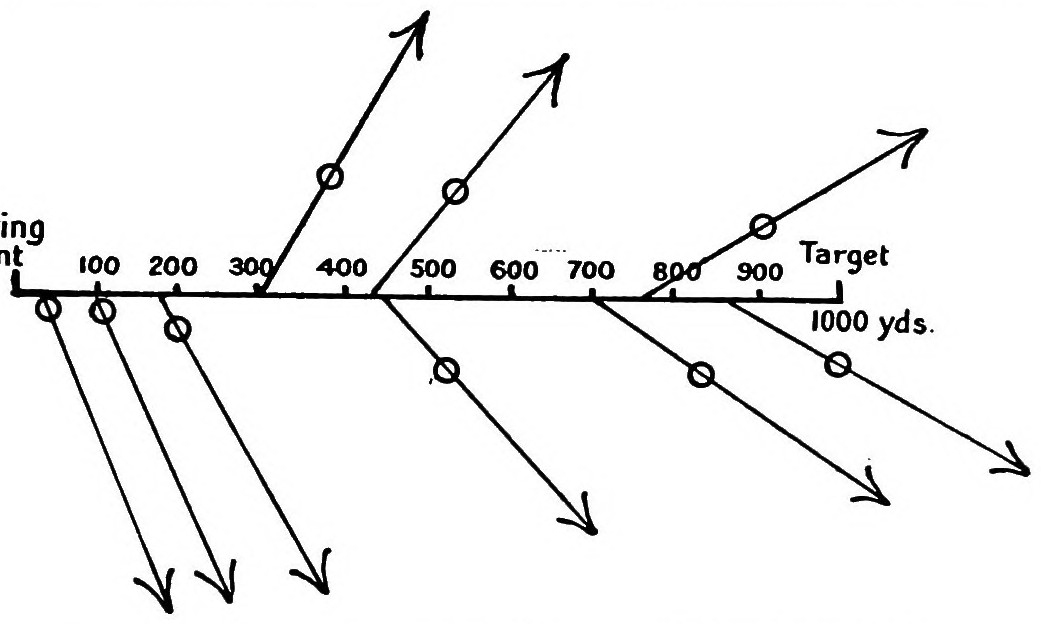
It is actually possible to calculate the position of the gun from observations of this kind; though the figures used in the calculation differ for each type of gun, and it is therefore necessary to know what gun is firing. The method, much elaborated, was used during the War in spite of these difficulties.
The simple and highly efficient method finally adopted by the British Army was based on observations of the sound of the explosion due to the gun itself. Suppose that a gun fires, and that observers with microphones, placed at three points A, B, and C, register and compare the times at which the sound-wave reaches the microphones. Draw round B a circle having a radius equal to the distance sound will travel in a time equal to the difference between the A and the B observations of the arrival of the sound. Draw round C a circle with a radius equal to the time that sound would travel in a time equal to the difference between the A and C observations. Then draw a circle to go through A and to touch the circles drawn round B and C. The centre of this circle must be the position of the gun.
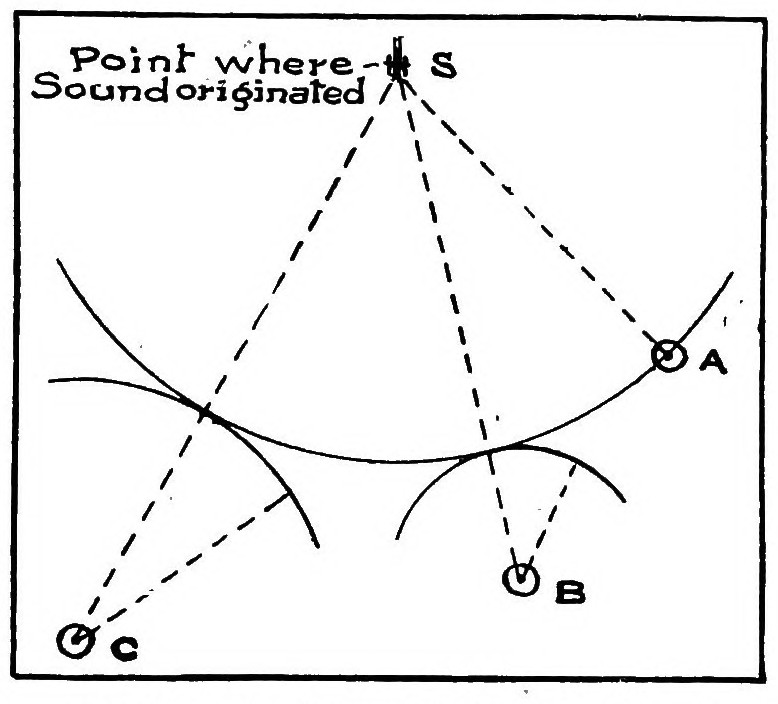
In practice there were six microphones, the greater number being adopted in order to give greater accuracy and to allow for one or more being out of order. Wires from all of them were led to a central station (Fig. 90), where each was joined up to its own recorder. Each recorder operated by throwing a fine point upon a kinematograph film. When no disturbance came in from any microphone six straight lines were drawn side by side on the film; but if the explosion-wave of the gun reached a microphone, the corresponding line was broken. In Fig. 91 the record of an enemy howitzer is shown: we observe the successive breaks as the wave reaches the microphones in turn. Very great accuracy was required in the observations of the time: the film moved rapidly, as we can see by the time scale shown in the figure. In fact, observation could be made to two or three thousandths of a second.
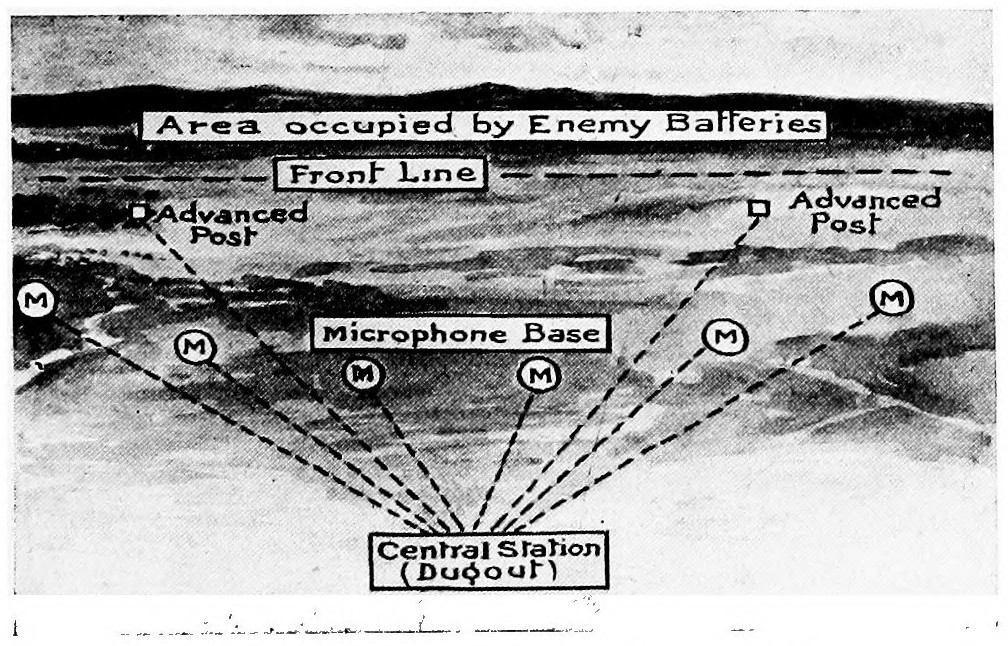
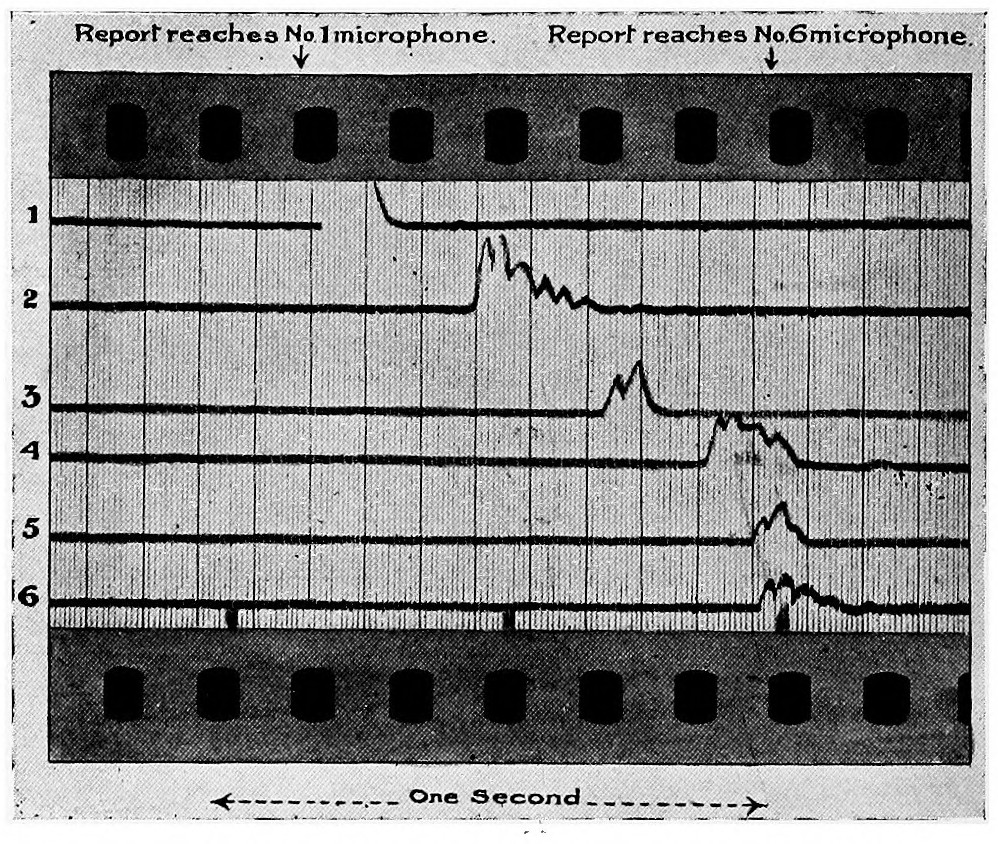
The six microphones were spaced along a base about 9000 yards long and 4000 yards behind the front line. The central station was placed in a cellar or dug-out some 5000 or 6000 yards from the front line. In front of the base were the advanced posts, at each of which an observer was stationed. When he heard a hostile gun fired and considered that its record was wanted he pressed a key which set all the apparatus going at the central station. When the microphones had all registered on the film, the latter was developed, fixed, measured, and read; and in a very few minutes a telephone message would be on its way to our own batteries giving them the enemy position.
The average error at a range of 10,000 yards was about 50 yards. The sound-rangers could work in foggy weather, or in any weather except when westerly winds blowing towards the guns lifted the sound-waves over their heads and left them nothing to observe. They were responsible for a great proportion of all the locations of guns on the front; photographic observations from aeroplanes were responsible for another, the two methods playing into each other's hands.
The reason why sound goes up in the air when it moves against the wind is easily understood from Fig. 92. Sound-waves start from a source S, but the wind is travelling slower near the ground than higher up, because it is retarded by the obstructions it meets on the earth's surface. The top parts of the waves are therefore bent back, as the figure shows, and the whole series of waves, moving forward at right angles to itself, mounts into the air. The observer is quite out of their track.
It was often observed during the War that, though this might be the case close up to the front, yet the sound of the guns could be clearly heard farther back—in England, for example. It is easy to see how this might happen, though the explanation in each separate case might not be exactly the same. If there is a westerly wind below and an easterly wind above, the sound-waves are thrown back at first and mount upwards in the way explained already. But when they reach the upper current, which is blowing the opposite way, the waves are again swung round and come down again.
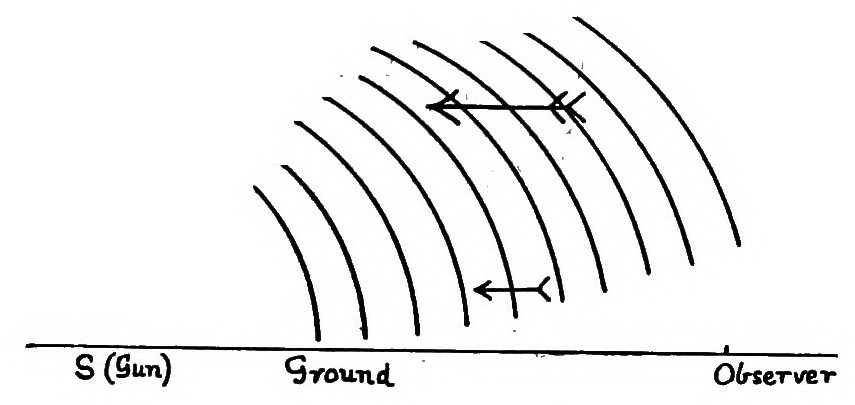
The sound-ranging apparatus used by the Army during the War has been applied by the Navy to a very important problem, that of finding the position of an explosion at sea. In this case the hydrophones described already are used as the listening microphones. They are placed in carefully surveyed positions a few miles out from the shore, and are arranged over a base about fifteen miles long.
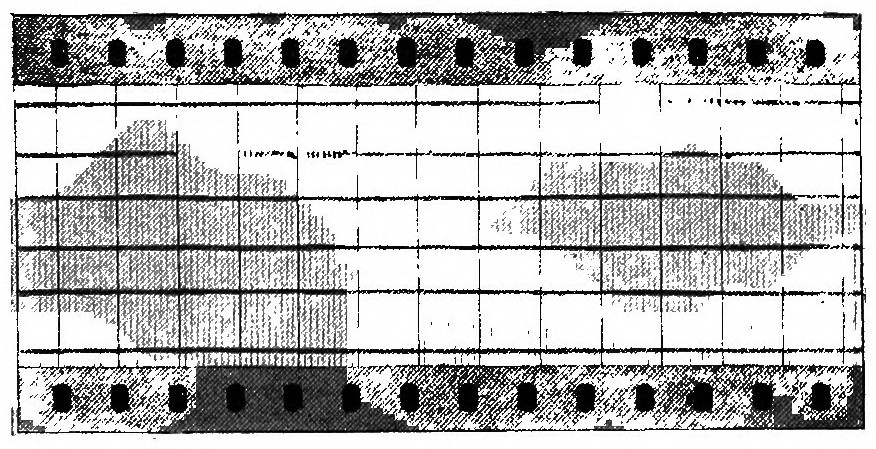
They are all connected by submarine cables to a central station on shore, where the instruments and the arrangements are the same as those of the Army, except that everything is out of range of gun-fire and is therefore more comfortable and convenient. The microphone responds readily to the wave caused by a distant explosion: that is because the little grains of carbon in the microphone are disarranged by the slightest tap, especially if it is sharp, like the click when one hard surface hits another. Now the explosion-wave is exactly of that character. The narrowness of the V-shaped wave in the photographs taken by Boys shows how suddenly it must be felt when it passes by. The water carries a sharp wave of this kind very well. Consequently an explosion can be registered at an immense distance: how far has never yet been properly determined. The design of the microphone and its electrical equipment are still under investigation. Some experiments carried out at Culver in the Isle of Wight showed that depth charges dropped overboard by a destroyer near the French coast gave excellent records. In later work explosions have been detected hundreds of miles away.
A sound-ranging station for under-water determinations may be used to give the position of any explosion within forty or fifty miles. A combination of two stations a hundred miles apart can give a position to about half a mile at two hundred miles range.
The system, though developed for purposes of war, has given some of its best results in time of peace, for it has been found most useful in charting the seas. Imagine a surveying ship far from the land in the North Sea, without landmarks, without even a clear sky. A wreck, or the edge of a mine-field, or a sandbank has to be marked on the chart as found. A charge is dropped and explodes: the explosion travels away until it reaches the hydrophones on the English coast, the records are developed and read, and in a very few minutes the exact position is marked on the map, and if required a wireless message sent out to the ship. Possibly the method will also find a use in giving positions to ships which are making the coast and are lost in a fog. Or an aeroplane may send ashore a message which is automatically dated and placed.
Finally, we must also consider for a moment the use of sound in connection with war in the air. It is obvious, of course, that there are ways of finding from what direction the sound of an aeroplane has come. We might, for example, make use of the power of a concave mirror to focus a sound, as we saw in one of our first experiments (p. 28, Fig. 16). The hum of an aeroplane is low in pitch, the sound-waves are long, and therefore the mirror must be correspondingly large. That is not very convenient, but it is not necessary that the mirror should be easily or quickly moved during the listening. If the mirror is stationary the focus moves; and its position at any moment can be found by searching for it with some convenient form of listening apparatus. The direction of the sound can then be found by a simple calculation. Sound-ranging methods cannot be used, since they register the time of arrival of an explosion-wave—that is to say, of one sharply defined pulse. But in this case as in listening for submarines, we have to find the direction from which a more or less continuous sound is coming. Perhaps the binaural sense supplies the simplest method of finding direction; it can be sharpened by suitable means—for example, by the use of listening-horns leading to the ear—and it is really very accurate. There is one obvious difficulty: the sound of a distant aeroplane takes several seconds to reach the observer, and the aeroplane has moved on some distance before the sound gets to him. The track can be plotted, but can never be brought quite up to date.
Here we must stop. Sound, you will see, has played a great part during the War—in the air, on land, underground, and at sea, in every branch of warfare. It is also true, and I think it is a fact of the greatest interest, that almost everything we have discovered about sound has found some application in the War. All the discoveries made by Lord Rayleigh and other great investigators of the problems of sound, the results of the work of men who worked for the enjoyment of discovery and for the love of the beautiful things they found—for all these we have had reason to be grateful, because they have been useful in time of need. But those who made the discoveries had no idea of the uses to which they were to be put: they could not have done their work if they had thought of it in that way. It has always been so, and must always be so.
When war came, and urgent problems had to be solved, the men who made the best use of the knowledge acquired in times of peace were those soldiers who were students of science, or students of science who had become soldiers. You cannot solve the problem at the front without knowledge of science, and you cannot do the best work in the laboratory at home without first-hand knowledge of the problem. That is why we urge that both Army and Navy must keep in touch with science, that there should be a skeleton corps of scientific men engaged in the study of the scientific problems of war, who would be a nucleus round which all the science of the country would gather in time of war, ready to play their part at once.
There is just one point more. In what I have been saying I have had in my mind more than the application to times of war. It is the fact that in our lives, in all that we work at and strive for, it is of first importance to know as much as we can about what we are doing, to learn from the experience of others, and, not stopping at that, to find out more for ourselves, so that our work may be the best of which we are capable. That is what science stands for. It is only half the battle, I know. There is also the great driving force which we know under the name of religion. From religion comes a man's purpose; from science, his power to achieve it. Sometimes people ask if religion and science are not opposed to one another. They are: in the sense that the thumb and fingers of my hand are opposed to one another. It is an opposition by means of which anything can be grasped. It is right, therefore, with all our heart to learn what will help us in the work we want to do, so that when the call comes we can say, "I am here and ready; I want to play my part, and I have tried to fit myself to play it well."