
Book I
Book I: Definitions
1. A point is that which has no part.
2. A line is length without breadth.
3. The limits of a line are points.
4. A straight line is a line that lies evenly with the points on itself.
5. A surface is that which has length and breadth only.
6. The limits of a surface are lines.
7. A plane surface is a surface that lies evenly with the straight lines on itself.
8. A plane angle is the inclination to one another of two lines in a plane that meet one another and do not lie in a straight line.
9. When the lines containing the angle are straight, the angle is called rectilinear.
10. When a straight line standing on a straight line makes the adjacent angles equal to one another, each of the equal angles is a right angle, and the straight line standing on the other is called a perpendicular to the one on which it stands.
11. An obtuse angle is an angle greater than a right angle.
12. An acute angle is an angle less than a right angle.
13. A boundary is that which is the limit of something.
14. A figure is that which is contained by some boundary or boundaries.
15. A circle is a plane figure contained by one line, called the circumference, such that all the straight lines falling on it from one point among those lying inside the figure are equal to one another.
16. That point is called the centre of the circle.
17. A diameter of the circle is any straight line drawn through the centre and ended in both directions by the circumference of the circle; such a straight line also bisects the circle.
18. A semicircle is the figure contained by the diameter and the circumference it cuts off. The centre of the semicircle is the same as that of the circle.
19. Rectilinear figures are those contained by straight lines: trilateral figures by three, quadrilateral figures by four, and multilateral figures by more than four straight lines.
20. Of trilateral figures, an equilateral triangle is one that has its three sides equal, an isosceles triangle one that has only two of its sides equal, and a scalene triangle one that has its three sides unequal.
21. Further, of trilateral figures, a right-angled triangle is one that has a right angle, an obtuse-angled triangle one that has an obtuse angle, and an acute-angled triangle one that has its three angles acute.
22. Of quadrilateral figures, a square is one that is both equilateral and right-angled; an oblong is right-angled but not equilateral; a rhombus is equilateral but not right-angled; and a rhomboid has its opposite sides and angles equal to one another but is neither equilateral nor right-angled. Let quadrilaterals other than these be called trapezia.
23. Parallel straight lines are straight lines which, being in the same plane and extended without limit in both directions, do not meet one another in either direction.
Book I: Postulates
Let the following be postulated:
1. To draw a straight line from any point to any point.
2. To extend a finite straight line continuously in a straight line.1
3. To draw a circle with any centre and radius.2
4. That all right angles are equal to one another.
5. That, if a straight line falling on two straight lines makes the interior angles on the same side less than two right angles, the two straight lines, if extended without limit, meet on that side on which the angles are less than two right angles.3
Book I: Common Notions
1. Things equal to the same thing are also equal to one another.
2. If equals are added to equals, the wholes are equal.
3. If equals are subtracted from equals, the remainders are equal.
4. Things that coincide with one another are equal to one another.
5. The whole is greater than the part.4
Proposition I.1
To construct an equilateral triangle on a given finite straight line.
Let AB be the given finite straight line.
We must construct an equilateral triangle on the straight line AB.
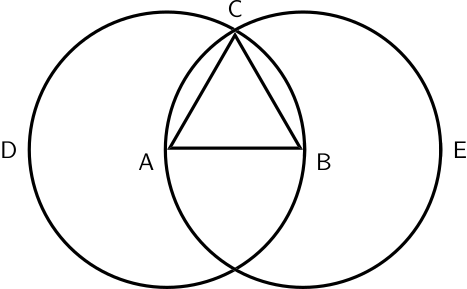
Draw the circle BCD with centre A and radius AB, and again draw the circle ACE with centre B and radius BA (Postulate 3). From the point C, where the circles cut one another, join the straight lines CA and CB to the points A and B (Postulate 1).5
Since the point A is the centre of the circle CDB, AC is equal to AB (Definition 15). Again, since the point B is the centre of the circle CAE, BC is equal to BA (Definition 15). But CA was also shown to be equal to AB. Therefore each of the straight lines CA and CB is equal to AB. But things equal to the same thing are also equal to one another (Common Notion 1). Therefore CA is also equal to CB, and the three straight lines CA, AB and BC are equal to one another.
Therefore the triangle ABC is equilateral, and it has been constructed on the given finite straight line AB.
Therefore an equilateral triangle has been constructed on the given finite straight line; which was to be done.
Proposition I.2
To place at a given point a straight line equal to a given straight line.
Let A be the given point and BC the given straight line. We must place at the point A a straight line equal to the given straight line BC.
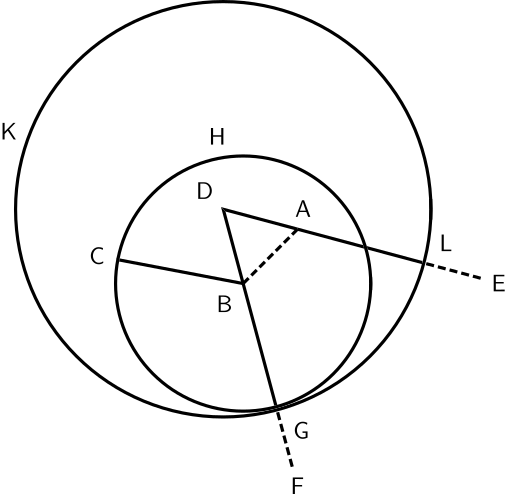
Join the straight line AB from the point A to the point B (Postulate 1), and construct on it the equilateral triangle DAB (I.1). Extend DA and DB in a straight line to form AE and BF (Postulate 2). Draw the circle CGH with centre B and radius BC, and again draw the circle GKL with centre D and radius DG (Postulate 3).
Since the point B is the centre of the circle CGH, BC is equal to BG (Definition 15). Again, since the point D is the centre of the circle KLG, DL is equal to DG (Definition 15); and of these, the part DA is equal to the part DB. Therefore the remainder AL is equal to the remainder BG (Common Notion 3). But BC was also shown to be equal to BG. Therefore each of the straight lines AL and BC is equal to BG. But things equal to the same thing are also equal to one another (Common Notion 1). Therefore AL is also equal to BC.
Therefore the straight line AL, equal to the given straight line BC, has been placed at the given point A; which was to be done.
Proposition I.3
Given two unequal straight lines, to cut off from the greater a straight line equal to the less.
Let AB and C be the two given unequal straight lines, and let AB be the greater. We must cut off from the greater, AB, a straight line equal to the less, C.
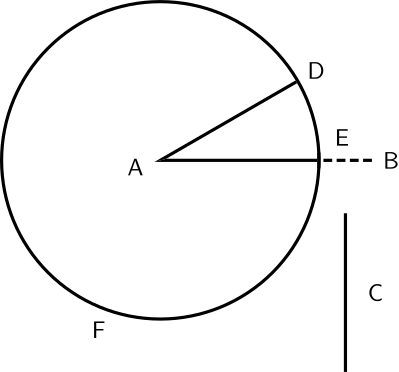
Place at the point A a straight line AD equal to the straight line C (I.2), and draw the circle DEF with centre A and radius AD (Postulate 3).
Since the point A is the centre of the circle DEF, AE is equal to AD (Definition 15). But C is also equal to AD. Therefore each of the straight lines AE and C is equal to AD, so that AE is also equal to C (Common Notion 1).
Therefore, given the two unequal straight lines AB and C, the straight line AE, equal to the less, C, has been cut off from the greater, AB; which was to be done.
Proposition I.4
If two triangles have two sides equal to two sides respectively, and have the angles contained by the equal straight lines equal, then they will also have the base equal to the base, the triangle will be equal to the triangle, and the remaining angles will be equal to the remaining angles respectively, namely the angles opposite the equal sides.
Let ABC and DEF be two triangles having the two sides AB and AC equal to the two sides DE and DF respectively, AB to DE and AC to DF, and the angle BAC equal to the angle EDF. I say that the base BC is also equal to the base EF, that the triangle ABC will be equal to the triangle DEF, and that the remaining angles will be equal to the remaining angles respectively, namely the angles opposite the equal sides: the angle ABC to the angle DEF, and the angle ACB to the angle DFE.6
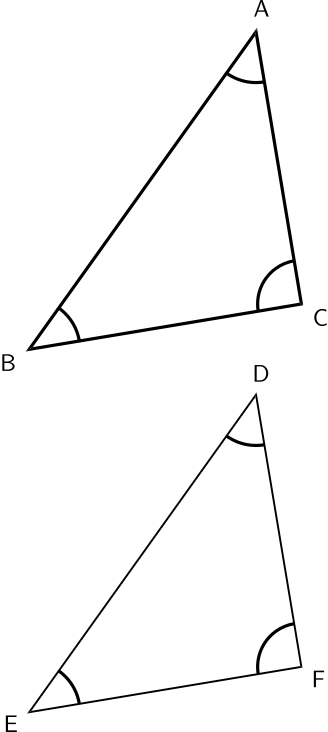
For if the triangle ABC is placed on the triangle DEF, with the point A placed on the point D and the straight line AB on DE, then the point B will also coincide with E, because AB is equal to DE. Then, AB coinciding with DE, the straight line AC will also coincide with DF, because the angle BAC is equal to the angle EDF. Hence the point C will also coincide with the point F, because AC is in turn equal to DF. But B also coincided with E, and hence the base BC will coincide with the base EF. For if B coincides with E and C with F, and yet the base BC does not coincide with EF, two straight lines will enclose a space, which is impossible. Therefore the base BC will coincide with EF and will be equal to it (Common Notion 4). Hence the whole triangle ABC will coincide with the whole triangle DEF and will be equal to it, and the remaining angles will coincide with the remaining angles and will be equal to them, the angle ABC to the angle DEF and the angle ACB to the angle DFE.7
Therefore, if two triangles have two sides equal to two sides respectively, and have the angles contained by the equal straight lines equal, then they will also have the base equal to the base, the triangle will be equal to the triangle, and the remaining angles will be equal to the remaining angles respectively, namely the angles opposite the equal sides; which was to be proved.
Proposition I.5
In isosceles triangles the angles at the base are equal to one another, and, if the equal straight lines are extended further, the angles under the base will be equal to one another.
Let ABC be an isosceles triangle having the side AB equal to the side AC, and extend AB and AC in a straight line to form BD and CE (Postulate 2). I say that the angle ABC is equal to the angle ACB, and the angle CBD to the angle BCE.
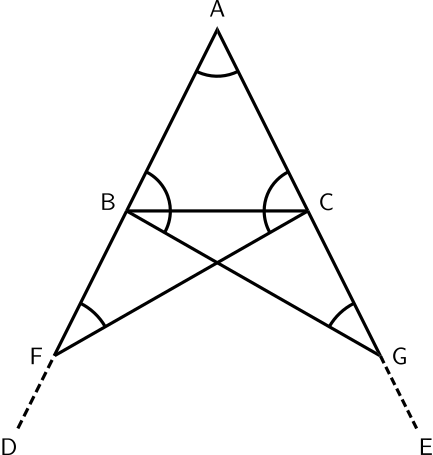
Take any point F on BD, cut off from the greater, AE, a straight line AG equal to the less, AF (I.3), and join the straight lines FC and GB (Postulate 1).
Since AF is equal to AG and AB to AC, the two sides FA and AC are equal to the two sides GA and AB respectively, and they contain a common angle, the angle FAG. Therefore the base FC is equal to the base GB, the triangle AFC will be equal to the triangle AGB, and the remaining angles will be equal to the remaining angles respectively, namely the angles opposite the equal sides: the angle ACF to the angle ABG, and the angle AFC to the angle AGB (I.4).
And since the whole AF is equal to the whole AG, and of these the part AB is equal to the part AC, the remainder BF is equal to the remainder CG (Common Notion 3). But FC was also shown to be equal to GB. Therefore the two sides BF and FC are equal to the two sides CG and GB respectively; and the angle BFC is equal to the angle CGB, and their base BC is common. Therefore the triangle BFC will also be equal to the triangle CGB, and the remaining angles will be equal to the remaining angles respectively, namely the angles opposite the equal sides (I.4). Therefore the angle FBC is equal to the angle GCB, and the angle BCF to the angle CBG.
Now since the whole angle ABG was shown to be equal to the whole angle ACF, and of these the angle CBG is equal to the angle BCF, the remaining angle ABC is equal to the remaining angle ACB (Common Notion 3); and these are the angles at the base of the triangle ABC. And the angle FBC was also shown to be equal to the angle GCB; and these are the angles under the base.8
Therefore in isosceles triangles the angles at the base are equal to one another, and, if the equal straight lines are extended further, the angles under the base will be equal to one another; which was to be proved.
Proposition I.6
If two angles of a triangle are equal to one another, the sides opposite the equal angles will also be equal to one another.
Let ABC be a triangle having the angle ABC equal to the angle ACB. I say that the side AB is also equal to the side AC.
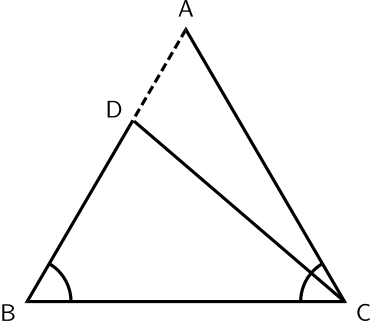
For if AB is unequal to AC, one of them is greater. Let AB be the greater. Cut off from the greater, AB, a straight line DB equal to the less, AC (I.3), and join DC (Postulate 1).
Since DB is equal to AC and BC is common, the two sides DB and BC are equal to the two sides AC and CB respectively, and the angle DBC is equal to the angle ACB. Therefore the base DC is equal to the base AB, and the triangle DBC will be equal to the triangle ACB (I.4), the less to the greater, which is absurd (Common Notion 5). Therefore AB is not unequal to AC; it is therefore equal to it.
Therefore, if two angles of a triangle are equal to one another, the sides opposite the equal angles will also be equal to one another; which was to be proved.
Proposition I.7
On the same straight line, two other straight lines equal respectively to the same two straight lines, and having the same ends as the original straight lines, cannot be constructed so as to meet at a different point on the same side.
For if possible, on the same straight line AB let two other straight lines AD and DB, equal respectively to the same two straight lines AC and CB, be constructed so as to meet at a different point on the same side, the one pair at C and the other at D, and having the same ends, so that CA is equal to DA, which has the same end A as it, and CB is equal to DB, which has the same end B as it; and join CD (Postulate 1).
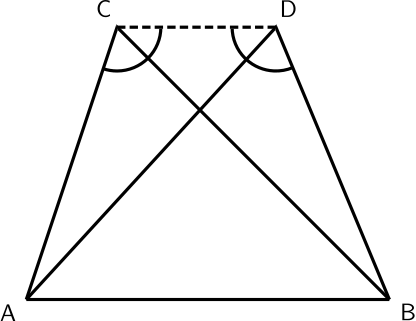
Since AC is equal to AD, the angle ACD is also equal to the angle ADC (I.5). Therefore the angle ADC is greater than the angle DCB (Common Notion 5), and therefore the angle CDB is much greater than the angle DCB (Common Notion 5). Again, since CB is equal to DB, the angle CDB is also equal to the angle DCB (I.5). But it was also shown to be much greater than it, which is impossible.
Therefore on the same straight line, two other straight lines equal respectively to the same two straight lines, and having the same ends as the original straight lines, cannot be constructed so as to meet at a different point on the same side; which was to be proved.
Proposition I.8
If two triangles have two sides equal to two sides respectively, and also have the base equal to the base, then they will also have the angle equal to the angle, namely the angle contained by the equal straight lines.
Let ABC and DEF be two triangles having the two sides AB and AC equal to the two sides DE and DF respectively, AB to DE and AC to DF; and let them also have the base BC equal to the base EF. I say that the angle BAC is also equal to the angle EDF.
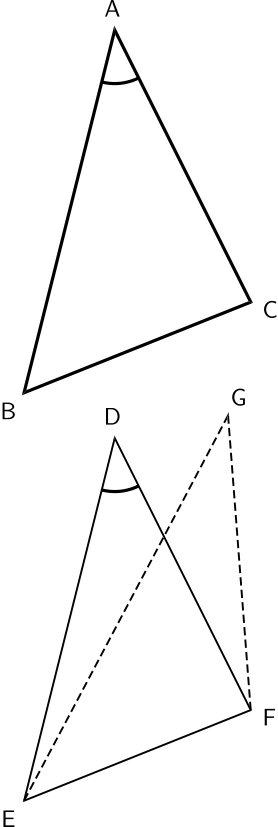
For if the triangle ABC is placed on the triangle DEF, with the point B placed on the point E and the straight line BC on EF, then the point C will also coincide with F, because BC is equal to EF. Then, BC coinciding with EF, the straight lines BA and CA will also coincide with ED and DF. For if the base BC coincides with the base EF, and yet the sides BA and AC do not coincide with ED and DF but fall beside them, as EG and GF, then on the same straight line two other straight lines equal respectively to the same two straight lines, and having the same ends, will have been constructed so as to meet at a different point on the same side. But they cannot be so constructed (I.7). Therefore it is not the case that, when the base BC is placed on the base EF, the sides BA and AC fail to coincide with ED and DF. Therefore they coincide, and hence the angle BAC will also coincide with the angle EDF and will be equal to it (Common Notion 4).
Therefore, if two triangles have two sides equal to two sides respectively, and also have the base equal to the base, then they will also have the angle equal to the angle, namely the angle contained by the equal straight lines; which was to be proved.
Proposition I.9
To bisect a given rectilinear angle.
Let the angle BAC be the given rectilinear angle. We must bisect it.
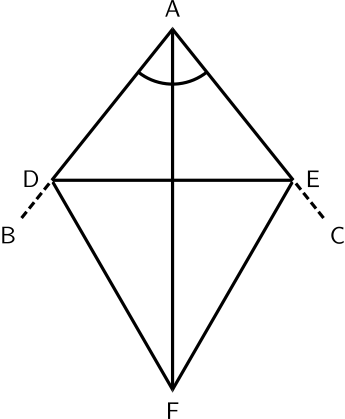
Take any point D on AB, cut off from AC a straight line AE equal to AD (I.3), and join DE (Postulate 1). Construct on DE the equilateral triangle DEF (I.1), and join AF (Postulate 1). I say that the angle BAC is bisected by the straight line AF.
Since AD is equal to AE and AF is common, the two sides DA and AF are equal to the two sides EA and AF respectively. And the base DF is equal to the base EF (Definition 20). Therefore the angle DAF is equal to the angle EAF (I.8).
Therefore the given rectilinear angle BAC is bisected by the straight line AF; which was to be done.
Proposition I.10
To bisect a given finite straight line.
Let AB be the given finite straight line. We must bisect the finite straight line AB.
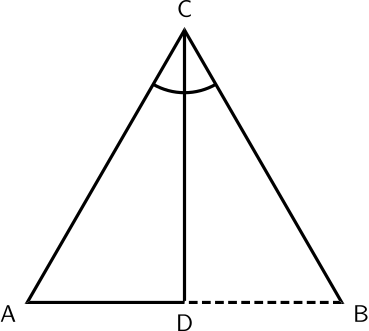
Construct on it the equilateral triangle ABC (I.1), and bisect the angle ACB with the straight line CD (I.9). I say that the straight line AB is bisected at the point D.
Since AC is equal to CB (Definition 20) and CD is common, the two sides AC and CD are equal to the two sides BC and CD respectively; and the angle ACD is equal to the angle BCD. Therefore the base AD is equal to the base BD (I.4).
Therefore the given finite straight line AB is bisected at D; which was to be done.
Proposition I.11
To draw a straight line at right angles to a given straight line from a given point on it.
Let AB be the given straight line and C the given point on it. We must draw from the point C a straight line at right angles to the straight line AB.
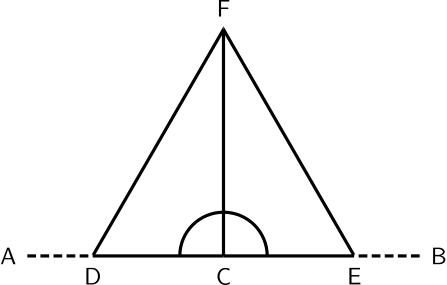
Take any point D on AC, make CE equal to CD (I.3), construct on DE the equilateral triangle FDE (I.1), and join FC (Postulate 1). I say that the straight line FC has been drawn at right angles to the given straight line AB from the given point C on it.
Since DC is equal to CE and CF is common, the two sides DC and CF are equal to the two sides EC and CF respectively; and the base DF is equal to the base FE (Definition 20). Therefore the angle DCF is equal to the angle ECF (I.8); and they are adjacent angles. But when a straight line standing on a straight line makes the adjacent angles equal to one another, each of the equal angles is a right angle (Definition 10). Therefore each of the angles DCF and FCE is a right angle.
Therefore the straight line CF has been drawn at right angles to the given straight line AB from the given point C on it; which was to be done.
Proposition I.12
To draw a perpendicular straight line to a given infinite straight line from a given point which is not on it.
Let AB be the given infinite straight line and C the given point, which is not on it. We must draw a perpendicular straight line to the given infinite straight line AB from the given point C, which is not on it.
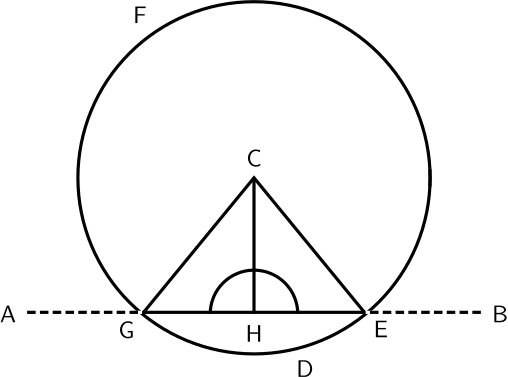
Take any point D on the other side of the straight line AB, draw the circle EFG with centre C and radius CD (Postulate 3), bisect the straight line EG at H (I.10), and join the straight lines CG, CH and CE (Postulate 1). I say that the perpendicular CH has been drawn to the given infinite straight line AB from the given point C, which is not on it.
Since GH is equal to HE and HC is common, the two sides GH and HC are equal to the two sides EH and HC respectively; and the base CG is equal to the base CE (Definition 15). Therefore the angle CHG is equal to the angle EHC (I.8); and they are adjacent angles. But when a straight line standing on a straight line makes the adjacent angles equal to one another, each of the equal angles is a right angle, and the straight line standing on the other is called a perpendicular to the one on which it stands (Definition 10).
Therefore the perpendicular CH has been drawn to the given infinite straight line AB from the given point C, which is not on it; which was to be done.
Proposition I.13
If a straight line standing on a straight line makes angles, it will make either two right angles or angles equal to two right angles.
Let a straight line AB standing on the straight line CD make the angles CBA and ABD. I say that the angles CBA and ABD are either two right angles or equal to two right angles.
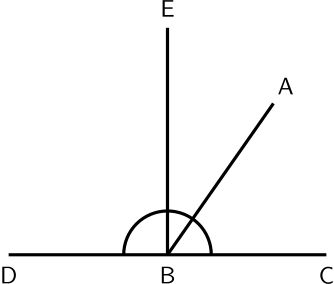
If the angle CBA is equal to the angle ABD, they are two right angles (Definition 10). But if not, draw BE from the point B at right angles to CD (I.11). Therefore the angles CBE and EBD are two right angles. And since the angle CBE is equal to the two angles CBA and ABE, add the angle EBD to each. Therefore the angles CBE and EBD are equal to the three angles CBA, ABE and EBD (Common Notion 2). Again, since the angle DBA is equal to the two angles DBE and EBA, add the angle ABC to each. Therefore the angles DBA and ABC are equal to the three angles DBE, EBA and ABC (Common Notion 2). And the angles CBE and EBD were also shown to be equal to the same three angles. But things equal to the same thing are also equal to one another (Common Notion 1). Therefore the angles CBE and EBD are also equal to the angles DBA and ABC. But the angles CBE and EBD are two right angles. Therefore the angles DBA and ABC are also equal to two right angles.
Therefore, if a straight line standing on a straight line makes angles, it will make either two right angles or angles equal to two right angles; which was to be proved.
Proposition I.14
If at a point on a straight line two straight lines, not lying on the same side, make the adjacent angles equal to two right angles, the two straight lines will be in a straight line with one another.
At the point B on a straight line AB, let the two straight lines BC and BD, not lying on the same side, make the adjacent angles ABC and ABD equal to two right angles. I say that BD is in a straight line with CB.
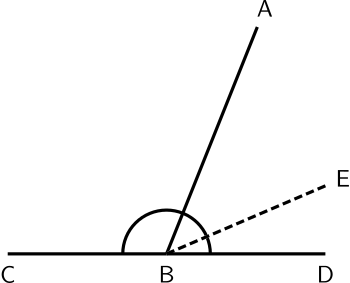
For if BD is not in a straight line with BC, let BE be in a straight line with CB.
Since the straight line AB stands on the straight line CBE, the angles ABC and ABE are equal to two right angles (I.13). But the angles ABC and ABD are also equal to two right angles. Therefore the angles CBA and ABE are equal to the angles CBA and ABD (Postulate 4, Common Notion 1). Subtract the angle CBA from each. Therefore the remaining angle ABE is equal to the remaining angle ABD (Common Notion 3), the less to the greater, which is impossible (Common Notion 5). Therefore BE is not in a straight line with CB. In the same way we can show that neither is any other straight line except BD. Therefore CB is in a straight line with BD.
Therefore, if at a point on a straight line two straight lines, not lying on the same side, make the adjacent angles equal to two right angles, the two straight lines will be in a straight line with one another; which was to be proved.
Proposition I.15
If two straight lines cut one another, they make the vertical angles equal to one another.
Let the two straight lines AB and CD cut one another at the point E. I say that the angle AEC is equal to the angle DEB, and the angle CEB to the angle AED.
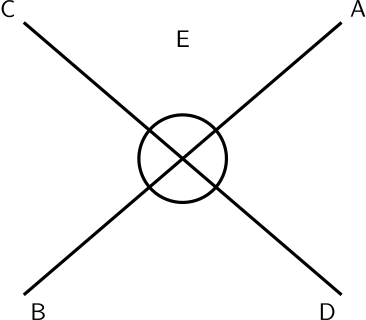
Since the straight line AE stands on the straight line CD, making the angles CEA and AED, the angles CEA and AED are equal to two right angles (I.13). Again, since the straight line DE stands on the straight line AB, making the angles AED and DEB, the angles AED and DEB are equal to two right angles (I.13). But the angles CEA and AED were also shown to be equal to two right angles. Therefore the angles CEA and AED are equal to the angles AED and DEB (Postulate 4, Common Notion 1). Subtract the angle AED from each. Therefore the remaining angle CEA is equal to the remaining angle BED (Common Notion 3). In the same way it can be shown that the angles CEB and DEA are also equal.
Therefore, if two straight lines cut one another, they make the vertical angles equal to one another; which was to be proved.
Corollary. From this it is clear that, if two straight lines cut one another, they will make the angles at the point of intersection equal to four right angles.9
Proposition I.16
In any triangle, if one of the sides is extended, the exterior angle is greater than each of the interior and opposite angles.
Let ABC be a triangle, and extend one side of it, BC, to D. I say that the exterior angle ACD is greater than each of the interior and opposite angles CBA and BAC.
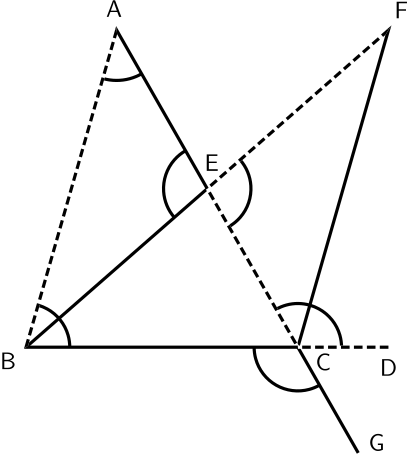
Bisect AC at E (I.10), join BE and extend it in a straight line to F (Postulate 1, Postulate 2), make EF equal to BE (I.3), join FC (Postulate 1), and draw AC through to G (Postulate 2).
Since AE is equal to EC and BE to EF, the two sides AE and EB are equal to the two sides CE and EF respectively; and the angle AEB is equal to the angle FEC, for they are vertical angles (I.15). Therefore the base AB is equal to the base FC, the triangle ABE is equal to the triangle FEC, and the remaining angles are equal to the remaining angles respectively, namely the angles opposite the equal sides (I.4). Therefore the angle BAE is equal to the angle ECF. But the angle ECD is greater than the angle ECF (Common Notion 5). Therefore the angle ACD is greater than the angle BAE. In the same way, if BC is bisected, the angle BCG, that is, the angle ACD, can also be shown to be greater than the angle ABC.
Therefore in any triangle, if one of the sides is extended, the exterior angle is greater than each of the interior and opposite angles; which was to be proved.
Proposition I.17
In any triangle two of the angles, taken together in any way, are less than two right angles.
Let ABC be a triangle. I say that two of the angles of the triangle ABC, taken together in any way, are less than two right angles.
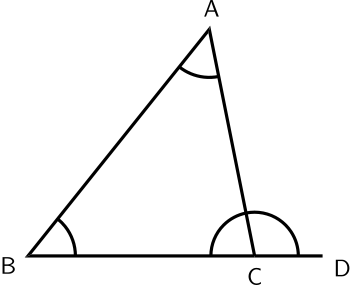
Extend BC to D (Postulate 2).
Since the angle ACD is an exterior angle of the triangle ABC, it is greater than the interior and opposite angle ABC (I.16). Add the angle ACB to each. Therefore the angles ACD and ACB are greater than the angles ABC and BCA. But the angles ACD and ACB are equal to two right angles (I.13). Therefore the angles ABC and BCA are less than two right angles. In the same way we can show that the angles BAC and ACB are also less than two right angles, and so too are the angles CAB and ABC.
Therefore in any triangle two of the angles, taken together in any way, are less than two right angles; which was to be proved.
Proposition I.18
In any triangle the greater side lies opposite the greater angle.
Let ABC be a triangle having the side AC greater than AB. I say that the angle ABC is also greater than the angle BCA.
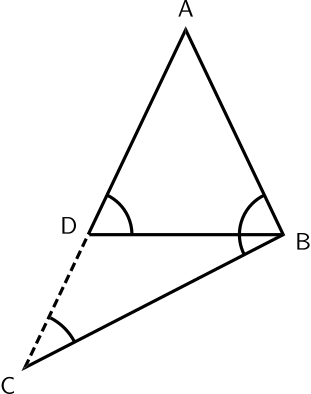
Since AC is greater than AB, make AD equal to AB (I.3), and join BD (Postulate 1).
Since the angle ADB is an exterior angle of the triangle BCD, it is greater than the interior and opposite angle DCB (I.16). But the angle ADB is equal to the angle ABD, since the side AB is also equal to AD (I.5). Therefore the angle ABD is also greater than the angle ACB, and therefore the angle ABC is much greater than the angle ACB (Common Notion 5).
Therefore in any triangle the greater side lies opposite the greater angle; which was to be proved.
Proposition I.19
In any triangle the greater angle has the greater side lying opposite it.
Let ABC be a triangle having the angle ABC greater than the angle BCA. I say that the side AC is also greater than the side AB.
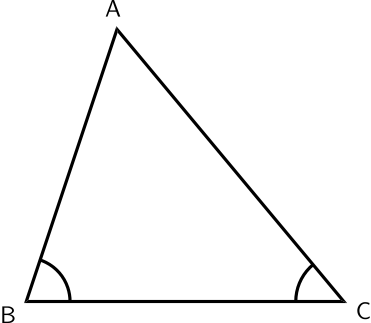
For if not, AC is either equal to AB or less. Now AC is not equal to AB; for then the angle ABC would also be equal to the angle ACB (I.5); but it is not. Therefore AC is not equal to AB. Nor is AC less than AB; for then the angle ABC would also be less than the angle ACB (I.18); but it is not. Therefore AC is not less than AB. And it was shown that it is not equal either. Therefore AC is greater than AB.
Therefore in any triangle the greater angle has the greater side lying opposite it; which was to be proved.
Proposition I.20
In any triangle two sides taken together in any way are greater than the remaining side.
Let ABC be a triangle. I say that in the triangle ABC two sides taken together in any way are greater than the remaining side: BA and AC than BC, AB and BC than AC, and BC and CA than AB.
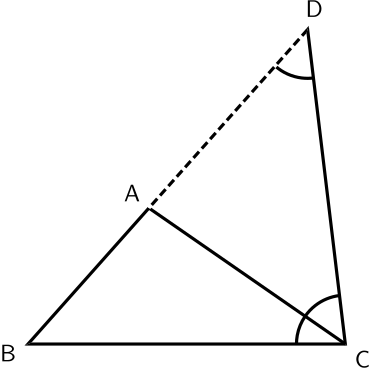
Draw BA through to the point D (Postulate 2), make AD equal to CA (I.3), and join DC (Postulate 1).
Since DA is equal to AC, the angle ADC is also equal to the angle ACD (I.5). Therefore the angle BCD is greater than the angle ADC (Common Notion 5). And since DCB is a triangle having the angle BCD greater than the angle BDC, and the greater angle has the greater side lying opposite it (I.19), DB is therefore greater than BC. But DA is equal to AC. Therefore BA and AC are greater than BC. In the same way we can show that AB and BC are also greater than CA, and BC and CA than AB.
Therefore in any triangle two sides taken together in any way are greater than the remaining side; which was to be proved.
Proposition I.21
If on one of the sides of a triangle, from its ends, two straight lines are constructed meeting inside the triangle, the straight lines so constructed will be less than the remaining two sides of the triangle, but will contain a greater angle.
On BC, one of the sides of the triangle ABC, from its ends B and C, let the two straight lines BD and DC be constructed meeting inside the triangle. I say that BD and DC are less than the remaining two sides of the triangle, BA and AC, but contain an angle BDC greater than the angle BAC.
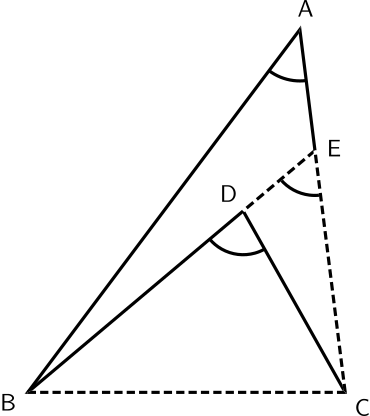
Draw BD through to E (Postulate 2). Since in any triangle two sides are greater than the remaining side (I.20), in the triangle ABE the two sides AB and AE are therefore greater than BE. Add EC to each. Therefore BA and AC are greater than BE and EC. Again, since in the triangle CED the two sides CE and ED are greater than CD (I.20), add DB to each. Therefore CE and EB are greater than CD and DB. But BA and AC were shown to be greater than BE and EC. Therefore BA and AC are much greater than BD and DC.
Again, since in any triangle the exterior angle is greater than the interior and opposite angle (I.16), in the triangle CDE the exterior angle BDC is therefore greater than the angle CED. For the same reason, in the triangle ABE as well the exterior angle CEB is greater than the angle BAC. But the angle BDC was shown to be greater than the angle CEB. Therefore the angle BDC is much greater than the angle BAC.
Therefore, if on one of the sides of a triangle, from its ends, two straight lines are constructed meeting inside the triangle, the straight lines so constructed are less than the remaining two sides of the triangle, but contain a greater angle; which was to be proved.
Proposition I.22
To construct a triangle out of three straight lines that are equal to three given straight lines; and two of them taken together in any way must be greater than the remaining one, because in any triangle two sides taken together in any way are greater than the remaining side.
Let A, B and C be the three given straight lines, and let two of them taken together in any way be greater than the remaining one: A and B than C, A and C than B, and also B and C than A. We must construct a triangle out of straight lines equal to A, B and C.
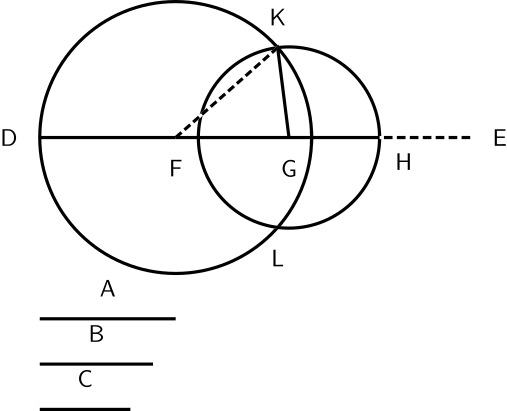
Set out a straight line DE, finite at D but without limit in the direction of E, and make DF equal to A, FG equal to B, and GH equal to C (I.3). Draw the circle DKL with centre F and radius FD, and again draw the circle KLH with centre G and radius GH (Postulate 3), and join KF and KG (Postulate 1). I say that the triangle KFG has been constructed out of three straight lines equal to A, B and C.
Since the point F is the centre of the circle DKL, FD is equal to FK (Definition 15). But FD is equal to A. Therefore KF is also equal to A (Common Notion 1). Again, since the point G is the centre of the circle LKH, GH is equal to GK (Definition 15). But GH is equal to C. Therefore KG is also equal to C (Common Notion 1). And FG is also equal to B. Therefore the three straight lines KF, FG and GK are equal to the three straight lines A, B and C.
Therefore the triangle KFG has been constructed out of the three straight lines KF, FG and GK, which are equal to the three given straight lines A, B and C; which was to be done.
Proposition I.23
To construct, on a given straight line and at a point on it, a rectilinear angle equal to a given rectilinear angle.
Let AB be the given straight line, A the point on it, and the angle DCE the given rectilinear angle. We must construct, on the given straight line AB and at the point A on it, a rectilinear angle equal to the given rectilinear angle DCE.
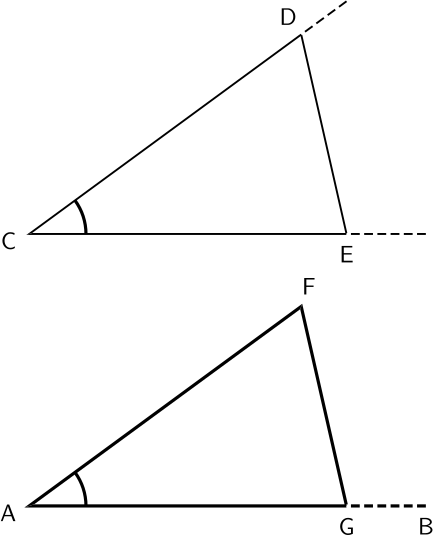
Take any points D and E on the straight lines CD and CE respectively, and join DE (Postulate 1). Out of three straight lines that are equal to the three straight lines CD, DE and CE, construct the triangle AFG, so that CD is equal to AF, CE to AG, and also DE to FG (I.22).
Since the two sides DC and CE are equal to the two sides FA and AG respectively, and the base DE is equal to the base FG, the angle DCE is therefore equal to the angle FAG (I.8).
Therefore, on the given straight line AB and at the point A on it, the rectilinear angle FAG has been constructed equal to the given rectilinear angle DCE; which was to be done.
Proposition I.24
If two triangles have two sides equal to two sides respectively, but have one of the angles contained by the equal straight lines greater than the other, then they will also have the base greater than the base.
Let ABC and DEF be two triangles having the two sides AB and AC equal to the two sides DE and DF respectively, AB to DE and AC to DF, and let the angle at A be greater than the angle at D. I say that the base BC is also greater than the base EF.
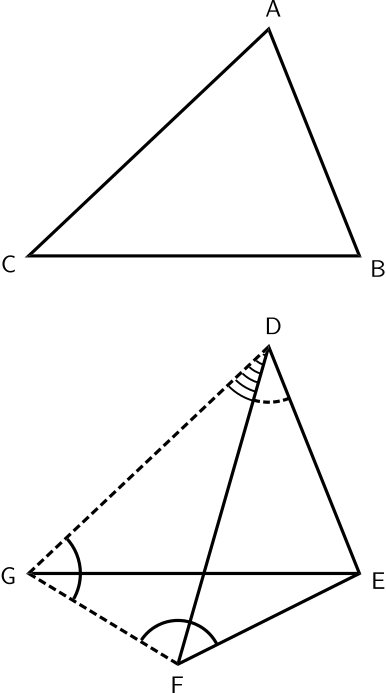
Since the angle BAC is greater than the angle EDF, construct on the straight line DE, at the point D on it, the angle EDG equal to the angle BAC (I.23); make DG equal to either of the straight lines AC and DF (I.3), and join EG and FG (Postulate 1).
Since AB is equal to DE and AC to DG, the two sides BA and AC are equal to the two sides ED and DG respectively; and the angle BAC is equal to the angle EDG. Therefore the base BC is equal to the base EG (I.4). Again, since DF is equal to DG, the angle DGF is also equal to the angle DFG (I.5). Therefore the angle DFG is greater than the angle EGF (Common Notion 5). Therefore the angle EFG is much greater than the angle EGF. And since EFG is a triangle having the angle EFG greater than the angle EGF, and the greater angle has the greater side lying opposite it (I.19), the side EG is therefore also greater than EF. But EG is equal to BC. Therefore BC is also greater than EF.
Therefore, if two triangles have two sides equal to two sides respectively, but have one of the angles contained by the equal straight lines greater than the other, then they will also have the base greater than the base; which was to be proved.
Proposition I.25
If two triangles have two sides equal to two sides respectively, but have the base greater than the base, then they will also have one of the angles contained by the equal straight lines greater than the other.
Let ABC and DEF be two triangles having the two sides AB and AC equal to the two sides DE and DF respectively, AB to DE and AC to DF; and let the base BC be greater than the base EF. I say that the angle BAC is also greater than the angle EDF.
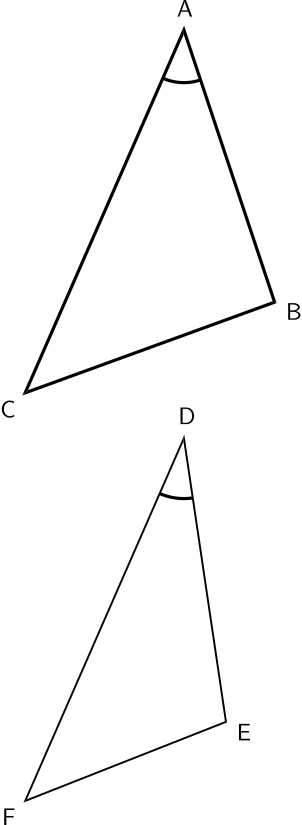
For if not, it is either equal to it or less. Now the angle BAC is not equal to the angle EDF; for then the base BC would also be equal to the base EF (I.4), but it is not. Therefore the angle BAC is not equal to the angle EDF. Nor is the angle BAC less than the angle EDF; for then the base BC would also be less than the base EF (I.24), but it is not. Therefore the angle BAC is not less than the angle EDF. And it was shown that it is not equal either. Therefore the angle BAC is greater than the angle EDF.
Therefore, if two triangles have two sides equal to two sides respectively, but have the base greater than the base, then they will also have one of the angles contained by the equal straight lines greater than the other; which was to be proved.
Proposition I.26
If two triangles have two angles equal to two angles respectively, and one side equal to one side, either the side adjoining the equal angles or the side opposite one of the equal angles, then they will also have the remaining sides equal to the remaining sides, and the remaining angle equal to the remaining angle.
Let ABC and DEF be two triangles having the two angles ABC and BCA equal to the two angles DEF and EFD respectively, the angle ABC to the angle DEF and the angle BCA to the angle EFD; and let them also have one side equal to one side, first the side adjoining the equal angles, BC to EF. I say that they will also have the remaining sides equal to the remaining sides respectively, AB to DE and AC to DF, and the remaining angle equal to the remaining angle, the angle BAC to the angle EDF.
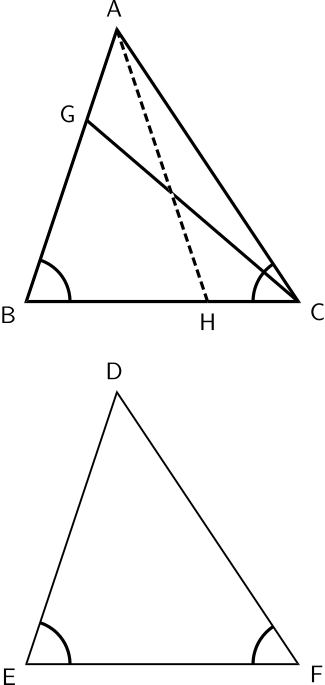
For if AB is unequal to DE, one of them is greater. Let AB be the greater, make BG equal to DE (I.3), and join GC (Postulate 1).
Since BG is equal to DE and BC to EF, the two sides BG and BC are equal to the two sides DE and EF respectively; and the angle GBC is equal to the angle DEF. Therefore the base GC is equal to the base DF, the triangle GBC is equal to the triangle DEF, and the remaining angles will be equal to the remaining angles, namely the angles opposite the equal sides (I.4). Therefore the angle GCB is equal to the angle DFE. But the angle DFE is equal to the angle BCA by hypothesis. Therefore the angle BCG is also equal to the angle BCA (Common Notion 1), the less to the greater, which is impossible (Common Notion 5). Therefore AB is not unequal to DE; it is therefore equal to it. But BC is also equal to EF. Therefore the two sides AB and BC are equal to the two sides DE and EF respectively; and the angle ABC is equal to the angle DEF. Therefore the base AC is equal to the base DF, and the remaining angle BAC is equal to the remaining angle EDF (I.4).
Next, let the sides opposite the equal angles be equal, as AB to DE. I say again that the remaining sides will also be equal to the remaining sides, AC to DF and BC to EF, and further that the remaining angle BAC is equal to the remaining angle EDF.
For if BC is unequal to EF, one of them is greater. If possible, let BC be the greater; make BH equal to EF (I.3) and join AH (Postulate 1). Since BH is equal to EF and AB to DE, the two sides AB and BH are equal to the two sides DE and EF respectively; and they contain equal angles. Therefore the base AH is equal to the base DF, the triangle ABH is equal to the triangle DEF, and the remaining angles will be equal to the remaining angles, namely the angles opposite the equal sides (I.4). Therefore the angle BHA is equal to the angle EFD. But the angle EFD is equal to the angle BCA. Then in the triangle AHC the exterior angle BHA is equal to the interior and opposite angle BCA, which is impossible (I.16). Therefore BC is not unequal to EF; it is therefore equal to it. But AB is also equal to DE. Therefore the two sides AB and BC are equal to the two sides DE and EF respectively; and they contain equal angles. Therefore the base AC is equal to the base DF, the triangle ABC is equal to the triangle DEF, and the remaining angle BAC is equal to the remaining angle EDF (I.4).
Therefore, if two triangles have two angles equal to two angles respectively, and one side equal to one side, either the side adjoining the equal angles or the side opposite one of the equal angles, then they will also have the remaining sides equal to the remaining sides, and the remaining angle equal to the remaining angle; which was to be proved.
Proposition I.27
If a straight line falling on two straight lines makes the alternate angles equal to one another, the straight lines will be parallel to one another.
Let the straight line EF, falling on the two straight lines AB and CD, make the alternate angles AEF and EFD equal to one another. I say that AB is parallel to CD.10
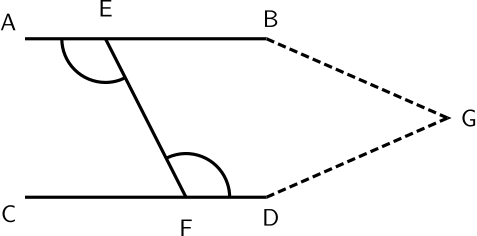
For if not, AB and CD, if extended, will meet either in the direction of B and D or in the direction of A and C. Let them be extended and meet in the direction of B and D at G. Then in the triangle GEF the exterior angle AEF is equal to the interior and opposite angle EFG, which is impossible (I.16). Therefore AB and CD, if extended, will not meet in the direction of B and D. In the same way it can be shown that they will not meet in the direction of A and C either. But straight lines that meet in neither direction are parallel (Definition 23). Therefore AB is parallel to CD.
Therefore, if a straight line falling on two straight lines makes the alternate angles equal to one another, the straight lines will be parallel; which was to be proved.
Proposition I.28
If a straight line falling on two straight lines makes the exterior angle equal to the interior and opposite angle on the same side, or the interior angles on the same side equal to two right angles, the straight lines will be parallel to one another.
Let the straight line EF, falling on the two straight lines AB and CD, make the exterior angle EGB equal to the interior and opposite angle GHD, or the interior angles on the same side, BGH and GHD, equal to two right angles. I say that AB is parallel to CD.
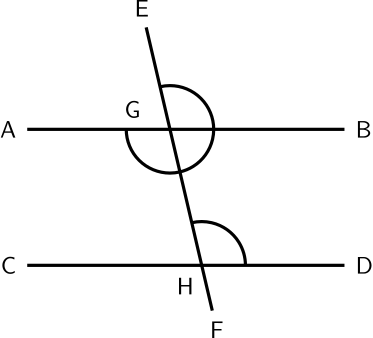
Since the angle EGB is equal to the angle GHD, while the angle EGB is equal to the angle AGH (I.15), the angle AGH is therefore also equal to the angle GHD (Common Notion 1); and they are alternate angles. Therefore AB is parallel to CD (I.27).
Again, since the angles BGH and GHD are equal to two right angles, and the angles AGH and BGH are also equal to two right angles (I.13), the angles AGH and BGH are therefore equal to the angles BGH and GHD. Subtract the angle BGH from each. Therefore the remaining angle AGH is equal to the remaining angle GHD (Common Notion 3); and they are alternate angles. Therefore AB is parallel to CD (I.27).
Therefore, if a straight line falling on two straight lines makes the exterior angle equal to the interior and opposite angle on the same side, or the interior angles on the same side equal to two right angles, the straight lines will be parallel; which was to be proved.
Proposition I.29
A straight line falling on parallel straight lines makes the alternate angles equal to one another, the exterior angle equal to the interior and opposite angle, and the interior angles on the same side equal to two right angles.
Let the straight line EF fall on the parallel straight lines AB and CD. I say that it makes the alternate angles AGH and GHD equal, the exterior angle EGB equal to the interior and opposite angle GHD, and the interior angles on the same side, BGH and GHD, equal to two right angles.
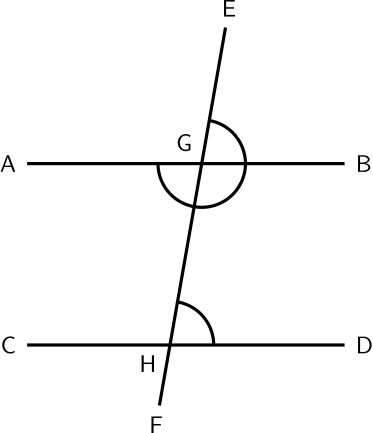
For if the angle AGH is unequal to the angle GHD, one of them is greater. Let the angle AGH be the greater. Add the angle BGH to each. Therefore the angles AGH and BGH are greater than the angles BGH and GHD. But the angles AGH and BGH are equal to two right angles (I.13). Therefore the angles BGH and GHD are less than two right angles. But straight lines extended without limit from angles less than two right angles meet (Postulate 5). Therefore AB and CD, if extended without limit, will meet. But they do not meet, because they are parallel by hypothesis. Therefore the angle AGH is not unequal to the angle GHD; it is therefore equal to it.
But the angle AGH is equal to the angle EGB (I.15). Therefore the angle EGB is also equal to the angle GHD (Common Notion 1).
Add the angle BGH to each. Therefore the angles EGB and BGH are equal to the angles BGH and GHD (Common Notion 2). But the angles EGB and BGH are equal to two right angles (I.13). Therefore the angles BGH and GHD are also equal to two right angles.
Therefore a straight line falling on parallel straight lines makes the alternate angles equal to one another, the exterior angle equal to the interior and opposite angle, and the interior angles on the same side equal to two right angles; which was to be proved.
Proposition I.30
Straight lines parallel to the same straight line are also parallel to one another.
Let each of the straight lines AB and CD be parallel to EF. I say that AB is also parallel to CD.
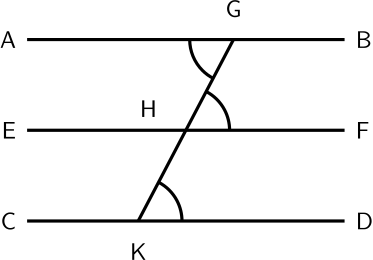
Let the straight line GK fall on them.
Since the straight line GK falls on the parallel straight lines AB and EF, the angle AGK is equal to the angle GHF (I.29). Again, since the straight line GK falls on the parallel straight lines EF and CD, the angle GHF is equal to the angle GKD (I.29). But the angle AGK was also shown to be equal to the angle GHF. Therefore the angle AGK is also equal to the angle GKD (Common Notion 1); and they are alternate angles. Therefore AB is parallel to CD (I.27).
Therefore straight lines parallel to the same straight line are also parallel to one another; which was to be proved.
Proposition I.31
To draw through a given point a straight line parallel to a given straight line.
Let A be the given point and BC the given straight line. We must draw through the point A a straight line parallel to the straight line BC.
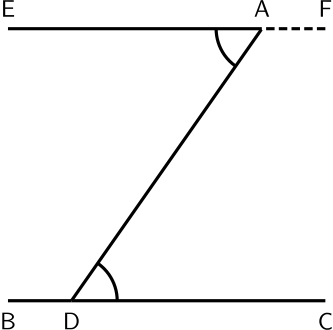
Take any point D on BC and join AD (Postulate 1). Construct on the straight line DA, at the point A on it, the angle DAE equal to the angle ADC (I.23), and extend EA in a straight line to form AF (Postulate 2).
Since the straight line AD, falling on the two straight lines BC and EF, makes the alternate angles EAD and ADC equal to one another, EAF is therefore parallel to BC (I.27).
Therefore the straight line EAF has been drawn through the given point A parallel to the given straight line BC; which was to be done.
Proposition I.32
In any triangle, if one of the sides is extended, the exterior angle is equal to the two interior and opposite angles, and the three interior angles of the triangle are equal to two right angles.
Let ABC be a triangle, and extend one side of it, BC, to D (Postulate 2). I say that the exterior angle ACD is equal to the two interior and opposite angles CAB and ABC, and that the three interior angles of the triangle, ABC, BCA and CAB, are equal to two right angles.
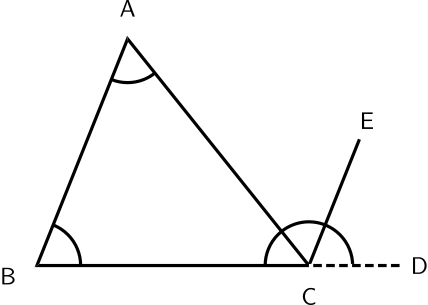
Draw CE through the point C parallel to the straight line AB (I.31).
Since AB is parallel to CE, and AC falls on them, the alternate angles BAC and ACE are equal to one another (I.29). Again, since AB is parallel to CE, and the straight line BD falls on them, the exterior angle ECD is equal to the interior and opposite angle ABC (I.29). But the angle ACE was also shown to be equal to the angle BAC. Therefore the whole angle ACD is equal to the two interior and opposite angles BAC and ABC (Common Notion 2).
Add the angle ACB to each. Therefore the angles ACD and ACB are equal to the three angles ABC, BCA and CAB (Common Notion 2). But the angles ACD and ACB are equal to two right angles (I.13). Therefore the angles ACB, CBA and CAB are also equal to two right angles (Common Notion 1).11
Therefore in any triangle, if one of the sides is extended, the exterior angle is equal to the two interior and opposite angles, and the three interior angles of the triangle are equal to two right angles; which was to be proved.
Proposition I.33
The straight lines that join equal and parallel straight lines on the same sides are themselves also equal and parallel.
Let AB and CD be equal and parallel, and let the straight lines AC and BD join them on the same sides. I say that AC and BD are also equal and parallel.12
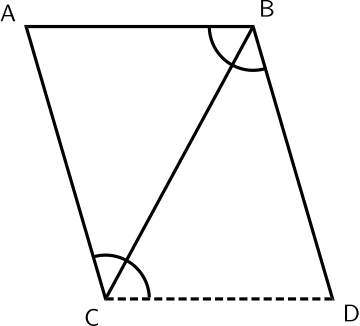
Join BC (Postulate 1). Since AB is parallel to CD, and BC falls on them, the alternate angles ABC and BCD are equal to one another (I.29). And since AB is equal to CD and BC is common, the two sides AB and BC are equal to the two sides BC and CD; and the angle ABC is equal to the angle BCD. Therefore the base AC is equal to the base BD, the triangle ABC is equal to the triangle BCD, and the remaining angles will be equal to the remaining angles respectively, namely the angles opposite the equal sides (I.4). Therefore the angle ACB is equal to the angle CBD. And since the straight line BC, falling on the two straight lines AC and BD, makes the alternate angles equal to one another, AC is therefore parallel to BD (I.27). And it was also shown to be equal to it.
Therefore the straight lines that join equal and parallel straight lines on the same sides are themselves also equal and parallel; which was to be proved.
Proposition I.34
In parallelograms the opposite sides and angles are equal to one another, and the diagonal bisects them.
Let ACDB be a parallelogram and BC its diagonal. I say that the opposite sides and angles of the parallelogram ACDB are equal to one another, and the diagonal BC bisects it.
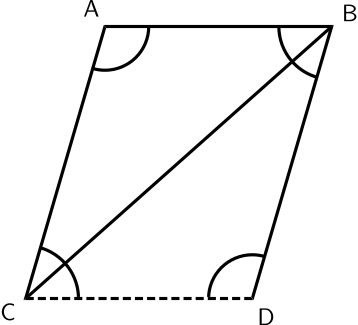
Since AB is parallel to CD, and the straight line BC falls on them, the alternate angles ABC and BCD are equal to one another (I.29). Again, since AC is parallel to BD, and BC falls on them, the alternate angles ACB and CBD are equal to one another (I.29). Then ABC and BCD are two triangles having the two angles ABC and BCA equal to the two angles BCD and CBD respectively, and one side equal to one side, namely the side adjoining the equal angles, BC, which is common to them. Therefore they will also have the remaining sides equal to the remaining sides respectively, and the remaining angle equal to the remaining angle (I.26). Therefore the side AB is equal to CD, and AC to BD, and further the angle BAC is equal to the angle CDB. And since the angle ABC is equal to the angle BCD, and the angle CBD to the angle ACB, the whole angle ABD is equal to the whole angle ACD (Common Notion 2). And it was shown that the angle BAC is also equal to the angle CDB.
Therefore in parallelograms the opposite sides and angles are equal to one another.
I say next that the diagonal also bisects them. For since AB is equal to CD, and BC is common, the two sides AB and BC are equal to the two sides CD and BC respectively; and the angle ABC is equal to the angle BCD. Therefore the base AC is also equal to the base DB, and the triangle ABC is equal to the triangle BCD (I.4).
Therefore the diagonal BC bisects the parallelogram ABCD; which was to be proved.
Proposition I.35
Parallelograms that are on the same base and between the same parallels are equal to one another.
Let ABCD and EBCF be parallelograms on the same base BC and between the same parallels AF and BC. I say that the parallelogram ABCD is equal to the parallelogram EBCF.13
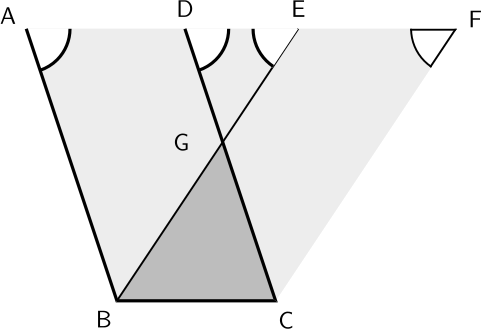
Since ABCD is a parallelogram, AD is equal to BC (I.34). For the same reason EF is also equal to BC; hence AD is also equal to EF (Common Notion 1). And DE is common; therefore the whole AE is equal to the whole DF (Common Notion 2). But AB is also equal to DC (I.34). Therefore the two sides EA and AB are equal to the two sides FD and DC respectively; and the angle FDC is equal to the angle EAB, the exterior to the interior (I.29). Therefore the base EB is equal to the base FC, and the triangle EAB will be equal to the triangle DFC (I.4). Subtract the common part DGE. Therefore the remaining trapezium ABGD is equal to the remaining trapezium EGCF (Common Notion 3). Add the common triangle GBC. Therefore the whole parallelogram ABCD is equal to the whole parallelogram EBCF (Common Notion 2).
Therefore parallelograms that are on the same base and between the same parallels are equal to one another; which was to be proved.
Proposition I.36
Parallelograms that are on equal bases and between the same parallels are equal to one another.
Let ABCD and EFGH be parallelograms on the equal bases BC and FG and between the same parallels AH and BG. I say that the parallelogram ABCD is equal to EFGH.
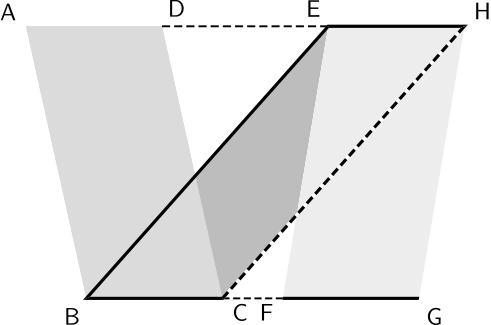
Join BE and CH (Postulate 1). Since BC is equal to FG, and FG is equal to EH (I.34), BC is also equal to EH (Common Notion 1). They are also parallel, and EB and HC join them. But straight lines that join equal and parallel straight lines on the same sides are themselves equal and parallel (I.33). Therefore EB and HC are also equal and parallel. Therefore EBCH is a parallelogram. And it is equal to ABCD, for the two have the same base BC and are between the same parallels BC and AH (I.35). For the same reason EFGH is also equal to the same parallelogram EBCH (I.35); hence the parallelogram ABCD is also equal to EFGH (Common Notion 1).
Therefore parallelograms that are on equal bases and between the same parallels are equal to one another; which was to be proved.
Proposition I.37
Triangles that are on the same base and between the same parallels are equal to one another.
Let ABC and DBC be triangles on the same base BC and between the same parallels AD and BC. I say that the triangle ABC is equal to the triangle DBC.
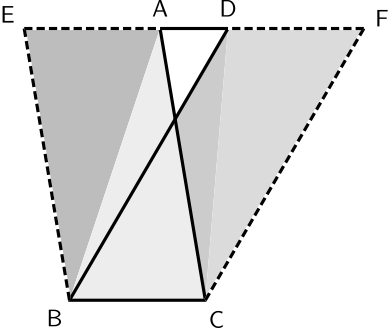
Extend AD in both directions to E and F (Postulate 2); through B draw BE parallel to CA, and through C draw CF parallel to BD (I.31). Therefore each of the figures EBCA and DBCF is a parallelogram; and they are equal, for they are on the same base BC and between the same parallels BC and EF (I.35). And the triangle ABC is half of the parallelogram EBCA, for the diagonal AB bisects it (I.34); and the triangle DBC is half of the parallelogram DBCF, for the diagonal DC bisects it (I.34). But halves of equal things are equal to one another. Therefore the triangle ABC is equal to the triangle DBC.
Therefore triangles that are on the same base and between the same parallels are equal to one another; which was to be proved.
Proposition I.38
Triangles that are on equal bases and between the same parallels are equal to one another.
Let ABC and DEF be triangles on the equal bases BC and EF and between the same parallels BF and AD. I say that the triangle ABC is equal to the triangle DEF.
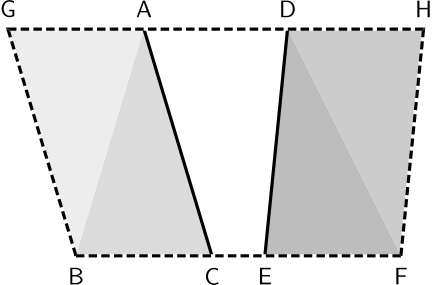
Extend AD in both directions to G and H (Postulate 2); through B draw BG parallel to CA, and through F draw FH parallel to DE (I.31). Therefore each of the figures GBCA and DEFH is a parallelogram; and GBCA is equal to DEFH, for they are on the equal bases BC and EF and between the same parallels BF and GH (I.36). And the triangle ABC is half of the parallelogram GBCA, for the diagonal AB bisects it (I.34); and the triangle FED is half of the parallelogram DEFH, for the diagonal DF bisects it (I.34). But halves of equal things are equal to one another. Therefore the triangle ABC is equal to the triangle DEF.
Therefore triangles that are on equal bases and between the same parallels are equal to one another; which was to be proved.
Proposition I.39
Equal triangles that are on the same base and on the same side of it are also between the same parallels.
Let ABC and DBC be equal triangles on the same base BC and on the same side of it. I say that they are also between the same parallels.
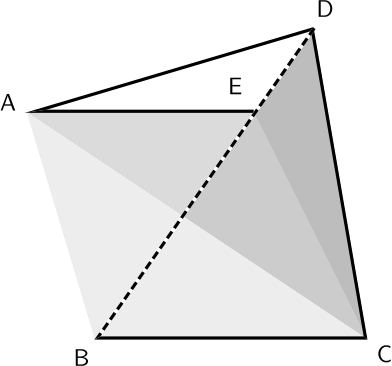
Join AD (Postulate 1). I say that AD is parallel to BC.
For if not, draw AE through the point A parallel to the straight line BC (I.31), and join EC (Postulate 1). Therefore the triangle ABC is equal to the triangle EBC, for the two are on the same base BC and between the same parallels (I.37). But ABC is equal to DBC. Therefore DBC is also equal to EBC (Common Notion 1), the greater to the less, which is impossible (Common Notion 5). Therefore AE is not parallel to BC. In the same way we can show that neither is any other straight line except AD. Therefore AD is parallel to BC.
Therefore equal triangles that are on the same base and on the same side of it are also between the same parallels; which was to be proved.
Proposition I.40
Equal triangles that are on equal bases and on the same side are also between the same parallels.
Let ABC and CDE be equal triangles on the equal bases BC and CE and on the same side. I say that they are also between the same parallels.
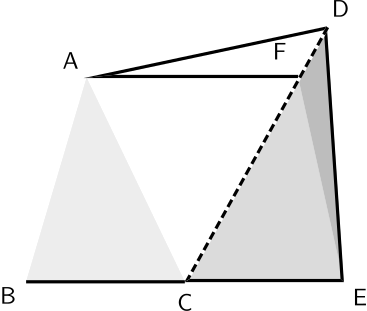
Join AD (Postulate 1). I say that AD is parallel to BE.
For if not, draw AF through A parallel to BE (I.31), and join FE (Postulate 1). Therefore the triangle ABC is equal to the triangle FCE, for they are on the equal bases BC and CE and between the same parallels BE and AF (I.38). But the triangle ABC is equal to the triangle DCE. Therefore the triangle DCE is also equal to the triangle FCE (Common Notion 1), the greater to the less, which is impossible (Common Notion 5). Therefore AF is not parallel to BE. In the same way we can show that neither is any other straight line except AD. Therefore AD is parallel to BE.
Therefore equal triangles that are on equal bases and on the same side are also between the same parallels; which was to be proved.
Proposition I.41
If a parallelogram has the same base as a triangle and is between the same parallels, the parallelogram is double the triangle.
Let the parallelogram ABCD have the same base BC as the triangle EBC, and let it be between the same parallels BC and AE. I say that the parallelogram ABCD is double the triangle BEC.
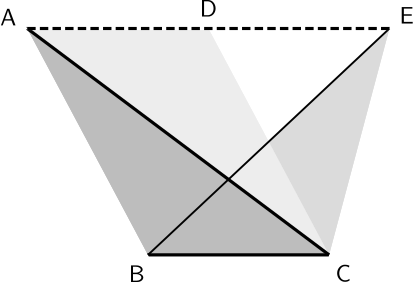
Join AC (Postulate 1). Then the triangle ABC is equal to the triangle EBC, for the two are on the same base BC and between the same parallels BC and AE (I.37). But the parallelogram ABCD is double the triangle ABC, for the diagonal AC bisects it (I.34). Hence the parallelogram ABCD is also double the triangle EBC.
Therefore, if a parallelogram has the same base as a triangle and is between the same parallels, the parallelogram is double the triangle; which was to be proved.
Proposition I.42
To construct a parallelogram equal to a given triangle in a given rectilinear angle.
Let ABC be the given triangle and D the given rectilinear angle. We must construct a parallelogram equal to the triangle ABC in the rectilinear angle D.
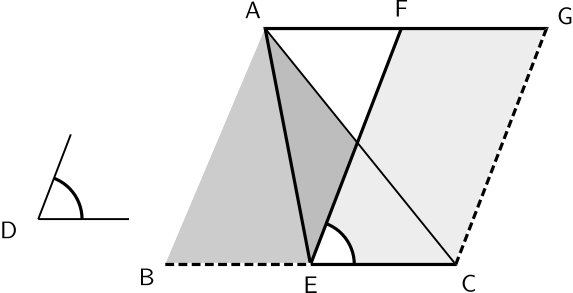
Bisect BC at E (I.10), and join AE (Postulate 1). On the straight line EC, at the point E on it, construct the angle CEF equal to the angle D (I.23). Through A draw AG parallel to EC, and through C draw CG parallel to EF (I.31). Therefore FECG is a parallelogram.
Since BE is equal to EC, the triangle ABE is also equal to the triangle AEC, for they are on the equal bases BE and EC and between the same parallels BC and AG (I.38). Therefore the triangle ABC is double the triangle AEC. But the parallelogram FECG is also double the triangle AEC, for the two have the same base and are between the same parallels (I.41). Therefore the parallelogram FECG is equal to the triangle ABC. And it has the angle CEF equal to the given angle D.
Therefore the parallelogram FECG, equal to the given triangle ABC, has been constructed in the angle CEF, which is equal to D; which was to be done.
Proposition I.43
In any parallelogram the complements of the parallelograms about the diagonal are equal to one another.
Let ABCD be a parallelogram and AC its diagonal; about AC let EH and FG be parallelograms, and BK and KD the so-called complements. I say that the complement BK is equal to the complement KD.14
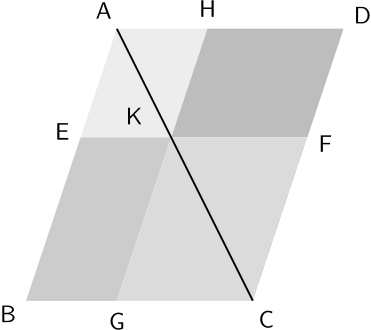
Since ABCD is a parallelogram and AC its diagonal, the triangle ABC is equal to the triangle ACD (I.34). Again, since EH is a parallelogram and AK is its diagonal, the triangle AEK is equal to the triangle AHK (I.34). For the same reason the triangle KFC is also equal to KGC. Now since the triangle AEK is equal to the triangle AHK, and KFC to KGC, the triangle AEK together with KGC is equal to the triangle AHK together with KFC (Common Notion 2). But the whole triangle ABC is also equal to the whole ADC. Therefore the remaining complement BK is equal to the remaining complement KD (Common Notion 3).
Therefore in any parallelogram the complements of the parallelograms about the diagonal are equal to one another; which was to be proved.
Proposition I.44
To apply to a given straight line, in a given rectilinear angle, a parallelogram equal to a given triangle.
Let AB be the given straight line, C the given triangle and D the given rectilinear angle. We must apply to the given straight line AB, in an angle equal to the angle D, a parallelogram equal to the given triangle C.15
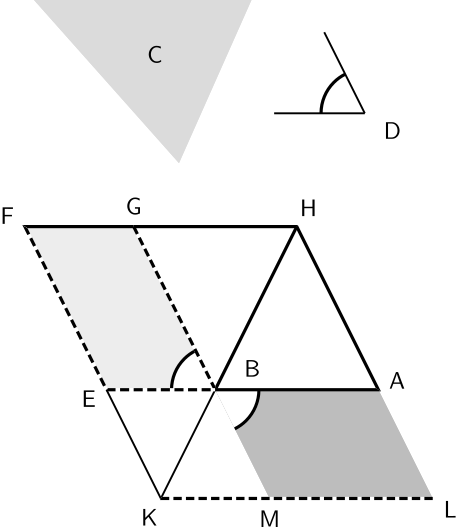
Construct the parallelogram BEFG equal to the triangle C in the angle EBG, which is equal to D (I.42), and place it so that BE is in a straight line with AB. Draw FG through to H, draw AH through A parallel to either of BG and EF (I.31), and join HB (Postulate 1).
Since the straight line HF falls on the parallels AH and EF, the angles AHF and HFE are equal to two right angles (I.29). Therefore the angles BHG and GFE are less than two right angles. But straight lines extended without limit from angles less than two right angles meet (Postulate 5). Therefore HB and FE, if extended, will meet. Extend them and let them meet at K. Through the point K draw KL parallel to either of EA and FH (I.31), and extend HA and GB to the points L and M (Postulate 2).
Then HLKF is a parallelogram and HK is its diagonal; and about HK, AG and ME are parallelograms, and LB and BF the so-called complements. Therefore LB is equal to BF (I.43). But BF is equal to the triangle C; therefore LB is also equal to C (Common Notion 1). And since the angle GBE is equal to the angle ABM (I.15), while the angle GBE is equal to D, the angle ABM is also equal to the angle D (Common Notion 1).
Therefore the parallelogram LB, equal to the given triangle C, has been applied to the given straight line AB in the angle ABM, which is equal to D; which was to be done.
Proposition I.45
To construct a parallelogram equal to a given rectilinear figure in a given rectilinear angle.
Let ABCD be the given rectilinear figure and E the given rectilinear angle. We must construct a parallelogram equal to the rectilinear figure ABCD in the given angle E.
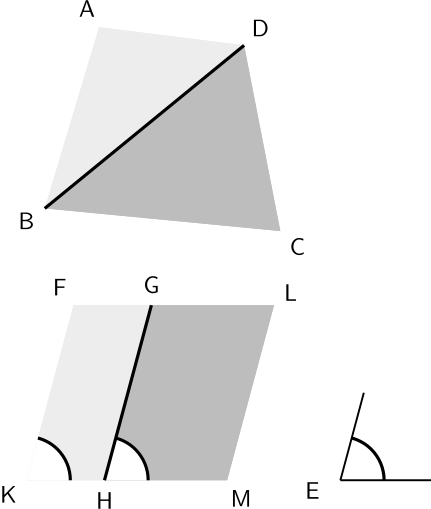
Join DB (Postulate 1). Construct the parallelogram FH equal to the triangle ABD in the angle HKF, which is equal to E (I.42); and apply to the straight line GH the parallelogram GM equal to the triangle DBC in the angle GHM, which is equal to E (I.44).
Since the angle E is equal to each of the angles HKF and GHM, the angle HKF is also equal to the angle GHM (Common Notion 1). Add the angle KHG to each. Therefore the angles FKH and KHG are equal to the angles KHG and GHM (Common Notion 2). But the angles FKH and KHG are equal to two right angles (I.29); therefore the angles KHG and GHM are also equal to two right angles (Common Notion 1). Then at the point H on the straight line GH, the two straight lines KH and HM, not lying on the same side, make the adjacent angles equal to two right angles. Therefore KH is in a straight line with HM (I.14).
And since the straight line HG falls on the parallels KM and FG, the alternate angles MHG and HGF are equal to one another (I.29). Add the angle HGL to each. Therefore the angles MHG and HGL are equal to the angles HGF and HGL (Common Notion 2). But the angles MHG and HGL are equal to two right angles (I.29); therefore the angles HGF and HGL are also equal to two right angles (Common Notion 1). Therefore FG is in a straight line with GL (I.14).
And since FK is equal and parallel to HG, and HG to ML also (I.34), KF is also equal and parallel to ML (Common Notion 1, I.30). And the straight lines KM and FL join them; therefore KM and FL are also equal and parallel (I.33). Therefore KFLM is a parallelogram. And since the triangle ABD is equal to the parallelogram FH, and DBC to GM, the whole rectilinear figure ABCD is equal to the whole parallelogram KFLM (Common Notion 2).
Therefore the parallelogram KFLM, equal to the given rectilinear figure ABCD, has been constructed in the angle FKM, which is equal to the given angle E; which was to be done.
Proposition I.46
To draw a square on a given straight line.
Let AB be the given straight line. We must draw a square on the straight line AB.
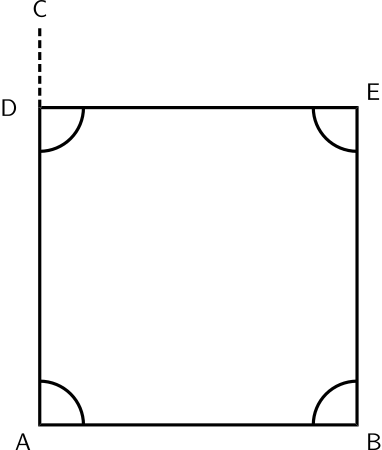
Draw AC at right angles to the straight line AB from the point A on it (I.11), and make AD equal to AB (I.3). Through the point D draw DE parallel to AB, and through the point B draw BE parallel to AD (I.31). Therefore ADEB is a parallelogram; therefore AB is equal to DE, and AD to BE (I.34). But AB is equal to AD. Therefore the four straight lines BA, AD, DE and EB are equal to one another, and hence the parallelogram ADEB is equilateral.
I say next that it is also right-angled. For since the straight line AD falls on the parallels AB and DE, the angles BAD and ADE are equal to two right angles (I.29). But the angle BAD is a right angle; therefore the angle ADE is also a right angle. But in parallelograms the opposite sides and angles are equal to one another (I.34). Therefore each of the opposite angles ABE and BED is also a right angle. Therefore ADEB is right-angled. And it was also shown to be equilateral.
Therefore it is a square (Definition 22), and it has been drawn on the straight line AB; which was to be done.
Proposition I.47
In right-angled triangles the square on the side opposite the right angle is equal to the squares on the sides containing the right angle.
Let ABC be a right-angled triangle having the angle BAC a right angle. I say that the square on BC is equal to the squares on BA and AC.16
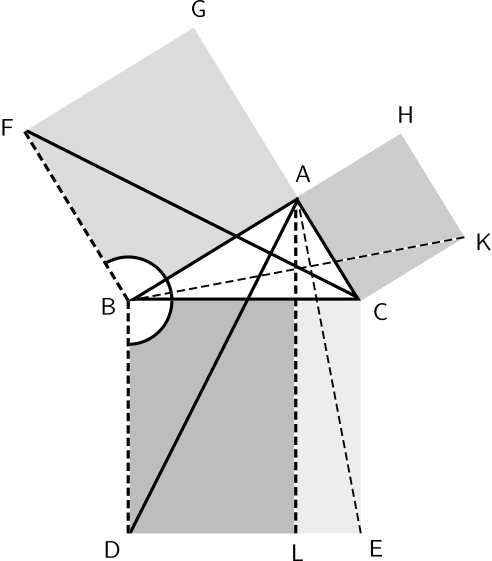
Draw on BC the square BDEC, and on BA and AC the squares GB and HC (I.46); through A draw AL parallel to either of BD and CE (I.31); and join AD and FC (Postulate 1).
Since each of the angles BAC and BAG is a right angle, at the point A on the straight line BA the two straight lines AC and AG, not lying on the same side, make the adjacent angles equal to two right angles. Therefore CA is in a straight line with AG (I.14). For the same reason BA is also in a straight line with AH.
And since the angle DBC is equal to the angle FBA, for each is a right angle, add the angle ABC to each. Therefore the whole angle DBA is equal to the whole angle FBC (Common Notion 2). And since DB is equal to BC, and FB to BA, the two sides DB and BA are equal to the two sides FB and BC respectively; and the angle DBA is equal to the angle FBC. Therefore the base AD is equal to the base FC, and the triangle ABD is equal to the triangle FBC (I.4).
Now the parallelogram BL is double the triangle ABD, for they have the same base BD and are between the same parallels BD and AL (I.41). And the square GB is double the triangle FBC, for they again have the same base FB and are between the same parallels FB and GC (I.41). But doubles of equal things are equal to one another. Therefore the parallelogram BL is also equal to the square GB.
In the same way, if AE and BK are joined, it can also be shown that the parallelogram CL is equal to the square HC. Therefore the whole square BDEC is equal to the two squares GB and HC (Common Notion 2). And the square BDEC is drawn on BC, and the squares GB and HC on BA and AC. Therefore the square on the side BC is equal to the squares on the sides BA and AC.
Therefore in right-angled triangles the square on the side opposite the right angle is equal to the squares on the sides containing the right angle; which was to be proved.
Proposition I.48
If in a triangle the square on one of the sides is equal to the squares on the remaining two sides of the triangle, the angle contained by the remaining two sides of the triangle is a right angle.
Let ABC be a triangle in which the square on one side, BC, is equal to the squares on the sides BA and AC. I say that the angle BAC is a right angle.
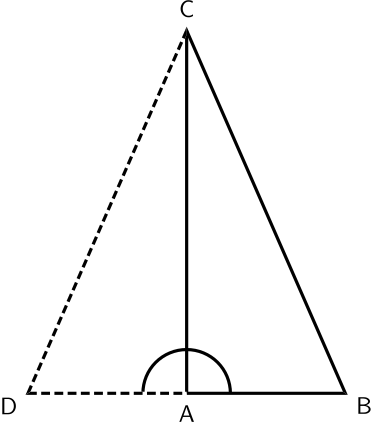
Draw AD from the point A at right angles to the straight line AC (I.11), make AD equal to BA (I.3), and join DC (Postulate 1).
Since DA is equal to AB, the square on DA is also equal to the square on AB. Add the square on AC to each. Therefore the squares on DA and AC are equal to the squares on BA and AC (Common Notion 2). But the square on DC is equal to the squares on DA and AC, for the angle DAC is a right angle (I.47); and the square on BC is equal to the squares on BA and AC, for that is the hypothesis. Therefore the square on DC is equal to the square on BC (Common Notion 1), and hence the side DC is also equal to BC.
And since DA is equal to AB, and AC is common, the two sides DA and AC are equal to the two sides BA and AC; and the base DC is equal to the base BC. Therefore the angle DAC is equal to the angle BAC (I.8). But the angle DAC is a right angle; therefore the angle BAC is also a right angle.
Therefore, if in a triangle the square on one of the sides is equal to the squares on the remaining two sides of the triangle, the angle contained by the remaining two sides of the triangle is a right angle; which was to be proved.