
The Author's Prefaces
From the Preface to the First Edition (1892)
The chief peculiarities of the textbook of geometry here offered are the following.
1. In most of our geometry textbooks the concept of the circumference of a circle, and of the length of a curved line in general, is taken as elementary, requiring no reservations or explanations, and the conclusion that the circumference is the limit of the perimeters of the regular inscribed and circumscribed polygons rests on a concealed assumption, or on a theorem not rigorously proved, that an enclosing line is longer than the line it encloses. In this textbook, in agreement with many authorities in the literature of mathematical teaching, a different view is followed, which holds that the concept of length is elementary only as applied to the straight line; but when it is a question of comparing a finite curve with a rectilinear segment, then (because the elements of a curve cannot be made to coincide with the elements of a straight line) the concept of length becomes complex and requires a definition1. In keeping with this view we do not prove, but accept as a definition, that the length of a finite curve is the limit of the perimeter of an inscribed broken line when its sides tend to zero. Of course, in the middle classes of our schools it would be difficult to ground this definition fully, that is, to prove that such a limit exists and that it does not depend on the law by which the broken line is inscribed; but from the point of view of teaching, as it seems to us, some gaps in a proof (not concealed, however, from the students) are not so harmful as indefiniteness, obscurity and confusion in the concepts, and all the more so in the fundamental ones. When geometry is revised in the senior class (especially in the real schools, where the topic of limits is to be gone through thoroughly in the seventh class), the pupils will have no difficulty in mastering also the necessary grounding of this definition (we have placed it in small type).
Let us notice further, on the same question of length, that, following Euclid's "Elements" and the best modern foreign textbooks, we do not ascribe to the straight line, as an axiom, the property of being shorter than every other line drawn between its ends, but prove this truth at those places in the course where the need and the possibility of doing so arise, first as applied to the broken line and then to the curve as well. And indeed, once we have taken the point of view that the length of a curve is a complex concept, to be resolved only by means of another complex concept, that of the limit, it becomes quite impossible to accept as an evident truth a proposition one of whose terms is this doubly complex concept. On the other hand, there is no logical necessity for a preliminary acceptance of the principle of Archimedes, since it is proved quite rigorously along with the other theorems.
2. In agreement with the view of the length of a curved line set out above, we hold also that curved surfaces, because their elements cannot be made to coincide with the elements of a plane, cannot be compared directly with plane surfaces; we therefore do not prove that the surface of a round body is the limit of a certain plane surface, but accept this proposition as a definition.
Let us notice that the analogous question about the areas of curvilinear figures, or about volumes bounded by curved surfaces, is resolved quite differently. Indeed, we picture to ourselves quite distinctly that the area of a circle is greater than the area of an inscribed polygon, as the whole is greater than its part, and less than the area of a circumscribed polygon, as the part is less than the whole; and further, that as the number of sides of the inscribed and circumscribed polygons is doubled indefinitely, the difference between their areas tends to zero. Therefore the proposition "the area of a circle is the common limit of the areas of the regular inscribed and circumscribed polygons" must be regarded not as a definition but as a theorem, subject to proof. The same may be said of the volume of the cylinder, the cone and the sphere.
3. As is well known, there are topics in algebra that cannot be rigorously grounded in an elementary course, but that the course cannot do without (for example, operations on incommensurable numbers). In elementary geometry the method of limits is a topic of this kind. For a rigorous proof of this method it would be necessary to bring into the course of geometry the theory of limits almost to the extent to which that topic is studied in the seventh class of the real schools. To give a scientific grounding, for example, to the finding of the limit of the formula for the volume of a truncated pyramid [], one would first have to establish the theorems on the limit of a sum, of a product and of a root, and for that in turn one would have to introduce some theorems on infinitely small magnitudes. It goes without saying that in such a form the topic of limits cannot be gone through in the middle classes of our schools. On the other hand, it is impossible to do without the method of limits altogether in elementary geometry. Of necessity one must here give up some rigour of exposition in favour of brevity and accessibility. We have therefore thought it best, after proving the two well-known theorems on limits, to state then without proof the basic principle of the method of limits, which is that an equality true for all possible values of the variables remains true when in place of the variables we substitute their limits.
4. In most original Russian textbooks of geometry the theorems on the equality of incommensurable ratios are proved by contradiction. We have preferred another way. Before proving an equality, it is necessary to establish exactly what is meant by the term. And if we put the question what the equality of incommensurable ratios is, the simplest answer to it will be the following: incommensurable ratios are counted equal if their approximate values, computed to an arbitrary but identical degree of accuracy, are equal. Having accepted this proposition as the definition of equality, we no longer need the indirect and laborious proof by contradiction; it can always be replaced by a direct proof, both simpler and clearer.
5. Some topics are set out in this textbook more simply, it seems, than in our textbooks in common use. Such, for example, are the topics of parallel lines, of the relative position of circles, of proportional lines, of regular polygons, of finding the volume of any parallelepiped, of the similarity of polygons, and some others. The comparative simplicity is achieved by some change in the arrangement of the material, and sometimes by a simplification of the methods of proof. The book is furnished with a considerable number of exercises, consisting partly of some theorems that did not enter the text but are of interest, and chiefly of construction and computation problems. At the end of the plane geometry we have placed2 some computation problems from the "Collection of Geometric Problems for a Revision Course of Plane Geometry" of Mr. M. Popruzhenko. These problems have above all the merit that they contain much purely geometric material, and are not merely arithmetical or algebraic exercises with geometric data. At the end of the course, as a supplement, we have thought it not superfluous to add a short article on the methods of solving geometric construction problems, with examples of problems solved by these methods. The collections of this kind that exist among us frighten students by their size and are used by them only in rare cases. We have set out, in the most compressed form, only the principal methods, and have included the most typical problems.
Following the curricula of the gymnasia and the real schools, we place the basic construction and computation problems in the text of the book itself, immediately after the theorems on which their solution is based. In abridged form we indicate also the essence of the application of algebra to geometry and the construction of the simplest algebraic formulas.
We think it not superfluous to make the following remark. From the point of view of strict theory, construction problems can be approached only when the pupils have mastered the basic propositions about the circle. But from the point of view of teaching this would hardly be convenient: to push the practical exercises so far from the beginning of the course would be to make the beginning of geometry, difficult for beginners as it is, still more dry and heavy. We have given up rigour in favour of practical interest and have placed the basic construction problems immediately after the study of the properties of triangles.
The book is printed in two types: in the ordinary type is set out everything that must be gone through in the middle classes; in the small type, what it is desirable to add when geometry is revised in the senior class.
Preface to the Twenty-First Edition (1912)
The 21st edition of the "Elementary Geometry" has been considerably reworked in comparison with the previous editions.
The principal changes are the following (we list them in the order of the sections).
1°. At the beginning of the chapter "Parallel Lines," before the definition of such lines, an auxiliary lemma (§ 73) has been placed on the mutual connection of the five well-known relations among the angles formed when two straight lines are cut by a third. Establishing this connection beforehand presents no great difficulty to the student and makes the further theory of parallel lines considerably easier to master. The exposition of that theory itself also differs now from the former one. Thus, before the definition of parallelism we show (§ 74) that there can exist straight lines that do not intersect however far we extend them; then we first state the criteria of parallelism of lines (§ 76), and only afterwards set out, in the form of a converse theorem (§ 81), the properties of parallel lines, and not the other way round, as was done in the previous editions. The theorem (§ 77) that "through every point lying outside a straight line a parallel to that line can be drawn" is proved differently from before (by a more general method); the method of proof now given makes it easier to bring out (§ 78) the logical need for the well-known postulate of parallel lines (§ 79). The criteria of non-parallelism of lines (§ 83) are now set out in somewhat more detail than before.
At the end of the chapter on parallel lines we have now placed (in small type) an addition that may, as it seems to us, interest many inquiring pupils: "On the Postulate of Parallel Lines"; in this addition we give an idea of the important role of this postulate, and also of the "non-Euclidean" geometries.
2°. In the chapter "Parallelograms and Trapezoids" we now set out also those theorems whose proof was left in the previous editions to the students themselves; such, for example, are the converse theorems "every quadrilateral whose diagonals bisect each other is a parallelogram" (§ 101), "every parallelogram whose diagonals are equal is a rectangle" (§ 105), and the like.
3°. In the chapter "Properties of the Tangent" the relative position of a straight line and a circle is examined (§ 135) in more detail and more systematically than before, as a result of which the further exposition of the properties of the tangent is simplified. In the same chapter we now set out in detail (§ 142) the proof (formerly left to the pupils themselves) that the solution of the problem of drawing the tangents common to two given circles is correct.
4°. In the chapter "The Measurement of Magnitudes" the proof of the theorem on the incommensurability of the base and the lateral side of an isosceles triangle whose angle at the base is equal to has been somewhat simplified (§ 156), and the classical theorem on the incommensurability of the diagonal of a square with its side has been added (in small type, § 157).
5°. In Book Three the similarity of triangles is separated from the similarity of polygons more than was done before, and, before the definitions of the similarity of the one and of the other, the possibility of the existence of the figures of which the definitions will then speak is first established (in the lemmas of §§ 196 and 205).
6°. The proof of Ptolemy's theorem has undergone an essential change. In the former editions this theorem (§ 215 of the former editions) was set out in small type, as a corollary of formulas found earlier, by rather complicated computations, for the diagonals of an inscribed quadrilateral; now we give the classical proof (§ 242) of this very important theorem and set it out in ordinary type. As for the computation of the diagonals of an inscribed quadrilateral (which we leave in small type), we base it on Ptolemy's theorem and on another theorem, now added (§ 244), on the ratio of the diagonals of such a quadrilateral.
The theorems on proportional lines in the circle (§§ 246, 247, 248, 249) have also undergone some changes (and additions).
7°. The exposition of the definition of the length of a circle and of its parts (§ 286) has been somewhat changed, and the proof of the theorem (§ 288) that "the length of an arc is greater than the chord that subtends it, but less than any broken line circumscribed about the arc and having the same ends as the arc" has been simplified.
8°. The exposition of the theorem "the area of a rectangle is equal to the product of its base and its altitude" (§ 305) has now been essentially recast. In the previous editions the proof of this theorem rested on two preliminary lemmas on the ratio of the areas of rectangles, and it was necessary to multiply two proportions together, cancelling the consequent of one proportion against the antecedent of the other; that is, it was necessary to assume tacitly that the areas which form these terms are already expressed by numbers. Now we give a direct proof of this theorem, more rigorous and at the same time clearer, and only as a corollary of it do we draw (§ 306) the conclusion about the ratio of the areas of two rectangles.
9°. At the beginning of the chapter "Areas of Polygons" we have placed a remark (in small type, § 301) pointing to an important question that arises concerning the basic assumptions about areas, and have also given an intuitive idea (§ 303) of what is to be understood by the number that measures a given area in square units.
10°. In some cases, not confining ourselves to the usual proof that figures are equal in area, we have given an additional remark on the possibility of decomposing these figures into respectively congruent parts (in § 309 on the transformation of parallelograms, in § 312 on the transformation of a triangle into a rectangle, and in § 315 on the transformation of a trapezoid into a rectangle).
11°. To make the matter plainer to the eye we have given a third proof of the theorem of Pythagoras (§ 321), which shows how to decompose the sum of the squares constructed on the legs into parts from which, by moving them, the square constructed on the hypotenuse can be formed.
12°. In the solid geometry, in the chapter "The Perpendicular and the Obliques," for the sake of a more systematic order, we have now placed also the theorem (from a point taken outside a plane a perpendicular can be dropped onto that plane) which in the previous editions was torn away from its kindred theorem (from a point taken in a plane a perpendicular to that plane can be erected) and was proved later, at the end of the chapter on parallel lines.
13°. The well-known proposition of the three perpendiculars, which we formerly set out as a lemma (§ 321 of the former editions), is now placed as an independent theorem at the end of the chapter on the perpendicular and the obliques (§ 359).
14°. The exposition of the chapter "The Volume of the Prism and the Pyramid" is now changed in keeping with the change in the chapter on areas; thus, the volume of a rectangular parallelepiped is found directly, and not on the basis of two lemmas on the ratio of volumes, as was done before.
We have listed only the principal changes made in the 21st edition. There are many other, smaller differences, introduced chiefly with the aim of achieving greater clarity of exposition or greater exactness in the wording of the definitions and theorems.
Besides this, partly in order to meet all the requirements of the official programmes, but chiefly in order to satisfy the curiosity of the pupils, we have introduced some new sections and even whole chapters; for example, on the symmetry of figures (§§ 33, 102, 109, 264), on the postulate of parallel lines (§§ 91 to 95), on necessary and sufficient criteria (§ 187), on figures in similar position (homothety, §§ 211 to 218), on the homogeneity of the equations obtained in solving geometric problems (§ 342), on the construction of the roots of a quadratic equation (§ 343), the definition of the projection of a straight line on a plane (§ 394), and some others.
Preface to the Twenty-Second Edition
In preparing the 22nd edition we carefully looked through the text of the previous edition in order to remove all the misprints noticed, and also the inaccuracies, obscurities or roughnesses of style. In doing so, for greater completeness or to achieve greater clarity and greater rigour of exposition, we had to make some small changes and additions (the latter chiefly in small type). We indicate the principal ones.
A footnote has been added to § 35 explaining that congruence in the plane is distinguished into two kinds: direct and indirect.
In § 130 two corollaries have been added, which are the propositions converse to theorem 1° of that section. They are needed in the proof of theorem 2° (the converse) of § 138, introduced to ground the construction, contained in § 258, of the regular circumscribed polygon whose sides are parallel to the sides of a regular inscribed polygon.
In the footnote to § 224 a different way is indicated of laying off the lines a, b and c to which the fourth proportional is sought.
Likewise, in the footnote to § 255, 3° another method of constructing the third proportional is indicated.
At the end of the same § 255 a footnote has been added which speaks of the impossibility of solving with compass and ruler the problem of the duplication of the cube.
In § 301 two remarks (2° and 3°) have been added, explaining that the equality of figures in area may be of two kinds: equality in area "by decomposition" and equality in area "by complement."
To § 433 a footnote has been added to the effect that the equality in volume of two pyramids that have bases equal in area and equal altitudes cannot be reduced either to equality "by decomposition" or to equality "by complement."
The exposition of §§ 299 and 300 ("Fundamental assumptions about areas") is now somewhat more systematic; the same has been done with the exposition of the corresponding §§ 422 and 423 on volumes.
The exposition of the end of § 429 has been changed in order to bring out, in more detail than before, that the segment KS is the altitude of the parallelepiped.
Very many of the figures have been redrawn for the 22nd edition in order to improve them.
The 23rd edition does not differ essentially from the 22nd; only in a few places has the exposition been somewhat improved (for example, on the perpendicular and the obliques, §§ 59, 1, 59, 2 and 60), or small additions made (for example, § 1602, "On Proportion").
Introduction
Mathematical Propositions
1. In every mathematical science propositions of the following kinds may occur:
Definitions. These are propositions that explain what meaning is given to one expression or name or another. In arithmetic, for example, we meet the definitions of the least common multiple, the greatest common divisor and so on.
Axioms. These are truths which, being evident, are accepted without proof. Such, for example, are the propositions:
If two magnitudes are each equal to one and the same third magnitude, they are equal to each other.
If we add equal amounts to equal magnitudes, or take equal amounts away from equal magnitudes, the equality is not disturbed.
If we add equal amounts to unequal magnitudes, or take equal amounts away from unequal magnitudes, the sense of the inequality does not change, that is, the greater magnitude remains the greater.
Theorems. These are propositions whose truth is revealed only after some reasoning (a proof). An example is the truth of arithmetic: "if the sum of the digits is divisible by 9, the number is divisible by 9."
Corollaries. These are propositions that follow immediately from an axiom or a theorem. For example, from the theorem "in a proportion the product of the extremes is equal to the product of the means" we draw the corollary "an extreme of a proportion is equal to the product of the means divided by the other extreme."
2. The structure of a theorem. In every theorem two parts can be distinguished: the hypothesis and the conclusion. The hypothesis states what is supposed to be given; the conclusion states what is to be proved. For example, in the theorem "if the sum of the digits is divisible by 9, the number is divisible by 9," the hypothesis is the first part of the theorem, "if the sum of the digits is divisible by 9," and the conclusion is the second part, "the number is divisible by 9." In other words, we are given that the sum of the digits of some number is divisible by 9, and it is required to prove that in that case the number itself is divisible by 9.
The hypothesis and the conclusion of a theorem may sometimes consist of several separate hypotheses and conclusions. For example, in the theorem "if a number is divisible by 2 and by 3, it is divisible by 6," the hypothesis consists of two parts: if the number is divisible by 2, and if the number is divisible by 3.
It is useful to notice that every theorem can be put into words in full in such a way that its hypothesis begins with the word "if" and its conclusion with the word "then."
3. The converse theorem. The converse of a given theorem is the theorem whose hypothesis is the conclusion, or part of the conclusion, of the given theorem, and whose conclusion is the hypothesis, or part of the hypothesis, of the given theorem. For example, the following two theorems are converses of each other:
| If the sum of the digits is divisible by 9, the number is divisible by 9. | If the number is divisible by 9, the sum of the digits is divisible by 9. |
If we call one of these theorems the direct theorem, the other must be called the converse.
In this example both theorems, the direct and the converse, turn out to be true. But that is not always so. For example, the theorem "if each of the terms of a sum is divisible by one and the same number, the sum is divisible by that number" is true, but the converse proposition, "if a sum is divisible by some number, each of its terms is divisible by it," is false.
4. The inverse theorem. The inverse of a given theorem is the theorem whose hypothesis and conclusion are the negations of the hypothesis and conclusion of the given theorem. For example, to the theorem "if the sum of the digits is divisible by 9, the number is divisible by 9" there corresponds this inverse: "if the sum of the digits is not divisible by 9, the number is not divisible by 9."
Here too it must be noticed that the truth of the direct theorem is no sign of the truth of the inverse. For example, the inverse proposition "if each of the terms of a sum is not divisible by one and the same number, the sum is not divisible by that number" is false, whereas the direct proposition is true.
5. The dependence between the direct, converse and inverse theorems. To make this dependence clearer, let us express the theorems in abbreviated form as follows:
1°. The direct theorem: if A holds, then B holds.
2°. The converse theorem: if B holds, then A holds.
3°. The inverse of the direct theorem: if A does not hold, then B does not hold.
4°. The inverse of the converse theorem: if B does not hold, then A does not hold.
It is easy to see that the first and fourth propositions can be turned into one another, and likewise the second and third. Indeed, from the proposition "if A holds, then B holds" it follows immediately that "if B does not hold, then A does not hold" (since if A held, then by the first proposition B would hold too). Conversely, from the proposition "if B does not hold, then A does not hold" we deduce "if A holds, then B holds" (since if B did not hold, A would not hold either). In exactly the same way we satisfy ourselves that the third proposition follows from the second, and the second from the third.
Therefore, to be sure of the truth of all four theorems, there is no need to prove each of them separately; it is enough to prove only two: the direct and the converse, or the direct and the inverse.
The Straight Line, the Plane and the Idea of Geometry
6. Geometric figures. Every bounded part of space is called a geometric solid.
A geometric solid can be divided into parts; each part of a geometric solid is also a geometric solid.
The boundary of a geometric solid, that is, that by which it is separated from the rest of space, is called a surface. A surface can be divided into parts; every part of a surface is also a surface.
The boundary of a surface is called a line.
A line too can be divided into parts; each part of a line is also a line.
The boundary of a line is called a point.
A geometric solid, a surface, a line and a point do not exist separately. By abstraction, however, we can consider a surface independently of the geometric solid, a line independently of the surface, and a point independently of the line. In doing so we must think of a surface as having no thickness, of a line as having neither thickness nor breadth, and of a point as having neither length nor breadth nor thickness.
Every line contains an infinite number of points. It is customary to say that these points lie on the line, or that the line passes through these points. They can be regarded as the successive positions of one and the same point moving along the line. We may therefore say that a line is the trace of a moving point. If, for example, we move the point of a pencil over paper, the trace of this motion on the paper is approximately a line; approximately, because the point of a pencil is not a geometric point, so that the line drawn on the paper has some breadth (and even thickness). The more sharply the pencil is pointed, the nearer its point comes to a geometric point, and the nearer the line drawn with it comes to a geometric line.
In the same way a surface can be regarded as the trace of a moving line, moving through space in some manner.
Any collection of points, lines, surfaces or solids, arranged in a definite way in space, is called in general a geometric figure.
7. Geometry. The science that studies the properties of geometric figures is called geometry, which, translated from the Greek, means land measurement. The science was given this name because in ancient times the chief purpose of geometry was the measurement of distances and areas on the surface of the earth.
8. At the very beginning of geometry the following general property of figures must be stated:
Axiom of space. Every geometric figure can be moved from one place in space to another without disturbing either the size of the parts that make up the figure or their mutual arrangement.
9. The straight line. Everyone knows what a straight line is; a tightly stretched thread gives us the idea of it. The concept of a straight line is elementary, that is, it cannot be defined by means of other, simpler concepts.
In a drawing a straight line is represented by a thin stroke, drawn freehand or with the help of a ruler.
The straight line has the following evident properties:
Axioms of the straight line. 1°. Through any two points of space a straight line can be drawn, and only one.
2°. A straight line can be extended without end in both directions from each of its points.
From the first axiom it follows that:
If two straight lines are laid one upon the other so that some two points of the one coincide with two points of the other, the lines merge at all their other points as well (for otherwise two different straight lines could be drawn through two points, which contradicts the first axiom).
For the same reason two straight lines can intersect in one point only.
10. The finite and the infinite straight line. If a straight line is thought of as extended infinitely in both directions, it is called an infinite or unbounded straight line. Such a line, of course, cannot be represented in a drawing. We draw only some part of it and imagine that part extended infinitely in both directions. A straight line is usually denoted by two letters placed at any two of its points. Thus we say "the straight line AB, or BA" (fig. 1).


A part of a straight line bounded on both sides is called a segment of the line, or a finite straight line; such a line is denoted by two letters placed at its ends (the segment CD, fig. 2). The segment joining two points is sometimes called the distance between them.
Sometimes we consider a straight line bounded on one side only, for example at the point A (fig. 3). Such a line is said to issue from the point A; it is called a half-line (or a ray).

11. Equality and inequality of finite straight lines. Two segments are counted equal if they can be laid upon each other so that they coincide. Suppose, for example, that we lay the segment AB upon the segment CD (fig. 4) so that the point A falls on C and the line AB runs along CD. If the ends B and D then coincide, the segments AB and CD are counted equal; otherwise the segments are unequal, and the smaller is the one that forms a part of the other.
To lay off on any straight line a segment equal to a given segment we use the compass, an instrument the student knows from experience.
12. The sum of finite straight lines. The sum of several given segments is a new segment made up of parts respectively equal to the given segments. Suppose, for example, that it is required to find the sum of three segments AB, CD and EF (fig. 4). To do this we take an arbitrary point M on any straight line and lay off from it a part MN equal to AB; then from the point N, in the same direction, we lay off a part NP equal to CD and a part PQ equal to EF. The segment MQ is the sum of the given segments AB, CD and EF, which in relation to this sum are called its terms. In the same way the sum of any number of segments can be obtained.

The sum of segments has the properties of every sum: it does not depend on the order of the terms (the commutative property), and it does not change if some of the terms are replaced by their sum (the associative property). For example, it is easy to verify (fig. 4) that
AB + CD + EF = CD + EF + AB = EF + AB + CD = ...
and AB + CD + EF = AB + (CD + EF).
From the concept of the sum are derived the concepts of the difference, the product and the quotient of segments. Thus the difference of the segments AB and CD (if AB > CD) is a third segment whose sum with CD makes AB; the product of the segment AB by the number 3 is the sum of three segments each equal to AB; the quotient of the segment AB divided by the number 3 is the third part of AB; and so on.
We accept as an evident truth that every segment can be divided (if only in thought) into 2, 3, 4 and so on equal parts.
13. The plane. A plane is a surface with this property: a straight line passing through any two points of the surface lies on it at all its other points. Suppose, for example, that we wish to find out whether the surface of a table is a plane. We take a well-tested ruler and apply its edge to the surface of the table in various directions, so that some two points of the ruler lie on the surface. If it turns out that, in whatever direction we apply the ruler, all its other points lie on the surface of the table, then that surface is a plane.
The existence of the plane in space is accepted as an axiom.
We point out the following property of the plane, which we shall accept here without proof:
Every part of a plane can be laid with all its points upon another place of the same plane or of another plane, and the part so laid may first be turned over onto its other side.
14. The division of geometry. Geometry is divided into two parts: plane geometry and solid geometry. The first studies the properties of figures all of whose parts lie in one plane; the second, the properties of figures not all of whose parts lie in one plane.
Plane Geometry. Book One: The Straight Line
Chapter 1: Angles
Preliminary Notions
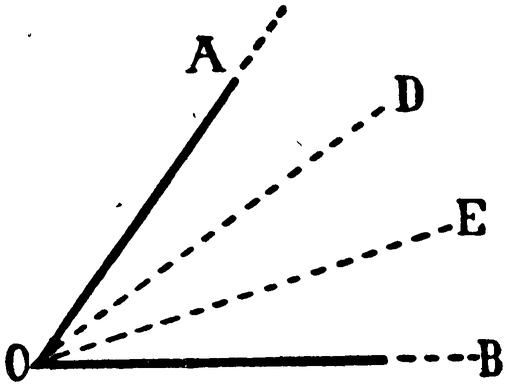
15. Definitions. The figure formed by two half-lines (OA and OB, fig. 5) issuing from one point, together with the part of the plane bounded by them, is called an angle. The half-lines that form the angle are called its sides, and the point from which they issue is called the vertex of the angle. The sides must be imagined as extended infinitely from the vertex.
An angle is usually denoted by three letters, of which the middle one is placed at the vertex and the outer ones at any points of the sides; for example, we say "the angle AOB, or the angle BOA" (fig. 5). But an angle may also be denoted by a single letter placed at the vertex, if there are no other angles at that vertex. We shall sometimes denote an angle by a numeral placed inside the angle, near the vertex.
In writing, the word "angle" is often replaced by the sign ∠.
If from the vertex of an angle (fig. 5) we draw inside it (that is, in the part of the plane that belongs to the angle) any straight lines OD, OE ..., the angles AOD, DOE, EOB ... so formed are regarded as parts of the angle AOB.
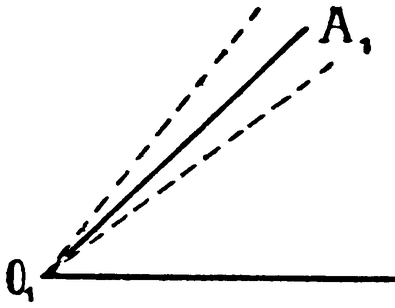
16. Equality and inequality of angles. Two angles are counted equal if by superposition they can be made to coincide. Suppose, for example, that we lay the angle AOB upon the angle A1O1B1 (fig. 6) so that the vertex O falls on O1, the side OB runs along O1B1, and the angles cover each other.
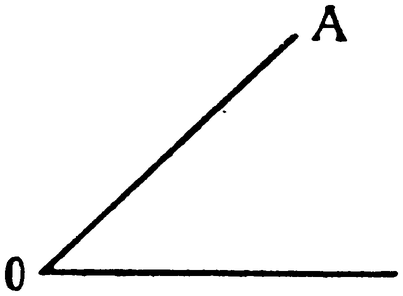
If the side OA then coincides with O1A1, the angles are equal; but if OA runs inside the angle A1O1B1, or outside it, the angles are not equal, and the smaller of them is the one that forms a part of the other angle.
17. The sum of angles. The sum of given angles is the angle made up of parts respectively equal to the given angles. Thus, to obtain the sum of the angles AOB and A1O1B1 (fig. 7), we construct an angle MNP equal to one of the given angles, say AOB, and build onto it an angle PNQ equal to the other given angle A1O1B1, in such a way that the two angles have a common vertex N and a common side NP and lie on opposite sides of the common side NP. The angle MNQ obtained in this way is the sum of the angles AOB and A1O1B1. The sum of three or more angles can be formed in the same manner.
The sum of angles, like the sum of segments of a straight line (12), has the commutative and associative properties.
From the concept of the sum of angles are derived the concepts of their difference, product and quotient.
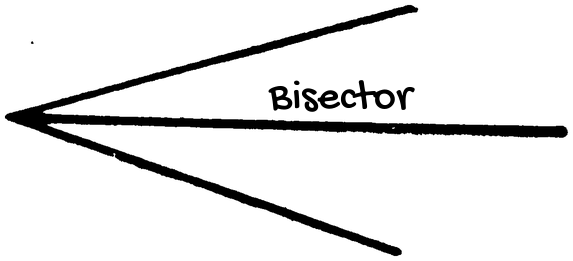
We accept as an evident truth that every angle can be divided (if only in thought) into 2, 3, 4 and so on equal parts.
Let us notice that the half-line dividing an angle in half (fig. 8) is called the bisector of that angle (or its bisecting line)3.
18. Remark 1. In finding the sum of angles certain special cases may present themselves, which it is useful to examine separately.
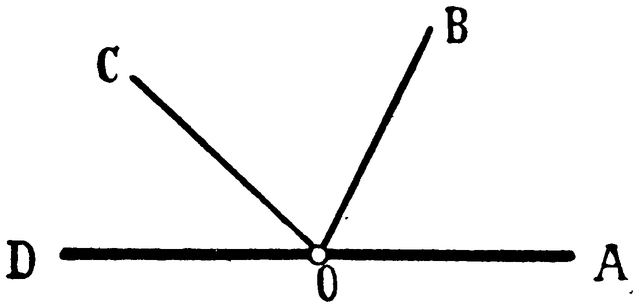
1°. It may happen that after several angles have been added, for example the three angles AOB, BOC and COD (fig. 9), the side OD of the angle COD forms the extension of the side OA of the angle AOB. We then obtain a figure formed by two half-lines (OA and OD) that issue from one point (O) and are extensions of each other. Such a figure (together with the part of the plane situated on one side of the straight line AD) is customarily called an angle too (a straight or flat angle).
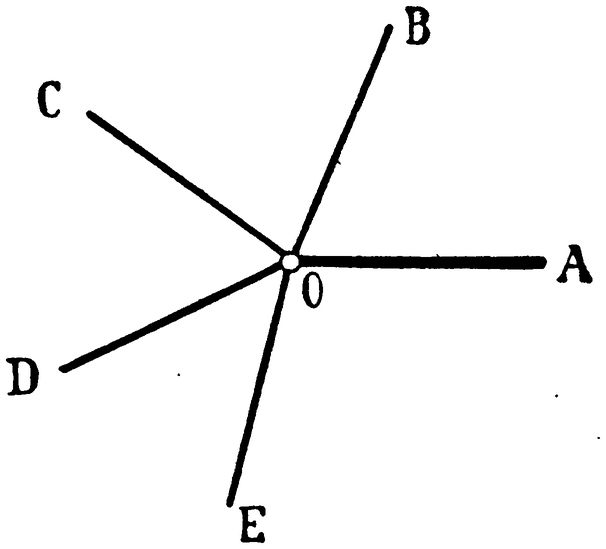
2°. It may happen that after several angles have been added, for example the five angles AOB, BOC, COD, DOE and EOA (fig. 10), the side OA of the angle EOA coincides with the side OA of the angle AOB.
The figure formed by such coinciding half-lines (together with the whole plane situated around the common vertex O) is also called an angle (a full angle).
3°. Finally, it may happen that in constructing a sum of angles we not only fill the whole plane around their common vertex, but are even obliged to lay the angles one upon another, covering the plane around the common vertex a second time, a third time, and so on.
In this case the concept of the sum of angles must be extended on the basis of the following definitions:
1°. Two sums of angles, and , are counted equal if, when we construct them in the manner described, starting from one and the same half-line OA and going in one direction around the common vertex O, we find, first, that for each sum we go round the whole space about the point O in the plane the same number of times, and secondly, that the last side of the angle coincides with the last side of the angle .
2°. If these conditions are not fulfilled, the sums are counted unequal, and the smaller is the one to which some further angle or several angles must be added in order to obtain the second sum.
19. Remark 2. When two half-lines issue from one point, then, strictly speaking, they form not one angle but two. Take, for example, fig. 5, and imagine that the half-line OA rotates about O until it coincides with the half-line OB. This rotation can be of two kinds: either OA rotates in the direction in which the hands of a clock move, or, on the contrary, against the motion of the hands of a clock. If we attend to the part of the plane that OA passes over before it coincides with OB in the first rotation, we have one angle, formed by the half-lines OA and OB and containing that part of the plane; and if we attend to the part of the plane passed over by OA before it coincides with OB in the other rotation, we obtain another angle, formed by the same sides OA and OB but containing this other part of the plane. These two angles are equal to each other only in the case when the half-lines OA and OB make up one straight line, that is, when both angles are straight angles; in all other cases the two angles are not equal, but together they always make up a full angle. Usually, in speaking of the angle AOB, we mean only that one of the two angles formed by the half-lines OA and OB which is less than a straight angle.
The Property of the Right Angle
20. Definitions. Two angles (AOB and BOC, fig. 11 and fig. 12) are called adjacent if they have one side in common and their two other sides are extensions of each other.
This definition shows that if we take an arbitrary angle (for example AOB, fig. 11) and extend one of its sides (for example AO) beyond the vertex, we obtain another angle (BOC), adjacent to the angle taken.
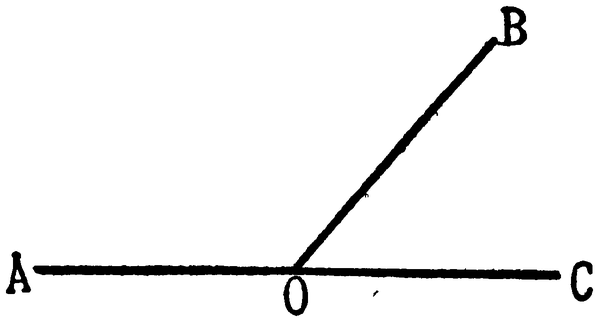
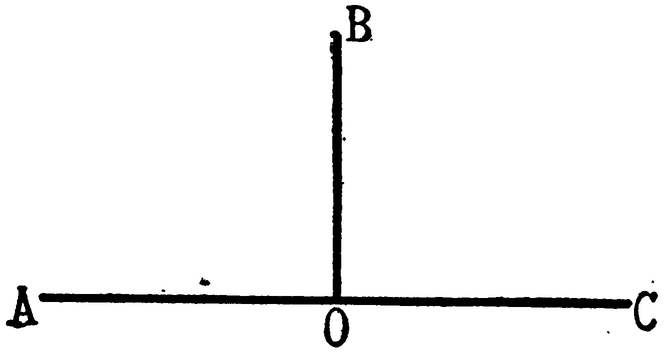
The common side (OB) of two adjacent angles is called an oblique to the straight line (AC) on which the other sides lie, in the case when the adjacent angles are not equal (fig. 11).
The common side (OB) of two adjacent angles is called a perpendicular to the straight line on which the other sides lie, in the case when the adjacent angles are equal (fig. 12).
In the first case the common vertex (O) is called the foot of the oblique, in the second case the foot of the perpendicular.
We say "to erect a perpendicular to a straight line" if the perpendicular has to be drawn through a point taken on the line, and "to drop a perpendicular onto a straight line" if it is drawn through a point taken outside the line.
Each of two equal adjacent angles is called a right angle (fig. 12).
That adjacent angles can be equal is seen from the following theorem.
21. Theorem. From every point of a straight line a perpendicular to it can be erected on either side of the line, and only one.
Let any straight line AB be given (fig. 13), and on it an arbitrary point O. It is required to prove that: (1) from this point a perpendicular to AB can be erected on each side of the line AB, and (2) there can be only one such perpendicular (on each side of the line).
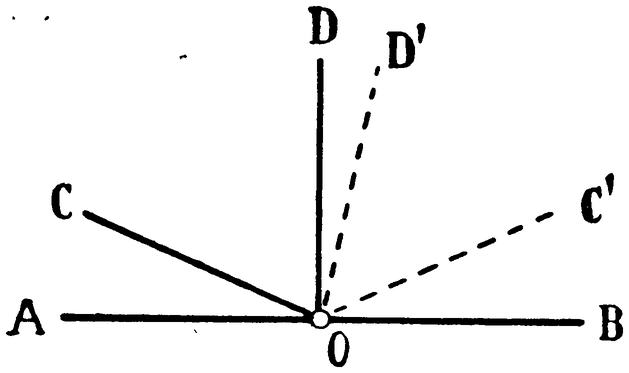
1°. From the point O let us draw any half-line OC. Two adjacent angles are then formed: AOC and COB. If it happens that these angles are equal to each other, their common side OC will be a perpendicular to AB; but if the angles AOC and COB prove unequal, one of them must be less than the other. Let AOC be less than COB. Then from the greater angle COB we can cut off a part C′OB equal to the angle AOC, after which there remains of the angle COB a certain angle COC′. Imagine this angle divided in half, and let its bisector be a certain half-line OD. This half-line will be a perpendicular to AB, since the adjacent angles AOD and DOB, consisting of respectively equal parts (AOC = C′OB and COD = DOC′), are equal to each other.
2°. Any other half-line OD′ issuing from the point O and situated on the same side of AB as OD cannot form equal adjacent angles with AB, since AOD′ > AOD while D′OB < DOB, and consequently the angles AOD′ and D′OB cannot be equal. Thus no other perpendicular to AB can be erected from the point O on that side of AB on which the perpendicular OD lies.
In exactly the same way we satisfy ourselves that on the other side of AB a perpendicular to AB can be erected from the point O, and only one.
22. Theorem. All right angles are equal to one another.
Let the adjacent angles at the vertices O and O1 (fig. 14) be right angles, that is, ∠AOB = ∠BOC and ∠A1O1B1 = ∠B1O1C1. It is required to prove that the right angles of the first pair are equal to the right angles of the second pair.
Let us lay the figure AOBC upon the figure A1O1B1C1 so that the point O falls on O1, the half-line OC runs along O1C1, and the half-line OB falls on the same side of A1C1 as that on which O1B1 lies. Then the half-lines OA and O1A1 coincide, since they are the extensions of the coinciding half-lines OC and O1C1; and the half-line OB coincides with O1B1, because otherwise from one point O1 of the straight line A1C1 two perpendiculars to it could be erected on one and the same side, which, by what has been proved, is impossible. But if the half-lines OB and O1B1 coincide, this means that ∠AOB = ∠A1O1B1 and ∠COB = C1O1B1, which was to be proved.
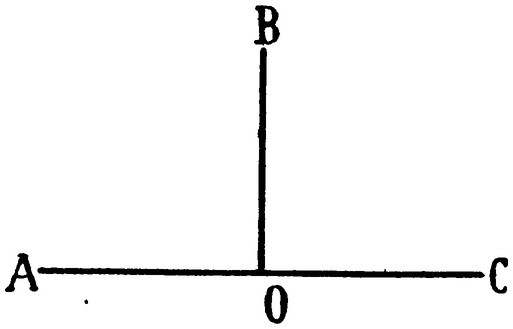
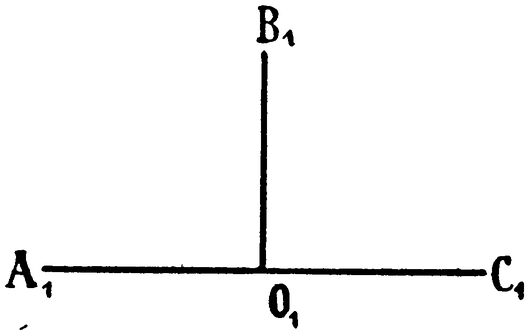
Remark. From the theorem proved it follows that the right angle is a constant magnitude (it is usually denoted by the sign d, that is, by the initial letter of the French word droit, right). For this reason angles are usually compared in magnitude with the right angle. If an angle is less than a right angle (like the angle AOC, fig. 15), it is called acute; if an angle is greater than a right angle (like the angle AOD, fig. 15), it is called obtuse.
23. Proof by superposition. The method by which we proved the preceding theorem is called proof by means of superposition.
We accept as evident that the superposition of one plane figure upon another can always be carried out in the following sequence:
1°. We can make any point of one figure coincide with any point of the other figure; for example (fig. 14), the point O with O1.
2°. When two points have been made to coincide, we can, by rotating the figure that is being laid on about the point of coincidence, make any two half-lines of the two figures that issue from the coinciding points coincide, for example (fig. 14), OC with O1C1; then, of course, the extensions of these half-lines, OA and O1A1, coincide as well, that is, the straight lines AC and A1C1 passing through the points O and O1 coincide.
3°. When two points and two straight lines have been made to coincide, we can, by rotating the figure that is being laid on about the coinciding line as about an axis, place this figure either on the one side or on the other side of that line. For example (fig. 14), when the points O and O1 and the straight lines AC and A1C1 have been made to coincide, we can place the figure AOBC either so that the half-line OB runs upward from O1C1, or so that it runs downward from it (in the latter case we have what is called the juxtaposition of the figure).
After this our freedom of choice comes to an end; whether the other parts of the figures coincide depends on the properties of the figures themselves.
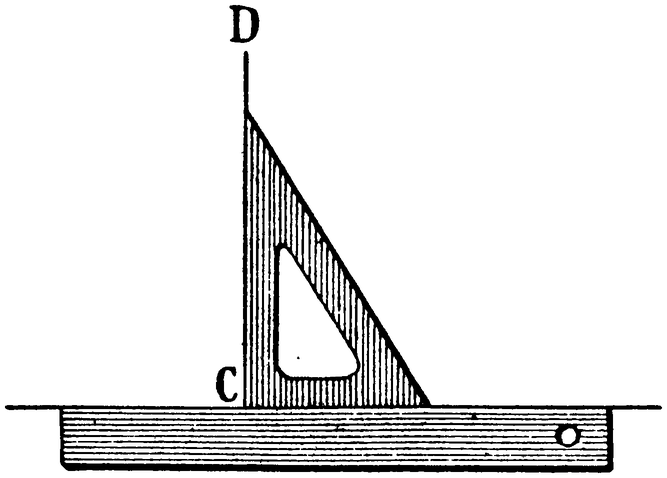
24. Drawing a right angle. A right angle is easily drawn with the help of an instrument called a set square, one of whose three angles is made a right angle. To draw a right angle at the point C of the straight line AB (fig. 16), we may proceed as follows: we set a ruler against this line and the set square against the ruler, as shown in the figure, and slide the set square along the ruler until the vertex of its right angle coincides with the point C. It then remains to draw the straight line CD along the side of the right angle.
Properties of Adjacent and Vertical Angles
25. Theorem. The sum of two adjacent angles is equal to two right angles.
Two adjacent angles AOB and BOC are given (fig. 17); it is required to prove that AOB + BOC = d + d = 2d.
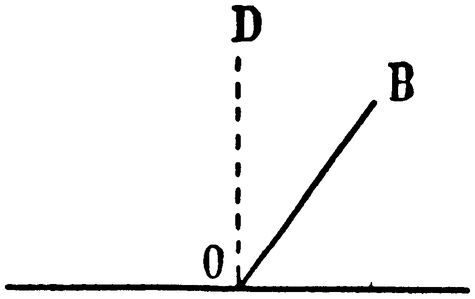
Erecting from the point O a perpendicular OD to the straight line AC, we divide the angle AOB into two angles, AOD and DOB. Taking the angle DOB away from the angle AOB, we obtain the right angle AOD; adding the same angle DOB to the angle BOC, we obtain another right angle, namely DOC. But if we diminish one term and increase the other by one and the same amount, the sum does not change; therefore the sum AOB + BOC must be the same as the sum AOD + DOC. But this sum is equal to d + d, that is, to 2d; therefore AOB + BOC = 2d also.
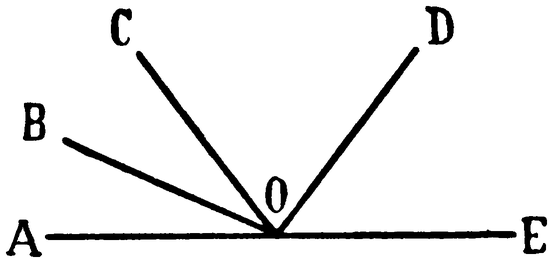
26. Corollaries. 1°. The sum of the angles (AOB, BOC, COD, DOE, fig. 18) situated about a common vertex (O) on one side of a straight line (AE) is equal to 2d, because this sum can be regarded (in accordance with the associative property) as the sum of two adjacent angles, for example of the angles AOB and BOE, or of the angles AOC and COE, and so on.
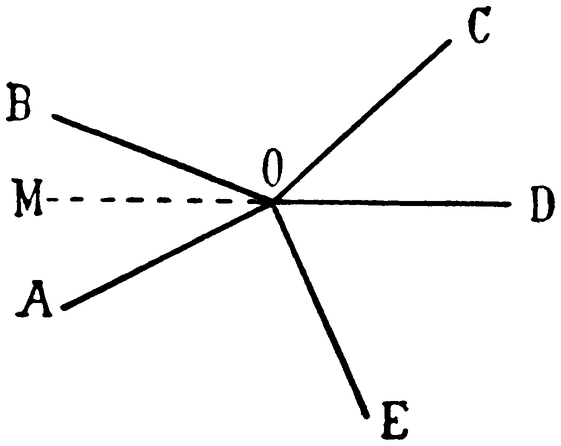
2°. The sum of the angles (AOB, BOC, COD, DOE, EOA, fig. 19) situated about a common vertex (O) on both sides of any straight line (DM) is equal to 4d, because on adding the angles DOC, COB and BOM, situated on one side of the line MD, we obtain 2d as their sum, and on adding the angles MOA, AOE and EOD, situated on the other side of MD, we obtain another 2d as their sum; therefore the sum of all these angles is equal to 2d + 2d, that is, to 4d.
27. Converse theorem. If the sum of two angles that have a common vertex and a common side and do not cover each other is equal to two right angles, then such angles are adjacent, that is, their two other sides are extensions of each other.
Let two angles AOB and BOC be given (fig. 20) that have a common vertex O and a common side OB and do not cover each other; let it be known, besides, that their sum is equal to 2d; it is required to prove that under these conditions OC is the extension of AO.
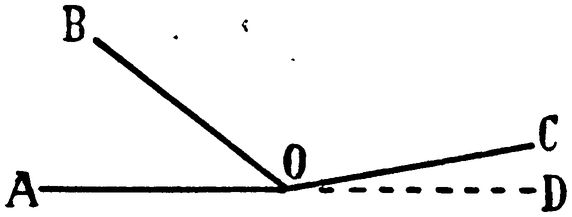
Let us assume the contrary (the opposite) of what is required to be proved, namely, let us assume that OC is not the extension of AO. Let us see where this supposition leads us. Since every straight line can be extended in both directions, the line AO too can be extended beyond the point O. Let this extension be a certain half-line OD, which, according to our assumption, does not merge with OC. Then the angles AOB and BOD will be adjacent, and therefore, by what was proved before (25):
AOB + BOD = 2d.
On the other hand, according to the hypothesis of our theorem:
AOB + BOC = 2d.
The right-hand sides of these two equalities are equal; consequently the left-hand sides are equal too (two magnitudes each equal to one and the same third magnitude are equal to each other):
AOB + BOD = AOB + BOC.
Taking one and the same angle AOB away from the equal sums, we must obtain equal remainders:
BOD = BOC.
But this equality is impossible, since the angle BOC is a part of the angle BOD, and a part cannot be equal to the whole.
If as the result of a piece of reasoning we arrive at an impossible (absurd) conclusion, this can come about either because we reasoned incorrectly or because our reasoning was founded on an impossible assumption. Our reasoning was correct; therefore the cause of the absurd conclusion lies in the impossibility of the assumption that OC is not the extension of AO. But if this supposition is impossible, only one thing remains: OC is the extension of AO4, which was to be proved.
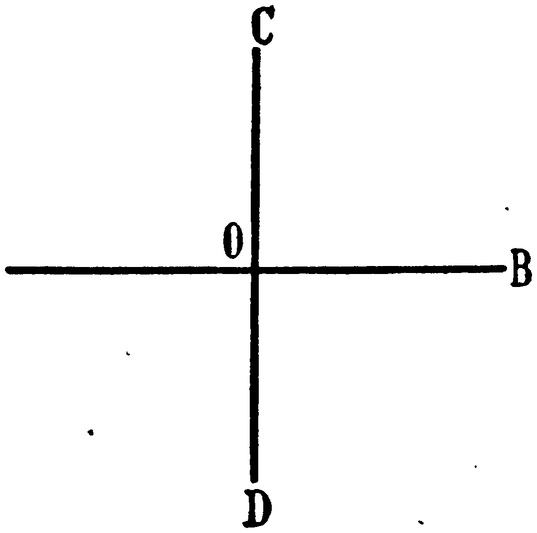
Corollary. If from any point O of a straight line AB (fig. 21) we erect perpendiculars OC and OD to it, one on each side of it, these perpendiculars form one straight line CD, because the sum of the angles COB and BOD is equal to 2d.
28. Definition. A straight line CD (fig. 21) whose parts OC and OD serve as perpendiculars to another straight line AB is called a straight line perpendicular to AB.
If the straight line CD is perpendicular to the straight line AB, then conversely AB is perpendicular to CD, because the parts OA and OB likewise serve as perpendiculars to CD. For this reason the straight lines AB and CD are called mutually perpendicular.
That two straight lines AB and CD are mutually perpendicular is expressed in writing thus: AB ⊥ CD.
29. Proof by contradiction. The method by which we proved the converse theorem on adjacent angles (27) is called proof by contradiction, or reduction to absurdity (reductio ad absurdum). The method received the first name because at the beginning of the reasoning a supposition is made that is contrary (opposite) to what is required to be proved. It is called reduction to absurdity because, reasoning on the basis of the supposition made, we arrive at an absurd conclusion (an absurdity). Arriving at such a conclusion compels us to reject the assumption made at the beginning and to accept the one that was required to be proved.
30. Definition. Two angles are called vertical if the sides of the one are the extensions of the sides of the other.
Thus, when two straight lines AB and CD intersect (fig. 22), two pairs of vertical angles are formed: AOD and COB, AOC and DOB.
31. Theorem. Two vertical angles are equal.
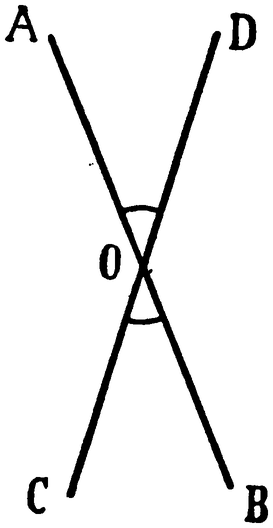
Let two vertical angles AOD and COB be given (fig. 22); in other words, let it be given that OB is the extension of OA and OC is the extension of OD. It is required to prove that AOD = COB.
The angle AOD added to the angle DOB makes 2d (by the property of adjacent angles); the angle COB added to the same angle DOB also makes 2d (by the same property). Therefore each of the angles AOD and COB is equal to one and the same difference 2d − DOB; hence these angles are equal.
In a similar way we prove that AOC = DOB also.
32. Theorem. From every point taken outside a straight line a perpendicular can be dropped onto that line, and only one.
Let any straight line AB be given (fig. 23), and a point M outside it; it is required to prove that (1) from this point a perpendicular can be dropped onto the line AB, and (2) there can be only one such perpendicular.
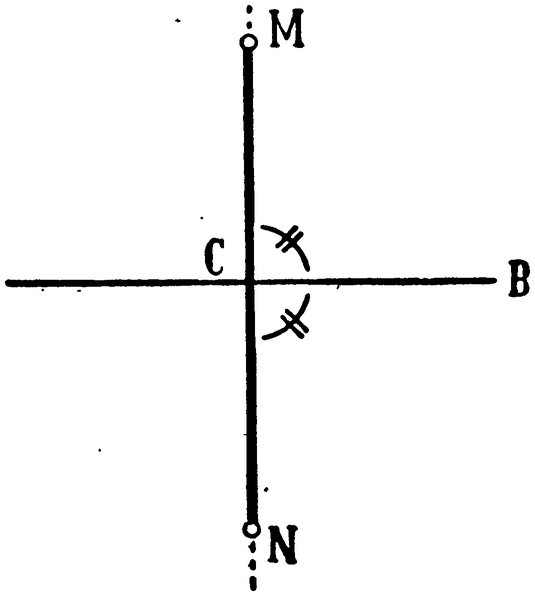
1) Let us fold the drawing along the straight line AB in such a way that its upper part (containing the point M) falls upon the lower part5. The point M will then take up a certain position N. Having marked this position, let us bring the drawing back to its former state and then draw a straight line through the points M and N. We shall prove that this line is perpendicular to AB. To do so, let us fold the drawing a second time along the line AB. Then the point M again coincides with N, while the point C, in which the lines MN and AB intersect, remains in place; consequently the half-line CM runs along the half-line CN, the angle MCB coincides with the angle BCN, and the angle MCA coincides with the angle ACN; therefore the adjacent angles MCB and BCN are equal, and the adjacent angles MCA and ACN are equal also. Since each of two equal adjacent angles is called a right angle, all four angles formed at the point C are right angles; therefore MN ⊥ AB.
2) Let us now prove that no other perpendicular to the line AB can be drawn through the point M. Suppose the contrary, that is, that through M there can be drawn to AB, besides MN, some other perpendicular as well, for example MD (fig. 24).
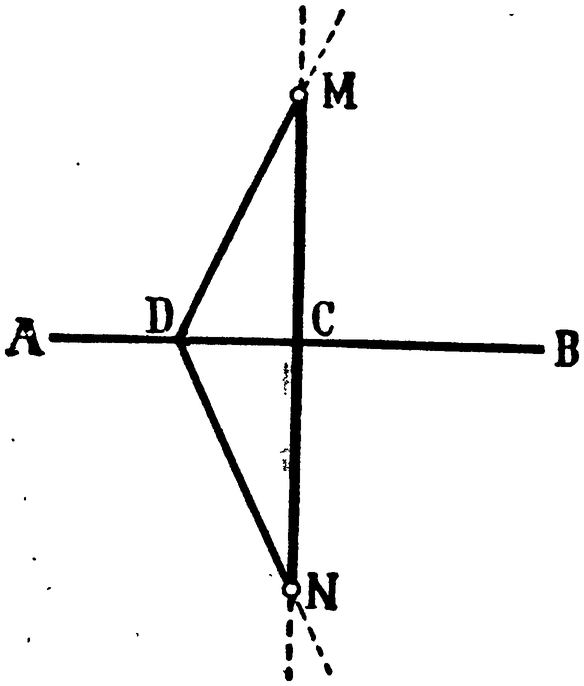
To refute this assumption, let us again fold the drawing along the line AB. Then the point M coincides with N as before, while the points D and C remain in their places; consequently the angle MDB takes up the position BDN. Unfolding the drawing, let us examine the line MDN. Since, by supposition, MD ⊥ AB, the angle MDB must be a right angle, and therefore the angle BDN equal to it must also be a right angle. But then we have two angles, MDB and BDN, which, having a common vertex and a common side, together make 2d; consequently, by what was proved earlier (27), their two sides DM and DN must be extensions of each other, and therefore the line MDN must prove to be straight. But then two different straight lines will pass through the points M and N: one, MN, which we drew before, and another, MDN, which we have obtained now. Since this is impossible (9), it cannot be admitted that through the point M any perpendicular to the line AB other than MN can be drawn.
Remark. To drop a perpendicular onto a straight line from a given point, we may use a ruler and a set square (see fig. 16).
33. Symmetric points. If the points M and N (fig. 24) are situated on opposite sides of the straight line AB, on one perpendicular to it and at the same distance from the foot of that perpendicular, two such points are said to be symmetric with respect to the axis AB. The word "axis" is used here because, if we rotate the part of the plane situated on one side of the line AB about that line, as about an axis, until it coincides with the part of the plane situated on the other side of AB, the symmetric points M and N will coincide.
Exercises. Prove that:
1. The bisectors of two adjacent angles are mutually perpendicular.
2. The bisectors of two vertical angles are extensions of each other.
3. If at the point O of the straight line AB (fig. 22) we construct, on opposite sides of AB, equal angles AOD and BOC, their sides OD and OC form one straight line (the theorem converse to the theorem of § 31).
4. If from the point O (fig. 22) we draw half-lines OA, OD, OB, OC such that ∠AOC = ∠DOB and ∠AOD = ∠COB, then OB is the extension of OA and OD is the extension of OC.
Chapter 2: Triangles and Polygons
The Idea of the Polygon and the Triangle
34. Broken line. A line is called a broken line when it consists of segments of straight lines that do not lie on one straight line (fig. 25 or 26). These segments are called the sides of the broken line, and the vertices of the angles formed by neighbouring segments are called its vertices. A broken line is denoted by a row of letters placed at its vertices and ends; we say, for example, the broken line ABCDE (figs. 25 and 26).
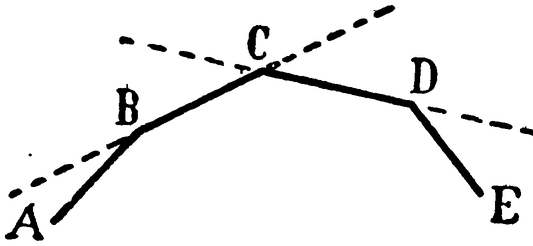
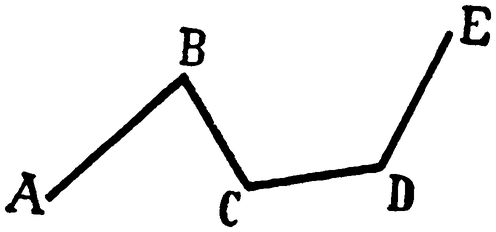
We shall call a broken line convex if the whole of it lies on one side of each of the segments that make it up, when that segment is extended indefinitely in both directions. Such, for example, is the line shown in fig. 25, whereas the broken line of fig. 26 is not convex.
When the ends of a broken line meet in one point, it is called closed.
35. Polygon. The figure formed by a closed broken line (together with the part of the plane bounded by that broken line) is called a polygon (fig. 27). The sides of the broken line are called the sides of the polygon, the angles formed by each two neighbouring sides are called the angles of the polygon, and their vertices are called its vertices. The broken line itself, which bounds the polygon, is called its contour.
A polygon is called convex if it is bounded by a convex broken line; such, for example, is the polygon ABCDE shown in fig. 27 (the polygon MNPQRS cannot be called convex).
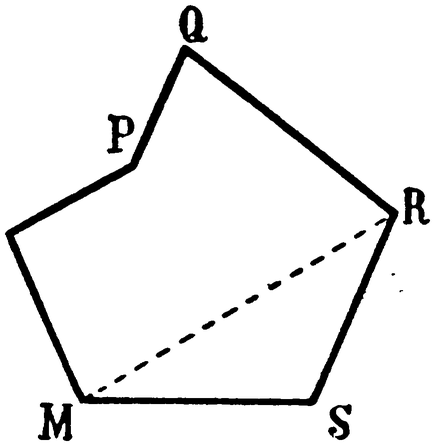
Every straight line (such as AD, BE, MR ...) that joins the vertices of two angles of a polygon not adjoining one and the same side is called a diagonal of the polygon.
The sum of all the sides of a polygon is called its perimeter.
Two polygons, like any two geometric figures in general, are counted equal if they can be made to coincide by superposition6.
The least number of sides in a polygon is three. According to the number of its sides a polygon is called a triangle, a quadrilateral, a pentagon and so on.
For brevity we shall often write the words "polygon," "triangle," "quadrilateral" and so on in a shortened form. In writing, the word "triangle" is sometimes also replaced by the sign △.
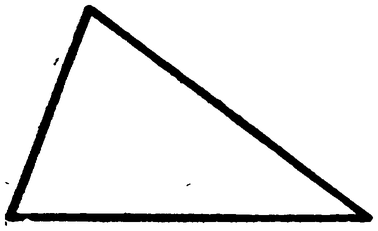
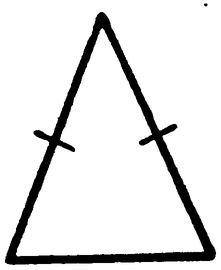
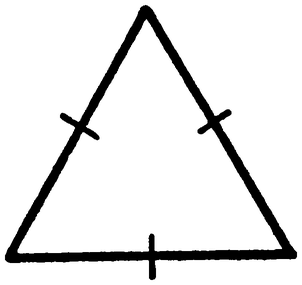
36. Classification of triangles. Triangles are classified either by the comparative length of their sides or by the character of their angles. With respect to the length of the sides they may be scalene (fig. 28), when all the sides are of different lengths, isosceles (fig. 29), when two sides are the same, and equilateral (fig. 30), when all the sides are equal.
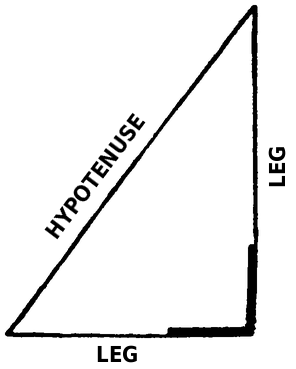
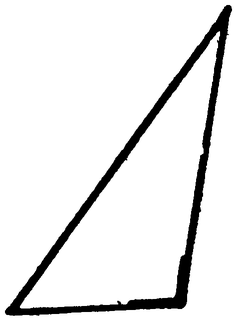
With respect to the character of the angles triangles may be acute-angled (fig. 28), when all the angles are acute, right-angled (fig. 31), when there is a right angle among the angles, and obtuse-angled (fig. 32), when there is an obtuse angle among the angles7.
In a right triangle the sides that form the right angle are called the legs, and the side lying opposite the right angle is called the hypotenuse.
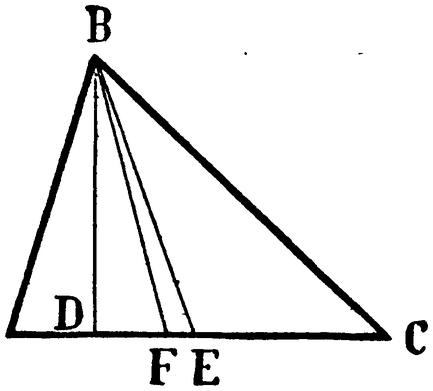
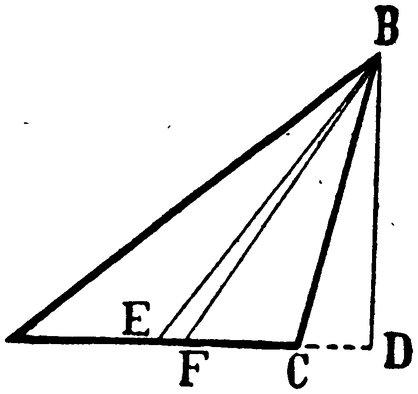
37. The principal lines in a triangle. One of the sides of a triangle is usually called the base, the vertex of the opposite angle is called the vertex of the triangle, and the perpendicular dropped from the vertex to the base or to its extension is called the altitude of the triangle. Thus, if in the triangle ABC (fig. 33 or 34) the side AC is taken as the base, then B is the vertex and BD is the altitude of the triangle.
In an isosceles triangle the side usually called the base is the one that is not among the equal sides; the vertex of an isosceles triangle is then the vertex of the angle formed by the equal sides.
The finite straight line BE (figs. 33 and 34) that joins the vertex of any angle of a triangle to the midpoint of the opposite side is called a midline or median. The finite straight line BF (figs. 33 and 34) that divides any angle of a triangle in half is called the bisecting line of that angle of the triangle, or its bisector (in general the bisector coincides neither with the median nor with the altitude). In every triangle there are three medians, three bisectors and three altitudes (dropped to each of the three sides).
Properties of the Isosceles Triangle
38. Theorem. In an isosceles triangle the bisector of the angle at the vertex is at the same time both a median and an altitude.
Let the triangle ABC (fig. 35) be isosceles, and let the straight line BD divide the angle B at its vertex in half. It is required to prove that this bisector BD is also both a median and an altitude. Imagine that △ABD is rotated about the side BD, as about an axis, so that it falls on △BDC. Then, because the angles 1 and 2 are equal, the side AB will fall on BC, and because these sides are equal, the point A will coincide with C. Therefore DA will coincide with DC and the angle 4 with the angle 3; hence DA = DC and ∠4 = ∠3. From the fact that DA = DC it follows that BD is a median; from the fact that the angles 3 and 4 are equal it follows that these angles are right angles, and consequently BD is an altitude of the triangle ABC.
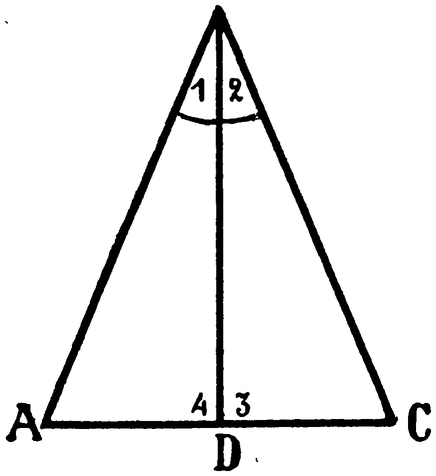
39. Corollary 1. Since, by what has been proved, the bisector BD is both a median and an altitude, we may say that it is also the perpendicular to the base AC erected at its midpoint D.
Thus in the isosceles triangle ABC (fig. 35) one and the same straight line BD is at the same time: 1) the bisector of the angle at the vertex, 2) the median drawn to the base, 3) the altitude dropped to the base, and finally 4) the perpendicular to the base erected at its midpoint. Since each of these 4 properties fully determines the position of the line BD, the presence of one of them brings all the others with it. For example, the altitude of an isosceles triangle is at the same time the bisector, the median and the perpendicular to the base at its midpoint. Indeed, in the first place, this altitude must be the bisector, because otherwise, on drawing that bisector, we should have two different altitudes to one and the same side of the triangle, which is impossible. In the second place, this altitude, being the bisector, must by what has been proved be the median, and consequently the perpendicular to the base at its midpoint.
40. Corollary 2. From the fact that the triangles ABD and BDC (fig. 35) coincide in all their parts it follows that ∠A = ∠C, that is,
in an isosceles triangle the angles at the base are equal.
41. The idea of an axis of symmetry. We have seen that the isosceles △ABC (fig. 36) is divided by the bisector BD into 2 triangles (a left and a right) which can be made to coincide with each other by rotation about the bisector as about an axis. From this we may conclude that whatever point we take on the left half of an isosceles triangle, we can always find on its right half another point symmetric to the first with respect to the axis BD (33).
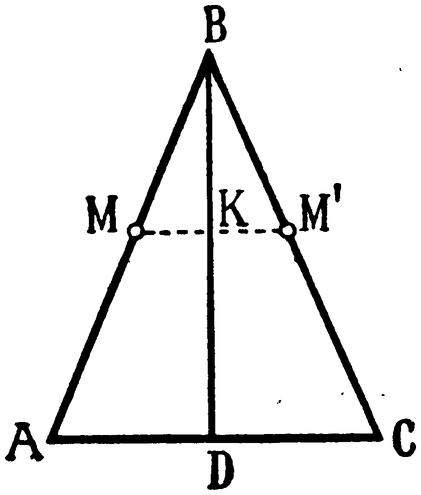
Take, for example, any point M on the side AB. Drop from it the perpendicular MK to BD and extend it until it meets the side BC. We then obtain on that side a point M′ symmetric to the point M with respect to the axis BD. Indeed, if, rotating △ABD about BD, we make it coincide with △BCD, then KM will run along KM′ (because the right angles are equal), and the side BA will fall on the side BC (because the angles at the point B are equal); hence the point M, which lies both on KM and on BA, will fall on the point M′, which lies both on KM′ and on BC. This shows that KM = KM′. Thus the points M and M′ lie on opposite sides of the bisector BD, on one perpendicular to it and at equal distances from the foot of that perpendicular; hence these points are symmetric with respect to the axis BD.
If in any geometric figure there exists a straight line that divides the figure into 2 parts such that to any point of the one part there corresponds on the other a point symmetric to it with respect to that line, then such a line is called an axis of symmetry of the figure.
In an isosceles triangle the bisector of the angle at the vertex is its axis of symmetry.
In geometry we shall sometimes meet with figures that have one axis of symmetry or several.
Symmetry with respect to an axis is often called "axial symmetry" (as distinct from "central" symmetry, of which we speak below, in § 102).
Tests for the Equality of Triangles
42. Preliminary notions. Since equal triangles are those that can be made to coincide by superposition, in such triangles all their corresponding elements are equal, that is, the sides, the angles, the altitudes, the medians and the bisectors.
However, in order to assert that two triangles are equal it is not necessary to know that all their elements are equal; it is enough to make sure of the equality of some of them only. The following theorems set out the three principal tests for the equality of triangles.
43. Theorems. Two triangles are equal:
1°, if two sides and the angle included between them in one triangle are respectively equal to two sides and the angle included between them in the other triangle;
or 2°, if two angles and the side adjoining them in one triangle are respectively equal to two angles and the side adjoining them in the other triangle;
or 3°, if the three sides of one triangle are respectively equal to the three sides of the other triangle.
1°. Let ABC and A1B1C1 be two triangles (fig. 37) in which:
A = A1, AC = A1C1, AB = A1B1.
It is required to prove that these triangles are equal.
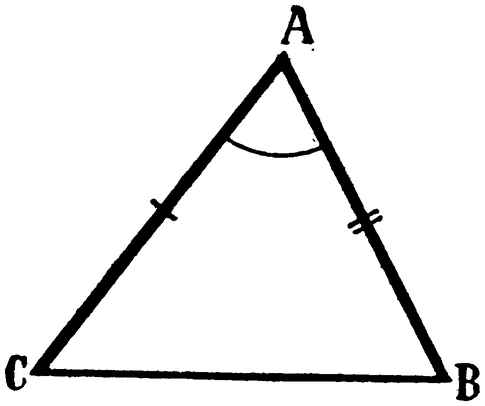
Lay △ABC upon △A1B1C1 so that the point A coincides with A1 and the side AC runs along A1C18. Then, because these sides are equal, the point C will coincide with C1; because the angles A and A1 are equal, the side AB will run along A1B1, and because these sides are equal, the point B will fall on B1; therefore the side CB will coincide with C1B1 (between two points only one straight line can be drawn), and the triangles will coincide; hence they are equal.
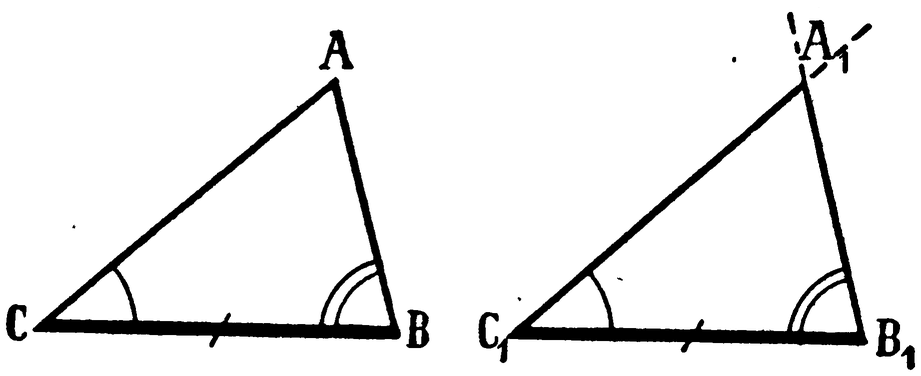
2°. Let ABC and A1B1C1 (fig. 38) be two triangles in which:
CB = C1B1, C = C1 and B = B1.
It is required to prove that these triangles are equal.
Lay △ABC upon △A1B1C1 so that the point C coincides with C1 and the side CB runs along C1B1. Then, because these sides are equal, the point B will fall on B1, and because the angles B and B1, C and C1 are equal, the side BA will run along B1A1 and the side CA along C1A1. Since two straight lines can intersect in one point only, the vertex A must coincide with A1. Thus the triangles will coincide; hence they are equal.
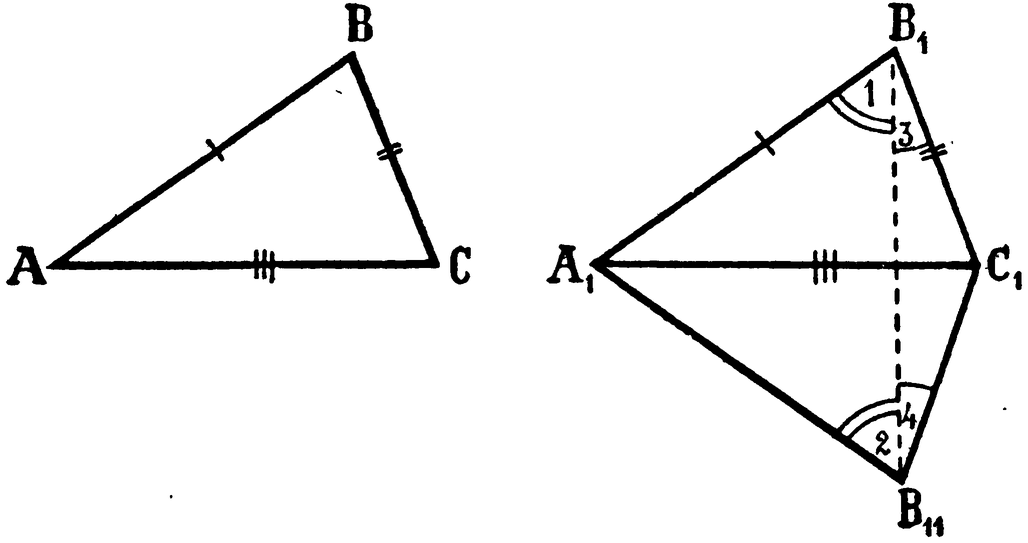
3°. Let ABC and A1B1C1 (fig. 39) be two triangles in which:
AB = A1B1, BC = B1C1 and CA = C1A1.
It is required to prove that these triangles are equal.
To prove this test of equality by superposition, as we did for the first two tests, would be inconvenient, since, knowing nothing of the size of the angles, we cannot assert that when two equal sides coincide the remaining sides will coincide as well. Instead of superposition we shall here use juxtaposition.
Place △ABC against △A1B1C1 so that their equal sides AC and A1C1 coincide. Then △ABC will take the position A1C1B11. Joining the points B1 and B11 by a straight line, we obtain two isosceles triangles A1B1B11 and B1C1B11 with the common base B1B11. But in an isosceles triangle the angles at the base are equal (40); consequently ∠1 = ∠2 and ∠3 = ∠4, and therefore ∠A1B1C1 = ∠A1B11C1 = ∠B. But in that case the given triangles must be equal, since two sides and the angle included between them in one triangle are respectively equal to two sides and the angle included between them in the other triangle.
It may happen that the straight line B1B11 does not intersect A1C1 but runs outside the triangles (if the sum of the angles C and C1 is greater than 2d), or merges with the line B1C1B11 (if C + C1 = 2d). The proof remains the same, with the sole difference that the angles B1 and B11 will be equal to each other not as sums of equal angles but as their differences (fig. 40), or as the angles at the base of an isosceles triangle (fig. 41).
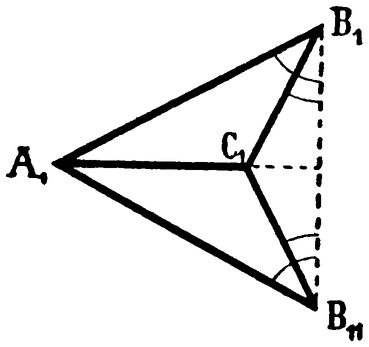
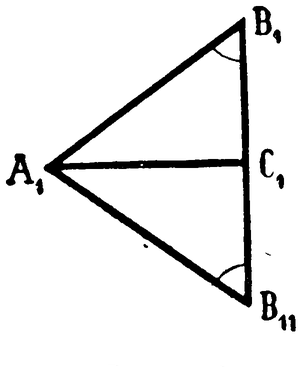
Remark. In equal triangles equal angles lie opposite equal sides, and equal sides lie opposite equal angles.
Relations between the Angles and Sides of a Triangle
44. Definition. An angle adjacent to any angle of a triangle (or of a polygon) is called an exterior angle of that triangle (or polygon).
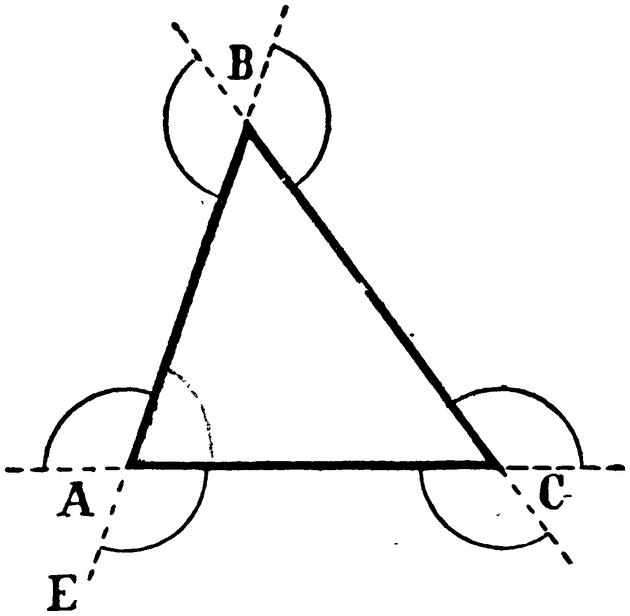
At each angle of a triangle (and of a polygon) 2 equal adjacent angles can be constructed. For example, by extending the sides of the angle A (fig. 42) of the triangle ABC beyond the vertex we obtain two exterior angles BAD and CAE, which are equal to each other as vertical angles.
In distinction from the exterior angles, the angles of the triangle (or polygon) itself are called interior.
45. Theorem. In a triangle every exterior angle is greater than each interior angle not adjacent to it.
Let us prove, for example, that the exterior angle BCD of the triangle ABC (fig. 43) is greater than each of the interior angles A and B not adjacent to this exterior angle. To do this we draw the median AE through the midpoint E of the side BC and extend it by a length EF equal to AE. We join F to C. The triangles ABE and EFC (the shaded ones) are equal, since at the point E they each have an equal angle included between two respectively equal sides. From their equality we conclude that the angles B and ECF, which lie opposite the equal sides AE and EF, are equal; but the angle ECF, being a part of the exterior angle BCD, is less than it; consequently the angle B too is less than BCD.
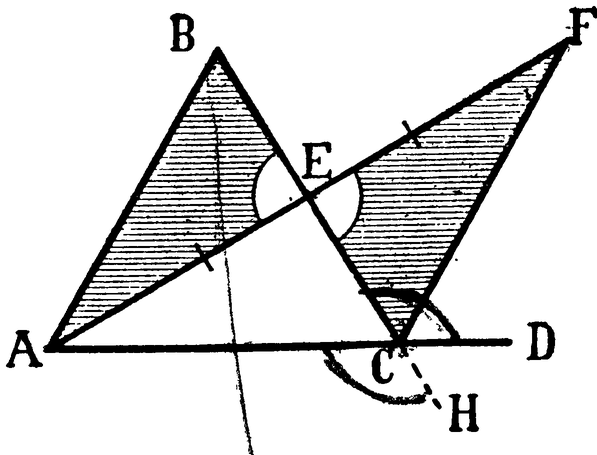
By extending the side BC beyond the point C we obtain the exterior angle ACH, equal to the angle BCD. If from the vertex B we draw the median to the side AC and extend it by the same length beyond the side AC, we prove in exactly the same way that the angle A is less than ACH, that is, less than BCD.
46. Corollary. If one angle of a triangle is right or obtuse, the other two angles are acute.
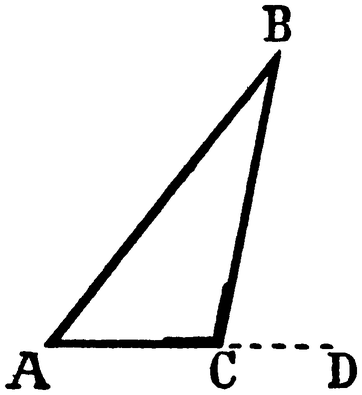
Indeed, suppose that some angle C of the triangle ABC (fig. 44) is right or obtuse; then the exterior angle BCD adjacent to it must be right or acute; because of this the angles A and B, which by what has been proved are less than the exterior angle, must both be acute.
47. Theorems. In every triangle: 1°, equal angles lie opposite equal sides; 2°, the greater angle lies opposite the greater side.
1°. If two sides of a triangle are equal, it is isosceles; then the angles lying opposite these sides must be equal, as the angles at the base of an isosceles triangle (40).
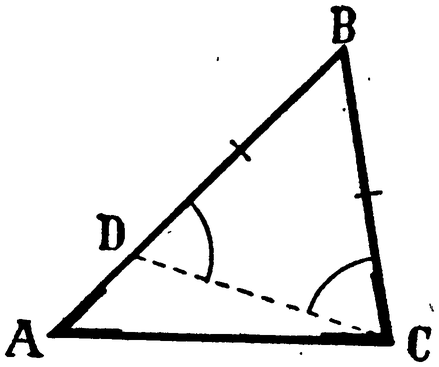
2°. Let the side AB in △ABC (fig. 45) be greater than BC; it is required to prove that ∠C is greater than ∠A.
On the greater side BA lay off from the vertex B a part BD equal to the smaller side BC, and join D to C. We then obtain the isosceles △DBC, in which the angles at the base are equal, that is, ∠BDC = ∠BCD. But the angle BDC, as an exterior angle with respect to △ADC, is greater than the angle A; consequently the angle BCD too is greater than A, and therefore, all the more, the angle BCA is greater than the angle A, which was to be proved.
48. Corollaries. 1°. In an equilateral triangle all the angles are equal;
2°, in a scalene triangle there are no equal angles.
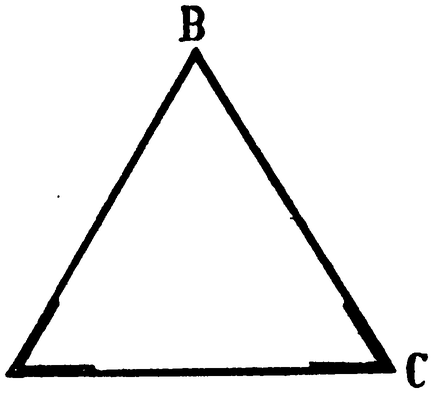
49. Converse theorems. In every triangle 1°, equal sides lie opposite equal angles; 2°, the greater side lies opposite the greater angle.
1°. Let the angles A and C in △ABC be equal (fig. 46); it is required to prove that AB = BC. Suppose the contrary, that is, that the sides AB and BC are not equal. Then one of these sides must be greater than the other, and consequently, by the direct theorem, one of the angles A and C must be greater than the other. But this contradicts the hypothesis that A = C; hence it cannot be admitted that the sides AB and BC are unequal; it remains to accept that AB = BC.
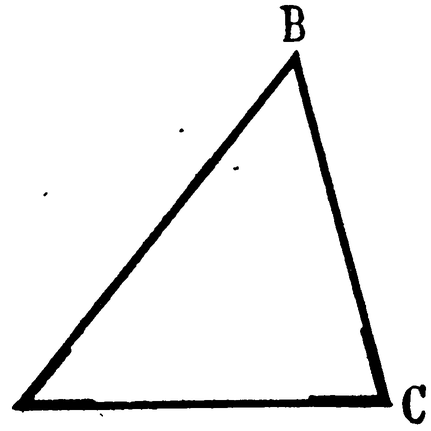
2°. Let the angle C in the triangle ABC (fig. 47) be greater than the angle A; it is required to prove that AB > BC. Suppose the contrary, that is, that AB is not greater than BC. Then two cases may arise: either AB = BC, or AB < BC. In the first case, by the direct theorem, the angle C would be equal to the angle A; in the second case the angle C would be less than A; both the one and the other contradict the hypothesis; hence both these cases are excluded. There remains the one possible case, that AB > BC.
50. Corollaries. 1°. An equiangular triangle is also equilateral.
2°. In a triangle the side lying opposite an obtuse or a right angle is greater than the other sides (46).
51. Remark on converse theorems. With regard to the equality or inequality of two sides of a triangle, for example the sides AB and BC, only the following three cases can arise:
AB = BC, AB > BC, AB < BC.
Each of these cases excludes all the others; thus, if the 1st case holds, that AB = BC, then neither the 2nd case nor the 3rd can exist together with it. In the theorem of § 47 we considered all these cases; it turned out that in each of them we obtain a conclusion about the equality or inequality of the opposite angles C and A (namely: C = A, C > A, C < A) such that each of these conclusions excludes all the others. And we saw (49) that the converse propositions proved to be true, as was easy to verify by a proof by contradiction.
In general, if in a theorem, or in a series of theorems, we have considered all the possible mutually exclusive cases that can arise with regard to the size or the position of certain parts of a figure, and it has turned out that in these cases we obtain different mutually exclusive conclusions about the size or the position of certain other parts of the figure, then we can assert beforehand (a priori) that the converse propositions are true.
Later on we shall meet this law of converses more than once.
Relative Lengths of Enclosing and Enclosed Broken Lines
52. Theorem. In a triangle each side is less than the sum of the other two sides.
A triangle ABC is given (fig. 48); it is required to prove that any side of it, for example the side AC, is less than the sum of the other two sides.
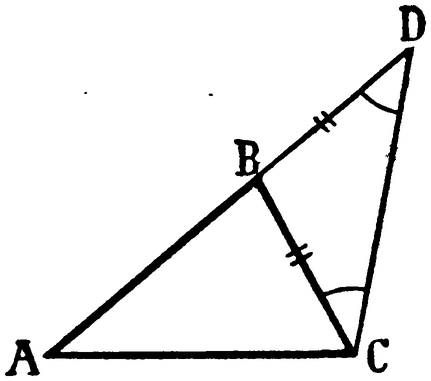
If the side AC is equal to, or less than, some one of the other two sides, then, evidently, AC < AB + BC. Hence we need consider only the case in which AC is the greatest of the three sides.
Extending the side AB, we lay off BD = BC and draw DC. Since △ BDC is isosceles, ∠D = ∠DCB; therefore the angle D is less than the angle DCA, and consequently in △ADC the side AC is less than AD (49), that is, AC < AB + BD. Replacing BD by BC, we obtain:
AC < AB + BC.
Corollary. If AC is the greatest of the sides, we can take away AB or BC from both sides of the inequality just derived; we then obtain:
AC − AB < BC and AC − BC < AB.
Reading these inequalities from right to left, we see that each of the sides BC and AB is greater than the difference of the other two sides; since the same can evidently be said of the third and greatest side AC as well, we conclude:
in a triangle each side is greater than the difference of the other two sides.
53. Theorem. The segment of a straight line joining any two points is shorter than every broken line drawn between those points.
Let AE (fig. 49) be the segment of a straight line joining the points A and E, and ABCDE any broken line drawn between the same points. It is required to prove that AE is shorter than the sum AB + BC + CD + DE.
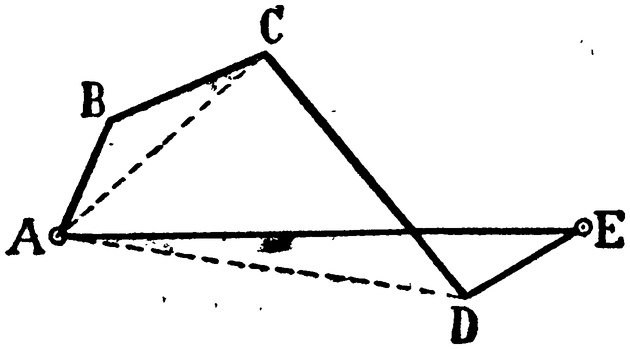
Joining A to C and to D, we find, by the preceding theorem:
AE < AD + DE;
AD < AC + CD;
AC < AB + BC.
Let us add these inequalities term by term and then take away AD and AC from both sides of the inequality obtained; we then have:
AE < AB + BC + CD + DE.
54. Definition. If between two points A and D (fig. 50), on one side of the straight line AD, two broken lines are drawn such that one of them, ABCD, lies wholly inside the figure formed by the other line, AEFGD, with the segment AD, then the first broken line is called the enclosed line and the second the enclosing line.
55. Theorem. A convex broken line is shorter than every other broken line that encloses it.
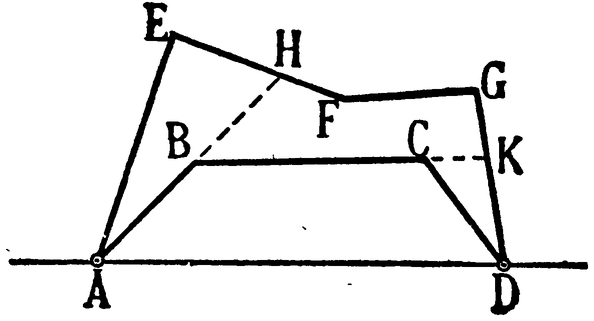
Let ABCD (fig. 50) be a convex (34) broken line and AEFGD any other broken line (convex or not convex, it makes no difference) enclosing the first; it is required to prove that:
AB + BC + CD < AE + EF + FG + GD.
Extending the sides of the convex line as shown in the figure, we can write the following inequalities (53):
AB + BH < AE + EH
BC + CK < BH + HF + FG + GK
CD < CK + KD.
Let us add all these inequalities term by term and then take away the auxiliary segments BH and CK from both sides of the inequality obtained; next let us replace the sum EH + HF by EF and the sum GK + KD by GD; we then obtain the inequality that was to be proved.
56. Theorem If a convex polygon lies wholly inside some other polygon, the perimeter of the first is less than the perimeter of the second.
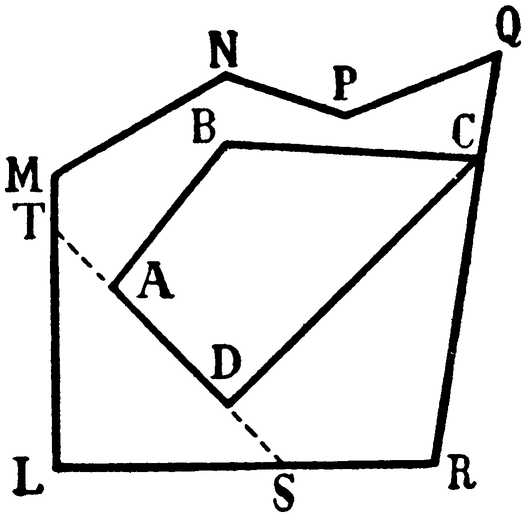
Let ABCD (fig. 51) be a convex polygon and LMNPQR any other polygon (convex or not convex) inside which the first lies. It is required to prove that AB + BC + CD + DA is less than LM + MN + NP + PQ + QR + RL.
Extending any one side AD of the convex polygon in both directions, let us apply to the broken lines ABCD and ATMNPQRSD, drawn between the points A and D, the theorem of the preceding section:
AB + BC + CD < AT + TM + MN + NP + PQ + QR + RS + SD.
On the other hand, since the segment ST is shorter than the broken line SLT, we can write:
AT + AD + DS < TL + LS.
Let us add these two inequalities term by term and take away the auxiliary segments AT and DS from both sides; then let us replace the sum TL + TM by LM and the sum LS + RS by LR; we then obtain what was to be proved.
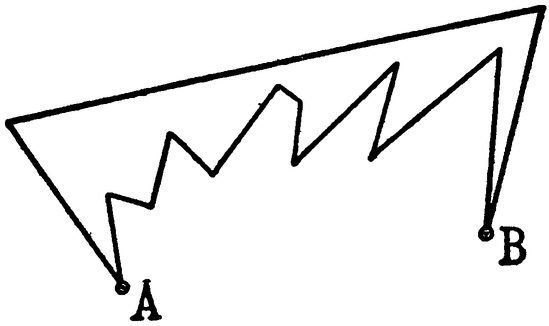
57. Remark. The two preceding theorems cease to be true if the enclosed broken line or the enclosed polygon is not convex. Thus in fig. 52 the enclosed broken line drawn between the points A and B may prove to be longer than the enclosing line drawn between the same points.
Triangles with Two Sides Respectively Equal
58. Theorems. 1°. If two sides of one triangle are respectively equal to two sides of another triangle, and the angles included between these sides are not equal, then the greater side lies opposite the greater of these angles.
2°. (Converse). If two sides of one triangle are respectively equal to two sides of another triangle, and the third sides are not equal, then the greater angle lies opposite the greater of these sides.
1°. Let it be given in the triangles ABC and (fig. 53) that:
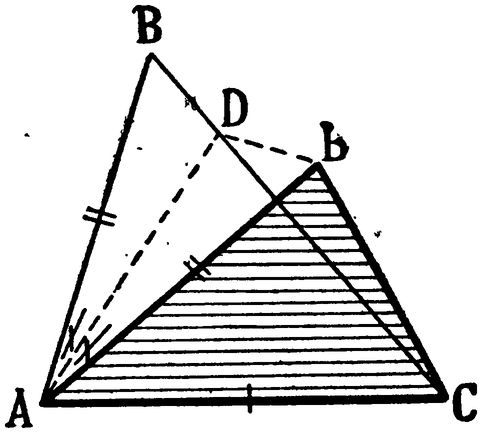
It is required to prove that if , then as well, and if , then as well. Suppose that . Lay upon △ ABC so that the side coincides with AC. Since, by supposition, , the side will run inside the angle A, and will take some position (where the vertex may lie either outside △ ABC, as shown in our figure9, or inside it, or else on the side BC; the proof remains one and the same in all these cases). Draw the bisector of the angle until it meets the side BC in the point D, and join this point by a straight line to ; we then obtain two triangles ABD and , which are equal because in them AD is a common side, by hypothesis and , since the straight line AD divides the angle in half. From the equality of the triangles it follows that . Now from △ we derive: (52), or (replacing by BD):
If we suppose that , we prove in the same way that then .
2°. Let it be given in the same triangles that:
It is required to prove that if , then as well, and if , then as well. Suppose that ; let us prove that . Suppose the contrary, that A is not greater than ; then two cases may arise: either , or . In the first case the triangles would be equal, and consequently the side BC would be equal to , which contradicts the hypothesis; in the second case the side BC, by theorem 1°, would be less than , which also contradicts the hypothesis. Hence both these cases are excluded; there remains the one possible case, that .
If we suppose that , we prove in the same way that then as well.
Chapter 3: Perpendiculars and Obliques
59, 1. Theorem. The perpendicular dropped from a point to a straight line is shorter than every oblique drawn from the same point to that line.
Let AB (fig. 54) be the perpendicular dropped from the point A to the straight line MN, and AC any oblique drawn from the same point A to the line MN. It is required to prove that AB < AC. In △ ABC the angle B is a right angle, and the greater side lies opposite the right angle (50, 2°); consequently AC > AB.
Remark. When we speak of "the distance of a point from a straight line," we mean the distance measured along the perpendicular dropped from that point to the line.
59, 2. Theorem. If from one and the same point, taken outside a straight line, a perpendicular and any obliques are drawn to that line, then:
1°, if the feet of two obliques are equally distant from the foot of the perpendicular, those obliques are equal;
2°, if the feet of two obliques are not equally distant from the foot of the perpendicular, the greater of the obliques is the one whose foot is farther from the foot of the perpendicular.
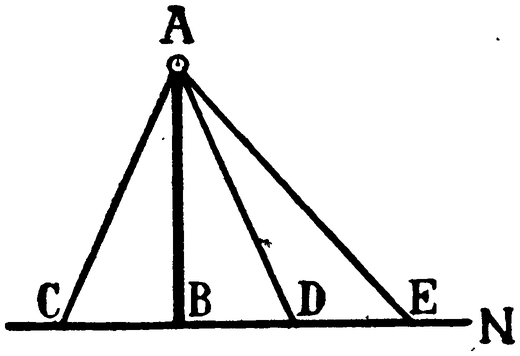
1°. Let AC and AD (fig. 54) be two obliques drawn from the point A to the straight line MN whose feet C and D are equally distant from the foot of the perpendicular AB, that is, CB = BD; it is required to prove that AC = AD. The triangles ABC and ABD have the common side AB, and besides BC = BD (by hypothesis) and ∠ABC = ∠ABD (as right angles); hence these triangles are equal, and therefore AC = AD.
2°. Let AC and AE (fig. 54) be two obliques drawn from the point A to the straight line MN whose feet are not equally distant from the foot of the perpendicular AB; for example, let BE > BC; it is required to prove that AE > AC. Lay off BD = BC and draw AD. By what was proved above, AD = AC. Let us compare AE with AD. The angle ADE is an exterior angle with respect to △ ADB, and therefore it is greater than the right angle ABD; consequently ∠ADE is obtuse; but in a △ the greater side must lie opposite the obtuse angle (50, 2°); hence AE > AD and consequently AE > AC.
60. Converse propositions. In the preceding theorem all the possible mutually exclusive cases were considered with regard to the equality or inequality of the distances of the feet of the obliques from the foot of the perpendicular; and mutually exclusive conclusions were obtained with regard to the equality or inequality of the obliques; because of this the converse propositions must be true (51), namely:
If from one and the same point, taken outside a straight line (fig. 54), a perpendicular and any obliques are drawn to that line, then:
1°, if two obliques are equal, their feet are equally distant from the foot of the perpendicular;
2°, if two obliques are not equal, the foot of the greater of them is farther from the foot of the perpendicular.
We leave it to the students to prove these propositions themselves (by contradiction).
Equality of Right Triangles
61. Since in right triangles the angles included between the legs are always equal, being right angles, it follows that:
Right triangles are equal:
1°, if the legs of one triangle are respectively equal to the legs of the other;
or 2°, if a leg and the acute angle adjoining it in one triangle are respectively equal to a leg and the acute angle adjoining it in the other triangle.
These two tests require no special proof, since they are only particular cases of the general tests (43, 1° and 2°). Let us prove two further tests, which apply only to right triangles.
62. Theorems. Right triangles are equal:
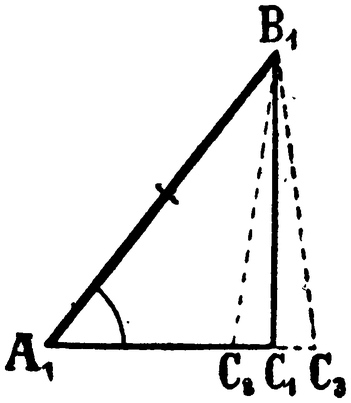
1°, if the hypotenuse and an acute angle of one triangle are respectively equal to the hypotenuse and an acute angle of the other;
or 2°, if the hypotenuse and a leg of one triangle are respectively equal to the hypotenuse and a leg of the other.
1°. Let ABC and (fig. 55) be two right triangles in which and ; it is required to prove that these triangles are equal. Lay △ ABC upon △ so that their equal hypotenuses coincide. Then, because the angles A and are equal, the leg AC will run along . The point C must then coincide with the point , because if we suppose that it falls on the point or the point , the leg BC would take the position or , which is impossible, since from one point two perpendiculars ( and , or and ) cannot be dropped to the straight line .
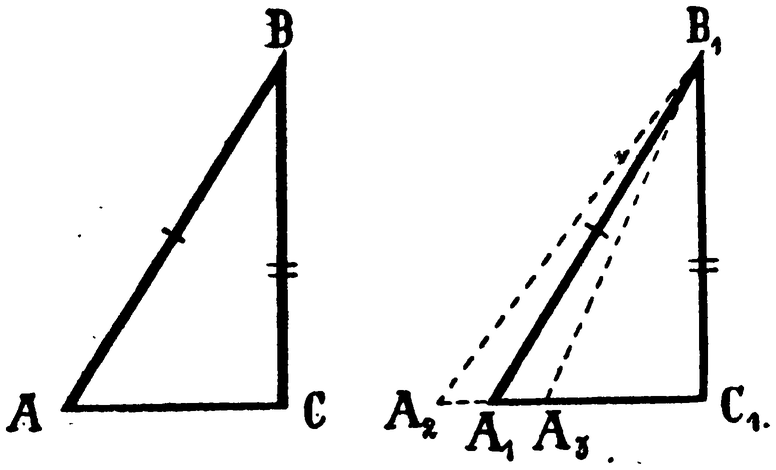
2°. Let it be given in the right triangles (fig. 56) that and ; it is required to prove that the triangles are equal. Lay △ ABC upon △ so that their equal legs BC and coincide. Then, because the right angles are equal, CA will run along . The hypotenuse AB cannot then fail to coincide with the hypotenuse , because if it took the position or , we should have two equal obliques ( and , or and ) whose feet are not equally distant from the foot of the perpendicular, which is impossible (59, 2).
Chapter 4: The Perpendicular Bisector of a Segment and the Bisector of an Angle
63. Theorems. 1°. If a point is equally distant from the ends of a segment of a straight line, it lies on the perpendicular to that segment passing through its midpoint.
2°. Conversely: if a point lies on the perpendicular to a segment of a straight line passing through its midpoint, it is equally distant from the ends of that segment.
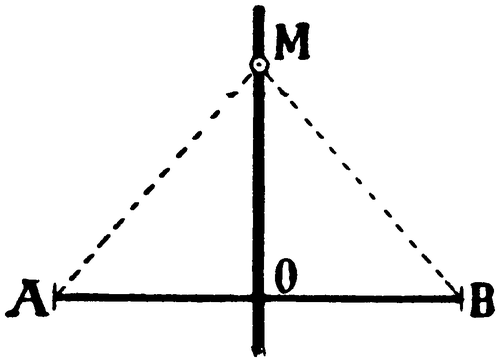
1°. Let the point M (fig. 57) be equally distant from the ends of the segment AB, that is, let MA = MB; it is required to prove that the point M lies on the perpendicular drawn to the line AB through its midpoint. Draw the bisector MO of the angle AMB. Since the triangle AMB is isosceles, this bisector is also its altitude and its median (38); hence the point M lies on the perpendicular to the line AB that divides it in half.
2°. Let OM (fig. 57) be the perpendicular drawn to the segment AB through its midpoint, and M any point on it; it is required to prove that this point is equally distant from the ends of AB, that is, that MA = MB. The straight lines MA and MB are obliques to AB whose feet are equally distant from the foot of the perpendicular MO; and such obliques are equal; consequently MA = MB.
64. Corollary. From the two theorems proved, the direct and the converse, we can draw the corollary that the theorems inverse to them are also true (4), that is, that (fig. 58):
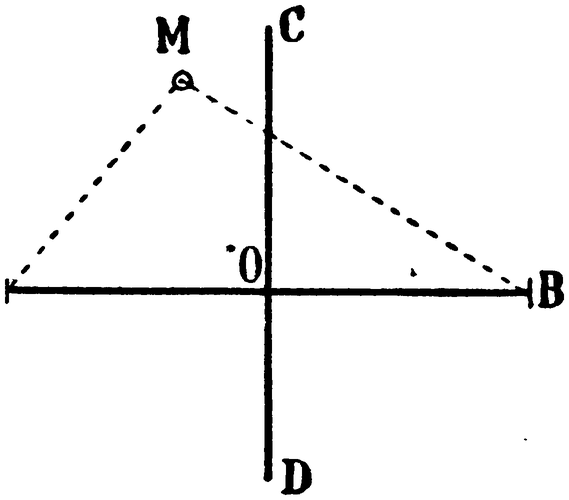
if a point (M) is not equally distant from the ends of a segment of a straight line (AB), it does not lie on the perpendicular (CD) to that segment drawn through its midpoint (O);
if a point does not lie on the perpendicular to a segment of a straight line drawn through its midpoint, it is not equally distant from the ends of that segment.
We invite the students to prove these inverse propositions themselves (by reasoning by contradiction).
65. Theorems. 1°. If a point is equally distant from the sides of an angle, it lies on the bisector of the angle.
2°. Conversely: if a point lies on the bisector of an angle, it is equally distant from the sides of the angle.
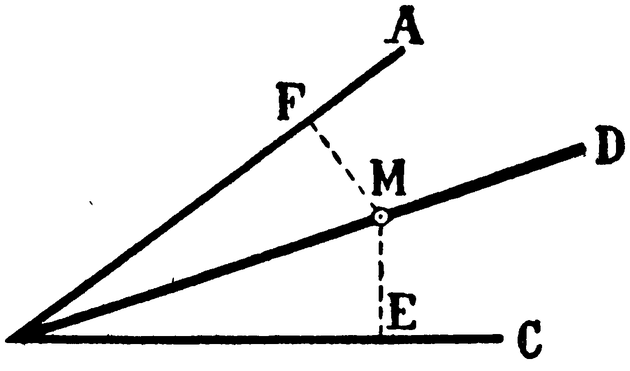
1°. Let the point M (fig. 59) be equally distant from the sides of the angle ABC, that is, let the perpendiculars MF and ME dropped from this point to the sides of the angle be equal; it is required to prove that the point M lies on the bisector of the angle ABC. Draw a straight line through B and M. The right triangles MBE and MBF are equal, since they have a common hypotenuse and the legs ME, MF are equal by hypothesis. From the equality of the triangles it follows that ∠MBE = ∠MBF, that is, the straight line MB is the bisector of the angle ABC.
2°. Let BD (fig. 59) be the bisector of the angle ABC, and M any point on it; it is required to prove that the perpendiculars ME and MF dropped from this point to the sides of the angle are equal. The right triangles MBE and MBF are equal, since they have a common hypotenuse and the angles MBE, MBF are equal by hypothesis. From the equality of the triangles it follows that ME = MF10.
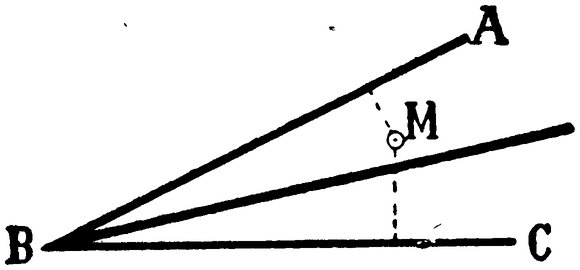
66. Corollary. From the two theorems proved, the direct and the converse, we can draw the corollary that the theorems inverse to them are also true, that is, that (fig. 60):
if a point (M) is not equally distant from the sides of an angle (ABC), it does not lie on its bisector (BD);
if a point does not lie on the bisector of an angle, it is not equally distant from its sides.
67. Locus. The locus of the points possessing a certain property is the line, or surface, or collection of lines and surfaces (in general, the figure) that contains all the points possessing that property and contains no point that does not possess it.
From the theorems of the preceding sections it follows that:
The locus of the points equally distant from two given points is the perpendicular drawn to the segment joining those points through its midpoint.
The locus of the points equally distant from the sides of an angle is the bisector of that angle11.
Chapter 5: The Basic Construction Problems
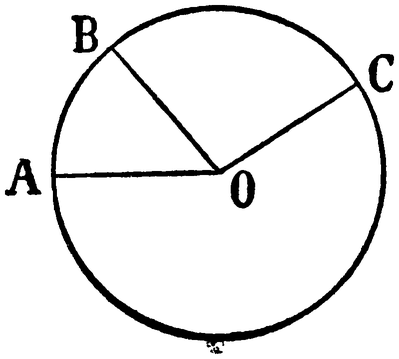
68. The idea of the circle. The theorems we have proved in the preceding chapters make it possible to solve certain construction problems. Let us notice that elementary geometry considers only those constructions that can be carried out with the ruler and compass (the use of the set square and of certain other instruments is allowed for the sake of saving time, but is not a necessity). With the ruler straight lines are drawn; with the compass a circle is described. We shall examine the properties of this line later; for the present we confine ourselves to a brief idea of it.
If we give the compass an arbitrary opening and, placing its pointed leg at some point O (fig. 61), rotate the compass about this point, its other leg, fitted with a pencil or a pen, will describe a continuous line all of whose points are equally distant from the point O. This line is called a circle, and the point O is called its centre. The straight lines OA, OB, OC, ..., joining the centre to any points of the circle, are called radii. All the radii of one circle are equal to one another. A part of a circle, for example AB (fig. 61), is called an arc.
69. The basic construction problems. We shall show how the following construction problems are solved.
Problem 1. To construct a triangle, given its sides a, b and c (fig. 62).
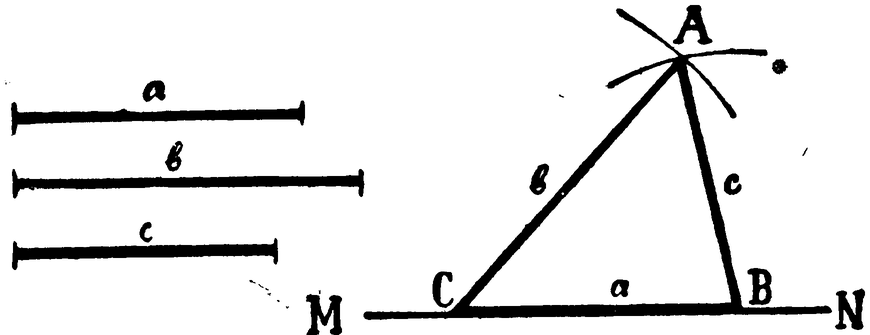
On any straight line MN we lay off a part CB equal to one of the given sides, for example a. From the points C and B as centres we describe two small arcs, one with a radius equal to b, the other with a radius equal to c. We join the point A, in which these arcs intersect, to B and C. The triangle ABC is the one required.
Remark. Not every three segments can serve as the sides of a triangle; for this it is necessary that the greatest of them be less than the sum of the other two (52).
Problem 2. On a given straight line MN, at a point O given on it, to construct an angle equal to a given angle ABC (fig. 63).
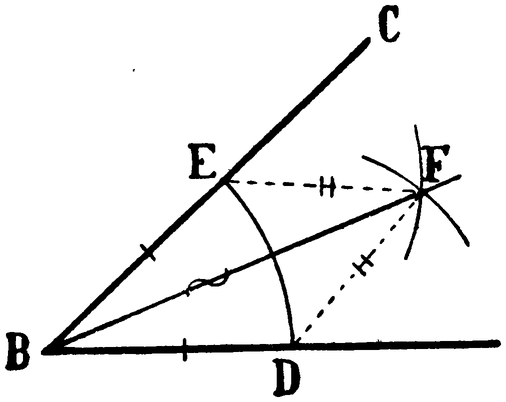
From the vertex B as centre we describe with an arbitrary radius an arc EF between the sides of the given angle; then, without changing the opening of the compass, we move its point to the point O and describe an arc PQ. Next, from the point P as centre we describe an arc ab with a radius equal to the distance between the points E and F. Finally, through the points O and R (the intersection of the two arcs) we draw a straight line. The angle ROP is equal to the angle ABC, because the triangles ROP and FBE, having their sides respectively equal, are equal.
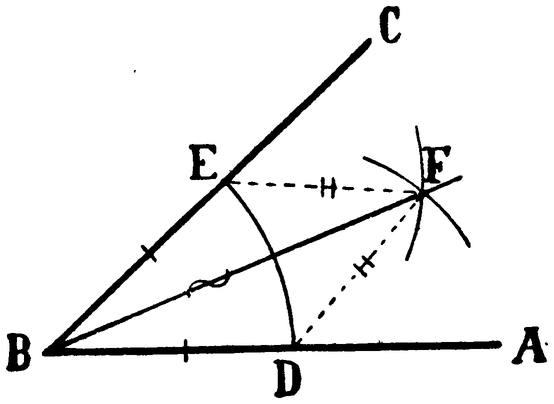
Problem 3. To bisect a given angle ABC (fig. 64).
From the vertex B as centre we describe with an arbitrary radius an arc DE between the sides of the angle. Then, taking an arbitrary opening of the compass, greater, however, than half the distance between the points E and D (see the remark to Problem 1), we describe with this opening, from the points D and E, small arcs intersecting in some point F. Drawing the straight line BF, we obtain the bisector of the angle ABC. For the proof, let us join the point F to D and E by straight lines; we then obtain two triangles BEF and BDF, which are equal, since BF is a side common to both, and BD = BE and DF = EF by construction. From the equality of the triangles it follows that ∠ABF = ∠CBF.
Problem 4. From a given point C of a straight line AB, to erect a perpendicular to this line (fig. 65).
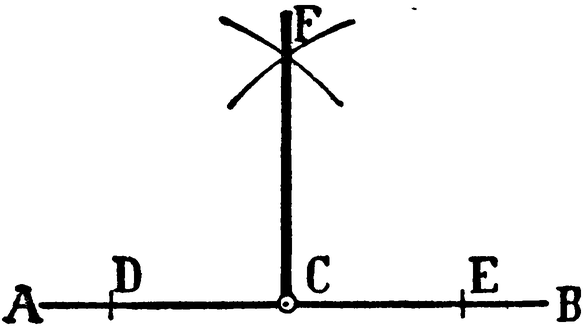
On AB, on either side of the given point C, we lay off equal segments CD and CE (of arbitrary length). From the points E and D, with one and the same opening of the compass (greater, however, than CD), we describe two small arcs intersecting in some point F. The straight line drawn through the points C and F is the required perpendicular. Indeed, as the construction shows, the point F is equally distant from D and E; consequently it must lie on the perpendicular drawn to the segment DE through its midpoint (63). But the midpoint of this segment is C, and through C and F only one straight line can be drawn; hence FC ⊥ DE.
Problem 5. From a given point A, to drop a perpendicular to a given straight line BC (fig. 66).
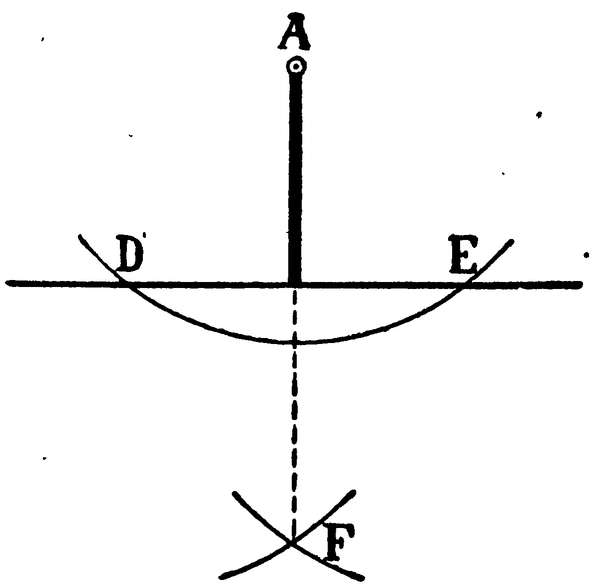
From the point A as centre, with an arbitrary opening of the compass (greater, however, than the distance from A to BC), we describe an arc intersecting BC in some two points D and E. Then from these points, with an arbitrary but one and the same opening of the compass (greater, however, than 1/2 DE), we draw two small arcs intersecting each other in some point F. The straight line AF is the required perpendicular. Indeed, as the construction shows, each of the points A and F is equally distant from D and E; and such points lie on the perpendicular drawn to the segment DE through its midpoint (63).
Problem 6. To draw the perpendicular to a given finite straight line (AB) through its midpoint (fig. 67).
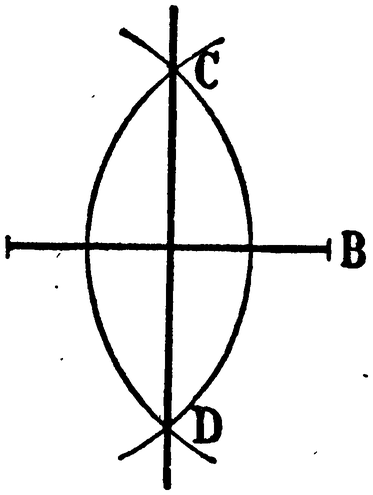
From the points A and B, with an arbitrary but equal opening of the compass (greater than 1/2 AB), we describe two arcs intersecting each other in some points C and D. The straight line CD is the required perpendicular. Indeed, as the construction shows, each of the points C and D is equally distant from A and B; consequently these points must lie on the perpendicular drawn to the segment AB through its midpoint (63).
Problem 7. To bisect a given finite straight line AB (fig. 67).
It is solved in the same way as the preceding problem.
70. An example of a more complex problem. With the help of these basic problems more complex problems can be solved. As an example let us solve the following problem.
Problem. To construct a triangle, knowing its base b, an angle a adjoining the base, and the sum s of the two lateral sides (fig. 68).
To form a plan of the solution, let us suppose the problem solved, that is, that a triangle ABC has been found in which the base AC = b, the angle A = a and AB + BC = s. Let us now examine the drawing so obtained. We know how to construct the side AC, equal to b, and the angle A, equal to a. It remains, then, to find on the side AD of the angle A a point B such that the sum AB + BC is equal to s. Extending AB, let us lay off the segment AD equal to s. The question now reduces to finding on the straight line AD a point B that is equally distant from C and D. Such a point, as we know (63), must lie on the perpendicular drawn to the segment CD through its midpoint. We know how to construct this perpendicular. The point B is found at the intersection of the perpendicular with AD.
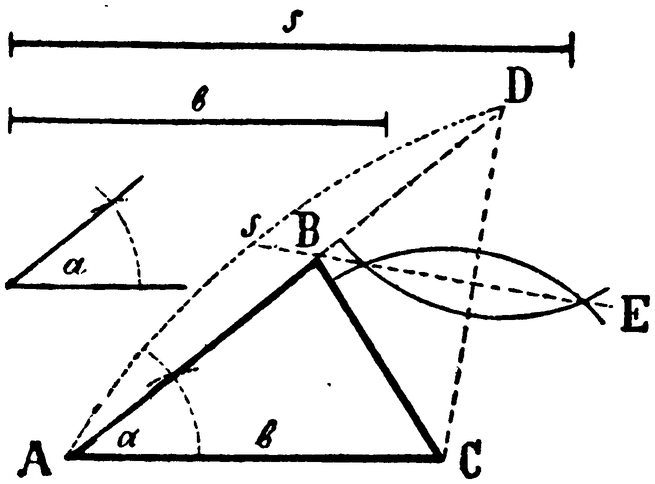
Here, then, is the solution of the problem: we construct (fig. 68) an angle A equal to the given angle a; on its sides we lay off AC = b and AD = s. Through the midpoint of the segment DC we draw the perpendicular BE; we join its intersection with AD, that is, the point B, to C. The triangle ABC is the one required, since it satisfies all the requirements of the problem: in it AC = b, ∠A = a and AB + BC = s (because BD = BC).
Examining the construction, we notice that the problem is not possible for all data. Indeed, if the sum s is given too small in comparison with b, the perpendicular EB may fail to intersect the segment AD (or may intersect its extension beyond the point A or beyond the point D); in that case the problem turns out to be impossible. Independently of the construction, too, it can be seen that the problem is impossible if s < b or s = b, because there can be no triangle in which the sum of two sides is less than or equal to the third side.
In the case when the problem is possible, it has only one solution, that is, there exists only one triangle satisfying the requirements of the problem, since the perpendicular BE can intersect the straight line AD in one point only.
71. Remark. The example given shows that the solution of a complex construction problem consists of the following four parts:
1°. Supposing the problem solved, we make a rough freehand drawing of the required figure and then, examining the figure drawn attentively, try to find such relations between the data of the problem and what is sought as would allow us to reduce the problem to others already known. This most important part of the solution, whose aim is to form a plan of the solution, bears the name of analysis.
2°. When a plan of the solution has been found in this way, the construction is carried out in accordance with it.
3°. To test the correctness of the plan, we then prove, on the basis of known theorems, that the figure obtained satisfies all the requirements of the problem. This part of the solution is called the synthesis.
4°. We then ask ourselves whether the problem is possible for all data, whether it admits one solution or several, and whether there are in the problem any special cases in which the construction becomes simpler or, on the contrary, more complicated. This part of the solution is called the discussion of the problem.
When a problem is very simple and there can be no doubt as to its possibility, the analysis and the discussion are usually omitted, and the construction is given directly and the proof supplied. That is what we did in setting out the solution of the first 7 problems of this chapter; we shall do the same hereafter whenever we have to set out the solution of problems that are not complex.
Exercises
Prove the Theorems
5. In an isosceles triangle two medians are equal, two bisectors are equal, two altitudes are equal.
6. If from the midpoint of each of the equal sides of an isosceles triangle we erect perpendiculars as far as their intersection with the other of the equal sides, these perpendiculars are equal.
7. Perpendiculars erected to the two sides of an angle at equal distances from the vertex intersect on the bisector.
8. A straight line perpendicular to the bisector of an angle cuts off equal segments from its sides.
9. A median of a triangle is less than its semiperimeter.
10. A median of a triangle is less than half the sum of the sides between which it lies. Hint: extend the median by a distance equal to itself, join the point obtained to one end of the side to which the median is drawn, and examine the figure so formed.
10.a. The sum of the medians of a triangle is less than the perimeter but greater than the semiperimeter.
11. The sum of the distances of any point taken inside a triangle from its three vertices is less than the perimeter but greater than the semiperimeter.
11,a. The sum of the diagonals of a quadrilateral is less than its perimeter but greater than the semiperimeter.
12. Prove directly that every point not lying on the perpendicular drawn to a segment through its midpoint is not equally distant from the ends of that segment.
13. Prove directly that every point not lying on the bisector of an angle is not equally distant from its sides.
13,a. If on the sides of an angle A we lay off equal lengths AB and , and then equal lengths AC and , the straight lines and intersect on the bisector of the angle A.
Construction Problems
14. Construct the sum of two, three or more given angles.
15. Construct the difference of two angles.
16. Given the sum and the difference of two angles, find these angles.
17. Divide an angle into 4, 8, 16 equal parts.
18. Through the vertex of a given angle draw, outside it, a straight line that forms equal angles with the sides of the angle.
19. Construct a triangle: a) given two sides and the angle between them; b) given a side and the two angles adjoining it; c) given two sides and the angle lying opposite the greater of them; d) given two sides and the angle lying opposite the smaller of them (in this case there are two solutions or none).
20. Construct an isosceles triangle: a) given the base and a lateral side; b) given the base and an angle adjoining it; c) given a lateral side and the angle at the vertex; d) given a lateral side and an angle at the base.
21. Construct a right triangle: a) given the two legs; b) given a leg and the hypotenuse; c) given a leg and the acute angle adjoining it.
22. Construct an isosceles triangle: a) given the altitude and a lateral side; b) given the altitude and the angle at the vertex; c) given the base and the perpendicular dropped from an end of the base to a lateral side.
23. Construct a right triangle, given the hypotenuse and an acute angle.
24. Through a point given inside or outside an angle draw a straight line that cuts off equal parts from the sides of the angle.
25. Given the sum and the difference of two straight lines, find these lines.
26. Divide a given finite straight line into 4, 8, 16 equal parts.
27. On a given straight line find a point equally distant from two given points (outside the line).
28. Find a point equidistant from the three vertices of a triangle.
29. On a straight line intersecting the sides of an angle find a point equally distant from the sides of that angle.
30. Find a point equally distant from the three sides of a triangle.
31. On an infinite straight line AB find a point C such that the half-lines CM and CN, drawn from C through given points M and N lying on one side of AB, make equal angles with the half-lines CA and CB.
32. Construct a right triangle, given a leg and the sum of the hypotenuse and the other leg.
33. Construct a triangle, given the base, an angle adjoining the base and the difference of the other two sides (consider two cases: 1) when the smaller of the two angles adjoining the base is given, 2) when the greater of them is given).
34. Construct a right triangle, given a leg and the difference of the other two sides.
Chapter 6: Parallel Lines
Basic Theorems
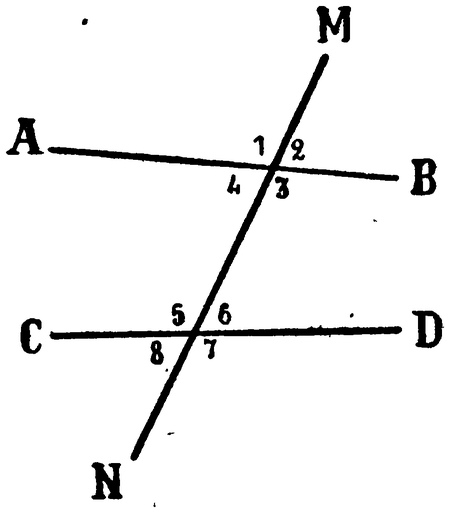
72. Definition. When any two straight lines AB and CD (fig. 69) are intersected by a third straight line MN, the angles so formed receive in pairs the following names: corresponding angles: 1 and 5, 4 and 8, 2 and 6, 3 and 7; alternate interior angles: 3 and 5, 4 and 6; alternate exterior angles: 1 and 7, 2 and 8; interior angles on the same side: 3 and 6, 4 and 5; exterior angles on the same side: 1 and 8, 2 and 7.
73. Lemma.12 If among the angles formed when two straight lines are intersected by a third (fig. 69) any one of the following 5 relations holds:
1°. the corresponding angles are equal,
2°. the alternate interior angles are equal,
3°. the alternate exterior angles are equal,
4°. the sum of the interior angles on the same side is equal to 2d,
5°. the sum of the exterior angles on the same side is equal to 2d,
then all the rest of these relations hold as well.
We shall first prove that the first of these relations brings with it, as a consequence, all the rest; after that we shall prove that, conversely, each of the remaining relations (that is, the 2nd, 3rd, 4th and 5th) brings with it the first; from this we shall conclude that each of the relations named brings with it all the rest.
1) Let it be given that the corresponding angles 2 and 6 are equal to each other (fig. 70); it is required to prove that in that case all the other relations named hold as well.
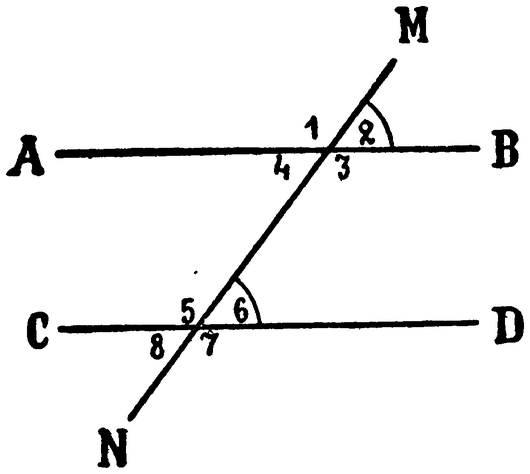
First of all let us show that the equality of one pair of corresponding angles, for example of the angles 2 and 6, brings with it the equality of all the other pairs of corresponding angles. Indeed, ∠4 = ∠8, since the first of these angles is equal to the angle 2, and the second to the angle 6, as its vertical angle; ∠1 = ∠5, since these angles are the supplements to 2d of the equal angles 2 and 6; for the same reason ∠3 = ∠7.
Turning now to the alternate interior angles, we find: ∠4 = ∠2, as vertical angles; ∠2 = ∠6 by what is given; consequently ∠4 = ∠6.
And if ∠4 = ∠6, the alternate interior angles 3 and 5 are equal too, as the supplements to 2d of the equal angles 4 and 6.
Turning to the alternate exterior angles, we find: ∠8 = ∠6, as vertical angles; ∠6 = ∠2 by what is given; consequently ∠8 = ∠2.
And if ∠2 = ∠8, the other alternate exterior angles 1 and 7 are equal too, as the supplements to 2d of the equal angles 2 and 8.
Turning to the interior angles on the same side, we find: ∠3 + ∠2 = 2d, since these angles are adjacent. Replacing the angle 2 in this sum by the angle 6, which is equal to it, we obtain: ∠3 + ∠6 = 2d. In exactly the same way: ∠4 + ∠1 = 2d, ∠1 = ∠5; consequently ∠4 + ∠5 = 2d.
Turning, finally, to the exterior angles on the same side, we prove, in exactly the way it was done for the interior angles on the same side, that ∠7 + ∠2 = 2d and ∠8 + ∠1 = 2d.
2) Let us now prove that each of the relations 2, 3, 4 and 5 brings with it relation 1.
Let it be given, for example (fig. 70), that ∠2 + ∠7 = 2d; it is required to prove that the corresponding angles 2 and 6 are equal. Indeed, ∠7 + ∠6 = 2d, since these angles are adjacent; but ∠2 + ∠7 = 2d by what is given; consequently ∠7 + ∠6 = ∠2 + ∠7. Taking away from these equal sums one and the same angle 7, we obtain ∠6 = ∠2.
In a similar way we prove that any other of the relations 2, 3, 4 and 5 also brings with it relation 1.
3) We now conclude that each of the 5 relations named brings with it all the rest, since each brings with it the 1st, and the 1st brings with it all the rest.
74. Theorem. Two perpendiculars to one and the same straight line cannot intersect, however far we extend them.
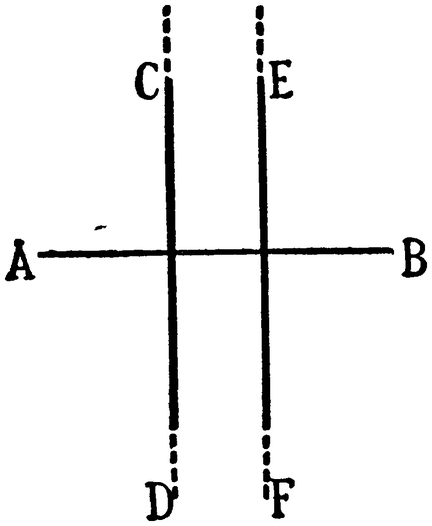
Let two perpendiculars CD and EF be drawn to one and the same straight line AB (fig. 71); it is required to prove that these perpendiculars do not intersect, however far we extend them.
Suppose the contrary, that is, that the lines CD and EF, extended far enough, intersect in some point M (or M′). Then from this point 2 different perpendiculars would be dropped to the line AB. Since this is impossible (32), it cannot be admitted that the perpendiculars CD and EF intersect anywhere.
75. Definition. Two straight lines are called parallel if, lying in one plane, they do not intersect, however far they are extended.
That parallel lines can exist is shown by the preceding theorem, which can now be stated thus:
two perpendiculars to one and the same straight line are parallel.
That lines are parallel is denoted in writing by the sign ∥ placed between the names of the lines; thus, if the lines CD and EF are parallel, we write: CD ∥ EF.
The preceding theorem, in showing that parallel lines can exist, expresses one of the criteria of parallelism (perpendicularity to one and the same straight line). The following theorem expresses still other criteria of parallelism.
76. Theorem. If, when two straight lines are intersected by any third straight line, it turns out that:
1°. the corresponding angles are equal;
or 2°. the alternate interior angles are equal,
or 3°. the alternate exterior angles are equal,
or 4°. the sum of the interior angles on the same side is equal to 2d,
or 5°. the sum of the exterior angles on the same side is equal to 2d,
then the first two lines are parallel.
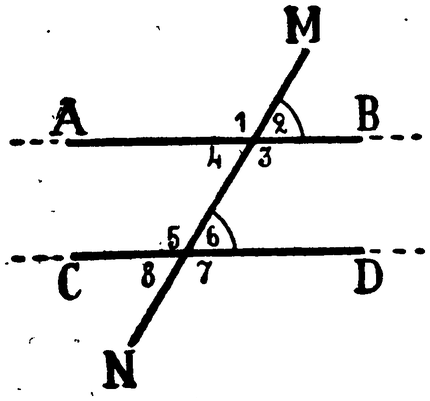
We have seen (73) that if any one of the 5 relations listed in the theorem holds, all the rest hold as well. It is therefore enough for us to show that the lines AB and CD (fig. 72) are parallel when some one of these relations holds. Let it be given, for example, that the corresponding angles 2 and 6 are equal; it is required to prove that in that case AB ∥ CD. Suppose the contrary, that is, that the lines AB and CD are not parallel; then these lines will intersect in some point P lying to the right of MN, or in some point P′ lying to the left of MN. If the intersection is at P, a triangle is formed in which ∠2 is an exterior angle and ∠6 an interior angle not adjacent to the exterior angle 2, and then ∠2 must be greater than ∠6 (45), which contradicts what is given; hence the lines AB and CD cannot intersect in any point P lying to the right of MN. If we suppose that the intersection is at the point P′, a triangle is formed in which ∠4, equal to ∠2, is an interior angle and ∠6 an exterior angle not adjacent to the interior ∠4; then ∠6 must be greater than ∠4 and, consequently, greater than ∠2, which contradicts what is given. Hence the lines AB and CD cannot intersect in a point lying to the left of MN either; consequently these lines do not intersect anywhere, that is, they are parallel.
77. Theorem. Through every point lying outside a straight line a parallel to that line can be drawn.
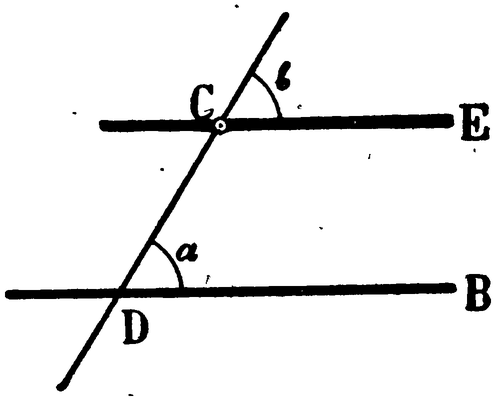
A straight line AB (fig. 73) and any point C lying outside this line are given; it is required to prove that through the point C a straight line parallel to AB can be drawn. Through any point D of the line AB and through the point C let us draw the straight line CD. This line forms with AB a certain angle a. At the point C let us construct an angle b equal to the angle a, placing it so that it is the angle corresponding to the angle a. Then the line CE is parallel to AB, since the corresponding angles a and b are equal (76).
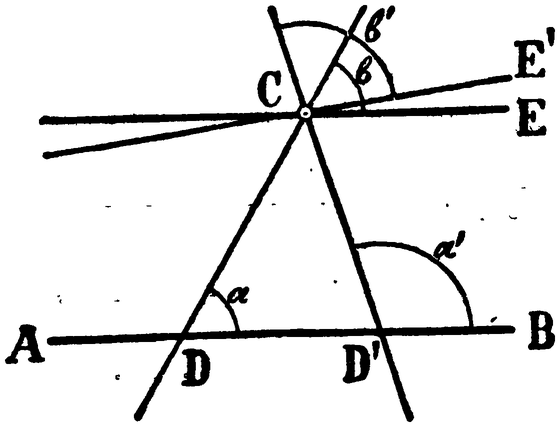
78. Remark. Since the point D on the line AB (fig. 73) can be taken arbitrarily, as many constructions like the one described can be carried out as we please. The question then arises whether these different constructions will always give one and the same line CE parallel to AB, or whether other lines parallel to AB may be obtained as well.
If, for example, instead of the point D we take a point D′ (fig. 74) and make for the secant CD′ the same construction that was made before for the secant CD (that is, construct ∠b′ = ∠a′), shall we obtain the same line CE, or will there turn out to be some new line CE′? The question may be put in other words thus: through a point C taken outside a straight line AB, can only one straight line parallel to AB be drawn, or several? The answer to this question is given by the following axiom of parallel lines.
79. Axiom of parallel lines. Through one and the same point two different straight lines parallel to one and the same straight line cannot be drawn.
Thus, if (fig. 74) CE ∥ AB, any other line CE′ drawn through the point C cannot be parallel to AB, that is, when extended it will intersect AB.
A proof of this not wholly evident truth turns out to be impossible; it is accepted without proof, as a necessary assumption or demand (a postulate, postulatum).
80. Corollaries. 1°. If a straight line (CE′, fig. 74) intersects one of two parallels (CE), it intersects the other (AB) as well,
because otherwise two different straight lines parallel to AB would pass through one and the same point C, which is impossible.
2°. If each of two straight lines A and B (fig. 75) is parallel to one and the same third straight line (C), they are parallel to each other.

Indeed, if we suppose that the lines A and B intersect in some point M, then two different straight lines parallel to C would pass through this point, which is impossible.
81. Theorem. (the converse of the theorem of § 76). If two parallel straight lines (AB and CD, fig. 76) are intersected by a third straight line (MN), then:
1°. the corresponding angles are equal;
2°. the alternate interior angles are equal;
3°. the alternate exterior angles are equal;
4°. the sum of the interior angles on the same side is equal to 2d;
5°. the sum of the exterior angles on the same side is equal to 2d.
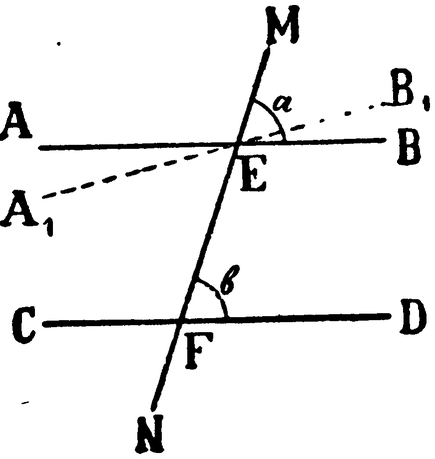
It is enough to prove that the parallelism of the lines AB and CD brings with it some one of the 5 relations named, because, as we have seen (73), if one of them holds, all the rest must hold as well.
Let us prove, for example, that if AB ∥ CD, the corresponding angles a and b are equal.
Suppose the contrary, that is, that these angles are not equal (for example, let a > b). Constructing , we then obtain a straight line that does not merge with AB, and consequently we have 2 different straight lines passing through the point E and parallel to one and the same straight line CD (namely, AB ∥ CD by the hypothesis of the theorem, and ∥ CD in consequence of the equality of the corresponding angles and b). Since this contradicts the axiom of parallel lines, our supposition that the angles a and b are not equal must be rejected; it remains to accept that a = b.
82. Corollary. A perpendicular to one of two parallel straight lines is also a perpendicular to the other.
Indeed, if AB ∥ CD (fig. 77) and ME ⊥ AB, then, first, ME, intersecting AB, also intersects CD in some point F (80, 1°); second, the corresponding angles a and b are equal. But the angle a is a right angle; hence the angle b is a right angle too, that is, MF ⊥ CD.
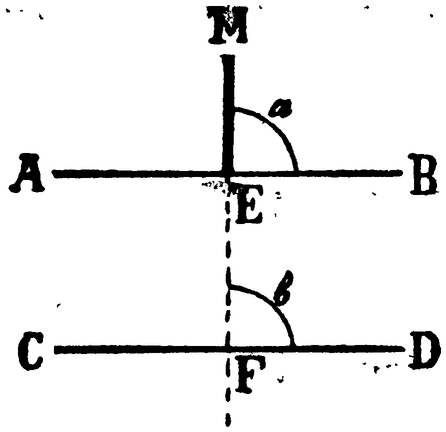
83. Criteria of non-parallelism of straight lines. From the two theorems, the direct one, which expresses the criteria of parallelism (76), and its converse (81), the conclusion can be drawn that the inverse theorems are also true, that is, that
if, when two straight lines are intersected by a third, it turns out that: 1°. the corresponding angles are not equal, or 2°. the alternate interior angles are not equal, and so on, then the lines are not parallel;
if two straight lines are not parallel, then, when they are intersected by a third straight line: 1°. the corresponding angles are not equal, 2°. the alternate interior angles are not equal, and so on.
Of these criteria of non-parallelism (which are easily proved by contradiction) it is useful to give particular attention to the following:
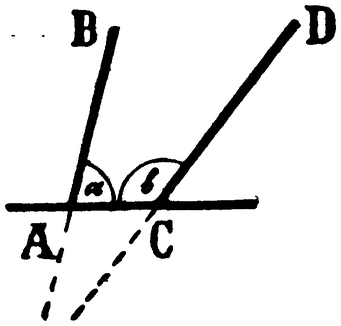
if the sum of the interior angles on the same side (a and b, fig. 78) is not equal to 2d, the straight lines (AB and CD) intersect when extended far enough, since if these lines did not intersect they would be parallel, and then the sum of the interior angles on the same side would be equal to 2d (81), which contradicts the hypothesis.
This proposition (supplemented by the assertion that the lines intersect on that side of the secant on which the sum of the interior angles on the same side is less than 2d) was accepted by the famous Greek geometer Euclid (who lived in the third century BC) in his "Elements" of geometry without proof, as the axiom of parallel lines, and it is therefore known by the name of Euclid's postulate. At the present time it is preferred to take as this axiom a simpler truth, namely the one we set out earlier (79).
Let us point out 2 more criteria of non-parallelism, which we shall need later:
1°. A perpendicular (AB, fig. 79) and an oblique (CD) to one and the same straight line (EF) intersect,
because the sum of the interior angles on the same side, 1 and 2, is not equal to 2d.
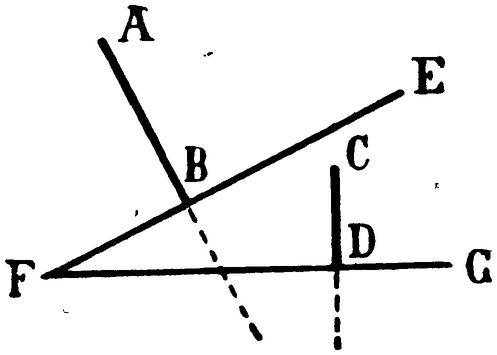
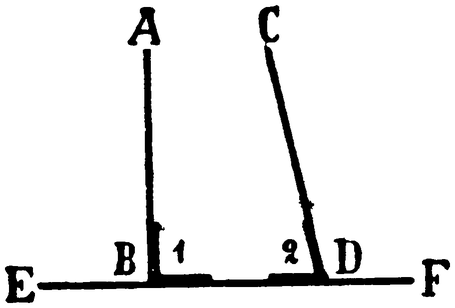
2°. Two straight lines (AB and CD, fig. 80) perpendicular to two intersecting straight lines (FE and FG) intersect.
Indeed, if we suppose the contrary, that is, that AB ∥ CD, then the line FD, being perpendicular to one of the parallels (to CD), would be perpendicular to the other parallel (to AB) as well, and then from the one point F two perpendiculars, FB and FD, would be drawn to the line AB, which is impossible.
84. Problem. Through a given point M, to draw a straight line parallel to a given straight line AB (fig. 81).
The simplest solution of this problem is as follows: from the point M as centre we describe with an arbitrary radius an arc CD, and from the point C with the same radius an arc ME. Then, giving the compass an opening equal to the distance from E to M, we describe from the point C a small arc intersecting CD in some point F. The straight line MF is parallel to AB. For the proof, let us draw the auxiliary line MC; the angles 1 and 2 so formed are equal by construction (69, Problem 2); and if alternate interior angles are equal, the lines are parallel.
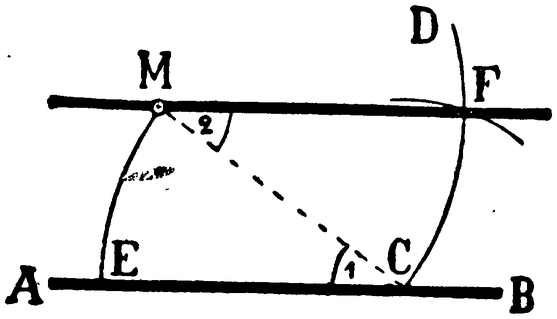
Parallel lines are also very conveniently drawn with the help of a set square and a ruler. Placing the set square with one of its sides (for example, the hypotenuse) against the given line AB, we apply the ruler to another of its sides (for example, to the longer leg); then, holding the ruler in this position with the hand, we slide the set square along it until the side that coincided with AB passes through the point M; after which we draw a straight line along this side. This line is parallel to AB, since the corresponding angles 1 and 2 are equal.
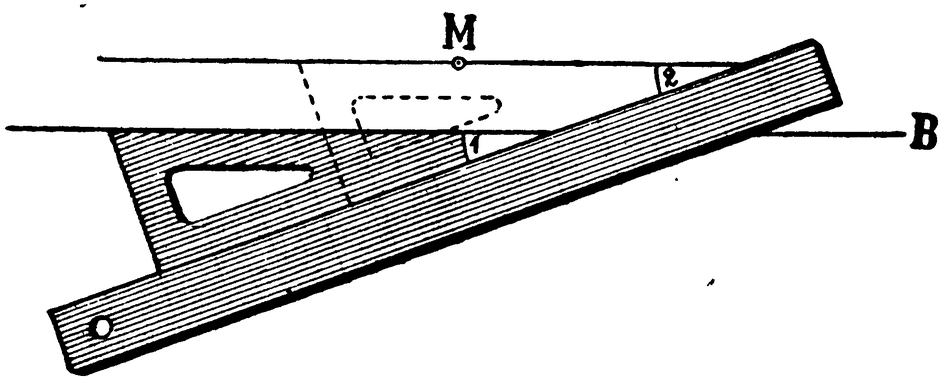
Angles with Respectively Parallel or Perpendicular Sides
85. Theorem. If the sides of one angle are respectively parallel to the sides of another angle, such angles are either equal or together make two right angles.
Let us consider separately the following three cases (fig. 83):
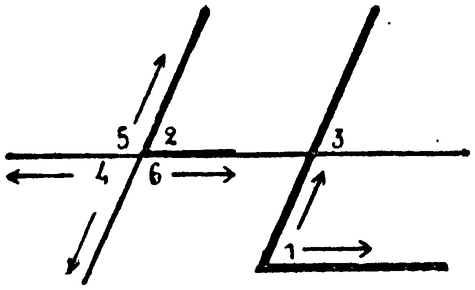
1°. Let the sides of the angle 1 be respectively parallel to the sides of the angle 2 and, moreover, have the same direction from the vertex (in the drawing the directions are shown by arrows). Extending one of the sides of the angle 2 until it intersects the side of the angle 1 that is not parallel to it, we obtain the angle 3, equal both to the angle 1 and to the angle 2 (as corresponding angles with parallels); consequently ∠1 = ∠2.
2°. Let the sides of the angle 1 be respectively parallel to the sides of the angle 4, but have the opposite direction from the vertex. Extending both sides of the angle 4, we obtain the angle 2, which is equal to the angle 1 (by what was proved above) and to the angle 4 (as vertical angles); consequently ∠4 = ∠1.
3°. Finally, let the sides of the angle 1 be respectively parallel to the sides of the angle 5 or of the angle 6, two of these sides having the same direction and the other two the opposite direction. Extending one side of the angle 5 or of the angle 6, we obtain the angle 2, which, by what has been proved, is equal to the angle 1; but ∠5 (or ∠6) + ∠2 = 2d (by the property of adjacent angles); consequently ∠5 (or ∠6) + ∠1 = 2d as well.
Thus angles with parallel sides turn out to be equal when their sides have either the same or the opposite direction from the vertex; if this condition is not fulfilled, the angles together make 2d.
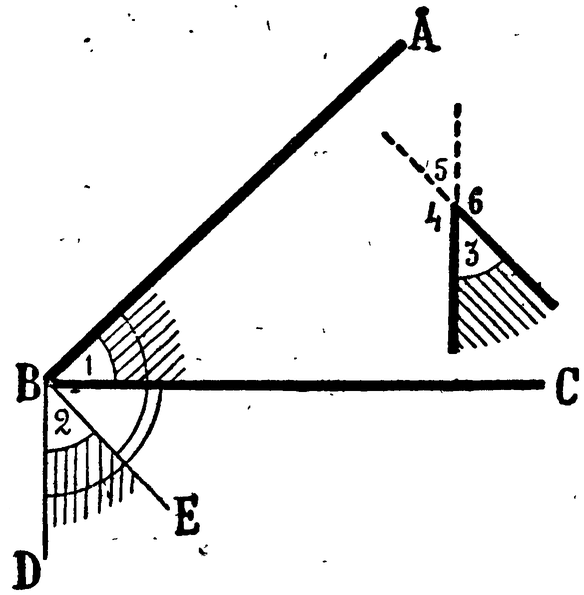
86. Theorem. If the sides of one angle are respectively perpendicular to the sides of another angle, such angles are either equal or together make two right angles.
Let the angle ABC, marked with the figure 1 (fig. 84), be one of the given angles. From its vertex let us draw two auxiliary lines: BD ⊥ BC and BE ⊥ BA. The angle 2 formed by them is equal to the angle 1 for the following reason: the angles DBC and EBA are equal, since both are right angles; taking away from each of them one and the same angle EBC, we obtain: ∠2 = ∠1.
Now let us imagine that somewhere we are given an angle 3 (or the angle 4, or the angle 5, or the angle 6) whose sides are respectively perpendicular to the sides of the angle 1. Then the sides of this angle are parallel to the sides of the angle 2 (because two perpendiculars to one straight line are parallel); consequently the new angle is either equal to the angle 2 or together with it makes 2d. Replacing the angle 2 by the angle 1, which is equal to it, we obtain what was required to be proved.
87. Remark. If we know beforehand that two angles with respectively parallel or perpendicular sides are both acute or both obtuse, we can assert that such angles are equal, since two acute or two obtuse angles cannot together make 2d.
Angle Sum of a Triangle and of a Polygon
88. Theorem. The sum of the angles of every triangle is equal to two right angles.
Let ABC (fig. 85) be any triangle; it is required to prove that the sum of the angles A, B and C is equal to 2d.
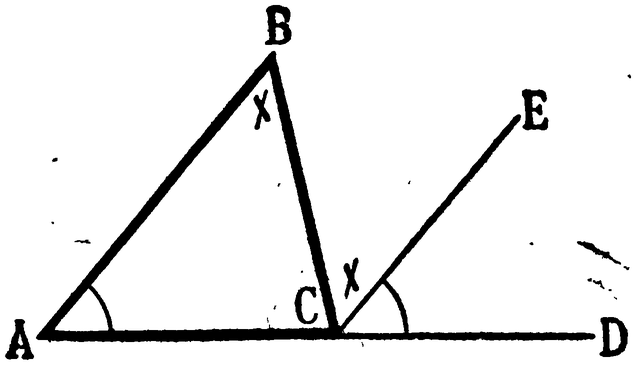
Extending the side AC and drawing CE ∥ AB, we find: ∠A = ∠ECD (as corresponding angles with parallels), ∠B = ∠BCE (as alternate angles with parallels); consequently:
(26)
Corollaries. 1°. An exterior angle of a triangle is equal to the sum of the two interior angles not adjacent to it (thus ∠BCD = ∠A + ∠B).
2°. If two angles of one triangle are respectively equal to two angles of another, the third angles are equal as well.
3°. The sum of the two acute angles of a right triangle is equal to one right angle.
4°. In an isosceles right triangle each acute angle is equal to .
5°. In an equilateral triangle each angle is equal to .
89. Theorem. The sum of the angles of every convex polygon is equal to two right angles repeated as many times as the polygon has sides, less two.
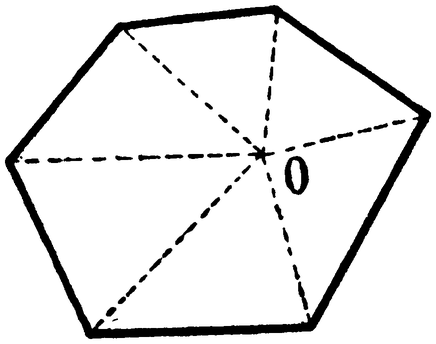
Taking an arbitrary point O inside the polygon (fig. 86), let us join it to all the vertices. The convex polygon is then divided into as many triangles as it has sides. The sum of the angles of each triangle is equal to 2d; consequently the sum of the angles of all the triangles is equal to 2dn, if n denotes the number of sides of the polygon. This magnitude evidently exceeds the sum of the angles of the polygon by the sum of all the angles that lie around the point O; but this sum is equal to 4d (26, 2°); consequently the sum of the angles of the polygon is equal to
Corollary. For a given number of sides the sum of the angles of a convex polygon is a constant magnitude. Thus the sum of the angles in every convex quadrilateral is equal to 2d(4 − 2) = 4d; in a pentagon, to 2d(5 − 2) = 6d; in a hexagon, to 2d(6 − 2) = 8d; and so on.
90. Theorem. If from the vertex of each angle of a convex polygon we draw the extension of one of the sides of that angle, the sum of the exterior angles so formed is equal to four right angles (independently of the number of sides of the polygon).
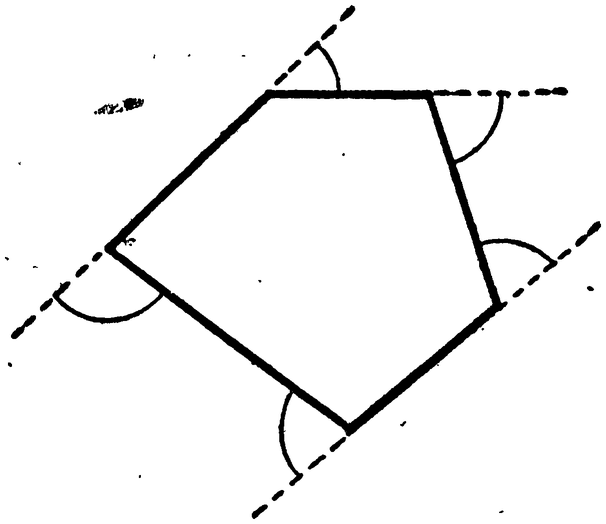
Each of these exterior angles (fig. 87) is the supplement to 2d of the interior angle of the polygon adjacent to it; consequently, if to the sum of all the interior angles we add the sum of all the exterior angles, we obtain 2dn (where n is the number of sides); but the sum of the interior angles, as we have seen, is equal to 2dn − 4d; consequently the sum of the exterior angles is equal to:
Corollary. A convex polygon cannot have more than 3 acute interior angles. Indeed, if there were 4 (or more) acute interior angles, there would then be 4 (or more) obtuse exterior angles, and therefore the sum of all the exterior angles of the polygon would be greater than 4d, which is impossible.
On the Postulate of Parallel Lines
91. It is easy to show that the so-called fifth postulate of Euclid (given in § 83 of this book) and the postulate that we have taken (§ 79) as the foundation of the theory of parallel lines (first introduced by the English mathematician John Playfair in 1795) can be turned into one another, that is, from Playfair's postulate Euclid's postulate can be derived as a logical consequence (which has been done in this book, § 83), and, conversely, from Euclid's postulate Playfair's can be obtained by logic. The latter can be carried out, for example, as follows:
Let any 2 straight lines AB and be drawn through a point E (fig. 88) taken outside the straight line CD; let us prove, starting from Euclid's postulate, that these lines cannot both be parallel to one and the same straight line CD.
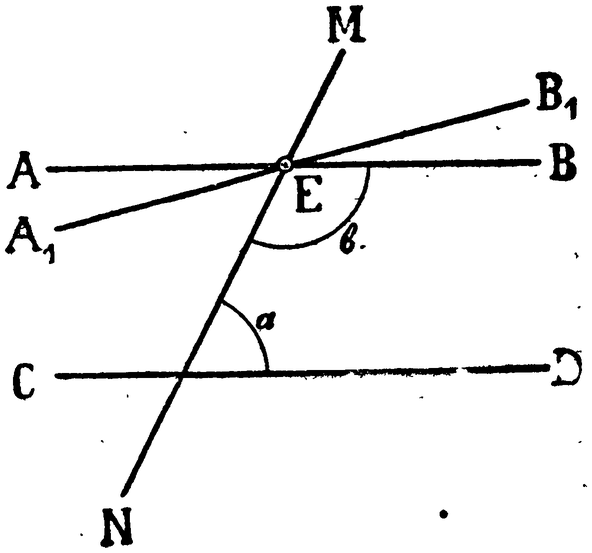
For this purpose let us draw through E any secant line MN, and let us denote by the letters a and b the interior angles on the same side that this secant forms with the lines CD and AB. Then one of two things: either the sum is not equal to 2d, or it is equal to 2d. In the first case, according to Euclid's postulate, the line AB must intersect CD, and consequently it cannot be parallel to CD; in the second case the sum will turn out not to be equal to 2d (since the angle is not equal to the angle BEN); hence, according to the same postulate, the line must then intersect CD, and consequently this line cannot be parallel to CD. Thus one of the lines AB and will without fail turn out not to be parallel to the line CD; consequently, through one point two different straight lines parallel to one and the same straight line cannot be drawn.
92. There exist a great many other propositions as well that can likewise be logically turned into Euclid's postulate (and are consequently logically equivalent to it). Let us mention, for example, the following propositions, which certain well-known geometers have laid at the foundation of the theory of parallel lines:
There exists at least one triangle in which the sum of the angles is equal to 2d (the French mathematician Legendre, at the beginning of the nineteenth century).
There exists a convex quadrilateral (a rectangle) in which all four angles are right angles (the French mathematician Claude Clairaut, eighteenth century).
There exists a triangle similar, but not equal, to another triangle (the Italian mathematician Saccheri, beginning of the eighteenth century).
Through every point taken inside an angle less than 2d a straight line can be drawn that intersects both sides of the angle (the German mathematician Lorenz, end of the eighteenth century); and others.
Since Euclid's postulate and all the others equivalent to it do not possess the quality of being evident, a great many mathematicians, from ancient times down to the end of the first quarter of the nineteenth century, made repeated attempts to prove Euclid's postulate (or some other equivalent to it), that is, to derive it as a logical consequence from the other axioms of geometry. All these attempts, however, proved unsuccessful: in each such "proof," once it had been examined in detail, some logical error could always be found.
93. The constant failures in the search for proofs of Euclid's postulate led some mathematicians to the thought that this postulate (or one equivalent to it) cannot in fact be derived from the other axioms of geometry, but is an independent assumption about the properties of space, not depending on them. This thought was first developed thoroughly by the Russian mathematician N. I. Lobachevsky (1793-1856), professor at the University of Kazan. In his work "New Elements of Geometry," which appeared in the years 1836-1838, he made public a special geometry (afterwards called Lobachevsky's geometry), founded on the same geometric axioms on which Euclid's geometry is based, with the sole exception of his postulate of parallel lines, in place of which Lobachevsky took the following assumption: through a point lying outside a straight line an infinite number of parallels to that line can be drawn. Namely, he assumed that if AB (fig. 89) is a straight line and C any point outside it, then at this point there exists a certain angle DCE with the property that every straight line drawn through C inside this angle (for example, the line CF), and likewise both of its sides, do not intersect AB, however far they are extended, whereas every straight line drawn through C outside this angle does intersect AB. It is plain that such an assumption denies Euclid's postulate, since, if this angle exists, it cannot be asserted that any 2 straight lines intersect whenever they form with a secant interior angles on the same side whose sum is not equal to two right angles. In spite of this denial, however, Lobachevsky's geometry is as well-ordered a system of geometric theorems as Euclid's geometry (although, of course, the theorems of Lobachevsky's geometry differ essentially from the theorems of Euclid's); in it, as in Euclid's geometry, no logical contradictions are met with, either between the theorems and the axioms laid at the foundation of this geometry, or between some theorems and others. Yet if Euclid's postulate could be proved, that is, if it were some logical consequence, however remote, of the other geometric axioms, then the denial of this postulate, laid at the foundation of a geometry together with the acceptance of all the other axioms, would without fail lead to logically contradictory consequences. The absence of such contradictions in Lobachevsky's geometry serves as an indication that Euclid's fifth postulate is independent of the other geometric axioms and, consequently, that it is impossible to prove it13.
94. Almost at the same time as Lobachevsky, and independently of him, the Hungarian mathematician János Bolyai (1802-1860) also constructed a new geometry, starting from the same assumption as Lobachevsky, that through a point taken outside a straight line an infinite number of parallels to that line can be drawn.
After them the German mathematician Riemann (1826-1866) showed that yet another special geometry, likewise free of contradictions, can be constructed (afterwards called Riemann's geometry), in which, in place of Euclid's postulate, the assumption is accepted that through a point taken outside a straight line not a single parallel to that line can be drawn (in other words, all the straight lines of a plane intersect).
All those geometries (such as Lobachevsky's and Riemann's) which are founded on some assumption about parallel lines that does not agree with Euclid's postulate bear the general name of non-Euclidean geometries.
95. Let us give some theorems of Lobachevsky's geometry that differ sharply from the corresponding theorems of Euclid's geometry:
Two perpendiculars to one and the same straight line diverge without bound as they recede from that line.
The sum of the angles of a triangle is less than 2d (in Riemann's geometry it is greater than 2d), and this sum is not a constant magnitude for different triangles.
The greater the area of a triangle, the more the sum of its angles differs from 2d.
If in a convex quadrilateral 3 angles are right angles, the 4th angle is acute (hence in this geometry rectangles are impossible).
If the angles of one triangle are respectively equal to the angles of another triangle, such triangles are equal (consequently, in Lobachevsky's geometry similarity does not exist).
The locus of the points of a plane equidistant from some straight line of that plane is a certain curved line.
Chapter 7: Parallelograms and Trapezoids
1. The Principal Properties of Parallelograms
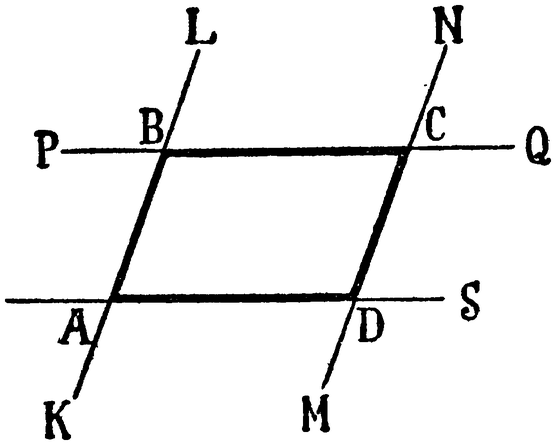
96. Definition. A quadrilateral whose opposite sides are parallel in pairs is called a parallelogram.
Such a quadrilateral (ABCD, fig. 90) is obtained, for example, if any two parallel straight lines KL and MN are cut by two other parallel straight lines RS and PQ.
For brevity we shall often write the word "parallelogram" in a shortened form.
97. Theorem. In every parallelogram:
1°, the opposite angles are equal;
2°, the sum of the angles adjoining one side is equal to two right angles.
Let ABCD (fig. 91) be a parallelogram, that is, AB ∥ CD and BC ∥ AD; it is required to prove that
1°, ∠A = ∠C and ∠B = ∠D;
2°, ∠A + ∠B = 2d, ∠B + ∠C = 2d and so on.
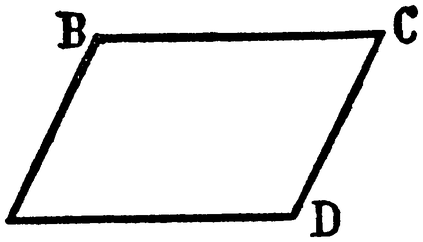
1°. The angles A and C are equal because the sides of these angles are respectively parallel and run in opposite directions from the vertex (85). The same can be said of the angles B and D.
2°. Each of the sums A + B, B + C, C + D and D + A is equal to 2d, because these are sums of interior angles on the same side formed with parallel lines.
98. Theorem. In every parallelogram the opposite sides are equal.
Let the figure ABCD (fig. 92) be a parallelogram, that is, AB ∥ CD and BC ∥ AD; it is required to prove that AB = CD and BC = AD.
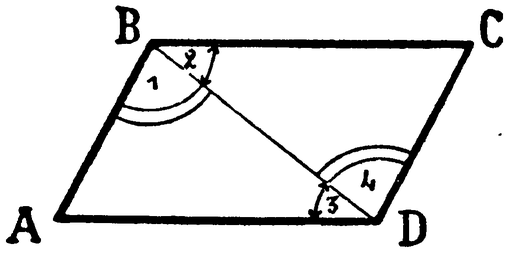
Drawing the diagonal BD, we obtain two triangles ABD and BCD, which are equal because they have BD as a common side, ∠1 = ∠4 and ∠2 = ∠3 (as alternate interior angles formed with parallel lines). From the equality of the triangles it follows that AB = CD and AD = BC (in equal triangles equal sides lie opposite equal angles).
Remark. This theorem can also be expressed thus: segments of parallels included between parallels are equal.
99. Converse theorems. If in a convex14 quadrilateral: 1°, the opposite sides are equal in pairs, or 2°, two opposite sides are equal and parallel, then the quadrilateral is a parallelogram.
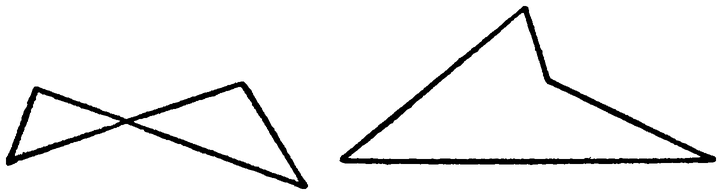
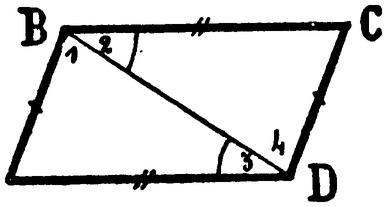
1°. Let the figure ABCD (fig. 93) be a convex quadrilateral in which
AB = CD and BC = AD.
It is required to prove that this figure is a parallelogram, that is, AB ∥ CD and BC ∥ AD. Drawing the diagonal BD, we obtain two triangles, which are equal since they have BD as a common side, AB = CD and BC = AD (by hypothesis). From their equality it follows that ∠1 = ∠4 and ∠2 = ∠3 (in equal triangles equal angles lie opposite equal sides); consequently AB ∥ CD and BC ∥ AD (if alternate interior angles are equal, the lines are parallel).
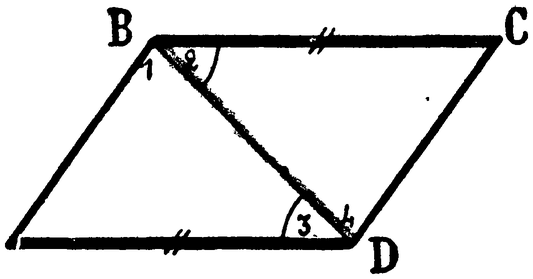
2°. Let it be given by hypothesis that in the quadrilateral (ABCD, fig. 94) BC = AD and BC ∥ AD. It is required to prove that ABCD is a parallelogram, that is, that AB ∥ CD. The triangles ABD and BCD are equal because they have BD as a common side, BC = AD (by hypothesis) and ∠2 = ∠3 (as alternate interior angles formed with the parallels BC and AD and the secant BD). From the equality of the triangles it follows that ∠1 = ∠4; therefore AB ∥ CD.
100. Theorem. In every parallelogram the diagonals bisect each other.
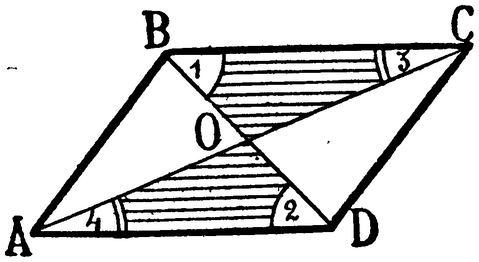
Let ABCD (fig. 95) be a parallelogram and AC and BD its diagonals; it is required to prove that BO = OD and AO = OC.
The triangles BOC and AOD (shaded in the figure) are equal because in them BC = AD (as opposite sides of a parallelogram), ∠1 = ∠2 and ∠3 = ∠4 (as alternate interior angles formed with parallel lines). From the equality of the triangles it follows that OC = OA and OB = OD.
101. Converse theorem. Every quadrilateral whose diagonals bisect each other is a parallelogram.
Let the figure ABCD (fig. 95) be a quadrilateral in which AO = OC and BO = OD; it is required to prove that this figure is a parallelogram.
△ AOD = △ BOC, since these triangles have an equal angle (at the vertex O) included between respectively equal sides. From their equality it follows that ∠1 = ∠2 and ∠3 = ∠4 (in equal triangles equal angles lie opposite equal sides); but if alternate interior angles are equal, the lines are parallel (76); therefore AD ∥ BC. Since it follows further from the equality of the same triangles that AD = BC, the figure ABCD is a parallelogram (99, 2°).
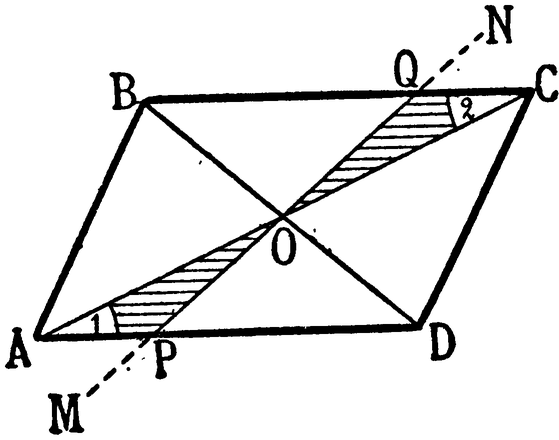
102. Centre of symmetry. It is useful to notice one more property of the parallelogram: if through the point of intersection of the diagonals of a parallelogram (through the point O, fig. 97) we draw any straight line (MN), this line will cut the contour of the parallelogram in two points (P and Q) symmetric with respect to the point of intersection of the diagonals, that is, in 2 points which, first, lie on opposite sides of the point O and, secondly, are at equal distances from that point. Indeed, the triangles OAP and OCQ are equal, since in them AO = OC (by the property of the diagonals of a parallelogram), the angles at the common vertex O are equal (as vertical angles) and ∠1 = ∠2 (as alternate interior angles formed with parallels). From the equality of these triangles it follows that OP = OQ.
If in any figure there exists a point having the property described, such a point is called a centre of symmetry of that figure; hence in a parallelogram the intersection of its diagonals is a centre of symmetry.
Symmetry with respect to a centre is called central symmetry.
2. Special Forms of the Parallelogram: the Rectangle, the Rhombus and the Square
103. Definition. A parallelogram all of whose angles are right angles is called a rectangle.
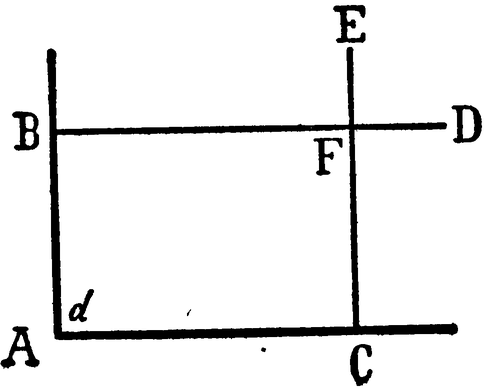
Such a parallelogram can be obtained, for example, if on the sides of a right angle A (fig. 98) we lay off from its vertex segments AB and AC of arbitrary length and through the points B and C draw straight lines BD and CE parallel to the sides of the right angle. The line BD, which intersects the line AB at the point B, must also intersect the line CE, parallel to AB (80, 1°), at some point F. We thus obtain a parallelogram ABFC in which one angle, namely A, is a right angle by construction; but in that case, by the property of the angles of a parallelogram (97), all its other angles must be right angles too, since the angle at the vertex F is equal to A, and the angles at B and C make up 2d with A.
104. Theorem. In every rectangle the diagonals are equal.
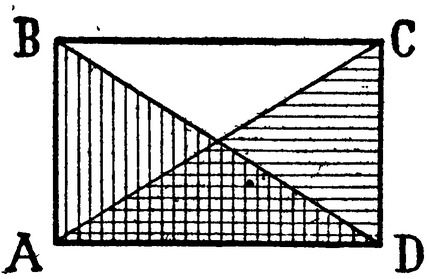
Let the figure ABCD (fig. 99) be a rectangle; it is required to prove that AC = BD.
The right triangles ACD and ABD are equal because they have AD as a common leg and AB = CD (as opposite sides of a parallelogram). From the equality of the triangles it follows that AC = BD.
105. Converse theorem. Every parallelogram whose diagonals are equal is a rectangle.
Let the figure ABCD (fig. 99) be a parallelogram in which AC = BD; it is required to prove that this figure is a rectangle. The triangles ABD and ACD are equal, since they have AD as a common side, AC = BD (by hypothesis) and AB = CD (by the property of the opposite sides of a parallelogram). From their equality it follows that ∠BAD = ∠ADC. But the sum of these 2 angles is equal to 2d (by the property of the angles of a parallelogram); consequently each of them is d. But then the angles B and C must be right angles as well, and therefore the figure ABCD is a rectangle.
106. Definition. A parallelogram all of whose sides are equal is called a rhombus.
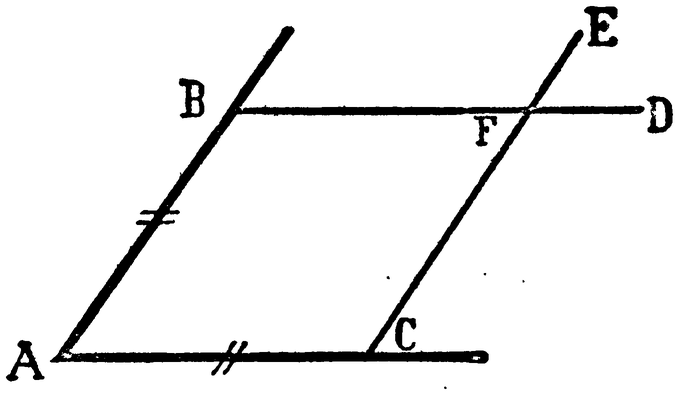
Such a parallelogram can be obtained if on the sides of an arbitrary angle A (fig. 100) we lay off from its vertex equal segments AB and AC and through the points B and C draw straight lines BD and CE parallel to the sides of the angle A. These lines must intersect each other (80, 1°) at some point F. We thus obtain a parallelogram in which two adjacent sides AB and AC are equal by construction. But then, by the property of the sides of a parallelogram (98), all 4 of its sides will prove equal, since BF = AC and CF = AB.
107. Theorem. In every rhombus the diagonals are mutually perpendicular.
Let ABCD (fig. 101) be a rhombus and AC and BD its diagonals; it is required to prove that AC ⊥ BD.
The triangles ABO and BOC are equal because they have BO as a common side, AB = BC (since all the sides of a rhombus are equal) and AO = OC (since the diagonals of every parallelogram bisect each other). From the equality of the triangles it follows that
∠1 = ∠2, that is, BD ⊥ AC.
Remark. From the equality of the same triangles it follows that ∠3 = ∠4, that is, that the angle B is bisected by the diagonal. From the equality of the triangles BOC and COD (which is proved in the same way as the equality of the triangles ABO and BOC) it follows that the angle C is bisected by the diagonal; and so on. Hence the diagonals of a rhombus bisect its angles.
108. Converse theorem. Every parallelogram whose diagonals are mutually perpendicular is a rhombus.
Let the figure ABCD (fig. 101) be a parallelogram whose diagonals AC and BD are perpendicular; it is required to prove that this figure is a rhombus, that is, that AB = BC = CD = DA. The triangles AOB and BOC are right triangles (by hypothesis); they have the leg OB in common, and the legs AO and OC are equal (since the diagonals of every parallelogram bisect each other). Hence these triangles are equal, and therefore their hypotenuses AB and BC are equal. But AB = CD and BC = AD (by the property of the opposite sides of a parallelogram); consequently AB = BC = CD = DA, that is, the figure ABCD is a rhombus.
109. The axes of symmetry of a rhombus. It is useful to notice one more property: each diagonal of a rhombus is its axis of symmetry.
Thus the diagonal BD (fig. 102) is an axis of symmetry of the rhombus ABCD, because by rotating △ ABD about BD we can make it coincide with △ BCD; in consequence, to any point M taken on one half of the contour of the rhombus there corresponds a point N on the other half of the contour, symmetric to it with respect to the diagonal BD (33). The same can be said of the diagonal AC.
110. Definition. A parallelogram all of whose sides are equal and all of whose angles are right angles is called a square.
Such a parallelogram can be obtained if, in constructing a rectangle (103), we take the segments AB and AC equal, or if, in constructing a rhombus (106), we take the angle A to be a right angle.
Since a square is a parallelogram, a rectangle and a rhombus, it unites in itself all the properties of these figures; of the diagonals of a square, for example, it can be said that they: 1) bisect each other, 2) are equal to each other, 3) are mutually perpendicular and 4) bisect the angles of the square.
3. Some Theorems Based on the Properties of the Parallelogram
111. Theorem. Parallel straight lines (AB and CD, fig. 103) are everywhere equally distant from each other; in other words, all the points of one parallel are equally distant from the other parallel.
Indeed, if from any two points M and N of the line CD we drop the perpendiculars MP and NQ to AB, these perpendiculars are parallel (74), and therefore the figure MNQP is a parallelogram; from this it follows (98) that MP = NQ, that is, the points M and N are equally distant from the line AB.
112. Theorem. The locus of the points that are at one and the same distance from a given straight line and lie on one side of it is a straight line parallel to the given one.
Let M and N (fig. 104) be any two points lying on one side of the line AB and at one and the same distance m from it; then the perpendiculars MF and NQ dropped from these points to AB are equal to m. Through M and N let us draw the line CD. Since MF = NQ and, moreover, MF ∥ NQ (74), the figure MNQF is a parallelogram (99, 2°); consequently CD ∥ AB. We see in this way that any 2 points (such as M and N) which are at the distance m from the line AB and lie on one side of that line lie on a line parallel to AB and at the distance m from AB. Since there can be only one such line (on one side of AB), namely CD, we must conclude that all the points which are at one and the same distance m from AB and lie on one side of it lie on the line CD, parallel to AB. Conversely, every point R taken on this line is as far from AB as the points M and N are, that is, at the given distance m (111).
113. Theorem. If on one side of an angle we lay off any segments equal to one another and through their ends draw parallel straight lines to meet the other side of the angle, then segments equal to one another are laid off on that side too.
Let ABC (fig. 105) be any angle, and on its side BC let the equal segments BD = DE = EF... be laid off. Through the points D, E, F... let us draw the parallel lines DM, EN, FP... to meet AB; it is required to prove that
BM = MN = NP...
Let us take any two of these segments, for example MN and NP, and prove that they are equal.
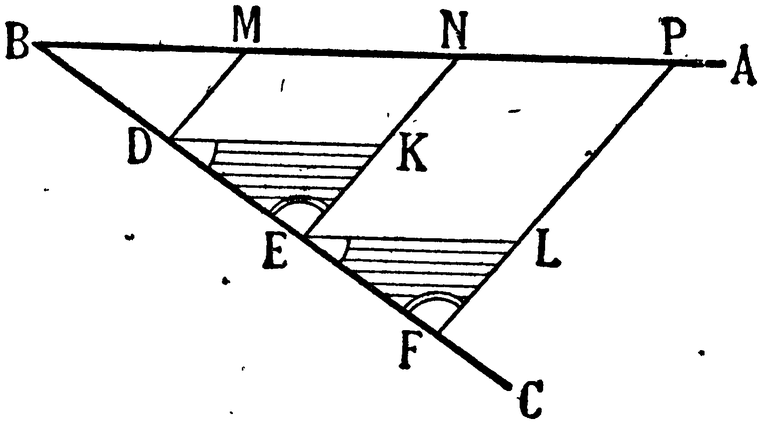
For this purpose let us draw the lines DK and EL parallel to AB. The triangles DKE and ELF so obtained are equal, since in them DE = EF (by hypothesis), ∠KDE = ∠LEF and ∠KED = ∠LFE (as corresponding angles formed with parallel lines). From the equality of these triangles it follows that DK = EL. But DK = MN and EL = NP (as opposite sides of parallelograms); hence MN = NP.
In the same way we prove the equality of the other segments of the side AB (for the segment BM we must take the triangle BMD).
Remark. The theorem does not require that the equal segments on the side of the angle be laid off from its vertex; they may be laid off from an arbitrary point of the side, and they may even be separated by intervals of some kind (fig. 106).
114. Problem. To divide a given segment of a straight line into m equal parts.
This problem is solved on the basis of the preceding theorem.
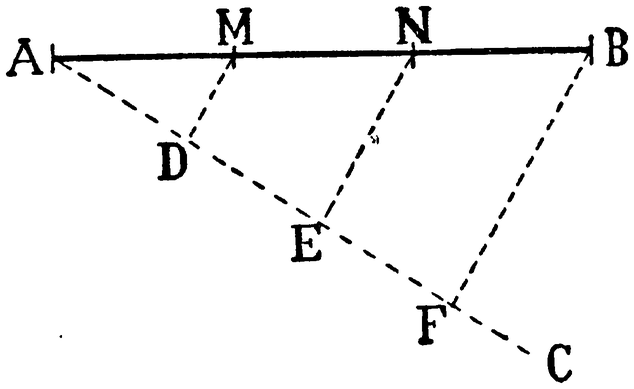
Let AB (fig. 107) be the given segment, which it is required to divide into, say, 3 equal parts. From its end A we draw a line AC forming an arbitrary angle with AB; on AC, from the point A, we lay off three segments of arbitrary length but equal to one another, AD, DE and EF; we join the point F to B; finally, from E and D we draw the lines EN and DM parallel to FB. Then, by what has been proved, the segment AB will be divided at the points M and N into three equal parts.
115. Theorem. The straight line joining the midpoints of two sides of a triangle is parallel to its third side and equal to half of it.
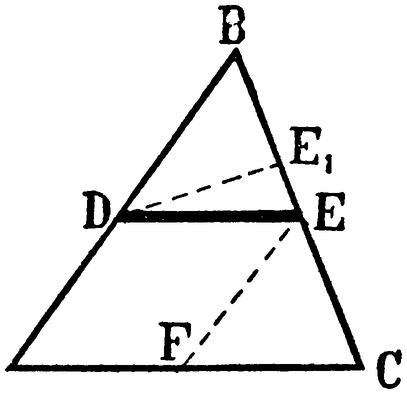
Let DE (fig. 108) be the line joining the midpoints of two sides of the triangle ABC. Let us first prove that DE ∥ AC. Suppose the contrary, that is, that the line DE is not parallel to AC. Through the point D let us draw a line parallel to AC (77). On our supposition this line cannot be DE; let it be some line . Since on the side BA of the angle B the equal segments BD and DA are laid off, and from their ends the parallel lines and AC are drawn to the other side of the angle B, equal segments must be obtained on the side BC (113); hence , and therefore the point must be the midpoint of the side BC. We arrive in this way at the absurd conclusion that the side BC has 2 midpoints: the point E by hypothesis and the point according to our deduction. The absurdity of this conclusion compels us to reject the assumption we made, that DE is not parallel to AC; hence DE ∥ AC. It now remains to prove that . For this purpose let us draw from E the line EF ∥ DA; then the figure EDAF will be a parallelogram and, consequently, DE = AF. Since on the side CB of the angle C equal segments are laid off (CE = EB), and from the points that mark off these segments the parallel lines EF and BA are drawn to the other side, CF = FA; consequently .
4. The Definition and a Property of the Trapezoid
116. Definition. A convex quadrilateral in which some two opposite sides are parallel is called a trapezoid.
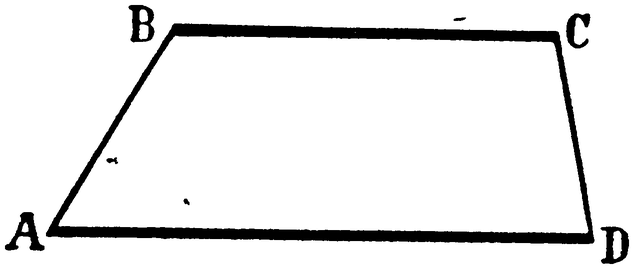
Such a quadrilateral can be obtained if between two parallel straight lines BC and AD (fig. 109) we draw any two secant lines AB and CD. The parallel sides of a trapezoid are called its bases, the non-parallel sides its lateral sides.
117. Theorem. The straight line joining the midpoints of the lateral sides of a trapezoid is parallel to the bases of the trapezoid and equal to half their sum.
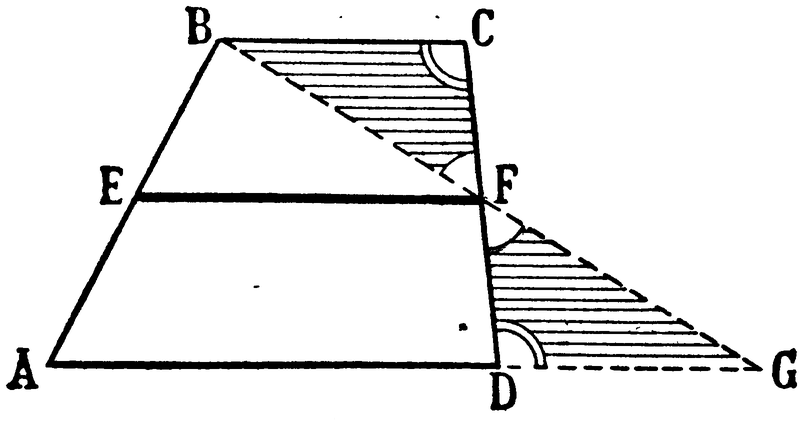
Let the line EF (fig. 110) join the midpoints of the lateral sides of the trapezoid ABCD; it is required to prove that EF ∥ AD (and consequently EF ∥ BC) and, besides, that . Through the points B and F let us draw a line to meet the extension of the side AD at some point G. We then obtain two triangles BCF and DFG, which are equal, since in them CF = FD (by hypothesis), ∠BFC = ∠DFG (as vertical angles) and ∠BCF = ∠FDG (as alternate interior angles formed with parallel lines). From the equality of the triangles it follows that BF = FG and BC = DG. We now see that in △ABG the line EF joins the midpoints of two sides; hence (115) EF ∥ AG and ; in other words, EF ∥ AD and .
Remark. The straight line joining the midpoints of the lateral sides of a trapezoid is called its midline.
Exercises
Prove the Theorems
37. If we join in succession the midpoints of the sides of any quadrilateral, we obtain a parallelogram.
38. In a right triangle the median drawn to the hypotenuse is equal to half of it. (Hint: the median should be extended by a distance equal to itself.)
39. Conversely: if a median is equal to half of the side to which it is drawn, the triangle is a right triangle.
40. In a right triangle the median and the altitude drawn to the hypotenuse form an angle equal to the difference of the acute angles of the triangle.
41. If in a right triangle one acute angle is equal to , the leg opposite it is half the hypotenuse.
42. Conversely: if a leg is half the hypotenuse, the acute angle opposite it is equal to .
44. Every straight line drawn inside a trapezoid between its bases is bisected by the midline15.
46. Through the vertices of the angles of a triangle straight lines are drawn parallel to the opposite sides. The triangle formed by them is 4 times as great as the given one; each of its sides is 2 times as great as the corresponding side of the given triangle.
47. In an isosceles triangle the sum of the distances of each point of the base from the lateral sides is a constant magnitude, namely, it is equal to the altitude dropped to a lateral side.
48. How will this theorem change if the point is taken on the extension of the base?
48,a. In an equilateral triangle the sum of the distances of any point taken inside the triangle from its sides is a constant magnitude, equal to the altitude of the triangle.
49. A square ABCD is given. On its sides equal parts are laid off: , , and . The points , , , are joined in succession by straight lines. Prove that is a square.
49,a. If the midpoints of the sides of any quadrilateral whatever are taken as the vertices of a new quadrilateral, the latter (exercise 37) is a parallelogram. Determine under what conditions this parallelogram will be: 1) a rectangle, 2) a rhombus, 3) a square (to be solved on the basis of § 115).
Find the Loci
50. Find the locus of the midpoints of all the straight lines drawn from a given point to the various points of a given straight line.
51. Find the locus of the points equidistant from two parallel straight lines.
52. Find the locus of the vertices of the triangles that have a common base and equal altitudes.
Construction Problems
53. Two angles of a triangle are given; construct the third.
54. An acute angle of a right triangle is given; construct the other acute angle.
55. Draw a straight line parallel to a given straight line and at a given distance from it.
56. Bisect an angle whose vertex does not fit on the drawing.
57. Through a given point draw a straight line at a given angle to a given straight line.
58. Through a given point draw a straight line so that its segment included between two given parallel straight lines is equal to a given length.
59. Between the sides of a given acute angle place a straight line of given length so that it is perpendicular to one side of the angle.
60. Between the sides of a given angle place a straight line of given length so that it cuts off equal parts from the sides of the angle.
61. Construct a right triangle given an acute angle and the leg opposite it.
62. Construct a triangle given two angles and the side lying opposite one of them.
63. Construct an isosceles triangle given the angle at the vertex and the base.
64. The same, given the angle at the base and the altitude dropped to a lateral side.
65. The same, given a lateral side and the altitude dropped to it.
66. Construct an equilateral triangle given its altitude.
67. Divide a right angle into 3 equal parts (in other words, construct an angle equal to ).
68. Construct a triangle given the base, the altitude and a lateral side.
69. The same, given the base, the altitude and an angle at the base.
70. The same, given an angle and the two altitudes dropped to the sides of that angle.
71. The same, given a side, the sum of the other two sides and the altitude dropped to one of those sides.
72. The same, given two angles and the perimeter.
73. The same, given the altitude, the perimeter and an angle at the base.
74. Draw in a triangle a straight line parallel to the base so that it is equal to the sum of the segments of the lateral sides, counted from the base.
75. Draw in a triangle a straight line parallel to the base so that the upper segment of one lateral side is equal to the lower segment of the other lateral side.
76. Construct a polygon equal to a given one (hint: the given polygon is divided into triangles by diagonals).
77. Construct a quadrilateral given three of its angles and the two sides that form the fourth angle (hint: the 4th angle must be found).
78. The same, given three sides and the two diagonals.
79. Construct a parallelogram given two unequal sides and one diagonal.
80. The same, given a side and the two diagonals.
81. The same, given the two diagonals and the angle between them.
82. The same, given the base, the altitude and a diagonal.
83. Construct a rectangle given a diagonal and the angle between the diagonals.
84. Construct a rhombus given a side and a diagonal.
85. The same, given the two diagonals.
86. The same, given the altitude and a diagonal.
87. The same, given an angle and the diagonal passing through that angle.
88. The same, given a diagonal and the angle opposite it.
89. The same, given the sum of the diagonals and the angle formed by a diagonal with a side.
90. Construct a square given its diagonal.
91. Construct a trapezoid given a base, an angle adjoining it and the two non-parallel sides (there may be two solutions, one, or none).
92. The same, given the difference of the bases, the two lateral sides and one diagonal.
92,a. The same, given the four sides (is the problem always possible?).
93. The same, given a base, the altitude and the two diagonals (the condition of possibility).
94. The same, given the two bases and the two diagonals (the condition of possibility).
95. Construct a square given the sum of a side and the diagonal.
96. The same, given the difference of the diagonal and a side.
97. Construct a parallelogram given the two diagonals and the altitude.
98. The same, given a side, the sum of the diagonals and the angle between them.
99. Construct a triangle given two sides and the median drawn to the third side.
100. The same, given the base, the altitude and the median drawn to a lateral side.
100,a. Construct a right triangle given the hypotenuse and the sum of the legs.
100,b. The same, given the hypotenuse and the difference of the legs.
Plane Geometry. Book Two: The Circle
Chapter 1: The Shape and Position of a Circle
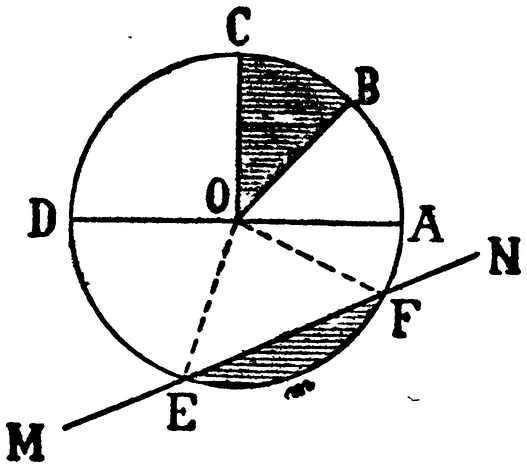
118. Definitions. A circle (fig. 111) is a closed plane line all of whose points are equally distant from one and the same point (O), called the centre.
The straight lines (OA, OB, OC...) joining the centre to points of the circle are called radii.
An infinite straight line (MN) passing through any two points of the circle is called a secant.
A segment of a straight line (EF) joining any two points of the circle is called a chord.
Every chord (AD) passing through the centre is called a diameter.
Any part of a circle (for example, EmF) is called an arc.
Of a chord (EF) joining the ends of an arc we say that it subtends that arc.
An arc is sometimes denoted by the sign ⌣; for example, we write: ⌣EmF.
The part of the plane bounded by a circle is called a disk.
A part of a disk (for example, the part COB, shaded in the figure) bounded by an arc and the two radii drawn to the ends of the arc is called a sector.
A part of a disk (for example, the part EmF) bounded by an arc and the chord subtending it is called a segment.
From these definitions it follows that:
1°, all the radii of one circle are equal to one another;
2°, every diameter is equal to the sum of two radii, and therefore all the diameters of one circle are equal to one another.
119. Points inside the circle and points outside it. A circle divides all the points of the plane in which it is drawn into the following 3 regions:
1) the points whose distances from the centre are greater than the radius; such, for example, is the point M (fig. 112), for which the distance OM is greater than the radius OA;
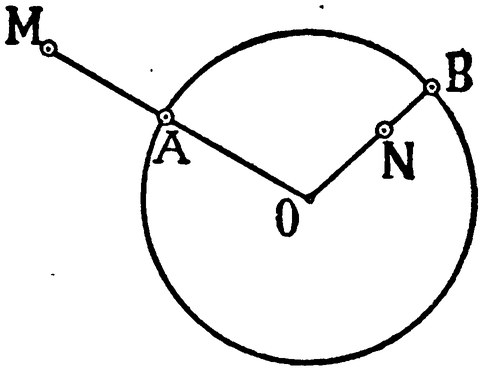
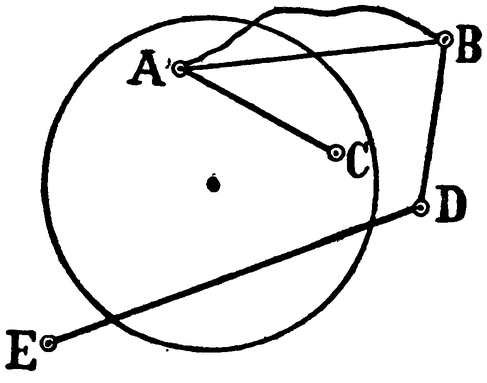
2) the points whose distances from the centre are equal to the radius (the points A, B, ... fig. 112);
3) the points whose distances from the centre are less than the radius; such, for example, is the point N (fig. 112), for which the distance ON is less than the radius OB.
The points of the first region lie outside the circle, the points of the second region lie on the circle, and the points of the third region are situated inside the circle.
We accept the following propositions as evident:
1) a segment of a straight line (and in general of any continuous line) joining (fig. 113) some interior point A to some exterior point B intersects the circle somewhere;
2) a segment of a straight line joining any 2 interior points A and C (fig. 113) does not intersect the circle;
3) a segment of a straight line joining 2 exterior points sometimes does not intersect the circle (BD) and sometimes does (DE).
120. Theorem. A straight line and a circle cannot have more than two points in common.
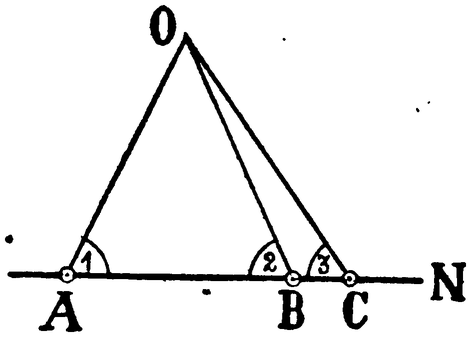
For the proof, suppose that the line MN (fig. 114) has three points A, B and C in common with the circle whose centre is at the point O. Then the lines OA, OB, OC must be equal to one another, as radii, so that the triangles OAB and OAC are isosceles, and consequently ∠1 = ∠2 and ∠1 = ∠3; whence ∠2 = ∠3. But this is impossible, since ∠2, being an exterior angle of the triangle OBC, is greater than the interior angle 3 not adjacent to it (45).
121. Corollary. No part of a circle can coincide with a straight line, because otherwise the circle would have more than two points in common with the straight line.
A line no part of which can coincide with a straight line is called a curved line. Hence the circle is a curved line.
122. Theorem. Through three points not lying on one straight line a circle can be drawn, and only one.
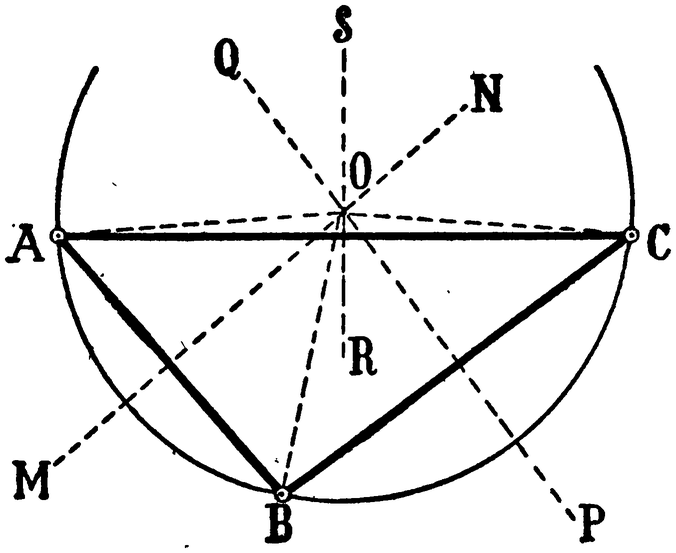
Through three points A, B and C (fig. 115) not lying on one straight line a circle can be drawn only if there exists a fourth point O that is equally distant from the points A, B and C. Let us prove that such a point exists, and only one. For this purpose we take into account that every point equally distant from the points A and B must lie on the perpendicular MN drawn to the side AB through its midpoint (63); in the same way every point equally distant from the points B and C must lie on the perpendicular PQ drawn to the side BC through its midpoint. Hence, if there exists a point equally distant from the three points A, B and C, it must lie at once on MN and on PQ, which is possible only when it coincides with the point of intersection of these two lines. The lines MN and PQ always intersect (83, 2°), since they are perpendicular to the intersecting lines AB and BC. Their point of intersection O will be the point equally distant from A, from B and from C; hence, if we take this point as centre and take as radius the distance OA (or OB, or OC), the circle will pass through the points A, B and C. Since the lines MN and PQ can intersect in one point only, this circle can have only one centre, and its radius only one length; hence the required circle is unique.
123. Corollary. The point O (fig. 115), being at the same distance from A and from C, must also lie on the perpendicular RS drawn to the side AC through its midpoint. Thus:
the three perpendiculars to the sides of a triangle drawn through their midpoints intersect in one point.
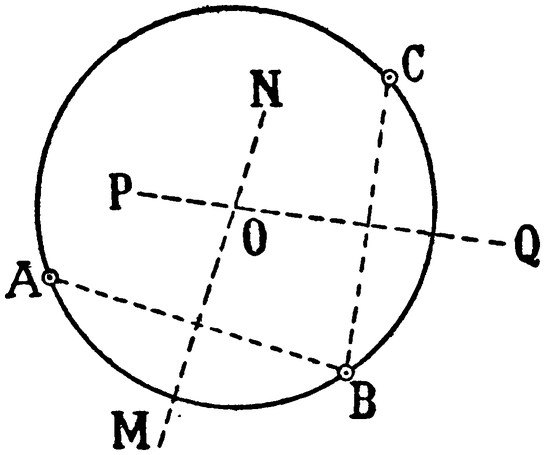
124. Problem. To find the centre of a given circle (fig. 116).
Taking any three points A, B and C on the given circle, we draw two chords through them, for example AB and CB, and through the midpoints of these chords we draw the perpendiculars MN and PQ to them. The required centre, being equally distant from A, B and C, must lie both on MN and on PQ; consequently it is at the intersection of these perpendiculars, that is, at the point O.
Chapter 2: Equal and Unequal Arcs
125. Theorem. Two disks of the same radius are equal (fig. 117).
Let O and be the centres of two disks whose radii are equal. Let us lay the disk O upon the disk so that their centres coincide. Then the two circles will coincide, since otherwise their points would not be equally distant from the centre and, consequently, the radii would be unequal.
126. Remark. By rotating one of the coinciding disks about the common centre we do not disturb their coincidence. From this it follows that two parts of one circle, or two parts of equal circles, can be laid one upon the other so that all the points of the one part lie on the other.
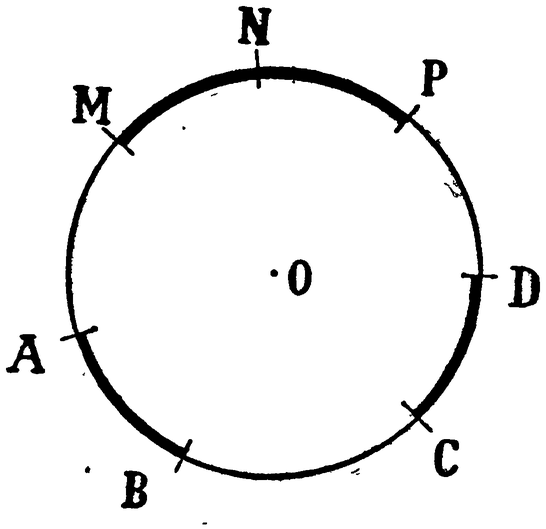
127. Definition. Two arcs of the same radius are counted equal if they can be made to coincide by superposition. Suppose, for example, that we lay the arc AB (fig. 118) upon the arc CD so that the point A falls on the point C and the arc AB runs along the arc CD (which is possible, as we saw in the preceding remark); if the ends B and D then coincide, ⌣AB = ⌣CD; otherwise the arcs are unequal, and the smaller is the one that forms only a part of the other.
The sum of several given arcs of the same radius is an arc of that radius made up of parts respectively equal to the given arcs. Thus, if from an arbitrary point M (fig. 118) of the circle we lay off a part MN equal to AB, and then from the point N, in the same direction, lay off a part NP equal to CD, the arc MP will be the sum of the arcs AB and CD. In a similar way the sum of three or more arcs can be formed.
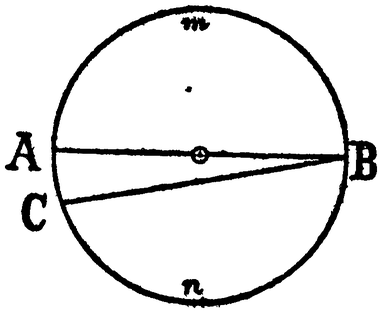
From the concept of the sum of arcs of one and the same radius are derived the concepts of their difference, product and quotient, in the same sense as for segments of straight lines.
128. Theorem. Every diameter bisects the circle and the disk (fig. 119).
Let us imagine the disk folded along some diameter AB so that its part AmB falls upon the part AnB. Then all the points of the arc m will coincide with points of the arc n, because otherwise the points of one arc would lie nearer to the centre than the points of the other arc, which is impossible.
Thus every diameter divides the circle into two semicircles, and the disk into two half-disks.
129. Remark. Every chord CB (fig. 119) that does not pass through the centre subtends two unequal arcs: one greater than a semicircle, the other less. When we say "the arc subtended by a chord," we ordinarily mean that one of the two arcs which is less than a semicircle.
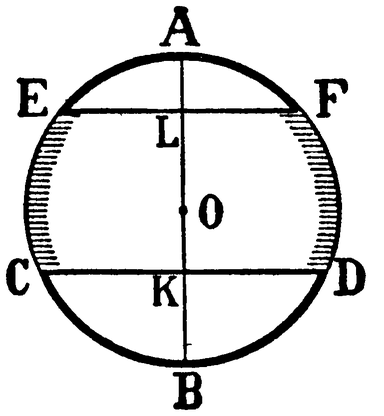
130. Theorems. 1°. A diameter perpendicular to a chord bisects that chord and both the arcs subtended by it.
2°. Arcs contained between parallel chords are equal.
1°. Let the diameter AB (fig. 120) be perpendicular to the chord CD, and let EF ∥ CD; it is required to prove that:
1°. CK = KD, ⌣CB = ⌣BD, ⌣CA = ⌣DA.
2°. ⌣CE = ⌣DF.
Let us fold the figure along the diameter AB so that its left part falls upon the right. Then the left semicircle will coincide with the right semicircle, the perpendicular KC will run along KD and the perpendicular LE will run along LF. From this it follows that the point C, which is the intersection of the semicircle with KC, will fall on D, and the point E, which is the intersection of the semicircle with LE, will fall on F; therefore:
1°. CK = KD; ⌣BC = ⌣BD; ⌣AC = ⌣AD.
2°. ⌣CE = ⌣DF.
Corollaries. 1°. A diameter (AB) drawn through the midpoint of a chord (CD) is perpendicular to that chord and bisects the arc subtended by it.
2°. A diameter (AB) drawn through the midpoint of an arc (CBD) is perpendicular to the chord subtending that arc and bisects it.
Both these propositions (the converses of theorem 1°) are easily proved by contradiction.
Remark. The proof given above convinces us that every diameter of a circle is an axis of symmetry of that circle.
131. Problem. To bisect a given arc (AB, fig. 121).
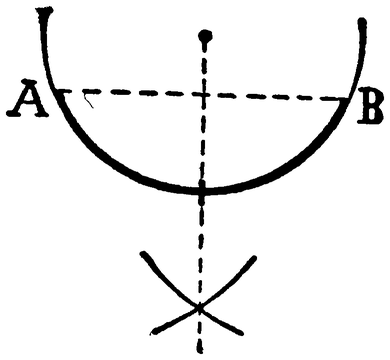
Drawing the chord AB, we drop a perpendicular to it from the centre and extend it to meet the arc. By what was proved in the preceding theorem, the arc AB will be bisected by this perpendicular. But if the centre is not known, a perpendicular must be drawn to the chord AB through its midpoint (§ 69, problem 6).
Chapter 3: Arcs, Chords and the Distances of Chords from the Centre
132. Theorems. In one circle or in equal circles:
1°, if the arcs are equal, the chords subtending them are equal and equally distant from the centre;
2°, if the arcs are unequal and each is less than a semicircle, the greater of them is subtended by the greater chord, and this greater chord is nearer to the centre.
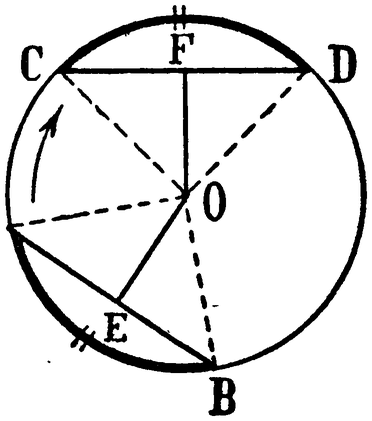
1°. Let the arc AB (fig. 122) be equal to the arc CD; it is required to prove that the chords AB and CD are equal, and also that the perpendiculars OE and OF dropped from the centre to the chords are equal. Let us rotate the sector OAB about the centre O, in the direction shown by the arrow, far enough for the radius OB to coincide with OC. Then the arc BA will run along the arc CD, and, since they are equal, these arcs will coincide. Hence the chord AB will coincide with the chord CD (between two points only one straight line can be drawn) and the perpendicular OE will coincide with OF (from one point only one perpendicular can be dropped to a straight line), that is, AB = CD and OE = OF.
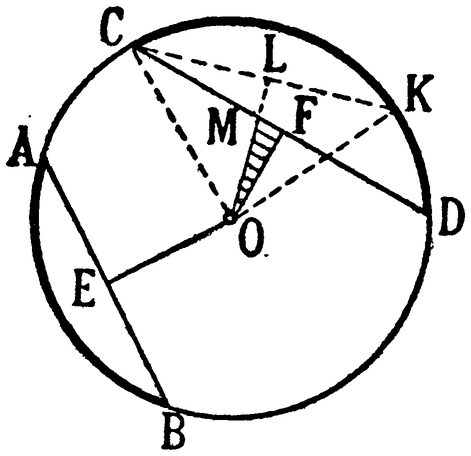
2°. Let the arc AB (fig. 123) be less than the arc CD, and let both arcs be less than a semicircle; it is required to prove that the chord AB is less than the chord CD, and that the perpendicular OE is greater than the perpendicular OF. Let us mark off on the arc CD a part CK equal to AB and draw the auxiliary chord CK, which, by what has been proved, is equal to the chord AB and lies at the same distance from the centre as that chord. In the triangles16 COD and COK two sides of the one are equal to two sides of the other (as radii), while the angles included between these sides are unequal; in this case, as we know (58), the greater side must lie opposite the greater of the angles, that is, opposite COD; hence CD > CK, and therefore CD > AB.
To prove that OE > OF, let us draw OL ⊥ CK and take into account that, by what has been proved, OE = OL; consequently it is enough for us to compare OF with OL. In the right triangle OFM (shaded in the figure) the hypotenuse OM is greater than the leg OF; but OL > OM; hence, all the more, OL > OF, and therefore OE > OF.
The theorem we have proved for one circle remains true for equal circles as well, because such circles differ from each other in nothing but their position.
133. Converse theorems. Since in the preceding section all the possible mutually exclusive cases concerning the comparative magnitude of two arcs of one radius were considered, and mutually exclusive conclusions were obtained concerning the comparative magnitude of the chords and of their distances from the centre, the converse propositions must be true (51), namely:
In one circle or in equal circles:
1°, equal chords subtend equal arcs and are equally distant from the centre;
2°, chords equally distant from the centre are equal and subtend equal arcs;
3°, of two unequal chords the greater subtends the greater arc and is nearer to the centre;
4°, of two chords unequally distant from the centre, the one that is nearer to the centre is the greater and subtends the greater arc.
These propositions are easily proved by contradiction. To prove the first of them, for example, we reason thus: if the given chords subtended unequal arcs, then, according to the direct theorem, they would be unequal, which contradicts the hypothesis; hence equal chords must subtend equal arcs, and if the arcs are equal, then, according to the direct theorem, the chords subtending them are equally distant from the centre.
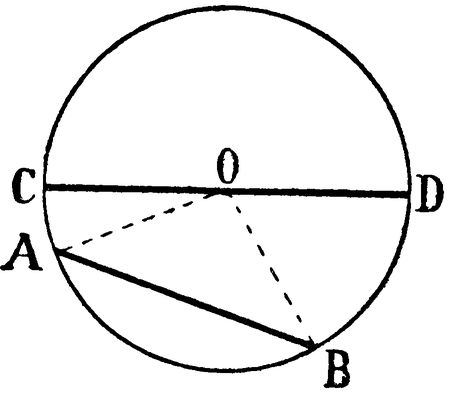
134. Theorem. A diameter is the greatest of the chords.
If we join to the centre O the ends of any chord that does not pass through the centre, for example the chord AB (fig. 124), we obtain a triangle AOB in which one side is this chord and the other two are radii. But in a triangle each side is less than the sum of the other two sides; consequently the chord AB is less than the sum of two radii, whereas every diameter CD is equal to the sum of two radii. Hence a diameter is greater than every chord that does not pass through the centre. But since a diameter is also a chord, we may say that a diameter is the greatest of the chords.
Chapter 4: Properties of the Tangent
135. The relative position of a straight line and a circle. We have seen (120) that a straight line and a circle cannot have more than 2 points in common. Let us now see under what conditions a straight line and a circle can have 2 points in common, 1 point in common, and no point in common. We consider the following 3 cases:
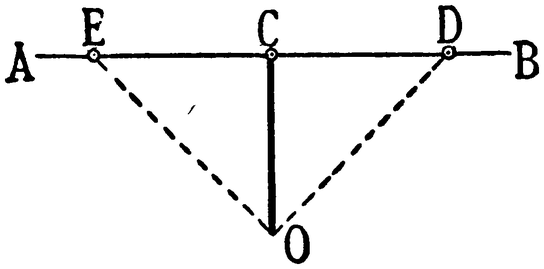
1°. The distance (OC, fig. 125) of the centre (O) of the circle from the straight line (AB) is greater than the radius of the circle. Then the point C of the line AB is farther from the centre O than the length of the radius, and therefore lies outside the circle. All the other points of the line AB are still farther from O than the point C (59); hence all the points of the line AB lie outside the circle, and therefore this line has no points in common with the circle.
2°. The distance (OC, fig. 125) of the centre (O) of the circle from the straight line (AB) is less than the radius of the circle. In this case the point C lies inside the circle. But on the line AB, on both sides of the point C, we can find points D and E which are farther from O than the length of the radius17, and which consequently lie outside the circle. But then each of the two segments CD and CE, since it joins an interior point to an exterior one, must intersect the circle. Consequently, in this case the straight line has 2 points in common with the circle.
3°. The distance (OC, fig. 125) of the centre (O) from the straight line (AB) is equal to the radius. Then the point C belongs both to the line and to the circle; all the other points of the line are farther from O than the point C (59), and therefore lie outside the circle. Hence in this case the straight line and the circle have only one point in common, namely the point C.
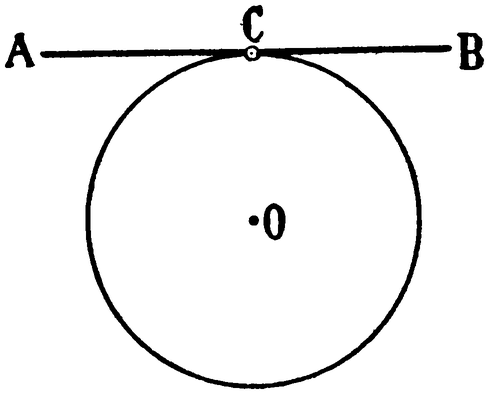
136. Definition. A straight line (AB, fig. 126) that has only one point (C) in common with a circle is called a tangent to the circle; the common point is called in this case the point of tangency.
137. Theorems. 1°. If a straight line is perpendicular to a radius at its end lying on the circle, it is a tangent.
2° (converse). If a straight line is tangent to a circle, the radius drawn to the point of tangency is perpendicular to it.
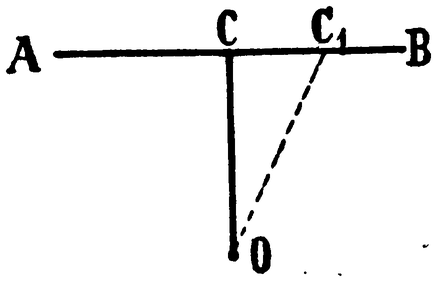
1°. Let O (fig. 127) be the centre of a circle, OC any one of its radii, and AB a straight line perpendicular to OC and passing through C; it is required to prove that this line is a tangent. The distance of the line AB from the centre O is equal to the perpendicular OC; but, by hypothesis, OC is a radius; hence the distance of the line AB from the centre O is equal to the radius; and in this case, as we have seen (135), the line has only one point in common with the circle; consequently AB is a tangent.
2°. Let AB (fig. 127) be a tangent and OC the radius drawn to the point of tangency; it is required to prove that OC ⊥ AB. Suppose the contrary, that is, that the radius OC is not perpendicular to AB but is an oblique to this line. In that case some other straight line, for example , will be the perpendicular dropped from the centre O to the tangent AB (32). Since the perpendicular is shorter than an oblique (59), < OC; hence the distance of the line AB from the centre O, being equal to the perpendicular , will then be less than the radius; and in this case, as we have seen (135), the line must have 2 points in common with the circle, and not one, as the given tangent AB has. Consequently, we cannot admit that the radius OC is not perpendicular to AB; hence OC ⊥ AB.
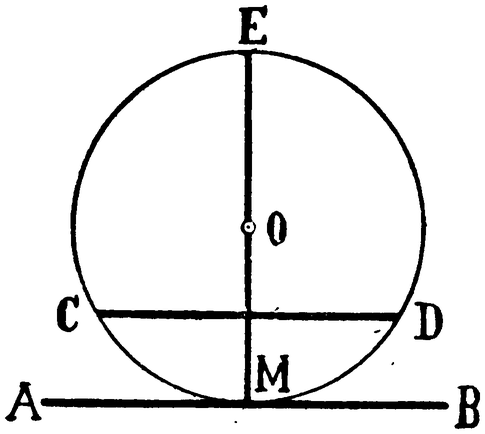
138. Theorems. 1°. If a tangent is parallel to a chord, it bisects at the point of tangency the arc subtended by the chord.
Let the straight line AB (fig. 128) touch the circle at the point M and be parallel to the chord CD; it is required to prove that
⌣CM = ⌣MD.
Drawing the diameter EM through the point of tangency, we have: EM ⊥ AB (137, 2°) and consequently EM ⊥ CD (82); therefore ⌣CM = ⌣MD (130, 1°).
2° (Converse). If a tangent (AB) passes through the midpoint of an arc (CD), it is parallel to the chord subtending that arc.
Indeed, this tangent is perpendicular to the diameter (EM) drawn through the midpoint of the arc, and such a diameter is perpendicular to the chord (130, corollary 2°); but two perpendiculars to one and the same straight line must be parallel.
139. Problem. To draw through a given point a tangent to a given circle.
If the given point (for example, the point M, fig. 128) lies on the circle, we draw the radius through it and, through the end of the radius, a straight line perpendicular to it. This line is the required tangent (137, 1°). No other tangent can be drawn through the same point of the circle, since a tangent must be perpendicular to the radius at its end lying on the circle, and two different perpendiculars to one and the same radius cannot be drawn through one and the same point.
Let us now consider the case in which the point is given outside the circle.
Let it be required (fig. 129) to draw through the point A a tangent to the circle with centre O. To do this, from the point A as centre we describe an arc with the radius AO, and from the point O as centre we cut this arc at the points B and C with an opening of the compass equal to the diameter of the given circle. Then, having drawn the chords OB and OC, we join the point A to the points D and E in which these chords intersect the given circle. The straight lines AD and AE are tangents to the circle O. Indeed, the construction shows that the triangles AOB and AOC are isosceles (AO = AB = AC), with the bases OB and OC equal to the diameter of the circle O. Since OD and OE are radii, and a radius is equal to half the diameter, D is the midpoint of OB and E the midpoint of OC; hence the lines AD and AE are medians drawn to the bases of isosceles triangles, and are therefore perpendicular to those bases (39). But if the lines AD and AE are perpendicular to the radii OD and OE at their ends lying on the circle, they are tangents.
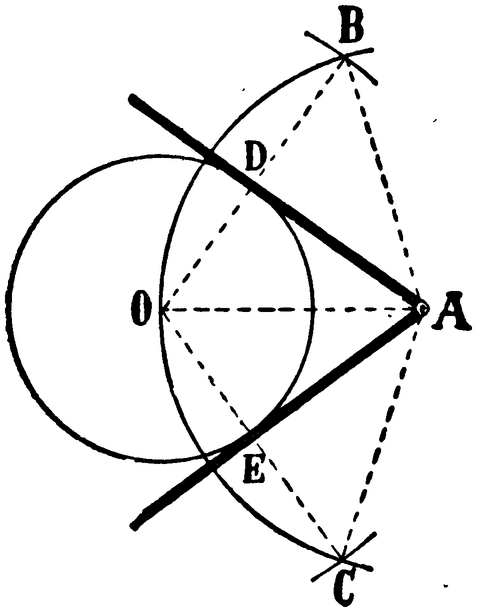
Remark. It is evident that if the given point lies inside the circle, no tangent can be drawn through it.
140. Corollary. Two tangents drawn to a circle from one point are equal and form equal angles with the straight line joining that point to the centre.
Thus AD = AE and ∠OAD = ∠OAE (fig. 129), because the right triangles AOD and AOE, which have the common hypotenuse AO and the equal legs OD and OE (as radii), are equal.
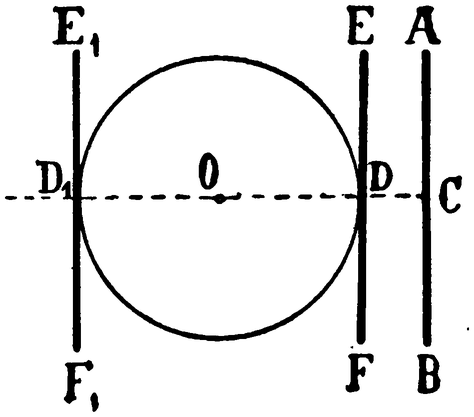
It goes without saying that the word "tangent" here means, properly, "the segment of the tangent" from the given point to the point of tangency.
141. Problem. To draw a tangent to a given circle parallel to a given straight line AB (fig. 130).
Through the centre O we draw MC ⊥ AB, and through the points D and , in which this perpendicular intersects the circle, we draw EF ∥ AB and ∥ AB. The required tangents are EF and . Indeed, since MC ⊥ AB and EF ∥ AB, and likewise ∥ AB, we have EF ⊥ OD and ⊥ ; and a straight line perpendicular to a radius at its end lying on the circle is a tangent.
142. Problem. To draw a common tangent to two circles (fig. 131).
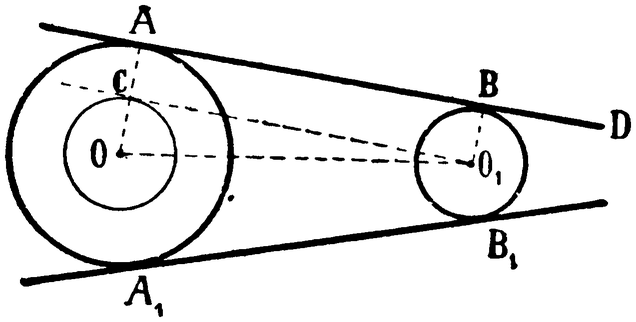
1°. Analysis. Suppose the problem solved. Let AB be a common tangent, and A and B the points of tangency. It is evident that if we find one of these points, for example A, we shall then easily find the other. Let us draw the radii OA and . These radii, being perpendicular to the common tangent, are parallel to each other; therefore, if from we draw ∥ BA, the triangle will be right-angled at the vertex C; in consequence, if from O as centre we describe a circle with the radius OC, it will touch the line at the point C. The radius of this auxiliary circle is known: it is equal to , that is, it is equal to the difference of the radii of the given circles.
Construction. Let us denote the radius of the greater circle by R and the radius of the smaller by r. From the centre O we describe a circle with a radius equal to R − r; from we draw to this circle the tangent (by the method shown in the preceding problem of § 139)18; through the point of tangency C we draw the radius OC and extend it until it meets the given circle at the point A. Finally, from A we draw AD parallel to .
Proof (synthesis). Since is, by construction, the tangent at the point C to the circle of radius OC, we have ⊥ OC, and hence ⊥ OA. Since AD ∥ , we also have AD ⊥ OA, and therefore AD is a tangent to the given circle with centre O (137). It remains to prove that the line AD touches the other given circle as well. For this purpose we draw from the centre the line ⊥ AD. The lines and CA, being perpendicular to AD, must be parallel; on the other hand, AD ∥ ; consequently the figure is a parallelogram; therefore ; but OC = R − r; consequently . Hence the point B belongs to the given circle with centre , and the line is a radius of that circle. Thus the line AD is perpendicular to the radius at its end lying on the circle, and such a line is a tangent.
In exactly the same way we can construct the other common tangent (fig. 131). The lines AB and are called the external common tangents.
Two internal tangents can also be drawn, in the following way.
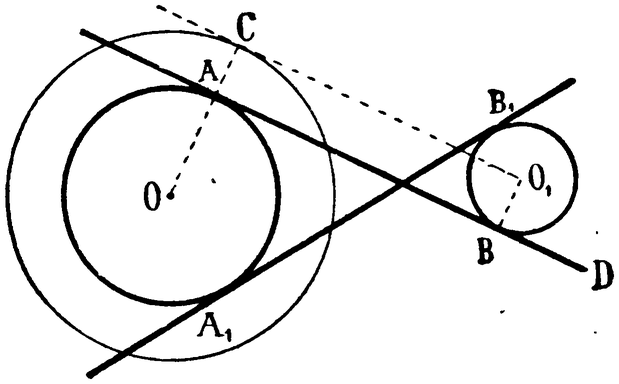
2°. Analysis. Suppose the problem solved (fig. 132). Let AB be the required tangent. Let us draw the radii OA and to the points of tangency A and B. These radii, being both perpendicular to the common tangent, are parallel to each other. Therefore, if from we draw ∥ BA and extend OA to the point C, then OC will be perpendicular to ; in consequence, the circle described with the radius OC from the point O as centre will touch the line at the point C. The radius of this auxiliary circle is known: it is equal to , that is, it is equal to the sum of the radii of the given circles.
Construction. From O as centre we describe a circle with a radius equal to the sum ; from we draw to this circle the tangent 19; we join the point of tangency C to O; finally, through the point A, in which OC intersects the given circle, we draw AD ∥ .
The proof (synthesis) remains the same as in case 1°.
In a similar way the other internal tangent can be constructed.
Remark. Common tangents cannot be drawn to every pair of circles; for example, if one circle lies inside the other without having a single point in common with it, it is evident that neither external nor internal common tangents can be drawn to such circles; or, if the circles intersect, it is evident that no internal common tangents can be drawn to them.
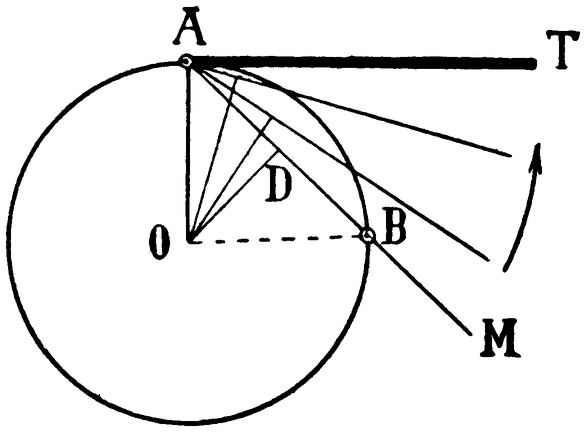
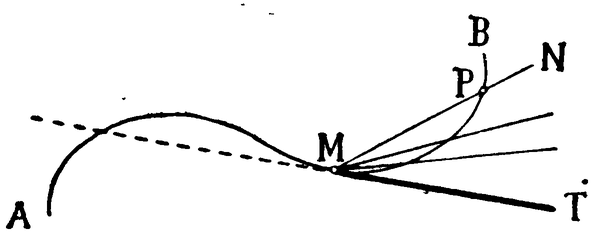
143. The general definition of a tangent. Let a tangent AT and some secant AM be drawn through the point A to the circle with centre O (fig. 133). Let us rotate this secant about the point A so that the other point of intersection B moves nearer and nearer to A. Then the perpendicular OD, dropped from the centre to the secant, will approach nearer and nearer to the radius OA, and the angle AOD, which is equal to half the angle AOB, can become less than any small angle whatever. The angle MAT, formed by the secant and the tangent, is equal to the angle AOD (because their sides are perpendicular); therefore, as the point B approaches A indefinitely, the angle MAT can also be made as small as we please. This is expressed in other words thus: the tangent is the limiting position toward which a secant drawn through the point of tangency tends when the second point of intersection approaches the point of tangency indefinitely.
This property is taken as the definition of a tangent when any curve whatever is in question. Thus the tangent to a curve AB (fig. 134) at a point M is the limiting position MT toward which the secant MN tends when the point of intersection P approaches M indefinitely.
A tangent defined in this way may have more than one point in common with the curve (as is seen in fig. 134).
Chapter 5: The Relative Position of Two Circles
144. Definition. If two circles have only one point in common, they are said to touch; if two circles have two points in common, they are said to intersect.
Two circles that do not merge cannot have three points in common, because otherwise two different circles could be drawn through three points, which is impossible (122).
We shall call the straight line passing through the centres of two circles the line of centres (for example, the line , fig. 135).
145. Theorem. If two circles have a common point on one side of the line of centres, they have a common point on the other side of that line as well, that is, such circles intersect.
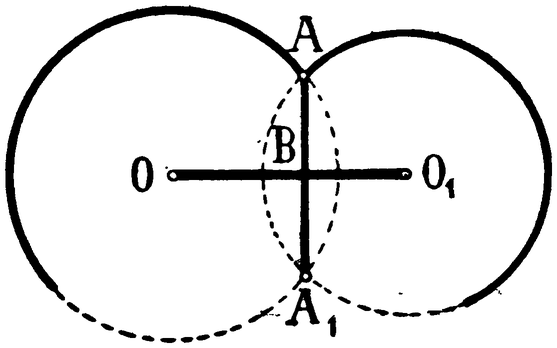
Let two circles (fig. 135) have a common point A lying off the line of centres ; it is required to prove that these circles have another common point on the other side of the line .
Let us drop the perpendicular AB from A to the line and extend it by a distance equal to AB. We shall now prove that the point belongs to both circles.
The construction shows that the points O and lie on the perpendicular to the segment through its midpoint. From this it follows that the point O is equally distant from A and (63, 2°); the same can be said of the point ; hence both circles, when continued, will pass through . Thus the circles have two points in common: the point A (by hypothesis) and the point (by what has been proved); consequently they intersect.
146. Corollary. The common chord (, fig. 135) of two intersecting circles is perpendicular to the line of centres and is bisected by it.
147. Theorem. If two circles have a common point on their line of centres, they touch.
Let the common point A of two circles lie on the line of centres (figs. 136 and 137). It is required to prove that such circles touch, that is, that they have no other point in common. The circles cannot have another common point off the line of centres, because otherwise they would have yet a third common point on the other side of the line of centres (145) and consequently would have to merge (122). Nor can they have another common point on the line of centres, since on that line there is evidently no other point which is as far from both centres as the point A is. Consequently the circles have only one point in common, that is, they touch.
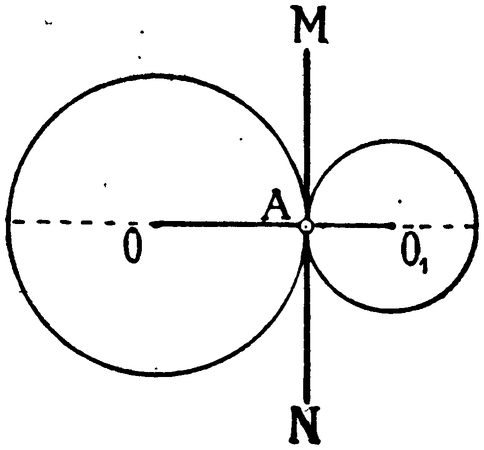
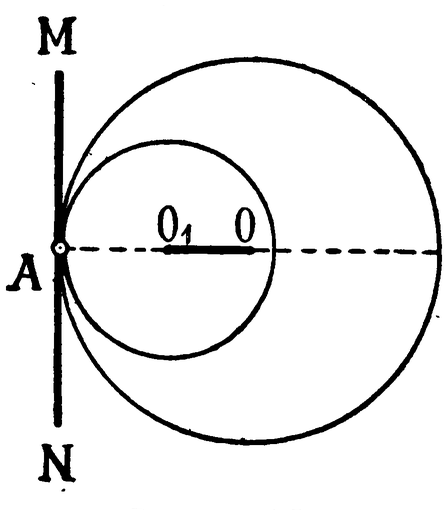
148. Remark. The tangency of two circles is called external if they lie one outside the other (fig. 136), and internal if one of the circles lies inside the other (fig. 137).
149. Theorem (the converse of the preceding). If two circles touch, the point of tangency lies on the line of centres.
Let two circles (figs. 136 and 137) touch at the point A, that is, have only the one point A in common; it is required to prove that this point lies on the line of centres. The point A cannot lie off the line of centres, because otherwise the circles would have another common point as well, which contradicts the hypothesis of the theorem.
150. Corollary. Two circles that touch have a common tangent at the point of tangency,20 because if we draw through the point of tangency a straight line MN (figs. 136 and 137) perpendicular to the radius OA, this line will also be perpendicular to the radius .
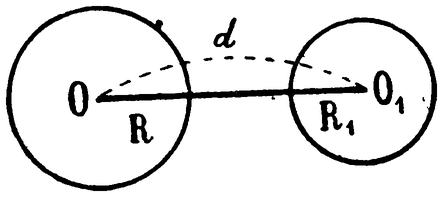
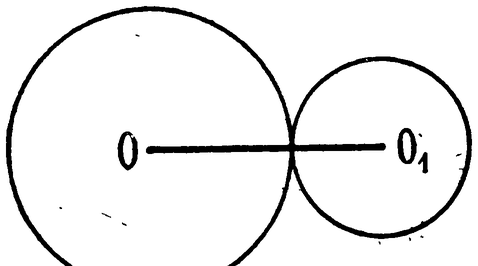
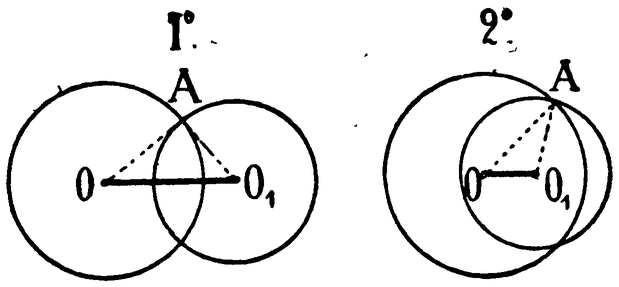
151. The different cases of the relative position of two circles. Let us denote the radii of two circles by the letters R and and the distance between their centres by the letter d. Let us consider what relation holds between these magnitudes in the different cases of the relative position of two circles. The following 5 cases can be pointed out:
1°. The circles lie one outside the other without touching (fig. 138); in this case, evidently, .
2°. The circles have external tangency (fig. 139); then , since the point of tangency lies on the line of centres.
3°. The circles intersect (fig. 140, 1° and 2°); then and at the same time , because in the triangle the side , which is equal to d, is less than the sum but greater than the difference of the other two sides, which are equal to the radii R and .
4°. The circles have internal tangency (fig. 141); in this case , because the point of tangency lies on the line of centres.
Finally, 5°, one circle lies inside the other without touching (fig. 142); then, evidently, , and in the particular case in which the centres of the two circles merge, (such circles are called concentric).
152. The converse propositions. Since the cases we have considered of the position of two circles are such that each of them excludes all the rest, and since these cases are accompanied by relations between the distance of the centres and the size of the radii which likewise mutually exclude one another, the converse propositions must be true (51), namely:
1°. If , the circles lie one outside the other without touching.
2°. If , the circles touch externally.
3°. If and at the same time , the circles intersect.
4°. If , the circles touch internally.
5°. If , one circle lies inside the other without touching.
All these propositions are easily proved by contradiction.
Exercises
Find the Loci
101. Find the locus of the points from which the tangents drawn to a given circle are equal to a given length.
102. Find the locus of the points from which a given circle is seen at a given angle (that is, the two tangents drawn to the circle from each such point make a given angle with each other).
103. Find the locus of the centres of the circles described with a given radius and touching a given straight line.
104. Find the locus of the centres of the circles touching a given circle at a given point.
105. Find the locus of the centres of the circles described with a given radius and touching a given circle (two cases: external tangency and internal tangency).
106. A straight line of given length moves parallel to itself in such a way that one of its ends slides along a circle. Find the locus described by the other end.
107. A straight line of given length moves in such a way that its ends slide along the sides of a right angle. Find the locus described by the midpoint of this line.
Prove the Theorems
107,a. In a circle with centre O a chord AB is drawn and extended by a distance BC equal to the radius. Through the point C and the centre O a secant CD is drawn (D being the second point of intersection with the circle). Prove that the angle AOD is equal to three times the angle ACD.
108. If we draw a secant through the centre of a circle and a given point outside it, the part of it contained between the given point and the nearer point of intersection is the least distance, and the part contained between the given point and the other point of intersection is the greatest distance, of this point from the circle.
109. The shortest distance between two circles lying one outside the other is the segment of the line of centres contained between the circles.
110. Of all the chords drawn in a circle through one point, the least is the one that is perpendicular to the radius passing through that point.
111. If through a point of intersection of two circles we draw secants, not extending them beyond the circles, the greatest of them is the one that is parallel to the line of centres.
112. If three common tangents are drawn to two circles that touch externally, the internal one divides the other two at points equally distant from the points of tangency.
113. All the chords of a given length drawn in a given circle touch a certain other circle.
114. If through one of the points of intersection of two circles we draw a diameter in each circle, the straight line joining the ends of these diameters will pass through the other point of intersection.
114,a. Through a point A of a circle a chord AB is drawn, and then the tangent at the point B; the diameter perpendicular to the radius OA meets the tangent and the chord at the points C and D respectively. Prove that BC = CD.
114,b. To two circles with centres O and , which touch externally at the point A, a common external tangent BC is drawn (B and C being the points of tangency); prove that the angle BAC is a right angle.
Construction Problems
115. Divide a given arc into 4, 8, 16 ... equal parts.
116. Given the sum and the difference of two arcs, find the arcs.
117. From a given point as centre, describe a circle that bisects a given circle.
118. On a given straight line find the point least distant from a given circle.
119. A chord is given in a circle. Draw another chord that is bisected by the first and makes a given angle with it.
120. Through a point given in a circle draw the chord that is bisected by this point.
121. From a point given on a side of an angle, describe a circle that cuts off on the other side of the angle a chord of given length.
122. With a given radius describe a circle whose centre lies on a side of a given angle and which cuts off on the other side of it a chord of given length.
123. With a given radius describe a circle that touches a given straight line at a given point.
124. Describe a circle tangent to the sides of a given angle, and tangent to one of them at a given point.
125. Describe a circle touching the three sides of a triangle.
126. A point is given between two parallel straight lines; draw a circle passing through this point and touching the given lines.
127. Draw a tangent to a given circle at a given angle to a given straight line.
128. From a point given outside a circle, draw a secant to it such that its interior part is equal to a given length (discuss the problem).
129. With a given radius describe a circle passing through a given point and tangent to a given straight line.
130. On a given straight line find a point such that the tangents drawn from it to a given circle are of a given length.
131. Construct a △, given one angle and two altitudes, one of which is drawn from the vertex of the given angle.
132. Two circles are given; draw a secant to them such that its interior parts are equal to given straight lines.
133. Two points are given; draw a straight line such that the perpendiculars dropped to it from these points have given lengths.
134. Describe a circle that passes through a given point and touches a given circle at a given point.
135. Describe a circle that touches two given parallel straight lines and a circle lying between them.
136. With a given radius describe a circle that touches a given circle and passes through a given point.
137. With a given radius describe a circle that touches a given straight line and a given circle.
138. With a given radius describe a circle that cuts off chords of given length on the sides of a given angle.
139. Describe a circle touching a given circle at a given point and touching a given straight line (2 solutions).
140. Describe a circle touching a given straight line at a given point and touching a given circle (2 solutions).
141. Describe a circle touching two given circles, one of them at a given point (considering three cases: 1, the required circle lies outside the given ones; 2, one of the given circles lies outside the required one, the other inside; 3, both given circles lie inside the required one).
142. Describe a circle touching three equal circles externally or internally.
143. In a given sector inscribe a circle touching the radii that bound the sector and the arc of the sector.
144. Inscribe in a given circle three equal circles that touch one another in pairs and touch the given circle.
145. Through a point inside a circle draw a chord such that the difference of its segments is equal to a given length.
146. Through a point of intersection of two circles draw a secant such that the part of it contained inside the circles is equal to a given length.
147. From a point given outside a circle draw a secant such that its exterior part is equal to its interior part.
Chapter 6: The Measurement of Magnitudes
153. Common measure. A common measure of two given segments is a third segment that is contained in each of the given ones a whole number of times without remainder. Thus if (fig. 143) the segment AM is contained in AB and in CD a whole number of times (for example, 5 times in AB and 3 times in CD), then AM is a common measure of AB and CD.
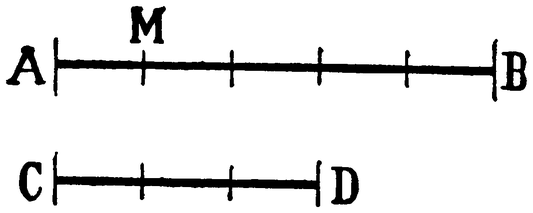
In the same way there can be a common measure of two arcs of the same radius, of two angles, and in general of two values of one and the same magnitude.
154. Finding the greatest common measure. To find the greatest common measure of two segments we use the method of successive laying off, which resembles the successive division by which the greatest common divisor of two whole numbers is found in arithmetic. This method rests on the following propositions:
1°. If the smaller of two given segments (A and B, fig. 144) is contained in the greater a whole number of times without remainder, then the greatest common measure of these segments is the smaller of them.
Suppose, for example, that B is contained in A exactly 3 times. Since B is then, of course, contained in B exactly once, B is a common measure of the segments A and B; on the other hand, this measure is also the greatest, since no segment greater than B can be contained in B without remainder.
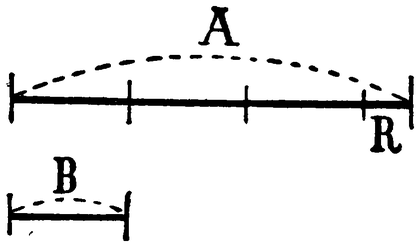
2°. If the smaller of two given segments (B, fig. 145) is contained in the greater (in A) a whole number of times with some remainder (R), then the greatest common measure of these segments must at the same time be the greatest common measure of the smaller segment (B) and the remainder (R).
Suppose, for example, that A = B + B + B + R.
From this equality we can draw the following two conclusions:
1) Every segment that is contained a whole number of times without remainder in B and in R is also contained without remainder in A; if, for example, some segment is contained in B exactly 5 times and in R exactly 2 times, then in A it is contained 5 + 5 + 5 + 2, that is, 17 times without remainder.
2) Conversely, every segment that is contained a whole number of times without remainder in A and in B is also contained a whole number of times without remainder in R; if, for example, some segment is contained in A exactly 17 times and in B exactly 5 times, then in that part of the segment A which is equal to 3B it is contained 15 times; consequently, in the remaining part of the segment A, that is, in R, it is contained 17 − 15, that is, 2 times.
Thus the two pairs of segments:
A and B B and R
must have the same common measures; therefore their greatest common measure must also be one and the same.
To these two propositions we must add the following axiom of Archimedes (the axiom of measurement):
3) However great the greater segment (A) may be and however small the smaller segment (B), by laying off the smaller on the greater successively 1, 2, 3 and so on times, we shall always reach a point where, after some m*-th laying off, either no remainder is left or a remainder is left that is smaller than the smaller segment* (B).
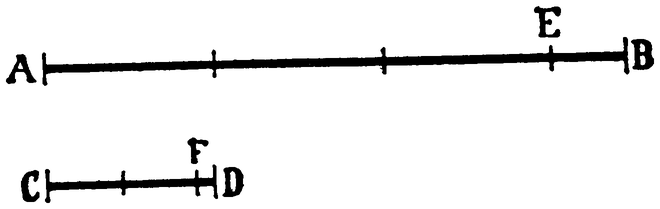
Let us apply these propositions to finding the greatest common measure of the given segments AB and CD (fig. 146). To do this we lay off the smaller segment on the greater (with the compass) as many times as possible. If CD goes into AB without remainder, then by the 1st proposition the measure sought is CD itself; if this does not happen (as in our figure), then by the 2nd proposition the question is reduced to finding the greatest common measure of two smaller segments, namely CD and the first remainder EB. To find it we proceed as before, that is, we lay off EB on CD as many times as possible. If EB goes into CD without remainder, the measure sought is EB; if this does not happen (as in our figure), the question is reduced to finding the greatest common measure of two smaller segments, namely EB and the second remainder FD. If, continuing this process further, we reach a point where after some laying off no remainder is left, then the segment that was being laid off (the last of the remainders) is the measure sought.
To compute more conveniently how many times the greatest common measure found is contained in the given lines, we write out the series of equalities obtained after each laying off. Thus for our figure we have:
| After the 1st laying off | AB = 3 CD + EB |
| After the 2nd laying off | CD = 2 EB + FD |
| After the 3rd laying off | EB = 4 FD. |
Passing in these equalities from the lowest to the highest, we find in succession:
EB = 4 FD; CD = (4 FD) · 2 + FD = 9 FD;
AB = (9 FD) · 3 + 4 FD = 31 FD.
In the same way one can find the greatest common measure of two arcs of the same radius, of two angles, and so on.
Remark. Having found the greatest common measure, we can then obtain as many other, smaller common measures as we please; we need only take , , and so on of the greatest measure.
155. Commensurable and incommensurable lengths. It may happen that in seeking a common measure we never reach a point where no remainder is left; the given lines will then have no common measure.
Two segments are called commensurable if they have a common measure, and incommensurable when no such measure exists.
In practice there is no way of making sure that incommensurable segments exist, because in continuing the successive laying off we always reach a remainder so small that it goes into the preceding remainder, to all appearance, a whole number of times. Perhaps some remainder ought to have been left here, but because of the inexactness of our instruments (the compass) and the imperfection of our organs of sense (sight) we are not able to notice it. It can be proved, however, that incommensurable segments exist. We give the simplest example of such segments.
156. Theorem. If in an isosceles triangle the angle at the base is equal to , then its lateral side is incommensurable with the base.
Let ABC be an isosceles triangle (fig. 147) in which each of the angles A and C is equal to ; it is required to prove that the lateral side AB is incommensurable with the base AC.
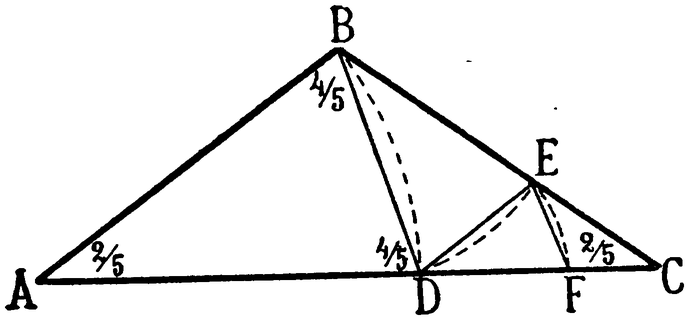
First of all let us determine which of these sides is the greater. For this it is enough to compare the angles that lie opposite these sides. Since, by hypothesis, , we have ; consequently B > C, and therefore AC > AB. Now let us find how many times AB can go into AC. Since AC < AB + BC and AB = BC, we have AC < 2AB; hence AB can go into AC only once, with some remainder.
Thus we notice first of all the following property: if in an isosceles triangle the angle at the base is equal to , then its lateral side is contained in the base only once, and with some remainder.
Having noticed this, let us now proceed to the successive laying off. On AC we lay off a part AD equal to AB; we then obtain a remainder DC, which must be laid upon AB or, what is the same thing, upon BC. To learn how many times DC goes into BC, we join B to D and consider △DBC. Let us find its angles. Since △ABD is isosceles, its angles ABD and ADB are equal; consequently each of them is equal to . But the angle ABC, as we found before, is equal to ; consequently . Thus in the triangle DBC there are two equal angles at BC; consequently it is isosceles, and each angle at its base BC is equal to . It follows, by what was proved above, that its lateral side DC (or BD) goes into the base BC once, with some remainder. Let this remainder be EC. Joining E to D, we again obtain an isosceles triangle CDE in which each angle at the base CD is equal to . Laying off EC (or DE) on DC (from the point D), we again obtain an isosceles triangle CEF in which each angle at the base CE is equal to .
Thus we shall continually arrive at an isosceles triangle (smaller and smaller) with angles at the base equal to ; consequently we shall never in this process come to an end. Hence the sides AC and AB cannot have a common measure.
157. We give one more example of incommensurable segments.
Theorem. The diagonal of a square is incommensurable with its side.
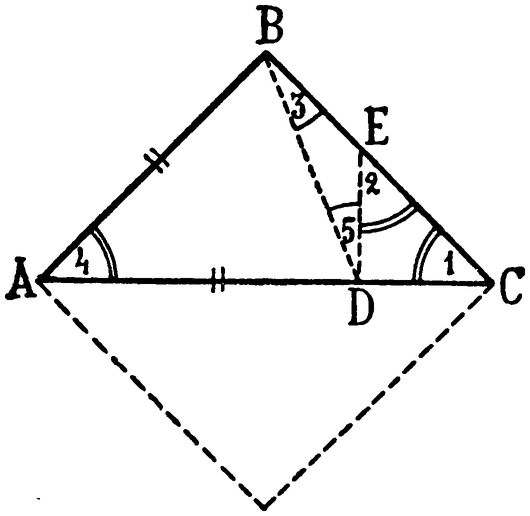
Since the diagonal of a square divides it into two isosceles right triangles, this theorem can be stated in other words thus: the hypotenuse of an isosceles right triangle is incommensurable with its leg.
Let us first prove the following property of such a triangle: if on the hypotenuse (fig. 148) we lay off a part AD equal to the leg and draw DE ⊥ AC, then the right triangle DEC so formed is isosceles, and the segment BE of the leg BC turns out to be equal to the segment DC of the hypotenuse. To verify this, let us draw the line BD and consider the angles of the triangles DEC and BED. Since the triangle ABC is isosceles and right-angled, ; as a result is also equal to ; hence , and therefore . In the triangle BED the angle 3 is equal to the difference ; but and ; consequently . In the same way, . Consequently , and therefore BE = DE; but DE = CD; hence BE = CD.
Having noticed this property, let us seek the greatest common measure of the sides AC and AB. Since AC < AB + BC, that is, AC < 2AB, the side AB can be laid off on AC only once, and some remainder DC < AB is left. Now this remainder must be laid off on AB or, what is the same thing, on BC. For this we draw DE ⊥ AC. Then, by what has been proved, BE = DC, and consequently the remainder DC has been laid off once on the leg BC. It now remains to lay off DC from the point E toward C as many times as possible. But the right triangle DEC, as we have seen, is isosceles; hence the process of finding a common measure of the hypotenuse AC and the leg AB of the given isosceles triangle now passes into the process of finding a common measure of the hypotenuse EC and the leg DC of another (smaller) isosceles triangle. This process in its turn will likewise be reduced to finding a common measure of the hypotenuse and the leg of a third (still smaller) isosceles triangle, and so on without end. Hence the diagonal of a square and its side cannot have a common measure.
158. The idea of measurement. To form a clear idea of a given length, we measure it by means of another length that is known to us, for example by means of the metre. This known length, with which we compare other lengths, is called the unit of length.
In measuring, two different cases may arise: the length to be measured is either commensurable with the unit or incommensurable with it.
1°. To measure a length commensurable with the unit means to find out how many times the unit, or some part of the unit, is contained in it.
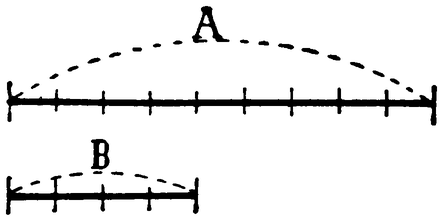
Suppose, for example, that it is required to measure (fig. 149) the length of a segment A by means of a unit B that is commensurable with A. We then find their common measure and learn how many times it is contained in B and in A. If the common measure turns out to be the unit B itself, the result of the measurement is expressed by a whole number; thus, when B is contained in A three times, the length of A is equal to 3 units. If the common measure is some part of B, the result of the measurement is expressed by a fractional number; thus, if the common measure is of B and it is contained in A nine times (as shown in fig. 149), the length of A is equal to of the unit.
The number obtained by measuring the length A is called the measure of this length; it is customary to say of it that it measures the length A in the unit B. Whole numbers and fractions are called commensurable (or rational) numbers.
2°. When the length A to be measured is incommensurable with the unit of length B, we cannot obtain an exact result of the measurement by means of commensurable numbers. Indeed, if we suppose that we have found an exact measure of the length A, for example that we have found , this would mean that of B is contained in A exactly m times; that part would then be a common measure of A and B, whereas we are considering the case in which these lengths are incommensurable.
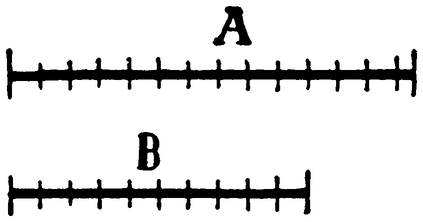
In this case, by means of commensurable numbers, we can find only approximate results of the measurement, but with any degree of accuracy we please. Suppose, for example, that we wish to find an approximate measure of the length A to within . This means that we wish to find a number that measures some commensurable length differing from the given incommensurable length A by less than of the unit B. To do this we divide the unit B into 10 equal parts and lay one such part on A as many times as possible. Suppose it turns out that B is contained in A 13 times (fig. 150), and that a remainder smaller than B is left. Then each of the numbers and can be taken as an approximate measure of the length A, the first number being an approximation by defect (since B < A) and the second by excess (since B > A).
In general, to find the approximate measures of the length A to within of the unit, we divide the unit B into n equal parts and find out how many times of the unit is contained in A; if it is contained more than m times but less than m + 1 times21, then
are the approximate measures of the length A to within , the first by defect, the second by excess.
Let us notice that in this way we can find approximate results of a measurement even when the length A to be measured is commensurable with the unit B; only in that case we can, if we wish, find the exact result as well, whereas in the case of incommensurability we cannot obtain such a result by means of commensurable numbers alone.
For the exact measure of an incommensurable length A we take a certain incommensurable number, which is counted greater than every commensurable number expressing an approximate measure of the length A by defect, and smaller than every commensurable number expressing an approximate measure of the length A by excess.
What has been said about measuring the length of a line applies to the measurement of every other magnitude, for example an arc, an angle and so on.
159. Ratio. The ratio of one segment (A) to another segment (B) is the number that measures the first segment (A) when the second (B) is taken as the unit.
Thus, if the ratio of A to B is the number , this means that the number measures the segment A when the segment B is taken as the unit (in other words, it means that B is contained in A 2 times, with a remainder equal to B).
We can also say that the ratio of one segment to another is the number by which the second segment must be multiplied to obtain the first.
Thus, if the ratio of A to B is the number , this means that A = B · , that is, that A is obtained if we take B as a term 2 times and add to the sum a further B.
If we are considering the ratio of the segment A to the segment B, then A is called the antecedent term and B the consequent term.
It follows from the definition that finding the ratio of the segments A and B comes down to measuring A when the segment B is taken as the unit. We can therefore repeat here everything that we said earlier (158) about measurement, namely:
If the segments A and B are commensurable, their ratio is a commensurable number, whole or fractional; if these segments are incommensurable, their ratio can be expressed by means of commensurable numbers only approximately, but with any degree of accuracy we please. Thus, if we wish to find the ratio of A to B to within , we divide B into 10 equal parts (fig. 150) and find the greatest number of times that B is contained in A; if it turns out, for example, that B is contained in A more than 13 but less than 14 times, then the numbers and are approximate values of the ratio of A to B to within , the first by defect and the second by excess.
The ratio of the segment A to the segment B, in the case when these segments are incommensurable, is also called incommensurable (since it is an incommensurable number).
Two ratios are counted equal if they are one and the same number; thus, if the ratio of A to B is equal to and the ratio of to is also equal to , these ratios are equal to each other.
In the case of incommensurable ratios, their equality is recognized by the following test.
Two incommensurable ratios are equal if their approximate values, both taken by defect or both by excess and computed with the same accuracy, are equal to each other at every degree of accuracy22.
What has been said about the ratio of two segments can be repeated of the ratio of two angles, of two arcs of the same radius, and in general of the ratio of two particular values of any magnitude that admits of measurement.
Let us recall that the equality of 2 ratios is called a proportion.
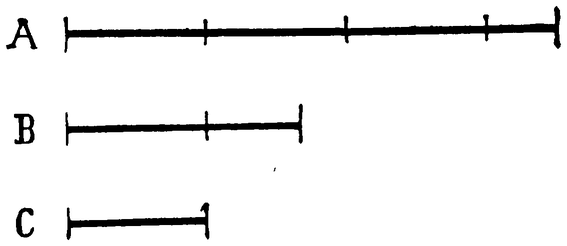
1601. A property of ratios. If the segments A and B (fig. 151) are measured by means of one and the same unit C, then the ratio of A to B is equal to the quotient of the number that measures A divided by the number that measures B. Suppose, for example, that measuring the segment A with the unit C has given the number , and measuring B with the same unit C has given the number . Then by the definition of a ratio we can write:
To find the ratio of A to B now, it is enough to learn by what number C must be multiplied to obtain C, or, what is the same thing, by what number (of some unit) must be multiplied to obtain (of the same unit). Such a number is found by division (according to the definition of that operation); hence:
In general, if, on measuring the segments A and B by means of one and the same unit C, we obtain the number m for A and the number n for B, then, repeating the preceding reasoning, we find (whatever the numbers m and n may be):
ratio of A to B = m : n.
For this reason it is customary to denote the ratio of A to B by means of the signs of division, namely thus:
Here, according to the property of a ratio stated above, the letters A and B may also be understood to stand for the numbers that measure the segments A and B in some one and the same unit C.
1602. Proportion. The equality of two ratios constitutes a proportion. If, for example, it is known that the ratio of two segments A and B is equal to the ratio of two other segments and , we can write the proportion:
When the segments A, B, and are measured by means of one and the same unit, each of the two ratios that make up the proportion can be replaced by the ratio of the numbers that measure the segments. After the replacement we obtain a numerical proportion, which has all the properties of numerical proportions that were stated in arithmetic and algebra, for example:
in a proportion the product of the extremes is equal to the product of the means;
in a proportion the means may be interchanged, the extremes may be interchanged, and the means may be interchanged with the extremes;
if in a proportion the antecedents are equal, the consequents are equal as well;
if in a proportion the consequents are equal, the antecedents are equal as well; and so on.
Chapter 7: Measuring Angles by Arcs
The Central Angle
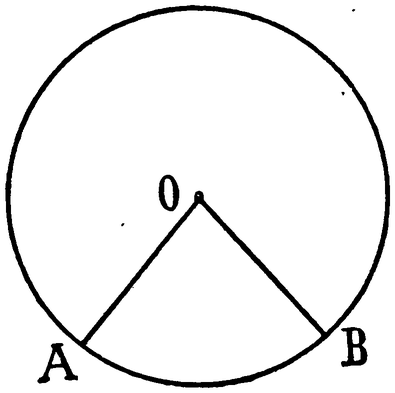
161. Definition. An angle (AOB, fig. 152) formed by two radii is called a central angle; of such an angle and the arc contained between its sides we say that they correspond to each other.
162. Theorem. In one circle or in equal circles:
1°, if central angles are equal, the arcs corresponding to them are equal;
2°, if central angles are not equal, the greater arc corresponds to the greater of them.
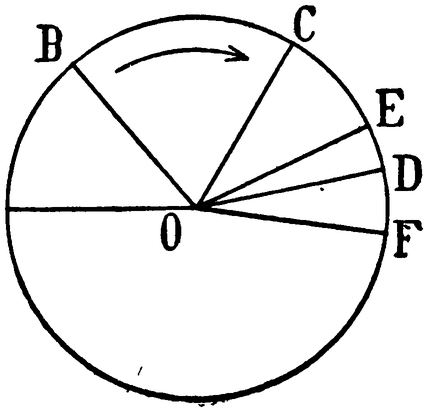
Let AOB and COD (fig. 153) be two central angles, equal or unequal. Let us rotate the sector AOB about the centre in the direction shown by the arrow until the radius OA coincides with OC. Then: 1°, if the central angles are equal, the radius OB coincides with OD and, consequently, the arc AB coincides with the arc CD; hence these arcs are equal; 2°, if the central angles are unequal, the radius OB will go not along OD but in some other direction, for example along OE or along OF; in either case, evidently, the greater arc corresponds to the greater angle.
The theorem we have proved for one circle remains true for equal circles, because such circles differ from each other in nothing but their position.
163. Converse theorems. Since the different mutually exclusive cases concerning the equality and inequality of two central angles are accompanied by mutually exclusive conclusions concerning the equality and inequality of the corresponding arcs, the converse propositions must be true (51), namely:
In one circle or in equal circles:
1°, if arcs are equal, the central angles corresponding to them are equal;
2°, if arcs are not equal, the greater central angle corresponds to the greater of them.
The proof by contradiction (or by superposition) we leave to the students themselves.
164. Theorem. In one circle or in equal circles central angles are to each other as the arcs corresponding to them.
Let AOB and COD (fig. 154) be two central angles; it is required to prove that
∠AOB : ∠COD = ⌣AB : ⌣CD.
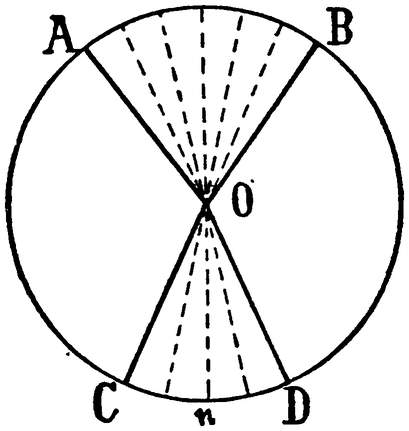
1°. Let us first assume that the arcs AB and CD are commensurable, that is, that they have a common measure. Suppose that this common measure is contained m times in the arc AB and n times in CD; then
⌣AB : ⌣CD = m : n [1].
Joining the points of division of the arcs to the centre, we divide the central angles into equal parts (because equal central angles correspond to equal arcs). Since there will be m of these parts in the angle AOB and n in the angle COD,
∠AOB : ∠COD = m : n [2].
Comparing the proportions [1] and [2], we notice that their second ratios are equal; consequently their first ratios are equal too, that is,
∠AOB : ∠COD = ⌣AB : ⌣CD.
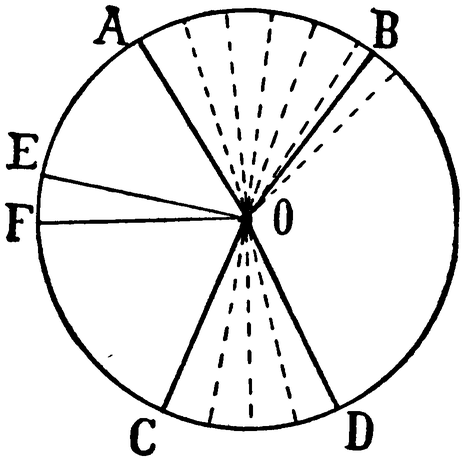
2°. Let us now suppose that the arcs AB and CD (fig. 155) are incommensurable. Then the central angles corresponding to them will be incommensurable as well. Indeed, if these angles had some common measure, for example the angle EOF, this would mean that this angle is contained a whole number of times both in the angle AOB and in the angle COD; but then the arc EF would be contained a whole number of times both in the arc AB and in the arc CD, and hence these arcs would have a common measure, namely the arc EF, which contradicts the supposition. Thus in the case under consideration the ratio of the angles and the ratio of the arcs are both incommensurable. To prove the equality of two incommensurable ratios it is enough to prove the equality of their approximate values, computed to an arbitrary but identical degree of accuracy (159). Let us find the approximate value of the ratio of the arcs AB and CD to within . To do this we divide CD into n equal parts and lay off one part on AB as many times as possible. Let the part of CD be contained in AB more than m times but less than m + 1 times; then
Joining the points of division of the arcs to the centre, we divide the angle COD into n equal parts, of which the angle AOB contains more than m but fewer than m + 1; consequently:
Comparing the approximate ratios of the angles and of the arcs, we see that they are equal for every n; and such incommensurable ratios are equal to each other.
165. Proportional magnitudes. Two magnitudes that depend on each other are called proportional if the dependence between them consists in the following:
1°, to each value of the one magnitude there corresponds some value of the other magnitude, and only one;
2°, the ratio of any two values whatever of the one magnitude is equal to the ratio of the corresponding values of the other magnitude.
From the preceding theorems it follows that a central angle is proportional to the arc corresponding to it.
166. The measurement of angles. The measurement of angles is reduced to the measurement of the arcs corresponding to them in the following way.
As the unit of angles we take the angle that is of a right angle; this unit is called the angular degree.
As the unit of arcs of one and the same radius we take the arc of that radius which corresponds to a central angle equal to the angular degree. Such an arc is called an arc degree. Since of the circle corresponds to a right central angle, of a quarter of the circle corresponds to the angular degree; hence the arc degree is of the whole circle.
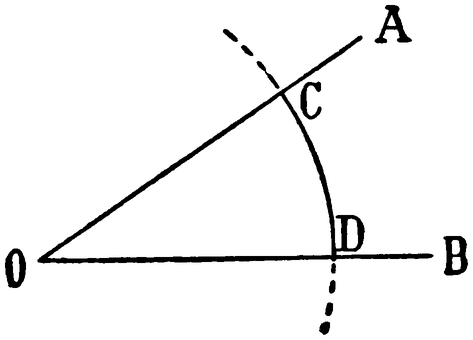
Let it be required (fig. 156) to measure some angle AOB, that is, to find the ratio of this angle to the angular degree. Let this degree be the angle MNP. From the vertices of the angles we describe, with an arbitrary but identical radius, the arcs CD and EF. Then the angles AOB and MNP can be regarded as central angles with respect to the equal circles to which the arcs CD and EF belong. In consequence of this (164):
The left-hand ratio of this proportion is the number that measures the angle AOB in angular degrees (159); the right-hand ratio is the number that measures the arc CD in arc degrees. Consequently this proportion can be stated thus:
The number that measures a central angle in angular degrees is equal to the number that measures the corresponding arc in arc degrees.
For brevity this is usually expressed as follows:
An angle is measured by the arc corresponding to it.
It makes no difference here how great a radius is taken for the arcs EF and CD, provided only that it is the same for both these arcs (only on this condition are the angles proportional to the arcs).
167. The subdivision of degrees. The degrees of an angle or of an arc are subdivided into 60 equal parts, called minutes (angular or arc minutes); the minute is divided into 60 equal parts, called seconds (angular or arc seconds).
From what was said in the preceding section it follows that an angle contains as many angular degrees, minutes and seconds as the arc corresponding to it contains arc degrees, minutes and seconds. If, for example, the arc CD (fig. 156) contains 40 degrees 25 minutes 13 seconds (of arc), then the angle AOB also contains 40 degrees 25 minutes 13 seconds (of angle); this is expressed in abbreviated form thus:
∠AOB = 40°25′13″,
the marks (°), (′) and (″) denoting degrees, minutes and seconds respectively23.
168. The protractor. This instrument (fig. 157), which is used for measuring angles, is a half-disk whose arc is divided into 180 degrees. To measure the angle AOB, the instrument is laid upon it so that the centre of the half-disk coincides with the vertex of the angle and the radius OM coincides with the side AO. Then the number of degrees in the arc contained between the sides of the angle AOB shows its magnitude. With the help of the protractor one can also draw an angle containing a given number of degrees.
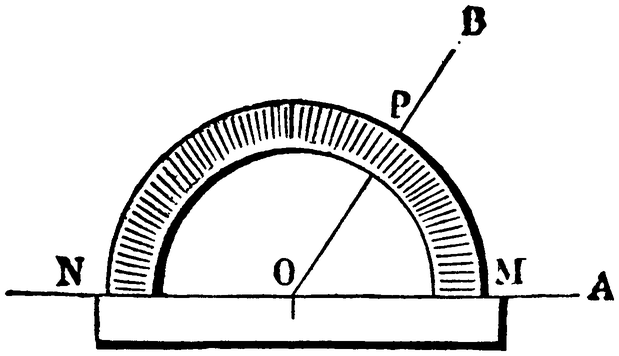
Of course, on such an instrument it is impossible to read off minutes, let alone seconds; the measurement and the construction can be carried out only approximately.
169. The expression of certain angles in degrees. Since a right angle contains 90°:
1°, the sum of the angles of every triangle is equal to 180°;
2°, the sum of the acute angles of a right triangle is equal to 90°;
3°, each angle of an equilateral triangle is equal to 60°;
4°, the sum of the angles of a convex polygon (89) having n sides is equal to 180° (n − 2);
5°, the sum of the exterior angles of a convex polygon (90) is equal to 360°.
The Inscribed Angle
170. Definition. An angle formed by two chords issuing from one point of the circle is called an inscribed angle. Such, for example, is the angle ABC (fig. 159). Of an inscribed angle it is customary to say that it stands on the arc contained between its sides. Thus the angle ABC (fig. 159) stands on the arc ADC.
171. Theorem. An inscribed angle is measured by half the arc on which it stands.
This theorem is to be understood as follows: an inscribed angle contains as many angular degrees, minutes and seconds as there are arc degrees, minutes and seconds in half the arc on which it stands.
In proving the theorem we shall consider three cases separately:
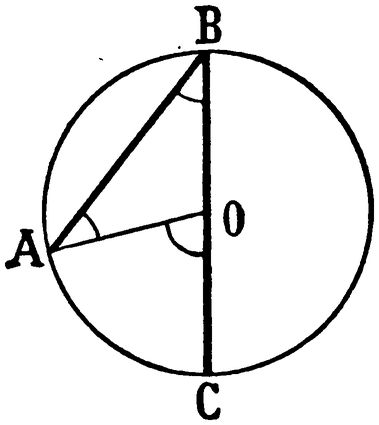
1°. The centre O (fig. 158) lies on a side of the inscribed angle ABC. Drawing the radius AO, we obtain △ABO, in which OA = OB (as radii) and, consequently, ∠ABO = ∠BAO. With respect to this triangle the angle AOC is an exterior angle; therefore it is equal to the sum of the angles ABO and BAO, or to twice the angle ABO; hence the angle ABO is equal to half the central angle AOC. But the angle AOC is measured by the arc AC, that is, it contains as many angular degrees, minutes and seconds as there are arc degrees, minutes and seconds in the arc AC; consequently the inscribed angle ABC is measured by half the arc AC.
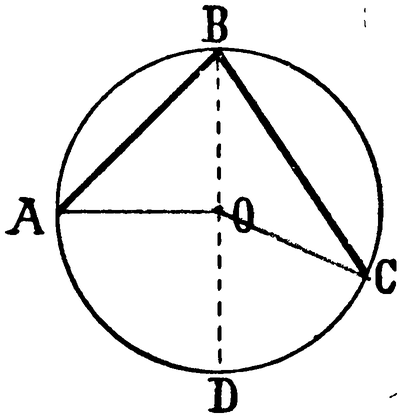
2°. The centre O lies between the sides of the inscribed angle ABC (fig. 159).
Drawing the diameter BD, we divide the angle ABC into two angles, of which, by what was proved in the first case, one is measured by half the arc AD and the other by half the arc CD; consequently the angle ABC is measured by the sum , and this sum is equal to , that is, to .
3°. The centre O lies outside the inscribed angle ABC (fig. 160).
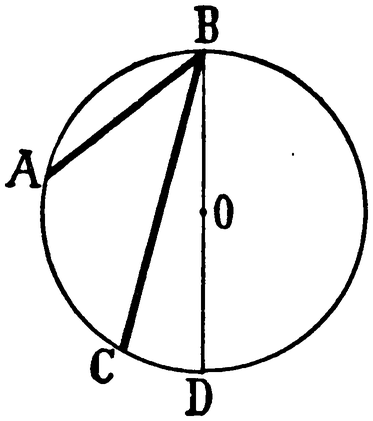
Drawing the diameter BD, we have:
∠ABC = ∠ABD − ∠CBD.
But the angles ABD and CBD are measured, by what has been proved, by the halves of the arcs AD and CD; consequently the angle ABC is measured by the difference , and this difference is equal to , that is, to .
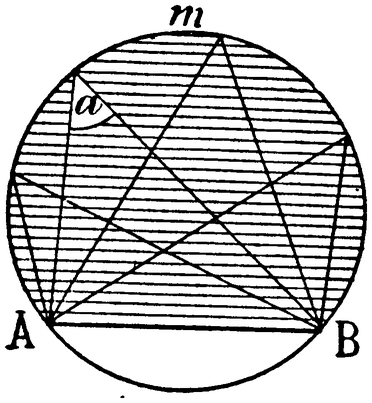
172. Corollary 1. All inscribed angles standing on one and the same arc are equal to one another (fig. 161), because each of them is measured by half of one and the same arc. If we denote the magnitude of one of these angles by a, we may say that the segment AmB (shaded in the figure) contains an angle equal to a.
173. Corollary 2. Every inscribed angle standing on a diameter is a right angle (fig. 162), because every such angle is measured by half a semicircle and, consequently, contains 90°.
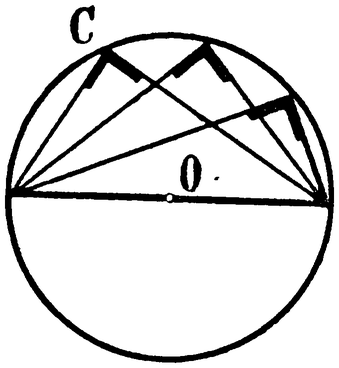
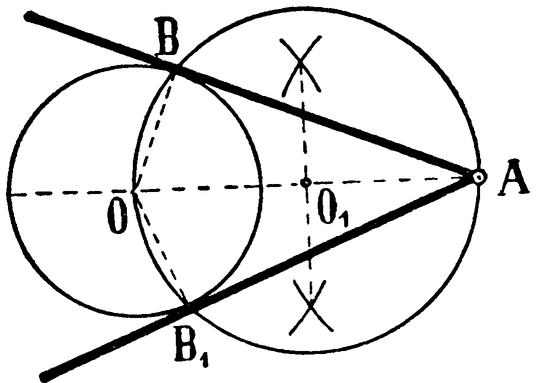
174. Problem. To construct a right triangle given the hypotenuse AB and a leg AC (fig. 162).
On the hypotenuse AB as diameter we describe a semicircle, and from the end A we draw a chord AC equal to the given leg. The triangle ACB is the one required (173).
This construction can be applied, among other things, to the case when (fig. 163) it is required to draw from a given point A a tangent to a given circle O (see § 139). Joining A to the centre O, we bisect the segment AO and from the midpoint so obtained describe a circle with the radius ; through A and the points B and in which this circle intersects the given circle we draw the straight lines AB and . These lines are the tangents (137, 1°), since the angles OBA and (inscribed in the auxiliary circle and standing on its diameter) are right angles, and hence AB ⊥ OB and .
175. Problem. From the end A (fig. 164) of a given straight line AB, without extending it, to erect a perpendicular to it.
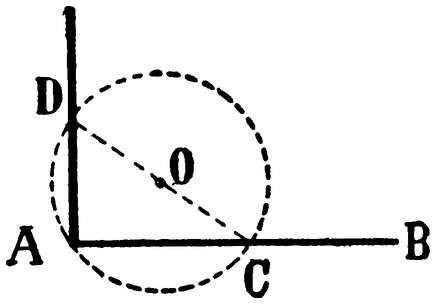
Taking an arbitrary point O outside the line, we describe from it a circle with a radius equal to the distance between the points O and A; through the point C in which this circle intersects the line AB we draw the diameter CD, and through its end D and the point A we draw a straight line. This line is the required perpendicular, because the angle A is a right angle, being inscribed and standing on a diameter.
An Angle Whose Vertex Lies Inside or Outside the Circle
176. Theorems. 1°. An angle (ABC, fig. 165) whose vertex lies inside the circle is measured by half the sum of two arcs (AC and DE), of which one is contained between its sides and the other between the extensions of its sides.
2°. An angle (ABC, fig. 166) whose vertex lies outside the circle and whose sides intersect the circle is measured by half the difference of the two arcs (AC and ED) contained between its sides.
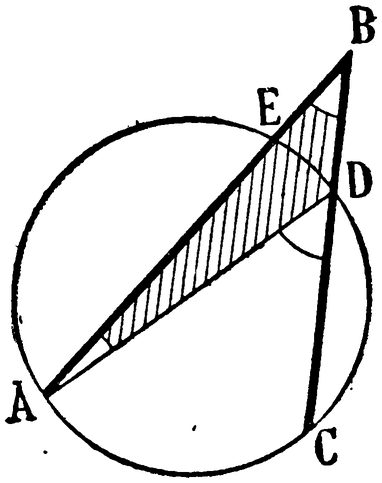
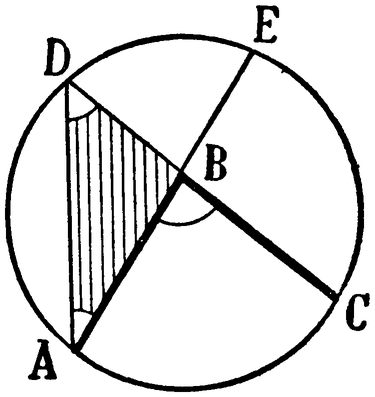
Drawing the chord AD (in both figures), we obtain the triangle ABD (shaded), with respect to which the angle ABC under consideration is an exterior angle when its vertex lies inside the circle (fig. 165), and an interior angle when its vertex lies outside the circle (fig. 166). Therefore
in the first case: ∠ABC = ∠ADC + ∠DAE;
in the second case: ∠ABC = ∠ADC − ∠DAE.
But the angles ADC and DAE, being inscribed, are measured by the halves of the arcs AC and DE; therefore the angle ABC is measured: in the first case by the sum , which is equal to , and in the second case by the difference , which is equal to .
177. Corollary. The locus of the points from which a given segment of a straight line is seen at a given angle a, and which are situated on one side of that line segment, is the arc of the segment that contains the angle a and is constructed on the given line segment.
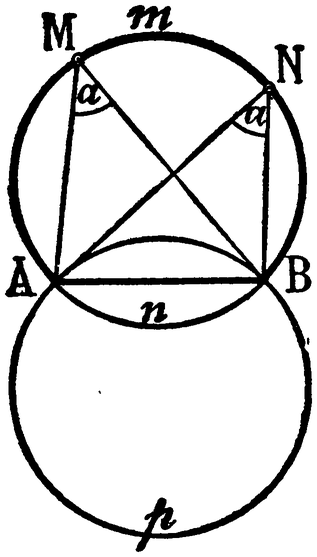
Let M (fig. 167) be one of the points from which the given line segment AB is seen at the angle a, that is, let us assume that the straight lines MA and MB form the angle a. Through the three points A, M and B let us draw a circle. Then a part of this circle, namely the arc AmB, will be the required locus. Indeed, from each point of this arc the line AB is seen at the angle a, because all the inscribed angles standing on AB are equal to the angle AMB, which is the angle a. Conversely, every point, for example N, from which the line AB is seen at the angle a and which is situated on the same side of AB as the point M must lie on the arc of the segment AmB, because if such a point lay inside or outside this segment, the angle ANB would not be measured by half the arc AnB (176, 1° and 2°) and, consequently, would not be equal to a.
On the other side of AB there also exist points from which this line is seen at the angle a; they are situated on the arc of the segment ApB, which is equal to the segment AmB but lies on the opposite side of AB.
An Angle One or Both of Whose Sides Touch the Circle
178. Theorem. An angle (ACD, figures 168 and 169) formed by a tangent and a chord is measured by half the arc contained within it.
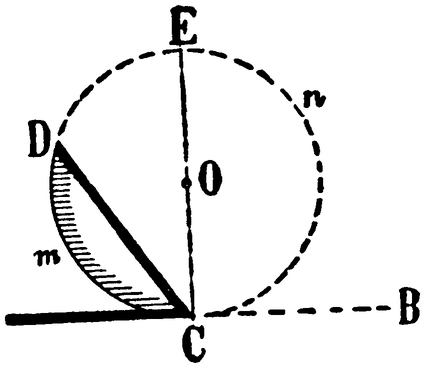
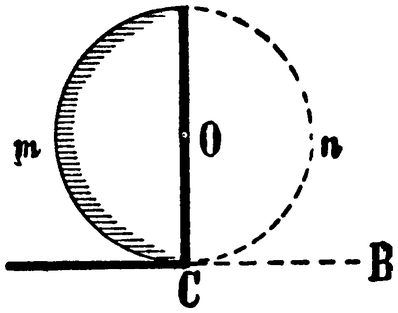
Let us first suppose that the chord CD passes through the centre O, that is, that this chord is a diameter (fig. 168). Then the angle ACD is a right angle (137, 2°) and, consequently, is equal to 90°. But half the arc CmD is also equal to 90°, since the whole arc CmD, making up a semicircle, contains 180°. Hence the theorem holds good in this particular case.
Now let us take the general case (fig. 169), when the chord CD does not pass through the centre. Drawing the diameter CE, we then have:
∠ACD = ∠ACE − ∠DCE.
The angle ACE, being formed by a tangent and a diameter, is measured, by what has been proved, by half the arc CmE; the angle DCE, being inscribed, is measured by half the arc DE; consequently the angle ACD is measured by the difference , that is, by half the arc CmD.
In a similar way it can be proved that the obtuse angle BCD (fig. 169), likewise formed by a tangent and a chord, is measured by half the arc CnED; the only difference in the proof will be that this angle must be regarded not as a difference but as the sum of the right angle BCE and the acute angle ECD.
179. Theorem. An angle (ABC, fig. 170) formed by a tangent and a secant, and likewise an angle (ABC, fig. 171) formed by two tangents, is measured by half the difference of the two arcs contained between its sides.
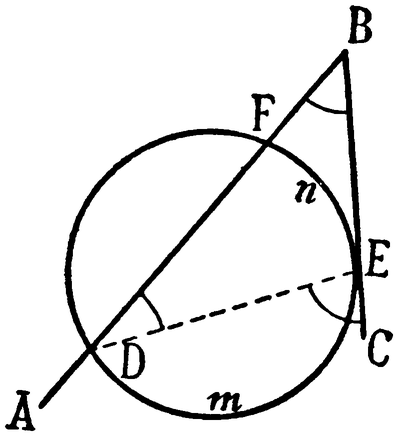
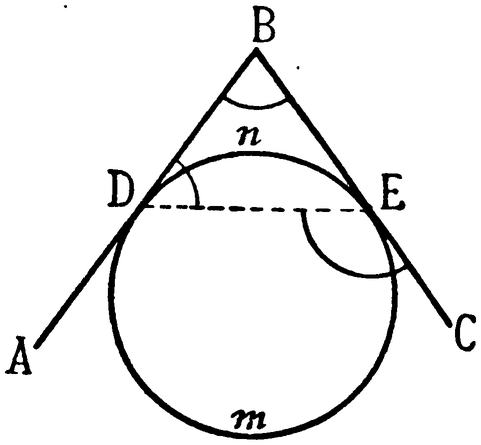
Drawing the chord DE (in both figures), we obtain △BDE, with respect to which the angle CED is an exterior angle; consequently,
∠B = ∠CED − ∠BDE.
But the angles CED and BDE, by what was proved earlier, are measured by the halves of the arcs EmD and EnF in the first figure and by the halves of the arcs EmD and EnD in the second figure; therefore the angle B is measured by half the difference of these arcs.
180. Problem. On a given segment of a straight line AB to construct a segment containing a given angle a (fig. 172).
Analysis. Suppose the problem solved; let the segment AmB be one that contains the angle a, that is, one such that every angle ACB inscribed in it is equal to a. Let us draw an auxiliary straight line EF, tangent to the circle at the point A. Then the angle BAE, formed by a tangent and a chord, must be equal to the inscribed angle ACB, since both are measured by half the arc AnB. Let us now take into account that the centre O of the circle must lie on the perpendicular DO drawn to the line segment AB through its midpoint, and at the same time must lie on the perpendicular AO erected to the tangent AE at the point of tangency. From this we derive the following construction.
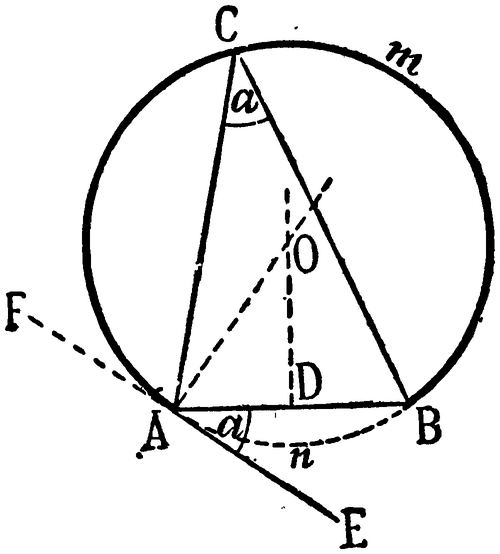
Construction. At the end of the line segment AB we construct the angle BAE, equal to the angle a; through the midpoint of AB we draw the perpendicular DO, and from the point A we erect a perpendicular to AE. We take the intersection O of these two perpendiculars as centre and describe a circle with the radius OA.
Proof. The segment AmB is the one required, because every angle inscribed in it is measured by half the arc AnB, and half of this arc also measures the angle BAE = a.
Chapter 8: Inscribed and Circumscribed Polygons
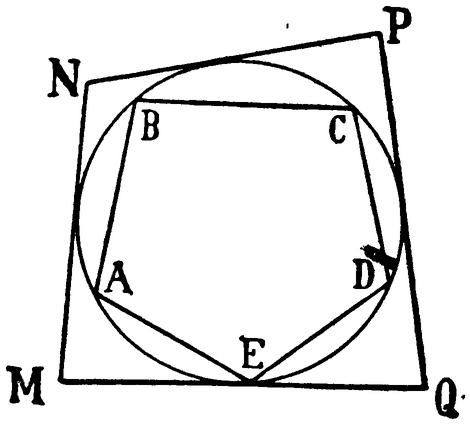
181. Definitions. If all the vertices of a polygon (ABCDE, fig. 173) lie on a circle, the polygon is said to be inscribed in the circle, or the circle is said to be circumscribed about it.
If all the sides of a polygon (MNPQ) touch a circle, the polygon is said to be circumscribed about the circle, or the circle is said to be inscribed in it.
182. Theorems. 1°. About every triangle a circle can be circumscribed, and only one.
2°. In every triangle a circle can be inscribed, and only one.
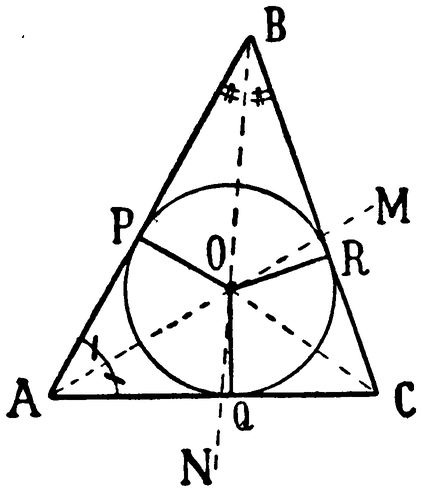
1°. The vertices A, B and C of any triangle are three points not lying on one straight line; and through such points, as we have seen (122), a circle can always be drawn, and only one.
2°. If there can be a circle that touches all the sides of the triangle ABC (fig. 174), its centre must be a point equally distant from those sides. Let us prove that such a point exists. The locus of the points equally distant from the sides AB and AC is the bisector AM of the angle A (67); the locus of the points equally distant from the sides BA and BC is the bisector BN of the angle B. These two bisectors must evidently intersect inside the triangle, at some point O. This point is equally distant from all the sides of the triangle, since it lies on both loci. Thus, to inscribe a circle in a triangle, we bisect any two of its angles, for example A and B, and take the point of intersection of the bisectors as the centre. As the radius we take one of the perpendiculars OP, OQ, OR dropped from the centre to the sides of the triangle. The circle will touch the sides at the points P, Q, R, since at these points the sides are perpendicular to the radii at their ends lying on the circle (137, 2°). There can be no other inscribed circle, since two bisectors intersect in one point only, and from one point only one perpendicular can be dropped to a straight line.
183. Corollary. The point O (fig. 174), being at the same distance from the sides AC and BC, must lie on the bisector of the angle C (65); consequently the bisectors of the three angles of a triangle meet in one point.
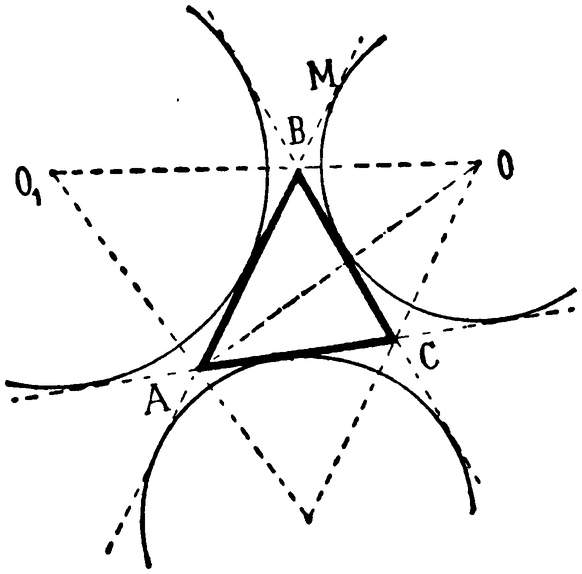
184. Escribed circles. This is the name given to the circles (fig. 175) that touch one side of a triangle and the extensions of the other two sides (they lie outside the triangle, which is why they are called escribed). For every triangle there can be three such circles. To construct them, we draw the bisectors of the exterior angles of the triangle ABC and take their points of intersection as the centres. Thus the centre of the circle inscribed in the angle A is the point O, that is, the intersection of the bisectors BO and CO of the exterior angles not adjacent to A; the radius of this circle is the perpendicular dropped from O to any side of the triangle.
185. Theorems. 1°. In a convex inscribed quadrilateral the sum of the opposite angles is equal to two right angles.
2°. Conversely: If in a convex quadrilateral the sum of the opposite angles is equal to two right angles, a circle can be circumscribed about it.
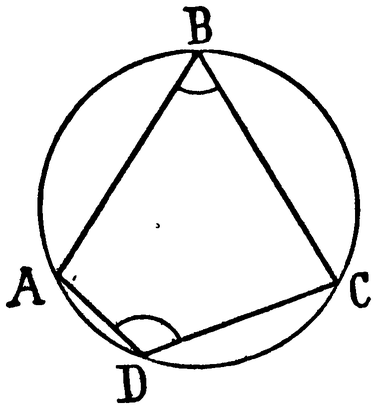
1°. Let ABCD (fig. 176) be an inscribed convex quadrilateral; it is required to prove that
B + D = 2d and A + C = 2d.
Since the sum of all four angles of any convex quadrilateral is equal to 4d, it is enough to prove only one of the required equalities. Let us prove, for example, that B + D = 2d. The angles B and D, being inscribed angles, are measured, the first by half the arc ADC, the second by half the arc ABC; consequently the sum B + D is measured by the sum of the arcs ; and this sum is equal to , that is, to half the circle; hence B + D = 180° = 2d.
2°. Let ABCD (fig. 177) be a convex quadrilateral in which B + D = 2d and, consequently, A + C = 2d.
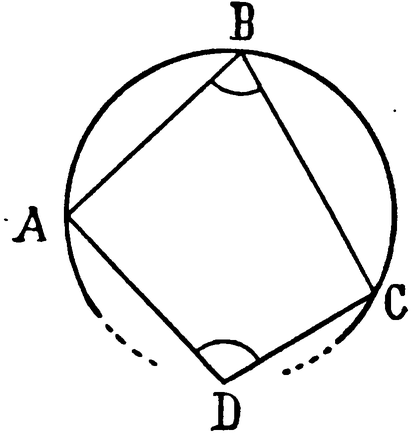
It is required to prove that a circle can be circumscribed about such a quadrilateral. Through any three of its vertices, for example through A, B and C, let us draw a circle (which can always be done). The fourth vertex D must lie on this circle, because otherwise the vertex of the angle D would lie either inside the circle or outside it, and then this angle would not be measured by half the arc ABC (176, 1° and 2°); therefore the sum B + D would not be measured by half the sum of the arcs ADC and ABC, that is, the sum B + D would not be equal to 2d, which contradicts the hypothesis.
186. Corollaries. 1°. Of all parallelograms, only about a rectangle (and consequently about a square) can a circle be circumscribed.
2°. A circle can be circumscribed about a trapezoid only when it is isosceles.
187. Remark. The two theorems set out above on the inscribed quadrilateral (the direct and the converse) lead us to the following conclusion: in order that a circle can be circumscribed about a convex quadrilateral, it is necessary and sufficient that the sum of its opposite angles be equal to two right angles. Indeed, this condition is necessary, since, according to theorem 1°, in every inscribed convex quadrilateral the sum of the opposite angles is equal to 2d, and consequently without this condition an inscribed convex quadrilateral cannot exist; at the same time this condition is also sufficient, since, according to theorem 2°, if in a convex quadrilateral the sum of the opposite angles is equal to 2d, a circle can be circumscribed about such a quadrilateral.
Let us notice that the necessity of a criterion does not yet mean that it is sufficient, just as the sufficiency of a criterion does not yet entail its necessity. For example, in order that a convex quadrilateral be a rhombus it is necessary that its diagonals be mutually perpendicular (if there is a rhombus, its diagonals are mutually perpendicular; hence without the perpendicularity of the diagonals a rhombus does not exist); yet this criterion is not sufficient: it cannot be asserted that if the diagonals of a convex quadrilateral are mutually perpendicular, such a quadrilateral is necessarily a rhombus (with perpendicular diagonals a convex quadrilateral may fail to be a rhombus, fig. 178). Another example: in order that two arcs of one and the same circle be equal it is sufficient that they be contained between parallel chords; yet this is not necessary, since the arcs may turn out to be equal without the chords being parallel (the arcs AB and CD, fig. 179).
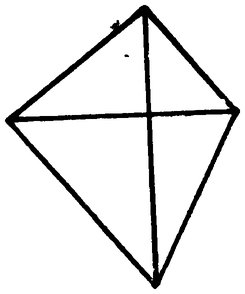
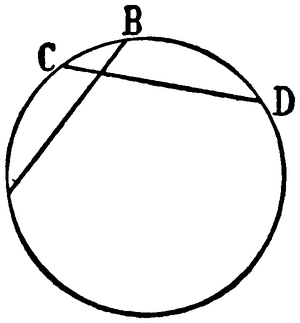
To be sure that a certain criterion A is necessary and sufficient for the existence of a certain property B, we must prove separately its necessity (if B holds, then A holds) and its sufficiency (if A holds, then B holds).
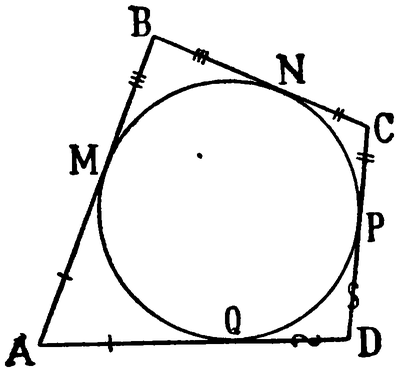
188. Theorem. In a circumscribed convex quadrilateral the sums of the opposite sides are equal.
Let ABCD (fig. 180) be a circumscribed convex quadrilateral, that is, let its sides touch a circle; it is required to prove that AB + CD = BC + AD. Let us denote the points of tangency by M, N, P and Q. Since two tangents drawn from one point to a circle are equal (140), we have AM = AQ, BM = BN, CN = CP and DP = DQ. Consequently
AM + MB + CP + PD = AQ + BN + NC + QD,
that is, AB + CD = AD + BC.
189. Converse theorem. If in a convex quadrilateral the sums of the opposite sides are equal, a circle can be inscribed in it.
Let ABCD be a convex quadrilateral (fig. 181) in which
AB + CD = AD + BC.
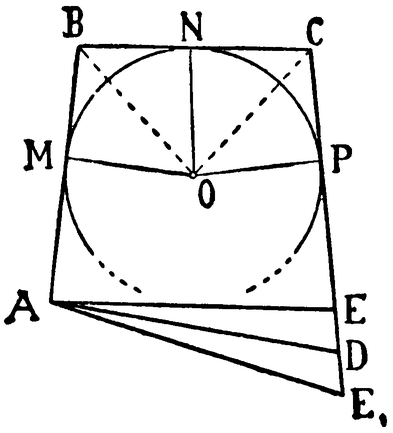
It is required to prove that a circle can be inscribed in it. Let us draw the bisectors BO and CO of the two angles B and C. These lines must intersect, because the sum of the angles NBO and NCO is less than 2d (since B + C < 4d). The point of intersection of the bisectors must be equally distant from the sides AB, BC and CD; therefore, if we take this point as the centre, and as the radius one of the three equal perpendiculars OM, ON, OP dropped from O to the sides of the angles B and C, the circle will touch the sides AB, BC and CD. Let us prove that it will touch the fourth side AD as well. Suppose the contrary, that is, that the fourth side AD does not touch the circle we have drawn. Then, drawing a tangent to this circle from the point A, we must obtain some straight line that does not merge with AD. Let this be the line AE, lying nearer to the centre O than AD. Then we obtain a circumscribed convex quadrilateral ABCE, in which, by what was proved above, we have:
BC + AE = AB + CE.
But by hypothesis:
BC + AD = AB + CD.
Subtracting the first equality from the second term by term, we find:
AD − AE = CD − CE = DE,
that is, the difference of two sides of △ADE is equal to the third side DE, which is impossible (52); hence it cannot be admitted that the tangent to our circle is some line AE lying nearer to the centre O than AD. In the same way it can be proved that the tangent cannot be any line lying farther from the centre than AD; hence AD must touch the circle, that is, a circle can be inscribed in the quadrilateral ABCD.
190. Corollary. Of all parallelograms, only in a rhombus (and consequently in a square) can a circle be inscribed.
191. Remark. The two theorems set out above on the circumscribed quadrilateral (the direct and the converse) lead us to the following conclusion: in order that a circle can be inscribed in a convex quadrilateral, it is necessary and sufficient that the sums of its opposite sides be equal.
Chapter 9: Four Remarkable Points of a Triangle
192. The centre of the circumscribed and the centre of the inscribed circle. We have seen (123 and 183) that:
1°, the three perpendiculars to the sides of a triangle drawn through their midpoints meet in one point, which is the centre of the circumscribed circle;
2°, the three bisectors of the angles of a triangle meet in one point, which is the centre of the inscribed circle.
Let us notice (the students can verify this for themselves) that the centre of the inscribed circle always lies inside the triangle, whereas the centre of the circumscribed circle lies inside the triangle only when the triangle is acute-angled; in an obtuse-angled triangle it lies outside it, and in a right-angled triangle at the midpoint of the hypotenuse.
The following two theorems point out two more remarkable points of a triangle: 3°, the intersection of the altitudes, and 4°, the intersection of the medians.
193. Theorem. The three altitudes of a triangle intersect in one point.
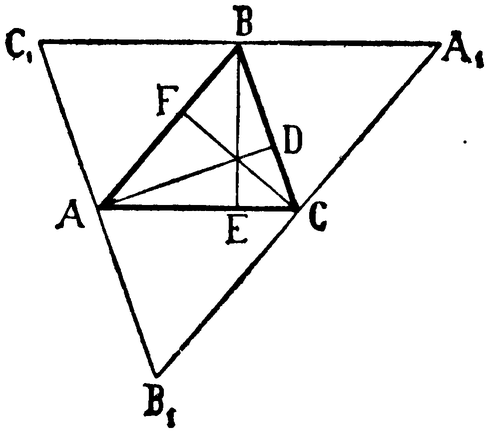
Through each vertex of the triangle ABC (fig. 182) let us draw a straight line parallel to the opposite side. We then obtain an auxiliary △, to whose sides the altitudes of the given triangle are perpendicular. Since = AC = (as opposite sides of parallelograms), the point B is the midpoint of the side . In the same way we satisfy ourselves that C is the midpoint of and A the midpoint of . Thus the altitudes AD, BE and CF are perpendicular to the sides of the triangle and pass through their midpoints; and such perpendiculars, as we know, intersect in one point.
The point in which the altitudes of a triangle intersect is called the orthocentre, or the point of the altitudes. In an acute-angled triangle this point lies inside the triangle, in an obtuse-angled triangle outside it, and in a right-angled triangle at the vertex of the right angle.
194. Theorem. The three medians of a triangle intersect in one point; this point cuts off from each median a third part, counting from the corresponding side.
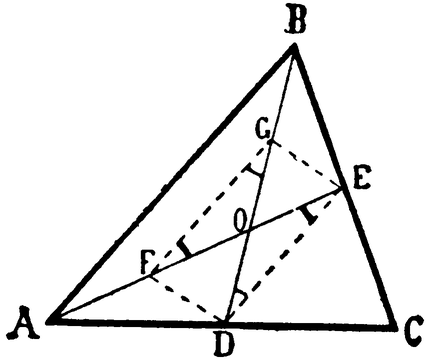
In the triangle ABC (fig. 183) let us take any two medians, for example AE and BD, intersecting at the point O, and let us prove that
To do this, having bisected OA and OB at the points F and G, let us construct the quadrilateral DEGF. Since the line FG joins the midpoints of two sides of the triangle ABO, we have (115) FG ∥ AB and . The line DE likewise joins the midpoints of two sides of the triangle ABC; therefore DE ∥ AB and . From this we deduce that DE ∥ FG and DE = FG; consequently the quadrilateral DEGF is a parallelogram (99, 2°), and therefore OF = OE and OG = OD. It follows that and . If we now take the third median together with one of the medians AE or BD, we satisfy ourselves in the same way that their point of intersection cuts off from each of them a part, counting from the corresponding side; hence the third median must intersect the medians AE and BD in one and the same point O.
It is known from physics that the intersection of the medians of a triangle is its centre of gravity; it always lies inside the triangle.
Exercises
Prove the Theorems
148. If two circles touch, every secant drawn through the point of tangency cuts off from the circles two opposite arcs of the same number of degrees.
148,a. The segments of two equal chords that intersect in one circle are respectively equal.
148,b. Two circles intersect at the points A and B; through A a secant is drawn, cutting the circles at the points C and D; prove that the angle CBD is a constant magnitude for every such secant.
149. If through the point of tangency of two circles we draw two secants and join their ends by chords, these chords are parallel.
150. If through the point of tangency of two circles we draw any secant inside them, the tangents drawn through the ends of this secant are parallel.
151. If we join the feet of the altitudes of a triangle by straight lines, we obtain a new triangle for which the altitudes of the first triangle serve as bisectors.
151,a. On the circle circumscribed about an equilateral triangle ABC an arbitrary point M is taken; prove that one of the lines MA, MB, MC is equal to the sum of the other two.
152. If we circumscribe a circle about a triangle and from an arbitrary point of it drop perpendiculars to the sides of the triangle, their feet lie on one straight line (the Simson line).
Construction Problems
153. On a given infinite straight line find a point from which another given finite straight line is seen at a given angle.
154. Construct a △ given the base, the angle at the vertex and the altitude.
155. Draw a tangent to the arc of a given sector such that the part of the tangent contained between the extended radii (which bound the sector) is equal to a given length (reduce this problem to the preceding one).
156. Construct a △ given the base, the angle at the vertex and the median drawn to the base.
157. Two finite straight lines a and b are given in magnitude and position. Find a point from which the line a is seen at a given angle α and the line b at a given angle β.
158. In a triangle find a point from which its sides are seen at equal angles (hint: notice that each of these angles must be equal to ).
159. Construct a △ given the angle at the vertex, the altitude and the median drawn to the base (hint: having extended the median by an equal distance and joined the point obtained to the ends of the base, consider the parallelogram so formed).
160. Construct a △ in which the following are given: the base, an angle adjoining it, and the angle that the median drawn from the vertex of the given angle makes with the side to which this median is drawn.
161. Construct a parallelogram given its two diagonals and one angle.
162. Construct a △ given the base, the angle at the vertex and the sum or the difference of the other two sides.
163. Construct a quadrilateral given the two diagonals, two neighbouring sides and the angle formed by the remaining two sides.
164. Three points A, B and C are given. Draw through A a straight line such that the distance between the perpendiculars dropped to this line from the points B and C is equal to a given length.
165. In a given circle inscribe a △ of which two angles are given.
166. About a given circle circumscribe a △ of which two angles are given.
167. Construct a △ given the radius of the circumscribed circle, the angle at the vertex and the altitude.
168. In a given circle inscribe a △ of which the following are known: the sum of two sides and the angle opposite one of these sides.
169. In a given circle inscribe a quadrilateral of which a side and the two angles not adjoining that side are given.
170. In a given rhombus inscribe a circle.
171. In an equilateral △ inscribe three circles that touch one another in pairs and each of which touches two sides of the triangle.
172. Construct a quadrilateral that can be inscribed in a circle, given three of its sides and one diagonal.
173. Construct a rhombus given a side and the radius of the inscribed circle.
174. About a given circle circumscribe an isosceles right △.
175. Construct an isosceles △ given the base and the radius of the inscribed circle.
176. Construct a △ given the base and the two medians issuing from the ends of the base.
177. The same, given the three medians.
178. A circle is given and on it three points A, B and C. Inscribe in this circle a △ such that its bisectors, when extended, meet the circle at the points A, B and C.
179. The same problem, with the bisectors of the triangle replaced by its altitudes.
180. A circle is given and on it three points M, N and P, at which the altitude, the bisector and the median issuing from one vertex of an inscribed triangle meet the circle (when extended). Construct this △.
181. On a circle two points A and B are given. From these points draw two parallel chords whose sum is given.
Computation Problems
182. Compute the inscribed angle standing on an arc equal to of the circle.
183. A disk is divided into two segments by a chord that divides the circle into parts in the ratio 5 : 7. Compute the angles that these segments contain.
184. Two chords intersect at an angle of 36°15′32″. Compute in degrees, minutes and seconds the two arcs contained between the sides of this angle and their extensions, if one of these arcs is to the other as 3 : 2.
185. The angle formed by two tangents drawn from one point to a circle is equal to 25°15′. Compute the arcs contained between the points of tangency.
186. Compute the angle formed by a tangent and a chord, if the chord divides the circle into two parts that are to each other as 3 : 7.
187. Two circles of the same radius intersect at an angle of ; determine in degrees the smaller of the arcs contained between the points of intersection.
Note. The angle of two intersecting arcs is the angle formed by the two tangents drawn to these arcs from the point of intersection.
188. From one end of a diameter a tangent is drawn, and from the other a secant, which makes with the tangent an angle of 20°30′. How large is the smaller of the arcs contained between the tangent and the secant?
Plane Geometry. Book Three: Similar Figures
Chapter 1: Similar Triangles
195. Corresponding sides. In this chapter we shall have to consider triangles or polygons in which the angles of one are respectively equal to the angles of the other. Let us agree in such cases to call "corresponding" those sides of these triangles or polygons which are adjacent to equal angles (in triangles such sides also lie opposite equal angles).
196. Lemma. A straight line (DE, fig. 184) drawn inside a triangle (ABC) parallel to its side (AC) cuts off from it another triangle (DBE) in which: 1°, the angles are respectively equal to the angles of the first triangle, and 2°, the sides are proportional to the corresponding sides of that triangle.
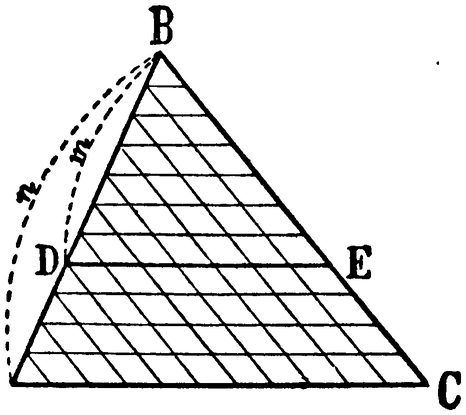
1°. The angles of the triangles are respectively equal, since the angle B is common to them, and D = A and E = C, as corresponding angles formed by the parallels DE and AC with the secants AB and CB.
2°. Let us now prove that the sides of the triangle DBE are proportional to the corresponding sides of the triangle ABC, that is, that
To do this we consider separately the following two cases.
1°. The sides AB and DB have a common measure. Divide AB into parts equal to this common measure. Then BD will be divided into a whole number of such parts. Let m of these parts be contained in BD and n in AB. From the points of division draw a series of straight lines parallel to AC and another series of straight lines parallel to BC. Then BE and BC will be divided into equal parts (113), of which there will be m in BE and n in BC. In exactly the same way DE will be divided into m equal parts and AC into n equal parts, and the parts of DE are equal to the parts of AC (as opposite sides of parallelograms). It is now evident that
Consequently,
2°. The sides AB and BD have no common measure (fig. 185).
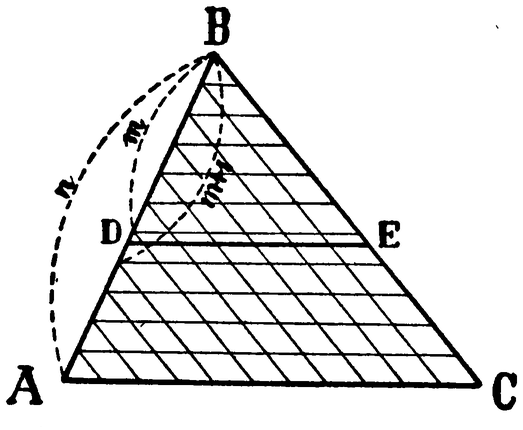
Then the sides BC and BE, and likewise the sides AC and DE, also have no common measure. Indeed, if we suppose that the sides BC and BE (or AC and DE) have some common measure, then, dividing BC (or AC) into parts equal to this common measure and drawing through the points of division a series of parallel straight lines, as we did in the first case, these lines will divide the sides AB and BD into equal parts as well; consequently these sides would then have a common measure, which contradicts the supposition. Hence, if the sides AB and BD are incommensurable, each of the three ratios:
is incommensurable.
Let us find the approximate value of each of them to within . To do this we divide AB into n equal parts and through the points of division draw a series of straight lines parallel to AC and another series of straight lines parallel to BC. Then each of the sides BC and AC will also be divided into n equal parts (113). Suppose that the part of AB is contained in BD more than m times but less than m + 1 times; then, as the figure shows, the part of BC is likewise contained in BE more than m but less than m + 1 times, and the part of AC is contained in DE more than m but less than m + 1 times. Consequently:
It follows that the approximate ratios, computed to any accuracy we please, provided it is the same for all, are always equal to one another; and such incommensurable ratios we have agreed to count equal (159); consequently in this case too we may write:
197. Remark. The series of equal ratios that has been proved represents the following three proportions:
Applying to these proportions the properties of numerical proportions, we may interchange their means:
We see in this way that if the sides of two triangles are proportional, the ratio of any two sides of one triangle is equal to the ratio of the corresponding sides of the other triangle.
198. Definition. Two triangles are called similar if the angles of one are respectively equal to the angles of the other and the sides of one are proportional to the corresponding sides of the other.
That such triangles are possible is shown by the lemma of the preceding section, which can now be stated thus: a straight line drawn inside a triangle parallel to any one of its sides cuts off from it a similar triangle.
199. Theorems (expressing three tests for the similarity of triangles). Two triangles are similar:
1°, if two angles of one are respectively equal to two angles of the other;
or 2°, if two sides of one are proportional to two sides of the other, and the angles lying between these sides are equal;
or 3°, if the three sides of one are proportional to the three sides of the other.
1°. Let ABC and (fig. 186) be two triangles in which:
It is required to prove that such triangles are similar. On AB lay off a part BD equal to and draw DE ∥ AC.
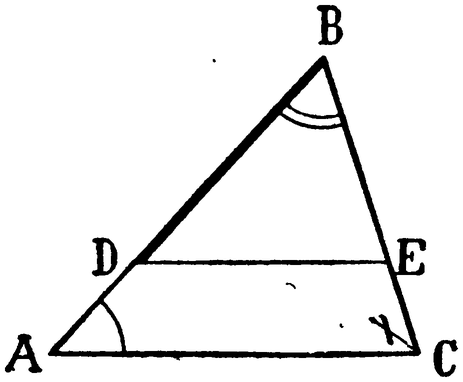
We then obtain an auxiliary triangle DBE which, by the preceding lemma, is similar to the triangle ABC. On the other hand, , because in these triangles (by construction), (by hypothesis) and (because D = A and ). But if of two equal triangles one is similar to a third, the other is similar to it also; consequently is similar to △ABC.
2°. Let it be given in the triangles ABC and (fig. 187) that:
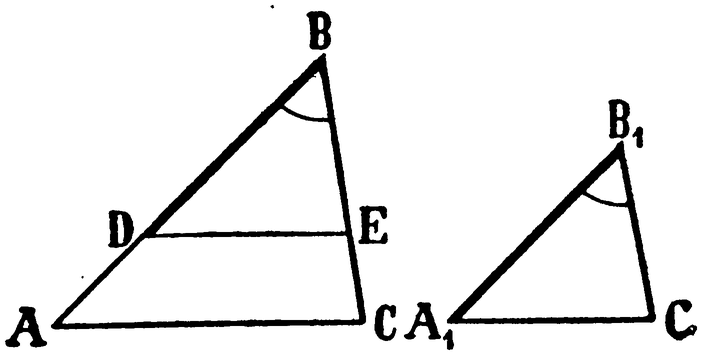
It is required to prove that such triangles are similar. Again lay off a part BD equal to , and draw DE ∥ AC. We then obtain an auxiliary △BDE similar to △ABC. Let us prove that it is equal to . From the similarity of the triangles ABC and DBE it follows that:
Comparing this series of equal ratios with the given series [1], we notice that the first ratios of the two series are the same ( by construction); consequently the remaining ratios of these series are also equal, that is,
But if the antecedents of a proportion are equal, the consequents must be equal also; hence:
We now see that the triangles DBE and each have an equal angle () included between equal sides; hence these triangles are equal. But △DBE is similar to △ABC; therefore too is similar to △ABC.
3°. Let it be given in the triangles ABC and (fig. 188) that:
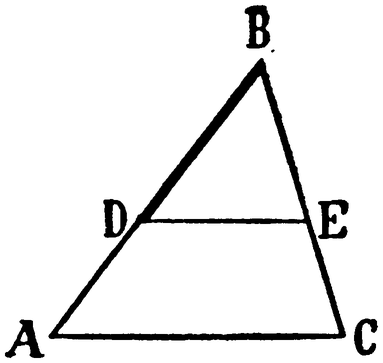
It is required to prove that such triangles are similar. Having made the same construction as before, we shall show that . From the similarity of the triangles ABC and DBE it follows that:
Comparing this series with the given series [1], we notice that their first ratios are equal; consequently the remaining ratios are equal also, and therefore
We now see that the triangles DBE and have their three sides respectively equal; hence they are equal. But one of them, namely DBE, is similar to △ABC; consequently the other, that is, , is similar to △ABC also.
200. Remark on the method of proof. It is useful to notice that the method of proof we have used in the three preceding theorems is one and the same, namely: by laying off on a side of the larger triangle a part equal to the corresponding side of the smaller, and drawing a straight line parallel to another side, we form an auxiliary triangle similar to the larger given one. After this, taking into account the hypotheses of the theorem being proved and the properties of similar triangles, we discover that the auxiliary triangle is equal to the smaller given one, and finally we conclude that the given triangles are similar.
201. Theorems (expressing two more tests for the similarity of triangles). Two triangles are similar:
1°, if the sides of one are respectively parallel to the sides of the other;
or 2°, if the sides of one are respectively perpendicular to the sides of the other.
We shall conduct the reasoning independently of a figure, and shall apply it to both theorems at once.
Let the sides of the angles A, B, C of some triangle be respectively parallel or perpendicular to the sides of the angles , , of another triangle. Then the angles A and either are equal to each other or together make two right angles (85 and 86); the same can be said of the angles B and , C and . To prove the similarity of the given triangles it is enough to make sure that some two angles of one of them are respectively equal to two angles of the other. Suppose that this is not so. Then the following two cases may arise:
1°. The triangles have no pairs of equal angles at all.
Then: ; ; , and consequently the sum of the angles of both triangles is equal to 6d. Since this is impossible, this case is excluded.
2°. The triangles have only one pair of equal angles; for example, let . Then:
; and, consequently, ,
and therefore the sum of all the angles of both triangles is greater than 4d. Since this is impossible, this case too is excluded.
There remains the one possible supposition, that the triangles have two pairs of equal angles; but then they are similar.
202. Theorems (expressing the tests for the similarity of right triangles). Since right angles are always equal to one another, on the basis of the tests already proved for the similarity of triangles in general we can assert that
right triangles are similar:
1°, if an acute angle of one triangle is equal to an acute angle of the other triangle,
or 2°, if the legs of one triangle are proportional to the legs of the other.
Let us point out one more test for the similarity of right triangles, which requires a separate proof.
Theorem. Right triangles are similar if the hypotenuse and a leg of one are proportional to the hypotenuse and a leg of the other.
Let ABC and be two triangles (fig. 189) in which the angles B and are right angles and
It is required to prove that such triangles are similar. For the proof we use the same method that we employed earlier (200). Lay off and draw DE ∥ AC.
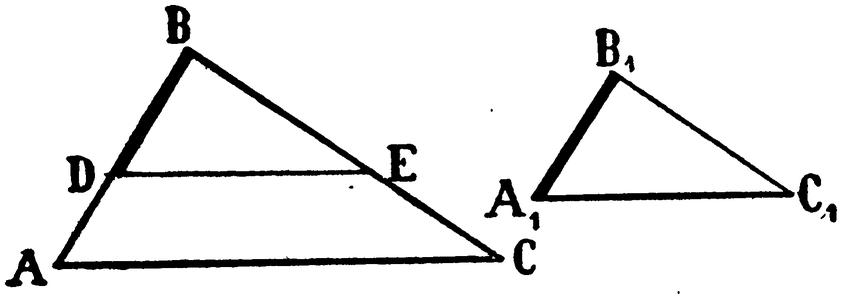
We then obtain an auxiliary △DBE similar to △ABC (196). Let us prove that it is equal to . From the similarity of the triangles ABC and DBE it follows that:
Comparing this proportion with the given one [1], we find that their first ratios are the same; consequently the second ratios are equal also, that is,
We now see that the triangles DBE and have an equal hypotenuse and an equal leg; consequently they are equal; and since one of them is similar to △ABC, the other is similar to it also.
203. Theorem (expressing a property of similar triangles). In similar triangles corresponding sides are proportional to the corresponding altitudes, that is, to those which are dropped to corresponding sides.
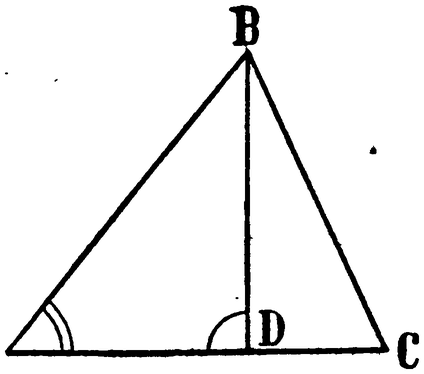
Indeed, if the triangles ABC and (fig. 190) are similar, then the right triangles BAD and are also similar ( and ); therefore:
Remark. It can also be proved that in similar triangles corresponding sides are proportional to the corresponding medians, to the corresponding bisectors, to the radii of the inscribed circles and to the radii of the circumscribed circles.
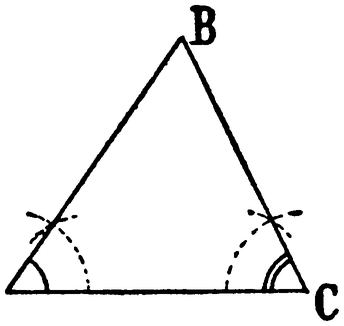
204. Problem. On a given side (, fig. 191) to construct a triangle similar to a given one (ABC).
On the given side we construct a triangle in which the angle is equal to A and the angle is equal to C. This triangle is similar to the given one (199, 1°).
Chapter 2: Similar Polygons
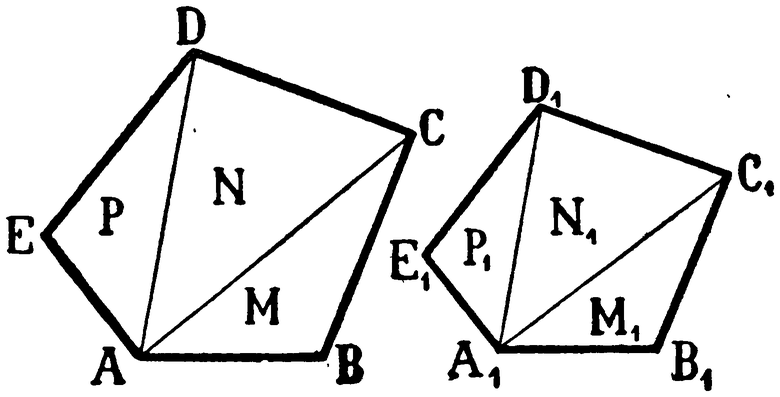
205. Lemma. If, having divided a polygon ABCDE... (fig. 192) into triangles M, N, P,..., we construct on any finite straight line a △ similar to △ M, then on its side construct a △ similar to △ N, next on the side construct a △ similar to △ P, and so on, taking care that the similar triangles are similarly placed, we obtain a polygon ... in which: 1°, the angles are respectively equal to the angles of the polygon ABCDE... and 2°, the sides are proportional to the corresponding sides of that polygon.
1°. The equality of the angles of the polygons follows from the equality of the angles of the triangles; thus and , as equal angles of similar triangles (M and , P and ), and , , ..., as sums of angles respectively equal to one another.
2°. The proportionality of the sides of the polygons follows from the proportionality of the sides of the similar triangles. Indeed, we can write the following series of equal ratios:
Examining these ratios, we notice that the last ratio of the first series is at the same time the first ratio of the second series, and the last ratio of the second series is at the same time the first ratio of the third series; from this we conclude that all the ratios of these three series are equal to one another. Let us take from them only those that contain sides of the given polygons; we then obtain the proportionality of the sides:
Remark. From the proportionality of the sides of two polygons it can be deduced, in exactly the same way as we did earlier for triangles (197), that if the sides of two polygons are proportional, the ratio of any two sides of one polygon is equal to the ratio of the corresponding sides of the other polygon.
206. Definition. Two polygons of the same name24 are called similar if the angles of one are respectively equal to the angles of the other and the sides of one are proportional to the corresponding sides of the other.
That such polygons are possible is shown by the lemma of the preceding section, which can now be stated thus: two polygons are similar if they consist of the same number of similar and similarly placed triangles.
207. Remark. For triangles, as we have seen (199), the equality of the angles entails the proportionality of the sides and, conversely, the proportionality of the sides entails the equality of the angles; as a result, for triangles the equality of the angles alone or the proportionality of the sides alone serves as a sufficient test of their similarity. For polygons, however, the equality of the angles alone or the proportionality of the sides alone is not yet sufficient for their similarity; for example, a square and a rectangle have equal angles, but their sides are not proportional, while a square and a rhombus have proportional sides, but their angles are not equal.
The following two theorems express the chief properties of similar polygons.
208. Theorem. Similar polygons (ABCDE and , fig. 193) can be decomposed into the same number of similar and similarly placed triangles.
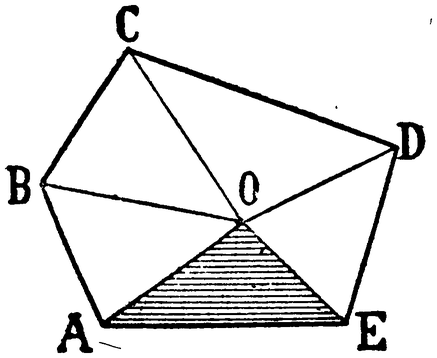
Similar polygons can be decomposed into similar triangles in various ways. Let us point out one of them. Take an arbitrary point O inside the polygon ABCDE and join it to all the vertices. The polygon ABCDE will then be divided into as many triangles as it has sides. Take one of them, for example AOE (shaded in the figure), and on the corresponding side of the other polygon construct the angles and respectively equal to the angles OAE and OEA; join the point of intersection to the remaining vertices of the polygon . Then this polygon too will be divided into the same number of triangles. Let us prove that the triangles of the first polygon are respectively similar to the triangles of the second polygon. △AOE is similar to by construction. To prove the similarity of the neighbouring triangles ABO and , let us take into account that from the similarity of the polygons it follows, among other things, that:
and from the similarity of the triangles AOE and we deduce:
From the equalities [1] and [2] it follows that:
We now see that the triangles ABO and each have an equal angle included between proportional sides; hence they are similar.
In exactly the same way we prove the similarity of the next triangles BCO and , then of the triangles COD and , and so on. It is evident, moreover, that the similar triangles are similarly placed in the two polygons.
Remark. The point O (fig. 193) may also be taken on any side of the polygon, or at the vertex of any of its angles, or even outside the polygon (in the last case we obtain triangles that partly project beyond the contour of the polygon).
209. Theorem. The perimeters of similar polygons are to each other as corresponding sides.
Let the polygons ABCDE and (fig. 193) be similar; then by definition:
It is known from algebra that if we have a series of equal ratios, the sum of all the antecedents is to the sum of all the consequents as any one of the antecedents is to its consequent; therefore:
Example. If a side of one polygon is 2 times, 3 times, 4 times and so on as great as the corresponding side of another polygon similar to it, then the perimeter of the first polygon is likewise 2 times, 3 times, 4 times and so on as great as the perimeter of the second.
210. Problem. On a given side (fig. 192) to construct a polygon similar to a given polygon ABCDE.
Having divided the given polygon into the triangles M, N, P, we construct, in accordance with the lemma of § 205, on the given side a triangle similar to the triangle M, then on the side a triangle similar to the triangle N, and so on, taking care that the triangles are similarly placed in both figures. The polygon obtained in this way is similar to the given one.
Chapter 3: Figures in Similar Position
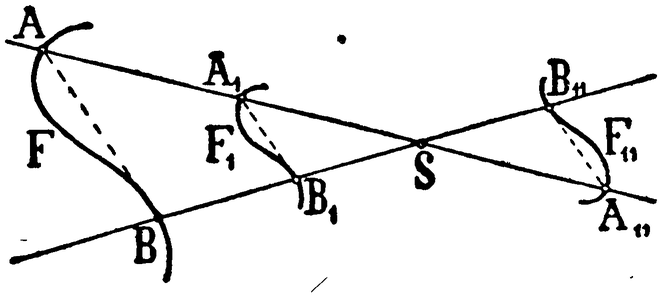
211. Definition. Let some figure F (fig. 194) be given, together with a point S, which we shall call the centre of similitude, and an abstract number k, which we shall call the ratio of similitude. Take an arbitrary point A in the figure F and draw through it from the centre of similitude S the half-line SA. On this half-line find a point such that the ratio is equal to the number k (if k < 1, the point lies between S and A, as in our figure; if k > 1, the point lies beyond the point A). Take any other point B of the figure F and carry out for it the same construction that we have indicated for , that is, draw a half-line from S through B and find on it a point such that the ratio is equal to the same number k. Now imagine that, without changing the position of the point S or the value of the number k, we find in this way the corresponding point for every point of the figure F; the locus of all these points then forms a certain new figure . The figure obtained in this way is called a figure in similar position with the figure F with respect to the centre of similitude S for the given ratio of similitude k.
The half-lines , , ..., drawn from the centre of similitude through the various points of the figure F, are called rays of similitude; the points A and , B and , and so on, are called corresponding points of the figures F and .
From what has been said it follows that if is a figure in similar position with the figure F with respect to the centre of similitude S for the ratio of similitude k, then, conversely, F is a figure in similar position with the figure with respect to the same centre of similitude S, but for a ratio of similitude equal not to k but to the reciprocal number .
A figure in similar position can be obtained in yet another way. Instead of finding the points , , ..., corresponding to the points A, B, ... of the figure F, on the rays of similitude (that is, on the same side of the centre of similitude S as the points A, B, ...), we may take them on the extensions of the rays of similitude, on the other side of S. We then obtain a figure (fig. 194), which is also in similar position with the figure F with respect to the centre of similitude S for the same ratio of similitude k. To distinguish them, the first of the two similarities of position that we have indicated is called direct, and the second inverse25.
212. Remark. The figures and (fig. 194) are equal to each other. Indeed, from the equalities
and
it follows that ; in the same way , and so on. Therefore, if we turn the sector SAB..., which contains the figure F, in the plane about the point S through 180°, the point will coincide with , the point will coincide with , and so on; hence the figure will coincide with the figure .
213. Theorem. The figure in similar position with a segment of a straight line (AB, fig. 195) is also a segment of a straight line ( or ); this segment is parallel to the first and has the same direction as the first when the similitude is direct and the opposite direction when it is inverse; the ratio of this segment to the first is equal to the ratio of similitude.
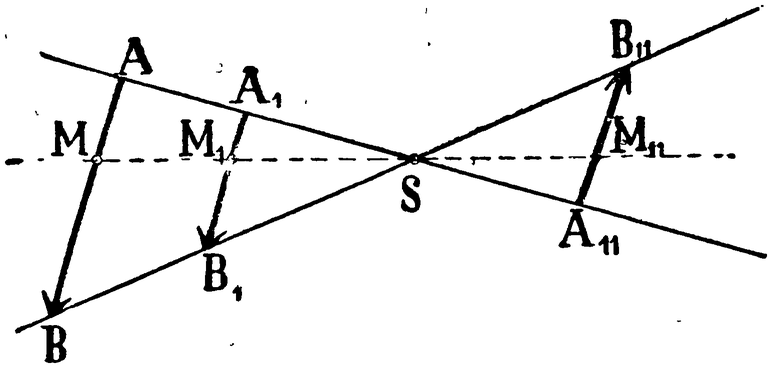
We shall speak at first of direct similitude only.
Find the points and corresponding to the ends A and B of the given segment; these points must lie on the rays SA and SB and satisfy the equalities , where k is the ratio of similitude. Joining and by a straight line, we shall prove that and that . The triangles and SAB are similar, since they have an equal angle (at the common vertex S) included between proportional sides. Their similarity implies, in the first place, the equality of the angles and, consequently, the parallelism of the sides and AB; in the second place, the proportionality of the sides: .
Now we shall prove that the segment that we have obtained is the figure in similar position with the segment AB. For this purpose take any point M on AB and draw the ray SM; let be the point in which this ray meets . The triangles and SAM are similar, since the angles of the one are respectively equal to the angles of the other (in consequence of the parallelism of the sides and AB). From their similarity it follows that ; hence the point is the point corresponding to M. Thus, whatever point M we take on AB, the point corresponding to it lies on . Now imagine that the point M moves along AB from A to B; then the point corresponding to it will move from to , remaining always on the segment . Hence this segment is the figure in similar position with AB.
The same can be repeated for inverse similitude. Here we see directly from the figure that the direction of the segment , obtained when the similitude is direct, is the same as the direction of AB, while the direction of the segment , obtained when the similitude is inverse, is opposite to the direction of AB.
214. Theorem. The figure in similar position with a polygon (ABCD, fig. 196) is also a polygon ( or ); this polygon is similar to the first, and the ratio of its sides to the corresponding sides of the first polygon is equal to the ratio of similitude.
By what was proved above (213), the figure in similar position with the polygon ABCD must be formed by segments of straight lines that are parallel to the sides of the given polygon and stand to them in a ratio equal to the ratio of similitude; consequently, the figure (and ) is a polygon whose sides are proportional to the sides of the given polygon. On the other hand, since the segments , , ... have the same direction as the segments AB, BC, ..., and the segments , , ... have the direction opposite to that of the segments AB, BC, ..., it follows (85) that the angles of the polygons and are respectively equal to the angles of the polygon ABCD; hence these polygons are similar.
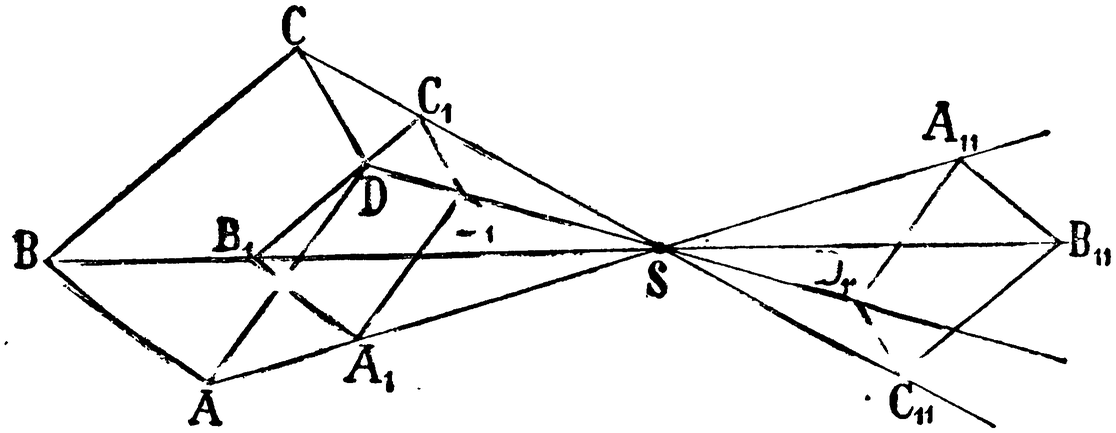
215. Remark. We see in this way that rectilinear figures in similar position turn out to be similar as well (206). For this reason such figures are called figures similar and in similar position.
216. Theorem. The figure in similar position with a circle (with centre O, fig. 197) is also a circle; the centre ( or ) of this circle lies at the point corresponding to the centre of the first circle; the ratio of the radius of this circle to the radius of the first is equal to the ratio of similitude.
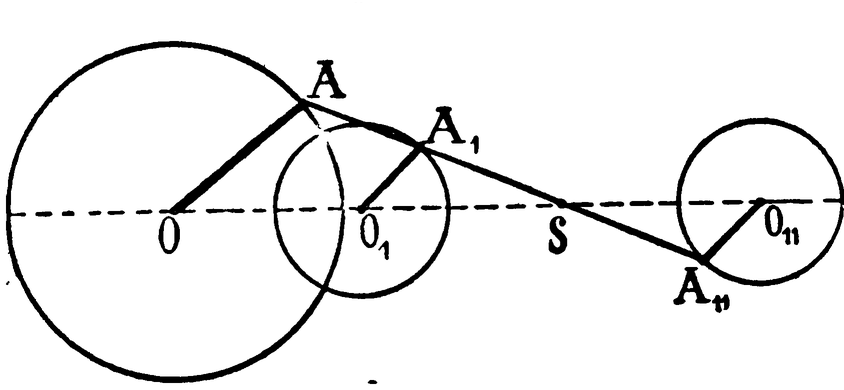
Let S be the centre of similitude and k the ratio of similitude (in our figure we have taken ). Take an arbitrary radius OA in the given circle and construct the segment in similar position with the segment OA. By what was proved earlier (213), and , that is, , if we denote the radius of the given circle by the letter R. The last equality shows that the length of does not change when the position of the radius OA changes. Therefore, if we rotate this radius about the centre O, the segment in similar position with it will rotate about the point , and its length will not change; hence the point will describe a circle whose centre is and whose radius satisfies the equality .
In the same way we prove that the theorem remains true for inverse similitude as well (we obtain the circle with centre and radius ).
217. Theorem. Any two circles can be regarded as figures in similar position with respect to certain centres of similitude.
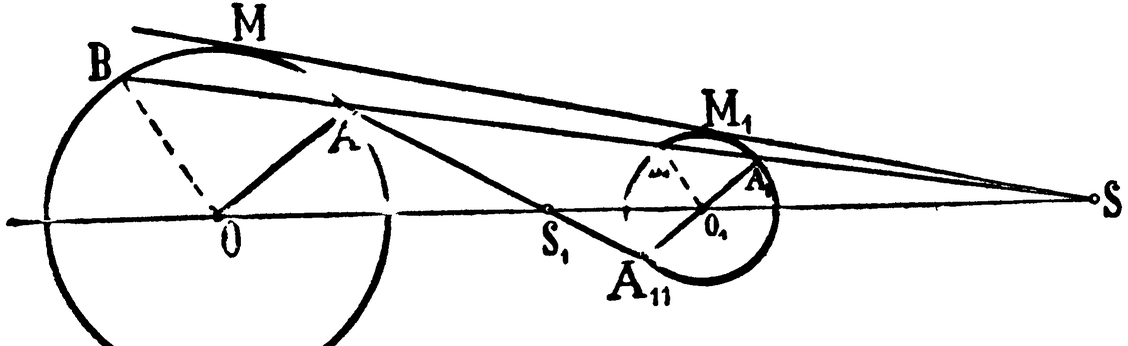
Let O and (fig. 198) be the centres of two circles and R and their radii. Take any radii OA and parallel to each other, and through their ends A and draw an unbounded straight line. Let the point of intersection of this line with the line of centres be S. We shall prove that this point can be regarded as a centre of direct similitude of the given circles. The construction shows that
Therefore, if we take the point S as the centre of direct similitude and the number as the ratio of similitude, and construct the figure in similar position with the circle O, then, by the preceding theorem, this figure is the circle . Hence the two given circles are figures in similar position with respect to the centre of direct similitude S.
In the same way we satisfy ourselves that if we take parallel radii OA and whose directions are opposite, and draw a straight line through their ends A and , this line will meet the line of centres in a point , which can be taken as a centre of inverse similitude of the given circles.
If the radii R and of the given circles are equal, the straight line will not meet the line of centres; in this case there is no direct similitude, but only the inverse.
218. Remark. Imagine that the ray of similitude SA (fig. 198) turns farther and farther away from the line of centres. Then the points A and B, in which this ray meets the circle O, will come nearer and nearer to each other; the points and corresponding to them will come nearer to each other as well, and at the moment when the points A and B merge into one point M, the points and will also merge into one point , and the ray of similitude will then become a common external tangent to the given circles. Thus a common external tangent to two circles (if it exists) passes through the centre S of their direct similitude. In the same way it can be shown that a common internal tangent to two circles (if it exists) passes through the centre of their inverse similitude. We must add the words "if it exists" because the centres of similitude of two circles always exist (that of inverse similitude at least), whereas common tangents do not always exist (see the remark to the problem of § 142).
This property of common tangents gives a simple method of constructing them. Having found the centres S and of the direct and inverse similitude of two circles (by drawing the parallel radii OA, and , fig. 198), we draw through each of them the tangents to one of the two circles; these tangents must touch the other circle as well.
Chapter 4: Some Theorems on Proportional Lines
219. Theorem. The sides of an angle cut by a series of parallel straight lines are divided by them into proportional parts.
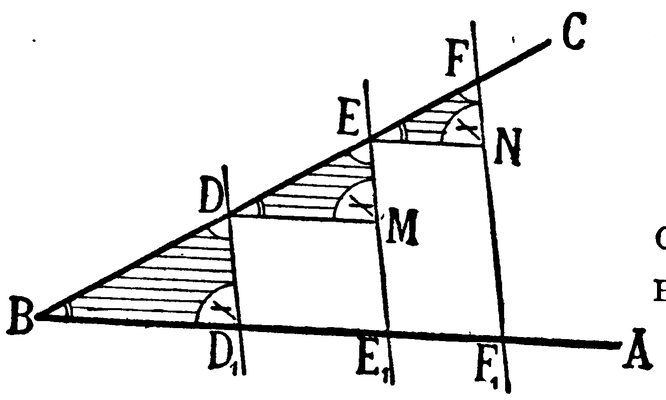
Let the sides of the angle ABC (fig. 199) be divided by a series of parallel straight lines , , , ... into the parts BD, DE, EF, ... (the side BC) and , , , ... (the side BA). It is required to prove that the parts of one side are proportional to the corresponding parts of the other side, that is, that
(or: ; ; and so on).
Drawing the auxiliary straight lines DM, EN, ..., parallel to BA, we obtain the triangles , DEM, EFN, ..., which are all similar to one another, since their angles are respectively equal (in consequence of the parallelism of the lines). From their similarity it follows (197, remark) that
Replacing in this series of equal ratios the segment DM by , the segment EN by , ... (the opposite sides of parallelograms are equal), we obtain what was required to be proved.
220. Corollary. Two straight lines (AB and , fig. 200) cut by a series of parallel straight lines (, , , ...) are divided by them into proportional parts.
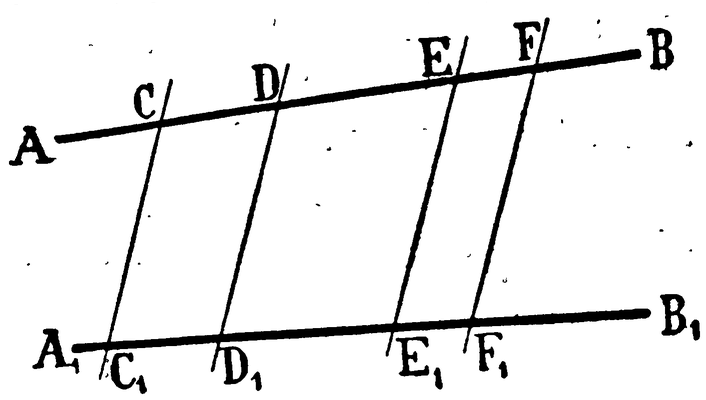
Suppose first that the straight lines AB and are not parallel. Then they form a certain angle. Applying the preceding theorem to this angle, we can write:
(we leave aside the parts of the sides of the angle that adjoin its vertex).
If we now suppose that , the proportionality of the parts of these lines is not disturbed in this case either, since the corresponding parts are then not only proportional but equal (, , and so on).
221. Converse theorem. If we lay off proportional parts on the sides of an angle from its vertex, the straight lines joining their corresponding ends are parallel.
Suppose that on the sides of the angle ABC (fig. 201) we have laid off from the vertex
on the side BC the parts BD, DE, ...,
on the side BA the parts , , ...;
and let the parts of one side be proportional to the parts of the other side, that is,
It is required to prove that the straight lines , , ... are parallel.
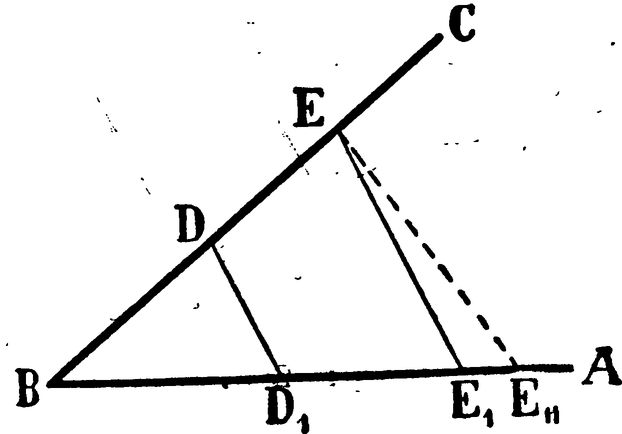
Suppose that these lines are not parallel. Then, drawing through the point E a straight line parallel to (77), we obtain a certain line that does not merge with ; let it be the straight line . By the preceding theorem we have:
Consequently , which is impossible under our supposition; hence it cannot be admitted that the lines and are not parallel; it remains to accept that .
222. Theorem. Two parallel straight lines (MN and , fig. 202) cut by a series of straight lines (OA, OB, OC, ...) issuing from one and the same point (O) are divided by them into proportional parts.
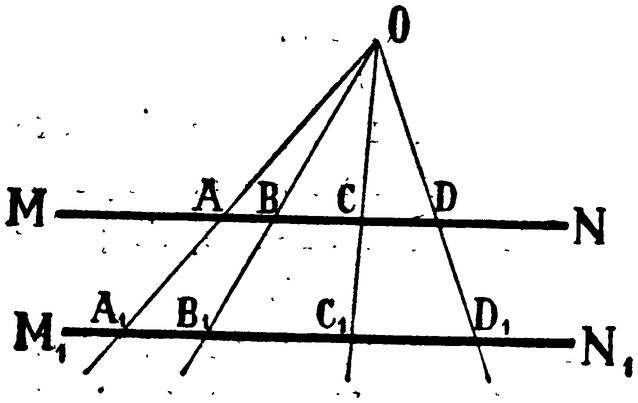
It is required to prove that the parts AB, BC, CD, ... of the line MN are proportional to the parts , , , ... of the line . From the similarity of the triangles OAB and (196), and then of the triangles OBC and , we deduce:
Whence: .
The proportionality of the remaining parts is proved in the same way.
223. Problem. To divide a segment of a straight line AB (fig. 203) into three parts proportional to the series m : n : p, where m, n and p are given segments of a straight line or given numbers.
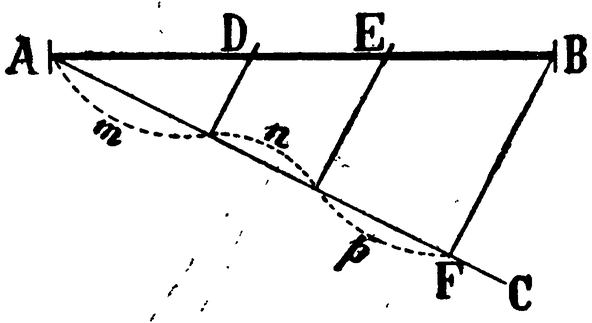
Drawing an unbounded straight line AC at an arbitrary angle to AB, we lay off on it from the point A parts equal to the lines m, n and p. We join the point F, which is the end of p, to B, and through the points so marked off we draw straight lines parallel to BF. Then AB is divided at the points D and E into parts proportional to m : n : p (219).
If m, n and p denote some numbers, for example 2, 5, 3, the construction is carried out in the same way, with the difference that on AC we lay off segments equal to 2, 5 and 3 arbitrary units of length.
Of course, the construction indicated is applicable to division not only into 3 parts but into any other number of parts.
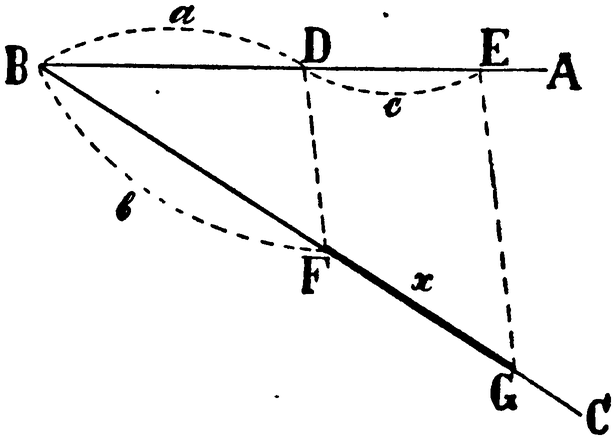
224. Problem. To find the fourth proportional to three given segments of a straight line a, b and c (fig. 204), that is, to find a segment of a straight line x that satisfies the proportion a : b = c : x. On the sides of an arbitrary angle ABC we lay off the parts BD = a, BF = b, DE = c. Then, having joined D and F, we draw EG ∥ DF. The segment FG is the one sought (219)26.
225. Problem. On an infinite straight line MN (fig. 205) to find the points whose distances from two given points A and B of this line are in the ratio m : n (m and n being either given segments of a straight line or given numbers).
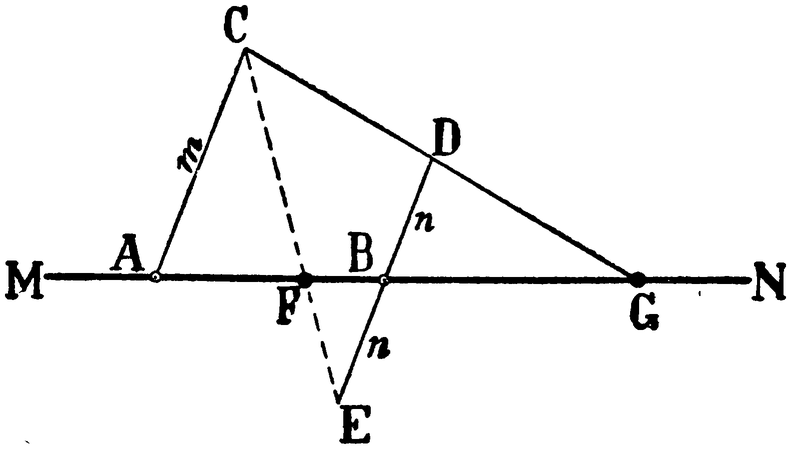
Through A and B we draw any two parallel straight lines and lay off on them AC = m and BD = BE = n (if m and n are numbers, for example m = 3, n = 2, we take the segment AC equal to 3 units of length of some kind, and the segments BD and BE equal to 2 of the same units). Then we draw straight lines through the point C and each of the points E and D. Evidently, whatever m and n may be, the line CE will always meet MN in some point F; but the line CD will meet MN only if m ≠ n, and the point of intersection G will lie to the right of B if m > n (as in our figure), or to the left of A if m < n. We shall prove that the points F and G satisfy the requirement of the problem. Indeed, from the similarity of the triangles ACF and FBE, and then from the similarity of the triangles ACG and BDG, we find:
FA : FB = AC : BE = m : n
GA : GB = AC : BD = m : n.
Besides these two points there is not a single point on the line MN that satisfies the requirement of the problem. Indeed, if we move the point F (fig. 206) nearer to A, then FA decreases and FB increases, and therefore the ratio FA : FB decreases; if we move the point F nearer to B, then FA increases and FB decreases, and therefore the ratio FA : FB increases. Hence between A and B, besides the point F, there can exist no other point whose distances from A and B are to each other as m : n.

Now take any point lying between B and G, and suppose that
To prove that this proportion is impossible, we form from it the following derived proportion:
that is, AB : = AB : GB;
whence we obtain: .
Since this equality is impossible, the proportion that we supposed is impossible too, and therefore it cannot be admitted that between A and G there exists any point satisfying the requirements of the problem. In the same way it can be proved that no point lying to the right of G can satisfy these requirements.
Finally, if we take any point K lying to the left of A, then for it, evidently, KA < KB, and therefore the ratio KA : KB is less than 1 and, consequently, cannot be equal to the ratio m : n, which is greater than 1 when m > n (if m < n, the point G will be to the left of A, and to the right of B there will be no point satisfying the problem).
Remark. 1°. When m = n, there exists only one point (lying midway between A and B) that satisfies the requirement of the problem, since the distances of any other point of the line MN from the points A and B cannot be equal.
2°. The points F and G, which satisfy the proportion FA : FB = GA : GB = m : n, are said to divide the segment AB (fig. 205) in the given ratio m : n internally and externally (the point F internally, and the point G externally); the points F and G are also said to divide the segment AB harmonically.
226. Theorem. The bisector of any angle of a triangle, interior or exterior, meets the opposite side or its extension in a point whose distances from the ends of that side are respectively proportional to the other sides of the triangle.
Let BD (fig. 207) be the bisector of an interior angle, and the bisector of an exterior angle, of the triangle ABC. It is required to prove that the points D and divide the side AC internally and externally into parts proportional to the sides BA and BC, that is, that
Through the vertex C we draw to meet both bisectors (80, 1°). The triangles ABD and DEC are similar (the angles at D are equal, as vertical angles; angle 1 = angle 5, as alternate interior angles formed with parallels); in exactly the same way the triangles and are similar. From their similarity we find:
To pass from these proportions to those that are required to be proved, it is enough to satisfy ourselves that EC = BC and = BC. Since angle 2 = angle 1 (by hypothesis) and angle 5 = angle 1 (as alternate interior angles formed with parallels), angle 2 = angle 5, and therefore in △EBC the sides EC and BC are equal; on the other hand, angle 3 = angle 4 (by hypothesis) and angle 6 = angle 4 (as alternate interior angles formed with parallels); hence angle 3 = angle 6, and therefore in △BC the sides C and BC are equal. Replacing the segments EC and C by BC in the proportions [1] and [2], we now obtain the proportions that were required to be proved.
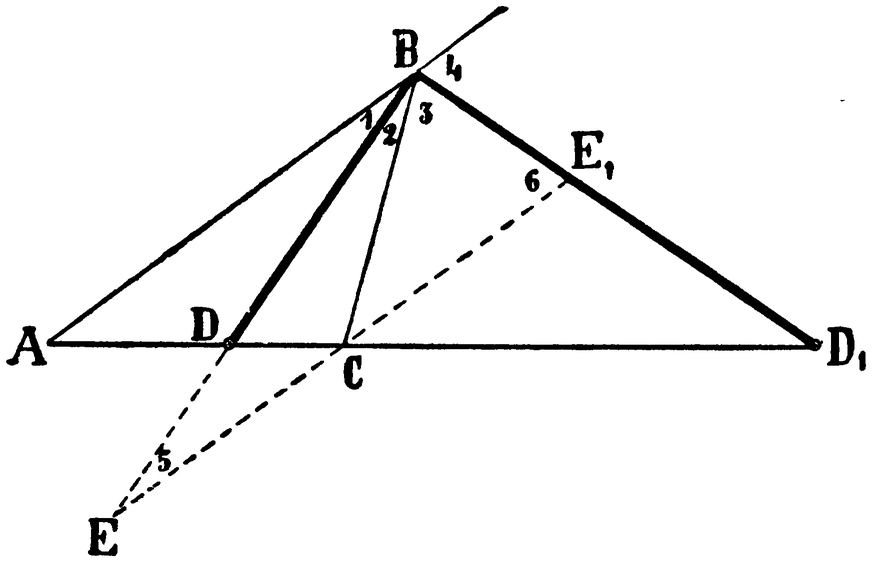
Numerical example. Let AB = 10, BC = 7 and AC = 6. Then the bisectors BD and B determine the points D and , whose distances from A and C can be found from the proportions:
Remark. The theorem does not apply to the bisector of an exterior angle of a triangle when this exterior angle lies at the vertex of an isosceles triangle. Indeed, it is easy to prove that in this case (if AB = BC, fig. 207) the bisector B is parallel to AC.
227. Converse theorem. If a straight line issuing from a vertex of a triangle meets the opposite side (or its extension) in a point whose distances from the ends of that side are respectively proportional to the two other sides, it is the bisector of an angle of the triangle (interior or exterior).
Let D and (fig. 208) be two points satisfying the proportions:
It is required to prove that the straight lines BD and B bisect, the first an interior and the second an exterior angle of the triangle ABC.
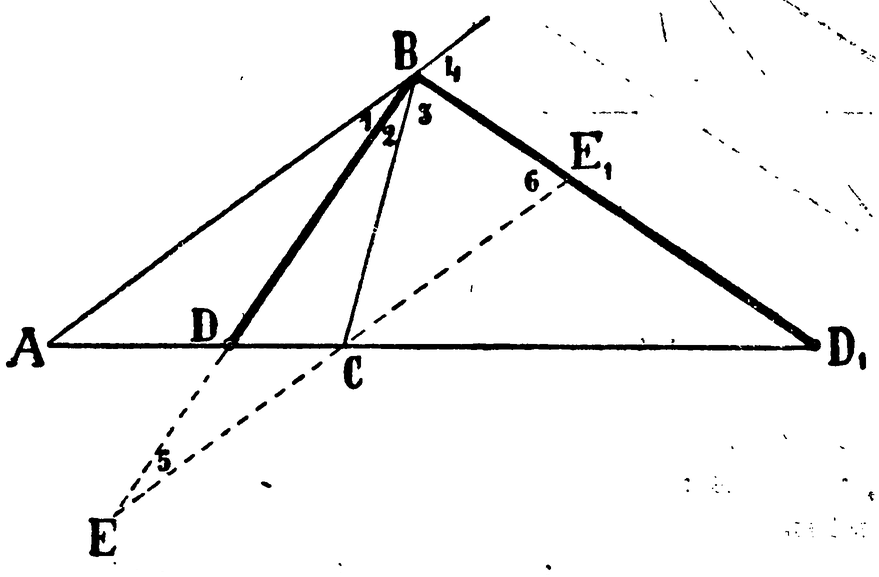
Drawing through the point C the straight line E ∥ AB, we find from the similarity of the triangles:
Comparing the proportions [3] with [1] and [4] with [2], we find:
EC = BC and C = BC.
Therefore in the triangle BEC the angles 2 and 5 are equal, and in the triangle BC the angles 3 and 6 are equal; but angle 5 = angle 1 (as alternate interior angles formed with parallels) and angle 6 = angle 4 (for the same reason); consequently, angle 2 = angle 1 and angle 3 = angle 4, that is, BD and B are bisectors.
228. Theorem. The locus of the points whose distances from two given points A and B are in a constant ratio is a circle when is not equal to , and a straight line when .
Suppose first that is not equal to . Then on the infinite straight line passing through A and B (fig. 209) two points can be found that belong to the locus sought (225). Let these be the points C and , that is,
CA : CB = : and A : B = : .
Suppose now that there exists some further point M, not lying on the line AB and satisfying the proportion:
MA : MB = : .
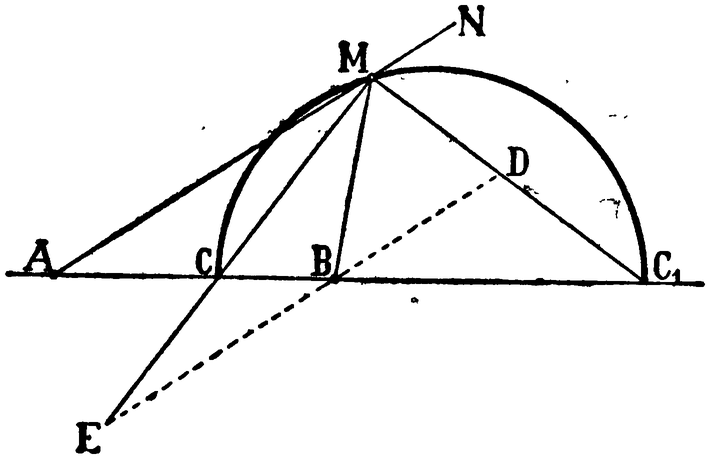
Drawing CM and M, we must conclude (227) that the first of these lines is the bisector of the angle AMB, and the second the bisector of the angle BMN; in consequence of this the angle CM, made up of the two halves of adjacent angles, must be a right angle, and therefore its vertex M lies on the circle described on C as diameter. Thus we have proved that every point M belonging to the locus sought lies on the circle C. Now we shall prove the converse proposition, that is, that every point of this circle belongs to the locus.
Let M be an arbitrary point of this circle. It is required to prove that MA : MB = : . Drawing through B the straight line DE ∥ AM, we have the following proportions:
MA : BD = A : B = : ; (1)
MA : BE = CA : CB = : . (2)
Whence BD = BE,
that is, the point B is the midpoint of the line DE. Since the angle CM is inscribed and rests on a diameter, it is a right angle; therefore △DME is a right triangle. In consequence of this, if we take the midpoint B of the hypotenuse DE as centre and describe a circle, this circle will pass through M; hence BD = MB. Substituting for BD in the proportion (1) the line MB equal to it, we now have:
MA : MB = : .
When , the locus under consideration evidently turns into the straight line perpendicular to the segment AB at its midpoint.
Remark. The circle spoken of in this theorem is known by the name of the circle of Apollonius (Apollonius was a Greek geometer who lived two centuries BC).
Chapter 5: Numerical Relations among the Elements of a Triangle and of Certain Other Figures
229. Theorem. In a right triangle the perpendicular dropped from the vertex of the right angle to the hypotenuse is the mean proportional between the segments of the hypotenuse, and each leg is the mean proportional between the hypotenuse and the segment adjacent to that leg.
Let AD (fig. 210) be the perpendicular dropped from the vertex of the right angle A to the hypotenuse BC. It is required to prove the following three proportions:
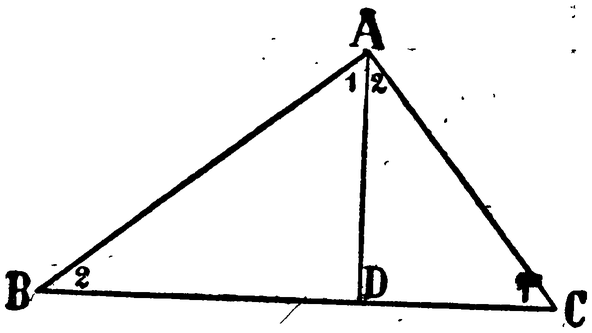
We shall prove the first proportion from the similarity of the triangles ABD and ADC, which have the side AD in common. These triangles are similar because the acute angles marked in the figure with the same numerals are equal, their sides being perpendicular (86, 87). In △ABD let us take the sides BD and AD, which form the first ratio of the proportion to be proved; the corresponding sides in △ADC are AD and DC; therefore:
BD : AD = AD : DC.
We shall prove the second proportion from the similarity of the triangles ABC and ABD, which have the side AB in common. These triangles are similar because they are right triangles and have the acute angle B in common. In △ABC let us take the sides BC and AB, which form the first ratio of the proportion to be proved; the corresponding sides in △ABD are AB and BD; therefore:
BC : AB = AB : BD
We shall prove the third proportion from the similarity of the triangles ABC and ADC, which have the side AC in common. These triangles are similar because they are both right triangles and have the acute angle C in common. In △ABC let us take the sides BC and AC; the corresponding sides in △ADC are AC and DC; therefore:
BC : AC = AC : DC.
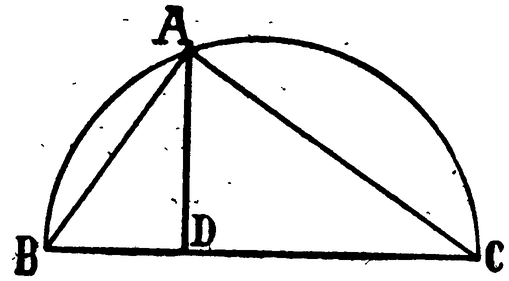
230. Corollary. Let A (fig. 211) be an arbitrary point of the circle described on the diameter BC. Joining the ends of the diameter to this point, we obtain a right triangle ABC whose hypotenuse is the diameter and whose legs are chords. Applying the theorem proved above to this triangle, we arrive at the following conclusion:
The perpendicular dropped from any point of a circle to a diameter is the mean proportional between the segments of the diameter, and the chord joining that point to an end of the diameter is the mean proportional between the diameter and its segment adjacent to the chord.
231. Problem. To construct the mean proportional between two finite straight lines a and b.
The preceding corollary allows this problem to be solved in two ways.
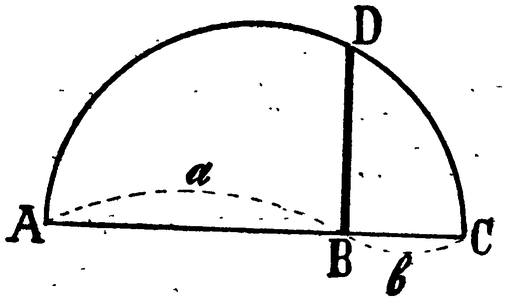
1°. On an arbitrary straight line (fig. 212) we lay off the parts AB = a and BC = b; on AC as a diameter we describe a semicircle; from B we erect a perpendicular BD to its intersection with the circle. This perpendicular is the required mean proportional between AB and BC.
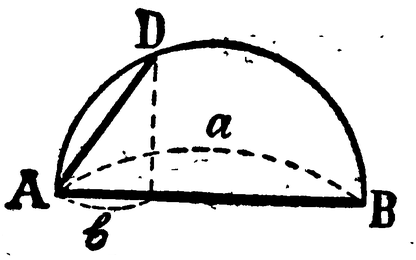
2°. On an arbitrary straight line (fig. 213) we lay off from the point A the parts a and b. On the greater of these parts we describe a semicircle. Having drawn from the end of the smaller part a perpendicular to AB to its intersection with the circle at the point D, we join A to D. The chord AD is the mean proportional between a and b.
232. Theorem. If the sides of a right triangle are measured with one and the same unit, the square of the number expressing the hypotenuse is equal to the sum of the squares of the numbers expressing the legs.
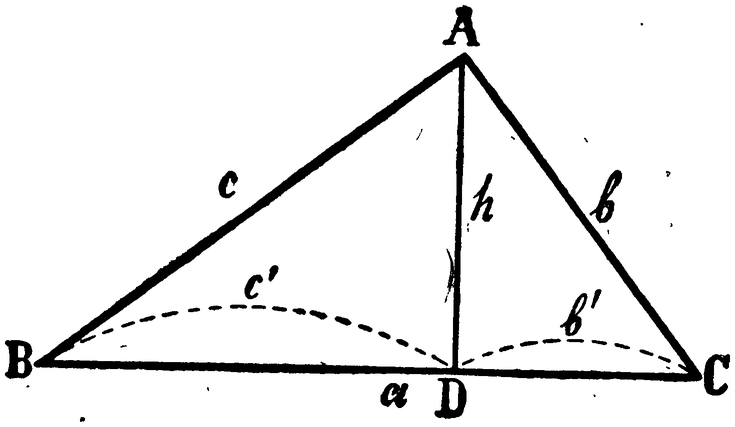
Let ABC (fig. 214) be a right triangle and AD the perpendicular dropped to the hypotenuse from the vertex of the right angle. Then, as has been proved (229),
BC : AB = AB : BD
and BC : AC = AC : DC.
When the sides of the given triangle and the segments of the hypotenuse are expressed by numbers, we can apply to these proportions the property of numerical proportions by which the product of the means is equal to the product of the extremes:
Adding these two equalities, we obtain what was required to be proved:
This theorem is usually expressed in abbreviated form as follows:
The square of the hypotenuse is equal to the sum of the squares of the legs.
Example. Suppose that the legs, measured with some linear unit, are expressed by the numbers 3 and 4; then the hypotenuse is expressed in the same unit by a number satisfying the equation ; whence 27.
233. Numerical applications. Let and (fig. 214) be the numbers expressing, in one and the same unit, the sides, the altitude and the segments of the hypotenuse of the right triangle ABC. On the basis of the preceding theorems we can derive the following 5 equations connecting these 6 numbers:
Of these equations only the first four are independent, and the last is a consequence of the first two; the equations therefore allow us, when two of the six numbers are given, to find the remaining four.
For example, suppose that we are given the segments of the hypotenuse: = 5 metres and = 7 metres; then:
234. Corollary. The squares of the legs are to each other as the adjacent segments of the hypotenuse. Indeed, from the equations of the preceding section we find:
235. Remark. In the theorems that follow we shall say for brevity "the square of a side" instead of the square of the number expressing the side, or "the product of straight lines" instead of the product of the numbers expressing the straight lines. In doing so we shall understand that the lines are measured with one and the same unit.
236. Theorem. In every triangle the square of a side lying opposite an acute angle is equal to the sum of the squares of the other two sides less twice the product of either of these sides and its segment from the vertex of the acute angle to the altitude.
Let BC be the side of the triangle ABC (fig. 215 or 216) lying opposite the acute angle A, and BD the altitude dropped to either of the remaining sides, for example to AC (or to AC extended). It is required to prove that
From the right triangle BDC we derive:
Let us determine each of the squares BD2 and DC2. From the right triangle BAD we find the value of BD2, namely:
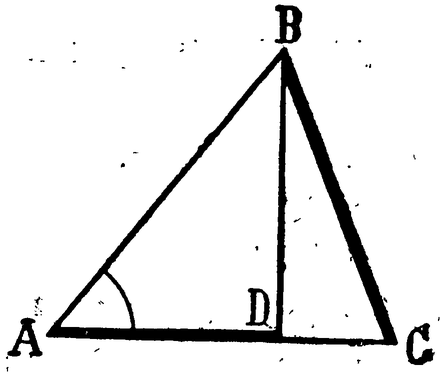
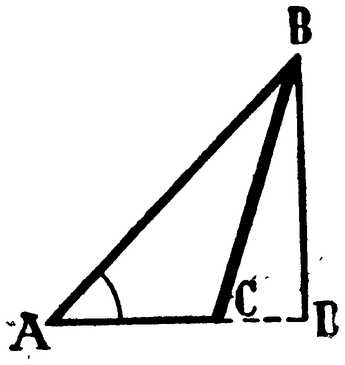
On the other hand, DC = AC − AD (fig. 215) or DC = AD − AC (fig. 216). In both cases we obtain one and the same expression for DC2:
Equality [1] can now be rewritten thus:
Once the underlined terms −AD2 and +AD2 are cancelled, this equality is the very one that was required to be proved.
Remark. This theorem remains true also when the angle C is a right angle; then the segment CD becomes zero, that is, AC becomes equal to AD, and we have:
which agrees with the theorem on the square of the hypotenuse (232).
237. Theorem. In an obtuse-angled triangle the square of the side lying opposite the obtuse angle is equal to the sum of the squares of the other two sides, increased by twice the product of either of these sides and the segment of its extension from the vertex of the obtuse angle to the altitude.
Let AB be the side of the triangle ABC (fig. 217) lying opposite the obtuse angle C, and BD the altitude dropped to either of the remaining sides; it is required to prove that
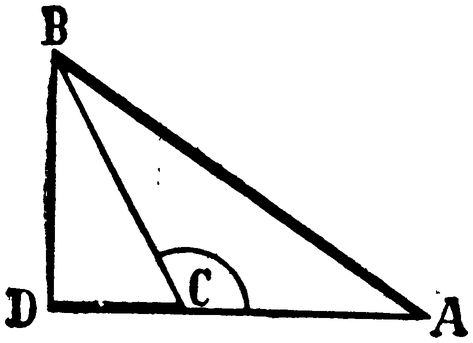
From the right triangles ABD and CBD we derive:
Replacing BD2 and AD2 in equality [1] by their expressions from equalities [2] and [3], we find:
Since the underlined terms −CD2 and +CD2 cancel each other, this equality is the one that was required to be proved.
238. Corollary. From the last three theorems we deduce that the square of a side of a triangle is equal to, less than or greater than the sum of the squares of the other sides according as the opposite angle is right, acute or obtuse; from this the converse proposition follows (51):
An angle of a triangle proves to be right, acute or obtuse according as the square of the opposite side is equal to, less than or greater than the sum of the squares of the other sides.
Example. The sides of a triangle are:
1) 5, 3, 4. Since 52 = 32 + 42, the angle lying opposite the side 5 is a right angle.
2) 8, 4, 7. Since 82 < 42 + 72, the angle lying opposite the side 8 is acute.
3) 8, 4, 5. Since 82 > 42 + 52, the angle lying opposite the side 8 is obtuse.
239. Theorem. The sum of the squares of the diagonals of a parallelogram is equal to the sum of the squares of its sides.
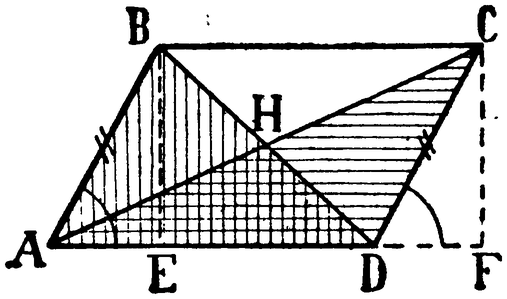
From the vertices B and C (fig. 218) of the parallelogram ABCD let us drop the perpendiculars BE and CF to the base AD. Then from the triangles ABD and ACD we find:
The right triangles ABE and DCF are equal, since they have an equal hypotenuse and an equal acute angle; therefore AE = DF. Having noticed this, let us add the two equalities derived above; the underlined terms then cancel each other, and we obtain:
240. Computing the altitudes of a triangle from its sides. If the vertices of a triangle are denoted by the capital letters A, B and C, the numerical values of the sides of the triangle are usually denoted by the corresponding small letters a, b and c, the letter a denoting the side that lies opposite the angle A, the letter b the side that lies opposite the angle B, and so on. The numerical value of an altitude of the triangle is usually denoted by the letter h (the first letter of the French word hauteur, altitude), accompanied (below) by one of the small letters a, b and c. Thus the altitude dropped to the side a is denoted by , the altitude dropped to the side b is denoted by , and so on.
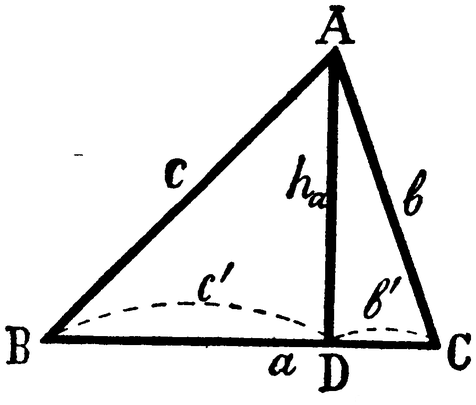
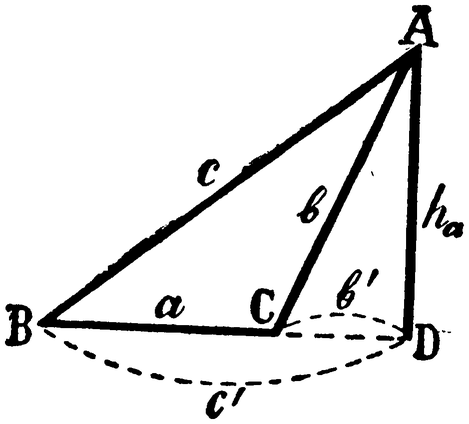
Let us determine (figs. 219 and 220) in terms of the sides of the triangle. We denote the segments of the side a (extended in the case of an obtuse angle C, fig. 220) as follows: the segment BD, adjacent to the side c, by c′, and the segment DC, adjacent to the side b, by b′. Using the theorem on the square of the side of a triangle lying opposite an acute angle (236), we can write:
From this equation we find the segment c′:
After this we determine the altitude from the triangle ABD, as a leg:
In the same way we can determine, in terms of the sides of the triangle, the numerical values and of the altitudes dropped to the sides b and c.
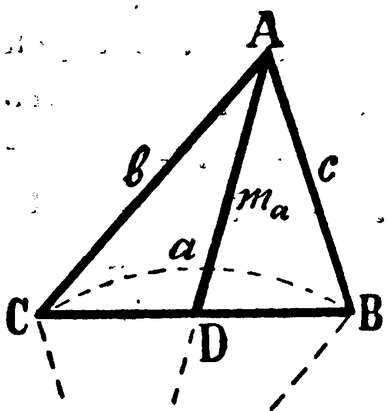
241. Computing the medians of a triangle from its sides. The numerical value of a median of a triangle is usually denoted by the letter m (the initial letter of the word mediane, middle), accompanied (below) by one of the small letters a, b and c, according to the side of the triangle to which the median so denoted is drawn. Let us determine the value of the median drawn to the side a (fig. 221). To do this we extend the median by a distance DE = AD and join the point E by straight lines to B and C. We then obtain the parallelogram ABEC (101). Applying to it the theorem on the sum of the squares of the diagonals (239), we obtain:
and, consequently:
In a similar way we can find the values and of the medians drawn to the sides b and c.
242. Ptolemy's theorem.29 The product of the diagonals of an inscribed convex quadrilateral is equal to the sum of the products of its opposite sides.
Let AC and BD be the diagonals of an inscribed convex quadrilateral (fig. 222); it is required to prove that
AC · BD = AB · CD + BC · AD,
where the notations AC, BD and the rest mean the numbers that measure the diagonals and the sides in one and the same linear unit.
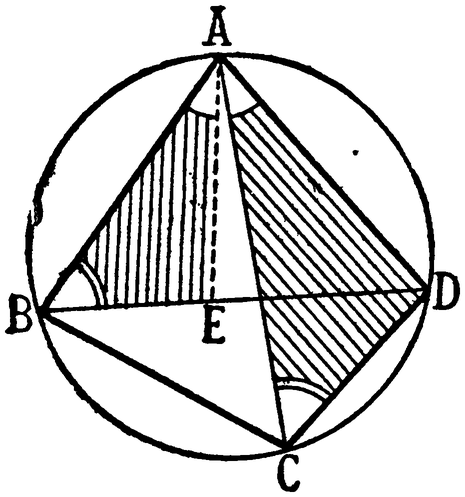
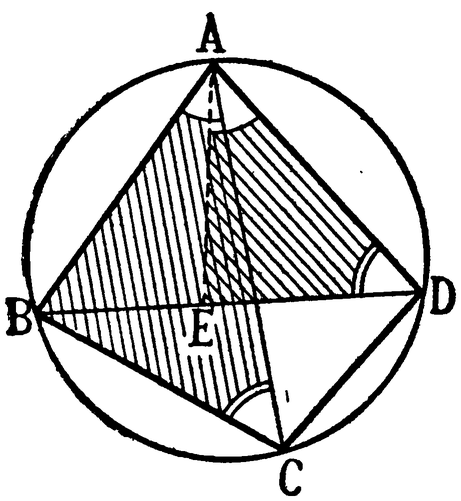
Let us construct the angle BAE equal to the angle DAC (the smaller of the two angles into which the angle A is divided by the diagonal AC); let E be the point where the side of this angle meets the diagonal BD. The triangles ABE and ADC (shaded in the figure) are similar, since their angles B and C are equal, as inscribed angles standing on one and the same arc AD, and the angles at the common vertex A are equal by construction. From the similarity of these triangles we derive:
AB : AC = BE : CD; whence: AC · BE = AB · CD.
Let us now consider another pair of triangles, namely ABC and AED (these triangles are shaded in fig. 222,a). They are similar, since their angles BAC and DAE are equal, as sums of respectively equal angles, and the angles ACB and ADB are equal, as inscribed angles standing on one and the same arc AB. From their similarity it follows that:
BC : ED = AC : AD; whence AC · ED = BC · AD.
Adding the two equalities obtained, we find:
AC(BE + ED) = AB · CD + BC · AD,
that is, AC · BD = AB · CD + BC · AD.
Remark. In a similar way it could be proved that if a convex quadrilateral is not inscribed, the product of its diagonals is less than the sum of the products of its opposite sides; therefore the converse of Ptolemy's theorem is true.
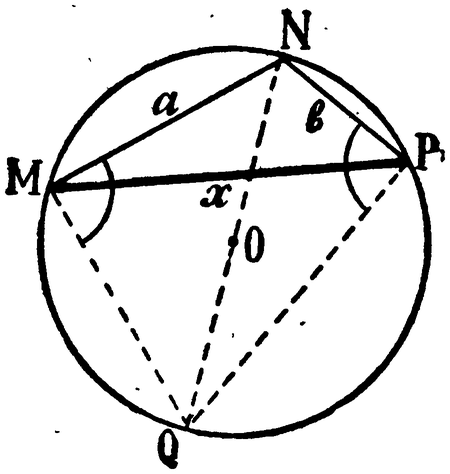
243. Problem. Given the radius R and two chords a and b of a circle, to compute the length of a third chord that subtends an arc equal: 1°, to the sum of the arcs subtended by the chords a and b; 2°, to the difference of these arcs.
1°. Let the chord a (fig. 223) subtend the arc MN, and the chord b the arc NP; it is required to compute the chord MP = x, which subtends the arc MNP, equal to the sum of the arcs MN and NP. Let us draw the diameter NQ through the point N, at which the given chords a and b meet, and join Q by straight lines to the points M and P. We then obtain an inscribed quadrilateral whose diagonals are MP = x and NQ = 2R. The triangles QMN and QNP are right-angled, the first at the vertex M, the second at the vertex P (173); therefore:
Applying Ptolemy's theorem now, we obtain the equation:
from which we find x (by dividing both sides of the equation by 2R).
2°. Let the chord a (fig. 224) subtend the arc MN, and the chord b the arc NP; it is required to compute the chord MP = x, which subtends an arc equal to the difference of the arcs MN and NP.
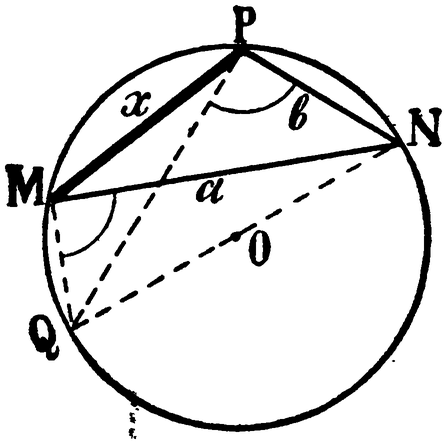
Again drawing the diameter NQ through the point N, at which the 2 given chords meet, and joining Q to M and P, we obtain an inscribed quadrilateral. From the right triangles QMN and QPN we find:
Applying Ptolemy's theorem, we obtain the equation:
from which we determine x.
Remark. This problem can also be stated thus: given two sides a and b of a triangle and the radius R of the circle circumscribed about it, to compute the third side of the triangle. The problem has in general 2 solutions, because the lines a and b can be laid off either on opposite sides of the diameter NQ (fig. 223) or on one and the same side of it (fig. 224). If the greater of the two given sides is equal to 2R, there is one solution, and if this side exceeds 2R, the problem is impossible.
244. Theorem. The ratio of the diagonals of an inscribed convex quadrilateral is equal to the ratio of the sum of the products of the sides meeting at the ends of the first diagonal to the sum of the products of the sides meeting at the ends of the second diagonal.
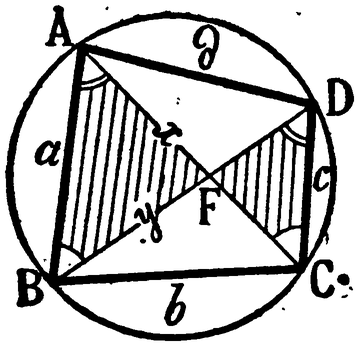
Let us denote the numerical values of the sides of the inscribed convex quadrilateral ABCD (fig. 225) by the letters a, b, c and d, and those of its diagonals by the letters x and y. We shall prove that
The triangles AFB and FDC (shaded) are similar, since the angles of the one are respectively equal to the angles of the other; for the same reason the triangles ADF and FBC are similar also. From their similarity we derive:
From these proportions we find:
Whence:
and, consequently:
that is,
Using the same equalities [1] and [2], we obtain:
that is,
Dividing equality [3] by [4], we obtain the proportion that was required to be proved (bc and CF cancel).
245. Computing the diagonals of an inscribed quadrilateral from its sides. Using Ptolemy's theorem and the theorem on the ratio of the diagonals of an inscribed quadrilateral, we can easily compute each of its diagonals separately if all the sides are known. Thus for figure 225 we have:
If we multiply these 2 equalities term by term and then divide them term by term, we obtain (after extracting the square root):
As an aid to memory let us notice that in the numerator of the quantity under the root the first factor is the sum of the products of the opposite sides, and the second is the sum of the products of the sides meeting at the ends of the diagonal being determined, while the denominator is the sum of the products of the sides meeting at the ends of the other diagonal30.
246. Theorem. If through a point taken inside a circle any chord and a diameter are drawn, the product of the segments of the chord is equal to the product of the segments of the diameter.
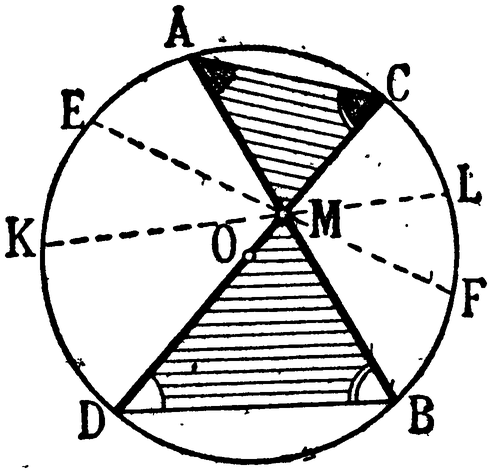
Let any chord AB and the diameter CD be drawn through the point M (fig. 226); it is required to prove that
MA · MB = MC · MD.
Having drawn 2 auxiliary chords AC and BD, we obtain two triangles AMC and MBD (shaded in the figure), which are similar, since their angles A and D are equal, as inscribed angles standing on one and the same arc BC, and their angles C and B are equal, as inscribed angles standing on one and the same arc AD. From their similarity we derive:
MA : MD = MC : MB; whence: MA · MB = MC · MD.
247. Corollary. If through a point (M, fig. 226) taken inside a circle several chords are drawn (AB, EF, KL...), the product of the segments of each chord is a number constant for all these chords, since for each chord this product is equal to the product of the segments of the diameter CD passing through the point M taken.
2°. This constant number is equal to the square of the radius diminished by the square of the distance of the point taken from the centre.
Indeed, denoting the radius of the circle by R and the distance MO (fig. 226) by d, we have:
248. Theorem. If from a point taken outside a circle any secant and a tangent are drawn to it, the product of the secant and its exterior part is equal to the square of the tangent (it is supposed that the secant is bounded by its second point of intersection, and the tangent by the point of tangency).
Let any secant MA and the tangent MC be drawn from the point M (fig. 227); it is required to prove that
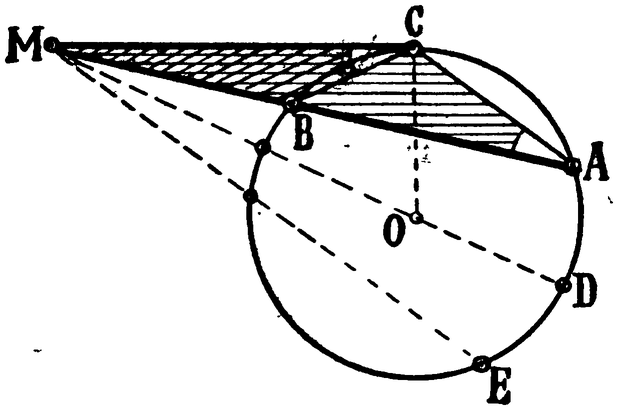
Let us draw the auxiliary chords AC and BC; we then obtain two triangles MAC and MBC (shaded in the figure), which are similar because they have the angle M in common and the angles MCB and CAB are equal, since each of them is measured by half the arc BC (178, 171). In △MAC let us take the sides MA and MC; the corresponding sides in △MBC are MC and MB; therefore
MA : MC = MC : MB.
Whence:
249. Corollary. 1°. If from a point (M, fig. 227) taken outside a circle several secants are drawn to it (MA, MD, ME...), the product of each secant and its exterior part is a number constant for all these secants, since for each secant this product is equal to the square of the tangent () drawn through the point M.
2°. This constant number is equal to the square of the distance of the point taken from the centre diminished by the square of the radius.
Indeed, drawing the radius OC, we obtain the right triangle MCO, from which we find:
250. Theorem. The product of two sides of a triangle is equal to the product of the diameter of the circle circumscribed about the triangle and its altitude dropped to the third side.
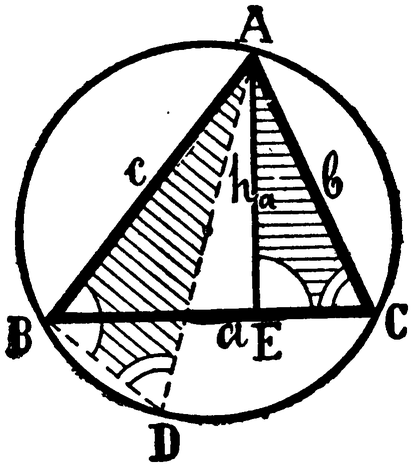
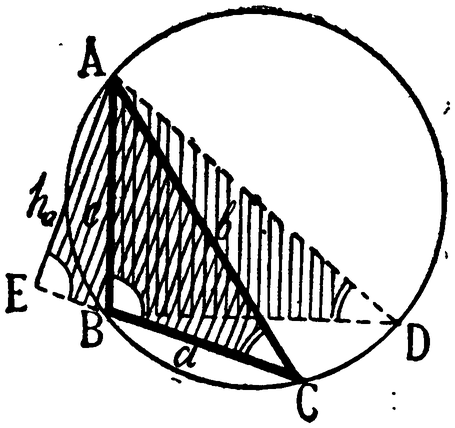
Denoting by the letter R the radius of the circle circumscribed about the triangle ABC (figs. 228 and 229), we shall prove that
Let us draw the diameter AD and join D to B. The triangles ABD and AEC are similar, because the angles B and E are right angles and D = C, as inscribed angles standing on one and the same arc. From the similarity we derive:
251. Theorem. The product of two sides of a triangle is equal to the square of the bisector of the angle included between these sides, increased by the product of the segments of the third side.
Denoting the bisector AD of the angle A (fig. 230) by the Greek letter α, we shall prove that . Let us extend AD to its intersection with the circle at the point E (this point lies at the middle of the arc BC, since the angles BAE and EAC are equal). The triangles ABE and ADC are similar, because the angles at the point A are equal by hypothesis and C = E, as inscribed angles standing on one and the same arc. From their similarity it follows that:
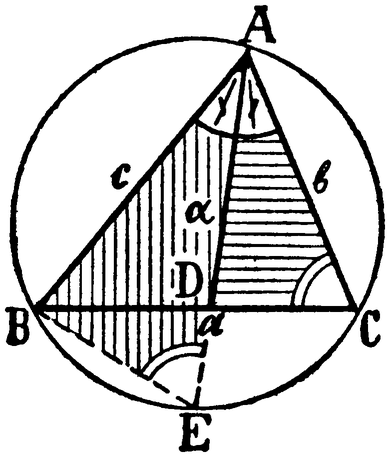
252. Computing the bisectors of a triangle from its sides. From equality [2] of the preceding section we derive:
The segments BD and DC can be found from the proportion BD : DC = c : b (226); whence:
Noticing that BD + DC = a, we obtain:
This expression can be simplified if we denote the perimeter of the triangle, that is, a + b + c, by 2p; then b + c − a = 2p − 2a = 2(p − a) and
Chapter 6: The Application of Algebra to Geometry
253. Problem. To divide a given segment of a straight line in extreme and mean ratio.
This problem is to be understood as follows: to divide a given segment of a straight line into two parts such that the greater of them is the mean proportional between the whole segment and its smaller part.
The problem will be solved if we find one of the two parts into which the given segment is to be divided. We shall look for the greater part, that is, the one that must be the mean proportional between the whole line and its smaller part. Let us suppose at first that the question is not of constructing this part but only of computing it. Then the problem is solved algebraically as follows: if we denote by a the number that measures the length of the given segment in some unit, and by x the number that measures the length of its greater part in the same unit, then the number that measures the length of the other part is expressed by a − x, and, as the problem requires, we have the proportion:
a : x = x : (a − x);
Solving this quadratic equation, we find:
Rejecting the second solution as negative31, we take only the first, positive solution, which it is more convenient to put in this form:
Let us show first of all that the magnitude is less than a.
Since , we have ; taking away from each side of this inequality, we find that .
From this we conclude that the problem is always possible and has only one solution.
If we succeeded in constructing a straight line whose length is expressed numerically by the formula found above, then, by laying this length off on the given line, we should divide it in extreme and mean ratio. The question therefore reduces to the construction of the formula found.
Considering separately the expression , we notice that it represents the length of the hypotenuse of a right triangle in which one leg is equal to a and the other to . Having constructed such a triangle, we shall find the straight line expressed by the formula . To obtain the length after that, it is enough to subtract from the hypotenuse of the triangle constructed.
The construction can therefore be carried out as follows:
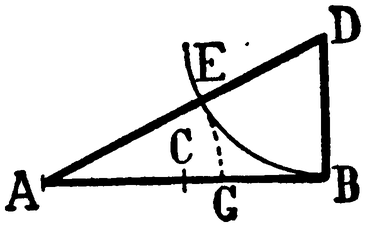
We bisect the given segment AB (fig. 231) at the point C. From the end B we erect a perpendicular BD and lay off on it BD = BC. Joining A to D by a straight line, we obtain a right triangle ABD in which the leg AB = a and the other leg BD = . Consequently its hypotenuse AD is equal to . To subtract the length from the hypotenuse, we describe from D as centre an arc with the radius DB = . Then the segment AE is equal to , that is, it is equal to . Laying off AE on AB (from A to G), we obtain the point G at which the segment AB is divided in extreme and mean ratio.
Remark. The division of a given segment of a straight line in extreme and mean ratio is also called the golden section.
254. The algebraic method of solving geometric problems. We have solved the problem proposed by applying algebra to geometry. The method consists in the following: first we determine which straight line must be found in order that the problem can be solved. Then, denoting the numerical magnitudes of the given lines by the letters a, b, c..., and that of the line sought by the letter x, we form from the conditions of the problem and from known theorems an equation connecting the line sought with the given ones; the equation obtained is solved by the rules of algebra. The formula found is discussed, that is, we determine whether this formula gives possible solutions for all data or only for some, and whether one solution is obtained or several. Then the formula is constructed, that is, we find by construction a straight line whose numerical magnitude is expressed by this formula.
Thus the algebraic method of solving geometric problems consists in general of the following 4 parts: 1°, the forming of the equation, 2°, its solution, 3°, the discussion of the formula obtained and 4°, its construction.
Sometimes a problem reduces to the finding of several straight lines. Then, denoting their numerical magnitudes by the letters x, y,..., we try to form as many equations as there are unknowns.
255. The construction of the simplest formulas. Let us point out the simplest formulas that can be constructed by means of the compass and the ruler; in doing so we shall suppose that the letters a, b, c... denote the magnitudes of given finite straight lines, and x the magnitude of the line sought. Without stopping over such formulas as:
x = a + b + c, x = a − b, x = 2a, 3a...,
whose construction is carried out very easily, let us pass to the more complicated ones:
1°. The formulas and the like are constructed by dividing the line a into equal parts (69, 7; 114) and then, if necessary, by repeating one part 2, 3... and so on times as a term of a sum.
2°. The formula represents the fourth proportional to the lines c, a and b. Indeed, from this equality we derive:
cx = ab, whence c : a = b : x.
Consequently x is found by the method that we have indicated (224) for the construction of the fourth proportional.
3°. The formula expresses the fourth proportional to the lines b, a and a, or, as it is called, the third proportional to the lines b and a. Indeed, from the given equality we derive:
bx = a2; whence b : a = a : x.
Consequently x is found by the same method by which the fourth proportional is found (only the line a will have to be laid off twice)32.
4°. The formula expresses the mean proportional between a and b. Indeed, from it we derive:
x2 = ab; whence a : x = x : b.
Consequently x is found by the method indicated earlier for the construction of the mean proportional (231).
5°. The formula expresses the hypotenuse of a right triangle whose legs are a and b.
6°. The formula represents a leg of a right triangle whose hypotenuse is a and whose other leg is b. The construction is most conveniently carried out as indicated in § 174.
The formulas indicated may be regarded as the fundamental ones. With their help more complicated formulas are constructed. For example:
7°. . Let us break the fraction into factors thus: , and let us put . Then we find k as the fourth proportional to e, a and b. Having found k, we have: . Let us put . Then we find l as the fourth proportional to the lines f, k and c. Having found l, we have ; consequently x is the fourth proportional to g, l and d.
Formulas of the following form are constructed in a similar way:
that is, formulas in which the numerator and the denominator are each a product of linear factors (of letters denoting lines), the numerator containing one such factor more than the denominator.
8°. . Bringing a under the radical sign, we obtain:
From this we see that x is the mean proportional between the lines a and .
9°. . Let us put . Then k is found as the hypotenuse of a right triangle whose legs are a and b. Having constructed k, let us put . Then l is found as the hypotenuse of a right triangle whose legs are k and d. Having constructed l, we have: . Consequently x is a leg of a triangle whose hypotenuse is l and whose other leg is c.
10°. . If we put bc = k2, we find k as the mean proportional between b and c. Then is found as was indicated above in cases 5 and 6.
11°. . Let us put
a4 = b3y; hence:
This expression shows that y is found by constructing a fourth proportional three times over. Having constructed y, we have:
The expression represents a straight line that is the mean proportional between b and . Let this line be k. Then ; that is, x is found as the mean proportional between b and k.
Let us confine ourselves to these examples. Let us notice that a detailed examination of the methods of constructing algebraic formulas leads to the following important conclusion:
with the ruler and the compass it is possible to construct only those algebraic expressions that either contain no radicals at all or contain only radicals with the indices 2, 4, 8..., that is, with indices equal to a power of 231.33
Exercises
Prove the Theorems
189. The straight line drawn through the midpoints of the bases of a trapezoid passes through the point of intersection of the non-parallel sides and through the point of intersection of the diagonals.
189a. If in a triangle the bisector and the median are drawn from the vertex of an angle lying between unequal sides, the first is less than the second.
189b. A straight line that passes through the midpoint of the base of an isosceles triangle and is bounded by one lateral side and by the extension of the other lateral side is greater than the base of this triangle.
190. If two circles touch externally, the part of a common external tangent bounded by the points of tangency is the mean proportional between the diameters of the circles.
190a. Prove that if A, B and C are three successive points of a straight line and M is any point outside the line, the following relation holds (Stewart's theorem):
(it is solved with the help of the theorems of §§ 236 and 237).
190b. With the help of this relation find an expression for the bisectors of a triangle in terms of its sides (on the basis of § 226).
191. The sum of the squares of the sides of a triangle is equal to three times the sum of the squares of the distances from the point of intersection of the medians to the vertices of the triangle (§ 239).
192. If in a right triangle ABC a square DEFG is inscribed so that the side DE lies on the hypotenuse BC, this side is the mean proportional between the segments BD and EC of the hypotenuse.
193. If two finite straight lines AB and CD intersect (even if only when extended) at a point E in such a way that
EB · EA = EC · ED,
then the points A, B, C and D lie on one circle (this theorem is the converse of those set out in §§ 247 and 249).
194. A circle O is given and two points A and B outside the circle. Through these points several circles are drawn that intersect the circle O or touch it. Prove that all the chords joining the points of intersection of each of these circles with the circle O, and also the common tangents, meet (when extended) in one point, which lies on the extension of the line AB.
195. On the basis of this, derive a method of constructing a circle that passes through 2 given points A and B and touches a given circle O.
196. Any two circles in a plane are given. If two radii of these circles move while remaining always parallel, the straight line passing through their ends always intersects the line of centres in one and the same point (this point is called the centre of similitude of the two circles).
197. A median of a triangle bisects all the straight lines drawn inside the triangle parallel to the side to which the median is drawn.
198. Three straight lines issuing from one point are given. If any point moves along one of them, its distances from the other two lines always keep one and the same ratio.
199. If two circles are concentric, the sum of the squares of the distances of any point of one of them from the ends of any diameter of the other is a constant magnitude (§ 239).
200. If from the three vertices of a triangle and from the point of intersection of its medians we drop perpendiculars to any straight line outside it, the last of the 4 perpendiculars is equal to a third of the sum of the first three.
201. If we join by straight lines the feet of the three altitudes of any triangle, the 3 triangles so formed at the vertices of the given triangle are similar to it. Deduce from this that, for the triangle whose sides are the lines joining the feet of the altitudes of the given triangle, these altitudes serve as bisectors.
202. The diameter AB of a given circle is extended beyond the point B. Through any point C of this extension an indefinite straight line CD ⊥ AB is drawn. If we join an arbitrary point M of this perpendicular to A, then (denoting by the second point in which this line intersects the circle) the product is a constant magnitude.
Find the Loci
203. Find the locus of the midpoints of all the chords passing through a given point of a circle.
204. Find the locus of the points that divide in one and the same ratio m : n all the chords passing through a given point of a circle.
205. Find the locus of the points whose distances from the sides of a given angle have one and the same ratio m : n.
206. Find the locus of the points for which the sum of the squares of the distances from two given points is a constant magnitude (§ 239).
207. Find the locus of the points for which the difference of the squares of the distances from two given points is a constant magnitude.
208. Find the locus of the points from which the tangents drawn to two given circles are equal (this locus is a straight line perpendicular to the line of centres; it is called the radical axis of the two circles).
209. Find the locus of the points that divide in a given ratio m : n all the straight lines joining the points of a circle to a given point O (lying outside or inside the circle).
210. Two circles touching externally are given. Through the point of tangency A two perpendicular chords AB and AC are drawn in the circles. Their ends B and C are joined by a straight line. Find the locus of the points that divide BC in a given ratio m : n.
211. A given angle rotates about its vertex. On its sides, from the vertex, variable lengths are laid off whose ratio, however, is constant. If the end of one side describes a straight line given in position, what line will the other end describe?
Construction Problems
212. Through a point given inside or outside an angle draw a straight line such that its parts contained between this point and the sides of the angle have a given ratio m : n.
213. Find in a triangle a point such that the perpendiculars dropped from it to the sides are in a given ratio m : n : p (see exercise 205).
214. Construct a triangle given an angle, one of the sides adjoining it, and the ratio of this side to the third side (how many solutions?).
215. The same, given the angle at the vertex, the base, and the ratio of the base to one of the lateral sides.
216. The same, given the altitude, the angle at the vertex, and the ratio of the segments of the base.
217. The same, given the angle at the vertex, the base, and a point given on the base through which the bisector of the angle at the vertex passes.
218. The same, given two angles and the sum or the difference of the base and the altitude.
219. Construct an isosceles triangle given the angle at the vertex and the sum of the base and the altitude.
220. Inscribe in a given circle a triangle in which are given: the base and the ratio of the other two sides.
221. Inscribe in a given circle a triangle in which are given: the base and the median to one of the unknown sides (see exercise 203).
222. Inscribe a square in a given segment so that one of its sides lies on the chord and the vertices of the opposite angles lie on the arc.
223. Inscribe a square in a given triangle so that one of its sides lies on the base of the triangle and the vertices of the opposite angles lie on the lateral sides of the triangle.
224. In a given triangle inscribe a rectangle (see the preceding problem) whose sides are to each other as m : n.
225. About a given square circumscribe a triangle similar to a given one.
226. A circle is given and on it two points A and B. Find on this circle a third point C such that its distances from A and B are in a given ratio.
227. On a given straight line find a point that is equally distant from another given straight line and from a given point.
228. Construct a triangle given two sides and the bisector of the angle between them (see fig. 207. First we find the line DE from the proportion AB : EC (that is, BC) = BD : DE; then we construct △BCE;....).
229. Construct a straight line x that is to a given straight line m as : (a and b are given lines).
230. Find outside a given circle a point such that the tangent drawn from it to this circle is half the secant drawn from the same point through the centre (by the application of algebra to geometry).
231. Through a point given outside a circle draw a secant that is divided by this circle in a given ratio (by the application of algebra to geometry).
232. Construct a triangle given its three altitudes , and . (It must first be proved, from the similarity of right triangles, that the altitudes are inversely proportional to the corresponding sides. If we denote the sides to which the altitudes , and are dropped by , and respectively, then
whence:
The expression is the fourth proportional to , and . Having constructed it (let it be k), we have three straight lines, , and k, to which the sides sought are proportional; that is, the triangle having these lines as its sides is similar to the one sought, and therefore the question reduces to the construction of a triangle that is similar to a given one and has a given altitude. The problem will prove impossible if a triangle cannot be constructed from the three lines , and k (52).)
Computation Problems
233. Given the base a and the altitude h of an acute-angled triangle, compute the side x of the square inscribed in this triangle so that one side of the square lies on the base of the triangle and two vertices of the square lie on the lateral sides of the triangle.
234. The sides of a triangle are 10 m, 12 m and 17 m. Compute the segments into which the side equal to 17 m is divided by the bisector of the opposite angle.
235. The perpendicular dropped from the vertex of the right angle to the hypotenuse divides it into two segments m and n. Compute the legs.
236. Compute the altitude of a triangle dropped to the side equal to 20, if the other two sides are 12 and 15.
237. Compute the medians of a triangle whose sides are: a = 5, b = 7 and c = 9.
238. In a triangle ABC the sides are: AB = 7, BC = 15 and AC = 10. Determine of what kind the angle A is, and compute the altitude dropped from the vertex B.
239. From a point outside a circle a tangent a and a secant are drawn. Compute the length of the secant, knowing that the ratio of its exterior part to its interior part is equal to m : n.
240. To two circles whose radii are R and r, and the distance between whose centres is d, a common tangent is drawn. Determine by computation the position of the point in which this tangent intersects the line of centres, in the first place when this point lies on one side of the centres, and in the second place when it lies between them.
Chapter 7: Regular Polygons
256. Definitions. A broken line is called regular if it satisfies the following three conditions:
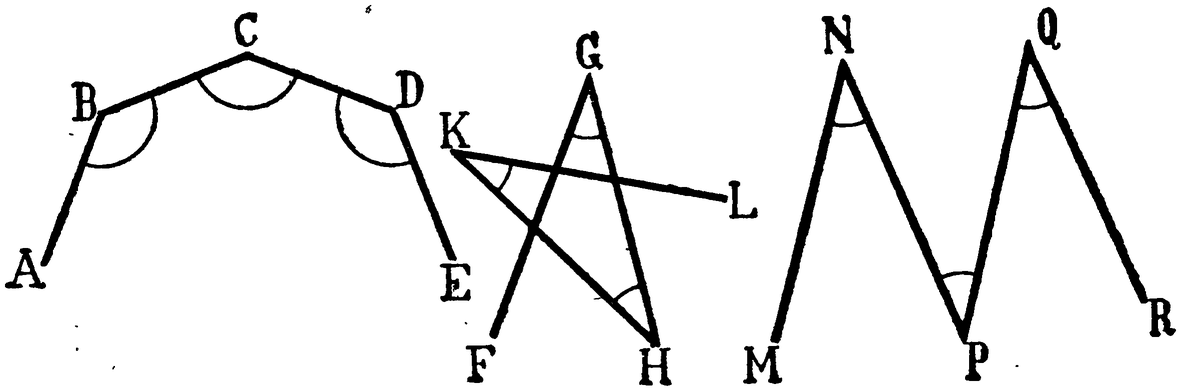
1°, the segments of straight lines that make it up are equal; 2°, the angles formed by every two neighbouring segments are equal; and 3°, of every three successive segments the first and the third lie on the same side of the second.
Such, for example, are the lines ABCDE and FGHKL (fig. 232); but the broken line MNPQR cannot be called regular, because it does not satisfy the third condition.
A regular broken line may be convex (34), as is, for example, the line ABCDE (the broken line FGHKL cannot be called convex).
A polygon is called regular if it is bounded by a regular broken line, that is, if it has equal sides and equal angles. Such, for example, are the square, the equilateral triangle and many others.
The polygon shown in figure 233 is a convex regular pentagon; the polygon of figure 234 is also a regular pentagon, but not a convex one (a so-called star pentagon). We shall consider only convex regular polygons.
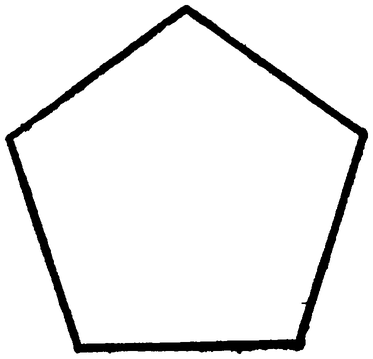
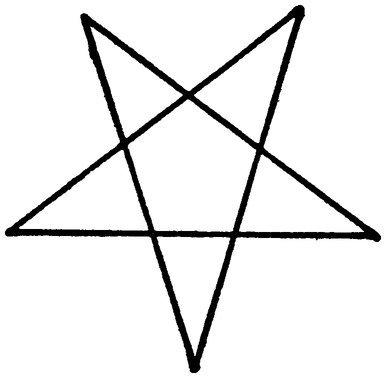
The theorems that follow show that the construction of regular polygons is closely connected with the division of the circle into equal parts.
257. Theorem. If a circle is divided into some number of equal parts (greater than two), then:
1°, joining every two neighbouring points of division by chords, we obtain a regular polygon (inscribed);
2°, drawing tangents through all the points of division until they meet one another, we obtain a regular polygon (circumscribed).
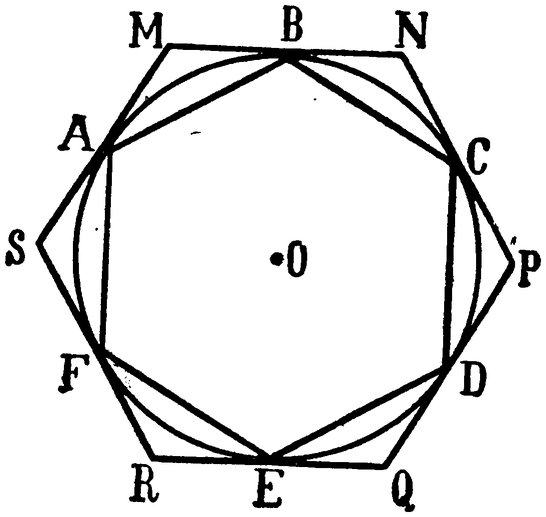
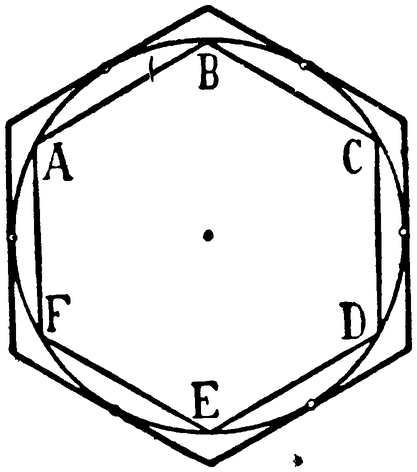
Let the circle (fig. 235) be divided into several equal parts at the points A, B, C ..., and let the chords AB, BC ... and the tangents MN, NP ... be drawn through these points. Then:
1°. The inscribed polygon ABCDEF is regular, because all its sides are equal (as chords subtending equal arcs) and all its angles are equal (as inscribed angles standing on equal arcs).
2°. To prove that the circumscribed polygon MNPQRS is regular, let us consider the triangles AMB, BNC and so on. Their bases AB, BC and so on are equal; the angles adjoining these bases are also equal, because each of them has the same measure (an angle formed by a tangent and a chord is measured by half the arc contained within it). All these triangles are therefore isosceles and equal to one another, and hence MN = NP ... and M = N = ..., that is, the polygon MNPQRS is regular.
258. Remark. If we take the midpoints of the arcs AB, BC, CD ... (fig. 236), we obtain points that divide the circle into as many equal parts as it is divided into at the points A, B, C ... Therefore, if through these midpoints we draw tangents until they meet one another, we again obtain a regular circumscribed polygon; the sides of this polygon are parallel to the sides of the inscribed polygon ABCDEF (138, the converse theorem).
259. Theorem. If a polygon is regular, then
1°, a circle can be circumscribed about it;
2°, a circle can be inscribed in it.
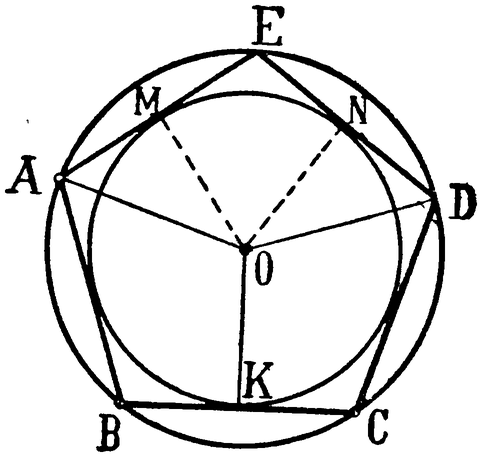
1°. Let us draw a circle through any three neighbouring vertices A, B and C (fig. 237) of the regular polygon ABCDE and prove that it passes through the next, fourth vertex D. From the centre O we drop the perpendicular OK to the chord BC and join O to A and D. Let us rotate the quadrilateral ABKO about the side OK so that it falls upon the quadrilateral ODCK. Then KB will run along KC (because the right angles at the point K are equal), the point B will fall on C (since the chord BC is bisected at the point K), the side BA will run along CD (because the angles B and C are equal) and, finally, the point A will fall on D (because the sides BA and CD are equal). From this it follows that OA will coincide with OD, and therefore the points A and D are equally distant from the centre; hence the vertex D must lie on the circle that passes through A, B and C. In exactly the same way we prove that this circle, passing through the three neighbouring vertices B, C and D, passes through the next vertex E, and so on; therefore it passes through all the vertices of the polygon.
2°. From what has been proved it follows that the sides of a regular polygon can always be regarded as equal chords of one circle; but such chords are equally distant from the centre; therefore all the perpendiculars OM, ON ..., dropped from O to the sides of the polygon, are equal to one another, and hence the circle described with the radius OM from the centre O will be inscribed in the polygon ABCDE.
260. Corollary. The preceding shows that the two circles, the one circumscribed about a regular polygon and the one inscribed in it, have one and the same centre. Since this common centre is equally distant from all the vertices of the polygon, it must lie on the perpendicular erected to any side at its midpoint, and, being equally distant from the sides of each angle, it must lie on the bisector of that angle. Therefore,
to find the centre of the circle circumscribed about a regular polygon, or inscribed in it, it is enough to determine the point of intersection of two perpendiculars erected to sides of the polygon at their midpoints, or of two bisectors of its angles, or of one such perpendicular with a bisector.
261. Definitions. The common centre of the circles circumscribed about a regular polygon and inscribed in it is called the centre of that polygon, the radius of the circumscribed circle is called the radius of the polygon, and the radius of the inscribed circle is called its apothem.
The angle formed by two radii drawn to the ends of any side of a regular polygon is called a central angle. There are as many such angles in a polygon as it has sides; they are all equal, being measured by equal arcs.
Since the sum of all the central angles is equal to 4d or 360°, each of them is equal to 4d : n or 360° : n, if n denotes the number of sides of the polygon; thus the central angle of a regular hexagon is equal to 360 : 6 = 60°, that of a regular octagon is equal to 360 : 8 = 45°, and so on.
262. Theorem. Regular polygons of the same name are similar, and their sides are to each other as their radii or their apothems.
1°. To prove the similarity (fig. 238) of the regular polygons of the same name ABCDEF and , it is enough to show that their angles are equal and their sides proportional.
The angles of the polygons are equal, since each of them contains one and the same number of degrees, namely (169, 4°), if n denotes the number of sides of each polygon. Since AB = BC = CD = ... and , it is evident that:
that is, the sides of such polygons are proportional.
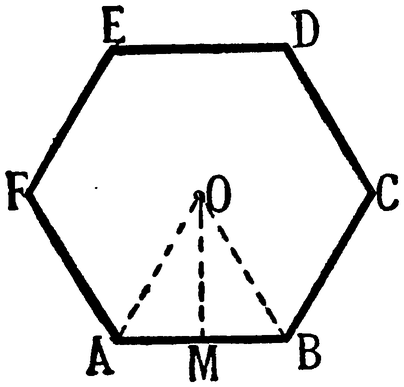
2°. Let O and be the centres of the given polygons, OA and their radii, OM and their apothems. The triangles OAB and are similar, since the angles of the one are respectively equal to the angles of the other. From their similarity it follows (203) that:
263. Corollary. Since the perimeters of similar polygons are to each other as corresponding sides (209), the perimeters of regular polygons of the same name are to each other as their radii or their apothems.
264. Symmetry of regular polygons. In the circumscribed circle let us draw, through any vertex C of a regular polygon (fig. 239, left), the diameter CN, which divides the circle and the polygon into two parts. Let us imagine that one of these parts (the left one, for example) is rotated about the diameter CN, as about an axis, until it falls upon the other part (the right one). Then one semicircle will coincide with the other semicircle, the arc CB will coincide with the arc CD (these arcs being equal), the arc BA will coincide with the arc DE (for the same reason), and so on; consequently, the chord BC will coincide with the chord CD, the chord AB with the chord DE, and so on. Thus a diameter of the circumscribed circle drawn through any vertex of a regular polygon is an axis of symmetry of that polygon (in consequence of which each pair of vertices, such as B and D, A and E and so on, lies on one perpendicular to the diameter CN, at equal distances from it).
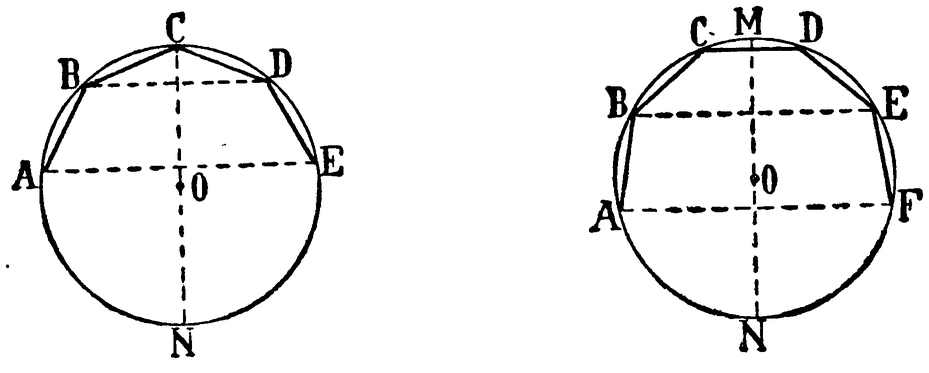
Let us also draw in the circumscribed circle the diameter MN (fig. 239, right) perpendicular to any side CD of a regular polygon; this diameter too divides the circle and the polygon into two parts. Rotating one of these parts (the left one) about the diameter drawn until it falls upon the other part (the right one), we satisfy ourselves in the same way that the one part of the polygon coincides with the other. Therefore a diameter of the circumscribed circle perpendicular to a side of a regular polygon is an axis of symmetry of the polygon (and, consequently, each pair of vertices, such as B and E, A and F and so on, lies on one perpendicular to the diameter MN, at equal distances from it).
If the number of sides of the polygon is even, the diameter drawn through any vertex of the polygon passes through the opposite vertex as well, and the diameter perpendicular to any side of the polygon is perpendicular to its opposite side as well; but if the number of sides is odd, the diameter passing through any vertex is perpendicular to the opposite side, and conversely, the diameter perpendicular to any side passes through the opposite vertex. From this it follows that in every regular polygon there are as many axes of symmetry as it has sides. For example, in a regular hexagon there are 6 axes of symmetry, namely 3 axes passing through vertices and 3 axes perpendicular to sides; in a regular pentagon there are 5 axes of symmetry; all of them pass through the vertices of the angles and at the same time are perpendicular to the sides.
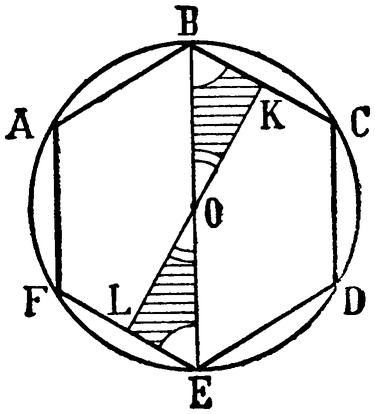
Every regular polygon with an even number of sides has, in addition, a centre of symmetry (102), which coincides with the centre of the polygon (fig. 240). Indeed, every straight line KL that joins 2 points of the contour of such a polygon and passes through the centre O is bisected by that point, as the equality of the triangles OBK and OEL (shaded in the figure) shows.
265. Problem. To inscribe in a given circle a square and to determine its side in terms of the radius.
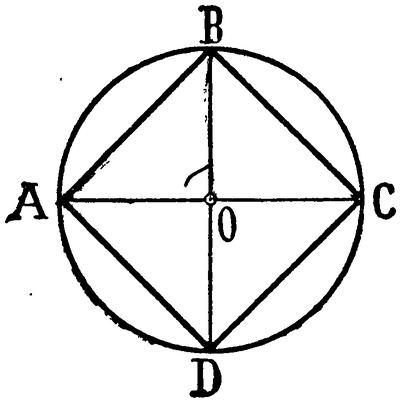
1°. Let us suppose that AB (fig. 241) is a side of the square inscribed in the given circle O. Then the arc AB must be equal to of the circle and the angle AOB must be a right angle. Therefore, to construct the inscribed square (and, consequently, to divide the circle into 4 equal parts) it is enough to draw two perpendicular diameters AC and BD and to join their ends by chords. The inscribed quadrilateral ABCD is regular, because the arcs AB, BC, CD and DA are equal, as corresponding to equal central angles.
2°. From the right triangle AOB we find:
whence
Let us agree always to denote by the letter a the numerical value of the side of a regular inscribed polygon that has n sides, and by R the radius of the circumscribed circle; then the equality derived above will be written thus:
266. Problem. To inscribe in a given circle a regular hexagon and to determine its side in terms of the radius.
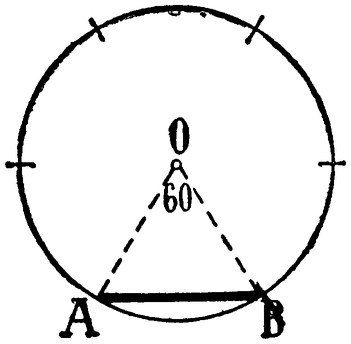
Let us suppose that AB (fig. 242) is a side of the regular inscribed hexagon. Then the arc AB must be of the circle and, consequently, the angle AOB must contain 60°. Since the triangle AOB is isosceles (AO = OB), the angles A and B are equal and each of them contains (180° − 60°), that is, 60° as well. Thus the triangle AOB turns out to be equiangular and, consequently, equilateral, that is, AB = AO = OB. Accordingly, the side of the regular inscribed hexagon is equal to the radius, which, in the notation we have adopted, can be expressed thus:
This yields a very simple method of constructing the regular inscribed hexagon (and of dividing the circle into 6 equal parts): giving the compass an opening equal to the radius, we lay off with this opening equal arcs along the circle, one after another, and join the points of division by chords.
267. Problem. To inscribe in a given circle a regular triangle and to determine its side in terms of the radius.
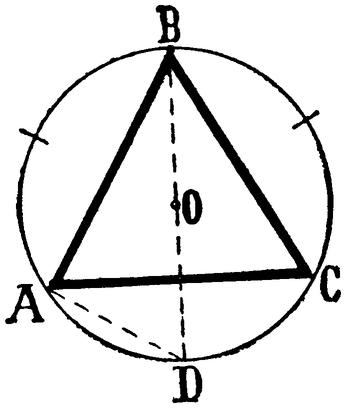
1°. To divide the circle into 3 equal parts (fig. 243), we first divide it into 6 equal parts (as shown in the preceding problem) and then unite the parts two by two into one.
2°. To determine the side AB we draw the diameter BD and the chord AD. The triangle ABD is right-angled at the vertex A; therefore . But BD = 2R and AD = R (because the arc AD is of the circle and, consequently, the chord AD is a side of the regular inscribed hexagon); therefore:
268. Problem. To inscribe in a given circle a regular decagon and to determine its side in terms of the radius.
Let us first prove the following property of the regular decagon.
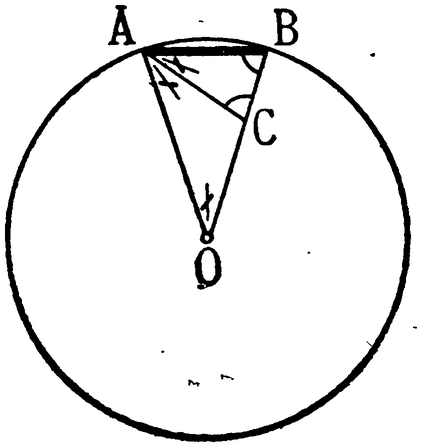
Let the chord AB (fig. 244) be a side of such a polygon. Then the angle AOB is equal to 36°, and each of the angles A and B contains (180° − 36°), that is, 72°. Let us bisect the angle A by the straight line AC. Each of the angles formed at the point A is equal to 36°; consequently the triangle ACO, having two equal angles, is isosceles, that is, AC = CO. The triangle ABC is also isosceles, because B = 72° and C = 180° − 72° − 36° = 72°; consequently AB = AC = CO. By the property of the bisector of an angle of a triangle (226) we can write:
AO : AB = OC : CB [1]
Replacing AO and AB by the lines OB and OC equal to them, we obtain:
OB : OC = OC : CB, [2]
that is, the radius OB is divided at the point C in extreme and mean ratio (253), OC being its greater part. But OC is equal to the side of the regular inscribed decagon; therefore:
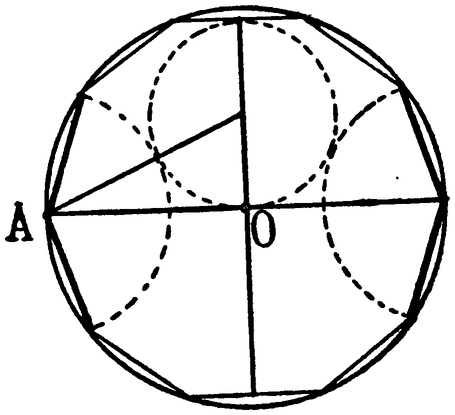
the side of the regular inscribed decagon is equal to the greater part of the radius divided in extreme and mean ratio.
The problem is now easily solved:
1°. We divide a radius of the circle (for example OA, fig. 245) in extreme and mean ratio (253); then, giving the compass an opening equal to the greater part of the radius, we lay off arcs with it along the circle, one after another, and join the points of division by chords.
2°. Denoting the numerical value of the side of the regular inscribed decagon by x, we can rewrite the proportion [2] thus:
R : x = x : (R − x),
whence
Solving this quadratic equation, we find:
269. Remarks. 1°. The formulas we derived in the preceding problems for , , , make it possible to compute the radius of the circumscribed circle from a given side of a regular polygon. Thus from the expression that determines we find:
2°. To inscribe in a given circle a regular pentagon, we divide the circle into 10 equal parts (as shown above) and join the points of division by chords, taking every other one.
270. Problem. To inscribe in a given circle a regular 15-gon.
To find of the circle it is enough to subtract of it from , as the following equality shows:
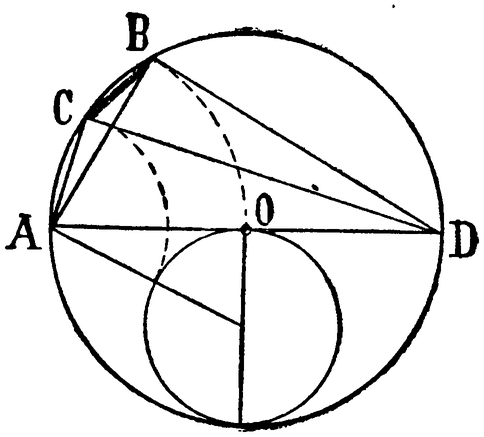
Therefore, if the chord AB (fig. 246) is equal to the radius, and the chord AC to the greater part of the radius divided in extreme and mean ratio, then the arc CB must be of the circle, and the chord CB a side of the regular inscribed 15-gon.
The side CB can be computed by applying Ptolemy's theorem (242) to the quadrilateral ACBD, in which AC = , CB = , AD = 2R, AB = = R, , BD = (since the arc BD is equal to of the circle).
Ptolemy's theorem gives:
that is,
Substituting for and their expressions, we obtain after simplification:
271. Problem. Given the radius of a circle and the side of a regular inscribed polygon, to compute the side of the regular circumscribed polygon of the same name.
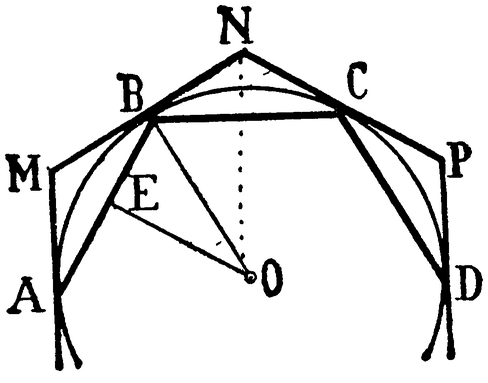
Let ABCD ... be a regular inscribed polygon, and MNP ... the regular circumscribed polygon of the same name (257). Since the sides of regular polygons of the same name are to each other as their radii or their apothems (262), we have:
MN : AB = OB : OE.
Denoting the numerical values of MN, AB and OB by , and R respectively, and noticing that BE = AB, we have:
Example. Let us compute the side of the regular circumscribed decagon:
272. Remark. The formula that determines makes it possible to compute when and are given. For this we have only to solve the equation, taking as the unknown:
273. Problem. To double the number of sides of a regular inscribed polygon.
This abbreviated expression in fact covers two problems: 1°, given a regular inscribed polygon, to construct another regular polygon inscribed in the same circle and having twice as many sides; 2°, to compute the side of this polygon from the given side of the first polygon and the given radius of the circle.
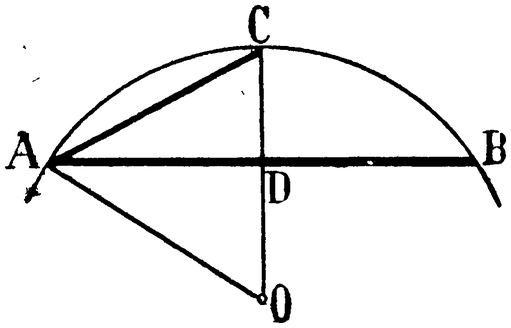
1°. Let AB (fig. 248) be a side of a regular inscribed polygon that has n sides, and O the centre of the circle. Let us draw OC ⊥ AB and join A to C. The arc AB is bisected at the point C; consequently the chord AC is a side of the regular inscribed polygon that has 2n sides.
2°. In the triangle ACO the angle O is always acute (since the arc ACB is always less than a semicircle and, consequently, its half, the arc AC, is less than a quarter of the circle); therefore (236):
that is,
From the right triangle AOD we determine the leg OD:
consequently:
Such is the doubling formula for the number of sides of a regular inscribed polygon34.
Example. Let us compute the side of the regular inscribed 12-gon:
274. Into how many equal parts can a circle be divided with compass and ruler?
Applying the methods shown in the preceding problems, we can with compass and ruler divide a circle into any number of equal parts (and, consequently, inscribe in a circle regular polygons with any number of sides) that is contained in the following series:
| 3, | 3·2, | in general |
| 4, | 4·2, | in general |
| 5, | 5·2, | in general |
| 15, | 15·2, | in general |
The German mathematician Gauss (who died in 1855) proved that with compass and ruler a circle can be divided into any number of equal parts that, being prime, is expressed by the formula . For example, a circle can be divided into 17 equal parts and into 257 equal parts, since 17 and 257 are prime numbers of the form (, ). Gauss's proof lies beyond the bounds of elementary mathematics.
It has also been proved that with ruler and compass a circle can be divided into any composite number of equal parts that, when decomposed into prime factors, contains no factors other than factors of the form , on condition that these factors are all different, and the factor 2 in any power whatever. For example, a regular 170-gon can be inscribed in a circle with compass and ruler (170 = 2·5·17), but a regular 9-gon cannot (although the factor 3 has the form , it is repeated in the composition of 9).
Into any other number of equal parts a circle can be divided only approximately.
275. Constructing a regular polygon on a given side. For different regular polygons there are different methods. But the following general method can be given. We draw a circle of arbitrary radius and inscribe in it a regular polygon with the number of sides that the required polygon is to have; then on the given side we construct a polygon similar to the one described (210).
Exercises
241. Find a formula for the side of the regular inscribed 24-gon.
242. Find formulas for the sides of the regular inscribed octagon and 16-gon.
243. Starting from the doubling formula, determine the side of the regular inscribed pentagon.
244. Find formulas for the sides of the regular circumscribed triangle and hexagon.
245. Prove that if all the diagonals are drawn in a regular pentagon, they form by their intersections an inner regular pentagon.
246. Let AB, BC and CD be three successive sides of a regular polygon that has its centre at O. If the sides AB and CD are extended until they meet at the point E, the quadrilateral OAEC can be inscribed in a circle.
247. Prove that: 1°, every inscribed equilateral polygon is regular; 2°, an inscribed equiangular polygon is regular when the number of its sides is odd; 3°, every circumscribed equiangular polygon is regular; 4°, a circumscribed equilateral polygon is regular when the number of its sides is odd.
248. Prove that two diagonals of a regular pentagon that do not issue from one vertex cut each other in extreme and mean ratio.
249. Construct a regular octagon on a given side.
250. Construct a regular decagon on a given side.
251. Cut the corners off a given square so that a regular octagon is formed.
252. In a given square inscribe an equilateral triangle, placing one of its vertices either at a vertex of the square or at the midpoint of one of its sides.
253. In an equilateral triangle inscribe another equilateral triangle whose sides are perpendicular to the sides of the given one.
254. Construct angles of 18, of 30, of 75 and of 72 degrees.
Plane Geometry. Book Four: The Length of the Circle and of Its Parts
Chapter 1: The Basic Properties of Limits
276. Constant and variable magnitudes. In solving a question into which several magnitudes enter, we sometimes suppose that some of these magnitudes keep one and the same unchanging value, while the others are capable of taking an infinite number of different values. The first magnitudes are called constant, the second variable. Thus, in considering the dependence between the length of a chord and its distance from the centre, we regard the radius of the circle as a constant magnitude, and the length of the chord and its distance from the centre as variable magnitudes.
Some magnitudes, however, are constant not because we suppose them so, but in consequence of their own fundamental property; such, for example, is the sum of the angles of a triangle, which is always equal to 2d.
If the magnitudes are expressed by numbers, then to a constant magnitude there corresponds a constant number, and to a variable magnitude a variable number.
277. Variable magnitudes that tend to zero. If a variable magnitude (and the variable number that measures it), as it changes, becomes less than any given value, however small that value may be, and on changing further remains always less than that value, then this variable magnitude is said to tend to zero.
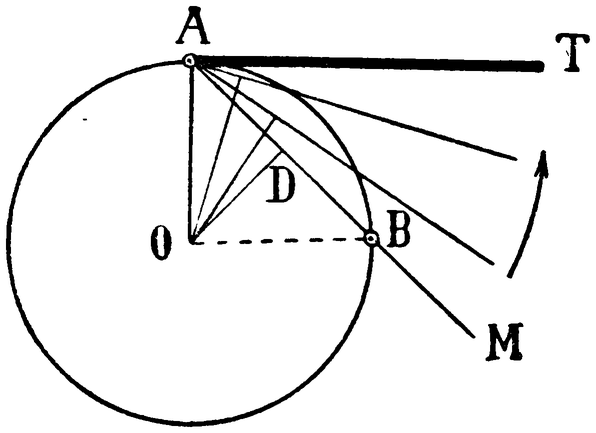
For example, if through some point A of a circle (fig. 249) we draw a tangent AT and a secant AM, and then rotate the secant about the point of tangency so that the second point of intersection B moves nearer and nearer to the point A, then the angle TAM formed by the tangent and the secant tends to zero. For, as we have said before (143), the angle AOD equal to it, formed by the radius AO and the perpendicular OD to the chord AB, can become less than any given angle, for example less than an angle of 1′, and, as the points of intersection approach each other further, it always remains less than that angle.
In exactly the same way the central angle of a regular polygon, whose size is equal to 4d/n, tends to zero if n, that is, the number of sides of the polygon, increases without bound; for example, when n = 100 this angle is equal to 0.04d, when n = 1000 it becomes 0.004d, and so on.
278. Variable magnitudes that increase without limit. If a variable magnitude (and the variable number that measures it), as it changes, becomes and remains greater than any given value, however great that value may be, then it is said to increase without limit (or without bound)35.
For example, the sum of the angles of a convex polygon, equal to 2d(n − 2) = 2dn − 4d, increases without limit as the number of sides increases without bound; thus, when n = 100 it is equal to 196d, when n = 1000 it becomes 1996d, and so on.
279. Variable magnitudes that tend to a limit. It sometimes happens that a variable magnitude, as it changes, tends to a certain limit.
The limit of a variable magnitude is a constant magnitude which the variable approaches in such a way that the difference between them tends to zero, that is, this difference becomes and remains less than any given value, however small that value may be.
Let us give two examples of variable magnitudes that tend to limits.
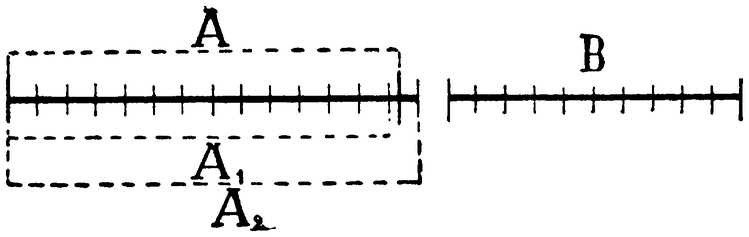
1°. Let us consider (fig. 250) the process of measuring some length A that is incommensurable with the unit B. To measure such a length (158, 2°), we divide B into n equal parts and lay one of them off on A as many times as possible. We then obtain a commensurable length , which is less than A; and if we lay off the part of B once more, we obtain another commensurable length , which is greater than A; here each of the differences and is less than the part of B. Suppose now that the number n of equal parts into which we divide B increases without bound. Then the lengths and become variable, while the length A remains constant. Since the part of B, when the number n is made great enough, can be made less than any given length (for example, less than a millimetre), and as n increases further it always remains less than that small length, we may say that the variable magnitudes and then tend to the common limit A.
From this example we see that a variable magnitude, in approaching its limit, may be either less than the limit or greater; thus the length is always less than A, while the length , on the contrary, is always greater than A.
2°. The sum of all the interior angles of a convex polygon of n sides is expressed, as we know (89), by the formula 2d(n − 2); therefore the size of one angle of a regular n-gon is equal to:
Suppose that the number of sides of the polygon, that is, the number n, increases without bound; then, as the formula just given shows, the size of the angle of the polygon, remaining always less than 2d, approaches 2d more and more closely, in such a way that the difference between them, equal to , becomes and remains less than any angle whatever. We may therefore say that the angle of a regular polygon, as the number of its sides increases without bound, has the limit 2d.
280. Remark. If a variable magnitude a, as it changes, remains always greater than its limit A, it can be regarded as a sum A + x; and if a variable magnitude a, as it changes, remains always less than its limit A, it can be regarded as a difference A − x. In both cases x denotes some positive magnitude which, by the definition of a limit, tends to zero when the variable magnitude a tends to its limit A.
281. Theorem. If two variable magnitudes that tend to limits remain equal to each other through all their successive changes, then their limits are equal too.
Let a and b be two variable magnitudes, and A and B their limits; suppose that through all their successive changes the variable magnitudes a and b are always equal to each other. It is required to prove that in that case A = B as well.
Suppose that both variable magnitudes a and b, as they change, remain always less than their limits. Then we may take a = A − x and b = B − y, where x and y are some positive magnitudes that tend to zero. Since, by hypothesis, a = b, we may write:
A − x = B − y.
Let us prove that this equality is possible only when A = B (and, consequently, x = y). Transferring the constant terms of this equality to one side and the variable terms to the other, we obtain:
A − B = x − y.
The left-hand side of this last equality, being a difference between constant magnitudes, must be equal either to zero (if A = B) or to some constant magnitude. The right-hand side of the same equality, being a difference between variable magnitudes both of which tend to zero, must be equal either to zero (if x = y) or to some variable magnitude that tends to zero. Since a constant magnitude cannot be equal to a variable magnitude, the equality we have written is possible only when both its sides are equal to zero, that is, only when A = B (and x = y).
In a similar way it can be proved that A = B also in the case when the variables a and b remain greater than their limits36.
282. Theorem. If two variable magnitudes that tend to limits keep one and the same ratio through all their changes, then their limits are in that same ratio.
Let a and b be two variable magnitudes, and A and B their limits, and suppose that through all their changes the magnitudes a and b always satisfy the proportion:
a : b = m : n,
where m and n are any given constant numbers. It is required to prove that in that case also
A : B = m : n.
Suppose again that both variables, as they change, remain less than their limits; then we may take a = A − x and b = B − y, where the subtrahends x and y are some positive magnitudes that tend to zero. Substituting in the given proportion, in place of a and b, the differences A − x and B − y equal to them, we obtain:
(A − x) : (B − y) = m : n.
Whence: (A − x) n = (B − y) m,
that is, An − nx = Bm − my.
Since the magnitudes x and y tend to 0, the products nx and my tend to 0 as well37; in consequence of this the differences An − nx and Bm − my are variable magnitudes that tend to limits: the first difference to the constant magnitude An, and the second difference to the constant magnitude Bm. But if variables that tend to limits are equal, their limits are equal too (281); hence:
An = Bm; whence: A : B = m : n.
283. The fundamental principle of the method of limits. The two preceding theorems are particular cases of the following important proposition, which we shall accept without proof:
If any equality containing variable magnitudes that tend to limits remains true through all the changes of the variables, then it remains true also when we put the limits of the variables in their place.
This proposition serves as the foundation of what is called the method of limits, which is sometimes used to prove certain geometric truths.
284. The idea of the method of limits. This method consists in the following. Suppose that we wish to find the dependence between certain constant magnitudes A and B, and let us grant that this dependence is difficult (or even impossible) to find directly. We then ask ourselves: can the magnitudes A and B be regarded as the limits of certain variable magnitudes a and b, and if they can, what is the dependence between a and b? Suppose it has turned out that this dependence is expressed by the equality:
which remains true through all the changes of a and b; in that case we may take it that this equality remains true also when we put their limits in place of a and b, that is, that
In this way we shall find the dependence between A and B by an indirect path, having first found the dependence between the variables.
We shall soon see this method applied.
Chapter 2: Computing the Length of a Circle
285. Preliminary explanation. A finite straight line can be compared with another finite straight line taken as the unit, because straight lines coincide when one is laid upon the other. Indeed, it is only for this reason that we can establish quite exactly which segments of straight lines are to be counted equal and which unequal, what the sum of segments of a line is, which segment is 2, 3, 4 ... times as great as another, and so on. In exactly the same way arcs of circles of the same radius can be compared with one another, because such arcs coincide when one is laid upon the other. But it is known that no part of a circle (or of any other curve) can coincide with a straight line (121); it is therefore impossible to establish by superposition which curvilinear segment must be counted equal to a given rectilinear segment, and consequently also which curvilinear segment is 2, 3, 4 ... times as great as a given rectilinear one. Thus it becomes necessary to define what we mean by the length of a circle (or of a part of it) when we compare it with a rectilinear segment.
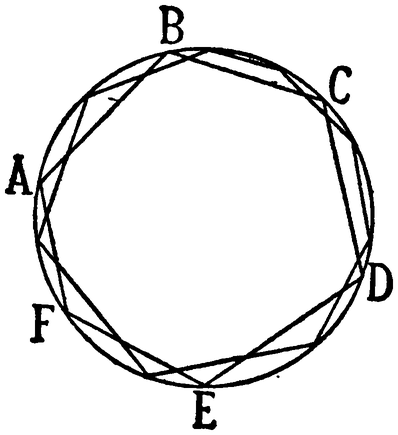
286. Definition of the length of a circle and of its arc. Let us inscribe in a given circle (fig. 251) some convex polygon ABCDEF and find its perimeter. Let this be the finite straight line (fig. 252). Let us inscribe in the same circle some other convex polygon whose sides are smaller (and whose number of sides is consequently greater) than those of the first polygon, and find its perimeter; let this be the straight line (fig. 252). Let us go on to inscribe in our circle a third polygon (it is not shown in the figure) whose sides are smaller still (and whose number of sides is consequently still greater), and find its perimeter; let this be the straight line . Let us now imagine that we inscribe in the given circle ever new polygons whose sides decrease without bound, and that each time we find their perimeters. We then obtain an infinite series of perimeters , , , ....
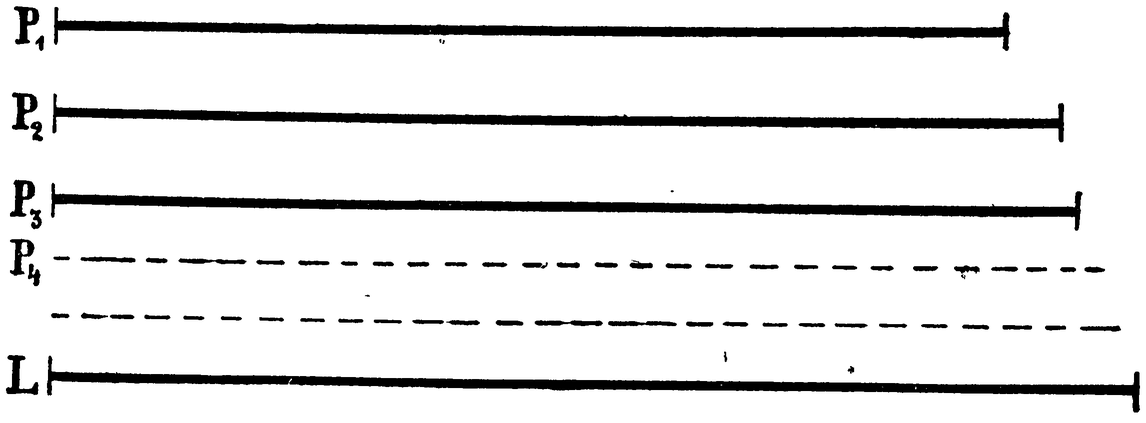
It can be proved38 that this series tends to a definite limit (for example, to the length , fig. 252), which does not depend on the law by which we decrease the sides of the inscribed polygons (and consequently increase the number of their sides). We may, for example, inscribe polygons in the given circle by the following law: first we inscribe a square (fig. 253); then we inscribe a regular octagon, next a regular 16-gon, then a 32-gon, and so on and so on, always doubling the number of sides of the regular polygons. We may also proceed thus: first we inscribe a regular hexagon (fig. 254), then a regular 12-gon, next a 24-gon, and so on and so on, always doubling the number of sides of the polygons. We may inscribe polygons by any other law we please, and the inscribed polygons may even be irregular. It will always turn out that, provided only the sides of the inscribed convex polygon decrease without bound, its perimeter tends to one and the same limit, a definite one for the given circle. This limit is taken as the length of the circle. Thus: the length of a circle is taken to be the limit to which the perimeter of a convex polygon inscribed in that circle tends when its sides decrease without bound.
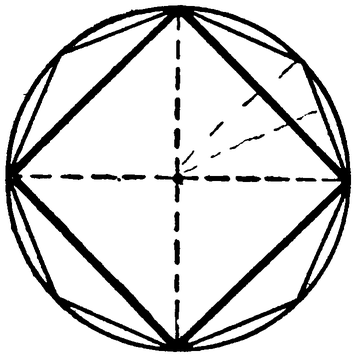
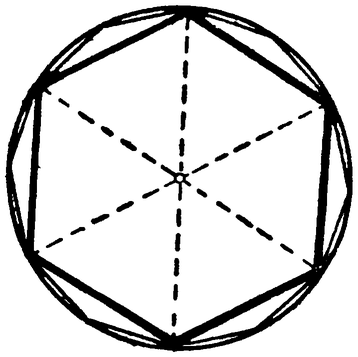
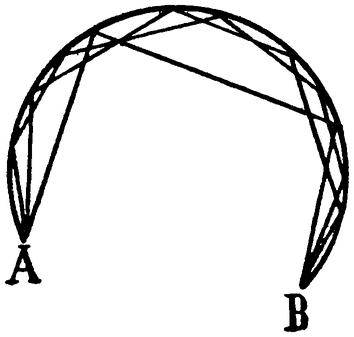
Similarly, the length of an arc (AB, fig. 255) of a circle (and in general the length of any finite curve) is taken to be the limit to which the perimeter of a broken line inscribed in the arc, and having the same ends as the arc, tends when the sides of this broken line decrease without bound.
287. Corollaries. 1°. Equal arcs and equal circles have the same lengths.
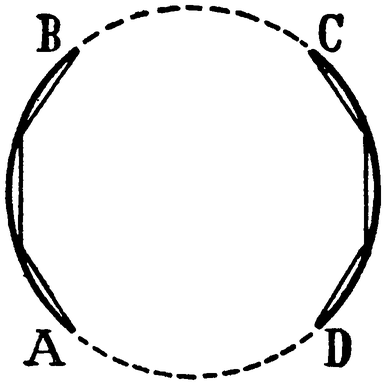
Indeed, if the arcs AB and CD (fig. 256) are equal, this means that they coincide when one is laid upon the other. Because of this, the broken lines inscribed in them can be taken exactly alike. But then the perimeters of these broken lines will, of course, tend to one and the same limit; and this limit, according to the definition, is the length of the arc AB as well as of the arc CD.
The same can be said of equal circles.
2°. The length of a sum of arcs is equal to the sum of the lengths of those arcs.
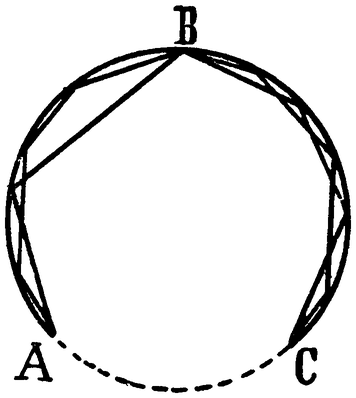
If the arc ABC (fig. 257) is the sum of the two arcs AB and BC, we can inscribe a broken line in the arc ABC in such a way that it is always made up of two broken lines meeting at the point B; then one of them will be inscribed in the arc AB and the other in the arc BC. With this manner of inscribing, evidently, the limit of the perimeter of the broken line inscribed in the arc ABC is equal to the sum of the limits of the perimeters of the broken lines inscribed in the arcs AB and BC; and this means that the length of the arc ABC is equal to the sum of the lengths of the arcs AB and BC.
In particular, for example, the length of a whole circle divided into several arcs is equal to the sum of the lengths of all those arcs.
288. Theorem. The length of an arc is greater than the chord that subtends it, but less than any broken line circumscribed about the arc and having the same ends as the arc.
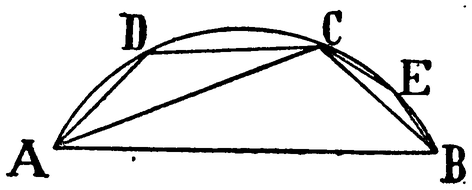
1°. Let ACB (fig. 258) be an arc of a circle and AB the chord that subtends it; it is required to prove that the length of the arc is greater than this chord. Suppose that we inscribe broken lines in the arc ACB by the following law: let the first broken line be any we please, for example the broken line made up of the 2 chords AC and CB; let the second broken line be ADCEB, made up of 4 chords, the vertices of the first broken line, that is, the points A, C and B, being also among the vertices of the second. Let the third broken line (not shown in the figure) be one made up of 8 chords, the vertices of the second broken line, that is, the points A, D, C, E and B, being also among the vertices of the third. In the same way a fourth broken line is inscribed, then a fifth, and so on without end. Under this law of inscribing, the perimeter of the broken line, with each doubling of the number of its sides, will go on increasing (for example, AD + DC + CE + EB > AC + CB, since AD + DC > AC and CE + EB > CB); because of this, the limit to which this perimeter tends must be greater than the perimeter of the first broken line, that is, than the sum AC + CB, and must therefore be, all the more, greater than the chord AB (53). But the limit to which the perimeter of the inscribed broken line tends is taken as the length of the arc AB; therefore this length is greater than the chord AB.
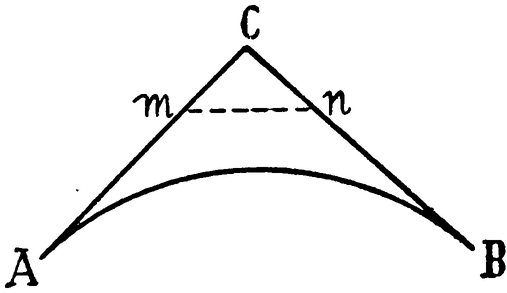
2°. Let the broken line ACB (fig. 259) be circumscribed about the arc AB and have the same ends A and B as this arc; it is required to prove that the length of the arc is less than the length of this broken line; in other words, it is required to prove that the limit L, to which the perimeter of a convex broken line inscribed in the arc AB tends as its sides decrease without bound, is less than the sum AC + CB, which for brevity we shall denote by the single letter S. For the proof let us take the auxiliary broken line AmnB, which is obtained if we cut off the angle C by some segment mn of a straight line that does not meet the arc AB (which is always possible if the broken line ACB is circumscribed, that is, made up of tangents). Let us denote the length of this auxiliary broken line by the letter . Since mn < mC + Cn, we have . Let us now prove that the limit L cannot be greater than . Suppose the contrary, that is, that . Since a variable magnitude comes as near to its limit as we please, the perimeter of the broken line inscribed in the arc AB can, when its sides are made small enough, come so near to its limit L that the difference between L and this perimeter becomes less than the constant difference ; then the perimeter of the inscribed broken line would become greater than . But this is impossible, since every convex broken line inscribed in the arc AB is enclosed with respect to the enclosing broken line AmnB, and therefore the first must be less than the second (55). Consequently we cannot admit that ; therefore , and since , we have .
289. Remark. The proof of both parts of this theorem remains in full force also when the arc of which the theorem speaks is not an arc of a circle but a part of some other curve, provided only that this part of the curve is convex, that is, lies on one side of each of its tangents.
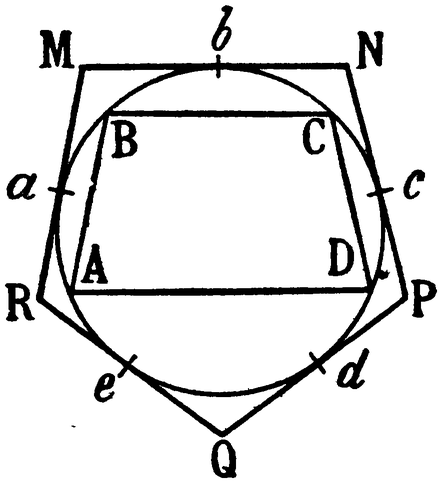
290. Corollary. Let some convex polygon ABCD be inscribed in a given circle (fig. 260) and some polygon MNPQR be circumscribed about it. Since the arc AB is greater than the chord AB, the arc BC is greater than the chord BC, and so on, the circumference is greater than the perimeter of an inscribed polygon. On the other hand, since the arc ab is less than the circumscribed broken line aM + Mb, the arc bc is less than the circumscribed broken line bN + Nc, and so on, the circumference is less than the perimeter of a circumscribed polygon.
For example, the circumference is greater than the perimeter of the regular inscribed hexagon and less than the perimeter of the circumscribed square; therefore the circumference is greater than 6 radii and less than 8 radii (since the side of the regular inscribed hexagon is equal to the radius, and the side of the circumscribed square is equal to the diameter).
To compute the circumference more exactly in terms of the radius, let us prove the following theorem.
291. Theorem. The circumferences of circles are to each other as their radii or diameters.
Let R and (fig. 261) be the radii of two circles, and C and their circumferences; it is required to prove that
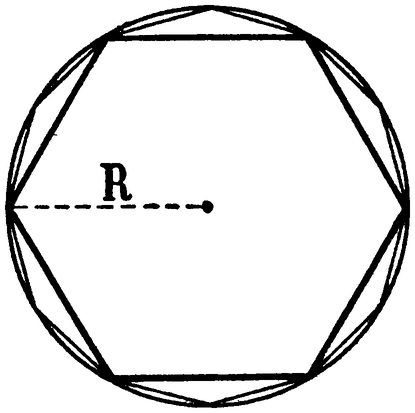
Let us inscribe in the given circles any regular polygons of the same name (for example, hexagons), and then imagine that the number of their sides is doubled simultaneously and indefinitely (that is, in place of the hexagons we take regular inscribed 12-gons, then 24-gons, 48-gons, and so on without end). Let us denote the variable perimeters of these polygons by p and . Then we have the proportion (263):
But if variable magnitudes keep one and the same ratio, their limits are in the same ratio (282); and the limits of the perimeters p and are the circumferences C and ; therefore:
Multiplying both terms of the second ratio by 2 (which does not change the ratio), we obtain:
292. Corollaries. 1°. Interchanging the means in the last proportion, we obtain:
that is, the ratio of the circumference of one circle to its diameter is equal to the ratio of the circumference of another circle to its diameter; in other words: the ratio of the circumference of a circle to its diameter is a constant number for all circles.
It is customary to denote this constant number by the Greek letter π39.
2°. Knowing the radius and the ratio of the circumference to the diameter, that is, the number π, we can compute the circumference from the equality:
that is, the circumference of a circle is equal to the product of its diameter and the number π, or to the product of its radius and twice the number π.
Most often the formula for the circumference is written thus:
293. The idea of the computation of π. It has been proved that the ratio of the circumference to the diameter cannot be expressed exactly either by a whole number or by a fractional one40. But an approximate value of π can be found to any degree of accuracy we please. Let us point out one of the ways of making this computation.
If we take the radius as the unit of length, the circumference is expressed by the number 2π. We may therefore say that π is the length of the semicircle of unit radius. To compute the semicircle to some approximation, one finds the semiperimeters of the regular inscribed polygons that are obtained by doubling the number of sides of some one of them, for example the hexagon. For this one first finds the lengths of the sides of these polygons, and then the semiperimeters. Denoting, as is customary, the side of the regular inscribed polygon having n sides by the letter a, we have:
Applying the doubling formula that we derived earlier (273):
we find:
After this, using the same formula, we compute in succession:
Suppose that we have stopped the doubling at the 96-gon. To obtain its semiperimeter, the side must be multiplied by 48. Having made all the simplifications and computations, we find (denoting the perimeter by the letter p with the corresponding index):
If we take the semiperimeter of the 96-gon as the length of the semicircle, we shall, of course, commit some error. To judge its size, let us also compute the semiperimeter of the regular circumscribed 96-gon. For this we use the formula that gives the side of a circumscribed polygon in terms of the radius and the side of the inscribed one (271):
where denotes the perimeter of the circumscribed 96-gon. Putting in place of and the numbers found before and carrying out the computations, we find:
The semicircle is greater than the semiperimeter of the inscribed 96-gon but less than the semiperimeter of the circumscribed one (290); it therefore differs from each of these semiperimeters by less than they differ from each other. Comparing the two numbers found for and , we notice that their units, tenths and hundredths are the same; consequently the difference between these semiperimeters is less than . Therefore, if we put π = 3.14, we obtain an approximate value of π to within 0.01, and this value will be by defect, since it is less than and consequently, all the more, less than the semicircle.
If we continue the computation in the same way until we obtain the semiperimeter of the polygon of 6144 sides, we get the following number (by defect), exact to one millionth:
For practical purposes it is enough to remember three or four digits of this number, and where particular accuracy is needed one may be content with the following approximate value of π (by excess), expressed in 5 digits:
It is also useful to remember a few digits of the number
which often occurs in computations.
294. The ratios of Archimedes and of Metius. Archimedes, the famous geometer of Syracuse, who lived in the third century BC, found for π the very simple number , that is, . This number is somewhat greater than π and differs from it by less than 2 thousandths.
Adriaan Metius, a Dutch geometer of the sixteenth century, gave for the ratio of the circumference to the diameter the number , which exceeds the exact value of π by less than half a millionth; it is easy to remember by the following rule: having written each of the first three odd digits twice:
113 | 355,
one takes the last three as the numerator and the first three as the denominator.
Scholars of later times, using simplified methods (which higher mathematics provides), have computed π with an accuracy far exceeding all practical requirements (thus Shanks in 1873 found 707 decimal places of the number π41).
295. The length of an arc of n°. Since the length of the whole circle is , the length of an arc of 1° is equal to 42; consequently the length s of an arc containing n° is expressed thus:
If the arc is expressed in minutes (n′) or in seconds (n″), its length is determined by the formulas:
296. Problem 1. To compute to within 1 millimetre the radius of a circle of which an arc containing 81° 21′ 36″ is equal to 0.452 metre.
Turning 81° 21′ 36″ into seconds, we obtain the number 292896.
From the equation:
we find:
Problem 2. To determine the number of degrees in an arc whose length is equal to the radius.
Replacing the magnitude s by R in the formula that determines the length of an arc of n°, we obtain the equation:
whence:
The Theorem on Which the Definition of the Length of a Circle Rests
(See § 286.)
297. In proving this theorem we shall rely on the following almost evident truths:
1° If a variable magnitude, as it changes, always increases but remains less than some constant magnitude, it has a limit.
2° If a variable magnitude, as it changes, always decreases but remains greater than some constant magnitude, it has a limit.
3° If the difference of two variable magnitudes tends to zero, and one of these magnitudes has a limit, the other has the same limit.
298. Theorem. The perimeter of a convex polygon inscribed in a circle tends to a limit when the sides of the polygon decrease without bound (and the number of sides consequently increases without bound); this limit does not depend on the law by which the sides of the polygon decrease.
Let ABCDE (fig. 262) be some convex polygon inscribed in a given circle.
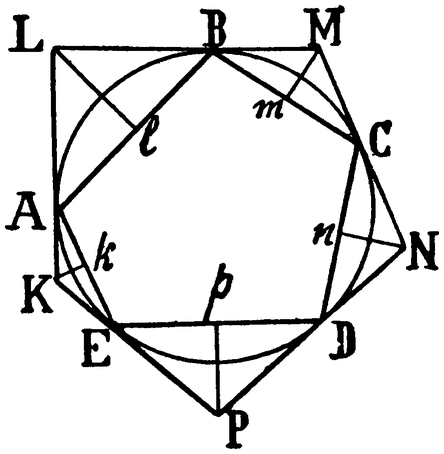
Through all its vertices let us draw tangents to the circle and extend them until they meet one another. We then obtain a circumscribed polygon KLMNP. Let us agree to call such a circumscribed polygon the one corresponding to the inscribed polygon ABCDE.
Our proof will consist of the following three parts:
1°. Let p be the perimeter of any inscribed polygon, and P the perimeter of the corresponding circumscribed polygon43. Let us prove that the difference P − p tends to 0 when the sides of the inscribed polygon tend to 0 by any law whatever. For this we first find the limit of the ratio P : p. From the vertices K, L, M, N ... let us drop perpendiculars to the sides of the inscribed polygon. Then
P = AL + LB + BM + MC + CN + ND + DP + ...
p = Al + lB + Bm + mC + Cn + nD + Dp + ... (1)
It is known from algebra44 that the value of the fraction:
lies between the least and the greatest of the fractions:
Let us prove that, as the sides of the inscribed polygon decrease without bound, each of these fractions tends to the limit 1. Take any one of them, for example . From the right triangle ALl (fig. 262) we see that
When the sides of the inscribed polygon tend to 0, the angle A formed by the tangent AL and the chord AB also tends to 0 (277); consequently cos A then tends to 1, and therefore the ratio also has the limit 1. Since this reasoning can be applied to every triangle of figure 262, each fraction of the series (2) has the limit 1.
From this it follows that the limit of the ratio is also equal to 1.
Having proved this, let us take the difference P − p and write it thus:
The ratio tends, by what has been proved, to 1; consequently the difference tends to 0; because of this the product , in which p is a finite magnitude (since the perimeter of any inscribed polygon always remains less than the perimeter of every circumscribed one), also tends to 0; therefore the same can be said of the difference P − p.
2°. Let us now prove that the perimeter of the inscribed polygon tends to a limit under the following particular law of inscribing. Let us inscribe in the circle a regular triangle; then let us double the number of sides, that is, take the regular inscribed hexagon; next let us double the number of sides again, that is, take the regular 12-gon; let us imagine that this process of doubling goes on without end. Then the perimeters of such inscribed polygons, increasing with each doubling, will go on growing, while remaining less than the perimeter of any circumscribed polygon (for example, of a square); because of this, the perimeter of the inscribed polygon whose sides tend to 0 by this particular law has a limit. Let us denote it by T. The perimeter of the corresponding circumscribed polygon has the same limit, since, by what has been proved, the difference between these perimeters tends to 0.
3°. Let us prove, finally, that the perimeter of an inscribed polygon whose sides decrease by any law whatever tends to the same limit T.
Let be the variable perimeter of an inscribed polygon whose sides decrease by an arbitrary law, and p the perimeter of the inscribed polygon whose sides decrease by the particular law indicated above; suppose further that and P are the perimeters of the corresponding circumscribed polygons. By what was proved in part 1° of this exposition, the differences:
tend to 0. Therefore their sum must also tend to 0. But this sum can be written thus:
Since the perimeter of a convex polygon is less than the perimeter of every other polygon that encloses it, and ; consequently both differences and are positive; but a sum of positive terms tends to 0 only when each term tends to 0; consequently the differences and tend to 0. But the magnitudes p and P have the common limit T; consequently (297, 3°) the magnitudes and have the same limit T.
Thus the limit of the perimeter exists and does not depend on the law by which the sides of the inscribed polygon decrease.
Remark. Applying the proof set out above not to the whole circle but to some part of it, or in general to any finite convex curve (a curve that is not convex can be divided into convex parts), we can prove this theorem for the perimeter of a broken line inscribed in that finite curve.
Exercises
255. Prove that in two circles the ratio of the central angles corresponding to arcs of the same length is equal to the inverse ratio of the radii.
256. How great will the error be if in place of the semicircle we take the sum of the side of the regular inscribed triangle and the side of the inscribed square?
257. On a circle a point A is taken, and through it are drawn the diameter AB, the side AC of the regular inscribed hexagon and the tangent MN. From the centre O a perpendicular is dropped to AC and extended until it meets the tangent at the point D. From this point a straight line DE, equal to 3 radii, is laid off along the tangent (through the point A). The point E is joined with the end B of the diameter. Determine how great the error is if we take the straight line BE as the length of the semicircle45.
258. On the diameter of a given semicircle two equal semicircles are constructed, and in the part of the plane enclosed between the three semicircles a circle is inscribed. Prove that the diameter of this circle is to the diameter of the equal semicircles as 2 : 3.
259. Compute in degrees, minutes and seconds the arc equal to the radius (the solution is in the text, § 296).
260. Compute the length of one degree of the earth's equator, taking the radius of the earth to be 859 geographical miles (the geographical mile of his day, about 7.42 km).
Plane Geometry. Book Five: The Measurement of Areas
Chapter 1: Areas of Polygons
299. Fundamental assumptions about areas. The part of the plane enclosed within a polygon or within any other plane figure is called the area of that figure.
We can regard the area of a figure as a magnitude of a special kind if we accept the following assumptions:
1°. Equal figures (that is, figures that can be made to coincide by superposition) have equal areas, whatever their position in space.
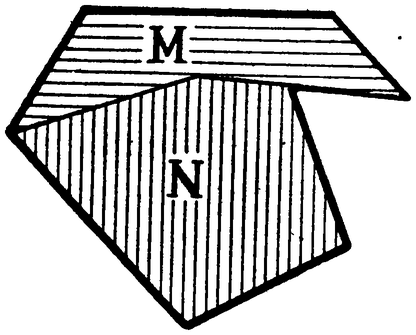
2°. The area of any figure (for example, the one shown in fig. 263) that consists of several parts (M, N...) is taken to be the sum of the areas of these parts.
300. Corollaries. 1°. The area of a figure is greater than the area of each of its parts, since a sum of positive magnitudes is greater than each of its terms.
2°. If a figure consists of 2 parts (fig. 263), the area of each part is regarded as the difference between the area of the whole figure and the area of its other part.
3°. If figures (for example, those shown in fig. 264) consist of the same number of parts (A, B...,) that are respectively equal to one another, then the areas of such figures, being sums of respectively equal terms, are considered equal, however these parts are placed relative to one another.
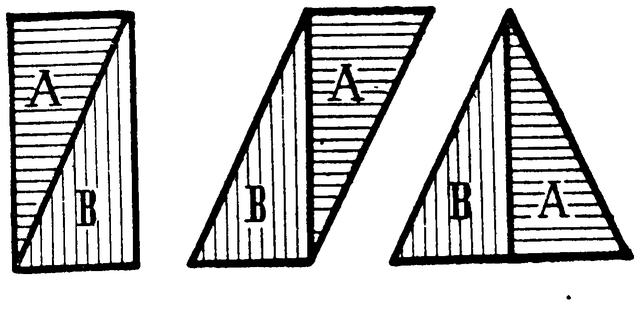
4°. Figures whose areas can be regarded as differences of the areas of equal figures have the same area. We shall soon meet such a case (308).
We see in this way that there can be figures which cannot be called equal (since they cannot be made to coincide) but which nevertheless have equal areas; such are, for example, the rectangle, the parallelogram and the triangle shown in fig. 264.
Figures that have equal areas are called equivalent, or equal in area.
Equal figures are always equal in area, but figures equal in area are not always equal.
301. Remarks. 1°. The assumptions about areas stated above give rise to the following important question. Suppose that, having divided a given figure into a certain number of parts of arbitrary form, we move these parts about in various ways (as the parts A and B are moved in fig. 264); we shall then obtain various new figures. May we not obtain among them a figure which, when placed upon the original figure or upon any one of the new figures formed from it, fits wholly inside that figure? If this happened, we should have two figures which, on the one hand, consisting of the same number of parts that coincide in pairs, must be considered equal in area; while, on the other hand, the one that is able to fit inside the other, and can thus form a part of that other, must be considered the smaller of the two. The stated assumptions about the equality and inequality of areas would then lose all meaning, since according to these assumptions two areas could be considered at once both equal and unequal.
The first to draw attention to this question was the Italian mathematician De Zolt, who (in 1881) tried to prove (but without success) that a polygon can never turn out to be equal in area to a part of itself (and that, therefore, the case we have supposed is impossible). This proposition of De Zolt was at first accepted as an unprovable postulate of equality in area, but later (at the end of the nineteenth century) it was rigorously proved (by S. Shatunovsky, Hilbert and others). We omit these proofs because of their complexity.
2°. Two kinds of equality in area are distinguished; one of them is indicated in item 3° of § 300, the other in item 4° of the same section. The first may be called equality in area "by decomposition," the second equality in area "by complement." Indeed, equality in area of the first kind can be stated thus: two figures are considered equal in area if they can be decomposed into the same number of parts respectively equal to one another; and equality in area of the second kind can be expressed thus: two figures are considered equal in area if they can be complemented by figures equal to each other in such a way that the sums so formed are also equal figures. The figures shown in fig. 264 serve as an example of equality in area by decomposition; as an example of equality in area by complement we may point to the parallelogram ABCD and the rectangle AEFD of fig. 270. Indeed, both these figures give one and the same trapezoid AECD if we complement the parallelogram by the triangle AEB and the rectangle by the triangle DFC, equal to △AEB.
For rectilinear figures it has been proved that equality in area by complement is at the same time equality in area by decomposition. We prove a particular case of this truth in § 309 by means of fig. 273.
3°. It can also be proved that two figures equal in area to one and the same third figure are equal in area to each other. We accept this truth without proof.
302. The unit of area. In measuring areas, the unit of area usually taken is the area of a square whose side is equal to the linear unit; such are, for example, the square metre, the square centimetre and so on.
The ratio of two square units of different names is equal to the second power of the ratio of the linear units that serve as the sides of these square units. Thus the ratio of the square sazhen to the square arshin (a sazhen being 3 arshins) is equal to , that is, to 9, as is plainly seen from fig. 265, in which the smaller of the two squares represents a square arshin and the larger a square sazhen.
303. The notion of the number that measures an area. Let us make plain by a picture what is to be understood by the number that measures a given area in square units.
Draw two mutually perpendicular straight lines AB and CD (fig. 266), and then construct a series of lines parallel to AB and another series of lines parallel to CD, taking the distances between the lines of each series to be the same, namely equal to some linear unit. We then obtain a net of squares, each of which is a square unit. Imagine that the figure whose area we wish to measure (for example, a given circle, as shown in fig. 266) is laid upon such a net. Then with respect to this figure all the squares of the net can be divided into three kinds: 1) exterior squares, which are situated outside the given figure; 2) interior squares, which lie inside the figure (in the figure they are shaded with double lines); and 3) those squares through which the contour of the figure passes and which, consequently, lie partly inside and partly outside the given figure (in the figure these squares are shaded with single lines). Leaving the exterior squares out of account, let us count separately the squares of the 2nd kind and the squares of the 3rd kind. Let there prove to be m of the former and n of the latter. Then, evidently, the area being measured is greater than m but less than m + n square units. The numbers m and m + n will in this case be approximate measures of the given area, the first number by defect and the second by excess, the error being less than n square units (less than the sum of those squares which are shaded with single lines in our figure).
To obtain more exact results of measurement, let us make our net of squares denser by subdividing each of them into smaller squares. For example, divide the sides of the squares into 10 equal parts and through the points of division draw a series of lines parallel to AB and another series of lines parallel to CD. We then decompose each square of the net into 100 small squares, each of which is a part of the square unit. Suppose that now the number of all the interior small squares is m′, and let the number of those cut by the contour of the figure prove to be n′. Then the area being measured will be more than but less than of a square unit. These numbers will be new approximate measures of the area being measured, the first by defect, the second by excess, the error being less than of a square unit. It is not difficult to verify that this error will prove to be less than the former error.
Indeed, from each of those squares of fig. 266 which are shaded with single lines there will now be taken away, first, the parts made up of small squares lying outside the figure and, second, the parts made up of small squares lying inside the figure. For clearness we have shown in fig. 267, on an enlarged scale, one of the squares shaded with single lines in the preceding figure (namely the square marked with the letter k), dividing it into 100 small squares. We now see plainly that the strip made up of the small squares through which the contour of the figure passes (shaded with single lines in fig. 267) is considerably less than the whole large square. Since this is true of every square of fig. 266 shaded with single lines, it is plain that the error equal to of a square unit is less than the error equal to n square units.
If we subdivide the square unit into still smaller parts, then, carrying out the measurement in the way indicated, we shall obtain approximate measures of the area with a still smaller error.
Sometimes (for example, in measuring the area of a rectangle, see fig. 268), proceeding in the way described, we may obtain the exact measure of the area. This will be so when the contour of the given figure is a broken line whose sides coincide with parts of the straight lines that form the net of squares; in this case, consequently, there will be no squares at all cut through by the contour of the figure. Then the number of squares lying inside the figure will be the exact measure of the area being measured. In all other cases the method of measurement indicated gives only approximate results, though the error can be made as small as we please.
Imagine that by some reasoning we have found a number Q (whole, fractional or incommensurable) which proves to be greater than every approximate result of measurement taken by defect and less than every approximate result of measurement taken by excess; then such a number may be accepted as the exact measure of the area being measured.
It has been proved that such a number exists for every area and that it does not depend on the position of the lines AB and CD (fig. 266) parallel to which the lines of the net are drawn.46 This number possesses the following two properties: with one and the same square unit, 1) to the areas of equal figures (figures that coincide) there correspond equal numbers, and 2) to a sum of areas (299, 2°) there corresponds the sum of the numbers. Hence it follows that to a greater area there corresponds a greater number, to figures equal in area there correspond equal numbers, and so on.
304. Base and altitude. Only in rare cases could the measurement of an area be carried out by directly laying the square unit upon it. For the most part areas have to be measured indirectly, by measuring certain lines of the figure.
Let us agree to call one of the sides of a triangle or of a parallelogram the base of the figure, and to call the perpendicular dropped to this side from the vertex of the triangle, or from any point of the opposite side of the parallelogram, the altitude.
In a rectangle, the side perpendicular to the one taken as the base may be taken as the altitude.
In a trapezoid, both parallel sides are called bases, and the common perpendicular between them is called the altitude.
The base and the altitude of a rectangle are called its dimensions.
305. Theorem. The area of a rectangle is equal to the product of its base and its altitude.
This brief proposition is to be understood thus: the number expressing the area of a rectangle in square units is equal to the product of the numbers expressing its base and its altitude in the corresponding linear units.
In the proof we shall consider separately the following three cases:
1°. The base and the altitude, measured with one and the same unit, are expressed by whole numbers.
Let the base of the given rectangle (fig. 268) be equal to a whole number b of linear units, and the altitude to a whole number h of the same units. Having divided the base into b and the altitude into h equal parts, draw through the points of division a series of lines parallel to the altitude and another series of lines parallel to the base. By the mutual intersection of these lines certain quadrilaterals are formed. Take any one of them, for example the quadrilateral k (shaded in the figure). Since the sides of this quadrilateral are, by construction, parallel to the corresponding sides of the given rectangle, all its angles are right angles; therefore the quadrilateral k is a rectangle. On the other hand, each side of this rectangle is equal to the distance between neighbouring parallel lines, that is, equal to one and the same linear unit. Therefore the rectangle k is a square, namely that square unit which corresponds to the linear unit taken (if, for example, the base and the altitude were measured in linear centimetres, the square k is a square centimetre). Since what has been said of one quadrilateral can be repeated of every other, it follows that by drawing the parallel lines indicated we divide the whole area of the given rectangle into square units. Let us find their number. Evidently the series of lines parallel to the base divides the rectangle into as many equal horizontal strips as there are linear units contained in the altitude, that is, into h equal strips. On the other hand, the series of lines parallel to the altitude divides each horizontal strip into as many square units as there are linear units contained in the base, that is, into b square units. Therefore the number of all the square units will be b · h. Thus:
area of the rectangle = bh,
that is, it is equal to the product of the base and the altitude.
2°. The base and the altitude, measured with one and the same unit, are expressed by fractional numbers.
Let the given rectangle have:
where we do not exclude the case in which either of these fractions is equal to a whole number.
Reducing the fractions to a common denominator, we obtain:
Let us take the part of the linear unit as a new unit of length. Then we can say that the base contains mq of these new units, and the altitude pn of the same units. Therefore, by what was proved in case 1°, the area of the rectangle is equal to (mq) (pn) of those square units which correspond to the new unit of length. But this square unit is a part of the square unit corresponding to the former linear unit (302); therefore the area of the rectangle is equal to:
3°. The base and the altitude (or only one of these dimensions) are incommensurable with the unit of length and, consequently, are expressed by incommensurable numbers.
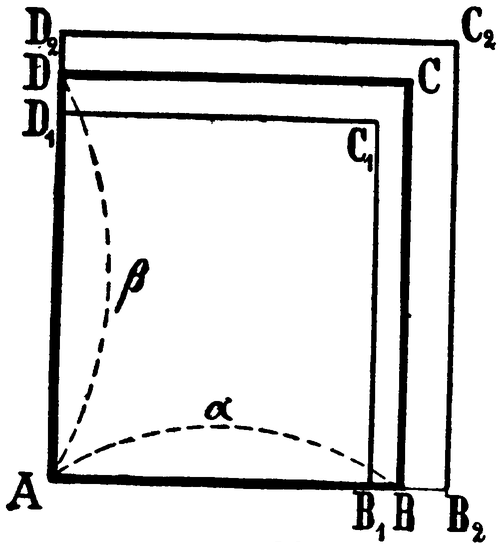
Let the base AB of the rectangle ABCD (fig. 269) be expressed by the incommensurable number α and the altitude AD by the incommensurable number β. Let us find approximate values of these numbers to within 1/n. To do this, on the base AB, starting from the point A, lay off the part of the linear unit as many times as possible. Suppose it turns out that, having laid off m such parts, we obtain a segment < AB, and having laid off m + 1 parts, we find a segment > AB. Then the fractions and will be approximate values of the number α, the first by defect, the second by excess. Suppose further that, having laid off the part of the linear unit on the altitude AD (from the point A) p times, we obtain < AD, and having laid it off p + 1 times, we find > AD; then the fractions and will be approximate values of the number β, the first by defect, the second by excess. Construct 2 auxiliary rectangles and . In each of them the base and the altitude are expressed by fractional numbers:
Therefore, according to what was proved in case 2°:
Since the area is a part of the area ABCD, and this last is a part of the area , we have
area < area ABCD < area ,
and therefore: the number measuring the area ABCD < .
This double inequality remains true for every value of n, that is, it remains true with whatever accuracy we find the approximate values of the numbers α and β. Therefore we can say that the area ABCD must be expressed by a number which is greater than the product of any approximate values of the numbers α and β, if these values are taken by defect, but less than the product of any of their approximate values, if these values are taken by excess. Such a number, as is known from algebra, is called the product of the incommensurable numbers α and β. Consequently:
area ABCD = αβ,
that is, in this case too it is equal to the product of the base and the altitude.
This reasoning applies fully also to the case in which only one of the dimensions of the rectangle is incommensurable with the unit of length.
306. Corollary. The areas of two rectangles having equal bases are to each other as their altitudes, and the areas of two rectangles having equal altitudes are to each other as their bases.
Indeed, if b, h and P are the base, the altitude and the area of one rectangle, and , and are the base, the altitude and the area of another rectangle, then, by what has been proved: and ; consequently: . Hence we find that if , then , and if , then .
307. Remark. In the theorems that follow we shall say for brevity, "the area is equal to the product of such and such lines," meaning by this that the number expressing the area in square units is equal to the product of the numbers expressing such and such lines in the corresponding linear units.
308. Theorem. The area of a parallelogram (ABCD, figs. 270 and 271) is equal to the product of its base and its altitude.
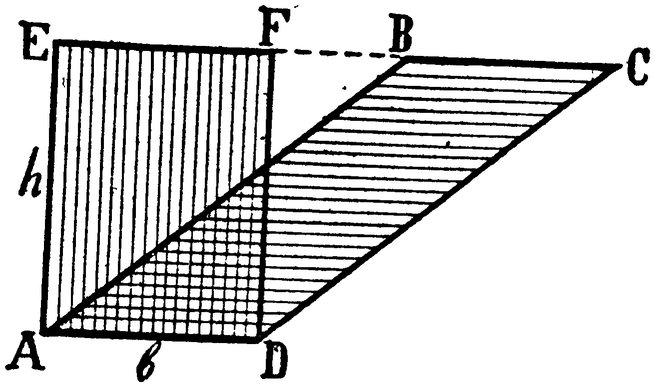
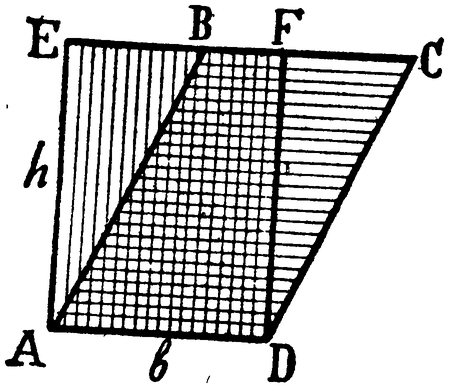
On the base AD construct the rectangle AEFD, whose side EF is the extension of the side BC. Let us prove that area ABCD = area AEFD. From the figures we see that
area ABCD = area AECD − area AEB
and area AEFD = area AECD − area DFC.
But the right triangles AEB and DFC are equal, because in them AE = DF and AB = DC (as opposite sides of parallelograms). Therefore the areas of these triangles are also equal. Hence the areas ABCD and AEFD are differences of respectively equal areas; in consequence of this (300, 4°):
area ABCD = area AEFD.
But area AEFD = bh; consequently area ABCD = bh also, where b may be regarded as the base of the parallelogram and h as its altitude.
Corollary. Parallelograms with equal bases and equal altitudes are equal in area.
309. Remark. Parallelograms having equal bases and equal altitudes can be decomposed into the same number of parts equal (congruent) to one another in pairs. To prove this, place the parallelograms so that their equal bases coincide. Then two cases may present themselves: 1) when the upper sides of the parallelograms have some part in common (fig. 272), and 2) when there is no such common part (fig. 273).
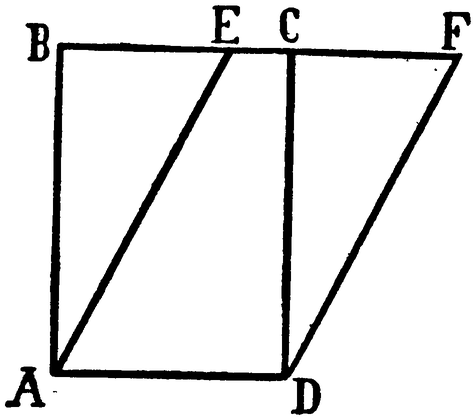
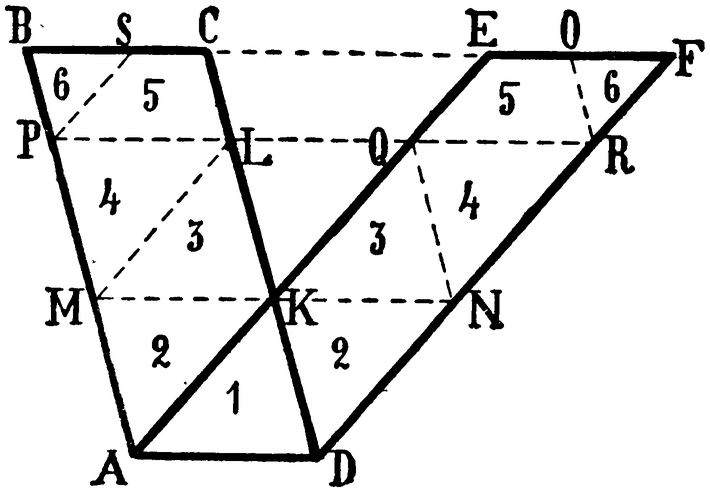
Let us consider these cases separately.
1) The parallelogram ABCD is divided by the line AE into 2 parts: △ ABE and the trapezoid AECD; the other parallelogram is decomposed by the line CD into △ DCF and the same trapezoid AECD. Since △ ABE = △ DCF, both parallelograms are made up of parts equal in pairs.
2) Let K be the point of intersection of the sides AE and DC. On KC, starting from K, lay off parts equal to DK as many times as possible (in our figure the segment KD went into KC once, as far as the point L, leaving a remainder LC < DK). Through the points K and L draw lines parallel to AD. Then the parallelogram ABCD is decomposed into 3 parallelograms, two of which are equal to each other; the parallelogram AEFD is likewise decomposed into 3 parallelograms, two of which are equal to each other. Drawing the diagonals ML and NQ, and then PS ∥ AE and OR ∥ AB, we divide each of the given parallelograms into 6 parts; it is not difficult to see that the parts marked in the figure with the same numerals are equal to one another.
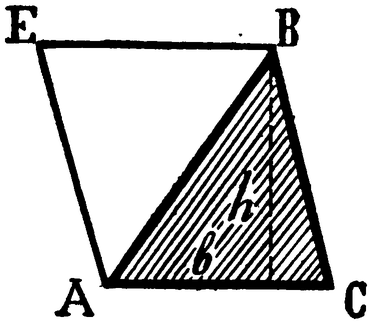
310. Theorem. The area of a triangle (ABC, fig. 274) is equal to half the product of its base and its altitude.
Draw BE ∥ AC and AE ∥ BC. We then obtain the parallelogram AEBC, whose area, by what has been proved, is equal to bh. But the area of △ABC is half the area of AEBC; consequently:
311. Corollaries. 1°. Triangles with equal bases and equal altitudes are equal in area.
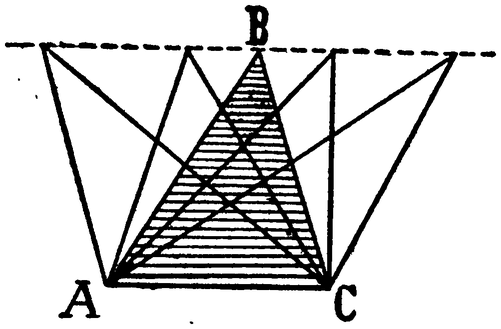
If, for example, we move the vertex B of the triangle ABC (fig. 275) along a line parallel to the base AC, leaving the base the same, the area of the triangle will not change.
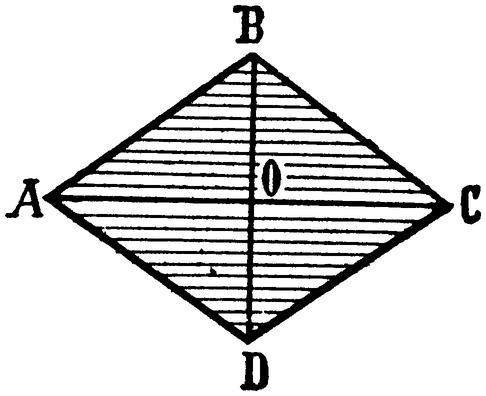
2°. The area of a right triangle is equal to half the product of its legs, because one leg may be taken as the base and the other as the altitude.
Fig. 276 shows directly that the area of such a triangle is half the area of the rectangle having the same base and the same altitude.
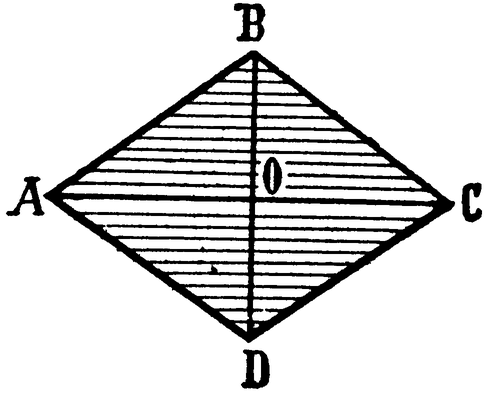
3°. The area of a rhombus is equal to half the product of its diagonals. Indeed, if ABCD (fig. 277) is a rhombus, its diagonals are mutually perpendicular. Therefore:
4°. The areas of triangles are to each other as the products of their bases and altitudes (the factor cancels).
312. Remark. Every triangle can be decomposed into parts which, when moved, form a rectangle having the same base as the triangle and an altitude half the altitude of the triangle. Indeed, if in the triangle ABC (fig. 278) we draw a line through the midpoints D and E of two sides (those that form acute angles with the third side) and drop to it the perpendicular BF, the triangle ABC is divided by these lines into 3 parts, marked in the figure with the numerals 1, 2 and 3. Turning part 1 about the point D through 180° (in the direction shown by the arrow), we bring it into the position AKD; in a similar way we bring part 2 into the position CLE. The triangle ABC is then transformed into the rectangle AKLC, whose base is the same as that of the triangle and whose altitude is half the altitude of the triangle.
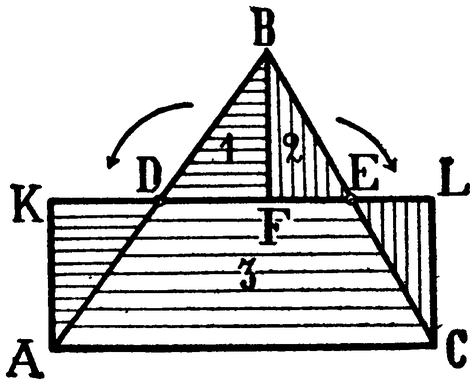
313. Theorem. The area S of a triangle is expressed in terms of its sides a, b and c by the formula:
where p is the semiperimeter of the triangle, that is,
Let the altitude of the triangle ABC (fig. 279) dropped to the side a be . Then:
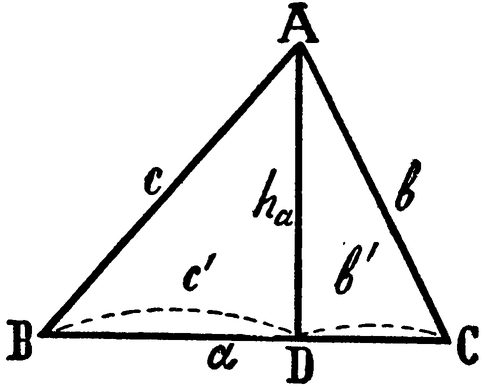
To find the altitude , take the equation (236):
and determine from it the segment c′:
From the triangle ABD we find:
Let us transform the quantity under the radical sign thus:
If we put a + b + c = 2p, then
Similarly:
Therefore the quantity under the radical sign can be written thus:
Consequently:
Therefore:
Particular case. The area of an equilateral triangle with side a is expressed by the following formula:
314. Problem. To compute the area of a triangle ABC (fig. 280) from two sides AB and AC and the angle A between them.
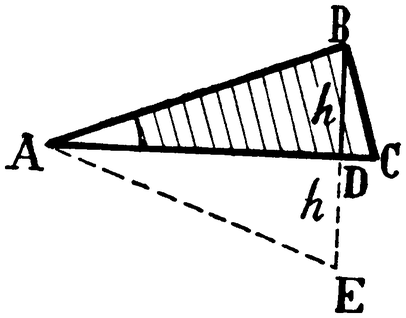
Without the help of trigonometry this problem can be solved only for certain particular values of the angle A. Suppose, for example, that A = 18°. Then h can be computed in terms of the side AB in the following way: having extended BD by a distance DE = BD, join E to A. Then in the isosceles triangle ABE the angle BAE is equal to 36°. From this we conclude that BE, that is, twice the altitude, is the side of the regular decagon inscribed in the circle whose radius is AB. Therefore BE is found by the formula that determines the side of the regular inscribed decagon (268). Having determined the altitude, we then find the area of the triangle by the formula
In a similar way the problem is solved for A = 30°, 45°, 60°.
315. Theorem. The area of a trapezoid is equal to the product of half the sum of its bases and its altitude.
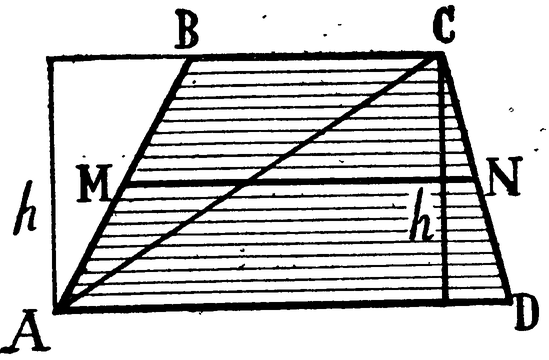
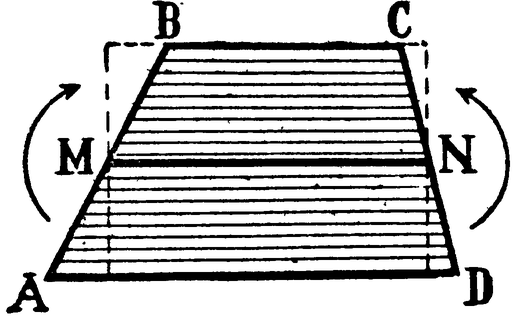
Drawing the diagonal AC in the trapezoid ABCD (fig. 281), we can regard its area as the sum of the areas of the two triangles CAD and ABC. Therefore
316. Corollary. If MN (fig. 281) is the midline of the trapezoid, then, as is known (117):
Therefore area ABCD = MN · h,
that is, the area of a trapezoid is equal to the product of its midline and its altitude.
The same can also be seen directly from fig. 282.
317. Theorem. The area of every circumscribed polygon is equal to the product of its perimeter and half the radius.
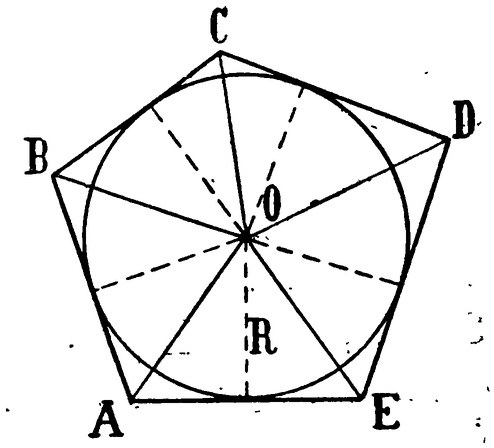
Joining the centre O (fig. 283) with all the vertices of the circumscribed polygon, we divide it into triangles in which the sides of the polygon may be taken as the bases and the radius of the circle as the altitude. Denoting this radius by R, we have:
Consequently, area ABCDE = , where the letter P denotes the perimeter of the polygon.
318. Corollary. The area of a regular polygon is equal to the product of its perimeter and half the apothem, because every regular polygon may be regarded as circumscribed about the circle whose radius is the apothem.
319. Problem. To transform a polygon (ABCDE, fig. 284) into a triangle equal to it in area.
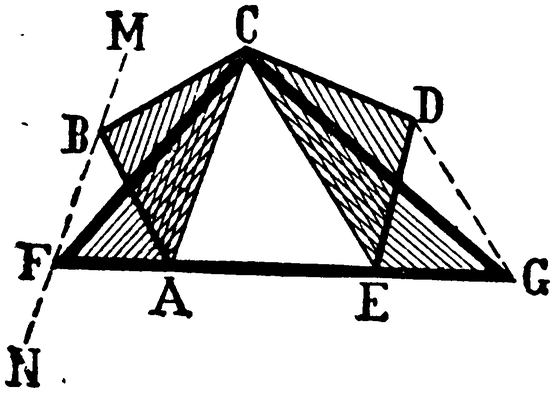
By some diagonal AC we cut off △ABC from the given polygon. Through that vertex B of this triangle which lies opposite the diagonal taken, we draw the line MN ∥ AC. Then we extend one of the sides EA or DC adjoining the triangle cut off until it meets the line MN (in the figure the side EA is extended). We join the point of intersection F with C. The triangles CBA and CFA are equal in area (311, 1°), since they have the common base AC and the vertices B and F lie on a line parallel to the base. If from the given polygon we remove the triangle CBA and in its place put the triangle CFA, equal to it in area, the magnitude of the area will not change; consequently the given polygon is equal in area to the polygon FCDE, in which, evidently, the number of angles is less by 1 than in the given polygon. By the same device the number of angles of the polygon obtained can be reduced by 1 more, and this successive reduction can be continued until a triangle is obtained (FCG in our figure).
320. Problem. To transform a given polygon into a square equal to it in area.
First the polygon is transformed into a triangle equal to it in area, and then this triangle into a square. Let the base and the altitude of the triangle be b and h, and the side of the required square x. Then the area of the first is equal to , and that of the second to ; consequently:
This proportion shows that x is the mean proportional between and h. Therefore the side of the square can be constructed by the method indicated earlier (231) for finding a mean proportional.
Remark. The preliminary transformation of the given polygon into a triangle is not always necessary. For example, if it is a question of transforming a given trapezoid into a square, it is sufficient to find the mean proportional between the altitude of the trapezoid and its midline and to construct a square on the line so obtained.
Chapter 2: The Theorem of Pythagoras and Problems Based on It
321. Theorem. The sum of the areas of the squares constructed on the legs of a right triangle is equal to the area of the square constructed on the hypotenuse.
This proposition, known as the Theorem of Pythagoras (a Greek philosopher who lived in the sixth century BC), has numerous proofs. We give the simplest of them.
First proof (Euclid's). Let ABC (fig. 285) be a right triangle, and BDEA, AFGC and BCKH the squares constructed on its legs and its hypotenuse; it is required to prove that the sum of the areas of the first two squares is equal to the area of the third square.
Let us draw AM ⊥ BC. The square BCKH is then divided into two rectangles. Let us prove that the rectangle BLMH is equal in area to the square BDEA, and the rectangle LCKM is equal in area to the square AFGC. Let us draw the auxiliary lines DC and AH, and turn our attention to the two triangles that are shaded in the figure. The triangle DCB, which has the base BD in common with the square BDEA and an altitude CN equal to the altitude AB of that square, is equal in area to half of it. The triangle ABH, which has the base BH in common with the rectangle BLMH and an altitude AP equal to the altitude BL of that rectangle, is equal in area to half of it. Comparing these two triangles with each other, we find that in them BD = BA and BC = BH (as sides of a square); moreover ∠DBC = ∠ABH, since each of these angles consists of the common part ABC and a right angle. Hence the triangles ABH and BDC are equal. From this it follows that the rectangle BLMH is equal in area to the square BDEA.
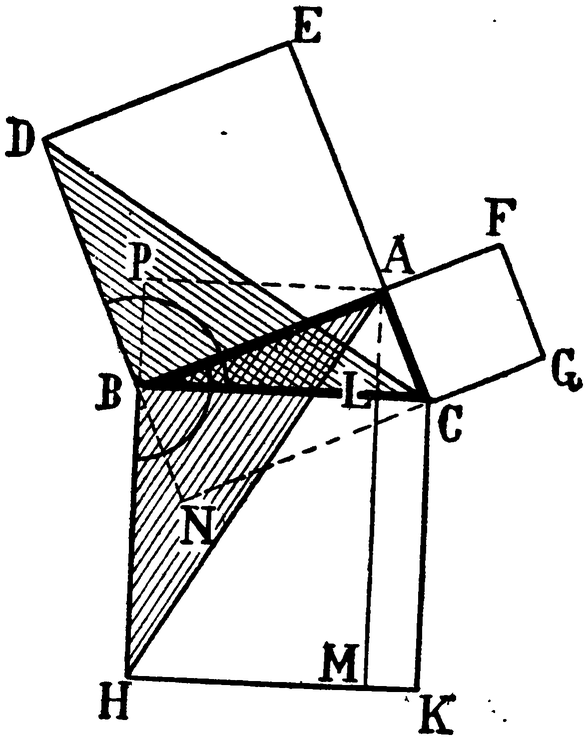
Joining G to B and A to K, we shall prove in exactly the same way that the rectangle LCKM is equal in area to the square AFGC. From this it follows that the square BCKH is equal in area to the sum of the squares BDEA and AFGC.
Second proof. Let a, b and c denote the numbers that express the hypotenuse and the legs of a right triangle in one and the same linear unit. Then, as we saw earlier (232), the following relation holds between these numbers:
But , and are the numbers that measure the areas of the squares whose sides are a, b and c; therefore it follows from the equality written above that the area of the square constructed on the hypotenuse is equal to the sum of the areas of the squares constructed on the legs.
Third proof. There are also many proofs that show into what parts the squares constructed on the legs must be cut in order that, by moving these parts, the square constructed on the hypotenuse may be formed. Here is one such proof.
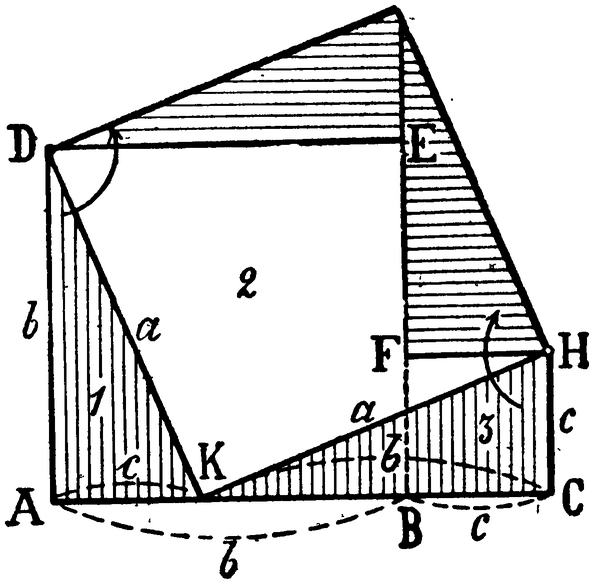
Let us denote the hypotenuse and the legs of the given triangle by the letters a, b and c respectively. Having laid off on some straight line (fig. 286) AB = b and BC = c, let us construct the squares ADEB and BFHC. The area of the hexagon ADEFHC so formed is the sum of the areas of the squares constructed on the legs. Laying off in addition AK = c (and consequently KC = b), we draw the lines DK and KH, which decompose the hexagon into three parts, marked in the figure with the numerals 1, 2 and 3. Parts 1 and 3 are right triangles equal to the given one. Let us rotate triangle 1 through 90° about the vertex D and triangle 3 about the vertex H, as the arrows indicate. These parts will then take up positions in which, together with the remaining part 2, they form the square constructed on the hypotenuse (we leave it to the students themselves to prove this).
322. Problems. 1°. To construct a square equal in area to the sum of two given squares.
We construct a right triangle whose legs are the sides of the given squares. The square constructed on the hypotenuse of this triangle is equal in area to the sum of the given squares.
2°. To construct a square equal in area to the difference of two given squares.
We construct a right triangle whose hypotenuse is the side of the greater of the given squares and one of whose legs is the side of the smaller square. The square constructed on the other leg of this triangle is equal in area to the difference of the given squares.
3°. To construct a square whose area is to the area of a given square as m : n.
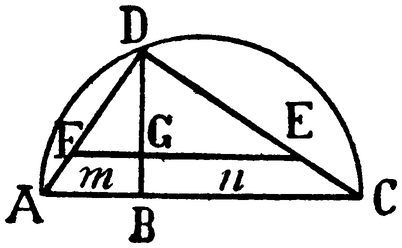
On an arbitrary straight line (fig. 287) we lay off AB = m and BC = n, and on AC as diameter we describe a semicircle. From the point B we erect the perpendicular BD until it meets the circle. Drawing the chords AD and DC, we obtain a right triangle in which (234):
On the leg DC of this triangle let us lay off a segment DE equal to the side of the given square, and draw EF ∥ CA. The line DF is the side of the required square, because
consequently:
323. Pythagorean triangles. This is the name given to right triangles whose sides, measured by one and the same unit, are expressed by whole numbers. There is an infinite number of such triangles. The simplest of them is the one (known since remote antiquity) whose sides are expressed by the numbers 3, 4 and 5 (). It has been proved that the sides of Pythagorean triangles can be expressed by the following general formulas:
where a and b are arbitrary whole numbers, provided only that a > b.
Chapter 3: The Ratio of the Areas of Similar Figures
324. Theorem. The areas of two triangles that have an equal angle are to each other as the products of the sides containing those angles.
Let the angles A and in the triangles and (fig. 288) be equal. Drawing the altitudes BD and , we have:
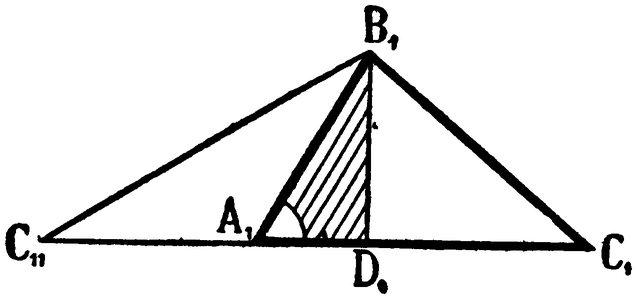
The triangles ABD and are similar ( and ); therefore the ratio is equal to the ratio ; replacing the first by the second, we obtain:
325. Remark. We leave it to the students themselves to prove that if in two triangles ABC and (fig. 288) the angles A and are not equal but together make up , the areas of such triangles are likewise to each other as the products of the sides containing the angles A and .
326. Theorem. The areas of similar triangles or polygons are to each other as the squares of corresponding sides.
1°. If ABC and (fig. 288) are two similar triangles, the angles of the one are respectively equal to the angles of the other; let , and . Applying the preceding theorem to them, we obtain:
But from the similarity of the triangles it follows that:
Therefore in the equality [1] we may replace each of the ratios and by any ratio of the series [2]; consequently:
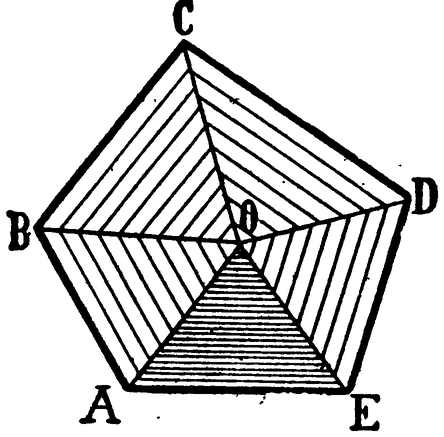
2°. If ABCDE and (fig. 289) are two similar polygons, they can, as we have seen (208), be decomposed into the same number of similar and similarly placed triangles. Let these triangles be ABO and , AOE and , and so on. By what was proved in the first part of this theorem we obtain the proportions:
But from the similarity of the polygons it follows that:
and therefore:
Hence:
Whence (by the property of equal ratios):
327. Corollary. The areas of regular polygons of the same name are to each other as the squares of their sides, or the squares of their radii, or the squares of their apothems (262).
328. Problem. To divide a given triangle into m parts equal in area by straight lines parallel to one of its sides.
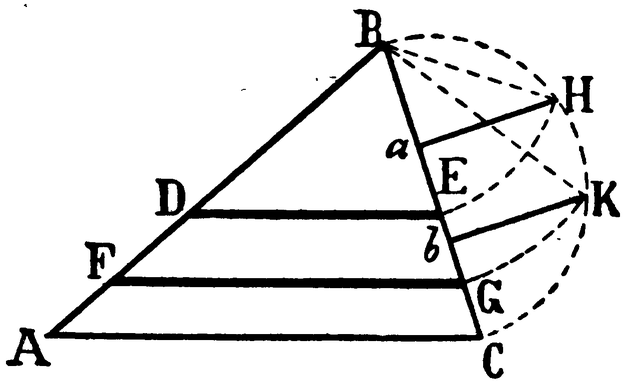
Suppose, for example, that it is required to divide the triangle ABC (fig. 290) into 3 parts equal in area by lines parallel to the base AC. Suppose the problem solved, with DE and FG the required lines. Evidently, if we find the segments BE and BG, the lines DE and FG will then be determined as well. The triangles BDE, BFG and BAC are similar; therefore:
But the requirements of the problem show that:
Consequently:
Whence:
From these expressions we see that BE is the mean proportional between BC and , and BG is the mean proportional between BC and (255, 4). The construction can therefore be carried out as follows: we divide BC into three equal parts at the points a and b; we describe a semicircle on BC; from a and b we erect the perpendiculars aH and bK to BC. The chords HB and BK will be the required mean proportionals: the first between the whole diameter BC and its third part Ba, the second between BC and Bb, that is, between BC and (230). It remains to lay off these chords on BC from the point B; we then obtain the required points E and G.
In a similar way a triangle can be divided into any other number of parts equal in area.
Chapter 4: The Area of the Circle and of Its Parts
329. Lemma 1. When the number of sides of a regular polygon inscribed in a circle is doubled indefinitely:
1°, the side of this polygon tends to zero;
2°, the difference between the radius of the circle and the apothem of the polygon tends to zero.
1°. Let us denote the perimeter of a regular inscribed polygon by p and the number of its sides by n; the length of one side of this polygon is then expressed by the fraction . When the number of sides of this polygon is doubled indefinitely, the denominator of the fraction will increase without limit, while the numerator, although it too will increase, will not increase without limit, since the perimeter of every inscribed convex polygon is less than the perimeter of any circumscribed polygon (for example, less than that of the circumscribed square)47. But if the denominator of a fraction increases without limit while the numerator, although it increases, remains less than some constant magnitude, then, as is known from algebra, this fraction can be made less than any given positive magnitude; hence, when the number of sides of an inscribed regular polygon is doubled indefinitely, its side, which is equal to the fraction , tends to 0.
2°. Let AB (fig. 291) be a side of some regular inscribed polygon, OA the radius and OC the apothem. From the triangle OAC we find (52):
that is, the difference between the radius and the apothem is less than half the side of the regular polygon. But when the number of sides of a regular inscribed polygon is doubled indefinitely, its side, as we have seen, tends to zero; therefore the difference between the radius and the apothem tends to zero all the more.
330. Lemma 2. The difference between the area of a regular polygon circumscribed about a circle and the area of the regular polygon of the same name inscribed in the same circle tends to zero when the number of sides of these polygons is doubled indefinitely.
Let us inscribe some regular polygon in a circle (fig. 292) and circumscribe one about it (hexagons are shown in the figure).
Let R be the radius of the circle, a the apothem of the inscribed polygon, q its area and Q the area of the circumscribed polygon. Then (327):
From this proportion let us form a derived one (the difference of the terms of the first ratio is to the antecedent of that ratio as ...):
Whence:
or When the number of sides of the polygons is doubled indefinitely, the difference R − a, by what was proved in the preceding lemma, tends to zero, the factor Q decreases48, and the factor R + a always remains less than R + R; in consequence of this the right-hand side of the last equality (and consequently its left-hand side also) tends to zero when the number of sides of the polygons is doubled indefinitely. But the left-hand side of the equality, being a product in which the multiplier is a constant number, can tend to zero only when its multiplicand tends to zero; and the multiplicand Q − q is precisely the difference of the areas of the regular polygons, the circumscribed and the inscribed.
331. Remark. In the same way we can prove that the difference between the perimeter of a circumscribed regular polygon and the perimeter of the inscribed regular polygon of the same name tends to zero when the number of their sides is doubled indefinitely. Indeed, if P and p are the perimeters of regular polygons of the same name, the one circumscribed and the other inscribed, then (263):
P : p = R : a.
Whence:
and consequently
When the number of sides of the polygons is doubled indefinitely, the right-hand side of the last equality (and consequently its left-hand side also) tends to zero, since the multiplicand R − a, by what has been proved, tends to zero, while the multiplier P decreases. But the left-hand side of the equality, being a product in which the multiplier R is a constant number, can tend to zero only when its multiplicand tends to zero; and the multiplicand is precisely the difference of the perimeters P and p.
332. Theorem. The area of a circle is the common limit of the areas of the regular polygons inscribed in that circle and circumscribed about it when the number of their sides is doubled indefinitely.
Suppose that some regular polygon is circumscribed about a circle, whose area we denote by K, and a regular polygon of the same name is inscribed in it (fig. 292). Let us denote the area of the first by Q and the area of the second by q. If we begin to double the number of sides of these polygons, the magnitudes Q and q become variable, whereas the magnitude K remains unchanged. It is required to prove that when the number of sides of the polygons is doubled indefinitely, the variable magnitudes Q and q tend to one and the same limit, namely to the area K.
Evidently, whatever the number of sides of the polygons, we always have Q > K > q, and therefore each of the two differences Q − K and K − q is always less than the difference Q − q. But when the number of sides of the polygons is doubled indefinitely, the difference Q − q, according to Lemma 2, tends to zero; consequently each of the smaller differences Q − K and K − q then tends to zero all the more; and this, according to the definition of a limit, means that
lim Q = K and lim q = K.
333. Remark. It may also be asserted that the length of a circle is the common limit of the perimeters of the regular polygons inscribed in that circle and circumscribed about it when the number of their sides is doubled indefinitely. Indeed, from the fact that the difference P − p tends to zero (331) we must conclude that the variable perimeters P and p can tend only to one and the same limit; but the limit of p is what is taken as the length of the circle; hence the limit of P is the length of the circle also.
334. Theorem. The area of a circle is equal to the product of the circumference and half the radius.
Let R, K and C denote the radius, the area and the circumference of a given circle, and q, p and a the area, the perimeter and the apothem of some regular inscribed polygon. Then we may write (318):
Let us now imagine that the number of sides of the inscribed polygon is doubled indefinitely. The magnitudes q, p and a then become variable; the first has for its limit the area K of the circle, the second the circumference C, and the third the radius R. Since the equality [1] remains true throughout, it will, according to the fundamental principle of the method of limits (283), remain true also when we substitute for the variables their limits; after this substitution we obtain:
335. Corollaries. 1°. The area of a circle is equal to the product of the square of the radius and the number π (the ratio of the circumference to the diameter).
Indeed, substituting in the equality [2] of the preceding section the product 2πR (292, 2) in place of C, we obtain:
2°. The areas of circles are to each other as the squares of their radii or diameters.
Indeed, if K and are the areas of two circles and R and their radii, then
Whence:
336. Problem 1. To compute the area of a circle whose circumference is equal to 2 metres. For this we first find the radius R from the equation:
Then we determine the area of the circle:
Problem 2. To transform a given circle into a square (that is, to construct a square equal in area to the given circle). This problem, known as the quadrature of the circle, cannot be solved with compass and ruler. Indeed, if we denote the side of the required square by x and the radius of the circle by R, we obtain the equation:
that is, x is the mean proportional between the semicircle and the radius. Consequently, if a straight line is known that is equal to the length of the semicircle, it is easy to construct a square equal in area to the given circle; and conversely, if the side of a square equal in area to the circle is known, a straight line can be constructed equal in length to the semicircle. But it has been proved that with compass and ruler it is impossible to construct a straight line exactly equal to the length of the semicircle (see the footnote to exercise 257); consequently the problem of transforming a circle into a square cannot be solved exactly. An approximate solution, however, can be carried out if we first find the approximate length of the semicircle and then construct the mean proportional between this length and the radius.
337. Theorem. The area of a sector is equal to the product of its arc and half the radius.
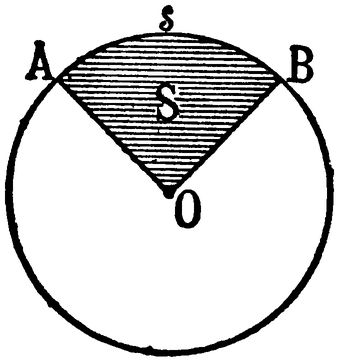
Let the arc AB (fig. 293) of the sector AOB contain n°. Evidently the area of a sector whose arc contains 1° is the part of the area of the circle, that is, it is equal to
Consequently the area S of a sector whose arc contains n° is equal to
Since expresses the length of the arc AB, we obtain, denoting it by s:
338. Problem. To compute the area of a segment, knowing the radius of the circle and the number of degrees contained in the arc of the segment.
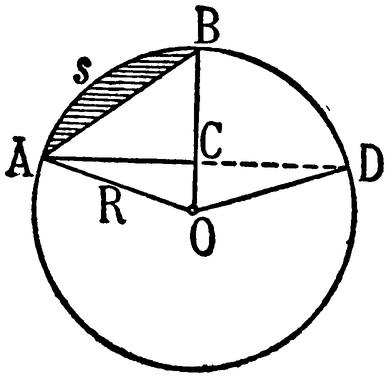
To obtain the area of the segment ASB (fig. 294) it is sufficient to subtract the area of the triangle AOB from the area of the sector AOB. Drawing AC ⊥ OB, we have:
Thus the question reduces to computing the altitude AC. Geometrically (that is, without the help of trigonometry) it can be computed only in certain particular cases, in the following way.
Extending AC until it meets the circle at the point D, we see that AC = CD and ⌣AB = ⌣BD; hence AC is half the chord subtending an arc twice as great as the arc of the segment. From this we conclude that if the chord subtending the double arc is the side of a regular inscribed polygon the formula for whose side we know, the altitude AC is determined geometrically. For example, let the arc of the segment contain 60°. Then AD is the side of the regular inscribed triangle; hence . The arc AB in this case is equal to of the circumference, that is, to ; therefore:
Remark. If the chord AB is the side of a regular inscribed n-gon which we are able to compute from the given radius, the area of the segment can also be found by the following formula:
339. Theorem. The sum of the areas of similar polygons (or of circles) constructed on the legs of a right triangle is equal to the area of the similar polygon (or circle) constructed on the hypotenuse, if the legs and the hypotenuse serve as corresponding sides of these polygons (or as diameters of the circles).
Let Q, R and S be the areas of similar figures (or of circles) constructed on the legs and the hypotenuse of the right triangle ABC (fig. 295). Then (326, 335, 2°)
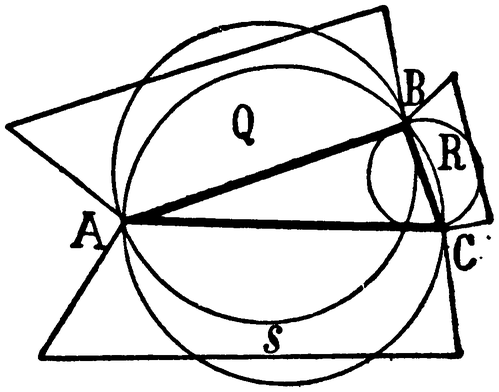
Adding these equalities, we find:
But (232); therefore:
340. Corollary. If on the sides of a right triangle ABC (fig. 296) we construct half-disks, placing them as shown in the figure, the sum of the areas of the figures M and N so formed (the lunes) is equal to the area of the triangle.
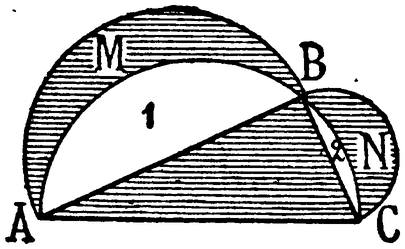
Indeed, the sum of the half-disks constructed on the legs is equal to the half-disk constructed on the hypotenuse; and if from both sides of this equality we take away the sum of the segments 1 and 2, we obtain:
M + N = area ABC.
The figures M and N are known as the lunes of Hippocrates.49
When the triangle is isosceles, the two lunes are alike and each of them is equal in area to half the triangle.
Chapter 5: The Sides of a Triangle and the Radii of Its Inscribed and Circumscribed Circles
341. By the theorem of § 250 we have: , where b and c are two sides of a triangle, is the altitude dropped to the third side of the triangle, and R is the radius of the circumscribed circle. From this equality we deduce:
Let us eliminate the altitude from this formula. To do this we multiply the numerator and the denominator of the fraction by a; then, replacing the product by twice the area of the triangle (which we shall denote by S), we obtain:
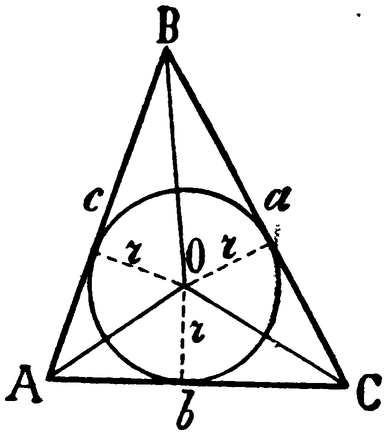
where
To find the radius r of the interior inscribed circle (fig. 297), let us take into account that the straight lines OA, OB and OC divide the given triangle into three triangles that have the sides of the given triangle as their bases and the radius r as their altitude. Therefore:
Hence:
The radius of the escribed circle (fig. 298) that touches the side a can be determined from the equality:
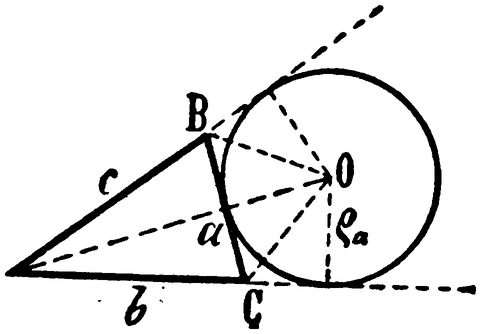
area ABC = area ACO + area ABO − area BOC,
that is,
Whence:
In a similar way we find:
Certain relations exist between the four radii r, , and . We point out the simplest of them:
But ; consequently,
Supplement
Construction of the Roots of a Quadratic Equation
342. On the homogeneity of the equations obtained in solving geometric problems. Looking through all the integral algebraic expressions found in geometry for computing various lines, we notice that they are all of one dimension, that is, they all contain only one literal factor expressing the length of some line. Such, for example, are the expressions:
... for the side of the inscribed square;
... for the side of the regular inscribed triangle;
... for the circumference of a circle; and the like.
(in the last formula the letter π denotes not a line but the abstract number 3.14...; it therefore has no effect on the dimension of the expression).
Looking further through all the integral algebraic expressions found in geometry for computing the areas of various figures, we notice that they are all of two dimensions, that is, they all contain 2 literal factors each, expressing the lengths of certain lines. Such, for example, are the expressions:
... for the area of a rectangle;
... for the area of a triangle;
... for the area of an equilateral triangle;
... for the area of a circle, and the like.
(Similarly, as we shall learn later from solid geometry, the integral algebraic expressions that serve for computing volumes all turn out to be of three dimensions, that is, they contain 3 literal factors each, expressing the lengths of certain lines.)
Having noticed this, let us take into account that every equation is an equality of two expressions. Consequently, in the geometric sense it represents either an equality of lines, or an equality of areas (or an equality of volumes), or else, finally, an equality of ratios. When an equation formed in solving a geometric problem expresses an equality of lines, both its sides must be of one dimension; when it expresses an equality of areas, its sides must be of two dimensions, and so on. Consequently, in all cases the equation obtained must be homogeneous. Nor is the homogeneity disturbed after the equation has been transformed, as is not hard to see if we take into account all that is known to us from algebra about the transformation of equations.
What has been said is true, however, only on the condition that not one of the lines entering into the equation has been taken as the unit. Otherwise the homogeneity is disturbed. For example, the equation , which expresses the equality between the areas of a required square and a given circle, turns into the non-homogeneous when the radius of the given circle is taken as 1.
343. Construction of the roots of a quadratic equation. From what has been said it follows that if, in solving some geometric problem by means of algebra, we have obtained an equation (not one of the lines entering into the equation having been taken as 1), then all the terms of this equation must be of the same dimension. Therefore, on simplifying a quadratic equation, we shall always bring it to the form , in which all the terms are of two dimensions (the letters p, a and b expressing given positive lengths, and the letter x the required length, positive or negative). If we first construct (231) an auxiliary straight line q that is the geometric mean of the straight lines a and b (that is, if we construct the expression ), then, replacing the product ab in the equation by , we shall bring it to the form:
Combining the signs + and − before the terms px and in the various possible ways, we have the following 4 forms of quadratic equations:
1°. ;
2°. ;
3°. ;
4°. .
It is not hard to see that the equations 3° and 4° are obtained from the equations 1° and 2° respectively by replacing x in them by −x; this means that the roots of the equations 3° and 4° are the roots of the equations 1° and 2° respectively, only taken with the opposite signs. It is therefore enough for us to show the construction of the roots of the equations 1° and 2° alone.
1°. ;
that is,
Suppose first that . Then the expression represents a leg of the right triangle whose hypotenuse is and whose other leg is equal to q; in consequence of this the simplest way to carry out the construction is as follows:
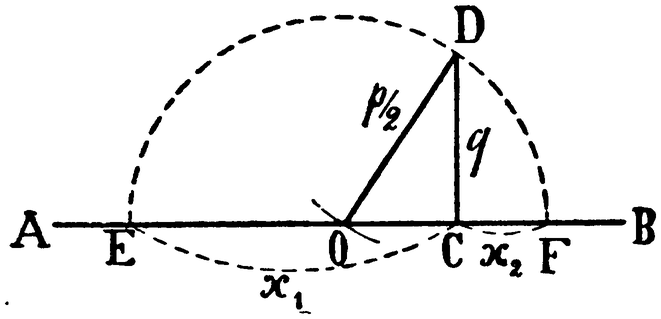
On any straight line AB (fig. 299) we take an arbitrary point C and erect from it a perpendicular to AB, on which we lay off CD = q. From the point D as centre, with a radius equal to , we cut the straight line AB at some point O; then, drawing the straight line OD, we obtain a right triangle ODC, in which
It now remains to add OC to (we then obtain ) and to take OC away from (we then obtain ). To do this, with an opening of the compass equal to , we lay off on the straight line AB, on both sides of the point O, the segments OE and OF; then and .
If , then ; but if , the roots and will be imaginary.
that is,
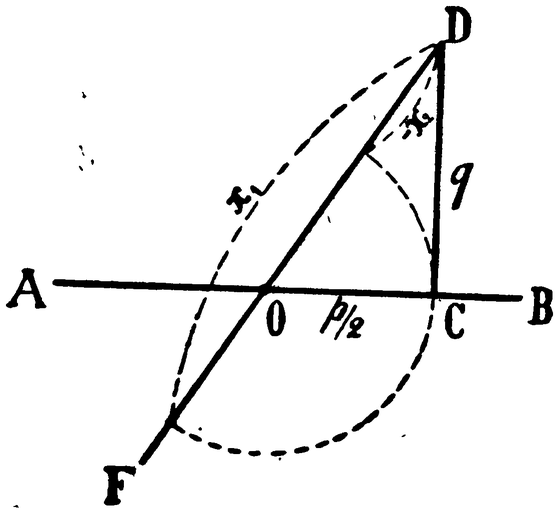
In this case the roots are always real, the root being positive and negative. Since the expression represents the hypotenuse of the right triangle whose legs are equal to and , the simplest way to carry out the construction is as follows:
Having erected from the point C a perpendicular to AB (fig. 300), we lay off on it CD = q; on AB we lay off CO = . Drawing the straight line OD, we obtain a right triangle OCD, in which . It remains to add to OD (we then obtain ) and to take away from OD (we then obtain the absolute value of ).
Exercises
Prove the Theorems
261. In a parallelogram the distances of any point of a diagonal from the two adjoining sides are inversely proportional to those sides.
262. The area of a trapezoid is equal to the product of one of its non-parallel sides and the perpendicular dropped to that side from the midpoint of the other non-parallel side.
263. Two quadrilaterals are equal in area if their diagonals are respectively equal and the angle between the diagonals is the same.
264. If the areas of the two triangles that adjoin the bases of a trapezoid and are formed by the intersection of its diagonals are equal respectively to and , then the area of the whole trapezoid is equal to .
265. The area of a regular inscribed hexagon is equal to of the area of the regular circumscribed hexagon.
266. In a quadrilateral ABCD a straight line is drawn through the midpoint of the diagonal BD parallel to the other diagonal AC; this line intersects the side AD at a point E. Prove that the straight line CE divides the quadrilateral in half.
267. If the medians of a triangle are taken as the sides of another triangle, the area of the latter is equal to of the area of the former.
268. In a circle with centre O a chord AB is drawn. On the radius OA as diameter a circle is described. Prove that the areas of the two segments cut off by the chord AB from the two circles are to each other as 4 : 1.
Computation Problems
269. Compute the area of a right-angled trapezoid one of whose angles is equal to 60°, knowing either both bases, or one base and the altitude, or one base and the lateral side that is inclined to the base.
270. Compute the area of an equilateral triangle, knowing its altitude h.
271. The bases B and b of a trapezoid and its altitude H are given. Compute the altitude of the triangle formed by extending the non-parallel sides of the trapezoid until they intersect.
272. Set up a formula for the area of a regular inscribed 12-gon in terms of the radius of the circle.
273. In a triangle another triangle is inscribed, whose vertices bisect the sides of the first triangle; in this second triangle a third triangle is inscribed in the same manner; in the third a fourth, and so on without end. Find the limit of the sum of the areas of these triangles.
274. In a given triangle the sides a, b and c are known. From the midpoints of these sides perpendiculars x, y and z are erected until they intersect in the centre of the circumscribed circle. Find, in terms of a, b and c, the magnitudes x, y and z and the radius R of the circumscribed circle. (Hint: using Ptolemy's theorem (242), one can derive the equations , , and , where S is the area of the triangle.)
Construction Problems
275. Divide a triangle, by straight lines passing through its vertex, into three parts whose areas are to each other as m : n : p.
276. Divide a triangle in half by a straight line passing through a given point of its side.
277. Find inside a triangle a point such that the straight lines joining it to the vertices of the triangle divide the triangle into three parts equal in area.
278. The same, into three parts in the ratio 2 : 3 : 4 (or, in general, m : n : p).
279. Divide a parallelogram into three parts equal in area by straight lines issuing from a vertex of it.
280. Divide a parallelogram into two parts in the ratio m : n by a straight line passing through a given point.
281. Divide a parallelogram into 3 parts equal in area by straight lines parallel to a diagonal.
282. Divide the area of a triangle in extreme and mean ratio by a straight line parallel to the base.
283. Divide a triangle into three parts equal in area by straight lines perpendicular to the base.
284. Divide a circle into 2, into 3 ... parts equal in area by concentric circles.
285. Divide a trapezoid in half by a straight line parallel to the bases. (Hint: having extended the non-parallel sides until they intersect, take as the unknown the distance of an end of the required line from the vertex of the triangle; set up proportions, starting from the areas of similar triangles ...)
286. Transform a given rectangle into another rectangle equal to it in area and having a given base.
287. Construct a square equal in area to of a given square.
288. Transform a square into a rectangle equal to it in area in which the sum s or the difference d of two adjacent sides is given.
289. Construct a circle equal in area to the ring contained between two given concentric circles.
290. Construct a triangle similar to one of two given triangles and equal in area to the other.
291. Transform a given triangle into an equilateral triangle equal to it in area (by the application of algebra to geometry).
292. In a given circle inscribe a rectangle with a given area (by the application of algebra to geometry).
293. In a given triangle inscribe a rectangle with a given area (by the application of algebra to geometry).
Numerical Problems on Various Parts of Plane Geometry50
294. The legs of a right triangle are 3 m and 4 m. Find the area of the circle that passes through the midpoint of the smaller leg and touches the hypotenuse at its midpoint.
295. The point of tangency of the circle inscribed in a right triangle divides the hypotenuse into segments a and b. Find the area of the triangle.
296. The legs of a right triangle are b and c. Find the bisector of the right angle.
297. The radii of two concentric circles are 15 cm and 8 cm. A point is taken on an extended diameter at a distance of 17 cm from the common centre, and from it tangents are drawn to these circles. Find the distance between the points of tangency. (Hint: apply Ptolemy's theorem.)
298. The part of the area of a circle contained between a side of the inscribed square and the side of the regular inscribed hexagon parallel to it is equal to . Find the side of the square equal in area to the given circle.
299. In a rhombus that is divided by a diagonal into two equilateral triangles a circle is inscribed. Find the side of the rhombus in terms of the radius of this circle.
300. In a triangle whose sides are 4 cm, 5 cm and 6 cm, the bisectors of the smallest angle and of the exterior angle adjacent to it are drawn. Find the segment of the opposite side contained between these bisectors.
301. In an equilateral triangle with side a, a circle is inscribed, and from a vertex of the triangle, with a radius equal to half its side, another circle is described. Find the area common to the two circles.
302. In a triangle two sides are a and b. Find the third side and the area if the angle between the sides a and b is equal to 45°; 60°; 150°; 120°; 75°; 135°.
303. The lengths of two parallel chords of a circle are 30 cm and 16 cm, and the distance between them is 7 cm. Find the area of the circle.
304. Through a point whose distance from the centre of a circle is equal to the diameter, a secant is drawn that is bisected by the circle. Find the length of the secant if the radius of the circle is equal to .
305. In a circle of radius R a chord is drawn that subtends an arc of 108°. Find its length.
306. On the diameter of a half-disk of radius R an equilateral triangle is constructed. Find the area of that part of it which lies outside the circle.
307. Find the radius of the circle that is tangent to the sides a and b of a triangle and whose centre lies on its third side c.
308. An external tangent BC is drawn to two circles that touch externally at a point A and whose radii are 3 cm and 1 cm. Find the area of the figure ABC bounded by the two arcs and the tangent.
309. A semicircle of radius R is divided into three equal parts, and the points of division are joined to an end of the diameter. Find the area bounded by the two chords and the arc contained between them.
310. The sides of a triangle ABC are extended in one direction (the side AB beyond the point B, the side BC beyond the point C and the side CA beyond the point A) to the points , and , so that , and . Find the ratio of the areas of the triangles ABC and .
311. From a vertex of a triangle a straight line is drawn to its base, dividing the base into two segments m and n. Find the length of this line if the sides of the triangle adjoining the segments m and n are a and b.
312. A circle of radius R is surrounded by three equal circles that touch the given circle and one another. Find the radius of one of these circles.
313. Determine the height of a tower, if it is known that one must go a distance of a metres from its foot for the tower to be seen at an angle of 30°.
314. Given the chords a and b that subtend two arcs in a circle of unit radius, find the chord that subtends the difference of these arcs. (Hint: apply Ptolemy's theorem.)
315. A straight line parallel to the bases of a trapezoid divides it into two parts in the ratio 7 : 2 (counting from the greater base). Find the length of this line if the bases of the trapezoid are 5 m and 3 m.
316. From the point that divides the base of a triangle in the ratio m : n, straight lines are drawn parallel to the other two sides. Find the ratio of the area of each of the parts into which the triangle is divided to the area of the whole triangle.
317. From some point inside a triangle perpendiculars , , are dropped to its sides a, b and c. Find the ratio of the area of the triangle formed by joining the feet of these perpendiculars to the area of the given triangle. (Hint: see § 325.)
318. Compute the diagonals of a trapezoid from its four sides a, b, c and d. (Hint: the theorem on the square of a side of a triangle must be applied to the diagonal.)
319. Find the area of a trapezoid from its four sides a, b, c and d.
320. On opposite sides of a square two equilateral triangles are constructed inside it. The intersection of the sides of these triangles determines a certain quadrilateral. Find its kind, its sides, its angles and its area if the side of the square is equal to a.
321. A circle is drawn that touches one side of a right angle and intersects the other side at points whose distances from the vertex of the angle are 6 cm and 24 cm. Compute the radius of this circle and the distance of the point of tangency from the vertex of the angle.
322. Compute the area of a triangle from two sides a and b and the median m to the third side.
323. On a common chord AB two segments are constructed (on one side of AB), of which one contains an angle of 135° and the other an angle of 120°. Find the area of the lune contained between the arcs of the segments.
324. On the radii of a quadrant (a quarter of a circle) two half-disks are constructed inside it. Find the area of that part of the quadrant which lies outside the half-disks, if the radius of the quadrant is R.
325. In a right triangle ABC a perpendicular AD is dropped to the hypotenuse BC. Knowing the radii and of the circles inscribed in the triangles ABD and ACD, find the radius r of the circle inscribed in the triangle ABC.
326. On a circle of radius R two arcs are laid off from a point A (on both sides of it): AC = 30° and AB = 60°. Find the area of the triangle ABC.
Solid Geometry. Book One: Lines and Planes
Chapter 1: Determining the Position of a Plane
344. Definition. A plane (13) is a surface having the property that a straight line passing through any two points of this surface lies on it at all its other points. That such a surface can exist is accepted as an axiom.
Solid geometry, as we said in the introduction (14), is the part of geometry in which we consider the properties of figures whose parts do not all lie in one plane.
345. Axioms of the plane. We point out the following properties of the plane, which we accept as evident:
1°. A plane is a surface that is not closed.
2°. Every plane divides space into 2 parts, of which one lies on one side of the plane and the other on the other side of it.
3°. A straight line having only one point in common with a plane intersects the plane, that is, it passes from the part of space lying on one side of the plane into the part of space lying on the other side of it; thus the two half-lines into which this line is divided by the plane lie on opposite sides of the plane.
4°. A segment of a straight line joining two points of space that lie on opposite sides of a plane intersects that plane, whereas a segment of a straight line joining two points that lie on the same side of the plane does not intersect it.
5°. Through every straight line an infinite number of planes can be drawn.
6°. Every straight line drawn in a plane divides it into two parts (called half-planes).
7°. A plane can be rotated about any straight line lying in it, and each of the parts into which the plane is divided by this line can be made to pass through any point of space.
346. Representation and notation of a plane.
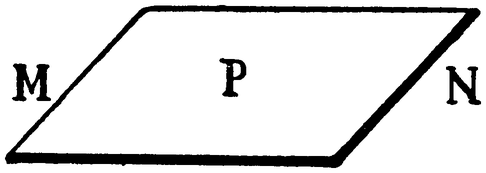
A plane is represented in a drawing by some part of it, usually in the form of a parallelogram or a rectangle (fig. 301). A plane is denoted for the most part by one or two letters; thus we say: the plane P, the plane MN.
347. Theorem. Through any three points (A, B and C, fig. 302) not lying on one straight line a plane can be drawn, and only one.
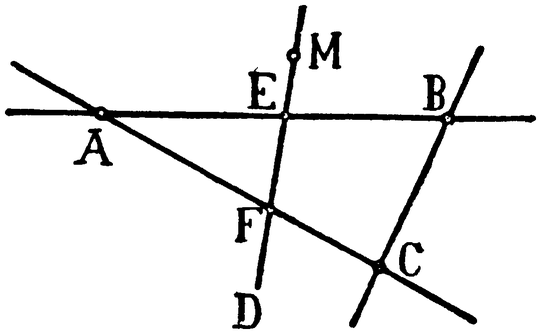
1°. Through any two of the three given points, for example through A and B, draw a straight line, and through it an arbitrary plane. Let us rotate this plane about the line AB; in rotating it we can make it pass through the point C. We then have a plane that passes through the three points A, B and C.
It remains to prove that there can be only one such plane.
2°. Suppose that two planes are drawn through the same three points. Denote one by P and the other by . Let us prove that these planes merge into one. Let us first notice that the straight lines AB, BC and AC, which pass through each pair of the given points, belong to both planes, since each of these lines has two points in common both with the plane P and with the plane . Now take any point M in the plane P and let us prove that this point belongs to the other plane as well. For this purpose draw in the plane P through the point M any straight line MD intersecting AB and AC at certain points E and F. Since the lines AB and AC belong to the other plane as well, their points E and F also belong to that plane. In consequence the line MD, which passes through E and F, lies wholly in the plane (by the definition of a plane), and therefore its point M also lies in that plane. Thus every point M of the plane P belongs to the plane as well; hence these planes merge.
348. Corollaries. 1°. Through a straight line and a point outside it a plane can be drawn, and only one, because the point outside the line together with any two points of that line make up three points through which, by what has been proved, a plane can be drawn, and only one.
2°. Through two intersecting straight lines a plane can be drawn, and only one, because, taking the point of intersection and one more point on each line, we have three points through which, and so on.
3°. Through two parallel straight lines a plane can be drawn, and only one, because parallel lines, by definition, lie in one plane; this plane is the only one, since through one of the parallels and any point of the other not more than one plane can be drawn.
4°. Any part of a plane can be laid with all its points upon another place of the same or of another plane, and the part being laid may first be turned over onto its other side, because it is always possible to lay one plane upon another in such a way that some three of their points, not lying on one straight line, coincide, and then the remaining points will coincide as well.
349. Theorem. If two planes have a common point, they also have a common straight line, which passes through that point and along which the planes intersect.
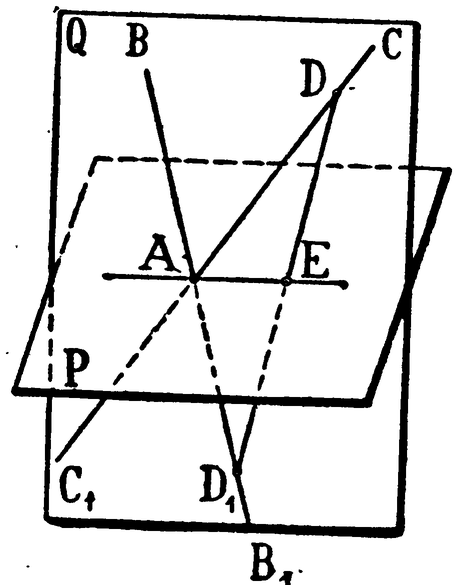
Let the plane P (fig. 303) have a point A in common with another plane Q. Draw in the plane Q through the point A any two straight lines and . If it should happen that one of these lines lies in the plane P as well, the planes would have a common straight line. Suppose that this is not so; then both these lines intersect the plane P (345, 3°); consequently each of them is divided by the plane P into two half-lines lying on opposite sides of that plane. Take on the half-lines AC and any points D and and draw the straight line . This line, passing from the part of space lying above the plane P into the part of space lying below the plane P, will intersect the plane P at some point E (345, 4°). Since, on the other hand, the line has two points in common with the plane Q (D and ), it belongs wholly to that plane. Therefore the point E of the line also belongs to the plane Q. Thus the planes P and Q have two common points A and E; hence they also have the common straight line AE passing through these points.
That the planes P and Q intersect along the line AE (and do not touch) follows from the fact that the lines and , which are contained in the plane Q, intersect P.
350. Corollary. The intersection of two planes is always a straight line.
Indeed, if the planes intersect, they have a common point, but in that case they also have a common straight line. The planes cannot have any further common point besides the points of this line, since otherwise they would have to merge into one (348, 1°).
Chapter 2: The Perpendicular to a Plane and the Obliques
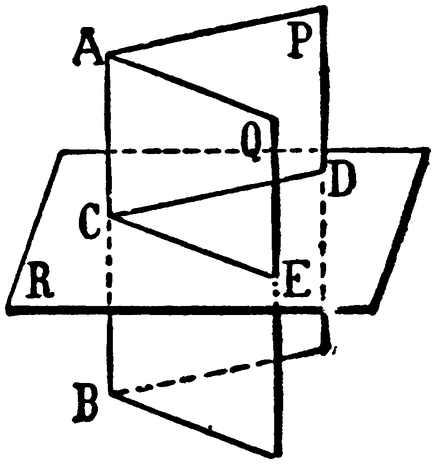
351. Preliminary remark. Take any straight line AB (fig. 304) and draw through it two arbitrary planes P and Q; then, taking any point C on AB, draw in the planes P and Q through this point the straight lines CD ⊥ AB and CE ⊥ AB. Through the two intersecting lines CD and CE draw a plane R. We then obtain a position of a straight line (AB) and a plane (R) in which the line, intersecting the plane, proves to be perpendicular to two straight lines (to CD and to CE) drawn in that plane through the point of intersection. Let us now prove that such a position of a line and a plane has the following important property.
352. Theorem. If a straight line (, fig. 305) intersecting a plane (P) is perpendicular to two straight lines (CD and EF) drawn in that plane through the point of intersection (B), then it is perpendicular also to every third straight line (MN) drawn in the plane through the same point of intersection.
Lay off segments BA and of arbitrary length, but equal, and draw in the plane any straight line DF that intersects the lines CD, MN and EF. Join the points of intersection D, N and F to the points A and . We then obtain several triangles. Let us consider them in the following order. First take the triangles AFD and ; they are equal, since in them FD is a common side, , as obliques to the line equally distant from the foot of the perpendicular BD; for the same reason . From the equality of these triangles it follows that . After this we pass to the triangles ADN and ; they are equal, since in them DN is a common side, and . From the equality of these triangles we deduce that . Now take the triangles ABN and ; they are equal, since they have respectively equal sides. From their equality we deduce that ; consequently .
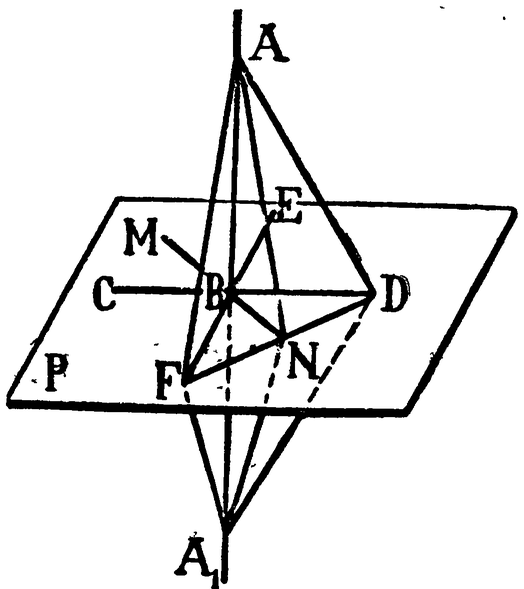
353. Definition. A straight line is called perpendicular to a plane if, intersecting that plane, it forms right angles with all the straight lines drawn in the plane through the point of intersection. In this case we also say that the plane is perpendicular to the line.
A straight line that intersects a plane but is not perpendicular to it is called an oblique. The point of intersection of the line with the plane is called the foot of the perpendicular or of the oblique.
That a straight line perpendicular to a plane can exist is a consequence of the preceding theorem and of the preliminary explanation of § 351.
354. Theorem. If through one and the same point of a straight line we draw in space any number of perpendiculars to that line, they all lie in one and the same plane (perpendicular to the line taken). Given a straight line AB (fig. 306) and on it a point B. From this point erect in space several perpendiculars to the line AB. For this purpose draw through AB any planes P, Q, R, S... and in each of them draw through the point B a straight line perpendicular to AB. Let these be the lines BC, BD, BE, BF... It is required to prove that all these perpendiculars lie in one and the same plane, perpendicular to AB. For the proof, draw through any two of them, for example through BC and BD, a plane M, which, according to the preceding theorem, will be perpendicular to AB. Now imagine that some one of the other perpendiculars, for example BE, drawn in the plane R, does not lie in the plane M. Then the intersection of the planes R and M must be some straight line not merging with BE, and consequently in the plane R there must exist 2 perpendiculars to AB passing through the point B: one BE, and the other the intersection of the planes M and R (352); since this is impossible, it cannot be admitted that any one of the perpendiculars we have drawn does not lie in the plane M; hence they all lie in this plane, which, as we said, is perpendicular to AB.
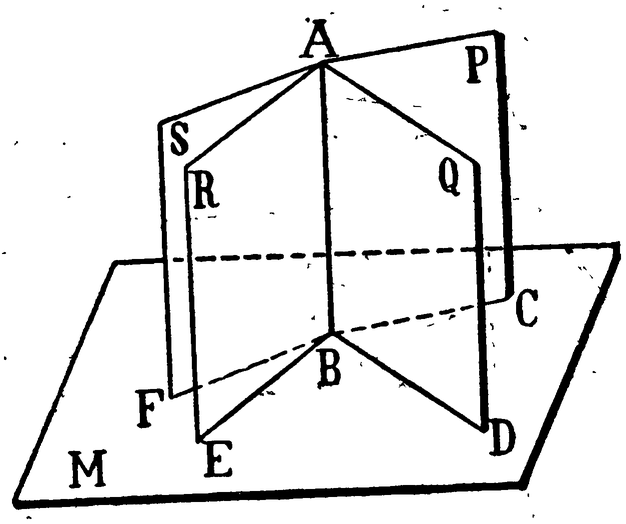
355. Theorem. Through any point of space a plane can be drawn perpendicular to a given straight line, and only one.
Let us consider 2 cases separately: when the point lies on the given line and when it lies outside that line.
1°. Let C be a point taken on the given straight line AB (fig. 307). Draw through this line any two planes P and Q and in them take the straight lines CD and CE perpendicular to AB. Through these two intersecting lines draw a plane R. This plane is perpendicular to AB at the point C, because two of its lines CD and CE are perpendicular to AC, and consequently every third straight line drawn in R through the point C is also perpendicular to AB (352).
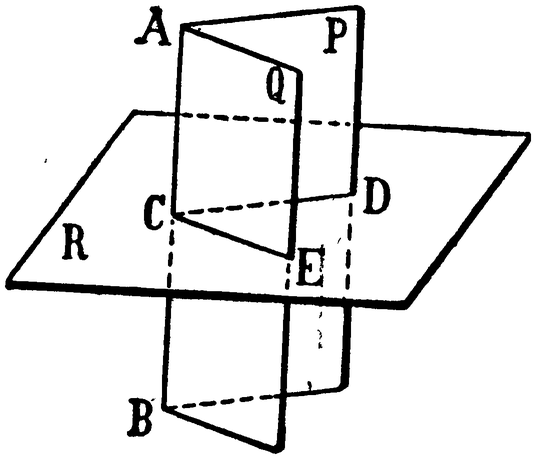
To prove that there can be only one such plane, let us assume that through the point C another plane perpendicular to AB can be drawn. Denote it by . This plane must intersect the plane P along a straight line which, in the first place, passes through C and, in the second place, is perpendicular to AB. But in the plane P there exists only one such line, namely the line CD which we drew before; hence the plane must intersect P along the same line CD along which the plane R also intersects it. In the same way we satisfy ourselves that the plane must intersect the plane Q along the same line CE along which the plane R intersects it. Consequently the plane must pass through the same intersecting lines CD and CE through which we drew the plane R before. But through 2 intersecting straight lines only one plane can be drawn; hence the planes R and must merge into one.
2°. Let D be a point taken outside the given straight line AB (fig. 307). Draw through D and AB a plane P, and through AB any other plane Q; in the first drop from the point D the perpendicular DC to AB, and in the second erect at the point C the perpendicular CE to AB. The plane R passing through DC and CE is then the plane perpendicular to AB and drawn through the point D (352).
Suppose now that through the point D another plane perpendicular to AB can be drawn. This plane must intersect the plane P along a straight line which, in the first place, passes through D and, in the second place, is perpendicular to AB. But in the plane P there exists only one such line, namely the perpendicular DC which we drew before; hence the plane must intersect the plane P along the same line DC along which the plane R also intersects it. But then the plane can intersect the plane Q only along the line CE, since this is the only straight line of the plane Q that passes through C and is perpendicular to AB. Thus the plane , passing through the same two intersecting lines DC and CE through which the plane R is drawn, must merge with that plane.
356. Theorem. Through any point of space a perpendicular to a given plane can be drawn, and only one.
Let us consider 2 cases separately: when the point through which the perpendicular to the given plane is to be drawn lies in that plane, and when it lies outside it.
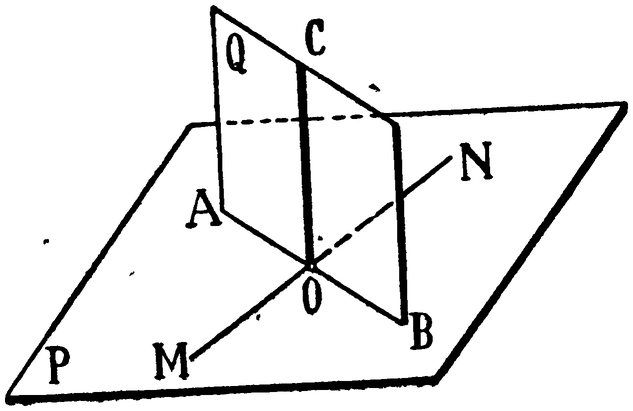
1°. Let the point O lie in the plane P (fig. 308). Draw through it in this plane any straight line MN and then through the same point O draw a plane Q perpendicular to the line MN, which, as we have seen (355, 1°), is always possible. Let the planes P and Q intersect along the straight line AB. In the plane Q draw OC ⊥ AB. Let us prove that the line OC so obtained is a perpendicular to the plane P. Since the line MN is perpendicular to the plane Q, it is perpendicular to every straight line drawn in that plane through the point O; hence OC ⊥ MN. On the other hand, OC ⊥ AB by construction. Hence the line OC is perpendicular to two straight lines drawn in the plane P through the point O; consequently it is perpendicular to the plane P.
Suppose now that besides the perpendicular OC which we have found there exists another perpendicular (fig. 309) drawn to the plane P through the same point O. Draw a plane through the lines OC and (it is not shown in the figure); let this plane intersect the plane P along the straight line OH. Then the angles COH and would both have to be right angles. But this is impossible, since one of these angles is a part of the other. Hence no other perpendicular to the plane P can be drawn through the point O.
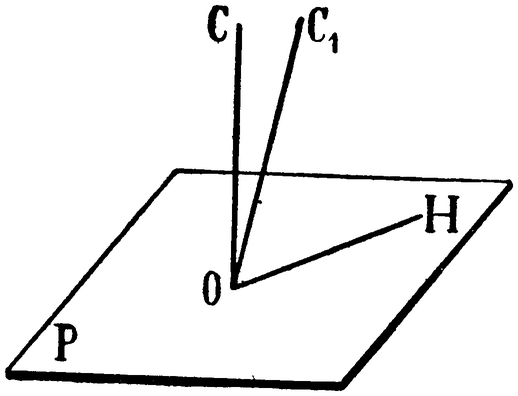
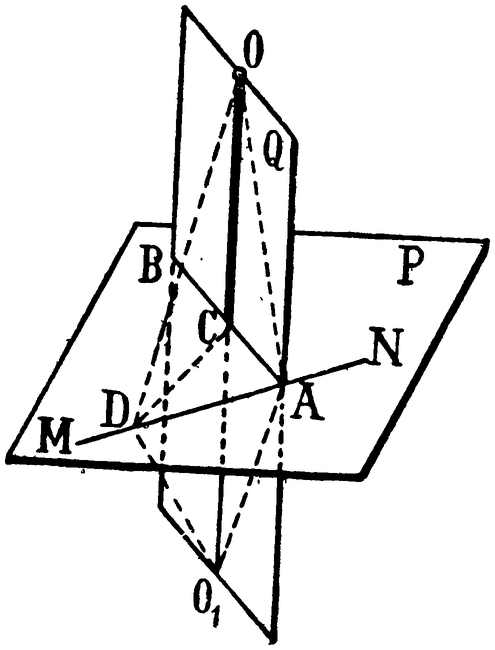
2°. Let the point O lie outside the plane P (fig. 310). Draw in this plane an arbitrary straight line MN and then through the point O draw a plane Q perpendicular to the line MN, which is always possible (355, 2°). Let the planes P and Q intersect along the straight line AB. In the plane Q draw OC ⊥ AB. Let us prove that the line OC so obtained is a perpendicular to the plane P. For this it is sufficient to show that this line is perpendicular to some two straight lines drawn in the plane P through the point C. To one such line, namely to AB, the line OC is perpendicular by construction. For the other line take CD, which joins the point C to any point D of the line MN. To prove that OC ⊥ CD, extend OC by the length and join the points O and to A and D by straight lines. Since MN ⊥ Q, we have MN ⊥ AO and ; hence the triangles OAD and are right-angled at the vertex A. They have the leg AD in common, and the legs AO and are equal, as obliques drawn in the plane Q from the point A to the line whose feet are at equal distances from the foot of the perpendicular AC (the segments OC and ). From the equality of these triangles it follows that . Passing now to the triangles OCD and , we see that they are equal, since the sides of the one are respectively equal to the sides of the other. Consequently , and therefore these angles are right angles. Thus it turns out that OC ⊥ CA and OC ⊥ CD; hence OC ⊥ P.
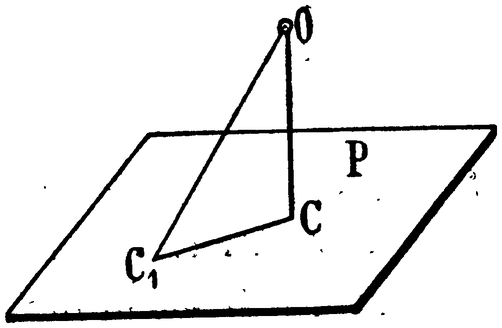
Let us now assume that besides the perpendicular OC which we have found another perpendicular can be dropped from the point O to the plane P (fig. 311). Then, joining the points C and by a straight line, we obtain a triangle in which two angles (at the vertices C and ) are right angles. Since this is impossible, no other perpendicular can be dropped from the point O to the plane P.
357. Comparative length of the perpendicular and the obliques. When from one point A (fig. 312) a perpendicular AB and an oblique AC are drawn to a plane, let us agree to call the straight line BC, drawn between the feet of the perpendicular and of the oblique, the projection of the oblique on the plane.
Theorems. If from one and the same point (A, fig. 312), taken outside a plane (P), a perpendicular (AB) and any obliques (AC, AD, AE...) are drawn to that plane, then:
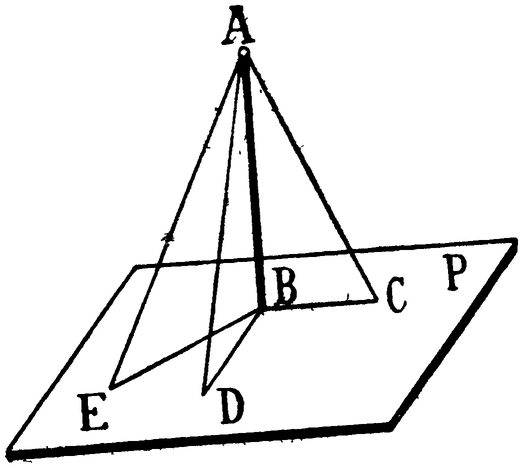
1°, the perpendicular is shorter than every oblique;
2°, two obliques having equal projections are equal;
3°, of two obliques the greater is the one whose projection is greater.
Rotating the right triangles ABC and ABD about the leg AB, we can make their planes coincide with the plane of the triangle ABE. Then all the obliques will lie in one plane with the perpendicular, and all the projections will fall on one straight line. Thus the theorems to be proved reduce to the analogous theorems of plane geometry (59, 1 and 2).
Remark. The length of the perpendicular dropped from the point A to the plane P (fig. 312) is taken as the measure of the distance of the point A from the plane P.
358. Converse theorems. If from one and the same point, taken outside a plane, a perpendicular and any obliques are drawn to that plane, then equal obliques have equal projections, and of two projections the greater is the one that corresponds to the greater oblique.
We leave the proof (by contradiction) to the students themselves.
359. We give one more theorem on perpendiculars, which we shall need later51.
Theorem. A straight line (DE, fig. 313) drawn in a plane (P) through the foot of an oblique (AC) perpendicular to its projection (BC) is perpendicular also to the oblique itself.
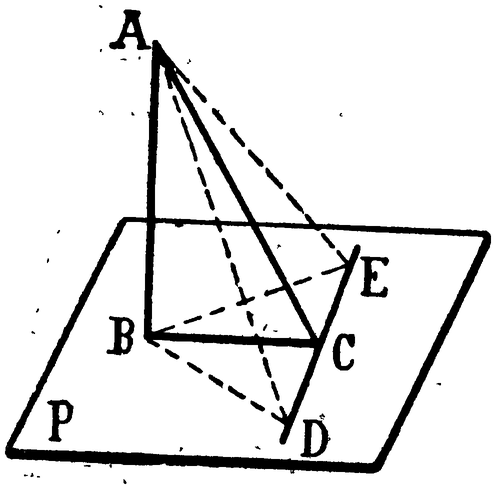
Lay off arbitrary, but equal, segments CD and CE and join the points A and B to D and E. We then have: BD = BE, as obliques to the line DE equally distant from the foot of the perpendicular BC; AD = AE, as obliques to the plane P having equal projections BD and BE. In consequence △ ADE is isosceles, and therefore its median AC is perpendicular to the base DE (39).
Chapter 3: Parallel Lines and Planes
Parallel Straight Lines
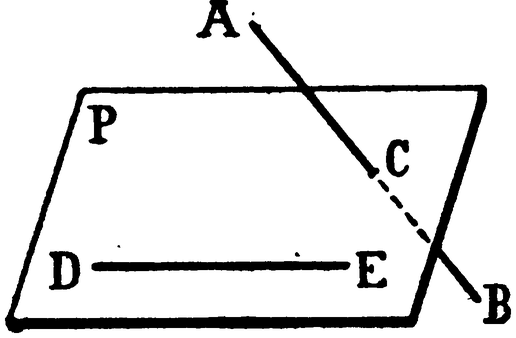
360. Preliminary remark. Two straight lines may be so placed in space that no plane can be drawn through them. Take, for example, two straight lines AB and DE such that one of them intersects some plane P while the other lies in that plane but does not pass through the point of intersection C. No plane can be drawn through two such lines, because otherwise two different planes would pass through the line DE and the point C: one, the plane P, which intersects the line AB, and another which contains it; and this is impossible (348, 1°).
Two straight lines that do not lie in one plane do not, of course, intersect, however far they are extended; yet they are not called parallel. That name is kept only for straight lines which, lying in one plane, do not intersect however far they are extended.
Two straight lines that do not lie in one plane are called skew lines.
In plane geometry we saw (77 and 79) that through every point of a plane a straight line can be drawn parallel to a given straight line, and only one. The same can be said of every point of space, because through a point and a given straight line a plane can be drawn, and only one.
361. Theorem. If a plane (P, fig. 315) intersects one of two parallel straight lines (AB), it intersects the other as well (CD).
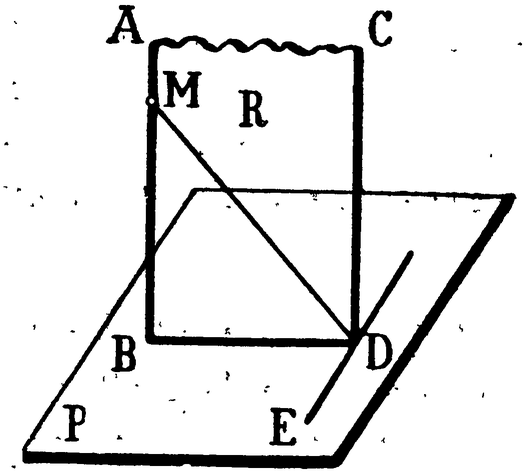
Let us draw a plane through AB and CD. This plane contains the point B at which the line AB intersects P; hence this plane intersects P along some straight line BE (349). This line, since it lies in one plane with AB and CD and intersects one of these parallels, must intersect the other as well (80) at some point F. The point F, lying at once on the line BE and on the line CD, must be the point of intersection of the plane P with the line CD.
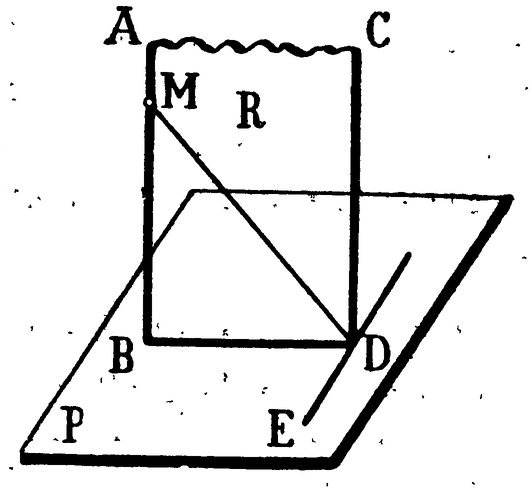
362. Theorem. If a plane (P, fig. 316) is perpendicular to one of two parallel straight lines (AB), it is perpendicular to the other as well (CD).
We have to prove, 1°, that the plane P intersects the line CD, and 2°, that this line is perpendicular to some two straight lines drawn in the plane P through the foot of CD.
1°. The plane P must intersect CD, because by hypothesis it intersects the line AB, which is parallel to CD.
2°. Let us draw the plane R through AB and CD and take its intersection BD with the plane P. Since by hypothesis AB is perpendicular to P, we have AB ⊥ BD; therefore CD ⊥ BD also (82). In the plane P let us draw the straight line DE perpendicular to BD, and take any oblique MD whose projection is BD. The line ED, being perpendicular to the projection BD, must be perpendicular to the oblique MD as well (359), and consequently it is perpendicular to the plane R (352), and hence to the line CD. Thus the line CD proves to be perpendicular to two straight lines of the plane P, namely to DB and to DE; consequently it is perpendicular to that plane.
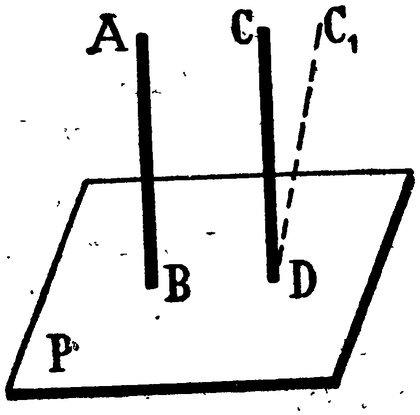
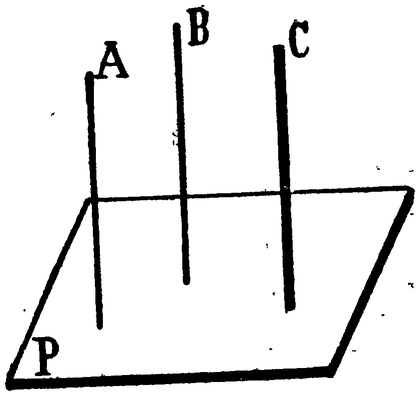
363. Converse theorem. If two straight lines (AB and CD, fig. 317) are perpendicular to one and the same plane (P), they are parallel.
Suppose the contrary, that is, that the lines AB and CD are not parallel. Let us then draw through the point D a straight line parallel to AB. On our supposition this will be some line that does not merge with DC. By the direct theorem, the line will be perpendicular to the plane P. Consequently we then have two perpendiculars to the plane P passing through one and the same point: DC and . Since this is impossible, it cannot be admitted that the lines AB and CD are not parallel.
364. Theorem. If two straight lines (A and B, fig. 318) are parallel to a third straight line (C), they are parallel to each other.
Let us draw a plane P perpendicular to the line C. Then the lines A and B will be perpendiculars to this plane (362), and consequently A ∥ B (363).
365. Theorem. If two straight lines (A and B, fig. 319) are parallel and a plane passes through each of them, the line of intersection of these planes (if it exists) is parallel to the first two lines.
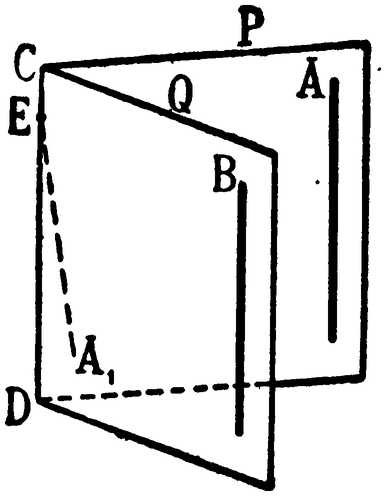
Let the plane P pass through the line A and the plane Q through the line B, and let these planes intersect along the straight line CD; it is required to prove that CD ∥ A and CD ∥ B. Through any point E of the line of intersection let us imagine a straight line parallel to the line A; then this line must also be parallel to the line B. Since the line is parallel to the line A and passes through the point E, the line must lie in the plane that contains the line A and the point E, that is, in the plane P. On the other hand, since the line is parallel to the line B and passes through the point E, the line must lie in the plane Q. But if the line lies at once in the plane P and in the plane Q, it must coincide with the line of intersection CD; hence CD ∥ A and CD ∥ B.
A Straight Line and a Plane Parallel to Each Other
366. Definition. A plane and a straight line not lying in that plane are called parallel if they do not intersect, however far they are extended.
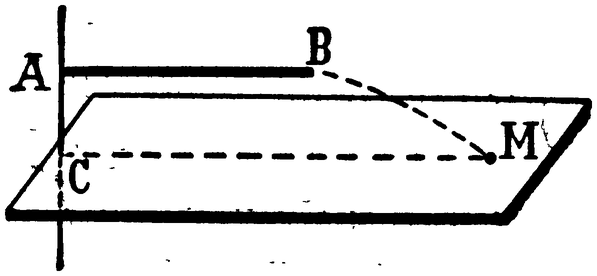
The following two theorems express criteria of the parallelism of a straight line and a plane.
367. Theorem 1. If a straight line (AB, fig. 320) and a plane (P) are perpendicular to one and the same straight line (AC), they are parallel.
Suppose that the line AB intersects the plane P at some point M. Then, joining this point by a straight line to the point C at which the plane P intersects the given line, we have two perpendiculars MC and MA to the line AC from one point M, which is impossible; hence AB does not intersect P, that is, AB is parallel to P.
Theorem 2. If a straight line (AB, fig. 321) is parallel to some straight line (CD) drawn in a plane (P), it is parallel to the plane itself.
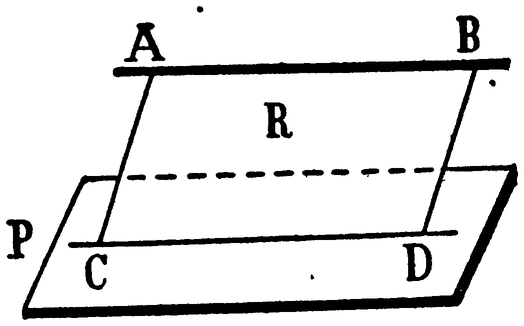
Let us draw the plane R through AB and CD, and suppose that the line AB intersects the plane P somewhere. Then the point of intersection, lying on the line AB, must also belong to the plane R, in which AB lies; at the same time the point of intersection must, of course, belong to the plane P as well. Hence the point of intersection, lying at once in the plane R and in the plane P, must lie on the line CD along which these planes intersect; consequently the line AB intersects the line CD. But this is impossible, since by hypothesis AB ∥ CD. Hence it cannot be admitted that the line AB intersects the plane P, and therefore AB ∥ P.
The theorems that follow express some properties of a straight line and a plane parallel to each other.
368. Theorem. If a plane (R, fig. 321) passes through a straight line (AB) parallel to another plane (P) and intersects that plane, the line of intersection (CD) is parallel to the first line (AB).
Indeed, in the first place, the line CD lies in one plane with AB; in the second place, this line cannot intersect AB, because otherwise the line AB would intersect the plane P, which is impossible.
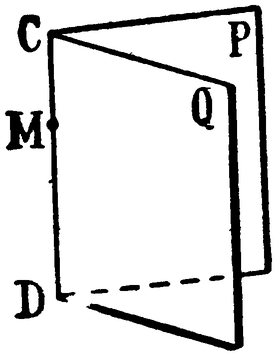
369. Corollary. If a straight line (AB, fig. 322) is parallel to two intersecting planes (P and Q), it is parallel to their line of intersection (CD).
Let us imagine a plane through AB and any point M of the line CD. This plane must intersect P and Q along straight lines parallel to AB and passing through M. But through M only one straight line can be drawn parallel to AB; hence the two intersections of the imagined plane with the planes P and Q must merge into one straight line. This line, lying at once in the plane P and in the plane Q, must coincide with the line CD along which the planes P and Q intersect; hence CD ∥ AB.
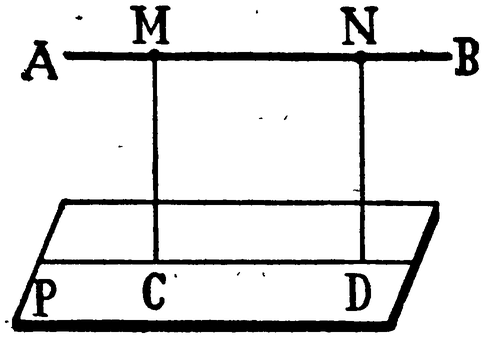
370. Theorem. All the points of a straight line (AB, fig. 323) parallel to a plane (P) are equally distant from that plane.
From any points M and N of the line AB let us drop the perpendiculars MC and ND to P. Since these perpendiculars are parallel (363), a plane can be drawn through them. This plane intersects P along the line CD, which is parallel to AB (368); therefore the figure MNDC is a parallelogram, and consequently MC = ND. But the length of the perpendicular dropped from a point to a plane is taken as the measure of the distance of that point from the plane; hence any points M and N of the line AB are equally distant from the plane P.
Parallel Planes
371. Definition. Two planes are called parallel if they do not intersect, however far they are extended.
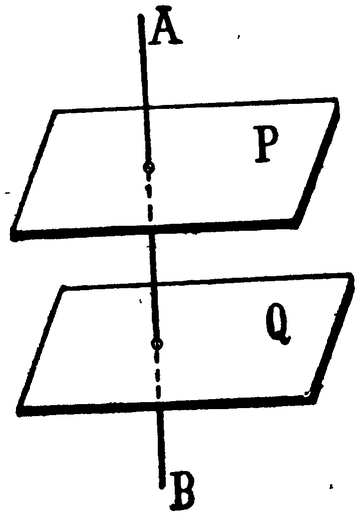
The following two theorems express criteria of the parallelism of two planes.
372. Theorem 1. If two planes (P and Q, fig. 324) are perpendicular to one and the same straight line (AB), they are parallel.
Indeed, if the planes P and Q intersected, then through every point of their intersection there would pass two planes, P and Q, perpendicular to the line AB, which is impossible.
Theorem 2. If two intersecting straight lines (AB and AC, fig. 325) of one plane (P) are respectively parallel to two straight lines ( and ) of another plane (Q), these planes are parallel.
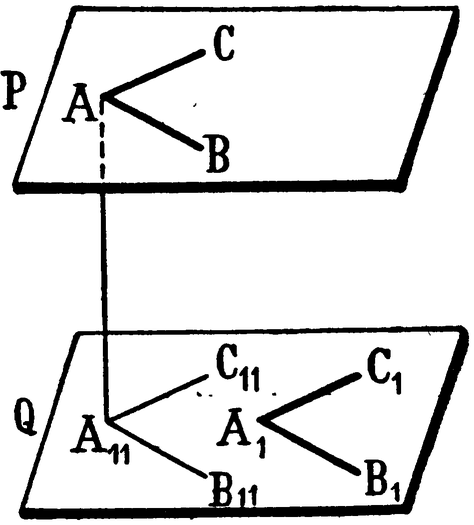
From the point A let us drop the perpendicular to the plane Q and draw the straight lines and respectively parallel to the lines and ; these lines are also parallel to the lines AB and AC (364). Since and AB ∥ , we have ; in the same way it is proved that . Consequently the line is perpendicular to the plane P (352). Thus the planes P and Q are perpendicular to one and the same straight line and are therefore parallel.
The theorems that follow express some properties of parallel planes.
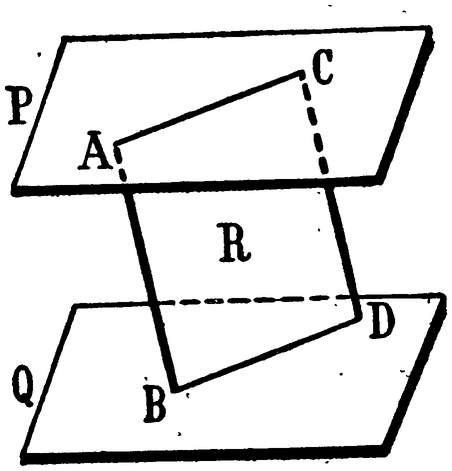
373. Theorem. If two parallel planes (P and Q, fig. 326) are intersected by a third plane (R), the lines of intersection (AC and BD) are parallel.
Indeed, in the first place, the lines AC and BD lie in one plane (R); in the second place, they cannot intersect, since otherwise the planes P and Q would intersect, which contradicts the hypothesis.
374. Theorems. 1°. If a straight line intersects one of two parallel planes, it intersects the other as well.
2°. If a plane intersects one of two parallel planes, it intersects the other as well.
1°. Let the straight line AB (fig. 327) intersect at the point B the plane P, which is parallel to Q. Let us join the point B by a straight line to any point C of the plane Q, and through AB and BC draw a plane (not shown in the figure). This plane, since it contains the points B and C, intersects P and Q along some straight lines DE and FH, which are parallel (373). The line AB lies in one plane with DE and FH and intersects one of these parallels; consequently, as we know from plane geometry (80, 1°), it will intersect the other as well; hence it will intersect the plane Q also.
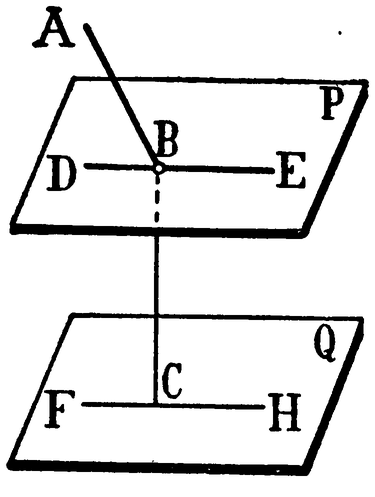
2°. Let any plane intersect the plane P (fig. 327), which is parallel to Q. Then a straight line AB can be taken in it which also intersects the plane P; by what has been proved, this line intersects the plane Q as well; hence the plane in which AB was taken will also intersect that plane.
375. Theorem. If a straight line (AB, fig. 328) is perpendicular to one of two parallel planes (to P), it is perpendicular to the other as well (to Q).
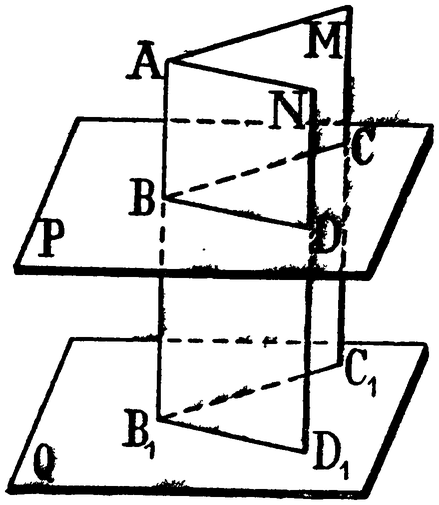
The line AB, since it intersects one of the parallel planes, will intersect the other as well at some point . Through AB let us draw any two planes M and N, which will intersect P and Q along parallel straight lines (373): one along BC and , the other along BD and . By hypothesis, the line AB is perpendicular to BC and BD; consequently it is also perpendicular to and , and therefore it is perpendicular to the plane Q as well.
376. Theorem. Through every point (B, fig. 328) of space a plane (P) can be drawn parallel to a given plane (Q), and only one.
It is always possible to drop from the point B the perpendicular to the plane Q and then to draw through the point B the plane P perpendicular to . This plane will be parallel to Q (372, 1°). No other plane parallel to Q can be drawn through the point B, since, if that were possible, two planes perpendicular to would pass through the point B (375), which is impossible.
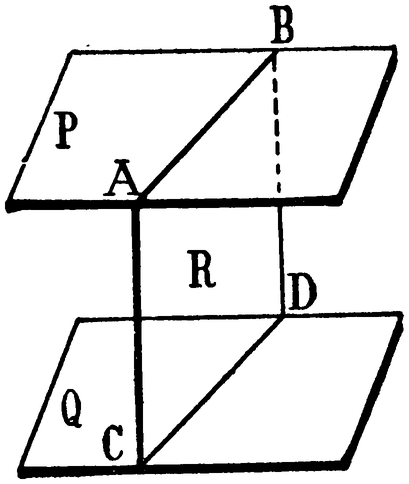
377. Theorem. The segments of parallel straight lines (AC and BD, fig. 329) contained between parallel planes (P and Q) are equal.
Through the parallel lines AC and BD let us draw the plane R; it will intersect P and Q along the parallel straight lines AB and CD; consequently the figure ABCD will be a parallelogram, and therefore AC = BD.
378. Corollary. Parallel planes are everywhere equally distant from each other, because, if the parallel lines AC and BD (fig. 329) are perpendicular to P, they will also be perpendicular to Q and at the same time equal.
379. Theorem. Two angles (BAC and , fig. 330) whose sides are respectively parallel and have the same direction are equal and lie in parallel planes (P and Q).
That the planes P and Q are parallel was proved earlier (372, 2°); it remains to prove that the angles A and are equal.
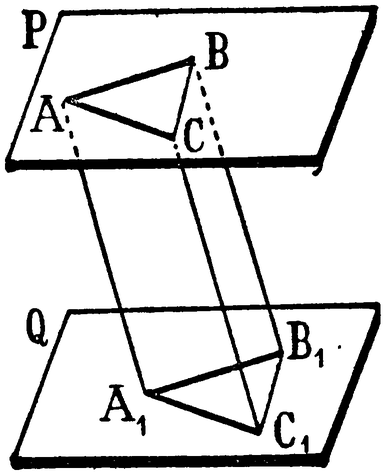
Let us lay off , and draw , , , BC and . Since the segments AB and are equal and parallel, the figure is a parallelogram (99, 2°); therefore the segments and are equal and parallel. For the same reason the segments and are equal and parallel; consequently and . Therefore and (by three sides); hence .
380. Theorem. If two straight lines (AB and CD, fig. 331) are intersected by a series of parallel planes (P, Q, R ...), they are cut by these planes into proportional parts.
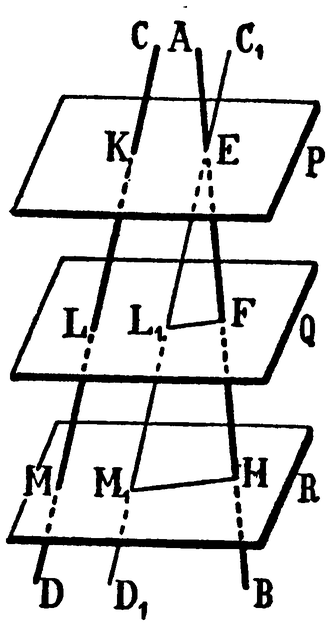
Let E, F, H ... be the points of intersection of the line AB with the planes P, Q, R ..., and K, L, M ... the points of intersection of the other line CD with the same planes; it is required to prove that the parts EF, FH ... of the one line are proportional to the parts KL, LM ... of the other line, that is, that
Through the point E let us draw the straight line parallel to CD, and through the two intersecting lines AB and let us imagine a plane. The straight lines , ..., along which this plane intersects the given planes, must be parallel to one another (373); therefore (219)
But , , ... (377); substituting in the series of equal ratios so obtained the segments KL, LM ... in place of , ..., we obtain what was required to be proved.
Chapter 4: Dihedral Angles
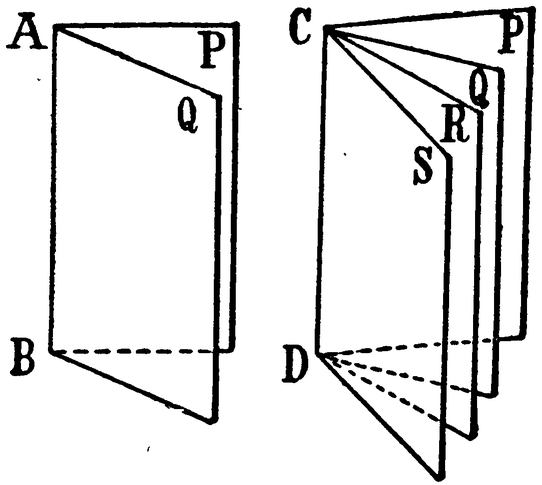
381. Definition. The figure formed by two half-planes (P and Q, fig. 332) issuing from one straight line (AB), together with the part of space bounded by them, is called a dihedral angle.
The straight line AB is called the edge, and the half-planes P and Q the sides or faces of the dihedral angle. Such an angle is usually denoted by two letters placed at its edge (the dihedral angle AB). But if several dihedral angles lie at one edge, each of them is denoted by four letters, of which the two middle ones stand at the edge and the two outer ones at the faces (for example, the dihedral angle SCDR).
If through the edge (CD, fig. 332) of a dihedral angle (PCDS) we draw inside it (that is, in the part of space that belongs to the angle) any half-planes (R, Q...), the dihedral angles so formed (RCDS, QCDR...) are regarded as parts of the first dihedral angle.
If from an arbitrary point D of the edge AB (fig. 333) we draw in each face a perpendicular to the edge, the angle CDE formed by these perpendiculars is called the linear angle of the dihedral angle. The size of the linear angle does not depend on the position of the point D on the edge. Thus the linear angles CDE and are equal, because their sides are respectively parallel and have the same direction.
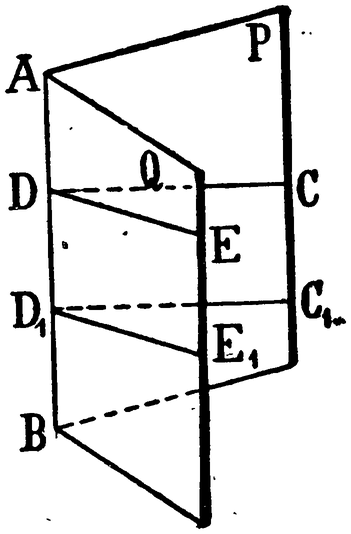
The plane of a linear angle is perpendicular to the edge, since it contains two straight lines perpendicular to it (352).
382. Equality and inequality of dihedral angles. Two dihedral angles are counted equal if, when one is inserted into the other, they can be made to coincide; otherwise the smaller of the angles is the one that can form a part of the other.
We can consider the sum, difference, product and quotient of dihedral angles in the same sense as for the angles of plane geometry. Like those angles, dihedral angles can be adjacent, right, vertical...
383. Theorems. 1°. To equal dihedral angles there correspond equal linear angles.
2°. To a greater dihedral angle there corresponds a greater linear angle.
Let and (fig. 334) be two dihedral angles. Let us insert the angle into the angle AB so that the edge coincides with the edge AB and the face with the face P. Then, if these dihedral angles are equal, the face will coincide with Q; but if the dihedral angles are not equal, the face will not coincide with Q; for example, it will take some position if the angle is less than the angle AB.
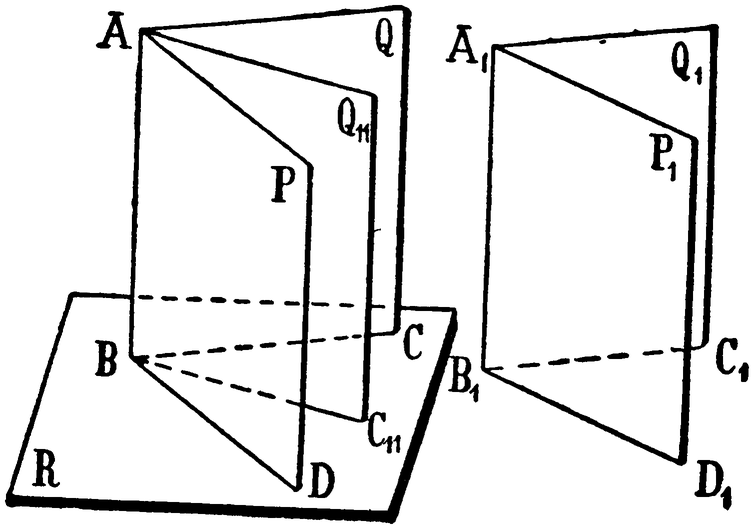
Having noticed this, let us take any point B on the common edge and draw through it a plane R perpendicular to the edge. The intersection of this plane with the faces of the dihedral angles gives linear angles. It is clear that if the dihedral angles coincide, they will have one and the same linear angle, namely CBD; but if the dihedral angles do not coincide, if, for example, the face takes the position , then the greater dihedral angle will have the greater linear angle (namely: ).
384. Converse theorems. 1°. To equal linear angles there correspond equal dihedral angles.
2°. To a greater linear angle there corresponds a greater dihedral angle.
These theorems are easily proved by contradiction (51).
385. Remark. We accept as evident that the insertion of one figure into another, often used in solid geometry, can always be carried out in the following order: 1°, we make any two points of the figures coincide; 2°, any two half-lines issuing from the coincident points; and 3°, any two half-planes issuing from the coincident straight lines. Whether the other elements of the figures then coincide depends on their properties.
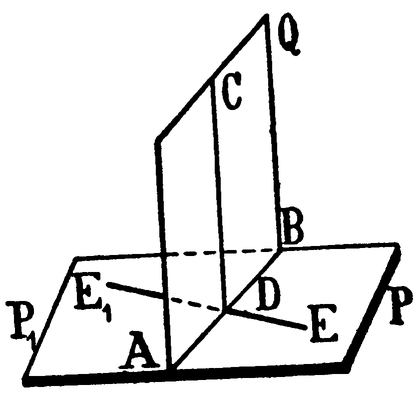
386. Corollaries. 1°. To a right dihedral angle there corresponds a right linear angle, and conversely.
Let the dihedral angle (fig. 335) be a right angle. This means that it is equal to the adjacent angle . But in that case the linear angles CDE and are also equal; and since they are adjacent, each of them must be a right angle. Conversely, if the adjacent linear angles CDE and are equal, then the adjacent dihedral angles are equal too, that is, each of them must be a right angle.
2°. Right dihedral angles are equal, because their linear angles are equal. For the same reason:
3°. Vertical dihedral angles are equal.
4°. Dihedral angles whose faces are respectively parallel and have the same direction are equal.
387. Theorem. Dihedral angles are to each other as their linear angles.
In the proof we shall consider two cases separately:
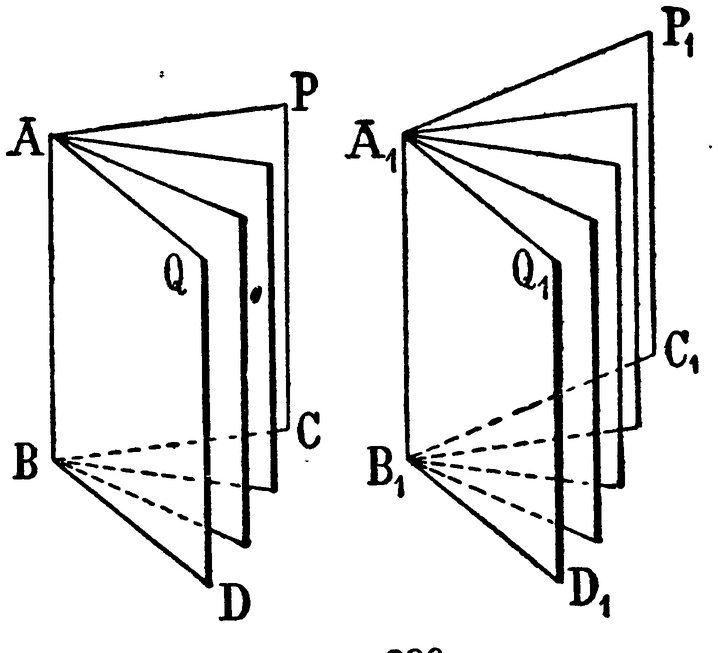
1°. The linear angles and are commensurable (fig. 336). Let their common measure be contained times in the first angle and times in the second. Let us draw a series of planes through the edges and the straight lines that divide the linear angles into parts equal to the common measure; we then divide the angle AB into parts and the angle into n parts, all of which are equal to one another (because the linear angles are equal). Therefore:
Whence:
2°. The linear angles are incommensurable. Let us divide the angle (fig. 336) into n equal parts. Let of this angle be contained in the angle CBD more than m but fewer than m + 1 times. Then the approximate ratio of the angles CBD and , to within (by defect), is equal to . Drawing planes in the same way as in the first case, we find that the approximate ratio of the dihedral angles AB and , to within (by defect), is also equal to . Thus the approximate ratios turn out to be equal for every n; and in that case we have agreed to count incommensurable ratios equal.
388. Corollary. If we take as the unit of dihedral angles the angle that corresponds to the unit of linear angles, we may say that a dihedral angle is measured by its linear angle.
Perpendicular Planes
389. Definition. Two planes are called mutually perpendicular if, in intersecting, they form right dihedral angles. That such planes can exist is shown by the following theorem, which gives a criterion of the perpendicularity of two planes.
390. Theorem. If a plane (P, fig. 337) passes through a perpendicular (AB) to another plane (Q), it is perpendicular to that plane. In the plane Q let us draw BC ⊥ DE. Then the angle ABC will be the linear angle of the dihedral angle PDEQ. Since the straight line AB is, by hypothesis, perpendicular to Q, we have AB ⊥ BC; hence the angle ABC is a right angle, and therefore the dihedral angle is a right angle too (386), that is, the plane P is perpendicular to Q.
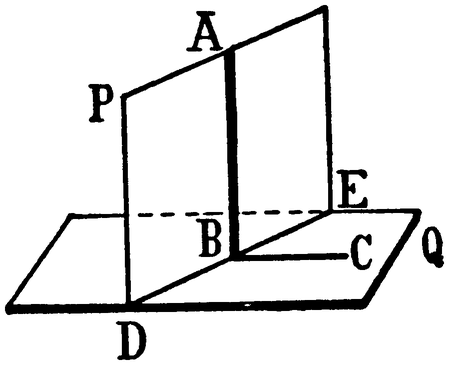
The following two theorems express the chief properties of perpendicular planes.
391. Theorem. If two planes (P and Q, fig. 338) are mutually perpendicular, and to one of them (to Q) a perpendicular (AB) is drawn that has a point (A) in common with the other plane (with P), then it lies wholly in that plane.
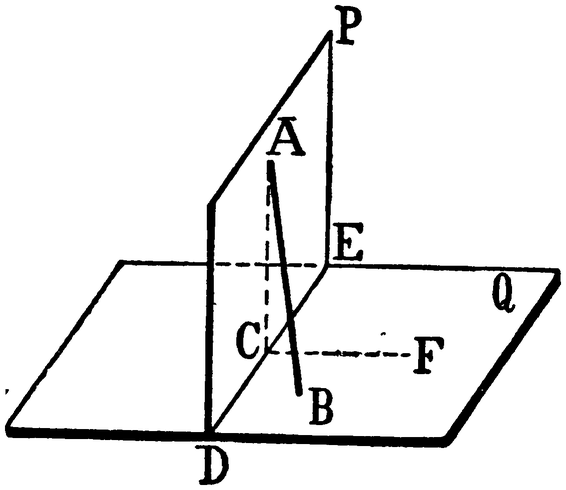
Suppose that AB does not lie in the plane P (as it is shown in our figure). In this plane let us draw AC ⊥ DE, and in the plane Q let us draw CF ⊥ DE. Then the angle ACF, as the linear angle of a right dihedral angle, will be a right angle. Therefore the line AC, forming right angles with DE and CF, will be a perpendicular to the plane Q. We then have 2 perpendiculars dropped from one and the same point A to the plane Q, namely AB and AC. Since this is impossible, it cannot be admitted that the perpendicular AB does not lie in the plane P.
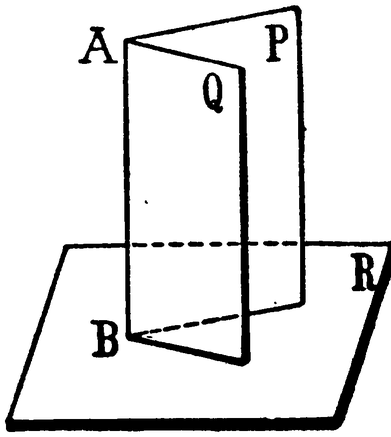
392. Corollary. The intersection (AB, fig. 339) of two planes (P and Q) perpendicular to a third plane (R) is a perpendicular to that plane.
Indeed, if through any point A of the line of intersection we imagine a perpendicular to the plane R, this perpendicular, by the preceding theorem, must lie both in the plane Q and in the plane P; hence it will merge with AB.
The Angle Between Two Skew Lines
393. We have seen (360) that in space straight lines can be taken that do not intersect and at the same time are not parallel, since they do not lie in one plane. For such skew lines we give the following
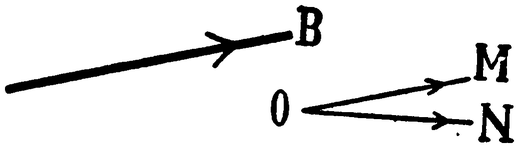
Definition. The angle between two skew lines (AB and CD, fig. 340) whose position and direction are given is the angle (MON) obtained if from an arbitrary point of space (O) we draw half-lines (OM and ON) respectively parallel to the given lines (AB and CD) and having the same direction as they have.
The size of the angle MON does not depend on the position of the point O. Indeed, if we construct in the way described an angle at any other point , then , since these angles have sides that are respectively parallel and have the same direction (364 and 379).
The Angle Between a Straight Line and a Plane
394. Projection of a straight line on a plane. We said earlier (357) that when a perpendicular and an oblique are drawn to a plane from one point, the projection of this oblique on the plane is the straight line joining the foot of the perpendicular to the foot of the oblique. Let us now give a more general definition of projection.
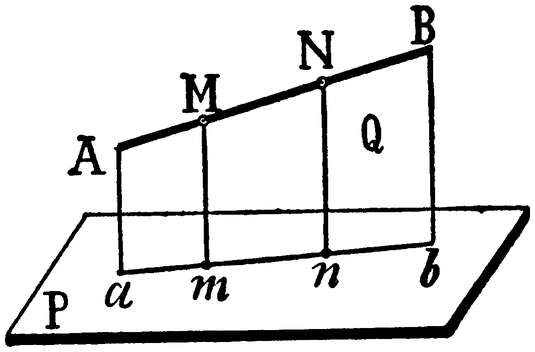
1°. The projection of any point on a plane (for example, of the point M on the plane P, fig. 341) is the foot (m) of the perpendicular dropped to this plane from the point taken.
2°. The projection of any line on a plane is the locus of the projections of all the points of this line.
In particular, if the line projected is a straight line (for example, AB, fig. 341), its projection on the plane (P) is also a straight line. Indeed, if through the straight line AB and the perpendicular Mm, dropped to the plane of projection from any one point M of this line, we draw a plane Q, this plane must be perpendicular to the plane P (390); therefore the perpendicular dropped to the plane P from any point of the straight line AB (for example, from the point N) must lie in this plane Q (391), and consequently the projections of all the points of the straight line AB must lie on the straight line ab along which the planes P and Q intersect. Thus this straight line ab is the locus of the projections of all the points of the given straight line AB, and consequently is its projection.
There is, however, one particular case in which the projection of a straight line becomes a point; this happens when the straight line is perpendicular to the plane of projection.
395. The angle between a straight line and a plane. The angle between a straight line (AB, fig. 342) and a plane (P), in the case when the line is oblique to the plane, is the angle (ABC) formed by this line with its projection on the plane.
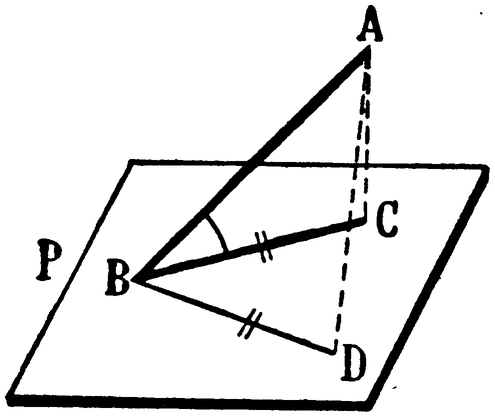
This angle has the property that it is the least of all the angles that the oblique forms with the straight lines drawn in the plane P through the foot of the oblique. Let us prove, for example, that ∠ABC is less than ∠ABD. To do this we lay off BD = BC and join D to A. In the triangles ABC and ABD two sides of the one are respectively equal to two sides of the other, but the third sides are not equal, namely AD > AC (357). In consequence ∠ABD is greater than ∠ABC (58, 2°).
Chapter 5: Polyhedral Angles
396. Definition. Let us take several angles (fig. 343): ASB, BSC, CSD..., which, adjoining one another in succession, are placed in one plane around a common vertex S. Let us rotate the plane of the angle ASB about the common side SB so that this plane makes some dihedral angle with the plane BSC. Then, without changing the dihedral angle so obtained, let us rotate it about the straight line SC so that the plane BSC makes some dihedral angle with the plane CSD. We continue this successive rotation about each common side. If in the end the last side SF coincides with the first side SA, a figure is formed (fig. 344) which, together with the part of space bounded by the planes, is called a polyhedral angle. The angles ASB, BSC... are called its plane angles or faces; their sides SA, SB... are called its edges, and the common vertex S is the vertex of the polyhedral angle. To each edge there corresponds a dihedral angle of its own; therefore a polyhedral angle has as many dihedral angles and as many plane angles as it has edges in all. The least number of faces in a polyhedral angle is three; such an angle is called trihedral. There can be tetrahedral angles, pentahedral angles and so on.
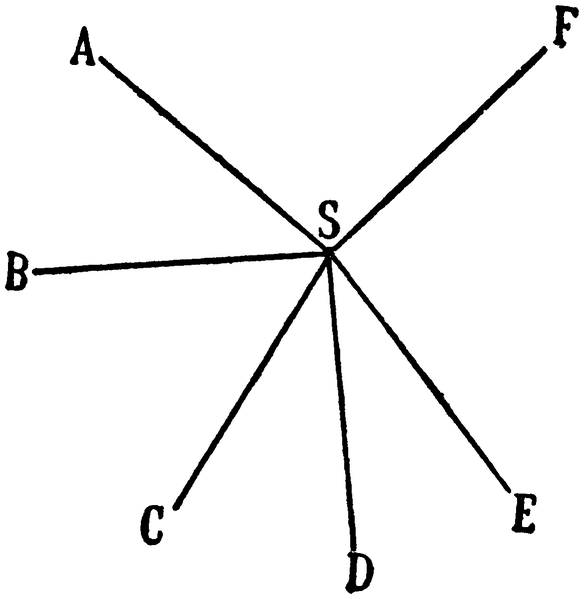
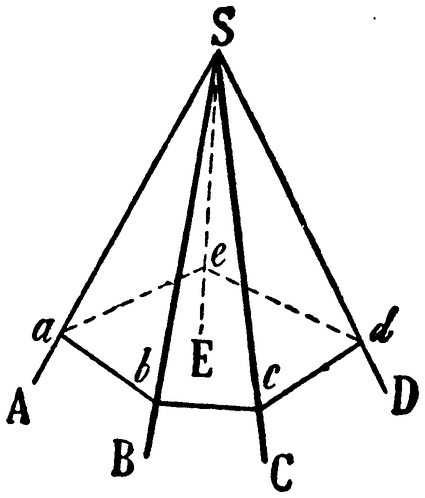
A polyhedral angle (fig. 344) is denoted either by the single letter S placed at the vertex, or by a series of letters SABCDE, of which the first denotes the vertex and the rest the edges in the order in which they are placed.
A polyhedral angle is called convex if it lies wholly on one side of each of its faces. Such, for example, is the angle shown in figure 344. The angle in figure 345, on the contrary, cannot be called convex, since it lies on both sides of the face ASB, or of the face BSC.
If we cut all the faces of a polyhedral angle by a plane, a polygon is formed in the section (abcde, figs. 344 and 345). In a convex angle this polygon is also convex.
We shall consider only convex polyhedral angles.
397. Theorem. In every trihedral angle each plane angle is less than the sum of the other two plane angles.
Evidently this theorem needs proof only in the case when it is applied to the plane angle that is the greatest of the three. In the angle SABC (fig. 346) let the greatest of the plane angles be ASC. Let us prove that even this greatest angle is less than the sum of the other two. On the angle ASC let us lay off a part ASD equal to ASB. In the plane of the angle ASC let us draw any straight line AC, intersecting SD at some point D. Let us lay off SB = SD. Joining B to A and C, we obtain △ACB, in which:
AD + DC < AB + BC.
The triangles ASD and ASB are equal, since each contains an equal angle included between equal sides; consequently AD = AB. Therefore in the inequality obtained we may drop the equal parts AD and AB, after which we obtain:
DC < BC.
We now notice that in the triangles SCD and SCB two sides of the one are equal to two sides of the other, while the third sides are unequal; in such a case the greater angle lies opposite the greater of these sides (58, 2°); hence:
angle CSD < angle CSB.
Adding the angle ASD to the left-hand side of this inequality and the angle ASB, equal to it, to the right-hand side, we obtain the inequality that was to be proved:
angle ASC < angle CSB + angle ASB.
Corollary. Taking away from both sides of the last inequality the angle ASB or the angle CSB, we obtain:
angle ASC − angle ASB < angle CSB;
angle ASC − angle CSB < angle ASB.
Since, moreover, the angle ASC, the greatest of the three angles, is of course greater than the difference of the other two angles, we conclude:
In a trihedral angle each plane angle is greater than the difference of the other two angles.
398. Theorem. In every convex polyhedral angle the sum of all the plane angles is less than 4d.
Let us cut the faces (fig. 347) of a convex angle SABCDE by any plane; in the section we then obtain a convex n-gon ABCDE. Applying the theorem of the preceding section to each of the trihedral angles formed at the points A, B, C, D and E, we find: ABC < ABS + SBC; BCD < BCS + SCD,... Let us add all these inequalities term by term. Then on the left-hand side we obtain the sum of all the angles of the polygon ABCDE, which is equal to 2dn − 4d (89), and on the right-hand side the sum of the angles of the triangles ASB, BSC... except those angles that lie at the vertex S. Denoting the sum of these last angles by the letter x, we obtain after the addition:
2dn − 4d < 2dn − x
Whence:
x < 4d.
Equality of Trihedral Angles
399. The supplementary angle. From the vertex S (fig. 348) of a trihedral angle SABC let us erect a perpendicular to the face ASB, directing it to that side of this face on which the opposite edge SC lies. In the same way let us draw a perpendicular to the face BSC and to the face ASC. The trihedral angle whose edges are the half-lines , and is called supplementary to the angle SABC.
Let us notice that if the angle is supplementary to the angle SABC, then conversely the angle SABC is supplementary to the angle . Indeed, the plane , passing through perpendiculars to the planes BSC and ASC, is perpendicular to both of them, and consequently to their line of intersection SC; hence the straight line SC is a perpendicular to the face , and, moreover, it lies on the same side of this face as the opposite edge . In the same way we satisfy ourselves that the straight lines SB and SA are respectively perpendicular to the faces and and lie on the same side of them as the edges and . Hence the angles SABC and are mutually supplementary.
400. Lemma 1. If two trihedral angles are mutually supplementary, the plane angles of the one are the supplements to 2d of the opposite dihedral angles of the other.
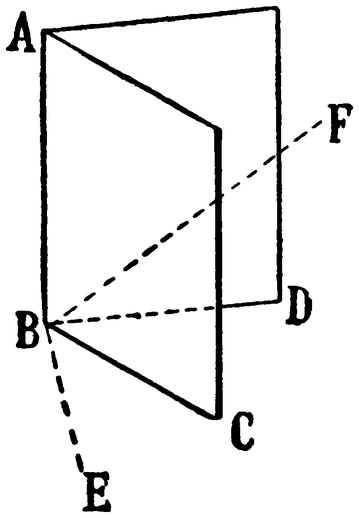
Each plane angle of one of two mutually supplementary trihedral angles is formed by two perpendiculars erected to the faces of the opposite dihedral angle of the other trihedral angle from one point of its edge. Having noticed this, and taking into account the direction of the perpendiculars, let us take any dihedral angle AB (fig. 349) and from an arbitrary point B of its edge erect the perpendiculars BE to the face AD and BF to the face AC, and then imagine through BE and BF a plane, which must be perpendicular to the edge AB (390, 392). Let the intersections of this plane with the faces of the angle AB be the straight lines BC and BD. Then the angle CBD must be the linear angle of the dihedral angle AB. Since the sides of the angle EBF are respectively perpendicular to the sides of the angle CBD, and these angles are unequal, their sum is equal to 2d (86); which was to be proved.
401. Lemma 2. To equal trihedral angles there correspond equal supplementary angles, and conversely.
Equal trihedral angles coincide when one is inserted into the other; therefore the perpendiculars that form the edges of the supplementary angles coincide too; hence the supplementary angles also coincide.
Conversely: if the supplementary angles coincide, the given angles coincide too.
402. Theorems. Trihedral angles are equal if they have:
1°, an equal dihedral angle included between two plane angles that are respectively equal and similarly placed;
or 2°, an equal plane angle included between two dihedral angles that are respectively equal and similarly placed;
or 3°, three plane angles that are respectively equal and similarly placed;
or 4°, three dihedral angles that are respectively equal and similarly placed.
1°. Let S and be two trihedral angles (fig. 350) in which , and the dihedral angle AS = the dihedral angle . Let us insert the angle into the angle S so that the point coincides with S, the straight line with SA and the plane with ASB. Then the edge will run along SB (because the angles and ASB are equal), the plane will run along ASC (because the dihedral angles are equal), and the edge along SC (because the angles and ASC are equal). Thus the trihedral angles will coincide in all their edges; hence they will be equal.
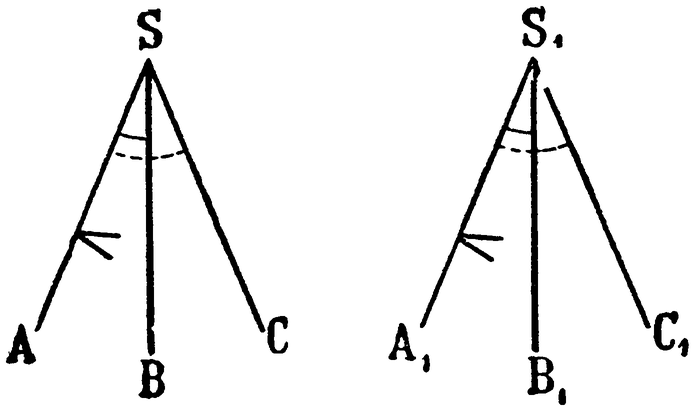
2°. The second test is proved by insertion in the same way as the first.
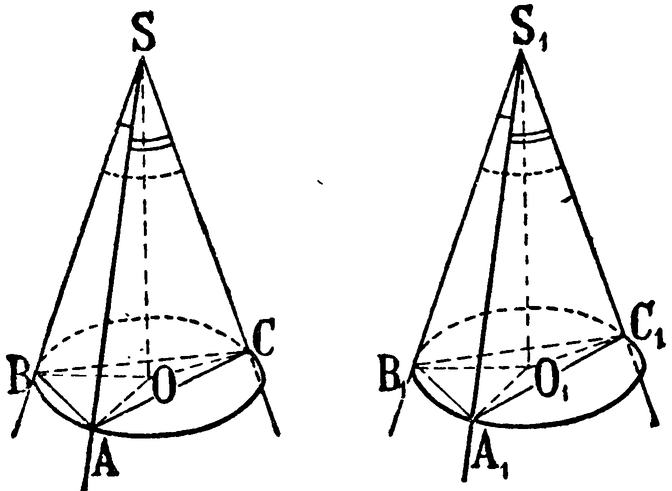
3°. Let S and (fig. 351) be two trihedral angles in which the plane angles of the one are respectively equal to the plane angles of the other and, moreover, the equal angles are similarly placed.
On all the edges let us lay off arbitrary but equal segments and construct the triangles ABC and . From the equality of the triangles ABS and we find: . In the same way from the equality of the other lateral triangles we deduce: and . Consequently △ABC = △. Let us drop the perpendiculars SO and to the planes of these triangles. Since the obliques SA, SB and SC are equal, their projections OA, OB and OC must be equal; hence the point O is the centre of the circle circumscribed about the triangle ABC. In exactly the same way the point is the centre of the circle circumscribed about the triangle . In equal triangles the radii of the circumscribed circles are equal; hence . Therefore (by the hypotenuse and a leg), and consequently . Let us now insert the figure into the figure so that the equal triangles and coincide; then the circumscribed circles will coincide, and consequently their centres and ; in consequence the perpendicular will run along and the point will fall on . Thus the trihedral angles will coincide in all their edges; hence they are equal.
4°. The fourth test is easily proved with the help of supplementary angles. If in two trihedral angles the dihedral angles are respectively equal and similarly placed, then in the supplementary angles the plane angles are respectively equal and similarly placed (400); consequently the supplementary angles are equal; and if the supplementary angles are equal, the given angles are equal too (401).
403. Symmetric polyhedral angles. As we know, vertical angles are equal when we are speaking of angles formed by straight lines or by planes.
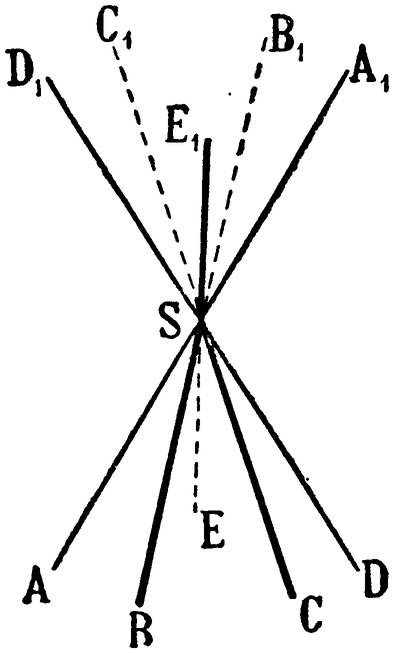
Let us see whether this truth applies to polyhedral angles.
Let us extend (fig. 352) all the edges of the angle beyond the vertex; we then form another polyhedral angle , which may be called vertical with respect to the first angle. It is not hard to see that in the two angles both the plane angles and the dihedral angles are respectively equal; but both are placed in the reverse order. Indeed, if we imagine an observer who looks at the vertex of a polyhedral angle from outside it, the edges , , , , will appear to him to be placed anticlockwise, whereas, looking at the angle , he will see the edges , ,... placed clockwise.
Polyhedral angles whose plane and dihedral angles are respectively equal but placed in the reverse order cannot in general be made to coincide by insertion; hence they are not equal. Such angles are called symmetric (with respect to the vertex ).
Solid Geometry. Book Two: Polyhedra
Chapter 1: Properties of the Parallelepiped and the Pyramid
404. Polyhedron. A polyhedron is a solid bounded on all sides by planes. The polygons formed by the intersection of these planes are called the faces of the polyhedron, their sides its edges, and their vertices its vertices. The straight lines joining any two vertices that do not lie in one face are called the diagonals of the polyhedron.
We shall consider only convex polyhedra, that is, those that lie on one side of each of their faces.
The least number of faces in a polyhedron is four; such a polyhedron is obtained when a trihedral angle is cut by any plane.
405. Prism. A prism is a polyhedron two of whose faces are equal polygons with respectively parallel sides, while all the remaining faces are parallelograms.
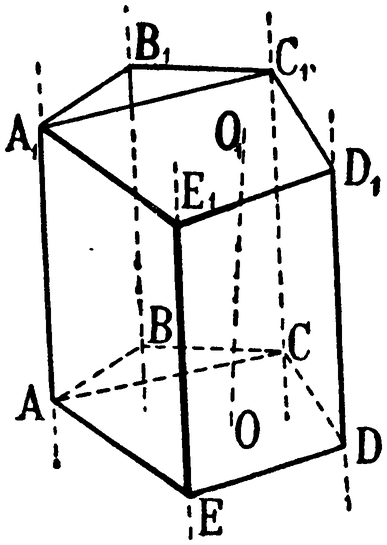
To show that such a polyhedron can exist, let us take (fig. 353) any polygon ABCDE and through its vertices draw a series of parallel straight lines not lying in its plane. Then, taking an arbitrary point on one of these lines, let us draw through it a plane parallel to the plane ABCDE; through each two successive parallel lines let us also draw planes. The intersection of all these planes determines a polyhedron that satisfies the definition of a prism. Indeed, the parallel planes ABCDE and are cut by the lateral planes along parallel straight lines (373); therefore the figures , and so on are parallelograms. On the other hand, the polygons ABCDE and have their sides respectively equal (as opposite sides of parallelograms) and their angles respectively equal (as angles with parallel sides directed the same way); consequently, these polygons are equal.
The polygons ABCDE and , which lie in parallel planes, are called the bases of the prism; the perpendicular dropped from any point of one base to the other is called the altitude of the prism. The parallelograms are called the lateral faces of the prism, and those of their sides that join corresponding vertices of the bases are called the lateral edges. In a prism all the lateral edges are equal, as segments of parallel straight lines contained between parallel planes.
A plane drawn through any two lateral edges that do not adjoin one lateral face of the prism (for example, through the edges and , fig. 353) is called a diagonal plane.
A prism is called right or oblique according as its lateral edges are perpendicular or oblique to the bases. In a right prism the lateral faces are rectangles. A lateral edge may be taken as the altitude of such a prism.
A right prism is called regular if its bases are regular polygons. In such a prism all the lateral faces are equal rectangles (fig. 354).
Prisms are triangular, quadrangular and so on, according as the base is a triangle, a quadrilateral and so on.
406. Parallelepiped. This is the name given to a prism whose bases are parallelograms (fig. 355).
Parallelepipeds may be right or oblique. A right parallelepiped is called rectangular if its bases are rectangles (fig. 356).
From these definitions it follows that:
1°, in a parallelepiped all six faces are parallelograms;
2°, in a right parallelepiped the four lateral faces are rectangles, and the two bases are parallelograms;
3°, in a rectangular parallelepiped all six faces are rectangles.
The three edges of a rectangular parallelepiped that meet at one vertex are called its dimensions; one of them may be regarded as the length, another as the breadth, and the third as the height.
A rectangular parallelepiped with equal dimensions is called a cube. In a cube all the faces are squares.
For brevity we shall often write the word "parallelepiped" in the shortened form "par-d."
407. Pyramid. A pyramid is a polyhedron one of whose faces, called the base, is any polygon, while all the remaining faces, called the lateral faces, are triangles having a common vertex.
To obtain a pyramid it is enough to cut any polyhedral angle (fig. 357) by an arbitrary plane .
The common vertex of the lateral triangles is called the vertex of the pyramid, and the perpendicular dropped from the vertex to the base is called its altitude.
Usually, in denoting a pyramid by letters, the letter placed at the vertex is written first, for example: SABCD (fig. 357).
A plane drawn through the vertex of a pyramid and through any diagonal of the base (for example, through the diagonal BD, fig. 359) is called a diagonal plane.
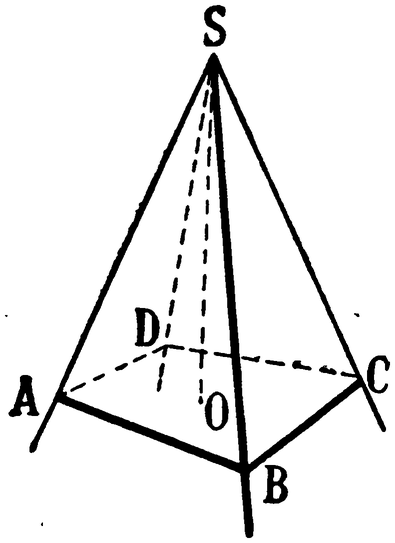
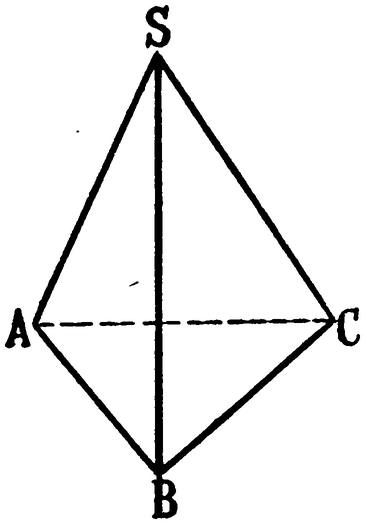
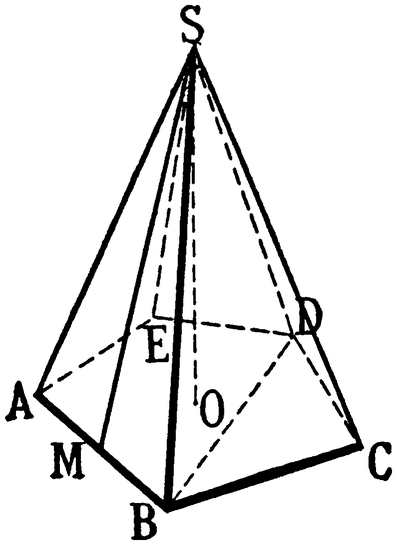
Pyramids are triangular, quadrangular and so on, according as the base is a triangle, a quadrilateral and so on. A triangular pyramid (fig. 358) is also called a tetrahedron; in such a pyramid all four faces are triangles.
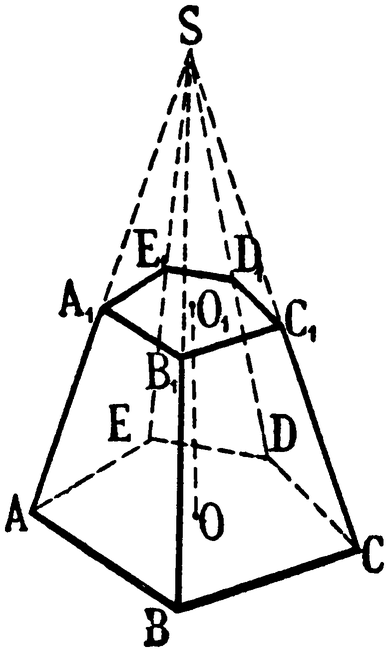
A pyramid is called regular (fig. 359) if, in the first place, its base is a regular polygon and, in the second place, the altitude passes through the centre of that polygon. In a regular pyramid all the lateral edges are equal to one another (as obliques with equal projections). Therefore all the lateral faces of a regular pyramid are equal isosceles triangles. The altitude (fig. 359) of any one of these triangles is called the apothem. All the apothems of one pyramid are equal.
408. Truncated pyramid. The part of a pyramid (fig. 360) contained between the base () and a cutting plane () parallel to the base is called a truncated pyramid. The parallel polygons are called its bases, and the distance between them its altitude. A truncated pyramid is called regular if it is a part of a regular pyramid.
Equality of Prisms and Pyramids
409. We shall confine ourselves to stating only the following test for the equality of prisms or pyramids.
Theorem. Two prisms or two pyramids are equal if the base and a lateral face of the one and the base and a lateral face of the other are respectively equal, equally inclined and similarly placed.
Suppose that in two prisms (fig. 361) the bases and the lateral faces and are respectively equal and similarly placed and that, in addition, the dihedral angles and are equal. Let us insert one prism into the other so that their equal bases coincide. Then, by the equality of the dihedral angles, the face will run along , and since these faces are equal and similarly placed, they will coincide; but then the upper bases will coincide too (as parallel and equal to the lower bases), that is, the prisms will coincide.
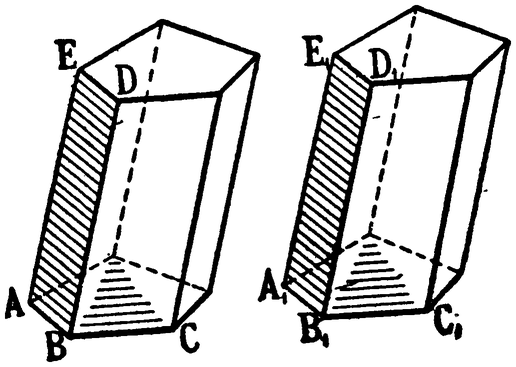
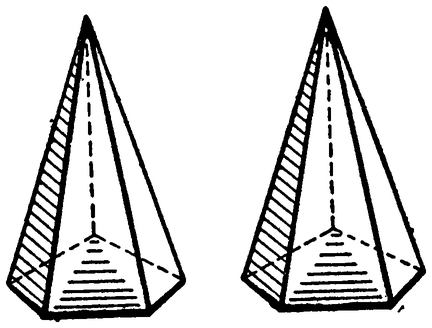
The same proof applies to pyramids also (fig. 362).
Properties of the Faces and Diagonals of the Parallelepiped
410. Theorem. In every parallelepiped the opposite faces are equal and parallel.
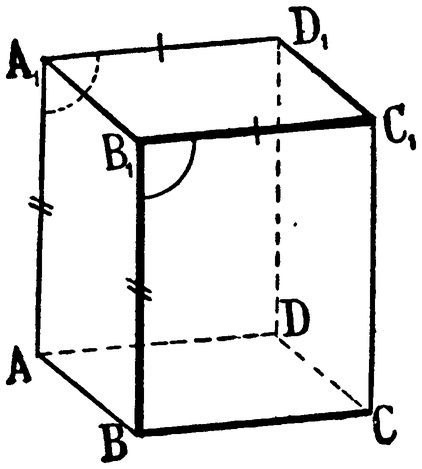
Thus the faces (fig. 363) and are parallel, because two intersecting straight lines and of the one face are parallel to two intersecting straight lines and of the other (372,2°); these faces are also equal, since , (as opposite sides of parallelograms) and ∠ = ∠ (379).
411. Theorem. In every parallelepiped all four diagonals intersect at one point and are bisected by it.
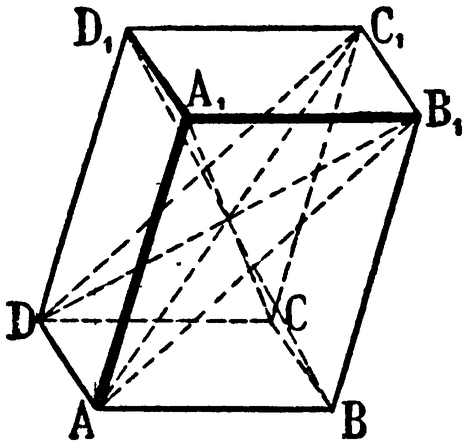
Let us take (fig. 364) any two diagonals of the parallelepiped, for example and , and draw the auxiliary straight lines and . Since the edges and are each equal and parallel to the edge , they are equal and parallel to each other; in consequence the figure is a parallelogram (99,2°) in which the straight lines and are the diagonals; and in a parallelogram the diagonals intersect and are bisected at the point of intersection.
Let us now take one of these diagonals, for example , with a third diagonal, say with . In exactly the same way we can prove that they intersect and are bisected at the point of intersection. Consequently, the diagonals and and the diagonals and (which we took before) intersect at one and the same point, namely the midpoint of the diagonal . Finally, taking this same diagonal with the fourth diagonal , we shall prove in the same way that they intersect and are bisected. The point of intersection of this pair of diagonals, therefore, also lies at the midpoint of the diagonal . Thus all 4 diagonals intersect at one and the same point and are bisected by that point.
412. Theorem. In a rectangular parallelepiped the square of any diagonal is equal to the sum of the squares of its three dimensions.
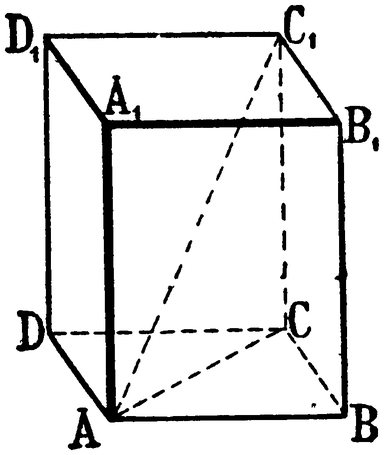
Let the straight line (fig. 365) be any diagonal of a rectangular parallelepiped. Drawing the diagonal of the base, we obtain two triangles: and . Both are right triangles: the first because the parallelepiped is right, and consequently the edge is perpendicular to the base; the second because the parallelepiped is rectangular, which means that its base is a rectangle. From these triangles we find:
413. Corollary. In a rectangular parallelepiped all the diagonals are equal.
Properties of Parallel Sections in the Pyramid
414. Theorems. If a pyramid (fig. 366) is cut by a plane parallel to the base, then:
1°, the lateral edges and the altitude are divided by this plane into proportional parts;
2°, the section is a polygon (abcde) similar to the base;
3°, the areas of the section and of the base are to each other as the squares of their distances from the vertex.
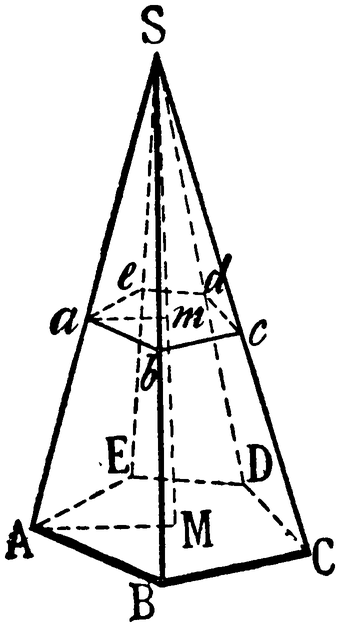
1°. The straight lines ab and AB may be regarded as the intersections of two parallel planes (the base and the cutting plane) with a third plane ASB; therefore ab ∥ AB (373). For the same reason bc ∥ BC, cd ∥ CD ... and am ∥ AM; in consequence (219):
2°. From the similarity of the triangles ASB and aSb, then of BSC and bSc, and so on, we deduce:
In the same way we shall prove that the remaining sides of the polygons ABCDE and abcde are proportional. Since, in addition, the corresponding angles of these polygons are equal (as formed by parallel sides directed the same way), the polygons are similar.
3°. The areas of similar polygons are to each other as the squares of corresponding sides; therefore:
But
Therefore:
415. Corollary. In a regular truncated pyramid the upper base is a regular polygon, and the lateral faces are equal isosceles trapezoids (see fig. 360).
The altitude of any one of these trapezoids is called the apothem of the regular truncated pyramid.
416. Theorem. If two pyramids with equal altitudes are cut at the same distance from the vertex by planes parallel to the bases, the areas of the sections are proportional to the areas of the bases.
Let and (fig. 367) be the areas of the bases of two pyramids, the altitude of each of them, and and the areas of the sections made by planes parallel to the bases and at one and the same distance from the vertices. By the preceding theorem we have:
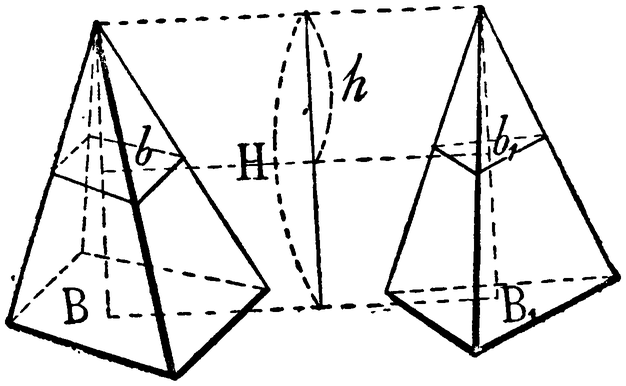
Whence:
417. Corollary. If , then also , that is, if two pyramids with equal altitudes have bases equal in area, the sections equally distant from the vertex are also equal in area.
Chapter 2: The Lateral Surface of the Prism and the Pyramid
418. Theorem. The lateral surface of a prism is equal to the product of the perimeter of a perpendicular section and a lateral edge.
A perpendicular section (fig. 368) is the polygon abcd obtained when the prism is cut by a plane perpendicular to the lateral edges. The sides of this polygon are perpendicular to the edges (353).
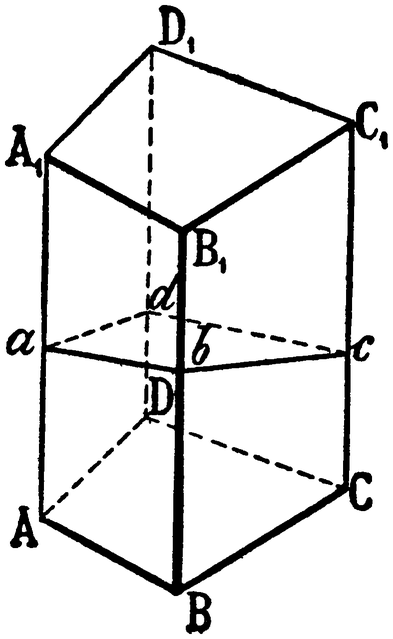
The lateral surface of a prism is the sum of the areas of parallelograms; in each of them a lateral edge may be taken as the base and a side of the perpendicular section as the altitude. Therefore:
Lateral surface = .
419. Corollary. The lateral surface of a right prism is equal to the product of the perimeter of the base and the altitude, because in such a prism the base itself may be taken as the perpendicular section, and its lateral edge is equal to the altitude.
420. Theorem. The lateral surface of a regular pyramid is equal to the product of the perimeter of the base and half the apothem.
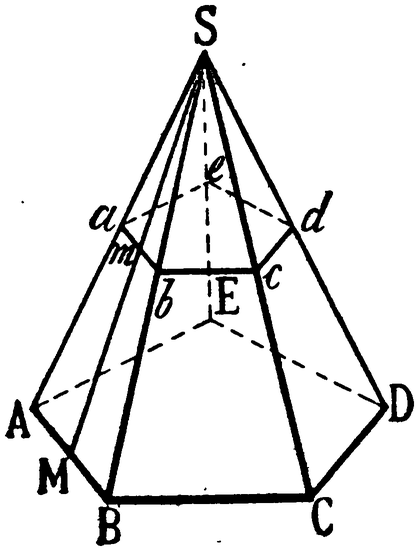
Let SABCDE (fig. 369) be a regular pyramid and SM its apothem. The lateral surface of this pyramid is the sum of the areas of equal isosceles triangles. The area of one of them, for example ASB, is equal to . If there are n triangles in all, the lateral surface is expressed by , where is the perimeter of the base and SM the apothem.
421. Theorem. The lateral surface of a regular truncated pyramid is equal to the product of half the sum of the perimeters of the two bases and the apothem.
This surface is the sum of the areas of equal trapezoids. The area of one of them, for example AabB (fig. 369), is equal to (315). If the number of all the trapezoids is n, then where and are the perimeters of the lower and upper bases.
Problems
327. The altitude of a right prism whose base is a regular triangle is equal to 12 metres, and the side of the base to 3 metres. Compute the total surface of the prism.
328. The total surface of a rectangular parallelepiped is equal to 1714 sq. m, and the unequal sides of the base are equal to 25 m and 14 m. Compute the lateral surface and the lateral edge.
329. In a rectangular parallelepiped with a square base and altitude h a cutting plane is drawn through two opposite lateral edges. Compute the total surface of the parallelepiped, knowing that the area of the section is equal to S.
330. In a regular hexagonal pyramid the side of the base is a and the altitude is h. Compute the lateral edge, the apothem, the lateral surface and the total surface.
331. Compute the total surface and the altitude of a triangular pyramid each edge of which is equal to a.
332. A regular hexagonal pyramid whose altitude is 25 centimetres and the side of whose base is 5 centimetres is cut by a plane parallel to the base. Compute the distance of this plane from the vertex of the pyramid, knowing that the area of the section = square centimetres.
333. The altitude of a truncated pyramid with a square base is equal to h, the side of the lower base a, and that of the upper base b. Find the total surface of the truncated pyramid.
334. The altitude of a truncated pyramid is equal to 6, and the areas of the bases are 18 and 8. The pyramid is cut by a plane parallel to the bases that bisects the altitude. Compute the area of the section.
Chapter 3: The Volume of the Prism and the Pyramid
422. Fundamental assumptions about volumes. The part of space occupied by a geometric solid is called the volume of that solid (if it is considered independently of its form).
We can regard the volume of a solid as a magnitude of a special kind if we accept the following assumptions about volumes (analogous to the assumptions about areas that we stated in § 299):
1°. Equal solids, that is, solids that coincide when one is inserted into the other, have equal volumes, whatever their position in space.
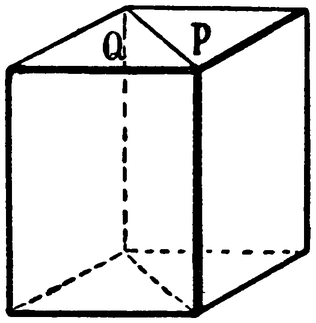
2°. The volume of any solid (for example, of each parallelepiped shown in fig. 370) that consists of parts (P and Q) is taken to be the sum of the volumes of these parts.
423. Corollaries. 1°. The volume of a solid is greater than the volume of each of its parts (a sum of positive magnitudes is greater than each of its terms).
2°. If a solid consists of two parts (fig. 370), the volume of each part is regarded as the difference between the volume of the whole solid and the volume of the other part.
3°. If solids consist of the same number of parts that are respectively equal to one another (for example, the two parallelepipeds shown in fig. 370), then the volumes of these solids, being sums of respectively equal terms, are considered equal, however these parts are placed in space.
4°. Solids whose volumes can be regarded as differences of the volumes of equal solids have the same volume; we shall soon meet such a case (428).
We see in this way that there can be solids which cannot be called equal (since they cannot be made to coincide) but which nevertheless have equal volumes.
Solids that have equal volumes we shall call equal in volume. Such, for example, are the 2 parallelepipeds shown in fig. 370.
424. The unit of volume. In measuring volumes, the unit of volume taken is the volume of a cube each edge of which is equal to the linear unit. Thus the cubic arshin, the cubic metre and so on are in use.
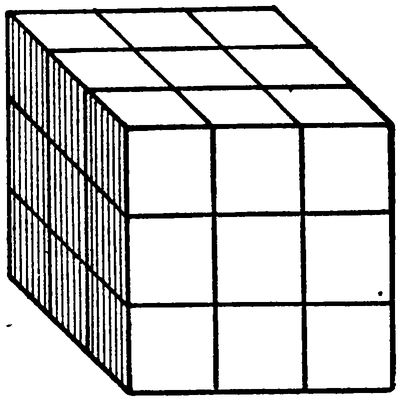
The ratio of two cubic units of different names is equal to the third power of the ratio of the linear units that serve as the edges of these cubic units. Thus the ratio of the cubic sazhen to the cubic arshin (a sazhen being 3 arshins) is equal to , that is, to 27, as fig. 371 plainly shows, where the smaller of the two cubes represents a cubic arshin and the larger a cubic sazhen.
425. Remark. Concerning the number that measures a given volume in cubic units, an explanation can also be given analogous to the one we set out in § 303 concerning the number that measures a given area in square units. Let us briefly repeat that explanation as it applies to volumes.
Take three mutually perpendicular straight lines (fig. 372), OA, OB and OC, and through each two of them draw a plane. We then obtain 3 mutually perpendicular planes: AOC, COB and BOA. Now imagine 3 series of parallel planes: a series of planes parallel to the plane AOC, another series of planes parallel to the plane BOA, and a third series of planes parallel to the plane BOC; suppose, moreover, that neighbouring planes of each series are at one and the same distance from one another, equal to some part of the linear unit. Then the mutual intersection of these three series of planes forms a net of cubes in space, each of which is a part of the cubic unit. Imagine that we have placed in this net the solid whose volume we wish to measure. Then all the cubes of the net can be divided into 3 kinds: 1) cubes that are situated wholly inside the solid, 2) cubes that project in part outside the solid (which, in other words, are cut by the surface of the solid), and 3) cubes situated wholly outside the solid. If there are m cubes of the 1st kind and n of the 2nd kind, the volume of the given solid is more than but less than cubic units. These 2 numbers, then, are approximate measures of the given volume to within cubic units, the first number by defect, the second by excess. By making the distance between the parallel planes smaller and smaller, we shall fill space with smaller and smaller cubes; and, as we did earlier for areas, it can be explained here too that as the cubes grow smaller we shall obtain approximate results of measurement with a greater and greater degree of exactness; and if a number V (commensurable or incommensurable) is found that proves to be greater than any approximate result of measurement taken by defect and less than any approximate result of measurement taken by excess, this number is taken as the exact measure of the given volume.
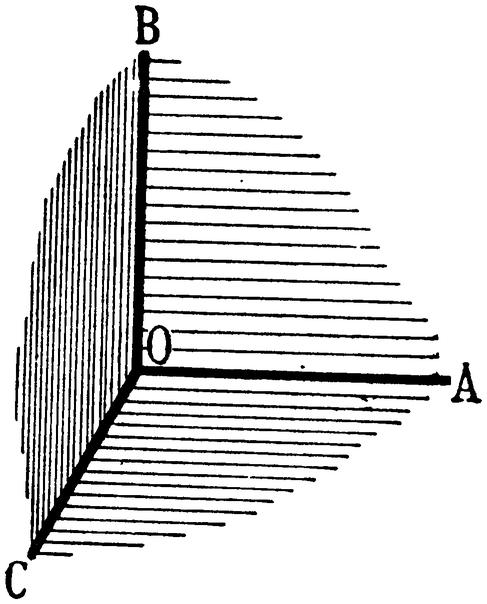
It has been proved that such a number exists in general for every volume and that it does not depend on the choice of the three straight lines OA, OB and OC (fig. 372) that were taken for constructing the net of cubes in space52. This number has the following two fundamental properties: with one and the same cubic unit, 1) to equal solids (solids that coincide) there correspond equal numbers, 2) to a sum of volumes (422, 2°) there corresponds the sum of the numbers. From this it already follows that to a greater volume there corresponds a greater number, that to solids equal in volume there correspond equal numbers, and the like.
The Volume of the Rectangular Parallelepiped
426. Theorem. The volume of a rectangular parallelepiped is equal to the product of its three dimensions.
In so brief a form this theorem must be understood as follows: the number that expresses the volume of a rectangular parallelepiped in a cubic unit is equal to the product of the numbers that express its three dimensions in the corresponding linear unit, that is, in the unit that serves as the edge of the cube whose volume is taken as the cubic unit. Thus, if x is the number that expresses the volume of a rectangular parallelepiped in cubic centimetres, and a, b and c are the numbers that express its three dimensions in linear centimetres, the theorem asserts that x = abc.
In the proof we shall consider separately the following three cases:
1°. All three dimensions are expressed by whole numbers.
Let the dimensions, for example, be (fig. 373): AB = a, BC = b and BD = c, where a, b and c are any whole numbers (for example, as is shown in our figure: a = 4, b = 2 and c = 5).
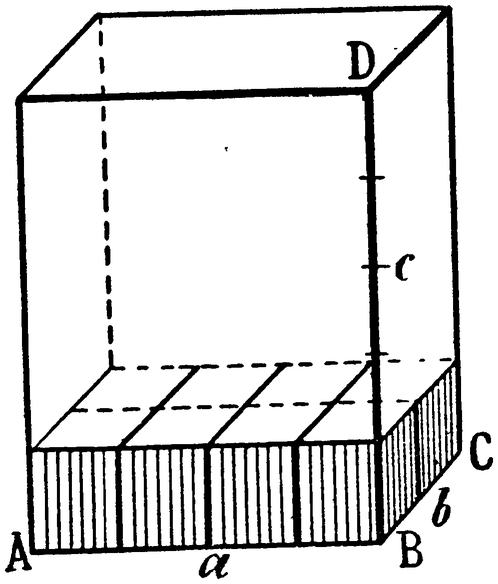
Then the base of the parallelepiped contains ab squares, each of which is the corresponding square unit. On each of these squares, evidently, one cubic unit can be placed. We then obtain a layer (shown in the figure) consisting of ab cubic units. Since the altitude of this layer is equal to 1 linear unit, and the altitude of the whole parallelepiped contains c such units, c such layers can be placed inside the parallelepiped. Consequently, its volume is equal to abc cubic units.
2°. The dimensions (all or some of them) are expressed by fractional numbers.
Let the dimensions of the parallelepiped be:
(where some of these fractions may be equal to a whole number).
Reducing the fractions to a common denominator, we have:
Let us take the part of the linear unit as a new (auxiliary) unit of length. Then in this new unit the given dimensions are expressed by whole numbers, namely mqs, pns and rnq, and therefore, by what was proved in case 1°, the volume of the parallelepiped is equal to the product
(mqs) (pns) (rnq),
if this volume is measured by the new cubic unit that corresponds to the new linear unit. One cubic unit corresponding to the former linear unit contains of these cubic units; the new cubic unit is therefore of the former. Hence the volume of the parallelepiped is equal to:
3°. The dimensions (all or some of them) are expressed by incommensurable numbers.
Let the given parallelepiped (fig. 374), which for brevity we shall denote by the single letter Q, have the dimensions:
AB = α; AC = β; AD = γ, where α, β and γ are incommensurable numbers (the case in which some of these numbers are commensurable is not, however, excluded). Let us find approximate values of these numbers to within . To do this we lay off the part of the linear unit on the dimensions AB, AC and AD, beginning from the point A, as many times as possible. Suppose it turns out that, laying off this part on AB m times, we obtain a segment , and laying off the same part m + 1 times, we obtain a segment . Then the approximate values of the number α to within will be the fractions and , the first by defect, the second by excess. Suppose it turns out in the same way that and , where , and , , where .
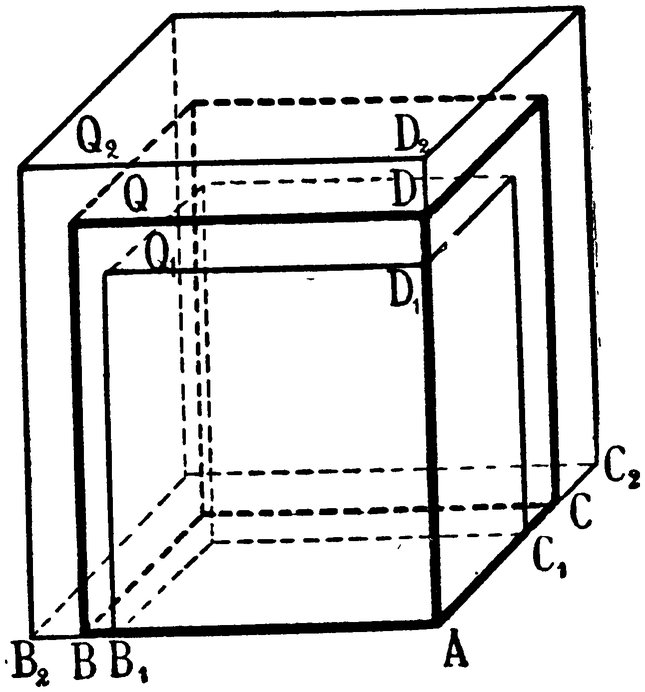
Then the approximate values will be:
for the number α . . . . ;
for the number β . . . . ;
for the number γ . . . . .
Let us now construct 2 auxiliary parallelepipeds: one (we shall denote it by ) with the dimensions , and , and another (we shall denote it by ) with the dimensions , and . Then, by what was proved in case 2°, we have:
volume ; volume
Let the number that expresses the required volume of Q be x.
Since, evidently, forms a part of Q, and Q forms a part of , we have:
This double inequality remains true for every degree of exactness with which we find the approximate values of the numbers α, β and γ. We can therefore state the inequality thus: the number that measures the volume of the given parallelepiped must be greater than the product of any approximate values of the numbers α, β and γ, if these values are taken by defect, but less than the product of any approximate values of the same numbers, if these values are taken by excess. Such a number, as is known from algebra, is called the product of the incommensurable numbers αβγ. In this case too, therefore, the volume of Q = αβγ.
427. Corollaries. 1°. Let the dimensions of a rectangular parallelepiped that serve as the sides of its base be expressed by the numbers a and b, and the third dimension (the altitude) by the number c. Then, denoting its volume in the corresponding cubic units by the letter V, we can write:
V = abc = (ab)c.
Since the product ab expresses the area of the base, we can say that the volume of a rectangular parallelepiped is equal to the product of the area of the base and the altitude.
2°. Let a, b, c be the dimensions of one rectangular parallelepiped, which has the volume V, and the dimensions of another parallelepiped, whose volume is . Then:
This shows that if , then , and if , then ; that is: the volumes of rectangular parallelepipeds that have equal altitudes are to each other as the areas of their bases;
the volumes of rectangular parallelepipeds that have bases of equal area are to each other as their altitudes.
3°. The volume of a cube is equal to the third power of its edge, since when a = b = c the product abc becomes .
The Volume of Any Parallelepiped
428. Lemma. An oblique prism is equal in volume to a right prism whose base is equal to the perpendicular section of the oblique prism and whose altitude is equal to its lateral edge.
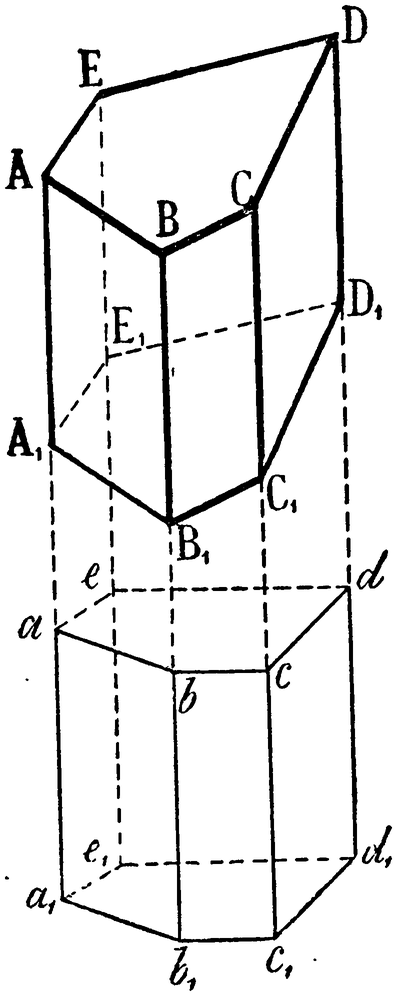
Let an oblique prism ABCDE (fig. 375) be given. Extend all its lateral edges and lateral faces in one direction, for example downward. On the extension of any one of the edges take an arbitrary point a and draw through it the perpendicular section abcde. Then, laying off , draw through the perpendicular section . Since the planes of the two sections are parallel, (377). In consequence of this the polyhedron , whose bases are taken to be the sections we have drawn, is the right prism spoken of in the theorem. Let us prove that the given oblique prism is equal in volume to this right prism. For this purpose let us first satisfy ourselves that the polyhedra aD and are equal. Their bases abcde and are equal, as the bases of the prism ; on the other hand, adding to both sides of the equality one and the same segment , we obtain: ; similarly: , and so on. Let us now imagine the polyhedron aD inserted into so that their bases coincide; then the lateral edges, being perpendicular to the bases and respectively equal, will coincide as well; therefore the polyhedron aD will coincide with ; these solids, then, are equal. Let us now notice that if from the whole polyhedron we take away the part aD, we obtain the right prism; and if from the same polyhedron we take away the part , we obtain the oblique prism. From this it follows that these two prisms are equal in volume, since their volumes are differences of the volumes of equal solids (423,4°).
429. Theorem. The volume of any parallelepiped is equal to the product of the area of the base and the altitude.
We proved this theorem earlier for the rectangular parallelepiped; we shall now prove it for the right parallelepiped, and then for the oblique one as well.
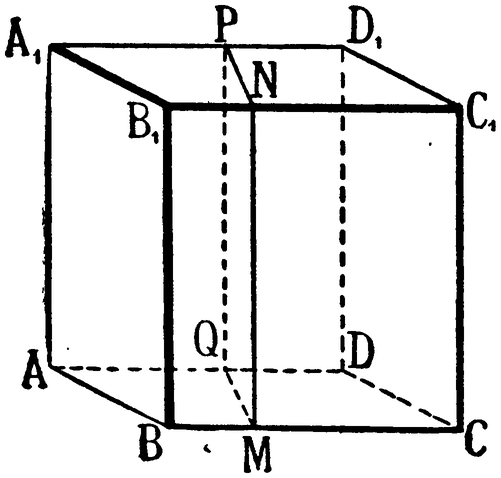
1°. Let (fig. 376) be a right parallelepiped, that is, one whose base ABCD is any parallelogram and all of whose lateral faces are rectangles. Let us take as its base the lateral face ; the parallelepiped will then be oblique. Regarding it as a particular case of the oblique prism, we can assert, by the lemma of the preceding section, that this parallelepiped is equal in volume to a right one whose base is the perpendicular section MNPQ and whose altitude is BC. The quadrilateral MNPQ is a rectangle, because its angles serve as the linear angles of right dihedral angles; therefore the right parallelepiped that has this base must be rectangular, and consequently its volume is equal to the product of its three dimensions, for which we may take the segments MN, MQ and BC. Thus:
The product expresses the area of the parallelogram ABCD; therefore:
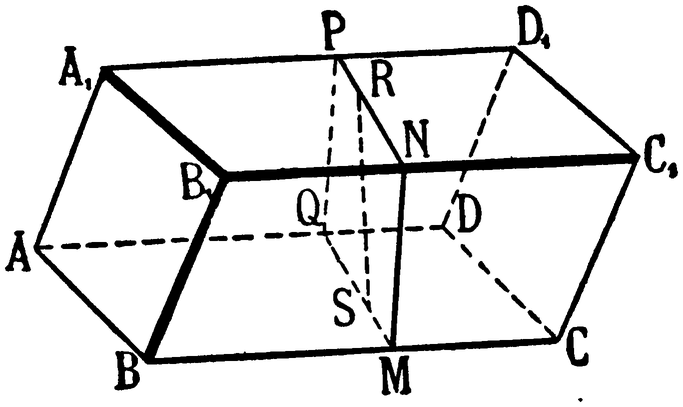
2°. Let (fig. 377) be an oblique parallelepiped. It is equal in volume to a right one whose base is the perpendicular section MNPQ (that is, the section perpendicular to the edges AD, BC...) and whose altitude is the edge BC. But, by what has been proved, the volume of a right parallelepiped is equal to the product of the area of the base and the altitude; hence:
If RS is an altitude of the section MNPQ, then the area of MNPQ = MQ · RS; therefore:
The product expresses the area of the parallelogram ABCD; consequently:
It now remains to prove that the segment RS is the altitude of the parallelepiped. Indeed, the section MNPQ, being perpendicular to the edges BC, ..., must be perpendicular to the faces ABCD, ..., which pass through these edges (390). Therefore, if from the point S we erect a perpendicular to the plane ABCD, it must lie wholly in the plane MNPQ (391) and consequently must merge with the line SR, which lies in that plane and is perpendicular to MQ. The segment SR, then, is the altitude of the parallelepiped. Thus the volume of the oblique parallelepiped too is equal to the product of the area of the base and the altitude.
430. Corollary. If V, B and H are the numbers that express in the corresponding units the volume, the area of the base and the altitude of any parallelepiped whatever, we can write:
V = BH.
The Volume of the Prism
431. Theorem. The volume of any prism is equal to the product of the area of the base and the altitude.
We shall first prove this theorem for the triangular prism, and then for the polygonal one as well.
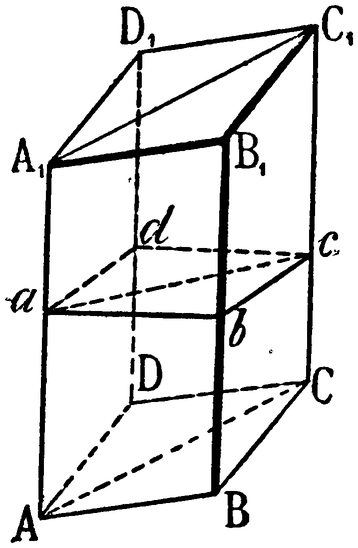
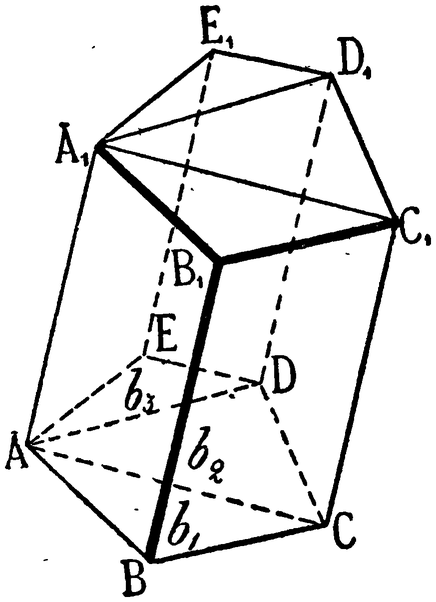
1°. Through the edge of the triangular prism (fig. 378) draw a plane parallel to the face , and through the edge a plane parallel to the face ; then extend the planes of both bases of the prism until they meet the planes already drawn. We then obtain the parallelepiped , which the diagonal plane divides into two triangular prisms (one of them is the given prism). Let us prove that these prisms are equal in volume. To do this we draw the perpendicular section abcd. The section is a parallelogram, which the diagonal ac divides into two equal triangles. The given prism is equal in volume to a right prism whose base is △ abc and whose altitude is the edge (428). The other triangular prism is equal in volume to a right prism whose base is △ adc and whose altitude is the edge . But two right prisms with equal bases and equal altitudes are equal (because they coincide when one is inserted into the other); hence the prisms and are equal in volume. From this it follows that the volume of the given prism is half the volume of the parallelepiped ; therefore, denoting the altitude by H, we obtain (429):
2°. Through the edge of the polygonal prism (fig. 379) draw the diagonal planes and . The given prism is then cut into several triangular prisms. The sum of the volumes of these prisms is the required volume. If we denote the areas of their bases by , , , and their common altitude by H, we obtain:
432. Corollary. If V, B and H are the numbers that express in the corresponding units the volume, the area of the base and the altitude of a prism, then, by what has been proved, we can write:
V = BH.
The Volume of the Pyramid
433. Lemma. Triangular pyramids with bases equal in area and with equal altitudes are equal in volume.
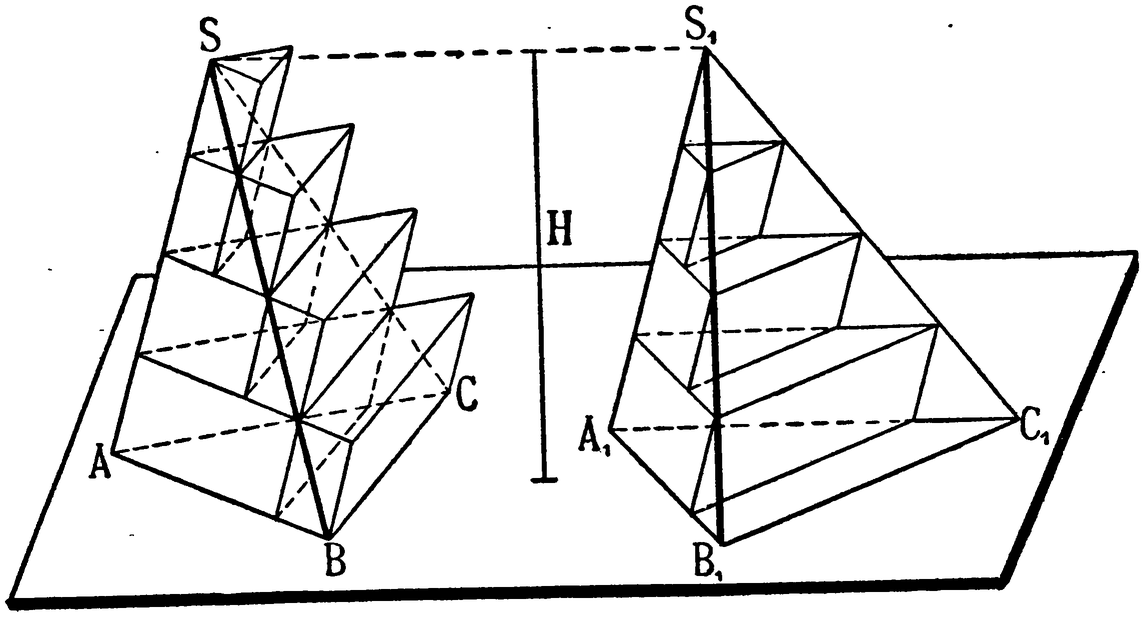
Let SABC and (fig. 380) be triangular pyramids whose altitudes are the same and whose bases are the triangles ABC and , equal in area.
Divide the altitude of each of these pyramids (fig. 380) into an arbitrary number n of equal parts, and through the points of division draw a series of planes parallel to the base (in the figure the altitude, and consequently the lateral edges also, are divided into 4 equal parts). Since, by hypothesis, the bases ABC and are equal in area, the triangles obtained in the sections of the one pyramid are respectively equal in area to the triangles obtained in the sections of the other pyramid (417). In each pyramid construct a series of interior prisms such that their upper bases are the triangles of the sections, their lateral edges are parallel to the edge SA in the one pyramid and to the edge in the other, and the altitude of each prism is equal to of the altitude of the pyramid. There will be such prisms in each pyramid. Let us denote the volumes of the prisms of the pyramid S in order, beginning from the vertex, by , and the volumes of the prisms of the pyramid , likewise in order from the vertex, by . Then:
because in each pair of corresponding prisms the bases are equal in area and the altitudes are equal. Therefore:
Suppose now that the number n of equal parts into which we divide the altitude of the pyramids increases without bound. Then both sides of the last equality become variable magnitudes. Let us prove that each of them tends, as its limit, to the volume of the pyramid in which the prisms are inscribed. It is enough to prove this for any one of the pyramids, for example for S. To do this we construct in it one more series of prisms, which project partly beyond the pyramid, such that their lower bases are the triangles of the sections (and the base of the pyramid), their altitudes are equal, as before, to of the altitude of the pyramid, and their lateral edges are parallel to the same edge SA. There will be n such prisms. Let us denote their volumes, beginning from the vertex of the pyramid, in order, by . It is not difficult to see that
Therefore:
If we denote the volume of the pyramid by V, then evidently:
Whence:
As the number n increases without bound, the volume of the prism tends to zero (because its altitude tends to zero, while its base does not change); consequently the difference all the more tends to zero; and this, by the definition of a limit, means that
Since this proof can be applied to every triangular pyramid, we can assert that , that is, the volume of the pyramid , is the limit of the variable sum .
But if two variable magnitudes that have limits always remain equal, their limits are equal also (281); therefore:
434. Theorem. The volume of any pyramid is equal to the product of the area of the base and a third of the altitude.
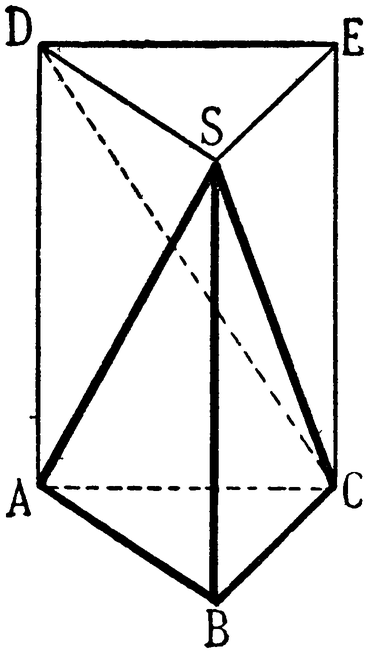
We shall first prove this theorem for the triangular pyramid, and then for the polygonal one as well.
1°. On the base of the triangular pyramid SABC (fig. 381) construct a prism ABCDES whose altitude is equal to the altitude of the pyramid and one of whose lateral edges coincides with the edge SB. Let us prove that the volume of the pyramid is a third part of the volume of this prism. Separate the given pyramid from the prism. There then remains the quadrangular pyramid SADEC (which for clearness is shown separately). Draw in it a cutting plane through the vertex S and the diagonal DC of the base. The two triangular pyramids so obtained have a common vertex S and equal bases DEC and DAC lying in one plane; hence, by the lemma proved above, the pyramids SDEC and SDAC are equal in volume. Let us compare one of them, namely SDEC, with the given pyramid. As the base of the pyramid SDEC we may take △ SDE; its vertex will then be at the point C, and its altitude is equal to the altitude of the given pyramid. Since △ SDE = △ ABC, the pyramids CSDE and SABC are, by the same lemma, equal in volume. Thus the sum of the volumes of three pyramids, each equal in volume to the given one, makes up the volume of the prism; consequently:
where H denotes the altitude of the pyramid.
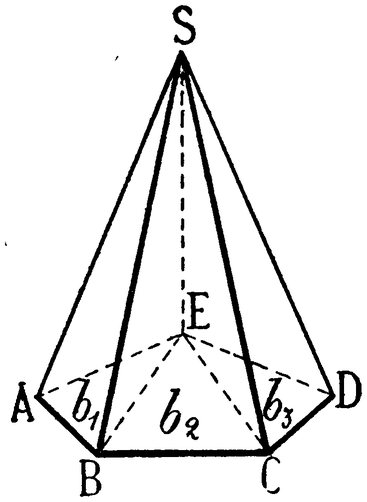
2°. Through any vertex E (fig. 382) of the base of the polygonal pyramid SABCDE draw the diagonals EB and EC. Then through the edge SE and each of these diagonals draw cutting planes. The polygonal pyramid is then divided into several triangular ones that have their altitude in common with the given pyramid. Denoting the areas of the bases of the triangular pyramids by , , and the altitude by H, we have:
435. Corollary. If V, B and H denote the numbers that express in the corresponding units the volume, the area of the base and the altitude of any pyramid whatever, then
The Volume of the Truncated Pyramid and the Truncated Prism
436. Theorem. The volume of a truncated pyramid is equal to the sum of the volumes of three pyramids that have the same altitude as the truncated pyramid and have as their bases: the first, the lower base of the truncated pyramid; the second, the upper base of that pyramid; and the third, the mean proportional between them.
We shall first prove this theorem for the triangular pyramid, and then for the polygonal one as well.
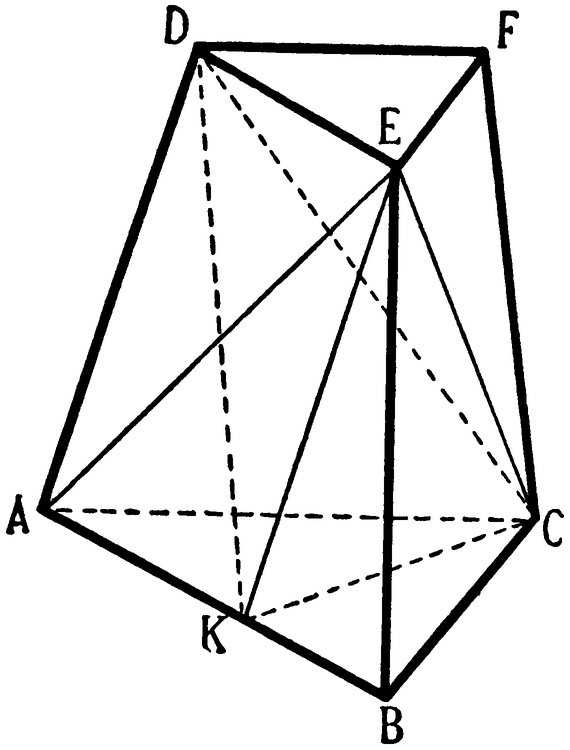
1°. Let ABCDEF (fig. 383) be a truncated triangular pyramid. Separate from it by the cutting plane AEC the triangular pyramid EABC. This pyramid, having the base ABC and its vertex at E, satisfies the requirement of the theorem. The part that remains is the quadrangular pyramid EADFC. Drawing in it a cutting plane through the points E, D and C, we divide it into two triangular pyramids EDFC and EADC. In the first we may take as the base △ DEF, that is, the upper base of the truncated pyramid, and as the vertex the point C; consequently this pyramid satisfies the requirement of the theorem. It remains to consider the third pyramid EADC. Let us transform it into another pyramid equal to it in volume, in the following way. Draw the line EK ∥ DA and take the point K as the vertex of a new pyramid, keeping the same triangle ADC as its base. The pyramids EADC and KADC are equal in volume, because they have the common base ADC and their altitudes are equal (since the vertices lie on the line EK, which is parallel to AD and consequently parallel to the plane of the base). Let us take as the vertex of the new pyramid the point D, and as its base △ ACK. Its altitude will then be equal to the altitude of the truncated pyramid. It remains to prove that the base ACK is the mean proportional between ABC and DEF, that is, that
In the triangles ABC and ACK we may take the sides AB and AK as the bases; they will then have the common vertex C, and consequently their altitudes will be the same; therefore:
(in place of AK we may take the equal segment DE).
The triangles ACK and DEF have an equal angle at the vertices A and D; therefore (324):
(the segments AK and DE, being equal, cancel).
From the similarity of the triangles ABC and DEF it follows that the right-hand sides of the equalities [1] and [2] are equal; consequently their left-hand sides are equal also, that is,
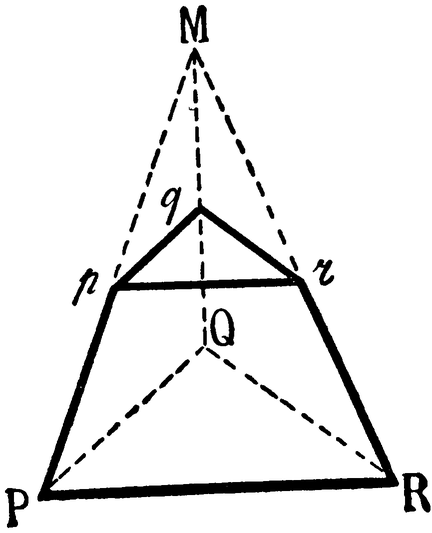
2°. Let Ad (fig. 384) be a truncated pyramid that forms part of the polygonal pyramid SABCDE. Transform the polygon ABCDE into a triangle PQR equal to it in area and, taking this triangle as the base, construct an auxiliary pyramid MPQR with the same altitude as the pyramid S. Cut the pyramid M by a plane parallel to the base, at the same distance from the vertex as that at which the plane abcde is drawn in the pyramid S. The section is a △ pqr equal in area to the polygon abcde (417). The pyramids SABCDE and MPQR are equal in volume, since their bases are equal in area and their altitudes are equal; for the same reason the pyramids Sabcde and Mpqr are equal in volume too; from this it follows that the truncated polygonal pyramid Ad is equal in volume to the truncated triangular pyramid Pr; and since in these two truncated pyramids the bases, both the lower and the upper, are respectively equal in area, and the altitudes are equal, the theorem proved for the truncated triangular pyramid remains applicable to the polygonal one as well.
437. Corollary. Let V, B, b and H be the numbers that express in the corresponding units the volume, the area of the lower base, the area of the upper base and the altitude of a truncated pyramid; then:
where is the mean proportional between B and b.
438. Theorem. The volume of a triangular prism truncated by a plane not parallel to the base is equal to the sum of the volumes of three pyramids that have the base in common with the truncated prism and have their vertices at the three vertices of the non-parallel section.
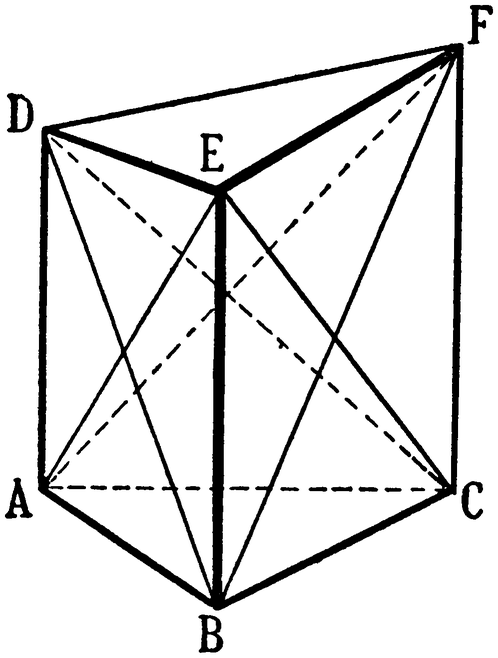
Let ABCDEF (fig. 385) be a truncated triangular prism, that is, one in which the plane DEF is not parallel to the base ABC. Drawing a cutting plane through the points E, A and C, we separate one of the three pyramids named in the theorem, namely the pyramid EABC, which has the base ABC in common with the truncated prism and its vertex at the point E. Let us draw one more cutting plane, through the points E, D and C; we then obtain the two other pyramids: EDAC and EDFC. The theorem will be proved if we show that these pyramids are equal in volume to pyramids whose base is △ ABC and whose vertices lie one at D and the other at F. Indeed, the pyramids EDAC and DABC are equal in volume, because we may take as their base the common triangle DAC, and then the vertices E and B will lie on the line BE, which is parallel to the plane of the bases; the pyramids EDFC and FABC are equal in volume, because we may take as their bases triangles equal in area, CFD for the first and AFC for the second (311,1°), and then their vertices E and B will lie on the line BE, which is parallel to the plane of the bases.
439. Corollary. Let V, B, h1, h2, h3 be the numbers that express in the corresponding units the volume, the area of the base and the altitudes dropped to the base from the three vertices of the non-parallel section; then:
When the prism is a right one, the altitudes , and are equal to its lateral edges.
Chapter 4: Similar Polyhedra
440. Definition. Two polyhedra are called similar if they have respectively equal polyhedral angles and respectively similar faces. The elements of similar polyhedra that answer to each other are called corresponding elements.
From this definition it follows that in similar polyhedra:
1°. The dihedral angles are respectively equal and similarly placed, because the polyhedral angles are equal.
2°. Corresponding edges are proportional, because in every two similar faces the ratio of corresponding edges is one and the same, and in each polyhedron neighbouring faces have an edge in common.
That similar polyhedra can exist is proved by the following theorem.
441. Theorem. If in a pyramid (fig. 386) we draw a cutting plane () parallel to the base, we cut off from it another pyramid () similar to the given one.
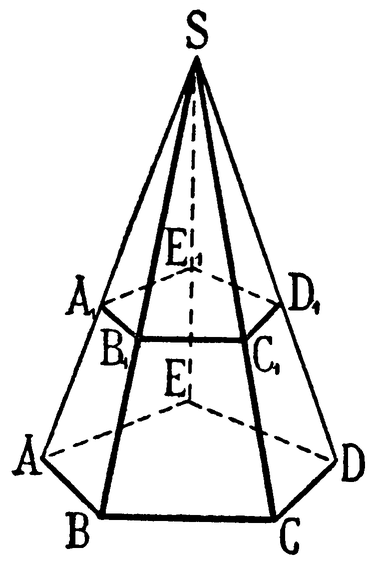
Since ∥ AB, ∥ BC and so on (373), the lateral faces of the two pyramids are similar; their bases are also similar (414). It remains to prove the equality of the polyhedral angles. The angle S is common to both pyramids; the trihedral angles , , ... are respectively equal to the angles A, B, C..., because in each pair of these angles the plane angles are respectively equal and similarly placed (402, 3°).
442. Theorem. Two prisms or two pyramids are similar if the base and a lateral face of the one and the base and a lateral face of the other are respectively similar, equally inclined and similarly placed.
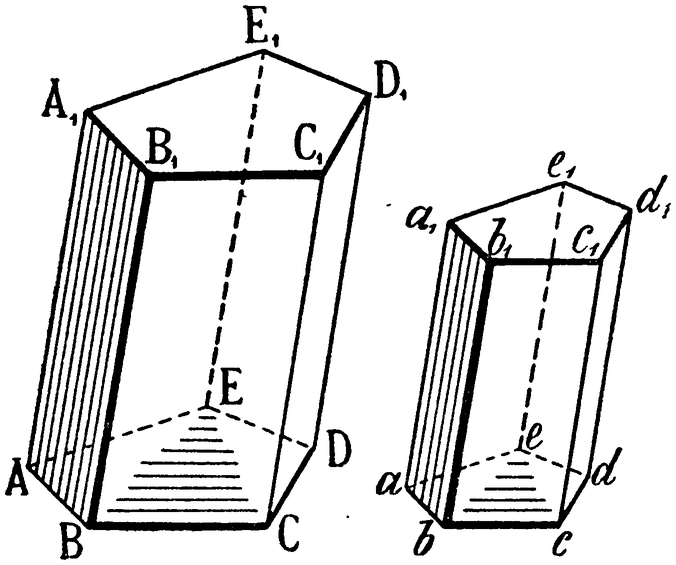
1°. Suppose that in two prisms (fig. 387) the bases ABCDE, abcde and the faces , are respectively similar and similarly placed (in the figure they are shaded) and that, besides, the dihedral angles AB and ab are equal. To prove the similarity of these prisms we reason in the following order. The trihedral angles B and b are equal, because each has an equal dihedral angle (AB and ab) included between two respectively equal and similarly placed plane angles (∠ABC = ∠abc and ∠ABB1 = ∠abb1); from this it follows that the plane angles and are equal, and also the dihedral angles BC and bc. Now if two parallelograms and have one angle of the one equal to one angle of the other, their remaining angles are respectively equal as well; and since, moreover,
Hence the faces and are similar. Passing now to the trihedral angles C and c, we satisfy ourselves in exactly the same way that they are equal and that the faces and are similar. In this way we go through all the trihedral angles at the base and all the lateral faces. The upper bases and are similar, because they are equal to the lower bases; the trihedral angles at the upper bases are respectively equal, because their plane angles are equal and similarly placed. Hence the prisms under consideration are similar.
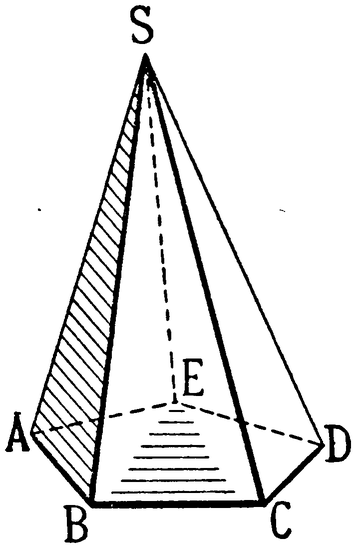
2°. Suppose that we have (fig. 388) two pyramids in which the bases ABCDE, abcde and the lateral faces SAB, sab are respectively similar and similarly placed (in the figure they are shaded) and in which, besides, the dihedral angles AB and ab are equal. Exactly as was done for the prisms, we prove that all the trihedral angles adjoining the bases are respectively equal and that all the lateral faces are respectively similar. Then the polyhedral angles S and will also be equal, because, having all their plane angles and dihedral angles respectively equal and similarly placed, they coincide when one is inserted into the other.
443. Theorem. Similar polyhedra can be decomposed into the same number of respectively similar and similarly placed pyramids (fig. 389).
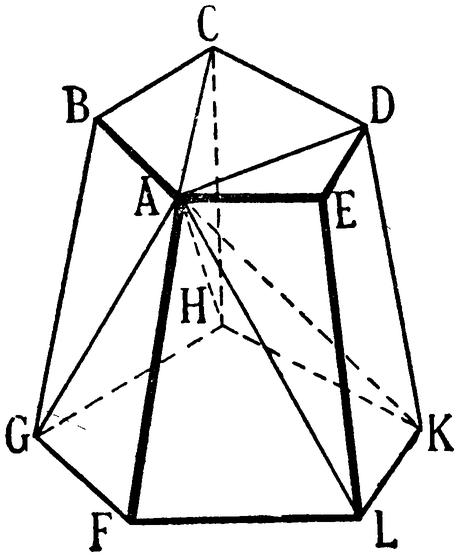
The decomposition spoken of in the theorem can be carried out in various ways. We shall proceed as follows:
In one of the given similar polyhedra let us take the vertex A of any polyhedral angle. Let us then take all those faces of the polyhedron which do not adjoin the angle A. In our polyhedron there are four such faces: EDKL, DCHK, CBGH and FGHKL. Each of these faces we take as the base of a pyramid whose vertex lies at A. The polyhedron is then divided into pyramids whose vertices meet at the point A. In the other polyhedron we take the corresponding vertex and decompose it in the same way into the same number of pyramids. Let us prove that these pyramids are respectively similar. And indeed, whatever pair of corresponding pyramids we take, we easily find that the base and a face of the one pyramid and the base and a face of the other are respectively similar, equally inclined and similarly placed. For example, in the pyramids ADELK, the bases DELK and are similar, as corresponding faces of similar polyhedra; the faces ADE and are similar, because the similar polygons ABCDE, are divided into respectively similar triangles; the dihedral angles DE, are equal, as corresponding angles of similar polyhedra. From this it follows that the pyramids we have taken are similar. The same can be said of the other pyramids.
444. Theorem. The surfaces of similar polyhedra are to each other as the squares of corresponding edges.
Let , , ... denote the areas of the separate faces of one of the similar polyhedra, and , , ..., the areas of the corresponding faces of the other; suppose further that L and l are the lengths of any two corresponding edges. Then, because corresponding faces are similar and all corresponding edges are proportional, we have (326):
Whence:
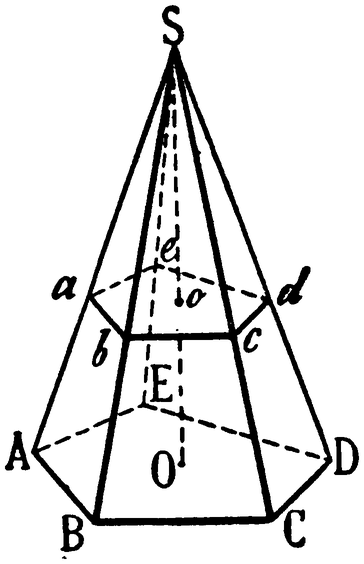
445. Theorem. The volumes of similar polyhedra are to each other as the cubes of corresponding edges.
1°. Let us first prove the theorem for similar pyramids. Let the pyramids SABCDE and (fig. 390) be similar. Let us insert the second pyramid into the first so that their equal polyhedral angles S and coincide. Then the base takes some position abcde, in which the sides ab, bc,... are respectively parallel to the sides AB, BC,... (because the plane angles of the trihedral angles A and , B and and so on are equal); in consequence the plane abcde is parallel to ABCDE (372,2°). Let SO and So be the altitudes of the two pyramids. Then:
Vol. SABCDE = (area ABCDE) · 1/3 SO.
Vol. Sabcde = (area abcde) · 1/3 So.
2°. Let us now prove the theorem for any two similar polyhedra whatever, whose volumes we shall call V and v. Let us divide them into similar pyramids (443). Let , , ... and , , ... be the volumes of corresponding pyramids, and L and l the lengths of any corresponding edges. Then, by what has been proved, we have:
Whence:
that is,
446. Remark. In solid geometry we can consider figures in similar position, in the same sense as was pointed out in plane geometry (211 and following); and here, as there, the similarity of position may be of two kinds: direct and inverse.
Without entering into the details of this study, let us notice only the following important difference between similarity of position in the plane and similarity of position in space of 3 dimensions. In the plane, as we saw (215), polygons in similar position, direct or inverse, always turn out to be similar to each other; in solid geometry, however, the polyhedra are similar to each other only when the similarity of position is direct, whereas when it is inverse the polyhedra are in general not similar (the symmetric polyhedral angles spoken of in § 403 may serve as an example).
Chapter 5: Symmetric Figures
447. Definitions. Three kinds of symmetry are distinguished: with respect to a point, with respect to a straight line and with respect to a plane.
As we have already said (41), two points A and (fig. 391) are called symmetric with respect to the point O (the centre of symmetry) if the straight line passes through the point O and is bisected by it.
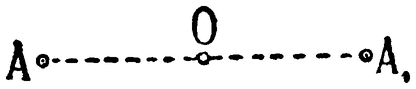
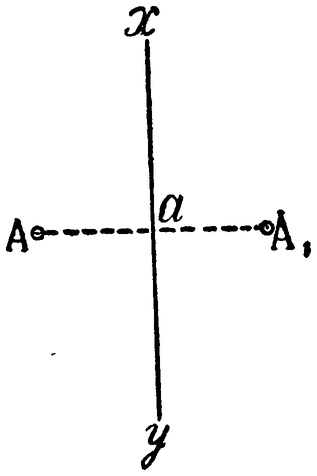
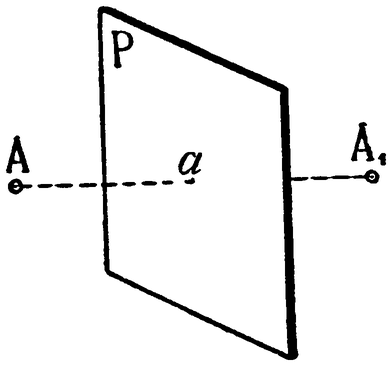
Two points A and (fig. 392) are called symmetric with respect to the straight line xy (the axis of symmetry) or (fig. 393) with respect to the plane P (the plane of symmetry) if the straight line is perpendicular to xy or to the plane P and is bisected by them.
Two figures are called symmetric with respect to a centre (fig. 394), an axis (fig. 395) or a plane (fig. 396) if to every point of the one figure there corresponds a symmetric point of the other. The symmetric points of two such figures are called corresponding points.
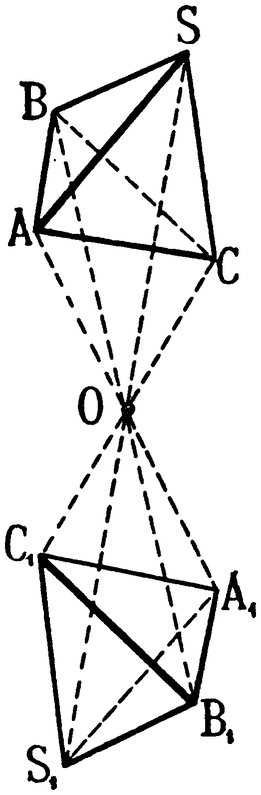
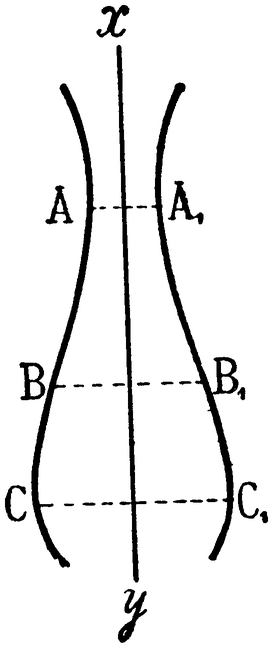
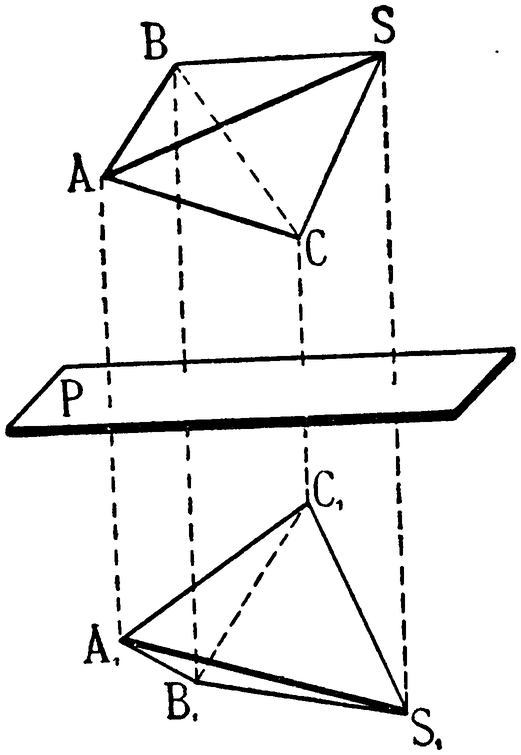
It is easy to see that two figures symmetric with respect to an axis are equal. We satisfy ourselves of this if we rotate one of the figures (fig. 395) about the axis through 180°. Then every point A of the one figure will coincide with the corresponding point of the other figure, and consequently the two figures will coincide.
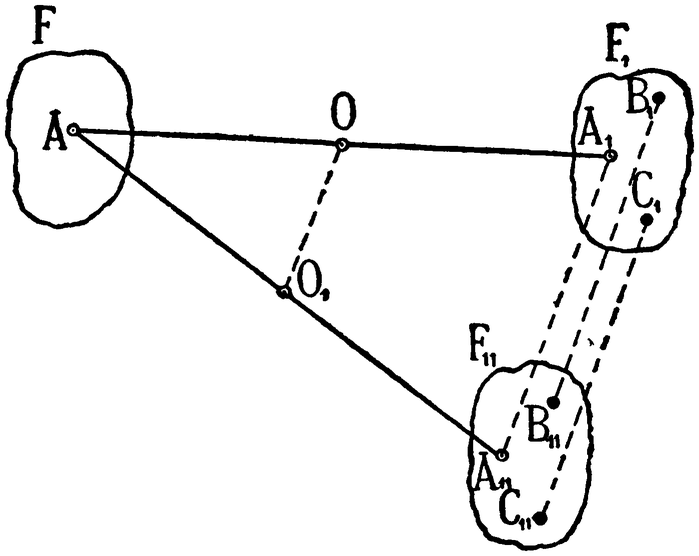
448. Theorem. Figures symmetric with one and the same figure with respect to different centres are equal to each other.
Proof. Let the figures and be symmetric with one figure F with respect to the centres O and (fig. 397). Let us take an arbitrary point A in the figure F, and in the figures and the points and symmetric with A; then let us draw the straight lines and . Since and , we have ∥ and . Thus all the corresponding points of the figures and (for example, and , and , and and so on) lie at distances from each other that are parallel to the straight line and equal to . Therefore, if we move the figure in such a way that each of its points describes a straight line parallel to and equal to twice that line, the two figures and will coincide; hence they are equal.
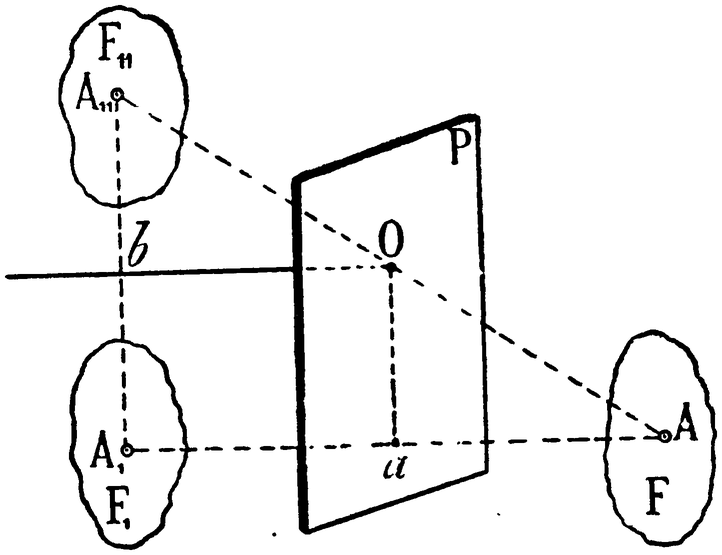
449. Theorem. If the figures F and (fig. 398) are symmetric with respect to a plane P, they can be so placed that they are symmetric with respect to any point O taken in that plane; conversely, if the figures F and are symmetric with respect to a point O, they can be so placed that they are symmetric with respect to any plane P passing through that point O.
Proof. If the figures F and are symmetric with respect to the plane P, the straight line joining any two corresponding points is perpendicular to the plane P and is bisected by it; hence . If the figures F and are symmetric with respect to the point O, the straight line joining two corresponding points passes through O and is bisected by that point; hence . Having noticed this, let us join to and draw OM perpendicular to P. Since and , we have ∥ aO; consequently . Since OM ⊥ P and ⊥ P, we have OM ∥ ; from this it follows that, in the first place, OM intersects at some point b; in the second place, ; in the third place, (since ). If we now rotate the figures and about the axis OM through 180°, the points and , and consequently all the other corresponding points as well, will change places; hence the figure can be made symmetric with F with respect to the point O, and the figure can be made symmetric with F with respect to the plane P, which was to be proved.
450. Corollaries. 1°. Figures symmetric with one and the same figure with respect to different planes are equal to each other, because these figures can always be made symmetric with one and the same figure with respect to different centres, and such figures, as we saw (448), are equal to each other.
2°. If we attend only to the form of a figure and not to its position in space, we may say that a given figure F has only one figure symmetric with it (with respect to a point or with respect to a plane, it makes no difference), since all the figures symmetric with F are equal to each other. In consequence, when we investigate those properties of symmetric figures which depend only on their form, we may at will regard these figures either as symmetric with respect to a centre or as symmetric with respect to a plane.
451. Theorems expressing the properties of symmetric figures.
1°. The figure symmetric with a plane figure is also a plane figure, equal to the first.
This property becomes evident if we take the plane of the given figure as the plane of symmetry; the symmetric figure then merges with the given one.
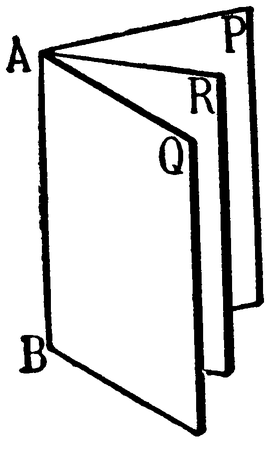
In particular, the figure symmetric with a segment of a straight line is an equal segment of a straight line; the figure symmetric with an angle is an equal angle; the figure symmetric with a plane polygon is an equal plane polygon; the figure symmetric with a circle is an equal circle, and so on.
2°. The figure symmetric with a dihedral angle (PABQ, fig. 399) is an equal dihedral angle.
This property becomes evident if we take as the plane of symmetry the bisector plane R. Then the figure symmetric with the face P will be the other face Q, and conversely; consequently the figure symmetric with the angle PABQ will be the angle QABP.
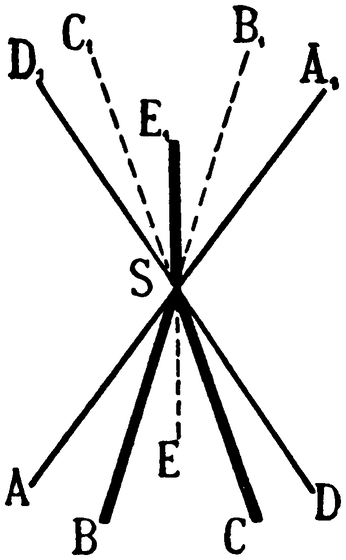
3°. The figure symmetric with a polyhedral angle (SABCDE, fig. 400) is a polyhedral angle whose dihedral angles and plane angles are respectively equal to the dihedral angles and plane angles of the first polyhedral angle, but are placed in the reverse order.
This property becomes evident if we take the vertex S as the centre of symmetry. We then obtain two symmetric angles SABCDE and , whose dihedral angles and plane angles are respectively equal but are placed in the reverse order (403).
Corollary. Symmetric polyhedral angles are in general not equal, since, the equal dihedral angles being placed in the reverse order, they cannot be made to coincide. For the same reason symmetric polyhedra are in general not equal.
4°. Two symmetric polyhedra are equal in volume.
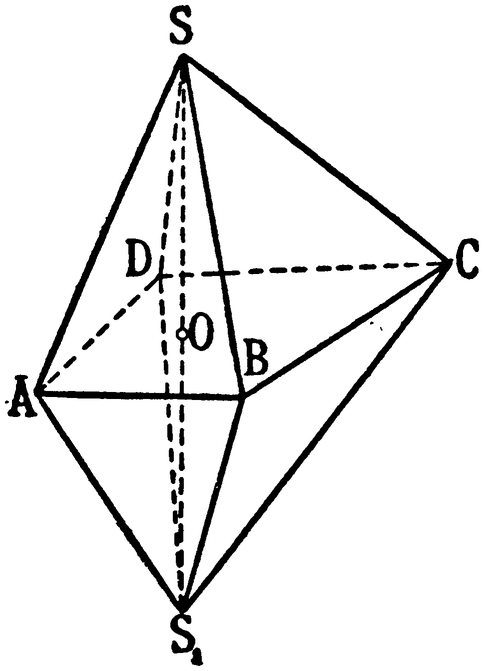
Let us first prove this theorem for symmetric pyramids (fig. 401) SABCD and , which we place so that the base ABCD serves as the plane of symmetry. Since the points S and are symmetric with respect to the plane of the base, the altitudes SO and are equal; in consequence the pyramids, having a common base and equal altitudes, are equal in volume.
Any two symmetric polyhedra whatever can always be decomposed into the same number of symmetric pyramids; therefore the theorem is true for polyhedra of arbitrary form as well.
Chapter 6: The Regular Polyhedra
452. Definition. A polyhedron is called regular if all its faces are equal regular polygons and all its polyhedral angles are equal (such, for example, is the cube).
From this definition it follows that in regular polyhedra all the plane angles, all the dihedral angles and all the edges are equal.
453. Which regular polygons can serve as the faces of regular polyhedra? To settle this question, let us take into account that the least number of faces in a polyhedral angle is three, and that the sum of all the plane angles of a convex polyhedral angle is less than 4d (398). Each angle of a regular triangle is equal to . If we take as a term 3 times, 4 times and 5 times, we obtain sums less than 4d; but if we take as a term 6 times or more, we obtain a sum of 4d or more. Therefore from plane angles equal to the angles of a regular triangle convex polyhedral angles of only three kinds can be formed: trihedral, tetrahedral and pentahedral. The angle of a square is equal to d, and the angle of a regular pentagon is equal to ; taking these angles as a term 3 times, we obtain sums less than 4d, and taking them 4 times or more, we obtain 4d or more. Therefore from plane angles equal to the angles of a square or of a regular pentagon only trihedral angles can be formed. The angle of a regular hexagon is equal to ; therefore from such angles not even a trihedral angle can be formed. From the angles of regular polygons having more than 6 sides, all the more, no polyhedral angle can be formed.
454. Enumeration of the regular polyhedra. From what was said in the preceding section it follows that there cannot be more convex regular polyhedra than the following five54:
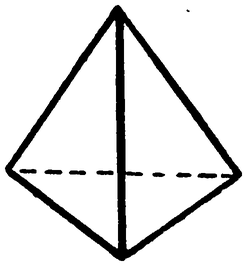
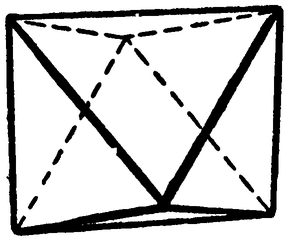
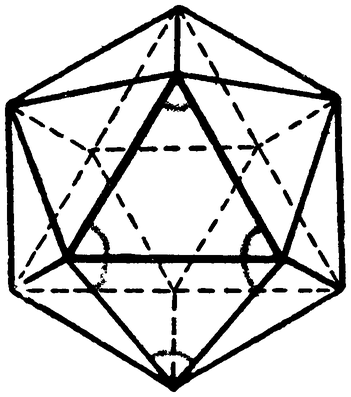
1°. The regular four-faced solid (or tetrahedron), whose surface is made up of 4 regular triangles (fig. 402).
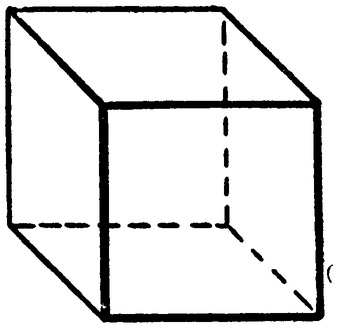
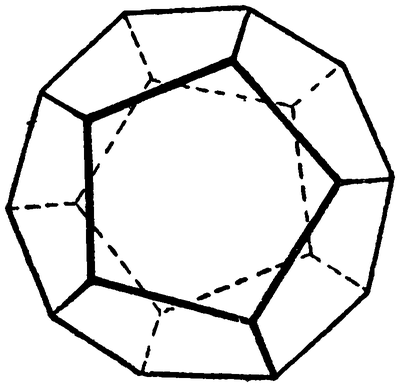
2°. The regular eight-faced solid (or octahedron), whose surface is made up of 8 regular triangles (fig. 403).
3°. The regular twenty-faced solid (or icosahedron), formed by 20 regular triangles (fig. 404).
4°. The regular six-faced solid (or hexahedron), formed by 6 squares (fig. 405). It is otherwise called the cube.
5°. The regular twelve-faced solid (or dodecahedron), formed by 12 regular pentagons (fig. 406).
Problems
335, a. The edge of a given cube is equal to a. Find the edge of another cube whose volume is twice the volume of the given cube.
Remark. This problem of the duplication of the cube, known since ancient times, is easily solved by computation (namely: ), but by construction (with the compass and the ruler) it cannot be solved, since the formula for the unknown contains a radical of the 3rd degree (see the end of § 255).
335. Compute the surface and the volume of a right prism whose base is a regular triangle inscribed in a circle of radius r = 2 metres, and whose altitude is equal to the side of the regular hexagon circumscribed about the same circle.
336. Determine the surface and the volume of a regular octagonal prism whose altitude is h = 6 m and the side of whose base is a = 8 cm.
337. Determine the lateral surface and the volume of a regular hexagonal pyramid whose altitude is equal to 1 metre and whose apothem makes an angle of 30° with the altitude.
338. Compute the volume of a triangular pyramid each of whose lateral edges is equal to l and the sides of whose base are a, b and c.
339. A trihedral angle SABC is given, all three of whose plane angles are right angles. On its edges the lengths SA = a, SB = b and SC = c are laid off. Through the points A, B and C a plane is drawn. Determine the volume of the pyramid SABC.
340. The altitude of a pyramid is equal to h, and its base is a regular hexagon with the side a. At what distance x from the vertex of the pyramid must a plane parallel to the base be drawn in order that the volume of the truncated pyramid so formed may be equal to V?
341. Determine the volume of a regular tetrahedron with the edge a.
342. Determine the volume of a regular octahedron with the edge a.
343. A truncated pyramid whose volume is V = 1465 cubic centimetres has for its bases regular hexagons with the sides a = 23 cm and b = 17 cm. Compute the altitude of this pyramid.
344. The volume V of a truncated pyramid is equal to 10.5 cubic metres, its altitude is metres, and the side a of the regular hexagon that serves as its lower base is equal to 2 metres. Compute the side of the regular hexagon that serves as its upper base.
345. Compute the volume of a truncated triangular prism the sides of whose base are a = 7.5, b = 7 and c = 6.5, and whose edges, perpendicular to the base, are k = 2, l = 3 and m = 4.
346. At what distance from the vertex S of the pyramid SABC must a plane parallel to the base be drawn in order that the ratio of the volumes of the parts into which the pyramid is cut by this plane may be equal to m?
347. Compute the volume of a truncated parallelepiped whose base is B, where and are the lengths of the perpendiculars dropped to the plane of the lower base from the two vertices lying at the ends of one of the diagonals of the upper base55.
348. A pyramid with the altitude h is divided by planes parallel to the base into three parts in the ratio m : n : p. Determine the distances of these planes from the vertex of the pyramid.
349. The sum of the volumes of two similar polyhedra is equal to V, and the ratio of corresponding edges is equal to m : n. Determine their volumes.
350. Divide the volume of a truncated pyramid by a plane parallel to the bases B and b into two parts in the ratio m : n.
Solid Geometry. Book Three: The Round Bodies
Chapter 1: The Cylinder and the Cone
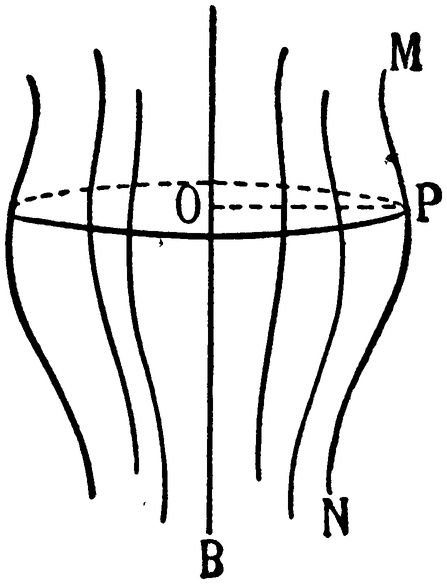
455. Surface of revolution. A surface of revolution is a surface obtained by the rotation of some unchanging line (MN, fig. 407), called the generator, about a fixed straight line (AB), called the axis; it is supposed here that the generator (MN), as it rotates, is rigidly joined to the axis (AB).
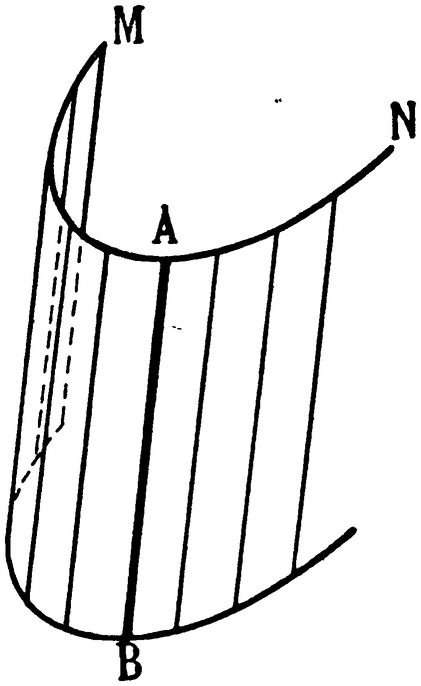
Let us take some point P on the generator and drop from it the perpendicular PO to the axis. Evidently neither the length of this perpendicular, nor the size of the angle AOP, nor the position of the point O changes during the rotation. Therefore each point of the generator describes a circle whose plane is perpendicular to the axis and whose centre lies at the intersection of this plane with the axis. From this it follows that a plane perpendicular to the axis intersects a surface of revolution in a circle.
Every cutting plane that passes through the axis is called a meridian plane, and its intersection with the surface of revolution is called a meridian. All meridians are equal to one another, because during the rotation each of them passes through the position in which every other meridian was before.
456. Cylindrical surface. A cylindrical surface is the surface produced by the motion of a straight line (AB, fig. 408) that moves through space parallel to a given direction and in doing so intersects a given line (MN). The straight line AB is called the generator, and the line MN the directrix.
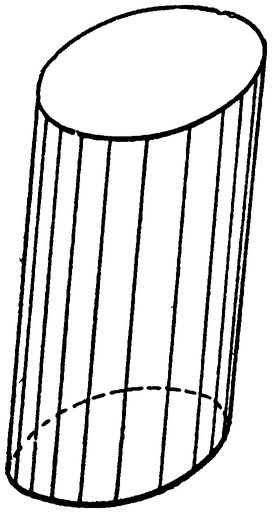
457. Cylinder. A solid bounded by a cylindrical surface and two parallel planes is called a cylinder (fig. 409). The part of the cylindrical surface contained between the planes is called the lateral surface of the cylinder, and the parts of the planes cut off by this surface are called the bases of the cylinder. The distance between the bases is the altitude of the cylinder. A cylinder is called right or oblique according as its generators are perpendicular or oblique to the bases.
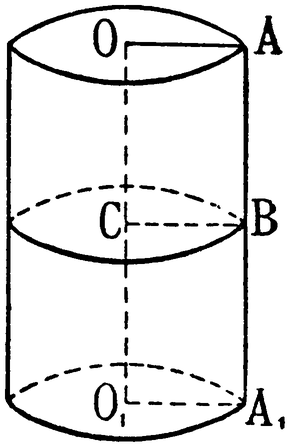
A right cylinder (fig. 410) is called circular if its bases are circles. Such a cylinder can be regarded as a solid of revolution, namely as the solid produced by the rotation of the rectangle about the side as axis; in this rotation the side describes the lateral surface, and the sides OA and describe the circles of the bases. Every straight line BC parallel to OA also describes a circle perpendicular to the axis. From this it follows that the section of a right circular cylinder by a plane parallel to the bases is a circle.
In elementary geometry only the right circular cylinder is considered; for brevity it is called a cylinder and nothing more.
Sometimes we have to consider prisms whose bases are polygons inscribed in the bases of a cylinder or circumscribed about them; such prisms are said to be inscribed in the cylinder or circumscribed about it.
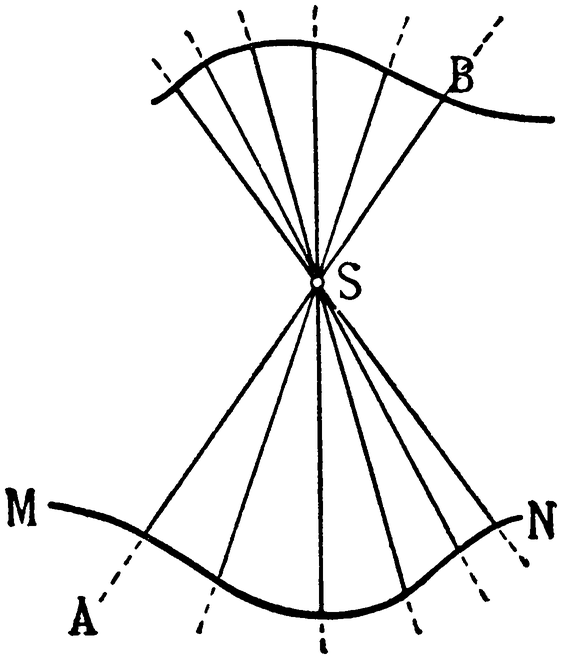
458. Conical surface. A conical surface is the surface produced by the motion of a straight line (AB, fig. 411) that moves through space in such a way that it constantly passes through a fixed point (S) and intersects a given line (MN). The straight line AB is called the generator, the line MN the directrix, and the point S the vertex of the conical surface.
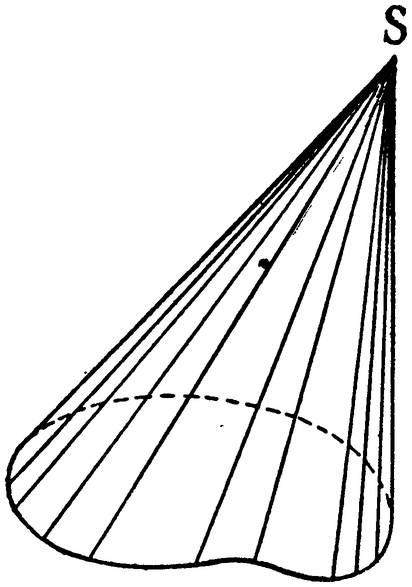
459. Cone. A solid bounded by a conical surface and a plane that intersects all the generators on one side of the vertex is called a cone (fig. 412). The part of the conical surface bounded by this plane is called the lateral surface, and the part of the plane cut off by the lateral surface is called the base of the cone. The perpendicular dropped from the vertex to the base is the altitude of the cone.
A cone is called right circular if its base is a circle and its altitude passes through the centre of the base (fig. 413). Such a cone can be regarded as the solid produced by the rotation of the right triangle SOA about the leg SO as axis. In this rotation the hypotenuse SA produces the lateral surface, and the leg OA the base of the cone. Every straight line parallel to AO describes during the rotation a circle perpendicular to the axis. From this it follows that the section of a right circular cone by a plane parallel to the base is a circle.
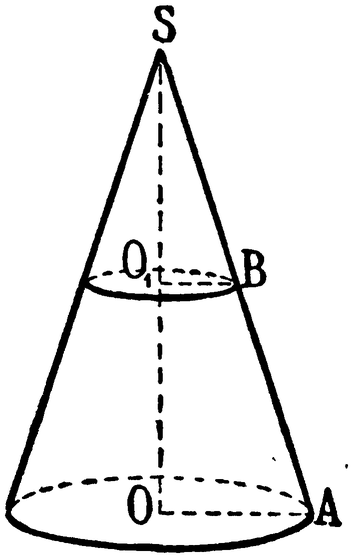
In elementary geometry only the right circular cone is considered, and for brevity it is called a cone and nothing more.
Sometimes we have to consider pyramids whose bases are polygons inscribed in the base of a cone or circumscribed about it, and whose vertex coincides with the vertex of the cone. Such pyramids are said to be inscribed in the cone or circumscribed about it.
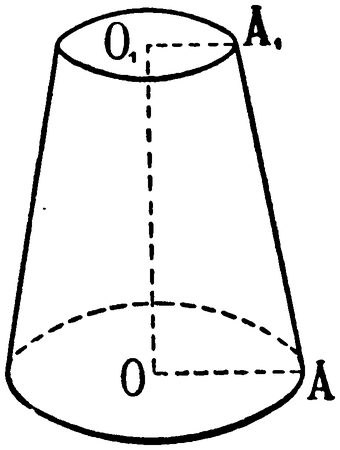
460. Truncated cone. A truncated cone (fig. 414) is the part of a complete cone contained between the base and a cutting plane parallel to the base. The parallel circles that bound a truncated cone are called its bases. A truncated cone can be regarded as the solid produced by the rotation of the right-angled trapezoid about the side , which is perpendicular to the bases of the trapezoid.
The Surface of the Cylinder and of the Cone
461. Definitions. The lateral surfaces of the cylinder and of the cone belong to the curved surfaces, that is, to those no part of which can be made to coincide with a plane. We must therefore define specially what is to be understood by the magnitude of the lateral surface of a cylinder or a cone when these surfaces are compared with a plane unit of area. We shall keep to the following definitions.
1°. The magnitude of the lateral surface of a cylinder is taken to be the limit to which the lateral surface of a prism inscribed in this cylinder tends when its lateral faces decrease without bound (and, consequently, the number of faces increases without bound).
2°. The magnitude of the lateral surface of a cone (complete or truncated) is taken to be the limit to which the lateral surface of a pyramid (complete or truncated) inscribed in this cone tends when its lateral faces decrease without bound (and, consequently, the number of faces increases without bound)56.
462. Theorem. The lateral surface of a cylinder is equal to the product of the circumference of the base and the altitude.
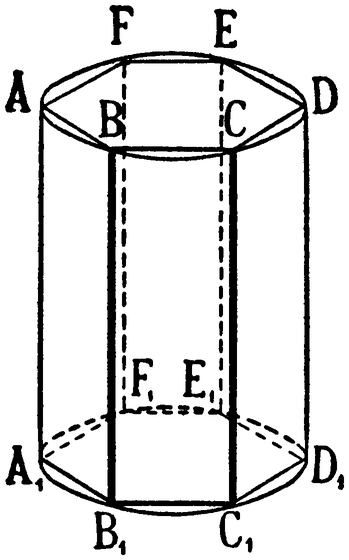
Let us inscribe some prism in the cylinder (fig. 415). Let us denote by the letters p and H the numbers that express, in the corresponding units, the perimeter of the base and the altitude of this prism. Then its lateral surface is expressed by the product pH. Suppose now that the lateral faces of the inscribed prism (and consequently the sides of the inscribed polygon that serves as the base of this prism) decrease without bound. Then the perimeter p will tend to the limit that is taken as the length C of the circle of the base, while the altitude H will remain unchanged; consequently the lateral surface of the prism, which is always equal to the product pH, will tend to the limit CH. It is this limit that is taken as the magnitude of the lateral surface of the cylinder. Denoting it by the letter S, we can write:
S = CH.
463. Corollaries. 1°. If R denotes the radius of the base of the cylinder, then C = 2πR; therefore the lateral surface of the cylinder is expressed thus:
S = 2πRH.
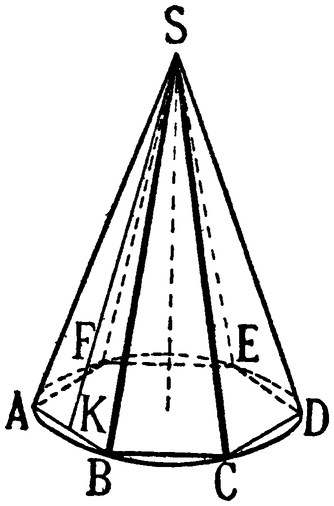
2°. To obtain the total surface of the cylinder it is enough to add to the lateral surface the sum of the areas of the two bases; therefore, denoting the total surface by T, we have:
464. Theorem. The lateral surface of a cone is equal to the product of the circumference of the base and half the generator.
To make the proof simpler, let us inscribe in the cone (fig. 416) not an arbitrary pyramid but a regular one, and let us denote by the letters p and l the numbers that express, in the corresponding units, the perimeter of the base and the apothem of this pyramid. Then its lateral surface is expressed by the product . Suppose now that the lateral faces of the inscribed pyramid (and consequently the sides of the inscribed polygon that serves as the base of this pyramid) decrease without bound. Then the perimeter p will tend to the limit that is taken as the length C of the circle of the base, and the apothem l will have as its limit the generator of the cone (since from the triangle SAK it follows that SA − SK < AK); hence, if we denote the generator of the cone by the letter L, the lateral surface of the inscribed pyramid, which is constantly equal to , will tend to the limit . It is this limit that is taken as the magnitude of the lateral surface of the cone. Denoting it by the letter S, we can write:
465. Corollaries. 1°. Since C = 2πR, the lateral surface of the cone is expressed by:
2°. We obtain the total surface of the cone if we add to the lateral surface the area of the base; therefore:
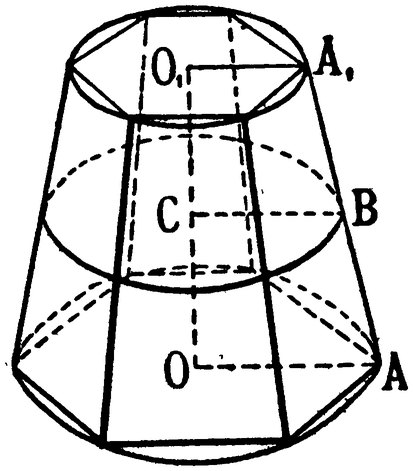
466. Theorem. The lateral surface of a truncated cone is equal to the product of half the sum of the circumferences of the bases and the generator.
To make the proof simpler, let us inscribe in the truncated cone (fig. 417) not an arbitrary truncated pyramid but a regular one, and let us denote by the letters p, and l the numbers that express the perimeter of the lower base, the perimeter of the upper base and the apothem of this pyramid. Then its lateral surface is expressed by the product
As the lateral faces of the inscribed pyramid decrease without bound, the perimeters p and tend to the limits that are taken as the lengths C and of the circles of the bases, and the apothem l, as is not hard to see, has as its limit the generator L of the truncated cone. Consequently the lateral surface of the inscribed pyramid tends to a limit equal to . It is this limit that is taken as the magnitude of the lateral surface of the truncated cone. Denoting it by the letter S, we have:
467. Corollaries. 1°. If R and denote the radii of the circles of the lower and upper bases, the lateral surface of the truncated cone is expressed by:
2°. In the trapezoid (fig. 417), by whose rotation the truncated cone is obtained, let us draw the midline BC (117). Then we obtain:
Whence:
Consequently that is, the lateral surface of a truncated cone is equal to the product of the circumference of the middle section and the generator.
3°. The total surface T of the truncated cone is expressed thus:
468. Remark. In the preceding theorems the lateral surfaces of the cylinder and of the cone were regarded as the limits of the lateral surfaces of inscribed prisms or pyramids. If, in the same way as we did in proving these theorems, we were to find the limits for circumscribed prisms or pyramids, we should find that these limits are the same as for the inscribed prisms or pyramids. In consequence of this the lateral surfaces of the cylinder and of the cone can be regarded as the common limit of the lateral surfaces of prisms or pyramids, inscribed and circumscribed alike.
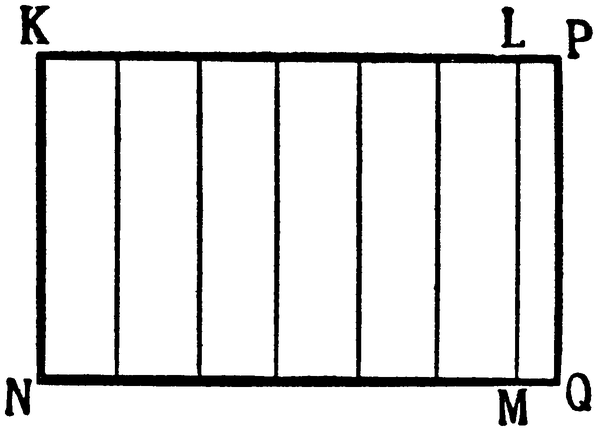
469. Development of the cylinder and of the cone. Let us inscribe some prism in the cylinder (fig. 418) and then imagine that its lateral surface has been cut along one of its lateral edges. Evidently, by rotating its faces about the edges, we can develop this surface into one plane, without tearing and without folds. We then obtain what is called the development of the lateral surface of the prism. It is a rectangle KLMN made up of as many rectangles as the prism has lateral faces. Its base MN is equal to the perimeter of the base of the prism, and its altitude KN is the altitude of the prism.
Let us now imagine that the lateral faces of the inscribed prism decrease without bound; then its development will grow longer and longer, approaching the limiting rectangle KPQN, whose base is equal to the circumference of the base of the cylinder and whose altitude is the altitude of the cylinder. This rectangle is called the development of the lateral surface of the cylinder.
In a similar way let us imagine that some pyramid is inscribed in the cone (fig. 419). We can cut its lateral surface along one of the edges and then, rotating the faces about the edges, obtain its development in the form of the polygonal sector SKL, made up of as many isosceles triangles as the pyramid has lateral faces. The straight lines SK, Sa, Sb... are equal to the lateral edge of the pyramid (or to the generator of the cone), and the length of the broken line Kab...L is equal to the perimeter of the base of the pyramid. As the lateral faces of the inscribed pyramid decrease without bound, its development increases, approaching the limiting sector SKM, whose arc KM is equal to the circumference of the base and whose radius SK is equal to the generator of the cone. This sector is called the development of the lateral surface of the cone.
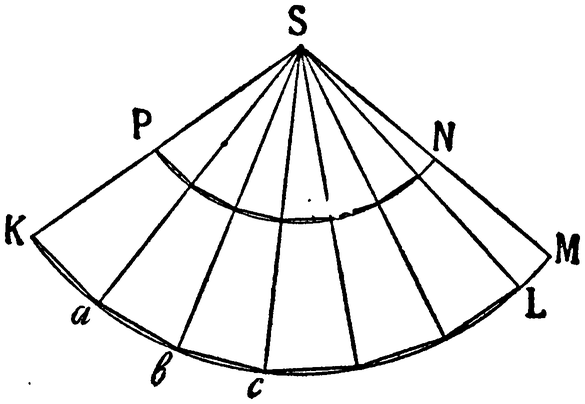
In a similar way the development of the lateral surface of a truncated cone can be obtained (fig. 419) in the form of the part KMNP of a circular ring.
It is easy to see that the lateral surface of a cylinder or of a cone is equal to the area of the corresponding development.
The Volumes of the Cylinder and of the Cone
470. Lemma 1. The volume of a cylinder is the common limit of the volumes of regular inscribed and circumscribed prisms as the number of their lateral faces is doubled indefinitely.
Let us inscribe in the cylinder a regular prism and circumscribe about it a regular prism of the same name. Let us denote the volume, the area of the base and the altitude respectively: for the cylinder by , for the inscribed prism by , and for the circumscribed prism by . Then we have (431):
Whence:
As the number of lateral faces of the prisms is doubled indefinitely, the difference tends to zero (330), while the factor is a constant number; therefore the right-hand side of the last equality, and consequently its left-hand side also, tends to zero. The volume of the cylinder is evidently greater than the volume of the inscribed prism but less than the volume of the circumscribed one; therefore each of the differences and is less than the difference ; but the latter, by what has been proved, tends to zero; consequently the former also tend to zero; and this, by the definition of a limit, means that
471. Lemma 2. The volume of a cone, complete or truncated, is the common limit of the volumes of regular inscribed and circumscribed pyramids as the number of their lateral faces is doubled indefinitely.
1°. Let us inscribe in the cone a regular pyramid and circumscribe about it a regular pyramid of the same name. Using the same notation as in the preceding section, we have (434):
Whence:
From this equality we conclude, in the same way as in the preceding lemma, that the difference tends to zero when the number of lateral faces of the inscribed and the circumscribed pyramid is doubled indefinitely; and since each of the differences and is less than , these differences tend to zero all the more; and this means that
2°. Let us imagine that the truncated cone has been completed to a complete cone (fig. 420). Let us inscribe in this complete cone a regular pyramid and circumscribe about it a regular pyramid of the same name. The parts of these pyramids contained between the planes of the lower and upper bases will be truncated pyramids, one inscribed in the truncated cone and the other circumscribed about it. Let us denote the volumes of the cone, of the inscribed pyramid and of the circumscribed pyramid respectively by the letters:
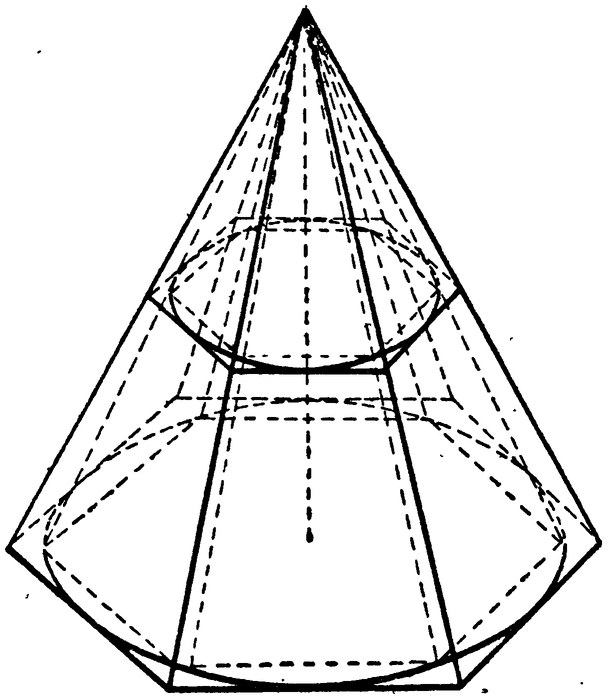
for the complete ones . . . . ;
for the truncated ones . . . .
From the figure we see directly that the differences of the volumes:
make up certain parts of the differences of the volumes:
therefore the first differences are less than the second. But as the number of lateral faces of the pyramids is doubled indefinitely, each of the differences and tends, as we have seen, to zero; consequently each of the smaller differences and then tends to zero all the more. From this it follows that
Remark. In the two lemmas just proved the inscribed and circumscribed prisms and pyramids are supposed regular only for the sake of a simpler proof; what these lemmas state remains fully in force when the prisms and pyramids are not regular, provided only that their lateral faces decrease without bound.
472. Theorems. 1°. The volume of a cylinder is equal to the product of the area of the base and the altitude.
2°. The volume of a cone is equal to the product of the area of the base and one third of the altitude.
Let us inscribe some regular prism in the cylinder and some regular pyramid in the cone; then, using the earlier notation, we have:
for the prism . . . . ;
for the pyramid . . .
These equalities remain true however many times we double the number of lateral faces of the prism and of the pyramid; therefore they will remain true also when we put in place of the variables their limits (283); consequently:
for the cylinder . . . . ;
for the cone . . . . . . .
473. Corollary. If we denote the radius of the base of the cylinder or of the cone by R, then ; therefore:
Volume of the cylinder ; volume of the cone .
474. Theorem. The volume of a truncated cone is equal to the sum of the volumes of three cones that have the same altitude as the truncated cone and have as bases: the first, the lower base of this cone; the second, the upper base; the third, the mean proportional between them.
By what was proved earlier, the volume of a truncated cone is the common limit of the volumes of regular inscribed and circumscribed truncated pyramids. But the volume of a regular inscribed truncated pyramid whose altitude is H and whose bases have the areas and is expressed by the equality (437):
In the limit, as the number of lateral faces of the inscribed pyramid is doubled indefinitely, this equality gives:
where is the volume, and are the areas of the bases and is the altitude of the truncated cone.
475. Corollary. If R and r denote the radii of the lower and upper bases of the truncated cone, then , and ; therefore:
Volume of the truncated cone .
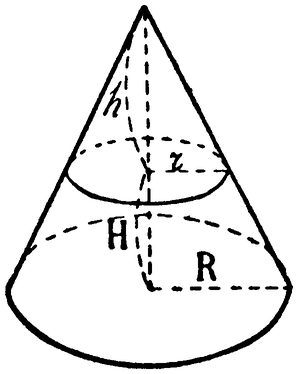
476. Remark. The volume of a truncated cone can also be found independently of the properties of limits, in the following way. On the upper base of the truncated cone (fig. 421) let us place a small cone (with the altitude h) such that the truncated cone is turned into a complete one. Then the volume V of the truncated cone can be regarded as the difference between the volumes of the complete cone and of the added cone. Therefore:
From the similarity of the triangles we find:
Consequently,
Similar Cylinders and Cones
477. Definition. Two cylinders or cones are called similar if they have been produced by the rotation of similar rectangles or triangles about corresponding sides.
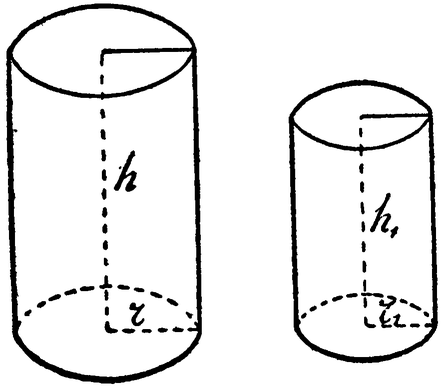
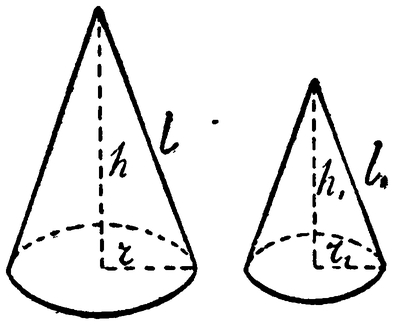
Let us denote (figs. 422 and 423) by h and the altitudes of two similar cylinders or cones, by r and the radii of their bases, and by l and their generators; then, according to the definition, we have:
Whence, by the property of equal ratios, we derive:
478. Theorem. The lateral surfaces and the total surfaces of similar cylinders or cones are to each other as the squares of the radii or of the altitudes, and the volumes as the cubes of the radii or of the altitudes.
Let us denote by S, T and V respectively the lateral surface, the total surface and the volume of one cylinder or cone, and by , and the same magnitudes for another cylinder or cone similar to the first. Then we have the following.
For cylinders.
For cones.
Chapter 2: The Sphere
Section of a Sphere by a Plane
479. Definition. The solid produced by the rotation of a half-disk about the diameter that bounds it is called a sphere, and the surface generated in this rotation by the semicircle is called the surface of the sphere or spherical surface. This surface is the locus of the points equally distant from one and the same point, called the centre of the sphere.
A straight line joining the centre to any point of the surface is called a radius, and a straight line joining two points of the surface and passing through the centre is called a diameter of the sphere. All the radii of one sphere are equal to one another, and a diameter is equal to two radii.
Two spheres of the same radius are equal, because they coincide when one is inserted into the other.
480. Theorem. Every section of a sphere by a plane is a circle.
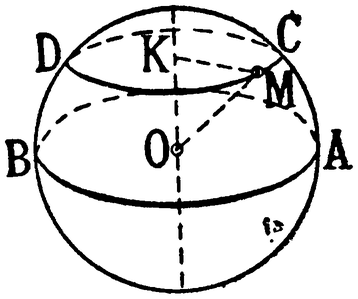
1°. Suppose first that (fig. 424) the cutting plane AB passes through the centre O of the sphere. All the points of the line of intersection, since they belong to the spherical surface, are equally distant from the point O, which lies in the cutting plane; consequently the section is a circle.
2°. Suppose now that the cutting plane CD does not pass through the centre. Let us drop the perpendicular OK to it from the centre and take any point M on the line of intersection. Joining it to O and K, we obtain the right triangle MOK, from which we find:
Since the lengths OM and OK do not change when the position of the point M on the line of intersection changes, the distance MK is a constant magnitude; hence the line of intersection is a circle whose centre is the point K.
481. Corollary. Let R, r and d denote the radius of the sphere, the radius of the circle of the section and the distance of the cutting plane from the centre; then the equality [1] takes the form:
From this formula we deduce:
1°. The greatest radius of a section is obtained when d = 0, that is, when the cutting plane passes through the centre of the sphere. In this case r = R. The circle obtained in this case is called a great circle.
2°. The least radius of a section is obtained when d = R. In this case r = 0, that is, the circle of the section turns into a point.
3°. Sections equally distant from the centre of the sphere are equal.
4°. Of two sections not equally distant from the centre of the sphere, the greater is the one that is nearer to the centre.
Properties of Great Circles
482. Theorem. Every great circle divides the sphere and its surface in half.
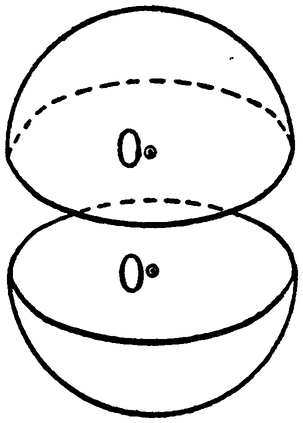
Let us imagine that we have cut the sphere (fig. 425) along some great circle and, having turned the upper part of the sphere over, have inserted it into the lower part so that their circular bases coincide. Then all the points of the one part of the spherical surface will coincide with points of the other part, because both are equally distant from the common centre. From this it follows that a great circle divides the sphere and its surface in half.
483. Theorem. Through any two points of a spherical surface that do not lie at the ends of one diameter, only one circumference of a great circle can be drawn.
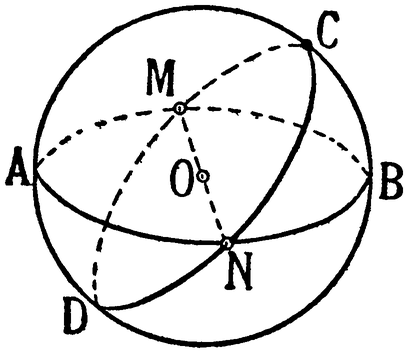
Suppose that on a spherical surface (fig. 426) with the centre O any two points are taken, for example C and N, which do not lie on one straight line with the point O. Then a plane can be drawn through the points C, O and N. This plane, since it passes through the centre O, will give in its intersection with the spherical surface the circumference of a great circle.
No other circumference of a great circle can be drawn through the same two points C and N. Indeed, every circumference of a great circle must, by definition, lie in a plane passing through the centre O of the sphere; consequently, if yet another circumference of a great circle could be drawn through C and N, it would follow that through 3 points C, N and O, not lying on one straight line, 2 different planes can be drawn, which is impossible.
Remark. Any two points of a spherical surface can be joined by two arcs of a great circle, which together make up the circumference of the great circle (thus the points C and N, fig. 426, are joined by the arc CN and by the arc CMDN, and the sum of these arcs makes up the circumference of a great circle).
If the two points taken do not lie at the ends of one diameter, one of these arcs is less than a semicircle and the other greater.
484. Theorem. The circumferences of two great circles bisect each other.
Indeed, the centre O (fig. 426), being in the planes of both great circles, must lie on the straight line MN along which these circles intersect; hence the line MN is a diameter of both circles, and a diameter divides a circle in half.
485. Theorem. The shortest distance on a spherical surface between two of its points is the arc of a great circle (the arc less than a semicircle) drawn between them.
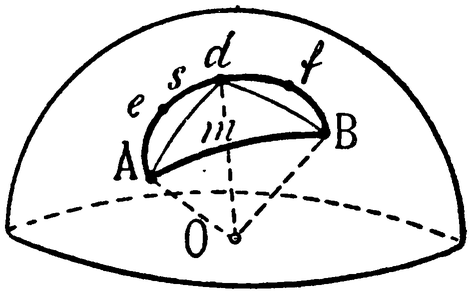
Let m (fig. 427) be the arc of a great circle drawn on a spherical surface between two of its points A and B, and s any line drawn on the spherical surface between the same points. Let us prove that s is longer than m. We take an arbitrary point d on the curve s and join it to A and B by arcs of great circles. Drawing the radii OA, Od and OB, we take them as the edges of a trihedral angle. In this angle, as in every trihedral angle (397), the sum of the plane angles AOd and dOB is greater than the third plane angle AOB. But these angles are measured by the arcs Ad, dB and AB, described from the vertex of the angles with one and the same radius; consequently the sum of the arcs Ad and dB is greater than the arc AB. Let us now take on the curve s the intermediate points e and f and draw arcs of great circles through every two neighbouring points: A, e, d, f and B (these arcs are not shown in the figure). In the same way as before we satisfy ourselves that Ae + ed > Ad and df + fB > dB; hence the sum Ae + ed + df + fB is greater than Ad + dB, and therefore, all the more, greater than the arc m. Let us now imagine that the number of intermediate points taken on the curve s increases without bound, and that arcs of great circles are constantly drawn between every two neighbouring points; then the line made up of these arcs keeps increasing and always remains greater than the arc m; hence the limit57 to which it tends must also be greater than m; and this limit is taken as the length of the arc s.
The Plane Tangent to a Sphere
486. Definition. A plane that has only one point in common with a spherical surface is called a tangent plane.
That such a plane can exist is proved by the following theorem.
Theorem. A plane (P, fig. 428) perpendicular to a radius (OA) at its end lying on the surface of the sphere is a tangent plane.
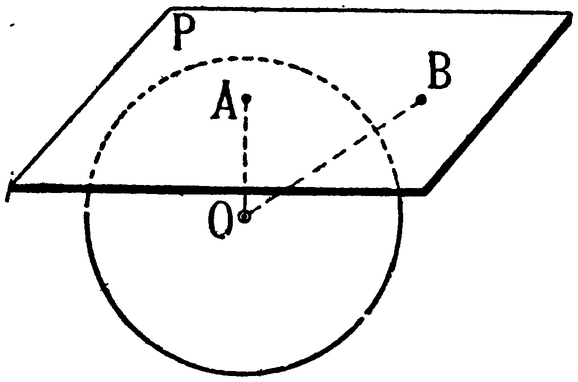
Let us take an arbitrary point B in the plane P and join it to the centre O. Since OB is an oblique and OA a perpendicular to P, we have OB > OA. Therefore the point B cannot lie on the spherical surface; consequently the plane P has only the one point A in common with the spherical surface; hence this plane is a tangent plane.
487. Converse theorem. A tangent plane (P, fig. 428) is perpendicular to the radius (OA) drawn to the point of tangency.
Since, by definition, the point A is the only point that the plane has in common with the spherical surface, every other point of the plane lies outside the spherical surface and, consequently, is farther from the centre than A; thus the straight line OA is the shortest distance of the point O from the plane P, that is, OA is the perpendicular to P.
The Surface of the Sphere and of Its Parts
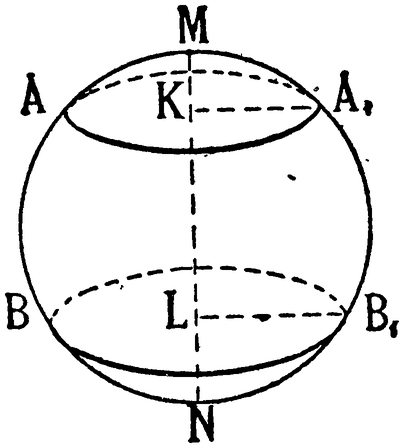
488. Definitions. 1°. The part of a spherical surface (fig. 429) cut off from it by any plane () is called the surface of a segment.
The circle is the base, and the line segment KM of the radius perpendicular to the plane of the section is the altitude of the surface of the segment.
The part of a spherical surface contained between two parallel cutting planes ( and , fig. 429) is called a spherical belt or zone.
The circles of the sections and are called the bases, and the distance KL between the parallel planes the altitude of the zone.
A spherical zone and the surface of a segment can be regarded as surfaces of revolution: while the semicircle MABN, rotating about the diameter MN, describes the spherical surface, its part AB describes a zone, and its part MA the surface of a segment.
To find the magnitude of the spherical surface and of its parts we must first prove the following auxiliary truth.
489. Lemma. The lateral surface of each of the three solids, the cone, the truncated cone and the cylinder, is equal to the product of the altitude of the solid and the circumference of the circle whose radius is the perpendicular erected to the generator at its midpoint and extended until it meets the axis.
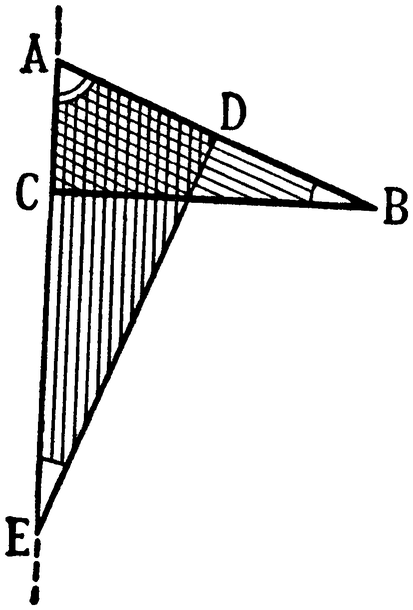
1°. Let a cone be generated (fig. 430) by the rotation of the triangle ABC about the leg AC. If D is the midpoint of the generator AB, then (464):
lateral surface of the cone = 2πBC · AD [1]
Drawing DE ⊥ AB, we obtain two similar triangles ABC and ADE (they are right triangles and have the angle A in common); from their similarity we deduce:
BC : ED = AC : AD;
whence: BC · AD = ED · AC.
Therefore the equality [1] can be written thus:
lateral surface of the cone = 2πED · AC. Which was to be proved.
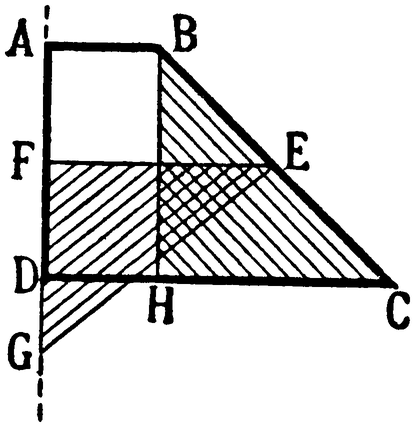
2°. Let a truncated cone (fig. 431) be produced by the rotation of the trapezoid ABCD about the side AD. Drawing the midline EF, we have (467, 2°):
lateral surface of the truncated cone = 2πEF · BC [2]
Let us draw EG ⊥ BC and BH ∥ AD; we then obtain two similar triangles EFG and BCH (the sides of the one are perpendicular to the sides of the other); from their similarity we deduce:
EF : BH = EG : BC.
Whence: EF · BC = BH · EG = AD · EG.
Therefore the equality [2] can be written thus:
lateral surface of the truncated cone = 2πEG · AD. Which was to be proved.
3°. The theorem remains true when applied to the cylinder as well, since the circle spoken of in the theorem is equal to the circle of the base of the cylinder.
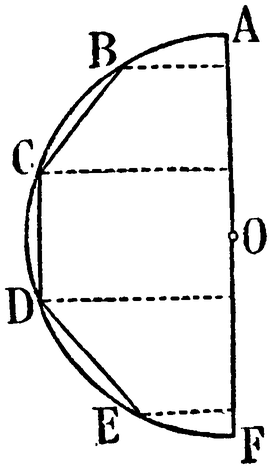
490. Definition. As the magnitude of the surface of the spherical zone generated by the rotation (fig. 432) of any part (BE) of a semicircle (ACF) about the diameter (AF), we take the limit to which the surface generated by the rotation about the same diameter of an inscribed broken line (BCDE) tends when its sides decrease without bound58.
This definition extends also to the surface of a segment and to the spherical surface; in the latter case the broken line is inscribed in the whole semicircle.
491. Theorems. 1°. The surface of a segment is equal to the product of its altitude and the circumference of a great circle.
2°. The surface of a spherical zone is equal to the product of its altitude and the circumference of a great circle.
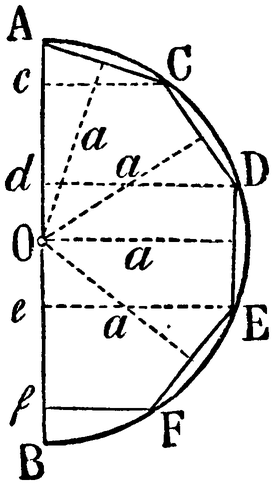
1°. To make the reasoning simpler, we shall inscribe in the arc AF (fig. 433), which in rotating produces the surface of a segment, not any broken line whatever but a regular one, ACDEF, with an arbitrary number of sides.
The surface obtained by the rotation of this broken line consists of the parts generated by the sides AC, CD, DE.... These parts are the lateral surfaces either of a complete cone (from the rotation of AC), or of a truncated cone (from the rotation of CD, FE...), or of a cylinder (from the rotation of DE, if DE ∥ AB). We can therefore apply to them the lemma of § 489. Let us notice here that the perpendiculars erected at the midpoints of the generators and extended until they meet the axis are equal to the apothem of the broken line. Denoting this apothem by a, we obtain:
surface AC = Ac · 2πa;
surface CD = cd · 2πa;
surface DE = de · 2πa;
. . . . . . . . . . . . .
Adding these equalities term by term, we find:
surface ACDEF = Af · 2πa.
When the number of sides of the inscribed broken line is doubled indefinitely, the apothem a tends to a limit equal to the radius R of the sphere, while the straight line Af remains unchanged; consequently:
limit of the surface ACDEF = Af · 2πR.
But the limit of the surface ACDEF is taken as the magnitude of the surface of the segment, and the straight line Af is the altitude H of that surface; therefore:
surface of the segment = H · 2πR = 2πRH.
2°. Suppose that the regular broken line of which we spoke a moment ago is inscribed not in the arc AF, which in rotating generates the surface of a segment, but in some arc CF, which generates a spherical zone. This change, as is easy to see, will not in the least affect the course of the reasoning set out in part 1° of this proof, and therefore the result too will remain the same, that is,
surface of the spherical zone = H · 2πR = 2πRH,
where the letter H denotes the altitude cf of the spherical zone.
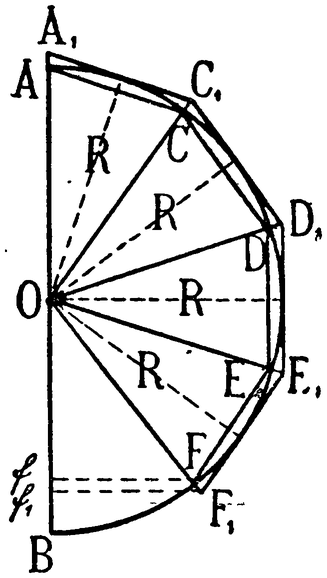
492. Remark. Suppose that about the arc AF (fig. 434) a regular broken line is circumscribed, whose sides are parallel to the sides of the regular inscribed broken line ACDEF. The surface obtained by the rotation of this circumscribed broken line about the diameter AB also consists of parts to which we can apply the lemma of § 489. Then, noticing that the perpendiculars erected at the midpoints of the generators and extended until they meet the axis will now all be equal to the radius R of the circle, we obtain:
When the number of sides of the inscribed and circumscribed broken lines is doubled indefinitely, the line segment of the diameter tends, as is not hard to see,59 to the limit Af, that is, to the altitude H of the surface of the segment; therefore:
Thus the surface of a segment can be regarded as the common limit of the surfaces generated by the rotation of regular broken lines, both inscribed and circumscribed.
The same can be repeated of the surface of a spherical zone.
493. Theorem. The surface of a sphere is equal to the product of the circumference of a great circle and the diameter;
or the surface of a sphere is equal to four times the area of a great circle.
The surface of a sphere, produced by the rotation of the semicircle ADB (fig. 433), can be regarded as the sum of the surfaces generated by the rotation of the arcs AD and DB. Therefore, according to the preceding theorem, we may write:
494. Corollary. The surfaces of spheres are to each other as the squares of their radii or diameters, because, denoting by R and the radii and by S and the surfaces of two spheres, we have:
The Volume of the Sphere and of Its Parts
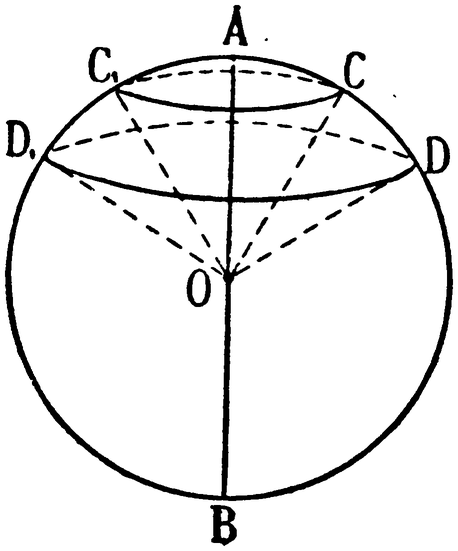
495. Definitions. The solid obtained by the rotation (fig. 435) of a circular sector (COD) about a diameter (AB) that does not intersect its area is called a spherical sector; this solid is bounded by the lateral surfaces of two cones and by the surface of a spherical zone; the latter surface is called the base of the spherical sector. In a particular case one of the radii of the circular sector may coincide with the axis of rotation; for example, the sector AOC, rotating about AO, produces the spherical sector , bounded by the lateral surface of a cone and by the surface of a segment.
To find the volume of a spherical sector and of the whole sphere we must first prove the following lemma.
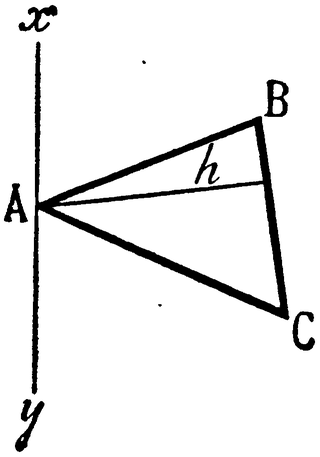
496. Lemma. If a triangle ABC (fig. 436) rotates about an axis xy which lies in the plane of the triangle and passes through its vertex A, but does not intersect its area, then the volume of the solid obtained in this rotation is equal to the product of the surface generated by the opposite side BC and one third of the altitude h dropped to that side.
In the proof we shall consider three cases.
1°. The axis coincides with the side AB (fig. 437). In this case the required volume is equal to the sum of the volumes of the two cones obtained by the rotation of the right triangles BCD and DCA. The first volume is equal to , and the second to ; therefore:
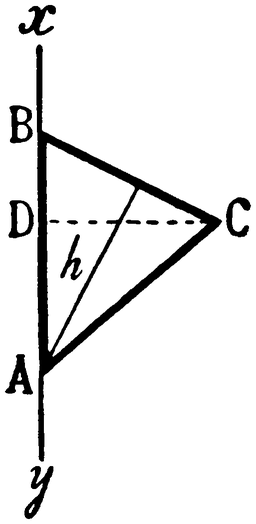
The product CD · BA is equal to BC · h, since each of these products expresses twice the area of the triangle ABC; therefore:
But the product is equal to the lateral surface of the cone BDC; hence:
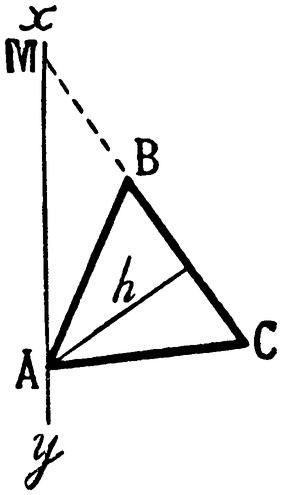
2°. The axis does not coincide with AB and is not parallel to BC (fig. 438). In this case the required volume is equal to the difference of the volumes produced by the rotation of the triangles AMC and AMB. By what was proved in the first case, the volume (surf. MC), and the volume (surf. MB); consequently:
3°. The axis is parallel to the side BC (fig. 439). Then the required volume is equal to the volume DEBC less the sum of the volumes AEB and ACD; the first of these is equal to , the second to and the third to . Taking into account now that EB = DC, we obtain:
The product expresses the lateral surface of the cylinder produced by the side BC; therefore:
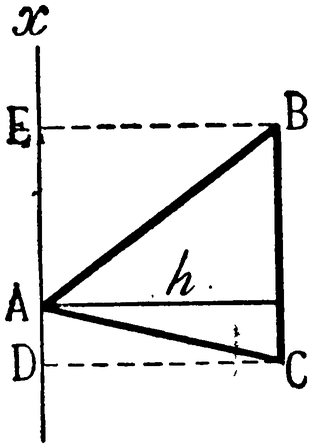
Remark. In our figures we took an acute-angled triangle. The proof changes somewhat (in cases 1° and 3°) if the triangle is obtuse-angled (at the vertex A or B in case 1°, and at the vertex B or C in case 3°). The difference in the proof will be that instead of the sum of volumes we shall sometimes have to take their difference. We leave it to the students to work through these cases themselves.
497. Theorem. The volume of a spherical sector is equal to the product of the surface of its base and one third of the radius.
Let a spherical sector be produced by the rotation of the sector AOD about the diameter EF (fig. 440). We shall arrange the proof in the following order:
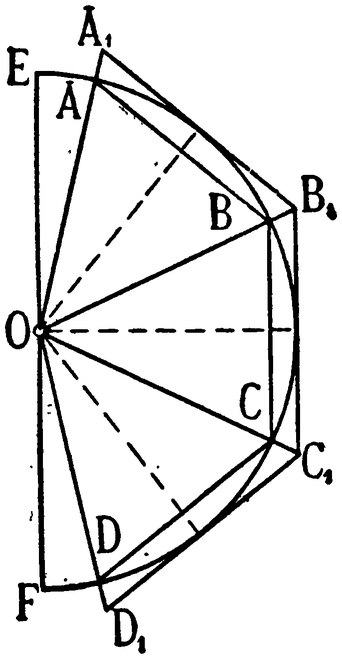
1°. Let us inscribe in the arc AD a regular broken line ABCD with an arbitrary number of sides and then, having extended the end radii OA and OD, circumscribe about the arc AD a regular broken line whose sides are parallel to the sides of the inscribed broken line. The polygonal sectors OABCD and will produce in rotating certain solids, whose volumes we denote, that of the first by and that of the second by . Let us prove first of all that when the number of sides of both broken lines is doubled indefinitely, the difference tends to 0.
The volume is the sum of the volumes obtained by the rotation of the triangles OAB, OBC, OCD about the axis EF; the volume is the sum of the volumes obtained by the rotation about the same axis of the triangles , , . Let us apply to these volumes the lemma of the preceding section, noticing that the altitudes of the first triangles are equal to the apothem a of the inscribed broken line, and the altitudes of the second triangles are equal to the radius R of the sphere. According to this lemma we have:
Let us now imagine that the number of sides of both broken lines is doubled indefinitely. Under this condition the surfaces ABCD and tend to a common limit, namely to the surface of the spherical zone AD (492), and the apothem a has for its limit the radius R; consequently the volumes and then tend to a common limit, namely to the product (surf. AD) · . But this means that each of the variable volumes and approaches one and the same constant magnitude as closely as we please; this is possible only when the difference between these variables tends to 0.
2°. Let us denote by the letter V the volume of the spherical sector OAD. Evidently and ; hence each of the differences and is less than the difference . But this difference, as we have seen, tends to 0 when the number of sides of the broken lines is doubled indefinitely; consequently the differences and all the more tend to 0. From this we conclude that the constant magnitude V is the common limit of the variable volumes and . But this common limit, as we found, is the product (surf. AD) ; hence:
Remark. The theorem and its proof do not depend on whether one of the radii of the circular sector coincides with the axis of rotation or not.
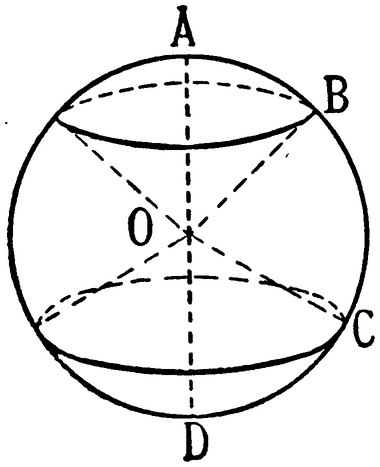
498. Theorem. The volume of a sphere is equal to the product of its surface and one third of the radius.
Dividing the half-disk ABCD (fig. 441), which produces the sphere, into any circular sectors AOB, BOC, COD, we notice that the volume of the sphere can be regarded as the sum of the volumes of the spherical sectors produced by the rotation of these circular ones. Since, according to the preceding theorem:
the volume of the sphere = .
499. Corollary 1. Let us denote the altitude of a spherical zone or of the surface of a segment by H, the radius of the sphere by R and the diameter by D; then the surface of the zone or of the segment is expressed, as we have seen (491), by the formula 2πRH, and the surface of the sphere (493) by the formula ; therefore:
This shows that the volumes of spheres are to each other as the cubes of their radii or diameters.
Corollary 2. The surface and the volume of a sphere are of the surface and of the volume respectively of the cylinder circumscribed about the sphere.
Indeed, in the cylinder circumscribed about a sphere the radius of the base is equal to the radius of the sphere, and the altitude is equal to the diameter of the sphere; therefore for such a cylinder:
This shows that of the total surface of this cylinder is equal to , that is, to the surface of the sphere, and of the volume of the cylinder is , that is, the volume of the sphere60.
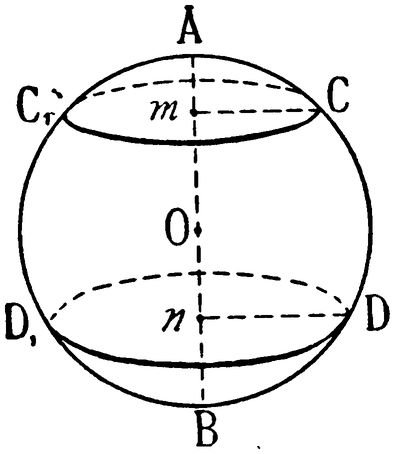
500. Definition. The part of a sphere (ACC1, fig. 442) cut off from it by any plane (CC1) is called a spherical segment. The circle of the section is called the base of the segment, and the line segment Am of the radius perpendicular to the base is called the altitude of the segment.
The part of a sphere contained between two parallel cutting planes (CC1 and DD1) is called a spherical layer. The circles of the parallel sections are called the bases of the layer, and the distance mn between them its altitude.
Both these solids can be regarded as arising from the rotation about the diameter AB of the part AmC of the circle, or of the part CmnD.
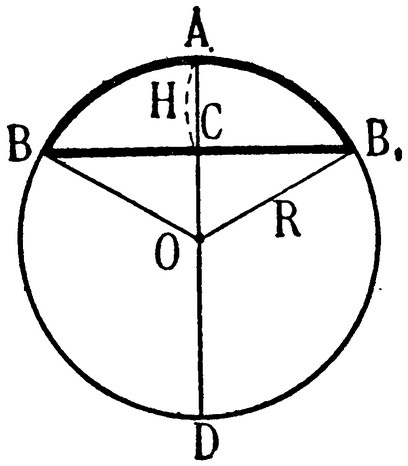
501. Theorem. The volume of a spherical segment is equal to the volume of a cylinder whose base has for its radius the altitude of the segment and whose altitude is equal to the radius of the sphere diminished by one third of the altitude of the segment,
that is, ,
where H is the altitude of the segment and R the radius of the sphere.
The volume of the spherical segment obtained by the rotation about the diameter AD (fig. 443) of the part ACB of the circle will be found if from the volume of the spherical sector obtained by the rotation of the circular sector AOB we subtract the volume of the cone obtained by the rotation of the triangle COB. The first of these is equal to , and the second to . Since CB is the mean proportional between AC and CD, we have ; therefore ;
consequently, vol. ABB1 = vol. OBAB1 − vol. OBB1 =
502. Theorem. The volume of a spherical layer is equal to the volume of the sphere that has the altitude of the layer for its diameter, added to half the sum of the volumes of two cylinders whose altitude is equal to the altitude of the layer and whose bases are, for the one the lower base of the layer, for the other its upper base,
that is, ,
where H is the altitude of the layer, and and are the radii of the bases of the layer.
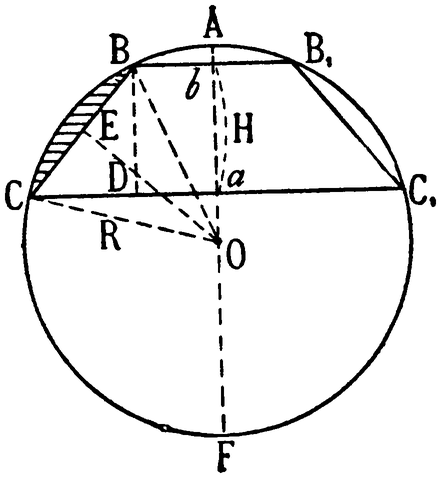
Let us first find the volume obtained by the rotation about the diameter AF (fig. 444) of the circular segment BC (shaded in the figure). This volume is the difference between the volume of the spherical sector OBC and the volume of the solid obtained by the rotation of the triangle OBC. The first is equal to ; and the second = . Consequently the volume from the rotation of the segment is expressed thus:
To obtain the volume of the layer it is enough to add to the volume found the volume of the truncated cone BB1C1C; therefore the volume of the layer is expressed thus:
Drawing BD ⊥ Ca, we have:
Substituting this expression in the preceding formula, we find:
or, denoting Ca by and Bb by :
Putting in this formula, we obtain another expression for the volume of a spherical segment:
that is, the volume of a spherical segment is equal to the volume of the sphere that has the altitude of the segment for its diameter, added to half the volume of a cylinder whose base has for its radius the radius of the base of the segment and whose altitude is equal to the altitude of the segment.
Problems
353. The volume of a cylinder whose altitude is twice its diameter is equal to 1 cubic metre. Compute its altitude.
354. The diameter of the base of a cylinder is 16 cm, and its total surface contains 1546 square centimetres. Compute the altitude of this cylinder.
355. Find the weight of an iron cylindrical tube whose inner diameter is 17 cm, whose outer diameter is 18 cm and whose length is 74 cm; the specific gravity of iron is 7.7.
356. Into a vessel that has the form of a cone with its vertex turned downwards, 345 grams of mercury are poured. Knowing that the angle at the vertex of the cone is equal to 60° and that the specific gravity of mercury is 13.596, compute the height to which the mercury stands in the vessel.
357. Compute the lateral surface and the volume of a truncated cone in which the radii of the bases are 27 and 18 cm and the generator is 21 cm.
358. At what distance from the centre of a sphere whose radius is equal to 2.425 metres must a cutting plane be drawn so that the ratio of the surface of the smaller segment to the lateral surface of the cone that has its base in common with the segment and its vertex at the centre of the sphere shall be equal to 7 : 4?
359. Find the volume of the solid produced by the rotation of a regular hexagon with side a about one of its sides.
360. Compute the radius of the sphere circumscribed about a cube whose edge is equal to 1 metre.
361. A hollow iron sphere whose outer radius is equal to 0.154 metre floats in water, half immersed in it. Compute the thickness of the shell of this sphere, knowing that the specific gravity of iron is equal to 7.7.
362. Compute the volume of the solid produced by the rotation of a regular triangle with side a about an axis passing through its vertex and parallel to the opposite side.
363. An equilateral △ABC with side a is given; on BC a square BCDE is constructed, placed on the side opposite to the triangle. Compute the volume of the solid produced by the rotation of the pentagon ABEDC about the side AB.
364. A square ABCD with side a is given. Through the vertex A a straight line AR is drawn perpendicular to the diagonal AC, and the square is rotated about AR. Compute the surface generated by the contour of the square and the volume generated by the area of the square.
365. A regular hexagon ABCDEF with side a is given. Through the vertex A a straight line AR is drawn perpendicular to the radius OA, and the hexagon is rotated about AR. Compute the surface generated by the contour and the volume generated by the area of the regular hexagon.
366. In a sphere whose radius is equal to 2 a cylindrical hole is bored along its diameter. Compute the volume of the remaining part, if the radius of the cylindrical hole is equal to 1.
Appendix: The Principal Methods of Solving Construction Problems
1. The method of loci, known since the time of Plato (the fourth century BC), consists in the following. Suppose that the solution of a proposed problem reduces to finding a certain point, which must satisfy certain conditions. Let us discard any one of these conditions; the problem then becomes indeterminate, that is, an infinite number of points can satisfy it. These points form a certain locus. Let us construct it, if that proves possible. Then let us take into account the condition we discarded and drop some other one; the problem will again be satisfied by an infinite number of points, which form a new locus. Let us construct it, if that is possible. The required point, since it satisfies all the conditions, must lie on both loci, that is, it must be found at their intersection. The problem will prove possible or impossible according as the loci found do or do not intersect; and the problem will have as many solutions as there are points of intersection.
Let us give one example of this method, which will show us at the same time how it is sometimes necessary to introduce auxiliary lines into the drawing in order to take into account all the given conditions of the problem.
Problem. To construct a triangle given the base a, the angle at the vertex A and the sum s of the lateral sides.
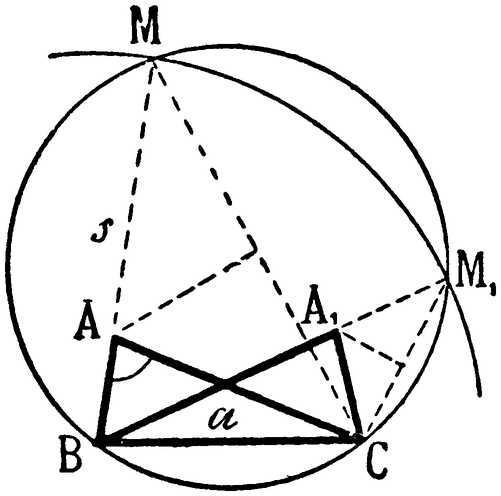
Let ABC be the required △. To take into account the given sum of the lateral sides, let us extend BA and lay off BM = s. Drawing MC, we obtain the auxiliary triangle BMC. If we construct this triangle, we shall then easily construct the triangle ABC as well. The construction of the triangle BMC reduces to finding the point M. Noticing that the triangle AMC is isosceles (AM = AC) and that, consequently, ∠M = A (since ∠M + ∠C = ∠A), we see that the point M must satisfy two conditions: 1) it is at the distance s from B, 2) from it the given finite straight line BC is seen at an angle equal to A. Discarding the second condition, we obtain an infinite number of points M, lying on the circle described from B with a radius equal to s. Discarding the first condition, we likewise obtain an infinite number of points M, lying on the arc of the segment constructed on BC and containing an angle equal to A. Thus the finding of the point M reduces to the construction of two loci, each of which we know how to construct. The problem will prove impossible if these loci have no common points; the problem will have one solution or two according as these loci touch or intersect (in our drawing the arc of the segment intersects the circle; in consequence two triangles are obtained, ABC and A1BC, which satisfy the conditions of the problem).
Sometimes a problem reduces not to the determination of a point but to finding a straight line that satisfies several conditions. If we discard one of them, we obtain an infinite number of straight lines; and it may happen that these straight lines determine a certain line (for example, they may all be tangents to a certain circle). Discarding another condition and taking into account the one that was dropped before, we again obtain an infinite number of straight lines, which will perhaps determine a certain other line. Having constructed these two lines, if that is possible, we shall then easily find the required straight line as well. Suppose, for example, that the following problem is proposed to us: to draw a secant to two given circles O and O1 in such a way that the parts of the secant contained within the circles are respectively equal to the given lengths a and a1. If we take only one condition, for example that the part of the secant lying inside the circle O is to be equal to a, we obtain an infinite number of secants, all of which must be equally distant from the centre of this circle (since equal chords are equally distant from the centre). Therefore, if we construct anywhere in the circle O a chord equal to a, and then, with a radius equal to the distance of this chord from the centre, describe a circle concentric with O, all the secants in question must touch this auxiliary circle; in the same way, taking into account only the second condition, we shall see that the required secant must touch a second auxiliary circle, concentric with O1. Hence the question is reduced to the construction of a common tangent to two circles.
Besides the loci that are pointed out in the text of this book (§§ 67, 112, 177, 228), it is useful to notice the following as well (we leave the proof to the students themselves):
1°. The locus of the points that divide in a given ratio the segments of parallel straight lines contained between the sides of a given angle is a straight line passing through the vertex of the angle and any one of these points.
2°. The locus of the points whose distances from the sides of a given angle are in a given ratio consists of two straight lines passing through the vertex of the angle, of which one lies inside the angle and the other outside it.
3°. The locus of the points that divide in a given ratio all the equal chords of a given circle is a circle concentric with the given one.
4°. The locus of the points from which the tangents drawn to a given circle have a given length is a circle concentric with the given one.
5°. The locus of the points the squares of whose distances from two given points A and B have a constant sum is a circle whose centre lies at the midpoint of the straight line AB (the proof rests on the theorem of § 239).
6°. The locus of the points the squares of whose distances from two given points A and B have a constant difference is a straight line perpendicular to the straight line AB.
7°. The locus of the points the sum of whose distances from the sides of a given angle is constant is the segment, lying inside the angle, of a straight line that cuts off an isosceles triangle from the angle. The extensions of this segment (in both directions) are the locus of the points the difference of whose distances from the sides of the angle is constant.
8°. The locus of the points that divide in a given ratio the chords drawn from one point A of a given circle is a circle tangent to the given one at the point A.
The last locus is a particular case of the following more general one (see §§ 211 to 218):
9°. If from a given point O (fig. 446) we draw to the various points A, A1, A11... of some figure F the straight lines OA, OA1, OA11... and on each of them lay off parts Oa, Oa1, Oa11... such that
Oa : OA = Oa1 : OA1 = Oa11 : OA11 = ...,
then the locus of the points a, a1, a11... is a figure f similar to the figure F and similarly placed with it with respect to the point O.
Thus, if the figure F is a straight line, f too is a straight line, parallel to F; if F is a polygon, f too is a polygon, similar to F and similarly placed with it; if F is a circle, f too is a circle.
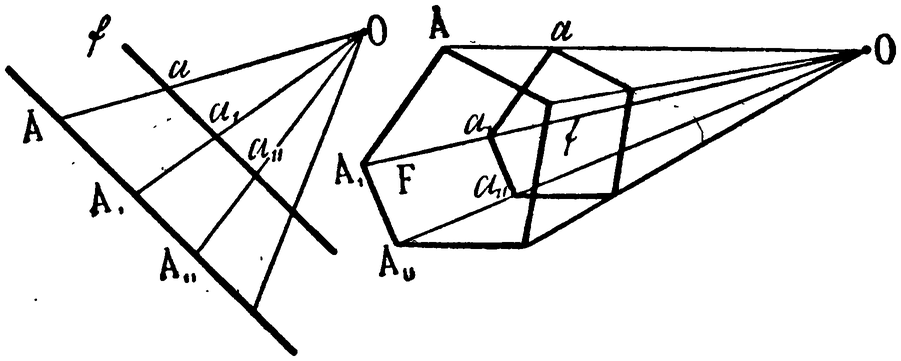
When the proportional parts Oa, Oa1, Oa11... are laid off on the extensions of the lines OA, OA1... (beyond the point O), a similar figure is again obtained, but one placed inversely with respect to the point O.
In these cases the point O is called the centre of similitude of the figures F and f, the points A and a, A1 and a1 and so on are called corresponding points, and the straight lines OA, OA1... are called rays of similitude.
2. The method of similitude. It consists in using some of the data of the problem to construct first a figure similar to the required one, and then passing to the latter. This method is especially convenient when only one given magnitude is a length and all the rest are either angles or ratios of lines; such, for example, are the problems:
To construct a triangle given an angle, a side and the ratio of the other two sides, or given two angles and the length of some straight line (an altitude, a median, a bisector and the like).
To construct a square given the sum or the difference of the diagonal and the side, and the like.
In these problems the position of the required figure remains arbitrary; but in many questions it is required to construct a figure whose position with respect to given points or lines is fully determined. It may then happen that, setting aside any one of the conditions of position and keeping all the others, we obtain an infinite number of figures similar to the required one. In such a case the method of similitude can be used with profit. Let us give an example.
Problem. To inscribe in a given angle ABC a circle that passes through a point M given inside the angle (fig. 447).
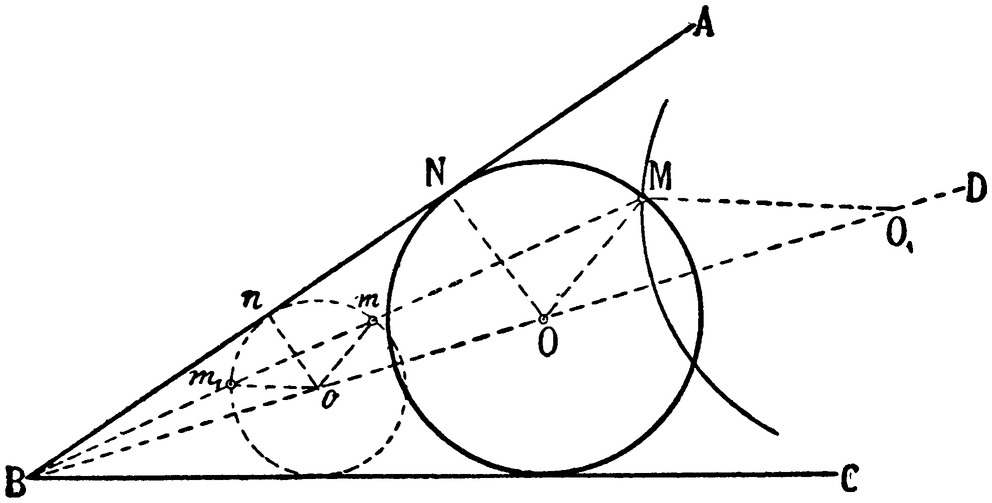
Let us discard for the time being the requirement that the circle pass through the point M. Then the question is satisfied by an infinite number of circles, whose centres lie on the bisector BD. Let us construct one of these circles, for example the one whose centre is o. Let us take on it the point m corresponding to the point M, that is, lying on the ray of similitude MB, and draw the radius mo. If we now construct MO ∥ mo, the point O will be the centre of the required circle. Indeed, drawing to the side AB the perpendiculars ON and on, we obtain the similar triangles MBO and mBo, NBO and nBo, from which we have:
MO : mo = BO : Bo
NO : no = BO : Bo
Whence: MO : mo = NO : no.
But mo = no; consequently MO = NO as well, that is, the circle described from the centre O with the radius OM touches the side AB; and since its centre lies on the bisector of the angle, it touches the side BC also.
If we take as the corresponding point the other point m1 in which the ray MB intersects the circle o, we shall find another centre O1 of the required circle. Consequently, the problem admits two solutions.
3. The method of parallel translation. It is very often useful to move some parts of the given or the required figure into another position, in which it is easier to discover the dependence between the given elements and the required ones. There are various ways of making such a displacement. Let us consider first parallel translation.
Problem. To construct a quadrilateral ABCD (fig. 448), knowing all its sides and the straight line EF that joins the midpoints of the opposite sides AB and CD.
To bring the given lines closer to one another, let us translate the sides AD and BC parallel to themselves into the positions ED1 and EC1. Then the straight line DD1 will be equal and parallel to AE, and the straight line CC1 equal and parallel to EB; but since AE = EB, we have DD1 = C1C and DD1 ∥ CC1.
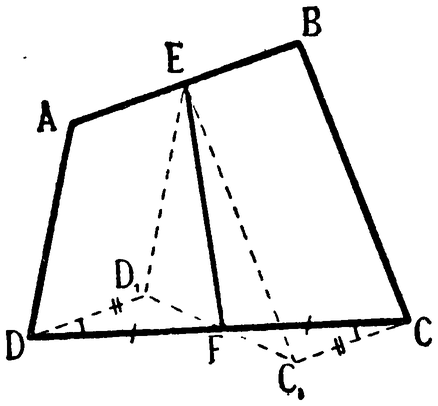
In consequence the triangles DD1F and CC1F will be equal (since in them DD1 = CC1, DF = CF and ∠D1DF = ∠FCC1); hence ∠D1FD = ∠CFC1, and therefore the line D1FC1 must be straight, that is, the figure ED1FC1 turns out to be a triangle. In this triangle two sides are known (ED1 = AD and EC1 = BC), and so is the median EF drawn to the third side. From these data it is easy to construct the triangle (if we extend the median EF beyond the point F by a length equal to itself and join the point obtained to D1 and C1, we obtain a parallelogram in which the sides and one diagonal are known).
Having found the △ ED1C1, we then construct the triangles D1DF and C1CF, and after that the whole quadrilateral ABCD.
Let us notice that it is sometimes useful to translate a whole figure, for example a circle, parallel to a given direction. In this case all the points of the figure that is moved describe parallel and equal straight lines (see, for example, exercise 383).
4. The method of rotation about a point. To make this particular kind of displacement clear, let us give the following example:
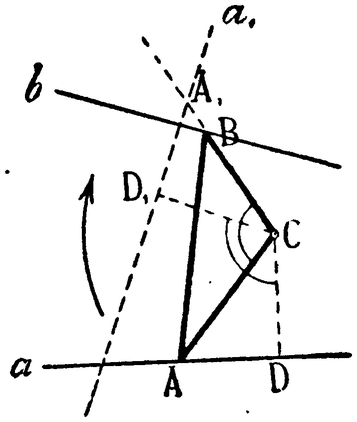
Problem. A point C (fig. 449) and two infinite straight lines a and b are given in position. To construct a triangle ABC one vertex of which is at C, while the other two lie on the lines a and b, and which, moreover, is similar to a given triangle (not placed in the drawing).
Suppose the problem solved. Noticing that the angles of the required triangle are given, let us denote one of them, the one at the point C, by ω. Let us rotate the whole figure about the point C, in the direction shown by the arrow, through the angle ω, and find the position that the line a will occupy after the rotation. For this it is enough to drop the perpendicular CD to the line a, then to rotate it through the angle ω into the position CD1 and to draw through D1 the straight line a1 perpendicular to CD1. The line a1 will be the position that the line a occupies after the rotation. Since in a rotation all the parts of a figure are rotated through one and the same angle, CA after the rotation will go along CB, and in consequence the point A will fall at A1, that is, at the point of intersection of CB with the line a1. Since the ratio of CA to CB or, what is the same thing, the ratio of CA1 to CB is given (let it be m : n), the question is now reduced to this: to draw through the point C a straight line CA1 that intersects the lines b and a1 at points B and satisfying the proportion:
CA1 : CB = m : n.
To draw such a line it is enough to divide CD1 at some point x in such a way that CD1 : Cx = m : n, and to draw through the point of division a straight line parallel to the line a1; the intersection of this line with the line b will determine the point B.
5. The method of rotation about a straight line (or the method of symmetry). Sometimes the way to a construction is easily discovered if we fold a part of the drawing about some straight line so that this part takes up the symmetric position on the other side of that line. Let us give an example.
Problem. To find on an infinite straight line AB (fig. 450) a point x such that the sum of its distances from the given points M and N is the least.
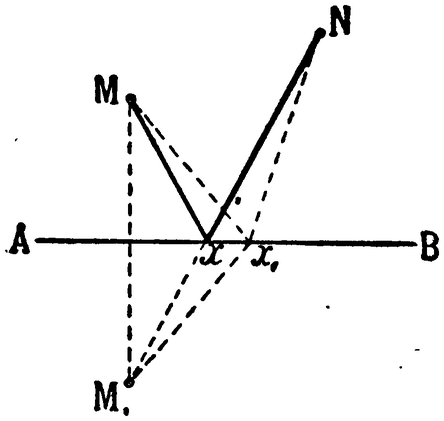
If, folding the drawing about AB, we bring the point M into the position M1 symmetric to it with respect to AB, the distance of the point M from any point whatever of the straight line AB will become equal to the distance of the point M1 from the same point of the straight line AB. Therefore the sums Mx + xN, Mx1 + x1N... are respectively equal to the sums M1x + xN, M1x1 + x1N...; but of the latter sums the least will be the one for which the line M1xN turns out to be straight. From this the way to the construction becomes clear.
The same construction solves another problem as well: to find on a straight line AB a point x such that the straight lines xM and xN, drawn from it to the given points M and N, make equal angles with AB.
6. The method of reversal. Sometimes it is useful to turn the problem round, so to speak, that is, to take the given conditions of the problem as the required ones and the other way about. The following problem serves as an example.
Problem. To inscribe in a given triangle ABC another triangle whose sides are parallel to the sides of another given triangle MNP.
Let us reverse the question: about the triangle MNP let us circumscribe another triangle A1B1C1 whose sides are parallel to the sides of the triangle ABC (which, of course, is easy to carry out). We shall then obtain a figure similar to the required one; dividing next any side of the triangle ABC into two parts proportional to the segments of the corresponding side of the triangle A1B1C1, we shall obtain one of the vertices of the required triangle.
7. The algebraic method. The essence of this method, and also examples of problems solved by it, were pointed out earlier (§§ 254, 255, 342, 343 and exercises 230, 231, 285, 288, 289, 290, 291, 292, 293).
Examples of Problems Solved by These Methods
1° The Method of Loci
367. Construct a quadrilateral ABCD about which a circle can be circumscribed, knowing its sides AB and BC, the diagonal AC and the angle between the diagonals.
368. Construct a triangle given the base, the angle at the vertex and the sum or the difference of the squares of the other two sides (for example, the base a, the angle at the vertex A and the sum of the squares of the lateral sides ).
369. About an equilateral triangle circumscribe a square in such a way that the two figures have a common vertex.
370. Find a point from which three segments AB, BC and CD of a given straight line are seen at equal angles.
371. Inside a triangle find a point whose distances from the sides of the triangle are to one another as 6 : 3 : 2.
372. Find a point from which three given circles are seen at equal angles (hint: first find the locus of the points from which two given circles are seen at equal angles).
373. A circle and any two straight lines are given. Find on the circle a point such that the sum of its distances from these lines is the least.
374. Transform a given triangle into another triangle equal to it in area, with a given base and a given angle at the vertex.
375. In a given circle draw two chords of given length in such a way that they intersect at a given angle and one of them passes through a given point.
2° The Method of Similitude
376. Construct a triangle given the angle at the vertex, the altitude and the ratio of the segments into which the base is divided by the altitude.
377. Inscribe a square: 1, in a given triangle; 2, in a given sector; 3, in a given segment.
378. Through a given point draw a straight line in such a way that three given straight lines issuing from one point cut off segments in a given ratio on the required line.
379. Through a given point A of a circle draw a chord AD that intersects a given chord BC at a point E such that the straight lines DE and DC are in a given ratio.
380. Inside a triangle draw a straight line parallel to the base in such a way that this line is the mean proportional between the segments of one lateral side.
381. Construct an isosceles triangle, knowing its lateral side and the sum of the altitude and the base.
382. On a given straight line find a point such that its distances from a given point and from another given straight line are in a given ratio.
3° The Method of Parallel Translation
383. Between two given circles draw a straight line of given length a parallel to a given straight line MN.
(Hint: bring one circle closer to the other by translating it parallel to the straight line MN through the distance a.)
384. In a circle two chords AB and CD are given. Find on the circle a point x such that the straight lines xA and xB cut off on the chord CD a segment equal to a given length (the method of parallel translation and that of loci).
385. In a given triangle ABC find points, x on the side AB and y on the side BC, such that the straight line xy is of given length and, moreover, the ratio Ax : Cy is a given one (parallel translation and the method of similitude).
386. Construct a trapezoid given one of its angles, the two diagonals and the midline.
387. Construct a quadrilateral given three sides a, b, c and the two angles α and β adjacent to the unknown side.
388. Draw to two given circles a common secant parallel to a given straight line, in such a way that the sum or the difference of the chords determined by the points of intersection is equal to a given length.
389. From a ship two lighthouses, whose positions on the chart are known, are seen at a given angle. When the ship has gone a known length in a given direction, the same lighthouses are seen at another given angle. Determine the place of the ship on the chart (a locus and parallel translation).
4° The Method of Rotation about a Point
390. Construct a triangle similar to a given triangle in such a way that one of its vertices lies at a given point A and the other two vertices are on the given circles O and O1 (one on O, the other on O1).
391. A circle is given, and outside it two points A and B; draw a tangent to the circle in such a way that the distances of the point A from this tangent and from the perpendicular dropped from B to the tangent are in a given ratio.
(Hint: rotate through 90° about the point A the right triangle whose hypotenuse is AB and one of whose legs is the distance of the point A from the perpendicular dropped to the tangent from the point B. The same problem can be solved by using the method of similitude and the method of loci together.)
392. Construct a triangle whose sides are proportional to the numbers 3, 4 and 5 and whose vertices lie on three given parallel straight lines.
5° The Method of Rotation about a Straight Line
393. Construct a quadrilateral ABCD from its four sides, knowing that its diagonal AC bisects the angle A.
394. A finite straight line AB is intersected at the point C by a straight line MN; find on MN a point from which the segments AC and BC are seen at equal angles (this problem can also be solved by the method of loci).
395. Construct a square two opposite vertices of which are on two given circles and the other two on a given straight line lying between the circles.
396. On a rectangular billiard table the positions of two balls A and B are given. In what direction must the ball A be struck so that, after being reflected in succession from all four cushions, it then hits the ball B?
397. An angle is given and a point inside it. Construct the triangle of least perimeter such that one of its vertices lies at the given point and the other two on the sides of the angle.
398. Solve by the method of symmetry the problem that was solved above (§ 2 of this Appendix) by the method of similitude: to inscribe in a given angle a circle that passes through a point given inside the angle.
6° The Method of Reversal
399. In a given sector inscribe a triangle equal to a given triangle.
400. Construct a triangle equal to a given triangle in such a way that its vertices lie on three given straight lines issuing from one point.
401. Construct a triangle similar to a given triangle in such a way that its vertices lie on three given concentric circles.
402. In a given triangle inscribe a triangle similar to another given triangle in such a way that one of its vertices lies at a point given on the base.