
The Title Page
THE
MATHEMATICAL
PRINCIPLES
OF
Natural Philosophy.
By Sir ISAAC NEWTON.
Translated into English by Andrew Motte.
To which are added,
The Laws of the MOON's Motion, according
to Gravity.
By John Machin Astron. Prof. Gresh. and
Secr. R. Soc.
In Two Volumes
LONDON:
Printed for Benjamin Motte, at the Middle-
Temple-Gate, in Fleetstreet.
MDCCXXIX.
The Dedication
TO Sir HANS SLOANE BARONET, PRESIDENT OF THE College of Physicians, AND OF THE ROYAL SOCIETY.
SIR,
THE generous zeal You always shew for whatever tends to the progress and advancement of Learning, both demands and receives the universal acknowledgments of all who profess or value its several branches.
They justly admire that amidst a close attendance on the cares of your Profession, in which You now fill the most honourable Seat, You are indefatigably promoting the improvement of natural knowledge, by carrying on some laudable designs of your own, by assisting and encouraging others, and by adding new stores to that immense treasure, already brought into your extensive collection, of whatever is rare and valuable in nature or art.
Your beneficent disposition to countenance and favour Science and Literature, has procured You the esteem of the Learned over all the World; and has induced a Body of Men, the most eminent for their skill and diligence in all useful enquiries, and in pursuing discoveries for the public good, to make choice of You, to supply the place of Him, whose Name will be an everlasting honour to our age and nation.
To whom therefore but to You should I offer to inscribe the translation of the most celebrated Work of your Illustrious Predecessor? which, on account of its incomparable Author, and from the dignity of the Subject, claims and deserves your acceptance, even tho' it pass'd thro' my hands: a less valuable Piece I should not have presumed to present You with. I am, with the greatest respect,
SIR,
Your most obedient, and
most humble Servant,
Andr. Motte
The Author's Preface
THE Author's Preface
SINCE the ancients (as we are told by Pappus) made great account of the science of mechanics in the investigation of natural things; and the moderns, laying aside substantial forms and occult qualities, have endeavoured to subject the phenomena of nature to the laws of mathematics; I have in this treatise cultivated Mathematics, so far as it regards Philosophy. The ancients considered Mechanics in a twofold respect; as rational, which proceeds accurately by demonstration, and practical. To practical Mechanics all the manual arts belong, from which Mechanics took its name. But as artificers do not work with perfect accuracy, it comes to pass that Mechanics is so distinguished from Geometry, that what is perfectly accurate is called Geometrical, what is less so is called Mechanical. But the errors are not in the art, but in the artificers. He that works with less accuracy, is an imperfect Mechanic, and if any could work with perfect accuracy, he would be the most perfect Mechanic of all. For the description of right lines and circles, upon which Geometry is founded, belongs to Mechanics. Geometry does not teach us to draw these lines, but requires them to be drawn. For it requires that the learner should first be taught to describe these accurately, before he enters upon Geometry; then it shews how by these operations problems may be solved. To describe right lines and circles are problems, but not geometrical problems. The solution of these problems is required from Mechanics; and by geometry the use of them, when so solved, is shewn. And it is the glory of Geometry that from those few principles, fetched from without, it is able to produce so many things. Therefore Geometry is founded in mechanical practice, and is nothing but that part of universal Mechanics which accurately proposes and demonstrates the art of measuring. But since the manual arts are chiefly conversant in the moving of bodies, it comes to pass that Geometry is commonly referred to their magnitudes, and Mechanics to their motion. In this sense Rational Mechanics will be the science of motions resulting from any forces whatsoever and of the forces required to produce any motions, accurately proposed and demonstrated. This part of Mechanics was cultivated by the ancients in the Five Powers which relate to manual arts, who considered gravity (it not being a manual power) no otherwise than as it moved weights by those powers. Our design not respecting arts but philosophy, and our subject, not manual but natural powers, we consider chiefly those things which relate to gravity, levity, elastic force, the resistance of fluids, and the like forces whether attractive or impulsive. And therefore we offer this work as mathematical principles of philosophy. For all the difficulty of philosophy seems to consist in this, from the phænomena of motions to investigate the forces of Nature, and then from these forces to demonstrate the other phænomena. And to this end the general propositions in the first and second book are directed. In the third book we give an example of this in the explication of the System of the World. For by the propositions mathematically demonstrated in the first books, we there derive from the celestial phænomena, the forces of Gravity with which bodies tend to the Sun and the several Planets. Then from these forces by other propositions which are also mathematical, we deduce the motions of the Planets, the Comets, the Moon, and the Sea. I wish we could derive the rest of the phænomena of Nature by the same kind of reasoning from mechanical principles. For I am induced by many reasons to suspect that they may all depend upon certain forces by which the particles of bodies, by some causes hitherto unknown, are either mutually impelled towards each other and cohere in regular figures, or are repelled and recede from each other; which forces being unknown, Philosophers have hitherto attempted the search of Nature in vain. But I hope the principles here laid down will afford some light either to that, or some truer, method of Philosophy.
In the publication of this Work, the most acute and universally learned Mr. Edmund Halley not only assisted me with his pains in correcting the press and taking care of the schemes, but it was to his solicitations that its becoming publick is owing. For when he had obtained of me my demonstrations of the figure of the celestial orbits, he continually pressed me to communicate the same to the Royal Society; who afterwards by their kind encouragement and entreaties, engaged me to think of publishing them. But after I had begun to consider the inequalities of the lunar motions, and had entered upon some other things relating to the laws and measures of gravity, and other forces; and the figures that would be described by bodies attracted according to given laws; and the motion of several bodies moving among themselves; the motion of bodies in resisting mediums; the forces, densities, and motions of mediums; the orbits of the Comets, and such like; I put off that publication till I had made a search into those matters, and could put out the whole together. What relates to the Lunar motions (being imperfect) I have put all together in the corollaries of prop. 66. to avoid being obliged to propose and distinctly demonstrate the several things there contained in a method more prolix than the subject deserved, and interrupt the series of the several propositions. Some things, found out after the rest, I chose to insert in places less suitable, rather than change the number of the propositions and the citations. I heartily beg that what I have here done may be read with candour, and that the defects I have been guilty of upon this difficult subject may be, not so much reprehended, as kindly supplied, and investigated by new endeavours of my readers.
Cambridge, Trin. Coll.
May 8. 1686.
Is. Newton.
In the second Edition the second Section of the first Book was enlarged. In the seventh Section of the second Book the theory of the resistances of fluids was more accurately investigated, and confirmed by new experiments. In the third Book, the Moon's Theory and the Præcession of the Æquinoxes were more fully deduced from their principles; and the theory of the Comets was confirmed by more examples of the calculation of their orbits, done also with greater accuracy.
In this third Edition, the resistance of mediums is somewhat more largely handled than before; and new experiments of the resistance of heavy bodies falling in air are added. In the third Book, the argument to prove that the Moon is retained in its orbit by the force of gravity is enlarged on. And there are added new observations of Mr. Pound's of the proportion of the diameters of Jupiter to each other: There are besides added Mr. Kirk's observations of the Comet in 1680. the orbit of that Comet computed in an ellipsis by Dr. Halley; and the orbit of the Comet in 1723. computed by Mr. Bradley.
The Preface of Mr. Roger Cotes
THE PREFACE OF Mr. Roger Cotes, To the Second Edition of this Work, so far as it relates to the Inventions and Discoveries herein contained.
THOSE who have treated of natural philosophy, may be nearly reduced to three classes. Of these some have attributed to the several species of things, specific and occult qualities; on which, in a manner unknown, they make the operations of the several bodies to depend. The sum of the doctrine of the Schools derived from Aristotle and the Peripatetics is herein contained. They affirm that the several effects of the bodies arise from the particular natures of those bodies. But whence it is that bodies derive those natures they don't tell us; and therefore they tell us nothing. And being entirely employed in giving names to things, and not in searching into things themselves, we may say that they have invented a philosophical way of speaking, but not that they have made known to us true philosophy.
Others therefore by laying aside that useless heap of words, thought to employ their pains to better purpose. These supposed all matter homogeneous, and that the variety of forms which is seen in bodies arises from some very plain and simple affections of the component particles. And by going on from simple things to those which are more compounded they certainly proceed right; if they attribute no other properties to those primary affections of the particles than Nature has done. But when they take a liberty of imagining at pleasure unknown figures and magnitudes, and uncertain situations and motions of the parts; and moreover of supposing occult fluids, freely pervading the pores of bodies, endued with an all-performing subtilty, and agitated with occult motions; they now run out into dreams and chimera's, and neglect the true constitution of things; which certainly is not to be expected from fallacious conjectures, when we can scarce reach it by the most certain observations. Those who fetch from hypotheses the foundation on which they build their speculations, may form indeed an ingenious romance, but a romance it will still be.
There is left then the third class, which profess experimental philosophy. These indeed derive the causes of all things from the most simple principles possible; but then they assume nothing as a principle, that is not proved by phænomena. They frame no hypotheses, nor receive them into philosophy otherwise than as questions whose truth may be disputed. They proceed therefore in a two-fold method, synthetical and analytical. From some select phænomena they deduce by analysis the forces of nature, and the more simple laws of forces; and from thence by synthesis shew the constitution of the rest. This is that incomparably best way of philosophizing, which our renowned author most justly embraced before the rest; and thought alone worthy to be cultivated and adorned by his excellent labours. Of this he has given us a most illustrious example by the explication of the System of the World, most happily deduced from the Theory of Gravity. That the virtue of gravity was found in all bodies, others suspected, or imagined before him; but he was the only and the first philosopher that could demonstrate it from appearances, and make it a solid foundation to the most noble speculations.
I know indeed that some persons and those of great name, too much prepossessed with certain prejudices, are unwilling to assent to this new principle, and are ready to prefer uncertain notions to certain. It is not my intention to detract from the reputation of these eminent men; I shall only lay before the reader such considerations as will enable him to pass an equitable sentence in this dispute.
Therefore that we may begin our reasoning from what is most simple and nearest to us; let us consider a little what is the nature of gravity with us on Earth, that we may proceed the more safely when we come to consider it in the heavenly bodies, that lie at so vast a distance from us. It is now agreed by all philosophers that all circumterrestrial bodies gravitate towards the Earth. That no bodies really light are to be found, is now confirmed by manifold experience. That which is relative levity, is not true levity, but apparent only; and arises from the preponderating gravity of the contiguous bodies.
Moreover, as all bodies gravitate towards the Earth, so does the Earth again towards bodies. That the action of gravity is mutual, and equal on both sides, is thus proved. Let the mass of the Earth be distinguished into any two parts whatever, either equal, or any how unequal; now if the weights of the parts towards each other were not mutually equal, the lesser weight would give way to the greater, and the two parts joined together would move on ad infinitum in a right line towards that part to which the greater weight tends; altogether against experience. Therefore we must say that the weights of the parts are constituted in equilibrio; that is, that the action of gravity is mutual and equal on both sides.
The weights of bodies, at equal distances from the centre of the Earth, are as the quantities of matter in the bodies. This is collected from the equal acceleration of all bodies that fall from a state of rest by the force of their weights; for the forces by which unequal bodies are equally accelerated must be proportional to the quantities of the matter to be moved. Now that all bodies are in falling equally accelerated appears from hence, that when the resistance of the air is taken away, as it is under an exhausted receiver, bodies falling describe equal spaces in equal times; and this is yet more accurately proved by the experiments of pendulums.
The attractive forces of bodies at equal distances, are as the quantities of matter in the bodies. For since bodies gravitate towards the Earth, and the Earth again towards bodies with equal moments; the weight of the Earth towards every body, or the force with which the body attracts the Earth, will be equal to the weight of the same body towards the Earth. But this weight was shewn to be as the quantity of matter in the body; and therefore the force with which every body attracts the Earth, or the absolute force of the body, will be as the same quantity of matter.
Therefore the attractive force of the entire bodies arises from, and is compounded of, the attractive forces of the parts, because as was just shewn, if the bulk of the matter be augmented or diminished, its virtue is proportionably augmented or diminished. We must therefore conclude that the action of the Earth is compounded of the united actions of its parts; and therefore that all terrestrial bodies must attract each other mutually, with absolute forces that are as the matter attracting. This is the nature of gravity upon Earth; let us now see what it is in the Heavens.
That every body perseveres in its state either of rest, or of moving uniformly in a right line, unless in so far as it is compelled to change that state by forces impressed, is a law of nature universally received by all philosophers. But from thence it follows that bodies which move in curve lines, and are therefore continually going off from the right lines that are tangents to their orbits, are by some continued force retained in those curvilinear paths. Since then the Planets move in curvilinear orbits there must be some force operating, by whose repeated actions they are perpetually made to deflect from the tangents.
Now it is collected by mathematical reasoning, and evidently demonstrated, that all bodies that move in any curve line described in a plane, and which, by a radius drawn to any point, whether quiescent, or any how moved, describe areas about that point proportional to the times, are urged by forces directed towards that point. This must therefore be granted. Since then all astronomers agree that the primary Planets describe about the Sun, and the secondary about the primary, areas proportional to the times; it follows that the forces by which they are perpetually turned aside from the rectilinear tangents, and made to revolve in curvilinear orbits, are directed towards the bodies that are situate in the centres of the orbits. This force may therefore not improperly be called centripetal in respect of the revolving body, and in respect of the central body attractive; whatever cause it may be imagined to arise from.
But besides, these things must be also granted, as being mathematically demonstrated: If several bodies revolve with an equable motion in concentric circles, and the squares of the periodic times are as the cubes of the distances from the common centre; the centripetal forces will be reciprocally as the squares of the distances. Or, if bodies revolve in orbits that are very near to circles, and the apsides of the orbits rest; the centripetal forces of the revolving bodies will be reciprocally as the squares of distances. That both these cases hold in all the Planets all astronomers consent. Therefore the centripetal forces of all the Planets are reciprocally as the squares of the distances from the centres of their orbits. If any should object, that the apsides of the Planets, and especially of the Moon, are not perfectly at rest; but are carried with a slow kind of motion in consequentia; one may give this answer, that though we should grant this very slow motion to arise from hence, that the proportion of the centripetal force is a little different from the duplicate, yet that we are able to compute mathematically the quantity of that aberration, and find it perfectly insensible. For the ratio of the Lunar centripetal force it self, which must be the most irregular of them all, will be indeed a little greater than the duplicate, but will be near sixty times nearer to that than it is to the triplicate. But we may give a truer answer, by saying that this progression of the apsides arises not from an aberration from the duplicate proportion, but from a quite different cause, as is most admirably shewn in this philosophy. It is certain then that the centripetal forces with which the primary Planets tend to the Sun, and the secondary to their primary, are accurately as the squares of the distances reciprocally.
From what has been hitherto said, it is plain that the Planets are retained in their orbits by some force perpetually acting upon them; it is plain that that force is always directed towards the centres of their orbits; it is plain that its efficacy is augmented with the nearness to the centre, and diminished with the same; and that it is augmented in the same proportion with which the square of the distance is diminished, and diminished in the same proportion with which the square of the distance is augmented. Let us now see whether, by making a comparison between the centripetal forces of the Planets, and the force of gravity, we may not by chance find them to be of the same kind. Now they will be of the same kind if we find on both sides the same laws, and the same affections. Let us then first consider the centripetal force of the Moon which is nearest to us.
The rectilinear spaces, which bodies let fall from rest describe in a given time at the very beginning of the motion, when the bodies are urged by any forces whatsoever, are proportional to the forces. This appears from mathematical reasoning. Therefore the centripetal force of the Moon revolving in its orbit is to the force of gravity at the surface of the Earth, as the space, which in a very small particle of time the Moon, deprived of all its circular force and descending by its centripetal force towards the Earth, would describe, is to the space which a heavy body would describe, when falling by the force of its gravity near to the Earth, in the same given particle of time. The first of these spaces is equal to the versed sine of the arc described by the Moon in the same time, because that versed sine measures the translation of the Moon from the tangent, produced by the centripetal force; and therefore may be computed, if the periodic time of the Moon and its distance from the centre of the Earth are given. The last space is found by experiments of pendulums, as Mr. Huygens has shewn. Therefore by making a calculation we shall find that the first space is to the latter, or the centripetal force of the Moon revolving in its orbit will be to the force of gravity at the superficies of the Earth, as the square of the semi-diameter of the Earth to the square of the semi-diameter of the orbit. But by what was shewn before the very same ratio holds between the centripetal force of the Moon revolving in its orbit, and the centripetal force of the Moon near the surface of the Earth. Therefore the centripetal force near the surface of the Earth is equal to the force of gravity. Therefore these are not two different forces, but one and the same; for if they were different, these forces united would cause bodies to descend to the Earth with twice the velocity they would fall with by the force of gravity alone. Therefore it is plain that the centripetal force, by which the Moon is perpetually, either impelled or attracted out of the tangent and retained in its orbit, is the very force of terrestrial gravity reaching up to the Moon. And it is very reasonable to believe that virtue should extend it self to vast distances, since upon the tops of the highest mountains we find no sensible diminution of it. Therefore the Moon gravitates towards the Earth; but on the other hand, the Earth by a mutual action equally gravitates towards the Moon; which is also abundantly confirmed in this philosophy, where the Tides in the Sea and the Præcession of the Æquinoxes are treated of; which arise from the action both of the Moon and of the Sun upon the Earth. Hence lastly, we discover by what law the force of gravity decreases at great distances from the Earth. For since gravity is no ways different from the Moon's centripetal force, and this is reciprocally proportional to the square of the distance; it follows that it is in that ratio that the force of gravity decreases.
Let us now go on to the rest of the Planets. Because the revolutions of the primary Planets about the Sun, and of the secondary about Jupiter and Saturn, are phænomena of the same kind with the revolution of the Moon about the Earth; and because it has been moreover demonstrated that the centripetal forces of the primary Planets are directed towards the centre of the Sun, and those of the secondary towards the centres of Jupiter and Saturn, in the same manner as the centripetal force of the Moon is directed towards the centre of the Earth; and since besides, all these forces are reciprocally as the squares of the distances from the centres, in the same manner as the centripetal force of the Moon is as the square of the distance from the Earth; we must of course conclude, that the nature of all is the same. Therefore as the Moon gravitates towards the Earth, and the Earth again towards the Moon; so also all the secondary Planets will gravitate towards their primary, and the primary Planets again towards their secondary; and so all the primary towards the Sun; and the Sun again towards the primary.
Therefore the Sun gravitates towards all the Planets, and all the Planets towards the Sun. For the secondary Planets, while they accompany the primary, revolve the mean while with the primary about the Sun. Therefore by the same argument, the Planets of both kinds gravitate towards the Sun, and the Sun towards them. That the secondary Planets gravitate towards the Sun is moreover abundantly clear from the inequalities of the Moon; a most accurate theory of which laid open with a most admirable sagacity, we find explained in the third book of this work.
That the attractive virtue of the Sun is propagated on all sides to prodigious distances, and is diffused to every part of the wide space that surrounds it, is most evidently shewn by the motion of the Comets; which coming from places immensely distant from the Sun, approach very near to it; and sometimes so near, that in their perihelia they almost touch its body. The theory of these bodies was altogether unknown to astronomers, till in our own times our excellent author most happily discovered it, and demonstrated the truth of it by most certain observations. So that it is now apparent that the Comets move in conic sections having their foci in the Sun's centre, and by radij drawn to the Sun describe areas proportional to the times. But from these phænomena it is manifest, and mathematically demonstrated, that those forces, by which the Comets are retained in their orbits, respect the Sun, and are reciprocally proportional to the squares of the distances from its centre. Therefore the Comets gravitate towards the Sun; and therefore the attractive force of the Sun not only acts on the bodies of the Planets, placed at given distances and very nearly in the same plane, but reaches also to the Comets in the most different parts of the heavens, and at the most different distances. This therefore is the nature of gravitating bodies, to propagate their force at all distances to all other gravitating bodies. But from thence it follows that all the Planets and Comets attract each other mutually, and gravitate mutually towards each other; which is also confirmed by the perturbation of Jupiter and Saturn, observed by astronomers, which is caused by the mutual actions of these two Planets upon each other; as also from that very slow motion of the apsides, above taken notice of, and which arises from a like cause.
We have now proceeded so far as to shew that it must be acknowledged, that the Sun, and the Earth, and all the heavenly bodies attending the Sun, attract each other mutually. Therefore all the least particles of matter in every one must have their several attractive forces, whose effect is as their quantity of matter; as was shewn above of the terrestrial particles. At different distances these forces will be also in the duplicate ratio of the distances reciprocally; for it is mathematically demonstrated that particles attracting according to this law will compose globes attracting according to the same law.
The foregoing conclusions are grounded on this axiom, which is received by all philosophers; namely that effects of the same kind; that is, whose known properties are the same, take their rise from the same causes and have the same unknown properties also. For who doubts, if gravity be the cause of the descent of a stone in Europe, but that it is also the cause of the same descent in America? If there is a mutual gravitation between a stone and the Earth in Europe, who will deny the same to be mutual in America? If in Europe, the attractive force of a stone and the Earth is compounded of the attractive forces of the parts; who will deny the like composition in America? If in Europe, the attraction of the Earth be propagated to all kinds of bodies and to all distances; why may it not as well be propagated in like manner in America? All philosophy is founded on this rule; for if that be taken away we can affirm nothing of universals. The constitution of particular things is known by observations and experiments; and when that is done, it is by this rule that we judge universally of the nature of such things in general.
Since then all bodies, whether upon Earth or in the Heavens, are heavy, so far as we can make any experiments or observations concerning them; we must certainly allow that gravity is found in all bodies universally. And in like manner as we ought not to suppose that any bodies can be otherwise than extended, moveable or impenetrable; so we ought not to conceive that any bodies can be otherwise than heavy. The extension, mobility and impenetrability of bodies become known to us only by experiments; and in the very same manner their gravity becomes known to us. All bodies we can make any observations upon, are extended, moveable and impenetrable; and thence we conclude all bodies, and those we have no observations concerning, to be extended and moveable and impenetrable. So all bodies we can make observations on, we find to be heavy; and thence we conclude all bodies, and those we have no observations of, to be heavy also. If any one should say that the bodies of the fixed Stars are not heavy because their gravity is not yet observed; they may say for the same reason that they are neither extended, nor moveable nor impenetrable, because these affections of the fixed Stars are not yet observed. In short, either gravity must have a place among the primary qualities of all bodies, or extension, mobility and impenetrability must not. And if the nature of things is not rightly explained by the gravity of bodies, it will not be rightly explained by their extension, mobility and impenetrability.
Some I know disapprove this conclusion, and mutter something about occult qualities. They continually are cavilling with us, that gravity is an occult property; and occult causes are to be quite banished from philosophy. But to this the answer is easy; that those are indeed occult causes whose existence is occult; and imagined but not proved; but not those whose real existence is clearly demonstrated by observations. Therefore gravity can by no means be called an occult cause of the celestial motions; because it is plain from the phenomena that such a virtue does really exist. Those rather have recourse to occult causes; who set imaginary vortices, of a matter entirely fictitious, and imperceptible by our senses, to direct those motions.
But shall gravity be therefore called an occult cause, and thrown out of philosophy, because the cause of gravity is occult and not yet discovered? Those who affirm this, should be careful not to fall into an absurdity that may overturn the foundations of all philosophy. For causes use to proceed in a continued chain from those that are more compounded to those that are more simple; when we are arrived at the most simple cause we can go no farther. Therefore no mechanical account or explanation of the most simple cause is to be expected or given; for if it could be given, the cause were not the most simple. These most simple causes will you then call occult, and reject them? Then you must reject those that immediately depend upon them, and those which depend upon these last, till philosophy is quite cleared and disencumbred of all causes.
Some there are who say that gravity is præternatural, and call it a perpetual miracle. Therefore they would have it rejected, because præternatural causes have no place in physics. It is hardly worth while to spend time in answering this ridiculous objection which overturns all philosophy. For either they will deny gravity to be in bodies; which cannot be said; or else, they will therefore call it præternatural because it is not produced by the other affections of bodies, and therefore not by mechanical causes. But certainly there are primary affections of bodies; and these, because they are primary, have no dependance on the others. Let them consider whether all these are not in like manner præternatural, and in like manner to be rejected; and then what kind of philosophy we are like to have.
Some there are who dislike this celestial physics because it contradicts the opinions of Des Cartes, and seems hardly to be reconciled with them. Let these enjoy their own opinion; but let them act fairly; and not deny the same liberty to us which they demand for themselves. Since the Newtonian Philosophy appears true to us, let us have the liberty to embrace and retain it, and to follow causes proved by phænomena, rather than causes only imagined, and not yet proved. The business of true philosophy is to derive the natures of things from causes truly existent; and to enquire after those laws on which the Great Creator actually chose to found this most beautiful Frame of the World; not those by which he might have done the same, had he so pleased. It is reasonable enough to suppose that from several causes, somewhat differing from each other, the same effect may arise; but the true cause will be that, from which it truly and actually does arise; the others have no place in true philosophy. The same motion of the hour-hand in a clock may be occasioned either by a weight hung, or a spring shut up within. But if a certain clock should be really moved with a weight; we should laugh at a man that would suppose it moved by a spring, and from that principle, suddenly taken up without farther examination, should go about to explain the motion of the index; for certainly the way he ought to have taken should have been, actually to look into the inward parts of the machine, that he might, find the true principle of the proposed motion. The like judgment ought to be made of those philosophers, who will have the heavens to be filled with a most subtile matter, which is perpetually carried round in vortices. For if they could explain the phænomena ever so accurately by their hypotheses, we could not yet say that they have discovered true philosophy and the true causes of the celestial motions, unless they cou'd either demonstrate that those causes do actually exist, or at least, that no others do exist. Therefore if it be made clear that the attraction of all bodies is a property actually existing in rerum naturâ; and if it be also shewn how the motions of the celestial bodies may be solved by that property; it would be very impertinent for any one to object, that these motions ought to be accounted for by vortices; even though we should never so much allow such an explication of those motions to be possible. But we allow no such thing; for the phænomena can by no means be accounted for by vortices; as our Author has abundantly proved from the clearest reasons. So that Men must be strangely fond of chimera's, who can spend their time so idly, as in patching up a ridiculous figment and setting it off with new comments of their own.
If the bodies of the Planets and Comets are carried round the Sun in vortices; the bodies so carried, and the parts of the vortices next surrounding them, must be carried with the same velocity and the same direction, and have the same density, and the same vis inertia answering to the bulk of the matter. But it is certain, the Planets and Comets, when in the very same parts of the Heavens, are carried with various velocities and various directions. Therefore it necessarily follows that those parts of the celestial fluid, which are at the same distances from the Sun, must revolve at the same time with different velocities in different directions; for one kind of velocity and direction is required for the motion of the Planets, and another for that of the Comets. But since this cannot be accounted for; we must either say that all the celestial bodies are not carried about by vortices; or else that their motions are derived, not from one and the same vortex, but from several distinct ones, which fill and pervade the spaces round about the Sun.
But if several vortices are contained in the same space, and are supposed to penetrate each other, and to revolve with different motions; then because these motions must agree with those of the bodies carried about by them, which are perfectly regular, and performed in conic sections which are sometimes very eccentric, and sometimes nearly circles; one may very reasonably ask, how it comes to pass that these vortices remain entire, and have suffered no manner of perturbation in so many ages from the actions of the conflicting matter. Certainly if these fictitious motions are more compounded and more hard to be accounted for than the true motions of the Planets and Comets, it seems to no purpose to admit them into philosophy; since every cause ought to be more simple than its effects. Allowing men to indulge their own fancies, suppose any man should affirm that the Planets and Comets are surrounded with atmospheres like our Earth; which hypothesis seems more reasonable than that of vortices. Let him then affirm that these atmospheres by their own nature move about the Sun and describe conic sections, which motion is much more easily conceived than that of the vortices penetrating each other. Lastly, that the Planets and Comets are carried about the Sun by these atmospheres of theirs; and then applaud his own sagacity in discovering the causes of the celestial motions. He that rejects this fable must also reject the other; for two drops of water are not more like than this hypothesis of atmospheres, and that of vortices.
Galileo has shewn, that when a stone projected moves in a parabola, its deflexion into that curve from its rectilinear path is occasioned by the gravity of the stone towards the Earth, that is, by an occult quality. But now some body, more cunning than he, may come to explain the cause after this manner. He will suppose a certain subtile matter, not discernable by our sight, our touch or any other of our senses, which fills the spaces which are near and contiguous to the superficies of the Earth; and that this matter is carried with different directions, and various, and often contrary, motions, describing parabolic curves. Then see how easily he may account for the deflexion of the stone above spoken of. The stone, says he, floats in this subtile fluid, and following its motion, can't chuse but describe the same figure. But the fluid moves in parabolic curves; and therefore the stone must move in a parabola of course. Would not the acuteness of this philosopher be thought very extraordinary, who could deduce the appearances of nature from mechanical causes, matter and motion, so clearly that the meanest man may understand it? Or indeed should not we smile to see this new Galileo taking so much mathematical pains to introduce occult qualities into philosophy, from whence they have been so happily excluded? But I am ashamed to dwell so long upon trifles.
The sum of the matter is this; the number of the Comets is certainly very great; their motions are perfectly regular; and observe the same laws with those of the Planets. The orbits in which they move are conic sections, and those very eccentric. They move every way towards all parts of the Heavens, and pass through the planetary regions with all possible freedom, and their motion is often contrary to the order of the signs. These phænomena are most evidently confirmed by astronomical observations, and cannot be accounted for by vortices. Nay indeed they are utterly irreconcileable with the vortices of the Planets. There can be no room for the motions of the Comets; unless the celestial spaces be entirely cleared of that fictitious matter.
For if the Planets are carried about the Sun in vortices; the parts of the vortices which immediately surround every Planet must be of the same density with the Planet, as was shewn above. Therefore all the matter contiguous to the perimeter of the magnus orbis, must be of the same density as the Earth. But now that which lies between the magnus orbis and the orb of Saturn must have either an equal or greater density. For to make the constitution of the vortex permanent, the parts of less density must lie near the centre, and those of greater density must go farther from it. For since the periodic times of the Planets are in the sesquiplicate ratio of their distances from the Sun, the periods of the parts of the vortices must also preserve the same ratio. Thence it will follow that the centrifugal forces of the parts of the vortex must be reciprocally as the squares of their distances. Those parts therefore which are more remote from the centre endeavour to recede from it with less force; whence if their density be deficient, they must yield to the greater force with which the parts that lie nearer the centre endeavour to ascend. Therefore the denser parts will ascend; and those of less density will descend; and there will be a mutual change of places, till all the fluid matter in the whole vortex be so adjusted and disposed, that being reduced to an equilibrium its parts become quiescent. If two fluids of different density be contained in the same vessel; it will certainly come to pass that the fluid of greater density will sink the lowest; and by a like reasoning it follows that the denser parts of the vortex by their greater centrifugal force will ascend to the highest places. Therefore all that far greater part of the vortex which lies without the Earth's orb, will have a density, and by consequence a vis inertia answering to the bulk of the matter, which cannot be less than the density and vis inertia of the Earth. But from hence will arise a mighty resistance to the passage of the Comets, and such as can't but be very sensible; not to say, enough to put a stop to, and absorb, their motions entirely. But now it appears from the perfectly regular motion of the Comets, that they suffer no resistance that is in the least sensible; and therefore that they meet with no matter of any kind, that has any resisting force, or, by consequence, any density or vis inertia. For the resistance of mediums arises, either from the inertia of the matter of the fluid, or from its want of lubricity. That which arises from the want of lubricity is very small, and is scarce observable in the fluids commonly known, unless they be very tenacious like oil and honey. The resistance we find in air, water, quick-silver and the like fluids that are not tenacious, is almost all of the first kind; and cannot be diminished by a greater degree of subtilty, if the density and vis inertia, to which this resistance is proportional, remains; as is most evidently demonstrated by our Author in his noble theory of resistances in the second book.
Bodies in going on through a fluid communicate their motion to the ambient fluid by little and little, and by that communication lose their own motion, and by losing it are retarded. Therefore the retardation is proportional to the motion communicated; and the communicated motion, when the velocity of the moving body is given, is as the density of the fluid; and therefore the retardation or resistance will be as the same density of the fluid; nor can it be taken away, unless the fluid coming about to the hinder parts of the body restore the motion lost. Now this cannot be done unless the impression of the fluid on the hinder parts of the body be equal to the impression of the fore parts of the body on the fluid, that is unless the relative velocity with which the fluid pushes the body behind is equal to the velocity with which the body pushes the fluid; that is, unless the absolute velocity of the recurring fluid be twice as great as the absolute velocity with which the fluid is driven forwards by the body; which is impossible. Therefore the resistance of fluids arising from their vis inertia can by no means be taken away. So that we must conclude that the celestial fluid has no vis inertia, because it has no resisting force; that it has no force to communicate motion with, because it has no vis inertia; that it has no force to produce any change in one or more bodies, because it has no force wherewith to communicate motion; that it has no manner of efficacy, because it has no faculty wherewith to produce any change of any kind. Therefore certainly this hypothesis may be justly called ridiculous, and unworthy a philosopher; since it is altogether without foundation, and does not in the least serve to explain the nature of things. Those who would have the Heavens filled with a fluid matter, but suppose it void of any vis inertia; do indeed in words deny a vacuum, but allow it in fact. For, since a fluid matter of that kind can no ways be distinguished from empty space; the dispute is now about the names, and not the natures of things. If any are so fond of matter, that they will by no means admit of a space void of body; let us consider, where they must come at last.
For either they will say, that this constitution of a world every where full, was made so by the will of God to this end, that the operations of Nature might be assisted every where by a subtile æther pervading and filling all things; which cannot be said however, since we have shewn from the phænomena of the Comets, that this æther is of no efficacy at all; or they will say, that it became so by the same will of God for some unknown end; which ought not to be said, because for the same reason a different constitution may be as well supposed; or lastly, they will not say that it was caused by the will of God, but by some necessity of its nature. Therefore they will at last sink into the mire of that infamous herd; who dream that all things are governed by Fate, and not by Providence; and that matter exists by the necessity of its nature always and every where, being infinite and eternal. But supposing these things; it must be also every where uniform; for variety of forms is entirely inconsistent with necessity. It must be also unmoved; for if it be necessarily moved in any determinate direction, with any determinate velocity, it will by a like necessity be moved in a different direction with a different velocity; but it can never move in different directions with different velocities; therefore it must be unmoved. Without all doubt this World, so diversified with that variety of forms and motions we find in it, could arise from nothing but the perfectly free will of God directing and presiding over all.
From this fountain it is that those laws, which we call the laws of Nature, have flowed; in which there appear many traces indeed of the most wise contrivance, but not the least shadow of necessity. These therefore we must not seek from uncertain conjectures; but learn them from observations and experiments. He who thinks to find the true principles of physics and the laws of natural things by the force alone of his own mind, and the internal light of his reason; must either suppose that the World exists by necessity, and by the same necessity follows the laws proposed; or if the order of Nature was established by the will of God, that himself, a miserable reptile, can tell what was fittest to be done. All found and true philosophy is founded on the appearances of things; which if they draw us never so much against our wills, to such principles as most clearly manifest to us the most excellent counsel and supreme dominion of the All-wise and Almighty Being; those principles are not therefore to be laid aside, because some men may perhaps dislike them. They may call them, if they please, miracles or occult qualities; but names maliciously given ought not to be a disadvantage to the things themselves; unless they will say at last, that all philosophy ought to be founded in atheism. Philosophy must not be corrupted in complaisance to these men; for the order of things will not be changed.
Fair and equal judges will therefore give sentence in favour of this most excellent method of philosophy, which is founded on experiments and observations. To this method it is hardly to be said or imagined, what light, what splendor, hath accrued from this admirable work of our illustrious author; whose happy and sublime genius, revolving the most difficult problems, and reaching to discoveries of which the mind of man was thought incapable before, is deservedly admired by all those who are somewhat more than superficially versed in these matters. The gates are now set open; and by his means we may freely enter into the knowledge of the hidden secrets and wonders of natural things. He has so clearly laid open and set before our eyes the most beautiful frame of the System of the World; that if King Alphonsus were now alive, he would not complain for want of the graces either of simplicity or of harmony in it. Therefore we may now more nearly behold the beauties of Nature, and entertain our selves with the delightful contemplation; and, which is the best and most valuable fruit of philosophy, be thence incited the more profoundly to reverence and adore the great Maker and Lord of all. He must be blind who from the most wise and excellent contrivances of things cannot see the infinite Wisdom and Goodness of their Almighty Creator, and he must be mad and senseless who refuses to acknowledge them.
Definitions and Axioms
Definitions
THE Mathematical PRINCIPLES OF Natural Philosophy.
Definitions
Def. I
1The Quantity of Matter is the measure of the same, arising from its density and bulk conjunctly.
THUS AIR of a double density, in a double space, is quadruple in quantity; in a triple space, sextuple in quantity. The same thing is to be understood of snow, and fine dust or powders, that are condensed by compression or liquefaction; and of all bodies that are by any causes 2whatever differently condensed. I have no regard in this place to a medium, if any such there is, that freely pervades the interstices between the parts of bodies. It is this quantity that I mean hereafter everywhere under the name of Body or Mass. And the same is known by the weight of each body: For it is proportional to the weight, as I have found by experiments on pendulums, very accurately made, which shall be shewn hereafter.
Definition II
The Quantity of Motion is the measure of the same, arising from the velocity and quantity of matter conjunctly.
The motion of the whole is the Sum of the motions of all the parts; and therefore in a body double in quantity, with equal velocity, the motion is double; with twice the velocity, it is quadruple.
Definition III
The Vis Insita, or Innate Force of Matter, is a power of resisting, by which every body, as much as in it lies, endeavours to persevere in its present state, whether it be of rest, or of moving uniformly forward in a right line.
This force is ever proportional to the body whose force it is; and differs nothing from the inactivity of the Mass, but in our manner of conceiving it. A body, from the inactivity of matter, is not without 3difficulty put out of its state of rest or motion. Upon which account, this Vis insita, may, by a most significant name, be called Vis Inertiæ, or Force of Inactivity. But a body exerts this force only, when another force, impress'd upon it, endeavours to change its condition; and the exercise of this force may be considered both as resistance and impulse: It is resistance in so far as the body, for maintaining its present state withstands the force impressed; it is impulse, in so far as the body, by not easily giving way to the impress'd force of another, endeavours to change the state of that other. Resistance is usually ascrib'd to bodies at rest, and impulse to those in motion: But motion and rest, as commonly conceived, are only relatively distinguished; nor are those bodies always truly at rest, which commonly are taken to be so.
Definition IV
An impress'd force is an action exerted upon a body, in order to change its state, either of rest, or of moving uniformly forward in a right line.
This force consists in the action only; and remains no longer in the body, when the action is over. For a body maintains every new state it acquires, by its Vis Inertiæ only. Impress'd forces are of different origines; as from percussion, from pressure, from centripetal force.
Definition V
4A Centripetal force is that by which bodies are drawn or impell'd, or any way tend, towards a point as to a centre.
Of this sort is Gravity by which bodies tend to the centre of the Earth; Magnetism, by which iron tends to the loadstone; and that force, whatever it is, by which the Planets are perpetually drawn aside from the rectilinear motions, which otherwise they wou'd pursue, and made to revolve in curvilinear orbits. A stone, whirled about in a sling, endeavours to recede from the hand that turns it; and by that endeavour, distends the sling, and that with so much the greater force, as it is revolv'd with the greater velocity, and as soon as ever it is let go, flies away. That force which opposes it self to this endeavour, and by which the sling perpetually draws back the stone towards the hand, and retains it in its orbit, because 'tis directed to the hand as the centre of the orbit, I call the Centripetal force. And the same thing is to be understood of all bodies, revolv'd in any orbits. They all endeavour to recede from the centres of their orbits; and were it not for the opposition of a contrary force which restrains them to, and detains them in their orbits, which I therefore call Centripetal, would fly off in right lines, with an uniform motion. A projectile, if it was not for the force of gravity, would not deviate towards the Earth, but would go off from it in a right line and that with an uniform motion, if the resistance of the air was taken away. 'Tis by its gravity that it is drawn aside perpetually from its rectilinear course, and made to deviate towards the Earth, more or less, according 5to the force of its gravity, and the velocity of its motion. The less its gravity is, for the quantity of its matter, or the greater the velocity with which it is projected, the less will it deviate from a rectilinear course, and the farther it will go. If a leaden ball projected from the top of a mountain by the force of gun-powder, with a given velocity, and in a direction parallel to the horizon, is carried in a curve line to the distance of two miles before it falls to the ground; the same, if the resistance of the Air was took away, with a double or decuple velocity, would fly twice or ten times as far. And by increasing the velocity, we may at pleasure increase the distance to which it might be projected, and diminish the curvature of the line, which it might describe, till at last it should fall at the distance of 10, 30, or 90 degrees, or even might go quite round the whole Earth before it falls; or lastly, so that it might never fall to the Earth, but go forwards into the Celestial Spaces, and proceed in its motion in infinitum. And after the same manner, that a projectile, by the force of gravity, may be made to revolve in an orbit, and go round the whole Earth, the Moon also, either by the force of gravity, if it is endued with gravity, or by any other force, that impells it towards the Earth, may be perpetually drawn aside towards the Earth, out of the rectilinear way, which by its innate force it would pursue; and be made to revolve in the orbit which it now describes: nor could the Moon without some such force, be retain'd in its orbit. If this force was too smal', it would not sufficiently turn the Moon out of a rectilinear course: if it was too great, it would turn it too much, and draw down the Moon from its orbit towards the Earth. It is necessary, that the force be of a just quantity, and it belongs to the Mathematicians to find the force, 6that may serve exactly to retain a body in a given orbit with a given velocity; and vice versa, to determine the curvilinear way into which a body projected from a given place, with a given velocity, may be made to deviate from its natural rectilinear way, by means of a given force.
The quantity of any Centripetal Force may be considered as of three kinds, Absolute, Accelerative, and Motive.
Definition VI
The absolute quantity of a centripetal force is the measure of the same, proportional to the efficacy of the cause that propagates it from the centre, through the spaces round about.
Thus the magnetic force is greater in one load-stone and less in another, according to their sizes and strength.
Definition VII
The accelerative quantity of a centripetal force is the measure of the same, proportional to the velocity which it generates in a given time.
Thus the force of the same load-stone is greater at a less distance, and less at a greater: also the force of gravity is greater in valleys, less on tops of exceeding high mountains; and yet less (as shall hereafter be shewn) at greater distances from the body of the 7Earth; but at equal distances, it is the same every where; because (taking away, or allowing for, the resistance of the Air), it equally accelerates all falling bodies, whether heavy or light, great or small.
Definition VIII
The motive quantity of a centripetal force, is the measure of the same, proportional to the motion which it generates in a given time.
Thus the Weight is greater in a greater body, less in a less body; it is greater near to the Earth, and less at remoter distances. This sort of quantity is the centripetency, or propension of the whole body towards the centre, or as I may say, its Weight; and it is ever known by the quantity of a force equal and contrary to it, that is just sufficient to hinder the descent of the body.
These quantities of Forces, we may for brevity's sake, call by the names of Motive, Accelerative and Absolute forces; and for distinction sake consider them, with respect to the Bodies that tend to the centre; to the Places of those bodies; and to the Centre of force towards which they tend: That is to say, I refer the Motive force to the Body, as an endeavour and propensity of the whole towards a centre, arising from the propensities of the several parts taken together; the Accelerative force to the Place of the body, as a certain power or energy diffused from the centre to all places around to move the bodies that are in them; and the Absolute force to the Centre, as indued with some cause, without which those motive forces would not be propagated through the spaces round about; whether that cause is some central body, (such as is the Load-stone, in 8the centre of the force of Magnetism, or the Earth in the centre of the gravitating force) or any thing else that does not yet appear. For I here design only to give a Mathematical notion of those forces, without considering their Physical causes and seats.
Wherefore the Accelerative force will stand in the same relation to the Motive, as celerity does to motion. For the quantity of motion arises from the celerity, drawn into the quantity of matter; and the motive force arises from the accelerative force drawn into the same quantity of matter. For the sum of the actions of the Accelerative force, upon the several particles of the body, is the Motive force of the whole. Hence it is, that near the surface of the Earth, where the accelerative gravity, or force productive of gravity in all bodies is the same, the motive gravity or the Weight is as the Body: but if we should ascend to higher regions, where the accelerative gravity is less, the Weight would be likewise diminished, and would always be as the product of the Body, by the Accelerative gravity. So in those regions, where the accelerative gravity is diminished into one half, the Weight of a body two or three times less, will be four or six times less.
I likewise call Attractions and Impulses, in the same sense, Accelerative, and Motive; and use the words Attraction, Impulse or Propensity of any sort towards a centre, promiscuously, and indifferently, one for another; considering those forces not Physically but Mathematically: Wherefore, the reader is not to imagine, that by those words, I any where take upon me to define the kind, or the manner of any Action, the causes or the physical reason thereof, or that I attribute Forces, in a true and Physical sense, to certain centres (which are only Mathematical points); when 9at any time I happen to speak of centres as attracting, or as endued with attractive powers.
Scholium
Hitherto I have laid down the definitions of such words as are less known, and explained the sense in which I would have them to be understood in the following discourse. I do not define Time, Space, Place and Motion, as being well known to all. Only I must observe, that the vulgar conceive those quantities under no other notions but from the relation they bear to sensible objects. And thence arise certain prejudices, for the removing of which, it will be convenient to distinguish them into Absolute and Relative, True and Apparent, Mathematical and Common.
I. Absolute, True, and Mathematical Time, of it self, and from its own nature, flows equably without regard to any thing external, and by another name is called Duration: Relative, Apparent, and Common Time is some sensible and external (whether accurate or unequable) measure of Duration by the means of motion, which is commonly used instead of True time; such as an Hour, a Day, a Month, a Year.
II Absolute Space, in its own nature, without regard to any thing external, remains always similar and immoveable. Relative Space is some moveable dimension or measure of the absolute spaces; which our senses determine, by its position to bodies; and which is vulgarly taken for immoveable space; Such is the dimension of a subterraneous, an aereal, or celestial space, determin'd by its position in respect of the Earth. Absolute and Relative space, are the same in figure and magnitude; but they do not remain always numerically the same. For if the Earth, for instance, moves; 10a space of our Air, which relatively and in respect of the Earth, remains always the same, will at one time be one part of the absolute space into which the Air passes; at another time it will be another part of the same, and so, absolutely understood, it will be perpetually mutable.
III. Place is a part of space which a body takes up, and, is according to the space, either absolute or relative. I say, a Part of Space; not the situation, nor the external surface of the body. For the places of equal Solids, are always equal; but their superficies, by reason of their dissimilar figures, are often unequal. Positions properly have no quantity, nor are they so much the places themselves, as the properties of places. The motion of the whole is the same thing with the sum of the motions of the parts, that is, the translation of the whole, out of its place, is the same thing with the sum of the translations of the parts out of their places; and therefore the Place of the whole, is the same thing with the Sum of the places of the parts, and for that reason, it is internal, and in the whole body.
IV. Absolute motion, is the translation of a body from one absolute place into another; and Relative motion, the translation from one relative place into another. Thus in a Ship under sail, the relative place of a body is that part of the Ship, which the Body possesses; or that part of its cavity which the body fills, and which therefore moves together with the Ship: And Relative rest, is the continuance of the Body in the same part of the Ship, or of its cavity. But Real, absolute rest, is the continuance of the Body in the same part of that Immoveable space, in which the Ship it self, its cavity, and all that it contains, is moved. Wherefore, if the Earth is really at rest, the Body 11which relatively rests in the Ship, will really and absolutely move with the same velocity which the Ship has on the Earth. But if the Earth also moves, the true and absolute motion of the body will arise, partly from the true motion of the Earth, in immoveable space; partly from the relative motion of the Ship on the Earth: and if the body moves also relatively in the Ship; its true motion will arise, partly from the true motion of the Earth, in immoveable space, and partly from the relative motions as well of the Ship on the Earth, as of the Body in the Ship; and from these relative motions, will arise the relative motion of the Body on the Earth. As if that part of the Earth where the Ship is, was truly mov'd toward the East, with a velocity of 10010 parts; while the Ship it self with a fresh gale, and full sails, is carry'd towards the West, with a velocity express'd by 10 of those parts; but a Sailor walks in the Ship towards the East, with 1 part of the said velocity: then the Sailor will be moved truly and absolutely in immoveable space towards the East with a velocity of 10001 parts, and relatively on the Earth towards the West, with a velocity of 9 of those parts.
Absolute time, in Astronomy, is distinguish'd from Relative, by the Equation or correction of the vulgar time. For the natural days are truly unequal, though they are commonly consider'd as equal, and used for a measure of time: Astronomers correct this inequality for their more accurate deducing of the celestial motions. It may be, that there is no such thing as an equable motion, whereby time may be accurately measured. All motions may be accelerated and retarded, but the True, or equable progress, of Absolute time is liable to no change. The duration or perseverance of the existence of things remains the same, whether the motions 12are swift or slow, or none at all: and therefore it ought to be distinguish'd from what are only sensible measures thereof; and out of which we collect it, by means of the Astronomical equation. The necessity of which Equation, for determining the Times of a phænomenon, is evinc'd as well from the experiments of the pendulum clock, as by eclipses of the Satellites of Jupiter.
As the order of the parts of Time is immutable, so also is the order of the parts of Space. Suppose those parts to be mov'd out of their places, and they will be moved (if the expression may be allowed) out of themselves. For times and spaces are, as it were, the Places as well of themselves as of all other things. All things are placed in Time as to order of Succession; and in Space as to order of Situation. It is from their essence or nature that they are Places; and that the primary places of things should be moveable, is absurd. These are therefore the absolute places; and translations out of those places, are the only Absolute Motions.
But because the parts of Space cannot be seen, or distinguished from one another by our Senses, therefore in their stead we use sensible measures of them. For from the positions and distances of things from any body consider'd as immoveable, we define all places: and then with respect to such places, we estimate all motions, considering bodies as transfer'd from some of those places into others. And so instead of absolute places and motions, we use relative ones; and that without any inconvenience in common affairs: but in Philosophical disquisitions, we ought to abstract from our senses, and consider things themselves, distinct from what are only sensible measures of them. For it may be that there is no body really at rest, to which the places and motions of others may be referr'd.
13But we may distinguish Rest and Motion, absolute and relative, one from the other by their Properties, Causes and Effects. It is a property of Rest, that bodies really at rest do rest in respect of one another. And therefore as it is possible, that in the remote regions of the fixed Stars, or perhaps far beyond them, there may be some body absolutely at rest; but impossible to know from the position of bodies to one another in our regions, whether any of these do keep the same position to that remote body; it follows that absolute rest cannot be determined from the position of bodies in our regions.
It is a property of motion, that the parts, which retain given positions to their wholes, do partake of the motions of those wholes. For all the parts of revolving bodies endeavour to recede from the axe of motion; and the impetus of bodies moving forwards, arises from the joint impetus of all the parts. Therefore, if surrounding bodies are mov'd, those that are relatively at rest within them, will partake of their motion. Upon which account, the true and absolute motion of a body cannot be determin'd by the translation of it from those which only seem to rest: For the external bodies ought not only to appear at rest, but to be really at rest. For otherwise, all included bodies, beside their translation from near the surrounding ones, partake likewise of their true motions; and tho' that translation was not made they would not be really at rest, but only seem to be so. For the surrounding bodies stand in the like relation to the surrounded, as the exteriour part of a whole does to the interior, or as the shell does to the kernel; but, if the shell moves, the kernel will also move, as being part of the whole, without any removal from near the shell.
14A property near a kin to the preceding, is this, that if a place is mov'd, whatever is placed therein moves along with it; and therefore a body, which is mov'd from a place in motion, partakes also of the motion of its place. Upon which account all motions from places in motion, are no other than parts of entire and absolute motions; and every entire motion is composed out of the motion of the body out of its first place, and the motion of this place out of its place, and so on; until we come to some immoveable place, as in the before mention'd example of the Sailor. Wherefore entire and absolute motions can be no otherwise determin'd than by immoveable places; and for that reason I did before refer those absolute motions to immoveable places, but relative ones to moveable places. Now no other places are immoveable, but those that, from infinity to infinity, do all retain the same given positions one to another; and upon this account, must ever remain unmov'd; and do thereby constitute, what I call, immoveable space.
The Causes by which true and relative motions are distinguished, one from the other, are the forces impress'd upon bodies to generate motion. True motion is neither generated nor alter'd, but by some force impress'd upon the body moved: but relative motion may be generated or alter'd without any force impress'd upon the body. For it is sufficient only to impress some force on other bodies with which the former is compar'd, that by their giving way, that relation may be chang'd, in which the relative rest or motion of this other body did consist. Again, True motion suffers always some change from any force impress'd upon the moving body; but Relative motion does not necessarily undergo any change, by such forces. For if the same forces are likewise impress'd on those other 15bodies, with which the comparison is made, that the relative position may be preserved, then that condition will be preserv'd, in which the relative motion consists. And therefore, any relative motion may be changed, when the true motion remains unalter'd, and the relative may be preserv'd, when the true suffers some change. Upon which accounts, true motion does by no means consist in such relations.
The Effects which distinguish absolute from relative motion are, the forces of receding from the axe of circular motion. For there are no such forces in circular motion purely relative, but in a true and absolute circular motion, they are greater or less, according to the quantity of the motion. If a vessel, hung by a long cord, is so often turned about that the cord is strongly twisted, then fill'd with water, and held at rest together with the water; after by the sudden action of another force, it is whirl'd about the contrary way, and while the cord is untwisting it self, the vessel continues for some time in this motion; the surface of the water will at first be plain, as before the vessel began to move: but the vessel, by gradually communicating its motion to the water, will make it begin sensibly to revolve, and recede by little and little from the middle, and ascend to the sides of the vessel, forming it self into a concave figure, (as I have experienced) and the swifter the motion becomes, the higher will the water rise, till at last, performing its revolutions in the same times with the vessel, it becomes relatively at rest in it. This ascent of the water shews its endeavour to recede from the axe of its motion; and the true and absolute circular motion of the water, which is here directly contrary to the relative, discovers it self, and may be measured by this endeavour. At first, when the relative motion of the water in the vessel was 16greatest it produc'd no endeavour to recede from the axe: the water shew'd no tendency to the circumference, nor any ascent towards the sides of the vessel, but remain'd of a plain surface, and therefore its True circular motion had not yet begun. But afterwards, when the relative motion of the water had decreas'd, the ascent thereof towards the sides of the vessel, prov'd its endeavour to recede from the axe; and this endeavour shew'd the real circular motion of the water perpetually increasing, till it had acquir'd its greatest quantity, when the water rested relatively in the vessel. And therefore this endeavour does not depend upon any translation of the water in respect of the ambient bodies, nor can true circular motion be defin'd by such translations. There is only one real circular motion of any one revolving body, corresponding to only one power of endeavouring to recede from its axe of motion, as its proper and adequate effect: but relative motions in one and the same body are innumerable, according to the various relations it bears to external bodies, and like other relations, are altogether destitute of any real effect, any otherwise than they may perhaps participate of that one only true motion. And therefore in their system who suppose that our heavens, revolving below the sphere of the fixt Stars, carry the Planets along with them; the several parts of those heavens, and the Planets, which are indeed relatively at rest in their heavens, do yet really move. For they change their position one to another (which never happens to bodies truly at rest) and being carried together with their heavens, participate of their motions, and as parts of revolving wholes, endeavour to recede from the axe of their motions.
Wherefore relative quantities, are not the quantities themselves, whose names they bear, but those sensible 17measures of them (either accurate or inaccurate) which are commonly used instead of the measur'd quantities themselves. And if the meaning of words is to be determin'd by their use; then by the names Time, Space, Place and Motion, their measures are properly to be understood; and the expression will be unusual, and purely Mathematical, if the measured quantities themselves are meant. Upon which account, they do strain the Sacred Writings, who there interpret those words for the measur'd quantities. Nor do those less defile the purity of Mathematical and Philosophical truths, who confound real quantities themselves with their relations and vulgar measures.
It is indeed a matter of great difficulty to discover, and effectually to distinguish, the True motions of particular bodies from the Apparent: because the parts of that immoveable space in which those motions are perform'd, do by no means come under the observation of our senses. Yet the thing is not altogether desperate; for we have some arguments to guide us, partly from the apparent motions, which are the differences of the true motions; partly from the forces, which are the causes and effects of the true motions. For instance, if two globes kept at a given distance one from the other, by means of a cord that connects them, were revolv'd about their common centre of gravity; we might, from the tension of the cord, discover the endeavour of the globes to recede from the axe of their motion, and from thence we might compute the quantity of their circular motions. And then if any equal forces should be impress'd at once on the alternate faces of the globes to augment or diminish their circular motions; from the encrease or decrease of the tension of the cord, we might infer the increment or decrement of their motions; and thence would be found, on what faces 18those forces ought to be impress'd, that the motions of the globes might be most augmented, that is, we might discover their hindermost faces, or those which, in the circular motion, do follow. But the faces which follow being known, and consequently, the opposite ones that precede, we should likewise know the determination of their motions. And thus we might find both the quantity and the determination of this circular motion, ev'n in an immense vacuum, where there was nothing external or sensible with which the globes could be compar'd. But now if in that space some remote bodies were plac'd that kept always a given position one to another, as the Fixt Stars do in our regions; we cou'd not indeed determine from the relative translation of the globes among those bodies, whether the motion did belong to the globes or to the bodies. But if we observ'd the cord, and found that its tension was that very tension which the motions of the globes requir'd, we might conclude the motion to be in the globes, and the bodies to be at rest; and then, lastly, from the translation of the globes among the bodies, we should find the determination of their motions. But how we are to collect the true motions from their causes, effects, and apparent differences; and vice versa, how from the motions, either true or apparent, we may come to the knowledge of their causes and effects, shall be explain'd more at large in the following Tract. For to this end it was that I compos'd it.
Axioms, or Laws of Motion
Axioms or Laws of Motion.
Law I
19Every body perseveres in its state of rest, or of uniform motion in a right line, unless it is compelled to change that state by forces impress'd thereon.
PROJECTILES persevere in their motions, so far as they are not retarded by the resistance of the air, or impell'd downwards by the force of gravity. A top, whose parts by their cohesion are perpetually drawn aside from rectilinear motions, does not cease its rotation, otherwise than as it is retarded by the air. The greater bodies of the Planets and Comets, meeting with less resistance in more free spaces, preserve their motions both progressive and circular for a much longer time.
Law II
The alteration of motion is ever proportional to the motive force impress'd; and is made in the direction of the right line in which that force is impress'd.
If any force generates a motion, a double force will generate double the motion, a triple force triple the motion, whether that force be impress'd altogether and 20at once, or gradually and successively. And this motion (being always directed the same way with the generating force) if the body moved before, is added to or subducted from the former motion, according as they directly conspire with or are directly contrary to each other; or obliquely joyned, when they are oblique, so as to produce a new motion compounded from the determination of both.
Law III
To every Action there is always opposed an equal Reaction: or the mutual actions of two bodies upon each other are always equal, and directed to contrary parts.
Whatever draws or presses another is as much drawn or pressed by that other. If you press a stone with your finger, the finger is also pressed by the stone. If a horse draws a stone tyed to a rope, the horse (if I may so say) will be equally drawn back towards the stone: For the distended rope, by the same endeavour to relax or unbend it self, will draw the horse as much towards the stone as it does the stone towards the horse, and will obstruct the progress of the one as much as it advances that of the other. If a body impinge upon another, and by its force change the motion of the other; that body also (because of the equality of the mutual pressure) will undergo an equal change, in its own motion, towards the contrary part. The changes made by these actions are equal, not in the velocities, but in the motions of bodies; that is to say, if the bodies are not hinder'd by any other impediments. For, because the motions 21are equally changed, the changes of the velocities made towards contrary parts, are reciprocally proportional to the bodies. This Law takes place also in Attractions, as will be proved in the next Scholium.
Corollary I
A body by two forces conjoined will describe the diagonal of a parallelogram, in the same time that it would describe the sides, by those forces apart. (Pl. 1. Fig. 1.)
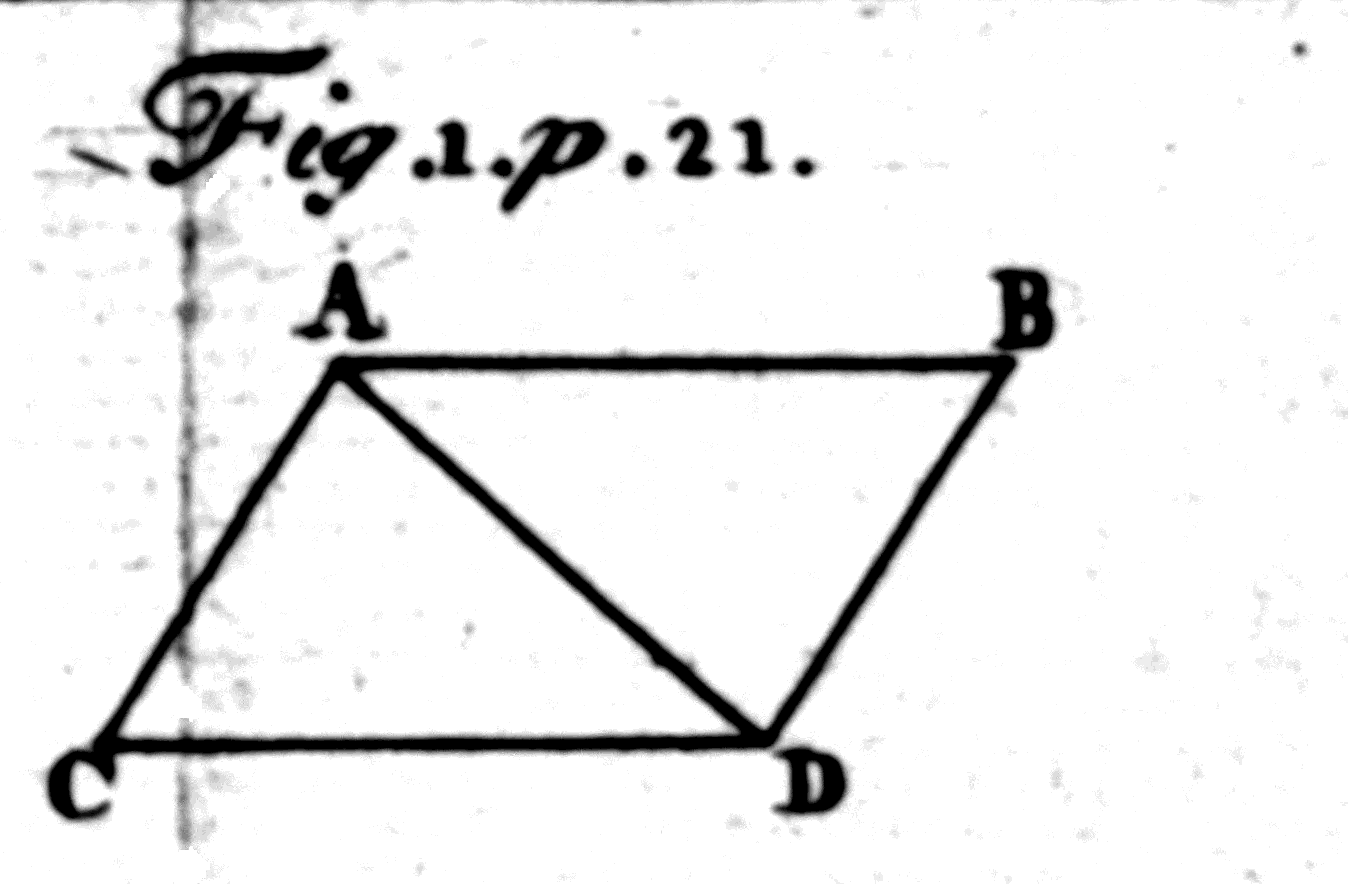
If a body in a given time, by the force M impress'd apart in the place A, should with an uniform motion be carried from A to B; and by the force N impress'd apart in the same place, should be carried from A to C: compleat the parallelogram ABCD, and, by both forces acting together, it will in the same time be carried in the diagonal from A to D. For since the force N acts in the direction of the line AC, parallel to BD, this force (by the second law) will not at all alter the velocity generated by the other force M, by which the body is carried towards the line BD. The body therefore will arrive at the line BD in the same time, whether the force N be impress'd or not; and therefore at the end of that time, it will be found somewhere in the line BD. By the same argument, at the end of the same time it will be found somewhere in the line CD. Therefore it will be found in the point D, where both lines meet. But it will move in a right line from A to D, by Law I.
Corollary II
22And hence is explained the composition of any one direct force AD, out of any two oblique forces AB and BD; and, on the contrary the resolution of any one direct force AD into two oblique forces AB and BD: which composition and resolution are abundantly confirmed from Mechanics. (Fig. 2.)
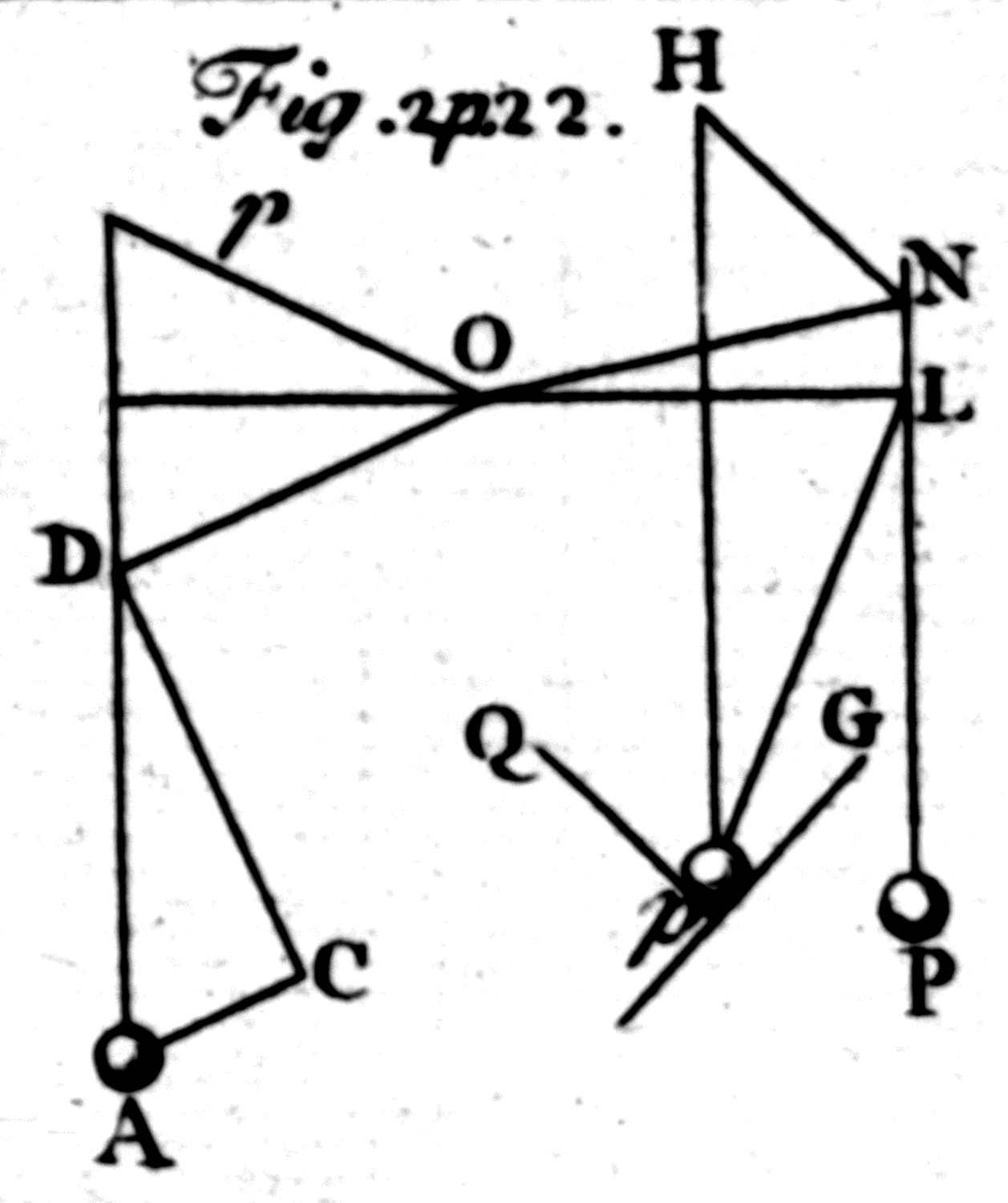
As if the unequal Radii OM and ON drawn from the centre O of any wheel, should sustain the weights A and P by the cords MA and NP; and the forces of those weights to move the wheel were required. Through the centre O draw the right line KOL, meeting the cords perpendicularly in K and L; and from the centre O, with OL the greater of the distances OK and OL, describe a circle, meeting the cord MA in D: and drawing OD, make AC parallel and DC perpendicular thereto. Now, it being indifferent whether the points K, L, D, of the cords be fixed to the plane of the wheel or not, the weights will have the same effect whether they are suspended from the points K and L, or from D and L. Let the whole force of the weight A be represented by the Line AD, and let it be resolved into the forces AC and CD; of which the force AC, drawing the radius OD directly from the centre, will have no effect to move the wheel: but the other force DC, drawing the radius DO perpendicularly, will have the same effect as if it drew perpendicularly the radius OL equal to OD; that is, it will have the 23same effect as the weight P, if that weight is to the weight A, as the force DC is to the force DA; that is (because of the similar triangles ADC, DOK,) as OK to OD or OL. Therefore the weights A and P, which are reciprocally as the radii OK and OL that lye in the same right line, will be equipollent, and so remain in equilibrio: which is the well known property of the Ballance, the Lever, and the Wheel. If either weight is greater than in this ratio, its force to move the wheel will be so much greater.
If the weight p, equal to the weight P, is partly suspended by the cord Np, partly sustained by the oblique plane pG; draw pH, NH, the former perpendicular to the horizon, the latter to the plane pG; and if the force of the weight p tending downwards is represented by the line pH, it may be resolved into the forces pN, HN. If there was any plane perpendicular to the cord pN, cutting the other plane pG in a line parallel to the horizon, and the weight p was supported only by those planes pQ, pG, it would press those planes perpendicularly with the forces pN, HN; to wit, the plane pQ with the force pN, and the plane pG with the force HN. And therefore if the plane pQ was taken away, so that the weight might stretch the cord, because the cord, now sustaining the weight, supplies the place of the plane that was removed, it will be strained by the same force pN which press'd upon the plane before. Therefore the tension of this oblique cord pN will be to that of the other perpendicular cord PN as pN to pH. And therefore if the weight p is to the weight A in a ratio compounded of the reciprocal ratio of the least distances of the cords PN, AM, from the centre of the wheel, 24and of the direct ratio of pH to pN, the weights will have the same effect towards moving the wheel and will therefore sustain each other, as any one may find by experiment.
But the weight p pressing upon those two oblique planes, may be consider'd as a wedge between the two internal surfaces of a body split by it; and hence the forces of the Wedge and the Mallet may be determin'd; for because the force with which the weight p presses the plane pQ, is to the force with which the same, whether by its own gravity, or by the blow of a mallet, is impelled in the direction of the line pH towards both the planes, as pN to pH; and to the force with which it presses the other plane pG, as pN to NH. And thus the force of the Screw may be deduced from a like resolution of forces; it being no other than a Wedge impelled with the force of a Lever. Therefore the use of this Corollary spreads far and wide, and by that diffusive extent the truth thereof is farther confirmed. For on what has been said depends the whole doctrine of Mechanics variously demonstrated by different authors. For from hence are easily deduced the forces of Machines, which are compounded of Wheels, Pulleys, Leavers, Cords and Weights, ascending directly or obliquely, and other Mechanical Powers; as also the force of the Tendons to move the Bones of Animals.
Corollary III
25The Quantity of motion, which is collected by taking the sum of the motions directed towards the same parts, and the difference of those that are directed to contrary parts, suffers no change from the action of bodies among themselves.
For Action and its opposite Re-action are equal, by Law 3, and therefore, by Law 2, they produce in the motions equal changes towards opposite parts. Therefore if the motions are directed towards the same parts, whatever is added to the motion of the preceding body will be subducted from the motion of that which follows; so that the sum will be the same as before. If the bodies meet, with contrary motions, there will be an equal deduction from the motions of both; and therefore the difference of the motions directed towards opposite parts will remain the same.
Thus if a spherical body A with two parts of velocity is triple of a spherical body B which follows in the same right line with ten parts of velocity; the motion of A will be to that of B, as 6 to 10. Suppose then their motions to be of 6 parts and of 10 parts, and the sum will be 16 parts. Therefore, upon the meeting of the bodies, if A acquire 3, 4 or 5 parts of motion, B will lose as many; and therefore after reflexion A will proceed with 9, 10 or 11 parts, and B with 7, 6 or 5 parts; the sum remaining always of 16 parts as before. If the body A acquire 9, 10, 11 or 12 parts of motion, and therefore after meeting proceed with 15, 16, 17 or 18 parts; the body 26B, losing so many parts as A has got, will either proceed with one part, having lost 9, or stop and remain at rest, as having lost its whole progressive motion of 10 parts: or it will go back with one part, having not only lost its whole motion, but (if I may so say) one part more; or it will go back with 2 parts, because a progressive motion of 12 parts is took off. And so the Sums of the conspiring motions , or , and the Differences of the contrary motions and , will always be equal to 16 parts, as they were before the meeting and reflexion of the bodies. But, the motions being known with which the bodies proceed after reflexion, the velocity of either will be also known, by taking the velocity after to the velocity before reflexion, as the motion after is to the motion before. As in the last case, where the motion of the body A was of 6 parts before reflexion and of 18 parts after, and the velocity was of 2 parts before reflexion, the velocity thereof after reflexion will be found to be of 6 parts; by saying, as the 6 parts of motion, before to 18 parts after, so are 2 parts of velocity before reflexion to 6 parts after.
But if the bodies are either not spherical, or, moving in different right lines, impinge obliquely one upon the other, and their motions after reflexion are required: in those cases we are first to determine the position of the plane that touches the concurring bodies in the point of concourse; then the motion of each body (by Corol. 2) is to be resolved into two, one perpendicular to that plane, and the other parallel to it. This done, because the bodies act upon each other in the direction of a line perpendicular to this plane, the parallel motions are to be retained the same after reflexion as before; and to the perpendicular motions we are to assign equal changes towards the contrary parts; in 27such manner that the sum of the conspiring, and the difference of the contrary motions, may remain the same as before. From such kind of reflexions also sometimes arise the circular motions of bodies about their own centres. But these are cases which I don't consider in what follows; and it would be too tedious to demonstrate every particular that relates to this subject.
Corollary IV
The common centre of gravity of two or more bodies, does not alter its state of motion or rest by the actions of the bodies among themselves; and therefore the common centre of gravity of all bodies acting upon each other (excluding outward actions and impediments) is either at rest, or moves uniformly in a right line.
For if two points proceed with an uniform motion in right lines, and their distance be divided in a given ratio, the dividing point will be either at rest, or proceed uniformly in a right line. This is demonstrated hereafter in Lem. 23. and its Corol. when the points are moved in the same plane; and by a like way of arguing, it may be demonstrated when the points are not moved in the same plane. Therefore if any number of bodies move uniformly in right lines, the common centre of gravity of any two of them is either at rest, or proceeds uniformly in a right line; because the line which connects the centres of those two bodies so moving is divided at that common centre in a given ratio. In like manner the common centre of those 28two and that of a third body will be either at rest or moving uniformly in a right line; because at that centre, the distance between the common centre of the two bodies, and the centre of this last, is divided in a given ratio. In like manner the common centre of these three, and of a fourth body, is either at rest, or moves uniformly in a right line; because the distance between the common centre of the three bodies, and the centre of the fourth is there also divided in a given ratio, and so on in infinitum. Therefore in a system of bodies where there is neither any mutual action among themselves, nor any foreign force impress'd upon them from without, and which consequently move uniformly in right lines, the common centre of gravity of them all is either at rest or moves uniformly forwards in a right line.
Moreover, in a system of two bodies mutually acting upon each other, since the distances between their centres and the common centre of gravity of both, are reciprocally as the bodies; the relative motions of those bodies, whether of approaching to or of receding from that centre, will be equal among themselves. Therefore since the changes which happen to motions are equal and directed to contrary parts, the common centre of those bodies, by their mutual action between themselves, is neither promoted nor retarded, nor suffers any change as to its state of motion or rest. But in a system of several bodies, because the common centre of gravity of any two acting mutually upon each other suffers no change in its state by that action; and much less the common centre of gravity of the others with which that action does not intervene; but the distance between those two centres is divided by the common centre of gravity of all the bodies into parts reciprocally proportional to the total sums of those bodies 29whose centres they are; and therefore while those two centres retain their state of motion or rest, the common centre of all does also retain its state: It is manifest, that the common centre of all never suffers any change in the state of its motion or rest from the actions of any two bodies between themselves. But in such a system all the actions of the bodies among themselves, either happen between two bodies, or are composed of actions interchanged between some two bodies; and therefore they do never produce any alteration in the common centre of all as to its state of motion or rest. Wherefore since that centre when the bodies do not act mutually one upon another, either is at rest or moves uniformly forward in some right line; it will, notwithstanding the mutual actions of the bodies among themselves, always persevere in its state, either of rest, or of proceeding uniformly in a right line, unless it is forc'd out of this state by the action of some power impress'd from without upon the whole system. And therefore the same law takes place in a system, consisting of many bodies, as in one single body, with regard to their persevering in their state of motion or of rest. For the progressive motion whether of one single body or of a whole system of bodies, is always to be estimated, from the motion of the centre of gravity.
Corollary V
30The motions of bodies included in a given space are the same among themselves, whether that space is at rest, or moves uniformly forwards in a right line without any circular motion.
For the differences of the motions tending towards the same parts, and the sums of those that tend towards contrary parts, are, at first (by supposition), in both cases the same; and it is from those sums and differences that the collisions and impulses do arise with which the bodies mutually impinge one upon another. Wherefore (by Law 2.) the effects of those collisions will be equal in both cases; and therefore the mutual motions of the bodies among themselves in the one case will remain equal to the mutual motions of the bodies among themselves in the other. A clear proof of which we have from the experiment of a ship: where all motions happen after the same manner, whether the ship is at rest, or is carried uniformly forwards in a right line.
Corollary VI
31If bodies, any how moved among themselves are urged in the direction of parallel lines by equal accelerative forces; they will all continue to move among themselves, after the same manner as if they had been urged by no such forces.
For these forces acting equally (with respect to the quantities of the bodies to be moved) and in the direction of parallel lines, will (by Law 2.) move all the bodies equally (as to velocity) and therefore will never produce any change in the positions or motions of the bodies among themselves.
Scholium
Hitherto I have laid down such principles as have been receiv'd by Mathematicians, and are confirm'd by abundance of experiments. By the two first Laws and the first two Corollaries, Galileo discover'd that the descent of bodies observ'd the duplicate ratio of the time, and that the motion of projectiles was in the curve of a Parabola; experience agreeing with both, unless so far as these motions are a little retarded by the resistance of the Air. When a body is falling, the uniform force of its gravity acting equally, impresses, in equal particles of time, equal forces upon that body, and therefore generates equal velocities: and in the whole time impresses a whole force and generates a whole velocity, proportional to the time. And the spaces described in 32proportional times are as the velocities and the times conjunctly; that is, in a duplicate ratio of the times. And when a body is thrown upwards, its uniform gravity impresses forces and takes off velocities proportional to the times; and the times of ascending to the greatest heights are as the velocities to be taken off, and those heights are as the velocities and the times conjunctly, or in the duplicate ratio of the velocities. And if a body be projected in any direction, the motion arising from its projection is compounded with the motion arising from its gravity. As if the Body A by its motion of projection alone (Fig. 3.) could describe in a given time the right line AB, and with its motion of falling alone could describe in the same time the altitude AC; compleat the parallelogram ABDC, and the body by that compounded motion will at the end of the time be found in the place D; and the curve line AED, which that body describes, will be a Parabola, to which the right line AB will be a tangent in A; and whose ordinate BD will be as the square of the line AB. On the same laws and corollaries depend those things which have been demonstrated concerning the times of the vibration of Pendulums, and are confirm'd by the daily experiments of Pendulum clocks. By the same together with the third Law Sir Christ. Wren, Dr. Wallis and Mr. Huygens, the greatest Geometers of our times, did severally determine the rules of the Congress and Reflexion of hard bodies, and much about the same time communicated their discoveries to the Royal Society, exactly agreeing among themselves, as to those rules. Dr. Wallis indeed was something more early in the publication; then followed Sir Christopher Wren, and lastly, Mr. Huygens. But Sir Christopher Wren confirmed the 33truth of the thing before the Royal Society by the experiment of pendulums, which Mr Mariotte soon after thought fit to explain in a treatise entirely upon that subject. But to bring this experiment to an accurate agreement with the theory, we are to have a due regard as well to the resistance of the air, as to the elastic force of the concurring bodies. Let the spherical bodies AB, be suspended by the parallel and equal strings, AC, BD, Fig. 4. from the centres C, D. About these centres, with those intervals, describe the semicircles EAF, GBH, bisected by the radii CA, DB. Bring the body A to any point R of the arc EAF, and (withdrawing the body B) let it go from thence, and after one oscillation suppose it to return to the point V: then RV will be the retardation arising from the resistance of the air. Of this RV let ST be a fourth part situated in the middle, to wit, so as RS and TV may be equal, and RS may be to ST as 3 to 2: then will ST represent very nearly the retardation during the descent from S to A. Restore the body B to its place: and supposing the body A to be let fall from the point S, the velocity thereof in the place of reflexion A, without sensible error, will be the same as if it had descended in vacuo from the point T. Upon which account this velocity may be represented by the chord of the arc TA. For it is a proposition well known to Geometers, that the velocity of a pendulous body in the lowest point is as the chord of the arc which it has described in its descent. After reflexion, suppose the body A comes to the place s, and the body B to the place k. Withdraw the body B, and find the place v, from which if the body A, being let go, should after one oscillation return to the place r, st may be a fourth part of rv, so placed in the middle thereof as to leave rs equal to tv, and 34let the chord of the arc tA represent the velocity which the body A had in the place A immediately after reflexion. For t will be the true and correct place to which the Body A should have ascended, if the resistance of the Air had been taken off. In the same way we are to correct the place k to which the body B ascends, by finding the place l to which it should have ascended in vacuo. And thus every thing may be subjected to experiment, in the same manner as if we were really placed in vacuo. These things being done we are to take the product (if I may so say) of the body A, by the chord of the arc TA (which represents its velocity), that we may have its motion in the place A immediately before reflexion; and then by the chord of the arc tA, that we may have its motion in the place A immediately after reflexion. And so we are to take the product of the body B by the chord of the arc Bl, that we may have the motion of the same immediately after reflexion. And in like manner, when two bodies are let go together from different places, we are to find the motion of each, as well before as after reflexion; and then we may compare the motions between themselves, and collect the effects of the reflexion. Thus trying the thing with pendulums of ten feet, in unequal as well as equal bodies, and making the bodies to concur after a descent through large spaces, as of 8, 12, or 16 feet, I found always, without an errour of 3 inches, that when the bodies concurr'd together directly, equal changes toward the contrary parts were produced in their motions, and, of consequence, that the action and reaction were always equal. As if the body A imping'd upon the body B at rest with 9 parts of motion, and losing 7, proceeded after reflexion with 2; the body B was carried backwards with those 7 parts. If the bodies 35concurr'd with contrary motions, A with twelve parts of motion, and B with six, then if A receded with 2, B receded with 8, to wit; with a deduction of 14 parts of motion on each side. For from the motion of A subducting 12 parts; nothing will remain: but subducting 2 parts more, a motion will be generated of 2 parts towards the contrary way; and so, from the motion of the body B of 6 parts, subducting 14 parts, a motion is generated of 8 parts towards the contrary way. But if the bodies were made both to move towards the same way; A, the swifter, with 14 parts of motion, B, the slower, with 5, and after reflexion A went on with 5, B likewise went on with 14 parts; 9 parts being transferr'd from A to B. And so in other cases. By the congress and collision of bodies, the quantity of motion, collected from the sum of the motions directed towards the same way, or from the difference of those that were directed towards contrary ways, was never changed. For the error of an inch or two in measures may be easily ascrib'd to the difficulty of executing every thing with accuracy. It was not easy to let go the two pendulums so exactly together that the bodies should impinge one upon the other in the lowermost place AB; nor to mark the places s, and k, to which the bodies ascended after congress. Nay, and some errors too might have happen'd from the unequal density of the parts of the pendulous bodies themselves, and from the irregularity of the texture proceeding from other causes.
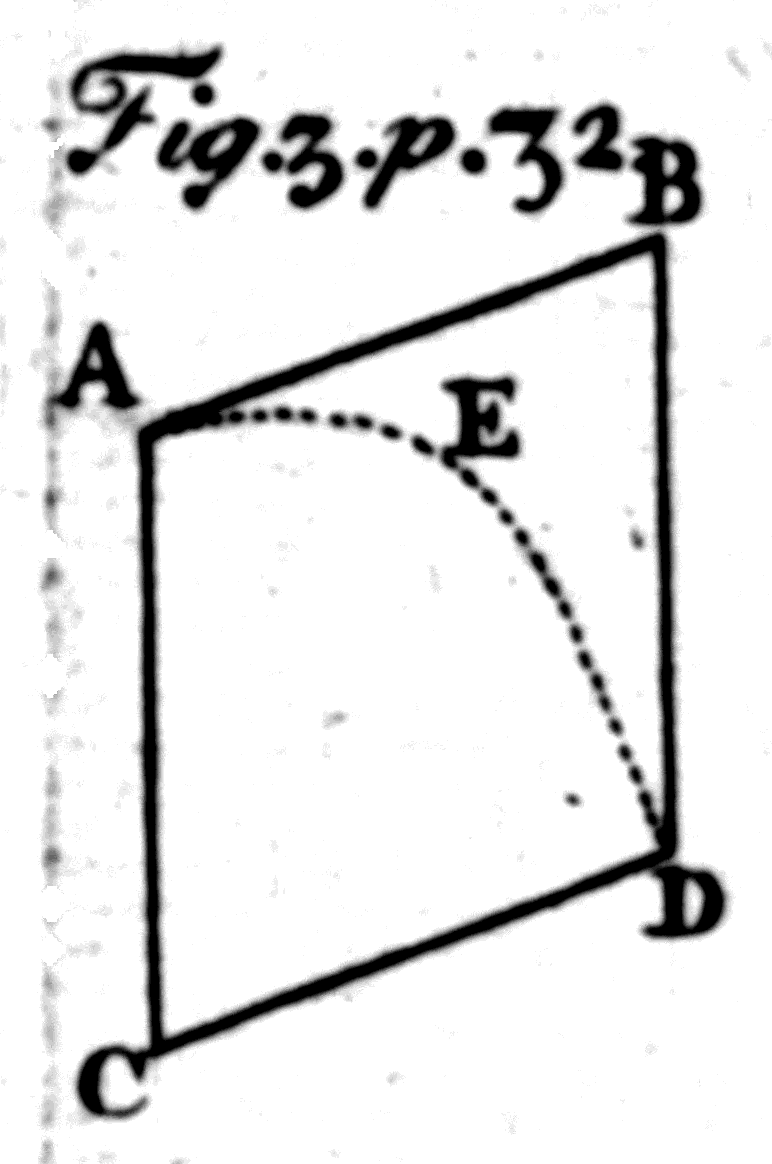
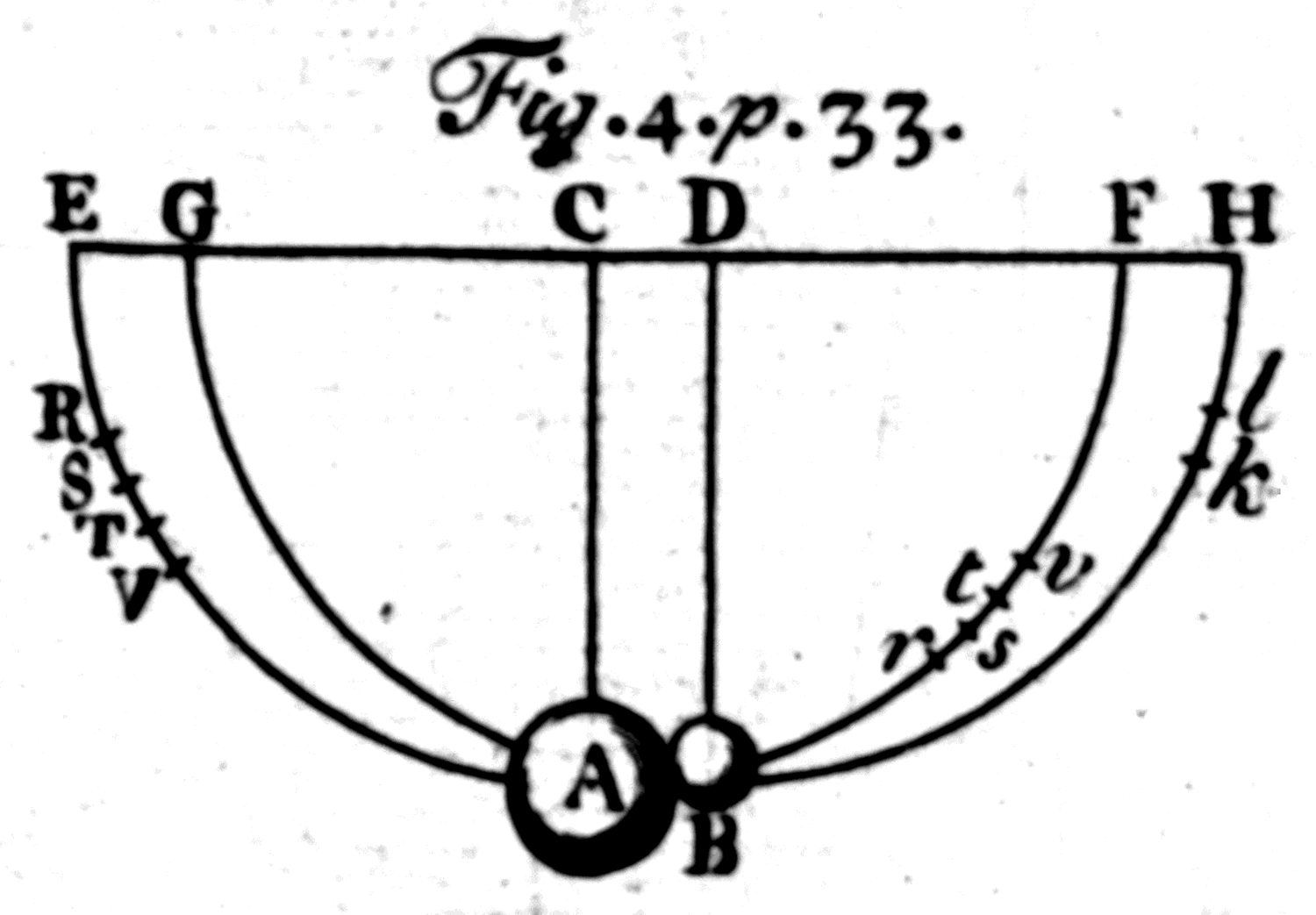
But to prevent an objection that may perhaps be alledged against the rule, for the proof of which this experiment was made, as if this rule did suppose that the bodies were either absolutely hard, or at least perfectly elastic; whereas no such bodies are to be found in nature 36; I must add that the experiments we have been describing, by no means depending upon that quality of hardness, do succeed as well in soft as in hard bodies. For if the rule is to be tried in bodies not perfectly hard, we are only to diminish the reflexion in such a certain proportion, as the quantity of the elastic force requires. By the theory of Wren and Huygens, bodies absolutely hard return one from another with the same velocity with which they meet. But this may be affirm'd with more certainty of bodies perfectly elastic. In bodies imperfectly elastic the velocity of the return is to be diminish'd together with the elastic force; because that force (except when the parts of bodies are bruised by their congress, or suffer some such extension as happens under the strokes of a hammer,) is (as far as I can perceive) certain and determined, and makes the bodies to return one from the other with a relative velocity, which is in a given ratio to that relative velocity with which they met. This I tried in balls of wool, made up tightly and strongly compres'd. For first, by letting go the pendulous bodies and measuring their reflexion, I determined the quantity of their elastic force; and then, according to this force, estimated the reflexions that ought to happen in other cases of congress. And with this computation other experiments made afterwards did accordingly agree; the balls always receding one from the other with a relative velocity, which was to the relative velocity with which they met, as about 5 to 9. Balls of steel return'd with almost the same velocity: those of cork with a velocity something less: but in balls of glass the proportion was as about 15 to 16. And thus the third law, so far as it regards percussions and reflexions, is prov'd by a theory, exactly agreeing with experience.
37In attractions, I briefly demonstrate the thing after this manner. Suppose an obstacle is interpos'd to hinder the congress of any two bodies A, B, mutually attracting one the other: then if either body as A, is more attracted towards the other body B, than that other body B is towards the first body A, the obstacle will be more strongly urged by the pressure of the body A than by the pressure of the body B, and therefore will not remain in æquilibrio: but the stronger pressure will prevail, and will make the system of the two bodies, together with the obstacle, to move directly towards the parts on which B lies; and in free spaces, to go forward in infinitum with a motion perpetually accelerated. Which is absurd, and contrary to the first law. For by the first law, the system ought to persevere in it's state of rest, or of moving uniformly forward in a right line; and therefore the bodies must equally press the obstacle, and be equally attracted one by the other. I made the experiment on the loadstone and iron. If these plac'd apart in proper vessels, are made to float by one another in standing water; neither of them will propel the other, but by being equally attracted, they will sustain each others pressure, and rest at last in an equilibrium.
So the gravitation betwixt the Earth and its parts, is mutual. Let the Earth FI (Fig. 5.) be cut by any plane EG into two parts EGF and EGI: and their weights one towards the other will be mutually equal. For if by another plane HK, parallel to the former EG, the greater part EGI is cut into two parts EGKH and HKI, whereof HKI is equal to the part EFG first cut off: it is evident that the middle part EGKH will have no propension by its proper weight towards either side, but will hang as it were and rest in an equilibrium betwixt both. But the one extreme part HKI 38will with its whole weight bear upon and press the middle part toward the other extreme part EGF; and therefore the force, with which EGI, the sum of the parts HKI and EGKH, tends towards the third part EGF, is equal to the weight of the part HKI, that is, to the weight of the third part EGF. And therefore the weights of the two parts EGI and EGF, one towards the other, are equal, as I was to prove. And indeed if those weights were not equal, the whole Earth floating in the non-resisting æther, would give way to the greater weight, and, retiring from it, wou'd be carried off in infinitum.
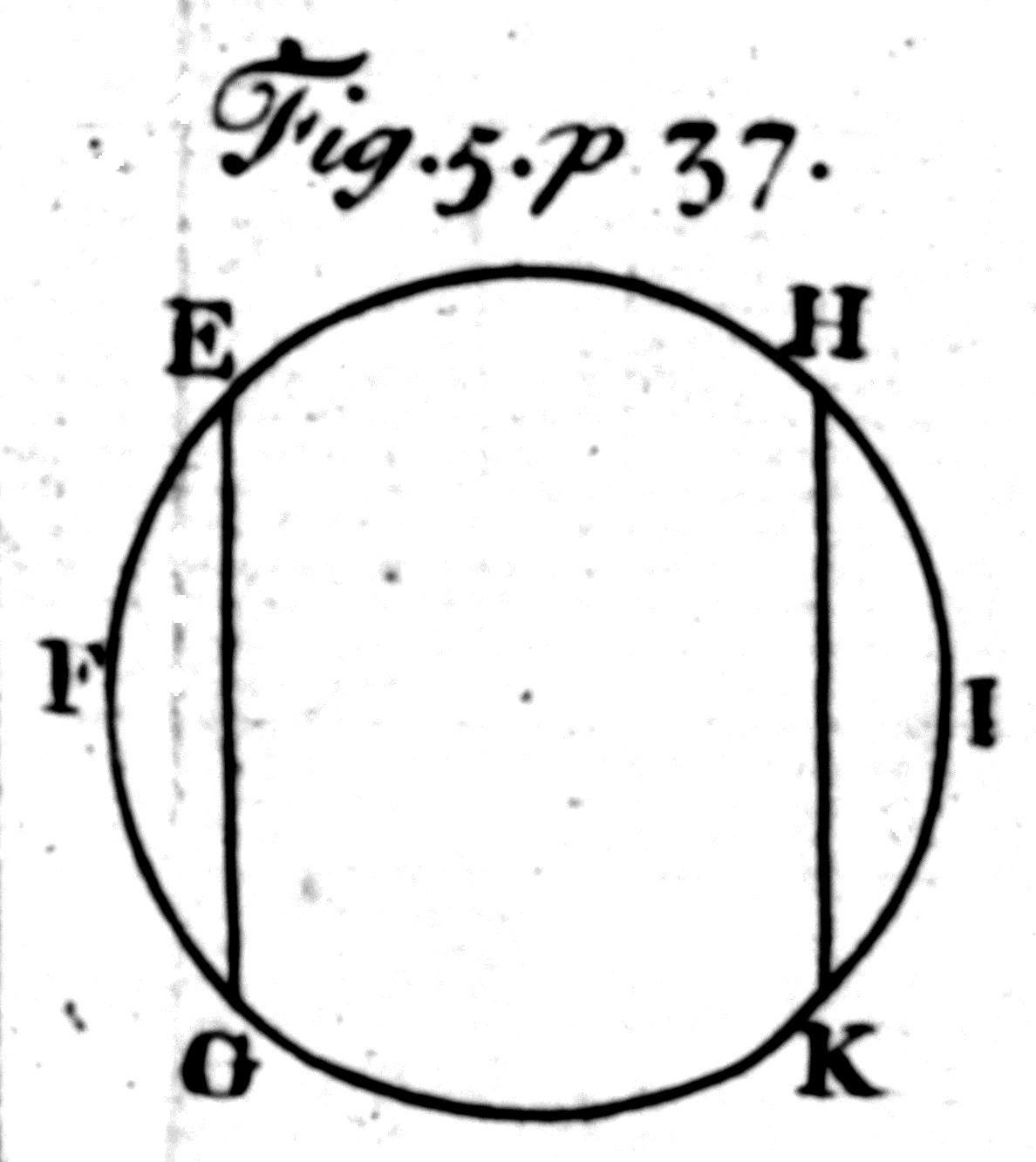
And as those bodies are equipollent in the congress and reflexion, whose velocities are reciprocally as their innate forces: so in the use of mechanic instruments, those agents are equipollent and mutually sustain each the contrary pressure of the other, whose velocities, estimated according to the determination of the forces, are reciprocally as the forces.
So those weights are of equal force to move the arms of a Ballance, which during the play of the ballance are reciprocally as their velocities upwards and downwards: that is, if the ascent or descent is direct, those weights are of equal force, which are reciprocally as the distances of the points at which they are suspended from the axe of the ballance; but if they are turned aside by the interposition of oblique planes, or other obstacles, and made to ascend or descend obliquely, those bodies will be equipollent, which are reciprocally as the heights of their ascent and descent taken according to the perpendicular; and that on account of the determination of gravity downwards.
And in like manner in the Pully, or in a combination of Pullies, the force of a hand drawing the rope directly, that is to the weight, whether ascending directly or 39obliquely, as the velocity of the perpendicular ascent of the weight to the velocity of the hand that draws the rope, will sustain the weight.
In Clocks and such like instruments, made up from a combination of wheels, the contrary forces that promote and impede the motion of the wheels, if they are reciprocally as the velocities of the parts of the wheel on which they are impress'd, will mutually sustain the one the other.
The force of the screw to press a body is to the force of the hand that turns the handles by which it is moved as the circular velocity of the handle in that part where it is impelled by the hand, is to the progressive velocity of the Screw towards the press'd body.
The forces by which the Wedge presses or drives the two parts of the wood it cleaves, are to the force of the mallet upon the wedge, as the progress of the wedge in the direction of the force impress'd upon it by the mallet, is to the velocity with which the parts of the wood yield to the wedge, in the direction of lines perpendicular to the sides of the wedge. And the like account is to be given of all Machines.
The power and use of Machines consists only in this, that by diminishing the velocity we may augment the force, and the contrary: From whence in all sorts of proper Machines, we have the solution of this problem; To move a given weight with a given power, or with a given force to overcome any other given resistance. For if Machines are so contriv'd, that the velocities of the agent and resistant are reciprocally as their forces, the agent will just sustain the resistant: but with a greater disparity of velocity will overcome it. So that if the disparity of velocities is so great, as to overcome all that resistance, which commonly 40arises either from the attrition of contiguous bodies as they slide by one another, or from the cohesion of continuous bodies that are to be separated, or from the weights of bodies to be raised; the excess of the force remaining, after all those resistances are overcome, will produce an acceleration of motion proportional thereto, as well in the parts of the Machine, as in the resisting body. But to treat of Mechanics is not my present business. I was only willing to shew by those examples, the great extent and certainty of the third law of motion. For if we estimate the action of the agent from its force and velocity conjunctly; and likewise the re-action of the impediment conjunctly from the velocities of its several parts, and from the forces of resistance arising from the attrition, cohesion, weight, and acceleration of those parts; the action and re-action in the use of all sorts of Machines will be found always equal to one another. And so far as the action is propagated by the intervening instruments, and at last impress'd upon the resisting body, the ultimate determination of the action will be always contrary to the determination of the re-action.
Book I. Of the Motion of Bodies
Section I. Of the method of first and last ratio's of quantities, by the help whereof we demonstrate the propositions that follow.
OF THE MOTION OF BODIES.
Book I
Section I
41Of the method of first and last ratio's of quantities, by the help whereof we demonstrate the propositions that follow.
Lemma I
Quantities, and the ratio's of quantities, which in any finite time converge continually to equality, and before the end of that time approach nearer the one to the 42other than by any given difference, become ultimately equal.
If you deny it; suppose them to be ultimately unequal, and let D be their ultimate difference. Therefore they cannot approach nearer to equality than by that given difference D; which is against the supposition.
Lemma II
If in any figure AacE (Pl.1.Fig.6.) terminated by the right lines Aa, AE, and the curve acE, there be inscrib'd any number of parallelograms Ab, Bc, Cd, &c. comprehended under equal bases AB, BC, CD, &c. and the sides Bb, Cc, Dd, &c. parallel to one side Aa of the figure; and the parallelograms aKbl, bLcm, cMdn, &c. are compleated. Then if the breadth of those parallelograms be suppos'd to be diminished, and their number to be augmented in infinitum: I say that the ultimate ratio's which the inscrib'd figure AKbLcMdD, the circumscribed figure AalbmcndoE, and curvilinear figure AabcdE, will have to one another, are ratio's of equality.
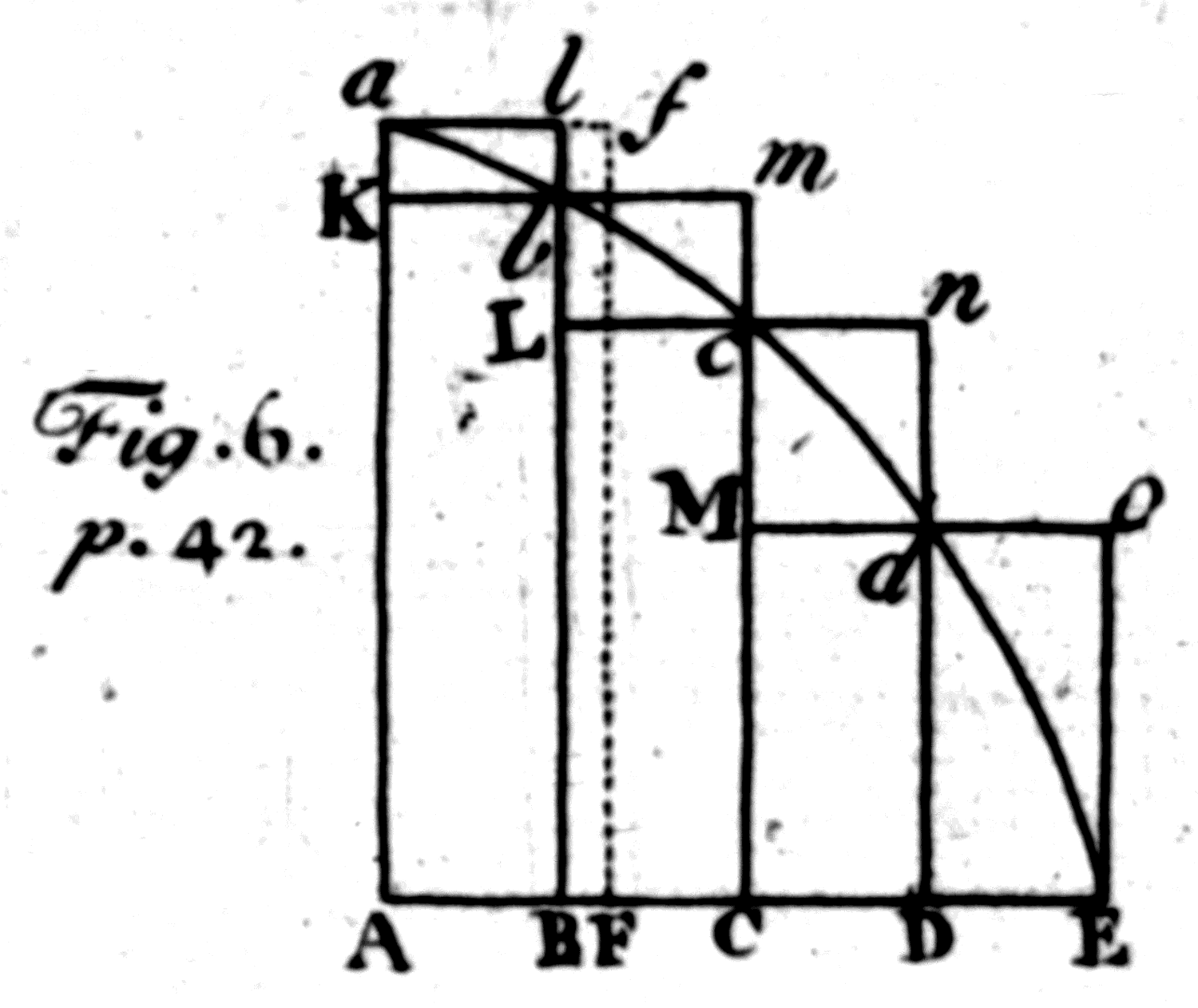
For the difference of the inscrib'd and circumscrib'd figures is the sum of the parallelograms Kl, Lm, Mn, Do, that is, (from the equality of all their bases) the rectangle under one of their bases Kb and the sum of their altitudes Aa, that is, the rectangle ABla, 43But this rectangle, because its breadth AB is suppos'd diminished in infinitum, becomes less than any given space. And therefore (by Lem. 1.) the figures inscribed and circumscribed become ultimately equal one to the other; and much more will the intermediate curvilinear figure be ultimately equal to either.
Q. E. D.
Lemma III
The same ultimate ratio's are also ratio's of equality, when the breadths AB, BC, DC, &c. of the parallelograms are unequal, and are all diminished in infinitum.
For suppose AF equal to the greatest breadth, and compleat the parallelogram FAaf. This parallelogram will be greater than the difference of the inscrib'd and circumscribed figures; but, because its breadth AF is diminished in infinitum, it will become less than any given rectangle. Q. E. D.
Cor. 1. Hence the ultimate sum of those evanescent parallelograms will in all parts coincide with the curvilinear figure.
Cor. 2. Much more will the rectilinear figure, comprehended under the chords of the evanescent arcs ab, bc, cd, &c. ultimately coincide with the curvilinear figure.
Cor. 3. And also the circumscrib'd rectilinear figure comprehended under the tangents of the same arcs.
Cor. 4. And therefore these ultimate figures (as to their perimeters acE,) are not rectilinear, but curvilinear limits of rectilinear figures.
Lemma IV
44If in two figures AacE, PprT, (Pl.i.Fig.7.) you inscribe (as before) two ranks of parallelograms, an equal number in each rank, and when their breadths are diminished in infinitum, the ultimate ratio's of the parallelograms in one figure to those in the other each to each respectively, are the same; I say that those two figures AacE, PprT, are to one another in that same ratio.
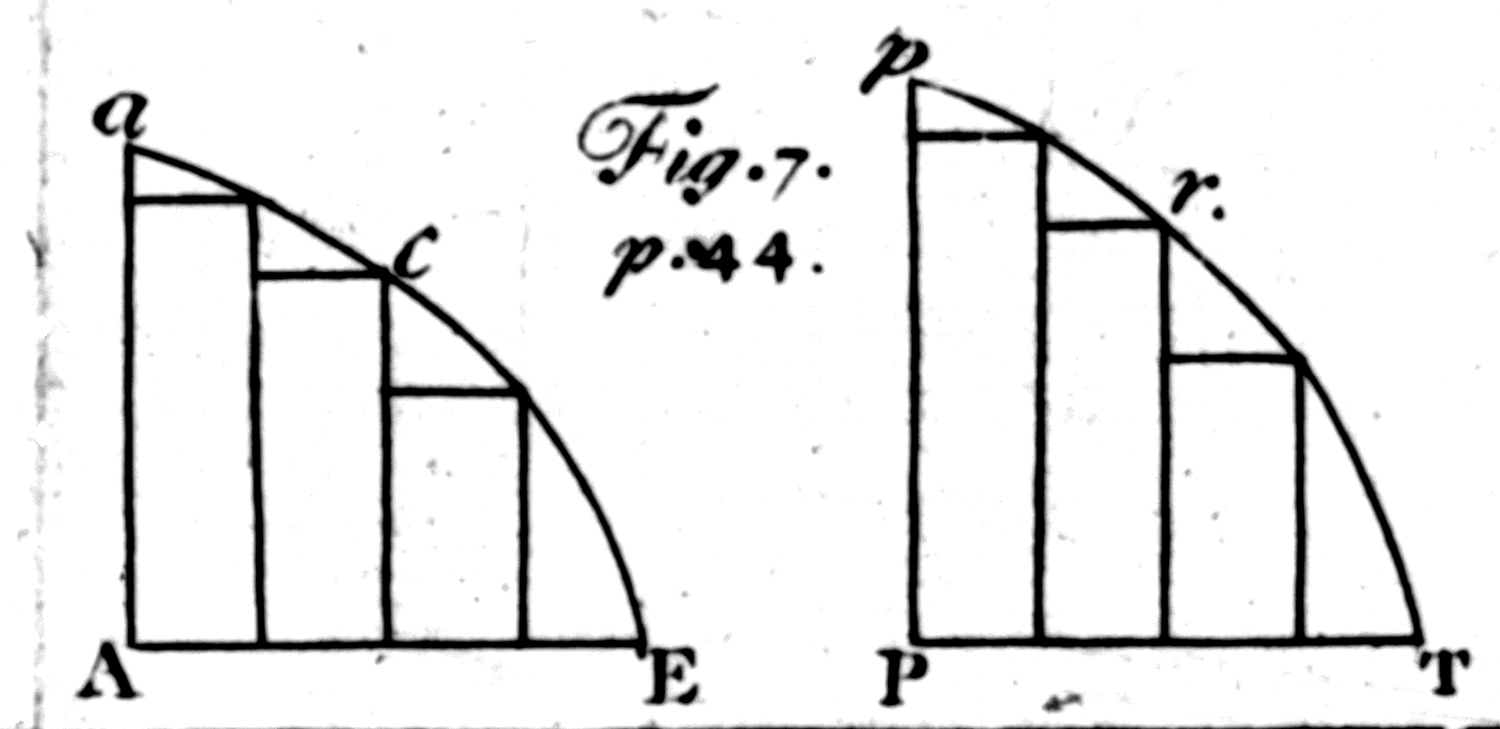
For as the parallelograms in the one are severally to the parallelograms in the other, so (by composition) is the sum of all in the one to the sum of all in the other; and so is the one figure to the other, because (by Lem. 3.) the former figure to the former sum, and the latter figure to the latter sum are both in the ratio of equality. Q. E. D.
Cor. Hence if two quantities of any kind are any how divided into an equal number of parts: and those parts, when their number is augmented and their magnitude diminished in infinitum, have a given ratio one to the other, the first to the first, the second to the second, and so on in order; the whole quantities will be one to the other in that same given ratio. For if, in the figures of this lemma, the parallelograms are taken one to the other in the ratio of the parts, the sum of the parts will always be as the sum of the parallelograms; and therefore supposing the 45number of the parallelograms and parts to be augmented, and their magnitudes diminished in infinitum, those sums will be in the ultimate ratio of the parallelogram in the one figure to the correspondent parallelogram in the other; that is, (by the supposition) in the ultimate ratio of any part of the one quantity to the correspondent part of the other.
Lemma V
In similar figures, all sorts of homologous sides, whether curvilinear or rectilinear, are proportional; and the area's are in the duplicate ratio of the homologous sides.
Lemma VI
If any arc ACB (Pl.2.Fig.1.) given in position is subtended by its chord AB, and in any point A in the middle of the continued curvature, is touch'd by a right line AD, produced both ways; then if the points A and B approach one another and meet, I say the angle BAD, contained between the chord and the tangent, will be diminished in infinitum, and ultimately will vanish.
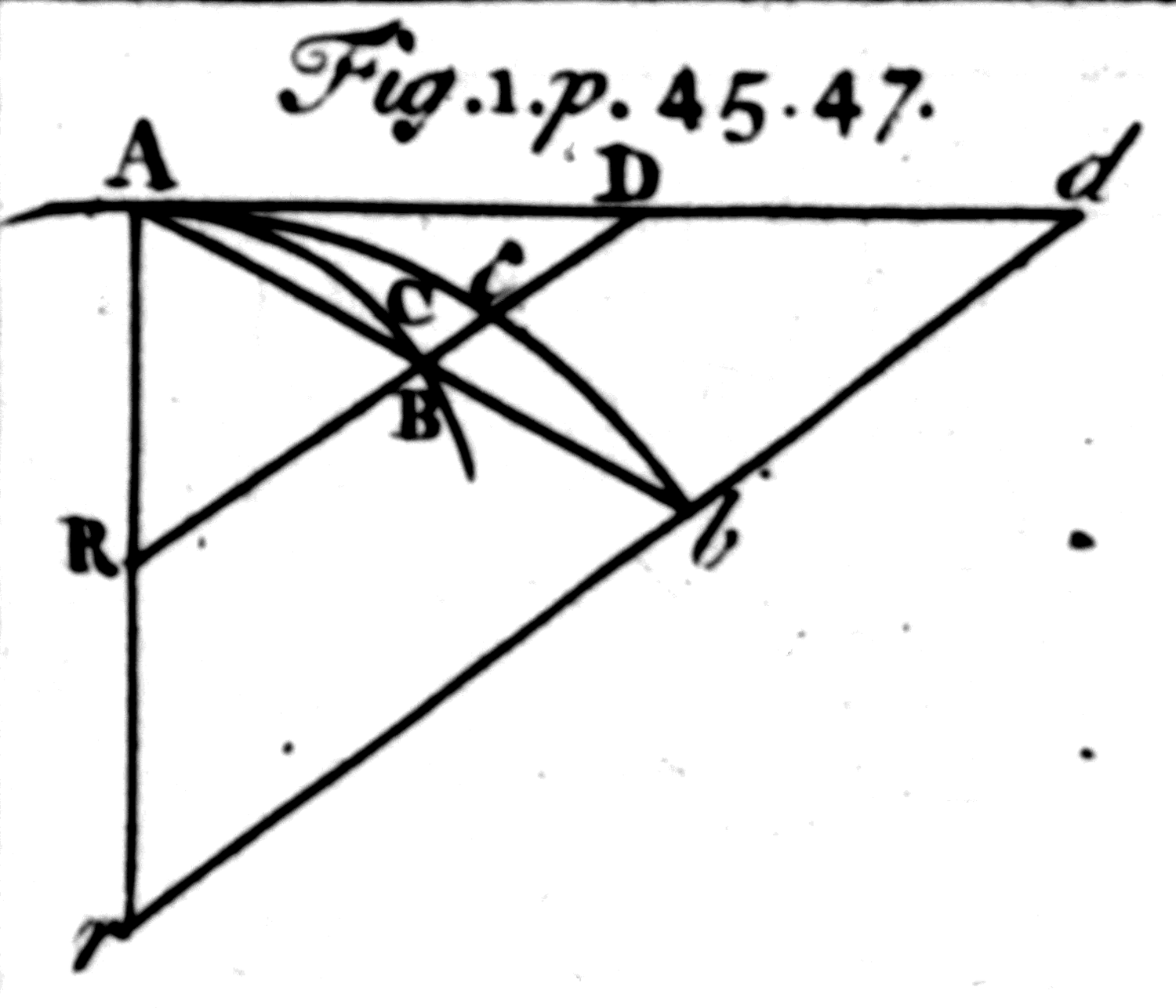
For if that angle does not vanish, the arc ACB will contain with the tangent AD an angle equal to a rectilinear angle; and therefore the curvature at the point A will not be continued, which is against the supposition.
Lemma VII
46The same things being supposed; I say, that the ultimate ratio of the arc, chord, and tangent, any one to any other, is the ratio of equality. Pl. 2. Fig. 1.
For while the point B approaches towards the point A, consider always AB and AD as produc'd to the remote points b and d, and parallel to the secant BD draw bd: and let the arc Acb be always similar to the arc ACB. Then, supposing the points A and B to coincide, the angle dAb will vanish, by the preceding lemma; and therefore the right lines Ab, Ad (which are always finite) and the intermediate arc Acb will coincide, and become equal among themselves. Wherefore the right lines AB, AD, and the intermediate arc ACB (which are always proportional to the former) will vanish; and ultimately acquire the ratio of equality. Q.E.D.
Cor. 1. Whence if through B (Pl.2. Fig.2.) we draw BF parallel to the tangent, always cutting any right line AF passing through A in F, this line BF will ultimately be in the ratio of equality with the evanescent arc ACB; because, compleating the parallelogram AFBD, it is always in a ratio of equality with AD.
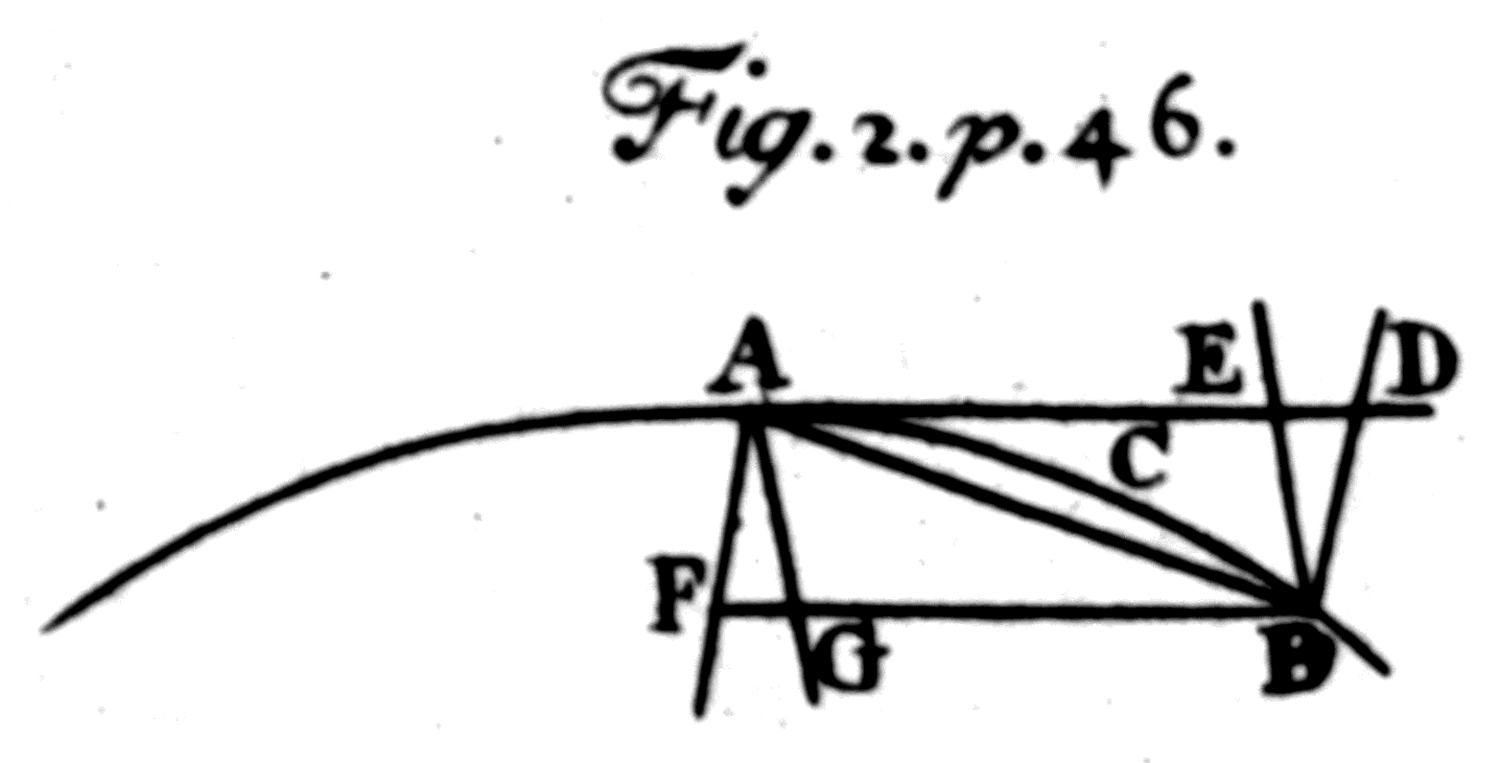
Cor. 2. And if through B and A more right lines are drawn as BE, BD, AF, AG cutting the tangent AD and its parallel BF; the ultimate ratio of all the abscissa's AD, AE, BF, BG, and of the chord and arc AB, any one to any other, will be the ratio of equality.
47Cor. 3. And therefore in all our reasoning about ultimate ratio's, we may freely use any one of those lines for any other.
Lemma VIII
If the right lines AR, BR, (Pl.2.Fig.1.) with the arc ACB, the chord AB, and the tangent AD, constitute three triangles RAB, RACB, RAD, and the points A and B approach and meet: I say that the ultimate form of these evanescent triangles is that of similitude, and their ultimate ratio that of equality.
For while the point B approaches towards the point A consider always AB, AD, AR, as produced to the remote points b, d, and r, and rbd as drawn parallel to RD, and let the arc Acb be always similar to the arc ACB. Then supposing the points A and B to coincide, the angle bAd will vanish; and therefore the three triangles rAb, rAcb, rAd, (which are always finite) will coincide, and on that account become both similar and equal. And therefore the triangles RAB, RACB, RAD, which are always similar and proportional to these, will ultimately become both similar and equal among themselves. Q.E.D.
Cor. And hence in all our reasonings about ultimate ratio's, we may indifferently use any one of those triangles for any other.
Lemma IX
48If a right line AE, (Pl.2.Fig.3.) and a curve line ABC, both given by position, cut each other in a given angle A; and to that right line, in another given angle, BD, CE are ordinately applied, meeting the curve in B, C; and the points B and C together, approach towards, and meet in, the point A: I say that the area's of the triangles ABD, ACE, will ultimately be one to the other in the duplicate ratio of the sides.
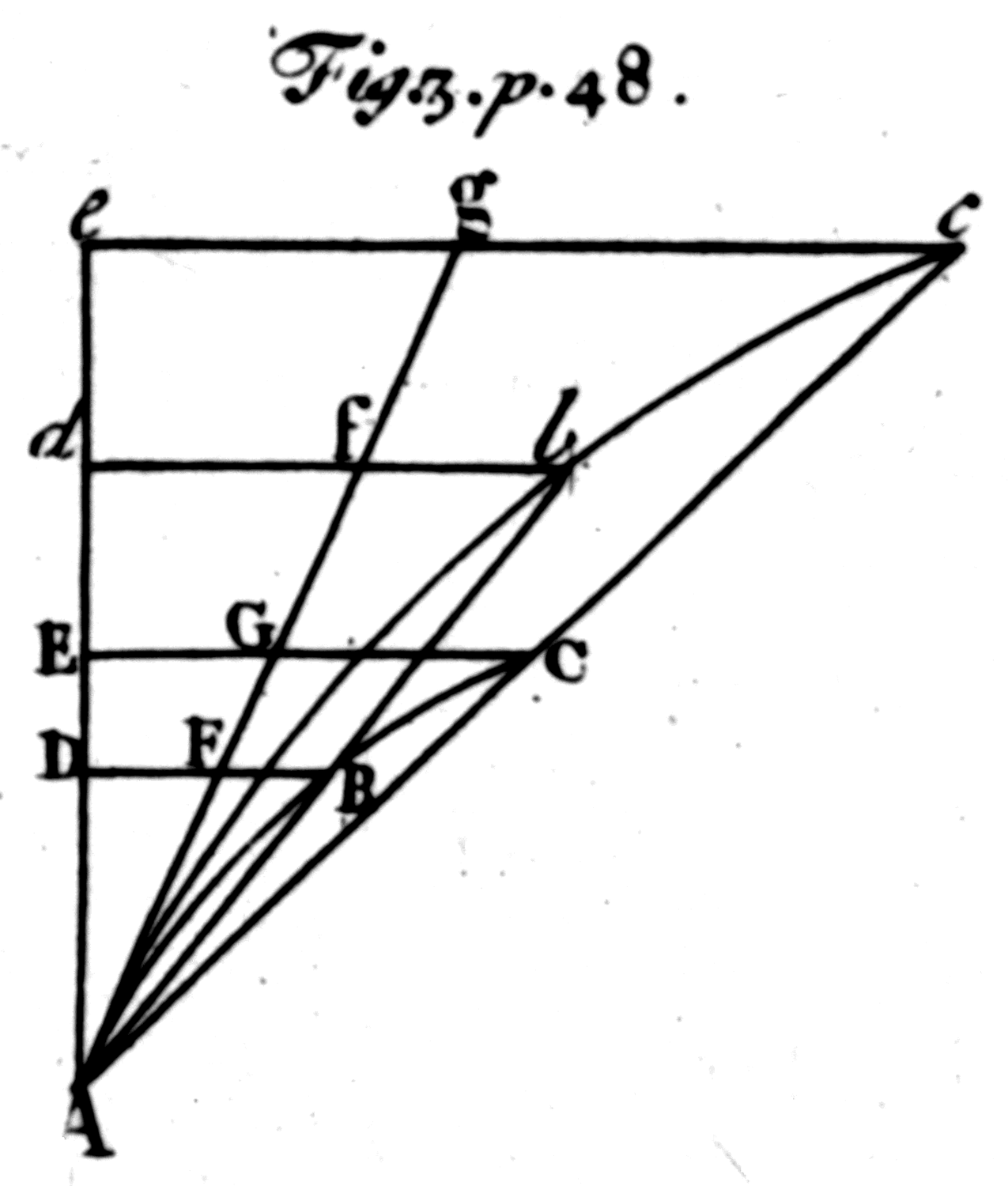
For while the points B, C approach towards the point A, suppose always AD to be produced to the remote points d and e, so as Ad, Ae may be proportional to AD, AE; and the ordinates db, ec, to be drawn parallel to the ordinates DB and EC, and meeting AB and AC produced in b and c. Let the curve Abc be similar to the curve ABC, and draw the right line Ag so as to touch both curves in A, and cut the ordinates DB, EC, db, ec, in F, G, f, g. Then, supposing the length Ae to remain the same, let the points B and C meet in the point A; and the angle cAg vanishing, the curvilinear areas Abd, Ace will coincide with the rectilinear areas Afd, Age; and therefore (by Lem 5) will be one to the other in the duplicate ratio of the sides Ad, Ae. But the areas ABD, ACE are always proportional to these areas; and so the sides AD, AE are to these sides. And therefore the areas ABD, ACE are ultimately 49one to the other in the duplicate ratio of the sides AD, AE. Q.E.D.
Lemma X
The spaces which a body describes by any finite force urging it, whether that force is determined and immutable, or is continually augmented or continually diminished, are in the very beginning of the motion one to the other in the duplicate ratio of the times.
Let the times be represented by the lines AD, AE, and the velocities generated in those times by the ordinates DB, EC. The spaces described with these velocities will be as the areas ABD, ACE, described by those ordinates, that is, at the very beginning of the motion (by Lem. 9.) in the duplicate ratio of the times AD, AE. Q.E.D.
Cor. 1. And hence one may easily infer, that the errors of bodies describing similar parts of similar figures in proportional times, are nearly in the duplicate ratio of the times in which they are generated; if so be these errors are generated by any equal forces similarly applied to the bodies, and measur'd by the distances of the bodies from those places of the similar figures, at which, without the action of those forces, the bodies would have arrived in those proportional times.
50Cor. 2. But the errors that are generated by the proportional forces, similarly applied to the bodies at similar parts of the similar figures, are as the forces and the squares of the times conjunctly.
Cor. 3. The same thing is to be understood of any spaces whatsoever describ'd by bodies urged with different forces. All which, in the very beginning of the motion, are as the forces and the squares of the times conjunctly.
Cor. 4. And therefore the forces are as the spaces described in the very beginning of the motion directly, and the squares of the times inversly.
Cor. 5. And the squares of the times are as the spaces describ'd directly, and the forces inversly.
Scholium
If in comparing indetermined quantities of different sorts with another, any one is said to be as any other directly or inversly: the meaning is, that the former is augmented or diminished in the same ratio with the latter, or with its reciprocal. And if any one is said to be as any other two or more directly or inversly: the meaning is, that the first is augmented or diminished in the ratio compounded of the ratio's in which the others, or the reciprocals of the others, are augmented or diminished. As if A is said to be as B directly and C directly and D inversly: the meaning is, that A is augmented or diminished in the same ratio with , that is to say, that A and are one to the other in a given ratio.
Lemma XI
51The evanescent subtense of the angle of contact, in all curves which at the point of contact have a finite curvature, is ultimately in the duplicate ratio of the subtense of the conterminate arc. Pl. 2. Fig 4.
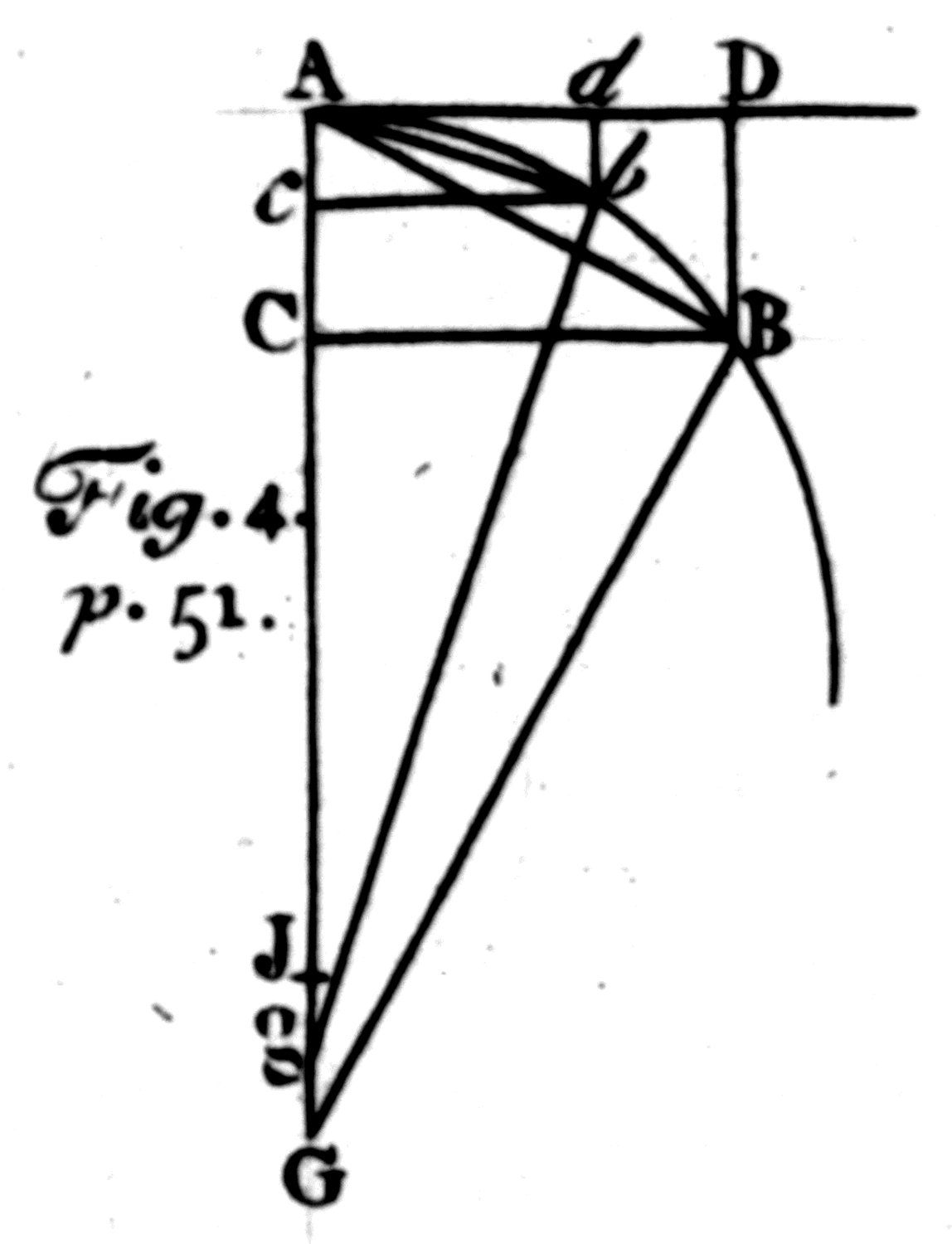
Case 1. Let AB be that arc, AD its tangent, BD the subtense of the angle of contact perpendicular on the tangent, AB the subtense of the arc. Draw BG perpendicular to the subtense AB, and AG to the tangent AD, meeting in G; then let the points D, B, and G, approach to the points d, b, and g, and suppose J to be the ultimate intersection of the lines BG, AG, when the points D, B have come to A. It is evident that the distance GJ may be less than any assignable. But (from the nature of the circles passing through the points A, B, G; A, b, g) , and ; and therefore the ratio to is compounded of the ratio's of AG to Ag, and of BD to bd. But because GJ may be assum'd of less length than any assignable, the ratio of AG to Ag may be such as to differ from the ratio of equality by less than any assignable difference; and therefore the ratio to may be such as to differ from the ratio of BD to bd by less than any assignable difference. Therefore, by Lem. 1. the ultimate ratio of to is the same with the ultimate ratio of BD to bd. Q. E. D.
Case 2. Now let BD be inclined to AD in any given angle, and the ultimate ratio of BD to bd will 52always be the same as before, and therefore the same with the ratio of to . Q.E.D.
Case 3. And if we suppose the angle D not to be given, but that the right line BD converges to a given point, or is determined by any other condition whatever; nevertheless the angles D, d, being determined by the same law, will always draw nearer to equality, and approach nearer to each other than by any assigned difference, and therefore, by Lem. 1, will at last be equal; and therefore the lines BD, bd are in the same ratio to each other as before.
Cor. 1. Therefore since the tangents AD, Ad, the arcs AB, Ab, and their sines, BC, bc, become ultimately equal to the chords AB, Ab; their squares will ultimately become as the subtenses BD, bd.
Cor. 2. Their squares are also ultimately as the versed sines of the arcs, bisecting the chords, and converging to a given point. For those versed sines are as the subtenses BD, bd.
Cor. 3. And therefore the versed sine is in the duplicate ratio of the time in which a body will describe the arc with a given velocity.
Cor. 4. The rectilinear triangles ADB, Adb are ultimately in the triplicate ratio of the sides AD, Ad, and in a sesquiplicate ratio of the sides DB, db; as being in the ratio compounded of the sides AD to DB, and of Ad to db. So also the triangles ABC, Abc are ultimately in the triplicate ratio of the sides BC, bc. What I call the sesquiplicate ratio is the subduplicate of the triplicate, as being compounded of the simple and subduplicate ratio.
Cor. 5. And because DB, db are ultimately parallel and in the duplicate ratio of the lines AD, Ad: the ultimate curvilinear areas ADB, Adb will be 53(by the nature of the parabola) two thirds of the rectilinear triangles ADB, Adb and the segments AB, Ab will be one third of the same triangles. And thence those areas and those segments will be in the triplicate ratio as well of the tangents AD, Ad; as of the chords and arcs AB, Ab.
Scholium
But we have all along supposed the angle of contact to be neither infinitely greater nor infinitely less, than the angles of contact made by circles and their tangents; that is, that the curvature at the point A is neither infinitely small nor infinitely great, or that the interval AJ is of a finite magnitude. For DB may be taken as AD: in which case no circle can be drawn through the point A, between the tangent AD and the curve AB, and therefore the angle of contact will be infinitely less than those of circles. And by a like reasoning if DB be made successively as AD, AD, AD, AD, &c., we shall have a series of angles of contact, proceeding in infinitum, wherein every succeeding term is infinitely less than the preceding. And if DB be made successively as AD, AD, AD, AD, AD, AD, &c., we shall have another infinite series of angles of contact, the first of which is of the same sort with those of circles, the second infinitely greater, and every succeeding one infinitely greater than the preceding. But between any two of these angles another series of intermediate angles of contact may be interposed proceeding both ways in infinitum, wherein every succeeding angle shall be infinitely greater, or infinitely less than the preceding. As if between the 54terms AD and AD there were interposed the series AD, AD, AD, AD, AD, AD, AD, AD, AD, &c. And again, between any two angles of this series, a new series of intermediate angles may be interposed, differing from one another by infinite intervals. Nor is nature confin'd to any bounds.
Those things which have been demonstrated of curve lines and the superficies which they comprehend, may be easily applied to the curve superficies and contents of solids. These lemmas are premised, to avoid the tediousness of deducing perplexed demonstrations ad absurdum, according to the method of the ancient geometers. For demonstrations are more contracted by the method of indivisibles: But because the hypothesis of indivisibles seems somewhat harsh, and therefore that method is reckoned less geometrical, I chose rather to reduce the demonstrations of the following propositions to the first and last sums and ratio's of nascent and evanescent quantities, that is, to the limits of those sums and ratio's; and so to premise, as short as I could, the demonstrations of those limits. For hereby the same thing is perform'd as by the method of indivisibles; and now those principles being demonstrated, we may use them with more safety. Therefore if hereafter, I should happen to consider quantities as made up of particles, or should use little curve lines for right ones; I would not be understood to mean indivisibles, but evanescent divisible quantities; not the sums and ratio's of determinate parts, but always the limits of sums and ratio's: and that the force of such demonstrations always depends on the method lay'd down in the foregoing lemma's.
Perhaps it may be objected, that there is no ultimate proportion of evanescent quantities; because the 55proportion, before the quantities have vanished, is not the ultimate, and when they are vanished, is none. But by the same argument it may be alledged, that a body arriving at a certain place, and there stopping, has no ultimate velocity: because the velocity, before the body comes to the place, is not its ultimate velocity; when it has arrived, is none. But the answer is easy; for by the ultimate velocity is meant that with which the body is moved, neither before it arrives at its last place and the motion ceases, nor after, but at the very instant it arrives; that is, that velocity with which the body arrives at its last place, and with which the motion ceases. And in like manner, by the ultimate ratio of evanescent quantities is to be understood the ratio of the quantities, not before they vanish, nor afterwards, but with which they vanish. In like manner the first ratio of nascent quantities is that with which they begin to be. And the first or last sum is that with which they begin and cease to be (or to be augmented or diminished.) There is a limit which the velocity at the end of the motion may attain, but not exceed. This is the ultimate velocity. And there is the like limit in all quantities and proportions that begin and cease to be. And since such limits are certain and definite, to determine the same is a problem strictly geometrical. But whatever is geometrical we may be allowed to use in determining and demonstrating any other thing that is likewise geometrical.
It may also be objected, that if the ultimate ratio's of evanescent quantities are given, their ultimate magnitudes will be also given: and so all quantities will consist of indivisibles, which is contrary to what Euclid has demonstrated concerning incommensurables, in the 10th book of his Elements. But this objection is 56founded on a false supposition. For those ultimate ratio's with which quantities vanish, are not truly the ratio's of ultimate quantities, but limits towards which the ratio's of quantities decreasing without limit, do always converge; and to which they approach nearer than by any given difference, but never go beyond, nor in effect attain to, till the quantities are diminished in infinitum. This thing will appear more evident in quantities infinitely great. If two quantities, whose difference is given, be augmented in infinitum, the ultimate ratio of these quantities will be given, to wit, the ratio of equality; but it does not from thence follow, that the ultimate or greatest quantities themselves, whose ratio that is, will be given. Therefore if in what follows, for the sake of being more easily understood, I should happen to mention quantities as least, or evanescent, or ultimate; you are not to suppose that quantities of any determinate magnitude are meant, but such as are conceiv'd to be always diminished without end.
Section II. Of the invention of centripetal forces.
Section II
Of the invention of centripetal forces.
Proposition I. Theorem I
57The areas, which revolving bodies describe by radii drawn to an immoveable centre of force, do lie in the same immoveable planes, and are proportional to the times in which they are described. Pl. 2. Fig. 5.
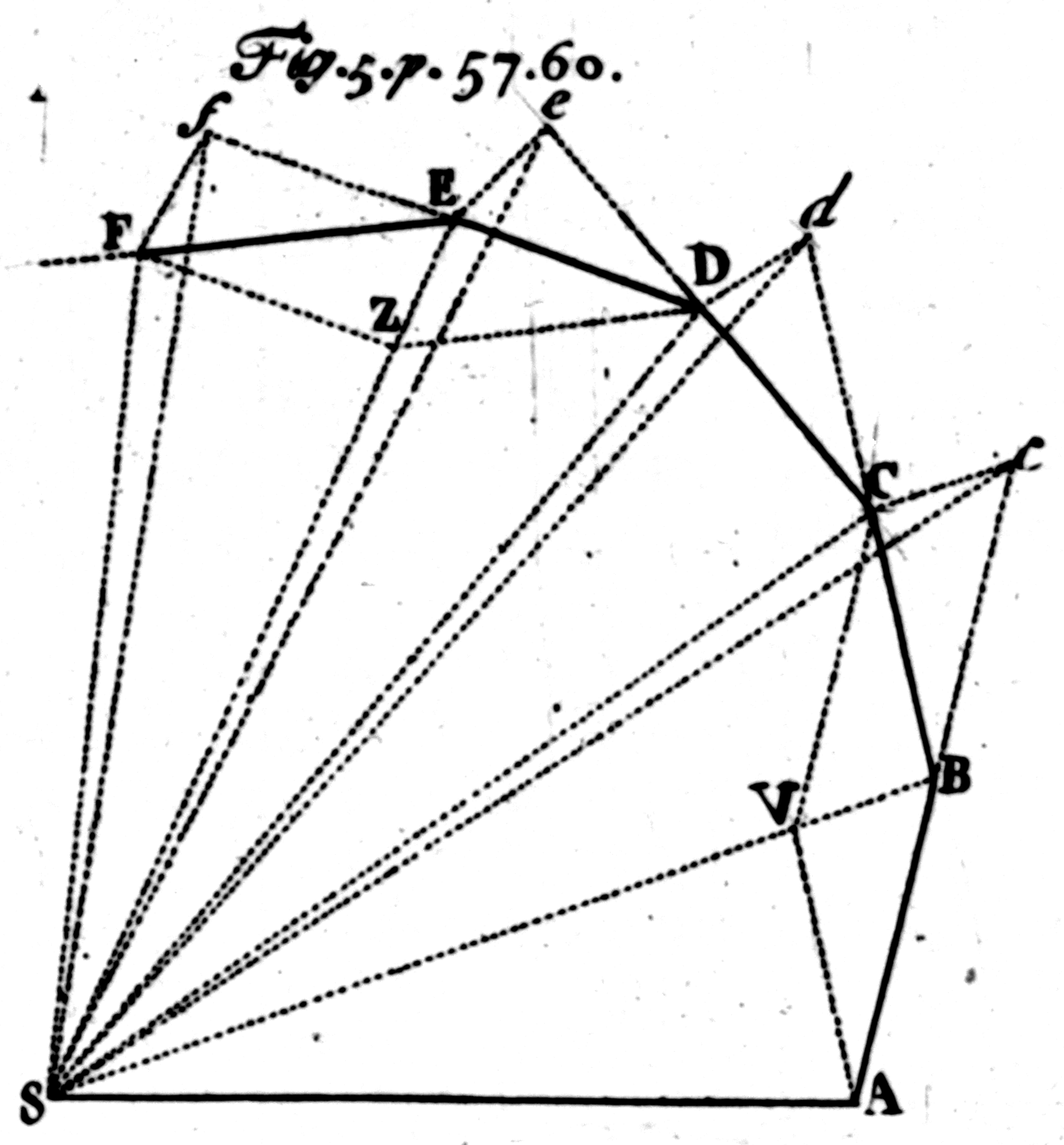
FOR suppose the time to be divided into equal parts, and in the first part of that time, let the body by its innate force describe the right line AB. In the second part of that time, the same would, (by law 1.) if not hinder'd, proceed directly to c, along the line Bc equal to AB; so that by the radii AS, BS, cS drawn to the centre, the equal areas ASB, BSc, would be described. But when the body is arrived at B, suppose that a centripetal force act at once with a great impulse, and turning aside the body from the right line Bc, compells it afterwards to continue its motion along the right line BC. Draw cC parallel to BS meeting BC in C; and at the end of the second part of the time, the body (by Cor. 1. of the laws) will be found in C, in the same plane with the triangle ASB. Joyn SC, and, because SB and Cc are 58parallel, the triangle SBC will be equal to the triangle SBc, and therefore also to the triangle SAB. By the like argument, if the centripetal force acts successively in C, D, E, &c. and makes the body in each single particle of time, to describe the right lines CD, DE, EF, &c. they will all lye in the same plane; and the triangle SCD will be equal to the triangle SBC, and SDE to SCD, and SEF to SDE. And therefore in equal times, equal areas are describ'd in one immoveable plane: and, by composition, any sums SADS, SAFS, of those areas, are one to the other, as the times in which they are describ'd. Now let the number of those triangles be augmented, and their breadth dimnished in infinitum; and (by cor. 4. lem. 3.) their ultimate perimeter ADF will be a curve line: and therefore the centripetal force, by which the body is perpetually drawn back from the tangent of this curve, will act continually; and any describ'd areas SADS, SAFS, which are always proportional to the times of description, will, in this case also, be proportional to those times. Q.E.D.
Cor. 1. The velocity of a body attracted towards an immoveable centre, in spaces void of resistance, is reciprocally as the perpendicular let fall from that centre on the right line that touches the orbit. For the velocities in those places A, B, C, D, E are as the bases AB, BC, CD, DE, EF, of equal triangles; and these bases are reciprocally as the perpendiculars let fall upon them.
Cor. 2. If the chords AB, BC of two arcs, successively described in equal times, by the same body, in spaces void of resistance, are compleated into a parallelogram ABCV and the diagonal BV of this parallelogram, in the position which it ultimately acquires when those arcs are diminished in infinitum, is produced 59both ways, it will pass through the centre of force.
Cor. 3. If the chords AB, BC, and DE, EF, of arcs describ'd in equal times, in spaces void of resistance, are compleated into the parallelograms ABCV, DEFZ; the forces in B and E are one to the other in the ultimate ratio of the diagonals BV, EZ, when those arcs are diminished in infinitum. For the motions B; and EF of the body (by cor. 1. of the laws) are compounded of the motions Bc, BV, and Ef, EZ: but BV and EZ, which are equal to Cc and Ff, in the demonstration of this proposition, were generated by the impulses of the centripetal force in B and E, and are therefore proportional to those impulses.
Cor. 4. The forces by which bodies, in spaces void of resistance, are drawn back from rectilinear motions, and turned into curvilinear orbits, are one to another as the vers'd sines of arcs described in equal times; which versed sines tend to the centre of force, and bisect the chords when those arcs are diminished to infinity. For such vers'd sines are the halfs of the diagonals mentioned in cor. 3.
Cor. 5. And therefore those forces are to the force of gravity, as the said vers'd sines to the vers'd sines perpendicular to the horizon of those parabolic arcs which projectiles describe in the same time.
Cor. 6. And the same things do all hold good (by cor. 5. of the laws) when the planes in which the bodies are mov'd, together with the centres of force which are placed in those planes, are not at rest but move uniformly forward in right lines.
Proposition II. Theorem II
60Every body, that moves in any curve line described in a plane, and by a radius, drawn to a point either immoveable, or moving forward with an uniform rectilinear motion, describes about that point areas proportional to the times, is urged by a centripetal force directed to that point.
Case 1. For every body that moves in a curve line, is (by law 1.) turned aside from its rectilinear course by the action of some force that impels it. And that force by which the body is turned off from its rectilinear course, and is made to describe, in equal times, the equal least triangles SAB, SBC, SCD, &c. about the immoveable point S, (by prop. 40. book 1. elem. and law 2.) acts in the place B, according to the direction of a line parallel to cC, that is, in the direction of the line BS; and in the place C, according to the direction of a line parallel to dD, that is, in the direction of the line CS, &c. And therefore acts always in the direction of lines tending to the immoveable point S. Q.E.D.
Case 2. And (by cor. 5. of the laws) it is indifferent whether the superficies in which a body describes a curvilinear figure be quiescent, or moves together with the body, the figure describ'd, and its point S, uniformly forwards in right lines.
61Cor. 1. In non-resisting spaces or mediums, if the areas are not proportional to the times, the forces are not directed to the point in which the radii meet; but deviate therefrom in consequentia, or towards the parts to which the motion is directed, if the description of the areas is accelerated; but in antecedentia, if retarded.
Cor. 2. And even in resisting mediums, if the description of the areas is accelerated, the directions of the forces deviate from the point in which the radii meet, towards the parts to which the motion tends.
Scholium
A body may be urged by a centripetal force compounded of several forces. In which case the meaning of the proposition is, that the force which results out of all, tends to the point S. But if any force, acts perpetually in the direction of lines perpendicular to the describ'd surface; this force will make the body to deviate from the plane of its motion: but will neither augment nor diminish the quantity of the described surface, and is therefore to be neglected in the composition of forces.
Proposition III. Theorem III
62Every body, that, by a radius drawn to the centre of another body howsoever moved, described areas about that centre proportional to the times, is urged by a force compounded out of the centripetal force tending to that other body, and of all the accelerative force by which that other body is impelled.
Let L represent the one, and T the other body; and (by Cor. 6 of the laws) if both bodies are urged in the direction of parallel lines, by a new force equal and contrary to that by which the second body T is urgeed, the first body L will go on to describe about the other body T, the same areas as before: but the force, by which that other body T was urged, will be now destroyed by an equal and contrary force; and therefore (by Law 1.) that other body T, now left to it self, will either rest, or move uniformly forward in a right line: and the first body L impell'd by the difference of the forces, that is, by the force remaining, will go on to describe about the other body T, areas proportional to the times. And therefore (by Theor. 2.) the difference of the forces is directed to the other body T as its centre. Q. E. D.
Cor. 1. Hence if the one body L, by a radius drawn to the other body T, describes areas proportional to the times; and from the whole force, by which the first body L is urged (whether that force is 63simple, or, according to cor. 2. of the laws, compounded out of several forces) we subduct (by the same cor.) that whole accelerative force, by which the other body is urged; the whole remaining force by which the first body is urged, will tend to the other body T, as its centre.
Cor. 2. And, if these areas are proportional to the times nearly, the remaining force will tend to the other body T nearly.
Cor. 3. And vice versa, if the remaining force tends nearly to the other body T, those areas will be nearly proportional to the times.
Cor. 4. If the body L, by a radius drawn to the other body T, describes areas, which compared with the times, are very unequal; and that other body T be either at rest or moves uniformly forward in a right line: the action of the centripetal force tending to that other body T, is either none at all, or it is mix'd and compounded with very powerful actions of other forces: and the whole force compounded of them all, if they are many, is directed to another (immovable or moveable) centre. The same thing obtains, when the other body is moved by any motion whatsoever; provided that centripetal force is taken, which remains after subducting that whole force acting upon that other body T.
Scholium
Because the equable description of areas indicates that a centre is respected by that force with which the body is most affected, and by which it is drawn back from its rectilinear motion, and retained in its orbit; 64why may we not be allowed in the following discourse, to use the equable description of areas as an indication of a centre, about which all circular motion is performed in free spaces?
Proposition IV. Theorem IV
The centripetal forces of bodies, which by equable motions describe different circles, tend to the centres of the same circles; and are one to the other, as the squares of the arcs described in equal times applied to the radii of the circles.
These forces tend to the centres of the circles (by prop. 2. and cor. 2. prop. 1) and are one to another as the versed sines of the least arcs described in equal times (by cor. 4. prop. 1.) that is, as the squares of the same arcs applied to the diameters of the circles, (by lem. 7.) and therefore since those arcs are as arcs described in any equal times, and the diameters are as the radii; the forces will be as the squares of any arcs described in the same time applied to the radii of the circles. Q. E. D.
Cor. 1. Therefore, since those arcs are as the velocities of the bodies, the centripetal forces are in a ratio compounded of the duplicate ratio of the velocities directly, and of the simple ratio of the radii inversely.
65Cor. 2. And, since the periodic times are in a ratio compounded of the ratio of the radii directly; and the ratio of the velocities inversely; the centripetal forces are in a ratio compounded of the ratio of the radii directly, and the duplicate ratio of the periodic times inversely.
Cor. 3. Whence if the periodic times are equal, and the velocities therefore as the radii; the centripetal forces will be also as the radii; and the contrary.
Cor. 4. If the periodic times and the velocities are both in the subduplicate ratio of the radii; the centripetal forces will be equal among themselves: and the contrary.
Cor. 5. If the periodic times are as the radii, and therefore the velocities equal; the centripetal forces will be reciprocally as the radii: and the contrary.
Cor. 6. If the periodic times are in the sesquiplicate ratio of the radii, and therefore the velocities reciprocally in the subduplicate ratio of the radii; the centripetal forces will be in the duplicate ratio of the radii inversely: and the contrary.
Cor. 7. And universally, if the periodic time is as any power of the radius R, and therefore the velocity reciprocally as the power of the radius; the centripetal force will be reciprocally as the power of the radius: and the contrary.
Cor. 8. The same things all hold concerning the times, the velocities, and forces by which bodies describe the similar parts of any similar figures, that have their centres in a similar position within those figures; as appears by applying the demonstration of the preceding cases to those. And the application is easy by only substituting the equable description of areas in the place of equable motion and using the distances of the bodies from the centres instead of the radii.
66Cor. 9. From the same demonstration it likewise follows, that the arc which a body, uniformly revolving in a circle by means of a given centripetal force, describes in any time, is a mean proportional between the diameter of the circle, and the space which the same body falling by the same given force would descend thro' in the same given time.
Scholium
The case of the 6th corollary obtains in the celestial bodies, (as Sir Christopher Wren, Dr. Hooke, and Dr. Halley have severally observed) and therefore in what follows, I intend to treat more at large of those things which relate to centripetal force decreasing in a duplicate ratio of the distances from the centres. Moreover, by means of the preceding proposition and its corollaries, we may discover the proportion of a centripetal force to any other known force, such as that of gravity. For if a body by means of its gravity revolves in a circle concentric to the Earth, this gravity is the centripetal force of that body. But from the descent of heavy bodies, the time of one entire revolution, as well as the arc described in any given time, is given, (by cor. 9. of this prop.) And by such propositions, Mr. Huygens, in his excellent book De Horologio Oscillatorio, has compared the force of gravity with the centrifugal forces of revolving bodies.
The preceding proposition may be likewise demonstrated after this manner. In any circle suppose a polygon to be inscribed of any number of sides. And if a body, moved with a given velocity along the sides of the polygon, is reflected from the circle at the several angular points; the force, with which at 67every reflexion it strikes the circle, will be as its velocity: and therefore the sum of the forces, in a given time, will be as that velocity and the number of reflexions conjunctly; that is, (if the species of the polygon be given) as the length described in that given time, and increased or diminished in the ratio of the same length to the radius of the circle; that is, as the square of that length applied to the radius: and therefore if the polygon, by having its sides diminished in infinitum, coincides with the circle, as the square of the arc described in a given time applied to the radius. This is the centrifugal force, with which the body impells the circle; and to which the contrary force, wherewith the circle continually repells the body towards the centre, is equal.
Proposition V. Problem I
There being given in any places, the velocity with which a body describes a given figure, by means of forces directed to some common centre; to find that centre. Pl. 3. Fig. 1.
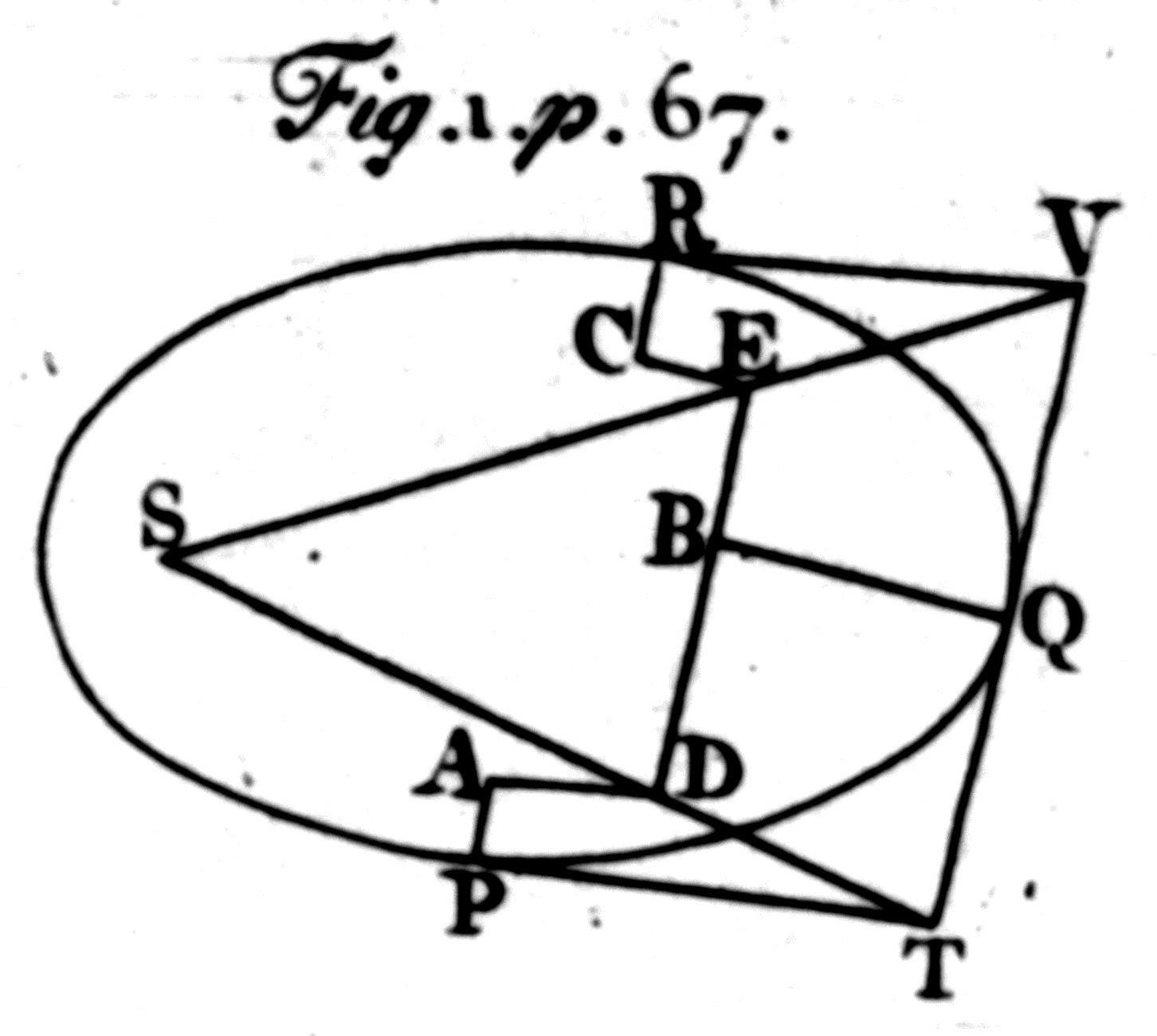
Let the three right lines PT, TQV, VR touch the figure described in as many points P, Q, R, and meet in T and V. On the tangents erect the perpendiculars PA, QB, RC, reciprocally proportional to the velocities of the body in the points P, Q, R, from which the perpendiculars were raised, that is, so that PA may be to QB as the velocity in Q to the velocity in P, and QB to RC as the velocity in R to the velocity in Q; Thro' the ends A, B, C, of the perpendiculars draw AD, DBE, EC, at right angles, 68meeting in D and E: And the right lines TD, VE produced, will meet in S the centre required.
For the perpendiculars let fall from the centre S on the tangents PT, QT, are reciprocally as the velocities of the bodies in the points P and Q (by cor. 1. prop. 1.) and therefore, by construction, as the perpendiculars AP, BQ directly; that is, as the perpendiculars let fall from the point D on the tangents. Whence it is easy to infer, that the points S, D, T, are in one right line. And by the like argument the points S, E, V are also in one right line; and therefore the centre S is in the point where the right lines TD, VE meet. Q. E. D.
Proposition VI. Theorem V
In a space void of resistance, if a body revolves in any orbit about an immoveable centre, and in the least time describes any arc just then nascent; and the versed sine of that arc is supposed to be drawn, bisecting the chord, and produced passing through the centre of force: the centripetal force in the middle of the arc, will be as the versed sine directly and the square of the time inversely.
For the versed sine in a given time is as the force (by cor. 4. prop. 1.) and augmenting the time in any ratio, because the arc will be augmented in the same ratio, the versed sine will be augmented in the duplicate of that ratio, (by cor. 2 and 3. lem. 11.) and therefore is as the force and the square of the time. Subduct on both sides the duplicate ratio of the time, and the force 69will be as the versed line directly and the square of the time inversely. Q. E. D.
And the same thing may also be easily demonstrated by corol. 4. lem. 10.
Cor. 1. If a body P revolving about the centre S, (Pl. 3. Fig. 2.) describes a curve line APQ, which a right line ZPR touches in any point P; and from any other point Q of the curve. QR is drawn parallel to the distance SP, meeting the tangent in R; and QT is drawn perpendicular to the distance SP: the centripetal force will be reciprocally as the solid , if the solid be taken of that magnitude which it ultimately acquires when the points P and Q coincide. For QR is equal to the versed sine of double the arc QP, whose middle is P: and double the triangle SQP, or is proportional to the time, in which that double arc is described; and therefore may be used for the exponent of the time.
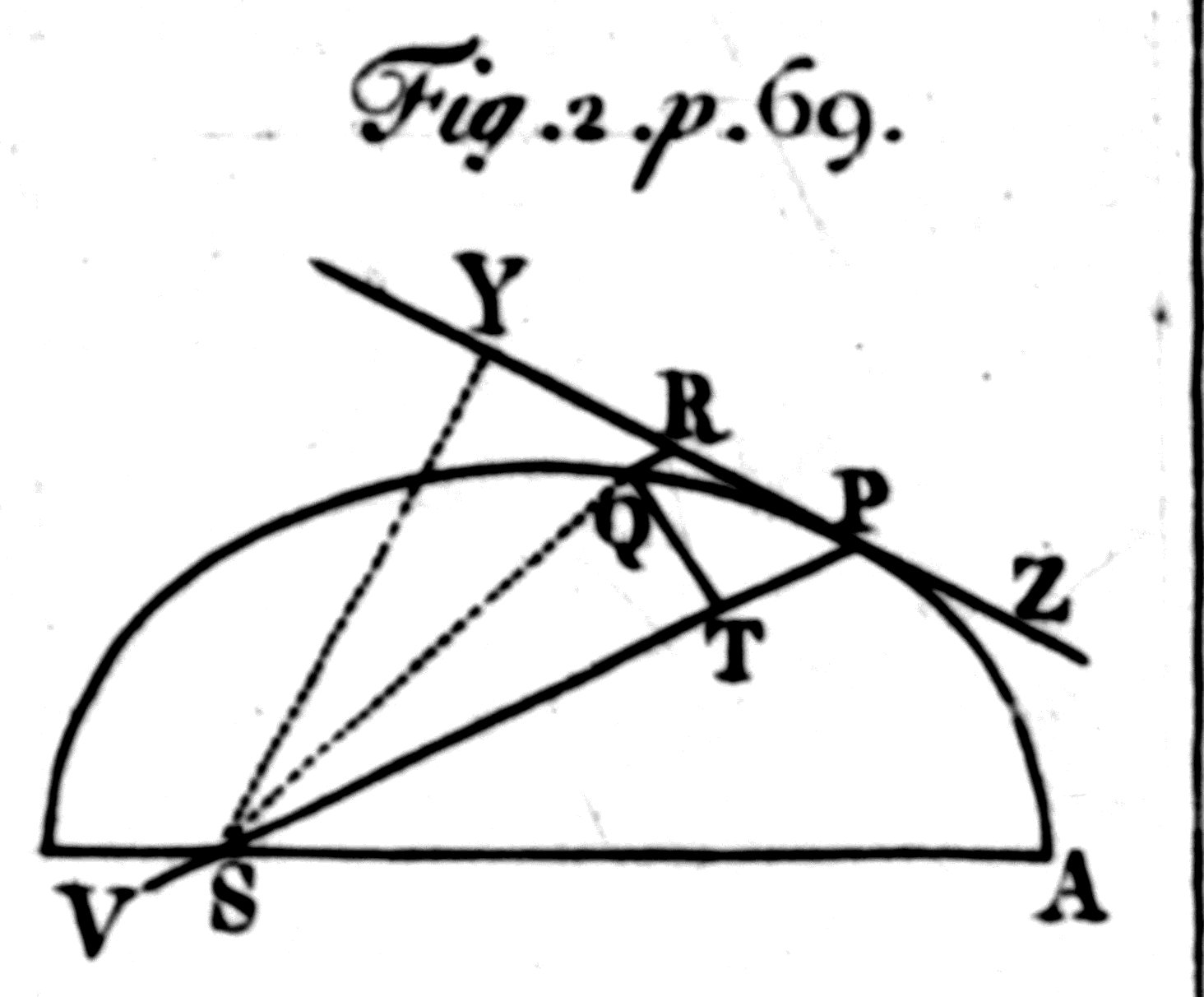
Cor. 2. By a like reasoning, the centripetal force is reciprocally as the solid ; if ST is a perpendicular from the centre of force on PR the tangent of the orbit. For the rectangles and are equal.
Cor. 3. If the orbit is either a circle, or touches or cuts a circle concentrically, that is, contains with a circle the least angle of contact or section, having the same curvature and the same radius of curvature at the point P; and if PV be a chord of this circle, drawn from the body through the centre of force; the centripetal force will be reciprocally as the solid . For PV is ,
70Cor. 4. The same things being supposed the centripetal force is as the square of the velocity directly, and that chord inversely. For the velocity is reciprocally as the perpendicular ST, by cor. 1. prop. 1.
Cor. 5. Hence if any curvilinear figure APQ is given; and therein a point S is also given to which a centripetal force is perpetually directed; that law of centripetal force may be found, by which the body P will be continually drawn back from a rectilinear course, and being detained in the perimeter of that figure, will describe the same by a perpetual revolution. That is, we are to find by computation, either the solid or the solid , reciprocally proportional to this force. Examples of this we shall give in the following problems.
Proposition VII. Problem II
If a body revolves in the circumference of a circle; it is proposed to find the law of centripetal force directed to any given point. Pl. 3. Fig. 3.
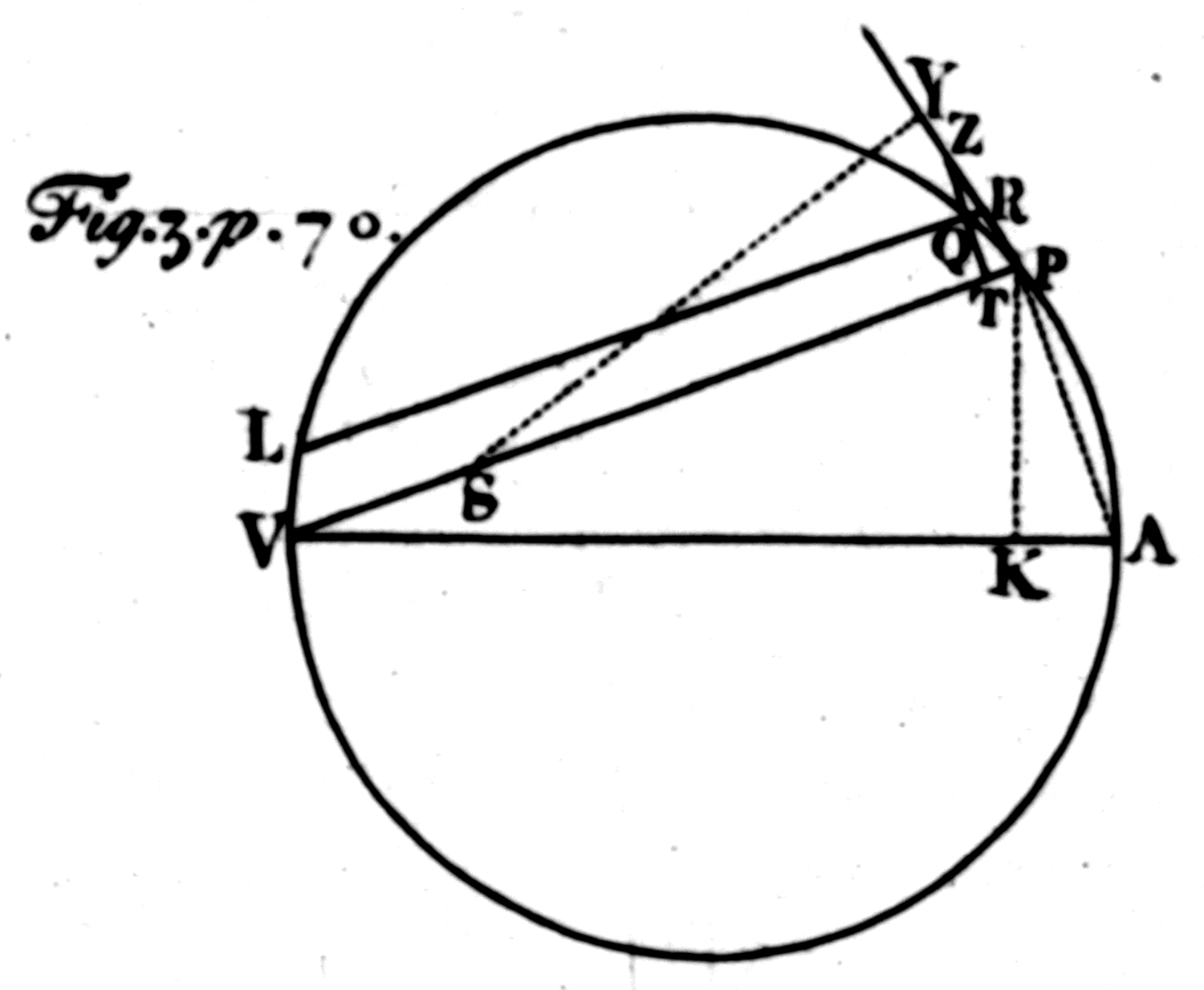
Let VQPA be the circumference of the circle; S the given point to which as to a centre the force tends; P the body moving in the circumference; Q the next place into which it is to move; and PRZ the tangent of the circle at the preceding place. Through the point S draw the chord PV, and the diameter VA of the circle, join AP, and draw QT perpendicular to SP, which produced, may meet the tangent 71PR in Z; and lastly, thro' the point Q draw LR parallel to SP, meeting the circle in L, and the tangent PZ in R. And, because of the similar triangles ZQR, ZTP, VPA, we shall have , that is, QRL, to , as to . And therefore is equal to . Multiply those equals by , and the points P and Q coinciding, for RL write PV; then we shall have . And therefore (by cor. 1. and 5. prop. 6.) the centripetal force is reciprocally as , that is (because is given) reciprocally as the square of the distance or altitude SP, and the cube of the chord PV conjunctly. Q. E. I.
The same otherwise.
On the tangent PR produced, let fall the perpendicular ST: and (because of the similar triangles STP, VPA) we shall have AV to PV as SP to ST, and therefore , and . And therefore (by corol. 3 and 5. prop. 6.) the centripetal force is reciprocally as ; that is, (because AV is given) reciprocally as . Q. E. I.
72Cor. 1. Hence if the given point S, to which the centripetal force always tends, is placed in the circumference of the circle, as at V; the centripetal force will be reciprocally as the quadrato-cube (or fifth power) of the altitude SP.
Cor. 2. The force by which the body P in the circle APTV (Pl. 3. Fig. 4.) revolves about the centre of force S is to the force by which the same body P may revolve in the same circle and in the same periodic time about any other centre of force R, as to the cube of the right line SG, which from the first centre of force S, is drawn parallel to the distance PR of the body from the second centre of force R, meeting the tangent PG of the orbit in G. For by the construction of this proposition, the former force is to the latter as to ; that is, as to or, (because of the similar triangles PSG, TPV) to .
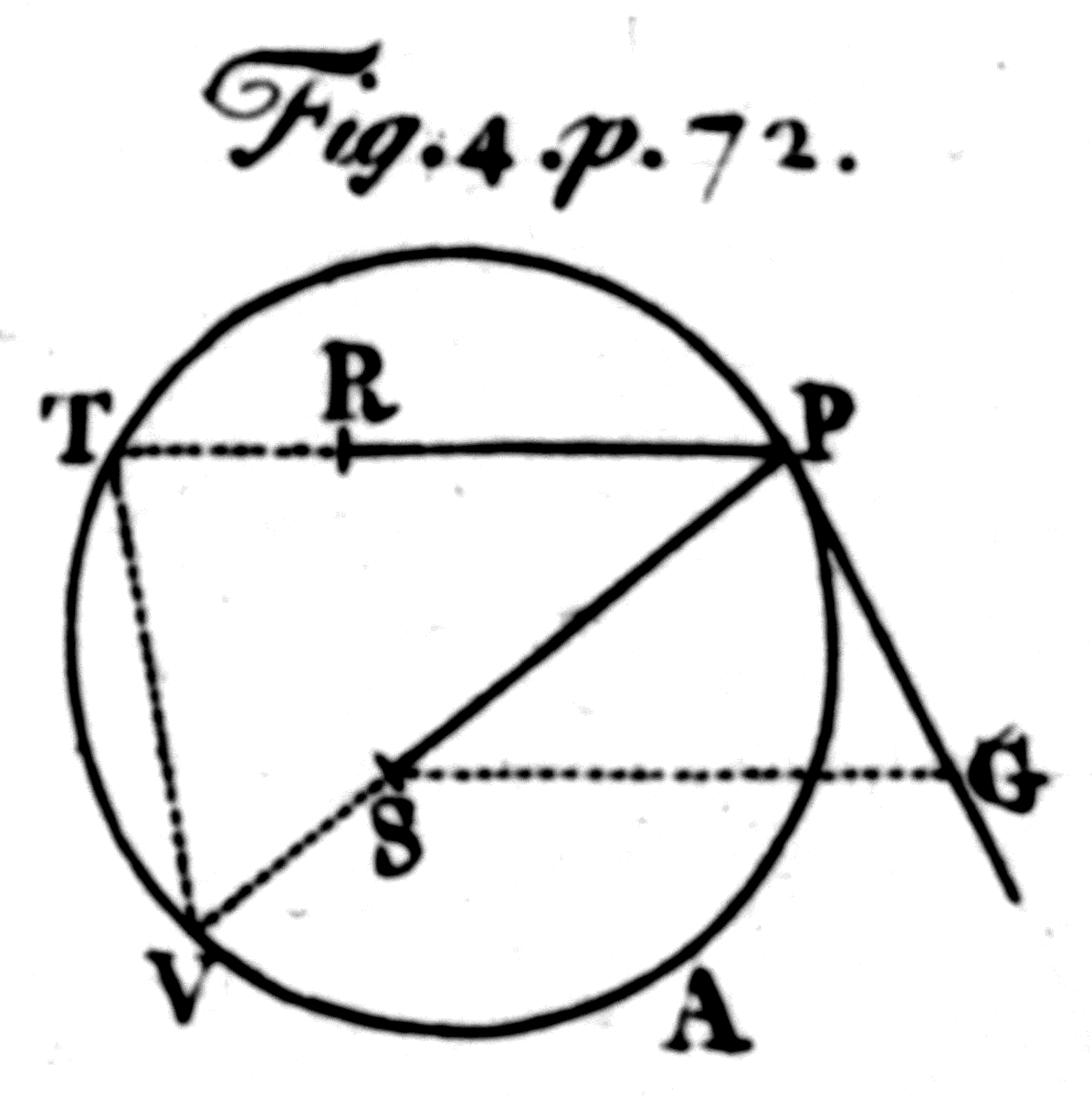
Cor. 3. The force by which the body P in any orbit revolves about the centre of force S, is to the force by which the same body may revolve in the same orbit, and in the same periodic time about any other centre of force R, as the solid , contained under the distance of the body from the first centre of force S, and the square of its distance from the second centre of force R, to the cube of the right line SG, drawn from the first centre of force S, parallel to the distance RP of the body from the second centre of force R, meeting the tangent PG of the orbit in G. For the force in this orbit at any point P is the same as in a circle of the same curvature
Proposition VIII. Problem III
73If a body moves in the semi-circumference PQA; it is proposed to find the law of the centripetal force tending to a point S, so remote, that all the lines PS, RS drawn thereto, may be taken for parallels. Pl. 3. Fig. 5.
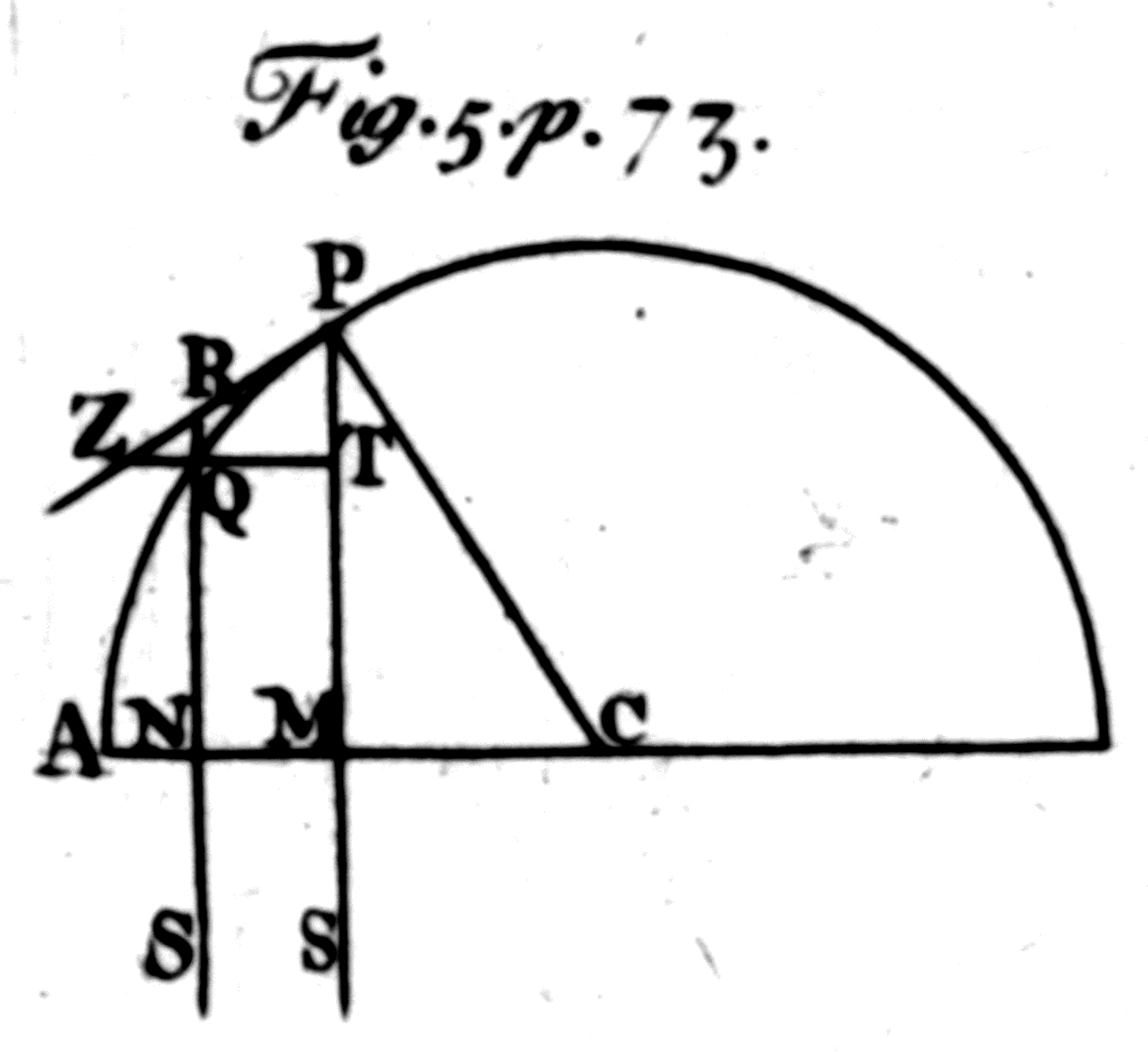
From C the centre of the semi-circle, let the semidiameter CA be drawn, cutting the parallels at right angles in M and N, and join CP. Because of the similar triangles CPM, PZT and RZQ we shall have to as to ; and from the nature of the circle, is equal to the rectangle , or the points P, Q coinciding, to the rectangle . Therefore is to as to ; and , and . And therefore (by corol. 1. and 5. prop. 6.) the centripetal force is reciprocally as ; that is, (neglecting the given ratio ) reciprocally as . Q. E. I.
And the same thing is likewise easily inferred from the preceding Proposition.
Scholium
74And by a like reasoning, a body will be moved in an ellipsis, or even in an hyperbole, or parabola, by a centripetal force which is reciprocally as the cube of the ordinate directed to an infinitely remote centre of force.
Proposition IX. Problem IV
If a body revolves in a spiral PQS, cutting all the radii SP, SQ, &c. in a given angle: it is proposed to find the law of the centripetal force tending to the centre of that spiral. Pl. 3. Fig. 6.
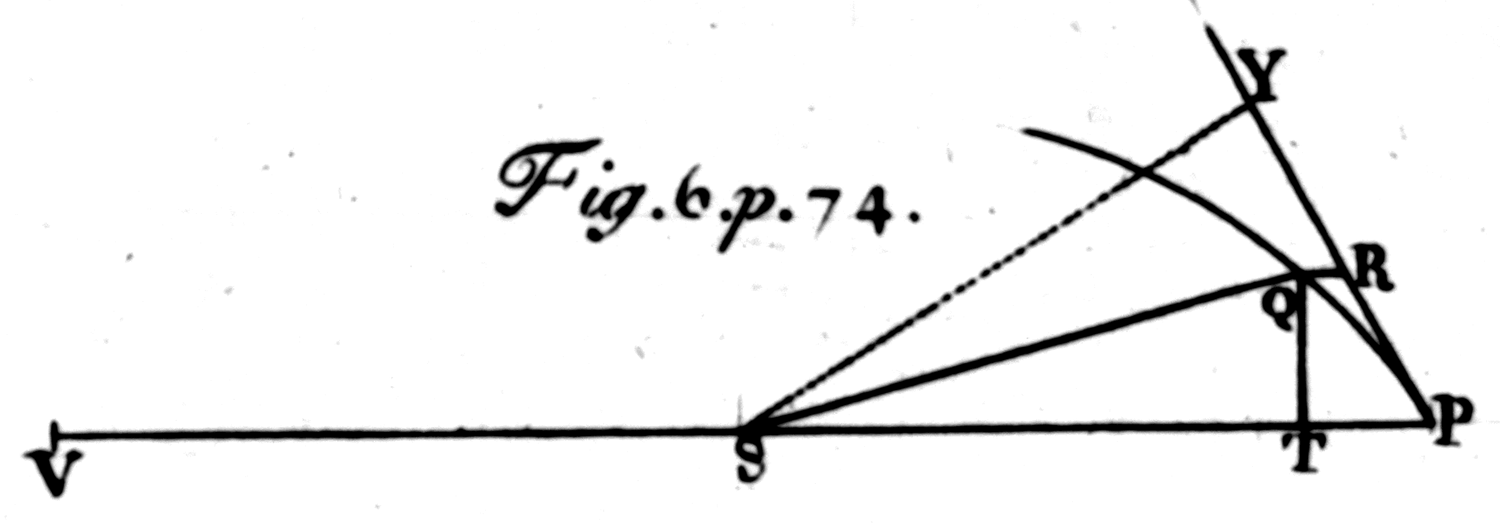
Suppose the indefinitely small angle PSQ to be given; because then all the angles are given, the figure SPRQT will be given in specie. Therefore the ratio is also given, and is as QT that is (because the figure is given in specie) as SP. But if the angle PSQ is any way changed, the right line QR, subtending the angle of contact QPR, (by lem. 11.) will be changed in the duplicate ratio of PR or QT. Therefore the ratio remains the same as before, that is as SP. And is as , and therefore (by corol. 1. and 5. prop. 6.) the centripetal force is reciprocally as the cube of the distance SP. Q. E. I.
The same otherwise.
75The perpendicular ST let fall upon the tangent and the chord PV of the circle concentrically cutting the spiral are in given ratio's to the height SP; and therefore is as , that is (by corol. 3. and 5. prop. 6.) reciprocally as the centripetal force.
Lemma XII
All parallelograms circumscribed about any conjugate diameters of a given ellipsis or hyperbola are equal among themselves.
This is demonstrated by the writers on the conic sections.
Proposition X. Problem V
If a body revolves in an ellipsis: it is proposed to find the law of the centripetal force tending to the centre of the ellipsis. Pl. 4. Fig. 1.
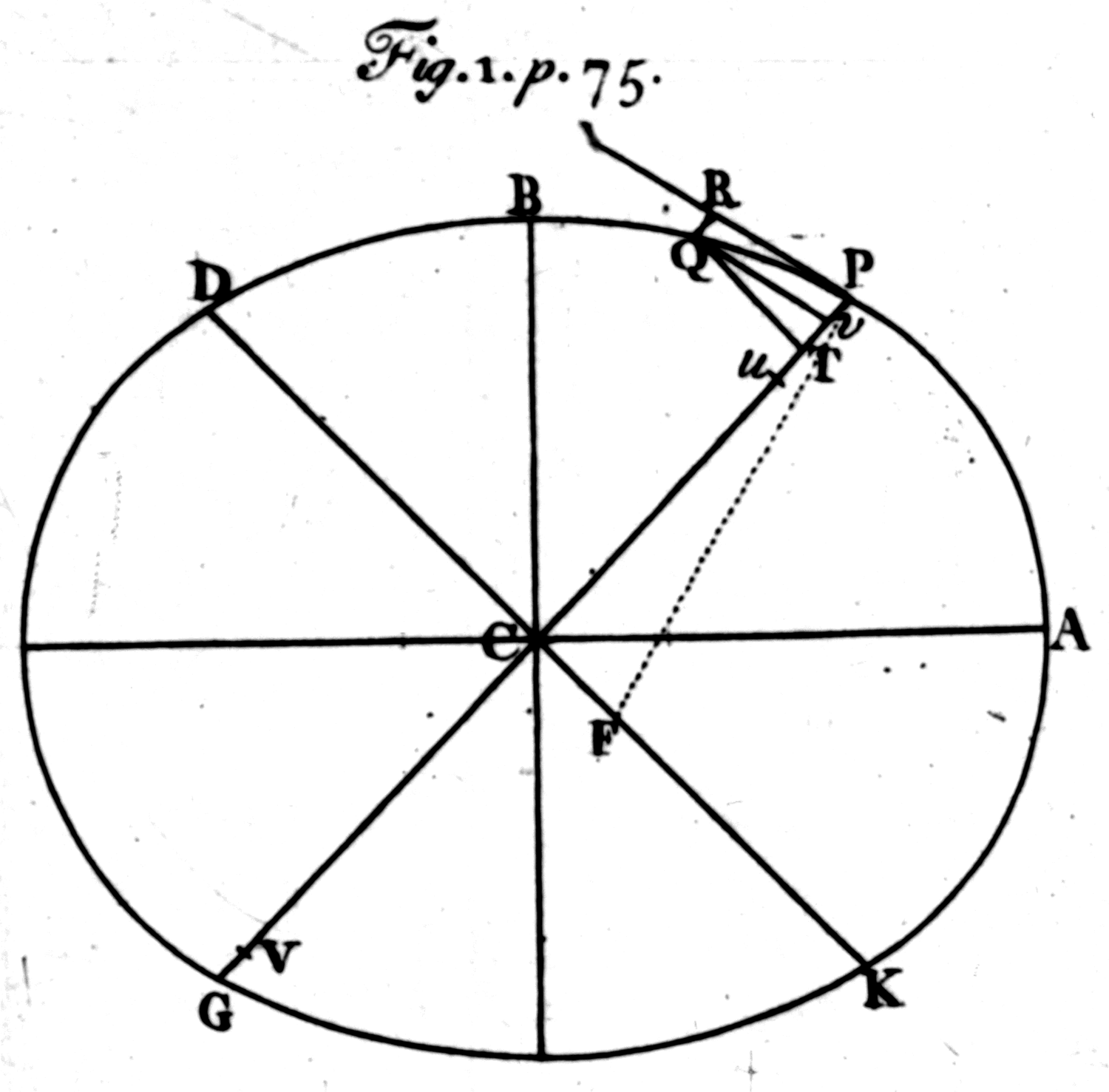
Suppose CA, CB to be semi-axes of the ellippse; GP, DK conjugate diameters; PF, QT perpendiculars to those diameters; Qv an ordinate to the diameter GP; and if the parallelogram QvPR be compleated; then (by the properties of the conic sections) the rectangle PvG will be to as to , and (because of the similar triangles QvT, PCF) to as to ; and by composition, the ratio of PvG to is compounded of 76the ratio of to and of the ratio of to , that is, vG to as to . Put QR for Pv, and (by lem. 12.) for , also (the points P and Q coinciding,) 2PC for vG; and multiplying the extremes and means together, we shall have equal to . Therefore (by cor. 5. prop. 6.) the centripetal force is reciprocally as ; that is (because is given) reciprocally as ; that is, directly as the distance PC. Q. E. I.
The same otherwise.
In the right line PG on the other side of the point T, take the point u so that Tu may be equal to Tv; then take uV, such as shall be to vG as to . And because is to PvG as to , (by the conic sections) we shall have . Add the rectangle uPv to both sides, and the square of the chord of the arc PQ will be equal to the rectangle VPv; and therefore a circle, which touches the conic section in P, and passes thro' the point Q, will pass also thro' the point V. Now let the points P and Q meet, and the ratio of uV to vG, which is the same with the ratio of to , will become the ratio of PV to PG or PV to 2PC; and therefore PV will be equal to . And therefore the force, by which the body P revolves in the ellipsis, will be reciprocally as 77 (by cor. 3. prop. 6.) that is, (because is given) directly as PC. Q. E. I.
Cor. 1. And therefore the force is as the distance of the body from the centre of the ellipsis; and vice versa if the force is as the distance, the body will move in an ellipsis whose centre coincides with the centre of force, or perhaps in a circle into which the ellipsis may degenerate.
Cor. 2. And the periodic times of the revolutions made in all ellipses whatsoever about the same centre will be equal. For those times in similar ellipses will be equal (by corol. 3 and 8. prop. 4.) but in ellipses that have their greater axe common, they are one to another as the whole areas of the ellipses directly, and the parts of the areas described in the same time inversely; that is, as the lesser axes directly, and the velocities of the bodies in their principal vertices inversely; that is, as those lesser axes directly, and the ordinates to the same point of the common axis inversely; and therefore (because of the equality of the direct and inverse ratio's) in the ratio of equality.
Scholium
If the ellipsis by having its centre removed to an infinite distance degenerates into a parabola, the body will move in this parabola; and the force, now tending to a centre infinitely remote, will become equable. Which is Galileo's theorem. And if the parabolic section of the cone (by changing the inclination of the cutting plane to the cone) degenerates into an hyperbola, the body will move in the perimeter of this hyperbola, having its centripetal force changed into a centrifugal force. And in like manner as in the 78circle, or in the ellipsis, if the forces are directed to the centre of the figure placed in the abscissa, those forces by increasing or diminishing the ordinates in any given ratio, or even by changing the angle of the inclination of the ordinates to the abscissa, are always augmented or diminished in the ratio of the distances from the centre; provided the periodic times remain equal; so also in all figures whatsoever, if the ordinates are augmented or diminished in any given ratio, or their inclination is any way changed, the periodic time remaining the same; the forces directed to any centre placed in the abscissa, are in the several ordinates augmented or diminished in the ratio of the distances from the centre.
Section III. Of the motion of bodies in eccentric Conic sections.
Section III
Of the motion of bodies in eccentric Conic sections.
Proposition XI. Problem VI
79If a body revolves in an ellipsis: it is required to find the law of the centripetal force tending to the focus of the ellipsis. Pl. 4. Fig. 2.
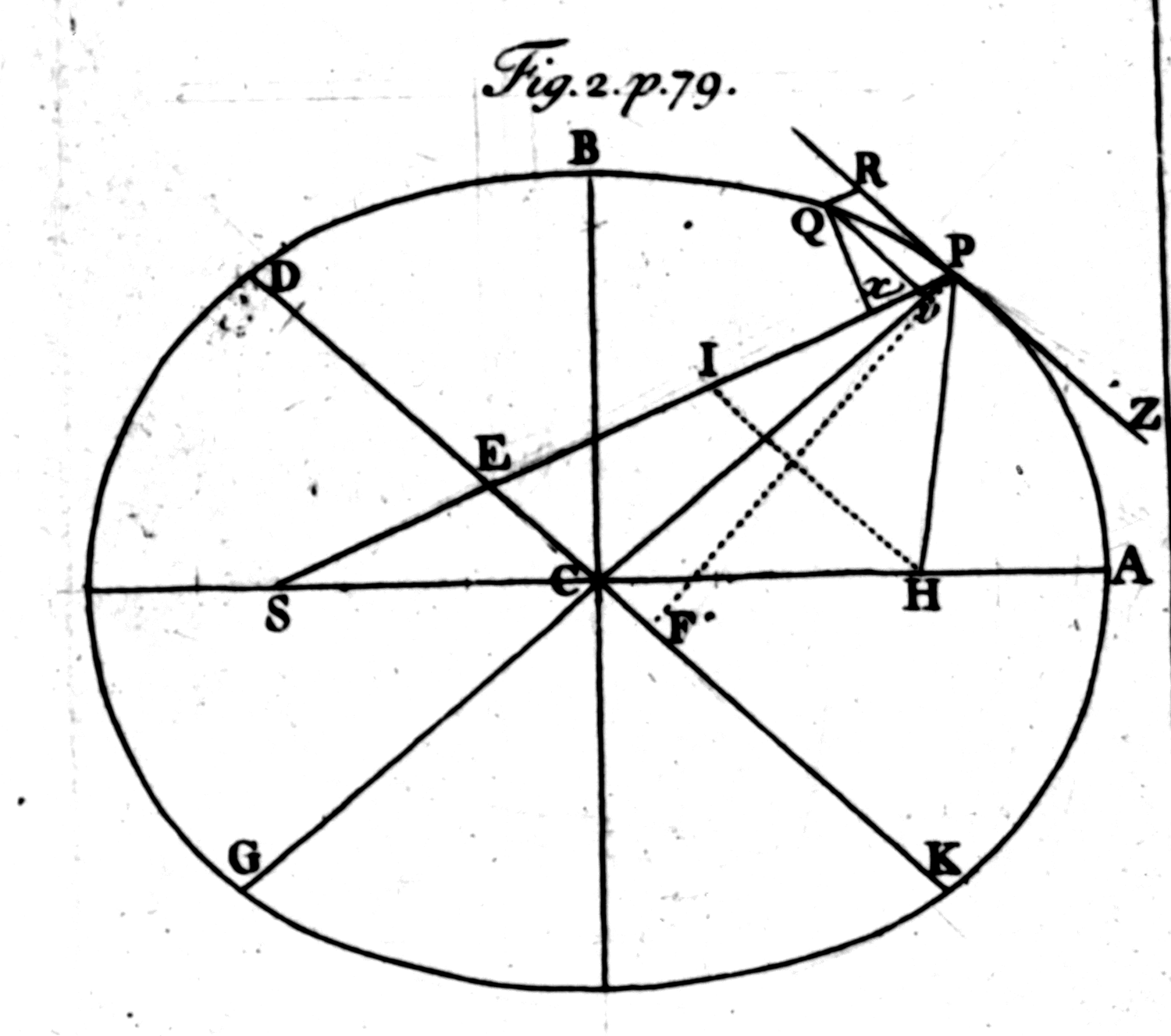
Let S be the focus of the ellipsis. Draw SP cutting the diameter DK of the ellipsis in E, and the ordinate Qv in x; and compleat the parallelogram QxPR. It is evident that EP is equal to the greater semi-axis AC: for drawing HI from the other focus H of the ellipsis parallel to EC, because CS, CH are equal ES, EI will be also equal, so that EP is the half sum of PS, PI that is, (because of the parallels HI, PR, and the equal angles IPR, HPZ) of PS, PH, which taken together are equal to the whole axis 2AC. Draw QT perpendicular to SP, and putting L for the principal latus rectum of the ellipsis (or for ,) we shall have to 80 as QR to Pv, that is, as PE or AC to PC; and to GvP as L to Gv; and GvP to as to ; and (by corol. 2. lem. 7.) the points Q and P coinciding, is to in the ratio of equality; and or is to as to , that is, as to or (by lem. 12.) as to . And compounding all those ratio's together, we shall have to as or to , or as 2PC to Gv. But the points Q and P coinciding, 2PC and Gv are equal. And therefore the quantities and , proportional to these, will be also equal. Let those equals be drawn into , and will become equal to . And therefore (by corol. 1. and 5. prop. 6.) the centripetal force is reciprocally as , that is, reciprocally in the duplicate ratio of the distance SP. Q. E. I.
The same otherwise.
Seeing the force tending to the centre of the ellipsis, by which the body P may revolve in that ellipsis, is (by corol. 1. prop. 10.) as the distance CP of the body from the centre C of the ellipsis; let CE be drawn parallel to the tangent PR of the ellipsis; and the force, by which the same body P may revolve about any other point S of the ellipsis, if CE and PS intersect in E, will be as (by cor. 3. prop. 7.) that is, if the point S is the focus of the ellipsis, and therefore PE be given, as reciprocally. Q. E. I.
81With the same brevity with which we reduced the fifth problem to the parabola and hyperbola, we might do the like here: But because of the dignity of the problem and its use in what follows, I shall confirm the other cases by particular demonstrations.
Proposition XII. Problem VII
Suppose a body to move in an hyperbola: it is required to find the law of centripetal force tending to the focus of that figure. Pl. 5. Fig. 1.
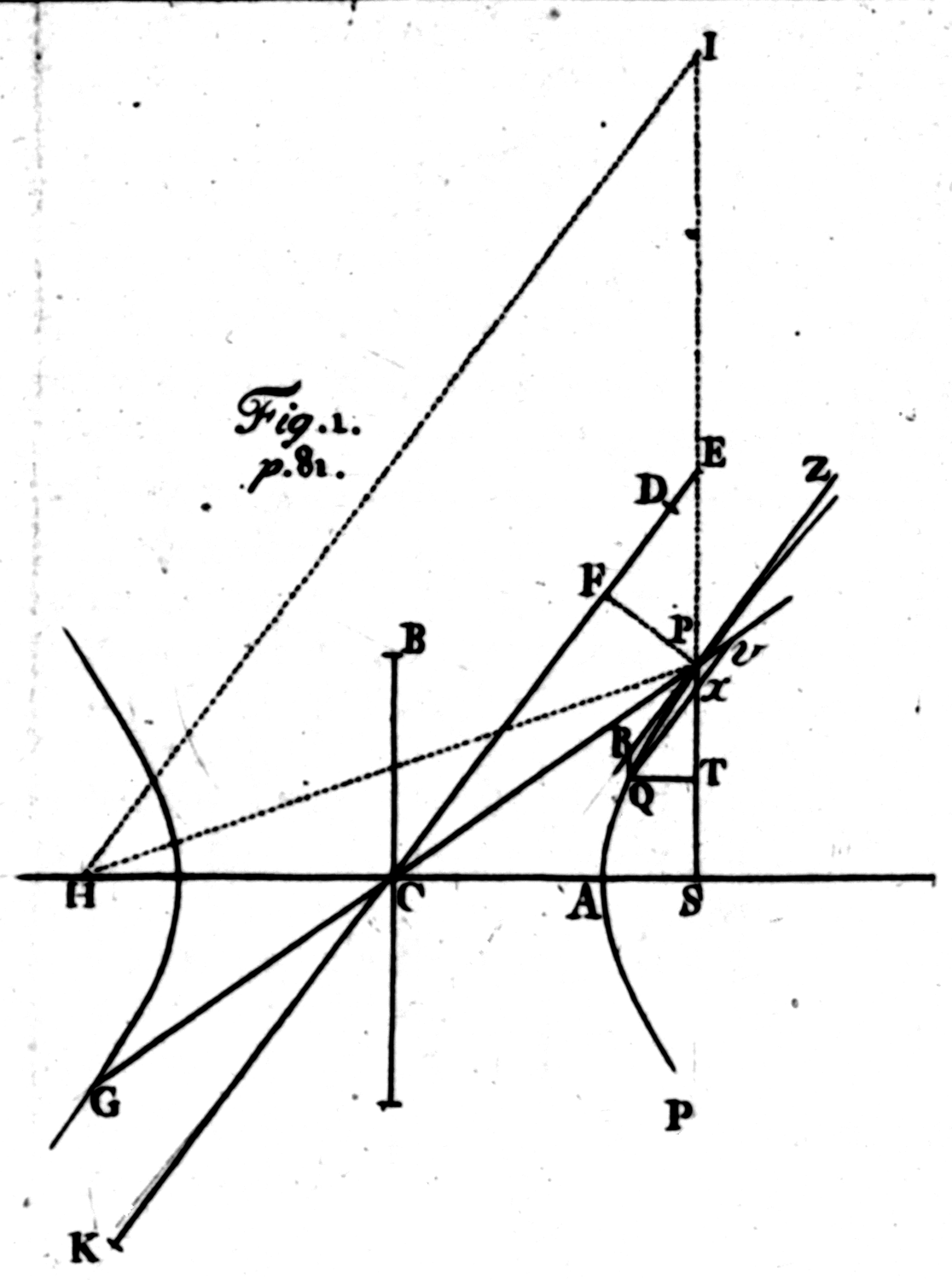
Let CA, CB be the semi-axes of the hyperbola; PG, KD other conjugate diameters; PF a perpendicular to the diameter KD; and Qv an ordinate to the diameter GP. Draw SP cutting the diameter DK in E, and the ordinate Qv in x, and compleat the parallelogram QRPx. It is evident that EP is equal to the semi-transverse axe AC; for, drawing HI, from the other focus H of the hyperbola, parallel to EC, because CS, CH are equal, ES, EI will be also equal; so that EP is the half difference of PS, PI; that is, (because of the parallels IH, PR, and the equal angles IPR, HPZ) of PS, PH, the difference of which is equal to the whole axis 2AC. Draw QT perpendicular to SP. And putting L for the principal latus rectum of the hyperbola, (that is, for ,) we shall have to as QR to Pv, or Px to Pv, that is, (because of the similar triangles Pxv, PEC) as PE to PC, or AC to PC. And 82 will be to as L to Gv; and (by the properties of the conic sections) the rectangle GvP is to as to ; and (by cor. 2. lem. 7.) to , the points Q and P coinciding, becomes a ratio of equality; and or is to as to , that is, as to , or (by lem. 12.) as to : and, compounding all those ratio's together, we shall have to as or to , or as 2PC to Gv. But the points P and Q coinciding, 2PC and Gv are equal. And therefore the quantities and , proportional to them, will be also equal. Let those equals be drawn into , and we shall have equal to . And therefore (by cor. 1 & 5. prop. 6.) the centripetal force is reciprocally as , that is, reciprocally in the duplicate ratio of the distance SP. Q. E. I.
The same otherwise.
Find out the force tending from the centre C of the hyperbola. This will be proportional to the distance CP. But from thence (by cor. 3. prop. 7.) the force tending to the focus S will be as , that is, because PE is given, reciprocally as . Q. E. I.
And the same way it may be demonstrated, that the body having its centripetal changed into a centrifugal force, will move in the conjugate hyperbola.
Lemma XIII
83The latus rectum of a parabola belonging to any vertex is quadruple the distance of that vertex from the focus of the figure.
This is demonstrated by the writers on the conic sections.
Lemma XIV
The perpendicular let fall from the focus of a parabola on its tangent, is a mean proportional between the distances of the focus from the point of contact, and from the principal vertex of the figure. Pl. 5. Fig. 2.
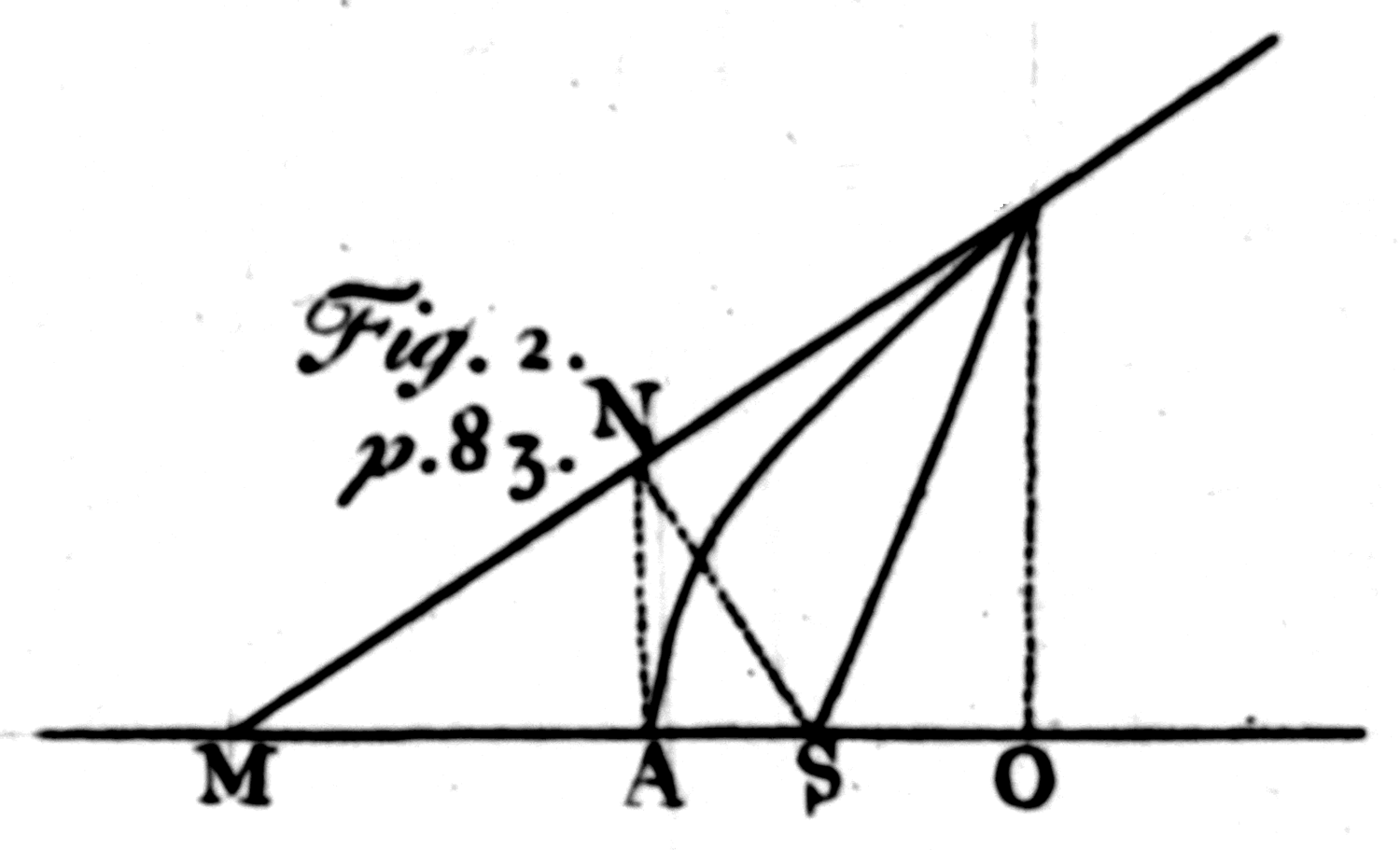
For, let AP be the parabola, S its focus, A its principal vertex, P the point of contact, PO an ordinate to the principal diameter, PM the tangent meeting the principal diameter in M, and SN the perpendicular from the focus on the tangent. Join AN, and because of the equal lines MS and SP, MN and NP, MA and AO; the right lines AN, OP, will be parallel; and thence the triangle SAN will be right angled at A, and similar to the equal triangles SNM, SNP: therefore PS is to SN as SN to SA. Q. E. D.
Cor. 1. is to as PS to SA.
84Cor. 2. And because SA is given, will be as PS.
Cor. 3. And the concourse of any tangent PM with the right line SN, drawn from the focus perpendicular on the tangent, falls in the right line AN, that touches the parabola in the principal vertex.
Proposition XIII. Problem VIII
If a body moves in the perimeter of a parabola: it is required to find the law of the centripetal force tending to the focus of that figure. Pl. 5. Fig. 3.
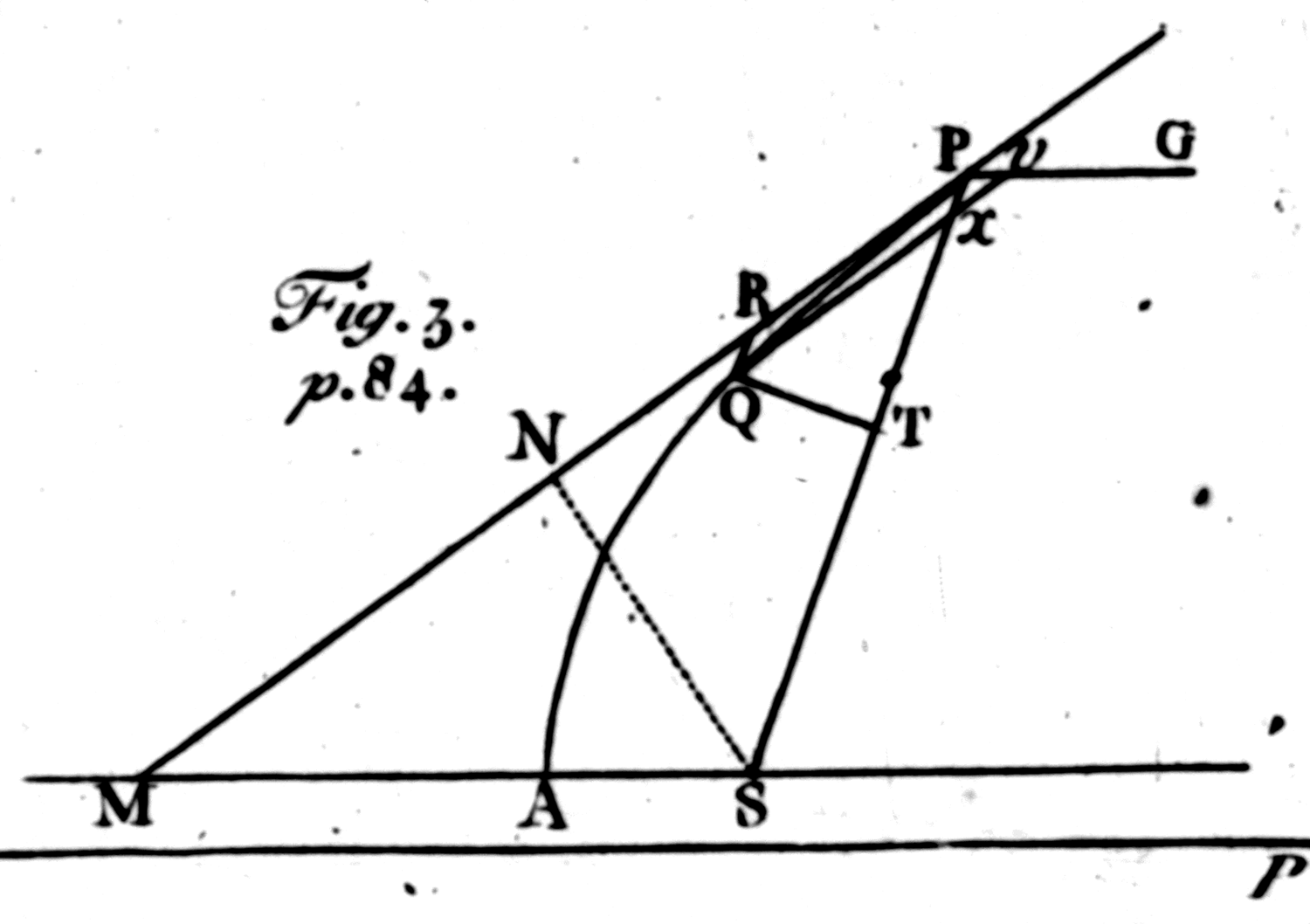
Retaining the construction of the preceding lemma, let P be the body in the perimeter of the parabola; and from the place Q, into which it is next to succeed draw QR parallel and QT perpendicular to SP, as also Qv parallel to the tangent, and meeting the diameter PG in v, and the distance SP in x. Now, because of the similar triangles Pxv, SPM, and of the equal sides SP, SM of the one, the sides Px or QR and Pv of the other will be also equal. But (by the conic sections) the square of the ordinate Qv is equal to the rectangle under the latus rectum and the segment Pv of the diameter, that is, (by lem. 13.) to the rectangle , or ; and the points P and Q coinciding, the ratio of Qv to Qx (by cor. 2. lem. 7.) becomes a ratio of equality. And therefore , in this case, becomes equal to the rectangle . But (because of the similar triangles QxT, SPN) is to as to , that is (by cor. 1. lem. 14.) as PS to SA; that is, as to , and therefore 85(by prop. 9. lib. 5. elem.) and are equal. Multiply these equals by , and will become equal to : and therefore (by cor. 1. and 5. prop. 6.) the centripetal force is reciprocally as ; that is, because 4SA is given, reciprocally in the duplicate ratio of the distance SP. Q. E. I.
Cor. 1. From the three last propositions it follows, that if any body P goes from the place P with any velocity in the direction of any right line PR, and at the same time is urged by the action of a centripetal force, that is reciprocally proportional to the square of the distance of the places from the centre; the body will move in one of the conic sections, having its focus in the centre of force; and the contrary. For the focus, the point of contact, and the position of the tangent being given, a conic section may be described, which at that point shall have a given curvature. But the curvature is given from the centripetal force and the bodies velocity given: and two orbits mutually touching one the other, cannot be described by the same centripetal force and the same velocity.
Cor. 2. If the velocity, with which the body goes from its place P, is such, that in any infinitely small moment of time the lineola PR may be thereby described; and the centripetal force such as in the same time to move that body through the space QR; the body will move in one of the conic sections, whose principal latus rectum is the quantity in its ultimate state, when the lineolæ PR, QR are 86diminished in infinitum. In these corollaries, I consider the circle as an ellipsis; and I except the case, where the body descends to the centre in a right line.
Proposition XIV. Theorem VI
If several bodies revolve about one common centre, and the centripetal force is reciprocally in the duplicate ratio of the distance of places from the centre; I say, that the principal latera recta of their orbits are in the duplicate ratio of the area's, which the bodies by radii drawn to the centre describe in the same time. Pl. 6. Fig. 1.
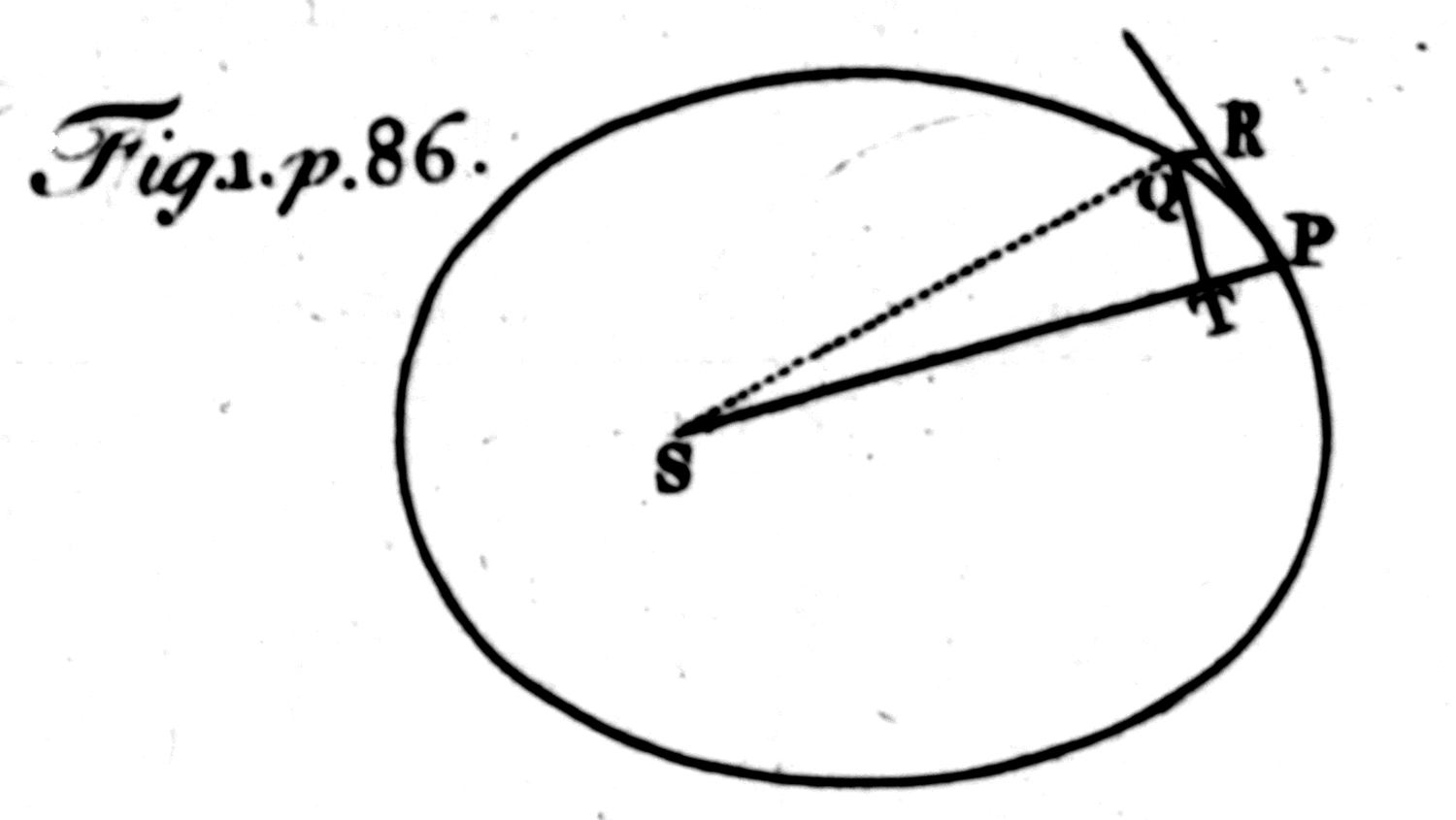
For (by cor. 2. prop. 13.) the latus rectum L is equal to the quantity in its ultimate state when the points P and Q coincide. But the lineola QR in a given time is as the generating centripetal force; that is (by supposition) reciprocally as . And therefore is as that is, the latus rectum L is in the duplicate ratio of the area . Q. E. D.
Cor. Hence the whole area of the ellipsis, and the rectangle under the axes, which is proportional to it, is in the ratio compounded of the subduplicate ratio of the latus rectum, and the ratio of the periodic time. For the whole area is as the area described in a given time, multiplied by the periodic time.
Proposition XV. Theorem VII
87The same things being supposed, I say that the periodic times in ellipses are in the sesquiplicate ratio of their greater axes.
For the lesser axe is a mean proportional between the greater axe and the latus rectum; and therefore the rectangle under the axes is in the ratio compounded of the subduplicate ratio of the latus rectum and the sesquiplicate ratio of the greater axe. But this rectangle (by cor. prop. 14.) is in a ratio compounded of the subduplicate ratio of the latus rectum and the ratio of the periodic time. Subduct from both sides the subduplicate ratio of the latus rectum, and there will remain the sesquiplicate ratio of the greater axe, equal to the ratio of the periodic time. Q. E. D.
Cor. Therefore the periodic times in ellipses are the same as in circles whose diameters are equal to the greater axes of the ellipses.
Proposition XVI. Theorem VIII
The same things being supposed, and right lines being drawn to the bodies that shall touch the orbits, and perpendiculars being let fall on the tangents from the common focus: I say that the velocities of the bodies are in a ratio compounded of the ratio of the perpendiculars inversely, and the subduplicate 88ratio of the principal latera recta directly. Pl. 6. Fig; 2.
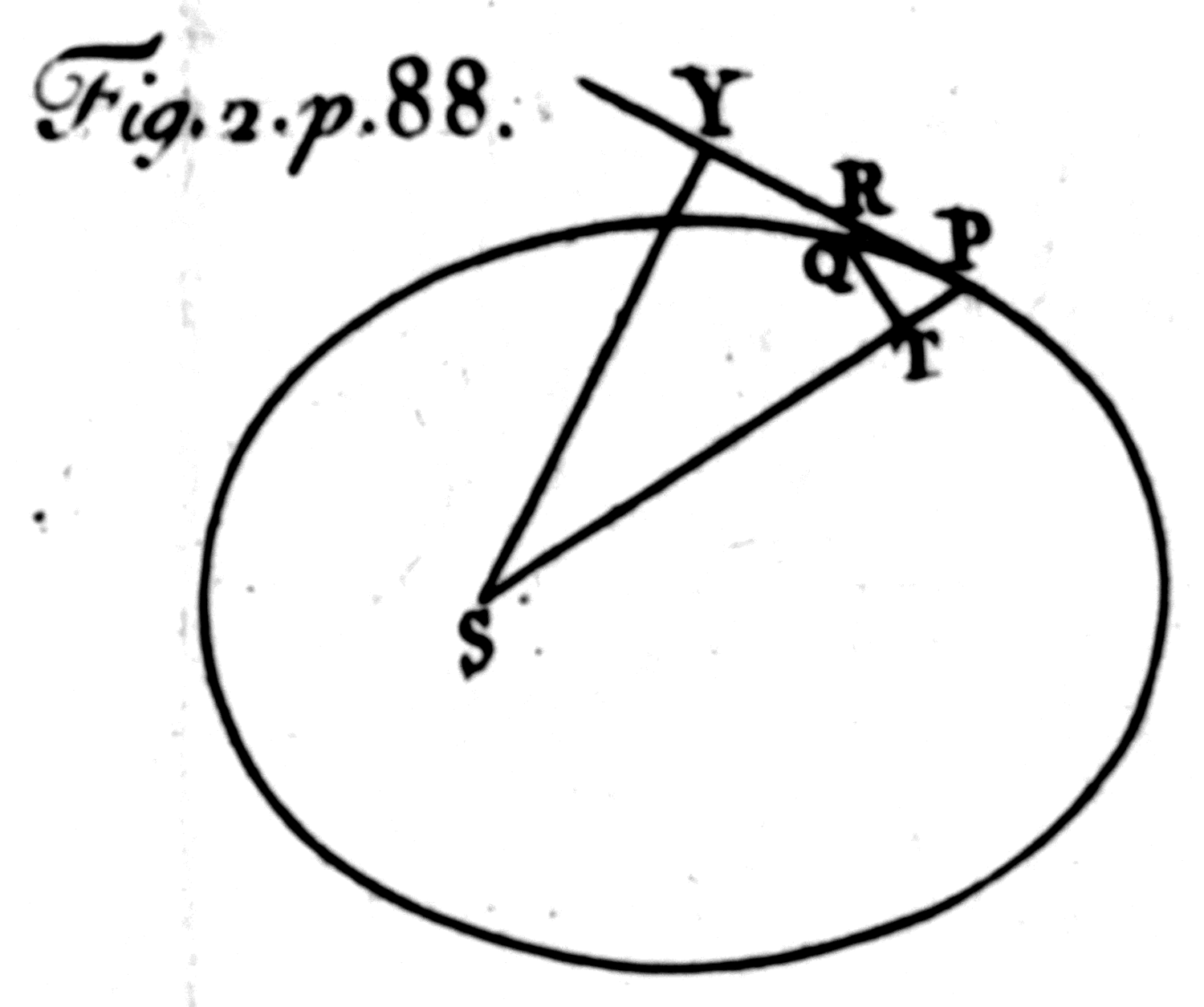
From the focus S, draw SY perpendicular to the tangent PR, and the velocity of the body P will be reciprocally in the subduplicate ratio of the quantity . For that velocity is as the infinitely small arc PQ described in a given moment of time, that is, (by lem. 7.) as the tangent PR; that is, (because of the proportionals PR to QT and SP to SY) as , or as SY reciprocally and directly; but is as the area described in the given time, that is (by prop. 14.) in the subduplicate ratio of the latus rectum. Q. E. D.
Cor. 1. The principal latera recta are in a ratio compounded of the duplicate ratio of the perpendiculars and the duplicate ratio of the velocities.
Cor. 2. The velocities of bodies, in their greatest and least distances from the common focus, are in the ratio compounded of the ratio of the distance inversely, and the subduplicate ratio of the principal latera recta directly. For those perpendiculars are now the distances.
Cor. 3. And therefore the velocity in a conic section, at its greatest or least distance from the focus, is to the velocity in a circle at the same distance from the centre, in the subduplicate ratio of the principal latus rectum to the double of that distance.
Cor. 4. The velocities of the bodies revolving in ellipses, at their mean distances from the common focus, are the same as those of bodies revolving in circles, at the same distances; that is (by cor. 6. prop. 4.) reciprocally in the subduplicate ratio of the distances.
89For the perpendiculars are now the lesser semi-axes, and these are as mean proportionals between the distances and the latera recta. Let this ratio inversely be compounded with the subduplicate ratio of the latera recta directly, and we shall have the subduplicate ratio of the distances inversely.
Cor. 5. In the same figure, or even in different figures, whose principal latera recta are equal, the velocity of a body is reciprocally as the perpendicular let fall from the focus on the tangent.
Cor. 6. In a parabola, the velocity is reciprocally in the subduplicate ratio of the distance of the body from the focus of the figure; it is more variable in the ellipsis, and less in the hyperbola, than according to this ratio. For (by cor. 2. lem. 14.) the perpendicular let fall from the focus on the tangent of a parabola is in the subduplicate ratio of the distance. In the hyperbola the perpendicular is less variable, in the ellipsis more.
Cor. 7. In a parabola, the velocity of a body at any distance from the focus, is to the velocity of a body revolving in a circle at the same distance from the centre, in the subduplicate ratio of the number 2 to 1; in the ellipsis it is less, and in the hyperbola greater, than according to this ratio. For (by cor. 2. of this prop.) the velocity at the vertex of a parabola is in this ratio, and (by cor. 6. of this prop. and prop. 4.) the same proportion holds in all distances. And hence also in a parabola, the velocity is every where equal to the velocity of a body revolving in a circle at half the distance; in the ellipsis it is less, and in the hyperbola greater.
90Cor. 8. The velocity of a body revolving in any conic section is to the velocity of a body revolving in a circle at the distance of half the principal latus rectum of the section, as that distance to the perpendicular let fall from the focus on the tangent of the section. This appears from cor. 5.
Cor. 9. Wherefore since (by cor. 6. prop. 4.) the velocity of a body revolving in this circle is to the velocity of another body revolving in any other circle, reciprocally in the subduplicate ratio of the distances; therefore ex æquo the velocity of a body revolving in a conic section will be to the velocity of a body revolving in a circle at the same distance, as a mean proportional between that common distance and half the principal latus rectum of the section, to the perpendicular let fall from the common focus upon the tangent of the section.
Proposition XVII. Problem IX
Supposing the centripetal force to be reciprocally proportional to the squares of the distances of places from the centre, and that the absolute quantity of that force is known; it is required to determine the line, which a body will describe that is let go from a given place with a given velocity in the direction of a given right line.
Let the centripetal force tending to the point S (Pl. 6. Fig. 3.) be such, as will make the body p revolve in any given orbit pq; and suppose the velocity of this body in the place p is known. Then from the place P, suppose the body P to be let go with a given velocity 91in the direction of the line PR; but by virtue of a centripetal force to be immediately turned aside from that right line into the conic section PQ. This the right line PR will therefore touch in P. Suppose likewise that the right line pr touches the orbit pq in p; and if from S you suppose perpendiculars let fall on those tangents, the principal latus rectum of the conic section (by cor. 1. prop. 16.) will be to the principal latus rectum of that orbit, in a ratio compounded of the duplicate ratio of the perpendiculars and the duplicate ratio of the velocities; and is therefore given. Let this latus rectum be L. The focus S of the conic section is also given. Let the angle RPH be the complement of the angle RPS to two right; and the line PH, in which the other focus H is placed, is given by position. Let fall SK perpendicular on PH, and erect the conjugate semi-axe BC; this done, we shall have = = = = . Add on both sides , and we shall have = , or to PH as to L. Whence PH is given both in length and position. That is, if the velocity of the body in P is such that the latus rectum L is less than , PH will lie on the same side of the tangent PR with the line SP; and therefore the figure will be an ellipsis, which from the given foci S, H and the principal axe , is given also. But if the velocity of the body is so great, that the latus rectum L becomes equal to , the length PH will be infinite; and therefore the figure will be a parabola, which has its axe SH parallel to 92the line PK, and is thence given. But if the body goes from its place P with a yet greater velocity, the length PH is to be taken on the other side the tangent; and so the tangent passing between the foci, the figure will be an hyperbola having its principal axe equal to the difference of the lines SP and PH, and thence is given. For if the body, in these cases, revolves in a conic section so found, it is demonstrated in prop. 11, 12, and 13. that the centripetal force will be reciprocally as the square of the distance of the body from the centre of force S; and therefore we have rightly determined the line PQ, which a body let go from a given place P with a given velocity, and in the direction of the right line PR given by position, would describe with such a force. Q. E. F.
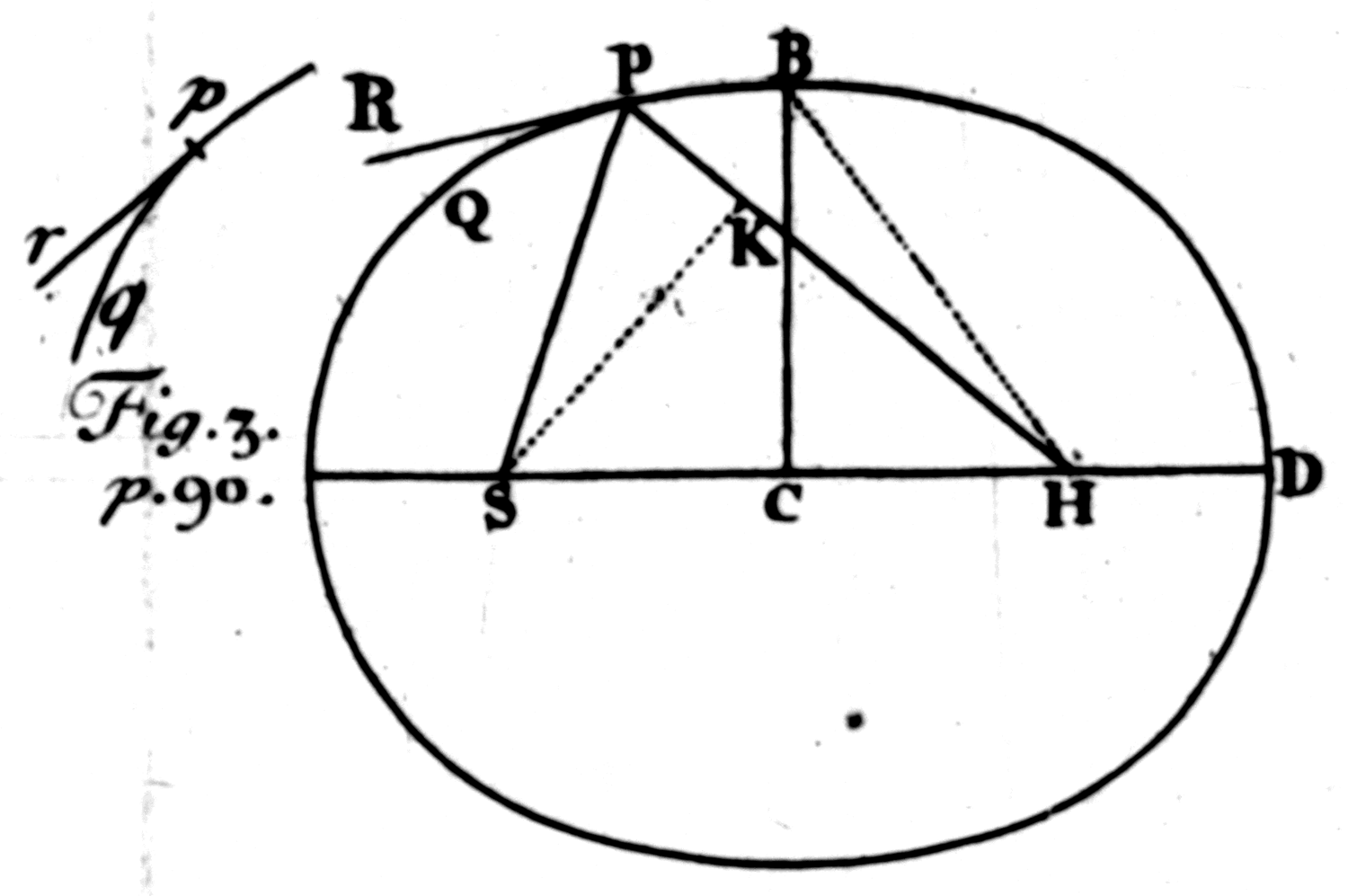
Cor. 1. Hence in every conic section, from the principal vertex D, the latus rectum L, and the focus S given, the other focus H is given, by taking DH to DS as the latus rectum to the difference between the latus rectum and 4DS. For the proportion, to PH as to L, becomes, in the case of this corollary, to DH as 4DS to L, and by division DS to DH as to L.
Cor. 2. Whence if the velocity of a body in the principal vertex D is given, the orbit may be readily found; to wit, by taking its latus rectum to twice the distance DS, in the duplicate ratio of this given velocity to the velocity of a body revolving in a circle at the distance DS (by cor. 3. prop. 16.) and then taking DH to DS as the latus rectum to the difference between the latus rectum and 4DS.
Cor. 3. Hence also if a body move in any conic section, and is forced out of its orbit by any impulse; you may discover the orbit in 93which it will afterwards pursue its course. For by compounding the proper motion of the body with that motion, which the impulse alone would generate, you'll have the motion with which the body will go off from a given place of impulse, in the direction of a right line given in position.
Cor. 4. And if that body is continually disturbed by the action of some foreign force, we may nearly know its course, by collecting the changes which that force introduces in some points, and estimating the continual changes it will undergo in the intermediate places, from the analogy that appears in the progress of the series.
Scholium
If a body P (Pl. 6. Fig. 4.) by means of a centripetal force tending to any given point R move in the perimeter of any given conic section, whose centre is C; and the law of the centripetal force is required: Draw CG parallel to the radius RP, and meeting the tangent PG of the orbit in G; and the force required (by cor. 1. & schol. prop. 10. & cor. 3. prop. 7.) will be as .
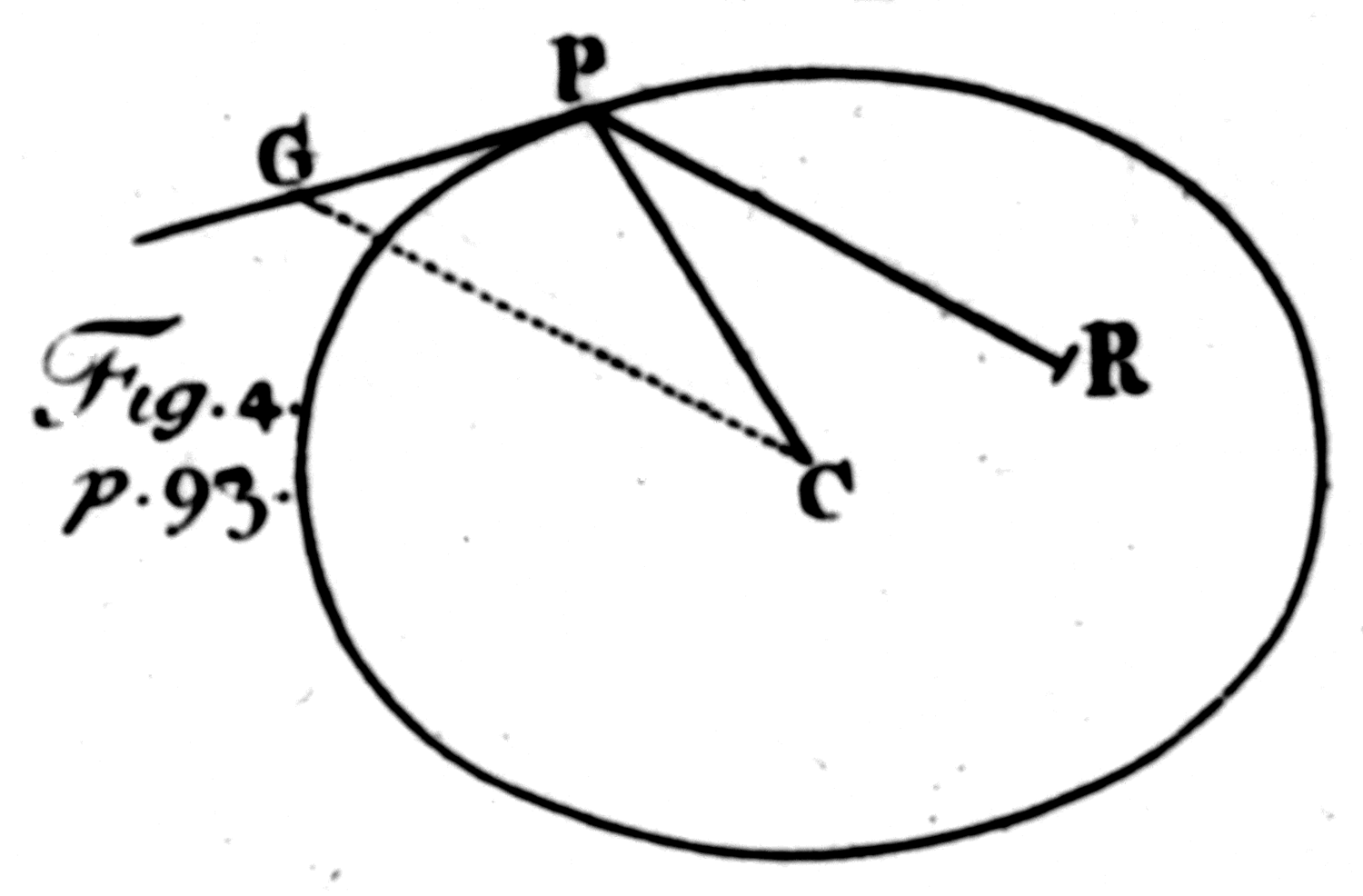
Section IV. Of the finding of elliptic, parabolic, and hyperbolic orbits, from the focus given.
Section IV
94Of the finding of elliptic, parabolic, and hyperbolic orbits, from the focus given.
Lemma XV
If from the two foci S, H, (Pl. 7. Fig. 1.) of any ellipsis or hyperbola, we draw to any third point V the right lines SV, HV, whereof one HV is equal to the principal axis of the figure, that is, to the axis in which the foci are situated, the other SV is bisected in T by the perpendicular TR let fall upon it; that perpendicular TR will somewhere touch the conic section: and vice versa, if it does touch it, HV will be equal to the principal axis of the figure.
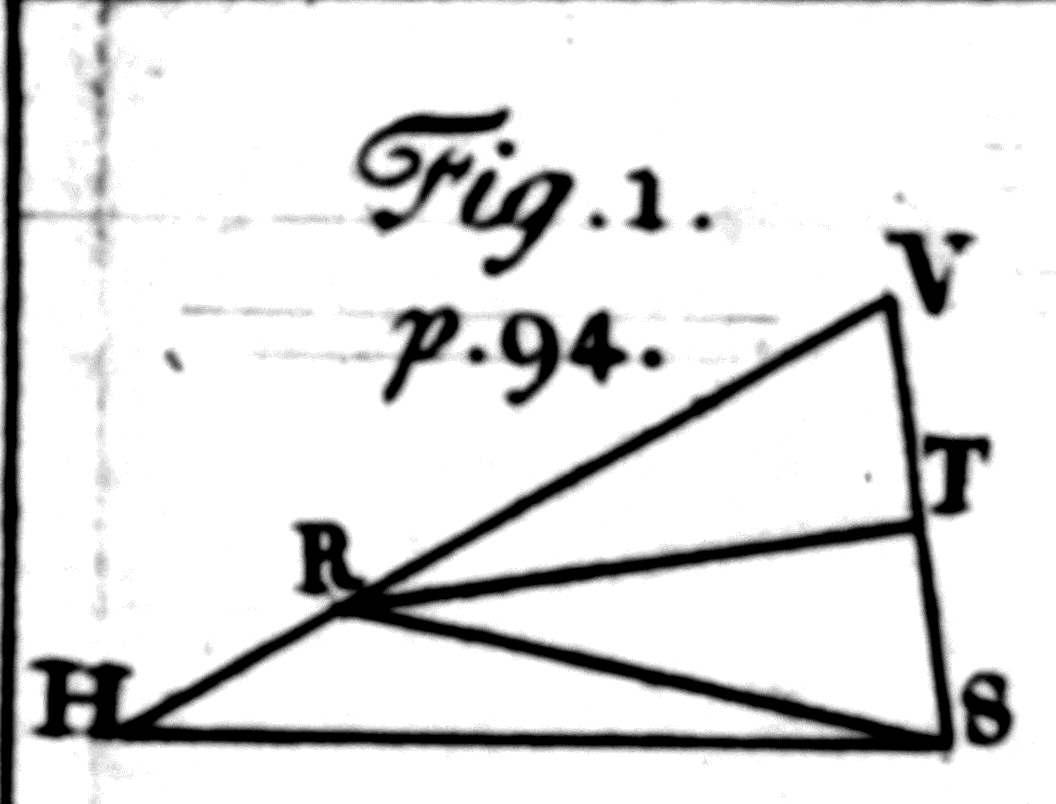
For, let the perpendicular TR cut the right line HV, produced if need be, in R; and join SR. Because 95TS, TV are equal, therefore the right lines SR, VR, as well as the angles TRS, TRV, will be also equal. Whence the point R will be in the conic section, and the perpendicular TR will touch the same: and the contrary. Q. E. D.
Proposition XVIII. Problem X
From a focus and the principal axes given, to describe elliptic and hyperbolic trajectories, which shall pass through given points, and touch right lines given by position. Pl. 7. Fig. 2.
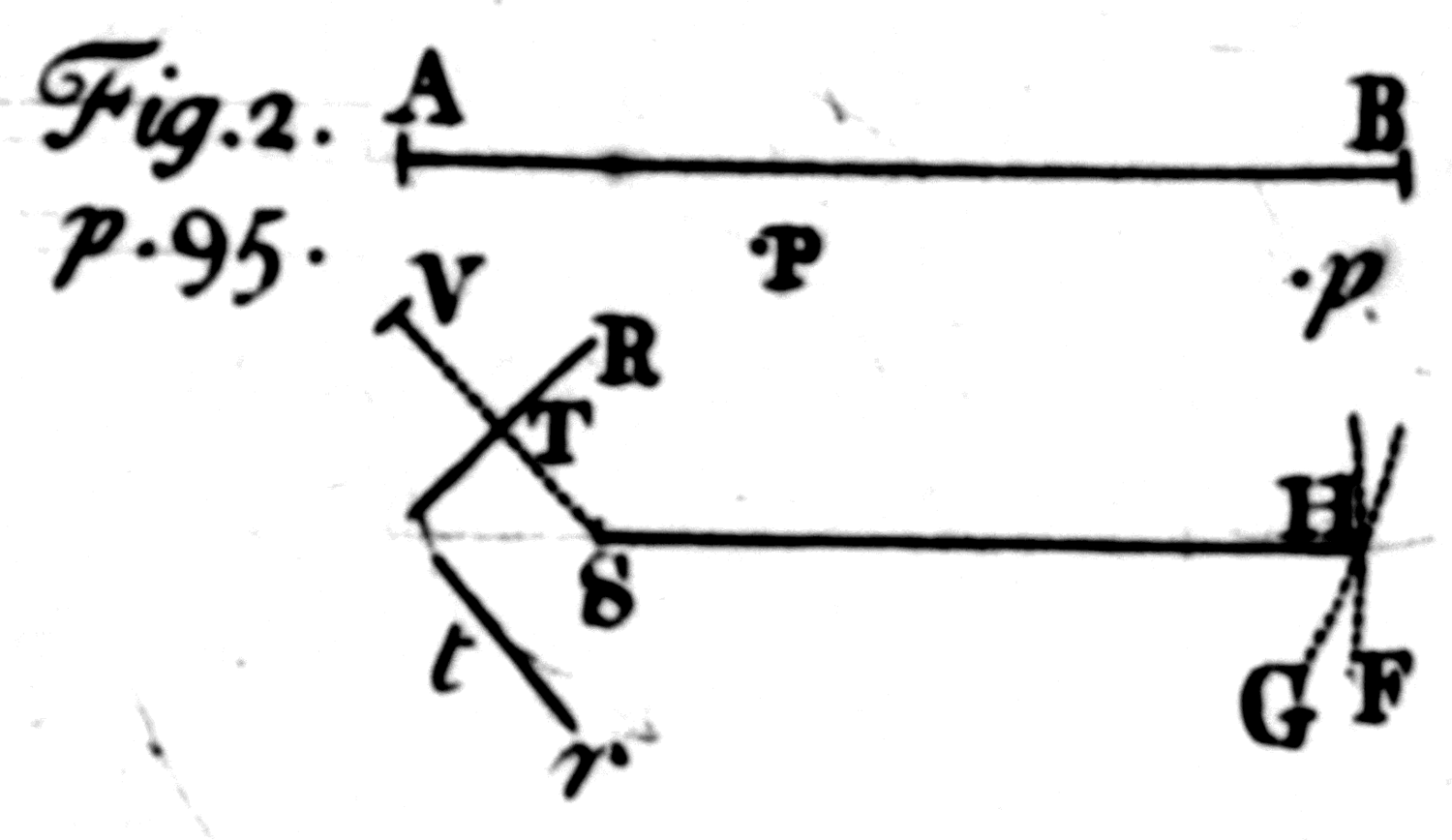
Let S be the common focus of the figures; AB the length of the principal axis of any trajectory; P a point through which the trajectory should pass; and TR a right line which it should touch. About the centre P, with the interval , if the orbit is an ellipsis, or if the orbit is an hyperbola, describe the circle HG. On the tangent TR let fall the perpendicular ST and produce the same to V, so that TV may be equal to ST; and about V as a centre with the interval AB describe the circle FH. In this manner whether two points P, p, are given, or two tangents TR, tr, or a point P and a tangent TR, we are to describe two circles. Let H be their common intersection, and from the foci S, H with the given axis describe the trajectory. I say the thing is done. For (because in the ellipsis, and in the hyperbola is equal to the axis) the described trajectory will pass through the point P, and (by the preceding lemma) will touch the right line TR. And by the same argument it 96will either pass through the two points P, p, or touch the two right lines TR, tr. Q. E. F.
Proposition XIX. Problem XI
About a given focus, to describe a parabolic trajectory, which shall pass through given points, and touch right lines given by position. Pl. 7. Fig. 3.
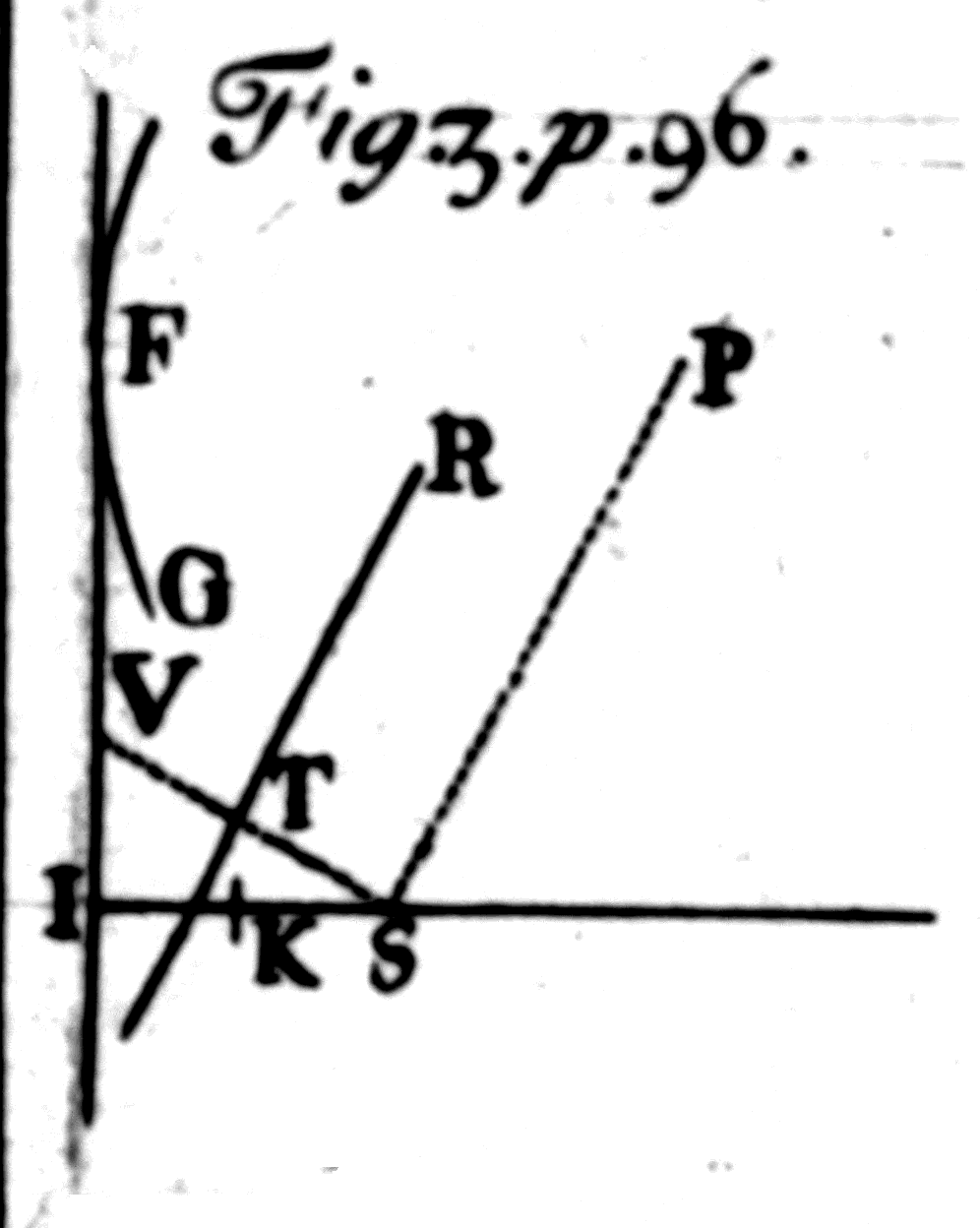
Let S be the focus, P a point, and TR a tangent of the trajectory to be described. About P as a centre, with the interval PS, describe the circle FG. From the focus let fall ST perpendicular on the tangent, and produce the same to V, so as TV may be equal to ST. After the same manner another circle fg is to be described, if another point p is given; or another point v is to be found, if another tangent tr is given; then draw the right line IF, which shall touch the two circles FG, fg, if two points P, p are given, or pass through the two points V, v, if two tangents TR, tr are given, or touch the circle FG and pass through the point V, if the point P and the tangent TR are given. On FI let fall the perpendicular SI and bisect the same in K; and with the axis SK, and principal vertex K describe a parabola. I say the thing is done. For this parabola (because SK is equal to IK, and SP to FP) will pass through the point P; and (by cor. 3. lem. 14.) because ST is equal to TV, and STR a right angle, it will touch the right line TR. Q. E. F.
Proposition XX. Problem XII
97About a given focus to describe any trajectory given in specie, which shall pass thro' given points and touch right lines given by position.
Case 1. About the focus S (Pl. 7. Fig. 4.) it is required to describe a trajectory ABC, passing thro' two points B, C. Because the trajectory is given in specie, the ratio of the principal axe to the distance of the foci will be given. In that ratio take KB to BS and LC to CS. About the centres B, C, with the intervals BK, CL describe two circles, and on the right line KL, that touches the same in K and L, let fall the perpendicular SG; which cut in A and a, so that GA may be to AS, and Ga to aS, as KB to BS; and with the axe Aa, and vertices A, a, describe a trajectory. I say the thing is done. For let H be the other focus of the described figure, and seeing GA is to AS as Ga to aS, then by division we shall have or Aa to or SH in the same ratio, and therefore in the ratio which the principal axe of the figure to be described has to the distance of its foci; and therefore the described figure is of the same species with the figure which was to be described. And since KB to BS, and LC to CS are in the same ratio, this figure will pass thro' the points B, C, as is manifest from the conic sections
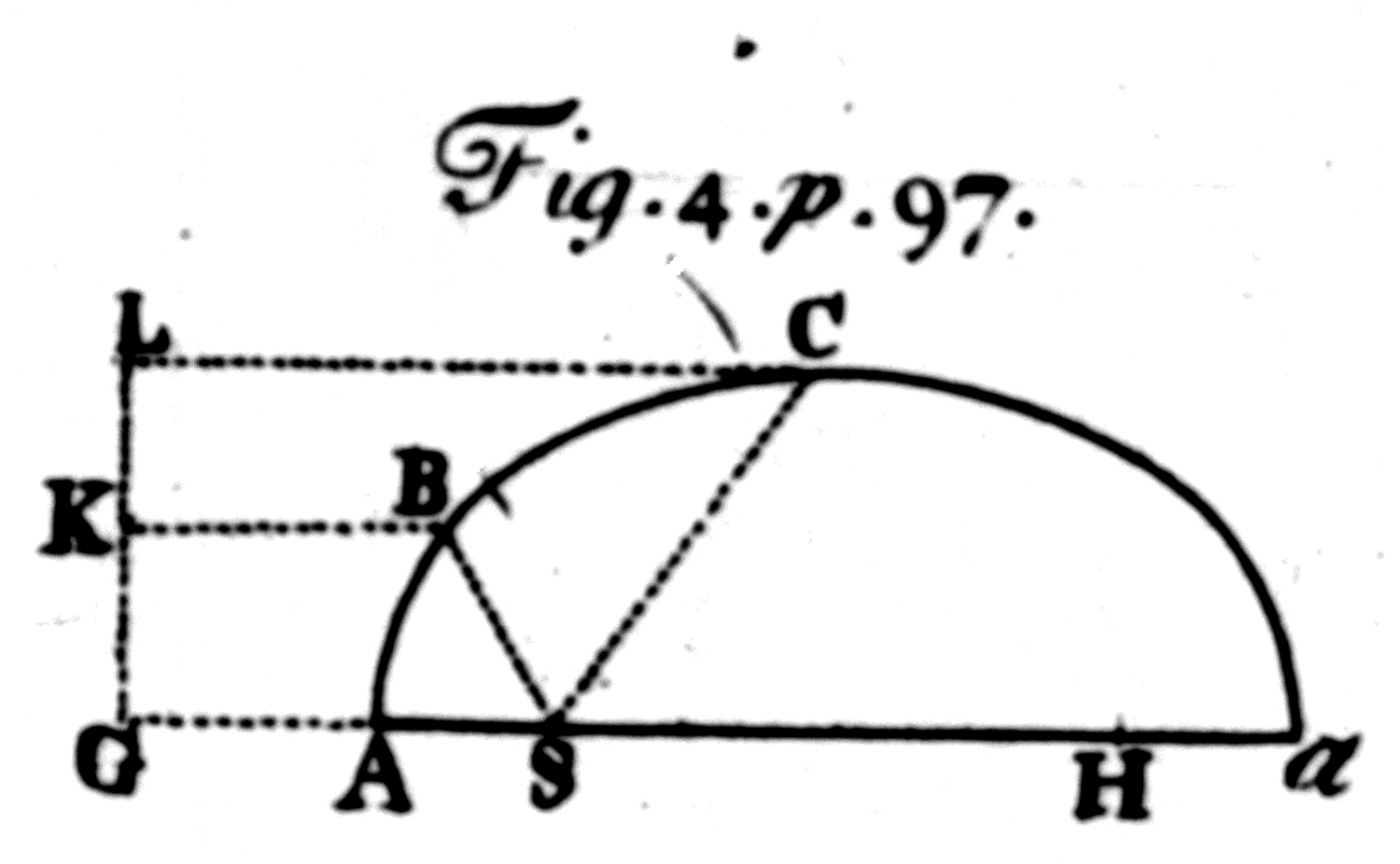
Case 2. About the focus S (Pl. 7. Fig. 5.) it is required to describe a trajectory, which shall somewhere touch two right lines TR, tr. From the focus on those tangents let fall the perpendiculars ST, St, 98which produce to V, v, so that TV, tv may be equal to TS, tS. Bisect Vv in O, and erect the indefinite perpendicular OH, and cut the right Line VS infinitely produced in K and k, so that VK be to KS, and Vk to kS as the principal axe of the trajectory to be described is to the distance of it's foci. On the diameter Kk describe a circle cutting OH in H; and with the foci S, H, and principal axe equal to VH, describe a trajectory. I say the thing is done. For, bisecting Kk in X, and joining HX, HS, HV, Hv, because VK is to KS, as Vk to kS; and by composition, as to ; and by division as to , that is, as 2VX to 2KX and 2KX to 2SX, and therefore as VX to HX and HX to SX the triangles VXH, HXS will be similar; Therefore VH will be to SH, as VX to XH; and therefore as VK to KS. Wherefore VH the principal axe of the described trajectory has the same ratio to SH the distance of the foci, as the principal axe of the trajectory which was to be described has to the distance of its foci; and is therefore of the same species. And seeing VH, vH, are equal to the principal axe, and VS, vS are perpendicularly bisected by the right lines TR, tr; 'tis evident (by lem. 15.) that those right lines touch the described trajectory. Q. E. F.
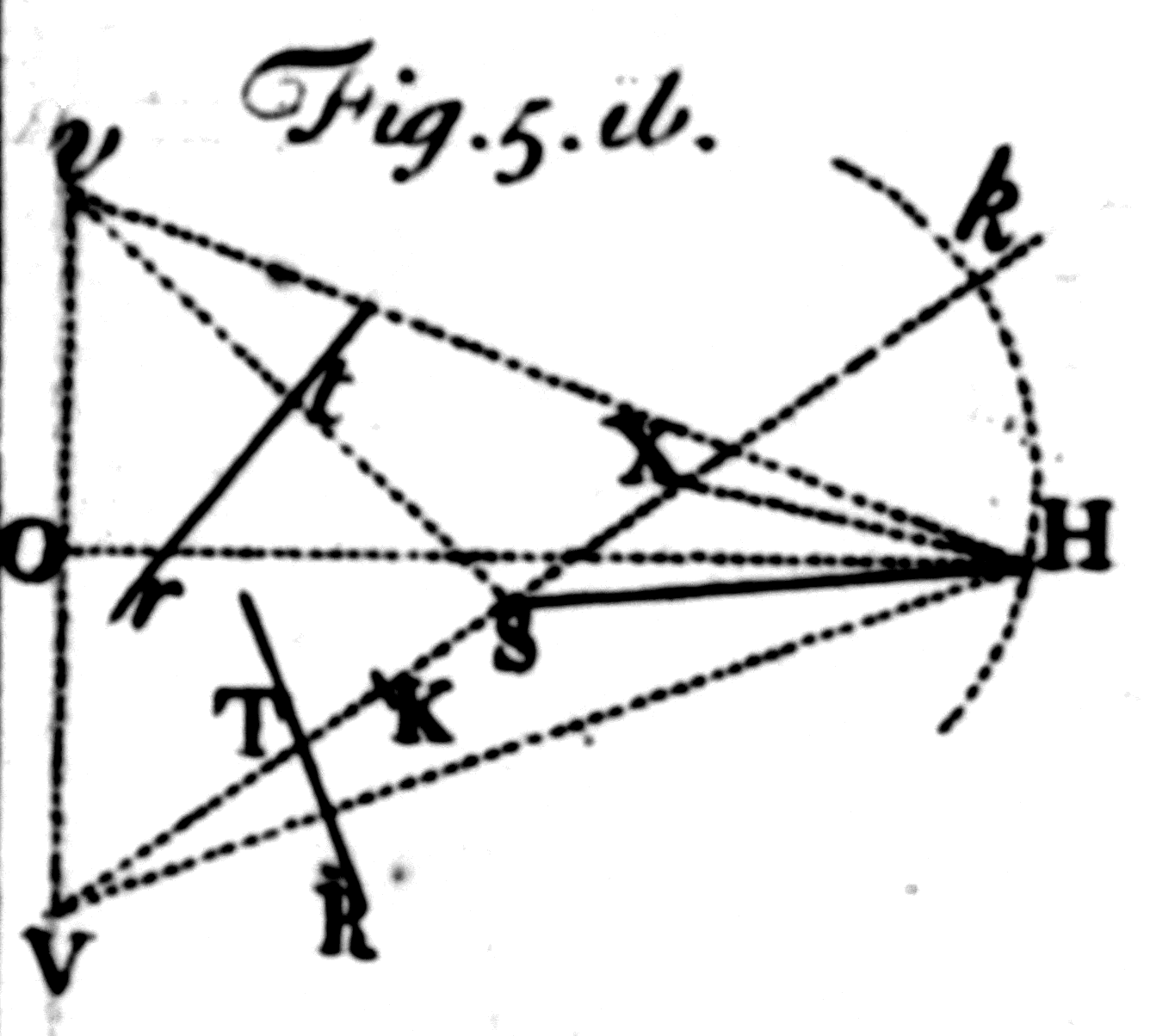
Case 3. About the focus S (Pl. 7. Fig. 6.) it is required to describe a trajectory, which shall touch a right line TR in a given point R. On the right line TR let fall the perpendicular ST; which produce to V, so that TV may equal to ST, join VR, and cut the right line VS indefinitely produced in K and k, so that VK may be to SK, and Vk to Sk as the principal axe of the ellipsis to be described, to the distance of its foci; and on the diameter Kk describing 99a circle, cut the right line VR produced in H, then with the foci S, H and principal axe equal to VH, describe a trajectory. I say the thing is done. For VH is to SH as VK to SK, and therefore as the principal axe of the trajectory which was to be described to the distance of its foci, (as appears from what we have demonstrated in Case 2.) and therefore the described trajectory is of the same species with that which was to be described; but that right line TR, by which the angle VRS is bisected, touches the trajectory in the point R, is certain from the properties of the conic sections. Q. E. F.
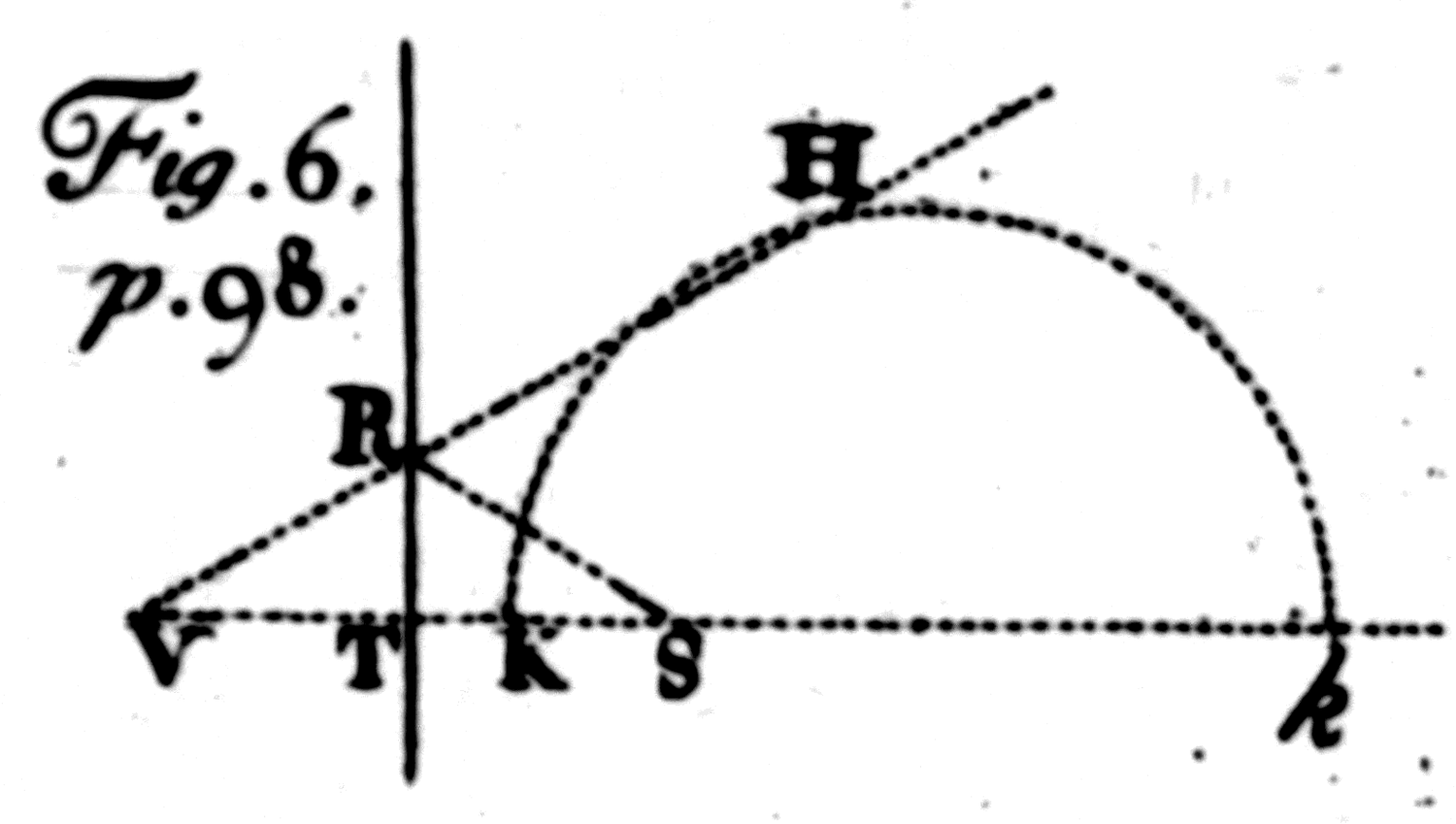
Case 4. About the focus S (Pl. 7. Fig. 7.) it is required to describe a trajectory APB that shall touch a right line TR, and pass thro' any given point P without the tangent, and shall be similar to the figure apb, described with the principal axe ab, and foci s, h. On the tangent TR let fall the perpendicular ST; which produce to V, so that TV may be equal to ST. And making the angles hsq, shq equal to the angles VSP, SVP; about q as a centre, and with an interval which shall be to ab as SP to VS describe a circle cutting the figure apb in p: join sp, and draw SH, such that it may be to sh, as SP is to sp, and may make the angle PSH equal to the angle psh; and the angle VSH equal to the angle psq. Then with the foci S, H, and principal axe AB equal to the distance VH, describe a conic section. I say the thing is done. For if sv is drawn so that it shall be to sp as sh is to sq, and shall make the angle vsp equal to the angle hsq, and the angle vsh equal to the angle psq, the triangles svh, spq, will be similar, and therefore vh will be to pq, as sh is to sq, that is, (because of the similar triangles VSP, hsq) as VS is to SP or as ab to pq. Wherefore 100vh and ab are equal. But because of the similar triangles VSH, vsh, VH is to SH as vh to sh; that is, the axe of the conic section now described is to the distance of its foci, as the axe ab to the distance of the foci s, h; and therefore the figure now described is similar to the figure apb. But, because the triangle PSH is similar to the triangle psh, this figure passes through the point P, and because VH is equal to its axis, and VS is perpendicularly bisected by the right line TR, the said figure touches the right line TR. Q. E. F.
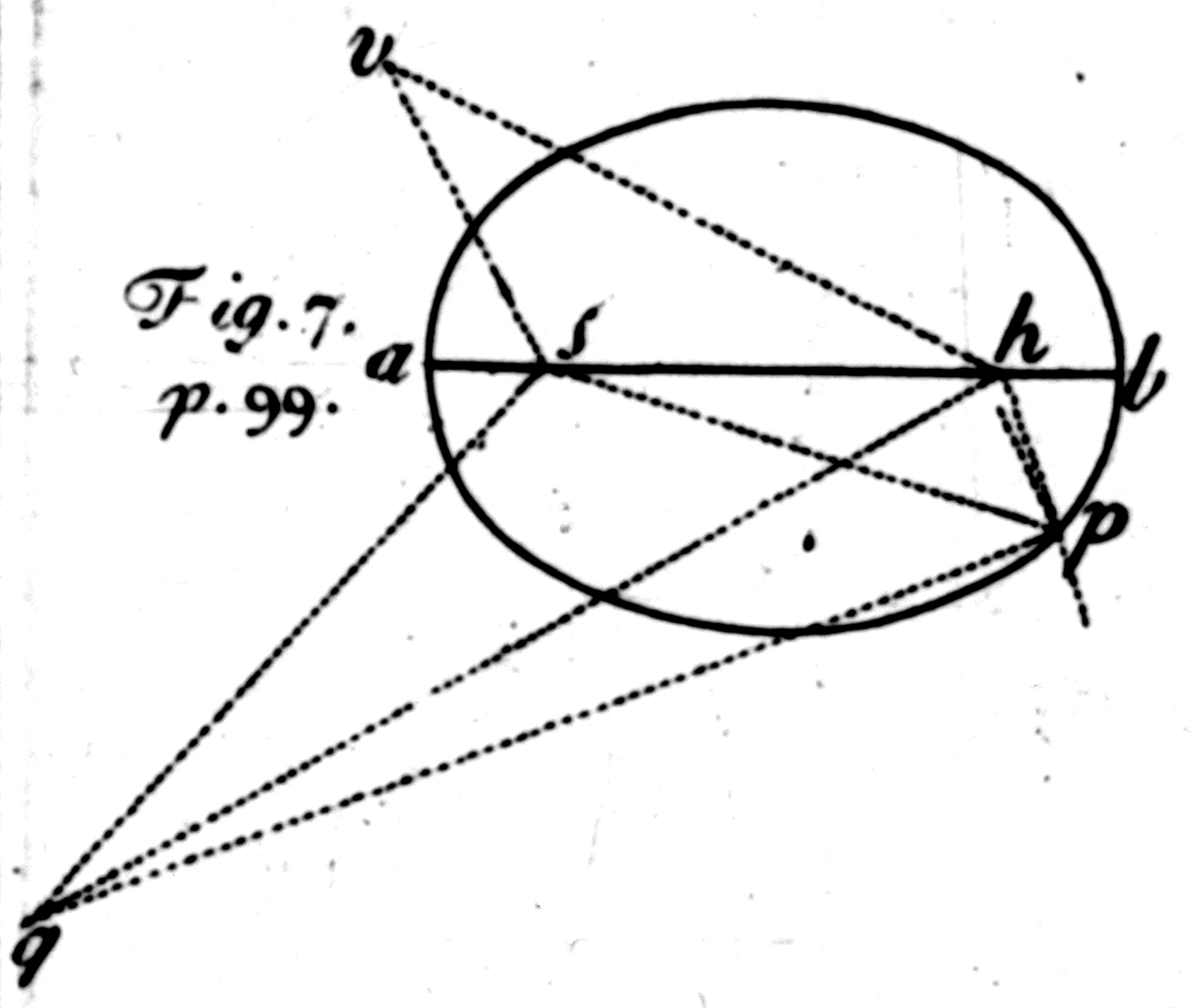
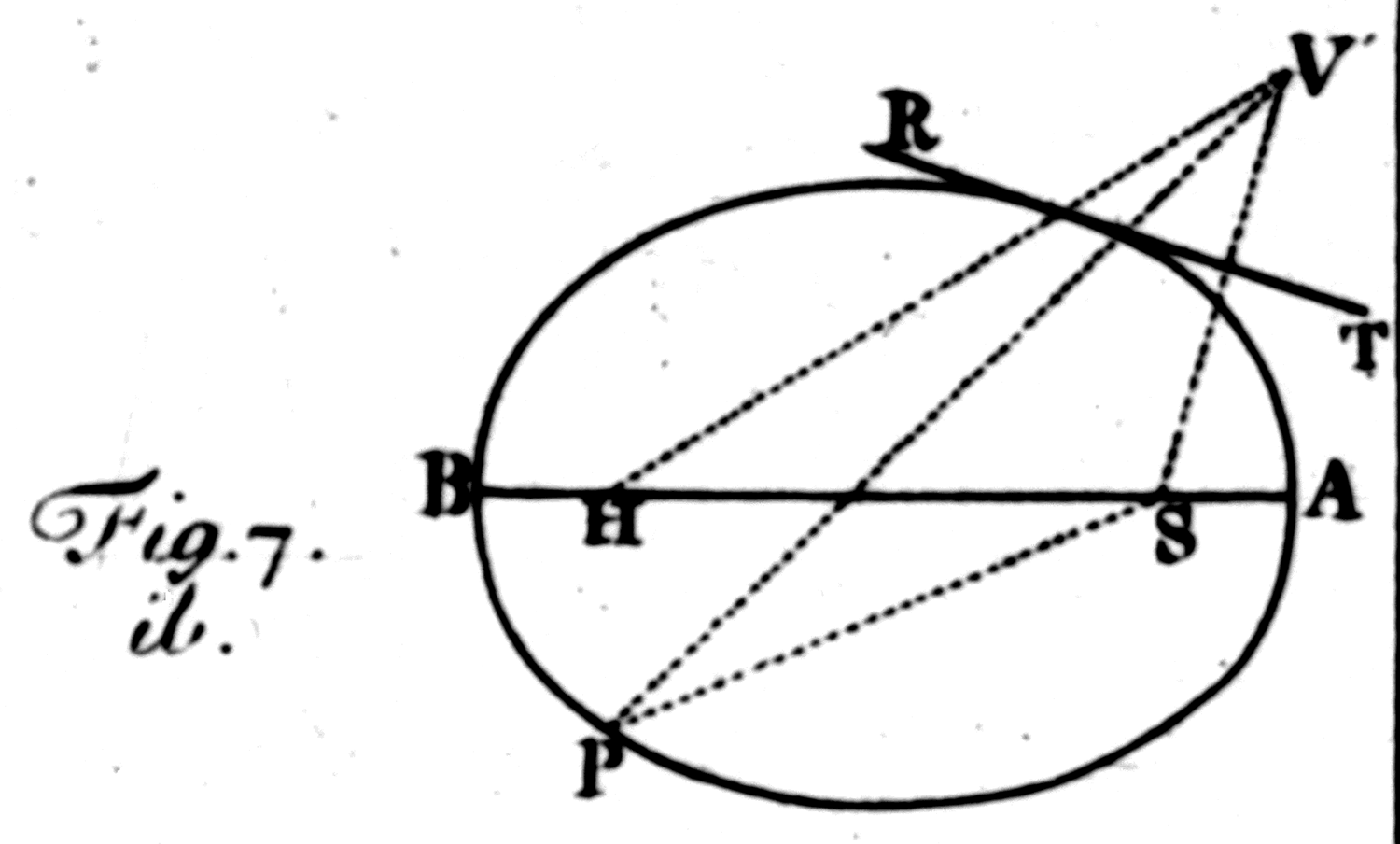
Lemma XVI
From three given points to draw to a fourth point that is not given three right lines whose differences shall be either given or none at all.
Case 1. Let the given points be A, B, C (Pl. 8. Fig. 1.) and Z the fourth point which we are to find; because of the given difference of the lines AZ, BZ, the locus of the point Z will be an hyperbola, whose foci are A and B, and whose principal axe is the given difference. Let that axe be MN. Taking PM to MA, as MN is to AB, erect PR perpendicular to AB, and let fall ZR perpendicular to PR; then, from the nature of the hyperbola, ZR will be to AZ as MN is to AB. And by the like argument, the locus of the point Z will be another hyperbola, whose foci are A, C, and whose principal axe is the difference between AZ and CZ; and QS a perpendicular on AC may be drawn to which (QS) if from any point Z of this hyperbola 101a perpendicular ZS is let fall, this (ZS) shall be to AZ as the difference between AZ and CZ is to AC. Wherefore the ratio's of ZR and ZS to AZ are given, and consequently the ratio of ZR to ZS one to the other; and therefore if the right lines RP, SQ meet in T, and TZ and TA are drawn, the figure TRZS will be given in specie, and the right line TZ, in which the point Z is somewhere placed, will be given in position. There will be given also the right line TA, and the angle ATZ; and because the ratio's of AZ and TZ to ZS are given, their ratio to each other is given also; and thence will be given likewise the triangle ATZ whose vertex is the point Z. Q. E. I.
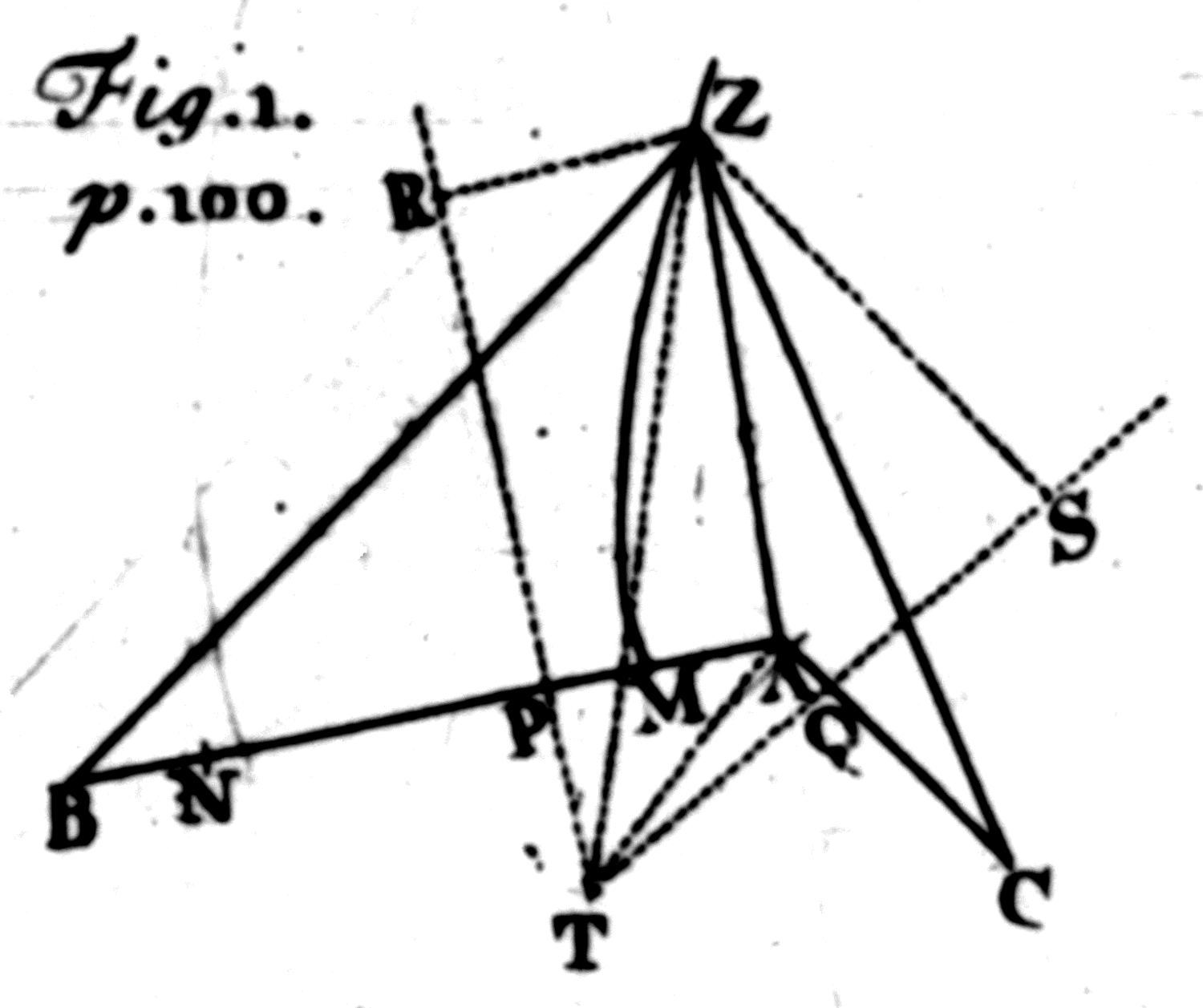
Case 2. If two of the three lines, for example AZ and BZ, are equal, draw the right line TZ so as to bisect the right line AB; then find the triangle ATZ as above. Q. E. I.
Case 3. If all the three are equal, the point Z will be placed in the centre of a circle that passes thro' the points A, B, C. Q. E. I.
This problematic lemma is likewise solved in Apollonius's Book of Tactions restored by Vieta.
Proposition XXI. Problem XIII
About a given focus to describe a trajectory, that shall pass through given points and touch right lines given by position.
Let the focus S, (Pl. 8. Fig. 2.) the point P, and the tangent TR be given, suppose that the other focus H is to be found. On the tangent let fall the perpendicular ST, which produce to T, so that TT 102may be equal to ST; and TH will be equal to the principal axe. Join SP, HP, and SP will be the difference between HP and the principal axe. After this manner if more tangents TR are given, or more points P, we shall always determine as many lines TH or PH, drawn from the said points T or P, to the focus H, which either shall be equal to the axes, or differ from the axes by given lengths SP; and therefore which shall either be equal among themselves, or shall have given differences; from whence (by the preceding lemma) that other focus H is given. But having the foci and the length of the axe (which is either TH; or, if the trajectory be an ellipsis, , or if it be an hyperbola) the trajectory is given. Q. E. I.
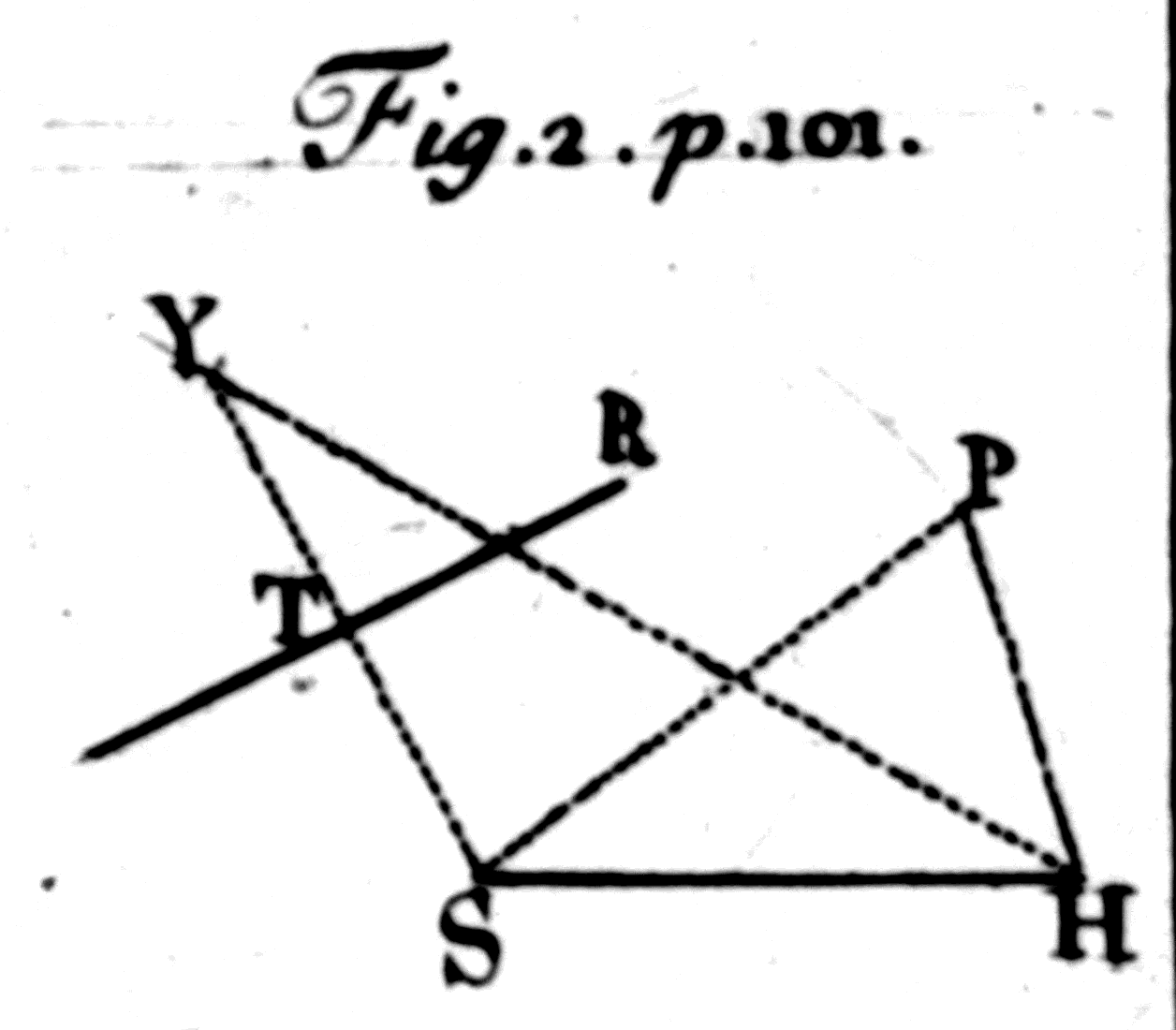
Scholium
When the trajectory is an hyperbola, I do not comprehend its conjugate hyperbola under the name of this trajectory. For a body going on with a continued motion can never pass out of one hyperbola into its conjugate hyperbola.
The case when three points are given is more readily solved thus. Let B, C, D (Pl. 8. Fig. 3.) be the given points. Join BC, CD, and produce them to E, F; so as EB may be to EC, as SB to SC; and FC to FD, as SC to SD. On EF drawn and produced let fall the perpendiculars SG, BH and in GS produced indefinitely take GA to AS, and Ga to aS, as HB is to BS; then A will be the vertex, and Aa the principal axe of the trajectory: Which, according as GA is greater than, equal to, or less than AS, will be either an ellipsis, a parabola 103or an hyperbola; the point a in the first case falling on the same side of the line GF as the point A; in the second, going off to an infinite distance; in the third, falling on the other side of the line GF. For if on GF, the perpendiculars CI, DK are let fall, IC will be to HB as EC to EB; that is, as SC to SB; and by permutation IC to SC as HB to SB, or as GA to SA. And, by the like argument, we may prove that KD is to SD in the same ratio. Wherefore the points B, C, D lie in a conic section described about the focus S, in such manner that all the right lines drawn from the focus S to the several points of the section, and the perpendiculars let fall from the same points on the right line GF are in that given ratio.
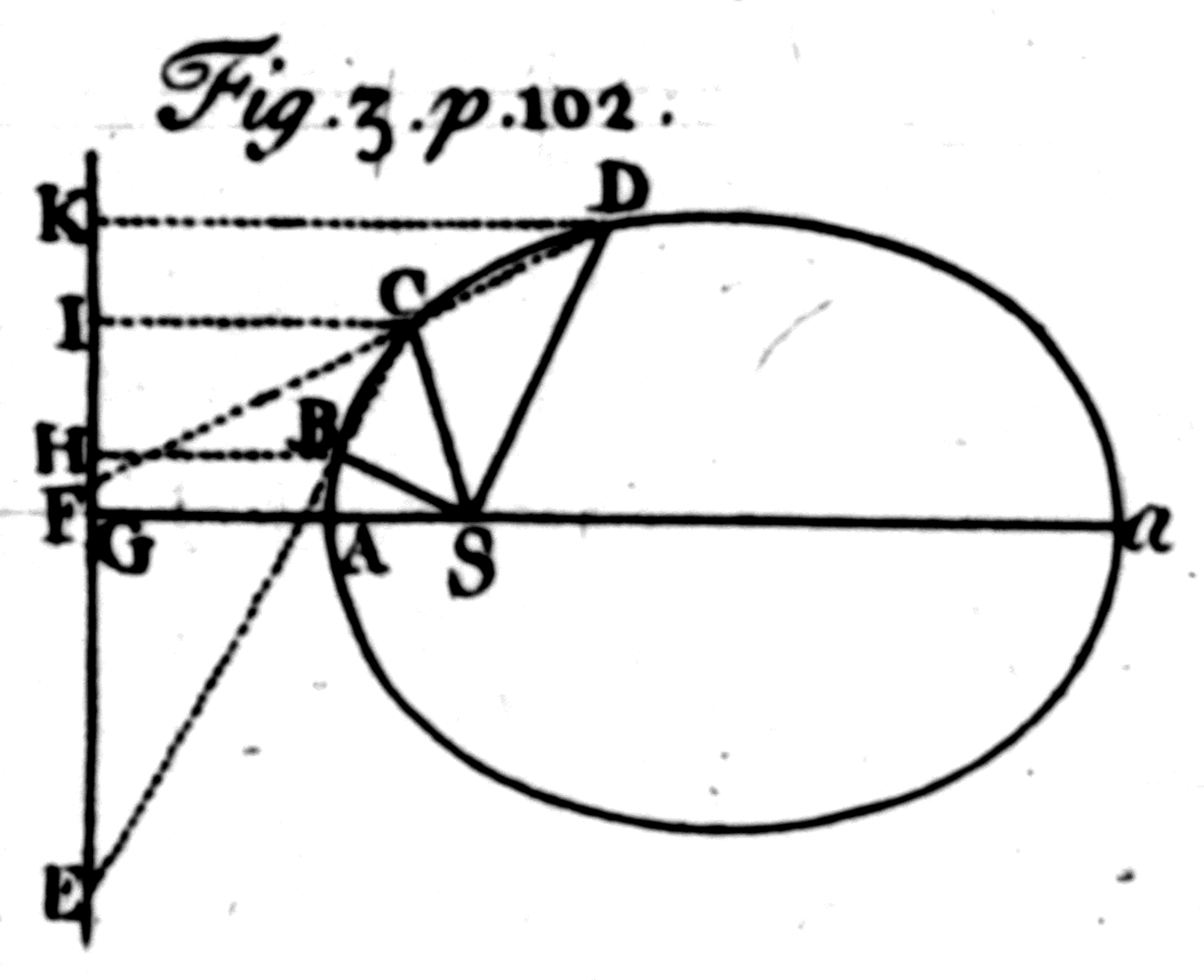
That excellent geometer M. De la Hire has solved this problem much after the same way in his conics, prop. 25. lib. 8.
Section V. How the orbits are to be found when neither focus is given.
Section V
How the orbits are to be found when neither focus is given.
Lemma XVII
104If from any point P of a given conic section, to the four produced sides AB, CD, AC, DB of any trapezium ABDC inscribed in that section, as many right lines PQ, PR, PS, PT are drawn in given angles, each line to each side; the rectangle of those on the opposite sides AB, CD, will be to the rectangle of those on the other two opposite sides AC, BD, in a given ratio.
Case 1. Let us suppose first that the lines drawn to one pair of opposite sides are parallel to either of the other sides; as PQ and PR (Pl. 8. Fig. 4) to the side AC, and PS and PT to the side AB. And farther, that one pair of the opposite sides, as AC and BD, are parallel betwixt themselves; then 105the right line which bisects those parallel sides will be one of the diameters of the conic section, and will likewise bisect RQ. Let O be the point in which RQ is bisected, and PO will be an ordinate to that diameter. Produce PO to K so that OK may be equal to PO, and OK will be an ordinate on the other side of that diameter. Since therefore the points A, B, P, and K are placed in the conic section, and PK cuts AB in a given angle, the rectangle PQK (by prop. 17. 19. 21. & 23. book 3. of Apollonius's conics) will be to the rectangle AQB in a given ratio. But QK and PR are equal, as being the differences of the equal lines OK, OP, and OQ, OR; whence the rectangles PQK and are equal; and therefore the rectangle is to the rectangle AQB, that is, to the rectangle in a given ratio. Q. E. D.
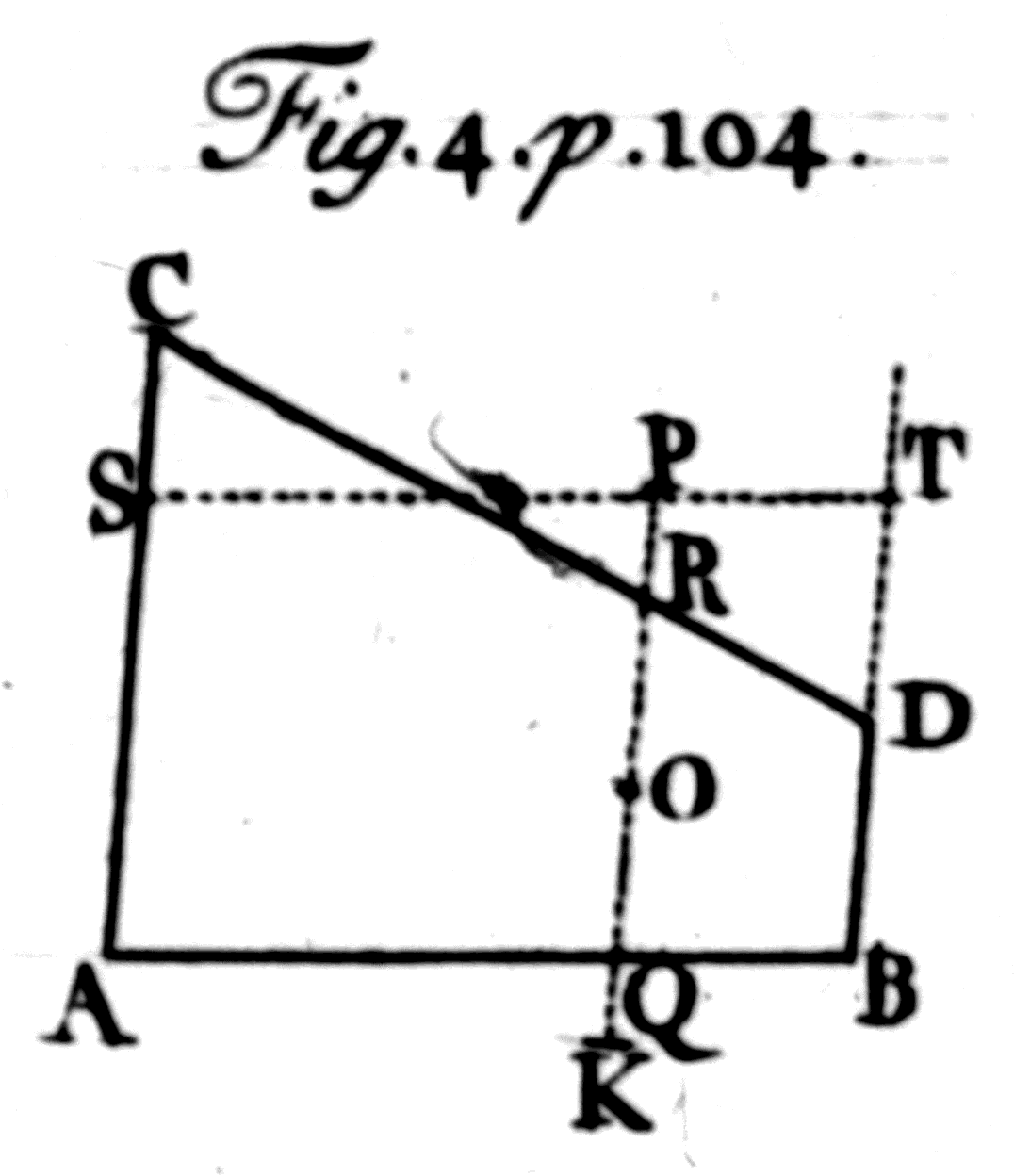
Case 2. Let us next suppose that the opposite sides AC and BD (Pl. 8. Fig. 5.) of the trapezium, are not parallel. Draw Bd parallel to AC and meeting as well the right line ST in t, as the conic section in d. Join Cd cutting PQ in r, and draw DM parallel to PQ, cutting Cd in M and AB in N. Then (because of the similar triangles BTt, DBN,) Bt or PQ is to Tt as DN to NB. And so Rr is to AQ or PS as DM to AN. Wherefore, by multiplying the antecedents by the antecedents and the consequents by the consequents, as the rectangle is to the rectangle , so will the rectangle NDM be to the rectangle ANB, and (by case 1.) so is the rectangle to the rectangle , and by division, so is the rectangle to the rectangle . Q. E. D.
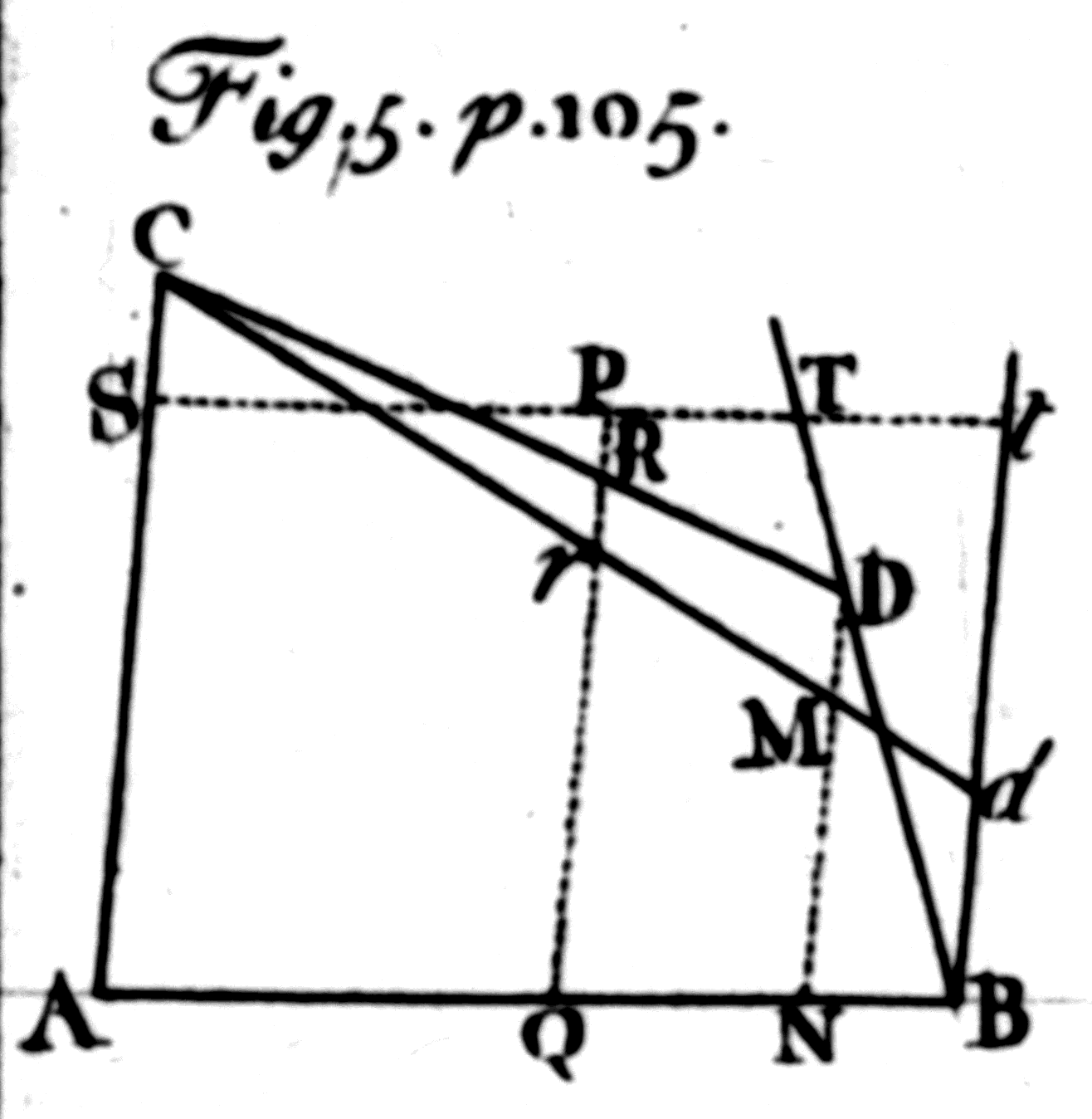
Case 3. Let us suppose lastly the four lines PQ, PR, PS, PT (Pl. 8. Fig. 6.) not to be parallel 106to the sides AC, AB, but any way inclined to them. In their place draw Pq, Pr parallel to AC; and Ps, Pt parallel to AB; and because the angles of the triangles PQq, PRr, PSs, PTt are given, the ratio's of PQ to Pq, PR to Pr, PS to Ps, PT to Pt will be also given; and therefore the compounded ratio's to , and to are given. But from what we have demonstrated before, the ratio of to is given; and therefore also the ratio of to . Q. E. D.
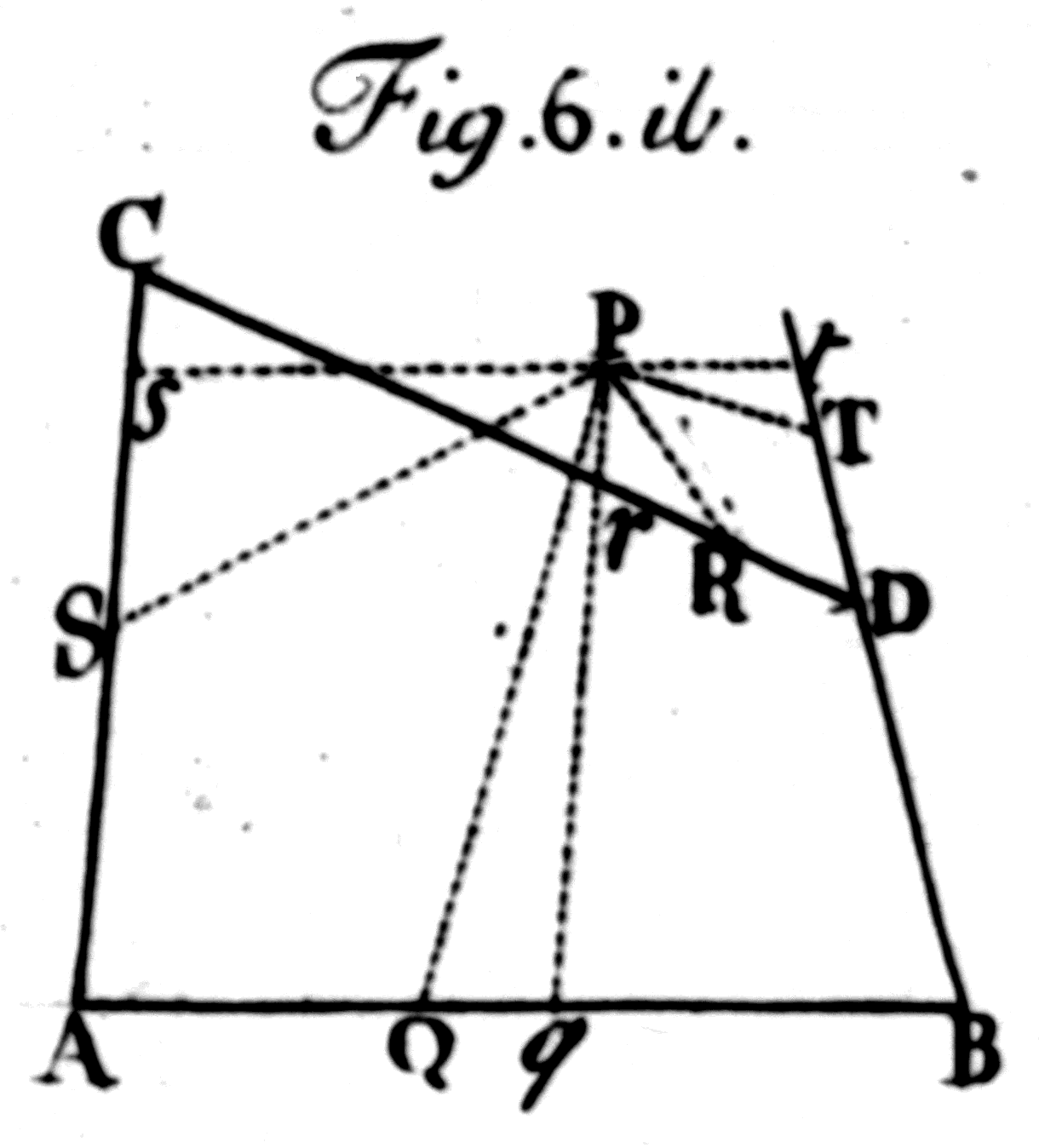
Lemma XVIII
The same things supposed, if the rectangle of the lines drawn to the two opposite sides of the trapezium is to the rectangle of those drawn to the other two sides, in a given ratio; the point P, from whence those lines are drawn, will be placed in a conic section described about the trapezium. (Pl. 8. Fig. 7.)
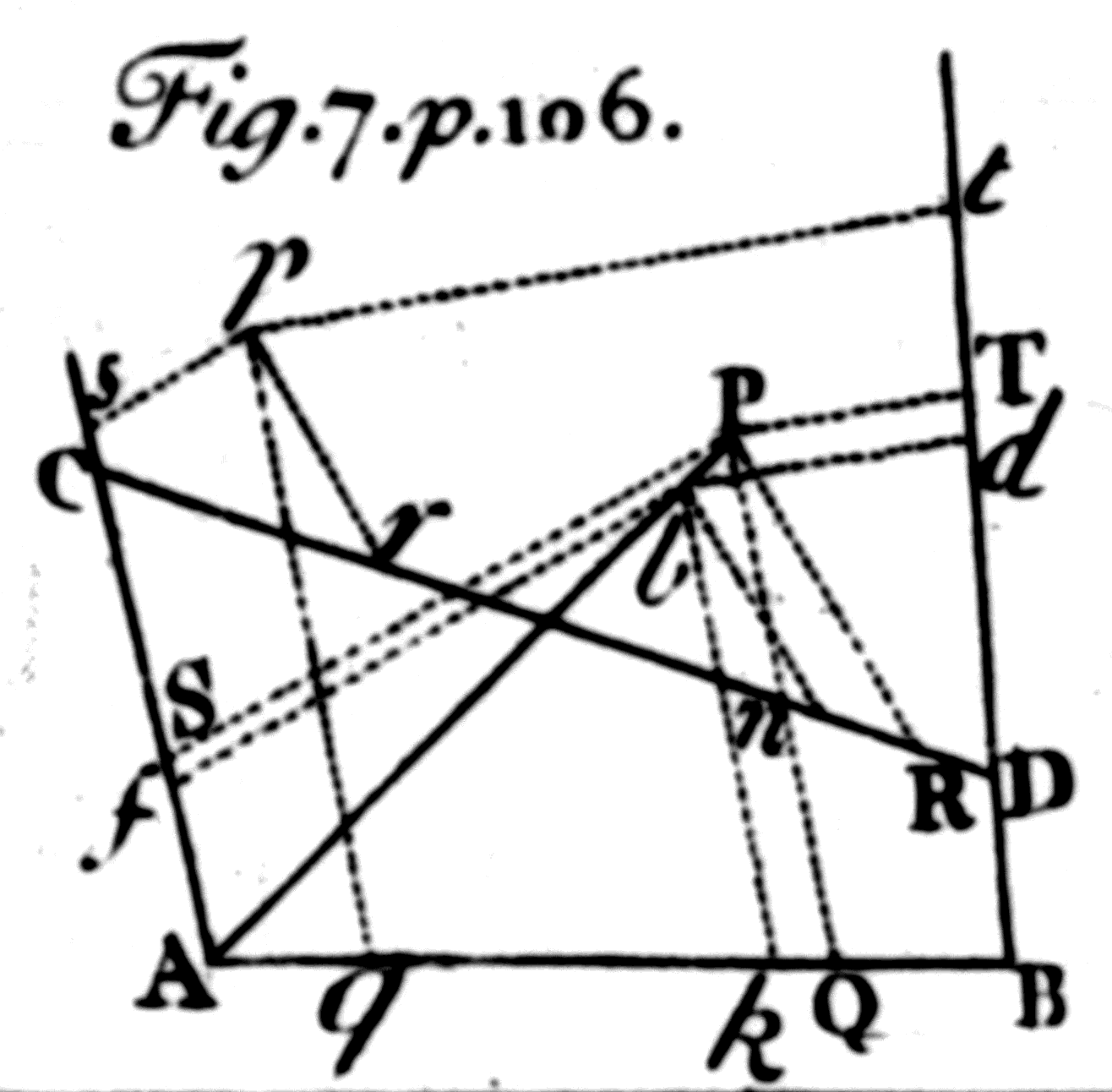
Conceive a conic section to be described passing through the points A, B, C, D, and any one of the infinite number of points P, as for example p; I say the point P will be always placed in this section. If you deny the thing, join AP cutting this conic section somewhere else if possible than in P, as in b. Therefore if from those points p and b, in the given angles to the sides of the trapezium, we draw the right lines pq, pr, ps, pt, and bk, bn, bf, bd, we shall have 107as to , so (by Lem. 17.) to ; and so (by supposition) to . And because of the similar trapezia bkAf, PQAS, as bk to bf; so PQ to PS. Wherefore by dividing the terms of the preceding proportion by the correspondent terms of this, we shall have bn to bd as PR to PT. And therefore the equiangular trapezia Dnbd, DRPT are similar, and consequently their diagonals Db, DP do coincide. Wherefore b falls in the intersection of the right lines AP, DP, and consequently coincides with the point P. And therefore the point P where-ever it is taken falls to be in the assigned conic section. Q. E. D.
Cor. Hence if three right lines PQ, PR, PS, are drawn from a common point P to as many other right lines given in position AB, CD, AC, each to each, in as many angles respectively given, and the rectangle under any two of the lines drawn be to the square of the third in a given ratio: The point P, from which the right lines are drawn, will be placed in a conic section that touches the lines AB, CD in A and C; and the contrary. For the position of the three right lines AB, CD, AC remain the same, let the line BD approach to and coincide with the line AC; then let the line PT come likewise to coincide with the line PS; and the rectangle will become , and the right lines AB, CD, which before did cut the curve in the points A and B, C, and D, can no longer cut, but only touch, the curve in those co-inciding points.
Scholium
108In this lemma, the name of conic section is to be understood in a large sense, comprehending as well the rectilinear section thro' the vertex of the cone, as the circular one parallel to the base. For if the point p happens to be in a right line, by which the points A and D or C and B are joined, the conic section will be changed into two right lines, one of which is that right line upon which the point p falls, and the other is a right line that joins other two of the four points. If the two opposite angles of the trapezium taken together are equal to two right angles, and if the four lines PQ, PR, PS, PT are drawn to the sides thereof at right angles, or any other equal angles, and the rectangle under two of the lines drawn PQ and PR, is equal to the rectangle under the other two PS and PT, the conic section will become a circle. And the same thing will happen, if the four lines are drawn in any angles, and the rectangle under one pair of the lines drawn, is to the rectangle under the other pair, as the rectangle under the sines of the angles S, T in which the two last lines PS, PT are drawn, to the rectangle under the sines of the angles Q, R, in which the two first PQ, PR are drawn. In all other cases the locus of the point P will be one of the three figures, which pass commonly by the name of the conic sections. But in room of the trapezium ABCD, we may substitute a quadrilateral figure whose two opposite sides cross one another like diagonals. And one or two of the four points A, B, C, D may be supposed to be removed 109to an infinite distance, by which means the sides of the figure which converge to those points, will become parallel: And in this case the conic section will pass through the other points, and will go the same way as the parallels in infinitum.
Lemma XIX
To find a point P (Pl. 8. Fig. 8.) from which if four right lines PQ, PR, PS, PT are drawn to as many other right lines AB, CD, AC, BD given by position, each to each, at given angles, the rectangle , under any two of the lines drawn, shall be to the rectangle , under the other two, in a given ratio.
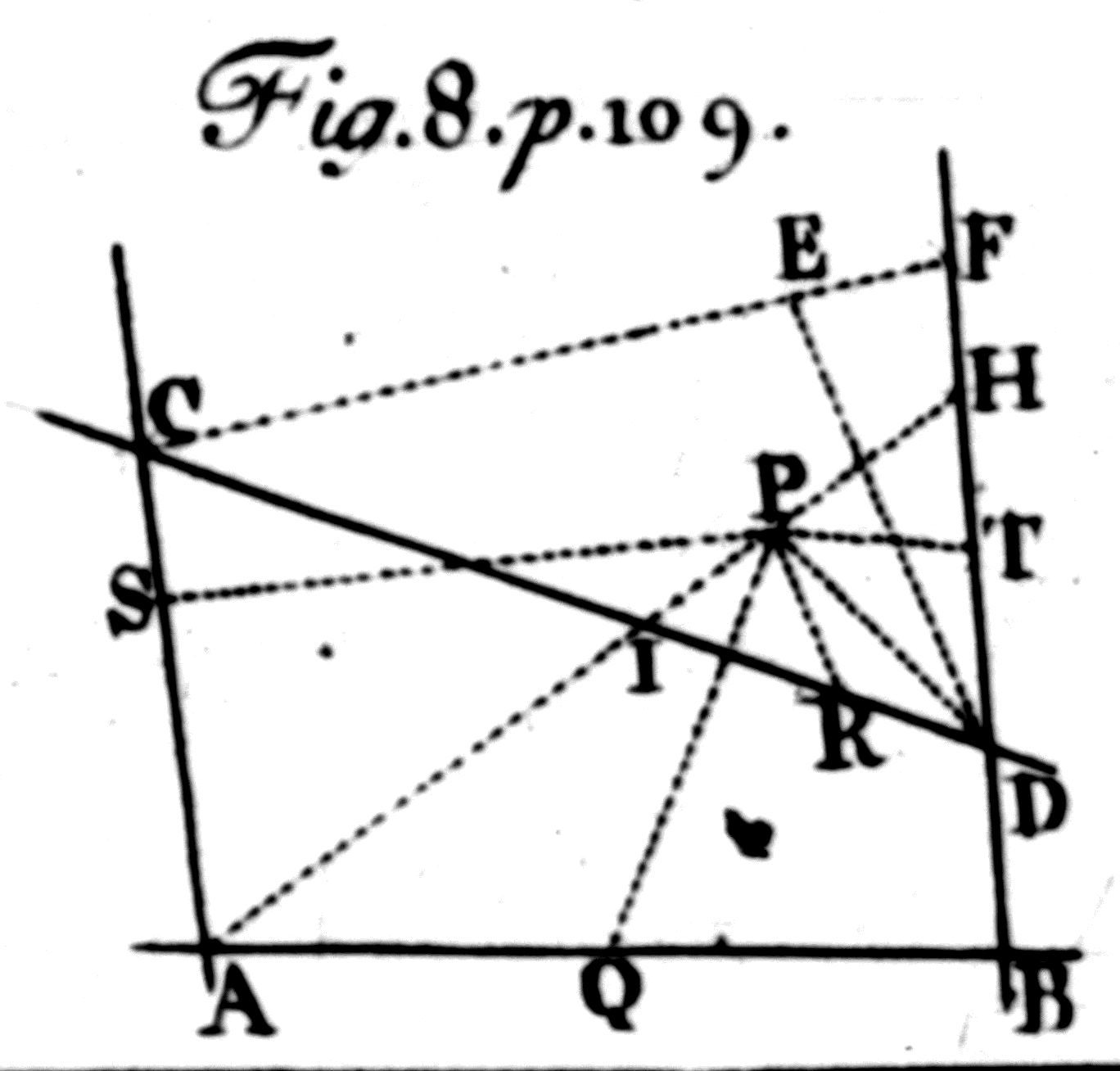
Suppose the lines AB, CD, to which the two right lines PQ, PR, containing one of the rectangles, are drawn to meet two other lines, given by position, in the points A, B, C, D. From one of those as A, draw any right line AH, in which you would find the point P. Let this cut the opposite lines BD, CD, in H and I; and, because all the angles of the figure are given, the ratio of PQ to PA, and PA to PS, and therefore of PQ to PS will be also given. Subducting this ratio from the given ratio of to , the ratio of PR to PT will be given; and adding the given ratio's of PI to PR, and PT to PH the ratio of PI to PH, and therefore the point P will be given. Q. E. I.
Cor. 1. Hence also a tangent may be drawn to any point D of the locus of all the points P. For 110the chord PD, where the points P and D meet, that is, where AH is drawn thro' the point D, becomes a tangent. In which case the ultimate ratio of the evanescent lines IP and PH will be found as above. Therefore draw CF parallel to AD, meeting BD in F, and cut it in E in the same ultimate ratio, then DE will be the tangent; because CF, and the evanescent IH are parallel, and similarly cut in E and P.
Cor. 2. Hence also the locus of all the points P may be determined. Through any of the points A, B, C, D, as A, (Pl. 9. Fig. 1.) draw AE touching the locus, and through any other point B parallel to the tangent, draw BF meeting the locus in F: And find the point F by this lemma. Bisect BF in G, and drawing the indefinite line AG, this will be the position of the diameter to which BG, and FG are ordinates. Let this AG meet the locus in H, and AH will be its diameter or latus transversum, to which the latus rectum will be as to . If AG no where meets the locus, the line AH being infinite the locus will be a parabola; and its latus rectum corresponding to the diameter AG will be . But if it does meet it any where, the locus will be an hyperbola, when the points A and H are placed on the same side the point G; and an ellipsis, if the point G falls between the points A and H; unless perhaps the angle AGB is a right angle, and at the same time equal to the rectangle AGH, in which case the locus will be a circle.
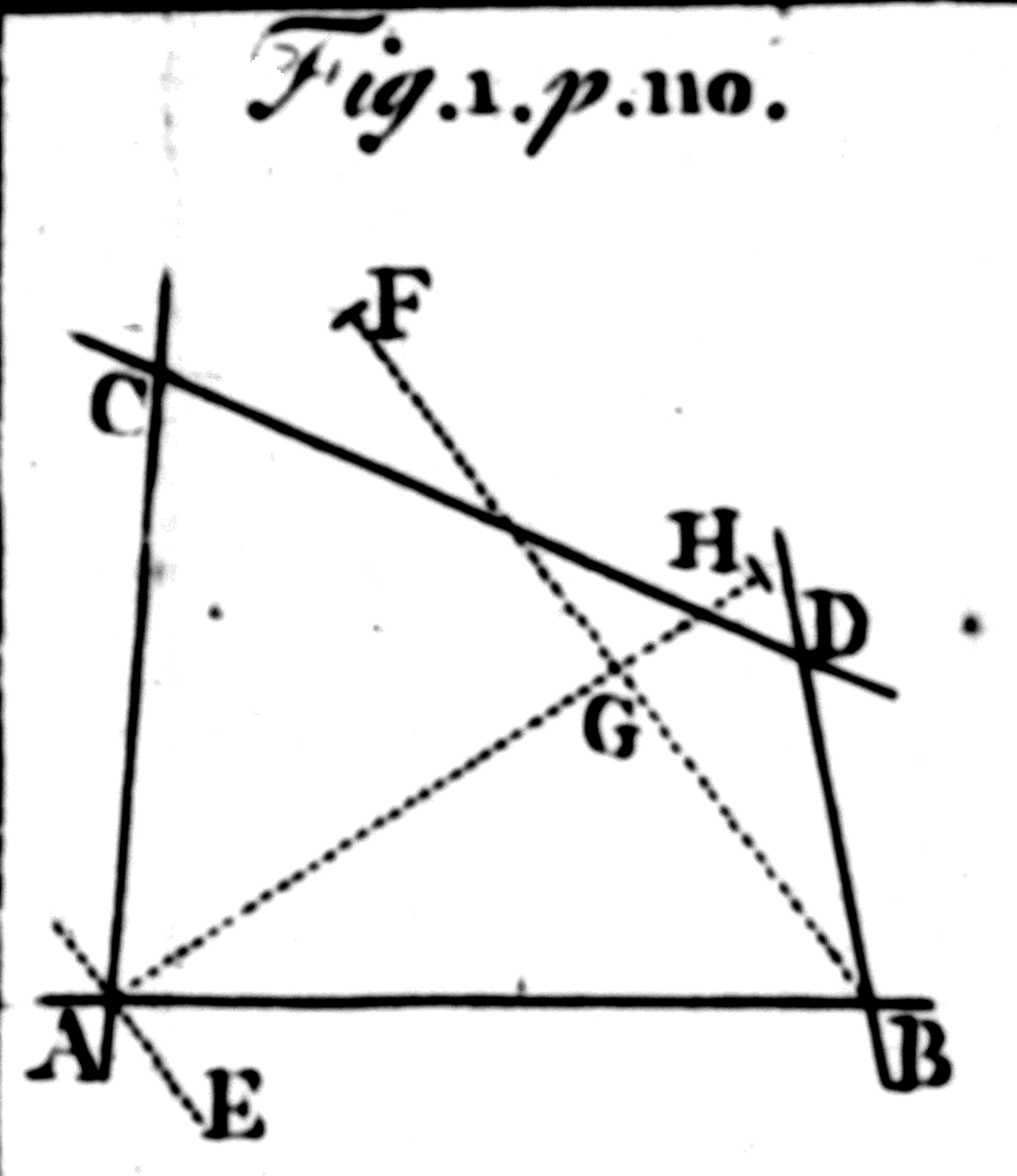
And so we have given in this corollary a solution of that famous problem of the ancients concerning four lines, begun by Euclid, and carried on by Apollonius; and this not an analytical calculus, but a geometrical composition, such as the ancients required.
Lemma XX
111If the two opposite angular points A and P (Pl. 9. Fig. 2.) of any parallelogram ASPQ touch any conic section in the points A and P; and the sides AQ, AS of one of those angles, indefinitely produced, meet the same conic section in B and C; and from the points of concourse B and C to any fifth point D of the conic section, two right lines BD, CD are drawn meeting the two other sides PS, PQ of the parallelogram, indefinitely produced, in T and R; the parts PR and PT, cut off from the sides, will always be one to the other in a given ratio. And vice versa, if those parts cut off are one to the other in a given ratio, the locus of the point D will be a conic section, passing through the four points A, B, C, P.
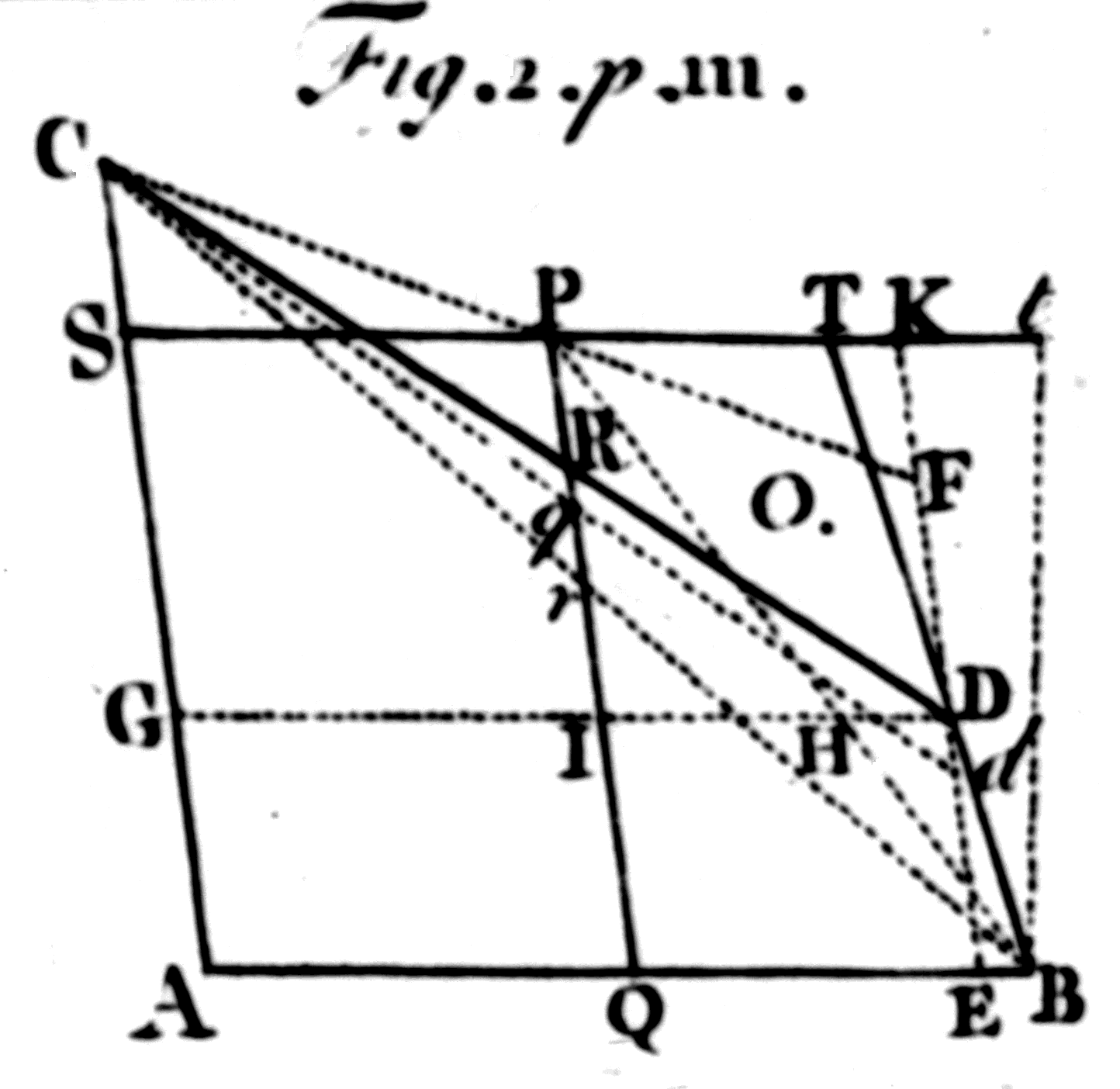
Case 1. Join BP, CP, and from the point D draw the two right lines DG, DE, of which the first DG shall be parallel to AB, and meet PB, PQ, CA in H, I, G; and the other DE shall be parallel to AC, and meet PC, PS, AB, in F, K, E; and (by Lem. 17.) the rectangle will be to the rectangle , in a given ratio. But PQ is to DE (or IQ) as PB to HB, and consequently as PT to DH; and by permutation, PQ 112is to PT, as DE to DH. Likewise PR is to DF as RC to DC, and therefore as (IG or) PS to DG; and, by permutation, PR is to PS as DF to DG; and, by compounding those ratio's, the rectangle will be to the rectangle as the rectangle is to the rectangle , and consequently in a given ratio. But PQ and PS are given, and therefore the ratio of PR to PT is given. Q. E. D.
Case 2. But if PR and PT are supposed to be in a given ratio one to the other, then by going back again by a like reasoning, it will follow that the rectangle is to the rectangle in a given ratio; and so the point D (by lem. 18.) will lie in a conic section passing thro' the points A, B, C, P, as its locus. Q. E. D.
Cor. 1. Hence if we draw BC cutting PQ in r, and in PT take Pt to Pr in the same ratio which PT has to PR: Then Bt will touch the conic section in the point B. For suppose the point D to coalesce with the point B, so that the chord BD vanishing, BT shall become a tangent, and CD and BT will coincide with CB and Bt.
Cor. 2. And vice versa, if Bt is a tangent, and the lines BD, CD meet in any point D of a conic section; PR will be to PT as Pr to Pt. And on the contrary, if PR is to PT as Pr to Pt, then BD, and CD will meet in some point D of a conic section.
Cor. 3. One conic section cannot cut another conic section in more than four points. For, if it is possible, let two conic sections pass thro' the five points A, B, C, P, O; and let the right line BD cut them in the points D, d, and the right line Cd cut the right line PQ in q. Therefore PR is to PT as Pq to PT:
113Whence PR and Pq are equal one to the other, against the supposition.
Lemma XXI
If two moveable and indefinite right lines BM, CM drawn through given points B, C, at poles, do by their point of concourse M describe a third right line MN given by position; and other two indefinite right lines BD, CD are drawn, making with the former two at those given points B, C, given angles, MBD, MCD: I say that those two right lines BD, CD will by their point of concourse D describe a conic section passing through the points B, C. And vice versa, if the right lines BD, CD do by their point of concourse D describe a conic section passing through the given points B, C, A, and the angle DBM is always equal to the given angle ABC, as well as the angle DCM always equal to the given angle ACB: the point M will lie in a right line given ly position, as its locus. Pl. 9. Fig. 3.
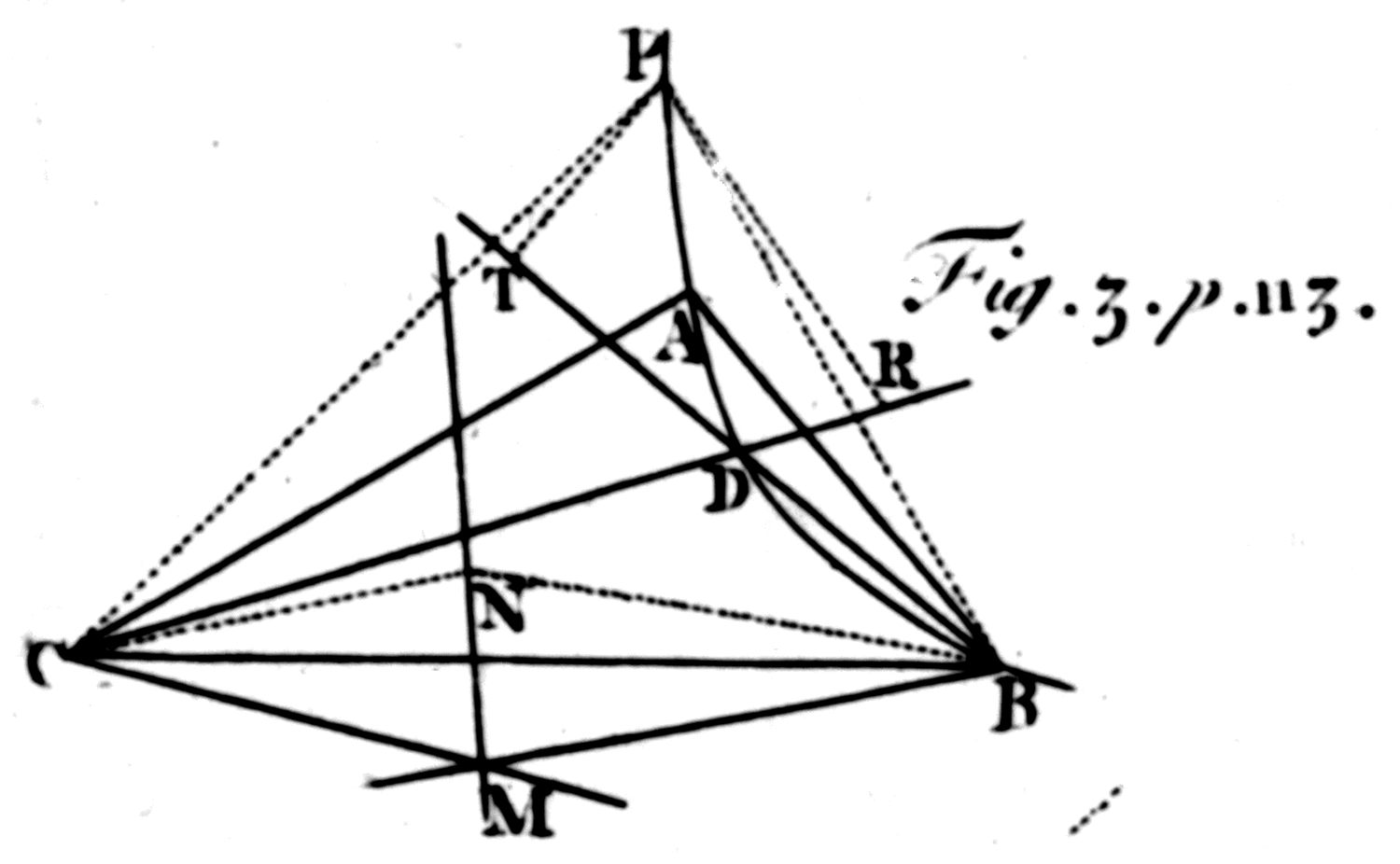
For in the right line MN let a point N be given, and when the moveable point M falls on the immoveable point N, let the moveable point D fall on an immoveable point P. Join CN, BN, CP
114BP, and from the point P draw the right lines PT, PR meeting BD, CD in T and R, and making the angle BPT equal to the given angle BNM and the angle CPR equal to the given angle CNM. Wherefore since (by supposition) the angles MBD, NBP are equal, as also the angles MCD, NCP; take away the angles NBD and NCD that are common, and there will remain the angles NBM and PBT, NCM and PCR equal; and therefore the triangles NBM, PBT are similar, as also the triangles NCM, PCR. Wherefore PT is to NM as PB to NB; and PR to NM, as PC to NC. But the points B, C, N, P are immoveable: Wherefore PT and PR have a given ratio to NM, and consequently a given ratio between themselves; and therefore, (by lem. 20.) the point D wherein the moveable right lines BT and CR perpetually concur, will be placed in a conic section passing through the points B, C, P. Q. E. D.
And vice versa, if the moveable point D (Pl. 9. Fig. 4.) lies in a conic section passing through the given points B, C, A; and the angle DBM is always equal to the given angle ABC, and the angle DCM always equal to the given angle ACB, and when the point D falls successively on any two immoveable points p, P, of the conic section, the moveable point M falls successively on two immoveable points n, N: through these points n, N, draw the right line nN, this line nN will be the perpetual locus of that moveable point M. For if possible, let the point M be placed in any curve line. Therefore the point D will be placed in a conic section passing through the five points B, C, A, p, P, when the point M is perpetually placed in a curve line. But from what was demonstrated before, the point D 115will be also placed in a conic section, passing through the same five points B, C, A, p, P, when the point M is perpetually placed in a right line. Wherefore the two conic sections will both pass through the same given points, against corol. 3. lem. 20. It is therefore absurd to suppose that the point M is placed in a curve line. Q. E. D.
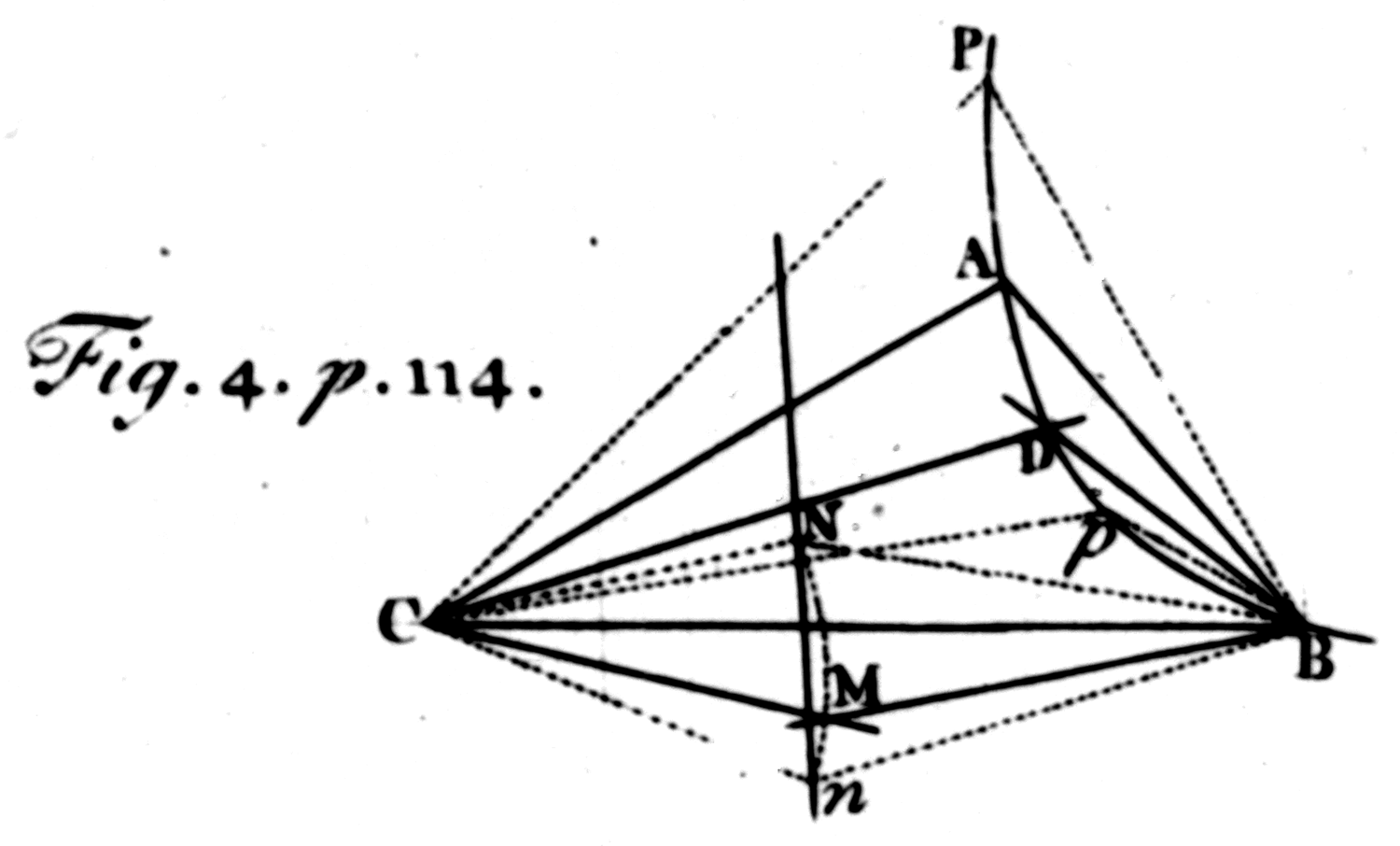
Proposition XXII. Problem XIV
To describe a trajectory that shall pass through five given points. Pl. 9 Fig. 5.
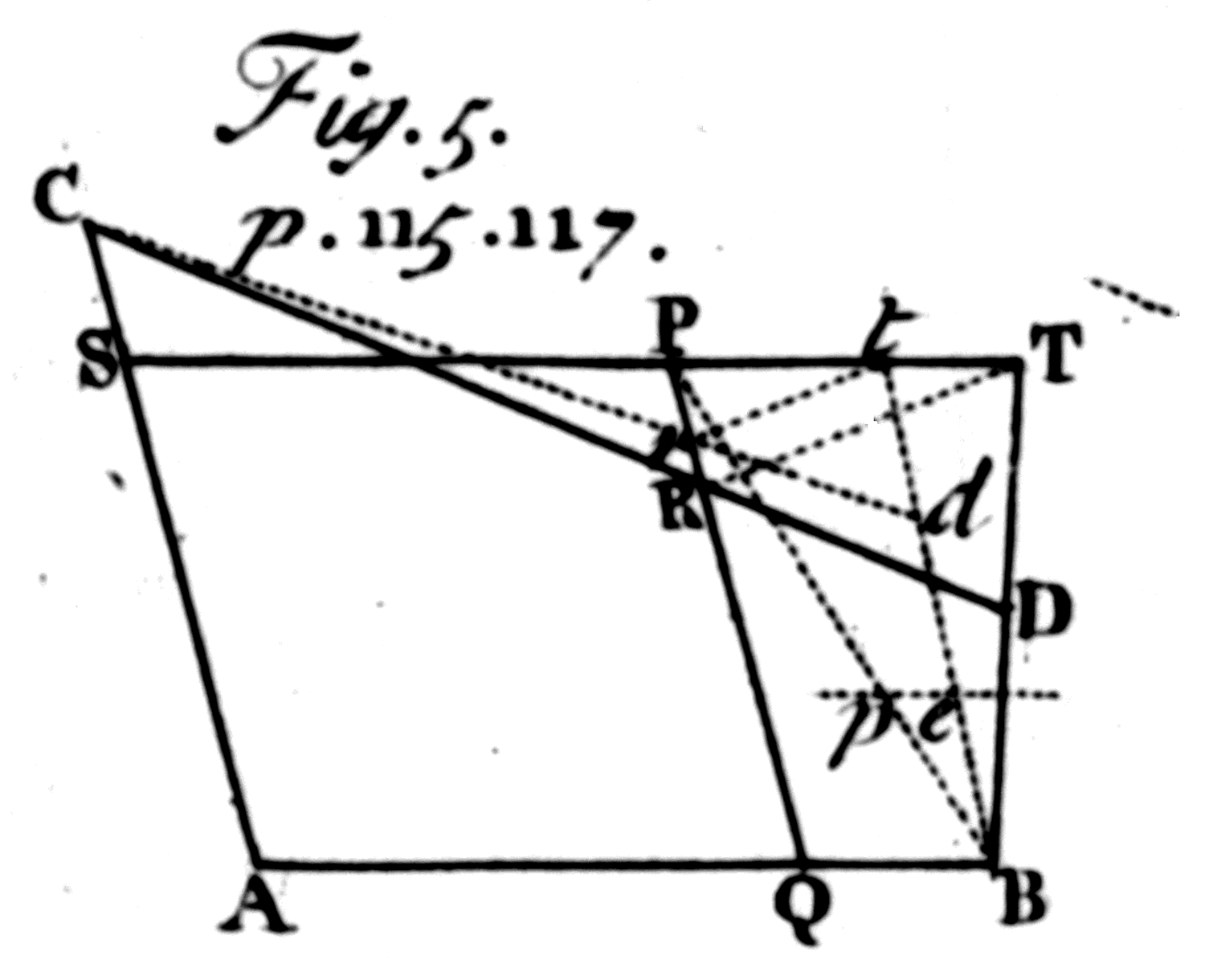
Let the five given points be A, B, C, P, D. From any one of them as A, to any other two as B, C, which may be called the poles, draw the right lines AB, AC, and parallel to those the lines TPS, PRQ through the fourth point P. Then from the two poles B, C, draw through the fifth point D two indefinite lines BDT, CRD, meeting with the last drawn lines TPS, PRQ (the former with the former, and the latter with the latter) in T and R. Then drawing the right line tr parallel to TR, cutting off from the right lines PT, PR, any segments Pt, Pr, proportional to PT, PR; and if through their extremities t, r, and the poles B, C, the right lines Bt, Cr are drawn, meeting in d, that point d will be placed in the trajectory required. For (by lem. 20.) that point d is placed in a conic section passing through the four points A, B, C, P; and the lines Rr, Tt vanishing, the point d comes to coincide with the point D. Wherefore the conic section passes through the five points A, B, C, P, D. Q. E. D.
The same otherwise. Pl. 9. Fig. 6.
116Of the given points join any three as A, B, C; and about two of them B, C, as poles, making the angles ABC, ACB of a given magnitude to revolve, apply the legs BA, CA, first to the point D, then to the point P, and mark the points M, N, in which the other legs BL, CL intersect each the other in both cases. Draw the indefinite right line MN and let those moveable angles revolve about their poles B, C, in such manner that the intersection, which is now supposed to be m, of the legs BL, CL, or BM, CM, may always fall in that indefinite right line MN; and the intersection which is now supposed to be d, of the legs BA, CA, or BD, CD, will describe the trajectory required PADdB. For, (by lem. 21.) the point d will be placed in a conic section passing through the points B, C; and when the point m comes to coincide with the points L, M, N, the point d will (by construction) come to coincide with the points A, D, P. Wherefore a conic section will be described that shall pass through the five points A, B, C, P, D. Q. E. F.
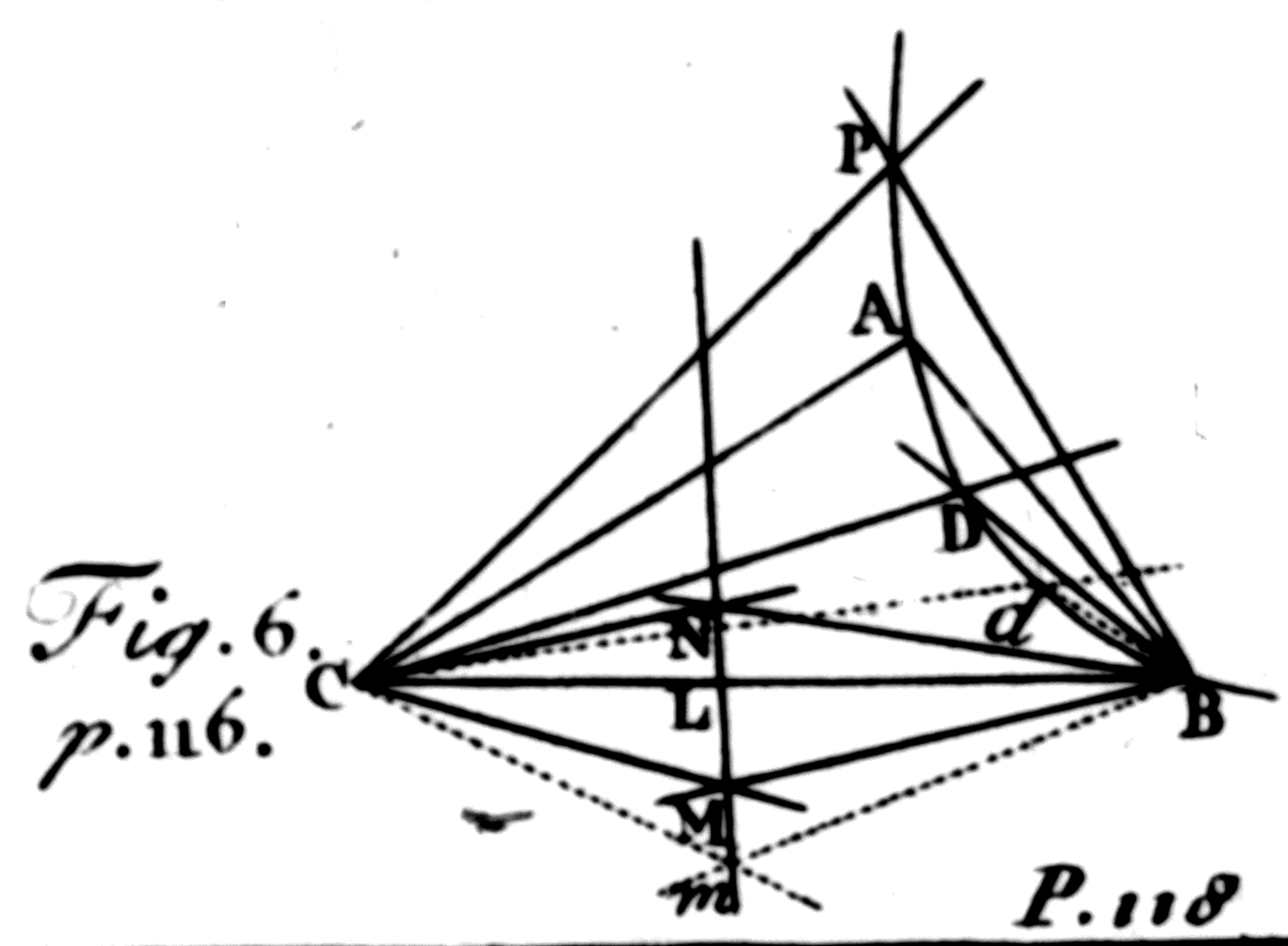
Cor. 1. Hence a right line may be readily drawn which shall be a tangent to the trajectory in any given point B. Let the point d come to coincide with the point B, and the right line Bd will become the tangent required.
Cor. 2. Hence also may be found the centres, diameters, and latera recta of the trajectories, as in cor. 2. lem. 19.
Scholium
117The former of these constructions (Fig. 5.) will become something more simple by joining BP, and in that line, produced if need be, taking Bp to BP as PR is to PT; and through p drawing the indefinite right line pe parallel to SPT; and in that line pe taking always pe equal to Pr; and drawing the right lines Be, Cr to meet in d. For since Pr to Pt, PR to PT, pB to PB, pe to Pt, are all in the same ratio, pe and Pr will be always equal. After this manner the points of the trajectory are most readily found, unless you would rather describe the curve mechanically as in the second construction.
Proposition XXIII. Problem XV
To describe a trajectory that shall pass through four given points, and touch a right line given by position. Pl. 10. Fig. 1.
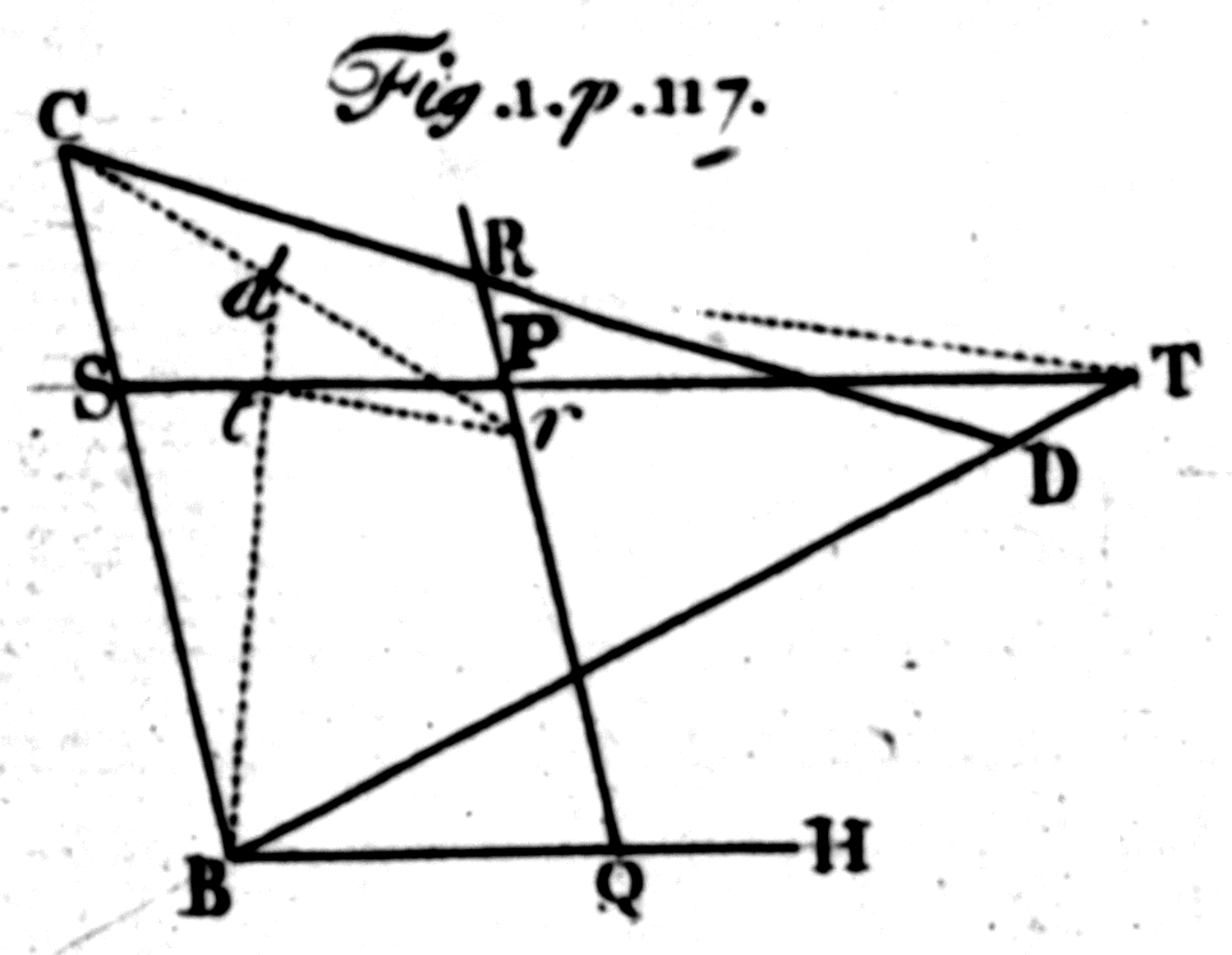
Case 1. Suppose that HB is the given tangent, B the point of contact, and C, D, P, the three other given points. Join BC, and draw PS parallel to BH, and PQ parallel to BC, compleat the parallelogram BSPQ. Draw BD cutting SP in T and CD cutting PQ in R. Lastly, drawing any line tr parallel to TR, cutting off from PQ, PS, the segments Pr, Pt proportional to PR, PT respectively; and drawing Cr, Bt, their point of concourse d will (by lem. 20.) always fall on the trajectory to be described.
The same otherwise. Pl. 10. Fig. 2.
118Let the angle CBH of a given magnitude revolve about the pole B, as also the rectilinear radius DC both ways produced, about the pole C. Mark the points M, N, on which the leg BC of the angle cuts that radius when BH the other leg thereof meets the same radius in the points P and D. Then drawing the indefinite line MN, let that radius CP or CD and the leg BC of the angle perpetually meet in this line; and the point of concourse of the other leg BH with the radius will delineate the trajectory required.
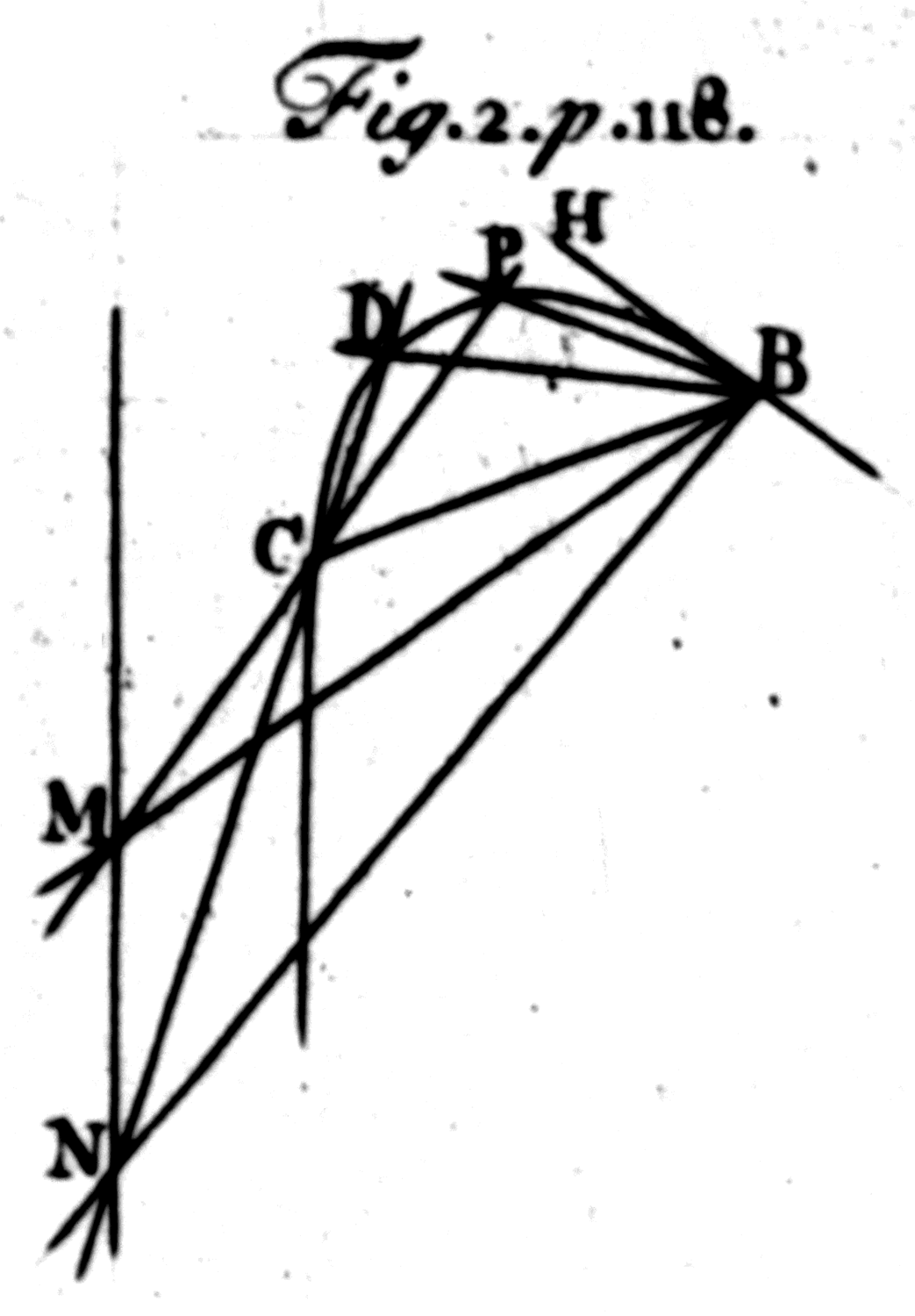
For if in the constructions of the preceding problem the point A comes to a coincidence with the point B the lines CA and CB will coincide, and the line AB, in its last situation, will become the tangent BH; and therefore the constructions there set down will become the same with the constructions here described. Wherefore the concourse of the leg BH with the radius will describe a conic section passing through the points C, D, P, and touching the line BH in the point B. Q. E. F.
Case 2. Suppose the four points B, C, D, P, (Pl. 10. Fig. 3.) given, being situated without the tangent HI join each two by the lines BD, CP, meeting in G, and cutting the tangent in H and I. Cut the tangent in A in such manner that HA may be to IA, as the rectangle under a mean proportional between CG and GP, and a mean proportional between BH and HD, is to a rectangle under a mean proportional between GD and GB, and a mean proportional between PI and IC; and A will be the point of contact. For if HX, a parallel to the right 119line PI, cuts the trajectory in any points X and Y; the point A (by the properties of the conic sections) will come to be so placed, that will become to in a ratio that is compounded out of the ratio of the rectangle XHY to the rectangle BHD, or of the rectangle CGP to the rectangle DGB; and the ratio of the rectangle BHD to the rectangle PIC. But after the point of contact A is found, the trajectory will be described as in the first case. Q. E. F. But the point A may be taken either between or without the points H and I; upon which account a twofold trajectory may be described.
Proposition XXIV. Problem XVI
To describe a trajectory that shall pass through three given points, and touch two right lines given by position. Pl. 10. Fig. 4.
Suppose HI, KL to be the given tangents, and B, C, D, the given points. Through any two of those points as B, D, draw the indefinite right line BD meeting the tangents in the points H, K. Then likewise through any other two of these points as C, D, draw the indefinite right line CD, meeting the tangents in the points I, L. Cut the lines drawn in R and S, so that HR may be to KR, as the mean proportional between BH and HD is to the mean proportional between BK and KD; and IS to LS, as the mean proportional between CI and ID is to the mean proportional between CL and LD. But you may cut, at pleasure, either within 120or between the points K and H, I and L, or without them; then draw RS cutting the tangents in A and P, and A and P will be the points of contact. For if A and P are supposed to be the points of contact situated any where else in the tangents, and through any of the points H, I, K, L, as I, situated in either tangent HI a right line IT is drawn, parallel to the other tangent KL, and meeting the curve in X and Y, and in that right line there be taken IZ equal to a mean proportional between IX and IY; the rectangle XIY or , will (by the properties of the conic sections) be to , as the rectangle CID is to the rectangle CLD, that is (by the construction) as is to , and therefore IZ is to LP, as SI to SL. Wherefore the points S, P, Z, are in one right line. Moreover, since the tangents meet in G, the rectangle XIY or will (by the properties of the conic sections) be to as is to , and consequently IZ will be to IA, as GP to GA. Wherefore the points P, Z, A, lie in one right line, and therefore the points S, P, and A are in one right line. And the same argument will prove that the points R, P, and A are in one right line. Wherefore the points of contact A and P lie in the right line RS. But after these points are found the trajectory may be described as in the first case of the preceding problem. Q. E. F.
In this proposition, and case 2. of the foregoing, the constructions are the same, whether the right line XY cut the trajectory in X and Y or not; neither do they depend upon that section. But the constructions being demonstrated where that right line does cut the trajectory, the constructions, where it does not, 121are also known; and therefore, for brevity's sake, I omit any farther demonstration of them.
Lemma XXII
To transform figures into other figures of the same kind. Pl. 10. Fig. 5.
Suppose that any figure HGI is to be transformed. Draw, at pleasure, two parallel lines AO, BL, cutting any third line AB given by position, in A and B, and from any point G of the figure, draw out any right line GD, parallel to OA, till it meet the right line AB. Then from any given point O in the line OA, draw to the point D the right line OD, meeting BL in d, and from the point of concourse raise the right line dg containing any given angle with the right line BL, and having such ratio to Od, as DG has to OD; and g will be the point in the new figure hgi, corresponding to the point G. And in like manner the several points of the first figure will give as many correspondent points of the new figure. If we therefore conceive the point G to be carried along by a continual motion through all the points of the first figure, the point g will be likewise carried along by a continual motion through all the points of the new figure, and describe the same. For distinction's sake, let us call DG the first ordinate, dg the new ordinate, AD the first abscissa, ad the new abscissa; O the pole, OD the abscinding radius, OA the first ordinate radius, and Oa (by which the parallelogram 122OABa is compleated) the new ordinate radius.
I say, then, that if the point G is placed in a right line given by position, the point g will be also placed in a right line given by position. If the point G is placed in a conic section, the point g will be likewise placed in a conic section. And here I understand the circle as one of the conic sections. But farther, if the point G is placed in a line of the third analytical order, the point g will also be placed in a line of the third order, and so on in curve lines of higher orders. The two lines in which the points G, g, are placed, will be always of the same analytical order. For as ad is to OA, so are od to OD, dg to DG, and AB to AD; and therefore AD is equal to and DG equal to . Now if the point G is placed in a right line, and therefore, in any equation by which the relation between the abscissa AD and the ordinate DG is expressed, those indetermined lines AD and DG rise no higher than to one dimension, by writing this equation in place of AD, and in place of DG, a new equation will be produced, in which the new abscissa ad and new ordinate dg rise only to one dimension; and which therefore must denote a right line, But if AD and DG (or either of them) had risen to two dimensions in the first equation, ad and dg would likewise have risen to two dimensions in the second equation. And so on in three or more dimensions. The indetermined 123lines ad, dg in the second equation, and AD, DG, in the first will always rise to the same number of dimensions; and therefore the lines in which the points G, g, are placed are of the same analytical order.
I say farther, that if any right line touches the curve line in the first figure, the same right line transferred the same way with the curve into the new figure, will touch that curve line in the new figure, and vice versa. For if any two points of the curve in the first figure are supposed to approach one the other till they come to coincide; the same points transferred will approach one the other till they come to coincide in the new figure; and therefore the right lines with which those points are joined will come together tangents of the curves in both figures. I might have given demonstrations of these assertions in a more geometrical form; but I study to be brief.
Wherefore if one rectilinear figure is to be transformed into another we need only transfer the intersections of the right lines of which the first figure consists, and through the transferred intersections to draw right lines in the new figure. But if a curvilinear figure is to be transformed we must transfer the points, the tangents, and other right lines, by means of which the curve line is defined. This lemma is of use in the solution of the more difficult problems. For thereby we may transform the proposed figures if they are intricate into others that are more simple, Thus any right lines converging to a point are transformed into parallels; by taking for the first ordinate radius any right line that passes through the point of concourse of the converging lines, and that, because their point of concourse is by this means made 124to go off in infinitum, and parallel lines are such as tend to a point infinitely remote. And after the problem is solved in the new figure, if by the inverse operations we transform the new into the first figure we shall have the solution required.
This lemma is also of use in the solution of solid problems. For as often as two conic sections occur by the intersection of which a problem may be solved; any one of them may be transformed if it is an hyperbola or a parabola, into an ellipsis, and then this ellipsis may be easily changed into a circle. So also a right line and a conic section, in the construction of plane problems, may be transformed into a right line and a circle.
Proposition XXV. Problem XVII
To describe a trajectory that shall pass through two given points, and touch three right lines given by position. Pl. 10. Fig. 6.
Through the concourse of any two of the tangents one with the other, and the concourse of the third tangent with the right line which passes through the two given points, draw an indefinite right line; and taking this line for the first ordinate radius transform the figure by the preceding lemma into a new figure. In this figure those two tangents will become parallel to each other, and the third tangent will be parallel to the right line that passes through the two given points. Suppose hi, kl to be those two parallel tangents, ik the third tangent, and hl a right line parallel thereto, passing through those points a, b, 125through which the conic section ought to pass in this new figure; and compleating the parallelogram hikl, let the right lines hi, ik, kl be so cut in c, d, e, that hc may be to the square root of the rectangle ahb, ic to id, and ke to kd, as the sum of the right lines hi and kl is to the sum of the three lines, the first whereof is the right line ik, and the other two are the square roots of the rectangles ahb and alb; and c, d, e, will be the points of contact. For by the properties of the conic sections to the rectangle ahb, and to , and to , and to the rectangle alb, are all in the same ratio; and therefore hc to the square root of ahb, ic to id, ke to kd, and el to the square root of alb, are in the subduplicate of that ratio; and by composition in the given ratio of the sum of all the antecedents , to the sum of all the consequents . Wherefore from that given ratio we have the points of contact c, d, e, in the new figure. By the inverted operations of the last lemma, let those points be transferred into the first figure, and the trajectory will be there described by prob. 14. Q. E. F. But according as the points a, b, fall between the points h, l, or without them, the points c, d, e, must be taken either between the points h, i, k, l, or without them. If one of the points a, b, falls between the points h, l, and the other without the points h, l, the problem is impossible.
Proposition XXVI. Problem. XVIII
126To describe a trajectory that shall pass through a given point, and touch four right lines given by position. Pl. 11. Fig. 1.
From the common intersections of any two of the tangents to the common intersection of the other two draw an indefinite right line; and taking this line for the first ordinate radius transform the figure (by lem. 22.) into a new figure, and the two pairs of tangents each of which before concurred in the first ordinate radius will now become parallel. Let hi and kl, ik and hl, be those pairs of parallels compleating the parallelogram hikl. And let p be the point in this new figure corresponding to the given point in the first figure. Through O the centre of the figure draw pq; and Oq being equal to Op, q will be the other point through which the conic section must pass in this new figure. Let this point be transferred by the inverse operation of lem. 22. into the first figure, and there we shall have the two points, through which the trajectory is to be described. But through those points that trajectory may be described by prob. 17. Q. E. F.
Lemma XXIII
127If two right lines as AC, BD given by position, and terminating in given points A, B, are in a given ratio one to the other, and the right line CD, by which the indetermined points C, D are joined, is cut in K in a given ratio; I say that the point K will be placed in a right line given by position. Pl. 11. Fig. 2.
For let the right lines AC, BD meet in E, and in BE take BG to AE, as BD is to AC, and let FD be always equal to the given line EG; and by construction, EC will be to GD, that is, to EF, as AC to BD, and therefore in a given ratio; and therefore the triangle EFC will be given in kind. Let CF be cut in L so as CL may be to CF in the ratio of CK to CD; and because that is a given ratio, the triangle EFL will be given in kind, and therefore the point L will be placed in the right line EL given by position. Join LK and the triangles CLK, CFD will be similar; and because FD is a given line, and LK is to FD in a given ratio, LK will be also given. To this let EH be taken equal, and ELKH will be always a parallelogram. And therefore the point K is always placed in the side HK (given by position) of that parallelogram. Q. E. D.
128Cor. Because the figure EFLC is given in kind, the three right lines EF, EL and EC, that is GD, HK and EC will have given ratio's to each other.
Lemma XXIV
If three right lines, two whereof are parallel, and given by position, touch any conic section; I say, that the semidiameter of the section which is parallel to those two is a mean proportional between the segments of those two, that are intercepted between the points of contact and the third tangent. Pl. 11. Fig. 3.
Let AF, GB be the two parallels touching the conic section ADB in A and B; EF the third right line touching the conic section in I, and meeting the two former tangents in F and G, and let CD be the semi-diameter of the figure parallel to those tangents; I say, that AF, CD, BG are continually proportional.
For if the conjugate diameters AB, DM meet the tangent FG in E and H, and cut one the other in C, and the parallelogram IKCL be compleated; from the nature of the conic sections, EC will be to CA as CA to CL, and so by division, to or EA to AL; and by composition, EA to or EL, as EC to or EB; and therefore (because of 129the similitude of the triangles EAF, ELI, ECH, EBG) AF is to LI as CH to BG. Likewise from the nature of the conic sections, LI (or CK) is to CD as CD to CH; and therefore (ex æquo perturbate) AF is to CD, as CD to BG. Q. E. D.
Cor. 1. Hence if two tangents FG, PQ meet two parallel tangents AF, BG in F and G, P and Q, and cut one the other in O; AF (ex æquo perturbate) will be to BQ as AP to BG, and by division, as FP to GQ, and therefore as FO to OG.
Cor. 2. Whence also the two right lines PG, FQ drawn through the points P and G, F and Q, will meet in the right line ACB, passing through the centre of the figure and the points of contact A, B.
Lemma XXV
If four sides of a parallelogram indefinitely produced touch any conic section, and are cut by a fifth tangent; I say, that taking those segments of any two conterminous sides that terminate in opposite angles of the parallelogram, either segment is to the side from which it is cut off, as that part of the other conterminous side which is intercepted between the point of contact and the third side, is to the other segment. Pl. 11. Fig. 4.
Let the four sides ML, IK, KL, MI of the parallelogram MLIK touch the conic section in 130A, B, C, D; and let the fifth tangent FQ cut those sides in F, Q, H and E, and taking the segments ME, KQ of the sides MI, KI; or the segments KH, MF of the sides KL, ML; I say, that ME is to MI as BK to KQ; and KH to KL, as AM to MF. For, by cor. 1. of the preceding lemma, ME is to EL as (AM or) BK to BQ; and, by composition, ME is to MI as BK to KQ. Q. E. D. Also KH is to HL as (BK or) AM to AF and by division KH to KL, as AM to MF. Q. E. D.
Cor. 1. Hence if a parallelogram IKLM described about a given conic section is given, the rectangle , as also the rectangle equal thereto, will be given. For, by reason of the similar triangles KQH, MFE, those rectangles are equal.
Cor. 2. And if a sixth tangent eq is drawn meeting the tangents KI, MI in q and e; the rectangle will be equal to the rectangle , and KQ will be to Me, as Kq to ME, and by division as Qq to Ee.
Cor. 3. Hence also if Eq, eQ, are joined and bisected, and a right line is drawn through the points of bisection, this right line will pass through the centre of the conic section. For since Qq is to Ee, as KQ to Me; the same right line will pass through the middle of all the lines Eq, eQ, MK (by lem. 22.) and the middle point of the right line MK is the centre of the section.
Proposition XXVII. Problem XIX
131To describe a trajectory that may touch five right lines given by position. Pl. 11. Fig. 5.
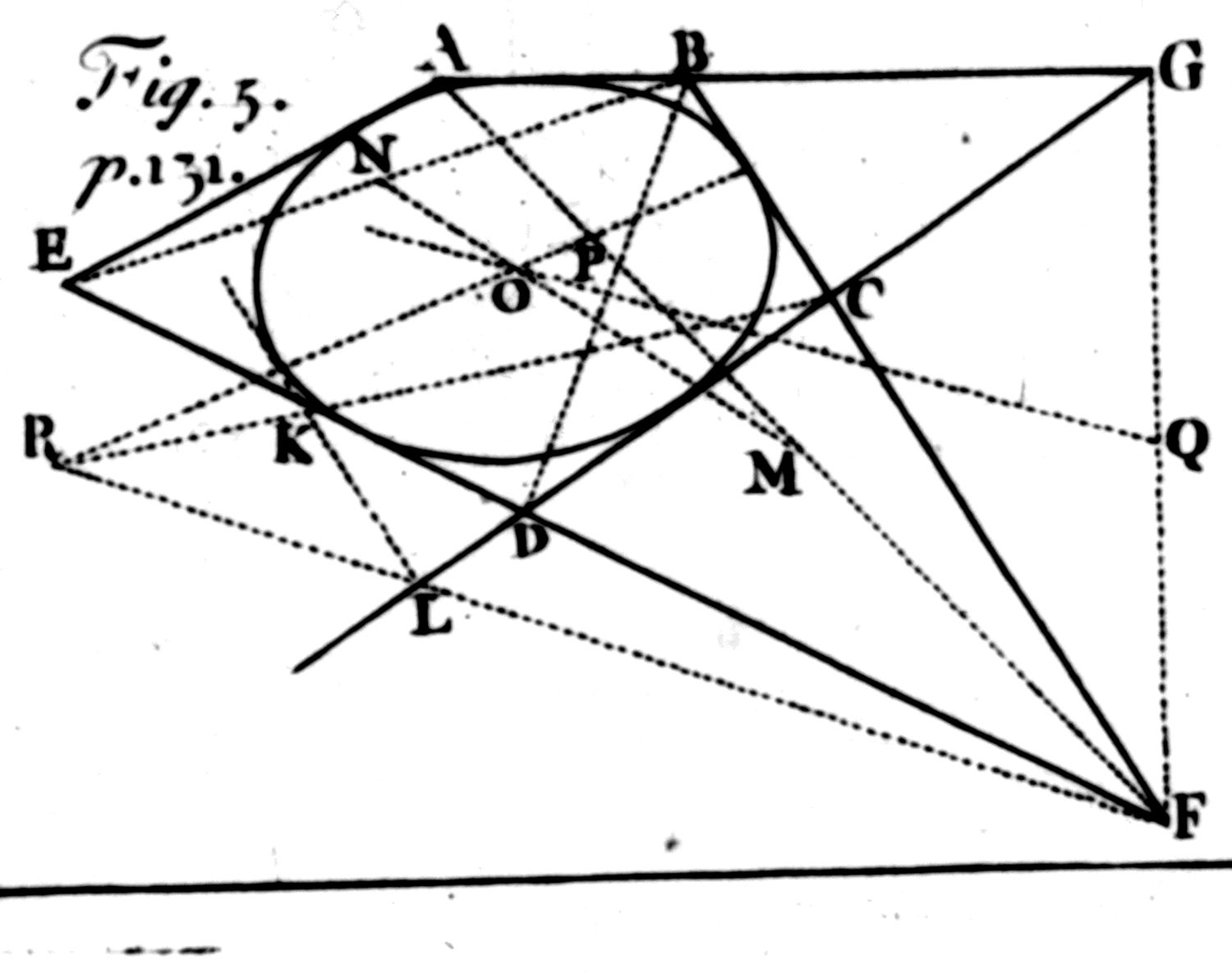
Supposing ABG, BCF, GCD, FDE, EA to be the tangents given by position. Bisect in M and N, AF, BE the diagonals of the quadrilateral figure ABFE contained under any four of them; and (by cor. 3. lem. 25) the right line MN drawn through the points of bisection will pass through the centre of the trajectory. Again, bisect in P and Q the diagonals (if I may so call them) BD, GF of the quadrilateral figure BGDF contained under any other four tangents, and the right line PQ drawn through the points of bisection will pass through the centre of the trajectory. And therefore the centre will be given in the concourse of the bisecting lines. Suppose it to be O. Parallel to any tangent BC draw KL, at such distance that the centre O may be placed in the middle between the parallels; this KL will touch the trajectory to be described. Let this cut any other two tangents GCD, FDE, in L and K. Through the points C and K, F and L, where the tangents not parallel CL, FK meet the parallel tangents CF, KL, draw CK, FL meeting in R; and the right line OR drawn and produced, will cut the parallel tangents CF, KL, in the points of contact. This appears from cor. 3. lem. 24. And by the same method the other points of contact may be found, and then the trajectory may be described by prob. 14. Q. E. F.
Scholium
132Under the preceding propositions are comprehended those problems wherein either the centres or asymptotes of the trajectories are given. For when points and tangents and the centre are given, as many other points and as many other tangents are given at an equal distance on the other side of the centre. And an asymptote is to be considered as a tangent, and its infinitely remote extremity (if we may say so) is a point of contact. Conceive the point of contact of any tangent removed in infinitum, and the tangent will degenerate into an asymptote, and the constructions of the preceding problems will be changed into the constructions of those problems wherein the asymptote is given.
After the trajectory is described, we may find its axes and foci in this manner. In the construction and figure of lem. 21. (Pl. 12. Fig. 1.) let those legs BP, CP, of the moveable angles PBN, PCN, by the concourse of which the trajectory was described, be made parallel one to the other; and retaining that position, let them revolve about their poles B, C, in that figure. In the mean while let the other legs CN, BN, of those angles, by their concourse K or k, describe the circle BKGC. Let O be the centre of this circle; and from this centre upon the ruler MN, wherein those legs CN, BN did concur while the trajectory was described, let fall the perpendicular OH meeting the circle in K and L. And when those other legs CK, BK meet in the point K that is nearest to the ruler, the first legs CP, BP will be parallel to the greater axis 133and perpendicular on the lesser; and the contrary will happen if those legs meet in the remotest point L. Whence if the centre of the trajectory is given, the axes will be given; and those being given, the foci will be readily found.
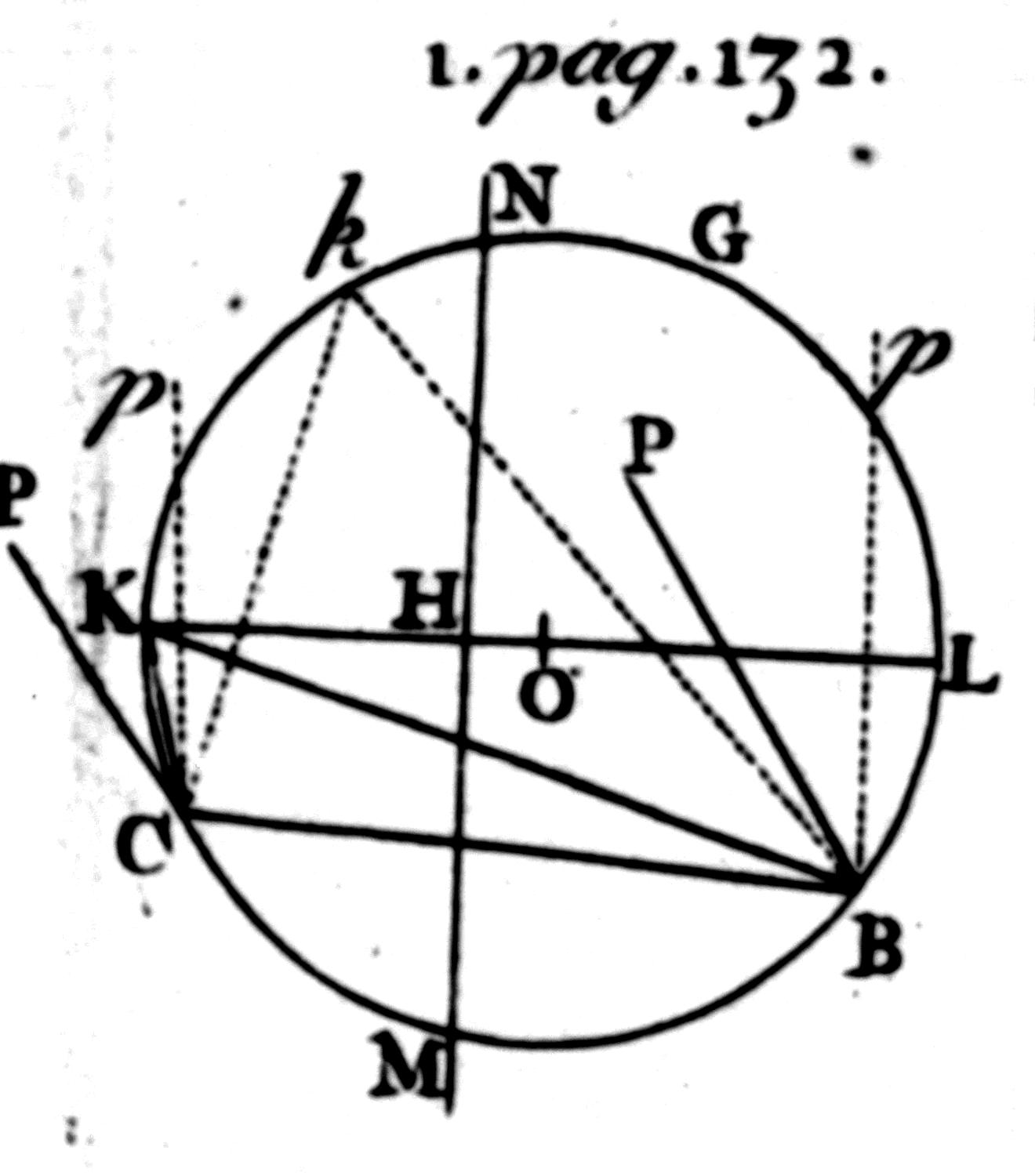
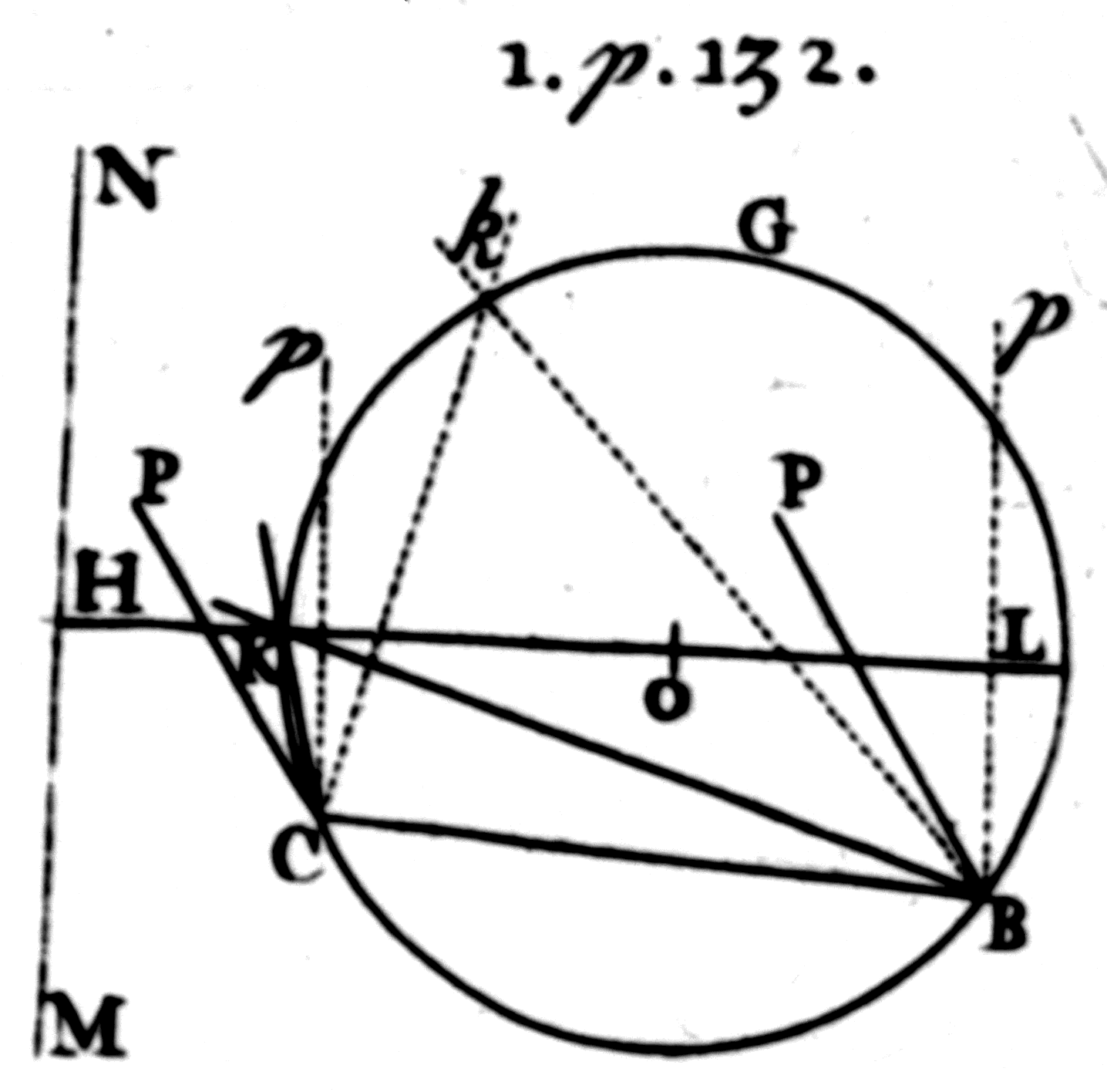
But the squares of the axes are one to the other as KH to LH, and thence it is easy to describe a trajectory given in kind through four given points. For if two of the given points are made the poles C, B, the third will give the moveable angles PCK, PBK; but those being given, the circle BGKC may be described. Then, because the trajectory is given in kind, the ratio of OH to OK, and therefore OH it self, will be given. About the centre O, with the interval OH, describe another circle, and the right line that touches this circle and passes through the concourse of the legs CK, BK, when the first legs CP, BP, meet in the fourth given point, will be the ruler MN, by means of which the trajectory may be described. Whence also on the other hand a trapezium given in kind (excepting a few cases that are impossible) may be inscribed in a given conic section.
There are also other lemma's by the help of which trajectories given in kind may be described through given points, and touching given lines. Of such a sort is this, that if a right line is drawn through any point given by position, that may cut a given conic section in two points, and the distance of the intersections is bisected, the point of bisection will touch another conic section of the same kind with the former, and having its axes parallel to the axes of the former. But I hasten to things of greater use.
Lemma XXVI
134To place the three angles of a triangle, given both in kind and magnitude, in respect of as many right lines given by position, provided they are not all parallel among themselves, in such manner that the several angles may touch the several lines. Pl. 12. Fig. 2.
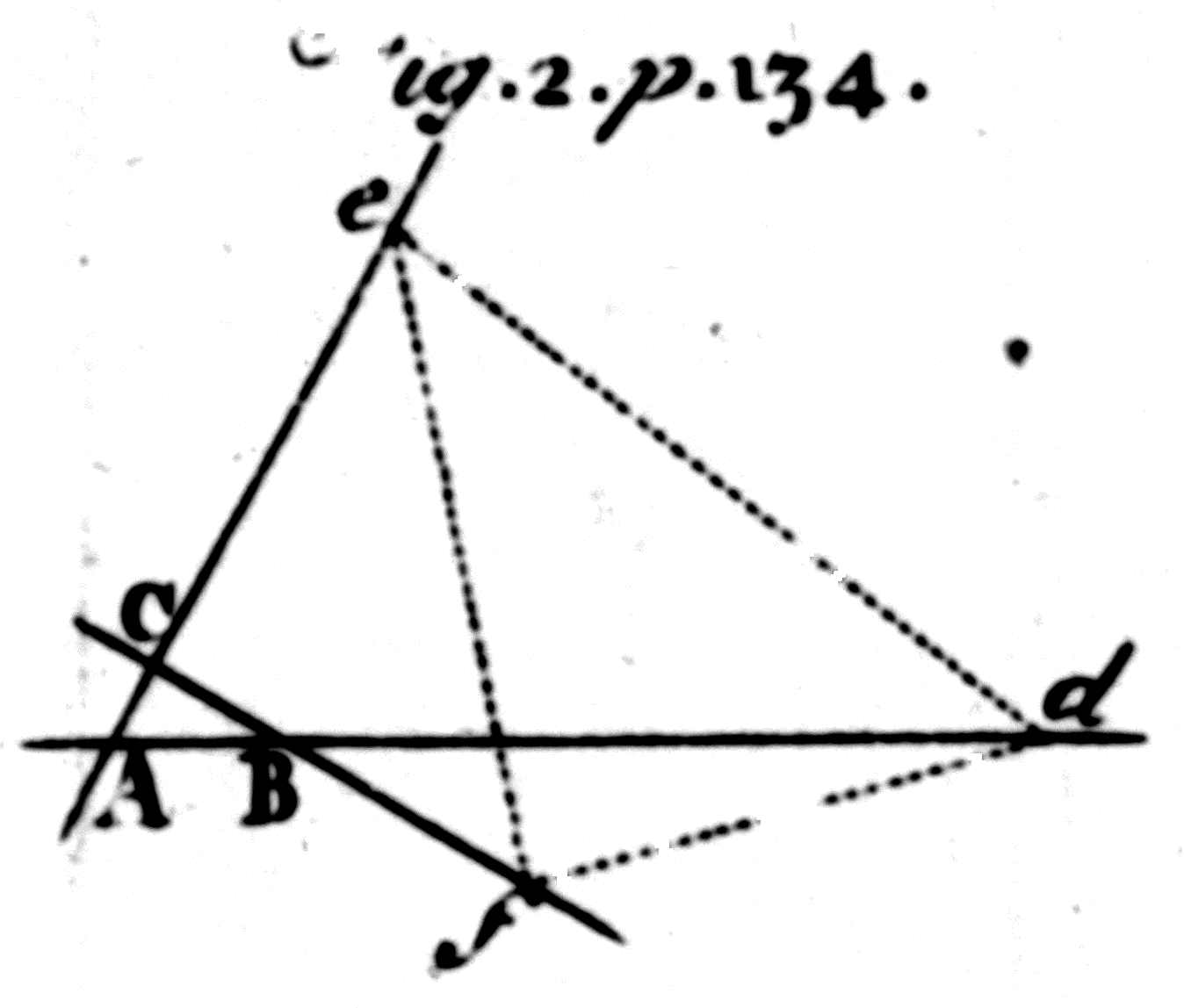
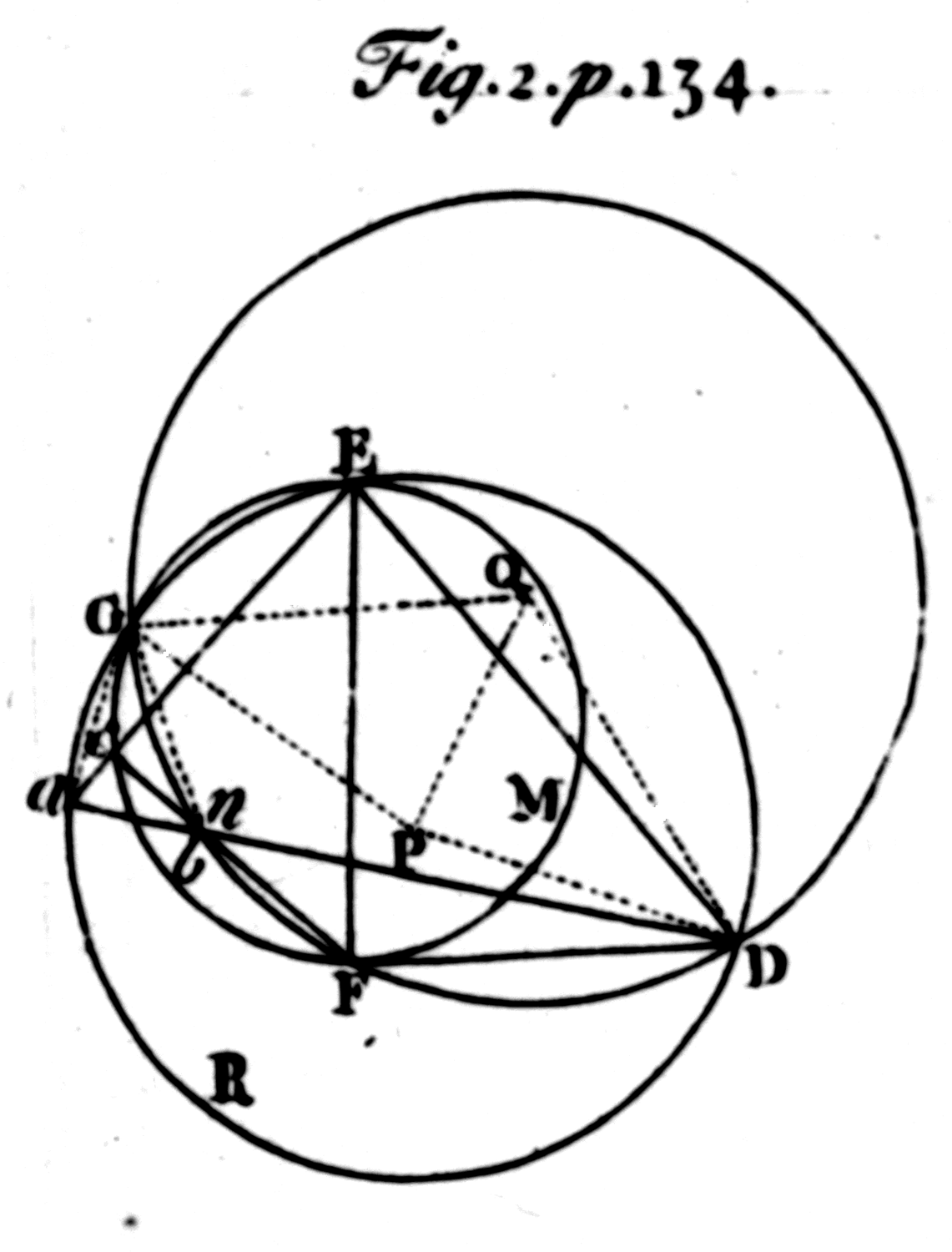
Three indefinite right lines AB, AC, BC, are given by position, and it is required so to place the triangle DEF that its angle D may touch the line AB, its angle E the line AC, and its angle F the line BC. Upon DE, DF and EF, describe three segments of circles DRE, DGF, EMF, capable of angles equal to the angles BAC, ABC, ACB respectively. But those segments are to be described towards such sides of the lines DE, DF, EF, that the letters DRED may turn round about in the same order with the letters BACB; the letters DGFD in the same order with the letters ABCA; and the letters EMFE in the same order with the letters ACBA; then compleating those segments into entire circles, let the two former circles cut one the other in G, and suppose P and Q to be their centres. Then joining GP, PQ, take Ga to AB, as GP is to PQ; and about the centre G, with the interval Ga describe a circle that may cut the first circle DGE in a. Join aD cutting the second circle DFG in b, as 135well as aE cutting the third circle EMF in c. Compleat the figure ABCdef similar and equal to the figure abcDEF. I say the thing is done.
For drawing Fc meeting aD in n, and joining aG, bG, QG, QD, PD; by construction the angle EaD is equal to the angle CAB, and the angle acF equal to the angle ACB; and therefore the triangle anc equiangular to the triangle ABC. Wherefore the angle anc or FnD is equal to the angle ABC, and consequently to the angle FbD; and therefore the point n falls on the point b. Moreover the angle GPQ which is half the angle GPD at the centre is equal to the angle GaD at the circumference; and the angle GQP, which is half the angle GQD at the centre, is equal to the complement to two right angles of the angle GbD at the circumference, and therefore equal to the angle Gab. Upon which account the triangles GPQ, Gab, are similar, and Ga is to ab as GP to PQ; that is (by construction) as Ga to AB. Wherefore ab and AB are equal; and consequently the triangles abc, ABC, which we have now proved to be similar, are also equal. And therefore since the angles D, E, F, of the triangle DEF do respectively touch the sides ab, ac, bc of the triangle abc, the figure ABCdef may be compleated similar and equal to the figure abcDEF, and by compleating it the problem will be solved. Q. E. F.
Cor. Hence a right line may be drawn whose parts given in length may be intercepted between three right lines given by position. Suppose the triangle DEF, by the access of its point D to the side EF, and by having the sides DE, DF placed in directum to be changed into a right line 136whose given part DE is to be interposed between the right lines AB, AC given by position; and its given part DF is to be interposed between the right lines AB, BC, given by position; then by applying the preceding construction to this case the problem will be solved.
Proposition XXVIII. Problem XX
To describe a trajectory given both in kind and magnitude, given parts of which shall be interposed between three right lines given by position. Pl. 12. Fig. 3.
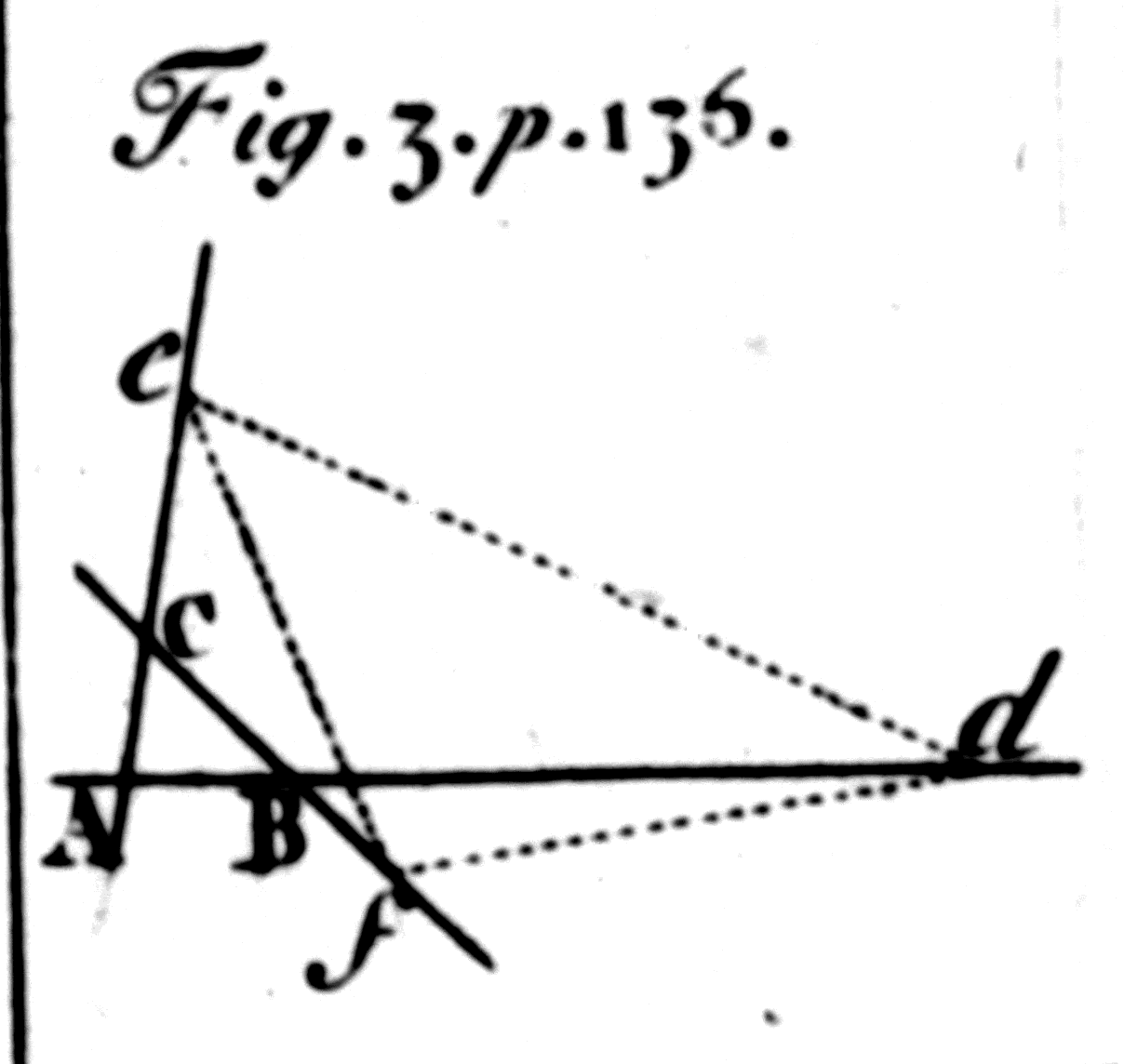
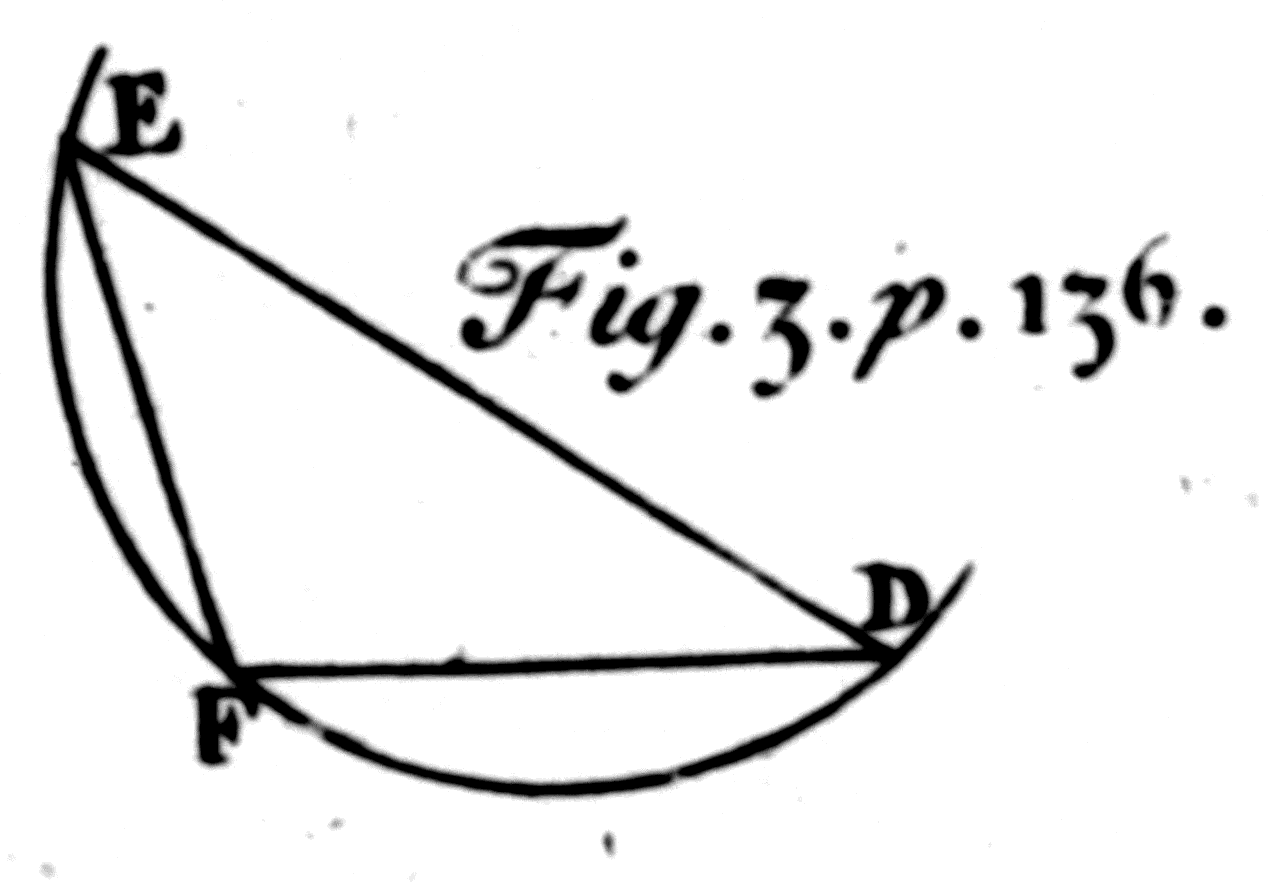
Suppose a trajectory is to be described that may be similar and equal to the curve line DEF, and may be cut by three right lines AB, AC, BC given by position, into parts DE and EF, similar and equal to the given parts of this curve line.
Draw the right lines DE, EF, DF; and place the angles D, E, F, of this triangle DEF, so as to touch those right lines given by position (by lem. 26). Then about the triangle describe the trajectory, similar and equal to the curve DEF. Q. E. F.
Lemma XXVII
137To describe a trapezium given in kind, the angles whereof may be so placed in respect of four right lines given by position, that are neither all parallel among themselves nor converge to one common point, that the several angles may touch the several lines. Pl. 13. Fig. 1.
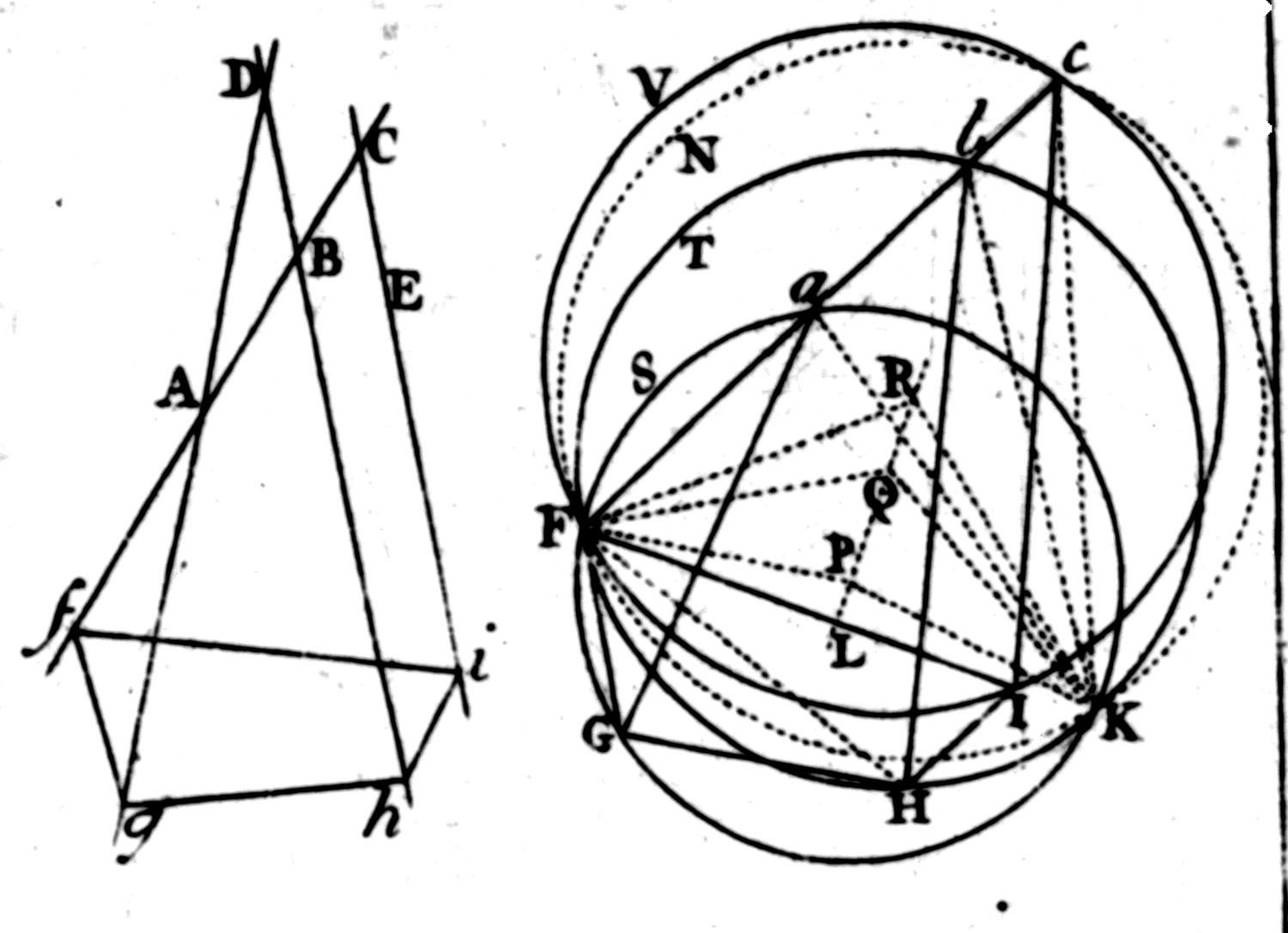
Let the four right lines ABC, AD, BD, CE, be given by position; the first cutting the second in A, the third in B, and the fourth in C; and suppose a trapezium fghi is to be described, that may be similar to the trapezium FGHI; and whose angle f, equal to the given angle F, may touch the right line ABC; and the other angles g, h, i, equal to the other given angles G, H, I, may touch the other lines AD, BD, CE, respectively. Join FH, and upon FG, FH, FI describe as many segments of circles FSG, FTH, FVI; the first of which FSG may be capable of an angle equal to the angle BAD; the second FTH capable of an angle equal to the angle CBD; and the third FVI of an angle equal to the angle ACE. But the segments are to be described towards those sides of the lines FG, FH, FI, that the circular order of the letters FSGF, may be the same as of the letters BADB, and that the letters FTHF may turn about in the same order as the letters CBDC, and the letters FVIF in the same order 138as the letters ACEA. Compleat the segments into entire circles, and let P be the centre of the first circle FSG, Q the centre of the second FTH. Join and produce both ways the line PQ, and in it take QR in the same ratio to PQ, as BC has to AB. But QR is to be taken towards that side of the point Q, that the order of the letters P, Q, R may be the same, as of the letters A, B, C; and about the centre R with the interval RF describe a fourth circle FNc cutting the third circle FVI in c. Join Fc cutting the first circle in a, and the second in b. Draw aG, bH, cI, and let the figure ABCfghi be made similar to the figure abcFGHI; and the trapezium fghi will be that which was required to be described.
For let the two first circles FSG, FTH cut one the other in K; join PK, QK, RK, aK, bK, cK, and produce QP to L. The angles FaK, FbK, FcK at the circumferences are the halves of the angles FPK, FQK, FRK, at the centres, and therefore equal to LPK, LQK, LRK the halves of those angles. Wherefore the figure PQRK is equiangular and similar to the figure abcK, and consequently ab is to bc as PQ to QR, that is, as AB to BC. But by construction the angles fAg, fBh, fCi are equal to the angles FaG, FbH, FcI. And therefore the figure ABCfghi may be compleated similar to the figure abcFGHI. Which done a trapezium fghi will be constructed similar to the trapezium FGHI, and which by its angles f, g, h, i will touch the right lines ABC, AD, BD, CE. Q. E. F.
Cor. Hence a right line may be drawn whose parts intercepted in a given order, between four right lines given by position, shall have a given 139proportion among themselves. Let the angles FGH, GHI, be so far increased that the right lines FG, GH, HI, may lie in directum, and by constructing the problem in this case, a right line fghi will be drawn, whose parts fg, gh, hi, intercepted between the four right lines given by position, AB and AD, AD and BD, BD and CE, will be one to another as the lines FG, GH, HI, and will observe the same order among themselves. But the same thing may be more readily done in this manner.
Produce AB to K (Pl. 13. Fig. 2.) and BD to L, so as BK may be to AB, as HI to GH; and DL to BD as GI to FG; and join KL meeting the right line CE in i. Produce iL to M, so as LM may be to iL as GH to HI; then draw MQ parallel to LB and meeting the right line AD in g, and join gi cutting AB, BD in f, h. I say the thing is done.
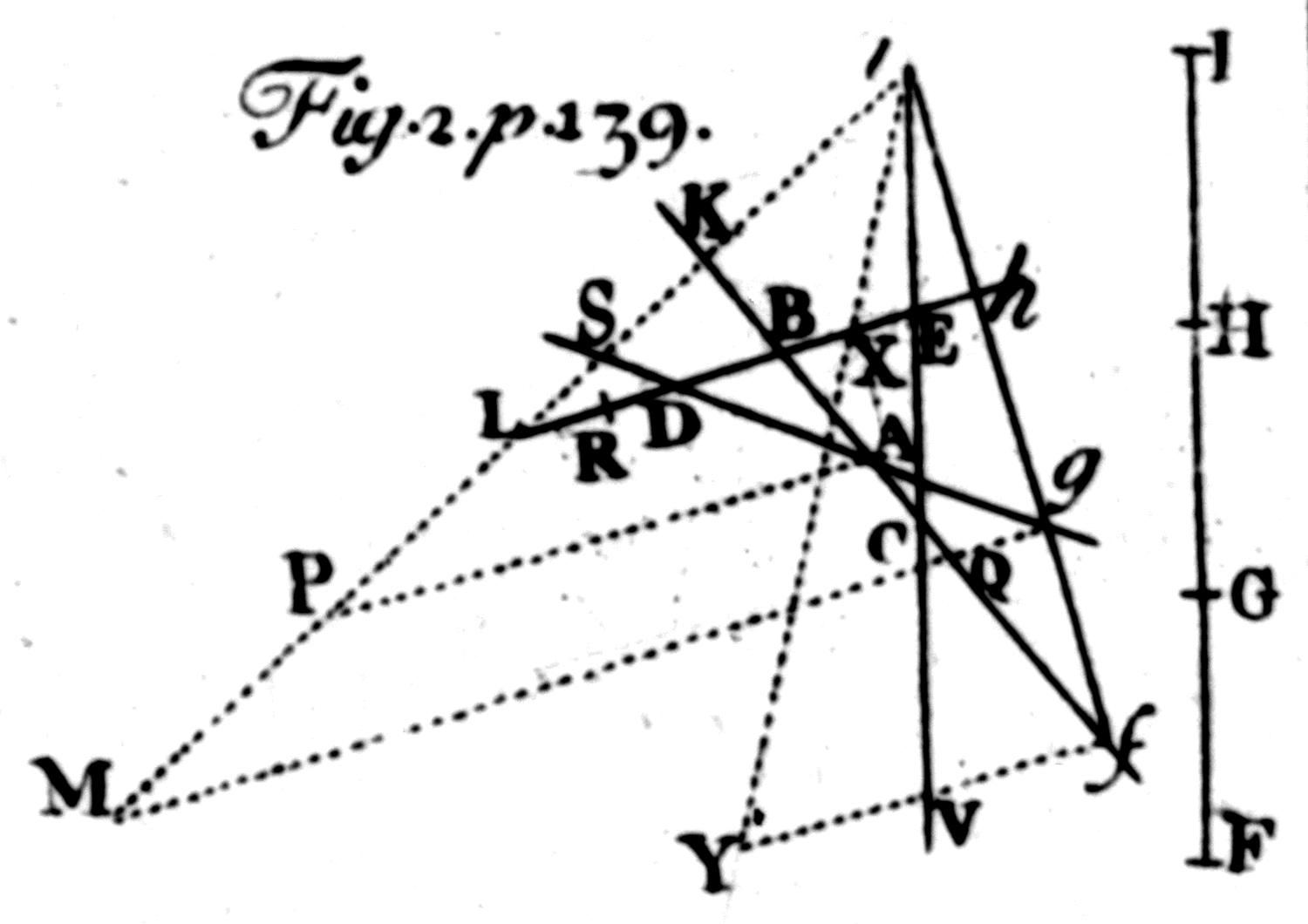
For let Mg cut the right line AB in Q, and AD the right line KL in S, and draw AP parallel to BD, and meeting iL in P, and gM to Lh (gi to hi, Mi to Li, GI to HI, AK to BK) and AP to BL will be in the same ratio. Cut DL in R, so as DL to RL may be in that same ratio; and because gS to gM, AS to AP, and DS to DL are proportional; therefore (ex æquo) as gS to Lh, so will AS be to BL, and DS to RL; and mixtly to , as to . That is, BR is to Bh, as AD is to Ag, and therefore as BD to gQ. And alternately BR is to BD, as Bh to gQ, or as fh to fg. But by construction the line BL was cut in D and R, in the same ratio as the line FI in G and H; and therefore 140BR is to BD as FH to FG. Wherefore fh is to fg, as FH to FG. Since therefore gi to hi likewise is as Mi to Li, that is, as GI to HI, it is manifest that the lines FI, fi, are similarly cut in G and H, g and h. Q. E. F.
In the construction of this corollary, after the line LK is drawn cutting CE in i, we may produce iE to V, so as EV may be to Ei as FH to HI, and then draw Vf parallel to BD. It will come to the same, if about the centre i, with an interval IH, we describe a circle cutting BD in X, and produce iX to Y so as iY may be equal to IF, and then draw Yf parallel to BD.
Sir Christopher Wren, and Dr. Wallis have long ago given other solutions of this problem.
Proposition XXIX. Problem XXI
To describe a trajectory given in kind, that may be cut by four right lines given by position, into parts given in order, kind, and proportion.
Suppose a trajectory is to be described that may be similar to the curve line FGHI (Pl. 13. Fig. 3.) and whose parts, similar and proportional to the parts FG, GH, HI of the other, may be intercepted between the right lines AB and AD, AD and BD, BD and CE given by position, viz. the first between the first pair of those lines, the second between the second, and the third between the third. Draw the right lines FG, GH, HI, FI; and (by lem. 27.) describe a trapezium 141fghi that may be similar to the trapezium FGHI, and whose angles f, g, h, i, may touch the right lines given by position, AB, AD, BD, CE, severally according to their order. And then about this trapezium describe a trajectory, that trajectory will be similar to the curve line FGHI.
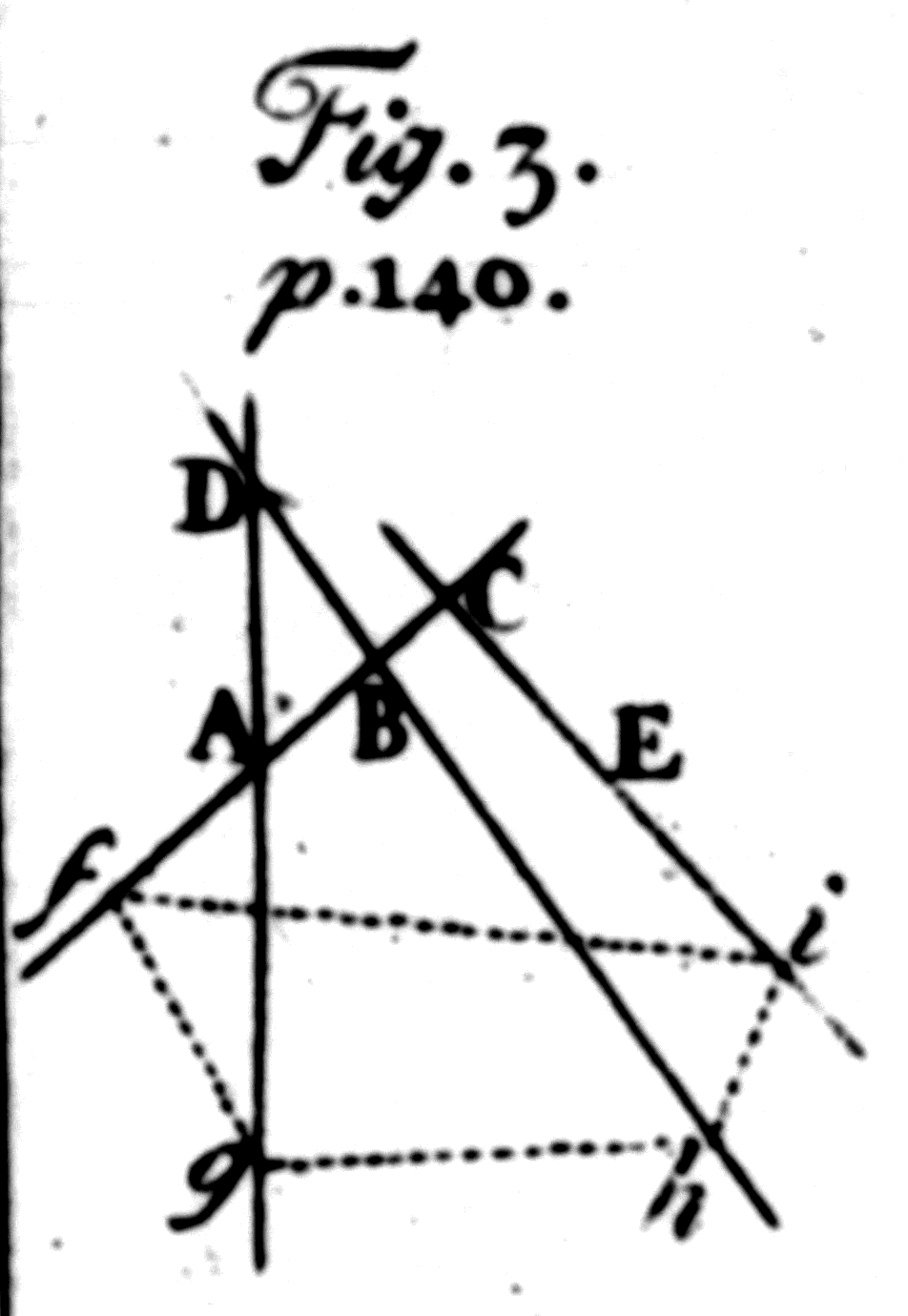
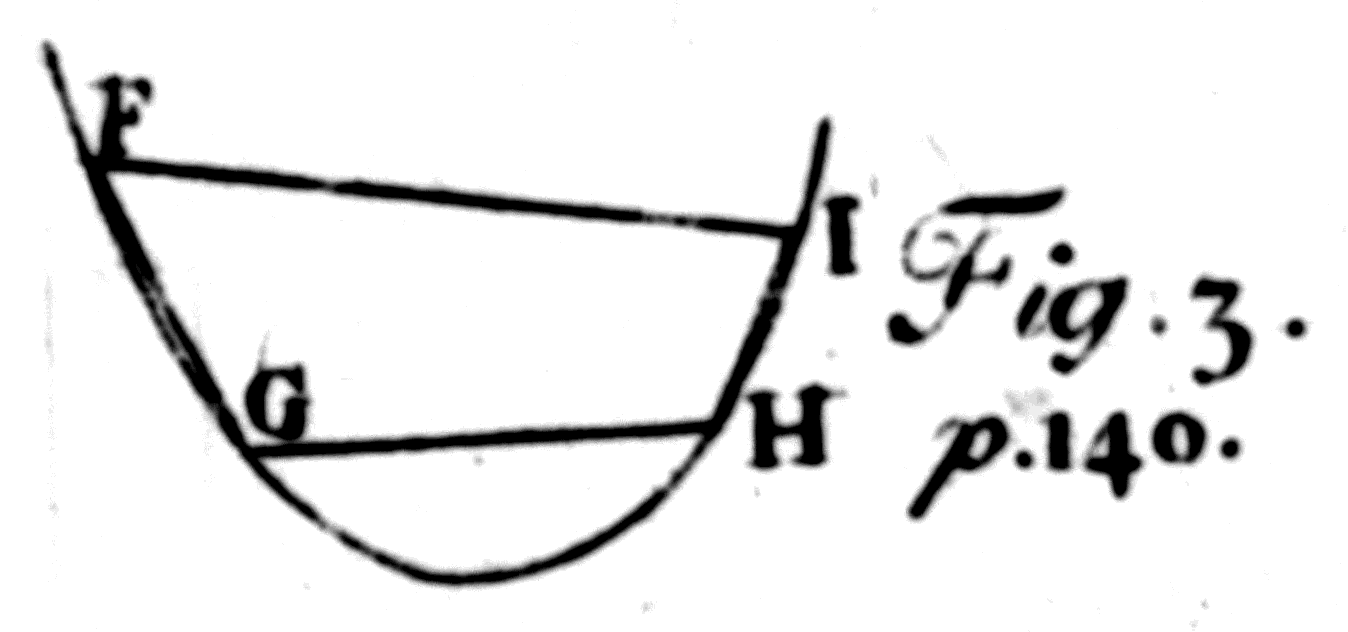
Scholium
This problem may be likewise constructed in the following manner. Joining FG, GH, HI, FI, (Pl. 13. Fig. 4.), produce GF to V, and join FH, IG, and make the angles CAK, DAL equal to the angles FGH, VFH. Let AK, AL meet the right line BD in K and L, and thence draw KM, LN, of which let KM make the angle AKM equal to the angle GHI, and be it self to AK, as HI is to GH; and let LN make the angle ALN equal to the angle FHI, and be it self to AL, as HI to FH. But AK, KM, AL, LN are to be drawn towards those sides of the lines AD, AK, AL, that the letters CAKMC, ALKA, DALND may be carried round in the same order as the letters FGHIF; and draw MN meeting the right line CE in i. Make the angle iEP equal to the angle IGF, and let PE be to Ei, as FG to GI; and through P draw PQf that may with the right line ADE contain an angle PQE equal to the angle FIG, and may meet the right line AB in f, and join fi. But PE and PQ are to be drawn towards those sides of the lines CE, PE, that the circular order of the letters PEiP and PEQP may be the same, as of the letters FGHIF, and if upon the line fi, in 142the same order of letters, and similar to the trapezium FGHI, a trapezium fghi is constructed, and a trajectory given in kind is circumscribed about it, the problem will be solved.
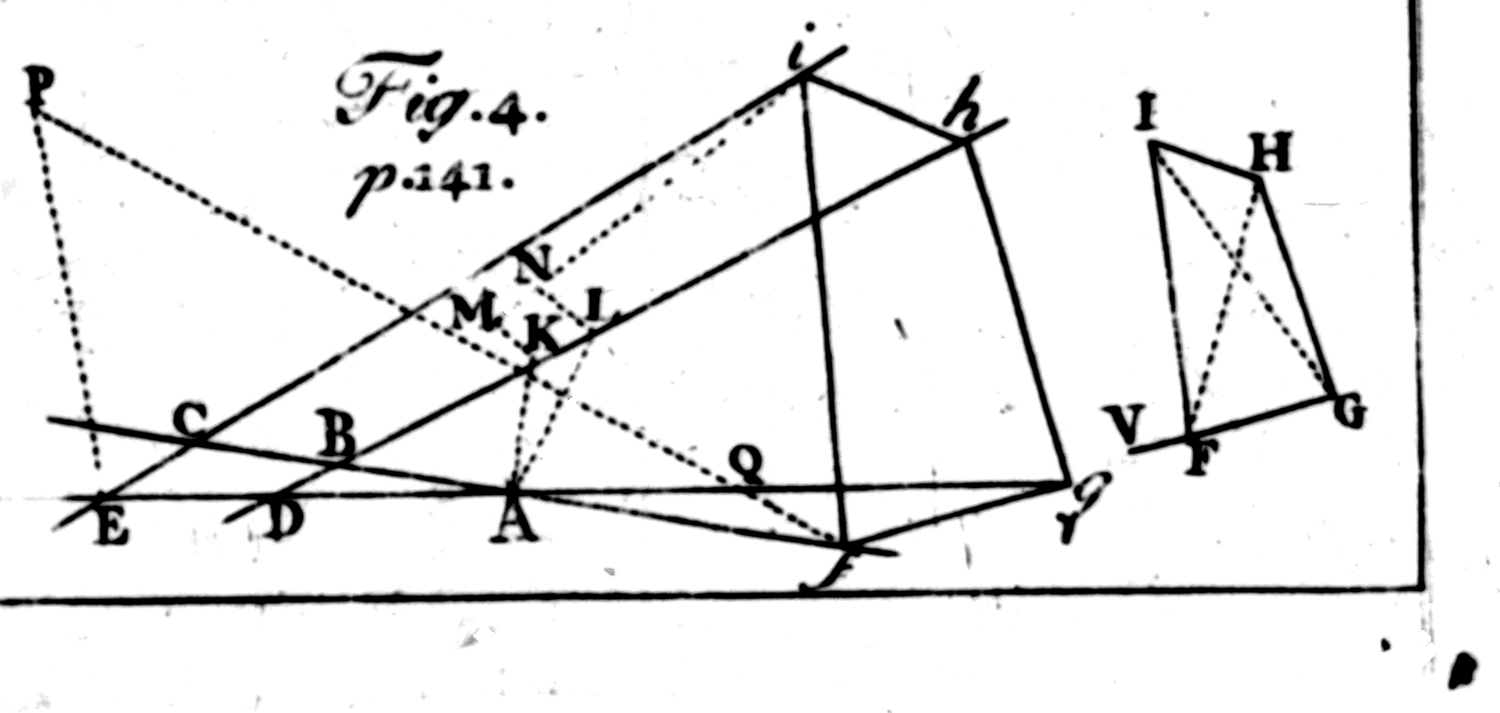
So far concerning the finding of the orbits. It remains that we determine the motions of bodies in the orbits so found.
Section VI. How the motions are to be found in given orbits.
Section VI
143How the motions are to be found in given orbits.
Proposition XXX. Problem XXII
To find at any assigned time the place of a body moving in a given parabolic trajectory.
Let S (Pl. 14. Fig. 1.) be the focus, and A the principal vertex of the parabola; and suppose equal to the parabolic area to be cut off APS, which either was described by the radius SP, since the bodies departure from the vertex, or is to be described thereby before its arrival there. Now the quantity of that area to be cut off is known from the time which is proportional to it. Bisect AS in G, and erect the perpendicular GH equal to 3M, and a circle described about the centre H, with the interval HS, will cut the parabola in the place P required. For letting fall PO 144perpendicular on the axis, and drawing PH, there will be . Whence . For write ; then dividing all the terms by 3PO and multiplying them by 2AS, we shall have to the area to the area APS. But GH was 3M, and therefore is . Wherefore the area cut off APS is equal to the area that was to be cut off . Q. E. D.
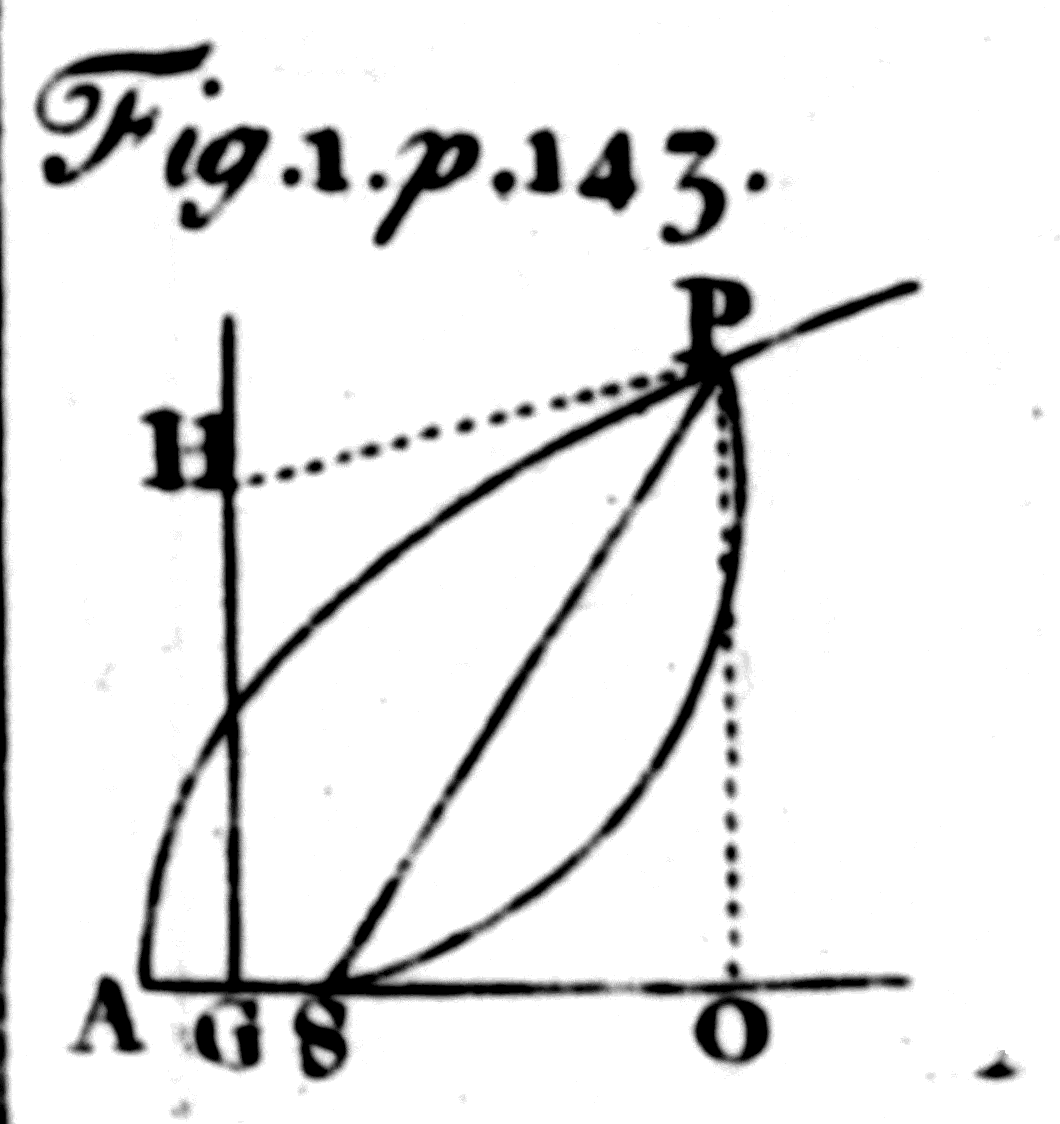
Cor. 1. Hence GH is to AS, as the time in which the body described the arc AP, to the time in which the body described the arc between the vertex A and the perpendicular erected from the focus S upon the axis.
Cor. 2. And supposing a circle ASP, perpetually to pass through the moving body P, the velocity of the point H, is to the velocity which the body had in the vertex A, as 3 to 8; and therefore in the same ratio is the line GH to the right line which the body, in the time of its moving from A to P, would describe with that velocity which it had in the vertex A.
Cor. 3. Hence also on the other hand, the time may be found, in which the body has described any assigned arc AP. Join AP, and on its middle point erect a perpendicular meeting the right line GH in H.
Lemma XXVIII
145There is no oval figure whose area, cut off by right lines at pleasure, can be universally found by means of equations of any number of finite terms and dimensions.
Suppose that within the oval any point is given, about which as a pole a right line is perpetually revolving, with an uniform motion, while in that right line a moveable point going out from the pole, moves always forward with a velocity proportional to the square of that right line within the oval. By this motion that point will describe a spiral with infinite circumgyrations. Now if a portion of the area of the oval cut off by that right line could be found by a finite equation, the distance of the point from the pole, which is proportional to this area, might be found by the same equation, and therefore all the points of the spiral might be found by a finite equation also; and therefore the intersection of a right line given in position with the spiral might also be found by a finite equation. But every right line infinitely produced cuts a spiral in an infinite number of points; and the equation by which any one intersection of two lines is found, at the same time exhibits all their intersections by as many roots, and therefore rises to as many dimensions as there are intersections. Because two circles mutually cut one 146another in two points, one of those intersections is not to be found but by an equation of two dimensions, by which the other intersection may be also found. Because there may be four intersections of two conic sections, any one of them is not to be found universally but by an equation of four dimensions, by which they may be all found together. For if those intersections are severally sought, because the law and condition of all is the same, the calculus will be the same in every case, and therefore the conclusion always the same, which must therefore comprehend all those intersections at once within it self, and exhibit them all indifferently. Hence it is that the intersections of the conic sections with the curves of the third order, because they may amount to six, come out together by equations of six dimensions; and the intersections of two curves of the third order, because they may amount to nine come out together by equations of nine dimensions. If this did not necessarily happen, we might reduce all solid to plane problems, and those higher than solid to solid problems. But here I speak of curves irreducible in power. For if the equation by which the curve is defined may be reduced to a lower power, the curve will not be one single curve, but composed of two or more; whose intersections may be severally found by different calculus's. After the same manner the two intersections of right lines with the conic sections, come out always by equations of two dimensions; the three intersections of right lines with the irreducible curves of the third order by equations of three dimensions; the four intersections of right lines with the irreducible curves of the fourth order, 147by equations of four dimensions, and so on in infinitum. Wherefore the innumerable intersections of a right line with a spiral, since this is but one simple curve, and not reducible to more curves, require equations infinite in number of dimensions and roots, by which they may be all exhibited together. For the law and calculus of all is the same. For if a perpendicular is let fall from the pole upon that intersecting right line, and that perpendicular together with the intersecting line revolves about the pole, the intersections of the spiral will mutually pass the one into the other; and that which was first or nearest, after one revolution, will be the second, after two, the third, and so on; nor will the equation in the mean time be changed, but as the magnitudes of those quantities are changed, by which the position of the intersecting line is determined. Wherefore since those quantities after every revolution return to their first magnitudes, the equation will return to its first form, and consequently one and the same equation will exhibit all the intersections, and will therefore have an infinite number of roots, by which they may be all exhibited. And therefore the intersection of a right line with a spiral cannot be universally found by any finite equation; and of consequence there is no oval figure whose area, cut off by right lines at pleasure, can be universally exhibited by any such equation.
By the same argument, if the interval of the pole and point by which the spiral is described, is taken proportional to that part of the perimeter of the oval which is cut off; it may be proved that the length of the perimeter cannot be universally exhibited by any finite equation. But here I speak 148of ovals that are not touched by conjugate figures running out in infinitum.
Cor. Hence the area of an ellipsis, described by a radius drawn from the focus to the moving body, is not to be found from the time given, by a finite equation; and therefore cannot be determined by the description of curves geometrically rational. Those curves I call geometrically rational, all the points whereof may be determined by lengths that are defineable by equations, that is, by the complicated ratio's of lengths. Other curves (such as spirals, quadratrixes, and cycloids) I call geometrically irrational. For the lengths which are or are not as number to number (according to the tenth book of elements) are arithmetically rational or irrational. And therefore I cut off an area of an ellipsis proportional to the time in which it is described by a curve geometrically irrational, in the following manner.
Proposition XXXI. Problem XXIII
To find the place of a body moving in a given elliptic trajectory at any assigned time.
Suppose A (Pl. 14. Fig. 2.) to be the principal vertex, S the focus, and O the centre of the ellipsis APB; and let P be the place of the body to be found. Produce OA to G, so as OG may be to OA as OA to OS. Erect the perpendicular GH; and about the centre O, with the interval OG, describe the circle GEF; and on the ruler GH 149as a base, suppose the wheel GEF to move forward, revolving about its axis, and in the mean time by its point A describing the cycloid ALI. Which done, take GK to the perimeter GEFG of the wheel, in the ratio of the time in which the body, proceeding from A, described the arc AP, to the time of a whole revolution in the ellipsis. Erect the perpendicular KL meeting the cycloid in L, then LP drawn parallel to KG will meet this ellipsis in P the required place of the body.
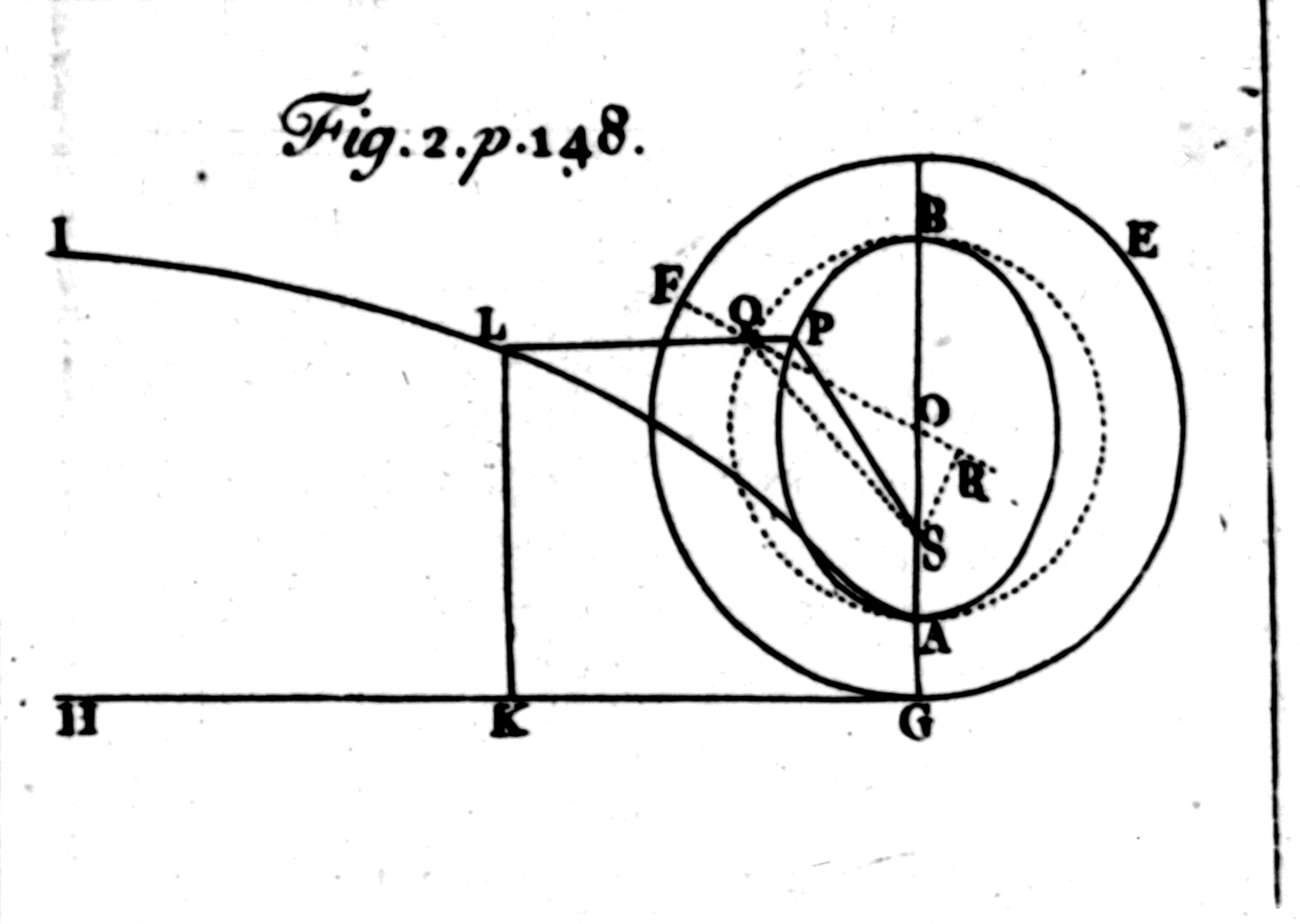
For about the centre O with the interval OA describe the semi-circle AQB, and let LP, produced, if need be, meet the arc AQ in Q, and join SQ, OQ. Let OQ meet the arc EFG in F, and upon OQ let fall the perpendicular SR. The area APS is as the area AQS, that is, as the difference between the sector OQA and the triangle OQS, or as the difference of the rectangles , and , that is, because is given, as the difference between the arc AQ and the right line SR; and therefore (because of the equality of the given ratios SR to the sine of the arc AQ, OS to OA, OA to OG, AQ to GF, and by division, to sine of the arc AQ) as GK the difference between the arc GF and the sine of the arc AQ. Q. E. D.
Scholium
But since the description of this curve is difficult, a solution by approximation will be preferable. First then let there be found a certain angle B which may be to an angle of 57,29578 degrees, 150which an arc equal to the radius subtends, as SH (Pl. 14. Fig. 3.) the distance of the foci, to AB the diameter of the ellipsis. Secondly, a certain length L, which may be to the radius in the same ratio inversely. And these being found, the problem may be solved by the following analysis. By any construction (or even by conjecture) suppose we know P the place of the body near its true place p. Then letting fall on the axis of the ellipsis the ordinate PR, from the proportion of the diameters of the ellipsis, the ordinate RQ of the circumscribed circle AQB will be given; which ordinate is the sine of the angle AOQ supposing AO to be the radius, and also cuts the ellipsis in P. It will be sufficient if that angle is found by a rude calculus in numbers near the truth. Suppose we also know the angle proportional to the time, that is, which is to four right angles, as the time in which the body described the arc Ap, to the time of one revolution in the ellipsis. Let this angle be N. Then take an angle D, which may be to the angle B as the sine of the angle AOQ to the radius; and an angle E which may be to the angle , as the length L to the same length L diminished by the co-sine of the angle AOQ, when that angle is less than a right angle, or increased thereby when greater. In the next place take an angle F that may be to the angle B, as the sine of the angle to the radius, and an angle G, that may be to the angle , as the length L to the same length L diminished by the co-sine of the angle , when that angle is less than a right angle, or increased thereby when greater. For the third time take an angle H, that may be to 151the angle B as the sine of the angle to the radius; and an angle I to the angle , as the length L is to the same length L diminished by the co-sine of the angle when that angle is less than a right angle, or increased thereby when greater. And so we may proceed in infinitum. Lastly, take the angle AOq equal to the angle &c. and from its co-sine Or and the ordinate pr, which is to its sine qr as the lesser axis of the ellipsis to the greater, we shall have p the correct place of the body. When the angle happens to be negative, the sign + of the angle E must be every where changed into -, and the sign - into +. And the same thing is to be understood of the signs of the angles G and I, when the angles , and come out negative. But the infinite series &c. converges so very fast, that it will be scarcely ever needful to proceed beyond the second term E. And the calculus is founded upon this theorem, that the area APS is as the difference between the arc AQ and the right line let fall from the focus S perpendicularly upon the radius OQ.
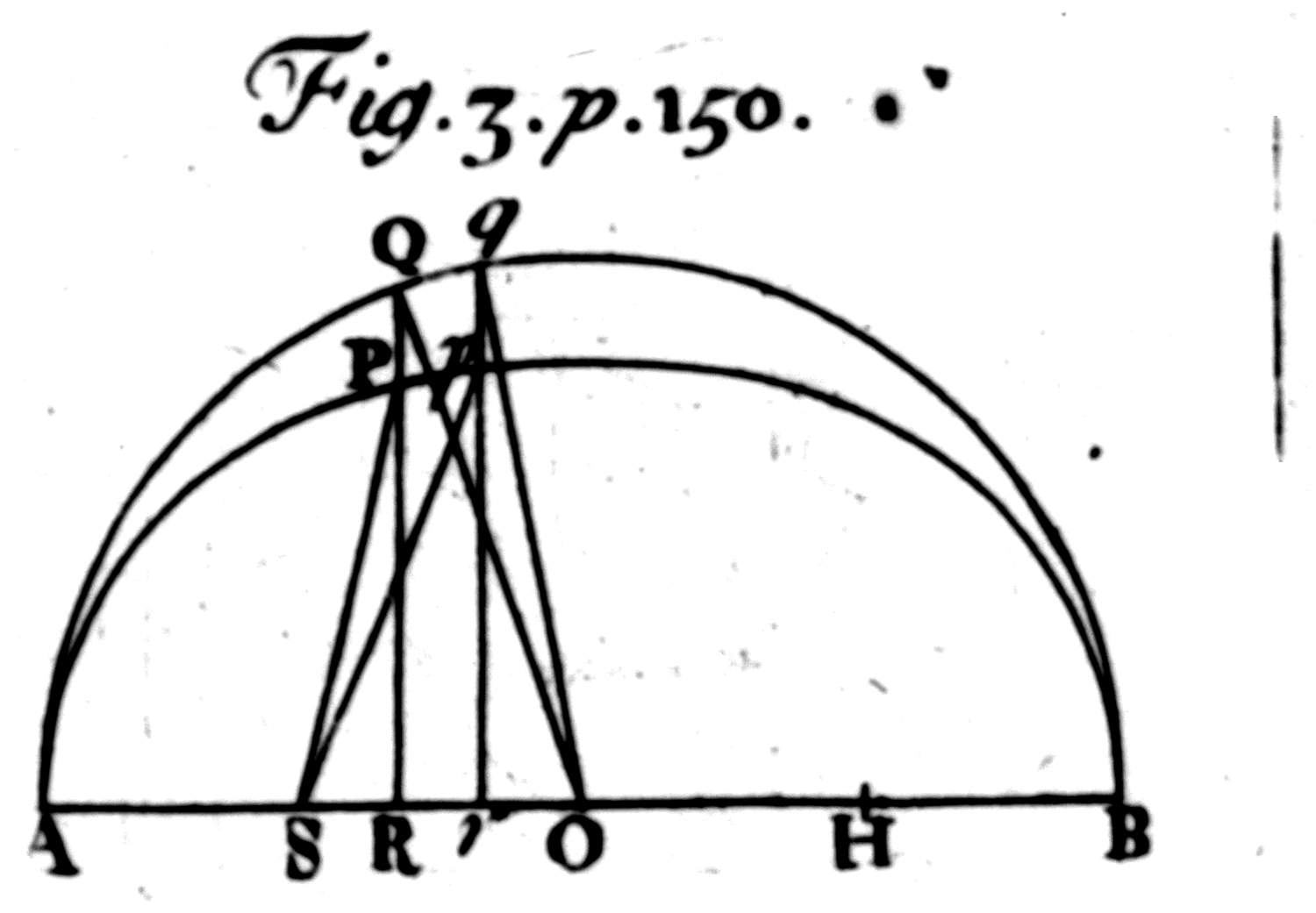
And by a calculus not unlike, the problem is solved in the hyperbola. Let its centre be O, (Pl. 14. Fig. 4.) its vertex A, its focus S, and asymptote OK. And suppose the quantity of the area to be cut off is known, as being proportional to the time. Let that be A, and by conjecture suppose we know the position of a right line SP, that cuts off an area APS near the truth. Join OP, and from A and P to the asymptote draw AI, PK parallel to the other asymptote: 152and by the table of logarithms the area AIKP will be given, and equal thereto the area OPA, which subducted from the triangle OPS will leave the area cut off APS. And by applying , or , the double difference of the area A that was to be cut off, and the area APS that is cut off, to the line SN that is let fall from the focus S, perpendicular upon the tangent TI, we shall have the length of the chord PQ. Which chord PQ is to be inscribed between A and P, if the area APS that is cut off be greater than the area A that was to be cut off, but towards the contrary side of the point P, if otherwise: and the point Q will be the place of the body more accurately. And by repeating the computation the place may be found perpetually to greater and greater accuracy.
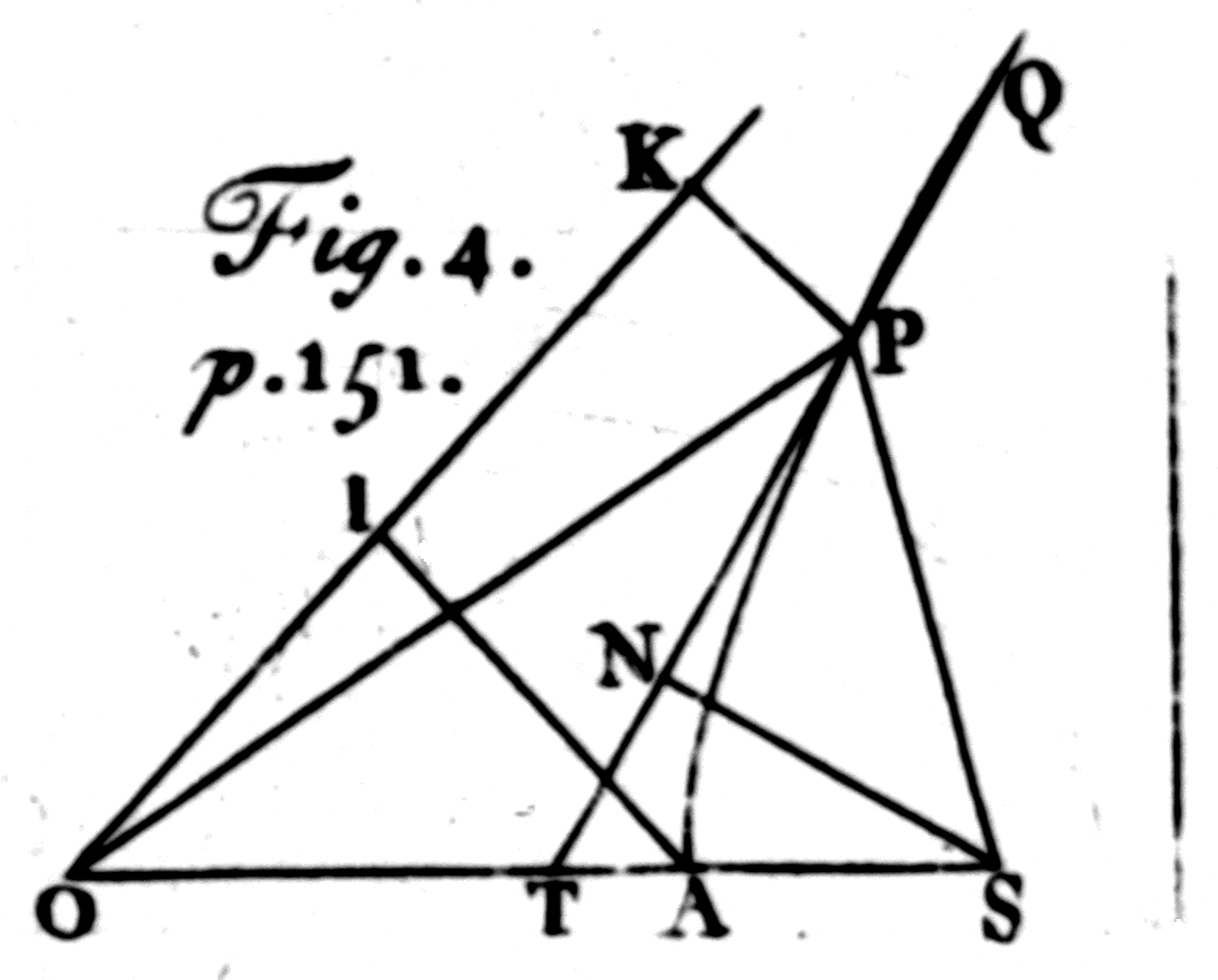
And by such computations we have a general analytical resolution of the problem. But the particular calculus that follows, is better fitted for astronomical purposes. Supposing AO, OB, OD (Pl. 14. Fig. 5.) to be the semi-axes of the ellipsis, and L its latus rectum, and D the difference betwixt the lesser semi-axis OD, and the half of the latus rectum: let an angle Y be found, whose sine may be to the radius, as the rectangle under that difference D and the half sum of the axes, to the square of the greater axis AB. Find also an angle Z whose sine may be to the radius, as the double rectangle under the distance of the foci SH and that difference D, to triple the square of half the greater semi-axis AO. Those angles being once found, the place of the body may be thus determined. Take the angle T proportional to the time in which the arc BP 153was described, or equal to what is called the mean motion; and an angle V, the first equation of the mean motion to the angle Y, the greatest first equation, as the sine of double the angle T is to the radius; and an angle X, the second equation, to the angle Z, the second greatest equation, as the cube of the sine of the angle T is to the cube of the radius. Then take the angle BHP the mean motion equated equal to the sum of the angles T, V, X, if the angle T is less than a right angle; or equal to the difference of the same, if that angle T is greater than one and less than two right angles; and if HP meets the ellipsis in P, draw SP, and it will cut off the area BSP nearly proportional to the time.
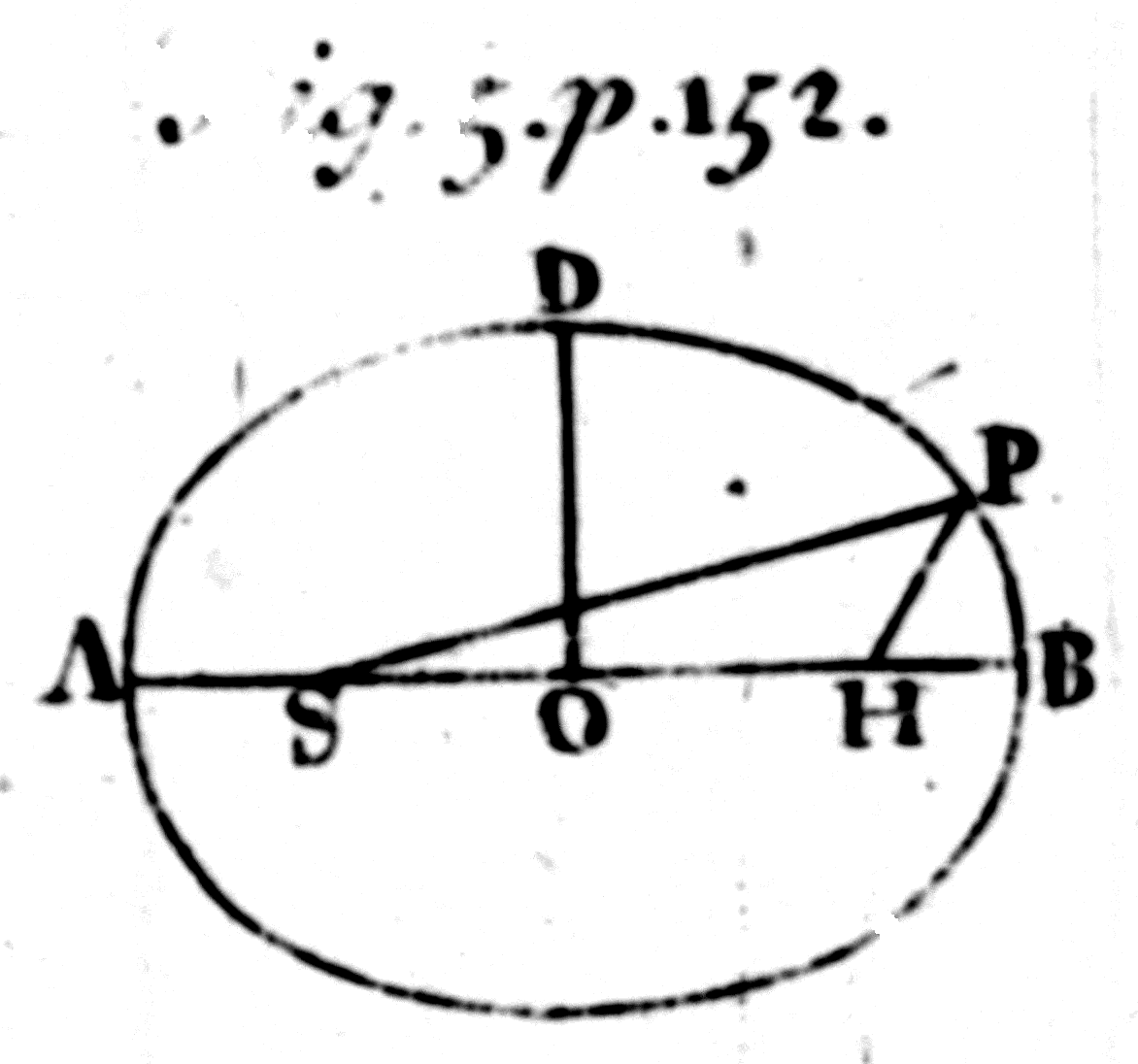
This practice seems to be expeditious enough, because the angles V and X, taken in second minutes if you please, being very small, it will be sufficient to find two or three of their first figures. But it is likewise sufficiently accurate to answer to the theory of the planets motions. For even in the orbit of Mars, where the greatest equation of the centre amounts to ten degrees, the error will scarcely exceed one second. But when the angle of the mean motion equated BHP is found, the angle of the true motion BSP, and the distance SP are readily had by the known methods.
And so far concerning the motion of bodies in curve lines. But it may also come to pass that a moving body shall ascend or descend in a right line; and I shall now go on to explain what belongs to such kind of motions.
Section VII. Concerning the rectilinear ascent and descent of bodies.
Section VII
Concerning the rectilinear ascent and descent of bodies.
Proposition XXXII. Problem XXIV
154Supposing that the centripetal force is reciprocally proportional to the square of the distance of the places from the centre; it is required to define the spaces which a body, falling directly, describes in given times.
Case 1. If the body does not fall perpendicularly it will (by cor. 1. prop. 13.) describe some conic section whose focus is placed in the centre of force. Suppose that conic section to be ARPB (Pl. 15. Fig. 1.) and its focus S. And first, if the figure be an ellipsis; upon the greater axe thereof AB describe the semi-circle ADB, and let the right line DPC pass through the falling body, 155making right angles with the axis; and drawing DS, PS, the area ASD will be proportional to the area ASP, and therefore also to the time. The axis AB still remaining the same, let the breadth of the ellipsis be perpetually diminished, and the area ASD will always remain proportional to the time. Suppose that breadth to be diminished in infinitum; and the orbit APB in that case coinciding with the axis AB, and the focus S with the extreme point of the axis B, the body will descend in the right line AC, and the area ABD will become proportional to the time. Wherefore the space AC will be given which the body describes in a given time by its perpendicular fall from the place A, if the area ABD is taken proportional to the time, and from the point D, the right line DC is let fall perpendicularly on the right line AB. Q. E. I.
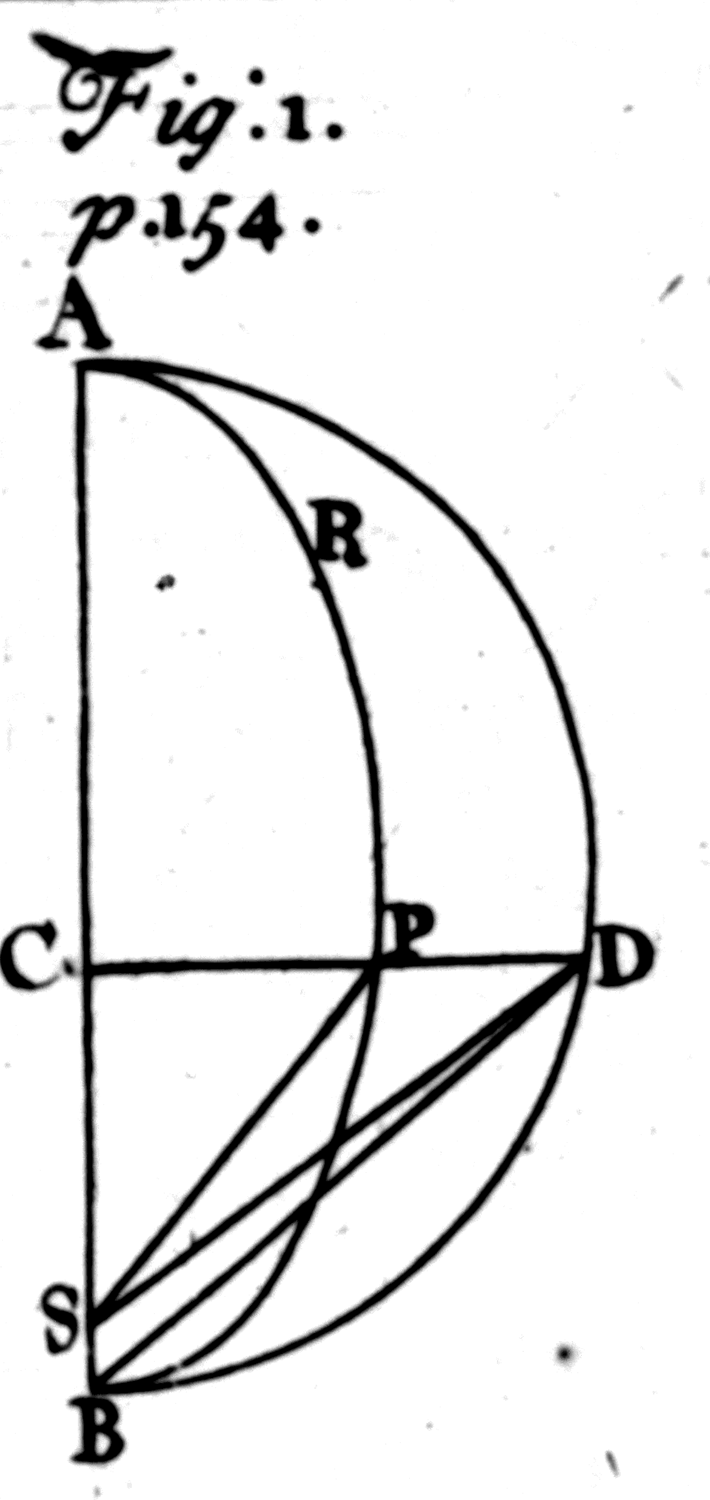
Case 2. If the figure RPB is an hyperbola, (Fig. 2.) on the same principal diameter AB describe the rectangular hyperbola BED; and because the areas CSP, CBfP, SPfB, are severally to the several areas CSD, CBED, SDEB in the given ratio of the heights CP, CD; and the area SPfB is proportional to the time in which the body P will move through the arc PfB, the area SDEB will be also proportional to that time. Let the latus rectum of the hyperbola RPB be diminished in infinitum, the latus transversum remaining the same; and the arc PB will come to coincide with the right line CB, and the focus S with the vertex B, and the right line SD with the right line BD. And therefore the area BDEB will be proportional to the time in which the body C, by its 156perpendicular descent, describes the line CB. Q. E. I.
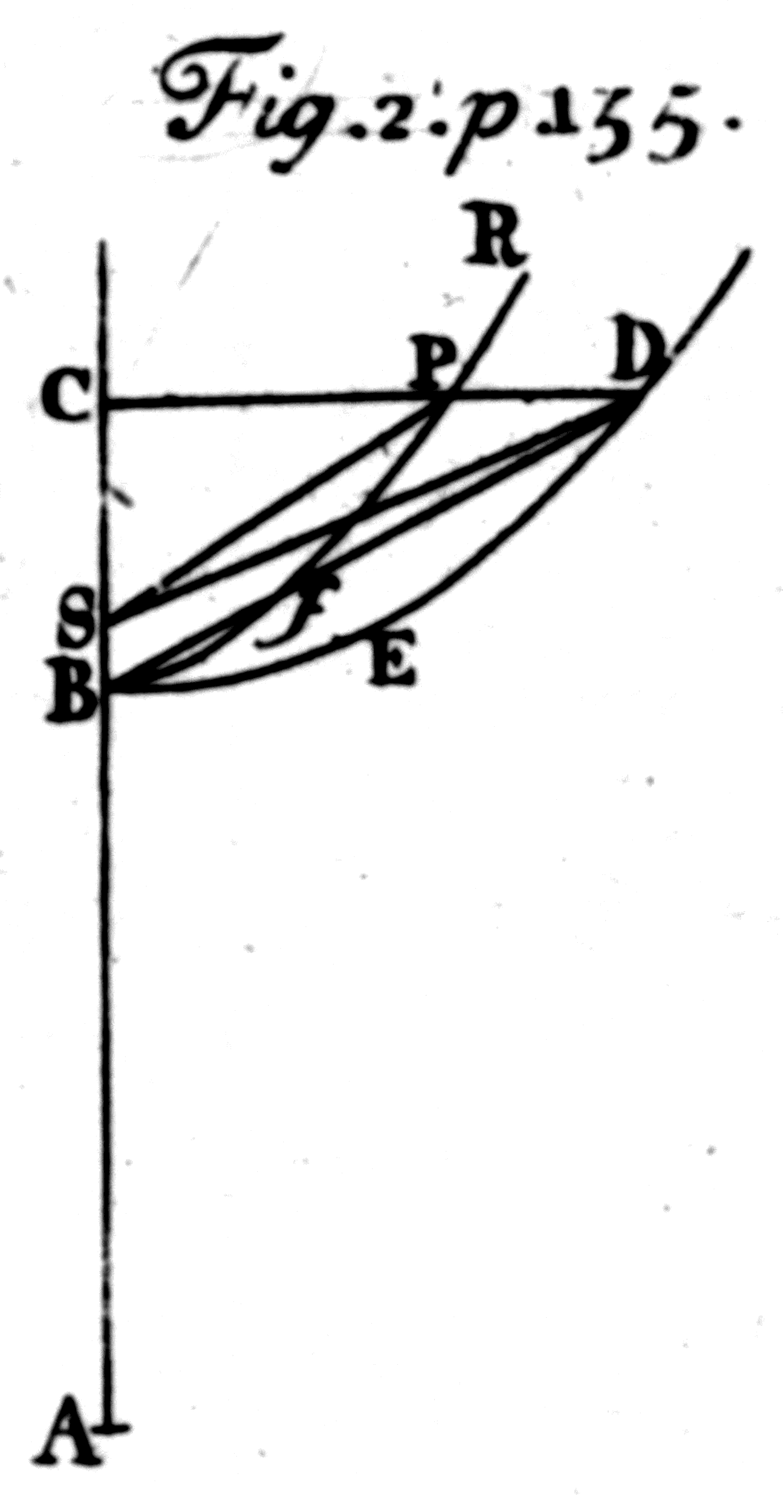
Case 3. And by the like argument if the figure RPB is a parabola, (Fig. 3.) and to the same principal vertex B another parabola BED is described, that may always remain given while the former parabola in whose perimeter the body P moves, by having its latus rectum diminished and reduced to nothing, comes to coincide with the line CB; the parabolic segment BDEB will be proportional to the time, in which that body P or C will descend to the centre S or B. Q. E. I.
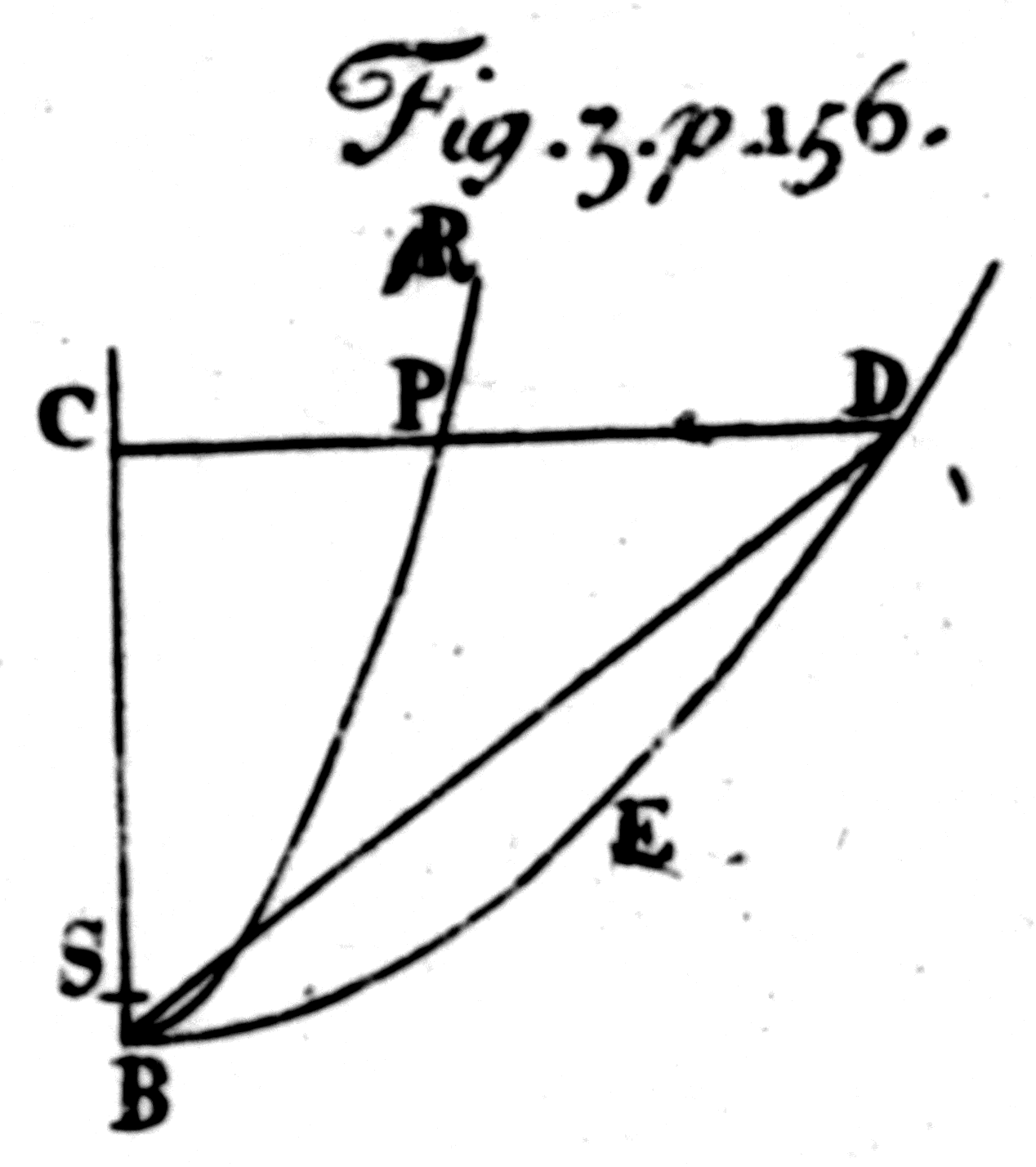
Proposition XXXIII. Theorem IX
The things above found being supposed, I say that the velocity of a falling body in any place C, is to the velocity of a body, describing a circle about the centre B at the distance BC, in the subduplicate ratio of AC, the distance of the body from the remoter vertex A of the circle or rectangular hyperbola, to the principal semi-diameter of the figure. Pl. 15. Fig. 4.
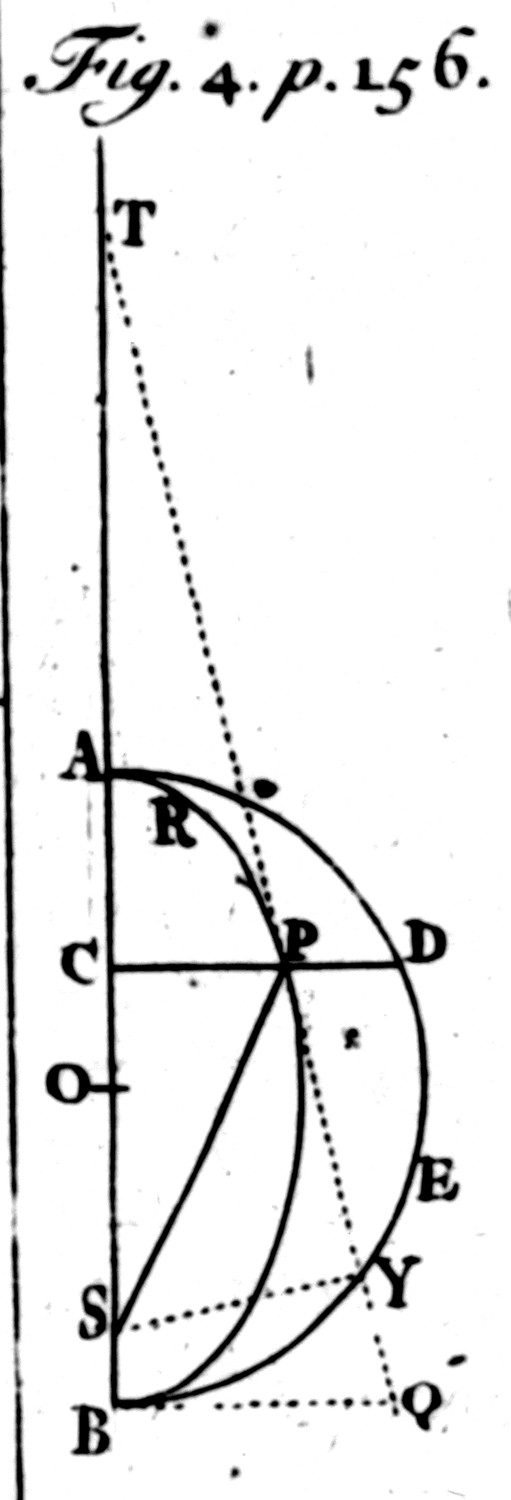
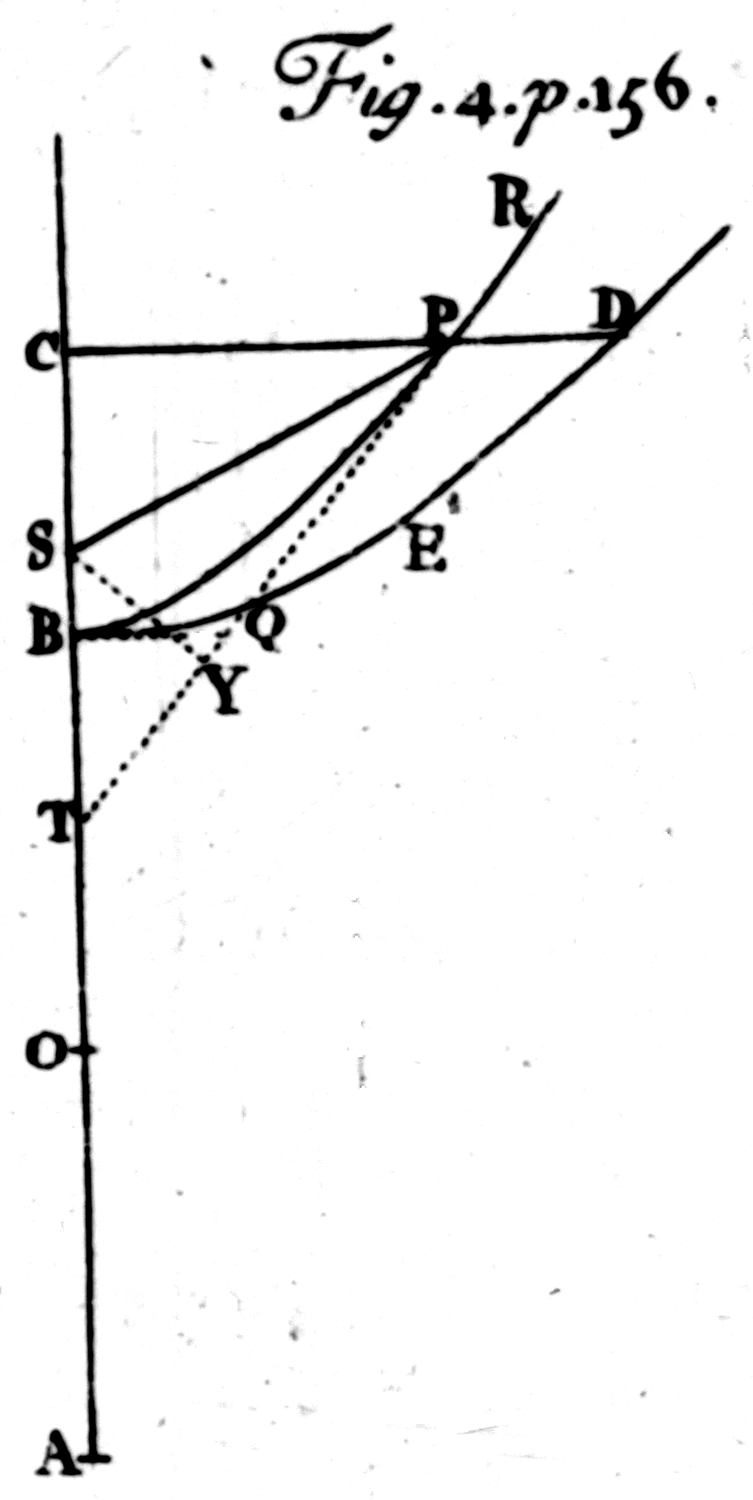
Let AB the common diameter of both figures RPB, DEB be bisected in O; and draw the right line PT that may touch the figure RPB in P, and likewise cut that common diameter AB (produced if need be) in T; and let SY be perpendicular to this line, and BQ to this diameter, 157and suppose the latus rectum of the figure RPB to be L. From cor. 9. prop. 16. it is manifest that the velocity of a body, moving in the line RPB about the centre S, in any place P, is to the velocity of a body describing a circle about the same centre, at the distance SP, in the subduplicate ratio of the rectangle to . For by the properties of the conic sections ACB is to as to L, and therefore is equal to L. Therefore those velocities are to each other in the subduplicate ratio of to . Moreover by the properties of the conic sections, CO is to BO as BO to TO, and (by composition or division) as CB to BT. Whence (by division or composition) BO - or + CO will be to BO, as CT to BT, that is, AC will be to AO as CP to BQ; and therefore is equal to . Now suppose CP the breadth of the figure RPB to be diminished in infinitum, so as the point P may come to coincide with the point C, and the point S with the point B, and the line SP with the line BC, and the line ST with the line BQ; and the velocity of the body now descending perpendicularly in the line CB will be to the velocity of a body describing a circle about the centre B at the distance BC, in the subduplicate ratio of to , that is (neglecting the ratio's of equality of 158SP to BC, and to ) in the subduplicate ratio of AC to AO or . Q. E. D.
Cor. 1. When the points B and S come to coincide, TC will become to TS, as AC to AO.
Cor. 2. A body revolving in any circle at a given distance from the centre, by its motion converted upwards will ascend to double its distance from the centre.
Proposition XXXIV. Theorem X
If the figure BED is a parabola, I say that the velocity of a falling body in any place C is equal to the velocity by which a body may uniformly describe a circle about the centre B at half the interval BC. Pl. 15. Fig. 5.
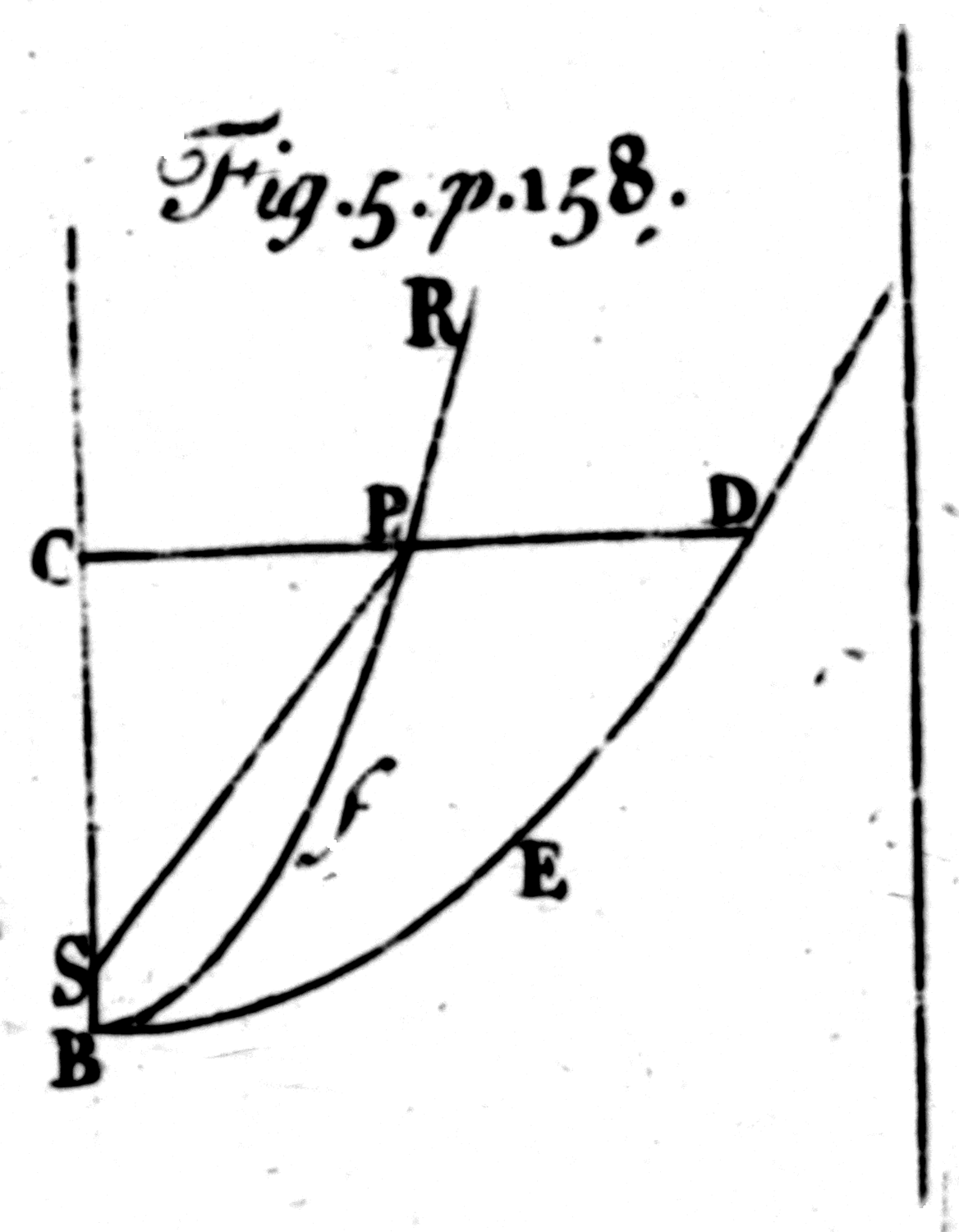
For (by cor. 7. prop. 16.) the velocity of a body describing a parabola RPB about the centre S, in any place P, is equal to the velocity of a body uniformly describing a circle about the same centre S at half the interval SP. Let the breadth CP of the parabola be diminished in infinitum, so as the parabolic arc PfB may come to coincide with the right line CB, the centre S with the vertex B, and the interval SP with the interval BC, and the proposition will be manifest. Q. E. D.
Proposition XXXV. Theorem XI
159The same things supposed, I say that the area of the figure DES, described by the indefinite radius SD, is equal to the area which a body with a radius equal to half the latus rectum of the figure DES, by uniformly revolving about the centre S, may describe in the same time. Pl. 16. Fig. 1.
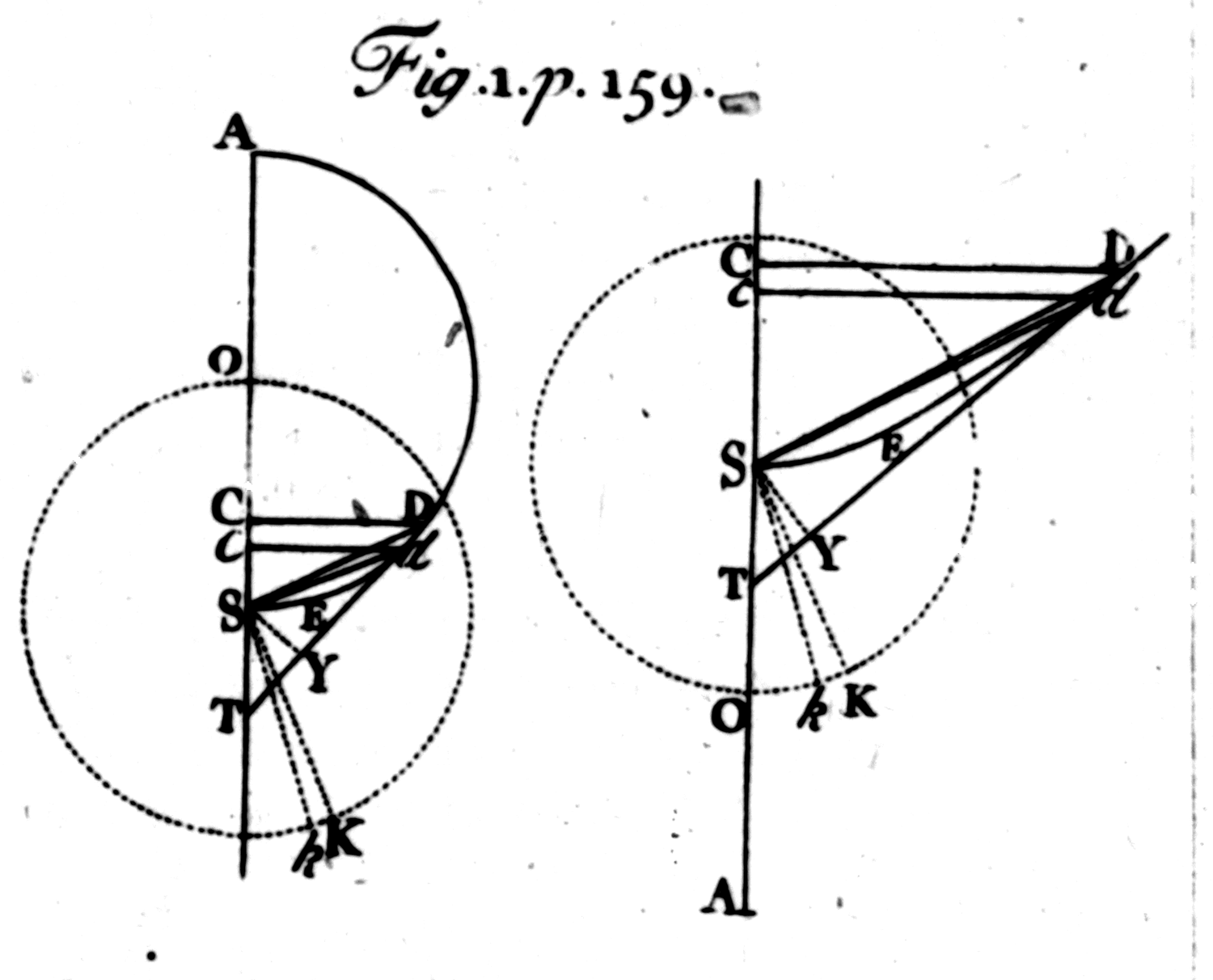
For suppose a body C in the smallest moment of time describes in falling the infinitely little line Cc, while another body K uniformly revolving about the centre S in the circle OKk, describes the arc Kk. Erect the perpendiculars CD, cd, meeting the figure DES in D, d. Join SD, Sd, SK, Sk, and draw Dd meeting the axis AS in T, and thereon let fall the perpendicular ST.
Case 1. If the figure DES is a circle or a rectangular hyperbola, bisect its transverse diameter AS in O, and SO will be half the latus rectum. And because TC is to TD as Cc to Dd, and TD to TS as CD to ST; ex æquo TC will be to TS, as to . But (by cor. 1. prop. 33) TC is to TS as AC to AO, to wit, if in the coalescence of the points D, d, the ultimate ratio's of the lines are taken. Wherefore AC is to AO or SK as to . Farther, the velocity of the descending body in C is to the velocity of a body describing a circle about 160the centre S, at the interval SC, in the subduplicate ratio of AC to AO or SK (by prop. 33.) and this velocity is to the velocity of a body describing the circle OKk in the subduplicate ratio of SK to SC (by cor. 6. prop. 4.) and ex æquo, the first velocity to the last, that is the little line Cc to the arc Kk, in the subduplicate ratio of AC to SC, that is in the ratio of AC to CD. Wherefore is equal to , and consequently AC to SK as to , and thence equal to , and equal to , that is, the area KSk equal to the area SDd. Therefore in every moment of time two equal particles, KSk and SDd, of areas are generated which, if their magnitude is diminished and their number increased in infinitum, obtain the ratio of equality, and consequently (by cor. lem. 4.) the whole areas together generated are always equal. Q. E. D.
Case 2. But if the figure DES (Fig. 2.) is a parabola, we shall find as above to as TC to TS, that is, as 2 to 1; and that therefore is equal to . But the velocity of the falling body in C is equal to the velocity with which a circle may be uniformly described at the interval , (by prop. 34.) And this velocity to the velocity with which a circle may be described with the radius SK, that is, the little line Cc to the arc Kk is (by cor. 5. prop. 4.) in the subduplicate ratio of SK to ; that is, in the ratio of SK to . Wherefore is equal to , and therefore equal to ; that is, the area KSk is equal to the area SDd as above. Q. E. D.
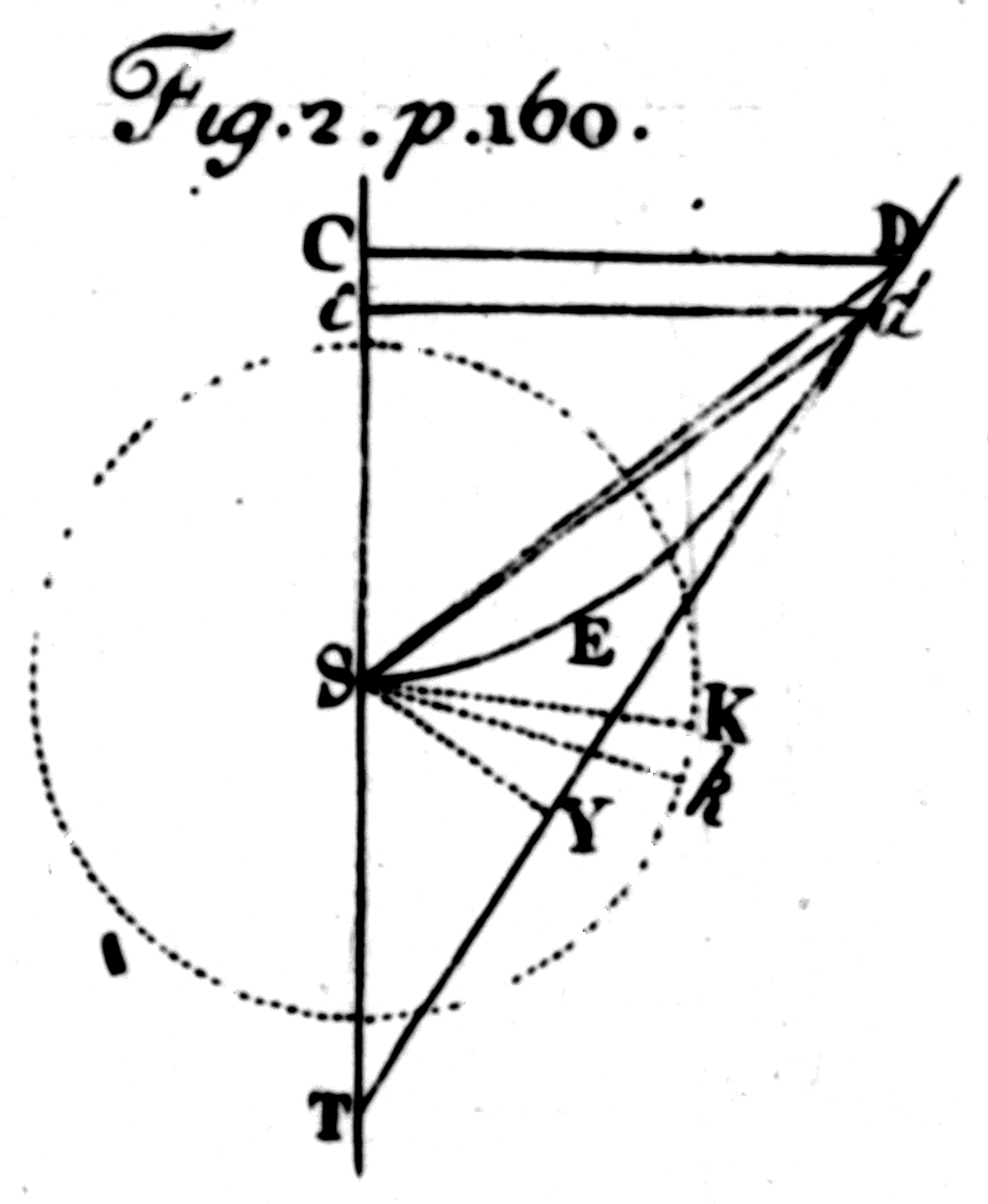
Proposition XXXVI. Problem XXV
161To determine the times of the descent of a body falling from a given place A. Pl. 16. Fig. 3.
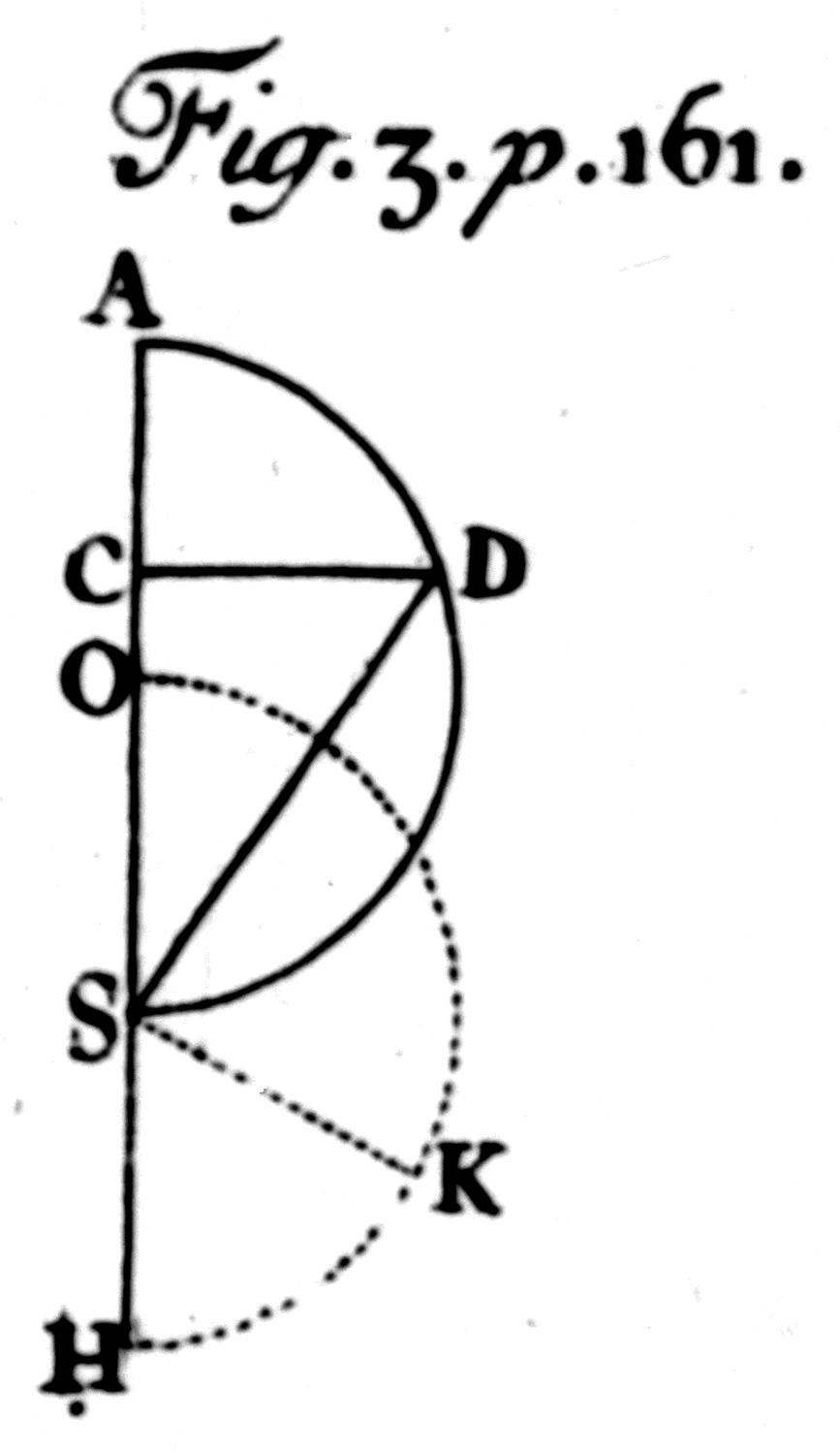
Upon the diameter AS, the distance of the body from the centre at the beginning, describe the semi-circle ADS, as likewise the semi-circle OKH equal thereto, about the centre S. From any place C of the body, erect the ordinate CD. Join SD, and make the sector OSK equal to the area ASD. It is evident by prop. 35. that the body in falling will describe the space AC in the same time in which another body, uniformly revolving about the centre S, may describe the arc OK. Q. E. F.
Proposition XXXVII. Problem XXVI
To define the times of the ascent or descent of a body projected upwards or downwards from a given place. Pl. 16. Fig. 4.
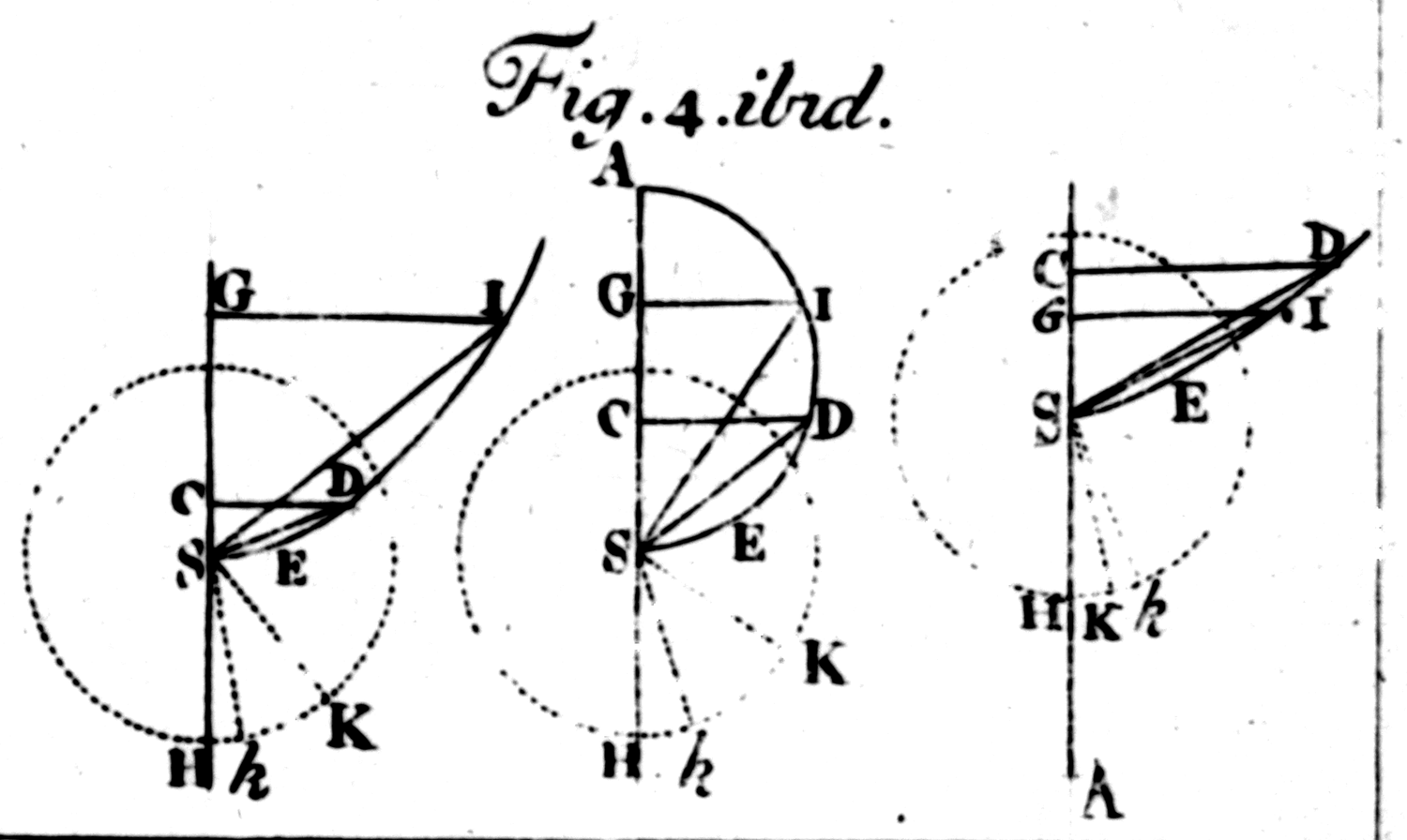
Suppose the body to go off from the given place G, in the direction of the line GS, with any velocity. In the duplicate ratio of this velocity to the uniform velocity in a circle, with which the body may revolve about the centre 162S at the given interval SG, take GA to . If that ratio is the same as of the number 2 to 1 the point A is infinitely remote; in which case a parabola is to be described with any latus rectum to the vertex S, and axis SG; as appears by prop. 34. But if that ratio is less or greater than the ratio of 2 to 1, in the former case a circle, in the latter a rectangular hyperbola, is to be described on the diameter SA; as appears by prop. 33. Then about the centre S, with an interval equal to half the latus rectum, describe the circle HkK, and at the place G of the ascending or descending body, and at any other place C, erect the perpendiculars GI, CD; meeting the conic section or circle in I and D. Then joining SI, SD, let the sectors HSK, HSk be made equal to the segments SEIS, SEDS, and by prop. 35. the body G will describe the space GC in the same time in which the body K may describe the arc Kk. Q. E. F.
Proposition XXXVIII. Theorem XII
Supposing that the centripetal force is proportional to the altitude or distance of places from the centre, I say, that the times and velocities of falling bodies, and the spaces which they describe, are respectively proportional to the arcs, and the right and versed sines of the arcs. Pl. 17. Fig. 1.
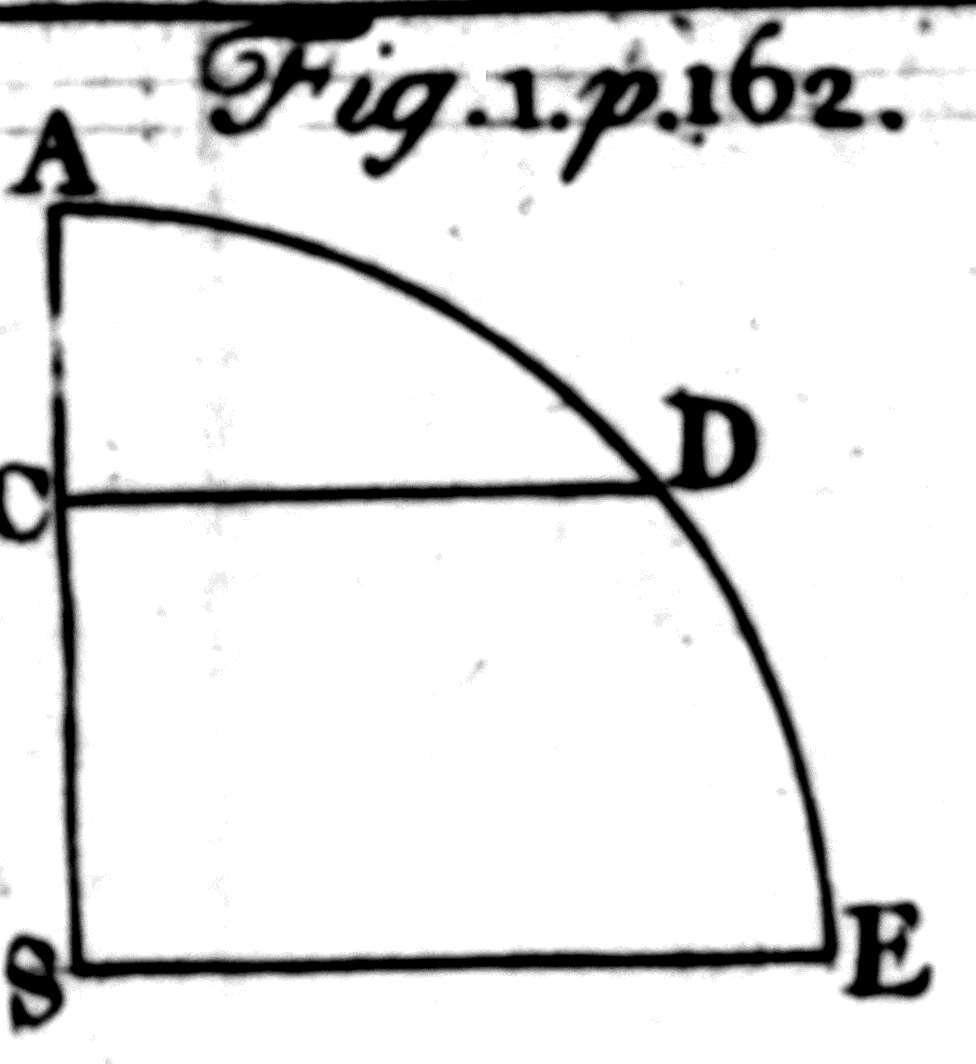
Suppose the body to fall from any place A in the right line AS; and about the centre of force S 163with the interval AS, describe the quadrant of a circle AE; and let CD be the right line of any arc AD; and the body A will in the time AD in falling describe the space AC, and in the place C will acquire the velocity CD.
This is demonstrated the same way from prop. 10. as prop. 32. was demonstrated from prop. 11.
Cor. 1. Hence the times are equal in which one body falling from the place A arrives at the centre S, and another body revolving describes the quadrantal arc ADE.
Cor. 2. Wherefore all the times are equal in which bodies falling from whatsoever places arrive at the centre. For all the periodic times of revolving bodies are equal, by cor. 3. prop. 4.
Proposition XXXIX. Problem XXVII
Supposing a centripetal force of any kind, and granting the quadratures of curvilinear figures; it is required to find the velocity of a body, ascending or descending in a right line, in the several places through which it passes; as also the time in which it will arrive at any place; And vice versa.
Suppose the body E (Pl. 17. Fig. 2.) to fall from any place A in the right line ADEC; and from its place E imagine a perpendicular EG 164always erected, proportional to the centripetal force in that place tending to the centre C; and let BFG be a curve line, the locus of the point G. And in the beginning of the motion suppose EG to coincide with the perpendicular AB; and the velocity of the body in any place E will be as a right line whose square is equal to the curvilinear area ABGE. Q. E. I.
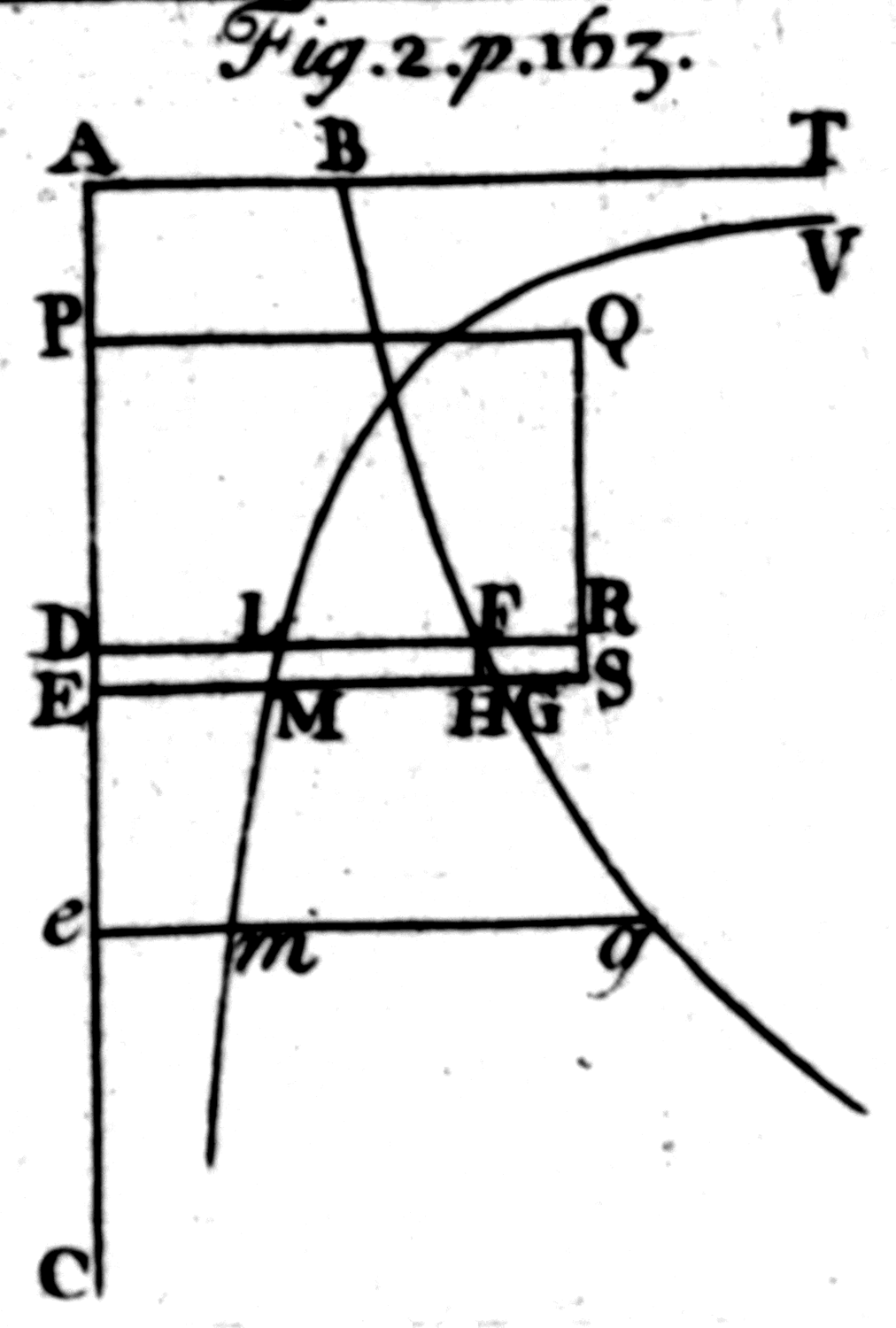
In EG take EM reciprocally proportional to a right line whose square is equal to the area ABGE, and let VLM be a curve line wherein the point M is always placed, and to which the right line AB produced is an asymptote, and the time in which the body in falling describes the line AE, will be as the curvilinear area ABTVME. Q. E. I.
For in the right line AE let there be taken the very small line DE of a given length, and let DLF be the place of the line EMG, when the body was in D; and if the centripetal force be such, that a right line whose square is equal to the area ABGE, is as the velocity of the descending body, the area it self will be as the square of that velocity; that is, if for the velocities in D and E we write V and , the area ABFD will be as , and the area ABGE as ; and by division the area DFGE as , and therefore will be as ; that is, if we take the first ratio's of those quantities when just nascent, the length DF is as the quantity and therefore also as half that quantity . But the time, in which the body in 165falling describes the very small line DE is as that line directly and the velocity V inversely, and the force will be as the increment I of the velocity directly and the time inversely, and therefore if we take the first ratio's when those quantities are just nascent as , that is as the length DF. Therefore a force proportional to DF or EG will cause the body to descend with a velocity that is as the right line whose square is equal to the area ABGE. Q. E. D.
Moreover since the time, in which a very small line DE of a given length may be described, is as the velocity inversely, and therefore also inversely as a right line whose square is equal to the area ABFD; and since the line DL, and by consequence the nascent area DLME, will be as the same right line inversely: the time will be as the area DLME, and the sum of all the times will be as the sum of all the area's; that is (by cor. lem. 4.) the whole time in which the line AE is described will be as the whole area ATVME. Q. E. D,
Cor. 1. Let P be the place from whence a body ought to fall, so as that when urged by any known uniform centripetal force (such as gravity is vulgarly supposed to be) it may acquire in the place D a velocity, equal to the velocity which another body, falling by any force whatever, hath acquired in that place D. In the perpendicular DF let there be taken DR, which may be to DF as that uniform force to the other force in the place D. Compleat the rectangle PDRQ, and cut off the area ABFD equal 166to that rectangle. Then A will be the place from whence the other body fell. For compleating the rectangle DRSE, since the area ABFD is to the area DFGE as to , and therefore as to I, that is, as half the whole velocity to the increment of the velocity of the body falling by the unequable force; and in like manner the area PQRD to the area DRSE, as half the whole velocity to the increment of the velocity of the body falling by the uniform force; and since those increments (by reason of the equality of the nascent times) are as the generating forces, that is, as the ordinates DF, DR, and consequently as the nascent area's DFGE, DRSE; therefore ex æquo the whole areas ABFD, PQRD will be to one another as the halves of the whole velocities, and therefore, because the velocities are equal, they become equal also.
Cor. 2. Whence if any body be projected either upwards or downwards with a given velocity from any place D, and there be given the law of centripetal force acting on it, its velocity will be found in any other place as e, by erecting the ordinate eg, and taking that velocity to the velocity in the place D, as a right line whose square is equal to the rectangle PQRD, either increased by the curvilinear area DFge, if the place e is below the place D, or diminished by the same area DFge if it be higher, is to the right line whose square is equal to the rectangle PQRD alone.
Cor. 3. The time is also known by erecting the ordinate em reciprocally proportional to the square root of PQRD + or - DFge, and taking the time in which the body has described the line De, to the time in which another body has fallen with an 167uniform force from P, and in falling arrived at D, in the proportion of the curvilinear area DLme to the rectangle . For the time in which a body falling with an uniform force hath described the line PD, is to the time in which the same body has described the line PE, in the subduplicate ratio of PD to PE; that is (the very small line DE being just nascent) in the ratio of to , or to , and by division to the time in which the body hath described the small line DE, as to DE, and therefore as the rectangle to the area DLME; and the time in which both the bodies described the very small line DE is to the time in which the body moving unequably hath described the line De, as the area DLME to the area DLme; and ex æquo the first mentioned of these times is to the last as the rectangle to the area DLme.
Section VIII. Of the invention of orbits wherein bodies will revolve, being acted upon by any sort of centripetal forces.
Section VIII
168Of the invention of orbits wherein bodies will revolve, being acted upon by any sort of centripetal forces.
Proposition XL. Theorem XIII
If a body, acted upon by any centripetal force, is any how moved, and another body ascends or descends in a right line; and their velocities be equal in any one case of equal altitude, their velocities will be also equal at all equal altitudes.
Let a body descend from A (Pl. 17. Fig. 3.) through D and E, to the centre C, and let another body move from V in the curve line VIKk. From the centre C, with any distances, describe the concentric circles DI, EK, meeting the right line AC in D and E, and the curve VIK in I and K.
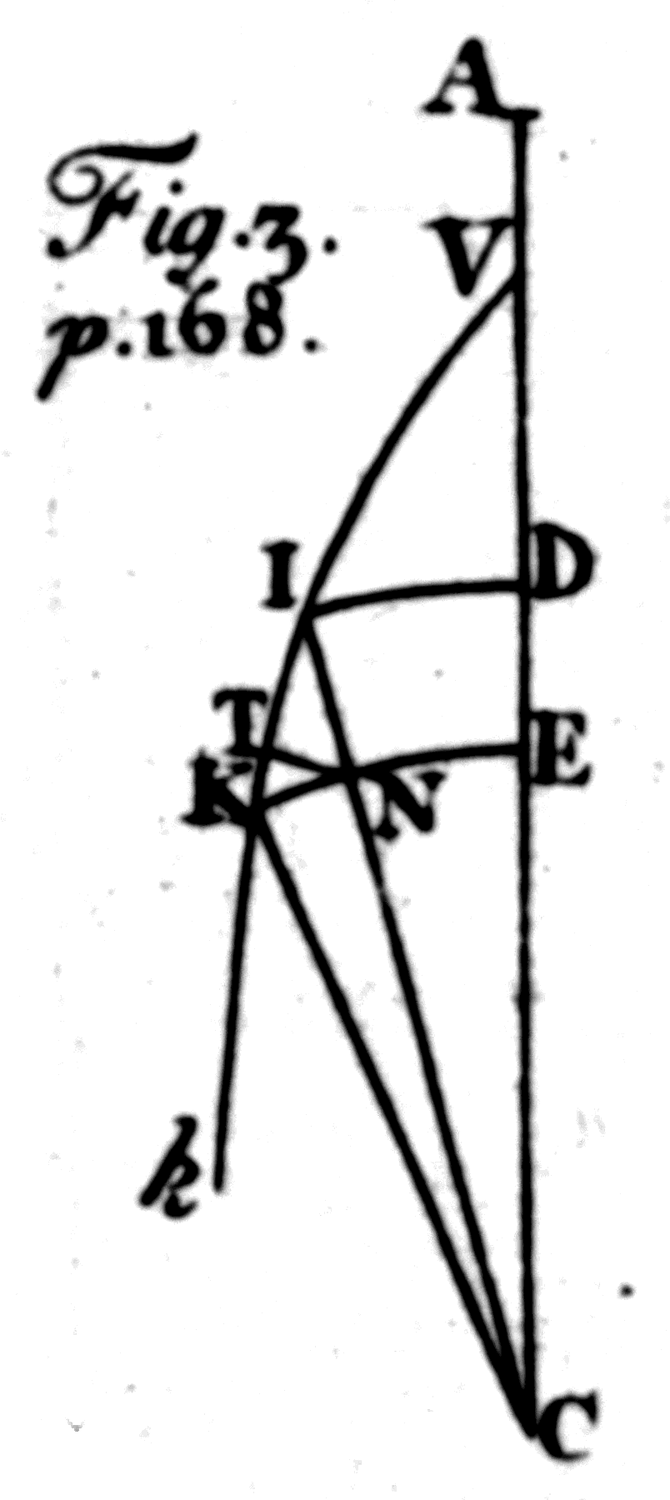
169Draw IC meeting KE in N, and on IK let fall the perpendicular NT; and let the interval DE or IN, between the circumferences of the circles be very small; and imagine the bodies in D and I to have equal velocities. Then because the distances CD and CI are equal, the centripetal forces in D and I will be also equal. Let those forces be express'd by the equal lineolæ DE and IN; and let the force IN (by cor 2. of the laws of motion) be resolved into two others, NT and IT. Then the force NT acting in the direction of the line NT perpendicular to the path ITK of the body, will not at all affect or change the velocity of the body in that path, but only draw it aside from a rectilinear course, and make it deflect perpetually from the tangent of the orbit, and proceed in the curvilinear path ITKk. That whole force therefore will be spent in producing this effect; but the other force IT, acting in the direction of the course of the body, will be all employed in accelerating it; and in the least given time will produce an acceleration proportional to it self. Therefore the accelerations of the bodies in D and I produced in equal times, are as the lines DE, IT; (if we take the first ratio's of the nascent lines DE, IN, IK, IT, NT;) and in unequal times as those lines and the times conjunctly. But the times in which DE and IK are described, are, by reason of the equal velocities (in D and I) as the spaces described DE and IK, and therefore the accelerations in the course of the bodies through the lines DE and IK are as DE and IT; and DE and IK conjunctly; that is, as the square of DE to the rectangle IT into IK. But the rectangle is equal to the square of IN; that 170is equal to the square of DE, and therefore the accelerations generated in the passage of the bodies from D and I to F and K are equal. Therefore the velocities of the bodies in E and K are also equal: and by the same reasoning they will always be found equal in any subsequent equal distances. Q. E. D.
By the same reasoning, bodies of equal velocities and equal distances from the centre will be equally retarded in their ascent to equal distances. Q. E. D.
Cor. 1. Therefore if a body either oscillates by hanging to a string, or by any polished and perfectly smooth impediment is forced to move in a curve line; and another body ascends or descends in a right line, and their velocities be equal at any one equal altitude; their velocities will be also equal at all other equal altitudes. For, by the string of the pendulous body, or by the impediment of a vessel perfectly smooth, the same thing will be effected, as by the transverse force NT. The body is neither accelerated nor retarded by it, but only is obliged to quit its rectilinear course.
Cor. 2. Suppose the quantity P to be the greatest distance from the centre to which a body can ascend, whether it be oscillating, or revolving in a trajectory, and so the same projected upwards from any point of a trajectory with the velocity it has in that point. Let the quantity A be the distance of the body from the centre in any other point of the orbit; and let the centripetal force be always as the power of the quantity A, the index of which power n-1, is any number n diminished by unity. Then the velocity in every altitude A will be as , and therefore will be given. For by prop. 39. the velocity of 171a body ascending and descending in a right line is in that very ratio.
Proposition XLI. Problem XXVIII
Supposing a centripetal force of any kind, and granting the quadratures of curvilinear figures, it is required to find, as well the trajectories in which bodies will move, as the times of their motions in the trajectories found.
Let any centripetal force tend to the centre C, (Pl. 17. Fig. 4.) and let it be required to find the trajectory VIKk. Let there be given the circle VR, described from the centre C with any interval CV; and from the same centre describe any other circles ID, KE cutting the trajectory in I and K, and the right line CV in D and E. Then draw the right line CNIX cutting the circles KE, VR in N and X, and the right line CKY meeting the circle VR in Y. Let the points I and K be indefinitely near; and let the body go on from V through I and K to k; and let the point A be the place from whence another body is to fall, so as in the place D to acquire a velocity equal to the velocity of the first body in I. And things remaining as in prop. 39. the lineola IK, described in the least given time will be as the velocity, and therefore as the right line whose square is equal to the area ABFD, and the triangle ICK proportional to the time will be given, and therefore KN will be reciprocally 172as the altitude IC; that is (if there be given any quantity Q and the altitude IC be called A) as . This quantity call Z, and suppose the magnitude of Q to be such that in some case may be to Z as IK to KM and then in all cases, will be to Z as IK to KM and ABFD to ZZ as to , and by division to ZZ as to , and therefore, to Z or as IN to KN and therefore will be equal to . Therefore since is to as to AA the rectangle will be equal to . Therefore in the perpendicular DF let there be taken continually Db, Dc equal to , respectively, and let the curve lines ab, ac, the toci of the points b and c, be described: and from the point V let the perpendicular Va be erected to the line AC, cutting off the curvilinear area's VDba, VDca, and let the ordinates Ez, Ex, be erected also. Then because the rectangle or DbzE is equal to half the rectangle or to the triangle ICK; and the rectangle or DcxE is equal to half the rectangle or to the triangle XCY; that is, because the nascent particles DbzE, ICK of the 173area's VDba, VIC are always equal; and the nascent particles DcxE, XCY of the area's VDca, VCX are always equal; therefore the generated area VDba will be equal to the generated area VIC, and therefore proportional to the time; and the generated area VDca is equal to the generated sector VCX. If therefore any time be given during which the body has been moving from V, there will be also given the area proportional to it VDba; and thence will be given the altitude of the body CD or CI; and the area VDca, and the sector VCX equal thereto, together with its angle VCI. But the angle VCI, and the altitude CI being given, there is also given the place I, in which the body will be found at the end of that time. Q. E. I.
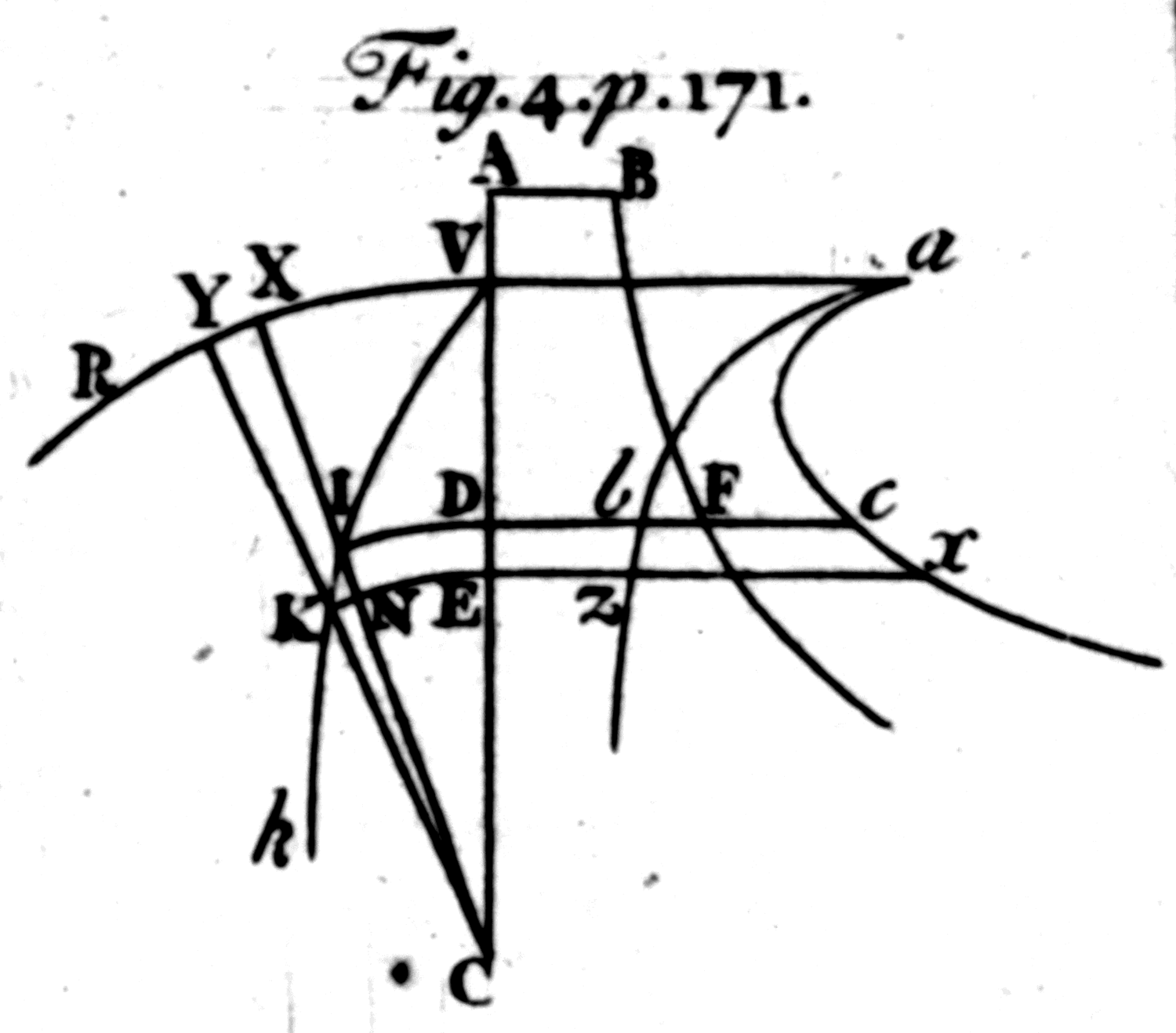
Cor. 1. Hence the greatest and least altitudes of the bodies, that is the apsides of the trajectories, may be found very readily. For the apsides are those points in which a right line IC drawn thro' the centre falls perpendicularly upon the trajectory VIK; which comes to pass when the right lines IK and NK become equal; that is, when the area ABFD is equal to ZZ.
Cor. 2. So also, the angle KIN in which the trajectory at any place cuts the line IC, may be readily found by the given altitude IC of the body: to wit, by making the sine of that angle to radius as KN to IK; that is as Z to the square root of the area ABFD.
Cor. 3. If to the centre C (Pl. 17. Fig. 5.) and the principal vertex V there be described a conic section VRS; and from any point thereof as R, there be drawn the tangent RT meeting the axe CV indefinitely produced, in the point 174T; and then, joining CR, there be drawn the right line CP, equal to the abscissa CT; making an angle VCP proportional to the sector VCR; and if a centripetal force, reciprocally proportional to the cubes of the distances of the places from the centre, tends to the centre C; and from the place V there sets out a body with a just velocity in the direction of a line perpendicular to the right line CV: that body will proceed in a trajectory VPQ, which the point P will always touch; and therefore if the conic section VRS be an hyperbola, the body will descend to the centre; but if it be an ellipsis it will ascend perpetually, and go farther and farther off in infinitum. And on the contrary, if a body endued with any velocity goes off from the place V, and according as it begins either to descend obliquely to the centre or ascends obliquely from it, the figure VRS be either an hyperbola or an ellipsis, the trajectory may be found by increasing or diminishing the angle VCP in a given ratio. And the centripetal force becoming centrifugal, the body will ascend obliquely in the trajectory VPQ, which is found by taking the angle VCP proportional to the elliptic sector VRC, and the length CP equal to the length CT, as before. All these things follow from the foregoing proposition, by the quadrature of a certain curve, the invention of which, as being easy enough, for brevity's sake I omit.
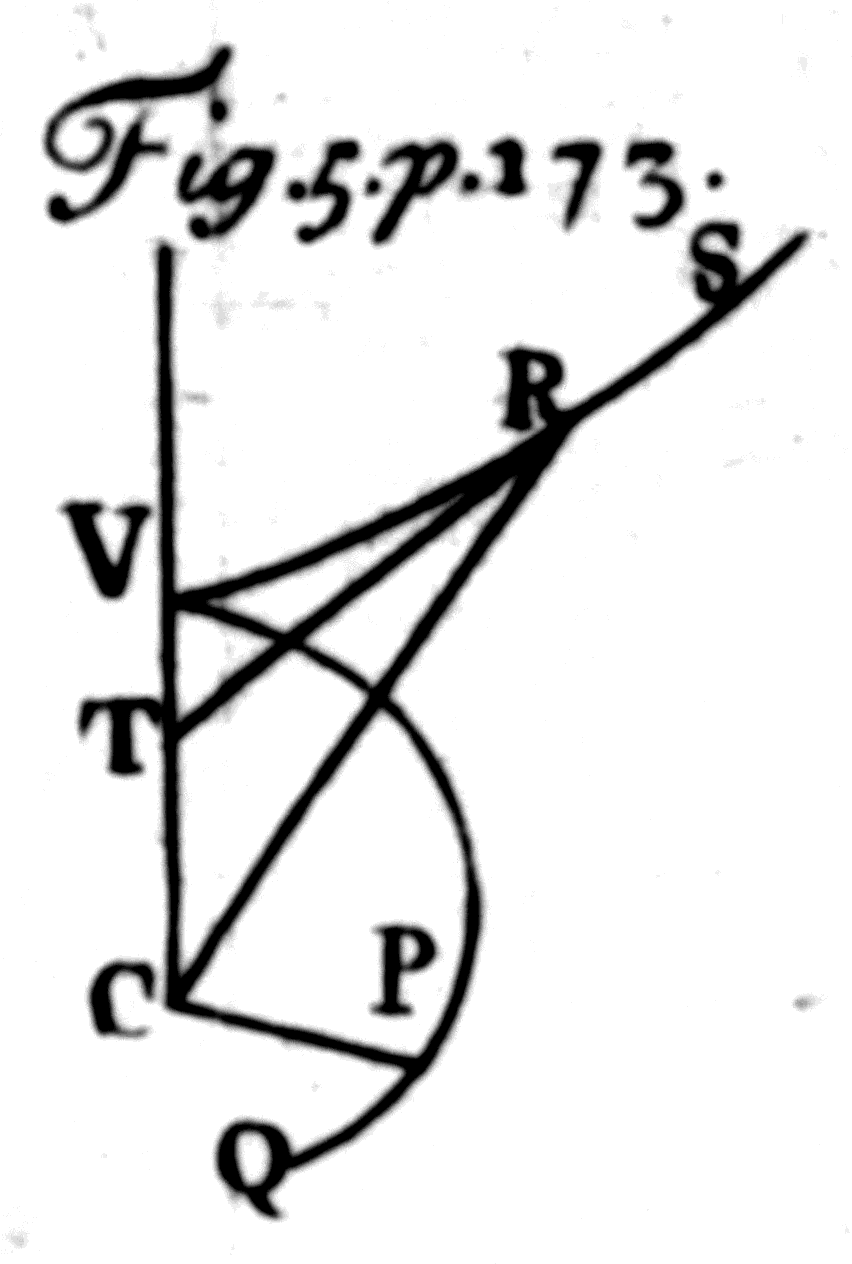
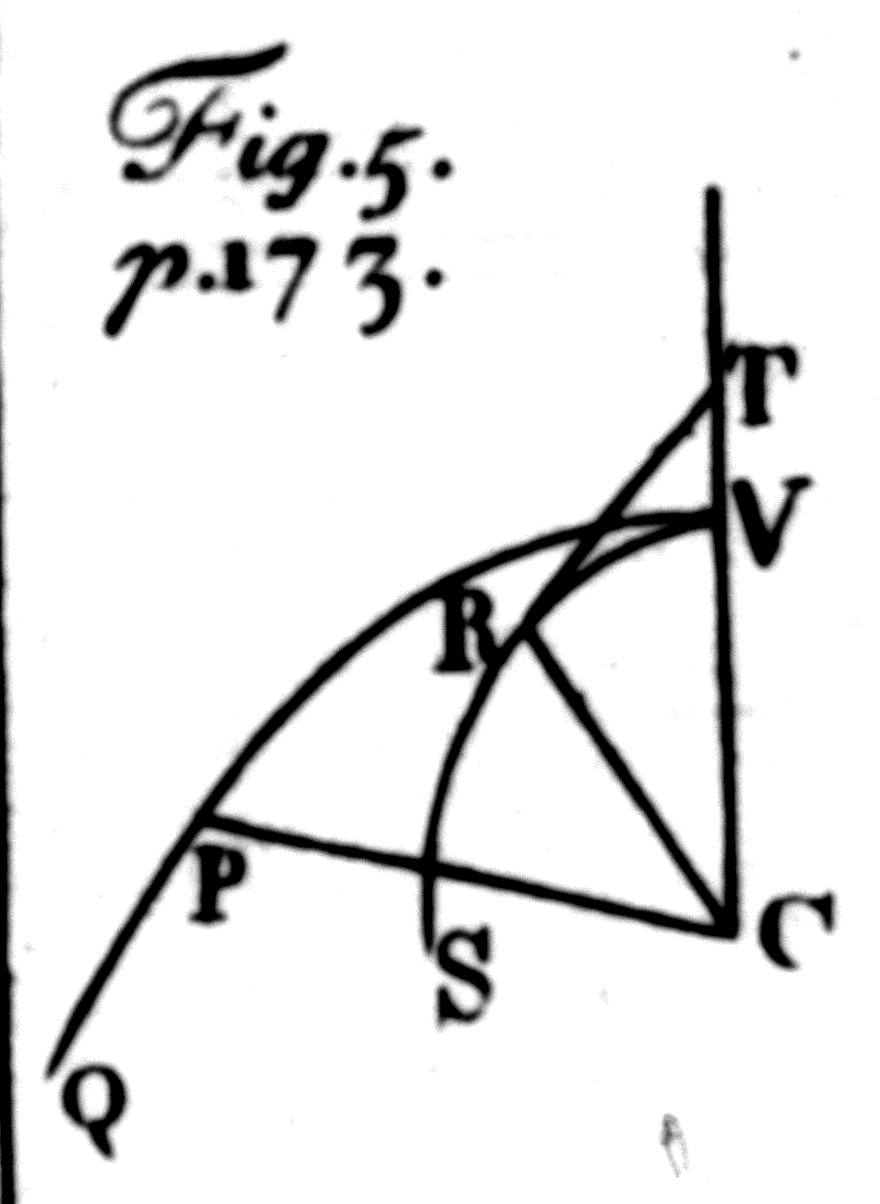
Proposition XLII. Problem XXIX
175The law of centripetal force being given, it is required to find the motion of a body setting out from a given place, with a given velocity, in the direction of a given right line.
Suppose the same things as in the three preceding propositions; and let the body go off from the place I, (Pl. 17. Fig. 6.) in the direction of the little line IK, with the same velocity as another body, by falling with an uniform centripetal force from the place P, may acquire in D; and let this uniform force be to the force with which the body is at first urged in I, as DR to DF. Let the body go on towards k; and about the centre C with the interval Ck, describe the circle ke, meeting the right line PD in e, and let there be erected the lines eg, ev, ew, ordinately applied to the curves BFg, abv, acw. From the given rectangle PDRQ and the given law of centripetal force, by which the first body is acted on, the curve line BFg is also given, by the construction of prop. 27. and its cor. 1. Then from the given angle CIK is given the proportion of the nascent lines IK, KN; and thence by the construction of prob. 28. there is given the quantity Q, with the curve lines abv, acw; and therefore, at the end of any time Dbve, there is given both the altitude of the body Ce or Ck, and the area Dcwe, with the sector 176equal to it XCy, the angle ICk, and the place k, in which the body will then be found. Q. E. I.
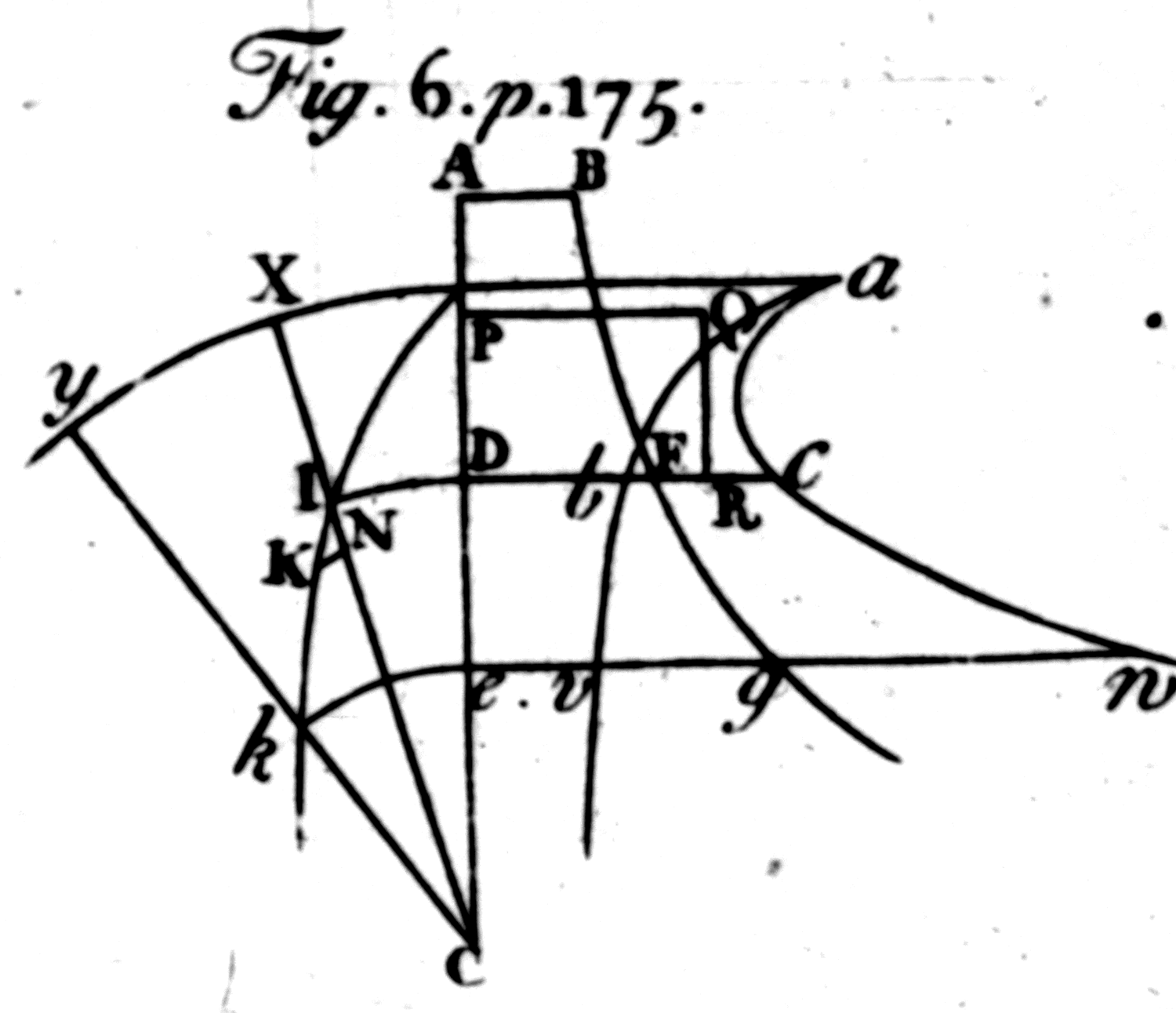
We suppose in these propositions the centripetal force to vary in its recess from the centre according to some law, which any one may imagine at pleasure; but at equal distances from the centre to be every where the same.
I have hitherto considered the motions of bodies in immovable orbits. It remains now to add something concerning their motions in orbits which revolve round the centres of force.
Section IX. Of the motion of bodies in moveable orbits; and of the motion of the apsides.
Section IX
177Of the motion of bodies in moveable orbits; and of the motion of the apsides.
Proposition XLIII. Problem XXX
It is required to make a body move, in a trajectory that revolves about the centre of force, in the same manner as another body in the same trajectory at rest.
In the orbit VPK (Pl. 18. Fig. 1.) given by position, let the body P revolve, proceeding from V towards K. From the centre C let there be continually drawn Cp, equal to CP, making the angle VCp proportional to the angle VCP; and the area which the line Cp describes, will be to the area VCP which the line CP describes at the same time, as the velocity of the describing line Cp, 178to the velocity of the describing line CP; that is, as the angle VCp to the angle VCP, therefore in a given ratio, and therefore proportional to the time. Since then the area described by the line Cp in an immovable plane is proportional to the time, it is manifest that a body, being acted upon by a just quantity of centripetal force, may revolve with the point p in the curve line which the same point p, by the method just now explained, may be made to describe in an immovable plane. Make the angle VCu equal to the angle PCp, and the line Cu equal to CV, and the figure uCp equal to the figure VCP, and the body being always in the point p, will move in the perimeter of the revolving figure uCp, and will describe its (revolving) arc up in the same time that the other body P describes the similar and equal arc VP in the quiescent figure VPK. Find then by cor. 5. prop. 6. the centripetal force by which a body may be made to revolve in the curve line which the point p describes in an immovable plane, and the problem will be solved. Q. E. F.
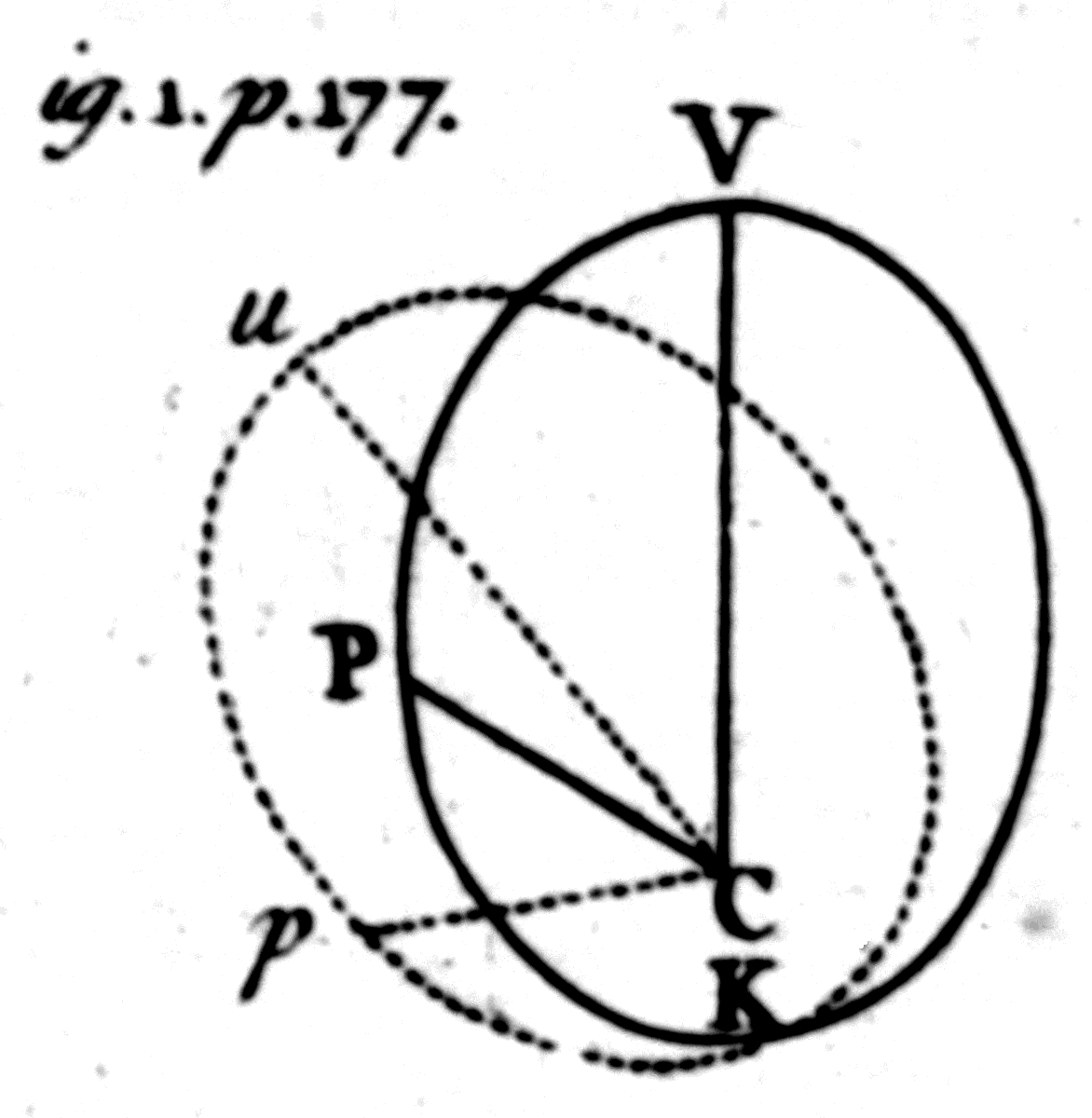
Proposition XLIV. Theorem XIV
The difference of the forces, by which two bodies may be made to move equally, one in a quiescent, the other in the same orbit revolving, is in a triplicate ratio of their common altitudes inversely.
Let the parts of the quiescent orbit VP, PK, (Pl. 18. Fig. 2.) be similar and equal to the 179parts of the revolving orbit up, pk; and let the distance of the points P and K be supposed of the utmost smallness. Let fall a perpendicular kr from the point k to the right line pC, and produce it to m, so that mr may be to kr as the angle VCp to the angle VCP. Because the altitudes of the bodies, PC and pC, KC and kC, are always equal, it is manifest that the increments or decrements of the lines PC and pC are always equal; and therefore if each of the several motions of the bodies in the places P and p be resolved into two, (by cor. 2. of the laws of motion) one of which is directed towards the center, or according to the lines PC, pC, and the other, transverse to the former, hath a direction perpendicular to the lines PC and pC; the motions towards the centre will be equal, and the transverse motion of the body p will be to the transverse motion of the body P, as the angular motion of the line pC to the angular motion of the line PC; that is, as the angle VCp to the angle VCP. Therefore at the same time that the body P, by both its motions, comes to the point K, the body p, having an equal motion towards the centre, will be equally moved from p towards C, and therefore that time being expired, it will be found somewhere in the line mkr, which, passing through the point k, is perpendicular to the line pC; and by its transverse motion, will acquire a distance from the line pC, that will be to the distance which the other body P acquires from the line PC, as the transverse motion of the body p, to the transverse motion of the other body P. Therefore since kr is equal to the distance which the body P acquires from the line PC, and mr is to kr as the angle 180VCp to the angle VCP, that is as the transverse motion of the body p, to the transverse motion of the body P: it is manifest that the body p, at the expiration of that time, will be found in the place m. These things will be so, if the bodies p and P are equally moved in the directions of the lines pC and PC, and are therefore urged with equal forces in those directions. But if we take an angle pCn that is to the angle pCk as the angle VCp to the angle VCP, and nC be equal to kC, in that case the body p at the expiration of the time will really be in n; and is therefore urged with a greater force than the body P, if the angle nCp is greater than the angle kCp, that is, if the orbit upk move either in consequentia, or in antecedentia with a celerity greater than the double of that with which the line CP moves in consequentia; and with a less force if the orbit moves slower in antecedentia. And the difference of the forces will be as the interval mn of the places through which the body would be carried by the action of that difference in that given space of time. About the centre C with the interval Cn or Ck suppose a circle described cutting the lines mr, mn produced in s and t, and the rectangle will be equal to the rectangle , and therefore mn will be equal to . But since the triangles pCk, pCn, in a given time, are of a given magnitude, kr and mr, and their difference mk, and their sum ms, are reciprocally as the altitude pC, and therefore the rectangle is reciprocally as the square of the altitude pC. But moreover mt is directly as mt, that is, as the altitude 181pC. These are the first ratio's of the nascent lines; and hence , that is, the nascent lineola mn, and the difference of the forces proportional thereto, are reciprocally as the cube of the altitude pC. Q. E. D.
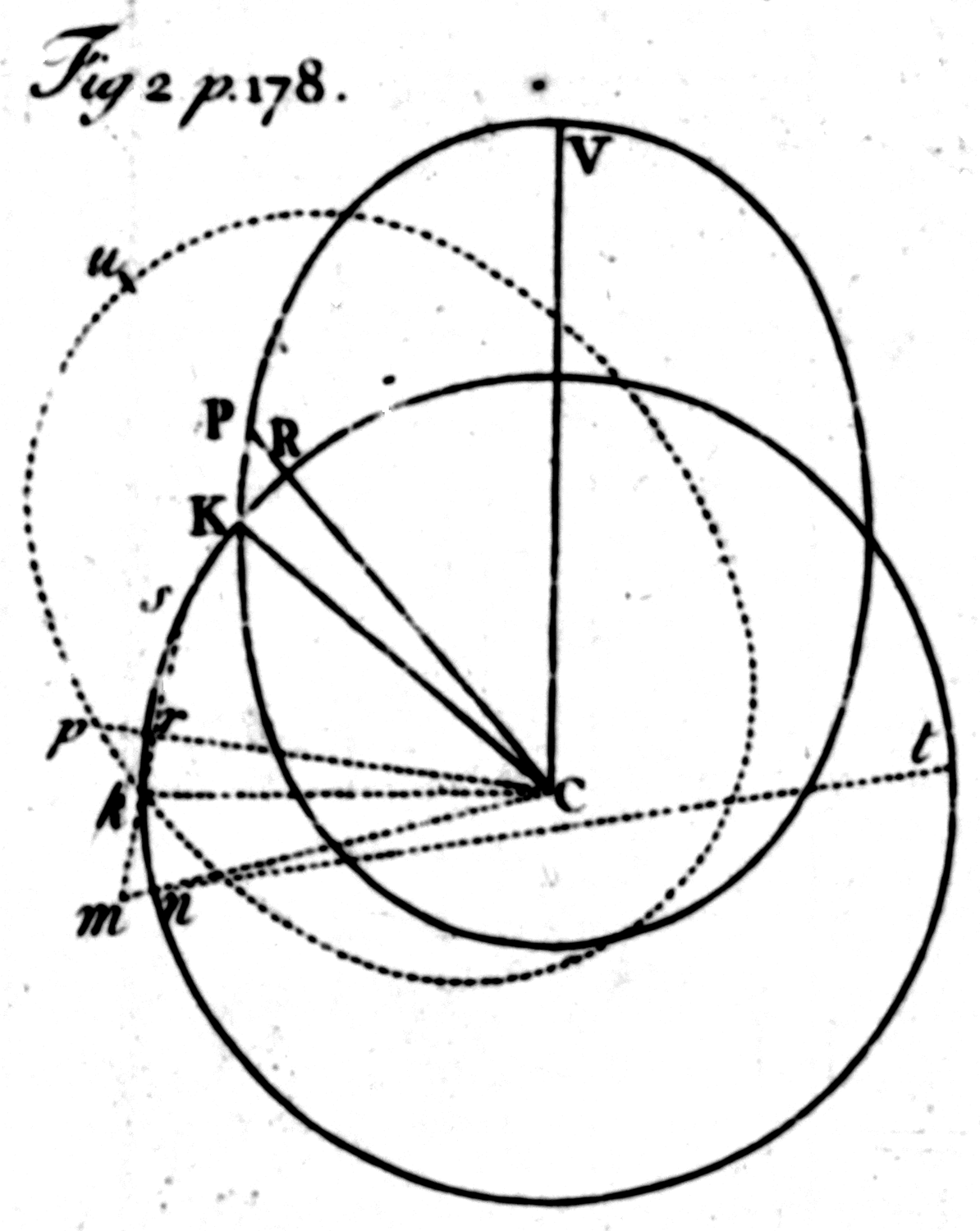
Cor. 1. Hence the difference of the forces in the places P and p, or K and k, is to the force with which a body may revolve with a circular motion from R to K, in the same time that the body P in an immovable orb describes the arc PK, as the nascent line mn to the versed sine of the nascent arc RK, that is as to , or as to the square of rk; that is, if we take given quantities F and G in the same ratio to one another as the angle VCP bears to the angle VCp, as to . And therefore if from the centre C with any distance CP or Cp, there be described a circular sector equal to the whole area VPC, which the body revolving in an immovable orbit, has by a radius drawn to the centre described in any certain time; the difference of the forces, with which the body P revolves in an immovable orbit and the body p in a moveable orbit, will be to the centripetal force, with which another body by a radius drawn to the centre can uniformly describe that sector in the same time as the area VPC is described, as to . For that sector and the area pCk are to one another as the times in which they are described.
182Cor. 2. If the orbit VPK be an ellipsis having its focus C, and its highest apsis V, and we suppose the ellipsis upk similar and equal to it, so that pC may be always equal to PC, and the angle VCp be to the angle VCP in the given ratio of G to F; and for the altitude PC or pC we put A, and for the latus rectum of the ellipsis; the force with which a body may be made to revolve in a moveable ellipsis will be as and vice versa. Let the force with which a body may revolve in an immovable ellipsis, be expressed by the quantity , and the force in V will be . But the force with which a body may revolve in a circle at the distance CV with the same velocity as a body revolving in an ellipsis has in V, is to the force with which a body revolving in an ellipsis is acted upon in the apsis V, as half the latus rectum of the ellipsis, to the semi-diameter CV of the circle, and therefore is as ; and the force which is to this as to , is as : and this force (by cor. 1. of this prop.) is the difference of the forces in V with which the body P revolves in the immovable ellipsis VPK, and the body p in the moveable ellipsis upk. Therefore since by this prop. that difference at any other altitude A is to it self at the altitude CV as to , the 183same difference in every altitude A will be as . Therefore to the force , by which the body may revolve in an immoveable ellipsis VPK, add the excess and the sum will be the whole force by which a body may revolve in the same time in the moveable ellipsis upk.
Cor. 3. In the same manner it will be found that if the immoveable orbit VPK be an ellipsis having its centre in the centre of the forces C; and there be supposed a moveable ellipsis upk similar, equal, and concentrical to it; and 2 R be the principal latus rectum of that ellipsis, and 2 T the latus transversum or greater axis; and the angle VCp be continually to the angle VCP as G to F; the forces with which bodies may revolve in the immoveable and moveable ellipsis in equal times, will be as and respectively.
Cor. 4. And universally, if the greatest altitude CV of the body be called T, and the radius of the curvature which the orbit VPK has in V, that is, the radius of a circle equally curve, be called R, and the centripetal force with which a body may revolve in any immoveable trajectory VPK at the place V be called , and in other places P be indefinitely stiled X; and the altitude CP be called 184A, and G be taken to F in the given ratio of the angle VCp to the angle VCP: the centripetal force with which the same body will perform the same motions in the same time in the same trajectory upk revolving with a circular motion, will be as the sum of the forces .
Cor. 5. Therefore the motion of a body in an immoveable orbit being given, its angular motion round the centre of the forces may be increased or diminished in a given ratio, and thence new immoveable orbits may be found in which bodies may revolve with new centripetal forces.
Cor. 6. Therefore if there be erected (Pl. 18. Fig. 3.) the line VP of an indeterminate length, perpendicular to the line CV given by position, and CP be drawn, and Cp equal to it, making the angle VCp having a given ratio to the angle VCP; the force with which a body may revolve in the curve line Vpk, which the point p is continually describing, will be reciprocally as the cube of the altitude Cp. For the body P, by its vis inertiæ alone, no other force impelling it, will proceed uniformly in the right line VP. Add then a force tending to the centre C reciprocally as the cube of the altitude CP or Cp, and (by what was just demonstrated) the body will deflect from the rectilinear motion into the curve line Vpk. But this curve Vpk is the same with the curve VPQ found in cor. 3. prop. 41. in which, I said, bodies attracted with such forces would ascend obliquely.
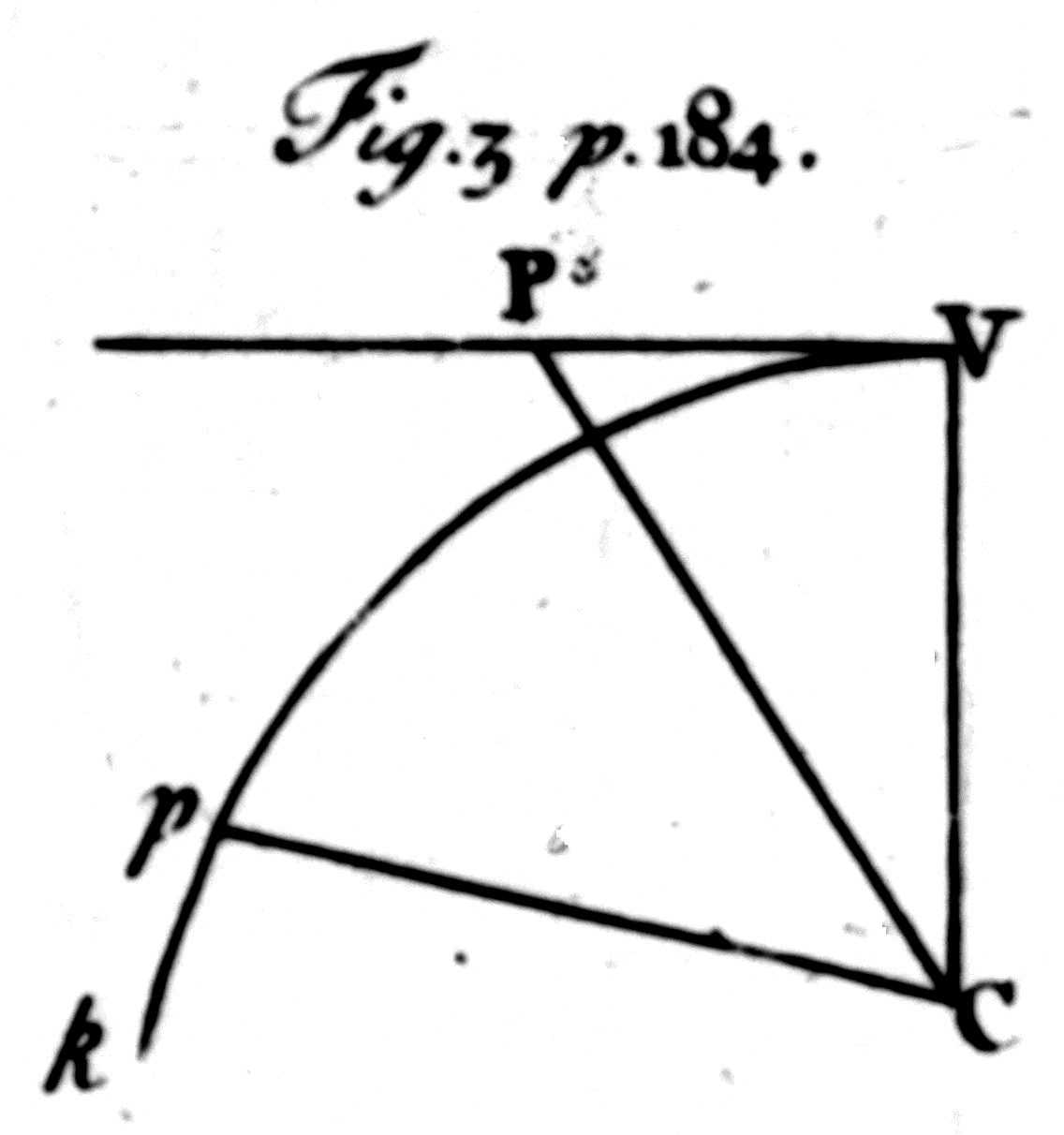
Proposition XLV. Problem XXXI
185To find the motion of the apsides in orbits approaching very near to circles.
This problem is solved arithmetically by reducing the orbit, which a body revolving in a moveable ellipsis (as in cor. 2 and 3 of the above prop.) describes in an immoveable plane, to the figure of the orbit whose apsides are required; and then seeking the apsides of the orbit which that body describes in an immoveable plane. But orbits acquire the same figure, if the centripetal forces with which they are described, compared between themselves, are made proportional at equal altitudes. Let the point V be the highest apsis, and write T for the greatest altitude CV, A for any other altitude CP or Cp, and X for the difference of the altitudes , and the force with which a body moves in an ellipsis revolving about its focus C (as in cor. 2.) and which in cor. 2. was as , that is as , by substituting for A will become as . In like manner any other centripetal force is to be reduced to a fraction whose denominator is and the numerators are to be made analogous by 186collating together the homologous terms. This will be made plainer by examples.
Exam. 1. Let us suppose the centripetal force to be uniform, and therefore as , or, writing for A in the numerator, as . Then collating together the correspondent terms of the numerators, that is, those that consist of given quantities, with those of given quantities, and those of quantities not given, with those of quantities not given, it will become to as to or as to . Now since the orbit is supposed extreamly near to a circle, let it coincide with a circle, and because in that case R and T become equal, and X is infinitely diminished, the last ratio's will be, as RGG to so to , or as GG to TT so FF to 3TT, and again as GG to FF so TT to 3TT, that is, as 1 to 3; and therefore G is to F, that is, the angle VCp to the angle VCP as 1 to . Therefore since the body, in an immoveable ellipsis, in descending from the upper to the lower apsis, describes an angle, if I may so speak, of 180 deg. the other body in a moveable ellipsis, and therefore in the immoveable orbit we are treating of, will, in its descent from the upper to the lower apsis, describe an angle VCp of deg. And this comes to pass by reason of 187the likeness of this orbit which a body acted upon by an uniform centripetal force describes, and of that orbit which a body performing its circuits in a revolving ellipsis will describe in a quiescent plane. By this collation of the terms, these orbits are made similar, not universally indeed, but then only when they approach very near to a circular figure. A body therefore revolving with an uniform centripetal force in an orbit nearly circular, will always describe an angle of deg. or 103 deg. 55 m. 23 sec. at the centre; moving from the upper apsis to the lower apsis when it has once described that angle, and thence returning to the upper apsis when it has described that angle again; and so on in infinitum.
Exam. 2. Suppose the centripetal force to be as any power of the altitude A, as for example or ; where and n signify any indices of powers whatever, whether integers or fractions, rational or surd, affirmative or negative. That numerator or being reduced to an indeterminate series by my method of converging series, will become &c. And conferring these terms with the terms of the other numerator , it becomes as to so - FF to &c. And taking the last ratio's where the orbits approach to 188circles, it becomes as RGG to so to , or as GG to so FF to , and again GG to FF so to , that is, as 1 to n; and therefore G is to F, that is the angle VCp to the angle VCP as 1 to . Therefore since the angle VCP, described in the descent of the body from the upper apsis to the lower apsis in an ellipsis, is of 180 deg. the angle VCp, described in the descent of the body from the upper apsis to the lower apsis in an orbit nearly circular which a body describes with a centripetal force proportional to the power , will be equal to an angle of deg. and this angle being repeated the body will return from the lower to the upper apsis, and so on in infinitum. As if the centripetal force be as the distance of the body from the centre, that is, as A, or , n will be equal to 4, and equal to 2; and therefore the angle between the upper and the lower apsis will be equal to deg. or 90 deg. Therefore the body having performed a fourth part of one revolution will arrive at the lower apsis, and having performed another fourth part, will arrive at the upper apsis, and so on by turns in infinitum. This appears also from prop. 10. For a body acted on by this centripetal force will revolve in an immoveable ellipsis, whose centre is the centre of force. If the centripetal force is reciprocally as the distance, that is, directly as or as , n will be equal to 2, and 189therefore the angle between the upper and lower apsis will be deg. or 127 deg. 16 min. 45 sec. and therefore a body revolving with such a force, will, by a perpetual repetition of this angle, move alternately from the upper to the lower, and from the lower to the upper apsis for ever. So also if the centripetal force be reciprocally as the biquadrate root of the eleventh power of the altitude, that is reciprocally as and therefore directly as or as , n will be equal to and deg. will be equal to 360 deg. and therefore the body parting from the upper apsis, and from thence perpetually descending will arrive at the lower apsis when it has compleated one entire revolution; and thence ascending perpetually, when it has compleated another entire revolution it will arrive again at the upper apsis; and so alternately for ever.
Exam. 3. Taking m and n for any indices of the powers of the altitude, and b and c for any given numbers, suppose the centripetal force to be as that is, as or (by the method of converging series above-mentioned) as &c. and comparing the terms of the numerators, 190there will arise to as to &c. And taking the last ratio's that arise when the orbits come to a circular form, there will come forth GG to as FF to and again GG to FF as to . This proportion, by expressing the greatest altitude CV or T arithmetically by unity, becomes, GG to FF as to , and therefore as 1 to . Whence G becomes to F, that is the angle VCp to the angle VCP as 1 to . And therefore since the angle VCP between the upper and the lower apsis, in an immoveable ellipsis, is of 180 deg. the angle VCp between the same apsides in an orbit which a body describes with a centripetal force, that is as will be equal to an angle of deg. And by the same reasoning if the centripetal force be as the angle between the apsides will be found equal to deg. After the same manner the problem is solved in more difficult cases. The quantity to which the centripetal force is proportional, must always be resolved into a converging 191series whose denominator is . Then the given part of the numerator arising from that operation is to be supposed in the same ratio to that part of it which is not given, as the given part of this numerator is to that part of the same numerator which is not given. And taking away the superfluous quantities and writing unity for T, the proportion of G to F is obtained.
Cor. 1. Hence if the centripetal force be as any power of the altitude, that power may be found from the motion of the apsides; and so contrarywise. That is, if the whole angular motion, with which the body returns to the same apsis, be to the angular motion of one revolution. or 360 deg. as any number as m to another as n, and the altitude called A; the force will be as the power of the altitude A; the index of which power is . This appears by the second examples. Hence 'tis plain that the force in its recess from the centre cannot decrease in a greater than a triplicate ratio of the altitude. A body revolving with such a force and parting from the apsis, if it once begins to descend can never arrive at the lower apsis or least altitude, but will descend to the centre, describing the curve line treated of in cor. 3. prop. 41. But if it should, at its parting from the lower apsis begin to ascend never so little, it will ascend in infinitum and never come to the upper apsis; but will describe the curve line spoken of in the same cor. and cor. 6. prop. 44. So that where the force in its recess from the centre decreases 192in a greater than a triplicate ratio of the altitude, the body at its parting from the apsis, will either descend to the centre or ascend in infinitum, according as it descends or ascends at the beginning of its motion. But if the force in its recess from the centre either decreases in a less than a triplicate ratio of the altitude, or increases in any ratio of the altitude whatsoever; the body will never descend to the centre, but will at some time arrive at the lower apsis; and on the contrary, if the body alternately ascending and descending from one apsis to another never comes to the centre, then either the force increases in the recess from the centre, or it decreases in a less than a triplicate ratio of the altitude; and the sooner the body returns from one apsis to another, the farther is the ratio of the forces from the triplicate ratio. As if the body should return to and from the upper apsis by an alternate descent and ascent in 8 revolutions, or in 4, or 2, or 1; that is if m should be to n as 8 or 4 or 2 or 1 to 1, and therefore be , or , or , or , then the force will be as , or , or , or ; that is, it will be reciprocally as , or , or , or . If the body after each revolution returns to the same apsis, and the apsis remains unmoved, then m will be to n as 1 to 1, and therefore will be equal to or and therefore the decrease of the forces will be in a duplicate ratio of the altitude; as was demonstrated above. If the body in three fourth parts 193or two thirds, or one third; or one fourth part of an entire revolution, return to the same apsis; m will be to n as or or or to 1, and therefore is equal to or , or , or ; and therefore the force is either reciprocally as or or directly as or . Lastly, if the body in its progress from the upper apsis to the same upper apsis again, goes over one entire revolution and three deg. more, and therefore that apsis in each revolution of the body moves three deg. in consequentia; then m will be to n as 363 deg. to 360 deg. or as 121 to 120, and therefore will be equal to and therefore the centripetal force will be reciprocally as or reciprocally as very nearly. Therefore the centripetal force decreases in a ratio something greater than the duplicate; but approaching 59 times nearer to the duplicate than the triplicate.
Cor. 2. Hence also if a body, urged by a centripetal force which is reciprocally as the square of the altitude, revolves in an ellipsis whose focus is in the centre of the forces; and a new and foreign force should be added to or subducted from this centripetal force; the motion of the apsides arising from that foreign force may (by the third examples) be known; and so on the contrary. As if the force with which the body revolves in the ellipsis be as ; and the foreign 194force subducted as cA, and therefore the remaining force as ; then (by the third exam.) b will be equal to 1, m equal to 1, and n equal to 4; and therefore the angle of revolution between the apsides is equal to deg. Suppose that foreign force to be 357.45 parts less than the other force with which the body revolves in the ellipsis; that is c to be or T being equal to 1, and then will be or 180.7623, that is, 180 deg. 45 min. 44 sec. Therefore the body parting from the upper apsis, will arrive at the lower apsis with an angular motion of 180 deg. 45 min. 44 sec. and this angular motion being repeated will return to the upper apsis; and therefore the upper apsis in each revolution will go forward 1 deg. 31 m. 28 sec. The apsis of the Moon is about twice as swift.
So much for the motion of bodies in orbits whose planes pass through the centre of force. It now remains to determine those motions in eccentrical planes. For those authors who treat of the motion of heavy bodies use to consider the ascent and descent of such bodies, not only in a perpendicular direction, but at all degrees obliquity upon any given planes; and for the same reason we are to consider in this place the motions of bodies tending to centres by means of any forces whatsoever, when those bodies move in eccentrical planes. These planes are supposed to be perfectly smooth and polished so as not to retard the motion of the bodies in the least. Moreover in these demonstrations 195instead of the planes upon which those bodies roll or slide, and which are therefore tangent planes to the bodies, I shall use planes parallel to them, in which the centres of the bodies move, and by that motion describe orbits. And by the same method I afterwards determine the motions of bodies performed in curve superficies.
Section X. Of the motion of bodies in given superficies, and of the reciprocal motion of funependulous bodies.
Section X
196Of the motion of bodies in given superficies, and of the reciprocal motion of funependulous bodies.
Proposition XLVI. Problem XXXII
Any kind of centripetal force being supposed, and the centre of force, and any plane whatsoever in which the body revolves, being given, and the quadratures of curvilinear figures being allowed; it is required to determine the motion of a body going off from a given place, with a given velocity, in the direction of a given right line in that plane.
Let S (Pl. 18. Fig. 4.) be the centre of force, SC the least distance of that centre from the given 197plane, P a body issuing from the place P in the direction of the right line PZ, Q the same body revolving in its trajectory, and PQR the trajectory it self which is required to be found, described in that given plane. Join CQ, QS, and if in QS we take SV proportional to the centripetal force with which the body is attracted towards the centre S, and draw VT parallel to CQ, and meeting SC in T: then will the force SV be resolved into two, (by cor. 2. of the laws of motion) the force ST, and the force TV; of which ST attracting the body in the direction of a line perpendicular to that plane, does not at all change its motion in that plane. But the action of the other force TV, coinciding with the position of the plane it self, attracts the body directly towards the given point C in that plane; and therefore causes the body to move in this plane in the same manner as if the force ST were taken away, and the body were to revolve in free space about the centre C by means of the force TV alone. But there being given the centripetal force TV with which the body Q revolves in free space about the given centre C, there is given (by pro. 42.) the trajectory PQR which the body describes; the place Q, in which the body will be found at any given time; and lastly, the velocity of the body in that place Q. And so è contra. Q. E. I.
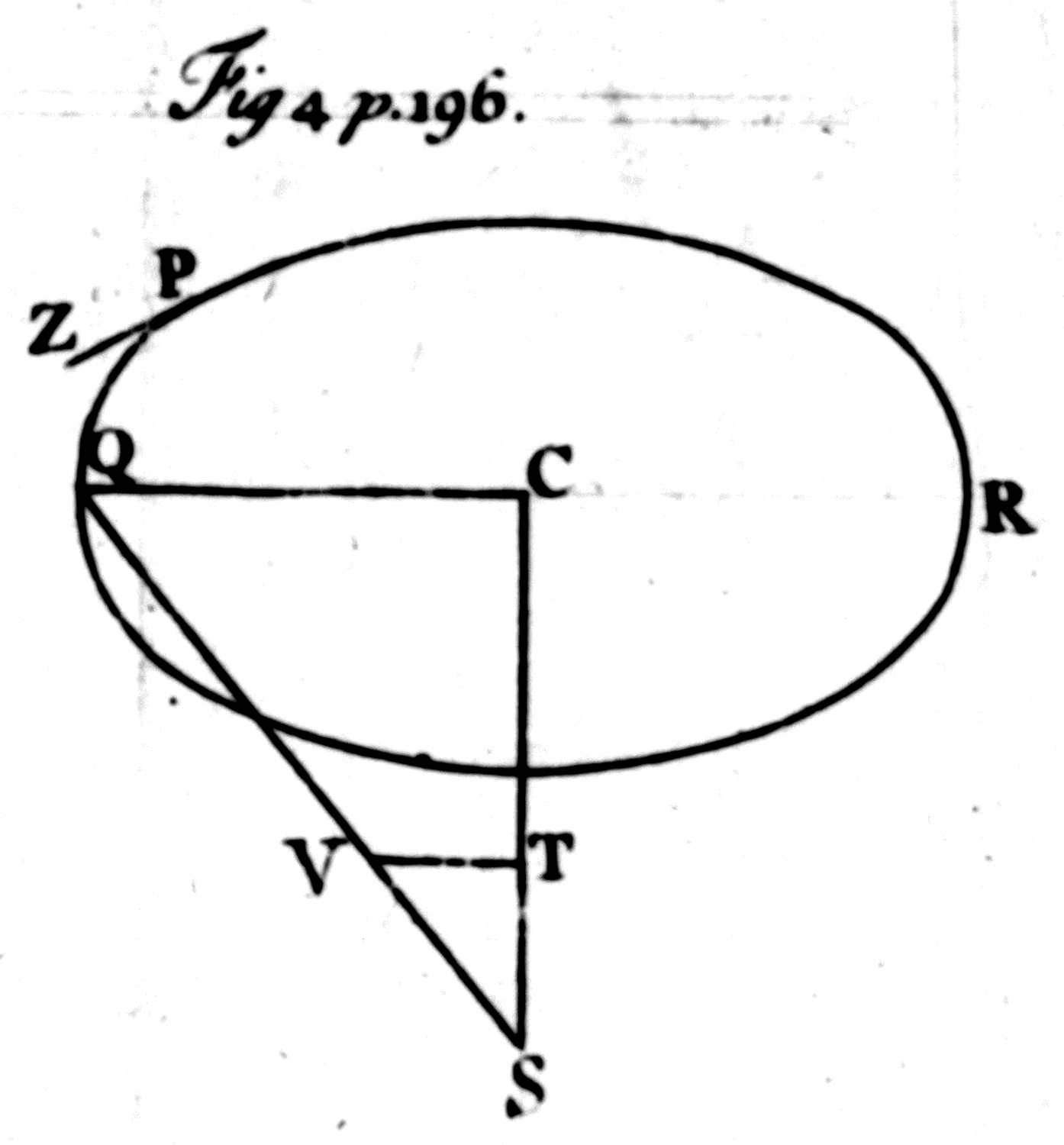
Proposition XLVII. Theorem XV
198Supposing the centripetal force to be proportional to the distance of the body from the centre; all bodies revolving in any planes whatsoever will describe ellipses, and compleat their revolutions in equal times; and those which move in right lines, running backwards and forwards alternately, will compleat their several periods of going and returning in the same times.
For letting all things stand as in the foregoing proposition, the force SV, with which the body Q revolving in any plane PQR is attracted towards the centre S, is as the distance SQ; and therefore because SV and SQ, TV and CQ are proportional, the force TV with which the body is attracted towards the given point C in the plane of the orbit is as the distance CQ. Therefore the forces with which bodies found in the plane PQR are attracted towards the point C, are in proportion to the distances equal to the forces with which the same bodies are attracted every way towards the centre S; and therefore the bodies will move in the same times, and in the same figures in any plane PQR about the point C, as they would do in free spaces about the centre S; and therefore (by cor. 2. prop. 10. and cor. 2. 199prop. 38) they will in equal times either describe ellipses in that plane about the centre C, or move to and fro in right lines passing through the centre C in that plane; compleating the same periods of time in all cases. Q. E. D.
Scholium
The ascent and descent of bodies in curve superficies has a near relation to these motions we have been speaking of. Imagine curve lines to be described on any plane, and to revolve about any given axes passing through the centre of force, and by that revolution to describe curve superficies; and that the bodies move in such sort that their centres may be always found in those superficies. If those bodies reciprocate to and fro with an oblique ascent and descent; their motions will be performed in planes passing through the axis, and therefore in the curve lines by whose revolution those curve superficies were generated. In those cases therefore it will be sufficient to consider the motion in those curve lines.
Proposition XLVIII. Theorem XVI
If a wheel stands upon the out-side of a globe at right angles thereto, and revolving about its own axis goes forward in a great circle; the length of the curvilinear path which any point, given in the perimeter of the wheel, 200hath described since the time that it touched the globe, (which curvilinear path we may call the cycloid or epicycloid) will be to double the versed sine of half the arc which since that time has touched the globe in passing over it, at the sum of the diameters of the globe and the wheel, to the semidiameter of the globe.
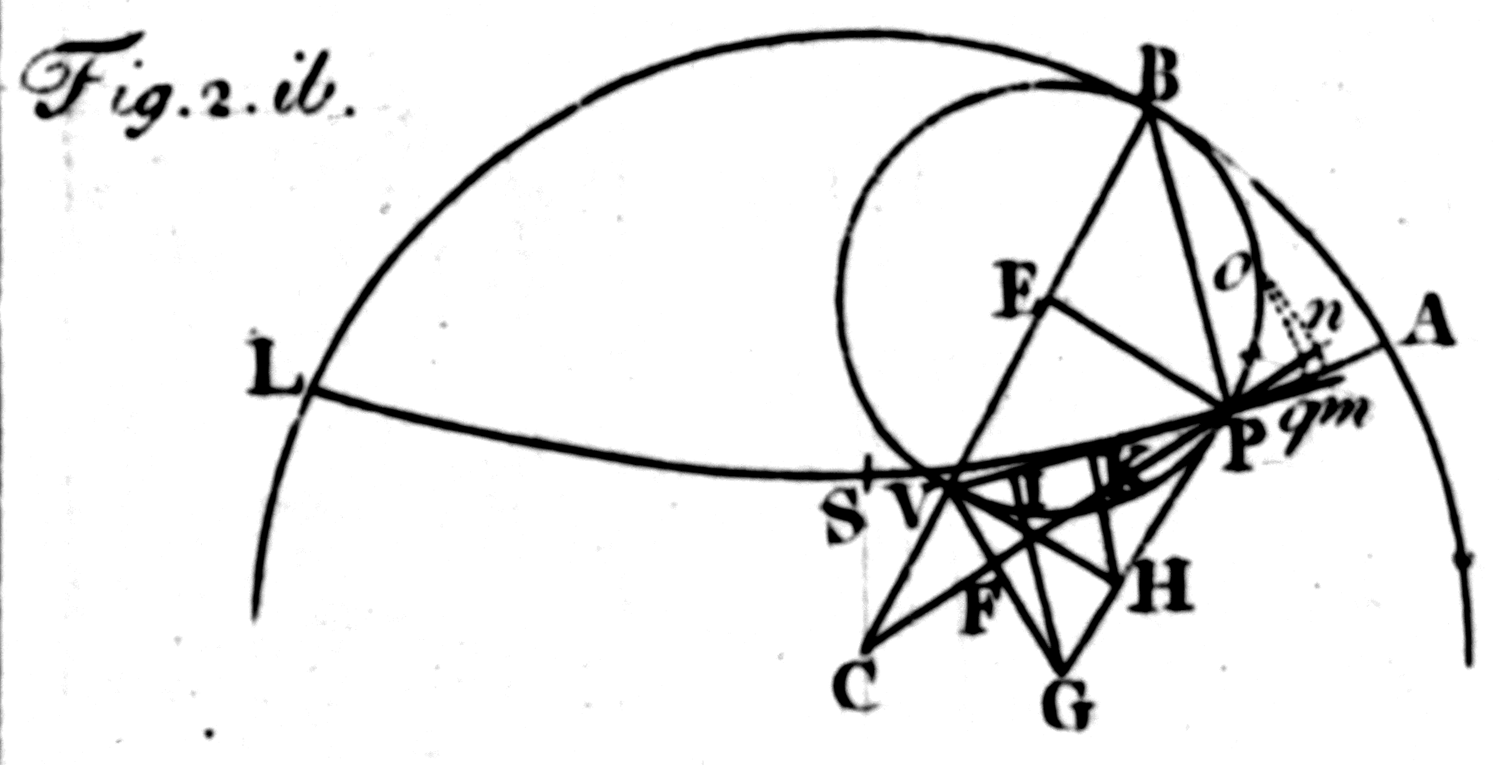
Proposition XLIX. Theorem XVII
If a wheel stand upon the inside of a concave globe at right angles thereto, and revolving about its own axis go forward in one of the great circles of the globe, the length of the curvilinear path which any point, given in the perimeter of the wheel, hath described since it touched the globe, will be to the double of the versed sine of half the arc which in all that time has touched the globe in passing over it, as the difference of the diameters of the globe and the wheel, to the semidiameter of the globe.
Let ABL (Pl. 19. Fig. 1. 2.) be the globe, C its centre, BPV the wheel insisting thereon, E the centre of the wheel, B the point of contact, and P the given point in the perimeter of the 201wheel. Imagine this wheel to proceed in the great circle ABL from A through B towards L, and in its progress to revolve in such a manner that the arcs AB, PB may be always equal the one to the other, and the given point P in the perimeter of the wheel may describe in the mean time the curvilinear path AP. Let AP be the whole curvilinear path described since the wheel touched the globe in A, and the length of this path AP will be to twice the versed sine of the arc PB, as 2 CE to CB. For let the right line CE (produced if need be) meet the wheel in V, and join CP, BP, EP, VP; produce CP, and let fall thereon the perpendicular VF. Let PH, VH, meeting in H, touch the circle in P and V, and let PH cut VF in G, and to VP let fall the perpendiculars GI, HK. From the centre C with any interval let there be described the circle nom, cutting the right line CP in n, the perimeter of the wheel BP in o, and the curvilinear path AP in m; and from the centre V with the interval Vo let there be described a circle cutting VP produced in q.
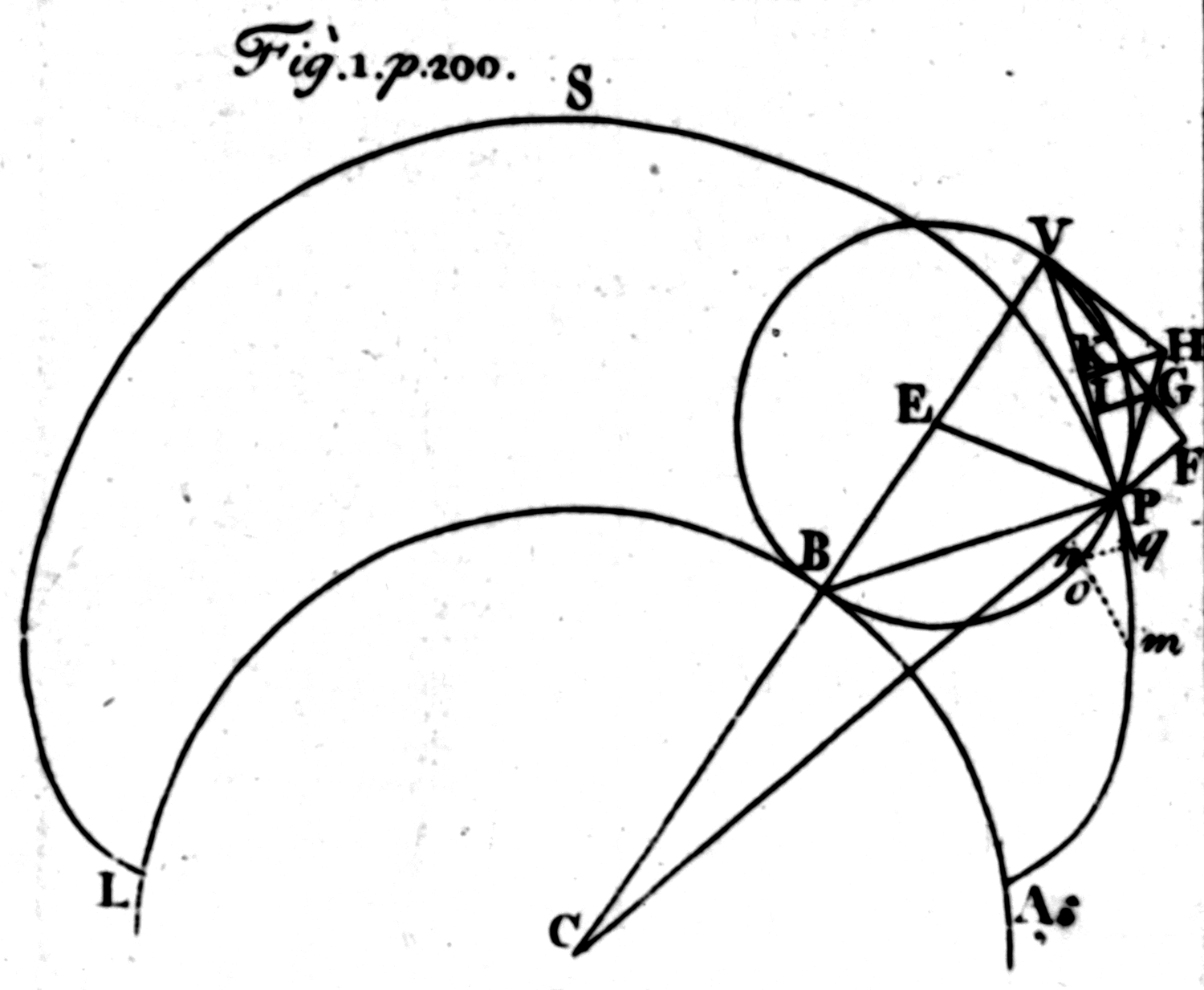
Because the wheel in its progress always revolves about the point of contact B, it is manifest that the right line BP is perpendicular to that curve line AP which the point P of the wheel describes, and therefore that the right line VP will touch this curve in the point P. Let the radius of the circle nom be gradually increased or diminished so that at last it become equal to the distance CP; and by reason of the similitude of the evanescent figure Pnomq, and the figure PFGVI, the ultimate ratio of the evanescent lineolæ Pm, Pn, Po, Pq, that is, the ratio of the momentary mutations 202of the curve AP, the right line CP, the circular arc BP, and the right line VP, will be the same as of the lines PV, PF, PG, PI, respectively. But since VF is perpendicular to CF, and VH to CV, and therefore the angles HVG, VCF equal; and the angle VHG (because the angles of the quadrilateral figure HVEP are right in V and P) is equal to the angle CEP, the triangles VHG, CEP will be similar; and thence it will come to pass that as EP is to CE so is HG to HV or HP, and so KI to KP, and by composition or division as CB to CE so is PI to PK, and doubling the consequents as CB to 2 CE so PI to PV, and so is Pq to Pm. Therefore the decrement of the line VP, that is the increment of the line to the increment of the curve line AP is in a given ratio of CB to 2 CE, and therefore (by cor. lem. 4.) the lengths and AP generated by those increments, are in the same ratio. But if BV be radius, VP is the cosine of the angle BVP or BEP, and therefore is the versed sine of the same angle; and therefore in this wheel whose radius is BV, will be double the versed sine of the arc BP. Therefore AP is to double the versed sine of the arc BP as 2 CE to CB. Q. E. D.
The line AP in the former of these propositions we shall name the cycloid without the globe, the other in the latter proposition the cycloid within the globe, for distinction sake.
Cor. 1. Hence if there be described the entire cycloid ASL and the same be bisected in S, the length of the part PS will be to the length PV (which is the double of the sine of the angle 203VBP, when EB is radius) as 2 CE to CB, and therefore in a given ratio.
Cor. 2. And the length of the semi-perimeter of the cycloid AS will be equal to a right line which is to the diameter of the wheel BV as 2 CE to CB.
Proposition L. Problem XXXIII
To cause a pendulous body to oscillate in a given cycloid.
Let there be given within the globe QVS, (Pl. 19. Fig. 3.) described with the centre C, the cycloid QRS, bisected in R, and meeting the superficies of the globe with its extreme points Q and S on either hand. Let there be drawn CR bisecting the arc QS in O, and let it be produced to A in such sort that CA may be to CO as CO to CR. About the centre C, with the interval CA, let there be described an exterior globe DAF, and within this globe; by a wheel whose diameter is AO, let there be described two semi-cycloids AQ, AS, touching the interior globe in Q and S, and meeting the exterior globe in A. From that point A, with a thread APT in length equal to the line AR, let the body T depend, and oscillate in such manner between the two semi-cycloids AQ, AS that as often as the pendulum parts from the perpendicular AR, the upper part of the thread AP may be applied to that semi-cycloid APS towards which the motion tends, and fold it self round that curve line, as it were some solid obstacle; 204the remaining part of the same thread PT which has not yet touched the semi-cycloid continuing straight. Then will the weight T oscillate in the given cycloid QRS. Q. E. F.
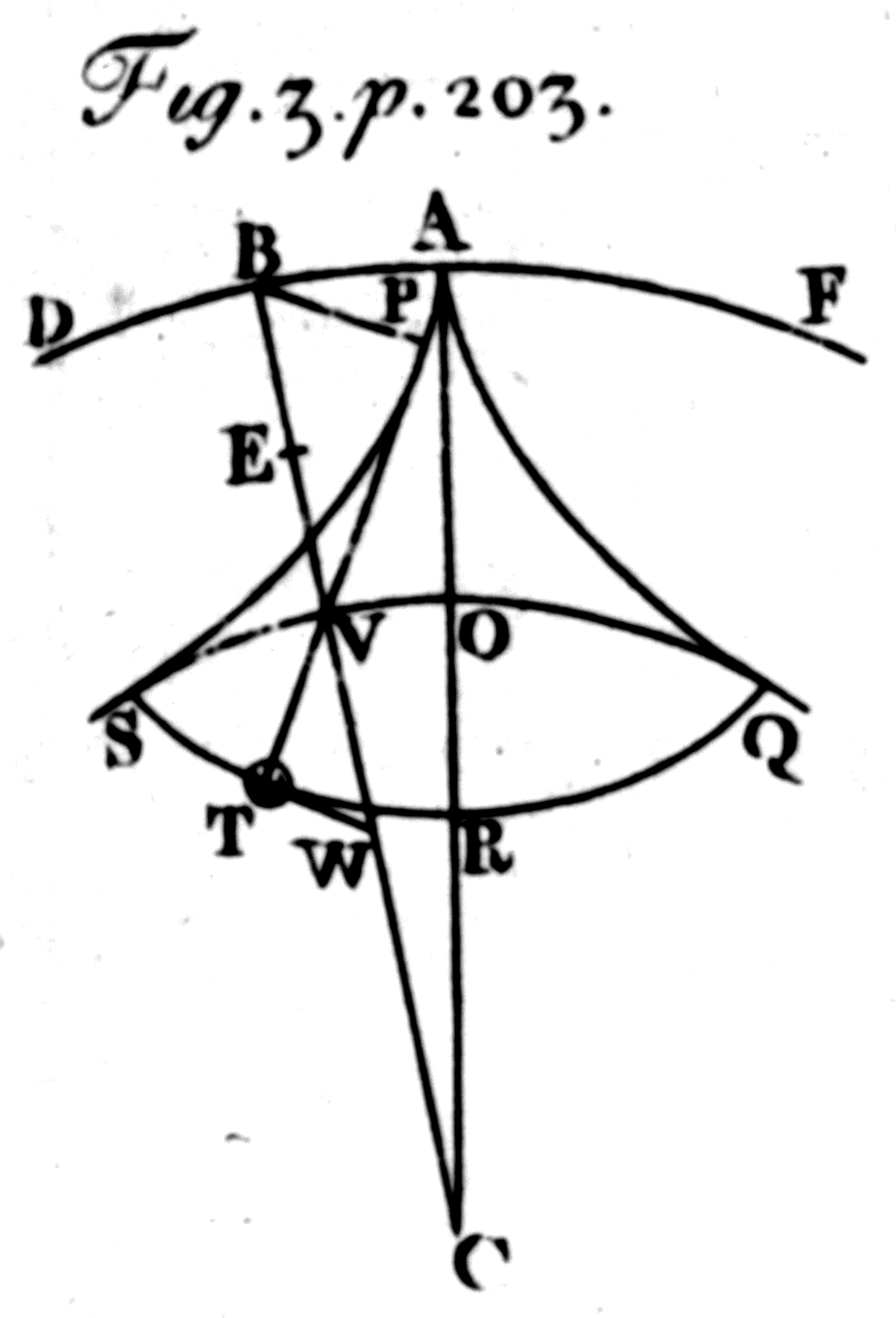
For let the thread PT meet the cycloid QRS in T and the circle QOS in V, and let CV be drawn; and to the rectilinear part of the thread PT from the extreme points P and T let there be erected the perpendiculars BP, TW, meeting the right line CV in B and W. It is evident from the construction and generation of the similar figures AS, SR, that those perpendiculars PB, TW, cut off from CV the lengths VB, VW equal to the diameters of the wheels OA, OR. Therefore TP is to VP (which is double the sine of the angle VBP when BV is radius) as BW to BV, or to AO, that is (since CA and CO, CO and CR, and by division AO and OR are proportional) as to CA; or, if BV be bisected in E, as 2 CE to CB. Therefore (by cor. 1. prop. 49) the length of the rectilinear part of the thread PT is always equal to the arc of the cycloid PS, and the whole thread APT is always equal to the half of the cycloid APS, that is (by cor. 2. prop. 49.) to the length AR. And therefore contrary-wise, if the string remain always equal to the length AR the point T will always move in the given cycloid QRS. Q. E. D.
Cor. The string AR is equal to the semi-cycloid AS, and therefore has the same ratio to AC the semi-diameter of the exterior globe as the like semi-cycloid SR has to CO the semi-diameter of the interior globe.
Proposition LI. Theorem XVIII
205If a centripetal force tending on all sides to the centre C of a globe (Pl. 19. Fig. 4.) be in all places as the distance of the place from the centre, and by this force alone acting upon it, the body T oscillate (in the manner above described) in the perimeter of the cycloid QRS; I say, that all the oscillations how unequal soever in themselves will be performed in equal times.
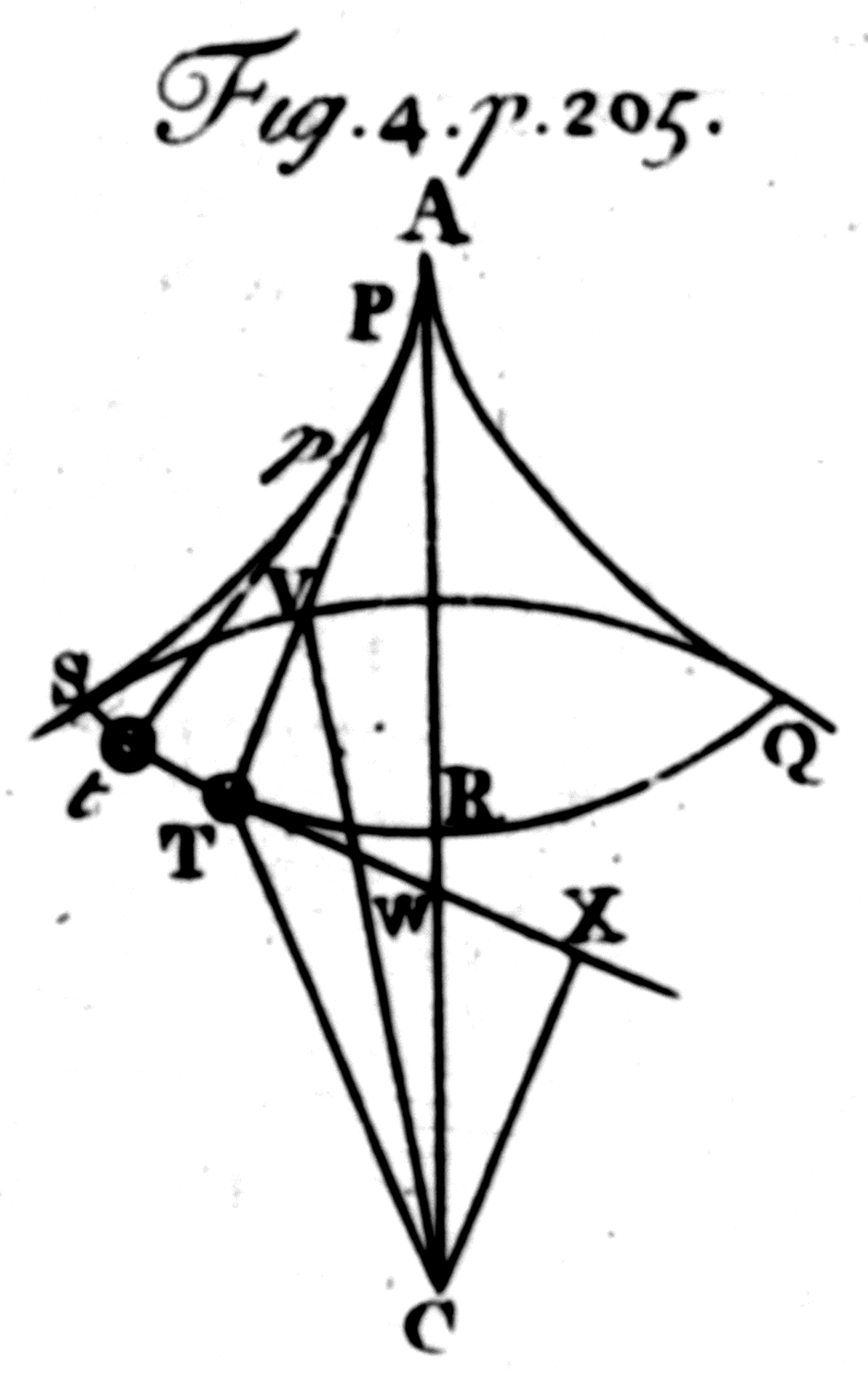
For upon the tangent TW infinitely produced let fall the perpendicular CX and join CT. Because the centripetal force with which the body T is impelled towards C is as the distance CT; let this (by cor. 2. of the laws) be resolved into the parts CX, TX of which CX impelling the body directly from P stretches the thread PT and by the resistance the thread makes to it is totally employed, producing no other effect; but the other part TX, impelling the body transversely or towards X, directly accelerates the motion in the cycloid. Then it is plain that the acceleration of the body, proportional to this accelerating force, will be every moment as the length TX, that is, (because CV, WV, and TX, TW proportional to them are given) as the length TW, that is (by cor. 1. prop. 49.) as the length of the arc of the cycloid TR. If 206therefore two pendulums APT, Apt be unequally drawn aside from the perpendicular AR, and let fall together, their accelerations will be always as the arcs to be described TR, tR. But the parts described at the beginning of the motion are as the accelerations, that is, as the wholes that are to be described at the beginning, and therefore the parts which remain to be described and the subsequent accelerations proportional to those parts, are also as the wholes, and so on. Therefore the accelerations, and consequently the velocities generated, and the parts described with those velocities, and the parts to be described, are always as the wholes; and therefore the parts to be described preserving a given ratio to each other will vanish together, that is, the two bodies oscillating will arrive together at the perpendicular AR. And since on the other hand the ascent of the pendulums from the lowest place R through the same cycloidal arcs with a retrograde motion, is retarded in the several places they pass through by the same forces by which their descent was accelerated, 'tis plain that the velocities of their ascent and descent through the same arcs are equal, and consequently performed in equal times; and therefore since the two parts of the cycloid RS and RQ lying on either side of the perpendicular are similar and equal, the two pendulums will perform as well the wholes as the halves of their oscillations in the same time. Q. E. D.
Cor. The force with which the body T is accelerated or retarded in any place T of the cycloid, is to the whole weight of the same body in the highest place S or Q, as the arc of the cycloid TR is to the arc SR or QR.
Proposition LII. Problem XXXIV
207To define the velocities of the pendulums in the several places, and the times in which both the entire oscillations, and the several parts of them are performed.
About any centre G (Pl. 20. Fig. 1.) with the interval GH equal to the arc of the cycloid RS, describe a semi-circle HKM bisected by the semi-diameter GK. And if a centripetal force proportional to the distance of the places from the centre tend to the centre G, and it be in the perimeter HIK equal to the centripetal force in the perimeter of the globe QOS tending towards its centre, and at the same time that the pendulum T is let fall from the highest place S, a body as L is let fall from H to G; then because the forces which act upon the bodies are equal at the beginning, and always proportional to the spaces to be described TR, LG, and therefore if TR and LG are equal, are also equal in the places T and L, it is plain that those bodies describe at the beginning equal spaces ST, HL, and therefore are still acted upon equally, and continue to describe equal spaces. Therefore by prop. 38. the time in which the body describes the arc ST is to the time of one oscillation, as the arc HI the time in which the 208body H arrives at L, to the semi-periphery HKM, the time in which the body H will come to M. And the velocity of the pendulous body in the place T is to its velocity in the lowest place R, that is, the velocity of the body H in the place L to its velocity in the place G, or the momentary increment of the line HL to the momentary increment of the line HG, (the arcs HI, HK increasing with an equable flux) as the ordinate LI to the radius GK or as to SR. Hence since in unequal oscillations there are described in equal times arcs proportional to the entire arcs of the oscillations; there are obtained from the times given, both the velocities and the arcs described in all the oscillations universally. Which was first required.
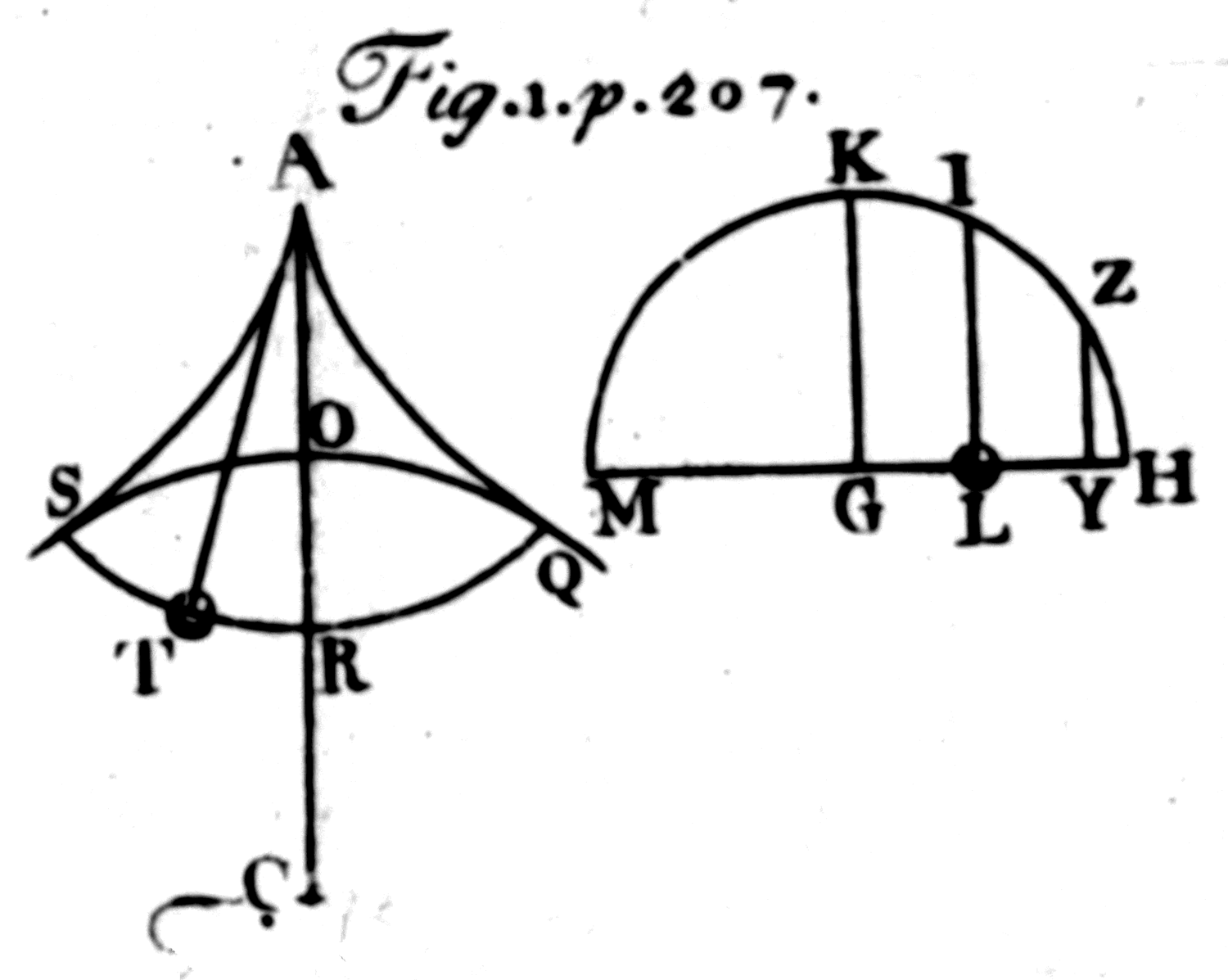
Let now any pendulous bodies oscillate in different cycloids described within different globes, whose absolute forces are also different; and if the absolute force of any globe QOS be called V, the accelerative force with which the pendulum is acted on in the circumference of this globe, when it begins to move directly towards its centre, will be as the distance of the pendulous body from that centre and the absolute force of the globe conjunctly, that is, as . Therefore the lineola HT which is as this accelerative force will be described in a given time; and if there be erected the perpendicular TZ meeting the circumference in Z, the nascent arc HZ will denote that given time. But that nascent arc HZ is in the subduplicate ratio of the rectangle GHT, and therefore as . Whence the time of an entire oscillation in the cycloid QRS (it being 209as the semi-periphery HKM which denotes that entire oscillation, directly; and as the arc HZ which in like manner denotes a given time inversely) will be as GH directly and inversely, that is, because GH and SR are equal, as , or (by cor. prop. 50.) as . Therefore the oscillations in all globes and cycloids, performed with what absolute forces soever, are in a ratio compounded of the subduplicate ratio of the length of the string directly, and the subduplicate ratio of the distance between the point of suspension and the centre of the globe inversely, and the subduplicate ratio of the absolute force of the globe inversely also. Q. E. I.
Cor. 1. Hence also the times of oscillating, falling, and revolving bodies may be compared among themselves. For if the diameter of the wheel with which the cycloid is described within the globe is supposed equal to the semi-diameter of the globe, the cycloid will become a right line passing through the centre of the globe, and the oscillation will be changed into a descent and subsequent ascent in that right line. Whence there is given both the time of the descent from any place to the centre, and the time equal to it in which the body revolving uniformly about the centre of the globe at any distance describes an arc of a quadrant. For this time (by case 2.) is to the time of half the oscillation in any cycloid QRS as 1 to .
Cor. 2. Hence also follow what Sir Christopher Wren and M. Huygens have discovered concerning 210the vulgar cycloid. For if the diameter of the globe be infinitely increased, its sphærical superficies will be changed into a plane, and the centripetal force will act uniformly in the direction of lines perpendicular to that plane, and this cycloid of ours will become the same with the common cycloid. But in that case the length of the arc of the cycloid between that plane and the describing point, will become equal to four times the versed sine of half the arc of the wheel between the same plane and the describing point as was discovered by Sir Christopher Wren. And a pendulum between two such cycloids will oscillate in a similar and equal cycloid in equal times as M. Huygens demonstrated. The descent of heavy bodies also in the time of one oscillation will be the same as M. Huygens exhibited.
The propositions here demonstrated are adapted to the true constitution of the Earth, in so far as wheels moving in any of its great circles will describe by the motions of nails fixed in their perimeters, cycloids without the globe; and pendulums in mines and deep caverns of the Earth must oscillate in cycloids within the globe, that those oscillations may be performed in equal times. For gravity (as will be shewn in the third book) decreases in its progress from the superficies of the Earth; upwards in a duplicate ratio of the distances from the centre of the earth, downwards in a simple ratio of the same.
Proposition LIII. Problem XXXV
211Granting the quadratures of curvilinear figures, it is required to find the forces with which bodies moving in given curve lines may always perform their oscillations in equal times.
Let the body T (Pl. 20. Fig. 2.) oscillate in any curve line STRQ, whose axis is AR passing through the centre of force C. Draw TX touching that curve in any place of the body T, and in that tangent TX take TY equal to the arc TR. The length of that arc is known from the common methods used for the quadratures of figures. From the point Y draw the right line YZ perpendicular to the tangent. Draw CT meeting that perpendicular in Z, and the centripetal force will be proportional to the right line TZ. Q. E. I.
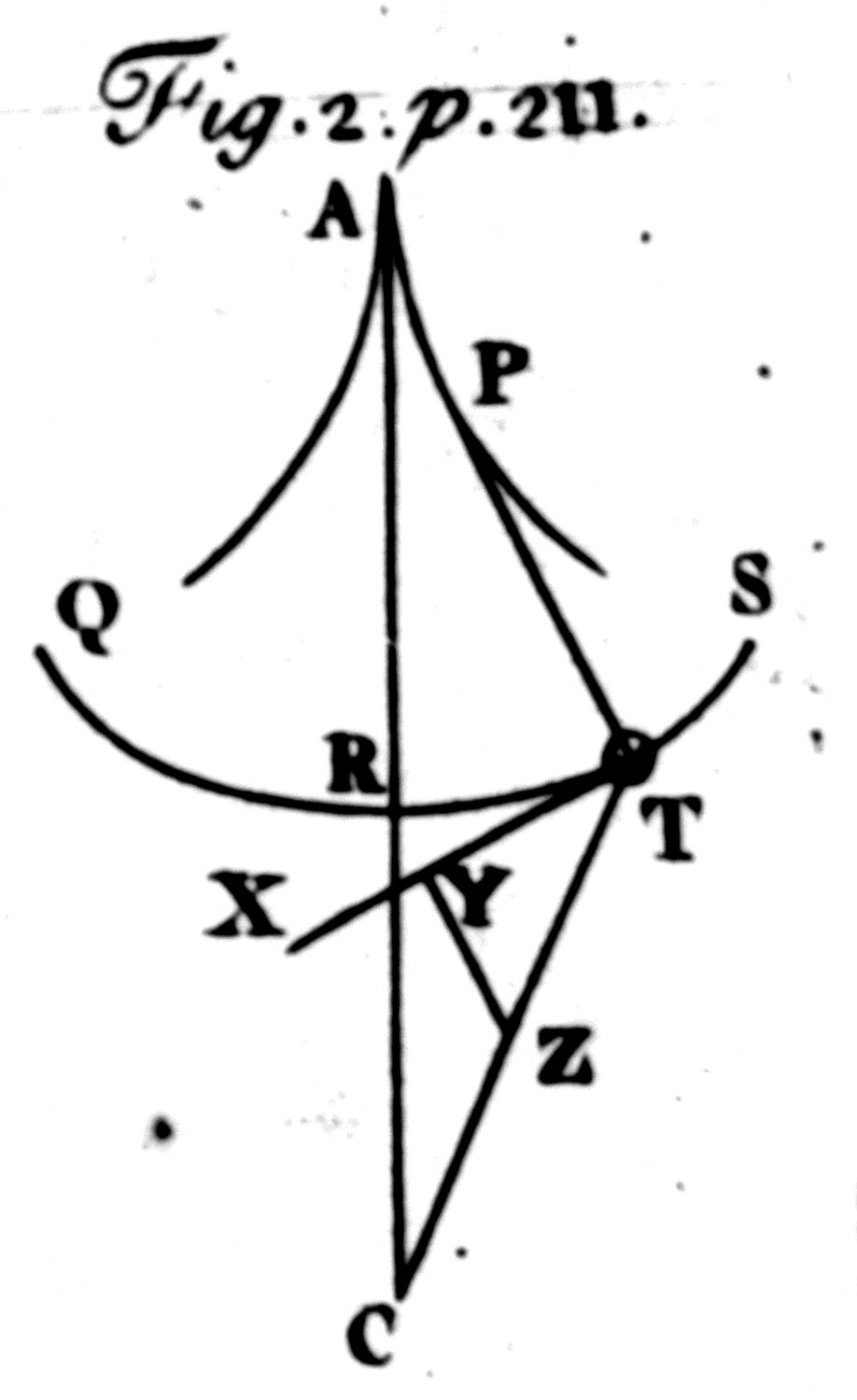
For if the force with which the body is attracted from T towards C be expressed by the right line TZ taken proportional to it, that force will be resolved into two forces TY, YZ, of which YZ drawing the body in the direction of the length of the thread PT does not at all change its motion; whereas the other force TY directly accelerates or retards its motion in the curve STRQ. Wherefore since that force is as the space to be described TR, the accelerations or retardations of the body in describing two proportional parts (a greater and a 212less) of two oscillations, will be always as those parts, and therefore will cause those parts to be described together. But bodies which continually describe together parts proportional to the wholes, will describe the wholes together also. Q. E. D.
Cor. 1. Hence if the body T (Pl. 20. Fig. 3.) hanging by a rectilinear thread AT from the centre A, describe the circular arc STRQ, and in the mean time be acted on by any force tending downwards with parallel directions, which is to the uniform force of gravity as the arc TR to its sine TN, the times of the several oscillations will be equal. For because TZ, AR are parallel, the triangles ATN, ZTY are similar; and therefore TZ will be to AT as TY to TN; that is, if the uniform force of gravity be expressed by the given length AT the force TZ by which the oscillations become isochronous, will be to the force of gravity AT, as the arc TR equal to TY is to TN the sine of that arc.
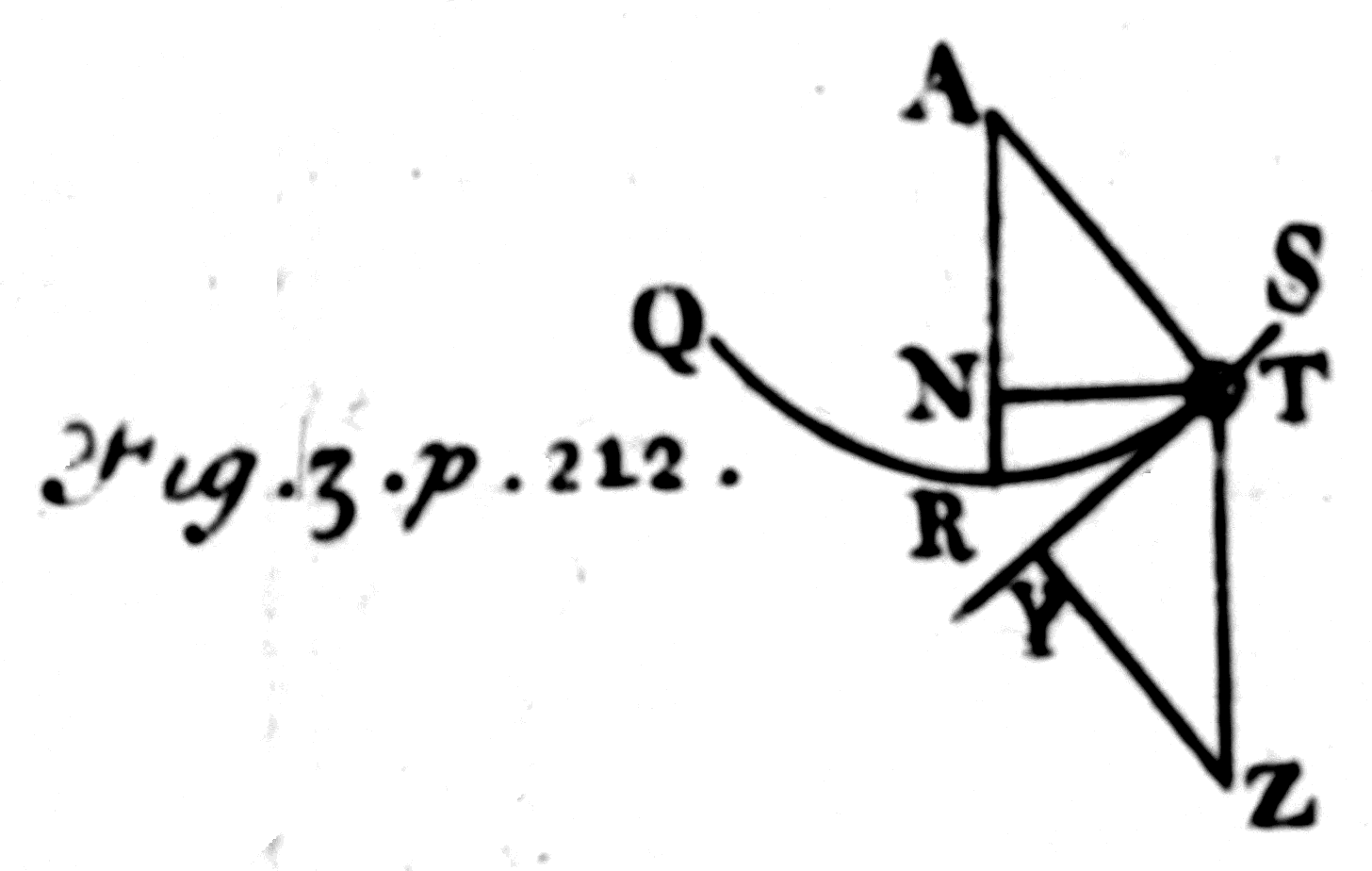
Cor. 2. And therefore in clocks, if forces were impressed by some machine upon the pendulum which preserves the motion, and so compounded with the force of gravity, that the whole force tending downwards should be always as a line produced by applying the rectangle under the arc TR and the radius AR to the line TN, all the oscillations will become isochronous.
Proposition LIV. Problem XXXVI
213Granting the quadratures of curvilinear figures, it is required to find the times, in which bodies by means of any centripetal force will descend or ascend in any curve lines described in a plane passing through the centre of force.
Let the body descend from any place S (Pl. 20. Fig. 4.) and move in any curve STtR, given in a plane passing through the centre of force C. Join CS, and let it be divided into innumerable equal parts, and let Dd be one of those parts. From the centre C, with the intervals CD, Cd, let the circles DT, dt be described, meeting the curve line STtR in T and t. And because the law of centripetal force is given, and also the altitude CS from which the body at first fell; there will be given the velocity of the body in any other altitude CT (by prop. 39.) But the time in which the body describes the lineola Tt is as the length of that lineola, that is, as the secant of the angle tTC directly, and the velocity inversely. Let the ordinate DN, proportional to this time, be made perpendicular to the right line CS at the point D, and because Dd is given, the rectangle that is, the area DNnd, will be proportional to the same time. Therefore if PNn be a curve line in which the point N is perpetually found, and its 214asymptote be the right line SQ standing upon the line CS at right angles, the area SQPND will be proportional to the time in which the body in its descent hath described the line ST; and therefore that area being found the time is also given. Q. E. I.
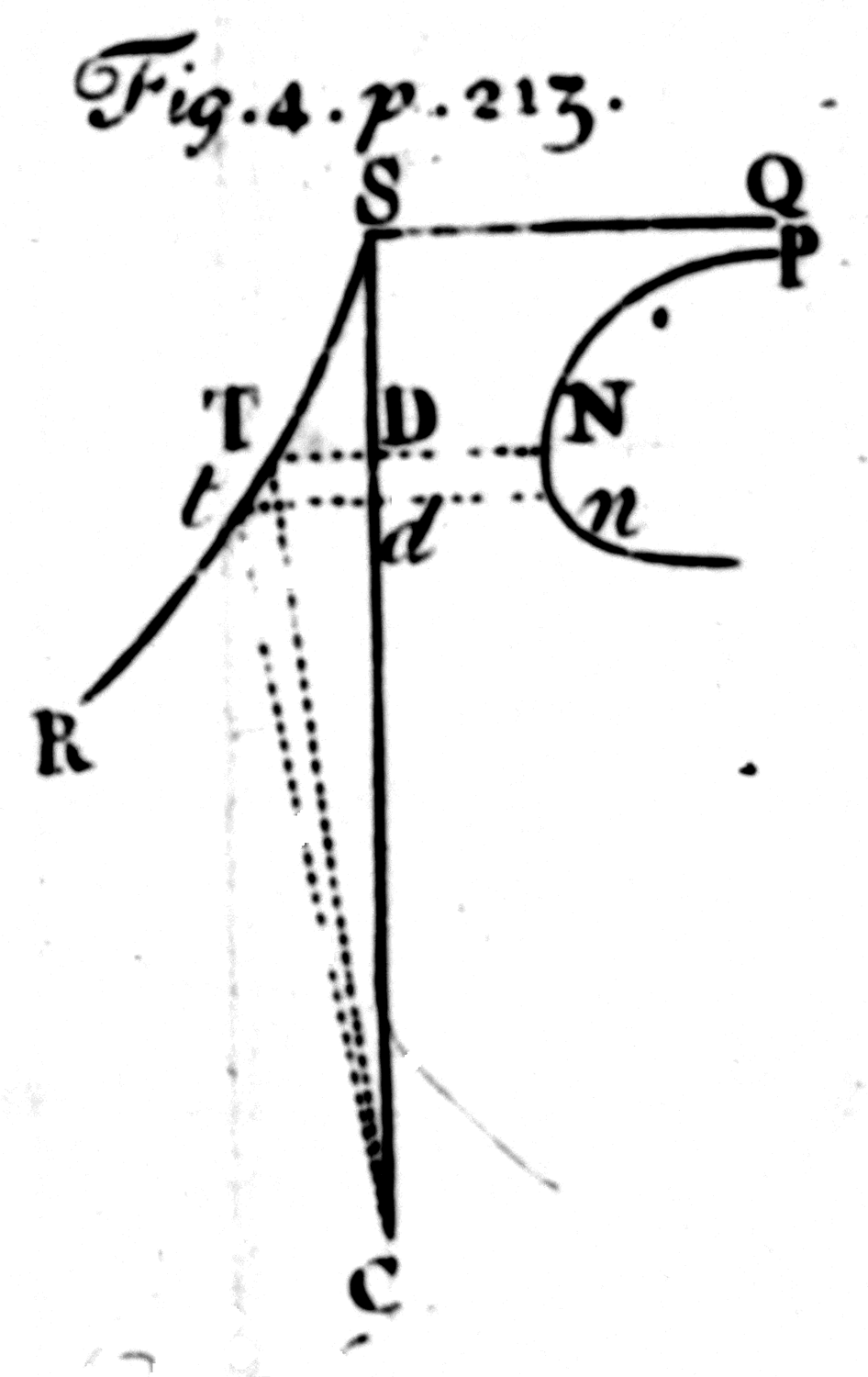
Proposition LV. Theorem XIX
If a body move in any curve superficies whose axis passes through the centre of force, and from the body a perpendicular be let fall upon the axis; and a line parallel and equal thereto be drawn from any given point of the axis; I say, that this parallel line will describe an area proportional to the time.
Let BKL (Pl. 20. Fig. 5.) be a curve superficies, T a body revolving in it, STR a trajectory which the body describes in the same, S the beginning of the trajectory, OMK the axis of the curve superficies, TN a right line let fall perpendicularly from the body to the axis; OP a line parallel and equal thereto drawn from the given point O in the axis; AP the orthographic projection of the trajectory described by the point P in the plane AOP in which the revolving line OP is found; A the beginning of that projection answering to the point S; TC a right line drawn from the body to the centre; TG a part 215thereof proportional to the centripetal force with which the body tends towards the centre C; TM a right line perpendicular to the curve superficies; TI a part thereof proportional to the force of pressure with which the body urges the superficies, and therefore with which it is again repelled by the superficies towards M; PTF a right line parallel to the axis and passing through the body, and GF, IH right lines let fall perpendicularly from the points G and I upon that parallel PHTF. I say now that the area AOP, described by the radius OP from the beginning of the motion is proportional to the time. For the force TG (by cor. 2. of the laws of motion) is resolved into the forces TF, FG; and the force TI into the forces TH, HI; but the forces TF, TH acting in the direction of the line PF perpendicular to the plane AOP, introduce no change in the motion of the body but in a direction perpendicular to that plane. Therefore its motion so far as it has the same direction with the position of the plane, that is, the motion of the point P, by which the projection AP of the trajectory is described in that plane, is the same as if the forces TF, TH were taken away, and the body were acted on by the forces FG, HI alone; that is, the same as if the body were to describe in the plane AOP the curve AP by means of a centripetal force tending to the centre O, and equal to the sum of the forces FG and HI. But with such a force as that (by prop. 1.) the area AOP will be described proportional to the time. Q. E. D.
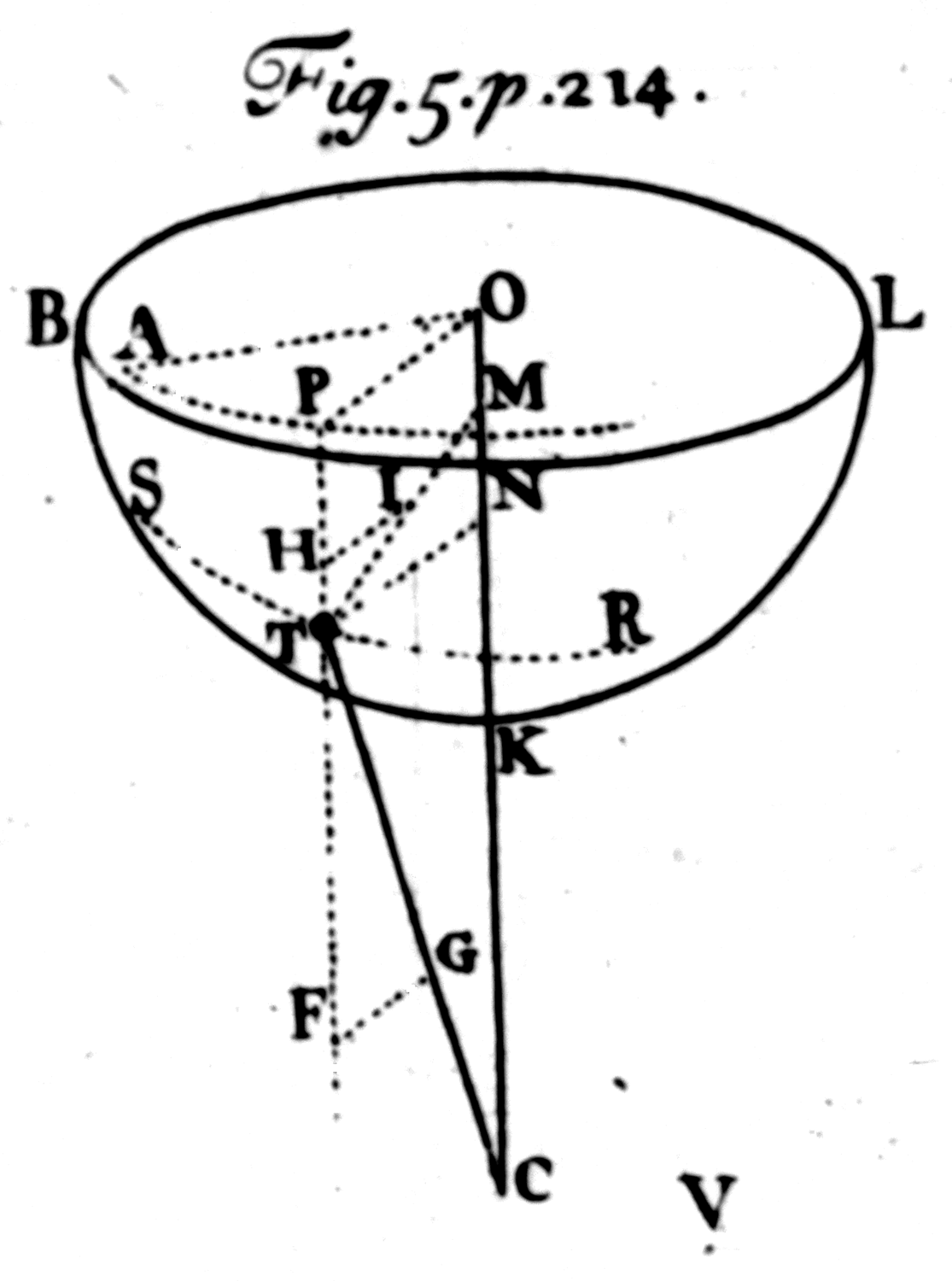
Cor. By the same reasoning if a body, acted on by forces tending to two or more centres in 216any the same right line CO, should describe in a free space any curve line ST; the area AOP would be always proportional to the time.
Proposition LVI. Problem XXXVII
Granting the quadratures of curvilinear figures and supposing that there are given both the law of centripetal force tending to a given centre, and the curve superficies whose axis passes through that centre; it is required to find the trajectory which a body will describe in that superficies, when going off from a given place with a given velocity, and in a given direction in that superficies.
The last construction remaining, let the body T go from the given place S (Pl. 20. Fig. 6.) in the direction of a line given by position, and turn into the trajectory sought STR whose orthographic projection in the plane BLO is AP. And from the given velocity of the body in the altitude SC, its velocity in any other altitude TC will be also given. With that velocity in a given moment of time let the body describe the particle Tt of its trajectory, and let Pp be the projection of that particle described in the plane AOP. Join Op, and a little circle being described upon the curve superficies about the centre T with the interval Tt, let the projection of that little circle in the plane 217AOP be the ellipsis pQ. And because the magnitude of that little circle Tt, and TN or PO its distance from the axis CO is also given, the ellipsis pQ will be given both in kind and magnitude, as also its position to the right line PO. And since the area POp is proportional to the time, and therefore given because the time is given the angle POp will, be given. And thence will be given p the common intersection of the ellipsis and the right line Op, together with the angle OPp in which the projection APp of the trajectory cuts the line OP. But from thence (by conferring prop. 41. with its 2d cor.) the manner of determining the curve APp easily appears. Then from the several points P of that projection erecting to the plane AOP the perpendiculars PT meeting the curve superficies in T, there will be given the several points T of the trajectory. Q. E. I.
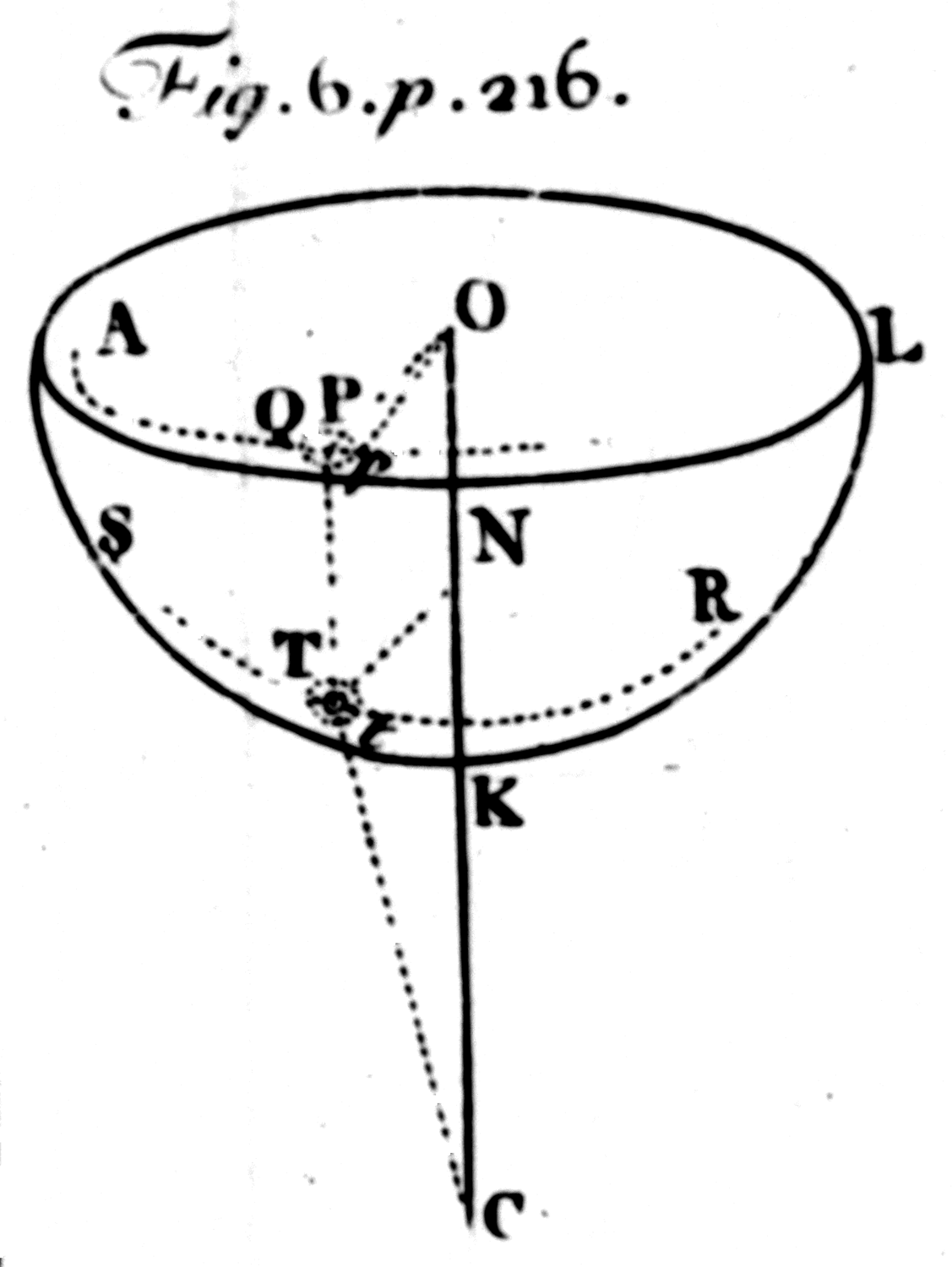
Section XI. Of the motions of bodies tending to each other with centripetal forces.
Section XI
218Of the motions of bodies tending to each other with centripetal forces.
I have hitherto been treating of the attractions of bodies towards an immoveable centre; tho' very probably there is no such thing existent in nature. For attractions are made towards bodies; and the actions of the bodies attracted and attracting, are always reciprocal and equal by law 3. so that if there are two bodies neither the attracted nor the attracting body is truly at rest, but both (by cor. 4. of the laws of motion) being as it were mutually attracted, revolve about a common centre of gravity. And if there be more bodies, which are either attracted by one single one which is attracted by them again, or which, all of them, attract each other mutually; these bodies will be so moved among themselves, as that their common centre of gravity will either be at rest, or move uniformly forward in a right line. I shall therefore at present go on to treat of the motion of bodies mutually attracting each other; considering the centripetal forces as attractions; though perhaps in a physical strictness they may more truly be called 219impulses. But these propositions are to be considered as purely mathematical; and therefore laying aside all physical considerations, I make use of a familiar way of speaking, to make my self the more easily understood by a mathematical reader.
Proposition LVII. Theorem XX
Two bodies attracting each other mutually, describe similar figures about their common centre of gravity, and about each other mutually.
For the distances of the bodies from their common centre of gravity are reciprocally as the bodies; and therefore in a given ratio to each other; and thence by composition of ratio's, in a given ratio to the whole distance between the bodies. Now these distances revolve about their common term with an equable angular motion, because lying in the same right line they never change their inclination to each other mutually. But right lines that are in a given ratio to each other, and revolve about their terms with an equal angular motion, describe upon planes, which either rest with those terms, or move with any motion not angular, figures entirely similar round those terms. Therefore the figures described by the revolution of these distances are similar. Q. E. D.
Proposition LVIII. Theorem XXI
220If two bodies attract each other mutually with forces of any kind, and in the mean time revolve about the common centre of gravity; I say that by the same forces there may be described round either body unmoved, a figure similar and equal to the figures which the bodies so moving describe round each other mutually.
Let the bodies S and P (Pl. 20. Fig. 7.) revolve about their common centre of gravity C. proceeding from S to T, and from P to Q. From the given point s, let there be continually drawn sp, sq, equal and parallel to SP, TQ; and the curve pqv, which the point p describes in its revolution round the immoveable point s, will be similar and equal to the curves, which the bodies S and P describe about each other mutually; and therefore by theor. 20. similar to the curves ST and PQV which the same bodies describe about their common centre of gravity C; and that because the proportions of the lines SC, CP, and SP or sp, to each other, are given.
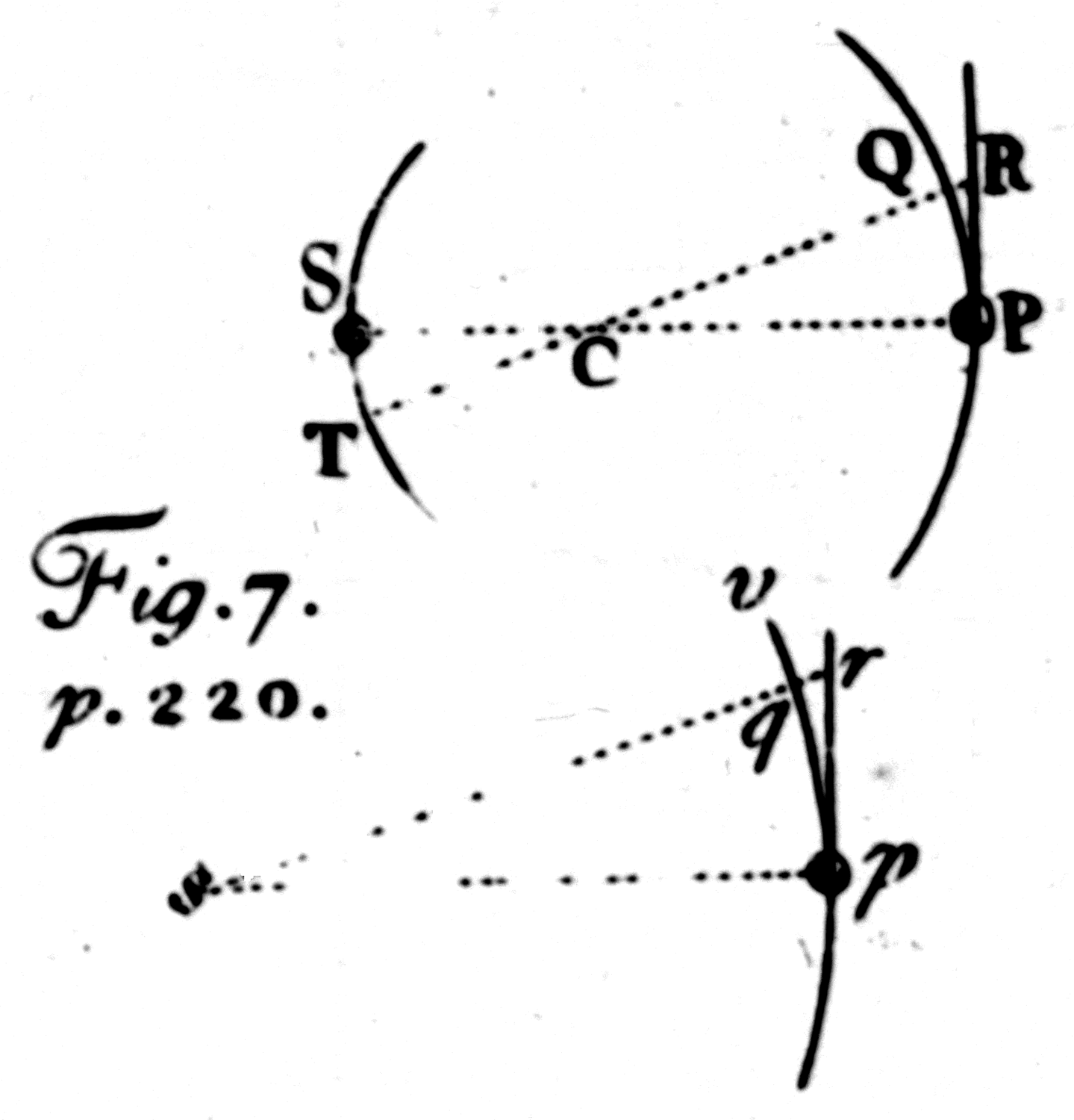
Case 1. The common centre of gravity C (by cor. 4. of the laws of motion) is either at rest, or moves uniformly in a right line. Let us first suppose it at rest, and in s and p let there be placed two bodies, one immoveable in s, the other 221moveable in p, similar and equal to the bodies S and P. Then let the right lines PR and pr touch the curves PQ and pq in P and p, and produce CQ and sq to R and r. And because the figures CPRQ, sprq are similar, RQ will be to rq as CP to sp, and therefore in a given ratio. Hence if the force with which the body P is attracted towards the body S, and by consequence towards the intermediate point the centre C, were to the force with which the body p is attracted towards the centre s, in the same given ratio; these forces would in equal times attract the bodies from the tangents PR, pr to the arcs PQ, pq, through the intervals proportional to them RQ, rq; and therefore this last force (tending to s) would make the body p revolve in the curve pqv, which would become similar to the curve PQV, in which the first force obliges the body P to revolve; and their revolutions would be compleated in the same times. But because those forces are not to each other in the ratio of CP to sp, but (by reason of the similarity and equality of the bodies S and s, P and p, and the equality of the distances SP, sp) mutually equal; the bodies in equal times will be equally drawn from the tangents; and therefore that the body p may be attracted through the greater interval rq, there is required a greater time, which will be in the subduplicate ratio of the intervals; because by lemma 10. the spaces described at the very beginning of the motion are in a duplicate ratio of the times. Suppose then the velocity of the body p to be to the velocity of the body P in a subduplicate ratio of the distance sp to the distance CP, so that the arcs pq, PQ, which are in a simple proportion to each other, 222may be described in times that are in a subduplicate ratio of the distances; and the bodies P, p, always attracted by equal forces will describe round the quiescent centres C and s similar figures PQV, pqv, the latter of which pqv is similar and equal to the figure which the body P describes round the moveable body. Q. E. D.
Case 2. Suppose now that the common centre of gravity together with the space in which the bodies are moved among themselves, proceeds uniformly in a right line; and (by cor. 6. of the laws of motion) all the motions in this space will be performed in the same manner as before; and therefore the bodies will describe mutually about each other the same figures as before, which will be therefore similar and equal to the figure pqv. Q. E. D.
Cor. 1. Hence two bodies attracting each other with forces proportional to their distance, describe (by prop. 10.) both round their common centre of gravity, and round each other mutually, concentrical ellipses; and vice versa if such figures are described, the forces are proportional to the distances.
Cor. 2. And two bodies, whose forces are reciprocally proportional to the square of their distance, describe, (by prop. 11, 12, 13.) both round their common centre of gravity and round each other mutually, conic sections having their focus in the centre about which the figures are described. And vice versa, if such figures are described, the centripetal forces are reciprocally proportional to the squares of the distance.
Cor. 3. Any two bodies revolving round their common centre of gravity, describe areas proportional to 223the times, by radii drawn both to that centre and to other mutually.
Proposition LIX. Theorem XXII
The periodic time of two bodies S and P revolving round their common centre of gravity C, is to the periodic time of one of the bodies P revolving round the other S remaining unmoved, and describing a figure similar and equal to those which the bodies describe about each other mutually, in a subduplicate ratio of the other body S to the sum of the bodies .
For by the demonstration of the last proposition, the times in which any similar arcs PQ and pq are described, are in a subduplicate ratio of the distances CP and SP or sp, that is in a subduplicate ratio of the body S to the sum of the bodies . And by composition of ratio's the sums of the times in which all the similar arcs PQ and pq are described, that is, the whole times in which the whole similar figures are described, are in the same subduplicate ratio. Q. E. D.
Proposition LX. Theorem XXIII
224If two bodies S and P, attracting each other with forces reciprocally proportional to the squares of their distance, revolve about their common centre of gravity; I say that the principal axis of the ellipsis which either of the bodies as P describes by this motion about the other S, will be to the principal axis of the ellipsis, which the same body P may describe in the same periodical time about the other body S quiescent, as the sum of the two bodies to the first of two mean proportionals between that sum and the other body S.
For if the ellipses described were equal to each other, their periodic times by the last theorem would be in a subduplicate ratio of the body S to the sum of the bodies . Let the periodic time in the latter ellipsis be diminished in that ratio, and the periodic times will become equal; but by prop. 15. the principal axis of the ellipsis will be diminished in a ratio sesquiplicate to the former ratio; that is in a ratio, to which the ratio of S to is triplicate; and therefore that axis will be to the principal axis of the other ellipsis, as the first of two mean proportionals between 225 and S to . And inversely the principal axis of the ellipsis described about the moveable body, will be to the principal axis of that described round the immoveable, as to the first of two mean proportionals between and S. Q. E. D.
Proposition LXI. Theorem XXIV
If two bodies attracting each other with any kind of forces, and not otherwise agitated or obstructed, are moved in any manner whatsoever; those motions will be the same, as if they did not at all attract each other mutually, but were both attracted with the same forces by a third body placed in their common centre of gravity; and the law of the attracting forces will be the same in respect of the distance of the bodies from the common centre, as in respect of the distance between the two bodies.
For those forces with which the bodies attract each other mutually, by tending to the bodies tend also to the common centre of gravity lying directly between them; and therefore are the same as if they proceeded from an intermediate body. Q. E. D.
226And because there is given the ratio of the distance of either body from that common centre to the distance between the two bodies, there is given of course the ratio of any power of one distance to the same power of the other distance; and also the ratio of any quantity derived in any manner from one of the distances compounded any how with given quantities, to another quantity, derived in like manner from the other distance, and as many given quantities having that given ratio of the distances to the first. Therefore if the force with which one body is attracted by another be directly or inversely as the distance of the bodies from each other, or as any power of that distance; or lastly as any quantity derived after any manner from that distance compounded with given quantities; then will the same force with which the same body is attracted to the common centre of gravity, be in like manner directly or inversely as the distance of the attracted body from the common centre, or as any power of that distance, or lastly as a quantity derived in like sort from that distance compounded with analogous given quantities. That is, the law of attracting force will be the same with respect to both distances. Q. E. D.
Proposition LXII. Problem XXXVIII
227To determine the motions of two bodies which attract each other with forces reciprocally proportional to the squares of the distance between them, and are let fall from given places.
The bodies, by the last theorem, will be moved in the same manner as if they were attracted by a third placed in the common centre of their gravity; and by the hypothesis that centre will be quiescent at the beginning of their motion, and therefore (by cor. 4. of the laws of motion) will be always quiescent. The motions of the bodies are therefore to be determined (by prob. 25.) in the same manner as if they were impelled by forces tending to that centre; and then we shall have the motions of the bodies attracting each other mutually. Q. E. I.
Proposition LXIII. Problem XXXIX
To determine the motions of two bodies attracting each other with forces reciprocally proportional to the squares of their distance, and going off from given places in given directions, with given velocities.
The motions of the bodies at the beginning being given, there is given also the uniform motion 228of the common centre of gravity, and the motion of the space which moves along with this centre uniformly in a right line, and also the very first, or beginning motions of the bodies in respect of this space. Then (by cor. 5. of the laws, and the last theorem) the subsequent motions will be performed in the same manner in that space, as if that space together with the common centre of gravity were at rest, and as if the bodies did not attract each other; but were attracted by a third body placed in that centre. The motion therefore in this moveable space of each body going off from a given place, in a given direction, with a given velocity, and acted upon by a centripetal force tending to that centre, is to be determined by prob. 9. and 26. and at the same time will be obtained the motion of the other round the same centre. With this motion compound the uniform progressive motion of the entire system of the space and the bodies revolving in it, and there will be obtained the absolute motion of the bodies in immoveable space. Q. E. I.
Proposition LXIV. Problem XL
Supposing forces with which bodies mutually attract each other to increase in a simple ratio of their distances from the centres; it is required to find the motions of several bodies among themselves.
Suppose the two first bodies T and L (Pl. 21. Fig. 1.) to have their common centre of gravity 229in D. These by cor. 1. theor. 21. will describe ellipses having their centres in D, the magnitudes of which ellipses are known by prob. 5.
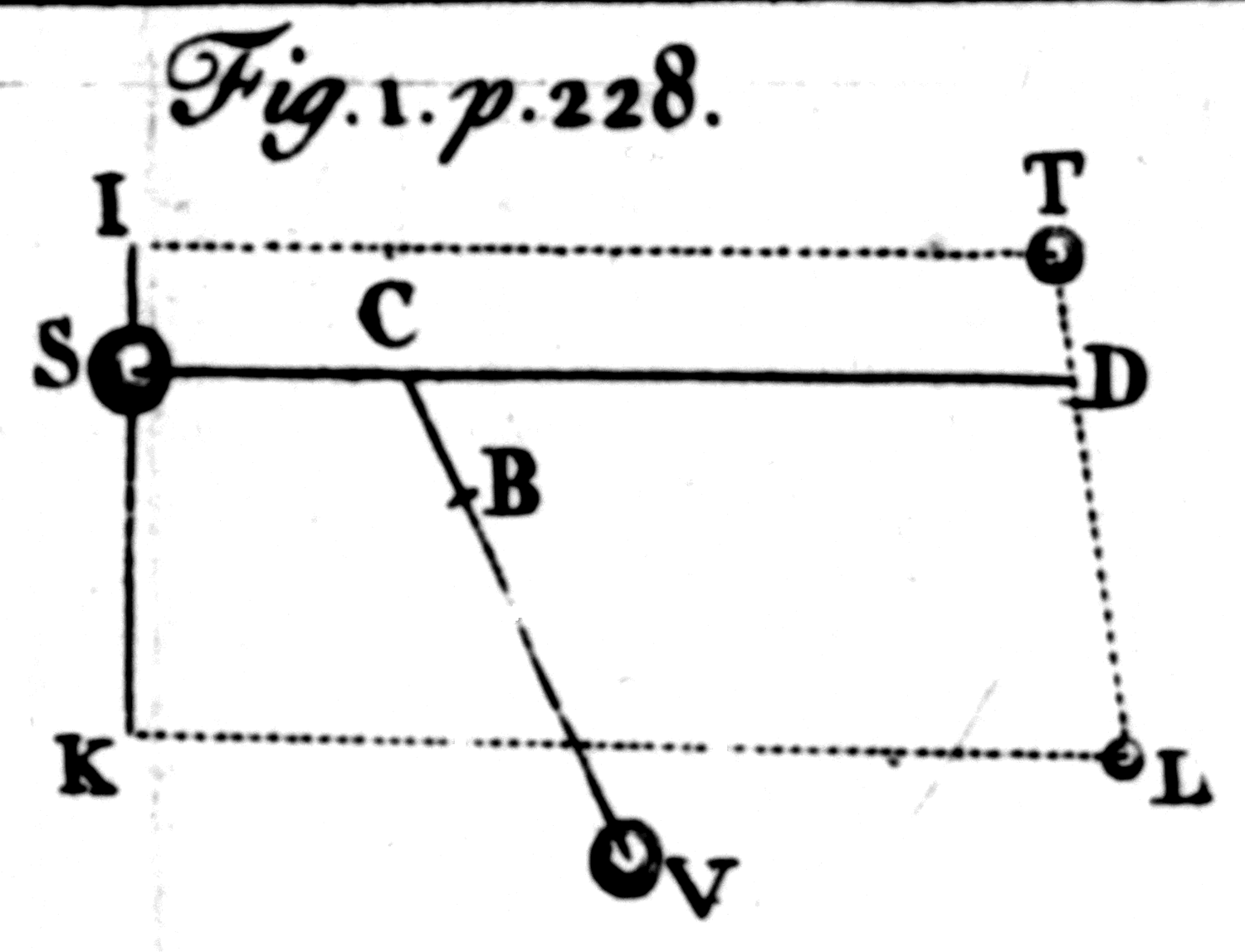
Let now a third body S attract the two former T and L with the accelerative forces ST, SL, and let it be attracted again by them. The force ST (by cor. 2. of the laws of motion) is resolved into the forces SD, DT; and the force SL into the forces SD and DL. Now the forces DT, DL, which are as their sum TL, and therefore as the accelerative forces with which the bodies T and L attract each other mutually, added to the forces of the bodies T and L, the first to the first, and the last to the last, compose forces proportional to the distances DT and DL as before, but only greater than those former forces; and therefore (by cor. 1. prop. 10. and cor. 1. and 8. prop. 4.) they will cause those bodies to describe ellipses as before, but with a swifter motion. The remaining accelerative forces SD and SD, by the motive forces, and which are as the bodies, attracting those bodies equally, and in the direction of the lines TI, LK parallel to DS, do not at all change their situations with respect to one another, but cause them equally to approach to the line IK; which must be imagined drawn through the middle of the body S, and perpendicular to the line DS. But that approach to the line IK will be hindered by causing the system of the bodies T and L on one side, and the body S on the other with proper velocities to revolve round the common centre of gravity C. With such a motion the body S, because the sum of the motive forces and proportional to the distance CS, tends to the centre C, 230will describe an ellipsis round the same centre C; and the point D, because the lines CS and CD are proportional, will describe a like ellipsis over-against it. But the bodies T and L, attracted by the motive forces and , the first by the first, and the last by the last equally and in the direction of the parallel lines TI and LK as was said before, will (by cor. 5. and 6. of the laws of motion) continue to describe their ellipses round the moveable centre D as before. Q. E. I.
Let there be added a fourth body V, and by the like reasoning it will be demonstrated that this body and the point C will describe ellipses about the common centre of gravity B; the motions of the bodies T, L, and S round the centres D and C remaining the same as before; but accelerated. And by the same method one may add yet more bodies at pleasure. Q. E. I.
This would be the case, though the bodies T and L attract each other mutually with accelerative forces either greater or less than those with which they attract the other bodies in proportion to their distance. Let all the mutual accelerative attractions be to each other as the distances multiplyed into the attracting bodies; and from what has gone before it will easily be concluded that all the bodies will describe different ellipses with equal periodical times about their common centre of gravity B, in an immoveable plane. Q. E. I.
Proposition LXV. Theorem XXV
231Bodies, whose forces decrease in a duplicate ratio of their distances from their centres, may move among themselves in ellipses; and by radii drawn to the foci may describe area's proportional to the times very nearly.
In the last proposition we demonstrated that case in which the motions will be performed exactly in ellipses. The more distant the law of the forces is from the law in that case, the more will the bodies disturb each others motions; neither is it possible that bodies attracting each other mutually according to the law supposed in this proposition should move exactly in ellipses unless by keeping a certain proportion of distances from each other. However in the following cases the orbits will not much differ from ellipses.
Case 1. Imagine several lesser bodies to revolve about some very great one at different distances from it, and suppose absolute forces tending to every one of the bodies, proportional to each. And because (by cor. 4. of the laws) the common centre of gravity of them all is either at rest or moves uniformly forward in a right line, suppose the lesser bodies so small that the great body may be never at a sensible distance from that centre; and then the great body will, without any sensible 232error, be either at rest or move uniformly forward in a right line; and the lesser will revolve about that great one in ellipses, and by radij drawn thereto will describe areas proportional to the times; if we except the errors that may be introduced by the receding of the great body from the common centre of gravity, or by the mutual actions of the lesser bodies upon each other. But the lesser bodies may be so far diminished, as that this recess and the mutual actions of the bodies on each other may become less than any assignable; and therefore so as that the orbits may become ellipses, and the areas answer to the times, without any error that is not less than any assignable. Q. E. O.
Case 2. Let us imagine a system of lesser bodies revolving about a very great one in the manner just described, or any other system of two bodies revolving about each other to be moving uniformly forward in a right line, and in the mean time to be impelled side-ways by the force of another vastly greater body situate at a great distance. And because the equal accelerative forces with which the bodies are impelled in parallel directions do not change the situation of the bodies with respect to each other, but only oblige the whole system to change its place while the parts still retain their motions among themselves; it is manifest, that no change in those motions of the attracted bodies can arise from their attractions towards the greater, unless by the inequality of the accelerative attractions, or by the inclinations of the lines towards each other, in whose directions the attractions are made. Suppose therefore all the accelerative attractions made towards the great body to be among themselves 233as the squares of the distances reciprocally; and then, by increasing the distance of the great body till the differences of the right lines drawn from that to the others in respect of their length, and the inclinations of those lines to each other, be less than any given, the motions of the parts of the system will continue without errors that are not less than any given. And because by the small distance of those parts from each other, the whole system is attracted as if it were but one body, it will therefore be moved by this attraction as if it were one body; that is, its centre of gravity will describe about the great body one of the conic sections (that is, a parabola or hyperbola when the attraction is but languid, and an ellipsis when it is more vigorous) and by radij drawn thereto it will describe area's proportional to the times, without any errors but those which arise from the distances of the parts, which are by the supposition exceeding small, and may be diminished at pleasure. Q. E. O.
By a like reasoning one may proceed to more compounded cases in infinitum.
Cor. 1. In the second case, the nearer the very great body approaches to the system of two or more revolving bodies, the greater will the perturbation be of the motions of the parts of the system among themselves; because the inclinations of the lines drawn from that great body to those parts become greater; and the inequality of the proportion is also greater.
Cor. 2. But the perturbation will be greatest of all, if we suppose the accelerative attractions of the parts of the system towards the greatest body of all are not to each other reciprocally as the 234squares of the distances from that great body; especially if the inequality of this proportion be greater than the inequality of the proportion of the distances from the great body. For if the accelerative force, acting in parallel directions and equally, causes no perturbation in the motions of the parts of the system, it must of course, when it acts unequally, cause a perturbation somewhere, which will be greater or less as the inequality is greater or less. The excess of the greater impulses acting upon some bodies, and not acting upon others, must necessarily change their situation among themselves. And this perturbation, added to the perturbation arising from the inequality and inclination of the lines, makes the whole perturbation greater.
Cor. 3. Hence if the parts of this system move in ellipses or circles without any remarkable perturbation; it is manifest, that if they are at all impelled by accelerative forces tending to any other bodies, the impulse is very weak, or else is impressed very near equally and in parallel directions upon all of them.
Proposition LXVI. Theorem XXVI
If three bodies whose forces decrease in a duplicate ratio of the distances, attract each other mutually; and the accelerative attractions of any two towards the third be between themselves reciprocally as the squares of the distances; and the two least revolve 235about the greatest; I say that the interior of the two revolving bodies will, by radij drawn to the innermost and greatest, describe round that body, area's more proportional to the times, and a figure more approaching to that of an ellipsis having its focus in the point of concourse of the radij, if that great body be agitated by those attractions, than it would do if that great body were not attracted at all by the lesser, but remained at rest; or than it would if that great body were very much more or very much less attracted, or very much more or very much less agitated by the attractions.
This appears plainly enough from the demonstration of the second corollary of the foregoing proposition; but it may be made out after this manner by a way of reasoning more distinct and more universally convincing.
Case 1. Let the lesser bodies P and S (Pl. 21, Fig. 2.) revolve in the same plane about the greatest body T, the body P describing the interior orbit PAB, and S the exterior orbit ESE. Let SK be the mean distance of the bodies P and S; and let the accelerative attraction of the body P towards S, at that mean distance, be expressed by that line SK. Make SL to SK as the square of SK to the square of SP, and SL 236will be the accelerative attraction of the body P towards S at any distance SP. Join PT and draw LM parallel to it meeting ST in M; and the attraction SL will be resolved (by cor. 2. of the laws of motion) into the attractions SM, LM. And so the body P will be urged with a threefold accelerative force. One of these forces tends towards T, and arises from the mutual attraction of the bodies T and P. By this force alone the body P would describe round the body T, by the radius PT, areas proportional to the times, and an ellipsis whose focus is in the centre of the body T; and this it would do whether the body T remained unmoved, or whether it were agitated by that attraction. This appears from prop. 11. and cor. 2 & 3 of theor. 21. The other force is that of the attraction LM, which because it tends from P to T, will be super-added to and coincide with the former force; and cause the area's to be still proportional to the times, by cor. 3. theor. 21. But because it is not reciprocally proportional to the square of the distance PT, it will compose when added to the former, a force varying from that proportion; which variation will be the greater, by how much the proportion of this force to the former is greater, cæteris paribus. Therefore since by prop. 11. and by cor. 2. theor. 21. the force with which the ellipsis is described about the focus T ought to be directed to that focus; and to be reciprocally proportional to the square of the distance PT; that compounded force varying from that proportion will make the orbit PAB vary from the figure of an ellipsis that has its focus in the point T; and so much the more by how much the variation from that proportion is greater; 237and by consequence by how much the proportion of the second force LM to the first force is greater, cæteris paribus. But now the third force SM, attracting the body P in a direction parallel to ST; composes with the other forces a new force which is no longer directed from P to T; and which varies so much more from this direction, by how much the proportion of this third force to the other forces is greater cæteris paribus; and therefore causes the body P to describe, by the radius TP, area's no longer proportional to the times; and therefore makes the variation from that proportionality so much greater by how much the proportion of this force to the others is greater. But this third force will increase the variation of the orbit PAB from the elliptical figure before mentioned upon two accounts; first because that force is not directed from P to T; and secondly because it is not reciprocally proportional to the square of the distance PT. These things being premised, it is manifest, that the area's are then most nearly proportional to the times, when that third force is the least possible, the rest preserving their former quantity; and that the orbit PAB does then approach nearest to the elliptical figure above-mentioned, when both the second and third, but especially the third force, is the least possible; the first force remaining in its former quantity.
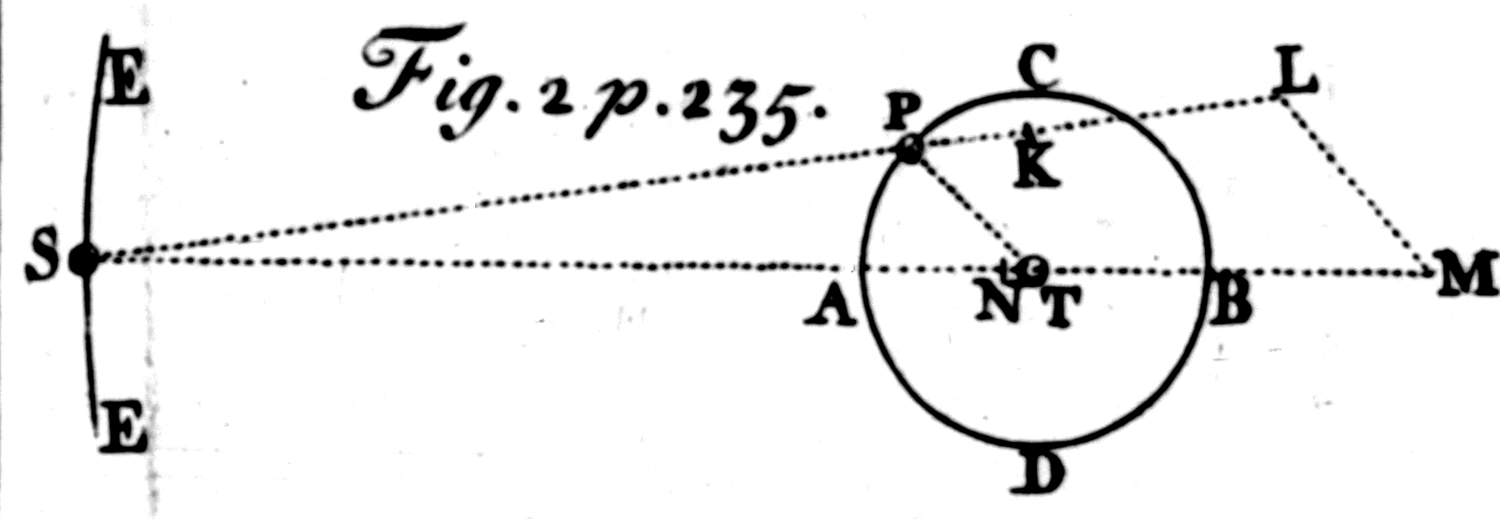
Let the accelerative attraction of the body T towards S be expressed by the line SN; then if the accelerative attractions SM and SN were equal, these, attracting the bodies T and P equally and in parallel directions, would not at all change their situation with respect to each other. The motions of the bodies between themselves would be the 238same in that case as if those attractions did not act at all, by cor. 6. of the laws of motion. And by a like reasoning if the attraction SN is less than the attraction SM, it will take away out of the attraction SM the part SN, so that there will remain only the part (of the attraction) MN, to disturb the proportionality of the area's and times, and the elliptical figure of the orbit. And in like manner if the attraction SN be greater than the attraction SM, the perturbation of the orbit and proportion will be produced by the difference MN alone. After this manner the attraction SN reduces always the attraction SM to the attraction MN, the first and second attractions remaining perfectly unchanged; and therefore the area's and times come then nearest to proportionality, and the orbit PAB to the above-mentioned elliptical figure, when the attraction MN is either none, or the least that is possible; that is, when the accelerative attractions of the bodies P and T approach as near as possible to equality; that is, when the attraction SN is neither none at all, nor less than the least of all the attractions SM, but is as it were a mean between the greatest and least of all those attractions SM, that is, not much greater nor much less than the attraction SK. Q. E. D.
Case. 2. Let now the lesser bodies P, S, revolve about a greater T in different planes; and the force LM acting in the direction of the line PT situate in the plane of the orbit PAB, will have the same effect as before; neither will it draw the body P from the plane of its orbit. But the other force NM acting in the direction of a line parallel to ST (and which therefore when the body S is without the line of the nodes is inclined 239to the plane of the orbit PAB) besides the perturbation of the motion just now spoken of as to longitude, introduces another perturbation also as to latitude, attracting the body P out of the plane of its orbit. And this perturbation, in any given situation of the bodies P and T to each other, will be as the generating force MN; and therefore becomes least when the force MN is least, that is, (as was just now shewn) where the attraction SN is not much greater nor much less than the attraction SK. Q. E. D.
Cor. 1. Hence it may be easily collected, that if several less bodies P, S, R, &c. revolve about a very great body T; the motion of the innermost revolving body P will be least disturbed by the attractions of the others, when the great body is as well attracted and agitated by the rest (according to the ratio of the accelerative forces) as the rest are by each other mutually.
Cor. 2. In a system of three bodies T, P, S, if the accelerative attractions of any two of them towards a third be to each other reciprocally as the squares of the distances; the body P, by the radius PT, will describe its area swifter near the conjunction A and the opposition B, than it will near the quadratures C and D. For every force with which the body P is acted on and the body T is not, and which does not act in the direction of the line PT, does either accelerate or retard the description of the area, according as it is directed, whether in consequentia or in antecedentia. Such is the force NM. This force in the passage of the body P from C to A is directed in consequentia to its motion, and therefore accelerates it; then as far as D in antecedentia, and retards 240the motion; then in consequentia as far as B; and lastly in antecedentia as it moves from B to C.
Cor. 3. And from the same reasoning it appears that the body P, cæteris paribus, moves more swiftly in the conjunction and opposition than in the quadratures.
Cor. 4. The orbit of the body P, cæteris paribus, is more curve at the quadratures than at the conjunction and opposition. For the swifter bodies move, the less they deflect from a rectilinear path. And besides the force KL, or NM, at the conjunction and opposition, is contrary to the force with which the body T attracts the body P; and therefore diminishes that force; but the body P will deflect the less from a rectilinear path the less it is impelled towards the body T.
Cor. 5. Hence the body P cæteris paribus goes farther from the body T at the quadratures than at the conjunction and opposition. This is said however, supposing no regard had to the motion of eccentricity. For if the orbit of the body P be eccentrical, its eccentricity (as will be shewn presently by cor. 9.) will be greatest when the apsides are in the syzygies; and thence it may sometimes come to pass, that the body P in its approach to the farther apsis, may go farther from the body T at the syzygies, than at the quadratures.
Cor. 6. Because the centripetal force of the central body T, by which the body P is retained in its orbit, is increased at the quadratures by the addition caused by the force LM, and diminished at the syzygies by the subduction caused by the force KL; and by reason the force KL is greater 241than LM is more diminished than increased; and moreover since that centripetal force (by cor. 1. prop. 4.) is in a ratio compounded of the simple ratio of the radius TP directly, and the duplicate ratio of the periodical time inversely; it is plain that this compounded ratio is diminished by the action of the force KL; and therefore that the periodical time, supposing the radius of the orbit PT to remain the same, will be increased, and that in the subduplicate of that ratio in which the centripetal force is diminished; and therefore supposing this radius increased or diminished, the periodical time will be increased more or diminished less than in the sesquiplicate ratio of this radius, by cor. 6. prop. 4. If that force of the central body should gradually decay, the body P being less and less attracted would go farther and farther from the centre T; and on the contrary if it were increased it would draw nearer to it. Therefore if the action of the distant body S, by which that force is diminished, were to increase and decrease by turns; the radius TP will be also increased and diminished by turns; and the periodical time will be increased and diminished in a ratio compounded of the sesquiplicate ratio of the radius, and of the subduplicate of that ratio in which the centripetal force of the central body T is diminished or increased by the increase or decrease of the action of the distant body S.
Cor. 7. It also follows from what was before laid down, that the axis of the ellipsis described by the body P, or the line of the apsides, does as to its angular motion go forwards and backwards by turns, but more forwards than backwards, and by the excess of its direct motion, is in the whole 242carried forwards. For the force with which the body P is urged to the body T at the quadratures, where the force MN vanishes, is compounded of the force LM and the centripetal force with which the body T attracts the body P. The first force LM, if the distance PT be increased, is increased in nearly the same proportion with that distance, and the other force decreases in the duplicate ratio of that distance; and therefore the sum of these two forces decreases in a less than the duplicate ratio of the distance PT, and therefore by cor. 1. prop. 45. will make the line of the apsides, or, which is the same thing, the upper apsis, to go backward. But at the conjunction and opposition the force with which the body P is urged towards the body T is the difference of the force KL, and of the force with which the body T attracts the body P; and that difference, because the force KL is very nearly increased in the ratio of the distance PT, decreases in more than the duplicate ratio of the distance PT; and therefore by cor. 1. prop. 45. causes the line of the apsides to go forwards. In the places between the syzygies and the quadratures, the motion of the line of the apsides depends upon both these causes conjunctly, so that it either goes forwards or backwards in proportion to the excess of one of these causes above the other. Therefore since the force KL in the syzygies is almost twice as great as the force LM in the quadratures, the excess will be on the side of the force KL, and by consequence the line of the apsides will be carried forwards. The truth of this and the foregoing corollary will be more easily understood by conceiving the system of the two bodies T and P, to be surrounded on 243every side by several bodies S, S, S, &c. disposed about the orbit ESE. For by the actions of these bodies the action of the body T will be diminished on every side, and decrease in more than a duplicate ratio of the distance.
Cor. 8. But since the progress or regress of the apsides depends upon the decrease of the centripetal force, that is, upon its being in a greater or less ratio than the duplicate ratio of the distance TP, in the passage of the body from the lower apsis to the upper; and upon a like increase in its return to the lower apsis again; and therefore becomes greatest where the proportion of the force at the upper apsis to the force at the lower apsis recedes farthest from the duplicate ratio of the distances inversely; it is plain that when the apsides are in the syzygies, they will, by reason of the subducting force KL or , go forward more swiftly; and in the quadratures by the additional force LM go backward more slowly. Because the velocity of the progress or slowness of the regress is continued for a long time, this inequality becomes exceeding great.
Cor. 9. If a body is obliged, by a force reciprocally proportional to the square of its distance from any centre, to revolve in an ellipsis round that centre; and afterwards in its descent from the upper apsis to the lower apsis, that force by a perpetual accession of new force is increased in more than a duplicate ratio of the diminished distance; it is manifest that the body being impelled always towards the centre by the perpetual accession of this new force, will incline more towards that centre than if it were urged by that force alone which decreases in a duplicate ratio of the 244diminished distance; and therefore will describe an orbit interior to that elliptical orbit, and at the lower apsis approaching nearer to the centre than before. Therefore the orbit by the accession of this new force will become more eccentrical. If now, while the body is returning from the lower to the upper apsis, it should decrease by the same degrees by which it increased before, the body would return to its first distance; and therefore if the force decreases in a yet greater ratio, the body, being now less attracted than before, will ascend to a still greater distance, and so the eccentricity of the orbit will be increased still more. Therefore if the ratio of the increase and decrease of the centripetal force be augmented each revolution, the eccentricity will be augmented also; and on the contrary, if that ratio decrease it will be diminished. Now therefore in the system of the bodies T, P, S, when the apsides of the orbit PAB are in the quadratures, the ratio of that increase and decrease is least of all, and becomes greatest when the apsides are in the syzygies. If the apsides are placed in the quadratures, the ratio near the apsides is less, and near the syzygies greater, than the duplicate ratio of the distances, and from that greater ratio arises a direct motion of the line of the apsides, as was just now said. But if we consider the ratio of the whole increase or decrease in the progress between the apsides, this is less than the duplicate ratio of the distances. The force in the lower is to the force in the upper apsis, in less than a duplicate ratio of the distance of the upper apsis from the focus of the ellipsis to the distance of the lower apsis from the same focus; and contrary wise, when the apsides are placed in the syzygies the 245force in the lower apsis is to the force in the upper apsis in a greater than a duplicate ratio of the distances. For the forces LM in the quadratures added to the forces of the body T compose forces in a less ratio, and the forces KL in the syzygies subducted from the forces of the body T leave the forces in a greater ratio. Therefore the ratio of the whole increase and decrease in the passage between the apsides, is least at the quadratures and greatest at the syzygies; and therefore in the passage of the apsides from the quadratures to the syzygies it is continually augmented, and increases the eccentricity of the ellipsis; and in the passage from the syzygies to the quadratures it is perpetually decreasing, and diminishes the eccentricity.
Cor. 10. That we may give an account of the errors as to latitude, let us suppose the plane of the orbit EST to remain immovable; and from the cause of the errors above explained it is manifest, that of the two forces NM, ML, which are the only and entire cause of them, the force ML acting always in the plane of the orbit PAB never disturbs the motions as to latitude; and that the force NM, when the nodes are in the syzygies, acting also in the same plane of the orbit, does not at that time affect those motions. But when the nodes are in the quadratures, it disturbs them very much, and attracting the body P perpetually out of the plane of its orbit, it diminishes the inclination of the plane in the passage of the body from the quadratures to the syzygies, and again increases the same in the passage from the syzygies to the quadratures. Hence it comes to pass that when the body is in the syzygies the inclination is 246then least of all, and returns to the first magnitude nearly, when the body arrives at the next node. But if the nodes are situate at the octants after the quadratures, that is between C and A, D and B, it will appear from what was just now shewn that in the passage of the body P from either node to the ninetieth degree from thence, the inclination of the plane is perpetually diminished; then in the passage through the next 45 degrees, to the next quadrature, the inclination is increased; and afterwards again, in its passage through another 45 degrees to the next node, it is diminished. Therefore the inclination is more diminished than increased, and is therefore always less in the subsequent node than in the preceding one. And by a like reasoning, the inclination is more increased than diminished, when the nodes are in the other octants between A and D, B and C. The inclination therefore is the greatest of all when the nodes are in the syzygies. In their passage from the syzygies to the quadratures the inclination is diminished at each appulse of the body to the nodes; and becomes least of all when the nodes are in the quadratures, and the body in the syzygies; then it increases by the same degrees by which it decreased before; and when the nodes come to the next syzygies returns to its former magnitude.
Cor. 11. Because when the nodes are in the quadratures the body P is perpetually attracted from the plane of its orbit; and because this attraction is made towards S in its passage from the node C through the conjunction A to the node D; and to the contrary part in its passage from the node D through the opposition B to the node C; 247it is manifest that in its motion from the node C, the body recedes continually from the former plane CD of its orbit till it comes to the next node; and therefore at that node, being now at its greatest distance from the first plane CD, it will pass through the plane of the orbit EST not in D, the other node of that plane, but in a point that lies nearer to the body S, which therefore becomes a new place of the node in antecedentia to its former place. And by a like reasoning, the nodes will continue to recede in their passage from this node to the next. The nodes therefore when situate in the quadratures recede perpetually, and at the syzygies, where no perturbation can be produced in the motion as to latitude, are quiescent; in the intermediate places they partake of both conditions, and recede more slowly; and therefore being always either retrograde or stationary, they will be carried backwards, or in antecedentia, each revolution.
Cor. 12. All the errors described in these corollaries are a little greater at the conjunction of the bodies P, S, than at their opposition; because the generating forces NM and ML are greater.
Cor. 13. And since the causes and proportions of the errors and variations mentioned in these corollaries do not depend upon the magnitude of the body S, it follows that all things before demonstrated will happen, if the magnitude of the body S be imagined so great as that the system of the two bodies P and T may revolve about it. And from this increase of the body S, and the consequent increase of its centripetal force from which the errors of the body P arise, it will follow that all these errors, at equal distances, will be greater 248in this case, than in the other where the body S revolves about the system of the bodies P and T.
Cor. 14. But since the forces NM, ML, when the body S is exceedingly distant, are very nearly as the force SK and the ratio of PT to ST conjunctly; that is, if both the distance PT and the absolute force of the body S be given, as reciprocally; and since those forces NM, ML are the causes of all the errors and effects treated of in the foregoing corollaries; it is manifest, that all those effects, if the system of bodies T and P continue as before, and only the distance ST and the absolute force of the body S be changed, will be very nearly in a ratio compounded of the direct ratio of the absolute force of the body S, and the triplicate inverse ratio of the distance ST. Hence if the system of bodies T and P revolve about a distant body S; those forces NM, ML and their effects will be (by cor. 2. and 6. prop. 4.) reciprocally in a duplicate ratio of the periodical time. And thence also if the magnitude of the body S be proportional to its absolute force, those forces NM, ML, and their effects, will be directly as the cube of the apparent diameter of the distant body S viewed from T, and so vice versâ. For these ratio's are the same as the compounded ratio above-mentioned.
Cor. 15. And because if the orbits ESE and PAB, retaining their figure, proportions and inclination to each other, should alter their magnitude; and the forces of the bodies S and T should either remain, or be changed in any given ratio; these forces (that is, the force of the body T which obliges the body P to deflect from a rectilinear 249course into the orbit PAB, and the force of the body S, which causes the body P to deviate from that orbit) would act always in the same manner, and in the same proportion; it follows that all the effects will be similar and proportional, and the times of those effects proportional also; that is, that all the linear errors will be as the diameters of the orbits, the angular errors the same as before; and the times of similar linear errors, or equal angular errors as the periodical times of the orbits.
Cor. 16. Therefore if the figures of the orbits and their inclination to each other be given, and the magnitudes, forces, and distances of the bodies be any how changed; we may, from the errors and times of those errors in one case, collect very nearly the errors and times of the errors in any other case. But this may be done more expeditiously by the following method. The forces NM, ML, other things remaining unaltered, are as the radius TP; and their periodical effects (by cor. 2. lem. 10.) are as the forces, and the square of the periodical time of the body P conjunctly. These are the linear errors of the body P; and hence the angular errors as they appear from the centre T (that is the motion of the apsides and of the nodes, and all the apparent errors as to longitude and latitude) are in each revolution of the body P, as the square of the time of the revolution very nearly. Let these ratio's be compounded with the ratio's in cor. 14. and in any system of bodies T, P, S, where P revolves about T very near to it, and T revolves about S at a great distance, the angular errors of the body P, observed from the centre T, will be in each revolution of the 250body P as the square of the periodical time of the body P directly, and the square of the periodical time of the body T inversely. And therefore the mean motion of the line of the apsides will be in a given ratio to the mean motion of the nodes; and both those motions will be as the periodical time of the body P directly, and the square of the periodical time of the body T inversely. The increase or diminution of the eccentricity and inclination of the orbit PAB makes no sensible variation in the motions of the apsides and nodes, unless that increase or diminution be very great indeed.
Cor. 17. Since the line LM becomes sometimes greater and sometimes less than the radius PT, let the mean quantity of the force LM be expressed by that radius PT; and then that mean force will be to the mean force SK or SN (which may be also expressed by ST) as the length PT to the length ST. But the mean force SN or ST, by which the body T is retained in the orbit it describes about S, is to the force with which the body P is retained in its orbit about T, in a ratio compounded of the ratio of the radius ST to the radius PT and the duplicate ratio of the periodical time of the body P about T, to the periodical time of the body T about S. And ex æquo, the mean force LM is to the force by which the body P is retained in its orbit about T (or by which the same body P might revolve at the distance PT in the same periodical time about any immovable point T) in the same duplicate ratio of the periodical times. The periodical times therefore being given, together with the distance PT; the mean force LM is also given; and that force being given; there is given also the force MN 251very nearly, by the analogy of the lines PS, and MN.
Cor. 18. By the same laws by which the body P revolves about the body T, let us suppose many fluid bodies to move round T at equal distances from it; and to be so numerous that they may all become contiguous to each other, so as to form a fluid annulus or ring, of a round figure and concentrical to the body T; and the several parts of this annulus, performing their motions by the same law as the body P, will draw nearer to the body T and move swifter in the conjunction and opposition of themselves and the body S, than in the quadratures. And the nodes of this annulus, or its intersections with the plane of the orbit of the body S, or T, will rest at the syzygies; but out of the syzygies they will be carried backward, or in antecedentia; with the greatest swiftness in the quadratures, and more slowly in other places. The inclination of this annulus also will vary, and its axis will oscillate each revolution, and when the revolution is compleated will return to its former situation, except only that it will be carried round a little by the præcession of the nodes.
Cor. 19. Suppose now the sphærical body T, consisting of some matter not fluid, to be enlarged, and to extend it self on every side as far as that annulus, and that a channel were cut all round its circumference containing water; and that this sphere revolves uniformly about its own axis in the same periodical time. This water being accelerated and retarded by turns (as in the last corollary) will be swifter at the syzygies, and slower at the quadratures than the surface of the globe, and so will 252ebb and flow in its channel after the manner of the Sea. If the attraction of the body S were taken away; the water would acquire no motion of flux and reflux by revolving round the quiescent centre of the globe. The case is the same of a globe moving uniformly forwards in a right line, and in the mean time revolving about its centre, (by cor. 5. of the laws of motion) and of a globe uniformly attracted from its rectilinear course (by cor. 6. of the same laws.) But let the body S come to act upon it, and by its unequable attraction the water will receive this new motion. For there will be a stronger attraction upon that part of the water that is nearest to the body, and a weaker upon that part which is more remote. And the force LM will attract the water downwards at the quadratures, and depress it as far as the syzygies; and the force KL will attract it upwards in the syzygies, and withhold its descent, and make it rise as far as the quadratures; except only in so far as the motion of flux and reflux may be directed by the channel of the water, and be a little retarded by friction.
Cor. 20. If now the annulus becomes hard, and the globe is diminished, the motion of flux and reflux will cease; but the oscillating motion of the inclination and the præcession of the nodes will remain. Let the globe have the same axis with the annulus and perform its revolutions in the same times, and at its surface touch the annulus within, and adhere to it; then, the globe partaking of the motion of the annulus, this whole compages will oscillate, and the nodes will go backward. For the globe, as we shall shew presently, is perfectly indifferent to the receiving of all impressions. The 253greatest angle of the inclination of the annulus single, is when the nodes are in the syzygies. Thence in the progress of the nodes to the quadratures, it endeavours to diminish its inclination and by that endeavour impresses a motion upon the whole globe. The globe retains this motion impressed, till the annulus by a contrary endeavour destroys that motion and impresses a new motion in a contrary direction. And by this means the greatest motion of the decreasing inclination happens when the nodes are in the quadratures; and the least angle of inclination in the octants after the quadratures; and again, the greatest motion of reclination happens when the nodes are in the syzygies; and the greatest angle of reclination in the octants following. And the case is the same of a globe without this annulus, if it be a little higher or a little denser in the æquatorial than in the polar regions. For the excess of that matter in the regions near the equator supplies the place of the annulus. And though we should suppose the centripetal force of this globe to be any how increased so that all its parts were to tend downwards, as the parts of our Earth gravitate to the centre, yet the phænomena of this and the preceding corollary would scarce be altered; except that the places of the greatest and least height of the water will be different. For the water is now no longer sustained and kept in its orbit by its centrifugal force, but by the channel in which it flows. And besides the force LM attracts the water downwards most in the quadratures, and the force KL or attracts it upwards most in the syzygies. And these forces conjoined cease to attract the water downwards, and begin to attract it upwards in the octants before the syzygies; and 254cease to attract the water upwards, and begin to attract the water downwards in the octants after the syzygies. And thence the greatest height of the water may happen about the octants after the syzygies; and the least height about the octants after the quadratures; excepting only so far as the motion of ascent or descent impressed by these forces may by the vis insita of the water continue a little longer, or be stopt a little sooner by impediments in its channel.
Cor. 21. For the same reason that redundant matter in the æquatorial regions of a globe causes the nodes to go backwards, and therefore by the increase of that matter that retrogradation is increased, by the diminution is diminished, and by the removal quite ceases; it follows, that if more than that redundant matter be taken away, that is, if the globe be either more depressed, or of a more rare consistence near the æquator than near the poles, there will arise a motion of the nodes in consequentia.
Cor. 22. And thence from the motion of the nodes is known the constitution of the globe. That is if the globe retains unalterably the same poles; and the motion (of the nodes) be in antecedentia, there is a redundance of the matter near the equator; but if in consequentia, a deficiency. Suppose an uniform and exactly sphærical globe to be first at rest in a free space; then by some impulse made obliquely upon its superficies to be driven from its place, and to receive a motion, partly circular and partly right forward. Because this globe is perfectly indifferent to all the axes that pass through its centre, nor has a greater propensity to one axis or to one situation of the axis than to any other, 255it is manifest that by its own force it will never change its axis, or the inclination of it. Let now this globe be impelled obliquely by a new impulse in the same part of its superficies as before; and since the effect of an impulse is not at all changed by its coming sooner or later, it is manifest that these two impulses successively impressed will produce the same motion, as if they were impressed at the same time; that is, the same motion as if the globe had been impelled by a simple force compounded of them both (by cor. 2. of the laws) that is a simple motion about an axis of a given inclination. And the case is the same if the second impulse were made upon any other place of the æquator of the first motion; and also if the first impulse were made upon any place in the equator of the motion which would be generated by the second impulse alone; and therefore also when both impulses are made in any places whatsoever; for these impulses will generate the same circular motion, as if they were impressed together and at once in the place of the intersections of the equators of those motions, which would be generated by each of them separately. Therefore a homogeneous and perfect globe will not retain several distinct motions, but will unite all those that are impressed on it, and reduce them into one; revolving, as far as in it lies, always with a simple and uniform motion about one single given axis with an inclination perpetually invariable. And the inclination of the axis, or the velocity of the rotation will not be changed by centripetal force. For if the globe be supposed to be divided into two hemispheres, by any plane whatsoever passing 256through its own centre and the centre to which the force is directed; that force will always urge each hemisphere equally; and therefore will not incline the globe any way as to its motion round its own axis. But let there be added any where between the pole and the æquator a heap of new matter like a mountain, and this by its perpetual endeavour to recede from the centre of its motion, will disturb the motion of the globe, and cause its poles to wander about its superficies, describing circles about themselves and their opposite points. Neither can this enormous evagation of the poles be corrected, unless by placing that mountain either in one of the poles, in which case by cor. 21. the nodes of the æquator will go forwards; or in the equatorial regions, in which case by cor. 20. the nodes will go backward; or lastly by adding on the other side of the axis a new quantity of matter, by which the mountain may be balanced in its motion; and then the nodes will either go forwards or backwards, as the mountain and this newly added matter happen to be nearer to the pole or to the equator.
Proposition LXVII. Theorem XXVII
The same laws of attraction being supposed, I say that the exterior body S does, by radij drawn to the point O, the common centre of gravity of the interior bodies P and T, describe round that centre areas more proportional 257to the times, and an orbit more approaching to the form of an ellipsis having its focus in that centre, than it can describe round the innermost and greatest body T by radij drawn to that body.
For the attractions of the bodies S (Pl. 21. Fig. 3.) towards T and P compose its absolute attraction, which is more directed towards O the common centre of gravity of the bodies T and P, than it is to the greatest body T; and which is more in a reciprocal proportion to the square of the distance SO, than it is to the square of the distance ST; as will easily appear by a little consideration.
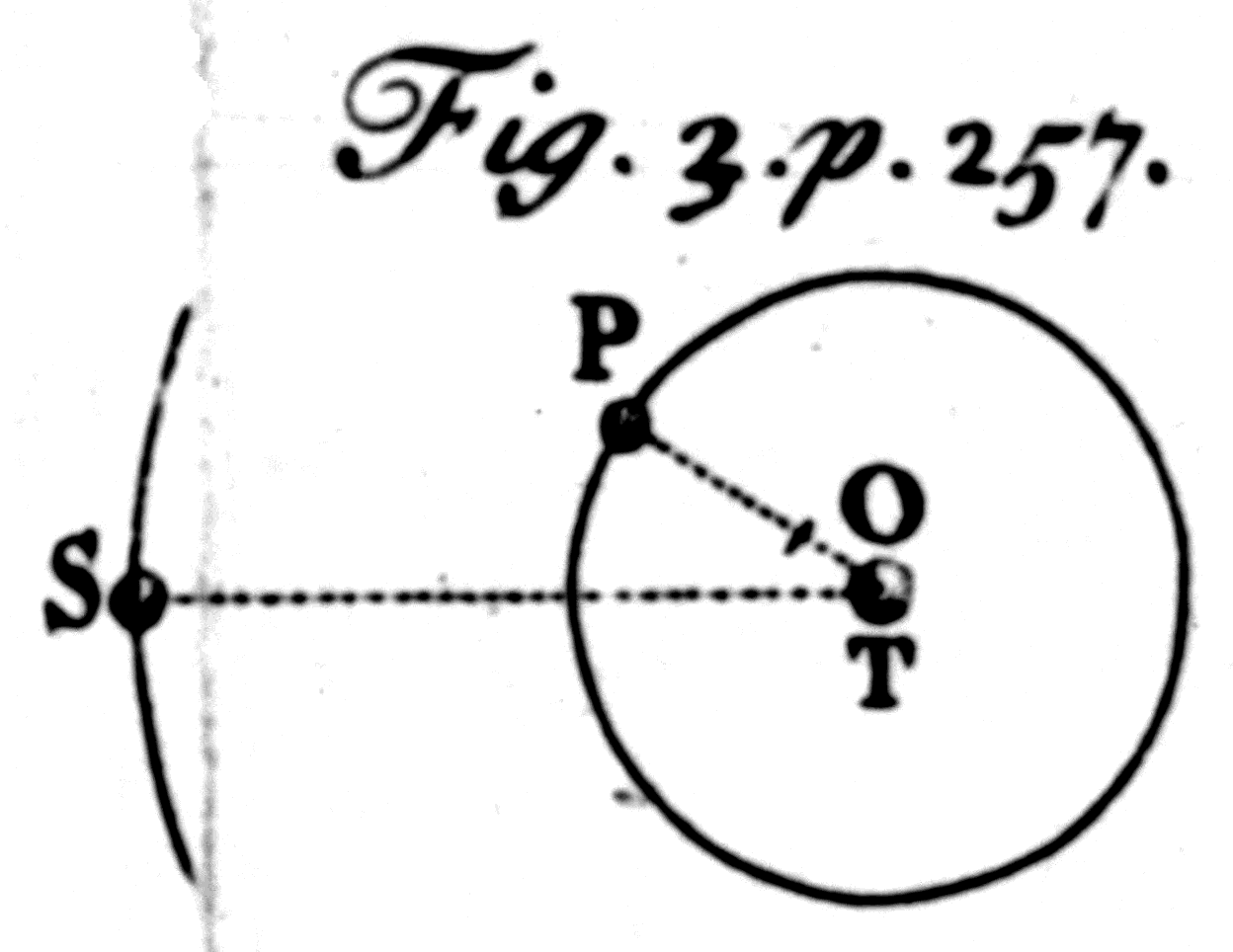
Proposition LXVIII. Theorem XXVIII
The same laws of attraction supposed, I say that the exterior body S will, by radij drawn to O the common centre of gravity of the interior bodies P and T, describe round that centre, area's more proportional to the times, and an orbit more approaching to the form of an ellipsis having its focus in that centre, if the innermost and greatest body be agitated by these attractions as well as the rest, than it would do if that body were either 258at rest, as not attracted, or were much more or much less attracted or much more or much less agitated.
This may be demonstrated after the same manner as prop. 66. but by a more prolix reasoning, which I therefore pass over. It will be sufficient to consider it after this manner. From the demonstration of the last proposition it is plain, that the centre, towards which the body S is urged by the two forces conjunctly, is very near to the common centre of gravity of those two other bodies. If this centre were to coincide with that common centre, and moreover the common centre of gravity of all the three bodies were at rest; the body S on one side, and the common centre of gravity of the other two bodies on the other side, would describe true ellipses about that quiescent common centre. This appears from cor. 2. prop. 58. compared with what was demonstrated in prop. 64 and 65. Now this accurate elliptical motion will be disturbed a little by the distance of the centre of the two bodies from the centre towards which the third body S is attracted. Let there be added moreover a motion to the common centre of the three, and the perturbation will be increased yet more. Therefore the perturbation is least when the common centre of the three bodies is at rest; that is, when the innermost and greatest body T is attracted according to the same law as the rest are; and is always greatest, when the common centre of the three, by the diminution of the motion of the body T, begins to be moved, and is more and more agitated.
259Cor. And hence if more lesser bodies revolve about the great one, it may easily be inferred that the orbits described will approach nearer to ellipses, and the descriptions of area's will be more nearly equable, if all the bodies mutually attract and agitate each other with accelerative forces that are as their absolute forces directly, and the squares of the distances inversely; and if the focus of each orbit be placed in the common centre of gravity of all the interior bodies; (that is, if the focus of the first and innermost orbit be placed in the centre of gravity of the greatest and innermost body; the focus of the second orbit in the common centre of gravity of the two innermost bodies; the focus of the third orbit in the common centre of gravity of the three innermost; and so on) than if the innermost body were at rest, and was made the common focus of all the orbits.
Proposition LXIX. Theorem XXIX
In a system of several bodies A, B, C, D, &c. if any one of those bodies as A, attract all the rest, B, C, D, &c. with accelerative forces that are reciprocally as the squares of the distances from the attracting body; and another body as B attracts also the rest, A, C, D, &c. with forces that are reciprocally as the squares of the distances from the attracting body; the 260absolute forces of the attracting bodies A and B will be to each other, as those very bodies A and B to which these forces belong.
For the accelerative attractions of all the bodies B, C, D, towards A are by the supposition equal to each other at equal distances; and in like manner the accelerative attractions of all the bodies towards B are also equal to each other at equal distances. But the absolute attractive force of the body A is to the absolute attractive force of the body B, as the accelerative attraction of all the bodies towards A to the accelerative attraction of all the bodies towards B at equal distances; and so is also the accelerative attraction of the body B towards A, to the accelerative attraction of the body A towards B. But the accelerative attraction of the body B towards A is to the accelerative attraction of the body A towards B as the mass of the body A to the mass of the body B; because the motive forces which (by the 2d, 7th, and 8th definition) are as the accelerative forces and the bodies attracted conjunctly, are here equal to one another by the third law. Therefore the absolute attractive force of the body A is to the absolute attractive force of the body B as the mass of the body A to the mass of the body B. Q. E. D.
Cor. 1. Therefore if each of the bodies of the system A, B, C, D, &c. does singly attract all the rest with accelerative forces that are reciprocally as the squares of the distances from the attracting body; the absolute forces of all those bodies will be to each other as the bodies themselves.
261Cor. 2. By a like reasoning if each of the bodies of the system A, B, C, D, &c. do singly attract all the rest with accelerative forces, which are either reciprocally or directly in the ratio of any power whatever of the distances from the attracting body; or which are defined by the distances from each of the attracting bodies according to any common law; it is plain that the absolute forces of those bodies are as the bodies themselves.
Cor. 3. In a system of bodies whose forces decrease in the duplicate ratio of the distances, if the lesser revolve about one very great one in ellipses, having their common focus in the centre of that great body, and of a figure exceeding accurate; and moreover by radij drawn to that great body describe area's proportional to the times exactly; the absolute forces of those bodies to each other will be either accurately or very nearly in the ratio of the bodies. And so on the contrary. This appears from cor. of prop. 68. compared with the first corollary of this prop.
Scholium
These propositions naturally lead us to the analogy there is between centripetal forces, and the central bodies to which those forces use to be directed. For it is reasonable to suppose that forces which are directed to bodies should depend upon the nature and quantity of those bodies, as we see they do in magnetical experiments. And when such cases occur, we are to compute the attractions of the bodies by assigning to each of their particles its proper force, and then collecting the sum of 262them all. I here use the word attraction in general for any endeavour, of what kind soever, made by bodies to approach to each other; whether that endeavour arise from the action of the bodies themselves as tending mutually to, or agitating each other by spirits emitted; or whether it arises from the action of the æther or of the air, or of any medium whatsoever, whether corporeal or incorporeal, any how impelling bodies placed therein towards each other. In the same general sense I use the word impulse, not defining in this treatise the species or physical qualities of forces, but investigating the quantities and mathematical proportions of them; as I observed before in the definitions. In mathematics we are to investigate the quantities of forces with their proportions consequent upon any conditions supposed; then when we enter upon physics, we compare those proportions with the phænomena of Nature; that we may know what conditions of those forces answer to the several kinds of attractive bodies. And this preparation being made, we argue more safely concerning the physical species, causes, and proportions of the forces. Let us see then with what forces sphærical bodies consisting of particles endued with attractive powers in the manner above spoken of must act mutually upon one another; and what kind of motions will follow from thence.
Section XII. Of the attractive forces of sphærical bodies.
Section XII
263Of the attractive forces of sphærical bodies.
Proposition LXX. Theorem XXX
If to every point of a sphærical surface there tend equal centripetal forces decreasing in the duplicate ratio of the distances from those points; I say that a corpuscle placed within that superficies will not be attracted by those forces any way.
Let HIKL (Pl. 21. Fig. 4.) be that sphærical superficies, and P a corpuscle placed within. Through P let there be drawn to this superficies the two lines HK, IL, intercepting very small arcs HI, KL; and because (by cor. 3. lem. 7.) the triangles HPI, LPK are alike, those arcs will be proportional 264to the distances HP, LP; and any particles at HI and KL of the sphærical superficies, terminated by right lines passing through P, will be in the duplicate ratio of those distances. Therefore the forces of these particles exerted upon the body P are equal between themselves. For the forces are as the particles directly and the squares of the distances inversely. And these two ratio's compose the ratio of equality. The attractions therefore being made equally towards contrary parts destroy each other. And by a like reasoning all the attractions through the whole sphærical superficies are destroyed by contrary attractions. Therefore the body P will not be any way impelled by those attractions. Q. E. D.
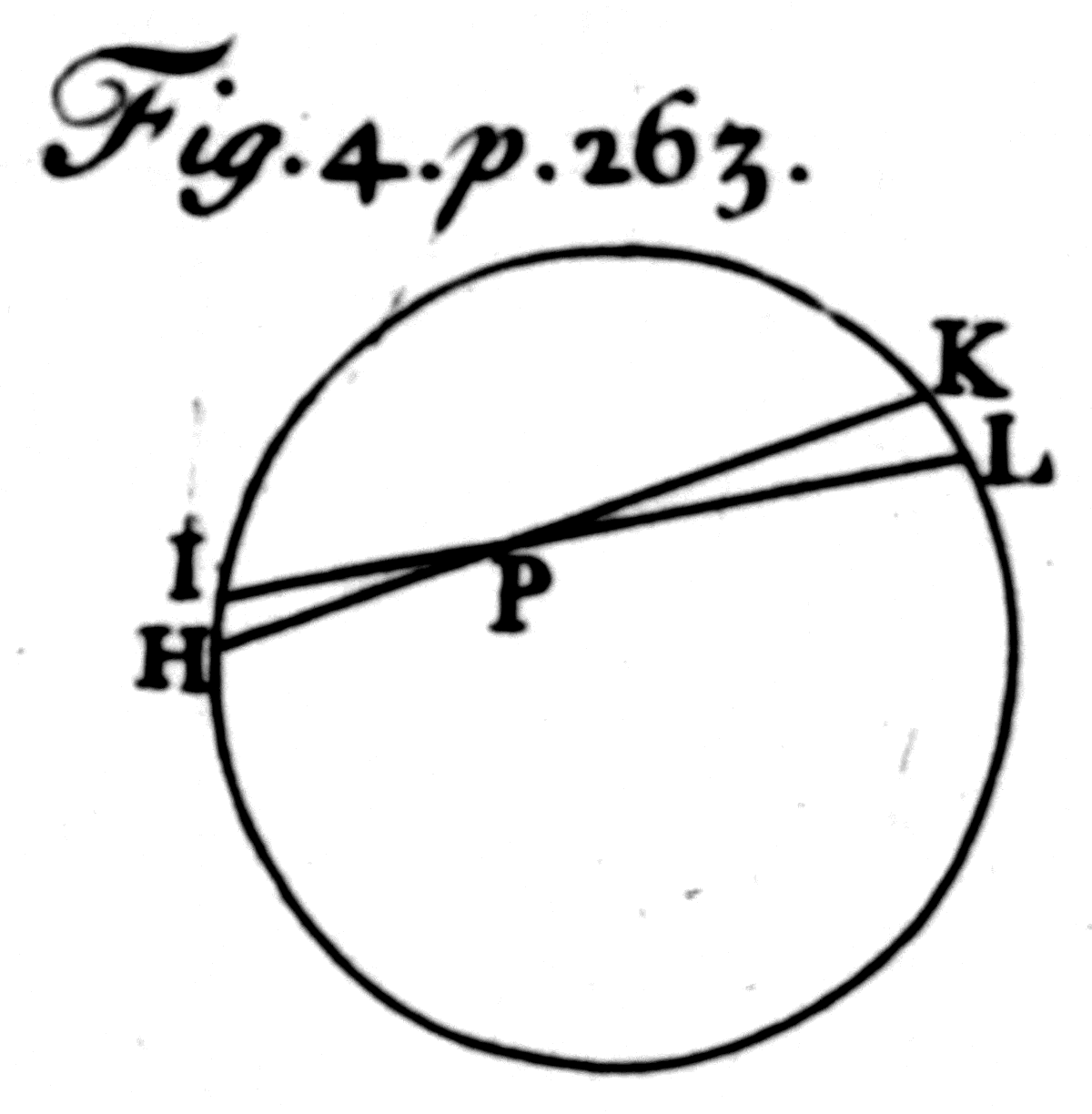
Proposition LXXI. Theorem XXXI
The same things supposed as above, I say that a corpuscle placed without the sphærical superficies is attracted towards the centre of the sphere with a force reciprocally proportional to the square of its distance from that centre.
Let AHKB, ahkb (Pl. 21. Fig. 5.) be two equal sphærical superficies described about the centres S, s; their diameters AB, ab; and let P and p be two corpuscles situate without the spheres in those diameters produced. Let there be drawn from the corpuscles the lines PHK, PIL, phk, pil, 265cutting off from the great circles AHB, ahb, the equal arcs HK, hk, IL, il; and to those lines let fall the perpendiculars SD, sd, SE, se, IR, ir; of which let SD, sd cut PL, pl in F and f. Let fall also to the diameters the perpendiculars IQ, iq. Let now the angles DPE, dpe vanish; and because DS and ds, ES and es are equal, the lines PE, PF, and pe, pf, and the lineolæ DF, df may be taken for equal; because their last ratio, when the angles DPE, dpe vanish together, is the ratio of equality. These things then supposed, it will be, as PI to PF so is RI to DF, and, as pf to pi so is df or DF to ri; and ex æquo, as to so is RI to ri, that is (by cor. 3. lem. 7.) so is the arc IH to the arc ih. Again PI is to PS as IQ to SE, and ps to pi as se or SE to iq; and ex æquo to as IQ to iq. And compounding the ratio's is to , as to ; that is, as the circular superficies which is described by the arc IH as the semicircle AKB revolves about the diameter AB, is to the circular superficies described by the arch ih as the semicircle akb revolves about the diameter ab. And the forces with which these superficies attract the corpuscles P and p in the direction of lines tending to those superficies are by the hypothesis as the superficies themselves directly, and the squares of the distances of the superficies from those corpuscles inversely; that is, as to . And these forces again are to the oblique parts of them which (by the resolution of forces as in cor. 2. of the laws) tend to the centres in the directions of the lines PS, ps, as PI to PQ 266and pi to pq; that is (because of the like triangles PIQ and PSF, piq and psf) as PS to PF and ps to pf. Thence ex æquo, the attraction of the corpuscle P towards S is to the attraction of the corpuscle p towards s, as is to , that is, as to . And by a like reasoning the forces with which the superficies described by the revolution of the arcs KL, kl attract those corpuscles, will be as to . And in the same ratio will be the forces of all the circular superficies into which each of the sphærical superficies may be divided by taking sd always equal to SD, and se equal to SE. And therefore by composition, the forces of the entire sphærical superficies exerted upon those corpuscles will be in the same ratio. Q. E. D.
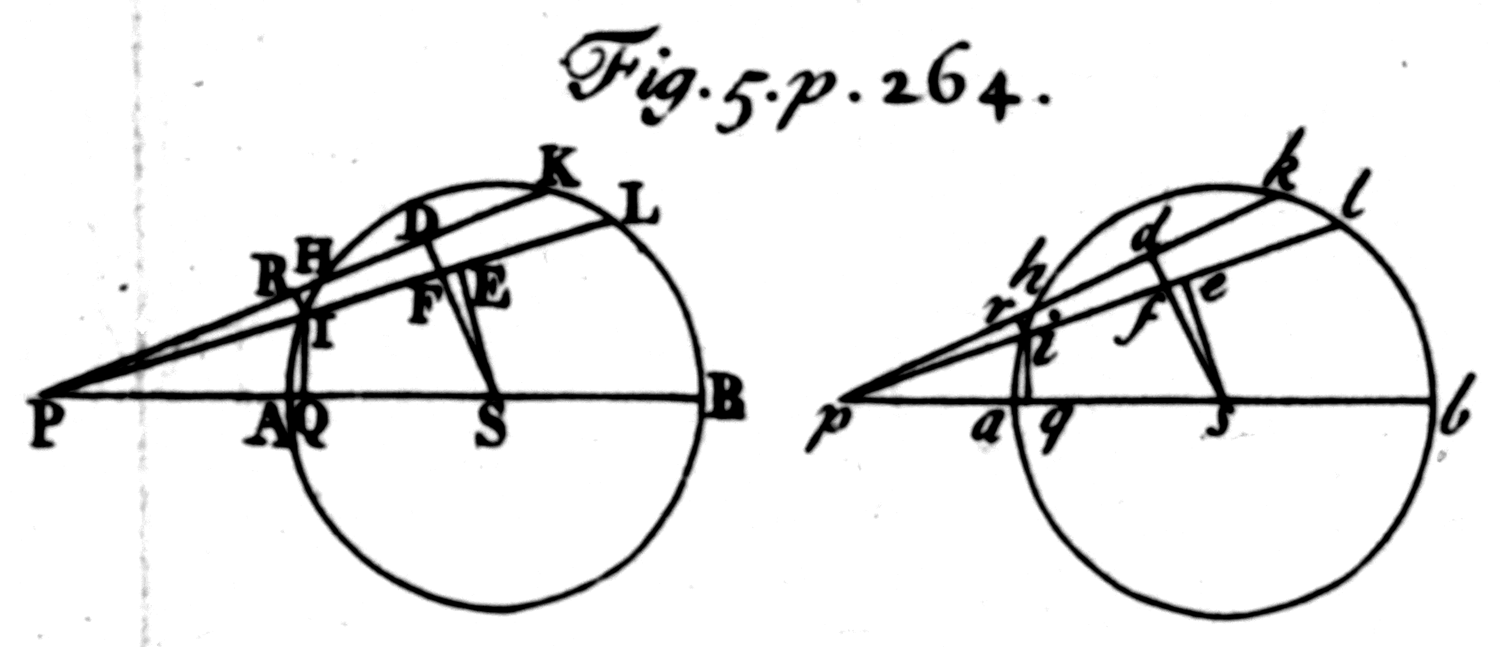
Proposition LXXII. Theorem XXXII
If to the several points of a sphere there tend equal centripetal forces decreasing in a duplicate ratio of the distances from those points; and there be given both the density of the sphere and the ratio of the diameter of the sphere to the distance of the corpuscle from its centre; I say that the force with which the corpuscle is attracted 267is proportional to the semi-diameter of the sphere.
For conceive two corpuscles to be severally attracted by two spheres, one by one the other by the other, and their distances from the centres of the spheres to be proportional to the diameters of the spheres respectively; and the spheres to be resolved into like particles disposed in a like situation to the corpuscles. Then the attractions of one corpuscle towards the several particles of one sphere, will be to the attractions of the other towards as many analogous particles of the other sphere in a ratio compounded of the ratio of the particles directly and the duplicate ratio of the distances inversely. But the particles are as the spheres, that is in a triplicate ratio of the diameters, and the distances are as the diameters; and the first ratio directly with the last ratio taken twice inversely, becomes the ratio of diameter to diameter. Q. E. D.
Cor. 1. Hence if corpuscles revolve in circles about spheres composed of matter equally attracting; and the distances from the centres of the spheres be proportional to their diameters; the periodic times will be equal.
Cor. 2. And vice versâ, if the periodic times are equal, the distances will be proportional to the diameters. These two corollaries appear from cor. 3. prop. 4.
Cor. 3. If to the several points of any two solids whatever, of like figure and equal density, there tend equal centripetal forces decreasing in a duplicate ratio of the distances from those points; the forces with which corpuscles placed in a like 268situation to those two solids, will be attracted by them will be to each other as the diameters of the solids.
Proposition LXXIII. Theorem XXXIII
If to the several points of a given sphere there tend equal centripetal forces decreasing in a duplicate ratio of the distances from the points; I say that a corpuscle placed within the sphere is attracted by a force proportional to its distance from the centre.
In the sphere ABCD (Pl. 21. Fig. 6.) described about the centre S, let there be placed the corpuscle P; and about the same centre S, with the interval SP, conceive described an interior sphere PEQF. It is plain (by prop. 70.) that the concentric sphærical superficies of which the difference AEBF of the spheres is composed, have no effect at all upon the body P; their attractions being destroyed by contrary attractions. There remains therefore only the attraction of the interior sphere PEQF. And (by prop. 72.) this is as the distance PS. Q. E. D.
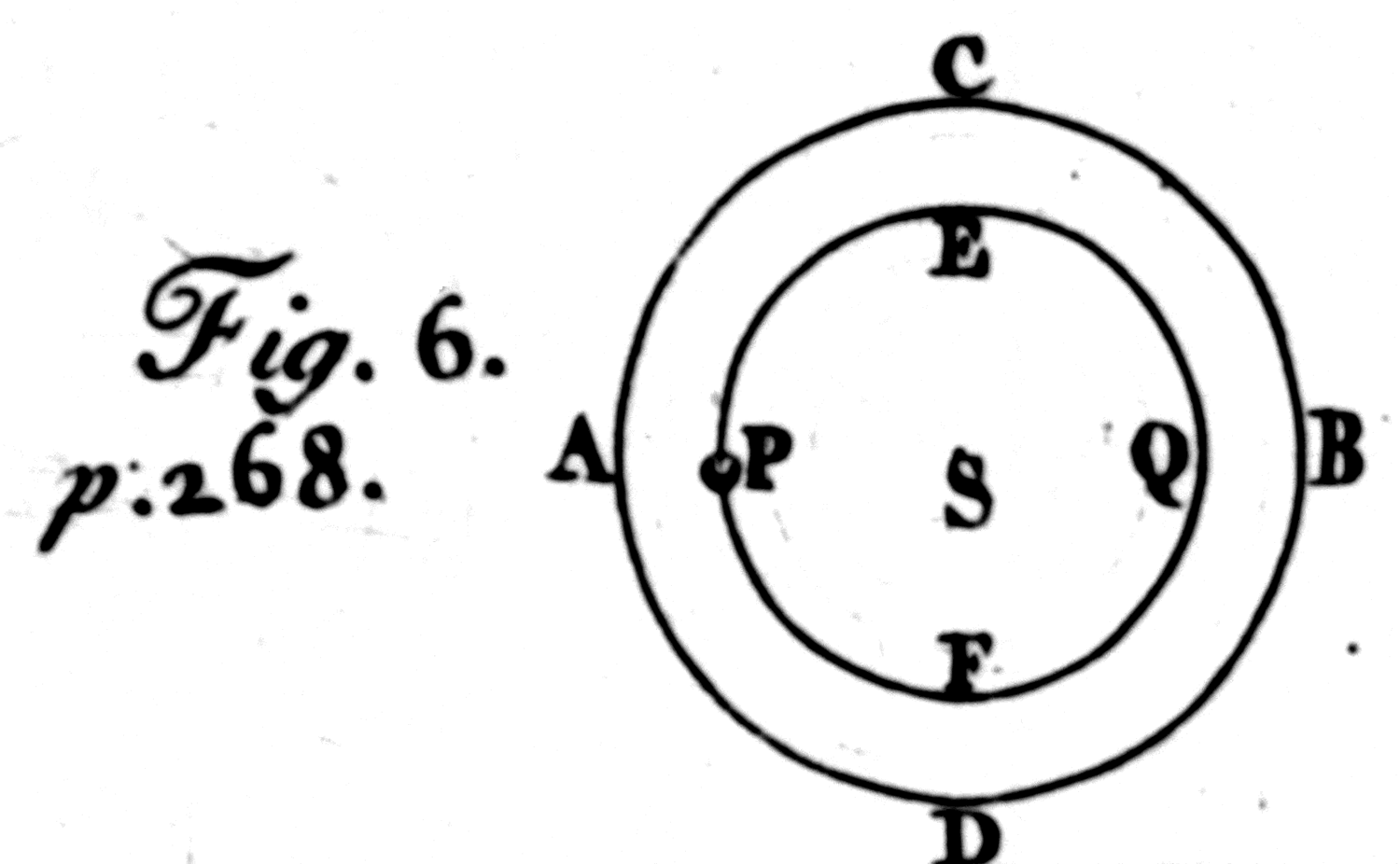
Scholium
By the superficies of which I here imagine the solids composed, I do not mean superficies purely 269mathematical, but orbs so extreamly thin, that their thickness is as nothing; that is, the evanescent orbs; of which the sphere will at last consist, when the number of the orbs is increased, and their thickness diminished without end. In like manner, by the points of which lines, surfaces and solids are said to be composed, are to be understood equal particles whose magnitude is perfectly inconsiderable.
Proposition LXXIV. Theorem XXXIV
The same things supposed, I say that a corpuscle situate without the sphere is attracted with a force reciprocally proportional to the square of its distance from the centre.
For suppose the sphere to be divided into innumerable concentric sphærical superficies, and the attractions of the corpuscle arising from the several superficies will be reciprocally proportional to the square of the distance of the corpuscle from the centre of the sphere (by prop. 71.) And by composition, the sum of those attractions, that is, the attraction of the corpuscle towards the entire sphere, will be in the same ratio. Q. E. D.
Cor. 1. Hence the attractions of homogeneous spheres at equal distances from the centres will be as the spheres themselves. For (by prop. 72) if the distances be proportional to the diameters of the spheres, the forces will be as the diameters. Let 270the greater distance be diminished in that ratio; and the distances now being equal, the attraction will be increased in the duplicate of that ratio; and therefore will be to the other attraction in the triplicate of that ratio; that is, in the ratio of the spheres.
Cor. 2. At any distances whatever; the attractions are as the spheres applied to the squares of the distances.
Cor. 3. If a corpuscle placed without an homogeneous sphere is attracted by a force reciprocally proportional to the square of its distance from the centre, and the sphere consists of attractive particles; the force of every particle will decrease in a duplicate ratio of the distance from each particle.
Proposition LXXV. Theorem XXXV
If to the several points of a given sphere there tend equal centripetal forces; decreasing in a duplicate ratio of the distances from the points; I say that another similar sphere will be attracted by it with a force reciprocally proportional to the square of the disŧance of the centres.
For the attraction of every particle is reciprocally as the square of its distance from the centre of the attracting sphere (by prop. 74.) and is therefore the same as if that whole attracting force issued from 271one single corpuscle placed in the centre of this sphere. But this attraction is as great, as on the other hand the attraction of the same corpuscle would be, if that were it self attracted by the several particles of the attracted sphere with the same force with which they are attracted by it. But that attraction of the corpuscle would be (by prop. 74.) reciprocally proportional to the square of its distance from the centre of the sphere; therefore the attraction of the sphere, equal thereto, is also in the same ratio. Q. E. D.
Cor. 1. The attractions of spheres towards other homogeneous spheres, are as the attracting spheres applied to the squares of the distances of their centres from the centres of those which they attract.
Cor. 2. The case is the same when the attracted sphere does also attract. For the several points of the one attract the several points of the other with the same force with which they themselves are attracted by the others again; and therefore since in all attractions (by law 3.) the attracted and attracting point are both equally acted on, the force will be doubled by their mutual attractions, the proportions remaining.
Cor. 3. Those several truths demonstrated above concerning the motion of bodies about the focus of the conic sections, will take place when an attracting sphere is placed in the focus, and the bodies move without the sphere.
Cor. 4. Those things which were demonstrated before of the motion of bodies about the centre of the conic sections take place when the motions are performed within the sphere.
Proposition LXXVI. Theorem XXXVI
272If spheres be however dissimilar (as to density of matter and attractive force) in the progress right onward from the centre to the circumference; but every where similar, at every given disŧance from the centre, on all sides round about; and the attractive force of every point decreases in the duplicate ratio of the distance of the body attracted; I say that the whole force with which one of these spheres attracts the other, will be reciprocally proportional to the square of the distance of the centres.
Imagine several concentric similar spheres, AB, CD, EF, &c. (Pl. 22. Fig. 1.) the innermost of which added to the outermost may compose a matter more dense towards the centre, or subducted from them may leave the same more lax and rare. Then by prop. 75. these spheres will attract other similar concentric spheres GH, IK, LM, &c. each the other, with forces reciprocally proportional to the square of the distance SP. And by composition or division, the sum of all those forces, or the excess of any of them above the others; that is, the entire force with which the whole sphere AB (composed of any concentric spheres or of their 273differences) will attract the whole sphere GH (composed of any concentric spheres or their differences) is in the same ratio. Let the number of the concentric spheres be increased in infinitum, so that the density of the matter together with the attractive force may, in the progress from the circumference to the centre, increase or decrease according to any given law; and by the addition of matter not attractive let the deficient density be supplied that so the spheres may acquire any form desired; and the force with which one of these attracts the other, will be still, by the former reasoning, in the same ratio of the square of the distance inversely. Q. E. D.
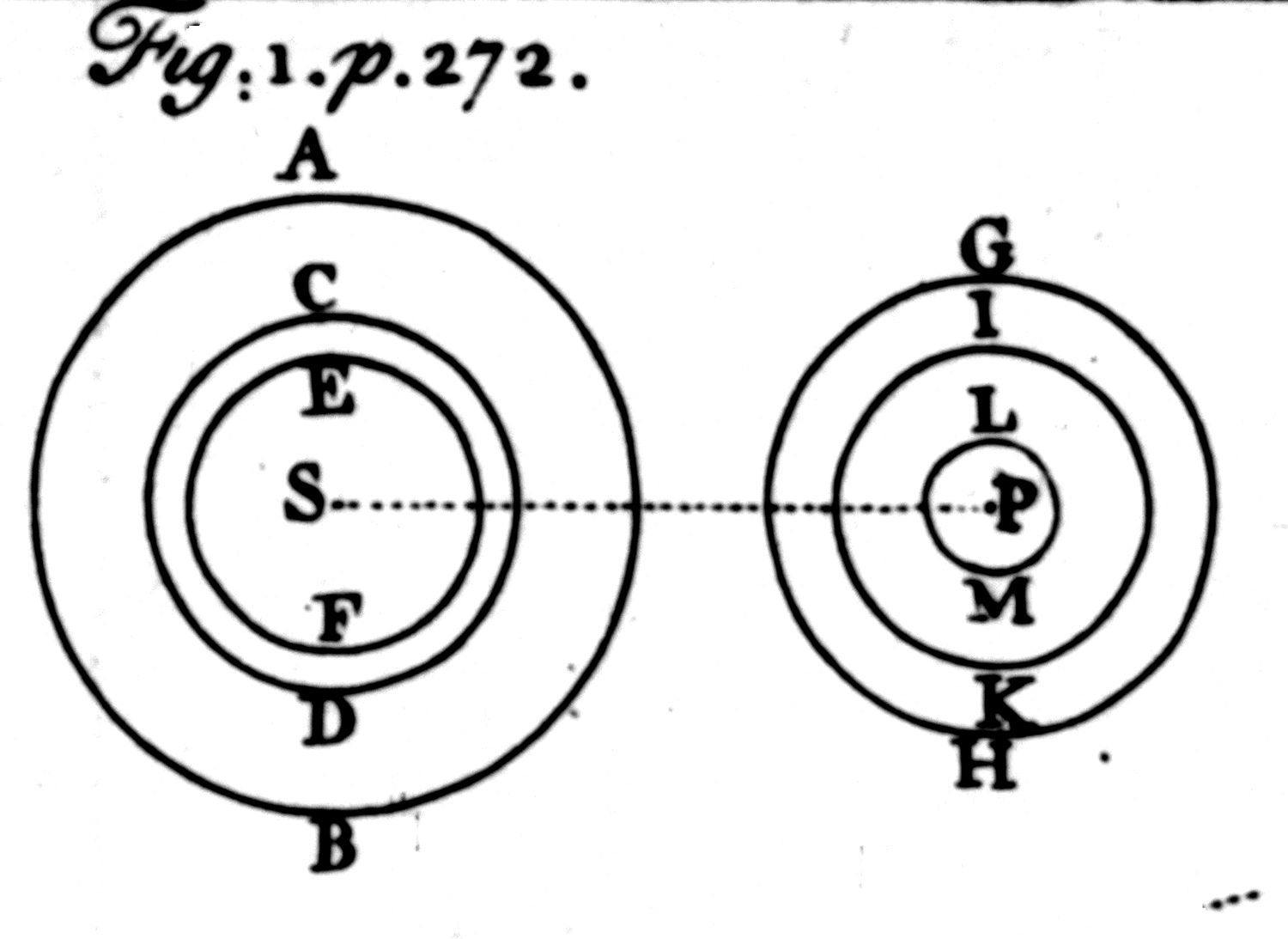
Cor. 1. Hence if many spheres of this kind, similar in all respects, attract each other mutually; the accelerative attractions of each to each, at any equal distances of the centres, will be as the attracting spheres.
Cor. 2. And at any unequal distances, as the attracting spheres applied to the squares of the distances between the centres.
Cor. 3. The motive attractions, or the weights of the spheres towards one another will be at equal distances of the centres as the attracting and attracted spheres conjunctly; that is, as the products arising from multiplying the spheres into each other.
Cor. 4. And at unequal distances, as those products directly and the squares of the distances between the centres inversely.
Cor. 5. These proportions take place also, when the attraction arises from the attractive virtue of both spheres mutually exerted upon each other. For the attraction is only doubled by the conjunction 274of the forces, the proportions remaining as before.
Cor. 6. If spheres of this kind revolve about others at rest, each about each; and the distances between the centres of the quiescent and revolving bodies are proportional to the diameters of the quiescent bodies; the periodic times will be equal.
Cor. 7. And again, if the periodic times are equal, the distances will be proportional to the diameters.
Cor. 8. All those truths above demonstrated, relating to the motions of bodies about the foci of conic sections, will take place, when an attracting sphere, of any form and condition like that above described, is placed in the focus.
Cor. 9. And also when the revolving bodies are also attracting spheres of any condition like that above described.
Proposition LXXVII. Theorem XXVIII
If to the several points of spheres there tend centripetal forces proportional to the disŧances of the points from the attracted bodies; I say that the compounded force with which two spheres attract each other mutually is as the disŧance between the centres of the spheres.
Case 1. Let AEBF (Pl. 22. Fig. 2.) be a sphere; S its centre; P a corpuscle attracted; PASB the axis of the sphere passing through the centre of the corpuscle; EF, ef two planes cutting the sphere, and perpendicular to the axis, and 275equidistant, one on one side, the other on the other, from the centre of the sphere; G and g the intersections of the planes and the axis; and H any point in the plane EF. The centripetal force of the point H upon the corpuscle P, exerted in the direction of the line PH is as the distance PH; and (by cor. 2. of the laws) the same exerted in the direction of the line PG, or towards the centre S, is at the length PG. Therefore the force of all the points in the plane EF (that is of that whole plane) by which the corpuscle P is attracted towards the centre S is as the distance PG multiplied by the number of those points, that is as the solid contained under that plane EF and the distance PG. And in like manner the force of the plane ef by which the corpuscle P is attracted towards the centre S, is as that plane drawn into its distance Pg, or as the equal plane EF drawn into that distance Pg; and the sum of the forces of both planes as the plane EF drawn into the sum of the distances , that is as that plane drawn into twice the distance PS of the centre and the corpuscle; that is, as twice the plane EF drawn into the distance PS, or as the sum of the equal planes drawn into the same distance. And by a like reasoning the forces of all the planes in the whole sphere, equi-distant on each side from the centre of the sphere, are as the sum of those planes drawn into the distance PS, that is, as the whole sphere and the disŧance PS conjunctly. Q. E. D.
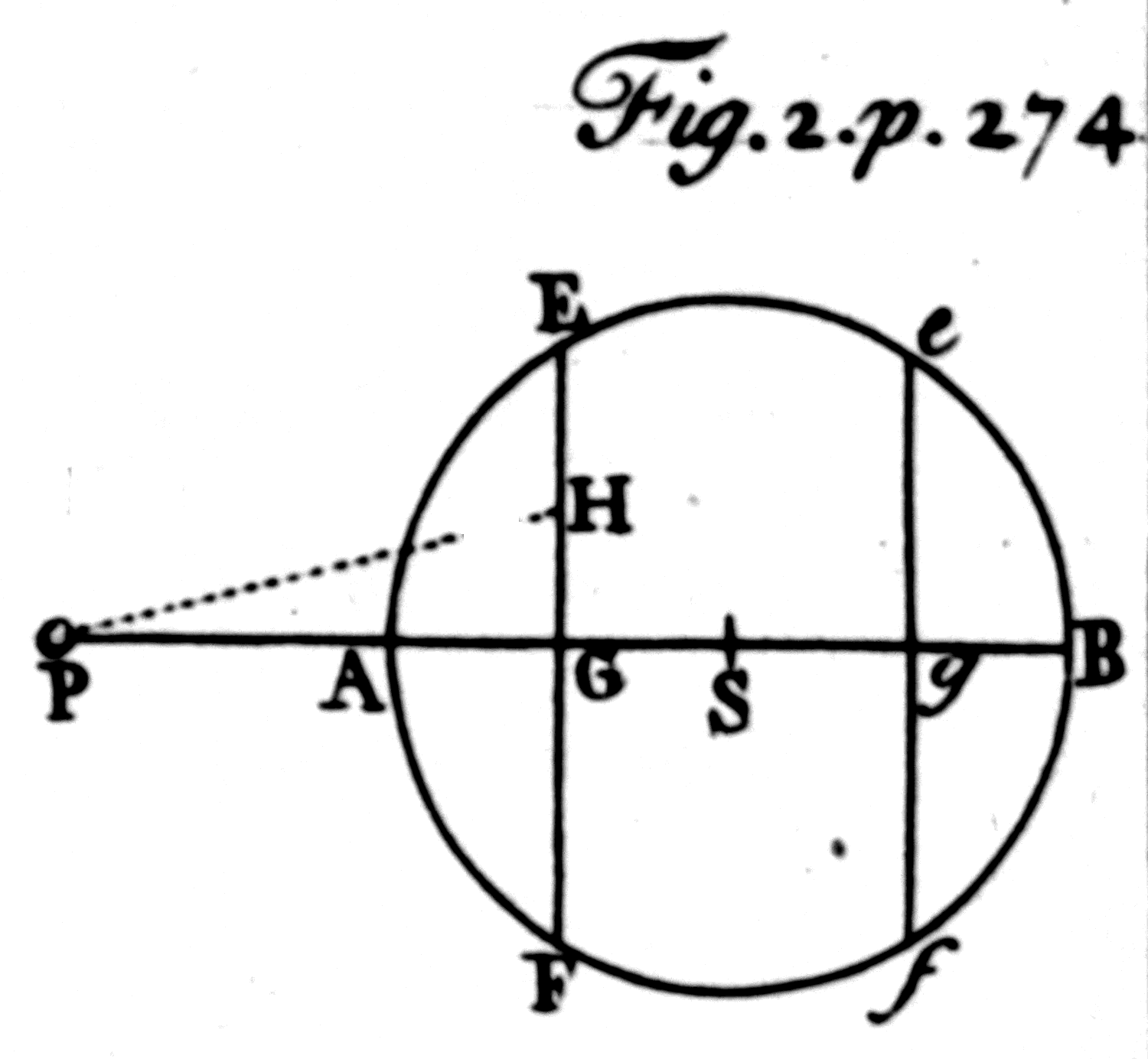
Case 2. Let now the corpuscle P attract the sphere AEBF. And by the same reasoning it will appear that the force with which the sphere is attracted is as the distance PS. Q. E. D.
276Case 2. Imagine another sphere composed of innumerable corpuscles P; and because the force with which every corpuscle is attracted is as the distance of the corpuscle from the centre of the first sphere, and as the same sphere conjunctly, and is therefore the same as if it all proceeded from a single corpuscle situate in the centre of the sphere; the entire force with which all the corpuscles in the second sphere are attracted, that is, with which that whole sphere is attracted, will be the same as if that sphere were attracted by a force issuing from a single corpuscle in the centre of the first sphere; and is therefore proportional to the distance between the centres of the spheres. Q. E. D.
Case 4. Let the spheres attract each other mutually, and the force will be doubled, but the proportion will remain. Q. E. D.
Case 5. Let the corpuscle p be placed within the sphere AEBF; (Fig. 3.) and because the force of the plane ef upon the corpuscle is as the solid contained under that plane and the distance pg; and the contrary force of the plane EF as the solid contained under that plane and the distance pG; the force compounded of both will be as the difference of the solids, that is as the sum of the equal planes drawn into half the difference of the distances, that is, as that sum drawn into pS, the distance of the corpuscle from the centre of the sphere. And by a like reasoning, the attraction of all the planes EF, ef throughout the whole sphere, that is, the attraction of the whole sphere, is conjunctly as the sum of all the planes, or as the whole sphere, and as pS, the distance of the corpuscle from the centre of the sphere. Q. E. D.
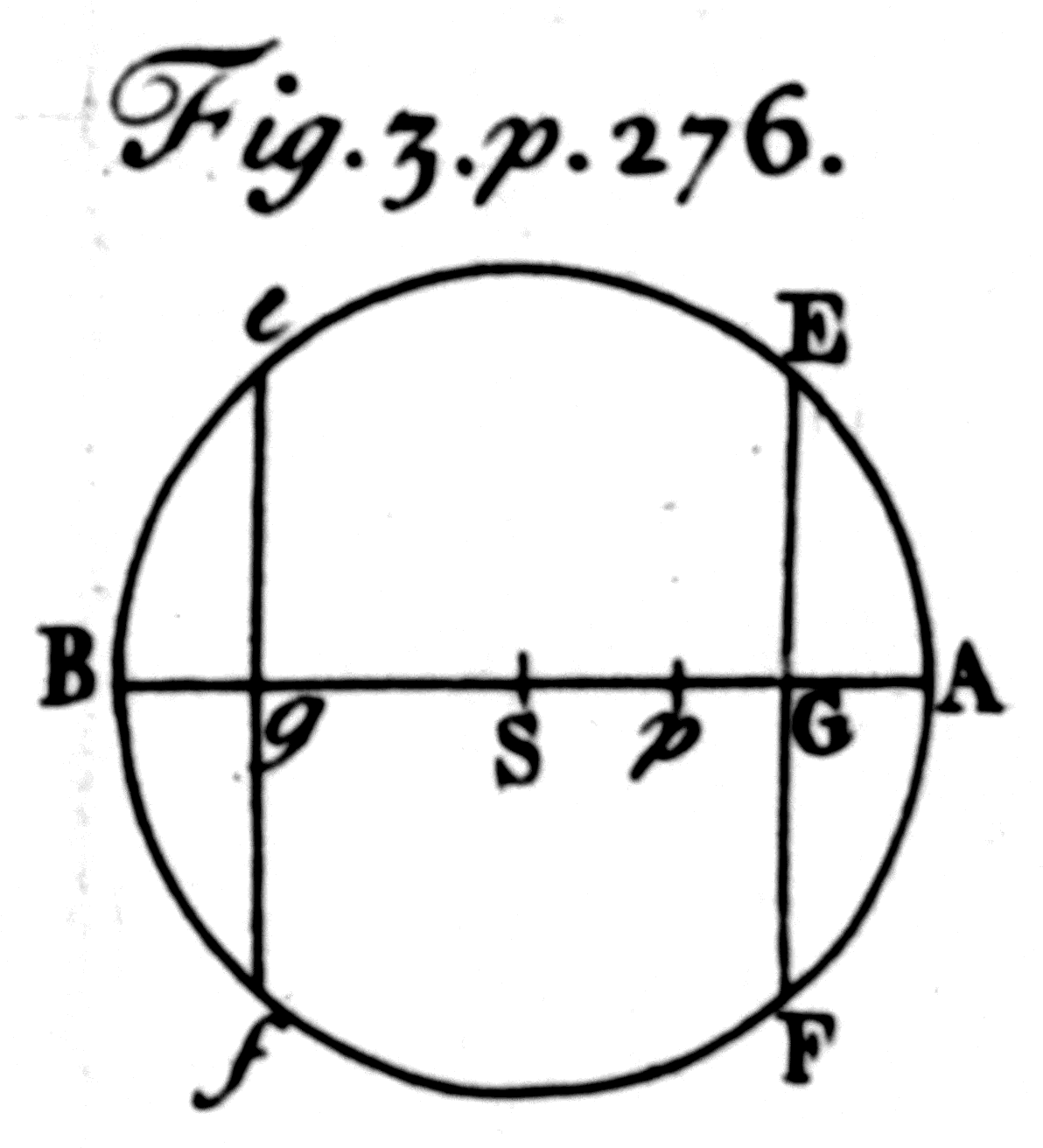
277Case 6. And if there be composed a new sphere out of innumerable corpuscles such as p, situate within the first sphere AEBF; it may be proved as before that the attraction whether, single of one sphere towards the other, or mutual of both towards each other, will be as the distance pS of the centres. Q. E. D.
Proposition LXXVIII. Theorem XXXVIII
If spheres in the progression from the centre to the circumference be however dissimilar and unequable, but similar on every side round about at all given disŧances from the centre; and the attractive force of every point be as the disŧance of the attracted body; I say that the entire force with which two spheres of this kind attract each other mutually is proportional to the distance between the centres of the spheres.
This is demonstrated from the foregoing proposition in the same manner as the 76th proposition was demonstrated from the 75th.
Cor. Those things that were above demonstrated in prop. 10. and 64. of the motion of bodies round the centres of conic sections, take place when all the attractions are made by the force of sphærical bodies of the condition above 278described, and the attracted bodies are spheres of the same kind.
Scholium
I have now explained the two principal cases of attractions; to wit, when the centripetal forces decrease in a duplicate ratio of the distances, or increase in a simple ratio of the distances; causing the bodies in both cases to revolve in conic sections, and composing sphærical bodies whose centripetal forces observe the same law of increase or decrease in the recess from the centre as the forces of the particles themselves do; which is very remarkable. It would be tedious to run over the other cases, whose conclusions are less elegant and important, so particularly as I have done these. I chuse rather to comprehend and determine them all by one general method as follows.
Lemma XXIX
If about the centre S (Pl. 22. Fig. 4.) there be described any circle as AEB, and about the centre P there be also described two circles EF, ef, cutting the first in E and e, and the line PS in F and f; and there be let fall to PS the perpendiculars ED, ed; I say that if the distance of the arcs EF, ef be supposed to be infinitely diminished, the last ratio of the 279evanescent line Dd to the evanescent line Ff is the same as that of the line PE to the line PS.
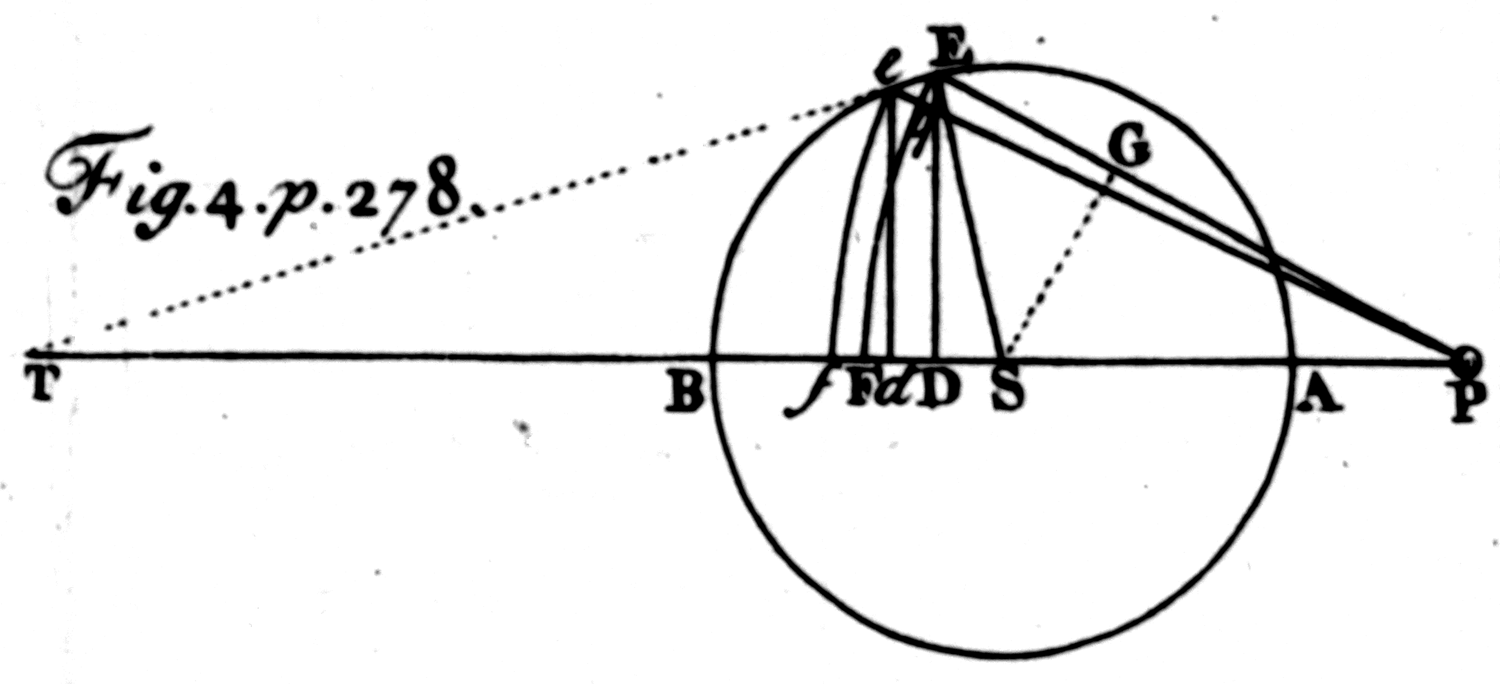
For if the line Pe cut the arc EF in q; and the right line Ee, which coincides with the evanescent arc Ee, be produced and meet the right line PS in T; and there be let fall from S to PE the perpendicular SG; then because of the like triangles DTE, dTe, DES; it will be as Dd to Ee so DT to TE, or DE to ES; and because the triangles Eeq, ESG (by lem. 8. and cor. 3. lem. 7.) are similar, it will be as Ee to eq or Ff so ES to SG; and ex æquo, as Dd to Ff so DE to SG; that is (because of the similar triangles PDE, PGS) so is PE to PS. Q. E. D.
Proposition LXXIX. Theorem XXXIX
Suppose a superficies as EFfe (Pl. 22. Fig. 5.) to have its breadth infinitely diminished, and to be just vanishing; and that the same superficies by its revolution round the axis PS describes a sphærical concavo-convex solid, to the several equal particles of which there tend equal centripetal forces; I say that the force with which that solid attracts a corpuscle situate in P, is in a ratio compounded of the ratio of the solid and the ratio of the force with 280which the given particle in the place Ff would attract the same corpuscle.
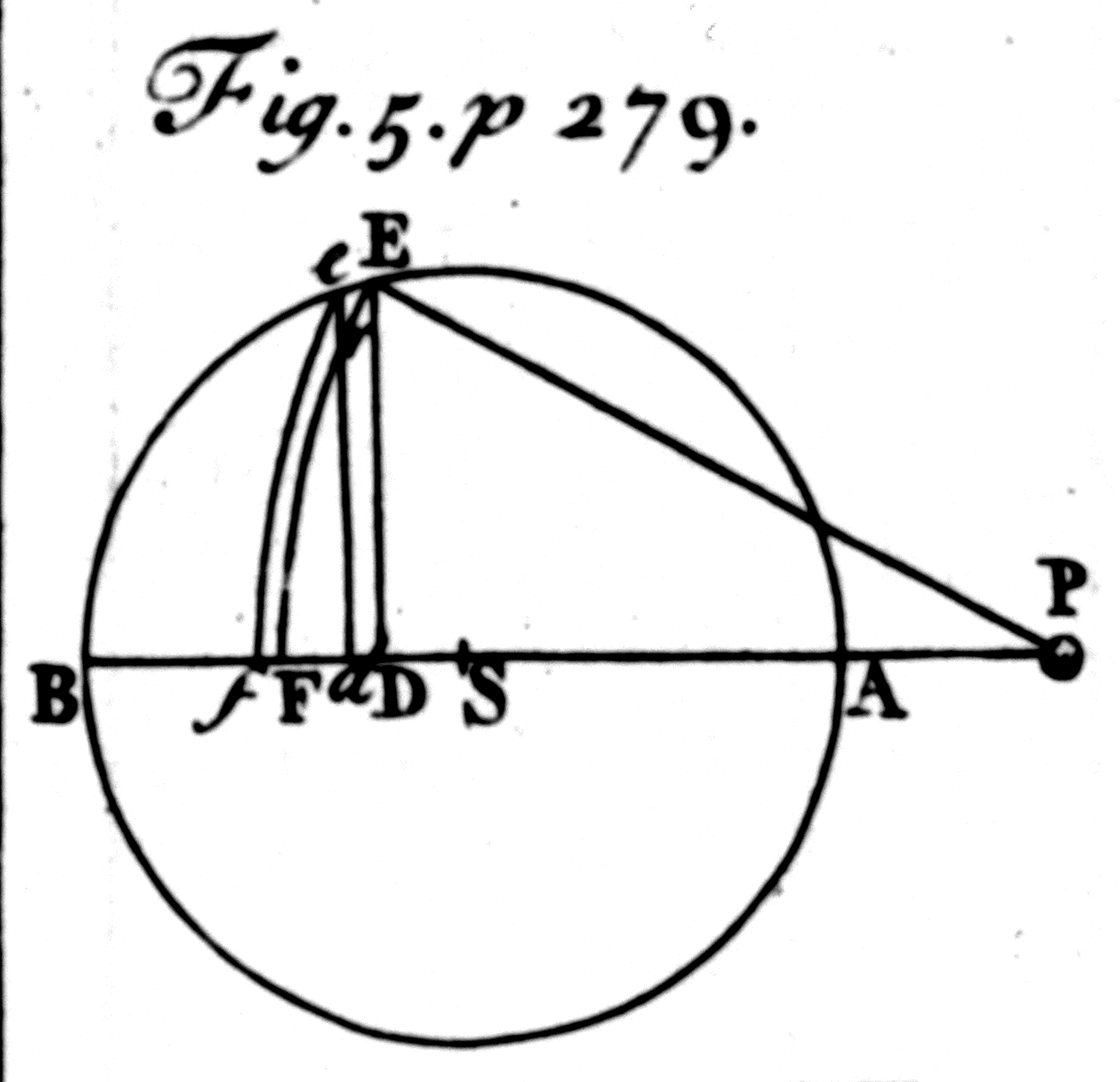
For if we consider first the force of the sphærical superficies FE which is generated by the revolution of the arc FE, and is cut any where, as in r, by the line de; the annular part of the superficies generated by the revolution of the arc rE will be as the lineola Dd, the radius of the sphere PE remaining the same; as Archimedes has demonstrated in his book of the sphere and cylinder. And the force of this superficies exerted in the direction of the lines PE or Pr situate all round in the conical superficies, will be as this annular superficies it self; that is as the lineola Dd, or which is the same as the rectangle under the given radius PE of the sphere and the lineola Dd; but that force, exerted in the direction of the line PS tending to the centre S, will be less in the ratio of PD to PE, and therefore will be as . Suppose now the line DF to be divided into innumerable little equal particles, each of which call Dd; and then the superficies FE will be divided into so many equal annuli, whose forces will be as the sum of all the rectangles , that is, as , and therefore as . Let now the superficies FE be drawn into the altitude Ff; and the force of the solid EFfe exerted upon the corpuscle P will be as ; that is, if the force be given which any given particle as Ff exerts upon the corpuscle P at the distance PF. But if that force be not given, the force of the solid EFfe will be as the solid and that force not given, conjunctly. Q. E. D.
Proposition LXXX. Theorem XL
281If to the several equal parts of a sphere ABE, (Pl. 22. Fig. 6.) described about the centre S, there tend equal centripetal forces; and from the several points D in the axis of the sphere AB in which a corpuscle, as P, is placed, there be erected the perpendiculars DE meeting the sphere in E, and if in those perpendiculars the lengths DN be taken as the quantity and as the force which a particle of the sphere situate in the axis exerts at the distance PE upon the corpuscle P, conjunctly; I say that the whole force with which the corpuscle P is attracted towards the sphere is as the area ANB, comprehended under the axis of the sphere AB, and the curve line ANB, the locus of the point N.
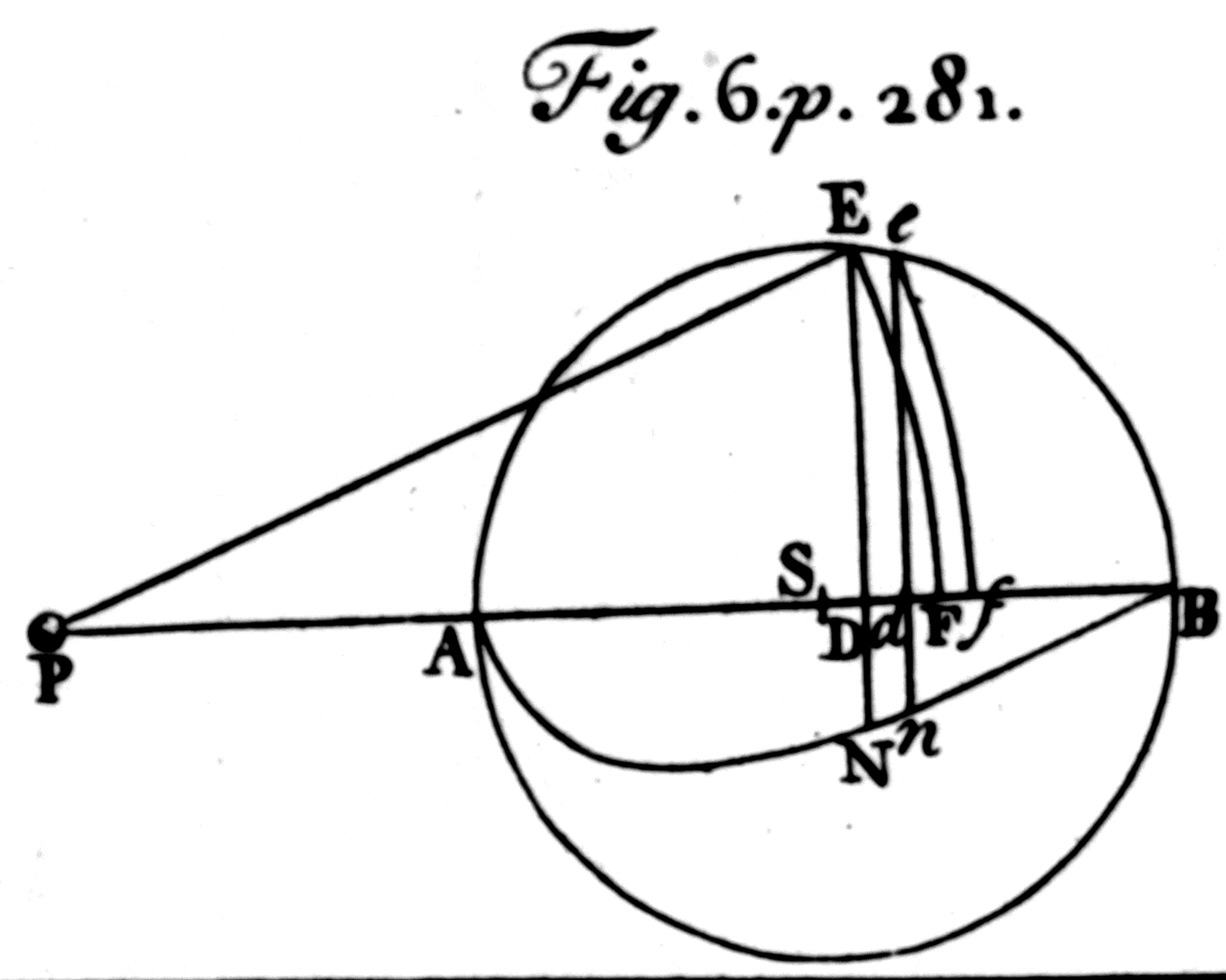
For supposing the construction in the last lemma and theorem to stand, conceive the axis of the sphere AB to be divided into innumerable equal particles Dd, and the whole sphere to be divided into so many sphærical concavo-convex laminæ EFfe; 282and erect the perpendicular dn. By the last theorem the force with which the laminæ EFfe attracts the corpuscle P, is as and the force of one particle exerted at the distance PE or PF, conjunctly. But (by the last lemma) Dd is to Ff as PE to PS, and therefore Ff is equal to ; and is equal to ; and therefore the force of the lamina EFfe is as and the force of a particle exerted at the distance PF conjunctly, that is, by the supposition, as , or as the evanescent area DNnd. Therefore the forces of all the laminæ exerted upon the corpuscle P, are as all the area's DNnd, that is, the whole force of the sphere will be as the whole area ANB. Q. E. D.
Cor. 1. Hence if the centripetal force tending to the several particles remain always the same at all distances, and DN be made as ; the whole force with which the corpuscle is attracted by the sphere is as the area ANB.
Cor. 2. If the centripetal force of the particles be reciprocally as the distance of the corpuscle attracted by it, and DN be made as ; the force with which the corpuscle P is attracted by the whole sphere will be as the area ANB.
Cor. 3. If the centripetal force of the particles be reciprocally as the cube of the distance of the corpuscle attracted by it, and DN be made as 283; the force with which the corpuscle is attracted by the whole sphere will be as the area ANB.
Cor. 4. And universally if the centripetal force tending to the several particles of the sphere be supposed to be reciprocally as the quantity V; and DN be made as ; the force with which a corpuscle is attracted by the whole sphere will be as the area ANB.
Proposition LXXXI. Problem XLI
The things remaining as above it is required to measure the area ANB. (Pl. 23. Fig. 1.)
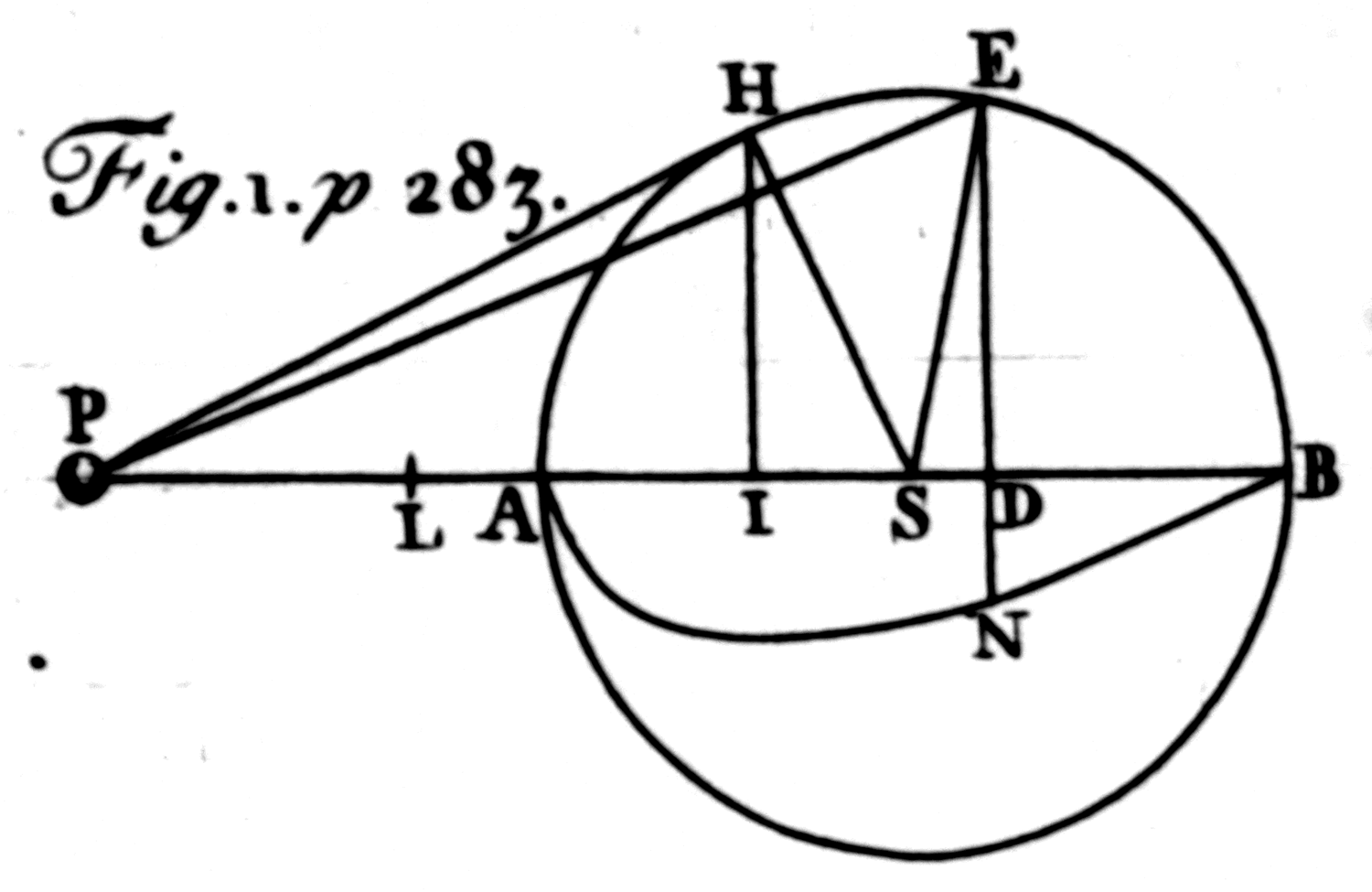
From the point P let there be drawn the right line PH touching the sphere in H; and to the axis PAB letting fall the perpendicular HI, bisect PI in L; and (by prop. 12. book 2. elem.) is equal to . But because the triangles SPH, SHI are like, or is equal to the rectangle PSI. Therefore is equal to the rectangle contained under PS and ; that is under PS and ; that is under PS and 2LD. Moreover is equal to , or , that is, . For or (by prop. 6. book 2. elem.) is equal to the rectangle ALB. Therefore if instead of we write ; the 284quantity , which (by cor. 4. of the foregoing prop.) is as the length of the ordinate DN will now resolve it self into three parts ; where if instead of V we write the inverse ratio of the centripetal force, and instead of PE the mean proportional between PS and 2LD; those three parts will become ordinates to so many curve lines, whose areas are discovered by the common methods. Q. E. D.
Exam. 1. If the centripetal force tending to the several particles of the sphere be reciprocally as the distance; instead of V write PE the distance; then for ; and DN will become as . Suppose DN equal to its double ; and 2SL the given part of the ordinate drawn into the length AB will describe the rectangular area ; and the indefinite part LD, drawn perpendicularly into the same length with a continued motion, in such sort as in its motion one way or another it may either by increasing or decreasing remain always equal to the length LD, will describe the area that is, the area ; which taken from the former area leaves the area . But the third part , drawn after the same manner 285with a continued motion perpendicularly into the same length, will describe the area of an hyperbola, which subducted from the area will leave ANB the area sought. Whence arises this construction of the problem. At the points L, A, B (Fig. 2.) erect the perpendiculars Ll, Aa, Bb; making Aa equal to LB, and Bb equal to LA. Making Ll, and LB asymptotes, describe through the points a, b, the hyperbolic curve ab. And the chord ba being drawn will inclose the area aba equal to the area sought ANB.
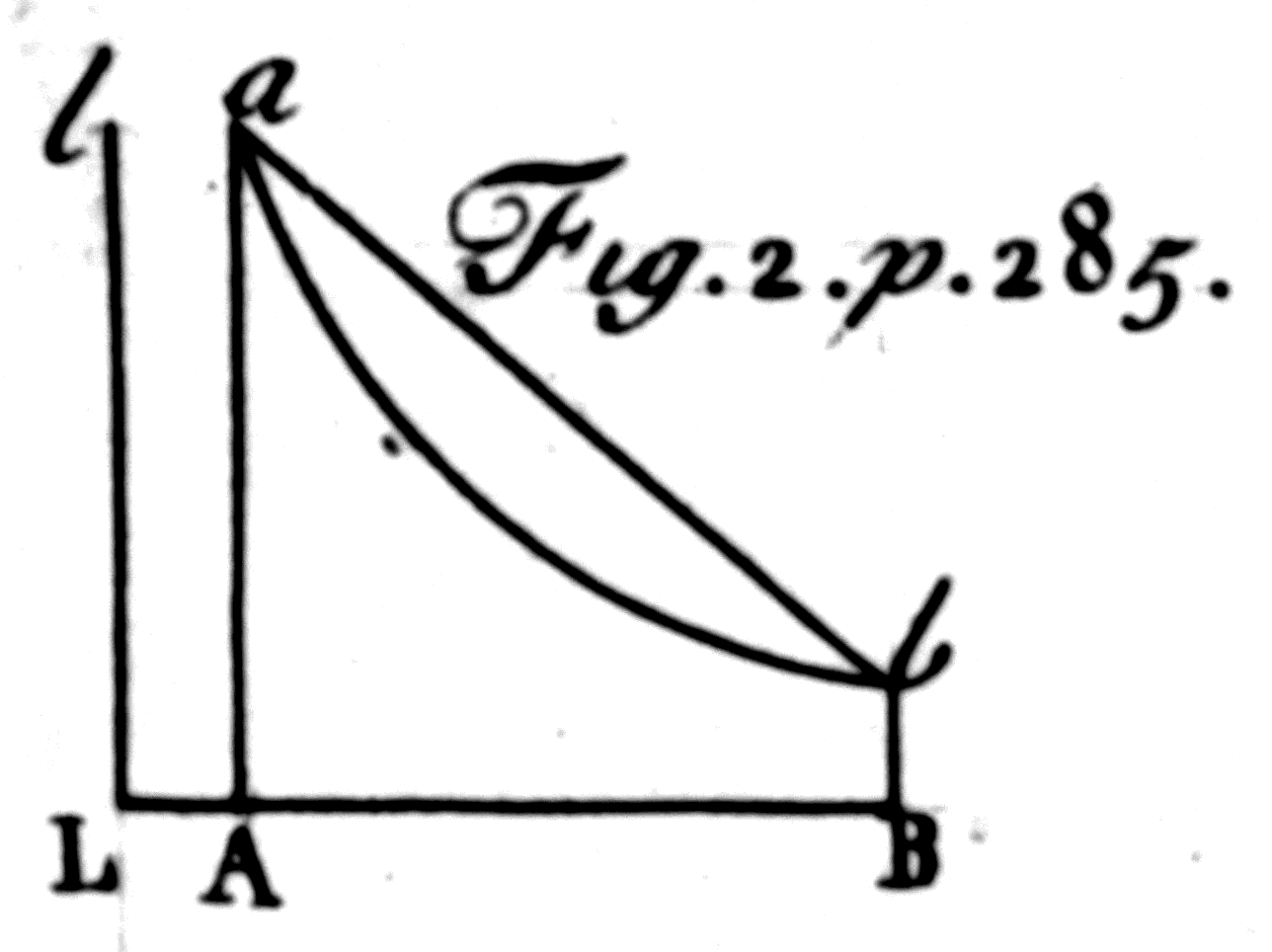
Exam. 2. If the centripetal force tending to the several particles of the sphere be reciprocally as the cube of the distance, or (which is the same thing) as that cube applied to any given plane; write for V, and for ; and DN will become as that is (because PS, AS, SI are continually proportional) as . If we draw then these three parts into the length AB, the first will generate the area of an hyperbola; the second , the area ; the third , the area that is . From the first subduct the sum of the second and third, and there will remain ANB the area sought. Whence arises this construction of the problem. At the points 286L, A, S, B, (Fig. 3.) erect the perpendiculars Ll, Aa, Ss, Bb, of which suppose Ss equal to SI; and through the point s, to the asymptotes Ll, LB, describe the hyperbola asb meeting the perpendiculars Aa, Bb, in a and b; and the rectangle 2ASI, subducted from the hyperbolic area AasbB, will leave ANB the area sought.
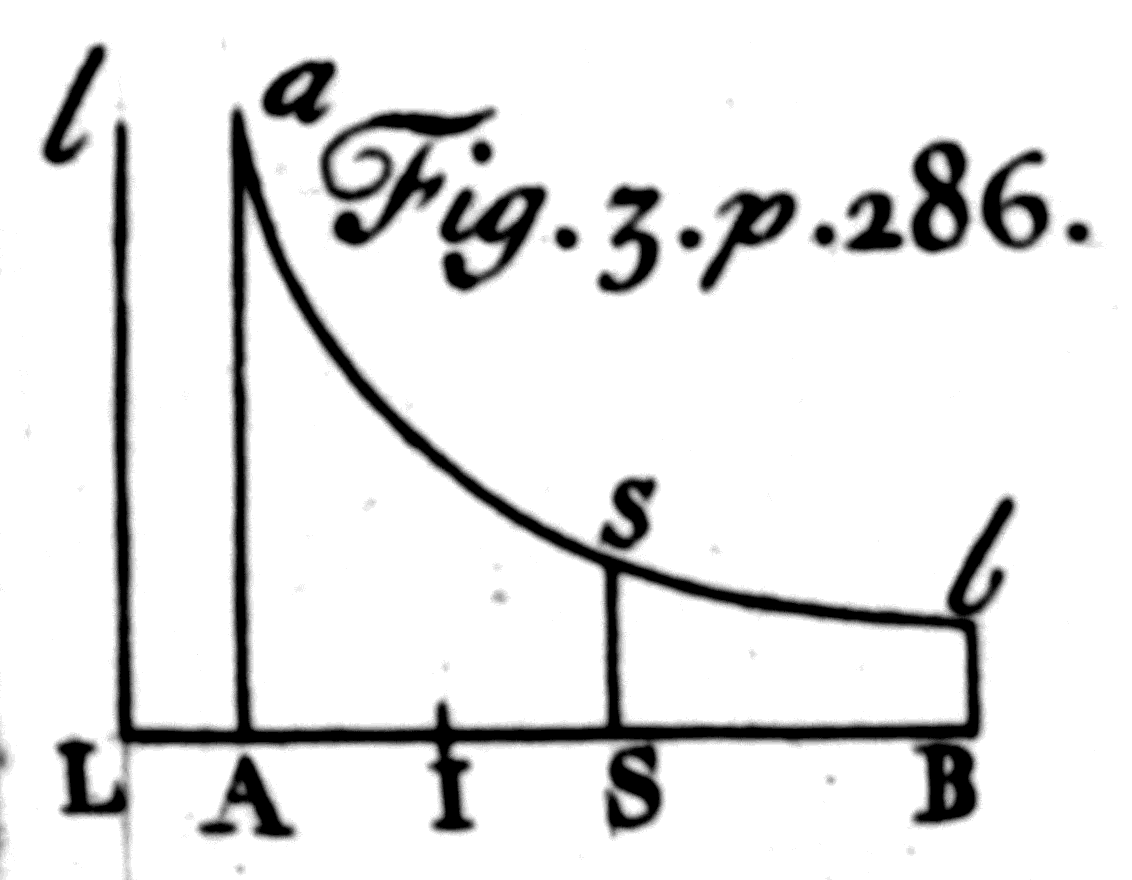
Exam. 3. If the centripetal force tending to the several particles of the spheres decrease in a quadruplicate ratio of the distance from the particles; write for V, then for PE, and DN will become as . These three parts drawn into the length AB, produce so many areas, viz. into ; into ; and into . And these after due reduction come forth , and . And these by subducting the last from the first become . Therefore the entire force with which the corpuscle P is attracted towards the centre of the sphere is as , that is reciprocally as . Q. E. I.
287By the same method one may determine the attraction of a corpuscle situate within the sphere, but more expeditiously by the following theorem.
Proposition LXXXII. Theorem XLI
In a sphere described about the centre S (Pl. 23. Fig. 4.) with the interval SA, if there be taken SI, SA, SP continually proportional; I say that the attraction of a corpuscle within the sphere in any place I, is to its attraction without the sphere in the place P, in a ratio compounded of the subduplicate ratio of IS, PS the distances from the centre, and the subduplicate ratio of the centripetal forces tending to the centre in those places P and I.
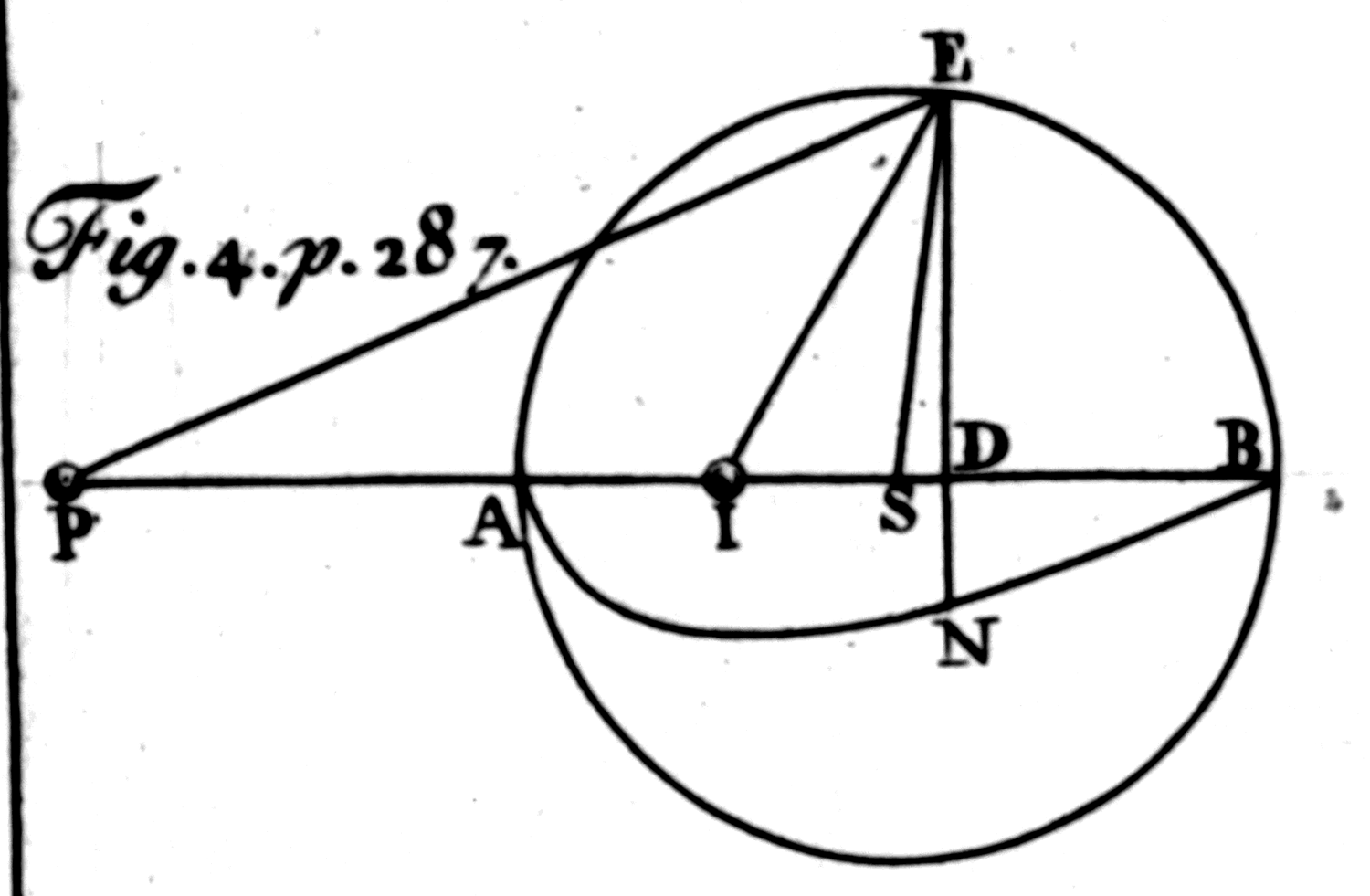
As if the centripetal forces of the particles of the sphere be reciprocally as the distances of the corpuscle attracted by them; the force with which the corpuscle situate in I is attracted by the entire sphere, will be to the force with which it is attracted in P, in a ratio compounded of the subduplicate ratio of the distance SI to the distance SP, and the subduplicate ratio of the centripetal force in the place I arising from any particle in the centre, to the centripetal force in the place P 288arising from the same particle in the centre, that is, in the subduplicate ratio of the distances SI, SP to each other reciprocally. These two subduplicate ratio's compose the ratio of equality, and therefore the attractions in I and P produced by the whole sphere are equal. By the like calculation if the forces of the particles of the sphere are reciprocally in a duplicate ratio of the distance, it will be found that the attraction in I is to the attraction in P as the distance SP to the semi-diameter SA of the sphere. If those forces are reciprocally in a triplicate ratio of the distances, the attractions in I and P will be to each other as to ; if in a quadruplicate ratio as to . Therefore since the attraction in P was found in this last case to be reciprocally as , the attraction in I will be reciprocally as , that is, because is given, reciprocally as PI. And the progression is the same in infinitum. The demonstration of this theorem is as follows.
The things remaining as above constructed, and a corpuscle being in any place P, the ordinate DN was found to be as . Therefore if IE be drawn, that ordinate for any other place of the corpuscle as I, will become (mutatis mutandis) as . Suppose the centripetal forces flowing from any point of the sphere as E, to be to each other at the distances IE and PE, as to , (where the number n denotes the index of the powers of PE and IE) and those ordinates will become as and whose ratio 289to each other is as to . Because SI, SE, SP are in continued proportion, the triangles SIE, SEI are alike; and thence IE is to PE as IS to SE or SA. For the ratio of IE to PE write the ratio of IS to SA; and the ratio of the ordinates becomes that of to . But the ratio of PS to SA is subduplicate of that of the distances PS, SI; and the ratio of to (because IE is to PE as IS to SA) is subduplicate of that of the forces at the distances PS, IS. Therefore the ordinates, and consequently the areas which the ordinates describe, and the attractions proportional to them, are in a ratio compounded of those subduplicate ratio's. Q. E. D.
Proposition LXXXIII. Problem XLII
To find the force with which a corpuscle placed in the centre of a sphere is attracted towards any segment of that sphere whatsoever.
Let P (Pl. 23. Fig. 5.) be a body in the centre of that sphere, and RBSD a segment thereof contained under the plane RDS and the sphærical superficies RBS. Let DB be cut in F by a sphærical superficies EFG described from the centre P, and let the segment be divided into the parts BREFGS, FEDG. Let us suppose that segment to be not a purely mathematical, but a physical superficies, having some, but a perfectly inconsiderable thickness. Let that thickness be called O 290and (by what Archimedes has demonstrated) that superficies will be as . Let us suppose besides the attractive forces of the particles of the sphere to be reciprocally as that power of the distances, of which n is index; and the force with which the superficies EFG attracts the body P, will be (by prop. 79.) as , that is, as . Let the perpendicular FN drawn into O be proportional to this quantity; and the curvilinear area BDI, which the ordinate FN, drawn through the length DB with a continued motion will describe, will be as the whole force with which the whole segment RBSD attracts the body P. Q. E. I.
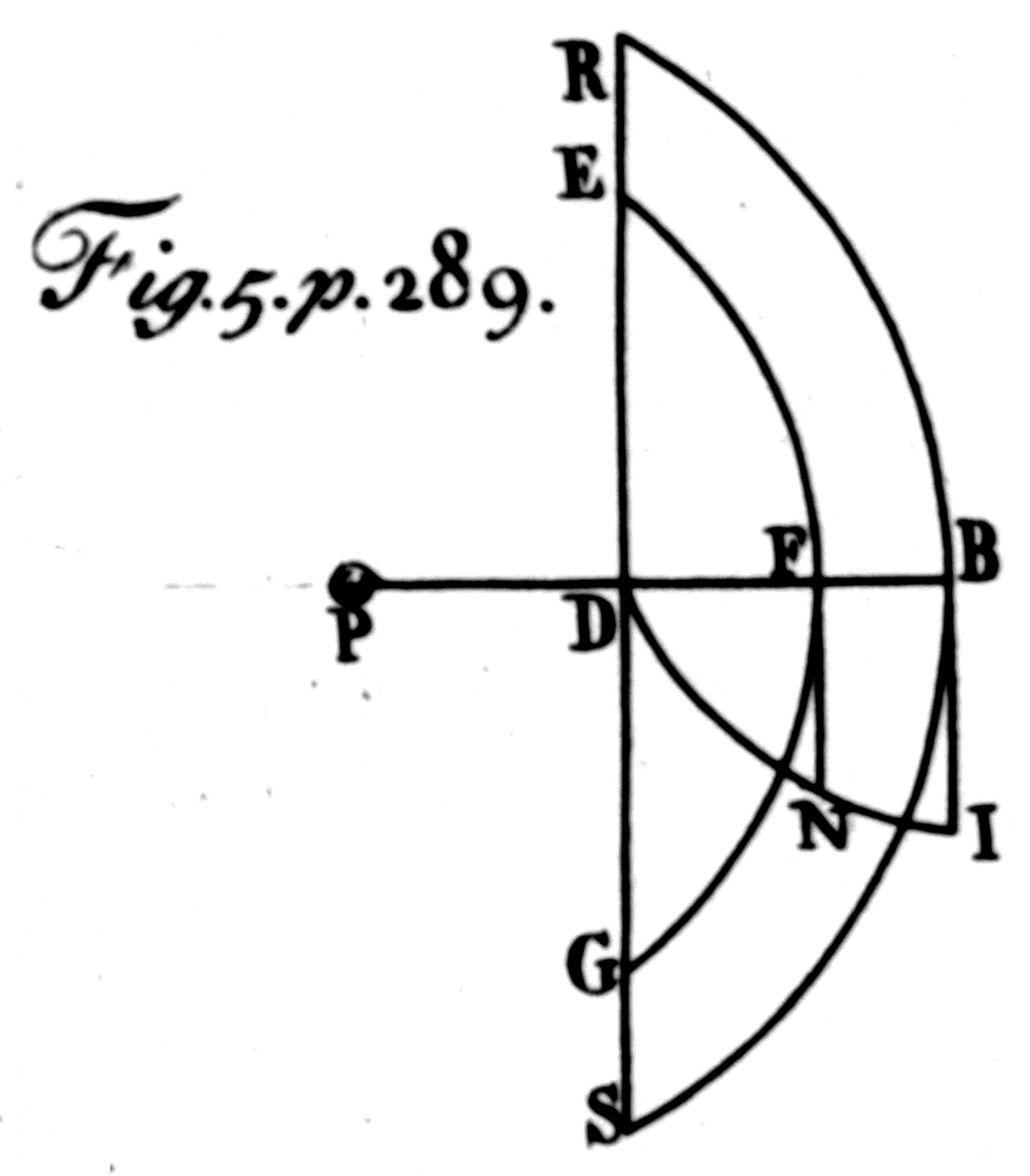
Proposition LXXXIV. Problem XLIII
To find the force with which a corpuscle, placed without the centre of a sphere in the axis of any segment, is attracted by that segment.
Let the body P placed in the axis ADB of the segment EBK (Pl. 23. Fig. 6.) be attracted by that segment. About the centre P with the interval PE let the sphærical superficies EFK be described; and let it divide the segment into two parts EBKFE and EFKDE. Find the force of the first of those parts by prop. 81. and the force of the latter part by prop. 83. and the sum of the forces will be the force Pf the whole segment EBKDE. Q. E. I.
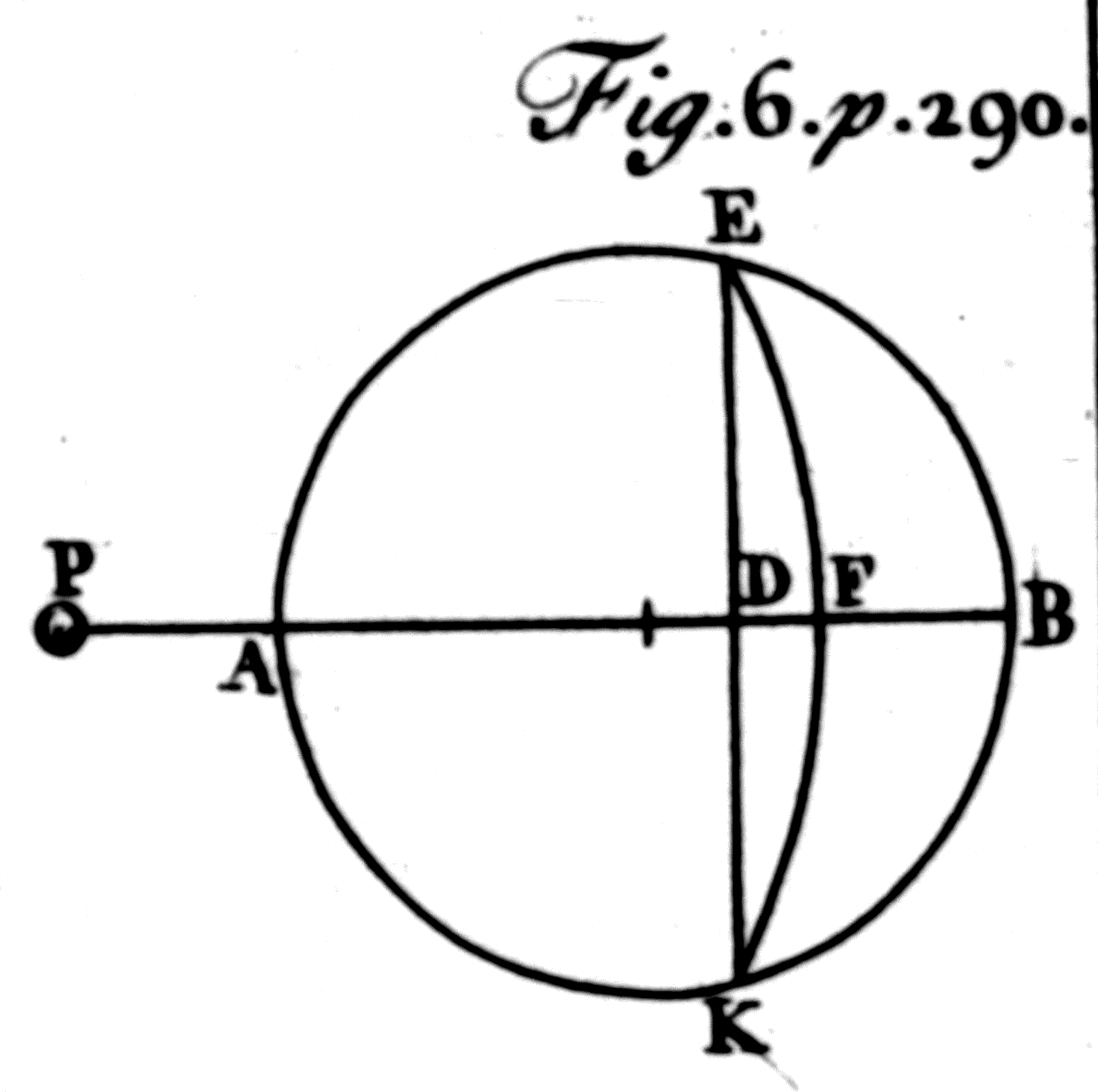
Scholium
291The attractions of sphærical bodies being now explained, it comes next in order to treat of the laws of attraction in other bodies consisting in like manner of attractive particles; but to treat of them particularly is not necessary to my design. It will be sufficient to subjoin some general propositions relating to the forces of such bodies, and the motions thence arising, because the knowledge of these will be of some little use in philosophical enquiries.
Section XIII. Of the attractive forces of bodies which are not of a sphærical figure.
Section XIII
Of the attractive forces of bodies which are not of a sphærical figure.
Proposition LXXXV. Theorem XLII
292If a body be attracted by another, and its attraction be vastly stronger when it is contiguous to the attracting body, than when they are separated from one another by a very small interval; the forces of the particles of the attracting body decrease, in the recess of the body attracted, in more than a duplicate ratio of the distance of the particles.
For if the forces decrease in a duplicate ratio of the distances from the particles, the attraction towards a sphærical body, being (by prop. 74.) reciprocally 293as the square of the distance of the attracted body from the centre of the sphere, will not be sensibly increased by the contact, and it will be still less increased by it, if the attraction, in the recess of the body attracted, decreases in a still less proportion. The proposition therefore is evident concerning attractive spheres. And the case is the same of concave sphærical orbs attracting external bodies. And much more does it appear in orbs that attract bodies placed within them, because there the attractions diffused through the cavities of those orbs are (by prop. 70.) destroyed by contrary attractions, and therefore have no effect even in the place of contact. Now if from these spheres and sphærical orbs we take away any parts remote from the place of contact, and add new parts any where at pleasure; we may change the figures of the attractive bodies at pleasure, but the parts added or taken away, being remote from the place of contact, will cause no remarkable excess of the attraction arising from the contact of the two bodies. Therefore the proposition holds good in bodies of all figures. Q. E. D.
Proposition LXXXVI. Theorem XLIII
If the forces of the particles of which an attractive body is composed, decrease, in the recess of the attracted body, in a triplicate or more than a triplicate ratio of the distance from the particles; the attraction will be 294vastly stronger in the point of contact than when the attracting and attracted bodies are separated from each other though by never so small an interval.
For that the attraction is infinitely increased when the attracted corpuscle comes to touch an attracting sphere of this kind appears by the solution of problem 41. exhibited in the second and third examples. The same will also appear (by comparing those examples and theorem 41. together) of attractions of bodies made towards concavo-convex orbs, whether the attracted bodies be placed without the orbs, or in the cavities within them. And by adding to or taking from those spheres and orbs, any attractive matter any where without the place of contact, so that the attractive bodies may receive any assigned figure, the proposition will hold good of all bodies universally. Q. E. D.
Proposition LXXXVII. Theorem XLIV
If two bodies similar to each other, and consisting of matter equally attractive, attract separately two corpuscles proportional to those bodies, and in a like situation to them; the accelerative attractions of the corpuscles towards the entire bodies will be as 295the accelerative attractions of the corpuscles towards particles of the bodies proportional to the wholes, and alike situated in them.
For if the bodies are divided into particles proportional to the wholes and alike situated in them, it will be, as the attraction towards any particle of one of the bodies to the attraction towards the correspondent particle in the other body, so are the attractions towards the several particles of the first body to the attractions towards the several correspondent particles of the other body; and by composition, so is the attraction towards the first whole body to the attraction towards the second whole body. Q. E. D.
Cor. 1. Therefore, if as the distances of the corpuscles attracted increase, the attractive forces of the particles decrease in the ratio of any power of the distances; the accelerative attractions towards the whole bodies will be as the bodies directly and those powers of the distances inversely. As if the forces of the particles decrease in a duplicate ratio of the distances from the corpuscles attracted, and the bodies are as and , and therefore both the cubic sides of the bodies, and the distance of the attracted corpuscles from the bodies are as A and B; the accelerative attractions towards the bodies will be as and , that is, as A and B the cubic sides of those bodies. If the forces of the particles decrease in a triplicate ratio of the distances from the attracted corpuscles; the accelerative 296attractions towards the whole bodies will be as and , that is, equal. If the forces decrease in a quadruplicate ratio; the attractions towards the bodies will be as and ; that is, reciprocally as the cubic sides A and B. And so in other cases.
Cor. 2. Hence on the other hand, from the forces with which like bodies attract corpuscles similarly situated, may be collected the ratio of the decrease of the attractive forces of the particles as the attracted corpuscle recedes from them; if so be that decrease is directly or inversely in any ratio of the distances.
Proposition LXXXVIII. Theorem XLV
If the attractive forces of the equal particles of any body be as the distance of the places from the particles, the force of the whole body will tend to its centre of gravity; and will be the same with the force of a globe, consisting of similar and equal matter; and having its centre in the centre of gravity.
Let the particles A, B, (Pl. 23. Fig. 7.) of the body RSTV attract any corpuscle Z with forces which, supposing the particles to be equal 297between themselves, are as the distances AZ, BZ; but if they are supposed unequal, are as those particles and their distances AZ, BZ conjunctly, or (if I may so speak) as those particles drawn into their distances AZ, BZ respectively. And let those forces be expressed by the contents under , and . Join AB, and let it be cut in G, so that AG may be to BG as the particle B to the particle A; and G will be the common centre of gravity of the particles A and B. The force will (by cor. 2. of the laws) be resolved into the forces and ; and the force into the forces and . Now the forces and , because A is proportional to B, and BG to AG, are equal; and therefore having contrary directions destroy one other. There remain then the forces and . These tend from Z towards the centre G, and compose the force ; that is the same force as if the attractive particles A and B were placed in their common centre of gravity G, composing there a little globe.
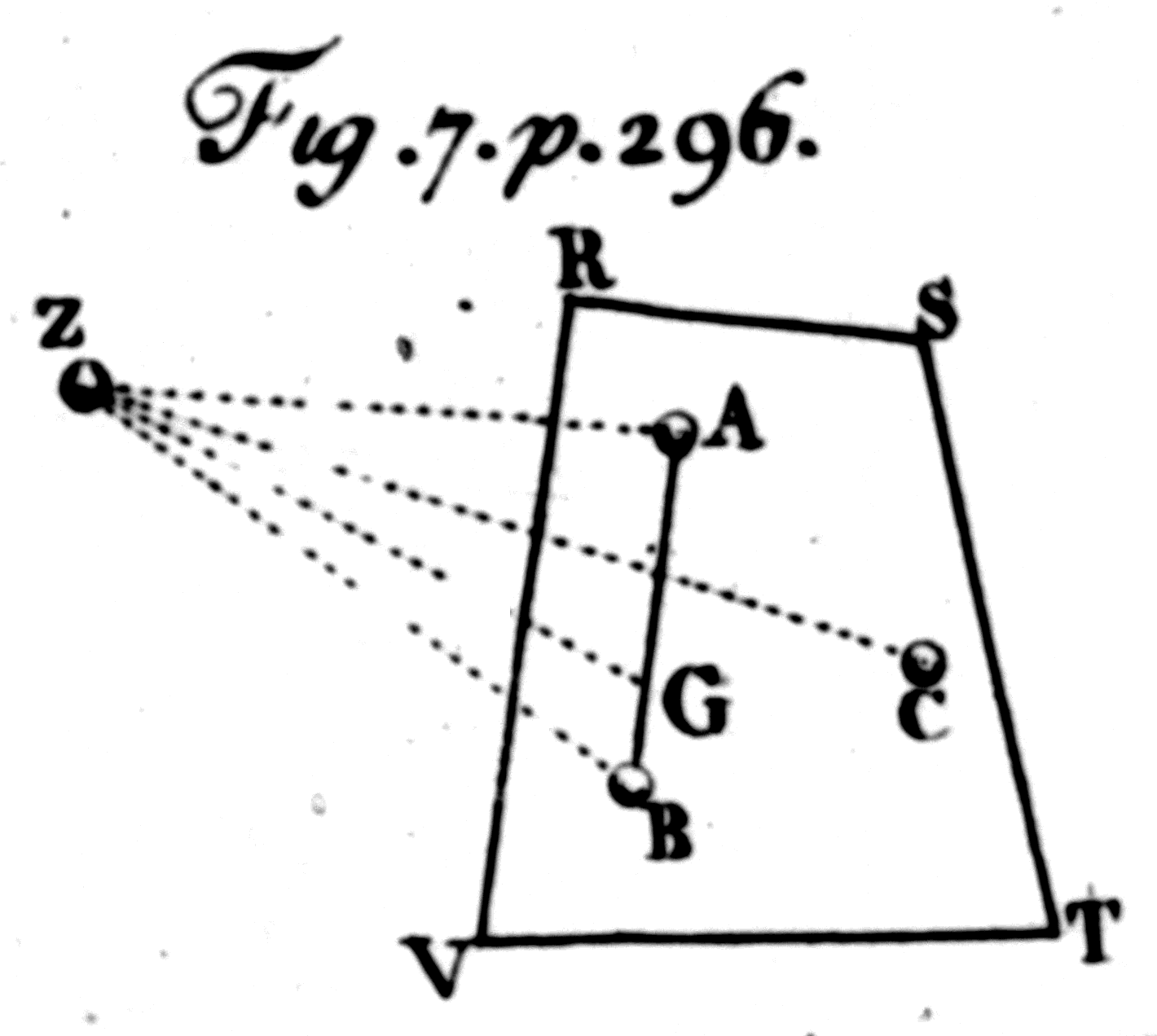
By the same reasoning if there be added a third particle C, and the force of it be compounded with the force tending to the centre G; the force thence arising will tend to the common centre of gravity of that globe in G and of the particle C; that is, to the common centre of gravity of the three particles A, B, C; and will be the same as if that globe and the particle C were placed in that common centre composing a greater globe there. And so we may go on in infinitum. Therefore the whole force of all the 298particles of any body whatever RSTV, is the same as if the body, without removing its centre of gravity, were to put on the form of a globe. Q. E. D.
Cor. Hence the motion of the attracted body Z will be the same, as if the attracting body RSTV were sphærical; and therefore if that attracting body be either at rest, or proceed uniformly in a right line; the body attracted will move in an ellipsis having its centre in the centre of gravity of the attracting body.
Proposition LXXXIX. Theorem XLVI
If there be several bodies consisting of equal particles whose forces are as the distance of the places from each; the force compounded of all the forces by which any corpuscle is attracted, will tend to the common centre of gravity of the attracting bodies; and will be the same as if those attracting bodies, preserving their common centre of gravity, should unite there, and be formed into a globe.
This is demonstrated after the same manner as the foregoing proposition.
Cor. Therefore the motion of the attracted body will be the same as if the attracting bodies, preserving their common centre of gravity, should 299unite there, and be formed into a globe. And therefore if the common centre of gravity of the attracting bodies be either at rest, or proceeds uniformly in a right line; the attracted body will move in an ellipsis having its centre in the common centre of gravity of the attracting bodies.
Proposition XC. Problem XLIV
If to the several points of any circle there tend equal centripetal forces, increasing or decreasing in any ratio of the distances; it is required to find the force with which a corpuscle is attracted, that is situate any where in a right line which stands at right angles to the plane of the circle at its centre.
Suppose a circle to be described about the centre A (Pl. 24. Fig. 1.) with any interval AD in a plane to which the right line AP is perpendicular; and let it be required to find the force with which a corpuscle P is attracted towards the same. From any point E of the circle, to the attracted corpuscle P, let there be drawn the right line PE. In the right line PA take PF equal to PE, and make a perpendicular FK, erected at F, to be as the force with which the point E attracts the corpuscle P. And let the curve line IKL 300be the locus of the point K. Let that curve meet the plane of the circle in L. In PA take PH equal to PD, and erect the perpendicular HI meeting that curve in I; and the attraction of the corpuscle P towards the circle will be as the area AHIL drawn into the altitude AP. Q. E. I.
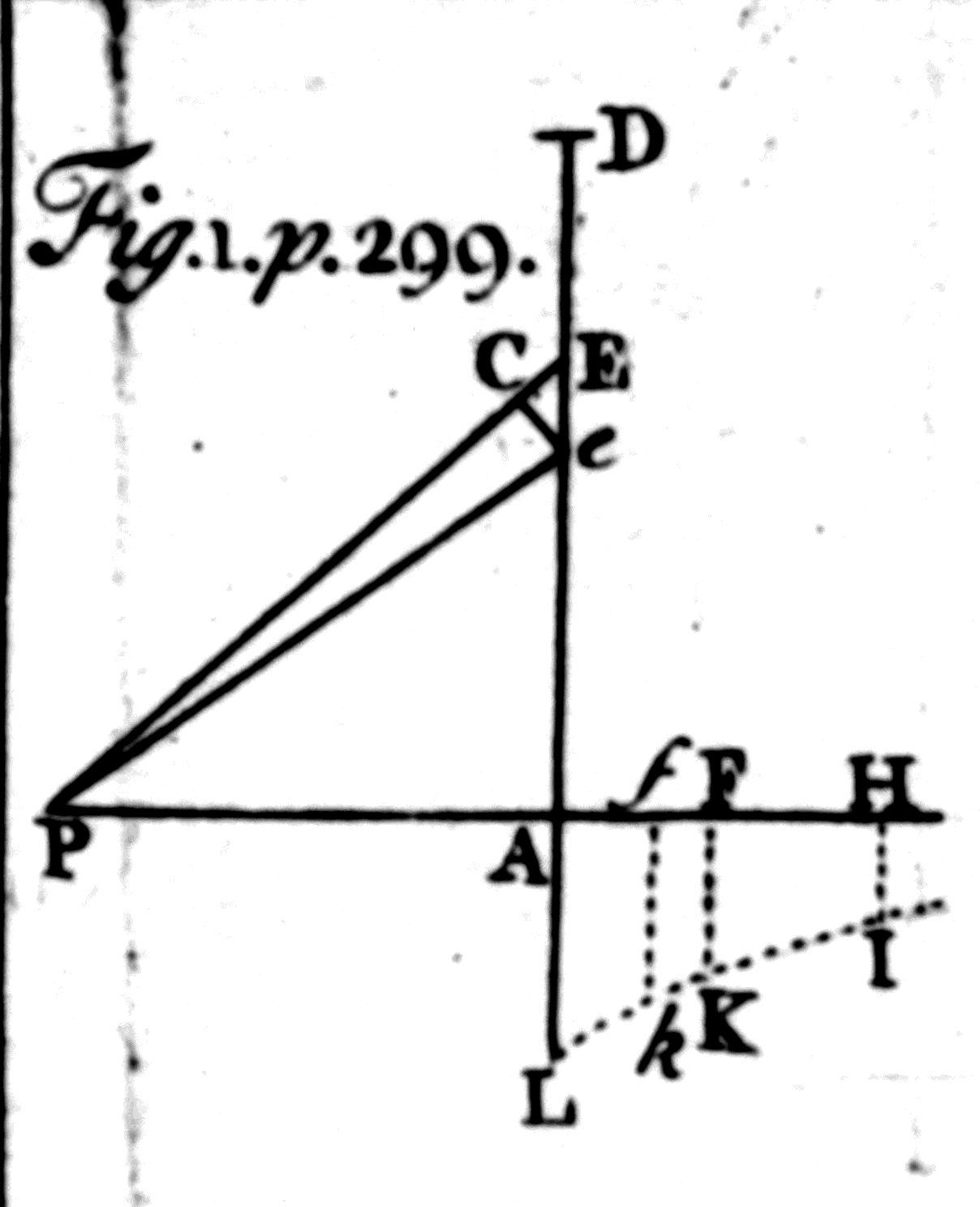
For let there be taken in AE a very small line Ee. Join Pe, and in PE, PA take PC, Pf equal to Pe. And because the force with which any point E of the annulus described about the centre A with the interval AE in the aforesaid plane, attracts to it self the body P, is supposed to be as FK; and therefore the force with which that point attracts the body P towards A is as and the force with which the whole annulus attracts the body P towards A, is as the annulus and conjunctly; and that annulus also is as the rectangle under the radius AE and the breadth Ee, and this rectangle (because PE and AE, Ee and CE are proportional) is equal to the rectangle or ; the force with which that annulus attracts the body P towards A, will be as and conjunctly; that is as the content under , or as the area FKkf drawn into AP. And therefore the sum of the forces with which all the annuli, in the circle described about the centre A with the interval AD, attract the body P towards A, is as the whole area AHIKL drawn into AP. Q. E. D.
301Cor. 1. Hence if the forces of the points decrease in the duplicate ratio of the distances, that is, if FK be as , and therefore the area AHIKL as ; the attraction of the corpuscle P towards the circle will be as ; that is, as .
Cor. 2. And universally if the forces of the points at the distances D be reciprocally as any power , of the distances; that is, if FK be as , and therefore the area AHIKL as ; the attraction of the corpuscle P towards the circle will be as .
Cor. 3. And if the diameter of the circle be increased in infinitum, and the number n be greater than unity; the attraction of the corpuscle P towards the whole infinite plane will be reciprocally as because the other term vanishes.
Proposition XCI. Problem XLV
302To find the attraction of a corpuscle situate in the axis of a round solid, to whose several points there tend equal centripetal forces decreasing in any ratio of the distances whatsoever.
Let the corpuscle P (Pl. 24. Fig. 2.) situate in the axis AB of the solid DECG, be attracted towards that solid. Let the solid be cut by any circle as RFS, perpendicular to the axis; and in its semi-diameter FS, in any plane PALKB passing through the axis. Let there be taken (by prop. 90.) the length FK proportional to the force with which the corpuscle P is attracted towards that circle. Let the locus of the point K be the curve line LKI, meeting the planes of the outermost circles AL and BI in L and I; and the attraction of the corpuscle P towards the solid will be as the area LABI. Q. E. I.
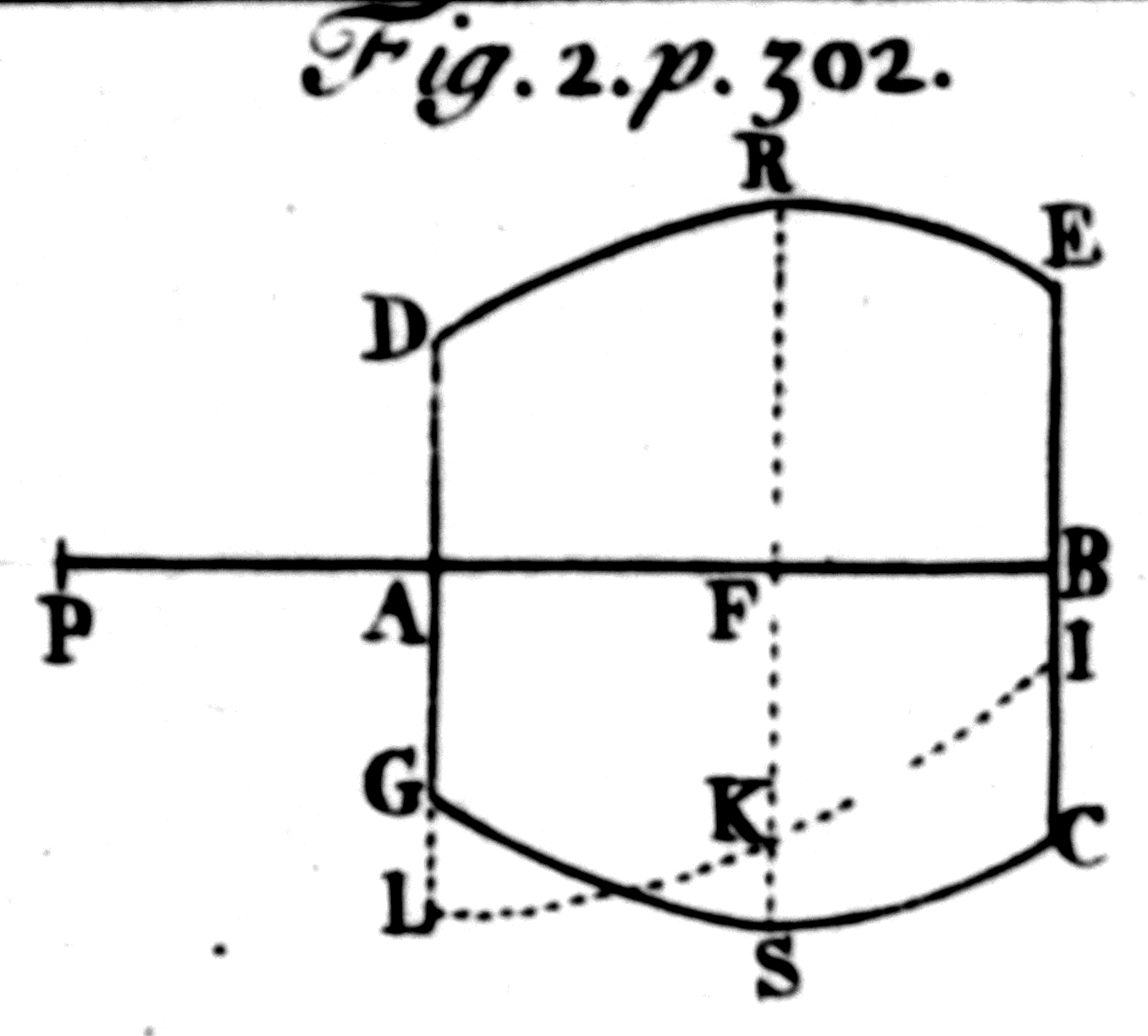
Cor. 1. Hence if the solid be a cylinder described by the parallelogram ADEB (Pl. 24. Fig. 3.) revolved about the axis AB, and the centripetal forces tending to the several points be reciprocally as the squares of the distances from the points; the attraction of the corpuscle P towards this cylinder will be as . For the ordinate FK (by cor. 1. prop. 90.) will be as 303. The part 1 of this quantity, drawn into the length AB, describes the area ; and the other part drawn into the length PB, describes the area 1 into , (as may be easily shewn from the quadrature of the curve LKI;) and in like manner, the same part drawn into the length PA describes the area 1 into , and drawn into AB, the difference of PB and PA, describes 1 into , the difference of the areas. From the first content take away the last content 1 into , and there will remain the area LABI equal to 1 into . Therefore the force being proportional to this area, is as .
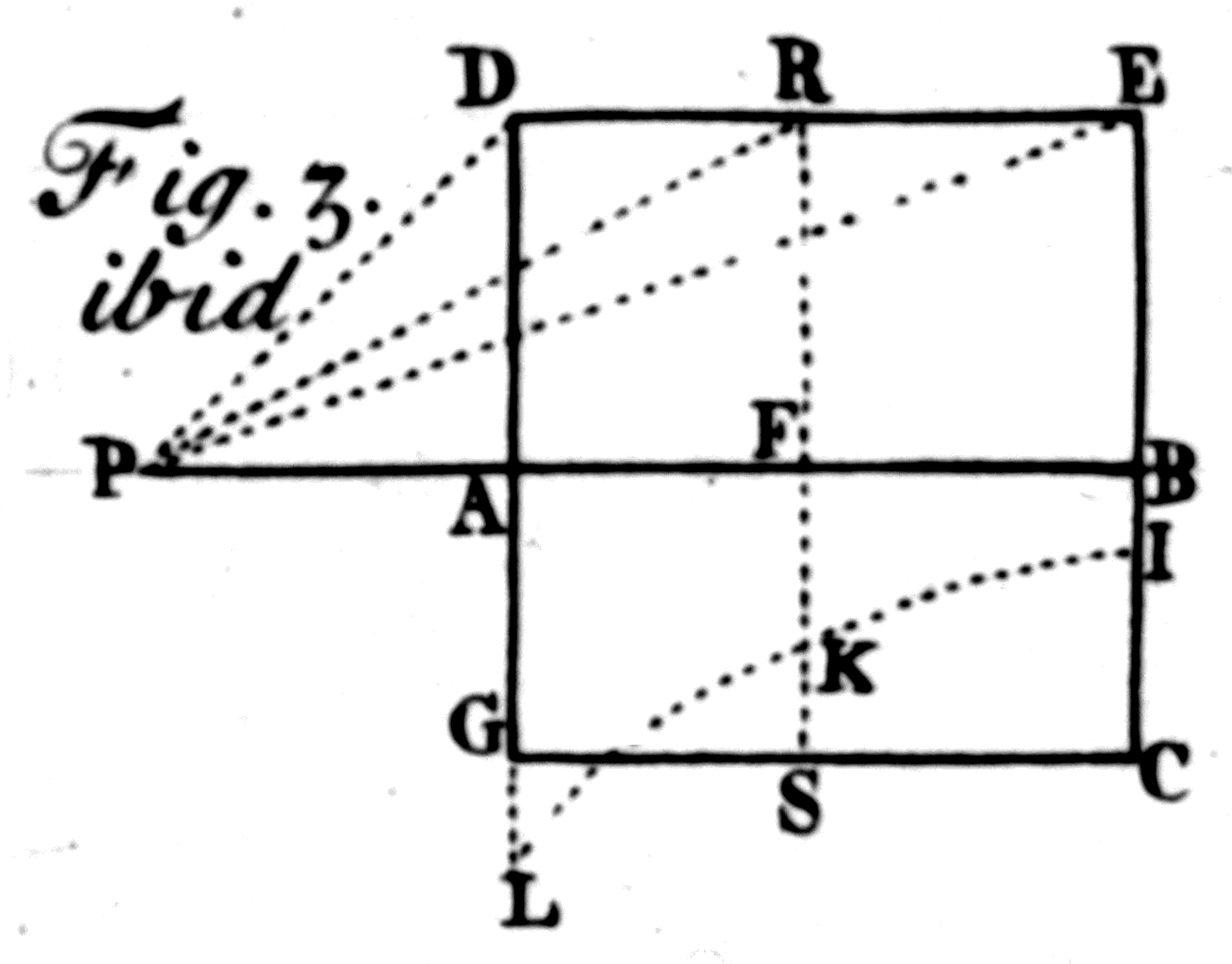
Cor. 2. Hence also is known the force by which a spheroid AGBC (Pl. 24. Fig. 4.) attracts any body P situate externally in its axis AB. Let NKRM be a conic section whose ordinate ER perpendicular to PE, may be always equal to the length of the line PD, continually drawn to the point D in which that ordinate cuts the spheroid. From the vertices A, B, of the spheroid, let there be erected to its axis AB the perpendiculars AK, BM, respectively equal to AP, BP, and therefore meeting the conic section in K and M; and join KM cutting off from it the segment KMRK. Let S be the centre of the spheroid, and SC its greatest semi-diameter; and the force with which the spheroid attracts the body P, will be to the force with which a sphere described with the diameter AB attracts the same body, 304as is to . And by a calculation founded on the same principles may be found the forces of the segments of the spheroid.
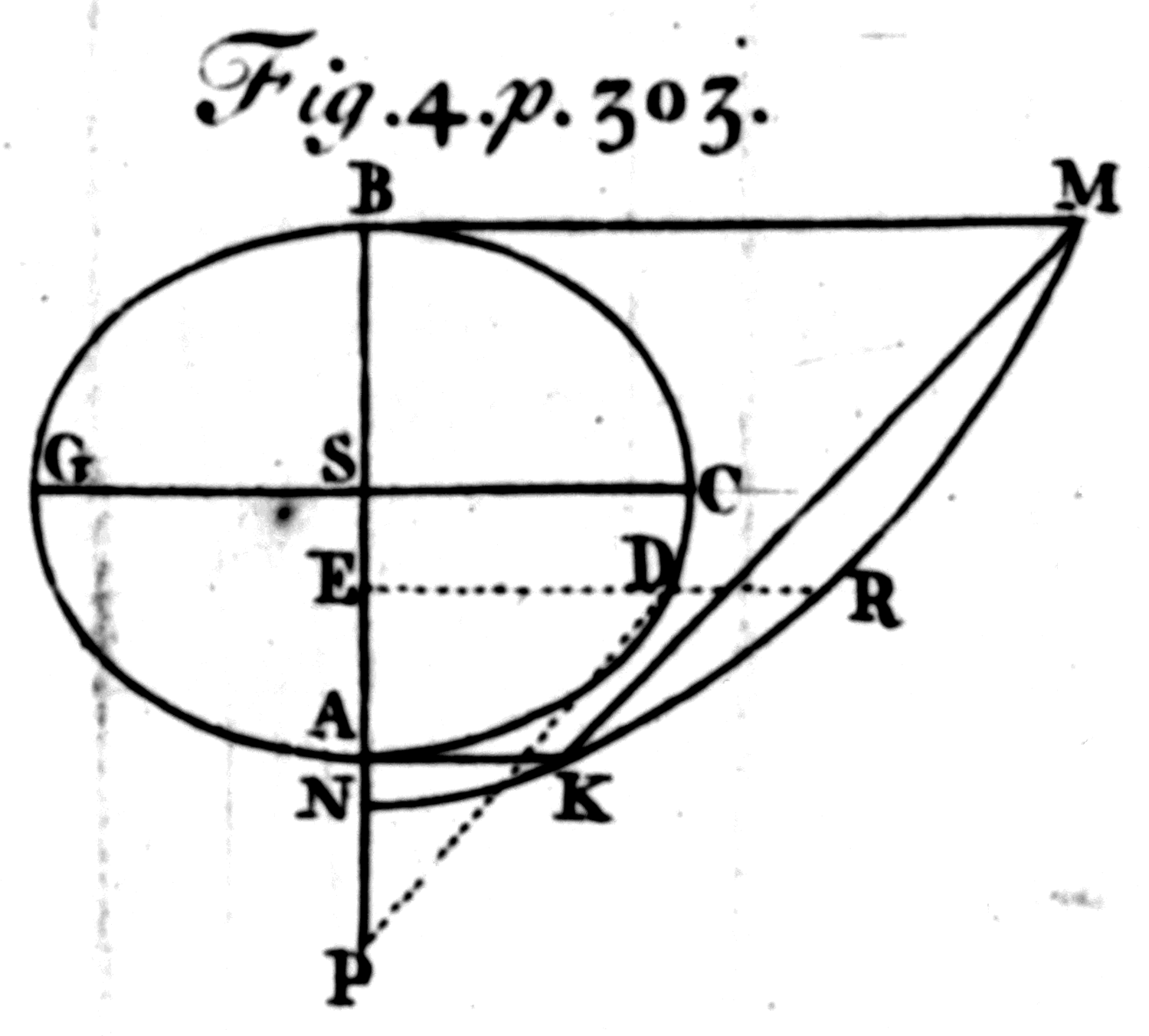
Cor. 3. If the corpuscle be placed within the spheroid and in its axis, the attraction will be as its distance from the centre. This may be easily collected from the following reasoning, whether the particle be in the axis or in any other given diameter. Let AGOF (Pl. 24. Fig. 5.) be an attracting spheroid, S its centre, and P the body attracted. Through the body P let there be drawn the semi-diameter SPA, and two right lines DE, FG meeting the spheroid in D and E, F and G; and let PCM, HLN be the superficies of two interior spheroids similar and concentrical to the exterior, the first of which passes through the body P, and cuts the right lines DE, FG in B and C; and the latter cuts the same right lines in H and I, K and L. Let the spheroids have all one common axis, and the parts of the right lines intercepted on both sides DP and BE, FP and CG, DH and IE, FK and LG will be mutually equal; because the right lines DE, PB, and HI are bisected in the same point, as are also the right lines FG, PC and KL. Conceive now DPF, EPG to represent opposite cones described with the infinitely small vertical angles DPF, EPG, and the lines DH, EI to be infinitely small also. Then the particles of the cones DHKF, GLIE, cut off by the spheroidical superficies, by reason of the equality of the lines DH and EI, will be to one another as the squares of the distances 305from the body P, and will therefore attract that corpuscle equally. And by a like reasoning if the spaces DPF, EGCB be divided into particles by the superficies of innumerable similar spheroids concentric to the former and having one common axis, all these particles will equally attract on both sides the body P towards contrary parts. Therefore the forces of the cone DPF, and of the conic segment EGCB are equal and by their contrariety destroy each other. And the case is the same of the forces of all the matter that lies without the interior spheroid PCBM. Therefore the body P is attracted by the interior spheroid PCBM alone, and therefore (by cor. 3. prop. 72.) its attraction is to the force with which the body A is attracted by the whole spheroid AGOD, as the distance PS to the distance AS. Q. E. D.
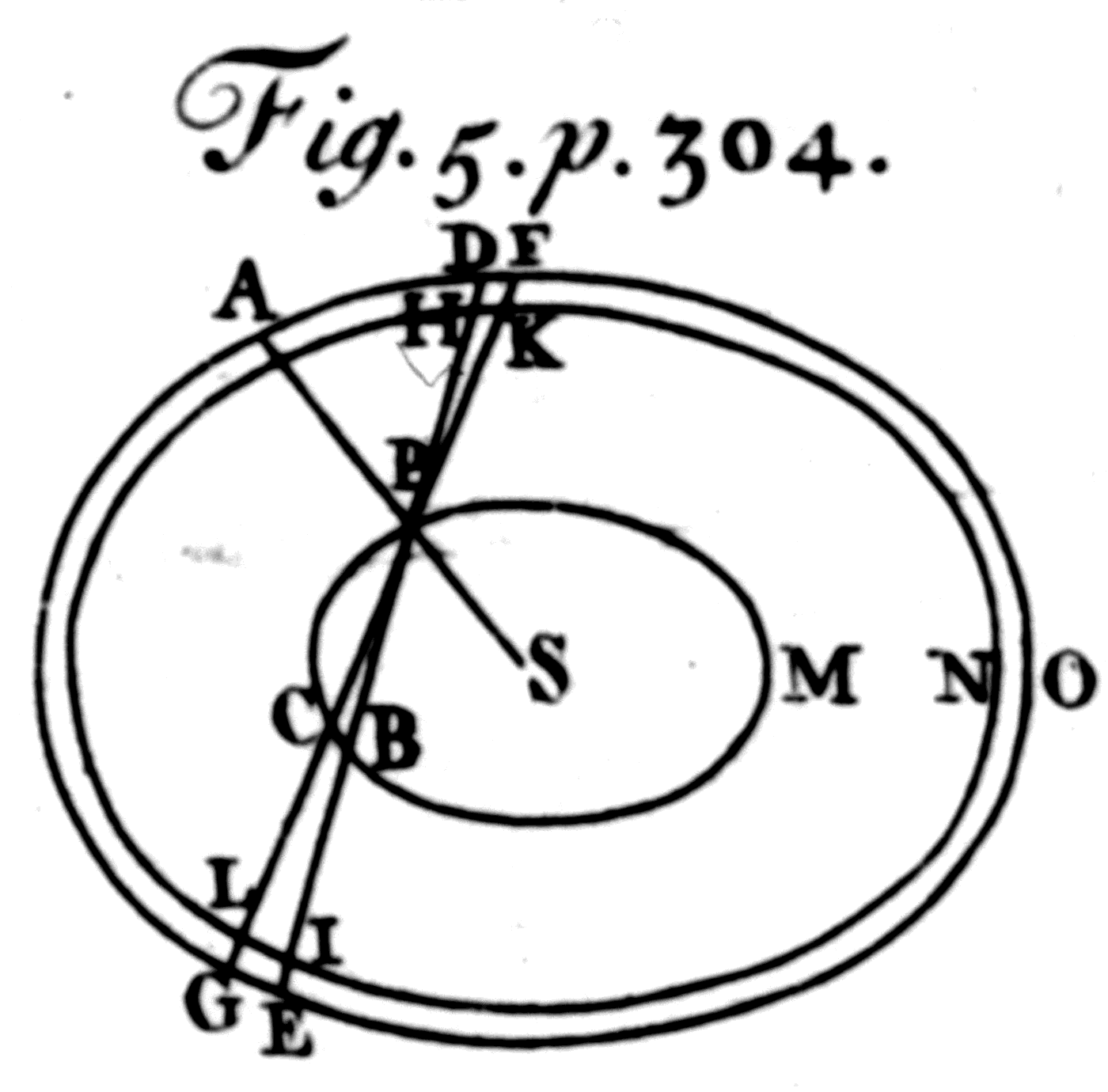
Proposition XCII. Problem XLVI
An attracting body being given, it is required to find the ratio of the decrease of the centripetal forces tending to its several points.
The body given must be formed into a sphere, a cylinder, or some regular figure whose, law of attraction answering to any ratio of decrease may be found by prop. 80. 81 and 91. Then, by experiments, the force of the attractions must be found at several distances, and the law of attraction towards the whole, made known by that means, will give the ratio of the decrease of the forces of the several parts; which was to be found.
Proposition XCIII. Theorem XLVII
306If a solid be plane on one side, and infinitely extended on all other sides, and consist of equal particles equally attractive, whose forces decrease, in the recess from the solid, in the ratio of any power greater than the square of the distances; and a corpuscle placed towards either part of the plane is attracted by the force of the whole solid; I say that the attractive force of the whole solid, in the recess from its plane superficies, will decrease in the ratio of a power whose side is the distance of the corpuscle from the plane, and its index less by 3 than the index of the power of the distance.
Case 1. Let LGI (Pl. 24. Fig. 6.) be the plane by which the solid is terminated. Let the solid lie on that hand of the plane that is towards I, and let it be resolved into innumerable planes mHM, nIN, oKO, &c. parallel to GL. And first let the attracted body C be placed without the solid. Let there be drawn CGHI perpendicular to those innumerable planes, and let the attractive forces of the points of the solid decrease in the ratio of a power of the distances whose index is the number n not less than 3. Therefore 307(by cor. 3. prop. 90.) the force with which any plane mHM attracts the point C, is reciprocally as . In the plane mHM take the length HM reciprocally proportional to , and that force will be as HM. In like manner in the several planes IGL, nIN, oKO, &c. take the lengths GL, IN, KO, &c. reciprocally proportional to , , , &c. and the forces of those planes will be as the lengths so taken, and therefore the sum of the forces as the sum of the lengths, that is, the force of the whole solid as the area GLOK produced infinitely towards OK. But that area (by the known methods of quadratures) is reciprocally as , and therefore the force of the whole solid is reciprocally as . Q. E. D.
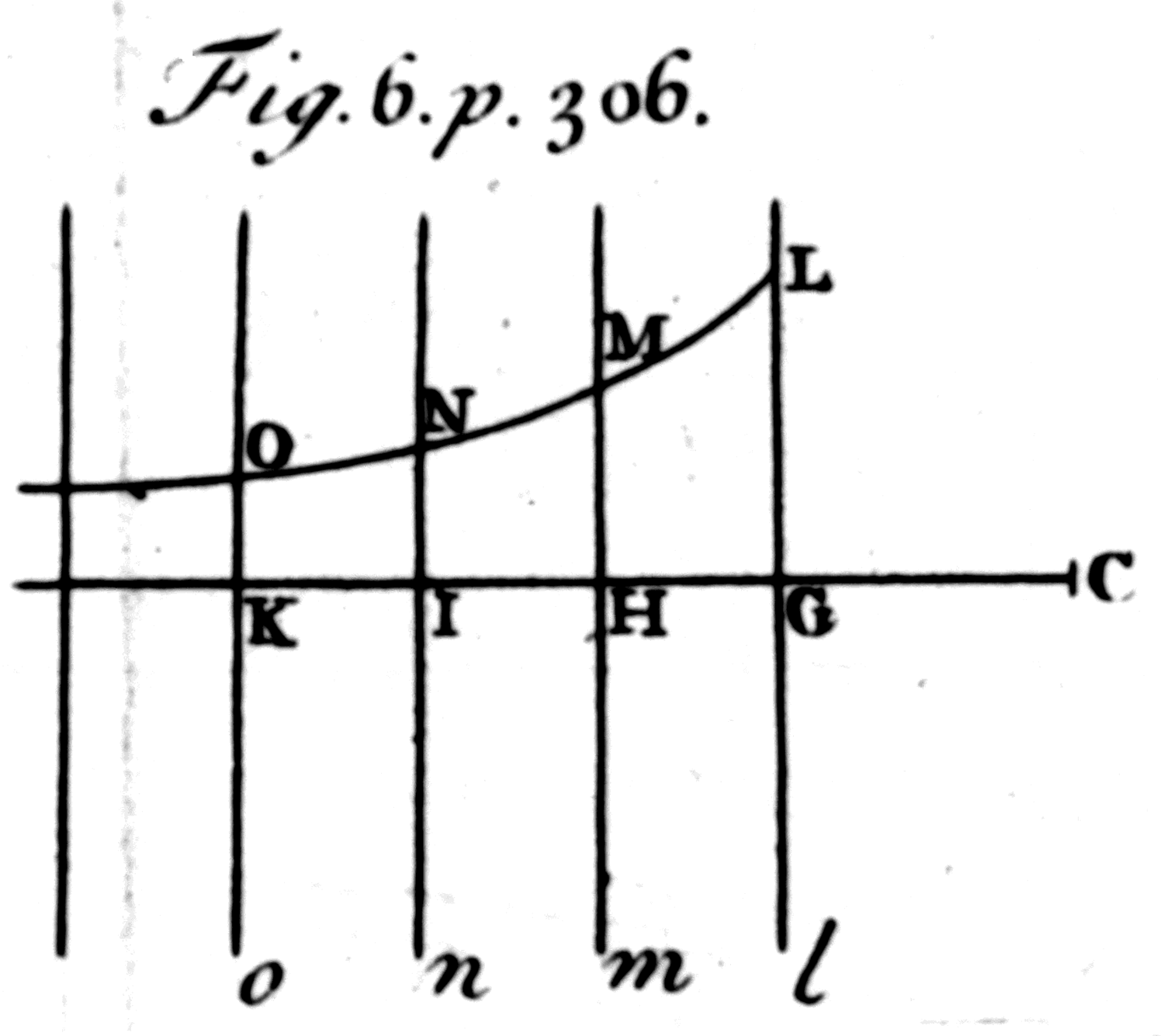
Case 2. Let the corpuscle (Fig. 7.) be now placed on that hand of the plane IGL that is within the solid, and take the distance CK equal to the distance CG. And the part of the solid LGoKO terminated by the parallel planes IGL, oKO, will attract the corpuscle, situate in the middle, neither one way nor another, the contrary actions of the opposite points destroying one another by reason of their equality. Therefore the corpuscle C is attracted by the force only of the solid situate beyond the plane OK. But this force (by case 1.) is reciprocally as , that is (because CG, CK are equal) reciprocally as . Q. E. D.
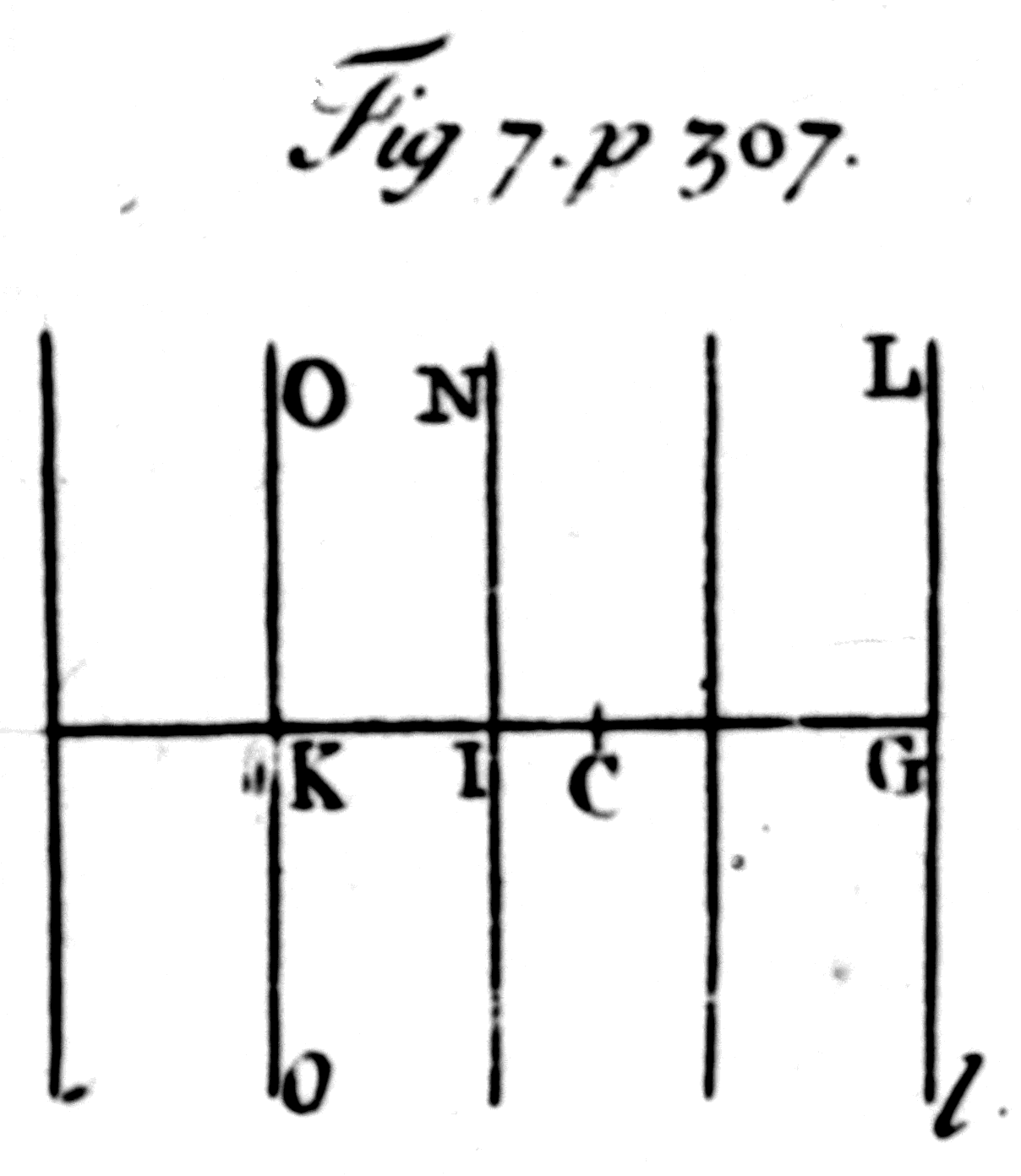
Cor. 1. Hence if the solid LGIN be terminated on each side by two infinite parallel planes LG, IN; its attractive force is known, subducting from the attractive force of the whole infinite solid LGKO, the attractive force of the more distant part NIKO infinitely produced towards KO.
308Cor. 2. If the more distant part of this solid be rejected, because its attraction compared with the attraction of the nearer part is inconsiderable; the attraction of that nearer part will, as the distance increases, decrease nearly in the ratio of the power .
Cor. 3. And hence if any finite body, plane on one side, attract a corpuscle situate over-against the middle of that plane, and the distance between the corpuscle and the plane compared with the dimensions of the attracting body be extremely small; and the attracting body consist of homogeneous particles, whose attractive forces decrease in the ratio of any power of the distances greater than the quadruplicate; the attractive force of the whole body will decrease very nearly in the ratio of a power whose side is that very small distance, and the index less by 3 than the index of the former power. This assertion does not hold good however of a body consisting of particles whose attractive forces decrease in the ratio of the triplicate power of the distances; because in that case, the attraction of the remoter part of the infinite body in the second corollary is always infinitely greater than the attraction of the nearer part.
Scholium
If a body is attracted perpendicularly towards a given plane, and from the law of attraction given the motion of the body be required; the problem will be solved by seeking (by prop. 39.) the motion of the body descending in a right line towards that plane, and (by cor. 2. of the laws) compounding that motion with an uniform motion, performed in 309the direction of lines parallel to that plane. And on the contrary if there be required the law of the attraction tending towards the plane in perpendicular directions, by which the body may be caused to move in any given curve line, the problem will be solved by working after the manner of the third problem.
But the operations may be contracted by resolving the ordinates into converging series. As if to a base A the length B be ordinately applied in any given angle, that length be as any power of the base ; and there be sought the force with which a body, either attracted towards the base or driven from it in the direction of that ordinate, may be caused to move in the curve line which that ordinate always describes with its superior extremity; I suppose the base to be increased by a very small part O, and I resolve the ordinate into an infinite series &c. and I suppose the force proportional to the term of this series in which O is of two dimensions, that is to the term . Therefore the force sought is as , or, which is the same thing, as . As if the ordinate describe a parabola, m being , and , the force will be as the given quantity , and therefore is given.
310Therefore with a given force the body will move in a parabola, as Galileo has demonstrated. If the ordinate describe an hyperbola, m being , and ; the force will be as or ; and therefore a force which is as the cube of the ordinate will cause the body to move in an hyperbola. But leaving this kind of propositions, I shall go on to some others relating to motion which I have not yet touched upon.
Section XIV. Of the motion of very small bodies when agitated by centripetal forces tending to the several parts of any very great body.
Section XIV
Of the motion of very small bodies when agitated by centripetal forces tending to the several parts of any very great body.
Proposition XCIV. Theorem XLVIII
311If two similar mediums be separated from each other by a space terminated on both sides by parallel planes, and a body in its passage through that space be attracted or impelled perpendicular towards either of those mediums, and not agitated or hindered by any other force; and the attraction be every where the same at equal distances from either plane, taken towards the same hand of the plane; I say that the sine of incidence upon either plane will be to the sine of emergence from the other plane, in a given ratio.
Case 1. Let Aa and Bb (Pl. 25. Fig. 1.) be two parallel planes, and let the body light upon 312the first plane Aa in the direction of the line GH, and in its whole passage through the intermediate space let it be attracted or impelled towards the medium of incidence, and by that action let it be made to describe a curve line HI, and let it emerge in the direction of the line IK. Let there be erected IM perpendicular to Bb the plane of emergence, and meeting the line of incidence GH prolonged in M, and the plane of incidence Aa in R; and let the line of emergence KI be produced and meet HM in L. About the centre L, with the interval LI, let a circle be described cutting both HM in P and Q, and MI produced in N; and first, if the attraction or impulse be supposed uniform, the curve HI (by what Galileo has demonstrated) be a parabola, whose property is, that a rectangle under its given latus rectum and the line IM is equal to the square of HM; and moreover the line HM will be bisected in L. Whence if to MI there be let fall the perpendicular LO, MO, OR will be equal; and adding the equal lines ON, OI, the wholes MN, IR will be equal also. Therefore since IR is given MN is also given, and the rectangle NMI is to the rectangle under the latus rectum and IM, that is, to , in a given ratio. But the rectangle NMI is equal to the rectangle PMQ, that is, to the difference of the squares , and or ; and hath a given ratio to its fourth part ; therefore the ratio of to is given, and by conversion the ratio of to , and its subduplicate, the ratio of LI to ML. But in every triangle as LMI, the sines of the angles are proportional to the opposite sides. Therefore the ratio of the sine of the angle of incidence LMR 313to the sine of the angle of emergence LIR is given. Q. E. D.
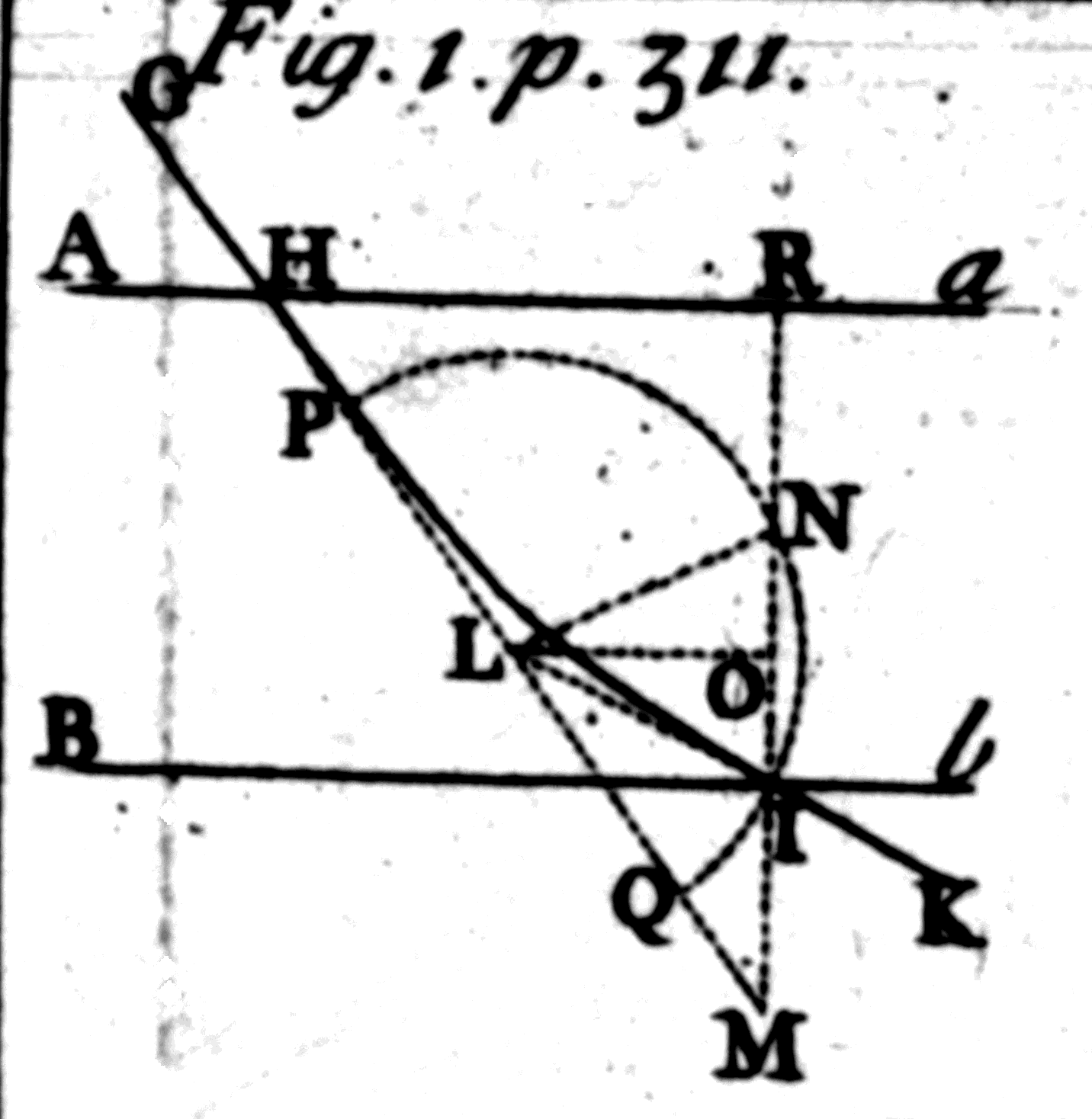
Case 2. Let now the body pass successively through several spaces terminated with parallel planes, AabB, BbcC, &c. (Pl. 25. Fig. 2.) and let it be acted on by a force which is uniform in each of them separately, but different in the different spaces; and by what was just demonstrated, the sine of the angle of incidence on the first plane Aa is to the sine of emergence from the second plane Bb in a given ratio; and this sine of incidence upon the second plane Bb will be to the sine of emergence from the third plane Cc in a given ratio; and this sine to the sine of emergence from the fourth plane Dd in a given ratio; and so on in infinitum; and by equality, the sine of incidence on the first plane to the sine of emergence from the last plane in a given ratio. Let now the intervals of the planes be diminished, and their number be infinitely increased, so that the action of attraction or impulse, exerted according to any assigned law, may become continual, and the ratio of the sine of incidence on the first plane to the sine of emergence from the last plane being all along given, will be given then also. Q. E. D.
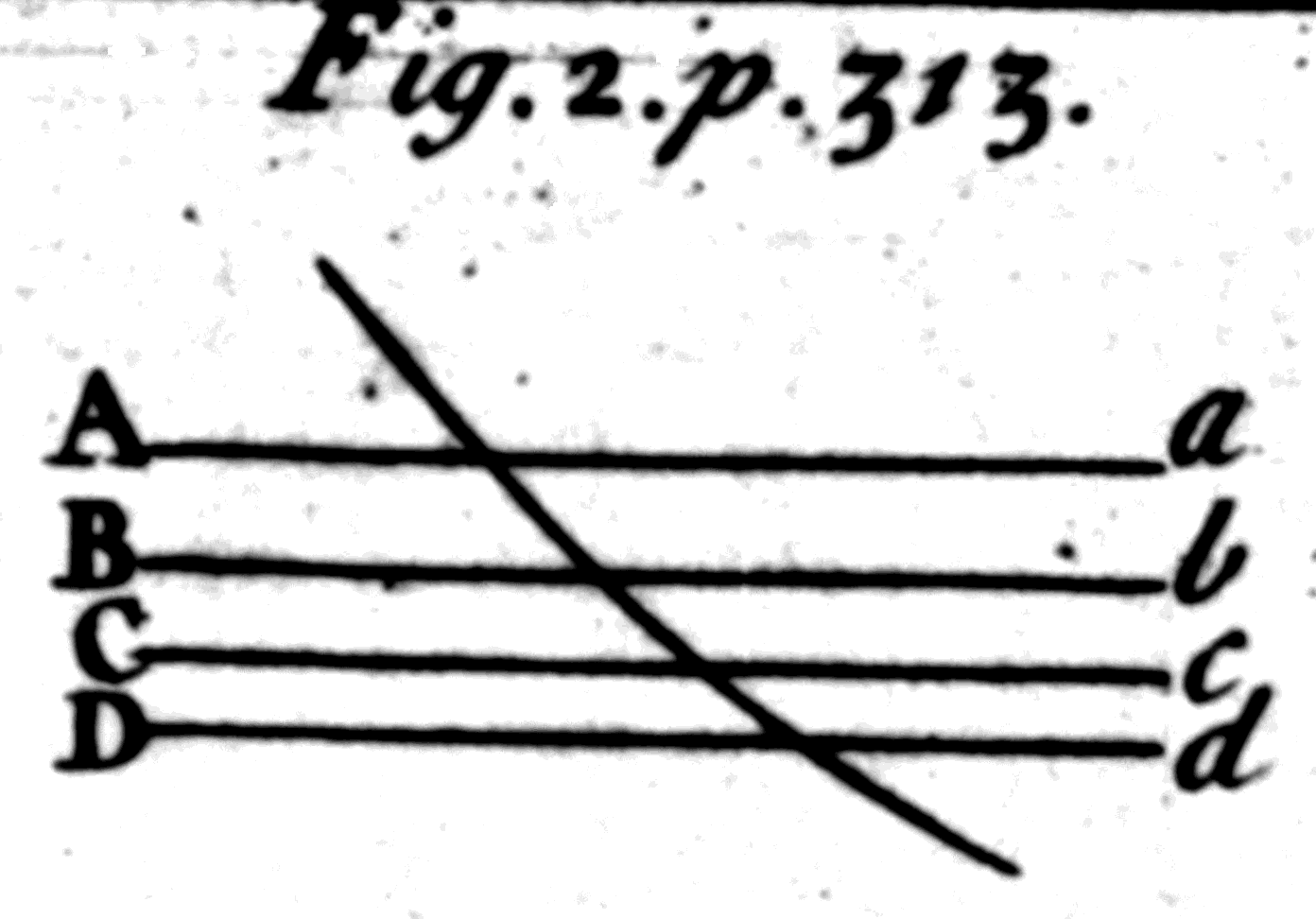
Proposition XCV. Theorem XLIX
The same things being supposed, I say that the velocity of the body before its incidence is to its velocity after emergence as the sine of emergence to the sine of incidence.
Make AH and Id equal (Pl. 25. Fig. 3.) and erect the perpendiculars AG, dK meeting the lines 314of incidence and emergence GH, IK in G and K. In GH take TH equal to IK, and to the plane Aa let fall a perpendicular Tv. And (by cor. 2. of the laws of motion) let the motion of the body be resolved into two, one perpendicular to the planes Aa, Bb, Cc, &c. and another parallel to them. The force of attraction or impulse, acting in directions perpendicular to those planes, does not at all alter the motion in parallel directions; and therefore the body proceeding with this motion will in equal times go through those equal parallel intervals that lie between the line AG and the point H, and between the point I and the line dK; that is, they will describe the lines GH, IK in equal times. Therefore the velocity before incidence is to the velocity after emergence as GH to IK or TH, that is as AH or Id to vH, that is (supposing TH or IK radius) as the sine of emergence to the sine of incidence. Q. E. D.
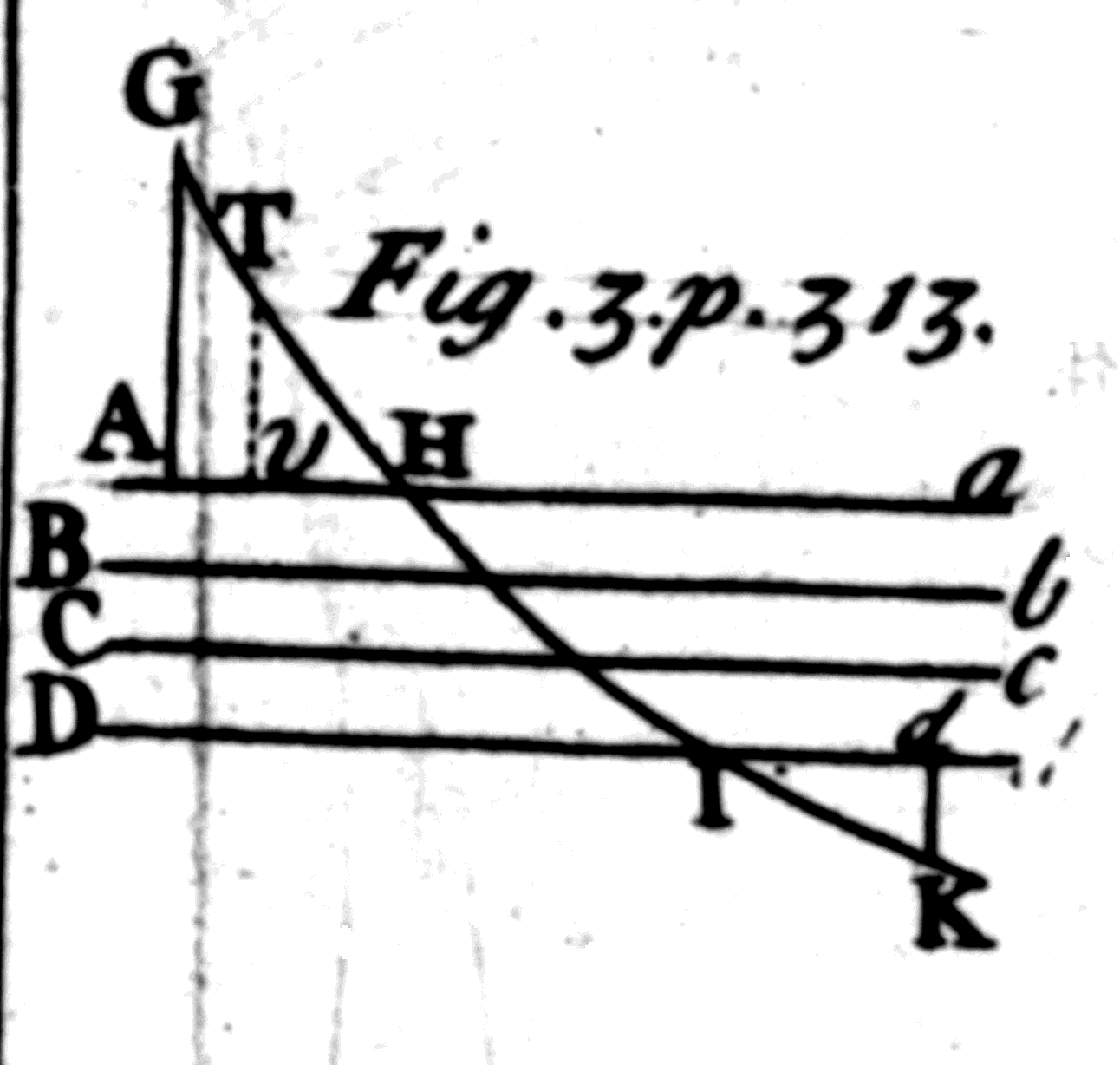
Proposition XCVI. Theorem L
The same things being supposed, and that the motion before incidence is swifter than afterwards; I say that if the line of incidence be inclined continually, the body will be at last reflected, and the angle of reflexion will be equal to the angle of incidence.
For conceive the body passing between the parallel planes Aa, Bb, Cc, &c. (Pl. 25. Fig. 4.) to describe parabolic arcs as above; and let those arcs be HP, PQ, QR, &c. And the obliquity 315of the line of incidence GH to the first plane Aa be such, that the sine of incidence may be to the radius of the circle whose sine it is, in the same ratio which the same sine of incidence hath to the sine of emergence from the plane Dd into the space DdeE; and because the sine of emergence is now become equal to radius, the angle of emergence will be a right one, and therefore the line of emergence will coincide with the plane Dd. Let the body come to this plane in the point R; and because the line of emergence coincides with that plane it is manifest that the body can proceed no farther towards the plane Ee. But neither can it proceed in the line of emergence Rd; because it is perpetually attracted or impelled towards the medium of incidence. It will return therefore between the planes Cc, Dd, describing an arc of a parabola QRq; whose principal vertex (by what Galileo has demonstrated) is in R, cutting the plane Cc in the same angle at q, that it did before at Q; then going on in the parabolic arcs qp, ph, &c. similar and equal to the former arcs QP, PH, &c. it will cut the rest of the planes in the same angles at p, h, &c. as it did before in P, H, &c. and will emerge at last with the same obliquity at h, with which it first impinged on that plane at H. Conceive now the intervals of the planes Aa, Bb, Cc, Dd, Ee, &c. to be infinitely diminished, and the number infinitely increased, so that the action of attraction or impulse, exerted according to any assigned law, may become continual; and the angle of emergence remaining all along equal to the angle of incidence will be equal to the same also at last. Q. E. D.
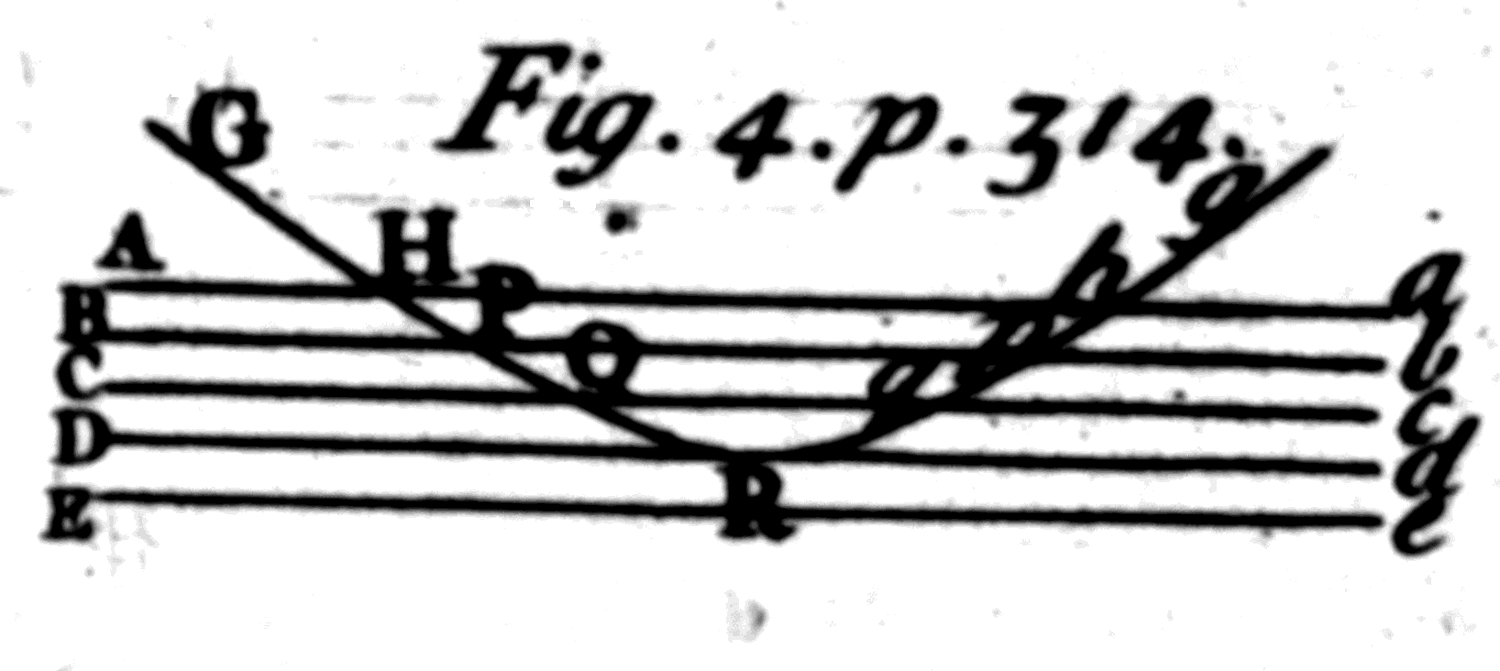
Scholium
316These attractions bear a great resemblance to the reflexions and refractions of light, made in a given ratio of the secants, as was discovered by Snellius; and consequently in a given ratio of the sines, as was exhibited by Des Cartes. For it is now certain from the phænomena of Jupiter's Satellits confirmed by the observations of different Astronomers, that light is propagated in succession, and requires about seven or eight minutes to travel from the Sun to the Earth. Moreover the rays of light that are in our air (as lately was discovered by Grimaldus, by the admission of light into a dark room through a small hole, which I have also tried) in their passage near the angles of bodies whether transparent or opake (such as the circular and rectangular edges of gold, silver and brass coins, or of knives or broken pieces of stone or glass) are bent or inflected round those bodies as if they were attracted to them; and those rays which in their passage come nearest to the bodies are the most inflected, as if they were most attracted; which thing I my self have also carefully observed. And those which pass at greater distances are less inflected; and those at still greater distances are a little inflected the contrary way and form three fringes of colours. In Pl. 25. Fig. 6. s represents the edge of a knife or any kind of wedge AsB; and gowog, fnunf, emtme, dlsld are rays inflected towards the knife in the arcs owo, nun, mtm, lsl; which inflection is greater or less according to their distance from the knife. Now since this inflection of the rays is performed in the air without the knife, it follows that the rays 317which fall upon the knife are first inflected in the air before they touch the knife. And the case is the same of the rays falling upon glass. The refraction therefore is made, not in the point of incidence, but gradually, by a continual inflection of the rays; which is done partly in the air before they touch the glass, partly (if I mistake not) within the glass, after they have entred it; as is represented (Pl. 25. Fig. 7.) in the rays ckzc, biyb, ahxa falling upon r, q, p, and inflected between k and z, i and y, h and x. Therefore because of the analogy there is between the propagation of the rays of light, and the motion of bodies, I thought it not amiss to add the following propositions for optical uses; not at all considering the nature of the rays of light, or enquiring whether they are bodies or not; but only determining the trajectories of bodies which are extremely like the trajectories of the rays.
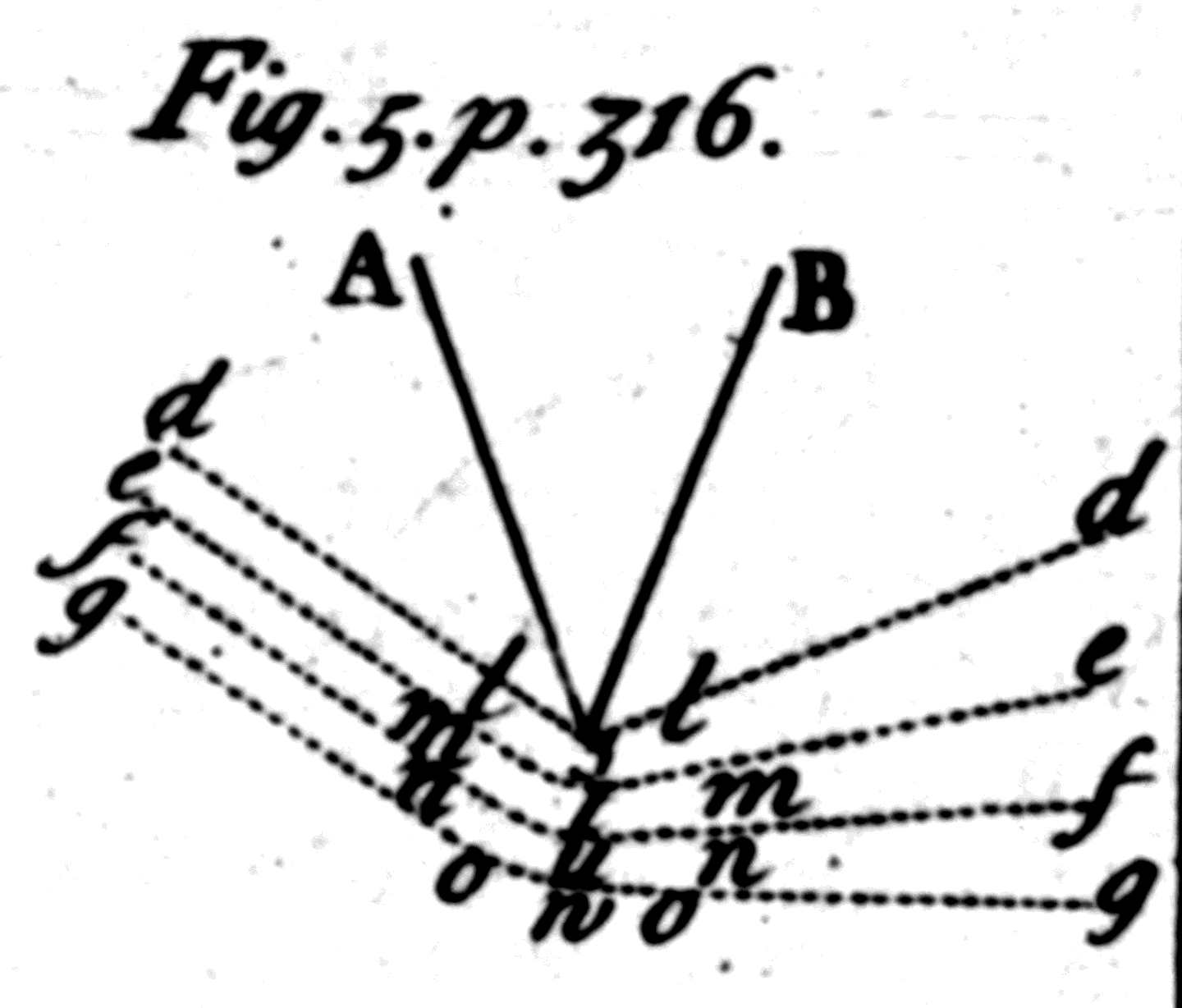
Proposition XCVII. Problem XLVII
Supposing the sine of incidence upon any superficies to be in a given ratio to the sine of emergence; and that the inflection of the paths of those bodies near that superficies is performed in a very short space which may be considered as a point, it is required to determine such a superficies as may cause all the corpuscles issuing from any one given place to converge to another given place.
Let A (Pl. 25. Fig. 8.) be the place from whence the corpuscles diverge; B the place to 318which they should converge; CDE the curve line which by its revolution round the axis AB describes the superficies sought; D, E, any two points of that curve; and EF, EG perpendiculars let fall on the paths of the bodies AD, DB. Let the point D approach to and coalesce with the point E; and the ultimate ratio of the line DF by which AD is increased, to the line DG by which DB is diminished, will be the same as that of the sine of incidence to the sine of emergence. Therefore the ratio of the increment of the line AD to the decrement of the line DB is given; and therefore if in the axis AB there be taken any where the point C through which the curve CDE must pass, and CM the increment of AC be taken in that given ratio to CN the decrement of BC, and from the centres A, B, with the intervals AM, BN, there be described two circles cutting each other in D; that point D will touch the curve sought CDE, and by touching it any where at pleasure, will determine that curve. Q. E. I.
Cor. 1. By causing the point A or B to go off sometimes in infinitum, and sometimes to move towards other parts of the point C, will be obtained all those figures which Cartesius has exhibited in his Optics and Geometry relating to refractions. The invention of which Cartesius having thought fit to conceal, is here laid open in this proposition.
Cor. 2. If a body lighting on any superficies CD (Pl. 25. Fig. 9.) in the direction of a right line AD, drawn according to any law, should emerge in the direction of another right line DK; and from the point C there be drawn curve lines CP, CQ always perpendicular to AD, DK; the increments of the lines PD, QD, and therefore 319the lines themselves PD, QD, generated by those increments, will be as the sines of incidence and emergence to each other, and è contra.
Proposition XCVIII. Problem XLVIII
The same things supposed; if round the axis AB (Pl. 25. Fig. 10.) any attractive superficies be described as CD, regular or irregular, through which the bodies issuing from the given place A must pass; it is required to find a second attractive superficies EF, which may make those bodies converge to a given place B.
Let a line joining AB cut the first superficies in C and the second in E, the point D being taken any how at pleasure. And supposing the sine of incidence on the first superficies to the sine of emergence from the same, and the sine of emergence from the second superficies to the sine of incidence on the same, to be as any given quantity M to another given quantity N; then produce AB to G, so that BG may be to CE as to N; AD to H, so AH may be equal to AG; and DF to K so that DK may be to DH as N to M. Join KB, and about the centre D with the interval DH describe a circle meeting KB produced in L, and draw BF parallel to DL; and the point F will touch the line EF, which being turned round the axis AB will describe the superficies sought. Q. E. F.
For conceive the lines CP, CQ to be every where perpendicular to AD, DF and the lines ER, ES 320to FB, FD respectively, and therefore QS to be always equal to CE; and (by cor. 2. prop. 97.) PD will be to QD as M to N, and therefore as DL to DK, or FB to FK; and by division as or to FD or ; and by composition as to FQ, that is, (because PH and CG, QS and CE are equal) as to . But (because BG is to CE, as to N) it comes to pass also that is to CE as M to N; and therefore, by division, FR is to FS as M to N; and therefore (by cor. 2. prop. 97.) the superficies EF compels a body, falling upon it in the direction DF to go on in the line FR to the place B. Q. E. D.
Scholium
In the same manner one may go on to three or more superficies. But of all figures the sphærical is the most proper for optical uses. If the object glasses of telescopes were made of two glasses of a sphærical figure, containing water between them; it is not unlikely that the errors of the refractions made in the extreme parts of the superficies of the glasses, may be accurately enough corrected by the refractions of the water. Such object-glasses are to be preferred before elliptic and hyperbolic glasses, not only because they may be formed with more ease and accuracy, but because the pencils of rays situate without the axis of the glass would be more accurately refracted by them. But the different refrangibility of different rays is the real obstacle that hinders optics from being made perfect by sphærical or any other figures. Unless the errors thence arising can be corrected all the labour spent in correcting the others is quite thrown away.