
Frontispiece
Introduction
When we read Homer, or Virgil, or Plato, or turn to the later work of Dante, Shakespeare and Milton and the whole host of writers and poets who have done so much to teach us, amuse us, and make our lives good and pleasant, we are apt to look at our own times with some disappointment. And when we turn to art, and set Greek statues and Gothic or Renaissance architecture beside our modern efforts, we have to admit that we fall short of our ancestors. That may lead us to wonder whether our age is the equal of those before it, or whether the human intellect is in decline.
The feeling comes from forgetting that every age has its own strengths and its own weaknesses. In one period the self-denying patriotism and zeal for the common good that a society needs in order to form at all will be growing. In another the study of morality and religion will lead. In another the arts will take first place; in another, poetry, tragedy, lyric and prose; in another, music will have its turn, and out of rough peasant songs will come the harmony of the opera.
To our age belongs the glory of being easily the first in scientific discovery. Future ages may despise our literature, outdo us in poetry, complain that we did nothing in philosophy, and even mock and forget our music. But they will only be able to look back with admiration on the band of scientific thinkers who in the seventeenth century reduced to a system the laws that govern the motions of worlds as well as atoms, who in the eighteenth and nineteenth founded the sciences of chemistry, electricity, sound, heat and light, and who gave mankind the steam engine, the telegraph, railways, the means of building huge structures of iron, the dynamo, the telephone, and a thousand other applications of science to the service of man.
Future students of history who know how we lived will also, I think, be surprised at how we rated our own particular abilities. They will be astonished that a gentleman of the nineteenth century, an age mighty in science and by no means outstanding in art, literature or philosophy, thought it a disgrace not to know which syllable a Greek or a Roman chose to accent, was ashamed not to be able to construe a Latin proverb, and yet thought it no shame at all not to know how a telephone was made or why it worked. They will smile to see that our highest university degrees and our richest rewards went to the study of dead languages and archaeology, while science, our glory and the thing we had shown real talent for, held only second place in our education.
They will smile when they learn that we thought a grasp of public affairs could only be got from a grounding in Greek particles, or that anyone ever believed a man could not command an army without studying the tactics used at the battle of Marathon.
But the battle between classical and scientific education is really less a quarrel about which subjects to teach than about how to teach them. Classics can be taught so that they become a mental training of the highest value. Science can be taught so that it becomes a mere enslaving routine.
The one great requirement for the education of the future is to grasp firmly that a study of words is not a study of things, and that a man cannot become a carpenter by learning the names of his tools.
The teachers of the Middle Ages made the mistake of believing that the first step in knowledge was to get a correct set of concepts of all things, and then to deduce all knowledge from them. An admirable plan, if you can get your concepts! Unfortunately concepts do not come ready made. They have to be grown, and as your knowledge increases your concepts change. A concept of a thing is not a mere definition; it is the thing's complete history. You have to build up your house of scientific knowledge from the ground, brick by brick and stone by stone. There is no magic word that will conjure it into being like a palace in the Arabian Nights.
Nothing is more fatal than juggling with words such as force, weight, attraction, mass, time, space, capacity or gravity. Words are like purses: they hold only as much money as you put into them. You may jingle your bag of pennies until it sounds like sovereigns, but when you come to pay your bills the difference is soon found out.
This fatal habit of learning words without trying to understand clearly what they mean leads many teachers to use mathematical formulas not as steps in a chain of reasoning but as magic cauldrons. They put in the premises, as the witches put herbs and babies' thumbs into their pots, and expect the answers to rise up like apparitions by some hidden process they cannot explain. Foolish parents encourage it. They like to see their infant prodigies seem to understand things too hard for the parents themselves, and they watch their children's mathematics lessons like country folk gaping at a fair. They forget that for the practical purposes of life one thing well understood is worth a whole book of muddled, half-digested formulas. Unfortunately it is possible to cram boys and run them through the examination sieves with the look of knowledge and none of the substance. If it were cricket or golf being tested, how soon the fraud would be found out! No humbug would be allowed in those interesting and absorbing subjects. And when you consider how easy it is to put on the appearance of book learning without the reality, you can hardly blame the people who choose men for service in India and Egypt for choosing them largely for their skill at sports and games. Better a good cricketer than a silly pedant stuffed with learning that "lies like marl upon a barren soil encumbering what is not in its power to fertilize."
A related error is to expect too much of science. For all our efforts to learn more of the mysteries of nature, we are like travellers in a forest: the deeper we go, the darker the shade. Science is "but an exchange of ignorance for that which is another kind of ignorance," and all our analysis of incomprehensible things only leads us to things more incomprehensible still.1
Any scientific advance, therefore, depends on a firm resolve never to juggle with words or ideas, and never to try to persuade ourselves or anyone else that we understand what we do not understand.
Chapter One: The Sky as a Clock
Anyone who starts a new subject is apt to be bewildered at first by the number and tangle of new ideas it throws at them.
You feel you need to understand these ideas, and yet they are hard to grasp and hard to define. We all think we know what we mean when we talk about force, weight, length, capacity, motion, rest or size. But look at these ideas a little more closely and we find we know very little about them. In fact, the more elementary they are, the less we are able to understand them.
The most basic ideas we have seem to be number and quantity. We can count things, and we can measure them or compare them with one another. Arithmetic is the science of the numbers of things, and lets us multiply and divide them. We estimate quantities by turning our power of comparison on different subjects. Number and quantity seem to run through every idea we have.
The study of the natural world around us is called physics, from the Greek physis, "inanimate nature," and the word is usually kept for the part of nature that is not alive. The study of living things is usually called biology, from the Greek for life.
In the study of nature, though, three ideas hold a special and important place, because they can be used to measure or estimate all the rest. In that sense they seem to be the most primitive and fundamental ideas we have. We are not entitled to say that every other idea is built out of them, but we are entitled to say that a correct understanding of physics, the study of nature, depends in no small degree on understanding them clearly. The three fundamental ideas are space, time and mass.
Space seems to come with every impression we have of the world around us. Try as we may, we cannot think of material bodies except as being in space and taking up space. We can imagine space empty, but we cannot conceive of it destroyed. And this space has three dimensions: length; breadth, measured across, at right angles to length; and thickness, measured at right angles to both. More than that we cannot have. For some unfathomable reason it has been arranged that space shall have these three dimensions and no more. A fourth dimension is unimaginable to us. I will not say inconceivable: we can conceive that a world might exist with space in four dimensions, but we cannot picture it or think what things would be like in it.
With an effort we can perhaps picture a world with only two dimensions, a "flat land," where flat beings of different shapes, like figures cut out of paper, slide or float about on a flat table. They could not hop over one another, because they would have only length and breadth; to hop you need to move in a third dimension, and with only two you could only slide forward and sideways in your plane. To such beings a ring would be a box. You would have to break the ring to get anything out of it, because if you tried to slide out you would meet a wall in every direction. You could not jump out the way a sheep jumps the hurdles of its pen, since jumping needs a third dimension, which you have not got. Beings in a world of one dimension would be worse off still. Like beads on a string, they could slide in one direction as far as the others let them, and they could never pass one another. To such a being, two others, one on each side of him, would be a box: hemmed in like that, he could not get away. Like a wagon on a railway, he could not walk round the next wagon, which would need the power of moving in two dimensions, still less jump over it, which would need three.
We have not the slightest idea why our world has been limited in this way. Some philosophers think the limitation is in us, not in the world, and that perhaps when our minds are free of the limits their stay in our bodies imposes, and death has set us free, we may see not only length and breadth and height but a great deal more of which we can now form no idea. But these speculations lead us out of science into the shadowy land of metaphysics, of which we long to know something and are condemned to know so little. Area is found by multiplying length by breadth. Volume is found by multiplying length by breadth by height. Of all our ideas about space, the line is the simplest. It has direction and length.
Mass is harder to grasp than space. It means quantity of matter. But what is matter? That we do not know. It is not weight, though it is true that all matter has weight. Matter would still have mass even if its property of weight were taken away.
Consider a pound packet of tea. It has size; it takes up space; it has length, breadth and thickness. It also has weight. But what gives it weight? The attraction of the earth. Suppose you doubled the size of the earth. A bigger earth would pull the packet of tea more strongly. The weight of the tea, which is the earth's pull on it, would go up, and the tea would weigh more than before. Take the packet to the planet Jupiter, which is so large that its pull at the surface is 2½ times the earth's. Its size would be the same, but it would feel like a packet of sand to carry. Yet there would be the same "mass" of tea. You could not make one more cup out of it on Jupiter than on earth. Take it to the moon and it would weigh a little over two ounces, but it would still be a pound of tea. We are in the habit of judging mass by weight, and rightly, since at any one place on the earth, London say, weights are always in proportion to masses: if you want to know what mass of tea you have, you weigh it, and then you know for certain. That is how mass and weight get muddled in our minds. Even our Acts of Parliament have muddled them, so that in the statutes on standard weights it is hard to tell what the drafters meant, and whether a pound of tea means the mass of a certain amount of tea or the weight of that mass. For accurate thinking we must always deal in masses, not weights. As far as we can tell, mass cannot be destroyed. A mass is the same mass wherever it is and for all time, while its weight changes with the pull of whatever planet it happens to be on and with its distance from that planet's centre. A flea on this earth can jump perhaps eight inches high; put that flea on the moon and with the same effort he could jump four feet. Put him on Jupiter and he could manage only 3⅕ inches. A man standing in a street on the moon could jump into a first-floor window. A pound of tea taken to the sun would be as heavy as twenty-eight pounds of it at the earth's surface; and weight even varies from one part of the earth to another. The true measure of quantity of matter, then, is mass, not weight.
The mass of a body depends on its size: for the same material, double the size gives double the mass. Some bodies are more concentrated than others, that is, denser, as though their stuff were packed more tightly. A ball of lead an inch across holds forty-eight times as much mass as a ball of cork an inch across. To find the weight of a given mass, we would have to multiply the mass by a figure standing for the pull of the earth.
In physics it is usual to use letters of the alphabet as a kind of shorthand for words. The letter m stands for the mass of a body, g for the pull of the earth at a given place, and w for the weight of the body. Since the weight depends both on the mass and on the earth's pull, we put this briefly as w = m × g, or "w equals m multiplied by g," where = is the sign of equality and × the sign of multiplication. In ordinary use the × is usually left out, and letters written side by side are understood to be multiplied together, and the equation is written
w = mg.
By this equation we do not mean, of course, that weight is mass multiplied by the force of gravity. We mean only that the number of units of weight is found by multiplying the number of units of mass by the number of units of the earth's gravity.
In the same way, if we were working out the number of wagons, w, needed for an army of n men eating p pounds of provisions a day each, we might write
w = np.
That would not mean we were multiplying soldiers by food to produce wagons, only that we were doing a sum.
Time is one of the most mysterious of our elementary ideas. It seems to exist or not exist according to whether we are thinking or not. It seems to run or stand still, to go fast or slow. How it drags through a tedious lesson; how it flies during a game of cricket; how it seems to stop in sleep. If we measured time by our own thoughts it would be a very uncertain quantity. But other evidence seems to show that Nature knows no such uncertainty about time: that she produces her effects in a uniform way in uniform times, and that time exists independently of our thoughts and wishes.
The idea of a state of things in which time existed no more was quite familiar to medieval thinkers, and many of them took it to be the condition that would follow the Day of Judgment. More recently Kant put forward the theory that time was only a necessary condition of our thinking and had no existence apart from thinking beings: that it was, in fact, our way of looking at things.
Scientifically, though, we are entitled to treat time as perfectly real and capable of the most exact measurement. Suppose we let a stream of sand run out of a hole and see how much runs out while an egg is boiling hard. We find as a fact that whenever the same quantity of sand has run out, the egg is in the same state. If we walk for an hour by a watch, we find we cover half the distance we would in two hours. It is the agreement of all these different experiments that gives us faith in treating time as something that exists independently of ourselves, or at any rate independently of our passing moods.
The first ideas of time among the races of men, as they emerged from barbarism, no doubt came from watching day and night, the month and the year.
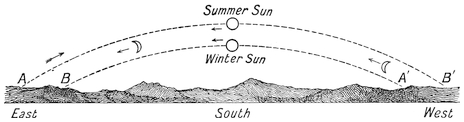
Suppose a shepherd stood on the plains of Chaldea, or perhaps on those mountains of India called the roof of the world, which some archaeologists believe was the site of the Garden of Eden and the early home of the European race. What would he see?
He would see the sun rise in the east and climb slowly up the sky until at midday it stood over the south; then it would sink towards the west and disappear. In summer it would rise further to the north than in winter, and its setting point, A′, would be further north too. In winter it would rise a little south of east and set a little south of west, and not climb so high at midday, so the summer day would be longer than the winter day. If the day were always divided into twelve hours, long or short, the hours would be long in summer and short in winter. That was the Greek way of dividing the day. The Egyptians, on the other hand, averaged theirs by dividing the sun's whole round into twenty-four hours, so that a summer day held more hours than a winter one. For the Egyptians, then, sunrise did not always come at six o'clock. In winter it came after six and in summer before, and that is the system that has come down to us.
The moon too would rise at different places, ranging between A and B, and set at places ranging between A′ and B′, but these would have nothing to do with where the sun rose and set.
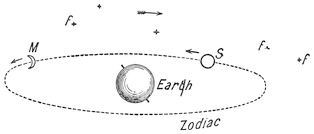
Each day, moreover, the moon would seem to move further away from the sun, in the direction of the arrow in the sketch. If the moon rose an hour after the sun one day, the next day it would rise more than two hours after him, and so on. This daily delay would go on until at last she came right round to the sun again, as at M′. Along the way she would change shape from a crescent, as at M, to a full moon when she was halfway round from the sun, rising twelve hours after him, just as he set. The delay and the change of shape would go on until after three weeks she had come round to the position A′, rising eighteen hours after the sun, a crescent again with her back to him; she always turns her bright, convex side towards the sun. At last, when twenty-eight days had gone by, she would be round again roughly in line with the sun, her pale light would be lost in his beams, and she would gradually reappear as a new moon on his other side. This cycle of the moon takes place once every twenty-eight days. It is called a lunar or "moon" month, and very early peoples used it as a division of time. The seasons came round with the changes in the sun's rising, and took a year to do it, and there were nearly thirteen moon cycles in a year.
People also noticed that through its cycle the sun was slowly moving backwards among the stars, in the same direction as the moon, only it made its backward circuit in a year. That is how time came to be divided into months and years. The stars turned round the sky once in a full day. The sun therefore seemed to slip backwards among them, passing through one group of stars after another, so as to make the circuit of them all in a year. The ancients divided the stars the sun passed through in a year, and the moon in a month, into groups called constellations, and called the sun's yearly path across the sky the zodiac. There were twelve of these constellations in the zodiac, called the signs, so the sun passed through one sign each month and made the tour of all of them in the year. The signs were given fanciful names, "the Ram," "the Water-bearer," "the Virgin," "the Scorpion" and so on, and the sun and moon were said to pass through the signs of the zodiac.
Since the sun's path marked out the year, you could tell the season by knowing which sign of the zodiac the sun was in. The age of the moon was easy to tell from her shape.
When winter was over, the dog star would be rising in the east just as the sun set, and that told you spring was at hand. Then the peasants got ready to till the ground, sow the seed and lead the oxen out to pasture, and they welcomed the spring with joyful merrymaking, at the time that corresponds to our Easter, when the sun had run through three constellations of the zodiac. Then came the summer heat, and they kept Midsummer's Day with many a mystic rite. In autumn, after the sun has passed through three more signs, it once more rises exactly in the east and sets exactly in the west, and day and night are equal. This is the autumn equinox. It was once celebrated by the feast we now know as Michaelmas, and the Michaelmas goose is what remains of the ancient festival.
And the great winter feast of the ancients is the one we now call Christmas, chosen to celebrate the birth of our Lord. When Christianity came into the world and the heathens were converted, the old feast days were deliberately turned into Christian festivals.
To us, then, the whole sky, with the fixed stars in it, seems to turn from east to west, or from left to right as we face south, as the big arrow shows. But the moon and the sun, though they seem to be set in the sky, move backwards among the fixed stars, as the small arrows show. The sun moves at such a rate that he goes round the circle of the sky in a year of three hundred and sixty-five days. The moon goes round it in twenty-eight and a half days, a lunar month. In reality, of course, the sun is at rest, and it is the earth that moves round the sun, spinning on its axis as it goes. But I will show presently that to a person on the earth it looks the same whether the earth goes round the sun or the sun round the earth.
From the Greek writers we know a good deal about how the ancients pictured the world. The earliest notions, naturally, were bound up with the worship of the gods. The sun was a huge light carried in a chariot driven by Apollo with four spirited horses. When the day declined it went down into the ocean, where the sea nymphs unyoked the horses and led them round to the east, ready for the next day's journey. The Egyptians pictured the sun in a boat that sailed across the sky. At night the sun god went down into the underworld, carrying with him the souls of everyone who had died that day. There they passed through the different regions of hell, whose gates were guarded by hideous monsters. Those who had learned the ritual of the dead properly knew the words of power that would appease the demons. Those without the passwords faced terrible dangers. Then the soul came before Minos, and was weighed and dealt with as it deserved.
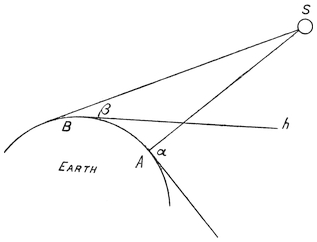
The earth was thought of as a huge island in the middle of a circular sea. Little by little, though, astronomy came under the rule of science. One of the first truths to dawn on astronomers was that the earth is a sphere. They noticed that the further north people travelled, the lower the sun stood above the horizon at midday. The diagram makes this easy to see. An observer at A sees the sun at a height above the horizon equal to the angle α; but as he travels along the curved surface of the earth to a point B nearer the north pole, the sun appears lower, at a height of only β. For men as skilled in geometry as the Greeks, it was easy to work out from this how big the earth was. They did so, and it came out at the enormous diameter of 8,000 miles. They knew only a small part of it, and thought the rest was ocean. But they had a clear idea of the "antipodes," the upside-down side, and believed that if there were people over there, their feet must all point towards the centre. From this they got the idea of the centre of the earth as a point that attracted everything of an earthy, earth-seeking nature. Fire always seemed to want to go upwards, so they thought fire had an earth-fleeing, heaven-seeking character. Water they thought partly earth-seeking and partly heaven-seeking, since it lay in the ocean or floated as clouds. Air they thought indifferent. And they believed the world was made out of these four elements: fire, water, earth and air. The earth, they thought, must be at rest, because if it moved things would fly off it. They saw that either the sun must go round the earth or the earth must turn on its axis. They chose the first, arguing that if the earth were twisting round once in twenty-four hours, a country like Greece would be whirling round like a spot on a spinning top at about 18,000 miles in twenty-four hours, or about 180 yards a second, faster than an arrow from a bow. In that case a bird that flew up from the ground would be left far behind. A ball thrown into the air would come down hundreds of yards behind the person who threw it. They could not see how a ball thrown up by someone standing on a moving object could fail to fall behind the thrower.2
That settled them in their error. Aristotle, the tutor of Alexander the Great, did a great deal to push the Greeks further into their mistaken astronomy. This great genius in politics and philosophy was only in the second rank as a man of science, and in my opinion hardly the equal of Archimedes or Hipparchus, or even of Ptolemy. Aristotle wrote a book on the heavens that bristles with the most wantonly mistaken scientific ideas: for instance, that the heavenly bodies must move in circles because the circle is the most perfect curve, and other such assumptions about the course of nature.
With the earth fixed, then, they thought the moon, the sun and the planets, seven in all, were carried round it, each fixed in an enormous crystal shell. These spheres slid round one inside another like the layers of an onion, each carrying its heavenly light. The moon was nearest, then Mercury, then Venus, then the sun, then Mars, Jupiter and Saturn. Outside them was the sphere of the stars, and outside everything the primum mobile, the great Prime Mover of the universe. When one heavenly body, such as the moon, passed in front of another, such as the sun, there was an eclipse. They soon saw that the moon gets its light from the sun. Since they knew the size of the earth, they could get some rough idea by comparison of the huge distances of the heavenly bodies. In fact they measured the distance of the moon fairly accurately, making it 240,000 miles, or about thirty times the earth's diameter.
That of course gave them the moon's diameter, since they could easily work out how big a thing must be that looks as big as the moon and is 240,000 miles away.
The great size of the moon gave them some idea of the distance of the sun, but they never realised how big he really is or how far away.
Several ancient nations measured time in weeks, four weeks to the lunar month. The order of the days was arranged rather curiously. Take the earth as the centre of the planetary system and write the planets in a column, the nearest, the moon, at the bottom and the furthest at the top:
    Saturn,
    Jupiter,
    Mars,
    The Sun,
    Venus,
    Mercury,
    The Moon.
Now divide the day into three watches of eight hours each, and put each watch in the charge of one of the planet gods, starting with Saturn. Saturn is the first god of the first day, which is therefore Saturday, and Jupiter and Mars take the other two watches of that day. The first watch of the next day falls to the sun, which gives Sunday, and Venus and Mercury take its other two watches. The first watch of the day after that falls to the moon, so that day is Monday, with Saturn and Jupiter as its other gods. The first watch of the next day belongs to Mars, so it is Mars-day, Mardi in French, or in the Teutonic languages Tuesday, after Tiw, a Scandinavian god of war. Mercury gives his name to Mercredi, or Wednesday, Woden's day. Jupiter gives Jeudi, or Thursday, Thor's day. Venus gives Vendredi, or, in the Scandinavian, Friday, the day of Freya, the Scandinavian goddess of love and beauty who corresponds to Venus; and the week is complete.
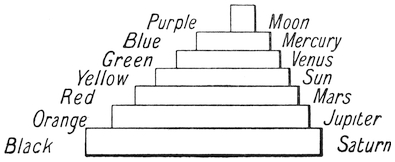
This weekly scheme probably came from the astronomers of Chaldea. It seems likely that the great tower of Babel, whose ruins still stand, was built in seven stages, one on top of another: the top one painted white, or perhaps purple, for the Moon, the next blue for Mercury, then green for Venus, yellow for the Sun, red for Mars, orange for Jupiter and black for Saturn. Unfortunately no trace of the colours survives.
But night after night the Babylonian priests on its long terraces watched eclipses and the other events of the sky. Their records were later taken to Alexandria and kept in the great library that was afterwards burned by the Turks. In that library they were seen by the astronomer Ptolemy, who used them in writing his work on astronomy called the "Great Syntaxis," or "Collection." The original perished, but the Arab astronomers had translated it into Arabic and called it "Al Magest," the Great Book. From Arabic it was translated into Latin, and it remained the astronomers' textbook in Europe right down to the time of Queen Elizabeth, when a better system took its place.
For anyone doing practical astronomy it is very convenient to treat the sun, moon, stars and planets as going round an earth at rest. Seamen, for instance, use the heavenly bodies as the hands of a huge clock, from which they can read the time and their position on the earth. The Nautical Almanac, printed every year, gives the true position of these bodies for every hour, minute and second of the year, and I will show presently how useful this is to sailors.
We will deal with the sun first. From the sun's motions we can tell the time. Every garden does it with a sundial, and I will now describe how sundials are made. If a light, say a candle, were carried round in a circle at a steady pace, going round once in some fixed period such as twenty-four hours, it could obviously be used to measure time. Put a sheet of white paper on a table and stand a pencil upright on it with a little sealing wax, or prop a pen up in an inkpot, and a candle held by anyone will throw the pen's shadow across the paper.
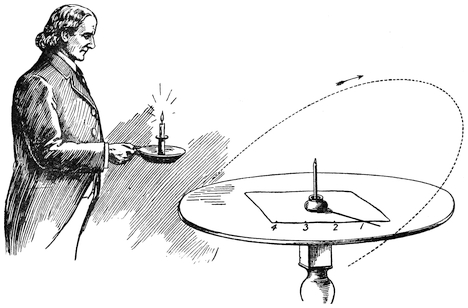
If the person with the candle walked round the table at a steady speed, the shadow would go round like the hand of a clock and could be made to mark the time. If the candle took twenty-four hours to go round the table, as the sun takes twenty-four hours to go round the earth, marks on the paper would measure the hours, and the paper and pen would make a sort of sundial.
But the sun does not go round the earth as the candle goes round the table. Its path is tilted, like the dotted line. Sometimes it is above the level of the table and sometimes below, and besides, its winter path is different from its summer path. It follows that the hour marks on the paper cannot be spaced evenly like the hours on a clock face, and some arrangement is needed so that the line shown by the summer sun agrees with the time shown by the winter sun.
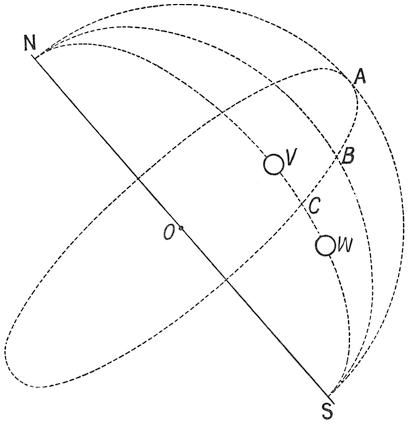
Let NOS be the axis of the heavens, and let the lines NAS, NBS, NCS be meridians drawn from the pole N round the surface of a celestial sphere whose centre is O. Let ABC be a circle on the same sphere, passing round the centre O in a plane at right angles to the axis NS. Then ABC is called the equatorial. It is a circle in the sky matching the equator on the earth. At the spring and autumn equinoxes, on March 25 and September 25, the sun is on the equatorial. At midsummer and midwinter it is on opposite sides of it: at midsummer nearer N, as at V; at midwinter nearer S, as at W. Suppose we were on an island in the middle of the ocean. We could see only a limited distance. If the highest point of the island were 100 feet up, from there we could see about thirteen miles to the horizon, and no further, because of the curve of the earth.3
Picture such an island, then, with ocean on every side for thirteen miles, and consider how the sun would seem to move as seen from it. At the spring and autumn equinoxes, when the sun is on the equatorial, it would rise out of the sea at a point E, due east, travel along half the equatorial, and set in the sea at a point W, due west. The day is twelve hours long, from 6 a.m. to 6 p.m.
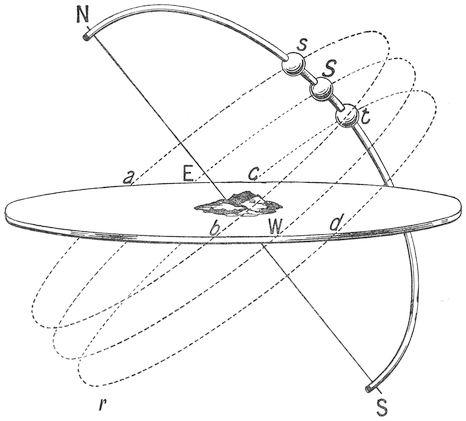
In summer the sun is higher, nearer the pole N, at a point s, say. It rises at a point a in the ocean, further north than the east point E, sets at a point b, also further north than the west point W, and travels the path asb. But it takes longer than twelve hours to travel that path, because asb is more than half of the whole circle. It rises at, say, 4.30 a.m. and sets at 7.30 p.m. The night, while the sun goes round the rest of its circle from b back to a, is short to match, only nine hours long, from 7.30 p.m. to 4.30 a.m. That gives a long summer day and a short summer night. In winter, when the sun has moved nearer the south pole of the heavens, it rises out of the ocean at a point c at 7.30 a.m., travels the arc ctd, and sets at d at 4.30 p.m., which makes the winter day only nine hours long. The winter night lasts from 4.30 p.m. until 7.30 a.m., fifteen hours, while the sun goes round the path drc. It is the slant of the axis NS, then, together with the fact that the sun is nearer one pole, N, in summer and nearer the other, S, in winter, that makes days and nights unequal in our latitudes. Now suppose our island were on the equator. The north and south poles would both seem to lie on the horizon. Whether the sun moved on the summer circle asb, on E S W at the equinoxes, or on ctd in winter, and however far its rising and setting points shifted between a and b in summer and c and d in winter, the path from a to b, from A to B, or from c to d would always be exactly half a circle and would always take twelve hours. At the equator, therefore, the days and nights never change in length; the sun always rises at six and sets at six. Besides, it always climbs straight up out of the ocean and plunges straight down into it, so there is very little twilight or dawn.
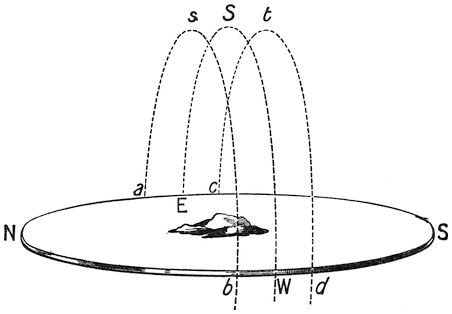
Now suppose we lived at the north pole. The north pole of the heavens would be straight overhead and the south pole straight under our feet. At the spring and autumn equinoxes the sun would show half its disc above the ocean and travel right round the horizon, always half above the sea. In summer it would be at a point s, nearer the pole N. It would circle the sky, always above the horizon, and never set at all. As summer waned the sun would sink lower and lower, still going round and round without setting, until at the autumn equinox it reached the horizon. For six months, then, it would never have set. But once it did set, there would be six months with no sun at all.
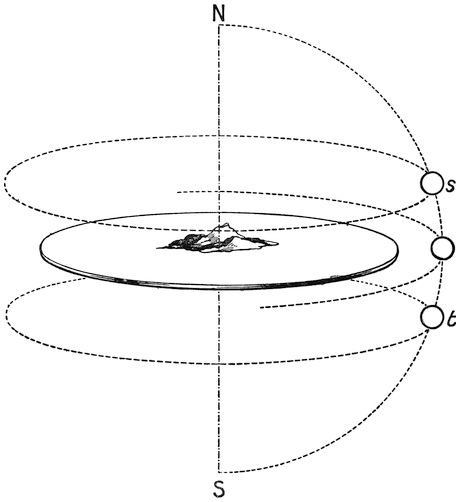
All over the world, then, light and darkness come to the same total. At the equator days and nights are always equal. At the poles six months of light are followed by six months of darkness. In the temperate regions in between, nights of varying length follow days of varying length, a short night after a long day and the other way about.
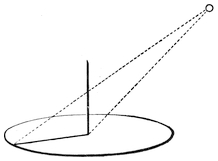
Someone living at the north pole would find a sundial easy to make. All he would need is a post stuck upright in the ground, and he could watch its shadow as the sun went round (Figure 10).
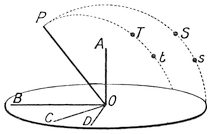
In latitudes like England's, where the earth's axis is tilted to the horizon, the rod of the sundial, the "style" as it is called, has to slope. If we used an upright style, like OA, then at midday, with the sun due south, the shadow would fall along the same line OB whether the sun stood high in summer, as at S, or low in winter, as at s. But at other hours, nine in the morning for instance, the shadow of the upright style OA would fall along OD with the sun at its summer position T, and along OC with the sun at its winter position t. The dial would show different times in summer and winter and lead you into errors. If the style slopes towards the pole, however, then however far the sun moves towards or away from the pole between winter and summer, the shadow for any given hour stays put, and only the sun's circling round its daily path moves the shadow.
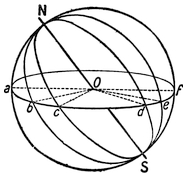
The first rule for making a sundial, therefore, is that the style that casts the shadow must be parallel to the earth's axis; that is, it must point at the pole star. That holds whether the dial is horizontal or vertical, and whether it stands on a pillar in the garden or is fixed to the wall of a house.
To mark out the dial, we only have to imagine it enclosed in a sort of cage of twenty-four arcs running from the north pole to the south pole, evenly spaced. The sun crosses one of them every hour on its journey. The lines oa, ob, oc, od along which the shadow of the slanting style ON falls therefore point to the places where these arcs meet the horizontal circle. That gives a simple way of making a sundial, which I describe in an appendix at the end of this chapter.
Sundials were widely used in ancient times. The rings of standing stones built by the Druids are thought to have been used to mark the sun's path and show the times and seasons. Obelisks are also supposed to have been used to cast shadows from the sun. The Greeks knew perfectly well how to make sundials with sloping styles, or "gnomons."
Small portable sundials were much used before watches came in, and they had compasses so that you could turn them until the style pointed north.
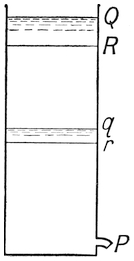
A sundial only works in the daytime, while the sun is shining. The wish to mark the hours of the night led to water clocks, which measured time by the water escaping through a small hole below the surface. Getting them to read correctly takes some care. Take a vessel with a small pipe coming out near the bottom. The amount of water that runs out of the pipe in a given time depends on the pressure at the pipe, and that in turn depends on PQ, the depth of water standing above it. It follows that the gap QR, the fall of the water in an hour while the level is up at Q, will be bigger than the gap qr for an hour's run lower down, at q, between P and Q. Hour marks on the vessel, showing the time by the level of the water, would therefore be uneven, getting closer and closer together as the water fell.
To get rid of the trouble of uneven marks, the water to be measured was let out into an empty vessel from a vessel whose surface was always kept at the same level. Since the pressure at the outlet of a vessel kept at a constant level never changed, equal volumes of water meant equal times, and the vessel that caught the water only needed to be marked off evenly.
In a country like Egypt, where the hours were always equal and the longer days simply held more of them, the water clock suited perfectly. But in Greece and Rome, where the day was always divided into twelve hours whatever its length, the plain water clock was as useless as a modern clock would be. It always divided the hours equally, and took no account of the fact that under their system the summer hours were longer than the winter ones.
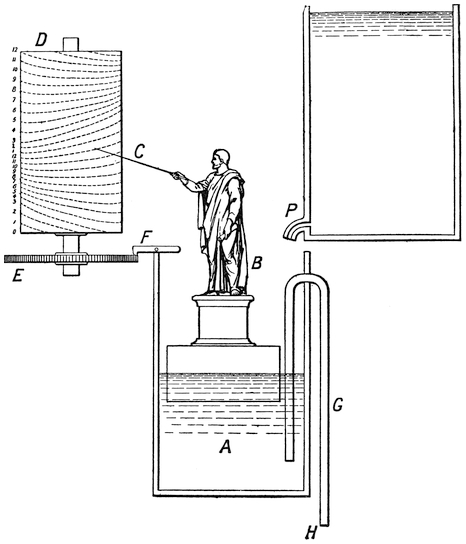
To make the water clock work in Greece and Italy, then, the hours had to be made unequal, to match the unequal hours of the Greek day. This was done as follows. On the water poured into the vessel that measured the hours floated a float, and on the float stood a figure made of thin copper with a wand in its hand. The wand pointed to a scale divided unevenly. There was a separate scale for every day of the year, and these scales were mounted on a drum that turned round once a year. Each day, as the figure rose, it worked a cogwheel that moved the drum on one division, one three hundred and sixty-fifth of a turn. In this way the scale for any particular day of winter or summer was brought round opposite the figure's wand, and the scale of hours was kept true. The water clock, which kept true time, was in fact made by artificial means to keep untrue time, so as to match the unequal hours of the Greek day. In the picture, A is the vessel receiving the water and P the pipe it flows through; B is the figure and C its wand; D is the drum, turned by the cogwheel E, which has 365 teeth, one of which was pushed forward at the end of each day. A siphon G was fitted in the vessel A, so that when the figure had risen to the top and pushed forward the lever F, the siphon suddenly emptied the vessel through the pipe H, and the figure fell to the bottom of A ready to rise and record another day. The divisions on the drum are of course uneven. On the side for summer the day hours would be about seventy minutes each and the night hours only about fifty, so the day divisions on the scale would be long and the night divisions short. In winter it would be the other way round. The lines round the drum therefore run in an uneven, wavy pattern.
The ancient Romans used water clocks like these.
Sand was used to measure time as well. Once the people of Byzantium had perfected the art of blowing glass, and it had passed from them to the Venetians, sand-glasses were made. They were used for all sorts of things, for speeches and for cooking, but their most important use was at sea. In the early days of navigation it mattered a great deal to know a ship's speed, so that you could work out where you were. The earliest method was to throw overboard a heavy piece of wood, shaped so as to resist being dragged through the water, with a line tied to it. The block of wood was called the log, and the line had knots in it. The knots were spaced so that if one of them ran out through your fingers in a half-minute measured by a sand-glass, the ship was making one nautical mile an hour. The nautical mile was chosen so that sixty of them make one degree, one three hundred and sixtieth of a great circle round the earth. A nautical mile is therefore 6,080 feet, longer than an ordinary land mile of 5,280 feet. The knots therefore had to be spaced so that when the ship was going one nautical mile, 6,080 feet, in an hour, one knot would run out during the half-minute run of the glass. That means putting the knots 1/120 × 6,080 feet = 50 feet 8 inches apart. One sailor heaved the log overboard, stamped on the deck, and let the line run out through his fingers. Another turned the sand-glass. When all the sand had run through, showing that half a minute had passed, the man paying out the line gripped it tight and saw how many knots, or parts of knots, had run out. That told him how many "knots" a half-minute the ship was making, which is to say how many nautical miles an hour.
The modern way of measuring a ship's speed is different. We now use a patent log, a miniature screw propeller tied to a line and towed through the water behind the ship. As it is pulled along it spins, and the number of turns it makes shows how much water it has passed through, and so how far it has gone. The turns are counted by a counting mechanism and read off when the log is hauled in. Sometimes the screw is fixed to a stiff wire and the counter kept on board.
We say "knots an hour," which is quite wrong. It should be "knots per half-minute," or "nautical miles an hour."
The flow of sand is easily put to all sorts of uses for measuring time. If sand runs from a hopper through a fine hole into a bucket, the bucket can be arranged so that when a given time has passed, and so a given weight of sand has fallen, it tips over and releases a catch, which lets a weight fall and do whatever mechanical job is wanted. We might, for example, put an egg in a small holder tied to a string and lower it into a saucepan of boiling water. A counterweight on the string, hung over a pulley, would always be trying to pull the egg up out of the water, but it would be held back by a pin passed through a loop in the string. A hopper or funnel full of sand could let the sand trickle gradually into a small tipping wagon, so that when enough sand had gone in, the wagon would tip over, jerk the pin out of the loop and release the weight, which would then pull the egg out of the water three minutes, or any time you liked, after it went in. Or the saucepan could have a hole with a little tap, and the water running out could fall into a tipping wagon and tip it over, and so, once the water had run out, put an extinguisher on the spirit lamp heating the saucepan and at the same moment make a contact and ring an electric bell. The egg would then always be cooked exactly right, kept warm after it was cooked, and announced when it was ready.
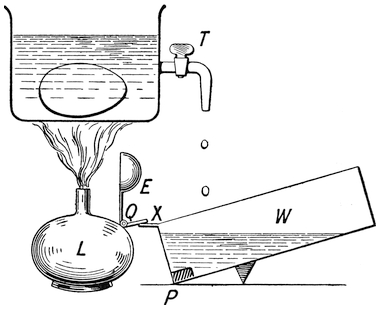
The sketch shows such an arrangement. The saucepan is about three inches across and two inches high, and filled with water it holds an egg comfortably. The extinguisher E, mounted on a hinge Q, is turned back, and the spirit lamp L is lit. As soon as the water boils, the tap T is turned on and the water trickles away into the tipping wagon. As soon as the wagon is full it tips over, strikes the arm X of the extinguisher, and puts the lamp out. The little hot water left in the saucepan keeps the egg warm for some time. The wagon W must have a weight P at one end, and its pivot must be nearer that end, so that empty it rests with the end P down, but when it has taken in the right amount of water it tips over on its pivot. I leave it to the ingenious reader to work out the details of such a machine, which, if properly made, will work very well, can be made for a number of eggs, and needs very little attention.

Mercury has been used as an hour-glass too. The hole has to be extremely fine. Or a bead of mercury can be put into a tube containing air, so that as it falls it slowly drives the air out through a tiny hole. The difficulty is getting the hole fine enough. All you can do is draw out a fine tube in a blowlamp, break it off, and put the broken point back in the flame until it has almost closed up. In this way a tube about twelve inches long can be made in which a bead of mercury takes twelve hours to fall. But making so small a hole is a lot of trouble.
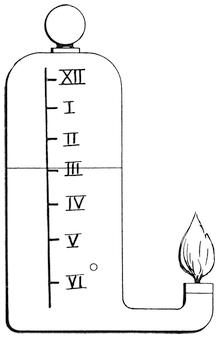
King Alfred is said to have used wax candles to mark the time. Since they guttered in the draughts, he put them in lanterns of horn. There were no glass windows in those days, only openings closed with heavy wooden shutters. The large shutters were opened in fine weather. Smaller shutters were made in them to let in a little light on wet days without letting in too much wind and rain.
Rooms must have been very draughty, so people had to wear caps and gowns indoors, and beds had thick curtains drawn round them. When glass first came in, only kings and princes had it, and they carried their glass casements about with them, to be fitted into the windows of the houses they visited and taken out again when they left.
Oil lamps were also used to mark the time. Some of them, certainly as early as the fifteenth century, were made like bird bottles: a reservoir closed at the top, with a pipe leading out of the bottom. When the reservoir is full, the pressure of the air outside holds the oil in, and the oil stands in the neck and feeds the wick. As the oil is used up, bubbles of air pass back up the neck and rise to the top of the oil, whose level slowly sinks. The time the lamp shows depends, of course, on how fast the oil burns, and so on the size of the wick, which makes it a very rough way of measuring time.
Appendix to Chapter One: How to Make a Sundial
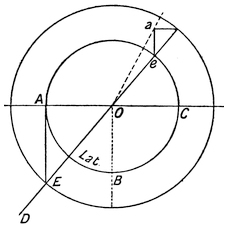
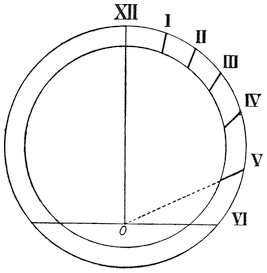
To make a sundial, get a round plate of zinc about ⅛ inch thick and, say, twelve inches across. Have a style, or gnomon, cast so that the angle of its edge equals the latitude of the place where the dial is to stand. For London that is 51° 30′. Make a pattern for it in wood and have it cast in gunmetal, which stands up to the weather much better than brass. On a sheet of paper draw a circle ABC with centre O. Make the angle BOD equal to the latitude of the place, for London 51° 30′. From A draw AE parallel to OB to meet OD at E, and with radius OE draw a second circle round O. Divide the inner circle ABC into twenty-four equal parts and draw radii through the divisions from O out to the larger circle. Now take any hour, say two o'clock. Through the point where its radius crosses the inner circle draw a line parallel to OB, and through the point where it meets the outer circle draw a line parallel to OC; the two lines meet at a. Then the line Oa is where the gnomon's shadow falls at two o'clock. The lines drawn on paper can be transferred to the dial and engraved, or bitten into it with acid as etchings are.
The centre O need not be at the centre of the zinc plate; it can be off to one side, to leave more room for the hour figures and so on. A motto can be etched on the dial, such as "Horas non numero nisi serenas" (I count only the sunny hours) or "Qual 'hom senza Dio, son senza sol io" (Like a man without God, so am I without the sun), or any suitable inscription, and the dial is ready for use. It is best set up by turning it until it shows the same hour as a correctly set watch, and it must be levelled with a spirit level. Remember that the sun does not move quite evenly along his yearly path among the fixed stars. That is because he moves not in a circle but in an ellipse, with the earth at one focus. The hours shown by the dial are therefore slightly irregular, the sun being sometimes ahead of the clock and sometimes behind it. The difference is never more than a quarter of an hour. There is no difference at midsummer and midwinter.4
Civil time is solar time averaged out so as to make all the hours and days equal. The difference between civil time and apparent solar time is called the equation of time; it is the amount by which the sundial is ahead of the clock or behind it. In setting a dial by a watch, you must of course allow for the equation of time.
Chapter Two: Galileo and the Laws of Motion
The last chapter gave a short account of what the ancients thought about the earth and the heavens. Before we come to the changes modern science brought, it is worth spending a little time on ancient scientific ideas.
All science really rests on a combination of two methods, called inductive and deductive reasoning. The first consists in gathering together the results of observation and experiment and, having put them all together, framing general laws. Having long observed that all heavy things tend to move towards the centre of the earth, for instance, we might conclude that the stars, since they stay up in the sky, can have no weight. The conclusion would be wrong in this case, not because the method is wrong but because it has been wrongly applied. It is true that all heavy things tend to go to the centre of the earth, but if they are being whirled round like a stone in a sling, the centrifugal force will counteract that tendency. The first part of the reasoning would be inductive, the second deductive. All such reasoning, then, consists in forming as complete an idea as possible of the nature of a thing and then concluding from that idea what the thing will do or what its other properties will be. You form correct ideas, or "concepts" as they are called, and reason from them.
The danger comes when you start reasoning before you are sure of your concepts. That has been the great source of error, and it was the error that men of science fell into so commonly all through ancient and modern times up to the seventeenth century.
If it were possible to get complete knowledge of things just by looking at them, that would of course be the simplest method: all you would then need to do is reason correctly from what you knew. Unfortunately that kind of knowledge cannot be had in any branch of science.
The ancient method was like that of a man who claimed that by watching and talking to someone you could get such a knowledge of his character as would infallibly let you understand and predict everything he did, and who took little trouble to check whether what he did bore out your predictions.
The only difference between the old methods and the new is that modern men have learned to take far more care to form correct ideas in the first place, are much more cautious in arguing from them, and keep testing them again and again at every opportunity.
Constant insistence on clear ideas, and the practice of what Lord Bacon called "putting nature to the torture," is the main reason physical science has advanced in modern times; and the failure to apply these principles explains why so little progress is being made in the so-called "humanitarian" studies, such as philosophy, ethics and politics.
The works of Aristotle are full of the fallacious method of the old system. In his book on the heavens he argues again and again that the heavenly bodies must move in circles because the circle is the most perfect figure. He pretends to be puzzled how a circle can be convex and at the same time its opposite, concave, and he repeatedly tangles his readers up in similar mere confusions of words.
As a man of science I think he must be placed, for all his great genius, below Archimedes, Hipparchus and several other ancient astronomers and physicists.
His errors lived on after him, dominated the thought of the Middle Ages, and held back the progress of science for a long time.
The other great writer on astronomy in ancient times was Ptolemy of Alexandria.
His work, called the "Great Collection," was what we would now call a handbook of astronomy. Although it rests on a fundamental error, it is a thoroughly scientific work, with none of the false philosophy that so disfigures Aristotle's. His reasons for believing the earth to be at rest are interesting. Ptolemy argues that if the earth were spinning on its axis once in twenty-four hours, a bird that flew up from it would be left behind. At first sight the argument looks very convincing, since it seems impossible that a body could spin at the speed the earth is said to move without leaving behind anything that came loose from it.
On the other hand, the system that taught that the sun and planets went round the earth, adopted largely because it was supposed to be simple, turned out on closer examination to be extremely complicated. Each planet, instead of moving simply and steadily round the earth in a circle, had to be supposed to move steadily in a circle round another point, which itself moved round the earth in a circle. This second circle, on which the planet moved, was called an epicycle. And even this more complicated scheme failed to explain the facts.
A system like that of Aristotle and Ptolemy, built on deductions from concepts, more concerned with drawing conclusions than with examining premises, suited medieval thought very well, and it became the foundation of astronomy and geography as the schoolmen taught them.
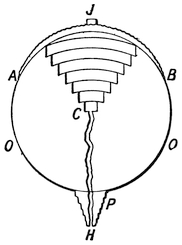
Dante's poem gives an accurate picture of the best scientific knowledge of his day. In his view the centre of the earth was a fixed point towards which everything heavy tended, so that earth and water gathered round it in the shape of a ball. He had no idea that every particle of matter attracts every other particle. His only notion of gravity was of a force drawing everything heavy towards a certain point, round which the world therefore took shape. The habitable part of the earth was an island with Jerusalem, J, in the middle of it, and round the island was an ocean, O. Under the island, in the shape of a hollow cone, was hell, with its seven circles of torment, each smaller than the last, down to the centre, C. Heaven was on the opposite side of the earth from Jerusalem, at H, beyond the circles of the planets, in the primum mobile. When Lucifer was thrown out of heaven after his rebellion against God, he had become of a nature to be drawn to the centre of the earth instead of heavenwards; so he fell from heaven and struck the earth exactly at the antipodes of Jerusalem, so violently that he plunged right through to the centre, throwing up a hill behind him. On top of the hill was the Garden of Eden, where our first parents lived, and round its sides wound a spiral path, which was purgatory. Dante, having gone down into hell and passed the centre, found his head turned round to point the other way, and after climbing a winding path came out on the hill of Purgatory. After seeing it he was taken through the spheres of the planets, and in each sphere he was put in spiritual communion with the blessed spirits whose character that sphere represented; and he imagines that he was allowed to go on from sphere to sphere until he was admitted to the presence of the Almighty, who presided over the heavenly hosts in the primum mobile.
Dante's descriptions of the rising and setting of the sun, moon and planets are quite accurate according to the system of the world as he conceived it. They show not only that he was a competent astronomer but that he probably owned an astrolabe and some tables of the motions of the heavenly bodies.
Our own poet Chaucer can also be credited with an accurate knowledge of the astronomy of his day. His poems often mention the constellations, and one of his works is devoted to describing the astrolabe, an instrument rather like the celestial globe once used in schools.
But with the revival of learning in Europe and the rise of freedom of thought, the old theories were questioned in more than one quarter.
It occurred to Copernicus, a churchman who lived in the sixteenth century, to look again at a theory started in ancient times, and to consider how the appearances of the heavenly bodies could be explained on the hypothesis Pythagoras had put forward, that the earth turned on its own axis and also went round the sun.
It may seem rather odd that two theories so different, one that the sun goes round the earth and the other that the earth goes round the sun, could both explain what we see of those bodies. But remember that motion is relative. If in a waltz the gentleman goes round the lady, the lady also goes round the gentleman. Take away the room they are turning in, and think of them spinning round like two insects in space: who is to say which is at rest and which is moving? Motion is relative. I can think of motion in a train from London to York. As I leave London I get nearer to York, and I am moving with respect to London and York. But if London and York were both wiped out, how would I know I was moving at all? Or again, suppose that while my train was standing at a station on the way, instead of the train moving, the whole earth began to move southwards and the train were somehow left where it was. Though the earth was moving and the train was at rest, as far as I was concerned the train would seem to have started again for York, where it would seem to arrive in due course. The trees and hedges would fly past at the proper speed, and who could say whether it was the train moving or the earth?
The theory of Copernicus, however, remained only a theory. It went against the evidence of the senses, which certainly lead us to think the earth is at rest, and it went against the ideas of some theologians who thought the Bible taught that the earth was fixed so fast it could not be moved. The theory therefore found little favour. Before the question could be properly judged on its merits, more had to be known about the laws of motion, and that was the chief work of Galileo.
Galileo's merit is not only that he put the study of mechanics on a firm footing, but that he set out deliberately and consciously to overturn the ancient methods of learning.
He threw out authority, based all knowledge on reason, and protested against the idea that the study of words could stand in for the study of things.
Speaking of the mathematicians of his day, Galileo says in a letter to the astronomer Kepler: "This sort of men fancied that philosophy was to be studied like the Aeneid or the Odyssey, and that the true reading of nature was to be detected by collating texts." Most of his life was spent fighting preconceived ideas. It was maintained that there could only be seven planets, because God had ordered everything in nature by sevens ("Dianoia Astronomica," 1610), and even the discovery of spots on the sun and mountains on the moon was dismissed on the ground that heavenly bodies could have no blemishes. "How great and common an error," writes Galileo, "appears to me the mistake of those who persist in making their own knowledge and understanding the measure of the knowledge and understanding of God, as if that alone were perfect which they understand to be so. But ... nature has other scales of perfection, which we, being unable to comprehend, class among imperfections.
"If one of our most celebrated architects had had to distribute the vast multitude of fixed stars over the great vault of heaven, I believe he would have set them out in beautiful arrangements of squares, hexagons and octagons; he would have scattered the larger ones among the middle-sized and smaller ones so as to correspond exactly with one another; and then he would think he had contrived admirable proportions. But God, on the contrary, has shaken them out from His hand as if by chance, and we, forsooth, must think that He has scattered them up yonder without any regularity, symmetry or elegance."
In one of Galileo's Dialogues, Simplicio says, "The cause that makes the parts of the earth move downwards is notorious, and everyone knows that it is gravity." Salviati replies, "You are out, Master Simplicio: you should say that everyone knows that it is called gravity. I do not ask you for the name but for the nature of the thing, and of that nature neither you nor I know anything."
Too often we are still inclined to put the name in place of the thing, and to think that when we use big words such as art, empire, liberty and the rights of man we are explaining matters instead of obscuring them. Not one man in a thousand who uses them knows what he means by them, and no two men agree on what they signify.
Galileo illustrated the relativity of motion I mentioned above very neatly. He pointed out that if an artist were drawing with a pen aboard a ship moving fast through the water, the true line traced by the pen relative to the surface of the earth would be one long straight line with small dents and wobbles in it. Yet the very same line, traced by the pen on a paper carried along in the ship, made up a drawing. Whether you saw a long uneven line or a drawing in the pen's path depended entirely on the point of view from which you regarded its motion.
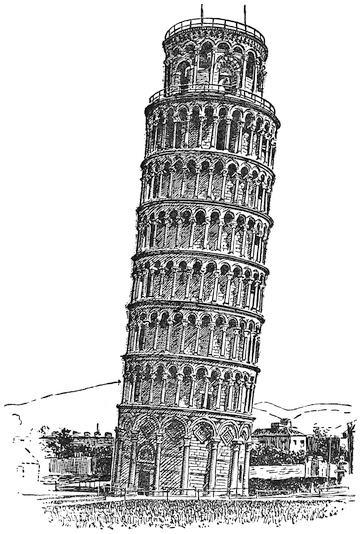
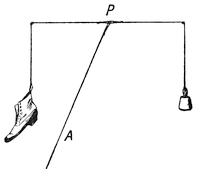
But the first great step Galileo took in science, when he was still a young professor at Pisa, was to refute Aristotle's opinion that heavy bodies fall to the earth faster than light ones. In front of a number of professors he dropped two balls, a large one and a small one, from the parapet of the Leaning Tower of Pisa, and they reached the ground very nearly together. The experiment is easy to try. One of the simplest ways is this. Into a beam (the top of a door frame will do) drive three smooth pins, about four inches apart, so that each sticks out about a quarter of an inch; they must have no heads. Take two unequal weights, say 1 lb. and 3 lbs. Anything will do, a boot for one and a pocket-knife for the other. Tie loops of fine string to them, put the loops over the middle one of the three pins, and lead the strings one over each of the outer pins. Now if you slip the loops off the middle pin, P, the two objects are released together. This can be done by making a loop at the end of another piece of string, A, and putting it on the middle pin behind the other loops. Pull the string and its loop pulls the other two loops off the middle pin and lets the boot and the knife drop. Hang the boot and the knife at the same height, and they will hit the ground together. The same experiment can be tried by dropping two objects from an upstairs window, one in each hand, taking care to let them go at the same moment.
The result is very puzzling, and one does not understand it. It looks as though two unequal forces produced the same effect, as though a strong horse could run no faster than a weak one.
The professors were so annoyed by the result of this experiment, and by young Professor Galileo's attacks on the time-honoured ideas of Aristotle in general, that they never rested until they had worried him out of his very poorly paid chair at Pisa. He then took a professorship at Padua.
Let us look at this result now and see why the ideas we would naturally form at first are wrong, and why the heavy body falls in exactly the same time as the light one.
We can reason it out this way. The heavy body has more force pulling on it, true; but then it also has more matter to be moved. If a crowd of people are rushing out of a building, the total force of the crowd is greater than the force of one man, but they cannot get out any faster than one man can; each man in the crowd has only force enough to move his own mass. It is the same with the weights. Each part of the body is busy moving itself. Add more to the body and you only add another part that has to move itself. A hundred men holding hands cannot run faster than one man.
But, you will say, a man can run faster than a child. Yes, because his driving power is greater in proportion to his weight than a child's.
If the earth's gravity acted on some bodies with forces greater in proportion to their masses than the forces acting on others, then it is true that those bodies would fall in unequal times. But it is a fact of experiment that the pull of gravity is always exactly proportional to the mass of a body, and the resistance to motion is also proportional to mass, so the force with which the earth's attraction moves a body is always in proportion to the difficulty of moving it. That would not be so with other ways of setting a body in motion. If I kick a small ball as hard as I can, I send it further than an equally hard kick would send a heavier ball. Why? Because the blow is the same in each case but the masses are different. But if the balls are pulled by gravity, then by the very nature of the earth's attraction (the reason for which we cannot explain), the small ball gets a little pull and the big ball a big pull, the earth exactly matching its pull in each case to the mass of the body it has to act on. It is to this fact, that the earth always pulls bodies with a strength exactly proportional to their masses, that we owe the result that they fall in equal times: each body is given a pull proportional to its needs.
Galileo showed Aristotle's view to be wrong not only by experiment but by argument too, and in the argument he borrowed the abstract methods of the Aristotelians and turned them against themselves. "You," he said to the Aristotelians, "say that a lighter body will fall more slowly than a heavy one. Very well: then if you tie a light body to a heavy one with a string and let them fall together, the light body ought to hang back and hold up the heavy one, so the two together ought to fall more slowly than the heavy body alone. That follows from your view. But see the contradiction. The two bodies tied together make a heavier body than the heavy body alone, and so, on your own theory, they ought to fall faster than the heavy body alone. Your theory, therefore, contradicts itself."
The truth is that each body is busy moving itself and does not trouble about moving its neighbour. Put any number of marbles in a bag and drop it, and they all go down individually, as it were, and all in the time a single marble would take to fall. Any other result would be a contradiction. If you cut a piece of bread in two, put the halves together and tie them with a thread, will the mere fact that they are two pieces make each of them fall more slowly than if they were one? Yet that is what the Aristotelian theory would force you to say. Hold an egg on your open hand and jump down from a chair. The egg is not left behind; it falls with you. Yet you are the heavier of the two, and on Aristotle's principles you ought to leave the egg behind. It is true that when you jump down a bank your straw hat often comes off, but that is because the air resists the hat more than it resists your body. It is the rush down through the air that leaves your hat behind, just as the wind will blow your hat off without blowing you away. Since motion is relative, it comes to the same thing whether you jump down through the air or the air rushes past you, as in a wind. If there were no air, the hat would fall as fast as you.
This is easy to see if we have an air pump to pump nearly all the air out of a glass vessel. In a vessel emptied like that, a feather and a coin fall in the same time. Without an air pump we can try the experiment more simply. Put a feather in a metal egg-cup and drop them together. The cup keeps the air off the feather, the feather stays in the cup, and both reach the ground together. Yet if the lighter body fell more slowly, the feather ought to be left behind. If, however, you tie some strings across a napkin ring to make a sort of rough sieve, put a feather on it and drop the ring, the air gets through the bottom of the ring as it falls and acts on the feather, which is left floating while the ring falls.
Now let us look at the second fallacy handed down from the Aristotelians, which held back the advance of science for so long: that the earth must be at rest.
The chief reason given was that if the earth were moving, things thrown up from it ought to be left behind. If that were so, a person in a fast train who threw a ball straight up into the air would find it hit the side of the carriage behind him instead of coming back into his hand. The next time any of my readers travels by train he can easily satisfy himself that this does not happen. But there are other ways of proving it. Suppose a little wagon running on rails carries a spring gun pointing straight up, arranged so that when the wagon reaches a certain point on the rails a catch pulls the trigger and shoots a ball straight upwards. You will find that the ball, instead of going up in a vertical line, is carried along over the wagon. As it rises and falls it stays above the wagon, as a hawk might hover over a running mouse, and at last it falls not behind the wagon but into it.
In the same way, if you drop something out of a train window, it is not simply left behind as it falls. While it falls it also shares the motion of the train, and it hits the ground not behind the point it was dropped from but right underneath it.
The reason is that a ball dropped or thrown gets not only the motion given it by the throw, or by gravity, but also the motion of the train it is thrown from. A ball thrown from the hand takes its motion from the motion of the hand, and if the thrower is speeding along in a train, his hand has not only the outward motion of the throw but also the forward motion of the train, and the ball takes on both motions at once. It is not correct reasoning, then, to say that because a ball thrown straight up falls straight back to where it was thrown from, the earth must be at rest. The same thing happens whether the earth is at rest or moving. You can no more tell whether the earth is at rest or moving from the behaviour of falling bodies than you can tell whether a ship at sea is at rest or moving from the behaviour of things on board.
But, you will say, then why do we feel seasick on a ship? The answer is that the ship's motion is not uniform. If the earth, instead of turning steadily, rocked to and fro, everything on it would be flung about in the wildest way. As soon as the earth had given its motion to a body, so that the body moved with it, a reversal of the earth's motion would leave the body carrying on, like a passenger in a train when the brake is slammed on, and it would be thrown against the side of the room. More than that, houses would be shaken off their foundations. Changes of motion can be felt while the change is going on. What we are entitled to infer from the behaviour of bodies on the earth, then, is not that the earth is at rest, but that it is either at rest or, if it is moving, moving uniformly and not in jerks or by fits and starts.
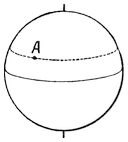
For if it were otherwise, consider what would be going on around us. The earth is about 8,000 miles across, so a parallel of latitude through London is about 19,000 miles long, and London covers that distance in twenty-four hours. London is therefore spinning through space at over 1,000 feet a second from the earth's rotation alone, not counting its motion along the earth's path round the sun. If a boy jumped two and a half feet into the air, he would take about half a second to go up and come down; but if he did not share the earth's motion while he jumped, he would land more than 500 feet to the west of where he took off, and if he jumped indoors he would be dashed against the wall harder than if he had fallen from the top of Mont Blanc. He would not merely be killed but smashed past recognition. If the earth suddenly stood still, everything on it would be shaken to pieces. It is bad enough when a train going thirty miles an hour runs into something. The shock of the earth stopping would be that of a train going about 800 miles an hour, which would smash everything and everyone.5
The first effect of the new ideas Galileo put forward, then, was to show that the theory of Copernicus, that the earth turns on its axis and goes round the sun, agreed with the laws of motion. In fact he introduced quite new ideas of force, and these ideas I must now try to explain.
Let us consider what is meant by the word "force." If I press my hand against the table, I exert force; the harder I press, the more force there is. If I put a weight on a stand, the weight presses the stand down with a force. If I squeeze a spring, the spring tries to recover itself and exerts a certain force. In all these cases force is thought of as a pressure, and I can measure the force by seeing how hard it will press things. If I take a spring and press it in an inch, it takes a force of perhaps 1 lb. It will take a force of 2 lbs. to press it in another inch. Or if I pull it out an inch, it takes a force of 1 lb., and pulling it out another inch takes 2 lbs. We therefore get into the habit of thinking of forces as producing pressures and as measured by pressures.
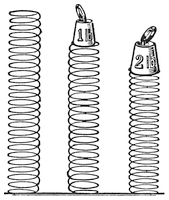
That is a perfectly legitimate way of looking at things, just as the cook's use of a spring balance to weigh joints of meat is a perfectly legitimate way of estimating the forces acting on bodies at rest. But when you come to the laws of the pendulums of clocks, which is what everything I am saying is leading up to, you have to deal with bodies in motion, and for that an altogether new idea of force is needed. We will no longer speak of forces as producing pressures. We will treat them quite apart from their power of pressing. The sun exerts a force of attraction on the earth, but it does not press on it; it exerts its force at a distance. We need, then, a new idea of "force," and it is this. We will consider that when a force acts on a body it tries to make it move; it tries to give it motion. We may treat this motion as a sort of thing or property. The longer the force acts on the body, the more motion it gives it, provided the body is free to take that motion. We can say, then, that the test of the strength of a force is how much motion it can give a body of a given mass in a given time. It does not matter how the force acts. It may act through a string and pull the body; it may act through a stick and push it; it may act by attraction and draw it, or by repulsion and drive it away; it may act like a little spirit and fly off with it. In every case it acts, and the more it acts, the more effect it has. In double the time it produces double the motion. If the mass is big, it takes more force to make it move; if the mass is small, it is moved more easily. When we want to measure a force in this way, then, we do not press it against springs to see how far it pushes them in. We let it act on bodies that are free to move and see what motions it gives them. Of course we can only do that with things that are free to move. You cannot treat force this way if all you have is a pair of scales; then you must be content to measure pressures. It is important to grasp this idea clearly. If a body has a certain mass, the force acting on it is measured by the amount of motion it will give that mass in a given time, provided the mass is free to move. This is to be our definition of force.
When an attraction or any other force acts on a body that is free to move, then, motion is continually being given to the body. Motion is, as it were, poured into it, and so the body moves faster and faster.
Here is a ball flying through the air. Suppose forces are acting on it. How can we measure them? We cannot feel what pressures are acting on it. All we can do is watch its motion and see how it flies. If it goes faster and faster, we say, "A driving force is acting on it." If it begins to slow down, we say, "A retarding force is acting on it." As long as it changes neither its speed nor its direction, we say, "No force is acting on it." By this method we tell whether a body is being acted on by a force simply by watching its speed or its change of speed. Merely to say that a body is moving does not tell us that a force is acting on it. All we know is that if it is moving, a force has acted on it. It is only when we see it changing its speed or its direction, changing its motion, that we say a force is acting. Every change of motion, in direction or in speed, must be the result of a force and must be proportional to that force. That is what we mean when we say that motion is the test and measure of force.
This most interesting way of looking at things lies at the root of the whole theory of mechanics. It is the foundation of the system the stupendous genius of Newton devised to explain the motions of the sun, moon and stars.
He treated forces as proportional to motions, and motions as proportional to forces, and with this idea he solved part of the riddle of the universe. Galileo had partly seen the same thing, but never so clearly as Newton. Great discoveries are made only by seeing things clearly. What it took a genius to see in one age, a child can understand in the next.
We say, then, that a force is that which in a given time produces a given motion in a given mass that is free to move.
You must have time for a force to act in: however great the force, in no time there can be no motion. You must have mass for a force to act on: no mass, no effect. You must have free space for the mass to move in: no freedom to move, no movement.
But what is this "mass"? We do not know; it is a mystery. We call it "quantity of matter." In a uniform substance it goes with size: double the volume, double the mass. Cut a cake in half and each half has the same "mass" as the other. But then is mass "weight"? No, it is not. Weight is the action of the earth's attraction on matter. Take away the earth to attract it and you would have no weight, but you would still have "mass." What, then, is matter? Of that we have no idea. The greatest minds are working on it now. But mass is quantity of matter. Knock a brick against your head and you will know what mass is. It is not the brick's weight that gives you the bump; it is its mass. Try to throw a ball of lead and you will know what mass is. Try to push a heavy wagon and you will know what mass is. Weights, the earth's pulls on masses, are proportional to the masses at any one place. That, as we have seen, is known by experiment.
When a force acts for a certain time on a mass that is free to move, then, however small the force and however short the time, the body will move. When a baby in a temper stamps on the ground, it moves the earth: not much, it is true, but it moves it. Indeed, in theory not a fly can jump into the air without moving the earth and the whole solar system. Only, as you can imagine, they do not show it noticeably. Still, in theory the motion is there.
There are therefore two different ways of thinking about and estimating forces, one suited to observing bodies at rest and the other to observing bodies that are free to move. A force always tends to produce motion. If motion is impossible, it produces pressures, which we can measure, calculate and observe. If the body is free to move, the force produces motions, which we can also measure, calculate and observe. And we can compare the two sets of effects. We can say: "A force that would produce such and such motions acting on a ball with a mass of one pound would, acting on a certain spring, produce so much compression."
The earth's attraction on masses of matter that are not free to move gives rise to the forces we call weights. The pull of gravity on a mass of one pound produces a pressure equal to a weight of one pound. Unfortunately the same word "pound" is used for both the mass and the weight; it has come down to us from days when the nature of mass was not well understood. Great care must be taken not to confuse the two meanings.
But the earth's attraction, like every other force acting on matter that is free to move, produces changes of motion. The word for a change of motion is "acceleration," a quickening. "He accelerated his pace," we say: he quickened it, he added to his motion. Force, acting on mass for a time, produces acceleration.
It follows that if a force keeps acting on a body, the body keeps moving faster and faster. When the force stops acting, the motion already gained carries on, but the acceleration stops; the body goes on moving uniformly in a straight line at the speed it had when the force stopped.
What happens, then, if a body is subject to a force and held tight? It stays put, of course. Now let it go. It is a free body, and it begins to move. As long as the force acts it keeps putting more and more motion into the body. It is like pouring water into a jug: the longer you pour, the faster the motion becomes. The body keeps all the motion it had and keeps adding all the motion it gains, like a boy saving his weekly pocket money, who keeps what he had and keeps adding to it. If in one second it is given a motion of one foot a second, then in the next second another foot a second is added, making two feet a second together; in another second of the force's action the motion is increased, or "accelerated," by another foot a second, and so on. The speed is therefore always proportional to the force and to the time. If we let V stand for the motion, or speed, or velocity; F for the acceleration, the gain of motion; and T for the time, then V = FT. Here V is the velocity the body will have gained at the end of the time T, if it is free to move and is acted on by a force able to produce an acceleration of F feet per second in each unit of time.
V is the final velocity. The average velocity will be ½V, since the body started with no velocity and gained speed uniformly. How far will the body have fallen in that time? Clearly we get that by multiplying the time by the average velocity, so S = ½VT, where V, as I said, is the final velocity. But we found that V = FT, so substituting, S = ½FT × T = ½FT2.
Bear carefully in mind that these letters V, S and T do not stand for velocities, distances and times themselves, but only for the numbers of units of velocity, distance and time. V means V feet per second, S means S feet, and T means T seconds. When we write V = FT we do not mean that by multiplying a force by a time you can produce a velocity. If it is true that you can get the number of inhabitants (H) of London by multiplying the average number of people (P) living in a house by the number of houses (N), this can be written as the equation H = PN. But that does not mean that by multiplying people by houses you can produce inhabitants. H, P and N are numbers of units, and numbers only.
When a body is acted on by an accelerating force, then, it goes faster and faster as it goes on, and its velocity increases with the time. But the distance it covers increases faster still, because as time runs on not only does the distance grow but the rate at which it grows gets bigger too. It increases at an increasing rate. It is like a man with a rising income who saves all of it. His savings mount up not merely in proportion to the time; the rate at which they grow also grows with the time, so that the total is in proportion to the time multiplied by the time, in other words to the square of the time. If I let a body drop from rest under any force capable of producing an acceleration, the distance it falls will be as the square of the time.
Now let us see what the speed will be if the force is gravity, the attraction of the earth.
Remember that Galileo showed that all bodies, big and small, light and heavy, fall to the earth at the same speeds. What is that speed? Let G be the number of feet per second of motion that the earth's pull adds to a body in one second. Then the velocity at the end of that second will be V = GT, and the distance fallen will be S = ½GT2.
What I want to know, then, is how far a body falling under gravity will fall in a second.
That, of course, is a matter for measurement. If we can get a machine to measure seconds we can do it. But since falling bodies drop sixteen feet in the first second and then fall faster and faster, the measurements are difficult. Galileo wanted to see if he could make the fall easier to watch. He said to himself, "If only I can water down the force of gravity and make it weaker, so that the body moves very slowly under it, the time of falling will be easier to observe." But how? This is one of those discoveries that mark out their inventor at once.
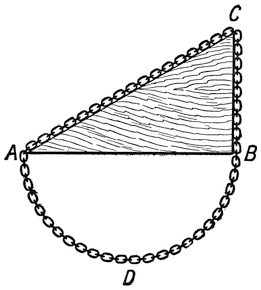
Galileo's idea was to let the body, instead of dropping straight down, roll slowly down a slope, since a body on a slope is not driven down it with the same force that makes it fall straight down.
Is there any law telling us with what force gravity drags a mass down a slope?
There is a simple one, and before Galileo's time it had been found by Stevinus, an engineer. His solution was this. Let ABC be a wedge-shaped block of wood, with a loop of heavy chain hung over it; suppose there is a little pulley at C and no friction anywhere. Then the chain will hang at rest. But the lower part, from A round to B, is symmetrical, the same shape on both sides, so as far as any pull it exerts is concerned, the half from A to D balances the half from B to D. You may therefore take both away, as you would equal weights from a pair of scales, and then the force of gravity acting down the slope on the part AC will balance the force of gravity acting straight down on the part CB. Since the chain is uniform, the weight of any piece of it is proportional to its length. The force of gravity down the slope on a piece as long as CA therefore equals the force of gravity straight down on a piece as long as CB. In other words, the force of gravity acting down a slope is reduced in the ratio of CB to CA.
When a body falls straight down, as we have seen, S = ½GT2, where S is the distance it falls, G the number of feet per second of velocity that gravity acting straight down gives it in a second, and T the number of seconds. If, then, instead of falling straight down the body runs down a slope, we must put in place of G as the accelerating force
G × (vertical height of the end of the plane)/(length of the plane).
To try the experiment, Galileo took a beam of wood thirty-six feet long with a groove in it and tilted it so that one end was one foot higher than the other. The acceleration down the slope was therefore 1/36 G, where G is the vertical acceleration of gravity he wanted to find. Then he timed a brass ball running down the thirty-six feet of the slope and found that it took nine seconds. From the equation above, then, 36 feet = ½ × the acceleration of gravity down the slope × (9 seconds)2, and so the acceleration of gravity down the slope is (36 × 2)/(9)2 feet per second.
But the slope rises one foot in thirty-six. The vertical acceleration of gravity, the velocity gravity would produce straight downwards in a second, is therefore thirty-six times what it produces down the slope, that is,
36 × (36 × 2)/(9)2, which comes to 32 feet per second.
Ingenious as this method is, it has two faults. One is the error caused by friction. The other comes from not noticing that the pull of gravity on the ball is spent not only in getting it down the slope but also in making it spin, and no allowance has been made for that. The allowance for the spin is complicated and needs more knowledge than Galileo had. Still, the result is roughly right.
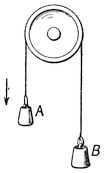
The next attempt to measure G, the velocity gravity gives a body in a second, was made by Atwood, a Cambridge professor. His idea was to weaken gravity and so slow its action down, not by making it act on a slant but by letting it act on only part of the mass to be moved. For this he hung two equal weights over a very delicately made pulley. Gravity could do nothing to them, since whatever it did to one would be undone by what it did to the other, and the weights would stay at rest. But if a small weight W, equal to, say, a hundredth of the combined weights of A, B and W, were suddenly put on A, A would descend under an accelerating force equal to a hundredth of ordinary gravity. We would then have
S (the distance moved by the weights) = ½ × G/100 × t2.
With such an arrangement he found that in 7½ seconds the weights moved 9 feet. That gave him
9 = ½ G/100 × (7½)2.
From which:
G = (2 × 9 × 100)/(7½)2 = 32 feet per second nearly.
By letting gravity act on only a hundredth part of the total weight being moved, A, B and W together, he weakened its action 100 times, and so made the time of falling and the distance fallen big enough to measure. To sum up: when a body free to move is acted on by the force of gravity, its speed increases in proportion to the time it has been acted on, and the distance it covers from rest is proportional to the square of the time the accelerating force has acted on it.
Gravity is not, of course, the only accelerating force we know. If a spring is suddenly let act on a body and pull it, the body starts to move and its motion is steadily accelerated, just as if it were being attracted, and the acceleration is proportional to the time the force acts. In the same way, when gunpowder is fired in a gun barrel and the force it produces acts on a bullet, the bullet's motion is accelerated for as long as it is in the barrel. When it leaves the barrel it goes on at a steady pace in a straight line, which the earth's attraction at once bends into a curve and the resistance of the air alters.
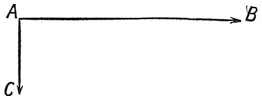
I have already said that motions can be considered independently of one another, so that if a body is acted on by two different forces, the action of each can be considered and worked out separately. Let us take an example of this law. We have seen that if a body is pushed forward and the force then stops acting, it goes on at a uniform, unchanging speed, and if nothing hindered or influenced it, it would go on in a straight line at a steady speed for ever.
We have also seen that a body acted on by an accelerating force such as gravity is constantly being accelerated; it keeps gaining motion, and its speed grows faster and faster.
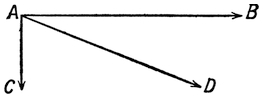
Suppose a body is subject to both at once. Shoot it out of a cannon, and let an accelerating force act on it not in the direction it is going but in some other direction, say at right angles. What happens? In the direction it is going its speed stays steady. In the direction the accelerating force acts it moves faster and faster. Along AB it goes on uniformly. If it went uniformly along AC as well (as it would if a single push acted on it and then stopped), the result would be that it travelled along the slanting line AD, the slant depending on the relative sizes of the forces. But what if it went uniformly along AB and at an accelerating pace along AC? Then while the distances along AB in equal times would be equal, the distances in the same times along AC would get bigger and bigger. It would not move in a straight line; it would move in a curve. This is very interesting. Let us take an example. Suppose we hit a ball horizontally. As soon as it leaves the bat it would go on horizontally in a straight line at a steady speed; but if at the same instant it is exposed to the accelerating force of gravity, then while its horizontal motion goes on steadily, its drop keeps increasing at a speed that grows with the time. While the total distances across are equal in equal times, the total drops below AB are as the squares of the times. Here, then, you have a point moving uniformly in the horizontal direction but as the squares of the times in the vertical direction. It traces a curve. What curve? One whose distances go evenly one way but grow as the squares the other way.
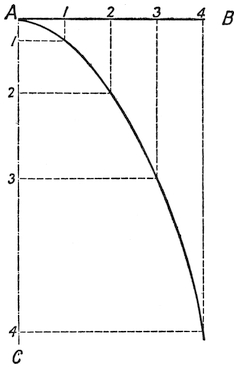
This interesting curve is called a parabola. With a ball simply struck by a bat the motion is too fast for us to see it well. Can we not make it go slowly? Remember what Galileo did: he used a slope to water down his force of gravity. Let us do the same. Take a sloping board and throw a ball across it horizontally. It goes in a curve, its speed steady across the board and accelerated down it. Tracing the curve is easy. Cover the ball with cloth and dip it in the inkpot, and it will draw a visible parabola. If I tilt the board up and make the force of gravity big, the parabola is long and thin; if I weaken gravity by making the board nearly flat, it is wide and flat.
You can also show it with a stream of peas or shot. Each little pellet goes at a steady speed across and with an accelerating force downwards.
Instead of peas we can use water. A stream of it rushing horizontally out of a hole soon bends down into a parabola.
I have tried, then, to show what force is and how it is measured. I repeat: when a body is free to move, if no further force acts on it, it goes on in a straight line at a steady speed; but if a force keeps acting on it in any direction, that force produces in each unit of time a unit of acceleration in the direction it acts, and the result is that the body moves towards the direction of acceleration at an ever increasing speed, covering greater and greater distances as the speed grows. That is the notion of a "force." In all that has been said above I have assumed that the pull of gravity on a body does not increase as the body gets nearer the earth. That is not strictly true; in reality the pull of gravity increases as you approach the earth's centre. But the small distances the weights in Atwood's machine fall make no noticeable difference, being as nothing compared with the radius of the earth. For practical purposes the force can be taken as uniform on bodies moving within a few feet of the earth's surface. It is only when we have to consider the motions of the planets that the change of attraction with distance has to be taken into account.
I am glad to say that the most tiresome, or rather the most difficult, part of our inquiry is now over. With the ideas we have gained we are ready to come to the pendulum, and to show how a boy who once amused himself in church by watching the great lamps swing, instead of attending to the service, laid the foundation of our modern ways of measuring time.
Chapter Three: Springs, Pendulums and the First Clocks
We have looked at how a body behaves under the accelerating, speed-quickening force of gravity, whose pull on any body is always proportional to its mass. Now let us consider another kind of acceleration.

Take a strip of rubber. Pull it and it resists and tries to spring back, and the further I stretch it, the harder I have to pull. That is true of all springs. It is true of coil springs whether they are pulled out or pushed in, and in every case the amount the spring is pulled out or pushed in is proportional to the pressure. This is called Hooke's law. Hooke put it in Latin, "Ut tensio, sic vis": "As the stretch, so the force." It holds for all elastic bodies, whether they are pulled out, pushed in or bent aside. The ordinary spring balance works on this principle. The thing to be weighed hangs on a hook from a spring, and the amount the spring is pulled out measures its weight. Take a fishing rod, lay the butt on a table and hold it down with something heavy, and the tip will bend down under its own weight. Mark where it comes to. Now hang a weight on the tip and it bends a little further. Put on double the weight and it goes down double the distance, and so on, until the rod is bent so far that its shape changes and a new law of bending comes into play. Suppose I use a spring as an accelerating force: say I hang a heavy ball on a string, hook a coil spring to it, and pull the spring sideways. The ball is drawn after the spring. If I then let the ball go, it starts to move. The force of the spring acts on it as an accelerating force, and the ball moves faster and faster. But the acceleration is not like that of gravity, in two ways. The pull of the spring does not depend at all on the mass of the ball; and instead of being constant, like the pull of gravity, it grows weaker and weaker as the ball gives way to it. The equations given above connecting distance, velocity and time, which were worked out for gravity, are therefore no longer true, and a different set has to be found. That is easily done by mathematics, but I do not propose to go into it. I would rather offer a rough and ready explanation which, though it does not amount to a proof, lets us accept a truth that can be established both by experiment and by calculation.
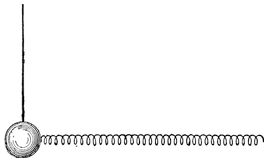
Let a heavy ball, A, hang on a long string, so long that gravity's sideways pull on the ball is very small and can be ignored, and fasten a rubber thread to each side of it, anchored at B and C. When the ball is pulled a little aside, to a position D say, it tries to fly back to A with a force proportional to the distance AD. How long will it take to get there? If the distance AD is small, the ball has only a short way to go, but then only small forces act on it. If AD is bigger, it has further to go but bigger forces to drive it. The two balance each other, so the time is the same in each case.
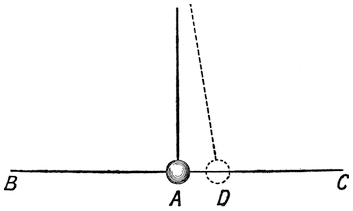
The question is this. Will you go a long way with a powerful horse, or a short way with a weak one? If the distance in each case is in proportion to the horse's power, the length of the journey does not matter: the powerful horse covers the long distance in the same time as the weak horse covers the short one. It is the same here. However far you pull out the spring, its accelerating pull on the ball is in proportion to the distance. But the time the ball takes to be pulled back depends on the distance. Each cancels the other. From this follows a most important fact: springs are all isochronous, which is to say that any body fixed to any spring whatever, big or small, straight or curly, long or short, has a time of vibration that does not depend at all on the size of the vibration. The experiment is easy to try with a ball on the end of a long arm that can swing horizontally, tied on each side to an elastic thread. Pull it aside and it vibrates, and you will see that the vibration takes exactly the same time whether it is large or small. If the pull aside is big, the force pulling it back is big; if the pull is small, the force pulling it back is small. In one case the ball has further to go, but at every point of its path it has a proportionally stronger force pulling it; in the other it has less far to go, but at every corresponding point a proportionally weaker force. The time stays the same, whether you have the powerful horse for the long journey or the weaker horse for the short one.
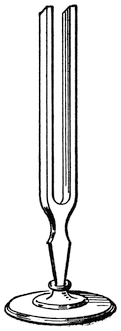
Next take a short, stiff steel spring. The kind called a tuning fork will do.
The reader probably knows that sounds are made by very rapid pulses in the air. Any series of taps becomes a continuous sound if it is fast enough. If I tap a card 264 times a second, I get a continuous sound like the middle C of the piano. That, in fact, is the rate at which the piano string vibrates when C is struck, and it is that vibration that gives the air the taps that make the note.
This is very easy to prove. Lift the back of a bicycle and spin the driving wheel fairly fast by turning the pedal by hand, and the wheel will turn perhaps three times a second. Hold a visiting card so that the spokes flick it as they fly past, and since there are about thirty-six of them, you get a series of taps at about 108 a second. Try it and you will find it is close to the note A, the lowest space on the bass clef. As the wheel slows the note gets lower; as it speeds up the pitch rises and the note grows shriller. It makes no difference how near the card is held to the centre of the wheel or how far from it, since the number of taps a second stays the same. In the same way, if you draw a piece of watch spring quickly across a file you hear a musical note: the finer the file and the faster you draw, the higher the note. A tuning fork and a vibrating string make their notes simply by beating the air. The hum of insects is made the same way, by the rapid beating of their wings.
It is a fact of experiment that when a piano note is struck, the sound dies away as the vibration fades, but the pitch of the note stays the same. A tune played softly, so that the strings vibrate only a little, is still the same tune, with the notes at the same pitch.
A "siren" is an ingenious device for making a series of very rapid puffs of air. It consists of a small wheel with slanting holes in it, mounted to spin close against a fixed wheel with similar holes. When air is forced through the wheels, the slant of the holes in the moving wheel makes it turn. As it turns, the air is alternately cut off and let through, so that a series of very rapid puffs is produced. As more air is forced in, the wheel spins faster and faster; the puffs come quicker and quicker, so the note they make rises steadily in pitch until it becomes a kind of scream. On steamers these sirens are worked by steam and make a very loud noise.
It is impossible, however, to change the pitch of a tuning fork or a stretched piano string without changing the elastic force of the spring by altering its tension, or putting weights on the prongs of the fork to slow it down. That is because the tuning fork and the piano string, being elastic, obey Hooke's law, "As the deflection, so the force"; so the time of each spring back is fixed, and the pitch of the note stays fixed however large or small the vibration.
On this law depends the correct going of both clocks and watches.
Wonderful nature, that makes the steady sound of a piano or a violin depend on the same laws that govern the steady going of a watch! More than that: all creation is vibrating. The surge of the sea that swishes in on the coast at regular intervals, and the colours of light, which are ripples in an elastic ether that springs back with a restoring force in proportion to how far it is displaced, all depend on the same law. This grand law, which governs so many things in nature, has a very beautiful name that I hope you will remember. It is called "harmonic motion," meaning that when the atoms of nature vibrate, they vibrate like piano strings, according to the laws of harmony. The ancient Pythagorean philosophers believed that all nature moved to music, and that dying souls could begin to hear the notes the stars sounded as they moved in their orbits. They called it, as you know, the music of the spheres. But could they have seen what science has revealed to man's patient efforts, they would have seen a vision of harmony in which not a ray of light, not a string of a musical instrument, not an organ pipe, not a wave of the all-pervading electricity, not a fly's wing, but vibrates according to the law of harmony: the simple, easy law of which a boy's catapult is the type, and which, as we have seen, tells us that when an elastic body is displaced, the force of restitution, the force trying to bring it back to its old position, is proportional to the displacement, and the time of vibration is constant. That last is the important thing for us, and we seem to catch a first glimpse of how the clock and watch problem is going to be solved.
But before we get to that we must go back a little.
Around the year 1580 an inattentive youth (it was our friend Galileo again) watched the swinging of one of the great chandeliers in the cathedral at Pisa. The chandeliers have been replaced since his day; it was one of the old lamps he watched. It had been lit and left swinging through a wide arc. He expected that as it gradually came to rest it would swing faster and faster, but it seemed to keep the same time. That was curious. He wanted to time its swing, and for this he counted his pulse. As far as he could tell, there were exactly the same number of beats in every swing.
This interested him greatly, and at home he began to try some experiments. As he grew older he came back to the subject again and again, and he finally established on a satisfactory footing the law that a weight hung on the end of a string and set swinging is isochronous, equal-timed, however wide the arc of its swing.
The first use he made of it was a little instrument for doctors, a string whose length you could vary. The doctors of those days had no gold watch to pull out and gaze at with a solemn face while it ticked. They were delighted with the new invention, and for years doctors would take out the little string and weight, put one hand on the patient's pulse, and adjust the string until the pendulum swung in time with the pulse. By noting the length of the string they could then tell how many times the pulse beat in a minute. But Galileo did not stop there. He went on to examine the laws that govern the pendulum.
We will follow these investigations, which will rest a good deal on what we have already learned.
Before we can understand the laws of the pendulum, though, there are one or two simple points about the balance and working of forces to be grasped.
Suppose we have a flat piece of wood of any shape, like the one in Figure 34, and we put a screw through any spot A in it, it does not matter where, and screw it to a wall so that it can turn round the screw as round a pivot.
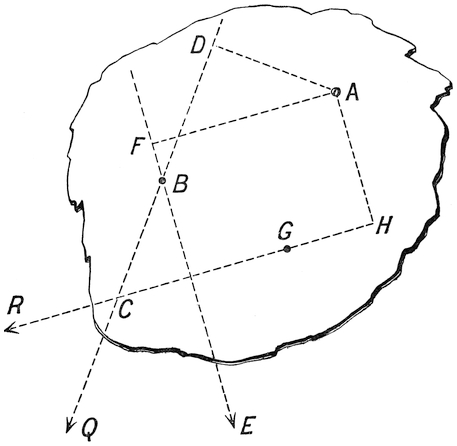
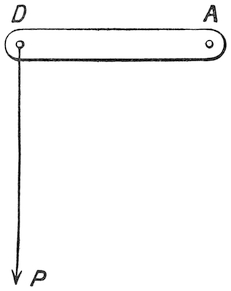
Next we knock a tack into any point B and tie a string to it. If I pull on the string in any direction BC, the board tries to twist round the screw at A. How strong will the twisting force be? That depends on the strength of the pull and on the "leverage," the distance of the line CB from A. We could imagine the string fastened not at B but at D; then, if P stands for the strength of the pull, the twisting power is P × AD. This is called the "moment" of the force P about the centre A. It would be just the same if I had a plain arm AD and pulled on it with the force P. It is a fact of experiment, known to the old Greek philosophers, that moments, or twisting powers, are equal when the arm multiplied by the force acting at right angles to it comes to the same in each case.
Now suppose AB is a pendulum with a bob B weighing 10 lbs., and suppose it has been drawn aside from the vertical so that the bob is in the position B. The weight of the bob then acts straight down along the line BC. The moment, or twisting power, of the weight equals 10 lbs. multiplied by AD, where AD is a line perpendicular to BC.
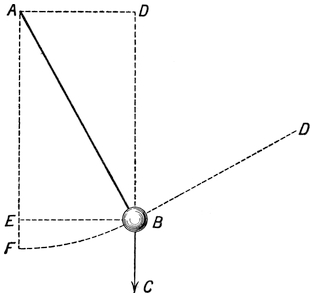
Now suppose another string were tied to the bob B and pulled at right angles to AB with a force P just strong enough to hold the bob back in the position B. The pull along DB times AB is the moment of that pull about A. Since this moment just holds the pendulum up, the moment of the pendulum's weight about A must equal the moment of the pull of the string BD about A.
    Whence P × A B = 10 lbs. × A D.
          Whence P = 10 lbs. × (A D)/(A B).
But AB is always the same, however far the pendulum is pulled aside. We see, then, that when a pendulum is pulled aside a distance EB (which always equals AD), the force trying to bring it back to E is always proportional to EB. If the pendulum is fairly long, say 39 1/7 inches, and the displacement EB is small, if we do not drag it far out of the vertical, then the force trying to bring it back to F, its position of rest, is not very different from the force trying to bring it back to E. But FB is the "displacement" of the pendulum; and so we find that when a pendulum is displaced, deflected or pulled aside a little, the amount of the deflection is always very nearly proportional to the force used to produce it. This important law can be checked by experiment. Let C be a small pulley and BC a string tied to the bob B of a pendulum AB. If a weight D is tied to the string, which runs over the pulley C, the distance FB that the weight D pulls the bob B aside is almost exactly proportional to D, as long as we keep the deflection EB small, two or three inches, say, on a pendulum AB 39 1/7 inches long.
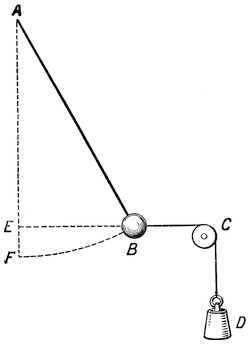
If FB is made too big, the straight line BF can no longer be taken as nearly equal to the arc EB, and the rule no longer holds.
Both by experiment and in theory, then, we find that for small distances the displacement of a pendulum bob is very nearly proportional to the force that produces it.
But in that case, from what has gone before, we have an example of harmonic motion. The weight of the bob, pulling it back towards E, acts just as an elastic band would: it pulls harder the bigger the distance FB. In fact, if we could take away gravity while leaving the mass B of the bob, an elastic band pulling the bob back to rest could take its place. It would be all one whether the bob were brought back to rest by the downward force of its own weight or by the sideways pull of a suitably arranged elastic band of the right length.
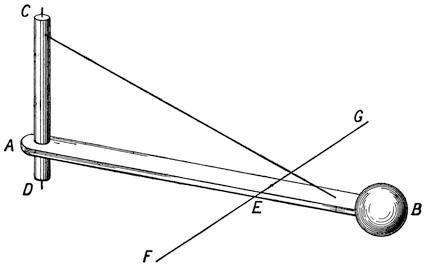
But the motion of the bob under the pull of an elastic band whose pull is always proportional to the displacement would, as we have seen, be harmonic motion, made in equal times whatever the size of the swing. We conclude that if the swings of a pendulum are not too big, not more than two and a half inches each way, say, the motion may be taken as harmonic, and the swings will be made in equal times whether they are large or small. In other words, a clock with a 39 1/7 inch pendulum and a swing of not more than two inches on each side will keep time whatever the arc of the swing.
This can be checked by experiment. Take a wooden pendulum 39 1/7 inches long and fix a bob of 10 lbs. to its end. It will swing once a second. To pull it aside two inches we would need a weight whose moment about the point of suspension equalled the moment of the bob's weight about that point. In other words, the weight needed × 39 1/7 inches = 10 lbs. × 2 inches, and so the weight needed = ½ lb. (nearly).
Now take a similar pendulum AB, 39 1/7 inches long, with a weight B of 10 lbs. on it, and fix it horizontally. Fasten it to an upright shaft CD, with a tie of wire or string to hold it up, and fasten elastic threads EF and EG to each side of the rod AB. Fix the threads at such a point that when B is pulled aside two inches the force trying to bring it back to rest is half a pound. Set it swinging and the rod will swing to and fro in equal times however big the swing (provided the swing is kept small), and its time of swing will be that of the pendulum, one swing a second. Whether you hang AB upright and let it swing on its pivots C and D under the force of gravity, or lay it flat, so that gravity cannot act on it, and make it swing under the accelerating pull of a pair of elastic bands arranged to be equivalent to gravity, in either case it will swing in seconds.
It is this curious property of the circle that makes the downward pull of gravity on a pendulum act like an elastic band pulling sideways. That is why a pendulum swings in equal times, or is isochronous, as it is called, from two Greek words meaning "the same" and "time."
But remember that this equal swinging is only approximate, and holds only when the arc of the swing is small.
Here, then, we have a proof that the pendulum of a clock and the balance wheel of a watch depend on exactly the same principles. Each is an example of harmonic motion.
The next question is whether the weight of the pendulum has any influence on its time of swing.
A little thought will soon convince us that it has none. We know that the time bodies take to fall to the ground under gravity does not depend on their weight. A falling 2 lb. weight is simply two pound weights falling side by side.
In the same way, and by the same reasoning, we could take two pendulums of equal length, each with a bob weighing 1 lb. Put side by side close together, they would swing in equal times. And the time would be the same if they were fastened together and made into one pendulum.
Since the fall of a pendulum is due to gravity, and gravity's pull on a body is proportional to its mass, the share of the pull of gravity acting on each part of a pendulum's mass is busy moving that part, and the whole pendulum can be thought of as a bundle of pendulums tied together and swinging together.
It would be the same with a pendulum swinging under the pull of a spring. Two bobs on two springs will vibrate in the same time as one bob driven by one spring, but in that case the one spring must be as strong as the two springs put together. In other words, the springs must be made in proportion to the masses.
You cannot, then, make a pendulum swing faster by adding weight to the bob.
On the other hand, if you have a bob vibrating under a spring, like the balance wheel of a watch, and you make the bob heavier without making the spring stronger, the mass to be moved has grown with no matching increase in the force accelerating it, and the time of swing will change accordingly.
But with gravity, when you change the mass you change the pull on it in proportion, and so the time of swing is unchanged.
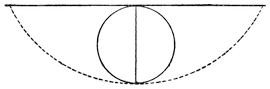
The explanation I have given of why a pendulum swings to and fro in a fixed time whatever the length of its arc, that is, however far it sways from side to side, is only approximate, because in the proof we assumed that the arc of the swing and the line FB were equal, which is not exactly true. Galileo never reached the true solution, though he tried hard. It was left to another to find the true path of an isochronous pendulum and settle its laws completely. Huygens, a Dutch mathematician, found that the true path a pendulum must swing in if it is to be truly isochronous is a curve called a cycloid, the curve traced by a pencil fixed to the rim of a hoop when the hoop is rolled along a straight ruler. It is the curve a nail sticking out of the rim of a wagon wheel would scratch on a wall. I will not go into the mathematical proof. Clocks are not made with cycloidal pendulums, because when the arc of a pendulum is small its swing is so nearly a cycloid that it makes no noticeable difference to the timekeeping.
I am glad to be able to say that I have now dealt with all the mathematics needed to understand the mechanism of a clock. It all leads up to this:
(1) A harmonic motion is one in which the accelerating force increases with the distance of the body from some fixed point.
(2) Bodies moving harmonically make their swings about this point in equal times.
(3) A spring of any sort or shape always has a restoring force proportional to its displacement.
(4) Masses fixed to springs therefore vibrate in equal times, however large the vibration.
(5) The bob of a pendulum, swinging to and fro, acts like a weight under the pull of a spring, and is therefore isochronous.
(6) The time of swing of a pendulum is not affected by changes in the weight of the bob, but it is affected by changes in the length of the pendulum. The time of vibration of a mass fixed to a spring is affected by changes in the mass.
Now we must apply these principles to clocks and watches.
Clocks were known before Galileo's time and before the pendulum was invented. They had what are called balance, or verge, escapements. Strictly, in order of time, I ought to explain them here, but I will not. I will go on to describe the pendulum clock, and then go back and explain the verge escapement, which, we shall see, is really a sort of huge watch of a very imperfect kind.
As soon as Galileo had found that pendulums were isochronous, swinging in equal times, he set to work to see whether he could make a timepiece out of one. That would be easy if only he could keep a pendulum swinging. Set a pendulum going and it soon comes to rest. What brings it to rest? The resistance of the air and the friction of the pivots. Plainly, what it needs is something to give it a kick now and then. But the thing must kick with discretion: a kick at the wrong moment might stop the pendulum instead of keeping it going. What you want is something that will give it a further push just as it reaches the end of its swing and starts back. Suppose I put a boy in a swing and swing him to and fro. I time my pushes. As he comes back against my hand I let him push it back, and then, just as the swing turns, I give it another push. But I cannot keep that up all day. I must make a machine to do it. Now what sort of machine?
First, the machine must have a store of force. I cannot get a machine to do work unless I wind it up, any more than I can get a man to work unless I feed him, which is his way of being wound up. And what do I want it to do? I want it, when I give it a push, to push me back harder. I want a store of force arranged so that when the pendulum comes back and touches it, the touch, like the pressure on the trigger of a gun, lets some pent-up power escape and drive the pendulum forward.
That is what happens with a swing. Each time the swing comes back to my hands I give it a push, which keeps up the motion that friction and the resistance of the air would otherwise destroy.
An arrangement that does this mechanically is called an "escapement."
Galileo contrived one. He took a wheel with a number of pins set round it, as shown here. The pendulum AB has an arm AH fixed to it, and a ratchet CD catches on the pins. The ratchet has an arm EF sticking out from it.
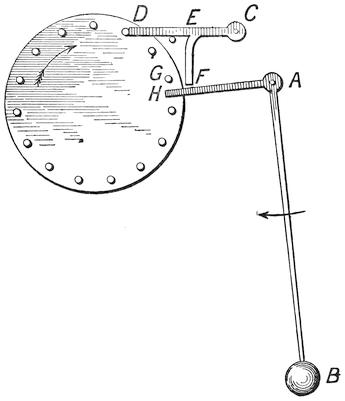
As the pendulum comes back towards the end of its beat, the arm AH strikes the arm EF and lifts the ratchet CD. That releases the wheel, which has a weight wound up on it and so at once tries to turn. The pin G then strikes the arm AH, and so gives the pendulum a push on its return stroke. As the pin G moves forward it slides along the arm AH until it slips off over the point H. The wheel, now free, would spin round, except that by the time the pendulum has come back and the arm AH has dropped, the ratchet is in position again, its point D ready to meet and stop the next pin coming against it. At each blow of a pin against the pendulum a "tick" is made, and at each blow of a pin against the ratchet a "tock," and so, as it goes, the pendulum makes the "tick-tock" we all know.
A clock, then, is a wheel, or a train of wheels, driven by a weight or a spring that is always trying to spin round, but held in check by an escapement and a pendulum, which let it go one step forward at a time, at regular, equal intervals.
But this would make only a poor sort of escapement, because the way it drives the pendulum complicates the pendulum's swing. Instead of being under the accelerating force of gravity alone, the pendulum is also under the acceleration of the pin G, and that acceleration is not of the "harmonic" kind. As far as it goes, then, it does nothing to help the pendulum's harmonic motion; on the contrary, it disturbs it. Besides, in practice the push of the pin is not always even. If the wheel sits at the end of a train of wheels driven by a weight, the force on it is constant, but in passing through the train of wheels it is much affected by the friction of the oil; and on colder days the oil thickens and resists more. Moreover, as will be explained in more detail later, the fact that G gives its push at the end of the pendulum's stroke is a drawback, since it interferes with the pendulum's free play.
For all these reasons this escapement is imperfect, and would not do where precision was needed.
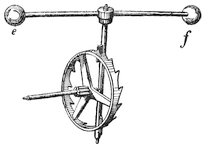
It is time now to go back to the old escapements that were in use before Galileo. They had a wheel called a crown wheel, with triangular teeth. On one side of it an upright axis was fitted, carrying two projecting "pallets." Across the axis a verge, or rod, was laid, with a ball at each end, e and f. When the crown wheel tried to move on, one of its teeth met a pallet and pushed it forward, so giving a push to the axis that carried the verge and its balls. The balls, of course, began to move under the acceleration of the force pressed on the pallet. Meanwhile the other pallet was moving the opposite way, and by the time the first pallet had been pushed far enough to escape, slipping past the tooth that was pressing on it, the other pallet had met a tooth on the far side of the crown wheel. That tended to check the motion of the verge, bring the balls to a standstill, and in the end send them back the other way.
The arrangement, then, was a pendulum not acted on by gravity, since the two balls balanced each other. The pendulum was not under a harmonic acceleration, but under a nearly uniform acceleration first from A to B and then from B to A. As a result, the time of a swing was not independent of the arc of the swing but varied with it, and with the driving power of the crown wheel too. At each stroke there was a good deal of "recoil": as each tooth of the wheel came into play, it could not at first overcome the pallet it was pressing on and drive it back, but was instead driven back itself by the pallet for a while.
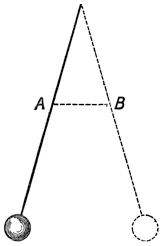
As long as the motions of the wheel and the verge were perfectly uniform, of course, the clock kept fair time. But the least unevenness in the making threw it out.
Even so, it was on this principle that clocks were made through the thirteenth, fourteenth and fifteenth centuries. They were mostly made for cathedrals and monasteries. One was put up at Westminster, paid for out of a fine imposed on one of the few English judges ever convicted of taking bribes.
The time of swing of these clocks depended entirely on the mass of the balls at the ends of the verge compared with the strength of the driving force that pushed on the pallets. They were very often driven by a spring instead of a weight. The spring was a long strip of rather poor steel coiled up in a drum. As it unwound it grew weaker, so the push on the verge grew weaker, and the clock went slower.
To keep the time true, then, some arrangement had to be found that would keep the driving force on the crown wheel more nearly constant.
That gave rise to the invention of the fusee. The spring was put inside a drum, a round box. One end of the spring was fastened to an axle, which was held fixed while the clock was going; the other was fastened to the inside of the drum. A cord was wound round the drum, and as the spring turned the drum, the cord was wound up on it. Because the pull of the spring is uneven, the drum pulled the cord strongly at first and more feebly later. To make up for this, a cone-shaped wheel was provided with a spiral path cut in it, of such a shape and size that as the pull of the drum turned it round, the cord lay on different parts of it. The leverage, or turning power, therefore varied, growing greater as the pull of the cord grew weaker, and in just such a ratio that the one exactly made up for the other and the turning power on the axle stayed even.
In this way small table clocks were made that kept very tolerable time.
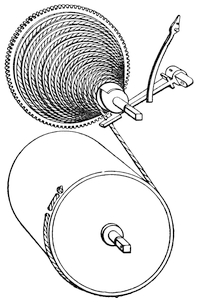
Huygens turned these clocks into pendulum clocks very simply. He took off one of the balls, lengthened the verge, and made the other ball a little heavier. The crown wheel still drove the verge and the remaining ball, but the acceleration of that ball no longer depended entirely on the force of the crown wheel. Its speeding up and slowing down were now governed almost entirely by the force of gravity on the remaining ball, and that acceleration was harmonic.
The clock, then, was immensely improved as a timekeeper. Still, part of the acceleration came from the driving power, and that part was not harmonic and brought in errors.
Most of the old clocks were converted soon after Huygens's time. As there was generally no room for the pendulum inside the clock case, they usually brought the axle that carried the pallets out through the front and made it swing in front of the face.
Many old clocks converted in this way still exist, the one in the frontispiece among them. A genuine old verge clock is now a rarity.
The kind of escapement Galileo invented never came into use for clocks, because of its imperfections, until after a long interval, when, with certain changes, it became the basis of a new improvement at the hands of Sir George Airy.
The crown wheel fell out of use and was replaced by the anchor escapement. That was the escapement of the popular and excellent timepiece used all through the eighteenth century and the early part of the nineteenth, now known as "The Grandfather's Clock." It was the crown wheel in another shape, after all. The wheel was flattened out, with its teeth all in the same plane, which made it much easier to make. The pallets were fixed on an axle and altered a little to suit the new arrangement of the teeth. The pendulum was no longer hung on the axle that carried the pallets, and so a good deal of friction and lost power was done away with. Instead it hung from a strip of thin steel spring, which let it swing and held it up without friction. This excellent way of hanging pendulums is now universal. It allowed the pendulum to be made very heavy: the bob usually weighed some eight or nine pounds. The acceleration of the pendulum was therefore due almost entirely to gravity acting on the bob, and its motion became almost wholly harmonic. It followed that changes in the pendulum's swing mattered much less, and did not greatly alter the going of the clock.
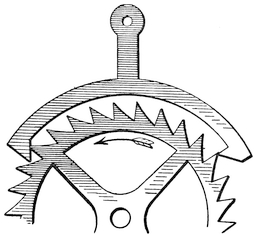
That is why, when the wheels wore and the pivots clogged with old oil and dust, the old clock still went on. If it showed signs of stopping for want of power, a little more was added to the driving weight, and the clock kept as good time as ever.
This escapement also allowed the swing of the pendulum to be made small, so that the arc of the bob differed very little from a cycloid.
The secret of the timekeeping of these old "Grandfather" clocks is the length of the pendulum. That makes it possible to have only a small arc of swing, and so keeps the motion very nearly harmonic. For practical purposes nothing will beat these old clocks even now, and there ought to be one in every house. At present the fashion is to do away with them and put in their place American clocks with very short pendulums, which can never keep good time. They are made of stamped metal. When they go wrong, nobody thinks of having them mended; they are thrown in the dustbin and a new one is bought. That is not really economy.
Good "Grandfather" clocks are not often made now. The last place I remember seeing them made is Morez, in the Jura. An excellent clock, in a dust-tight iron case, with a tall painted case of quaint old design, can be bought there for about 55s. The wheels are well cut and the works inside are very good.
I visited Morez in 1893. The clock industry was declining. The farmers of France seemed to prefer small, hideous clocks made in Germany and America to the excellent work of their own country. By now the old clockmaking there is probably extinct. The one I bought then has gone well ever since.
Chapter Four: Inside a Grandfather Clock
It is time now to describe the various parts of an ordinary pendulum clock, and we will take the "Grandfather" clock as our example. We shall want an hour hand and a minute hand in the centre of the face, and a seconds hand a little above them. There will be a seconds pendulum 39.14 inches long, and the centre of the face will be about seven feet above the ground, giving the weight about five feet of fall in practice.
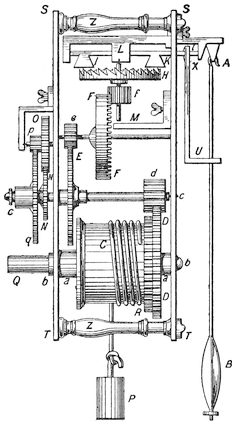
First there is the axle that carries the minute hand and turns once an hour. It is usually a piece of steel about one-sixth of an inch thick. Clockmakers call an axle an "arbor," or "tree," which is where our word axletree comes from.
The arbor is turned in the lathe to give it a pivot at each end, and the pivots fit into holes in the clock plates, the flat pieces of brass that make the body of the clock. The diagram shows S and T, the clock plates, and c, the arbor of the minute hand.
Since the seconds hand has to go round sixty times while the minute hand goes round once, the minute arbor plainly has to be connected to the seconds arbor by a train of cogwheels arranged to multiply by sixty. That means large and small cogwheels.
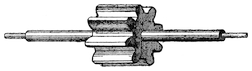
The small cogwheels usually have eight teeth. For ease of making, and to stand long wear, they are cut out of the solid steel of the arbor, and nicely polished.
The easiest arrangement is two pinions of eight teeth, or "leaves," as they are called, and two cogwheels, one of sixty-four teeth and the other of sixty.
If the arbor A then turns once an hour, the arbor B will turn eight times an hour, and C will turn (60 × 64)/(8 × 8) = 60 times an hour, or once a minute.
You could, of course, make C go round once a minute without any in-between arbor like B, by putting 480 teeth on the cogwheel on A.
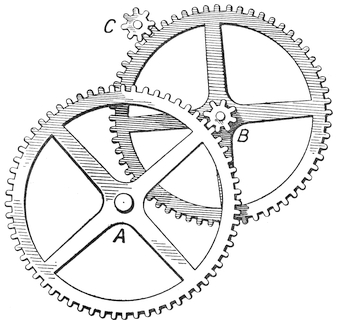
But that would not be a very convenient plan. The wheel on A is usually about two and a quarter inches across, and to cut 480 teeth on so small a wheel would mean cutting about sixty teeth to the inch. The teeth would be microscopically small, and set so fine that the least dirt would clog them. The pinion of eight leaves would have to be microscopic too. For these reasons it is usual in clocks not to use wheels of more than sixty or sixty-four teeth, and to step the motion down gradually, with in-between arbors where needed.
Next we have to arrange the weight so that it turns the arbor A once an hour. We have five feet of space for the weight to fall in. If we give it what is called a double fall, as shown in the sketch, then, allowing room for the pulley wheels, we find our cord can be about nine feet long in practice.
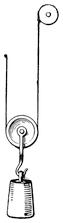
The clock is meant to go for a week without winding, and since people may forget to wind it at the proper hour, we will give it a day to spare and make it an "eight-day" clock. While nine feet of cord is pulled out by a weight falling four and a half feet, then, the minute hand has to go round as many times as there are hours in eight days, which is 192 times. We could do this by winding the cord round the minute arbor itself. But that would take 192 turns. If the cord is ordinary whipcord or catgut, say one-twelfth of an inch thick, the arbor would have to be 192/12 inches = 16 inches long to take it. That would make the clock case needlessly deep, so once again we must use an in-between wheel.
If we put a pinion of eight leaves on the minute arbor c and gear it to a wheel of sixty-four teeth on another arbor b, then b will turn once in eight hours, which is twenty-four times in eight days. And if we fix on b a drum, a cylinder, two inches long, the twenty-four turns of cord will just fit on it, since our cord is one-twelfth of an inch thick. The drum must be of such a diameter that a cord nine feet long winds twenty-four times round it. Each lap, that is, must take (9 × 12)/24 = 4½ inches of cord. From this it is easy to work out that the drum must be a little under one and a half inches across.
What we want for a "Grandfather's" clock, then, is this: a drum two inches long and one and a half inches across, carrying a cogwheel of sixty-four teeth; this drives the minute arbor, which has a pinion of eight leaves and a cogwheel of sixty-four teeth; that drives an intermediate, or idle, arbor with an eight-leaved pinion and a cogwheel of sixty teeth; and that drives the seconds arbor, which has a pinion of eight leaves. This is called the "train of wheels." With it, a weight of the size an ordinary "Grandfather's" clock case can hold will, by its fall over eight days, turn the seconds arbor once a minute and the minute arbor once an hour the whole time.
Next we must provide a way of winding the clock up. We plainly cannot do it by twisting the hands back. That could be done, but it would take about five minutes each time and be tiresome. To save the trouble we need what is called a ratchet wheel and pawl. A ratchet wheel is a wheel with a row of notches cut in it, as shown at A in the figure. A pawl is a piece of metal mounted on a pin and kept pressed against the ratchet wheel by a spring, C. If I turn the wheel A round, so winding up a weight on a cord wound round the drum D, the pawl B goes click, click, click as the ratchet wheel turns, but it stops the wheel from slipping back. When I take my hands away and leave the ratchet wheel alone, the weight E pulls on the drum D and tries to turn the ratchet wheel back the opposite way to the way I turned it. If the pawl B is held fast, the wheel cannot move. But if the pawl is fixed to a cogwheel F that rides loose on the arbor of the drum D, the pull of the weight E will try to turn the cogwheel F round, and F, geared to a pinion on the minute arbor, will drive the clock. As the clock's arbors turn, the weight E slowly runs down, until at last all the cord is unwound from the drum D. The clock is then said to have "run down." But if I take a clock key and wind the cord back up on the drum D, the pawl lets the drum and ratchet slip past, and the hands are not affected. When I have given the arbor twenty-four turns, the nine feet of cord is wound on the drum again, and the clock is ready to go for another eight days, starting as soon as I stop pressing on the key.
That is the winding mechanism. It remains to describe the escapement.
If the weight and train of wheels were simply let go, the weight would rush down and the seconds wheel would fly round at a tremendous pace. We want it held back so that it can go only one-sixtieth of the way round each second. We need, in fact, an "escapement" and a pendulum.
The escapement usually used in "Grandfather" clocks is the anchor escapement described above. It is by no means the best kind, but it is the easiest to make, which explains its popularity in what are sometimes called the "dear, good old days," when people had to file everything out by hand and took a day to do badly what can now be done well in five minutes.
The escape wheel of an anchor escapement has thirty sharp, angular teeth on its rim. The wheel is made as light as possible, so that the shock as it is stopped at each tick is as slight as possible, since a heavy blow wastes power and slowly wears the clock out. The anchor has two arms of the shape shown in the illustration (Figure 44). As the escape wheel turns in the direction of the arrow, the anchor rocks to and fro on its arbor. The wheel cannot run away, because pushing one arm, or "pallet," as it is called, outwards to free its tooth pulls the other pallet in, and that stops the tooth opposite it. When the anchor rocks back again and that pallet lets go of the tooth it was holding, a tooth on the opposite side is free to fly forward against the other pallet. That tends to rock the anchor the other way, but at that instant the pallet catches the next tooth of the wheel, and so it goes on. The anchor rocks from side to side, the pallets catch the teeth of the wheel in turn, and at each rock of the anchor we hear the familiar tick-tock. If the anchor were free to rock as fast as it could, the clock would tick very quickly, so to restrain the liveliness of the anchor we have a pendulum. The pendulum could simply be hung on the anchor. The trouble with that is that the heavy bob would press so hard on the anchor's arbor that the friction would be great, the arbor would soon wear out, and the clock would lose its accuracy. The pendulum is therefore hung from a piece of steel spring on a separate hook, which lets it swing back and forth and carries its weight easily, while a rod coming down from the anchor has a pin that works in a slot in the pendulum. In this way the pendulum controls and regulates the movements of the escapement, and so the time of the clock.
It is clear, of course, that the heavier the driving weight on the drum, the better the cutting and finish of the wheels, and the cleaner and better oiled the clock, the more pressure there will be driving the escape wheel round, the harder the pressure on the pallets, the bigger the pushes on the pendulum, and the wider its swing.
If the width of the pendulum's swing affected its time of swing, the time kept by the clock would vary with the weight, with the dirt and friction, and with the drying up of the oil. But here is exactly where the beautiful law of the pendulum's harmonic motion shows its value. The time of the pendulum is (for small arcs) independent of the length of its swing, and so of the clock's driving force. Within limits, then, a clock keeps good time even when it is roughly made and foul with the dirt of years. But the anchor escapement has its imperfections. A pendulum can be relied on to keep accurate time only if it is left unhindered, and in an anchor escapement the pressure of the teeth on the pallets is always interfering with it.
A little thought will show that there are some moments in a pendulum's swing when interference does far more damage to its timekeeping than at others. The bob of a pendulum can be thought of as a weight shot outwards from its position of rest against a retarding force in proportion to its distance from rest; in fact, shot out against a spring. The time it takes to go out and come back is quite independent of the force that threw it out, quite independent of the speed it started with. A variation in the push given to the bob, then, does not matter, provided the push is given when the bob is near its position of rest. This follows from the nature of the motion. Tie a ball to a piece of elastic thread and throw it from your hand, so that it flies out, stops, and is pulled back by the elastic, and the time out and back is the same however hard you throw. In the same way, if a pendulum is pushed outwards from its position of rest, the time out and back is the same however big (within limits) the push, and however long the swing that results. The way to use a pendulum to measure time is to push it outwards and then let it fly freely out and back. If its motion is not free, if forces other than gravity act on it along its path, its time of swing will be upset. It does not matter how hard you push it to start with; what does matter is that once it has started it should travel unhindered and undisturbed. And that is just what an anchor escapement does not allow. The push is given all the way out by one of the pallets, and then, when the pendulum is at the end of its swing and ought to be left in peace, the other pallet seizes on it. A perfect escapement ought to give its push at the middle of the swing, when the pendulum is at its lowest, and then stop, leaving the pendulum to adjust its swing to the push it has received and so keep its time constant. An escapement called the dead-beat escapement does this, though imperfectly.
The change is in the shape of the anchor's pallets; the wheel is much the same. Each pallet has two faces: a driving face, ab, and a sliding face, bc.
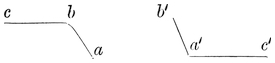
When the tooth at b has done its work by pressing on the driving face, and so pushing the anchor over, say, to the left, the tooth on the opposite side drops onto the sliding face of the other pallet. This face is an arc of a circle, so it does nothing to drive the anchor either way, and the pendulum is free to swing as far to the left as it likes and come back when it pleases, apart from a little friction of the tooth on the pallet face. When it comes back and starts to move to the right, the tooth slides back along the face of the pallet until the pendulum is almost at the middle of its swing; then a push is given by the pressure of the tooth on the slope a′b′. As soon as the tooth leaves b′, a tooth on the other side at once catches the sliding face bc of the other pallet, and so the motion goes on.
This beautiful escapement is now used in astronomical clocks. The pallets are made of agate or sapphire, so they do not noticeably grind away the teeth of the wheel, and the loss from friction on the sliding faces is exceedingly small.
There are several other ways, better even than this, of giving a pendulum a free movement. But now we must go back to our clock.
The centre arbor goes round once an hour and carries the minute hand. To provide an hour hand, which must go round once in twelve hours, we fit a cogwheel N, with a tube, onto the minute arbor by means of a small spring, which holds it fairly tight but lets it slip if it is turned hard (see Figure 45). The spring is a little bent plate slipped in behind the cogwheel, with its ends resting on the wheel and its middle pressing on a shoulder of the minute arbor: a sort of small carriage spring. The cogwheel N has thirty teeth. It gears with another cogwheel, O, of thirty teeth, on a separate arbor, which carries a third cogwheel, p, of six teeth; and p gears with a fourth, q, of seventy-two teeth, mounted on a tube that slips over the tube of the cogwheel N. It is easy to see that for each turn of the minute arbor the arbor of O and p makes one turn, and that for each turn of that arbor the cogwheel q makes one-twelfth of a turn. For each turn of the minute arbor, then, the cogwheel q with its tube, or "sleeve," as it is sometimes called, makes one-twelfth of a turn, and a hand fixed to it will show one hour for every full turn of the minute hand.
The minute hand is fixed to the tube, or sleeve, that carries the cogwheel N. The hour hand is fixed to the sleeve that carries the cogwheel q, and the one goes twelve times as slowly as the other.
Setting the clock is easy, because the minute hand is not fixed to the arbor but only to the sleeve of the cogwheel that fits on the arbor, held fairly tight against it by the spring. The hands can therefore be turned, though they are a little stiff. A washer on the minute arbor keeps the sleeve of the cogwheel pressed tight against the spring, and the washer in turn is held by a very small linchpin driven through a hole in the minute arbor.
It remains to explain a few extra arrangements, not found on every clock, but useful.
To prevent the clock being overwound (see Figure 43), which would make the cord run off the drum, an arm is provided, fitted with a spring. As the weight is wound up, the free part of the cord travels along the drum or the fusee, and near the end of the winding the cord comes up against the arm and pushes it a little aside. That pushes the end of the arm against a stop on the axle of the fusee, and so prevents the clock from being wound any further. The stop is shaped like a ratchet, so it does not prevent the weight from turning the wheel the other way and driving the clock; it only stops the wheel turning when the cord is near the end and the winding is finished.
Another arrangement is the "maintaining spring."
It will be remembered that while the clock is being wound, the hand turning the key takes the pressure of the ratchet wheel off the pawl, so that during the winding no force is at work driving the clock. The pendulum then gets no push and swings on only by the motion it already has. If the winding were done slowly enough, the clock might even stop. To prevent this, a very ingenious arrangement keeps the cogwheel on the winding arbor going during the winding. This is called a maintaining spring.
The arrangement in Figure 53 will explain it.
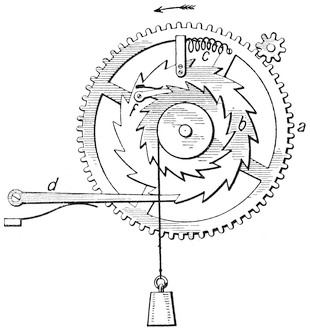
The cogwheel a and the ratchet wheel b are both mounted loose on the arbor that carries the drum. The wheel a is linked to b by a spring, c. The ratchet wheel b is caught by a pawl, d, fixed at some convenient place on the clock frame. When the weight pulls on the drum, the pull passes to the ratchet wheel b, which stretches the spring c a little. As soon as the spring c is stretched as far as its elasticity allows, the pull passes to the cogwheel a, and the clock is driven round. When the clock is being wound, the pressure of the weight is taken off, so the winding ratchet no longer presses on its pawl, and no pressure reaches the ratchet wheel b, or through it the clock. But now the spring c comes into play. Since the ratchet wheel b is held fast by the pawl d, the spring c pulls on the wheel a, and for a minute or so it keeps the clock going. Its driving force is less than the weight's, it is true, but it is just enough to keep the pendulum going for a short time, so that the going of the clock is not disturbed.
If the reader can get hold of a clock, preferably one that does not strike, and with a small pair of pincers and one or two screwdrivers will take it to pieces and put it together again, the mechanism described above will soon become familiar. Not every clock has a maintaining spring and a guard against overwinding.
What usually stops a clock is dirt. Wherever possible, clocks should be kept under glass cases. "Grandfather" clocks go much better if brown paper covers are fitted over the works inside the cases, which keeps out a great deal of dust. Getting good oil is very important. You will notice that the pivot holes in clocks usually have little cup-shaped hollows round them; these help to keep the oil in. The best clock oil is one that does not easily thicken or evaporate. Ordinary machine oil, such as is used for sewing machines, is a good lubricant but evaporates quickly. Olive oil corrodes the brass.
It is best to get a little clock oil, or the oil gunsmiths sell for gunlocks. The holes should be cleaned out with the end of a wooden match cut to a tapering point. The pivots should be well rubbed with a rag dipped in alcohol. If the pivots are worn they should be repolished in the lathe. If the teeth of the wheels are worn, there is no remedy but new wheels. Old clocks sometimes need a little extra driving weight to make them go.
The weight needed to drive a clock depends on how well it is made and on the weight of the pendulum. If the clock is driven for eight days by a cord nine feet long with a double fall, then at each beat of the pendulum the weight comes down by
9/(2 × 24 × 60 × 60 × 8) feet, or 1/12800 inch.
If the clock weight is 10 lbs., then, the push the clock gets at each beat is equal to a weight of 10 lbs. falling through 1/12800 of an inch, or to six grains falling through an inch.
The power spent in this way goes in the friction of the wheels and hands, and in keeping the pendulum going against the friction of the air.
The work put into the clock by winding it, then, is gradually spent during the week in moving against friction. The work is not destroyed. The friction of the clock's parts makes heat, which spreads through the room and is gradually absorbed into nature. But this heat is only another form of work. Amounts of work are reckoned as pressures acting through distances. If I lift a weight of 1 lb. through a distance of one foot against the accelerating force of gravity, I am said to do a foot-pound of work.
One pound of coal burned in a perfect engine would do eight million foot-pounds of work. If all the energy in a pound of coal could be used, then, it would keep about 100,000 grandfather clocks going for a week. Burned in an ordinary steam engine, it does about half a million foot-pounds of work. One pound of bread contains about three million foot-pounds of energy. A man can eat about three pounds of bread a day, and as he is a very good engine, he can turn it into about three-quarters of a million foot-pounds of work. The rest of the work in the bread goes off as heat.
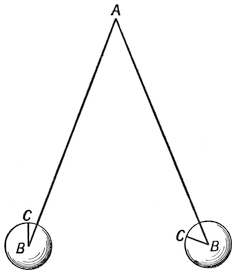
As was said before, the longer the pendulum, the weaker is the pull of gravity drawing it back when it has been pushed aside from rest, and so the longer the pendulum, the longer its time of swing. In the appendix to this chapter a short proof will be given that the length of a pendulum varies as the square of its time of swing. A pendulum 39.14 inches long swings once a second in London. At other places on the earth, where the force of gravity is slightly different, the time of swing will of course be different; but since the earth is nearly a globe, gravity does not vary much from place to place, and so the time of swing of the same pendulum does not vary very much either. The length of a pendulum is measured from its point of suspension down to a point in the bob. At first sight you might think the centre of gravity of the pendulum was the point to measure to. If B were a round bob and the rod were very light, the distance AB to the centre of the bob would then be the length of the pendulum. But to leap to that conclusion would be to make the same mistake Galileo made when he let a ball roll down an inclined plane. He forgot that the motion was not simply that of a body sliding down a plane but a rolling motion too. A pendulum does not swing with its bob held steady and the top point C always uppermost. On the contrary, at each beat the bob turns on its centre and makes, as it were, some swings of its own, and this turning of the bob has to be taken into account in the pendulum's total motion. If the pendulum were arranged so that the bob did not turn, and the point C stayed uppermost, as it would if the pendulum were made of two parallel rods, AB and CD, hung from A and C, then we could treat the bob as that of a pendulum hung from E, and the pendulum would swing once a second if AB, CD and EF were each 39.14 inches long, because with this arrangement the bob would not turn at all. But pendulums are generally made with the bob fixed rigidly to the rod EF, and the turning must be taken into account.
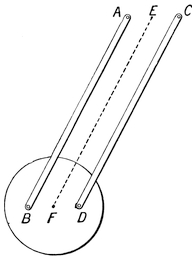
That takes some fairly advanced mathematics. In practice, though, clockmakers ignore it. The correction is not a large one, so they make the rod as nearly right as they can, put a screw on the bob for adjustment, and then screw the bob up or down until the time of swing is found to be correct.
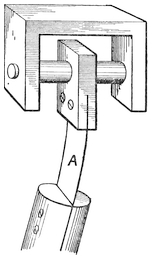
The best class of pendulum is hung as shown in Figure 56, which lets it settle into its true position without strain. A is a tempered steel spring, which bends to and fro at each swing. It is wonderful how long these springs can be bent to and fro without breaking. Since lengthening the pendulum increases the time, the length varying as the square of the time of swing t, a very small lengthening of the pendulum makes a difference to the time. In practice, each thousandth of an inch we add to the pendulum makes a difference of about one second a day in the going of the clock. If we cut a screw with eighteen threads to the inch on the bottom of the pendulum rod and put on it a round nut with its rim divided into sixty parts, then each turn of the nut through one division raises or lowers the bob by 1/1080 of an inch, which alters the going of the clock by about one second a day. This is a handy arrangement in practice, because it gives an easy way of regulating the pendulum. We need only see how many seconds a day the clock gains or loses, and turn the nut through the same number of divisions to put the pendulum right.
Another correction the pendulum needs is for changes of temperature. If the rod is made of thoroughly seasoned mahogany, soaked in a weak solution of shellac in alcohol and then dried, it will not vary much with either heat or damp. But for clocks that must be very precise the rod is usually made of metal. A rod of iron expands by about 1/160000 of its length for each degree Fahrenheit, so for each degree a pendulum rod of 39.14 inches expands by about a quarter of a thousandth of an inch, which makes a difference in the going of the clock of about one-fourth of a second a day. The expansion of course makes the clock go slower. It could be corrected if, whenever it happened, something lifted the bob of the pendulum by a matching amount: for instance, if the bob were made of some material that expanded with heat very much more than the material of the rod.
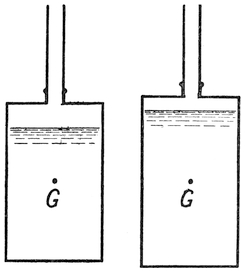
If we hang on the end of an iron pendulum an iron bottle about seven inches long and almost fill it with mercury, then as soon as the heat rises, the iron of the rod and of the bottle expands, and the centre of oscillation of the pendulum is lowered. But the linear expansion of mercury held in a bottle is about five times that of iron, so the mercury rises in the bottle, and the downward expansion of the pendulum rod is made up for by the upward expansion of the mercury. The rod can be fastened to the mouth of the bottle by a screw, so that turning the bottle raises or lowers it on the rod, and the length of the pendulum can be adjusted that way. The bottle is made of steel tube screwed into a thin, turned iron top and bottom. Of course no solder must be used to join the iron, because mercury dissolves solder; a little oil and white lead will make the screwed joints tight. This is an excellent form of pendulum. Another plan is to use zinc as the metal that counteracts the expansion of the iron, since zinc expands about three times as much as iron.

A zinc tube about twenty inches long (shown shaded in Figure 59) is made to stand on a disc fixed to the lower part of the iron pendulum rod. On top of the zinc rests a flat ring, A, and from it hangs an iron tube, which carries the bob B. The expansion of the zinc tube is enough to make up for the expansion of both the rod and the tube, so the bob stays at the same depth below the point of suspension whatever the temperature.
There is, however, a new method far better than any of these, thanks to the discovery by M. Guillaume, of Paris, of an alloy of nickel and steel that expands so little that it can be compensated by a bob of lead instead of mercury. In England it is sold under the name of "invar." An invar rod with a properly proportioned lead bob makes an almost perfect pendulum, the expansion of the invar and of the lead keeping pace with each other. The makers give the exact expansion of the invar, and also supply information on the size and suspension of the bob to use with it.
It has been shown already that a pendulum's swings are equal in time only when its arc is very small. If the whole swing from one side to the other is not more than about two inches, putting a little more driving weight on the clock, and so widening its swing, makes very little difference to its timekeeping. But when the swing reaches, say, three inches, or one and a half inches on each side, the time of swing is affected: at that width each tenth of an inch more of swing makes the pendulum go slower by about a second a day.
The resistance of the air has a great influence on a pendulum, of course, and is one of the main things that bring it to rest in the end. Even the changes in atmospheric pressure that the barometer shows as the weather changes affect the going of a clock. Attempts have been made to counteract this by fixing barometers to pendulums with an ingenious system of counterbalances, but these refinements are not in common use, and they are too complicated to be regulated effectively.
Appendix to Chapter Four: The Law of the Pendulum
It may be useful to give a simple proof of the law that governs the time of swing of a pendulum of a given length.
Unfortunately, no proof can be made simple enough for someone who knows no mathematics at all. A proof that needs very little mathematics is possible, though.
We know that when a mass is whirled round on the end of a string it tries to fly outwards and puts a strain on the string, and the faster the mass is whirled, the greater the strain. Let the length of the string be R, and the speed of the mass as it flies round be V. Let a be the body, whirled round on a string Oa from a centre at O. At every instant the body is trying to fly on in a straight line from the point where it then is. That tendency is defeated by the pull of the string, which forces it to take a circular path. It is all one, of course, whether the force pulling the body in towards O is a string or an attraction of any kind acting at a distance without any string at all. Plainly, if the body keeps its place on the circle, it must be because the centrifugal force trying to fling it out is equal to the centripetal, or attracting, force pulling it in.
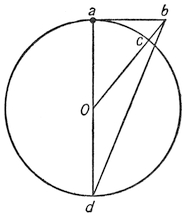
The pull on the body from the force drawing it inwards we shall call F, meaning by F the number of feet per second of speed that the attracting force would give the body in one second.
Suppose that at some instant the body is at the point a. At that instant it is heading along ab, the tangent to the circle at a, and that is the path it would take if the centripetal, or attracting, force stopped acting just as the body reached a. It would be flung off along the line ab like a stone from a sling, and at the end of a given time, say a second, it would arrive at b. But it is not flung off: it is attracted towards O and pulled inwards, and it comes to c. The attracting force acting for one second, then, must have been enough to pull the mass in from b to c. But we know that if an accelerating force (F) acts on a body for a second, it gives it a final speed of F at the end of the second, and an average speed of half F during the second.
The distance bc by which the body has been pulled in is therefore represented by half F, and ab, the distance the body would have travelled straight on, is represented by V, the body's speed per second. If the motion is such that the distance bc covered in a second is very small, the triangles abd and abc are very nearly similar, and the smaller ab is, the more nearly similar they are. It follows that (a b)/(b c) = (a d)/(a b); that is, (a b)2 = a d × b c.
But ab stands for the distance the body would have gone in one second at the rate it was going, and so equals V; ad is the diameter of the circle, and so equals 2 R; and bc is the distance the body has been pulled in during the second by the attracting force F, and so equals half F.
It follows that V2 = 2 R × half F = R F.
We took a second as the stretch of time over which to consider the motion, but any other time would have done as well. What is true of the body's motion over a very short time is true of its whole path too, provided the path is a circle and F stays constant, as it plainly will if the path is a circle and the speed is uniform. In general, then, we can say that if a body is whirled round on the end of a string, the strain F on the string is directly proportional to the square of the speed and inversely proportional to the length of the string.
The time of one revolution is, of course, the length of the path divided by the speed:
= (2πR)/V = (2πR)/√(R F) = 2π√(R/F).
We see, then, that when a mass moves in a circle under a centripetal force, or the pull of a string, its time of revolution will be the same every time, provided the centripetal force always varies as the radius of its path. It is plain from this that a body fixed to an elastic thread, whose pull varies as its stretch, would always make its revolutions in equal times. If your sling is made of elastic, whirl it as you will, you can only make the body go round so many times a second and no more. Any extra effort only makes the elastic stretch and the circle grow. The body's speed along its path increases, of course, but the time it takes to go once round never changes.
It also follows that if a body hung on a string of length l is travelling round and round in a circle under the action of gravity, then, if the circle is small compared with the length of the string, the inward acceleration f towards the centre will be very nearly proportional to the radius r of the circle, and the time of one revolution will be
t = 2π√(r/f).
But in this case f, the inward acceleration, is to g, the downward acceleration of gravity, as AB is to AP, or
f/g = (A B)/(A P) = (A P)/(O P) = r/l.
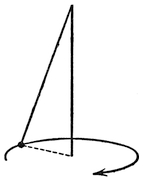
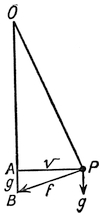
If the circle of revolution is small, then, the time of revolution of this body will be
= 2π√(l/g).
Try it and you will find that it is so. Take a thread 39 1/7 inches long, which is 3.25 feet. Hang anything heavy from one end and set it going round and round in a small circle. The acceleration of gravity, g, is 32.2 feet per second per second, and π, the ratio of the circumference of a circle to its diameter, is 3.14. The time of one revolution is therefore 2 × 3.14√(3.25/32.2) seconds = 2 seconds. But look at the revolving body from the side and it seems to behave like a pendulum: it makes no difference whether we swing it round and round or to and fro. In either case the accelerating force trying to bring it back to rest is always proportional to how far it has been displaced, and so its time of motion must always be 2π√(l/g), and its motion harmonic.
The length of a seconds pendulum, a pendulum that makes its double swing in two seconds, will therefore be
    l = 4/((2π)2) × g feet
      = (g × 12)/π2 inches
      = 39.14 inches.
Chapter Five: Watches, Chronometers and Curiosities
Those are the main features of ordinary clocks. For the details, many treatises must be studied, and knowledge picked up that is not in any book at all.
Now I turn to watches. It will be remembered that a verge escapement consists of a toothed crown wheel acting on two pallets fixed to a verge, which has a ball at each end.
As the crown wheel was driven forward, each pallet in turn was pushed until it slipped past the tooth that was holding it. Then a tooth on the other side struck the other pallet sharply and drove the verge the other way, and so on.
Here, then, we have a driving force and a sort of pendulum. But how did the verge act as a pendulum to measure time? It is not a body rocking under gravity, nor under the acceleration of a spring. How, then, can it regulate time, and what is the period of its swing?
The answer is that it is under the acceleration of gravity, but gravity does not act freely on the balls; it acts only through the driving weight and the teeth. The push that drives the verge is also the accelerating force on it, and the only accelerating force on it.
The worst of it is that as the teeth and pallets move, the leverage of the teeth on the pallets changes, so the balls on the verge are under the influence not of an even or properly regulated force but of one that is always changing, and changing in a very complicated and erratic way. It would be hopeless to expect much timekeeping from such a contrivance. The most one could do would be to put on a very big weight, so that the friction became comparatively insignificant, and then hope the swings would be uniform, so that whatever happened in one swing would happen in the next and the timekeeping would be regular.
But anything that lessened the driving force, such as the thickening of the oil, would greatly affect the going. That was why Huygens turned the verge into a pendulum by taking off one of the balls and letting gravity act on the other.
For watches, though, a different plan was devised. One end of a slender spiral spring was fixed to the verge and the other end to the frame. The verge was now mainly under the acceleration of the spring. To make the push of the escape wheel's teeth less of a nuisance, the teeth were shaped to give only a short push at set intervals and not to interfere with the free swing of the verge under the to-and-fro speeding up and slowing down caused by the spring. In this way the verge became an excellent pendulum in every respect, independent of gravity, so that the watch could be held in any position.
The verge fitted in this way was made into a wheel and became the "balance wheel." It was compensated for expansion by heat through a clever use of the unequal expansion of brass and steel, much as the unequal expansion of metals had been used to compensate the pendulum, and it became the beautiful and accurate measurer of time we see today: its pivots set in jewels to reduce friction, screws round the rim of the balance wheel so that its centre of gravity can be adjusted exactly to its centre of rotation, and a delicate hairspring of tempered steel that is a marvel of microscopic work.
But the escapement of the early watches left much to be desired. To see how imperfect it was, we must turn back and remember what was said about the dead-beat escapement.
It was shown there that for small arcs the pendulum would keep good time provided it was allowed as much swing as it needed to use up the force the escapement had given it, but not otherwise. Pendulums worked really well, then, only when the push was given about the middle of the swing and they were free to go on and stop as they pleased and turn back at the end of it.
The dead-beat escapement of clocks came fairly close to this essential condition, leaving the pendulum at the end of its swing with only a very slight friction to hinder its free motion.
With a watch the case is quite different. Here the escapement is very large compared with the balance wheel, and the friction even of the most dead-beat watch escapement that could be devised was so large compared with the forces on the balance wheel that it seriously upset its motion and made it far from a perfect timekeeper.
Now about this time (I am speaking of the early part of the eighteenth century) a quite exceptional demand arose for a really perfect watch. It did not come from gentlemen who wanted to keep appointments to play ombre at their clubs, or even from merchants timing their office hours; for them the old-fashioned watch did very well. The demand came from sailors. And the seamen did not want to know the time merely to arrange mealtimes on board or to decide when the watch should be relieved, but for a far more important purpose: to find their place on the ocean, by observing the heavens, when they were far out of sight of land. It will be very interesting to see how this problem arose, and how the patient industry and ingenuity of man have solved it.
The ancient navigators never went very far from the shore, because once a ship was out of sight of land she had no means of knowing where she was. On clear days and nights the compass, the sun and the stars would tell the mariner the direction he was sailing in, but where he was on the surface of the earth was quite another problem.
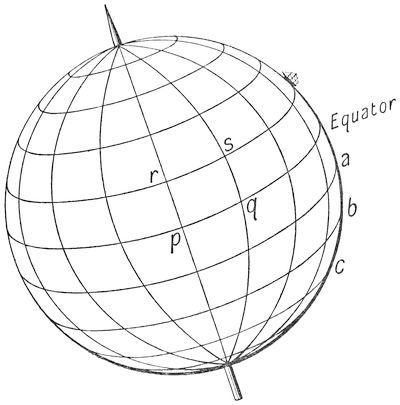
Let us look at the problem. Suppose, for convenience, that the earth is divided into "squares," as nearly at least as a globe can be marked out that way. Suppose it has been agreed to draw 360 lines of longitude on it from pole to pole, starting with one through Greenwich Observatory, say, and going right round the earth back to Greenwich again. Suppose also that a series of circles has been drawn parallel to the equator, equally spaced up towards the poles. Let there be 179 of these circles, leaving 180 spaces, a to b, b to c, and so on, from pole to pole. This divides the earth into squares like a birdcage, as if we had dressed it in a well-fitting tartan. The side pq of each square, measured along the equator, is taken as exactly sixty nautical miles (apart from a small error of measurement, which makes it 59.96 in practice). That equals sixty-nine and a quarter ordinary statute miles. The side qs, running towards the poles, would also be sixty nautical miles if the earth were not slightly out of round, which brings in a small error. Roughly, though, we can say that at the equator each square measures sixty nautical miles each way.
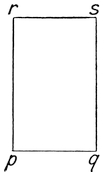
As we go towards the poles the squares become rectangles, still sixty nautical miles high in latitude but narrower and narrower. In England our squares measure pq = 37 nautical miles and qs = 60 nautical miles.
Now, it is plainly easy anywhere on the earth's surface to find your latitude by a simple observation of the sun at noon, if you know the day of the year and have a nautical almanac. With an instrument called a sextant you measure the angle at which the sun stands above the horizon, and since the almanac tells you how far he is above the equator, you can soon work out your place, A, on the globe. Or at night you can measure how far the pole star, P, is from the zenith, the point directly overhead, that is, the angle POZ, subtract it from a right angle, and you have your latitude, AOE, at once.
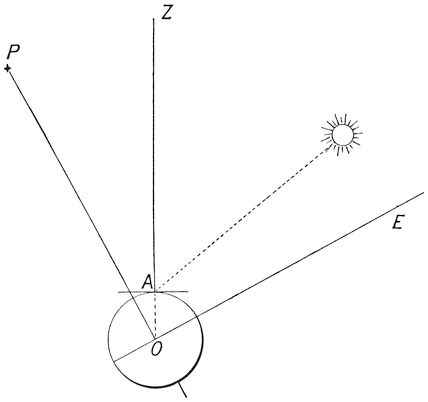
But how are you to find your longitude? The pole star, the sun or any other star will not help you, because as the earth turns they keep shifting, and sooner or later each of them appears in exactly the same position to everyone on the same parallel of latitude, as is easy to see. The fact is that you are on a turning ball. You can easily tell which parallel of latitude you are on, but you cannot tell your longitude unless you can tell how many hours and minutes before Greenwich you come to a given position. If a gong could be sounded all over the earth when a particular star reached Greenwich, everyone would know their longitude at once from the stars overhead. Perhaps before long this will be done by the new electric waves, and the Greenwich hours will be sounded all over the world for the use of sailors. Until it is, all that can be done is to keep an accurate clock on board that always gives you Greenwich time.
Early attempts were made to take a pendulum clock to sea, hung so that the rocking of the ship would not disturb its motion. They came to nothing.
What was needed, then, was a watch with a balance wheel that would go with an accuracy in some respects comparable to that of a pendulum clock. To encourage inventors, an Act of Parliament was passed in the thirteenth year of Queen Anne's reign (chapter xv.) (1713), offering a reward of £20,000 to anyone who invented a way of finding the longitude at sea true to half a degree, that is, true to thirty geographical miles.6
If the longitude was to be found by inventing an accurate watch, the watch must not, in several months' going, have an error of more than two minutes, the time the earth takes to turn through half a degree of longitude.
This was the problem John Harrison, a Yorkshire carpenter, made it his life's work to solve. His efforts lasted over forty years, but in the end he succeeded in winning the prize.7
Later inventors improved these instruments greatly, and the result is the modern ship's chronometer, a large watch about six inches across, mounted on gimbals in a mahogany box. Every ship takes several of them to sea.
What sets the chronometer apart is its escapement.
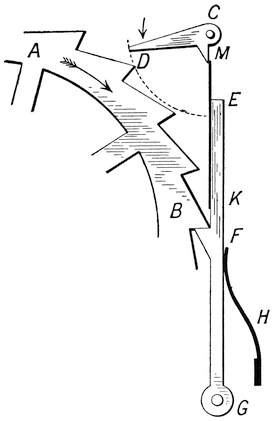
Let AB be the escape wheel, and CD a small lever fixed to C, the pivot that carries the balance wheel and its spring. Let EG be a lever with a tooth, F, that catches the teeth of the escape wheel and stops it turning. Let H be a spring that holds the lever EG up to its work.
The lever has a very delicate spring, KE, fastened to it at the point K. If the lever CD turns so that the little projection M on it strikes the spring at E from left to right, then, since the spring rests against the lever, the whole lever is pushed over and the teeth of the escape wheel are set free. At that instant, though, the escapement is so arranged that the arm CD is just opposite a tooth of the escape wheel, the tooth at D, so that the wheel, instead of running away, leaps with that tooth onto the arm CD and swings the balance wheel round. The balance wheel is free to turn as far as it likes, but the moment it has turned far enough for the projection M to pass the spring at E, the lever GE flies back into place and the escape wheel is checked again. Meanwhile the balance wheel swings on until the balance spring at last brings it to rest. Then it recoils and sets off on its return path. This time, though, the projection M merely flips the spring at E aside, and the balance wheel goes back until again it is brought to rest and returns. As soon as the arm comes opposite D, the projection M again strikes the spring at E and releases the catch at F, and another tooth of the escape wheel goes by.
There, then, you have a completely free escapement, and so an accurate one. Many watches are made with these escapements, but they cost more than the ones in common use.
Little in a watch is not also in a clock, since the trains of wheels and the general arrangements are very similar.
The chronometer's detached escapement can be applied to a clock, and several clockmakers did so in the eighteenth century and the early part of the nineteenth. Here is one way of doing it.
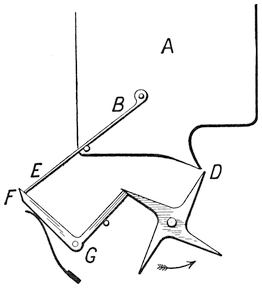
A is a block of metal fixed to the bottom of the pendulum, and B a light lever pivoted on it. C is the escape wheel, with four teeth, and D a tooth of the escape wheel, which hops onto the projection of the pendulum the moment the point E of the lever BE has struck the lever GF aside and so released the escape wheel. The advantage is that it is a very easy escapement to make. Yet in reality it is a detached chronometer escapement, that is, a completely free one, as can easily be seen.
Turret clocks suffer from a serious drawback: the wind blowing on the hands presses on them hard, so that the clock is sometimes pushing the hands against the wind and sometimes being helped by it. This unevenness in the driving force makes the pendulum swing through a bigger arc at some times than at others.
We saw above that although a change in the arc of swing ought to make no difference to a pendulum's time of swing, that is strictly true only if the path of the swing is a cycloid.
But since for practical convenience we have to make it a circle, it follows, as we saw, that for every tenth of an inch of extra swing on an ordinary seconds pendulum, an error of about a second a day comes in. To get round this difficulty a gravity escapement was invented by Mudge in the eighteenth century, improved by Bloxam, a barrister, and perfected by the late Lord Grimthorpe. The idea was that the escape wheel, instead of driving the pendulum directly, should lift a weight, which was then released and drove the pendulum. Changes in wind pressure, which affected the driving force of the escape wheel, then never reached the pendulum, which was always driven by the steady fall of a fixed and definite weight. A movement of this kind was put into the great clock at Westminster and has gone admirably. A description of its details, written by Lord Grimthorpe himself, will be found in the Encyclopaedia Britannica.
All sorts of eccentric clocks and watches have been proposed. It seems wonderful, for instance, to see a pair of hands fixed to the centre of a clear sheet of glass going round and keeping time with apparently nothing to drive them.
But the mystery is simple. The seeming sheet of glass is not one sheet but four. The two middle sheets turn round invisibly, carrying the hour hand and the minute hand with them, driven by little rollers underneath on which they rest. When you touch the glass, the outer sheets are at rest, and you never suspect it is anything but a single sheet. But beware of dust: if dust gets on an inner sheet, the trick is found out. A mechanical hand was made in the same way that wrote down answers to questions. The plan can be applied to all sorts of tricks.
Sir William Congreve, an ingenious inventor, proposed a clock that measured time by letting a ball roll down an incline. When it reached the bottom it hit a lever, which released a spring and tipped the plane up again, so that the ball ran down the other way. It is a poor timekeeper, and the idea was not original, for a ball had been designed for the same purpose before.
Sometimes clocks are made by attaching pendulums to bronze figures, which move so little that the eye cannot detect it. The figure seems to be at rest but is really rocking slowly to and fro. To escape human notice the movement must be kept as small as about one four-hundredth of an inch in half a second, since a movement of one two-hundredth of an inch a second is about the largest that will certainly go unnoticed.
In the Middle Ages clocks were made with all sorts of odd devices. The people of the upper town of Basle once quarrelled with those of the lower town, fought them and beat them. To celebrate the victory they put up a clock on the old bridge at the upper town with an iron head that slowly stuck out and drew in a long tongue of derision. The clock can still be seen in the museum. It is as though the Corporation of the City of London were to put a clock of derision at Temple Bar to stick out its tongue at the London County Council.
I do not propose to describe the striking mechanism of clocks here. There are several different ways of arranging it, rather complicated to follow, but they all come down to a few simple principles. As the hour hand goes round it carries a cam, cut away deepest for the twelfth hour, less for the eleventh, and so on. When the minute hand reaches the hour it releases the striking train, which, driven by a weight, begins to turn and drives an arm carrying a pin, which lifts a hammer; and the hammer goes on striking as the arm goes round. It would go on for ever, except that at the same moment an arm is released that falls against the cam. At each stroke the striking train lifts this arm a little way back towards its place, and when it is back in place it stops the striking. It acts, then, as a counter, a reckoner of the blows, stopping the striking when the clock has struck enough. When the counting mechanism fails, we get what occasionally happens: a "Grandfather" clock striking away all the hours for the week without stopping.
A chiming clock is simpler still. It has a barrel covered with pins, like the barrel of a musical box. As the pins go round they lift hammers that fall against bells. The barrel is wound up and driven by a spring or weight, and when the clock reaches the hour the barrel is released and turns, playing the tune.
If you want a clock to wake you in the morning, you can make the striking train hammer away, with no counting mechanism to stop it, until the weight has run down. If that is not enough, and you want the sheets pulled off the bed, or the bed tipped up, or a can of water emptied over the person who will not get up, you must use a device known as a relay. It is very simple. What is wanted is that after a lapse of time, measured by a clock, a considerable force should be exerted to pull off the bedclothes. It would be absurd to make the clock do the pulling. It is plainly better to fasten the clothes by a hook to a rope that passes over a pulley and has a weight hanging from it. A pin holds the weight from falling, and the clock pulls out the pin. The work is then done by the weight, released by the clock.
In the same way, if you have a telegraph designed to print messages at a distance, you do not send along the wires the whole force needed to do the printing. You send only impulses, which, like triggers, release the forces that stamp the letters.
Electric clocks of many kinds have been invented. The principle of an electric escapement is like that of an ordinary escapement.
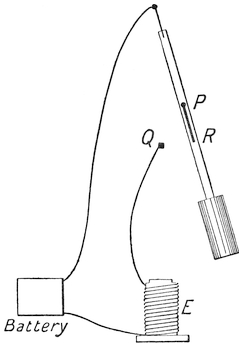
The reader no doubt knows that when a circuit of wire leading to a source of electricity is joined up, or completed, electricity flows through the wire.
If the wire is wound round a piece of iron, then whenever the circuit is joined a current flows and the iron becomes an electromagnet. When the circuit is broken the iron stops being a magnet.
Put in the right place, the electromagnet would give an iron pendulum a small push each time it came near, provided the current were switched on at that instant. The pendulum can easily be made to do the switching itself. Just as it is coming back to the centre, a flipper, P, fixed to the rod can be made to touch a piece of metal fixed in its path. The electromagnet then becomes magnetised and pulls on the iron pendulum. On the return swing the other side of the flipper, R, strikes the obstruction. But if that side, R, is covered with ebonite or some other non-conducting material, no current will flow, and the electromagnet will not hold the pendulum back, as it otherwise would. A pendulum like this gets a push every second beat.
Such pendulums do not work very well, because it is hard to keep metal surfaces like Q clean, so misses often happen. Besides, the strength of the current varies with the goodness of the contact and with other things.
What is preferred now is an arrangement in which an electric current winds the clock up every minute or so. The push that drives the clock is then not a varying electric one but a steady weight. The most successful clocks have been made on these lines.
The advantage of electricity is that the current that works the clock, or winds it, can also set the hands of a great many other clocks moving at regular intervals.
Only one going clock with a pendulum is needed, then. The other clocks around the building have only faces and hands and a very few simple wheels, which an electromagnet gives a slight push every minute or so. The system is therefore well suited to offices and hotels.
In America clocks have been arranged, by means of electric contacts, to set gramophones going. You will remember it was pointed out that if a wire is dragged over a file it makes a sound, because of the little taps the wire makes as it clicks against the rough cuts of the file, and that the pitch of the note depends on the fineness of the cuts, and so on the rapidity of the little taps. You can imagine that if the roughnesses were properly arranged we might get the tones to vary, and so imitate speech. That is the principle of the gramophone. The roughnesses are made by a tool which, vibrating under the influence of a human voice, makes small cuts in a soft material. The material is hardened, and then, when another point is dragged over the cuts, the voice is reproduced.
In this way clocks are made to speak and tell the children when dinner is ready and when to go to bed. Dolls can be made to speak on the same simple plan.
Modern clock and watch making is very different from the methods of the old days. In former times the pivots were turned by hand on small lathes, and even the teeth of the wheels were filed out. Each hole in the clock or watch frame was drilled separately, and each wheel was fitted separately, so that the watch was gradually built up as you would build a house. Each wheel, of course, fitted only its own watch, and the parts of watches were not interchangeable.
All this has now changed. With elaborate machinery, the whole work of cutting out every wheel and making every single part is done by tools moved independently of the will of the workman, whose only duty is to sit still and watch the things being made. He is, as it were, the slave of the machine, watching it and answering its calls. Or shall we rather say that he is the machine's employer and master? He has here a servant that never tires and never disobeys him. All the machine needs is for its cutting edges to be exactly true and sharp and microscopically perfect; then it will cut away and make wheel after wheel. It oils itself. It wants the man only as a superintendent, to stop it if a cutting edge gets too worn. For that purpose he checks its work from time to time under a microscope to see that it is good and true and exact.
When all the parts have been made in this way, you have perhaps a hundred boxes, each holding a thousand watch parts, every part exactly like its fellows. Take one wheel or piece from each box, any one at all, and you have the materials for a watch, screws, fittings, pins and all. All you have to do now is screw them together, like putting together a puzzle. Everything fits; there is no snipping or filing.
In a watch like this, if a piece breaks, you simply send for another piece of the same kind and fit it in its place.
Motor cars, bicycles and many other machines are made in this way, or ought to be, so that if a driver at York breaks part of his car he simply sends to London for another, and it comes and fits into its place at once. But for this sort of plan you must work true to much less than a thousandth of an inch, and of course nobody must want to indulge his own fancy as to the shape or look of the watch. The whole advantage lies in dead uniformity. But the cheapness is astonishing. You can get a better watch now for 30s. than you could have got for £30 twenty years ago.
Artistic people have a habit of condemning this uniformity as if it were inartistic and degrading. In truth it is not degrading to get a machine to do what you want with as little labour as possible. You pay 30s. for the watch, and you have £28 10s. left to spend on pictures.
Only one ought not to confuse industry with art. Watches made in this way make no pretence to be works of art; they are simply useful. To rule them all over with machine lines or put hideous machine ornament on them is purely and simply base and degrading. Let your ornament be hand work, your utility machine work.
That, then, is my attempt at a very brief sketch of the ways of measuring time, and, along the way, at introducing my readers to the laws of motion, which are the foundation of so large a part of modern science.
It only remains to describe briefly the modern apparatus that makes it possible to measure accurately periods of time so short that it seems impossible. But once you see how it is done, the method seems easy enough. It is still done with a pendulum, only a pendulum that beats time not once but hundreds and even thousands of times a second.
And such pendulums, far from being difficult to make, are remarkably simple and present no difficulty at all. We have only to use the tuning fork described earlier.
A tuning fork is a piece of steel bent into a U. The arms are set vibrating so that they move towards and away from each other by turns.
The reason for having two arms is that as they move in and out together they balance each other, so the instrument as a whole does not shake on its base. This balancing of the moving parts of a fast-moving machine is very important. Some motor cars have "balanced" engines, whose moving parts go in and out together, leaving the centre of gravity unchanged whatever the position of the motion. That makes the car vibrate very little.
The tuning fork, then, is balanced. Being elastic, it obeys Hooke's law, "As the force, so the deflection," and so, as we have seen, its vibrations are isochronous.
A fork with arms about six or seven inches long will make about fifty or sixty vibrations a second. How are we to record those vibrations, and how are we to keep the fork vibrating?
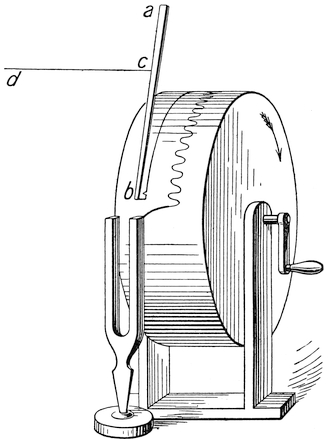
A train of wheels is almost out of the question: not perhaps as impossible as you might think, but still very difficult. A different method is used. A little wire sticks out from one arm of the fork. A piece of glazed paper is lightly smoked over a wax taper and stretched round a well-made brass drum. The fork is placed so that its little wire just touches the paper. Then the fork is set vibrating with a blow, and while it vibrates the drum is turned. The wire on the fork draws a wavy line on the drum. If the fork made fifty complete vibrations to and fro in a second, there would be a hundred such bends, fifty to the right and fifty to the left, and with them time can be measured as you would measure a length with a ruler.
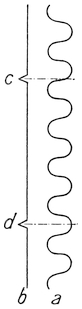
If an arm ab is fitted so as to move sideways when a little string cd is pulled, and is also given a small wire touching the drum, it too will trace a line on the drum, a straight one, as its wire lightly scratches away the thin coat of smoke. If it is suddenly jerked and flicks back, it makes a little nick in the line. If, when we want to measure a short stretch of time, a jerk is given at its beginning and another at its end, we get a diagram like the one in the figure, where a is the trace of the tuning fork and b that of the indicating arm. The time between the jerk that made the nick c and the one that made the nick d is about three and three-quarter double bends of the tuning fork line, showing three and three-quarter fiftieths of a second. It is easy to see how delicate this method of measuring can be made. With small tuning forks we can easily measure times to a thousandth of a second, and much less if we wish.
The jerk can be given by electricity if desired. When the current is joined, a little electromagnet pulls a bit of iron and tugs the string. Electricity travels so extremely fast that no noticeable time is lost in its passage along the wires, so the jerk can be given from a distance. We can arrange, for instance, that an electric impulse is given when a cannon ball leaves a gun, and another when it reaches and hits a target. These make nicks in the line traced on the drum, from which we can easily work out the time between the ball's leaving the mouth of the gun and its arrival at its destination.
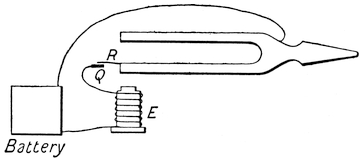
Apparatus like this is used in modern gunnery experiments. It is elaborate, but it rests on the principle just described.
Drums are sometimes driven by clockwork, and tuning forks are also often kept vibrating by electricity, which makes them very fast-going electric clocks. The arrangement is simple. An electromagnet, E, is placed near one arm of the fork. A small piece of wire from the arm is in contact with a piece of metal, Q, from which a wire runs to the electromagnet, from there to a battery, and from the battery to the fork, through which the current runs to the wire R. When the fork vibrates, the arm, bending outwards, makes the wire R touch Q. At once the electromagnet gives the steel arm of the fork a small pull, and so helps its swing. The whole arrangement is exactly like an electric clock, as you can see by comparing Figure 71 with Figure 68.
There is another way of measuring short intervals of time that deserves attention. It is to let a body drop at the beginning of the time to be measured, note how far it falls in that time, and then find the time from the equation given earlier,
S = 1/2 g t2.
In practice it is done by letting a piece of smoked glass fall and having a small pointer make two dots on it, one at the beginning and one at the end of the time to be measured.
An interesting version of this method can be the basis of a curious toy.
Take a crossbow and a bolt with a spike on it, and fix the crossbow firmly in a vice so that the barrel points at a spot a on a wooden wall. At the spot a, hang a cardboard figure of a cat on a nail, arranged so that when an electromagnet acts the nail is pulled aside and the cat drops. Let a be the cat and b the loop by which it hangs over the nail c, which is fixed to another piece of iron hinged at c, so that when the electric current is switched on the nail c is pulled back and the cat drops. Carry the wires from the electromagnet and battery to the crossbow, and arrange them so that when the bolt leaves the muzzle one wire is pressed against the other and contact is made.
Now you have an apparatus in which the cat drops at the exact moment the bolt leaves the crossbow. Now what will happen?
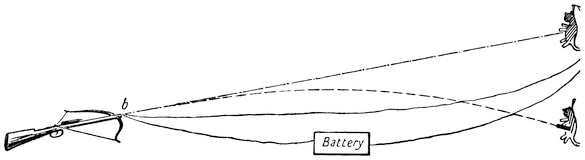
When the bolt leaves the bow it has two motions. One is a motion of projection at a steady pace along the line ba, from the bow to the target.
But it is also under another force, gravity, which acts on it vertically and pulls it down vertically exactly as far and as fast as it would pull a body dropped from rest at the moment the bolt leaves the bow. The cat is just such a body. Since the electric arrangement lets them both go together, they fall together and so are always at the same level, and when the bolt reaches the wooden wall, having fallen vertically from a to c, the cat too will have fallen vertically from a to c, and the bolt will pin him to the wall. It makes no difference how far from the wall you put the bow, how strong the bow is, how heavy the bolt or the cat, or whether ab is level or points up or down.
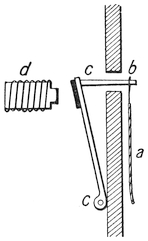
In every case, as long as the barrel is pointed straight at the cat, the bolt and the cat fall together and at the same rate, and the bolt will pin the cat to the wall.
To try the experiment, the bolt should be fairly heavy, say half a pound, with a good spike; done carefully, the experiment will succeed every time. It also lets you measure the speed of the bolt. If the bow is thirty feet from the wall and the cat has fallen three feet when it is hit, the time of fall is T = √((2S)/g) = √(6/g) = .43 seconds. But in that time the bolt went thirty feet, so its speed was thirty feet in .43 seconds, or seventy feet a second.
If you make the bolt heavier, of course, its speed of projection will be lower, the time longer, and so the cat will fall further before the bolt transfixes it.
My task is now finished. I have tried not merely to describe clocks and various instruments for measuring time, but to explain the fundamental principles of mechanics that lie at the root of the subject.
May I end with a word of advice to parents?
There are a certain number of boys, but only a certain number, who have a real love of mechanical science. Such boys should be encouraged in every way by being given tools and apparatus, but in choosing the apparatus the following principles should be kept in mind.
First, almost everything a boy wants can be made of wood and metal and wire and string, if he has someone to show him a little of how to do it. A bent bit of steel jammed in a vice makes an excellent tuning fork.
Second, he wants not toy tools but good tools. If an expert needs a good tool, how much more does a beginner.
Third, he ought to have a reasonably dry and comfortable place to work in, and the help and advice of the village carpenter or blacksmith.
Fourth, he ought not to be allowed to potter about with his tools, but should make something really sensible and useful, and not begin a dozen things and finish none.
Fifth, making apparatus to show scientific facts is more useful than making bootjacks for his father or workboxes for his mother.
And, lastly, a little money spent in this way will keep many a young rascal from tormenting his sisters and stoning the cat; and when the inevitable day comes on which he must face the young man's first ordeal, THE EXAMINER, he will often thank his stars that he learned in play the fundamental formula S = 1/2 g t2, and that he knows the nature of "harmonic motion," the two most important principles in the measurement of time.
Appendix: The Shape of the Teeth of Wheels
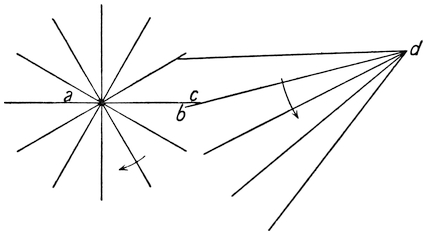
The teeth of the wheels of watches and clocks need particular care in shaping, and it may be of interest to describe briefly the principles on which these wheels are made. What is wanted is that the motion should not be passed on in jerks as the teeth meet one after another, but should be perfectly smooth. The problem, then, is this. How are we to arrange the teeth so that, as one wheel turns and drives the other round, the leverage, or turning power, of the driving wheel on the driven wheel stays always the same? If the teeth were simple spikes, it is easy to see that it would not. As the arm ac turned, driving the arm bd in front of it, the point c would scrape along, and the leverage between the two teeth would keep changing. Some other construction is plainly needed. Before we can say what it is to be, we must ask what the leverage would be between two rods, ac and db, mounted on pivots at a and d. The answer is that when a lever such as ac presses with its end against another, db, the push acts in a direction ce at right angles to db. The leverage between the two arms is therefore in the ratio of ae to dc. The system works just as if a lever ae were joined to a lever dc by a stiff rod ec at right angles to both.
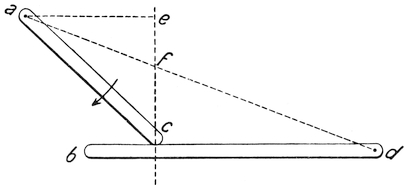
The ratio of the power, then, is as ae is to dc.
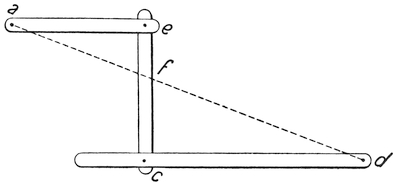
But since the triangles aef and dcf are similar, ae is to dc as af is to fd. This gives us a general rule. If one body mounted on an axle presses on another body mounted on an axle, the pressure between them always acts in the direction shown by the dotted line, at right angles to the two surfaces where they touch; and the ratio of the leverage is found by drawing a line from one axle to the other, cutting the line of the pressure at f. The leverage of one on the other is then as af is to fd.
Our problem now becomes this. Take a rod bd, and suppose it is pressed on by a curved surface mounted on an axle at a. The direction of the push that the curved surface (called in engineering language a cam) exerts on the rod bd is shown by the dotted line, and the ratio of the driving power to the driven power is as df is to af. Now how can we shape the cam so that as it turns, and different parts of its surface come in turn into contact with the rod bd, the ratio of the leverage stays the same, so that the ratio of af to fd is always constant, or, what comes to the same thing, so that the line drawn through the point of contact at right angles to the curve there always passes through the point f?
Plainly, if this is to be so, the point d must lie on a semicircle whose diameter is fb, since then the angle fdb will always be a right angle.
The surface must therefore be shaped so that, whatever the position of the cam and of the rod bd, the point where they touch always lies on the semicircle through f and d. As the cam turns round its axle a, that is, its shape must be such that a line drawn from f to the point where the curve cuts the circle fdb is always at right angles to the curve.
Now suppose we take a circle with its centre at a and radius af, and let it turn the circle fdb, by simple surface friction, round that circle's centre o. Any point d on the small circle will then trace a curve on a piece of paper fixed to the turning circle whose centre is at a. The curve will always run so that the point d is, at any instant, moving in a circle round f, and so the curve will always be at right angles, at every point, to the line df of the moment.
This curve, made by rolling one circle on another, is called an epicycloid. For a clock, then, if we make the pinion with straight leaves and cut the teeth of the driving wheel in the shape of epicycloids, made by rolling a circle whose diameter equals the radius of the pinion round the driving wheel, the leverage of the one on the other will stay constant.
The circles with radii af and bf are called the "pitch circles," and their radii are in the ratio of the motion wanted between the wheels, usually six to one or eight to one as the case may be. The sides of the pinion's teeth are straight lines running out from the centre, rounded off at the ends so that they cannot jam by accident. The teeth of the cogwheel have epicycloidal sides. Their tips are cut off to keep them out of the way, and spaces are left between them for the width of the pinion's leaves.
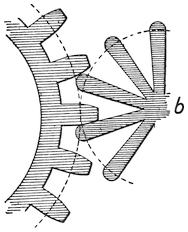
Both pinions and cogwheels are cut by cutters spinning at high speed, about 3,500 times a minute, the cutters for pinions being carefully shaped with straight edges and those for cogwheels in epicycloids. It is a pretty sight to see a wheel-cutting engine at work, the cutter flying round with a hum, cutting the rim of a brass wheel into teeth, the brass coming off in flakes finer than fine hairs and falling as fine dust. When a tooth is cut, the wheel is moved round one division of a device called a "dividing plate," so that a new part of the wheel is presented to the cutter. The cutters and the wheels must of course all be properly proportioned, and cutters are sold in sets shaped for the work they have to do. Wheel cutting is a special branch of the clockmaking trade. The reason the cutting speed is so high is that the aim is to take off small amounts of metal at a time, so as not to strain the wheel or the cutting machinery. If bigger cuts were made the machine would have to go slower, since it is a principle in the building of cutting machinery that the speed of the cut must always be suited to its depth: for deep cuts you must move the cutting edge slowly, and vice versa. The newest way of making brass cogwheels, and the best, is to stamp them out of solid sheet metal at a single blow of a punching machine, and cheap watches are always made this way. The whole business of watch and clock making, in fact, is being transformed.
Before the great growth of engineering towards the end of the eighteenth century, the making of machines was a sort of fine art. Cogwheels were cut by hand. The circumference was marked out with compasses. Then holes were drilled round the rim, teeth were cut leading into them, and the teeth were shaped with special files made for the purpose (Figure 82). Big machinery was all shaped at the forge and with the file, and engineers complained that you could not get big work made true even to an eighth of an inch. But watches and clocks were beautifully made, though only at the cost of hours of patient measuring and filing. The taste for ornament was still alive. The wheels and backs of watches were chased all over with the most beautiful patterns, and the frames of clocks were worked into beautiful figures and forms. Even astronomical instruments were decorated.
Then came the age of severe accuracy. Men of science whose feelings were hostile to art in any form took charge of machine making. They hated to see any effort spent on ornament. With strictly utilitarian aims they banished every sign of beauty from instruments and tools of all kinds, so that our modern machines, from a steam engine down to a watch, are now models of precise but entirely unornamented workmanship. They are the fitting tools of a nation that wears trousers and top hats. You have only to compare an old warship, with its carved prow and streamers, with a modern ironclad to see the difference. The art of ornament is now little more than a fitful imitation of the past, of historical interest only. As a living thing it has almost ceased to exist.
But in precision of manufacture the present age has no rival in the history of the world. People no longer believe in the old methods of scraping and filing, and handwork done directly on metal is fast going out of use. With a file and scraper and days of labour you can, of course, get two flat surfaces of metal so perfect that when they are put together one will lift the other like a sucker on a stone, but it is wasted labour; a small machine will do it as well in a few minutes. A watch is no longer built up as you would build a house, fitting part to part. Expensive machines stamp and cut thousands of watch parts to pattern, and a watch is made by taking one of each, any one at all, and simply putting them in their places. Fairly unskilled workmen can do this. The skill is needed in designing and making the machinery and in watching the cutters, measuring them with microscopic gauges from time to time and putting them right at once if an edge is found to be a ten-thousandth of an inch out of place. The labour of man, then, is becoming more and more a labour of design and supervision. Machines are the slaves that do the work, for in a good machine we have an eye and an arm that never tire and need only to be kept in working order. But machines are not artistic, and so art is lost while precision is gained. At present a desperate attempt is being made to satisfy the human mind's craving for art by means of machinery. It is bound to fail. Art of this kind is generally produced by the same brain that designs machines, and so it has a look of rigid accuracy and uniformity that is essential in an engine but out of place in a work of art.
The great manufacturers of our Midlands do not seem to understand that there is no point in making a towel horse as geometrically accurate as a lathe. It will apparently be years before they learn to put art and precision each where it is wanted: precision in the works of the watch, art in its face and case; machine work inside the watch, handwork outside. When public taste has been educated enough to see the odious character of the jumble of Gothic, Egyptian and meaningless ornament on something like the case of an American organ, one step will have been taken towards the revival of artistic taste.
But to propose reviving art by giving up machinery, or by abandoning our modern precision cutters to go back to the hacksaw and file, is ridiculous, and could only be suggested by people quite without scientific ideas. Art and precision each has its place. There is room for both; let neither intrude on the domain of the other.