
1860 2026
This is an AI modernization of On the Various Forces of Nature into contemporary English. The original is available from Project Gutenberg. Also available as an epub. The original text is also here.
This is the course Michael Faraday gave to children at the Royal Institution over Christmas 1859, the winter before the one that produced The Chemical History of a Candle. He was sixty-eight. The lectures had been postponed twice because he was ill, and he opens by saying so: he may manage only a few words, he will substitute experiments for talk, and he claims as usual the right to speak to young people as one of them. Then he lectures anyway, for six nights. The apology is the first thing in the book and is printed here exactly as he made it.
Where the Candle takes a single object and draws the whole of chemistry out of it, this course does the reverse. It takes the powers of matter one at a time — gravitation, cohesion, chemical affinity, heat, magnetism, electricity — and drives them all toward the title of the last lecture, the correlation of the physical forces. The claim is that these are not six powers but one, each convertible into the others. Chemical action carried along a wire comes out as light. A coil of copper becomes a magnet. A moving magnet makes a spark. Faraday had discovered that last effect himself in 1831, and in the fifth lecture he is showing a room of children the thing he found.
The experiments are the argument, and they are all on the bench: a stick of shellac rubbed on cloth dragging a sheet of paper about, a pail of water swung from the edge of a table, a bubble of air holding up half a hundredweight of iron, a rod of iron heated red at one end so that it can be twisted with pliers while the cold end will not bend. His assistant, Mr. Anderson, hands him things and is named. The stage directions the shorthand writer took down are kept in square brackets where they fall.
The book ends with something that is not a Christmas lecture. The address on lighthouse illumination was delivered to adults on 9 March 1860, by Faraday in his capacity as scientific adviser to Trinity House, and it is about putting the electric light into lighthouses. Its register is plainer and more official than the lectures, and it has been kept that way rather than warmed up to match them.
As with the Candle, the lectures were taken down and edited by William Crookes, and his explanatory notes are printed beside the passages they explain, marked as editor's notes and in his voice rather than Faraday's. All fifty-nine of the original figures are here; Victorian printers put several on one woodblock, so a single plate often carries three. Lecture Six finishes on two lines of As You Like It, which are the last words Faraday says to the children. Other volumes in the Royal Institution series are in this collection, the Candle among them.
Lecture One: The Force of Gravitation
Lecture Two: Gravitation and Cohesion
Lecture Three: Cohesion and Chemical Affinity
Lecture Four: Chemical Affinity and Heat
Lecture Five: Magnetism and Electricity
Lecture Six: The Correlation of the Physical Forces
Lighthouse Illumination: The Electric Light
Which came first, matter or force? If we think about that question, we find we are unable to conceive of matter without force, or of force without matter. When God created the elements of which the earth is composed, He created certain wondrous forces which are set free, and become evident, when matter acts upon matter. All these forces, for all their differences, have much in common; and if one of them is set free it will immediately try to free its companions. So heat will let us draw out light, electricity, magnetism and chemical action; and chemical action will bring out light, electricity and heat. In this way we find that all the forces in nature tend to form mutually dependent systems; and as the motion of one star affects another, so a force in action liberates and makes evident forces that were previously at rest.
We say at rest — and yet the phrase is almost without meaning in the universe. Where do we find tranquillity? The sea, the seat of animal, vegetable and mineral change, is at war with the land, and the air lends itself to the struggle. The globe, the scene of perpetual internal change, is as a whole acting on the other planets of our system and being acted on by them; and the system itself is changing its place in space under the influence of a known force springing from an unknown centre.
For many years the English public had the privilege of listening to Professor Faraday's discourses and speculations at the Royal Institution on matter and forces; and it is not too much to say that no lecturer on physical science since the time of Sir Humphry Davy was ever listened to with more delight. The pleasure everyone took in Faraday's expositions was of a somewhat different kind from that produced by any other man of science whose lectures we have attended. It came partly from his extreme dexterity as an operator. With him there was no risk of apologies for an unsuccessful experiment — no hanging fire in the middle of a series of brilliant demonstrations, with that sinking feeling akin to the pain an audience feels at a false note from a singer. It was all a sparkling stream of eloquence and experimental illustration. We would have defied any chemist who loved his science, however often he might have performed an experiment himself, to feel uninterested watching Faraday do it.
The present publication has one or two points of interest. In the first place, the lectures were especially intended for young people, and are therefore as free of technicalities as possible. In the second place, they are printed as they were spoken, word for word and letter for letter. A careful and skilful reporter took them down, and the manuscript deciphered from his notes was afterwards corrected with great care by the editor, as regards any scientific points that were not clear to the shorthand writer. So whatever is missing arises solely from the impossibility — alas — of conveying the manner of the lecturer as well as his matter.
May the readers of these lectures derive one-tenth of the pleasure and instruction from reading them that they gave to those who had the happiness of hearing them.
W. Crookes.
It grieves me very much to think that I may have caused a disturbance in your Christmas arrangements, for nothing is more satisfying to my mind than to do what I have undertaken to do. But such things are not always left in our own power, and we must submit to circumstances as they are appointed.
I will do my best today, and I must ask you to bear with me if I am unable to give you more than a few words. As a substitute I shall try to make the illustrations of what I am attempting to say as full as possible; and if by the end of this lecture we find we are justified in going on with them — thinking that next week my strength may be greater — then, with your permission, we will take whatever course you think fit, either to continue or to stop. And although I feel much weakened at present by the pressure of illness upon me (a mere cold), both in ease of expression and in clearness of thought, I shall claim here, as I always have on these occasions, the right of addressing myself to the younger members of the audience. And for that purpose — unfitted as it may seem for an elderly and infirm man to do it — I shall return to second childhood and become, as it were, young again among the young.
Editor's note: The opening lecture was twice postponed on account of Dr. Faraday's illness.
Let us consider for a little while how wonderfully we stand upon this world. Here we are born, and bred, and live; and yet we look at these things with almost no wonder at all about the way in which it all happens. So little do we wonder, in fact, that we are never taken by surprise. I really believe that to a young person of ten, or fifteen, or twenty, the first sight of a waterfall or a mountain would cause more surprise than he has ever felt about the means of his own existence — how he came here, how he lives, by what means he stands upright, and by what means he moves about from place to place.
So we come into this world, we live, and we depart from it without our thoughts being specifically called to consider how all this takes place. And were it not for the efforts of a few inquiring minds who have looked into these things, and worked out the beautiful laws and conditions by which we live and stand upon the earth, we should hardly be aware that there was anything wonderful about it. These inquiries have occupied scientific men from the earliest days, when they first began to find out the laws by which we grow and exist and enjoy ourselves, right up to the present time; and they have shown us that all of it comes about through the existence of certain forces, or abilities to do things, or powers — powers so common that nothing could be commoner. For nothing is commoner than the wonderful powers that allow us to stand upright; they are essential to our existence every moment of our lives.
My purpose today is to make you acquainted with some of these powers — not the vital ones, but some of the more elementary, what we call physical powers. And at the outset, what can I do to bring to your minds a notion of exactly what I mean by the word power, or force?
Suppose I take this sheet of paper and stand it upright on one edge, resting against a support in front of me, as the roughest possible illustration of something to be disturbed. Suppose I then pull this piece of string attached to it. I pull the paper over. I have therefore brought into use a power of doing so — the power of my hand, carried along this string in a way which is very remarkable when we come to analyse it; and it is by these powers acting together (for there are several powers employed here) that I pull the paper over. Again, if I give it a push on the other side, I bring a power into play, but a very different exertion of power from the first.
Or take this piece of shellac [a stick of shellac about twelve inches long and an inch and a half thick] and let me rub it with flannel and hold it an inch or so in front of the upper part of this upright sheet. The paper immediately moves towards the shellac; and by now drawing the shellac away, the paper falls over without having been touched by anything at all. You see, in the first demonstration I produced an effect than which nothing could be commoner; now I pull it over not by the string or the pull of my hand, but by some action in the shellac. The shellac, then, has a power by which it acts on the sheet of paper. And as an illustration of yet another kind of power, I might use gunpowder to throw it over.
Now, I want you to try to grasp that when I speak of a power or a force, I am speaking of the thing I have just used to pull this piece of paper over. I will not burden you with the name of that power at present, but it is clear there was something in the shellac which acted by attraction and pulled the paper over. That, then, is one of the things we call a power, or a force; and you will now be able to recognise it as such in whatever form I show it to you.
We must not suppose there are a great many different powers. On the contrary, it is wonderful to think how few are the powers by which all the phenomena of nature are governed. There is an illustration of another kind of power in that lamp: the power of heat — a power of doing something, but not the same power as the one that pulled the paper over. And so, by degrees, we find there are certain other powers, not many, in the various bodies around us. Beginning with the simplest experiments of pushing and pulling, I shall gradually go on to distinguish these powers from one another, and to compare the ways in which they combine.
This world we stand upon — and we have not much need to travel out of the world for illustrations of our subject, though the mind of man is not confined as the matter of his body is, and so he may travel outwards, and does; for wherever his sight can pierce, there his observations can penetrate — this world is very nearly a round globe, with its surface arranged rather like the terrestrial globe here beside me. So much is land and so much is water, and by looking at it here we see in a sort of map or picture how the world is formed on its surface. Then, when we come to examine further, I refer you to this sectional diagram of the geological strata of the earth, which gives a more elaborate view of what lies beneath the surface of our globe.
And when we dig into it or examine it, as man does for his own instruction and advantage in a variety of ways, we see that it is made up of different kinds of matter, subject to very few powers, and all arranged in this strange and wonderful way which gives man a history — and such a history — as to what there is in those veins, in those rocks, the ores, the water springs, the atmosphere around, and all the varieties of material substance held together by forces in one great mass eight thousand miles across. The mind is overwhelmed in contemplating the wonderful history told by these strata, some of which are as fine and thin as sheets of paper, all formed one after another by the forces I have spoken of.
Now I shall try to help your attention by directing our thoughts today to one kind of power. You see what I mean by the term matter: any of these things I can take hold of with my hand, or in a bag — for I may take hold of the air by shutting it up in a bag. They are all portions of matter, and it is with these we have to deal at present, generally or particularly as I may need them to illustrate my subject.
Here is the sort of matter we call water. There it is ice [pointing to a block of ice on the table]; there it is water [pointing to water boiling in a flask]; and here it is vapour — you can see it issuing from the top of the flask. Do not suppose that the ice and the water are two entirely different things, or that the steam rising in bubbles and going up as vapour is absolutely different from the liquid water. It may differ in some particulars, having to do with the amounts of power it contains; but it is the same, nevertheless, as the great ocean of water round our globe. I use it here for the sake of illustration, because if we look into it we shall find it supplies us with examples of all the powers I shall have to refer to.
For instance, here is water, and it is heavy. But let us examine it with regard to the amount of its heaviness, or its gravity. In front of me is a little glass vessel and a pair of scales [nearly balanced scales, one of which held a half-pint glass vessel], and the glass vessel is at present the lighter of the two. But if I take some water and pour it in, you see that side of the scales goes down at once. That shows you — using ordinary language, which I shall not assume you have so far applied very strictly — that it is heavy. And if I now put this extra weight into the opposite scale, I should not wonder if this vessel will hold water enough to weigh it down. [The lecturer poured more water into the jar, which again went down.]
Why do I hold the bottle above the vessel to pour the water into it? You will say it is because experience has taught me it is necessary. I do it for a better reason: because it is a law of nature that the water should fall towards the earth, and so the very means I use to get the water into the vessel are the means that will carry the whole body of water down. That power is what we call gravity; and there [pointing to the scales] you see a good deal of water gravitating towards the earth.
Now here [showing a small piece of platinum] is another thing which gravitates towards the earth as much as all that water does. See how little there is of it — that little thing is heavier than all that water [placing the metal in the scale opposite the water]. What a wonderful thing it is to see that it takes so much water as that, a half-pint vessel full, to fall towards the earth, compared with this little mass of substance I have here. And again, if I take this metal [a bar of aluminium about eight times the bulk of the platinum], we find the water will balance that as well as it balanced the platinum. So at the very outset we get an example of what we want to understand by the words force or power.
Editor's note: Platinum, with one exception, the heaviest body known, is 21½ times heavier than water.
Editor's note: Aluminium is 2½ times heavier than water.
I have spoken of water, and first of all of its property of falling downwards. You know very well how the oceans surround the globe, how they lie round its surface, giving roundness to it, clothing it like a garment. But besides that, water has other properties. Here, for instance, is some quicklime; and if I add some water to it, you will find another power, another property, in the water. It is very hot now, it is steaming up, and I could perhaps light phosphorus or a match with it. Now, that could not happen without a force in the water to produce the result; but that force is entirely distinct from its power of falling to the earth.
Again, here is another substance [some anhydrous sulphate of copper] which will illustrate another kind of power. [The lecturer here poured some water over the white sulphate of copper, which immediately turned blue, giving off considerable heat at the same time.] Here is the same water with a substance that heats nearly as much as the lime does, but see how differently. Indeed, the heat in the case of the lime is so great that it is sometimes enough — as you see here — to set wood on fire. That explains something we have all heard of: barges loaded with quicklime catching fire in the middle of the river, because of this power of heat brought into play by water leaking into the barge. You see how strangely different the subjects for our consideration become when we come to think these matters over: the power of heat given off by acting on lime with water, and the power water has of turning this salt of copper from white to blue.
Editor's note: Power or property in water. This power — the heat by which the water is kept in a fluid state — is said, under ordinary circumstances, to be latent, or insensible. When, however, the water changes its form and, by uniting with the lime or the sulphate of copper, becomes solid, the heat which kept it in a liquid state is given off.
Editor's note: Anhydrous sulphate of copper: sulphate of copper deprived of its water of crystallisation. To obtain it, the blue sulphate is calcined in an earthen crucible.
I want you now to understand the nature of the simplest exertion of this power of matter called weight, or gravity. Bodies are heavy — you saw that with the water when I put it in the balance. Here I have what we call a weight [an iron half hundredweight]: a thing called a weight because in it that power of pressing downwards is used especially for the purpose of weighing. And I have here one of these little inflated rubber bladders, which are very beautiful although very common — most beautiful things are common. I am going to put the weight on it, to give you a sort of illustration of the downward pressure of the iron and of the power the air has of resisting that pressure. It may burst, but we must try to avoid that. [During the last few remarks the lecturer had succeeded in getting the half hundredweight to rest quietly on the inflated rubber ball, which had consequently taken a shape very much like a flat cheese with rounded edges.]
There you see a bubble of air carrying half a hundredweight; and you must conceive for yourselves what a wonderful power there must be to pull this weight downwards, and to sink it like that into the ball of air.
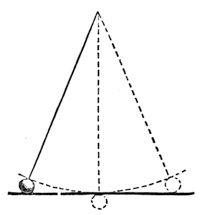
Let me now give you another illustration of this power. You know what a pendulum is. I have one here (Figure 1), and if I set it swinging it will go on swinging to and fro. Now, I wonder whether you can tell me why that body swings to and fro — that pendulum bob, as it is sometimes called.
Notice that if I hold this straight stick horizontally, level with the position of the ball at the two ends of its journey, you can see that the ball is higher at the two extremities than it is in the middle. Starting from one end of the stick, the ball falls towards the centre; and then, rising again to the opposite end, it is constantly trying to fall to the lowest point, swinging and vibrating most beautifully — and with wonderful properties in other respects, such as the time of its swing, about which we will not trouble ourselves now.
If a gold leaf, or a piece of thread, or any other substance were hung where this ball is, it would swing to and fro in the same manner, and in the same time too. Do not be startled at that statement: I repeat, in the same manner and in the same time; and you will see by and by how that is.
Now, the power that made the water go down in the balance, that made the iron weight press on and flatten the bubble of air, that caused the swinging to and fro of the pendulum — that power is entirely due to the attraction between the falling body and the earth. Let us be slow and careful in understanding this. It is not that the earth has some particular attraction towards bodies that fall to it, but that all these bodies possess an attraction, every one towards every other. It is not that the earth has a special power that these balls themselves lack; for just as much power as the earth has to attract these two balls [dropping two ivory balls], just so much power have they, in proportion to their bulk, to draw themselves one towards the other. The only reason they fall so quickly to the earth is the earth's greater size.
Now, if I were to place these two balls near together, I should not be able, by the most delicate arrangement of apparatus, to make you or myself aware that they attract one another. And yet we know that they do; because if, instead of a small ivory ball, we take a mountain and put a ball like this near it, we find that, owing to the vast size of the mountain compared with the billiard ball, the ball is drawn slightly towards it. That shows clearly that an attraction does exist — just as it did between the shellac I rubbed and the piece of paper it overturned.
Now, it is not very easy to make these things quite clear at the outset, and I must take care to leave nothing unexplained as I go along. So I must make sure you clearly understand that all bodies are attracted to the earth — or, to use a more learned word, that they gravitate. You will not mind my using that word; for when I say this penny gravitates, I mean nothing more and nothing less than that it falls towards the earth, and that if it were not stopped it would go on falling and falling until it reached what we call the centre of gravity of the earth, which I shall explain to you by and by.
I want you to understand that this property of gravitation is never lost, that every substance possesses it, and that the quantity of it never changes. First of all I will take a piece of marble as an illustration. This marble has weight, as you will see if I put it in these scales: it weighs the balance down, and if I take it off, the balance goes back and settles again.
I can decompose this marble and change it, in the same way as I can change ice into water and water into steam. I can easily turn part of it into its own kind of steam, and show you that this steam from the marble has the property of staying where it is put at ordinary temperatures, which water-steam has not. If I add a little liquid to the marble and decompose it, I get what you see here. [The lecturer here put several lumps of marble into a glass jar and poured water and then acid over them; the carbonic acid immediately began to escape with considerable effervescence.] It has the appearance of boiling, but that is only one part of the marble separating from another.
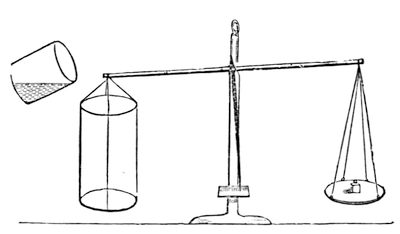
Now this marble steam, and that water steam, and all other steams gravitate just as any other substance does. They are all attracted one towards another, and all fall towards the earth; and what I want you to see is that this steam gravitates. Here (Figure 2) I have a large vessel standing on a balance, and the moment I pour this steam into it, you see that it gravitates. Just watch the index and see whether it tips over or not. [The lecturer here poured the carbonic acid from the glass in which it was being generated into the vessel hanging on the balance, and the gravitation of the carbonic acid was at once apparent.]
Look how it is going down. How pretty that is! I poured in nothing but the invisible steam, or vapour, or gas that came off the marble; and yet you see that this part of the marble, although it has taken the form of air, still gravitates as it did before. Now, will it weigh down that piece of paper? [Placing a piece of paper in the opposite scale.] Yes — and more than that; it nearly weighs down this piece too. [Placing another piece in.] So you see that other forms of matter besides solids and liquids tend to fall to the earth; and you will therefore accept from me the fact that all things gravitate, whatever their form or condition may be.
Here is another chemical test, very easily applied. [Some of the carbonic acid was poured from one vessel into another, and its presence in the second was shown by putting a lighted taper into it, which was immediately extinguished.] You see from this result too that it gravitates. All these experiments show you that, tested by the balance and tested by pouring it like water from one vessel to another, this steam, or vapour, or gas is, like everything else, attracted to the earth.
Editor's note: Add a little liquid to the marble, and decompose it. Marble is composed of carbonic acid and lime, and in chemical language is called carbonate of lime. When sulphuric acid is added to it, the carbonic acid is set free and the sulphuric acid unites with the lime to form sulphate of lime. Carbonic acid, under ordinary circumstances, is a colourless invisible gas about half as heavy again as air. Dr. Faraday first showed that under great pressure it could be obtained in a liquid state. Thilorier, a French chemist, afterwards found that it could be solidified.
There is another point I want to draw your attention to next. Here is a quantity of shot. Each of these falls separately, and each has its own gravitating power, as you can see when I let them fall loosely onto a sheet of paper. If I put them into a bottle, I collect them together as one mass; and scientific men have found that there is a certain point in the middle of the whole collection of shot which may be regarded as the one point where all their gravitating power is concentrated. That point they call the centre of gravity — not at all a bad name, and rather a short one.
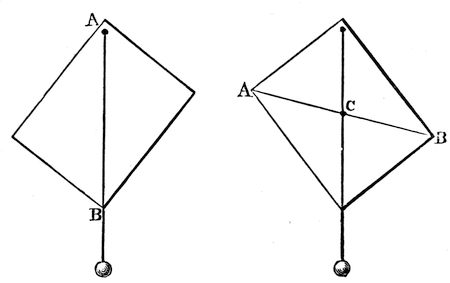
Now suppose I take a sheet of pasteboard, or anything else easy to handle, and run a bradawl through it at one corner, A (Figure 3), and Mr. Anderson holds it up in front of us. I then take a piece of thread with an ivory ball on it and hang that on the awl. The centres of gravity of the pasteboard, and of the ball and string, are then as near as they can get to the centre of the earth; that is to say, the whole attracting power of the earth is, as it were, concentrated at a single point of the card, and that point lies exactly below the point of suspension. All I have to do, therefore, is to draw a line, A to B, along the string, and we shall know that the centre of gravity lies somewhere on that line.
But where on it? To find that out, all we need do is put the awl in another place (Figure 4), hang the plumb line again, and repeat the experiment — and there, at the point C, is the centre of gravity, where the two lines I have drawn cross each other. And if I take that pasteboard and make a hole with the bradawl at that point, you will see that it will be supported in any position I put it in.
Now, knowing that, what do I do when I try to stand on one leg? Do you not see that I push myself over to the left side and quietly take up the right leg, and so bring some central point in my body over the left one? What is that point I throw over? You will know at once that it is the centre of gravity — the point in me where the whole gravitating force of my body is concentrated, and which I bring in this way into a line over my foot.
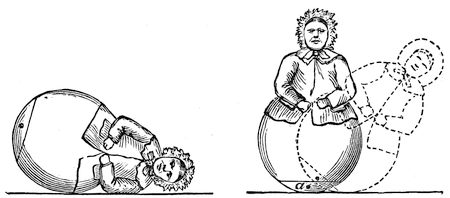
Here is a toy I happened to see the other day which will, I think, illustrate our subject very well. This toy ought to lie something like this (Figure 5), and would do so if it were uniform in substance. But you see it does not: it gets up again. And now science comes to our aid, and I am perfectly sure, without looking inside the figure, that there is some arrangement by which the centre of gravity is at its lowest point when the figure is standing upright. We may be certain that when I tilt it over (see Figure 6) I am lifting the centre of gravity, marked a, and raising it away from the earth. All this is done by putting a piece of lead inside the lower part of the figure and giving the base a large curvature; and there you have the whole secret.
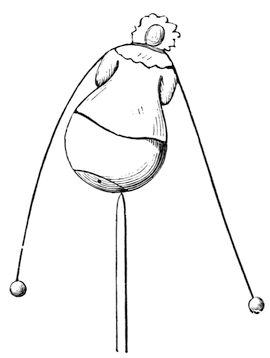
But what will happen if I try to make the figure stand on a sharp point? You will notice that I must get that point exactly under the centre of gravity, or it will fall over like this [trying unsuccessfully to balance it]; and, as you see, it is a difficult matter — I cannot make it stand steadily. But if I burden this poor old lady with a world of trouble, and hang this wire with a bullet at each end about her neck, then plainly, because of those balls of lead hanging down on either side in addition to the lead inside her, I have lowered the centre of gravity, and now she will stand on this point (Figure 7). What is more, she proves the truth of our science by standing sideways.
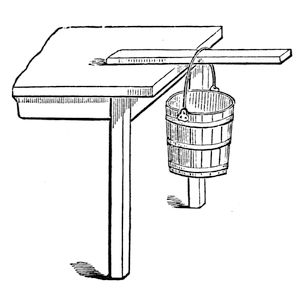
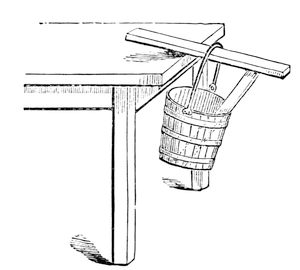
I remember an experiment which puzzled me very much as a boy. I read it in a conjuring book, and the problem was put like this: "How to hang a pail of water, by means of a stick, on the side of a table" (Figure 8). Here I have a table, a piece of stick and a pail; and the question is, how can that pail be hung on the edge of this table? It can be done. Can you at all guess what arrangement I shall make to succeed?
Why, this. I take the stick and put it into the pail, between the bottom and the horizontal piece of wood, and so give it a stiff handle — and there it is. What is more, the more water I put in the pail, the better it will hang. It is quite true that before I succeeded I had the misfortune to push the bottoms out of several pails; but here it is hanging firmly (Figure 9), and you can now see how to hang up the pail in the way the conjuring books require.
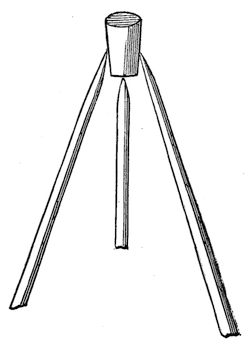
Again, if you are really so inclined — and I do hope all of you are — you will find a great deal of science in this [holding up a cork and a thin pointed stick about a foot long]. Do not turn to your toy books and say you have seen that before. Answer me rather this: have you understood it before? It is an experiment that seemed very wonderful to me when I was a boy. I used to take a piece of cork (and I remember thinking at first that it was very important that it should be cut in the shape of a man, though by degrees I got rid of that idea), and the problem was to balance it on the point of a stick. Now, you see, I have only to fix two sharp-pointed sticks, one on each side, giving it wings like this, and you will find the beautiful condition fulfilled.
We come now to another point. All bodies, heavy or light, fall to the earth by this force we call gravity. By observation, though, we see that bodies do not all take the same time in falling. I think you will be able to see that this piece of paper and this ivory ball fall to the table at different speeds [dropping them]; and again, if I take a feather and an ivory ball and let them fall, you see they reach the table at different times — the ball falls faster than the feather.
Now, that ought not to be so, because all bodies do fall equally fast to the earth. There are one or two beautiful points contained in that statement. First of all, it is plain that an ounce, or a pound, or a ton, or a thousand tons all fall equally fast, no one faster than another. Here are two balls of lead, a very light one and a very heavy one, and you can see they both fall to the earth in the same time. And if I were to put into a little bag enough of these small balls to make a bulk equal to the large one, they too would fall in the same time. When an avalanche falls from the mountains, the rocks and snow and ice all fall towards the earth with the same velocity, whatever their size may be.
I cannot take a better illustration of this than gold leaf, because it brings the reason for the apparent difference in falling time right before us. Here is a piece of gold leaf. If I take a lump of gold and this gold leaf and let them fall through the air together, you see that the lump — the sovereign, the coin — falls much faster than the leaf. But why? They are both gold, sovereign or leaf. Why should they not fall to the earth with the same quickness? They would, but for the fact that the air around our globe interferes a great deal when the piece of gold is beaten out so wide and thin that it meets so much obstruction in falling through it.
I will, however, show you that gold leaf does fall just as fast when the resistance of the air is taken away. If I take a piece of gold leaf and hang it in the middle of a bottle, so that the gold, the bottle and the air inside all have an equal chance of falling, then the gold leaf will fall as fast as anything else. And if I hang the bottle with the gold leaf in it from a string and set it swinging like a pendulum, I may make it swing as hard as I please and the gold leaf will not be disturbed: it will swing as steadily as a piece of iron would. I might even whirl it round my head with any degree of force and it would remain undisturbed.
Or I can try another sort of experiment. If I raise the gold leaf like this [pulling the bottle up to the ceiling of the theatre with a cord and pulley, and then suddenly letting it fall to within a few inches of the lecture table] and let it fall from the ceiling — I will put something underneath to catch it, in case I am clumsy — you will see that the gold leaf is not disturbed in the least. With the resistance of the air avoided, the glass bottle and the gold leaf fall in exactly the same time.
Here is another illustration. I have hung a piece of gold leaf in the upper part of this long glass vessel, and by a little arrangement at the top I can let the gold leaf loose. Before we do that we will pump the air out with an air pump; and while that is being done, let me show you another experiment of the same kind.
Take a penny, or a half-crown, and a round piece of paper a little smaller across than the coin, and try them side by side to see whether they fall in the same time [dropping them]. You see they do not — the penny goes down first. But now lay the paper flat on top of the coin, so that it meets no resistance from the air, and on dropping them you see they do both fall in the same time [showing the effect]. I dare say that if I put this piece of gold leaf on the coin instead of the paper it would do as well. It is very difficult to lay the gold leaf so flat that the air will not get under it and lift it in falling, and I am rather doubtful of success here, because the gold leaf is puckered; but I will risk it. There they go together! [letting them fall] — and you see at once that they both reach the table at the same moment.
We have now pumped the air out of the vessel, and you will see that the gold leaf falls as quickly in this vacuum as the coin does in air. I am going to let it loose now, and you must watch how rapidly it falls. There! [letting the gold loose] There it is, falling as gold should fall.
I am sorry to see that our time for parting is drawing so near. As we go on, I intend to write certain words on the board behind me, to bring back to your minds what we have already examined. I put the word FORCES as a heading, and beneath it I shall add the names of the particular forces in the order in which we take them. And although I am afraid I have not sufficiently pointed out to you the more important circumstances connected with this force of GRAVITATION — especially the law which governs its attraction, for which I think I must take a little time at our next meeting — still I shall put that word on the board, and I hope you will remember now that we have to some degree considered the force of gravitation: that force which makes all bodies attract one another when they are any appreciable distance apart, and tends to draw them together.
Do me the favour of paying me as much attention as you did at our last meeting, and I shall not regret what I have undertaken. It will be impossible for us to consider the laws of nature and what they do unless we now and then give them our whole attention, so as to get a clear idea of the subject. Give me that attention now, and then I trust we shall not part without your knowing something about those laws and the way they act.
You will remember that last time I explained that all bodies attract each other, and that we call this power gravitation. I told you that when we bring these two bodies near together [two ivory balls of equal size hung on threads] they attract each other, and that we may suppose the whole power of that attraction to be exerted between their respective centres of gravity. And you learned from me further that if, instead of a small ball, I take a larger one, like this [changing one ball for a much larger one], much more of this attraction is exerted; and that if I made the ball larger and larger until, if it were possible, it became as large as the earth itself — or if I simply took the earth as the large ball — the attraction would become so powerful as to make them rush together like this [dropping the ivory ball].
You sit there upright, and I stand upright here, because we keep our centres of gravity properly balanced with respect to the earth. And I need not tell you that on the other side of this world people are standing and moving about with their feet towards our feet, in a reversed position compared with us — and all by means of this power of gravitation towards the centre of the earth.
I must not, however, leave the subject of gravitation without telling you something of its laws and its regularity; and first of all as regards its strength in relation to how far apart bodies are. If I take one of these balls and put it within an inch of the other, they attract each other with a certain power. If I hold it further off, they attract with less power; and further off still, less again.
Now this fact is of the greatest consequence, for by knowing this law scientific men have discovered most wonderful things. You know that there is a planet, Uranus, going round the sun with us, but eighteen hundred million miles away; and because there is another planet as far off as three thousand million miles, and this law of attraction, of gravitation, still holds good there, scientific men actually discovered that further planet, Neptune, from the effects of its attraction at that overwhelming distance.
Now I want you to understand clearly what this law is. They say — and they are right — that two bodies attract each other inversely as the square of the distance. That is a sad jumble of words until you understand them; but I think we shall soon see what the law is, and what "the inverse square of the distance" means.
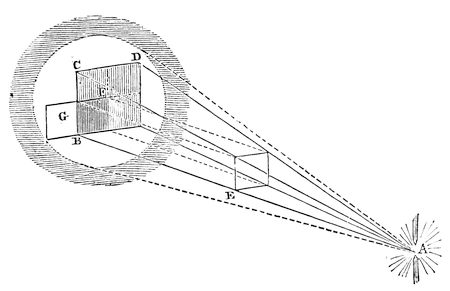
Here (Figure 11) I have a lamp, A, shining very brightly on this disc, B, C, D. This light acts as a sun by which I can throw a shadow from this little screen, B F — merely a square piece of card — which, as you know, when I place it close to the large screen shadows exactly as much of it as equals its own size.
But now let me take this card E, which is the same size as the other, and place it halfway between the lamp and the screen. Look at the size of the shadow B D: it is four times the original size. Here, then, comes the inverse square of the distance. This distance, A to E, is one; that distance, A to B, is two. But the card E being one in size, the shadow B D is four in size instead of two — which is the square of the distance. And if I put the screen at a third of the distance from the lamp, the shadow on the large screen would be nine times the size.
Again, if I hold this screen here at B F, a certain amount of light falls on it; and if I hold it nearer the lamp at E, more light shines on it. And you can see at once how much more: exactly the quantity I have shut off from the part of the screen B D now in shadow. Moreover, you can see that if I put a single screen here at G, beside the shadow, it can only receive a quarter of the proportion of light that has been blocked. That, then, is what is meant by the inverse of the square of the distance. This screen E is the brightest because it is the nearest; and there is the whole secret of that curious expression, inversely as the square of the distance.
Now, if you cannot remember this perfectly when you go home, get a candle and throw a shadow of something — your profile, if you like — on the wall, and then move back and forward. You will find that your shadow is exactly in proportion to the square of your distance from the wall; and then, if you consider how much light shines on you at one distance and how much at another, you get the inverse in the same way. So it is with the attraction of these two balls: they attract according to the square of the distance, inversely. I want you to try to remember those words, and then you will be able to follow all the astronomers' calculations about the planets and other bodies, and to say why they move so fast, and why they go round the sun without falling into it, and be ready to take up many other interesting inquiries of the same kind.
Let us now leave this subject, which I have written on the board under the word FORCE — GRAVITATION — and go a step further. All bodies attract each other at appreciable distances. I showed you the electric attraction last time, though I did not call it that; that attracts at a distance too. And to make our progress a little more gradual, suppose I take a few particles of iron [dropping some small fragments of iron on the table]. I have already told you that in every case where bodies fall, it is the particles that are attracted. You may think of these, then, as separate particles magnified so as to be visible to you. They are loose from one another; they all gravitate; they all fall to the earth, for the force of gravitation never fails.
Now, here I have a centre of power which I will not name at present; and when these particles are placed on it, see what an attraction they have for each other.
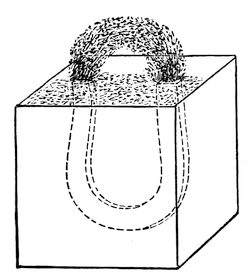
Here I have an arch of iron filings (Figure 12), built up as regularly as an iron bridge, because I have put them within a sphere of action that makes them attract each other. See — I could let a mouse run through it! And yet if I try the same thing with them here [on the table], they do not attract each other at all. It is that [the magnet] which makes them hold together.
Now, just as those iron particles hold together in the form of an arch, so do the different particles of iron that make up this nail hold together and make it one thing. And here is a bar of iron: it is held together in one mass only because its different parts are so worked as to keep close together by the attraction between the particles. It is held together, in fact, merely by the attraction of one particle to another; and that is the point I want to illustrate now.
If I take a piece of flint and strike it with a hammer and break it like this [breaking a piece off the flint], I have done nothing more than separate the particles composing these two pieces far enough apart that their attraction is too weak to hold them together; and it is only for that reason that there are now two pieces where there was one.
I will show you an experiment to prove that this attraction still exists in those particles. Here is a piece of glass — for what was true of the flint and the iron bar is true of glass and of every other solid; they are all held together in the lump by the attraction between their parts. I can show you the attraction between its separate particles: for if I take this glass, which I have reduced to a very fine powder, you see that I can actually build it up into a solid wall by pressing it between two flat surfaces. The power I have of building this wall is due to the attraction of the particles, which acts as it were as the cement holding them together; and so here, where I have taken no very great pains to bring the particles together, you see perhaps a couple of ounces of finely powdered glass standing as an upright wall.
Is not this attraction most wonderful? That bar of iron, one inch square, has such power of attraction in its particles — giving it such strength — that it will hold up twenty tons weight before the little set of particles in the small space across which it can be pulled apart will separate. In this way suspension bridges and chains are held together by the attraction of their particles. And I am going to make an experiment which will show how strong this attraction of the particles is. [The lecturer here put his foot in a loop of wire fastened to a support above, and swung with his whole weight resting on it for some moments.] You see that while I hang here all my weight is supported by these little particles of the wire, just as in the pantomimes they sometimes suspend gentlemen and damsels.
How can we make this attraction of particles a little simpler? There are many things which, brought together properly, will show it. Here is a boy's experiment — and I like a boy's experiment. Get a tobacco pipe, fill it with lead, melt the lead and pour it out onto a stone, and so get a clean piece of lead. (This is a better plan than scraping it; scraping alters the condition of the surface.) I have here some pieces of lead which I melted this morning for the sake of having them clean.
Now, these pieces of lead hold together by the attraction of their particles; and if I press these two separate pieces close together, so as to bring their particles within the sphere of attraction, you will see how soon they become one. I have only to give them a good squeeze and turn the upper piece slightly round at the same time — and here they are as one, and all the bending and twisting I can give them will not separate them again. I have joined the lead together, not with solder, but simply by the attraction of the particles.
This, however, is not the best way of bringing particles together; we have many better plans. I will show you one that does very well for young people's experiments. Here is some alum, crystallised very beautifully by nature — for all things are far more beautiful in their natural form than in their artificial one — and here I have some of the same alum broken into fine powder. In the powder I have destroyed that force whose name I have now put on the board: COHESION, the attraction exerted between the particles of bodies to hold them together.
Now I am going to show you that if we take this powdered alum and some hot water and mix them, I shall dissolve the alum: all the particles will be separated by the water far more completely than they are in the powder. But then, being in the water, they will have the opportunity, as it cools — for that is the condition which favours their coming together — of uniting again and forming one mass.
Editor's note: Crystallisation of alum. The solution must be saturated — that is, it must contain as much alum as can possibly be dissolved. In making the solution it is best to add powdered alum to hot water as long as it dissolves; and when no more is taken up, let the solution stand a few minutes and then pour it off from the dirt and undissolved alum.
Now, having got the alum into solution, I will pour it into this glass basin; and tomorrow you will find that those particles of alum which I put into the water, and so separated that they are no longer solid, will, as the water cools, come together and cohere. By tomorrow morning we shall have a great deal of the alum crystallised out — that is to say, come back to the solid form. [The lecturer here poured a little of the hot alum solution into the glass dish, and when the dish had been warmed by it, added the rest.]
I am doing here what I advise you to do if you use a glass vessel: warming it slowly and gradually. And when you repeat this experiment, do as I do — pour the liquid out gently, leaving all the dirt behind in the basin. Remember that the more carefully and quietly you make this experiment at home, the better the crystals will be. Tomorrow you will see the particles of alum drawn together; and if I put two pieces of coke into part of the solution — the coke should first be washed very clean and dried — you will find tomorrow that we have a beautiful crystallisation all over the coke, making it look exactly like a natural mineral.
Now, how curiously our ideas expand as we watch these conditions of the attraction of cohesion! How many new phenomena it gives us, beyond those of the attraction of gravitation! See how it gives us great strength. The things we deal with in putting up structures on the earth are things of strength — we use iron and stone and other strong materials. And only think that all those structures around you — think of the Great Eastern, if you like, which is of such size and power as to be almost more than man can manage — are the result of this power of cohesion and attraction.
Here is a body in which I think you will see a change taking place in its state of cohesion at the very moment it is made. It is yellow at first, and then it becomes a fine crimson red. Just watch when I pour these two liquids together, both as colourless as water. [The lecturer here mixed solutions of perchloride of mercury and iodide of potassium, and a yellow precipitate of biniodide of mercury fell, which almost immediately turned crimson red.]
There is a substance which is very beautiful — but see how it is changing colour. It was reddish-yellow at first, and now it has become red. I prepared a little of this red substance beforehand, the same that you see forming in the liquid, and have put some of it on paper. [Showing several sheets of paper coated with scarlet biniodide of mercury.] There it is, the same substance spread on paper; and there is the same substance again; and here is some more of it [showing a piece of paper as large as the others, but with very little red on it, most of it being yellow] — a little more of it, you will say.
Do not be mistaken: there is as much on the surface of the one piece of paper as on the other. What you see as yellow is the same thing as the red body, only the attraction of cohesion has been changed to a certain degree. I will take this red body and apply heat to it — you may perhaps see a little smoke rise, but that is of no consequence — and if you look at it, it will first darken; but see how it is turning yellow. I have now made it all yellow, and what is more, it will stay so. But if I take any hard substance and rub the yellow part with it, it will go straight back to the red condition. [Showing the experiment.] There it is. You see the red is not put back but brought back, by a change in the substance itself. And now [warming it over the spirit lamp] here it is turning yellow again — and all because its attraction of cohesion has been changed.
And what will you say to me when I tell you that this piece of common charcoal is just the same thing, only differently held together, as the diamonds you wear? (I have put a specimen outside of a piece of straw charred in a particular way; it looks just like black lead.) This charred straw, this charcoal and these diamonds are all of them the same substance, differing only in their properties as regards the force of cohesion.
Editor's note: Red precipitate of biniodide of mercury. A little care is necessary to obtain this precipitate. The solution of iodide of potassium should be added to the solution of perchloride of mercury (corrosive sublimate) very gradually. The red precipitate which first falls is redissolved when the liquid is stirred; when a little more of the iodide of potassium is added, a pale red precipitate is formed, which on the further addition of the iodide changes into the brilliant scarlet biniodide of mercury. If too much iodide of potassium is added, the scarlet precipitate disappears and a colourless solution is left.
Editor's note: Paper coated with scarlet biniodide of mercury. In order to fix the biniodide on paper it must be mixed with a little weak gum water and then spread over the paper, which must be dried without heat. Biniodide of mercury is said to be dimorphous — that is, able to take two different forms.
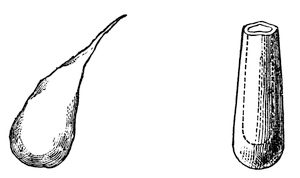
Here is a piece of glass [producing a piece of plate glass about two inches square]. I shall want this later, to look into it and examine its internal condition. And here is some of the same sort of glass, differing only in its power of cohesion, because while still molten it was dropped into cold water [showing a Prince Rupert's drop (Figure 13)]. If I take one of these little tear-shaped pieces and break off ever so little from the point, the whole thing will burst at once and fall to pieces. I will break a piece off this one now. [The lecturer nipped a small piece off the end of one of the Rupert's drops, whereupon the whole immediately fell to pieces.]
There! You see the solid glass has suddenly become powder — and more than that, it has knocked a hole in the glass vessel that was holding it. I can show the effect better in this bottle of water, and it is very likely the whole bottle will go. [A six-ounce vial was filled with water and a Rupert's drop placed in it, with the point of the tail just projecting out. On the tip being broken off, the drop burst, and the shock, transmitted through the water to the sides of the bottle, shattered it to pieces.]
Editor's note: Prince Rupert's drops. These are made by pouring drops of melted green glass into cold water. They were not, as is commonly supposed, invented by Prince Rupert, but were first brought to England by him in 1660. They excited a great deal of curiosity and were considered "a kind of miracle in nature."
Here is another form of the same kind of experiment. I have here some more glass which has not been annealed [showing some thick glass vessels (Figure 14)]. If I take one of these vessels and drop a piece of powdered glass into it — or I will take some of these small pieces of rock crystal, which have the advantage of being harder than glass — and so make the least scratch on the inside, the whole bottle will break to pieces. It cannot hold together. [The lecturer here dropped a small fragment of rock crystal into one of the vessels, and the bottom immediately came out and fell onto the plate.] There! It goes straight through, just as it would through a sieve.
Editor's note: Thick glass vessels. They are called proofs, or Bologna phials.
Now, I have shown you these things to bring your minds round to seeing that bodies are not merely held together by this power of cohesion, but that they are held together in very curious ways. Suppose I take some things that are held together by this force and examine them more closely.
I will take a piece of glass first; and if I give it a blow with a hammer I shall simply break it to pieces. You saw how it was with the flint when I broke a piece off: a similar sort of piece came away, just as you would expect; and if I broke it up further it would be, as you have seen, simply a collection of small particles of no definite shape or form.
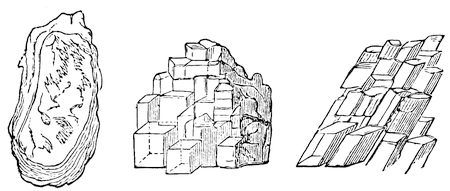
But suppose I take something else — this stone, for instance (Figure 15) [taking a piece of mica]. If I hammer this stone, I may batter it a great deal before I can break it up. I may even bend it without breaking it; that is to say, I may bend it in one particular direction without breaking it much, although I feel in my hands that I am doing it some injury. But now, if I take it by the edges, I find that it breaks up into leaf after leaf in a most extraordinary way.
Why should it break up like that? Not because all stones do, or all crystals; for here is some salt (Figure 16) — you know what common salt is. Here is a piece of salt whose particles have been brought together by natural circumstances in such a way that they had a free opportunity of combining, of coalescing. You shall see what happens when I break it. It does not break as the flint did, or as the mica did, but with a clean sharp angle and exact surfaces, beautiful and glittering as diamonds [breaking it with gentle blows of a hammer]. There is a square prism, which I can break up into a square cube. You see these fragments are all square; one side may be longer than another, but they will only split so as to form square or oblong pieces with cubical sides.
Now I go a little further, and I find another stone (Figure 17) [Iceland, or calc-spar], which I can break in a similar way but not with the same result. Here is a piece I have broken off, and you see it has plain surfaces, perfectly regular with respect to one another; but it is not cubical. It is what we call a rhomboid. It still breaks in three directions, most beautifully and regularly, with polished surfaces, but with sloping sides, not like the salt.
Why not? It is very plain that this is because the attraction of the particles for one another is less in the direction in which they give way than in other directions. I have on the table in front of me a number of little bits of calcareous spar, and I recommend each of you to take a piece home. Then you can take a knife and try to divide it along the direction of any of the surfaces that already exist; you will be able to do it at once. But if you try to cut it across the crystals you cannot: by hammering you may bruise it and break it up, but you can only divide it into these beautiful little rhomboids.
Editor's note: Mica. A silicate of alumina and magnesia. It has a bright metallic lustre — hence its name, from mico, to shine.
Editor's note: Common salt, or chloride of sodium, crystallises in the form of solid cubes, which, aggregated together, form a mass that may be broken up into the separate cubes.
Editor's note: Iceland, or calc spar. Native carbonate of lime in its primitive crystalline form.
Now I want you to understand a little more of how this comes about, and for that purpose I am going to use the electric light again. You see, we cannot look into the middle of a body like this piece of glass. We see the outside form and the inside form, and we look through it; but we cannot easily find out how those forms come to be. So I want you to take a lesson in the way we use a ray of light to see what is inside bodies.
Light is a thing which is, so to speak, attracted by every substance that gravitates — and we know of nothing that does not. All matter affects light more or less by what we may think of as a kind of attraction, and I have arranged a very simple experiment on the floor of the room to illustrate this (Figure 18). I have put a few things into that basin which those of you in the body of the theatre will not be able to see, and I am going to make use of this power that matter has of attracting a ray of light.
If Mr. Anderson pours some water gently and steadily into the basin, the water will attract the rays of light downwards, and the piece of silver and the sealing-wax will appear to rise up into the sight of those who were not high enough before to see over the side of the basin to its bottom. [Mr. Anderson here poured water into the basin, and when the lecturer asked whether anybody could see the silver and the sealing-wax, he was answered with a general yes.]
Now, I suppose everybody can see that they have not been disturbed at all; and yet, from the way they seem to have risen, you would imagine the bottom of the basin and the things in it were two inches thick, although they are only one of our small silver dishes and a piece of sealing-wax. The light that now comes to you from that piece of silver was cut off by the edge of the basin when there was no water there, and you could see nothing of it. But when we poured the water in, the rays were attracted downwards by it, over the edge of the basin, and so you were able to see the things at the bottom.
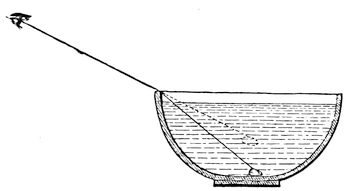
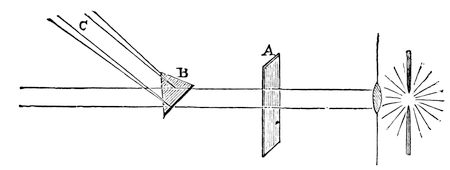
I have shown you this experiment first so that you might understand how glass attracts light, and might then see how other substances — rock salt, calcareous spar, mica and other stones — affect light. And if Dr. Tyndall will be good enough to let us use his light again, we will first show you how it can be bent by a piece of glass (Figure 19). [The electric lamp was lit again, and the beam of parallel rays it emitted was bent and decomposed by means of the prism.]
Now, here you see that if I send the light through this piece of plain glass, A, it goes straight through without being bent — unless the glass is held at an angle, and then the effect becomes more complicated. But if I take this piece of glass, B [a prism], you see it gives a very different effect. The light no longer goes to that wall; it is bent round to this screen, C. And how much more beautiful it is now [throwing the prismatic spectrum on the screen]. This ray of light is bent out of its course by the attraction of the glass upon it. And you see I can turn and twist the rays to and fro about different parts of the room, just as I please. Now it goes there, now here. [The lecturer projected the spectrum about the theatre.]
Here I have the rays bent onto the screen once more, and you see how wonderfully and beautifully that piece of glass not only bends the light by virtue of its attraction, but actually splits it up into different colours. Now, I want you to understand that this prism, being perfectly uniform in its internal structure, tells us about the action of those other bodies which are not uniform — bodies whose parts do not merely cohere, but cohere in different degrees in different directions, and so attract and bend the light with varying power.
We will now let the light pass through one or two of the things I showed you breaking so curiously; and first of all I will take a piece of mica. Here, you see, is our ray of light. We have first to make it what we call polarised, but you need not trouble yourselves about that; it is only to make our demonstration clearer. Here, then, is our polarised ray, and I can adjust it so as to make the screen it shines on either light or dark, although there is nothing in the path of the ray but what is perfectly transparent [turning the analyser round].
I will now set it so that the screen is quite dark. And first we will put a piece of common glass into the polarised ray, to show you that it does not let the light get through. You see the screen stays dark. The glass, then, has no internal effect on the light. [The glass was removed and a piece of mica introduced.]
Now, there is the mica, which we split so curiously into leaf after leaf — and see how it lets the light pass through to the screen; and how, as Dr. Tyndall turns it round in his hand, you get those different colours, pink and purple and green, coming and going most beautifully. Not because the mica is more transparent than the glass, but because of the different way its particles are arranged by the force of cohesion.
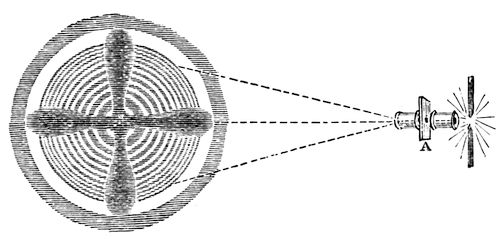
Now we will see how calcareous spar acts on this light — the stone that split into rhombs, of which you are each going to take a piece home. [The mica was removed and a piece of calc-spar introduced at A.] See how that turns the light round and round, and produces these rings and that black cross (Figure 20). Look at those colours — are they not most beautiful, for you and for me? For I enjoy these things as much as you do. In what a wonderful way they open out to us the internal arrangement of the particles of this calcareous spar by the force of cohesion.
And now I will show you another experiment. Here is that piece of glass which had no action on the light before. You shall see what it does when we apply pressure to it. Here, then, is our ray of polarised light; and first I will show you that the glass has no effect on it in its ordinary state — when I put it in the path of the light, the screen still stays dark.
Now Dr. Tyndall will press that piece of glass between three little points, one point against two, so as to put a strain on its parts; and you will see what a curious effect that has. [Two white dots gradually appeared on the screen.] Ah, those points show where the strain is. In those parts the force of cohesion is being exerted to a different degree from the rest, and so it lets the light through. How beautiful that is — how it makes the light come through in some parts and leaves it dark in others, and all because we have weakened the force of cohesion between particle and particle.
Whether you use this mechanical way of straining it, or whether we take other means, we get the same result. Indeed, I will show you by another experiment that heating the glass in one part will alter its internal structure and produce a similar effect. Here is a piece of common glass, and if I put it in the path of the polarised ray I believe it will do nothing. There is the common glass [putting it in place]: no light passes through, the screen stays quite dark.
But I am going to warm this glass in the lamp; and you know for yourselves that when you pour hot water on glass you put a strain on it sufficient sometimes to break it — something like what happened with the Prince Rupert's drops. [The glass was warmed in the spirit lamp and again placed across the ray of light.] Now you see how beautifully the light goes through the parts that are hot, making dark and light lines just as the crystal did, and all because of the alteration I have made in its internal condition. For those dark and light patches are a proof that forces are present, acting and dragging in different directions within the solid mass.
We will first go back for a few minutes to one of yesterday's experiments. You remember what we put together on that occasion — powdered alum and warm water. Here is one of the basins we used. Nothing has been done to it since; but you will find, on examining it, that it no longer holds any powder, but a multitude of beautiful crystals. Here too are the pieces of coke I put into the other basin: they have a fine mass of crystals all over them.
That other basin I shall leave as it is. I will not pour the water off, because it shows you that the particles of alum have done something more than merely crystallise together. They have pushed the dirty matter away from themselves, laying it round the outer edge of the lower crystals — squeezed out, as it were, by the strong attraction the particles of alum have for one another.
And now for another experiment. We have already learned something of the way in which the particles of bodies — of solid bodies — attract each other, and we have learned that it is this which makes calcareous spar and alum and the rest crystallise in these regular forms. Now let me lead your minds gradually to a knowledge of the means we have of altering the force of that attraction a little: of increasing it, or lessening it, or apparently destroying it altogether.
I will take this piece of iron [a rod of iron about two feet long and a quarter of an inch thick]. At present it has a great deal of strength, owing to its attraction of cohesion. But if Mr. Anderson will make part of it red hot in the fire, we shall find that it becomes soft, just as sealing-wax does when it is heated; and we shall find, too, that the hotter it gets the softer it becomes. Ah — but what does soft mean? Why, that the attraction between the particles has been so weakened that it is no longer enough to resist the power we bring to bear on it. [Mr. Anderson handed the lecturer the iron rod with one end red hot, and he showed that it could easily be twisted about with a pair of pliers.]
You see I now have no difficulty in bending this end about as I like, whereas I cannot bend the cold part at all. And you know how the smith takes a piece of iron and heats it to make it soft for his purpose. He is acting on our principle of lessening the adhesion of the particles, although he is not exactly acquainted with the terms in which we express it.
Now we have another point to examine, and water is again a very good substance to take as an illustration. (As scientists we call it all water, even when it is in the form of ice or steam.) Why is this water hard? [pointing to a block of ice] Because the attraction of the particles for each other is enough to make them hold their places against force applied to them. But what happens when we warm the ice? Why, in that case we diminish the power of attraction so far that the solid substance is destroyed altogether.
Let me illustrate this. I will take a red-hot ball of iron [Mr. Anderson handed the lecturer, with a pair of tongs, a red-hot ball of iron about two inches across], because it is a convenient source of heat [placing the red-hot iron in the middle of the block of ice]. You see I am melting the ice where the iron touches it. You see the iron sinking into it; and while part of the solid water is turning liquid, the heat of the ball is rapidly going off. A certain amount of the water is actually rising as steam: the attraction of some of the particles is so far diminished that they cannot even hold together in the liquid form, but escape as vapour. At the same time, you see I cannot melt all this ice with the heat contained in the ball. In a very short while I shall find it has become quite cold.
Here is the water we have produced by destroying some of the attraction which existed between the particles of the ice. For below a certain temperature the particles of water increase their mutual attraction and become ice; and above a certain temperature the attraction decreases and the water becomes steam. Exactly the same thing happens with platinum, and with nearly every substance in nature: raise the temperature to a certain point and it becomes liquid, and a further rise turns it into a gas.
Is it not a glorious thing to look at the sea and the rivers, and to know that this same body, in the northern regions, is all solid ice and icebergs, while here in a warmer climate its attraction of cohesion is so far lessened that it is liquid water?
Well, in lessening this force of attraction between the particles of ice we made use of another force, namely heat; and I want you to understand now that this force of heat is always involved when water passes from the solid to the liquid state — even if I melt ice in other ways, I cannot do without heat. For we have means of making ice liquid without heat, that is to say without using heat as the direct cause.
Suppose, by way of illustration, I make a vessel out of this piece of tinfoil [bending the foil up into the shape of a dish]. I am making it of metal because I want the heat I am about to deal with to pass readily through it. Now I will pour a little water onto this board and set the tin vessel on it. If I put some ice into the metal dish and then set about making it liquid by any of the various means at our command, it must still take the necessary quantity of heat from something — and in this case it will take it from the tray, and from the water underneath, and from the other things round about.
Now, a little salt added to the ice has the power of making it melt; and we shall very shortly see the mixture become quite fluid, and you will then find that the water beneath has frozen — frozen because it has been forced to give up the heat that kept it liquid to the ice that is becoming liquid.
I remember, when I was a boy, hearing of a trick in a country alehouse. The point was how to melt ice in a quart pot by the fire and freeze the pot to the stool. The way they did it was this: they put some pounded ice in a pewter pot and added salt to it, and the consequence was that when the salt was mixed in, the ice in the pot melted. (They told me nothing about the salt, and they set the pot by the fire just to make the result more mysterious.) In a short time the pot and the stool were frozen together — as we shall very shortly find is the case here. And all because salt has the power of lessening the attraction between the particles of ice. Here you see the tin dish is frozen to the board; I can even lift this little stool up by it.
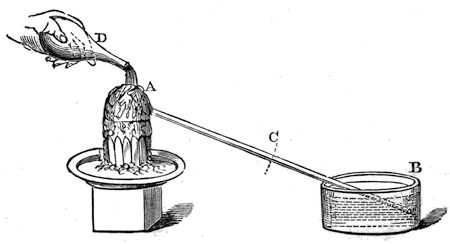
This experiment cannot, I think, fail to impress on your minds the fact that whenever a solid body loses some of the force of attraction that keeps it solid, heat is absorbed; and that if, on the other hand, we turn a liquid into a solid — water into ice, say — a corresponding amount of heat is given out.
I have an experiment showing this to be so. Here (Figure 21) is a bulb, A, filled with air, whose tube dips into some coloured liquid in the vessel B. I dare say you know that if I put my hand on the bulb A and warm it, the coloured liquid now standing in the tube at C will travel forward. Now, by great care and much research into the properties of various bodies, we have found a way of preparing a solution of a salt which, if it is shaken or disturbed, will at once become solid. And, as I explained just now — for what is true of water is true of every other liquid — because it becomes solid, heat is given out. I can make this evident to you by pouring it over this bulb. There! It is becoming solid; and look at the coloured liquid, how it is being driven down the tube, and how it is bubbling out through the water at the end.
And so we learn this beautiful law of our science: that whenever we lessen the attraction of cohesion, heat is absorbed, and whenever we increase that attraction, heat is given out. This is a great step forward, for you have now learned a great deal more than the mere fact that particles attract each other.
But you must not now suppose that because bodies are liquid they have lost their attraction of cohesion. Here is fluid mercury; and if I pour it from one vessel into another, I find it forms a stream from the bottle down to the glass — a continuous rod of fluid mercury, whose particles have attraction enough to hold together all the way through the air down to the glass. And if I pour water quietly from a jug, I can make it run in a continuous stream in the same way.
Again, let me put a little water on this piece of plate glass and then take another plate and lay it on the water. There! The upper plate is quite free to move, gliding about on the lower one from side to side; and yet, if I take hold of the upper plate and lift it straight up, the cohesion is so great that the lower one is held up with it. See how it slides about as I move the upper one! And all of that is owing to the strong attraction of the particles of the water.
Let me show you another experiment. I will take a little soap and water — not that the soap makes the particles of water more adhesive to each other, but it certainly has the power of maintaining the attraction of the particles better. (And let me advise you, when you are about to experiment with soap bubbles, to take care to have everything clean and soapy.)
I will now blow a bubble; and so that I may be able to talk and blow a bubble at the same time, I will take a plate with a little of the soapsuds in it, soap the edge of the pipe, and blow a bubble onto the plate. Now, there is our bubble. Why does it hold together like that? Because the water it is made of has an attraction of particle for particle — so great, indeed, that it gives this bubble the very power of a rubber ball. For you see, if I put one end of this glass tube into the bubble, it has the power of contracting so strongly as to force enough air through the tube to blow out a light (Figure 22). The light is blown out. And look — see how the bubble is disappearing, see how it is getting smaller and smaller.
Editor's note: Solution of a salt. Acetate of soda. A solution saturated, or nearly so, at the boiling point is necessary; and it must be allowed to cool and remain at rest until the experiment is made.
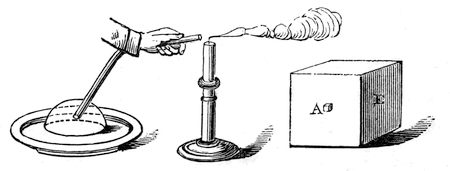
There are twenty other experiments I might show you to illustrate this power of cohesion in the particles of liquids. For instance, what would you suggest to me if, having lost the stopper out of this alcohol bottle, I wanted to close it quickly with something near at hand? Well, a bit of paper would not do; but a piece of linen cloth would, or some of this cotton wool I have here. I will put a tuft of it into the neck of the alcohol bottle; and you see, when I turn it upside down, that it is perfectly well stoppered so far as the alcohol is concerned. The air can pass through, but the alcohol cannot.
And if I took an oil vessel, this plan would do equally well; for in former times they used to send us oil from Italy in flasks stoppered with nothing but cotton wool. (Nowadays the cotton is put in after the oil arrives here, but formerly it used to be sent stoppered that way.) Now, if it were not for the particles of liquid cohering together, this alcohol would run out; and if I had time I could have shown you a vessel with its top, bottom and sides all made like a sieve, which will nevertheless hold water, owing to this cohesion.
You have now seen that solid water can be made fluid by adding heat, because that lessens the attractive force between its particles; and yet you see there is a good deal of attractive force left behind. I want now to take you a step further. We saw that if we go on applying heat to the water — as indeed happened with our piece of ice here — we do at last break up the attraction which holds the liquid together.
I am going to take some ether to illustrate what happens when this cohesion is broken up. Any other liquid would do, but ether makes a better experiment for my purpose. This liquid ether, exposed to a very low temperature, will become a solid; but if we apply heat to it, it becomes vapour, and I want to show you the enormous bulk of the substance in this new form. When we turn ice into water we lessen its bulk; but when we turn water into steam we increase it enormously.
It is very clear that as I apply heat to the liquid I diminish its attraction of cohesion. It is boiling now, and I will set fire to the vapour, so that you can judge the space the ether occupies in this form from the size of its flame. You see now what an enormously bulky flame I get from that small volume of ether below. The heat from the spirit lamp is now being spent not on making the ether any warmer, but on turning it into vapour. And if I wanted to catch this vapour and condense it — as I could without much difficulty — I should have to do the same as if I wished to turn steam into water and water into ice: in either case I should have to increase the attraction of the particles, by cold or otherwise.
So greatly is the bulk occupied by the particles increased when we give them this diminished attraction, that if I took a portion of water one cubic inch in bulk (A, Figure 23), I should get a volume of steam of that size, B [1,700 cubic inches, nearly a cubic foot] — so greatly is the attraction of cohesion diminished by heat. And yet it is still water. You can easily imagine the consequences of this change of volume by heat: the mighty powers of steam, and the tremendous explosions sometimes produced by this force of water.
I want you now to see another experiment which will perhaps give you a better idea of the bulk a body occupies in the state of vapour. Here is a substance we call iodine, and I am about to put this solid body into the same condition as regards heat as I did the water and the ether. [Putting a few grains of iodine into a hot glass globe, which immediately filled with violet vapour.] You see the same kind of change produced. And it gives us the chance of noticing how beautiful the violet-coloured vapour from this black substance is — or rather, the mixture of the vapour with air; for I would not have you understand that this globe is entirely filled with the vapour of iodine.
If I had taken mercury and turned it into vapour, as I easily could, I should have a perfectly colourless vapour. For you must understand this about vapours: that bodies in what we call the vaporous or gaseous state are always perfectly transparent, never cloudy or smoky. They are, however, often coloured; and we can frequently get coloured vapours or gases produced by colourless particles mixing together, as in this case. [The lecturer here inverted a glass cylinder full of binoxide of nitrogen over a cylinder of oxygen, and the dark red vapour of hyponitrous acid was produced.]
Here too you see an excellent illustration of the effect of a power of nature we have not yet come to, but which stands next on our list: CHEMICAL AFFINITY. And so you see we can have a violet vapour, or an orange vapour, or various other kinds of vapour; but they are always perfectly transparent, or else they would cease to be vapours.
Editor's note: Binoxide of nitrogen and hyponitrous acid. Binoxide of nitrogen is formed when nitric acid and a little water are added to some copper turnings. It produces deep red fumes as soon as it comes into contact with the air, by combining with the oxygen of the air to form hyponitrous acid. Binoxide of nitrogen is composed of two parts oxygen and one part nitrogen; hyponitrous acid is composed of one part nitrogen and three parts oxygen.
I am now going to take you a step beyond this business of the attraction of particles for one another. You see we have come to understand that if we take water as our example — whether it is ice, or water, or steam — we are always to think of it as water. Well, now prepare your minds to go a little deeper into the subject.
We have means of searching into the constitution of water beyond anything the action of heat can give us; and among these, one of the most important is that force we call voltaic electricity, which we used at our last meeting to get light, and which we carried about the room on these wires. This force is produced by the battery behind me, which I will not describe more particularly just now; before we have finished we shall know more about this battery, but it must grow up in our knowledge as we go along.
Now, here (Figure 24) is a quantity of water in this little vessel C; and besides the water there are two plates of platinum connected to the wires A and B that come outside. I want to examine that water, and the state and arrangement of its particles. If I applied heat to it you know what we should get: it would take the state of vapour, but it would still be water, and would return to the liquid state as soon as the heat was taken away.
But by means of these wires — connected to the battery behind me, coming under the floor and up through the table — we shall have a certain amount of this new power at our disposal. Here you see it is [making the ends of the wires touch]: that is the electric light we used yesterday. And by means of these wires we can make water submit itself to this power; for the moment I put them into metallic connection at A and B, you see the water boiling in that little vessel C, and you hear the bubbling of the gas going along the tube D.
See how I am turning the water into vapour. And if I take a little vessel, E, fill it with water and put it in the trough over the end of the tube D, there goes the vapour, rising into the vessel. And yet that is not steam; for you know that if steam were brought near cold water it would at once condense and go back to being water. This cannot be steam, then, because it is bubbling up through the cold water in this trough. But it is a vaporous substance, and we must examine it carefully to see in what way the water has been changed. And to give you a proof that it is not steam, I am going to show you that it is combustible; for if I take this small vessel to a light, the vapour inside explodes in a way that steam never could.
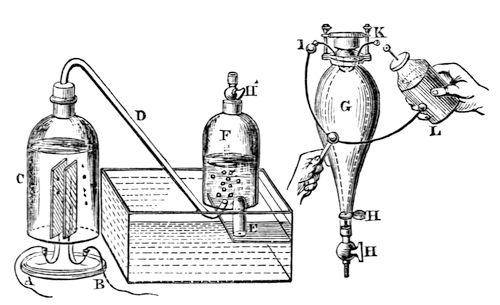
I will now fill this large bell jar, F, with water, and let the gas rise up into it; and then I shall show you that we can get the water back again out of the vapour, or air, collected there. Here is a strong glass vessel, G, into which we will let the gas from F pass. We will fire it there by an electric spark, and then after the explosion you will find we have the water back again. It will not be much, though, for you will remember I showed you how small a quantity of water produces a very large volume of vapour.
Mr. Anderson will now pump all the air out of this vessel G; and when I have screwed it onto the top of our jar of gas F, you will see, on opening the stopcocks, that the water jumps up, showing that some of the gas has passed into the glass vessel. I will now shut these stopcocks, and we shall be able to send the electric spark through the gas by means of the wires I and K in the upper part of the vessel; and you will see it burn with a most intense flash. [Mr. Anderson here brought a Leyden jar, which he discharged through the enclosed gas by means of the wires I and K.]
You saw the flash. And now, so that you may see there is no gas left, if I put the vessel over the jar and open the stopcocks again, up goes more gas, and we can have a second explosion. I might go on again and again like this, accumulating more and more of the water that the gas has turned back into. Now, is this not curious? In this vessel C we can go on making a large bulk of what we call permanent gas out of water, and then we can turn it back into water in this way.
[Mr. Anderson brought in another Leyden jar which, for some reason, would not fire the gas. It was therefore recharged, and the explosion took place as desired.] How beautifully we get our results when we go about it rightly! It is not that Nature is wrong when we make a mistake. Now, I will lay this vessel G down here by my right hand, and you can examine it by and by. There is not very much water running down it, but quite enough for you to see.
Another wonderful thing about this way of changing the condition of water is that we are able to get the separate parts it is made of at a distance from each other, and to examine them, and see what they are like and how much there is of each. For this purpose I have some more water here in an apparatus slightly different from the last (Figure 25); and if I connect this to the wires of the battery at A and B, I shall get a similar decomposition of the water at the two platinum plates.
Now, I will put this little tube O over there, and it will collect the gas coming from this side, A; and this tube H will collect the gas coming from the other side, B. I think we shall soon see a difference. In this apparatus the wires are a good way apart, and it now appears that each of them is able to draw particles out of the water and send them off — and you see that one set of particles, at H, is coming off twice as fast as the other, at O.
Something is coming out of the water there, at H, which burns [setting fire to the gas]. But what comes out of the water here, at O, although it will not burn itself, will support burning very vigorously. [The lecturer here put a match with a glowing tip into the gas, and it immediately rekindled.]
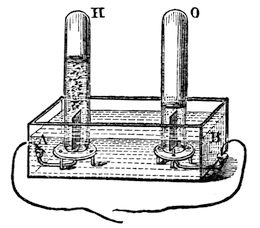
Here, then, we have two things, neither of them water, which we have got out of water. Water is therefore composed of two substances different from itself, which appear in separate places when it is made to submit to the force I have in these wires. And if I take an inverted tube of water and collect this gas from H, you will see it is by no means the same as the gas we collected in the earlier apparatus. That exploded with a loud noise when it was lit; this will burn quite silently. It is called hydrogen; and the other we call oxygen — the gas which so beautifully brightens all burning but does not burn itself.
So now we see that water consists of two kinds of particles which attract each other in a very different manner from the attraction of gravitation or of cohesion; and this new attraction we call chemical affinity, or the force of chemical action between different bodies. We are no longer concerned with the attraction of iron for iron, water for water, wood for wood, or of like bodies for one another, as we were when we were dealing with the force of cohesion. We are dealing with another kind of attraction: the attraction between particles of different natures. Chemical affinity depends entirely on the energy with which particles of different kinds attract each other. Oxygen and hydrogen are particles of different kinds, and it is their attraction for one another that makes them combine chemically and produce water.
I must now show you a little more fully what chemical affinity is. I can prepare these gases from other substances besides water, and we will now prepare some oxygen. Here is another substance containing oxygen: chlorate of potash. I will put some of it into this glass retort and Mr. Anderson will apply heat to it. We have several jars here filled with water; and when the heat has decomposed the chlorate of potash, we will drive the water out and fill the jars with gas.
Now, when water is opened out this way by means of the battery — which adds nothing to it materially and takes nothing from it materially (I mean no matter; I am not speaking of force) — it is changed in this way: the gas you saw burning a little while ago, hydrogen, is given off in large quantity, and the other gas, oxygen, in only half the quantity. So these two areas represent water, and these are always the proportions between the two gases:
        By volume                 By weight
            Oxygen . . 1              Oxygen . . . .  88.9
            Hydrogen . 2              Hydrogen . . .  11.1
                                                     ------
                                      Water  . . . . 100.0
But oxygen is sixteen times the weight of the other — eight times as heavy as the hydrogen in the water. So you know that water is composed of nine parts by weight: one of hydrogen and eight of oxygen, thus:
        Hydrogen  . . . .  46.2 cubic inches  =  1 grain
        Oxygen  . . . . .  23.1 cubic inches  =  8 grains
                          ------------------    ---------
        Water (steam) . .  69.3 cubic inches  =  9 grains
Now, Mr. Anderson has prepared some oxygen, and we will go on to examine the character of this gas. First of all, you remember I told you that it does not burn, but that it affects the burning of other bodies. I will set fire to the point of this little piece of wood and then plunge it into the jar of oxygen, and you will see what this gas does to increase the brilliance of the burning. It does not burn — it does not catch fire as hydrogen would — but see how vividly the burning of the match goes on.
Again, if I take this wax taper, light it and turn it upside down in the air, it will in all probability put itself out, because the wax runs down into the wick. [The lecturer here turned the lighted taper upside down, and in a few seconds it went out.] That will not happen in oxygen gas; you will see how differently it behaves (Figure 26). [The taper was lit again, turned upside down, and then put into a jar of oxygen.] Look at that! See how the wax itself burns and falls in a dazzling stream of fire, so powerfully does the oxygen support the burning.
Here is another experiment which will illustrate the force, if I may call it that, of oxygen. I have here a circular flame of spirits of wine, and with it I am going to show you the way iron burns, because it will serve very well for a comparison between the effect of air and the effect of oxygen. Holding this ring of flame, I can shake fine particles of iron filings down through it with a sieve, and you will see the way they burn. [The lecturer here shook some iron filings through the flame, and they took fire and fell through in beautiful scintillations.]
But if I now hold the flame over a jar of oxygen — [the experiment was repeated over a jar of oxygen, and the burning of the filings as they fell into it became almost unbearably brilliant] — you see how wonderfully different the effect is in the jar, because there we have oxygen instead of common air.
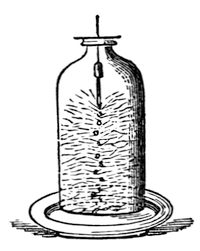
We shall have to pay a little more attention to the forces existing in water before we can have a clear idea of the subject. Besides the attraction between its particles which makes it hold together as a liquid or a solid, there is another force, different from that one — the force we overcame yesterday by means of the voltaic battery, drawing two different substances out of the water, which, when heated by the electric spark, attracted each other and rushed into combination to make water again.
I propose today to go on with this subject and to trace the various phenomena of chemical affinity. Yesterday we considered the character of oxygen, of which I have two jars here — oxygen being those particles got from water which enable other bodies to burn. We will now consider the other constituent of water; and, without troubling you too much with the way these things are made, I will show you our common method of making hydrogen. (I called it hydrogen yesterday; it is so called because it helps to generate water — from the Greek hudor, "water", and gennao, "I generate".) I put some zinc, water and oil of vitriol into this retort, and immediately an action begins which produces an abundant flow of gas, now coming over into this jar and bubbling up exactly like the oxygen we got yesterday.
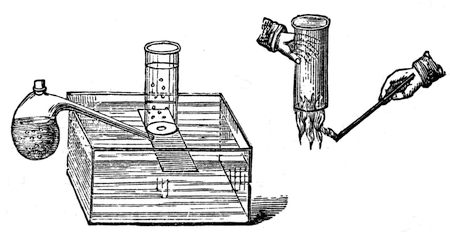
The processes, you see, are very different, though the result is the same, in that each gives us certain gaseous particles. Here, then, is the hydrogen. I showed you some qualities of this gas yesterday; now let me show you some others. Unlike oxygen, which supports burning but will not burn itself, hydrogen is itself combustible. There is a jar full of it; and if I carry it along like this and put a light to it, I think you will see it take fire — not with a bright light; at all events you will hear it, if you do not see it.
Now, that is a body entirely different from oxygen: it is extremely light. Although yesterday you saw twice as much of this hydrogen produced on the one side as oxygen on the other by the voltaic battery, it was only one-eighth the weight of the oxygen. I am carrying this jar upside down. Why? Because I know it is a very light body, and that it will stay in this jar upside down quite as effectively as water stays in a jar the right way up. And just as I can pour water from one vessel into another held in the right position to receive it, so I can pour this gas from one jar into another when they are both upside down.
See what I am about to do. There is no hydrogen in this jar at present, but I will gently turn this jar of hydrogen up underneath the other one (Figure 28), and then we will examine the two. On applying a light we shall find that the hydrogen has left the jar it was in at first and has poured upwards into the other, and there we shall find it.
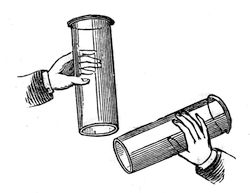
You now understand that we can have particles of very different kinds, and that they can have different bulks and weights; and there are two or three very interesting experiments which illustrate this. For instance, if I blow soap bubbles with the breath from my mouth, you will see them fall, because I fill them with common air and the water forming the bubble carries it down. But now, if I breathe hydrogen gas into my lungs — it does them no harm, though it does them no good either — see what happens. [The lecturer breathed in some hydrogen and, after one or two unsuccessful attempts, succeeded in blowing a splendid bubble, which rose majestically and slowly to the ceiling of the theatre, where it burst.]
That shows you very well how light a substance this is; for in spite of all the heavy bad air from my lungs and the weight of the bubble itself, you saw how it was carried up.
I want you now to think about this business of weight as showing how exceedingly different particles are from one another; and I will take as illustrations these very common things — air, water, the heaviest body, platinum, and this gas — and let you see how they differ in this respect. For if I take a piece of platinum of that size (Figure 29), it weighs as much as the portions of water, air and hydrogen whose bulks I have represented by these spheres. That illustration gives you a very good idea of the extraordinary difference in gravity between things which differ so enormously in bulk. [The following table, relating to this illustration, appeared on the diagram board.]
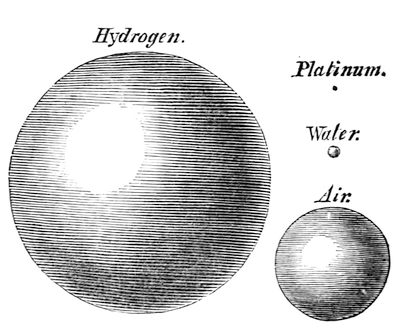
        Weights of equal bulks
                          against    against   against
                          hydrogen     air      water
        Hydrogen  . . . .        1
        Air . . . . . . .     14.4        1
        Water . . . . . .   11,943      829         1
        Platinum  . . . .  256,774   17,831      21.5
Whenever oxygen and hydrogen unite they produce water; and you have seen the extraordinary difference between the bulk and appearance of the water so produced and of the particles it chemically consists of. Now, we have never yet been able to reduce either oxygen or hydrogen to the liquid state; and yet their first impulse, when chemically combined, is to take up first this liquid condition and then the solid one.
We never combine these different particles without producing water; and it is curious to think how often you must have made the experiment of combining oxygen and hydrogen to form water without knowing it. Take a candle, for instance, and a clean silver spoon — or a piece of clean tin will do — and if you hold it over the flame you immediately cover it with dew, not with smoke, and the dew presently evaporates. This will perhaps show it better. Mr. Anderson will put a candle under that jar, and you will see how soon the water appears (Figure 30). Look at that dimness on the sides of the glass, which will soon gather into drops and trickle down into the plate. That dimness and those drops are water, formed by the union of the oxygen of the air with the hydrogen that exists in the wax the candle is made of.
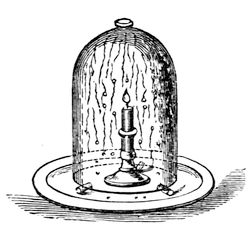
And now, having brought you first to the idea of chemical attraction, I must enlarge your notions so as to include all substances that have this attraction for one another. For it changes the character of bodies, and alters them this way and that in the most extraordinary manner, and produces other phenomena that are wonderful to think about.
Here is some chlorate of potash, and there some sulphuret of antimony. We will mix these two different sets of particles together; and I want to show you, in a general way, some of the things that happen when we make different particles act on one another. I can make these bodies act on each other in several ways. In this case I am going to apply heat to the mixture; but if I struck it with a hammer, the same thing would follow. [A lighted match was brought to the mixture, which immediately exploded with a sudden flash, giving off a dense white smoke.]
There you see the result of chemical affinity overcoming the attraction of cohesion between the particles. Again, here is a little sugar, quite a different substance from the black sulphuret of antimony, and you shall see what happens when we put the two together. [The mixture was touched with sulphuric acid, whereupon it caught fire and burnt gradually, with a brighter flame than in the previous case.] Observe this chemical affinity travelling about the mass, setting it on fire and throwing it into such wonderful agitation.
Editor's note: Chlorate of potash and sulphuret of antimony. Great care must be taken in mixing these substances, as the mixture is dangerously explosive. They must be powdered separately and mixed together with a feather on a sheet of paper, or by passing them several times through a small sieve.
Editor's note: The mixture of chlorate of potash and sugar does not require the same precautions. They may be rubbed together in a pestle and mortar without fear. One part of chlorate of potash to three parts of sugar will answer. The mixture need only be touched with a glass rod dipped in oil of vitriol.
I must now come to a few circumstances which need careful consideration. We have already examined one of the effects of chemical affinity, but to make the matter clearer we must point out some others.
Here are two salts dissolved in water. Both are colourless solutions, and in these glasses you cannot see any difference between them. But if I mix them, chemical attraction will take place. I will pour the two together into this glass, and you will at once see, I have no doubt, a certain amount of change. Look — they are already becoming milky; but they are sluggish about it, not quick as the others were, for there are endless varieties of speed in chemical action.
Now, if I mix them and stir them, so as to bring them properly together, you will soon see how different the result is. As I mix them they get thicker and thicker, and you see the liquid hardening and stiffening; before long I shall have it quite hard, and before the end of the lecture it will be a solid stone — a wet stone, no doubt, but more or less solid — all in consequence of chemical affinity. Is not this changing of two liquids into a solid body a wonderful manifestation of it?
Editor's note: Two salts dissolved in water. Sulphate of soda and chloride of calcium. The solutions must be saturated for the experiment to succeed well.
There is another remarkable thing about chemical affinity, which is that it is able either to wait or to act at once. This is very singular, because we know nothing of the kind in the forces of gravitation or cohesion.
For instance, here are some oxygen particles, and here is a lump of carbon particles. I am going to put the carbon into the oxygen. They can act, but they do not — they are just like this unlighted candle, which stands here quietly on the table waiting until we want to light it. But it is not so in this other case. Here is a substance, gaseous like the oxygen; and if I put these particles of metal into it, the two combine at once. The copper and the chlorine unite by their power of chemical affinity and produce a body entirely unlike either of the substances used.
And in the other case it is not that there is any lack of affinity between the carbon and the oxygen; for the moment I choose to put them in a condition to exert their affinity, you will see the difference. [The piece of charcoal was lit and put into the jar of oxygen, where the burning went on with vivid scintillations.]
Now, this chemical action is set going exactly as it would be if I lit the candle, or as it is when the servant puts on coals and lights the fire: the substances wait until we do something able to start the action. Can anything be more beautiful than this burning of charcoal in oxygen? You must understand that each of these little sparks is a portion of the charcoal, or of the bark of the charcoal, thrown off white hot into the oxygen and burning there most brilliantly, as you see.
And now let me tell you another thing, or you will go away with a very imperfect notion of the powers and effects of this affinity. There you see charcoal burning in oxygen. Well, a piece of lead will burn in oxygen just as well as the charcoal does — better, indeed; for that piece of lead will act on the oxygen at once, as the copper did in the other vessel with the chlorine. And here is a piece of iron: if I light it and put it into the oxygen, it will burn away just as the carbon did.
I will take some lead and show you that it will burn in the ordinary oxygen of the atmosphere at ordinary temperature. These are the lumps of lead we had the other day, you remember — the two pieces that clung together. Now, if I take these pieces today and press them together they will not stick; and the reason is that they have drawn to themselves part of the oxygen present in the atmosphere and have become coated, as if with a varnish, by the oxide of lead formed on the surface by a real process of burning, of combination.
There you see the iron burning very well in oxygen; and I will tell you why those scissors and that lead do not catch fire while they lie on the table. Here the lead is in a lump and the coating of oxide stays on its surface; whereas there you see the melted oxide clearing itself off the iron and letting more and more of it go on burning.
In this case, however [holding up a small glass tube containing lead pyrophorus], the lead has been very carefully produced as a fine powder, put into a glass tube and hermetically sealed to preserve it; and I expect you will see it take fire at once. This was made about a month ago and has therefore had time enough to sink to its normal temperature. What you see is therefore the result of chemical affinity alone. [The tube was broken at the end and the lead poured out onto a piece of paper, whereupon it immediately took fire.]
Look, look at the lead burning — why, it has set fire to the paper! Now, that is nothing more than the ordinary affinity which always exists between very clean lead and the oxygen of the atmosphere. And the reason this iron does not burn until it is made red hot is that it has a coating of oxide about it which stops the action of the oxygen — putting a varnish, as it were, on its surface, as we varnish a picture, forming a substance which absolutely prevents the natural chemical affinity between the bodies from acting.
Editor's note: Lead pyrophorus. This is a tartrate of lead which has been heated in a glass tube to dull redness for as long as vapours are given off. As soon as they stop being evolved, the end of the tube is sealed and it is allowed to cool.
I must now take you a little further in this kind of illustration — or consideration, as I would rather call it — of chemical affinity. This attraction between different particles exists, very curiously, even in cases where they are already combined with other substances.
Here is a little chlorate of potash, containing the oxygen which we found yesterday could be got out of it. It holds that oxygen combined and held down by its chemical affinity with other things; and yet it can still combine with sugar, as you saw. This affinity can act across substances, then; and I want you to see how curiously what we call combustion behaves with respect to this force.
If I take a piece of phosphorus, set fire to it and then put a jar of air over it, you see the burning going on there on account of chemical affinity — combustion being in every case the result of chemical affinity. The phosphorus is escaping in that vapour, which will settle into a snow-like mass by the end of the lecture. But suppose I limit the atmosphere: what then? Why, even the phosphorus will go out.
Here is a piece of camphor, which burns very well in the open air; it will even float about on water and burn there, because some of its particles get access to the air. But if I limit the quantity of air by putting a jar over it, as I am doing now, you will soon find the camphor goes out. Why does it go out? Not for want of air, because there is plenty of air left in the jar. Perhaps you will be shrewd enough to say: for want of oxygen.
This leads us to ask whether oxygen can do more than a certain amount of work. The oxygen in that jar (Figure 30) cannot go on burning an unlimited quantity of candle, for the candle has gone out, as you see. Its amount of chemical attraction, or affinity, is just as strikingly limited: it can no more be fallen short of, or exceeded, than the attraction of gravitation can. You might as soon attempt to destroy gravitation, or weight, or all the things that exist, as to alter the exact amount of force this oxygen exerts.
And when I pointed out to you that 8 by weight of oxygen goes with 1 by weight of hydrogen to make water, I meant this: that neither of them will combine with the other in any other proportion. You cannot get 10 of hydrogen to combine with 6 of oxygen, or 10 of oxygen with 6 of hydrogen. It must be 8 of oxygen and 1 of hydrogen.
Now suppose I limit the action in this way. This piece of cotton wool burns very well in the air, as you see. I have known cases of cotton mills being fired as if with gunpowder, through very finely divided particles of cotton being scattered through the air of the mill; a flame has sometimes caught these floating particles and run from one end of the mill to the other and blown it up. That is on account of the affinity the cotton has for oxygen.
But suppose I set fire to this piece of cotton, which is rolled up tightly: it does not go on burning, because I have limited the supply of oxygen, and the inside is prevented from reaching the oxygen — just as the lead was by its coat of oxide.
Here, though, is some cotton which has had oxygen worked into it in a certain way. I need not trouble you now with how it is prepared; it is called guncotton. See how that burns [setting fire to a piece]. It is very different from the other, because the oxygen that has to be present in its proper amount is put there beforehand.
I have here some pieces of paper prepared like the guncotton, soaked in bodies containing oxygen. Here is one soaked in nitrate of strontia — you will see the beautiful red of its flame. Here is another which I think contains baryta, which gives that fine green light. And here is some more soaked in nitrate of copper; it does not burn quite so brightly, but still very beautifully. In all these cases the burning goes on independently of the oxygen of the atmosphere.
And here is some gunpowder in a case, to show that it can burn under water. You know we put it into a gun, shutting the air out with the shot, and yet the oxygen the powder contains supplies the particles with the thing without which chemical action could not go on. I have a vessel of water here, and I am going to make the experiment of putting this fuse under the water, and you shall see whether the water can put it out. Here it is burning out of the water — and there it is burning under the water; and so it will go on until it is spent, all because the necessary amount of oxygen is contained within the substance itself.
It is by this kind of attraction of different particles for one another that we are able to trace the laws of chemical affinity, and the wonderful variety of ways in which those laws are exerted.
Editor's note: Guncotton is made by immersing cotton wool in a mixture of sulphuric acid and the strongest nitric acid, or of sulphuric acid and nitrate of potash.
Editor's note: Paper prepared like guncotton. It should be bibulous paper, and must be soaked for ten minutes in a mixture of ten parts by measure of oil of vitriol with five parts of strong fuming nitric acid. The paper must afterwards be thoroughly washed with warm distilled water and then carefully dried at a gentle heat. It is then saturated with chlorate of strontia, or chlorate of baryta, or nitrate of copper, by immersion in a warm solution of these salts.
Now, I want you to notice that one great exertion of this power known as chemical affinity is to produce HEAT and light. No doubt you know as a matter of fact that when bodies burn they give out heat. But it is a curious thing that this heat does not continue: the heat goes away as soon as the action stops, and you see from that how it depends on the action while it is going on.
It is not so with gravitation. That force is continuous, and is just as effective in making that lead press on the table as it was when the lead first fell there. Nothing happens there which disappears when the falling is over; the pressure is on the table and will remain until the lead is removed. Whereas with the action of chemical affinity in giving light and heat, they go away the moment the action is over. This lamp seems to give out heat and light continuously, but that is because of a constant stream of air coming into it on all sides; and this work of producing light and heat by chemical affinity will stop as soon as the stream of air is interrupted.
What, then, is this curious condition of heat? It is the evolution of another power of matter — a power new to us, and one we must consider as though it were now being brought to our notice for the very first time. What is heat? We recognise heat by its power of liquefying solid bodies and vaporising liquid ones, and by its power of setting chemical affinity in action and very often overcoming it.
Then how do we obtain heat? We obtain it in various ways: most abundantly by means of the chemical affinity we have just been speaking of, but in many other ways too. Friction will produce heat. The Indians rub pieces of wood together until they get hot enough to take fire; and such things have been known as two branches of a tree rubbing together hard enough to set the tree alight. I do not suppose I shall set these two pieces of wood on fire by friction, but I can easily produce heat enough to ignite some phosphorus. [The lecturer here rubbed two pieces of cedar wood hard against each other for a minute, and then laid a piece of phosphorus on them, which immediately took fire.]
And if you take a smooth metal button stuck on a cork and rub it on a piece of soft deal, you will make it hot enough to scorch wood and paper and to light a match.
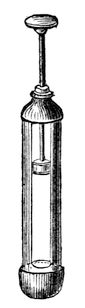
I am now going to show you that we can get heat not only by chemical affinity but by the pressure of air. Suppose I take a pellet of cotton, moisten it with a little ether and put it into a glass tube (Figure 31), and then take a piston and press it down suddenly. I expect I shall be able to burn a little of that ether inside the vessel. It needs a suddenness of pressure, or we shall not get what we want. [The piston was forcibly pressed down, and a flame, from the burning of the ether, was visible in the lower part of the syringe.] All we need is to get a little ether in vapour and to give fresh air each time; and so we can go on again and again, getting heat enough by compressing the air to fire the ether vapour.
This, I think, together with everything you have seen before, will be enough to show you how we get heat. And now for the effects of this power. We need not consider many of them on this occasion, because when you have seen its power of changing ice into water and water into steam, you have seen the two principal results of applying heat.
I want you now to see how it expands all bodies — all bodies but one, and that under limited circumstances. Mr. Anderson will hold a lamp under that retort, and you will see the moment he does so that air issues abundantly from the neck, which is under water, because the heat he is applying to the air makes it expand.
And here is a brass rod (Figure 32) which goes through that hole, and also fits accurately into this gauge. But if I warm it with this spirit lamp, it will only go into the gauge or through the hole with difficulty; and if I put it into boiling water it would not go through at all.
Again, as soon as heat escapes from bodies they collapse. See how the air is contracting in the vessel now that Mr. Anderson has taken his lamp away: the stem is filling with water. And notice, too, that although I cannot get the rod through this hole or into the gauge now, the moment I cool it by dipping it in water it goes through with perfect ease. So we have a perfect proof of this power of heat to contract and expand bodies.
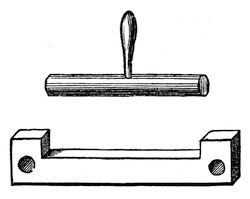
I wonder whether we shall be too deep today or not. Remember that we spoke of the attraction of all bodies to all bodies by gravitation, simply on approaching one another. Remember that we spoke of the attraction of particles of the same kind for each other — the power that keeps them together in masses, iron attracted to iron, brass to brass, water to water. And remember that we found, on looking into water, that there were particles of two different kinds attracted to each other; and that this was a great step beyond the first simple attraction of gravitation, because here we were dealing with attraction between different kinds of matter. The hydrogen could attract the oxygen and make water with it, but it could not attract any of its own particles. So there we got our first indication of the existence of two attractions.
Today we come to a kind of attraction more curious still: one which we find to be of a double nature — of a curious dual nature. And first of all I want to make the nature of that doubleness clear to you.
Bodies are sometimes endowed with a wonderful attraction which is not found in them in their ordinary state. Here, for instance, is a piece of shellac. It has the attraction of gravitation and the attraction of cohesion; and if I set fire to it, it would have the attraction of chemical affinity for the oxygen of the air. All these powers we find in it as though they were parts of its substance.
But there is another property, which I will try to make evident by means of this ball, this bubble of air [a light rubber ball, inflated and hung by a thread]. At present there is no attraction between this ball and this shellac; there may be a little draught in the room moving the ball slightly, but there is no attraction. But if I rub the shellac with a piece of flannel [rubbing the shellac and then holding it near the ball] — look at the attraction that has arisen in the shellac simply from this rubbing, and which I can take away just as easily by drawing it gently through my hand. [The lecturer repeated the experiment of exciting the shellac and then removing the attractive power by drawing it through his hand.]
And you will see I can repeat the experiment with another substance. If I take a glass rod and rub it with a piece of silk covered with what we call amalgam, look at the attraction it has, how it draws the ball towards it; and then, as before, by quietly rubbing it through my hand the attraction is all removed again — to come back on rubbing it with this silk.
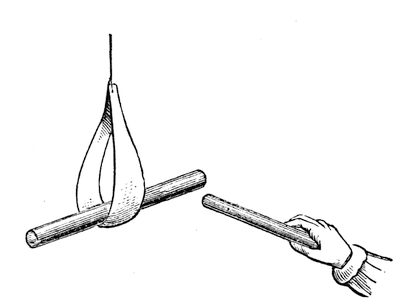
But now we come to another fact. I will take this piece of shellac and make it attractive by rubbing. And remember that whenever we get an attraction — of gravity, of chemical affinity, of adhesion, or of electricity as in this case — the body which attracts is itself attracted too; just as much as the ball was attracted by the shellac, the shellac was attracted by the ball.
Now I will hang this piece of excited shellac in a little paper stirrup like this (Figure 33), so that it can move easily; and I will take another piece of shellac, rub it with flannel, and bring the two near together. You will expect that they ought to attract each other. But what happens? It does not attract; on the contrary, it repels very strongly, and I can drive it round and round to any extent. So these two repel one another, although each is so strongly attractive — repel each other enough to drive this heavy piece of shellac round and round like this.
But if I excite this piece of shellac as before, and take this piece of glass and rub it with silk, and then bring them near — what do you think will happen? [The lecturer held the excited glass near the excited shellac, and they attracted each other strongly.] You see, then, what a difference there is between these two attractions. There are actually two kinds of attraction at work here, quite different from anything we have met before; and yet the force is the same. We have here a double attraction — a dual attraction, or force — the one attracting and the other repelling.
Now let me show you another experiment which will help to make this clear. Suppose I set up this rough indicator again [the excited shellac hanging in the stirrup]; it is rough, but delicate enough for my purpose. Suppose I take this other piece of shellac and take the power away from it, which I can do by drawing it gently through my hand. And suppose I take a piece of flannel (Figure 34), which I have shaped into a cap for it and dried.
I put the shellac into the flannel, and here comes a very beautiful result. I rub the shellac and the flannel together — which I can do by twisting the shellac round — and leave them in contact. And then, if I ask, by bringing them near our indicator, what the attractive force is, the answer is: nothing at all. But if I take them apart and then ask what they will do when separated — why, the shellac is strongly repelled, as before, and the cap is strongly attractive. And yet if I bring them together again there is no attraction; it has all disappeared. [The experiment was repeated.] Those two bodies, then, still contain this attractive power; when they were parted it was evident to your senses that they had it, although they do not attract while they are together.
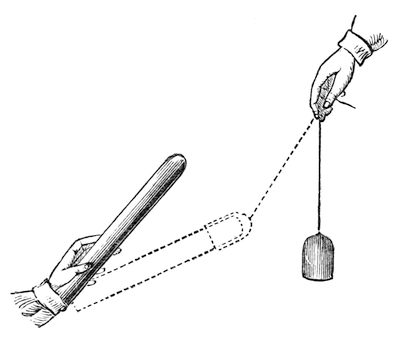
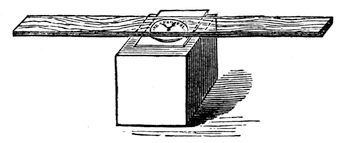
This is enough at the outset to give you an idea of the nature of the force we call ELECTRICITY. There is no end to the things from which you can draw out this power.
When you go home, take a stick of sealing-wax — I have a rather large stick here, but a smaller one will do — and make an indicator like this (Figure 35). Take a watch glass, or your watch itself will do; you only want something with a rounded face. Put a piece of flat glass on it, and you have a very easily moved centre. Now, if I take this lath and lay it on the flat glass — you see I am hunting for the lath's centre of gravity, because I want to balance it on the watch glass — it turns round very easily. And if I take this piece of sealing-wax, rub it against my coat and then try whether it is attractive [holding it near the lath], you see how strong the attraction is; I can even lead the lath about.
Here, then, is a very beautiful indicator, for with a small piece of sealing-wax and my coat I have pulled a plank of that size round. So you need never be short of indicators to detect this attraction. There is hardly a substance we may not use.
Here are some more indicators (Figure 36). I bend a strip of paper round into a hoop, and we have as good an indicator as anyone could want. See how it rolls along, travelling after the sealing-wax. If I make them smaller they run faster, and sometimes they are actually drawn up into the air.
Here too is a little collodion balloon. It is so electrical that it will hardly leave my hand except to go to the other. See how curiously electrical it is: I can hardly touch it without making it electrical. And here is a piece which clings to anything it is brought near, and which is not easy to put down. And here is another substance, gutta-percha, in thin strips: it is astonishing how, by rubbing this in your hands, you make it electrical.
But our time forbids us to go further into this subject at present. You see clearly that there are two kinds of electricity, which may be got by rubbing shellac with flannel or glass with silk.
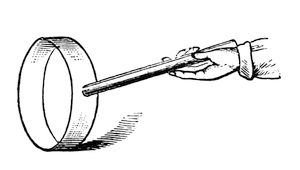
Now, there are some curious bodies in nature, of which I have two specimens on the table, called magnets or lodestones — ores of iron, a great deal of which is sent to us from Sweden. They have the attraction of gravitation, and of cohesion, and a certain chemical attraction; but they also have a great attractive power of another sort, for this little key is held up by this stone.
Now, that is not chemical attraction. It is not the attraction of chemical affinity, nor of the aggregation of particles, nor of cohesion, nor of electricity — for it will not attract this ball if I bring it near. It is a separate and dual attraction; and, what is more, one which is not readily removed from the substance, for it has existed in this stone for ages and ages in the bowels of the earth.
We can make artificial magnets, and you will see me tomorrow make artificial magnets of extraordinary power. Let us take one of these artificial magnets and examine it, and see where the power lies in the mass, and whether it is a dual power. You see it attracts these keys, two or three one after another, and it will attract a very large piece of iron. That is a very different thing from what you saw with the shellac, which only attracted a light ball; here I have several ounces of iron held up.
And if we examine this attraction a little more closely we shall find it presents some other remarkable differences. First of all, one end of this bar (Figure 37) attracts this key, but the middle does not. It is not, then, the whole of the substance that attracts. If I put this little key in the middle it does not stick; but if I put it a little nearer the end it does, though feebly.
Is it not very curious to find an attractive power at the ends which is not in the middle — to have, in one bar, two places where this force of attraction resides? If I take this bar and balance it carefully on a point, so that it is free to turn, I can try what effect this piece of iron has on it. Well, it attracts one end, and it also attracts the other end, just as you saw the shellac and the glass do — with the exception that it does not attract at the middle. But if now, instead of a piece of iron, I take a magnet and try it in the same way, you see that one of its ends repels the suspended magnet: the force is no longer attraction but repulsion. And if I take the other end of the magnet and bring it near, it shows attraction again.
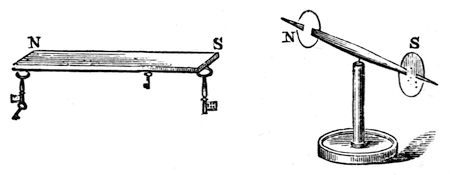
You will see this better, perhaps, by another kind of experiment. Here (Figure 38) is a little magnet, and I have coloured its ends differently so that you can tell one from the other. Now, this end, S, of the bar magnet (Figure 37) attracts the uncoloured end of the little magnet. You see it pulls it towards itself with great power; and as I carry it round, the uncoloured end still follows.
But now, if I gradually bring the middle of the bar magnet opposite the uncoloured end of the needle, it has no effect on it at all, neither attraction nor repulsion — until, as I come to the opposite end, N, you see that it is the coloured end of the needle which is pulled towards it. We are dealing here, therefore, with two kinds of power, attracting different ends of the magnet: a double power, already existing in these bodies, which takes the form of attraction and repulsion. And now, when I put up this label with the word MAGNETISM, you will understand that it is meant to express this double power.
Now, with this lodestone you can make magnets artificially. Here is an artificial magnet (Figure 39) in which both ends have been brought together in order to increase the attraction. This mass will lift that lump of iron; and what is more, by putting this keeper, as it is called, on top of the magnet and taking hold of the handle, it will hold on strongly enough to let itself be lifted up — so wonderful is its power of attraction.
If you take a needle and just draw one of its ends along one end of the magnet, and then draw the other end along the other end of the magnet, and then lay it gently on the surface of some water — the needle will generally float, owing to the slight greasiness your fingers have given it — you will be able to get all the phenomena of attraction and repulsion by bringing another magnetised needle near it.
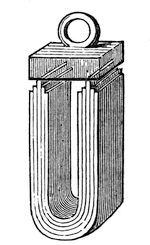
I want you now to notice that although I have shown you in these magnets that the double power becomes evident chiefly at the ends, the whole of the magnet is concerned in giving that power. That will seem rather strange at first, so I must show you an experiment to prove that this is not an accident, but that the whole of the mass is really involved in the force — just as, in falling, the whole of a mass is acted on by the force of gravitation.
Here (Figure 40) is a steel bar, and I am going to make a magnet of it by rubbing it on the large magnet (Figure 39). I have now made its two ends magnetic in opposite ways. At present I do not know one from the other, but we can soon find out. You see that when I bring it near our magnetic needle (Figure 38), one end repels and the other attracts; and the middle will neither attract nor repel — it cannot, because it is halfway between the two ends.
But now, if I break that piece out of the middle and examine it — see how strongly one end of it pulls at this end of the needle, and how it repels the other end. And so it can be shown that every part of the magnet contains this power of attraction and repulsion, but that the power is only made evident at the ends of the mass.
You will understand all this in a little while; but what you have to consider now is that every part of this steel is itself a magnet. Here is a little fragment I have broken out of the very centre of the bar, and you can still see that one end of it is attractive and the other repulsive.
Now, is this power not a most wonderful thing? And are the means of taking it from one substance and giving it to another not very strange? I cannot make a piece of iron, or anything else, heavier or lighter than it is. Its cohesive power it must and does have. But, as you have seen from these experiments, we can add or subtract this power of magnetism, and do almost as we like with it.
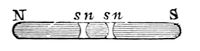
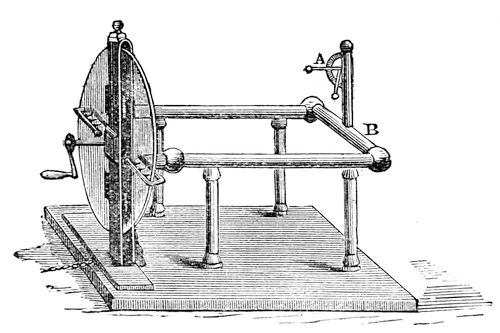
And now we will go back for a short time to the subject we began this lecture with. Here (Figure 41) is a large machine arranged for rubbing glass with silk and so obtaining the power called electricity. The moment the handle of the machine is turned, a certain amount of electricity is evolved, as you can see from the rise of the little straw indicator at A.
Now, I know from the way the pith ball at the end of the straw is repelled that electricity is present in those brass conductors; and I want you to see how that electricity can be taken away. [Touching the conductor with his finger, the lecturer drew a spark from it, and the straw electrometer immediately fell.] There — it has all gone.
And to show you that I have really taken it away, watch this experiment. If I hold this brass cylinder by its glass handle and touch the conductor with it, I take away a little of the electricity. You see the spark in which it passes, and you see the pith-ball indicator fall a little, which seems to mean that so much electricity has been lost. But it is not lost: it is here, in this brass. I can take it away and carry it about — not because it has any substance of its own, but by some strange property we have not met with in any other force.
Let us see whether we have it here or not. [The lecturer brought the charged cylinder up to a jet from which gas was issuing; the spark was seen to pass from the cylinder to the jet, but the gas did not light.] Ah, the gas did not light — but you saw the spark. Perhaps there is some draught in the room blowing the gas to one side, or else it would light. We will try this experiment again later.
You see from the spark that I can transfer the power from the machine to this cylinder, and then carry it away and give it to some other body. You know very well, as a matter of experiment, that we can transfer the power of heat from one thing to another; if I put my hand near the fire it becomes hot. I can show you this with this ball, which has just been brought red hot from the fire. If I press this wire against it, some of the heat is transferred from the ball; and I have only to touch this piece of guncotton with the hot wire, and you see how I can carry the heat from the ball to the wire and from the wire to the cotton.
So you see that some powers are transferable and others are not. Notice how long the heat stays in this ball. I might touch it with the wire, or with my finger, and if I did it quickly I should merely burn the surface of the skin — whereas if I touch that cylinder with my finger, however rapidly, the electricity is gone at once, dispersed on the instant, in a manner wonderful to think of.
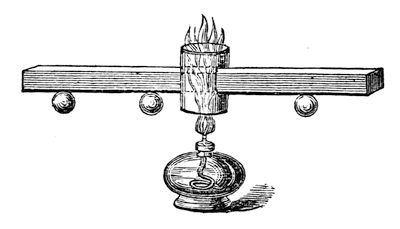
I must now take up a little of your time in showing you the way these powers are transferred from one thing to another; for the manner in which force can be conducted or transmitted is extraordinary, and it is essential for us to understand it. Let us see how these powers travel from place to place.
Both heat and electricity can be conducted, and here is an arrangement I have made to show how heat travels. It consists of a bar of copper (Figure 42); and if I take a spirit lamp — this is one way of getting the power of heat — and set it under that little chimney, the flame will strike against the bar of copper and keep it hot.
Now, you know that power is being transferred from the flame of that lamp to the copper; and you will see presently that it is being conducted along the copper from particle to particle. For I have fastened these wooden balls with a little wax at various distances from the point where the copper is first heated; first one ball will fall and then the more distant ones, as the heat travels along. So you will learn that the heat travels gradually through the copper.
You will see that this is very slow conduction of power compared with electricity. If I take cylinders of wood and metal joined together at the ends, wrap a piece of paper round them and then apply the heat of this lamp where the metal and wood join, you will see how the heat accumulates where the wood is and burns the paper covering it; but where the metal is underneath, the heat is conducted away too fast for the paper to burn.
And so, if I take a piece of wood and a piece of metal joined together and hold it so that the flame plays equally on both, we shall soon find that the metal becomes hot before the wood. For if I put a piece of phosphorus on the wood and another piece on the copper, you will find that the phosphorus on the copper takes fire before the one on the wood is even melted; and that shows you how badly wood conducts heat.
But when it comes to electricity travelling from place to place, its speed is astonishing. First of all I will take these pieces of glass and metal, and you will soon understand why the glass does not lose the power it acquires when it is rubbed with silk. One or two experiments will show you.
If I take this piece of brass and bring it near the machine, you see how the electricity leaves the machine and passes to the brass cylinder. And again, if I take a metal rod and touch the machine with it, the indicator falls; but when I touch it with a glass rod, no power is drawn away. That shows you that electricity is conducted by glass and by metal in entirely different ways.
To make you see that more clearly, we will take one of our Leyden jars. I must not burden your minds too much with this subject; but if I take a piece of metal and bring it against the knob at the top and the metal coating at the bottom, you will see the electricity passing through the air as a brilliant spark. It takes no perceptible time to pass. And if I take a long metal wire — no matter what the length, at least as far as we are concerned — and make one end of it touch the outside and the other the knob at the top, see how the electricity passes! It has flashed instantaneously through the whole length of that wire. Is this not different from the travelling of heat along that copper bar, which has taken a quarter of an hour or more to reach the first ball?
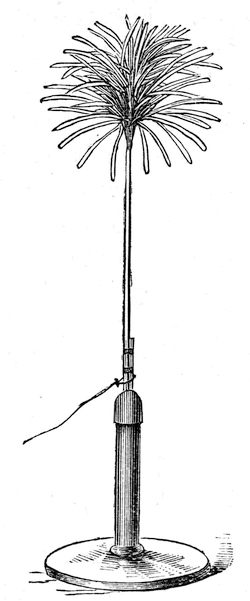
Here is another experiment to show that this power is conducted through some bodies and not through others. Why is this framework made of brass? [pointing to the brass work of the electrical machine, Figure 41.] Because brass conducts electricity. And why are these columns made of glass? Because glass obstructs the passage of electricity.
And why do I put that paper tassel (Figure 43) at the top of the pole, on a glass rod, and connect it to this machine with a wire? You see at once that as soon as the handle of the machine is turned, the electricity given off travels along the wire and up the rod to the tassel at the top; and you see the power of repulsion it has given these strips of paper, each spreading outward towards the ceiling and the walls of the room. The outside of that wire is covered with gutta-percha. It would not be enough to keep the force from you if you touched it with your hands, because it would burst through; but it answers our purpose for the present.
So you see how easily I can send this power of electricity from place to place, by choosing materials that can conduct it. Suppose I want to fire a quantity of gunpowder: I can readily do it with this transferable power. I take a Leyden jar, or any other arrangement that gives us the power, and arrange wires to carry it to the place I want; then, putting a little gunpowder at the ends of the wires, the moment I make the connection with this discharging rod I shall fire the gunpowder. [The connection was made and the gunpowder ignited.]
And if I showed you a stool like this and explained how it is made, you would easily understand that we use glass legs because they prevent the electricity from escaping to the earth. If, then, I stand on this stool and receive the electricity through this conductor, I can give it to anything I touch. [The lecturer stood on the insulating stool and put himself in connection with the conductor of the machine.]
Now I am electrified — I can feel my hair rising up, as the paper tassel did just now. Let us see whether I can manage to light the gas by touching the jet with my finger. [The lecturer brought his finger near a jet from which gas was issuing, and after one or two attempts the spark that came from his finger to the jet set fire to the gas.]
You now see how this power of electricity can be transferred out of the matter in which it is generated, conducted along wires and other bodies, and so made to serve new purposes altogether beyond the reach of the powers we have spoken of on previous days. And you will not now be at a loss to compare this power of electricity with those we have already examined. Tomorrow we shall be able to go further into the consideration of these transferable powers.
We have often seen, in the course of these lectures, that one of those powers or forces of matter whose names I have written on that board has produced results which are really due to the action of some other force. You have seen the force of electricity acting in other ways than by attracting; you have seen it combine substances, or take them apart, by acting on the chemical force. In that case, then, you have an instance of two powers related to each other.
But we have other and deeper relations than those. We have not merely to see how one power affects another — how the force of heat affects chemical affinity, and so on — but we must try to understand what relation they bear to each other, and how these powers may be changed one into another. It will need all my care today, and all your care too, to make this clear to your minds. I shall have to confine myself to one or two instances, because to take in the whole extent of this mutual relation and conversion of forces would be beyond the human intellect.
In the first place, then, here is a piece of fine zinc foil; and if I cut it into narrow strips and apply heat to it, letting the air get at it at the same time, you will find that it burns. And seeing that it burns, you will be ready to say that chemical action is taking place. All I have to do is hold the piece of zinc at the side of the flame so that it gets heated, while the air flowing into the flame from all sides can reach it. There is the zinc burning, just like a piece of wood, only brighter. Part of the zinc is going up into the air as that white smoke, and part is falling down onto the table. This is the action of chemical affinity between the zinc and the oxygen of the air.
I will show you what a curious kind of affinity this is by an experiment which is rather striking when you see it for the first time. Here are some iron filings and some gunpowder, and I will mix them carefully together, handling them as gently as possible. Now we will compare the combustibility, so to speak, of the two. I will pour some spirits of wine into a basin and set it alight; and, having our flame, I will drop this mixture of iron filings and gunpowder through it, so that both sets of particles have an equal chance of burning.
Now tell me which of them burns. You see a plentiful burning of the iron filings. But I want you to notice that although they have had equal chances, we shall find that by far the greater part of the gunpowder is untouched. I have only to drain off the spirit and let the powder that has fallen through the flame dry, which it will do in a few minutes, and then I will test it with a lighted match. So ready is the iron to burn that in certain circumstances it takes even less time to catch fire than gunpowder does. [As soon as the gunpowder was dry, Mr. Anderson handed it to the lecturer, who put a lighted match to it; a sudden flash showed how large a proportion of the gunpowder had escaped burning as it fell through the flame of alcohol.]
These are all cases of chemical affinity, and I show them to make you understand that we are about to take up a strange kind of chemical affinity, and then to see how far we can turn this force of affinity into electricity, or magnetism, or any other of the forces we have discussed.
Here is some zinc — I keep to zinc, as it is very useful for our purpose — and I can produce hydrogen gas by putting zinc and sulphuric acid together, as they are in that retort. There you see the mixture giving us hydrogen: the zinc is pulling the water to pieces and setting hydrogen free.
Now, we have learned by experience that if a little mercury is spread over that zinc, it does not take away its power of decomposing the water, but modifies it most curiously. See how the mixture is boiling now; but when I add a little mercury to it, the gas stops coming off. We have now scarcely a bubble of hydrogen set free; the action is suspended for the time. We have not destroyed the power of chemical affinity, but modified it in a wonderful and beautiful way.
Here are some pieces of zinc covered with mercury, exactly like the zinc in that retort; and if I put this plate into sulphuric acid I get no gas. But this most extraordinary thing happens: if I introduce, along with the zinc, another metal which is not so combustible, then I bring back all the action. I am now going to put some pieces of copper wire into the retort with the amalgamated zinc — copper not being so combustible a metal as zinc — and see how I get hydrogen again. There are the bubbles coming over through the pneumatic trough, as at first, and rising faster and faster in the jar. The zinc is now acting because it is in contact with the copper.
Every step we take now brings us to a knowledge of new phenomena. The hydrogen you see coming off so abundantly does not come from the zinc, as it did before, but from the copper.
Here is a jar containing a solution of copper. If I put a piece of this amalgamated zinc into it and leave it there, it has scarcely any effect. And here is a plate of platinum, which I will put into the same solution; I might leave it there for hours, days, months, even years, and no action would take place. But by putting them both in together and letting them touch (Figure 44), you see what a coating of copper is immediately thrown down on the platinum.
Why is this? The platinum has no power of its own to bring that metal out of the fluid; but it has in some mysterious way received the power through its contact with the zinc. Here, then, you see a strange transfer of chemical force from one metal to another: the chemical force of the zinc is transferred and made over to the platinum by the mere association of the two metals.
I might take a piece of copper or of silver instead of the platinum, and it would have no action of its own on this solution; but the moment the zinc was put in and touched the other metal, the action would take place and it would become covered with copper. Now, is this not most wonderful and beautiful to see? We still have the identical chemical force of the particles of zinc acting, and yet in some strange manner we have the power to make that chemical force — or something it produces — travel from one place to another. For we do make the chemical force travel from the zinc to the platinum, by this curious experiment of using the two metals in the same fluid in contact with each other.
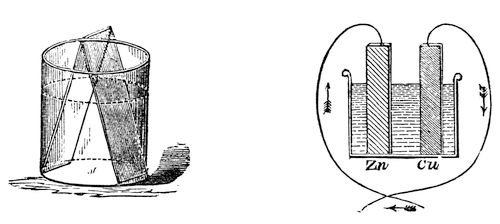
Let us now look at these phenomena a little more closely. Here is a drawing (Figure 45) in which I have shown a vessel containing the acid liquid, with the slips of zinc and of platinum or copper, and I have shown them touching each other outside by means of a wire from each. (It does not matter whether they touch in the fluid or outside, by pieces of metal attached; either way, that communication between them transfers this power from the one to the other.)
Now, if instead of using only one vessel, as I have drawn there, I take another and another, and put in zinc and platinum, zinc and platinum, zinc and platinum, and connect the platinum of one vessel with the zinc of the next, and the platinum of that with the zinc of the next, and so on, we shall simply be using a series of these vessels instead of one. That is what we have done in the arrangement you see behind me.
I am using what we call a Grove's voltaic battery, in which one metal is zinc and the other platinum; and I have as many as forty pairs of these plates all exerting their force at once, sending the whole amount of chemical power evolved there along these wires under the floor and up to these two rods coming through the table. We need only bring the two ends into contact, and the spark shows us what power is present. What a strange thing it is to see that this force is brought away from the battery behind me and carried along through these wires.
I have here an apparatus (Figure 46) which Sir Humphry Davy made many years ago, to see whether this power from the voltaic battery made bodies attract each other in the same way that ordinary electricity did. He made it to experiment with his great voltaic battery, which was the most powerful then in existence. You see there are two leaves of gold in this glass jar, which I can move to and fro by this rackwork.
I will connect each of the gold leaves with a separate end of the battery; and if I have enough plates in the battery, I shall be able to show you that there is some attraction between the leaves even before they touch. If I bring them near enough while they are in communication with the ends of the battery, they will be drawn gently together; and you will know when this happens, because the power will burn the gold leaves away, which it could only do once they touched.
Now I am going to make these two leaves of gold approach gradually, and I have no doubt some of you will see that they approach before they burn; and those too far off to see them approach will know from their burning that they have come together. Now they are attracting each other, long before the connection is complete — and there they go, burnt up in that brilliant flash, so strong is the force. So you see, from the attractive force at the two ends of this battery, that these really and truly are electrical phenomena.
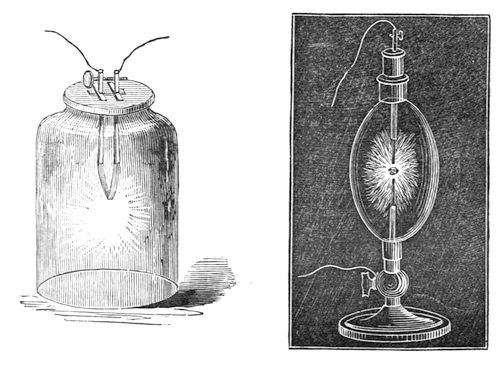
Now let us consider what this spark is. I take these two ends and bring them together, and there I get this glorious spark, like the sunlight in the heavens above us. What is it? It is the same thing you saw when I discharged the large electrical machine and you saw one bright flash. It is the same thing, only continued, because here we have a more effective arrangement. Instead of a machine we have to keep turning for a long time together, we have here a chemical power which sends the spark forth; and it is wonderful and beautiful to see how this spark is carried about through these wires.
I want you to see, if possible, that this spark and the heat it produces — for there is heat — are neither more nor less than the chemical force of the zinc: its very force, carried along the wires and conveyed to this place. I am going to take a portion of the zinc and burn it in oxygen gas, so as to show you the kind of light produced by the actual burning of this metal in oxygen. [A tassel of zinc foil was lit at a spirit lamp and put into a jar of oxygen, where it burnt with a brilliant light.]
That shows you what the affinity is when we look at it in its energy and power. The zinc is being burnt in the battery behind me at a much faster rate than you see in that jar — for the zinc there is dissolving and burning, and it produces this great electric light here. That very same power which you saw in the jar, evolved by the actual burning of the zinc in oxygen, is carried along these wires and made evident here. You may, if you like, consider that the zinc is burning in those cells and that this is the light of that burning [bringing the two poles into contact and showing the electric light]; and we might arrange our apparatus so as to show that the amounts of power evolved in the two cases are identical.
Having thus got power over the chemical force, how wonderfully we are able to carry it from place to place! When we use gunpowder for blasting, we can send chemical affinity down into the mine by means of this electricity: without having provided fire beforehand, we can send it in at the moment we want it.
Here (Figure 47) is a vessel containing two charcoal points, which I bring forward as an illustration of the wonderful power of carrying this force from place to place. I have only to connect them by wires to the opposite ends of the battery and bring the points together. See what a display of force we have! We have pumped the air out, so the charcoal cannot burn; and therefore the light you see is really the burning of the zinc in the cells behind me. There is no wasting away of the carbon, although we have that glorious electric light — and the moment I break the connection, it stops.
Here is a better instance still, to let some of you see the certainty with which we can convey this force to places where chemical affinity would not act under ordinary circumstances. We can take these two charcoal poles right down under water and get our electric light there. There they are in the water; and you see that when I bring them into connection we have the same light as we had in that glass vessel.
Now, besides this production of light, we have all the other effects and powers of burning zinc. I have a few wires here which are not combustible, and I am going to take one of them, a small platinum wire, and hang it between these two rods that are connected to the battery. When contact is made at the battery, see what heat we get (Figure 48). Is that not beautiful? It is a complete bridge of power.
There is metallic connection all the way round in this arrangement; and where I have put in the platinum, which offers some resistance to the passage of the force, you see what an amount of heat is evolved. This is the heat the zinc would give if it were burnt in oxygen; but as it is being burnt in the voltaic battery, it is giving its heat out at this spot. I will now shorten the wire, to show you that the shorter the obstructing wire is, the more intense the heat becomes — until at last our platinum melts and falls, breaking the circuit.
Here is another instance. I will take a piece of the metal silver, put it on charcoal connected to one end of the battery, and lower the other charcoal pole onto it. See how brilliantly it burns (Figure 49). Here is a piece of iron on the charcoal — see what a combustion goes on. We might go on this way, burning almost anything we put between the poles.
Now, I want to show you that this power is still chemical affinity: that whether we call the power evolved at this point heat, or electricity, or any other name referring to its source or to the way it travels, we shall still find it to be chemical action.
Here is a coloured liquid which can show us the effects of chemical action by its change of colour. I will pour some of it into this glass, and you will find that these wires have a very strong action on it. I am not going to show you any effects of burning or heat; I will take these two platinum plates, fasten one to one pole and one to the other, and put them into this solution. In a very short time you will see the blue colour entirely destroyed. See — it is colourless now. I have merely brought the ends of the wires into the solution of indigo, and the power of electricity has come along those wires and made itself evident by its chemical action.
There is another curious thing to notice, now that we are dealing with the chemistry of electricity: the chemical power which destroys the colour is due to the action on one side only. I will pour some more of this sulpho-indigotic acid into a flat dish, and then make a porous dyke of sand dividing the fluid into two parts (Figure 50). Now we shall be able to see whether there is any difference between the two ends of the battery, and which of them has this peculiar action.
You see that it is the one on my right hand which has the power of destroying the blue, for the portion on that side is thoroughly bleached, while nothing has apparently happened on the other side. I say apparently, for you must not imagine that because you cannot see any action, none has taken place.
Editor's note: Sulpho-indigotic acid. A mixture of one part indigo and fifteen parts concentrated oil of vitriol. It is bleached on the side at which hydrogen gas is evolved, because the liberated hydrogen withdraws oxygen from the indigo, forming a colourless deoxidised indigo. In making the experiment, only enough of the sulpho-indigotic acid must be added to give the water a decided blue colour.
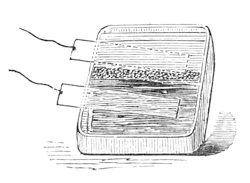
Here is another instance of chemical action. I take these platinum plates again and put them into this solution of copper, out of which we earlier precipitated some of the metal when the platinum and zinc were put in together. You see that these two platinum plates have no chemical action of any kind; they might stay in the solution as long as I liked without any power of their own to bring down the copper. But the moment I bring the two poles of the battery into contact with them, the chemical action which was turned into electricity and carried along the wires becomes chemical action again at the two platinum poles; and now we shall have the power appearing on the left-hand side and throwing the copper down in the metallic state on the platinum plate.
In this way I might give you many instances of the extraordinary manner in which this chemical action, or electricity, can be carried about. That strange nugget of gold, of which there is a model in the other room — which has an interest of its own in the natural history of gold, which came from Ballarat, and which was worth eight or nine thousand pounds when it was melted down last November — was brought together in the bowels of the earth, perhaps ages and ages ago, by some such power as this.
And there is another beautiful result depending on chemical affinity in that fine lead tree, the lead growing and growing by virtue of this power. The lead and the zinc are combined together there in a little voltaic arrangement, in a manner far more important than the powerful one you see here; because in nature these minute actions are going on for ever, and are of great and wonderful importance in the precipitation of metals, the formation of mineral veins and so forth. These actions are not for a limited time, like my battery here: they act for ever in small degrees, accumulating more and more of their results.
Editor's note: Lead tree. To make a lead tree, pass a bundle of brass wires through the cork of a bottle and fasten a plate of zinc round them just where they come out of the cork, so that the zinc is in contact with every one of the wires. Make the wires diverge so as to form a sort of cone; then, having filled the bottle quite full of a solution of sugar of lead, insert the wires and cork and seal it down so as to exclude the air perfectly. In a short time the metallic lead will begin to crystallise round the diverging wires and form a beautiful object.
I have now given you all the illustrations time will let me show you of chemical affinity producing electricity, and electricity becoming chemical affinity again. Let that be enough for the present, and let us go a little deeper into the subject of this chemical force, or this electricity — which shall I name first, when each produces the other in such a variety of ways?
These forces are also wonderful in their power of producing another of the forces we have been considering, namely magnetism. And you know that it is only of late years, long since I was born, that the discovery of the relations between electricity and chemical affinity in producing magnetism became known. Scientific men had suspected this relationship for a long time and had long had great hopes of success; for in the pursuit of science we start first with hopes and expectations. Then we realise them and establish them, never to be lost again; and on them we found new expectations of further discoveries, and so go on pursuing, realising, establishing, and founding new hopes over and over again.
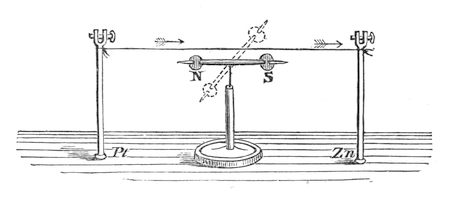
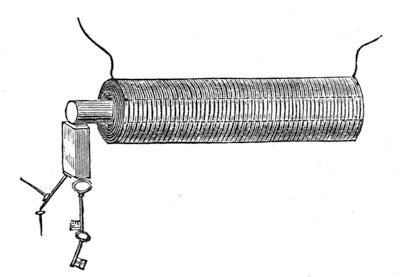
Now observe this. Here is a piece of wire which I am going to make into a bridge of force — that is, a communicator between the two ends of the battery. It is only copper wire, and so is not magnetic in itself. We will examine this wire with our magnetic needle (Figure 51); and though it is connected to one end of the battery, you see that before the circuit is completed it has no power over the magnet. But watch when I make contact — watch the needle, see how it is swung round; and notice how indifferent it becomes again when I break contact. So you see this wire plainly affects the magnetic needle under these circumstances.
Let me show you that rather more strongly. Here is a quantity of wire wound into a spiral, and this will affect the magnetic needle in a very curious way, because its shape makes it act very much like a real magnet. The copper spiral has no power over that magnetic needle at present; but if I make the electric current circulate through it, by bringing the two ends of the battery into contact with the two ends of the wire, what will happen? Why, one end of the needle is most powerfully drawn to it; and if I offer the other end of the needle, it is repelled. So you see I have produced exactly the same phenomena as I had with the bar magnet: one end attracting and the other repelling.
Is it not curious, then, to see that we can build a magnet out of copper? Furthermore, if I take an iron bar and put it inside the coil, then so long as no electric current is circulating it has no attraction, as you will see if I bring some iron filings or nails near it. But now, if I make contact with the battery, they are attracted at once. It becomes a powerful magnet immediately — so much so that I should not wonder if these magnetic needles in different parts of the table pointed towards it.
And I will show you by another experiment what attraction it has. This piece of iron, and that piece, and many others, are now strongly attracted (Figure 52); but as soon as I break contact the power is all gone and they fall. What better or stronger proof could there be of the relation between the powers of magnetism and electricity?
Again, here is a little piece of iron which is not yet magnetised. At present it will not pick up any one of these nails. But I will take a piece of wire and coil it round the iron — the wire being covered with cotton everywhere, it does not touch the iron — so that the current must go round in this spiral coil. I am, in fact, preparing an electromagnet. (We are obliged to use such terms to express our meaning, because it is a magnet made by electricity: by the force of electricity we produce a magnet of far greater power than a permanent steel one.)
It is finished now, and I will repeat the experiment you saw the other day of building up a bridge of iron nails. Contact is now made and the current is going through; it is a powerful magnet. Here are the iron nails we had the other day; and now that I have brought the magnet near them, they cling so hard that I can scarcely move them with my hand (Figure 53). But when the contact is broken, see how they fall. What could show you better than an experiment like this the magnetic attraction we have endowed these pieces of iron with?
Here again is a fine illustration of this strong power of magnetism. It is a magnet of the same sort as the one you have just seen. I am going to pass the current of electricity through the wires round this iron, to show you what powerful effects we get. Here are the poles of the magnet; and let us place this long bar of iron on one of them. You see, as soon as contact is made, how it rises into position (Figure 54). And if I take a piece like this cylinder and put it on — woe betide me if I get my finger between. I can roll it over; but if I try to pull it off, I might lift the whole magnet: I have no power to overcome the magnetic force so plainly at work here.
I might give you an endless number of illustrations of this high magnetic power. There is that long bar of iron held out; and I have no doubt that if I examined the other end of it, I should find it was a magnet too. See what power it must have, to hold up not only these nails but all those lumps of iron hanging from the end.
What, then, could surpass these evidences of the change of chemical force into electricity, and of electricity into magnetism? I might show you many other experiments in which I could get electricity and chemical action, heat and light, from a magnet. But what more need I show you, to prove the universal correlation of the physical forces of matter, and their mutual conversion one into another?
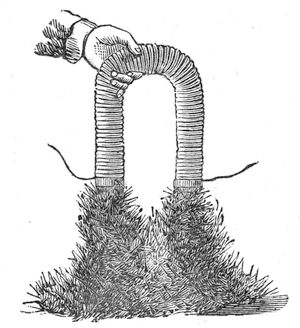
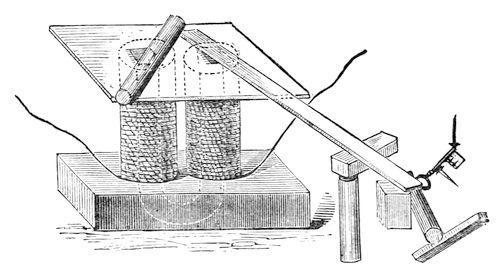
And now let us give place, as young people, to the respect we owe our elders; and let me for a moment address those of our seniors who have honoured me with their presence during these lectures. I want to claim this moment to offer them our thanks, and to offer my thanks to you all, for the way you have borne the inconvenience I subjected you to at the beginning.
I hope that the insight you have gained here into some of the laws by which the universe is governed may be the occasion of some among you turning your attention to these subjects. For what study is there more fitted to the mind of man than that of the physical sciences? And what is there more capable of giving him an insight into the working of those laws — a knowledge of which lends interest to the most trifling phenomenon in nature, and makes the observing student find
    "——tongues in trees, books in the running brooks,
    Sermons in stones, and good in everything?"
Delivered before the Royal Institution on Friday, 9 March 1860.
There is no part of my life which gives me more delight than my connection with the Trinity House. The business of nations joining together to guide the mariner across the sea is of great interest to everyone, and it is infinitely more so to those concerned in carrying the work out. It has certainly astonished me, since I became connected with the Trinity House, to see how beautifully and how wonderfully the desire to do good shines out among the nations at large.
You will not regret having come here tonight if you follow me through the various attempts that have been made to achieve this great object of guiding all people safely across the dark and dreary waste of waters. It is wonderful to think how eagerly the various public bodies press for improvement — the Trinity House in this country, and commissions in France and other nations. And as the improvements go forward, we come to know such curious difficulties, and such odd ways of getting over them, as are not easily imagined.
I must ask you this evening to follow me from the simplest possible way of giving a signal by light to people at a distance, through to the methods we have arrived at today; and to consider the difficulties that arise in carrying these improvements out to a practical result, and the extraordinary care those who have to judge such matters must take to guard against the too hasty adoption of some supposed improvement — which, as has happened in a few cases, does harm instead of good.
If I try to make you understand these things partly by old models and partly by the ones we have here, it is only so that I may better illustrate what I look forward to as the higher method of lighting: by means of the electric lamp and the limelight.
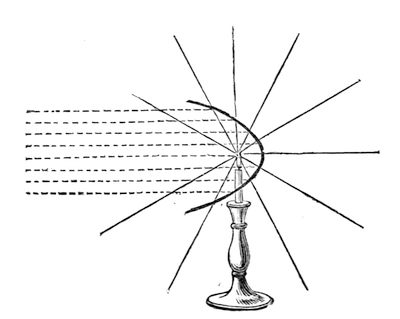
There is nothing simpler than a candle set in a cottage window to guide a husband home. But when we want to make a similar guide on a large scale — not merely across a river or a moor, but across great expanses of sea — how can we make the signal, using only a candle?
I have shown in this diagram (Figure 55) what we may imagine to be the rays of a candle, or of any other source of light, going out from the centre of a sphere in all directions to infinite distances. After this simple kind of light had been used for some time, and had been found liable to be obscured by fog, or distance, or other circumstances, there came the attempt to make larger lights by means of fires. And after that a very important refinement was introduced in the way the light was handled: the principle of reflection.
For understand this — which is not known to everybody, and not known to many who ought to know it — that when we take a source of light, a single candle for instance, giving off a certain quantity of light, we can by no means increase that light. We can make arrangements around and about the light, as you see here, but we cannot increase the quantity of it. The utmost I can do is to direct the light the lamp gives me, by taking a certain portion of the rays going off on one side and reflecting them into the course of the rays that issue in the opposite direction.
First of all, let us consider how we may gather in the rays passing off from this candle. You will easily see that if I could take the half of the rays going out on one side and send them by some contrivance over to the other side, I should gain an advantage in light on the side I directed them to. This is done in a beautiful way by the parabolic mirror, by means of which I gather in all the rays that fall within it — upwards, downwards, sideways, anywhere within its sphere of action. They are all picked up and sent forward. So you see what a beautiful and important invention the parabolic reflector is for throwing the rays of light forward.
Before I go further into the subject of reflection, let me point out another way of dealing with the direction of light. Here is a candle, and I can use the principle of refraction to bend and direct its rays; for if I want to increase the light in any one direction, I must either take a reflector or use refraction.
I will put this lens (Figure 56) in front of the candle, and you will easily see that by its means I can throw a great light onto that sheet of paper. That is to say, instead of the light being thrown all about, it is refracted and concentrated onto the paper. So here is another means of bending light and sending it in one direction. And you see above a still better arrangement for the same purpose, one which reaches, I may say, the maximum of what can be done in directing light this way.
You know that without that arrangement of glass the light would be scattered in all directions; but with the lens there, all the light passing through it is thrown into parallel beams and cast horizontally along. There is consequently no loss of light: the beam goes forward at the same width, and will go on for five or ten miles, or as long as the imperfection of the atmosphere does not absorb it. And see what a glorious power it is, to be able to turn what was darkness on that paper a moment ago into brilliant light.
Whenever we have refraction of this sort, we are open to an evil that follows from the necessary imperfections in the shape of the lens. Dr. Tyndall will take this lens and show you, even in this small and well-made apparatus, the evil of spherical aberration, which we have to fight against.
This can be shown with the electric lamp. If you look at the screen you will see an image of the carbon points produced by this lens. That image is made by the rays passing through the middle of the lens, a piece of card with a hole in the centre being placed in front. But if, keeping the rest of the apparatus in the same position, I change that card for another which lets the rays pass only through the edge of the lens, you can see how much poorer the image is. To get it distinct I have to bring the screen much nearer the lamp. And so, if I take the card away altogether and let the light pass through every part of the lens, we cannot get a perfect image, because the different parts of the lens cannot act together.
This spherical aberration, then, is what we try to avoid by building up compound lenses in the way shown here. Look at this beautiful apparatus — is it not a most charming piece of workmanship? Buffon first, and Fresnel afterwards, built up lenses of this kind, ring within ring, each at its proper adjustment, to compensate for the effects of spherical aberration.
The ring round that centre lens is ground so as to remove what would otherwise cause spherical aberration; and the next ring being corrected in the same way, you will notice, if you look at the disc of light the apparatus upstairs throws, that there is nothing like the aberration there would have been if it were one great bull's-eye.
Here is one of Fresnel's lamps of the fourth order, made in that way (Figure 57). Observe the fine effect got from these different lenses as you see them revolving in front of you; and understand that all this upper part is made to form part of the lens, each prism throwing its rays in to increase the effect. And although you may think it imperfect, because if you happen to be sitting below or above the horizontal line you see little or none of the light, you must bear in mind that we want the rays to go in a straight line to the horizon.
So all that building up of rings of glass is for the purpose of producing one fine and glorious lens of large size, to send the rays all in one direction. Here is another apparatus used to pull the rays down into a horizontal sheet of light, so that the mariner may see it as a constant and uniform fixed light. The other lamp is a revolving one, and its light is seen only at certain moments as the lenses come round; and those are the points which make them valuable in their application.
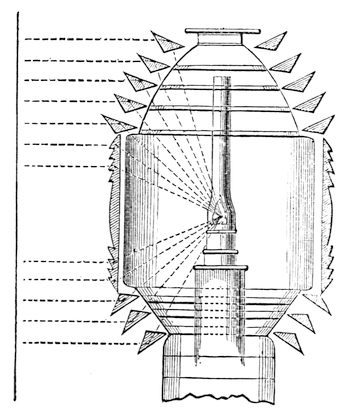
There are various orders and sizes of lights in lighthouses, meant to shine for twenty or thirty miles over the sea and to give whatever indications are wanted of them. But suppose we want more effect than these means can give: how are we to get more light? Here comes the difficulty. We cannot get more light, because we are limited by the condition of the burner.
In any of these cases, if the spreading of the ray — the divergence, as it is called — is not restrained, the light soon fails from weakness; and if it does not diverge at all, the light is made so narrow that perhaps only one person in a hundred can see it at any one time. The South Foreland lighthouse is, I think, three or four hundred feet above the level of the sea, and so a certain divergence of the beam is necessary for it to shine along the sea to the horizon.
I have drawn two wedges here. One has an angle of 15 degrees and shows the way the light opens out from this reflector, seen at half a mile's distance or more; the other has an angle of 6 degrees, which is Fresnel's beautiful angle. When the angle is less than 6 degrees the mariner cannot be quite sure of seeing the light — he may be below it or above it. In practice it is found that we cannot have an angle larger than 15 degrees or smaller than 6.
To get more light, then, we must have more burning: more cotton, more oil. But there are already four wicks in that lamp, set in concentric rings one within another, and we cannot increase them much further, because of the divergence a larger flame would cause — and the more the divergence, the more the light is spread out and lost. We are therefore restricted, by the conditions of the light and the apparatus, to a lamp of a certain size.
At Teignmouth some of the revolving lights have ten lamps and reflectors, all throwing their light forward at once. But even with ten lamps and reflectors we do not get light enough. What we want is a means of getting a more intense light in the space of a candle — not merely candle piled on candle, but a greater amount of light concentrated into the space of one. And it is here that the electric light becomes so valuable.
Let me now show you the properties of that light which make it useful for lighthouse illumination, and which have been brought into a practical state by the energy and persistence of Professor Holmes.
First of all I will show you the image of the carbon points on the screen, and draw your attention to the spot where the light is produced. There are the carbon points. The two carbons are brought within a certain distance of each other; the electricity is driven across by the voltaic battery, and the points are brought into an intense state of ignition.
You will notice that the light is essentially given by the carbons. You see that one of them is much more luminous than the other, and that is the end which chiefly forms the spark. The other does not shine so much; and there is a space between the two which, though not very luminous, is most important to the production of the light.
Dr. Tyndall will help me show you that a blast of wind will blow that light out. The electric light can in fact be blown out more easily than a candle. We have the power of getting our light where we please. If I make the electricity pass between carbon and mercury, I get a most intense and beautiful light, most of it coming from the part of the mercury between the liquid pole and the solid one. I can show you better with silver than with mercury that the light is sometimes produced by the vapour between the two poles. Here is the carbon pole, there is the silver, and there is the beautiful green light which comes from the space between them. Now, that light is more easily blown out than an ordinary lamp; the slightest puff of wind is enough to put it out, as you will see if Dr. Tyndall breathes on it.
You see, then, how by using this electric spark we can get the light, first of all, into a very small space. That oil lamp has a burner three and three-quarter inches across. Compare the size of that flame with the space this electric light occupies.
Next, compare the intensity of this light with any other. If I take this candle and hold it beside it, I seem actually to put the candle out. So we are able to get a light which, while it surpasses all others in brilliance, is at the same time not too large; for I might put this light into an apparatus no bigger than a hat, and still count on the rays being useful.
Moreover, when such large burners are used in a lantern, we have to consider whether the bars of the window will throw a shadow or otherwise interfere. But with this light there will be no difficulty of that kind, since a single small mirror no bigger than a hat will send it in whatever direction we please. It is wonderful what advantages its small bulk gives us in considering the different kinds of apparatus required, reflecting or refracting, quite apart from the other reasons for using the electric light. It is things of this kind that make us decide most earnestly and carefully in its favour.
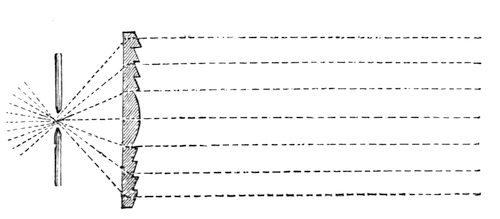
I am going to show you the effect we get with that large lens when we throw the oil lamp out of action and bring the electric light into use. It is astonishing to find how badly the eye compares the relative intensities of two lights. Look at that screen and try to remember the amount of light thrown on it by Fresnel's three-and-three-quarter-inch lamp. And now, when we shift the lens sideways, look at the glorious light coming from that small carbon point (Figure 58) — see how beautifully it shines in the focus of the lens and throws the rays forward.
At present the electric light is put at exactly the same distance as the oil light; and so, being in the focus of the lens, we have parallel rays thrown forward in a perfectly straight line, as you can see by comparing the size of the lens with the size of the light thrown on the screen. You will now see how far we can affect this beam by increasing or reducing the distance of the lamp. By a small adjustment we can get a beam of large or small angle. Observe what power I have over it now: with the oil lamp, if I want to increase the divergence I am limited by the power of the light, but with the electric light I can spread it over any width of the horizon by this simple adjustment. These, then, are some of the reasons which make it desirable to use the electric light.
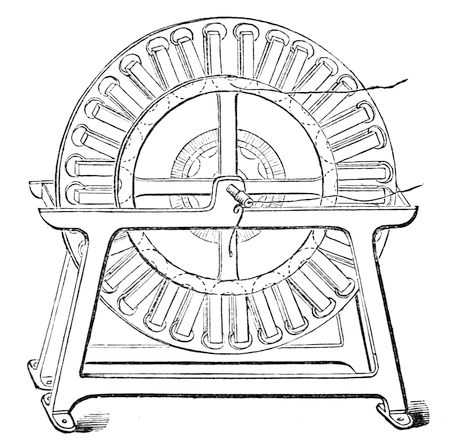
By means of a magnet and of motion we can get the same kind of electricity as I have here from the battery; and under the authority of the Trinity House, Professor Holmes has been engaged in introducing the magneto-electric light in the lighthouse at the South Foreland. The voltaic battery has been tried under every conceivable circumstance, and I take the liberty of saying that it has so far proved a decided failure.
Here, however, is an instrument worked by mechanical motion alone. The moment we set this soft iron moving in front of the magnet, we get a spark. It is true that in this apparatus it is very small, but it is enough for you to judge its character. It is the magneto-electric light. An instrument has been built, shown here (Figure 59), consisting of a number of magnets set radially on a wheel — three wheels of magnets and two sets of coils. When the machine, which is driven by a two-horsepower engine, is properly set going, and the different currents are all brought together and thrown by Professor Holmes up into the lantern, we get a light equal to the one we have been using this evening.
For the last six months the South Foreland has been shining by this electric light — beyond all comparison better than its former light. It has shone into France and been seen and noticed there by the authorities, who work with us in beautiful accord in all these matters. Not once in six months has it failed to do its duty — not once, more than the inventor expected. It has shone out with its own peculiar character, and that with the old apparatus; for as yet no attempt has been made to build special reflectors or refractors for it, because it is not yet established.
I will not tell you that the problem of using the magneto-electric spark for lighthouse illumination is quite solved yet, although I most earnestly wish to see it established — for I regard this magnetic spark as one of my own offspring. The thing is not yet decidedly accomplished, and what the considerations of expense and other matters may be, I cannot say. I am only here to tell you, as a man of science, how far the results have been carried. But I do hope the authorities will find it a proper thing to carry out in full. If it cannot be introduced at all the lighthouses — if it can only be used at one — why, it will really be an honour to the nation that can originate such an improvement as this, one which other nations must of necessity follow.
You may ask what the use of this bright light is. It would be of no use to us were it not for the constant changes taking place in the atmosphere, which is never pure. Even when we can see the stars clearly on a bright night, the atmosphere is not pure. The light of a lighthouse, more than any other, is liable to be dimmed by vapours and fogs; and where we most want this great power is not in the finest state of the atmosphere but when the mariner is in danger — when the sleet and rain are falling, and the fogs rise, and the winds blow, and he is nearing coasts where the water is shallow and full of rocks. That is his time of danger, and that is when he most wants this light.
I am going to show you how, with a little steam, I can completely obscure this glorious sun, this electric light you see before you. The cloud now hiding the light on the screen is only such a cloud as you see when you are sitting in a train on a fine summer's day. You may notice that the vapour coming out of the funnel casts as deep a shadow on the ground as the black funnel itself does. The very sun is extinguished by the steam from the funnel, so that it cannot give any light; and the sun itself, if it were set in the lighthouse, would not be able to penetrate such a vapour.
Now, the haze of that cloud of steam is exactly what we have to overcome; and the electric light is, proportionally, put out by an obstruction of this kind just as soon as any other light. If we take two lights, one four times the intensity of the other, and extinguish half of the one by a vapour, we extinguish half of the other too — and that is a fact no arrangement can set aside.
But then we fall back on the sheer amount of light the electric spark gives us, to help it penetrate the fog. For the light of the electric spark shines so far at times that even before it has risen above the horizon, twenty-five miles away, it can be seen. This intense light, therefore, has the power we can take advantage of: of bearing a great deal of obstruction before it is entirely obscured by fog or anything else.
Taking care that we do not lead our authorities into error by the advice we give, we hope that we shall soon be able to recommend the Trinity House, on the strength of what has happened, to establish one or more good electric lights in this country.