

Why Heat Engines Matter
Everyone knows that heat can cause motion, and that it even has great motive power: the steam engines that are everywhere now prove it to anyone with eyes.
Heat is behind the great movements we see on the earth: it stirs the atmosphere, lifts the clouds, brings down the rain and the rest of the weather, and drives the streams that cut across the face of the globe, a small share of which we have learned to put to use. Earthquakes and volcanic eruptions, finally, have heat as their cause too.
From this immense reservoir we can draw the moving force we need. Nature has scattered fuel everywhere, and so given us the means of making heat, and the motive power that follows from it, at any time and in any place. To develop that power and put it to our use is what heat engines are for.
The study of these engines is of the highest interest. Their importance is immense and their use grows every day. They seem destined to bring about a great revolution in the civilized world. Already the heat engine works our mines, moves our ships, dredges our harbors and rivers, forges iron, shapes timber, grinds grain, spins and weaves our cloth, and hauls the heaviest loads. It looks set to become, one day, the universal motor, preferred to the strength of animals, to waterfalls and to the wind. Over animals it has the advantage of economy; over the other two it has the priceless advantage of working at all times and in all places, and never stopping.
If the heat engine is someday improved enough to be cheap to build and cheap to fuel, it will combine every quality one could wish for, and it will give the industrial arts a lift whose full extent would be hard to foresee.
For a powerful, convenient motor that can be had or carried anywhere doesn't merely replace the motors already in use. It makes the arts it touches grow fast, and it can even create entirely new ones.
The greatest service the heat engine has done England is beyond question the revival of its coal mines, whose working had become sluggish and threatened to die out altogether because pumping them dry and hauling out the fuel got harder every year.1 Second place goes to what it has done for iron making: by the coal it supplied in abundance, taking the place of wood just as wood was beginning to run out, and by the powerful machines of every kind whose use the heat engine made possible or easier.
Iron and fire, as everyone knows, are the food and support of the mechanical arts. There may not be a single industrial establishment in England whose existence doesn't rest on these two agents, or that doesn't use them lavishly. Take away England's steam engines today and you would take away its coal and its iron at one stroke. You would dry up every source of its wealth, ruin every means of its prosperity, and destroy that colossal power. Losing its navy, which it regards as its firmest support, might hurt it less.
Safe and rapid navigation by steamship can be counted an entirely new art, and it is owed to the heat engine. It has already made possible quick, regular crossings of the narrow seas and voyages on the great rivers of the Old World and the New. It has opened regions still wild, where until lately one could barely set foot, and carried the fruits of civilization to places on the globe that would otherwise have waited for them many more years. Navigation by heat engine brings the most distant nations closer together. It tends to unite the peoples of the earth as though they all lived in a single country. To cut the time, the fatigue, the uncertainty and the danger of a journey is surely to shorten the distance a great deal.2
The heat engine, like most human inventions, began as crude, half-formed trials, credited to various people, and no one quite knows who really came first. The main discovery, though, lies less in those first trials than in the run of improvements that brought heat engines to where we see them today. There's about as much distance between the first devices that put the expansive force of steam to work and the engines of today as there is between the first raft men ever lashed together and a ship of the line.
If the honor of a discovery belongs to the nation where it grew to its full development, that honor can't be denied to England here. Savery, Newcomen, Smeaton, the famous Watt, Woolf, Trevithick and a few other English engineers are the true creators of the heat engine. It went through every stage of its improvement in their hands. It's natural, after all, for an invention to be born, and above all to grow and be perfected, where the need for it is felt most urgently.
Yet for all the work of every kind that has gone into heat engines, and for all the satisfactory state they have reached, their theory has hardly advanced, and attempts to improve them are still steered almost by chance.
Heat Must Fall from Hot to Cold
People have often asked whether the motive power3 of heat is limited or boundless: whether the possible improvements to heat engines have an assignable limit, a limit that the nature of things forbids anyone to pass by any means at all, or whether they can go on without end. People have also long asked, and still ask today, whether there might be agents better than steam for developing the motive power of fire, and whether atmospheric air, for example, might not offer great advantages in this respect. We propose to give these questions careful examination here.4
The production of motion by heat hasn't been looked at from a general enough point of view. It has been considered only in engines whose nature and way of working kept it from reaching its full scope. In such engines the phenomenon is cut short, incomplete, so to speak, and it becomes hard to see its principles and study its laws.
To grasp the production of motion by heat in all its generality, we have to think of it apart from any mechanism and any particular agent. We have to set up arguments that apply not just to steam engines5 but to every heat engine imaginable, whatever substance it puts to work and however it acts on that substance.
Machines that don't get their motion from heat, those driven by the strength of men or animals, by a fall of water, by a current of air and so on, can be studied down to their smallest details by the theory of mechanics. Every case is foreseen; every conceivable motion is subject to general principles that are firmly established and hold in every circumstance. That's the mark of a complete theory. Heat engines plainly have no such theory, and we won't have one until the laws of physics are broad and general enough to tell us in advance every effect of heat acting in a given way on any body whatever.
In what follows we assume at least a passing acquaintance with the parts of an ordinary steam engine. We see no need, then, to explain what a furnace, a boiler, a steam cylinder, a piston or a condenser is.
The production of motion in steam engines always comes with one circumstance that deserves our attention: the restoring of equilibrium in caloric, that is, its passage from a body at a higher temperature to one at a lower. What actually happens in a steam engine at work? The caloric released in the furnace by the burning of the fuel passes through the walls of the boiler and makes steam, becoming part of it, so to speak. The steam carries it along, first into the cylinder, where it does some job or other, and from there into the condenser, where the steam turns back into liquid on meeting the cold water there. In the end, then, the cold water of the condenser takes up the caloric released by the burning. It is warmed through the steam just as if it had been set straight on the furnace. The steam is only a means of carrying caloric; it does the same job as in heating baths with steam, except that here its motion is put to use.
In the operations we've just described it's easy to recognize the restoring of equilibrium in caloric, its passage from a more or less heated body to a colder one. The first body here is the burnt air of the furnace; the second is the condensing water. The equilibrium of caloric is restored between them, if not completely, at least in part. On one side, the burnt air, having done its job and wrapped around the boiler, escapes up the chimney at a temperature far below what the burning gave it. On the other, the water of the condenser, having turned the steam back into liquid, leaves the engine warmer than it came in.
The production of motive power in steam engines is due, therefore, not to an actual consumption of caloric, but to its transport from a hot body to a cold body, that is, to the restoring of its equilibrium, an equilibrium assumed to have been upset by some cause or other: by a chemical action such as burning, or by anything else. We'll soon see that this principle applies to every engine driven by heat.6
By this principle, making heat isn't enough to produce motive power. You must also have cold; without it the heat would be useless. And indeed, if everything around us were as hot as our furnaces, how would we condense the steam? Where would we put it once it had been made? It won't do to think we could throw it out into the atmosphere, as some engines do.7 The atmosphere wouldn't take it. It takes it now only because it serves the steam as a vast condenser, because it is colder. Otherwise it would soon be full of steam, or rather it would be saturated with it already.8
Wherever there's a difference of temperature, wherever caloric can return to equilibrium, motive power can also be produced. Steam is one way of realizing that power, but not the only one: every body in nature can serve. All of them change volume, contracting and expanding by turns as they are heated and cooled, and all of them can overcome some resistance as they change volume and so develop motive power. A solid body, a metal bar for instance, heated and cooled by turns, grows longer and shorter and can move bodies fixed to its ends. A liquid heated and cooled by turns swells and shrinks and can overcome obstacles, great or small, set against its expansion. A gas changes volume enormously with temperature: shut it in a chamber that can enlarge, such as a cylinder fitted with a piston, and it will produce motions of great extent. The vapors of all the bodies that can be turned into gas, alcohol, mercury, sulfur and so on, could do the same job as steam. Steam itself, heated and cooled by turns, would produce motive power the way the permanent gases do (the gases no one has yet managed to liquefy), without ever going back to the liquid state. Most of these means have been proposed, and several have even been tried, though so far without notable success.
We've shown that in steam engines motive power comes from a restoring of equilibrium in caloric. This holds not only for steam engines but for every heat engine, that is, every engine whose motor is caloric. Heat can plainly be a cause of motion only through the changes of volume or shape it makes bodies undergo, and those changes don't come from a steady temperature but from alternations of heat and cold. Now, to heat any substance you need a body hotter than it, and to cool it you need a body colder. Caloric is necessarily taken from the first body and passed to the second by way of the substance in between. That's restoring the equilibrium of caloric, or at least working to restore it.
A question at once curious and important comes up naturally here. Is the motive power of heat fixed in amount, or does it vary with the agent used to realize it, the intermediate substance chosen for heat to act on?
Clearly the question only makes sense for a given quantity of caloric9 and a given difference of temperature. Say we have a body A kept at 100° and another body B kept at 0°, and we ask how much motive power can arise from carrying a given portion of caloric (for example, the amount needed to melt a kilogram of ice) from the first body to the second. We ask whether that amount of motive power is necessarily limited; whether it varies with the substance used to realize it; whether steam does better or worse in this respect than the vapor of alcohol or mercury, than a permanent gas, or than any other substance.
We'll try to answer these questions with the ideas already set out.
The Greatest Possible Power
We noted above a fact that is self-evident, or at least becomes obvious as soon as one thinks about the changes of volume heat brings about: wherever there is a difference of temperature, motive power can be produced. Conversely, wherever motive power can be spent, it is possible to create a difference of temperature, to upset the equilibrium of caloric. Don't striking and rubbing raise a body's temperature, make it climb on its own above that of the bodies around it, and so upset the equilibrium of caloric where it existed before? It's a fact of experience that the temperature of a gas rises when it is compressed and falls when it expands. Here is a sure way of changing the temperature of bodies and upsetting the equilibrium of caloric as many times as we like with the same substance. Steam, used the other way round from the way it is used in steam engines, can also be regarded as a means of upsetting the equilibrium of caloric. To see this, one need only think carefully about how motive power is developed by the action of heat on steam. Picture two bodies A and B, each kept at a constant temperature, A's higher than B's. These two bodies, which can give up or take in heat without changing temperature, will act as two unlimited reservoirs of caloric. We'll call the first the furnace and the second the cooler.
If we want to produce motive power by carrying a certain quantity of heat from body A to body B, we can go about it as follows.
1. Take caloric from body A to make steam; that is, make this body do the job of the furnace, or rather of the metal of the boiler in ordinary engines. We'll assume here that the steam is formed at the very temperature of body A.
2. With the steam taken into a chamber that can enlarge, such as a cylinder with a piston, enlarge the chamber and so the steam with it. Expanded in this way, the steam will drop in temperature of its own accord, as all elastic fluids (gases and vapors) do. Let the expansion be carried on until its temperature becomes exactly that of body B.
3. Condense the steam by putting it in contact with body B while pressing on it with a constant pressure, until it has turned entirely to liquid. Body B plays the part here of the injection water in ordinary engines, with this difference: it condenses the steam without mixing with it and without changing temperature itself.10
The operations we've just described could have been carried out the other way round and in reverse order. Nothing prevented us from making steam with the caloric of body B, at that body's temperature; compressing it until it reached the temperature of body A; and finally condensing it in contact with that body, keeping up the compression until it had turned entirely to liquid.
In our first operations there was both a production of motive power and a transfer of caloric from body A to body B; in the reverse operations there is both an expenditure of motive power and a return of caloric from body B to body A. But if the same quantity of steam was worked on both times, and if no motive power and no caloric was lost along the way, the amount of motive power produced in the first case will equal the amount spent in the second, and the quantity of caloric that passed from A to B in the first case will equal the quantity that passes back from B to A in the second. One could then run any number of such operations, forward and back, without on balance producing any motive power or moving any caloric from one body to the other.
Now suppose there were better ways of using heat than the ones we've used: suppose it were possible, by any method whatever, to make caloric produce more motive power than we got from our first series of operations. Then it would be enough to divert part of that power to send the caloric back up from body B to body A, from the cooler to the furnace, by the method just described; things would be back where they started, and we could begin an operation exactly like the first, and so on forever. That would be not just perpetual motion but an unlimited creation of motive force, with no consumption of caloric or of any other agent whatever. Such a creation runs entirely against every idea accepted so far, against the laws of mechanics and of sound physics; it is inadmissible.11 We must conclude, then, that the maximum of motive power obtainable from steam is also the maximum of motive power obtainable by any means whatever. We'll soon give a second and more rigorous proof of this theorem; this one should be taken only as a sketch. (See the second demonstration, below.)
We may fairly be asked, about the proposition just stated: what does the word maximum mean here? By what sign will we know that this maximum has been reached? By what sign will we know whether steam is being used to the best possible advantage in producing motive power?
Since any restoring of equilibrium in caloric can be the cause of motive power, any restoring of equilibrium that happens without producing that power must be counted a real loss. Now, a little thought shows that any change of temperature not due to a change in the volume of bodies can only be a useless restoring of equilibrium in caloric.12 The necessary condition of the maximum is, then, that there be no change of temperature in the bodies used to realize the motive power of heat that isn't due to a change of volume. Conversely, whenever this condition is met, the maximum will be reached.
This principle must never be lost sight of in building heat engines; it is their very foundation. If it can't be observed exactly, it should at least be departed from as little as possible.
Any change of temperature that isn't due to a change of volume or to a chemical action (which for now we assume doesn't occur) is necessarily due to caloric passing directly from a more or less heated body to a colder one. This passage happens mainly where bodies of different temperatures touch, so such contact must be avoided as far as possible. It can't be avoided entirely, of course, but we should at least see to it that bodies brought into contact differ little in temperature.
When we supposed just now, in our proof, that the caloric of body A was used to make steam, that steam was taken to be formed at the very temperature of body A. Contact therefore happened only between bodies of equal temperature. The change of temperature the steam then underwent was due to its expansion, and so to a change of volume. Finally, the condensation also took place without contact between bodies of different temperatures: it was done by pressing with a constant pressure on the steam while it was in contact with body B, at the same temperature as itself. The conditions of the maximum were therefore met. Things can't, it's true, happen exactly as we supposed. To make caloric pass from one body to another, the first must be somewhat hotter. But that excess can be supposed as small as we like. In theory we can treat it as zero without our reasoning losing any of its exactness.
A more serious objection can be raised against our proof, as follows.
When we take caloric from body A to make steam, and that steam is then condensed by contact with body B, the water used to make it, which we took to start at the temperature of body A, ends the operation at the temperature of body B. It has cooled. If we want to start an operation like the first one again, to develop a new quantity of motive power with the same instrument, the same steam, we must first put things back as they were and give the water back its original temperature. That can be done, no doubt, by putting it straight back in contact with body A. But then bodies of different temperatures are touching, and motive power is lost.13 It would become impossible to carry out the reverse operation, that is, to send back to body A the caloric used to raise the temperature of the liquid.
The difficulty can be removed by supposing the difference of temperature between body A and body B to be infinitely small. The quantity of heat needed to bring the liquid back to its first temperature will then also be infinitely small, and negligible beside the quantity needed to make the steam, which is always finite.
Once the proposition is proved for the case where the temperatures of the two bodies differ by an infinitely small amount, it is easily extended to the general case. Suppose we wanted to produce motive power by carrying caloric from body A to a body Z whose temperature is very different from that of A. We would imagine a series of bodies B, C, D and so on, at temperatures between those of A and Z and chosen so that the differences from A to B, from B to C and so on are all infinitely small. The caloric leaving A would reach Z only after passing through B, C, D and the rest, developing the maximum of motive power at each step. The reverse operations would all be possible here, and the argument we gave above against a better engine would apply with full rigor.
With the ideas set out so far, we can compare the motive power of heat, quite fairly, to that of a waterfall: each has a maximum that can't be exceeded, whatever machine is used to receive the action of the water, and whatever substance is used to receive the action of the heat. The motive power of a waterfall depends on its height and on the quantity of water. The motive power of heat depends likewise on the quantity of caloric used, and on what might be called, and what we'll in fact call, the height of its fall,14 that is, the difference of temperature between the bodies that exchange the caloric. In the waterfall, the motive power is strictly proportional to the difference in level between the upper and lower reservoirs. In the fall of caloric, the motive power no doubt grows with the difference of temperature between the hot body and the cold one, but we don't know whether it is proportional to that difference. We don't know, for example, whether caloric falling from 100° to 50° gives more motive power or less than the same caloric falling from 50° to 0°. That's a question we propose to examine later.
A Second Proof, with Air
We'll now give a second proof of the fundamental proposition stated earlier, that steam's maximum is the maximum for every means, and present it in a more general form than we did above.
When a gas is suddenly compressed, its temperature rises; when it is suddenly expanded, its temperature falls. This is one of the best established facts of experience, and we'll take it as the basis of our proof.15
If a gas has been warmed by compression and we want to bring it back to its original temperature without changing its volume again, we must take caloric out of it. This caloric could also be taken out as fast as the compression proceeds, so that the temperature of the gas stays constant. In the same way, if the gas is expanded, we can keep its temperature from falling by supplying it with a certain quantity of caloric. We'll call the caloric used on these occasions, when no change of temperature takes place, caloric due to change of volume. The name doesn't mean that the caloric belongs to the volume; it belongs to the volume no more than to the pressure, and could just as well be called caloric due to change of pressure. We don't know what laws it follows as the volume varies: its quantity may change with the nature of the gas, with its density, or with its temperature. Experience has taught us nothing on this point; it has taught us only that this caloric is released, in greater or smaller quantity, when elastic fluids are compressed.
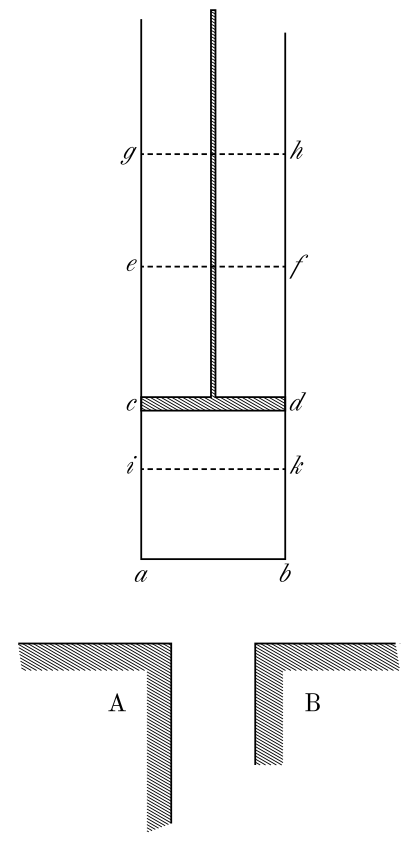
With this preliminary idea in place, imagine an elastic fluid, atmospheric air for example, shut in a cylindrical vessel abcd (Figure 1), fitted with a movable partition or piston cd. Let there also be the two bodies A and B, each kept at a constant temperature, A's higher than B's. Now picture the following series of operations.
1. Body A touches the air shut in the chamber abcd, or the wall of the chamber, which we'll suppose lets caloric through easily. Through this contact the air takes on the very temperature of body A. The piston is now at cd.
2. The piston rises gradually and comes to the position ef. Body A stays in contact with the air, which is thus kept at a constant temperature while it expands. Body A supplies the caloric needed to keep the temperature constant.
3. Body A is taken away, and the air is no longer in contact with any body that could supply it with caloric. The piston keeps moving, however, and passes from ef to gh. The air expands without receiving caloric, and its temperature falls. Imagine it falling in this way until it equals that of body B. At that moment the piston stops, at gh.
4. The air is put in contact with body B and compressed by the return of the piston, which is brought back from gh to cd. The air nonetheless stays at a constant temperature, because it is in contact with body B, to which it gives up its caloric.
5. Body B is removed and the compression of the air is continued. Now isolated, the air rises in temperature. The compression goes on until the air has reached the temperature of body A. Meanwhile the piston passes from cd to ik.
6. The air is put back in contact with body A, and the piston returns from ik to ef. The temperature stays the same.
7. The stage described under 3 comes round again, then stages 4, 5, 6, 3, 4, 5, 6, 3, 4, 5, and so on.
Through all these operations the air shut in the cylinder pushes on the piston with a greater or lesser force. Its elastic force varies, both with the changes of volume and with the changes of temperature. But notice that at equal volumes, that is, for the same positions of the piston, the temperature is higher during the expansions than during the compressions. During the expansions, then, the elastic force of the air is greater, and so the motive power produced by the expansions is larger than the motive power used up in producing the compressions. We thus obtain a surplus of motive power, which we can put to any use we like. The air has served us as a heat engine; we have even used it in the most advantageous way possible, for there has been no useless restoring of equilibrium in caloric.
All the operations described above can be carried out the other way round and in reverse order. Imagine that after the sixth stage, with the piston at ef, we bring it back to ik while keeping the air in contact with body A. The caloric that body supplied during the sixth stage will go back to its source, body A, and things will be as they were at the end of the fifth stage. If we now take body A away and move the piston from ik to cd, the temperature of the air will fall by as many degrees as it rose during the fifth stage, and become that of body B. We can clearly carry on a whole series of operations that reverse the ones we first described. We need only put ourselves in the same circumstances and, at each stage, expand where we compressed and compress where we expanded.
The first operations had produced a certain quantity of motive power and carried caloric from body A to body B; the reverse operations use up the motive power produced and bring the caloric back from body B to body A, so that the two series of operations cancel each other out, neutralize each other, so to speak.
It's now easy to prove that caloric can't be made to produce more motive power than we got from it by our first series of operations. The proof runs exactly like the one we used before, where a better engine joined to a reversed one gave perpetual motion. Here the reasoning is even a degree more exact: the air we use to develop the motive power is brought back, at the end of each cycle of operations, to precisely the state it started in, whereas, as we remarked, that wasn't quite so for the steam.16
We chose atmospheric air as the instrument for developing the motive power of heat. But the reasoning would plainly have been the same for any other gaseous substance, and indeed for any other body whose temperature can change through successive contractions and expansions, which takes in every body in nature, or at least every body fit to realize the motive power of heat. This brings us to the following general proposition:
The motive power of heat is independent of the agents used to realize it; its quantity is fixed solely by the temperatures of the bodies between which, in the end, the transfer of caloric is made.17
It must be understood here that each method of developing motive power reaches the perfection it is capable of. This condition will be met if, as we remarked above, no change of temperature takes place in the bodies that isn't due to a change of volume, or, which is the same thing put another way, if bodies at noticeably different temperatures never touch.
The different methods of realizing motive power may lie either in using different substances or in using the same substance in two different states: for example, a gas at two different densities.
What Follows for Gases
This leads us naturally to some interesting inquiries into gases, inquiries that will also bring us to new results on the motive power of heat and give us the means of checking the fundamental proposition above in some particular cases.18
It's easy to see that our proof would have been simpler had we supposed the temperatures of bodies A and B to differ very little. The piston's movements during stages 3 and 5 would then have been very short, and those stages could have been left out without any noticeable effect on the production of motive power. A very small change of volume must indeed be enough to produce a very small change of temperature, and that small change of volume is negligible beside the changes in stages 4 and 6, whose extent is unlimited.
If we leave stages 3 and 5 out of the series of operations described above, it comes down to the following.
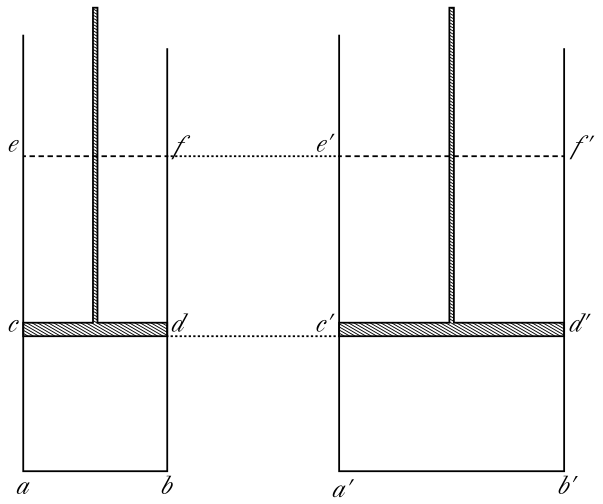
1. The gas shut in abcd (Figure 2) is in contact with body A; the piston passes from cd to ef.
2. Body A is taken away, the gas shut in abef is put in contact with body B, and the piston returns from ef to cd.
3. Body B is taken away, the gas is put in contact with body A, and the piston passes from cd to ef; that is, the first stage comes round again, and so on.
The motive power resulting from operations 1 and 2 together will plainly be the difference between the power produced by the expansion of the gas while it is at the temperature of body A and the power used up in compressing it while it is at the temperature of body B.
Suppose operations 1 and 2 are carried out on two gases of different chemical natures, but taken at the same pressure, atmospheric pressure, for example: the two gases will behave exactly alike in the same circumstances; that is, their expansive forces, equal to begin with, will stay equal whatever the changes of volume and temperature, provided the changes are the same for both. This follows directly from the laws of Mariotte (Boyle's law, to English readers) and of Gay-Lussac and Dalton, which hold for all elastic fluids and by which the same relations hold for all of them between volume, expansive force and temperature.
Since two different gases, taken at the same temperature and the same pressure, must behave alike in the same circumstances, if both are put through the operations described above they must give rise to equal quantities of motive power. Now by the fundamental proposition we have established, that means using two equal quantities of caloric: it means that the quantity of caloric passed from body A to body B is the same whichever gas we work on.
The quantity of caloric passed from body A to body B is simply the quantity the gas absorbs as it expands, or the quantity it then gives up on compression. We arrive, then, at this proposition:
When a gas passes, without changing temperature, from a given volume and pressure to another given volume and pressure, the quantity of caloric it absorbs or gives up is always the same, whatever the nature of the gas chosen for the experiment.
Take, for example, a liter of air at 100° and at a pressure of one atmosphere. If we double the volume of this air and want to keep it at 100°, we must supply it with a certain quantity of heat. That quantity will be exactly the same if, instead of air, we work on carbon dioxide, nitrogen, hydrogen, or the vapor of water or alcohol: that is, if we double the volume of a liter of any of these gases taken at 100° and at atmospheric pressure.
The same would hold in reverse if, instead of doubling the volume of the gases, we halved it by compression.
The quantity of heat that elastic fluids release or absorb when their volume changes has never been measured by any direct experiment, and such an experiment would no doubt be very difficult. But there's a datum that serves us nearly as well: it comes from the theory of sound, and it deserves a good deal of confidence because of the rigor of the reasoning by which it was established. Here it is:
Atmospheric air must rise 1 degree centigrade when sudden compression reduces its volume by 1/116.19
The experiments on the speed of sound were made in air at a pressure of 760 millimeters of mercury and a temperature of 6°, so our datum strictly applies only to those two conditions. For convenience, though, we'll refer it to 0°, which isn't far off.
Air compressed by 1/116, and so raised 1°, differs from air heated directly by 1° only in its density. If the original volume is V, the compression by 1/116 reduces it to V − 1/116 V.
Heating it directly at constant pressure must, by Gay-Lussac's rule, increase the volume of the air by 1/267 of what it would be at 0°. On one side, then, the air is reduced to the volume V − 1/116 V; on the other, it is brought to V + 1/267 V.
The difference between the quantities of heat the air holds in the two cases is plainly the quantity used to raise it directly by 1°. The quantity of heat the air would absorb in passing from the volume V − 1/116 V to the volume V + 1/267 V is therefore equal to the quantity needed to raise it by 1°.
Now imagine that instead of heating the air by 1° under constant pressure, free to expand, we shut it in a chamber that can't expand and in that state raise its temperature by 1°. Air heated by 1° in this way will differ from air compressed by 1/116 only in its volume, which is larger by 1/116. The quantity of heat the air would give up on a reduction of volume of 1/116 is therefore equal to the quantity it would need to rise 1 degree centigrade at constant volume. Since the differences between the volumes V − 1/116 V, V and V + 1/267 V are small compared with the volumes themselves, we can treat the quantities of heat the air absorbs in passing from the first of these volumes to the second, and from the first to the third, as very nearly proportional to the changes of volume. We are thus led to the following relation.
The quantity of heat needed to raise air by 1° at constant pressure is to the quantity needed to raise the same air by 1° at constant volume as the number
or, multiplying both by 116 × 267, as 267 + 116 is to 267.
That, then, is the ratio between the capacity of air for heat at constant pressure and its capacity at constant volume. If the first of these capacities is expressed by unity, the other will be expressed by the number
or about 0.700. Their difference, 1 − 0.700, or 0.300, will express the quantity of heat that goes into the increase in the air's volume when it is heated by 1° at constant pressure.
By the law of Gay-Lussac and Dalton, this increase of volume would be the same for every other gas; by the theorem proved above, the heat absorbed by equal increases of volume is the same for all elastic fluids. We are led, then, to lay down the following proposition:
The difference between the specific heat at constant pressure and the specific heat at constant volume is the same for all gases.
Note that all the gases are taken to be at the same pressure, atmospheric pressure for example, and that the specific heats are measured by volume.
Nothing is easier now than to draw up a table of the specific heats of gases at constant volume from their specific heats at constant pressure. Here is that table. Its first column is the result of the direct experiments of Delaroche and Bérard on the specific heat of gases at atmospheric pressure; its second consists of the numbers in the first less 0.300.
Table of the Specific Heat of Gases
| Gas | Specific heat at constant pressure | Specific heat at constant volume |
| Atmospheric air | 1.000 | 0.700 |
| Hydrogen | 0.903 | 0.603 |
| Carbon dioxide | 1.258 | 0.958 |
| Oxygen | 0.976 | 0.676 |
| Nitrogen | 1.000 | 0.700 |
| Nitrous oxide | 1.350 | 1.050 |
| Olefiant gas (ethylene) | 1.553 | 1.253 |
| Carbon monoxide | 1.034 | 0.734 |
The numbers in both columns are referred here to the same unit, the specific heat of atmospheric air at constant pressure.
Since the difference between each number in the first column and the matching number in the second is constant, the ratio between them must vary: the ratio of a gas's specific heat at constant pressure to its specific heat at constant volume changes from one gas to another.
We've seen that air rises 1° when it is suddenly compressed by 1/116 of its volume. Other gases must also rise in temperature under the same compression, but not all by the same amount: each in inverse proportion to its specific heat at constant volume. The reduction of volume is the same by hypothesis, so the heat it releases must be the same too, and the rise in temperature it produces depends only on the specific heat the gas has after compression, varying inversely with it. It's easy for us, then, to draw up the table of the rises in temperature of the different gases for a compression of 1/116.
Here it is.
Table of the Rise in Temperature of Gases on Compression
| Gas | Rise in temperature for a reduction of volume of 1/116 |
| Atmospheric air | 1.000° |
| Hydrogen | 1.160 |
| Carbon dioxide | 0.730 |
| Oxygen | 1.035 |
| Nitrogen | 1.000 |
| Nitrous oxide | 0.667 |
| Olefiant gas (ethylene) | 0.558 |
| Carbon monoxide | 0.955 |
A second compression of 1/116 (of the new volume) would raise the temperature of these gases again, as we'll soon see, by about as much as the first; but the same wouldn't be true of a third, a fourth, a hundredth such compression. The capacity of gases for heat changes with their volume; it may very well change with temperature too.
We'll now draw from the general proposition a second theorem, which will complete the one just proved.
Imagine that the gas shut in the cylinder abcd (Figure 2) is moved into the chamber a′b′c′d′ (Figure 3), of the same height but with a different and larger base. The gas will increase in volume and decrease in density and elastic force in the inverse ratio of the two volumes abcd and a′b′c′d′. As for the total pressure on each piston, cd and c′d′, it will be the same for both, because the areas of the pistons are in direct proportion to the volumes.
Suppose we carry out on the gas in a′b′c′d′ the operations described above, which we imagined performed on the gas in abcd. That is, suppose we give the piston c′d′ movements of the same extent as those of the piston cd, making it take in turn the position c′d′, matching cd, and e′f′, matching ef, while at the same time we put the gas, by means of the two bodies A and B, through the same changes of temperature as when it was shut in abcd. The total force on the piston will then be the same in the two cases at every matching instant. This follows from Mariotte's law alone.20 The densities of the two gases always keep the same ratio to each other for the same positions of the pistons, and the temperatures are always equal on both sides, so the total pressures on the pistons will always keep the same ratio to each other. If that ratio is one of equality at any instant, the pressures will always be equal.
Since, moreover, the two pistons move through equal distances, the motive power produced will be the same on both sides, and by the general proposition we must conclude that the quantities of heat used on both sides are the same: the same quantity of heat passes from body A to body B in the two cases.
The heat taken from body A and handed to body B is nothing other than the heat absorbed by the gas as it expands and released again when it is compressed. We are led, then, to the following theorem:
When an elastic fluid passes, without changing temperature, from the volume U to the volume V, and an equal weight of the same gas passes at the same temperature from the volume U′ to the volume V′, then if the ratio of U′ to V′ is the same as the ratio of U to V, the quantities of heat absorbed or released in the two cases will be equal.
The theorem can be put another way:
When a gas changes volume without changing temperature, the quantities of heat it absorbs or releases are in arithmetic progression if the increases or reductions of volume are in geometric progression.
When a liter of air kept at 10° is compressed to 1/2 liter, a certain quantity of heat is released. That quantity will always be the same if the volume is reduced again from 1/2 liter to 1/4 liter, from 1/4 liter to 1/8, and so on.
If instead of compressing the air we expand it in turn to 2 liters, 4 liters, 8 liters and so on, we must keep supplying it with equal quantities of heat to hold it at the same temperature.
This easily accounts for the high temperature air reaches under rapid compression. That temperature is known to be enough to light tinder, and even to make the air glow. If we suppose for a moment that the specific heat of air stays constant despite the changes of volume and temperature, the temperature will rise in arithmetic progression for reductions of volume in geometric progression. Starting from this, and granting that a rise of one degree goes with a compression of 1/116, we can easily conclude that air reduced to 1/14 of its original volume must rise by about 300°, enough to light tinder.21
The rise of temperature must be greater still if air's capacity for heat gets smaller as its volume shrinks. That is to be presumed, and it even seems to follow from the experiments of Delaroche and Bérard on the specific heat of air at different densities. (See their memoir printed in the Annales de chimie, tom. 85, pp. 72 and 224.)
The two theorems we have stated, the one on different gases and the one on volumes in the same ratio, are enough to compare the quantities of heat absorbed or released when elastic fluids change volume, whatever the density and chemical nature of those fluids, provided they are all taken at, and kept at, some one unchanging temperature. But these theorems give no means of comparing the quantities of heat released or absorbed by elastic fluids that change volume at different temperatures. We don't know, for instance, what ratio holds between the heat released by a liter of air compressed to half its volume at a steady 0° and the heat released by the same liter of air compressed to half at a steady 100°. Knowing that ratio depends on knowing the specific heat of gases at different temperatures, and on some other data that present-day physics can't yet give us.
Our second theorem gives us a means of finding the law by which the specific heat of gases varies with their density.
Suppose the operations described above, the short cycle without stages 3 and 5, are carried out not with two bodies A and B whose temperatures differ by an infinitely small amount but with two bodies whose temperatures differ by a finite amount, 1° for example. In a complete cycle of operations, body A supplies the elastic fluid with a certain quantity of heat, which can be divided into two portions: first, the heat needed to keep the fluid at a constant temperature while it expands; second, the heat needed to bring the fluid back from the temperature of body B to that of body A when, after the fluid has been returned to its original volume, it is put back in contact with body A. Call the first of these quantities a and the second b. The total caloric supplied by body A will be a + b.
The caloric the fluid passes on to body B can also be divided into two parts: one, b′, due to the cooling of the gas by body B; the other, a′, which the gas gives up as its volume is reduced. The sum of these two quantities is a′ + b′. It must equal a + b, for after a complete cycle of operations the gas is brought back exactly to its original state, and it must have given up all the caloric first supplied to it. We have, therefore,
or
Now by the second theorem, the quantities a and a′ don't depend on the density of the gas, provided the weight of gas stays the same and the changes of volume are proportional to the original volume. The difference a − a′ must meet the same conditions, and so must the difference b′ − b, which equals it. But b is the caloric needed to raise by one degree the gas shut in abcd (Figure 2), and b′ is the caloric the gas gives up when, shut in abef, it cools by 1 degree. These quantities can serve as measures of the specific heats. Hence the following proposition:
The change in the specific heat of a gas brought about by a change of volume depends solely on the ratio between the original volume and the new one. That is, the difference between the specific heats does not depend on the absolute size of the volumes, but only on their ratio.
The proposition can be put another way:
When a gas increases in volume in geometric progression, its specific heat increases in arithmetic progression.
If is the specific heat of air at a given density, and the specific heat at half that density, then at a quarter of that density it will be , at an eighth , and so on.
The specific heats are referred here to weight, and taken at constant volume. But as we'll now see, they would follow the same law if taken at constant pressure.
What, after all, causes the difference between the specific heats at constant volume and at constant pressure? The caloric needed, in the second case, to produce the increase of volume. Now by Mariotte's law the increase in volume of a gas for a given change of temperature must be a fixed fraction of the original volume, a fraction independent of the pressure. By the second theorem, if the ratio between the original volume and the new one is given, the heat needed to produce the increase of volume is thereby fixed. It depends solely on that ratio and on the weight of the gas. We must conclude, then, that
The difference between the specific heat at constant pressure and the specific heat at constant volume is always the same, whatever the density of the gas, provided the weight stays the same.
Both specific heats grow as the density of the gas decreases, but their difference doesn't change.22
Since the difference between the two capacities for heat is constant, if one increases in arithmetic progression the other must follow a similar progression. Our law therefore applies to specific heats taken at constant pressure.
We've tacitly assumed that specific heat increases with volume. The increase follows from the experiments of Delaroche and Bérard: they found 0.967 for the specific heat of air at a pressure of 1 meter of mercury (see the memoir already cited), taking as unity the specific heat of the same weight of air at a pressure of 0.760 meters.
Given the law the specific heats follow with respect to pressure, it's enough to have observed them in two particular cases to deduce them in every possible case. Using the experimental result of Delaroche and Bérard just reported, we have in this way drawn up the following table of the specific heats of air under different pressures.
| Pressure in atmospheres | Specific heat (air at atmospheric pressure = 1) | Pressure in atmospheres | Specific heat (air at atmospheric pressure = 1) |
| 1/1024 | 1.840 | 1 | 1.000 |
| 1/512 | 1.756 | 2 | 0.916 |
| 1/256 | 1.672 | 4 | 0.832 |
| 1/128 | 1.588 | 8 | 0.748 |
| 1/64 | 1.504 | 16 | 0.664 |
| 1/32 | 1.420 | 32 | 0.580 |
| 1/16 | 1.336 | 64 | 0.496 |
| 1/8 | 1.252 | 128 | 0.412 |
| 1/4 | 1.165 | 256 | 0.328 |
| 1/2 | 1.084 | 512 | 0.244 |
| 1 | 1.000 | 1024 | 0.160 |
The pressures, as you can see, form a geometric progression, and the specific heats an arithmetic one.
We've carried the table out to extreme compressions and rarefactions. Presumably air would have turned liquid before reaching 1024 times its ordinary density, that is, before becoming denser than water. Carried beyond its last line, the table would make the specific heats vanish and even turn negative. We think, besides, that the figures in the specific-heat columns fall off here too quickly. The experiments our calculation rests on were made within limits too narrow for us to expect great accuracy in the numbers we have obtained, above all at the extremes.
Since we know, on the one hand, the law by which heat is released when gases are compressed, and on the other the law by which specific heat varies with volume, we can easily calculate how much the temperature of a gas rises when it is compressed without being allowed to lose caloric. The compression can be thought of as split into two successive operations: first, compression at constant temperature; second, giving the gas back the caloric it released. In this second operation the temperature will rise in inverse proportion to the specific heat the gas has after its reduction in volume, a specific heat we know how to calculate by the law proved above. The heat released by the compression must, by the second theorem, be represented by an expression of the form
where s is that heat, v the volume of the gas after compression, and A and B arbitrary constants that depend on the original volume of the gas, its pressure and the units chosen.
The specific heat, which varies with volume by the law just proved, must be represented by an expression of the form
where A′ and B′ are arbitrary constants different from A and B.
The rise in temperature the gas acquires through compression is proportional to the ratio s/z, that is, to the ratio of A + B log v to A′ + B′ log v. It can be represented by that ratio itself. Calling it t, we'll have
If the original volume of the gas is 1 and its original temperature 0°, we'll have at once t = 0 and log v = 0, whence A = 0. Then t will express not just the rise in temperature but the temperature itself above the zero of the thermometer.
The formula we've just given shouldn't be taken as applying to very large changes in the volume of gases. We have treated the rise in temperature as inversely proportional to the specific heat, which tacitly assumes that the specific heat is constant at all temperatures. Large changes of volume bring large changes of temperature in the gas, and nothing proves that the specific heat stays constant at different temperatures, least of all at temperatures far apart. That constancy is only a hypothesis, granted for gases by analogy and fairly well confirmed for solids and liquids over part of the thermometer scale, but the experiments of Dulong and Petit have shown it to be inexact when stretched to temperatures well above 100°.23
By a law due to Clément and Desormes, established by direct experiment, steam always contains the same quantity of heat for the same weight, whatever the pressure at which it is formed. This amounts to saying that steam compressed or expanded mechanically, without loss of heat, will always just saturate the space it fills if it did so to begin with. Steam in that condition can therefore be regarded as a permanent gas, and it must obey all the laws of one. The formula
must therefore apply to it, and must agree with the table of pressures that comes out of Dalton's direct experiments.
And one can indeed check that our formula, with suitable values of the arbitrary constants, represents the results of experiment very closely. The small anomalies one may find are no larger than can reasonably be put down to errors of observation.24
More Power in the Lower Degrees
Let us come back now to our main subject, the motive power of heat, from which we've already strayed too far.
We've shown that the quantity of motive power developed by carrying caloric from one body to another depends essentially on the temperatures of the two bodies, but we haven't yet given any relation between those temperatures and the quantities of motive power produced. It might seem natural at first to suppose that equal differences of temperature produce equal quantities of motive power: that, for example, a given quantity of caloric passing from a body A kept at 100° to a body B kept at 50° should give rise to as much motive power as the same caloric carried from a body B at 50° to a body C at 0°. Such a law would certainly be very remarkable, but there's no sufficient reason to accept it a priori. We'll test it by rigorous reasoning. Imagine the operations described earlier, the short two-stage cycle, carried out in turn on two quantities of atmospheric air equal in weight and in volume but taken at different temperatures, and suppose the difference of temperature between bodies A and B to be the same in both cases. In one case, for example, the bodies might be at 100° and 100° − h (h being infinitely small), and in the other at 1° and 1° − h. The motive power produced is, in each case, the difference between what the gas yields by expanding and what it takes to bring it back to its original volume. Now this difference is the same in both cases, as a simple argument we don't think worth spelling out will show, and so the motive power produced is the same.
Let us now compare the quantities of heat used in the two cases. In the first, the heat used is what body A supplies to the air to keep it at 100° while it expands; in the second, it is what the same body must supply to keep it at 1° through exactly the same change of volume. If these two quantities of heat were equal, the law we first supposed would follow at once. But nothing proves that they are, and we'll now see that they aren't.
Suppose the air first fills the space abcd (Figure 2) at a temperature of 1°. It can be brought to fill the space abef at a temperature of 100° in two different ways.
1. We can first heat it without changing its volume, then expand it while keeping its temperature constant.
2. We can begin by expanding it at constant temperature, then heat it once it has its new volume.
Let a and b be the quantities of heat used in turn in the first procedure, and b′ and a′ the quantities used in turn in the second. Since the two procedures end in the same result, the heat used must be the same in both. We have, therefore,
a′ is the quantity of heat needed to take the gas from 1° to 100° when it fills the space abef.
a is the quantity of heat needed to take the gas from 1° to 100° when it fills the space abcd.
The air is less dense in the first case than in the second, and by the experiments of Delaroche and Bérard cited earlier, its capacity for heat must be a little greater.
Since a′ is greater than a, b must be greater than b′. Generalizing the proposition, then, we'll say:
The quantity of heat due to a change in the volume of a gas is greater the higher the temperature.
It takes more caloric, for example, to keep a quantity of air at 100° while its volume is doubled than to keep the same air at 1° through exactly the same expansion.
Yet these unequal quantities of heat would produce, as we've seen, equal quantities of motive power for equal falls of caloric taken at different heights on the thermometer scale, from which we can draw the following conclusion:
The fall of caloric produces more motive power in the lower degrees than in the higher.
A given quantity of heat will thus develop more motive power passing from a body kept at 1° to another kept at 0° than if the two bodies had been at 101° and 100°.
The difference must, however, be very small; it would be nothing at all if air's capacity for heat stayed constant despite changes of density. By Delaroche and Bérard's experiments that capacity varies little, so little that the differences observed might, strictly speaking, be put down to errors of observation or to some circumstance overlooked.
With only the experimental data we have, we can't determine rigorously the law by which the motive power of heat varies at different points of the thermometer scale. That law is tied to the law by which the specific heat of gases varies with temperature, which experiment hasn't yet made known with enough accuracy.25
The Numbers for Air, Steam and Alcohol
We'll now try to calculate the motive power of heat in absolute terms. To check our fundamental proposition, to check whether the agent used to realize motive power really makes no difference to the quantity of it, we'll choose several agents in turn: atmospheric air, steam, and the vapor of alcohol.
Suppose we use atmospheric air first. The operation will follow the method given above for the short cycle. We make the following assumptions.
The air is taken at atmospheric pressure. The temperature of body A is one thousandth of a degree above 0°, and that of body B is 0°. The difference, as you can see, is very small, which is necessary here.
The increase of volume given to the air in our operation will be 1/116 + 1/267 of its original volume. That's a very small increase in absolute terms, but a large one compared with the difference of temperature between bodies A and B.
The motive power developed by the two operations together will be, very nearly, proportional to the increase of volume and to the difference between the two pressures the air exerts at 0.001° and at 0°. By Gay-Lussac's rule, that difference is 1/267 of a thousandth of the elastic force of the gas, or very nearly 1/267 of a thousandth of atmospheric pressure.
Atmospheric pressure balances a column of water 10 40/100 meters high. 1/267 of a thousandth of that pressure is therefore equal to (1/267 × 10.40)/1000 meters of water.
As for the increase of volume, it is, by assumption, 1/116 + 1/267 of the original volume, that is, of the volume taken up by one kilogram of air at 0°, which, given the specific gravity of air, is 0.77 cubic meters. The product
will therefore express the motive power developed. That power is measured here in cubic meters of water raised 1 meter.
Carrying out the multiplications, we find the value of the product to be 0.000000372.
Now let us calculate the quantity of heat used to give this result, that is, the quantity of heat that passed from body A to body B.
Body A supplies, first, the heat needed to bring 1 kilogram of air from 0° to 0.001°;
second, the quantity needed to keep the air at that 0.001° while it expands by
The first of these quantities of heat is very small beside the second, so we'll neglect it. The second, by the reasoning we gave in deriving the ratio of the two specific heats, equals the heat that would be needed to raise by 1° the temperature of 1 kilogram of air at atmospheric pressure.
By Delaroche and Bérard's experiments on the specific heat of gases, that of air is, weight for weight, 0.267 of that of water. If, then, we take as our unit of heat the quantity needed to raise one kilogram of water by 1°, the heat needed to raise one kilogram of air by 1° will be 0.267. The quantity of heat supplied by body A is therefore
0.267 units.
That's the heat able to produce 0.000000372 units of motive power by its fall from 0.001° to 0°.
For a fall a thousand times as great, a fall of 1°, the motive power produced will be very nearly 1000 times the first, or
0.000372.
If now, instead of 0.267 units of heat, we use 1,000 units, the motive power produced will be given by the proportion
Thus 1,000 units of heat passing from a body kept at 1° to another body kept at 0° will produce, acting on air,
1.395 units of motive power.
We'll compare this result with the one given by the action of heat on steam.
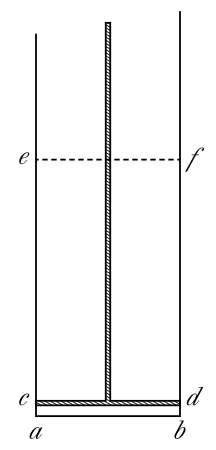
Suppose 1 kilogram of liquid water shut in the cylinder abcd (Figure 4), between the bottom ab and the piston cd. Suppose also the two bodies A and B, each kept at a constant temperature, A's very slightly above B's. Now picture the following operations.
1. The water is put in contact with body A; the piston passes from cd to ef; steam forms at the temperature of body A to fill the space opened up as the chamber enlarges. We'll suppose the space abef large enough to hold all the water as steam.
2. Body A is taken away and the steam put in contact with body B; part of the steam condenses, its elastic force falls, the piston returns from ef to ab, and the rest of the steam turns to liquid under the pressure combined with contact with body B.
3. Body B is taken away, the water put back in contact with body A and returned to that body's temperature; the first stage comes round again, and so on.
The motive power developed in a complete cycle of operations is measured by the volume of the steam multiplied by the difference between its pressures at the temperature of body A and at that of body B.
As for the heat used, that is, carried from body A to body B, it's simply the heat it took to turn the water into steam, neglecting the small quantity needed to bring the liquid water back from the temperature of body B to that of body A.
Let the temperature of body A be 100° and that of body B 99°. By Dalton's table the difference of pressure will be 26 millimeters of mercury, or 0.36 meters of water.
The volume taken up by the steam is 1700 times that of the water. If we work on one kilogram, that will be 1700 liters, or 1.700 cubic meters.
The motive power developed is therefore the product
of the kind we used before.
The quantity of heat used is the quantity needed to turn into steam water already brought to 100°. That quantity is given by experiment: it has been found equal to 550°, or more exactly to 550 of our units of heat.
Thus 0.611 units of motive power result from the use of 550 units of heat.
The quantity of motive power resulting from 1,000 units of heat will be given by the proportion
Thus 1000 units of heat carried from a body kept at 100° to another kept at 99° will produce, acting on steam, 1.112 units of motive power.
The number 1.112 differs by about 1/4 from the number 1.395 found earlier for the motive power developed by 1,000 units of heat acting on air. But notice that in that case the temperatures of bodies A and B were 1° and 0°, whereas here they are 100° and 99°. The difference is indeed the same, but it doesn't stand at the same height on the thermometer scale. For an exact comparison we would have had to calculate the motive power developed by steam formed at 1° and condensed at 0°, and we would also have had to know the quantity of heat contained in steam formed at 1°.
The law of Clément and Desormes reported above gives us that datum. Since the heat that makes up steam is always the same, whatever the temperature at which the water turns to vapor, if it takes 550 degrees of heat to vaporize water already brought to 100°, it will take 550 + 100, or 650, to vaporize the same weight of water taken at 0°.
Using this datum, and reasoning otherwise exactly as we did for water at 100°, we find, as is easy to check,
1.290
for the motive power developed by 1,000 units of heat acting on steam between 1° and 0°.
This number comes closer than the first to
1.395.
It now differs from it by only 1/13, an error not beyond presumable limits, given the large number of data of different kinds we were forced to use to arrive at this comparison. Our fundamental law is thus confirmed in a particular case.26
We'll examine another case, that in which heat acts on the vapor of alcohol.
The reasoning here is exactly the same as for steam; only the data change.
Pure alcohol boils at ordinary pressure at 78.7 degrees centigrade. According to Delaroche and Bérard, one kilogram absorbs 207 units of heat in turning to vapor at that same temperature of 78.7°.
The pressure of alcohol vapor 1° below the boiling point is found to be lower by 1/25: it is 1/25 less than atmospheric pressure. (At least, that is what follows from the experiments of Betancourt, reported in the second part of Prony's Architecture hydraulique, pp. 180 and 195.)27
Using these data, we find that acting on a kilogram of alcohol at the temperatures 78.7° and 77.7°, the motive power developed would be 0.251 units.
It results from the use of 207 units of heat. For 1000 units we must set up the proportion
This number is a little larger than the 1.112 that came from using steam at 100° and 99°. But if we suppose steam used at 78° and 77°, we find, by the law of Clément and Desormes, 1.212 for the motive power due to 1000 units of heat. This last number, as you can see, comes very close to 1.230; it differs from it by only 1/50.
We would have liked to make other comparisons of this kind: to calculate, for example, the motive power developed by the action of heat on solids and liquids, by the freezing of water, and so on. But present-day physics denies us the data we would need.28 The fundamental law we set out to confirm would seem to call, nonetheless, for fresh checks before it can be put beyond doubt; it rests on the theory of heat as understood today, and that foundation, it must be admitted, doesn't strike us as unshakably solid. Only new experiments could settle the question; in the meantime we'll apply the theoretical ideas set out above, taking them as exact, to the examination of the various means proposed so far for realizing the motive power of heat.
Solids, Steam and High Pressure
It has sometimes been proposed to develop motive power by the action of heat on solid bodies. The way of going about it that comes most naturally to mind is to fix a solid body, a metal bar for instance, firmly by one end, attach the other end to a moving part of a machine, and then, by heating and cooling it in turn, make the bar grow longer and shorter and so produce motion of some kind. Let us try to judge whether this way of developing motive power can pay. We've shown that the mark of the best use of heat for producing motion is that every change of temperature in the bodies should be due to a change of volume. The closer we come to meeting this condition, the better the heat will be used. Now, working in the way just described, we are very far from meeting it: here no change of temperature is due to a change of volume, and all of them are due to contact between bodies heated to different degrees: contact between the metal bar and the body charged with supplying it heat, or the body charged with taking heat away.
The only way to meet the prescribed condition would be to act on the solid body exactly as we did on the air in the operations described earlier. But for that we would have to be able to produce large changes of temperature in the solid simply by changing its volume, at least if we wanted to use large falls of caloric, and that seems impracticable. Several considerations suggest that the changes of temperature produced in solids or liquids by compression and expansion would be quite small.
1. In machines (heat engines especially) we often see solid parts that bear very great forces, now one way, now the other, and although these forces are sometimes as great as the materials will stand, the changes of temperature are hardly noticeable.
2. In striking medals, in rolling mills and in drawing wire, metals undergo the greatest compression our means allow, using the hardest and toughest tools. Yet the rise in temperature isn't great: if it were, the steel parts used in these operations would soon lose their temper.
3. It's known that a very great force would have to be applied to solids and liquids to reduce their volume as much as cooling does (a cooling from 100° to 0°, for example). Now cooling requires taking away more caloric than the mere reduction of volume would. If that reduction were brought about mechanically, the heat released couldn't change the body's temperature by as many degrees as the cooling does. And yet it would require a force that is certainly very great.
Since solids can undergo little change of temperature through changes of volume, and since the condition for the best use of heat in developing motive power is precisely that every change of temperature be due to a change of volume, solids seem ill suited to realizing that power.
Liquids are in exactly the same case, and the same reasons can be given for rejecting them.29
We say nothing here of the practical difficulties, which would be countless. The movements produced by the expansion and compression of solids or liquids could only be very small, and to enlarge them one would be forced to use complicated mechanisms; the strongest materials would be needed to transmit enormous pressures; finally, the successive operations would go very slowly compared with those of the ordinary heat engine, so that large and costly apparatus would produce, in the end, only mediocre effects.
Elastic fluids, gases or vapors, are the true instruments for developing the motive power of heat. They combine every condition needed to do the job well. They are easy to compress and can expand almost without limit; changes of volume bring about large changes in their temperature; and finally they move easily, can be heated and cooled quickly, and can be carried easily from one place to another, which allows them to produce rapidly the effects expected of them.
One can easily imagine any number of machines for developing the motive power of heat by means of elastic fluids. But however one goes about it, the following principles must not be lost sight of.
1. The temperature of the fluid must first be raised as high as possible, so as to obtain a great fall of caloric and so a great production of motive power.
2. For the same reason, the cooling must be carried as far as possible.
3. The passage of the elastic fluid from the highest temperature to the lowest must be brought about by its increase in volume; that is, the cooling of the gas must happen of its own accord, through its expansion.
The limit on the temperature to which the fluid can first be brought is simply the limit of the temperature produced by burning, and that is very high.
The limit on the cooling is the temperature of the coldest bodies available easily and in great quantity, which are usually the waters of the place where one happens to be.
The third condition makes trouble for realizing the motive power of heat when it comes to exploiting large differences of temperature, to using large falls of caloric. The gas must then pass, by expanding, from a very high temperature to a very low one, and that takes a great change of volume and density: it requires either that the gas start under very high pressure or that it expand to an enormous volume, and both conditions are hard to meet. The first calls for very strong vessels to hold the gas at once under high pressure and at a high temperature; the second calls for vessels of very great size.
These are in fact the main obstacles that keep steam engines from exploiting a large part of the motive power of heat. They are forced to make do with a small fall of caloric, while the burning of coal gives the means of obtaining a very large one.
In steam engines the elastic fluid is rarely formed at a pressure above 6 atmospheres, which corresponds to about 160 degrees centigrade, and condensation rarely takes place at a temperature much below 40°. The fall of caloric from 160° to 40° is 120°, whereas burning can provide a fall of 1000 to 2000 degrees.
To make this clearer, let us recall what we have called the fall of caloric: the passage of heat from a body A, where the temperature is high, to another, B, where it is lower. We say the fall of caloric is 100 degrees or 1000 degrees when the difference of temperature between bodies A and B is 100° or 1000°.
In a steam engine working at a pressure of 6 atmospheres, the temperature of the boiler is 160 degrees: this is body A, kept at the constant temperature of 160° by contact with the furnace, and it continually supplies the heat needed to form the steam.
The condenser is body B; it is kept by a stream of cold water at the nearly constant temperature of 40 degrees, and it continually absorbs the caloric brought to it from body A by the steam.
The difference of temperature between these two bodies is 160° − 40°, or 120°. That's why we say the fall of caloric here is 120°.
Coal can produce by burning a temperature above 1000°, and the cold water most commonly available in our climates is at about 10°, so a fall of caloric of 1000° is easy to obtain, of which steam engines use only 120°. And even those 120° aren't fully exploited. There are always considerable losses from useless restorings of equilibrium in caloric.
It's easy to see now why so-called high-pressure engines have the advantage over engines of lower pressure: the advantage lies essentially in the power to make use of a greater fall of caloric. Steam formed at a higher pressure is also at a higher temperature, and since the temperature of condensation stays about the same, the fall of caloric is plainly greater.
But to get really advantageous results from high-pressure engines, the fall of caloric must be exploited as well as possible. It isn't enough for the steam to be formed at a high temperature; it must also, by expanding, reach a fairly low temperature. The mark of a good steam engine, then, must be not only that it uses steam at high pressure but that it uses it at successive pressures that vary widely, differ greatly from one another, and decrease step by step.3031
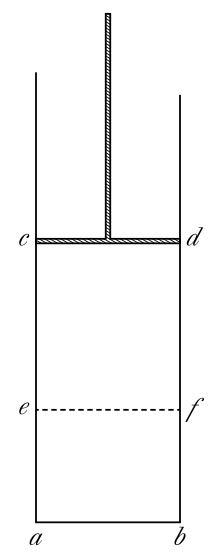
To make the advantage of high-pressure engines felt, so to speak, a posteriori, suppose steam formed at atmospheric pressure is let into the cylinder abcd (Figure 5) under the piston cd, which at first rested on the bottom ab. Having moved the piston from ab to cd, the steam will go on to produce its effects in some way that doesn't concern us.
Now imagine the piston, having reached cd, forced down to ef without letting the steam escape or lose any of its caloric. The steam will be pushed back into the space abef, and will increase at once in density, in elastic force and in temperature.
If the steam, instead of being formed at atmospheric pressure, had been formed in precisely the state it is in when squeezed into abef, and after moving the piston from ab to ef as it came into the cylinder had pushed it from ef to cd by its expansion alone, the motive power produced would have been greater than in the first case. The piston's movement, equal in extent, would have taken place under a greater pressure, though a varying one, falling step by step.
Yet the steam would have needed for its formation exactly the same quantity of caloric; it would simply have been taken at a higher temperature.
Considerations of this kind lie behind the two-cylinder engines, invented by Hornblower and improved by Woolf, which are held to be the most economical of fuel. They consist of a small cylinder which, at each stroke, fills more or less with steam (often completely), and a second cylinder, usually given four times the capacity of the first, which receives no steam except what has already worked in the first cylinder. By the end of its action, then, the steam has at least quadrupled its volume. From the second cylinder it is taken straight to the condenser, but one can see that it could be taken to a third cylinder, four times the second, where its volume would become 16 times what it was at first. The main obstacle to using a third cylinder of this kind is the capacity it would need, and the large size its openings would need to let the steam through.32 We'll say no more on this subject, since our purpose isn't to go into the details of building heat engines: those details would call for a work devoted to them, which doesn't yet exist, at least not in France.33
If the expansion of steam is limited mainly by the size of the vessels in which it must expand, the degree of compression at which it can first be used is limited only by the strength of the vessels in which it is formed, that is, the boilers. In this respect we are far from having reached the best that is possible. The design of the boilers generally in use is thoroughly faulty, even though the pressure of the steam in them is rarely carried beyond 4 to 6 atmospheres. They often burst and have caused serious accidents. It would no doubt be quite possible to avoid such accidents and still carry the steam to much higher pressures than is generally done.
Besides the two-cylinder high-pressure engines we have spoken of, there are also high-pressure engines with a single cylinder. Most of these were built by two able English engineers, Trevithick and Vivian. They use steam at very high pressure, sometimes 8 to 10 atmospheres, but they have no condenser. The steam, once let into the cylinder, expands to some extent, but always keeps a pressure above that of the atmosphere. When it has done its job it is thrown out into the atmosphere. Working this way comes to exactly the same thing, as regards the motive power produced, as condensing the steam at 100°, and part of the useful effect is lost. But engines that work like this do without a condenser and an air pump. They cost less than the others, are less complicated, take up less room, and can be used where there's no stream of cold water large enough for condensing. There they are of inestimable value, since nothing else can take their place. In England these engines are used mainly to move wagons carrying coal on railways laid either inside the mines or in the open air.
Air Engines and Other Vapors
It remains for us to say a few words about using the permanent gases, and vapors other than steam, to develop the motive power of fire.
Attempts have been made several times to get motive power by making heat act on atmospheric air. Compared with steam, this gas has advantages and drawbacks, which we'll now examine.
1. Compared with steam, it has a notable advantage: having, volume for volume, a much smaller capacity for heat, it would cool more for the same expansion. (This is proved by what we said earlier.) And we've seen how important it is to produce, through changes of volume, the greatest possible changes of temperature.
2. Steam can be made only by way of a boiler, whereas atmospheric air could be heated directly by burning fuel inside it. A considerable loss would thus be avoided, not only in the quantity of heat but also in its temperature. This advantage belongs to atmospheric air alone; the other gases don't share it; they would even be harder to heat than steam.
3. To give air a large expansion, and so produce a large change of temperature by that expansion, it would have to start at a fairly high pressure: it would therefore have to be compressed, by an air pump or some other means, before being heated. That operation would call for a special apparatus, which steam engines don't need. In them the water is liquid when it is fed into the boiler, and a small force pump is all it takes to put it there.
4. Steam is cooled by contact with the cooler far more quickly and easily than air can be. One could, it's true, fall back on throwing the air out into the atmosphere, which would have the further advantage of doing without a cooler, not always available. But for that, the air's expansion must not have brought it to a pressure below atmospheric pressure.
5. One of the most serious drawbacks of steam is that it can't be taken to high temperatures without vessels of extraordinary strength. Not so with air, for which there's no necessary relation between elastic force and temperature. Air would therefore seem better suited than steam to realizing the motive power of falls of caloric at high temperatures; at lower temperatures steam may be more suitable. One can even imagine making the same heat act on air and on steam in turn. It would be enough to leave the air at a high temperature after use and, instead of throwing it straight out into the atmosphere, make it wrap around a steam boiler, just as if it came straight from a furnace.
Using atmospheric air to develop the motive power of heat would present very great difficulties in practice, but perhaps not insurmountable ones; if they could be overcome, air would no doubt prove markedly superior to steam.34
As for the other permanent gases, they must be rejected outright: they have all the drawbacks of atmospheric air and none of its advantages.
The same can be said of vapors other than steam, compared with steam.
If there were an abundant liquid that turned to vapor at a higher temperature than water, whose vapor had a smaller specific heat for the same volume, and which didn't attack the metals engines are built of, it would no doubt deserve preference; but nature offers us no such body.
The use of alcohol vapor has sometimes been proposed, and engines have even been built to make it possible by keeping the vapor from mixing with the condensing water, that is, by applying the cold body to the outside instead of letting it into the engine. People thought they saw a remarkable advantage in alcohol vapor, in that it has a higher pressure than steam at the same temperature. We can see in this only one more obstacle to overcome. The chief fault of steam is its excessive pressure at high temperature, and alcohol vapor has that fault even more. As for the advantage people expected in the form of a greater production of motive power, we know from the principles set out above that it is imaginary.
It is on steam and atmospheric air, then, that future attempts to improve heat engines should concentrate, and every effort should go into using, by means of these agents, the greatest possible falls of caloric.
What a Kilogram of Coal Could Do
We'll close by showing how far the means known so far are from realizing all the motive power of fuel.
A kilogram of coal burned in the calorimeter gives a quantity of heat able to raise about 7000 kilograms of water by one degree centigrade; that is, it gives 7000 units of heat by the definition of these units given above.
The greatest fall of caloric that can be realized is measured by the difference between the temperature produced by burning and the temperature of the bodies used for cooling. It's hard to see any limit to the temperature of burning other than the point at which oxygen and the fuel can still combine. Let us take 1000° as that limit, however, and we'll certainly stay below the truth. As for the temperature of the cooler, let us take it as 0°.
We've roughly calculated, in the evaluation with steam, the quantity of motive power developed by 1000 units of heat falling from 100 degrees to 99: we found it to be 1.12 units of power, each equal to 1 cubic meter of water raised one meter.
If motive power were proportional to the fall of caloric, if it were the same for every degree of the thermometer, nothing would be easier than to estimate it from 1000° down to 0°. It would come to
But since that law is only approximate, and may stray far from the truth at high temperatures, we can make only a very rough estimate: we'll suppose the number 1120 cut in half, to 560.
Since a kilogram of coal produces 7000 units of heat, and the number 560 refers to 1000 units, we must multiply it by 7, which gives
That's the motive power of a kilogram of coal.
To compare this theoretical result with the results of experience, let us see how much motive power a kilogram of coal actually develops in the best heat engines known.
The engines that have so far given the most advantageous results are the large two-cylinder engines used for pumping out the tin and copper mines of Cornwall. Here are the best figures they have ever given.
56 million pounds of water were raised one English foot for each bushel of coal burned (the bushel weighs 88 pounds). That comes to raising 195 cubic meters of water one meter for each kilogram of coal, and so to producing 195 units of motive power per kilogram of coal burned.35
195 units is only a twentieth of 3920, the theoretical maximum. Only 1/20 of the motive power of the fuel has therefore been used.
Yet we chose our example from among the best steam engines known.
Most of the others fall well short of them. The old Chaillot engine, for example, raises 20 cubic meters of water 33 meters for every 30 kilograms of coal burned, which comes to 23 units of motive power per kilogram: a result nine times smaller than the one cited above, and 180 times smaller than the theoretical maximum.
We must not flatter ourselves that we'll ever, in practice, put all the motive power of fuel to use. Attempts to come close to it would even do more harm than good if they led us to neglect other important considerations. Economy of fuel is only one of the conditions a heat engine must meet; in many circumstances it's only secondary, and it must often give way to safety, to strength and durability, to the small space the engine must take up, to the low cost of installing it, and so on. To know how to weigh, in each case, the considerations of convenience and economy that may arise; to tell the most important from those that are merely incidental; to balance them all properly against one another, so as to reach the best result by the easiest means: that must be the chief talent of the man called on to direct and coordinate the labors of his fellows and make them work together toward a useful end, whatever it may be.