
Book One
1.1 The Master said, "To learn something and then, at the right times, put it into practice: isn't that a pleasure? To have a friend come from far away: isn't that a joy? To go unrecognised and feel no resentment: isn't that what makes a gentleman?"
1.2 Master You said, "Few people who are good sons and good younger brothers like to defy those above them. And no one who dislikes defying those above him has ever liked stirring up rebellion. The gentleman, by which I mean a gentleman by character and not by birth, puts his effort into the root, because once the root is set, the Way grows from it. Being a good son and a good younger brother: isn't that the root of goodness?"
1.3 The Master said, "Clever talk and a face put on to please: there is seldom goodness in that."
1.4 Master Zeng said, "Every day I examine myself on three points. When I make plans for other people, have I failed to do my best for them? With my friends, have I failed to keep my word? What my teacher passed on to me, have I failed to practise?"
1.5 The Master said, "To lead a state big enough to field a thousand war chariots, take its business seriously and keep your word; spend sparingly and love people; and when you call the common people out to work for the state, do it at the right season, not when their fields need them."
1.6 The Master said, "A young man should be a good son at home and, out in the world, treat his elders as a good younger brother would; he should be careful in what he does and keep his word, love everyone, and keep close to those who are good. If he still has strength to spare after all that, let him spend it on learning the old writings."
1.7 Zixia said, "Take someone who values a person's worth above good looks; who gives all his strength to serving his father and mother, and his very life to serving his lord; who keeps his word with his friends. People may say he has never had any schooling, but I would call him learned."
1.8 The Master said, "A gentleman who is not serious will command no respect, and his learning will not hold firm. Put doing your best and keeping your word first. Have no friends who are not as good as you are. When you make a mistake, don't be afraid to put it right."
1.9 Master Zeng said, "When those in charge give their parents' funerals the care they deserve, and keep up the sacrifices to ancestors long gone, the people's virtue will grow deep again."
1.10 Ziqin asked Zigong, "Whenever the Master comes to a new state on his travels, he always ends up hearing all about how it is governed. Does he go looking for that, or do the rulers offer it to him?" Zigong said, "The Master gets it by being warm, kind, respectful, restrained and modest. If you call that looking for it, it isn't the way other people look, is it?"
1.11 The Master said, "While a man's father is alive, watch what he means to do; once his father has died, watch what he does. If for three years, the years of mourning, he does not change his father's way, he can be called devoted to his parents."
1.12 Master You said, "In the use of ritual, the whole code of ceremonies and manners handed down from the founders of Zhou, from the great sacrifices to how to bow, what matters most is harmony. That was the beauty of the way of the kings of old, and they followed it in things small and large. Yet there are times when even that won't work: if you know the value of harmony and go after harmony for its own sake, without keeping it in measure by ritual, that won't work either."
1.13 Master You said, "If the promises you make stay close to what is right, you will be able to keep your word. If the respect you show stays close to ritual, you will keep clear of shame and disgrace. If the people you lean on are the ones you ought to be close to, you can take them as your guides."
1.14 The Master said, "A gentleman eats without trying to stuff himself and lives without looking for comfort. He is quick to act and careful in what he says. He goes to men of principle to be set straight. Someone like that can truly be said to love learning."
1.15 Zigong said, "Poor but no flatterer, rich but not arrogant: what do you think of that?" The Master said, "Not bad. But it is not as good as being poor and joyful, or rich and in love with ritual." Zigong said, "In the Songs, the three hundred old poems every educated person knows by heart, there is a line about bone that is cut and then filed, and jade that is carved and then polished: 'Like cutting, like filing, like carving, like polishing.' Is that what you mean?" The Master said, "Zigong, now at last I can talk about the Songs with you! I tell you where a thing has been, and you see where it is going."
1.16 The Master said, "Don't worry that others fail to see your worth; worry that you fail to see theirs."
Book Two
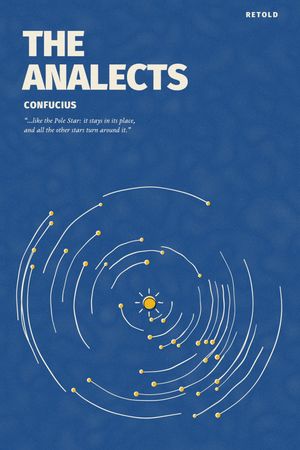
2.1 The Master said, "Someone who governs by the power of virtue is like the Pole Star: it stays in its place, and all the other stars turn around it."
2.2 The Master said, "There are three hundred Songs, but one line sums them all up: 'In thought, nothing crooked.'"
2.3 The Master said, "Lead the people with laws and keep them in line with punishments, and they will stay out of trouble but feel no shame. Lead them with virtue and keep them in line with ritual, and they will feel shame, and set themselves right besides."
2.4 The Master said, "At fifteen I set my heart on learning. At thirty I stood firm. At forty I had no more doubts. At fifty I understood what Heaven asked of me. At sixty my ear was at ease with all it heard. At seventy I could do as my heart wished and never stray past the carpenter's square."
2.5 Meng Yizi, head of the Meng family, one of the three noble houses that had taken the real power in Lu from its dukes, asked about devotion to parents. The Master said, "Never disobey." Later, when Fan Chi was driving his chariot, the Master told him, "Meng Yizi asked me about devotion to parents, and I answered, 'Never disobey.'" Fan Chi said, "What did you mean?" The Master said, "While your parents are alive, serve them as ritual says; when they die, bury them as ritual says, and sacrifice to them as ritual says."
2.6 Meng Wubo, Meng Yizi's son, asked about devotion to parents. The Master said, "Give your father and mother nothing to worry about except whether you are ill."
2.7 Ziyou asked about devotion to parents. The Master said, "These days being devoted to your parents means being able to feed them. But dogs and horses get fed too. Without respect, where is the difference?"
2.8 Zixia asked about devotion to parents. The Master said, "The hard part is the look on your face. When there is work to be done, the young take the trouble of it; when there is wine and food, their elders are served first. Did you really think that was all there is to it?"
2.9 The Master said, "I can talk with Yan Hui all day and he never once disagrees, as if he were a bit slow. But after he has gone I look at how he lives on his own, and it is plain he has taken it all in and carried it further. Slow? Not Yan Hui."
2.10 The Master said, "See what a man does. Watch how he goes about it. Notice what he is at ease with. How can he hide what he is? How can he hide?"
2.11 The Master said, "Keep going back over the old until it shows you something new, and you are fit to be a teacher."
2.12 The Master said, "The gentleman is not a vessel, made for only one use."
2.13 Zigong asked about the gentleman. The Master said, "He does it first, and talks about it afterwards."
2.14 The Master said, "The gentleman stands with everyone and joins no faction. The petty man joins a faction and does not stand with everyone."
2.15 The Master said, "To learn without thinking is to be lost. To think without learning is dangerous."
2.16 The Master said, "Working away at strange doctrines, off the true path, does nothing but harm."
2.17 The Master said, "Zilu, shall I tell you what knowing is? To know what you know, and to know what you do not know: that is knowledge."
2.18 Zizhang was learning how to win an official post and its salary. The Master said, "Listen to a great deal, leave aside whatever you are unsure of, and speak carefully about the rest: then you will make few blunders. Look at a great deal, leave aside whatever seems risky, and act carefully on the rest: then you will have few regrets. Few blunders in what you say, few regrets in what you do: that is where the salary lies."
2.19 Duke Ai, the ruler of Lu, asked, "What should I do to make the people obey?" Confucius answered, "Promote the upright and set aside the crooked, and the people will obey. Promote the crooked and set aside the upright, and the people will not obey."
2.20 Ji Kangzi, head of the Ji family, asked, "How can I make the people respectful and loyal, and eager to do their best?" The Master said, "Face them with dignity, and they will be respectful. Be devoted to your parents and kind to everyone, and they will be loyal. Promote the good and teach those who are not yet able, and they will be eager."
2.21 Someone said to Confucius, "Why don't you take part in government?" The Master said, "The Book of Documents says, 'Be devoted to your parents, simply devoted, and be a friend to your brothers, and so bring it to bear on government.' That too is taking part in government. Why must it be holding office that counts?"
2.22 The Master said, "If a person does not keep his word, I do not see how he can get anywhere. A big ox-cart with no pin to hold its yoke, a small carriage with no pin to hold its harness bar: how is either of them going to move?"
2.23 Zizhang asked, "Can we know what things will be like ten generations from now?" The Master said, "The Yin dynasty took over the ritual of the Xia dynasty before it, and what the Yin cut away and added can be known. The Zhou took over the ritual of the Yin, and what the Zhou cut away and added can be known. And whoever comes after the Zhou, even a hundred generations from now, can be known."
2.24 The Master said, "To sacrifice to spirits that are not your own family's is to flatter them for favour. To see what is right and not do it is to lack courage."
Book Three
3.1 Confucius said of the Ji family, "They have eight rows of dancers perform in their courtyard, a dance only the Son of Heaven, the king himself, has the right to. If they can bring themselves to do this, what can't they bring themselves to do?"
3.2 The Three Families, the Meng, the Shusun and the Ji, had the "Yong" sung as the sacrificial dishes were cleared away, though it was a hymn for the king's own temple. The Master said, "'The great lords attend him; the Son of Heaven stands solemn and grave.' What place do those words have in the halls of the Three Families?"
3.3 The Master said, "If a person lacks goodness, what is ritual to him? If a person lacks goodness, what is music to him?"
3.4 Lin Fang asked what lies at the root of ritual. The Master said, "What a big question! In ritual, it is better to be sparing than extravagant. In mourning, it is better to grieve deeply than to have everything smoothly arranged."
3.5 The Master said, "Even the barbarian tribes have rulers, which is more than our Chinese states can say."
3.6 The Ji family went to sacrifice to Mount Tai, a rite reserved for the king and the duke of Lu. The Master said to Ran Qiu, who served the Ji family, "Couldn't you have stopped it?" Ran Qiu answered, "I couldn't." The Master said, "Alas! Are we to believe that the spirit of Mount Tai knows less about ritual than Lin Fang?"
3.7 The Master said, "The gentleman does not compete. If he must, it is surely in archery! The archers bow and give way to each other as they go up to the hall, and when they come down they drink together. Even when they compete, they are gentlemen."
3.8 Zixia asked, "'Her artful smile, the dimples in it; her lovely eyes, so bright and clear; white silk, on which the colours shine.' What does that mean?" The Master said, "The painting comes after the plain white ground." Zixia said, "Then ritual comes after?" The Master said, "Zixia, you have opened up my own thinking! Now at last I can talk about the Songs with you."
3.9 The Master said, "I can talk about the ritual of the Xia dynasty, but the little state of Qi, where the descendants of the Xia kings live, cannot give me the evidence. I can talk about the ritual of the Yin dynasty, but Song, where the Yin's descendants rule, cannot give me the evidence. That is because there are not enough records and not enough learned men. If there were enough, I could prove what I say."
3.10 The Master said, "At the Di, the great sacrifice to the dynasty's first ancestor, which by right belonged to the king, I have no wish to watch any more once the first libation has been poured."
3.11 Someone asked what the Di sacrifice meant. The Master said, "I don't know. Anyone who knew what it meant could handle the whole world as easily as looking at this." And he pointed to the palm of his hand.
3.12 He sacrificed to his ancestors as if they were there, and to the spirits as if the spirits were there. The Master said, "If I do not take part in a sacrifice myself, it is as if I had not sacrificed at all."
3.13 Wangsun Jia, who held the real power at the court of Wei, asked, "There is a saying, 'Better to pay court to the god of the stove than to the honoured spirit in the corner of the house.' What does that mean?" The Master said, "It is not so. Offend Heaven, and there is no one left to pray to."
3.14 The Master said, "The Zhou dynasty could look back on the two dynasties before it. How rich its culture is! I follow the Zhou."
3.15 When the Master went into the Grand Temple, the shrine of the founder of Lu, he asked about everything. Someone said, "Who says the son of that fellow from Zou knows ritual? He went into the Grand Temple and asked about everything." The Master heard of it and said, "That is ritual!"
3.16 The Master said, "In archery the point is not to pierce the hide of the target, because men are not all equally strong. That was the way of old."
3.17 Zigong wanted to do away with the sheep offered at the announcement of each new month, since the dukes no longer came to the ceremony. The Master said, "Zigong, you care about the sheep; I care about the ritual."
3.18 The Master said, "If you serve your lord with every point of ritual, people take it for flattery."
3.19 Duke Ding asked, "How should a ruler employ his ministers, and how should ministers serve their ruler?" Confucius answered, "A ruler should employ his ministers according to ritual, and ministers should serve their ruler with loyalty."
3.20 The Master said, "The 'Guanju', the first song of the book, is joyful without going too far, and sad without doing harm."
3.21 Duke Ai asked Zai Wo about the trees planted at the altars of the earth god. Zai Wo answered, "The Xia dynasty planted pines, the people of Yin planted cypresses, and the people of Zhou planted chestnuts, because the word for chestnut is also the word for 'tremble': they meant to make the people tremble." The Master heard of it and said, "What is done is not talked about; what is settled is not argued over; what is past is not blamed."
3.22 The Master said, "Guan Zhong, the great minister who made Duke Huan of Qi the leader of all the states, was a small vessel!" Someone said, "Was Guan Zhong frugal, then?" The Master said, "Guan Zhong had his great Terrace of Three Returns, and none of his officials ever had to do two jobs at once. How could he be frugal?" "Then did Guan Zhong know ritual?" The Master said, "The ruler of a state puts up a screen wall inside his gate; Guan Zhong put up a screen wall too. When the ruler of a state entertains another ruler in friendship, he has a stand for setting down the emptied cups; Guan Zhong had one too. If Guan Zhong knew ritual, who doesn't?"
3.23 The Master talked about music with the Grand Music Master of Lu. He said, "Music is something we can understand. It begins with all the parts coming in together. As it goes on, they are in harmony, each one clear, each flowing into the next, and so to the end."
3.24 The border warden at Yi asked to see the Master, saying, "Whenever a gentleman has come this way, I have never failed to see him." The Master's followers brought him in. Coming out, the warden said, "My friends, why worry that he has lost his office? The world has been without the Way for a long time now. Heaven is going to use your Master as its wooden bell, the bell rung to call the people to hear a new decree."
3.25 The Master said of the Shao, the music of the sage king Shun, who was given the world, "It is perfectly beautiful, and perfectly good as well." He said of the Wu, the music of King Wu, who won the world by war, "It is perfectly beautiful, but not perfectly good."
3.26 The Master said, "Someone who holds high place and is not generous, who performs ritual without respect, who goes to a funeral and does not grieve: what is there in him worth looking at?"
Book Four
4.1 The Master said, "It is goodness that makes a neighbourhood beautiful. If you choose where to live and do not settle among the good, how can you be called wise?"
4.2 The Master said, "A person without goodness cannot bear hard times for long, and cannot bear good times for long either. The good person is at home in goodness; the wise person makes use of goodness, knowing what it is worth."
4.3 The Master said, "Only the good person can truly like people, and truly dislike them."
4.4 The Master said, "If you really set your heart on goodness, you will do no wrong."
4.5 The Master said, "Wealth and high rank are what everyone wants; but if he cannot get them by the right way, the gentleman will not keep them. Poverty and low station are what everyone hates; but if he cannot leave them by the right way, he will not leave them. If a gentleman abandons goodness, how can he live up to the name? The gentleman does not turn from goodness even for as long as it takes to eat a meal. In the greatest hurry, he holds to it; when everything is falling apart, he holds to it."
4.6 The Master said, "I have never seen anyone who truly loved goodness, or anyone who truly hated the lack of it. Someone who loved goodness would put nothing above it. Someone who hated the lack of it would be good simply by never letting anything without goodness touch him. Is there anyone who can give all his strength to goodness for a single day? I have never seen anyone whose strength was not up to it. Perhaps there is such a person, but I have never seen him."
4.7 The Master said, "People's faults each match the kind of person they are. Look at someone's faults, and you will know whether he is good."
4.8 The Master said, "If I hear the Way in the morning, I can die that same evening, and it is enough."
4.9 The Master said, "If a scholar, one of the educated men who hope to serve in government, sets his heart on the Way but is ashamed of shabby clothes and plain food, he is not worth talking to."
4.10 The Master said, "In dealing with the world, the gentleman has nothing he is set on and nothing he is set against. He goes with what is right."
4.11 The Master said, "The gentleman thinks about virtue; the petty man thinks about his land. The gentleman thinks about the law; the petty man thinks about favours."
4.12 The Master said, "If everything you do is guided by profit, you will be much resented."
4.13 The Master said, "Can you govern a state with ritual and a readiness to give way? Then what difficulty will you have? If you cannot govern a state with ritual and a readiness to give way, what is ritual to you?"
4.14 The Master said, "Don't worry that you have no position; worry about what will make you fit to hold one. Don't worry that no one recognises you; work at being worth recognising."
4.15 The Master said to Master Zeng, "One thread runs through my Way." Master Zeng said, "Yes." When the Master had gone out, the other disciples asked, "What did he mean?" Master Zeng said, "The Master's Way is doing your best for others and showing them consideration, nothing more."
4.16 The Master said, "The gentleman understands what is right; the petty man understands profit."
4.17 The Master said, "When you see someone of worth, think how to become his equal. When you see someone without worth, look inside and examine yourself."
4.18 The Master said, "In serving your father and mother, point out their faults gently. If you see they will not listen, stay respectful and do not go against them; however much trouble it costs you, do not resent it."
4.19 The Master said, "While your father and mother are alive, do not travel far; and if you do travel, let them know where you have gone."
4.20 The Master said, "If for three years, the years of mourning, a son does not change his father's way, he can be called devoted to his parents."
4.21 The Master said, "You must always know how old your father and mother are: it is a reason for joy, and a reason for fear."
4.22 The Master said, "The people of old were slow to speak, ashamed in case their actions should fail to keep up with their words."
4.23 The Master said, "Few people go wrong by holding themselves in check."
4.24 The Master said, "The gentleman wants to be slow to speak and quick to act."
4.25 The Master said, "Virtue is never alone. It always has neighbours."
4.26 Ziyou said, "Keep pressing your advice on your lord, and you will be disgraced. Keep pressing it on your friends, and they will drift away."
Book Five
5.1 The Master said of his student Gongye Chang, "He is a man a daughter could marry. He has been in prison, in chains, but it was for no crime of his." And the Master gave him his own daughter in marriage.
5.2 The Master said of Nan Rong, "When the Way prevails in the state, he will not be passed over for office; when it does not, he will stay clear of punishment and the executioner." And the Master gave him his elder brother's daughter in marriage.
5.3 The Master said of his student Zijian, "What a gentleman that man is! But if there were no gentlemen in Lu, where would he have got it from?"
5.4 Zigong asked, "And what about me?" The Master said, "You are a vessel." "What kind of vessel?" "One of the precious jade vessels that hold the grain at the sacrifices in the ancestral temple."
5.5 Someone said, "Your student Zhonggong is good, but he is no smooth talker." The Master said, "What use is smooth talk? Fending people off with a ready tongue mostly just gets you disliked. Whether he is good, I don't know. But what use would smooth talk be to him?"
5.6 The Master wanted his student Qidiao Kai to take up an official post. Qidiao Kai answered, "I am not yet sure enough of myself for that." The Master was pleased.
5.7 The Master said, "The Way is not being followed. I'll get on a raft and float off out to sea, and the one who comes with me, I suppose, will be Zilu!" When Zilu heard this he was delighted. The Master said, "Zilu loves daring even more than I do. But he has no idea how to weigh things up."
5.8 Meng Wubo asked the Master, "Is Zilu good?" The Master said, "I don't know." He asked again. The Master said, "In a state of a thousand war chariots, Zilu could be put in charge of raising and running the army. Whether he is good, I don't know." "And what about Ran Qiu?" The Master said, "In a town of a thousand households, or a noble house with a hundred chariots, Ran Qiu could be made steward. Whether he is good, I don't know." "And what about Gongxi Hua?" The Master said, "Gongxi Hua, with his sash tied, standing at court, could be set to talk with visiting guests and envoys. Whether he is good, I don't know."
5.9 The Master said to Zigong, "Which of you is better, you or Yan Hui?" Zigong answered, "How could I even dream of comparing myself with Yan Hui? Yan Hui hears one thing and understands ten from it. I hear one thing and understand two." The Master said, "No, you are not his equal. I grant you that: you are not his equal."
5.10 Zai Wo was asleep in the middle of the day. The Master said, "Rotten wood cannot be carved, and a wall made of dung and dirt cannot be plastered smooth. What would be the use of scolding Zai Wo?" The Master said, "When I started out, I would listen to what people said and trust them to do it. Now I listen to what they say and then watch what they do. It was Zai Wo who made me change."
5.11 The Master said, "I have never seen a man who is truly unbending." Someone answered, "What about Shen Cheng?" The Master said, "Shen Cheng is full of wants. How could he be unbending?"
5.12 Zigong said, "What I do not want others to do to me, I do not want to do to others either." The Master said, "Zigong, you haven't got that far yet."
5.13 Zigong said, "What the Master teaches us of culture and the old writings, we can get to hear. But what the Master says about human nature and the way of Heaven, we never get to hear."
5.14 When Zilu had heard some teaching and had not yet managed to put it into practice, his one fear was that he would hear another.
5.15 Zigong asked, "When Kong Wenzi, the minister of Wei, died, why was he given the name 'Wen', 'the Cultured'?" The Master said, "He was quick, and he loved learning, and he was not ashamed to ask questions of those beneath him. That is why he was called 'Wen'."
5.16 The Master said of Zichan, the great chief minister of the state of Zheng, that he had four of the ways of the gentleman: "He carried himself humbly. He served those above him with respect. He was generous in caring for the people. And when he called on the people's labour, he did what was right."
5.17 The Master said, "Yan Pingzhong, the minister of Qi, was good at friendship. However long he had known someone, he still treated him with respect."
5.18 The Master said, "Zang Wenzhong, the minister of Lu whom everyone called wise, kept the great tortoise shell used for telling the future in a house of its own, with hills carved on the tops of its pillars and waterweed painted on its roof posts. What kind of wisdom is that?"
5.19 Zizhang asked, "Ziwen, the chief minister of Chu, was made chief minister three times and never looked pleased; three times he was dismissed and never looked resentful. And each time he made sure to tell the new chief minister how he had been running the government. What do you think of him?" The Master said, "He did his best for those he served." "Was he good?" "I don't know. How would that make him good?" Zizhang went on, "When the minister Cui murdered the duke of Qi, Chen Wenzi, another minister of Qi, who owned ten teams of horses, forty horses in all, gave them all up and left the state. When he reached another state he said, 'They are just like our minister Cui here,' and he left it. He went to another state, and again he said, 'Just like our minister Cui,' and left it. What do you think of him?" The Master said, "He kept himself clean." "Was he good?" "I don't know. How would that make him good?"
5.20 Ji Wenzi, a minister of Lu from an earlier day, thought three times before he acted. When the Master heard of it, he said, "Twice is enough."
5.21 The Master said, "When the Way prevailed in his state, Ning Wuzi, the minister of Wei, was wise. When it did not, he played the fool. Others can match his wisdom; no one can match his foolishness."
5.22 When the Master was in Chen, stranded on his travels, he said, "Let's go home! Let's go home! The young men of my school back home are wild and aim high and are careless of the details. They have made something fine of themselves, a pattern as bright as woven silk, but they do not know how to cut it to shape."
5.23 The Master said, "Bo Yi and Shu Qi, the two princes who gave up a throne rather than take it from each other, never held old wrongs against anyone, and so hardly anyone held a grudge against them."
5.24 The Master said, "Who says Weisheng Gao is upright? Someone asked him for some vinegar, and rather than say he had none, he went and begged some from his neighbour and gave him that."
5.25 The Master said, "Clever talk, a face put on to please, and too much bowing and scraping: Zuoqiu Ming, a worthy of an earlier day, was ashamed of them, and so am I. To hide your resentment of someone and act as his friend: Zuoqiu Ming was ashamed of that, and so am I."
5.26 Yan Hui and Zilu were sitting with the Master. The Master said, "Why don't you each tell me what you would most like to do?" Zilu said, "I'd like to have carriages and horses and fine fur coats, and share them with my friends, and not mind if they wore them out." Yan Hui said, "I'd like never to boast of what I do well, and never to make a show of my hard work." Zilu said, "We'd like to hear what you would wish for, Master." The Master said, "To give the old peace of mind, to have my friends trust me, and to take the young to my heart."
5.27 The Master said, "It's hopeless! I have yet to see anyone who can see his own faults and take himself to task for them in his own heart."
5.28 The Master said, "In a village of ten households there is sure to be someone as good as I am at doing his best and keeping his word. But there will be no one who loves learning as I do."
Book Six
6.1 The Master said, "Zhonggong could sit facing south, the way a ruler sits." Zhonggong asked about Zisang Bozi. The Master said, "He'll do. He keeps things simple." Zhonggong said, "To be in earnest in yourself and keep things simple in what you do, when you are in charge of the people: isn't that all right? But to be simple in yourself and simple in what you do as well: isn't that too simple?" The Master said, "Zhonggong is right."
6.2 Duke Ai of Lu asked, "Which of your students loves learning?" Confucius answered, "There was Yan Hui. He loved learning. He never took his anger out on someone else, and he never made the same mistake twice. Sadly his life was short, and he died. Now there is no one like him. I have not heard of anyone else who loves learning."
6.3 Gongxi Hua was sent on a mission to Qi, and Ran Qiu asked for grain for Gongxi Hua's mother. The Master said, "Give her a basketful." Ran Qiu asked for more. The Master said, "Then give her two and a half." Ran Qiu gave her five cartloads, more than a hundred times what the Master had first named. The Master said, "When Gongxi Hua set off for Qi, he drove well-fed horses and wore a light fur coat. I have heard it said that the gentleman helps people in need; he does not add to the rich." When Yuan Si was the Master's steward, the Master gave him nine hundred measures of grain as his pay, and he refused it. The Master said, "Don't! Couldn't you give it away to your neighbours and the villages around you?"
6.4 The Master said of Zhonggong, whose father was a man of low birth and bad character, "Take the calf of a common plough ox. If it has a red coat and fine horns, the kind the great sacrifices call for, people may not want to use it. But would the spirits of the mountains and rivers ever turn it down?"
6.5 The Master said, "Yan Hui could keep his heart from straying from goodness for three months at a time. The others get there for a day, or a month, and that is all."
6.6 Ji Kangzi asked, "Could Zilu be given a part in governing?" The Master said, "Zilu is decisive. What trouble would he have with governing?" Ji Kangzi asked, "Could Zigong be given a part in governing?" The Master said, "Zigong understands things. What trouble would he have with governing?" Ji Kangzi asked, "Could Ran Qiu be given a part in governing?" The Master said, "Ran Qiu has many skills. What trouble would he have with governing?"
6.7 The Ji family wanted Min Ziqian to be steward of Bi, their walled town. Min Ziqian said, "Turn them down for me politely. If anyone comes back for me again, I will certainly be on the far side of the Wen River, out of Lu and into Qi."
6.8 Ran Boniu was ill, and the Master went to ask after him. He held his hand through the window and said, "We are losing him. It is fate! That such a man should have such an illness! That such a man should have such an illness!"
6.9 The Master said, "What a man of worth Yan Hui is! A bowl of rice to eat, a gourd of water to drink, a home in a mean little back alley: other people could not bear the misery of it, but Yan Hui never lets it change his joy. What a man of worth Yan Hui is!"
6.10 Ran Qiu said, "It isn't that I don't delight in your way, Master. I just don't have the strength." The Master said, "People who don't have the strength give out halfway along the road. You have drawn a line in front of yourself before you start."
6.11 The Master said to Zixia, "Be a man of learning who is a gentleman, not a man of learning who is a petty man."
6.12 Ziyou was made steward of Wucheng, a town of Lu. The Master said, "Have you found any good men there?" Ziyou said, "There is one, Tantai Mieming. He never takes a shortcut when he walks, and unless it is public business he has never once come to my rooms."
6.13 The Master said, "Meng Zhifan never boasts. When the army fled the battle, he stayed at the rear to cover the retreat. As they were about to go in through the city gate, he whipped his horse and said, 'It isn't that I was brave enough to stay behind. My horse wouldn't go any faster.'"
6.14 The Master said, "Unless you have the glib tongue of Tuo, the temple priest of Wei, and the good looks of Prince Zhao of Song, it is hard to get through the world unharmed these days."
6.15 The Master said, "Who can go out of a house except by the door? Why, then, does no one go by this Way?"
6.16 The Master said, "When substance outweighs refinement, you get a boor. When refinement outweighs substance, you get a court clerk, polished and hollow. Only when refinement and substance are well blended do you get a gentleman."
6.17 The Master said, "People live by being upright. Those who live without it are just lucky to have escaped."
6.18 The Master said, "Knowing it is not as good as loving it, and loving it is not as good as taking joy in it."
6.19 The Master said, "With people of better than average ability you can talk about the highest things. With people of less than average ability you cannot."
6.20 Fan Chi asked about wisdom. The Master said, "Give yourself to doing what is right by the people; respect the spirits, but keep your distance from them. That can be called wisdom." Fan Chi asked about goodness. The Master said, "The good person puts the hard work first and the reward after. That can be called goodness."
6.21 The Master said, "The wise delight in water; the good delight in mountains. The wise are active; the good are still. The wise are joyful; the good live long."
6.22 The Master said, "Qi with one change could become what Lu is; Lu with one change could arrive at the Way."
6.23 The Master said of the ritual wine cup, which took its name from corners it no longer had, "A cornered cup that is not cornered! Some cornered cup! Some cornered cup!"
6.24 Zai Wo asked, "Suppose someone told a good person, 'There's a man down the well!' Would he jump in after him?" The Master said, "Why would he do that? A gentleman can be made to go to the well, but not to throw himself in. He can be tricked, but he cannot be made a fool of."
6.25 The Master said, "A gentleman who studies widely in the old writings and keeps himself in check by ritual can be trusted not to go astray."
6.26 The Master went to see Nanzi, the wife of the duke of Wei, a woman with a bad name, and Zilu was displeased. The Master swore an oath to him: "If I have done anything wrong, may Heaven reject me! May Heaven reject me!"
6.27 The Master said, "The mean, the middle way between too much and too little, is the highest virtue of all! And for a long time now it has been rare among the people."
6.28 Zigong said, "Suppose someone gave generously to the people and could come to the help of everyone. What would you say of him? Could he be called good?" The Master said, "Why stop at good? He would surely be a sage! Even Yao and Shun, the sage kings of the ancient golden age, found that hard. A good person, wanting to stand firm himself, helps others to stand firm; wanting to get on himself, helps others to get on. To be able to take what is close at hand, your own self, as the example for how to treat others: that can be called the method of goodness."
Book Seven
7.1 The Master said, "I pass on; I do not invent. I trust the ancients and love them. In this I make bold to compare myself with our Old Peng."
7.2 The Master said, "To take things in silently and keep them in mind, to learn without ever having had enough, to teach others without ever growing tired: which of these can I claim?"
7.3 The Master said, "Virtue left uncultivated, learning left undiscussed, hearing what is right and not being able to move toward it, seeing what is not good in myself and not being able to change it: these are what worry me."
7.4 At home, at his ease, the Master was relaxed and cheerful.
7.5 The Master said, "How far I have declined! It is a long time now since I last dreamed of the Duke of Zhou, who laid down the rites of Zhou."
7.6 The Master said, "Set your heart on the Way, hold fast to virtue, lean on goodness, and take your ease in the arts: ritual and music, archery and driving, writing and numbers."
7.7 The Master said, "From anyone who brought me so much as a bundle of dried meat, the humblest gift a new student could bring, I have never held back my teaching."
7.8 The Master said, "I do not open the way for someone who is not bursting to understand, or help out someone who is not struggling to put it into words. If I lift up one corner of a subject and he cannot come back to me with the other three, I do not go over it again."
7.9 When the Master ate beside someone in mourning, he never ate his fill. On a day when he had wept at a funeral, he did not sing.
7.10 The Master said to Yan Hui, "To go out and act when you are given office, and to lie low when you are set aside: only you and I can do that." Zilu said, "If you were leading the whole army of a great state, Master, whom would you take with you?" The Master said, "Not a man who would fight a tiger with his bare hands, or wade across a river with no boat, and die without regret. It would have to be someone who goes into a thing afraid of getting it wrong, who loves to make plans and sees them through."
7.11 The Master said, "If wealth were something you could get by going after it, I would go after it, even if it meant holding the whip for someone else in the lowliest job there is. But since it cannot be got that way, I will follow what I love."
7.12 The things the Master treated with the greatest care were the fasting before a sacrifice, war, and illness.
7.13 When the Master was in Qi he heard the Shao, and for three months he did not notice the taste of meat. He said, "I never imagined music could reach such heights."
7.14 Ran Qiu said, "Is the Master on the side of the ruler of Wei, the son who is keeping his own father off the throne?" Zigong said, "Well, I'll ask him." He went in and said, "What sort of men were Bo Yi and Shu Qi?" The Master said, "Men of worth, from the old days." "Did they feel any resentment?" "They sought goodness, and they got goodness. What would they resent?" Zigong came out and said, "The Master is not on his side."
7.15 The Master said, "Coarse rice to eat, water to drink, my bent arm for a pillow: there is joy in that too. Wealth and rank got by doing what is not right are to me like drifting clouds."
7.16 The Master said, "Give me a few more years, so that I could study the Book of Changes, the old book of divination, by the time I am fifty, and I might be free of great faults."
7.17 The things the Master talked about all the time were the Songs, the Book of Documents, and how to carry out the rites. All of these he talked about constantly.
7.18 The Duke of She, a governor in the state of Chu, asked Zilu about Confucius, and Zilu did not answer. The Master said, "Why didn't you just say: 'He is the kind of man who gets so fired up he forgets to eat, so happy he forgets his worries, and never notices that old age is coming on'?"
7.19 The Master said, "I was not born knowing things. I love the ancients, and I have worked hard to learn from them."
7.20 The Master did not talk about wonders, feats of strength, disorder or spirits.
7.21 The Master said, "When three of us walk together, one of them is sure to be my teacher. I pick out his good points and follow them, and his bad points and correct them in myself."
7.22 The Master said, when Huan Tui, the war minister of Song, was out to kill him, "Heaven gave birth to the virtue in me. What can Huan Tui do to me?"
7.23 The Master said, "My friends, do you think I'm hiding something from you? I hide nothing from you. There's nothing I do that I don't share with you, my friends. That's the kind of man I am."
7.24 The Master taught four things: the old writings, conduct, doing your best, and keeping your word.
7.25 The Master said, "A sage I shall never get to see. If I could see a gentleman, that would be enough." The Master said, "A good-hearted man, good by nature but never taught, I shall never get to see. If I could see someone who is steady, that would be enough. Having nothing and pretending to have plenty, being empty and pretending to be full, being hard up and pretending to live in comfort: it is hard for someone like that to be steady."
7.26 The Master fished with a line, but not with a net. He shot birds with a corded arrow, but never at a roosting bird.
7.27 The Master said, "There may be people who go ahead and do things without knowing why; I am not one of them. To hear a great deal, pick out what is good and follow it, to see a great deal and remember it: that is the next best thing to knowing."
7.28 The people of Huxiang were hard to talk to. When a boy from there came to see the Master, his students were puzzled. The Master said, "I approve of his coming to me; I do not answer for what he does once he has gone. Why be so harsh? When a man cleans himself up to come to me, I accept him as clean. I do not vouch for his past."
7.29 The Master said, "Is goodness far away? I want goodness, and here goodness is."
7.30 The minister of justice of Chen asked, "Did Duke Zhao of Lu know ritual?" Confucius answered, "He knew ritual." When Confucius had withdrawn, the minister bowed to Wuma Qi, drew him closer and said, "I have heard that the gentleman does not take sides. Does the gentleman take sides after all? Your duke married a woman of Wu, whose ruling house has the same clan name as his own, which ritual forbids, and he called her 'Wu Mengzi' to hide it. If the duke knew ritual, who doesn't know ritual?" Wuma Qi told the Master. The Master said, "I am lucky. If I make a mistake, someone is sure to notice."
7.31 When the Master was singing with others and someone sang well, he would always have him sing it again, and then join in.
7.32 The Master said, "In the old writings, perhaps I am as good as anyone. But to live as a gentleman in my own conduct: that I have not yet managed."
7.33 The Master said, "A sage, or a good person: how could I dare claim to be that? But to work at it without ever having had enough, and to teach others without ever growing tired: that much can be said of me, and that is all." Gongxi Hua said, "But that is exactly what we students cannot learn to do!"
7.34 The Master was gravely ill, and Zilu asked leave to pray for him. The Master said, "Is that done?" Zilu answered, "It is. One of the old prayers says: 'We pray for you to the spirits above and the spirits below.'" The Master said, "I have been praying for a long time."
7.35 The Master said, "Extravagance makes you overbearing; thrift makes you shabby. I would rather be shabby than overbearing."
7.36 The Master said, "The gentleman is calm and at ease. The petty man is always anxious and fretting."
7.37 The Master was gentle yet stern, commanding but not fierce, respectful yet at ease.
Book Eight
8.1 The Master said, "Taibo, the eldest son of the old lord of Zhou, reached the very height of virtue. Three times he gave up the whole world, stepping aside so that his youngest brother's line could have it, and he did it so quietly that the people never even knew what to praise him for."
8.2 The Master said, "Respect without ritual becomes tiresome fuss; caution without ritual becomes timidity; courage without ritual becomes unruliness; uprightness without ritual becomes rudeness. When those above are devoted to their own families, the people will be stirred to goodness. When they do not forget their old friends, the people will not be cold to one another."
8.3 Master Zeng was gravely ill, and he called his students to his bedside. "Uncover my feet! Uncover my hands!" he said, so that they could see the body his parents had given him was still whole, as a devoted son must keep it. "The Songs say: 'Fearful and careful, as if standing at the edge of a deep pool, as if walking on thin ice.' From now on, my boys, I know I am free of that worry!"
8.4 Master Zeng was gravely ill, and Meng Jingzi, the head of the Meng family, came to ask after him. Master Zeng spoke to him: "When a bird is about to die, its cry is sad; when a man is about to die, his words are good. There are three things in the Way that a gentleman values most: in his bearing and movements, to keep far from roughness and carelessness; in setting his face, to stay close to sincerity; in his words and tone, to keep far from coarseness and wrong. As for the baskets and bowls of the sacrifices, there are officials to look after those."
8.5 Master Zeng said, "Able, yet asking those who are not; knowing much, yet asking those who know little; having, yet seeming to have nothing; full, yet seeming empty; wronged, yet not getting even. I once had a friend who lived like this."
8.6 Master Zeng said, "Someone you can trust with an orphaned prince who is still a boy, someone you can trust with the fate of a state a hundred li across, about thirty miles, someone no crisis, however great, can turn from his course: is he a gentleman? He is a gentleman!"
8.7 Master Zeng said, "A scholar has to be broad-minded and strong of will, for his load is heavy and his road is long. He takes goodness as the load he carries: isn't that heavy? Only with death does he put it down: isn't that long?"
8.8 The Master said, "Be roused by the Songs, take your stand on ritual, be made complete by music."
8.9 The Master said, "The common people can be made to follow it; they cannot be made to understand it."
8.10 The Master said, "A man who loves daring and hates being poor will make trouble. A man without goodness, if you hate him too much, will make trouble too."
8.11 The Master said, "Even if a man had talents as fine as the Duke of Zhou's, if he were arrogant and stingy, the rest would not be worth a look."
8.12 The Master said, "Someone who studies for three years without setting his mind on a salary is not easy to find."
8.13 The Master said, "Believe firmly and love learning, and hold to the good Way until you die. Do not enter a state in danger, and do not stay in a state in chaos. When the Way prevails in the world, show yourself; when it does not, keep out of sight. When the Way prevails in a state, to be poor and of no account is a disgrace; when the Way does not prevail there, to be rich and honoured is a disgrace."
8.14 The Master said, "If it is not your office, do not make plans for its business."
8.15 The Master said, "From the moment Music Master Zhi struck up the opening to the grand finale of the 'Guanju', how the sound filled the ears!"
8.16 The Master said, "Wild yet not upright, ignorant yet not honest, simple yet not trustworthy: I do not know what to make of such people!"
8.17 The Master said, "Learn as if you could never catch up, and as if you were still afraid of losing what you have."
8.18 The Master said, "How towering they were, Shun and Yu the Great! They held the whole world, and yet it was as if it were nothing to them."
8.19 The Master said, "How great Yao was as a ruler! How towering! Only Heaven is great, and only Yao took Heaven as his model. His virtue was so vast that the people could find no name for it! How towering were the things he achieved! How brilliant the culture he left behind!"
8.20 Shun had five ministers, and the world was well governed. King Wu said, "I have ten ministers who keep things in order." Confucius said, "'Real talent is hard to find': isn't that true? Only in the days when Yao handed the throne to Shun was there more talent than in Zhou, and even in Zhou one of the ten was a woman, so there were only nine men. King Wen, King Wu's father, already held two of every three parts of the world, and still he served the house of Yin as its subject. The virtue of Zhou can truly be called the very height of virtue!"
8.21 The Master said, "In Yu the Great I can find no fault at all. He ate and drank plain fare, yet he was fully devoted in his offerings to the spirits of his ancestors. He wore poor clothes, yet his apron and cap for the sacrifices were as fine as could be. He lived in a humble palace, yet he gave all his strength to the ditches and channels that drained the fields. In Yu the Great I can find no fault at all."
Book Nine
9.1 The Master seldom spoke of profit, or of fate, or of goodness.
9.2 A man from the village of Daxiang said, "How great Confucius is! He has learned so widely, and yet he has made his name in no one thing." When the Master heard this, he said to his students, "What should I specialise in, then? Chariot-driving? Archery? I'll take up chariot-driving, the humblest of the lot!"
9.3 The Master said, "A cap of hemp cloth is what ritual calls for; now people wear silk, which is cheaper, and I go along with everyone else. Bowing at the foot of the steps before going up into the hall is what ritual calls for; now people bow only once they are at the top, which is arrogant. Even if it means going against everyone else, I bow at the foot of the steps."
9.4 The Master was entirely free of four things: he did not jump to conclusions, he did not insist on certainty, he was not stubborn, and he was not wrapped up in himself.
9.5 The Master was in danger in the town of Kuang, where the people, mistaking him for a man who had once ravaged their town, surrounded him. He said, "King Wen is dead and gone; but is his culture not here, with me? If Heaven had meant this culture to perish, then I, born so long after him, would never have been given a share in it. Since Heaven has not let this culture perish, what can the people of Kuang do to me?"
9.6 The Grand Steward, a high minister, asked Zigong, "Is your Master a sage? He can do so many things!" Zigong said, "Heaven has certainly given him free rein to be very nearly a sage, and he can do many things besides." When the Master heard of it, he said, "Does the Grand Steward really know me? I was poor and of low standing when I was young, so I learned to do a lot of menial things. Does a gentleman need to be able to do many things? No, not many!"
9.7 Lao said, "The Master used to say, 'I was never given office, so I picked up a lot of skills.'"
9.8 The Master said, "Do I have knowledge? Not really. But if some simple fellow asks me something, even with his mind a complete blank, I go at the question from both ends and keep at it until there is nothing more to get out of it."
9.9 The Master said, "The phoenix does not come, and the River sends up no chart, the signs Heaven gave in ancient times that a sage ruler had arisen. It is all over for me!"
9.10 Whenever the Master saw someone in mourning clothes, or an official in ceremonial cap and full robes, or a blind man, he would rise to his feet as they came near, even if they were younger than he was; and when he passed them, he would quicken his step out of respect.
9.11 Yan Hui sighed deeply and said, "The more I look up at it, the higher it rises; the more I bore into it, the harder it gets. I see it in front of me, and suddenly it is behind me! Step by step, the Master is so good at leading people on. He broadened me with the old writings and held me in check with ritual. I could not stop even if I wanted to. And when I have given everything I have, there it is, standing tall in front of me, and however much I want to follow it, I can find no way to get there."
9.12 The Master was gravely ill, and Zilu had some of the students act as his retainers, as if he still held the high office that would give him a household staff. When the illness eased a little, the Master said, "Zilu has been playing this trick for a long time now! I have no retainers, yet he acts as if I had. Whom am I fooling? Am I fooling Heaven? Besides, rather than die in the hands of retainers, wouldn't I much sooner die in your hands, my friends? And even if I don't get a grand funeral, it's not as if I'll be dying by the side of the road!"
9.13 Zigong said, "Suppose there were a beautiful piece of jade here. Would you wrap it up in a box and put it away? Or would you look for a good price and sell it?" He was really asking whether the Master would ever take office. The Master said, "Sell it! Sell it! I'm only waiting for the right buyer!"
9.14 The Master wanted to go and live among the Nine Tribes of the east. Someone said, "They're so crude. What would you do about that?" The Master said, "If a gentleman lived among them, what crudeness would there be?"
9.15 The Master said, "It was only after I came back to Lu from Wei that the music was put right, and the court songs and the temple hymns of the Songs each found their proper place."
9.16 The Master said, "Out in the world, to serve the dukes and high ministers; at home, to serve my father and elder brothers; at a funeral, never to dare do less than my best; never to be overcome by wine: which of these can I claim?"
9.17 Standing by a river, the Master said, "All that passes flows on like this, never stopping, day or night!"
9.18 The Master said, "I have never seen anyone who loves virtue as much as he loves a beautiful woman."
9.19 The Master said, "It is like building a mound: if I stop when it is one basket of earth short, it is I who have stopped. It is like levelling the ground: even if I have tipped out only one basket, if I keep going, it is I who am moving forward."
9.20 The Master said, "Someone who never flags when I talk to him: that is Yan Hui, isn't it?"
9.21 The Master said of Yan Hui, after his death, "What a loss! I saw him always going forward; I never saw him stop."
9.22 The Master said, "There are sprouts that never flower, aren't there! And there are flowers that never bear fruit, aren't there!"
9.23 The Master said, "The young deserve our awe. How can we know that those who come after us will not be as good as we are now? But if a man reaches forty or fifty and has still made no name for himself, then he is not worth being in awe of."
9.24 The Master said, "When you are told straight out what you are doing wrong, can you help agreeing? But what counts is changing your ways. When you are given advice gently and tactfully, can you help being pleased? But what counts is working out what it means. If someone is pleased but does not work out what it means, agrees but does not change his ways, there is nothing I can do with him."
9.25 The Master said, "Put doing your best and keeping your word first. Have no friends who are not as good as you are. When you make a mistake, don't be afraid to put it right."
9.26 The Master said, "You can rob the three armies of a great state of their commander, but you cannot rob even a common man of his will."
9.27 The Master said, "Wearing a shabby robe padded with old hemp, and standing beside men dressed in fox and badger furs, without feeling ashamed: that would be Zilu, wouldn't it? As the Songs say: 'Envying no one, wanting nothing, how could he be anything but good?'" Zilu went on reciting those lines for the rest of his life. The Master said, "That much is the right way to behave. But how could it be enough to make a man good?"
9.28 The Master said, "Only when the year turns cold do we see that the pine and cypress are the last to lose their leaves."
9.29 The Master said, "The wise are never confused; the good are never anxious; the brave are never afraid."
9.30 The Master said, "There are people you can study with who are not yet ready to go with you along the Way. There are people who can go with you along the Way who are not yet ready to take a firm stand with you. And there are people who can take a firm stand with you who are not yet ready to weigh things up with you when the moment calls for judgement."
9.31 An old song goes: "The flowers of the wild cherry flutter and turn in the wind. How could I not think of you? But your home is so far away." The Master said, "He was not really thinking of her. If he had been, how could it be far?"
Book Ten
10.1 Among the people of his home village, Confucius was quiet and modest, as if he could hardly put two words together. In the ancestral temple of the dukes and at court, he spoke fluently and to the point, only always with care.
10.2 At court, when he talked with the officials of the lower rank, he was easy and frank; with those of the upper rank, he was measured and exact. When the duke was present, he was reverent and a little anxious, yet composed.
10.3 When the duke called on him to receive a visiting guest of state, his face would turn serious and his steps grow careful. As he bowed to the officials standing with him, turning his clasped hands to the left and to the right, his robe hung straight in front and behind. He hurried forward with his arms spread like a bird's wings. When the guest had left, he always came back to report to the duke, "The guest is no longer looking back," the sign that the guest had gone on his way content and the reception was over.
10.4 When he entered the gate of the duke's palace, he bent his body low, as if the gate were too small to let him through. He did not stand in the middle of the gateway, and he did not step on the threshold. When he passed the duke's empty place, his face turned serious and his steps grew careful, and he spoke as if he were short of breath. Lifting the hem of his robe as he climbed the steps into the hall, he bent his body low and held his breath as if he were not breathing at all. Coming out, as soon as he was one step down, his face relaxed and he looked at ease. At the bottom of the steps he hurried forward with his arms spread like wings, and back in his place he was reverent and a little anxious again.
10.5 When he carried the jade tablet that an envoy bore for his ruler to another state, he bent his body low, as if it were too heavy for him. He held it no higher than his hands in a bow and no lower than his hands when handing something over. His face turned serious, as if he were afraid, and he walked with small, dragging steps, as if following a line on the ground. When he presented his ruler's gifts, his face was pleasant and warm. When he met the foreign ruler privately, he was cheerful.
10.6 He did not trim his clothes with dark violet or deep maroon, the colours kept for fasting and for mourning, and he did not wear red or purple even for the clothes he wore around the house. In the heat of summer he wore an unlined robe of fine or coarse cloth woven from vine fibre, but he always put it on over another garment before he went out. Over lambskin he wore a black robe; over fawnskin, a white robe; over fox fur, a yellow robe. His fur robe for wearing at home was long, with the right sleeve cut short to leave his hand free. He always had a sleeping robe, one and a half times his height. At home he sat on the thick furs of fox and badger. Once a period of mourning was over, he wore all the ornaments that hang from the sash. Apart from the pleated skirt worn at court and at sacrifices, which was made from a whole width of cloth, his skirts were always cut and sewn narrower at the top. He did not wear lambskin or a black cap when he went to offer condolences, since black was for happy occasions. On the first day of each month, he always put on his court robes and went to court.
10.7 When he purified himself before a sacrifice, he always had a fresh clean robe of plain linen. While purifying himself, he always changed his diet, and he always moved from the room where he usually sat.
10.8 He did not mind his rice being polished fine, or his raw fish and meat being sliced thin. Rice that had gone musty and sour, fish that had gone soft, or meat that had gone bad, he would not eat. Food that had lost its colour he would not eat; food that smelled bad he would not eat. Food that was badly cooked he would not eat; food out of its proper season he would not eat. Meat that was not cut properly he would not eat, and he would not eat a dish without the sauce that went with it. Even when there was plenty of meat, he did not let it outweigh the rice. Only with wine did he set himself no fixed amount, but he never drank to the point of getting muddled. Wine bought from a shop and dried meat from the market he would not eat. He did not have the ginger cleared from the table, and he did not overeat. When he had taken part in the duke's sacrifice, he did not keep his share of the meat overnight. Meat from his own family's sacrifice he did not keep for more than three days; once it was more than three days old, he would not eat it. He did not talk while eating, and he did not chat in bed. Even when the meal was only coarse rice, vegetable broth or a melon, he always set a little aside as an offering to those of old who first taught people to cook, and he did it as solemnly as if he were fasting.
10.9 If his mat was not set straight, he would not sit on it.
10.10 When the villagers drank together at the village feast, he left only when those old enough to carry walking sticks had left. When the villagers held the procession that drove out the spirits of disease at the end of the year, he put on his court robes and stood on the eastern steps of his house, where the host stands to receive his guests.
10.11 When he sent a messenger to ask after someone in another state, he bowed twice to the messenger as he saw him off. When Ji Kangzi sent him some medicine, he bowed and accepted it, saying, "Since I do not know what this medicine is, I do not dare to taste it."
10.12 The stables burned down. When the Master came back from court, he said, "Was anyone hurt?" He did not ask about the horses.
10.13 When the duke sent him a gift of cooked food, he would always set his mat straight and taste it first before sharing it out. When the duke sent him raw meat, he would always have it cooked and offer it to his ancestors. When the duke sent him a live animal, he would always keep it and raise it. When he dined at the duke's side, while the duke made the offering from each dish, he would eat first, tasting the food as a servant would. When he was ill and the duke came to see him, he lay with his head to the east, with his court robe spread over him and his sash laid across it. When the duke sent for him, he set off on foot without waiting for the horses to be harnessed.
10.14 When he went into the Grand Temple, he asked about everything.
10.15 When a friend died with no family to take care of the burial, he said, "Let him be laid out in my house." When friends sent him gifts, even a carriage and horses, he did not bow, unless the gift was meat from a sacrifice.
10.16 In bed, he did not sprawl out like a corpse; at home, he did not stand on ceremony. When he saw someone in mourning clothes, even someone he knew well, his face always changed. When he saw someone in a ceremonial cap, or a blind man, even someone he met every day, he always showed them courtesy. When he passed someone in mourning clothes while riding in his carriage, he leaned forward over the crossbar to salute him, and he did the same for anyone carrying the state's registers of the people. When a fine feast was set before him, his face always changed, and he rose to his feet. At a sudden clap of thunder or a fierce wind, his face always changed.
10.17 When he got up into a carriage, he always stood up straight and held the handgrip cord. Inside the carriage, he did not turn to look behind him, did not talk fast, and did not point.
10.18 At the first look on a man's face, a bird takes wing; it circles in the air, and only then does it settle. The Master said, "The hen pheasant on the bridge in the hills: what timing! What timing!" Zilu cupped his hands toward it in a bow. It sniffed three times and flew off.
Book Eleven
11.1 The Master said, "In ritual and music, people say, the men of the earlier generation were plain country folk, and the men of the later generation are polished gentlemen. If I am to put ritual and music to use, I follow the earlier generation."
11.2 The Master said, "Of those who were with me in Chen and Cai, when we were cut off on the road and went hungry, not one is at my gate any longer." Known for virtuous conduct: Yan Hui, Min Ziqian, Ran Boniu and Zhonggong. For their skill in speaking: Zai Wo and Zigong. For their skill in governing: Ran Qiu and Zilu. For their knowledge of the old writings: Ziyou and Zixia.
11.3 The Master said, "Yan Hui is no help to me at all. There is nothing I say that he does not delight in."
11.4 The Master said, "What a devoted son Min Ziqian is! When his parents and his brothers praise him, no one has a word to say against it."
11.5 Nan Rong kept reciting, over and over, the lines of the Songs about the white jade tablet: "A flaw in a white jade tablet can still be polished away; a flaw in what you say can never be undone." Confucius gave him his elder brother's daughter in marriage.
11.6 Ji Kangzi asked, "Which of your students loves learning?" Confucius answered, "There was Yan Hui. He loved learning. Sadly his life was short, and he died. Now there is no one like him."
11.7 When Yan Hui died, his father, Yan Lu, asked the Master for his carriage, to sell it and pay for an outer coffin for his son. The Master said, "Gifted or not, each of us speaks up for his own son. When my son Boyu died, he had an inner coffin and no outer one. I did not sell my carriage and go on foot to buy him one, because I have had a place among the great officers of state, if only at the back of the line, and it is not fitting for me to go about on foot."
11.8 When Yan Hui died, the Master said, "Oh! Heaven has destroyed me! Heaven has destroyed me!"
11.9 When Yan Hui died, the Master wept for him without restraint. Those with him said, "Master, you are grieving too much!" He said, "Am I? If I am not to grieve too much for this man, then for whom?"
11.10 When Yan Hui died, the disciples wanted to give him a lavish funeral, more than a poor man's family could fittingly spend. The Master said, "No." The disciples gave him a lavish funeral. The Master said, "Yan Hui looked on me as a father, and I was not allowed to treat him as a son. That was not my doing. It was yours, my students."
11.11 Zilu asked about serving the spirits. The Master said, "While you cannot yet serve the living, how could you serve ghosts?" Zilu said, "May I ask about death?" The Master said, "You do not yet understand life; how could you understand death?"
11.12 Min Ziqian stood at the Master's side, gentle and straightforward; Zilu, bold and fierce; Ran Qiu and Zigong, easy and frank. The Master was happy. "But a man like Zilu," he said, "will not die a natural death."
11.13 The men in charge in Lu were rebuilding the Long Treasury, the state storehouse. Min Ziqian said, "Why not just repair the old one? Why does it have to be built all over again?" The Master said, "That man seldom speaks, but when he does, he hits the mark."
11.14 The Master said, "What is Zilu doing, playing his zither like that, all fight and no harmony, at my gate?" After that the other disciples stopped treating Zilu with respect. The Master said, "Zilu has come up the steps into the hall. He just hasn't gone through into the inner room yet."
11.15 Zigong asked, "Who is the better man, Zizhang or Zixia?" The Master said, "Zizhang goes too far; Zixia does not go far enough." Zigong said, "Then Zizhang is better?" The Master said, "Going too far is as bad as not going far enough."
11.16 The Ji family were richer than the Duke of Zhou himself had ever been, and still Ran Qiu, their steward, collected taxes for them and piled up their wealth even higher. The Master said, "He is no follower of mine. You may beat the drums and go after him, my young friends. You have my leave."
11.17 Four disciples, a word for each: Zigao is simple. Master Zeng is slow. Zizhang is all show. Zilu is rough.
11.18 The Master said, "Yan Hui is almost there, close to the Way, and he is often penniless. Zigong will not accept his fate: he has gone into trade and grown rich, and his guesses about the market are often right."
11.19 Zizhang asked about the way of the good-hearted man. The Master said, "He does not walk in the footsteps of those who went before him, but neither does he get into the inner room."
11.20 The Master said, "You approve of a man because he talks earnestly. But is he a gentleman? Or does he only put on a serious face?"
11.21 Zilu asked, "When I hear something I should do, should I do it right away?" The Master said, "Your father and your elder brothers are still alive. How could you do it right away?" Ran Qiu asked, "When I hear something I should do, should I do it right away?" The Master said, "When you hear it, do it." Gongxi Hua said, "When Zilu asked, 'When I hear something, should I do it right away?' you said, 'Your father and your elder brothers are still alive.' When Ran Qiu asked, 'When I hear something, should I do it right away?' you said, 'When you hear it, do it.' I'm confused. May I ask why?" The Master said, "Ran Qiu holds back, so I pushed him forward. Zilu has the energy of two men, so I held him back."
11.22 When the Master was in danger in Kuang, Yan Hui fell behind. When he caught up, the Master said, "I thought you were dead!" Yan Hui said, "While you are alive, how would I dare to die?"
11.23 Ji Ziran, of the Ji family, which employed them both, asked, "Can Zilu and Ran Qiu be called great ministers?" The Master said, "I thought you were going to ask me about someone remarkable, and it's only Zilu and Ran Qiu! What we call a great minister serves his lord by the Way, and when he cannot, he steps down. Zilu and Ran Qiu, now, can be called ministers who fill the post." Ji Ziran said, "Then they will simply do as they are told?" The Master said, "If it came to killing a father or a lord, even they would not go along."
11.24 Zilu got Zigao, still young and only half taught, made governor of Bi. The Master said, "You are ruining another man's son." Zilu said, "There are people there to govern, and altars to the spirits of the land and the harvest to tend. Why must a man read books before he counts as learned?" The Master said, "This is why I hate a quick tongue."
11.25 Zilu, Zeng Xi, Ran Qiu and Gongxi Hua were sitting with the Master. The Master said, "I may be a little older than you, but forget that for now. You are always saying, 'Nobody recognises what we can do.' Suppose someone did recognise you. What would you do?"
Zilu jumped in first and answered, "Give me a state of a thousand war chariots, squeezed between great powers, with armies marching against it and famine on top of that. If I were in charge of it, within three years I could make its people brave, and teach them what is right as well." The Master gave a little smile.
"Ran Qiu, what about you?" Ran Qiu answered, "Give me a little place sixty or seventy li across, about twenty miles, or say fifty or sixty. If I were in charge of it, within three years I could make sure the people had enough. As for ritual and music, I would leave those to a gentleman."
"Gongxi Hua, what about you?" Gongxi Hua answered, "I don't say I could do it, but I would like to learn. At the services in the ancestral temple, or at a meeting of the lords, I would like to wear the dark robe and the ceremonial cap and serve as a junior assistant."
"Zeng Xi, what about you?" Zeng Xi had been playing his zither, more and more softly. He set it down with a last twang, rose, and answered, "My wish is different from what these three have chosen." The Master said, "What harm is there in that? Each of you is only telling us what he would like." Zeng Xi said, "Late in the spring, when the spring clothes are all made, I would go out with five or six young men who have come of age and six or seven boys, bathe in the river Yi, enjoy the breeze at the Rain Dance Altar, and come home singing." The Master sighed deeply and said, "I am with Zeng Xi!"
The other three went out, and Zeng Xi stayed behind. Zeng Xi said, "What did you think of what those three said?" The Master said, "Each of them was only telling us what he would like, that's all." Zeng Xi said, "Then why did you smile at Zilu?" The Master said, "A state is governed by ritual, and there was no modesty in what he said. That is why I smiled." Zeng Xi said, "But Ran Qiu, wasn't he talking about a state too?" The Master said, "When did you ever see a place sixty or seventy li across, or fifty or sixty, that was not a state?" Zeng Xi said, "And Gongxi Hua, wasn't he talking about a state too?" The Master said, "Ancestral temples and meetings of the lords: what are they, if not the business of the rulers of states? If Gongxi Hua is to be a junior there, who could ever be a senior?"
Book Twelve
12.1 Yan Hui asked about goodness. The Master said, "To master yourself and return to ritual is goodness. If for a single day you could master yourself and return to ritual, the whole world would call you good. Goodness comes from yourself. How could it come from anyone else?" Yan Hui said, "May I ask what it means in practice, step by step?" The Master said, "Look at nothing that is against ritual; listen to nothing that is against ritual; say nothing that is against ritual; do nothing that is against ritual." Yan Hui said, "I may not be quick, but I will make it my business to live by these words."
12.2 Zhonggong asked about goodness. The Master said, "When you go out of your door, behave as if you were receiving an honoured guest. When you call on the common people to work for the state, do it as if you were taking part in a great sacrifice. What you do not want done to yourself, do not do to others. Then, whether you serve a state or a great family, no one will resent you." Zhonggong said, "I may not be quick, but I will make it my business to live by these words."
12.3 Sima Niu, who talked a great deal, asked about goodness. The Master said, "The good person is slow to speak." Sima Niu said, "Slow to speak? Is that all it takes to be called good?" The Master said, "When doing a thing is hard, how can you not be slow to talk about it?"
12.4 Sima Niu asked about the gentleman. The Master said, "The gentleman has no worries and no fears." Sima Niu said, "No worries and no fears? Is that all it takes to be called a gentleman?" The Master said, "If you look inside yourself and find nothing to be ashamed of, what is there to worry about? What is there to fear?"
12.5 Sima Niu, whose brother Huan Tui had risen in rebellion in Song, said sadly, "Everyone else has brothers. I alone have none!" Zixia said, "I have heard it said, 'Life and death are a matter of fate; wealth and rank lie with Heaven.' If a gentleman is serious and makes no slips, if he treats others with respect and with ritual, then everyone within the four seas, everyone in the world, is his brother. Why should a gentleman worry about having no brothers?"
12.6 Zizhang asked what it means to see clearly. The Master said, "If slander that seeps in slowly, the way water soaks into the ground, and complaints that sting like a cut on the skin get nowhere with you, then you can be called clear-sighted. If slander that seeps in slowly and complaints that sting like a cut on the skin get nowhere with you, then you can be called far-sighted, too."
12.7 Zigong asked about government. The Master said, "Enough food, enough weapons, and the trust of the people." Zigong said, "If you had no choice but to give one up, which of the three would go first?" The Master said, "The weapons." Zigong said, "If you had no choice but to give up one of the two that are left, which would go first?" The Master said, "The food. Since ancient times everyone has had to die. But without the people's trust, nothing stands."
12.8 Ji Zicheng, an officer of the state of Wei, said, "A gentleman is all substance, and that is that. What does he want with refinement?" Zigong said, "What a pity! You speak as a gentleman, sir, but once a word is off the tongue, not even a team of four horses can catch it. Refinement matters as much as substance, and substance as much as refinement. Strip the fur from a tiger or a leopard, and the hide looks just like the hide of a dog or a sheep."
12.9 Duke Ai asked Master You, "The harvest has failed, and I do not have enough to cover the state's costs. What should I do?" Master You answered, "Why not tax the people one part in ten, the old rate of the Zhou?" The duke said, "I take two parts in ten and still I do not have enough. How could I take only one?" Master You answered, "When the people have enough, how can their lord be in want? When the people are in want, how can their lord have enough?"
12.10 Zizhang asked how to raise up your virtue and how to see through confusion. The Master said, "Hold to doing your best and keeping your word, and keep moving toward what is right: that is how you raise up your virtue. When you love someone, you want him to live; when you hate him, you want him dead. To want him to live and then to want him dead: that is confusion." As the Songs say, in the words of a wife whose husband has left her for another woman, "Truly not for her riches, but only for something new."
12.11 Duke Jing of Qi asked Confucius about government. Confucius answered, "Let the ruler be a ruler, the minister a minister, the father a father, the son a son." The duke said, "Well said! Truly, if the ruler is not a ruler, the minister not a minister, the father not a father and the son not a son, then even if there is grain in the storehouses, will I live to eat it?"
12.12 The Master said, "If anyone could settle a lawsuit with half a word, it would be Zilu, wouldn't it?" Zilu never slept on a promise; he kept it before the day was out.
12.13 The Master said, "In hearing lawsuits I am no better than anyone else. What we need is to make sure there are no lawsuits at all."
12.14 Zizhang asked about government. The Master said, "While you hold office, never grow tired of it; and when you carry it out, do your best."
12.15 The Master said, "Study widely in the old writings and keep yourself in check by ritual, and you can be trusted not to go astray."
12.16 The Master said, "The gentleman helps bring out what is fine in other people, and does not help bring out what is bad in them. The petty man does the opposite."
12.17 Ji Kangzi asked Confucius about government. Confucius answered, "To govern is to set things right. If you lead by being right, who will dare not to be?"
12.18 Ji Kangzi was troubled by thieves in the state and asked Confucius what to do. Confucius answered, "If you yourself were not so greedy, sir, they would not steal even if you paid them to."
12.19 Ji Kangzi asked Confucius about government. He said, "What if I killed the men without principle, to help the men of principle?" Confucius answered, "You are the one who governs, sir. Why use killing at all? If you want what is good, the people will be good. The power of virtue in those above is the wind; the virtue of the common people is the grass. When the wind blows over the grass, the grass must bend."
12.20 Zizhang asked, "What must a scholar be like to be called 'distinguished'?" The Master said, "What do you mean by 'distinguished'?" Zizhang answered, "In the service of a state, he is sure to be talked about; in the service of a great family, he is sure to be talked about." The Master said, "That is being famous, not being distinguished. The distinguished man is straightforward and honest at heart, and loves what is right. He weighs what people say and watches their faces, and he takes care to put himself below others. In the service of a state he is sure to be distinguished; in the service of a great family he is sure to be distinguished. As for the famous man, he puts on a look of goodness while his actions go the other way, and he never doubts himself for a moment. In the service of a state he is sure to be talked about; in the service of a great family he is sure to be talked about."
12.21 Fan Chi was out walking with the Master below the Rain Dance Altar, and said, "May I ask how to raise up your virtue, root out your hidden faults, and see through confusion?" The Master said, "What a good question! Put the work first and what you get from it second: isn't that raising up your virtue? Attack the bad in yourself, not the bad in other people: isn't that rooting out your hidden faults? To lose your temper one morning, forget your own safety, and drag your parents into it too: isn't that confusion?"
12.22 Fan Chi asked about goodness. The Master said, "Love people." He asked about wisdom. The Master said, "Know people." Fan Chi did not understand. The Master said, "Promote the upright and set aside the crooked, and you can make the crooked straight." Fan Chi left, and went to see Zixia. He said, "Just now I saw the Master and asked about wisdom, and he said, 'Promote the upright and set aside the crooked, and you can make the crooked straight.' What did he mean?" Zixia said, "What a rich saying that is! When Shun held the world, he chose from among all his people and promoted Gao Yao to be his judge, and those without goodness went far away. When Tang, who founded the Yin dynasty, held the world, he chose from among all his people and promoted Yi Yin to be his minister, and those without goodness went far away."
12.23 Zigong asked about friends. The Master said, "Tell your friend honestly what you think and guide him well. If that does not work, stop. Do not bring humiliation on yourself."
12.24 Master Zeng said, "The gentleman makes friends through the old writings he studies, and through his friends he grows in goodness."
Book Thirteen
13.1 Zilu asked about government. The Master said, "Go ahead of the people and set the example, and work hard on their behalf." Zilu asked for more. The Master said, "Never grow tired of it."
13.2 Zhonggong, who was steward to the Ji family, asked about government. The Master said, "Let your officers take the lead in their own work. Pardon small mistakes. Promote men of worth and talent." Zhonggong said, "How am I to recognise the men of worth and talent, so that I can promote them?" The Master said, "Promote the ones you know. As for the ones you do not know, do you think other people will leave them out?"
13.3 Wei was ruled at the time by a young duke who was holding the throne against his own father. Zilu said, "The ruler of Wei is waiting for you to come and govern for him. What will you do first?" The Master said, "If I must choose, it will be to set names right, so that things are called what they truly are." Zilu said, "Is that it? You are so impractical! Why set them right?" The Master said, "What a boor you are, Zilu! When a gentleman does not know something, he keeps quiet about it. If names are not right, then what is said does not follow from the facts. If what is said does not follow, then nothing gets done. If nothing gets done, then ritual and music do not flourish. If ritual and music do not flourish, then punishments miss the mark. And if punishments miss the mark, then the people do not know where to put a hand or a foot. So when a gentleman gives a thing a name, it is one that can be said out loud, and when he says something, it is something that can be done. In what he says, the gentleman simply allows nothing careless, and that is all."
13.4 Fan Chi asked to be taught farming. The Master said, "An old farmer would teach you better than I could." He asked to be taught to grow vegetables. The Master said, "An old gardener would teach you better than I could." When Fan Chi had gone out, the Master said, "What a petty man Fan Chi is! If those above love ritual, none of the people will dare to be disrespectful. If those above love what is right, none of the people will dare to disobey. If those above love keeping their word, none of the people will dare to be anything but honest. When things are like that, people will come from every direction with their babies strapped to their backs. Who needs to know about farming?"
13.5 The Master said, "A man may know all three hundred of the Songs by heart, but give him a post in government and he cannot manage it; send him abroad as an envoy, where an envoy is expected to answer with an apt line from the Songs, and he cannot hold up his end on his own. However many he has learned, what use are they?"
13.6 The Master said, "If a ruler is right in himself, things get done without his giving orders. If he is not right in himself, he can give orders, and no one will follow them."
13.7 The Master said, "Lu and Wei were founded by two brothers, and the governments of Lu and Wei are brothers still."
13.8 The Master said of Prince Jing of Wei, "He knew how to live in a household. When he first had something, he said, 'This will just about do.' When he had a little more, he said, 'This is just about complete.' When he was rich, he said, 'This is just about splendid.'"
13.9 When the Master went to Wei, Ran Qiu drove his carriage. The Master said, "How many people there are!" Ran Qiu said, "Now that there are so many, what more should be done for them?" The Master said, "Make them prosperous." Ran Qiu said, "And once they are prosperous, what more should be done?" The Master said, "Teach them."
13.10 The Master said, "If anyone would put me to use, in a single year things would be in fair shape, and in three years the work would be done."
13.11 The Master said, "'If good-hearted men governed a state for a hundred years, they could overcome cruelty and do away with killing.' How true that saying is!"
13.12 The Master said, "Even if a true king arose, it would still take a generation, thirty years, before goodness won through."
13.13 The Master said, "If you can set yourself right, what difficulty is there in governing? If you cannot set yourself right, how can you set others right?"
13.14 Ran Qiu came back from the Ji family's court. The Master said, "Why so late?" Ran Qiu answered, "There was state business." The Master said, "It must have been the family's own business. If there had been state business, I'd have been told of it, even though I'm out of office."
13.15 Duke Ding asked, "Is there a single saying that can make a state flourish?" Confucius answered, "Words cannot be expected to do as much as that. But people have a saying: 'It is hard to be a ruler, and not easy to be a minister.' If a ruler understood how hard it is to be a ruler, wouldn't that come close to a single saying making a state flourish?" The duke said, "Is there a single saying that can ruin a state?" Confucius answered, "Words cannot be expected to do as much as that. But people have a saying: 'I take no pleasure in being a ruler, except that no one ever contradicts what I say.' If what he says is good and no one contradicts him, isn't that good? But if what he says is not good and no one contradicts him, wouldn't that come close to a single saying ruining a state?"
13.16 The Duke of She asked about government. The Master said, "Make those who are near happy, and those who are far away will come."
13.17 Zixia was governor of Jufu and asked about government. The Master said, "Don't be in a hurry, and don't keep your eye on small gains. If you are in a hurry, you will never get there. If you keep your eye on small gains, nothing great will get done."
13.18 The Duke of She said to Confucius, "Among my people there is a man so upright that when his father stole a sheep, he testified against him." Confucius said, "Among my people, the upright are different from that. A father covers up for his son, and a son covers up for his father. Uprightness is found in that."
13.19 Fan Chi asked about goodness. The Master said, "At home, be respectful. At work, be serious. With others, do your best for them. Even if you go to live among the barbarian tribes, you must not let these go."
13.20 Zigong asked, "What must a man be like to be called a scholar?" The Master said, "He has a sense of shame in how he conducts himself, and when he is sent abroad as an envoy he does not disgrace his lord's commission. He can be called a scholar." Zigong said, "May I ask who comes next?" The Master said, "The man his clan praises as a devoted son, and his village as a good younger brother." Zigong said, "May I ask who comes next after that?" The Master said, "The man who always keeps his word and always sees through what he starts: a petty man, stubborn as a stone, but he might still count as the next after that." Zigong said, "And what about the men in government today?" The Master said, "Oh! Those men are like a peck measure or a rice basket: they hold so little. They are not worth counting."
13.21 The Master said, "If I cannot find men who walk the middle way to share it with, then I must have the overbold or the overcareful. The overbold press forward and grab hold. The overcareful have things they will not do."
13.22 The Master said, "The people of the south have a saying: 'A man without constancy cannot even be a shaman or a healer.' How true! As the Book of Changes puts it, 'If you are not constant in your virtue, disgrace will come to you.'" The Master said, "That comes simply from not heeding what the oracle says."
13.23 The Master said, "The gentleman seeks harmony, not sameness. The petty man seeks sameness, not harmony."
13.24 Zigong asked, "What if everyone in his village likes him?" The Master said, "That is not enough." "What if everyone in his village hates him?" The Master said, "That is not enough. Better if the good people in the village like him and the bad ones hate him."
13.25 The Master said, "The gentleman is easy to work for but hard to please. Try to please him in a way that goes against the Way, and he will not be pleased. And when he puts people to work, he uses each one for what he is fit for, as you would a tool. The petty man is hard to work for but easy to please. Try to please him in a way that goes against the Way, and he will be pleased all the same. And when he puts people to work, he expects each one to do everything."
13.26 The Master said, "The gentleman is at ease but not arrogant. The petty man is arrogant but not at ease."
13.27 The Master said, "Firm, resolute, plain as wood and slow to speak: that comes close to goodness."
13.28 Zilu asked, "What must a man be like to be called a scholar?" The Master said, "Earnest and encouraging, gentle and easy: he can be called a scholar. Earnest and encouraging with his friends; gentle and easy with his brothers."
13.29 The Master said, "If a good-hearted man taught the people for seven years, then they too could be sent to war."
13.30 The Master said, "To lead people into battle who have not been taught is to throw them away."
Book Fourteen
14.1 Yuan Si asked about shame. The Master said, "When the Way prevails in your state, you draw your salary; when the Way does not prevail, you draw your salary just the same. That is shameful."
14.2 "If someone never gives in to the urge to outdo others, or to boast, or to resent, or to grab what he wants, can that be called goodness?" The Master said, "It can be called hard to do. Whether it is goodness, I do not know."
14.3 The Master said, "A scholar who hankers after a comfortable home is not fit to be called a scholar."
14.4 The Master said, "When the Way prevails in a state, speak boldly and act boldly. When the Way does not prevail, act boldly, but be careful what you say."
14.5 The Master said, "Someone who has virtue is sure to have something worth saying, but someone who has things to say does not necessarily have virtue. A good person is sure to have courage, but a brave person does not necessarily have goodness."
14.6 Nan Rong said to Confucius, "Yi, who seized the throne of Xia, was a matchless archer, and Ao was so strong he could drag a boat across dry land, yet neither of them died a natural death. Yu the Great and Lord Millet, who taught the people to grow grain, worked the fields with their own hands, and they came to rule the whole world." The Master did not answer. When Nan Rong had gone out, the Master said, "What a gentleman that man is! How that man values virtue!"
14.7 The Master said, "There have been gentlemen who lacked goodness, alas! But there has never been a petty man who had it."
14.8 The Master said, "If you love someone, can you keep from making him work hard? If you do your best for someone, can you keep from setting him straight?"
14.9 The Master said, "When the state of Zheng had a diplomatic paper to write, Pi Chen drafted it, Shishu went over it and argued out the points, Ziyu, the master of foreign missions, revised the wording, and Zichan of Dongli, the chief minister, gave it its final polish."
14.10 Someone asked about Zichan. The Master said, "He was a kind man." He asked about Zixi, a minister of Chu. The Master said, "Oh, him! Him!" He asked about Guan Zhong. The Master said, "Now there was a man. He took the town of Pian, three hundred households, away from the head of the Bo family, and Bo lived on coarse rice for the rest of his days and never once spoke a word of resentment."
14.11 The Master said, "To be poor and not resent it is hard. To be rich and not be arrogant is easy."
14.12 The Master said, "Meng Gongchuo would be more than equal to the post of chief steward for one of the great houses of Jin, like Zhao or Wei, where the honour is high and the duties are light; but he could not serve as a minister in a small state like Teng or Xue, where the work is heavy."
14.13 Zilu asked about the complete person. The Master said, "Take the wisdom of Zang Wuzhong, the freedom from greed of Meng Gongchuo, the courage of Bian Zhuangzi, who fought a tiger, and the many skills of Ran Qiu, and finish them off with ritual and music: then you could call him a complete person." Then he said, "But why should the complete person of today need all that? Someone who thinks of what is right when he sees a profit, who offers his life when he sees danger, and who does not forget a promise he made long ago, however long ago it was: he too can be called a complete person."
14.14 The Master asked Gongming Jia about his master, Gongshu Wenzi, a minister of Wei. "Is it true that your master does not talk, does not laugh and does not take anything?" Gongming Jia replied, "Whoever told you that went too far. My master talks only when it is time to talk, so nobody gets tired of his talking. He laughs only when he is happy, so nobody gets tired of his laughing. He takes only what it is right to take, so nobody gets tired of his taking." The Master said, "So that's how it is! But can it really be so?"
14.15 The Master said, "Zang Wuzhong, after he had to flee Lu, held on to his fortress town of Fang and asked the duke of Lu to name an heir to carry on his family there. People say he was not putting pressure on his lord; I do not believe it."
14.16 The Master said, "Of the two great overlords who once led all the states, Duke Wen of Jin was crafty and not straight; Duke Huan of Qi was straight and not crafty."
14.17 Zilu said, "When Duke Huan of Qi had his brother, Prince Jiu, his rival for the throne, killed, Shao Hu, who had served the prince, died with him, but Guan Zhong, who had served the prince too, did not die." Then he said, "Wasn't he lacking in goodness?" The Master said, "Duke Huan brought the lords of all the states together in alliance, again and again, without war chariots or weapons, and that was Guan Zhong's doing. Who could match his goodness? Who could match his goodness?"
14.18 Zigong said, "Guan Zhong wasn't a good man, surely? When Duke Huan had Prince Jiu killed, Guan Zhong could not bring himself to die with his master; and on top of that he became Duke Huan's chief minister." The Master said, "Guan Zhong, as Duke Huan's chief minister, made him leader of all the lords and set the whole world in order, and to this day the people still enjoy what he gave them. If it were not for Guan Zhong, we would be wearing our hair loose and fastening our robes on the left, like the barbarian tribes he drove back. Would you have him show the petty faithfulness of common men and women, who hang themselves in some ditch and nobody ever even knows?"
14.19 Gongshu Wenzi had a household steward named Zhuan, and Wenzi had him promoted until the two of them rose to the duke's court together, as equals. When the Master heard of it, he said, "He deserved to be named 'Wen', 'the Cultured'!"
14.20 The Master was talking about how Duke Ling of Wei ignored the Way. Ji Kangzi said, "If he is like that, how is it he has not lost his state?" Confucius said, "He has Kong Wenzi to look after visitors from other states, the priest Tuo to look after the ancestral temple, and Wangsun Jia to command the army. With men like that, how could he lose it?"
14.21 The Master said, "If someone talks big without a blush, he will find it hard to make good on his words."
14.22 Chen Chengzi, the most powerful minister in Qi, murdered his ruler, Duke Jian. Confucius bathed and washed his hair, as before a solemn ceremony, went to court and reported it to Duke Ai of Lu, saying, "Chen Chengzi has murdered his ruler. I ask you to send an army to punish him." The duke said, "Tell the heads of the Three Families." Confucius said, "I still have a place among the ministers, however low, so I did not dare keep this to myself. And my lord says, 'Tell the heads of the Three Families'!" He went to the three of them and told them, and they would not do it. Confucius said, "I still have a place among the ministers, however low, so I did not dare keep this to myself."
14.23 Zilu asked about serving a ruler. The Master said, "Never deceive him, but do stand up to him to his face."
14.24 The Master said, "The gentleman keeps climbing toward higher things; the petty man keeps sinking toward lower ones."
14.25 The Master said, "In the old days people learned to make themselves better. Nowadays people learn to impress others."
14.26 Qu Boyu, a minister of Wei, sent a messenger to Confucius. Confucius had him sit down with him and asked him, "What is your master doing these days?" The messenger answered, "My master is trying to make his mistakes fewer, and he has not managed it yet." When the messenger had gone out, the Master said, "What a messenger! What a messenger!"
14.27 The Master said, "If it is not your office, do not make plans for its business."
14.28 Master Zeng said, "The gentleman does not let his thoughts stray beyond his own position."
14.29 The Master said, "The gentleman is shy of saying much and does more than he says."
14.30 The Master said, "The gentleman's way has three parts, and I cannot manage any of them: the good are never anxious, the wise are never confused, the brave are never afraid." Zigong said, "The Master is describing himself."
14.31 Zigong was always comparing people with one another. The Master said, "Zigong must be a very fine man himself, then! I don't have the time."
14.32 The Master said, "Don't worry that others fail to see your worth; worry about what you are not able to do."
14.33 The Master said, "Not to go expecting people to cheat you, not to assume they will break their word, and yet to be the first to see it when they do: that is a person of worth!"
14.34 Weisheng Mu, calling Confucius by his personal name as only an old man could, said to him, "Why are you forever rushing about from place to place like this? Isn't it just to show off how well you can talk?" Confucius said, "I would not dare to be a smooth talker. It is that I hate stubbornness."
14.35 The Master said, "A thoroughbred horse is not praised for its strength; it is praised for its character."
14.36 Someone said, "What about repaying injury with kindness?" The Master said, "Then what would you repay kindness with? Repay injury with uprightness, and kindness with kindness."
14.37 The Master said, "No one understands me!" Zigong said, "How can you say that no one understands you?" The Master said, "I do not complain against Heaven, and I do not blame other people. I learn from the things close at hand and work my way up to the highest things. If anyone understands me, it is Heaven."
14.38 Gongbo Liao spoke against Zilu to the head of the Ji family. Zifu Jingbo, an officer of Lu, told Confucius about it and said, "His Lordship has certainly been led astray by Gongbo Liao. But I still have enough power to have that man's corpse laid out in the marketplace." The Master said, "If the Way is going to prevail, that is fate. If the Way is going to be cast aside, that is fate. What can Gongbo Liao do against fate?"
14.39 The Master said, "The worthiest people withdraw from the world. The next withdraw from a place. The next withdraw when they see a hostile look. The next withdraw when they hear a hostile word."
14.40 The Master said, "Seven men have already done this: gone off to live in hiding."
14.41 Zilu spent a night at the Stone Gate, outside the capital of Lu. The gatekeeper who opened up in the morning asked him, "Where are you from?" Zilu said, "From the household of Confucius." The gatekeeper said, "Isn't he the one who knows it can't be done and keeps on doing it anyway?"
14.42 The Master was playing the stone chimes in Wei. A man carrying a straw basket passed the gate of the house where Confucius was and said, "That's a man with something on his heart, playing the chimes like that!" After a while he said, "How small-minded, all that clang, clang! If nobody appreciates you, then just give it up, that's all. As the Songs say, 'If the water is deep, wade across with your clothes on; if it is shallow, hitch them up.'" The Master said, "How decided he is! Nothing is hard if you settle it like that."
14.43 Zizhang said, "The Book of Documents says, 'King Gaozong, in his mourning hut, did not speak for three years.' What does that mean?" The Master said, "Why only Gaozong, the old king of Yin? The men of old all did the same. When a ruler died, all the officials kept to their own duties and took their orders from the chief minister, for three years."
14.44 The Master said, "When those above love ritual, the people are easy to lead."
14.45 Zilu asked about the gentleman. The Master said, "He works on himself, so that he takes things seriously." Zilu said, "Is that all?" The Master said, "He works on himself, so that he brings peace to others." Zilu said, "Is that all?" The Master said, "He works on himself, so that he brings peace to all the people. Working on yourself so as to bring peace to all the people: even Yao and Shun found that hard."
14.46 Yuan Rang, an old acquaintance, sat squatting on his heels as he waited for the Master. The Master said, "As a boy, no respect for your elders; grown up, nothing anyone will remember you for; old, and still not dead. You are a pest." And he rapped him on the shin with his stick.
14.47 A boy from the village of Que carried messages for the Master's visitors. Someone asked about him: "Is he making progress?" The Master said, "I have seen him sitting in the seat meant for a grown man, and I have seen him walking side by side with his elders. He is not looking to make progress; he wants to grow up in a hurry."
Book Fifteen
15.1 Duke Ling of Wei asked Confucius how to draw up troops for battle. Confucius answered, "About the vessels for the sacrifices I have heard a thing or two; about armies and their battles I have never learned anything." The next day he left Wei. In Chen the food ran out, and his followers grew so weak that none of them could get up. Zilu came to him, angry, and said, "Does a gentleman get reduced to this too?" The Master said, "Of course a gentleman is sometimes reduced to this. When a petty man is reduced to it, he will do anything at all."
15.2 The Master said, "Zigong, do you think I am someone who has learned a great many things and remembers them all?" Zigong answered, "Yes. Aren't you?" The Master said, "No. I have one thread that runs through it all."
15.3 The Master said, "Zilu, those who understand virtue are few!"
15.4 The Master said, "If anyone ever governed by doing nothing, it was Shun! What did he do? He kept himself serious and respectful, and sat on his throne facing south, as a ruler should, and that was all."
15.5 Zizhang asked how to get on in the world. The Master said, "If your words are honest and you keep your word, if your conduct is steady and respectful, you will get on even among the barbarous south and north. If your words are not honest and you do not keep your word, if your conduct is not steady and respectful, will you get on even in your own neighbourhood? When you stand, see those words in front of you; when you ride in your carriage, see them resting on the bar in front of you. Then you will get on." Zizhang wrote them on the end of his sash.
15.6 The Master said, "How upright Shi Yu, the historian of Wei, was! When the Way prevailed in his state, he was as straight as an arrow; when the Way did not prevail, he was as straight as an arrow. What a gentleman Qu Boyu is! When the Way prevails in his state, he takes office; when the Way does not prevail, he can roll up his talents and tuck them away."
15.7 The Master said, "If someone is worth talking to and you do not talk to him, you lose the person. If someone is not worth talking to and you talk to him, you waste your words. The wise lose neither the person nor their words."
15.8 The Master said, "A scholar with a firm purpose, or a good person, will never try to stay alive at the cost of goodness; they will even give their lives to make their goodness complete."
15.9 Zigong asked about practising goodness. The Master said, "A craftsman who wants to do his work well must first sharpen his tools. Whatever state you live in, serve those of its ministers who are worthy, and make friends of those of its scholars who are good."
15.10 Yan Hui asked about running a state. The Master said, "Use the calendar of the Xia. Ride in the plain wooden carriage of the Yin. Wear the ceremonial cap of the Zhou. For music, the Shao, with its dances. Get rid of the songs of Zheng, and keep away from smooth talkers. The songs of Zheng are wanton, and smooth talkers are dangerous."
15.11 The Master said, "If you do not think far ahead, you will have troubles close at hand."
15.12 The Master said, "It's hopeless! I have never seen anyone who loves virtue as much as he loves a beautiful woman."
15.13 The Master said, "Zang Wenzhong was a man who sat in a stolen office! He knew Liuxia Hui, the honest judge, was a man of worth, and would not give him a place beside him at court."
15.14 The Master said, "Ask a great deal of yourself and little of others, and you will stay clear of resentment."
15.15 The Master said, "If someone never asks, 'What should I do about this? What should I do about this?', there is nothing I can do about him."
15.16 The Master said, "People who spend the whole day together without their talk ever touching on what is right, and who like to show off their little bits of cleverness: they are hard cases!"
15.17 The Master said, "The gentleman takes what is right as the stuff he is made of. He carries it out through ritual, puts it forward with modesty, and makes it complete by keeping his word. That is a gentleman!"
15.18 The Master said, "The gentleman is troubled by what he cannot do, not by others failing to see his worth."
15.19 The Master said, "The gentleman hates to leave the world with his name never spoken."
15.20 The Master said, "The gentleman makes demands on himself; the petty man makes demands on others."
15.21 The Master said, "The gentleman holds his dignity but does not quarrel; he gets along with everyone but does not take sides."
15.22 The Master said, "The gentleman does not promote a man because of what he says, and does not throw out what is said because of who said it."
15.23 Zigong asked, "Is there one word that you could live by for your whole life?" The Master said, "Isn't it 'consideration'? What you do not want done to yourself, do not do to others."
15.24 The Master said, "In the way I treat people, whom have I run down? Whom have I praised beyond their due? If there is someone I have praised, it is because I have put him to the test. These people of ours are the same people the three great dynasties, Xia, Yin and Zhou, governed when they walked the straight way."
15.25 The Master said, "I can still remember when a historian would leave a gap in his record rather than guess, and when a man who had a horse would lend it to others to ride. That is all gone now!"
15.26 The Master said, "Clever talk throws virtue into confusion. Impatience in small things throws great plans into confusion."
15.27 The Master said, "When everyone hates someone, look into it for yourself. When everyone loves someone, look into it for yourself."
15.28 The Master said, "It is people who can make the Way great; it is not the Way that makes people great."
15.29 The Master said, "To make a mistake and not correct it: that is the real mistake."
15.30 The Master said, "I once went a whole day without eating and a whole night without sleeping, to think. It did no good. It is not as good as learning."
15.31 The Master said, "The gentleman makes his plans for the Way, not for food. Plough the fields, and hunger may still be waiting for you; learn, and a salary may be waiting for you. The gentleman worries about the Way, not about being poor."
15.32 The Master said, "If your wisdom is enough to reach it but your goodness is not enough to keep it, then even if you get it you are sure to lose it. If your wisdom is enough to reach it and your goodness is enough to keep it, but you do not govern the people with dignity, they will not respect you. If your wisdom is enough to reach it, your goodness is enough to keep it, and you govern with dignity, but you do not move the people by ritual, it is still not good enough."
15.33 The Master said, "You cannot judge the gentleman by small things, but you can trust him with great ones. You cannot trust the petty man with great things, but you can judge him by small ones."
15.34 The Master said, "The people need goodness more than they need water and fire. I have seen people step into water or fire and die, but I have never seen anyone step into goodness and die."
15.35 The Master said, "When it comes to goodness, do not give way even to your teacher."
15.36 The Master said, "The gentleman is firm in what is right, but not stubborn for the sake of it."
15.37 The Master said, "In serving your lord, take his business seriously and put your pay last."
15.38 The Master said, "In teaching, I make no distinction between kinds of people."
15.39 The Master said, "Those whose ways differ do not make plans together."
15.40 The Master said, "In words, getting the meaning across is all that matters."
15.41 Mian, the blind music master, came to see the Master. When they reached the steps, the Master said, "Here are the steps." When they reached the mat, the Master said, "Here is your mat." When everyone was seated, the Master told him, "So-and-so is here; so-and-so is over there." When Mian had gone, Zizhang asked, "Is that the way to talk with a music master?" The Master said, "Yes. That is certainly the way to help a music master."
Book Sixteen
16.1 The Ji family was about to attack Zhuanyu, a little state inside the borders of Lu. Ran Qiu and Zilu, who were both serving the Ji, went to see Confucius and said, "The Ji family is about to take action against Zhuanyu." Confucius said, "Ran Qiu, isn't this your fault? Long ago the kings of old made the ruler of Zhuanyu the keeper of the sacrifices to Mount Dongmeng. Besides, it lies within our own state's borders, and its ruler is a vassal of our own duke, sworn to the altars of Lu. What business has the Ji family attacking it?" Ran Qiu said, "It is our lord who wants it. Neither of us two ministers wants it." Confucius said, "Ran Qiu, Zhou Ren, the historian of old, had a saying: 'If you can put your strength to work, take your place in the ranks; if you cannot, step down.' If a man is about to fall and you do not hold him up, if he stumbles and you do not steady him, what use are you as his helper? Besides, what you say is wrong. When a tiger or a rhinoceros gets out of its cage, when a tortoise shell or a piece of jade is smashed inside its box, whose fault is that?" Ran Qiu said, "But Zhuanyu is well fortified, and close to Bi, the Ji family's walled town. If our lord does not take it now, it is sure to be a worry for his sons and grandsons." Confucius said, "Ran Qiu, the gentleman hates it when a man, instead of saying plainly 'I want it', insists on making excuses. I have heard that those who rule a state or a great house do not worry that their people are few; they worry that what they have is not fairly shared. They do not worry about being poor; they worry about unrest. For where things are fairly shared there is no poverty, where there is harmony there is no shortage of people, and where there is peace nothing topples. That being so, if people far away will not submit, win them over by cultivating culture and virtue; and once you have won them over, give them peace. Now here are you two, Zilu and Ran Qiu, helping your lord: people far away will not submit, and you cannot win them over; his own state is splitting and crumbling, and you cannot hold it together; and he is planning to take up shield and spear inside his own state. I am afraid the Ji family's real worry is not Zhuanyu at all, but something behind the screen wall of their own gate."
16.2 Confucius said, "When the Way prevails in the world, ritual, music and the punishing of rebels by war all come from the Son of Heaven. When the Way does not prevail in the world, they come from the lords of the states. When they come from the lords of the states, it is rare for a house to last ten generations before it loses them; when they come from the lords' ministers, it is rare to last five generations; when the ministers' own retainers hold the commands of the state, it is rare to last three. When the Way prevails in the world, government is not in the hands of the ministers. When the Way prevails in the world, the common people do not argue about it."
16.3 Confucius said, "It is five generations now since the revenues of Lu left the ducal house, and four generations since the government passed into the hands of the ministers. That is why the descendants of the Three Huan, the Three Families, who all came down from Duke Huan, are themselves in decline."
16.4 Confucius said, "There are three kinds of friend who do you good, and three kinds who do you harm. A friend who is upright, a friend who is trustworthy, a friend who knows a great deal: they do you good. A friend who is all show, a friend who is all fawning, a friend who is all smooth talk: they do you harm."
16.5 Confucius said, "There are three kinds of pleasure that do you good, and three kinds that do you harm. Pleasure in keeping yourself in measure by ritual and music, pleasure in talking about the good in others, pleasure in having many friends of worth: they do you good. Pleasure in showing off, pleasure in idle wandering, pleasure in feasting: they do you harm."
16.6 Confucius said, "When you attend on a man of rank, there are three mistakes to avoid. To speak before it is your turn to speak: that is called rashness. Not to speak when it is your turn: that is called holding back. To speak without watching his face: that is called blindness."
16.7 Confucius said, "The gentleman guards against three things. When he is young and his blood and energy are not yet settled, he guards against lust. When he is in his prime and his blood and energy are at their strongest, he guards against fighting. When he is old and his blood and energy are failing, he guards against greed."
16.8 Confucius said, "The gentleman stands in awe of three things. He stands in awe of the will of Heaven, he stands in awe of great men, and he stands in awe of the words of the sages. The petty man does not know the will of Heaven, so he does not stand in awe of it; he treats great men with too much familiarity, and he mocks the words of the sages."
16.9 Confucius said, "Those who are born knowing it come first. Those who learn it and so come to know it come next. Those who learn it only when they are stuck come after that. Those who are stuck and still do not learn: they are the lowest of the people."
16.10 Confucius said, "The gentleman has nine things he keeps in mind. When he looks, he thinks of seeing clearly. When he listens, he thinks of hearing sharply. In his expression, he thinks of being warm. In his manner, he thinks of being respectful. In his words, he thinks of doing his best. In his work, he thinks of taking it seriously. When in doubt, he thinks of asking. When angry, he thinks of the trouble it could bring. When he sees a chance of gain, he thinks of what is right."
16.11 Confucius said, "'Seeing goodness, they reach for it as if they could never catch up; seeing what is not good, they pull back as if they had put a hand in boiling water.' I have seen such people, and I have heard such words. 'They live in retirement to keep their purpose whole, and do what is right to carry their Way through.' I have heard such words, but I have never seen such people."
16.12 Duke Jing of Qi had a thousand teams of four horses, yet on the day he died the people could find no virtue to praise him for. Bo Yi and Shu Qi starved to death at the foot of Mount Shouyang, and the people praise them to this day. Isn't this what it all comes to?
16.13 Ziqin asked Boyu, Confucius's son, "Have you been taught anything different from the rest of us?" Boyu answered, "No. Once my father was standing alone, and as I hurried across the courtyard he said, 'Have you studied the Songs?' I answered, 'Not yet.' 'If you do not study the Songs, you will have nothing to talk with.' So I went away and studied the Songs. Another day he was again standing alone, and as I hurried across the courtyard he said, 'Have you studied ritual?' I answered, 'Not yet.' 'If you do not study ritual, you will have nothing to stand on.' So I went away and studied ritual. Those are the two things I have been taught." Ziqin went away delighted and said, "I asked one thing and learned three: I learned about the Songs, I learned about ritual, and I learned that the gentleman keeps his own son at a distance."
16.14 The wife of the ruler of a state: the ruler calls her "My Lady"; she calls herself "this little one"; the people of the state call her "Our Lord's Lady"; speaking of her to people of other states, they call her "our humble little lady"; and the people of other states also call her "Your Lord's Lady".
Book Seventeen
17.1 Yang Huo, the Ji family's steward, who had made himself the real master of Lu, wanted Confucius to come and call on him, and Confucius would not go. So Yang Huo sent him a gift of a roast pig. Confucius picked a time when Yang Huo was out and went to pay his thanks, and met him on the road. Yang Huo said to Confucius, "Come here. I want a word with you. A man who keeps his treasure hidden in his bosom while his country goes astray: can he be called good?" Confucius said, "He cannot." "A man who loves to take part in affairs, yet keeps letting the moment slip: can he be called wise?" Confucius said, "He cannot." "The days and months are slipping away. The years will not wait for us." Confucius said, "Very well. I will take office."
17.2 The Master said, "By nature people are close to one another; by practice they grow far apart."
17.3 The Master said, "Only the very wisest and the very stupidest never change."
17.4 The Master went to Wucheng, the town Ziyou was governing, and heard the sound of strings and singing: Ziyou was teaching even its common people ritual and music. The Master broke into a smile and said, "Why use an ox-cleaver to kill a chicken?" Ziyou answered, "Some time ago, Master, I heard you say, 'When men of rank learn the Way, they love people; when the common people learn the Way, they are easy to lead.'" The Master said, "Listen, all of you! What Ziyou says is right. What I said just now was only a joke."
17.5 Gongshan Furao, another of the Ji family's stewards, who held the town of Bi in revolt, sent for the Master, and the Master wanted to go. Zilu was not pleased. "If there is nowhere to go, then that is that," he said. "Why must it be to Gongshan Furao's?" The Master said, "Would a man send for me for nothing? If anyone would make use of me, couldn't I build a new Zhou here in the east, the way of the Zhou kings brought back to life?"
17.6 Zizhang asked Confucius about goodness. Confucius said, "Someone who can practise five things anywhere in the world is good." "May I ask what they are?" "Respect, generosity, keeping your word, quickness and kindness. Be respectful, and you will not be treated with contempt. Be generous, and you will win the people. Keep your word, and people will rely on you. Be quick, and you will get things done. Be kind, and you will be able to get people to work for you."
17.7 Bi Xi sent for the Master, and the Master wanted to go. Zilu said, "Some time ago, Master, I heard you say, 'A gentleman does not go among those who do wrong with their own hands.' Bi Xi governs the town of Zhongmou in the state of Jin, and he has raised it in revolt. How can you go to him?" The Master said, "Yes, I did say that. But don't they also say, 'What is truly hard can be ground and not worn thin'? Don't they say, 'What is truly white can be dipped in black dye and not turn black'? Am I a bitter gourd, to hang on the vine and never be eaten?"
17.8 The Master said, "Zilu, have you heard of the six good qualities and the six blind spots they bring?" Zilu, who had risen to answer as a student should, said, "Not yet." "Sit down, and I will tell you. Love goodness without loving learning, and the blind spot is foolishness. Love wisdom without loving learning, and the blind spot is drifting from one idea to the next. Love keeping your word without loving learning, and the blind spot is doing harm. Love uprightness without loving learning, and the blind spot is harshness. Love courage without loving learning, and the blind spot is unruliness. Love firmness without loving learning, and the blind spot is recklessness."
17.9 The Master said, "My young friends, why does none of you study the Songs? The Songs can stir you up; they can show you how to see; they can bring you together with others; they can give you a way to voice a grievance. Close to home they teach you to serve your father, and further off to serve your lord. And they will teach you the names of a great many birds and beasts, plants and trees."
17.10 The Master said to Boyu, "Have you worked through the 'South of Zhou' and the 'South of Shao', the first two sections of the Songs? A man who has not worked through them is like someone standing with his face right up against a wall."
17.11 The Master said, "'Ritual,' they say, 'ritual!' Is it only a matter of jade and silk, the gifts presented at the ceremonies? 'Music,' they say, 'music!' Is it only a matter of bells and drums?"
17.12 The Master said, "A man who looks stern on the outside and is soft within: to find his like among petty men, isn't he the burglar who breaks through a wall or climbs over it?"
17.13 The Master said, "The man the whole village calls good, the one who pleases everyone by never taking a stand, is the thief of virtue."
17.14 The Master said, "To hear something on the road and pass it on further down the road is to throw virtue away."
17.15 The Master said, "Those grasping little men! How could you serve a lord side by side with them? Before they have a post, they worry about getting one; once they have it, they worry about losing it. And once they start worrying about losing it, there is nothing they will not stoop to."
17.16 The Master said, "In ancient times people had three failings; nowadays perhaps even those are gone. The wild men of old were free and easy; the wild men of today are simply out of control. The proud men of old were sharp-edged and strict with themselves; the proud men of today are touchy and quarrelsome. The fools of old were at least straightforward; the fools of today are nothing but cunning."
17.17 The Master said, "Clever talk and a face put on to please: there is seldom goodness in that."
17.18 The Master said, "I hate the way purple, a mixed colour, is pushing out vermilion, the true red. I hate the way the songs of Zheng are muddling the classical music of the court. I hate the clever tongues that bring down states and noble houses."
17.19 The Master said, "I would rather not speak at all." Zigong said, "Master, if you don't speak, what will we, your students, have to pass on?" The Master said, "Does Heaven speak? The four seasons go round, and all things are born and grow. Does Heaven speak?"
17.20 Ru Bei wanted to see Confucius, and Confucius sent word that he was ill. As the messenger was going out of the door, the Master took up his zither and sang, so that Ru Bei would hear it.
17.21 Zai Wo asked about the three years of mourning for a parent. "A single year is long enough already," he said. "If a gentleman gives up ritual for three years, ritual is sure to fall apart; if he gives up music for three years, music is sure to collapse. In one year the old grain is used up and the new grain has come in, and the woods we drill to kindle fire have gone round their whole cycle with the seasons. A year should be enough." The Master said, "Then, after a year, you could eat fine rice and wear embroidered silk, the comforts a mourner gives up, and feel at ease?" Zai Wo said, "I could." "If you would feel at ease, then do it. When a gentleman is in mourning, fine food has no taste for him, music gives him no joy, and he cannot be at ease in his own home. That is why he does not do it. But if you would feel at ease, then do it!" Zai Wo went out. The Master said, "How lacking in goodness Zai Wo is! A child is three years old before it leaves its parents' arms. Three years of mourning is the mourning the whole world keeps. Didn't Zai Wo have three years of love from his own father and mother?"
17.22 The Master said, "To eat your fill all day long and give your mind to nothing at all: that is a hard case! Aren't there dice games and board games? Even playing those would be better than doing nothing."
17.23 Zilu said, "Does the gentleman value courage?" The Master said, "The gentleman puts what is right above everything. A man of rank who has courage but no sense of what is right will stir up disorder; a common man who has courage but no sense of what is right will turn robber."
17.24 Zigong said, "Does the gentleman hate anything too?" The Master said, "He does. He hates those who spread the word about other people's faults. He hates those who sit at the bottom and sneer at those above them. He hates those who have courage but no ritual. He hates those who are bold and decisive but closed-minded." Then he said, "And you, Zigong, do you hate anything?" Zigong said, "I hate those who pry into things and call it wisdom. I hate those who are insolent and call it courage. I hate those who expose other people's secrets and call it uprightness."
17.25 The Master said, "Women and petty men are the hardest to deal with: get close to them and they lose their manners; keep your distance and they resent it."
17.26 The Master said, "Someone who is still disliked at forty will stay that way to the end."
Book Eighteen
18.1 Weizi left the tyrant of Yin; Jizi was made his slave; and Bigan kept on warning him and was put to death for it. Confucius said, "The Yin had three truly good men."
18.2 Liuxia Hui served as chief judge and was dismissed three times. Someone said to him, "Isn't it time you left this state?" He said, "If I serve people the upright way, where could I go and not be dismissed three times? If I serve them the crooked way, why should I need to leave the land of my father and mother?"
18.3 Duke Jing of Qi, deciding how he would receive Confucius, said, "To treat him as Lu treats the head of the Ji family: that I cannot do. I will treat him somewhere between the Ji and the humbler Meng." Later he said, "I am old. I cannot make use of him." Confucius left Qi.
18.4 The people of Qi sent Lu a gift of singing and dancing girls. Ji Huanzi, the head of the Ji family, accepted them, and for three days he did not come to court. Confucius left Lu.
18.5 Jieyu, the madman of Chu, came past Confucius's carriage singing, "Phoenix, phoenix, how your virtue has fallen! What is past is beyond advice, but what is still to come can be caught in time. Give it up! Give it up! Those who take up government these days are in danger!" Confucius got down from his carriage, wanting to speak with him, but the man hurried away to avoid him, and Confucius never got to speak with him.
18.6 Changju and Jieni were ploughing side by side. Confucius was passing that way and sent Zilu to ask them where the ford was. Changju said, "Who is that holding the reins?" Zilu said, "Confucius." "That Confucius from Lu?" "Yes." "Then he knows where the ford is!" Zilu asked Jieni, and Jieni said, "And who are you?" "I am Zilu." "The disciple of that Confucius from Lu?" Zilu answered, "Yes." Jieni said, "The whole world is one great flood rushing on, and who is going to change it? And rather than follow a man who keeps running away from this person and that, wouldn't you do better to follow men like us, who have run away from the world itself?" And he went on covering his seed, and never stopped. Zilu went and told the Master. The Master sighed and said, "We cannot flock together with the birds and beasts. If I am not to be with my fellow human beings, who am I to be with? If the Way prevailed in the world, I would not be trying to change it."
18.7 Zilu was following the Master and had fallen behind when he met an old man carrying a basket on his staff. Zilu asked him, "Sir, have you seen my Master?" The old man said, "You don't work with your four limbs, and you can't tell the five grains apart. Who is your Master?" And he planted his staff in the ground and began to weed. Zilu stood there with his hands clasped respectfully. The old man kept Zilu for the night, killed a chicken and cooked millet to feed him, and brought out his two sons to meet him. The next day Zilu went on his way and told the Master. "He is a recluse," the Master said, and sent Zilu back to see him; but when Zilu got there, the old man had gone. Zilu said to the family, "Refusing to take office is not right. The rules between old and young cannot be set aside, as he showed me himself when he brought out his sons to meet me; so how can the duty between ruler and subject be set aside? He wants to keep himself clean, and so he throws the greatest of human bonds into disorder. A gentleman takes office to do what is right. That the Way is not being followed, we know already."
18.8 The men of worth who withdrew from the world were Bo Yi, Shu Qi, Yu Zhong, Yi Yi, Zhu Zhang, Liuxia Hui and Shao Lian. The Master said, "Never bending their will, never letting themselves be disgraced: that was Bo Yi and Shu Qi." Of Liuxia Hui and Shao Lian he said, "They bent their will and let themselves be disgraced, but their words kept to what was fitting and their actions to what was well thought out; that much, and no more." Of Yu Zhong and Yi Yi he said, "They lived in hiding and spoke their minds freely; in their own lives they kept clean, and in withdrawing they judged the times rightly. I am different from all of them: there is nothing I insist on, and nothing I rule out."
18.9 Zhi, the Grand Music Master, went to Qi. Gan, who played at the duke's second meal of the day, went to Chu; Liao, who played at the third meal, went to Cai; Que, who played at the fourth, went to Qin. Fangshu the drummer went to live by the Yellow River. Wu, who shook the hand drum, went to live by the Han River. Yang, the assistant music master, and Xiang, who struck the stone chimes, went away to the sea.
18.10 The Duke of Zhou said to his son, the first Duke of Lu, "A gentleman on the throne does not neglect his own kin. He does not give his great ministers cause to resent that he will not use them. He does not cast off old friends and old servants unless there is some grave reason. He does not expect one man to be good at everything."
18.11 The Zhou had eight officers of note: Boda and Bokuo, Zhongtu and Zhonghu, Shuye and Shuxia, Jisui and Jigua.
Book Nineteen
19.1 Zizhang said, "A scholar who, faced with danger, is ready to give his life; who, faced with a chance of gain, thinks of what is right; who at a sacrifice thinks of reverence, and in mourning thinks of grief: he will do."
19.2 Zizhang said, "If a man holds on to virtue but only narrowly, and believes in the Way but not with his whole heart, who could say he has them? And who could say he hasn't?"
19.3 Zixia's students went to Zizhang and asked him about making friends. Zizhang said, "What does Zixia say?" They answered, "Zixia says, 'Keep company with those who are worth it, and turn away those who are not.'" Zizhang said, "That is different from what I was taught: 'The gentleman honours people of worth and makes room for everyone; he praises the good and has sympathy for those who fall short.' If I am a person of great worth, whom would I not make room for? If I am not a person of worth, others will turn me away, so how would I be the one turning them away?"
19.4 Zixia said, "Even the lesser arts, like farming or medicine or fortune-telling, have something worth seeing in them. But if you try to go far with them, you may get bogged down, and so the gentleman does not take them up."
19.5 Zixia said, "Someone who learns each day something he did not know, and each month does not forget what he has mastered, can truly be said to love learning."
19.6 Zixia said, "Learn widely and hold firm to your purpose; ask searching questions and think about what lies close at hand: goodness is to be found in that."
19.7 Zixia said, "Craftsmen of every trade live in their workshops to get their work done; the gentleman learns in order to reach the Way."
19.8 Zixia said, "When a petty man makes a mistake, he is sure to dress it up with excuses."
19.9 Zixia said, "The gentleman seems to change three times. Look at him from a distance, and he is stern; come close, and he is warm; listen to him speak, and he is exacting."
19.10 Zixia said, "The gentleman wins the people's trust before he puts them to work; if he has not won their trust, they will think he is abusing them. He wins his lord's trust before he criticises him; if he has not won that trust, the lord will think he is being slandered."
19.11 Zixia said, "In great matters of virtue, never cross the line; in small ones, a little straying back and forth is all right."
19.12 Ziyou said, "Zixia's students, the young ones, do well enough at sprinkling and sweeping the floor, answering when spoken to, and knowing when to step forward and when to step back. But those are only the branches. Of the root they have nothing. What good is that?" Zixia heard of it and said, "Oh! Ziyou is wrong. In the gentleman's Way, which part do you teach first, and which do you leave till later? It is like plants and trees: you sort them by kind and treat each kind as it needs. How can you play tricks with the gentleman's Way? To have both the beginning and the end at once: surely only the sage has that!"
19.13 Zixia said, "Someone in office who has strength to spare should study; someone studying who has strength to spare should take office."
19.14 Ziyou said, "Mourning should go as far as grief, and stop there."
19.15 Ziyou said, "My friend Zizhang can do things that are hard to do, but he is not yet good."
19.16 Master Zeng said, "Zizhang is so grand and impressive! It is hard to work at goodness side by side with him."
19.17 Master Zeng said, "I heard the Master say, 'People never give all that is in them of their own accord. If they ever do, it must be when they mourn a parent.'"
19.18 Master Zeng said, "I heard the Master say, 'In most ways, Meng Zhuangzi's devotion to his parents was something others could match. But when he followed his father as head of the Meng family, he kept his father's ministers and his father's way of governing unchanged, and that is hard to match.'"
19.19 The Meng family made Yang Fu, one of Master Zeng's students, their chief judge, and he asked Master Zeng for advice. Master Zeng said, "Those above have lost the Way, and the people have long been scattered and adrift. When you get at the truth of a case, feel sorrow and pity for the accused, not pleasure."
19.20 Zigong said, "King Zhou, the tyrant who was the last king of the Yin, was not as bad as all that. That is why the gentleman hates to settle at the bottom of the slope: all the evil in the world runs down and collects on whoever lives there."
19.21 Zigong said, "The gentleman's mistakes are like eclipses of the sun and moon. When he makes one, everyone sees it; when he corrects it, everyone looks up to him."
19.22 Gongsun Chao, an officer of the state of Wei, asked Zigong, "Where did Confucius get his learning?" Zigong said, "The way of King Wen and King Wu has not yet fallen to the ground. It lives on in people. Those of great worth remember the great things in it, and those of less worth remember the small things; there is no one who does not carry some of the way of King Wen and King Wu. Where could the Master not learn? And why would he need any one fixed teacher?"
19.23 Shusun Wushu, the head of the Shusun family, remarked to the high officials at court, "Zigong is a better man than Confucius." Zifu Jingbo passed this on to Zigong. Zigong said, "Think of the walls around a great house. My wall comes up to your shoulder, so anyone can peer over it and see how fine the rooms are. The Master's wall is many times a man's height, and unless you find the gate and go in, you cannot see the beauty of the ancestral temple or the splendour of all the officials inside. And those who find the gate are few, I'm afraid. So isn't it only natural that his lordship should say what he did?"
19.24 Shusun Wushu was running Confucius down. Zigong said, "It is no use. Confucius cannot be run down. The worth of other people is like a hill or a mound: you can still climb over it. Confucius is the sun and the moon: no one can climb over those. A man may want to cut himself off from them, but what harm does that do the sun and the moon? It only shows how little he knows his own measure."
19.25 Ziqin said to Zigong, "You are only being modest. How could Confucius be a better man than you?" Zigong said, "With a single word a gentleman can show himself wise, and with a single word show himself a fool: you have to be careful what you say! No one can match the Master, just as no one can climb a staircase to the sky. If the Master had been given a state or a noble house to govern, it would have been just as the saying goes: 'He set them on their feet, and they stood; he led them, and they followed; he brought them peace, and they came to him; he stirred them, and they lived in harmony. In his life he was honoured; at his death he was mourned.' How could anyone match him?"
Book Twenty
20.1 When Yao handed his throne to Shun, he said, "Ah, Shun! The line of succession that Heaven counts out now falls on you. Hold faithfully to the middle way. If the people within the four seas fall into hardship and want, the blessing Heaven has given you will be ended forever." Shun used the same words when he in turn handed the throne to Yu the Great. When Tang went to war to overthrow the wicked last king of the Xia, he prayed, "I, Tang, your little child, dare to offer up this black bull, and dare to declare plainly to you, most great and sovereign Lord on High: the guilty I dare not pardon, and your servants I will not keep hidden; the choice of them lies in your heart. If I myself do wrong, do not lay it on the people of the ten thousand lands; if the people of the ten thousand lands do wrong, let the guilt fall on me." When King Wu founded the Zhou dynasty, he gave great gifts, and good-hearted men were made rich. King Wu said, "I have close kin of my own, but they are not as good as men who are truly good. If the people go wrong, the fault is mine alone." He saw that weights and measures were set with care, examined the laws and standards, and restored the offices that had been allowed to lapse, and good government went out in all four directions. He brought back states that had been wiped out, restored noble families whose line had been broken off, and raised to office the men of worth who had withdrawn from the world, and the people everywhere gave him their hearts. What he held most important were the people, their food, mourning and sacrifice. Be generous, and you will win the people. Keep your word, and the people will rely on you. Be quick, and you will get things done. Be fair, and everyone will be pleased.
20.2 Zizhang asked Confucius, "What must a man be like before he can take part in government?" The Master said, "Honour the five good things and put away the four bad ones; then he can take part in government." Zizhang said, "What are the five good things?" The Master said, "The gentleman is generous without being wasteful; he works the people without their resenting it; he has desires without being greedy; he is at ease without being arrogant; he is imposing without being fierce." Zizhang said, "What do you mean by generous without being wasteful?" The Master said, "Let the people benefit from what naturally benefits them: isn't that being generous without being wasteful? Choose work that they can rightly be asked to do, and set them to it: then who will resent it? Desire goodness and get goodness: then where is the greed? The gentleman, whether he is dealing with many people or few, with great matters or small, never dares to be careless: isn't that being at ease without being arrogant? The gentleman straightens his robe and cap and carries his gaze with dignity, so that people look at him with awe: isn't that being imposing without being fierce?" Zizhang said, "What are the four bad things?" The Master said, "To put people to death without first teaching them: that is called cruelty. To demand results without first giving warning: that is called tyranny. To be slack in giving orders and then insist on the deadline: that is called doing people harm. And when something has to be given to someone anyway, to be stingy in handing it over: that is called behaving like a petty clerk."
20.3 The Master said, "Without understanding fate, you cannot be a gentleman. Without understanding ritual, you have nothing to stand on. Without understanding words, you cannot understand people."