
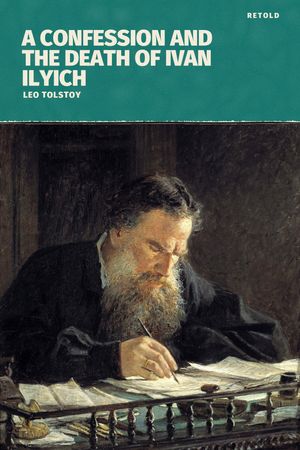
A Confession: An Introduction to an Unpublished Work
Chapter 1
I was baptized and brought up in the Orthodox Christian faith. I was taught it from childhood and all through my boyhood and youth. But when I left the university at eighteen, in my second year, I no longer believed any of what I had been taught.
Judging by certain memories, I never seriously believed it at all. I merely trusted what I was taught and what the grown-ups around me professed; and that trust was very shaky.1
I remember that when I was about eleven, a boy called Volodinka M., long since dead, who was at the gymnasium, the classical high school, came to see us one Sunday and announced to us, as the latest news, a discovery that had been made at his school. The discovery was that there is no God and that everything we are taught is just made up (this was in 1838). I remember how interested my older brothers were in this news, and how they called me in to the council too. We all, I remember, became very lively and took the announcement as something highly entertaining and entirely possible.
I remember too that when my older brother Dmitry, while he was at the university, suddenly gave himself to religion with the passion that was in his nature, and began going to every service, fasting, and leading a pure and moral life, all of us, even the grown-ups, never stopped laughing at him, and for some reason we called him Noah. I remember that Musin-Pushkin, who was then the curator in charge of Kazan University and used to invite us to his house to dance, teased my brother when he declined by telling him that even David danced before the Ark. I took the side of my elders' jokes in those days, and I drew from them the conclusion that one has to learn the catechism and one has to go to church, but one must not take any of it too seriously. I remember too that I read Voltaire very young, and that his mockery, far from shocking me, delighted me.
My falling away from the faith happened in me just as it happened then, and happens now, in people of our kind of education. In most cases, I think, it goes like this. People live the way everyone lives, and everyone lives by principles that not only have nothing in common with religious doctrine but are for the most part opposed to it. The doctrine takes no part in life. You never come up against it in your dealings with other people, and you never have to consult it in your own life. The doctrine is professed somewhere far off, away from life and independent of it. If you do come up against it, it is only as something external, a thing with no connection to life.
Then as now, there is no telling from a man's life, from what he does, whether he is a believer or not. If there is any difference between those who openly profess Orthodoxy and those who deny it, it is not in favor of the first. Then as now, the open acknowledgment and profession of Orthodoxy was mostly to be found in people who were dull, cruel and immoral and who thought themselves very important, while intelligence, honesty, directness, good nature and morality were mostly to be found in people who called themselves unbelievers.
The schools teach the catechism and send the pupils to church, and government officials have to produce certificates that they have taken communion. But a man of our circle who has finished his studies and is not in state service can live for decades, as he could even more easily in the old days, without once remembering that he lives among Christians and is himself counted as a professing Orthodox Christian.
Now as in the past, therefore, a doctrine accepted on trust and kept up by pressure from outside melts away little by little under the influence of knowledge and of experience of life that run counter to it, and very often a man goes on living for a long time imagining that the doctrine he was given as a child is still whole within him, when not a trace of it has been left for years.
S., an intelligent and truthful man, told me how he stopped believing. He was already about twenty-six when, at their camp for the night on a hunting trip, he stood up in the evening to say his prayers, out of an old habit he had kept since childhood. His older brother, who was hunting with him, was lying on the hay and watching him. When S. had finished and was settling down for the night, his brother said to him, "You still keep that up?" And they said nothing more to each other. And from that day S. stopped standing up to pray and stopped going to church. And for thirty years now he has not prayed, has not taken communion and has not set foot in church. And not because he knew his brother's convictions and had come round to them, nor because he had settled anything in his own soul, but only because the remark his brother made was like a push with one finger against a wall that was ready to fall under its own weight. The remark showed him that where he thought there was faith there had long been only an empty place, and that the words he said, the signs of the cross and the bows he made as he stood at prayer were therefore completely meaningless acts. Once he saw that they were meaningless, he could not go on with them.
That is how it has been, and is, I think, with the vast majority of people. I am speaking of people of our education, of people who are truthful with themselves, and not of those who make the very object of faith a means to some passing end or other. (Those people are the most thoroughgoing unbelievers of all, because if faith is for them a means to some worldly end, then it is certainly not faith.) These people of our education are in this position: the light of knowledge and of life has melted the artificial building down, and either they have noticed it and cleared the ground, or they have not noticed it yet.
The doctrine given me in childhood vanished in me just as it did in others, with this one difference: since I began reading and thinking a great deal very early, my renunciation of the doctrine became conscious very early too. From the age of sixteen I stopped standing up to pray, and of my own accord I stopped going to church and keeping the fasts before communion. I stopped believing what I had been given in childhood, but I believed in something. What I believed in, I could not possibly have said. I believed in God, too, or rather I did not deny God, but what God, I could not have said; nor did I deny Christ and his teaching, but what his teaching consisted of, I could not have said either.
Looking back on that time now, I see clearly that my faith, the thing besides my animal instincts that moved my life, my one true faith in those years, was a faith in self-perfection, in making myself perfect. But what that perfection consisted of, and what its aim was, I could not have said. I tried to perfect myself in mind: I studied everything I could, everything life pushed my way. I tried to perfect my will: I drew up rules for myself and tried to keep them. I perfected myself in body, sharpening my strength and agility with every kind of exercise and training myself to endurance and patience with every kind of hardship. And all of this I counted as perfection. The beginning of it all was, of course, moral perfection, but that was soon replaced by perfection in general, that is, by the wish to be better not in my own eyes or in God's but in the eyes of other people. And very soon this striving to be better in the eyes of people was replaced by the wish to be stronger than other people: that is, more famous, more important and richer than they were.
Chapter 2
Some day I will tell the story of my life in those ten years of my youth, a story both touching and instructive. I think that many, many people have been through the same. With my whole soul I wished to be good; but I was young, I had passions, and I was alone, completely alone, in my search for the good. Every time I tried to show what made up my most heartfelt wishes, that I wanted to be morally good, I met with contempt and mockery; and as soon as I gave myself up to vile passions, I was praised and encouraged. Ambition, love of power, greed, lust, pride, anger, revenge: all of these were respected. Giving myself up to these passions, I was becoming like a grown-up, and I felt that people were pleased with me. My kind aunt, the purest of beings, with whom I lived, always told me that there was nothing she would like so much for me as an affair with a married woman: "rien ne forme un jeune homme comme une liaison avec une femme comme il faut," nothing forms a young man like an affair with a woman of good society. There was another happiness she wished me, that I should become an aide-de-camp, and best of all to the Tsar himself; and the greatest happiness of all, that I should marry a very rich girl and that, as a result of this marriage, I should have as many slaves as possible.
I cannot remember those years without horror, loathing and an aching heart. I killed men in war, I challenged men to duels in order to kill them, I lost at cards, I ate up the labor of the peasants and had them punished, I fornicated, I cheated. Lying, robbery, adultery of every kind, drunkenness, violence, murder... There was no crime I did not commit, and for all of it I was praised, and the men of my generation considered me, and still consider me, a comparatively moral man.
That is how I lived for ten years.
In that time I began to write, out of vanity, greed and pride. In my writing I did the same as I did in my life. To have the fame and the money for which I wrote, I had to hide the good and display the bad. And that is what I did. How many times I managed to hide in my writings, under a show of indifference and even of light mockery, those strivings of mine toward goodness that made up the meaning of my life. And I succeeded: I was praised.
At twenty-six I came to Petersburg after the war and got to know the writers. They received me as one of their own and flattered me. And before I had time to look round, the views on life of the people I had joined, views that belonged to writers as a class, had become my own and had wiped out completely all my earlier attempts to become better. These views supplied the dissoluteness of my life with a theory that justified it.
The view of life held by these people, my fellow writers, was that life as a whole goes on developing, and that the chief part in this development is taken by us, the people of thought, and that among the people of thought the chief influence belongs to us, the artists and the poets. Our calling is to teach people. And so that the natural question should not occur to anyone, "What do I know, and what am I to teach?", the theory made it clear that there was no need to know this, and that the artist and the poet teach unconsciously. I was considered a wonderful artist and poet, and so it was very natural for me to adopt this theory. I, an artist, a poet, wrote and taught without knowing myself what I taught. I was paid money for it; I had excellent food, lodgings, women, society; I had fame. Therefore what I taught must have been very good.
This faith in the importance of poetry and in the development of life was a faith, and I was one of its priests. To be one of its priests was very profitable and very pleasant. And I lived in this faith for quite a long time without doubting its truth. But in the second and especially the third year of this life I began to doubt that the faith was infallible and began to examine it. The first thing that made me doubt was that I began to notice that the priests of this faith did not all agree with one another. Some said, "We are the best and most useful teachers, we teach what is needed, and the others teach wrongly." And the others said, "No, we are the real ones, and you teach wrongly." And they argued, quarreled, abused one another, deceived and cheated one another. Besides, there were many among us who did not care who was right and who was wrong, but simply pursued their own selfish ends by means of this activity of ours. All this made me doubt the truth of our faith.
Besides, once I had come to doubt the truth of the writers' faith itself, I began to watch its priests more closely, and I became convinced that almost all the priests of this faith, the writers, were immoral people, and for the most part bad people, worthless in character, far below the people I had met in my earlier dissipated life in the army, but self-assured and pleased with themselves as only people can be who are entirely holy or who do not even know what holiness is. I came to loathe these people, and I came to loathe myself, and I understood that this faith was a fraud.
But the strange thing is that, although I soon understood all the falsehood of this faith and renounced it, I did not renounce the rank these people had given me, the rank of artist, poet, teacher. I naively imagined that I was a poet, an artist, and could teach everyone without knowing myself what I was teaching. And that is what I did.
From my close dealings with these people I brought away a new vice: a pride that had grown to the point of sickness, and an insane certainty that I was called to teach people without knowing myself what.
Now, when I remember that time, my state of mind then and the state of mind of those people (there are thousands of them even now, by the way), I feel pity, and terror, and I want to laugh; what rises in me is exactly the feeling one has in a madhouse.
We were all convinced in those days that we had to speak and speak, to write and to print, as fast as possible and as much as possible, and that all of it was needed for the good of humanity. And thousands of us, denying and abusing one another, all printed and wrote, teaching others. And without noticing that we knew nothing, that to the simplest question of life, what is good and what is bad, we had no answer, we all talked at once without listening to one another, sometimes indulging and praising one another so that we in turn would be indulged and praised, and sometimes getting angry and shouting one another down, exactly as in a madhouse.
Thousands of workmen labored day and night to the last of their strength, setting type and printing millions of words, and the post carried them all over Russia, and still we taught more and more, taught and taught and taught, and could never manage to teach everything, and were always angry that we were so little listened to.
It is terribly strange, but now I understand it. Our real, heartfelt reasoning was that we wanted to get as much money and praise as possible. To reach this goal we knew how to do nothing else but write books and newspapers. And that is what we did. But in order to do such useless work and to be sure that we were very important people, we needed a further piece of reasoning that would justify what we did. And here is what we had come up with: everything that exists is rational. And everything that exists develops. And everything develops by means of enlightenment. And enlightenment is measured by the spread of books and newspapers. And we are paid money and respected for writing books and newspapers, and therefore we are the most useful and the best people. This reasoning would have been very good if we had all agreed; but since every thought expressed by one of us was always met by a diametrically opposite thought expressed by another, that should have made us stop and think. But we did not notice it. We were paid money, and the people of our party praised us; therefore each one of us considered himself in the right.
It is clear to me now that there was no difference at all between us and a madhouse. At the time I only vaguely suspected it, and even then, like all madmen, I called everyone mad except myself.
Chapter 3
I lived like that, given up to this madness, for six more years, until my marriage. During that time I went abroad. Life in Europe and my close acquaintance with progressive and learned Europeans confirmed me still further in the faith in perfection in general by which I lived, because I found the very same faith in them. In me this faith took the usual form it has in most educated people of our time. It was expressed by the word "progress." At the time it seemed to me that this word expressed something. I did not yet understand that when I, tormented like every living man by the question of how I should best live, answered, "Live in accordance with progress," I was saying exactly what a man would say if he were being carried along in a boat by the waves and the wind and, asked the main and only question that matters to him, "Where should we steer?", answered without answering, "We are being carried somewhere."
At the time I did not notice this. Only now and then did something rebel against this superstition, so common in our time, by which people screen from themselves their failure to understand life; and it was not my reason that rebelled but my feeling. Thus, when I was in Paris, the sight of an execution exposed to me how shaky my superstition of progress was. When I saw the head part from the body, and both of them thud separately into the box, I understood, not with my mind but with my whole being, that no theories of the rationality of all that exists, and of progress, could justify this act; and that even if all the people in the world, by whatever theories, since the creation of the world, had found it necessary, I knew that it was not necessary, that it was wrong, and that therefore the judge of what is good and necessary is not what people say and do, and not progress, but I with my heart. The other occasion on which I became aware that the superstition of progress was not enough to live by was the death of my brother. An intelligent, kind, serious man, he fell ill when he was young, suffered for more than a year and died in agony, not understanding why he had lived and understanding still less why he was dying. No theories could give any answer to these questions, either to me or to him, during his slow and agonizing dying.
But these were only rare moments of doubt; in essence I went on living and professing only the faith in progress. "Everything develops, and I develop too; and why I am developing along with everyone else will become clear in time." That is how I would have had to formulate my faith in those days.
When I came back from abroad, I settled in the country and took up the peasant schools. This work was especially dear to my heart, because it had none of the lie that had become obvious to me and already hurt my eyes in the business of teaching through literature. Here too I acted in the name of progress, but I was by now critical of progress itself. I told myself that in some of its manifestations progress had gone the wrong way, and that what was needed was to treat primitive people, the peasant children, with complete freedom, offering them the choice of whatever path of progress they liked.
In essence, though, I was still circling round one and the same insoluble problem, which was how to teach without knowing what. In the higher spheres of literary activity it was clear to me that one cannot teach without knowing what to teach, because I saw that everyone taught something different and that by arguing among themselves they only hid their ignorance from themselves. Here, with the peasant children, I thought I could get round this difficulty by letting the children learn whatever they wanted. It makes me laugh now to remember how I wriggled to satisfy my lust to teach, though I knew very well in the depths of my soul that I could not teach anything that was needed, because I did not know myself what was needed. After a year of working at the school I went abroad a second time, to find out there how one could manage, knowing nothing oneself, to teach others.
And it seemed to me that I had learned this abroad, and, armed with all this wisdom, I came back to Russia in the year the serfs were freed and, taking a post as an arbiter of the peace, the official who settled disputes between the landowners and the freed peasants, I began to teach both the uneducated common people, in the schools, and educated people, in the magazine I had started to publish. Things seemed to be going well, but I felt that I was not quite sound in mind and that it could not go on for long. And I might even have come then to the despair I came to at fifty, if I had not had one more side of life that I had not yet tried and that promised me salvation: this was family life.
For a year I was busy with the arbitration, the schools and the magazine, and I wore myself out, above all because I had got so tangled up: the struggle over the arbitration had grown so hard for me, my work in the schools showed itself so dimly, my wriggling in the magazine, which always came down to one and the same thing, the wish to teach everyone and to hide that I did not know what to teach, had become so repugnant to me, that I fell ill, more in spirit than in body, threw it all up and went off to the steppe, to the Bashkirs, to breathe the air, drink kumis, which is fermented mare's milk, and live an animal life.
When I came back from there, I married. The new circumstances of a happy family life now drew me away completely from any search for the general meaning of life. In that period my whole life was centered on my family, on my wife, on my children, and therefore on the cares of increasing our means of living. The striving for perfection, which had already given way before to the striving for perfection in general, for progress, now gave way plainly and simply to the striving to make things as good as possible for me and my family.
Fifteen more years went by in this way.
Although I considered writing a trifle all through those fifteen years, I still went on writing. I had already tasted the temptation of authorship, the temptation of enormous money rewards and of applause for worthless work, and I gave myself up to it as a means of improving my material position and of stifling in my soul any questions about the meaning of my life and of life in general.
I wrote, teaching what was for me the one truth: that one should live so as to make things as good as possible for oneself and one's family.
That is how I lived; but five years ago something very strange began to happen to me. At first I began to have moments of bewilderment, moments when my life stopped, as though I did not know how to live or what to do, and I lost my bearings and fell into low spirits. But this passed, and I went on living as before. Then these moments of bewilderment began to recur more and more often, and always in the same form. These stoppages of life always expressed themselves in the same questions: Why? Well, and then what?
At first it seemed to me that these were just pointless, irrelevant questions. It seemed to me that all this was well known, and that if I ever wanted to set about answering them, it would cost me no effort; that I simply had no time for it just now, but when I put my mind to it, I would find the answers. But the questions recurred more and more often, the answers were demanded more and more insistently, and like dots that all fall on one and the same spot, these unanswered questions ran together into one black stain.
What happened was what happens to everyone who falls ill with a fatal internal disease. At first insignificant signs of being unwell appear, which the sick man pays no attention to; then these signs recur more and more often and merge into one suffering, unbroken in time. The suffering grows, and before the sick man can look round he realizes that what he took for a mere indisposition is the thing that means more to him than anything else in the world: that it is death.
The same thing happened to me. I understood that this was not a chance indisposition but something very important, and that if the same questions kept recurring, they had to be answered. And I tried to answer them. The questions seemed such stupid, simple, childish questions. But as soon as I touched them and tried to settle them, I was at once convinced, first, that these were not childish and stupid questions but the most important and profound questions in life, and second, that I could not, I simply could not, however much I thought, settle them. Before taking up my Samara estate, my son's education or the writing of a book, I had to know why I was going to do it. As long as I did not know why, I could do nothing. In the middle of my thoughts about running the estate, which occupied me a great deal at that time, the question would suddenly come into my head: "Well, fine, you will have sixteen thousand acres in Samara province and three hundred horses, and then what?..." And I was completely thrown and did not know what to think next. Or, beginning to think about how I would bring up my children, I would say to myself, "Why?" Or, reasoning about how the common people might reach prosperity, I would suddenly say to myself, "But what is that to me?" Or, thinking about the fame my works would bring me, I would say to myself, "Well, fine, you will be more famous than Gogol, Pushkin, Shakespeare, Molière, more famous than all the writers in the world, and what of it?..."
And I could find no answer, none at all.
Chapter 4
My life came to a standstill. I could breathe, eat, drink and sleep, and I could not help breathing, eating, drinking and sleeping; but there was no life, because there were no desires whose satisfaction I would have found reasonable. If I desired anything, I knew in advance that whether I satisfied my desire or not, nothing would come of it.
If a fairy had come and offered to fulfill my wishes, I would not have known what to say. If, in moments of drunkenness, I felt not desires but the habits of old desires, then in sober moments I knew that this was a deception, that there was nothing to desire. I could not even desire to know the truth, because I had guessed what it consisted of. The truth was that life is meaningless.
It was as though I had lived and lived, walked and walked, and come to an abyss, and seen clearly that there was nothing ahead but ruin. And it was impossible to stop, impossible to go back, and impossible to shut my eyes so as not to see that there was nothing ahead but the deception of life and of happiness, and real suffering and real death: complete annihilation.
Life had become hateful to me, and some irresistible force was drawing me to be rid of it somehow. It cannot be said that I wanted to kill myself. The force that drew me away from life was stronger, fuller and more general than any wanting. It was a force like my old striving toward life, only in reverse. With all my strength I strove away from life. The thought of suicide came to me as naturally as thoughts of improving my life had come to me before. The thought was so seductive that I had to use cunning against myself so as not to carry it out too hastily. I did not want to hurry only because I wanted to use every effort to untangle things first! If I cannot untangle them, I can always do it later, I told myself. And it was then that I, a happy man, took the cord out of my room, where I was alone every night as I undressed, so as not to hang myself from the crossbar between the cupboards, and stopped going out hunting with a gun, so as not to be tempted by too easy a way of ridding myself of life. I did not know myself what I wanted: I was afraid of life, I strove to get away from it, and all the while I still hoped for something from it.
And this happened to me at a time when I had on every side what is considered complete happiness: it was when I was not yet fifty. I had a good, loving and beloved wife, good children, and a large estate that grew and increased without any effort on my part. I was respected by my family and friends more than ever before, I was praised by strangers, and I could consider myself famous without any particular self-flattery. And with all this I was not unwell in body or in mind; on the contrary, I enjoyed a strength of mind and of body such as I have seldom met in men of my age. In body I could keep up with the peasants at the mowing; in mind I could work eight or ten hours on end without feeling any ill effects from the strain. And in this condition I came to the point where I could not live, and, afraid of death, had to use cunning against myself so as not to take my own life.
This state of soul presented itself to me like this: my life is some stupid and spiteful joke that someone has played on me. Although I did not acknowledge any "someone" who had created me, this way of picturing it, that someone had played a spiteful and stupid joke on me by bringing me into the world, was the most natural way of picturing it to me.
I could not help imagining that somewhere out there was someone who was now amusing himself as he watched me: watched how I had lived for thirty or forty whole years, lived learning, developing, growing in body and spirit, and how now, with my mind grown strong and having reached that summit of life from which the whole of it lies open, I stand on that summit like a perfect fool, understanding clearly that there is nothing in life, that there never was and never will be. "And he finds it funny..."
But whether this someone who is laughing at me exists or not, I am none the better for it. I could not attach any rational meaning to a single action, or to my whole life. I was only astonished that I could have failed to understand this at the very start. It has all been known to everyone for so long. Today or tomorrow sickness and death will come (and they had come already) to the people I love and to me, and nothing will be left but stench and worms. My deeds, whatever they were, will all be forgotten, sooner or later, and I will not exist. Then what is there to fuss about? How can a man fail to see this and go on living: that is what is astonishing! One can live only while one is drunk with life; but as soon as one sobers up, one cannot help seeing that it is all only a deception, and a stupid deception! That is exactly it: there is not even anything funny or witty about it; it is simply cruel and stupid.
There is an old Eastern fable, told long ago, about a traveler caught out on the steppe by a raging beast. To escape from the beast, the traveler jumps into a dry well; but at the bottom of the well he sees a dragon, its jaws gaping to devour him. And the unhappy man, not daring to climb out for fear of being killed by the raging beast, and not daring to jump down to the bottom of the well for fear of being devoured by the dragon, catches hold of the branches of a wild bush growing in the cracks of the well and hangs on to it. His hands grow weak, and he feels that soon he will have to give himself up to the death that waits for him on both sides; but still he hangs on, and while he hangs on he looks round and sees that two mice, one black and one white, are steadily circling the stem of the bush he is hanging from and gnawing it through. Any moment now the bush will break off by itself and give way, and he will fall into the dragon's jaws. The traveler sees this and knows that he will inevitably die; but while he hangs there, he looks around him and finds some drops of honey on the leaves of the bush, reaches them with his tongue and licks them. That is how I hang on to the branches of life, knowing that the dragon of death is inevitably waiting, ready to tear me to pieces, and I cannot understand why I have been brought to this torment. And I try to suck the honey that used to comfort me; but the honey no longer gives me joy, and the white mouse and the black, day and night, are gnawing through the branch I am holding on to. I see the dragon clearly, and the honey is no longer sweet to me. I see one thing only, the inescapable dragon and the mice, and I cannot turn my eyes away from them. And this is not a fable; it is the real, indisputable truth that anyone can understand.
The old deception of the joys of life, which used to drown out the horror of the dragon, no longer deceives me. However often people tell me, "You cannot understand the meaning of life, so do not think about it, live," I cannot do it, because I did it for too long before. Now I cannot help seeing day and night running on and leading me to death. I see this alone, because this alone is the truth. All the rest is a lie.
The two drops of honey that turned my eyes away from the cruel truth longer than any others, my love of my family and of my writing, which I called art, are no longer sweet to me.
"My family...," I said to myself. But my family is my wife and children; they are people too. They are in exactly the same position as I am: they must either live in a lie or see the terrible truth. Why should they live? Why should I love them, look after them, bring them up and watch over them? For the same despair that is in me, or for dull stupidity! Loving them, I cannot hide the truth from them: every step they take in knowledge leads them to this truth. And the truth is death.
"Art, poetry?..." For a long time, under the influence of success and of people's praise, I assured myself that this was something one could do, even though death would come and destroy everything: me, and my works, and the memory of them. But I soon saw that this too was a deception. It was clear to me that art is an ornament of life, a lure to life. But life had lost its lure for me; how could I lure others? As long as I was not living my own life, but someone else's life was carrying me along on its waves, as long as I believed that life has a meaning, even if I could not put it into words, reflections of life of every kind in poetry and the arts gave me joy, and I enjoyed looking at life in this little mirror of art. But when I began to search for the meaning of life, when I felt the need to live myself, the little mirror became either unnecessary to me, superfluous and absurd, or painful. I could no longer take comfort in seeing in the little mirror that my position was stupid and desperate. It was all very well for me to enjoy it while in the depths of my soul I believed that my life had a meaning. Then this play of lights and shadows, of the comic, the tragic, the touching, the beautiful and the terrible in life, amused me. But when I knew that life was meaningless and terrible, the play in the little mirror could no longer entertain me. No sweetness of honey could be sweet to me when I saw the dragon and the mice gnawing through my support.
But that was not all. If I had simply understood that life has no meaning, I could have known it calmly, I could have known that this was my lot. But I could not rest content with that. If I had been like a man living in a forest from which he knows there is no way out, I could have lived; but I was like a man lost in a forest, who is seized with horror because he is lost, and who rushes about, wanting to get out onto the road, and knows that every step tangles him further, and cannot help rushing about.
That was what was terrible. And to escape from this horror I wanted to kill myself. I felt horror at what was waiting for me; I knew that this horror was more horrible than the position itself, but I could not drive it away and could not wait patiently for the end. However convincing the argument was that sooner or later a blood vessel in my heart would burst, or something else would give way, and it would all be over, I could not wait patiently for the end. The horror of the darkness was too great, and I wanted to be rid of it as quickly as possible, as quickly as possible, with a noose or a bullet. And it was this feeling above all that drew me toward suicide.
Chapter 5
"But perhaps I have overlooked something, or failed to understand something?" I said to myself several times. "It cannot be that this state of despair is natural to human beings." And I looked for an explanation of my questions in all the knowledge that people have acquired. And I searched painfully and long, and not out of idle curiosity, not listlessly; I searched painfully, stubbornly, day and night, searched as a drowning man searches for rescue, and I found nothing.
I searched in every branch of knowledge, and not only did I not find anything, I became convinced that all those who, like me, had searched in knowledge had found nothing either. And not only had they found nothing, they had plainly acknowledged that the very thing that brought me to despair, the meaninglessness of life, is the one indubitable knowledge available to man.
I searched everywhere; and thanks to a life spent in study, and also because my connections with the learned world gave me access to the scholars themselves in all the various branches of knowledge, who did not refuse to open all their knowledge to me, not only in their books but in conversation, I learned everything that knowledge has to say in answer to the question of life.
For a long time I could not bring myself to believe that knowledge had nothing to say in answer to the questions of life except what it does say. For a long time, as I looked at the gravity and seriousness of tone with which science asserted its propositions, propositions that had nothing in common with the questions of human life, it seemed to me that there was something I did not understand. For a long time I was timid before knowledge, and it seemed to me that the failure of its answers to fit my questions was not the fault of knowledge but came from my own ignorance. But for me this was no joke and no amusement; it was the business of my whole life, and willy-nilly I was brought to the conviction that my questions were the only legitimate questions, the ones that underlie all knowledge, and that the fault lay not with me and my questions but with science, if science claims to answer these questions.
My question, the one that brought me at fifty to the point of suicide, was the very simplest question, lying in the soul of every human being, from a silly child to the wisest old man: the question without which life is impossible, as I had found out in fact. The question is this: "What will come of what I am doing today and will do tomorrow? What will come of my whole life?"
Put another way, the question will be: "Why should I live, why should I wish for anything, why should I do anything?" It can be put another way again: "Is there any meaning in my life that would not be destroyed by the death that inevitably awaits me?"
It was for an answer to this one question, put in these different ways, that I searched in human knowledge. And I found that with respect to this question all human knowledge is divided, as it were, into two opposite hemispheres, at whose opposite ends lie two poles, one negative and the other positive; but that at neither pole are there answers to the questions of life.
One set of sciences does not even seem to recognize the question, but in return it answers its own independently posed questions clearly and precisely: these are the experimental sciences, and at their extreme point stands mathematics. The other set recognizes the question but does not answer it: these are the speculative sciences, and at their extreme point is metaphysics.
From my early youth the speculative sciences had interested me, but later mathematics and the natural sciences attracted me too; and until I had put my question to myself clearly, until the question had grown up in me of its own accord, insistently demanding to be resolved, I was content with the counterfeit answers to it that knowledge gives.
At one time, in the experimental sphere, I would say to myself, "Everything develops, differentiates, moves toward complexity and perfection, and there are laws that govern this course. You are a part of the whole. Having come to know the whole as far as possible, and having come to know the law of development, you will come to know your place in this whole, and yourself." Ashamed as I am to admit it, there was a time when I seemed to be satisfied with this. It was the very time when I myself was growing more complex and developing. My muscles were growing and getting stronger, my memory was getting richer, my capacity for thinking and understanding was increasing; I was growing and developing, and, feeling this growth in myself, I naturally thought that this was the very law of the whole world, in which I would find the solution to the questions of my life as well. But a time came when my growth stopped. I felt that I was not developing but drying up, my muscles were weakening, my teeth were falling out; and I saw that not only did this law explain nothing to me, but that there never had been and never could be any such law, and that I had taken for a law what I had found in myself at a certain period of my life. I looked more strictly at the definition of this law, and it became clear to me that there can be no laws of infinite development. It became clear that to say "in infinite space and time everything develops, perfects itself, grows more complex, differentiates" is to say nothing at all. These are all words without meaning, for in the infinite there is no complex and no simple, no before and no behind, no better and no worse.
The main thing, though, was that my personal question, what am I, with my desires?, remained altogether without an answer. And I understood that these branches of knowledge are very interesting, very attractive, but that their precision and clarity are in inverse proportion to their applicability to the questions of life: the less applicable they are to the questions of life, the more precise and clear they are; the more they try to give solutions to the questions of life, the more unclear and unattractive they become. If you turn to the branch of these sciences that tries to give solutions to the questions of life, to physiology, psychology, biology, sociology, you find a staggering poverty of thought, the greatest obscurity, a wholly unjustified claim to settle questions outside their province, and constant contradictions of one thinker by another and even by himself. If you turn to the branch of knowledge that does not occupy itself with resolving the questions of life but answers its own scientific, specialized questions, you are filled with admiration for the power of the human mind, but you know in advance that there are no answers to the questions of life. These sciences simply ignore the question of life. They say, "What you are and why you live, we have no answers to, and that is not our business; but if you need to know the laws of light, of chemical compounds, the laws of the development of organisms, if you need to know the laws of bodies and their forms and the relations of numbers and magnitudes, if you need to know the laws of your own mind, then for all of that we have clear, precise and indubitable answers."
In general, the relation of the experimental sciences to the question of life can be expressed like this. Question: Why do I live? Answer: In infinitely great space, in infinitely long time, infinitely small particles change their forms in infinite complexity, and when you understand the laws of these changes, then you will understand why you live.
At another time, in the speculative sphere, I would say to myself, "All humanity lives and develops on the basis of spiritual principles, the ideals that guide it. These ideals are expressed in religions, in the sciences, in the arts, in the forms of the state. These ideals keep rising higher and higher, and humanity is moving toward the highest good. I am a part of humanity, and therefore my calling is to further the recognition and the realization of the ideals of humanity." And in my feeble-minded period I was satisfied with this; but as soon as the question of life rose clearly in me, this whole theory collapsed in an instant. Not to speak of the dishonest imprecision with which knowledge of this kind passes off conclusions drawn from the study of a small part of humanity as general conclusions; not to speak of how the various supporters of this view contradict one another about what the ideals of humanity consist of; the strangeness, not to say the stupidity, of this view lies in this: in order to answer the question that faces every human being, "What am I?" or "Why do I live?" or "What should I do?", a man must first resolve the question "What is the life of the whole of humanity, which is unknown to him, and of which he knows one tiny part in one tiny period of time?" In order to understand what he is, a man must first understand what this whole mysterious humanity is, made up of people just like himself, who do not understand themselves.
I must confess that there was a time when I believed this. It was the time when I had my own favorite ideals, which justified my whims, and I tried to devise a theory by which I could look on my whims as the law of humanity. But as soon as the question of life rose in my soul in all its clarity, this answer at once blew away like dust. And I understood that just as in the experimental sciences there are real sciences and half-sciences, which try to give answers to questions that are not theirs to answer, so in this sphere too there is a whole series of the most widespread branches of knowledge that try to answer questions that are not theirs. The half-sciences of this sphere, the juridical, the social and the historical sciences, try to settle the questions of man by settling, supposedly, each in its own way, the question of the life of all humanity.
But just as, in the sphere of experimental knowledge, a man who sincerely asks how he should live cannot be satisfied with the answer, "Study the changes, infinite in time and complexity, of infinite particles in infinite space, and then you will understand your life," in exactly the same way a sincere man cannot be satisfied with the answer, "Study the life of all humanity, whose beginning and end we cannot know, and of which we do not know even a small part, and then you will understand your life." And just as with the experimental half-sciences, these half-sciences too are the fuller of obscurities, inaccuracies, stupidities and contradictions the further they stray from their proper tasks. The task of experimental science is the causal sequence of material phenomena. Let experimental science bring in the question of a final cause, and the result is nonsense. The task of speculative science is the awareness of the causeless essence of life. Let it bring in the study of causal phenomena, such as social and historical phenomena, and the result is nonsense.
Experimental science gives positive knowledge and shows the greatness of the human mind only when it does not bring the final cause into its inquiries. And conversely, speculative science is a science, and shows the greatness of the human mind, only when it sets aside entirely the questions of the sequence of causal phenomena and considers man only in relation to the final cause. Such, in this sphere, is the science that forms the pole of this hemisphere: metaphysics, or speculative philosophy. This science poses the question clearly: What am I, and what is the whole world? And why am I, and why is the whole world? And for as long as it has existed, it has always answered in the same way. Whether the philosopher calls the essence of life that is in me and in everything that exists ideas, or substance, or spirit, or will, he says only one thing: that this essence exists and that I am that same essence. But why it exists he does not know, and he does not answer, if he is a rigorous thinker. I ask: Why should this essence exist? What will come of the fact that it exists and will exist?... And philosophy not only does not answer, it only asks the very same thing itself. And if it is true philosophy, then all its work consists solely in posing this question clearly. And if it holds firmly to its task, then it cannot answer otherwise than this: to the question "What am I, and what is the whole world?", "All and nothing"; and to the question "Why does the world exist, and why do I exist?", "I do not know."
Turn the speculative answers of philosophy whichever way I might, then, I could get nothing that looked like an answer. And this was not because, as in the clear, experimental sphere, the answer did not bear on my question, but because here, although all the work of the mind was aimed precisely at my question, there was no answer, and instead of an answer I got back the same question, only in a more complicated form.
Chapter 6
In my search for answers to the question of life I felt exactly what a man feels who is lost in a forest.
He comes out into a clearing, climbs a tree and sees clearly the boundless spaces, but sees that there is no house there and cannot be; he goes into the thicket, into the dark, and sees darkness, and again there is no house, no house at all.
In just this way I wandered in this forest of human knowledge, between the clearings of mathematical and experimental knowledge, which opened clear horizons to me, but horizons in whose direction there could be no house, and the darkness of speculative knowledge, in which I sank into deeper darkness the further I went; and in the end I became convinced that there was no way out and could be none.
When I gave myself up to the bright side of knowledge, I understood that I was only turning my eyes away from the question. However alluring and clear the horizons that opened before me, however alluring it was to plunge into the infinity of these branches of knowledge, I understood by now that they were the clearer the less I needed them, the less they answered my question.
"Well," I said to myself, "I know everything that science so stubbornly wants to know, and on this path there is no answer to the question of the meaning of my life." In the speculative sphere, on the other hand, I understood that, in spite of the fact, or precisely because of the fact, that the aim of this knowledge was directed straight at answering my question, there was no answer other than the one I had given myself. What is the meaning of my life? None. Or: What will come of my life? Nothing. Or: Why does everything that exists exist, and why do I exist? Because it exists.
Asking one side of human knowledge, I received countless precise answers about things I had not asked: about the chemical composition of the stars, about the motion of the sun toward the constellation of Hercules, about the origin of species and of man, about the forms of infinitely small atoms, about the vibration of infinitely small, weightless particles of the ether. But the answer this branch of knowledge gave to my question, what is the meaning of my life?, was always the same: You are what you call your life; you are a temporary, chance cohesion of particles. The mutual action and change of these particles produce in you what you call your life. This cohesion will hold together for a certain time; then the interaction of these particles will stop, and what you call life will stop, and all your questions will stop too. You are a little lump of something, stuck together by chance. The little lump ferments. The little lump calls this fermenting its life. The little lump will fall apart, and the fermenting will be over, and all the questions with it. That is how the clear side of knowledge answers, and it can say nothing else if it keeps strictly to its own principles.
With an answer like this, the answer does not answer the question. I need to know the meaning of my life, and the fact that it is a particle of the infinite not only gives it no meaning but destroys every possible meaning.
As for the vague compromises this side of experimental, exact knowledge makes with speculation, in which it is said that the meaning of life consists in development and in furthering this development, they are too imprecise and too vague to count as answers.
The other side of knowledge, the speculative, when it keeps strictly to its own principles and answers the question directly, everywhere and in every age answers and has answered one and the same thing: the world is something infinite and incomprehensible. Human life is an unfathomable part of this unfathomable "all." Again I leave aside all those compromises between speculative and experimental knowledge that make up the whole ballast of the half-sciences, the so-called juridical, political and historical sciences. Into these sciences the ideas of development and perfection are again brought in, just as wrongly, with only this difference: that there it is the development of everything, and here the development of the life of human beings. The error is one and the same: development and perfection in the infinite can have neither aim nor direction, and they give no answer at all to my question.
But where speculative knowledge is exact, namely in true philosophy, not in what Schopenhauer called professorial philosophy, which serves only to sort all existing phenomena into new philosophical columns and give them new names, there, where the philosopher does not lose sight of the essential question, the answer is always one and the same: the answer given by Socrates, Schopenhauer, Solomon and the Buddha.
"We shall come near to the truth only in so far as we move away from life," says Socrates as he prepares to die. "What is it that we, who love the truth, strive for in life? To be set free from the body and from all the evil that comes from the life of the body. If that is so, then how can we not rejoice when death comes to us?"
"The wise man seeks death all his life, and therefore death holds no terror for him."
"Having recognized the inner essence of the world as will," says Schopenhauer, "and having recognized in all phenomena, from the unconscious striving of the dark forces of nature to the fully conscious activity of man, only the objectification of this will, we can in no way escape the consequence that, with the free denial, the self-abolition, of the will, all those phenomena will vanish as well: that constant striving and urging without aim or rest, at every level of objectification, in which and through which the world consists, will vanish; the variety of successive forms will vanish; and together with the form, all its phenomena will vanish with their universal forms, space and time; and finally its last fundamental form too, subject and object. No will, no representation, no world. Before us, certainly, there remains only nothing. But what resists this passing into nothingness, our nature, is after all only this same will to existence (Wille zum Leben), which makes up ourselves as it makes up our world. That we so dread nothingness, or, what is the same thing, that we so want to live, means only that we ourselves are nothing but this wanting of life and know nothing but it. Therefore what remains after the complete abolition of the will, for us who are still full of will, is certainly nothing; but conversely, for those in whom the will has turned and renounced itself, this world of ours, so real, with all its suns and milky ways, is nothing."
"Vanity of vanities, says Solomon, vanity of vanities, all is vanity! What does a man gain from all his labor at which he toils under the sun? One generation passes away and another generation comes, but the earth remains for ever. What has been is what will be, and what has been done is what will be done; and there is nothing new under the sun. There is a thing of which people say, 'Look, this is new'; but it has already been, in the ages before us. There is no remembrance of former things; nor will there be any remembrance of things to come among those who come after. I, Ecclesiastes, was king over Israel in Jerusalem. And I gave my heart to seek out and search by wisdom all that is done under heaven: this is the heavy task God has given to the sons of men to be busied with. I have seen all the works that are done under the sun, and behold, all is vanity and a weariness of spirit... I said in my heart: Here I have grown great and gained more wisdom than all who were over Jerusalem before me, and my heart has seen much wisdom and knowledge. And I gave my heart to know wisdom and to know madness and folly; I learned that this too is a weariness of spirit. For in much wisdom is much grief, and he who increases knowledge increases sorrow.
"I said in my heart: Come, I will test you with mirth, and enjoy what is good; but this too is vanity. Of laughter I said, It is foolish; and of mirth, What does it do? I resolved in my heart to cheer my body with wine, and, while my heart was still guided by wisdom, to lay hold on folly too, until I should see what is good for the sons of men to do under heaven in the few days of their life. I undertook great works: I built myself houses, I planted myself vineyards. I made myself gardens and groves and planted in them every kind of fruit tree; I made myself pools of water, to water from them the groves where the trees grew; I got myself menservants and maidservants, and had servants born in my house; I also had more herds and flocks than all who were in Jerusalem before me; I gathered for myself silver and gold and the treasure of kings and provinces; I got myself men singers and women singers, and the delights of the sons of men, all kinds of musical instruments. And I became great and rich, more than all who were before me in Jerusalem; and my wisdom remained with me. Whatever my eyes desired I did not refuse them; I did not keep my heart from any joy. Then I looked on all the works my hands had done, and on the labor I had toiled at in doing them; and behold, all was vanity and a weariness of spirit, and there was no gain in them under the sun. And I turned to look at wisdom, and madness, and folly. But I learned that one fate befalls them all. And I said in my heart: The same fate will befall me as befalls the fool; why then have I become so very wise? And I said in my heart that this too is vanity. For the wise man is not remembered for ever, any more than the fool; in the days to come all will be forgotten; and alas, the wise man dies just like the fool! And I hated life, because the works that are done under the sun became hateful to me, for all is vanity and a weariness of spirit. And I hated all my labor at which I had toiled under the sun, because I must leave it to the man who will come after me. For what does a man get from all his labor and from the striving of his heart with which he toils under the sun? For all his days are sorrows, and his work is vexation; even at night his heart finds no rest. This too is vanity. It is not in man's power, even this good, to eat and drink and let his soul enjoy itself in his labor...
"All things come alike to all: one fate to the righteous and to the wicked, to the good and to the evil, to the clean and to the unclean, to him who sacrifices and to him who does not sacrifice; as to the virtuous, so to the sinner; as to him who swears, so to him who fears an oath. This is the evil in all that is done under the sun, that one fate comes to all; and the heart of the sons of men is full of evil, and madness is in their heart while they live; and after that they go to the dead. Whoever is among the living still has hope, since a living dog is better off than a dead lion. The living know that they will die, but the dead know nothing, and there is no more reward for them, because even the memory of them is forgotten; and their love, and their hatred, and their envy have long since perished, and they have no more share for ever in anything that is done under the sun."
That is what Solomon says, or whoever wrote these words.
And here is what the wisdom of India says:
Sakyamuni, the Buddha, a young and happy prince from whom sickness, old age and death had been hidden, drives out for a pleasure ride and sees a dreadful old man, toothless and slobbering. The prince, from whom old age had been hidden until then, is astonished and asks his charioteer what this is, and why this man has come to such a pitiful, repulsive, hideous state. And when he learns that this is the common lot of all people, that the same thing inevitably awaits him, the young prince, he can no longer go on with his ride, and he orders the charioteer to turn back, so that he can think it over. And he shuts himself up alone and thinks it over. And he probably comes up with some consolation for himself, because once again he drives out for a pleasure ride, cheerful and happy. But this time he meets a sick man. He sees an emaciated man, livid and shaking, with clouded eyes. The prince, from whom sickness had been hidden, stops and asks what this is. And when he learns that this is sickness, to which all people are subject, and that he himself, a healthy and happy prince, may fall ill in the same way tomorrow, again he has no heart for pleasure, orders the charioteer to turn back, and again seeks peace of mind; and he probably finds it, because a third time he drives out for a ride. But the third time he sees yet another new sight: he sees that something is being carried. "What is that?" A dead man. "What does dead mean?" asks the prince. They tell him that to become dead means to become what this man has become. The prince goes up to the dead man, uncovers him and looks at him. "And what will happen to him next?" asks the prince. They tell him that he will be buried in the ground. "Why?" Because he will certainly never be alive again, and nothing will come of him but stench and worms. "And is this the lot of all people? Will the same thing happen to me? Will they bury me, and will I stink, and will the worms eat me?" Yes. "Turn back! I am not going for a ride, and I will never go again."
And Sakyamuni could find no consolation in life, and he decided that life is the greatest of evils, and he gave all the strength of his soul to freeing himself from it and freeing others. And to freeing them in such a way that even after death life should not somehow begin again: to destroying life completely, at the root. All the wisdom of India says this.
These, then, are the direct answers that human wisdom gives when it answers the question of life.
"The life of the body is evil and a lie. And therefore the destruction of this life of the body is a good, and we must desire it," says Socrates.
"Life is what ought not to be, an evil, and the passage into nothing is the only good of life," says Schopenhauer.
"Everything in the world, folly and wisdom, wealth and poverty, merriment and grief, is all vanity and nonsense. A man dies, and nothing is left. And that is stupid," says Solomon.
"One cannot live with the knowledge that suffering, decline, old age and death are inevitable; one must free oneself from life, from every possibility of life," says the Buddha.
And what these powerful minds said has been said, thought and felt by millions upon millions of people like them. And I too think it and feel it.
My wandering through knowledge, therefore, not only failed to lead me out of my despair but only made it worse. One kind of knowledge did not answer the questions of life; the other kind answered, and directly confirmed my despair, showing that what I had come to was not the fruit of my error or of a sick state of mind. On the contrary, it confirmed that what I thought was right, and that I had arrived at the conclusions of the most powerful minds of humanity.
There is no point in deceiving myself. All is vanity. Happy is he who was never born; death is better than life; one must be rid of life.
Chapter 7
Having found no explanation in knowledge, I began to look for it in life, hoping to find it in the people around me. And I began to watch people like myself: how they lived around me, and how they dealt with the question that had brought me to despair.
And here is what I found among the people who were in the same position as I was in their education and their way of life.
I found that for people of my circle there are four ways out of the terrible position we are all in.
The first way out is the way of ignorance. It consists in not knowing, not understanding, that life is an evil and an absurdity. People of this sort, mostly women, or the very young, or the very dull, have not yet understood the question of life that presented itself to Schopenhauer, to Solomon, to the Buddha. They see neither the dragon waiting for them nor the mice gnawing at the bushes they are holding on to, and they lick the drops of honey. But they lick the honey only for a while: something will turn their attention to the dragon and the mice, and that will be the end of their licking. I had nothing to learn from them. One cannot stop knowing what one knows.
The second way out is the way of Epicureanism. It consists in knowing that life is hopeless and meanwhile making use of whatever good things there are, looking neither at the dragon nor at the mice, but licking the honey as best one can, especially if there happens to be a lot of it on the bush. Solomon expresses this way out like this:
"And I commended mirth, because a man has nothing better under the sun than to eat and to drink and to be merry; this will go with him in his labor through the days of his life which God gives him under the sun.
"Go, then, eat your bread with joy, and drink your wine with a glad heart... Enjoy life with the woman you love all the days of your life of vanity, all your days of vanity, for that is your portion in life and in the labor at which you toil under the sun... Whatever your hand finds to do, do it with all your might, for in the grave, where you are going, there is no work, no thought, no knowledge, no wisdom."
Most people of our circle keep to this second way. Their circumstances give them more of the good things than of the bad, and their moral dullness lets them forget that the advantage of their position is an accident; that not everyone can have a thousand women and palaces, like Solomon; that for every man with a thousand wives there are a thousand men without a wife, and for every palace there are a thousand people building it in the sweat of their brow; and that the accident that has made me a Solomon today may make me Solomon's slave tomorrow. And the dullness of these people's imagination lets them forget what gave the Buddha no peace: the inevitability of sickness, old age and death, which any day now will destroy all these pleasures. That some of these people claim that the dullness of their thought and imagination is a philosophy, which they call positive philosophy, does not, in my view, set them apart from those who lick the honey without seeing the question. I could not imitate these people either. I did not have their dullness of imagination, and I could not produce it in myself artificially. I could not, any more than any living man can, tear my eyes away from the mice and the dragon once I had seen them.
The third way out is the way of strength and energy. It consists in understanding that life is an evil and an absurdity, and destroying it. That is what the rare strong and consistent people do. Having understood how stupid the joke is that has been played on them, and having understood that the lot of the dead is better than the lot of the living and that the best thing of all is not to be, they act on it and end this stupid joke at once, since the means are at hand: a noose round the neck, water, a knife to stab into the heart, the trains on the railways. And the number of people of our circle who do this keeps growing. And people do it mostly at the very best time of life, when the powers of the soul are in full flower and they have picked up few of the habits that degrade the human mind. I saw that this was the most worthy way out, and I wanted to take it.
The fourth way out is the way of weakness. It consists in understanding the evil and absurdity of life and still dragging it out, knowing in advance that nothing can come of it. People of this kind know that death is better than life, but, not having the strength to act rationally, to put a quick end to the deception and kill themselves, they seem to be waiting for something. This is the way of weakness, for if I know what is best and it is in my power, why not give myself up to what is best?... I was in this category.
That is how people of my kind escape from the terrible contradiction: by four roads. However hard I strained my mind, I could see no way out but these four. One way out: not to understand that life is an absurdity, vanity and evil, and that it is better not to live. I could not help knowing it, and once I knew it, I could not shut my eyes to it. Another way out: to make use of life as it is, without thinking of the future. And this I could not do either. Like Sakyamuni, I could not drive out to the hunt when I knew that old age, suffering and death exist. My imagination was too vivid. Besides, I could not take pleasure in the passing accident that had tossed a moment's enjoyment my way. The third way out: having understood that life is evil and stupidity, to put an end to it, to kill myself. I understood that, but for some reason I still did not kill myself. The fourth way out: to live in the position of Solomon and Schopenhauer, to know that life is a stupid joke that has been played on me, and still to go on living, washing, dressing, dining, talking and even writing books. This was repugnant to me and agonizing, but I stayed in this position.
I see now that if I did not kill myself, the reason was a dim awareness that my thoughts were wrong. However convincing and indubitable the course of my thinking seemed to me, and of the thinking of the wise men that had brought us to recognize that life is meaningless, there remained in me a vague doubt about the truth of the starting point of my reasoning.
It was this. I, my reason, have recognized that life is unreasonable. If there is no higher reason (and there is none, and nothing can prove that there is), then reason is the creator of life for me. If there were no reason, there would be no life for me either. How, then, can this reason deny life, when it is itself the creator of life? Or, from the other side: if there were no life, there would be no reason in me either; it follows that reason is the child of life. Life is everything. Reason is the fruit of life, and this reason denies life itself. I felt that something was wrong here.
"Life is a meaningless evil, there is no doubt about that," I said to myself. "But I have lived, I am living still, and all humanity has lived and is living. How can that be? Why does it live, when it is free not to live? Am I alone, with Schopenhauer, so clever that I have understood the meaninglessness and evil of life?"
The reasoning about the vanity of life is not so very subtle. It was made long ago, and it is made by all the simplest people, and yet they have lived and they go on living. How is it that they all live and never even think of doubting that life is reasonable?
My knowledge, confirmed by the wisdom of the sages, has shown me that everything in the world, organic and inorganic, is all extraordinarily cleverly arranged, and only my own position is stupid. And these fools, the enormous masses of simple people, know nothing about how everything organic and inorganic in the world is arranged, and yet they live, and it seems to them that their life is arranged very reasonably!
And it occurred to me: what if there is something I still do not know? For that is exactly how ignorance behaves. Ignorance always says just this. When it does not know something, it says that what it does not know is stupid. And in fact it comes out like this: there is a whole humanity that has lived and is living as though it understood the meaning of its life, for without understanding it, it could not live; and here am I saying that the whole of this life is an absurdity, and I cannot live.
Nobody prevents us, Schopenhauer and me, from denying life. But in that case kill yourself, and you will not have to reason about it. If you do not like life, kill yourself. And if you live and cannot understand the meaning of life, then put an end to it, and do not go spinning around in this life telling everyone and writing at length that you do not understand life. You have come into a merry company, everyone is enjoying himself, everyone knows what he is doing, and you are bored and disgusted: then leave.
For really, what are we, who are convinced that suicide is necessary and cannot bring ourselves to commit it, if not the weakest, the most inconsistent and, to put it plainly, the stupidest of people, making as much fuss over our stupidity as the fool in the proverb makes over his painted bag?
For our wisdom, however indubitably true it may be, has not given us knowledge of the meaning of our life. Yet all humanity, the millions who make life, have no doubts about the meaning of life.
And in fact, from those far, far distant times when there was life of which I know anything at all, people have lived knowing that argument about the futility of life which showed me its absurdity, and all the same they lived, and gave it some meaning. Ever since human life of any kind began, they already had this meaning of life, and they led this life, which has come down to me. Everything that is in me and around me, all of it, is the fruit of their knowledge of life. The very tools of thought with which I consider this life and condemn it were all made not by me but by them. I myself was born, brought up and grew up thanks to them. They dug up iron, they taught us to fell timber, they tamed cows and horses, they taught us to sow, they taught us to live together, they put our life in order; they taught me to think and to speak. And I, their product, fed by them, given drink by them, taught by them, thinking with their thoughts and their words, have proved to them that they are an absurdity! "Something is wrong here," I said to myself. "Somewhere I have made a mistake." But where the mistake lay I could not find at all.
Chapter 8
All these doubts, which I am now able to express more or less coherently, I could not have expressed then. Then I only felt that, however logically inevitable my conclusions about the futility of life were, and however much the greatest thinkers confirmed them, there was something wrong with them. Whether it lay in the reasoning itself or in the way the question was put, I did not know; I only felt that the rational force of the argument was complete, but that it was not enough. All these arguments could not convince me to the point of doing what followed from my reasoning, that is, of killing myself. And I would be telling an untruth if I said that it was by reason that I came to where I came, and did not kill myself. Reason was at work, but something else was at work too, something I can only call the consciousness of life. There was also at work that force which made me turn my attention to this and not to that; and it was this force that led me out of my desperate position and gave my reason an entirely different direction. This force made me notice that I and the hundreds of people like me are not the whole of humanity, and that the life of humanity was something I did not yet know.
Looking round the narrow circle of people of my own generation, I saw only people who did not understand the question; people who understood it and drowned it in the intoxication of life; people who understood it and put an end to life; and people who understood it and from weakness lived out a desperate life to the end. And I saw no others. It seemed to me that the narrow circle of learned, rich and leisured people to which I belonged made up the whole of humanity, and that the billions who had lived and were living were just something or other, cattle of some kind, not people.
However strange, however incredible and incomprehensible it seems to me now that, while reasoning about life, I could overlook the life of humanity that surrounded me on every side; that I could be so absurdly mistaken as to think that my life, and the life of the Solomons and Schopenhauers, was the real, normal life, while the life of billions was a circumstance not worth attention: however strange this is to me now, I see that it was so. In the delusion of my intellectual pride it seemed to me so certain that Solomon, Schopenhauer and I had put the question so rightly and truly that nothing else was possible; it seemed so certain that all these billions belonged among those who had not yet grasped the full depth of the question; that I looked for the meaning of my life and never once thought, "But what meaning do all the billions who have lived and are living in the world give to their life, and what meaning have they given it?"
I lived a long time in this madness, which is peculiar, not in words but in deeds, to us, the most liberal and learned of people. But whether thanks to a strange, physical love of mine for the real working people, which made me understand them and see that they are not so stupid as we think, or thanks to the sincerity of my conviction that I could know nothing except that the best thing I could do was to hang myself, I sensed that if I wanted to live and to understand the meaning of life, I must look for that meaning not among those who had lost it and wanted to kill themselves, but among the billions of people, past and living, who make life and carry on their shoulders their own life and ours. And I looked round at the enormous masses of simple people, past and living, people neither learned nor rich, and I saw something entirely different. I saw that all these billions of people who had lived and were living, all of them, with rare exceptions, did not fit my classification. I could not count them among those who did not understand the question, because they themselves put it and answered it with extraordinary clarity. Nor could I count them as Epicureans, because their life is made up more of privation and suffering than of enjoyment. Still less could I count them among those who irrationally live out a meaningless life, since every act of their life, and death itself, is explained by them. And they consider killing oneself the greatest evil. It turned out that all humanity has some knowledge of the meaning of life which I did not acknowledge and which I despised. What came of it all was this: rational knowledge, the knowledge that reason arrives at, does not give life a meaning; it excludes life. The meaning given to life by billions of people, by all humanity, rests on some despised and false knowledge.
Rational knowledge, in the person of the learned and the wise, denies the meaning of life, while the enormous masses of people, all humanity, acknowledge that meaning in irrational knowledge, the knowledge that does not come from reason. And this irrational knowledge is faith, that very faith which I could not help rejecting. It is God who is one and three, it is the creation in six days, devils and angels, and everything that I cannot accept as long as I have not lost my mind.
My position was terrible. I knew that on the path of rational knowledge I would find nothing but the denial of life, and there, in faith, nothing but the denial of reason, which was still more impossible than the denial of life. By rational knowledge it came out that life is an evil, and people know this; it is up to them not to live, and yet they have lived and are living, and I myself lived, although I had long known that life is meaningless and an evil. By faith it came out that in order to understand the meaning of life I must renounce reason, the very thing for which the meaning was needed.
Chapter 9
A contradiction had arisen, and there were only two ways out of it: either what I had called rational was not as rational as I had thought, or what had seemed to me irrational was not as irrational as I had thought. And I began to check the course of reasoning of my rational knowledge.
Checking the course of reasoning of rational knowledge, I found it perfectly correct. The conclusion that life is nothing was inevitable; but I saw a mistake. The mistake was that my thinking did not correspond to the question I had put. The question was this: why should I live? That is, what real, indestructible thing will come of my illusory, perishable life? What meaning has my finite existence in this infinite world? And to answer this question, I had studied life.
The solutions to all the possible questions of life plainly could not satisfy me, because my question, however simple it seems at first, contains a demand that the finite be explained by the infinite, and the other way round.
I was asking: what is the meaning of my life outside time, outside cause, outside space? And the question I was answering was: what is the meaning of my life in time, in cause and in space? The result was that after long labor of thought I answered: none.
In my reasoning I constantly equated, and could not have done otherwise, the finite with the finite and the infinite with the infinite, and therefore I came out with what I was bound to come out with: force is force, matter is matter, will is will, infinity is infinity, nothing is nothing; and nothing further could come of it.
It was something like what happens in mathematics when, thinking you are solving an equation, you are solving an identity. The course of the reasoning is correct, but the answer that results is a = a, or x = x, or 0 = 0. The same thing had happened to my reasoning about the question of the meaning of my life. The answers that all of science gives to this question are only identities.
And indeed, strictly rational knowledge, the knowledge that begins, as Descartes did, with complete doubt about everything, throws out all knowledge accepted on faith, and builds everything anew on the laws of reason and experience, can give no other answer to the question of life than the very one I got: an indeterminate answer. It had only seemed to me at first that knowledge gave a positive answer, Schopenhauer's answer: life has no meaning, it is an evil. But when I went into the matter, I understood that the answer is not positive, and that it was only my feeling that had expressed it so. Strictly expressed, as it is expressed by the Brahmins, and by Solomon, and by Schopenhauer, the answer is only an indeterminate answer, or an identity: 0 = 0; life, which seems to me nothing, is nothing. Philosophical knowledge, then, denies nothing; it only answers that this question cannot be resolved by it, and that for philosophy the solution remains indeterminate.
Having understood this, I understood that I could not look for an answer to my question in rational knowledge, and that the answer rational knowledge gives is only a sign that an answer can be had only if the question is put differently: only when the question of the relation of the finite to the infinite is brought into the reasoning. I understood too that, however irrational and monstrous the answers given by faith may be, they have this advantage, that they bring into every answer the relation of the finite to the infinite, without which there can be no answer. However I put the question, How am I to live?, the answer is: By the law of God. What real thing will come of my life? Eternal torment or eternal bliss. What meaning is there that death does not destroy? Union with the infinite God, paradise.
Besides rational knowledge, then, which had seemed to me before to be the only knowledge, I was inevitably led to acknowledge that all living humanity has another knowledge too, an irrational one: faith, which makes it possible to live. All the irrationality of faith remained the same for me as before, but I could not help acknowledging that faith alone gives humanity answers to the questions of life and, in consequence, the possibility of living.
Rational knowledge had brought me to acknowledge that life is meaningless; my life came to a standstill, and I wanted to destroy myself. When I looked round at people, at all humanity, I saw that people live and assert that they know the meaning of life. I looked back at myself: I had lived as long as I knew the meaning of life. For me, as for other people, it was faith that gave the meaning of life and the possibility of living.
Looking further, at the people of other countries, of my own time and of times gone by, I saw one and the same thing. Where there is life, there faith, ever since humanity has existed, has made it possible to live, and the main features of faith are everywhere and always one and the same.
Whatever answers any faith may give, and to whomever it gives them, every answer of faith gives to the finite existence of man the meaning of the infinite: a meaning not destroyed by suffering, privation and death. It follows that in faith alone can we find the meaning and the possibility of life. And I understood that faith, in its most essential sense, is not only "the evidence of things not seen," as the Epistle to the Hebrews has it, and so on; it is not revelation (that is only a description of one of the marks of faith); it is not only man's relation to God (one must define faith first, and then God, and not define faith through God); it is not only agreement with what a man has been told, which is how faith is most often understood. Faith is the knowledge of the meaning of human life, by virtue of which a man does not destroy himself but lives. Faith is the force of life. If a man lives, then he believes in something. If he did not believe that there was something to live for, he would not live. If he does not see and understand the illusoriness of the finite, he believes in the finite; if he understands the illusoriness of the finite, he must believe in the infinite. Without faith one cannot live.
And I recalled the whole course of my inner work, and I was horrified. It was clear to me now that in order to live, a man must either not see the infinite or have an explanation of the meaning of life in which the finite is equated with the infinite. Such an explanation I had had, but I did not need it as long as I believed in the finite, and I began to test it by reason. And in the light of reason the whole of my former explanation flew apart into dust. But a time came when I stopped believing in the finite. And then I began to build, on rational foundations, out of what I knew, an explanation that would give life a meaning; but nothing would build. Together with the best minds of humanity I arrived at 0 = 0, and I was very surprised to get such a solution, when nothing else could have come of it.
What was I doing when I looked for an answer in the experimental sciences? I wanted to find out why I live, and to do that I studied everything that is outside me. Clearly I could find out a great deal, but nothing of what I needed.
What was I doing when I looked for an answer in philosophy? I was studying the thoughts of beings who were in the very same position as I was, who had no answer to the question, why do I live? Clearly I could find out nothing except what I knew myself: that nothing can be known.
What am I? A part of the infinite. In those few words the whole problem already lies. Can it be that humanity first asked itself this question only yesterday? And can it be that no one before me ever asked himself this question, a question so simple, the question on the tip of every clever child's tongue?
Surely this question has been asked ever since there have been people; and ever since there have been people it has been understood that to resolve it, it is equally insufficient to equate the finite with the finite and the infinite with the infinite; and ever since there have been people, the relations of the finite to the infinite have been sought out and expressed.
All these ideas in which the finite is equated with the infinite and a meaning of life is obtained, the ideas of God, of freedom, of the good, we subject to logical investigation. And these ideas do not stand up to the criticism of reason.
If it were not so terrible, it would be funny: the pride and self-satisfaction with which we, like children, take a watch to pieces, pull out the spring, make a toy of it, and then are surprised that the watch has stopped.
What is needed, and precious, is a resolution of the contradiction between the finite and the infinite, an answer to the question of life of a kind that makes life possible. And this one resolution, which we find everywhere, always and among all peoples, a resolution brought down from times in which the life of men is lost to us, a resolution so difficult that we could never make anything like it: this very resolution we light-mindedly destroy, in order to raise once more the question that is native to everyone and to which we have no answer.
The ideas of an infinite God, of the divinity of the soul, of the bond between human affairs and God, the ideas of moral good and evil, are ideas worked out in the historical distance of humanity's life, hidden from our eyes. They are the ideas without which there would be no life, and no me; and I, throwing out all this work of all humanity, want to do everything over again by myself, in a new way and my own way.
I did not think in this way then, but the seeds of these thoughts were already in me. I understood, first, that my position with Schopenhauer and Solomon, for all our wisdom, was stupid: we understand that life is an evil, and still we live. This is plainly stupid, because if life is stupid, and I love everything rational so much, then life must be destroyed, and there will be no one left to deny it. Second, I understood that all our reasoning was going round in a vicious circle, like a wheel that does not catch on its cog. However much and however well we reason, we cannot get an answer to the question; it will always be 0 = 0; and therefore our path is probably mistaken. Third, I was beginning to understand that the deepest wisdom of humanity is kept in the answers faith gives, that I had no right to deny them on the grounds of reason, and, most important, that these answers alone answer the question of life.
Chapter 10
I understood this, but it made things no easier for me.
I was ready now to accept any faith at all, so long as it did not demand of me a direct denial of reason, which would be a lie. And I studied Buddhism and Islam from books, and most of all Christianity, both from books and from the living people around me.
Naturally I turned first of all to the believers of my own circle: to learned men, to Orthodox theologians, to the monastic elders, to Orthodox theologians of the newer school, and even to the so-called new Christians, who profess salvation by faith in the Redemption. And I seized on these believers and questioned them about how they believed and where they saw the meaning of life.
Although I made every possible concession and avoided all argument, I could not accept the faith of these people. I saw that what they passed off as faith was not an explanation of the meaning of life but an obscuring of it, and that they themselves affirmed their faith not in order to answer the question of life that had brought me to faith, but for some other purposes, foreign to me.
I remember the agonizing feeling of horror, of falling back into my old despair after hope, which I felt many, many times in my dealings with these people. The more fully and the more minutely they set out their doctrines to me, the more clearly I saw their error, and saw my hope of finding in their faith an explanation of the meaning of life slipping away.
It was not that, in setting out their doctrine, they mixed into the Christian truths, which had always been close to me, a great many unnecessary and irrational things; that was not what repelled me. What repelled me was that the life of these people was the same as mine, with only this difference: that it did not correspond to the very principles they set out in their doctrine. I felt clearly that they were deceiving themselves, and that they, like me, had no meaning of life other than to live while life lasts and to take everything the hand can take. I could see this because, if they had had the meaning that destroys the fear of privation, suffering and death, they would not have feared them. And they, these believers of our circle, lived in abundance just as I did, tried to increase it or keep it, feared privation, suffering and death, and, just like me and all of us unbelievers, lived to satisfy their lusts, and lived as badly as the unbelievers, if not worse.
No reasoning could convince me of the truth of their faith. Only actions could have convinced me: actions that showed they had a meaning of life in which poverty, sickness and death, so terrible to me, were not terrible to them. And such actions I did not see among these various believers of our circle. I saw such actions, on the contrary, among the most unbelieving people of our circle, but never among the so-called believers of our circle.
And I understood that the faith of these people was not the faith I was looking for, that their faith was not faith but only one of the Epicurean consolations of life. I understood that this faith might do, perhaps, if not as a consolation then as a kind of distraction, for a repentant Solomon on his deathbed; but it could not do for the enormous majority of humanity, who are called not to amuse themselves on the labor of others but to make life. For all humanity to be able to live, for it to go on with life and give it meaning, they, these billions, must have another, real knowledge of faith. For it was not the fact that Solomon, Schopenhauer and I had not killed ourselves that convinced me of the existence of faith; it was the fact that these billions had lived and are living, and have borne us and our Solomons along on the waves of their life.
And I began to draw close to the believers among the poor, simple, unlearned people: to pilgrims, monks, Old Believers, peasants. The doctrine of these people, the common people, the working people, was Christian too, like the doctrine of the would-be believers of our circle. With them too a great many superstitions were mixed in with the Christian truths, but the difference was this: the superstitions of the believers of our circle were quite unnecessary to them, had no connection with their lives, and were only a kind of Epicurean amusement; whereas the superstitions of the believers among the working people were so bound up with their lives that their lives could not be imagined without those superstitions: they were a necessary condition of that life. The whole life of the believers of our circle was a contradiction of their faith, while the whole life of the people who believed and worked was a confirmation of the meaning of life that the knowledge of faith gave them. And I began to look closely into the life and beliefs of these people, and the more closely I looked, the more convinced I became that they had a real faith, that their faith was necessary to them and alone gave them the meaning and the possibility of life. In contrast to what I saw in our circle, where life without faith is possible and where scarcely one in a thousand acknowledges himself a believer, among them there is scarcely one unbeliever in many thousands. In contrast to what I saw in our circle, where the whole of life passes in idleness, amusements and discontent with life, I saw that the whole life of these people passed in hard labor, and that they were less discontented with life than the rich. In contrast to the way people of our circle resisted and railed at fate for their privations and sufferings, these people accepted sickness and sorrow without any bewilderment or resistance, with a calm and firm confidence that all this must be and cannot be otherwise, that all this is good. In contrast to the way that the cleverer we are, the less we understand the meaning of life, and the more we see some spiteful mockery in the fact that we suffer and die, these people live, suffer and draw near to death with calm, and most often with joy. In contrast to the way that a calm death, a death without horror and despair, is the rarest exception in our circle, a death that is not calm, not submissive and not joyful is the rarest exception among the people. And people like this, deprived of everything that for Solomon and me is the only good of life, and feeling the greatest happiness all the same, are a great multitude. I looked more widely around me. I looked closely into the life of the enormous masses of people, past and present. And I saw people like this, who had understood the meaning of life and knew how to live and to die, not two, or three, or ten, but hundreds, thousands, millions. And all of them, infinitely various in temper, intelligence, education and position, all alike, and in complete contrast to my ignorance, knew the meaning of life and death, worked calmly, bore privation and suffering, lived and died, and saw in this not vanity but good.
And I came to love these people. The more deeply I went into the life of the living ones, and into the life of others like them who had died, whom I read and heard about, the more I loved them, and the easier it became for me to live myself. I lived like this for about two years, and there took place in me a revolution that had long been preparing in me, and whose seeds had always been in me. What happened to me was that the life of our circle, of the rich and learned, not only became repugnant to me but lost all meaning. All our actions, our reasonings, our science and our arts, all of it appeared to me as self-indulgence. I understood that it was no use looking for meaning in that. The actions of the working people, who make life, appeared to me the one real thing. And I understood that the meaning given to this life is the truth, and I accepted it.
Chapter 11
And when I remembered how these same beliefs had repelled me and seemed meaningless when they were professed by people who lived contrary to them, and how these same beliefs had drawn me and seemed reasonable when I saw that people lived by them, I understood why I had rejected these beliefs then and found them meaningless, and why I accepted them now and found them full of meaning. I understood that I had gone astray, and how I had gone astray. I had gone astray not so much because I thought wrongly as because I lived badly. I understood that what had hidden the truth from me was not so much the error of my thought as my life itself, spent in the exceptional conditions of Epicureanism, of satisfying my lusts. I understood that my question, what is my life?, and the answer, an evil, had been perfectly right. The only thing wrong was that I had applied to life in general an answer that applied to me alone. I asked myself what my life was, and got the answer: an evil and an absurdity. And indeed my life, a life of indulging my lusts, was meaningless and evil, and therefore the answer, "life is evil and meaningless," applied only to my life, and not to human life in general. I understood the truth I later found in the Gospel: that people loved darkness rather than light, because their deeds were evil. For everyone who does evil hates the light and does not come to the light, so that his deeds may not be exposed. I understood that in order to understand the meaning of life, what is needed first of all is that life itself should not be meaningless and evil, and only then reason, to understand it. I understood why I had circled for so long around so obvious a truth, and that if one is to think and speak about the life of humanity, one must speak and think about the life of humanity, and not about the life of a few parasites on life. This truth had always been the truth, like 2 × 2 = 4, but I did not acknowledge it, because if I had acknowledged that 2 × 2 = 4, I would have had to acknowledge that I was not good. And to feel myself good was more important to me, and more binding on me, than 2 × 2 = 4. I came to love good people, I came to hate myself, and I acknowledged the truth. Now everything became clear to me.
What if an executioner who spends his life torturing people and cutting off their heads, or a hopeless drunkard, or a madman who has shut himself up for life in a dark room, fouled that room of his, and imagines that he will perish if he goes out of it: what if they asked themselves, What is life? Plainly they could get no other answer to the question, what is life?, than that life is the greatest evil; and the madman's answer would be perfectly right, but only for him. What if I am just such a madman? What if all of us, the rich and learned, are just such madmen?
And I understood that we really are such madmen. I, at any rate, certainly was such a madman. And indeed, a bird exists in such a way that it must fly, gather food and build nests, and when I see a bird doing this, I rejoice in its joy. A goat, a hare, a wolf exist in such a way that they must feed themselves, multiply and feed their families, and when they do this, I have a firm consciousness that they are happy and that their life is reasonable. What, then, must a man do? He must earn his life just as the animals do, with this one difference: that he will perish if he earns it alone. He has to earn it not for himself but for everyone. And when he does this, I have a firm consciousness that he is happy and that his life is reasonable. And what had I been doing in all the thirty years of my conscious life? I had not only not earned life for everyone; I had not even earned it for myself. I had lived as a parasite, and when I asked myself why I lived, I got the answer: for nothing. If the meaning of human life lies in earning it, then how could I, who had spent thirty years not earning life but destroying it in myself and in others, get any other answer than that my life was an absurdity and an evil? It was an absurdity and an evil.
The life of the world goes on by someone's will. Someone, with this life of the whole world and with our lives, is doing some work of his own. To have any hope of understanding the meaning of this will, one must first of all do it: do what is wanted of us. And if I do not do what is wanted of me, then I will never understand what is wanted of me either, still less what is wanted of all of us and of the whole world.
Suppose a naked, hungry beggar has been picked up at a crossroads, brought to a covered place on some fine estate, fed, given drink, and made to work a kind of stick up and down. Plainly, before he looks into why he has been brought there, why he should move the stick, and whether the arrangement of the whole estate is reasonable, the first thing the beggar has to do is move the stick. If he moves the stick, then he will understand that the stick works a pump, that the pump draws up water, and that the water runs along the garden beds. Then he will be taken out of the covered well and put to other work; he will gather fruit and enter into the joy of his master, in the words of the parable. And, going on from lower work to higher, understanding the arrangement of the whole estate further and further and taking part in it, he will never even think of asking why he is there, and he will certainly never reproach the master.
And those who do the master's will do not reproach him: the simple, working, unlearned people, the ones we look on as cattle. But we, the wise, eat up everything that belongs to the master and do not do what the master wants of us; and instead of doing it, we have sat down in a circle and we reason: "Why move this stick? It is stupid." And that is what we have thought our way to. We have thought our way to this: that the master is stupid, or that there is no master, while we are clever; only we feel that we are good for nothing and that we must somehow get rid of ourselves.
Chapter 12
The recognition that rational knowledge had erred helped me free myself from the temptation of idle theorizing. The conviction that knowledge of the truth can be found only by living led me to doubt whether my own life was right; but what saved me was only that I had managed to break out of my exceptional position, to see the real life of the simple working people, and to understand that this alone is real life. I understood that if I wanted to understand life and its meaning, I had to live not the life of a parasite but a real life, and, having accepted the meaning that real humanity gives to life and having merged with that life, to test it.
At this same time something else happened to me. All through that year, when almost every minute I was asking myself whether I should not end it with a noose or a bullet, all through that time, alongside the trains of thought and the observations I have spoken of, my heart was weighed down by an agonizing feeling. I can call this feeling nothing other than a seeking of God.
I say that this seeking of God was not a reasoning but a feeling, because it did not flow from my train of thought (it was even directly opposed to it); it flowed from the heart. It was a feeling of fear, of being orphaned, of loneliness in the midst of everything alien, and of hope for someone's help.
Although I was fully convinced that the existence of God cannot be proved (Kant had shown me, and I had fully understood him, that it cannot be proved), I still looked for God, still hoped that I would find him, and, out of old habit, still turned in prayer to what I was looking for and could not find. At one moment I would go over in my mind the arguments of Kant and Schopenhauer that the existence of God cannot be proved; at the next I would begin to refute them. Cause, I would tell myself, is not a category of thought in the way that space and time are. If I exist, there is a cause for it, and a cause of causes. And this cause of everything is what is called God. And I would dwell on this thought and try with my whole being to become aware of the presence of this cause. And as soon as I became aware that there is a power in whose hands I am, I at once felt that life was possible. But then I would ask myself, "What is this cause, this power? How am I to think of it, how am I to relate to what I call God?" And only the answers I already knew came into my head: "He is the Creator, he is Providence." These answers did not satisfy me, and I felt that the thing I needed in order to live was dying away in me. I would fall into horror and begin praying to the one I was looking for, praying that he would help me. And the more I prayed, the plainer it became to me that he did not hear me and that there was no one at all to whom one could turn. And with despair in my heart that there was no God, no God at all, I would say, "Lord, have mercy on me, save me! Lord, teach me, my God!" But no one had mercy on me, and I felt that my life was coming to a standstill.
But again and again, from various other sides, I would come back to the same admission: that I could not have come into the world without any occasion, cause or meaning; that I could not be the fledgling fallen out of the nest that I felt myself to be. Let it be that I, the fallen fledgling, lie on my back cheeping in the tall grass; I cheep because I know that a mother carried me inside her, hatched me, warmed me, fed me and loved me. Where is she, this mother? If I have been abandoned, then who abandoned me? I cannot hide from myself that someone, loving me, brought me into being. Who is this someone? Again, God.
"He knows and sees my seeking, my despair, my struggle. He exists," I would tell myself. And I had only to acknowledge this for a moment for life to rise up in me at once, and I felt both the possibility and the joy of being. But again I would pass from acknowledging that God exists to looking for my relation to him, and again there would appear before me that God, our Creator, in three persons, who sent his Son, the Redeemer. And again this God, separate from the world and from me, melted like a block of ice, melted before my eyes; and again nothing was left, and again the spring of life dried up; I fell into despair and felt that there was nothing left for me to do but kill myself. And, worst of all, I felt that I could not do that either.
Not twice, not three times, but tens, hundreds of times I came into these states: now of joy and quickening, now again of despair and the consciousness that life was impossible.
I remember that it was early spring, and I was alone in the forest, listening to the sounds of the forest. I listened and thought always of one thing, as I had thought constantly of one and the same thing these last three years. I was seeking God again.
"Very well, there is no God of any kind," I told myself. "There is no being who is not my own idea but a reality, as real as my whole life; there is no such being. And nothing, no miracles, can prove that there is, because the miracles would be my idea, and an irrational one at that."
"But my concept of God, of the one I am looking for?" I asked myself. "Where did that concept come from?" And again at this thought joyful waves of life rose up in me. Everything around me came alive and took on meaning. But my joy did not last long. My mind went on with its work. "The concept of God is not God," I told myself. "A concept is something that happens in me; the concept of God is something I can call up in myself or not call up. That is not what I am looking for. I am looking for that without which there could be no life." And again everything began to die around me and in me, and again I wanted to kill myself.
But then I looked back at myself, at what had been happening in me; and I remembered all those dyings and comings to life that had happened in me hundreds of times. I remembered that I had lived only when I believed in God. As it was before, so it is now, I told myself: I have only to know of God, and I live; I have only to forget him, to stop believing in him, and I die. What are these comings to life and these dyings? I do not live, after all, when I lose faith in the existence of God; I would have killed myself long ago if I had not had a dim hope of finding him. I live, I truly live, only when I feel him and seek him. "What more am I looking for, then?" a voice cried out in me. "Here he is. He is that without which one cannot live. To know God and to live are one and the same thing. God is life."
"Live seeking God, and then there will be no life without God." And more strongly than ever before, everything lit up within me and around me, and that light has never left me since.
And I was saved from suicide. When and how this revolution took place in me, I could not say. Just as the force of life had been destroyed in me imperceptibly, little by little, and I had come to the impossibility of living, to the standstill of life, to the need for suicide, so this force of life came back to me little by little and imperceptibly. And it is strange that the force of life that came back to me was not a new one but the very oldest, the same force that had drawn me on in the first days of my life. I went back in everything to what was earliest, to what I had known as a child and a young man. I went back to faith in that will which brought me into being and wants something of me; I went back to the belief that the chief and only aim of my life is to be better, that is, to live more in accordance with that will; I went back to the belief that I can find the expression of that will in what all humanity, in a distance hidden from me, has worked out for its own guidance: that is, I went back to faith in God, in moral perfection, and in the tradition that has handed down the meaning of life. The only difference was that then all of this had been accepted unconsciously, whereas now I knew that without it I could not live.
What happened to me was something like this. I do not remember when I was put into a boat, pushed off from some shore unknown to me, shown the direction of the other shore, given the oars in my inexperienced hands and left alone. I worked the oars as best I could and moved forward; but the further I went out toward the middle, the swifter the current became, carrying me away from my goal, and the more and more often I met other boatmen like myself, being carried off by the current. There were lone boatmen who kept on rowing; there were boatmen who had thrown away their oars; there were big boats and huge ships full of people; some fought the current, others gave themselves up to it. And the further I went, the more I looked downstream, at the course of everyone being carried along, and the more I forgot the direction I had been given. In the very middle of the stream, in the crush of boats and ships rushing downstream, I lost my direction altogether and threw down my oars. On every side of me boatmen were racing downstream under sail and oar with merriment and rejoicing, assuring me and one another that there could be no other direction. And I believed them and floated along with them. And I was carried far off, so far that I heard the roar of the rapids in which I was bound to be smashed, and saw boats that had been smashed in them. And I came to my senses. For a long time I could not understand what had happened to me. I saw before me only the destruction I was rushing toward and was afraid of; nowhere did I see salvation, and I did not know what to do. But, looking back, I saw countless boats that were steadily, stubbornly cutting across the current without a pause; I remembered the shore, the oars and the direction, and I began to row my way back, upstream and toward the shore.
The shore was God, the direction was tradition, the oars were the freedom given me to row my way to the shore, to be united with God. Thus the force of life was renewed in me, and I began to live again.
Chapter 13
I renounced the life of our circle, acknowledging that it is not life but only a semblance of life, that the conditions of superfluity in which we live deprive us of the possibility of understanding life, and that in order to understand life I had to understand the life not of the exceptions, not of us, the parasites of life, but the life of the simple working people, the people who make life, and the meaning they give to it. The simple working people around me were the Russian people, and I turned to them and to the meaning they give to life. That meaning, if it can be put into words, was this. Every man has come into this world by the will of God. And God has so made man that every man can destroy his soul or save it. Man's task in life is to save his soul; to save his soul he must live in God's way, and to live in God's way he must renounce all the pleasures of life, work, humble himself, endure and be merciful. The people draw this meaning from the whole of the doctrine handed down to them, and still being handed down, by their pastors and by the tradition that lives among the people and finds expression in legends, proverbs and stories. This meaning was clear to me and close to my heart. But bound up inseparably with this meaning of the people's faith, among our people who are not Old Believers, the people among whom I lived, there was much that repelled me and seemed inexplicable to me: the sacraments, the church services, the fasts, the veneration of relics and icons. The people cannot separate the one from the other, and neither could I. However strange much of what entered into the people's faith seemed to me, I accepted all of it. I went to the services, stood up to pray morning and evening, kept the fasts, went to confession and communion, and at first my reason resisted none of it. The very things that had once seemed impossible to me now roused no resistance in me.
My relation to faith now was utterly different from what it had been then. Before, life itself had seemed to me full of meaning, and faith had looked like an arbitrary assertion of certain propositions that were utterly unnecessary to me, irrational and unconnected with life. I had asked myself then what meaning these propositions had, and, having convinced myself that they had none, I had thrown them away. Now, on the contrary, I knew firmly that my life has no meaning and can have none, and the propositions of faith not only did not seem unnecessary to me; I had been brought by undoubted experience to the conviction that these propositions of faith alone give life meaning. Before, I had looked on them as so much utterly unnecessary gibberish; now, if I did not understand them, I knew that there was meaning in them, and I told myself that I must learn to understand them.
I reasoned as follows. I told myself: the knowledge of faith flows, like all humanity with its reason, from a mysterious source. That source is God, the source both of the human body and of human reason. Just as my body has come down to me in succession from God, so my reason and my comprehension of life have come down to me, and therefore none of the stages in the development of this comprehension of life can be false. Everything that people truly believe must be the truth; it may be expressed in different ways, but it cannot be a lie, and therefore if it seems to me a lie, that only means that I do not understand it. Besides this, I told myself, the essence of every faith consists in its giving life a meaning that death does not destroy. Naturally, if a faith is to be able to answer the question of a king dying in luxury, of an old slave worn out with work, of an uncomprehending child, of a wise old man, of a half-witted old woman, of a happy young woman, of a youth tossed by passions, of all people in the most varied conditions of life and education; naturally, if there is one answer to the one eternal question of life, "Why do I live, and what will come of my life?", then that answer, though one in its essence, must be infinitely various in its manifestations. And the more single, the more true and deep this answer is, the stranger and more grotesque it must naturally appear in its attempts at expression, according to the education and position of each person. But these reasonings, which justified for me the strangeness of the ritual side of faith, were still not enough for me to allow myself acts I had doubts about in the one business of life that mattered to me: faith. With all the strength of my soul I wished to be able to merge with the people by carrying out the ritual side of their faith; but I could not do it. I felt that if I did it, I would be lying to myself and mocking what was holy to me. But then the new works of our Russian theologians came to my aid.
According to the explanation of these theologians, the fundamental dogma of faith is the infallible Church. From the acknowledgment of this dogma there follows, as a necessary consequence, the truth of everything the Church professes. The Church, as the assembly of believers united by love and therefore possessing true knowledge, became the foundation of my faith. I told myself that divine truth cannot be accessible to one man alone; it is revealed only to the whole assembly of people united by love. To attain the truth, one must not separate; and in order not to separate, one must love and be reconciled with what one disagrees with. The truth will reveal itself to love, and therefore if you do not submit to the rites of the Church, you break love; and in breaking love, you deprive yourself of the possibility of knowing the truth. I did not see then the sophistry in this reasoning. I did not see then that union in love can give the greatest love, but never theological truth expressed in definite words in the Nicene Creed; nor did I see that love can never make any particular expression of the truth a binding condition of union. I did not see then the error of this reasoning, and thanks to it I was able to accept and carry out all the rites of the Orthodox Church without understanding most of them. I tried then with all the strength of my soul to avoid all reasoning and all contradictions, and I tried to explain, as reasonably as possible, the propositions of the Church I came up against.
In carrying out the rites of the Church I humbled my reason and submitted myself to the tradition that all humanity had possessed. I was uniting myself with my ancestors, with those I loved: my father, my mother, my grandfathers and grandmothers. They and all those before them had believed and lived, and had brought me into being. I was uniting myself, too, with all the millions of the people whom I respected. Besides, these acts in themselves had nothing bad in them (what I counted as bad was indulging one's lusts). When I got up early for a church service, I knew I was doing well, if only because I was sacrificing my bodily comfort in order to humble my pride of mind, in order to draw closer to my ancestors and my contemporaries, for the sake of seeking the meaning of life. It was the same when I prepared for communion, the same with the daily reading of prayers with bows, the same with keeping all the fasts. However trifling these sacrifices were, they were sacrifices made for the sake of something good. I went to confession and communion, I fasted, I kept the prayers of the appointed hours at home and in church. In listening to the church services I went into every word and gave the words a meaning when I could. In the liturgy the most important words for me were "Let us love one another, that with one mind..." The words that follow, "we may profess the Father, the Son and the Holy Spirit," I let pass, because I could not understand them.
Chapter 14
I needed so badly to believe then, in order to live, that I unconsciously hid from myself the contradictions and obscurities of the doctrine. But this finding of meaning in the rites had its limit. The litany, the long chain of petitions in the service, became clearer and clearer to me in its chief words; I explained to myself somehow the words "Remembering our most holy Lady, the Mother of God, and all the saints, let us commend ourselves and one another and all our life to Christ our God"; I explained the frequent repetition of prayers for the tsar and his family by their being more exposed to temptation than others and therefore more in need of prayer; and the prayers that every enemy and adversary be put under his feet I explained by saying that the enemy is evil. Even so, these prayers and others, such as the Cherubic Hymn, the whole sacrament of the proskomedia, the preparing of the bread and wine before the liturgy, or the hymn to the Virgin as our champion and leader in war, and so on, almost two-thirds of all the services, either had no explanation at all, or else I felt that in fitting explanations to them I was lying, and so destroying my relation to God altogether and losing all possibility of faith.
I felt the same in celebrating the great feasts. To remember the Sabbath day, that is, to give one day to turning to God, I could understand. But the chief feast was the commemoration of the Resurrection, an event whose reality I could neither imagine nor understand. And the day kept every week was called by that same name: the Russian for Sunday is the word for resurrection. And on those days the sacrament of the Eucharist was performed, which was entirely incomprehensible to me. All the other twelve great feasts except Christmas commemorated miracles, things I tried not to think about so as not to deny them: the Ascension, Pentecost, the Epiphany, the Protection of the Virgin, and so on. In celebrating these feasts, feeling that importance was being given to the very things that for me had the reverse of importance, I either thought up explanations that calmed me or shut my eyes so as not to see what was a stumbling block to me.
This happened to me most strongly when I took part in the commonest sacraments, the ones counted most important: baptism and communion. Here I came up not against acts that were incomprehensible but against acts that were perfectly comprehensible; and these acts seemed to me stumbling blocks, and I was put in a dilemma: either to lie or to reject them.
I will never forget the agonizing feeling I went through on the day I took communion for the first time after many years. The services, the confession, the prescribed prayers: all of this I understood, and it gave me a joyful awareness that the meaning of life was opening before me. Communion itself I explained to myself as an act performed in remembrance of Christ and signifying cleansing from sin and the full acceptance of Christ's teaching. If this explanation was artificial, I did not notice its artificiality. It was such a joy to me to abase and humble myself before my confessor, a simple, timid priest, and to turn out all the filth of my soul, repenting of my vices; such a joy to merge in my thoughts with the strivings of the fathers who wrote the prescribed prayers; such a joy to be united with all who had believed and who believe, that I did not even feel the artificiality of my explanation. But when I came up to the royal doors of the icon screen and the priest made me repeat that I believed that what I was about to swallow was the true body and blood, it cut me to the heart. This was more than a false note; it was a cruel demand made by someone who had plainly never known what faith is.
I let myself say now that it was a cruel demand; at the time I did not even think it, it only hurt me inexpressibly. I was no longer in the position I had been in as a young man, thinking that everything in life was clear. I had come to faith, after all, because apart from faith I had found nothing, certainly nothing, but destruction; and therefore to throw that faith away was impossible, and I submitted. And I found in my soul a feeling that helped me bear it. This was a feeling of self-abasement and humility. I humbled myself, I swallowed this blood and body without a feeling of blasphemy, with the wish to believe; but the blow had been struck. And knowing beforehand what awaited me, I could not go a second time.
I went on carrying out the rites of the Church just as before, and I still believed that there was truth in the doctrine I was following, and something happened to me that is clear to me now but seemed strange then.
I would listen to an illiterate peasant, a pilgrim, talking about God, about faith, about life, about salvation, and the knowledge of faith opened before me. I would draw close to the people, listening to their judgments about life and faith, and I understood the truth more and more. It was the same with me when I read the Chetyi Minei, the Lives of the Saints arranged for every day of the year, and the Prologues, the shorter collections of the same kind; they became my favorite reading. Leaving the miracles aside, or looking on them as fables that express a thought, this reading opened to me the meaning of life. There were the lives of Macarius the Great and of the prince Joasaph (the story of the Buddha); there were the sermons of John Chrysostom, the tales of the traveler in the well, of the monk who found gold, of Peter the tax collector; there were the stories of the martyrs, all of whom declared one thing, that death does not cancel life; there were the stories of people who were saved though they were illiterate, foolish and knew nothing of the teachings of the Church.
But I had only to come together with learned believers or take up their books, and a kind of doubt of myself, a discontent, a bitterness of argument would rise in me, and I felt that the more I went into what they said, the further I moved from the truth and the nearer I came to the abyss.
Chapter 15
How often I envied the peasants their illiteracy and their lack of learning. From those propositions of faith that for me led to obvious absurdities, nothing false followed for them; they could accept them, and they could believe in the truth, the same truth that I believed in. Only for me, unhappy man that I was, was it clear that the truth was interwoven with lies by the finest of threads and that I could not accept it in that form.
I lived like this for about three years. At first, when I was like a catechumen, one still being instructed before baptism, only gradually being admitted to the truth and only going by instinct toward where it seemed to me lighter, these clashes struck me less. When I did not understand something, I told myself, "I am to blame, I am bad." But the more I became imbued with the truths I was learning, and the more they became the foundation of my life, the heavier and more glaring these clashes became, and the sharper became the line that runs between what I do not understand because I do not know how to understand it, and what cannot be understood except by lying to myself.
In spite of these doubts and sufferings, I still held on to Orthodoxy. But questions of life arose that had to be settled, and the way the Church settled them, contrary to the very foundations of the faith by which I lived, made me renounce for good the possibility of communion with Orthodoxy. These questions were, first, the relation of the Orthodox Church to other churches: to Catholicism and to the Old Believers, the so-called schismatics. At this time, because of my interest in faith, I was drawing close to believers of different confessions: Catholics, Protestants, Old Believers, the Molokans (a peasant sect outside the Church) and others. And among them I met many people who were morally high and truly believing. I wished to be a brother to these people. And what came of it? The teaching that had promised me to unite all men by one faith and love, this very teaching, in the person of its best representatives, told me that these were all people living in a lie, that what gave them the force of life was a temptation of the devil, and that we alone possessed the one possible truth. And I saw that the Orthodox regard as heretics all who do not profess the faith as they do, exactly as the Catholics and the others regard Orthodoxy as a heresy. I saw that Orthodoxy, though it tries to hide it, is hostile to all who do not profess their faith with the same outward symbols and words as Orthodoxy does; and that this is as it must be, first, because the assertion that you are in a lie and I am in the truth is the cruelest word one man can say to another, and second, because a man who loves his children and his brothers cannot help being hostile to people who want to convert his children and his brothers to a false faith. And this hostility grows stronger the more one knows of the doctrine. And I, who had placed the truth in union by love, could not help being struck that the doctrine itself destroys what it ought to produce.
This stumbling block is so obvious, so obvious to us educated people who have lived in countries where different faiths are professed and have seen the contemptuous, self-assured, unshakable denial with which the Catholic treats the Orthodox and the Protestant, the Orthodox treats the Catholic and the Protestant, and the Protestant treats both, and the same attitude in the Old Believer, the Pashkovite (a follower of the new evangelical movement in Petersburg), the Shaker and all the faiths, that the very obviousness of the stumbling block is baffling at first. You tell yourself: it cannot be that it is so simple, and that people still have not seen that if two assertions deny each other, then neither of them holds the one truth that faith must be. There is something here. There is some explanation. I did think there was, and I looked for that explanation, and read everything I could on the subject, and consulted everyone I could. And I got no explanation except the same one by which the Sumy Hussars hold that the first regiment in the world is the Sumy Hussars, and the Yellow Uhlans hold that the first regiment in the world is the Yellow Uhlans. The clergy of all the different confessions, the best representatives among them, told me nothing except that they believe they are in the truth and the others in error, and that all they can do is pray for them. I went to archimandrites, bishops, elders, monks of the strictest rule, and asked, and not one of them made any attempt to explain this stumbling block to me. Only one of them explained it all to me, but he explained it in such a way that I never asked anyone again.
I said that for every unbeliever who turns to faith (and our whole young generation is bound for that turning), this is the first question that presents itself: why is the truth not in Lutheranism, not in Catholicism, but in Orthodoxy? He is taught at the gymnasium, and, unlike the peasant, he cannot help knowing that the Protestant and the Catholic assert just as firmly that their own faith alone is true. Historical proofs, which each confession bends its own way, are not enough. Could we not, I said, understand the teaching at a higher level, so that from the height of the teaching the differences would vanish, as they vanish for one who truly believes? Could we not go further along the road we take with the Old Believers? They maintained that our sign of the cross, our alleluia and our procession round the altar were different. We said: you believe in the Nicene Creed and in the seven sacraments, and so do we. Let us hold to that, and in everything else do as you like. We were united with them by putting what is essential in faith above what is inessential. Now could we not say to the Catholics: you believe in this and that, in the main things, and as for the filioque, the "and from the Son" that the West added to the Creed, and as for the pope, do as you like? Could we not say the same to the Protestants, and unite with them on the main things? The man I was talking to agreed with my idea, but told me that such concessions would bring reproach on the spiritual authorities for departing from the faith of their forefathers, and would cause a schism, and that the calling of the spiritual authorities is to guard in all its purity the Greco-Russian Orthodox faith handed down to them by their forefathers.
And I understood everything. I am looking for faith, for the force of life, and they are looking for the best means of carrying out, in the sight of men, certain human obligations. And in carrying out these human affairs, they carry them out in a human way. However much they talk of their pity for their erring brothers and of the prayers for them offered up before the throne of the Most High, carrying out human affairs requires violence, and violence always has been used, is used and will be used. If two confessions each consider themselves in the truth and the other in a lie, then, wishing to draw their brothers to the truth, they will preach their own teaching. And if a false teaching is preached to the inexperienced sons of a church that is in the truth, then that church cannot help burning the books and removing the man who leads its sons astray. What is to be done with the sectarian who burns with the fire of a faith that Orthodoxy holds to be false, and who leads the sons of the Church astray in the most important business of life, in faith? What is to be done with him but cut off his head or lock him up? Under Tsar Alexei Mikhailovich, in the seventeenth century, they were burned at the stake, that is, the highest punishment of the time was applied; in our time the highest punishment is applied as well: they are locked up in solitary confinement. And I turned my attention to what is done in the name of religion, and I was horrified, and I had almost renounced Orthodoxy altogether. The second relation of the Church to the questions of life was its relation to war and to executions.
At this time Russia went to war with Turkey. And Russians, in the name of Christian love, began killing their brothers. It was impossible not to think about this. It was impossible not to see that killing is an evil, contrary to the very first foundations of any faith. And at the same time prayers were said in the churches for the success of our arms, and the teachers of the faith acknowledged this killing as something that follows from faith. And not only these killings in war: in the troubles that followed the war I saw members of the Church, its teachers, monks, monks of the strictest rule, approving the killing of helpless, misguided young men. And I turned my attention to everything that is done by people who profess Christianity, and I was horrified.
Chapter 16
And I stopped doubting and became fully convinced that not everything in the knowledge of faith I had joined was the truth. Before, I would have said that the whole doctrine was false; but now that could not be said. The whole people had a knowledge of the truth; that was beyond doubt, because otherwise they would not have lived. Besides, this knowledge of the truth was open to me now; I was already living by it and felt all its truth. But in this same knowledge there was falsehood as well. And of this I could not doubt either. And everything that had once repelled me now rose vividly before me again. Although I saw that among the people as a whole there was less of the admixture of falsehood that had repelled me than among the representatives of the Church, I still saw that in the beliefs of the people, too, falsehood was mixed with the truth.
But where did the falsehood come from, and where did the truth come from? Both the falsehood and the truth have been handed down by what is called the Church. Both the falsehood and the truth are contained in tradition, in what is called Holy Tradition and Scripture.
And, like it or not, I have been brought to the study and investigation of this Scripture and Tradition: an investigation I had so dreaded until now.
And I turned to the study of that very theology which I had once thrown aside with such contempt as unnecessary. Then it had seemed to me a series of unnecessary absurdities; then I had been surrounded on every side by the phenomena of life, which seemed to me clear and full of meaning. Now I would gladly throw out what will not go into a sound head, but there is nowhere to turn. On this doctrine rests, or at least with it is inseparably bound up, the one knowledge of the meaning of life that has been revealed to me. However wild it may seem to my old, firm mind, it is the one hope of salvation. It must be examined carefully and attentively in order to understand it; and I do not mean understand it in the way I understand a proposition of science. I do not look for that, and cannot look for it, knowing the particular nature of the knowledge of faith. I will not look for an explanation of everything. I know that the explanation of everything must lie hidden, like the beginning of everything, in the infinite. But I want to understand in such a way as to be brought to what is inevitably inexplicable. I want everything that is inexplicable to be so not because the demands of my mind are wrong (they are right, and outside them I can understand nothing), but because I see the limits of my mind. I want to understand in such a way that every inexplicable proposition presents itself to me as a necessity of reason itself, and not as an obligation to believe.
That there is truth in the teaching is beyond doubt to me; but it is equally beyond doubt that there is falsehood in it, and I must find the truth and the falsehood and separate the one from the other. And I set about it. What I found false in this teaching, what I found true, and what conclusions I came to make up the following parts of this work, which, if it is worth it and anyone needs it, will probably be printed someday, somewhere.
I wrote this three years ago.
Now, going over this part, which is being printed, and going back to the train of thought and to the feelings that were in me when I lived through it, I had a dream a few days ago. This dream expressed for me in a condensed image all that I had lived through and described, and therefore I think that for those who have understood me, the description of this dream will refresh, clarify and gather into one all that has been told at such length in these pages. This is the dream. I see that I am lying on a bed. And I feel neither good nor bad; I am lying on my back. But I begin to think about whether it is good for me to be lying like this, and something seems to me to be uncomfortable for my legs: whether the bed is too short or uneven, something is uncomfortable. I move my legs, and at the same time I begin to consider how I am lying and on what, which had not entered my head until then. And looking at my bed, I see that I am lying on straps woven of rope, fastened to the side boards of the bed. My feet are lying on one such strap, my calves on another, and my legs are uncomfortable. For some reason I know that these straps can be moved. And with a movement of my legs I push away the end strap, the one under my feet. It seems to me that this will be more comfortable. But I have pushed it too far; I want to catch it with my legs, but with that movement the next strap slips out from under my calves too, and my legs hang down. I make a movement with my whole body to set myself right, fully confident that I will get settled in a moment; but with this movement still other straps slip out and shift under me, and I see that things are going badly wrong: the whole lower part of my body sinks down and hangs, and my feet do not reach the ground. I am held up only by the top of my back, and I begin to feel not only uncomfortable but, for some reason, afraid. Only now do I ask myself what had never even entered my head before. I ask myself: where am I, and what am I lying on? And I begin to look around, and first of all I look down, to where my body is hanging, and to where, I feel, I must fall at any moment. I look down and cannot believe my eyes. It is not that I am at a height like the height of the highest tower or mountain; I am at a height such as I could never have imagined.
I cannot even make out whether I see anything there, below, in that bottomless abyss over which I am hanging and toward which I am being drawn. My heart contracts, and I feel horror. To look down there is horrible. If I look down there, I feel, I will slide off the last straps at once and perish. I do not look, but not looking is worse still, because I think of what will happen to me now, when I fall from the last straps. And I feel that from horror I am losing my last hold and slowly sliding lower and lower down my back. One more moment and I will drop off. And then the thought comes to me: this cannot be real. It is a dream. Wake up. I try to wake up and cannot. What am I to do, what am I to do? I ask myself, and I look up. Above there is an abyss too. I look into this abyss of sky and try to forget about the abyss below, and I really do forget. The infinity below repels and horrifies me; the infinity above draws me and makes me firm. I am still hanging over the abyss on the last straps, the ones that have not yet slipped out from under me; I know that I am hanging, but I look only upward, and my fear passes. As happens in dreams, some voice says, "Mark this, this is it!" And I look further and further into the infinity above, and I feel that I am growing calm. I remember everything that happened, and I recall how it all came about: how I moved my legs, how I was left hanging, how I was horrified, and how I was saved from horror by beginning to look upward. And I ask myself: well, and now, am I still hanging just the same? And I do not so much look around as feel out with my whole body the point of support that holds me up. And I see that I am no longer hanging or falling but am held firmly. I ask myself how I am held; I feel about me, I look around, and I see that under me, under the middle of my body, there is one strap, and that, looking upward, I am lying on it in the most stable balance, and that it was this one strap that had been holding me all along. And then, as happens in dreams, the mechanism by which I am held seems to me perfectly natural, understandable and beyond doubt, although awake this mechanism makes no sense at all. In my dream I am even surprised that I had not understood this before. It appears that at my head there stands a post, and the firmness of this post is beyond all doubt, although this slender post has nothing to stand on. Then from the post a loop has been run, very cleverly somehow and at the same time simply, and if you lie on this loop with the middle of your body and look upward, there cannot even be any question of falling. All this was clear to me, and I was glad and at peace. And it was as if someone were saying to me, "Look, now, remember this." And I woke up.
The Death of Ivan Ilyich
Chapter 1
In the great building of the law courts, during a recess in the hearing of the Melvinsky case, the judges and the public prosecutor gathered in Ivan Yegorovich Shebek's private room, and the conversation turned to the famous Krasovsky case. Fyodor Vasilyevich grew heated, arguing that it was outside the court's jurisdiction; Ivan Yegorovich held his ground; while Pyotr Ivanovich, who had not joined the argument at the start, took no part in it and was looking through the Gazette, which had just been brought in.
"Gentlemen!" he said. "Ivan Ilyich is dead."
"Really?"
"Here, read it," he said to Fyodor Vasilyevich, handing him the fresh issue, still smelling of ink.
Inside a black border was printed: "Praskovya Fyodorovna Golovina, with profound sorrow, informs relatives and friends of the passing of her beloved husband, Ivan Ilyich Golovin, Judge of the Court of Appeal, which took place on the 4th of February of this year 1882. The body will be carried out on Friday at one o'clock in the afternoon."
Ivan Ilyich had been a colleague of the gentlemen gathered there, and they had all liked him. He had been ill for some weeks; it was said that his illness was incurable. His post had been kept open for him, but there had been some thought that in the event of his death Alekseyev might be appointed to his place, and to Alekseyev's place either Vinnikov or Shtabel. And so, on hearing of Ivan Ilyich's death, the first thought of each of the gentlemen gathered in the room was of what this death might mean for the transfers or promotions of the judges themselves or of their friends.
"Now I'm sure to get Shtabel's place or Vinnikov's," thought Fyodor Vasilyevich. "It was promised me long ago, and the promotion means eight hundred rubles more a year, besides the office allowance."
"I must put in a request now to have my brother-in-law transferred from Kaluga," thought Pyotr Ivanovich. "My wife will be very glad. Now she won't be able to say I've never done anything for her relations."
"I always thought he wouldn't get up again," Pyotr Ivanovich said aloud. "It's a pity."
"But what exactly was the matter with him?"
"The doctors couldn't decide. That is, they did decide, but each one differently. When I saw him last, I thought he was going to get better."
"And I never went to see him after the holidays. I kept meaning to."
"Did he have any money?"
"His wife had something, I think, very small. Something quite trifling."
"Yes, we'll have to go. They lived terribly far away."
"Far from you, you mean. Everything's far from you."
"There, he can never forgive me for living across the river," said Pyotr Ivanovich, smiling at Shebek. And they began talking about the distances in the city, and went back into court.
Besides the reflections on transfers and possible changes in the service that this death called up in each of them, the mere fact of the death of a close acquaintance called up in everyone who heard of it, as it always does, a feeling of gladness that he had died and not I.
"Well, there it is, he's dead; but here I am, not dead," each of them thought or felt. And his close acquaintances, Ivan Ilyich's so-called friends, could not help thinking too that now they would have to carry out the very tedious duties of propriety and go to the requiem service and pay the widow a visit of condolence.
The closest of all had been Fyodor Vasilyevich and Pyotr Ivanovich.
Pyotr Ivanovich had been at school with Ivan Ilyich, at the School of Jurisprudence, Petersburg's elite school of law, and considered himself under an obligation to him.
At dinner Pyotr Ivanovich told his wife the news of Ivan Ilyich's death and his reflections on the possibility of getting her brother transferred to their district; then, without lying down for his nap, he put on his tailcoat and drove to Ivan Ilyich's.
At the entrance to Ivan Ilyich's apartment stood a private carriage and two cabs. Downstairs in the front hall, by the coat stand, the coffin lid was propped against the wall: gold brocade, with tassels and braid polished with powder. Two ladies in black were taking off their fur coats. One of them, Ivan Ilyich's sister, he knew; the other was a lady he did not know. Pyotr Ivanovich's colleague Schwartz was coming downstairs, and when he saw from the top step who had come in, he stopped and winked at him, as if to say: "Ivan Ilyich has made a silly mess of things. Not like you and me."
Schwartz's face, with its English side-whiskers, and his whole lean figure in its tailcoat had, as always, an elegant solemnity, and this solemnity, which was always at odds with Schwartz's playful character, had a special piquancy here. That was what Pyotr Ivanovich thought.
Pyotr Ivanovich let the ladies go ahead of him and slowly followed them up the stairs. Schwartz did not come down but stayed where he was at the top. Pyotr Ivanovich understood why: he obviously wanted to arrange where they would play vint, a Russian card game like bridge, that evening. The ladies went on up the stairs to the widow, while Schwartz, his strong lips set in a serious line and a playful look in his eye, pointed Pyotr Ivanovich with a movement of his eyebrows to the right, into the dead man's room.
Pyotr Ivanovich went in, as people always do on these occasions, at a loss as to what exactly he would have to do there. One thing he knew: on these occasions it never does any harm to cross yourself. Whether you also ought to bow while you did it he was not quite sure, and so he chose a middle course: on entering the room he began to cross himself and, as it were, to bow slightly. At the same time, so far as the movements of his hand and head allowed, he looked round the room. Two young men, one of them a schoolboy, nephews probably, were crossing themselves as they left the room. An old woman stood motionless. And a lady with strangely raised eyebrows was whispering something to her. A church reader in a frock coat, brisk and resolute, was reading something aloud with an expression that ruled out all contradiction. The pantry man, Gerasim, crossed in front of Pyotr Ivanovich with a light step and sprinkled something on the floor. Seeing this, Pyotr Ivanovich at once caught a faint smell of a decomposing body. On his last visit to Ivan Ilyich, Pyotr Ivanovich had seen this peasant in the study; he had been acting as a sick-nurse, and Ivan Ilyich had been particularly fond of him. Pyotr Ivanovich kept on crossing himself and bowing slightly in a direction midway between the coffin, the church reader and the icons on the table in the corner. Then, when this business of crossing himself with his hand began to seem to him to be going on too long, he stopped and began to look at the dead man.
The dead man lay, as the dead always lie, especially heavily, in the manner of the dead, his stiffened limbs sunk into the lining of the coffin, his head bent forever on the pillow, and he displayed, as the dead always display, his yellow, waxen forehead, with bald patches on the sunken temples, and his protruding nose, which seemed to press down on his upper lip. He had changed a great deal and grown even thinner since Pyotr Ivanovich had last seen him, but, as with all the dead, his face was handsomer, and above all more significant, than it had been in life. On the face was an expression saying that what had to be done had been done, and done rightly. Besides that, there was in this expression a reproach or a reminder to the living. The reminder seemed to Pyotr Ivanovich out of place, or at least not to concern him. Something about it was unpleasant to him, and so Pyotr Ivanovich crossed himself hurriedly once more and, too hurriedly, as it seemed to him, in a way not in keeping with propriety, turned and went to the door. Schwartz was waiting for him in the next room, his feet planted wide apart and both hands behind his back, playing with his top hat. One look at Schwartz's playful, well-groomed and elegant figure refreshed Pyotr Ivanovich. Pyotr Ivanovich understood that Schwartz stood above all this and did not give in to depressing impressions. His very look said: the incident of Ivan Ilyich's requiem service can in no way serve as sufficient grounds for declaring the order of the session disrupted; that is, nothing can prevent us from snapping open a new pack of cards this very evening while a footman sets out four fresh candles; there is, in general, no reason to suppose that this incident could prevent us from spending this evening pleasantly too. And he said so in a whisper as Pyotr Ivanovich passed him, proposing that they meet for a game at Fyodor Vasilyevich's. But it was evidently not Pyotr Ivanovich's fate to play vint that evening. Praskovya Fyodorovna, a short, fat woman who, despite all her efforts to the contrary, still widened from the shoulders down, all in black, her head covered with lace and her eyebrows raised just as strangely as the lady's standing by the coffin, came out of her own rooms with some other ladies and, showing them to the door of the dead man's room, said:
"The service is about to begin; please go in."
Schwartz, bowing vaguely, stood still, evidently neither accepting nor declining this invitation. Praskovya Fyodorovna, recognizing Pyotr Ivanovich, sighed, came right up to him, took his hand and said:
"I know that you were a true friend to Ivan Ilyich..." and looked at him, expecting from him the action that answered to these words.
Pyotr Ivanovich knew that just as in there he had had to cross himself, so here he had to press her hand, sigh, and say, "Believe me!" And so he did. And having done it, he felt that the desired result had been achieved: that he was touched and she was touched.
"Come, before it begins in there; I need to talk to you," said the widow. "Give me your arm."
Pyotr Ivanovich gave her his arm, and they went toward the inner rooms, past Schwartz, who winked sadly at Pyotr Ivanovich. "There goes our vint! Don't hold it against us, we'll find another partner. Or make it five, when you've got away," said his playful look.
Pyotr Ivanovich sighed still more deeply and sadly, and Praskovya Fyodorovna pressed his hand gratefully. They went into her drawing room, upholstered in pink cretonne, with a gloomy lamp, and sat down at the table: she on the sofa, and Pyotr Ivanovich on a low pouf whose springs had given way and which shifted unevenly under him as he sat. Praskovya Fyodorovna had meant to warn him to take another chair, but found such a warning not in keeping with her position and changed her mind. As he sat down on the pouf, Pyotr Ivanovich remembered how Ivan Ilyich had arranged this drawing room and had consulted him about this very pink cretonne with the green leaves. As she sat down on the sofa and passed the table (the whole drawing room was crammed with knick-knacks and furniture), the widow caught the black lace of her black mantilla on the carving of the table. Pyotr Ivanovich half rose to unhook it, and the pouf, released from under him, began to heave and push him. The widow began unhooking her lace herself, and Pyotr Ivanovich sat down again, pressing down the rebellious pouf under him. But the widow had not unhooked it all, and Pyotr Ivanovich rose again, and again the pouf rebelled and even gave a creak. When all this was over, she took out a clean cambric handkerchief and began to cry. Pyotr Ivanovich, for his part, had been chilled by the episode with the lace and the struggle with the pouf, and he sat there frowning. This awkward situation was broken off by Sokolov, Ivan Ilyich's butler, who came to report that the plot in the cemetery that Praskovya Fyodorovna had chosen would cost two hundred rubles. She stopped crying and, glancing at Pyotr Ivanovich with the air of a martyr, said in French that it was very hard for her. Pyotr Ivanovich made a silent sign expressing his unshakable conviction that it could not be otherwise.
"Please, do smoke," she said in a magnanimous and at the same time crushed voice, and took up with Sokolov the question of the price of the plot. As he lit his cigarette, Pyotr Ivanovich heard her inquire very thoroughly into the various prices of the ground and settle on the one to be taken. Besides that, when she had finished with the plot, she gave instructions about the choir as well. Sokolov went out.
"I do everything myself," she said to Pyotr Ivanovich, pushing aside the albums that lay on the table; and noticing that the ash was threatening the table, she promptly moved an ashtray over to him and said: "I find it a pretense to claim that grief keeps me from attending to practical matters. On the contrary, if anything can, I won't say console me... but distract me, it's seeing to things for him." She took out her handkerchief again, as if about to cry, and then suddenly, as if mastering herself, gave herself a shake and began to speak calmly:
"But there's something I need to discuss with you."
Pyotr Ivanovich bowed, without letting loose the springs of the pouf, which at once began to stir under him.
"In the last days he suffered terribly."
"Did he suffer very much?" asked Pyotr Ivanovich.
"Oh, terribly! At the end it wasn't minutes, it was hours that he screamed without stopping. For three days and nights on end he screamed without drawing breath. It was unbearable. I can't understand how I bore it; you could hear it through three closed doors. Oh, what I went through!"
"And was he really conscious?" asked Pyotr Ivanovich.
"Yes," she whispered, "to the very last minute. He said goodbye to us a quarter of an hour before he died, and asked us to take Volodya away."
The thought of the suffering of a man he had known so closely, first as a merry boy, then as a schoolfellow, then as a grown-up partner at cards, suddenly horrified Pyotr Ivanovich, in spite of the unpleasant awareness of his own pretense and this woman's. He saw again that forehead, and the nose pressing down on the lip, and he felt afraid for himself.
"Three days and nights of terrible suffering, and then death. Why, it could come for me too, right now, at any moment," he thought, and for a moment he felt afraid. But at once, he did not know how himself, the usual thought came to his rescue: that this had happened to Ivan Ilyich and not to him, and that it ought not to happen and could not happen to him; and that by thinking this way he was giving in to a gloomy mood, which one should not do, as was evident from Schwartz's face. And having reasoned this out, Pyotr Ivanovich calmed down and began asking with interest about the details of Ivan Ilyich's end, as if death were an adventure peculiar to Ivan Ilyich and not at all peculiar to him.
After various conversations about the details of the really terrible physical sufferings Ivan Ilyich had endured (details that Pyotr Ivanovich learned only through the effect Ivan Ilyich's torments had had on Praskovya Fyodorovna's nerves), the widow evidently found it necessary to come to the point.
"Oh, Pyotr Ivanovich, how hard it is, how terribly hard, how terribly hard," and she began to cry again.
Pyotr Ivanovich sighed and waited for her to blow her nose. When she had blown it, he said:
"Believe me..." and again she began to talk, and came out with what was evidently her main business with him. This business consisted of questions as to how, on the occasion of her husband's death, she might get money from the government. She made a show of asking Pyotr Ivanovich's advice about a pension, but he saw that she already knew, down to the smallest detail, things he did not know himself: everything that could be squeezed out of the government on the occasion of this death. What she wanted to find out was whether some way could be found to squeeze out a little more. Pyotr Ivanovich tried to think of such a way, but after thinking for a while and, for propriety's sake, abusing our government for its stinginess, he said he thought nothing more could be got. Then she sighed and evidently began to think of a way to get rid of her visitor. He understood this, put out his cigarette, stood up, pressed her hand and went out into the hall.
In the dining room, with the clock that Ivan Ilyich had been so pleased to have bought in a bric-a-brac shop, Pyotr Ivanovich met the priest and a few more acquaintances who had come to the service, and he saw a pretty young lady he knew, Ivan Ilyich's daughter. She was all in black. Her waist, which was very slender, looked even more slender. She had a gloomy, determined, almost angry look. She bowed to Pyotr Ivanovich as if he were to blame for something. Behind the daughter, with the same offended look, stood a rich young man Pyotr Ivanovich knew, an examining magistrate, her fiancé, as he had heard. He bowed to them mournfully and was about to go on into the dead man's room when from under the stairs appeared the small figure of the son, a schoolboy, terribly like Ivan Ilyich. He was a little Ivan Ilyich, as Pyotr Ivanovich remembered him at the School of Jurisprudence. His eyes were tear-stained, and they were also the kind of eyes that boys of thirteen or fourteen have when they are not pure. Seeing Pyotr Ivanovich, the boy began to frown sternly and bashfully. Pyotr Ivanovich nodded to him and went into the dead man's room. The requiem service began: candles, groans, incense, tears, sobs. Pyotr Ivanovich stood frowning, looking at the feet in front of him. Not once did he look at the dead man, and to the end he did not give in to the weakening influences, and he was one of the first to leave. There was no one in the front hall. Gerasim, the pantry man, darted out of the dead man's room, tossed all the fur coats about with his strong hands to find Pyotr Ivanovich's, and helped him into it.
"Well, Gerasim, my friend?" said Pyotr Ivanovich, to say something. "It's a pity, isn't it?"
"It's God's will. We'll all come to it," said Gerasim, showing his white, even, peasant teeth, and like a man in the thick of hard work, he briskly opened the door, called the coachman, helped Pyotr Ivanovich in and sprang back to the porch, as if wondering what else he could find to do.
It was particularly pleasant for Pyotr Ivanovich to breathe fresh air after the smell of the incense, the body and the carbolic acid.
"Where to, sir?" asked the coachman.
"It's not late. I'll still drop in at Fyodor Vasilyevich's." And Pyotr Ivanovich drove off. And sure enough, he found them finishing the first rubber, so that he could conveniently come in as the fifth.
Chapter 2
Ivan Ilyich's life had been most simple and ordinary and most terrible.
Ivan Ilyich died at the age of forty-five, a judge of the Court of Appeal. He was the son of an official who had made, in various ministries and departments in Petersburg, the kind of career that brings men to a position in which, although it is perfectly plain that they are unfit to perform any duty of substance, they still cannot be dismissed, because of their long past service and their rank; and so they receive invented, fictitious posts and thousands that are not fictitious at all, from six to ten of them a year, on which they live on to a ripe old age.
Such a man was Privy Councillor Ilya Yefimovich Golovin, the superfluous member of various superfluous institutions.
He had three sons, and Ivan Ilyich was the second. The eldest was making the same kind of career as his father, only in a different ministry, and was already coming close to the age in the service at which this inertia of salary sets in. The third son was a failure. He had ruined his prospects everywhere he had been, and he was now working for the railways: his father and his brothers, and especially their wives, not only disliked meeting him but did not even remember that he existed unless they absolutely had to. The sister was married to Baron Greff, a Petersburg official of the same kind as his father-in-law. Ivan Ilyich was le phénix de la famille, the phoenix of the family, as people said. He was neither as cold and punctilious as the eldest nor as reckless as the youngest. He was something between the two: an intelligent, lively, pleasant and proper man. He was educated with his younger brother at the School of Jurisprudence. The younger one did not finish and was expelled from the fifth form, but Ivan Ilyich completed the course with credit. Already at the School of Jurisprudence he was what he would remain all his life: a capable man, cheerful, good-natured and sociable, but one who strictly carried out whatever he considered his duty; and he considered his duty whatever was considered so by those in the highest positions. He was not a toady, either as a boy or later as a grown man, but from his earliest youth he was drawn, the way a fly is drawn to the light, to the people in the highest positions in society; he took on their manners and their views of life and established friendly relations with them. All the enthusiasms of childhood and youth passed without leaving much trace on him; he gave himself up to sensuality and to vanity, and, toward the end, in the senior classes, to liberalism, but always within certain limits, which his instinct unfailingly marked out for him.
At the School of Jurisprudence he had done things which had at first seemed to him very nasty and had filled him with disgust at himself while he was doing them; but later, seeing that such things were done by people in high positions too, and were not considered wrong by them, he did not exactly come to think them good, but he forgot them completely and was not in the least troubled when he remembered them.
He left the School of Jurisprudence with a civil-service rank of the tenth class, and with money from his father for his outfit. Ivan Ilyich ordered his clothes from Charmeur, the tailor, hung on his watch chain a medallion inscribed "respice finem," look to the end, said goodbye to the prince who was the school's patron and to his tutor, dined with his classmates at Donon's, and then, with a new and fashionable trunk, linen, clothes, shaving and toilet things and a traveling rug, all ordered or bought at the very best shops, he left for the provinces to take up the post his father had obtained for him: official on special assignments to the governor.
In the provinces Ivan Ilyich at once made himself a position as easy and pleasant as his position at the School of Jurisprudence had been. He did his work, he made his career, and at the same time he amused himself pleasantly and properly. Now and then he traveled to the districts on assignments from his superiors; he bore himself with dignity toward both those above him and those below; and he carried out the tasks entrusted to him, mostly in matters concerning the Old Believers, with an exactness and an incorruptible honesty of which he could not help being proud.
In official matters, in spite of his youth and his taste for easy amusement, he was extremely reserved, formal and even severe; but in society he was often playful and witty, and always good-natured, proper, and bon enfant, a good fellow, as his chief and his chief's wife said of him, for he was like one of the family in their house.
In the provinces there was an affair with one of the ladies, who threw herself at the smart young lawyer; there was a milliner too; there were drinking bouts with visiting aides-de-camp of the Emperor, and drives after supper to a certain street on the edge of town; there was some currying of favor with his chief, and even with his chief's wife; but all of it bore such a lofty tone of decency that none of it could be called by bad names. It all came only under the heading of the French saying il faut que jeunesse se passe, youth must have its fling. It was all done with clean hands, in clean shirts, with French phrases, and, above all, in the very highest society, and consequently with the approval of people in high positions.
Ivan Ilyich served in this way for five years, and then there came a change in his career. The new judicial institutions appeared, and new men were needed.
And Ivan Ilyich became that new man.
Ivan Ilyich was offered the post of examining magistrate, and Ivan Ilyich accepted it, although the post was in another province and he would have to give up the relations he had established and establish new ones. His friends gave him a send-off, had a group photograph taken, presented him with a silver cigarette case, and he left for his new post.
As an examining magistrate Ivan Ilyich was just as comme il faut, everything a gentleman should be, just as proper, just as capable of keeping his official duties apart from his private life, and just as much an object of general respect, as he had been as an official on special assignments. The work of an examining magistrate itself held much more interest and attraction for Ivan Ilyich than his previous work had. In his previous work it had been pleasant to stroll in his Charmeur uniform coat past the trembling petitioners waiting to be received and the officials who envied him, straight into his chief's office, and to sit down with him to tea and a cigarette; but there had been few people directly dependent on his will. Such people had been only the district police chiefs and the Old Believers, when he was sent out on assignments; and he liked to treat these people who depended on him courteously, almost as comrades, liked to let them feel that here was he, who could crush them, treating them simply and in a friendly way. There had been few such people then. But now, as an examining magistrate, Ivan Ilyich felt that everyone, everyone without exception, the most important and self-satisfied people, all of them were in his hands, and that he had only to write certain words on a sheet of paper with an official heading, and this important, self-satisfied man would be brought before him as the accused or as a witness, and would stand before him, if he did not choose to let him sit, and answer his questions. Ivan Ilyich never abused this power of his; on the contrary, he tried to soften the way it was exercised; but the awareness of this power and the chance of softening it were for him the chief interest and attraction of his new work. In the work itself, and particularly in the investigations, Ivan Ilyich very quickly mastered the technique of setting aside every circumstance that did not concern the case, and of putting every case, however complicated, into a form in which it would be reflected on paper only in its outward aspect, in which his personal view would be completely excluded, and, above all, in which every required formality would be observed. This work was new. And he was one of the first men to work out in practice how the judicial statutes of 1864 were to be applied.
On moving to a new town as examining magistrate, Ivan Ilyich made new acquaintances and new connections, set himself up on a new footing, and adopted a somewhat different tone. He placed himself at a certain dignified distance from the provincial authorities, chose the best circle among the lawyers and the rich gentry living in the town, and adopted a tone of easy discontent with the government, moderate liberalism and civilized public spirit. At the same time, without in the least changing the elegance of his dress, Ivan Ilyich in his new post stopped shaving his chin and gave his beard the freedom to grow where it liked.
In the new town too Ivan Ilyich's life took a very pleasant shape. The society that took a stand against the governor was friendly and good; his salary was larger; and no small pleasantness was added to life at that time by whist, which Ivan Ilyich had begun to play and which he had a gift for, playing cards cheerfully, thinking quickly and very shrewdly, so that on the whole he always came out ahead.
After two years of service in the new town, Ivan Ilyich met his future wife. Praskovya Fyodorovna Mikhel was the most attractive, intelligent and brilliant girl in the circle in which Ivan Ilyich moved. Among the other amusements and relaxations from his labors as examining magistrate, Ivan Ilyich established a playful, easy relationship with Praskovya Fyodorovna.
When Ivan Ilyich was an official on special assignments, he had danced as a rule; as an examining magistrate he danced only as an exception. He danced now in the sense that, although I belong to the new courts and am in the fifth class, still, when it comes to dancing, I can show that in this line too I can do better than others. Thus now and then, at the end of an evening, he danced with Praskovya Fyodorovna, and it was mainly during these dances that he conquered Praskovya Fyodorovna. She fell in love with him. Ivan Ilyich had no clear, definite intention of marrying, but when the girl fell in love with him, he put the question to himself: "Really, after all, why not get married?" he said to himself.
Miss Praskovya Fyodorovna came of a good gentry family and was not bad-looking; she had a small fortune. Ivan Ilyich might have counted on a more brilliant match, but this too was a good match. Ivan Ilyich had his salary, and she, he hoped, would bring in as much again. Good connections; she a sweet, pretty and thoroughly decent woman. To say that Ivan Ilyich married because he fell in love with his bride and found in her sympathy with his views of life would be as unjust as to say that he married because the people of his circle approved of the match. Ivan Ilyich married for both reasons: he was doing something pleasant for himself in acquiring such a wife, and at the same time he was doing what people in the highest positions considered right.
And Ivan Ilyich got married.
The process of marrying itself and the first period of married life, with its conjugal caresses, the new furniture, the new china, the new linen, went very well until his wife's pregnancy, so that Ivan Ilyich was already beginning to think that marriage would not only not disturb the character of life he considered natural to life in general, easy, pleasant, cheerful, always proper and approved of by society, but would even enhance it. But then, from the first months of his wife's pregnancy, something appeared that was new, unexpected, unpleasant, hard and improper, something that could not have been expected and that there was no getting away from.
His wife, without any cause, as it seemed to Ivan Ilyich, de gaîté de cœur, out of sheer wantonness, as he told himself, began to disturb the pleasantness and propriety of their life: she was jealous of him without any reason, demanded that he court her, found fault with everything, and made unpleasant and coarse scenes.
At first Ivan Ilyich hoped to free himself from the unpleasantness of this situation by the same easy and proper attitude to life that had always helped him out before. He tried to ignore his wife's moods and went on living easily and pleasantly as before: he invited friends round to make up a card table, and he tried going off himself to the club or to his friends. But one day his wife began abusing him in coarse language with such energy, and went on abusing him so stubbornly every time he did not do what she demanded, having evidently made up her mind not to stop until he gave in, that is, until he stayed at home and pined as she did, that Ivan Ilyich was horrified. He understood that married life, at least with his wife, did not always further the pleasantness and propriety of life, but on the contrary often disturbed them, and that he must therefore protect himself against these disturbances. And Ivan Ilyich began to look for ways to do it. His work was the one thing that impressed Praskovya Fyodorovna, and Ivan Ilyich began to fight his wife by means of his work and the duties that flowed from it, fencing off a world of his own.
With the birth of the child, the attempts to nurse it and the various failures with that, the illnesses, real and imaginary, of the child and the mother, in which Ivan Ilyich was required to take part but of which he could understand nothing, his need to fence off a world for himself outside the family became still more pressing.
As his wife grew more irritable and more demanding, Ivan Ilyich moved the center of gravity of his life more and more into his work. He came to love his work more and became more ambitious than he had been before.
Very soon, no more than a year after his marriage, Ivan Ilyich understood that married life, though it offered certain conveniences, was in essence a very complicated and difficult business, toward which, in order to do one's duty, that is, to lead a proper life approved of by society, one had to work out a definite attitude, just as one did toward one's work.
And Ivan Ilyich worked out such an attitude to married life for himself. He required of family life only the conveniences it could give him, of dinner at home, a housekeeper and a bed, and, above all, the propriety of outward forms that public opinion laid down. For the rest he looked for cheerful pleasantness, and if he found it he was very grateful; but if he met with resistance and grumbling, he at once withdrew into the separate world of his work that he had fenced off for himself, and found pleasantness there.
Ivan Ilyich was valued as a good official, and after three years he was made assistant public prosecutor. The new duties, their importance, the power to bring anyone to trial and put anyone in jail, the public speeches, the success Ivan Ilyich had in this work: all this drew him still more to his work.
Children came. His wife grew more and more grumbling and bad-tempered, but the attitude to domestic life that Ivan Ilyich had worked out made him almost impervious to her grumbling.
After seven years of service in one town, Ivan Ilyich was transferred to the post of public prosecutor in another province. They moved; money was short, and his wife did not like the place they had moved to. The salary was larger than before, but life was dearer; besides that, two of the children died, and so family life became still more unpleasant for Ivan Ilyich.
Praskovya Fyodorovna blamed her husband for every misfortune that happened in this new place. Most of the subjects of conversation between husband and wife, especially the children's education, led to questions that recalled earlier quarrels, and quarrels were ready to flare up at any moment. There remained only those rare periods of being in love that came over the couple from time to time but did not last long. These were little islands at which they put in for a while, but then they set out again on the sea of hidden hostility, which showed itself in their estrangement from each other. This estrangement might have grieved Ivan Ilyich if he had thought that it ought not to be so, but by now he regarded this state of things not only as normal but as the goal of his activity in the family. His goal consisted in freeing himself more and more from these unpleasantnesses and giving them a character of harmlessness and propriety; and he achieved this by spending less and less time with his family, and, when he was forced to be with them, by trying to secure his position through the presence of outsiders. The main thing was that Ivan Ilyich had his work. In the world of his work the whole interest of his life was concentrated. And this interest absorbed him. The awareness of his power, the possibility of ruining any man he wanted to ruin, the importance, even the outward importance, when he entered the court and met his subordinates, his success with his superiors and his subordinates, and, above all, his mastery in handling cases, which he could feel: all this delighted him and, together with talks with his colleagues, dinners and whist, filled his life. And so, on the whole, Ivan Ilyich's life went on as he considered it ought to go: pleasantly and properly.
He lived like this for another seven years. His elder daughter was already sixteen, another child had died, and there remained a schoolboy son, a subject of discord. Ivan Ilyich wanted to send him to the School of Jurisprudence, but Praskovya Fyodorovna, to spite him, sent him to the gymnasium. The daughter was educated at home and was growing up well; the boy was doing not badly at his studies too.
Chapter 3
That was how Ivan Ilyich's life went for seventeen years after his marriage. He was by now a senior prosecutor who had declined several transfers while waiting for a more desirable post, when unexpectedly an unpleasant circumstance occurred that very nearly destroyed the calm of his life. Ivan Ilyich was expecting the post of presiding judge in a university town, but Happe somehow got in ahead of him and obtained the post. Ivan Ilyich was irritated, began making reproaches, and quarreled with Happe and with his immediate superiors; they grew cold toward him, and at the next round of appointments he was passed over again.
This was in 1880. That year was the hardest of Ivan Ilyich's life. That year it turned out, on the one hand, that his salary was not enough to live on, and on the other, that everyone had forgotten him, and that what seemed to him the greatest and cruelest injustice done to him seemed to others a perfectly ordinary matter. Even his father did not consider it his duty to help him. He felt that everyone had abandoned him, regarding his position, with a salary of 3,500 rubles, as perfectly normal and even fortunate. He alone knew that with the awareness of the injustices that had been done him, and his wife's endless nagging, and the debts he had begun to run up by living beyond his means, he alone knew that his position was far from normal.
In the summer of that year, to ease his finances, he took leave and went with his wife to spend the summer in the country at Praskovya Fyodorovna's brother's.
In the country, without his work, Ivan Ilyich for the first time felt not only boredom but an unbearable anguish, and he decided that it was impossible to live like this and that some decisive measures had to be taken.
After a sleepless night, which Ivan Ilyich spent pacing the terrace from end to end, he decided to go to Petersburg to press his case and, to punish them, the people who had not known how to value him, to transfer to another ministry.
The next day, in spite of all the efforts of his wife and his brother-in-law to dissuade him, he left for Petersburg.
He was going for one thing: to beg for a post with a salary of five thousand. He no longer held to any particular ministry, line or kind of work. All he needed was a post, a post with five thousand, in the administration, in the banks, on the railways, in the Empress Maria's charitable institutions, even in the customs, but it had to be five thousand, and he had to get out of the ministry where they had not known how to value him.
And this journey of Ivan Ilyich's was crowned with an astonishing, unexpected success. At Kursk an acquaintance, F. S. Ilyin, got into the first-class carriage and told him about a telegram just received by the governor of Kursk: there was to be a shake-up in the ministry any day now, and Pyotr Ivanovich was to be replaced by Ivan Semyonovich.
The intended shake-up, besides its significance for Russia, had a special significance for Ivan Ilyich, because by bringing forward a new man, Pyotr Petrovich, and evidently his friend Zakhar Ivanovich, it was in the highest degree favorable to Ivan Ilyich. Zakhar Ivanovich was a colleague and friend of Ivan Ilyich's.
In Moscow the news was confirmed. And on arriving in Petersburg, Ivan Ilyich found Zakhar Ivanovich and received the promise of a certain post in his old Ministry of Justice.
A week later he telegraphed his wife:
"Zakhar in Miller's place. Appointment at first report."
Thanks to this change of personnel, Ivan Ilyich unexpectedly received an appointment in his old ministry that put him two grades above his colleagues: five thousand in salary and three thousand five hundred for the expenses of moving. All his vexation with his former enemies and with the whole ministry was forgotten, and Ivan Ilyich was perfectly happy.
Ivan Ilyich returned to the country cheerful and contented, as he had not been for a long time. Praskovya Fyodorovna cheered up too, and a truce was concluded between them. Ivan Ilyich told how everyone had made much of him in Petersburg, how all those who had been his enemies were put to shame and were now fawning on him, how they envied him his position, and especially how much everyone in Petersburg had loved him.
Praskovya Fyodorovna listened to all this and pretended to believe it, and did not contradict him in anything, but only made plans for the new arrangement of their life in the town they were moving to. And Ivan Ilyich saw with joy that these plans were his plans, that they agreed, and that once again his life, which had stumbled, was taking on its true and natural character of cheerful pleasantness and propriety.
Ivan Ilyich had come back for only a short time. He had to take up his post on the 10th of September, and besides that he needed time to settle into the new place, to move everything from the provinces, to buy and order a good many more things; in a word, to settle in the way it had been decided in his mind, and almost exactly the way it had been decided in Praskovya Fyodorovna's heart as well.
And now that everything had turned out so well, and he and his wife were at one in their aim, and, besides that, they were living together very little, they got on together more amicably than they had since the first years of their married life. Ivan Ilyich had been thinking of taking his family with him at once, but the insistence of his wife's brother and his wife, who had suddenly become particularly amiable and familial toward Ivan Ilyich and his family, resulted in Ivan Ilyich's leaving alone.
Ivan Ilyich left, and the cheerful state of mind produced by his success and by his harmony with his wife, each heightening the other, never left him the whole time. He found a delightful apartment, the very thing husband and wife had dreamed of: wide, lofty reception rooms in the old style, a comfortable and magnificent study, rooms for his wife and daughter, a schoolroom for his son, all as if designed on purpose for them. Ivan Ilyich took charge of the furnishing himself; he chose the wallpaper, bought more furniture, particularly antiques, to which he gave a particularly comme il faut style, and upholstery, and everything grew and grew and came closer to the ideal he had formed for himself. When he had got the arrangements half done, they exceeded his expectations. He could see the comme il faut, elegant and unvulgar character everything would take on when it was finished. As he fell asleep, he pictured the reception room as it would be. Looking at the drawing room, still unfinished, he could already see the fireplace, the screen, the whatnot, and the little chairs scattered about, the dishes and plates on the walls and the bronzes, when they had all been put in their places. He was delighted by the thought of how he would astonish Pasha and Lizanka, his wife and daughter, who also had taste in these things. They would never expect this. He had been particularly successful in finding and buying cheaply old things that gave the whole a particularly aristocratic character. In his letters he deliberately made everything out to be worse than it was, so as to astonish them. All this so absorbed him that even his new work, though he loved that kind of work, absorbed him less than he had expected. In court sessions he had moments of absent-mindedness: he would fall to wondering which cornices to have for the curtains, straight or fluted. He was so taken up with it that he often did the work himself, even moving the furniture about and rehanging the curtains himself. Once he climbed a stepladder to show an upholsterer who did not understand how he wanted the curtains draped, missed his footing and fell, but, being a strong and agile man, he held on and only knocked his side against the handle of the window frame. The bruise hurt for a while but soon passed. Ivan Ilyich felt particularly cheerful and healthy all this time. He wrote: I feel that fifteen years have dropped off me. He had thought to finish in September, but it dragged on until the middle of October. But it was delightful: not only did he say so, but everyone who saw it said so to him.
In reality it was just what is found in the homes of all people who are not exactly rich but who want to look like the rich, and so only look like one another: damasks, ebony, flowers, rugs and bronzes, everything dark and gleaming, everything that all people of a certain kind do in order to look like all people of a certain kind. And his looked so like the rest that it could not even attract notice; but to him it all seemed something special. When he met his family at the railway station, brought them to the finished apartment, all lit up, and a footman in a white tie opened the door into a hall decorated with flowers, and then they went into the drawing room and the study and gasped with delight, he was very happy, led them everywhere, drank in their praises and beamed with pleasure. That same evening, when over tea Praskovya Fyodorovna asked him, among other things, how he had fallen, he laughed and acted out for them how he had gone flying and frightened the upholsterer.
"It's not for nothing I'm a gymnast. Anyone else would have been killed, but I only gave myself a little knock here; it hurts when you touch it, but it's already passing. Just a bruise."
And they began to live in their new home, in which, as always happens once people have settled in properly, they lacked just one more room, and on their new income, which, as always, lacked just a little, some five hundred rubles, and it was all very good. It was especially good at first, when not everything was arranged yet and there was still arranging to do: something to buy, something to order, something to move, something to fix. Though there were some disagreements between husband and wife, they were both so pleased, and there was so much to do, that it all ended without any great quarrels. When there was nothing left to arrange, things became a little dull and something seemed to be missing, but by then acquaintances had been made and habits formed, and life was full.
Ivan Ilyich spent the morning in court and came home for dinner, and at first his mood was good, though it suffered a little precisely on account of the apartment. (Every stain on the tablecloth or the damask, every broken curtain cord, irritated him: he had put so much work into the arrangements that any damage to them pained him.) But on the whole Ivan Ilyich's life went as, by his faith, life ought to go: easily, pleasantly and properly. He got up at nine, drank his coffee, read the newspaper, then put on his uniform coat and drove to court. There the harness he worked in had already been broken in; he slipped into it at once. Petitioners, inquiries at the office, the office itself, the sessions, public and administrative. In all this one had to know how to exclude everything raw and alive, which always disrupts the regular course of official business: one must not admit any relations with people except official ones, and the occasion for relations must be only official, and the relations themselves only official. For example, a man comes and wants to find something out. Ivan Ilyich, as a private person, can have no relations with such a man at all; but if the man has a relation to him as a member of the court, one that can be expressed on paper with an official heading, then within the limits of that relation Ivan Ilyich does everything, absolutely everything that can be done, and while doing it keeps up a semblance of friendly human relations, that is, courtesy. As soon as the official relation ends, so does every other. This ability to keep the official side separate, without mixing it with his real life, Ivan Ilyich possessed to the highest degree, and by long practice and talent he had developed it to such a point that, like a virtuoso, he sometimes even allowed himself, as if in jest, to mix the human relation and the official one. He allowed himself this because he felt in himself the strength, whenever he needed to, to separate out the official again and throw off the human. This business went with Ivan Ilyich not only easily, pleasantly and properly, but even with virtuosity. In the intervals he smoked, drank tea, talked a little about politics, a little about general affairs, a little about cards, and most of all about appointments. And tired, but with the feeling of a virtuoso who has played his part cleanly, one of the first violins in the orchestra, he went home. At home the daughter and her mother had either gone out somewhere or had someone visiting; the son was at the gymnasium, preparing his lessons with tutors and dutifully learning what is taught at the gymnasium. Everything was good. After dinner, if there were no guests, Ivan Ilyich sometimes read a book that was much talked about, and in the evening he sat down to work, that is, he read papers, consulted the law, compared testimonies and brought them under the statutes. This was neither dull nor amusing to him. It was dull when he could have been playing vint; but if there was no vint, then it was still better than sitting alone or with his wife. Ivan Ilyich's pleasures were little dinners, to which he invited ladies and gentlemen of importance in society, and spending time with them in a way that resembled the way such people usually spend their time, just as his drawing room resembled all drawing rooms.
Once they even gave a party, and there was dancing. And Ivan Ilyich enjoyed himself, and everything was good, except that there was a big quarrel with his wife over the cakes and sweets. Praskovya Fyodorovna had her own plan, but Ivan Ilyich insisted on getting everything from an expensive confectioner, and he ordered a great many cakes, and the quarrel was because cakes were left over and the confectioner's bill came to forty-five rubles. The quarrel was big and unpleasant, so that Praskovya Fyodorovna said to him, "Fool! Wet blanket!" And he clutched his head and in his anger said something about divorce. But the party itself was cheerful. The best society was there, and Ivan Ilyich danced with Princess Trufonova, the sister of the one known for founding the society called "Bear Away My Sorrow." The pleasures of his work were the pleasures of self-esteem; the pleasures of society were the pleasures of vanity; but Ivan Ilyich's real pleasures were the pleasures of playing vint. He admitted that after everything, after any events at all, however joyless, in his life, the joy that burned like a candle before all the others was to sit down to vint with good players and partners who did not shout, and four of them at that (with five it is really painful to sit out, though you pretend that I like it very much), and to play a clever, serious game (when the cards were running), then to have supper and drink a glass of wine. And after vint, especially when he had won a little (winning a lot is unpleasant), Ivan Ilyich went to bed in a particularly good mood.
That was how they lived. The circle of society they formed was of the very best: important people came, and young people too.
In their view of their circle of acquaintances, husband, wife and daughter were in complete agreement, and without any discussion they all alike edged away and freed themselves from all sorts of friends and relations, the shabby people who came fluttering in with their endearments to the drawing room with the Japanese plates on the walls. Soon these shabby friends stopped fluttering in, and only the very best society was left to the Golovins. Young men paid court to Lizanka, and Petrishchev, the son of Dmitry Ivanovich Petrishchev and sole heir to his fortune, an examining magistrate, began paying court to Liza, so that Ivan Ilyich had already been talking about it with Praskovya Fyodorovna: should they not get up some troika rides for the two of them, or put on some private theatricals? That was how they lived. And everything went on like this, without changing, and everything was very good.
Chapter 4
They were all in good health. It could not be called ill health that Ivan Ilyich sometimes said he had a strange taste in his mouth and a sort of discomfort on the left side of his stomach.
But it so happened that this discomfort began to grow, and to turn, not into pain yet, but into a sense of constant heaviness in his side and into a bad temper. This bad temper, growing worse and worse, began to spoil the pleasantness of the easy and proper life that had just been established in the Golovin family. Husband and wife quarreled more and more often, and soon the ease and the pleasantness fell away, and propriety alone was kept up, with difficulty. The scenes became frequent again. Again there were only islands left, and few of those, on which husband and wife could meet without an explosion.
And Praskovya Fyodorovna now said, not without reason, that her husband had a difficult character. With her habit of exaggerating, she said that he had always had this dreadful character, and that it took her kindness of heart to put up with it for twenty years. It was true that the quarrels now began with him. His fault-finding always began just before dinner, and often just as he began to eat, over the soup. Now he would notice that one of the dishes was chipped, now that the food was not right, now that his son had put his elbow on the table, now it was his daughter's hair. And for everything he blamed Praskovya Fyodorovna. At first Praskovya Fyodorovna answered back and said unpleasant things to him, but once or twice, at the start of dinner, he flew into such a rage that she understood that this was a morbid condition brought on in him by taking food, and she humbled herself: she no longer answered back, but only hurried the dinner along. Praskovya Fyodorovna counted her humility as a great merit in herself. Having decided that her husband had a dreadful character and had made her life a misery, she began to feel sorry for herself. And the more she felt sorry for herself, the more she hated her husband. She began to wish he would die, but she could not wish it, because then there would be no salary. And this irritated her against him still more. She considered herself terribly unhappy precisely because even his death could not save her, and she grew irritated and hid it, and her hidden irritation made his irritation worse.
After one scene, in which Ivan Ilyich had been particularly unjust, and after which, when they talked it over, he said that he was indeed irritable but that it was because of his illness, she told him that if he was ill he must have treatment, and she insisted that he go to see a famous doctor.
He went. Everything was as he had expected; everything was as it always is. There was the waiting, and the doctor's put-on air of importance, so familiar to him, the very air he knew in himself in court; and the tapping and the listening, and the questions that called for answers decided in advance and evidently unnecessary, and the significant look which implied: you just put yourself in our hands and we will arrange everything; we know, beyond all doubt, how to arrange everything, all in one and the same way for any person you please. Everything was exactly as it was in court. Just as he put on an air for the accused in court, so the famous doctor put on an air for him.
The doctor said: such and such indicates that you have such and such inside you; but if this is not confirmed by examination of such and such, then we must suppose that you have such and such. And if we suppose such and such, then... and so on. For Ivan Ilyich only one question mattered: was his condition dangerous or not? But the doctor ignored this out-of-place question. From the doctor's point of view the question was idle and not open to discussion; there was only the weighing of probabilities: a floating kidney, chronic catarrh, or a disease of the caecum, the blind gut. There was no question of Ivan Ilyich's life; there was a dispute between the floating kidney and the blind gut. And this dispute the doctor, before Ivan Ilyich's eyes, brilliantly resolved in favor of the blind gut, with the reservation that an analysis of the urine might yield new evidence and that the case would then be reconsidered. All this was exactly what Ivan Ilyich himself had done a thousand times, just as brilliantly, with the accused. The doctor summed up just as brilliantly, glancing over his spectacles at the accused triumphantly, even cheerfully. From the doctor's summing-up Ivan Ilyich drew the conclusion that things were bad, but that to the doctor, and very likely to everyone else, it made no difference, while for him it was bad. And this conclusion struck Ivan Ilyich painfully, arousing in him a great pity for himself and a great anger at this doctor who was so indifferent to so important a question.
But he said nothing; he got up, laid the money on the table and said with a sigh:
"We sick people probably often ask you out-of-place questions," he said. "But in general, is this a dangerous illness or not?"
The doctor gave him a stern look with one eye through his spectacles, as if to say: Prisoner at the bar, if you do not keep within the limits of the questions put to you, I shall be obliged to have you removed from the courtroom.
"I have already told you what I considered necessary and appropriate," said the doctor. "The examination will show the rest." And the doctor bowed.
Ivan Ilyich went out slowly, got gloomily into his sleigh and drove home. All the way he went over and over everything the doctor had said, trying to translate all those confused, obscure scientific words into plain language and to read in them the answer to the question: is it bad, is it very bad for me, or is it nothing much yet? And it seemed to him that the meaning of everything the doctor had said was that it was very bad. Everything in the streets seemed sad to Ivan Ilyich. The cabmen were sad, the houses were sad, the passers-by and the shops were sad. And this pain, this dull, gnawing pain that never stopped for a second, seemed, in connection with the doctor's obscure words, to take on another, more serious meaning. Ivan Ilyich now listened to it with a new and heavy feeling.
He came home and began telling his wife. His wife listened, but in the middle of his account their daughter came in wearing her hat: she was getting ready to go out with her mother. She made an effort to sit down and listen to this tedious stuff, but she could not stand it for long, and her mother did not hear him out either.
"Well, I'm very glad," said his wife. "Now mind you take your medicine properly. Give me the prescription, I'll send Gerasim to the pharmacy." And she went off to dress.
He had not taken a breath while she was in the room, and he sighed heavily when she went out.
"Well," he said. "Perhaps it really is nothing much yet."
He began taking the medicines and following the doctor's instructions, which were changed after the urine analysis. But just then it so happened that there was some sort of muddle over this analysis and what was to follow it. It was impossible to get at the doctor himself, and it appeared that what was being done was not what the doctor had told him. Either the doctor had forgotten, or he had lied, or he was hiding something from him.
All the same, Ivan Ilyich began following the instructions exactly, and in following them he found consolation at first.
Ivan Ilyich's chief occupation from the time of his visit to the doctor became the exact following of the doctor's instructions about hygiene and the taking of medicines, and listening to his pain and to all the functions of his body. Ivan Ilyich's chief interests became people's illnesses and people's health. When people talked in his presence about the sick, the dead, those who had recovered, especially about an illness that resembled his, he listened, trying to hide his agitation, asked questions and applied what he heard to his own illness.
The pain did not lessen; but Ivan Ilyich made efforts to force himself to think he was better. And he could deceive himself so long as nothing upset him. But as soon as there was an unpleasantness with his wife, a setback at work, bad cards at vint, he immediately felt the full force of his illness. In the past he had borne such setbacks, expecting that any moment now I'll put right what went wrong, I'll overcome it, I'll wait for success, for a grand slam. Now every setback cut the ground from under him and plunged him into despair. He would say to himself: here I was just beginning to get better, and the medicine was already starting to work, and then comes this cursed misfortune or unpleasantness... And he would be furious at the misfortune, or at the people who were causing him unpleasantness and killing him, and he felt this fury killing him; but he could not hold it back. It would seem that it ought to have been clear to him that this exasperation at circumstances and people was making his illness worse, and that he therefore ought to pay no attention to unpleasant incidents; but he reasoned in exactly the opposite way: he said that he needed peace, watched for everything that disturbed this peace, and at the slightest disturbance flew into a rage. What made his position worse was that he read medical books and consulted doctors. The deterioration went on so evenly that he could deceive himself by comparing one day with the next: there was little difference. But when he consulted the doctors, it seemed to him that things were getting worse, and even very fast. And in spite of this, he was constantly consulting doctors.
That month he went to another celebrity: the other celebrity said almost the same as the first, but put the questions differently. And the consultation with this celebrity only deepened Ivan Ilyich's doubt and fear. A friend of a friend of his, a very good doctor, diagnosed the illness quite differently again, and though he promised a recovery, his questions and suppositions confused Ivan Ilyich still more and increased his doubt. A homeopath diagnosed the illness differently again and gave him medicine, and Ivan Ilyich took it for a week in secret from everyone. But after a week, feeling no relief and having lost faith both in the earlier treatments and in this one, he fell into still greater dejection. Once a lady he knew was telling about a cure worked by icons. Ivan Ilyich caught himself listening attentively and weighing whether it could really have happened. This incident frightened him. "Have I really grown so weak in the head?" he said to himself. "Nonsense! It's all rubbish. I mustn't give in to imagining things; I must choose one doctor and keep strictly to his treatment. That's what I'll do. Now it's settled. I won't think about it, and until the summer I'll follow the treatment strictly. Then we'll see. Now there's an end to this wavering!" It was easy to say this, but impossible to do it. The pain in his side kept wearing him down, seemed to keep growing, became constant; the taste in his mouth grew stranger and stranger; it seemed to him that his breath smelled of something disgusting; and his appetite and his strength kept failing. He could not deceive himself: something terrible, new and so significant that nothing more significant had ever happened to Ivan Ilyich in his life was taking place in him. And he alone knew of it; everyone around him either did not understand or did not want to understand, and thought that everything in the world was going on as before. That was what tormented Ivan Ilyich most of all. His household, above all his wife and his daughter, who were in the full whirl of going out into society, understood nothing, he saw; they were annoyed that he was so gloomy and so demanding, as though it were his fault. Though they tried to hide it, he saw that he was in their way, but that his wife had worked out a definite attitude to his illness and held to it regardless of what he said or did. This attitude was as follows:
"You know," she would say to acquaintances, "Ivan Ilyich can't keep strictly to the treatment he's been prescribed, the way normal people do. One day he'll take his drops and eat what he's told and go to bed on time; the next day, if I don't watch, he'll suddenly forget to take them, eat sturgeon (which he's not allowed), and sit up over vint till one in the morning."
"Oh, come, when was that?" Ivan Ilyich would say with annoyance. "Once, at Pyotr Ivanovich's."
"And yesterday with Shebek."
"I couldn't have slept anyway, from the pain..."
"Well, whatever the reason, you'll never get well that way, and you torment us."
Praskovya Fyodorovna's outward attitude to her husband's illness, the one she expressed to others and to him, was that Ivan Ilyich was to blame for this illness, and that the whole illness was a new unpleasantness he was inflicting on his wife. Ivan Ilyich felt that it came out of her without her meaning it, but that made it no easier for him.
At the court Ivan Ilyich noticed, or thought he noticed, the same strange attitude toward himself: at one moment it seemed to him that people were eyeing him as a man who would soon be vacating his post; at another his friends would suddenly begin teasing him in a friendly way about his anxiety over his health, as if that thing, that awful and terrible and unheard-of thing that had started up in him and was sucking at him without stopping and drawing him irresistibly somewhere, were the most pleasant subject for a joke. Schwartz in particular irritated him with his playfulness, his vitality and his comme il faut manner, which reminded Ivan Ilyich of himself ten years before.
His friends would come to make up a card table and sit down. They dealt; the new cards were flexed; the diamonds were sorted together, seven of them. His partner said, "No trumps," and backed him with two diamonds. What more could one want? It ought to be cheerful and lively: a slam. And suddenly Ivan Ilyich feels that gnawing pain, that taste in his mouth, and it seems to him something savage that in the face of this he could rejoice at a slam.
He looks at Mikhail Mikhailovich, his partner, as he raps the table with his ruddy, full-blooded hand and courteously and indulgently refrains from gathering in the tricks, pushing them over to Ivan Ilyich instead, so as to give him the pleasure of gathering them up without troubling himself or stretching his arm too far. "Does he think I'm so weak I can't stretch my arm out?" thinks Ivan Ilyich; he forgets the trumps, trumps his own partner's trick one time too many, and loses the slam by three tricks, and what is most terrible of all is that he sees how Mikhail Mikhailovich suffers, and it makes no difference to him. And it is terrible to think why it makes no difference to him.
They all see that it is hard for him, and they say to him, "We can stop if you're tired. You go and rest." Rest? No, he is not in the least tired; they finish the rubber. They are all gloomy and silent. Ivan Ilyich feels that he has brought this gloom upon them and cannot dispel it. They have supper and leave, and Ivan Ilyich is left alone with the awareness that his life is poisoned for him and is poisoning the lives of others, and that this poison is not weakening but penetrating his whole being more and more.
And with this awareness, and with physical pain besides, and with terror besides, he had to go to bed and often lie awake most of the night from the pain. And in the morning he had to get up again, dress, drive to court, talk, write; or, if he did not go, stay at home with those same twenty-four hours in the day and night, every one of which was a torment. And he had to live like this, on the edge of the abyss, alone, without a single person who would understand him and pity him.
Chapter 5
A month went by like this, and then two. Just before the New Year his brother-in-law came to their town and stayed with them. Ivan Ilyich was at the court. Praskovya Fyodorovna had gone shopping. Coming into his study, he found his brother-in-law there, a healthy, full-blooded man, unpacking his suitcase himself. He raised his head at the sound of Ivan Ilyich's steps and looked at him for a second in silence. That look revealed everything to Ivan Ilyich. His brother-in-law opened his mouth to gasp, and checked himself. That movement confirmed everything.
"What, have I changed?"
"Yes... there is a change."
And however much Ivan Ilyich tried afterward to steer the conversation round to his appearance, his brother-in-law would say nothing. Praskovya Fyodorovna came home, and her brother went in to her. Ivan Ilyich locked the door and began looking at himself in the mirror, first full face, then in profile. He took his photograph with his wife and compared the photograph with what he saw in the mirror. The change was enormous. Then he bared his arms to the elbow, looked at them, pulled down his sleeves, sat down on the ottoman and grew blacker than night.
"Don't, don't," he said to himself, jumped up, went to the desk, opened a case file and began to read it, but could not. He unlocked the door and went into the reception room. The door to the drawing room was shut. He went up to it on tiptoe and began to listen.
"No, you're exaggerating," Praskovya Fyodorovna was saying.
"Exaggerating? Can't you see? He's a dead man. Look at his eyes. There's no light in them. But what's wrong with him?"
"Nobody knows. Nikolayev" (that was another doctor) "said something, but I don't know. Leshchetitsky" (that was the famous doctor) "said the opposite..."
Ivan Ilyich moved away, went to his room, lay down and began to think: "A kidney, a floating kidney." He remembered everything the doctors had told him, how it had come loose and how it floated. And by an effort of imagination he tried to catch this kidney and stop it, to fix it in place: so little was needed, it seemed to him. "No, I'll go and see Pyotr Ivanovich again." (This was the friend who had a friend who was a doctor.) He rang, ordered the horse to be harnessed, and got ready to go.
"Where are you going, Jean?" asked his wife, with a particularly sad and unusually kind expression.
This unusual kindness made him furious. He looked at her gloomily.
"I have to go and see Pyotr Ivanovich."
He went to the friend who had a friend who was a doctor. And with him to the doctor. He found him in and talked with him for a long time.
Going over the anatomical and physiological details of what, in the doctor's opinion, was happening inside him, he understood everything.
There was a little thing, a tiny little thing, in the blind gut. It could all be put right. Strengthen the energy of one organ, weaken the activity of another, absorption would take place, and everything would be put right. He was a little late for dinner. He ate, talked cheerfully, but for a long time could not bring himself to go and work. At last he went to the study and at once sat down to work. He read through cases and worked, but the awareness that he had an important, intimate matter put aside, which he would take up when he had finished, never left him. When he had finished the cases, he remembered that this intimate matter was his thoughts about the blind gut. But he did not give himself up to them; he went to the drawing room for tea. There were guests; there was talk, and playing on the piano, and singing; the examining magistrate was there, the suitor they so much wanted for their daughter. Ivan Ilyich spent the evening, as Praskovya Fyodorovna remarked, more cheerfully than anyone, but he did not forget for a moment that he had important thoughts about the blind gut put aside. At eleven o'clock he said goodnight and went to his room. Since his illness he had slept alone, in a little room next to the study. He went in, undressed and picked up a novel by Zola, but he did not read it; he thought. And in his imagination the longed-for correction of the blind gut was taking place. Absorption, elimination, the restoration of regular function. "Yes, that's just how it is," he said to himself. "One only has to help nature along." He remembered his medicine, raised himself, took it, lay down on his back, listening to how beneficially the medicine was working and how it was destroying the pain. "Only take it regularly and avoid harmful influences; I already feel somewhat better, much better." He began to feel his side: it did not hurt to the touch. "Yes, I don't feel it, really, it's much better already." He put out the candle and lay on his side... The blind gut is correcting itself, absorbing. Suddenly he felt the old, familiar, dull, gnawing pain, stubborn, quiet, serious. In his mouth the same familiar foulness. His heart sank, his head swam. "My God, my God!" he said. "Again, again, and it will never stop." And suddenly the matter presented itself to him from an entirely different side. "The blind gut? The kidney?" he said to himself. "It's not a matter of the blind gut or the kidney, but of life and... death. Yes, there was life, and now it's going, going, and I can't hold it back. Yes. Why deceive myself? Isn't it obvious to everyone but me that I'm dying, and that it's only a question of the number of weeks, of days, now perhaps? There was light, and now there's darkness. I was here, and now I'm going there! Where?" A chill came over him, his breathing stopped. He could hear only the beating of his heart.
"I'll be gone, and then what will there be? There'll be nothing. Then where will I be, when I'm gone? Can this really be death? No, I don't want it." He jumped up, wanted to light the candle, fumbled about with trembling hands, dropped the candle and the candlestick on the floor, and fell back again on the pillow. "What's the use? It makes no difference," he said to himself, staring into the darkness with open eyes. "Death. Yes, death. And none of them know it, and they don't want to know it, and they don't feel sorry. They're playing." (He could hear, far off, through the door, the rolling of a voice and the ritornellos of the accompaniment.) "It makes no difference to them, but they'll die too. Idiots. Me first, and them later; and the same thing will happen to them. And they're enjoying themselves. Brutes!" Fury choked him. And he felt an agonizing, unbearable heaviness. It could not be that everyone, always, had been doomed to this terrible fear. He got up.
"Something's wrong; I must calm down, I must think it all over from the beginning." And so he began to think it over. "Yes, the beginning of the illness. I knocked my side, and I was just the same, that day and the next; it ached a little, then more, then the doctors, then the low spirits, the anguish, the doctors again; and all the while I was coming nearer and nearer to the abyss. Less strength. Nearer, nearer. And now I've wasted away, there's no light in my eyes. And it's death, and I'm thinking about my gut. I'm thinking about mending my gut, and this is death. Can it really be death?" Again terror came over him; he gasped for breath, bent down, began looking for the matches, and pressed his elbow on the bedside table. It was in his way and hurt him; he lost his temper with it, pressed on it harder in his annoyance, and knocked it over. And in despair, gasping for breath, he fell back, expecting death that very moment.
The guests were leaving just then. Praskovya Fyodorovna was seeing them off. She heard the fall and came in.
"What's the matter?"
"Nothing. I knocked it over by accident."
She went out and brought a candle. He lay there, breathing heavily and very fast, like a man who has just run the better part of a mile, and looking at her with fixed eyes.
"What is it, Jean?"
"No...thing. I knocked... it... over." "What's the use of telling her? She won't understand," he thought.
And indeed she did not understand. She picked the candle up, lit it for him, and hurried out: she had to see a guest off.
When she came back he was lying just as before, on his back, looking up.
"What's the matter with you, are you worse?"
"Yes."
She shook her head and sat for a while. "You know, Jean, I'm wondering whether we shouldn't ask Leshchetitsky to come to the house."
That meant calling in the famous doctor and not counting the cost. He smiled venomously and said, "No." She sat a little longer, then went over and kissed him on the forehead.
He hated her with all the strength of his soul while she was kissing him, and he had to make an effort not to push her away.
"Goodnight. God willing, you'll get some sleep."
"Yes."
Chapter 6
Ivan Ilyich saw that he was dying, and he was in continual despair.
In the depths of his soul Ivan Ilyich knew that he was dying, but not only was he not used to the idea; he simply did not understand it, could not possibly understand it.
The syllogism he had learned as an example in Kiesewetter's Logic, the German textbook, "Caius is a man, men are mortal, therefore Caius is mortal," had seemed to him all his life to be true only in relation to Caius, but certainly not in relation to himself. That was Caius the man, man in general, and that was perfectly correct; but he was not Caius and not man in general; he had always been a quite, quite separate being, different from all others; he had been Vanya, with Mama and Papa, with Mitya and Volodya, with the toys and the coachman and Nanny, then with Katenka, with all the joys, the sorrows and the raptures of childhood, boyhood and youth. Had Caius known the smell of the striped leather ball that Vanya had loved so much? Had Caius kissed his mother's hand like that, and had the silk of his mother's dress rustled like that for Caius? Had he rioted over the pastries at the School of Jurisprudence? Had Caius been in love like that? Could Caius preside over a session of the court like that?
And Caius really is mortal, and it is right for him to die; but for me, Vanya, Ivan Ilyich, with all my feelings and thoughts, for me it is another matter. And it cannot be that I ought to die. That would be too terrible.
That was how he felt.
"If I had to die like Caius, I would have known it; an inner voice would have told me so. But there was nothing of the kind in me; and I and all my friends, we understood that it was not at all the same as with Caius. And now look at this!" he said to himself. "It can't be. It can't be, and yet it is. How can it be? How is one to understand it?"
And he could not understand it, and he tried to drive the thought away as false, incorrect and morbid, and to push it out with other thoughts that were correct and healthy. But the thought, and not only the thought but, as it were, the reality itself, kept coming back and standing before him.
And one after another he called up other thoughts in its place, in the hope of finding support in them. He tried to go back to his former trains of thought, which had once screened the thought of death from him. But, strange to say, all that had once screened, hidden and destroyed the awareness of death could no longer do so now. Ivan Ilyich spent most of this last period in these attempts to restore the former trains of feeling that had screened death from him. He would say to himself: "I'll take up my work; after all, I lived by it." And he would go to court, driving every doubt away from him; he would enter into conversation with his colleagues and take his seat, by old habit casting an absent-minded, pensive look over the crowd and resting both his wasted hands on the arms of the oak chair, leaning over to a colleague just as usual, moving a case file toward him, exchanging a whisper, and then suddenly raising his eyes and sitting up straight, he would pronounce the customary words and open the case. But suddenly, in the middle of it, the pain in his side, paying no attention whatever to the stage the case had reached, would begin its own gnawing work. Ivan Ilyich would listen to it and drive away the thought of it, but it went on with its work, and It would come and stand right in front of him and look at him, and he would be struck numb, the fire would go out of his eyes, and he would begin asking himself again: "Can It alone be true?" And his colleagues and subordinates would see with surprise and distress that he, such a brilliant and subtle judge, was getting muddled and making mistakes. He would shake himself, try to collect his wits, somehow get the session to its end, and go home with the sad awareness that his judicial work could no longer, as in the old days, hide from him what he wanted it to hide; that by his judicial work he could not get free of It. And what was worst of all was that It drew him to itself not so that he should do anything, but only so that he should look at It, look It straight in the eyes, look at It and, doing nothing, suffer unspeakably.
And trying to escape from this state, Ivan Ilyich looked for consolations, for other screens, and other screens appeared and for a short time seemed to save him, but at once they did not so much give way as become transparent, as if It pierced through everything and nothing could screen It off.
In this last period he would sometimes go into the drawing room he had furnished, the drawing room where he had fallen, the drawing room for whose sake (how bitterly funny it was to think of it), for the furnishing of which he had sacrificed his life, because he knew that his illness had begun with that bruise. He would go in and see that there was a scratch on the lacquered table, cut by something. He would look for the cause and find it in the bronze ornament on an album, which was bent back at the edge. He would pick up the album, an expensive one he had put together with love, and be vexed at the carelessness of his daughter and her friends: here a page was torn, there the photographs were upside down. He would carefully put it all in order and bend the ornament back into place.
Then the idea would come to him of moving this whole arrangement of albums to another corner, over by the flowers. He would call the footman; either his daughter or his wife would come to help; they would disagree and contradict him; he would argue and get angry; but it was all good, because he did not remember It; It was out of sight.
But then his wife said, while he was moving something himself, "Please, let the servants do it, you'll hurt yourself again," and suddenly It flashed through the screen, and he saw It. It flashed by; he still hopes that It will hide again, but involuntarily he listens to his side: there it sits, just the same, aching just the same, and he can no longer forget, and It is plainly looking at him from behind the flowers. What is it all for?
"And it's true that here, on this curtain, I lost my life, as if storming a fortress. Can that be? How terrible and how stupid! It can't be! It can't be, and yet it is."
He would go to his study, lie down, and once again be alone with It, face to face with It, and nothing to be done with It. Only to look at It and go cold.
Chapter 7
How it came about in the third month of Ivan Ilyich's illness was impossible to say, because it happened step by step, imperceptibly; but what came about was that his wife, and his daughter, and his son, and the servants, and his acquaintances, and the doctors, and, above all, he himself, all knew that the whole interest he held for other people lay only in whether he would soon, at last, vacate his place, free the living from the constraint his presence imposed on them, and be freed himself from his sufferings.
He slept less and less; they gave him opium and began to inject him with morphine. But it brought him no relief. The dull misery he felt in his half-drugged state relieved him at first only because it was something new, but then it became as tormenting as the open pain, or even more so.
Special dishes were prepared for him on the doctors' orders; but all these dishes grew more and more tasteless to him, more and more disgusting.
Special arrangements had been made for his bowel movements too, and every time it was a torment. A torment from the uncleanness, the impropriety and the smell, and from the knowledge that another person had to take part in it.
But it was in this most unpleasant business that Ivan Ilyich found his consolation. The one who always came to carry out the bedpan for him was the pantry man, Gerasim.
Gerasim was a clean, fresh young peasant who had filled out on town food. Always cheerful, always bright. At first the sight of this man, always cleanly dressed in the Russian peasant fashion, doing that disgusting job embarrassed Ivan Ilyich.
Once, getting up from the bedpan and too weak to pull up his trousers, he collapsed into a soft armchair and looked with horror at his bare, powerless thighs, with every muscle sharply outlined on them.
In came Gerasim with his light, strong step, in his thick boots, spreading around him a pleasant smell of the tar on his boots and of the freshness of the winter air, in a clean hempen apron and a clean cotton shirt, its sleeves rolled up on his bare, strong young arms; and without looking at Ivan Ilyich, plainly holding back the joy of life that shone in his face so as not to hurt the sick man, he went over to the bedpan.
"Gerasim," Ivan Ilyich said weakly.
Gerasim started, evidently afraid that he had done something wrong, and with a quick movement turned to the sick man his fresh, kind, simple young face, on which a beard was only just beginning to grow.
"What can I do for you, sir?"
"This must be unpleasant for you, I think. You must forgive me. I can't help it."
"Oh, please, sir." And Gerasim's eyes shone and he showed his young white teeth. "Why shouldn't I take a bit of trouble? You're a sick man."
And with deft, strong hands he did his usual job and went out, stepping lightly. And five minutes later, stepping just as lightly, he came back.
Ivan Ilyich was still sitting in the armchair.
"Gerasim," he said, when Gerasim had put down the clean, washed bedpan, "please help me, come here." Gerasim came over. "Lift me up. It's hard for me on my own, and I've sent Dmitry away."
Gerasim came over; as lightly as he stepped, he took him in his strong arms, lifted him deftly and gently and held him up, and with his other hand pulled up his trousers and was going to sit him down. But Ivan Ilyich asked him to take him to the sofa. Gerasim, without effort and as if without any pressure at all, led him, almost carrying him, to the sofa and sat him down.
"Thank you. How deftly, how well you do... everything."
Gerasim smiled again and was going to leave. But Ivan Ilyich felt so good with him that he did not want to let him go.
"Look here: move that chair over to me, please. No, that one, under my feet. It's easier for me when my legs are higher."
Gerasim brought the chair, set it down without a knock, lowering it in one movement level onto the floor, and lifted Ivan Ilyich's legs onto the chair; it seemed to Ivan Ilyich that he felt easier while Gerasim was lifting his legs up high.
"I'm better when my legs are higher," said Ivan Ilyich. "Put that cushion under them for me."
Gerasim did it. Again he lifted his legs and laid them down. Again Ivan Ilyich felt better while Gerasim was holding his legs. When he lowered them, it seemed to him worse.
"Gerasim," he said to him, "are you busy now?"
"No, sir, not at all," said Gerasim, who had learned from town people how to speak to the gentry.
"What else do you have to do?"
"What else is there for me to do? I've done everything, there's only the wood to chop for tomorrow."
"Then could you hold my legs up like this, a bit higher?"
"Why not, I can do that." Gerasim lifted his legs higher, and it seemed to Ivan Ilyich that in this position he felt no pain at all.
"But what about the wood?"
"Don't you worry about that, sir. There'll be time."
Ivan Ilyich told Gerasim to sit down and hold his legs, and he talked with him. And, strange to say, it seemed to him that he was better while Gerasim was holding his legs.
From then on Ivan Ilyich began to call Gerasim in now and then and have him hold his legs on his shoulders, and he liked to talk with him. Gerasim did it easily, willingly, simply, and with a kindness that moved Ivan Ilyich. Health, strength and vigor of life in all other people offended Ivan Ilyich; only Gerasim's strength and vigor of life did not distress Ivan Ilyich but soothed him.
Ivan Ilyich's chief torment was the lie: the lie, for some reason accepted by everyone, that he was only ill and not dying, and that he only had to keep calm and follow his treatment and then something very good would come of it. But he knew that whatever they did, nothing would come of it except still more tormenting sufferings, and death. And this lie tormented him; it tormented him that they would not admit what everyone knew and he knew, but wanted to lie over him about his terrible condition, and wanted him, and forced him, to take part in this lie himself. The lie, this lie told over him on the eve of his death, a lie bound to bring the terrible, solemn act of his death down to the level of all their visits, curtains and sturgeon for dinner... was horribly tormenting for Ivan Ilyich. And, strangely, many times, when they were going through their performances over him, he was within a hair of shouting at them: "Stop lying. You know and I know that I'm dying, so at least stop lying." But he never had the spirit to do it. The terrible, dreadful act of his dying had been brought down, he could see, by everyone around him to the level of a chance unpleasantness, something rather improper (the way people treat a man who comes into a drawing room and spreads a bad smell around him), by that very "propriety" he had served all his life; he saw that no one would pity him, because no one even wanted to understand his position. Gerasim alone understood that position and pitied him. And that was why Ivan Ilyich felt good only with Gerasim. He felt good when Gerasim, sometimes whole nights through, held his legs and would not go off to sleep, saying, "Don't you worry, Ivan Ilyich, sir, I'll get my sleep later"; or when, suddenly dropping the "sir" and speaking to him as one man to another, he added, "If you weren't sick, now, it'd be different; but as it is, why shouldn't I help you out?" Gerasim alone did not lie; it was plain from everything that he alone understood what was going on and did not think it necessary to hide it, and simply pitied his wasted, weak master. Once, when Ivan Ilyich was sending him away, he even said straight out:
"We're all going to die. Why shouldn't I take a bit of trouble?" By this he meant that he did not find his work a burden precisely because he was doing it for a dying man, and he hoped that when his own time came someone would take the same trouble for him.
Besides this lie, or because of it, what tormented Ivan Ilyich most was that no one pitied him as he wanted to be pitied. At certain moments, after long sufferings, what Ivan Ilyich wanted most of all, however ashamed he would have been to admit it, was for someone to pity him like a sick child. He wanted to be caressed, kissed, cried over, the way children are caressed and comforted. He knew that he was an important judge, that his beard was turning gray, and that therefore it was impossible; but he wanted it all the same. And in his dealings with Gerasim there was something close to this, and that was why his dealings with Gerasim comforted him. Ivan Ilyich wants to cry, wants to be caressed and cried over, and in comes his colleague, Judge Shebek, and instead of crying and being caressed, Ivan Ilyich puts on a serious, stern, profound face and from force of habit gives his opinion on the significance of a ruling of the Senate on appeal, and stubbornly insists on it. This lie around him and within him poisoned the last days of Ivan Ilyich's life more than anything else.
Chapter 8
It was morning. It was morning only because Gerasim had gone and Pyotr the footman had come in, put out the candles, opened one of the curtains and begun quietly tidying up. Whether it was morning or evening, Friday or Sunday, it was all the same, it was all one and the same thing: the aching, tormenting pain that never let up for a moment; the awareness of a life hopelessly going and going and still not yet gone; the same terrible, hateful death coming on, which alone was real; and always the same lie. What did days, weeks and hours of the day matter here?
"Would you like some tea, sir?"
"He needs things in order: the masters must have their tea in the morning," he thought, and said only:
"No."
"Would you care to move to the sofa, sir?"
"He needs to put the room in order, and I'm in the way, I'm the uncleanness, the disorder," he thought, and said only:
"No, leave me alone."
The footman busied himself a little longer. Ivan Ilyich held out his hand. Pyotr came up obligingly.
"What can I get you, sir?"
"My watch."
Pyotr got the watch, which was lying close at hand, and gave it to him.
"Half past eight. Are they up in there?"
"No, sir. Vasily Ivanovich" (that was the son) "has gone to the gymnasium, and Praskovya Fyodorovna gave orders to wake her if you asked for her. Shall I, sir?"
"No, don't." "Why not try some tea?" he thought. "Yes, tea... bring me some."
Pyotr went toward the door. Ivan Ilyich was frightened of being left alone. "How can I keep him here? Yes, the medicine." "Pyotr, give me my medicine." "Why not, the medicine may still help, after all." He took the spoon and drank. "No, it won't help. It's all nonsense, a fraud," he decided, as soon as he felt the familiar sickly, hopeless taste. "No, I can't believe in it any more. But the pain, why the pain? If it would only stop for a minute." And he groaned. Pyotr came back. "No, go. Bring the tea."
Pyotr went out. Left alone, Ivan Ilyich groaned, not so much from the pain, terrible as it was, as from misery. "Always the same and the same, all these endless days and nights. If only it would come quicker. What come quicker? Death, darkness. No, no. Anything is better than death!"
When Pyotr came in with the tea on a tray, Ivan Ilyich looked at him for a long time in bewilderment, not understanding who he was or what he was. Pyotr was embarrassed by this look. And when Pyotr was embarrassed, Ivan Ilyich came to himself.
"Yes," he said, "tea... good, put it down. Only help me wash and put on a clean shirt."
And Ivan Ilyich began to wash. Resting as he went, he washed his hands and face, cleaned his teeth, began to comb his hair and looked in the mirror. He was frightened; what frightened him most was the way his hair lay flat against his pale forehead.
While they were changing his shirt, he knew that he would be still more frightened if he looked at his body, and he did not look at himself. But now it was all over. He put on his dressing gown, wrapped himself in a plaid and sat down in the armchair to his tea. For one minute he felt refreshed, but as soon as he began to drink the tea, there was the same taste again, the same pain. He forced himself to finish it and lay down, stretching out his legs. He lay down and dismissed Pyotr.
Always the same. Now a drop of hope glimmers, now a sea of despair rises in a storm, and always the pain, always the pain, always the misery and always one and the same thing. Alone, he is horribly miserable and wants to call someone, but he knows beforehand that with other people there it is worse still. "If only I had morphine again, and could lose myself. I'll tell him, the doctor, to think of something else. It's impossible, impossible to go on like this."
An hour, two hours go by like this. But now there is a ring in the front hall. The doctor, perhaps. Yes, it is the doctor, fresh, brisk, fat and cheerful, with that expression that says: you've got yourselves frightened of something there, and we'll sort it all out for you in a moment. The doctor knows that this expression is out of place here, but he put it on once and for all, and he cannot take it off, like a man who has put on his tailcoat in the morning and is driving round making calls. The doctor rubs his hands briskly and reassuringly.
"I'm frozen. It's a good hard frost out there. Let me just warm up," he says, with an expression as if it were only a matter of waiting a little until he warmed up, and once he had warmed up he would set everything right.
"Well now, how are we?"
Ivan Ilyich feels that the doctor would like to say "How are we getting along, eh?" but that even he feels one cannot talk like that, and he says, "What sort of night did you have?"
Ivan Ilyich looks at the doctor with an expression that asks, "Will you really never be ashamed of lying?"
But the doctor does not want to understand the question.
And Ivan Ilyich says:
"Just as terrible as ever. The pain doesn't go, it doesn't give in. If only there were something!"
"Yes, you sick people are always like that. Well, now I think I'm warm; even Praskovya Fyodorovna, who is so very exacting, couldn't object to my temperature. Well, good morning." And the doctor shakes his hand.
And, dropping all his earlier playfulness, the doctor with a serious air begins to examine the patient, the pulse, the temperature, and the tapping and the listening begin.
Ivan Ilyich knows firmly and beyond doubt that all this is nonsense and an empty fraud, but when the doctor, getting down on his knees, stretches out over him, putting his ear now higher, now lower, and performs various gymnastic evolutions over him with a most significant face, Ivan Ilyich gives in to it, as he used to give in to the speeches of the lawyers, when he knew perfectly well that they were all lying and why they were lying.
The doctor, kneeling on the sofa, was still tapping at something when Praskovya Fyodorovna's silk dress rustled in the doorway and she could be heard reproaching Pyotr for not telling her the doctor had come.
She comes in, kisses her husband, and at once begins to prove that she has been up for a long time and that it was only through a misunderstanding that she was not there when the doctor arrived.
Ivan Ilyich looks at her, examines all of her, and holds against her the whiteness, the plumpness and the cleanness of her hands and neck, the gloss of her hair and the shine of her eyes, so full of life. He hates her with all the strength of his soul, and her touch makes him suffer from the surge of hatred for her.
Her attitude to him and his illness is the same as ever. Just as the doctor had worked out for himself an attitude to his patients that he could no longer take off, so she had worked out one attitude to him: that he was not doing something he ought to do and was himself to blame, and that she lovingly reproached him for it. And she could no longer take this attitude off.
"Well, you see, he won't do as he's told! He doesn't take his medicine on time. And the main thing is, he lies in a position that must certainly be bad for him: with his legs up."
She told how he made Gerasim hold his legs.
The doctor smiled a smile of contemptuous kindness: "What can you do, these patients sometimes think up such foolishness; but one can forgive them."
When the examination was over, the doctor looked at his watch, and then Praskovya Fyodorovna announced to Ivan Ilyich that, whatever he might want, she had invited the famous doctor today, and that he and Mikhail Danilovich (that was the name of the ordinary doctor) would examine him together and talk it over.
"Now please don't resist. I'm doing it for my own sake," she said ironically, letting him feel that she was doing everything for his sake, and was saying otherwise only to leave him no right to refuse her. He said nothing and frowned. He felt that the lie surrounding him had become so tangled that it was hard by now to make anything out.
Everything she did for him she did only for herself, and she told him that she was doing for herself what she really was doing for herself, as something so incredible that he was bound to take it the other way round.
And indeed at half past eleven the famous doctor arrived. Again there was listening, and significant talk, in his presence and in the next room, about the kidney and the blind gut, and questions and answers with such a significant air that once again, in place of the real question of life and death, which by now was the only one facing him, there rose up the question of the kidney and the blind gut, which were doing something not quite as they should, and which Mikhail Danilovich and the celebrity were therefore about to fall upon and force to mend their ways.
The famous doctor took his leave with a serious but not a hopeless air. And to the timid question, which Ivan Ilyich put to him with eyes raised to him and shining with fear and hope, whether there was any possibility of recovery, he answered that one could not vouch for it, but that there was a possibility. The look of hope with which Ivan Ilyich saw the doctor out was so pitiful that, seeing it, Praskovya Fyodorovna actually burst into tears as she went out of the study door to hand the famous doctor his fee.
The lift in his spirits brought on by the doctor's encouragement did not last long. Again the same room, the same pictures, curtains, wallpaper, medicine bottles, and the same aching, suffering body of his own. And Ivan Ilyich began to groan; they gave him an injection, and he lost himself.
When he came to, it was getting dark; they brought him his dinner. With an effort he ate some broth; and again the same thing, and again the night coming on.
After dinner, at seven o'clock, Praskovya Fyodorovna came into his room dressed as if for an evening party, her plump bosom laced up high and traces of powder on her face. That morning she had reminded him that they were going to the theater. Sarah Bernhardt had come on tour, and they had a box, which he had insisted they take. Now he had forgotten about it, and her finery offended him. But he hid the offense when he remembered that he himself had insisted that they get a box and go, because for the children it was an educational aesthetic pleasure.
Praskovya Fyodorovna came in pleased with herself, but as if she felt guilty. She sat down and asked about his health, only, as he could see, for the sake of asking and not in order to find out, knowing that there was nothing to find out, and began to say what she needed to say: that she would not have gone for anything, but the box was taken, and Hélène and their daughter and Petrishchev (the examining magistrate, their daughter's suitor) were going, and it was impossible to let them go alone. And that it would have been much more pleasant for her to sit with him. Only he must do as the doctor prescribed while she was away.
"Oh, and Fyodor Petrovich" (the suitor) "wanted to come in. May he? And Liza."
"Let them come in."
In came his daughter, dressed up, her young body bare, that body which made him suffer so. And she was putting it on display. Strong, healthy, plainly in love, and indignant at the illness, the suffering and the death that were getting in the way of her happiness.
In came Fyodor Petrovich too, in a tailcoat, his hair curled à la Capoul, like the French tenor's, with a long sinewy neck tightly ringed by a white collar, an enormous white shirtfront, and strong thighs stretched tight in narrow black trousers, one white glove drawn on and an opera hat in his hand.
Behind him, unnoticed, crept in the little schoolboy in his brand-new gymnasium uniform, poor boy, in gloves, and with those dreadful dark rings under his eyes whose meaning Ivan Ilyich knew.
He had always felt sorry for his son. And the boy's frightened, sympathizing look was terrible to him. Apart from Gerasim, it seemed to Ivan Ilyich that Vasya alone understood and pitied him.
They all sat down and asked about his health again. A silence followed. Liza asked her mother about the opera glasses. There was a squabble between mother and daughter over who had put them where. It was unpleasant.
Fyodor Petrovich asked Ivan Ilyich whether he had seen Sarah Bernhardt. At first Ivan Ilyich did not understand what he was being asked, and then he said:
"No; have you seen her already?"
"Yes, in Adrienne Lecouvreur."
Praskovya Fyodorovna said that she was particularly good in such-and-such. Her daughter disagreed. A conversation began about the elegance and the realism of her acting, the very same conversation that is always the same.
In the middle of the conversation Fyodor Petrovich glanced at Ivan Ilyich and fell silent. The others glanced at him and fell silent. Ivan Ilyich was looking straight ahead of him with glittering eyes, plainly indignant with them. This had to be put right, but there was no way to put it right. The silence had to be broken somehow. No one could bring himself to do it, and they all grew afraid that the proper lie would somehow suddenly break down and everyone would see plainly what was really there. Liza was the first to make up her mind. She broke the silence. She wanted to hide what everyone was feeling, but she gave it away.
"Well, if we're going, it's time," she said, glancing at her watch, a present from her father, and with a barely perceptible smile that meant something known only to the two of them she looked at the young man and got up, her dress rustling. They all got up, said goodbye, and went.
When they had gone out, it seemed to Ivan Ilyich that he felt easier: the lie was gone, it had left with them; but the pain remained. The same pain, the same fear, meant that nothing was harder and nothing easier. Everything was worse.
Again minute after minute went by, hour after hour, always the same, and still no end, and the inevitable end more and more terrible.
"Yes, send Gerasim," he answered Pyotr's question.
Chapter 9
His wife came home late at night. She came in on tiptoe, but he heard her: he opened his eyes and hurriedly shut them again. She wanted to send Gerasim away and sit with him herself. He opened his eyes and said:
"No. Go away."
"Are you in a lot of pain?"
"It makes no difference."
"Take some opium."
He agreed and drank it. She went out.
Until about three o'clock he lay in a tormenting stupor. It seemed to him that he was being pushed, painfully, somewhere into a narrow, deep black sack, pushed further and further in, and could not be pushed through. And this business, so terrible to him, was being done with suffering. And he is afraid, and he wants to fall through into it, and he struggles, and he helps. And then suddenly he broke loose and fell, and came to. There is Gerasim still, sitting at the foot of the bed, dozing calmly, patiently. And he is lying with his wasted legs in their stockings raised on Gerasim's shoulders; the same candle with its shade, and the same unceasing pain.
"Go away, Gerasim," he whispered.
"It's all right, sir, I'll sit a while."
"No. Go away."
He took his legs down, lay on his side with his arm under him, and began to feel sorry for himself. He waited only until Gerasim had gone into the next room, and then he held back no longer and cried like a child. He cried over his helplessness, over his terrible loneliness, over the cruelty of people, over the cruelty of God, over the absence of God. "Why have you done all this? Why did you bring me here? Why, why do you torment me so terribly?..." He did not expect an answer, and he cried because there was no answer and could be none. The pain rose again, but he did not stir and did not call anyone. He said to himself: "Go on, then, strike me! But what for? What have I done to you, what for?"
Then he grew quiet; he stopped not only crying but breathing, and became all attention: as if he were listening not to a voice speaking in sounds, but to the voice of his soul, to the current of thoughts rising up in him.
"What is it you want?" was the first clear idea, one that could be put into words, that he heard. "What do you want? What is it you want?" he repeated to himself. "What?" "Not to suffer. To live," he answered.
And again he gave himself up entirely to an attention so intense that even the pain did not distract him.
"To live? Live how?" asked the voice of his soul.
"Why, to live as I lived before: well and pleasantly."
"As you lived before, well and pleasantly?" asked the voice. And he began to go over in his imagination the best moments of his pleasant life. But, strange to say, all these best moments of his pleasant life now seemed quite different from what they had seemed then. All of them, except his first memories of childhood. There, in childhood, there had been something really pleasant, something one could live with if it came back. But the person who had felt that pleasantness no longer existed: it was like the memory of someone else.
As soon as the period began whose result was the present he, Ivan Ilyich, all the joys that had seemed joys then melted away before his eyes and turned into something trivial and often nasty.
And the further from childhood, the nearer to the present, the more trivial and doubtful the joys were. It began with the School of Jurisprudence. There had still been something truly good there: there had been gaiety, there had been friendship, there had been hopes. But in the senior classes these good moments were already rarer. Then, during his first service with the governor, good moments appeared again: these were the memories of his love for a woman. Then it all got mixed up, and there was even less that was good. After that, still less that was good, and the further it went, the less there was.
His marriage... so unexpected, and the disappointment, and his wife's bad breath, and the sensuality, the pretending! And that dead work, and those worries about money, and so on for a year, and two, and ten, and twenty, and always the same. And the further it went, the deader it was. It's just as if I had been going steadily downhill while I imagined I was going uphill. That's how it was. In public opinion I was going uphill, and exactly as fast, life was slipping away from under me... And now it's done: die!
Then what is this? What for? It can't be. It can't be that life was so senseless, so nasty? And if it really was so nasty and senseless, then why die, and die suffering? Something is wrong.
"Maybe I did not live as I ought to have?" suddenly came into his head. "But how can that be, when I did everything as it should be done?" he said to himself, and at once drove away from him this one solution of the whole riddle of life and death, as something entirely impossible.
"Then what do you want now? To live? Live how? Live as you live in court, when the usher proclaims, 'The court is coming!...' The court is coming, the court is coming," he repeated to himself. "Here it is, the judgment! But I'm not guilty!" he cried out in anger. "What for?" And he stopped crying and, turning his face to the wall, began to think about one and the same thing: why, what for, all this horror?
But however much he thought, he found no answer. And when the thought came to him, as it often did, that all this was happening because he had not lived as he ought to have, he at once remembered all the correctness of his life and drove this strange thought away.
Chapter 10
Two more weeks went by. Ivan Ilyich no longer got up from the sofa. He did not want to lie in bed, and he lay on the sofa. And, lying almost all the time with his face to the wall, he suffered alone the same unresolved sufferings and thought alone the same unresolved thought. What is this? Can it really be true that it is death? And the inner voice answered: yes, it is true. Why these torments? And the voice answered: no reason, just because. Beyond this and besides this there was nothing.
From the very beginning of his illness, from the time when Ivan Ilyich first went to the doctor, his life had been divided between two opposite moods, which took turns with each other: now it was despair and the expectation of an incomprehensible and terrible death, now it was hope and an absorbed observation of how his body was functioning. Now there was nothing before his eyes but a kidney or an intestine that had for the time being turned aside from the performance of its duties; now there was nothing but the incomprehensible, terrible death from which there was no escaping by any means.
These two moods had taken turns with each other from the very beginning of the illness; but the further the illness went, the more doubtful and fantastic his reflections about the kidney became, and the more real the awareness of approaching death.
He had only to remember what he had been three months before and what he was now, to remember how steadily he had been going downhill, for every possibility of hope to be destroyed.
In this last period of the loneliness he was living in as he lay with his face to the back of the sofa, a loneliness in the middle of a populous city and among his many acquaintances and his family, a loneliness than which there could be none more complete anywhere, not at the bottom of the sea, not in the earth, in this last period of that terrible loneliness Ivan Ilyich lived only in the past, in his imagination. One after another, pictures of his past came before him. It always began with what was nearest in time and went back to what was most remote, to childhood, and stopped there. If Ivan Ilyich remembered the stewed prunes he had been offered to eat that day, he remembered the raw, wrinkled French prunes of his childhood, their special taste and the flood of saliva when he got down to the stone; and alongside this memory of a taste there arose a whole series of memories of that time: Nanny, his brother, the toys. "I mustn't think about that... it's too painful," Ivan Ilyich would say to himself, and he would carry himself back into the present again. The button on the back of the sofa and the creases in the morocco leather. "Morocco is expensive and doesn't wear well; there was a quarrel over it. But it was a different morocco and a different quarrel when we tore Father's briefcase and were punished, and Mama brought us pastries." And again it stopped at childhood, and again it was painful to Ivan Ilyich, and he tried to drive it away and think of something else.
And again, right there, together with this train of memory, another train of memories was going on in his soul: of how his illness had grown and got worse. There too, the further back, the more life there had been. There had been more good in life, and more of life itself. And the two merged together. "Just as my torments keep getting worse and worse, so my whole life kept getting worse and worse," he thought. One bright point back there, at the beginning of life, and then everything blacker and blacker, and faster and faster. "In inverse proportion to the square of the distance from death," thought Ivan Ilyich. And this image of a stone falling downward with increasing speed sank into his soul. Life, a series of increasing sufferings, flies faster and faster toward its end, the most terrible suffering of all. "I am flying..." He would shudder, stir, want to resist; but by now he knew that resisting was impossible, and again, with eyes weary of looking but unable not to look at what was before them, he gazed at the back of the sofa and waited, waited for that terrible fall, the shock and the destruction. "Resisting is impossible," he would say to himself. "But if only I could understand what it's for! And even that is impossible. It could be explained if one were to say that I had not lived as I ought to. But that is something I simply cannot admit," he would say to himself, remembering all the lawfulness, the correctness and the propriety of his life. "That is something I simply cannot grant," he would say to himself, smiling with his lips, as if someone could see this smile of his and be deceived by it. "There is no explanation! Torment, death... What for?"
Chapter 11
Two weeks went by like this. In those weeks the event that Ivan Ilyich and his wife had wished for took place: Petrishchev made a formal proposal. It happened in the evening. The next day Praskovya Fyodorovna went in to her husband, thinking over how to tell him of Fyodor Petrovich's proposal, but that very night a new change for the worse had come over Ivan Ilyich. Praskovya Fyodorovna found him on the same sofa, but in a new position. He was lying on his back, groaning and looking straight ahead of him with a fixed stare.
She began to talk about his medicines. He moved his eyes to her. She did not finish what she had begun: such anger, at her in particular, was expressed in that look. "For Christ's sake, let me die in peace," he said.
She was about to go, but just then their daughter came in and went up to say good morning. He looked at his daughter just as he had looked at his wife, and to her questions about his health he said dryly that he would soon free them all of himself. They both fell silent, sat for a while and went out.
"What are we to blame for?" Liza said to her mother. "As if we'd done it! I'm sorry for Papa, but why should he torment us?"
The doctor came at the usual time. Ivan Ilyich answered him "Yes" and "No" without taking his angry eyes off him, and at the end he said:
"You know perfectly well you can't do anything for me, so leave me alone."
"We can ease your sufferings," said the doctor.
"You can't do that either; leave me alone."
The doctor went out into the drawing room and told Praskovya Fyodorovna that things were very bad and that there was only one remedy, opium, to ease his sufferings, which must be terrible.
The doctor said that his physical sufferings were terrible, and that was true; but more terrible than his physical sufferings were his moral sufferings, and in them lay his chief torment.
His moral sufferings consisted in this: that night, as he looked at Gerasim's sleepy, good-natured face with its high cheekbones, it had suddenly come into his head: what if my whole life, my conscious life, really has been "not the right thing"?
It came into his head that what had seemed to him before an utter impossibility, that he had not lived his life as he ought to have, might be the truth. It came into his head that those barely noticeable impulses of his to struggle against what the people in the highest positions considered good, impulses barely noticeable, which he had driven away from him at once, that these might have been the real thing, and all the rest might have been not the right thing. His work, and the way he had arranged his life, and his family, and these interests of society and of his work: all of it might have been not the right thing. He tried to defend all this to himself. And suddenly he felt all the weakness of what he was defending. And there was nothing to defend.
"And if that is so," he said to himself, "and I am leaving life with the awareness that I have ruined everything I was given, and that it cannot be put right, then what?" He lay on his back and began to go over his whole life in an entirely new way. When in the morning he saw the footman, then his wife, then his daughter, then the doctor, their every movement, their every word confirmed for him the terrible truth that had been revealed to him in the night. In them he saw himself, everything he had lived by, and saw clearly that all of it was not the right thing, that all of it was a terrible, enormous deception that hid both life and death. This awareness increased his physical sufferings, made them ten times worse. He groaned and tossed about and tugged at his clothes. It seemed to him that his clothes were choking and crushing him. And for that he hated the people around him.
They gave him a large dose of opium, and he lost himself; but at dinnertime the same thing began again. He drove everyone away from him and tossed from place to place.
His wife came to him and said:
"Jean, darling, do this for me" (for me?). "It can't do any harm, and it often helps. Really, it's nothing. Even healthy people often..."
He opened his eyes wide.
"What? Take communion? What for? There's no need! Still, though..."
She began to cry.
"Yes, my dear? I'll call ours, he's so nice."
"Excellent, very good," he murmured.
When the priest came and heard his confession, he softened; he felt as it were a relief from his doubts, and through that from his sufferings, and a moment of hope came over him. He began to think again about the blind gut and the possibility of correcting it. He took communion with tears in his eyes.
When they had laid him down after communion, for a minute he felt easy, and hope of life appeared again. He began to think about the operation they had suggested to him. "To live, I want to live," he said to himself. His wife came in to congratulate him on his communion; she said the usual words and added:
"You do feel better, don't you?"
Without looking at her, he said: yes.
Her clothes, her figure, the expression on her face, the sound of her voice, all of it told him one thing: "Not the right thing. Everything you have lived by and live by is a lie, a deception that hides life and death from you." And as soon as he thought this, his hatred rose up, and with his hatred the agonizing physical sufferings, and with the sufferings the awareness of inevitable, near destruction. Something new began: a twisting like a screw, and shooting, and a squeezing of his breath.
The expression on his face as he said that "yes" was terrible. Having said that "yes," looking her straight in the face, he turned over onto his face with a speed extraordinary for his weakness and shouted:
"Go away, go away, leave me alone!"
Chapter 12
From that moment there began the screaming that did not stop for three days and was so terrible that it could not be heard without horror even through two closed doors. At the moment he answered his wife, he understood that he was lost, that there was no going back, that the end had come, the very end, and that the doubt had still not been resolved, and remained a doubt.
"Oo! Ooo! Oo!" he screamed, in different tones. He had begun by screaming "I don't want to!" and went on screaming like that, on the "oo".
For all those three days, during which time did not exist for him, he struggled in that black sack into which an invisible, invincible force was thrusting him. He fought as a man condemned to death fights in the hands of the executioner, knowing that he cannot save himself; and with every minute he felt that in spite of all his efforts to struggle he was coming nearer and nearer to what terrified him. He felt that his torment lay in his being thrust into that black hole, and still more in his not being able to get through it. What kept him from getting through was his claim that his life had been a good one. It was this very justification of his life that caught hold of him and would not let him go forward, and it tormented him more than anything.
Suddenly some force struck him in the chest, in the side, squeezed his breath harder still, and he fell through the hole, and there, at the end of the hole, something began to shine. What happened to him was what used to happen to him in a railway carriage, when you think you are going forward and you are going backward, and suddenly you recognize the real direction.
"Yes, it was all not the right thing," he said to himself, "but that doesn't matter. It can be done, the right thing can still be done. But what is the right thing?" he asked himself, and suddenly grew quiet.
This was at the end of the third day, an hour before his death. At that very moment the little schoolboy crept quietly in to his father and went up to his bed. The dying man was still screaming desperately and throwing his arms about. His hand fell on the schoolboy's head. The schoolboy caught hold of it, pressed it to his lips and began to cry.
At that very moment Ivan Ilyich fell through, saw the light, and it was revealed to him that his life had not been what it should have been, but that it could still be put right. He asked himself, "What is the right thing?" and grew quiet, listening. Then he felt that someone was kissing his hand. He opened his eyes and looked at his son. He felt sorry for him. His wife came up to him. He looked at her. She was looking at him with her mouth open, with tears she had not wiped away on her nose and cheek, and with a look of despair. He felt sorry for her.
"Yes, I'm tormenting them," he thought. "They're sorry, but it will be better for them when I die." He wanted to say this, but he did not have the strength to get it out. "Besides, why say it? I must do it," he thought. With his eyes he pointed his son out to his wife and said:
"Take him away... I'm sorry for him... for you too..." He wanted to say "Forgive me" as well, but he said "Let me through"; and no longer having the strength to correct himself, he waved his hand, knowing that the one who needed to would understand.2
And suddenly it became clear to him that what had been tormenting him and would not come out was suddenly all coming out at once, from two sides, from ten sides, from all sides. He was sorry for them; he must act so that it would not hurt them. Set them free, and set himself free from these sufferings. "How good and how simple," he thought. "And the pain?" he asked himself. "What's become of it? Come now, where are you, pain?"
He began to listen.
"Yes, there it is. Well, what of it? Let the pain be."
"And death? Where is it?"
He searched for his old, accustomed fear of death and did not find it. Where was it? What death? There was no fear at all, because there was no death either.
In place of death there was light.
"Then this is what it is!" he suddenly said aloud. "What joy!"
For him all this happened in a single instant, and the meaning of that instant did not change again. But for those who were present, his agony went on for two more hours. Something rattled in his chest; his worn-out body shuddered. Then the rattling and the wheezing came less and less often.
"It is finished!" someone said over him.
He heard these words and repeated them in his soul. "Death is finished," he said to himself. "It is no more."
He drew in a breath, stopped in the middle of it, stretched out, and died.