
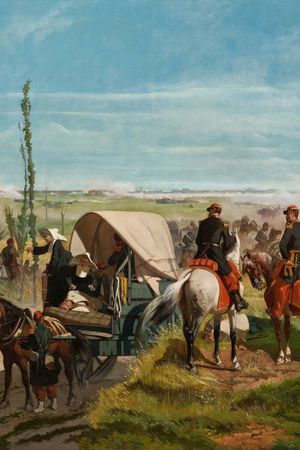
The Battle
The bloody victory at Magenta had opened the city of Milan to the French army and raised the enthusiasm of the Italians to fever pitch. Pavia, Lodi and Cremona had watched their liberators arrive and welcomed them with joy. The Austrians had abandoned their lines along the Adda, the Oglio and the Chiese, one river after another. Now, determined at last to take a dazzling revenge for their earlier defeats, they had massed large forces on the banks of the Mincio, and at their head, resolute, rode the young and valiant Emperor of Austria himself.
On the 17th of June King Victor Emmanuel reached Brescia. The people there had lived under oppression for ten long years, and they gave him the warmest of ovations; in the son of Charles Albert they saw a savior and a hero at once.
The next day the Emperor Napoleon made his own triumphal entry into the same city, in the middle of a whole people's rapture. They were glad of the chance to show their gratitude to the sovereign who had come to help them win back their freedom and independence.
On the 21st of June the Emperor of the French and the King of Sardinia left Brescia, which their armies had marched out of the day before. On the 22nd Lonato, Castenedolo and Montechiaro were occupied. On the evening of the 23rd the Emperor, who was in supreme command, gave precise orders for the morning of the 24th. King Victor Emmanuel's army, camped at Desenzano and forming the left wing of the allied army, was to advance on Pozzolengo. Marshal Baraguey d'Hilliers was to march on Solferino; Marshal MacMahon, Duke of Magenta, on Cavriana; General Niel was to go to Guidizzolo, and Marshal Canrobert to Medole; the Imperial Guard was to go to Castiglione. Together these forces came to one hundred and fifty thousand men and four hundred pieces of artillery.
The Emperor of Austria had nine army corps at his disposal in Lombardy, two hundred and fifty thousand men in all, for his invading army had been swollen by the garrisons of Verona and Mantua. On the advice of the Feldzeugmeister Baron Hess (a Feldzeugmeister was the Austrian rank just below field marshal), the imperial troops had in fact been retreating steadily ever since Milan and Brescia. The aim of that retreat was to concentrate, between the Adige and the Mincio, every soldier Austria then had in Italy. But the force that was about to go into the line of battle was only seven corps: one hundred and seventy thousand men, backed by about five hundred guns.
The Austrian imperial headquarters had moved from Verona to Villafranca, and then to Valeggio, and the troops were ordered to cross back over the Mincio at Peschiera, Salionze, Valeggio, Ferri, Goito and Mantua. The main body of the army took up quarters along a line from Pozzolengo to Guidizzolo. Several of the most experienced lieutenant field marshals had urged it, and the plan was to attack the Franco-Sardinian army between the Mincio and the Chiese.
The Austrian forces, under the Emperor's command, made up two armies. The first was led by the Feldzeugmeister Count Wimpffen, with the corps of Prince Edmund of Schwarzenberg, Count Schaffgotsche and Baron Veigl under him, as well as Count Zedtwitz's cavalry division. This was the left wing, and it had taken up position around Volta, Guidizzolo, Medole and Castel Goffredo. The second army was commanded by the cavalry general Count Schlick. Under him were the lieutenant field marshals Count Clam-Gallas, Count Stadion, Baron Zobel and the Chevalier Benedek, with Count Mensdorff's cavalry division. This was the right wing, and it held Cavriana, Solferino, Pozzolengo and San Martino.
So on the morning of the 24th the Austrians held every height between Pozzolengo, Solferino, Cavriana and Guidizzolo. They had set up their formidable artillery on a chain of small hills that formed the center of an immense attacking line. Their right and left wings could fall back, if they had to, under the shelter of those fortified heights, which they believed could not be taken.
The two enemy armies were marching toward each other, yet neither expected to run into the other so soon. The Austrians hoped that only part of the allied army had crossed the Chiese. They had no way of knowing what the Emperor Napoleon intended, and their information was wrong.
The Allies did not expect to meet the Emperor of Austria's army so suddenly either. On the 23rd there had been reconnaissance patrols, observations, reports from scouts and even ascents in hot-air balloons, and not one of them had shown any sign that the Austrians were turning back to attack.
And so, although both sides were waiting for a great battle soon, the meeting of the Austrians and the French and Sardinians on Friday the 24th of June came as a genuine surprise. Each had been mistaken about the other's movements.
Everyone has heard, or has read, some account of the battle of Solferino. Surely no one has forgotten that thrilling memory, all the more because the consequences of that day are still being felt in several of the states of Europe.
I was a mere tourist, a complete outsider to this great struggle, but by an unusual combination of circumstances I had the rare privilege of witnessing the moving scenes I have decided to set down here. In these pages I tell only my own personal impressions. Nobody should look here for technical details or strategic information; those have their place in other books.
On that memorable 24th of June more than three hundred thousand men stood face to face. The line of battle was about twelve miles long, and the fighting went on for more than fifteen hours.
The Austrian army had already worn itself out on a hard march all through the night of the 23rd. From the first light of the 24th it had to take the violent shock of the allied army, and then suffer in the stifling, excessive heat, and from hunger and thirst besides: apart from a double ration of brandy, these troops had almost nothing to eat all day Friday. The French army had been on the move since before dawn and had nothing but its morning coffee. So by the end of this terrible battle the exhaustion of the fighting men, and above all of the poor wounded, was extreme!
At about three in the morning the First and Second Corps, under Marshals Baraguey d'Hilliers and MacMahon, set off toward Solferino and Cavriana. But the heads of their columns had barely passed Castiglione when they found Austrian outposts in front of them, contesting the ground.
Both armies are on the alert.
On every side the bugles sound the charge and the drums roll.
The Emperor Napoleon, who has spent the night at Montechiaro, hurries toward Castiglione.
By six o'clock the firing has begun in earnest.
The Austrians advance along the open roads in perfect order. In the middle of their dense, white-coated masses fly their yellow-and-black standards, emblazoned with the imperial eagle of Germany.
Of all the army corps about to join the fight, the French Guard is a truly magnificent sight. The day is brilliant, and the splendid Italian sun makes the gleaming armor of the dragoons, the guides, the lancers and the cuirassiers flash.
From the very start of the action the Emperor Franz Joseph had left his headquarters with his whole staff and gone to Volta. With him were the archdukes of the House of Lorraine, among them the Grand Duke of Tuscany and the Duke of Modena.
The first clash takes place on ground the Allies know nothing about, and it is difficult ground. The French army must first force its way through rows of mulberry trees laced together with grapevines, which make real obstacles. The land is often cut by great dry ditches and by long walls three to five feet high, very broad at the base and narrowing toward the top. The horses have to scramble over the walls and leap the ditches.
The Austrians, posted on the rises and the hills, at once pound the French army with their artillery, raining down an unending hail of shells, bombs and cannonballs.
The thick clouds of smoke from the cannon and the grapeshot mix with the earth and dust thrown up as that enormous cloud of projectiles strikes the ground again and again. Facing the thunder of these batteries, which roar as they spew death on them, the French burst out of the plain like a second storm and charge the positions they are determined to take.
But it is in the scorching heat of midday that the fighting, which now rages on every side, grows fiercer and fiercer.
Packed columns hurl themselves at one another with the force of a raging torrent that sweeps away everything in its path. French regiments rush in open order at the Austrian masses, which are endlessly replaced, always more numerous and more menacing, and which take the attack with all their strength, like walls of iron. Whole divisions drop their packs so as to throw themselves at the enemy more freely, bayonets forward. If one battalion is driven back, another takes its place at once. Every hillock, every height, every rocky ridge is the scene of a stubborn fight. The dead lie in heaps on the hills and in the ravines.
Here it is hand-to-hand fighting, horrible and terrifying. Austrians and Allies trample one another underfoot and kill each other on top of bleeding corpses. They club each other with their rifle butts, smash each other's skulls, rip each other open with saber and bayonet. No quarter is given any more. It is butchery, a fight between wild beasts, maddened and drunk with blood. Even the wounded defend themselves to the very last; a man with no weapon left seizes his enemy by the throat and tears it with his teeth.
There it is the same kind of struggle, made more frightening still by a squadron of cavalry coming on at a gallop. The horses crush the dead and the dying under their iron-shod hooves. One poor wounded man has his jaw torn away, another his head crushed, a third, who might have been saved, has his chest stove in. The neighing of horses mixes with oaths, with cries of rage, with howls of pain and despair.
Farther off comes the artillery, flung forward at full speed behind the cavalry. It cuts its way through the dead and wounded who lie together on the ground with no distinction between them. Brains spurt out, limbs are broken and ground to pieces, bodies are crushed beyond recognition. The earth literally drinks blood, and the plain is strewn with human remains.
The French troops climb the hillocks and scale the steep hills and rocky slopes with the most fiery eagerness, under Austrian musket fire and bursting shells and grapeshot. No sooner is a hillock taken, and a few elite companies have managed to reach its top, worn out and bathed in sweat, than they fall on the Austrians like an avalanche, overturn them, drive them from yet another post, push them back and chase them to the very bottom of the ravines and ditches.
The Austrian positions are excellent, entrenched as they are in the houses and churches of Medole, Solferino and Cavriana. But nothing stops the slaughter, or interrupts it, or lessens it. Men are killed wholesale and men are killed one at a time. Every fold in the ground is taken with the bayonet; every spot is fought over foot by foot. The villages are torn away house by house and farm by farm, and each one becomes a siege. Doors, windows and courtyards are nothing but a hideous jumble of men cutting one another's throats.
The French grapeshot causes frightful disorder in the Austrian masses, reaching them at astonishing distances. It covers the hillsides with corpses and carries destruction as far as the German army's distant reserves. But if the Austrians give ground, they give it only step by step, and soon take the offensive again. Their ranks re-form over and over, only to be broken through again soon after.
Out on the plain the wind lifts waves of dust from the roads, which are deep in it, and builds them into thick clouds that darken the air and blind the fighting men.
If the struggle seems to stop for a moment here or there, it is only to start again more fiercely. Fresh Austrian reserves fill the gaps that this attack, as stubborn as it is deadly, tears in their ranks. Now on one side, now on another, drums beat and bugles sound the charge without end.
The Guard fights with the noblest courage. The voltigeurs, the chasseurs and the infantry of the line beside them compete in bravery and daring. The zouaves charge with the bayonet, leaping like wild animals and shouting furious cries. The French cavalry falls on the Austrian cavalry; uhlans and hussars run each other through and cut each other to pieces. The horses, excited by the heat of the fight, join in the fury themselves: they hurl themselves at the enemy's horses and bite them savagely while their riders hack and slash at one another.
The fury is such that in some places, when the ammunition is gone and the muskets are broken, men beat one another to death with stones and fight hand to hand. The Croats butcher everyone they meet. They finish off the wounded of the allied army, killing them with blows of their rifle butts. And the Algerian riflemen, in spite of their officers' efforts to calm their ferocity, strike down the dying in the same way, Austrian officers and soldiers alike, and throw themselves on the opposing ranks with savage roars and terrifying cries.
The strongest positions are taken, lost, retaken, lost again and won back once more. Everywhere men fall by the thousands, mutilated, disemboweled, riddled with bullets, or struck down by every kind of missile.
As for the spectator posted on the heights around Castiglione, even if he cannot follow the plan of the battle exactly, he can still see that the Austrians are trying to break through the center of the allied troops. They want to slow and stop the attacks on Solferino, whose splendid position is about to make it the key point of the whole battle. He can guess at the efforts of the Emperor of the French to link the different corps of his army together, so that they can support and reinforce one another.
The Emperor Napoleon, with an eye as quick as it is skillful, sees that the Austrian troops lack a strong, unified direction. He orders the corps of Baraguey d'Hilliers and of MacMahon, and soon afterward his Guard, under the brave Marshal Regnaud de Saint-Jean d'Angély, to attack the entrenchments of Solferino and San Cassiano at the same time, and so to break the enemy's center. That center was made up of the corps of Stadion, Clam-Gallas and Zobel, which come up only one after another to defend these vital positions.
At San Martino the valiant and fearless Field Marshal Benedek, with only part of the second Austrian army, holds out all day against the Sardinian army. The Sardinians fight heroically under the command of their King, whose presence among them electrifies them.
The right wing of the allied army, made up of the corps of General Niel and Marshal Canrobert, resists with unbreakable energy the first German army, commanded by Count Wimpffen; and the three corps of that army, Schwarzenberg's, Schaffgotsche's and Veigl's, never manage to act together.
Marshal Canrobert follows the Emperor Napoleon's orders to the letter and keeps a waiting position, for reasons that were entirely sound, and so he does not commit his available forces in the morning. In the end, though, most of his corps, the divisions of Renault and Trochu and General Partouneaux's cavalry, take a very lively part in the action.
At first Marshal Canrobert is held back by the expectation that the corps of Prince Edward of Liechtenstein will fall on him. That corps was not part of either Austrian army, but it had marched out of Mantua that very morning, and it worried the Emperor Napoleon. Liechtenstein's corps, in its turn, is completely paralyzed by fear that Prince Napoleon's corps is approaching, since Prince Napoleon's d'Autemarre division was on its way from Piacenza.
It was Generals Forey and de Ladmirault, with their valiant columns, who opened the fighting on that memorable day. After indescribable struggles they take the ridges and hills that lead up to the graceful hillock of the Cypresses. That hillock, together with the Tower and the cemetery of Solferino, is famous forever for the horrible slaughter of which these places were the glorious witnesses and the bloody stage. At last the Hill of the Cypresses is carried by storm, and on its summit Colonel d'Auvergne waves his handkerchief from the tip of his sword as a sign of victory.
But these successes cost the Allies dearly. A bullet shatters General de Ladmirault's shoulder. This heroic wounded man barely agrees to have it dressed at a field hospital set up in the chapel of a little hamlet, and in spite of how serious the wound is, he goes back to the fight on foot and keeps urging on his battalions, until a second bullet hits him in the left leg.
General Forey, calm and unshaken as ever in the middle of his difficult position, is wounded in the hip. The white cloak he wears over his uniform is pierced with bullets, and his aides-de-camp are struck down beside him. One of them, Captain de Kervenoël, twenty-five years old, has the top of his skull carried away by a shell fragment.
At the foot of the Hill of the Cypresses, as he is leading his skirmishers forward, General Dieu is thrown from his horse, mortally wounded. General Douay is wounded too, not far from his brother, Colonel Douay, who is killed. A cannonball shatters the left arm of the brigade commander, General Auger, and on this battlefield, which will cost him his life, he earns his promotion to the command of a division.
The French officers, always out in front, waving their swords in the air and leading the soldiers behind them by their example, are cut down in great numbers at the head of their battalions, where their decorations and their epaulets mark them out as targets for the Tyrolean riflemen.
So many dramas, so many incidents of every kind, so many moving turns of fortune!
In the First Regiment of Chasseurs d'Afrique, the French light cavalry raised in Algeria, Lieutenant Colonel Laurans des Ondes falls, suddenly struck dead. Beside him Second Lieutenant de Salignac-Fénelon, only twenty-two years old, breaks into an Austrian square and pays for that brilliant feat with his life.
At the farm of Casa Nova, under the enemy's terrible fire, Colonel de Maleville finds himself overwhelmed by numbers, and his battalion has run out of ammunition. He seizes the regiment's flag and rushes forward, shouting, "Whoever loves his flag, follow me!" His soldiers, though worn out with hunger and fatigue, charge after him with the bayonet. A bullet breaks his leg, but in spite of cruel pain he goes on commanding, held up on his horse by his men.
Near there, Major Hébert is killed throwing himself into the thick of the danger to keep a regimental eagle from being lost. Knocked down and trampled, he still finds the strength, before he dies, to call out to his men, "Courage, my boys!"
On the hillock of the Tower of Solferino, Lieutenant Moneglia, of the light infantry of the Guard, captures six pieces of artillery single-handed, four of them cannon with their teams of horses, commanded by an Austrian colonel who hands him his sword.
Lieutenant de Guiseul, carrying the flag of an infantry regiment of the line, is surrounded with his battalion by forces ten times their size. Shot, he rolls to the ground, clutching his precious charge to his chest. A sergeant snatches up the flag to save it from the enemy, and a cannonball carries away his head. A captain seizes the staff; he too is hit, and his blood stains the banner, which breaks and tears. Everyone who carries it, noncommissioned officers and privates, falls wounded one after another, but the living and the dead together make a last rampart of their bodies around it. In the end this glorious remnant, all torn to pieces, stays in the hands of a sergeant major of Colonel Abbatucci's regiment.
Major de La Rochefoucauld-Liancourt, a fearless officer of the Chasseurs d'Afrique, charges against Hungarian squares. But his horse is riddled with bullets, he himself falls wounded by two shots, and he is taken prisoner by the Hungarians, who have closed their square again behind him.
At Guidizzolo, Prince Charles of Windisch-Graetz, a valiant Austrian colonel, tries in vain at the head of his regiment to retake the strong position of Casa Nova. This unfortunate prince, a noble and generous hero, faces certain death, and even mortally wounded he goes on giving orders. His soldiers hold him up. They have taken him in their arms, and they stand still under a hail of bullets, making a last shelter for him with their bodies. They know they are going to die, but they will not abandon their colonel, whom they respect and love, and who soon breathes his last.
It is also while fighting with the greatest courage that the lieutenant field marshals Count Crenneville and Count Palffy are seriously wounded, and, in Baron Veigl's corps, Field Marshal Blomberg and his major general, Baltin. Baron Sturmfeder, Baron Pidoll and Colonel Mumb are killed. Lieutenants Steiger and Fischer fall bravely, not far from the young Prince of Isenburg, who is luckier than they are and will be carried from the battlefield still with a breath of life in him.
Marshal Baraguey d'Hilliers, followed by Generals Lebœuf, Bazaine, de Négrier, Douay, d'Alton and Forgeot, and Colonels Cambriels and Micheler, has broken into the village of Solferino. Count Stadion defends it with the lieutenant field marshals Paldy and Sternberg, and their brigades, Bils, Puchner, Gaal, Koller and Festetics, beat back the most violent attacks for a long time. In those attacks General Camou distinguishes himself with his chasseurs and voltigeurs, as do Colonels Brincourt and de Taxis, who are wounded, and Lieutenant Colonel Hémard, whose chest is pierced by two bullets.
General Desvaux, with his usual courage and his admirable coolness, takes the tremendous shock of the Hungarian infantry at the head of his cavalry, in a terrible struggle. Always in front of his division, in the most exposed places, he backs up with the irresistible dash of his squadrons the vigorous offensive of General Trochu against the corps of Veigl, Schwarzenberg and Schaffgotsche at Guidizzolo and at Rebecco. Generals Morris and Partouneaux also distinguish themselves there, against Mensdorff's cavalry.
General Niel, with Generals de Failly, Vinoy and de Luzy, holds out with unshakable steadiness on the plain of Medole against the three great divisions of Count Wimpffen's army. His stand allows Marshal MacMahon, with Generals de La Motterouge and Decaen and the cavalry of the Guard, to reach the hillocks of San Cassiano and Cavriana by going around the heights that are the key to those positions, and to settle on that series of parallel hills where the troops of Field Marshals Clam-Gallas and Zobel are massed. But the chivalrous Prince of Hesse, one of the heroes of the Austrian army and a man well worthy to measure himself against the famous victor of Magenta, who has thrown himself so fearlessly into the fight at San Cassiano, defends the three hillocks of Monte Fontana against assault after assault. General de Sévelinges has his rifled cannon hauled up there under the Austrian bullets. The grenadiers of the Guard harness themselves to the guns, since horses cannot climb such steep slopes. And so that the batteries, carried up the hills in this unusual way, can rain thunder down on the enemy, the grenadiers keep the gunners supplied with ammunition by calmly forming a human chain from the ammunition wagons left down on the plain.
General de La Motterouge at last stays master of Cavriana, in spite of the fierce resistance and the repeated counterattacks of the young German officers, who lead their detachments back into the fight again and again.
General Manèque's voltigeurs refill their empty cartridge boxes from the grenadiers' supply. But soon they are out of ammunition again, so they charge with the bayonet up the heights between Solferino and Cavriana, and although they are fighting against large forces, they take those positions with the help of the brave General Mellinet.
Rebecco falls to the Allies, then falls back into Austrian hands, is taken once more, recaptured once more, and finally stays in the possession of General Renault.
In the attack on Monte Fontana the Algerian riflemen are cut to pieces. Their colonels, Laure and Herment, are killed, and their officers fall in great numbers, which doubles their fury. They urge one another on to avenge their dead and hurl themselves on their enemies with the rage of the African and the fanaticism of the Muslim, killing them in a frenzy, without truce or rest, like tigers thirsting for blood.
The Croats throw themselves flat on the ground and hide in the ditches, letting their attackers come close; then they spring up all at once and kill them at point-blank range.
At San Martino an officer of the bersaglieri, the Italian sharpshooters, Captain Pallavicini, is wounded. His soldiers catch him in their arms, carry him and lay him in a chapel, where he receives first aid. But the Austrians, driven back for the moment, return to the attack and break into the church. The bersaglieri, too few to hold out, are forced to leave their commander behind. At once some Croats pick up big stones lying by the door and crush the poor captain's head with them, and his brains spatter their tunics.
In the middle of these fights, so varied, renewed endlessly and everywhere, curses burst from the mouths of men of so many different nations, many of whom are forced to become killers at twenty!
At the height of the fighting, while the earth shook under a hurricane of iron, sulfur and lead whose murderous volleys swept the ground, and while lines of fire streaked furiously through the air on every side like lightning that always killed, adding new martyrs to this human sacrifice, the Emperor Napoleon's chaplain, Father Laine, went from one field hospital to another, bringing words of comfort and sympathy to the dying.
A second lieutenant of the line has his left arm shattered by a canister ball, and blood pours from the wound. As he sits under a tree a Hungarian soldier takes aim at him, but the soldier is stopped by one of his own officers. The officer goes straight to the young wounded Frenchman, shakes his hand with compassion, and orders him carried to a less dangerous spot.
Cantinières, the women who kept each regiment's canteen and marched with it, go forward like ordinary soldiers under the enemy's very fire. They go to pick up poor mutilated soldiers who are begging for water, and they themselves are wounded while giving them a drink and trying to care for them. Close by, an officer of hussars struggles under the weight of his horse, which a shell fragment has brought down heavily on top of him; he is growing weak from the blood flowing from his own wounds. Near him a runaway horse goes past, dragging the bloody corpse of its rider in its headlong flight. Farther on, horses more humane than the men who ride them pick their way at every step so as not to trample the victims of this furious, passionate battle.
Author's note: These may have been the same cantinières who were burned alive by the Mexicans on the 9th of June, 1862. They were chained to wagons of gunpowder along with ten soldiers who were taking a convoy of food and ammunition from Veracruz to the French camp, and who were surrounded by guerrillas two or three miles from La Tejería.
An officer of the Foreign Legion is knocked down by a bullet that kills him outright. His dog, which was devoted to him, which he had brought back from Algeria and which was the friend of the whole battalion, had been marching beside him. Carried along by the rush of the troops, the dog falls in its turn a few steps farther on, also hit by a bullet, but it still finds the strength to drag itself back and die on its master's body. In another regiment a goat, adopted by a voltigeur and loved by all the soldiers, climbs unharmed up the slope to the assault on Solferino through the bullets and the grapeshot.
How many brave soldiers are not stopped by a first wound, and keep pushing forward until they are hit again and thrown to the ground, unable to go on fighting! Elsewhere, on the contrary, whole battalions, exposed to the deadliest fire, have to wait motionless for the order to advance. They are forced to stand by as calm spectators, but boiling with impatience, of a fight that is cutting them down.
The Sardinians, the army of the Kingdom of Sardinia and Piedmont, defend and attack, in engagement after engagement and assault after assault, from morning until evening, the hillocks of San Martino, of the Roccolo and of the Madonna della Scoperta, which are taken and retaken five and six times in a row. In the end they remain masters of Pozzolengo, even though they fight division by division, one after another and without much coordination. Their generals, Mollard, La Marmora, Della Rocca, Durando, Fanti, Cialdini, Cucchiari and de Sonnaz, with officers of every branch and every rank, back up the efforts of their King, before whose eyes Generals Perrier, Cerale and Arnoldi are wounded.
In the French army, after the marshals and the division commanders, how can I fail to mention the glorious share that belongs as well to the valiant brigade generals and all the brilliant colonels, and to so many courageous majors and brave captains, who did so much to bring about the final result of this great day? And certainly there was glory in fighting and defeating warriors such as Prince Alexander of Hesse, a Stadion, a Benedek or a Charles of Windisch-Graetz!
Author's note: On the subject of General Forey, let me borrow a few words about him from the fine book by Colonel Edmond Favre of the Swiss federal army, The Prussian Army and the Cologne Maneuvers of 1861: "The King had us all invited to dinner that very day at the castle of Benrath, near Düsseldorf. ... Before sitting down at table, the King took General Forey and General Paumgarten by the hand. 'Now that you are friends,' he told them, laughing, 'sit down here, side by side, and have a talk.' Now, Forey was the victor of Montebello and Paumgarten his opponent there, and they were free to ask each other about every detail of that day. Seeing the Austrian general's honest smile, you felt that the time for grudges was past; as for the French general, we all know he had no reason to hold one. That is war, and that is the soldier: these two generals, on such good terms this autumn, will perhaps be cutting each other to pieces next year, and then dining together again somewhere in two years' time!"
"It was as if the wind was pushing us," said one ordinary private of the line, putting it vividly, to give an idea of the dash and enthusiasm with which his comrades threw themselves into the fighting with him. "The smell of the powder, the noise of the guns, the drums beating and the bugles sounding — it gets you going, it fires you up!" And indeed in this struggle every man seemed to fight as if his own personal reputation were at stake, as if he had to make the victory his own particular business.
There really is a dash and a bravery all their own in the fearless noncommissioned officers of the French army. For them no obstacle exists. With their soldiers behind them they rush to the most dangerous and exposed places as if they were running to a party. That, no doubt, is part of what makes the French army superior to the armies of the other great nations of the world.
The Night and the Morning After
The troops of the Emperor Franz Joseph have fallen back. Count Wimpffen's army was the first to be ordered by its commander to begin the retreat, even before Marshal Canrobert had brought all his forces into play. Count Schlick's army, in spite of the firmness of Count Stadion, who was too weakly backed by the lieutenant field marshals Clam-Gallas and Zobel (all except the Prince of Hesse's division), has had to give up every one of the positions that the Austrians had turned into so many fortresses.
The sky has darkened. Thick clouds suddenly cover the horizon, the wind rises in fury, tears branches off the trees and whirls them through the air. A cold rain driven by the gale, or rather a real cloudburst, drenches the fighting men, who are already worn out with hunger and fatigue, while gusts and whirlwinds of dust blind the soldiers, who now have to fight the elements as well. The Austrians, battered by the storm, still rally at their officers' call. But toward five o'clock the fury on both sides is halted by torrents of rain, by hail, lightning and thunder, and by the darkness that spreads over the battlefield.
Throughout the action the head of the House of Habsburg shows admirable calm and composure. When Cavriana is taken he is on a neighboring height, the Madonna della Pieve, near a church surrounded by cypresses, with Count Schlick and his aide-de-camp, the Prince of Nassau. Once the Austrian center had given way, and the left wing had no hope left of forcing the allied position, the general retreat was decided. At that solemn moment the Emperor resigns himself to leaving for Volta with part of his staff, while the archdukes and the heir to the Grand Duchy of Tuscany withdraw to Valeggio. At several points panic seizes the German troops, and for some regiments the retreat turns into a complete rout. Their officers, who have fought like lions, try in vain to hold them back. Pleas, insults, blows with the flat of the saber: nothing stops them. Their terror is too great, and these soldiers, who have nonetheless fought bravely, would now rather be struck and insulted than not run away.
The despair of the Emperor of Austria is immense. He has behaved like a true hero and has watched bullets and cannonballs rain around him all day, and now he cannot keep from weeping at this disaster. Beside himself with grief, he even rushes across the roads to meet the fleeing men and reproach them for their cowardice. When calm had followed that violent outburst, he gazes in silence at this scene of desolation, great tears running down his cheeks, and it is only at the urging of his aides-de-camp that he agrees to leave Volta and set off for Valeggio.
In their dismay, some Austrian officers get themselves killed out of despair and rage, though not without selling their lives dearly. Several kill themselves out of grief and anger, unwilling to outlive this fatal defeat, and most of them rejoin their regiments only when they are covered in blood, from their own wounds or from the enemy's. Let us pay their bravery the tribute it deserves.
All day long the Emperor Napoleon appeared wherever his presence might be needed. With him were Marshal Vaillant, the army's chief of staff; General de Martimprey, his deputy; Count Roguet, the Count of Montebello, General Fleury, the Prince de la Moskowa, Colonels Reille and Robert, his whole military household and the squadron of the Hundred Guards, his personal bodyguard. He directed the battle the whole time, going to the points where the hardest obstacles had to be overcome, without worrying about the danger that threatened him constantly. On Monte Fenile his surgeon, Baron Larrey, had a horse killed under him, and several of the Hundred Guards in the escort were hit. He lodged at Cavriana in the very house where the Emperor of Austria had stopped that same day, and from there he sent a dispatch to the Empress announcing his victory.
The French army camped on the positions it had won during the day. The Guard bivouacked between Solferino and Cavriana; the first two corps held the heights near Solferino; the Third Corps was at Rebecco and the Fourth at Volta.
The Austrians held Guidizzolo until ten o'clock at night. Their retreat was covered on the left wing by Field Marshal Veigl, and on the right wing by Field Marshal Benedek, who held Pozzolengo until late into the night and protected the withdrawal of Counts Stadion and Clam-Gallas; in that withdrawal the brigades of Koller and Gaal and the Reischach regiment conducted themselves with great honor. Under the Prince of Hesse, the brigades of Brandenstein and Wussin had made for Volta, and from there they helped the artillery get across the Mincio at Borghetto and Valeggio.
Austrian soldiers who are wandering on their own are rounded up and taken to Valeggio. The roads are covered with the baggage of the different corps, with bridging trains and artillery reserves, all crowding and tumbling over each other to reach the narrow pass at Valeggio as fast as they can. The wagons of the supply train are saved by quickly throwing flying bridges across the river. At the same time the first convoys, made up of lightly wounded men, were beginning to arrive in Villafranca. The more seriously wounded followed them, and all through that sad night the numbers were enormous. The doctors dressed their wounds, gave them a little food to restore them, and sent them on by railway car to Verona, where the crowding became appalling. But although the army in its retreat took away every wounded man it could carry in its own wagons and in carts requisitioned from the countryside, how many of these unfortunate men are left lying abandoned on ground soaked with their blood!
Toward the end of the day, as the shadows of twilight spread over that vast field of slaughter, many a French officer or soldier went here and there looking for a comrade, a man from his own part of the country, a friend. If he found someone he knew, he knelt beside him, tried to bring him round, pressed his hand, stanched his blood, or tied a handkerchief around the broken limb, but he could not manage to find any water for the poor sufferer. How many silent tears were shed on that pitiful evening, when all false pride and all concern for what others might think was set aside!
During the action, mobile field hospitals had been set up in the farms, houses, churches and convents nearby, or even in the open air in the shade of a few trees. There the officers wounded in the morning had received a dressing of a sort, and after them the noncommissioned officers and the men. All the French surgeons showed a tireless devotion; several did not allow themselves a moment's rest for more than twenty-four hours. Two of them, working at the field hospital under Dr. Méry, the chief medical officer of the Guard, had so many limbs to cut off and so many dressings to apply that they fainted. In another field hospital one of their colleagues was so exhausted that he had to have two soldiers hold up his arms so that he could go on with his work.
In a battle, a black flag fixed on some high point usually marks the post for the wounded, or the field hospitals of the regiments in action, and by a silent agreement on both sides no one fires in those directions. Sometimes, even so, the shells land there, sparing neither the paymasters nor the hospital orderlies, nor the wagons loaded with bread and wine and with meat for making broth for the sick. The wounded soldiers who can still walk make their own way to these mobile field hospitals. The others are carried there on stretchers or litters, often weakened by bleeding and by going a long time without any help at all.
Over this vast and broken stretch of country, more than twelve miles long, and after all the upheavals that such a gigantic conflict brought with it, soldiers, officers and generals can know only very imperfectly how all the fights that took place have come out. During the action itself they could hardly know or judge with any certainty what was happening right next to them. In the Austrian army this ignorance had been made worse by confused orders from the top, or by the lack of clear and precise general orders at all.
The heights that run from Castiglione to Volta glitter with thousands of fires, fed by the wreckage of Austrian ammunition wagons and by branches of trees brought down by the cannonballs and the storm. The soldiers dry their wet clothes at these fires and sleep on the stones or the bare ground. But those who are unhurt cannot rest yet: after this day without rest and without food, they have to find water to make soup or coffee.
So many heartbreaking incidents, so many disappointments of every kind! There are whole battalions with no rations, and companies that had been made to drop their packs and now have nothing at all. Elsewhere it is water that is lacking, and the thirst is so fierce that officers and men turn to muddy, foul pools full of clotted blood.
Some hussars were coming back to their bivouac between ten and eleven at night. Though they were dropping with weariness, they had had to go on a fatigue party to fetch water and wood from a long way off, so that they could make coffee. All along their way they met so many dying men begging them for a drink that they emptied nearly all their canteens doing that charitable duty. Still, in the end they managed to make their coffee. But it was barely ready when shots were heard in the distance and the alarm was given. At once the hussars leap onto their horses and dash off toward the firing, without time to drink their coffee, which is knocked over in the commotion. Soon, though, they realize that what they had taken for the enemy coming back to attack was nothing but shots from the French outposts, whose sentries were firing on their own men, who were also out looking for water and wood, and whom the sentries had taken for Austrians. After this false alarm the horsemen came back exhausted and threw themselves on the ground to sleep for the rest of the night, without having eaten anything; and on the way back they still met many wounded men who kept asking for a drink. A Tyrolean soldier lying not far from their bivouac kept begging them, but his pleas could no longer be answered, because there was no water at all. The next morning he was found dead, with foam on his lips and his mouth full of earth. His swollen face was green and black. He had writhed in terrible convulsions until morning, and the nails of his clenched hands were bent back.
In the silence of the night you hear groans, stifled sighs full of anguish and suffering, and heartrending voices calling for help. Who could ever describe the agonies of that dreadful night!
The sun of the 25th lit up one of the most frightful sights the imagination could conceive. The battlefield is covered everywhere with the bodies of men and horses. The roads, the ditches, the ravines, the thickets and the meadows are strewn with corpses, and the approaches to Solferino are literally thick with them. The fields are laid waste, the wheat and the corn flattened, the hedges torn down, the orchards wrecked; here and there you come across pools of blood. The villages are deserted and bear the marks of the damage done by musket fire, rockets, bombs, grenades and shells. The walls are shaken and pierced by cannonballs that have opened wide breaches in them. The houses are holed, cracked, ruined. Their inhabitants, who have spent nearly twenty hours hiding in their cellars without light or food, are beginning to come out, and their dazed look shows how long and how great their terror has been.
Around Solferino, and above all in the village cemetery, the ground is littered with muskets, knapsacks, cartridge boxes, mess tins, shakos, helmets, kepis, forage caps, belts, every kind of equipment, even rags of clothing soiled with blood, along with heaps of broken weapons.
The wretched wounded men who are picked up all day long are pale, ashen, crushed. Some, especially the badly mutilated, have a stunned look and seem not to understand what is said to them. They fix wild eyes on you, but this apparent stupor does not keep them from feeling their pain. Others are anxious and restless, shaken by nervous shock and convulsive trembling. Those with gaping wounds, where inflammation has already set in, are almost mad with pain. They beg to be finished off, and they writhe, their faces twisted, in the last throes of agony.
Elsewhere there are unfortunate men who were not only struck by bullets or shell fragments that knocked them down, but whose arms or legs were then broken by the wheels of the guns that ran over them. The impact of the cylindrical bullets splinters the bone in every direction, so that the wound is always very serious. Shell fragments and conical bullets also cause terribly painful fractures and often dreadful internal damage. Splinters of every kind, fragments of bone, scraps of clothing, of equipment or of boots, dirt and pieces of lead often complicate and inflame the wounds and double the sufferer's torment.
Anyone who goes over this immense stage of the day before's fighting meets, at every step, and in the middle of unequaled confusion, despair beyond words and misery of every kind.
Some regiments had dropped their packs, and the contents of the packs of several battalions have disappeared, Lombard peasants and Algerian riflemen having seized everything they could lay their hands on. The chasseurs and voltigeurs of the Guard, for instance, had left their packs near Castiglione so that they could climb more easily to the assault on Solferino, when they went to the help of Forey's division. They had fought until evening, always advancing, and slept near Cavriana. Very early the next morning they hurried back to their packs, but the packs were empty; everything had been taken in the night. It was a cruel loss for these poor soldiers. Their underclothes and uniforms were dirty and stained, or worn and torn, and now they found themselves robbed of their belongings, perhaps of the modest savings that made up their whole little fortune, and of keepsakes too, things that reminded them of home and family, or that had been given to them by mothers, sisters and sweethearts.
In several places the dead are stripped by thieves, who do not always spare even the poor wounded men who are still alive. The Lombard peasants are especially greedy for boots, which they tear roughly off the swollen feet of the corpses.
Mixed with these deplorable scenes are solemn dramas and moving incidents. Here old General Le Breton wanders about searching for his son-in-law, General Douay, who is wounded; he has left his daughter, General Douay's wife, ten miles or so away, in the middle of the turmoil and in the most agonizing anxiety. There lies the body of Lieutenant Colonel de Neuchèze. He had seen his commander, Colonel Vaubert de Genlis, thrown from his horse and dangerously wounded, and as he rushed forward to take command a bullet struck him in the heart. Not far away is Colonel de Genlis himself, shaking with a burning fever, receiving first aid; and Second Lieutenant de Selve de Sarran, of the horse artillery, only a month out of the military academy at Saint-Cyr, who is about to have his right arm amputated. Here is a poor sergeant major of the Vincennes chasseurs, both legs shot through. I will see him again in a hospital in Brescia, and find him once more in one of the railway cars taking me back from Milan to Turin, and he is to die of his wounds while crossing the Mont Cenis pass. Lieutenant de Guiseul, who was thought to be dead, is picked up on the spot where he fell with his flag and lay unconscious. Close by, as though at the center of a heap of fallen Austrian lancers and chasseurs, of Turcos, as the Algerian riflemen were called, and of zouaves, lies the body of a Muslim officer in his elegant Eastern uniform: Lieutenant Larbi ben Lagdar of the Algerian riflemen. His tanned, sunburned face rests on the torn chest of an Illyrian captain in a dazzling white tunic. These heaps of human remains give off a vapor of blood. Colonel de Maleville, so heroically wounded at Casa Nova, breathes his last. Major de Pongibaud, who died in the night, is being buried, and the body of the young Count de Saint-Paër, who had won his promotion to major barely a week before, is found. It is there that the brave Second Lieutenant Fournier, of the voltigeurs of the Guard, badly wounded the day before, ends his military career at the age of twenty. He had enlisted as a volunteer at ten, was a corporal at eleven and a second lieutenant at sixteen, and he had already served in two campaigns in Africa and in the Crimean War, where he was wounded at the siege of Sebastopol. It was at Solferino, too, that one of the glorious names of the First French Empire was to die out, in the person of Lieutenant Colonel Junot, Duke of Abrantès, chief of staff to the brave General de Failly, the former military commander of Constantinople.
Author's note: Second Lieutenant Jean François Fournier, born at Metz on the 6th of February, 1839, enlisted as a volunteer in the Foreign Legion on the 4th of June, 1849, and went to Algeria. He was made corporal on the 6th of April, 1850, sergeant on the 1st of April, 1851, quartermaster sergeant on the 11th of July, 1852, and sergeant major in 1854. He served in the Crimean campaign in 1855 and 1856 as a warrant officer, and on the 20th of November, 1855, was commissioned second lieutenant in the 42nd Regiment of the Line, from which he transferred with that rank, on the 13th of October, 1856, to the 2nd Regiment of Voltigeurs of the Imperial Guard. Mortally wounded on the 24th of June, 1859, he died on the 25th.
The lack of water is felt more and more. The ditches are dry, and most of the soldiers have nothing but foul, brackish water to quench their thirst. At almost every spot where there is a spring, sentries with loaded muskets stand guard over the water for the sick. Near Cavriana a marsh that has turned putrid serves for two days as the only drinking water for twenty thousand artillery and cavalry horses. The wounded horses, which have lost their riders and wandered all night, drag themselves toward groups of their fellows as if asking them for help; they are put out of their misery with a bullet. One of these noble animals, magnificently harnessed, came in and gave itself up in the middle of a French detachment. The valise was still strapped to the saddle, untouched, and it held letters and other things that showed it must have belonged to the gallant Prince of Isenburg. The dead are searched, and the Austrian prince is found wounded and still unconscious from loss of blood. But the most attentive care, lavished on him by the French surgeons, will allow him later to go home to his family. Having had no news of him and believing him dead, they had gone into mourning, and had worn it for several weeks.
Among the dead, some soldiers have calm faces: these are the ones who were struck down suddenly and killed outright. But many have been left twisted by the tortures of their last agony, their limbs stiff, their bodies covered with livid blotches, their hands clawing at the ground, their eyes wide open, their mustaches bristling, a sinister, convulsive grin baring their clenched teeth.
It took three days and three nights to bury the bodies left on the battlefield. But over such a wide area many men who lay hidden in ditches or furrows, or screened by bushes or the lie of the land, were noticed only much later, and they, like the horses that had died, gave off a fetid stench.
Author's note: For three weeks after the 24th of June, 1859, dead soldiers of both armies were still being found here and there on the battlefield. It has been claimed, quite wrongly, that the 25th was enough to pick up and gather in all the French and Austrian wounded. That is completely untrue.
In the French army a certain number of soldiers in each company are detailed to identify and bury the dead. Usually the men of a given unit take up their own comrades. They note the regimental number on the dead man's kit, and then, helped in this painful duty by Lombard peasants paid for the work, they lay his body in a common grave with his clothes on. Unfortunately, in the haste of this grim task, and through the carelessness or gross negligence of some of these peasants, there is every reason to believe that more than one living man was buried with the dead. The decorations, money, watches, letters and papers collected from the officers are later sent to their families, but with such a mass of bodies to bury it is not always possible to carry out that task faithfully.
A son who was his parents' idol, raised and looked after for years by a loving mother who took fright at his slightest illness; a brilliant officer, cherished by his family, who has left his wife and children at home; a young soldier who, to go on campaign, left his sweetheart, and nearly always his mother, his sisters and his old father: there he lies stretched out in the mud and the dust, bathed in his blood. His fine, manly face is unrecognizable; the saber or the grapeshot has not spared him. He suffers, he dies. And his body, the object of so much care, blackened, swollen, hideous, is about to be thrown just as it is into a hastily dug pit. It will be covered with only a few shovelfuls of lime and earth, and the birds of prey will not spare his feet or his hands where they stick out of the sodden soil and the bank that serves as his grave. People will come back, they will bring more earth, perhaps they will plant a wooden cross on the spot where he lies, and that will be all!
As for the Austrian bodies, scattered by the thousands over the hills and the spurs and the ridges of the hillocks, among the clumps of trees and the woods, and across the open country and the plains of Medole, dressed in torn linen jackets, gray greatcoats caked with mud, or white tunics stained red with blood: swarms of flies were devouring them, and birds of prey hovered above those greenish bodies, hoping to feed on them. They are piled by the hundreds into great common graves.
How many young Hungarians, Bohemians and Romanians, enlisted only a few weeks before, threw themselves on the ground from exhaustion and hunger once they were out of range of the fire, and never got up again! How many others, weakened by loss of blood, though perhaps only slightly wounded, died miserably of exhaustion and starvation!
Among the Austrians taken prisoner, some are filled with terror, because someone had thought it a good idea to describe the French to them, and the zouaves in particular, as pitiless demons. It went so far that some of them, on reaching Brescia and seeing the trees of a public promenade in the city, asked in all seriousness whether those were the trees they were going to be hanged from. And several who were given generous care by French soldiers repaid them, in their blindness and ignorance, in a very senseless way. On Saturday morning a voltigeur, moved to pity at the sight of an Austrian lying on the battlefield in a pitiful state, went up to him with a canteen full of water and offered him a drink. The Austrian, unable to believe in such kindness, seized the musket lying beside him and struck the charitable voltigeur with the butt as hard as he still could, bruising his heel and his leg. A grenadier of the Guard tried to lift another Austrian soldier who was badly mutilated. This one had a loaded pistol beside him; he grabbed it and fired it point-blank at the French soldier who was trying to help him.
Author's note: At Marignano a Sardinian sentry at the outposts let himself be surprised by a detachment of Austrian soldiers, who put out his eyes "to teach him," they told him, "to see more clearly another time." And a bersagliere who had strayed from his company fell into the hands of a handful of Austrians, who cut off his fingers and then let him go, telling him in Italian, "Go and get yourself a pension!" Let us hope that these incidents, which are true, are very nearly the only ones of their kind committed during the Italian war.
"Don't be surprised at the harshness and roughness of some of our troops," an Austrian officer who had been taken prisoner told me. "We have savages from the most remote provinces of the empire in our army — real barbarians, in a word."
Some French soldiers in their turn were about to do violence to a few prisoners they took for Croats, adding in their exasperation that "those tight trousers," as they called them, always finished off the wounded. In fact they were Hungarians, who wear a uniform resembling the Croats' but are not nearly so cruel. I managed fairly quickly myself, by explaining the difference to the French soldiers, to get these trembling Hungarians out of their hands. Among the French, though, with few exceptions, there is nothing but goodwill toward the prisoners. Austrian officers, for instance, have been allowed to keep their sabers or swords, as a courtesy from the army commanders. They get the same food as the French officers, and those who are wounded are treated by the same doctors; one of them was even allowed to go back for his baggage. Many French soldiers share their rations like brothers with starving prisoners. Others carry wounded men of the enemy army on their backs to the field hospitals and there do them every sort of kindness, with remarkable devotion and deep compassion. French officers themselves look after Austrian soldiers. One of them wraps his handkerchief around the split head of a Tyrolean who had nothing to cover it but an old rag, torn and soaked in blood.
There are countless separate acts and incidents that show the great courage of the French army and the heroism of its officers and men. But one must also mention the humanity of the ordinary soldier, his kindness and his sympathy toward a beaten or captured enemy, qualities that are surely worth just as much as his fearlessness and his bravery. It is a known fact that truly distinguished military men are gentle and courteous, like all genuinely superior people. And the French officer is usually not only friendly but chivalrous and generous as well. He has never stopped deserving the praise of General de Salm, who was taken prisoner by the French at the battle of Neerwinden and treated with extreme courtesy by the Marshal of Luxembourg, and who said to the Chevalier du Rozel, "What a nation yours is! You fight like lions, and once you have beaten your enemies you treat them as if they were your best friends!"
Author's note: The French soldiers showed the greatest respect for everything that belonged to the people of the country, and their discipline, their civility, their sobriety and their good conduct throughout the whole Italian war deserve high praise. Proclamations like those of Marshal Regnaud de Saint-Jean d'Angély or of General Trochu are always worth recalling on these points, and they deserve to be counted as true titles to glory for the men who addressed them to their soldiers. "... In the campaign now opening," said General Trochu in his proclamation of the 4th of May, 1859, dated at Alessandria and read to every company of his division assembled under arms, "we will face with eagerness the hardest trials, which for us have already begun. We will be disciplined and obedient to the regulations, in the enforcement of which you will find me inflexible; and on the day of battle we will not allow the brave to be braver than we are. We will not forget that the people of this country are our allies. We will respect their customs, their property and their persons. We will wage war humanely, as civilized men. In that way our efforts will be honorable, God will bless them, and I who command you will consider the finest title of my career to be that of commander of the Second Division." On the 18th of May, 1859, at Marengo, Marshal Regnaud de Saint-Jean d'Angély addressed the Imperial Guard in these words: "Soldiers of the Guard ... you will give the army an example of fearlessness in danger, of order and discipline on the march, of calm and restraint in the country you are about to pass through. The memory of your families will inspire you with kindness toward the inhabitants and respect for property, and, be sure of it, victory awaits you..."
The Intendance, the army's supply service, goes on bringing in the wounded. Dressed or undressed, they are carried by mules with litters or with cacolets, the folding chairs slung on either side of a pack saddle, to the mobile field hospitals, and from there they are sent on to the villages and small towns nearest to the spot where they fell or where they were first picked up. In these little towns, churches, convents, houses, public squares, courtyards, streets and promenades are all turned into makeshift field hospitals. Carpenedolo, Castel Goffredo, Medole, Guidizzolo, Volta and all the places around take in a great many wounded, but the largest number are brought to Castiglione, where the less disabled have managed to drag themselves.
Here comes the long procession of the supply service's wagons, loaded with privates, noncommissioned officers and even officers of every rank all mixed together, cavalrymen, infantrymen, gunners, all bloody, exhausted, torn and covered in dust. Then come the mules at a trot, and every step they take wrings sharp cries from the poor wounded men they carry. One man's leg is shattered and seems almost torn from his body; every jolt of the cart that carries him brings fresh agony. Another has a broken arm, and with the arm he has left he holds and protects the fractured one. A corporal has had his left arm run clean through by the stick of a Congreve rocket. He pulls it out himself, and once that is done he uses the stick as a cane to help himself reach Castiglione. Several men die on the way. Their bodies are laid by the roadside; someone will come later to bury them.
Castiglione
From Castiglione the wounded were supposed to be taken on to the hospitals of Brescia, Cremona, Bergamo and Milan, where they would at last get proper care or undergo the amputations they needed. But the Austrians, as they passed through, had carried off nearly every cart in the country with their forced requisitions, and the French army's own means of transport fell far short of the frightening mass of wounded. So the wounded had to be kept waiting two or three days in the mobile field hospitals before they could be brought in to Castiglione, where the crowding becomes indescribable. The whole town turns into one vast improvised hospital, for French and Austrians alike. As early as Friday the field hospital of general headquarters had set itself up there; crates of lint had been unpacked, along with splints and medicines, and the townspeople had given every blanket, every piece of linen, every straw pallet and mattress they could spare. The hospital of Castiglione, the church, cloister and barracks of San Luigi, the Capuchin church, the police barracks, and the churches of the Maggiore, San Giuseppe and Santa Rosalia are all filled with wounded men, packed together and lying on nothing but straw. Straw is spread in the streets as well, and in the courtyards and squares, where plank shelters have been knocked together here and canvas stretched there, to keep the sun off a little from the wounded who are arriving from every direction at once. Before long the private houses are taken over too. The better-off owners take in officers and men and hurry to give them whatever small comforts they can. Some of them run frantically through the streets looking for a doctor for their guests. Others go back and forth through the town, distraught, begging for someone to take away the corpses in their houses, which they have no idea how to get rid of. Generals de Ladmirault, Dieu and Auger, Colonels Broutta and Brincourt, and other senior officers were brought to Castiglione, where they are cared for by the skillful Dr. Bertherand, who has been amputating at San Luigi since Friday morning. Two other surgeons-major, Drs. Leuret and Haspel, two Italian doctors, and the assistant surgeons Riolacci and Lobstein have been setting splints and dressing wounds for two days, and they keep at their painful work even through the night. The artillery general Auger was carried first to the Casa Morino, where the field hospital of the headquarters of Marshal MacMahon's corps, to which he belonged, was set up, and then brought on to Castiglione. This outstanding officer had his left shoulder shattered by a six-pound cannonball, which stayed lodged for twenty-four hours deep in the muscles of the armpit. The general died on the 29th, from the effects of the operation to take the arm off at the shoulder, which was needed to remove the ball, and from the gangrene that had spread through the wound.
Author's note: Castiglione delle Stiviere, about fifteen miles southeast of Brescia, has fifty-three hundred inhabitants. It was just outside Castiglione, on the 5th of August, 1796, two days after General Augereau had taken the town, that General Bonaparte, at the head of the Army of Italy, won an important victory over the Austrian field marshal Wurmser. It was close by as well, on the Chiese, that on the 19th of April, 1706, the Duke of Vendôme won the battle of Calcinato over Marshal Reventlow, who commanded the Imperial army in Prince Eugene's absence.
On Saturday the convoys of wounded become so numerous that the authorities, the townspeople and the detachment of troops left at Castiglione are completely unable to cope with so much misery. Then begin scenes as pitiful as those of the day before, though of a quite different kind. There is water and there is food, and yet the wounded are dying of hunger and thirst. There is lint in plenty, but not enough hands to put it on the wounds. Most of the army's doctors have had to leave for Cavriana; there are not enough orderlies, and at this most critical moment there are no hands to do the work. So a volunteer service has to be organized, somehow or other. But that is very hard in the middle of such disorder, made worse by a kind of panic that seizes the people of Castiglione, with the disastrous result of enormously increasing the confusion and, through the fright it gives them, worsening the wretched state of the wounded.
The panic had a cause that was really quite trivial. On the day after the battle, as each corps of the French army took stock of itself after taking up its positions, convoys of prisoners were formed and sent to Brescia by way of Castiglione and Montechiaro. One of these detachments of prisoners, escorted by hussars, was approaching Castiglione in the afternoon on the road from Cavriana, and as soon as it was seen in the distance the townspeople foolishly took it for the Austrian army coming back in force. The rumor was absurd and impossible, but it was spread by peasants, by the hired drivers of the army's baggage, and by the little peddlers who usually follow troops on campaign, and when the people of the town saw these men rushing in among them, panting with terror, they believed the ridiculous story. At once the houses are shut. The townspeople barricade themselves indoors, burn the tricolor flags that had decorated their windows, and hide in their cellars or their attics. Some flee into the fields with their wives and children, carrying off everything they own of value. Others, a little less shaken, stay at home but take in the first Austrian wounded they can lay hands on, picking them up in the squares and suddenly heaping them with attentions and kindnesses. In the streets and on the roads, which are crowded with carts of wounded going to Brescia and with supply convoys coming from that city for the army, wagons are carried off at full speed, horses bolt in every direction amid cries of terror and anger, carts loaded with baggage are overturned, and loads of hardtack are thrown into the ditches along the highway. In the end the hired drivers, more and more terrified, unhitch their horses and gallop off at full speed down the road to Montechiaro and Brescia. All along it they spread panic and cause an unbelievable melee, crashing into the carts full of food and bread that the city government of Brescia is constantly sending to the allied army's camp, dragging along with them everything they meet, and trampling the wounded, who beg to be taken away. The wounded will not listen to reason: they tear off their bandages, stagger out of the churches, and set off down the streets with no idea how far they will be able to go.
What agonies and what suffering there were on the 25th, the 26th and the 27th! The wounds, poisoned by heat and dust and by the lack of water and of care, have grown more painful. Foul, noxious smells fill the air, in spite of the Intendance's praiseworthy efforts to keep the buildings that have become field hospitals in good order, and the shortage of assistants, orderlies and attendants is cruelly felt, for the convoys sent to Castiglione keep pouring new batches of wounded into the town every quarter of an hour. However hard a chief surgeon and two or three other people work to organize regular transport to Brescia in oxcarts, and however willingly those people of Brescia who own carriages come of their own accord to ask for patients, and are given the officers, the departures fall far short of the arrivals, so that the crowding only grows.
On the stone floors of the hospitals and churches of Castiglione, men of every nation have been laid side by side: Frenchmen and Arabs, Germans and Slavs. Stowed away for the time being in the depths of the chapels, they no longer have the strength to move, or cannot shift from the narrow space they lie in. Oaths, curses and cries that no words can convey ring under the vaults of these holy places. "Oh, sir, how I'm suffering!" some of these poor men said to me. "They're abandoning us. They're letting us die miserably, and yet we fought well!" In spite of all they have been through and all the nights they have spent without sleep, rest will not come to them. In their distress they beg for a doctor, or roll about in despair, in convulsions that will end in tetanus and death. Some soldiers have the absurd idea that the cold water poured on their wounds, which are already festering, produces worms, and out of that fear they will not let their bandages be moistened. Others, who had the privilege of being dressed at the mobile field hospitals, were never dressed again during their forced stay in Castiglione, and those cloths, bound extremely tight to withstand the jolts of the road, had been neither changed nor loosened, and were real torture to them. These men, their faces black with flies that cling to their wounds, cast wild looks in every direction, and nobody answers. In those men, the greatcoat, the shirt, the flesh and the blood have formed a horrible mass that cannot be told apart, and maggots have got into it. Several shudder at the thought of being eaten by the maggots, which they think they see coming out of their bodies, and which come from the myriads of flies that infest the air. Here is a soldier, completely disfigured, whose tongue hangs far out of his torn and broken jaw. He tosses about and tries to get up. I wet his parched lips and his hardened tongue with fresh water; I take a handful of lint, dip it in the bucket that someone carries behind me, and squeeze the water from this sponge into the shapeless opening where his mouth used to be. There is another poor man, part of whose face has been cut away by a saber blow: nose, lips and chin have been severed from the rest of his face. He cannot speak and is half blind, and he makes signs with his hand, and by this heartbreaking dumb show, along with sounds from his throat, he draws attention to himself. I give him a drink and let a few drops of clean water run over his bleeding face. A third man, his skull split wide open, is dying, his brains spilling out on the church floor. His companions in misfortune push him aside with their feet because he is in the way. I shelter him in his last moments and cover his poor head, which he still moves feebly, with a handkerchief.
Every house had become an infirmary, and every family had its hands full caring for the officers it had taken in. Even so, by Sunday morning I had managed to gather a number of local women, who help as best they can in the efforts being made to relieve the wounded. It is not a question of amputations or any other operation. What is needed is to give food, and above all drink, to people dying of hunger and thirst; then to dress their wounds, or to wash bloody bodies covered in mud and vermin; and all this has to be done amid fetid, sickening smells, through the moaning and the howls of pain, in a burning, foul atmosphere. A core of volunteers soon forms. The Lombard women run to the men who cry the loudest, who are not always the ones most to be pitied. I set myself to organize help as well as I can in the part of town that seems to have least of it, and in particular I adopt one of the churches of Castiglione, the one standing on a rise on the left as you come from Brescia, which is called, if I am not mistaken, the Chiesa Maggiore. Nearly five hundred soldiers are crowded into it, and there are at least another hundred lying on straw in front of the church, under canvas stretched to keep off the sun. The women who have gone inside move from one man to the next with jars and canteens full of clear water, to quench their thirst and to moisten their wounds. Some of these improvised nurses are lovely, graceful young girls. Their gentleness, their kindness, their beautiful eyes full of tears and compassion, and their careful attentions lift the courage and the spirits of the sick a little. Little boys from the town run back and forth between the church and the nearest fountains with buckets, canteens and watering cans. After the water comes broth and soup, which the supply service has to make in tremendous quantities. Enormous bales of lint have been set down here and there, and anyone can use it freely, but there are no bandages, no linen, no shirts. In this little town, which the Austrian army has just passed through, supplies are so meager that you cannot get even the barest necessities any more. Still, I manage to buy new shirts through these good women, who have already brought and given away all their old linen, and on Monday morning I send my coachman to Brescia for supplies. He comes back a few hours later with his cabriolet loaded with chamomile, mallow, elderflower, oranges, lemons, sugar, shirts, sponges, strips of linen, pins, cigars and tobacco. That lets us hand out a cooling lemonade that the men have been longing for, wash the wounds in mallow water, apply warm compresses and change the bandages on the dressings. Meanwhile we have won some recruits who join us: an old naval officer, and then two English tourists who wanted to see everything, came into the church, and were kept by us almost by force. Two other Englishmen, on the contrary, are eager to help from the start; they hand out cigars to the Austrians. An Italian priest, three or four travelers and sightseers, a Paris journalist who later takes charge of the relief work in a church nearby, and some officers whose detachment has been ordered to stay in Castiglione lend us a hand. But one of these officers soon falls ill from the strain, and our other volunteer nurses drop out one after another, unable to bear for long the sight of suffering they can do so little to relieve. The priest followed their example, but he comes back, thoughtfully, to hold aromatic herbs and bottles of smelling salts under our noses. A young French tourist, overwhelmed by the sight of these living wrecks, suddenly bursts into sobs. A merchant from Neuchâtel devotes himself for two days to dressing wounds and writing letters of farewell for the dying to their families. For his own sake we have to hold back his zeal, and also to calm a Belgian whose compassionate excitement had risen so high that we were afraid he would be seized with brain fever, like the second lieutenant beside us who had come from Milan to rejoin his unit and was struck down by it. Some soldiers of the detachment left as garrison in the town try to help their comrades, but they cannot stand the sight either; it strikes their imagination too sharply and breaks their spirit. A corporal of engineers, wounded at Magenta and nearly healed, who is on his way back to his battalion and whose travel orders give him a few days, comes with us and helps us bravely, though he faints twice in a row. The French intendant who has just set up at Castiglione at last gives permission to use healthy prisoners for hospital duty, and three Austrian doctors come to help a young Corsican assistant surgeon, who pesters me several times for a certificate attesting to his zeal during the time I saw him at work. A German surgeon who had stayed behind on the battlefield on purpose to dress the wounded of his own nation devotes himself to those of both armies. In gratitude the Intendance sends him back after three days to rejoin his countrymen at Mantua.
"Don't let me die!" some of these poor men cried out. They would seize my hand with extraordinary strength, and then die as soon as that false strength left them. A young corporal of about twenty, with a gentle, expressive face, named Claudius Mazuet, has taken a bullet in the left side. His condition is past all hope, and he understands it himself. After I have helped him drink he thanks me, and with tears in his eyes he adds, "Oh, sir, if you could write to my father, so he can comfort my mother!" I took down his parents' address, and a few moments later he had stopped living. An old sergeant, with several service stripes on his sleeve, said to me with deep sadness, with conviction and a cold bitterness, "If they'd seen to me sooner, I could have lived, but tonight I'll be dead!" By evening he was dead.
Author's note: His parents, who lived at 3 Rue d'Alger in Lyon, and whose only son this young volunteer was, had no news of their child except what I gave them. Like so many others, he must have been listed as "missing."
"I don't want to die, I don't want to die!" roared a grenadier of the Guard with savage energy. Three days before he had been full of strength and vigor, but now he was mortally wounded, and he felt clearly that his time was running out for good, and he fought and struggled against that dark certainty. I speak to him; he listens to me; and this man, soothed, quieted, comforted, at last resigns himself to dying with the simplicity and innocence of a child. Look over there, at the back of the church, in the recess of an altar on the left: a soldier of the Chasseurs d'Afrique lying on straw. He does not complain and hardly moves any more. Three bullets have hit him, one in the right side, one in the left shoulder, and the third is still lodged in his right leg. It is Sunday evening, and he says he has eaten nothing since Friday morning. He is disgusting with dried mud and clots of blood; his clothes are torn and his shirt is in rags. After I have washed his wounds, given him a little broth and wrapped him in a blanket, he lifts my hand to his lips with a look of gratitude beyond words. At the entrance of the church is a Hungarian who cries out without stopping, calling in Italian, in a heartrending voice, for a doctor. His back has been plowed up by fragments of grapeshot, as though furrowed by iron hooks, and a great expanse of red, quivering flesh lies exposed. The rest of his swollen body is black and greenish. He can find no way to rest or sit. I soak masses of lint in cool water and try to make him a bed of it, but gangrene will soon carry him off. A little farther on is a zouave, crying hot tears, who has to be comforted like a little child. Their earlier hardships, the lack of food and rest, a feverish excitement and the fear of dying with no one to help them were at that moment producing, even in fearless soldiers, a nervous sensitivity that came out in groans and sobs. One of the thoughts that filled their minds most, when their pain was not too cruel, was the memory of their mothers, and dread of the grief their mothers would feel on hearing what had happened to them. The body of a young man was found with a portrait of an elderly woman, his mother no doubt, hanging around his neck; with his left hand he still seemed to be pressing the locket to his heart.
Here, along the wall, about a hundred French privates and noncommissioned officers, each wrapped in his blanket, lie close together in two parallel rows, with room to walk between them. They have all been dressed, the soup has been handed round, and they are calm and peaceful. They follow me with their eyes, and all those heads turn to the right if I go right and to the left if I go left. "You can tell he's a Parisian," some say. "No," others answer, "he looks to me like a southerner." "You're from Bordeaux, aren't you, sir?" a third man asks me, and each of them wants me to be from his own province or his own town. The patience these ordinary soldiers of the line usually showed is remarkable and deserves attention. Taken one by one, what was each of them in this great upheaval? Very little. They suffered without complaining; they died humbly and quietly.
Author's note: I had the satisfaction, in the course of the following year, of meeting in Paris, especially in the Rue de Rivoli, soldiers who had lost limbs and been invalided out. They recognized me and stopped me to thank me for having looked after them at Castiglione. "We called you the gentleman in white," one of them told me, "because you were dressed all in white — and no wonder, it was hot enough in there!"
The wounded Austrian prisoners rarely tried to defy their conquerors. Some, though, refuse care because they distrust it; they tear off their bandages and make their wounds bleed. A Croat took the bullet that had just been extracted from him and threw it at the surgeon's forehead. Others remain silent, gloomy and impassive. In general they do not have the openness, the goodwill and the lively, sociable expressiveness that mark the men of the Latin peoples. Still, most of them are far from unmoved or ungrateful for good treatment, and sincere gratitude shows on their astonished faces. One of them, nineteen years old, has been pushed with forty or so of his countrymen into the farthest corner of the church and has had no food for three days. He has lost an eye, he is shaking with fever and can no longer speak, and he barely has the strength to take a little broth. Our care brought him round, and twenty-four hours later, when he could be sent on to Brescia, he left us with regret, almost with anguish. His remaining eye, which was a magnificent blue, showed his deep and lively gratitude, and he pressed the hands of the charitable women of Castiglione to his lips. Another prisoner, burning with fever, catches the eye. He is not yet twenty, and his hair is completely white. It turned white on the day of the battle, so his comrades and he himself declare.
Author's note: I mentioned this fact at a meeting of the Ethnographical Society of Paris, and M. R. Cortambert cited it in the Revue orientale et américaine (January 1860), in his remarkable article "On the Hair of the Different Peoples."
How many young men of eighteen to twenty, who have come sadly all this way from the depths of Germany or from the eastern provinces of the vast Austrian Empire, some of them perhaps by force, roughly dragged off, will have to bear not only their bodily pain and the grief of captivity but also the ill will born of the hatred the Milanese feel for their race, their officers and their sovereign, and will meet with little sympathy before they reach the soil of France! Poor mothers, in Germany, in Austria, in Hungary, in Bohemia, how can one help thinking of your anguish when you learn that your wounded sons are prisoners in this enemy land! But the women of Castiglione, seeing that I make no distinction of nationality, follow my example and show the same kindness to all these men of such different origins, who are all equally foreign to them. "Tutti fratelli," they kept saying with feeling: "All brothers." Honor to these compassionate women, these young girls of Castiglione! Nothing put them off, nothing wore them out or discouraged them, and their modest devotion took no account of fatigue, or disgust, or sacrifice.
The feeling of one's own great inadequacy in such extraordinary and solemn circumstances is a suffering beyond words. It is extremely painful, in fact, never to be able to relieve the men in front of you, nor to reach the ones calling for you and begging, as long hours go by before you get where you want to go, stopped by one man, entreated by another, held back at every step by the crowd of unfortunates who press around you and surround you. And then, why go to the right, when on the left there are so many who are going to die without a friendly word, without a word of comfort, without so much as a glass of water to quench their burning thirst? The moral sense of how much a man's life matters, the wish to ease a little the torments of so many sufferers or to raise their fallen spirits, the forced, ceaseless activity you impose on yourself at such moments, all give you a new and supreme energy that creates something like a real thirst to bring help to as many as possible. You are no longer moved by the thousand scenes of this tremendous and solemn tragedy. You walk past the most hideously disfigured corpses with indifference. You look almost coldly on scenes even more horrible than those described here, which the pen absolutely refuses to describe. But sometimes the heart suddenly breaks, as if struck all at once by a bitter, overpowering sadness, at the sight of some simple incident, some single fact, some unexpected detail that goes more directly to the soul, that seizes our sympathy and shakes every one of the most sensitive fibers of our being.
Author's note: Since it was only after more than three years that I decided to gather up these painful memories, which I had never meant to publish, it will be understood that they had already faded somewhat, and also that they are abridged where the scenes of pain and desolation I witnessed are concerned. But if these pages could raise, or advance and press forward, the question of the relief to be given to wounded soldiers in wartime, or of the immediate care to be lavished on them after a battle; if they could draw the attention of people of humanity and goodwill; in a word, if concern for this most important subject, and study of it, could carry it a few steps forward and so improve a state of affairs in which new progress and improvements can never be too many, even in the best-organized armies, then I will have fully achieved my aim.
For the soldier who has gone back to the daily life of an army in the field, after the great hardships and powerful emotions that the day of a battle like Solferino and the day after put him through, the memory of home and family becomes more vivid and more stirring than ever. That state of mind is painted vividly in these touching lines from a brave French officer, writing from Volta to a brother at home in France: "You can't imagine how moved a soldier is when he sees the mail orderly appear, the man who hands out the army's letters. You see, he brings us news of France, of home, of our families and our friends. Everyone listens, watches, and holds out eager hands to him. The lucky ones, who have a letter, tear it open and devour it at once. The others, the left-out ones, walk away with heavy hearts and go off by themselves to think of the people back home. Sometimes a name is called and no one answers. We look at one another, ask each other, wait. 'Dead!' a voice murmurs. And the mail orderly puts that letter away, and it will go back unopened to the people who wrote it. They were happy when they wrote it. They said to themselves, 'How glad he'll be when he gets it!' And when they see it come back, their poor hearts will break."
The Road to Brescia
The streets of Castiglione are quieter now. Deaths and departures have made room, and although new carts of wounded keep arriving, order is gradually established and the services begin to run regularly. The crowding was never the result of bad organization or a lack of foresight on the part of the authorities. It came from the unheard-of and unexpected number of men hit, and from the very small number, by comparison, of doctors, attendants and orderlies. The convoys from Castiglione to Brescia are more regular. They are made up either of hospital wagons or of crude carts drawn by oxen, which walk slowly, very slowly, under a blazing sun and through dust so deep that a man on foot sinks in those shifting, solid waves to above the ankle. Even when these very uncomfortable vehicles are covered with branches, the branches give only a poor shelter from the heat of a fiery sky to the wounded men, who are piled, so to speak, on top of each other. One can imagine the torture of that long journey! A friendly nod to these poor men as you pass them seems to do them good, and they return it eagerly, with a look of gratitude. In every village along the road to Brescia the village women sit at their doors, silently making lint. When a convoy comes in they climb up onto the carts, change the compresses, wash the wounds, put on fresh lint soaked in cool water, and spoon broth, wine or lemonade into the mouths of those who no longer have the strength to raise their heads or their arms. The wagons that keep bringing food, fodder, ammunition and supplies of every kind from France or Piedmont to the French camp do not go back empty: they take the sick to Brescia. In all the villages the convoys pass through, the local authorities have drinks, bread and meat made ready. At Montechiaro the town's three small hospitals are staffed by peasant women of the place, who look after the wounded there with as much intelligence as kindness. At Guidizzolo about a thousand of them have been properly settled in a huge castle, though only for the time being, and at Volta an old convent turned into a barracks takes in hundreds of Austrians. At Cavriana, Austrians who were badly crippled, and who had been left lying for forty-eight hours under the arcades of a wretched guardhouse, have been moved into the main church of that poor little town. At the field hospital of general headquarters, operations are performed with chloroform, which made the Austrian wounded lose feeling almost at once, but in the French brought on nervous spasms with great excitement.
The people of Cavriana have no food or supplies left at all; it is the soldiers of the Guard who feed them, sharing their rations and their mess tins with them. The countryside has been laid waste, and nearly every kind of produce that could be eaten has either been sold to the Austrian troops or seized by them as requisitions. The French army has plenty of field rations, thanks to the good sense and punctuality of its supply administration, but it has a hard time finding the butter, fat and vegetables usually added to the soldier's daily fare. The Austrians had requisitioned nearly all the livestock in the region, and cornmeal is the only thing the Allies can easily find in the places where they are now camped. All the same, anything the Lombard peasants can still sell to help feed the troops is bought from them at very high prices, always reckoned so as to satisfy the seller. And the French army's requisitions, of fodder, potatoes or other foodstuffs, have everywhere been paid for generously to the people of the country, who were likewise generously compensated for the unavoidable damage the fighting had done.
The wounded of the Sardinian army, who have been taken to Desenzano, Rivoltella, Lonato and Pozzolengo, are in less unfavorable conditions than those at Castiglione. The first two towns had not been occupied, a few days apart, by two different armies, so more food can be found there. The field hospitals are well kept; the people, less shaken and less frightened, give the nursing service active help; and the sick who are sent on from there to Brescia travel in good carts with a thick layer of hay, shaded from the sun by arbors of leafy, interwoven branches firmly fastened to the carts, with a strong canvas stretched over the top as well.
Worn out with fatigue and no longer able to sleep, I have my cabriolet harnessed on the afternoon of the 27th, and at about six o'clock I set out to breathe the cool evening air in the open and get a little rest, getting away for a while from the grim scenes that surround you on every side in Castiglione. It was a good day for it, since no troop movements, as I learned later, had been ordered for that Monday. So calm had followed the terrible upheavals of the days before on that battlefield, so melancholy now, which passion and excitement had entirely abandoned. But here and there you see pools of dried blood reddening the ground, and freshly turned earth, whitened and sprinkled with lime, marking the places where the victims of the 24th lie. At Solferino, whose square tower has looked down for centuries, unmoved and proud, on this country where two of the greatest powers of modern times had just clashed for the third time, many sad remnants of the battle are still being picked up; they cover even the crosses and bloodstained gravestones in the cemetery. I reached Cavriana at about nine o'clock. The array of war around the headquarters of the Emperor of the French was a unique and magnificent sight. I was looking for Marshal MacMahon, the Duke of Magenta, whom I had the honor of knowing personally. Not knowing exactly where his corps was camped at that moment, I had my cabriolet stop in a little square opposite the house where the Emperor Napoleon had been staying since Friday evening, and I came unexpectedly upon a group of generals who, sitting on plain straw chairs or wooden stools, were smoking their cigars and enjoying the cool air in front of their sovereign's makeshift palace. While I was asking which way Marshal MacMahon had been sent, these generals for their part questioned the corporal who was with me. He sat up on the box of my carriage beside the coachman, so they took him for my orderly. They wanted to know who I was, and to find out the purpose of the mission they assumed I had been given, for it could hardly occur to them that a mere tourist had taken it into his head to venture alone among the armies, and that, having come as far as Cavriana, he meant to go farther at so late an hour. The corporal, who knew no more than that, naturally gave nothing away, while answering their questions most respectfully, and their curiosity seemed to grow when they saw me set off again for Borghetto, where the Duke of Magenta was supposed to be. The Second Corps, which the marshal commanded, had been ordered on the 26th to move from Cavriana to Castellaro, about three miles away, and its divisions were camped on both sides of the road from Castellaro to Monzambano; the marshal himself, with his staff, was at Borghetto. But the night had worn on. Our directions were rather incomplete, and after an hour on the road we take a wrong turn. Following a road that leads to Volta, we end up crossing right through the corps of General Niel, who had been made a marshal three days before and was camped around that little town. The vague murmurs that rise under that beautiful starry sky, the bivouac fires fed with whole trees, the lighted tents of the officers, in a word the last sounds of a camp keeping watch and falling asleep, are pleasantly restful to an imagination that has been strained and overexcited. The shadows of evening and a solemn silence have taken the place of the many noises and emotions of the day, and the pure, soft air of a splendid Italian night is a delight to breathe.
Author's note: This corporal, who had been wounded at Magenta and was rejoining his battalion after his convalescence, had worked very hard at Castiglione to help the orderlies. I accepted his offer to come with me on this trip through the armies, since at such a moment his standing as a noncommissioned officer could serve me as a safe-conduct. That same day, the 27th, two Englishmen who had tried to venture inside the French lines were taken by soldiers for German spies and roughly handled all through the camp they had so unluckily blundered into, until, by good fortune for them, they met the marshal commanding the corps, who promptly put an end to a misadventure that our two islanders, for their part, were delighted with.
As for my Italian coachman, he was in such a fright in that half-darkness, and at the idea of being so close to the enemy, that more than once I had to take the reins from him and give them to the corporal or take them myself. The poor man had fled from Mantua eight or ten days before to escape service in the Austrian army. He had taken refuge in Brescia to try to earn a living there and had found work with a carriage master who employed him as a coachman. His great fear had grown a good deal worse after an Austrian fired a shot at us from a distance, discharging his musket as he ran off at our approach and disappeared into the undergrowth. During the Austrian army's retreat some soldiers had hidden in the cellars of houses in little villages that their inhabitants had abandoned and that were half sacked. These unlucky fugitives, alone and trembling, had first fed and watered themselves as best they could in those cellars, and then slipped away into the fields, where they wandered aimlessly at night. The man from Mantua could not be reassured, and he could no longer drive his horse in a straight line at all. He kept turning his head from left to right and right to left, searching every bush along the road with his wild eyes, afraid at every moment of seeing some Austrian lying in ambush there, ready to take aim at him. He peered in terror at every hedge and every hovel, and his fears doubled at the slightest bend in the road. His fright turned into indescribable terror when the deep silence of the night was suddenly broken by another shot, from a mounted sentry whom the darkness had kept us from seeing, and he nearly fainted at the sight of a large umbrella, wide open, pierced by three cannonballs and several bullets, which appeared before us at the edge of a field near the lane to Volta. The umbrella had probably been part of the baggage of some cantinière of the French army, and the storm of the 24th had carried it off.
We had turned back to find the right road to Borghetto. It was past eleven, we were driving our horse at a gallop as fast as we could, and our modest little carriage was flying silently along the Strada Cavallara when another alarm took us by surprise. "Who goes there? Who goes there? Who goes there, or I fire!" shouts a mounted sentry at point-blank range, without stopping for breath. "France!" answers our soldier at once, giving his rank at the same time: "Corporal, First Engineers, Seventh Company..." "Pass on, keep your distance," came the reply. At last, at a quarter to midnight, with no more encounters, we reach the first houses of Borghetto. Everything there is silent and dark, but in the main street a little light is shining on a ground floor, and in a low room some paymasters are at work. Though they are interrupted at their work and very surprised by so unexpected an apparition at such an hour, they are full of courtesy, and one of them, M. A. Outrey, a paymaster, offered me cordial hospitality even before seeing that I carried various letters of introduction from generals. His orderly brought a mattress, and I threw myself down on it fully dressed to rest for a few hours, after having an excellent bowl of broth, which seemed all the more restoring because for many days I had eaten nothing worth the name. And I slept peacefully, without being suffocated, as at Castiglione, by unhealthy fumes and pestered by the flies, which, glutted on corpses, still came to torment the living. The corporal and the coachman had settled down in the cabriolet, which stayed out in the street. But the unhappy man from Mantua, in a constant state of dread, could not shut his eyes all night, and in the morning I found him more dead than alive.
Author's note: Borghetto is a village of about two thousand inhabitants on the right bank of the Mincio, roughly opposite Valeggio. In 1848 the Sardinian troops under King Charles Albert crossed the Mincio there, in spite of the vigorous resistance of the Austrians under Field Marshal Radetzky.
On the 28th, at six in the morning, I was given the kindest and friendliest welcome by the good and chivalrous Marshal MacMahon, so rightly called the idol of his soldiers. At ten o'clock I was in that house at Cavriana which is now historic, since between the morning and the evening of the 24th it had received two great enemy monarchs. At three in the afternoon that same day I was back among the wounded of Castiglione, who told me how glad they were to see me again, and on the 30th of June I was in Brescia.
Author's note: The Duke of Magenta is much loved in the French army; his soldiers have as much affection as reverence for him. Here is an example. In 1856, in Algeria, on the road to Constantine, two former zouaves were riding inside a stagecoach while I had the front compartment. They were going to Batna as laborers, to cut trees in the forests. They were talking about the war in the East and about Marshal MacMahon in their colorful way of speaking, and a few of their sentences reached me. "That general," one of them said, "is there another like him? Now he knew how to command us! We're old soldiers, old grumblers, we were never afraid, and yet we cried. Do you remember when he talked to us out on the plain, when we were being discharged, when our time was up, when he said goodbye to us and told us, 'My children, you have served bravely under the flag. You are going back into civilian life. Never do anything low. Remember that you have a father, and that father is me!' — he said that striking his chest — 'and my purse is yours. All of you, shake my hand.' Do you remember when he threw us his purse full of gold and said, 'Share it, and whatever you do, don't quarrel!' And we all cried like little girls."
That city, so charming and so picturesque, has been turned not into a big makeshift field hospital like Castiglione but into one immense hospital. Its two cathedrals, its churches, its palaces, its convents, its schools, its barracks, in a word all its buildings are crowded with the victims of Solferino. Fifteen thousand beds were set up there practically overnight. The generous people of the city did more than had ever been done anywhere in the face of such events. In the middle of the city the old basilica called the Duomo Vecchio, or the Rotonda, with its two chapels, holds about a thousand wounded. The people flock to them, and women of every class bring them oranges, jellies, biscuits, candies and treats in abundance. The humble widow and the poorest little old woman do not think themselves excused from coming in person to offer their tribute of sympathy and their modest gift. The same scenes take place in the new cathedral, a magnificent temple of white marble with a vast dome, where hundreds of wounded are gathered, and they are repeated in the forty other buildings, churches or hospitals, which between them hold nearly twenty thousand wounded and sick.
The city government of Brescia rose at once to the extraordinary duties that such solemn circumstances laid on it, and it stayed worthily equal to them. It sat in permanent session, and surrounded itself with the knowledge and advice of the most distinguished citizens, who gave it effective support. On the proposal of the eminent Dr. Bartolomeo Gualla, it appointed a central commission to take overall charge of the hospitals. He was its president, and its members were Drs. Corbolani, Orefici, Ballini, Bonicelli, Cassa, C. Maggi and Abeni, who worked with admirable energy and spared themselves no effort, day or night. This commission put a special administrator and a chief surgeon at the head of each hospital, with a few doctors and a number of orderlies to assist them. By having a convent, a school or a church opened, it created, within a few hours and as if by magic, hospitals with hundreds of beds, a large kitchen and a laundry, stocked with linen and with everything that could be useful or necessary. These measures were taken so promptly and so wholeheartedly that within a few days people marveled at the good order and smooth running of these many hospitals. The astonishment was natural enough when one considers that the population of Brescia, forty thousand people, was suddenly almost doubled by more than thirty thousand wounded and sick. And how can I fail to recall here that the doctors, a hundred and forty of them, showed throughout their duties, as difficult as they were exhausting, a sublime energy and devotion, without any touchiness or rivalry of any kind ever disturbing for a moment their harmony in working for the common good? They were assisted by medical students and by a small number of volunteers. Auxiliary committees were organized; one special commission was appointed to receive donations and gifts of bedding, linen and supplies of every kind, and another was put in charge of the central depot or storehouse.
Author's note: From the 15th of June to the 31st of August, according to official figures, 19,665 soldiers were admitted to the hospitals of Brescia with fevers and illnesses alone, of whom more than 19,000 belonged to the French and Sardinian army. The Austrians, for their part, counted at least 20,000 sick in their hospitals in Venetia, not to mention the mass of wounded who were also being cared for there.
Author's note: The first of these commissions consisted of Messrs. Pallavicini, Glisenti, Averoldi and Sienna, the lawyers Zuccoli and Conter, and Canon Rossa; the second of Messrs. Basiletti, Caprioli, Rovetta and Da Ponte.
The Hospitals of Brescia
In the great wards of the hospitals the officers are usually kept apart from the men, and the Austrians are not mixed in with the Allies. The rows of beds look all alike, but on a shelf above each man his uniform and his kepi show which branch of the service he belongs to. The crowds are starting to be kept out now; they get in the way and hinder the work. Next to soldiers with soldierly, resigned faces there are others who grumble and lament. In the first days every wound looks serious. In the French soldiers you notice the Gallic character, quick, clear-headed, adaptable and easygoing, though firm and energetic too, but impatient and apt to flare up at the slightest annoyance. They worry little and are hardly ever downcast, and that carefree spirit makes them submit to operations more willingly than the Austrians, who are of a less lighthearted temper, dread amputation greatly, and are more inclined to fall into gloom in their isolation. The Italian doctors, in their long black gowns, treat the French with every possible consideration, but the method some of them follow makes their patients miserable, since it prescribes a starvation diet, bleeding and tamarind water.
In these wards I find several of my wounded from Castiglione, who recognize me. They are better cared for now, but their trials are not over. Here is one of those heroic voltigeurs of the Guard, who fought so bravely and was held at Castiglione, where I dressed his wound for the first time. Shot in the leg, he lies stretched out on his cot. His face shows deep suffering. His eyes are sunken and burning, and his sallow, ashen color shows that pyemia, the blood poisoning that comes from festering wounds, has set in to complicate and worsen his condition. His lips are dry and his voice trembles. The brave man's boldness has given way to a kind of fearful, hesitating dread: he is afraid to let anyone near his poor leg, which gangrene has already invaded. The French surgeon who does the amputations comes past his bed. The patient takes the surgeon's hand and squeezes it between his own, which feel like red-hot iron. "Don't hurt me, what I'm suffering is horrible!" he cries. But something must be done, and without delay. Twenty other wounded men are waiting to be operated on that same morning, and a hundred and fifty are waiting for their dressings; there is no time to feel sorry for one man or to wait while he makes up his mind. The surgeon, a kind man by nature but cool and decisive, only answers, "Leave it to us." Then he quickly lifts the blanket. The broken leg has swollen to twice its size. A heavy, foul-smelling discharge is running from three places, and purple blotches show that a main artery has been torn and the limb can no longer be nourished. There is no remedy left, and the only hope, if there is one, is amputation at the upper third of the thigh. Amputation! A terrifying word for this unfortunate young man, who from then on sees no choice ahead of him but a death that will come soon or the wretched life of a cripple. He has no time left to prepare himself for the final decision. "My God, my God, what are you going to do?" he asks, shaking all over. The surgeon does not answer. "Orderly, carry him in, hurry!" he says. But a piercing cry rises from that heaving chest. The clumsy orderly has grabbed the lifeless leg, which is still so sensitive, much too close to the wound. The broken bones have driven into the flesh and caused the soldier horrible agony, and you can see his leg bend, swinging with the jolts as he is carried to the operating room. A dreadful procession! It looks as if a victim were being led to his death. At last he lies on the operating table, which is covered with a thin mattress. Beside him, on another table, a towel hides the instruments. The surgeon, absorbed in his task, hears and sees nothing now but his operation. A young assistant surgeon holds the patient's arms. And while the orderly takes hold of the good leg and pulls the patient with all his strength toward the edge of the table, the frightened man cries out, "Don't let me fall!" and clutches convulsively at the young doctor who stands ready to support him, and who, pale with emotion himself, is almost as shaken as he is. The surgeon has taken off his coat and rolled his sleeves up nearly to the shoulder, and a wide apron reaches up to his neck. With one knee on the stone floor and the terrible knife in his hand, he puts his arm around the soldier's thigh, and with a single stroke he cuts the skin all the way around. A piercing scream rings through the hospital. The young doctor, face to face with the sufferer, can see on his twisted features every detail of this atrocious agony. "Courage," he says in a low voice to the soldier, whose hands he feels clenching on his back. "Two more minutes and it will be over!" The surgeon has stood up. He has begun to separate the skin from the muscles beneath it, which he lays bare. He cuts and, in a way, peels the flesh, turning the skin back for an inch, like a cuff. Then he attacks again, and with one vigorous sweep his knife goes through and severs all the muscles down to the bone. A torrent of blood spurts from the arteries that have just been opened, drenches the surgeon and streams onto the floor. Calm and unmoved, the skillful practitioner says nothing. But suddenly, in the silence that fills the room, he turns angrily on the clumsy orderly. "Idiot," he tells him, "don't you know how to compress the arteries?" The orderly, who has little experience, has not managed to stop the bleeding by pressing his thumb properly on the blood vessels. The wounded man, at the height of his pain, murmurs faintly, "Oh, that's enough, let me die!" and an icy sweat runs down his face. But there is still a minute to go, a minute that is an eternity. The assistant surgeon, full of sympathy throughout, counts the seconds, watching now the master at work and now the patient's face, and tries to keep up his courage. Seeing him shudder with terror, he tells him, "Only one more minute!" And indeed the moment for the saw has come, and already you hear the steel grate as it bites into the living bone and cuts the half-rotten limb away from the body. But the pain has been too much for that weakened, exhausted body, and the groaning has stopped: the patient has fainted. The surgeon, no longer guided by his cries and moans, is afraid that his silence may be the silence of death and looks at him anxiously to make sure he has not died. The cordials kept ready for the purpose only just manage to revive his dull eyes, half closed and as though withered. Yet the dying man seems to come back to life. He is broken and worn out, but at least his worst suffering is over.
In the hospital next door chloroform is sometimes used. Then the patient, especially if he is French, goes through two quite distinct stages. He passes from agitation, which often goes as far as raving delirium, into a complete collapse and prostration, in which he stays sunk as if in a deep lethargy. Some soldiers who are given to strong drink are very hard to put under, and fight the powerful anesthetic for a long time. Accidents and deaths under chloroform are not as rare as you might think, and sometimes you try in vain to bring back to life a man who was still talking to you a few moments before.
Now imagine an operation like this on an Austrian who knows neither Italian nor French, and who lets himself be led more or less like a sheep to the slaughter, without being able to exchange a single word with his charitable executioners. The French meet sympathy everywhere. They are flattered, pampered and encouraged, and when anyone talks to them about the battle of Solferino, although they were so cruelly struck down there, they come to life and argue about it. These memories, glorious for them, fire them with enthusiasm, and by turning their thoughts away from themselves they seem to ease their situation a little. But the Austrians do not have the same privileges. In the various hospitals where they are penned, I absolutely insist on seeing them, or else I make my way into their wards almost by force. With what lively gratitude these good men receive my words of sympathy and the gift of a little tobacco! On their resigned, calm, gentle faces you can read feelings they do not know how to express; their looks say more than any thanks could. The officers are especially touched by any attention paid to them. Like their men, they are treated humanely by the people of Brescia, but the Brescians show them no goodwill. In the hospital where the Prince of Isenburg is, he shares a small and fairly comfortable room with another German prince.
For several days running I hand out tobacco, pipes and cigars in the churches and hospitals, where the smell of tobacco, smoked by hundreds of men, was very useful in fighting the noxious fumes that came from crowding so many sick men together in stiflingly hot buildings. All the tobacco in Brescia was soon used up, and more had to be brought from Milan. It was the only thing that lessened the wounded men's dread before a limb was amputated. Many were operated on with a pipe in their mouths, and several died smoking.
A respected citizen of Brescia, Signor Carlo Borghetti, most obligingly drives me in his own carriage to the city's hospitals, and helps me distribute our gifts of tobacco. The shopkeepers have made it up into thousands of little paper cones, which volunteer soldiers carry in enormous hampers and gigantic baskets. Everywhere I am welcomed. Alone among them all, a Lombard doctor, Count Calini, would not allow gifts of cigars in the military hospital of San Luca, which was in his charge, much to the distress of the poor bedridden men, who cast envious glances at the supplies of tobacco set down at the door; while all the other doctors, on the contrary, were as grateful as their patients for gifts of this kind. This little setback did not stop me. I must say that it was the first obstacle I had met, the first difficulty, small as it was in itself, that had come my way. Until then I had not run into any such hindrance at all, and, what is more surprising, I had not once had to show my passport or the warm letters of introduction from generals to other generals with which my wallet was stuffed. So I did not consider myself beaten by Dr. Calini, and that same afternoon, after another attempt at San Luca, I managed to hand out cigars generously to those brave cripples whom I had quite innocently put through the torment of Tantalus. When they saw me come back they could not help letting out exclamations and sighs of satisfaction and joy.
Author's note: In particular, from General the Marquis de Beaufort d'Hautpoul, as well known for his kind and friendly character as for his brilliant military qualities. He was chief of the general staff of the army corps that had occupied Tuscany, and he has since commanded the expedition to Syria. General de Beaufort is the nephew of the late and much respected Count de Budé, a member of the General Council of the Ain, who has just died in Geneva, in July 1862, mourned by everyone who knew him, his excellent heart and his noble and kindly qualities having endeared him to his many friends.
In the course of my wanderings I go through a series of rooms on the second floor of a huge convent, a sort of labyrinth turned into a hospital, whose rooms on the ground floor and the floor above are full of patients. In one of these upper rooms I found four or five wounded and fever patients, in another ten or fifteen, in a third about twenty, each lying in his bed, but all of them left without any help and complaining bitterly that they had not seen an orderly for several hours. They begged me urgently to have someone bring them a little broth instead of the ice-cold water that was all they had to drink. At the end of an endless corridor, in a room completely cut off from the rest, a young bersagliere was dying alone, motionless on his cot, seized with tetanus. Although he still seemed full of life and his eyes were wide open, he no longer heard or understood anything, and so he had already been abandoned. Many French soldiers ask me to write to their parents, and some to their captain, who takes the place, in their eyes, of their absent family. In the hospital of San Clemente a noble lady of Brescia, Countess Bronna, devotes herself with admirable selflessness to nursing the amputees. The French soldiers speak of her with enthusiasm; the most repulsive tasks do not stop her. "Sono madre," she tells me with sublime simplicity: "I am a mother." Those words revealed the whole greatness of her devotion, as complete as a mother's.
In the streets I am stopped as many as five times in a row by citizens of Brescia who beg me to come to their homes and act as interpreter for wounded French officers, majors, captains or lieutenants, whom they have asked to have in their houses. They give them the most eager and affectionate care, but often they cannot understand a single word their guest says, since he knows no Italian. The guest, nearly always restless and anxious, is irritated at not being understood, to the great despair of the whole family, who surround him with the kindest attentions only to see them received with the impatience and bad temper that fever and pain produce. Or it is an officer whom the Italian doctor wants to bleed, and who, imagining that they mean to amputate, resists with all his strength and does himself terrible harm in the struggle. In the middle of these pitiful misunderstandings, only reassuring explanations spoken in the language of their own country can calm these invalids of Solferino. With what gentleness and patience the people of Brescia now devote themselves in their turn to the men who devoted themselves to them and to their country, to free them from foreign rule! They feel real grief when their patient dies. How touching it is to see these improvised families walking devoutly behind the coffin of the French officer, their guest for a few days, all along the great avenue of cypresses from the San Giovanni gate to the Campo Santo, the cemetery, as they go with him to his last resting place. They weep for him as for a friend, a relative, a son, and perhaps they never knew his name!
The soldiers who die in the hospitals are buried at night. Care is taken, most of the time at least, to note their names or their numbers, which was hardly ever done at Castiglione.
Every city in Lombardy made it a point of honor to claim its share of the wounded. At Bergamo and Cremona relief was very well organized, and the special societies were assisted by auxiliary committees of ladies, who looked after their many patients perfectly. In one of the hospitals at Cremona an Italian doctor said, "We keep the good things for our friends of the allied army, but we give our enemies just what they need, and if they die, too bad!" To excuse these barbarous words he added that, according to reports from some Italian soldiers who had come back from Verona and Mantua, the Austrians were leaving the wounded of the French and Sardinian army to die without care. A noble lady of Cremona, the Countess ***, who had heard him, and who had given herself wholeheartedly to the hospitals, at once made her disapproval known. She declared that she gave exactly the same care to Austrians and Allies, and made no difference between friends and enemies, "for," she added, "our Lord Jesus Christ made no such distinctions among men when it came to doing them good." It is possible that the allied army's prisoners were treated somewhat roughly at first, but those reports were certainly inaccurate and exaggerated, and in any case nothing could justify such words.
As for the French doctors, not only do they do everything humanly possible, without any regard to nationality, but they grieve and lament over what they cannot do. Let us hear Dr. Sonrier on this point: "I cannot think without deep returns of sadness," he says, "of a little ward of twenty-five beds at Cremona, set aside for the most seriously wounded Austrians. I see rising before me those haggard, earthy faces, their color withered by exhaustion and by long absorption of pus into the blood, begging, with gestures and heartrending cries, as a last favor, for the removal of a limb that we had tried to save — and it ended in a pitiful death agony, of which we remained the helpless witnesses!"
The Intendant General at Brescia and Dr. Gualla, director general of the hospitals of that city, Dr. Commissetti, chief medical officer of the Sardinian army, and Dr. Carlo Cotta, health inspector of Lombardy, competed with one another in devotion, and deserve honorable mention, after the illustrious Baron Larrey, chief medical inspector of the French army. Dr. Isnard, principal medical officer of the first class, showed remarkable skill both as a practitioner and as an administrator. Beside him at Brescia M. Thierry de Maugras distinguished himself, along with a whole company of courageous and tireless French surgeons whose names one would like to be able to list in full. For certainly, if those who kill can lay claim to glory, those who heal, often at the risk of their own lives, well deserve esteem and gratitude. An English-speaking surgeon from North America, Dr. Norman Bethune, professor of anatomy at Toronto in Upper Canada, came all the way from Strasbourg on purpose to lend these devoted men his help. Medical students had hurried there from Bologna, Pisa and other Italian cities. Besides the people of Brescia, a few Frenchmen passing through, Swiss and Belgians, with the authorities' permission, also came and offered their services of their own accord. They visited the hospitals, made themselves useful to the patients, and brought them small comforts such as oranges, sherbets, coffee, lemonade and tobacco. One of them changed a German one-florin banknote for a Croat, who for a month had been begging everyone he saw to change it for him, since without that exchange he could make no use of this small sum, which was his whole fortune. At the hospital of San Gaetano a Franciscan friar stands out for his zeal toward the sick, and a young Piedmontese soldier, a convalescent from Nice who speaks both French and Italian, translates the patients' complaints and requests to the Lombard doctors; so they keep him on as interpreter. At Piacenza, whose three hospitals were run by private citizens and by ladies acting as nurses, one of these nurses, a young woman whose family begged her to stop spending her days there because of the deadly, contagious fevers that were going round, kept on with the task she had set herself, so wholeheartedly, with such gentleness and such delightful high spirits, that all the soldiers revered her. "She puts joy into the hospital," they said. Ah, how precious a hundred volunteer nurses, men and women, experienced and well qualified for such work, would have been in those cities of Lombardy! They would have rallied around them the scattered relief and the dispersed efforts that needed enlightened direction. For not only did those who were able to advise and lead have no time, but most of those who could bring only their own individual devotion lacked the knowledge and the experience, so that their devotion was not enough and was very often fruitless. Indeed, what could a handful of willing people do, alone and scattered, in the face of so great and so urgent a task? After eight or ten days the charitable enthusiasm of the people of Brescia, real as it was, had cooled a great deal. Apart from some very honorable exceptions, they grew tired and weary. Besides, since inexperienced or unwise citizens were bringing the wounded food in the churches and hospitals that was often bad for them, they had to be forbidden to come in. Many of them, who would have been willing to spend an hour or two with the sick, gave it up as soon as they had to get a permit and go through the steps of obtaining one. And foreigners who would have been glad to help and make themselves useful met with unexpected obstacles, now of one sort, now of another, that were enough to discourage them. But well-chosen and capable volunteer nurses, sent by societies with the sanction and approval of the authorities, would easily have overcome all these difficulties and done incomparably more good.
During the first eight days after the battle, the wounded men about whom the doctors said under their breath, shaking their heads as they passed their beds, "There's nothing more to be done," got hardly any more care, and died neglected and abandoned. And was that not perfectly natural, given the very small number of orderlies against the enormous number of wounded? Was it not a logic as inevitable as it was heartbreaking and cruel, to let them die without troubling about them any further, and without spending on them precious time that so badly needed to be kept for the soldiers who could still recover? There were many who were condemned in advance this way, and these poor men on whom that merciless sentence was passed were not deaf. They soon realized they had been abandoned, and they breathed their last with hearts torn and embittered, while no one was moved or took any notice. And the end of one or another of them was perhaps made sadder and more bitter still by having next to him some young zouave, lightly wounded, whose silly, out-of-place jokes from the next bed gave him no peace or rest; and by lying beside another fellow sufferer who has just died, so that he, a dying man himself, is forced to watch the hasty funeral given to this dead comrade, a funeral that shows him in advance the one he will soon have himself. And he is lucky if he does not see certain people who, finding him at death's door, take advantage of his weakness to rummage in his knapsack and rob him of whatever they fancy. This abandoned, dying man has had letters from his family waiting at the post office for eight days. If they were brought to him, they would be his last great comfort. He has begged the attendants again and again to go and get them for him, so that he can read them before his last hour, but the lazy attendants have answered harshly that they have no time, having a great deal else to do.
It would have been better for you, poor martyr, to have died at once, struck by a bullet on the field of slaughter, amid those splendid horrors that are called glory! At least a little luster would have surrounded your name, if you had fallen beside your colonel defending your regiment's flag. It would have been better for you, even, to have been buried alive by the louts whose job it was to bury the dead, when you lay unconscious and were picked up lifeless on the Hill of the Cypresses or on the plain of Medole! At least your dreadful agony would not have lasted long. But now you must endure one agony after another. It is no longer the field of honor that lies before you, but, after sufferings beyond words, a cold and dismal death with all its terrors. And in the end your name will hardly escape the short word "missing" as its only funeral oration!
What had become of that deep, inner, inexpressible intoxication that electrified this valiant fighting man, so strangely and so mysteriously, when the campaign opened and on the day of Solferino, in the very moments when he was staking his life, and when his courage was, in a way, thirsting for the blood of his fellow men, which he ran so lightly to shed? What had become of that love of glory, that infectious ardor, felt in the first battles or during the triumphal entries into the great cities of Lombardy, a thousand times increased by the proud, melodious strains of the military bands and the warlike blare of ringing trumpets, and keenly spurred on by the whistle of bullets, the shudder of bombs and the metallic roar of rockets and shells bursting and shattering — in those hours when enthusiasm, the seduction of danger and a violent, unconscious excitement make a man lose sight of the thought of death?
It was in these many hospitals of Lombardy that you could see and learn at what price the thing men pompously call glory is bought, and how dearly that glory is paid for! The battle of Solferino is the only one in the nineteenth century that can be compared, for the scale of the losses it caused, with the battles of Borodino, Leipzig and Waterloo. As a result of the 24th of June, 1859, the killed and wounded of the Austrian, French and Sardinian armies came to 3 field marshals, 9 generals, 1,566 officers of every rank (630 Austrians and 936 Allies), and about 40,000 soldiers and noncommissioned officers. Two months later, to these figures had to be added, for the three armies together, more than 40,000 men down with fever or dead of disease, whether from the excessive hardships suffered on the 24th of June and in the days just before and after it, or from the harmful effect of the climate in midsummer and the tropical heat of the plains of Lombardy, or, finally, from accidents caused by the soldiers' own carelessness. Leaving aside the military point of view and the question of glory, this battle of Solferino was therefore, in the eyes of any neutral and impartial person, a disaster on what one might call a European scale.
Author's note: French newspapers and other publications have claimed that, at the moment of signing the peace treaty of Villafranca, Field Marshal Hess admitted that the Austrians had had 50,000 men put out of action at the battle of Solferino, because, he is supposed to have added, "the French rifled cannon were decimating our reserves." But one may doubt whether these words, repeated by a few newspapers, are authentic.
Author's note: Let us hear Paul de Molènes, who was at the battle of Solferino as a senior officer in the French army, and whose noble heart dictated to him the following lines, which are entirely in keeping with our subject: "After the battle of Marengo" — the battle of 1800 — "which was very far, all the same, from equaling the slaughter of Solferino, Napoleon I felt one of those sudden and powerful emotions that have nothing to do with the counsels of policy, and are perhaps higher even than the inspirations of genius: one of those feelings, the secret of heroic souls, that are born under the eyes of God in the highest and most mysterious regions of conscience. 'It is on the battlefield,' he wrote to the Emperor of Austria, 'amid the sufferings of a multitude of wounded men, and surrounded by fifteen thousand corpses, that I beseech Your Majesty to listen to the voice of humanity.' This letter, which a famous historian of our own day has given us in full, struck me deeply. The man who wrote it was himself moved and surprised by it. Some men, when they come to themselves after following a generous impulse, feel a secret remorse, as if their reason had been asleep and let their heart act without it. His surprise had none of that remorse in it. He accepted, in the unexpected form in which it had come to him, a thought whose source he understood and respected. Now," Paul de Molènes adds, "the source of the thought that drew that strange cry of pity and sadness from the victor of Marengo was made to spring up once again by the battle of Solferino."
Milan
The wounded are moved from Brescia to Milan by night, because of the scorching heat of the day, and it is a sight as dramatic as it is gripping: the trains loaded with mutilated soldiers; their arrival at the stations, packed with a silent, somber crowd lit by the pale glow of resin torches; and that dense crowd, quivering with emotion and sympathy at once, seeming to hold its breath to listen to the groans and stifled moans that reach it from the grim convoys.
On the railway from Milan to Venice, the Austrians, as they fell back step by step during the month of June as far as Lake Garda, had cut the stretch of line running from Milan to Brescia and Peschiera at several points. But the line had been quickly repaired and reopened to traffic, so as to speed the transport of equipment, ammunition and food for the allied army and to allow the hospitals of Brescia to be emptied.
Author's note: This was due above all to the energy and drive of M. Charles Brot, a banker in Milan, the only member of the board of the Lombard-Venetian Railways who had stayed in the city.
At every station long, narrow sheds had been built to receive the wounded, who were laid, as they came out of the cars, on beds or on plain mattresses set out in rows one after another. Under these sheds stand tables piled with bread, broth, wine and above all water, as well as lint and bandages, which are needed constantly and without end. A host of torches, held by the young men of whatever town the train has stopped in, drive away the darkness, and the Lombard townspeople, turned into nurses for the occasion, hurry to bring their tribute of respect and gratitude to the victors of Solferino. Without fuss, in a reverent silence, they dress the wounded or carry them out of the cars with a father's care and lay them gently on the beds they have made ready. The ladies of the town offer cooling drinks and food of every kind, which they hand round in the cars to those who are well on the way to recovery and are to continue their journey or go on to Milan.
In Milan, where about a thousand wounded arrive at the Brescia station every night for several nights in a row, the martyrs of Solferino are received as those of Magenta and Marignano had been: with an eagerness and an affection whose persistence never tires.
Author's note: By the middle of June 1859, and so before Solferino, the hospitals of Milan already held some nine thousand wounded from the earlier battles. The Ospedale Maggiore, the great civic hospital (founded in the fifteenth century by Bianca Visconti, wife of Duke Sforza), held nearly three thousand of them by itself.
From the flag-hung balconies of the splendid palaces of the Milanese aristocracy, the graceful and lovely young ladies of the patrician families, made lovelier still by the exaltation of a passionate enthusiasm, had showered rose petals onto glittering epaulets and onto crosses of gold and enamel on watered-silk ribbon. They scatter rose petals no longer. Now what falls is burning tears, the sign of a painful shock and of a compassion that is about to turn into a Christian devotion, patient and full of self-denial.
Every family that has a carriage comes to fetch wounded men from the station, and the number of these carriages, sent of their own accord by the people of Milan, is perhaps more than five hundred. The richest barouches and the humblest carts head every evening to the Porta Tosa, where the station of the Venice railway is. The noble Italian ladies make it a point of honor to settle with their own hands, in carriages they have fitted out with mattresses, sheets and pillows, the guests who fall to their lot, and who have been carried from the railway cars to these splendid coaches by the Lombard gentlemen themselves, helped in this task by their servants, who are just as eager. The crowd cheers these men, privileged by their suffering, as they pass, respectfully bares its head, and escorts the slow procession of carriages with torches that light up the melancholy faces of the wounded, who try to smile. It goes with them as far as the doors of the palaces and the hospitable houses where the most attentive care is waiting for them.
Every family wants to have French wounded in its home, and tries in every kind of kind way to make up for the loss of country, family and friends. In private houses as in the hospitals, the best doctors are at work on them. The greatest ladies of Milan show them a care as courageous as it is lasting. They sit up at the bedside of the private soldier as well as of the officer, with the most unshakable constancy. Signora Uboldi de Capei, Signora Boselli, Signora Sala, born Countess Taverna, and many other noble ladies, forgetting their elegant and comfortable habits, spend whole months beside the sickbeds, where they become the guardian angels of the patients. All these kindnesses are given without show. And this care, these comforts, these attentions at every moment, have every right, along with the gratitude of the families of the men who received them, to everyone's respectful admiration. Some of these ladies were mothers whose mourning clothes showed painful and very recent losses. Let me recall, on this point, the sublime words one of them confided to Dr. Bertherand. "The war has taken my eldest son from me," the Marchioness L... told him. "He died eight months ago from the effects of a bullet he received fighting alongside your army at Sebastopol. When I learned that wounded Frenchmen were arriving in Milan, and that I could nurse them, I felt that God was sending me His first consolation..."
Author's note: Within a few days most of the people of Milan had to send the sick soldiers they had taken into their homes back to the hospitals, because the authorities wanted to avoid scattering the relief that had to be given, and to spare the doctors the extra strain, since they could not keep up with so many house calls. The overall supervision of the city's hospitals was entrusted to Dr. Cuvellier, who carried out with credit the difficult task given him by the chief surgeon of the Army of Italy. After the battle of Solferino the chief surgeon was given powerful support by Signor Faraldo, Intendant General of the province of Brescia, whose admirable energy in these grave circumstances, and whose high-minded feelings, deserve the greatest praise. When the French army left Milan in the middle of June to march on Brescia, it left behind it shelter ready for more than eight thousand wounded. The good organization of the French army from the humanitarian point of view must be mentioned, and it was due especially to His Excellency Marshal Randon, the Minister of War, to Marshal Vaillant, chief of staff of the Army of Italy, and to General de Martimprey, deputy chief of staff of the army.
Countess Verri-Borromeo, president of the great central relief committee, insisted on directing the movement of the stores of linen and lint herself, and in spite of her great age she also found time to spend several hours every day reading aloud to the wounded. Every palace holds sick men; the palace of the Borromeo family, the family of the islands in Lake Maggiore, holds three hundred. The mother superior of the Ursulines, Sister Marina Videmari, runs with exemplary charity a large hospital that is a model of order and cleanliness, and she and her sisters do all the work in it themselves.
Author's note: Countess Giustina Verri, born Borromeo, died in Milan in 1860, deeply mourned by everyone who had the good fortune to know her. The great storehouses of lint and bandages in the Contrada San Paolo, which she ran with great intelligence, were stocked by large shipments from various cities and countries, but above all from Turin, where the Marchioness Pallavicino-Trivulzio was doing work like Signora Verri's in Milan. Geneva and other Swiss towns, and towns in Savoy as well, sent very large quantities of linen and lint to Turin through Dr. Appia, who had taken the lead in this excellent work in Geneva. Fairly large sums of money were used to provide the wounded, without distinction of nationality, with all sorts of small comforts. With this aim the Countess de G... called for a committee to be formed, and her proposal, which was well received in Paris, was begun in Geneva. From that neutral country, where sympathies were naturally divided between the two warring armies, relief was sent to the official committees in Turin and Milan, to be shared out impartially among the French, the Germans and the Italians. In Turin the Marchioness Pallavicino-Trivulzio, so kind, so generous and so devoted, presided over the principal committee (the Ladies' Committee for the Collection of Bandages and Lint for the Wounded) with all the energy so great a task required. Other committees had been formed in Turin, whose people had shown themselves very well disposed toward the victims of the war.
But little by little you see small detachments of convalescent French soldiers passing by on the road to Turin, their faces bronzed by the Italian sun, some with an arm in a sling, others on crutches, all with the marks of serious wounds. Their regulation uniforms are worn and torn, but they are wearing magnificent linen, which wealthy Italians have generously given them in exchange for their bloodstained shirts. "Your blood was shed in defense of our country," these Italians told them. "We want to keep it in remembrance." These men, strong and sturdy a few weeks before, and now missing an arm or a leg, or with their heads bandaged and bleeding, bear their sufferings with resignation. But they will never again be able to follow a soldier's career or to help their families, and already, with painful bitterness, they see themselves becoming objects of pity and charity, a burden to others and to themselves.
I cannot help mentioning a man I met in Milan on my way back from Solferino, a venerable old gentleman, the Marquis Ch. de Bryas, a former deputy and former mayor of Bordeaux. He had a very large fortune, and he had come to Italy of his own accord with the sole aim of being of use to the wounded soldiers. I was lucky enough to be able to help this noble philanthropist leave for Brescia. During the first half of July the confusion and crowding at the Porta Tosa station, where I went with him, were such that it was unbelievably hard to get to the cars. In spite of his age, his position and his official character (for he had just, if I am not mistaken, been given a purely charitable mission by the French authorities), he could not manage to get a seat on the train he was supposed to take. This little incident may give some idea of the enormous crowds that blocked the station and the streets around it.
How many interesting facts will always remain unknown! One fine story is that of another Frenchman, almost deaf, who had also traveled some seven hundred and fifty miles to come and nurse his countrymen. When he reached Milan and saw the Austrian wounded more or less neglected, he devoted himself to them in particular and tried to do them every possible good, in return for the harm an Austrian officer had done him forty-five years earlier. In 1814, when the armies of the Holy Alliance had invaded France, this officer had been billeted on the Frenchman's parents. The Frenchman, then very young, was suffering from an illness of a kind that disgusted the foreign soldier, and the officer threw the poor child roughly out of the house, and no one could stop him. That act of brutality left the boy with a deafness he suffered from all his life.
In one of the hospitals of Milan, a sergeant of the zouaves of the Guard, a man with a strong, proud face, had had a leg amputated and had borne that cruel operation without a single complaint. A little later he was seized by a deep sadness, although his condition was improving and his convalescence was going well, so that this sadness, which grew from day to day, seemed impossible to explain. A Sister of Charity even caught sight of tears in those eyes, which had perhaps never wept before, and she pressed him with so many questions that he finally confessed to the good nun that he was the only support of his elderly, infirm mother. When he was well, he sent her five francs every month, saved out of his pay. Now he found it impossible to help her, and she must be in great need of money, since he had not been able to send her the small allowance she was used to. The Sister of Charity, moved with pity, gave him a five-franc piece, and its value was sent off to France at once. But when the Countess T..., who had taken an interest in this brave and worthy soldier and had been told the cause of his unusual sadness, wanted to give him a small sum for his mother and for himself, he refused to accept it. Thanking the lady, he answered, "Keep this money for others who need it more than I do. And as for my mother, I fully expect to send her allowance next month, because I'm counting on being able to work soon."
One of the great ladies of Milan, who bore a historic name, had put one of her palaces at the disposal of the wounded, with a hundred and fifty beds. Among the soldiers lodged in that magnificent palace was a grenadier of the 70th Regiment who had had an amputation and was in danger of dying. The lady, trying to comfort the wounded man, talked to him about his family. He told her he was the only son of peasants in the department of the Gers, in the southwest of France, and that his whole sorrow was leaving them in deep poverty, since he alone could have supported them. He added that it would have been a great comfort to him to embrace his mother before he died. Without telling him what she meant to do, the lady makes up her mind on the spot to leave Milan. She takes the train, goes to the Gers to find the family, whose address she has obtained, leaves two thousand francs with the old, infirm father, takes the wounded man's mother and brings the poor peasant woman back with her to Milan. And six days after the lady's conversation with the grenadier, the son was embracing his mother, weeping and blessing his benefactress.
A Proposal
But why have I told so many scenes of pain and desolation, and perhaps stirred painful feelings in the reader? Why have I dwelt, almost as if I enjoyed it, on such pitiful pictures, and described them in a way that may seem too detailed and too hopeless?
To that very natural question, let me answer with another question:
Would it not be possible, in a time of peace and quiet, to form relief societies whose purpose would be to have care given to the wounded in wartime by volunteers who are eager, devoted and well qualified for such work?
Since we must give up the wishes and hopes of the members of the Society of the Friends of Peace, the dreams of the Abbé de Saint-Pierre and his plan for perpetual peace, and the noble inspirations of a man like Count de Sellon, who campaigned in Geneva for the end of war;
Since we can repeat, with a great thinker, that "men have come to the point of killing one another without hating one another, and the height of glory and the finest of all the arts is to exterminate one another";
Since it has come to the point of declaring that "war is divine," as Count Joseph de Maistre asserts;
Since new and terrible means of destruction are being invented every day, with a perseverance worthy of a better aim, and the inventors of these deadly machines are applauded and encouraged in most of the great states of Europe, where everyone is arming as fast as they can;
Since, finally, the state of feeling in Europe, not to mention other signs, points to wars that seem inevitable in a future that may be near or far;
Why not take advantage of a time of relative quiet and calm to study and try to settle a question of such high and universal importance, from the double point of view of humanity and of Christianity?
Once this subject, which concerns everyone, is put before each person to reflect on, it will no doubt prompt the thoughts and writings of people more skillful and better qualified than I am. But meanwhile, is it not clear that, to try to reach this noble goal, the idea would first have to be put before the various branches of the great European family, and catch the attention and win the sympathy of everyone with a lofty mind or a heart that can be moved by the sufferings of their fellow men?
Societies of this kind, once formed, and with a permanent existence, would naturally stay inactive in peacetime, but they would be fully organized and ready for the possibility of war. They would need not only the goodwill of the authorities of the country where they were founded, but also, in case of war, to ask the sovereigns of the warring powers for permission and facilities to carry their work through. So these societies ought to have among their members, in each country, as members of the governing committee at the top, the most honorably known and most respected men. These committees would appeal to anyone who, moved by real love of humanity, would agree to give himself for a time to this work of charity. The work would consist in bringing help and care on a battlefield at the very moment of a battle, in agreement with the armies' supply services, that is, with their support and, when needed, under their direction; and then in continuing that care for the wounded in the hospitals until they are fully recovered. Such wholly spontaneous devotion would be found more easily than people tend to think. Many people, once they were sure of being useful, and convinced that they could do some good with the encouragement and help of the highest authorities, would certainly go, even at their own expense, to carry out for a little while a task so eminently humane. In this century, which is accused of selfishness and coldness, what an attraction for noble and compassionate hearts, for chivalrous natures, to face the same dangers as the man of war, but on a wholly voluntary mission of peace, of comfort and of self-sacrifice!
The examples history provides prove that there is nothing fanciful about counting on such devotion. To give only two or three: does not everyone know that the Archbishop of Milan, Saint Charles Borromeo, hurried back to that city from the far end of his diocese during the plague of 1576, defying the contagion, to bring help and encouragement to all? And was not his example followed in 1627 by Federico Borromeo? Did not Bishop Belsunce de Castelmoron win fame by the heroic devotion he showed while that cruel scourge was ravaging Marseilles in 1720 and 1721? Did not a John Howard travel all over Europe visiting prisons, quarantine stations and hospitals, and bring about healthy reforms in them? He died in 1790 at Kherson, of a fever caught from a patient, after a stay among the plague victims of the Crimea. Sister Marthe of Besançon became well known for having dressed the wounds, from 1813 to 1815, of the soldiers of the allied armies as well as those of the French army; and before her another nun, Sister Barbara Schyner, distinguished herself at Fribourg in 1799 by nursing the wounded of the troops who were invading her country as well as her own countrymen.
But let me mention above all two acts of devotion from our own time, which belong to the war in the East, the Crimean War, and which bear more directly on our subject. While the good Sisters of Charity were nursing the wounded and sick of the French army in the Crimea, the Russian and British armies saw two noble legions of generous nurses arrive, from the north and from the west, led by two saintly women. Soon after the war broke out, the Grand Duchess Elena Pavlovna of Russia, born Princess Charlotte of Württemberg, the widow of the Grand Duke Michael, left Saint Petersburg with nearly three hundred ladies, who followed her to serve as nurses in the hospitals of the Crimea, where thousands of Russian soldiers blessed them. For her part, Miss Florence Nightingale, who had visited the hospitals of England and the main charitable institutions on the Continent, and who had devoted herself to doing good, giving up the comforts of wealth, received an urgent appeal from Lord Sidney Herbert, Secretary at War of the British Empire, asking her to go and nurse the British soldiers in the East. Miss Nightingale, whose name has become famous with the public, did not hesitate to take on this fine work, which she knew was dear to the heart of her Queen as well, and in November 1854 she left for Constantinople and Scutari with thirty-seven English ladies, who began caring for the many wounded from Inkerman as soon as they arrived. In 1855 Miss Stanley joined her with fifty more companions, which allowed Miss Nightingale to go to Balaklava to inspect the hospitals there. Everyone knows how much her burning love for suffering humanity made her accomplish during that long and sublime sacrifice.
Author's note: During the war in the East, in the winter of 1854 to 1855, the Emperor Alexander II of Russia visited the hospitals of the Crimea. This mighty ruler, whose excellent heart and generous, humane spirit are well known, was so struck by the frightful sight he saw there that from then on he resolved to make peace, unable to bear the idea of letting a series of massacres go on that left so many of his subjects in so pitiful a state.
Author's note: The image of Miss Florence Nightingale going through the vast wards of the military hospitals at night, a little lamp in her hand, noting the condition of every patient so as to get them the comforts and relief they most needed, will never fade from the hearts of the men who received her admirable charity or who saw it, and the memory of her heroic and saintly devotion will be kept forever in the records of history.
But among the countless other acts of devotion, most of them obscure or unknown, how many have stayed more or less fruitless because they were isolated and were not backed by shared, organized sympathy!
If an international relief society had existed at the time of Solferino, and if volunteer nurses had been at Castiglione on the 24th, 25th and 26th of June, or at Brescia at about the same time, or at Mantua or Verona, what priceless good they could have done!
How could anyone suppose that a legion of active, eager and courageous helpers would have been useless on that field of destruction, during that terrible night from Friday to Saturday, when heartrending groans and pleas rose from the chests of thousands of wounded men, in the sharpest pain, suffering the unspeakable torture of thirst?
If the Prince of Isenburg, and with him so many other unfortunate fighting men, had been picked up sooner by compassionate hands from the damp, bloody ground where he lay unconscious, he would not still be suffering today from wounds that were dangerously worsened by being left for several hours. And if his horse had not led to his being found among the corpses, he would certainly have died for lack of help, along with many other wounded men, who were no less creatures of God, and whose deaths could be felt just as deeply by their families.
Does anyone think that those lovely young girls and good women of Castiglione, devoted as they were, saved from death many of the maimed or disfigured soldiers they cared for who could have recovered? They could barely bring a few of them some slight relief! What was needed there was not only weak and untrained women. Beside them and with them there should have been men of heart and experience, capable, steady, organized in advance, and in numbers enough to act at once, in order and together. Then most of those complications and fevers would have been avoided, which came so miserably to complicate wounds that were not serious at first and very quickly became fatal.
If there had been enough helpers to take care of picking up the wounded on the plains of Medole, in the depths of the ravines of San Martino, on the steep slopes of Monte Fontana or the hillocks of Solferino, then on the 24th of June that poor bersagliere, that uhlan or that zouave would not have been left for long hours in piercing anguish and in the bitter fear of being abandoned, trying to raise himself in spite of his terrible pain, and signaling in vain with his hand, from far off, for someone to bring a stretcher his way. And they would not have run the horrible risk, the next day, of burying the living with the dead, as only too probably happened!
If better means of transport for the wounded had been available than those that exist now, that voltigeur of the Guard would have been spared the painful amputation he had to undergo at Brescia, which was made necessary by a deplorable lack of care on the journey from his regiment's mobile field hospital to Castiglione. And if he did not die from the effects of an operation that many soldiers did not survive, he owes it only to his constitution, which was as sound as it was strong.
Author's note: By avoiding, through better means of transport, the accidents that happen so often on the journey from the battlefield to the field hospital, we will reduce the number of amputations, which is certainly something from the point of view of humanity alone. And then, by reducing the number of amputees, we will lighten the burden on a government that must pay pensions to disabled soldiers. Several doctors have recently made the particular question of transporting the wounded a subject of special study. Dr. Appia, for instance, has invented a device as simple as it is flexible and light, which absorbs the jolts and is very useful for fractured limbs, and Dr. Martrès has also turned his attention to this question with good results. It is well worth the attention of the societies we hope to see formed.
The sight of these young disabled men, missing an arm or a leg, going sadly home, ought to stir something like remorse or regret at not having tried to prevent the fatal effects of wounds that could have been healed by effective help, sent and given in time. And those dying men, abandoned in the field hospitals of Castiglione or the hospitals of Brescia, several of whom could not make themselves understood at all in their own language, would they have breathed their last cursing and blaspheming if they had had someone beside them to understand them, to listen to them and to comfort them? Can anyone think that, in spite of all the zeal of the cities of Lombardy and of the people of Brescia, there was not still an immense amount left to do? In no war and in no century had such eagerness and so fine a display of charity been seen, and yet that devotion, so widespread and so remarkable, was completely inadequate and out of all proportion to the scale of the suffering it had to relieve. Besides, it was offered only to the wounded of the allied army, and not at all to the unfortunate Austrians: it was the gratitude of a people being rescued from oppression that had produced that passing frenzy of enthusiasm and sympathy! It is true that there were many brave women in Italy whose patience and perseverance never tired; but alas, in the end they could easily be counted. The people grew weary; contagious fevers drove away people who had been eager at first; and the orderlies and attendants, bored or discouraged, did not all live up for long to what should have been expected of them.
Author's note: During the Italian war there were even soldiers who were seized with homesickness so badly that they died of it, without any other illness and without any wound.
A task of this kind does not call for hired hands. Too often, in fact, paid orderlies grow hard, or disgust drives them away, or fatigue makes them lazy. On the other hand, help has to come immediately, because what can save a wounded man today will no longer save him tomorrow, and time lost lets in the gangrene that carries the patient off. What is needed, then, are volunteer nurses, men and women, hardworking, prepared and trained for this work, who, recognized by the commanders of armies in the field, are given every facility and support in their mission. The staff of the military field hospitals is always too small, and if it were doubled or tripled it would still be too small, and it always will be. There is no avoiding the need to turn to the public. We are forced to do it, and will always be forced to do it, because only with the public's cooperation can we hope to reach the goal in question. So an appeal must be made, a plea addressed to people of every country and every rank, to the mighty of this world and to the humblest workmen, since all of them can, in one way or another, each in his own sphere and according to his strength, help in some measure with this good work. An appeal of this kind is addressed to women as well as to men: to the great princess seated on the steps of a throne, as well as to the humble, devoted orphan servant girl, or the poor widow alone in the world who wants to give her last strength to the good of her neighbor. It is addressed to the general and the field marshal, as well as to the philanthropist, and to the writer who, from his study, can develop with talent, through what he publishes, a question that concerns all humanity and, more particularly, every nation, every region, even every family, since no one can say for certain that he is safe from the chances of war forever. If an Austrian general and a French general could sit side by side at the King of Prussia's hospitable table and chat as good friends, what would have stopped them from examining and discussing a question so well worth their interest and attention?
Author's note: At the beginning of the Italian campaign, before a single battle had been fought, Madame N... proposed, in a drawing room in Geneva, the formation of a committee to send help to the wounded. Several of the people she was speaking to thought the proposal much too hasty, and I myself could not help saying, "How can anyone think of making lint before there is a single wounded man?" And yet how useful that lint would have been in the hospitals of Lombardy and Venetia from the very first battles! So it is the very sight of facts like the ones I have described that changed my way of seeing things on this point and led me to put forward a few thoughts on the subject; and God grant they may be better received than I myself received Madame N...'s proposal in May 1859!
On some extraordinary occasion, when, for example, princes of the military art belonging to different nations meet, as at Cologne or at Châlons, would it not be desirable for them to take advantage of this sort of congress to formulate some international principle, conventional and sacred, which, once agreed upon and ratified, would serve as the basis for societies for the relief of the wounded in the different countries of Europe? It is all the more important to reach agreement and adopt measures in advance, because once hostilities begin, the warring parties are already ill disposed toward one another and look at every question only from the single, narrow point of view of their own subjects.
Author's note: Do not people call small congresses that meet for the express purpose of dealing with questions of plainly less importance? And are there not international societies that deal with industry, with charity, with public works, as well as congresses of scientists, lawyers, agriculturalists, statisticians, economists and so on?
Humanity and civilization urgently demand a work like the one suggested here. It seems that there is even a duty here, to whose fulfillment every man with any influence owes his help, and every good man at least a thought. What prince, what sovereign would refuse his support to these societies, and would not be glad to give the soldiers of his army full assurance that they will be cared for immediately and properly if they are wounded? What state would not want to give its protection to people who would try in this way to save the lives of citizens useful to their country? For does not the soldier who is struck by a bullet while defending or serving his country deserve all that country's care? What officer, what general, if he thinks of his soldiers as, so to speak, "his children," would not be eager to make such nurses' task easier? What army supply officer, what chief surgeon would not gratefully accept the help of a company of intelligent people, called to act with tact under good and wise direction? Finally, in an age when there is so much talk of progress and civilization, and since unfortunately wars cannot always be avoided, is it not urgent to insist that we try, in a spirit of humanity and true civilization, to prevent their horrors, or at least to soften them?
Author's note: With societies like the ones we have in mind, many chances of waste, or of unwise distribution of the funds and supplies sent, would be avoided. During the war in the East, for instance, large shipments of lint prepared by Russian ladies were sent to the Crimea from Saint Petersburg. But instead of reaching the hospitals they were addressed to, those bales found their way to paper mills, which seized them as merchandise suited to their trade.
To be carried out on a large scale, this work would of course require fairly large funds, but money is the one thing it will never lack. In wartime everyone will eagerly bring a gift or give their mite in answer to the committees' appeals. People do not stay cold and indifferent when the sons of their country are fighting: is not the blood shed in battle the same blood that flows in the veins of the whole nation? So it is not an obstacle of that kind that would risk stopping such an undertaking. The difficulty does not lie there. The whole question lies in serious preparation for a work of this kind, and in the actual founding of these societies.
Author's note: "... People must be made to see, through examples as stirring as the ones you report," the honorable General Dufour was kind enough to write to me, in a letter dated the 19th of October, 1862, "what tortures and tears the glory of the battlefield costs. People are only too inclined to see nothing but the brilliant side of a war, and to close their eyes to its sad consequences... It is good," adds the illustrious commander in chief of the Swiss Confederation, "to draw attention to this humanitarian question, and your pages seem to me eminently suited to do so. Careful and thorough study may bring about its solution, with the help of philanthropists of every country..."
If the new and terrible means of destruction that nations now have at their disposal seem likely to shorten wars in the future, it appears that battles, on the other hand, will only be all the more deadly. And in this century, when the unforeseen plays so large a part, may not wars break out, from one quarter or another, in the most sudden and unexpected way? Are there not, in these considerations alone, reasons more than enough not to let ourselves be caught unprepared?