
Foreword
For several years I have thought about and turned over the matters in this book, and now at last, by the grace of God, I have been able to write it, and with such pleasure of spirit that if it gives you even a part of the joy it has given me, I will be very well content with what I have done.
For as I followed this history and came to think about the high nobility of spirit that moved these excellent men to act as they did, I have felt that they set such a perfect example of courage and humility that anyone would do exceedingly well to follow their way of behaving, as far as he is able.
For I believe that King Arthur was the most honorable and gentle knight who ever lived in all the world. And his fellows of the Round Table, who took him as the mirror in which they saw what a knight should be, made up altogether such a company of noble knights that it is hard to imagine their like will ever be seen in this world again. That is why I have taken such extraordinary pleasure in watching how those famous knights behaved whenever circumstances called on them to do their utmost.
So in the year of our Lord nineteen hundred and two I began to write this history of King Arthur and his Knights of the Round Table, and, if I am able, I mean to finish it lovingly at some later time, in another book, to the satisfaction of anyone who may care to read the story.
The Book of King Arthur
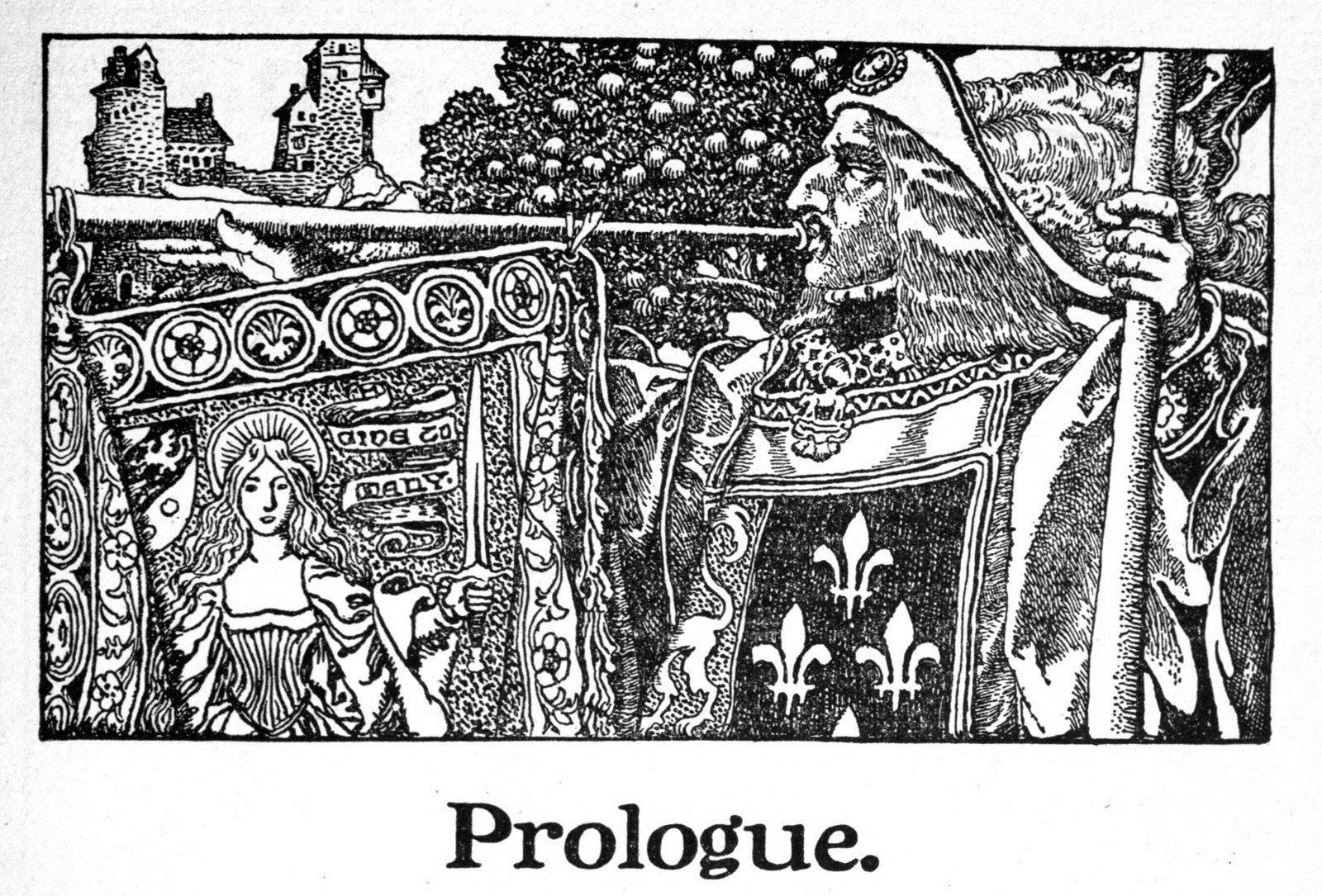
Prologue
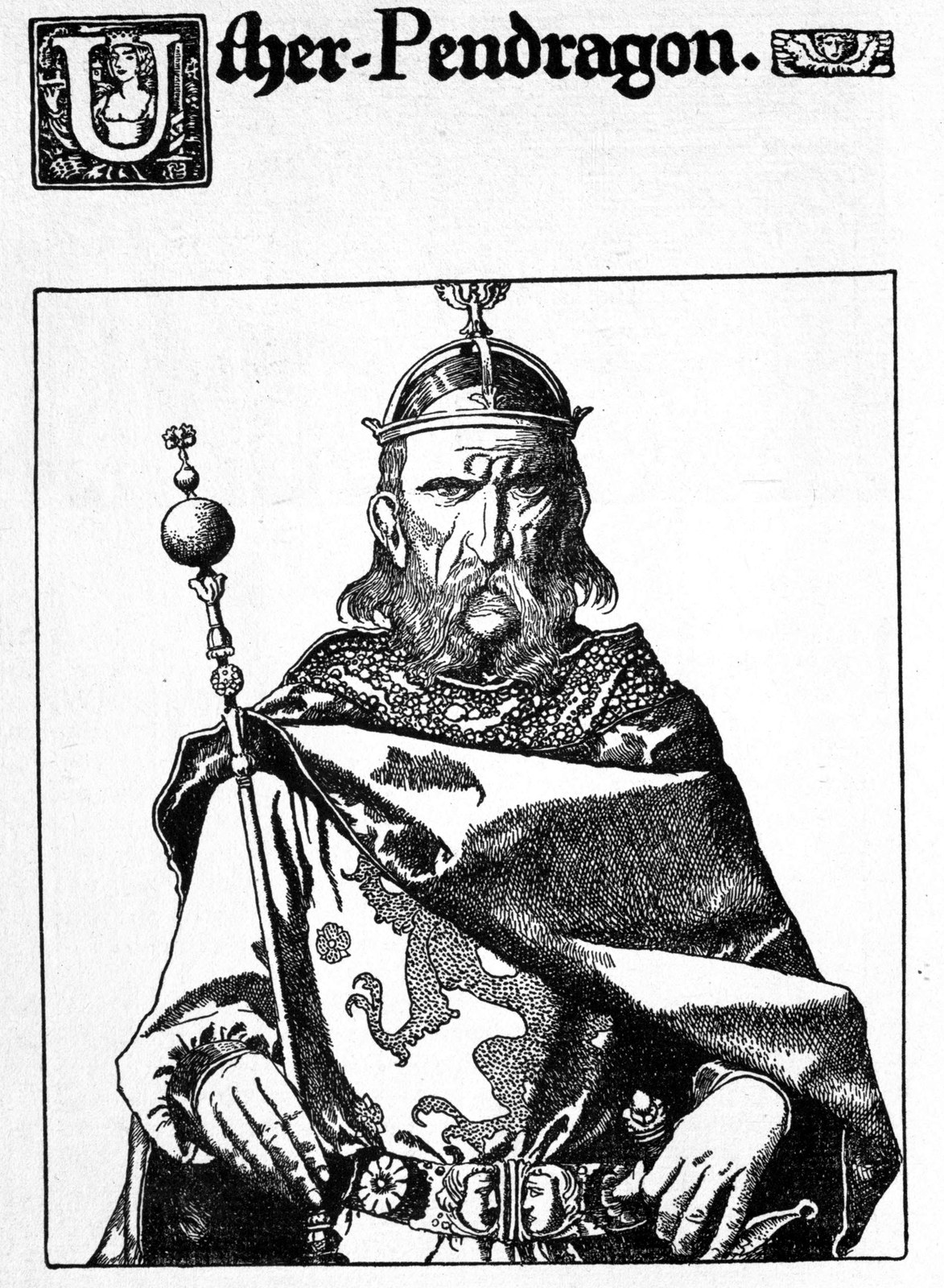
Long ago there lived a very noble king named Uther Pendragon, and he became High King over all of Britain. Two men helped him greatly to win the high kingship of the realm, and they stood by him in everything he did. The first of these was a very powerful enchanter, who was sometimes a prophet as well, known to men as Merlin the Wise; and he gave Uther Pendragon very good advice. The second was an excellent and famous knight named Ulfius, whom many people thought the greatest leader in war of any man then alive; and he gave Uther Pendragon help and counsel in battle. So, with the help of Merlin and Sir Ulfius, Uther Pendragon was able to overcome all his enemies and become king of the whole realm.
Uther Pendragon takes the Lady Igraine for his wife.
After Uther Pendragon had ruled his kingdom for a number of years, he married a beautiful and gentle lady named Igraine. This noble lady was the widow of Gerlois, the Duke of Tintagil, and by that prince she had two daughters, one named Margaise and the other Morgan le Fay. And Morgan le Fay was a famous sorceress. The Queen brought these daughters with her to the court of Uther Pendragon after she married that mighty king, and there Margaise was married to King Uriens of Gore, and Morgan le Fay was married to King Lot of Orkney.
Of the birth of the young child, and the dangers around him.
Now after a while Uther Pendragon and Queen Igraine had a son, and he was a very beautiful baby, large and strong of bone. And while the child still lay wrapped in his swaddling clothes, in a cradle of gold and deep sea-blue, Merlin came to Uther Pendragon with the spirit of prophecy strong upon him (as it often was), and, speaking in that spirit, he said: "Lord, it has been given to me to see that you will soon fall sick of a fever, and that you may die of a violent sweat that will follow it. Now, if such a grievous thing should happen to us all, this young child, who is truly the hope of this whole realm, will be in great danger of his life. For many enemies will surely rise up and try to seize him for the sake of his inheritance, and either he will be killed or he will be held prisoner, with little hope of ever escaping. So I beg you, Lord, to let Sir Ulfius and me carry the child away at once to some safe place of refuge, where he can be hidden in secret until he grows to manhood and can defend himself against whatever dangers may threaten him."
When Merlin had finished speaking, Uther Pendragon answered him with a very steady face: "Merlin, as far as my death is concerned, when my time comes to die I believe God will give me the grace to meet my end with a cheerful heart. For truly, my lot in that is no different from that of any other man ever born of woman. But as for this young child, if your prophecy is true, then his danger is very great, and it would be well to carry him away to some safe shelter, as you advise. So I ask you to do as you think best in this matter, and to keep in your heart that this child is the most precious thing I shall leave behind me to this land."
King Uther dies, as Merlin foretold.
All this, as I have said, Uther Pendragon spoke with great calm and steadiness of spirit. And Merlin did as he had advised: he and Sir Ulfius carried the child away by night, and no one but the two of them knew where the baby had been taken. And soon afterward Uther Pendragon was seized with the sickness Merlin had foretold, and he died exactly as Merlin had feared he would. So it was a very good thing that the child had been taken to a place of safety.
And after Uther Pendragon had departed this life, things went just as Merlin had feared, for the whole realm fell into great disorder. Every lesser king fought against his neighbor to be high king, and wicked knights and barons prowled the highways as they pleased and cruelly forced helpless travelers to pay them toll. Some travelers they took prisoner and held for ransom, and others they killed because they had no ransom to pay. So it was a very common sight to see a dead man lying by the roadside, if you ventured to make a journey on some business or other. And so, after a while, that whole sorrowful land groaned under the trouble that lay upon it.
The Archbishop of Canterbury takes counsel with Merlin.
Nearly eighteen years passed in this great misery, and then one day the Archbishop of Canterbury sent for Merlin and spoke to him like this: "Merlin, men say that you are the wisest man in all the world. Can you not find some way to heal the troubles of this unhappy realm? Turn your wisdom to this matter, and choose a king who will be a fit high king for us, so that we may live in happiness once more, as we did in the days of Uther Pendragon."
Then Merlin raised his face to the Archbishop and said: "My lord, the spirit of prophecy that sometimes comes upon me moves me now to tell you that I can see this country will soon have a king who will be wiser and greater and more worthy of praise than even Uther Pendragon was. And he will bring order and peace where there is now disorder and war. What is more, I can tell you that this king will be of Uther Pendragon's own royal blood."
To this the Archbishop said: "What you tell me, Merlin, is a wonderfully strange thing. But in this spirit of prophecy can you not foretell when this king is to come? And can you tell us how we shall know him when he appears among us? For there are many lesser kings who would gladly be high king of this land, and many of them think themselves fit to rule over all the others. How then are we to tell the real king from those who may proclaim themselves the rightful king?"
"My lord Archbishop," said Merlin, "if I have your permission to use my magic, I will set up a test, and if any man achieves it, the whole world will know at once that he is the rightful King and High King of this realm." And the Archbishop said to this, "Merlin, I bid you do whatever seems right to you in this matter." And Merlin said, "I will do so."
Merlin prepares a test of kingship.
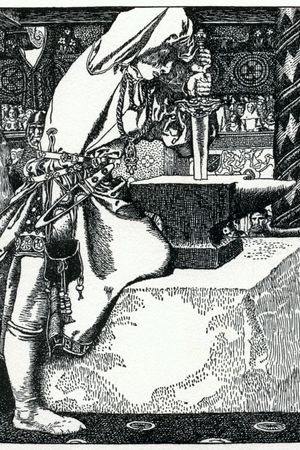
So Merlin, by his magic, made a huge square block of marble suddenly appear in an open place in front of the cathedral door. And on this block of marble he made an anvil stand, and into the anvil he made a great naked sword be thrust, halfway down its blade. And this sword was the most wonderful that anyone had ever seen, for the blade was of blue steel and extraordinarily bright and gleaming. And the hilt was of gold, chased and carved with marvelous skill and set with a great many precious stones, so that it shone with wonderful brightness in the sunlight. And around the sword these words were written in letters of gold:
Whoever pulls this sword out of the anvil is the rightful King of England, born to the crown.
So a great many people came and gazed at that sword and marveled at it exceedingly, for nothing like it had ever been seen on earth before.
Then, when Merlin had worked this miracle, he told the Archbishop to call together all the chief people of the land at Christmastime, and he told the Archbishop to command that every man should try to draw out the sword, because whoever succeeded in drawing it out of the anvil would be the rightful King of Britain.
So the Archbishop did as Merlin said. And this was the marvel of the marble stone and the anvil, which anyone can easily read about for himself in the book that Robert de Boron wrote a very long time ago, called The Romance of Merlin.
Now when the Lord Archbishop's summons went out, calling all the chief people of the land to try that miracle (for it truly would be a miracle to draw a sword blade out of an anvil of solid iron), the whole realm was thrown at once into a great stir, so that every man asked his neighbor, "Who will draw out that sword, and who will be our King?" Some thought it would be King Lot, and others thought it would be King Uriens of Gore (these two being Uther Pendragon's sons-in-law). Some thought it would be King Leodegrance of Cameliard, and others that it would be King Rience of North Wales. Some thought it would be this king and others that king, for the whole world was divided into parties that thought whatever they liked best.
Then, as Christmas drew near, it soon looked as though the entire world was making its way to London Town. The highways and byways filled up with travelers, kings and lords and knights and ladies and squires and pages and men-at-arms, all heading to the place where the test of the sword and the anvil was to be made. Every inn and castle was so packed with travelers that it was a marvel how so many people could fit inside them, and everywhere along the roads there were tents and pavilions (great tents of silk and canvas) pitched to shelter those who could find no room indoors.
But when the Archbishop saw the crowds that were gathering, he said to Merlin, "Truly, Merlin, it would be a very strange thing if among all these great kings and noble, honorable lords we did not find someone worthy to be King of this realm."
At this Merlin smiled and said, "Do not be surprised, my lord, if among all those who seem so extraordinarily worthy, not one is found worthy; and do not be surprised if, among all those who are unknown, one should rise up who proves himself entirely worthy."
And the Archbishop thought deeply about Merlin's words. And so this story begins.
The Book of King Arthur, Part One: The Winning of Kinghood
Foreword
Here begins the story of the sword, the anvil, and the marble stone, and of how that sword was first won by an unknown youth who until then had no fame at all, either in arms or in rank.
So listen now to what I have written here.
Chapter 1: How Sir Kay Fought in a Great Tournament in London and Broke His Sword, and How Arthur Found Him a New One
Of Sir Ector, the Trustworthy Knight.
Now among the great people who were called to London Town by the Archbishop's summons, as I have told you, there was a certain knight, very honorable and of high rank, named Sir Ector of Bonmaison. He was called the Trustworthy Knight, because he faithfully kept the secrets of those who confided in him, and because he always did for every man, whether of high or low degree, exactly what he had promised to do, without falling short in the least. So this noble and excellent knight was held in great regard by everyone who knew him. For not only was he honorable in his conduct, but he was also of very high rank and great wealth. He owned seven castles in Wales and in the country to the north of it, and also certain rich farmlands with villages belonging to them, and several forests of great size, both in the north country and in the west. This very noble knight had two sons. The elder was Sir Kay, a young knight of great courage and promise, already well known in the tournaments because of several very honorable deeds of arms he had done. The other was a young lad eighteen years old, named Arthur, who at that time was serving, and serving well, as Sir Kay's squire.
Now when Sir Ector of Bonmaison received the Archbishop's summons by messenger, he immediately called these two sons to him and told them to get ready at once to go with him to London Town, and they did so. In the same way he told a great number of his retainers and squires and pages to make themselves ready, and they did so too. And so, with a very fine company of armed men and with great show and ceremony, Sir Ector of Bonmaison made his way to London Town, in obedience to the Archbishop's command.
When he arrived there, he took up his lodging in a certain field where many other noble knights and mighty lords had already settled themselves. There he set up a very handsome pavilion of green silk, and raised his banner bearing the emblem of his house, which was a black gryphon on a field of green.
All over this field stood a great crowd of other pavilions of many different colors, and above each pavilion flew the pennant and the banner of the mighty lord it belonged to. So many pennants and banners were there that in places the sky was almost hidden by the bright colors of the fluttering flags.
Among the great lords who had come there in answer to the Archbishop's summons were many very famous kings and queens and noblemen of high degree. There was King Lot of Orkney, who had married a stepdaughter of Uther Pendragon, and there was King Uriens of Gore, who had married another stepdaughter of that great king. There was King Ban, and King Bors, and King Rience, and King Leodegrance, and many others of the same rank. In all there were no fewer than twelve kings and seven dukes; so that, what with all their courts of lords and ladies and squires and pages waiting on them, the town of London had hardly ever seen the like before that day.
The Archbishop declares a tournament.
Now the Archbishop of Canterbury, bearing in mind how extraordinary an occasion it was that had brought so many kings and dukes and high lords to the adventure of the sword and the anvil, had commanded that a very stately and noble tournament should be proclaimed: a great contest of arms, in which knights fought one another for honor and glory before all the people. He also commanded that this contest should be held in a certain field near the great cathedral, three days before the test of the sword and the anvil was to be made (which, as I told you, was to happen on Christmas Day). To this tournament every knight was invited who was of good enough birth and rank to be fit to take part in it. And so a great many high-born knights applied to be admitted, and in such numbers that three heralds were kept very busy looking into their claims to the right to fight. For these heralds examined the coats of arms and the family records of everyone who applied, with great care and caution.
Sir Kay asks permission to attend the tournament.
Now when Sir Kay heard the news of this tournament, he went to his father, and when he stood before him he said: "Sir, I am your son, and I have inherited from you a very high rank, both in birth and in fortune. And I find that I have a tremendous desire to risk my body in this tournament. So, if I can prove my standing as a knight before this council of heralds, it may bring great honor and credit to you and to our house if I take part in this adventure. And so I ask your permission to do as I wish."
To this Sir Ector replied: "My son, you have my permission to enter this honorable contest. And I hope that God will give you a great deal of strength, and also such grace of spirit that you may win honor for yourself and credit for all of us who are of your blood."
So Sir Kay went away full of joy, and he went at once to the gathering of heralds and laid his claims before them. And after they had duly examined his right to knighthood, they entered his name as one of the knights who would fight, just as he wished; and at this Sir Kay was filled with great contentment and joy of heart.
When his name had been written on the list of those who would fight, Sir Kay chose his young brother Arthur to be his squire, and to carry his spear and his pennant before him onto the field of battle. And Arthur was very glad as well, because of the honor that had come to him and to his brother.
Now, when the day of the tournament came, an enormous crowd of people gathered to watch that noble and courtly contest of arms. For at that time, as I have said, London was extraordinarily full of nobles and knights, so that it was reckoned that no fewer than twenty thousand lords and ladies (besides those twelve kings with their courts and the seven dukes with theirs) were gathered in the stands all around the lists, which were the fenced grounds of the battle, to watch the deeds of those chosen knights. And those noble people sat so close together, and so filled the seats and benches set aside for them, that it looked as though a solid wall of human beings surrounded the meadow where the battle was to be fought. And indeed any knight might well be stirred to do his very best on such a great occasion, with the eyes of so many beautiful ladies and noble lords watching what he did. And so the hearts of all the knights there swelled with eagerness to outdo one another and to tumble their opponents into the dust.
In the center of this wonderful court of lords and ladies stood the box and the throne of the Lord Archbishop himself. Above the throne was a canopy of purple cloth, decorated with silver lilies, and the throne itself was hung all around with purple velvet, embroidered with two designs, turn and turn about: the figure of Saint George in gold, and silver crosses of Saint George circled with golden halos. There the Lord Archbishop sat in great state and splendor, surrounded by a very lofty court of high-ranking churchmen and of honorable knights, so that the whole center of the field glittered with the splendor of gold and silver embroidery, and was made beautiful by every color of rich clothing, and bright with fine armor of excellent workmanship. And indeed, so stately was the whole scene that very few of those who were there had ever seen so noble a preparation for battle as the one they saw that day.
Now, when all that great assembly had taken their places and everything had been made ready in proper order, a herald came and stood before the Archbishop's throne and blew a very strong, loud blast on a trumpet. At that signal the gates of the lists were opened at once, and two parties of knights rode in, one party at the northern end of the battle meadow and the other at the southern end. Then all at once that empty field was aglitter with the bright splendor of sunlight on polished armor and trappings. And so the two parties took up their positions, each at the place that had been assigned to it, the one to the north and the other to the south.
Sir Kay takes part in the lists.
Now the party that Sir Kay had joined was at the north end of the field, and it numbered ninety-three knights. The other party stood at the south end of the field, and it numbered ninety-six. But though Sir Kay's party was three fewer than the other, it was nonetheless the stronger by a good deal, because there were a number of knights of great strength and fame in its company. Indeed, I may mention here that two of those knights later became highly respected companions of the Round Table: Sir Mador de la Porte, and Sir Bedevere, who was the last man to see King Arthur alive on this earth.
So, when everything was prepared according to the rules of the tournament, and when the knights had made themselves ready in every way that was needed, and had set their spears and shields as knights do who are about to enter serious battle, the herald put his trumpet to his lips a second time and blew on it with all his might. Then, having sounded this blast, he waited a while, and then he blew the trumpet again.
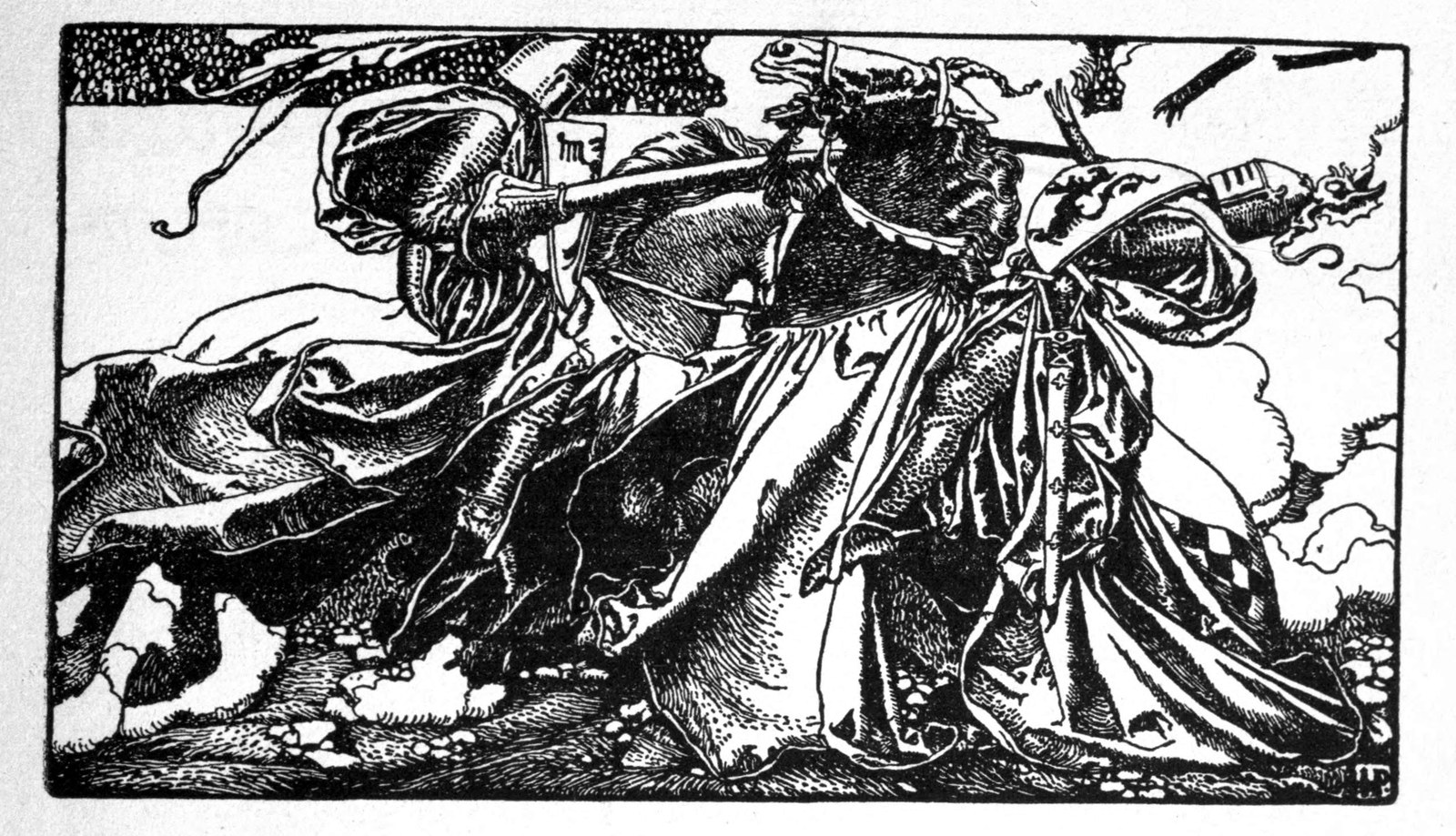
And at that blast, each party of knights left its place and rushed against the other in a great uproar, with such noise and fury that the whole earth groaned beneath the hoofs of the war-horses, and trembled and shook as if in an earthquake.
So those two companies met, one against the other, in the middle of the field, and the roar of breaking lances was so terrible that everyone who heard it was astonished and appalled by the sound. Several fair ladies fainted away in terror of the noise, and others shrieked aloud. For not only was there that great uproar, but the air was entirely filled with flying splinters of ash wood.
In that famous charge seventy very noble and honorable knights were thrown from their horses, and many of them were trampled under the horses' hoofs. And so, when the two companies drew back, each to its own place, the ground could be seen to be covered all over with broken pieces of lances and fragments of armor, and many knights could be seen lying sorrowfully in the middle of all that wreckage. Some of these champions tried to get up and could not, while others lay perfectly still, as though they were dead. Squires and pages ran out to them in great numbers, and lifted up the fallen men and carried them away to places of safety. And attendants likewise ran out and gathered up the pieces of armor and the broken spears and carried them off to the barriers, so that after a while the field was entirely clear once more.
Then everyone who was looking down on that meadow cheered loudly, with great joy of heart, for such a noble and glorious contest of arms in friendly trial had hardly ever been seen in all that realm before.
Sir Kay does well in the encounter.
Now let us turn to Sir Kay. For in this charge he had carried himself so well that no knight there had done better than he, and perhaps no one had done as well. Though two opponents had aimed their spears at him at the same time, he had held firm against them both. And he struck one of those two so violently, right in the middle of his defenses, that he lifted the man clean over the back of his horse and flung him down half a spear's length behind it, so that the fallen knight rolled over three times in the dust before he stopped.
And when the knights of Sir Kay's party who were near him saw what he had done, they cheered him loudly and with such enthusiasm that Sir Kay was wonderfully satisfied and pleased at heart.
And indeed it must be said that at that time there was hardly any knight in all the world who was so excellent at deeds of arms as Sir Kay. And though there came knights later of much greater fame and of more glorious deeds (as will be told in this book in good time), yet at that time Sir Kay was reckoned by many to be one of the most wonderfully mighty knights in all that realm, whether riding alone in search of adventure or fighting in battle.
So that round of the contest was run, to the great pleasure and satisfaction of everyone who saw it, and especially of Sir Kay and his friends. And after it was finished, the two parties returned in good order, each to its own place once more.
And when they got there, each knight handed his spear to his squire. For the next charge was to be made with swords, and so all lances and other weapons were to be put aside; such was the rule of that courteous and well-bred contest of arms.
Of the contest with swords.
So when the herald blew his trumpet again, every knight drew his sword, all of them so eager for battle that there was a great splendor of blades flashing in the air at once. And when the herald blew a second time, each party pushed forward into the contest with great nobility of heart and eagerness of spirit, every knight meaning to meet his opponent with all the strength that was in him.
Then at once there began a battle so fierce that if those knights had been bitter enemies of long standing instead of friendly contestants, the blows they dealt each other could not have been more violent, or more astonishing to watch.
And in this round too Sir Kay proved himself so extraordinary a champion that his equal was nowhere to be seen on all that field. For he struck down five knights violently, one after another, before anyone could check his advance.
So, seeing him do such work as this, several knights of the other party tried to get at him so as to meet him as he came on.
Among these was a certain knight named Sir Balamorgineas, who was so huge in body that he rode head and shoulders above every other knight. And he had such extraordinary strength that people believed he could hold his own against three ordinary knights at once. So when this knight saw the work Sir Kay was doing, he called out to him, "Ho! Ho! Sir Knight of the black gryphon, turn this way and do battle with me!"
Sir Kay fights with Sir Balamorgineas.
Now when Sir Kay saw that Sir Balamorgineas meant to come against him like that, very threateningly and set on fighting him, he turned toward his enemy with great cheerfulness of spirit. For at that time Sir Kay was very full of youthful fire, and thought nothing of attacking any enemy who might challenge him to battle.
(So it was at that time. But afterward, when he became Seneschal, the officer who runs the king's household, and when other and mightier knights appeared at the King's court, it happened that he would sometimes avoid a fight with such a knight as Sir Lancelot, or Sir Pelleas, or Sir Marhaus, or Sir Gawain, if he could do so without loss to his honor.)
So, being very full of the spirit of youth, he turned with great vigor of heart, all on fire with the eagerness and fury of battle. And he cried out in a great voice, "Very well, I will do battle with you, and I will cast you down like your fellows!" And with that he struck at Sir Balamorgineas with wonderful fierceness, with all his might. Sir Balamorgineas took the stroke on his helmet and was completely dazed by the fury of it, for he had never felt anything like it before. His head swam so lightly that he had to hold on to the horn of his saddle to keep himself from falling.
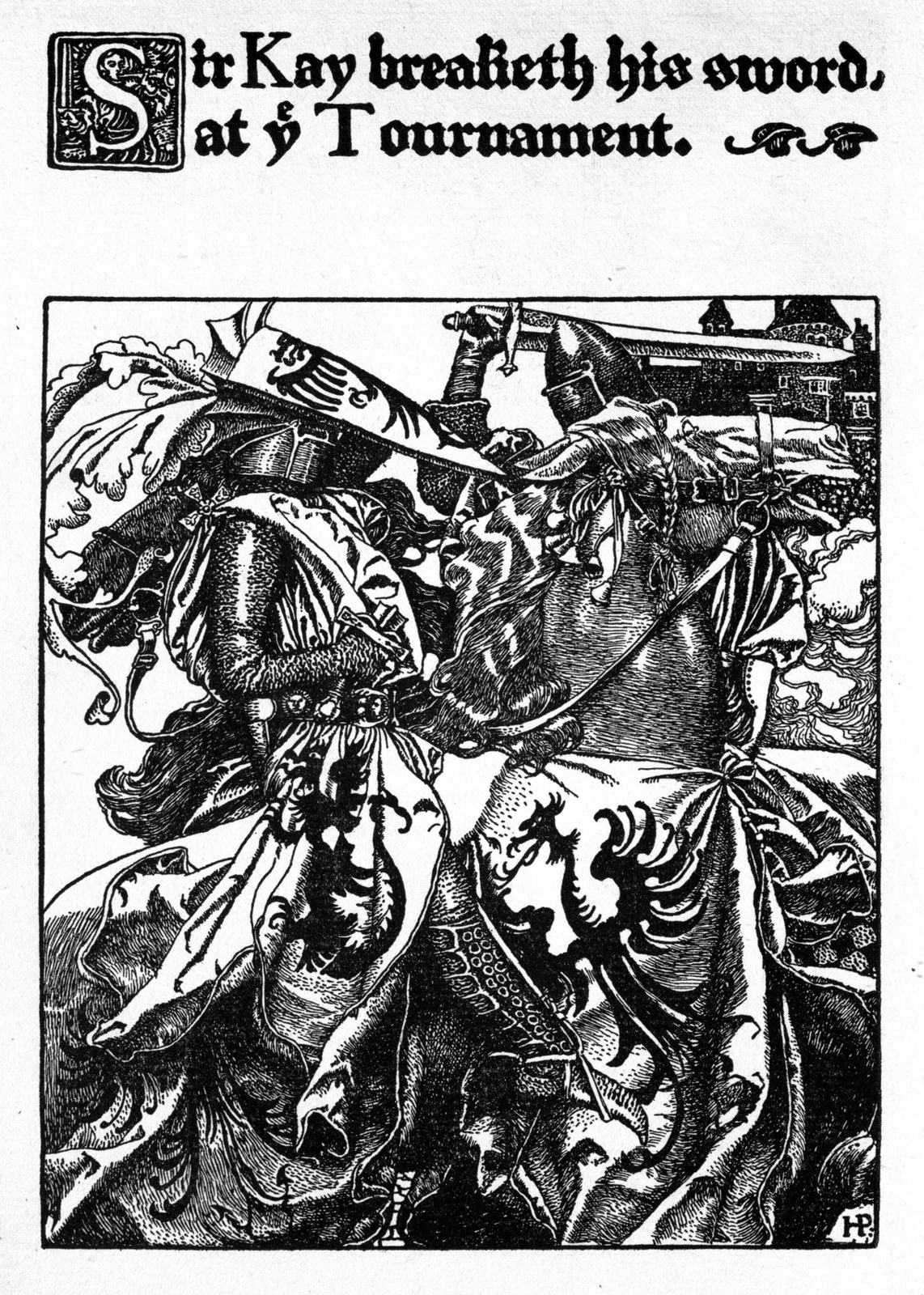
Sir Kay breaks his sword.
But it was a great pity for Sir Kay that, with the fierceness of the blow, his sword blade snapped off short at the hilt and flew so high into the air that it seemed to rise above the towers of the cathedral as it went. Yet that is what happened, and so Sir Kay was left without any weapon. And yet people thought that with that stroke he had Sir Balamorgineas entirely at his mercy, and that if he could have struck one more blow with his sword he might easily have overcome him.
But as it was, Sir Balamorgineas soon recovered enough to see that his enemy was now entirely at his mercy. And so, filled beyond measure with rage at the blow he had received, he pressed toward Sir Kay, meaning to strike him down in a violent attack.
At that point it might have gone very badly for Sir Kay, had not three of his companions in arms seen the terrible danger he was in. They pushed in between him and Sir Balamorgineas, meaning to take that knight's attack on themselves and so save Sir Kay from being overthrown. They did this so successfully that Sir Kay was able to push his way out of the crush and escape to the barriers without suffering any more harm at the hands of his enemies.
Sir Kay tells Arthur to get him a sword.
Now when he reached the barrier, his squire, young Arthur, came running to him with a goblet of spiced wine. Sir Kay opened the visor of his helmet to drink, for he was thirsty beyond measure. And his face was all covered with blood and sweat, and he was so parched from the battle that his tongue stuck to the roof of his mouth and he could not speak. But when he had drunk what Arthur gave him, his tongue was loosened, and he shouted at the young man in a loud and violent voice: "Ho! Ho! Brother, get me another sword to fight with, for I am certainly winning a great deal of glory for our house today!" And Arthur said, "Where shall I get you a sword?" And Kay said, "Hurry to our father's pavilion and fetch me another sword from there, for this one I have is broken." And Arthur said, "I will do it as fast as I can." And with that he put his hand on the barrier and vaulted over it into the lane beyond. He ran down the lane as fast as he could go, meaning to do the task his brother had given him; and just as fast he ran on to the pavilion his father had set up in the meadows.
But when he reached Sir Ector's pavilion, he found no one there, for all the attendants had gone off to the tournament. Nor could he find any sword fit for his brother to use, and so he was at a loss to know what to do.
Arthur draws the sword from the anvil.
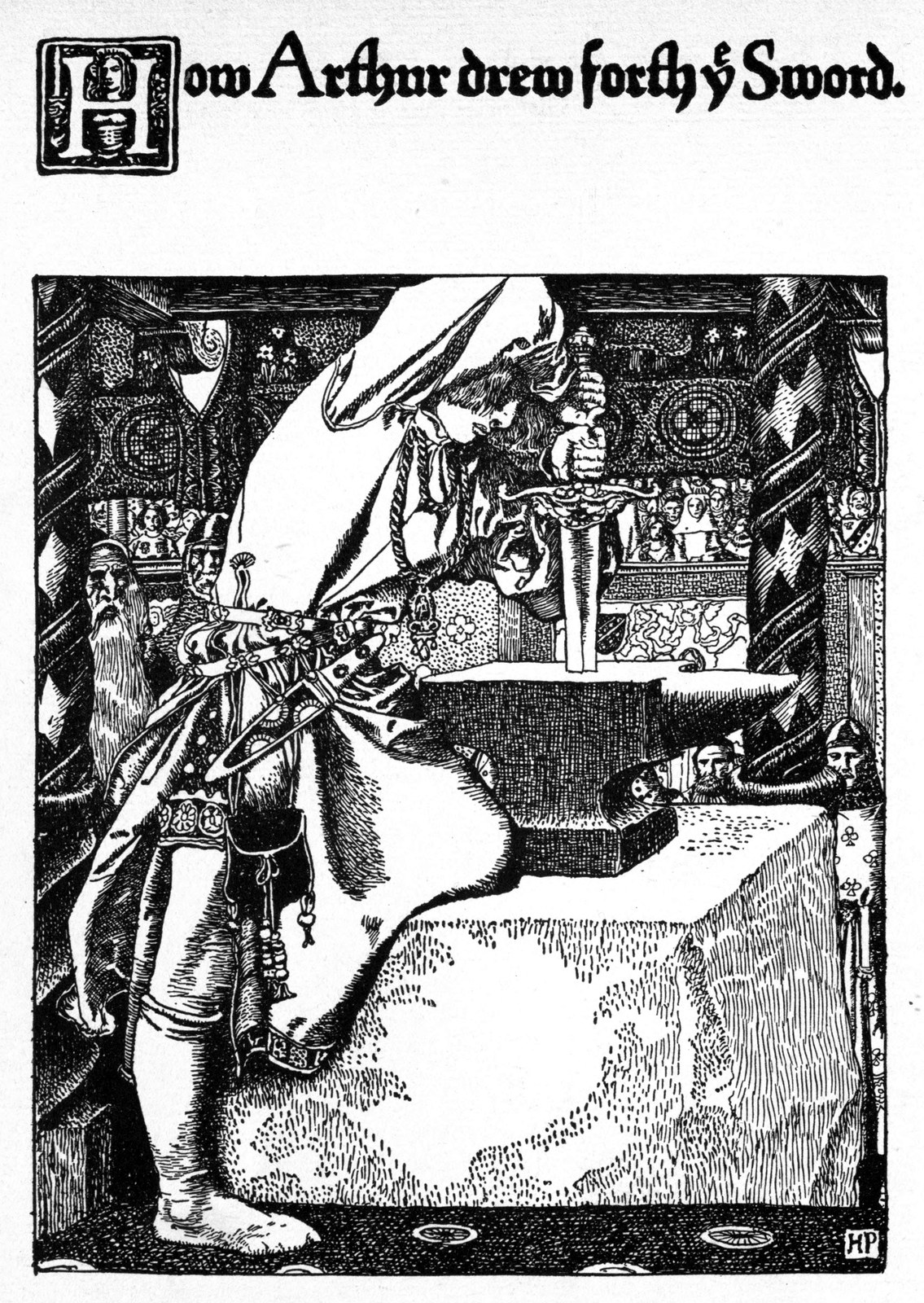
In this difficulty he thought of the sword that stood thrust into the anvil in front of the cathedral, and it seemed to him that a sword like that would suit his brother's purpose very well. So he said to himself, "I will go there and get that sword if I can, for it will certainly do very well for my brother to finish his battle with." And at that he ran as fast as he could to the cathedral. When he got there he found that no one was standing guard at the block of marble, as there always had been until then, for all the guards had gone off to the contest of arms that was going on. And the anvil and the sword stood where he could reach them. So, with no one there to stop young Arthur, he leaped up onto the block of marble and set his hands on the hilt of the sword. And he bent his body and pulled very strongly on the sword, and it came out of the anvil with wonderful smoothness and ease. And he held the sword in his hand, and it was his.
When he had gotten the sword in this way, he wrapped it in his cloak so that no one might see it (for it shone with an extraordinary brightness and splendor), and he leaped down from the marble block and hurried with it to the field of battle.
Now when Arthur came back into the meadow, he found Sir Kay waiting for him with great impatience. And when Sir Kay saw him, he cried out very fiercely, "Have you got a sword?" And Arthur said, "Yes, I have one here." With that he opened his cloak and showed Sir Kay the sword he had brought.
Now when Sir Kay saw the sword, he knew it at once, and he did not know what to think or what to say. So for a while he stood there, like a man turned to stone, staring at that sword. Then after a while he said, in a very strange voice, "Where did you get that sword?" And Arthur looked at his brother and saw that his face was deeply troubled and had gone as white as wax. And he said, "Brother, what is wrong with you, that you look so strange? I will tell you the whole truth. I could find no sword in our father's pavilion, so I thought of the sword that stood in the anvil on the marble block in front of the cathedral. So I went there and tried to draw it out, and it came out with wonderful ease. And when I had drawn it out, I wrapped it in my cloak and brought it here to you, as you see."
Sir Kay keeps the sword for his own.
Then Sir Kay turned his thoughts inward and said to himself, "Why, my brother Arthur is still hardly more than a child. And besides, he is extremely innocent. So he does not know what he has done, or what the doing of it means. Now, since he has won this weapon, why should I not claim the deed for myself, and so gain the glory that comes with it?" At that he roused himself at once and said to Arthur, "Give me the sword and the cloak," and Arthur did as his brother told him. And when he had done so, Sir Kay said to him, "Tell no one about this, but keep it secret in your own heart. Meanwhile, go to our father where he sits by the lists, and ask him to come at once to the pavilion where we are lodging."
And Arthur did as Sir Kay told him, full of wonder that his brother should seem so troubled in spirit. For he did not know what he had done in drawing that sword out of the anvil, nor what great things were to come of that small deed. For that is how it is in this world: a man may sometimes prove himself worthy of a great trust such as that, and yet, in the humility of his spirit, be entirely unaware that he is worthy of it. And so it was with young Arthur at that time.
Chapter 2: How Arthur Twice Did the Miracle of the Sword in Front of Sir Ector, and How He Learned Who He Really Was
So Arthur hurried to the part of the lists where Sir Ector sat with the people of his household. He stood in front of his father and said, "Sir, my brother Kay has sent me here to ask you to come straight to the pavilion where we have made our lodging. And truly, I think something very extraordinary has happened, for my brother Kay has a look on his face such as I have never seen him wear."
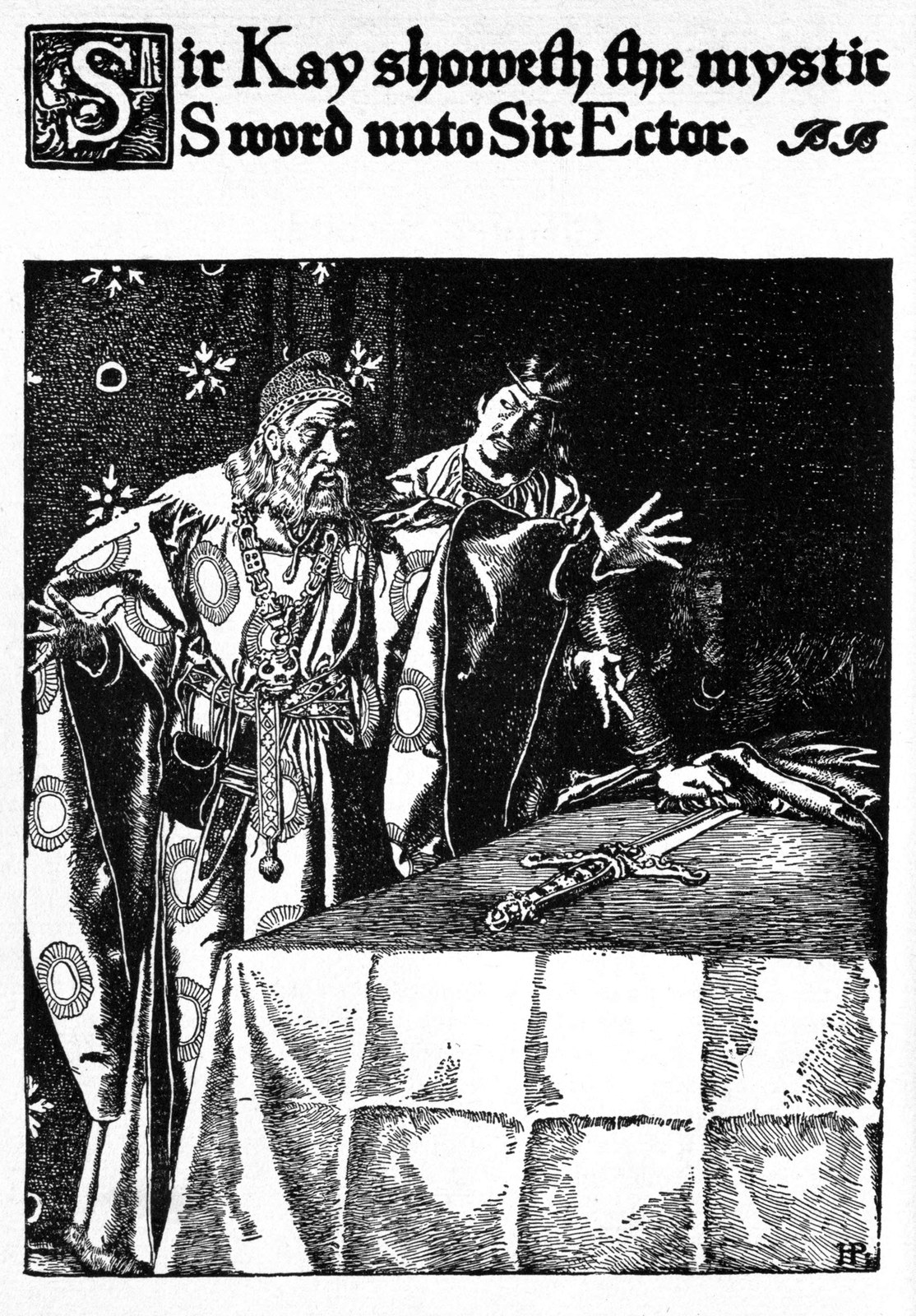
Sir Ector wondered very much what could have made Sir Kay leave the fighting and send for him at such a time, so he got up from where he sat and went with Arthur. They went to the pavilion, and when Sir Ector came in, there stood Sir Kay in the middle of it. Sir Ector saw that his face was as white as wood ash and that his eyes shone with a strange brightness. And Sir Ector said, "My son, what is the matter with you?" Sir Kay answered, "Sir, here is a very wonderful thing." With that he took his father by the hand and led him to the table that stood in the pavilion. On the table lay a cloak, and there was something wrapped inside the cloak. Then Sir Kay opened the cloak, and there lay the sword from the anvil, its hilt and its blade glittering with dazzling splendor.
Sir Ector sees the sword.
Sir Ector knew that sword at once, and where it had come from. He was filled with such astonishment that he did not know what to do. For a while his tongue would not speak at all. Then at last he found his voice and cried out loudly, "What is this I see with my own eyes!"
Sir Kay answered, "Sir, I have the sword that until a little while ago stood fixed in the anvil on the block of marble in front of the great cathedral. So I ask you to tell me what this may mean."
Then Sir Ector said, "How did you come by that sword?"
For a while Sir Kay said nothing. But after a while he said, "Sir, I broke my sword in the fight I was just fighting, and then I found myself this sword in its place."
Sir Ector was completely bewildered and did not know whether to believe what he was hearing. After a while he said, "If it is true that you drew this sword out of the anvil, then it must also be true that you are the rightful King of Britain, for that is what the writing on the sword proclaims. But if you really did draw it out of the anvil, then you will be able just as easily to thrust it back again into the place you took it from."
At this a great trouble came over Sir Kay's spirit, and he cried out in a very loud voice, "Who could do such a thing as that? Who could work so great a miracle as to thrust a sword into solid iron?" Sir Ector answered, "That miracle is no greater than the one you have already worked in drawing it out. For who ever heard of a man who could draw a sword out of a place and yet could not thrust it back where he drew it from?"
Sir Kay did not know what to say to his father, and he was very much afraid that he would not be able to work that miracle. Even so, he comforted himself as well as he could, saying to himself, "If my young brother Arthur could work this miracle, why shouldn't I be able to work one just like it? I am certainly no less worthy than he is. If he drew the sword out so easily, perhaps I shall be able to thrust it back into its place just as easily." And so he took what comfort he could from these thoughts.
Sir Kay tries to put back the sword, but fails.
He wrapped the sword in the cloak again, and when he had done so, he and Sir Ector left the pavilion and made their way to the place in front of the cathedral where the marble block and the anvil stood. Arthur went along with his father and his brother, and they did not forbid him. When they came to the place where the sword had been, Sir Kay climbed up onto the block of marble and looked at the face of the anvil. And the face of the anvil was perfectly smooth, without a scratch or a mark of any kind. Sir Kay said to himself, "What is this my father wants me to do? What man alive could thrust a sword blade into a solid anvil of iron?" But even so, he could not back out of that impossible task, and he was forced to attempt the miracle. So he set the point of the sword against the iron and pushed down on it with all his strength. But it was impossible for him to do it. Though he strove with all his might, pressing the sword against the face of the anvil, he did not pierce the iron by so much as the breadth of a hair.
So after he had tried for a long time, he finally stopped and climbed down from where he stood. And he said to his father, "Sir, no man alive can work that miracle."
Sir Ector answered, "Then how is it possible that you could have drawn the sword out, as you say, and yet cannot put it back again?"
Then young Arthur raised his voice and said, "Father, may I speak?" And Sir Ector said, "Speak, my son." And Arthur said, "I wish I might try my hand with that sword." Sir Ector replied, "By what right would you handle that sword?" And Arthur said, "Because it was I who drew that sword out of the anvil for my brother. And as you say, drawing it out is no harder than thrusting it back again. So I believe I shall be able to set it back into the iron I drew it from."
Then Sir Ector stared at young Arthur so strangely that Arthur did not know why he looked at him that way. So he cried out, "Sir, why are you staring at me so strangely? Are you angry with me?" Sir Ector answered, "Before God, my son, I am not angry with you." Then he said, "If you wish to handle the sword, you certainly may attempt that miracle."
Arthur works the miracle of the sword and the anvil.
So Arthur took the sword from his brother Kay and leaped up onto the marble block. He set the point of the sword on the anvil and pressed down very hard, and the sword slid smoothly into the center of the anvil until it stood halfway deep in it, and there it held fast. And after he had worked that miracle, he drew the sword out again, very quickly and easily, and then thrust it back once more, just as he had done before.
When Sir Ector saw what Arthur had done, he cried out in a tremendously loud voice, "Lord! Lord! What is this miracle I see with my own eyes!" And when Arthur came down from the marble block, Sir Ector knelt down before him and put his hands together, palm to palm.
But when Arthur saw what his father was doing, he cried out like someone in great pain, and he said, "My father! My father! Why are you kneeling to me?"
Sir Ector answered him, "I am not your father. And now it has been made plain that you are certainly of very high birth, and that the blood of kings flows in your veins, or you could never have handled that sword as you have done."
At that Arthur began to weep beyond all measure, and he cried out as if in great anguish of spirit, "Father! Father! What are you saying? I beg you, get up, and do not kneel to me."
So Sir Ector got up from his knees and stood face to face with Arthur, and he said, "Arthur, why are you weeping?" And Arthur said, "Because I am afraid."
All this while Sir Kay had been standing nearby, and he could neither move nor speak, but stood there like someone under a spell. And he said to himself, "What is this? Is my brother a king?"
Then Sir Ector spoke. "Arthur," he said, "the time has come for you to know who you are, for the truth about your life has until now been kept completely hidden from you.
Sir Ector tells Arthur the story of his infancy.
"Now I will confess everything to you, and it is this. Eighteen years ago a certain man came to me, a very wise man and high in the favor of Uther Pendragon, and that man was the enchanter Merlin. Merlin showed me the signet ring of Uther Pendragon, and by the authority of that ring he commanded me to be at a certain place at a particular time that he named. The place he named was the postern gate, the small back gate, of Uther Pendragon's castle, and the time he named was midnight of that very day.
"He told me to tell no one anything about what he had said to me, and so I kept his secret, as he wished me to.
"So I went to that postern gate at midnight as Merlin had commanded. And there Merlin came to me with another man, and the other man was Sir Ulfius, who was the chief knight of Uther Pendragon's household. And I tell you that those two great men stood closer to Uther Pendragon than any other men in all the world.
"Now when those two came to me, I saw that Merlin was carrying something in his arms, wrapped in a scarlet cloak of fine cloth. He opened the folds of the cloak, and there I saw a newborn child wrapped in swaddling clothes. I saw the child by the light of a lantern that Sir Ulfius carried, and I could see that he was very beautiful of face and large of bone. And you were that child.
"Then Merlin gave me my orders. I was to take that child and raise him as my own. He said the child was to be called Arthur, and that no one in all the world was to know anything except that the child was mine. I told Merlin I would do as he wished, and I took the child and carried him away with me. And I announced that the child was my own, and everyone believed me, so that no one ever knew anything but that you were my own son. And the lady who was my wife took that secret with her to Paradise when she died. From then until now, no one in all the world knew anything of this matter except me and those two great men I have named.
"And until now I have never known who your father was. But now I begin to suspect who he was, and that very high and kingly blood flows in your veins. And I have it in my mind that perhaps your father was Uther Pendragon himself. For who but the son of Uther Pendragon could have drawn that sword out of the anvil as you have done?"
When Arthur heard his father say this, he cried out in a very loud and passionate voice, "Woe! Woe! Woe!" saying the word three times. And Sir Ector said, "Arthur, why are you so full of sorrow?" And Arthur said, "Because I have lost my father, and I would rather have my father than be a King!"
Merlin and Sir Ulfius appear to the three.
Now while all this was happening, two men came to that place, very tall, and wonderfully noble and proud in their bearing. And when these two men drew near, Arthur and Sir Ector and Sir Kay saw that one of them was the enchanter Merlin and the other was Sir Ulfius, for those two men were very famous and well known to all the world. And when the two had come up to the three, Merlin spoke and said, "What news?" And Sir Ector answered, "News of a very wonderful kind. For look, Merlin! This is the child you brought to me eighteen years ago, and you can see that he has grown to manhood."
Then Merlin said, "Sir Ector, I know very well who this youth is, for I have kept close watch over him all this time. And I know that in him lies the hope of Britain. What is more, I tell you that this very day, in the surface of an enchanted looking glass, I have seen everything he has done since morning. I know how he drew the sword out of the anvil, and how he thrust it back again; and I know how he drew it out and thrust it back a second time. And I know everything you have been saying to him just now, and I declare that you have told him the very truth. And now the spirit of prophecy is upon me, and I can see into the future. I see that you, Arthur, will become the greatest and most famous King who ever lived in Britain. I see that many knights of extraordinary excellence will gather around you, and that men will tell of their marvelous deeds for as long as this land lasts. I see that through these knights your reign will be full of splendor and glory. And I see that the most marvelous adventure of all, the quest for the Holy Grail, will be achieved by three of the knights of your Court, to your lasting fame, for you will be the King in whose reign that holy cup is won. All these things I foresee. And the time is now at hand when the glory of your House will once again be shown to the world, and all the people of this land will rejoice in you and in your kingship. So, Sir Ector, for the next three days I charge you to guard this young man as the apple of your eye, for in him lies the hope and salvation of this whole realm."
Sir Ector asks a favor of Arthur.
Then Sir Ector raised his voice and cried out to Arthur, "A favor! A favor!" And Arthur said, "Oh, what is this? My father, do you ask a favor of me, when you may have everything in the world that is mine to give? Ask whatever you wish, and it is yours!" Then Sir Ector said, "I beg this of you: that when you are King, your brother Kay may be Seneschal of all this realm." And Arthur said, "It shall be as you ask." And he said, "As for you, it shall be even better for you, for you shall be my father to the end!" And as he said this, he took Sir Ector's head in his hands and kissed him on the forehead and on the cheeks, and so sealed the promise he had given.
But all this while Sir Kay had stood there like a man struck by lightning. He did not know whether to be lifted up to the skies or cast down into the depths, now that his young brother had passed him by and been raised to such an extraordinary height of fortune. And so he stood there like someone with no life or motion left in him.
And let it be said here that Arthur kept every promise he made to his father. For in later times he made Sir Kay his Seneschal, and Sir Ector was a father to him until the day of his death, which came five years after that time.
So I have told you how Arthur's royal birth was first discovered. And now, if you will listen, you shall hear how it was confirmed before all the world.
Chapter 3: How Many Kings and Great Dukes Tried to Draw the Sword from the Anvil and Failed, and How Arthur Tried and Succeeded
So when the morning of Christmas Day had come, many thousands of people of every rank, both high-born and humble, gathered in front of the cathedral to watch the test of that sword.
Now a canopy of embroidered cloth of many colors had been spread above the sword and the anvil, and a platform had been built all around the block of marble. And near that place a throne had been set up for the Archbishop, for the Archbishop was to oversee the test and to see that every part of it was carried out with fairness and great care.
So, when the morning was half gone, the Archbishop himself came with great pomp and ceremony and took his seat on the high throne that had been placed for him. And all his court of clergy and knights gathered around him, so that he made a very proud and splendid show of courtly state.
Now nineteen kings and sixteen dukes had gathered for that test, and each of them was of such noble and lofty rank that he had high hopes he would be proved before the world that day to be the rightful king and High King of all Britain. So after the Archbishop had settled himself on his throne, several of them came and demanded that he put the matter to the test at once. So the Archbishop ordered his herald to sound a trumpet and to call all who had the right to try the sword to come forward to that adventure, and the herald did as the Archbishop ordered.
King Lot of Orkney tries the sword and fails.
And as soon as the herald had sounded his trumpet, the first of those kings appeared to make trial of the sword, and the one who came was King Lot of Orkney and the Isles. With King Lot came eleven knights and five squires, so that he made a very noble show before the eyes of everyone. And when King Lot had arrived at that place, he climbed onto the platform. First he bowed to the Archbishop, and then he laid his hands on the pommel of the sword in the sight of all. He bent his body and pulled on the sword with great strength, but he could not move the blade in the anvil even by the width of a hair, for it stood as fast as the iron in which it was planted. After that first attempt he tried three times more, but still he could not move the blade in the iron at all. Then, having tried four times, he gave up and came down from that place. And he was filled with great anger and indignation that he had not succeeded.
Many others try and fail.
After King Lot came his brother-in-law, King Uriens of Gore, and he too tried the sword in the same way King Lot had done. But he did no better than the other king. After King Uriens came King Fion of Scotland, and after King Fion came King Mark of Cornwall, and after King Mark came King Rience of North Wales, and after King Rience came King Leodegrance of Cameliard. And after him came all those other kings and dukes I have spoken of, and not one of them all was able to move the blade. Some of these high and mighty lords were filled with anger and indignation that they had not succeeded, and others were ashamed that they had failed at that task before the eyes of all who watched them. But whether they were angry or ashamed, it did their cause no good at all.
Now when all the kings and dukes had failed in that adventure, the people who were there were very much astonished, and they said to one another, "How can this be? If all those kings and dukes of such lofty rank have failed at this adventure, who can hope to succeed? Here were all the men most worthy of that high honor, and all of them have tried to draw that sword, and all of them have failed. Who is left to come after them who can hope to succeed?"
The kings and dukes are discontented.
And the kings and dukes talked among themselves in the same way. By and by six of the worthiest of them came forward, namely King Lot, King Uriens, King Pellinore, King Ban, King Rience, and Duke Clarence of Northumberland. They stood before the Archbishop's throne and spoke to him like this: "Sir, all the kings and dukes of this realm have striven before you to draw out that sword, and look: not one of all who have attempted it has succeeded. What are we to understand, then, except that the enchanter Merlin has set up this adventure to bring shame and disgrace on all of us who are here, and on you, who are the head of the Church in this realm? For who in all the world can hope to draw a sword blade out of a bed of solid iron? Surely it is beyond the power of any man. Is it not plain, then, that Merlin has made a mockery of us all? So, rather than have this whole great assembly called here for nothing, we beg you in your wisdom to choose at once, from among the kings gathered here, the one best fitted to be High King of this realm. And when you have chosen him, we promise to obey him in everything he may command. Truly, such a choice will be far more worthwhile than wasting time on this foolish business of trying to draw a sword out of an anvil that no man in all the world can draw."
Then the Archbishop was much troubled in spirit, for he said to himself, "Can it be true that Merlin has deceived me, and has made a mockery of me and of all these kings and lords? Surely this cannot be. For Merlin is exceedingly wise, and he would not make a mockery of the whole realm for the sake of such a sorry joke as this would be. Surely he has some purpose in this that we know nothing of, since we are less wise than he is. So I will be patient a while longer." And so, having reasoned this out within himself, he spoke aloud to those seven great lords. "Sirs," he said, "I still have faith that Merlin has not deceived us, so I ask you to be patient just a little while longer. If, in the time it takes a man to count to five hundred twice over, no one comes forward to perform this task, then at your request I will choose one from among you and proclaim him King and High King of all." For the Archbishop had faith that Merlin was about to declare a king before them all at any moment.
Now let us leave these lords and turn to Arthur and his father and brother.
For Merlin had told those three to stay in their pavilion until he judged the time was right for them to come out. And now that time had come, Merlin and Sir Ulfius went to Sir Ector's pavilion, and Merlin said, "Arthur, get up and come out, for the hour has come for you to perform before the whole world the miracle you performed in private not long ago." So Arthur did as Merlin told him, and he came out of the pavilion with his father and his brother, and he was like someone walking in a dream.
Merlin brings Arthur to the test.
So the five of them went down from there toward the cathedral and the place of the test. And when they came to the crowd gathered there, the people made way for them, marveling greatly and saying to one another, "Who are these with Merlin the Enchanter and Sir Ulfius, and where have they come from?" For the whole world knew Merlin and Sir Ulfius, and the people could tell that something very extraordinary was about to happen. And Arthur was dressed all in flame-colored clothes embroidered with silver thread, so that others in the crowd said, "Surely that young man is very handsome to look at. Now who can he be?"
But Merlin said not a word to anyone. He brought Arthur through the crowd to the place where the Archbishop sat, and the crowd made way for him so that nothing held him back. And when the Archbishop saw Merlin coming with those others, he stood up and said, "Merlin, who are these you bring to us, and what is their business here?" And Merlin said, "My lord, here is one who has come to try that sword." And the Archbishop said, "Which one is he?" And Merlin said, "This is he," and he laid his hand on Arthur.
Merlin proclaims that Arthur is royal.
Then the Archbishop looked at Arthur and saw that the youth had a very handsome face, and his heart went out to Arthur and he loved him a great deal. And the Archbishop said, "Merlin, by what right does this young man come here?" And Merlin answered, "My lord, he comes here by the best right there is in the world. For the young man who stands before you dressed in red is the true son of Uther Pendragon and of his lawful wife, Queen Igraine."
Then the Archbishop cried out in great amazement, and those who stood near and heard what Merlin said were so astonished that they did not know what to think. And the Archbishop said, "Merlin, what is this you are telling me? For who in all the world has ever heard, until now, that Uther Pendragon had a son?"
To this Merlin answered: "No one has ever known of it until now, except a very few. For this is how it happened. When this child was born, the spirit of prophecy was upon me, and I foresaw that Uther Pendragon would die before very long. So I feared that the King's enemies would lay violent hands on the young child for the sake of his inheritance. And so, at the King's command, another man and I took the young child from his mother and gave him to a third, and that man took the royal child and has raised him ever since as his own son. And there are others here who can testify to the truth of these things. For the man who was with me when the young child was taken from his mother was Sir Ulfius, and the man to whom he was entrusted was Sir Ector of Bonmaison. These two witnesses, who are beyond all reproach, will swear to the truth of what I have said, for here they stand before you to confirm it."
And Sir Ulfius and Sir Ector said, "Everything Merlin has spoken is true, and to that we pledge our most faithful and sacred word of honor."
Then the Archbishop said, "Who could doubt the word of such honorable witnesses?" And he looked at Arthur and smiled at him.
Then Arthur said, "Do I have your permission, my lord, to take hold of that sword?" And the Archbishop said, "You have my permission, and may the grace of God go with you in your attempt."
Arthur draws out the sword.
At that Arthur went to the block of marble and laid his hands on the hilt of the sword that was thrust into the anvil. He bent his body and pulled very hard, and the sword came out with great ease and very smoothly. And when he had the sword in his hands, he swung it around his head so that it flashed like lightning. After he had swung it three times around his head, he set its point against the face of the anvil and pressed down on it very hard. And the sword slid very smoothly back into the place where it had stood before; and when it was there, halfway deep, it stood fast. And so Arthur accomplished that marvelous miracle of the sword in the eyes of all the world.
Now when the people gathered there saw this miracle performed before their very faces, they raised their voices all together and shouted so loudly, with such a huge uproar, that it seemed as though the whole earth rocked and trembled with the sound.
And while they were shouting, Arthur took hold of the sword again, drew it out, swung it again, and once more drove it back into the anvil. And when he had done that, he drew it out a third time and did the same thing as before. So everyone who was there saw that miracle performed three times over.
Several of the kings and dukes are angry.
And all the kings and dukes who were there were filled with great amazement. They did not know what to think or say when they saw someone who was little more than a boy perform the task at which the best of them had failed. Some of them, having seen that miracle, were willing to accept Arthur because of it, but others would not accept him. These drew back and stood apart, and as they stood there they said among themselves, "What is this? Who can believe such a thing, that a beardless boy should be set over us all and made King and High King of this great realm to rule us? No! No! We will have none of him for our King." And others said, "Isn't it plain that Merlin and Sir Ulfius are raising up this unknown boy so they can raise themselves up along with him?" So these discontented kings talked among themselves, and the most bitter of them all were King Lot and King Uriens, who were Arthur's brothers by marriage.
Now when the Archbishop saw how discontented these kings and dukes were, he said to them, "What now, sirs! Are you not satisfied?" And they said, "We are not satisfied." And the Archbishop said, "What would you have?" And they said, "We would have some other sort of king for Britain than a beardless boy whom nobody knows, and whose birthright only three men can vouch for." And the Archbishop said, "What of that? Has he not performed the miracle that you yourselves tried and failed to perform?"
But these high and mighty lords would not be satisfied. With angry faces turned away, they left that place, filled with rage and indignation.
Certain kings and dukes accept Arthur.
But others of the kings and dukes came and bowed to Arthur and paid their respects to him, wishing him joy of what he had achieved; and the chief of those who came to him in friendship was King Leodegrance of Cameliard. And the whole multitude acknowledged him and crowded around that place, shouting so that it sounded like thunder.
Now all this while Sir Ector and Sir Kay had stood to one side, and they were heavy with sorrow. For it seemed to them that Arthur had suddenly been raised so far above their station that they could never hope to come near him again. For now he was of royal rank, and they were only ordinary knights. But after a while Arthur saw them standing there with downcast faces, and he went straight to them and took first one and then the other by the hand and kissed each of them on the cheek. At that they were glad again, at being raised up to him like this.
And when Arthur left that place, great crowds of people followed him, so that the streets were completely packed with the press of people. And the multitude kept loudly hailing him as the chosen King of England, and those nearest to him tried to touch the hem of his clothes. So Arthur's heart was lifted up with great joy and gladness, until his soul took wing and flew like a bird into the sky.
So Arthur achieved the adventure of the sword that day and came into his royal birthright. And may God grant His grace to all of you, so that you too may succeed in your undertakings. For any man may be a king in whatever life he is placed in, if only he can draw out the sword of success from the iron of circumstance. So when your own time of testing comes, I do hope it may go with you as it went with Arthur that day, and that you too may win success, to your own entire satisfaction, and to your great glory and perfect happiness. Amen.
Conclusion
Arthur makes several other trials of the sword and succeeds every time.
Now after these things had happened there was a great deal of talk among men, and great confusion and uproar. For while some of the kings and nearly all the common people said, "Look! Here is a king come to us, as it were, straight out of Heaven to bring peace to our troubled land," other kings (and there were more of them) said, "Who is this beardless boy who comes claiming to be High King of Britain? Who ever heard of him before? We will have none of him without further trial and stronger proof." So, for the sake of peace, the Archbishop ordered that another test of the sword should be made at Candlemas, the feast at the start of February. And again, all those who tried to draw out the sword failed, but Arthur drew it out several times, very easily, in the sight of all. After that a third trial was made at Easter, and after that a fourth trial at Pentecost. And at every one of these trials Arthur drew the sword out of the anvil again and again, and no one but he could draw it out.
Arthur is crowned King of Britain.
And after that fourth trial, several of the kings and many of the lesser barons and knights and all of the common people cried out that these were trials enough, and that Arthur had certainly proved himself to be the rightful King. So they demanded that he should be made King in fact, so that he could rule over them. For by now it had come about that wherever Arthur went, great crowds followed him, hailing him as the true son of Uther Pendragon and the rightful High King of Britain. So the Archbishop, seeing how the people loved Arthur and how much they wanted him for their King, ordered that he should be anointed and crowned with royal rank; and so it was done in the great Cathedral. Some say that the Cathedral was St. Paul's, and some say that it was not.
Arthur overcomes his enemies.
But when Arthur had been crowned, all those who were against his kingship withdrew in great anger and at once began to prepare for war against him. But the people were on Arthur's side and joined with him, and so did several kings and many of the lesser barons and knights. And on Merlin's advice, Arthur made friends and allies of a number of other kings, and together they fought two great wars against his enemies and won both of them. In the second war a very famous battle was fought near the Forest of Bedegraine (and so it was called the Battle of Bedegraine), and in that battle Arthur defeated his enemies so completely that they could never again hope to join together in war against him.
Arthur brings his nephews to court.
And from King Lot, his brother-in-law, King Arthur brought two of his sons to court to live there and to serve as hostages for the peace from then on. These two were Gawain and Gaheris, and in time they became very famous and accomplished knights. And from King Uriens, his other brother-in-law, Arthur brought to court his one son, Uwain, to hold as a hostage for the peace; and he too became in time a very famous and accomplished knight. And because of these hostages there was peace between those three royal brothers-in-law for all time afterward. And a certain very famous king and knight named King Pellinore (who was one of his enemies) Arthur drove out of his lands, away from the homes of men and into the forest. And King Rience (who was another of his enemies) he drove into the mountains of North Wales. And other kings who were his enemies he brought under his rule, so that the whole land was more at peace than it had been since the days of Uther Pendragon.
And King Arthur made Sir Kay his Seneschal, as he had promised to do. And he made Sir Ulfius his Chamberlain, and Merlin his Counsellor, and Sir Baudwin of Britain his Constable. And these men were all of such a kind that they greatly added to the glory and fame of his reign and set him securely on his throne.
Now when King Arthur's reign had become firmly established in this way, and the fame of his greatness began to spread through the world, many men of noble soul and generous spirit and high knightly skill (knights who wanted above all things to win glory at arms in the courts of chivalry) saw that great honor and advancement were likely to be won under such a king. And so it came about that from all parts, little by little, there began to gather around King Arthur a court of noble, honorable knights such as men had never seen before that time, and perhaps will never see again.
For even to this day the story of these good knights is known to most of mankind. Yes, the names of many kings and emperors have passed away and been forgotten, but the names of Sir Galahad, and of Sir Lancelot of the Lake, and of Sir Tristram of Lyonesse, and of Sir Percival of Wales, and of Sir Gawain, and of Sir Uwain, and of Sir Bors de Ganis, and of many others of that noble household and worthy brotherhood, are still remembered by men. And so I think it very likely that as long as words are written down, the deeds of these heroes will be remembered.
So in the story that is still to come, I have made it my task to tell whoever reads this book about many of these adventures, and to tell him besides certain things that I do not believe everybody knows. And by and by, when I tell of the founding of the Round Table, I will set down a list of a number of the heroes who gathered at Arthur's court at this time, as the men chosen to found that order of the Round Table, and who for that reason were given the title "The Ancient and Honorable Companions of the Round Table."
For though this whole story is chiefly about King Arthur, the glory of these great and honorable knights was his glory, and his glory was theirs. And so one cannot tell of the glory of King Arthur without also telling of the glory of those noble gentlemen.
The Book of King Arthur, Part Two: The Winning of a Sword
Foreword
Here begins the story of certain adventures of Arthur after he had become King. In it you will hear how, with great knightly courage and skill at arms, he fought a very fierce and bloody battle with a certain Sable Knight, a knight all in black. You will also hear how, because of that battle, he won a certain Sword so famous and glorious that its fame will last as long as our language is spoken. For nothing like that sword was ever seen in all the world before that time, and nothing like it has ever been seen since; and its name was Excalibur.
So, if you care to read this story, I believe it will give you excellent entertainment, and it will without doubt lift your spirit high, because of the remarkable courage those two famous and worthy knights showed when they fought that famous battle together. You will also find great delight in reading here about the wonderful marvels of a certain country of Fairyland into which King Arthur wandered. There he found a Lake of Enchantment, and there he talked with a gentle and beautiful lady of that land, who showed him how to win the famous sword I have just told you about.
For it has given me such pleasure to write these things that at times my heart has swelled as if with pure joy, and so I have great hopes that you may find as much pleasure in them as I have already found. So I ask you to listen to what follows.
Chapter 1: How a Wounded Knight Came to King Arthur's Court, How a Young Knight Tried to Avenge Him and Failed, and How the King Took Up the Challenge Himself
How King Arthur stayed in the Forest of Usk.
Now it happened one pleasant time in the springtime season that King Arthur and his Court were making a royal journey through the part of Britain that lies close to the Forests of the Usk. The weather at that time was extremely warm, and so the King and his Court stopped in the forest, under the trees, in the cool and pleasant shade the place offered. And there the King rested for a while on a couch of rushes spread with scarlet cloth.
The knights who were with the Court at that time were Sir Gawain, and Sir Uwain, and Sir Kay, and Sir Pelleas, and Sir Bedevere, and Sir Caradoc, and Sir Geraint, and Sir Baudwin of Britain, and Sir Constantine of Cornwall, and Sir Brandiles, and Sir Mador de la Porte; and nowhere in the world could you have found a company of knights as noble and as high as these.
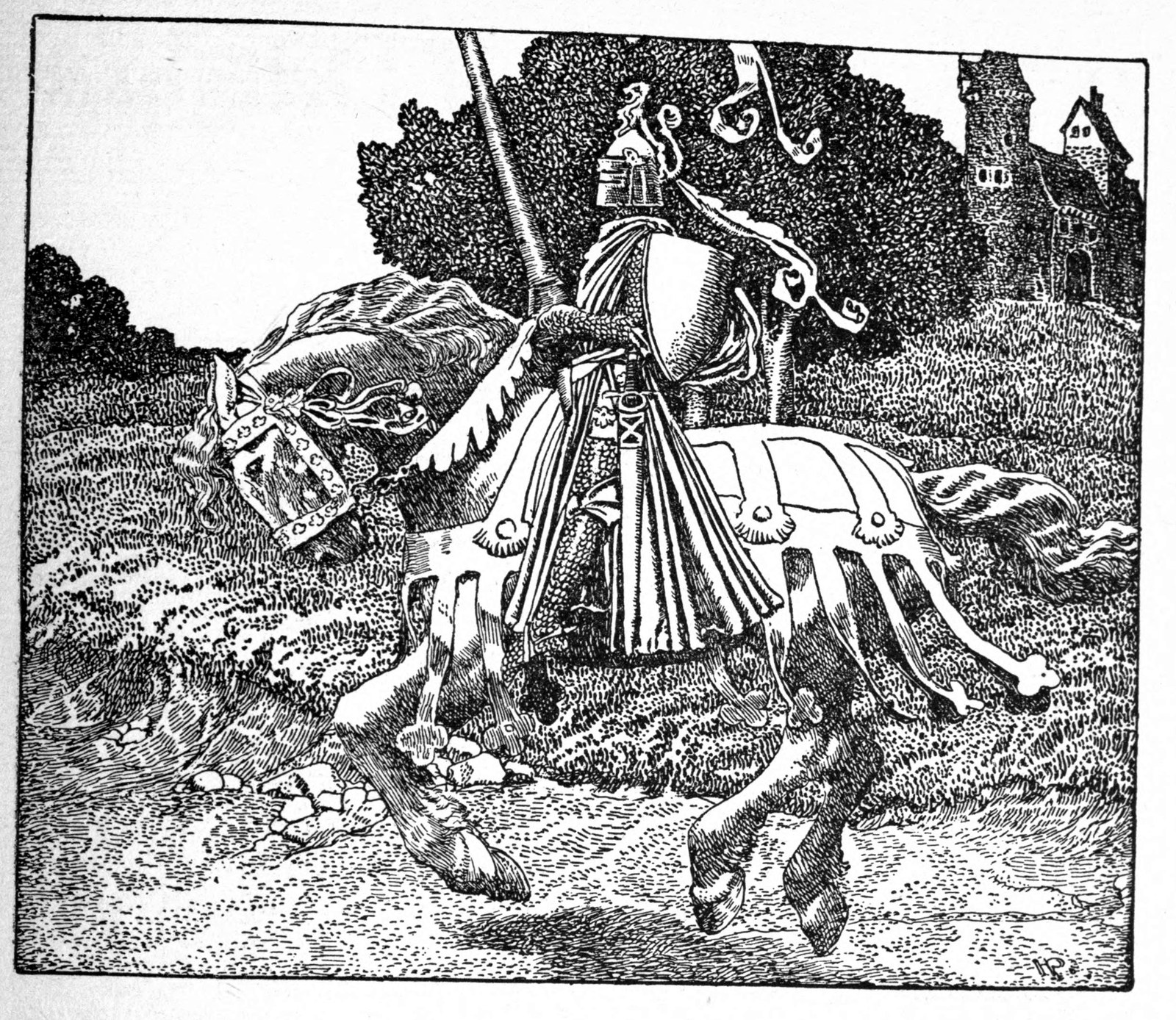
Now as the King lay dozing, and as these worthy knights sat talking cheerfully together, there came suddenly a great bustle and stir at the edge of the Court, and soon a very sad and sorrowful sight appeared. For a knight came toward them, badly wounded, held up on his horse by a golden-haired page dressed in white and azure. The knight's clothing and his horse's trappings were also of white and azure, and on his shield he bore the device of a single silver lily on a field of pure azure.
How the wounded knight comes into the forest.
But the knight was in a very pitiful state. His face was as pale as wax and hung down on his chest. His eyes were glazed and saw nothing of what went on around him, and his fine clothing of white and blue was all red with the lifeblood that ran from a great wound in his side. And as they came along, the young page wept and lamented so that it wrung your heart to hear him.
Now as they came near, King Arthur roused himself and cried out, "Alas! What sorrowful sight is this I see? Now hurry, my lords, and bring help to that knight; and you, Sir Kay, go quickly and bring that fair young page here, so that we may hear at once from his own lips what misfortune has happened to his lord."
So several of the knights hurried at the King's command and gave the wounded knight every help they could, and they carried him to King Arthur's own pavilion, which had been pitched a little way off. And when he had been brought there, the King's surgeon attended him at once, although his wounds were of such a kind that he could not hope to live very long.
Meanwhile Sir Kay brought that fair young page before the King where he sat, and the King thought he had hardly ever seen a more beautiful face. And the King said, "Please tell me, Sir Page, who your master is, and how he came to be in such a sad and pitiful state as the one we have just seen."
The page tells the story of the wounded knight.
"That I will, Lord," said the youth. "You must know that my master is called Sir Myles of the White Fountain, and that he comes from the country to the north of here, a good distance away. In that country he is the lord of seven castles and several noble estates, so, as you can see, he is a man of considerable importance. A fortnight ago (moved to it, no doubt, by the high spirits of the springtime), he set out with only me as his squire, for he had a mind to seek adventure as a good knight-errant should. And we had several adventures, and in every one of them my lord was completely successful; for he overcame six knights in different places and sent them all to his castle to bear witness to his valor before his lady.
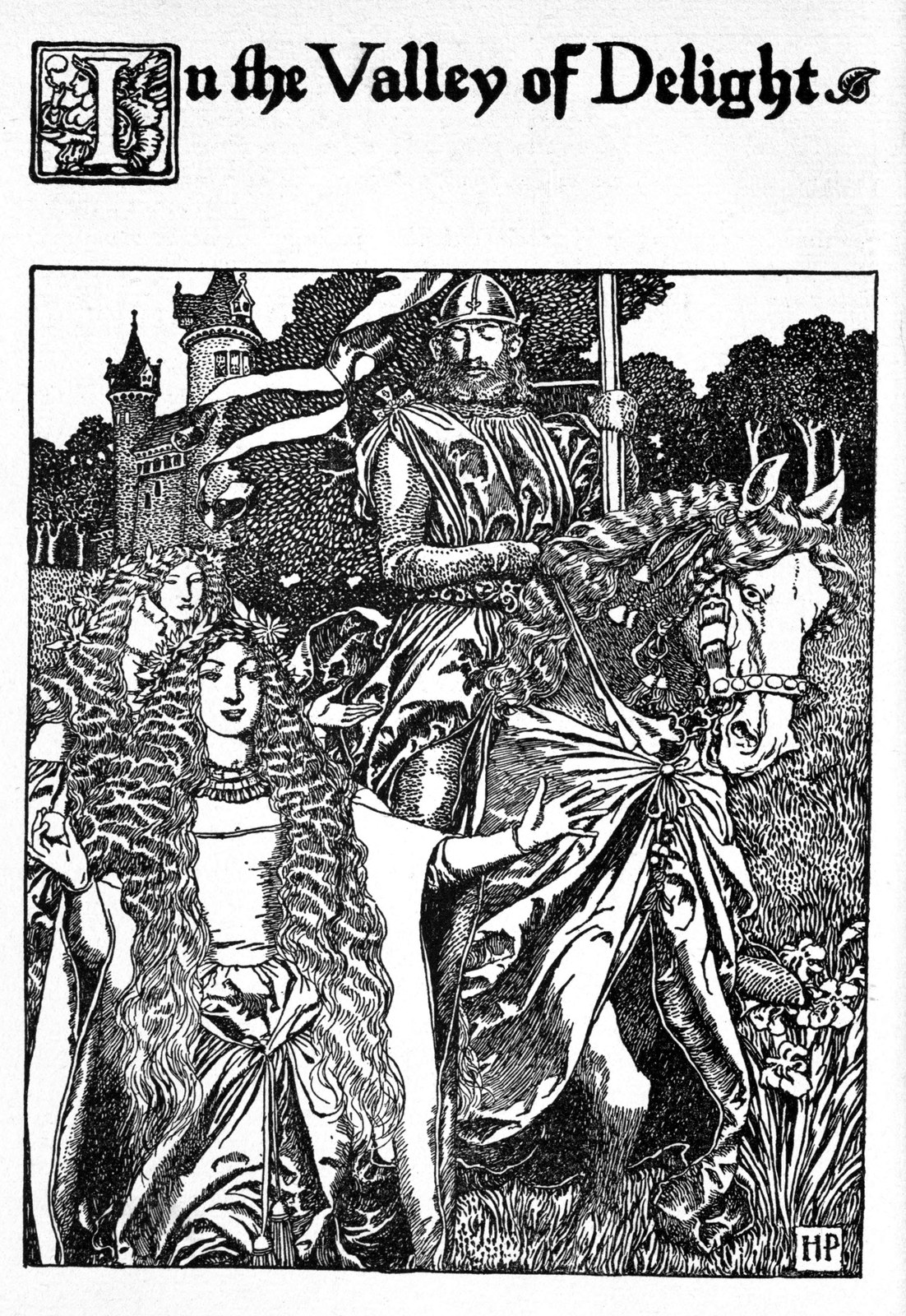
"At last, this morning, at a certain place a good distance from here, we came upon a fair castle in the forest. It stood in a valley surrounded by open stretches of level lawn, scattered with many flowers of every kind. There we saw three fair damsels tossing a golden ball from one to another. The damsels were dressed all in flame-colored satin, and their hair was the color of gold. And as we came near them they stopped their game, and the one who was the chief of those damsels called out to my lord, asking him where he was going and what his errand was.
"My lord answered her that he was a knight-errant in search of adventure. At this the three damsels laughed, and the one who had spoken first said, 'If you are looking for adventure, Sir Knight, perhaps I can help you to one that will satisfy you to your heart's content.'
"To this my master replied, 'Please, fair damsel, tell me what that adventure may be, so that I can try it at once.'
"Then this lady told my master to take a certain path and to follow it for a league or a little more, about three miles. He would then come, she said, to a stone bridge that crossed a violent stream, and she promised him that there he would find adventure enough to satisfy any man.
"So my master and I went that way, as the damsel had directed us, and after a while we came to the bridge she had spoken of. And there, beyond the bridge, stood a lonely castle with a tall, straight tower, and in front of the castle was a wide and level lawn of well-trimmed grass. Just beyond the bridge stood an apple tree hung all over with a great many shields. And halfway across the bridge hung a single shield, entirely black, and beside it hung a hammer of brass; and beneath the shield these words were written in red letters:
Whoever strikes this shield does so at his peril.
"Now my master, Sir Myles, when he read those words, went straight to that shield, seized the hammer that hung beside it, and struck it such a blow that it rang like thunder.
"At that, as if in answer, the portcullis of the castle was raised, and a knight came riding out at once, armored all in black from head to foot. His clothing and the trappings of his horse, and all its gear besides, were black as well.
The page tells of the Sable Knight.
"Now when that Sable Knight saw my master, he came riding swiftly across the meadow to the far end of the bridge. When he got there he drew rein, saluted my master, and called out, 'Sir Knight, I demand to know why you struck that shield. Now let me tell you this: because of your boldness, I will take your own shield from you and hang it on that apple tree, where you can see all those other shields hanging.' To this my master replied, 'That you will not do unless you can overcome me, knight against knight.' And with that he at once made his shield ready and put himself in position for a charge.
"So my master and this Sable Knight, having made themselves ready for the encounter, soon rode together with all their might and main. They met in the middle of the course, and there my master's spear burst into splinters. But the Sable Knight's spear held, and it pierced through Sir Myles's shield and into his side, so that both he and his horse were thrown violently into the dust. He was so badly wounded that he could not get up again from the ground where he lay.
"Then the Sable Knight took my master's shield and hung it in the branches of the apple tree where the other shields were hanging. And then, without paying any more attention to my master or asking how badly he was hurt, he rode back into his castle, and the portcullis was closed behind him at once.
"So, after he had gone, I got my master onto his horse with great labor and at once took him away from there, not knowing where I could find shelter for him, until I came to this place. And that, my lord King, is the true story of how my master came by the deadly wound he has suffered."
"Ha! By the glory of Paradise!" cried King Arthur. "I count it a great shame that in my kingdom, and so near my Court, strangers should be treated as discourteously as Sir Myles has been treated. For it is certainly discourteous to leave a fallen knight on the ground without stopping to ask how badly he is hurt. And it is still more discourteous to take away the shield of a fallen knight who has fought a good fight."
And all the knights of the King's Court cried out in the same way against the discourtesy of that Sable Knight.
Griflet asks a favor.
Then a certain squire who served the King in person, named Griflet, who was much loved by his royal master, came forward and knelt before the King, and cried out in a loud voice, "I ask a favor of you, my lord King! And I beg you to grant it to me!"
Then King Arthur raised his eyes to the youth as he knelt in front of him, and said, "Ask, Griflet, and your favor will be granted."
At that Griflet said, "This is what I ask: I ask that you make me a knight at once, and that you let me go out and try to punish this unkind knight by overthrowing him, and so win back those shields he has hung on that apple tree."
Then King Arthur was very troubled in his spirit, for Griflet was still only a squire and altogether untried in arms. So he said, "Listen, you are still too young to fight so powerful a knight as this black champion must be, who has overthrown so many knights without coming to any harm himself. Please, dear Griflet, think again and ask some other favor."
But young Griflet only cried out all the more, "A favor! A favor! And you have granted it to me!"
At this King Arthur said, "You shall have your favor, though my heart warns me that you will suffer great harm and misfortune from this adventure."
King Arthur makes Griflet a knight.
So that night Griflet kept watch over his armor in a chapel in the forest, and in the morning, after receiving the Sacrament, he was made a knight by King Arthur's own hand, and no knight could have had a greater honor than that. Then King Arthur fastened the golden spurs to Sir Griflet's heels with his own hand.
So Griflet was made a knight. And mounting his charger, he rode straight off on his adventure, full of happiness and singing for pure pleasure.
And it was at this time that Sir Myles died of his wound. For it is often so in this world: death and misfortune come to some, while others laugh and sing with hope and joy, as though such grievous things as sorrow and death could never happen in the world they live in.
Now that afternoon King Arthur sat waiting very anxiously for news of that young knight. But no news came until toward evening, when some of his attendants came hurrying to him, announcing that Sir Griflet was coming back, but without his shield, and in such a state that it looked as though some great misfortune had happened to him. And right after them came Sir Griflet himself, held up on his horse on one side by Sir Constantine and on the other by Sir Brandiles. Sir Griflet's head hung down on his chest, and his fine new armor was all broken and stained with blood and dust. He looked so pitiful that King Arthur's heart tightened with sorrow to see that young knight in so sad a state.
So, at King Arthur's command, they brought Sir Griflet to the Royal Pavilion and laid him down on a soft couch. Then the King's surgeon examined his wounds and found that the head of a spear, and part of its shaft, were still stuck through Sir Griflet's side, so that he was in terrible and grievous pain.
And when King Arthur saw how dangerously hurt Sir Griflet lay, he cried out, "Alas, my dear young knight! What has happened to you, to bring you to such a sorry state as this I see?"
Sir Griflet tells how he was hurt.
Then Sir Griflet, speaking in a very weak voice, told King Arthur how he had fared. He said that he had ridden on through the forest until he found the three beautiful damsels the page of Sir Myles had spoken of. And he said that these damsels had told him how he should go about his adventure. He said that he had found the bridge where the shield and the brass hammer hung, and that he had seen the apple tree hung full of shields there. And he said that he had struck the Sable Knight's shield with the brass hammer, and that the Sable Knight had then come riding out against him. But this knight, he said, did not seem to want to fight him. Instead, he called out to him, very nobly, that he was too young and too untried in arms to fight a seasoned knight, and so he advised Sir Griflet to give up that adventure before it was too late. But in spite of this advice Sir Griflet would not give it up, and declared that he would certainly fight that knight in black. Now at the very first charge Sir Griflet's spear had burst into pieces, but the Sable Knight's spear had held, and it had pierced through Sir Griflet's shield and into his side, giving him the grievous wound he now suffered. And Sir Griflet said that the Sable Knight had then very courteously lifted him back onto his horse (though he had kept Sir Griflet's shield and hung it on the tree with the others hanging there), and had then sent him on his way; and so he had managed to ride back, though in great pain and misery.
King Arthur is very angry.
Then King Arthur was wild with anger and greatly troubled in his mind, for he truly loved Sir Griflet very dearly. So he declared that now he himself would go out to punish that Sable Knight and humble him with his own hand. And though the knights of his Court tried hard to talk him out of that adventure, he still declared that he would bring that proud knight low with his own hand, and that he would undertake the adventure, with God's grace, the very next day.
He was so troubled that he could hardly eat his food that evening for anger, and he would not go to his couch to sleep. Instead, after asking Sir Griflet very carefully where he could find that valley of flowers and those three damsels, he spent the night walking up and down his pavilion, waiting for the day to dawn.
Now as soon as the birds first began to chirp and the east began to brighten with the coming daylight, King Arthur called his two squires. With their help he put on his armor and mounted a milk-white war horse, and soon he set out on the adventure he had made up his mind to undertake.
King Arthur sets out on his adventure.
And truly it is a very pleasant thing to ride out at the dawning of a springtime day. For then the little birds sing their sweetest songs, all joining in one joyful medley, so that you can hardly tell one note from another, so many are the voices in that pretty round of song. Then the growing things of the earth smell sweetest in the freshness of the early day: the fair flowers, the shrubs, and the blossoms on the trees. Then the dew sparkles all over the grass like an unbelievable multitude of jewels of every color. Then the whole world is sweet and clean and new, as though it had just been freshly made for the one who comes out to roam so early in the morning.
So King Arthur's heart swelled with great joy, and he sang an old-fashioned song as he rode through the forest in search of that knightly adventure.
King Arthur comes to the Valley of Delight.
So, at about noon, he came to that part of the forest he had heard about several times before. For suddenly he saw before him a wide and gently sloping valley, with a stream as bright as silver running down it. And the whole valley was strewn with countless fair and fragrant flowers of every kind. In the middle of the valley stood a handsome castle with tall red roofs and many bright windows, so that it seemed to King Arthur a very fine castle indeed. And on a smooth green lawn he saw the three damsels dressed in flame-colored satin that the page of Sir Myles and Sir Griflet had spoken of. They were playing ball with a golden ball, and the hair of each of them was the color of gold. And it seemed to King Arthur, as he came nearer, that they were the most beautiful damsels he had ever seen in all his life.
Now as King Arthur came up to them, the three stopped tossing the ball, and the fairest of all the damsels asked him where he was going and what errand he was bound on.
Then King Arthur answered, "Ha, fair lady! Where should a belted knight ride on such a day as this, and on what business, but in search of adventure, as is right for a knight-errant of proper strength of heart and body?"
The damsels greet King Arthur.
Then the three damsels smiled at the King, for he was very handsome and they liked him very well. "Alas, Sir Knight!" said the one who had spoken before. "Please don't be in such a hurry to take on a dangerous adventure. Stay with us instead for a day, or two, or three, to feast and make merry with us. For good cheer surely does a great deal to gladden the heart, and we would love to enjoy the company of so gallant a knight as you seem to be. That castle is ours, and this whole bright valley is ours, and those who have visited it are pleased, because of its joyfulness, to call it the Valley of Delight. So stay with us a little while, and don't be in such a hurry to go on."
"No," said King Arthur, "I cannot stay with you, fair ladies, for I am bent on an adventure you will know very well when I tell you that I am looking for that Sable Knight, who has overcome so many other knights and taken away their shields. So I ask you, of your kindness, to tell me where I can find him."
"Heaven's grace!" cried the one who spoke for the others. "This is surely a sorry adventure you are seeking, Sir Knight! For already, in these last two days, two knights have tried their strength against that knight, and both have come to great pain and disgrace. Even so, if you will undertake this danger, you shall not go until you have eaten and refreshed yourself." And as she said this, she lifted a little ivory whistle that hung from her neck on a golden chain and blew it very shrilly.
In answer to this summons three fair young pages came out of the castle, dressed all in flame-colored clothes, carrying between them a silver table covered with a white cloth. And after them came five more pages dressed the same way, bringing flagons of white wine and red, dried fruits and sweetmeats, and small loaves of fine white bread.
King Arthur eats and drinks in the Valley of Delight.
Then King Arthur got down from his war horse very gladly, for he was both hungry and thirsty. He sat down at the table with the damsels beside him and ate with great enjoyment, talking pleasantly all the while with those fair ladies, who listened to him with great cheerfulness of spirit. Yet he did not tell them who he was, though they wondered greatly who this noble warrior might be who had come into that place.
So, when he had satisfied his hunger and thirst, King Arthur mounted his horse again, and the three damsels went with him a little way across the valley, he riding on his horse and they walking beside him. After a while he saw a dark pathway leading into the forest on the far side; and when he had come to it, the lady who had spoken to him before said, "That is the way you must take if you mean to go on with this adventure. So farewell, and may good fortune go with you; for truly, you are the most pleasant-spoken knight who has come this way in a long time."
Then King Arthur, after saluting those ladies very courteously, rode away, full of joy over the pleasant adventure he had just passed through.
Now when King Arthur had gone some distance, he came after a while to a certain place where charcoal burners worked at their trade. For here there were many mounds of earth, all smoking from the smoldering logs inside them, while the whole air was filled with the smell of the damped-down fires.
As the King came near this spot, he soon saw that something was going on that was badly wrong. For in the open clearing he saw three sooty fellows with long knives in their hands chasing one old man whose beard was as white as snow. And he saw that this venerable old man, who was richly dressed in black, and whose horse stood a little way off, was running this way and that as though to escape those wicked men, and that he seemed very hard pressed and in great danger of his life.
"By heaven!" said the young King to himself. "Here, surely, is someone in bad need of help." And with that he cried out in a great voice, "Stop, villains! What are you doing?" And at once he set spurs to his horse, lowered his spear into position, and drove down on them with a noise as loud as thunder.
But when the three wicked fellows saw the armed knight thundering down on them like this, they dropped their knives at once and, with loud cries of fear, ran off this way and that until they had escaped into the thickets of the forest, where a man on horseback could not hope to follow them.
King Arthur rescues Merlin from the three villains.
Then, having driven those wicked fellows away, King Arthur rode up to the man he had rescued, meaning to offer him comfort. And as he came near, he saw to his surprise that the old man was the Enchanter Merlin. Yet how Merlin had come there so suddenly, when only a little while before he had been at the King's Court at Caerleon, and what he was doing in that place, the King could not understand at all. So he spoke to the Enchanter like this: "Ha, Merlin! It seems to me that I have saved your life. For surely you would not have escaped from the hands of those wicked men if I had not happened to come this way just now."
"Do you think so, Lord?" said Merlin. "Now let me tell you that although I may have seemed to be in danger, I could have saved myself very easily if I had wanted to. But just as you saw me in this pretended danger, so you may know that a real danger, far greater than this one, lies before you, and there will be no knight-errant to rescue you from it. So I beg you, Lord, to take me with you on this adventure you have set out on, for I tell you that you will certainly suffer great sorrow and pain in it."
"Merlin," said King Arthur, "even if I were facing my death, I would not turn back from this adventure. But as for the advice you give me, it seems to me it would be very wise to take you with me, if such danger lies ahead of me as you say."
And Merlin said, "Yes, it would be very wise for you to do so."
So Merlin mounted his palfrey, and he and King Arthur rode off together from that place in pursuit of the adventure the King had undertaken.
Chapter 2: How King Arthur Fought the Sable Knight and Was Badly Wounded, and How Merlin Carried Him Safely Away
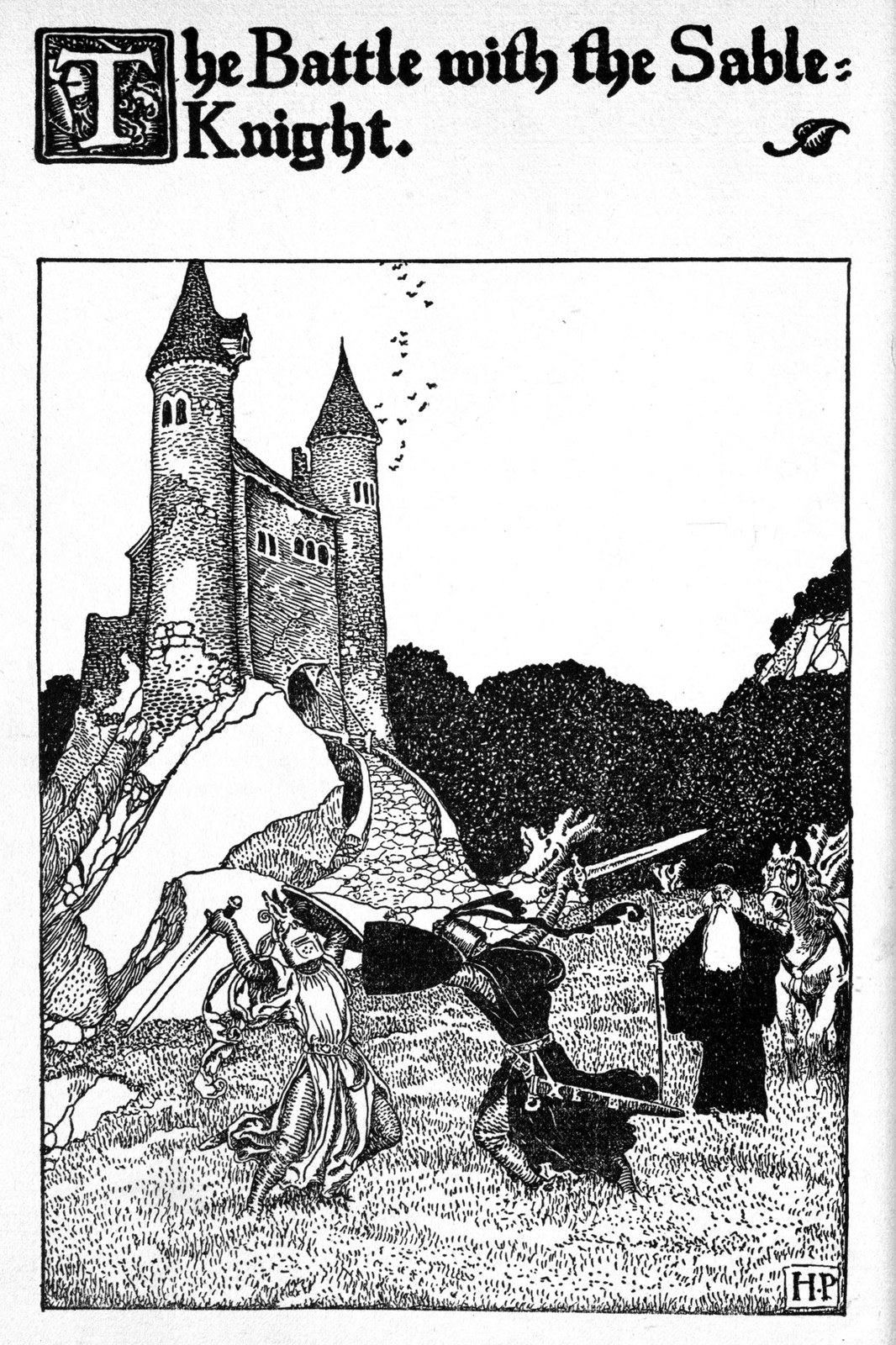
So King Arthur and Merlin rode on together through the forest for a good long while, until they could tell that they must be drawing near to the place where the Sable Knight lived, the knight the King was seeking so eagerly. For the forest, which until then had been a wilderness, very deep and mossy, began to grow thinner and more open, as though some dwelling place of men were close at hand.
And after a little while they saw before them a rushing, violent stream of water that tore through a dark and gloomy glen. They saw, too, that a bridge of stone crossed this stream, and that on the far side of the bridge there lay a smooth and level lawn of green grass, where knights could joust very well. And beyond this lawn they saw a tall and forbidding castle, with smooth walls and a straight tower; and the castle was built upon the rocks in such a way that it seemed to be all one piece with the stone. So they knew that this must be the castle the page and Sir Griflet had told of.
King Arthur comes to the castle of the Sable Knight.
For halfway across the bridge they saw a black shield hanging, and a brass mallet beside it, exactly as the page and Sir Griflet had said. And on the far side of the stream there stood an apple tree, and among its leaves hung a great many shields bearing all sorts of different designs, exactly as those two had reported. Some of those shields were clean and bright, and some were dirty and stained with blood; some were smooth and whole, and some were split, as though by fighting between knight and knight. And every one of those shields had belonged to some knight whom the Sable Knight, who lived in the castle, had overthrown in combat with his own hand.
"By the splendor of Paradise!" said King Arthur. "That must be a truly valiant knight, who by his own strength alone has overthrown and cast down so many other knights. Why, Merlin, there must be a hundred shields hanging in that tree!"
To this Merlin answered, "And you, Lord, may count yourself very lucky if your own shield is not hanging there too before the sun goes down this evening."
"That," said King Arthur, with a very steady face, "will be as God wills. For truly, I want more than ever to try my strength against that knight. Think of it: what special honor would come to me if I were to overcome so valiant a warrior as this Sable Champion seems to be, since he has been victorious over so many other good knights!"
Then, having spoken his mind, King Arthur at once pushed his horse forward and rode onto the bridge, and there he plainly read the challenge written in red letters beneath the shield:
Whoever strikes this shield does so at his peril.
King Arthur challenges the Sable Knight.
When he had read these words, the King seized the brass mallet and struck the shield such a violent blow that the sound of it echoed back from the smooth walls of the castle, and from the rocks it stood on, and from the edges of the forest all around, as though a dozen other shields had been struck in all those different places.
And in answer to that sound, the portcullis of the castle (the great iron grating that guarded its gate) was at once let down, and out rode a knight, very huge of frame and dressed all in black armor. All his clothing, too, and all the trappings of his horse were entirely black, so that he looked very grim and forbidding. And this Sable Knight came across that level meadow of smooth grass at a very stately and dignified pace, neither in haste nor slowly, but with great pride and a haughty bearing, as befitted a champion who, perhaps, had never yet been beaten in battle. So, reaching the head of the bridge, he reined in his horse and saluted King Arthur with great dignity, and very haughtily as well. "Ha, Sir Knight!" he said. "Why, after reading the words written there, did you strike my shield? Now I tell you that for your discourtesy I will soon take your shield away from you, and hang it up on that apple tree, where you see all those other shields hanging. So either hand your shield over to me without any more fuss, or else get ready to defend it with your body, in which case you will certainly suffer great pain and harm."
"Thank you for the choice you give me," said King Arthur. "But as for taking my shield away, I believe that will be as Heaven wills, and not as you will. Know this, you unkind knight: I have come here for no other purpose than to do battle with you, and so to try to win back, with my own body, all those shields that hang there on that apple tree. So make ready at once, so that I can fight with you, perhaps to your great disadvantage."
"That I will," replied the Sable Knight. And with that he turned his horse's head and rode back a certain distance across the level lawn, and took his place wherever seemed best to him. And King Arthur rode out onto the lawn as well, and took his place wherever seemed best to him.
Then each knight set his spear and his shield for the charge, and, being ready for the attack, each shouted to his war horse and drove his spurs deep into its sides.
King Arthur contends with the Sable Knight.
Then those two noble horses rushed forward like lightning, racing across the ground with such tremendous speed that the earth trembled and shook beneath them as if in an earthquake. And the two knights met squarely in the very middle of the field, crashing together like a thunderbolt. So violently did they strike against each other that both spears burst into splinters, right down to the hand guard and the stump of the shaft, and the horses staggered back from the shock. Only the extraordinary skill of their riders kept them from falling in that collision.
But with great spirit each of those two knights lifted up his horse with his own courage, and so finished his course in safety.
And indeed King Arthur was greatly amazed that he had not overthrown his opponent, for at that time, as I have said, he was held to be the very best knight in all of Britain, the one most proven in deeds of arms. So he marveled at the strength and skill of the knight he had charged against, that he had not been overthrown by the force of the blow that had struck his defenses. So when they met again in the middle of the field, King Arthur greeted that knight and spoke to him with great courtesy, saying: "Sir Knight, I do not know who you are, but I give you my knightly word that you are the mightiest knight I have ever met in all my life. Now I ask you to get down from your horse at once, and let the two of us fight this battle on foot and with swords, for it would be a pity to let it end this way."
"Not so," said the Sable Knight. "Not so. Until one of us has been overthrown, I will not fight this battle on foot." And with that he shouted "Ho! Ho!" in a very loud voice, and at once the gateway of the castle opened, and out came running two tall squires dressed all in black, trimmed with crimson. And each of these squires carried in his hand a great spear of ash wood, new and well seasoned, and never yet strained in battle.
So King Arthur chose one of these spears and the Sable Knight took the other, and then each went back to the place from which he had made his first charge.
Then once again each knight rushed his horse to the attack, and once again each struck the other so squarely in the middle of his shield that the spears were splintered, until only the guard and the stump of the shaft were left in each knight's grip.
The knights break lances a second time.
Then, as before, King Arthur would have fought the battle out on foot and with swords, but again the Sable Knight would not have it so. Instead he called aloud to those inside the castle, and at once two more squires came out with fresh new spears of ash wood. So each knight took a spear once more, and, armed with it, each chose his place on that fair, level lawn of grass.
King Arthur is overthrown.
And now, for the third time, having made themselves ready, those two excellent knights hurled themselves together in a furious charge. And now, as twice before, King Arthur struck the Sable Knight so squarely in the center of his shield that the spear he held burst into splinters. But this time the Sable Knight's spear did not break that way, but held; and so violent was the blow he struck on King Arthur's shield that it pierced right through the center of it. Then, under that great and powerful blow, the girths of the King's saddle burst apart, and both he and his horse were thrown violently backward. And King Arthur would have been hurled to the ground if he had not leaped from his saddle with extraordinary skill and knightly quickness. So, though his horse was overthrown, he himself kept his footing and did not fall into the dust. Even so, the blow he had received was so violent that for a little while he was completely stunned, and everything whirled around before his eyes.
But when his sight came back to him, he was filled with an anger so fierce that it seemed to him as though all the blood in his heart had rushed into his brain, so that he saw nothing before his eyes but red, the color of blood. And when this too had passed, he saw the Sable Knight sitting on his horse not far away. At once King Arthur ran to him, caught the bridle rein of his horse, and cried out to the Sable Knight with great fury, "Come down, you black knight, and fight me on foot and with your sword!"
"That I will not do," said the Sable Knight, "for look, I have overthrown you. So hand over your shield to me, so that I may hang it on that apple tree, and go on your way as others have done before you."
"That I will not!" cried King Arthur in a great passion. "I will neither yield nor go away from here until one of us has completely conquered the other." And with that he shoved the Sable Knight's horse backward by the bridle rein so hard that the knight was forced to leap from his saddle to save himself from being thrown to the ground.
The knights fight on foot with swords.
And now each knight was as furious as the other. So each drew his sword and set his shield, and then they rushed together like two wild bulls in battle. They thrust, they struck, they circled, they parried, they struck again and again, and the sound of their blows, crashing and clashing one upon the other, filled the whole space around them with a tremendous uproar. Nobody could ever fully imagine the fury of that fight. For the blows that each gave the other were so violent that whole pieces of armor were hacked from their bodies, and many deep and grievous wounds were given and received, so that the armor of each of them was all stained red with the blood that flowed down over it.
At last King Arthur, growing almost wild with fury, struck so fierce a blow that no armor could have withstood it if it had landed squarely. But with that stroke it happened that his sword broke off at the hilt, and the blade flew up into the air in three pieces. Yet the stroke was so wonderfully fierce that the Sable Knight groaned and staggered and ran around in a circle, as though he had gone blind and did not know where to turn his steps.
But soon he recovered himself, and seeing King Arthur standing close by, and not knowing that his enemy now had no sword to defend himself with, he threw aside his shield, took his own sword in both hands, and struck with it so terrible a stroke that he split through King Arthur's shield and through his helmet and right down to the bone of his skull.
King Arthur is badly wounded.
Then King Arthur thought that he had received his death wound, for his brain swam like water, his thighs shook terribly, and he sank down to his knees, while the blood and sweat, mixed together in the darkness of his helmet, ran down into his eyes in a lather and blinded him. And seeing him so grievously hurt, the Sable Knight called on him very fiercely to yield and to surrender his shield, since he was now too badly wounded to fight any more.
But King Arthur would not yield. Instead, catching the other by his sword belt, he pulled himself up to his feet. Then, having somewhat recovered from his daze, he seized the other knight in both arms, and, putting his knee behind the Sable Knight's thigh, he threw him backward onto the ground so violently that the sound of his fall was astounding to hear. And with that fall the Sable Knight was knocked senseless for a while. Then King Arthur at once unlaced the Sable Knight's helmet and saw his face, and he knew him in spite of the blood that was still running down his own face in great streams. He knew that this knight was King Pellinore, who has been named before in this history, and who had twice made war against King Arthur. (It has already been told how King Arthur had driven that other king away from the homes of men and into the forests, so that now he lived in this poor, gloomy castle, from which he made war on all the knights who came to that place.)
Now when King Arthur saw who it was he had been fighting, he cried out aloud, "Ha! Pellinore, is it you, then? Now yield to me, for you are entirely at my mercy." And with that he drew his misericord (the thin dagger a knight carried to give the finishing stroke) and set its point at King Pellinore's throat.
But by now King Pellinore had largely recovered from his fall, and, seeing that blood was pouring down out of his enemy's helmet, he knew that the other must have been very badly wounded by the blow he had just received. So he caught King Arthur's wrist in his hand and turned the point of the dagger away from his own throat, so that it no longer threatened him with any great danger.
And indeed, what with his terrible wound and the loss of blood, King Arthur had now grown so sick and faint that it seemed to him he was near death. And so, without very much trouble, King Pellinore suddenly heaved himself up from the ground and overthrew his enemy, so that now King Arthur lay beneath his knees.
King Pellinore moves to kill King Arthur.
And by this time King Pellinore was wild with the fury of the hard battle he had fought. He was so enraged that his eyes were all bloodshot, like those of a wild boar, and a froth, like the foam on a champing boar's jaws, stood in the beard around his lips. So he wrenched the dagger out of his enemy's hand, and at once began to unlace his helmet, meaning to kill him where he lay. But at that moment Merlin came hurrying up, crying out, "Stop! Stop, Sir Pellinore! What are you about to do? Hold back your wicked hand! For the man who lies beneath you is none other than Arthur, King of all this realm!"
At this King Pellinore was astonished beyond measure. For a little while he was silent, and then he cried out in a very loud voice, "Is that so, old man? Then truly your words have doomed this man to death. For no one in all this world has ever suffered such harm and such wrongs as I have suffered at his hands. He has taken from me my power, and my kingship, and my honors, and my lands, and has left me only this gloomy, dismal castle in the forest to live in. So, since he is now in my power, he will die right here, if for no other reason than this: if I let him go free now, he will certainly take his revenge once he has recovered from all the harm he has suffered at my hands."
Merlin lays a spell upon King Pellinore.
Then Merlin said, "Not so! He will not die at your hands, for I myself will save him." And with that he raised his staff and struck King Pellinore across the shoulders. At once King Pellinore fell down and lay on the ground on his face, like a man who had suddenly died.
At this, King Arthur raised himself on his elbow and saw his enemy lying there as though dead, and he cried out, "Ha, Merlin! What is this you have done? I am very sorry for it, for I can see that by your magic arts you have killed one of the best knights in all the world."
"Not so, my lord King!" said Merlin. "For truly, I tell you that you are far nearer to your death than he is. He is only asleep and will soon wake up; but you are in such a state that it would take only a very little to make you die."
And indeed King Arthur was terribly sick, sick to the very heart, from the grievous wound he had received, so that it was only with great difficulty that Merlin could help him up onto his horse. When he had done this, and had hung the King's shield on the horn of his saddle, Merlin at once led the wounded man away across the bridge, and, leading the horse by the bridle, took him off into the forest.
Now I must tell you that in that part of the forest there lived a certain hermit who was so holy that the wild birds of the woods would come and rest on his hand while he read his prayer book; and he was so saintly in his gentleness that the wild does would come right up to the door of his hermitage and stand there while he milked them for his own refreshment. And this hermit lived so far away from the homes of men that when he rang the bell for morning prayers or for evening prayers, there was hardly ever anyone to hear the sound of it except the wild creatures that lived nearby. Yet even so, royal people and others of high rank would sometimes come to this remote and lonely place, as though on a pilgrimage, because of the hermit's great holiness.
Merlin brings King Arthur to the cell of a lonely hermit.
So Merlin brought King Arthur to this holy refuge, and when they had reached it, he and the hermit lifted the wounded man down from his saddle, the hermit speaking many words of pity and sorrow, and together they carried him into the holy man's cell. There they laid him on a bed of moss, unlaced his armor, examined his wounds, bathed them with pure water, and dressed his hurts, for that hermit was a very skillful healer. So for all that day and part of the next, King Arthur lay on the hermit's bed like a man about to die. He saw everything around him as though through a thin layer of water, and his breath hung on his lips and fluttered there, and he could not even lift his head from the bed because of the weakness that lay upon him.
The Lady Guinevere consults with the priest.
Now on the afternoon of the second day there arose a great noise and commotion in that part of the forest. For it happened that the Lady Guinevere of Cameliard had come on a pilgrimage to that holy man, together with her whole court of ladies and knights, because the fame of his saintliness had reached even the place where she lived. That lady had a favorite page who was very sick with a fever, and she hoped that the holy man might give her some charm or amulet by whose power the boy might perhaps be cured. So she had come to that place with her entire court, until all that part of the forest was made bright with fine clothes, and its silence was made merry with the sound of talk and laughter, the singing of songs, the chatter of many voices, and the neighing of horses. And the Lady Guinevere rode in the midst of her damsels and her court, and her beauty outshone the beauty of her damsels as the splendor of the morning star outshines all the lesser stars around it. For then and ever afterward she was held by all the courts of chivalry to be the most beautiful lady in the world.
Now when the Lady Guinevere came to that place, she saw King Arthur's milk-white war horse standing and cropping the green grass of the open glade near the hermitage. And she saw Merlin, too, standing beside the door of the cell. So she asked him whose noble war horse that was, grazing on the grass in that lonely place, and who it was that lay inside the cell. And Merlin answered her, "Lady, the one who lies inside is a knight, very badly wounded, so that he is sick almost to death!"
"Heaven have pity!" cried the Lady Guinevere. "What a sad thing this is that you tell me! Now I beg you to take me to that knight at once, so that I may see him. For I have in my court a very skillful physician, who is well practiced at curing the kinds of wounds that knights receive in battle."
The Lady Guinevere bids her physician heal King Arthur.
So Merlin brought the lady into the cell, and there she saw King Arthur where he lay stretched out on the bed. And she did not know who he was. Yet it seemed to her that never in all her life had she seen so noble-looking a knight as the one who lay so badly wounded in that lonely place. And King Arthur lifted his eyes to where she stood beside his bed of pain, surrounded by her maidens, and in the great weakness that lay upon him he did not know whether the one he saw was a mortal lady, or whether she was not rather some tall, straight angel who had come down from one of the lordly courts of Paradise to visit him in his pain and distress. And the Lady Guinevere was filled with great pity at seeing King Arthur in so sorrowful a state. So she called to her the skillful physician who traveled with her court, and she told him to bring a certain alabaster box of very precious balm. And she commanded him to examine that knight's wounds and to anoint them with the balm, so that he might be healed of his hurts as quickly as possible.
So that wise and skillful physician did as the Lady Guinevere commanded, and at once King Arthur felt all his aches ease away, and a great contentment of spirit came over him. And when the lady and her court had gone, he found his heart greatly lifted, and three days later he was completely healed, and as well and strong and vigorous as he had ever been in all his life.
And this was the first time that King Arthur ever saw that beautiful lady, the Lady Guinevere of Cameliard, and from that time on he never forgot her; she was almost always present in his thoughts. And so, when he had recovered, he said to himself: "I will forget that I am a king, and I will cherish the thought of this lady, and I will serve her faithfully, as a good knight may serve the lady he has chosen."
And so he did, as you will hear later in this book.
Chapter 3: How King Arthur Found a Noble Sword in a Most Wonderful Way, and How He Fought Again with It and Won
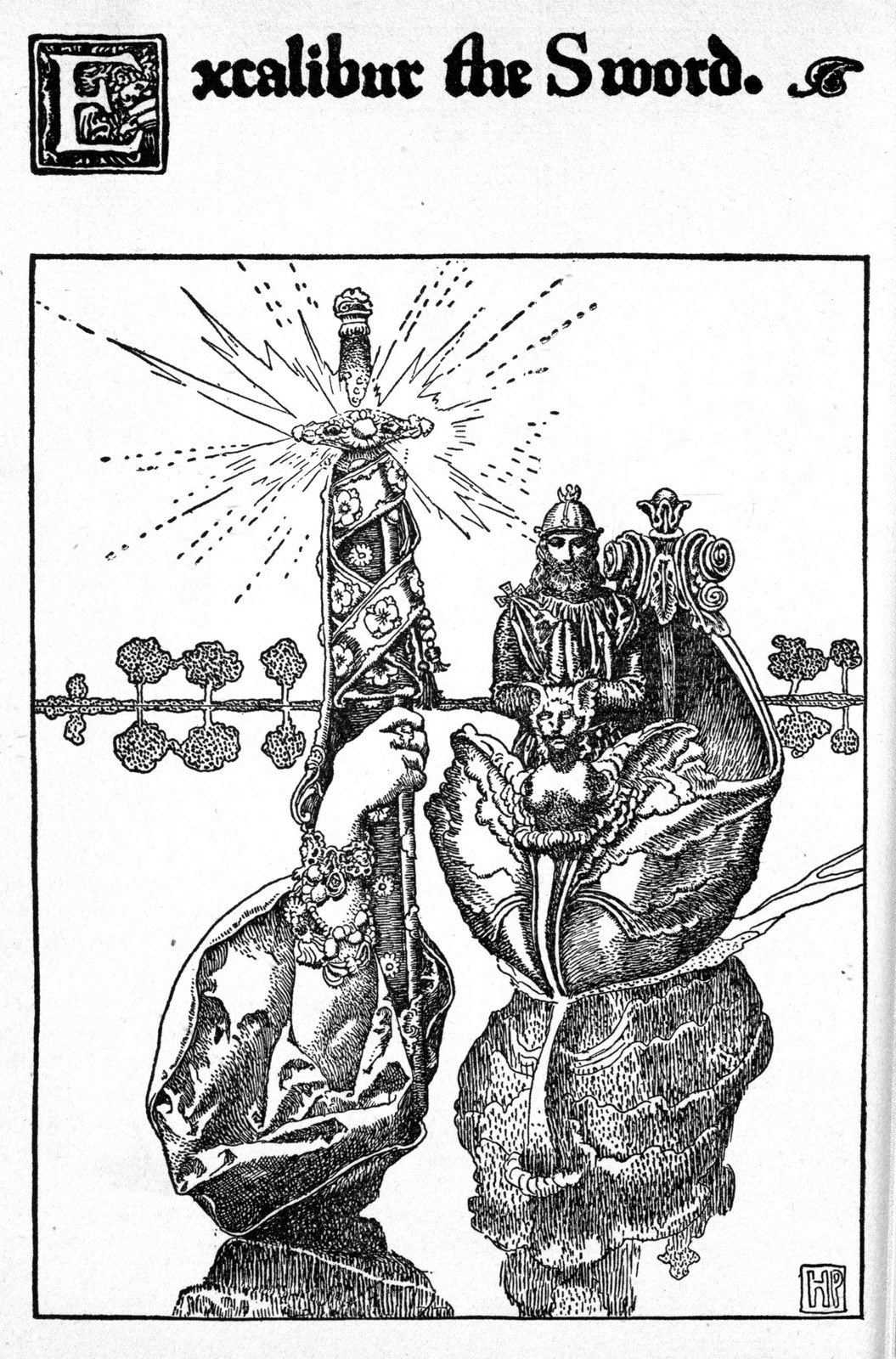
King Arthur longs to renew his battle.
Now, as soon as King Arthur had been healed by that extraordinary balsam of the grievous wounds he had received in his battle with King Pellinore, he found himself seized by a fierce desire to meet his enemy again, to try the outcome of battle with him once more, and so win back the honor he had lost in that fight. On the morning of the fourth day, being entirely cured, and having eaten his breakfast, he went for a refreshing walk along the edge of the forest, listening all the while to the cheerful sound of the wood-birds singing their morning songs with all their might and main. Merlin walked beside him, and King Arthur told Merlin what was on his mind: that he meant to meet King Pellinore once more in knightly combat. And he said, "Merlin, it troubles me very sorely to have come off so badly in my last encounter with King Pellinore. Truly, he is the very best knight I have ever met in all the world. Even so, things might have gone differently for me if I had not broken my sword and so left myself altogether defenseless. However that may be, I have made up my mind to try this adventure once more, and I will do so as soon as I possibly can."
To this Merlin replied, "You are certainly a very brave man to have so much appetite for battle, considering how close you came to your death not even four days ago. Yet how can you hope to undertake this adventure without proper preparation? For look: you have no sword, and you have no spear, and you do not even have your misericord to fight with. How then can you hope to try this adventure?"
And King Arthur said, "That I do not know. Nevertheless, I will look for some weapon as soon as I can. For even if I have no better weapon than an oak club, I would still try this battle again with so poor a tool as that."
Merlin tells King Arthur of Excalibur.
"Ha! Lord," said Merlin, "I can see that you are entirely set on renewing this quarrel. So I will not try to hold you back from it, but will do everything in my power to help you get what you want. Now, to that end, I must tell you that in one part of this forest (which is, indeed, a very strange place) there is a certain woodland, sometimes called Arroy and at other times called the Forest of Adventure. It has that name because no knight ever enters it without some adventure happening to him. And close to Arroy is a land of enchantment, which has been seen several times. That is a very wonderful land, for in it there is a wide and great lake, which is also enchanted. And in the middle of that lake, for some time now, there has been seen what looks like a woman's arm, exceedingly beautiful and clothed in white samite, which is a rich silk. And the hand of this arm holds a sword of such surpassing excellence and beauty that no eye has ever seen its like. The name of this sword is Excalibur, and it was given that name by those who have seen it because of its marvelous brightness and beauty. For it has happened that several knights have already seen that sword and have tried to win it for their own, but until now no one has been able to touch it, and many have lost their lives in that adventure. For whenever any man comes near it, either he sinks into the lake, or else the arm vanishes entirely, or else it is drawn down beneath the lake. And so no man has ever been able to take possession of that sword. Now, I am able to lead you to that Lake of Enchantment, and there you may see Excalibur with your own eyes. Then, when you have seen him, perhaps you will want to win him; and if you are able to do that, you will have a sword very well fitted for battle."
"Merlin," said the King, "this is a very strange thing you are telling me. Now I want beyond all measure to try to win this sword for my own, and so I beg you to lead me with all speed to this enchanted lake you tell me of." And Merlin said, "I will do so."
So that morning King Arthur and Merlin took their leave of that holy hermit (the King kneeling in the grass to receive his blessing), and, departing from that place, they went into the deeper forest once more, making their way toward that part of it which was known as Arroy.
Merlin and King Arthur follow a white doe.
After a while they came to Arroy, and it was about noon. And when they had entered those woodlands they came to a certain little clearing, and in that clearing they saw a white doe with a golden collar around her neck. King Arthur said, "Look, Merlin, there is a wonderful sight." And Merlin said, "Let us follow that doe." At that the doe turned, and they followed it. By and by, as they followed it, they came to an opening in the trees where there was a little lawn of sweet, soft grass. Here they saw a bower, a little shelter of leaves and branches, and in front of the bower was a table spread with a fine snow-white cloth and set with refreshments: white bread, wine, and meats of several kinds. At the door of this bower there stood a page, dressed all in green, whose hair was as black as ebony, and whose eyes were as black as jet and exceedingly bright. When this page saw King Arthur and Merlin, he greeted them and welcomed the King very pleasantly, saying, "Ha! King Arthur, you are welcome to this place. Now please get down from your horse and refresh yourself before you go any farther."
At this King Arthur wondered whether there might be some enchantment here meant to do him harm, for he was astonished that a page in the deep forest should know him so well. But Merlin told him to be of good cheer, and said, "Truly, Lord, you may freely share in this meal, which, I may tell you, was prepared especially for you. What is more, you may take it as a sign that this adventure will turn out very happily."
King Arthur is refreshed in a mysterious way.
So King Arthur sat down at the table with a glad and easy heart (for he was hungry), and that page and another just like him waited on him, serving him all the food on silver plates and all the wine in golden goblets, just as he was used to being served in his own court, except that these things were far more skillfully made and fashioned, and far more beautiful, than the tableware of the King's court.
Then, after he had eaten his fill, and had washed his hands in a silver basin that the first page offered him, and had dried his hands on a fine linen napkin that the other page brought him, and after Merlin had also refreshed himself, they went on their way, greatly rejoicing at this pleasant adventure, which, it seemed to the King, could only mean that his undertaking would turn out very well.
Now, about the middle of the afternoon, King Arthur and Merlin came suddenly out of the forest onto a fair and level plain, covered all over with so many flowers that no one could imagine how many there were or how beautiful.
King Arthur comes to a strange land.
This was a very wonderful land, for all the air seemed to be made of gold, it was so bright and so strangely radiant. Here and there upon that plain stood various trees all in blossom, and the fragrance of the blossoms was so sweet that the King had never smelled anything like it. In the branches of those trees were a multitude of birds of many colors, and the melody of their singing filled the heart of anyone who heard it with delight. And in the middle of the plain was a lake of water as bright as silver, and all around the edges of the lake grew incredible numbers of lilies and daffodils. Yet, although this place was so exceedingly beautiful, there was nowhere in it a single sign of human life of any kind; it seemed as lonely as the empty sky on a summer day. So, because of all the marvelous beauty of the place, and its strangeness, and its utter loneliness, King Arthur understood that he must have come into a land of powerful enchantment, where perhaps there lived a fairy of very high rank. And so a kind of fear wrapped itself around his spirit as he pushed his great milk-white war-horse through that long, beautiful grass, all sprinkled with flowers, and he did not know what strange things were about to happen to him.
King Arthur sees Excalibur.
King Arthur meets the Lady of the Lake.
When he had come to the edge of the lake, he saw there the miracle that Merlin had told him of before. For there, in the middle of the stretch of water, was what looked like a fair and beautiful arm, like a woman's, clothed all in white samite. The arm was circled with several bracelets of worked gold, and the hand held a sword of marvelous workmanship high in the air above the surface of the water. Neither the arm nor the sword moved so much as a hair's breadth, but they stood as still as a carved statue upon the surface of the lake. And the sun of that strange land shone down upon the hilt of the sword, which was of pure gold set with jewels of many kinds, so that the hilt of the sword and the bracelets around the arm glittered in the middle of the lake like some single star of surpassing splendor. King Arthur sat on his war-horse and gazed from a distance at the arm and the sword, and he marveled greatly at them. Yet he did not know how he could reach that sword, for the lake was wonderfully wide and deep, and so he did not know how he might get to it to make it his own. And as he sat turning this over in his mind, he suddenly became aware of a strange lady who was coming toward him through the tall flowers that bloomed along the edge of the lake. When he saw her coming toward him, he quickly got down from his war-horse and went forward to meet her, with the bridle-rein over his arm. And when he had come near her, he saw that she was extraordinarily beautiful: her face was as clear as wax, and her eyes were perfectly black, and they were as bright and glistening as two jewels set in ivory. He saw that her hair was like silk, and as black as anything could be, and so long that it reached the ground as she walked. The lady was dressed all in green, except that a fine cord of crimson and gold was woven into the braids of her hair. Around her neck hung a very beautiful necklace of several strands of opals and emeralds, set in skillfully worked gold, and around her wrists were bracelets of the same kind, of opals and emeralds set in gold. So when King Arthur saw how wonderful she looked, like an ivory statue of surpassing beauty dressed all in green, he immediately knelt before her in the midst of all those flowers, and said, "Lady, I can see for certain that you are no mortal maiden, but one of the fairy folk. And I can see that this place, because of its extraordinary beauty, can be nothing other than some part of Fairyland into which I have come."
And the Lady answered, "King Arthur, you speak the truth, for I am indeed of Fairyland. What is more, I may tell you that my name is Nimue, and that I am the chief of those Ladies of the Lake you may have heard people speak of. You should also know that what you see over there as a wide lake is, in truth, a plain like this one, all covered with flowers. And you should know too that in the middle of that plain there stands a castle of white marble and of ultramarine, the deep blue of lapis, brightened with gold. But so that mortal eyes may not see our dwelling place, my sisters and I have caused this appearance of a lake to spread over that castle, so that it is entirely hidden from sight. And no mortal man may cross that lake except in one way; any other way, he will certainly die in it."
"Lady," said King Arthur, "what you tell me fills me with very great wonder. And indeed, I am afraid that in coming here I have done wrong by intruding upon the solitude of your dwelling place."
"No, not so, King Arthur," said the Lady of the Lake, "for in truth you are very welcome here. What is more, I may tell you that I feel a greater friendship for you and for the noble knights of your court than you could easily know. But I ask you, of your courtesy, to tell me what it is that brings you to our land."
"Lady," said the King, "I will tell you the whole truth. Not long ago I fought a battle with a certain sable knight, in which I was sorely and grievously wounded, and in which I burst my spear and snapped my sword and lost even my misericord, so that I had not a single thing left to me by way of a weapon. In this extremity Merlin, here, told me of Excalibur, and of how he is held up forever by an arm in the middle of this magical lake. So I came here, and I find it just as he said. Now, Lady, if it is possible, I would gladly win that excellent sword, so that with it I might fight my battle through to the very end."
"Ha! my lord King," said the Lady of the Lake, "that sword is not an easy thing to win, and what is more, I may tell you that several knights have lost their lives trying to do what you have in mind. For, in truth, no man may win that sword over there unless he is without fear and without reproach."
"Alas, Lady!" said King Arthur, "that is a sad saying indeed for me. For though I may not be lacking in knightly courage, yet in truth there are many things for which I reproach myself. Nevertheless, I would gladly attempt this thing, even if it puts me in great danger. So I beg you, tell me how I may best undertake this adventure."
The Lady of the Lake summons a boat.
"King Arthur," said the Lady of the Lake, "I will do as I say, and help you in what you wish in this matter." At that she lifted a single emerald that hung by a small gold chain at her belt, and the emerald was skillfully carved into the shape of a whistle. She set the whistle to her lips and blew on it very shrilly. And at once there appeared upon the water, a great way off, something that shone very brightly. It came toward them at great speed, and as it drew near, they saw that it was a boat made all of carved brass. The prow of the boat was carved into the head of a beautiful woman, and on either side were wings like the wings of a swan. And the boat moved upon the water like a swan, very swiftly, so that long lines like silver threads stretched far away behind it across the face of the water, which otherwise was as smooth as glass. When the brass boat had reached the bank, it rested there and moved no more.
Then the Lady of the Lake told King Arthur to get into the boat, and so he got in. And the moment he had done so, the boat moved away from the bank as swiftly as it had come. Merlin and the Lady of the Lake stood at the edge of the water and gazed after King Arthur and the brass boat.
And King Arthur saw that the boat floated swiftly across the lake to the place where the arm held up the sword, and that the arm and the sword did not move, but stayed where they were.
King Arthur wins Excalibur.
Then King Arthur reached out and took the sword in his hand, and at once the arm sank out of sight beneath the water. And King Arthur held the sword, and its scabbard, and its belt in his hand, and they were his own.
Then truly his heart swelled with joy as if it would burst in his chest, for Excalibur was a hundred times more beautiful than he had thought possible. And so his heart was close to breaking with pure joy at having won that magic sword.
Then the brass boat carried him very quickly back to the land again, and he stepped ashore where the Lady of the Lake and Merlin stood. And when he stood on the shore, he thanked the Lady beyond measure for all she had done to help him in his great undertaking, and she answered him with cheerful and pleasant words.
Then King Arthur bowed to the lady, as was fitting, and when he had mounted his war-horse, and Merlin had mounted his palfrey, his gentle riding horse, they rode away from there about their business. And all the while the King's heart was still swelling with pure delight at having for his own that beautiful sword, the most beautiful and the most famous sword in all the world.
That night King Arthur and Merlin stayed with the holy hermit at the forest sanctuary. And when the next morning came (the King having bathed in the ice-cold forest spring, and being wonderfully refreshed by it), they set out, thanking that saintly man for the shelter he had given them.
Then, about noon, they reached the valley of the Sable Knight, and there everything was arranged exactly as it had been when King Arthur was there before: that gloomy castle, the lawn of smooth grass, the apple tree hung all over with shields, and the bridge on which hung that single black shield.
"Now, Merlin," said King Arthur, "this time I strictly forbid you to interfere in this quarrel. And you are not, on pain of my displeasure, to use any of your magic arts on my behalf. So listen to what I say, and heed it with all possible care."
King Arthur challenges King Pellinore to battle again.
At once the King rode out onto the bridge, and, seizing the brass hammer, he struck the sable shield with all his might and main. Immediately the portcullis of the castle was let down, as I told you before, and in the same way as that other time the Sable Knight rode out, already armed and equipped for the encounter. He came to the head of the bridge, and there King Arthur spoke to him: "Sir Pellinore, we now know each other entirely well, and each of us judges that he has a quarrel with the other. You judge that I, for reasons of my own that seemed right to me, have taken away your royal rank and have driven you into this lonely forest. I judge that you have set yourself up here to do injury and insult to the knights and lords and other people of this kingdom of mine. So, since I am here as a knight-errant, I challenge you to fight me, man to man, until one of us has conquered the other."
King Pellinore bowed his head in agreement to this speech, and then he wheeled his horse, rode off a little distance, and took his place where he had stood before. And King Arthur also rode off a little distance and took up his position where he had stood before. At the same time there came out of the castle one of those tall pages dressed all in black, patched with crimson, and he gave King Arthur a good, stout spear of ash wood, well seasoned and never yet used in battle. And when the two knights were ready, they shouted and drove their horses together, and each struck the other so squarely in the middle of his defenses that the spears shattered in their hands, bursting into small splinters just as they had done before.
Then each of the two knights at once leapt from his horse with great skill and grace, and each drew his sword. And they fell to fighting so furiously and so violently that two wild bulls on the mountains could not have fought a more desperate battle.
King Arthur overcomes King Pellinore.
But now, with Excalibur to help him in the battle, King Arthur soon overcame his enemy. For he gave him several wounds and yet received none himself; he did not shed a single drop of blood in that whole fight, though in a little while his enemy's armor was all stained with crimson. And at last King Arthur struck so mighty a blow that King Pellinore was entirely stunned by it, so that his sword and his shield dropped from their guard, his legs trembled beneath him, and he sank to his knees on the ground. Then he called on King Arthur to have mercy, saying, "Spare my life, and I will yield myself to you."
King Arthur demands two of the sons of King Pellinore as hostages.
And King Arthur said, "I will spare you, and I will do more than that. For now that you have yielded yourself to me, I will give you back your power and your rank. I bear you no ill will, Pellinore. Nevertheless, I cannot allow any rebels against my power in this realm. For, as God is my judge, I declare that I keep only the good of the people of my kingdom in my sight. And so whoever is against me is also against them, and whoever is against them is also against me. But as a pledge of your good faith toward me in the future, I shall require you to send me your two eldest sons, Sir Aglovale and Sir Lamorak, as hostages for your good will. Your young son, Durnore, you may keep with you for your comfort."
So those two young knights came to the court of King Arthur, and they became very famous knights, and in time they were made Companions of the Round Table, in great honor.
And King Arthur and King Pellinore went together into King Pellinore's castle, and there King Pellinore's wounds were dressed and he was made comfortable. That night King Arthur stayed in King Pellinore's castle, and when the next morning came, he and Merlin returned to the King's court, which was waiting for him in the forest at the place where he had set it up.
How King Arthur rode through the forest with great joy and delight.
Now King Arthur took very great pleasure as he and Merlin rode back together through that forest, for it was the leafiest time of all the year, when the woodlands dress themselves in their best clothes of clear, bright green. Every shady hollow and little wooded valley was full of the perfume of the thickets, and in every tangled depth the little bird sang with all his might and main, as though he would burst his little throat with the melody of his song. The ground beneath the horses' feet was so soft with fragrant moss that the ear could not hear any sound of hoofbeats on the earth. And the bright yellow sunlight came down through the leaves, so that the whole ground was scattered with a great multitude of trembling circles, like pure yellow gold. And every now and then that sunlight would fall upon the armed knight as he rode, so that every little while his armor seemed to catch fire with a great glory, shining like a sudden bright star among the dark shadows of the woodland.
So it was that King Arthur took great joy in that forest land, for he was without ache or pain of any kind, and his heart was lifted very high by the wonderful success of the adventure he had undertaken. For in that adventure he had not only turned a very bitter enemy into a friend who would be of great use and comfort to him, but he had also won for himself a sword whose like the world had never seen before. And whenever he thought of that wonderfully splendid sword that now hung at his side, and whenever he remembered that Fairyland into which he had wandered, and what had happened to him there, his heart would grow so full of pure joy that he hardly knew how to contain himself, because of the great delight that filled his whole being.
And indeed, I know of no greater good I could wish for you in all your life than that you might enjoy the kind of happiness that comes to someone when he has done his very best and has succeeded completely in what he set out to do. For then the whole world seems to be filled with a bright, shining light, and the body seems to grow so light that the feet are lifted from all heaviness and touch the earth very lightly, because of the lightness of the spirit within. And that is why, if I had it in my power to give you the very best the world has to give, I would wish that you might win your battle as King Arthur won his battle that time, and that you might ride homeward in such triumph and joy as filled him that day, and that the sunlight might shine around you as it shone around him, and that the breezes might blow and all the little birds might sing with all their might and main as they sang for him, and that your heart, too, might sing its song of rejoicing in the pleasantness of the world in which you live.
Merlin tells King Arthur of the virtues of Excalibur's sheath.
Now, as they rode together through the forest like this, Merlin said to the King, "Lord, which would you rather have, Excalibur, or the sheath that holds him?" To which King Arthur replied, "I would rather have Excalibur than his sheath ten thousand times over." "In that you are wrong, my Lord," said Merlin, "for let me tell you that though Excalibur is of so fine a temper that he can cut in two either a feather or a bar of iron, yet his sheath is of such a kind that whoever wears it can suffer no wound in battle, nor can he lose a single drop of blood. As proof of this, you may remember that in your recent battle with King Pellinore you suffered no wound, nor did you lose any blood."
Then King Arthur turned a face of great displeasure upon his companion and said, "Now, Merlin, I declare that you have taken from me all the glory of the battle I have just fought. For what credit can there be to any knight who fights his enemy by means of enchantment such as you tell me of? Indeed, I have a mind to take this glorious sword back to that magic lake and throw it in, where it belongs. For I believe that a knight should fight by his own strength, and not by magic."
"My Lord," said Merlin, "you are certainly entirely right in what you hold. But you must bear in mind that you are not like an ordinary knight-errant. You are a King, and your life does not belong to you, but to your people. So you have no right to put it in danger, but should do everything in your power to preserve it. And that is why you should keep that sword, so that it may safeguard your life."
Then King Arthur thought over that saying for a long while in silence, and when he spoke, these were his words: "Merlin, you are right in what you say. For the sake of my people, I will keep both Excalibur, to fight for them, and his sheath as well, to preserve my life for their sake. Nevertheless, I will never use him again except in serious battle." And King Arthur held to that promise, so that from then on he never fought in sport except with the lance and on horseback.
King Arthur kept Excalibur as the greatest treasure of all his possessions. For he said to himself, "Such a sword as this is fit for a king above other kings and a lord above other lords. Now, since God has seen fit to place this sword in my keeping in so marvelous a way as happened, He must mean that I am to be His servant to do unusual things. And so I will treasure this noble weapon not so much for its excellent worth as because it shall be to me a sign of those great things that God, in His mercy, has plainly ordained for me to do in His service."
So King Arthur had a strong chest made for Excalibur, a coffer bound around with many bands of wrought iron, studded all over with great iron nails, and locked with three great padlocks. In this strongbox he kept Excalibur lying on a cushion of crimson silk and wrapped in swathings of fine linen, and very few people ever saw the sword in its glory, except when it shone like a sudden flame in the uproar of battle.
For when the time came for King Arthur to defend his realm or his people from their enemies, he would take out the sword and fasten it at his side. And when he did so, he was like a hero of God armed with a blade of shining lightning. Yes, at such times Excalibur shone with so terrible a brightness that the very sight of it would shake the spirit of every wrongdoer with such great fear that he would, in a way, suffer the pangs of death before the edge of the blade had ever touched his flesh.
So King Arthur treasured Excalibur, and the sword stayed with him all his life, so that the name of Arthur and the name of Excalibur are one. And so I believe that this sword is the most famous of any sword that was ever seen or heard of in all the courts of chivalry.
As for the sheath of the blade, King Arthur lost that through the treachery of one who should by rights have been his dearest friend (as you will hear before long), and in the end the loss of that miraculous sheath brought him a very great deal of pain and sorrow.
All that, too, you will read about, God willing, in due time.
So ends the story of the winning of Excalibur. And may God give to you in your life His Truth to help you, like a shining sword, to overcome your enemies; and may He give you Faith (for Faith holds Truth as a scabbard holds its sword), and may that Faith heal all your wounds of sorrow as the sheath of Excalibur healed all the wounds of him who wore that excellent weapon. For with Truth and Faith belted upon you, you will be as well able to fight all your battles as was that noble hero of old whom men called King Arthur.
The Book of King Arthur, Part Three: The Winning of a Queen
Foreword
So, now that I have told you how King Arthur won that most excellent sword, Excalibur, to be his weapon of defense, I will soon tell you about several other noble and knightly adventures by which he won a most beautiful and gentle lady to be his Queen.
For though all the world knows very well the fame of that perfectly gracious lady, the Lady Guinevere, I do not think that the whole story of the adventures by which King Arthur won her favor has ever yet been told.
And since what I am about to tell contains not only the story of that affair, but also the account of a certain enchanted disguise that King Arthur put on for his own purposes, as well as several adventures of very knightly daring that he undertook, I have great hope that whoever reads what I have written will find it both a pleasant and an entertaining history.
Chapter 1: How King Arthur Went to Tintagalon with Four of His Court, and How He Disguised Himself for a Secret Purpose
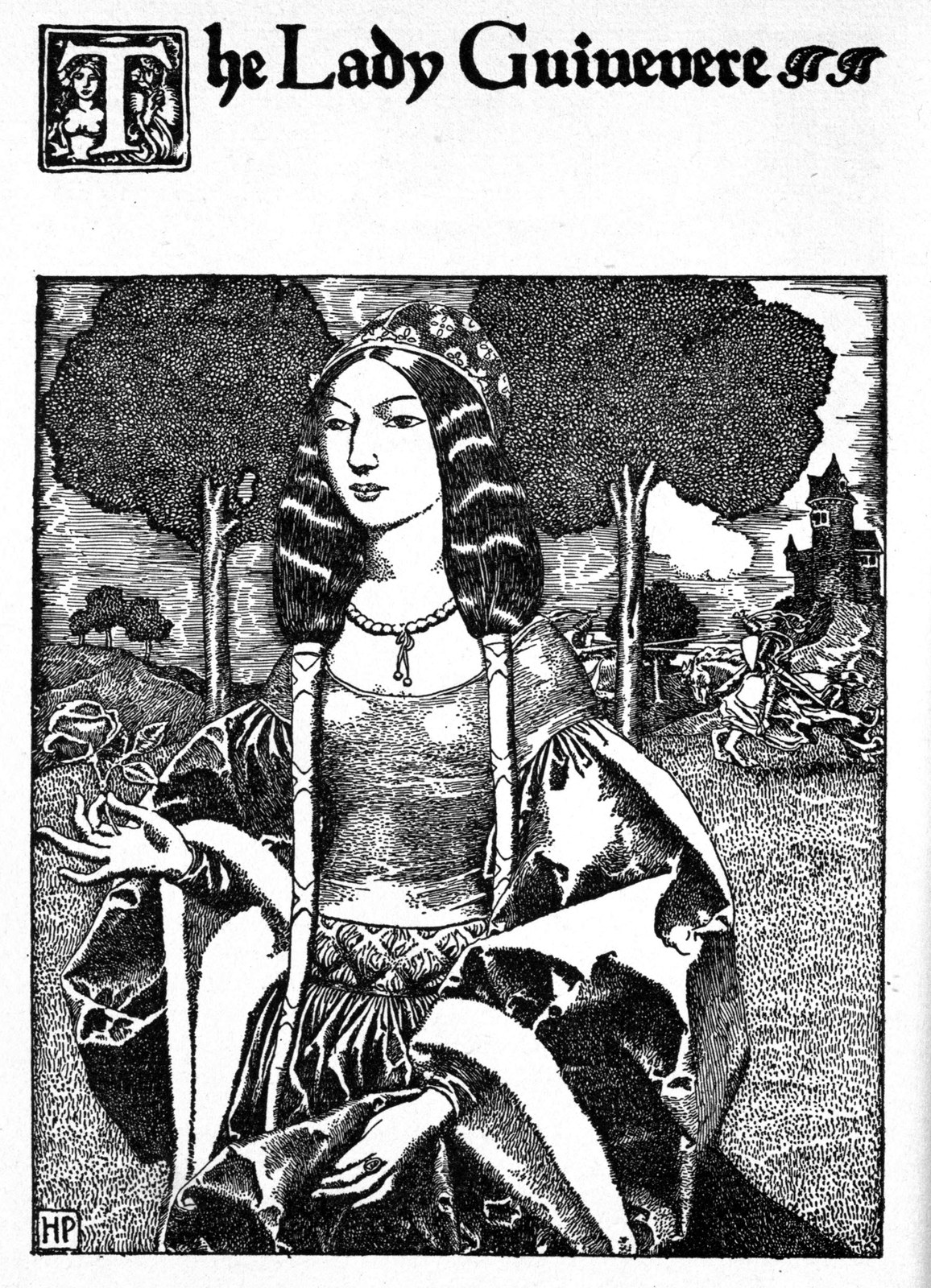
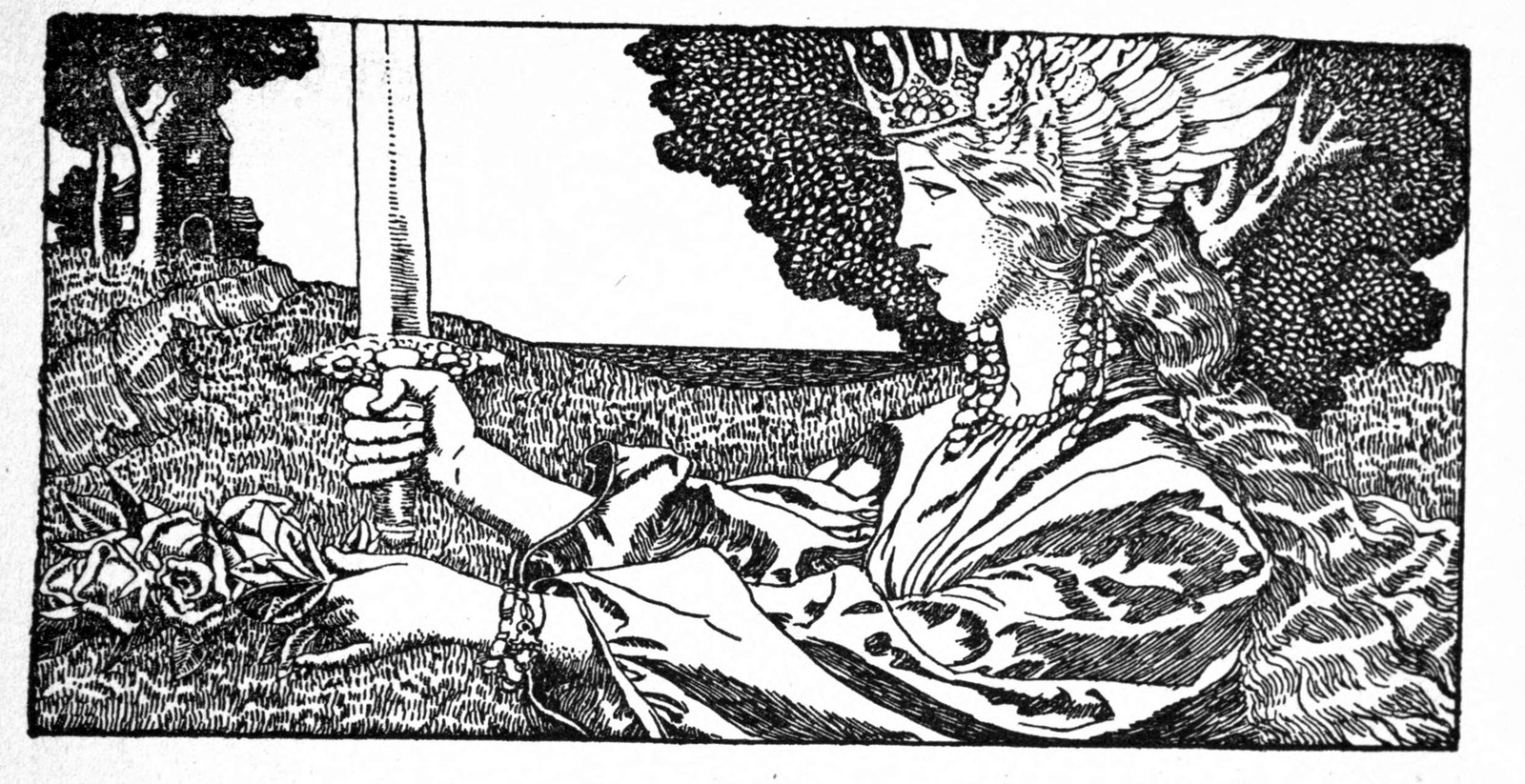
How King Arthur held a feast at Caerleon on Usk.
Now one day King Arthur proclaimed a high feast, which was held at Caerleon on Usk. Many noble guests were invited, and an extremely splendid Court gathered at the King's castle. For at that feast there sat seven kings and five queens in royal state, and there were high lords and beautiful ladies of rank, sixty-seven of them in all; and there was a great crowd of those famous knights of the King's Court who were counted the most renowned in arms in all of Christendom. And of all this great gathering of kings, lords, and knights, not one man looked sideways at his neighbor with suspicion, but all were united in good fellowship. So when the young King looked around him and saw such peace and friendship among all these noble lords, where before there had been quarreling and ill will, he said to himself, "Truly, it is wonderful how this reign of mine has knit men together in kindness and good fellowship!" And because of thoughts like these, his spirit took wing like a bird and sang within him.
Now while the King sat feasting like this, suddenly there came a herald, a messenger from the west country. And the herald came and stood before the King and said, "Greetings to you, King Arthur!"
Then the King said, "Speak, and tell me what your message is."
A herald-messenger comes from the west country.
To this the herald replied: "I come from King Leodegrance of Cameliard, who is in great trouble. For this is how things stand. His enemy and yours, King Rience of North Wales (the one who once, in scorn of you, commanded you to send him your beard to trim his cloak), is making several demands of my master, King Leodegrance, and King Leodegrance is entirely unwilling to grant them. And King Rience of North Wales threatens to bring war into Cameliard because King Leodegrance does not grant those demands at once. Now King Leodegrance no longer has such a host of knights and armed men around him as he once had to defend his kingdom against attack. For since you in your majesty have brought peace to this realm, and have brought low the power of all the kings beneath you, those knights who once made the Court of King Leodegrance so famous have gone elsewhere to look for better chances to show their great courage and skill at arms than his peaceful Court can offer. And so my master, King Leodegrance, begs help from you, who are his King and High King."
King Arthur, and all the Court that feasted with him, listened to what the herald said in complete silence. And the King's face, which a moment before had been open and cheerful, grew clouded and dark with anger. "Ha!" he cried. "This is no good news, truly, that you have brought here to our feast. Now I will give your master, King Leodegrance, whatever help I can in this hour of need, and I will give it quickly. But tell me, sir herald, what things is it that King Rience demands of your master?"
"That I will tell you, Lord," said the herald. "First, King Rience demands from my master a great part of those lands of Cameliard that lie along the borders of North Wales. Second, he demands that the Lady Guinevere, the King's daughter, be given in marriage to Duke Mordaunt of North Umber, who is a kinsman of King Rience. And that Duke, though he is a mighty warrior, is so evil to look at, and so violent of temper, that I believe there is no one like him for ugliness or for madness of mood in all the world."
King Arthur is very angry at the message the herald brings.
Now when King Arthur heard what the messenger said, he was seized at once with an extraordinary fit of anger. His eyes seemed, as it were, to shoot out sparks of pure light; his face flamed like fire; and he ground his teeth together like the stones of a hand mill grinding grain. Then he rose at once from the chair where he sat and went out of that place, and everyone who saw his anger shuddered at it and turned their eyes away from his face.
Then King Arthur went by himself into an inner room of the castle, and there he walked up and down for a long while, and in all that time no one of his household dared come near him. And the reason for the King's fury was this. Ever since he had lain wounded and sick almost to death in the forest, he had remembered how the Lady Guinevere had suddenly appeared before him like some tall, straight, shining angel come down to him out of Paradise, all full of pity, and extremely beautiful. So at the thought of that wicked, mad Duke Mordaunt of North Umber demanding to marry her, he was seized with a rage so violent that it shook his spirit like a mighty wind.
So for a long while he walked up and down in his fury, as I have said, and no one dared come near him, but everyone stood far off, watching him from a distance.
Then, after a while, he gave orders that Merlin and Sir Ulfius and Sir Kay should come to him where he was. And when they had come, he talked with them for a good while. He told Merlin to make ready to go on a journey with him, and he told Sir Ulfius and Sir Kay to gather a large army of chosen knights and armed men, and to bring that army straight into the country around the royal castle of Tintagalon, which stands close to the borders of North Wales and of Cameliard.
So Sir Ulfius and Sir Kay set about doing as King Arthur commanded, and Merlin also set about doing as he commanded. And the next day King Arthur and Merlin set out for Tintagalon across the forest country of Usk, together with certain famous knights of the King's Court who had proved themselves the best at arms of all those around him: namely, Sir Gawain and Sir Uwain (who were the King's nephews), and Sir Pelleas, and Sir Geraint, the son of Erbin.
How King Arthur came to Tintagalon.
They traveled all that day and part of the next, and they met with no adventure or misadventure of any kind. And so at last they came to that large and noble castle called Tintagalon, which guards the country bordering on Cameliard and North Wales. Here King Arthur was welcomed with great rejoicing, for wherever the King went the people loved him very dearly. So the folk of Tintagalon were very glad when he came to them.
Now on the morning after King Arthur came to Tintagalon (the summer night having been very warm), he and Merlin were glad to get up early and go out to enjoy the dewy freshness of the early day. So in the cool of the morning they walked together in the garden, which was a very pleasant place, beneath the shadow of a tall, straight tower. And all around were many trees giving good shade, where the little birds sang sweetly in the cheerfulness of the summer weather.
And here King Arthur opened his heart very freely to Merlin, and he said: "Merlin, I truly believe that the Lady Guinevere is the most beautiful lady in all the world. And so my heart always seems to be completely filled with love for her, so much so that I think of her all day long (whether I am eating, or drinking, or walking, or sitting still, or going about my business), and I dream of her many times at night as well. And it has been this way with me, Merlin, ever since a month ago, when I lay sick in that hermit's cell in the forest, and she came and stood beside me like a shining angel out of Paradise. So I am not willing that any man other than I should have her for his wife.
King Arthur opens his heart to Merlin.
"Now I know very well that you are wonderfully skilled in those arts of magic that can change a man's appearance so that even those who know him best cannot recognize him. So I very much want you to disguise me in such a way that I can go into Cameliard without anyone knowing me, and live there in such a way that I can see the Lady Guinevere every day. For I tell you truly, I greatly wish to look upon her in such a way that she will not know in the least that I am watching her. I would also like to see for myself how great the dangers are that surround King Leodegrance, for the King is my very good friend."
"My Lord King," said Merlin, "it shall be as you wish, and this very morning I will disguise you so well that no one in all the world will be able to tell who you are."
So that morning, a little before the early hour of prayer, Merlin came to the King where he was and gave him a little cap. And the cap was of such a kind that when the King put it on his head, he took on in an instant the appearance of a rough country fellow from the farmlands. Then the King ordered a jerkin of coarse wool to be brought to him, and with this he covered his royal and knightly clothes, and with it he hid the golden collar and the jewel hanging from it, which he always wore around his neck. Then, putting the cap on his head, he at once took on the look of that peasant farmhand.
King Arthur leaves Tintagalon in disguise.
And so, completely disguised, he left Tintagalon without anyone knowing him, and made his way on foot to the town of Cameliard.
Now toward the slanting of the day he drew near that place, and there in front of him he saw a large and important town of many handsome houses with red walls and shining windows. The houses of the town all sat on a high, steep hill, one above another, and the town itself was surrounded by a great wall, high and strong. A great castle guarded the town, and the castle had very many towers and roofs. And all around the tower there were many lovely gardens and lawns and meadows, and several orchards and groves of trees with thick and pleasant shade. Now at that time of day the sky behind the tower was, as it were, one single flame of fire, so that the towers and the battlements of the castle, and its roofs and chimneys, stood out completely black against the brightness of the light. And great flocks of pigeons circled the towers of the castle, flying on and on against that fiery sky. And because King Arthur was weary from walking all day, it seemed to him that he had hardly ever in all his life seen so lovely and pleasant a place as that fine castle with its gardens and lawns and groves of trees.
King Arthur comes to Cameliard.
So King Arthur came to the castle of Cameliard in the guise of a poor peasant from the countryside, and no one in all the world knew who he was.
When he had reached the castle, he asked for the head gardener. And when he got to speak with the gardener, he begged to be taken on as a servant in that part of the garden that belonged to the Lady Guinevere's dwelling. The gardener looked him over and saw that he was tall and strong and well built, so he liked him very much and took him into his service, just as he wished.
And that is how King Arthur of Britain became a gardener's boy at Cameliard.
King Arthur lives as gardener's boy at the castle.
Now the King was very glad to be in that garden, for in this pleasant summer season the Lady Guinevere came every day to walk with her damsels among the flowers, and King Arthur, disguised as a peasant gardener's boy, saw her a great many times when she came there.
So King Arthur stayed in that place for more than a week, and he did not care at all that in all that time he enjoyed none of the splendor of a king, but was only a gardener's boy in the castle garden of Cameliard.
Now it happened one day, when the weather was very warm, that one of the damsels who waited on the Lady Guinevere got up very early in the morning, while the air was still cool and fresh. Leaving the Lady Guinevere still asleep, this damsel, whose name was Mellicene of the White Hand, went into the anteroom, and opening its window, looked out into the rose garden that lay next to the Lady Guinevere's private rooms.
Now in that place there stood a carved marble figure of a youth holding a marble pitcher in his arms, and a fountain of water, as clear as crystal, flowed out of the pitcher into a marble basin. The figure, and the fountain, and the marble basin into which the fountain flowed all lay beneath the shade of a linden tree. And all around grew a thick tangle of roses, so that the place was completely hidden except from those windows of the castle that were above it.
The damsel sees a knight at the fountain.
And so, as the damsel looked down toward it out of the window, she saw a very wonderful sight. For there was a strange knight, kneeling beside the fountain and bathing his face and his chest in its crystal water. The damsel saw that the sunlight fell down through the leaves of the linden tree and lay on that strange knight. And she saw that his hair and his beard were the color of red gold, shining wonderfully in the brightness of the morning. And she saw that his brow and his throat and his chest were as white as alabaster. And she saw that around his neck and shoulders there hung a golden collar of marvelous beauty, so that when the sunlight shone on it, it flashed like pure lightning.
So, seeing this strange sight, which was like a vision, the damsel Mellicene stood for a long while, quite spellbound with wonder and delight. She did not know whether what she saw was a dream or not, nor whether the one who sat there was a spirit or a man of flesh and blood.
Then, by and by, coming partly to herself after her astonishment, she drew back softly from the window, turned around, and ran swiftly down the turret stairs, and so came out into that lovely, blooming garden at the foot of the tower. She ran through the garden as fast and as quietly as she could, and so came down a pathway to the marble fountain and the linden trees and the rosebushes around it, where she had just now seen that strange knight bathing in the crystal water.
The damsel finds only the gardener's boy.
But King Arthur had heard the damsel coming, and had quickly put the cap back on his head. So when the damsel Mellicene got there, she found no one by the fountain but the gardener's boy. She demanded of him, "Who are you, fellow? And why are you sitting here by the fountain?"
And he answered her, "I am the gardener's lad who came here a little while ago to take service in this place."
"Then tell me, fellow," she said, "and tell me truly. Who was that young knight who was here beside the fountain just now, and where has he gone?" "Lady," he said, "there has been no one at this fountain today but me."
"No, fellow," she cried, "you are deceiving me, for I assure you that I saw with my own eyes, just now, a strange young knight sitting here bathing himself in the water of this fountain." And the gardener's boy said, "Lady, what I have told you is the very truth, for indeed no one has been here this morning but me. So if you think you saw anyone else, you are certainly mistaken."
At this the damsel fixed her gaze on him in great bewilderment. She wondered at it very much as well, for she could not altogether disbelieve him. And yet she could not entirely believe him either, because her eyes had seen what they had seen, and she knew she had not been mistaken. So she did not know what to think, and because she was so puzzled, she felt very annoyed with that gardener's boy. "Truly," she said, "if you are deceiving me, I will certainly make you suffer a great deal of pain, for I will have you whipped with cords." With that she turned and went away from that place, wondering greatly at that strange thing and what it could all mean.
That morning she told the Lady Guinevere everything she had seen, but the Lady Guinevere only laughed at her and teased her, telling her that she had been asleep and dreaming when she saw that vision. And indeed, the damsel herself had begun to think this must be so. All the same, after that she looked out of her window every morning, though for a long while she saw nothing, for King Arthur did not come back to that place for some time.
And so, by and by, there came another morning when she looked out of the window, and there sat that strange knight by the fountain once more, just as he had sat before. And he bathed his face and his chest in the water as he had done before. And he looked as handsome and as noble as he had looked before, and his hair and his young beard shone like gold in the sun as they had shone before. And this time she saw that his golden collar lay on the edge of the fountain beside him, and it sparkled with great splendor in the sunlight while he bathed his chest. Then, after the damsel had watched him for a good while, she ran as fast as she could to the room where the Lady Guinevere still lay, and she cried out loudly, "Lady! Lady! Wake up and come with me! For that same young knight I saw before is bathing himself at the fountain under the linden tree right now!"
Then the Lady Guinevere, wondering greatly, got up very quickly, and dressing herself in all haste, went with the damsel to the window that looked out on that part of the garden.
The Lady Guinevere sees the knight at the fountain.
And there she herself saw the young knight as he washed himself at the fountain. She saw that his hair and his beard shone like gold in the sunlight. She saw that his undershirt was of purple linen threaded with gold. And she saw that beside him lay that skillfully made collar of gold, set with many jewels of different colors, and the collar shone with great splendor where it lay on the marble rim of the fountain.
For a while she gazed, utterly astonished. Then she told the damsel Mellicene to come with her, and with that she turned and went down the turret stairs and out into the garden, just as her damsel had done before. Then, as that damsel had done, she hurried as fast as she could down the pathway toward the fountain.
But when she got there, she found no young knight, but only the gardener's boy, exactly as had happened to the damsel Mellicene before. For King Arthur had heard her coming, and had at once put that enchanted cap on his head. Then the Lady Guinevere wondered greatly to find only the gardener's boy there, and she did not know what to think of so strange a thing. So she demanded of him, just as Mellicene had done, where the young knight had gone whom she had seen there at the fountain just a moment ago. And the gardener's lad answered her as before: "Lady! There has been no one at this place at any time this morning but me."
Now when King Arthur had put on his cap as the Lady came, he had, in his great haste, forgotten his golden collar, and Guinevere saw it lying there, shining very brightly, beside the edge of the fountain. "What is this?" she said. "Would you dare to make a fool of me? Now tell me, you fellow, do gardeners' boys in the land you come from wear golden collars around their necks, like that collar lying over there beside the fountain? Now, if I had you soundly whipped, it would be no more than you deserve. But take that trinket over there and give it to the one it rightly belongs to, and tell him from me that it ill becomes a true belted knight to hide himself away in a lady's private garden." Then she turned with the damsel Mellicene and left that place and went back to her rooms.
And yet, all that day, as she sat over her embroidery, she never stopped marveling and wondering how it could be that the strange young knight had vanished so suddenly and left only the poor gardener's boy in his place. And for a long time she could not solve that strange riddle.
Then, all of a sudden, at the time when the heat of the day was sloping toward the cooler part of the afternoon, she sat up because of a thought that had come to her in an instant. So she called the damsel Mellicene to her, and told her to go and tell the gardener's lad to bring her a basket of fresh roses at once to decorate her tower room.
The gardener's boy wears his cap before the Lady Guinevere.
So Mellicene went and did as she was told, and after a good while the gardener's lad came carrying a great basket of roses. And he was wearing his cap on his head. And when all the damsels waiting on the Lady Guinevere saw that he wore his cap in her presence, they cried out against him, and Mellicene of the White Hand demanded of him, "What! What is this, Sir Lout? Do you know so little of what is owed to a king's daughter that you wear your cap even in the presence of the Lady Guinevere? Now I order you to take that cap off your head this instant."
And King Arthur answered her, "Lady, I cannot take off my cap."
The Lady Guinevere said, "And why can't you take off your cap, you surly fellow?"
"Lady," he said, "I cannot take off my cap because I have an ugly spot on my head."
"Then wear your cap," said the Lady Guinevere. "Only bring the roses to me."
The Lady Guinevere discovers the knight of the fountain.
So at her command he brought the roses to her. But when he had come near the lady, she suddenly snatched at the cap and plucked it off his head. And in that instant he was transformed, for instead of the gardener's boy there stood before the Lady Guinevere and her damsel the figure of a noble young knight with hair and beard like threads of gold. Then he let his basket of roses fall, so that the flowers were scattered all over the floor, and he stood and looked at everyone there. And some of the damsels waiting on the Lady Guinevere shrieked, and others stood still in pure amazement and did not know how to believe what their eyes were seeing. But not one of those ladies knew that the man she was looking at was King Arthur. Still, the Lady Guinevere remembered that this was the knight she had found so badly wounded, lying in the hermit's cell in the forest.
Then she laughed and tossed him back his cap. "Take your cap," she said, "and go on your way, you gardener's boy with the ugly spot on his head." She said this because she wanted to tease him.
But King Arthur did not answer her. Instead, very soberly, he put his cap back on his head at once. And so, taking on his humble disguise once more, he turned and left that place, leaving the roses scattered all over the floor just as they had fallen.
And after that, whenever the Lady Guinevere came upon the gardener's lad in the garden, she would say to her damsel, in a voice loud enough for him to hear, "Look! There is the gardener's lad who has an ugly spot on his head, so that he always has to wear his cap to hide it."
So she spoke openly, teasing him. But privately she told her damsels to say nothing about these things, and to keep everything that had happened to themselves.
Chapter 2: How King Rience Came to Cameliard, and How King Arthur Fought the Duke of North Umber
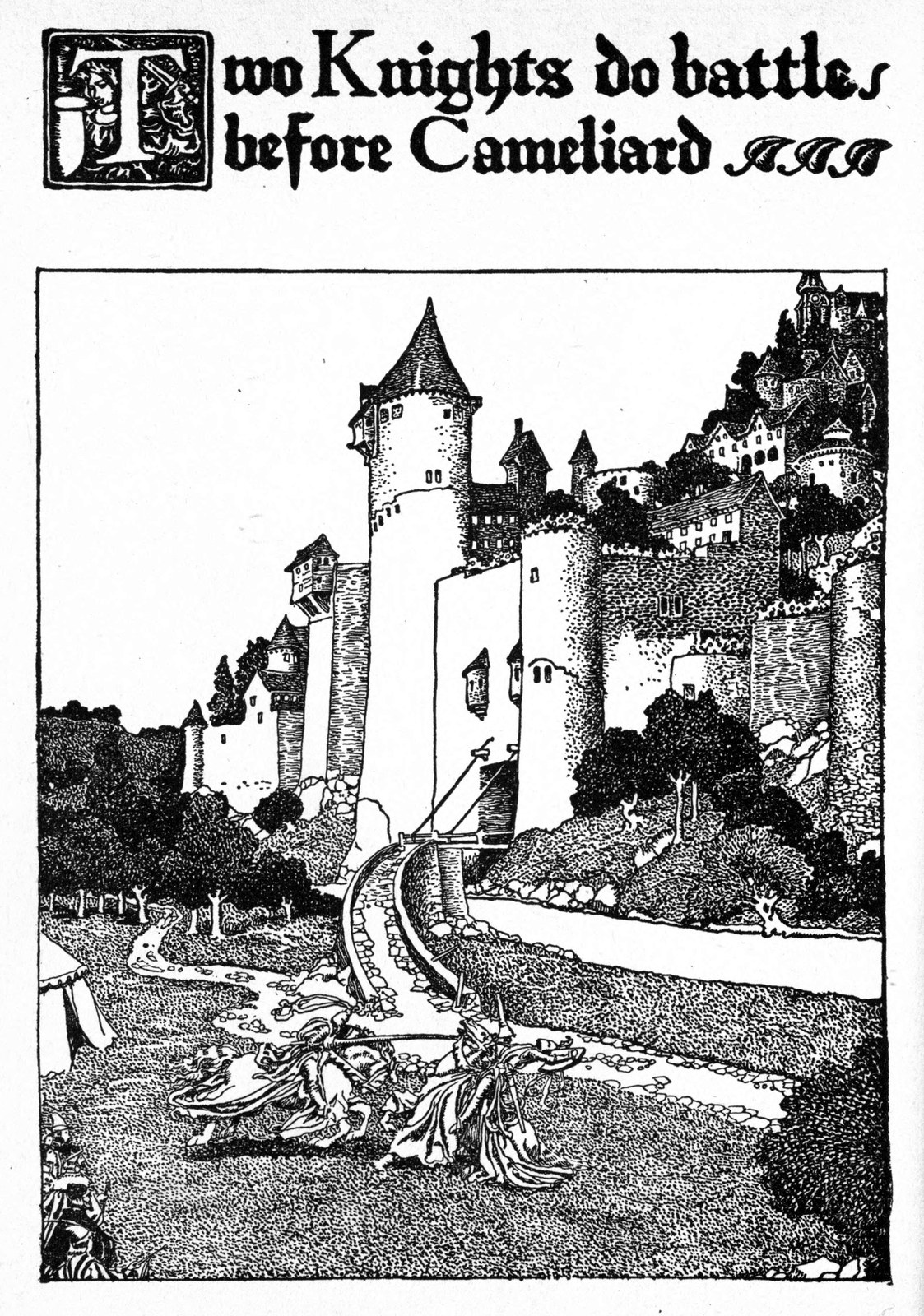
King Rience and Duke Mordaunt come to Cameliard.
Now one day about this time a messenger came to the Court of King Leodegrance with news that King Rience of North Wales and Duke Mordaunt of North Umber were on their way there, and that they were bringing with them a very noble and very large Court of knights and lords. King Leodegrance was much troubled in spirit at this news. He did not know what such a visit might mean, and yet he greatly feared that it meant trouble for him. So on the day that King Rience and the Duke of North Umber appeared before the castle, King Leodegrance went out to greet them, and the three of them met in the meadows that lie beneath the castle walls of Cameliard.
There King Leodegrance welcomed them in a fitting manner, and asked them to come into the castle with him so that he might entertain them as their rank deserved.
The King and the Duke send a challenge to King Leodegrance.
But King Rience did not trouble to give any pleasant answer to this courtesy of King Leodegrance's. "No," he said, "we will not go with you into your castle, King Leodegrance, until we learn whether you are our friend or our enemy. For right now, truly, we are not such good friends of yours that we care to sit down at your table and eat your salt. Nor can we be anything but your enemies until you have first satisfied our demands: that is, that you give me the lands I have demanded of you, and that you give my cousin, Duke Mordaunt of North Umber, the Lady Guinevere to be his wife. In these matters it is in your power to make us either your friends or your enemies. So we will stay here, outside your castle, for five days. In that time you may frame your answer, and so we shall know whether we are to be friends or enemies."
"And in the meantime," said Duke Mordaunt of North Umber, "I hold myself ready to fight for my right to the hand of the Lady Guinevere against any knight of your Court who cares to deny my just claim to her. And if there is no knight in all your Court who can stand against me in a bout of arms, then you yourself can hardly hope to defend yourself against the great army of knights that King Rience has gathered to bring against you, if you refuse us what we ask."
Then King Leodegrance was terribly downcast, for he feared those proud lords and did not know what to say in answer to them. So he turned and walked back into his castle, weighed down with great anxiety and sorrow. And King Rience and Duke Mordaunt and their Court of lords and knights pitched their pavilions in the meadows facing the castle, until the whole plain was covered with them. There they made their lodging with great rejoicing, with the sound of feasting and singing and merrymaking, for it was a very noble Court that King Rience had gathered around him.
Duke Mordaunt rides before the castle.
When the next morning came, Duke Mordaunt of North Umber rode out clad all in armor of proven strength. He rode up and down the field before the castle and shouted a great challenge to those within, daring any knight to come out and meet him in knightly combat. "Ho!" he cried. "What now, you Knights of Cameliard! Is there no one who will come out to meet me? How can you hope to stand against the Knights of North Wales, if you are afraid to meet one single knight from North Umber?" So he jeered at them in his pride, and no one dared to come out of Cameliard against him. For the Duke of North Umber was one of the most famous knights of his day, of enormous strength and great success in arms, and now, in these times of peace, there was no one in King Leodegrance's Court who was anywhere near able to face a warrior of such proven skill and valor. So no one took up the challenge that the Duke of North Umber gave to the Court of Cameliard. Meanwhile many people gathered on the walls of Cameliard and gazed down at that proud and haughty duke, all decked out in his splendid armor, and they were all grieved and ashamed that there was no one in that peaceful town to go out against him. And all the lords and knights of King Rience's Court came and stood in front of the King's pavilion, and laughed and clapped their hands and cheered Duke Mordaunt as he rode up and down before them. And the merrier they grew, the more shamefaced the people of Cameliard became. "Ho! Ho!" cried that proud Duke. "What now! Will no one come out to meet me? How then can you of Cameliard hope to face the King of North Wales and all his knightly army, when I am only one man of it?" And the people of Cameliard, gathered on the walls, listened to him in shame and sorrow.
Now all this while King Arthur was digging in the garden. Even so, he knew very well everything that was happening, and how the Duke of North Umber was riding so proudly up and down before the castle walls. And suddenly it came to him that he could not bear it any longer. So he laid aside his spade and slipped out secretly by a back way, and went up into the town.
Now there was in Cameliard a very rich merchant named Ralph of Cardiff, and the fame of his wealth and his high position had reached even King Arthur's ears at Caerleon. So it was to his house that King Arthur made his way.
King Arthur seeks armor to do battle.
And while he was in a narrow lane not far from the merchant's house, he took off his magic cap of disguise and took on something of his noble appearance once more, for now he meant to let those who looked at him see that he was a knight. So when he stood before the rich merchant in his private room, and the merchant looked up into his face, the merchant did not know what to think at seeing so noble a lord dressed all in frieze, the coarse woolen cloth of working people. For though King Arthur was a stranger to the good man, so that he did not know his face, the merchant could tell that he was no ordinary knight, but surely someone of high rank and authority, even though he was dressed in frieze.
Then King Arthur opened the front of his jerkin and showed the merchant the gold collar that hung around his neck. He also showed him that under the rough frieze coat he wore an undergarment of fine purple silk embroidered with gold. And then he showed the good man his own signet ring, and when the merchant saw it, he knew it for the ring of the King of Britain. So, seeing these signs of high and lordly authority, the merchant rose and stood before the King and took off his cap.
"Sir Merchant," said the King, "you should know that I am a stranger knight here in disguise. Even so, I can tell you that I am a very good friend to King Leodegrance and wish him very well. You surely know how the Duke of North Umber rides up and down continually before the King's castle, and challenges anyone inside to come out and fight him for the Lady Guinevere. Now I have a mind to try that combat myself, and I very much hope that I will succeed in upholding the honor of Cameliard and in bringing shame on its enemies.
"Sir Merchant, I know very well that you have several suits of noble armor in your treasury, for their fame has reached my ears even though I live a good distance from here. So I want you to equip me as well as you are able, so that I can go at once and try a bout of arms with that Duke of North Umber. And I pledge you my knightly word that you shall be fully paid for the best suit of armor you can let me have, and that within a very little while."
"My Lord," said Master Ralph, "I can see that you are no ordinary wandering knight, but someone of very high rank; so it is a great pleasure to carry out all your wishes. But even if you were other than you are, I would be entirely willing to equip you with armor, since you have a mind to ride out against that duke over there."
At this he rang a little silver bell that stood near him, and at its sound several attendants appeared at once. Into their hands he gave the King, telling them to do him extraordinary honor. So some of those attendants prepared a bath of warm water for the King, perfumed with ambergris and very pleasant to the body. And after he had bathed in it and been dried with soft linen towels, other attendants led him to a hall all hung with tapestries and embroideries, and there a noble feast had been spread ready for his refreshment. Here the lordly merchant himself waited on the King, serving him with meats of several kinds, all very delicate, and with fine white bread as well. And he poured him wines from many countries, some as red as rubies and others as yellow as gold. Indeed, the King had hardly ever enjoyed a better feast than the one that the merchant Ralph of Cardiff had spread for him.
King Arthur is armed by Ralph of Cardiff.
And after he had refreshed himself fully with eating, six pages came, richly dressed in fine azure silk, and they took the King to a very grand room and there dressed him in a suit of Spanish armor, most skillfully made and all inlaid with gold. Armor like it could hardly be found anywhere in the land. The jupon, the cloth tunic worn over the armor, and all the other trappings of the armor were of satin as white as milk. And the shield was white, with no coat of arms or emblem of any sort upon it. Then these attendants led the King into the courtyard, and there stood a noble war-horse, as white as milk. All the trappings of the horse were of milk-white cloth, with no emblem or ornament of any kind, and the bridle and the reins were studded all over with knobs of silver.
Then, after the attendants had helped King Arthur mount this horse, the lordly merchant came forward and gave him many words of good cheer, and the King said farewell to him and rode away, all shining in white and glittering in his fine armor, so that he looked like the full moon at harvest time.
And as he rode down the stony streets of the town, the people turned and gazed after him, for he made a very noble sight as he passed along the narrow way between the houses.
So King Arthur made his way to the postern gate of the castle, and when he reached it he dismounted and tied up his horse. Then he went straight into the garden, and finding an attendant there, he asked to speak with the Lady Guinevere at once. The attendant, amazed at his lordly bearing, went and delivered the message. And after a while the Lady Guinevere came, wondering greatly, and walked along a gallery with several of her damsels until she stood above the place where King Arthur was. And when King Arthur looked up and saw her above him, he loved her with all his heart. And he said to her: "Lady, I have a great wish to do you whatever honor I can. For I am going out now to fight that Duke of North Umber who rides up and down before this castle. And I hope, and truly believe, that I shall bring about his downfall. So I beg of you some token, such as a lady may give a knight to wear when he rides out to do her honor."
The Lady Guinevere accepts King Arthur as her champion.
Then the Lady Guinevere said: "Truly, Sir Knight, I wish I knew who you are. Yet, though I do not know, I am entirely willing to take you for my champion, as you offer. So, as for the token you speak of, if you will tell me what it is you want, I will gladly give it to you."
"If that is so, Lady," said King Arthur, "I would very much like to have the necklace you wear around your throat. For it seems to me that if I had it tied around my arm, I would find my courage greatly increased by it."
"Indeed, Sir Knight," said the Lady, "what you ask of me you shall certainly have." And as she spoke, she took from her long, smooth neck the necklace of pearls she was wearing, and dropped it down to King Arthur where he stood.
And King Arthur took the necklace and tied it around his arm, and thanked her warmly for it. Then he saluted the Lady Guinevere with very knightly grace, and she saluted him in return. And then he went straight away from that place, swelling with joy that the Lady Guinevere had shown him such favor.
Now word had gone around Cameliard that a knight was going out to fight the Duke of North Umber. So great crowds gathered on the walls, and King Leodegrance and the Lady Guinevere and the whole Court of the King came to the part of the castle walls that overlooked the meadow where the Duke of North Umber held the field. So huge a crowd was soon gathered that any knight might be encouraged to do his very best before such a multitude as looked down on that field.
Then suddenly the portcullis of the castle was raised and the drawbridge let down, and the White Champion rode out to the combat he had undertaken. And as he rode across that narrow bridge, the hoofs of his war-horse struck the planks with a noise like thunder. And when he came out into the sunlight, his armor suddenly blazed like lightning, and when the people saw him they shouted aloud.
Then, when the Duke of North Umber saw a knight all clad in white, he rode straight to him and spoke to him with words of knightly greeting. "Sir," he said, "I see that you wear no crest on your helmet and have no emblem of any sort on your shield, so I do not know who you are. Even so, I believe that you are a knight of good rank and proven courage, or else you would not have come here like this."
"Truly, Sir Knight," said King Arthur, "I am of a rank equal to your own. And as for my courage, I believe it has been proven in as many combats as yours has."
"Sir Knight," said the Duke of North Umber, "you speak with a very large spirit. Even so, you had better say whatever prayers you can, for I am about to throw you down from your saddle so hard that you will never get up again. That is how I have served better men than you can ever hope to be."
To this King Arthur answered very calmly: "That will be as Heaven wills, Sir Knight, and not as you will."
King Arthur overthrows Duke Mordaunt.
So each knight saluted the other and rode to his appointed place, and there each set his spear and his shield and made himself ready for the charge. Then a silence fell over everyone, so deep that a man could hear his own heart beating in the stillness. For a little while each knight sat like a statue made of iron. Then, suddenly, each shouted to his war-horse and drove his spurs into its flanks and launched himself forward from his place. And so they met in the middle of the course with a noise like a violent clap of thunder. And the spear of the Duke of North Umber burst into splinters right down to the handle. But King Arthur's spear did not break; it held, so that the Duke was hurled out of his saddle like a windmill, whirling through the air and striking the earth so hard that the ground shuddered beneath him. Indeed, he rolled over and over a full three times before he stopped falling.
Then all the people on the wall shouted with all their might, so that the noise of it was altogether astonishing; for they had hardly dared to hope that their champion would prove so extraordinarily strong and skillful.
Meanwhile, the men of King Rience's Court ran at once to the Duke of North Umber where he lay on the ground, and they quickly unlaced his helmet to give him air. At first they thought he was dead, and then they thought he was likely to die, for he lay without any life or motion at all. Nor did he come out of the faint in which he lay for a full two hours and more.
Now while the attendants were busy around Duke Mordaunt of North Umber, King Arthur sat on his horse very quietly, watching everything they did. Then, seeing that his enemy was not dead, he turned around and rode away from that place.
He did not go back into Cameliard at that time. For he judged that he was not yet entirely finished with these enemies to the peace of his realm, and so he meant not to return the horse and the armor to the merchant just yet, but to keep them a while for another occasion.
So he remembered how, on his way to Cameliard, he had passed through an arm of the forest where some woodcutters were at work felling trees. And, remembering that place, he thought he would go there and leave his horse and armor in the care of those simple country folk until he needed them again. So now he rode away into the countryside, leaving behind him the town and the castle and all the noise of shouting and rejoicing. And he did not once so much as turn his head to look back at the place where he had so violently overthrown his enemy.
And now you will soon hear of some pleasant and very joyous adventures that happened to him before he had accomplished all his purposes. For when a man is a king among men, as King Arthur was, he is of so calm and even a temper that neither victory nor defeat can make him either puffed up in his own opinion or so troubled in spirit that he is cast down into despair. So if you want to become like King Arthur, you will take all your triumphs as he took this victory. You will not be turned aside from your final purpose by the great applause that many people may give you, but you will first finish the work you have set yourself to do before you let yourself sit down at ease and enjoy the fruits of your victory.
Yes, he who is a true king of men will not say to himself, "Look! I am worthy to be crowned with laurels." Instead he will say to himself, "What more is there that I can do to make the world better because of my efforts?"
Chapter 3: How King Arthur Met Four Knights, and What Came of It
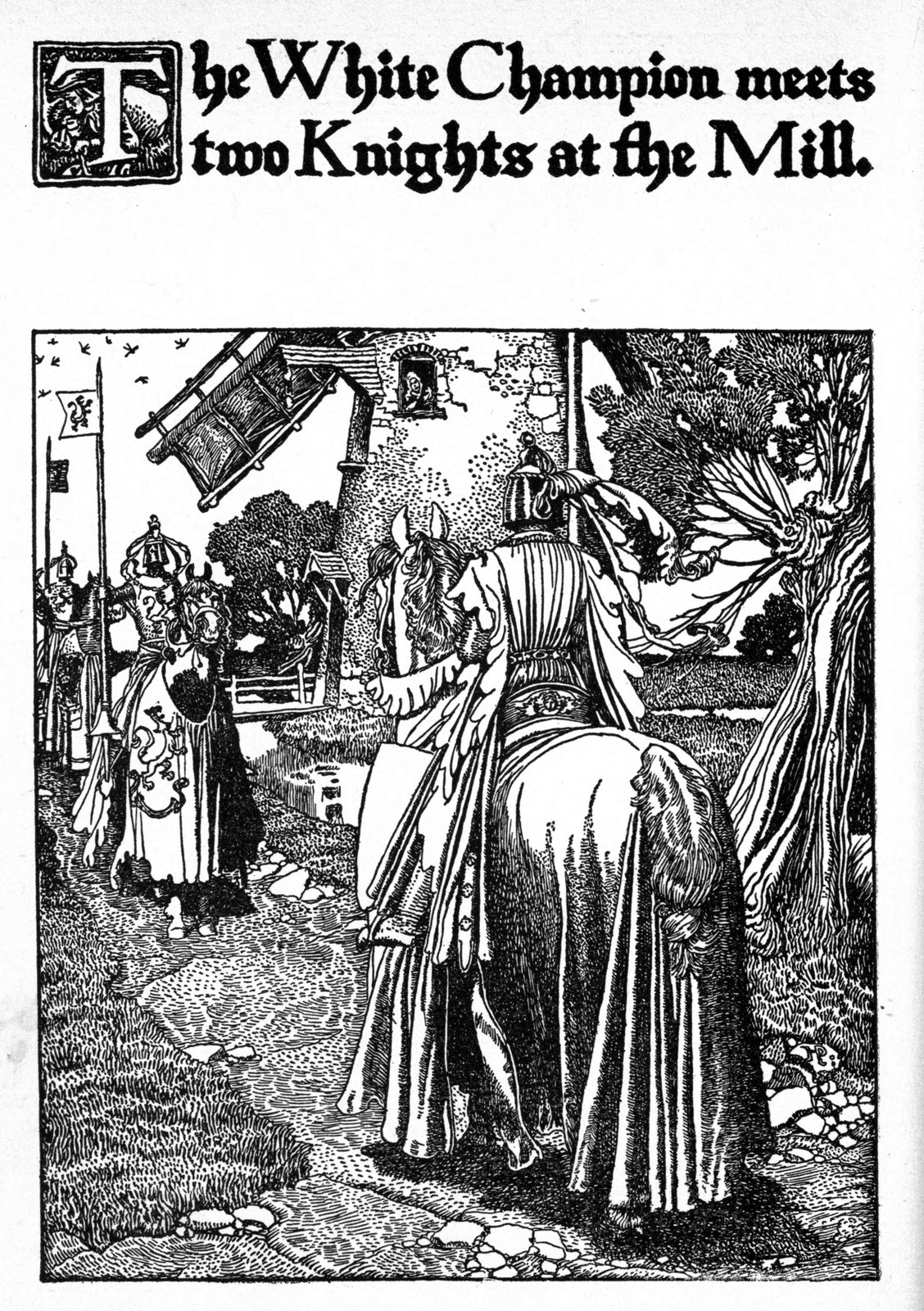
Now the day was wonderfully sweet and pleasant to someone as strong of body and as light of heart as good King Arthur. For the bright clouds sailed smoothly across the blue sky in enormous heaps of vapor, and the wind blew across the long grass of the meadowlands and across the fields of growing wheat, so that a multitude of waves rolled over the hills and valleys as if over a whole sea of green. One moment the whole earth would be darkened by the wide shadows of those clouds, and the next, everything would suddenly burst out again into a wonderful radiance of sunlight. The little birds sang merrily in the hedgerows and the leafy thickets as though they would burst their tiny throats with singing, and the rooster crowed, loud and lusty, from the farmyard. Everything was so bright and lovely that the young King, with the visor of his helmet raised to let in the cool of the gentle breeze, would sometimes sing out very joyfully as he went along. So King Arthur traveled in that gay and tender summer season, when the earth was young, in the days of long ago.
Now you must remember that when King Arthur came from Caerleon to the castle of Tintagalon, he brought four young knights with him to keep him company. These were the knights: there was Sir Gawain, the son of King Lot and Queen Margaise; and there was Sir Uwain, the son of King Uriens and Queen Morgan le Fay (and these two were the King's nephews, by his half sisters); and there was Sir Pelleas; and there was Sir Geraint, the son of Erbin. These were the four noble young knights who had come with King Arthur from Camelot to Tintagalon.
King Arthur comes upon a knight entertaining the ladies in green.
Now it happened, as King Arthur rode along so merrily in the summertime, that he came to a certain part of the road where he saw before him a tall and handsome tower standing on a green hillock right beside the road. And there on the balcony of that tower stood three lovely damsels, dressed all in green taffeta. And on the high road in front of the castle there was a knight in very fine armor. The knight sat on a noble war-horse, and in his hands he held a lute, and he played on the lute and sang in a voice of extraordinary sweetness. While he sang, those three ladies in green taffeta listened to him with very cheerful faces. And whenever the knight stopped singing, the three ladies would clap their hands with great applause and beg him to sing to them again; and he would do so very readily.
King Arthur saw all this, and it seemed to him a very pleasant sight, so that he was greatly delighted by it.
And as he drew near, he saw that the knight who sat on his horse there, playing the lute and singing to it, was none other than Sir Geraint, the son of Erbin. For that knight wore the figure of a gryphon on his crest, and the emblem on his shield was two gryphons rearing up and facing each other on a blue field, and King Arthur knew that this was the crest and the emblem of Sir Geraint. And when the King saw who the knight was who sat there singing, he laughed to himself, and at once closed his visor and made himself ready for whatever encounter might happen. So he drew near to where the knight sang and the ladies listened.
Now when Sir Geraint saw King Arthur coming, he stopped singing and hung his lute behind him across his shoulder. Then, looking up at the three lovely ladies above him, he said: "Ladies, you have been pleased to listen to the songs I have attempted entirely in your honor. Now, also in your honor, I will perform a deed of knightly prowess, which I very much hope will bring you great glory. For if you will be pleased to lend me the encouragement that your great beauty can so easily give, you will see me, I have no doubt, completely overthrow that knight over there, and all to your great credit and renown."
"Sir Knight," said the lady who spoke for the others, "you are truly a lord of noble bearing and very pleasing manners, and so we wish you great success in this undertaking. And we believe that you will succeed in what you are attempting."
At this Sir Geraint thanked the three damsels warmly for their words, and then he closed the visor of his helmet. And so, setting his spear and his shield, and saluting the three ladies very humbly, he rode out to meet King Arthur, who now sat a little way off, waiting very quietly and soberly for him to be ready.
Now Sir Geraint did not know King Arthur, because he wore no crest on his helmet and no emblem on his shield. So, as he saluted him, he spoke to him like this: "Ha! Sir, I do not know who you are, since you bear neither crest nor emblem. Even so, I have a mind to do you what honor I can by riding a tilt against you on behalf of those three damsels you see up there on that balcony. For I declare, and I am ready to prove it with my own knightly body, that those ladies are lovelier than your lady, whoever she may be."
"Sir Knight," said King Arthur, "I will gladly ride a course against you in honor of my lady. For I may tell you that she is a princess, and many people hold her to be the most beautiful lady in all the world. But I will fight you on one condition only, and the condition is this: that whoever is overthrown shall give himself as servant to the other for seven days, and in that time he shall do whatever is asked of him."
"I accept your challenge, Sir Unknown Knight," said Sir Geraint, "and when I have overthrown you, I will hand you over to those lovely ladies up there to be their servant for seven days. And I tell you that a great many knights would certainly think that both a pleasant and an honorable task."
"And if I should happen to overthrow you," said King Arthur, "I will send you to serve my lady for the same length of time, and that will be an even pleasanter and more honorable task than the one you have in mind for me."
King Arthur overthrows Sir Geraint.
So each knight saluted the other, and then each took up a position that would bring the encounter right below where the three lovely damsels looked down from the balcony. Then each knight set his spear and his shield, and when he was ready for the charge, each sat for a little while fully prepared. Then each shouted to his war-horse and drove his spurs into its flank and launched forward at wonderful speed to the attack. So they met in the very middle of the course with such fury that the noise of it was dreadful to hear. Each knight struck the other in the very center of his guard. And the spear of Sir Geraint burst into small pieces, right down to the handle; but King Arthur's spear held, and Sir Geraint was flung backward so violently that both he and his horse were thrown down into the dust with a din like a monstrous roar of thunder.
When Sir Geraint got back on his feet, he was so dazed for a while that he did not know where he stood, for he had never been thrown like that in all his life before. Then, quickly coming to himself again, he drew his sword at once and called on King Arthur, very hotly, to get down out of his saddle and fight him on foot.
"No, not so, Sir Knight," said King Arthur. "I will not fight you that way. Besides, you must not forget that you promised to give yourself to me as my servant for seven days. For I have certainly beaten you fairly in this encounter, and now you are pledged to be my servant."
Then Sir Geraint did not know what to say, for he was utterly ashamed and vexed at being overthrown. Even so, he saw that he must keep his knightly word and do what he had pledged himself to do. So he put up his sword again, though very unwillingly. "Sir Knight," he said, "I admit that I have been beaten in this encounter, and so I now yield myself to your commands, as I gave my word."
King Arthur sends Sir Geraint to the Lady Guinevere.
"Then here are my commands," said King Arthur. "My command is that you go at once to the Lady Guinevere at Cameliard, and that you tell her you have been overthrown by the knight to whom she gave her necklace as a token. And I also want you to obey her in everything she may command you to do, for the next seven days."
"Sir Knight," said Sir Geraint, "what you tell me to do, I will do just as you command."
Then he mounted his horse and went his way. And King Arthur went his way. And the three ladies who stood on the balcony of the castle were very glad that they had seen so noble a contest of arms as the one they had looked down on.
Now after King Arthur had traveled on for two or three leagues or more, he came to a stretch of moorland where there were many ditches of water, and where the heron and the marsh hen took shelter in the reeds. Here and there stood several windmills, their sails all turning slowly in the sunlight before a wind that blew across the flat plains of mud. And at this place there was a long, straight causeway, with two long rows of pollard willows, one on either side. Now when he had come near the middle of this causeway, King Arthur saw two knights sitting on their horses in the shade of a great windmill that stood on one side of the road. A huge shadow of the sails swept again and again across the road as the wheel of the mill turned slowly before the wind. And all around the mill, and everywhere about, there were great numbers of swallows darting this way and that, like bees around a hive in midsummer. And King Arthur saw that those two knights, as they sat in the shadow of the mill, were eating a great loaf of rye bread, fresh baked, with a crisp crust; and they were eating good white cheese, which the miller, all white with flour dust, was serving them. But when the two knights saw King Arthur, they stopped eating their bread and cheese at once and quickly closed their helmets. As for the miller, when he saw them getting ready like this, he hurried back into the mill and shut the door, and then went and looked out of a window right above where the knights were standing.
King Arthur comes upon two knights at the windmill.
But King Arthur was very merry to himself when he saw that those two knights were Sir Gawain and Sir Uwain. He knew that the one was Sir Gawain because the crest of his helmet was a leopard rearing up, and because he bore on his shield the emblem of a leopard rearing up on a red field. And he knew that the other was Sir Uwain, because he bore a unicorn on his crest, and because the emblem on his shield was a lady holding a naked sword in her hand, on a field of gold. So, while he was still some distance off, King Arthur closed his helmet so that those two young knights would not know who he was.
So when he had come close to the two knights, Sir Gawain rode forward a little way to meet him. "Sir Knight," he said, "you should know that this is truly dangerous ground you have ventured onto. For there is no side path from here across the marsh, and you cannot go forward without riding a tilt against me."
"Sir Knight," said King Arthur, "I am very willing to ride a tilt against you. Even so, I will only fight you on one condition, and it is this: that whoever is overthrown shall serve the other in everything for seven full days."
"I accept your challenge, Sir Knight," said Sir Gawain. For he said to himself, "Surely so very strong and skillful a knight as I am will easily bring about the overthrow of this unknown knight."
King Arthur overthrows Sir Gawain.
So each knight at once took his appointed place. And when each had set his spear and his shield, and prepared himself fully in every way, and rested for a little while, each suddenly shouted to his horse and drove his spurs into its flanks, and so they rushed to the encounter. Each knight struck the other in the middle of his guard, and the spear of Sir Gawain burst into fragments. But King Arthur's spear held, so that Sir Gawain was lifted clean out of his saddle and over the hindquarters of his horse. And indeed he fell into the dust with tremendous force. Nor could he get up at once after that fall, but lay all dazed for a little while. And when he did get up, he saw that the white knight who had overthrown him was sitting on his horse close beside him.
Then King Arthur spoke and said: "Sir Knight, I have overthrown you completely, and so now you must serve me according to your knightly word."
Then Sir Uwain, who sat on his horse nearby, spoke up. "Not so, Sir Knight," he said. "Not so, not until you have dealt with me. For I demand that you joust with me at once. And if I overthrow you, I will claim from you that you release my cousin from the service he has pledged himself to. But if you overthrow me, then I will serve you, just as he has pledged himself to serve you."
"Sir Knight," said King Arthur, "I accept your challenge with all my heart!"
King Arthur overthrows Sir Uwain.
So each knight took his appointed place and made himself ready for the encounter. Then they shouted and drove together, rushing at each other like two rams on a hillside. And the spear of Sir Uwain also shattered into pieces. But King Arthur's spear held, so that the girths of Sir Uwain's saddle burst apart, and both saddle and knight were swept off the horse's back with such violence that a falling tower could not have made a greater noise than Sir Uwain made when he struck the dust of that causeway.
King Arthur sends the two knights to the Lady Guinevere.
Then Sir Uwain got to his feet and stared at him, utterly amazed. King Arthur came up to him and spoke to him like this: "Ha, Sir Knight, it seems to me that you have been fairly beaten today. And so, by your promises, both you and that other knight there must carry out all my commands for seven full days to come. Now this is the command I lay on you both: that you go at once to the Lady Guinevere at Cameliard and bring her greetings from her knight. And you shall tell her that her knight, the one to whom she gave her necklace, has sent you, who are the sons of kings, to obey her. And whatever she commands you to do in the seven days to come, you shall carry out to the smallest grain."
"Sir Knight," said Sir Gawain, "we will do as you command, since we have pledged ourselves to it. But when these seven days have passed, I vow that I will seek you out and fight this combat out to the very end. For any knight may happen to be unhorsed, as I have been; yet I believe I may have better success against you if I fight you with every ounce of my strength."
"Sir Knight," said King Arthur, "it shall be just as you wish. Yet I truly believe that when these seven days have passed you will not have so great a desire to fight me as you have now."
When he had said this, King Arthur saluted the two knights and they saluted him. Then he turned his horse and went his way. And whenever he thought of how those two good knights had fallen before his charge, and of how astonished and ashamed they had been at their overthrow, he laughed aloud for pure fun, and told himself that he had never in all his life had so joyous an adventure as this.
So when Sir Uwain had mended the girths of his saddle, he and Sir Gawain mounted their horses and set off toward Cameliard in very low spirits.
Then the miller came out of the mill once more, delighted to have watched such a wonderfully knightly encounter from so safe a place.
And so King Arthur rode on, well content in his mind, until the afternoon began to slant toward evening; and by that time he had come near the arm of the forest that he had in mind as the right place to leave his horse and his armor.
Now as he drew near this edge of the forest, he saw before him by the roadside a gnarled and stunted oak tree. And he saw that a shield hung on the oak tree, and that beneath the shield these words were written in fine large letters:
Whoever strikes this shield does so at the peril of his body.
Then King Arthur was filled with a great spirit, and, lifting his spear, he struck that shield so that it rang like thunder.
King Arthur strikes the shield of the White Knight.
At once King Arthur heard a voice come out of the forest, crying, "Who has dared to strike my shield?" And straightaway a knight of large build came riding out of the forest on a white horse, like the one King Arthur himself was riding. And the trappings of the horse and the knight were all white, like those of King Arthur and his horse. The knight wore on his helmet, for his crest, a swan with outspread wings, and on his shield he bore three swans on a silver field. And by the crest and the arms on the shield, King Arthur knew that this knight was Sir Pelleas, who had come with him from Camelot to Tintagalon.
So when Sir Pelleas had come near to where King Arthur waited for him, he reined in his horse and spoke to him in a very stern voice. "Ho! Ho! Sir Knight," he said. "Why did you dare to strike my shield? Truly, that blow will bring you great danger and grief. Now get ready to defend yourself at once for what you have done."
"Wait! Wait, Sir Knight," said King Arthur. "It shall be as you wish, and I will fight you. Yet I will not try this adventure until you have agreed that the knight who is beaten in the encounter shall serve the other in whatever way that other may wish, for one week from today."
"Sir Knight," said Sir Pelleas, "I accept that risk. So now I bid you get ready at once for the encounter."
King Arthur overthrows Sir Pelleas.
Then each knight took his place and set his spear and shield. And when they were ready, they launched at each other at once with the force of two stones hurled from a catapult. So they met in the middle of the course, and once again King Arthur was entirely successful in his charge. For the spear of Sir Pelleas burst to pieces, and King Arthur's spear held; and Sir Pelleas was hurled out of his saddle with tremendous force, landing more than half a spear's length behind the hindquarters of his horse. Nor did he fully recover from that fall for a long time, so that King Arthur had to wait beside him for quite a while before he was able to lift himself up from the ground where he lay.
King Arthur sends Sir Pelleas to the Lady Guinevere.
"Ha! Sir Knight," said King Arthur, "it certainly has not gone well with you today. For you have been completely overthrown, and now you must at once make good your pledge to serve me for the next seven days. So this is my command to you: that you go at once to Cameliard and greet the Lady Guinevere from me, telling her that her knight, the one to whom she gave her necklace, has been victorious in battle against you. And I also command that you obey her for seven days in whatever she may command you to do."
"Sir Knight," said Sir Pelleas, "it shall be just as you order. Yet I wish I knew who you are, for I declare that I have never in all my life been overthrown as you have overthrown me. And indeed I think there are very few men in the world who could treat me the way you have treated me."
"Sir Knight," said King Arthur, "someday you shall know who I am. But for now I am bound to complete secrecy."
At that he saluted Sir Pelleas, and turned and rode into the forest and was gone.
And Sir Pelleas mounted his horse and made his way to Cameliard, very downcast and troubled in spirit, and yet wondering greatly who that knight could be who had treated him the way he had been treated.
The Lady Guinevere is pleased with her champion.
So that day there came to Cameliard, first Sir Geraint, and then Sir Gawain and Sir Uwain, and last of all Sir Pelleas. And when these four saw one another, they were all so ashamed that none of them dared look another in the face. And when they came before the Lady Guinevere and told her their situation, and told her how the knight who wore her necklace had overthrown them all and sent them there to serve her for a week, and when she considered how great and famous those four knights were in deeds of chivalry, she was filled with great pride that her knight had proven himself so mighty in the feats of arms he had undertaken. But she wondered greatly who that champion could be, and turned the question over and over in her mind. For it was a thing completely unheard of that one knight, in one day, with a single spear, should have overthrown five such well-proven and famous knights as Duke Mordaunt of North Umber, Sir Geraint, Sir Gawain, Sir Uwain, and Sir Pelleas. So she rejoiced greatly that she had given her necklace to so worthy a knight, and she was lifted up with extraordinary pleasure at the thought of the honor he had brought her.
King Arthur takes up his disguise again.
Now after King Arthur had entered the forest, he came after a while to the place where the woodcutters we spoke of earlier were at their work. He stayed with them that night, and when the next morning came, he left his horse and armor in their care, charging them to guard those things with every care and promising that they would be wonderfully rewarded for it. Then he set off from that place, meaning to return to Cameliard. And he was dressed in the frieze jerkin he had worn ever since he left Tintagalon.
And when he reached the edge of the forest, he put his cap of disguise on his head and so took on his humble appearance once more. So, with all his knightliness completely hidden, he went back to Cameliard to be the gardener's boy, just as he had been before.
Chapter 4: How the Four Knights Served the Lady Guinevere
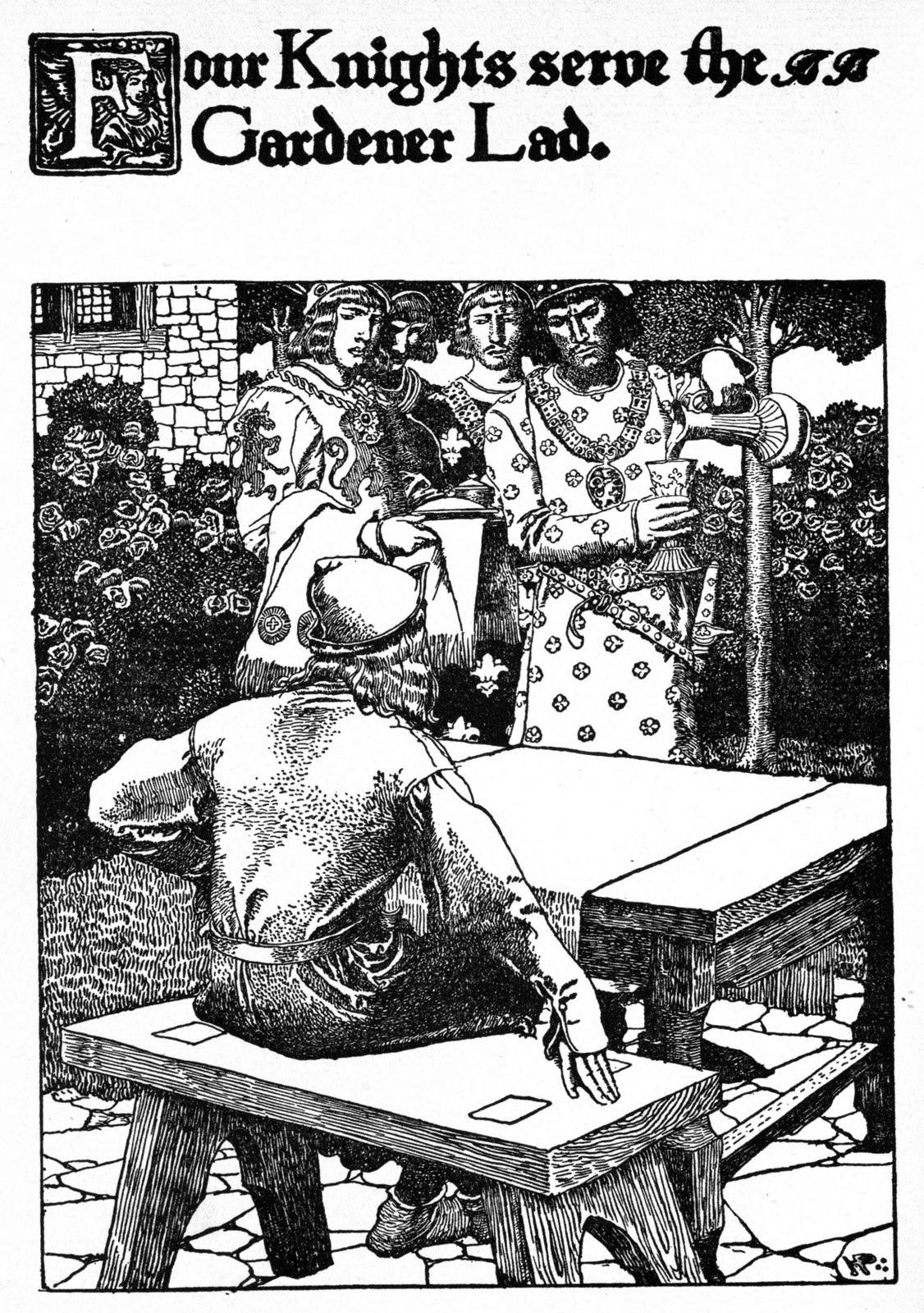
The gardener scolds his boy.
Now when King Arthur came back to Cameliard once more (which was in the afternoon of the second day), he found the gardener waiting for him, and the gardener was filled with fury. He had brought a long birch rod with him, meaning to punish his boy with it as soon as he came back to the garden. So when he saw King Arthur he said: "You good-for-nothing! Why did you leave your work to go gadding about?" And King Arthur laughed and said: "Do not touch me." At this the gardener grew so angry that he caught the King by the collar of his jerkin, meaning to beat him, and said: "Do you laugh at me, you rascal, and make fun of me? Now I'll give you a good beating for the wrong you've done."
Then, when King Arthur felt that man's hand laid on him, and when he heard the words the gardener spoke in his anger, his royal spirit swelled up within him, and he cried out: "Ha, wretch! Would you dare to lay your hands upon my sacred person?" And as he said this, he seized the gardener by the wrists, took the rod straight out of his hand, and struck him with it across the shoulders. And when that poor fellow felt himself caught in the powerful grip of the angry King, and felt the rod across his shoulders, he at once set up a great outcry, although the blow did not hurt him in the least. "Now get out of here!" said King Arthur, "and trouble me no more, or I will treat you in a way you will not like at all." With that he let the poor man go; and the gardener was so dazed with terror that the earth and the sky both swam before his eyes. For King Arthur's eyes had flashed at him like lightning, and those two hands had held his wrists with wonderful strength. So, when the King let him go, he took himself off as fast as he could, trembling all over and sweating with fear.
The gardener complains to the Lady Guinevere.
So he went straight to the Lady Guinevere and complained to her of the way he had been treated. "Lady," he said, weeping at the memory of his fright, "my boy goes off for a day or more, I don't know where; and when I try to whip him for leaving his work, he takes the rod right out of my hand and beats me with it. So now, I beg you, deal with him as he deserves, and have some strong men drive him out of this place with sticks."
Then the Lady Guinevere laughed. "Let him be!" she said. "Don't meddle with him any more; for indeed he seems to be a very saucy fellow. As for you, pay no attention to his coming or his going, and perhaps I will deal with him myself in whatever way is fitting."
So the gardener went his way, greatly wondering that the Lady Guinevere should be so mild with that unruly boy. And the Lady Guinevere went her way, very merry. For she had begun to think that there must truly be some excellent reason why, whenever the White Champion who did such wonderful deeds came to Cameliard, the gardener's boy should be gone; and why, whenever that same Champion went away, the gardener's boy should come back again. So she suspected a great many things, and was wonderfully merry and cheerful in her spirits.
The Lady Guinevere mocks the gardener's boy.
Now that same afternoon the Lady Guinevere happened to walk in the garden with her damsels, and with her walked those four noble knights whom her White Champion had sent to her: that is, Sir Gawain, Sir Uwain, Sir Geraint, and Sir Pelleas. And the gardener's lad was digging in the garden; and as they passed by the place where he was, the Lady Guinevere laughed out loud and cried: "Look! Look, Sirs and Ladies! There is a very saucy fellow for a gardener's lad, for he always wears his cap, even when he stands in the presence of lords and ladies."
Then Sir Gawain spoke up and said: "Is that so? Then I will go to that rascal this minute and take his hat off for him, and in a way he will like so little that I don't believe he will ever offend by wearing it in our presence again."
At this the Lady Guinevere laughed a great deal. "Let him be!" she said. "Let him be, Sir Gawain! It would not become a knight as noble as you to have anything to do with that saucy fellow. Besides, he assures us all that he has an ugly spot on his head, so let him wear his cap, in God's mercy."
The Duke of North Umber issues a second challenge.
So the Lady Guinevere, though she suspected a very great deal, was still pleased to make fun of the one she suspected.
Now by that day Duke Mordaunt of North Umber had entirely recovered from the painful hurts he had suffered when the White Champion overthrew him. So, when the next morning came, he appeared before the castle again as he had appeared before, clad from head to foot in armor. But this time two heralds rode before him, and when the Duke and the two heralds had come to that part of the meadows that lay just in front of the castle of Cameliard, the heralds blew their trumpets very loudly. At the sound of the trumpets many people came and gathered on the walls; and King Leodegrance came too, and took his stand on a lesser tower that looked down on the plain where the Duke of North Umber and the two heralds were. Then the Duke of North Umber lifted his eyes and saw King Leodegrance standing above him on the top of that tower, and he cried out in a loud voice: "Ho there, King Leodegrance! Do not think that because I was thrown from my horse by a piece of bad luck in a contest of arms, you are therefore rid of me. All the same, I now make you this fair offer. Tomorrow I shall appear before this castle with six knights as my companions. Now, if you have any seven knights who are able to stand against me and my companions in a contest of arms, whether with spears or with swords, on horseback or on foot, then I will bind myself to give up every claim whatever to the hand of the Lady Guinevere. But if you cannot provide such champions to fight successfully against me and my companions, then I will not only lay claim to the Lady Guinevere, but I will also seize, and hold as my own, three certain castles of yours that stand on the borders of North Umber. And I will likewise seize, and hold as my own, all the lands and fields that belong to those same castles. What is more, this challenge of mine will hold only until sunset tomorrow; after that it will be null and void. So, King Leodegrance, you had best see to it at once that you find such champions as can defend you against these demands."
King Leodegrance is downcast.
At this the two heralds blew their trumpets once more, and Duke Mordaunt of North Umber turned his horse around and rode away from that place. Then King Leodegrance also went his way, very sorrowful and downcast in his spirits. For he said to himself: "Is it at all likely that another champion will come to me, like that wonderful White Champion who came two days ago, I don't know from where, to defend me against my enemies? And as for that same White Champion: just as I do not know where he came from, so I do not know where he has gone. How then shall I know where to look for him, to beg his help again in this time of my great need?" So he went his way, very sorrowful, not knowing what to do to defend himself. And being so deeply troubled in his spirit, he went straight to his own room and shut himself in; and he would see no one and speak to no one, but gave himself up entirely to sorrow and despair.
The Lady Guinevere begs the four knights for help.
Now in this time of need the Lady Guinevere thought of those four knights who had been pledged to serve her for seven days. So she went to them where they were and spoke to them like this: "Sirs, you were sent here pledged to serve me for seven days. Now I command you to take up this challenge of Duke Mordaunt's at my bidding, and I very much wish you to go out tomorrow to meet this Duke of North Umber and his companions in battle. For you are tremendously mighty knights, and I believe you can easily defend us against our enemies."
But Sir Gawain said, "No, Lady; no! For though we are pledged to your service, we are not pledged to the service of King Leodegrance, your father. Nor do we have any quarrel of any kind with this Duke of North Umber, or with his six companions. For we are knights of King Arthur's Court, and we may not, except at his command, take up any foreign quarrel in the service of another king."
Then the Lady Guinevere was very angry, and she said with great heat: "Either you are a wonderfully faithful lord to your King, Sir Gawain, or else you are afraid to meet this Duke of North Umber and his companions."
And at this speech of the Lady Guinevere's, Sir Gawain was very angry too, and he answered: "If you were a knight and not a lady, Dame Guinevere, you would think three or four times before you found the courage to say those words to me." With that he got up and left the place, his face all burning with anger. And the Lady Guinevere also left that place and went to her bower, her own private rooms, where she wept a great deal, both from sorrow and from anger.
King Arthur sends the gardener on an errand.
Now all this while King Arthur had known very well everything that happened; so by and by he got up and went out and found the gardener. And he took the gardener firmly by the collar of his coat and held him where he stood. And he said to him: "You there! I have an order to give you, and you will carry out that order to the letter. If you do not, a great deal of pain may come to you." And as he spoke, he thrust his hand into the front of his jerkin and drew out the necklace of pearls that the Lady Guinevere had taken from her own neck and given him. And he went on to the gardener: "You will take this necklace to the Lady Guinevere, and you will say this to her: that she is to send me at once bread and meat and wine and sweets from her own table. And you will tell her that I wish her to call those four knights, that is, Sir Gawain, Sir Uwain, Sir Geraint, and Sir Pelleas, and that she is to order those four to come and serve me with those things for my refreshment. And you are to tell her that she must lay her commands on those knights that they are to go on serving me in whatever I may command, and that from now on they are to be my servants and not hers. These are the orders I lay on you: that you are to say these things to the Lady Guinevere."
Now when the gardener heard these words he was so astonished that he did not know what to think, for he believed the gardener's lad had gone completely mad. So he raised his voice and cried out loud, "What's this? What are you saying? Truly, if I did such a thing as you tell me to do, either it would cost me my life or else it would cost you yours. For who would dare to say such words to the Lady Guinevere?"
But King Arthur said: "All the same, you will certainly do as I command you, fellow. For if you disobey in a single point, I promise you it will go very badly with you. For I have it in my power to make you suffer as you have never suffered before."
At this the gardener said, "I will go." For he said to himself, "If I do as this fellow tells me, then the Lady Guinevere will have him punished severely, and so I will be revenged on him for what he did to me yesterday. Besides, it annoys me terribly to have a lad working in the garden who behaves the way this fellow does. So," he said, "I will go." So he took the necklace of pearls that King Arthur gave him, and he went off, and after a while he found the Lady Guinevere where she was. And when he had found her, he spoke to her like this:
"Lady, my garden boy has certainly gone completely mad. For, with threats of some great harm he would do me if I did not carry out his errand, he has sent me to offer you a very grievous insult. He has sent me with this string of big beads to give to you; and he tells me to tell you that you are to send him bread and meat and sweets and wine, such as you have at your own table; and he tells me to tell you that these things are to be served to him by the four noble knights who came here the day before yesterday. And he says you are to command those same knights to obey him in whatever he may command, because from now on they are to be his servants and not yours. And truly, Lady, he would not listen to a word I said to him against it, but he threatened me with terrible harm if I did not come here and give you this message."
Now when the Lady Guinevere heard what the gardener said, and when she saw the necklace she had given to the White Champion, and when she knew that the White Champion and the gardener's boy were indeed one and the same, she was lifted up with such joy that she did not know whether to laugh or to cry for pure happiness. So she rose and took the necklace of pearls, and she told the gardener to come with her. Then she went on until she found those four knights, and when she had found them she spoke to them like this:
The Lady Guinevere commands the four knights to serve the gardener's boy.
"My lords, a little while ago, when I commanded you to take up my quarrel with Duke Mordaunt of North Umber for my sake, you would not do it. And you, my lord Gawain, spoke such angry words as it is not fitting for one who serves to speak to his mistress, much less for a knight to speak to the daughter of a king. So I have decided that you shall do a certain thing as a penance; and if you refuse to do it, I will know very well that you do not mean to keep the word you pledged to my knight when he overthrew all four of you in fair combat. Now this is my command: that you take certain food prepared for my table, meats and white bread and sweets and wine, and that you carry that food to my gardener's boy, whose cap, Sir Gawain, you threatened so bravely to take away from him this very morning. And you four are to serve the food to him as though he were a royal knight. And when you have served him, you are to obey him in whatever he may order. I lay this on you as a penalty because you did not take up my quarrel as true knights should; for from now on you are to be servants to that gardener's boy and not to me. So now you are to go to the buttery of the castle, the storeroom where the food and drink are kept, and you are to tell the sewer, the officer in charge of serving the table, to give you meats such as are served at my own table. And you are to serve the food on silver plates, and the wine in silver cups and goblets. And you are to wait on that gardener's boy as though he were a great lord of the highest fame and renown."
So spoke the Lady Guinevere; and when she had finished speaking, she turned and left those four knights, and took the gardener with her. And he was so astonished at what he had heard that he did not know whether he had gone mad or the Lady Guinevere had gone mad. And the Lady Guinevere told the gardener to go to the gardener's boy and tell him that everything would be done just as he had commanded. And so the gardener did as he was told.
The four knights are angry.
Now let us turn to those four knights whom the Lady Guinevere had left behind. For they were bewildered and dumbfounded at the strange commands she had laid on them. And when they had recovered from their amazement, they were burning with such fierce indignation that for a time they could not tell whether what they saw with their eyes was the light of day or utter darkness. Not one of them could look another in the face, so overcome were they with shame at the insult that had been put on them. Then Sir Gawain spoke up, and his voice shook so with his great anger that he could hardly hold it steady enough to get his words out. "Sirs," he said, "don't you see how this lady has deliberately put a great insult on us because we would not do what she told us to do this morning, and because we would not take up her quarrel against the Duke of North Umber? Well, we will indeed serve this gardener's boy just as she has ordered. We will serve him with meat and drink as she has commanded, and we will do him service as she has told us to. But mark this: we are no longer her servants, but his servants, and so we may serve him in whatever way we choose. So, when we have carried out her commands and have served him with meat and drink, and when we have obeyed all the orders he gives us, then I swear that I, with my own hand, will kill that gardener's boy. And when I have killed him, I will put his head in a bag, and I will send that bag to the Lady Guinevere by the lowest messenger I can find for the purpose. And so this proud lady will receive an insult as great as the insult she has put on us." And they all said that what Sir Gawain had planned should be done exactly as he had said.
The four knights serve the gardener's boy.
So those four lords went to the sewer of the castle, and they asked for the best of the food that was to be served to the Lady Guinevere: meats and bread and sweets and wine. Then they took silver plates and platters and put the food on them; and they took silver cups and silver goblets and poured the wine into them; and they went out with these things. And when they had come around to the back of the castle, near the stables, they found the gardener's boy, and they told him to sit down and eat and drink. And they waited on him as though he had been some great lord. And not one of those four knights knew who he was, or that he was the great King whose servants, in truth, they were. For he wore his cap of disguise on his head, and so they took him for nothing but a poor peasant fellow.
Now when Sir Uwain saw that he still kept his cap on in front of them, he spoke to him with great indignation, saying: "Ha, you villain! Would you wear your cap even in the presence of great princes and lords like us?"
To this Sir Gawain said, "Let it be; it doesn't matter." And then he said very bitterly to the gardener's boy: "Eat well, fellow! For you will hardly eat another meal on this earth."
To this the gardener's boy answered: "Sir Knight, perhaps that will be for another will than yours to decide. For maybe I shall eat many other meals besides this one. And maybe you will serve at them as you are serving me now." And those four lords were astonished beyond measure that he should speak to them so calmly and without any sign of fear.
Then, after he had eaten, the gardener's boy said to those knights, "There, Sirs, I have had enough and I am finished; and now I have other commands for you to carry out. My next command is that you get ready at once to ride out with me, and for that purpose you are to put on full armor. And you, Sir Gawain, are to go to the head stable-keeper of this castle and order him to make ready the Lady Guinevere's palfrey, so that I can ride out on it at once. And when you are all armed, and when everything has been arranged as I command, you are to bring that palfrey to the postern gate of the castle, and there I will meet you and ride out with you."
And Sir Gawain said: "It shall be done in every way just as you command. But when we ride out of this castle, it will be a sorry journey for you."
And the gardener's boy said: "I do not think so, Sir Gawain."
Then those four went away and did as the gardener's boy had commanded. And when they had made themselves ready in full armor, and had got the Lady Guinevere's palfrey, they went to the postern gate, and there the gardener's boy met them. And when he saw that they stayed sitting on their horses and did not stir when he came, he said: "Ha, Sirs! Is this how you treat the one you have been ordered to serve? Now I order you, Sir Gawain and Sir Uwain, to get down and hold my stirrup for me; and I order you, Sir Geraint and Sir Pelleas, to get down and hold my palfrey for me while I mount."
Then those four noble knights did as they were commanded. And Sir Gawain said: "You may command as you please, and I advise you to make the most of it while you can; for you will have only a little while longer to enjoy the great honor that has fallen on you. For that honor which has fallen on you, mark my words, will soon crush you to death."
And the gardener's boy said: "Not so; I believe I shall not die just yet." And again those four lords were greatly astonished at how calm he was.
And so they rode out from that place; and the gardener's boy would not allow them to ride either in front of him or beside him, but commanded them to ride behind him, since they were still his servants.
So they rode as he had ordered them for a good long way. Then, after they had gone forward a great distance, they drew near to a gloomy and dismal woodland that lay entirely outside the country around Cameliard. And when they had come close to this woodland, Sir Gawain rode a little forward, and he said: "Sir Gardener's Boy, do you see that woodland over there? Now, when we come into it you will die at once, and by a sword that has never yet been touched by any but noble or knightly blood."
And King Arthur turned around in his saddle and said: "Ha! Sir Gawain! Would you ride forward like this, when I have ordered you to ride behind me?"
King Arthur reveals himself to the four knights.
And as he spoke he took the cap off his head, and suddenly they all saw that it was King Arthur who rode with them.
Then a great silence of pure astonishment fell on them all, and each man sat as though he had been turned into a statue of stone. And it was King Arthur who spoke first. He said: "Ha! What now, Sir Knights? Have you no words of greeting for me? Truly, you have served me with a very bad grace this day. What is more, you have threatened to kill me; and now, when I speak to you, you say nothing in reply."
Then those four knights at once cried out aloud; and they leaped down from their horses and knelt in the dust of the road. And when King Arthur saw them kneeling there, he laughed with great joy of spirit, and he told them to mount their horses again, for time was passing and there was much to do.
So they mounted their horses and rode away, and as they went along the King told them everything that had happened to him, so that they were greatly amazed, and gave high praise to the knightly way he had carried himself through all those excellent adventures. And they rejoiced greatly that they had a king to rule over them who had so high and knightly a spirit.
So they rode to that edge of the forest where King Arthur had left his horse and his armor.
Chapter 5: How King Arthur Defeated King Leodegrance's Enemies, and How His Royalty Was Made Known
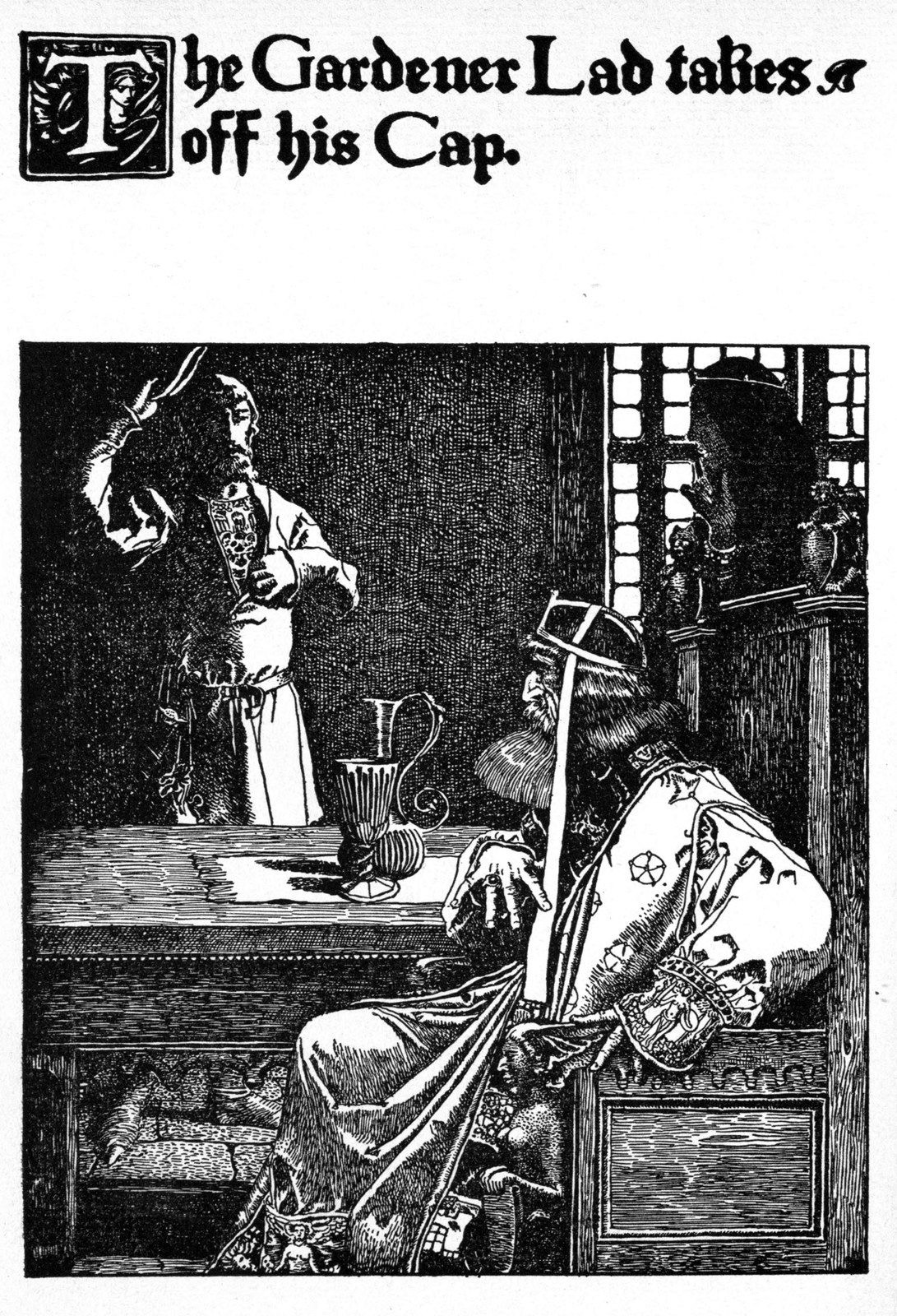
The Duke of North Umber and his six companions appear before the castle.
Now, when the next day came, the Duke of North Umber and six knights who were his companions appeared on the field in front of the castle of Cameliard, just as he had declared that they would. And those seven champions appeared in very great state. In front of them rode seven heralds with trumpets and tabards, and behind them rode seven squires, each squire carrying the spear, the shield, the crest, and the banner of the knight who was his lord and master. The seven heralds blew their trumpets so tremendously loud that the sound reached the farthest corners of Cameliard, and people came running from everywhere. And while the heralds blew their trumpets, the seven squires shouted and waved the spears and the banners. So those seven knights rode in such proud state that those who watched them had hardly ever seen so splendid a show of chivalry.
So they paraded up and down that field three times, along its entire length. Meanwhile a great crowd of people, called there by the blowing of the heralds' trumpets, stood on the walls and gazed down at that noble spectacle. And all the Court of King Rience came out and stood on the plain in front of the King's pavilion, and they shouted and cheered for the Duke of North Umber and his six companions.
Meanwhile King Leodegrance of Cameliard was so cast down with trouble and shame that he did not wish to show his face, but hid himself away from his whole Court. Nor would he allow anyone to come into his presence at that time.
The Lady Guinevere cheers her father.
Nevertheless, the Lady Guinevere went to him with several of her damsels. And when the King would not let her in, she spoke to him through the door and gave him words of good cheer. "My lord King and father," she said, "I beg you to look up and take heart. For I promise you that there is one who has our cause in his hands, and that one is truly a very glorious champion. He will surely come by and by, before this day is over, and when he comes he will certainly overthrow our enemies."
But King Leodegrance did not open the door. He said: "My daughter, you say these things to comfort me. For in this time of trouble there is no help for me except God alone, and His good strong help and grace." And she said: "No, what I say is the truth. And the help that God will send you, He will certainly send through a worthy champion who at this very moment has our cause in his hand."
So spoke the Lady Guinevere. And although King Leodegrance did not come out, he was greatly comforted by what she had said to him.
Five knights-defender appear at the field.
So the whole morning went by, and part of the afternoon, and still no one appeared to take up the challenge the seven knights had declared. But while the sun was still three or four hours high, a cloud of dust suddenly appeared a great way off. And out of that cloud of dust there soon appeared five knights, riding toward the castle at great speed. When they came near the walls, the people saw that the one who rode in front of all the others was that same White Champion who had overthrown the Duke of North Umber before. They saw, too, that the four knights riding with the White Champion were very famous knights, of great prowess and glory in arms. For one was Sir Gawain, and another was Sir Uwain, and another was Sir Geraint, and another was Sir Pelleas. The people of the castle and the town knew those four knights, because they had stayed at Cameliard for two days; and they were so very renowned that folk crowded in from far and near to look at them whenever they went out walking.
So when the people on the walls saw who those knights were, and when they recognized the White Champion who had already brought them such great honor, they shouted aloud a second time, with a voice even mightier than the one they had shouted with the first time.
Now King Leodegrance heard the people shouting, and all at once hope woke up inside him. So he came out at once, as fast as he could, to see what was happening, and there he saw those five noble champions about to ride onto the field below the castle walls.
The Lady Guinevere heard the shouting too, and she came out also. And there was the White Champion, and those four other knights with him! When she saw that White Knight and his four companions-in-arms, her heart was ready to burst inside her for pure joy and gladness, so that she wept with the strength of her feeling, and laughed while she wept. She waved her handkerchief to those five noble lords and kissed her hand to them, and the five knights saluted her as they rode past her and onto the field.
Now when the Duke of North Umber learned that these five knights had come against him and his companions to take up his challenge, he came out of his pavilion at once and mounted his horse. And his companions came out and mounted their horses, and he and they rode out to meet those who had come against them.
The Duke of North Umber refuses the combat.
When the Duke of North Umber had come near enough, he saw that the leader of those five knights was the White Champion who had overthrown him before. So he said to the White Champion: "Sir Knight, I have already lowered myself once to deal with you, though you are a complete stranger to me and to everyone else here. Without asking anything about your rank, I ran a course with you, and by the luck of arms you overthrew me. Now this quarrel is more serious than that one. So my companions-in-arms and I will not run a course with you and your companions, nor will we fight with you at all, until I first know the rank of the man I am to fight. So I order you to declare yourself right now: who you are, and what your rank is."
Then Sir Gawain opened the visor of his helmet and said: "Sir Knight, look at my face, and know that I am Gawain, the son of King Lot. So you can see that my rank and station are even higher than your own. Now I declare to you that the White Knight over there is of such high rank that it is he who lowers himself when he fights with you, and not you who lower yourself to him."
"Ho, Sir Gawain!" said the Duke of North Umber. "What you say is a very strange thing, for there are truly few people in this world so exalted that they lower themselves in dealing with me. Even so, since you vouch for him, I cannot dispute what you say. But there is still another reason why we cannot fight with you. For look: we are seven tried and famous knights, and you are only five. So consider how unequal our forces are, and what great danger you are in by taking on so perilous an encounter."
Then Sir Gawain smiled very grimly at that Duke of North Umber. "Many thanks for your pity, Sir Duke," he said, "and for the tender concern you show for our safety. But even so, you may leave that matter to us, with your mind completely at ease. For I consider that the danger you seven are in is fully equal to ours. What's more, if you were anything but a belted knight, a plain man might suppose that you were more worried about your own safety in this affair than about ours."
At these words the face of the Duke of North Umber turned red all over, for he knew that in truth he had no great wish for this battle, and so he was ashamed at what Sir Gawain had said to him. Then each knight closed his helmet, and they all turned their horses. One party rode to one end of the field, and the other party rode to the other end, and there each took its stand in the place assigned to it.
They arranged themselves like this: King Arthur was in the middle, with two knights on either side of him; and the Duke of North Umber was in the middle, with three knights on either side of him. When they had lined up in this way, they set their spears and their shields and made themselves completely ready for the charge. Then King Arthur and Duke Mordaunt each gave a great shout, and the one party hurled itself against the other with such violence that the ground shook and thundered under the horses' hoofs, and the clouds of dust rose up toward the sky.
And so they met in the middle of the field with a crash so dreadful and violent that you could have heard it more than a mile away.
When the one party had passed the other, and the dust of the collision had risen, three of the seven had been overthrown, and not one of the five had lost his seat.
King Arthur overthrows the Duke of North Umber.
One of those who had been overthrown was Duke Mordaunt of North Umber. And he never got up again from the ground where he lay. For King Arthur had aimed his spear at the very center of his defenses, and the spear had held. Its point had pierced the Duke of North Umber's shield, and pierced his body armor; and the stroke was so violent that the Duke of North Umber had been lifted clean out of his saddle and hurled a full spear's length behind the tail of his horse. So that wicked man died. For as King Arthur rode past him, his evil soul left his body with a thin little noise like the squeaking of a bat, and the world was well rid of him.
Now when King Arthur turned around at the end of the course and saw that only four knights were left on their horses, out of all the seven he and his companions had charged against, he raised his spear, reined in his horse, and spoke to his knights like this: "Sirs, I am weary of all this fuss and quarreling, and I do not care to fight any more today. So go at once and do battle with those knights. As for me, I will wait here and watch your adventure."
"Lord," they said, "we will do our best, as you command."
So those four good knights did as he commanded, and they rode out at once against the other four, greatly encouraged that their King was watching what they did. And King Arthur sat with the butt of his spear resting on his foot and looked out over the field with great contentment of spirit and a steady face.
As for the four companions of the Duke of North Umber's party who were left, they did not come out to this second encounter with nearly as much eagerness as they had the first time. For now they knew very well how great the prowess of those other knights was, and they saw that their enemies were coming at them for this second encounter very fiercely, with great valor and eagerness. So their hearts melted away inside them with doubt and worry about how this second encounter would end.
Nevertheless, they made themselves ready with what courage they could, and came out as they were bound to do.
Then Sir Gawain rode straight at the foremost knight, a very well-known champion named Sir Dinador of Montcalm. And when he had come close enough to him, he raised himself up in his stirrups and struck Sir Dinador so fierce a blow that he split that knight's shield in two, and split his helmet, and a piece of the blade of his sword broke off and stuck fast in it.
The knights-challenger flee before the knights-defender.
When Sir Dinador felt that blow, his brains swam like water, and he had to catch hold of the horn of his saddle to keep himself from falling off. Then a great terror fell on him all at once, so that he wrenched his horse's rein to one side. And so he fled away from that place, with the terror of death hanging over him like a black cloud of smoke. And when his companions saw the stroke Sir Gawain had dealt, and saw Sir Dinador flee away from him, they too wrenched their reins to one side and fled away as fast as they could, filled with utter terror of their enemies. And Sir Gawain and Sir Uwain and Sir Geraint and Sir Pelleas chased them as they fled. They chased them straight through the Court of King Rience, so that the knights and nobles of that Court scattered this way and that like chaff before them. They chased those fleeing knights in among the pavilions of King Rience's Court, and no one stopped them. And when they had chased those knights clean away, they came back to the place where King Arthur still kept his post, steadily waiting for them.
Now when the people of Cameliard saw their enemies overthrown, and saw how those enemies fled away before the faces of their champions, they shouted with all their might and cheered and cheered. Nor did they stop their loud shouting when those four knights came back from chasing their enemies and rejoined the White Champion. And they cheered still more when those five knights rode across the drawbridge, and through the gateway of the town, and into the town itself.
So ended that great contest of arms, which was one of the most famous in all the history of chivalry of King Arthur's Court.
King Arthur returns his armor to the merchant.
Now when King Arthur had done what he had set out to do, and had come back into the town, he went to the merchant from whom he had gotten the armor he wore, and he gave that armor back to him. And he said, "Tomorrow, Sir Merchant, I will send you two bags of gold as rent for the armor you let me have."
To this the merchant said: "Lord, there is no need for you to repay me for that armor, for you have done Cameliard great honor by your prowess."
But King Arthur said: "Enough, Sir Merchant. You must not forbid what I say. So take what I will send you."
Then he went on his way, and, after setting his cap of disguise on his head, he came back into the Lady Guinevere's gardens once more.
Now when the next morning came, the people of Cameliard looked out, and saw that King Rience had gone clean away from in front of the castle. For that night he had taken down his pavilions, withdrawn his Court, and left the place where he and his people had camped for the past five days. He had taken the body of the Duke of North Umber with him, carrying it away on a litter surrounded by many lighted candles and borne along with strange and solemn ceremony. And when the people of Cameliard saw that he was gone, they were overjoyed, and made merry, and shouted and sang and laughed. For they did not know how deeply enraged King Rience was against them. His hatred of King Leodegrance before had been only a small flame compared with the anger that now possessed him.
That morning the Lady Guinevere walked into her garden, and Sir Gawain and Sir Uwain walked with her. And there she saw the gardener's boy again.
At that she laughed aloud, and said to those two knights, "Sirs, look! There is the gardener's boy, who wears his cap all the time because he has an ugly place on his head."
Then those two knights, who knew who that gardener's boy was, were terribly embarrassed at her words, and did not know what to say or where to look. And Sir Gawain spoke aside to Sir Uwain and said: "Heaven help us, that lady has no idea what kind of man that gardener's boy is. If she did, she would be more careful with her words."
The Lady Guinevere heard Sir Gawain speak, but she did not catch his words. So she turned to Sir Gawain and said: "Sir Gawain, perhaps it offends you that the gardener's boy should wear his cap in front of us, and maybe you will go and take it off his head, as you offered to do two or three days ago."
And Sir Gawain said: "Hush, Lady! You do not know what you are saying. That gardener's boy could more easily take my head off my shoulders than I could take his cap off his head."
At this the Lady Guinevere laughed openly. But in her heart she secretly turned that saying over and over, and wondered greatly what Sir Gawain meant by it.
King Rience threatens King Leodegrance.
Now about noon that day a herald came from King Rience of North Wales, and he appeared boldly before King Leodegrance where the King sat in his hall with a number of his people around him. And the herald said: "My lord King, my master, King Rience of North Wales, is greatly displeased with you. For you set certain knights upon Duke Mordaunt of North Umber, and those knights have killed that excellent nobleman, who was a close kinsman of King Rience. What is more, you have made no reply to the demands my master, King Rience, has made concerning the handing over to him of certain lands and castles on the border of North Wales. And so my master is offended with you beyond measure. My master, King Rience, therefore commands me to put two conditions before you, and these are the conditions: first, that you immediately hand over to him the White Knight who killed the Duke of North Umber; and second, that you promise at once that the lands in question will be handed over to King Rience without delay."
Then King Leodegrance rose from where he sat and spoke to the herald with great dignity. "Sir Herald," he said, "the demands King Rience makes on me pass all bounds of insolence. The death the Duke of North Umber suffered, he suffered because of his own pride and folly. Nor would I hand the White Knight over to your master, even if I were able to. As for the lands your master demands of me, you may tell King Rience that I will not hand over to him so much as a single blade of grass, or a single grain of corn that grows there."
And the herald said: "If that is your answer, King Leodegrance, then I am ordered to tell you that my master, King Rience of North Wales, will soon come here with a great army and take from you by force the things you will not give him in peace." And having said this, he left that place and went on his way.
King Leodegrance talks with the Lady Guinevere.
Now after the herald had gone, King Leodegrance went into his private room, and when he got there he sent secretly for the Lady Guinevere. So the Lady Guinevere came to him there. And King Leodegrance said to her: "My daughter, it has happened that a knight dressed all in white, and bearing no crest or sign of any kind, has twice come to our rescue and overthrown our enemies. Now everyone says that this knight is your own particular champion, and I hear that he wore your necklace as a favor when he first rode out against the Duke of North Umber. So I ask you, daughter, tell me who that White Champion is, and where he can be found."
At this the Lady Guinevere was overwhelmed with confusion, and she looked away from her father's face and said: "Truly, my Lord, I do not know who that knight may be."
Then King Leodegrance spoke very seriously to the Lady Guinevere. He took her by the hand and said: "My daughter, you have now come to the age when you must think of being married to a man who will cherish you as he should and protect you from your enemies. For I am growing old fast, and I cannot hope to defend you forever from the dangers that surround people of our rank. Besides, since King Arthur (who is a very great King indeed) has brought peace to this realm, all that noble court of chivalry that once gathered around me has scattered to other places, where greater adventures can be found than in my peaceful kingdom. So (as all the world has seen this past week) I now have not one single knight I can depend on to defend us in times of danger like these that now overshadow us. Now, my daughter, it seems to me that you could not hope to find anyone who could keep you as safe as this White Knight, for he truly seems to be a champion of extraordinary prowess and strength. So it would be well if you found your heart leaning toward him, as his seems to lean toward you."
Then the Lady Guinevere turned rosy red, as if with fire, all the way down to her throat. And she laughed, though the tears overflowed her eyes and ran down her cheeks. So she wept, and yet laughed as she wept. And she said to King Leodegrance: "My Lord and father, if I give my heart to anyone in the way you speak of, I will give it only to the poor gardener's boy who digs in my garden."
At these words King Leodegrance's face twisted up with violent anger, and he cried out: "Ha, Lady! Would you make a mockery and a joke of what I say?"
Then the Lady Guinevere said: "Indeed, my Lord, I am not joking and I am not mocking. And I tell you truly that this same gardener's boy knows more about the White Champion than anybody else in the whole world." Then King Leodegrance said: "What is this you are telling me?" And the Lady Guinevere said: "Send for that gardener's boy, and you will find out." And King Leodegrance said: "Truly, there is more in this than I can understand just now."
So he called the chief of his pages, whose name was Dorisand, and said to him: "Go, Dorisand, and bring the gardener's boy here from the Lady Guinevere's garden."
So Dorisand the page went as King Leodegrance commanded, and in a little while he came back, bringing the gardener's boy with him. And Sir Gawain and Sir Uwain and Sir Pelleas and Sir Geraint came with them. Those four lords stood across the room by the door where they had come in, but the gardener's boy came and stood beside the table where King Leodegrance sat. The King raised his eyes and looked at the gardener's boy, and he said: "Ha! Would you wear your cap in our presence?"
Then the gardener's boy said: "I cannot take off my cap."
But the Lady Guinevere, who stood beside King Leodegrance's chair, spoke up and said: "I beg you, Sir, to take off your cap to my father."
At that the gardener's boy said: "At your bidding I will take it off."
King Arthur reveals himself to King Leodegrance.
So he took the cap off his head, and King Leodegrance looked at his face and knew him. And when he saw who it was standing before him, he cried out aloud in pure amazement. "My Lord and my King!" he said. "What is this?" Then he rose from where he sat, and went and knelt on the ground before King Arthur. He put the palms of his hands together and placed his hands between the hands of King Arthur, and King Arthur took the hands of King Leodegrance in his own. And King Leodegrance said: "My Lord! My Lord! Is it you, then, who has done all these wonderful things?"
Then King Arthur said: "Yes. Such as those things were, I have done them." And he bent down and kissed King Leodegrance on the cheek, and lifted him to his feet, and gave him words of good cheer.
Now the Lady Guinevere, when she saw these things happening, was astonished beyond measure. And all at once she understood everything with amazing clearness. A great fear fell on her, so that she trembled all over and said to herself: "What things have I said to this great King! How I have mocked him and made a joke of him in front of everyone around me!" And at the thought of it she pressed her hand to her side to still the wild beating of her heart. So, while King Arthur and King Leodegrance exchanged royal greetings and compliments, she slipped away and went and stood across the room by the window, near the corner of the wall.
Then, after a while, King Arthur raised his eyes and saw her standing there far off. So he went straight to her, took her by the hand, and said: "Lady, how are you?"
And she said: "Lord, I am afraid of your greatness." And he said: "No, Lady. Rather it is I who am afraid of you. For your kind regard is dearer to me than anything else in all the world. Otherwise I would not have served for these twelve days as a gardener's boy in your garden, all for the sake of your good will." And she said: "You have my good will, Lord." And he said: "Do I have your good will in great measure?" And she said: "Yes, you have it in great measure."
King Arthur is betrothed to the Lady Guinevere.
Then he bent his head and kissed her in front of everyone who was there, and so their promise to marry was pledged.
Then King Leodegrance was filled with such great joy that he did not know how to contain himself.
Now, after these things, there followed a war with King Rience of North Wales. For Sir Kay and Sir Ulfius had gathered a great army, as King Arthur had told them to do, so that when King Rience came against Cameliard he was completely routed, his army was scattered, and he himself was chased, an outcast, into his mountains.
Then there was great rejoicing in Cameliard. For after his victory King Arthur stayed there for a while with a wonderfully splendid Court of noble lords and beautiful ladies. And there was feasting and jousting and many famous contests of arms, the like of which those parts had never seen before. And King Arthur and the Lady Guinevere were completely happy together.
Now one day, while King Arthur sat at a feast with King Leodegrance, and the two of them were brimming over with good cheer, King Leodegrance said to King Arthur: "My Lord, what shall I offer you as a dowry with my daughter, when you take her away from me to be your Queen?"
Then King Arthur turned to Merlin, who stood near him, and said: "Ha, Merlin! What shall I ask of my friend for that dowry?"
Merlin said to him: "My lord King, your friend King Leodegrance has one thing which, if he gives it to you, will greatly increase the glory and renown of your reign, so that its fame will never be forgotten."
And King Arthur said: "I bid you, Merlin, tell me what that thing is."
So Merlin said: "My lord King, I will tell you a story:
Merlin tells of the Round Table.
"In the days of your father, Uther Pendragon, I had a certain table made for him in the shape of a ring, and so men called it the Round Table. At this table there were seats for fifty men, and these seats were meant for the fifty knights who were the most worthy knights in all the world. The seats were of such a kind that whenever a worthy knight appeared, his name appeared in letters of gold on the seat that belonged to him; and when that knight died, his name would suddenly vanish from the seat he had once sat in.
"Now forty-nine of these seats were all alike (except only one that was set aside for the King himself, which was raised above the other seats and was skillfully carved and inlaid with ivory and gold), and the one seat was different from all the others, and it was called the Seat Perilous. For this seat was unlike the others both in how it was made and in what it meant. It was all skillfully set with gold and silver in strange designs, and it was covered with a canopy of satin embroidered with gold and silver, and it was altogether wonderfully magnificent to look at. And no name ever appeared on this seat, for only one knight in all the world could hope to sit in it and be safe. If any other knight dared to sit in it, either he would die a sudden and violent death within three days, or else some great misfortune would fall on him. That is why the seat was called the Seat Perilous.
"Now in the days of King Uther Pendragon, thirty-seven knights sat at the Round Table. And when King Uther Pendragon died, he gave the Round Table to his friend, King Leodegrance of Cameliard.
"And at the beginning of King Leodegrance's reign, twenty-four knights sat at the Round Table.
"But times have changed since then, and the glory of King Leodegrance's reign has grown pale beside the glory of your reign, so that his noble Court of knights has left him altogether. And so now not one name remains on all the fifty seats around the Round Table, except only the name of King Leodegrance. So now the Round Table lies under its pavilion, entirely unused.
"Yet if King Leodegrance will give you that Round Table, my lord King, as a dowry with the Lady Guinevere, it will lend your reign its greatest glory. For in your day every seat at that Table will be filled, even the Seat Perilous, and the fame of the knights who sit at it will never be forgotten."
"Ha!" said King Arthur. "That would indeed be a dowry worthy of any king to have with his queen."
King Leodegrance gives the Round Table to King Arthur.
"Then," said King Leodegrance, "you shall have that dowry with my daughter. And if it brings you great glory, then your glory will be my glory, and your renown will be my renown. For if my glory fades and your glory grows, why, is my child not your wife?"
And King Arthur said: "You speak well and wisely."
So King Arthur became the master of that famous Round Table. And the Round Table was set up at Camelot (which some people now call Winchester). And by and by there gathered around it such a company of knights as the world had never seen before that time, and will never see again.
That was the story of the beginning of the Round Table in King Arthur's reign.
Chapter 6: How King Arthur Was Married in Royal State, and How the Round Table Was Founded
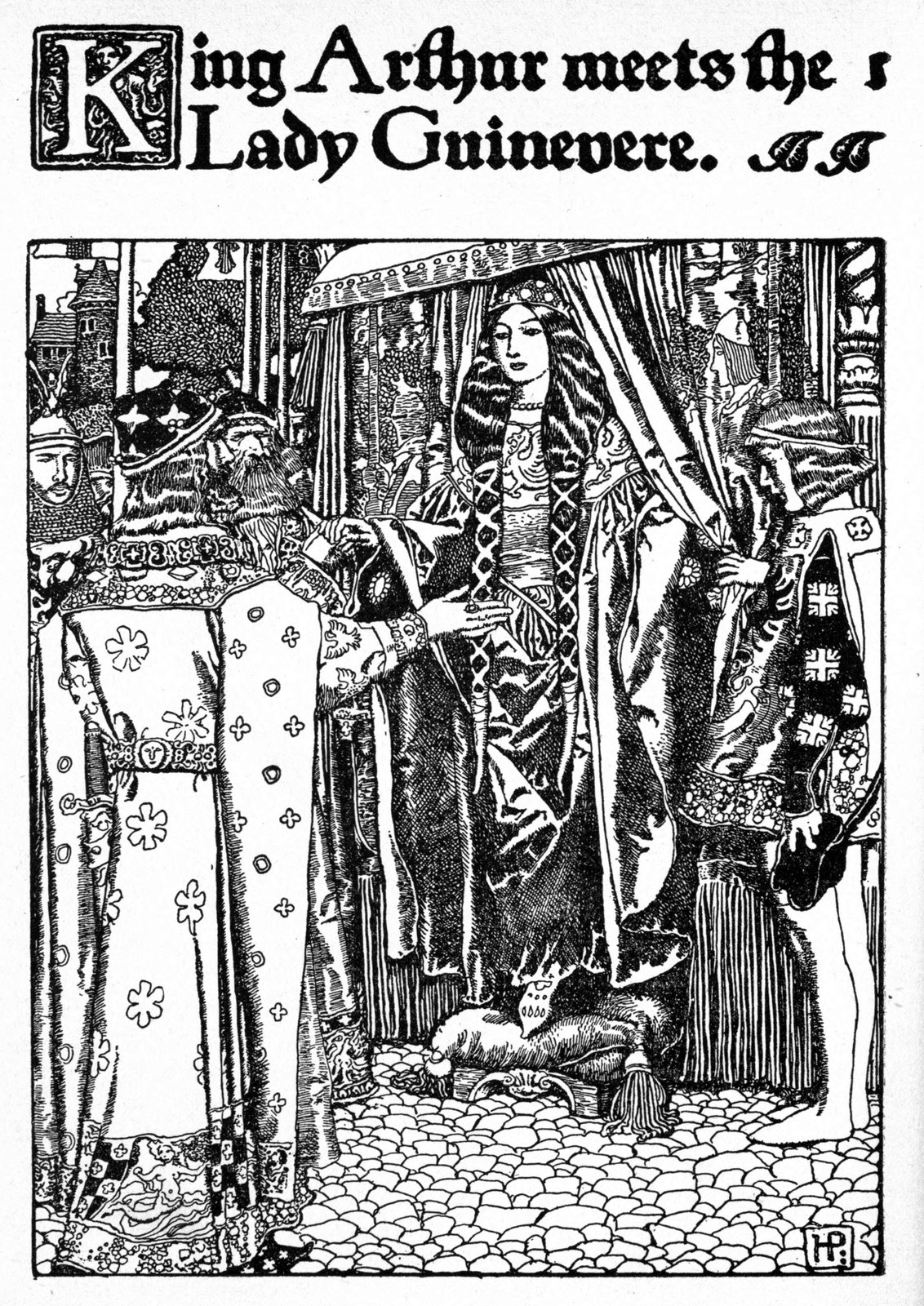
And now the early fall of the year had come: that pleasant season when the meadows and the open uplands were still green with the summer that had only just passed; when the sky, too, was like a summer sky, wonderfully blue and full of great floating clouds; when a bird might sing here and another there, a short song in memory of springtime; when all the air was mild with warmth, and yet the leaves everywhere were turning brown and red and gold, so that when the sun shone through them it was as though a cloth of gold, embroidered with brown and crimson and green, hung over your head. At this season of the year it is a wonderful pleasure to be out in the fields among the nut trees with hawk and hound, or to travel far and wide through the yellow world, whether on horseback or on foot.
Now this was the time of year that had been set for the marriage of King Arthur and the Lady Guinevere at Camelot, and in that place there was wonderful pomp and glory and splendor. All the world was astir and bubbling over with joy, for everyone was very glad that King Arthur was going to have a Queen.
How the town of Camelot was decorated.
To prepare for that great occasion, the town of Camelot was decked out most magnificently. The stony street along which the Lady Guinevere must come to the King's royal castle was strewn thick with freshly cut rushes, smoothly laid. In many places it was spread besides with carpets of fine pattern, fit to lay on the floor of some handsome hall. All the houses along the way were hung with fine woven hangings worked with threads of azure and crimson, and everywhere flags and banners floated in the warm and gentle breeze against the blue sky. So all the world seemed alive with bright colors, and when you looked down that street, it was as though you saw a winding path of the greatest beauty and gaiety stretched out before you.
And so the King's wedding day came, bright and clear and wonderfully radiant.
King Arthur sat in his hall, surrounded by his Court, waiting for news that the Lady Guinevere was on her way. And about the middle of the morning a messenger came riding in haste on a milk-white horse. The clothes of that messenger and the trappings of his horse were all of cloth of gold embroidered with scarlet and white, and the messenger's tabard was set with many jewels of different kinds, so that he glittered from far off as he rode, a sight of rare splendor.
This herald came straight into the castle where the King sat waiting, and he said: "Arise, my lord King, for the Lady Guinevere and her Court are drawing near to this place."
At that the King rose at once with great joy, and immediately he rode out with his Court of Knights in great state. And as he went down that marvelously decorated street, all the people cheered aloud as he passed, so that he smiled and bowed his head from side to side; for that day he was happy beyond words and loved his people with a wonderful warmth.
So he rode on to the town gate, and out through it, and on into the country beyond, where the broad, well-trodden highway ran winding down beside the shining river between the willows and the osiers.
Of the Court of the Lady Guinevere.
And then King Arthur and those with him caught sight of the Princess's Court, appearing in the distance, and they rejoiced greatly and hurried forward with all speed. And as they came near, the sun fell on robes of silk and cloth of gold, and on golden chains and the jewels that hung from them, so that all that noble company around the Lady Guinevere's litter flashed and sparkled with dazzling brightness.
For seventeen of the noblest knights of the King's Court, in full armor, whom he had sent as an escort to the lady, rode in great splendor around the litter in which the Princess lay. The frame of that litter was of richly gilded wood, and its curtains and cushions were of crimson silk embroidered with threads of gold. And behind the litter, in gay and joyful array and shining with many colors, rode the Court of the Princess: her ladies-in-waiting, gentlemen, ladies, pages, and attendants.
So the King's party and the Lady Guinevere's drew closer and closer, until they met and mingled with each other.
King Arthur greets the Lady Guinevere.
Then King Arthur at once got down from his noble horse, and, clothed in all his royalty, he went on foot to the Lady Guinevere's litter, while Sir Gawain and Sir Uwain held his horse's bridle. One of her pages drew back the silken curtains of the litter, and King Leodegrance gave her his hand, and she stepped down at once, wrapped, as it were, in the most wonderful beauty. King Leodegrance led her to King Arthur, and King Arthur came to her and placed one hand beneath her chin and the other on her head, and bent his face and kissed her on her smooth cheek, which was warm and fragrant and as soft as velvet, and without any blemish at all. And when he had kissed her cheek, everyone there raised their voices in a great shout, crying out for joy that those two noble souls had met at last.
That was how King Arthur welcomed the Lady Guinevere and King Leodegrance, her father, on the highway below the walls of the town of Camelot, about a mile and a half from that place. And no one who was there ever forgot that meeting, for it was full of wonderful grace and noble courtliness.
Then King Arthur and his Court of knights and nobles brought King Leodegrance and the Lady Guinevere with great ceremony to Camelot and to the royal castle, where rooms were given to everyone, so that the whole place was alive with joy and beauty.
King Arthur and the Lady Guinevere are married.
And when high noon came, the whole Court went in great state and ceremony to the cathedral, and there, surrounded by wonderful magnificence, those two noble souls were married by the Archbishop.
And all the bells rang out joyfully, and all the people standing outside the cathedral cheered loudly, and then the King and the Queen came out, all shining, like the sun for splendor and like the moon for beauty.
Of the feast at the King's castle.
In the castle a great noonday feast was spread, and four hundred and eighty-six lordly and noble people sat down to it: kings, knights, and nobles, with queens and ladies in magnificent dress. And near the King and the Queen sat King Leodegrance and Merlin, and Sir Ulfius, and Sir Ector the trustworthy, and Sir Gawain, and Sir Uwain, and Sir Kay, and King Ban, and King Pellinore, and many other famous and high-born people, so that no one had ever seen such magnificent courtliness as was seen at that famous wedding feast of King Arthur and Queen Guinevere.
And that day was famous in the history of chivalry for another reason, too, for in the afternoon the famous Round Table was founded, and that Round Table was the very flower and the greatest glory of King Arthur's reign.
For about the middle of the afternoon the King and Queen, with Merlin going before them and all that splendid Court of kings, lords, nobles, and knights in full array following after, went in procession to the place where Merlin, partly by magic and partly by skill, had had a most wonderful pavilion built over the Round Table where it stood.
Of the pavilion of the Round Table.
And when the King and the Queen and the Court had gone inside, they were amazed at the beauty of that pavilion, for it seemed to them a great open space, like some marvelous Fairyland. The walls were all richly gilded and painted with wonderful figures of saints and angels, clothed in ultramarine and crimson, and all those saints and angels were shown playing on different musical instruments that seemed to be made of gold. Overhead, the roof of the pavilion was made to look like the sky, all of cerulean blue sprinkled with stars. And in the middle of that painted sky was an image, as it were, of the sun in his glory. And underfoot was a pavement all of marble, set in squares of black and white, and blue and red, and many other colors.
In the middle of the pavilion was a Round Table, with seats around it for exactly fifty people. At each of the fifty places was a golden chalice filled with fragrant wine, and at each place was a golden plate holding a small loaf of fine white bread. And when the King and his Court entered the pavilion, music suddenly began to play with a wonderful sweetness.
Then Merlin came and took King Arthur by the hand and led him away from Queen Guinevere. And he said to the King, "Look! This is the Round Table."
And King Arthur said, "Merlin, what I see is wonderful beyond telling."
King Arthur is seated at the Round Table.
After that Merlin showed the King the various marvels of the Round Table. First he pointed to a high seat, wonderfully made of precious woods and gilded, so that it was very beautiful, and he said, "Look, lord King: that seat is called the Seat Royal, and it is yours to sit in." And as Merlin spoke, letters of gold suddenly appeared on the back of that seat, and the letters of gold spelled out the name,
Arthur, King.
And Merlin said, "Lord, that seat may well be called the center seat of the Round Table, for truly you are the very center of all that is most worthy in true knighthood. And so that seat shall be called the center of all the other seats."
Then Merlin pointed to the seat that stood opposite the Seat Royal, and that seat too was wonderful to look at, as has been told before in this history. And Merlin said to the King: "My lord King, that seat is called the Seat Perilous, for only one man in all this world shall sit in it, and that man is not yet born on the earth. And if any other man dares to sit in it, he will suffer either death or some sudden and terrible misfortune for his boldness. That is why that seat is called the Seat Perilous."
"Merlin," said the King, "everything you tell me is so marvelous that it is beyond understanding. Now I beg you to hurry and find at once enough knights to fill this Round Table, so that my glory may be wholly complete."
Then Merlin smiled at the King, though not cheerfully, and said, "Lord, why are you in such a hurry? Know this: when every seat of this Round Table is filled, then your glory will be fully achieved, and from that moment your day will begin to decline. For when any man has reached the crown of his glory, then his work is done, and God breaks him, as a man might break a chalice from which a drink so perfect has been drunk that no lesser wine may ever be allowed to stain it. So when your work is done and ended, God will shatter the chalice of your life."
Then the King looked very steadily into Merlin's face and said, "Old man, what you say is always full of wonder, for you speak words of wisdom. Even so, since I am in God's hands, I do wish for my glory and for His good will to be accomplished, even though He should break me entirely when I have served His purposes."
"Lord," said Merlin, "you speak like a worthy king, and with a very great and noble heart. Even so, I cannot fill the Round Table for you at this time. For although you have gathered about you the very noblest Court of Chivalry in all of Christendom, there are only thirty-two knights here present who may be thought worthy to sit at the Round Table."
"Then, Merlin," said King Arthur, "I ask you to choose those thirty-two for me at once."
"I will do so, lord King," said Merlin.
Merlin chooses the knights of the Round Table.
Then Merlin looked around, and he saw King Pellinore standing a little way off. Merlin went to him and took him by the hand. "Look, my lord King," he said. "Here is the knight who, next to you yourself, is at this time the most worthy in all the world to sit at this Round Table. For he is very gentle in his bearing toward the poor and needy, and at the same time he is so terribly strong and skillful that I do not know whether you or he is more to be feared when knight meets knight in combat."
Then Merlin led King Pellinore forward, and on the high seat that stood at the left hand of the Seat Royal there suddenly appeared the name,
Pellinore.
The name was blazoned in letters of gold that shone with an extraordinary luster. And when King Pellinore took his seat, everyone standing around gave him a great and loud cheer that went on for a long time.
Then, after Merlin had chosen King Arthur and King Pellinore in this way, he chose from King Arthur's Court the following knights, thirty-two in all. These were the knights of great renown in chivalry who first founded the Round Table, and for that reason they were named "The Ancient and Honorable Companions of the Round Table."
To begin with, there were Sir Gawain and Sir Uwain, who were the King's nephews, and they sat near him on his right hand. There was Sir Ulfius, who held his seat for only four years and eight months, until the time of his death; after that Sir Gaheris, who was squire to his brother Sir Gawain, held that seat. And there was Sir Kay the Seneschal, who was the King's foster brother; and there was Sir Baudwin of Britain, who held his seat for only three years and two months, until his death, and after that Sir Agravain held that seat. And there were Sir Pelleas and Sir Geraint and Sir Constantine, son of Sir Caderes the Seneschal of Cornwall (the same Constantine who was king after King Arthur). And there were Sir Caradoc, and Sir Sagramore, called the Desirous, and Sir Dinadan, and Sir Dodinas, called the Savage, and Sir Bruin, called the Black, and Sir Meliot of Logres, and Sir Aglovale and Sir Durnore and Sir Lamorak (and these three young knights were sons of King Pellinore). And there were Sir Griflet and Sir Ladinas and Sir Brandiles and Sir Persavant of Ironside, and Sir Dinas of Cornwall, and Sir Brian of Listinoise, and Sir Palomides and Sir Degraine, and Sir Epinogres, the son of the King of North Umberland and brother of the enchantress Vivien, and Sir Lamiel of Cardiff, and Sir Lucan the Butler, and Sir Bedevere his brother (the same who carried King Arthur to the fairy ship when he lay so grievously wounded, near to death, after the last battle he ever fought). These thirty-two knights were the Ancient Companions of the Round Table. Others were added to them, until there were forty-nine in all, and then Sir Galahad was added, and with him the Round Table was made wholly complete.
Now as each of these knights was chosen, at the very moment Merlin took him by the hand, that knight's name suddenly appeared in letters of gold, very bright and shining, on the seat that belonged to him.
But when all had been chosen, King Arthur saw that the seat at the right hand of the Seat Royal had not been filled, and that it bore no name. And he said to Merlin: "Merlin, how is this? The seat at my right hand has not been filled, and it bears no name."
And Merlin said: "Lord, there will be a name on it in a very little while, and he who sits in it will be the greatest knight in all the world, until the knight comes who will fill the Seat Perilous. For he who is coming will surpass all other men in beauty and in strength and in knightly grace."
And King Arthur said: "I wish he were with us now." And Merlin said: "He is coming soon."
So the Round Table was founded with great pomp and great ceremony of state. First the Archbishop of Canterbury blessed each and every seat, moving from place to place surrounded by his holy attendants. The choir among them sang most musically in harmony, while others swung censers from which rose a very fragrant smoke of frankincense, filling that whole pavilion with a scent of heavenly blessedness.
And when the Archbishop had blessed every one of those seats, each chosen knight took his own place at the Round Table, and his squire came and stood behind him, holding above the knight's head the little banner with his coat of arms upon the spear point. And everyone standing around that place, knights and ladies alike, raised their voices in a loud cheer.
Of the ceremony of installation of the Round Table.
Then all the knights stood up, and each knight held up before him the cross of his sword hilt, and each knight repeated, word for word, what King Arthur spoke. And this was the covenant of their Knighthood of the Round Table: That they would be gentle to the weak; that they would be brave against the strong; that they would be terrible to the wicked and the evildoer; that they would defend the helpless who called on them for help; that all women should be sacred to them; that they would stand ready to defend one another whenever such defense was needed; that they would be merciful to all men; that they would be gentle in deed, true in friendship, and faithful in love. This was their covenant, and every knight swore to it on the cross of his sword, and as a sign of it he kissed the hilt. And at that, everyone standing around once more gave a loud cheer.
Then all the knights of the Round Table sat down, and each knight broke bread from the golden plate and drank wine from the golden chalice that stood before him, giving thanks to God for what he ate and drank.
And that was how King Arthur was married to Queen Guinevere, and how the Round Table was founded.
Conclusion
So ends this Book of King Arthur, which I have told with such joy of spirit that, now that I close this first part of my work, it is a very great pleasure to look forward to writing a second part, which follows right after.
In that part I shall tell the history of several very noble worthies who belonged to the Court of the King, and it seems to me a good thing to spend time with the history of such noble and honorable knights and gentlemen. For truly, anyone might well enjoy reading such a history, and hearing those worthies speak, and seeing how they behaved in times of trial and trouble. For their example will surely help all of us to behave in the same way when we find ourselves in the same case.
The Book of Three Worthies
Foreword
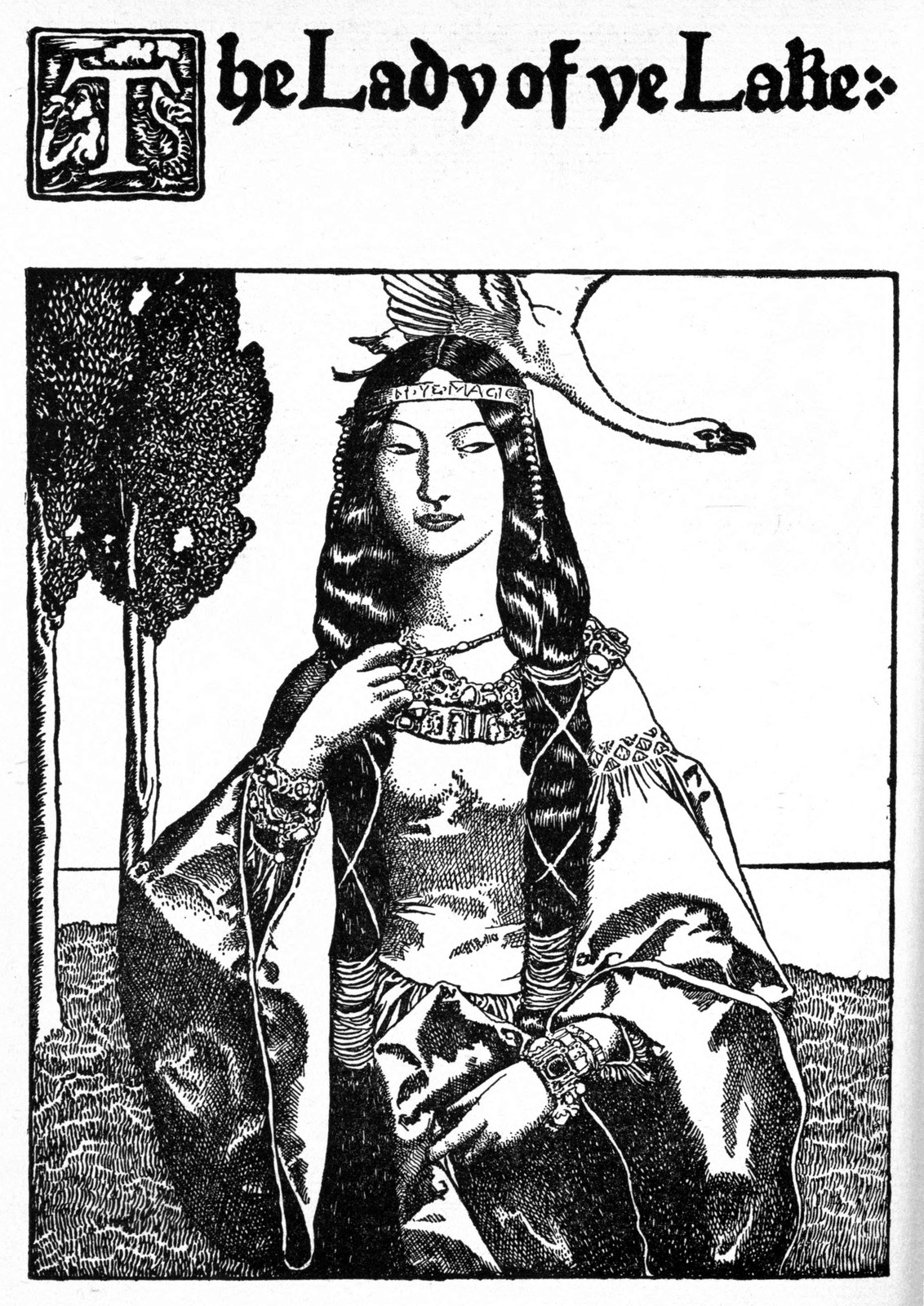
Here begins the Second Book of the History of King Arthur. It is called The Book of Three Worthies, because it tells of three very excellent and honorable lords of the Court of King Arthur.
Of these three, the first is Merlin the Wise; the second is Sir Pelleas, who was called the Gentle Knight; and the third is Sir Gawain, the son of King Lot of Orkney and the Isles.
So now, very soon, follows the story of the passing of Merlin the Wise. In it you will see how the very wisdom that Merlin had in such great measure was the cause of his own undoing. And so I hope that you yourselves will take that story to heart, and that you will see to it that the gifts of mind or of person which God gives you are never so misused, by you or by others, that they become the means of bringing about your own downfall.
For it will not excuse you in any way that, as you journey on through your life, you will find many men who, like Merlin, have been given by the grace of God very great gifts of talent, which they might very easily use for the great good of mankind, but which they so misuse that they bring all the greater ruin upon themselves and all the greater harm upon other men. For if you should prove so weak or so wicked as to misuse your talents in that way, to the harm of others and of yourself, it will not make your fault any the less that others have done greater evil than you.
So let this story of Merlin be a warning to you, I beg you all. For though I do not believe that Merlin ever meant his powers of magic to do harm to others, yet, because of his folly, they did as much harm as if he himself had planned to do evil with them. Yes; it is hard to tell whether the wickedness or the follies of men do the greater harm in the world. So take good care to guard yourself, not only against sin, but against folly and weakness as well.
Prologue
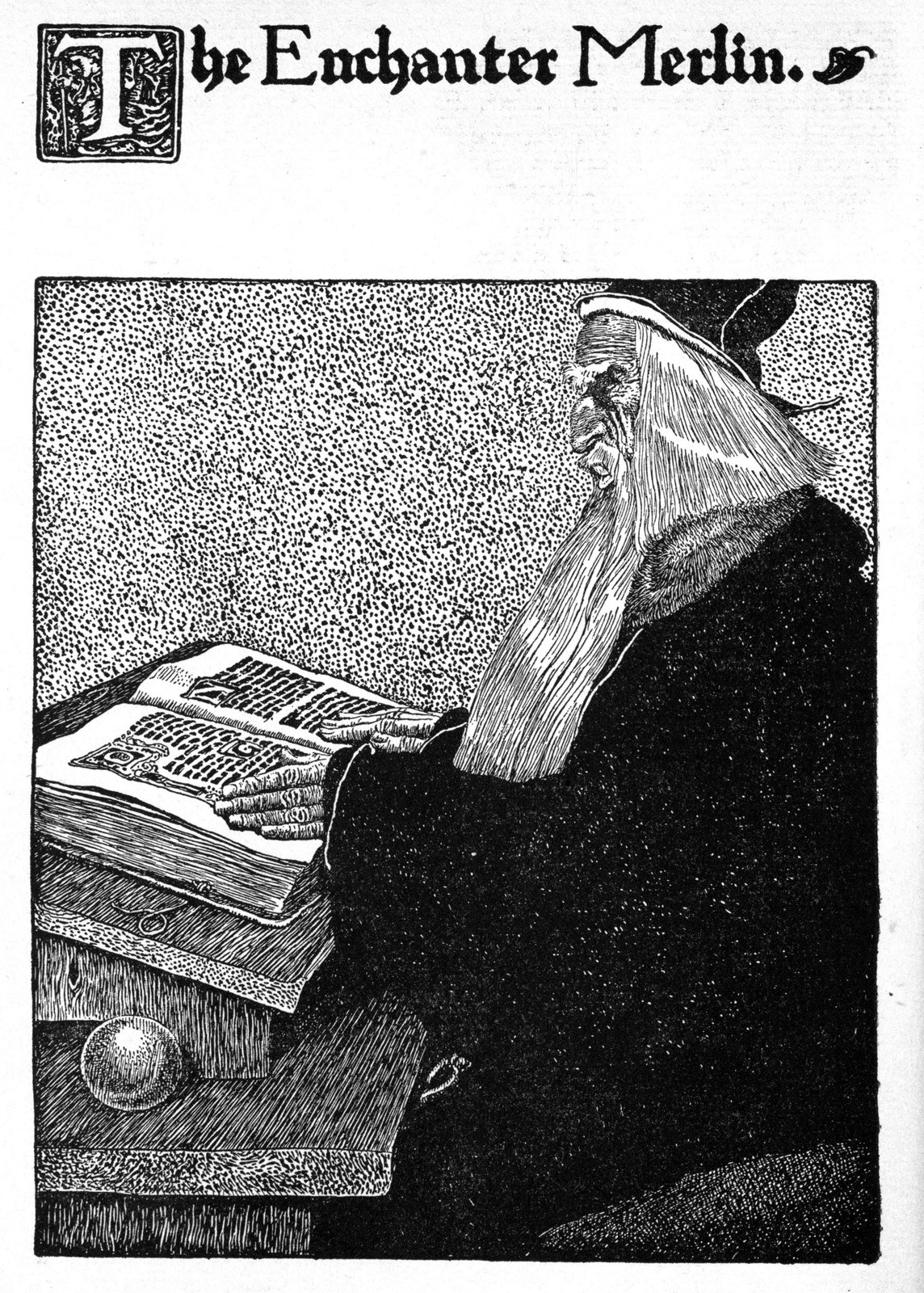
One day King Arthur sat in the Royal Hall of Camelot with the Queen, and all of his Court and all of her Court were there with them. And there was great joy and merriment in that place.
A messenger comes to the King at Camelot.
While they sat there, an armed knight suddenly came into the Hall. His armor was all covered with blood and dust, and he had a great many wounds upon his body. Everyone there was astonished and frightened at the sight of that knight, for the look of him promised no good news for King Arthur. The knight-messenger came to where the King was, so weak from his many wounds that he was nearly fainting. And he brought those who were there the news that five kings, enemies of King Arthur, had suddenly come into that land and were burning and plundering the country on every side.
And the knight-messenger said that these five kings were the King of Denmark, the King of Ireland, the King of Soleyse, the King of the Vale, and the King of Longtinaise. They had brought a great army with them and were laying waste the land all around, so that the whole realm was in bitter hardship and sorrow because of the ruin they made.
At this news King Arthur struck his palms together with great force and cried out, "Alas! Who would be a king! Will the time never come when these wars and troubles will end, and we shall have perfect peace in this land?" With that he rose up in great agitation and went out of that place, and everyone who was there was deeply troubled.
So King Arthur at once sent messengers to the two friendly kings who were nearest to him, that is, to King Pellinore and to King Uriens of Gore, and he asked them to come to his aid without losing any time. Meanwhile he himself gathered together a large army, meaning to go out and meet his enemies without delay.
King Arthur asks for the help of King Uriens and King Pellinore.
So he went out, and on the third day he came with his army to the forest of Tintagalon. There he stopped, meaning to rest for a little while until King Pellinore and King Uriens should join him.
But the five kings, his enemies, had news that King Arthur was in that place. At once they made a forced march through North Wales, meaning to strike him before those other two kings could come to his aid. So they came by night to where King Arthur was, and they fell upon him so unexpectedly that his army was in great danger of being put to flight by that attack.
But King Arthur drew his army together by his own courage and greatness of heart, and so they defended themselves with great spirit until King Pellinore appeared with his army and joined in the battle.
King Arthur is victorious.
So in the end King Arthur won a great victory over his enemies, for they were put to flight and scattered in every direction. And through that war, and because these five kings submitted to him, King Arthur won back all of the realm that had once been his father's, and more besides.
Eight knights of the Round Table are killed in battle.
Now in that war eight of the knights of the Round Table lost their lives, and King Arthur mourned their loss with great sorrow; for these were the first knights of the Round Table to lose their lives in battle in his defense.
While King Arthur was grieving very bitterly for these eight knights, Merlin came to him and said, "Do not be downcast, lord. For look! You still have many excellent knights around you, and you certainly cannot have very much trouble in filling the eight places that death has left empty. Now if you follow my advice, you will choose some very worthy adviser from among the knights-companion of your Round Table, and you will consult with him in this matter (for the counsel of two is better than the counsel of one), and between you, you can fill the places that the war has left empty."
This advice seemed very good to King Arthur, so he did as Merlin advised. That very morning he called King Pellinore into his private chamber and laid the matter before him, and the two of them talked it over together. In that consultation King Pellinore gave King Arthur this advice: that four old and worthy knights should be chosen to fill four of those empty seats, and four young and eager knights should be chosen to fill the other four, and in that way all eight seats would be filled.
King Arthur and King Pellinore choose eight old and worthy knights for the Round Table.
Now that advice seemed good to King Arthur, and so he said, "Let it be done that way." So first the two of them chose the four old knights, and these were they: King Uriens of Gore, and King Lac, and Sir Hervise de Reuel, and Sir Galliar of Rouge. And from the younger knights of the Court they chose Sir Marvaise of Leisle, and Sir Lionel, the son of King Ban of Benwick, and Sir Cadar of Cornwall. So there was still one place left to be filled.
They choose three young knights for the Round Table.
Now it was a very hard thing to decide who should fill that place, for there were at that time two very honorable young knights at the Court. One of these was Sir Baudemagus, a young knight, the brother of Sir Uwain and the son of King Uriens of Gore and Queen Morgan le Fay (and that lady was King Arthur's half-sister, as has been told before). The other young knight was Sir Tor, who, though he had only lately come to the Court, had already carried out several very famous adventures. Sir Tor was a son of King Pellinore (though not by his Queen), and King Pellinore loved him a very great deal.
Then King Pellinore said to King Arthur, "Lord, there are certainly only two knights in all your Court to choose from to fill this eighth seat at the Round Table. One of these is your sister's son, Sir Baudemagus, and the other is my son, Sir Tor. Now I cannot advise you in this matter, so you, Lord, must choose one or the other of these young knights to fill that place. But this much I may say: it will please me very greatly if your favor should fall on Sir Baudemagus. For then all the world will believe that I have been above reproach in my dealings in this affair, whereas if Sir Tor is chosen, all men will say that I favored my own son."
King Arthur chooses Sir Tor for the Round Table.
Then King Arthur thought about this matter for a long while, and at last he spoke and said, "Sir, I have weighed this whole affair, and it is my belief that Sir Tor is the better knight of the two. For he has carried out several very excellent adventures, while Sir Baudemagus, though he is a worthy knight, has not yet shown any very great achievement in the fields of knighthood. So, in God's name, let Sir Tor be seated as a companion of the Round Table."
Then King Pellinore said, "So be it," and with that they both rose and went out of that place.
And at that very moment, wonderful to tell, the names of the eight worthies they had chosen appeared, each upon the back of the seat at the Round Table that belonged to him. And so the decision of those two knights was confirmed in that way in the sight of all the world.
Queen Morgan le Fay is offended with King Arthur.
Now when word of all this reached the ears of Queen Morgan le Fay, she was greatly offended that Sir Baudemagus, her son, had been passed over and another chosen in his place. So she cried out against King Arthur in the hearing of several people, saying: "Ha! What is this? Are blood and kinship worth nothing in the eyes of this King, that he passes over so worthy a knight as his own nephew and chooses in his place one who was not born in wedlock? My husband's house has suffered many grievous wrongs at the hands of King Arthur. Why, he has taken away our royal power and made us all little better than captives in his own Court! That in itself is as great an insult as if we were his bitter enemies instead of his near kin. But what he has now done to my son, in passing him over like this, is a greater insult than that other."
And Queen Morgan le Fay spoke like this not only to King Uriens, who was her husband, but to Sir Uwain and to Sir Baudemagus, who were her sons. But King Uriens of Gore rebuked her for her words, for he had grown to love King Arthur very much because of the high nobility of his nature. And Sir Uwain rebuked her too, saying that he would listen to nothing evil said of King Arthur. For not only did he love King Arthur better than anyone else in all the world, but the King was at once the mirror of all knighthood and the very fountainhead of honor.
So these two spoke. But Sir Baudemagus listened to what his mother, Queen Morgan, said, for he was very angry with King Arthur because the King had passed him over. So he left the Court without asking King Arthur's leave and went riding as a knight-errant in search of adventure, and at this King Arthur was very sorry.
Now, as I have said, Queen Morgan le Fay spoke of her indignation to several other people of the Court, so that word of it came at last to the ears of King Arthur and grieved him a very great deal. So when Queen Morgan came to him one day and begged his leave to depart from the Court, he spoke to her with great sadness of spirit, saying, "My sister, I am very sorry that you are not pleased with what I have done in this matter, for God knows that I have tried to do the best I could. And though I would very much rather that Sir Baudemagus were a fellow of the Round Table, yet it was my most honest belief that, for several reasons, Sir Tor had the better right to a seat at that Table. Now if I had chosen otherwise than by my true judgment, what virtue would the Round Table have, when I should have shown favor to a man because he is my kinsman?"
Then Queen Morgan le Fay said with great heat, "Sir, all that you say only adds to the insult our house has suffered at your hands. For now you not only deny my son that seat, but you belittle him by comparing him unfavorably with this low-born knight you have chosen. Now the only pleasure I can have in talking with you is to beg you to let me go away from this place."
Then King Arthur, speaking with great dignity, said, "Lady, it shall be as you wish, and you shall go wherever it pleases you. For God forbid that I should stand in the way of your wishes. What is more, I shall see to it that you do not leave this place without such a Court for company as may well befit one who is the wife of one king and the sister of another."
Queen Morgan le Fay leaves the Court of King Arthur.
And he did just as he said he would, for he sent Queen Morgan le Fay away from his Court with great honor and in high state. But the more patient King Arthur was with her and the more favor he showed her, the angrier Queen Morgan le Fay grew with him and the more she hated him.
So she made her way to a broad mouth of a river where it met the sea. There she sent away those whom the King had sent with her, and she took ship with her own Court in several vessels and sailed away to that enchanted island called Avalon, which was her home.
This island of Avalon was a very strange and wonderful land, such as was not to be seen anywhere else in all the world. For it was like a Paradise for beauty. It was covered all over with gardens of every kind of flower, mingled with groves of lovely trees, some bearing fruit and others all in bloom with blossoms. And besides these there were many terraces of lawn, and smooth slopes of grass lying all around the edges of the island and looking out over the sea from tall white walls of pure marble. And in the midst of these gardens and orchards and groves and lawns and terraces there stood a multitude of castles and towers, built up one above another, some as white as snow and others very gay with many colors.
And the greatest marvel of that wonderful island was this: in the midst of all those castles and towers stood a single tower built entirely of lodestone, the magnet-stone. And in that lay the great mystery of the place.
For the island floated on the surface of the water, and that tower of lodestone had such power that Avalon would float from place to place at the will of Queen Morgan le Fay. So sometimes it would be here and sometimes it would be there, just as that royal lady willed it.
Nor were there very many people who had seen that island. For at times it would be covered all over with a silvery mist of enchantment, so that no eyes could see it unless they were fairy eyes. But sometimes it had been seen, like a vision of Paradise. And then whoever saw it would hear happy voices sounding from its lawns and groves, very thin and clear because of the great distance (for no one ever came near Avalon unless Queen Morgan le Fay allowed it), and he would hear music so sweet that his very soul might grow faint with it. Then Avalon would suddenly vanish in a most marvelous way, and whoever had seen it would know that he was not likely ever to see it again.
Such was the island of Avalon. If you would like to read more about it, you will find a great deal in a certain book written in French and called "Ogier le Danois," which is to say, Ogier the Dane.
Queen Morgan le Fay loved this island a very great deal. And many people say that King Arthur is still alive in that place, lying there very peacefully and quietly while he waits for the appointed time when he will return to the world to set right all that is wrong in it. That is why I have told you about it here, with all these particulars.
The Book of Three Worthies, Part One: The Story of Merlin
Foreword
Here follows a full account of how Merlin was enchanted by a certain damsel named Vivien, and of everything that had to do with it.
Here, too, you will hear how King Arthur was betrayed by his own sister, and how he would certainly have been killed if it had not been for the help of that same enchantress, Vivien, who brought about Merlin's downfall.
And you will also hear how the sheath of Excalibur was lost at that time.
Chapter 1: How Queen Morgan le Fay Plotted Against King Arthur, and How She Sent a Damsel to Charm the Enchanter Merlin
Now Morgan le Fay was a very skillful enchantress, and she had so mastered magic that by her powerful spells she could work her will on all things, whether living or dead. For Merlin himself had been her teacher in times past, and he had taught her his arts while she was still a young damsel at the court of Uther Pendragon. So it was that, next to Merlin, she was at that time the most powerful enchanter in all the world. Even so, she lacked Merlin's knowledge of things to come and his gift of prophecy. Those were things he could not pass on to anyone, and so she had never learned them from him.
Queen Morgan plots evil against King Arthur.
Now, after Queen Morgan le Fay had come to the Island of Avalon, as you have already heard, she brooded a great deal over the insult she believed King Arthur had done to her house. And the more she brooded on it, the bigger it grew in her mind, until at last it seemed to her that she could take no pleasure in life unless she could punish King Arthur for what he had done. Yes; she would have been glad to see him lying dead at her feet, so great was the anger she felt against him.
But Queen Morgan knew very well that she could never do the King, her brother, any harm so long as Merlin was there to guard him. For Merlin would surely foresee any danger that threatened the King, and he would undo it. And so she knew that if she wanted to destroy the King, she must first destroy Merlin.
Now at the court of Queen Morgan le Fay there was a certain damsel of such marvelous and bewitching beauty that her equal could hardly be found anywhere in the world. This damsel was fifteen years old and of royal blood, for she was the daughter of the King of Northumberland, and her name was Vivien. And this damsel, Vivien, was wise and crafty beyond all measure for someone so young. What was more, she had no heart at all, and she was cold and cruel to anyone who stood in the way of what she wanted. Because she was so clever and so wise, Queen Morgan liked her, and taught her many of the things of magic and sorcery that she knew. But for all that Queen Morgan did for her, this maiden felt no love at all for her mistress, for she was entirely without a heart.
Queen Morgan talks with the Damsel Vivien.
One day this damsel and Queen Morgan le Fay were sitting together in a garden on that magic island of Avalon. The garden lay on a very high terrace overlooking the sea. The day was very fair, and the sea was so wonderfully blue that it seemed as though the blue sky had melted into the water and the water into the sky. As Vivien and the Queen sat in this beautiful place, the Queen said to the damsel, "Vivien, what would you rather have than anything else in the world?" And Vivien answered, "Lady, I would rather have wisdom like yours than anything else."
At that Queen Morgan laughed and said, "You can be as wise as I am, and wiser too, if you will do as I tell you. For I know a way by which you can gain wisdom."
"How can I gain that wisdom, Lady?" said Vivien.
Then Queen Morgan le Fay said, "Listen and I will tell you. You must know that Merlin, whom you have seen several times at the court of King Arthur, is master of all the wisdom that anyone can possibly have in this world. Everything I know of magic Merlin taught me, and he knows many things that he did not teach me, but kept back from me. Merlin taught me when I was a young damsel at the court of my mother's husband, because I was beautiful in his eyes. For Merlin loves beauty more than anything else in the world, and so he taught me many things of magic and was very patient with me.
"But Merlin has one gift that belongs to him alone, and that he cannot pass on to anyone else, for it is born in him. That gift is the gift of seeing into the future and the power to prophesy what he sees.
"Yet though he can foresee the fate of others, he is blind to his own. He confessed as much to me several times: that he could not tell what was going to happen in his own life when it concerned himself alone.
"Now you, Vivien, are far more beautiful than I was at your age, and so I believe you will easily win Merlin's affection. And if I give you, besides, a certain charm that I own, I can make Merlin love you so much that he will teach you a great deal more of his wisdom than he ever taught me when I was his pupil.
"But you must understand, Vivien, that in winning this gift of knowledge from Merlin you will put yourself in great danger. For by and by, when the charm of your beauty has faded for him, he may well regret having given you his wisdom. And then there will be great danger that he may lay some spell on you to take your powers away. For it would be impossible for both you and he to live in the same world, each of you knowing so much of the craft of magic."
Vivien listened to all this very closely, and when Queen Morgan had finished, the damsel said, "Dear Lady, everything you tell me is very wonderful, and I am filled with a fierce desire to gain that kind of knowledge of magic. So if you will help me in this, so that I can charm Merlin's wisdom out of him, I will be in your debt for as long as I live. And as for any danger that may come to me in this business, I am entirely willing to take it on myself. For I have great hopes that I can protect myself from Merlin so that no harm will come to me. When I have drawn out of him all the knowledge I can get, I will use that same knowledge to cast such a spell on him that he will never be able to harm me or anyone else again. In this I will play my wits against his wisdom and my beauty against his skill, and I believe I will win that game."
At that Queen Morgan burst out laughing beyond all measure, and when she had stopped laughing, she cried, "Ha, Vivien! You are truly more crafty than anyone I ever heard of, and I believe you are as wicked as you are crafty. For who ever heard of a child fifteen years old speaking words like the ones you have just spoken? Or who could ever suppose that so young a girl could dream of bringing about the downfall of the wisest magician who ever lived?"
Queen Morgan gives Vivien two enchanted rings.
Then Queen Morgan le Fay set to her lips a small whistle of ivory and gold and blew a very shrill note on it, and in answer a young page of her court came running. Queen Morgan ordered him to bring her a certain casket of alabaster, skillfully carved, decorated with gold, and set with several precious stones. And Queen Morgan opened the box and took out of it two rings of pure yellow gold, beautifully made and set. The one ring held a clear white stone of extraordinary brilliance, and the other a stone as red as blood. Then Queen Morgan said, "Vivien, look at these two rings! Each of them holds a spell of wonderful power. For if you wear the ring with the white stone, then whoever wears the ring with the red stone will love you with such a passion that you can do with him whatever you please. So take these rings and go to King Arthur's court, and use them however your cleverness may plan."
So Vivien took the two rings and thanked Queen Morgan le Fay for them beyond all measure.
Vivien appears before King Arthur at the Feast of Pentecost.
Now King Arthur took great pleasure in holding a great feast every Pentecost, when his court was gathered around him with much merriment and rejoicing. At such times it delighted him to have some excellent entertainment to amuse himself and his court, and so it nearly always happened that something took place that gave the King great entertainment. So the Feast of Pentecost came, and King Arthur sat at table with a great many noble and lordly people and several kings and queens. And as they all sat at that feast, their spirits high with merriment and good cheer, there suddenly came into the hall a very beautiful young damsel, and with her a dwarf, wonderfully misshapen and with a very hideous face. The maiden was dressed all in flame-colored satin, very rich, with beautiful embroidery of gold and of silver. Her hair, which was red like gold, was coiled up in a net of gold. Her eyes were as black as coals, and extraordinarily bright and glittering. And around her throat she wore a necklace of gold of three strands, so that with all that gold and those bright clothes she shone with wonderful splendor as she came into the hall. The dwarf who came with her was likewise dressed all in flame color, and in his hands he carried a cushion of flame-colored silk with tassels of gold, and on the cushion he carried a ring of great beauty set with a red stone.
So when King Arthur saw this beautiful maiden, he supposed that here was some excellent entertainment, and he rejoiced at it a very great deal.
But when he looked closely at the damsel, it seemed to him that he knew her face, and so he said to her, "Damsel, who are you?" "Sir," she said, "I am the daughter of the King of Northumberland, and my name is Vivien." And with that King Arthur was satisfied.
Then King Arthur said to her, "Lady, what is that you have on the cushion there, and why have you honored us by coming here?" And Vivien answered, "Lord, I have here a very fine entertainment to give you pleasure at this Feast of Pentecost. For here is a ring of such a kind that only the wisest and most worthy of all the men here may wear it." And King Arthur said, "Let us see the ring."
So Vivien took the ring from the cushion the dwarf held, and she came and brought it to King Arthur, and the King took the ring in his own hand. And he saw that the ring was extraordinarily beautiful, so he said, "Maiden, do I have your permission to try this ring on my finger?" And Vivien said, "Yes, lord."
King Arthur tries on the ring.
So King Arthur tried to put the ring on his finger; but the ring shrank in size so that it would not go past the first joint. And so King Arthur said, "It seems that I am not worthy to wear this ring."
Merlin wins the ring.
Then the damsel Vivien said, "Do I have my lord's permission to offer this ring to others of his court?" And King Arthur said, "Let the others try the ring." So Vivien took the ring to the different people of the court, both lords and ladies, but not one of them could wear it. Then, last of all, Vivien came to the place where Merlin sat, and she knelt on the ground before him and offered him the ring. And because this concerned Merlin himself, he could not see into the future to know that harm was meant for him. Even so, he looked sourly at the damsel and said, "Child, what is this silly trick you are offering me?" "Sir," said Vivien, "I beg you to try this ring on your finger." Then Merlin looked at the damsel more closely, and he saw that she was very beautiful, and his heart softened toward her a great deal. So he spoke to her more gently and said, "Why should I take the ring?" And she answered, "Because I believe that you are the wisest and the most worthy of any man in this whole place, and so the ring should belong to you." Then Merlin smiled, and took the ring and put it on his finger; and it fitted his finger exactly. At that Vivien cried out, "Look! The ring has fitted his finger, and he is the wisest and the most worthy!" And Merlin was greatly pleased that the ring the beautiful damsel had given him had fitted his finger like that.
Then, after a while, he would have taken the ring off again, but to his astonishment he could not, for the ring had grown onto his finger as though it were part of its flesh and bone. At this Merlin became deeply troubled in spirit and very anxious, for he did not understand what the magic of the ring might mean. So he said, "Lady, where did this ring come from?" And Vivien said, "Sir, you know all things. Do you not know, then, that this ring was sent here by Morgan le Fay?" Then once again Merlin was filled with doubt, and he said, "I hope there may be no evil in this ring." And Vivien smiled at him and said, "What evil could there be in it?"
By this time the great magic that was in the ring had begun to work on Merlin's spirit, and he gazed at Vivien very steadily, and suddenly he took great delight in her beauty. Then the magic of the ring took complete hold of him, and a wonderful passion seized his heart all at once and wrung it so that it was pierced as if with a violent agony.
And Vivien saw what was passing in Merlin's mind, and she laughed and turned away. Several others who were there also noticed the very strange way in which Merlin gazed at her, and they said among themselves, "Surely Merlin is bewitched by the beauty of that young damsel."
The ring works its charm on Merlin the Wise.
So from that time on, the enchantment of Morgan le Fay's ring worked so strongly on Merlin's spirit that he could in no way free himself from Vivien's witchery. From that day forward, wherever she went, he could be found not far away. If she was in the garden, he would be there; if she was in the Hall, he would be there too; and if she went hawking, he would be on horseback as well. All the court noticed these things, and many of them made merry over it and joked about it. But Vivien hated Merlin with all her might, for she saw that everyone was laughing at Merlin's folly, and he wearied her with his attentions. Still, she hid her dislike from him and behaved toward him in every way as though she felt a great friendship for him.
Now it happened one day that Vivien was sitting in the garden in wonderfully pleasant summer weather, and Merlin came into the garden and saw Vivien where she sat. But when Vivien saw Merlin coming, she suddenly felt such a dislike for him that she could not bear to be near him just then, so she got up in haste, meaning to escape from him. But Merlin hurried and caught up with her, and he said to her, "Child, do you hate me, then?" And Vivien said, "Sir, I do not hate you." But Merlin said, "In very truth, I believe you do hate me." And Vivien was silent.
Then after a little Merlin said, "I wish I knew what I could do for you so that you would stop hating me, for I find that I have a wonderful love for you." At this Vivien looked at Merlin very strangely, and after a while she said, "Sir, if only you would share your wisdom and your skill with me, then I believe I could love you a very great deal. For look, I am only a young child in knowledge, and you are so old and so wise that I am afraid of you. If you would teach me your wisdom so that I might be your equal, then perhaps I might come to feel for you the way you would have me feel."
At this Merlin looked very steadily at Vivien and said, "Damsel, you are surely not the foolish child you claim to be, for I see that your eyes are very bright with a cleverness beyond your years. Now, I fear that if I were to teach you the wisdom you long to have, it would be either your undoing or else mine."
Then Vivien cried out in a very loud and piercing voice, "Merlin, if you love me, teach me your wisdom and the secrets of your magic, and then I will love you more than anyone else in all the world!"
But Merlin sighed very deeply, for his heart was full of foreboding. Then after a while he said, "Vivien, you shall have your way, and I will teach you all the things of wisdom and magic that you want to know."
At this Vivien was filled with such a fierce agony of joy that she did not dare let Merlin look into her face, for fear he would read what was written there. So she cast down her eyes and turned her face away from him. Then after a little while she said, "Master, when will you teach me that wisdom?"
Merlin answered, "I will not teach you today, or tomorrow, or in this place. For I can only teach you these things in a solitude where nothing will disturb your studies. But tomorrow you must tell King Arthur that you have to go back to your father's kingdom. Then we will set out together, along with your attendants; and when we have come to some secluded place, I will build a dwelling there by means of my magic, and we will stay in it until I have taught you wisdom."
Then Vivien was filled with joy, and she caught Merlin's hand in hers and kissed it with great passion.
Merlin and Vivien leave the court of the King.
So the next day Vivien begged King Arthur to give her permission to go back to her father's court, and on the third day she and Merlin, and a number of attendants who served the damsel, left the court of King Arthur and set out as though they were on their way to the Kingdom of Northumberland.
But when they had gone some little distance from the court of the King, they turned to the east and made their way toward a certain valley that Merlin knew of. It was such a fair and pleasant place that it was sometimes called the Valley of Delight and sometimes the Valley of Joyousness.
Chapter 2: How Merlin Traveled with Vivien to the Valley of Joyousness and Built Her a Castle There, How He Taught Her the Secrets of Magic, and How She Used Them to Bring Him Down
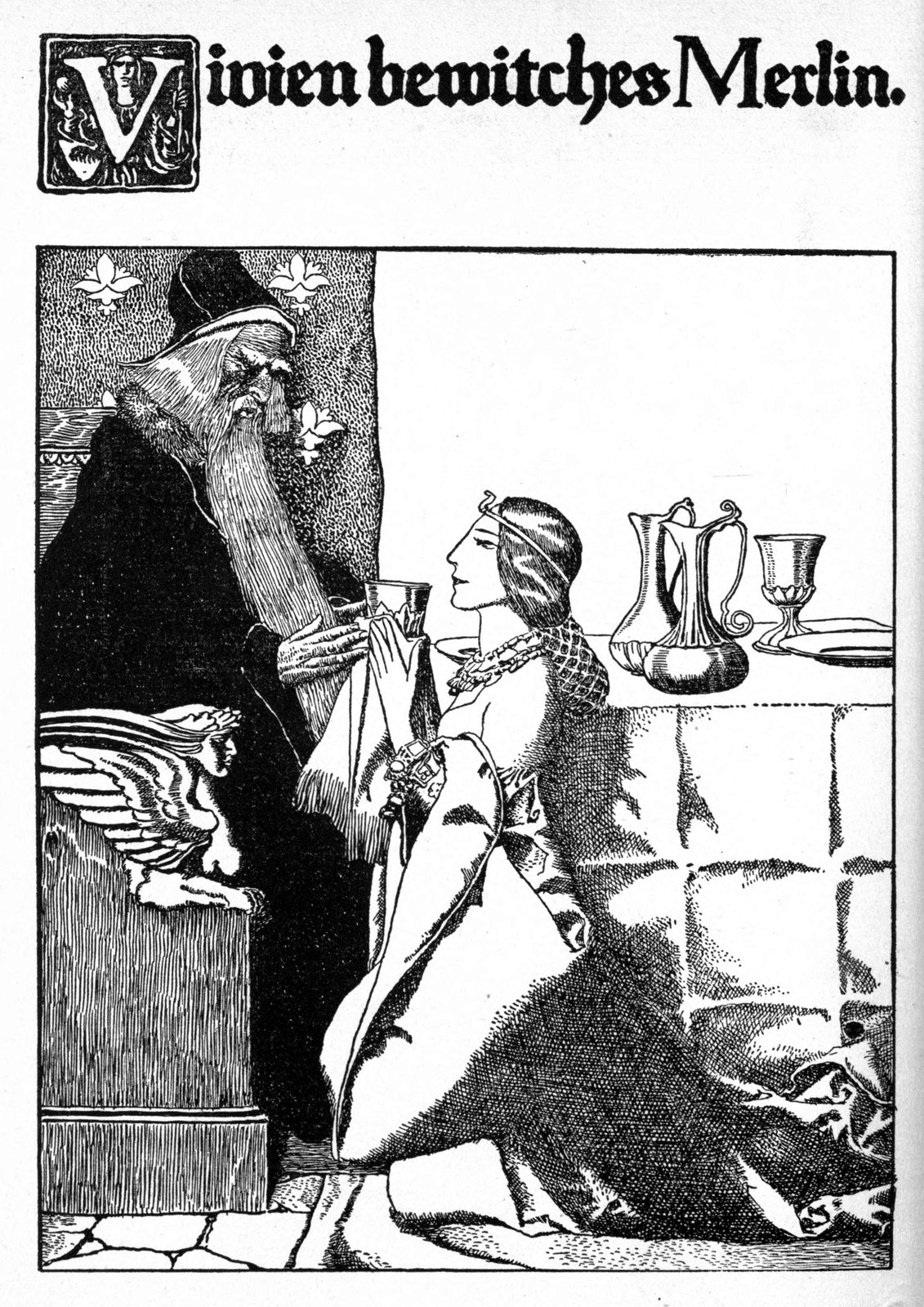
Merlin and Vivien come to an enchanted forest.
So Merlin and Vivien and those who were with them traveled east for three days, until, toward the end of the third day, they came to the edge of a very dark and gloomy forest. There before them they saw trees so thickly woven together that no eye could see any of the sky through the thickness of the leaves. And they saw that the branches and roots of the trees looked like serpents all twisted together. So Vivien said, "Sir, this is a very gloomy woodland." "Yes," said Merlin, "so it seems. Even so, inside this forest lies the place that some call the Valley of Joyousness and others the Valley of Delight, because of its great beauty. And there are several paths running through this forest by which a man may reach that valley, whether on horseback or on foot."
And after a while they found that it was as Merlin said, for by and by they came upon one of those paths, and they entered it and went deep into the forest. And inside that dismal woodland it was so dark that it seemed as though night had fallen, although it was bright daylight outside its borders, so that many of the party were very much afraid. But Merlin kept cheering them on, and so they went forward on their way. And by and by they came out of that place at last into the open again, and they were greatly relieved and took much comfort.
Merlin and Vivien come to the Valley of Joyousness.
By this time evening had come, very peaceful and still, and wonderfully beautiful. In the center of the valley lay a small lake, so smooth and as clear as crystal that it looked like an oval shield of pure silver laid down on the ground. And all around the edge of the lake were level meadows covered with an unbelievable multitude of flowers of every color and kind, very beautiful to see.
When Vivien saw this place she cried out to Merlin, "Master, this is truly a very joyous valley, for I do not believe the blessed meadows of Paradise are more beautiful than this." And Merlin said, "Very well; let us go down into it." So they went down, and as they went, night fell quickly, and the round moon rose into the sky. And it was hard to tell whether the valley was more beautiful by day or more beautiful when the moon shone down on it like that.
So at last they all came to the shore of the lake, and they saw that there was neither house nor castle in that place.
At this Merlin's followers grumbled among themselves, saying, "This enchanter has brought us here, but how is he going to provide us with a resting place to shelter us from the changes of bad weather? For the beauty of this spot alone cannot shelter us from rain and storm." And Merlin overheard their grumbling, and he said, "Peace! Do not trouble yourselves about that, for I will very soon provide you with a good resting place." Then he said to them, "Stand a little way off until I show you what I will do." So they drew back a little, as he commanded, and he and Vivien stayed where they were. And Vivien said, "Master, what will you do?" And Merlin said, "Wait a little and you will see."
With that he began a certain very powerful spell, so that the earth began to tremble and shake, and something like a great cloud of red dust rose into the air. In this dust various shapes and forms began to appear, and these shapes and forms rose very high into the air, until by and by those who were watching saw that a great building was taking shape in the middle of the cloud of red dust.
Merlin builds a castle by means of his magic.
Then, after a while, everything grew quiet and the dust slowly faded from the air, and there before them stood a marvelous castle such as no one there had ever seen before, even in a dream. For its walls were of ultramarine and vermilion, decorated and adorned with figures of gold, so that the castle shone in the moonlight like a pure vision of great glory.
Vivien saw everything Merlin had done, and she went to him and knelt on the ground before him and took his hand and pressed it to her lips. And as she knelt there, she said, "Master, this is surely the most wonderful thing in the world. Will you teach me such magic that I can build a castle like this one out of the elements?" And Merlin said, "Yes; all this I will teach you, and more besides. For I will teach you not only how to create a building like this out of invisible things, but also how, with a single touch of your wand, to scatter that castle instantly into the air, just as a child with a stroke of a straw can burst a beautiful shining bubble, which one instant is there and the next instant is not. And I will teach you more than that, for I will teach you how to change and transform one thing so that it looks like something else; and I will teach you spells and charms such as you have never heard of before."
Then Vivien cried out, "Master, you are the most wonderful man in all the world!" And Merlin looked at Vivien, and her face was very beautiful in the moonlight, and he loved her a very great deal. So he smiled at her and said, "Vivien, do you still hate me?" And she said, "No, master."
But she did not speak the truth, for in her heart she was evil, and Merlin's heart was good, and what is evil will always hate what is good. So, though Vivien hungered for the knowledge of the black arts, and though she spoke so lovingly with her lips, yet in her spirit she both feared and hated Merlin because of his wisdom. For she knew very well that, if it were not for the enchantment of the ring he wore, Merlin would no longer love her as he did. And so she said in her heart, "If Merlin teaches me all his wisdom, then the world cannot hold both him and me."
Merlin teaches magic to Vivien.
Merlin stayed with Vivien in that place for a year and a little more, and in that time he taught her all the magic he was able to pass on. And at the end of that time he said to her, "Vivien, I have now taught you so much that I believe there is no one in all the world who knows more than you do of the things of magic you have studied in this time. For not only do you have such powers of sorcery that you can make the invisible elements take shape at your will, and not only can you change one thing at your will so that it looks like something altogether different, but you have such powerful magic in your possession that you can tangle any living soul in its meshes, unless that person has some very good charm to defend himself against your wiles. Even I myself have not very much more power than what I have given you."
So said Merlin, and Vivien was filled with great joy. And she said in her heart, "Now, Merlin, if I have the good fortune to tangle you in my spells, you will never see the world again."
Vivien prepares a feast for Merlin.
When the next day came, Vivien had a very splendid feast prepared for herself and Merlin. And by means of the knowledge Merlin had taught her, she made a certain very powerful sleeping potion that had no taste at all. She herself mixed this potion into a certain fine wine, and she poured the wine into a golden chalice of extraordinary beauty.
So when the feast was over, and while she and Merlin sat together, Vivien said, "Master, I have a mind to do you a great honor." And Merlin said, "What is it?" "You will see," said Vivien. With that she clapped her hands, and at once a young page came to where they were, carrying that chalice of wine in his hand, and he gave it to Vivien. Then Vivien took the chalice and went to where Merlin sat, and knelt down before him and said, "Sir, I beg you to take this chalice and drink the wine that is in it. For just as that wine is very noble and very precious, so your wisdom is very noble and very precious; and just as the wine is held in a chalice of priceless worth, so your wisdom is held in a life that has been beyond all value to the world." And with that she put her lips to the chalice and kissed the wine that was in it.
Merlin suspected no evil, but took the chalice and drank the wine very cheerfully.
Merlin is overcome by the wine that Vivien gives him.
After that, in a little while, the fumes of that powerful drink began to rise into Merlin's brain, and it was as though a cloud came down over his sight. And when this came upon him, he knew at once that he was betrayed, and he cried out three times, in a voice very bitter and full of agony, "Woe! Woe! Woe!" And then he cried out, "I am betrayed!" And with that he struggled to rise from where he sat, but he could not.
All this while Vivien sat with her chin in her hands and watched him very steadily, smiling at him strangely. So before long Merlin stopped struggling and sank into a sleep so deep that it was almost as if he had died. And when that had happened, Vivien got up and leaned over him and laid a very powerful spell on him. She stretched out her forefinger and wove an enchantment all around him, so that it was as if he were wrapped all about in a silver web of enchantment. And when she had finished, Merlin could move neither hand nor foot, nor even so much as a fingertip, but was exactly like some great insect that a clever and beautiful spider had caught in a net of fine, strong web.
Vivien bewitches Merlin.
When the next morning came, Merlin woke from his sleep and saw Vivien sitting across from him, watching him very closely. They were in the same room in which he had fallen asleep. And when Vivien saw that Merlin was awake, she laughed and said, "Merlin, how are you?" And Merlin groaned with great passion, saying, "Vivien, you have betrayed me."
At this Vivien laughed again, very shrilly and piercingly, and she said, "Look, Merlin, you are completely in my power, for you are wound all about in the very enchantments that you yourself taught me. Why, you cannot move a single hair without my will. And when I leave you, the world will see you no more, and all your wisdom will be my wisdom, and all your power will be my power, and there will be no one else in the whole world who has the wisdom I have."
Then Merlin groaned so deeply that it seemed his heart would burst. And he said, "Vivien, you have brought me to such shame that even if I were freed from this spell I could not bear for any man ever to see my face again. For I do not grieve so much for my ruin as I grieve at the folly that has turned my own wisdom against me to destroy me. So I forgive you everything you have done to betray me; yet there is one thing only that I beg of you."
And Vivien said, "Does it concern you?" And Merlin said, "No, it concerns someone else." Then Vivien said, "What is it?"
Merlin makes one request of Vivien.
Then Merlin said, "It is this. My gift of foresight has come back to me, and I see that King Arthur is at this moment in great danger of his life. So I beg you, Vivien, to go at once to where he is in danger, and to use your powers of sorcery to save him. By doing this one good deed, you may perhaps lessen the sin of what you have done in betraying me."
Now at that time Vivien was not so wholly bad as she later became, for she still felt some small pity for Merlin and some small respect for King Arthur. So now she laughed and said, "Very well, I will do what you ask in this matter. Where shall I go to save that King?"
Merlin answered, "Go into the West Country, to the castle of a certain knight named Sir Damas le Noir, and when you get there you will see at once how you can help the good King." At this Vivien said, "I will do this thing for you, for it is the last favor anyone will ever do for you in this world."
With that Vivien clapped her hands and called many of her attendants. And when they had come in, she showed Merlin to them and said, "See how I have bewitched him! Go! See for yourselves! Feel his hands and his face, and see if there is any life in him." And they went to Merlin and felt him, his hands and arms and face, and they even plucked at his beard, and Merlin could not move in any way, but could only groan in great misery. So they all laughed and made merry over his woeful state.
Vivien places Merlin beneath the stone.
Then by means of her magic Vivien made a great chest of stone appear in that place. And she commanded those who were there to lift Merlin up and lay him in it, and they did as she commanded. Then by means of her magic she had a huge slab of stone, such as ten men could hardly lift, placed on top of that chest, and Merlin lay beneath that stone like a man who was dead.
Then Vivien made the magic castle vanish in an instant, and it happened just as she willed. Then she made a mist rise up over that place, and the mist was of such a kind that no one could make his way into it or break through it, and no human eye could see what was inside. And when she had done all this, she went away from that valley with all her attendants, rejoicing greatly that she had triumphed over Merlin.
Even so, she did not forget her promise, but went to the castle of Sir Damas le Noir; and after a while you will hear everything that happened there.
That was the passing of Merlin. And may God grant that you never so misuse the wisdom He gives you that it is turned against you to your undoing. For there can be no greater bitterness in the world than this: that a man should be betrayed by someone to whom he himself has given the power to betray him.
And now let us turn to King Arthur, to learn how things went with him after Merlin had been betrayed to his undoing like this.
Chapter 3: How Queen Morgan le Fay Came Back to Camelot Meaning to Harm King Arthur, and How the King and Others Went Hunting, and What Came of It
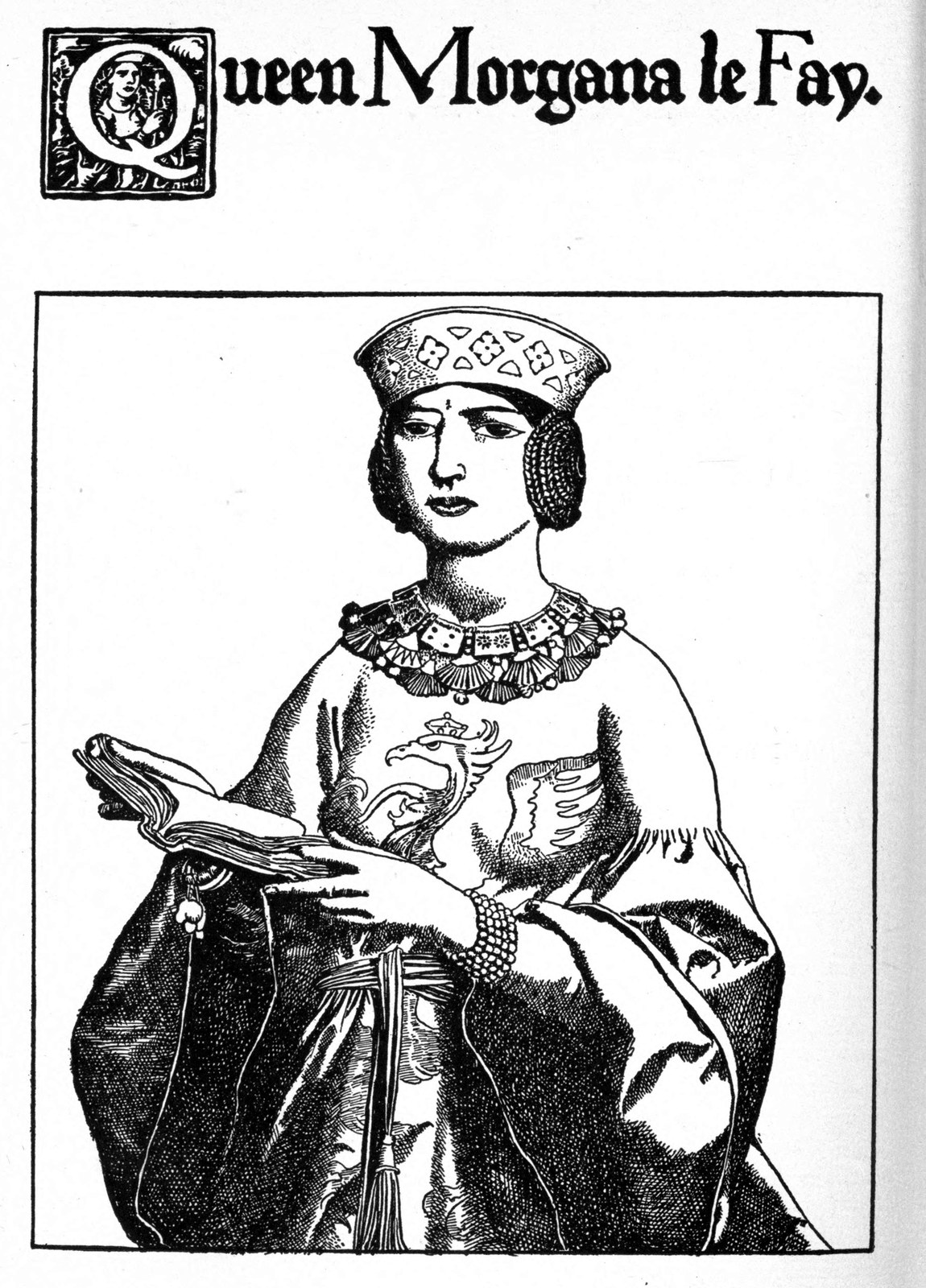
Now, after Merlin had left the Court with Vivien in the way I have already told you, Queen Morgan le Fay came back to Camelot. There she came to King Arthur and knelt before him, bowing her face, with a look of great humility. And she said, "Brother, I have thought a great deal about the things that have happened, and I see that I did very wrong to speak against you as I did, and to rebel against your royalty as I did. So I beg you to forgive me my evil words and my evil thoughts against you."
Queen Morgan le Fay and King Arthur are reconciled.
Then King Arthur was very much moved. He came to Queen Morgan and took her by the hand and lifted her to her feet, and he kissed her brow and her eyes, saying, "My sister, I bear you no ill will. There is nothing but love for you in my heart." And so Queen Morgan le Fay stayed at the Court just as she had before, for King Arthur believed that the two of them were reconciled.
King Arthur shows Excalibur to Queen Morgan.
Now one day Queen Morgan and the King fell into a friendly talk about Excalibur, and Queen Morgan le Fay said she very much wished to see that noble weapon more closely than she had yet been able to, and King Arthur said that he would show it to her sometime. So the next day he said, "Sister, come with me and I will show you Excalibur." With that he took Queen Morgan by the hand and led her into another room, where there stood a strong wooden chest bound with bands of iron. Then the King opened the chest, and there Queen Morgan le Fay saw Excalibur, lying in his sheath. And King Arthur said to her, "Lady, take this sword and look at it as much as you please." So Queen Morgan took Excalibur into her hands and lifted him out of the chest. And she drew the sword from the sheath, and the blade flashed like lightning. Then she said, "Sir, this is a very beautiful sword, and I wish I might take it away with me and keep it for a little while, so that I could enjoy it to the full."
Now King Arthur wished to show the Queen great courtesy at this time when they had made their peace, so he said to her, "Take it, and be its keeper for as long as you like." So Queen Morgan took Excalibur and his sheath and carried them away with her to her lodging, and she hid the sword in the bed where she slept.
Then Queen Morgan sent for goldsmiths, eight of them, and for armorers, eight of them, and for skilful jewelers, eight of them, and she said to them, "Make me a sword exactly like this sword that I have here, in every single detail." And then she showed them Excalibur in his sheath. So these goldsmiths and armorers and jewel-cutters worked with great diligence, and in two weeks they had made a sword so exactly like Excalibur that no eye could have told the one from the other. And Queen Morgan le Fay kept both swords by her until her plans should be carried out.
Then one day it happened that King Arthur proclaimed a hunt, and he and all his Court were to take part in it.
Queen Morgan le Fay gives a horse to King Arthur.
Now the day before the hunt, Queen Morgan le Fay came to King Arthur and said, "Brother, I have here for you a very beautiful and noble horse, which I mean to give you as a gift of love." With that she called aloud, and two grooms came leading a horse as black as jet, all decked with trappings and harness of silver. And the horse was so extraordinarily beautiful that neither King Arthur nor anyone with him had ever seen its equal. So a wonderful delight filled the King at the sight of that horse, and he said, "Sister, this is the noblest gift anyone has given me for a long time." "Ha, brother," said Queen Morgan, "so the horse pleases you?" "Yes," said King Arthur, "it pleases me more than any horse I have ever seen." "Then," said Queen Morgan, "think of it as a gift of reconciliation between you and me. And as a sign of that reconciliation, I beg you to ride that horse on the hunt tomorrow." And King Arthur said, "I will do so."
So the next day he rode out to the hunt on that horse, as he had said he would.
King Arthur rides hunting.
Now some time after noon it happened that the hounds started a hart of extraordinary size, and the King and all his Court followed the chase with great eagerness. But King Arthur's horse soon outran all the other horses except one, which belonged to a very honorable and worthy knight of the Court named Sir Accolon of Gaul. So Sir Accolon and the King rode at a great pace through the forest, and they were so eager in the chase that they did not notice where they were riding. At last they overtook the hart and found it trapped in a very thick and tangled part of the forest, and there King Arthur killed the stag, and so the chase was ended.
King Arthur and Sir Accolon of Gaul are lost in the forest.
After this the King and Sir Accolon would have gone back the way they had come, but soon they found that they were lost in the maze of the woods and did not know where they were. For they had followed the chase so far that they were in a completely strange country. So they wandered this way and that for a long time, until evening, and by then they were worn down with hunger and weariness. Then King Arthur said to Sir Accolon, "Sir, it seems to me that we shall have nowhere to rest tonight except under a tree in this forest."
To this Sir Accolon answered, "Lord, if you will take my advice, you will let our horses find their own way through this wilderness. Perhaps, by the instinct such creatures have, they will bring us to some place where people live."
This advice seemed very good to King Arthur, so he did as Sir Accolon advised: he let his bridle rein go loose and allowed his horse to go wherever it liked. So King Arthur's horse went along a certain path, and Sir Accolon followed after the King. And they went a good long way like this, while the night came down upon them in the forest.
But before it was entirely dark they came out of the forest into an open place, where they saw before them a very wide estuary, like an inlet of the sea. In front of them lay a beach of sand, very smooth and white, and the two of them went down to that beach and stood on the shore. And they did not know what to do, for there was no house or dwelling in sight in any direction.
King Arthur and Sir Accolon see a wonderful ship.
Now while they stood there in doubt, they suddenly saw a ship a very great distance away. And as the ship came nearer they saw that it was very strange and wonderful to look at. It was painted in many different colors, very gay and brilliant, and its sails were all of silk cloth, woven in many colors and embroidered with figures like the figures of a tapestry. And King Arthur was very greatly amazed at the sight of that ship.
As they stood there watching it, they saw that it was drawing nearer and nearer to the place where they were, and after a little while it ran itself aground on the sandy shore not very far away from them.
Then King Arthur said to Sir Accolon, "Sir, let us go down to the water's edge, where we can look into this ship. For I have never seen anything like it in all my life, and I have a notion that it may be a fairy ship."
So the two of them went to where the ship lay, and they stood on the shore and looked down into it. At first they thought there was no one aboard, for it seemed to be entirely deserted. But as they stood there marveling at how wonderful the ship was and at the way it had come there, they suddenly saw the curtains that hung before a cabin at the far end of the ship part, and out of that place came twelve very beautiful damsels. Each of them was dressed in a rich gown of scarlet satin, very bright and shining, and each wore a circlet of gold around her head, and each had many bracelets of gold upon her arms. These damsels came forward to where the two knights were, and they said, "Welcome, King Arthur!" And they said, "Welcome, Sir Accolon!"
King Arthur was very much astonished that they should know him, and he said, "Fair ladies, how is this? You seem to know me very well, but I do not know you. Who are you, that you know me and my companion and call us by our names?"
The chief of those damsels answered, "Sir, we are part fairy, and we know all about you. We know that you have been following a very long chase, and we know that you are weary and hungry and thirsty. So we beg you to come aboard this ship and rest and refresh yourselves with food and drink."
Now this seemed to King Arthur a very fine adventure, so he said to Sir Accolon, "Sir, I have a great mind to go aboard this ship and follow this adventure to the end." And Sir Accolon said, "Lord, if you go, I will go too."
King Arthur and Sir Accolon enter the ship of damsels.
So the ladies let down a gangplank from the ship, and King Arthur and Sir Accolon drove their horses up the gangplank and aboard. And the ship sailed away the way it had come, very swiftly. By now it was early night, and the moon hung very round and full in the sky, like a disk of pure shining silver.
Then the twelve damsels helped King Arthur and Sir Accolon to dismount. Some of them took the horses away, and others led the two knights into a fair room at the end of the ship. And in this room King Arthur saw that a table had been set as though for their entertainment, spread with a linen cloth and laid with many kinds of savory meats, with small loaves of white bread, and with several different sorts of excellent wine. At the sight King Arthur and Sir Accolon were greatly cheered, for they were very hungry indeed.
So they sat down at the table at once and ate and drank with great heartiness. And while they did so, some of the damsels served them their food, and others kept them in pleasant conversation, and others played music on lutes and citterns to entertain them. So they feasted and were very merry.
But after a while a very great drowsiness began to come over King Arthur, though he thought it had come upon him from the weariness of the chase. So soon he said, "Fair damsels, you have refreshed us a great deal, and this has been a very pleasant adventure. But now I wish you had a place for us to sleep."
The chief of the damsels replied, "Lord, this ship has been made ready for your refreshment, so everything you could need has been prepared for you in full."
With that, some of the twelve damsels led King Arthur to a bedchamber that had been prepared for him, and others led Sir Accolon to another chamber prepared for him. And King Arthur marveled at the beauty of his room, for he thought he had never seen a more splendidly furnished bedchamber than the one he had just entered. So King Arthur lay down in great comfort of body, and he fell at once into a deep and gentle sleep, without any dream or disturbance of any kind.
King Arthur finds himself in a dreadful prison.
Now when King Arthur woke from that sleep, he was astonished beyond all measure, so that he did not know whether he was still asleep and dreaming or whether he was awake. For he was lying on a pallet of straw in a very dark and dismal room, all of stone. And he saw that this room was a dungeon, and all around him he heard the sound of many voices complaining in misery. Then King Arthur said to himself, "Where is the ship I was on last night, and what has become of those ladies I spoke with?"
At that he looked around him, and he saw that he really was in a dungeon, and that there were many knights in a very sad state all around him. So he understood that they too were captives, and that it was they who had made that sound of miserable lamenting which he had heard as he woke.
Then King Arthur roused himself from where he lay, and he saw that all the knights who were prisoners there were strangers to him: he did not know them and they did not know him. And there were twenty-two of these knights held prisoner in that place.
Then King Arthur said, "Sirs, who are you, and where am I now?" And the chief of the knights who were prisoners answered, "Sir, like you, we are prisoners in a dungeon of this castle. And the castle belongs to a certain knight named Sir Damas, who is called le Noir, which means the Black."
Then King Arthur marveled greatly at what had happened to him, and he said, "Sirs, a very strange thing has happened to me. For last night I fell asleep in a very wonderful ship that I believe was a fairy ship, and a knight was with me as my companion. And now this morning I wake up alone in this dungeon, and I do not know how I came here."
"Sir," said the knight who was speaking for the others, "last night you were brought here by two men dressed in black, and they laid you down on that pallet without waking you. So it is very plain to me that you are in the same plight as we are, and that you are a prisoner of this Sir Damas le Noir."
Then King Arthur said, "Tell me, who is this Sir Damas? For I declare I have never heard of him before." "I will tell you," said the captive knight, and he did so, like this:
"I believe," he said, "that this Sir Damas is the falsest knight alive, for he is full of treachery and lies, and in his heart he is a complete coward. Yet he is a man of very great wealth and very powerful in these parts.
The prisoner knight tells King Arthur about Sir Damas.
"Now there are two brothers. Sir Damas is one, and the other is named Sir Ontzlake, and Sir Damas is the elder and Sir Ontzlake the younger. When the father of these two knights died, he left them equal shares of his inheritance. But now it has come about that Sir Damas holds nearly all those estates, and Sir Ontzlake has only one castle, which he now holds by force of arms and by his own courage. For though Sir Damas is a coward in his heart, he has more craft and cunning than any man I ever heard of. And so it has turned out that of their father's inheritance Sir Damas has everything, and Sir Ontzlake has nothing but that one castle and the lands that go with it.
"Now you would think Sir Damas would be satisfied with all this. Yet he is not satisfied. He covets that one castle and that small estate of his brother's so much that he can hardly take any pleasure in life for wanting it. Yet he does not know how to get that estate away from his brother. For Sir Ontzlake is a very excellent knight, and the only way Sir Damas could lay hands on his land would be to fight his brother man to man in a contest of arms, and that he is afraid to try.
"So for a long time Sir Damas has been searching for a knight who will take up his cause for him and fight Sir Ontzlake on his behalf. And so every knight he can capture he brings to this castle, and he gives each one a choice: either to take up his cause against his brother, or else to stay in this place as his prisoner, with no ransom ever accepted. He has captured all of us like that, and he has demanded of each of us that we fight for him. But not one of us will take up the cause of a knight as wicked as Sir Damas, and so we all remain his prisoners."
"Well," said King Arthur, "this is a very strange business. But I think that if Sir Damas asks me, I will take up his cause, for I would rather do that than stay a prisoner here all my life. But if I take on this battle and win it, then afterward I will settle with Sir Damas himself, in a way that I do not believe will be very much to his liking."
A damsel comes to King Arthur.
King Arthur agrees to fight for Sir Damas.
Now a little while after this, the door of the prison was opened by the porter, and in came a very fair young damsel. She came to King Arthur and said to him, "How are you faring?" "I cannot tell," said King Arthur, "but it seems to me I am in a very sorry plight in this place." "Sir," said the damsel, "it grieves me to see so noble-looking a knight in so sad a case. But if you will undertake to fight with your own body for the cause of the lord of this castle against his enemy, then you shall have leave to go wherever you please." King Arthur answered her, "Lady, this is a very hard choice, that either I must fight a battle I do not care about or else stay a prisoner here, with no ransom, for all my days. But I would rather fight than live here all my life, and so I will undertake that adventure as you wish me to. But if I fight for the lord of this castle, and if by the grace of Heaven I win that battle, then all these, my companions in prison, must go free with me."
To this the damsel said, "Very well, so be it, for that will satisfy the master of this castle."
Then King Arthur looked more closely at the maiden, and he said, "Damsel, it seems to me that I know your face, for I think I have seen you somewhere before this." "No, sir," she said, "that can hardly be, for I am the daughter of the lord of this castle."
But in this she lied. For she was one of Morgan le Fay's damsels, and she was one of those who had lured King Arthur into the ship the night before, and it was she who had brought him to that castle and handed him over to Sir Damas. And she had done all these things at the command of Queen Morgan le Fay.
Then King Arthur said, "But if I fight this battle, you must carry a message for me to the Court of King Arthur, and that message must be delivered to Queen Morgan le Fay, into her own hands. Then, when that is done, I will fight this battle for the cause of Sir Damas." And the damsel said, "It shall be done."
Queen Morgan sends a false sword to King Arthur.
So King Arthur wrote a sealed letter to Queen Morgan le Fay, asking her to send him his sword Excalibur, and he sent that message to her. And when Queen Morgan received the letter she laughed and said, "Very well. He shall have a sword that will please his eye just as well as Excalibur." And with that she sent him the other sword, the one she had had made exactly like Excalibur.
Then Sir Damas sent word to his brother, Sir Ontzlake, that he now had a champion to fight on his behalf and win back all that part of their inheritance which Sir Ontzlake still kept from him.
Now when Sir Ontzlake received this message he was thrown into great distress of mind. For a little while before, he had been very badly wounded in a tournament, where a spear had been driven through both his thighs, so that he was now lying in bed with that wound and had no power to get up. So he did not know what to do, for he could not fight on his own behalf, and he had no one to fight for him.
Chapter 4: What Happened to Sir Accolon, and How King Arthur Fought a Duel with Swords and Nearly Lost His Life
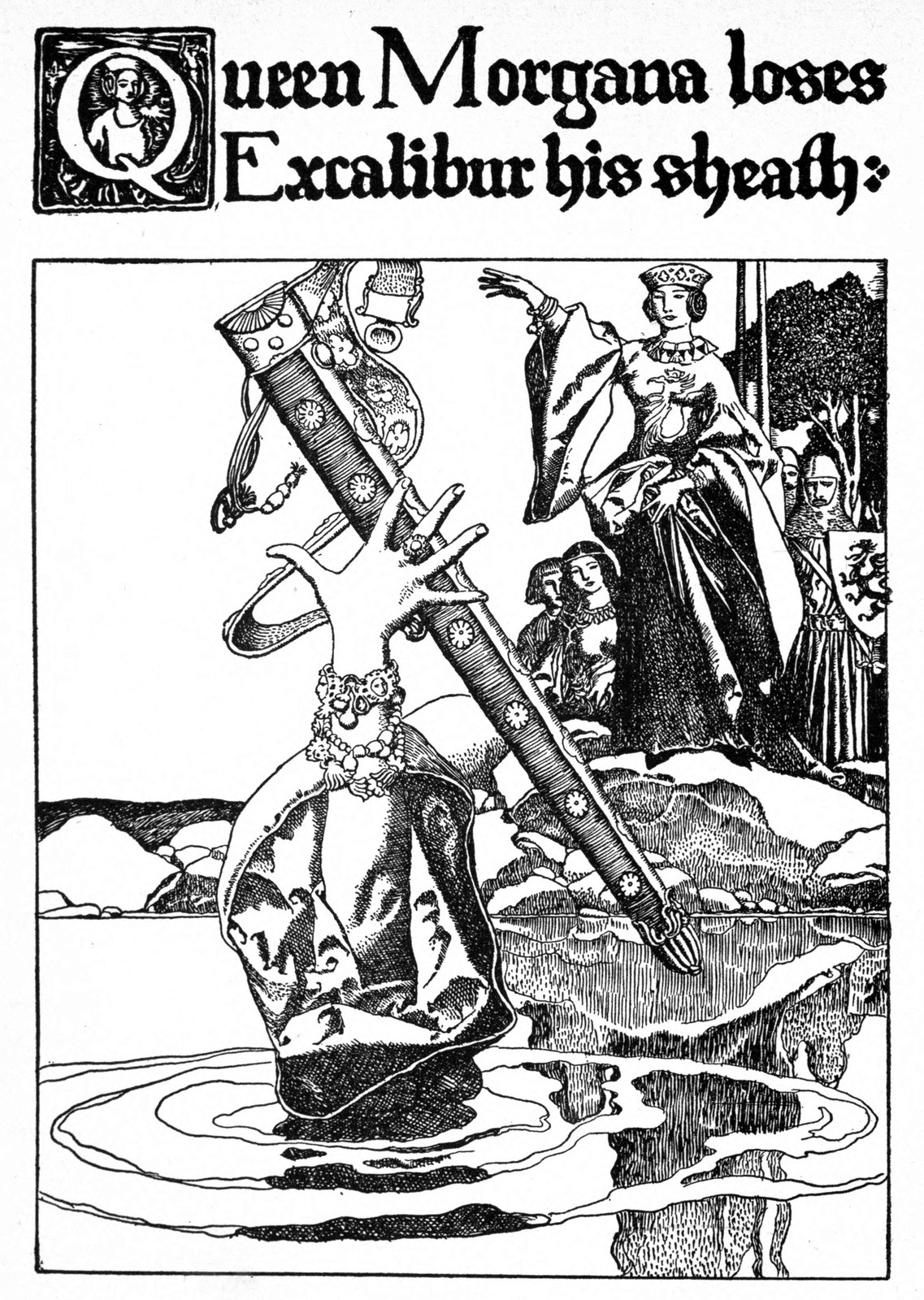
Here follows the account of what happened to Sir Accolon on the morning after he went aboard that magic ship with King Arthur, as I have told you.
Sir Accolon finds himself beside a fountain.
Now when Sir Accolon woke from that same sleep, it was with him just as it had been with King Arthur: at first he did not know whether he was still asleep and dreaming or whether he was awake. For he found himself lying beside a marble basin of clear water that gushed up very high from a silver pipe. And he saw that not far from this fountain stood a large pavilion of many-colored silk, at the edge of a fair green meadow.
Sir Accolon was utterly astonished to find himself in this place, when he had fallen asleep on board that ship, and he was afraid that all this was the work of some very evil spell. So he crossed himself and said, "God save King Arthur from all harm, for it seems to me that those damsels on that ship have worked some magic on us to separate us from each other." And as he said this, he got up from where he lay, meaning to look further into the matter.
Now, as he made some noise in stirring himself, a very ugly dwarf came out of the pavilion and greeted him with every courtesy and with great respect. Then Sir Accolon said to the dwarf, "You there, who are you?" And the dwarf answered, "Sir, I belong to the lady of that pavilion over there, and she has sent me to bid you welcome to this place and to invite you in to share a meal with her." "Ha!" said Sir Accolon, "and how did I come here?" "Sir," said the dwarf, "I do not know. But when we looked out this morning we saw you lying here beside the fountain."
Then Sir Accolon marveled greatly at what had happened to him, and after a while he said, "Who is your lady?" And the dwarf replied, "She is named the Lady Gomyne of the Fair Hair, and she will be more than glad of your company in her pavilion."
Sir Accolon enters the pavilion of the Lady Gomyne.
At this Sir Accolon rose, and when he had washed himself at the fountain and so refreshed himself, he went with the dwarf to the lady's pavilion. And when he came there he saw that in the middle of the pavilion stood a table of silver, spread with a fair white cloth and covered with very excellent food for a man to break his fast with.
The moment Sir Accolon came into the pavilion, the curtains on its far side were parted, and a very beautiful lady came in from an inner room and welcomed Sir Accolon to that place. And Sir Accolon said to her, "Lady, I think you are very kind to invite me into your pavilion like this." "No, sir," said the lady, "it takes no great effort to be kind to a knight as worthy as you." Then she said to Sir Accolon, "Sir, will you sit here at the table with me and have your breakfast?"
Sir Accolon was very glad of this, for he was hungry. And the lady's beauty pleased him a great deal, so that it gave him great joy to be in her company.
So the two of them sat at the table in a very cheerful and pleasant mood, and the dwarf waited on them.
Now after Sir Accolon and the Lady of the Pavilion had eaten their breakfast, she spoke to him like this: "Sir Knight, you seem to be a very strong and worthy lord, and one well used to feats of arms and to proving his courage in battle."
To this Sir Accolon replied, "Lady, it is not fitting for me to speak of my own worth. But this much I may freely say: I have taken part in a number of fights, as a belted and spurred knight may do, and I believe both my friends and my enemies have had reason to say that I have always done my duty to the best of my power."
Then the damsel said, "I believe you are a very brave and worthy knight. And being such a knight, you might be of service to a good and worthy knight who sorely needs the kind of service one knight can give another."
Sir Accolon said, "What is that service?" And the damsel replied, "I will tell you. Not far from this place there lives a certain knight named Sir Ontzlake, who has an elder brother named Sir Damas. This Sir Damas has treated Sir Ontzlake very badly in many ways and has robbed him of nearly all his inheritance, so that only a little is left to Sir Ontzlake of all the great possessions that once were his father's. But Sir Damas begrudges Sir Ontzlake even that small holding, so that Sir Ontzlake has to keep what he has by whatever force of arms he can manage himself. Now Sir Damas has found himself a champion, a man of great strength and courage, and through this champion Sir Damas challenges Sir Ontzlake's right to keep even that small part of the lands that once were his father's. So if Sir Ontzlake wants to keep what is his, he must soon fight a battle for it.
"Now this is a very sad case for Sir Ontzlake. For a short time ago he was wounded by a spear at a tournament and pierced through both his thighs, and so he cannot now sit on his horse and defend his rights against attack. So it seems to me that a knight could have no better chance to show his prowess than in defending a cause as sad as this one."
So the lady spoke, and Sir Accolon listened with great attention to everything she said. And when she had finished he said, "Lady, I would indeed be very willing to defend Sir Ontzlake's right. But I have no armor, and I have no weapons to fight with."
Then the damsel smiled very kindly at Sir Accolon and said to him, "Sir, Sir Ontzlake can easily fit you out with armor that will be entirely to your liking. And as for weapons, I have in this pavilion a sword that has only one other like it in all the world."
At this she rose and went back into the curtained room she had come from, and soon she came back carrying something wrapped in a scarlet cloth. And she opened the cloth before Sir Accolon's eyes, and what she had there was King Arthur's sword Excalibur, in his sheath. Then the damsel said, "This sword shall be yours if you will take up this quarrel on behalf of Sir Ontzlake."
The Lady Gomyne shows Excalibur to Sir Accolon.
Sir Accolon agrees to fight for Sir Ontzlake.
Now when Sir Accolon saw that sword he did not know what to think, and he said to himself, "Surely either this is Excalibur or else it is his twin brother." With that he drew the blade out of its sheath, and it shone with extraordinary splendor. Then Sir Accolon said, "I do not know what to think, for pure wonder. This sword is the very image of another sword that I know of." When he said this the damsel smiled at him again, and she said, "I have heard it said that there is another sword in the world like this one."
Then Sir Accolon said, "Lady, to win this sword for myself I would be willing to fight in any battle whatever." And the damsel replied, "Then if you will fight this battle for Sir Ontzlake, you may keep that sword for your own." And at that Sir Accolon was glad beyond all measure.
So it came about that, through the tricks of Queen Morgan le Fay, King Arthur was brought, without knowing it, to fight a battle against a knight he loved very much, and that knight had Excalibur to use against his own master. For all these things had happened through the cunning of Morgan le Fay.
Now a fair field was made ready for the battle, in a place that suited both Sir Damas and Sir Ontzlake. They came there on the day appointed, each with his champion and his attendants, Sir Ontzlake being carried there in a litter because of the bad wound in his thighs. A great many other people came as well to watch the combat, for the news of it had spread far and wide all around that place. So when everything was ready, the two knights who were to fight on that field were brought inside the barriers, each fully armed and each mounted on a very good horse.
Now King Arthur was dressed all in Sir Damas's armor, and Sir Accolon was dressed in armor that belonged to Sir Ontzlake. And each one's head was covered by his helmet, so that neither of the two knew the other.
Then the herald came forward and announced that the battle was about to begin, and each knight at once made himself ready for the charge. Then the word to charge was given, and the two rushed out, each from his own end of the field, with such speed and fury that it was wonderful to see. They met in the middle of the course with a roar like thunder, and each knight's spear burst into small pieces, right down to the stump he held in his hand. At that each knight leaped from his horse with great skill and quickness and let it run loose in the field. And each threw aside the stump of his spear and drew his sword, and they came at each other with all the fury of battle.
Vivien comes to the field of battle.
It was at this time that Vivien came to that place, at Merlin's bidding. And she brought with her a train of followers so splendid and so beautiful that a great many people looked at her with great pleasure. So Vivien and her followers took their stand at the barriers, where they could see everything that happened. And Vivien watched the two knights, and she could not tell which one was King Arthur and which was his enemy. So she said, "Well, I will do as Merlin wished me to do. But I must watch this battle for a while before I can tell which one is King Arthur, for it would be a pity to cast my spells on the wrong knight."
King Arthur is badly wounded by Excalibur.
So the two knights came together in battle on foot. First they thrust at each other, and then they both struck at the same moment. And King Arthur's sword did not bite into Sir Accolon's armor, but Sir Accolon's sword bit very deep into King Arthur's armor and wounded him so badly that the blood ran down inside his armor in great streams. After that they struck very often and very powerfully, and as it was at first, so it was afterward: Sir Accolon's sword always bit into King Arthur's armor, and King Arthur's sword did not bite into his enemy's armor at all. So in a little while King Arthur's armor was stained red all over with the blood that flowed from a great many wounds, while Sir Accolon did not bleed at all, because of the sheath of Excalibur that he wore at his side. And King Arthur's blood ran down onto the ground, so that all the grass around was soaked with it. So when King Arthur saw how the ground was wet with his own blood, while his enemy did not bleed at all, he began to fear that he would die in that battle, and he said to himself, "How is this? Has the power gone out of Excalibur and his sheath? If it were not so, I would think that the sword that cuts me so badly is Excalibur, and that this sword is not Excalibur."
Then a great despair of death came over him, and he ran at Sir Accolon and struck him so hard a blow on the helmet that Sir Accolon nearly fell to the ground.
But with that blow King Arthur's sword snapped off short at the crosspiece of the hilt and fell into the grass among the blood, and the pommel and the crosspiece were all that King Arthur held in his hand.
Now that blow made Sir Accolon wild with rage, and he ran at King Arthur meaning to strike him some terrible blow. But when he saw that King Arthur had no weapon, he stopped his attack and said, "Sir Knight, I see that you have no weapon and that you have lost a great deal of blood. So I demand that you yield to me as a beaten knight."
Then King Arthur was again greatly afraid that his death was near. Yet because he was a king, it was not possible for him to yield to any knight. So he said, "No, Sir Knight, I may not yield to you, for I would rather die with honor than yield without honor. For though I lack a weapon, there are particular reasons why I may not lack honor. So you may kill me as I stand here without a weapon, and that will be your shame and not mine."
"Well," said Sir Accolon, "as for the shame, I will not spare you unless you yield to me." And King Arthur said, "I will not yield." Then Sir Accolon said, "Then stand away from me, so that I may strike you." And when King Arthur had done as Sir Accolon told him, Sir Accolon struck him such a dreadful blow that the King fell to his knees. Then Sir Accolon raised Excalibur to strike King Arthur again, and at that all the people who were there cried out to him to spare so honorable a knight. But Sir Accolon would not spare him.
Vivien puts a spell on Sir Accolon.
Then Vivien said to herself, "Surely that must be King Arthur who is so near to death. And I vow that it would be a great pity for him to die after he has fought so fiercely." So when Sir Accolon raised his sword the second time to strike his enemy, Vivien struck her hands together with great force and at the same moment cast a spell of such power that it seemed to Sir Accolon, that very instant, as though he had been dealt a very heavy blow on the arm. For with that spell his arm went numb all the way from his fingertips to the hollow of his armpit, and at that Excalibur fell out of Sir Accolon's hands into the grass.
Then King Arthur looked at the sword, and he saw that it was Excalibur, and in that moment he knew that he had been betrayed. So he cried out three times in a very loud voice, "Treason! Treason! Treason!" And with that he set his knee on the blade, and before Sir Accolon could stop him he had seized it in his hands.
King Arthur overcomes Sir Accolon.
Then it seemed to King Arthur that a great power had come into him because of that sword. So he rose from his knees and ran at Sir Accolon and struck him so hard that the blade cut through his armor to the depth of half a hand's breadth. And he struck him again and again, and Sir Accolon cried out in a loud voice and fell down on his hands and knees. Then King Arthur ran to him and caught hold of the sheath of Excalibur and tore it away from Sir Accolon and flung it aside, and at once Sir Accolon's wounds burst out bleeding heavily. Then King Arthur seized Sir Accolon's helmet and wrenched it off his head, meaning to kill him.
Now because King Arthur was blinded by his own blood, he did not recognize Sir Accolon, and he said, "Sir Knight, who are you, who have betrayed me?" And Sir Accolon said, "I have not betrayed you. I am Sir Accolon of Gaul, and I am a knight in good standing at King Arthur's Court."
But when King Arthur heard this he cried out aloud and said, "How is this? Do you know who I am?" And Sir Accolon said, "No, I do not know you." Then King Arthur said, "I am King Arthur, your master." And at that he took off his helmet, and Sir Accolon knew him.
And when Sir Accolon saw King Arthur, he fainted away and lay like a dead man on the ground. And King Arthur said, "Take him away."
Then, when the people who were there understood who King Arthur was, they burst over the barriers and ran toward him with a great cry of pity. And King Arthur would have left that place, but at that moment he too fainted away from the great loss of blood that had come from him. And all those who stood around were filled with sorrow, thinking that he was dying, and they lamented without end.
Then Vivien came out into the field and said, "Let me have him, for I believe I shall be able to cure his wounds." So she commanded that two litters should be brought, and she placed King Arthur in one litter and Sir Accolon in the other, and she carried them both away to a priory of nuns, a convent that was not far from that place.
Vivien heals King Arthur.
When Vivien had come there, she examined King Arthur's wounds and bathed them with a very precious balm, so that they began to heal at once. As for Sir Accolon, she would have nothing to do with his wounds, but let one of her attendants bathe him and dress his hurts.
Now when the next morning came, King Arthur had recovered so much that he was able to get up, though he was very weak and sick nearly to death. So he rose from his couch, and he would not let anyone stop him, and he wrapped a cloak around himself and went to the place where Sir Accolon lay. When he came there he questioned Sir Accolon very closely, and Sir Accolon told him everything that had happened to him after he left the ship, and how the strange damsel had given him a sword to fight with. So when King Arthur had heard all that Sir Accolon had to tell him, he said, "Sir, I think you are not to blame in this matter. But I very much fear that there is treachery here, meant to bring about my ruin."
Then he went out from that place, and he found Vivien and said to her, "Damsel, I beg you to dress that knight's wounds with the same balm that you used to dress mine." "Lord," said Vivien, "I cannot do that, for I have no more of that balm." But what she said was false, for she did have more of that balm. She simply did not choose to use it on Sir Accolon.
Sir Accolon dies of his wounds.
So that afternoon Sir Accolon died of the wounds he had received in his battle with King Arthur.
And that same day King Arthur summoned Sir Damas and Sir Ontzlake to come before him. They came and stood before him, but they were so filled with terror of his majesty that they did not have the strength to stand, and they fell down on their knees to him.
King Arthur deals with Sir Damas and Sir Ontzlake.
Then King Arthur said, "I will pardon you, for you did not know what you were doing. But you, Sir Damas, are, I believe, a very false and treacherous knight. So I shall take from you all your possessions except the one single castle that your brother had, and that I shall give to you. But all your other possessions I shall give to Sir Ontzlake. And I further command that you shall never again have the right to ride any horse but a palfrey, for you are not worthy to ride a war horse as a true knight has the right to do. And I command you to set free at once all those knights who were my companions in captivity, and to pay them for all the harm you have done them, as a court of chivalry shall decide."
With that he dismissed the two knights, and they were very glad that he had dealt with them so mercifully.
Conclusion
Queen Morgan comes to King Arthur.
Now shortly after that combat between King Arthur and Sir Accolon, the news of it was brought to Queen Morgan le Fay. And the next day after that she heard that Sir Accolon was dead, and she could not understand how her plans could have gone so wrong. Then she was uncertain how much King Arthur might know of her treachery, so she said to herself, "I will go and see my brother the King, and if he knows of my treason, I will beg him to pardon my wrongdoing." So, after inquiring carefully where King Arthur lay, she gathered together her court of knights and squires and set out for that place.
She came there on the fifth day after the battle, and when she arrived she asked those who were attending the King how he was faring. They answered her, "He is asleep, and he must not be disturbed." To this Queen Morgan le Fay replied, "No matter. I am not to be kept out, for I must see him and speak with him at once." And they did not dare to stop her, because she was the King's sister.
Queen Morgan steals the sheath of Excalibur.
So Queen Morgan went into the room where the King lay, and he did not wake at her coming. Then Queen Morgan was filled with hatred and a great desire for revenge, and she said to herself, "I will take Excalibur and his sheath and carry them away with me to Avalon, and my brother shall never see them again." So she went very softly to where King Arthur lay, and she looked at him as he slept, and she saw that he had Excalibur beside him and was holding the hilt of the sword in his hand as he slept. Then Queen Morgan said, "Alas for this! For if I try to take Excalibur away from him, perhaps he will wake and kill me for my treason." Then she looked and saw where the sheath of Excalibur lay at the foot of the couch. So she took the sheath of Excalibur very softly and wrapped it up in her cloak and went out of the room, and King Arthur did not wake at her going.
So Queen Morgan came out of the King's chamber and said to those who were attending him, "Do not wake the King, for he is sleeping very soundly." With that she mounted her horse and rode away from that place.
Now after a good while King Arthur woke, and he looked for the sheath of Excalibur, but he saw that it was gone. So he said at once, "Who has been here?" Those attending him answered, "Queen Morgan le Fay has been here. She came in and saw you, and went her way without waking you." Then King Arthur's heart misgave him, and he said, "I fear that she has dealt treacherously with me from the beginning to the end of these adventures."
At that he got up and summoned all his knights and squires and mounted his horse to pursue Queen Morgan, although he was still very sick and faint from his deep wounds and his loss of blood.
Now, just as the King was about to set out, Vivien came to him where he was, and she said, "Lord, take me with you. For if you do not, you will never recover the sheath of Excalibur, and you will never catch up with Queen Morgan le Fay." And King Arthur said, "Come with me, damsel, in God's name." So Vivien went with him in pursuit of Queen Morgan.
Now after a while, as she fled, Queen Morgan le Fay looked behind her, and she saw that Vivien was riding with King Arthur's party. At that her heart failed her, and she said, "I fear that I am now completely ruined. For I helped that damsel to gain so much knowledge of magic that I shall have no spells to save myself from her counter-spells. But at any rate, King Arthur shall never have the sheath of Excalibur again to help him in his hour of need."
Queen Morgan throws the sheath of Excalibur into the lake.
Now at that time they were passing along the shore of a lake of considerable size. So Queen Morgan le Fay took the sheath of Excalibur in both her hands and swung it by its belt above her head, and she threw it far out into the water.
And then a very strange miracle happened. For suddenly a woman's arm rose out of the water, and it was clothed in white. And it was adorned with many bracelets. And the hand of that arm caught the sheath of Excalibur and drew it down under the water, and no one ever saw that sheath again.
So the sheath of Excalibur was lost, and that was a grievous thing for King Arthur in later days, as you may one day read.
Queen Morgan works her magic.
Now after Queen Morgan le Fay had thrown the sheath of Excalibur into the lake, she went on a little farther, to a very lonely place where a great many rocks and stones lay scattered about on the ground. And when she had come to that place she worked very powerful spells of magic that Merlin had taught her. And by means of those spells she turned herself and all her court and all their horses into large round stones of many different sizes.
Then, a little while later, King Arthur came to that place with his knights and squires. And his heart was very heavy, for he had seen from a great distance how Queen Morgan le Fay had thrown the sheath of Excalibur into the lake.
Now when the King and his Court had come to that spot, the damsel Vivien called out to him to stop, and she said to him, "Lord, do you see all those great round stones?" "Yes," said the King, "I see them." Then Vivien said, "Those stones are Queen Morgan le Fay and the court that was with her. For this magic she has worked, to change herself and them into stones, is a certain thing that Merlin taught her. Now I myself know that magic, and I also know how to undo it whenever I wish. So, if you will promise to punish that wicked woman at once for all her treason by taking her life, then I will bring her back to her true shape, so that you may have her in your power."
King Arthur rebukes Vivien.
Then King Arthur looked at Vivien with great displeasure, and he said, "Damsel, you have a cruel heart! You yourself have suffered no harm at the hands of Queen Morgan. Why, then, would you have me kill her? If it were not for all you have done for me, I would be very much offended with you. As for her, I forgive her all of this, and I shall forgive her again and again and yet again if she sins against me. For her mother was my mother, and the blood that flows in her veins and in mine comes from the same fountainhead, and so I will do no evil thing against her. Let us go back the way we came."
Then Vivien looked at King Arthur very bitterly, and she laughed with great scorn and said, "You are both a fool and a feeble-minded dotard." And with that she vanished from the sight of everyone.
And after that, because King Arthur had rebuked her for her wickedness in front of others, she hated him even more than Morgan le Fay had hated him.
Some time after that, King Arthur heard how Merlin had been tricked by Vivien, and he grieved very bitterly that Merlin was lost to the world in that way.
So ends the story of the passing of Merlin.
The Book of Three Worthies, Part Two: The Story of Sir Pelleas
Foreword
Here follows the story of Sir Pelleas, whom many people called the Gentle Knight.
For Sir Pelleas was the kind of man of whom it was said that all women loved him and came to no harm by it, and that all men loved him and were much the better for it.
And so, in the end, when he won for his beloved that beautiful Lady of the Lake, who was one of the very highest damsels of Fairyland, and when he went to live as lord and master in that wonderful dwelling place which no mortal but he and Sir Lancelot of the Lake had ever seen, then all men rejoiced at his great good fortune. And yet the whole Court of King Arthur grieved that he had gone so far away from them, never to return again.
So I believe you will take pleasure in reading the history of Sir Pelleas that is written here for your instruction and delight.
Chapter 1: How Queen Guinevere Went Maying, and How Sir Pelleas Took On a Quest for Her
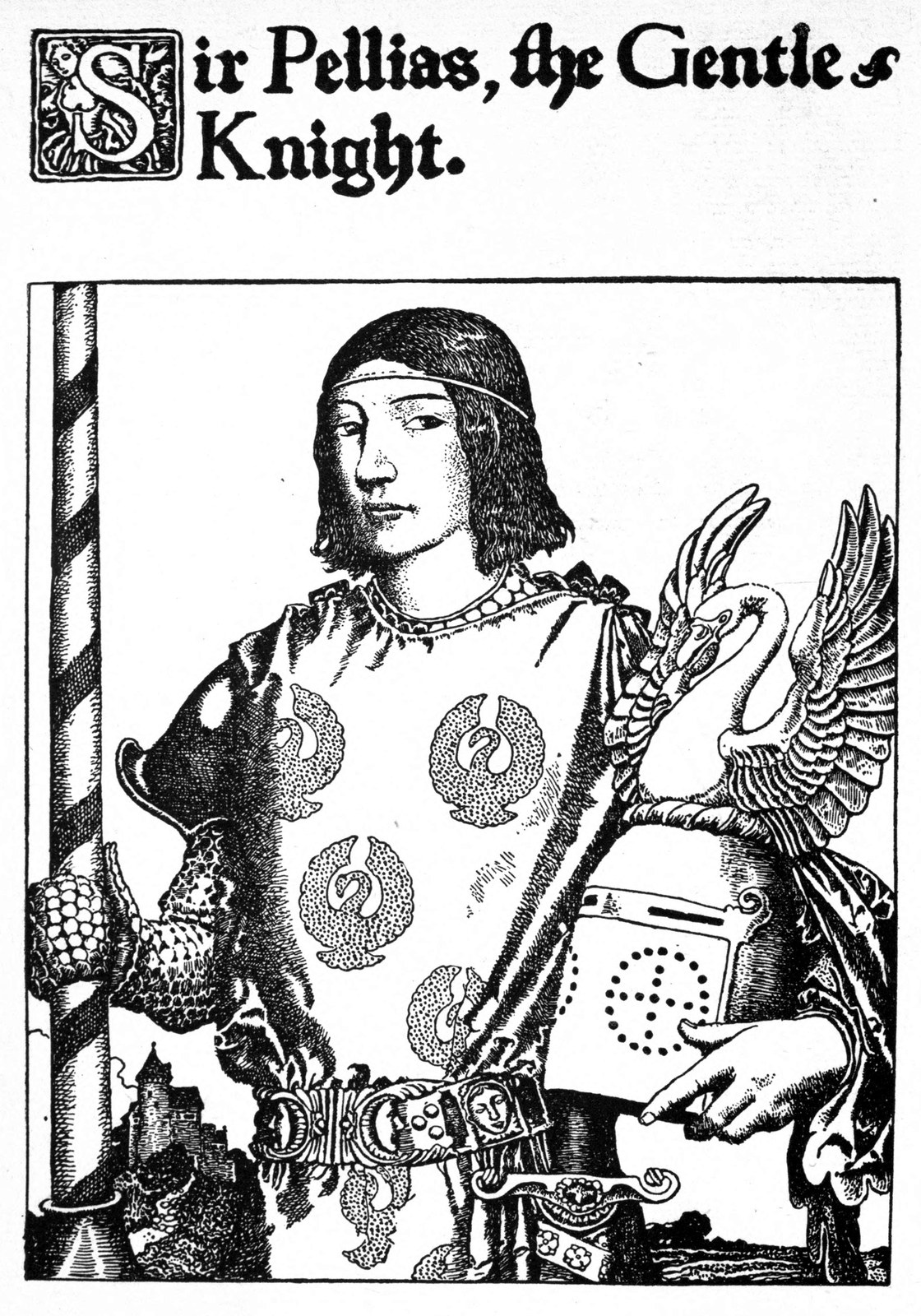
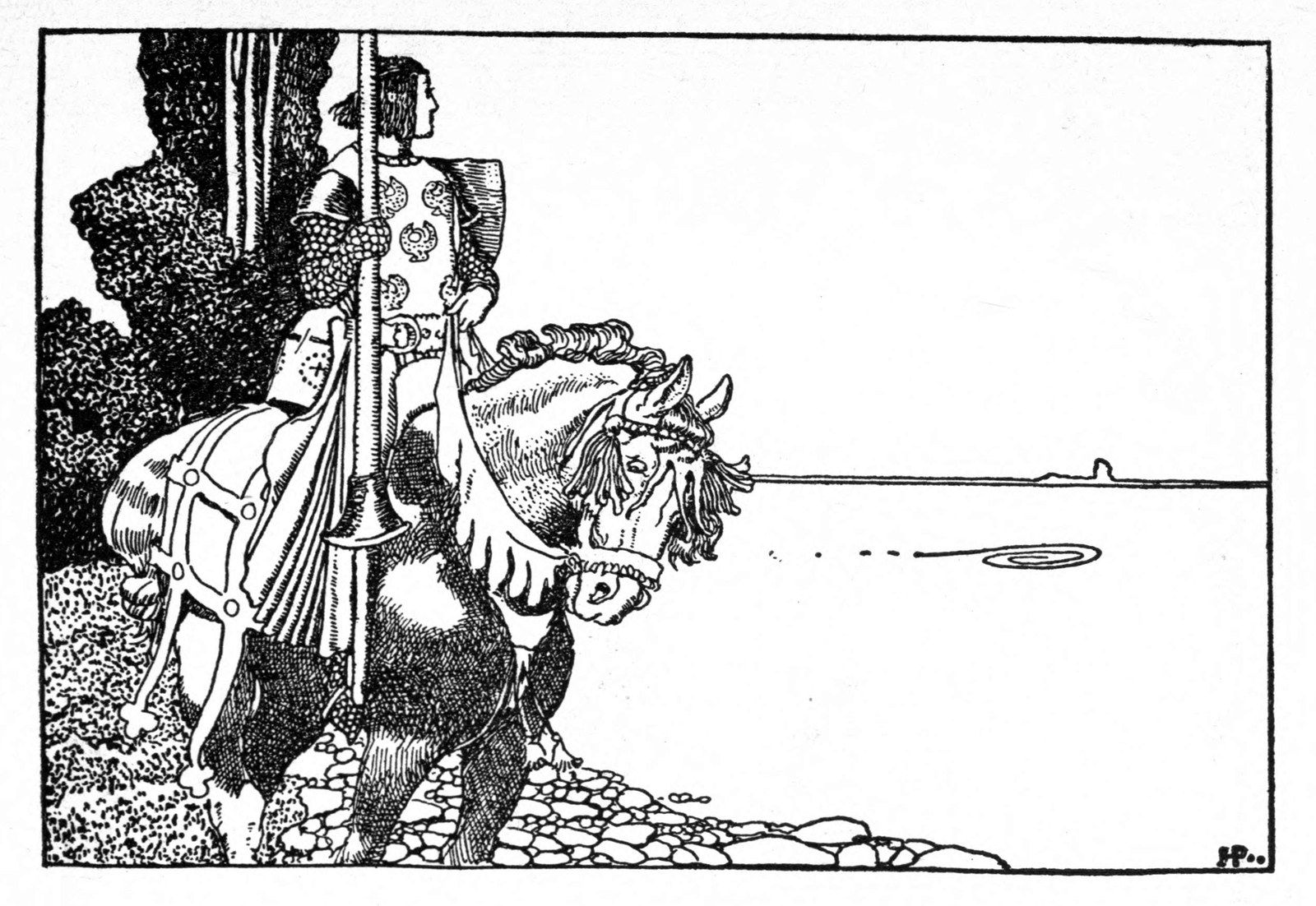
Queen Guinevere goes Maying.
Now it happened one pleasant day in the springtime that Queen Guinevere went Maying, out into the fields to welcome the spring, with a fine company of the knights and ladies of her Court. Among those knights were Sir Pelleas, and Sir Geraint, and Sir Dinadan, and Sir Aglovale, and Sir Agravain, and Sir Constantine of Cornwall, and various others, so that hardly such another Court was to be found in all the world, then or before or since.
The day was wonderfully pleasant. The sunlight was all yellow, like gold, and the breeze was soft and gentle. The little birds sang with very great joy, and everywhere there bloomed so many flowers of every kind that the meadows were all carpeted with their tender green. So it seemed to Queen Guinevere that it was very good to be out in the fields and under the open sky at such a season.
A damsel comes to the May party.
Now as the Queen and her Court walked joyfully among the blossoms, one of the damsels who waited on the Lady Guinevere suddenly cried out, "Look! Look! Who is that coming over there?" At that Queen Guinevere raised her eyes, and she saw a damsel riding across the meadows on a milk-white palfrey, with three pages dressed in sky-blue. The damsel too was dressed entirely in blue. She wore a finely made chain of gold around her neck and a band of gold around her forehead, and her hair, which was as yellow as gold, was wrapped all about with ribbons of blue embroidered with gold. And one of the pages who followed the damsel carried a square frame, not very large, which was wrapped and covered with a curtain of crimson satin.
When the Queen saw that fine company approaching, she told one of the knights who attended her to go out and meet the damsel. And the knight who went out at her command was Sir Pelleas.
Sir Pelleas talks with the damsel.
So when Sir Pelleas met the damsel and her three pages, he spoke to her like this: "Fair damsel, I am commanded by the lady over there to greet you and to ask you the favor of your name and your errand."
"Sir Knight," said the damsel, "I can see from your face and your bearing that you are some lord of very high rank and great nobility, so I will gladly tell you that my name is Parcenet. I am a damsel belonging to the Court of a certain very great lady who lives a long way from here, and who is called the Lady Ettard of Grantmesnle. I have come here hoping to be brought before Queen Guinevere. So if you can tell me where I may find that noble lady, I shall certainly be very much in your debt."
"Ha, Lady!" said Sir Pelleas. "You will not have very far to go to find Queen Guinevere, for there she walks, over there, surrounded by her Court of lords and ladies." Then the damsel said, "Please, take me to her."
So Sir Pelleas brought Parcenet to the Queen, and Queen Guinevere received her very graciously, saying, "Damsel, what is it you want of us?"
The damsel tells Queen Guinevere about the Lady Ettard.
"Lady," said the damsel, "I will tell you that very readily. The Lady Ettard, my mistress, is thought by everyone in the country where she lives to be the most beautiful lady in the world. Now, lately, such reports have come to us of your great beauty that the Lady Ettard has seen fit to send me here to find out with my own eyes whether what is said of you is really true. And indeed, Lady, now that I stand before you, I must say that you are the fairest lady my eyes have ever seen, unless it is the Lady Ettard herself."
At that Queen Guinevere laughed with great merriment. And she said, "It seems to me a very funny business that you should have traveled so far for so small a matter." Then she said, "Tell me, damsel, what is it that your page carries so carefully wrapped up in that curtain of crimson satin?"
"Lady," said the damsel, "it is a true and perfect likeness of the Lady Ettard, my mistress."
Then Queen Guinevere said, "Show it to me."
The damsel shows the Lady Ettard's picture to the Queen and her Court.
At this the page who carried the picture got down from his palfrey, and, coming to Queen Guinevere, he knelt on one knee and uncovered the picture so that the Queen and her Court could look at it. Then they all saw that the picture was very skillfully painted on a panel of ivory, framed in gold and set with many jewels of different colors. And they saw that it was the picture of a lady of such extraordinary beauty that everyone who looked at it marveled. "Why, damsel!" said Queen Guinevere, "your lady is indeed blessed with wonderful beauty. If she truly looks like that picture, then I believe her equal in loveliness is not to be found anywhere in the world."
At this Sir Pelleas spoke up and said, "Not so, Lady. For I declare, and I am ready to defend my words at the risk of my life, that you yourself are far more beautiful than that picture."
"Well, well, Sir Knight!" said the damsel Parcenet. "It is a good thing you say so this far away from Grantmesnle. For at that place there is a certain knight named Sir Engamore of Malverat, who is a very strong knight indeed, and who upholds the opposite of what you say, in favor of the Lady Ettard, against all comers who dare to fight him."
Sir Pelleas takes on the adventure in honor of the Queen.
Then Sir Pelleas knelt down before Queen Guinevere and put his palms together. "Lady," he said, "I beg you of your grace to honor me so far as to accept me as your true knight in this matter. For I would gladly attempt an adventure on your behalf, if I have your permission to do so. So, if you give me leave, I will go out at once to meet this knight the damsel speaks of, and I very much hope that when I find him I shall overthrow him, to the increase of your glory and honor."
Then Queen Guinevere laughed again out of pure merriment. "Sir," she said, "it pleases me beyond measure that you should take so small a quarrel as this on yourself for my sake. For if you take up so small a quarrel, how much more readily would you take up a serious quarrel of mine! So I accept you very joyfully as my champion in this affair. Now go at once and arm yourself in whatever way is fitting for this adventure."
"Lady," said Sir Pelleas, "if I have your leave, I will go into this affair dressed just as I am. For I hope to win armor and equipment for myself along the way, and in that case this adventure will be still more to your credit than it would otherwise be."
The Queen was very much pleased at this, that her knight should undertake so serious an adventure dressed only in his holiday clothes, and so she said, "Let it be as you wish." Then she told her page, Florian, to go and fetch the best horse he could find for Sir Pelleas. And Florian, running with all speed, soon came back with a noble steed, so black that I believe there was not a single white hair on him.
Then Sir Pelleas said farewell to Queen Guinevere and her merry May Court, and they bade him farewell with great cheering. And then he mounted his horse and rode away with the damsel Parcenet and the three pages dressed in blue.
When they had gone some distance, the damsel Parcenet said, "Sir, I do not know your name or your rank, or who you are."
To this Sir Pelleas said, "Damsel, my name is Pelleas, and I am a knight of King Arthur's Round Table."
Sir Pelleas and Parcenet talk together.
At that Parcenet was very much astonished, for Sir Pelleas was thought by many to be the best knight-at-arms alive, except only King Arthur and King Pellinore. So she cried out, "Sir, it will certainly be a very great honor for Sir Engamore to fight with so famous a knight as you." To this Sir Pelleas said, "Damsel, I think there are several knights of King Arthur's Round Table who are better knights than I am." But Parcenet said, "I cannot believe that is so."
Then after a while Parcenet said to Sir Pelleas, "Sir, how will you get yourself armor to fight Sir Engamore?" "Maiden," said Sir Pelleas, "I do not know just now where I shall find armor. But before the time comes for me to fight Sir Engamore, I have faith that I shall find armor fit for my purpose. For you must understand that it is not always the armor a man wears on his body that brings him success. More often it is the spirit that lifts him up to his undertakings."
Then Parcenet said, "Sir Pelleas, I do not believe it often happens that a lady has so good a knight as you to fight on her behalf." To which Sir Pelleas said very cheerfully, "Damsel, when your time comes, I hope you will have a much better knight than I am to serve you." "Sir," said Parcenet, "nothing like that is likely to happen to me." At this Sir Pelleas laughed with a very light heart. Then Parcenet said, "Heigh-ho! I wish I had a good knight to serve me."
To this Sir Pelleas answered very gravely, "Maiden, the first one I catch I will give to you for your very own. Now, would you like him fair or dark, short or tall? For if you would rather have him short and fair, I will let the tall dark one go; but if you would rather have him tall and dark, I will let the other sort go."
Then Parcenet looked very steadily at Sir Pelleas, and she said, "I would like him about as tall as you are, with the same color of hair and eyes, and with a straight nose like yours, and with a good wit such as you have."
"Alas!" said Sir Pelleas. "I wish you had told me this before we came so far from Camelot, for I could easily have found you such a knight there. They have them in such plenty at that place that they keep them in wicker cages and sell them two for a penny." At this Parcenet laughed very cheerfully and said, "Then Camelot must be a very wonderful place, Sir Pelleas."
So, talking merrily, they traveled on their way with great joy and contentment, taking much pleasure in the springtime and in the pleasant meadows they rode through, without a care of any sort, their hearts full of cheerfulness and goodwill.
That night they stayed at a very quaint and pleasant inn that stood at the edge of the Forest of Usk. And the next morning they set out early, in the freshness of the new day, leaving that place and riding into the shadows of the forest.
Sir Pelleas and Parcenet come to the Forest of Adventure.
Now, after they had traveled a good distance in that forest, the damsel Parcenet said to Sir Pelleas, "Sir, do you know what part of the woods this is?" "No," said Sir Pelleas. "Well," said Parcenet, "this part of the woodland is sometimes called Arroy, and sometimes the Forest of Adventure. For I must tell you it is a very wonderful place, full of magic of many kinds. It is said that no knight may enter this forest without some adventure happening to him."
"Damsel," said Sir Pelleas, "what you tell me is very good news. For if we should happen on some adventure here, perhaps I may be able to get armor suitable for my purpose."
So they went straight into the Forest of Adventure, and they traveled through it for a long way, marveling greatly at the look of the place they had come into. For the forest was very dark and silent and wonderfully strange, and altogether different from any other place they had ever seen. So it seemed to them that it would not be at all surprising if some extraordinary adventure should happen to them.
They find an old woman beside the stream.
After they had traveled like this for a good while, they suddenly came out of the thicker part of the woods into a wide open clearing. And there in front of them they saw a violent stream of water, which rushed along very wildly with a great roar of many noises. And they saw that beside the stream there was a thorn tree, and under the thorn tree a bank of green moss, and on the bank of moss there sat an aged woman who looked very miserable. For that old woman was extraordinarily withered with age. Her eyes were all red, as though they watered with endless weeping, many bristles grew on her cheeks and chin, and her face was covered with so many wrinkles that there was no part of it free of them.
When the old woman saw Sir Pelleas and Parcenet and the three pages coming toward the place where she sat, she called out in a loud voice, "Sir, will you not carry me over this water on your horse? For you see, I am very old and feeble, and I cannot cross this river by myself."
Then Parcenet scolded the old woman, saying, "Hush, be quiet! Who are you, to ask this noble knight to do you such a service as that?"
Sir Pelleas carries the old woman across the water.
But Sir Pelleas was not pleased with Parcenet, and he said, "Damsel, you do not speak rightly in this matter. What becomes a true knight is to give help to anyone at all who needs it. For King Arthur is the perfect mirror of knighthood, and he has taught his knights to help all who ask them for help, whatever their rank may be." With these words Sir Pelleas got down from his horse and lifted the old woman up onto the saddle. Then he mounted again himself and rode straight into the ford of the river, and so brought the old woman safely across the torrent to the other side. And Parcenet followed him, marveling greatly at his knightliness, and the three pages followed her.
Of the wonderful Lady of the Lake.
When they had reached the other side of the water, Sir Pelleas got down, meaning to help the old woman off the horse. But she did not wait for his help. Instead she leaped down very lightly at once from where she sat. And suddenly Sir Pelleas saw that she whom he had taken for an aged and withered old crone was really a very strange and wonderful lady of extraordinary beauty. And, marveling greatly, he saw that she was dressed in clothing of a kind that neither he nor anyone else there had ever seen before. Because of the way she looked he knew that she was no ordinary mortal, but surely a creature of enchantment. For he saw that her face was wonderfully clear and as white as ivory, and that her eyes were very black and extraordinarily bright, like two jewels set in ivory. He saw that she was dressed all in green from head to foot, and that her hair was long and perfectly black, as soft and glossy as fine silk. And he saw that she wore around her neck a collar of opals and emeralds set in gold, and that around her wrists were bracelets of finely worked gold set with opals and emeralds. And from all these things he knew that she must be one of the fairy folk.
(For this was how the Lady Nimue of the Lake looked; this was how she had appeared to King Arthur, and this was how she appeared now to Sir Pelleas and those who were with him.)
So, seeing the wonderful magic of that lady, Sir Pelleas knelt down before her and put his hands together, palm to palm. But the Lady of the Lake said, "Sir, why do you kneel to me?" "Lady," said Sir Pelleas, "because you are so wonderfully strange and beautiful." "Sir," said the Lady of the Lake, "you have done me a very good service, and you are certainly a most excellent knight. So rise, and kneel no longer!" So Sir Pelleas got up from his knees and stood before her, and he said, "Lady, who are you?" And she answered, "I am one who feels a very great kindness toward King Arthur and all his knights. My name is Nimue, and I am the chief of those Ladies of the Lake you may have heard tell of. I took on the form of a wretched old woman to test your knightliness, and, as you see, I have not found you lacking in true service." Then Sir Pelleas said, "Lady, you have certainly done me a great favor in this." At that the Lady of the Lake smiled at Sir Pelleas very kindly, and she said, "Sir, I have a mind to do you a greater favor than that."
The Lady of the Lake gives Sir Pelleas the collar of gold and jewels.
And with these words she at once took from around her neck that collar of opals and emeralds and gold, and hung it around the shoulders of Sir Pelleas, so that it lay on his breast in a wonderful glory of shimmering colors.
"Keep this," she said, "for it has very powerful magic."
And with that she vanished instantly from the sight of everyone there, leaving them astonished and amazed beyond measure at what had happened.
And Sir Pelleas was like a man in a dream, for he did not know whether what he had seen was a vision, or whether he had seen it with his waking eyes. So he mounted his horse in complete silence, as though he did not know what he was doing, and in complete silence he led the way from that place. Nor did any of the others speak just then. Only after they had gone a good distance did Parcenet say, in a frightened voice, "Sir, that was a very wonderful thing that happened to us." And Sir Pelleas said, "Yes, maiden."
Now the necklace that the Lady of the Lake had hung around Sir Pelleas's neck had this power: whoever wore it was loved by everyone who looked at him. For the collar was enchanted with that particular power. But Sir Pelleas knew nothing at all about this, and so he simply took joy in the rare beauty of the jewel the Lady of the Lake had given him.
Chapter 2: How Sir Pelleas Defeated a Red Knight Named Sir Adresack and Freed Twenty-Two Prisoners from His Castle
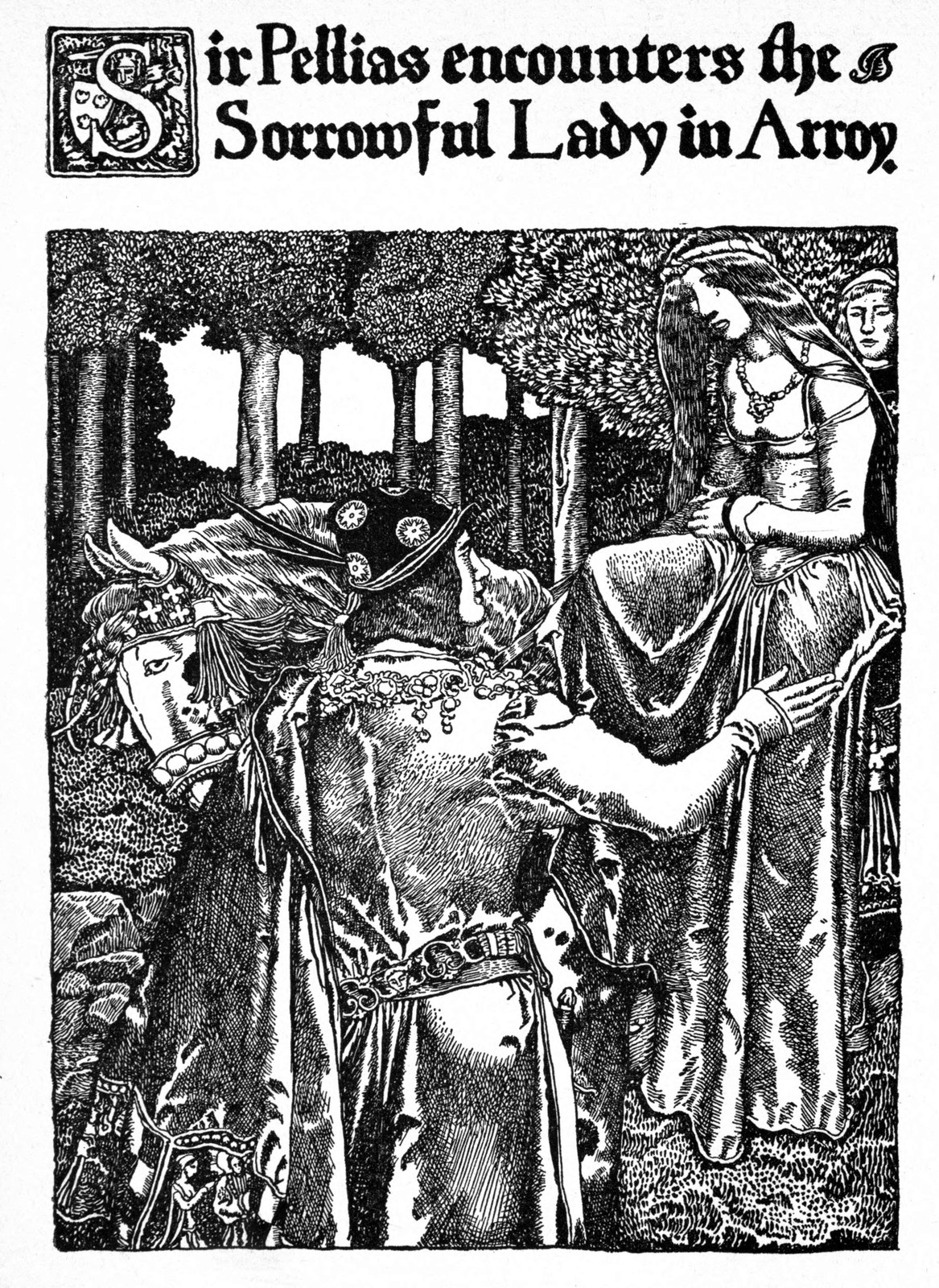
Now, after that wonderful happening, they traveled on without stopping for a long while. They did not pause anywhere until, about an hour after the first hours of the morning, they came to a part of the forest where charcoal-burners were at work at their trade. Here Sir Pelleas ordered them to draw rein and rest for a while, and so they dismounted to rest and refresh themselves, just as he had ordered.
A sorrowful lady and a squire come into the forest.
Now as they sat there refreshing themselves with food and drink, there came suddenly out of the forest a sound of great weeping and loud crying, and almost at once a lady in a pitiful state rode out of the thickets into that open place, mounted on a spotted palfrey. Behind her rode a young squire dressed in the colors green and white and seated on a sorrel horse. He too seemed to be full of great sorrow, for he was all in disorder and very downcast in his face. The lady's face was all swollen and red with weeping, and her hair hung down on her shoulders with neither net nor band to hold it in place, and her clothes were badly torn by the brambles and much stained from traveling through the forest. And the young squire who rode behind her came with his head drooping and his clothes in the same sad disorder, his cloak dragging behind him, fastened to his shoulder by only a single lace.
Now when Sir Pelleas saw the lady and the squire in such a sorry state, he got up at once from where he sat, went straight to the lady, took her horse by the bridle, and stopped it where it was. The lady looked at him, but she did not see him, for she was altogether blinded by her grief and distress. Then Sir Pelleas said to her, "Lady, what is wrong, that you are grieving so terribly?" And she answered him, "Sir, it does not matter, for you cannot help me." "How do you know that?" said Sir Pelleas. "I fully intend to help you, if I can possibly do so."
Then the lady looked more closely at Sir Pelleas, and she made him out as though through a mist of sorrow. She saw that he was not dressed in armor, but only in holiday clothes of fine crimson cloth. At that she began weeping all over again, and very bitterly, for she thought that here was someone who could give her no help in her trouble. So she said, "Sir, you mean kindly, but how can you hope to help me, when you have neither weapons nor armor to aid you in taking up such a quarrel?" But Sir Pelleas said, "Lady, I cannot tell how I may help you until you tell me what your sorrow is. Yet I have good hope that I may serve you once I know what it is that has troubled your mind so." Then, still holding her horse by the bridle, he led the lady forward to the place where Parcenet still sat beside the cloth spread with the food they had been eating. When he had come there, he very gently persuaded the lady to get down from her horse. Then, just as gently, he made her sit down on the grass and eat some of the food. When she had done so, and had drunk some of the wine, she found herself greatly refreshed, and she began to take heart again. Then, seeing her so far recovered, Sir Pelleas asked her once more what her trouble was, and begged her to open her heart to him.
So, encouraged by his cheerful words, she told Sir Pelleas about the trouble that had brought her to such a state.
The sorrowful lady tells her story.
"Sir Knight," she said, "the place where I live is a long way from here. I came from there this morning with a very good knight named Sir Brandemere, who is my husband. We have been married only a little more than four weeks, so that until this morning our happiness was still entirely new to us. Now this morning Sir Brandemere wanted to take me out hunting at the break of day, and so we went out with a little hunting hound that my knight was wonderfully fond of. When we came to a certain place in the forest, a doe suddenly sprang up in front of us, and the hound chased after it at once, barking and baying furiously. Then my lord and I and this squire followed after it, with great high spirits and delight in the chase. Now when we had followed the doe and the hound for a long distance (the hound chasing the doe with a great passion of eagerness), we came to a place where we saw ahead of us a rushing stream of water, crossed by a long, narrow bridge. And we saw that on the other side of the stream there stood a strong castle with seven towers, and that the castle was built up on the rocks in such a way that the rocks and the castle looked altogether like one single rock.
"Now, as we came near that bridge, all of a sudden the portcullis of the castle was raised and the drawbridge was let down very suddenly and with a great noise, and out of the castle at once rode a knight dressed entirely in red. All the trappings and gear of his horse were red as well, and the spear he carried in his hand was of ash wood painted red. He came out in a very terrible way, and rode forward until in a moment he stood at the far end of that narrow bridge. Then he shouted aloud to Sir Brandemere, my husband, 'Where do you think you are going, Sir Knight?' And Sir Brandemere answered him, 'Sir, I want to cross this bridge, for my hound, which I love dearly, has crossed here chasing a doe.' Then that Red Knight cried out in a loud voice, 'Sir Knight, you set foot on this bridge only at your peril. For this bridge belongs to me, and whoever wants to cross it must first overthrow me, or else he may not cross.'
"Now my husband, Sir Brandemere, was dressed at that time only in light clothing, such as a man might wear for hunting or for hawking, except that on his head he wore a light steel cap wrapped with a scarf I had given him. Even so, he was so great of heart that he would not let any such challenge from that Red Knight go unanswered. So, telling me and this squire (whose name is Ponteferet) to stay on the near side of the bridge, he drew his sword and rode forward to the middle of the bridge, meaning to force his way across if he could. And when that Red Knight, who was dressed in full armor, saw what my husband meant to do, he threw aside his spear, drew his sword, and rode forward to meet my knight. So they met in the middle of the bridge, and when they met, that Red Knight raised himself in his stirrups and struck my husband, Sir Brandemere, on the crown of his steel cap with his sword. And I saw the blade of the Red Knight's sword cut through Sir Brandemere's cap and deep into his skull, so that the blood ran down over the knight's face in a great flood. Then Sir Brandemere fell straight down from his horse and lay there as though he were dead.
"Having overthrown him in this way, that Red Knight got down from his horse and lifted Sir Brandemere back onto the horse he had fallen from, so that he lay across the saddle. Then, taking both horses by the bridles, the Red Knight led them straight back across the bridge and into his castle. As soon as he had gone into the castle, the portcullis was closed behind him at once and the drawbridge was raised. He paid no attention at all either to me or to Ponteferet the squire, but went away leaving us without one word of comfort. And now I do not know whether my husband, Sir Brandemere, is alive or dead, or what has happened to him."
And as the lady spoke these words, the tears poured down her face again.
Sir Pelleas takes up an adventure to help the sorrowful lady.
Then Sir Pelleas was deeply moved with pity, and he said, "Lady, your case is truly a very sorrowful one, and I am greatly grieved for you. Indeed, I would gladly help you as far as it lies in my power. So, if you will lead me to this bridge and to that grim castle you speak of, I make you my vow that I will try my very best to find out where your good knight is, and what has happened to him."
"Sir," said the lady, "I am very grateful to you for your goodwill. Yet you cannot hope to succeed if you venture to take on so dangerous an adventure as that without either weapons or armor to defend yourself. For think how cruelly that Red Knight treated my husband, Sir Brandemere, with no regard at all for his lack of weapons or armor. So it is not likely that he will treat you any more courteously." And Parcenet too raised her voice loudly in support of the lady's words, begging Sir Pelleas not to be so unwise as to do what he had in mind. And Ponteferet the squire called out to Sir Pelleas in the same way, telling him he should not do this thing, or that at the very least he should arm himself before he set out on this adventure.
But to everything they said Sir Pelleas answered, "Do not hold me back from what I mean to do. For I tell you all that I have more than once taken on adventures even more dangerous than this, and yet I have escaped without any great harm to myself." And he would not listen to anything the lady or the damsel might say, but got up from that place and helped the lady and the damsel onto their palfreys. Then he mounted his own horse, and when the squire and the pages had mounted theirs, the whole party set off from that place at once.
They come to the castle of the Red Knight.
So they traveled a long way through the forest, with Ponteferet the squire telling them which way to go so as to bring them at last to the castle of the Red Knight. At last they came to a more open place in that wilderness, where a steep, bare hill rose in front of them. When they had climbed to the top of that hill, they saw below them a river, very wild and rushing. They also saw that the river was spanned by a bridge, very straight and narrow, and that on the far side of the bridge and the river there stood a very strong castle with seven tall towers. What is more, the castle and its towers were built up on the rocks, very lofty and high, so that it was hard to tell where the rocks ended and the walls began, and the towers and the walls looked altogether like one rock of stone.
Then Ponteferet the squire pointed with his finger and said, "Sir Knight, that is the castle of the Red Knight over there, and he carried Sir Brandemere into it after he had wounded him so terribly." Then Sir Pelleas said to the lady, "Lady, I will go at once and ask after your husband's welfare."
With that he set spurs to his horse and rode down the hill toward the bridge very boldly. And when he had come nearer to the bridge, suddenly the portcullis of the castle was raised and the drawbridge was let down with a great noise and clatter, and at once out of the castle rode a knight dressed all in red armor and red gear, and this knight came forward at great speed toward the head of the bridge. When Sir Pelleas saw him coming on so threateningly, he said to those who had followed him down the hill, "Stay where you are, and I will go forward and speak with this knight, and ask him about the injury he has done to Sir Brandemere." At this Ponteferet the squire said to him, "Wait, Sir Knight, you will be hurt." But Sir Pelleas said, "No, I will not be hurt."
So he went out onto the bridge very boldly, and when the Red Knight saw him coming, he said, "Ha! Who are you, who dare to come onto my bridge like this?"
Sir Pelleas answered him, "It does not matter who I am. But you are to know, you discourteous knight, that I have come to ask you where you have put that good knight Sir Brandemere, and to ask you why you treated him so cruelly a little while ago."
At this the Red Knight grew very full of rage. "Ha! Ha!" he cried fiercely, "you will soon find that out, to your great sorrow! For as I have treated him, so will I quickly treat you, and in a little while I will bring you to him. Then you may ask him whatever you please. But since you are unarmed and without armor, I would not want to do you any bodily harm. So I demand that you surrender yourself to me at once. Otherwise it will be very much to your pain and sorrow, if you force me to use violence to make you surrender."
Then Sir Pelleas said, "What! What! Would you really attack a knight who is entirely without weapons or armor, as I am?" And the Red Knight said, "Certainly I will, if you do not yield yourself to me at once."
"Then," said Pelleas, "you are not fit to be dealt with as a proven knight should be dealt with. So, if I fight you, your overthrow must be of a kind that would shame any belted knight who wears golden spurs."
Sir Pelleas overthrows the Red Knight with a great stone.
With that he looked around him for some weapon to suit his purpose, and he saw that a certain huge stone lay loose on the top of the bridge's wall. This stone was so big that five men of ordinary strength could hardly have lifted it. But Sir Pelleas lifted it out of its place with great ease, and, raising it in both hands, he ran quickly toward the Red Knight and flung the rock at him with tremendous force. The stone struck the Red Knight in the middle of his shield and drove the shield back against his chest with great violence. And the force of the blow drove the knight backward out of his saddle, so that he fell from his horse to the ground with a terrible crash and lay on the bridge as though he were altogether dead.
And when the people inside the castle who were looking out saw that blow, and when they saw the Red Knight overthrown, they raised their voices in loud wailing, so that the outcry was terrible to hear.
But Sir Pelleas ran as fast as he could to the fallen knight and set his knee on his chest. He unlaced the knight's helmet and lifted it off. And he saw that the knight's face was strong and handsome, and that he was not altogether dead.
So when Sir Pelleas saw that the Red Knight was not dead, and saw that he was about to get his breath back after the blow he had taken, he drew that knight's misericord from its sheath and set the point at his throat. So when the Red Knight came to from his swoon, he saw death before him, in the face of Sir Pelleas and in the point of the dagger.
When the Red Knight saw how near death was, he begged Sir Pelleas for mercy, saying, "Spare my life!" And Sir Pelleas said, "Who are you?" And the knight said, "My name is Sir Adresack, and men call me Adresack of the Seven Towers." Then Sir Pelleas said to him, "What have you done with Sir Brandemere, and how is that good knight faring?" And the Red Knight answered, "He is not so badly wounded as you think."
Now when Sir Brandemere's lady heard these words, she was filled with such joy that she clapped her hands together, crying out loud in thanksgiving.
But Sir Pelleas said, "Now tell me, Sir Adresack, do you have other prisoners at your castle besides that knight, Sir Brandemere?" Sir Adresack answered, "Sir Knight, I will tell you truly. There are twenty-one other prisoners in my castle besides him: that is, eighteen knights and squires of rank, and three ladies. For I have guarded this bridge for a long time, and everyone who has tried to cross it I have taken prisoner and held for ransom. And in that way I have gathered great wealth and won great estates."
Sir Pelleas lays his commands on the Red Knight.
Then Sir Pelleas said, "You are truly a wicked and discourteous knight, to treat travelers who come your way like this, and I would do well to kill you where you lie. But since you have begged me for mercy, I will grant it to you, though only with great shame to your knighthood. What is more, if I spare your life, there are several things you must do. First, you must go to Queen Guinevere at Camelot, and there you must tell her that the knight who left her unarmed has taken your armor from you and has armed himself with it to defend her honor. Second, you must confess your wrongs to King Arthur, just as you have confessed them to me, and you must beg his pardon for them, asking him in his mercy to spare your life. These are the things you must do."
To this Sir Adresack said, "Very well. I promise to do these things, if you will spare my life."
Sir Pelleas puts on the armor of Sir Adresack.
Then Sir Pelleas let him get up, and he came and stood before Sir Pelleas. And Sir Pelleas called Ponteferet the squire to him and said, "Take this knight's armor off his body and put it on mine, as you know how to do." And Ponteferet did as Sir Pelleas told him. He unarmed Sir Adresack and dressed Sir Pelleas in Sir Adresack's armor, while Sir Adresack stood ashamed before them all. Then Sir Pelleas said to him, "Now take me into your castle, so that I may free the prisoners you so wickedly hold there." And Sir Adresack said, "It shall be done as you command."
So they all went together to the castle and into it, and it was an exceedingly stately place. There they saw a great many servants and attendants, and these came at Sir Adresack's command and bowed down before Sir Pelleas. Then Sir Pelleas told Sir Adresack to send for the keeper of the dungeon, and Sir Adresack did so. And Sir Pelleas ordered the keeper to lead them to the dungeon, and the keeper bowed down before him in obedience.
Now when they came to that dungeon, they saw that it was a very lofty place and exceedingly strong. And there they found Sir Brandemere and the others Sir Adresack had spoken of.
Sir Pelleas frees the prisoners.
And when that sorrowful lady saw Sir Brandemere, she ran to him with loud cries of joy, and threw her arms around him and wept over him. And he held her and wept, and forgot his wound entirely in the joy of seeing her again.
In the various rooms of that part of the castle there were, in all, eighteen knights and squires and three ladies, besides Sir Brandemere. Among those knights were two from King Arthur's court: Sir Brandiles and Sir Mador de la Porte. And when these two saw that it was Sir Pelleas who had set them free, they came to him and embraced him with great joy and kissed him on both cheeks.
And all those who had been set free rejoiced greatly, and gave Sir Pelleas such praise and acclaim that he was well pleased with it.
Then, when Sir Pelleas saw all the prisoners who had been in that dungeon, he grew very angry with Sir Adresack, and he turned to him and said, "Go, Sir Knight, and do the penance I have laid on you. For I am very much displeased with you, and I am afraid I may come to regret the mercy I have shown you."
At that Sir Adresack turned away and left that place at once. He called his squire to him, took him along, and rode off to Camelot to do the penance he had promised Sir Pelleas to do.
After he had gone, Sir Pelleas and the prisoners he had freed went through the different parts of the castle. And there they found thirteen chests of gold and silver money and four caskets of jewels, very fine and very brilliant. All this treasure had been paid as ransom by prisoners who had been held there by force in times past.
Sir Pelleas ordered all those chests and caskets to be opened, and when the people there looked inside them, all their hearts leapt with joy at the sight of that great treasure.
Sir Pelleas divides the treasures of Sir Adresack among the prisoners.
Then Sir Pelleas ordered all that treasure of gold and silver to be divided into nineteen equal parts. When it had been divided, he said, "Now let each of you who has been held prisoner in this place take one part of this treasure for his own, to repay him for the sorrows he has suffered." What is more, to each of the ladies who had been held prisoner there he gave a casket of jewels, saying to her, "Take this casket of jewels to repay you for the sorrow you have suffered." And to Sir Brandemere's lady he gave a casket of the jewels for what she had suffered.
But when the people there saw that Sir Pelleas had kept no part of that great treasure for himself, they all cried out to him, "Sir Knight! Sir Knight! What is this? Look, you have set aside no part of this treasure for yourself."
Then Sir Pelleas answered, "You are right, I have not. For there is no need for me to take any of this gold and silver, or any of these jewels, for myself. You see, you have suffered much at the hands of Sir Adresack, and so you ought to be repaid for it. But I have suffered nothing at his hands, and so I need no such repayment."
Then they were all amazed at his generosity, and praised him highly for his greatness of heart. And all those knights swore to be faithful to him until death.
They stay at the castle of Sir Brandemere.
Then, when all these things were done, Sir Brandemere begged everyone there to come with him to his castle, so that they might refresh themselves with a time of merriment and good cheer. They all said they would go with him, and they did go. And at Sir Brandemere's castle there was great rejoicing, with feasting and jousting, for three days.
And everyone there loved Sir Pelleas with an astonishing love, because of that collar of emeralds and opals and gold. Yet no one knew of the magic power of that collar, and Sir Pelleas did not know of it either.
So Sir Pelleas stayed at that place for three days. And when the fourth day came, he got up early in the morning and ordered his horse to be saddled, and the palfrey of the damsel Parcenet, and the horses of their pages.
Then, when everyone there saw that he meant to leave, they begged him not to go. But Sir Pelleas said, "Do not hold me back, for I must go."
Then those two knights of Arthur's court, Sir Brandiles and Sir Mador de la Porte, came to him and begged him to let them go with him on that adventure. At first Sir Pelleas refused them, but they begged him all the more, so that at last he was glad to say, "You shall go with me."
So he left that place with his company, and all those who stayed behind were very sorry that he had gone away.
Chapter 3: How Sir Pelleas Fought Sir Engamore, the Knight of the Green Sleeves, and What Happened to the Lady Ettard
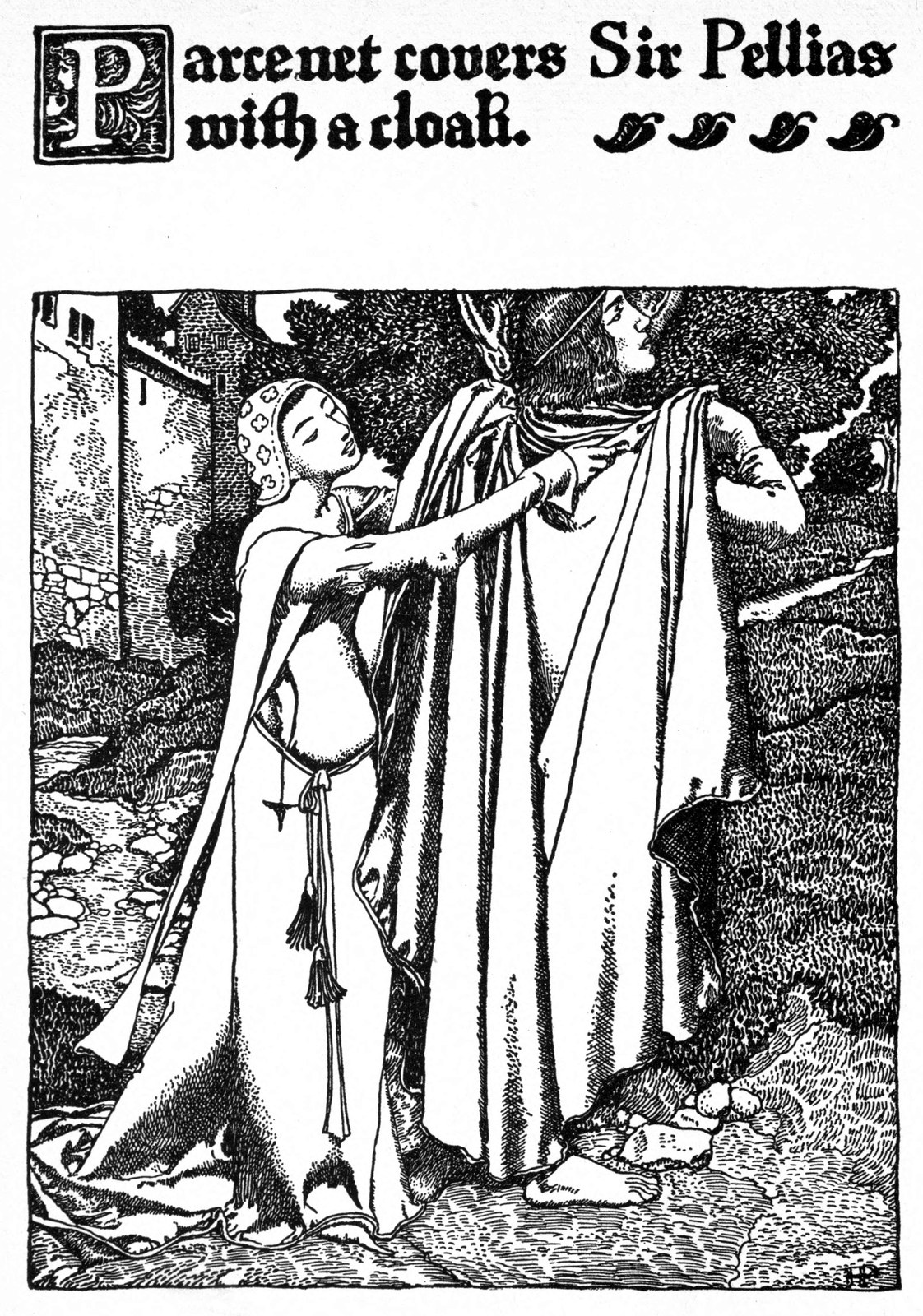
Now Sir Pelleas and his party, and the damsel Parcenet and hers, traveled on until some time in the afternoon they came to the farthest edge of the forest. There the woodlands ended altogether, and many fields and meadows lay spread out beneath the sky, with farms and small crofts and orchards of trees all in bloom with tender leaves and sweet-smelling blossoms.
And Sir Pelleas said, "This is truly a very beautiful land we have come into." At that the damsel Parcenet was very well pleased, and she said, "Sir, I am very glad that what you see pleases you, for all this country belongs to the Lady Ettard, and it is my home. What is more, from the top of that hill over there you can see the castle of Grantmesnle, which lies in the valley below." Then Sir Pelleas said, "Let us hurry! For I am wonderfully eager to see that place."
They reach Grantmesnle.
So they set spurs to their horses and rode up that hill at an easy gallop. And when they had reached the top of it, there below them lay the Castle of Grantmesnle, as plain to see as if it were held in the palm of a hand. Sir Pelleas saw that it was an exceedingly beautiful castle, built entirely of red stone on the outside, with many buildings of red brick inside the wall. Behind the walls lay a little town, and from where they stood they could see its streets, and the people coming and going about their business. So Sir Pelleas, seeing how fine that castle was, said, "Truly, maiden, that is a very fair estate over there."
"Yes," said Parcenet, "those of us who live there think it a very excellent estate."
Then Sir Pelleas said to Parcenet, "Maiden, that grove of young trees near the castle looks like a very pleasant spot. So my companions in arms and I will make our camp there. There, too, we will have three pavilions set up to shelter us by day and by night. In the meantime, I beg you to go to the lady your mistress and tell her that a knight has come to this place who, although he does not know her, holds that the Lady Guinevere of Camelot is the most beautiful lady in all the world. And I beg you to tell the lady that I am here to maintain that claim against all comers at the risk of my body. So if the lady has any champion who will fight on her behalf, I will meet him in that field over there tomorrow at midday, a little before I eat my midday meal. For at that time I mean to ride into that field and parade up and down there until my friends call me in to my dinner; and I will take my stand in that place in honor of the Lady Guinevere of Camelot."
"Sir Pelleas," said the damsel, "I will do just as you ask of me. And though I cannot wish that you will be the victor in that fight, yet truly I am sorry to leave you. For you are both a very brave and a very courteous knight, and I find that I feel a great friendship for you."
Then Sir Pelleas laughed and said, "Parcenet, you are bent on giving me praise far beyond what I deserve." And Parcenet said, "No, sir, for you deserve everything I can say to your credit."
Then the two of them took leave of one another with great goodwill and much kindness, and the maiden and the three pages went one way, while Sir Pelleas and his two companions and the attendants they had brought with them went into the grove of young trees, as Sir Pelleas had ordered.
Sir Pelleas and his fellow knights make their camp in a grove of trees.
There they set up three pavilions in the shade of the trees: one pavilion of fine white cloth, the second of green cloth, and the third of scarlet cloth. And over each pavilion they set a banner bearing the emblem of the knight to whom that pavilion belonged. Above the white pavilion was the emblem of Sir Pelleas, which was three swans with spread wings on a silver field. Above the red pavilion, which was Sir Brandiles's, was a red banner bearing his emblem, which was a hand in armor gripping a hammer. Above the green pavilion, which was Sir Mador de la Porte's, was a green banner bearing his emblem, which was a carrion crow holding a white lily in one claw and a sword in the other.
Sir Pelleas challenges Sir Engamore.
So when the next day came, and midday was near, Sir Pelleas rode out into that field in front of the castle as he had promised to do. He was dressed from head to foot in the red armor he had taken from the body of Sir Adresack, so that in that armor he looked very terrible. He rode up and down before the castle walls for a long while, crying in a loud voice, "Hear me! Hear me! Here stands a knight of King Arthur's court and of his Round Table, who declares, and is ready to prove it with his body, that the Lady Guinevere, King Arthur's Queen of Camelot, is the most beautiful lady in all the world, not excepting anyone at all. So if any knight holds otherwise, let him come out at once and defend his opinion with his body."
Now after Sir Pelleas had appeared in that meadow, a great stir arose inside the castle, and many people came up onto the walls and gazed down at Sir Pelleas as he paraded up and down that field. After some time had passed, the drawbridge of the castle was let down, and out rode a knight who was very huge of frame and exceedingly proud in his bearing. This knight was dressed from head to foot in green armor, and on each arm he wore a green sleeve, which was why he was sometimes called the Knight of the Green Sleeves.
So that Green Knight rode toward Sir Pelleas, and Sir Pelleas rode toward the Green Knight, and when they came together they saluted each other with a great deal of civility and knightly courtesy. Then the Green Knight said to Sir Pelleas, "Sir Knight, will you grant me the great favor of knowing your name?"
And Sir Pelleas answered, "That I will. I am Sir Pelleas, a knight of King Arthur's court and of his Round Table."
Then the Green Knight said, "Ha, Sir Pelleas, it is a great honor for me to deal with so famous a knight, for who is there in the courts of chivalry who has not heard of you? Now, if I have the good fortune to overthrow you, then all your honor will become my honor. And in return for your courtesy in telling me your name, I give you my name and title, which is Sir Engamore of Malverat, also known as the Knight of the Green Sleeves. And I may tell you further that I am the champion of the Lady Ettard of Grantmesnle, and that I have defended her claim to be the most beautiful lady without equal for eleven months, against all comers. If I defend it successfully for one month longer, then I am to win her hand and become lord of all this fair estate. So I am ready to do the very utmost in my power in her honor."
Then Sir Pelleas said, "Sir Knight, I thank you for your words of greeting, and I too will do my utmost in this encounter." At that the two knights saluted each other with their lances, and each rode to his appointed place.
Sir Pelleas overthrows Sir Engamore.
Now a great crowd of people had come down to the lower walls of the castle and of the town to watch the contest of arms that was about to take place, so it would be hard to imagine a worthier occasion for knights to meet in a glorious contest of friendly jousting. So each knight made himself ready in every way, and set his spear and lance with great care and caution. When everything had been made ready for that encounter, a herald, who had come out from the castle into the field, gave the signal for the charge. At once, in an instant, each knight drove his spurs into his horse, and they rushed at each other with such terrible speed that the ground shook and trembled under the pounding of their horses' hooves. They met exactly in the center of the field, each knight striking the other in the middle of his shield with a violence that was very terrible to see. And the spear of Sir Engamore burst into as many as thirty pieces, but the spear of Sir Pelleas held, so that the Green Knight was hurled out of his saddle so violently that he struck the ground more than a spear's length behind his horse's tail.
Now when the people standing on the walls saw how completely the Green Knight had been overthrown in that encounter, they raised a great outcry, for there was no other knight like Sir Engamore in all that country. And the Lady Ettard cried out loudest of all, for Sir Engamore was very dear to her, and when she saw him flung down so violently on the ground, she thought that perhaps he had been killed.
Then three squires ran to Sir Engamore, lifted him up, and unlaced his helmet to give him air. And they saw that he was not dead, but only in a deep swoon. After a while he opened his eyes, and at that Sir Pelleas was very glad, for it would have grieved him to have killed that knight. Now when Sir Engamore came back to his senses, he demanded very fiercely that he be allowed to go on with the fight against Sir Pelleas on foot and with swords. But Sir Pelleas would not have it. "No, Sir Engamore," he said, "I will not fight you over so serious a quarrel as that, for I have no such ill will against you." And at this refusal Sir Engamore burst into tears out of pure vexation and shame at being so completely overthrown.
Then Sir Brandiles and Sir Mador de la Porte came up and praised Sir Pelleas highly for the excellent way he had borne himself in the encounter, and at the same time they spoke kindly to Sir Engamore and tried to comfort him for the misfortune that had happened to him. But Sir Engamore took very little comfort from their words.
Now while they were all standing there together, the Lady Ettard came out from the castle with a very gay and handsome company of squires and ladies, and they came across the meadow toward where Sir Pelleas and the others stood.
When Sir Pelleas saw that lady coming, he drew his misericord and cut the laces of his helmet, and took the helmet off his head, and went forward bareheaded to meet her.
Sir Pelleas greets the Lady Ettard courteously.
But when he came near her, he saw that she was many times more beautiful than the picture of her painted on the ivory panel he had seen before, and his heart went out to her with a very great strength of liking. So he knelt down on the grass before her, and put his hands together palm to palm, and said, "Lady, I very humbly beg your forgiveness for having fought against your claim like this. For if I had not undertaken that fight for my Queen, I would rather have been your champion than the champion of any lady I have ever seen."
Now at that time Sir Pelleas wore around his neck the collar of emeralds and opals and gold that the Lady of the Lake had given him. So when the Lady Ettard looked at him, that necklace drew her heart to him with a very powerful enchantment. She smiled at Sir Pelleas very warmly, gave him her hand, and made him rise from where he knelt. And she said to him, "Sir Knight, you are a very famous warrior, for I do not suppose there is anyone who knows anything of chivalry who has not heard of the fame of Sir Pelleas, the Gentle Knight. So although my champion, Sir Engamore of Malverat, has overthrown all comers until now, he need not feel very much ashamed to have been overthrown by so tremendously strong a knight."
Sir Pelleas and his fellow knights go to the castle of Grantmesnle.
Sir Pelleas was very glad of the kind words the Lady Ettard spoke to him, and he presented Sir Brandiles and Sir Mador de la Porte to her. The Lady Ettard spoke very graciously to these knights as well, moved to it by the extraordinary liking she felt for Sir Pelleas. She begged those knights to come into the castle and refresh themselves with good cheer, and the knights said they would do so very soon. So each knight went back to his pavilion, and there each dressed himself in fine clothes and ornaments of gold and silver, in such a way that he was noble company for any court. Then those three knights went to the castle of Grantmesnle, and when they arrived there, everyone was astonished at how noble they looked.
But Sir Engamore, who had by now recovered from his fall, was very downcast, for he said to himself, "Who am I, beside these noble lords?" So he stood off to one side, very low in heart and heavy in spirit.
Then the Lady Ettard set out a very fine feast, and Sir Pelleas and Sir Brandiles and Sir Mador de la Porte were very glad of it. She seated Sir Pelleas at her right hand and Sir Engamore at her left. And Sir Engamore was even more downcast, for until now he had always sat at the Lady Ettard's right hand.
Now because Sir Pelleas wore that wonderful collar the Lady of the Lake had given him, the Lady Ettard could not keep her liking from him. So after they had refreshed themselves and had gone out into the castle's pleasure garden to walk in the warm sunshine, the lady wanted Sir Pelleas beside her all the time. And when it was time for those visiting knights to leave the castle, she begged Sir Pelleas to stay a while longer. Sir Pelleas was very glad to do so, for he was pleased beyond measure with the graciousness and the beauty of the Lady Ettard.
So after a while Sir Brandiles and Sir Mador de la Porte went back to their pavilions, and Sir Pelleas stayed on in the castle of Grantmesnle for a while longer.
Sir Pelleas and the Lady Ettard feast together.
That night the Lady Ettard had a supper prepared for herself and Sir Pelleas, and at that supper only she and Sir Pelleas sat at the table, while the damsel Parcenet waited on the lady. While they ate, some young pages and squires played very sweetly on harps, and some maidens who attended the lady's court sang so sweetly that it made the listener's heart swell to hear them. And Sir Pelleas was so enchanted by the sweetness of the music and by the beauty of the Lady Ettard that he did not know whether he was really on earth or in Paradise. So, out of his great happiness, he said to the Lady Ettard, "Lady, I wish I could do something for you, to show you how high is the regard and the honor in which I hold you."
Now all the while Sir Pelleas sat beside her, the Lady Ettard had kept her eyes on that wonderful collar of gold and emeralds and opals that hung around his neck, and she wanted that collar very badly. So now she said to Sir Pelleas, "Sir Knight, you can indeed do me a great favor, if you have a mind to." "What favor can I do you, Lady?" said Sir Pelleas. "Sir," said the Lady Ettard, "you can give me that collar that hangs around your neck."
At this Sir Pelleas's face fell, and he said, "Lady, I cannot do that, for that collar came to me in such an extraordinary way that I cannot part with it."
Then the Lady Ettard said, "Why can you not part with it, Sir Pelleas?"
So Sir Pelleas told her all about that extraordinary adventure with the Lady of the Lake, and how that fairy lady had given him the collar.
At this the Lady Ettard was greatly astonished, and she said, "Sir Pelleas, that is a very wonderful story. Even so, though you cannot give me that collar, you can at least let me wear it for a little while. For truly I am charmed by the beauty of that collar beyond anything I can tell, and so I beg you to let me wear it for a little."
Sir Pelleas lets the Lady Ettard wear the collar.
Then Sir Pelleas could refuse her no longer, and he said, "Lady, you shall have it to wear for a while." So he took the collar from around his neck and hung it around the neck of the Lady Ettard.
Then, after a little while, the magic power of that jewel left Sir Pelleas and passed into the Lady Ettard, and the Lady Ettard looked at Sir Pelleas with altogether different eyes from those she had looked at him with before. She said to herself, "Ha! What was wrong with me, that I was so enchanted with that knight, to the disgrace of my champion who has served me so faithfully? Has this knight not done me a grievous insult? Did he not come here for no other reason than that? Did he not overthrow my own true knight in scorn of me? Then what was wrong with me, that I showed him such favor as I have shown him?" But although she thought all this, she gave no sign of it to Sir Pelleas, but seemed to laugh and talk very cheerfully. All the same, she began at once to turn over in her mind some way to take revenge on Sir Pelleas. For she said to herself, "Look! Is he not my enemy, and is my enemy not now in my power? So why should I not take full revenge on him for everything he has done to us of Grantmesnle?"
The Lady Ettard lays plans against Sir Pelleas.
So after a while she made an excuse, got up, and left Sir Pelleas. She took Parcenet aside and said to the damsel Parcenet, "Go and bring me a powerful sleeping draught, right away." Then Parcenet said, "Lady, what are you going to do?" And the Lady Ettard said, "Never mind." And Parcenet said, "Would you give a sleeping draught to that noble knight?" And the lady said, "I would." Then Parcenet said, "Lady, that would surely be a wicked thing to do to someone who sits in peace at your table and eats your salt as your guest." To which the Lady Ettard said, "Don't you trouble yourself about that, girl, but go at once and do as I tell you."
Then Parcenet saw that it would not be wise for her to disobey the lady. So she went at once and did as she was told. She brought the sleeping draught to the lady in a cup of pure wine, and the Lady Ettard took the cup and said to Sir Pelleas, "Take this cup of wine, Sir Knight, and drink it to me, as deeply as the goodwill you bear me." Now Parcenet stood behind her lady's chair, and when Sir Pelleas took the cup, she frowned and shook her head at him. But Sir Pelleas did not see it, for he was intoxicated with the beauty of the Lady Ettard, and with the enchantment of the collar of emeralds and opals and gold that she now wore. So he said to her, "Lady, even if there were poison in that cup, I would still drink the wine in it at your command."
At that the Lady Ettard burst out laughing beyond all measure, and she said, "Sir Knight, there is no poison in that cup."
So Sir Pelleas took the cup and drank the wine, and he said, "Lady, what is this? The wine is bitter." And the Lady Ettard answered, "Sir, that cannot be."
Sir Pelleas sleeps.
Then in a little while Sir Pelleas's head grew extremely heavy, as though it were made of lead, so that he bowed his head down on the table where he sat. All the while the Lady Ettard sat watching him very strangely, and after a while she said, "Sir Knight, are you asleep?" Sir Pelleas made no answer, for the fumes of the sleeping draught had risen into his brain, and he slept.
Then the Lady Ettard got up laughing, and she clapped her hands and called her attendants. And she said to them, "Take this knight away and carry him into an inner room. When you have brought him there, strip him of his fine clothes and his ornaments, so that nothing is left on him but his undergarments. When you have done that, lay him on a cot and carry him out of the castle into the meadow below the walls where he overthrew Sir Engamore, so that when morning comes he will be a mockery and a joke to everyone who sees him. In this way we will humiliate him in the very field where he overthrew Sir Engamore, and his humiliation will be greater than Sir Engamore's has been."
Now when the damsel Parcenet heard this, she was deeply distressed, so that she went off by herself and wept for Sir Pelleas. But the others took Sir Pelleas and did to him just as the Lady Ettard had commanded.
When the next morning came, Sir Pelleas woke with the sun shining in his face. He had no idea at all where he was, for his brain was still fogged by the sleeping draught he had taken. So he said to himself, "Am I dreaming, or am I awake? For surely the last thing I remember is that I sat at supper with the Lady Ettard, and yet here I am in an open field, with the sun shining down on me."
So he raised himself on his elbow, and he saw that he was lying under the castle walls, near the postern gate. And above him, on the top of the wall, was a great crowd of people, and when they saw that he was awake, they laughed at him and mocked him. The Lady Ettard too gazed down at him from a window, and he saw that she was laughing at him and making merry. And then he saw that he lay there dressed only in his linen undershirt, and that his feet were bare, as though he were ready for bed at night. So he sat on the cot, saying to himself, "Surely this must be some shameful dream that is weighing on me." And he could not shake off his bewilderment at all.
The damsel Parcenet brings help to Sir Pelleas.
Now, as he sat there, the postern gate suddenly opened, and the damsel Parcenet came out of it. Her face was all wet with tears, and she carried in her hand a flame-colored cloak. She ran straight to Sir Pelleas and said, "You good and gentle knight, take this and wrap yourself in it."
At this Sir Pelleas knew that this was no dream, but a shameful truth, and he was seized with such an agony of shame that he began to tremble, and his teeth chattered as though he had a fever. Then he said to Parcenet, "Maiden, I thank you." And he could find no more words to say. So he took the cloak and wrapped himself in it.
Now when the people on the walls saw what Parcenet had done, they hooted at her and abused her with many hard words. So the maiden ran back into the castle, but Sir Pelleas got up and made his way toward his pavilion, wrapped in that cloak. And as he went, he staggered and tottered like a drunken man, for a great burden of shame lay upon him, almost more than he could carry.
Sir Pelleas grieves greatly over his shame.
So when Sir Pelleas reached his pavilion, he went in and threw himself face down on his couch and lay there without saying a word. After a while Sir Brandiles and Mador de la Porte heard of the plight Sir Pelleas had fallen into, and they hurried to where he lay and grieved greatly over him. They were also extremely angry at the shame that had been put upon him, and they said, "We will get help from Camelot, and we will break open that castle and bring the Lady Ettard here to beg your pardon for this insult. This we will do even if we have to drag her here by the hair of her head."
But Sir Pelleas did not lift his head; he only groaned and said, "Let it be, Sirs, for under no circumstances shall you do that, since she is a woman. As things are, I would defend her honor even if I died defending it. For I do not know whether I am bewitched or what it is that is wrong with me, but I love her with a very great passion, and I cannot tear my heart away from her."
At this Sir Brandiles and Sir Mador de la Porte were greatly astonished, and they said to each other, "Surely that lady has laid some powerful spell on him."
Then after a while Sir Pelleas told them to go away and leave him, and they did so, though not very willingly.
So Sir Pelleas lay there all that day until the afternoon came. Then he roused himself and told his squire to bring him his armor. When Sir Brandiles and Sir Mador de la Porte heard of this, they went to where he was and said, "Sir, what do you mean to do?" Sir Pelleas said, "I am going to try to make my way into the Lady Ettard's presence." Then they said, "What madness is this?" "I do not know," said Sir Pelleas, "but it seems to me that if I do not see the Lady Ettard and talk with her, I shall surely die of longing to see her." And they said, "Surely this is madness." And he answered, "I do not know whether it is madness, or whether I am caught in some enchantment."
So the squire brought Sir Pelleas his armor as he had ordered, and he dressed Sir Pelleas in it so that he was fully armed from head to foot. Then at once Sir Pelleas mounted his horse and rode out toward the castle of Grantmesnle.
Now when the Lady Ettard saw Sir Pelleas parading up and down the meadow below the castle again, she called six of her best knights to her and said to them, "Look, Sirs, there is that knight who brought so much shame on us yesterday. Now I order you to go out against him and punish him as he deserves."
So those six knights went and armed themselves, and when they had done so, they rode straight out against Sir Pelleas.
Sir Pelleas overcomes six knights.
Now when Sir Pelleas saw them coming, his heart overflowed with fury, and he shouted in a great voice and charged at them. For a while they stood up to him, but he could not be withstood, for he fought with a fury beyond anything, so that soon they broke away before him and fled. He chased them furiously all around that field and struck four of them down from their horses. Then, when only two of those knights were left, Sir Pelleas suddenly stopped fighting and called out to those two knights, "Sirs, I surrender myself to you."
Sir Pelleas yields himself prisoner.
At that those two knights were greatly astonished, for they were completely filled with fear of his strength, and they did not know why he should yield to them. All the same, they came and took hold of him and led him toward the castle. At this Sir Pelleas said to himself, "Now they will bring me to the Lady Ettard, and I shall speak with her." For it was for this reason that he had let himself be taken by those two knights.
But it was not to happen as Sir Pelleas wished. For when they had brought him close under the castle, the Lady Ettard called down to them from a window in the wall. She said, "What are you doing with that knight?" They said, "We are bringing him to you, Lady." At this she cried out very fiercely, "Do not bring him to me! Take him and tie his hands behind his back and tie his feet under his horse's belly, and send him back to his companions."
Then Sir Pelleas lifted his eyes to that window and cried out in a great passion of despair, "Lady, it was to you I surrendered, and not to these unworthy knights."
But the Lady Ettard cried out all the more fiercely, "Drive him away, for I hate the sight of him."
The Lady Ettard puts Sir Pelleas to shame.
So those two knights did as the Lady Ettard said: they took Sir Pelleas and bound him hand and foot upon his horse. And when they had done that, they let his horse carry him back to his companions in that state.
Now when Sir Brandiles and Sir Mador de la Porte saw Sir Pelleas coming back to them with his hands tied behind his back and his feet tied under his horse's belly, they were utterly filled with grief and despair. So they loosed the cords from his hands and feet, and they cried out to Sir Pelleas, "Sir Knight, Sir Knight, are you not ashamed to put up with such disgrace as this?" And Sir Pelleas shook and trembled as though with a fever, and he cried out in great despair, "I do not care what happens to me!" They said, "Not to yourself, Sir Knight, but think what shame you bring on King Arthur and his Round Table!" At this Sir Pelleas cried aloud in a great and terrible voice, "I do not care about them, either."
All this happened because of the powerful enchantment of the collar of emeralds and opals and gold that Sir Pelleas had given to the Lady Ettard, and that she wore all the time. For it was beyond the power of any man to resist the enchantment of that collar. And so it was that Sir Pelleas was bewitched and brought to that great depth of shame.
Chapter 4: How Queen Guinevere Quarreled with Sir Gawain, and How Sir Gawain Left King Arthur's Court for a While
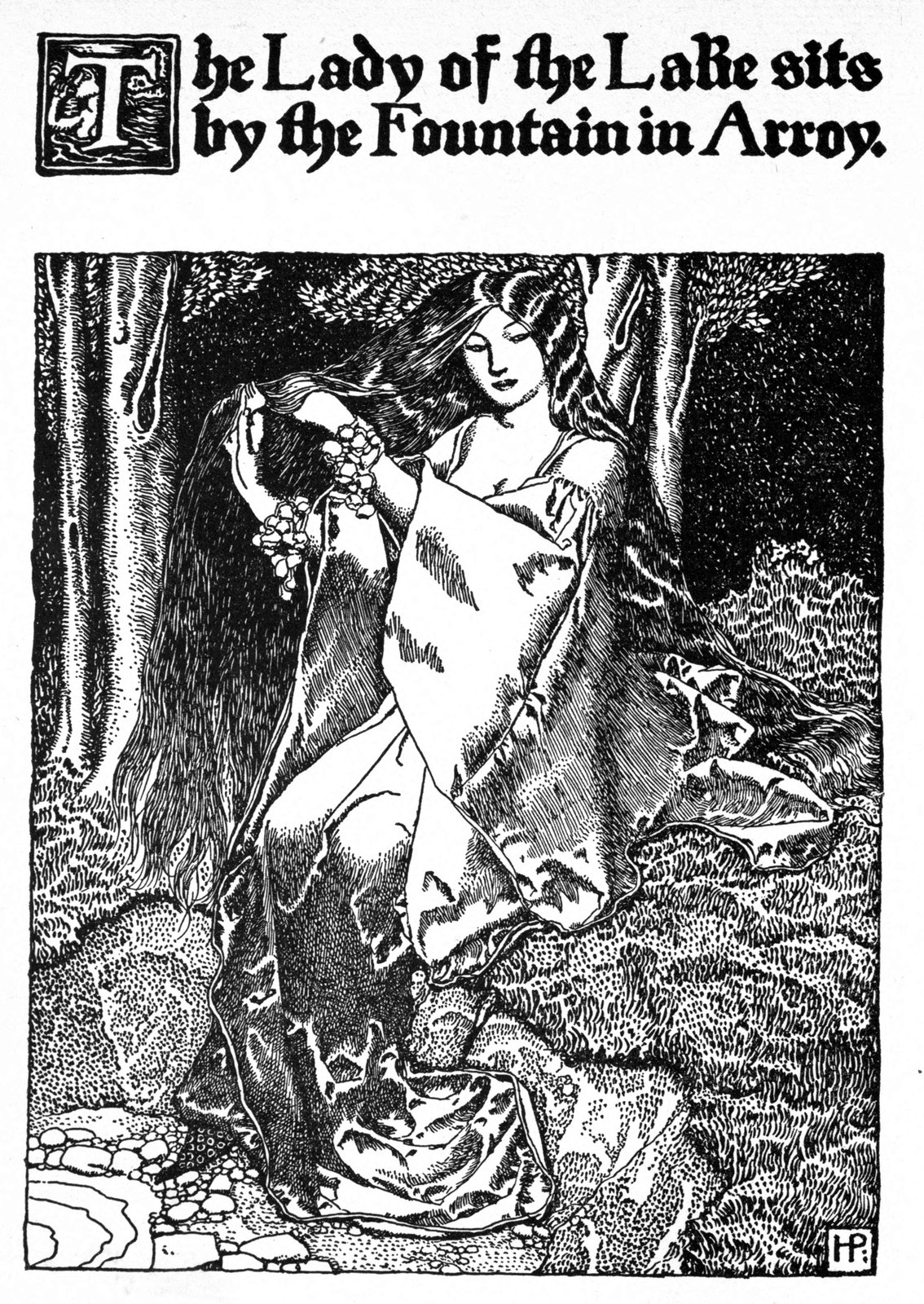
Now, just as much as Queen Guinevere thought highly of Sir Pelleas, she disliked Sir Gawain. For although many people said that Sir Gawain had a silver tongue, and although at times he could talk in such a way as to win others over to whatever he wanted, he was still of a proud temper, and very stern and haughty. So he would not always put up with it when the Lady Guinevere ordered him about as she ordered the other knights of that Court. What is more, she could never forget how Sir Gawain had refused her that time at Cameliard, when she begged him and his companions for help in her time of trouble, nor how discourteous his words to her had been then. So there was no great liking between these two proud souls, for Queen Guinevere held to her own way and Sir Gawain held to his own way, whatever happened.
Sir Gawain and others sit beneath the Queen's window.
Now it happened once that Sir Gawain and Sir Griflet and Sir Constantine of Cornwall were sitting and talking with five ladies of the Queen's Court in a garden of trimmed and interwoven hedges that lay below the Lady Guinevere's tower, and they were having a very pleasant time together. Sometimes they would talk and make merry with jokes and tales, and at other times one or another of them would take up a lute they had brought with them, and play on it, and sing.
Now while these lords and ladies sat enjoying their pleasant talk and singing like this, Queen Guinevere was sitting at a window that overlooked the garden. It was not very high above the ground, so she could overhear everything they said. But the lords and ladies had no idea that the Queen could hear them, so they talked and laughed very freely, and the Queen greatly enjoyed their conversation and the music they made.
That day was wonderfully mild and warm, and since it was well on toward the close of the afternoon, those lords and ladies were dressed in very bright and festive clothes. Of all who were there, Sir Gawain was the most splendidly dressed, for he wore sky-blue silk embroidered with silver thread. And Sir Gawain was playing the lute and singing a ballad in a very pleasing voice, so that Queen Guinevere, sitting by the open window, was well content to listen to him.
Sir Gawain strikes the Queen's hound.
Now there was a certain greyhound that Queen Guinevere was wonderfully fond of, so fond that she had put a collar of gold set with carbuncles, those deep red jewels, around its neck. Just then the hound came running into the garden, and his feet were wet and muddy with earth. Hearing Sir Gawain singing and playing on the lute, the hound ran to him and jumped up on him. This made Sir Gawain very angry. He clenched his fist and struck the hound on the head with his knuckles, so that the hound howled loudly.
But when Queen Guinevere saw that blow she was deeply offended, and she called out from her window, "Why do you strike my dog, Sir?" And the lords and ladies below in the garden were very much surprised, and very much embarrassed, to find that the Queen was so close to them that she could overhear everything they had said and see everything they did.
But Sir Gawain spoke up very boldly and said, "Your dog insulted me, Lady, and whoever insults me, I strike."
Then Queen Guinevere grew very angry with Sir Gawain, and she said, "Your words are too bold, Sir." And Sir Gawain said, "Not too bold, Lady; only bold enough to defend my rights."
Of the quarrel of the Queen and Sir Gawain.
At these words the Lady Guinevere's face blazed like fire, and her eyes shone very bright, and she said, "I am sure you forget whom you are speaking to, Sir Knight." At that Sir Gawain smiled very bitterly and said, "And you, Lady, forget that I am the son of a king so powerful that he needs no help from any other king to defend his rights."
At these words everyone there fell as silent as if they had been turned to stone, for that speech was extremely bold and haughty. They all looked at the ground, for they did not dare to look at either Queen Guinevere or Sir Gawain. And the Lady Guinevere was silent too, for a long time, trying to recover herself after that speech; and when she spoke, it was as if she were half choked with anger. She said, "Sir Knight, you are proud and arrogant beyond all measure, for I never heard of anyone who dared to answer his Queen the way you have spoken to me. But this is my Court, and I may give orders in it as I choose. So I now command you to be gone, and to show your face no more, either here or in the Hall or in any of the places where I hold my Court. For you are an offense to me, and in none of these places shall you have leave to show your face until you ask my pardon for the insult you have given me." Then Sir Gawain stood up and bowed very low to Queen Guinevere, and he said, "Lady, I go. And I will not come back here until you are willing to tell me that you are sorry for the discourteous way you have treated me, both now and at other times, in front of my peers."
With these words Sir Gawain left that place, and he did not turn his head to look behind him. And Queen Guinevere went into her room and wept in secret, out of anger and out of shame. For in truth she was deeply grieved at what had happened; and yet she was so proud that she would never have taken back the words she had spoken, even if she could have done so.
Now when the news of that quarrel had gone around the castle, it reached the ears of Sir Uwain. So Sir Uwain went straight to Sir Gawain and asked him what was the matter, and Sir Gawain, who was like a man half out of his mind and in great despair, told him everything. Then Sir Uwain said, "You were certainly wrong to speak to the Queen as you did. All the same, if you are banished from this Court, I will go with you, for you are my first cousin and my companion, and my heart holds fast to you." So Sir Uwain went to King Arthur and said, "Lord, my cousin Sir Gawain has been banished from this Court by the Queen. And though I cannot say that he has not deserved that punishment, I would gladly ask your leave to go with him."
At this King Arthur was very much grieved, but he kept a steady face and said, "Sir, I will not keep you from going wherever you please. As for your kinsman, I dare say he gave the Queen such great offense that she could do nothing other than what she did."
Sir Gawain and Sir Uwain leave the Court.
So Sir Uwain and Sir Gawain both went to their lodgings and ordered their squires to arm them. Then they and their squires rode out of Camelot and took their way toward the forest country.
There those two knights and their squires traveled all that day until the gray of the evening, at the hour when the birds were singing their last songs before closing their eyes for the night. Seeing that the evening was coming on fast, the knights were afraid they would not be able to find a kindly lodging before night came down on them, and they talked together a great deal about it. But as they came to the top of a certain hill, they saw below them a valley, very lovely and well farmed, with many cottages and small farms. And in the middle of that valley was a fine abbey, very beautiful to look at. So Sir Gawain said to Sir Uwain, "If that abbey over there is an abbey of monks, I believe we shall find excellent lodging there tonight."
They come to an abbey of monks.
So they rode down into the valley and to the abbey, and at the small gate they found a porter, from whom they learned that it was indeed an abbey of monks. At this they were very glad, and rejoiced greatly.
When the abbot of that abbey learned who they were, and of what rank and high station, he was extremely pleased to welcome them, and he brought them into the part of the abbey where he himself lived. There he made them welcome and had a good supper set before them, which made them very happy. Now the abbot was a merry soul and took great pleasure in talking with strangers, so he asked those two knights very carefully why they were wandering abroad. But they told him nothing about the quarrel at Court, only that they were in search of adventure. At this the abbot said, "Ha, Sirs! If you are in search of adventures, you may find one not very far from here."
The abbot tells the knights of a good adventure.
So Sir Gawain said, "What adventure is that?" And the abbot answered, "I will tell you. If you travel eastward from this place, you will come after a while to a spot where you will find a very fair castle of gray stone. In front of that castle you will find a good level meadow, and in the middle of the meadow a sycamore tree, and in the sycamore tree a shield, which certain ladies insult in a very curious way. If you forbid those ladies to insult that shield, you will discover a very good adventure."
Then Sir Gawain said, "That is a very strange business. Tomorrow morning we will go to that place and try to find out what sort of adventure it may be." And the abbot said, "Do so," and laughed heartily.
So when the next morning came, Sir Gawain and Sir Uwain said farewell to the abbot and took their leave of that place, riding away eastward as the abbot had advised. After they had ridden in that direction for two or three hours or more, they saw before them the edge of a forest, all green and shady with leaves and very cheerful in the warmth of the early summer day. And there, right at the edge of the woods, stood a fair, strong castle of gray stone, with windows of glass shining very bright against the sky.
Sir Gawain and Sir Uwain see the damsels attacking the shield.
Then Sir Gawain and Sir Uwain saw that everything was just as the abbot had said, for in front of the castle was a smooth, level meadow with a sycamore tree in the middle of it. As they drew near, they could see that a black shield hung in the branches of the tree, and in a little while they could make out that it bore the emblem of three white goshawks with their wings spread. But what was very extraordinary was this: in front of that shield stood seven young damsels, with very lovely faces, and these seven damsels kept heaping insults on the shield. Some of the damsels struck at it every now and then with peeled willow switches, and others threw lumps of clay at it, so that the shield was badly smeared and spoiled. Now near the shield was a very noble-looking knight dressed all in black armor and sitting on a black war-horse, and it was easy to see that the shield belonged to that knight, for he had no other shield. Yet even though it was very likely his shield, the knight made no protest, either by word or by deed, to stop those damsels from insulting it.
Then Sir Uwain said to Sir Gawain, "That is a very strange thing I see over there. Probably one of us is meant to fight that knight." And Sir Gawain said, "Maybe so." Then Sir Uwain said, "If that is so, then I will take on the adventure." "No," said Sir Gawain, "I will take it on myself, since I am the elder of us two, and the more seasoned in knighthood." So Sir Uwain said, "Very well. Let it be so, for you are a much more powerful knight than I am, and it would be a pity for one of us to fail in this undertaking." At that Sir Gawain said, "Leave it to me, then, and I will undertake it."
So he set spurs to his horse and rode swiftly to where the damsels were insulting the black shield. And he set his spear in rest and shouted in a loud voice, "Get away! Get away!" When the damsels saw the armed knight riding at them like that, they ran away from him, shrieking.
Then the Black Knight, who was sitting his horse not far off, rode forward to Sir Gawain in a very stately way and said, "Sir Knight, why do you interfere with those ladies?" And Sir Gawain answered, "Because they were insulting what seemed to me to be a noble and knightly shield." At this the Black Knight spoke very haughtily and said, "Sir Knight, that shield belongs to me, and I assure you that I am very well able to take care of it without the interference of any other defender." To which Sir Gawain said, "It would not seem so, Sir Knight."
Then the Black Knight said, "Sir, if you think you are better able to take care of that shield than I am, I think you would do very well to make your words good with your body." To this Sir Gawain said, "I will do my best to show you that I am better able to guard that shield than you are, who own it."
Sir Gawain and the Black Knight join in battle.
At this the Black Knight, without any more talk, rode to the sycamore tree and took down the shield that hung there. He fastened the shield on his arm, took his spear in hand, and made himself ready. And Sir Gawain likewise made himself ready, and then each knight took up whatever position on the field seemed best to him.
Now when the people of that castle saw that a combat of arms was about to take place, they crowded in great numbers onto the walls, so that as many as forty ladies and squires and people of every rank were looking down from the walls on that field of battle.
So when the knights were all ready, Sir Uwain gave the signal to charge, and each knight shouted aloud and drove his spurs into his horse and rushed forward to the attack with a noise as loud as thunder.
The Black Knight overthrows Sir Gawain.
Now Sir Gawain thought that he would easily beat his opponent in this charge and would be able to throw him out of his saddle without much trouble, for there was hardly a knight in that kingdom equal to Sir Gawain in prowess. Indeed, he had never yet been unhorsed in combat by anyone except King Arthur. So when the two of them rode against each other, Sir Gawain thought it certain that his opponent would fall before him. But it was not so. For in that charge Sir Gawain's spear was broken into many pieces, but the Black Knight's spear held, so that Sir Gawain was hurled violently out of the saddle and struck the dust with a terrible crash. And he was so astonished at that fall that it seemed to him not as though he had fallen from his saddle, but as though the earth had risen up and struck him. So he lay for a while, quite stunned by the blow and by his astonishment.
But when he heard the shouts of the people on the castle wall, he roused himself at once from where he lay in the dust, and he was so filled with rage and shame that he was like a man completely drunk. So he drew his sword and rushed furiously at his enemy, meaning to cut him down by main strength. Then the other knight, seeing him come at him like this, leaped down from his own saddle at once, drew his sword, and set himself ready either to attack or to defend. So they lashed at each other, circling this way and that and striking with such fury that the blows they gave were terrible to see. But when Sir Uwain saw how fierce that fight was, he set spurs to his horse and pushed it in between the two fighters, crying out loud, "Sir Knights! Sir Knights! What is this? There is no reason here for such a desperate battle." But Sir Gawain cried out very furiously, "Leave off! Leave off, and stand aside! This quarrel is none of your business." And the Black Knight said, "On horseback or on foot, I am ready to meet that knight at any time."
But Sir Uwain said, "No. You will fight no more in this quarrel. Shame on you, Gawain! Shame on you, to pick such a desperate quarrel with a knight who only met you in a friendly way in a fair contest!"
Then Sir Gawain saw that Sir Uwain was both just and right, and he put up his sword in silence, although he was ready to weep with vexation at the shame of being overthrown. And the Black Knight put up his sword too, and so peace was made between the two of them.
Then the Black Knight said, "I am glad that this quarrel is over, for I can see, Sirs, that you are surely knights of great nobility and good breeding. So I wish that from now on we might be friends and companions instead of enemies. And so I beg you to come with me a little way from here, to where I have made my lodging, so that we may rest and refresh ourselves in my pavilion."
To this Sir Uwain said, "I thank you for your courtesy, Sir Knight, and we will go with you with all the pleasure in the world." And Sir Gawain said, "I am content." So the three knights left the field of battle at once.
Sir Gawain and Sir Uwain come to the pavilion of the Black Knight.
When they had come to the edge of the forest, Sir Gawain and Sir Uwain saw a very fine pavilion of green silk set up beneath the trees. And around that pavilion were many attendants of various kinds, all dressed in green and white. So Sir Gawain could see that the knight who had overthrown him was certainly someone of very high rank, and this comforted him greatly. Then the squires of the three knights came and took off their helmets, each squire his own knight's, so that the knights might be comfortable. And when this was done, Sir Gawain and Sir Uwain saw that the Black Knight was very handsome, with a ruddy face and hair as red as copper. Then Sir Uwain said to the knight, "Sir Unknown Knight, this knight, my companion, is Sir Gawain, son of King Uriens of Gore, and I am Uwain, the son of King Lot of Orkney. Now I ask you to make yourself known to us in the same way."
"Ha," said the other, "I am glad that you are such very famous and royal knights, for I am of royal blood too. I am Sir Marhaus, the son of the King of Ireland."
Then Sir Gawain was very glad to discover how exalted was the rank of the knight who had overthrown him, and he said to Sir Marhaus, "Sir, I swear that you are one of the most formidable knights in the world. For you have done to me today what only one knight in all the world has ever done before, and that is King Arthur, who is my uncle and my lord. Now you must certainly come to King Arthur's Court, for he will be wonderfully glad to see you, and maybe he will make you a Knight of his Round Table, and there is no honor in all the world as great as that." He said this without thinking; and then he remembered. At that he struck his fist against his forehead and cried out, "Aha! Aha! Who am I to invite you to King Arthur's Court, when only yesterday I was disgraced and banished from it?"
Then Sir Marhaus was very sorry for Sir Gawain, and asked about the trouble that weighed on him, and Sir Uwain told Sir Marhaus all about the quarrel. At that Sir Marhaus was even sorrier for Sir Gawain, and he said, "Sirs, I like you both wonderfully well, and I would gladly become your companion in whatever adventures you are going to undertake. For now I need not stay here any longer. You must know that I was bound to defend those ladies who attacked my shield until I had overthrown seven knights on their behalf. And I must tell you that Sir Gawain was the seventh knight I have overthrown. So, since I have now overthrown him, I am released from my obligation and may go with you."
Sir Marhaus tells his story.
Then Sir Gawain and Sir Uwain were very much astonished that any knight should be under so strange an obligation as that, to defend the very people who were attacking his shield, and they begged Sir Marhaus to tell them why he had been bound to keep such a pledge. So Sir Marhaus said, "I will tell you. It was like this. Some time ago I was traveling in these parts with a hawk on my wrist. I was dressed very lightly at the time, in holiday clothes: I wore a tunic of green silk, with one stocking green and the other white. And I had nothing on me for defense but a light buckler, which is a small round shield, and a short sword. Now I came to a certain stream of water, very deep and swift, and I saw ahead of me a stone bridge crossing it, but so narrow that only one horseman could cross at a time. So I rode onto the bridge, and I was partway across when I saw a knight in armor coming the other way. And behind the knight, riding on a pillion, a cushion fixed behind his saddle, sat a very fair lady with golden hair and a very proud bearing. Now when that knight saw me on the bridge, he shouted, 'Get back! Get back, and let me pass!' But this I would not do. Instead I said, 'No, Sir Knight. Since I have come this far onto the bridge, I surely have the right of way to finish crossing, and it is for you to wait and let me over.' But the knight would not do so. He at once made ready to attack, and came straight at me on the bridge, meaning either to kill me or to drive me back to the other end of it. But this he was not able to do, for I defended myself very well with my light weapons. And I pushed my horse so hard against his horse that I drove him backward off the bridge and into the water, and the horse and the knight and the lady all fell into it with a terrible uproar.
"At this the lady shrieked loudly, and both she and the knight were on the point of drowning in the water, for the knight was clad entirely in armor and could not lift himself above the flood. So, seeing the danger they were in, I leaped off my horse into the water, and with great effort, and at great risk to myself, I was able to bring them both to land.
"But that lady was very much offended with me, because her fine clothes were soaked and spoiled by the water, and she scolded me fiercely. So I knelt down before her and begged her pardon with all humility, but still she went on scolding me. Then I offered to do any penance she might lay on me. At this the lady seemed to be a good deal softened, for she said, 'Very well, I will set you a penance.' And when her knight had recovered, she said, 'Come with us.' So I mounted my horse and followed them. And after we had gone a good distance we came to this place, and here she gave me these commands. 'Sir Knight,' she said, 'this castle belongs to me and to this knight who is my lord. Now this shall be your penance for the insult you have given me: you shall take your shield and hang it up in that sycamore tree, and every day I will send certain damsels of my own out of the castle. They shall abuse that shield, and you shall not only put up with whatever insult they offer it, but you shall defend them against all comers until you have overcome seven knights.'
"And so I have done, until this morning, when you, Sir Gawain, came here. You are the seventh knight I have fought, and since I have overcome you, my penance is over and I am free."
Then Sir Gawain and Sir Uwain wished Sir Marhaus great joy that his penance was finished, and each side was very well pleased with the other. So Sir Gawain and Sir Uwain stayed that night in Sir Marhaus's pavilion, and the next morning they got up, washed themselves in a forest stream, and set out from that place.
So they went into the forest country once more and made their way along certain paths, they did not know where; and they traveled all that morning and on until the afternoon had come.
The three knights enter the Forest of Adventure.
Now as they traveled like this, Sir Marhaus said suddenly, "Sirs, do you know where we have come to?" "No," they said, "we do not." Then Sir Marhaus said, "This part of the forest is called Arroy, and it is also called the Forest of Adventure. For it is very well known that when a knight, or a party of knights, enters this forest, they will surely meet with an adventure of some kind, from which some come out with honor while others fail." And Sir Uwain said, "I am glad we have come here. Now let us go on into this forest."
So the three knights and their squires went on into that woodland, where the silence was so deep that even the tread of their horses on the earth could hardly be heard. There was no note of any bird and no sound of any voice, and hardly any light made its way into the gloom of those woods. So the knights said to one another, "This is truly a very strange place, and maybe a place of enchantment."
They see a white fawn in the forest.
They see a beautiful lady in the forest.
Now when they had come into the very heart of these dark woods, they suddenly saw on the path ahead of them a fawn as white as milk. And around the fawn's neck was a collar of pure gold. The fawn stood still and looked at them, but when they came near it, it turned and ran off along a very narrow path. Then Sir Gawain said, "Let us follow that fawn and see where it goes." And the others said, "We are willing." So they followed that narrow path until suddenly they came out on a little open lawn, very bright with sunlight. In the middle of the lawn was a fountain of water, and there was no fawn to be seen. But there beside the fountain sat a wonderfully beautiful lady, dressed all in green. The lady was combing her hair with a golden comb, and her hair was as black as a raven's wing. On her arms she wore marvelous bracelets of emeralds and opals set in skilfully worked gold. What is more, the lady's face was as white as ivory, and her eyes were bright like jewels set in ivory. Now when this lady saw the knights, she stood up and laid aside her golden comb and tied up her locks with ribbons of scarlet silk; and then she came to the knights and greeted them.
At once the three knights got down from their horses, and Sir Gawain said, "Lady, I believe you are not a mortal woman, but one of the fairy folk." To this the lady said, "Sir Gawain, you are right," and Sir Gawain wondered that she should know his name so well. Then he said to her, "Lady, who are you?" And she answered, "My name is Nimue, and I am the chief of those Ladies of the Lake you may have heard of. For it was I who gave King Arthur his sword Excalibur, since I am a great friend to King Arthur and to all the noble Knights of his Court. That is how I know you all. And I know that you, Sir Marhaus, will become one of the most famous Knights of the Round Table." And all three of them marveled at the lady's words. Then she said, "Please tell me, what are you looking for in these parts?" And they said, "We are looking for adventure." "Well," she said, "I will bring you to an adventure, but it is Sir Gawain who must undertake it." And Sir Gawain said, "That is very welcome news." Then the lady said, "Take me up behind you on your saddle, Sir Gawain, and I will show you that adventure." So Sir Gawain took the lady up behind him on his saddle, and as he did, she brought with her a fragrance such as he had never known before. That fragrance was so delicate that it seemed to Sir Gawain as if the whole forest were breathing out the perfume that the Lady of the Lake carried with her.
So the Lady of the Lake led them by many winding ways out of that part of the forest, and along various roads and paths, until they came out into open country, very fruitful and pleasant to see. And she led them up a very high hill, and from the top of the hill they looked down on a fruitful, level plain spread out below them like a table. And they saw that in the middle of the plain stood a noble castle built all of red stone and red brick, and they saw that there was a small town built of red brick too.
The three knights see a very strange fight.
Now as they sat their horses there on the hilltop, they suddenly saw a knight dressed all in red armor come riding out of a grove of trees. They saw the knight ride up and down the meadow in front of the castle, and they saw that he was challenging those inside the castle. Then they saw the drawbridge of the castle suddenly let down, and ten knights in full armor came riding out. And they saw those ten knights attack the one knight in red armor, and they saw the one knight attack the ten. They saw that for a while the ten held out against the one, but he attacked them so terribly that he struck down four of them very quickly. Then they saw the rest break and flee before that one knight, and the Red Knight chased the others around the meadow with great fury. And they saw him strike one out of his saddle, and then another, and another, until only two of those knights were left.
Then Sir Gawain said, "That is certainly a wonderful thing to see." But the Lady of the Lake only smiled and said, "Wait a little."
So they waited, and they saw that when the Red Knight had struck down all his enemies except those two, and had put those two in great danger of their lives, he suddenly sheathed his sword and surrendered himself to them. And they saw the two knights bring the Red Knight to the castle, and when they had brought him there, a lady on the castle wall spoke to the Red Knight, it seemed, with very violent language. And they saw the two knights take the Red Knight and tie his hands behind his back, and tie his feet together under his horse's belly, and drive him away from that place.
All this they saw from the top of the hill, and the Lady of the Lake said to Sir Gawain, "There you will find your adventure, Sir Gawain." And Sir Gawain said, "I will go." And the Lady of the Lake said, "Do so."
And with that she vanished from their sight, and they were greatly amazed.
Chapter 5: How Sir Gawain Met Sir Pelleas and Promised to Help Him with the Lady Ettard
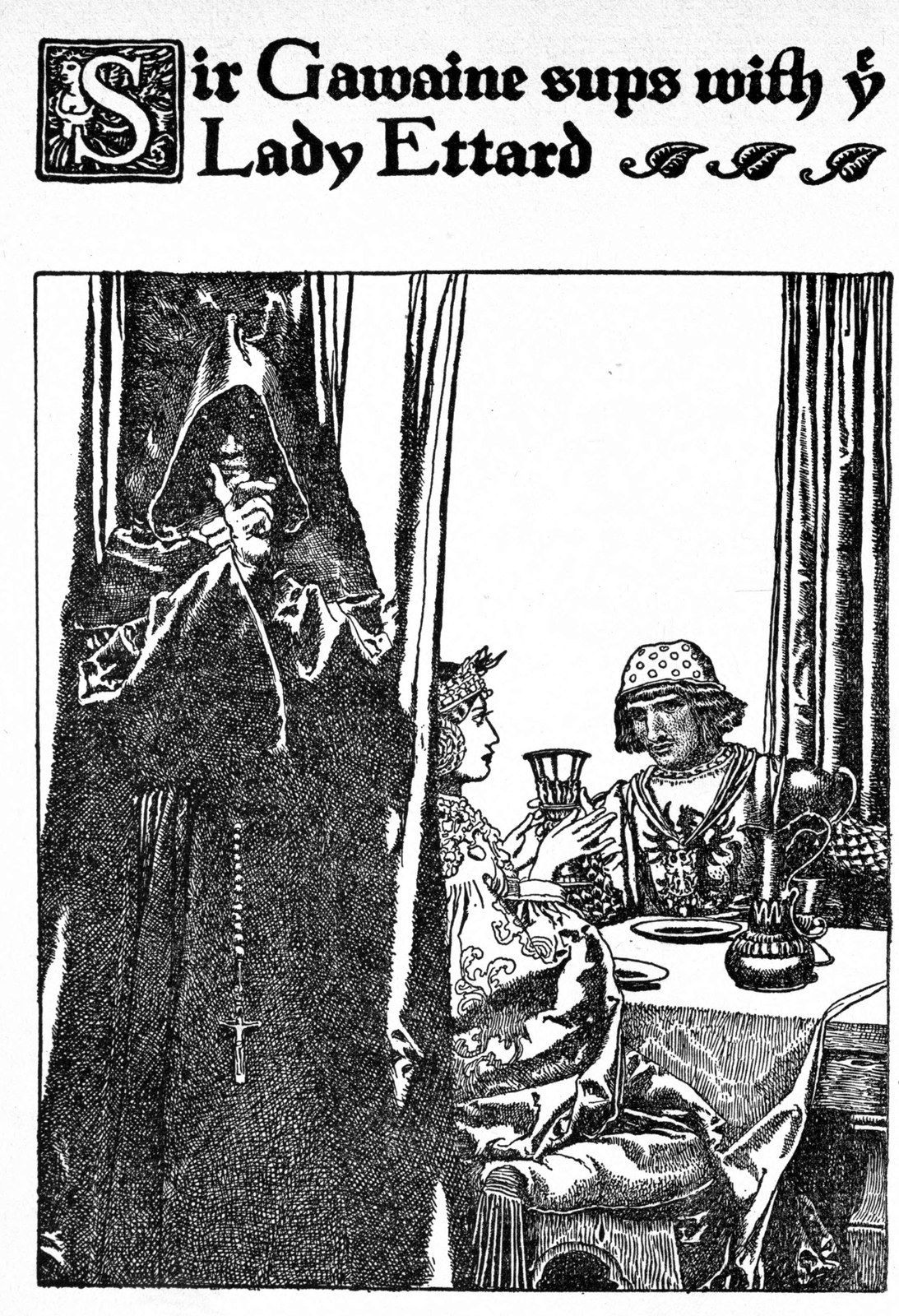
Now, after that wonderful lady had vanished from their sight in that way, the three knights stood for a little while utterly astonished, for they did not know whether to believe what their eyes had seen. Then, by and by, Sir Gawain spoke. "Truly," he said, "that was a very wonderful thing that happened to us, for never in all my life have I known so strange a miracle to take place. Now, it is very plain that some excellent adventure lies in what we have seen. So let us go down into that valley, for there we shall surely discover the meaning of what we have just now witnessed. For I swear that I have hardly ever seen so terribly powerful a knight as the one who just fought that battle down there, and I cannot in any way understand why, when he had so nearly won the victory over his enemies, he should have surrendered himself to them as he did."
And Sir Uwain and Sir Marhaus agreed that it would be well to go down and find out the meaning of what they had seen.
So the three of them and their attendants rode down into the valley.
And they rode on until they came to a certain grove of trees, and there they saw three handsome pavilions standing: the first pavilion of white cloth, the second of green cloth, and the third of scarlet cloth.
The three knights meet the two.
Now, as the three companions drew near to the pavilions, two knights came out to meet them. And when Sir Gawain and Sir Uwain saw the shields of the two, they knew at once that they were Sir Brandiles and Sir Mador de la Porte. And in the same way Sir Brandiles and Sir Mador de la Porte knew Sir Gawain and Sir Uwain, and each party was very much astonished to meet the other in so strange a place. So when they came together they greeted one another very joyfully and clasped hands with strong love and good fellowship.
Then Sir Gawain introduced Sir Marhaus to Sir Brandiles and Sir Mador de la Porte, and after that the five knights all went together into those three pavilions, talking all the while in great friendship and pleasure. And when they came into the pavilion of Sir Brandiles, they found a good meal laid out there of white bread and wine of excellent flavor.
Then after a while Sir Gawain said to Sir Brandiles and Sir Mador de la Porte, "Sirs, a little while ago we saw a very strange thing. As we stood together at the top of that hill and looked down into this plain, we saw a single knight dressed all in red armor fighting against ten knights. And that one knight in red armor fought the ten with such fury that he drove them all before him, though they were so many and he was only one. And truly I swear that I have hardly ever seen a knight show such great skill and strength in arms as he did. Yet when he had overcome all but two of those knights, and was well on the way to winning a clear victory, he suddenly gave himself up to the two of them and let them seize him and tie him up and drive him from the field with great indignity. Now, I beg you, tell me the meaning of what we saw, and who that knight was who fought so great a battle and yet surrendered so shamefully."
At this Sir Brandiles and Sir Mador de la Porte made no answer but looked away, for they did not know what to say. And when Sir Gawain saw that they were embarrassed, he began to wonder more than ever what it all meant. So he said, "What is this? Why don't you answer me? I order you to tell me what your looks mean, and who that red knight is!"
Then after a while Sir Mador de la Porte said, "I will not tell you, but you may come and see."
Then Sir Gawain began to think that perhaps there was something here that it would be better not to make public, and that he had better look further into the matter alone. So he said to the other knights, "Wait here a little while, sirs, and I will go with Sir Mador de la Porte."
Sir Mador de la Porte brings Sir Gawain to Sir Pelleas.
So Sir Gawain went with Sir Mador de la Porte, and Sir Mador led him to the white pavilion. And when they came there, Sir Mador drew aside the curtains of the pavilion and said, "Go in!" And Sir Gawain went in.
Now, when he came into the pavilion, he saw that a man sat on a couch of rushes covered with a blue cloth, and after a moment he saw that the man was Sir Pelleas. But Sir Pelleas did not see him at once. He sat with his head bowed, like someone completely overwhelmed by a great despair.
And when Sir Gawain saw who it was that sat on the couch, he was greatly amazed and cried out, "Ha! Is it you, Sir Pelleas? Is it you?"
But when Sir Pelleas heard Sir Gawain's voice, and saw who it was that spoke to him, he let out a terribly bitter cry. And he sprang to his feet and ran as far away as the walls of the pavilion would let him, and turned his face to the wall.
Sir Gawain rebukes Sir Pelleas.
Then, after a while, Sir Gawain spoke very sternly to Sir Pelleas. "Sir," he said, "I am astonished and deeply ashamed that a knight of King Arthur's royal court and of his Round Table should behave in so dishonorable a way as I saw you behave today. For it is hardly to be believed that a knight of your fame and nobility would let himself be captured and tied up by two unknown knights, as you let yourself be today. How could you bring yourself to submit to such indignity and insult? Now I demand that you explain this to me."
But Sir Pelleas was silent and would not answer. Then Sir Gawain cried out very fiercely, "Ha! Will you not answer me?" And Sir Pelleas shook his head.
Then Sir Gawain spoke again, still very fiercely. "Sir!" he said. "You shall answer me one way or another! Either you will tell me the meaning of your shameful conduct, or else you will fight me to the uttermost. For I will not allow you to bring such shame on King Arthur and his Round Table without defending the honor and good name of the King and of the Table myself. Once you and I were dear friends, but unless you clear yourself at once, I shall hold you in contempt and regard you as an enemy."
At this Sir Pelleas spoke like a man nearly out of his mind. "I will tell you everything," he said. Then he confessed it all to Sir Gawain, telling him everything that had happened since the time he left Queen Guinevere's May Court to set out on this adventure, and Sir Gawain listened to him in great amazement. And when Sir Pelleas had finished telling all that had happened to him, Sir Gawain said, "Truly, this is very strange. Indeed, I cannot understand how you came to be so tangled in the charms of this lady, unless she has bewitched you with some powerful enchantment."
To this Sir Pelleas said, "Yes, I believe I have been bewitched, for I am completely beside myself in this matter, and I cannot control my passion at all."
Then Sir Gawain thought for a long while, considering the matter very seriously, and by and by he said, "I have a plan, and it is this. I will go to the Lady Ettard myself and look carefully into this affair. And if I find that anyone has tangled you in enchantments, I will do my very utmost to punish that person with great suffering. For I will not have another enchanter deceive you, as one has already deceived Merlin the Wise."
Then Sir Pelleas said to Sir Gawain, "How will you manage this, so as to get into the presence of the Lady Ettard?"
Sir Gawain makes a plan with Sir Pelleas.
Sir Gawain replied, "That I will tell you. We two shall exchange armor, and I will go to the castle in your armor. When I get there, I shall say that I have beaten you in a fight and taken your armor away from you. Then perhaps they will let me into the castle to hear my story, and I shall have a chance to speak with her."
Then Sir Pelleas said, "Very well. It shall be as you decide."
So Sir Pelleas called for a squire, and Sir Gawain called for his squire, and the two of them took the armor off Sir Pelleas and dressed Sir Gawain in it. When they had done that, Sir Gawain mounted Sir Pelleas's horse and rode openly into the field where Sir Pelleas had paraded before.
Now it happened that the Lady Ettard was walking at that time on a terrace inside the castle walls, from which she could look down into that meadow. So when she saw a red knight parading in the meadow, she thought it was Sir Pelleas come back again, and at that she was annoyed and offended beyond all measure. So she said to those near her, "That knight annoys me so terribly that I am afraid I shall fall ill from vexation if he comes here many more times. I wish I knew how to rid myself of him. For only an hour ago I sent ten good knights against him, and he beat them all with great speed, to their great dishonor and mine."
So she beckoned to the Red Knight, and when he had come close to the castle walls, she said to him, "Sir Knight, why do you come here to torment me and insult me like this? Can't you understand that the more often you come to pester me this way, the more I hate you?"
Then Sir Gawain opened the visor of his helmet and showed his face, and the Lady Ettard saw that the Red Knight was not Sir Pelleas. And Sir Gawain said, "Lady, I am not the man you take me for, but someone else. For look: I have your enemy's armor on my body, and so you can see that I have beaten him. You may well suppose that I could hardly be wearing his armor unless I had taken it from him by force of arms. So you need not trouble yourself about him any longer."
Then the Lady Ettard could not help believing that this knight, whom she did not know, had really overthrown Sir Pelleas in a fight and taken his armor away from him. And indeed she was greatly astonished that such a thing could have happened, for it seemed to her that Sir Pelleas was one of the greatest knights in the world, and she wondered who this knight could be who had overthrown him in battle. So she commanded several of her attendants to go out and bring that red knight into the castle and to pay him great honor, since he must surely be one of the very greatest champions in the world.
Sir Gawain enters Grantmesnle.
So Sir Gawain came into the castle and was brought before the Lady Ettard, where she stood in a wonderfully large and noble hall. That hall was lit by seven tall windows of colored glass, and it was hung all around with tapestries and hangings, very rich and of the finest quality, so that Sir Gawain was greatly astonished at the splendor of everything he saw there.
Now, Sir Gawain had taken the helmet off his head, and he carried it under his arm against his hip. His head was bare, so that everyone there could see his face very plainly. And so they all saw that he was extremely handsome: his eyes were as blue as steel, his nose high and curved, and his hair and beard very dark and rich in color. What is more, he carried himself so steadily and so proudly that those who looked at him were awed by how very knightly he appeared.
Then the Lady Ettard came to Sir Gawain and gave him her hand, and he knelt down and raised it to his lips. And the lady spoke to him very graciously. "Sir Knight," she said, "it would give me a great deal of pleasure if you would tell us your name and let us know your rank and station."
To this Sir Gawain replied, "Lady, I cannot tell you these things at present, for I am bound by a vow to keep them secret just now. So I ask you to be patient with me for a little while."
Then the Lady Ettard said, "Sir Knight, it is a great pity that we may not know your name and rank. All the same, though we are still ignorant of who you are, I hope that you will give us the pleasure of your company for a while, and that you will be gracious enough to stay in this poor place of ours for two or three days, while we offer you whatever refreshment we can."
The magical necklace enchants Sir Gawain.
Now at this point a very unlucky thing happened, and it was this. The Lady Ettard had come to love that necklace of emeralds and opals and gold that she had borrowed from Sir Pelleas, and she loved it so much that she never let it out of her keeping, by day or by night. So at that very moment she was wearing it hung about her neck and throat. And as she talked to Sir Gawain, he looked at that necklace, and its enchantment began to take a very strong hold on him. For soon he began to feel as though his heart were being drawn with a tremendous longing out of his breast and toward the Lady Ettard, so much so that in a little while he could not take his eyes off her at all. And the more he looked at the necklace and at the lady, the more the enchantment of the jewel took hold of his spirits. And so, when the Lady Ettard spoke so graciously to him, he was very glad to accept her kindness. Gazing at her very ardently all the while, he said, "Lady, you are exceedingly kind to show me such great courtesy, and I shall be glad beyond measure to stay with you for a short while."
At these words the Lady Ettard was very greatly pleased, for she said to herself, "Surely this knight, though I do not know who he may be, must be a champion of extraordinary strength and of great deeds. Now if I can persuade him to stay in this castle as my champion, I shall certainly win great credit by it, for I shall have someone to defend my rights who must surely be the greatest knight in all the world." So she put forth every charm and every grace of manner to please Sir Gawain, and Sir Gawain was altogether delighted by the kindness of her ways.
Now Sir Engamore was there at the time, and he was very deeply troubled in spirit. For in the same degree that Sir Gawain received courtesy from the Lady Ettard, in that same degree Sir Engamore was cast down into great sorrow and distress, so much so that it was pitiful to see him. For Sir Engamore said to himself, "Before these foreign knights came here, the Lady Ettard was very kind to me, and was willing to take me for her champion and her lord. But first Sir Pelleas came and overthrew me, and now this strange knight comes and overthrows him. So, beside such a great champion as this one, I have become as nothing in her eyes." So Sir Engamore left that place and went to his own small private room, where he sat down alone in great sorrow.
Now the Lady Ettard had commanded that a very noble and splendid feast be prepared for Sir Gawain and herself, and while it was being made ready, she and Sir Gawain walked together in the pleasure garden of the castle. For there was very pleasant shade in that place, and flowers grew there in great abundance, and many birds sang very sweetly among the blossoms of the trees. And as Sir Gawain and the lady walked together in this way, the attendants stood a little distance off and watched them. And they said to one another, "Surely it would be a very good thing if the Lady Ettard would take this knight for her champion, and if he would stay here in Grantmesnle forever."
Sir Gawain and the Lady Ettard feast together.
So Sir Gawain and the lady walked together, talking very cheerfully, until sunset. By then the supper was ready, and they went in and sat down to it. And as they ate, a number of pages with very fair faces played on harps before them, and several damsels sang very sweetly along with the music, so that Sir Gawain's heart swelled with joy. And he said to himself, "Why should I ever leave this place? After all, I have been banished from King Arthur's court. Why then should I not set up a court of my own here, which might in time come to equal his in glory?" And the Lady Ettard was so beautiful in his eyes that this seemed to him a wonderfully pleasant thought.
Now let us turn to Sir Pelleas.
Sir Pelleas is in doubt.
For after Sir Gawain had left him, the heart of Sir Pelleas began to fear that he had not acted wisely, and at last he said to himself, "Suppose Sir Gawain should forget his duty to me when he meets the Lady Ettard? For it seems that perhaps she has some powerful charm that might easily draw Sir Gawain's heart toward her. And if Sir Gawain should come within the circle of an enchantment like that, he may forget his duty to me and may sin against the honor of his knighthood."
And the more Sir Pelleas thought about this, the more troubled he grew in his mind. So at last, when evening had fallen, he called a squire to him and said, "Go and bring me the robe of a black friar, for I want to go to the castle of Grantmesnle in disguise." So the squire went as he was commanded and brought him such a robe, the black hooded gown of the wandering preachers, and Sir Pelleas dressed himself in it.
By that time darkness had come down entirely over the face of the earth, so that no one could have known Sir Pelleas even if they had seen his face. So he went to the castle, and the people there, thinking that he was a black friar, as he appeared to be, let him into the castle by the postern gate.
Sir Pelleas comes to the castle in disguise.
As soon as Sir Pelleas was inside the castle, he began to ask very carefully where he might find the knight who had come there that afternoon. And the people of the castle, still thinking him a friar of the black order, said to him, "What do you want with that knight?" Sir Pelleas answered, "I have a message for him." The people of the castle said, "You cannot get to that knight just now, for he is at supper with the Lady Ettard, and he is keeping her company in pleasant conversation."
At this Sir Pelleas began to grow very angry, for he greatly disliked the thought that Sir Gawain should at that moment be making merry with the Lady Ettard. So he said, speaking very sternly, "I must speak with that knight at once, and so I order you to take me to him without delay." Then the people of the castle said, "Wait, and we will see whether that knight is willing to have you come to him."
So one of the attendants went to the place where Sir Gawain sat at supper with the Lady Ettard, and said, "Sir Knight, a black friar has come here who demands to speak with you at once. He will not be refused, but keeps on making that demand."
At this Sir Gawain was greatly troubled in his conscience, for he knew that he was not dealing honorably with Sir Pelleas, and he wondered whether this black friar might be a messenger from his friend. And yet he could not see how he could refuse to speak with such a messenger. So, after thinking for a while, he said, "Bring the black friar here, and let him deliver his message to me."
So Sir Pelleas, dressed as a black friar, was brought by the attendants into the outer room of the place where Sir Gawain sat at supper with the lady. But for a little while Sir Pelleas did not go into the room. He stood behind the curtain of the anteroom and watched them, for he wanted to make sure whether or not Sir Gawain was true to him.
Now everything in that room where the knight and the lady sat was decked out with extraordinary splendor, and it was lit by several score of wax candles that gave off a most delightful perfume as they burned. And as Sir Pelleas stood behind the curtains, he watched Sir Gawain and the Lady Ettard as they sat together at the table, and he saw that they took great pleasure in each other's company. And he saw that Sir Gawain and the lady drank wine out of the same goblet, and that the cup was of gold. And as he watched the two of them making merry together, he was filled with great anger and indignation, for now he saw that Sir Gawain had betrayed him.
So by and by he could hold himself back no longer, and he took five steps into the room and stood before Sir Gawain and the Lady Ettard. And when they looked up at him in great surprise, he threw back the hood from his face, and they knew him. Then the Lady Ettard shrieked loudly, crying out, "I have been betrayed!" And Sir Gawain sat altogether silent, for he had not a single word to say either to the lady or to Sir Pelleas.
Sir Pelleas insults Sir Gawain.
Then Sir Pelleas came close to the Lady Ettard with such a fierce face that she could not move for fear. And when he had come near her, he seized that necklace of emeralds and opals and gold so violently that he broke its clasp, and so he tore it from her neck. Then he said, "This is mine, and you have no right to it!" And with that he thrust it inside his tunic. Then he turned on Sir Gawain where he sat, and said, "You are false both to your knighthood and to your friendship, for you have betrayed me completely." And with that he raised his arm and struck Sir Gawain across the face with the back of his hand, so hard that the marks of his fingers were left in red all across Sir Gawain's cheek.
Then Sir Gawain turned as pale as ashes, and he cried out, "Sir, I have truly betrayed you, but you have insulted me so deeply that our injuries are equal." To this Sir Pelleas replied, "Not so. For the injury I gave you is only on your cheek, but the injury you gave me is on my heart. All the same, I will answer to you for the insult I have given you. But you also shall answer to me for the wrong you have done me in betraying me."
Then Sir Gawain said, "I am willing to answer to you in full measure." And Sir Pelleas said, "You shall indeed do so." With that he turned and left the place, and he did not so much as look again at either Sir Gawain or the Lady Ettard.
But now that the Lady Ettard no longer had the magic necklace about her neck, Sir Gawain felt nothing of the great enchantment that had drawn him to her so powerfully before. And so he now felt a dislike for her as strong as the liking that had drawn him to her before. And he said to himself, "How could I possibly have betrayed my knighthood like this for this lady, and done so much harm to my friend!" So he pushed back his chair very violently and rose from the table, meaning to leave her.
Sir Gawain and the Lady Ettard speak bitterly together.
But when the Lady Ettard saw what he meant to do, she spoke to him in very great anger, for she was deeply offended that he had deceived her when he said he had beaten Sir Pelleas. So she said hotly, "You may go, and I am very willing to have you do so, for you lied when you told me that you had beaten Sir Pelleas. For now I see that he is both a stronger and a nobler knight than you are. He struck you as though you were his servant, and you still carry the marks of his fingers on your cheek."
At this Sir Gawain was furiously angry, and filled through and through with shame at what had happened to him. So he said, "Lady, I think you have bewitched me, to bring me to such a pitch of dishonor. As for Sir Pelleas, look out into that meadow tomorrow, and see if I do not put a deeper mark on him than he has ever put on me." With that he left the room and went down into the courtyard, and called on the attendants there to bring him his horse. So they did as he commanded, and he rode out at once into the night.
And he was very glad of the darkness of the night, for it seemed to him that it was easier to bear his shame in the dark. So when he came to the grove of trees, he would not go into the pavilion where his friends were. And when Sir Uwain and Sir Marhaus came out to him and asked him to come in, he would not do it but stayed outside in the darkness. For he said to himself, "If I go in where there is a light, they may see the mark of Sir Pelleas's hand upon my face."
So he stayed outside in the darkness and told them to go away and leave him alone.
But when they had gone, he called his squire to him and said, "Take this red armor off me and carry it into the pavilion of Sir Pelleas, for I hate it." So the squire did as Sir Gawain commanded, and Sir Gawain walked up and down the whole night through, greatly troubled in spirit and in heart.
Chapter 6: How the Lady of the Lake Took Back Her Necklace from Sir Pelleas
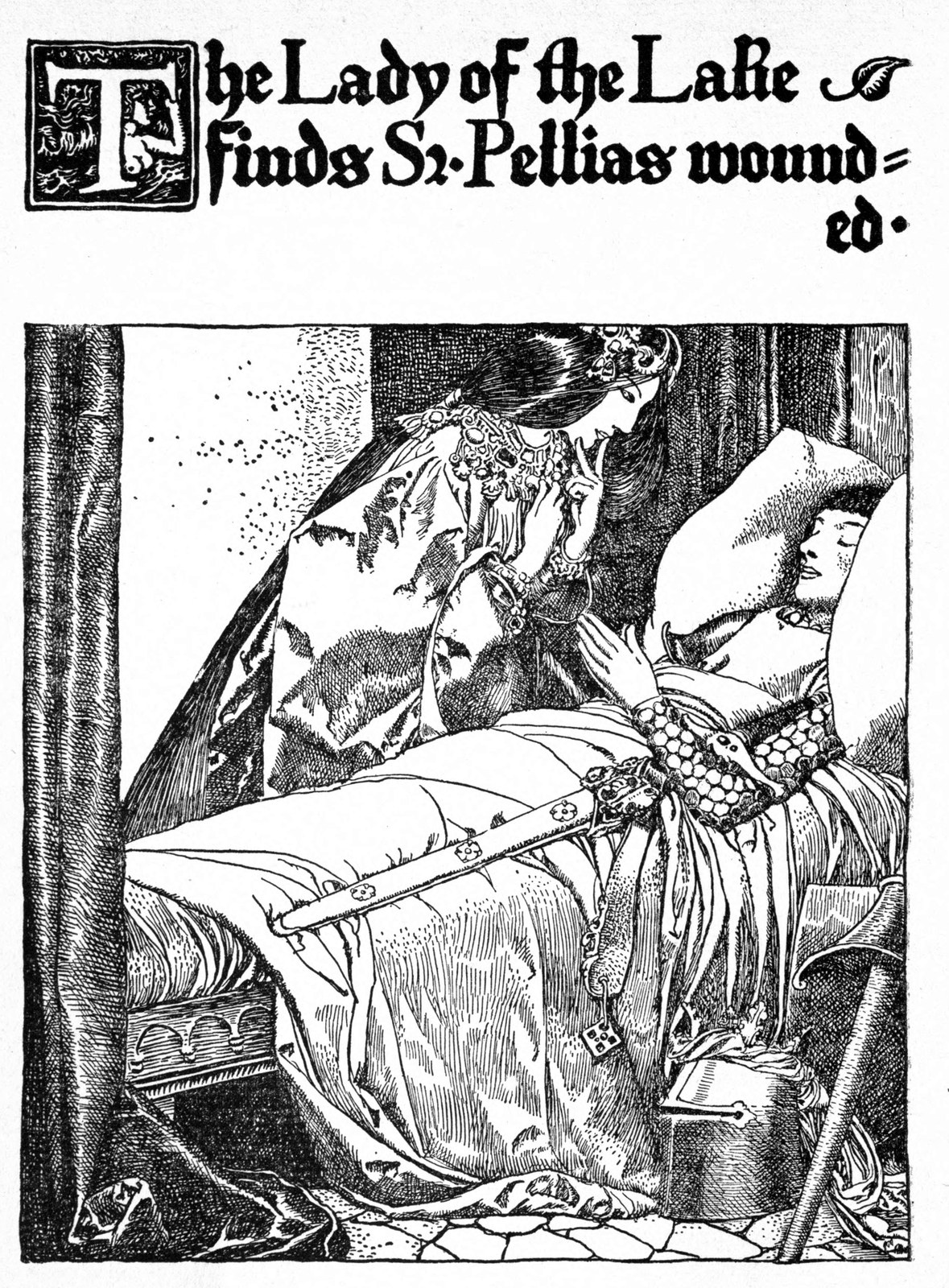
Sir Gawain challenges Sir Pelleas.
Now when the next morning came, Sir Gawain called his squire to him and said, "Bring my armor here and buckle me into it." And the squire did so. Then Sir Gawain said, "Help me onto my horse," and the squire did so. The morning was still very early. The grass was all shining and sparkling with dew, and the little birds were singing so hard that it might have made anyone glad just to be alive. So, once Sir Gawain was in his armor and seated on his horse, he began to take more courage, and the dark clouds that had hung over him lifted a little. Then he spoke to his squire in a stronger voice and said, "Take this glove of mine and carry it to Sir Pelleas. Tell him that Sir Gawain is riding up and down in the meadow in front of the castle, and that there he challenges Sir Pelleas to meet him on horseback or on foot, whichever that knight may choose."
At these words the squire was greatly astonished. Sir Gawain and Sir Pelleas had always been such close friends that there was hardly another friendship like theirs in all that land, and their love for each other had become a saying on everyone's lips. But he kept his thoughts to himself and only said, "Won't you eat something before you go into battle?" And Sir Gawain said, "No, I will not eat until I have fought. So go and do as I have told you."
So Sir Gawain's squire went to Sir Pelleas in his pavilion, gave that knight Sir Gawain's glove, and delivered Sir Gawain's message. And Sir Pelleas said, "Tell your master that I will come out to meet him as soon as I have had my breakfast."
Now when the news of that challenge reached the ears of Sir Brandiles, Sir Mador de la Porte, Sir Uwain and Sir Marhaus, those knights were very much troubled by it, and Sir Uwain said to the others, "Sirs, let us go and find out what this business is about." So the four knights went to the white pavilion where Sir Pelleas was eating his breakfast.
When they came before Sir Pelleas, Sir Uwain said to him, "What is this quarrel between my kinsman and you?" And Sir Pelleas answered, "I will not tell you. So leave it alone and do not meddle in it."
Then Sir Uwain said, "Would you really fight in earnest with your own friend?" To which Sir Pelleas said, "He is my friend no longer."
Then Sir Brandiles cried out, "It is a great pity that a quarrel should come between such friends as you and Sir Gawain. Won't you let us make peace between you?" But Sir Pelleas replied, "You cannot make peace, for this quarrel cannot be stopped until it is ended."
Then those knights saw that their words were of no use, and they went away and left Sir Pelleas.
So when Sir Pelleas had finished his breakfast, he called for a squire named Montenoir and told him to buckle him into the red armor he had worn all this time, and Montenoir did so. Then, when Sir Pelleas was clad in that armor, he rode out into the meadow in front of the castle where Sir Gawain was waiting. When he got there, those four other knights came to him again and begged him to let peace be made between him and Sir Gawain. But Sir Pelleas would not listen to them, so they went away again and left him, and he rode out into the field in front of the castle of Grantmesnle.
By now a great crowd of people had come out onto the castle walls to watch that fight, for the news of it had spread all around the place. It had also become known that the knight who was to fight Sir Pelleas was that very famous royal knight, Sir Gawain, the son of King Lot of Orkney and a nephew of King Arthur, so all the people were very eager to see so famous a knight do battle.
The Lady Ettard came down to the walls as well, and took her place in a smaller tower that looked out over the field of battle. And when she had taken her place there, she saw that Sir Pelleas was wearing that necklace of emeralds and opals and gold over his armor. Her heart went out to him because of it, and so she hoped that he would be the winner in that encounter.
Sir Pelleas and Sir Gawain do battle.
Sir Pelleas overthrows Sir Gawain.
Then each knight took up whatever position seemed best to him, and each set his spear and his shield and made himself ready for the charge. When they were ready in every way, Sir Marhaus gave the signal. At once each knight left his place and dashed at the other as fast as lightning, and with such fury that the earth thundered and shook under their horses' hoofs. They met squarely in the middle of the course, each knight striking the other in the very center of his shield. In that meeting Sir Gawain's spear burst all the way to the hand guard, but the spear of Sir Pelleas held, so that Sir Gawain was hurled out of his saddle with terrible violence. He struck the ground so hard that he rolled over three times in the dust, and then he lay completely still, as though the life had gone out of him.
At this, all the people on the walls gave a great shout, for it had been a very noble feat of arms.
Then the four knights who had been watching that encounter hurried over to where Sir Gawain lay, and Sir Pelleas also rode back and sat on his horse close by. Sir Uwain and Sir Gawain's squire unlaced Sir Gawain's helmet as fast as they could, and they saw that his face was the color of ashes, and they could not tell that he was breathing at all.
Then Sir Marhaus said, "I believe you have killed this knight, Sir Pelleas." And Sir Pelleas said, "Do you think so?" "Yes," said Sir Marhaus, "and I think it a great pity." To which Sir Pelleas replied, "He has not suffered more than he deserved."
At these words Sir Uwain was filled with anger, and he cried out, "Sir Knight, I think you forget who this knight is. Not only is he a fellow companion of the Round Table, to whom you have vowed complete brotherhood, but he is also the son of a king and the nephew of King Arthur himself."
But Sir Pelleas kept a very steady face at this and answered, "I would not be sorry for this even if that knight were a king in his own right instead of only the son of a king."
Then Sir Uwain raised his voice in great anger and cried out at Sir Pelleas, "Go away! Or something very bad may happen to you." "Very well," said Sir Pelleas, "I will go."
With that he turned his horse and rode away from that place, and went into the woods, and so was gone from their sight.
Sir Pelleas rides away into the forest.
Then the others lifted up Sir Gawain and carried him to the pavilion that had belonged to Sir Pelleas, and there they laid him on Sir Pelleas's couch. But it was more than an hour before he came to himself again, and for a good part of that time the people around him believed that he was dead.
Sir Pelleas is badly wounded.
But not one of those knights knew the truth, which was this: Sir Pelleas had been so badly wounded in the side in that encounter that there was no hope he could live past that day. For though Sir Gawain's spear had burst, and though Sir Pelleas had overthrown him completely, the head of Sir Gawain's spear had pierced Sir Pelleas's armor and gone into his side, and had broken off there. So a piece of the iron spearhead as long as the width of a hand was left in the body of Sir Pelleas, a little above the waist. And all the while Sir Pelleas sat there talking so calmly to those four knights, he was in terrible pain, and the blood was running down inside his armor in streams. What with the loss of blood and the great agony he was suffering, his head swam as light as a feather the whole time he was talking with the others. But he did not say a word to them about the terrible wound he had received. Instead he rode away very proudly into the forest.
But once he was in the forest, he could not hold back any longer. He began to groan very sorely, and he cried out, "Alas! Alas! Surely I have got my death wound in this battle!"
Now it happened that morning that the damsel Parcenet had ridden out to fly a young gerfalcon, which is a great hunting falcon, and a dwarf who belonged to the Lady Ettard had ridden with her to keep her company. As the damsel and the dwarf rode along a certain stretch at the edge of the forest, not very far from Grantmesnle, where the thicker part of the woods began and the thinner part ended, the damsel heard a voice in the woods, lamenting in very great sorrow. So she stopped and listened, and after a while she heard that voice moaning loudly again. Then Parcenet said to the dwarf, "What is that I hear? Surely it is the voice of someone in great trouble. Let us go and see who it is that is moaning so miserably." And the dwarf said, "As you say."
How Parcenet finds Sir Pelleas wounded in the forest.
So the damsel and the dwarf went a little farther, and there they saw a knight sitting on a black horse under an oak tree. That knight was dressed all in red armor, so Parcenet knew it must be Sir Pelleas. She saw that he was leaning on the butt of his spear, which he had planted on the ground, and in that way he was holding himself up on his horse, from which he would otherwise have fallen because he was so weak. And all the while he was making that loud moaning that Parcenet had heard. Seeing him in such a sad state, Parcenet was overcome with great pity, and she hurried to him, crying out, "Oh! Sir Pelleas, what is the matter with you?"
Sir Pelleas looked at her as though she were very far away from him, and because his spirit was so faint, he saw her as if through a film of water. And he said very faintly, "Maiden, I am badly hurt." She said, "How are you hurt, Sir Pelleas?" And he answered, "I have a terrible wound in my side, for a spear point is stuck in it nearly a hand's width deep, so that it reaches almost to my heart. So I think that I will not live very long."
At this the maiden cried out, "Alas! Alas! What is this!" And she wept and lamented and wrung her hands with grief that so noble a knight should have come to such a dreadful state.
Then the dwarf who was with Parcenet, seeing how wild with sorrow she was, said, "Damsel, I know of a certain place in this forest (though it is quite a long way from here) where a very holy hermit lives, who is a wonderfully skillful healer. Now, if we can bring this knight to the chapel where that hermit lives, I believe he may be helped a great deal back to health and ease again."
At this Parcenet said, "Gansaret" (for Gansaret was the dwarf's name), "Gansaret, let us take this knight to that place as quickly as we can. For I am telling you the truth when I say that I love him very dearly." "Well," said the dwarf, "I will show you where that chapel is."
So the dwarf took Sir Pelleas's horse by the bridle and led the way through the forest, and Parcenet rode beside Sir Pelleas and held him up in his saddle. Every so often Sir Pelleas fainted from sickness and pain, so that he would have fallen if she had not held him. So they went on very sorrowfully, and so slowly that it was noon before they came to that very thick and lonely part of the forest where the hermit lived.
When they reached that place, the dwarf said, "There, damsel, is the chapel I told you about."
Then Parcenet raised her eyes and saw a little woodland chapel tucked in among the leafy trees of the forest. Around the chapel was a small open lawn sprinkled with flowers, and near the door of the hermit's dwelling was a spring of water as clear as crystal. It was a very hidden and lonely place, and very quiet and peaceful as well, for in front of the chapel they saw a wild doe and her fawn nibbling the tender grass and plants without any fear of harm. When the dwarf and the maiden and the wounded knight came near, the doe and the fawn looked up with great wide eyes and spread their big ears in wonder. Yet they did not run away, for they feared no harm, and after a while they went back to their grazing. All around the chapel, too, the branches of the trees were full of birds, singing and chirping very cheerfully. Those birds were waiting for their midday meal, which the hermit was in the habit of scattering for them.
(Now this was that same forest sanctuary where King Arthur had come the time he was so badly wounded by Sir Pellinore, as has been told earlier in this history.)
As the maiden and the dwarf and the wounded knight drew near the chapel, a little bell began ringing very sweetly, so that its sound echoed all through those quiet woods, for it was now the hour of noon. Sir Pelleas heard that bell as if from very far away. First he said, "Where have I come to?" and then he managed to cross himself. Parcenet crossed herself too, and the dwarf knelt down and crossed himself. Then, when the bell had stopped ringing, the dwarf called out in a loud voice, "Hello! Hello! Here is someone who needs help!"
Parcenet and the dwarf bring Sir Pelleas to the hermit of the forest.
Then the door of the sanctuary opened, and out came a very old and holy-looking man with a long white beard, as soft as finely combed wool. And as he came out, all the birds that were waiting there flew around him in great flocks, for they thought he had come out to feed them, so the hermit had to brush those little birds away with his hands as he walked over to where the three of them were standing.
When he reached them, he asked them who they were and why they had come there with that wounded knight. So Parcenet told him how things stood with them, and how they had found Sir Pelleas so badly wounded in the forest that morning and had brought him there.
When the hermit had heard her whole story, he said, "Very well, I will take him in." So he took Sir Pelleas into his cell, and when they had helped lay him on the couch, Parcenet and the dwarf went back home again.
After they had gone, the hermit examined Sir Pelleas's wound while Sir Pelleas lay in a deep faint. The faint was so deep that the hermit saw it was the faint that comes before death, and that the knight was near his end. So he said, "This knight is certain to die very soon, for there is nothing I can do to save him." So he left Sir Pelleas's side at once and hurried to prepare the last sacrament, the kind that might be given to a noble knight who was dying.
The Lady of the Lake comes to Sir Pelleas.
Now while the hermit was busy with this, the door suddenly opened, and into the room came a very strange lady. She was dressed all in green, and around her arms she wore bracelets of emeralds and opals set in gold. Her hair, which was very soft, was all black, and it was tied with a crimson ribbon. The hermit saw that her face was as white as ivory, and that her eyes were bright like jewels set in ivory, and so he knew that she was no ordinary mortal.
This lady went straight to Sir Pelleas and bent over him, so close that her breath touched his forehead. And she said, "Alas! Sir Pelleas, that you should lie like this." "Lady," said the hermit, "you may well say 'Alas,' for this knight has only a few minutes to live." To this the lady said, "Not so, holy man, for I tell you that this knight will live for a long time yet." And when she had said this, she bent down and took from around his neck that necklace of emeralds and opals and gold that he wore, and she hung it around her own neck.
When the hermit saw what she was doing, he said, "Lady, what are you doing, and why do you take that ornament from a dying man?"
But the lady answered very calmly, "I gave it to him, so I am only taking back what is mine. But now I beg you to leave me alone with this knight for a little while, for I have great hope that I may bring him back to life again."
Then the hermit was doubtful, and he said, "Do you mean to try to heal him by magic?" And the lady said, "If I do, it will not be by black magic."
So the hermit was satisfied, and he went away and left the lady alone with Sir Pelleas.
The Lady of the Lake heals Sir Pelleas.
Now as soon as the lady was alone with the wounded knight, she began doing a number of very strange things. First she brought out a lodestone of great strength and power, and she held it to the wound. And the iron of the spearhead came out of the wound, and as it came Sir Pelleas groaned with great pain. When the spear point came out, a great rush of blood burst forth like a crimson fountain. But the lady at once pressed a sweet-smelling cloth of fine linen against the wound and stopped the blood, and it bled no more, for she held it inside his veins by very powerful spells. Once the blood was stopped like this, the lady took from the front of her dress a small crystal bottle filled with a liquid of blue color and very rare fragrance. She poured some of this between the cold, gray lips of the knight, and when it touched his lips, life began to come back into his body. For after a little while he opened his eyes and looked around him with a very strange look. The first thing he saw was the lady dressed in green who stood beside him, and she was so beautiful that he thought he must have died and gone to Paradise. So he said, "Am I dead, then?"
"No, you are not dead," said the lady, "but you have been dangerously close to death." "Then where am I?" said Sir Pelleas. And she answered, "You are in a deep part of the forest, and this is the cell of a saintly hermit of the forest." At this Sir Pelleas said, "Who has brought me back to life?" At that the lady smiled and said, "I did."
For a little while Sir Pelleas lay very still. Then after a time he spoke and said, "Lady, I feel very strange." "Yes," said the lady, "that is because you now have a different life." Then Sir Pelleas said, "What has happened to me?" And the lady said, "This: to bring you back to life I gave you a drink of a certain potion, an elixir vitae, the water of life. So now you are only half what you were before. For while one half of you is mortal, the other half of you is fairy."
Sir Pelleas loves the Lady of the Lake.
Then Sir Pelleas looked up and saw that the lady wore around her neck the collar of emeralds and opals and gold that he had worn before. And at once his heart went out to her with a great and burning love, and he said, "Lady, you say that I am half fairy, and I can see that you are altogether fairy. Now I beg you to let me live from now on wherever you are." And the lady said, "It shall be as you ask, for it was for this very reason that I let you come so near to death, and then brought you back to life again."
Then Sir Pelleas said, "When may I go with you?" And she said, "In a little while, when you have had something to drink." "How can that be," said Sir Pelleas, "when I am still as weak as a little child?" To which the lady answered, "When you have drunk some water your strength will come back to you, and you will be completely well and whole again."
So the Lady of the Lake went out, and soon came back carrying a clay jug filled with water from the spring close by. And when Sir Pelleas had drunk that water, he suddenly felt his strength come back to him completely.
Yet he was not at all as he had been before. For now his body felt as light as air, and his soul swelled with a pure joy such as he had never felt before in all his life. So he rose at once from his bed of pain and said, "You have given me life again, and now I give that life to you forever."
Then the lady looked at him and smiled with great tenderness, and she said, "Sir Pelleas, I have cared for you dearly ever since the day I saw you, when you were a young knight, drinking a bowl of milk at a cottage in this forest. The day was warm and you had taken off your helmet, and a young milkmaid with a sunburned face and bare feet came and brought you a bowl of milk, and you drank it down with a hearty appetite. That was the first time I ever saw you, although you did not see me. Since that time I have felt great friendship for all your companions of King Arthur's Court, and for King Arthur himself, all for your sake."
Then Sir Pelleas said, "Lady, will you take me for your knight?" And she said, "Yes." Then Sir Pelleas said, "May I kiss you?" And she said, "Yes, if it pleases you." So Sir Pelleas kissed her on the lips, and so they were promised to each other.
Now let us go back to Parcenet and the dwarf.
Parcenet brings news of Sir Pelleas to Sir Mador de la Porte.
After those two had left the hermitage in the woods, they made their way back toward Grantmesnle. When they had nearly come out of the forest, at a place not far from the grove of trees where the knights-companion had set up their camp, they met one of those knights, dressed in half armor, and that knight was Sir Mador de la Porte. Parcenet called to him by name and said, "Alas! Sir Mador, I have only just left a hermit's cell in the forest, where I left Sir Pelleas wounded to death, and I fear he has only a little while to live."
Then Sir Mador de la Porte cried out, "Ha! Maiden, what is this you are telling me? That is very hard to believe, for when Sir Pelleas left us this morning he showed no sign of any wound or sickness of any kind."
But Parcenet answered, "Even so, I saw him myself lying in great pain and misery, and before he fell into his death faint, he told me himself that he had the iron of a spear in his side."
Then Sir Mador de la Porte said, "Alas! Alas! That is sad news! Now, damsel, with your kind permission, I will leave you and hurry to my companions to tell them this news." And Parcenet said, "Please do."
So Sir Mador de la Porte hurried to the pavilion where his companions were, and he told them the news he had heard.
By this time Sir Gawain had completely recovered from the violent fall he had taken that morning. So when he heard the news that Sir Mador de la Porte brought, he struck his hands together and cried out loud, "Woe is me! What have I done! First I betrayed my friend, and now I have killed him. I will go out at once to find him and to beg his forgiveness before he dies."
But Sir Uwain said, "What is this you mean to do? You are not fit yet to make any journey."
Sir Gawain sets out to find Sir Pelleas.
Sir Gawain said, "I don't care, for I am determined to go and find my friend." And he would not let any of his companions go with him. Instead, when he had told his squire to bring his horse, he mounted it and rode off into the forest alone, heading west, and grieving bitterly as he went.
Now when the afternoon had grown very late, so that the sun was sinking toward its setting and the light fell as red as fire through the forest leaves, Sir Gawain came to that hermit's cell where it stood in the silent and lonely part of the woods. He saw that the hermit was outside his cell, digging in a little garden of lentils. When the hermit saw the armed knight ride onto the lawn, all in the red light of the setting sun, he stopped digging and leaned on his trowel. Then Sir Gawain came near, and, sitting there on his horse, he told the holy man what errand had brought him.
To this the hermit said, "A lady came here several hours ago. She was dressed all in green and was so strange to look at that it was easy to see she was a fairy. By means of certain magic charms that lady cured your friend, and after she had healed him, the two of them rode away into the forest together."
Then Sir Gawain was utterly amazed, and he said, "This is a very strange thing you are telling me: that a dying knight should be brought back to life in so short a time, and should ride out so suddenly from his bed of pain. Now I beg you, tell me which way they went." The hermit said, "They went west." And when Sir Gawain heard this, he said, "I will follow them."
Sir Gawain follows a strange light.
So he rode away and left the hermit gazing after him. As he rode on his way, the twilight began to fall fast, so that after a while the woods grew very dark and strange all around him. But as the darkness came down, a very strange miracle happened. For there appeared in front of Sir Gawain a light of a pale blue color, and it went ahead of him and showed him the way. And he followed it, wondering greatly.
After he had followed the light for a very long time, he came at last, all of a sudden, to the place where the woods ended, and there lay a wide open plain that stretched very far. This plain was all lit up by a strange glow like the light of a clear full moon, although no moon was shining at that time. In that pale, silver light Sir Gawain could see everything wonderfully clearly. So he saw that he was on a plain covered all over with flowers of many kinds, and their perfume so filled the night that it seemed to press upon his chest with a great sweetness. And he saw that in front of him lay a great lake, very wide and still. All these things looked so strange in that light that Sir Gawain knew he had come into Fairyland. So he rode among the tall flowers toward that lake with a kind of fear, for he did not know what was going to happen to him.
As he drew near the lake, he saw a knight and a lady coming toward him. When they came close, he saw that the knight was Sir Pelleas, and that his face was very strange. And he saw that the lady was the one he had seen before, all dressed in green, when he had traveled in the Forest of Adventure with Sir Uwain and Sir Marhaus.
Sir Gawain finds Sir Pelleas.
When Sir Gawain first saw Sir Pelleas he was filled with great fear, for he thought it was a ghost he was looking at. But when he saw that Sir Pelleas was alive, a joy as great as that fear had been rose up in his heart, and he hurried toward Sir Pelleas. When he came near him, he leaped down from his horse, crying out, "Forgive me! Forgive me!" with the greatest passion. Then he would have taken Sir Pelleas in his arms, but Sir Pelleas drew back from Sir Gawain's touch, though not in any anger. And Sir Pelleas spoke in a voice that was very thin and had a silvery clearness, as though it came from far away, and he said, "Do not touch me, for I am not what I was before. I am not all human now, but part fairy. But as for my forgiveness: I forgive you for whatever wrong I may have suffered at your hands. And more than that, I give you my love, and I hope with all my heart for your joy and happiness. But now I am going away to leave you, dear friend, and perhaps I shall never see you again. So I leave this with you as my last wish: that you go back to King Arthur's Court and make your peace with the Queen. In that way you can bring them news of everything that has happened to me."
Then Sir Gawain cried out in great sorrow, "Where are you going?"
And Sir Pelleas said, "I am going to that wonderful city of gold and blue that lies over there in that valley of flowers."
Then Sir Gawain said, "I see no city, only a lake of water."
To this Sir Pelleas replied, "Even so, there is a city over there, and I am going to it. And so I bid you farewell now."
Then Sir Gawain looked into the face of Sir Pelleas and saw again how strange it looked in that light. For it was as white as ivory, and his eyes shone like jewels set in ivory, and a smile lay on his lips that grew neither larger nor smaller but always stayed exactly the same. (For those who were of that kind always had that strange look and smiled in that way: the Lady of the Lake, and Sir Pelleas, and Sir Lancelot of the Lake.)
Sir Pelleas disappears into the lake.
Then Sir Pelleas and the Lady of the Lake turned and left Sir Gawain where he stood, and they went toward the lake, and they rode into the lake. And as soon as the hoofs of Sir Pelleas's horse touched the water of the lake, Sir Pelleas was gone, and Sir Gawain saw him no more, though he stood there for a long time, weeping bitterly.
And so ends the story of Sir Pelleas.
But Sir Gawain went back to King Arthur's Court as he had promised Sir Pelleas he would, and he made his peace with Queen Guinevere. And after that, though the Queen did not love him, there was peace between them. And Sir Gawain told all these things to the Court of King Arthur, and everyone marveled at what he told.
And only twice after that was Sir Pelleas ever seen by any of his old companions.
And Sir Marhaus was made a Companion of the Round Table and became one of its foremost knights.
And the Lady Ettard took Sir Engamore back into her favor, and that summer they were married, and Sir Engamore became lord of Grantmesnle.
And so ends this story.
The Book of Three Worthies, Part Three: The Story of Sir Gawain
Foreword
Here follows the story of Sir Gawain, and of how he showed such wonderful faithfulness to King Arthur, who was his lord, that I do not believe anyone had ever seen such faithfulness before.
For truly, though Sir Gawain was at times very rough and harsh in his manner, and though he was always so plain-spoken that his words hid the gentle nature that lay within him, still, under that pride of manner, there was a great deal of courtesy. And at times he was so gracious in his manner and so soft in his speech that many people called him the Knight of the Silver Tongue.
So here you will read how his faithfulness to King Arthur brought him such a high reward that almost anyone in all the world might envy him his great good fortune.
Chapter 1: How a White Hart Appeared Before King Arthur, How Sir Gawain and His Brother Gaheris Chased It, and What Happened to Them on That Quest
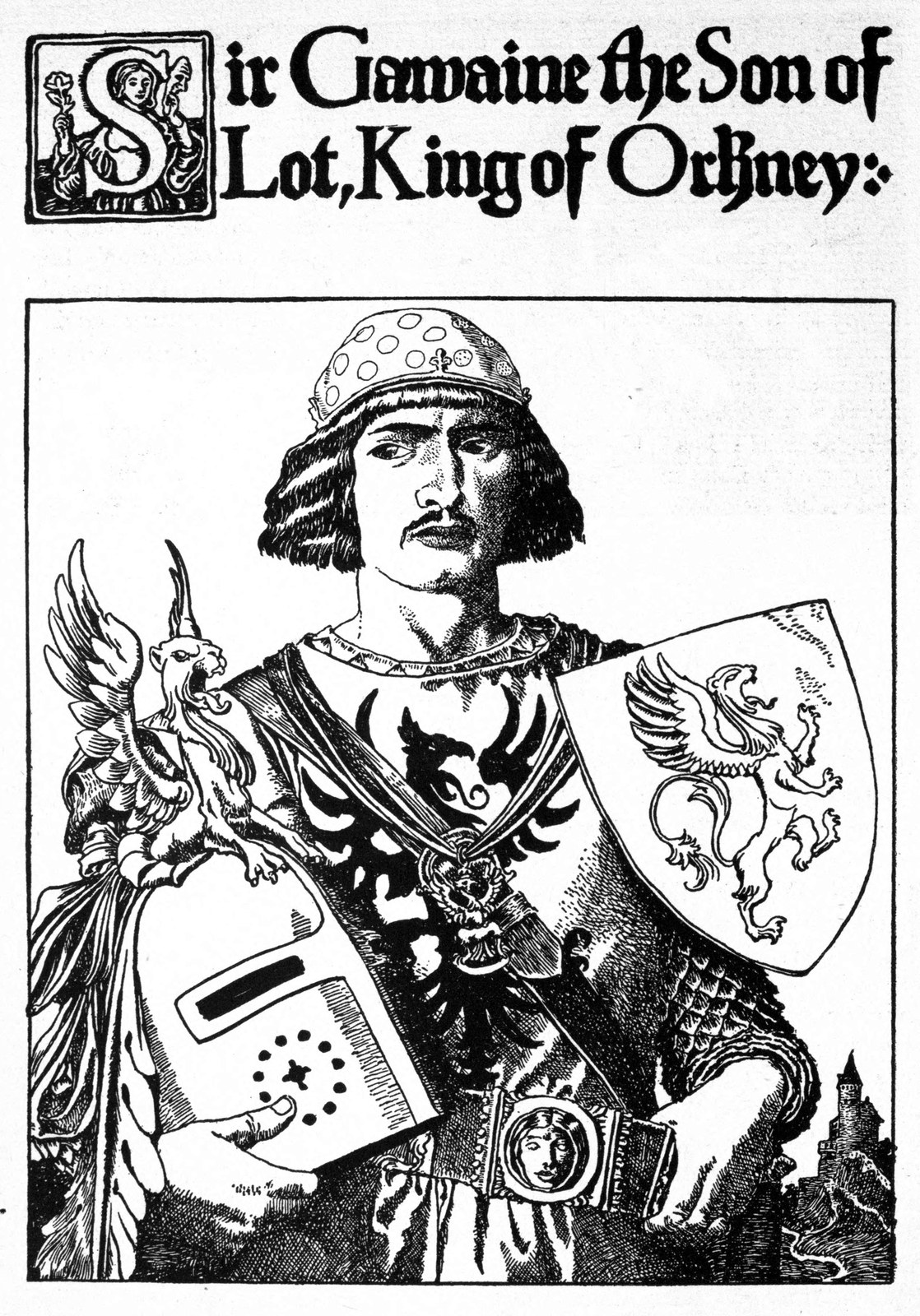
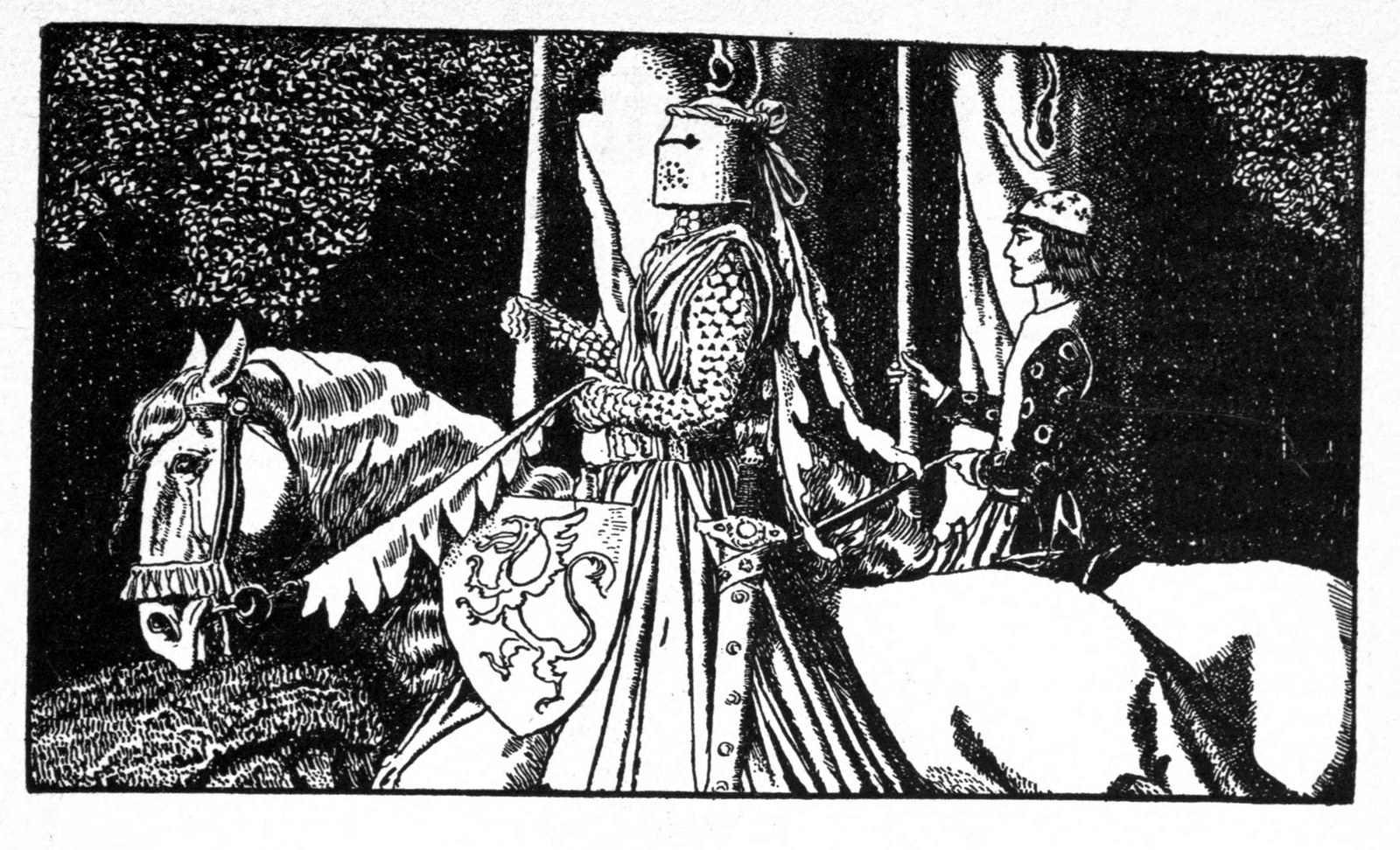
Once upon a time King Arthur, together with Queen Guinevere and all his Court, was making a royal journey through a part of his kingdom that lay a good way from Camelot. At this time the King traveled in very great state, and Queen Guinevere had her own Court around her, so there were many squires and pages. And so, counting the knights, lords, and ladies in attendance, more than a hundred and twenty people were traveling with the King and Queen.
Now it happened that the season was very warm, so that when the middle of the day came the King ordered a number of pavilions to be set up, where they might rest until the heat of the day had passed. So the attendants set up three pavilions in a pleasant glade at the edge of the forest.
When this had been done, the King gave orders that the tables at which they were to eat their midday meal should be set out beneath the shade of that grove of trees. For a gentle wind was blowing and many birds were singing, so that it was very pleasant to sit in the open air.
So the attendants of the Court did as the King commanded, and the tables were set on the grass in the shade, and the King and Queen and all the lords and ladies of their Courts sat down to that cheerful meal.
A white hart and a white hound appear before King Arthur at his feast.
Now while they sat there feasting, well content, with much laughter and pleasant talk among themselves, there suddenly came a great outcry from the woods close by. And with that, out of the cover of that leafy wilderness burst a very beautiful white hart (which is a full-grown stag), chased by a white brachet (which is a kind of hunting hound) just as beautiful. There was not a hair on either of these animals that was not as white as milk, and each wore around its neck a collar of gold that was very beautiful to see.
The hound chased the white hart with a tremendous outcry and baying, and the hart fled in utter terror. In this way they ran three times around the table where King Arthur and his Court sat at their meal. Twice during that chase the hound caught the hart and nipped it on the haunch, and each time the hart leaped away; and everyone sitting there saw that there was blood in two places on its haunch where the hound had nipped it. But each time the hart escaped from the hound, and the hound chased after it, yelling and baying so loudly that King Arthur and Queen Guinevere and all their Court were annoyed at the noise and uproar those two creatures made. Then the hart fled back into the forest by another path, and the hound chased it, and both were gone, and the baying of the hound sounded farther and farther away as it ran off into the woods.
Now, before the King and Queen and their Court had recovered from their astonishment at these things, there suddenly appeared, at the very spot in the forest where the hart and the hound had come out, a knight and a lady. The knight was very lordly in his bearing, and the lady was extremely beautiful. The knight wore half-armor, and the lady was dressed in green as though for the hunt. The knight rode a dapple-gray war horse, and the lady a spotted palfrey. With them were two squires, also dressed for the hunt.
When these people saw the large company gathered there, they stopped as though surprised. And while they stood there, another knight suddenly appeared on a black horse, clad in full armor, and he seemed to be very angry. For he charged at the half-armed knight and struck him such a terrible blow with his sword that the first knight fell from his horse and lay on the ground as though he were dead. At that the lady who was with him shrieked in great grief.
King Arthur and his Court see a knight carry off a lady as his prisoner.
Then the knight in full armor on the black horse rode up to the lady and seized her. He lifted her from her palfrey and laid her across the front of his saddle, and with that he rode back into the forest. The lady screamed so violently that it was a great pity to hear her, but the knight paid no attention to her shrieks and carried her off by main force into the forest.
Then, after he and the lady were gone, the two squires came and lifted the wounded knight onto his horse, and then they too went away into the forest and were gone.
King Arthur and his Court watched all this from a distance, and they were so far away that they could not stop that knight on the black horse from carrying the lady off into the forest. Nor could they bring help to the other knight in half-armor, whom they had seen struck down like that. So they were very much grieved by what they had seen and did not know what to make of it. Then King Arthur said to his Court, "Sirs, is there not one of you who will follow this adventure, and find out what it means that we have just seen, and make that knight tell why he behaved as he did?"
Sir Gawain and Gaheris take on this adventure.
At this Sir Gawain said, "Lord, I will be very glad indeed to take on this adventure, if I have your permission." And King Arthur said, "You have my permission." Then Sir Gawain said, "Lord, I wish you would also let me take my younger brother, Gaheris, with me as my squire on this undertaking. For he is growing up fast, and yet he has never seen any real adventure at arms." So King Arthur said, "You have my permission to take your brother with you."
At this Gaheris was very glad, for he had an adventurous spirit, and so the thought of going with his brother on this quest gave him great pleasure.
So the two of them went to Sir Gawain's pavilion, and there Gaheris, acting as his squire, helped Sir Gawain put on his armor. Then they rode out on the quest that Sir Gawain had undertaken.
They traveled a very long way, following the direction they had seen the hart take when it fled from the hound. And whenever they met any of the forest folk, they would ask them which way the white brachet and the white hart had gone, and which way the knight and the lady had gone. And so they followed that adventure at a good pace.
They come upon two knights fighting.
After a while, when they had gone a long way and the afternoon was far along, they suddenly became aware of a great noise of combat, like the sound of a fierce battle. So they followed this sound, and after a while they came to an open meadow with very fair and level turf. There they saw two knights fighting with furious passion and with deadly purpose. Then Sir Gawain said, "What's this? Let's go and see." So he and Gaheris rode forward to where those two knights were fighting, and as they came near, the two knights stopped their combat and rested on their weapons. Then Sir Gawain said, "Ha! Sirs, what's the matter here, and why are you fighting each other so furiously?" One of the knights said to Sir Gawain, "Sir, this does not concern you." And the other said, "Don't meddle with us, for this battle is of our own choosing."
"Sirs," said Sir Gawain, "I would be very sorry to interfere in your quarrel. But I am in pursuit of a white hart and a white brachet that came this way, and also of a knight who carried off a lady along the same path. Now I would be very much obliged to you if you would tell me whether you have seen anything of either of them."
One of the knights tells their story.
Then the knight who had spoken first said, "Sir, this is a very strange thing, for it was on account of that very white hart and that brachet, and of that knight and lady, that we two were fighting the battle you just saw. For this is how it was. We two are brothers, and we were riding together in perfect friendship when that hart and that hound came this way. Then my brother said he very much hoped the white hart would escape from the hound, and I said I hoped the hound would catch the hart and bring it down. Then that knight came by with the lady, his captive, and I said I would follow that knight and rescue the lady, and my brother said that he would take on that adventure himself.
"Over these points we fell into a dispute. For it seemed to me that I felt great affection for that hound, while my brother felt just as remarkable a fondness for the white hart; and it seemed to me that since I had spoken first, I should have the right to follow that adventure. But my brother was fond of the hart, and he thought that since he was the elder of us two, he had the better right to the adventure. So we quarreled, and before long we fell to that fight in which you saw us."
At this Sir Gawain was very much astonished, and he said, "Sirs, I can't understand how so great a quarrel could come out of so small a dispute. And truly it is a great pity for two brothers to quarrel as you have done, and to give each other such bad cuts and wounds as I can see you have both received."
"Sir," said the second knight, "I think you are right, and I now find that I am very much ashamed of that quarrel." And the other said, "I too am sorry for what I have done."
Then Sir Gawain said, "Sirs, I would be very glad indeed if you would tell me your names." And one knight said, "I am called Sir Sorloise of the Forest." And the other said, "I am called Sir Brian of the Forest."
Then Sir Sorloise said, "Sir Knight, I would think it a very great courtesy if you would tell me who you are."
"I would be very glad to do that," said Sir Gawain, and with that he told them his name and rank. Now when they heard who Sir Gawain was, those two knights were very much astonished and pleased, for no one in all the courts of chivalry was more famous than Sir Gawain, the son of King Lot of Orkney. So those two brothers said, "It is certainly a great joy to us to meet so famous a knight as you, Sir Gawain."
Then Sir Gawain said, "Sir Knights, that hart and that hound came only a short while ago to where King Arthur and Queen Guinevere and their Courts of lords and ladies were feasting. And there, too, we all saw that knight seize the lady and make her his captive. And so my brother and I have come out at King Arthur's command to discover what it was that we saw. Now I will think it a very great courtesy on your part if you will give up this adventure and go in friendship to the King's Court, and tell him what you saw, and how you quarreled, and how we met. For otherwise I will have to fight you both myself, and that would be a great pity, since you are tired from battle and I am fresh."
Then these two knights said, "Sir, we will do as you wish, for we have no desire to fight so powerful a knight as you."
So those two knights went off to King Arthur's Court as Sir Gawain had directed, and Sir Gawain and his brother rode on with their adventure.
Sir Gawain and Gaheris meet a knight beside the river.
After a while they came near a great river, and there they saw ahead of them a single knight in full armor, who carried a spear in his hand and a shield hanging from his saddle. Sir Gawain hurried forward and called out loudly to the knight, and the knight stopped and waited until Sir Gawain had caught up with him. And when Sir Gawain came up to that knight he said, "Sir Knight, have you seen a white hart and a white hound go by this way? And have you seen a knight carrying off a captive lady?"
To this the knight said, "Yes, I saw them both, and I am following them right now, meaning to find out where they are going." Then Sir Gawain said, "Sir Knight, I tell you not to follow this adventure any farther, for I am set on it myself. So I want you to give it up, so that I may take it on in your place." "Sir," said the other knight, speaking very hotly, "I don't know who you are, and I don't much care. But as for following this adventure, I tell you that I mean to follow it to the end, and so I will, no matter who tries to stop me."
At that Sir Gawain said, "Sir, you will not go forward on this adventure unless you first fight me." And the knight said, "Sir, I am very willing to do that."
Sir Gawain overthrows the knight.
So each knight took the position on that field that seemed best to him, and each put himself on guard and set his shield and his spear. Then, when they were ready in every way, they at once charged against each other, rushing together with great speed and with such a thunder that the ground trembled and shook beneath them. So they met in the middle of the course, and the spear of the strange knight burst into small pieces, but Sir Gawain's spear held. And with it he hurled that knight out of his saddle with such violence that he struck the ground with a crash like an earthquake.
Then Sir Gawain rode back to where his enemy lay (for that knight was not able to get up), and he took the helmet off the fallen knight's head and saw that he was very young and handsome.
Now when the fresh air struck the knight's face, he soon woke from his faint and came back to his senses. At that Sir Gawain said, "Do you yield to me?" And the knight said, "I do." Then Sir Gawain said, "Who are you?" And the knight said, "I am called Sir Alardin of the Isles." "Very well," said Sir Gawain. "Then this is my command to you: you will go to King Arthur's Court and give yourself up to him as a captive taken by my prowess. And you are to tell him all that you know of the hart and the hound and the knight and the lady. And you will tell him everything that has happened to you in this encounter."
So the knight said that he would do that, and with that they parted, the one party going one way and the other party going the other.
After that Sir Gawain and his brother Gaheris rode a long way, until at last they came through a forest out onto an open plain, and by now it was about sunset. And there in the middle of the plain they saw a very stately and noble castle with five towers, and of very great strength.
Sir Gawain and Gaheris find the dead brachet.
And right there they saw a sight that filled them with great sorrow. For they saw the dead body of that white brachet lying beside the road like any carrion. And they saw that the hound had been shot through with three arrows, so they knew it had been killed very violently.
Now when Sir Gawain saw that beautiful hound lying dead like that, he was filled with great sorrow. "What a pity it is," he cried, "that this noble hound should be killed like this! For I think it was the most beautiful hound I ever saw in all my life. There has surely been great treachery against it here, for it has been foully dealt with because of that white hart it was chasing. Now I make a vow that if I can find that hart, I will kill it with my own hands, because it was in that chase that this hound met its death."
After that they rode on toward the castle, and as they came near, there, grazing on the meadows in front of the castle, they saw that white hart with the golden collar.
Now as soon as the white hart saw those two strangers, it fled at great speed toward the castle and ran into the castle courtyard. And when Sir Gawain saw the stag, he gave chase at great speed, and Gaheris followed after his brother.
Sir Gawain kills the white hart.
So Sir Gawain chased the white hart into the courtyard of the castle, and from there it could not escape. Then Sir Gawain leaped down from his horse, drew his sword, and killed the hart with a single stroke of his weapon.
He did this in great haste. But when he had done it, and it was too late to undo it, he bitterly regretted what he had done.
Now at all this commotion the lord and the lady of that castle came out. The lord was very haughty and noble in his looks, and the lady was extraordinarily graceful and very beautiful. Sir Gawain looked at the lady and thought he had hardly ever seen so beautiful a lady, and so he was sorrier than ever that he had killed that white hart in his haste.
But when the lady of the castle saw the white hart lying dead on the stone pavement of the courtyard, she struck her hands together and shrieked so shrilly and so loudly that it pierced the ears to hear her. And she cried out, "Oh, my white hart, are you dead, then?" And with that she began to weep passionately. Then Sir Gawain said, "Lady, I am very sorry for what I have done, and I wish I could undo it." Then the lord of that castle said to Sir Gawain, "Sir, did you kill that stag?" "Yes," said Sir Gawain. "Sir," said the lord of the castle, "you have done a very wicked thing, and if you will wait a little while I will take full vengeance on you." To which Sir Gawain said, "I will wait for you as long as you please."
The knight of the castle attacks Sir Gawain.
Then the lord of the castle went into his chamber and put on his armor, and in a little while he came out in a fury. "Sir," said Sir Gawain, "what is your quarrel with me?" And the lord of the castle said, "That you have killed the white hart that was so dear to my lady." To which Sir Gawain said, "I would never have killed the white hart if it weren't that, because of it, the white brachet was so treacherously killed." At this the lord of the castle was angrier than ever, and he rushed at Sir Gawain and struck him before he was ready. The blow cut through the shoulder plate of his armor and through the flesh to the bone of his shoulder, so that Sir Gawain was in great agony from the stroke. Then Sir Gawain was filled with rage at the pain of the wound, and he struck the knight such a terrible blow that it cut through his helmet and into the bone beneath. At that the knight fell to his knees from the fierceness of the blow and could not get up again. Then Sir Gawain seized his helmet and tore it off his head.
At this the knight said in a weak voice, "Sir Knight, I beg you for mercy, and I yield myself to you."
Sir Gawain moves to kill the knight of the castle.
But Sir Gawain was in a furious rage because of the unexpected blow he had received and the great agony of his wound, and so he would show no mercy, but raised his sword, meaning to kill that knight.
Sir Gawain strikes the lady of the castle without meaning to.
Then the lady of the castle saw what Sir Gawain meant to do, and she broke away from her damsels and ran and threw herself on the knight, to shield him with her own body. At that very moment Sir Gawain was striking and could not stop his blow. Even so, he managed to turn his sword in his hand so that its edge did not strike the lady. But the flat of the sword struck her on the neck a very grievous blow, and the blade cut her a little, so that the blood ran down her smooth white neck and over her neckerchief. And with the force of the blow the lady fell down and lay on the ground as though she were dead.
Now when Sir Gawain saw that, he thought he had killed the lady in his haste, and he was filled with dread at what he had done, and he cried, "Woe is me! What have I done?"
"Alas!" said Gaheris, "that was a very shameful blow you struck. And the shame of it is mine too, because you are my brother. Now I wish I had never come with you to this place."
Then Sir Gawain said to the lord of the castle, "Sir, I will spare your life, for I am very sorry for what I have done in my haste."
But the knight of the castle was filled with great bitterness, because he thought his lady was dead, and so he cried out in despair, "I will not take your mercy now, for you are a knight without mercy and without pity. And since you have killed my lady, who is dearer to me than my life, you may kill me too. For that is the only service you can do me now."
But by now the lady's damsels had come to her where she lay, and the chief of them cried out to the lord of the castle, "Ah, sir, your lady is not dead! She has only fainted, and she will soon come to herself again."
Then, when the lord of the castle heard that, he began to weep freely for pure joy; for now that he knew his lady was alive, he could not contain himself for gladness. With that Sir Gawain came to him and lifted him up from the ground where he was, and kissed him on the cheek. Then some others came and carried the lady away to her chamber, and there in a little while she recovered from her faint and was little the worse for the blow she had received.
That night Sir Gawain and his brother Gaheris stayed with the knight and the lady, and when the knight learned who Sir Gawain was, he felt it a great honor to have so famous a knight in his castle. So they feasted together that evening in great friendship.
Now when they had refreshed themselves, Sir Gawain said, "I beg you, sir, to tell me what was the meaning of the white hart and the white brachet that led me into this adventure."
To this the lord of the castle (whose name was Sir Ablamor of the Marise) said, "I will do so." And with that he spoke as follows:
"You must know, sir, that I have a brother who has always been very dear to me, and when I took this lady of mine for my wife, he took her sister for his wife.
The lord of the castle tells the story of the white hart and the white hound.
"Now my brother lived in a castle near this one, and we visited back and forth in great friendship. But one day it happened that my lady and my brother's lady were riding through this forest together, talking very pleasantly. At that moment a lady appeared to them, extremely beautiful and very strange in her looks, for I do not think either my lady or her sister had ever seen anyone like her before.
"This strange lady brought those two ladies a white hart and a white brachet, and she held the hart and the hound each by a silver chain fastened to a golden collar around its neck. The white hart she gave to my lady, and the white brachet she gave to my lady's sister. And then she went away, leaving them very glad.
"But their gladness did not last long. For ever since that time there has been nothing but discord between my brother and me, and between my lady and her sister, because the white hound has always hunted the white hart to destroy it. And so my lady and I have taken great offense at my brother and his lady because they did not keep the white brachet at home. And so it has happened that several times we have tried to destroy the hound, so that my brother and his lady have taken just as much offense at us.
"Now today I happened to be near the edge of the forest to the east of us, when I heard a great outcry in the woods. Soon the white hart that belonged to my lady came fleeing through the woods, and the white brachet that belonged to my brother's lady was chasing it; and my brother and his lady and two squires were riding hard after the hart and the brachet.
"Then I was very angry, for it seemed to me that they were chasing that white hart to spite my lady and me, and so I followed after them as fast as I could.
"So I came upon them at the edge of the woods, near where a number of pavilions were set up in the shade of a grove of trees in the middle of the meadow. And there, in my anger, I struck my brother a great blow, so that I knocked him down from his horse. And I seized his lady and threw her across the front of my saddle and carried her away here to this castle. And here I have kept her, out of revenge, because they chased the white hart that belonged to my lady. For my lady loved that hart as she loved nothing else in the world, except me."
"Sir," said Sir Gawain, "this is a very strange business. Now I beg you to tell me what that lady looked like who gave the white hart and the white hound to those two ladies." "Sir," said the knight, "she was dressed all in crimson, and around her throat and arms she wore a great many ornaments of gold set with stones of many colors. Her hair was red like gold and was caught up in a net of gold, and her eyes were very black and shone with extraordinary brightness, and her lips were like coral, so that she had a very strange appearance."
Sir Gawain hears of Vivien.
"Ha!" said Sir Gawain. "From that description I think that lady could have been none other than the sorceress Vivien. For these days she spends all her time doing mischief like this by her enchantments, out of pure spite. And indeed, I think it would be a very good thing if she were put out of this world, so that she could do no more such mischief. But tell me, sir, where is that lady now, your wife's sister?" "Sir," said the knight, "she is in this castle, and she is a prisoner of honor." "Well," said Sir Gawain, "since both the hart and the hound are now dead, you surely can have no more quarrel with her and your brother. And so I beg you to set her free, and to be friends again with one another, in good will, as you were before." And the lord of the castle said, "Sir, it shall be so."
And so he set the lady free then and there, and after that there was friendship between them, as Sir Gawain had directed.
And the next day Sir Gawain and his brother Gaheris returned to the King's Court, and Sir Gawain told King Arthur and his Court everything that had happened, hiding nothing from them.
Queen Guinevere is displeased with Sir Gawain.
Now Queen Guinevere was very much displeased when she heard how Sir Gawain had refused to show mercy to that knight, and how he had struck the lady with his sword. So she said quietly to one of those who stood near her, "It seems to me a very strange thing for a belted knight to do, to refuse mercy to a fallen enemy and to strike a lady with his sword. For I should think that any sword that had drawn a lady's blood in that way would be dishonored forever. And I cannot think that anyone who would strike a lady like that could hold himself blameless before his vow of knighthood."
Sir Gawain breaks his sword.
Sir Gawain overheard this, and he was extremely angry at it. But he hid his anger at the time. Only after he had gone away did he say to his brother Gaheris, "I believe that lady hates me with all her heart. But someday I will show her that I have more courtesy in me, and am gentler, than she believes. As for my sword, since she thinks it is dishonored by that blow, I will not use it anymore." So he took the sword out of its sheath and broke it across his knee and threw it away.
Now all this has been told to prepare you for what follows. For there you will learn what great and noble things Sir Gawain could do when the need came. For perhaps you who have read this story may feel, as Queen Guinevere did, that Sir Gawain was not truly as courteous as a belted knight should have been in the adventure I have just told.
Chapter 2: How King Arthur Got Lost in the Forest and Met with a Very Strange Adventure in a Castle He Came To
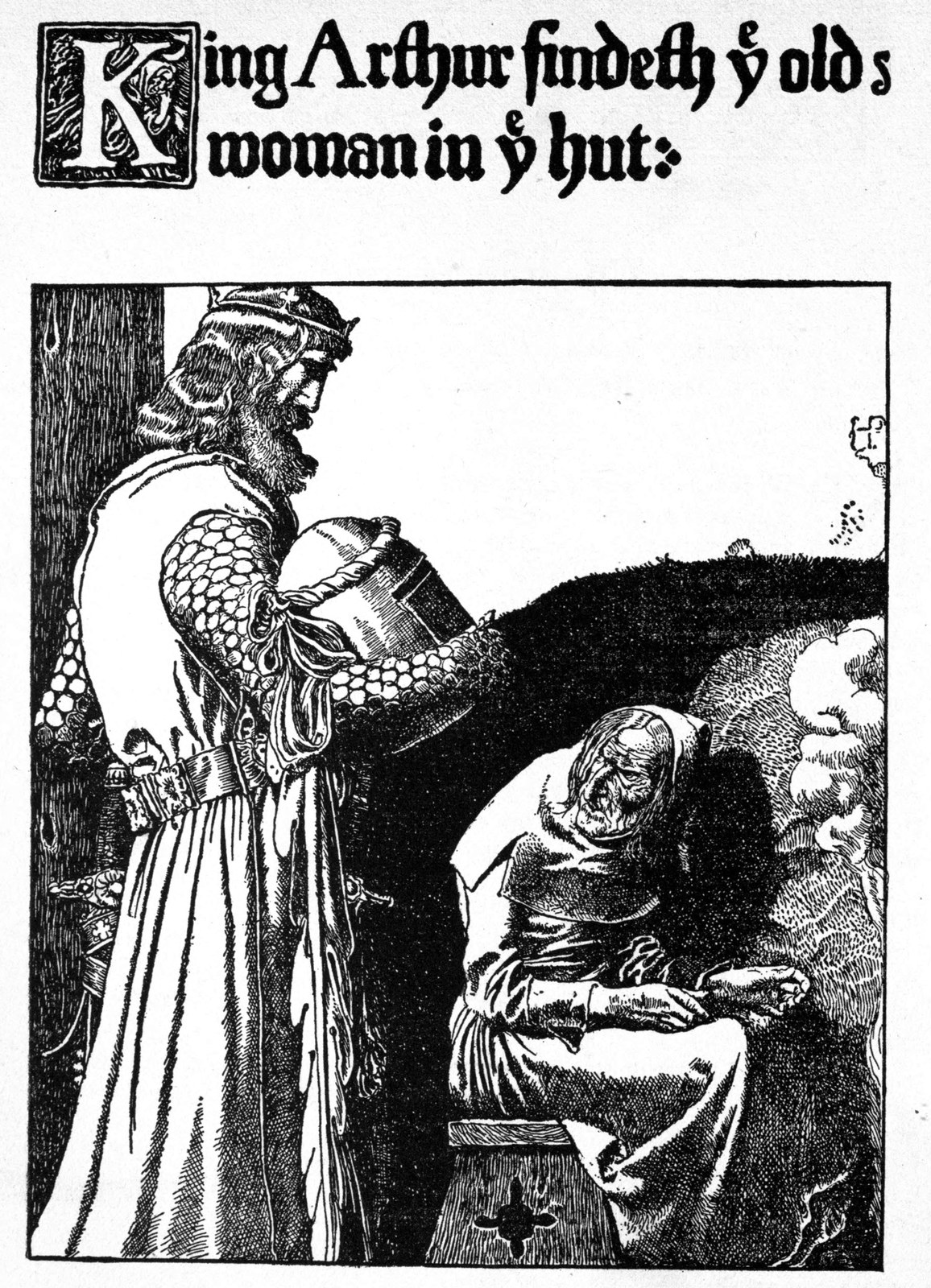
Now it happened, some while after this, that King Arthur was at Tintagalon on certain affairs of state. And Queen Guinevere with her Court and the King's Court made a royal journey from Camelot to Caerleon, and there they stayed, waiting until the King should finish his business at Tintagalon and join them at Caerleon.
It was the springtime of the year, and everything was very bright and merry, and so King Arthur was seized with a great longing for adventure. So he called to him a certain squire of whom he was especially fond, named Boisenard, and he said to him, "Boisenard, this day is so pleasant that I hardly know how to contain myself for the joy I take in it. It seems to me that my heart is nearly ready to burst with a great pleasure of longing. So I have a mind to go roaming, with only you for company."
To this Boisenard said, "Lord, I know of nothing that would give me greater pleasure than that."
So King Arthur said, "Very well. Then let us leave this place in such a way that no one will know we have gone. We will ride to Caerleon and surprise the Queen by arriving there when she does not expect us."
So Boisenard brought armor without any emblem on it, and he dressed the King in that armor. Then the two of them rode out together, and no one knew that they had left the castle.
King Arthur sets out with his squire.
And when they came out into the fields, King Arthur whistled and sang and joked and laughed and made himself merry. For he was like a war-horse turned out to grass, who glories in the sunshine and the warm air and becomes like a young colt again.
So after a while they came into the forest and rode along with great contentment of spirit. They took this path and they took that path for no reason except that the day was so bright and merry. And so, by and by, they lost their way in the mazes of the woodland and did not know where they were.
They are lost in the forest.
Now when they found themselves lost like this, they traveled more carefully, going first this way and then that way, but in no way could they find their way out of their tangle. And so night fell while they still did not know where they were. Everything grew very dark and gloomy, and the woodland all around them was full of strange and unfamiliar sounds.
Then King Arthur said, "Boisenard, this is a very puzzling fix, and I do not know how we shall find lodging for tonight."
To this Boisenard said, "Lord, if I have your permission, I will climb one of these trees and see if I can find any sign of a dwelling in this wilderness." And King Arthur said, "Do so, I ask you."
Boisenard sees a light.
So Boisenard climbed a very tall tree, and from the top of it he saw a light a great distance away. And he said, "Lord, I see a light in that direction." And with that he came down from the tree again.
So King Arthur and Boisenard went in the direction where Boisenard had seen the light. And by and by they came out of the forest into an open place, where they saw a very great castle with several tall towers, very grim and forbidding to look at. And it was from this castle that the light Boisenard had seen was shining. So the two of them rode up to the castle, and Boisenard called out loudly and pounded on the castle gate. At once a porter came and demanded to know what they wanted. Boisenard said to him, "You there, we want to come in and lodge here tonight, for we are very weary." The porter said, "Who are you?", speaking very roughly and rudely to them, for in the darkness he could not see what rank they were. Then Boisenard said, "This is a knight of very high rank, and I am his squire. We have lost our way in the forest, and now we come here looking for shelter."
"Sir," said the porter, "if you know what is good for you, you will sleep in the forest rather than come into this place. For this is no very good refuge for knights-errant to shelter in."
At this King Arthur spoke to the porter, for what the porter had said stirred up a great curiosity in him. So he said, "No, we will not go away from here, and we demand to lodge here tonight."
Then the porter said, "Very well; you may come in." And with that he opened the gate, and they rode into the courtyard of the castle.
King Arthur and his squire enter the castle.
Now at the noise of their coming a great many lights appeared within the castle, and a number of attendants came running out. Some of these helped King Arthur and Boisenard to dismount, and others took the horses, and still others brought basins of water for them to wash in. And after they had washed their faces and hands, other attendants led them into the castle.
As they came into the castle, they heard a great noise of very many people talking and laughing together, with the sound of singing and of harping. And so they came into the hall of the castle, and they saw that it was lit with a great many candles and tapers and torches. Here they found a crowd of people gathered at a table spread for a feast. At the head of the table sat a knight who was well on in years, with hair and beard as white as milk. Yet he was extremely strong and sturdy of build, with wonderfully broad shoulders and a great barrel of a chest. This knight had a very stern and forbidding look. He was dressed all in black, and around his neck he wore a chain of gold with a locket of gold hanging from it.
Now when this knight saw King Arthur and Boisenard come into the hall, he called out to them in a very loud voice, inviting them to come and sit with him at the head of the table. And they did so. Those at the head of the table made room for them, and so they sat there beside the knight.
King Arthur and Boisenard were extremely hungry, and so they ate with a great appetite and enjoyed the hospitality they were given. Meanwhile the knight kept them in very pleasant conversation, talking to them about whatever would entertain them most. So after a while the feast was over and they stopped eating.
The knight of the castle challenges King Arthur to an adventure.
Then, all of a sudden, the knight said to King Arthur, "Sir, you are young and bold of spirit, and I do not doubt that you have a great heart inside you. What do you say now to a little sport between the two of us?" At this King Arthur looked at that knight very steadily, and he believed that the knight's face was not as old as it seemed. For his eyes were extremely bright and shone like sparks of fire, and so Arthur was doubtful, and he said, "Sir, what sport do you have in mind?" At this the knight burst out laughing very heartily, and he said, "The sport I have in mind is a very strange one, for it is this: that you and I shall prove to each other how much courage each of us has." And King Arthur said, "How shall we prove that?" The knight answered, "This is what we shall do. You and I will stand out in the middle of this hall, and you shall have leave to try to strike off my head. And if I can take that blow without dying of it, then I shall have leave to strike off your head in the same way."
At this speech King Arthur was filled with great dread, and he said, "That is a very strange sport for two men to take up."
Now when King Arthur said this, everyone in the hall burst out laughing beyond all measure, as though they would never stop their merriment. Then, when they had grown somewhat quiet again, the knight of the castle said, "Sir, are you afraid of that sport?" At this King Arthur grew very angry, and he said, "No, I am not afraid. No man has ever yet had reason to say that I showed myself afraid of anyone." "Very well," said the knight of the castle, "then let us try that sport I spoke of." And King Arthur said, "I am willing."
Then Boisenard came to King Arthur where he stood, and he said, "Lord, do not enter into this thing. Let me take on this venture in your place instead, for I am certain that some great treachery is being plotted against you." But King Arthur said, "No. No man shall take my danger upon himself. I will bear my own danger without calling on any man to bear it for me." So he said to the knight of the castle, "Sir, I am ready for that sport you spoke of. But who is to strike the first blow, and how shall we draw lots for it?" "Sir," said the knight of the castle, "there will be no lots drawn. For since you are the guest in this place, you shall have the first try at that sport."
With that the knight stood up and laid aside his black robe. Underneath he was dressed in a shirt of fine linen, very skilfully worked, and he wore crimson hose. Then he opened that linen shirt at the throat and turned down its collar so as to lay his neck bare to the blow. And he said, "Now, Sir Knight, you will have to strike well if you want to win at this sport."
King Arthur cuts off the head of the knight of the castle.
But King Arthur showed no dread of that task. He rose and drew Excalibur, so that the blade of the sword flashed with an extraordinary brightness. Then he measured his distance, and lifted the sword, and struck the knight of the castle on the neck with all his might. And the blade cut through the knight's neck with wonderful ease, so that the head flew off the body and landed a long way away.
But the trunk of that knight's body did not fall. Instead it stood there, and it walked over to where the head lay, and the hands of the trunk picked up the head and set it back on the body. And there was that knight, as sound and whole as he had ever been in all his life.
At this all the people of the castle shouted and laughed with great merriment, and they called out to King Arthur that now it was his turn to try that sport. So the King made himself ready, laying aside his surcoat and opening his shirt at the throat, as the knight of the castle had done. And at that Boisenard broke into loud weeping. Then the knight of the castle said, "Sir, are you afraid?" And King Arthur said, "No, I am not afraid. Every man must come to his death some time, and it seems that my time has now come, and that I am to lay down my life in this foolish way through no fault of my own."
Then the knight of the castle said, "Well, stand a little way off, so that I do not strike you too close and so lose the force of my blow."
The knight torments King Arthur.
So King Arthur stood out in the middle of the hall, and the knight of the castle swung his sword several times but did not strike. And several times, too, he laid the blade of the sword on King Arthur's neck, and it was very cold. Then King Arthur cried out in great passion, "Sir, it is your right to strike, but I beg you not to torment me like this." "No," said the knight of the castle, "it is my right to strike when it pleases me, and I will not strike a moment before. If it pleases me, I will torment you for a long while before I kill you." So he laid his sword on King Arthur's neck several more times. And King Arthur said nothing more, but bore that torment with a very steady spirit.
Then the knight of the castle said, "You seem to be a very brave and honorable knight, and I have a mind to make a bargain with you." And King Arthur said, "What is that bargain?" "It is this," said the knight of the castle. "I will spare your life for a year and a day, if you will pledge me your knightly word to come back here at the end of that time."
Then King Arthur said, "Very well; so be it." And with that he pledged his knightly word to return at the end of that time, swearing to the pledge on the cross of Excalibur's hilt.
The knight of the castle sets King Arthur a riddle.
Then the knight of the castle said, "I will make another bargain with you." "What is it?" said King Arthur. "My second bargain is this," said the knight of the castle. "I will give you a riddle. If you answer that riddle when you come back here, and make no mistake in your answer, then I will spare your life and set you free." And King Arthur said, "What is the riddle?" And the knight answered, "The riddle is this: What is it that a woman wants most of all in the world?"
"Sir," said King Arthur, "I will try to find the answer to that riddle. And I thank you for sparing my life for as long as you have, and for giving me the chance to escape my death." At this the knight of the castle smiled very sourly, and he said, "I do not offer you this out of mercy, but because I take pleasure in tormenting you. For what delight can you have in living your life when you know that you must surely die at the end of one short year? And what pleasure can you have in living even that year, when you will be tormented with worry to find the answer to my riddle?"
Then King Arthur said, "I think you are very cruel." And the knight said, "I do not deny it."
So that night King Arthur and Boisenard slept at the castle, and the next day they went on their way from there. And King Arthur was very heavy and troubled in spirit. Even so, he ordered Boisenard to say nothing about what had happened, but to keep it secret. And Boisenard did as the King commanded and said nothing about that adventure.
Now in the year that followed, King Arthur set his affairs in order. He also searched everywhere to find the answer to that riddle. Many people gave him answers in plenty. One said that a woman most wanted wealth, and another said she most wanted beauty; one said she wanted the power to please, and another said that she most wanted fine clothes. And one said this, and another said that, but no answer seemed to King Arthur good and fitting for his purpose.
So the year went by until only two weeks were left. Then King Arthur could not bear to stay where he was any longer, for it seemed to him that his time was very close at hand. He was filled with a very bitter anxiety of soul, and so he was very restless to be gone.
So he called Boisenard to him, and he said, "Boisenard, help me arm, for I am going away."
Then Boisenard burst into a flood of tears, and he said, "Lord, do not go."
At this King Arthur looked very sternly at his squire and said, "Boisenard, what is this? Would you tempt me to break my honor? It is not very hard to die, but it would be very bitter to live my life in dishonor. So tempt me no more, but do as I bid you and hold your peace. And if I do not come back a month from now, then you may tell everything that has happened. And you may tell Sir Constantine of Cornwall that he is to search the papers in my cabinet, and there he will find everything that is to be done if death should overtake me."
King Arthur sets out to return to the castle of the evil knight.
So Boisenard put a plain suit of armor on King Arthur, though he could hardly see what he was doing for the tears that streamed from his eyes. And over the King's armor he laced a surcoat without any emblem, and he gave the King a shield without any emblem. Then King Arthur rode away without caring where his road took him. And of everyone he met he asked what it was that a woman most wanted, and no one could give him an answer that seemed to him to be the right one. And so he was in great doubt and torment of spirit.
King Arthur comes to the hut of an old woman.
Now on the day before King Arthur was to keep his bargain at that castle, he was wandering through the nearby forest in great anguish of soul, for he did not know what to do to save his life. As he wandered, he suddenly came upon a small hut built under an overhanging oak tree, so that it was very hard to tell where the oak ended and the hut began. And all around lay a great many large rocks covered with moss, so that the King might very easily have passed the hut by, except that he saw smoke rising from it, as from a fire burning inside. So he went to the hut and opened the door and went in. At first he thought there was no one there, but when he looked again he saw an old woman sitting bent over a small fire that burned on the hearth. And King Arthur had never seen such an ugly old hag as the one who sat there bending over that fire. Her ears were very huge and flapping, and her hair hung down over her head like snakes. Her face was covered all over with wrinkles, so that there was no place at all on it without a wrinkle. Her eyes were bleary and covered over with a film, and the eyelids were red as if from constant weeping. She had only one tooth in her mouth, and her hands, which she spread out to the fire, were like claws of bone.
Then King Arthur greeted her, and she greeted the King, and she said to him, "My lord King, where do you come from? And why have you come to this place?"
King Arthur was greatly astonished that this old woman should know who he was, and he said, "Who are you, who seem to know me?" "Never mind that," she said. "I am one who wishes you well. So tell me what trouble it is that brings you here at this time." So the King told that old woman all his trouble, and he asked her whether she knew the answer to the riddle, "What is it that a woman most wants?" "Yes," said the old woman, "I know the answer to that riddle very well. But I will not tell it to you unless you promise me something in return."
At this King Arthur was filled with very great joy that the old woman knew the answer to the riddle; but he was also filled with doubt about what she would ask of him. And so he said, "What is it you must have in return for that answer?"
Then the old woman said, "If I help you to answer your riddle rightly, you must promise that I shall become the wife of one of the knights of your Court, whichever one I may choose, when you go home again."
"Ha!" said King Arthur. "How can I promise that on anyone else's behalf?" At this the old woman said, "Are not the knights of your Court so noble that they will do that to save you from death?" "I believe they are," said King Arthur. And with that he thought for a long while, saying to himself, "What will my kingdom do if I die now? I have no right to die." So he said to the old woman, "Very well, I will make that promise."
The old woman tells King Arthur how to answer the riddle.
Then she said to the King, "This is the answer to the riddle: What a woman wants most is to have her own way." And the answer seemed to King Arthur to be entirely right.
Then the old woman said, "My lord King, you have been tricked by that knight who led you into this trouble. For he is a great conjurer and a magician of a very wicked kind. He does not carry his life inside his body, but in a crystal globe, which he wears in a locket hanging around his neck. That is why, when you cut his head off his body, his life stayed in that locket and he did not die. But if you had destroyed that locket, he would have died at once."
"I will remember that," said King Arthur.
So King Arthur stayed with that old woman that night, and she refreshed him with food and drink and looked after him very well. And the next morning he set out for the castle where he had made his bargain, and his heart was more cheerful than it had been for a whole year.
Chapter 3: How King Arthur Overcame the Knight-Enchanter, and How Sir Gawain Showed the True Nobility of His Knighthood
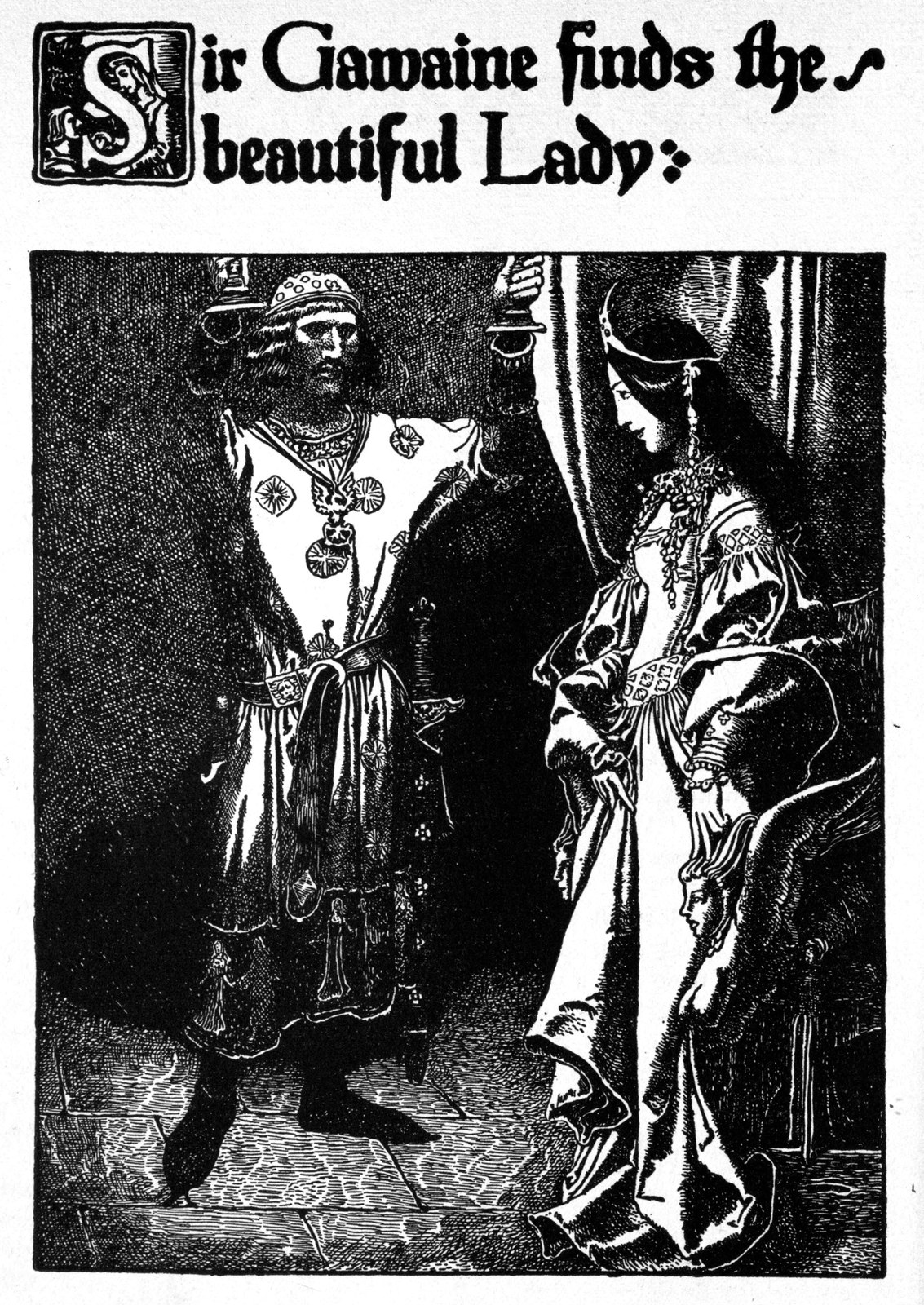
King Arthur returns to the castle of the evil knight.
Now when King Arthur came to the castle, its gate was opened to him at once and he went in. And when he had gone in, several attendants came and led him into the hall where he had been before. There he saw the knight of that castle and a great many people who had come to watch the end of the adventure. And when the knight saw King Arthur, he said to him, "Sir, have you come to keep your pledge?" "Yes," said King Arthur, "for that is what I vowed to you." Then the knight of the castle said, "Sir, have you guessed the riddle?" And King Arthur said, "I believe I have." The knight of the castle said, "Then let me hear your answer. But if you make any mistake, or if you do not guess rightly, then your life is forfeit." "Very well," said King Arthur, "let it be so. Now this is the answer to your riddle: What a woman wants most is to have her own way."
Now when the lord of the castle heard King Arthur guess rightly, he did not know what to say or where to look; and everyone who was there also saw that the King had guessed rightly.
Then King Arthur came up very close to that knight, with a very stern face, and he said, "Now, you traitor knight! A year ago you asked me to join in your sport with you, so now it is my turn to ask you to have some sport with me. And this is the sport I will have: you shall give me that chain and locket that hang around your neck, and I shall give you the collar that hangs around mine."
King Arthur kills the knight of the castle.
At this the face of that knight went all pale, like ashes, and he let out a sound like the cry a hare makes when the hound seizes it. Then King Arthur caught him very violently by the arm, and he seized the locket and tore it away from the knight's neck. At that the knight shrieked very loudly and fell on his knees and begged the King for mercy, and there was a great uproar in that place. Then King Arthur opened the locket, and there inside was a ball like crystal, very clear and shining. And King Arthur said, "I will have no mercy." And with that he flung the ball down violently on the stone floor, so that it broke with a loud noise. And in that same instant the knight-conjurer gave a piercing, bitter cry and fell down on the ground; and when they ran to lift him up, they found that he was entirely dead.
Now when the people of that castle saw their knight suddenly dead like this, and saw King Arthur standing there in the fury of his kingly majesty, they were so afraid that they shrank away from the King where he stood. Then the King turned and walked out of that castle, and no one stopped him. And he mounted his horse and rode away, and no one hindered him or stood in his way as he went.
Now when the King had left the castle in this way, he went straight to the hut where the old woman lived, and he said to her, "You have helped me a very great deal in my hour of need, so now I will keep the pledge I made to you. I will take you to my Court, and you shall choose one of my knights for your husband. For I do not think there is a single knight in all my Court who would not be very glad to do anything in his power to reward one who has saved me as you have done this day."
King Arthur takes the old woman away with him.
With that he took the old woman and lifted her up onto his horse's back behind the saddle; then he mounted his horse himself, and so they rode away from that place. And the King behaved toward that aged woman in every way with the greatest consideration, as though she had been a beautiful lady of the highest rank in the land. He showed her such respect that, if she had been a lady of royal blood, he could not have shown her more.
So in due time they reached the Court, which was then at Caerleon. And they arrived there at about midday.
Now at about that time it happened that the Queen and a number of the lords and ladies of the Court were out in the fields enjoying the pleasant Maytime weather. For no one in all the world except the squire Boisenard knew anything of the danger that hung over King Arthur, and so they were all very glad of the pleasant season. Now as King Arthur came near that place, they looked up and saw him coming, and they were astonished beyond all measure to see King Arthur riding toward them across that field with that old woman behind him on the saddle. So they stood still to wait until King Arthur reached them.
But when King Arthur had come up to them, he did not get down from his horse. He sat there and looked at them all very steadily. And Queen Guinevere said, "Sir, what is this? Do you mean to play some merry joke today, that you have brought that old woman here?"
"Lady," said King Arthur, "if it were not for this old woman, it would likely have been a very sorry joke for you and for me. For if she had not helped me, I would now be a dead man, and in a few days you would all no doubt have been in a great passion of grief."
Then everyone who was there marveled greatly at the King's words. And the Queen said, "Sir, what is it that has happened to you?"
Then King Arthur told them everything that had happened to him, from the very beginning, when he and Boisenard had left the castle of Tintagalon. And when he had finished his story, they were greatly amazed.
Now there were seventeen lords of the Court there. So when King Arthur had finished his story, he said to them, "Sirs, I have given my pledge to this aged woman that whichever one of you she may choose shall take her as his wife, and shall treat her with all the honor that he possibly can; for that was the condition she laid upon me. Now tell me, did I do right in pledging to her that I would fulfill what she desired?" And all who were there said, "Yes, lord, you did right. For we would do anything in the world to save you from such danger as the one you have escaped."
The old woman chooses Sir Gawain.
Then King Arthur said to that old woman, "Lady, is there any one of these knights here whom you would choose to be your husband?" At this the old woman pointed her very long, bony finger at Sir Gawain, and said, "Yes, I would marry that lord. For I can see by the chain around his neck, and by the golden circlet on his hair, and by the proud nobility of his looks, that he must be the son of a king."
Then King Arthur said to Sir Gawain, "Sir, are you willing to fulfill my pledge to this old woman?" And Sir Gawain said, "Yes, lord. Whatever you ask of me, that I will do." So Sir Gawain came to the old woman, and took her hand in his and raised it to his lips; and not one of all those present so much as smiled. Then they all turned and went back to the King's castle. And they were very silent and downcast, for this was a heavy trouble that had come upon that Court.
Sir Gawain takes the old woman for his wife.
Now after they had returned to the Court, they gave that old woman certain rooms in the castle, and they dressed her in rich clothes such as a queen might wear, and they gave her a Court of attendants such as was fit for a queen. And it seemed to the whole Court that, in the rich robes she wore, she was ten times uglier than she had been before. So when eleven days had passed, Sir Gawain was married to that old woman in the chapel of the King's Court, with great ceremony and pomp and splendor. And everyone who was there was as sad and sorrowful as though Sir Gawain had been called upon to suffer death.
After they were married, Sir Gawain and the old woman went to Sir Gawain's house. And there Sir Gawain shut himself away from all the world and would let no one come near him. For he was proud beyond all measure, and in this great humiliation he suffered so much that words cannot tell how great that humiliation was. That is why he shut himself away from the world, so that no one might see his grief and his shame.
Sir Gawain is in great sorrow.
And all the rest of that day he walked up and down his room without stopping, for he was in such utter despair that it came into his mind that it would be well if he took his own life; for it seemed to him impossible to bear such shame as had come upon him. Then after a while the darkness of early night fell, and with it a certain strength came to Sir Gawain, and he said, "It is shameful of me to behave like this. For since I have married that lady, she is my true wedded wife, and I am not treating her with the honor she has a right to." So he went out of that place and looked for the rooms of the old woman who was his wife; and by that time it was completely dark. But when Sir Gawain came into the place where she was, the old woman scolded him, crying out at him, "So, Sir! You have treated me very badly on this, our wedding day. You have stayed away from me all afternoon, and now you only come to me when it is dark night." And Sir Gawain said, "Lady, I could not help it, for I was very heavily weighed down with many cares. But if I have neglected you today, I beg your forgiveness for it, and I will be willing to do everything in my power to make up to you for any neglect I have shown you." Then the lady said, "Sir, it is very dark in here. Let us have a light." "It shall be as you wish," said Sir Gawain, "and I myself will go and fetch a light for you."
So Sir Gawain went out of that place, and he brought back two wax tapers, one in each hand, set in candlesticks of gold; for he meant to show every respect to that old woman. And when he came into the room he saw that she was at the far end of it, and he went toward her; and she rose and stood before him as he came near.
Of the beautiful lady who appears to Sir Gawain.
But when the circle of light fell upon that old woman, and Sir Gawain saw who it was that stood before him, he cried out aloud in a very great voice at the great marvel and wonder of what he saw. For instead of the old woman he had left, he saw a lady of extraordinary beauty, in the very flower of her youth. He saw that her hair was long and glossy and very black, and that her eyes were black as well, like black jewels, and that her lips were like coral and her teeth like pearls. So for a while Sir Gawain could not speak, and then he cried out, "Lady! Lady! Who are you?"
Then that lady smiled at Sir Gawain with such loving kindness that he did not know what to think, except that this was an angel who had come down to that place out of Paradise. So he stood before her for a long time and could find no more words to say, and she went on smiling at him very kindly in that way. Then by and by Sir Gawain said to her, "Lady, where is the woman who is my wife?" And the lady said, "Sir Gawain, I am she." "That is not possible," cried Sir Gawain, "for she was old and extraordinarily ugly, but I believe you are more beautiful than any lady I have ever seen." And the lady said, "Nevertheless, I am she. And because you have taken me for your wife of your own free will and with great courtesy, part of the enchantment that lay upon me has been lifted from me. For now I shall be able to appear before you in my own true shape. Where a little while ago I was as ugly and foul as you saw me, now for half of each day I am to be as you see me, and for the other half I must be ugly as I was before."
Then Sir Gawain was filled with a joy too great for words. And along with that joy there came an overwhelming passion of love for that lady. So he cried out aloud several times, "This is surely the most wonderful thing that ever happened to any man in all the world." With that he fell down on his knees, and took the lady's hands in his own, and kissed her hands with great fervor; and all the while she smiled at him as she had at first.
Then the lady spoke again and said, "Come, sit down beside me, and let us decide for which part of the day I shall have the one form and for which part the other. For I may have the one appearance all day and the other appearance all night."
Then Sir Gawain said, "I would have you in this form during the night, for then we are together in our own home; and since you are truly as I see you now, I do not care in the least how the world may look on you."
At this the lady spoke with great spirit, saying, "No, sir, I would not have it that way. For every woman loves the good opinion of the world, and I would gladly enjoy what beauty I have in the eyes of the world, and not have to bear the scorn and contempt of men and women."
To this Sir Gawain said, "Lady, I would have it the other way."
And she said, "No, I would have it my way."
Sir Gawain gives the lady her own way.
Then Sir Gawain said, "So be it. For since I have taken you for my wife, I must show you respect in all things. So you shall have your own way in this and in everything else."
Then the lady burst out laughing beyond all measure, and she said, "Sir, I only put this to you as a last test. For as I am now, so I shall always be."
At this Sir Gawain was so filled with joy that he did not know how to contain himself.
So they sat together for a long time, hand in hand. Then after a while Sir Gawain said, "Lady, who are you?" And she answered, "I am one of the Ladies of the Lake. But for your sake I have become mortal like other women, and have left that very beautiful home where I once lived. I have kept you in my heart for a long while now. For I was not very far away at that time when you said farewell to Sir Pelleas beside the lake, and there I saw how you wept and grieved when Sir Pelleas left you, and my heart went out to you in great pity. So after a while I left that lake and became mortal for your sake. Then, when I learned of the trouble King Arthur had fallen into, I took that chance to have him bring me to you, so that I might test the whole nobility of your knighthood. And I have found it to be everything I believed it could be. For though I seemed to you so old, so ugly, and so foul, you have treated me with such kindness and regard that I do not believe you could have behaved more courteously to me if I had been the daughter of a king. And so it now gives me such pleasure to have you for my knight and my true lord that I cannot well tell you how great my joy is."
Sir Gawain orders great rejoicing.
Then Sir Gawain said, "Lady, I do not think it can be as great as my joy in having you." And with that he came to her, and laid his hand on her shoulder, and kissed her on the lips.
Then after that he went out and called in a great voice all through the house, and the people of the house came running from everywhere. And he ordered them to bring lights and refreshments. They brought the lights, and when they had brought them and saw that beautiful lady in place of the aged woman, they were filled with great wonder and joy. They cried out aloud and clapped their hands and made a great noise of rejoicing. And they set out a great feast for Sir Gawain and his lady, and in place of the sorrow and darkness that had been there before, there was joy and light, and music and singing. And those of the King's Court, seeing this from a distance, said, "It is very strange that Sir Gawain should take so much joy in having married that old hag."
But when the next morning came, the lady dressed herself in clothes of yellow silk, and hung many strands of precious stones of different colors about herself, and set a golden crown upon her head. And Sir Gawain had his horse brought, and he had a snow-white palfrey brought for the lady, and so they rode out from that place and came into the Court of the King. But when the King and the Queen and their Courts saw that lady, they were so astonished that they did not know what to say for pure wonder. And when they heard all that had happened, they rejoiced greatly and cheered aloud, so that all their mourning was changed into rejoicing. And indeed, there was not one knight in all that Court who would not have given half his life to have been as fortunate in that matter as Sir Gawain, the son of King Lot of Orkney.
Such is the story of Sir Gawain, and this is the meaning I draw from it. Just as that poor, ugly old woman appeared to the eyes of Sir Gawain, so a man's duty sometimes appears to him ugly and very unwelcome to his wishes. But when he has wedded himself to that duty, so that he has made it one with himself as a bridegroom makes himself one with his bride, then that duty suddenly becomes very beautiful, both to him and to others.
So may it be with you: may you take up your duty, no matter how little you may like to do so. For truly, a man will hardly have any real pleasure in his life unless his wishes become wedded to his duty and hold fast to it, as a husband holds fast to his wife. For when wishes are wedded to duty like this, the soul takes great joy to itself, as though a wedding had taken place between a bridegroom and a bride within the temple of the heart.
And in the same way, when you have become entirely wedded to your duty, you will become just as worthy as that good knight and gentleman Sir Gawain. For a man does not need to wear armor to be a true knight; he needs only to do his very best, with all patience and humility, as it has been set out for him to do. So when your own time comes to show your knighthood by taking up your duty, I pray that you, too, may prove yourself as worthy as Sir Gawain proved himself in this story that I have told you here.
Conclusion
So ends this volume, in which the history of those Three Worthies who were of the Court of King Arthur has been told, with every detail of the story.
And now, if God will give me the grace to do so, I will some day, not very long from now, write the further history of a number of other knights and worthies of whom I have not yet spoken.
And among the first of these shall be Sir Lancelot, whom all the world knows to have been the greatest knight in feats of arms who ever lived, except Sir Galahad, who was his son. And I shall tell you the story of Sir Uwain and Sir Geraint, and of Sir Percival, and of a number of others.
But more of this another time. For now, with great regret, I bid you farewell and bring this history to a close.
So may God grant that we come together again at another time, with such happiness and prosperity that you may have a free and untroubled heart to enjoy the history of those excellent men that I shall then set before you. Amen.