
Book One
Preface to Book One
This collection is a little different from others of its kind. Physical experiments, in the strict sense, take second place in it. The foreground belongs to entertaining problems, tricky questions, and paradoxes from elementary physics, whatever may serve to amuse the mind. Into the same service I have pressed some works of fiction that touch on physics, by Jules Verne, Camille Flammarion, Edgar Allan Poe, and others. You will also find articles on a number of curious questions in elementary physics that the textbooks usually pass over.
As for the experiments, I have mostly chosen those that entertain as well as instruct, and that can be done with things everyone has within reach. They and their illustrations are borrowed from Tom Tit, Tissandier, Boys, and others.
It is my pleasant duty to thank the forestry scholar I. I. Polferov, whose help in reading the final proofs was invaluable.
Y. Perelman.
St Petersburg, 1912.
Chapter 1: Adding and Resolving Motions and Forces
When Do We Move Faster Around the Sun: By Day or by Night?
What an odd question! The speed at which the Earth travels around the Sun can hardly have anything to do with the change from day to night. Besides, it is always day on one half of the Earth and night on the other, so the question looks like plain nonsense.
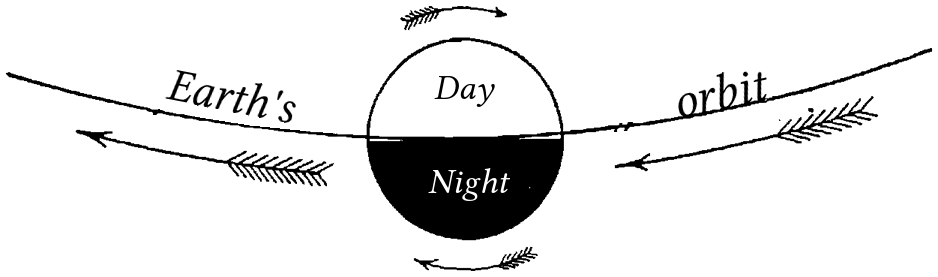
It isn't. We are asking when we, its human passengers, move faster through space, whatever the Earth as a whole may be doing, and that changes everything. Don't forget that we make two motions at once: we hurtle around the Sun, and at the same time we turn about the Earth's axis. The two motions add, and the sum depends on whether we happen to be on the day side or the night side. One look at Figure 1 will show you that at night the speed of rotation is added to the Earth's forward speed, while by day it is subtracted.
At night, then, we move through space faster than we do by day.
Every point on the equator covers about half a kilometer a second, and so for people living there the difference between their noon speed and their midnight speed comes to a whole kilometer a second. For St Petersburg, which lies on the sixtieth parallel, the difference is exactly half that.
The Riddle of the Cart Wheel
Stick a white paper wafer on the side of a cart wheel's rim, or a bicycle tire, and watch it while the cart or bicycle is moving. You'll notice something strange. As long as the wafer is at the bottom of the rolling wheel, you can see it perfectly clearly; at the top of the wheel, the same wafer flashes by so fast that you can't make it out. What's going on? Can the top of a wheel really be moving faster than the bottom?
Compare the upper and lower spokes of a rolling wheel, and you'll be more puzzled still: the upper ones blur into a solid mass while the lower ones stay fairly distinct. Once again it's as if the top of the wheel were rolling faster than the bottom. Yet we're all firmly convinced that a wheel moves uniformly in all its parts.
What is the answer to the riddle? Simply that the upper parts of every rolling wheel really do move faster than the lower ones. At first sight this seems quite incredible, and yet it's so.
A little reasoning will convince us. Remember that every point of a rolling wheel makes two motions at once: it turns about the axle, and at the same time it moves forward along with the axle. The two motions add, and the result is quite different at the top of the wheel and at the bottom. At the top, the rotary motion is added to the forward motion, because both point the same way. At the bottom, the rotary motion points backward and is subtracted from the forward one. The first result is of course larger than the second, and that's why the upper parts of the wheel travel faster than the lower.
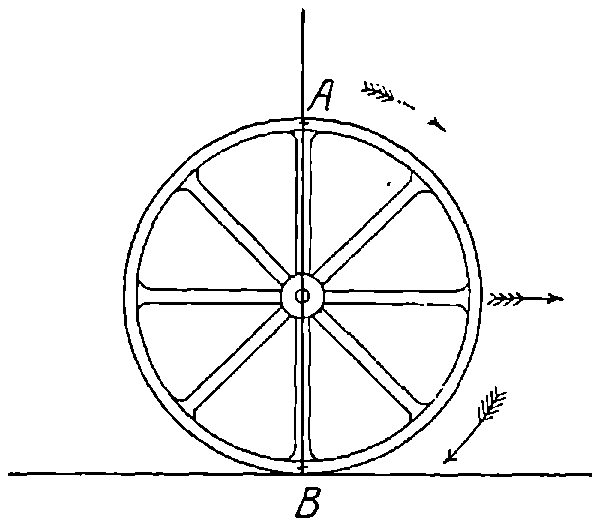
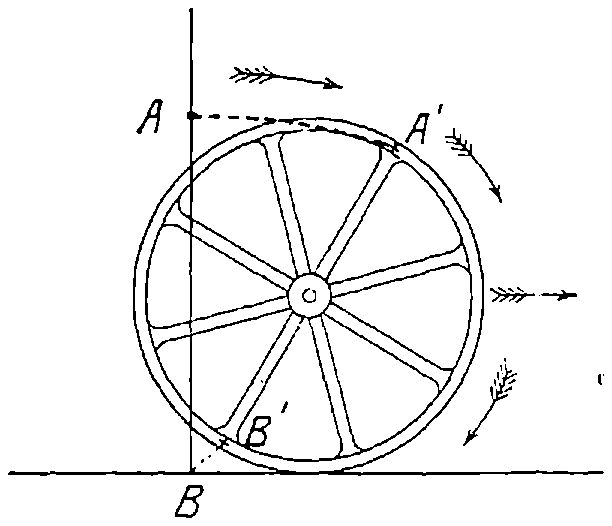
You can easily check this by a simple experiment, which I recommend trying at the first opportunity. Find a cart that is standing still, and push a stick into the ground beside one of its wheels, so that the stick lines up with the axle (Figure 2). Make a chalk mark on the rim at the very top and another at the very bottom; these marks, the points A and B in the drawing, will then be right against the stick. Now roll the cart forward a little (Figure 3), until the axle has moved about 30 centimeters from the stick, and see how far your marks have traveled. The upper mark, A, has moved a good deal farther than the lower, B, which has only edged a little way from the stick, slanting upward.
In short, reason and experiment both bear out the idea that seemed so strange at first: the top of every rolling wheel moves faster than the bottom.
What Part of a Bicycle Moves More Slowly Than All the Rest?
You know by now that the points of a moving cart or bicycle don't all travel equally fast, and you know which are the slowest: the points of the wheels that are touching the ground at that moment.
All this is true, of course, only of a rolling wheel. When a wheel spins on a fixed axle, as a flywheel does, the top and bottom of the rim move at the same speed.
The Riddle of the Railway Wheel
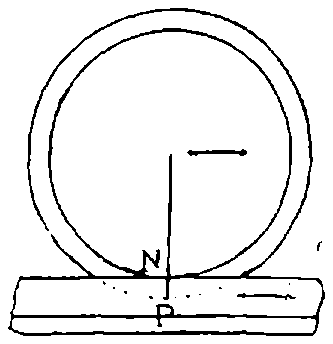
A railway wheel does something still more unexpected. You know, of course, that such a wheel has a flange, a rim that juts out beyond the part that rolls on the rail. Well, while the train moves, the lowest point of that flange isn't moving forward at all. It's moving backward! Reasoning like what has gone before will easily prove it, and I leave the reader to reach unaided the surprising but perfectly correct conclusion that in a train tearing along at full speed there are points moving backward. True, their backward motion lasts only a tiny fraction of a second, but that makes no difference: the motion is there, and a fairly brisk one too, about twice as fast as a man on foot, in defiance of all our usual notions.
Where Is the Boat Coming From?
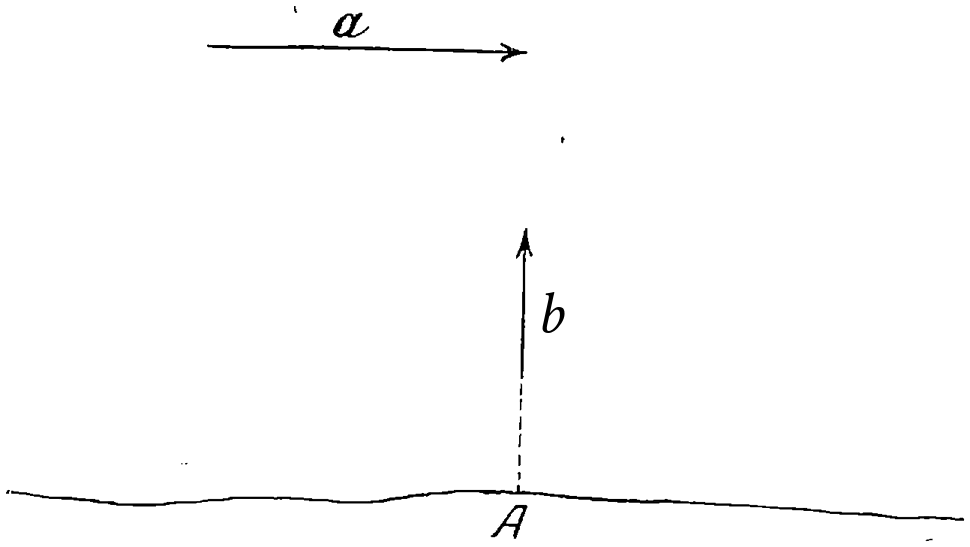
Imagine a steamer crossing a lake, and let the arrow a in Figure 5 stand for its speed and direction. A rowboat is cutting across its path, and the arrow b gives the speed and direction of the boat. If you were asked where this boat put out from, you would point at once to A on the shore. But put the same question to the passengers on the moving steamer, and they'll point to a different place altogether.
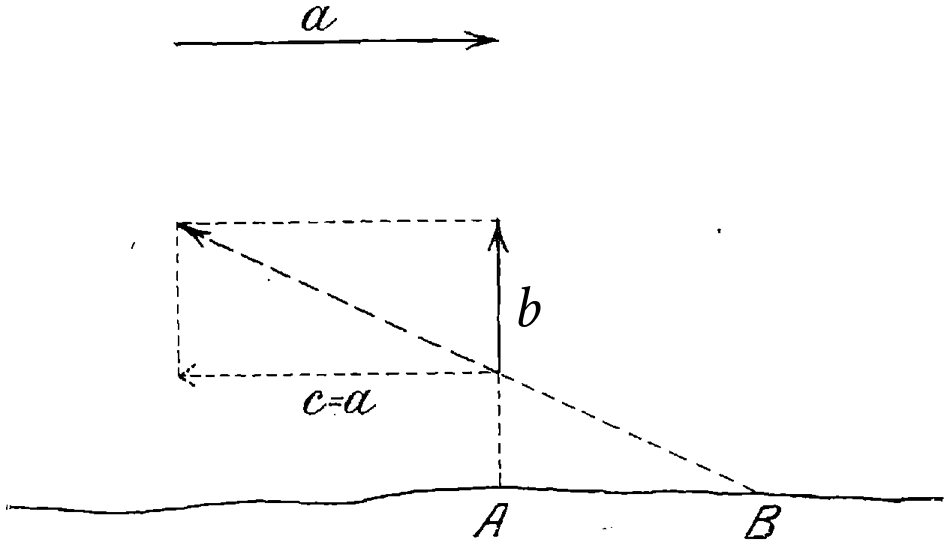
This is because the passengers don't see the boat moving at right angles to their own course. Remember that they don't feel their own motion. They think they're standing still, and that the boat is rushing past with their speed in the opposite direction. (Recall what you see from the window of a railway carriage.) For them, therefore, the boat moves not only along the arrow b but also along the arrow c, which is equal to a and points the other way (Figure 6). The two motions, the real and the apparent, add together, and to the passengers the boat seems to move along the diagonal of the parallelogram built on b and c. This diagonal, dotted in Figure 6, gives the size and direction of the apparent motion.
And so the passengers will insist that the boat put out from B, and not from A.
We make the same mistake as these passengers. Carried along with the Earth in its orbit, we meet the rays of some star, and we misjudge the place the rays come from just as the passengers misjudge where the boat put out. All the stars, therefore, seem to us shifted slightly forward, in the direction of the Earth's travel. But the Earth's speed is trifling beside the speed of light (it is 10,000 times smaller), and the shift, accordingly, is so very slight that only the most precise astronomical instruments can catch it. It's called the "aberration of light."
But let's get back to our steamer and our boat.
If you enjoy questions of this kind, try two more, with everything as it was before. In what direction does the steamer move for the people in the boat? And what point on the shore do they think it is making for? To find the answers, construct a parallelogram of velocities on the line a, as before. Its diagonal will show you that to the people in the boat the steamer seems to be sailing on a slant, as if it meant to put in at some point on the shore to the right of B in Figure 6.
Can You Lift a Man on Seven Fingers?
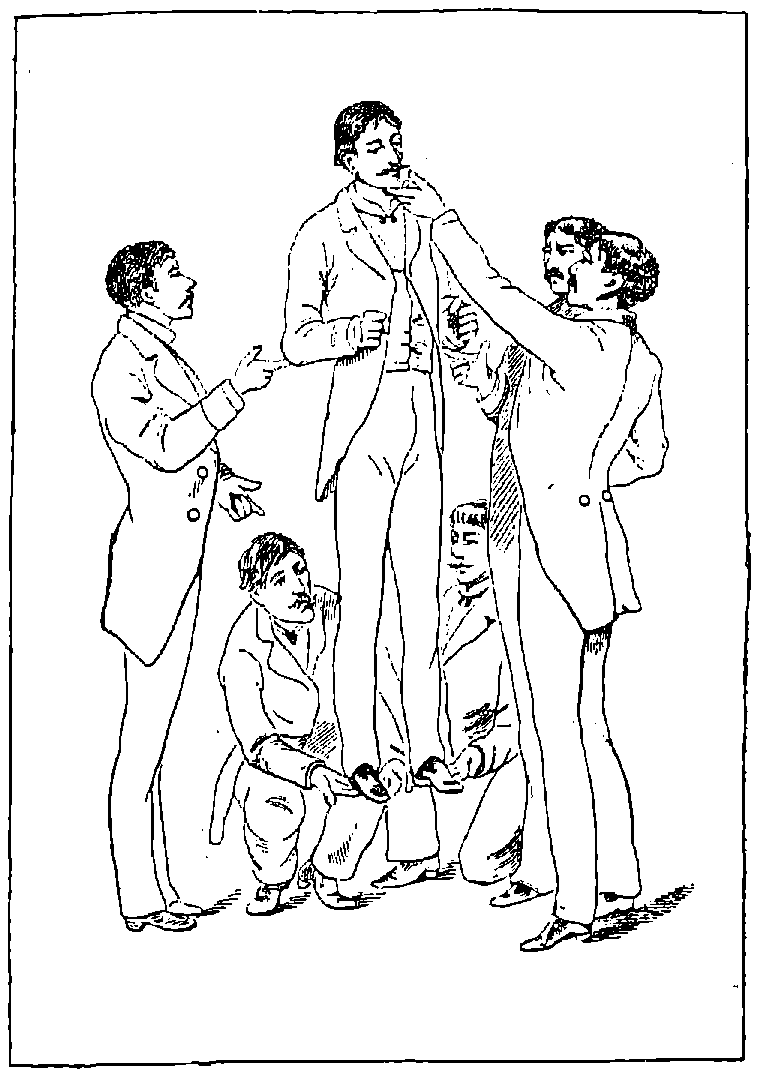
Anyone who has never tried it will tell you that to lift a grown man on your fingers is impossible. In fact nothing is easier. Besides the man to be lifted, you need five people. Two of them slip their index fingers (both hands) under the soles of his feet; two more support his elbows, each with the index finger of the right hand; and the fifth puts an index finger under his chin. Then, at the command "One, two, three!" all five lift together, and up goes their friend with no noticeable strain.
The first time you do this, the ease of it will astonish you. The secret lies in the resolving of forces. A grown man weighs 70 kilograms on average; these 70 kilograms press on seven fingers at once, so that each finger carries only about ten. And ten kilograms on one finger is no great feat for an adult.
Lifting a Carafe of Water with a Straw
This too looks quite impossible at first sight. But we've only just seen how unwise it is to trust "first sight."
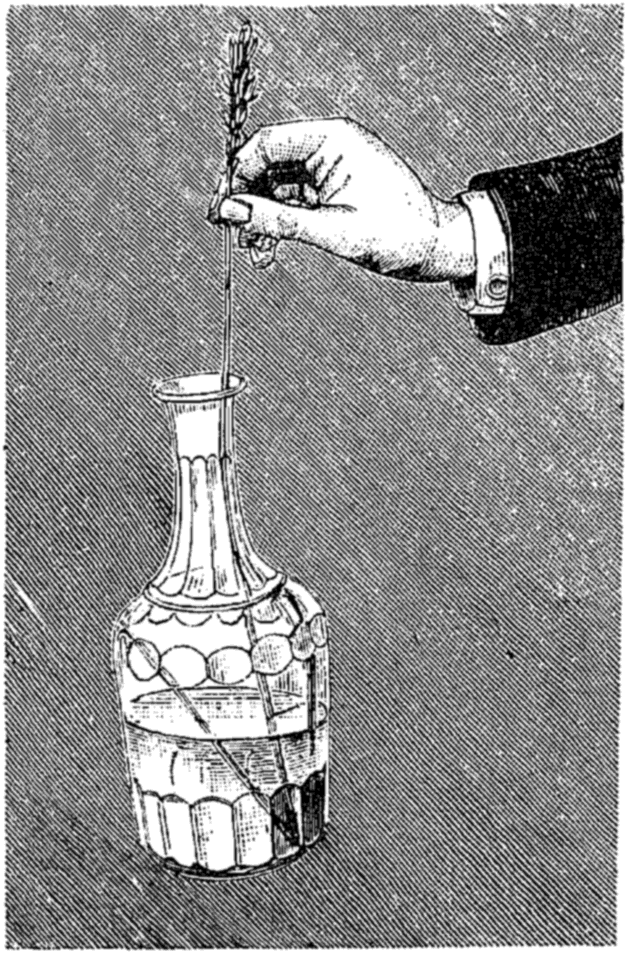
Take a long, strong, unbroken straw, bend it, and push it into a carafe of water as shown in Figure 8, with its end braced against the carafe's side. Now you may lift: the straw will hold the carafe.
As you put the straw in, make sure that the part pressing against the glass is perfectly straight; otherwise it will buckle, and the whole arrangement will come crashing down. Everything depends on getting the force (the weight of the carafe) to act strictly along the straw, for straw is very strong lengthwise, easily as it breaks across.
It's best to learn the trick on a bottle and only then attempt the carafe.
Beginners are advised to spread something soft on the floor, just in case. Physics is a great science, but there's no need to smash the carafes.
The next experiment is a close relative of this one, and works on the same principle.
Driving a Needle Through a Coin
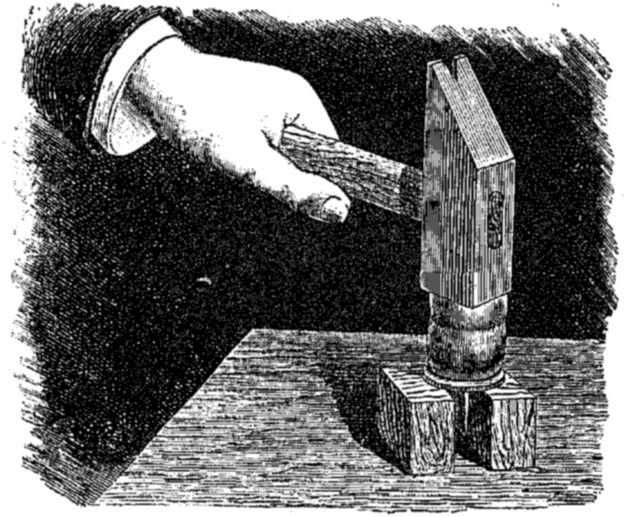
Steel is harder than copper, so under enough pressure a steel needle ought to go through a copper coin. The only trouble is that when the hammer strikes it, the needle bends and breaks. We must therefore arrange things so that the needle has no chance to bend, and that's quite simple: push it into a cork, along the cork's axis, and you're ready to begin. Lay the coin (a copper kopeck) across two little blocks of wood, as in Figure 9, and stand the cork with its needle on top. A few careful blows, and the coin is pierced. Choose a cork that is firm and tall enough.
Why Are Pointed Things Sharp?
Have you ever wondered why a needle goes so easily into things at all? Why is it easy to push a thin needle through cloth or cardboard, and so hard to push a thick rod through? The force at work, you'd think, is the same in both cases.
But here's the catch: it isn't the same. In the first case all the pressure is concentrated on the needle's point; in the second, the same force is spread over the much larger area of the end of the rod. The point of the needle has an area thousands of times smaller than the end of the rod, and therefore the pressure of the needle will be thousands of times greater than the pressure of the rod, for one and the same effort of our muscles.
Whenever pressure is in question, in fact, we must take into account, besides the force, the size of the area it acts on. Tell me that someone is paid a salary of 600 roubles, and I still don't know whether that's a lot or a little: I need to ask, "A year or a month?" In just the same way, what a force does depends on whether it is spread over a few square centimeters or concentrated on 1/100 of a square millimeter.
A sharp knife cuts better than a blunt one for precisely the same reason.
Pointed things prick, then, and whetted knives cut well, because an enormous force is concentrated on their points and edges.
Chapter 2: Gravity, the Lever, Scales
Rolling Uphill
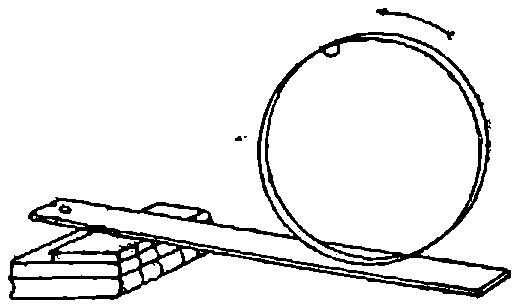
We are so used to seeing heavy bodies roll down a slope that one rolling freely up looks at first like something close to a miracle. Yet nothing is easier than to stage such a miracle, or sham miracle. Take a strip of flexible cardboard, bend it round, and glue the ends together, and you have a cardboard ring. With a bit of wax, stick a heavy coin, say a fifty-kopeck piece, to the inside of the ring. Now set the ring at the foot of a sloping board so that the coin is near the top, ahead of the point where the ring rests on the wood. Let go, and the ring will roll up the slope by itself (Figure 10).
The reason is plain. The coin's weight pulls it toward the lowest place in the ring; but the coin can't move without the ring, and as it sinks it makes the ring roll uphill.
If you'd like to turn the experiment into a conjuring trick and astonish your guests, you'll have to stage it a little differently. Take an empty round hatbox and fasten some heavy object to the inside of its curved wall. Close the box, set it in the proper position halfway up a sloping board, and ask your guests which way it will roll if you let go: up or down? Everyone, of course, will say "down" with one voice, and they'll be more than a little amazed when the box rolls uphill before their eyes. The board mustn't slope too steeply, naturally.
In Defiance of Gravity
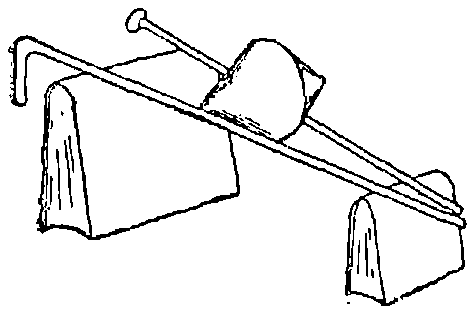
With a billiard ball and a pair of cues you can do a similar trick, though it is similar only in looks and quite different underneath. Lay the two cues on a table with their tips touching and their butts one ball's width apart. A ball set down halfway along the cues ought, you'd think, to roll toward the thin ends and not the thick ones. You have only to try it to be convinced of the contrary: the ball rolls toward the thick ends, climbing, as it seems, all the way!
The secret is a curious optical illusion. The cues draw apart as they run toward their thick ends, and the ball, rolling along between them, sinks deeper and deeper. Its center of gravity is really following a line that goes down toward the thick ends.
The same experiment can be done another way. Make two identical cones out of cardboard and glue them together base to base. Stand two books on the table, one rather taller than the other, and across their spines lay two straight sticks, not quite parallel but with a small angle between them. Your double cone will roll along these sticks away from the lower book and toward the taller one, and not the other way about (Figure 11).
These two experiments differ from the one before. There the body really did roll up the slope; here both the ball and the cones only seem to, and in fact they're rolling down. The climb is nothing but an optical illusion. In all three experiments, though, the center of gravity moved down and not up.
None of this, of course, contradicts the laws of falling bodies in the least; on the contrary, the experiments rest on those very laws. They're simply arranged so as to disguise the simple law of gravity, and at first glance you might suppose that the firmly established laws of falling bodies really were being broken.
An Unexpected Result
Suppose a man steps onto the platform of one of those big decimal scales on which a small weight balances a load ten times as heavy. He asks somebody to balance him with weights, and then he quickly squats. What will the platform do as he squats?
Three answers are possible:
1) the scale will stay in balance;
2) the platform will sink;
3) the platform will rise.
Put this question to a hundred people, and you may be sure that ninety will give you the first answer or the second. Some will say: "A man doesn't change his weight by squatting, and therefore the scale will stay in balance. It's perfectly clear!" Others will say: "You're going down, and the platform under you will go down too. It's perfectly clear!"
But clear as it is, that isn't how things go. You have only to try this simple experiment yourself to find that what actually happens is the third thing, the one nobody thinks "clear."
And still there's nothing unaccountable about it. While you stand, the upper part of your body presses on your legs, and they pass your full weight on to the platform. At the moment of squatting, your upper body is in motion and doesn't press on your legs as it did. In other words, your weight for that instant is much less, and that's why the platform rises. Once you've finished squatting, of course, your body presses on your legs again, and the balance is restored.
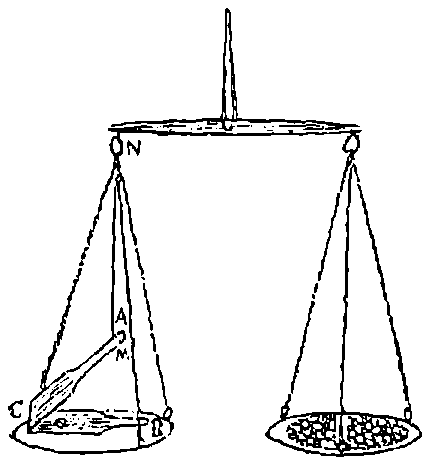
If you have no decimal scale, there's another experiment of the same kind. Take an ordinary pair of shop scales and put a nutcracker on one pan so that one of its arms lies on the pan. Tie the end of the other arm (M) with a string (A) to the hook (N), as shown in Figure 12. Then pour enough shot into the other pan to balance the scales.
Hold a lighted match to the string. It burns through, and the upper arm of the nutcracker falls onto the pan. What will the scales do at that moment?
By now you won't be surprised to see the pan with the nutcracker rise for an instant.
And what will the platform of the decimal scale do if a man sitting on it springs up to his full height? Just the same thing: his moving body doesn't pass its weight on to his legs, and the platform has to rise.1
Can We Send a Cannonball to the Moon?
Jules Verne, as everyone knows, had the members of an American "Gun Club" send a cannonball to the Moon, and even had some of them ride in it around our satellite. Readers of his enthralling novel would probably like to know whether such an undertaking is possible in reality.
Let's begin with a different question. Could we fire a cannon in such a way that the ball would never fall back to earth, but would circle our planet forever like a satellite? It turns out that this is perfectly possible. Why, after all, does a ball fired horizontally from a cannon fall to the ground in the end? Because the Earth's attraction bends its path; it follows a curve instead of a straight line, and at last it meets the ground. The Earth's surface is curved too, of course, but the path of the ball bends more sharply. The path, however, can be made to bend less, until it curves just as the globe does. How to manage that we'll see in a moment; notice for now that if it's done the ball will never fall to earth! It will follow a curve concentric with the globe, and become the Earth's satellite, a kind of second Moon.
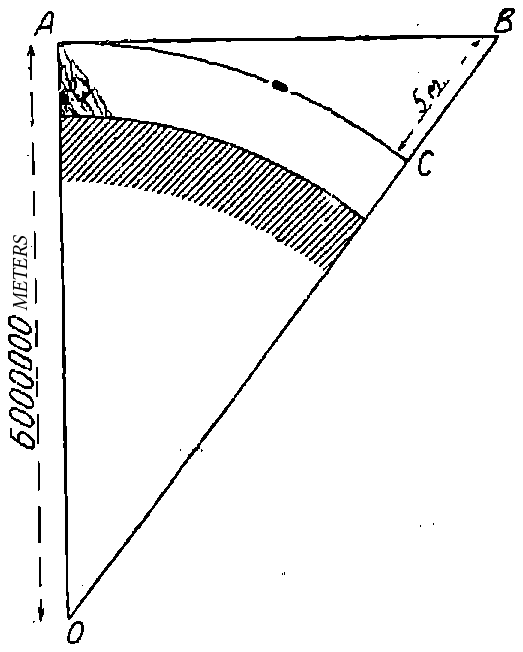
Now how are we to get a ball fired from a cannon to follow a path no more sharply curved than the Earth's surface? It's enough to give the ball sufficient speed. Look at Figure 13, which shows a section of the globe. On a mountain, at point A, stands a cannon. A ball fired from it along the tangent would be at point B a second later, if the Earth didn't attract it. Gravity changes matters, and the ball, when the second is up, is not at B but 5 meters lower, at C. Five meters is the distance that every freely falling body covers in its first second, under gravity, near the Earth's surface.2 If our ball, having dropped those 5 meters, is exactly as high above the ground as it was at A, then it is following a curve concentric with the globe.
We have only to work out the length AB, the distance the ball travels in a second. That isn't hard to get from the triangle AOB, in which OA is the radius of the Earth (6,000,000 meters); OC = OA; and BC = 5 meters, so that OB = 6,000,005 meters. From this, by the theorem of Pythagoras, we have:
that is, a little under 8 kilometers.
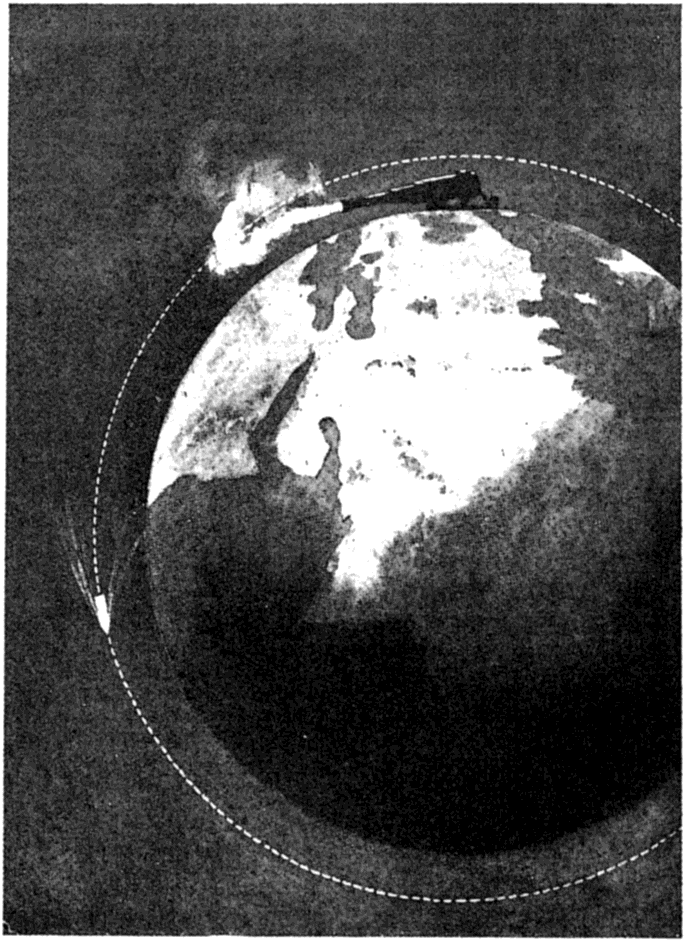
And there we have it: a ball that leaves the cannon at 8 kilometers a second will never fall to earth, but will circle it forever like a satellite. Our guns can't yet give a ball such a speed, but in time, perhaps, we'll manage it. The gap isn't so very great: the shells of modern guns leave the muzzle only ten times more slowly.
What would become of a ball fired at a still greater speed? Celestial mechanics proves that a ball leaving the muzzle at 8 1/2, 9, or even 10 kilometers a second will describe an ellipse around the Earth, and the greater its initial speed, the more elongated the ellipse. Only at a speed of , or about 11 kilometers a second, will the ball describe not an ellipse but a curve that never closes, a parabola. It will go off into the boundless spaces of the universe, leaving our solar system forever.3
In theory, then, there's nothing impossible in the idea of traveling through space in a cannonball, if only it's fired fast enough. In practice it hasn't been done, to be sure, but the obstacles are purely technical. Someone in the future may invent an explosive powerful enough to give a shell a speed of 9 to 11 kilometers a second, and then sending a cannonball to the Moon will present no difficulty at all.
Verne's Journey to the Moon, and How It Would Really Have Gone
We can, then, send a cannonball to the Moon; it wouldn't contradict the laws of mechanics. We can also put passengers inside it, and fit it out for them just as Jules Verne describes in Around the Moon. But the French novelist hasn't got every detail of this imaginary journey right. His imagination foresaw a great deal, and guessed a great deal, but not everything. One of his oversights is what we are going to talk about now.
Do you remember that interesting moment of the voyage when the shell passed the neutral point, where Earth and Moon pull equally hard? Everything inside lost its weight, and the travelers themselves, when they jumped up, hung in the air with nothing to hold them...
All this is described quite correctly. The trouble is that it would have been exactly the same before the neutral point and after it. The travelers, and everything else in the shell, became weightless from the very first moment of the flight, and they had no need to wait for the neutral point to feel those strange sensations.
This sounds incredible; but the reader, we're certain, will soon agree, and will even wonder how he can have missed so obvious an oversight.
Let's convince him with an example from the same novel. You remember, of course, how the passengers threw the body of their dog, Satellite, out of the shell, and how surprised they were to see that it didn't fall to Earth at all, but went speeding on alongside them. Verne described this quite correctly and gave the right explanation for it. In empty space, as we know, all bodies fall equally fast; the Earth's attraction gives them all the same acceleration. Under that attraction the shell and the dog's body were bound to acquire the same speed of fall, or, to put it another way, gravity was bound to take the same amount off the forward speed each had been given when it left the gun. The speed of the shell and the speed of the dog must therefore have stayed equal at every point of the journey, and that's why the dog's body, once outside, kept following the shell without falling behind in the least.
But if the dog's body doesn't seem to fall to Earth when it's outside the shell, why should it "fall" when it's inside? The same forces act in both places. Put the body of the dog inside, with no support of any kind, and it must stay hanging in the air: it has exactly the same speed as the shell, and therefore remains at rest relative to it.
What's true of the dog is true of the passengers, and of everything else inside. At every point of the journey they all have the same forward speed as the shell itself, and they don't need any support to stay where they are. Take a chair that is standing on the floor of the flying shell and set it upside down against the ceiling, legs uppermost: it won't fall "down" at all, for it will go on speeding forward together with the ceiling. A passenger can settle himself head downward on that chair and sit there in comfort without feeling the least inclination to drop to the floor. What force could make him drop? If he did "fall," it would mean, strictly speaking, that the shell was rushing through space faster than he was (otherwise he couldn't get any nearer the floor). But that's impossible: we know that everything inside the shell shares in its motion and moves at the same speed.
Jules Verne noticed none of this. He supposed that the things inside a shell in free flight would go on pressing against their supports just as they had when it stood still. He overlooked the fact that a heavy body presses on its support only because the support doesn't move; when the body and the support move through space at the same speed, they can't press on each other. When you sit in a railway carriage, facing the locomotive, with your back against the wall, do you feel that wall rushing forward at tremendous speed? No, you feel no pressure, because you're rushing forward at exactly the same speed yourself.
For anyone who still finds this incredible, here's one more explanation. Suppose that what the cannon fired wasn't a shell at all but two coins, one lying on top of the other. Will the upper coin press on the lower? No: both will fly off at the same speed. Very well. Now in place of the lower coin imagine the floor of our flying carriage, and in place of the upper our travelers. Will their bodies press on the floor? Of course not. And if they don't press on the floor, then they're weightless, for that's what the word means!
And so from the first moment of the journey the passengers had no weight whatever and could "walk on air" inside the shell, and everything in it must have seemed to them perfectly weightless too. They were in these extraordinary conditions the whole way, and not just as they passed the neutral point. They could very easily have used the fact to tell whether they were moving or still lying motionless at the bottom of the gun. And yet Verne, in his second chapter, gives a detailed account of how the passengers spent the first half hour of the trip vainly racking their brains over the question: were they flying or not?
"'Nicholl, are we moving?'
"Nicholl and Ardan looked at each other. They felt no vibration in the shell.
"'Indeed, are we moving?' repeated Ardan.
"'Or are we lying quietly on the soil of Florida?' asked Nicholl.
"'Or on the bottom of the Gulf of Mexico?' added Michel."
The passengers of a steamer might have such doubts; the passengers of a shell in free flight, as we have seen, couldn't possibly. The first keep their full weight, while the second can't fail to notice that they've become weightless.
What a strange place it must be, this fantastic flying carriage! Here is a tiny world where bodies have no weight; where things you let go of stay quietly where they are; where everything keeps its balance in any position; where water doesn't pour out of an overturned bottle... All this escaped the author of Around the Moon, and yet what scope these unlimited possibilities could have given a novelist's imagination!
The absence of weight, by the way, would have strange effects on the behavior of liquids, but that calls for a separate talk, in Chapter 6.
Before we finish, let's clear up one difficulty that may still occur to some readers. Why, we may be asked, don't the passengers of a balloon become weightless? Because a balloon never moves freely: it is always overcoming the resistance of the air. Its passengers don't feel that resistance, and gravity therefore gives them a greater acceleration than it gives the balloon. The difference in speed is what they sense as weight (their feet press on the floor of the basket). The same is true of a ship at sea, a railway carriage, and so on.4
An Extraordinary Carriage
Travelers in Japan have often marveled at the unselfishness of the men who pull the rickshas there. Such a man will gladly take his passenger back again at no extra charge, preferring to pull his little carriage loaded rather than empty. This astonishing unselfishness will be easier to understand if we can show that on a level road a loaded ricksha is easier to pull than an empty one... The paradox is explained by the laws of the lever, as we'll see right away.
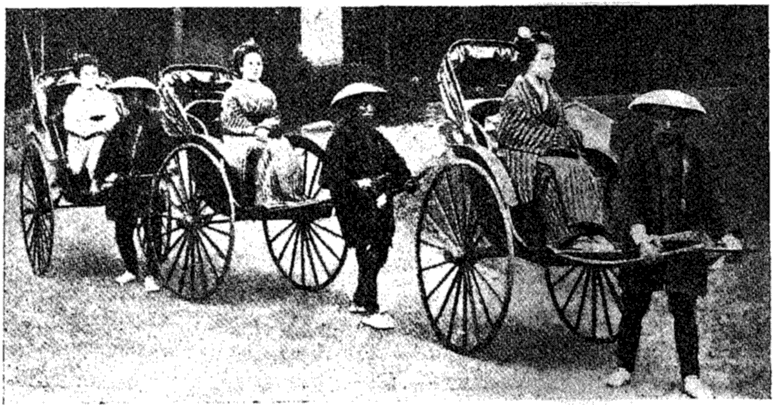
Figure 16 is a simplified drawing of a man pulling a ricksha with a passenger. The line AB, from the point where the passenger's weight rests to the point where the man's hands are applied, is simply a lever with unequal arms, turning about the axle of the wheels. The man bears down on the long arm, the passenger on an arm half as long. The passenger's weight therefore balances half the weight of the man's body, and that's the same as if the man had become half as heavy, since his legs have only half the load to carry. The work of moving the passenger's weight, and the other half of the man's, along a level road on light wheels is extremely small. The man loses all these advantages when his ricksha is empty, for then there's no passenger to balance half of his own weight.
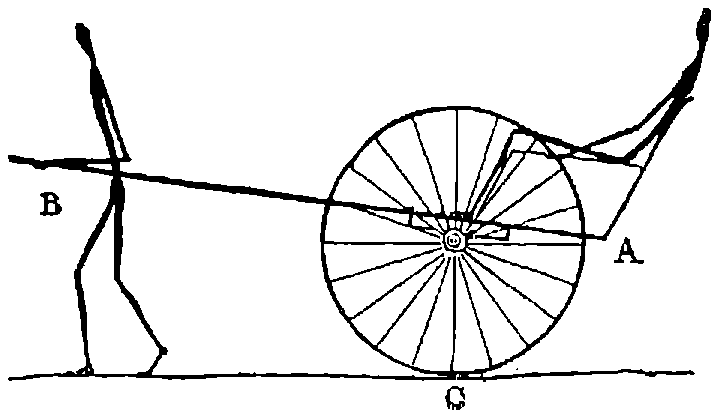
It follows that the Japanese ricksha, unlike every other carriage and cart in the world, really is easier to pull loaded than empty.
But this is so only on a perfectly flat and level road. If the road slopes, and the carriage has to be dragged uphill, things change. For variety, let's leave the ricksha and look at an English two-wheeled handcart with its passenger in two different positions.
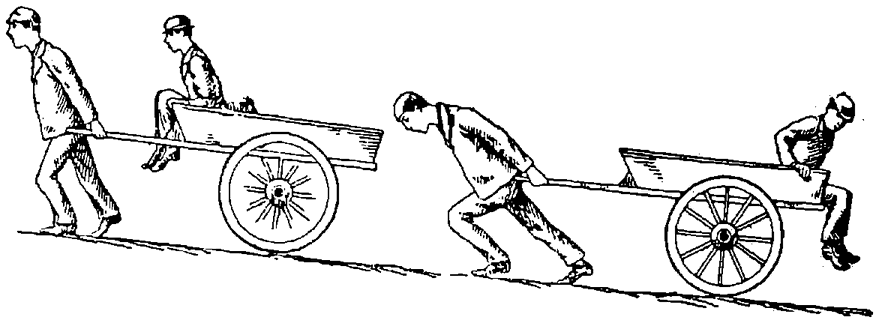
Study Figure 17 and try to explain, by the laws of the lever, why the cart is easier to pull uphill when the passenger sits at the front and not at the back.
The reasoning goes like this. If the passenger is in front of the axle, then his weight is added, through the shafts, to the weight of the man who's pulling. The man becomes heavier, and he doesn't have to strain much to keep the cart from rolling back down. But if the passenger sits at the rear end, then, as we've already seen, he lightens the man, who must therefore lean far forward and tense his muscles to keep the cart from rolling backward.
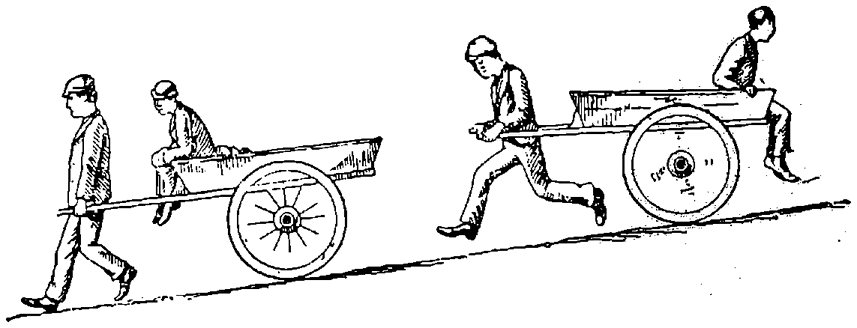
It's another matter when a cart with a passenger is going downhill. Here, as with the ricksha, it helps the man to be made lighter and hinders him to be made heavier. That's why the man on the right in our Figure 18 runs along with his cart, while the one on the left goes at a walk and with great effort.
Scales Made of String
Out of string and cardboard you can easily rig up a pair of scales good enough even for use around the house.
Drive two nails into a horizontal shelf, 105 centimeters apart.5 Take a strong string about a meter and a half long, tie a knot exactly in the middle of it, and tie its ends to the nails. Now make the "pans" out of pieces of cardboard and hang them from the string, 25 centimeters from the knot on either side. Nail a piece of cardboard to the shelf and mark an arrow on it, just at the point where the knot comes.
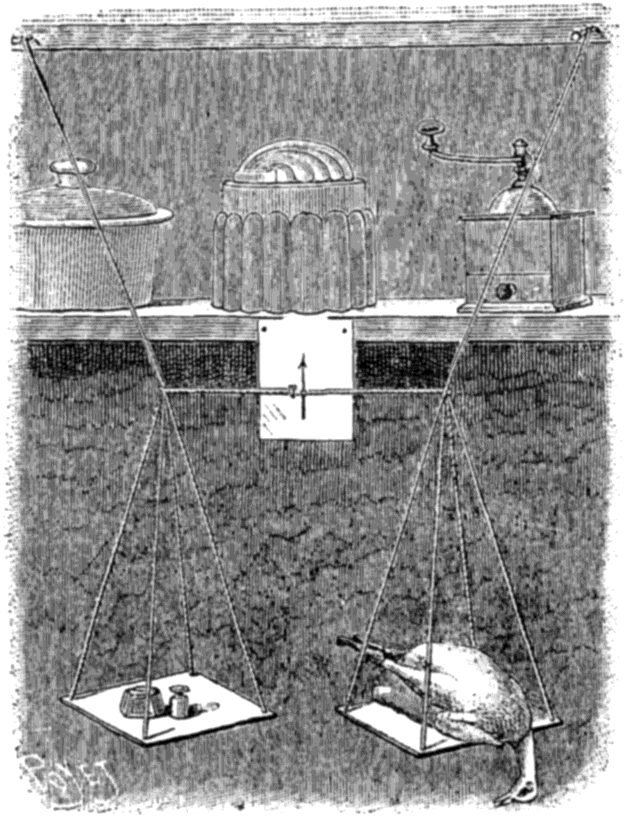
The scales are ready. When the "pans" carry equal loads, the knot stands opposite the arrow. If one of them outweighs the other, the middle stretch of the string, which does the work of the beam in ordinary scales, tilts to that side and pulls the knot with it.
For our string scales to weigh correctly they have to be made with extreme care: the nails must be on one level, the knot must be exactly in the middle, and so forth. That's hard to achieve, and we'll therefore explain at once:
How to Weigh True on a False Balance
Don't imagine that if your scales are false you can't weigh truly with them. Nothing is easier, provided you know how to go about it.
And it's very simple. Put the thing you want to weigh on one pan, and pour sand (or shot) onto the other until the scales balance. Now take the thing off its pan, leave the sand alone, and set weights in the thing's place until the scales balance again. Clearly the weights are now equal to the weight of the thing you removed, since each can take the place of the other exactly. Hence the name of the method, "weighing by substitution."
The same simple device works just as well on a spring balance, which has only one pan, and there you don't even need sand or shot. Put the thing on the pan and note the mark at which the pointer stops. Then take it off and put on the pan as many weights as it takes to bring the pointer to the same mark. The weight of the thing must obviously equal theirs.
Spring balances often go wrong, and we recommend that you always use this method, which gives a true result even on false scales. It will serve equally well, of course, for checking scales of any other kind: beam scales, table scales, hand-held balances, and the rest.
If you are buying something in a shop and have doubts about the scales, make the shopkeeper weigh your goods over again in the way we've just described, and if he gave you short weight it will show at once. All this assumes, of course, that the weights at your disposal are perfectly true.
How Can You Weigh Without Weights?
Weights are by no means always at hand, and it's useful for everyone to remember that when there are none, you can manage very well with... money! Coins, after all, are minted to a definite weight, and if you know what it is, you can in case of need (not financial need, naturally) do without weights. Anyone who has read Jules Verne's Hector Servadac knows what good service French money can render in this way. But many people are unaware that Russian money will do the same.
For ordinary household weighing, use copper. Our copper coins, those of 1913, stand in a very simple relation to weight: a kopeck weighs 3 1/4 grams, and since there are a hundred kopecks to the rouble, a kilogram comes to about three roubles in copper. From this it's easy to work out that a hundred grams is about thirty kopecks. It makes no difference whether you take six five-kopeck pieces, or thirty separate kopecks, or make up any other combination out of coins of five, three, two, and one kopecks, because the weight of a copper coin is proportional to its value. For a small weight, 4 kopecks come pretty close to 13 grams.
For weighing in exact grams, the French measure so often given in scientific works, the amateur physicist can turn to our silver, knowing that
| a silver rouble weighs exactly | 20 grams |
| a silver fifty-kopeck piece | 10 grams |
| a silver twenty-five-kopeck piece6 | 5 grams |
As for small silver change (20, 15, 10, and 5 kopecks), its weight isn't proportional to its value, because it's struck from an alloy with less silver in it than full-value coin. It does no harm to remember, just in case, that the little silver five-kopeck piece weighs 0.9 gram, only slightly less than a gram.
With these figures you can weigh accurately enough, in kitchen measures and scientific ones alike. Just avoid coins that are too badly worn.
Perpetual Motion
A medieval scholar once proposed to build a wheel that would turn by itself, with no outside force of any kind, and go on turning forever.
Figure 20 shows his self-moving mechanism. Hinged rods with weights at their ends are attached to the rim of a toothed wheel. Whatever the position of the wheel, the weights on its left side will be thrown out farther from the center than the weights on its right. That half will therefore outweigh the other and set the wheel turning.
Such a wheel, it would seem, ought to turn forever, or at any rate until its axle wears through. And yet if you build the machine you'll find that it has no intention of moving.
What's the matter with it?
It's very simple. The weights on the left really are farther from the center, but this advantage is wiped out because there are so many fewer of them. Look at the drawing: just two balls on the left, and very nearly five on the right... That's why our machine won't budge.
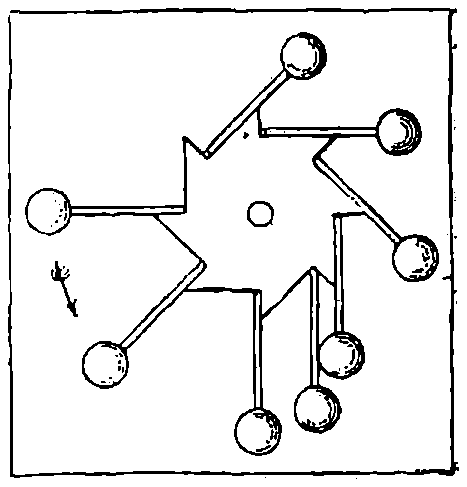
It was proved more than half a century ago that no mechanism can be built that would keep itself moving forever. There's no point, then, in racking your brains over so hopeless a problem; you won't come up with anything. But in former times, and in the Middle Ages especially, people spent a good deal of time and labor trying to invent "perpetual motion," perpetuum mobile in Latin. It seemed to them even more alluring than the art of making gold out of cheap metals.
Pushkin, in his Scenes from the Days of Chivalry, gives us a dreamer of this sort in the character of Berthold:
"What is perpetuum mobile?" asks Martin.
"Perpetuum mobile," Berthold answers him, "is perpetual motion. If I find perpetual motion, then I see no limits to what man can create... You see, my good Martin, to make gold is an alluring problem, and the discovery might be curious and profitable; but to find perpetuum mobile... oh!..."
People have thought up hundreds and thousands of "perpetual motion machines," and not one of them has moved for more than a quarter of an hour. In every case, as in our example, the inventor overlooked some circumstance that brought all his plans to ruin.
Wonder and No Wonder
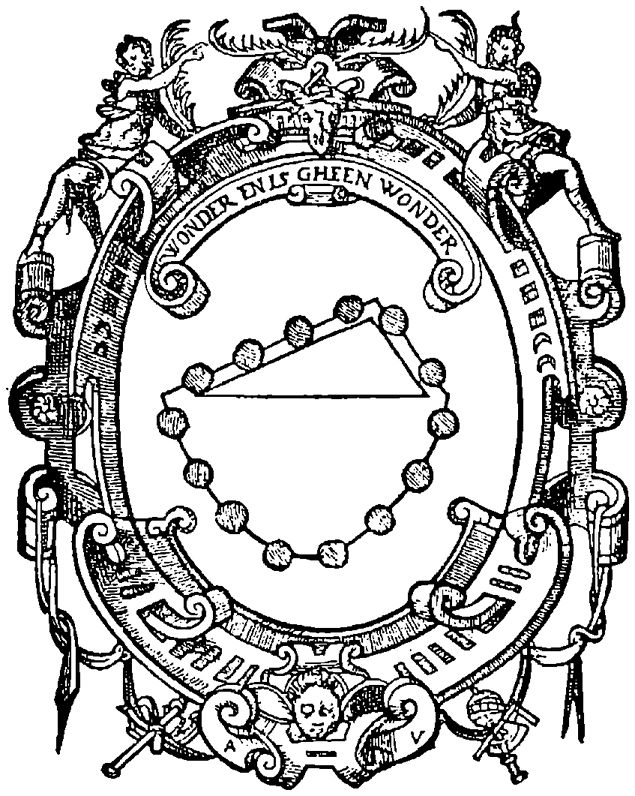
The drawing at the front of this book is taken from a work by Stevin, a scholar of the seventeenth century. This Belgian mathematician made many important discoveries that we now use all the time. He invented decimal fractions, introduced exponents into algebra, and discovered the law of hydrostatics that Pascal later discovered over again. He also found the law of the balance of forces on an inclined plane, and with the help of this drawing he proved it in an extremely ingenious way.
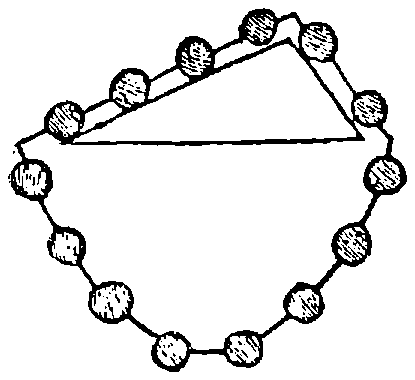
What we see here really does look like a wonder. Over two inclined planes that meet at an angle hangs a closed chain. It is of course in balance, since there's no reason for it to start moving. But the part of the chain that hangs down in a semicircle is balanced all by itself. The two remaining parts, therefore, the ones that lie on the planes, must balance each other. The outcome looks like a paradox: two links of the chain balance four.
But out of this "wonder" Stevin drew an important law of mechanics. He reasoned as follows. The two pieces of chain, the long one and the short one, weigh different amounts: one is as many times heavier than the other as the long plane is longer than the short. It follows directly that two bodies joined by a cord will balance each other on inclined planes if their weights are proportional to the lengths of the planes. And when the short plane is vertical, you get a well-known law of mechanics: to hold a body on an inclined plane, you must apply along the plane a force as many times smaller than the weight of the body as the length of the plane is greater than its height.
Chapter 3: Rotary Motion
A Difficult Problem
Take an ordinary flat-bottomed bottle and stop it tightly with a cork that has a knitting needle pushed through it. On the needle goes a small cork disk (see the right-hand side of Figure 22). The needle mustn't reach all the way to the bottom of the bottle, but should end about 4 centimeters above it. The best cork for the disk is one from a mustard jar, and the hole in it should be big enough to let the disk slide freely along the needle. Fill the bottle half full of water, so that the disk lies on the surface.
Now set the problem: take the disk off the needle without uncorking the bottle.
It proves to be a tricky business. Tilt the bottle or turn it over as much as you please, the cork disk won't come off the wire, because it never sinks below the needle's end.
When you have let the uninitiated sweat over the puzzle long enough, you finally show how very simply the trick is done. By spinning the bottle quickly about its vertical axis you make a little whirlpool inside. The surface of the water takes the form of a funnel, whose edges climb high while its bottom sinks and leaves the end of the needle clear. The disk slips off the needle by itself and bobs up to the surface, as was to be demonstrated.
What came to our rescue is the so-called "centrifugal force," which tends to drive the parts of a rotating body away from the axis of rotation. It's proved in mechanics that under this force the surface of a liquid in a rotating vessel must take the form of a cone with a rounded tip (a paraboloid).
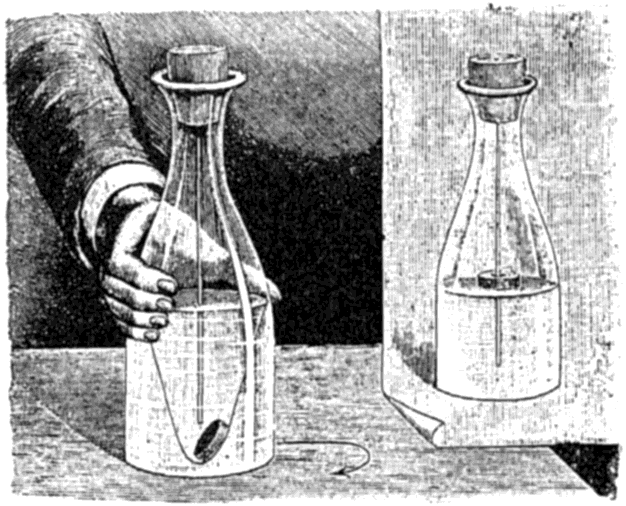
You can also turn the problem around, and ask someone to put a disk that is floating freely on the water onto the needle. That demands a great deal more skill, and succeeds only after long practice.
How to Tell a Boiled Egg from a Raw One
Here is an egg. Kindly determine, without breaking the shell, whether it's boiled or raw. Unless the egg sloshes when you shake it, the most experienced and knowledgeable cook couldn't tell you. But a knowledge of the laws of mechanics will get you out of the difficulty with honor.
The fact is that a hard-boiled egg and a raw one spin differently, and that gives us a simple way to tell them apart. Lay the egg to be tested on a table or a flat plate, and give it a twirl with two fingers. A boiled egg, especially a hard-boiled one, will spin noticeably faster and longer than a raw one. A raw egg is so stubborn that it isn't easy even to get it spinning; a hard-boiled one starts at once, and whirls so fast that its outline blurs into a single solid shape, a white flattened ball. Soft-boiled and medium-boiled eggs come in between, spinning faster than a raw egg but slower than a hard one. With a little practice you can even learn in this way to tell not only a boiled egg from a raw one, but also a hard-boiled egg from a medium or soft-boiled one.
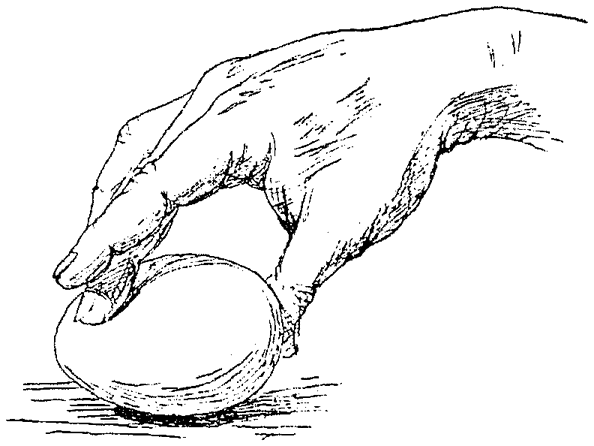
The cause of all this is that a hard-boiled egg turns as one solid body. In a raw egg the liquid inside doesn't take up the rotation at once. Its inertia, the tendency of matter to go on doing whatever it is already doing, holds back the movement of the hard shell, and the liquid acts as a kind of brake.
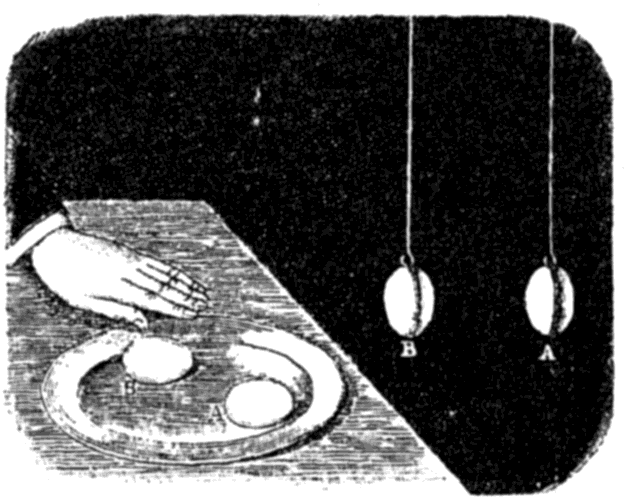
Boiled and raw eggs also differ in the way they stop. Touch a spinning boiled egg with your finger, and it stops at once. A raw egg will stop for an instant, and then, when you take your hand away, turn a little more. This happens because the liquid inside goes on moving by inertia after the hard shell has come to rest.
You can make the same test in another way. Take a raw egg and a boiled one, stretch a rubber band around each "along the meridian," and hang them side by side on two strings. Now twist both strings the same number of times and let go. The difference between the eggs shows immediately. The boiled one, once its string has untwisted, carries on and winds the string up the opposite way, then unwinds again, and does this several times over, making fewer and fewer turns. The raw egg behaves differently: it turns once or twice and stops, long before the hard-boiled one comes to rest.
We describe this method only for the sake of completeness. It's far more trouble than the first, which, for all its simplicity, always gives a clear result even in the hands of an inexperienced experimenter.
The Centrifugal Merry-Go-Round
Open an umbrella, rest its tip on the floor, and spin it by the handle; you'll easily get it going fairly fast. Now throw a ball into it, or a crumpled piece of paper, or any other light object that won't break. The ball won't stay in the umbrella; centrifugal force will soon fling it out.
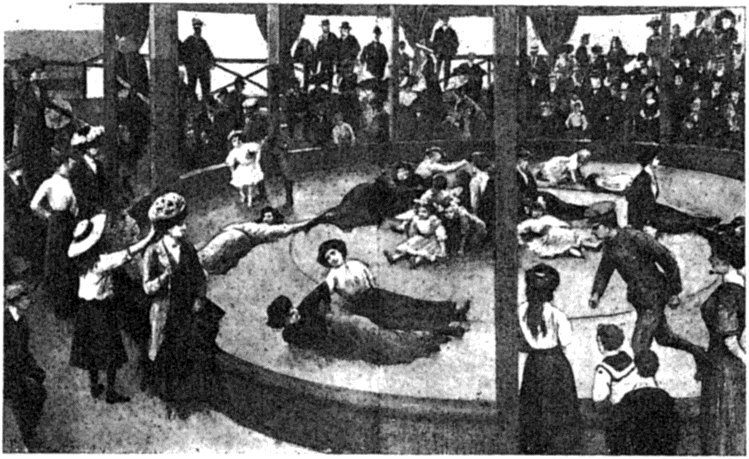
This is the principle behind a novel amusement, the centrifugal merry-go-round, built for the latest world's fair in Brussels.
There visitors had a chance to feel for themselves how irresistible centrifugal force can be. They took their places on a round platform, standing, sitting, or lying down, as they liked. Hidden machinery turned the platform smoothly about its center, slowly to begin with and then faster and faster, the speed increasing too gradually for anyone to notice. And then, under centrifugal force, everyone on the platform would start sliding toward the edge. At first the movement was barely perceptible; but the farther these sportsmen got from the center, into zones of greater and greater radius, the more strongly they felt the centrifugal force. All their efforts to stay put came to nothing, and group after group went rolling off the "centrifugal merry-go-round."
Our globe is, in essence, just such a "centrifugal merry-go-round," only a gigantic one. We ourselves are too small for centrifugal force to show itself noticeably on our bodies. But we can very often observe it in nature. Every river that runs along a meridian has one high bank and one low: centrifugal force, driving the water aside, creates the difference. The same cause explains the deflection of the trade winds, the swirling of cyclones, and even the odd fact that on railways running north and south the two rails wear unequally. Under centrifugal force the cars press harder on the western rail than on the eastern, and it's the western one that wears away more.7
The Flattening of the Globe
The Earth's rotation also explains why it isn't, strictly speaking, a sphere, but is flattened from north to south. A simple experiment will make clear to us how this comes about.
Cut a disk 20 to 25 centimeters across out of stiff, strong cardboard, and bore two small holes in it, one on either side of the center. Pass strings through the holes. It's easy to set such a disk spinning fast. Draw the strings slightly tight and turn the disk over and over a few times; then, when the strings are well twisted, let go of the disk and pull hard on the strings, and it will start to whirl quite rapidly.
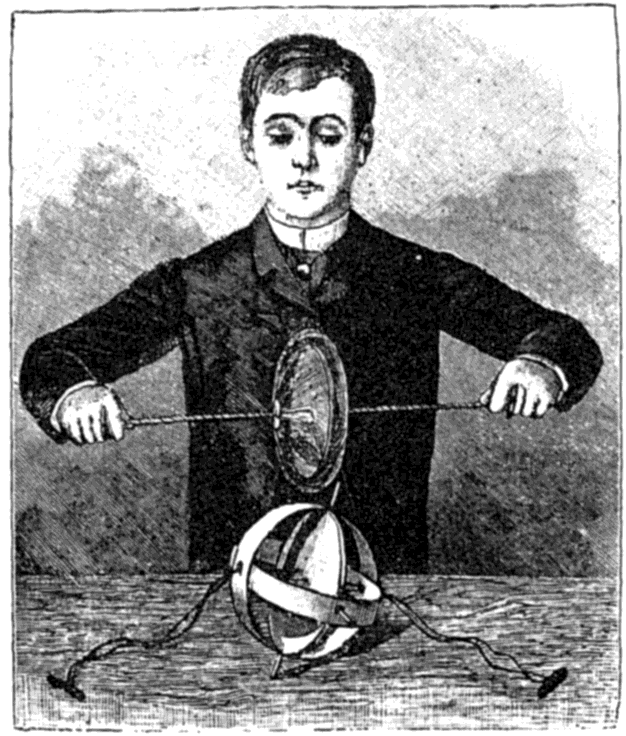
Now we can make a model of the globe. Draw two diameters at right angles on your disk, and stick a needle into the edge of the cardboard at each of the four ends. Make two rings out of stout paper, as wide as your finger and slightly larger in diameter than the disk. Put one ring inside the other at right angles, and glue them together where they touch. These are the "meridians" of your model. Through holes at the "poles" (the places where the rings touch) pass the strings from the disk, and set the disk itself where the "equator" should be by pushing the points of the needles through the paper bands.
Spin the disk fast in the way described above, and you'll see your "globe" visibly flatten at the "poles" and bulge at the "equator."
Can We Move the Earth's Poles?
The members of the American "Gun Club," as everyone knows, weren't satisfied with flying around the Moon in a cannonball. Jules Verne's imagination set them to another astronomical experiment, "straightening" the axis of the Earth, or, to be more exact, changing its tilt to the plane of the Earth's orbit. The force was to come from the recoil of a colossal gun, whose kick would shift the axis. This time the experiment failed. By an unlucky accident, the gun they cast was a trillion times smaller than it should have been...
Readers would probably like to know whether such an undertaking is possible in reality. The question was discussed some fifteen years ago in the Paris Academy of Sciences. The results of the discussion are most curious, and we'll try to give readers a very general idea of them, without mathematical calculations.
The problem before the French academicians was rather more modest than the one the American artillerymen had set themselves. There was no talk of "straightening the Earth's axis," that is, of setting it perpendicular to the plane of the ecliptic and abolishing the seasons along with the tilt. The academicians considered only moving the poles, and left the tilt of the axis alone. The Pole Star would be the Pole Star still, and the seasons would remain as they are, but the poles would change their place: instead of lying in the present arctic and antarctic regions, they would be shifted to others, Canada and Australia, for instance.
Is such a displacement of the poles possible? Could mankind conceivably accomplish it by mechanical forces?
Yes, it could. To see how, let's take a series of examples from everyday life.
Have you noticed what happens to a small, light boat when you walk along it from stern to bow? If it isn't tied up, it moves noticeably in the opposite direction. This is the mechanical law of the equality of action and reaction at work: as you walk you push your body away from its support, but you also push the support itself backward. When you walk across a fixed floor you don't notice this, because the push is canceled by the resistance of the firmly anchored support. Nor will you notice the boat moving back if it's very large or heavily loaded. This is because one and the same force moves different bodies by different amounts, depending on their mass (their weight): it moves a heavy body a shorter distance than a light one. When you walk along the deck of a steamer from stern to bow, your feet push the steamer back; but the distance it moves is negligible, as many times smaller than the distance you move as the steamer is heavier than your body, and that's why nobody notices it.
Now back to our boat. Imagine that it isn't long, as boats usually are, but shaped like a big floating plate, and that you're walking around and around close to the edge of it. What will happen to the boat? It isn't hard to guess: it will begin to rotate in the opposite direction. Pushing off with your feet, you set it turning, much as a horse does on a treadmill. Try the same maneuver on the deck of a big steamer, and of course you won't set it turning: its mass is too great compared with your body's, and your legs would have to overcome not only the inertia of the heavy steamer but the resistance of the air around it as well. Even so, theoretically speaking, it will move, and the longer you circle the deck (or even your own cabin) the greater the angle it will turn through. Having made a million circuits, you might turn the steamer through some fraction of a degree...
Theory, you see, promises you a reward for patience and hard work.
The heavier the load that is moved about the deck, the stronger its push. Harness elephants to cannons and have them circle the deck in single file for many days and nights, and you would certainly get more noticeable results.
We've now come almost directly to the question that interests us: can we turn the globe? Imagine loads moving without a break from west to east along the equator or the parallels of latitude: trains running, steamers sailing, water flowing in canals, and so on, all in the same eastward direction. How will this affect the Earth's rotation? After all that has been said, the answer is clear. The Earth itself rotates from west to east; the unbroken movement of loads over its surface must give it a rotation in the opposite direction; and consequently it will rotate more slowly. In other words, we can lengthen the day, and we can also shorten it, by sending all the loads the other way. Theoretically, as you see, this is entirely in our power. Carrying out the experiment would be difficult in practice, chiefly for want of... time. The mass of all the locomotives, steamers, and water that would be moving over the Earth's surface is so small beside the mass of the globe that thousands of years would go by before the length of the day changed by so much as one second.
In the same way, given enough patience, we could move the poles as well. For that we'd have to move the loads not along the parallels but along some circle that crosses them. Imagine, for example, a circle drawn inside Africa about a central point in, say, the Sahara. Along this circle we could dig a canal, fill it with water, dam it at one place, and pump the water across from one side of the dam to the other. The water will flow without a break around the circular canal, always in the same direction, and the globe will tend to rotate the opposite way about an axis that passes through the center of the canal. But the Earth can't rotate about two axes at once, the old one and the new; it will rotate about a third, somewhere in between. In other words, the axis of the globe will, in effect, have moved. The shift will be negligible, but the longer our canal "works," the greater it will become. If the ancient Egyptians had built a waterworks of this kind thousands of years ago, and if it had been running without a stop ever since, then by now, perhaps, mankind might have succeeded in moving the poles by a small fraction of a degree...
The Problem of the Falling Cat
Everyone knows that a cat always contrives to land on its feet, but few people know how long this talent of the cat's intrigued learned mathematicians. For a cat to land on its feet, you see, contradicts the laws of mechanics; or at least they thought so until recently, when the "problem of the falling cat" was at last happily solved.
This famous problem is directly connected with the question of moving the poles that we've just been considering. The connection may seem a little unexpected, but essentially they're one and the same: can a free body, with nothing to support it, turn itself by internal forces alone?
For a long time people believed, on the strength of the laws of mechanics, that this was impossible, just as it's impossible for a freely moving body to use internal forces to change the speed and direction in which its center of gravity travels. For forward motion this has been proved beyond dispute: whatever goes on inside a flying shell, its center of gravity moves ahead at the same speed and in the same direction as if nothing were going on there at all. Even if the shell explodes, the path and speed of the center of gravity don't change. It may burst into a thousand splinters, but the common center of gravity of all the pieces continues along the old path, as long as not one splinter has hit the ground.
Until recently people supposed that the same was true of a body's rotation about an axis, and that a free body, with nothing to push against, couldn't turn itself around in space by its internal efforts alone. And yet a cat undoubtedly manages, as it falls, to turn so as to land on its paws. How does it do it? That's the question that set more than one scientist racking his brains.
One solution to the "cat problem" went like this. Even before it begins its leap, the cat supposedly has time to push off from its support, like a circus gymnast who turns a somersault in the air. The gymnast, leaping from his trapeze, pushes off from it in such a way as to start his body rotating. Then, when he's in the air, he speeds up the rotation by curling into a ball, with his arms and legs pressed to his body, and that's what enables him to turn over in midair.
A cat, they thought, does exactly the same.
A simple experiment showed that it doesn't. The experimenters hung a cat from the ceiling by its paws on four cords, some way above the floor, and then cut all the cords at once. Down went the cat; and though it obviously had nothing to push off from, it still managed to land on its feet.
And so the riddle of the falling cat long remained a riddle. It was finally solved only some fifteen years ago, in connection with the question of artificially moving the poles, when it was shown that people had been wrong to believe that a body can't change the position of its axis of rotation unless an outside force takes part.
We now understand the mechanism by which a cat turns. It has two ways to turn its body as it falls. The first is by moving its tail. When the cat holds its tail at an angle to its body and whirls it around, the whole body turns a little in the opposite direction. Why? Because the muscles that turn the tail one way are pushing against the body at the same time, and so make it turn the other way. With a series of such whirls of the tail the cat can turn its body through any angle it likes, and there's no violation of the laws of mechanics in it.
Experiments with a mechanical model of a cat have fully confirmed this idea. The German physicist Hartmann made an "artificial cat" out of a cardboard cylinder, with a tail, also cardboard, fitted to it. A clockwork spring played the part of the muscles that turn the tail. As this cardboard cat fell, the spring was released, the tail whirled, and the cylinder (the cat's body) turned of itself through a more or less noticeable angle.
But whirling its tail isn't the only means by which a falling cat can turn. When it twists the front half of its body, the back half turns through the same angle in the opposite direction; and if the cat then twists its back half the same way, the front half returns, and the cat's body is just where it was before. No turn is possible on these terms. But it's a different matter if the cat, as it twists, stretches out and draws in its front and hind legs in the right way. According to the so-called law of areas, the part of the body with the legs stretched out must, other things being equal, turn through a smaller angle than the part with the legs drawn in. By stretching out and drawing in its legs in the proper alternation, the cat can, in a series of movements, make whatever turn it needs in the direction it wants.
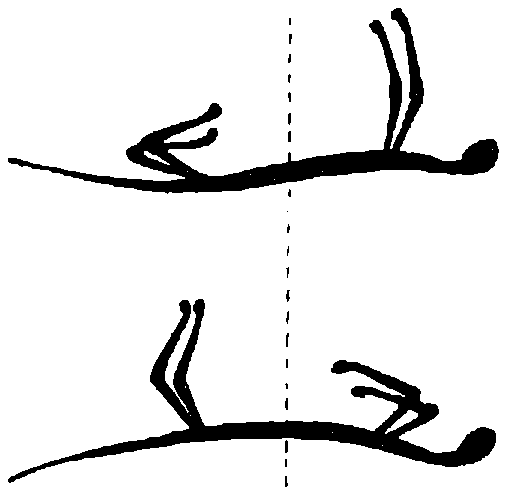
Let's take a simplified example, dividing each turn into two separate moves (see Figure 27).
First move: the cat draws in its hind legs, stretches out its front legs, and turns its back half 35° in the direction it wants. The front half is bound to turn the opposite way, through a smaller angle; let's say 25°.
Second move: the cat stretches out its hind legs, draws in its front legs, and turns its front half 35° in the direction it wants. The back half will then be turned back 25°.
As a result, both halves have turned 10° in the desired direction. The animal's whole body is in its original state again, but turned in space through 10°. Now the cat can repeat the two moves and turn another 10°, and so on.
We see, then, that the "problem of the falling cat" can be solved without the least violation of the laws of mechanics. This graceful little animal made scientists look more deeply into the foundations of their science, and demolished a scientific prejudice they had shared for a whole century.
Chapter 4: The Struggle with Distance
How Do We Walk?
By the laws of mechanics, a body stays in equilibrium, that is, motionless, only when a perpendicular dropped through its center of gravity falls within the area marked out by its points of support, the points on which the body rests on the ground. This area is called the base of support.8
Suppose a man is standing on one foot, the right, say. Now imagine that he raises his heel and at the same time leans his body forward. In that position, clearly, the perpendicular from his center of gravity will pass outside the base of support, and he must fall forward. But the fall has hardly begun when his left leg, which had stayed in the air, swings quickly forward, and the foot comes down ahead of the perpendicular. The perpendicular now falls within the area enclosed by the lines joining the points of support of both feet. Equilibrium is restored, and the man has taken a step.
He can, if he likes, stop in this rather tiring position. But if he wants to go on, he leans still farther forward, carries the perpendicular beyond the base of support once more, and, just as he is about to fall, again puts a leg forward, the right one this time. That's another step, and so it goes on. Walking, then, is nothing but a series of forward falls, each prevented in time by putting under the body the leg that had been left behind.
But let's look a little closer. Suppose the first step has been taken. At that moment the right foot is still touching the ground, and the left is already coming down on it. Unless the step is very short, the right heel must have risen, since it's this very raising of the heel that lets the body lean forward and upsets its balance. The left foot meets the ground heel first. When its whole sole is down, the right foot leaves the ground altogether. At the same time the left leg, which was slightly bent at the knee, is straightened by the contraction of the quadriceps at the front of the thigh, and for an instant stands vertical. This lets the half-bent right leg move forward without touching the ground and, keeping up with the body, plant its heel just in time for the next step.
The left foot by now rests on the ground only by its toes and must soon rise into the air, and with it the same series of movements begins again.
Running differs from walking in one respect: the leg on the ground is suddenly and powerfully straightened by the contraction of its muscles, and flings the body forward, so that for an instant it leaves the ground altogether. Then it falls back to the ground on the other leg, which has moved quickly forward while the body was in the air. Running is therefore a series of leaps from one foot to the other.
Should You Jump Forward from a Streetcar?
Try asking someone, "Why must you jump forward when you jump off a horse-drawn streetcar?" He'll answer without a moment's hesitation, "Naturally, because of the law of inertia!" Don't let him off there. Ask him to explain a little more fully what the law of inertia has to do with it, and something rather curious and unexpected will happen. He'll set out briskly and confidently to prove his point, but if you don't interrupt, he'll soon pull up in bewilderment all by himself. It turns out that it's precisely because of inertia that one ought to jump... backward!
In fact the law of inertia plays only a secondary part here, and the main reason is quite different. If we forget about that main reason, then, as we'll see in a moment, it really does follow that we should jump backward rather than forward.
When we jump off a streetcar, our body has left the car but still keeps, by inertia, a certain speed; it tends to move on ahead. By jumping forward we certainly don't cancel this speed. On the contrary, we add to it. It follows that we ought to jump... backward, and by no means forward in the direction the car is going. For when we jump backward, the speed the jump gives us is subtracted from the speed our body has by inertia, and so, when we touch the ground, our body should be thrown over with less force.
Here theory and practice part company. We have a plain contradiction, which means that either the fact is wrong or the explanation is. But the fact is right, and so right that we urgently warn our readers against testing for themselves the drawbacks of jumping backward from a moving car...
What's the answer, then?
The explanation is wrong, of course; it is incomplete, and stops short. Whether we jump forward or jump backward, we're in danger of falling, because the upper part of the body will still be moving when the feet have touched the ground and stopped. This motion is actually faster when we jump forward than when we jump backward. What matters is that it's far safer to fall forward than to fall backward. Falling forward, we put out a leg in a familiar, automatic movement (and if the car is going fast, we run a few steps), and so save ourselves. The movement is familiar because we make it all our lives in walking: from the point of view of mechanics, after all, walking is nothing but a series of forward falls of the body, each prevented by putting out a leg. When we fall backward there's no such movement of the legs to rescue us, and so the danger is much greater. Finally, it matters too that even if we do fall forward, we put out our hands and don't hurt ourselves as badly as when we fall on our backs.
The reason why it's safer to jump forward from a streetcar lies, therefore, less in the law of inertia than in the way our bodies are made. That's why the rule doesn't apply to inanimate objects: a bottle thrown forward from the car is more likely to break when it lands than the same bottle thrown the other way.
If you have a lot of luggage with you, then, and mean to throw it out and jump after it, throw the luggage backward, and jump forward yourself.
How Fast Do We Move?
Nature hasn't given human beings much speed: the average walker covers 1.6 meters a second. That's a little faster than the water flows in most rivers, but slower than the very gentlest of winds (2 meters a second). Beside a snail, which moves only 1 1/2 millimeters a second, a man is a champion runner; but if he takes it into his head to compete with other living things, he'll fail miserably. Even a fly, in leisurely flight, moves faster than a walker (it flies about 2 meters a second), and when it's being chased it can outstrip a running man, and a galloping horse besides.
But even so comparatively simple a mechanical device as skates gives man an enormous advantage over his rivals in the animal world. A good skater can cover from 11 to 13 meters a second, and there are few animals that will catch him then. The cyclist tears along faster still: in races he reaches 23 meters a second, rivaling the best racehorse (15 to 19 meters) and even the wind, for in a fairly strong wind the air seldom moves faster than 17 meters a second. Our folk tales and ballads, then, are not exaggerating when they speak of a steed as swift as the wild wind. And a good hunting hound runs far faster than the wind (26 meters a second).
We'll talk about the speed of animals later. For now, let's turn to our automobiles, locomotives, and steamships.
Machines That Overtake the Sun
In 1896, when a car in the motor race between Paris and Brest reached a speed of 21 kilometers an hour, or about 6 meters a second, it was considered the greatest of triumphs for the automobile. Within a year the speed of automobiles had doubled, and in 1909, in the Paris to Madrid race, cars were going five times as fast: 31 meters a second, or 112 kilometers an hour.9
To get a clearer idea of how great a speed 31 meters a second is, note that a stone thrown by hand with all one's might travels only 17 meters in the first second, not much more than half as far!
As for railway trains, steam locomotives now seem to be close to their limit: they'll hardly be made to do more than 128 kilometers an hour, or 36 meters a second. In Germany, however, there have been trials in which a dizzying speed was reached: 213 kilometers an hour, or 59 meters a second! No living creature in the whole world can travel as fast as that. Even sensations pass along our nerves (which also takes a certain time) at only half that speed, about 30 meters a second. And this is still not the limit of what our machines can do, for at an automobile contest in England a speed of 250 kilometers an hour, or 70 meters a second, was recently reached!10
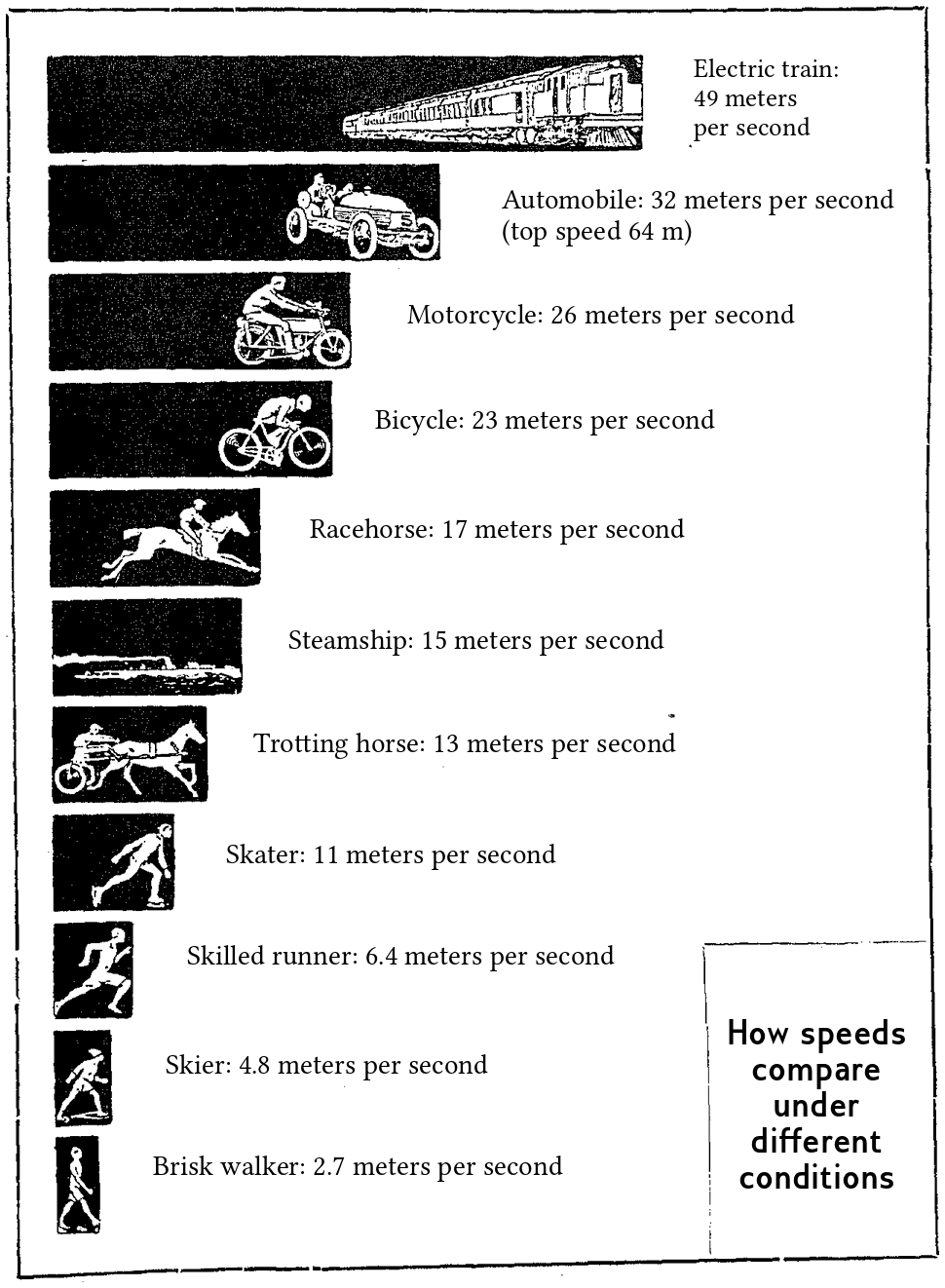
In a car like this you could "overtake the Sun" (or rather the Earth), at least in polar latitudes. On the 82nd parallel such a car travels farther than a point of the Earth's surface, turning around the axis, can travel in the same time. For the driver, as once for Joshua, the Sun will stand still in the sky...
Machines that move in water don't reach the speeds of cars and electric trains on land. The famous transatlantic giants Lusitania and Mauretania average 52 kilometers an hour, or 14.5 meters a second, and an ordinary seagoing steamship averages 27 to 37 kilometers an hour, or 7.5 to 10 meters a second. The record for speed on water belongs to a destroyer of the British navy, which does 71 kilometers an hour, or 20 meters a second.
Motorboats reach the same speed, and so do what are called "hydroplanes."
The Speed of Airships and Aeroplanes
In the air there's still much to be done before we reach great speeds. It's enough to recall that a moderate wind blows at 4 meters a second, so that no flying machine deserves to be called "dirigible," or steerable, unless it goes a good deal faster than that. Zeppelin's airships reach speeds of up to 17 meters a second. Aeroplanes are much faster: Blériot's monoplane, for example, has reached 32 meters a second (that is, 117 kilometers an hour). Yet even such a speed is far from always enough, because in a storm the wind may blow at more than 32 meters a second. Only a machine with a speed of 43 meters a second or more can be called fully steerable, flying freely at any time and in any place, however strong the wind.
Birds set an instructive example here, for they often fly much faster than the strongest wind. A carrier pigeon flies 21 to 26 meters a second, an eagle 34, and the common swallow, the fastest creature in the whole world, up to 47 meters a second!
The Speed of Thought
It takes a certain time for an impression from outside to travel along the nerves to the brain, to be taken in by our consciousness, and to call forth a response. Psychologists measured long ago exactly how much time is needed, in the simplest cases at any rate. Imagine the experiment. You sit in a dark room with your hand on the button of an electric bell; the moment the experimenter turns on the light, you must press the button. This is what is called a "simple reaction" to a visual impression. Measurements show that it takes about 1/3 of a second: so much time passes between the flash of the signal and your pressing the button. But the case can be made more complicated. If a red signal appears, you must press the button under your right hand, and if a green one, the button under your left. Now, once you have taken in the impression, you still have to think which hand to answer with, and the time of this "complex" reaction grows to 1/2 a second.
What Causes Automobile Accidents?
Now let's apply this bit of psychology to driving a car. A fast automobile does some 65 kilometers an hour, that is, nine meters in half a second. If the driver sees a tree less than nine meters away, then, he won't have time to brake or turn the wheel, because he needs at least 1/2 a second to react. (The reaction here is complex rather than simple, since the driver still has to think what to do: steer, brake, or both at once.) He is bound to hit the obstacle, however alert and quick he may be.
But this limiting distance of nine meters has to be increased, and here is why.
First, again because the car is going so fast, it can't be stopped or turned aside in an instant. That takes time, at least a second, and so the fatal distance is already tripled. Second, the reaction lasts 1/2 a second only in a normal person under normal conditions. If the person is tired or has been drinking vodka, it takes longer. All this put together makes the fatal distance quite a long one.
The limit is set, so to speak, by human nature itself, by our nervous system, which we have no power to change.
It isn't hard to see why the dangers of fast travel have become such a pressing question only in recent times. The fastest horses pull a carriage at 27 to 32 kilometers an hour, much slower than an automobile. Locomotives could not make the question pressing, because they run on a fixed track from which all obstacles have been cleared beforehand. At sea there are no roads, and there's plenty of room for everyone. Automobiles (and motorcycles) were the first vehicles to move freely along ordinary roads and go beyond the limit of safe speed. (Bicycles are not much faster than horses.)
How Fast Do Animals Move?
Our usual notions of how fast various animals move, especially wild animals living in freedom, are very hazy and confused. Hunters and travelers often tell stories on this subject that nobody can check. Only figures can bring clarity and precision into this fog, but figures are just what we have had very few of until now, and only lately has anyone managed to gather some.
Of the land animals, the ostrich runs fastest: 34 meters a second, or 122 kilometers an hour. No horse can catch an ostrich, and all the hunters' stories of having performed this feat are pure fable. The zebra runs 28 meters a second. A hound runs 26 meters a second. A hare, when it's being chased, covers up to 19 meters a second. The roe deer and the lion run at a speed midway between the zebra's and the hare's. The giraffe and the tiger do 16 meters, and after them come the elephant, the dromedary, and the kangaroo.
Of the water animals, the fastest are the shark and the dolphin, which swim up to 11 meters a second.
The slowest animal of all is the snail, which makes 1 1/2 millimeters a second. At such a speed, or rather at such a slowness, a snail needs a whole week to crawl one kilometer. No wonder the Russian proverb says: the snail is on its way, but who knows when it'll get here!
Chapter 5: The Resistance of the Medium
Why Does a Kite Go Up?
Have you ever asked yourself why a kite goes up when you pull it along by its string? The question isn't so simple. If you can answer it, you'll also understand why an aeroplane rises and why maple seeds sail through the air, and you'll even see, up to a point, what makes a boomerang move so strangely. They all belong to the same family.
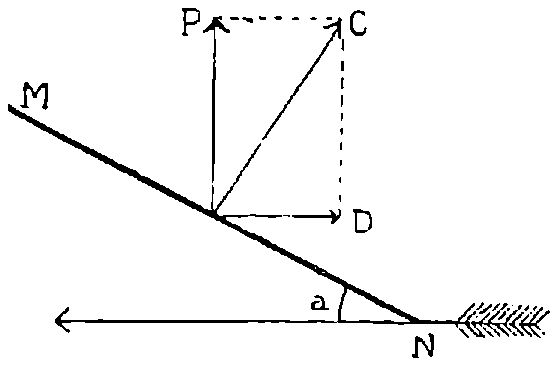
To explain all this, we'll need a simplified drawing. Let the line MN be our kite, seen in section. When we launch the kite and pull on its string, it moves along in a tilted position. Let it be moving from right to left, and let a be the angle between the plane of the kite and the horizontal. What forces act on the kite as it moves? The air, naturally, resists its motion and exerts a certain pressure on it, which Figure 29 shows as the line C. Since air presses at right angles to the surface MN, the line C is drawn at right angles to it. The force C can be resolved into two others by constructing what is called a "parallelogram of forces": in place of C we get the forces D and P. Of these, the force D pushes our kite back and so reduces the speed it had at first. The other force, P, pulls the whole contrivance upward and so takes away from its weight, and if P is great enough, it can overcome that weight and lift the kite. That's why a kite goes up when we pull it by its string.
An aeroplane is at bottom the same kite, except that a motor does the work of our hand. The motor drives a propeller, which thrusts the machine along and gives it its forward motion.
Animal Aeroplanes
We have seen that aeroplanes are not built at all on the pattern of a bird, as people usually think. They are closer to the flying squirrels, the colugos, and the flying frogs. None of these animals use their flying membranes to rise into the air; they use them only to make long leaps, or "gliding descents," as the aviators say. In their case the force P isn't enough to balance the load of the body. It only lightens it to some degree, and so helps the animal make enormous leaps from high places. Flying squirrels leap 20 to 30 meters, from the top of one tree to the lower branches of another. In the East Indies and Ceylon there is a much larger kind of flying squirrel, the taguan, about the size of our cat, that is, about half a meter long, with a tail of the same length. When it spreads its "glider," it is about half a meter across. A membrane of this size lets the animal, for all its weight, make leaps of 50 meters.
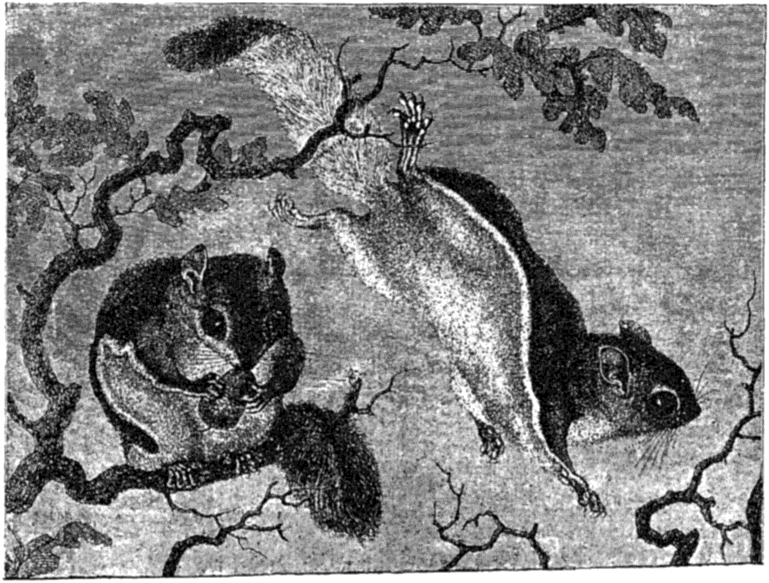
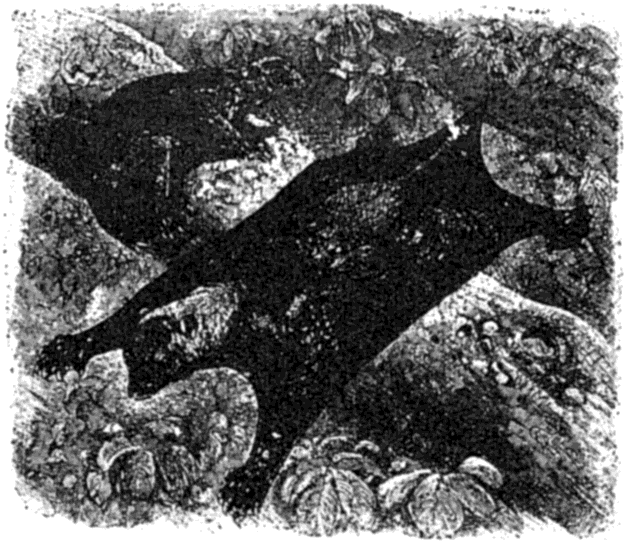
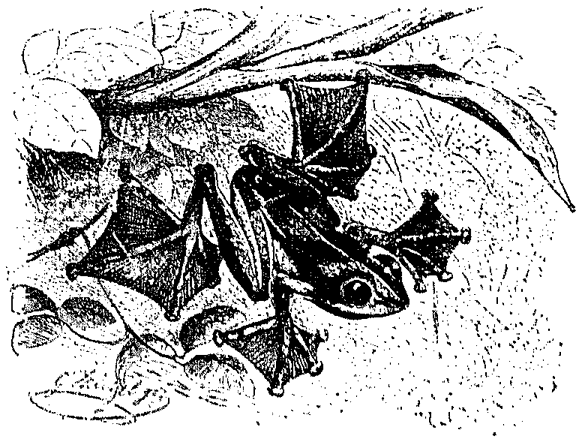
And the colugo, which lives in the Sunda Islands and the Philippines, makes leaps of 75 meters!
The Aeroplane (Glider) in Plants
Plants too often call on the services of aeroplanes (or rather gliders) to spread their fruits and seeds. Nature takes care to provide many fruits and seeds either with tufts of hairs (the fluff of dandelions, willows, fireweed, and cotton) or with supporting surfaces in the form of winglike outgrowths, flanges, and so on. You can see such "plant gliders" on conifers, maples, elms, birches, hornbeams, lindens, many plants of the carrot family, and others.
On the part all these appendages play in spreading plants, the botanist Kerner von Marilaun, in his Life of Plants, says among other things:
"How far fruits and seeds are carried by the wind depends on how perfect their flying apparatus is, on the dampness of the air, and on the strength of the air currents. In calm, sunny weather a great many fruits and seeds are lifted to a considerable height by the rising air, but after sunset they usually come down again close by. Such flights matter less for carrying plants far afield than for settling them on the ledges and in the cracks of steep slopes and sheer cliffs, which seeds could reach in no other way. Masses of air flowing horizontally can carry the fruits and seeds floating in them over very great distances.
"In some plants the wings and parachutes stay attached to the seeds only for the length of the flight. When the winged seed of a pine, for example, settles somewhere, the filmy wing comes off and the seed is carried no farther. Thistle seeds float quietly through the air, but the moment they meet an obstacle, the seed parts from its parachute and drops to the ground. This explains why thistles so often grow along walls and fences. In other cases the seed stays joined to its parachute all the time."
Figure 33 shows some fruits and seeds equipped with parachutes and gliders. In many ways these plant aeroplanes are better than ours. They lift a far greater load, in proportion, of course. It has been calculated that if our Farman biplanes were as perfectly designed as the films of certain flying seeds, those of the Indian jasmine, for example, they would lift a load of 3 metric tons!
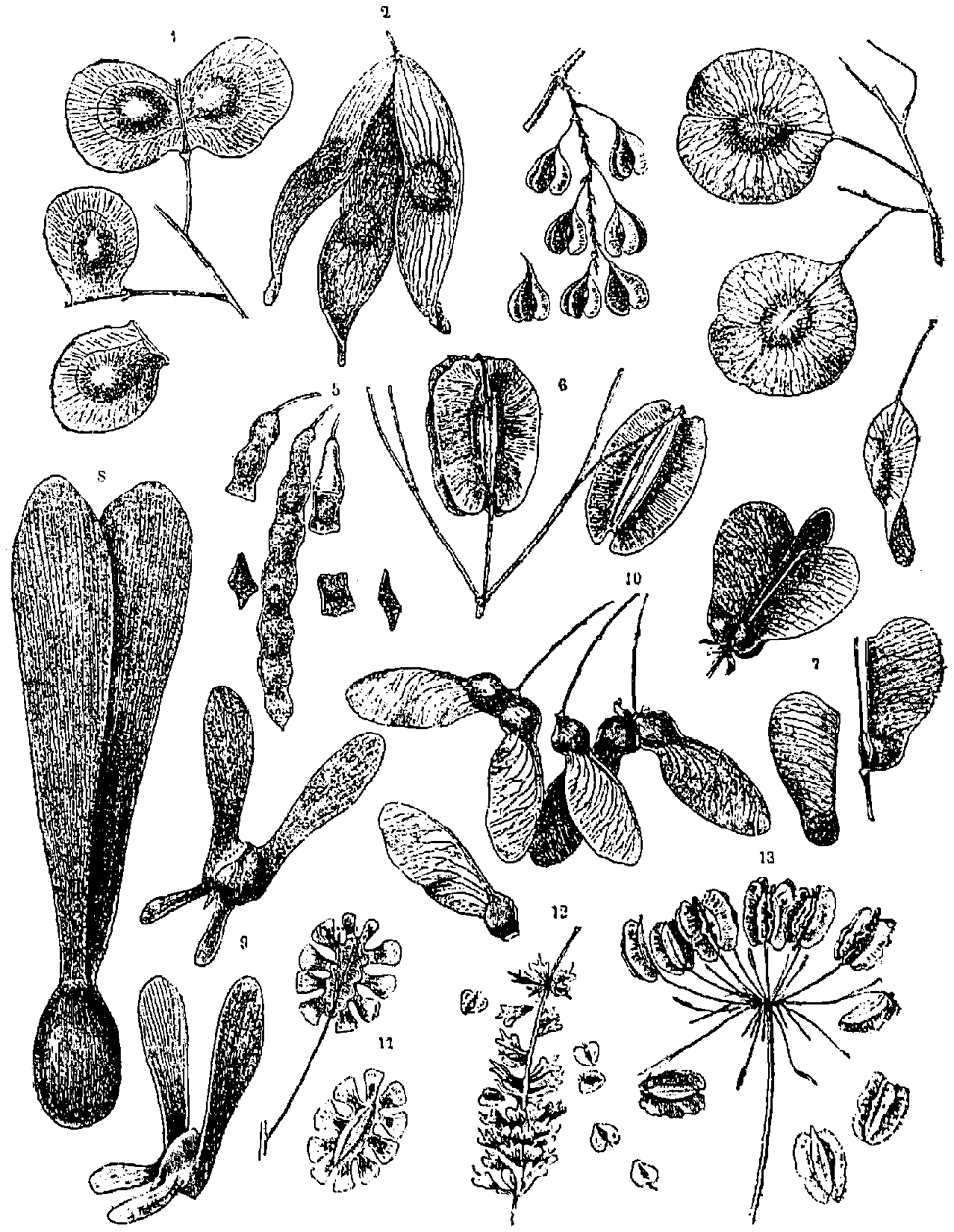
In reality, modern aeroplanes lift only 330 kilograms, almost ten times less. This plant aeroplane has another precious quality, too, which our engineers strive for in vain: automatic stability. Turn an Indian jasmine seed upside down, and it will roll over again, convex side down. If it meets an obstacle in flight, it doesn't lose its balance or drop, but glides smoothly to the ground. How many accidents would be avoided if our aeroplanes had this automatic stability in the air!
The Boomerang
This ingenious weapon of the Australian Aborigines long astonished men of science. And indeed, the strange, tangled figures a boomerang traces in the air are enough to puzzle anyone.
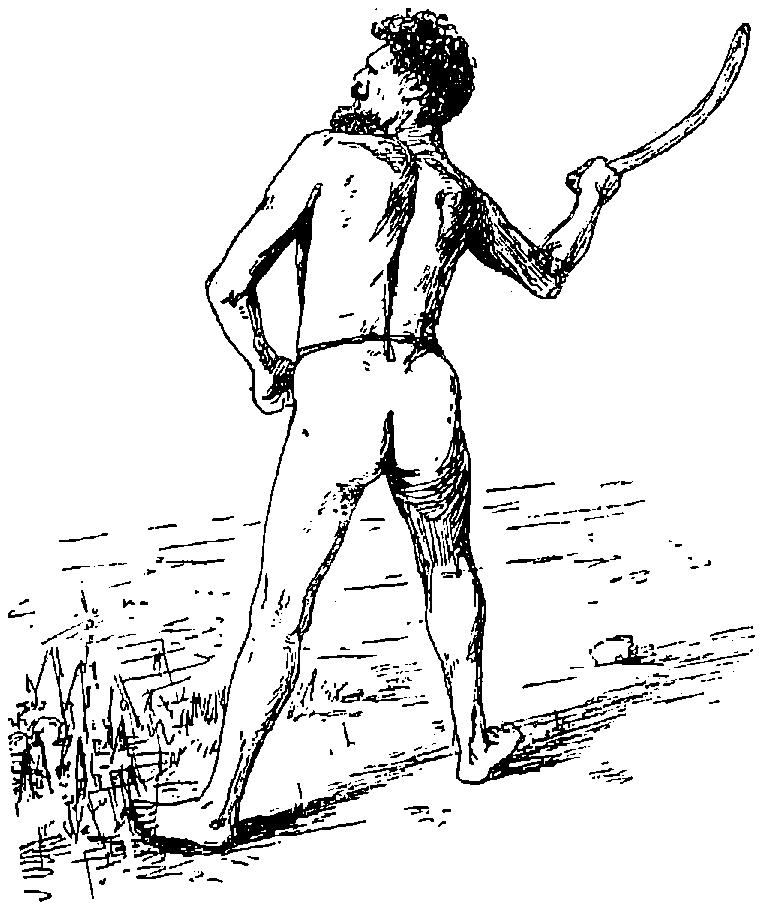
By now the theory of the boomerang's flight has been worked out in great detail, and the wonders are no longer wonders. Interesting as the theory is, we won't go into it here. We'll say only that the extraordinary shape of the boomerang's path comes from three forces working together: the force of the throw, the force of the boomerang's rotation, and the force of the air's resistance, the very force that makes kites and aeroplanes rise. The Australian knows by instinct, and with extraordinary precision, how to combine these three forces, skillfully varying the tilt of the boomerang and the strength and direction of the throw to get the effect he wants.
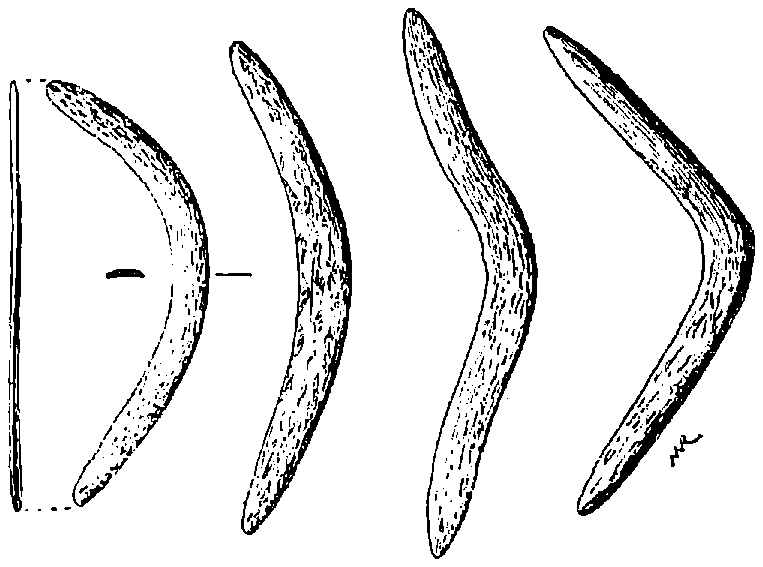
Anyone else can acquire the art too, of course, given patience. Boomerangs are now sold in all the big toy and sporting goods stores. But practicing with one may not always be convenient. It has to be done in the open, with precautions to see that no innocent paleface suffers from the Australian weapon.
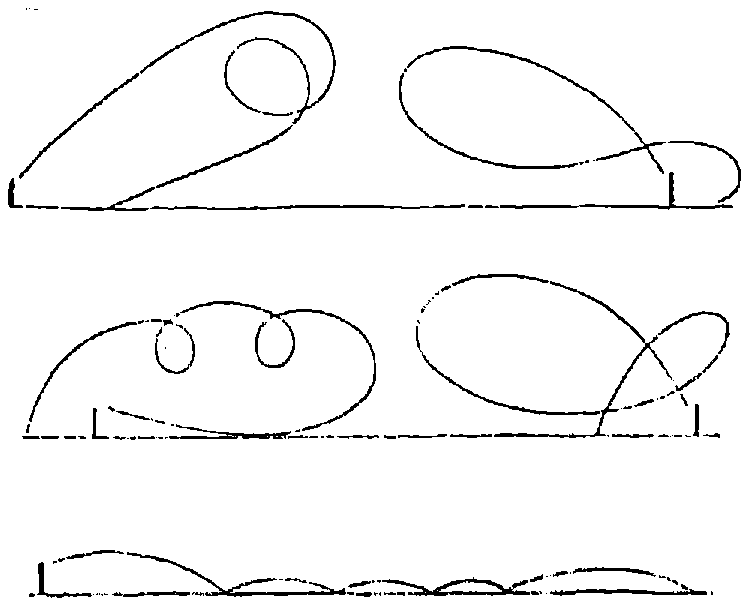
To practice indoors, you'll have to make do with a paper boomerang, which you can cut from a visiting card. Lay it on the palm of your left hand, or on a book, and give it a sharp flick with the thumb and forefinger of your right hand. The boomerang flies up on a slant for three or four meters, sometimes tracing quite elaborate curves.
You can do the same with a little device, a kind of crossbow, that is easily put together at home. It's made from a board 8 millimeters thick, 25 centimeters long, and 12 centimeters wide, with a piece sawn out of it as shown in Figure 38. The line AB is a strip of whalebone or steel, fastened to the board with wires (at A). The other end, B, is free, and the strip is just long enough for this end, when you let it go (the drawing shows the strip bent back), to reach the point C, where the end of the paper boomerang lies. The steel strip strikes the boomerang hard, and so sets it moving forward and rotating at the same time.
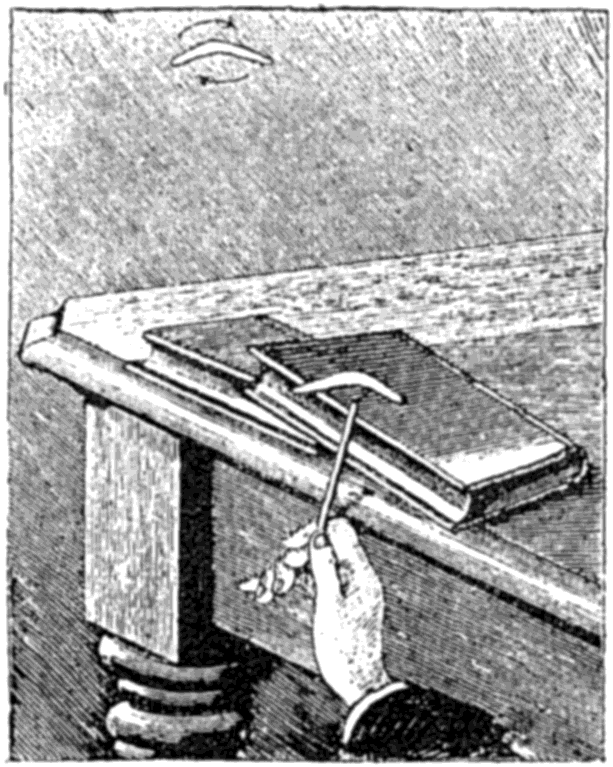
The boomerang itself rests on three short pieces of wire or headless nails (D), stuck into the edge of the board.
By changing the size, shape, and weight of the paper boomerang, and the strength of the steel spring, you can use this little device to study all the peculiarities of a boomerang's flight.
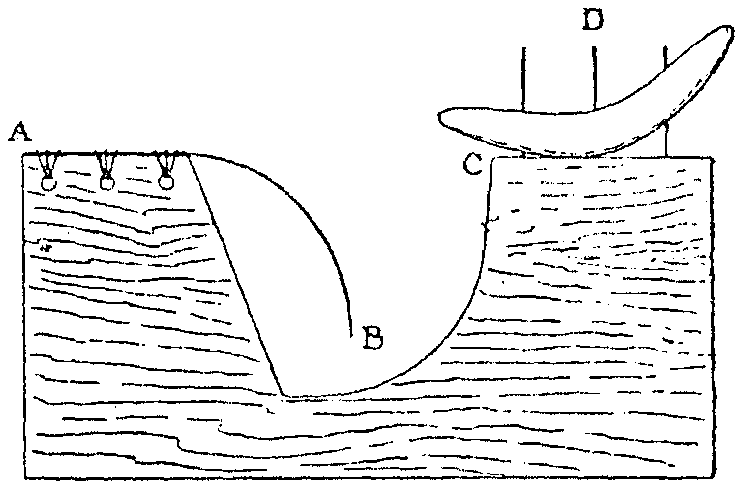
While we're on the subject, the general public (and others besides) have quite mistaken ideas about the boomerang. In the first place, the very name "boomerang" is wrong. The weapon we know by that name is called various things by the Australians, "parkan," "wagno," "knili," but never boomerang.11 In the second place, it's by no means peculiar to the inhabitants of Australia. It is used in various parts of India and, to judge by what remains of wall paintings, was once a common weapon of Assyrian warriors. In ancient Egypt and Nubia, too, the boomerang was well known. There is even reason to think that the earliest inhabitants of Europe were acquainted with it. The only thing that belongs to Australia alone is the screwlike twist that is given to the boomerang there.
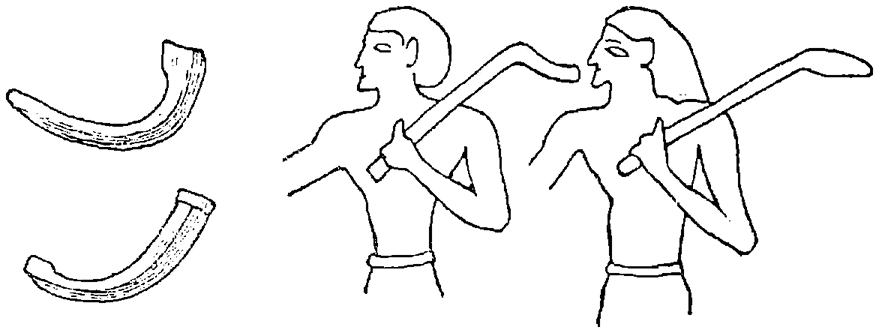
That's why Australian boomerangs are the most perfect: they soar upward, trace complicated curves, and, if they miss, come back to the thrower's feet. We stress the words "if they miss" because it's widely believed that a boomerang always returns to the Australian's feet. That isn't so: when it has hit its victim, the boomerang falls to the ground along with it.
Chapter 6: Properties of Liquids
A Glass and a Bucket Press Equally Hard!
Pascal, and Stevin even before him, proved that the pressure of a liquid on the bottom of a vessel depends only on the area of the bottom and the height of the surface above it, and on nothing else. Vessel A holds a glass of water; vessel B holds very nearly a whole bucketful. And yet, by Pascal's law, the bottoms of the two vessels are under the same pressure, as long as their areas are equal and the water stands at the same level.
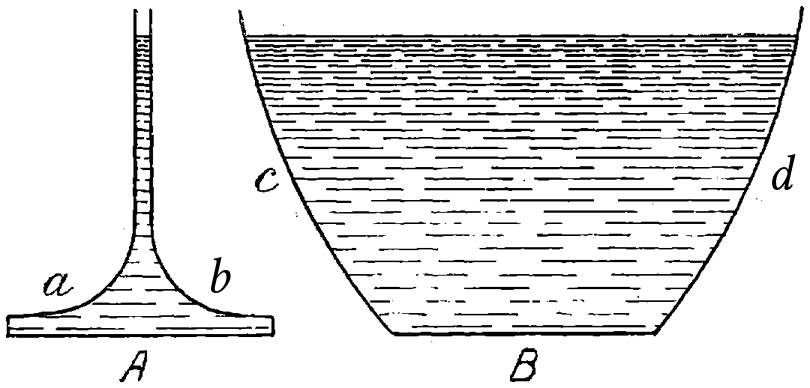
This seems quite incredible. After all, if the water in both vessels presses equally hard on the bottom, then when we put the two vessels on the pans of a balance, we must expect the pans to stay level! But can a glass of water weigh as much as a bucket of water? Clearly, Pascal's law is wrong.
No, Pascal's law isn't wrong. The reasoning is.
Vessel B presses on the pan not only with its bottom: the pressure of the water on the side walls c and d is passed on to the pan as well. On the other pan there is none of this extra pressure. On the contrary, something is taken away, because the liquid presses upward on the walls a and b. Vessel A as a whole, therefore, weighs less than vessel B, and the contradiction that bothered us disappears.
Liquids Press Upward
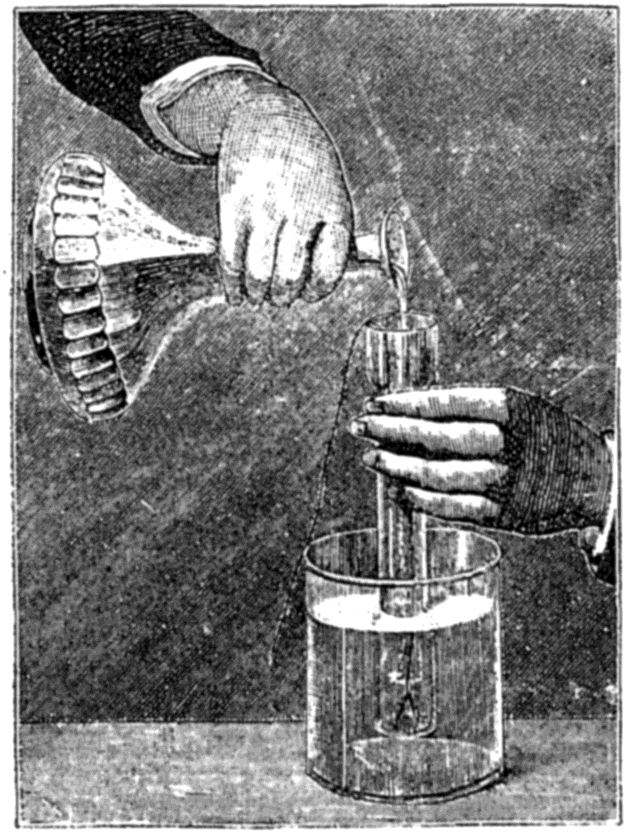
We've just mentioned the upward pressure of a liquid. With an ordinary lamp chimney, the glass tube from an oil lamp, you can convince yourself that this pressure really exists. Cut a disk of stout cardboard just big enough to cover the opening of the chimney. Hold it against the rim and lower the chimney into water, as shown in the drawing. To keep the disk from falling off on the way down, you can hold it by a string or simply press it on with a finger. When you've reached a certain depth, you'll notice that the disk stays on by itself, with no finger to press it and no string to pull it: the water is holding it up, pressing on it from below.
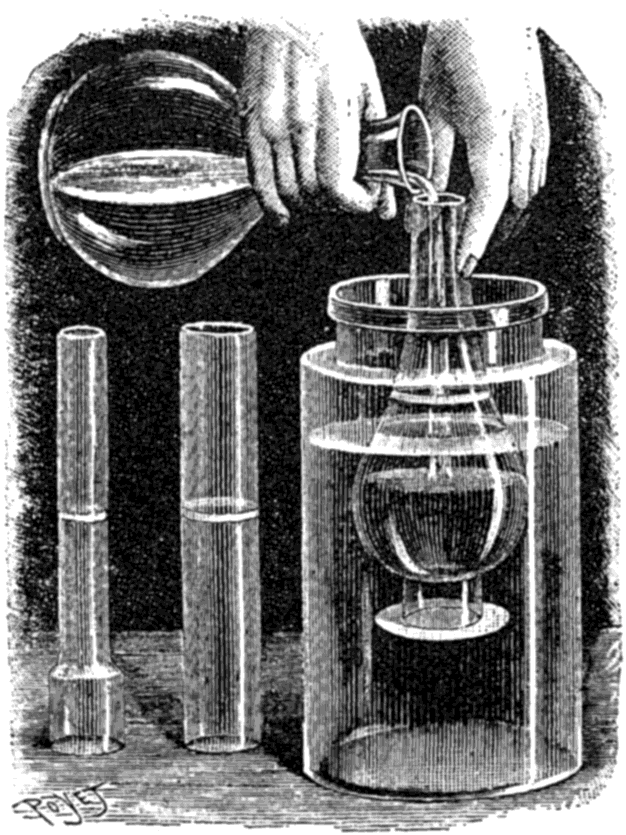
It isn't hard to measure this upward pressure, either. You need only pour water into the chimney. As soon as the water inside stands level with the water in the vessel, the disk drops off. The upward pressure of the water, then, is balanced by the pressure of a column of water whose base is the area of the disk and whose height is the depth of the disk below the surface.
If you have several lamp chimneys of different shapes but with the same size of opening, you can test Pascal's law, which says, as we know, that the pressure of a liquid on the bottom of a vessel depends only on the area of the bottom and the height of the surface, and doesn't depend on the shape of the vessel at all. To test it, repeat the experiment with the different chimneys, lowering them all to the same depth (for which you should first glue paper strips to the chimneys at the same height). You'll find that the disk drops off every time when the water in the chimney reaches one and the same level. This shows that columns of water of different shapes exert the same pressure, as long as their bases and their heights are the same. (The heights, mind you, and not the lengths: a long slanting column presses just as hard as a short upright one of the same height, if their bases are equal.)
A Letter Balance
You can put the upward pressure of water to use in making a few handy things for the house. You can, for example, without much trouble, put together a balance for weighing letters and other light objects, a most useful article whose absence one often regrets. Figure 43 shows a homemade letter balance of the simplest kind. Take a smoothly planed wooden rod about 30 centimeters long (a piece cut from a broken walking stick will do) and stand it upright in a jar of water, with a weight tied to its lower end so that it keeps its balance. Glue a stiff visiting card flat on the upper end, which sticks out above the water. It now remains only to mark the scale on the rod, and the balance is ready. You mark it by trial, of course: lay weights of 10, 20, 30, 40 grams, and so on, on the card, and each time scratch a line on the rod at the surface of the water. After that, put a letter on the "pan," and you can read its weight straight off from the mark to which the rod sinks.
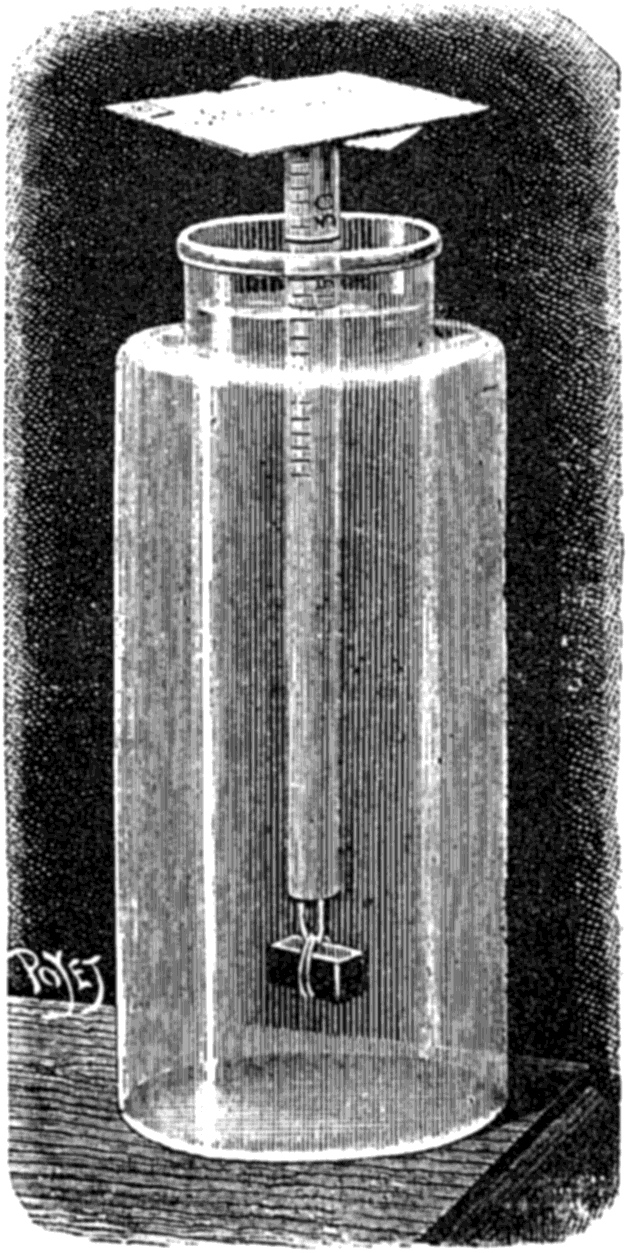
If you have no weights, you can use copper coins, remembering that a one-kopeck piece weighs a little over 3 grams.
When the wooden rod gets waterlogged, it will grow heavier, so don't leave it standing in the water after use; take it out of the jar each time and dry it. In case of doubt, you can use the method of "weighing by substitution" described in "How to Weigh True on a False Balance."
A Candle in Water
Stick a nail into the bottom of a stearin candle (a short piece is what you want), float it in a glass of water, and you have a simple and practical night-light. As the candle burns down, it must keep rising out of the water, and so it will go on until it has burned almost completely away. This seems hard to believe, and yet it's easy to convince yourself that what we say is true. The parts of the candle next to the water are cooled by it, and so the flame doesn't melt them. As a result a goblet-shaped hollow forms in the candle, and at the bottom of it the wick goes on burning even when it's below the level of the water.
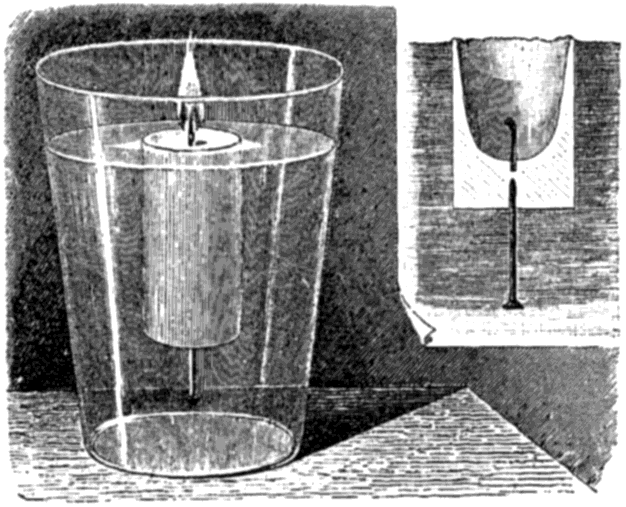
What makes this night-light practical is its safety: if the glass with the candle is knocked over, the water, as it spills, will put out the flame by itself.
The Kopeck That Doesn't Sink
Let's begin our experiments with something lighter: needles. It seems impossible to make a needle float on water, and yet it isn't hard. Lay a scrap of cigarette paper on the surface of the water, and on it a perfectly dry needle. All that remains is to remove the paper carefully from under the needle. You do it like this: with another needle, or a pin, push the edges of the scrap gently down into the water, working little by little toward the middle. When the whole scrap is soaked, it will sink to the bottom, and the needle will go on floating. With a magnet held against the side of the glass (at the level of the water) you can even steer it.
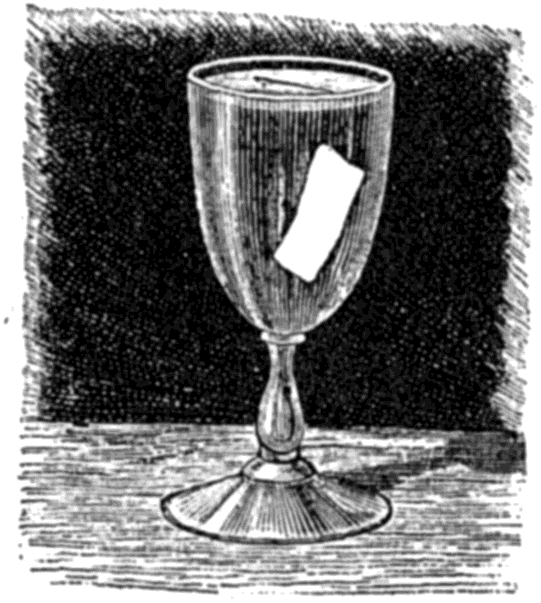
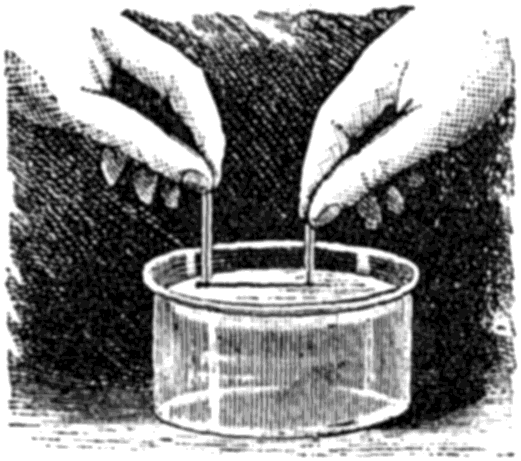
In place of the needle you can float a pin, a tiny silver five-kopeck piece, and other small metal objects. When you've got the knack of it, try floating a copper kopeck too.
With a little skill you can do without the cigarette paper and lay the needle right on the surface of the water, either with your fingers or by means of loops of thread or a fork, as shown in the drawings. Water doesn't wet dry iron very strongly, and so around the floating needle a hollow forms in the surface of the water (you can actually see it). The needle weighs less than the volume of water it pushes aside in this way, and so, by Archimedes' principle, the needle must float.12
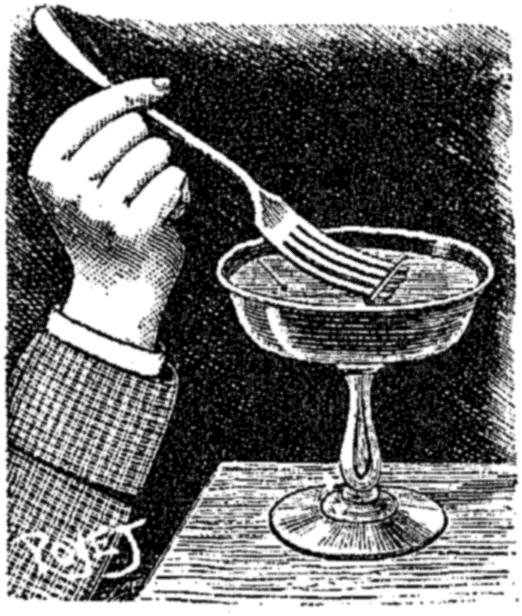
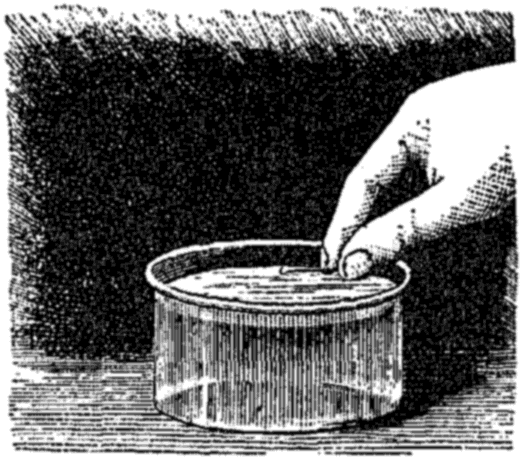
The simplest way to manage it is to grease the needle with oil. The water doesn't wet such a needle at all, and you can lay it boldly on the surface with no fear that it will sink.
Which Is Heavier?
On one pan of a balance stands a bucket filled to the brim with water. On the other stands a bucket exactly like it, also full to the brim, but with a piece of wood floating in it. Which bucket will outweigh the other?
Some will say it must be the bucket with the wood in it. Others will say that, on the contrary, the first bucket will win, because water is heavier than wood.
Neither answer is right. Odd as it may seem, both buckets weigh the same. True, the second bucket has less water in it than the first, because the floating piece of wood displaces some of it. But by the laws of physics, a floating body displaces, with the part that is submerged, exactly as much liquid as weighs the same as the whole body. That's why the balance stays level.
A Volcano in a Glass of Water
Liquids float and sink by the same laws as solids. If they're heavier than the liquid they are put into, they sink; if they're lighter, they rise to the top.
The following experiment makes use of the way one liquid floats in another (here red wine in water, alcohol being lighter than water). It's a fair amount of trouble, but to make up for that it's very striking.
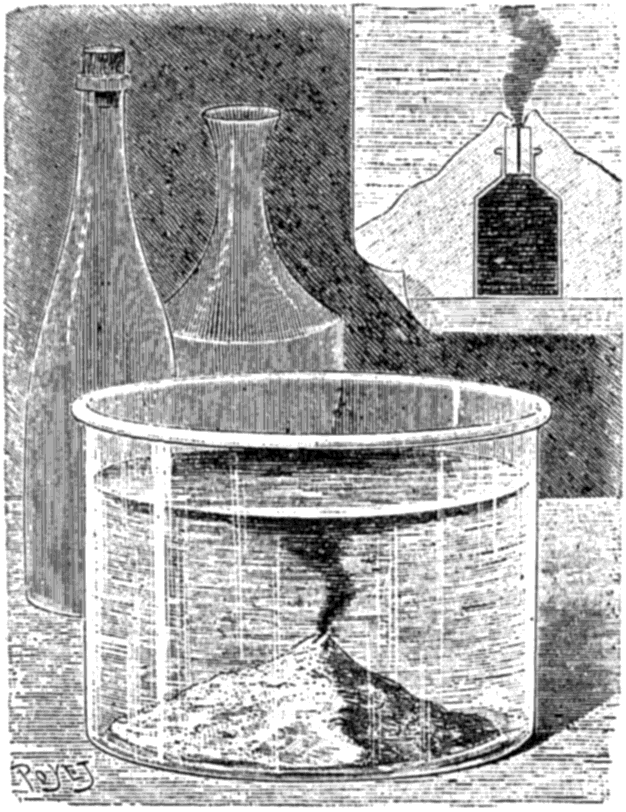
Take a wide jar like those used for small aquariums. Inside it, build a cone of plaster of Paris to represent the mountain. Into the mountain set a small narrow-necked bottle, a phial, of red wine, so that the mouth of the phial serves as the volcano's "crater." Plaster is very easy to handle. Buy it as a powder at a hardware store, pour it out onto a potsherd, and stir it with a stick of wood into an equal quantity of water; when it begins to thicken, pack it around the phial, which you have stood on the bottom of the jar.
Now the volcano is ready, but it's still at rest. To rouse it, you need only fill the jar with water. The wine, being the lighter liquid, will rise from the phial walled up in the plaster and hang above the crater as a reddish smoke. For greater effect, stir the water in the vessel gently. The red "smoke" will billow as if in the wind, and you'd swear you were watching a volcano in eruption.
The Magic Filling of a Bottle
The next experiment rests on the same habit liquids have of arranging themselves by their specific gravity. You have a keg full of wine, with no tap; it's closed on all sides and has only one opening, at the top. You are to fill an empty bottle with this wine without moving the keg and without any apparatus.
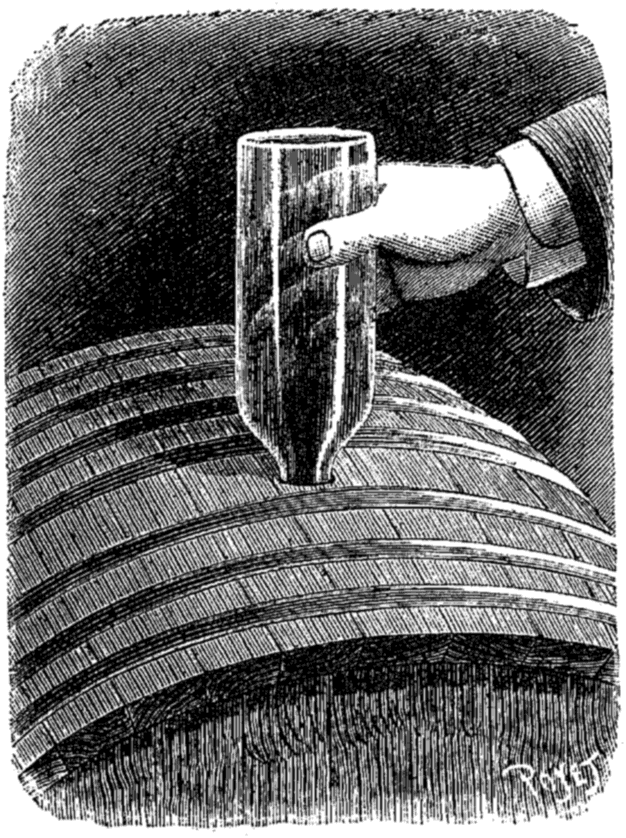
This problem may stump the most resourceful person, if he doesn't know enough physics. And yet the answer is almost as simple as that of the celebrated problem of Columbus and the egg.
Knowing that water is heavier than wine, fill the bottle with water, stop it with your finger, turn it over, dip its neck into the wine, and, when its mouth is below the surface, take your finger away. It's easy to see what must happen: the water will come out of the bottle, and wine will rise into its place. After a while the whole bottle will be full of wine.
If the hole in the keg is very small, so that only the neck will go through and there's no room for the finger, you have to proceed a little differently. Cut a small disk of paper and cover the mouth of the bottle with it, the bottle being filled with water to the very brim, so that the paper lies right against the water. Now you can turn the bottle over, and the water won't run out. Put the neck into the hole in the keg, and push the disk off by moving the bottle sideways.
How Worlds Are Formed
We've just seen that one liquid can float or sink in another. But it can also be in equilibrium inside the other liquid, neither rising nor sinking. And then something rather unexpected and curious happens.
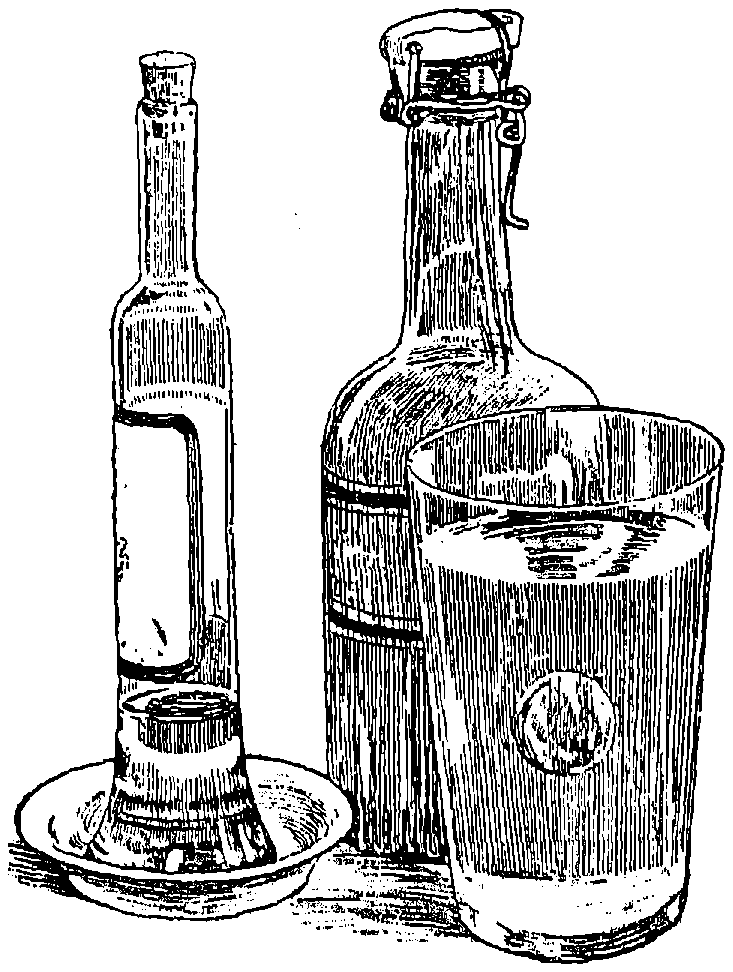
You can easily see it for yourself if you'll take the trouble to do the following experiment. Olive oil floats in water but sinks in pure alcohol, and so you can mix water and alcohol in such proportions that the oil neither sinks nor rises. With a syringe, put a little oil into this mixture, and you'll see the oil gather into a large, perfectly round drop, which hangs motionless inside the liquid. The experiment takes a certain knack; otherwise you'll get several smaller balls in place of one large drop. But even in this form it's interesting enough.
That isn't all, however. Pass a long wooden toothpick or a wire through the center of the liquid ball of oil and turn it like an axle. The ball of oil will join in the rotation. (The experiment goes better if you fix on the axle a small disk of cardboard, moistened with oil, that stays entirely inside the ball.) As it turns, the ball will begin by flattening under the action of centrifugal force, and then, after a few seconds, will throw off a ring. When this ring breaks up, it does not form shapeless scraps but round drops, which go on circling the central ball like planets around the Sun.
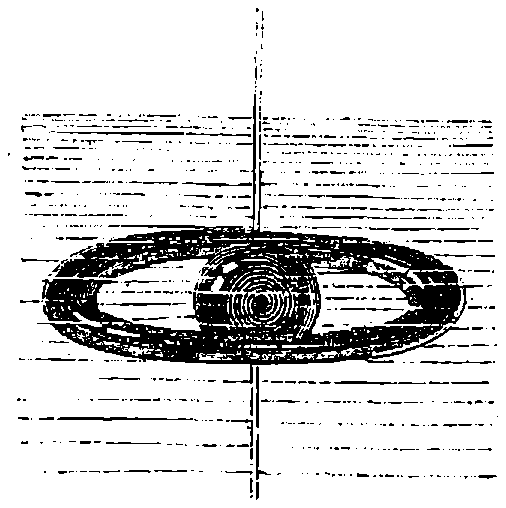
This is no mere comparison: what you see here is an exact likeness of the way the planets were formed from the primeval nebula...
The first to make this beautiful and instructive experiment was the physicist Plateau.
Liquids in Jules Verne's Shell
We've already satisfied ourselves that inside the flying carriage that Jules Verne dreamed up, the shell fired at the Moon, everything must lose its weight. Liquids, of course, are no exception, and the reader will probably guess easily enough what becomes of them under such conditions. Still, the question is curious enough to be worth a closer look.
Jules Verne describes how the passengers in the shell celebrated their passage through the neutral zone: they stood their glasses in the air, poured wine into them, and drank.
It can hardly have been like that. For one thing, how did they get the wine out of the bottle? Simply tipping the bottle over isn't enough, because a weightless liquid won't pour. You'll say that they shook the wine out, slapping the bottom of the bottle with the palm of the hand. We'll soon see that this is hardly right either; but first let's ask what will become of a weightless liquid outside the bottle. Plateau's experiment, which we have just described, gives the answer: it will gather into a ball and hang like that in the air. The passengers will have to swallow these balls as we swallow capsules of castor oil. As you see, there's no need for glasses at all; one can do perfectly well without them.
What's more, in this case the glasses would probably spoil the whole party. Let's try to work out what becomes of weightless wine if it's "shaken" out of the bottle into a glass. Alcohol, as we know, wets glass; that means that the attraction between alcohol and glass is greater than the attraction of the particles of alcohol for one another. Wine differs little from alcohol in this respect. If we "shake" weightless wine into a glass, therefore, it won't stay inside. It will spread over the glass's inner and outer surfaces and surround it on all sides with a liquid film. The passengers would have had to lick this film off, because under such conditions it's impossible to drink wine from a glass in the ordinary way.
We can now see that there would have been no need to "shake" the wine from the bottle, either. The moment the cork was drawn, the wine would flow out of the bottle by itself and surround its outer walls on all sides. The passengers would have had quite a struggle before they "poured" this weightless wine into their glasses. And it's a good thing that the bottle and glasses were "standing in the air." If they had been on a table, the wine would have spread over the table, then over the floor and the walls of the carriage, and the gallant passengers would have had to celebrate crossing the neutral zone with empty glasses.
As it happens, we've already proved that things inside the shell become weightless from the first moment of the flight, so that our travelers would have had to put up with annoyances of this kind the whole way.
How to Come Out of the Water Dry
"To come out of the water dry" is the Russian way of saying that someone has got off scot-free. It turns out that the thing can be done literally. At any rate, you can take a ring from the bottom of a vessel full of water without wetting your hand. All you need is a jar of a special powder called lycopodium, or club-moss spores, which any pharmacy will sell you. Sprinkle some of it on the surface of the water, then plunge your hand in quickly and pick up the ring without fear. When you take your hand out, you'll find to your astonishment that it's as dry as it was before. The secret is that a film of lycopodium wraps itself around the hand like a glove and keeps the water off.
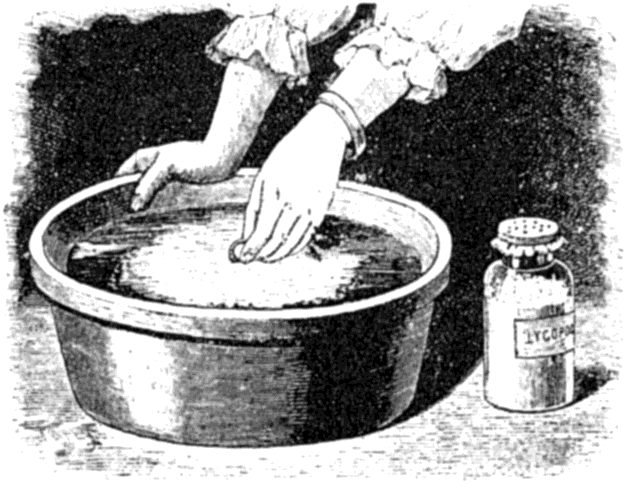
How to Carry Water in a Sieve
Besides helping you come out of the water dry, a knowledge of physics lets you do another thing that sounds impossible: carry water in a sieve. Take a wire sieve with fairly large holes and dip the mesh in melted paraffin wax. Lift it out and let it dry; the wire will now have a thin coat of wax that the eye can barely see. The sieve is still a sieve, but now you can carry water in it, quite literally. It will hold a fairly deep layer, and none will run out through the holes.
Why doesn't the water run out? For the same reason that it doesn't pour out of a capillary tube: it clings to the wax and forms a watery film strong enough to support a layer of water.13 You can think of such a sieve as a large bundle of very short, thin tubes, each of which holds its own little column of water.
An Imaginary Perpetual Motion Machine
Many books describe the following device as a true perpetual motion machine. Wicks draw oil (or water) from a trough up to a lower reservoir, and other wicks draw it from there to a higher one. The upper reservoir has a spout for the oil to run off, and the oil falls on the blades of a wheel and turns it. Having run down into the trough, the oil climbs the wicks to the upper reservoir again. The stream flowing from the spout onto the wheel is therefore never interrupted for a second, and the wheel ought to keep turning forever... A tempting little whirligig, isn't it?
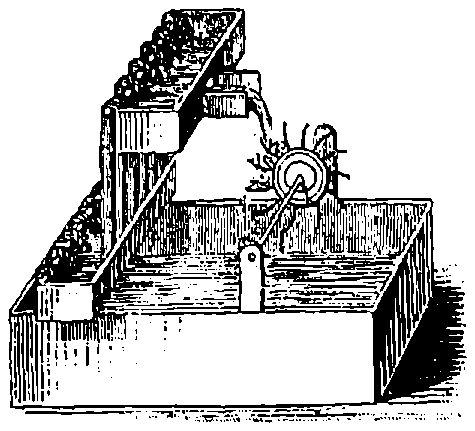
If the people who sing its praises had taken the trouble to build it, they would have found that the wheel doesn't turn, and more, that not one drop of liquid ever reaches the upper reservoirs.
You can convince yourself of this by simple reasoning, without even setting about building the thing. Why, after all, should the oil run off the top of the wick where it bends over? The very force that overcame gravity and raised the liquid up the wick will hold it in the pores of the soaked wick and keep it from dripping. Wicks can move a liquid only from a higher level to a lower one, never the other way around. If some liquid did somehow get into the upper reservoir of our imaginary machine, the same wicks that were supposed to have brought it there would themselves carry it down to the lower reservoir, and from there to the trough.
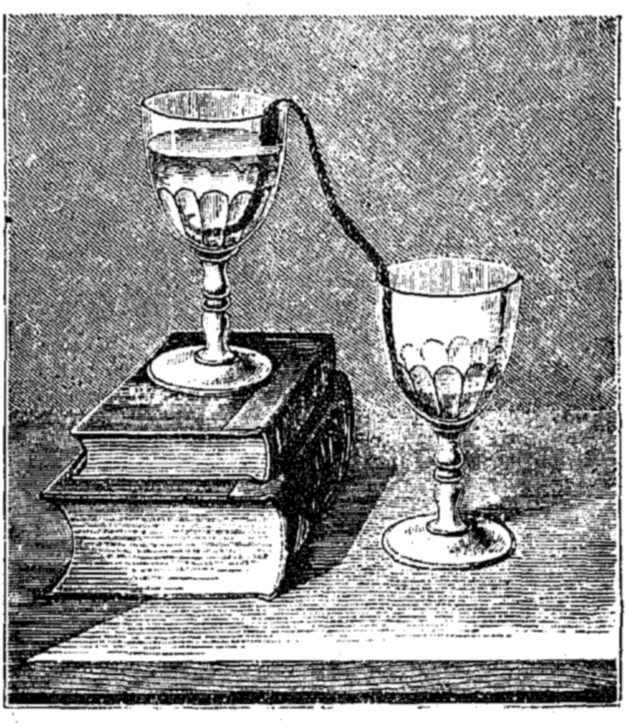
That wicks carry liquids from a higher level to a lower is easy to check. A plain strip of woolen cloth, moistened with water beforehand, will do for a wick, and two wineglasses, placed as in the drawing, will do for reservoirs. In less than an hour the strip will have drawn the contents of the upper glass into the lower. But the water won't go back from the lower glass to the upper, for the reason we've just given.
Experiments with Broken Matches
A half-broken match is generally thought good for nothing, and yet it can serve for a whole series of entertaining experiments. They rest on a property of wood fibers, which suck up water and straighten under the pressure of the water that has got inside them. Let a drop of water fall on the break, and the match slowly begins to straighten. The next experiment shows with what force it does so (Figure 56). Pin a half-broken match to a matchbox as the drawing shows, and to its end tie a thread looped around five or six matches. Let a drop of water fall on the break, and the match, as it straightens, will drag the whole bundle along.
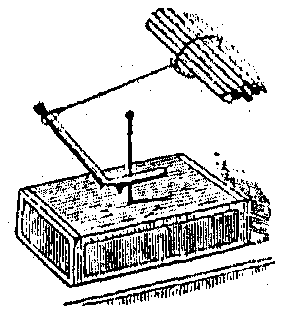
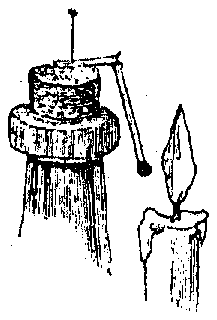
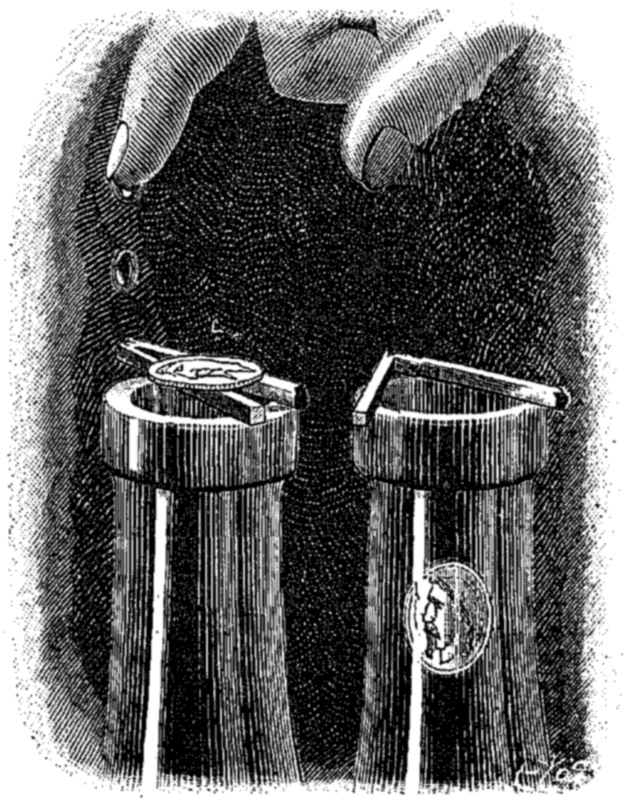
Of the many experiments based on this property, here is one. Partly break a match near the end without a head and pin it to a cork (Figure 57). Stand a lighted candle beside the cork. Let a drop of water fall on the break, and the match, straightening, will light itself at the candle flame.
And here is another curious one. Lay a half-broken match across the mouth of a bottle and a coin on top of it, as in our drawing, and invite your guests to move the coin to the bottom of the bottle... with a drop of water!
Anyone not in on the secret will be baffled. But the puzzle is like the casket in Krylov's fable, which wasn't locked at all and simply opened: a drop of water on the break spreads the two halves of the match apart, and the coin falls into the bottle by itself.
Figures That Move by Themselves
Figure 59 shows how this property of broken matches can be put to work in moving figures. Cut the body and the separate parts of the figure out of stiff paper; draw and color the front, and on the back fasten half-broken matches with sealing wax, setting the limbs in a position of rest. Now you need only lay the figures, back downward, on a wet plate, and they'll begin to move.
The simplest "hygroscopes," or indicators of humidity, depend on the power of fibers and other materials to take up moisture from the air. These materials change shape as they grow damp, and so move the parts of the figure joined to them: they put a monk's hood over his head, raise a hand holding an umbrella, and the like.
Soap Bubbles
In everyday life soap bubbles don't enjoy a good reputation; at least, when we bring them into conversation the comparison isn't very flattering. A physicist takes quite another view. "Blow a soap-bubble and look at it," said the great British scientist Lord Kelvin; "you may study all your life perhaps, and still learn lessons in physical science from it." And indeed, the enchanting play of colors on the surface of the thinnest soap films made it possible for physicists to measure the length of light waves, and the study of the tension in those films revealed the laws by which molecular forces act. Some of the hardest branches of physics were worked out by experiments with these delicate toys.
The few experiments described below have no such serious aims. They are simply an interesting pastime that will introduce us to the art of blowing soap bubbles, an art that takes a certain knack. Once you have the necessary skill, you can go on to truly scientific experiments with bubbles. The English physicist Boys has described in detail several dozen of them, varied and systematic. His book Soap-Bubbles exists in a Russian translation,14 and we refer to it any reader whose interest is caught by the very simple experiments given here.
All the experiments below can be done with a solution of ordinary yellow tallow soap, but for those who wish it we recommend what is called white Castile soap as the best for large and beautiful bubbles. Get a piece of it (from a pharmacy or druggist's) and dissolve it carefully in clean cold water until you have a fairly thick solution. Soft rainwater or melted snow is best of all. To make the bubbles last, the Belgian physicist Plateau advises adding glycerin to the soap solution, one-third by volume. Skim the froth and bubbles off the surface with a spoon, and then dip in a thin clay pipe, having first smeared the end of it with soap inside and out.
A straw some 10 to 13 centimeters long, its end split crosswise, also gives good results.
Besides clay pipes (the so-called Dutch ones) and straws, you can use tubes of rolled paper about as thick as a pencil. These, too, must be split crosswise at the end.
To blow a bubble, draw a little of the solution into the tube (practice will show you how much) and blow gently, holding the tube vertical. The bubble fills with warm air from our lungs, which is lighter than the air of the room, and so, once blown, it tends to rise.
If you manage right away to blow a bubble about 13 centimeters across, your solution is good. If not, add more soap to the liquid until you can blow a bubble of that size. But this isn't enough. When you've blown your bubble, dip an index finger in the soap solution and try to push it through the bubble. If the bubble doesn't burst, you may begin the experiments; if it can't stand having its walls stretched like this, you'll have to add still more soap.
Do the experiments slowly, carefully, and calmly; only then can they succeed completely. The light should be as bright as you can make it; otherwise the bubbles won't show off their magnificent rainbow colors.
Now let's go on to some of the experiments.
A soap bubble around a flower. Pour soap solution into an empty bowl or saucer until it covers the bottom to a depth of 2 to 3 millimeters. In the middle lay a water lily or some other large flower, and cover it with a glass funnel. Then, slowly raising the funnel, blow into its narrow tube, and a soap bubble will form. When it's large enough, tilt the funnel as the drawing shows and free the bubble from under it. The flower will now be lying beneath a transparent dome of the thinnest soap film (see Figures 60 and 61).
In place of the flower you can use a statuette and crown its head with a little bubble, as in Figure 62. For this you must first let a little of the solution drip on the statuette's head; then, when the large bubble is blown, pierce it with a tube and blow a small one inside it.
Putting a soap bubble on a flower. Take an aster or another flower with springy petals and dip it lightly in the soap solution until its center is wet. Holding the flower by its stem in your left hand, blow a soap bubble from a pipe in your right, and at once transfer it gently to the flower (Figure 63). If the whole flower has been dipped in the solution, the bubble will enclose it on every side.
Several concentric soap bubbles (Figure 64). From the bowl you used for the first experiment, blow a large soap bubble as before. Then dip a straw right into the soap solution, so that only the tip you'll put in your mouth stays dry, and push it gently through the wall of the first bubble as far as the center. Now draw the straw slowly back, without bringing it all the way to the edge, and blow a second bubble inside the first; in that, a third, a fourth, and so on, up to five or seven.
A chain of bubbles. To make the chain of bubbles shown in Figure 65, you must quickly toss several bubbles into the air one after another, as nearly as possible of the same size. The more skillful the experimenter, the longer the chain.
With wire frames and skeletons you can get soap bubbles of the most varied shapes. The wire must on no account be smooth; rusty wire suits best. You get the shape at the top right in Figure 66 by plunging a wire cube right into the soap solution and lifting it out. Dip the cube a second time (its lower face only), and you'll get the shape at the top left: a cube inside a cube.
The cylindrical bubble on the right of Figure 66 is formed between two wire rings. Lower an ordinary round bubble onto the bottom ring, which stands on three legs like a trivet (see the middle drawing at the bottom of our plate). Then touch the second ring, wetted, to the top of the bubble and raise it, stretching the bubble until it becomes a cylinder.
Curiously, if you raise the upper ring to a height greater than the ring's circumference, half of the cylinder will narrow and the other half widen, and then it will break up into two cylinders of unequal size.
The film of a soap bubble is always under tension and presses on the air enclosed in it. Point the straw at a candle flame, and you can easily see that the force of these thinnest of films is far from negligible: the flame swings sharply aside (Figures 67 and 68).
It's interesting to watch a bubble when it passes from a warm room into a cold one: it shrinks noticeably, and conversely, when it passes from a cold room into a warm one, it swells. The reason, of course, is that the air enclosed in the bubble contracts and expands.
The lovely play of a bubble's colors is especially striking if, having blown the bubble, you draw it back into the tube and then blow it a second time.
Here we'll take leave of soap bubbles, and of experiments on the physical properties of liquids altogether. In the next chapter we shall be dealing with gases.
Chapter 7: Properties of Gases
Do a Kilogram of Water and a Kilogram of Iron Weigh the Same?
People who aren't quick on the uptake are often "caught" with the question: "Which is heavier, a kilogram of water or a kilogram of iron?" The simpleton usually answers that a kilogram of iron is heavier, of course, and gets a loud burst of laughter.
The jokers would probably laugh louder still if the simpleton lost his head and answered that a kilogram of water is heavier than a kilogram of iron. That sounds like utter nonsense, and yet, strictly speaking, it is the only right answer!
Our strange assertion rests on Archimedes' principle, which applies, as you know, to gases as well as liquids, and among gases, of course, to air. Every body in the air loses as much weight as the air it displaces weighs.
Water and iron too, of course, lose part of their weight in air, and to get their true weights we must add this loss.
In our case, therefore, the true weight of the water equals 1 kilogram + the weight of a volume of air equal to the water's; the true weight of the iron equals 1 kilogram + the weight of a volume of air equal to the iron's.
But the water takes up more room than the iron, and therefore the true weight of our kilogram of water is greater than the true weight of the kilogram of iron! To be more exact, we ought to say: the true weight of the amount of water that weighs a kilogram in air is greater than the true weight of the amount of iron that also weighs a kilogram in air.
How to Lift a Heavy Load with a Puff of Breath
Glue together a long rectangular bag out of paper, lay it on the table in front of you, stand a thick, heavy book on it, and try to blow the bag up, as in the drawing. At first sight it seems that the part of the bag squeezed between the table and the book won't inflate. Try it, however, and you'll soon find that your breath alone can raise and tip over a fairly weighty volume, or even two. And a book isn't the limit: you can lift a grown man in the same way.
The Disobedient Cork
The last experiment convinced you that the elastic pressure of air is a force, and a very respectable one. The next will confirm you in that belief.
All you need is an ordinary bottle and a cork smaller than the bottle's mouth. Hold the bottle horizontally, put the cork in its neck, and invite someone to blow the cork into the bottle.
Nothing, it would seem, could be easier. But try it: blow hard on the cork, and the result will amaze you. Far from going into the bottle, the cork will... fly straight in your face!
The harder you blow, the more violently the cork flies back.
To get the capricious cork to slip inside the bottle, you must do exactly the opposite: don't blow on the cork, but suck the air out through the opening above it.
The explanation of these surprises is extremely simple. When you blow into the neck of the bottle, you are really blowing air into the bottle, through the gap between the cork and the sides of the neck. This raises the pressure of the air in the bottle, and the air throws the cork out with force. When you suck, on the other hand, you rarefy the air in the bottle, and then the pressure of the air outside pushes the cork in.
The experiment works well only when the neck is perfectly dry.
It is closely related to a fact known to everyone who keeps house: when you fill a bottle through a funnel, you must lift the funnel from time to time, or the liquid won't run down into the bottle. Here, once again, the obstacle is the air, which has no way out of the bottle and keeps the liquid from running down. Lifting the funnel opens a way out for it, between the outer wall of the funnel and the neck. It would be very practical, therefore, to make funnels with lengthwise ridges on the narrow part, which would keep it from fitting tight against the neck. Glass manufacturers, please take note.
The Drinking Trough That Never Runs Dry
Take a bowl of water and stand a bottle full of water in it, neck down. You'll see that although the bottle is uncorked, the water doesn't pour out of it: atmospheric pressure holds it up.
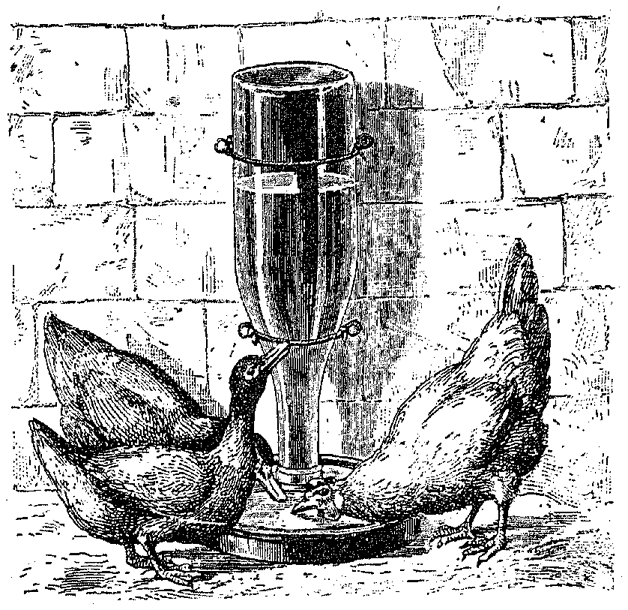
On this principle you can make an extremely practical drinking trough for poultry. The drawing shows at once, without explanation, how simply it's built. Its special feature is that the water in the bowl stays at the same level as long as there is water in the bottle. As soon as the water in the bowl falls below the mouth of the bottle, water pours out and stops the mouth up again.
Another Way to Come Out of the Water Dry
Put a coin on a large flat plate, pour on enough water to cover the coin, and invite your guests to pick it up with their bare hands without wetting their fingers.
To solve the problem you'll need a glass and a piece of burning paper. Light the paper, put it, still burning, into the glass, and quickly stand the glass upside down on the plate, away from the coin. The paper will soon go out, the glass will fill with white smoke, and then all the water on the plate will gather under the glass of its own accord. The coin, of course, will stay where it was, and when it has dried you can pick it up without wetting your fingers.
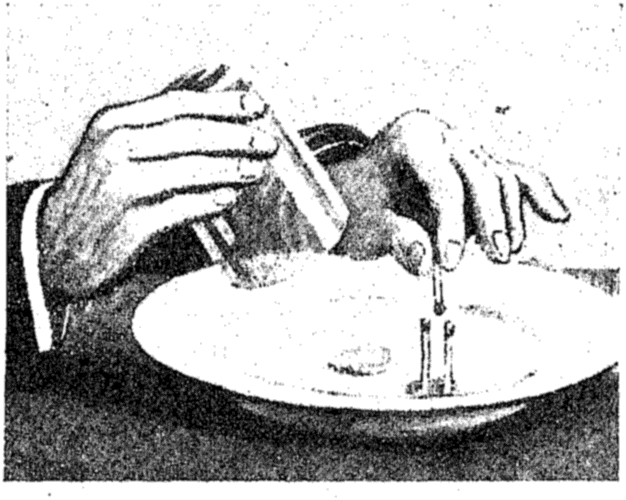
What force drove the water into the glass and holds it there at a definite height? The force of atmospheric pressure. The burning paper heated the air in the glass; the air expanded with the heat, and some of it escaped. When the paper went out, the air gradually cooled again, but as it cooled it shrank, and in place of the missing air came water, driven into the glass by the pressure of the air outside.
That the main cause is the heating of the air, and not the absorption of part of its oxygen by the burning paper (as one sometimes hears and reads), can be seen from the following facts, among others. 1) In place of putting burning paper in the glass, you can simply warm the glass, by rinsing it with boiling water, for example. 2) If for the paper you substitute cotton wool soaked in alcohol, which burns longer and therefore heats the air more, the water will rise almost halfway up the glass; and yet oxygen, as everyone knows, makes up only 1/5 of the volume of the air.
You can also replace the paper with matches stuck in a disk of cork, as our drawing shows.
A Complicated Explanation of a Simple Thing: The Atomizer
Until now we've been finding simple explanations for more or less complicated phenomena. Here we have the opposite case: the phenomenon looks extremely simple, and its explanation is very complicated.
I mean the atomizer, the ordinary two-armed atomizer everyone knows, which turns a liquid into spray. We have all used one, but there are hardly many people who could correctly explain how it works. School courses in physics explain it in terms that are much too general, and the reason is not that it's self-evident but, on the contrary, that it's very complicated. Still, it's annoying for an amateur physicist not to know the principle of so ordinary and familiar a device. Let's try to get to the bottom of it.
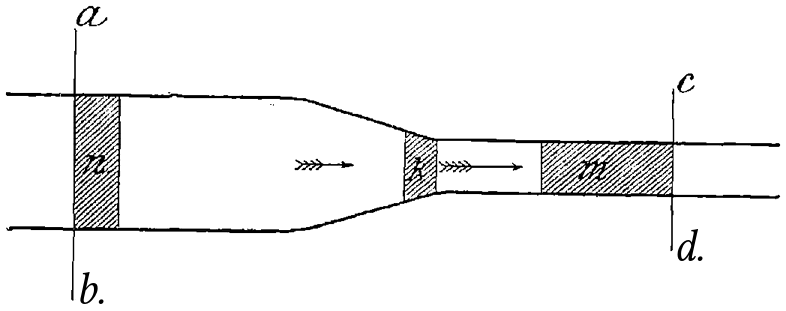
We must begin with a small digression, about the speed at which a gas flows in a tube of varying width. It's easy to show that the amount of gas passing through a cross section of the tube in one second must be the same in the narrow parts as in the wide ones. Suppose (Figure 73) that in some interval of time more gas were passing through the section ab than through the section cd. Part of the gas would then be getting stuck between ab and cd, and gas would be constantly piling up in that space, which is not what happens.
But if the amount of gas flowing through a cross section is the same in the narrow part of the tube and in the wide, then the speed of the flow must clearly be different: greater in the narrow part and smaller in the wide. This is clear because the little column n in the wide tube turns, in the narrow part, into the little column m, which is thinner but longer. And by what we've just said, both columns must take the same time to pass through their cross sections, since they contain equal volumes of gas.
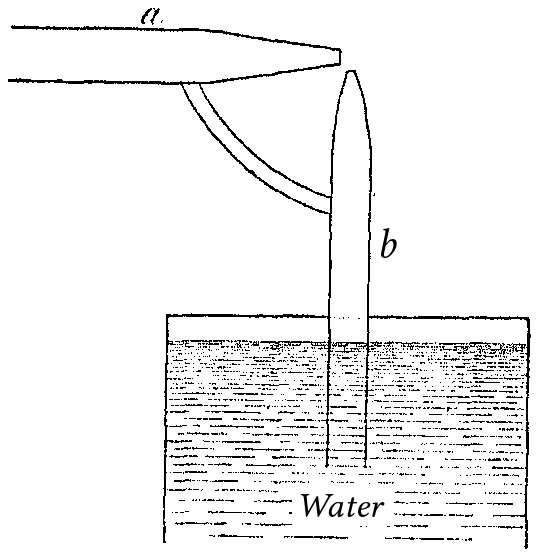
Now let's see how the pressure (or elasticity) of the gas changes as it goes from the wide tube into the narrow one. Take a thin layer of gas, k, right at the boundary. In the wide part it was moving slowly, and now it will move faster; clearly it's being pushed harder from behind than from in front, for otherwise it would have no tendency to speed up. It follows at once that the pressure (elasticity) is greater behind our layer, in the wide part of the tube, than ahead of it, in the narrow part.
And here we've come to the heart of the matter. We have proved by logic that a gas passing from the wide part of a tube into a narrow part loses pressure.
Knowing this, we can easily explain how the atomizer works.
When we blow into the arm a, which ends in a constriction (Figure 74), the air loses pressure as it passes into the constriction, and comes out of the tube with its pressure thus reduced.15 Above the tube b, then, there is air at reduced pressure, and the pressure of the atmosphere therefore drives the liquid up the tube. At the opening the liquid meets the jet of blown air, which breaks it into spray.
Such is the rather complicated mechanism of an apparatus that looks so simple. Let me add, in conclusion, that you can make an atomizer yourself out of two goose quills and a cork. There's nothing to describe: Figure 75 makes everything clear.
The Author Is Perplexed
I have explained the action of the atomizer above according to the physics textbook of H. Lorentz, professor at the University of Leiden and one of the greatest physicists of our time.
After I'd made the acquaintance of this explanation, I happened to see in a shop a whole batch of atomizers whose tubes hadn't a hint of the constriction at the end that, according to the theory, an atomizer needs in order to work. They were the same width from end to end.
"Are you selling these atomizers?" I asked the shopkeeper.
"Certainly."
"But they're no good at all!"
And I explained to the shopkeeper what was wrong with them, and why they were completely useless.
Without a word of reply, the shopkeeper put the atomizer I'd been criticizing in his mouth, dipped the other arm in a glass of water, and drew from it a whole cloud of spray.
I was thunderstruck: here before my eyes was a flagrant violation of theory! Resolved to look into the matter more closely, I bought one of the atomizers that had put me to shame and set off for home, to think over at leisure where the mistake lay hidden in the famous physicist's theory. For if the tube has no constriction at its end, then according to the theory the air should come out of it without being rarefied, and the water has no reason whatever to rise...
Before I'd reached home, my doubts were resolved. The casket, once again, simply opened: our own mouth is a wide reservoir, and the tube we put in it is the constriction. As the air passes from the mouth into the tube of the atomizer it is rarefied, and in that rarefied state it comes out. A constriction at the end of the tube is quite unnecessary to the effect.
How Do We Drink?
Can there really be anything to think about in that? Certainly. We put a glass or a spoonful of liquid to our lips and "draw in" the contents. It is this simple "drawing in," which we're so used to, that needs explaining. Why, after all, does the liquid rush into our mouths? The physical cause is this. When we drink, we expand our lungs and so rarefy the air in the mouth; the outside air, tending to make up for this drop in pressure, makes its way into our mouth and pushes the liquid ahead of it. The same thing would happen to the liquid in communicating vessels if we began to rarefy the air above one of them: the pressure of the atmosphere would drive the liquid over into that vessel.
Anyone who takes it into his head to declare that we drink with our lungs won't, then, be altogether wrong: the expansion of the lungs, after all, is the main reason the liquid rushes into our mouths by itself.
It also follows that if the air had no pressure we couldn't drink; at the very least, we'd have to go about it in an entirely different way.
Chapter 8: Heat
When Is the Nicholas Railway Longer: In Summer or in Winter?
A certain wit, asked the length of the Nicholas Railway, which runs from St Petersburg to Moscow, replied:
"In summer 644 kilometers, in winter 643 1/2."
This strange answer isn't nearly as absurd as it may seem at first sight. If by the length of a railway we mean the length of all its rails laid end to end, then the Nicholas Railway really is half a kilometer longer in summer than in winter. You've probably guessed the reason: bodies expand when they're heated. The coefficient of expansion of iron is 0.000015,16 which means that every meter of an iron bar grows by 0.000015 of a meter when it is warmed by 1°. On sweltering days the temperature often reaches 30° C, and in hard frosts it not infrequently falls to 25° below zero. That makes a difference of 55°. Now multiply the length of the rails, 650 kilometers, by 0.000015 and by 55, and you get almost exactly half a kilometer:
650 × 0.000015 × 55 = 0.53625
The length of the road doesn't change, of course; only the sum of the lengths of all its rails does. You've probably noticed that the rails of a railway track don't butt right up against one another. At every joint a gap is left on purpose, to give the rails room to lengthen when the temperature rises. Our calculation shows that in winter the combined length of all the rails shrinks while the gaps grow, and that in hard frosts the loss comes to half a kilometer, compared with the sweltering days of summer. In other words, the iron part of the road really is half a kilometer shorter in winter than in summer.
The Telephone Wire Thief Who Goes Unpunished
We often hear of thefts of telephone wire from the long-distance lines, and the police are waging a fierce campaign against the thieves. And yet every year about half a kilometer of telephone wire vanishes from the St Petersburg to Moscow line, and the police take no steps whatever against the culprit, though they know very well who he is.
By now, though, reader, you know him too: the thief is the frost. Everything we've said about rails is equally true of telephone and telegraph wires. But here there are no gaps, and so we can declare without any reservations that the St Petersburg to Moscow telephone line is half a kilometer shorter in winter than in summer! Every winter the frost makes off with half a kilometer of telephone wire and goes unpunished, though it must be said that it doesn't disturb the working of the telephone in the least.
Warm Is Heavier!
With an extremely simple device you can make the lengthening of a heated metal rod, even a very short one, plain to see. Take a straight rod (a curtain rod, for instance) and push it through a cork, as in the drawing. Stick two pins in the cork; if you now set the rod up so that the points of the pins rest on the foot of an upturned wineglass, you'll have something like the beam of a pair of scales. To balance this beam, put a cork on each end and go on sticking pins in these corks until the rod is horizontal. Naturally, you should first try to balance it at least roughly by shifting the middle cork; otherwise you may have to stick far too many pins in the end ones!
Now you can begin the experiment. Bring a candle or a lamp up to one arm of the beam and heat it; it will expand, and before long it will sink. The tiny lengthening, which the eye can't catch directly, becomes noticeable thanks to gravity.
The Rocking Stone of Argentina
The experiment just described lets us understand, up to a point, a certain riddle of nature. Near Bahía Blanca, a seaport in Argentina, on the slope of a granite hill, lies an enormous block of stone, six and a half meters high, resting on a single point. The base of the rock is remarkably even, and the whole of it is fairly regular in shape.17
The rock doesn't stay still but constantly rocks from side to side like a pendulum. Its swings are smooth, and so slow that even standing right beside it you can hardly notice them directly. But put a glass bottle under the rock not far from its point of support, and before many minutes have gone by you'll hear a crack: the bottle has burst under the pressure of the heavy rock.
The cause of these spontaneous swings, which have gone on without a break, moreover, for many centuries, isn't known for certain. In all likelihood it's the Sun's rays: they heat the rock unevenly, and its different parts expand by different amounts. This uneven expansion shifts the rock's center of gravity, and since it's supported at only one point, it naturally leans toward the side to which the center of gravity has moved. But no sooner is balance restored than further heating shifts the center of gravity again, and the rock begins to move once more.
On the Ice or Under the Ice?
When we want to heat water, we put the vessel over the flame and not beside it. This is perfectly right, because the air heated by the flame rushes up from all around it, being lighter. Above the flame there's always a stream of hot air, while at the sides cold air displaces it immediately.
By putting what we want to heat over the flame, then, we use its heat to the best advantage.
But what should we do if we need to cool something with ice? Out of habit, people put it above the ice; they stand bottles of lemonade, for example, on the ice. This is quite wrong: the air above the ice, once cooled, sinks, and fresh warm air takes its place. From this comes a conclusion useful in every household: if you want to cool a drink or a dish, put it under the ice and not on it.
Why Is There a Draft from a Closed Window?
The air in our rooms is hardly ever at rest. Currents that the eye can't see run through it, set going as the air is heated and cooled. When it's heated, air expands, as you know, and so becomes lighter; when it's cooled, on the contrary, it becomes denser and heavier. The light, heated air near a lamp or a stove tends to rise to the ceiling, and the heavy, cooled air near the windows or cold walls flows down to the floor. That's why in winter we feel a draft from the window, even though the frame is shut so tight that the air outside can't get in through it.
A Learned Dispute at the Tea Table
X, a professor of physics, invited his friend Y, a professor of thermodynamics, to call on him. The physicist's wife served tea to the guest and to her husband. X stirred in his sugar, poured cream into his glass, and settled down to wait for the hot tea to cool.
"You're going about it irrationally, my dear colleague," the guest told him. "My own rule is to wait first for the tea to cool a little, and then finish the cooling with cold cream. In that way one gets tea of a sufficiently low temperature much sooner."
"Why sooner, colleague? You too have to wait for the tea to cool, after all."
"Quite true. But allow me to remind you of Newton's law of cooling: 'The quantity of heat transferred in unit time is proportional to the difference of temperatures.' In other words, a hot body cools faster than a lukewarm one. It plainly pays, therefore, to wait while the tea is still hot, and not when it has already cooled a little: in one and the same interval of time, hot tea will cool more than lukewarm tea. That is why it's better to let the tea cool first and only then add the cream, and by no means the other way around, as you do, my dear colleague."
"I'm sorry to say I can't entirely agree with you. Your reference to Newton's law of cooling is perfectly correct and to the point. But you've overlooked one simple consequence of Richmann's rule. You remember, of course, the formula for the mean temperature of a mixture of two liquids that have the same heat capacity but different temperatures?"
Professor X tore a leaf from his notebook and quickly wrote out the formula:
"The temperature of the mixture, , is equal to this fraction, isn't it?" the professor of physics went on. " and stand for the quantities of the liquids, and for their temperatures."
"I see, I see, my dear colleague. But what consequence of this formula are you talking about?"
"Why, this one. If we subtract the final temperature of the mixture from the original temperature of the hotter liquid, the difference will be the fall in temperature. Isn't that so?"
"Of course. In place of we can substitute the corresponding expression from the formula, and we get..."
"We get , or, with a common denominator, , or finally , which can also, by the way, be written . That is how much the temperature of the hot liquid falls when we pour the cold one into it. You see, colleague, that the greater is, that is, the higher the temperature of the hot liquid, the greater this fall. Apply that to our case, and clearly, when we pour cold cream into tea, the hotter the tea was, the more we lower its temperature. And that is why I stick to my opinion: one should pour the cream in first and then wait for the tea to cool, and not the reverse, as you recommend, colleague. For simplicity I'm taking the heat capacities of cream and water to be the same."
"Your remark, my dear colleague, about the consequence of Richmann's rule is very ingenious and persuasive. But your final conclusion still can't be called wholly acceptable. The two ways of cooling tea, adding the cream beforehand and adding it afterward, each have their advantages and their drawbacks. Richmann's rule speaks for your method, Newton's law for mine. With me the first stage of the cooling goes faster than your second; with you, on the contrary, the more vigorous cooling comes at the beginning. By argument alone, without calculation, we can't determine which method cools the tea faster."
"Splendid, colleague! What's to stop us from doing the calculation? Let's calculate. The glass holds, say, fifteen spoonfuls of hot tea; that's about right, isn't it? The temperature of the tea when Maria Pavlovna poured it was, let us suppose, 80° Celsius. Our , then, is 15 × 80 = 1200. I pour in one spoonful of cream at the temperature of the room, 20°. That gives = 20. Substituting these values in the formula, and bearing in mind that = 16, we have for the final temperature of the mixture = 76 1/4 degrees. Naturally, one can't drink tea like that until it has cooled to 50 degrees, that is, by 26 1/4 degrees."
"Now, colleague, allow me to continue the working. You, then, have to wait some time, five minutes, let's say, for the tea and cream to cool by 26 1/4 degrees. I have to wait too, but in the same five minutes my hot tea at 80 degrees will cool more than yours at 76. By Newton's law, the quantity of heat transferred is proportional to the difference of temperatures. The difference between the temperature of your tea and that of the room around it, which I take to be 20°, is 76° - 20° = 56°; the difference between the temperature of my tea and that of the room is 80° - 20° = 60°. In the same five minutes, then, my tea will lose more than your 26 1/4 calories, in the ratio 60 : 56. In other words, it will cool by , or almost exactly 28 degrees. And so, my dear colleague, after a wait of five minutes I get tea at a temperature of 80 - 28 = 52 degrees."
"Perfectly true. Now to these fifteen spoonfuls of tea at 52 degrees you add one spoonful of cream at 20. The final temperature of your mixture comes out at = 50 degrees... What's this? It turns out, colleague, that your method ends in tea of exactly the same temperature as mine! There's a curious result! Maria Pavlovna, just think: my colleague and I were arguing about the best way to cool tea, and it turns out..."
"But what could be simpler, gentlemen? You need only start a heated argument! I'll pour you and Kirill Nikitich some fresh tea; yours has gone stone cold."
"Yes, but notice, it has gone cold to exactly the same degree, in spite of the difference in method!"
The Instructive Cigar
A cigar in a holder is lying on the edge of a table. It is smoking at both ends, but here's a puzzle to solve: why does the smoke that comes out through the holder sink, while the smoke from the other end rises? You'd think that the very same smoke was coming out on both sides.
Yes, the smoke is the same, but above the glowing end of the cigar there is a rising current of air, which carries the particles of smoke along with it. The air that passes through the holder with the smoke has time to cool on the way and no longer tends to rise, and since the particles of smoke are in themselves heavier than air, they sink.
Does a Fur Coat Warm You?
A certain gentleman with a habit of denying the most obvious things used to maintain that a fur coat, contrary to the general belief, doesn't warm you at all. He proved his opinion by a series of experiments, and what can be more convincing than experiments?
Here is one of them. "Take a thermometer," he would say, "note how many degrees it shows, and wrap it up well in the warmest of fur coats. After a few hours take the thermometer out, and you'll find that it hasn't warmed up by so much as 1/4 of a degree! It shows just what it showed before. Clearly fur coats don't warm in the least, and the universal faith in their saving power is mere superstition. True, we feel warmer in a fur coat, but that is only an illusion of the senses, and the experiment with the thermometer, which of course can't fall victim to any illusion of the senses, shows us plainly how mistaken we are...
"What's more," the debunker went on, "fur coats don't merely fail to warm, they actually cool! An experiment will easily convince you of this too. Take two bags of ice; wrap one up in a fur coat and simply leave the other in the room. When the ice in the second bag has melted, unwrap the coat: you'll see that the ice there has hardly begun to melt. Clearly the fur coat, far from warming the ice, has been cooling it all the time and keeping it from melting."
With a string of such proofs, seemingly irrefutable, this gentleman would demonstrate that the general faith in fur coats was utterly groundless.
What can you say to him? How can you refute his proofs?
You can't. He is right: fur coats really don't warm, if by "to warm" we mean to give out heat. A lamp warms, a stove warms, the human body warms, but a fur coat, in this sense of the word, doesn't warm at all. It only keeps the heat of our body from escaping. That's why any living creature whose body is itself a source of heat will feel warmer in a fur coat than without one. But a thermometer gives off no heat of its own, and its temperature won't change because we've wrapped it in a fur coat. Ice wrapped in a fur coat keeps its low temperature longer, because the coat slows the arrival of heat from outside.
To the question whether a fur coat warms us, then, we must answer that it only helps us to warm ourselves. It would be more correct, therefore, to say that we warm our fur coats, and not they us.
What Season Is It Under Our Feet?
When it's summer on the surface of the ground, what season is it down below, say three and a half meters deep?
Summer there too, you think? Nothing of the kind! The seasons above ground and the seasons in the soil don't keep step at all, as we're used to supposing they do. Soil is an extremely poor conductor of heat, and every rise and fall of temperature at the surface therefore makes its way down very slowly, reaching each layer after a long delay. Measurements made on the spot at Pavlovsk, near St Petersburg, showed that at a depth of three meters the warmest time of the year arrives 76 days late, and the coldest 108 days late. If our hottest day was July 25, say, then three meters down it won't come until October 9; and if our coldest day was January 15, then three meters down it will come on May 3! In still deeper layers the delay is longer still. Bear in mind, though, that the deeper we go, the weaker the swings of temperature become, until at a certain depth they die out altogether and one constant temperature reigns all the year round.
The layer of soil we tread on, then, is never in the same season as its own surface. When we have winter, three and a half meters down it is still autumn; and when we have summer, the echoes of our winter frosts are just arriving there.
This is important, and we should bear it in mind whenever we discuss how animals live underground (the grubs of the cockchafer beetle, for example) or how the underground parts of plants behave. Botanists often forget it. They are surprised, for instance, that the cambium, the growing layer, in the roots of our trees is active precisely in the cold half of the year and lies dormant for almost all the warm season, exactly the opposite of what happens in the trunk. The reader now understands that this is less of a mystery than it looks at first sight.
How Can You Boil an Egg in Paper?
You'll guess the secret at once if you look at Figure 80: the egg is being boiled in water, and the water is in a paper cone. But surely the paper will catch fire, and the water will flood the lamp! Not at all. Try it, and you'll see that the flame does the paper no harm whatever. The water takes up all the paper's heat, and never lets it get hot enough to burn.
What's more, in paper ware as flimsy as this you can do better than bring water to the boil: you can even melt metal. Our Figure 81 shows a lead seal being melted in a little tray made from a playing card. The whole art is to heat exactly those parts of the paper that are touching the lead; the metal quickly draws off the paper's heat and won't let it grow very hot. The thing seems incredible. On one side is a flame, on the other molten metal, and the paper between them isn't even scorched!
There is really nothing new to us in this. The cause is the same one that usually makes metal objects feel colder than wooden ones, though both are in the same room: metal conducts heat well, and quickly cools the surface of our hand.
Muslin That Won't Burn
Here is another experiment of the same kind. Take any polished metal object and stretch a piece of thin cloth, linen or muslin, tightly over it. Now you can boldly lay hot coals on the muslin. It won't catch fire, and it will come to no harm of any sort, even if you blow hard on the coals.
After all that has been said, the reader will of course have no trouble in explaining this showy experiment. The one puzzle, perhaps, is why the object has to be polished. But that too becomes clear once you remember that in a room smooth metal things feel noticeably colder than rough ones: our skin (or, in the experiment, the muslin) touches the metal at a greater number of points.
Ice That Won't Melt in Boiling Water
Take an ordinary test tube, fill it with water, and drop in a small piece of ice. Ice is lighter than water, and to stop it from floating up, weigh it down with a bit of lead, a copper coin or something of the sort, leaving the water free to reach the ice. Now hold the test tube to a spirit lamp so that the flame touches only the upper part of the tube (see Figure 83). Soon the water will begin to boil and give off clouds of steam, and yet the ice at the bottom will not melt for a long time to come. We have before us a genuine paradox of nature: ice that doesn't melt in boiling water!
The explanation is that the water at the bottom stays cold, even though the water at the top is boiling. Water expands as it warms and grows lighter, and therefore it doesn't sink to the bottom but stays in the upper part of the tube. The warm currents circulate only up there and don't disturb the denser layers below. Heat can travel down only by conduction, and water conducts heat very poorly.
Can You Boil Water with Boiling Water?
Take a small bottle, jar or vial, pour some water into it, and put it into a saucepan of pure water standing on the fire, in such a way that it doesn't touch the bottom of the pan; you'll have to hang it in a loop of wire or thread. Soon the water in the saucepan will boil, and you'd expect the water in the vial to follow. But you may wait as long as you please, and you won't see it happen. The water in the vial will be hot, very hot, but boil it will not.
This looks unexpected, and yet it was easy to foresee. Pure water boils at 100° Celsius, and under ordinary conditions its temperature never goes above that point, however long you boil it. The source of heat for the water in the vial is therefore at 100°. It can bring the water in the vial to 100° too, but it can't supply the extra heat that water at this temperature needs to turn into steam (540 calories for every gram). That's why the water in the vial gets hot but doesn't boil.
A question naturally arises: how does the water in the vial differ from the water in the saucepan? It's the same water, after all, only separated from the rest by a glass wall. Why doesn't the same thing happen to it as to all the rest?
Precisely because it is separated from the rest. The wall keeps the water in the vial from joining the currents that stir the whole mass of water in the pan. Every particle of water in the pan can come into direct contact with the hot bottom, and the particles in the vial don't have this advantage.
With pure boiling water, then, you can't boil water. But throw a handful of salt into the saucepan, and the picture changes. Salt water boils a little above 100°, and so it, in its turn, can bring the pure water in the glass vial to the boil.
Can You Boil Water with Snow?
"If even water at a full boil couldn't do it," the reader will probably say, "snow is out of the question." Don't be in a hurry to answer. Try it instead, with the very vial you've just been using.
Fill it three-quarters full of water and lower it into boiling salt water. When the water in the vial boils, take it out of the pan and quickly stop it with a tight cork you've got ready beforehand. Now turn the vial upside down and wait until the boiling inside it stops. When it has stopped, pour boiling water over the vial: the water inside won't boil. But put a little snow on its upturned bottom, and you'll see the water boil up violently at once! Snow has done what boiling water couldn't.
It's all the more mysterious because the vial isn't at all hot to the touch, at most a little warm. And yet the water in it is boiling: you can see it with your own eyes.
The answer is that the snow cooled the walls of the vial, and the steam inside therefore condensed into drops of water. And since all the air was driven out of the vial while it boiled in the pan, the water in it is now under much less pressure. But we know from physics that when the pressure on a liquid's surface is reduced, the liquid boils at a lower temperature than its usual boiling point. What we have in our vial is boiling water, then, but boiling water that isn't hot, if one may put it that way.
Instead of snow we could have used cold water, or even simply blown on the vial through a straw: our breath would have cooled the walls, the steam would have condensed, and as a consequence the water would have boiled. Figure 84 shows this curious way of boiling water with nothing more than a puff of breath.
We should add that if the vial had held much less water than three-quarters, the sudden condensing of the steam inside might have caused a real explosion. The pressure of the outside air, meeting no pressure from inside to oppose it, would have crushed the vial. (You see, by the way, that "explosion" is the wrong word here.) This experiment is better done with a thin-walled bottle, set up as the drawing shows, but you must cover the bottle with a napkin so that the flying splinters don't hurt you.
Why Did Mark Twain Make Soup from a Barometer?
In A Tramp Abroad Mark Twain, the well-known American humorist, tells of one episode of his travels in the Alps, an invented episode, needless to say:
"Our distresses being at an end, I now determined to rest the men in camp and give the scientific department of the Expedition a chance. First, I made a barometric observation, to get our altitude, but I could not perceive that there was any result. I knew, by my scientific reading, that either thermometers or barometers ought to be boiled, to make them accurate; I did not know which it was, so I boiled them both. There was still no result; so I examined these instruments and discovered that they possessed radical blemishes: the barometer had no hand but the brass pointer and the ball of the thermometer was stuffed with tin-foil...
"I hunted up another barometer; it was new and perfect. I boiled it half an hour in a pot of bean soup which the cooks were making. The result was unexpected: the instrument was not affecting at all, but there was such a strong barometer taste to the soup that the head cook, who was a most conscientious person, changed its name in the bill of fare. The dish was so greatly liked by all, that I ordered the cook to have barometer soup every day.
"It was believed that the barometer might eventually be injured, but I did not care for that. I had demonstrated to my satisfaction that it could not tell how high a mountain was, therefore I had no real use for it."
Which of the two, though, really ought to have been "boiled," the thermometer or the barometer?
The thermometer, and here is why. We saw in the last experiment that the less the pressure on the surface of water, the lower the temperature at which it boils. As we climb a mountain the pressure of the atmosphere falls, and the boiling point of water must fall with it. If, then, we measure the temperature at which water boils (if we "boil the thermometer," as Twain puts it), we can consult the proper table and find out how high we are. For this, of course, we must have tables drawn up beforehand from a series of experiments, a detail that Mark Twain affects to have forgotten.
A barometer too can be used to find the height of a place, of course, since without any "boiling" it shows the pressure of the atmosphere directly. But here again we need tables, to tell us how the pressure of the air falls off as we rise above sea level. All this had supposedly got jumbled in the American humorist's head, and set him to making barometer soup.
Why Does Water Put Out Fire?
Even people who have been through a course of physics can't always give a sensible answer to this simple question, and we hope the reader won't mind if we explain briefly here what water does to a fire.
First, when water touches the burning object it turns into steam, and in doing so it takes away a great deal of the object's heat. (To turn boiling water into steam takes six times as much heat as to warm the same amount of cold water to 100 degrees.18) Second, the steam that forms fills hundreds of times the space of the water it came from. It surrounds the burning object and pushes the air away, and without air, as we know, nothing can burn.
You can see from this, incidentally, why water mustn't be used on burning liquids that are lighter than itself, such as kerosene, crude oil, fat or oil. It usually even does harm: the water sinks into the burning liquid, quickly turns to steam there, then bursts upward and splashes the burning liquid in every direction, helping the fire to spread. In such cases use sand, clay or earth, or smother the fire with mats, blankets and so on.
To make water better at putting out fires, people often mix into it... gunpowder! This may seem absurd, and yet it is perfectly reasonable: the gunpowder burns up quickly and gives off a large quantity of gases that don't burn, and these push back the air around the object and hinder the burning.
Which Ice Is More Slippery, Smooth or Rough?
The answer seems plain. It's easier to slip on a polished floor than on an ordinary one, and the same, surely, must go for ice.
But it doesn't. The slipperiness of ice has nothing to do with smoothness. It comes from a quite special cause, a peculiarity that ice alone possesses among all the bodies in nature: its melting point drops when the pressure on it rises, and that melting point lies close to ordinary air temperatures.19
Let's see what happens when we skate. Standing on skates, we rest on a very small area, only a few square centimeters, and on this small area the whole weight of our body presses. If you recall what was said in "Why Are Pointed Things Sharp?" you'll realize that a skater exerts an enormous pressure on the ice. Now, under pressure ice melts at a lower temperature. Suppose the ice is at 5° below zero, and the pressure of the skates has lowered the melting point of the ice beneath them by enough: those parts of the ice will melt. And then? Between the skate blades and the ice there is now a thin layer of water, and it's no wonder the skater slides. As soon as he moves his feet to another spot, the same thing happens there. Everywhere under the skater's feet the ice turns into a thin layer of water, so that strictly speaking he slides on water, not on ice.
In hard frosts, when the ice grows so cold that even this heightened pressure isn't enough to make it melt, skating becomes difficult, as every skater knows. Nansen, the famous polar explorer, tells us that in Greenland the ice isn't slippery at all; and that's quite understandable, if you remember what frosts they have in that godforsaken land.
We can now go back to the question in our heading. We know that a given load presses harder the smaller the area it rests on. When does a person press harder on what is underfoot: standing on ice as smooth as a mirror, or standing on rough ice?
On rough ice, clearly, because there he is resting only on a few bumps and ridges. And the greater the pressure on the ice, the faster it melts, and, consequently, the more slippery it is.
Chapter 9: How Light Travels
What Good Is Your Shadow?
Our shadow, they say, is the most useless thing in the world. And what good could we ever get out of it, when we can't so much as catch it?
Our great-grandfathers, however, knew how to catch their shadows and get some good out of them.
I'm speaking of the drawing of silhouettes, shadow pictures of a profile.
Nowadays, thanks to photography, anyone can get a portrait made, or preserve the features of people dear to him. Our great-grandfathers in the eighteenth century weren't so lucky: a portrait ordered from a painter cost a great deal of money, and only a few could afford it. What they did have, and in great numbers, was silhouettes, which to some extent did for them what photographs do for us. They were shadows caught, so to speak, and fixed. A silhouette was made by mechanical means, and in this it resembles its own opposite, photography, whose name means "drawing with light." We make use of light; our ancestors made use of shadow.
Figure 87 shows just how a silhouette was drawn. The sitter was placed between a candle (set in front of a mirror, to make it brighter) and a sheet of translucent paper stretched on a frame. The head was turned until the shadow gave a characteristic, expressive profile, and then the outline was traced in pencil. The outline was then filled in with India ink and pasted on white paper, and the silhouette was done. If one wished, it was reduced with a pantograph.
You can easily make silhouettes of your own friends, even if you don't draw at all well. Nothing is needed but patience and a liking for the work. Don't imagine that a plain black outline can give no idea of a person's characteristic features. On the contrary, a well-made silhouette is sometimes strikingly like its original.
That a shadow picture could catch a likeness with so simple an outline interested a number of artists, who began to draw whole scenes, landscapes and so on in the same manner. In the Parisian salons of the mid-eighteenth century the drawing of silhouettes became a fashionable pastime that carried away the whole of aristocratic society. From there the fashion passed first to Berlin, and then to us, in St Petersburg: two albums have survived to this day, with 200 black profiles of the most distinguished persons at the court of Catherine the Great. The silhouette, like everything in the world, has its history, which we won't go into here. We'll say only that little by little the drawing of silhouettes turned into an art in its own right and produced a whole school of artists, such as Elizaveta Boehm here in Russia and, abroad, the German artist Konewka.
How Can You Measure the Strength of a Light by a Shadow?
Odd as it seems, you can measure the strength of a light by means of a shadow, the very opposite of light. To be exact, what we use is an illuminated shadow rather than an absolute one. An illuminated shadow... That sounds like another marriage of opposites! If a shadow is illuminated, you'd think, it's no longer a shadow. And yet illuminated shadows are the kind we meet with far more often in real life. There is no contradiction here: the shadow is simply less brightly lit than the space around it, and that is enough to make it look like a shadow to us.
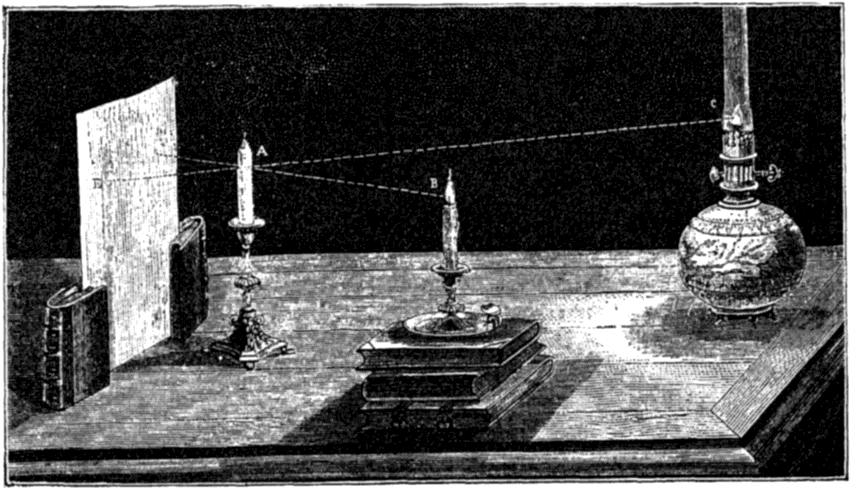
Suppose you want to find out how many times brighter your work lamp is than an ordinary candle. To compare them, you arrange the two sources of light in front of a screen as in Figure 95. Near the screen you place an unlit candle, or some other object, and it casts two shadows on the screen. One of these will be lit by the lamp, and the other by the burning candle. You move the lamp farther and farther back until the two shadows are equally dark, or in other words equally lit. If the lamp is now four times as far from the screen as the burning candle, then it is 4 × 4 = 16 times as bright as the candle. (The strength of light falls off in inverse proportion to the square of the distance.)
When Is Black Velvet Brighter Than Snow?
Don't imagine that you can compare the strength of different lights directly, without any apparatus. Your immediate impression isn't to be trusted here. Did you know that white snow on a bright moonlit night is darker than black velvet in sunlight? It seems incredible, but that's what exact measurement with photometers, instruments for comparing lights, has shown.
In general we have no very accurate idea of the strength of sunlight. We never suspect, for instance, that by day the so-called dark corners of a room are often brighter than the bright parts of the same room in the evening, by lamplight.
The Speed of Light
"Light travels at 300,000 kilometers a second." This statement is familiar, of course, to anyone with even a slight knowledge of elementary physics. Few people, though, suspect what unexpected, astonishing, almost miraculous consequences can be drawn from so simple a fact. The first to point them out was the famous French astronomer Camille Flammarion, who set them forth in Lumen, a work known in Russian as "On the Waves of Infinity." It takes the form of a conversation between a scholar, Quaerens, and the spirit of his teacher Lumen, who died in 1864 and is telling his pupil what he has been through since his death. We give this conversation below, in a condensed extract.20
On the Waves of Infinity
An Eyewitness of the Past
LUMEN. I cannot explain what power it was that sent me hurtling through the heavens with inconceivable speed. Soon I noticed that I was drawing near a magnificent sun, which shone with a pure white light. Around it were a multitude of planets, each of them encircled by one or several rings. That same mysterious power brought me to rest upon one of these rings.
What chiefly held my attention was the tiny globe of the Earth, beside which I recognized the Moon. Soon I could see the white snows of the North Pole, the yellow triangle of Africa, the general outline of the ocean. Then I began to make out, at the edge of the blue, a sort of scalloped fringe, dark brown in color. As I went on looking, a city stood out in the middle of it. I had no trouble in recognizing this scrap of a continent as France, and the city as Paris. The boulevards girdled the city, and bright sunshine lit the whole scene; but to my surprise the hills were covered with snow, as if it were January, though I had left the Earth in October.
I fixed my eyes on the Observatory. What was my astonishment when, looking more closely, I saw that the avenue leading up to it no longer existed, and that some little gardens were laid out in its place! The further I looked, the more certain I became that Paris had changed a great deal. Yet as I gradually grew used to the sight of the city, I began to recognize its districts, streets and buildings as they had been in the days of my youth. Soon no doubt was left: what I saw before me was no new Paris, such as it might have become after my death, but the old one, as it was at the beginning of the nineteenth century or the end of the eighteenth.
With strained attention I went on watching. In the middle of the Place de la Concorde I saw a scaffold, surrounded by a menacing body of troops. A cart, its driver dressed in red, was carrying away the remains of Louis XVI. Many had been beheaded, and barrows full of quivering bodies were moving off toward the Faubourg Saint-Honoré. The mob seemed drunk with blood. Mounted soldiers with drawn sabers rode slowly about in the crowd...
I was intensely interested in following with my own eyes the great drama of 1793, of which history says so much. But this wish paled before the realization that I, in 1864, was seeing before me, as present, events that had happened at the end of the last century.
QUAERENS. Perhaps it was the work of an excited imagination, or a memory come to life again in your mind? Are you sure that what you had before you was reality, and not some strange trick of memory?
LUMEN. At first I thought the same. But that I had before me the Paris of January 21, 1793, was so palpably evident that I could doubt no longer. Once convinced, I concluded straightaway that the fact could not be at odds with science. I turned to physics, which was bound to give me the solution to the riddle.
QUAERENS. What! You maintain that the vision you saw belongs to the world of reality?
LUMEN. Certainly. It can even be proved in the most positive manner, and I shall give you the explanation now. First of all I turned my attention to the position of the Earth. I determined that the point where I could see the group of the Sun, the Earth and the other planets lay at the seventeenth hour of right ascension, 44 degrees from the south pole of the sky. These figures helped me to identify the star in whose system I found myself. It could only be Alpha Aurigae, also called Capella. I was on one of the planets that belong to the system of this star. I was able to recall the distance that separates it from the Earth: 681 trillion 600 billion kilometers.
Now I ask you to fix your attention on a very important circumstance, on which rests the explanation of one of the strangest facts in the whole of reality. We know that light does not cross space in an instant but moves step by step. It covers 300,000 kilometers in a second. Knowing how far Capella is from us, we can easily calculate how long its light takes on the way. When we do so, we find that a ray of light setting out from Capella will reach the Earth only after 71 years, 8 months and 24 days. And a ray setting out from the Earth will of course take exactly as long to reach Capella.
QUAERENS. But if the light of this star takes almost 72 years to reach us, that means we see the star as it was 72 years ago?
LUMEN. You have understood me perfectly. Not one of the heavenly bodies do we see as it really is. Each of them appears to us as it was when the ray of light set out that has reached our eye at the moment of observation. What we see, therefore, is a historical picture of a past state of the sky, and not the state in which it is now. There are stars that have not existed for tens of thousands of years, and yet we still see them, because the ray that is only now reaching us left the star long before its destruction. If some catastrophe today were to destroy all the heavenly bodies we can see, we should go on seeing them tomorrow, and all through the coming year, and for many centuries more, with the sole exception of the stars nearest to us, each of which would go out as soon as its last ray had reached the Earth. Alpha Centauri would go out first, after three years and eight months; Sirius would vanish after ten years, and so on.
Now, my friend, it is easy to apply these theories to the strange fact I witnessed. If from the Earth Capella appears as it was seventy-two years ago, then from Capella, conversely, the Earth is seen as it was seventy-two years before the moment of observation! It seems incredible at first sight, of course, that by going off into space we could become eyewitnesses of things that happened in ages long past and travel upstream, so to speak, on the river of bygone time. And yet that is nothing like so overwhelming as what I am about to tell you, if you care to hear the rest of my story.
QUAERENS. Go on, I am burning with impatience to hear it.
Decades Pass in a Single Hour
LUMEN. I turned away from the bloody scenes in the square, and felt my attention drawn, as if by instinct, to a certain building in the old style. At its side door I noticed a group of five people. Among them I recognized my father, though as I had never seen him; my mother too, looking younger than he; and one of my cousins, who died forty years ago, in the same year as my father. I cannot describe how astonished I was. My eyes seemed to grow dim, and I could no longer make things out, as if a cloud were hiding Paris from me. For a moment I felt as if a whirlwind were carrying me off. I had at that time, I should add, no clear idea of time.
When I could again see distinctly, I noticed a crowd of children running across the square before the Panthéon. They were pupils, on their way home from school, it seemed, for they were carrying books and copybooks. Two of them caught my attention; they appeared to be having a heated quarrel, which threatened to end in a fight. A third came up to part them, but they gave him such a push that he fell to the ground...
At that moment a woman ran up to the fallen child. The woman was my mother... In the course of a life of seventy years I have met with much that was unexpected, but never had I felt such emotion as when I recognized that child as myself!
QUAERENS. What! You recognized yourself in him?
LUMEN. You can imagine how it struck me. One thought troubled me above all. That child is evidently I. He visibly exists, he is growing, and he has sixty-six years still to live. On the other hand, here am I, seventy-two years of age, seeing all this and pondering it. I exist, then, in two forms: there, on the Earth, and here, in space. One and the same soul, my own, which feels itself to be single and indivisible, is present in both these beings. What a strange reality!
What is left for me to add to this story? All the years I had spent in Paris passed before me, one after another. I saw myself enter the university and pass my first examination, at almost the very time when the First Consul was being crowned emperor. I saw myself at my final examination at the École Polytechnique. I had to live once more through the battle on the heights of Montmartre, to see the victorious troops enter the capital of France, and to see the fall of the statue in the Place Vendôme, which was dragged through the streets with shouts of joy.
In this way year after year went by before me. I saw myself at my marriage, on my travels, at my scientific work, and so on; and at the same time I watched the scenes of contemporary history as they followed one upon another.
QUAERENS. These events, then, passed quickly before your eyes?
LUMEN. I had no means of measuring time exactly, but in any case the whole panorama flashed by me in less than a day.
QUAERENS. Then I do not understand anything! Light undoubtedly needs a certain time to cross the space that separates it from the observer, and it is no wonder that real events are seen later than the moment at which they happened. All the same, if you saw before you the events of all 72 years of your life, then you must have spent 72 years in seeing them, and not a few hours. If you saw the year 1793 only in 1864, then you could see the year 1864 only in 1936.
LUMEN. Your objection is well founded, and it proves that you have fully mastered the theory of the fact. But I shall explain to you at once why I had no need whatever to wait another 72 years in order to follow all the events of my life.
As I went on watching my own existence, I came to its last years. I saw the friends I had made of late, yourself among them. I saw my daughter too, and her children, my family and the whole circle of my acquaintance. At length the moment came when I saw myself lying on my deathbed, and I attended, as a spectator, my own death...
It turned out that my spirit, absorbed in what it saw, had forgotten Capella and was rushing toward the Earth. I cannot tell by what law a soul can pass so quickly from one place to another, but I returned to the Earth, and entered my room, at the very moment when they were about to bury me. On this journey home I was traveling to meet the rays of light, and the distance that separated me from the Earth was constantly shrinking. The rays coming from the Earth had an ever shorter space to cross before they reached me, and in this way the intervals between one event and the next grew ever briefer...
When the entrance to the vault had been closed with a stone, I said a last farewell to my poor sleeping body. The sun by that time had gone out amid its rays of purple and gold. I saw Capella glittering, pure and bright, and I could make out also the throng of heavenly bodies that circled about it.
Then once more I forgot the Earth, and gave myself up wholly to the spell of Capella, which was beckoning me. I flew toward it with a speed far greater than the speed of light.
World History in Reverse
Some time afterward I felt a wish to look at the Earth again, and after a careful search I saw a peninsula, a grayish triangle jutting out into the Black Sea. On its western shore I made out armies of my earthly brothers, killing one another with furious hatred. I fell to thinking about the barbarous custom of war, and reflected with sorrow that in this corner of the Crimea 800,000 men had fallen... Then clouds hid Europe from me.
I was in the space between Capella and the Earth. A little later I looked at Paris, and was greatly surprised to see an uprising in its streets. Looking more closely, I could make out barricades across the streets, and brisk firing on both sides. My eyes turned to one of the barricades, and there I saw, stretched on the ground, the Archbishop Denis-Auguste Affre, whom I had known. What I had before me, then, was the June Days of 1848! In vain my reason strove to find some explanation of how I could have seen the events of 1848 after the events of 1854.
Then my gaze turned again to the Earth, and I noticed that tricolor flags were being handed out in the main square of the city of Lyon. I easily recognized the young Duke of Orléans, and remembered that after the accession of Louis-Philippe the prince had been sent to Lyon.
After 1854 and 1848, evidently, I had before my eyes something that happened in 1831!
A little later I saw Paris on a day of solemn celebration. A fat, red-cheeked king was riding in a magnificent carriage across the Pont Neuf. The weather was glorious. Girls in white dresses stood along the sidewalks of the bridge. Strange animals were running about above Paris. This, evidently, was the return of the Bourbons to France: I remembered that a great many balloons had been sent up at the time, made in the shapes of various animals. From the height at which I was, the animals seemed to be running clumsily over the roofs.
I could understand that it was possible to see an event long past, but to see events in reverse order struck me as altogether too fantastic. And yet the facts were before my eyes, and I tried to find some hypothesis that might explain them in some way or other. Given the countless multitude of stars and planets, one may ask: how likely is it that somewhere in space there exists a body exactly like the Earth? Then I began to wonder whether there might not be a world that was exactly the reverse of the Earth. In the end I decided that what I saw before me was not the Earth at all, but another body like it, whose history had run in just the opposite order.
I had before me a quite separate world, which had nothing in common with the Earth, and was all the more interesting because its history presented the scenes of the Earth's history in reverse.
The general look of the planet I was watching had meanwhile altered considerably. Paris, Lyon, Marseille and Le Havre had changed beyond measure. Their populations had fallen greatly, and all of them had become much less noisy. Versailles, on the other hand, seemed to have reached the height of its grandeur. Before me, I repeat, the whole history of France was unfolding, though with its events in reverse order. After the republic came the absolute monarchy, and then the age of feudalism. On the terrace of the Bastille I saw Louis XI. I knew him by the little figures of saints that adorned his hat, and by his inseparable companions, the executioner and the barber. Somewhat later I glanced at a square in the city of Rouen, and noticed thick smoke there, and saw the flames devouring the Maid of Orléans, Joan of Arc.
Knowing that everything here happened in the opposite order from that on Earth, I could foresee what event I was about to witness. When I had seen Saint Louis dying not far from Tunis, I was no longer surprised to witness first the Eighth Crusade and then the Third, in which I knew Frederick Barbarossa by his beard. After that I was present at the First Crusade. In this way I was an eyewitness of events from the most ancient times in the history of France. Paris was no more, and the waters of the Seine flowed peacefully past banks overgrown with grass and willows.
I noticed that the center of civilization had by then moved to the south. I saw imperial Rome in all its majesty. Later I was witness to the tremendous eruption of Vesuvius that buried Herculaneum and Pompeii. Then I saw Rome wrapped in flames, and although I could not make out Nero on the terrace of his palace, I was sure that this was that very fire of the year 64 that served as the pretext for the first persecution of the Christians.
A little later Judea suddenly appeared before my eyes, and in it I made out Jerusalem and Mount Golgotha. Jesus Christ was climbing the hill under guard of a company of soldiers, with a crowd of the rabble behind. It was a sight that will never be effaced from my memory...
Turning back to Rome, I saw the body of Julius Caesar on its pyre. After the times of Caesar there appeared before me the age of the consuls, and then that of the kings of Latium. Next I was shown the Ethiopian invasion of Egypt, the oligarchic republic of Corinth, the eighth Olympiad of Greece, and the prophet Isaiah preaching in Judea. I saw crowds of slaves building the pyramids. A long line of Bactrian and Indian sovereigns passed before me... Gaul was one unbroken marsh, and its inhabitants closely resembled the peoples of the islands of Oceania who live most simply. What I had before me was the Stone Age...
Later still I saw that the number of people was dwindling, and that the mastery of nature was passing to some large breed of ape, to bears, lions, hyenas and rhinoceroses. At last there came a time when I could not find a single human being on the surface of this globe, nor anywhere even a trace that a human race had once existed there. All had vanished. Earthquakes, volcanic eruptions and floods ruled the planet's surface, and left no room for man amid the chaos. The Earth had grown in bulk, and its rotation had slowed. The mysterious world resembled a huge ball of molten metal, surrounded by vapors that were metallic too. The sun that had once given it light now no longer outshone it, and had itself begun to swell, so that it became clear to me that the planet must end its existence by merging with the atmosphere of its sun.
It is not often that one is an eyewitness of the end of the world. The thought threw me into such ecstasy that I could not help crying out: "This, then, is the end of the world! This is the fate appointed for all the countless multitude of inhabited worlds!" "It is not the end," some inner voice replied to me, "it is the beginning, the beginning of the Earth. You have seen before you the whole history of the Earth, by moving away from that planet all the while with a speed greater than the speed of light..."
The realization did not stagger me as the first episode of my life beyond the Earth had done. Having grown used to the surprising effects of the laws of light, I was prepared for anything. Besides, certain details of the events had long since made me dimly suspect something of the sort. I have purposely said nothing of them, so as not to break the unity of my story, and yet these details are incomparably stranger than even the whole reversal of events in itself.
A Battle Inside Out
One of them concerns the battle of Waterloo. When I made out the field of Waterloo, what I noticed first of all was heaps of corpses stretched on the ground, the sinister harvest of death. Far off, through the mist, I saw Napoleon, holding his horse by the bridle and approaching the battlefield, walking backward. All the officers with him were backing up in the same way. Some of the guns had already opened fire, for now and then I caught the flash of their shots.
When I had got my bearings, I began to notice that the dead soldiers were reviving and at once getting briskly to their feet. Sometimes whole ranks rose from the dead together, and soon quite a number had come back to life. The dead horses followed the men's example, and on the resurrected mounts riders instantly appeared. As soon as two or three thousand soldiers had returned to life, they formed up without delay in regular ranks. At last the two hostile armies met, and the battle began in fury. Once it was under way, the soldiers on both sides began to come to life fast. French, English, Prussians, Germans, Hanoverians, Belgians; gray greatcoats, and uniforms of blue, red, green and white, rise from the field of death and join in the fight. In the midst of the French army I see the emperor. Around him was a battalion drawn up in a square. The Imperial Guard had risen from the dead!
It was indeed the battle of Waterloo, but a Waterloo, so to speak, from beyond the grave, since a large part of those who were fighting had only just been resurrected. Strangest of all, the fiercer and more terrible the battle grew, the larger grew the number of the combatants. At every successful cannon shot a heap of dead men instantly came to life and at once took their places in the ranks. All day long the two enemy armies pounded each other with grapeshot, cannonballs, shells, bullets, bayonets, musket butts, swords and sabers; and when at last the battle came to an end, there was not one man dead on either side, nor one wounded! The torn uniforms mended themselves, and the troops formed into columns. Then the two armies slowly drew apart.
Up the River of Time
QUAERENS. I do not yet fully understand this phenomenon, Lumen, and I shall be very grateful to you if you will explain its cause.
LUMEN. You might have guessed it for yourself, since you know that I was moving away from the Earth with a speed greater than that of light.
Imagine, to begin with, that you are moving away from the Earth at a speed equal to that of light. You will then have constantly before your eyes the image of the Earth as it was at the moment when you set out. Were you to travel in this way for a thousand, or even a hundred thousand years, that same image would go with you always; you might compare it to a photograph, which remains always the same, while the original has long since changed and grown old.
Now suppose, if you will, that you are moving away from the Earth with a speed greater than that of light. What will happen then? As you advance, you will overtake rays of light that left the Earth before you; every second, that is, you will be catching up with photographs, flying off into space, of everything that has happened on the globe. If you move faster than light, you will meet on your way rays that left the Earth in earlier years, and that carry with them, so to speak, photographic images of those earlier years.
To picture this more clearly, consider several rays of light that left the Earth at different epochs. Suppose the first ray left on the first of January 1867. At the moment when I speak, that ray has already crossed a certain space and is at a point away from the Earth that I shall call A. A second ray left the Earth a hundred years before the first, that is, on the first of January 1767. It is traveling far ahead of the first ray, and is therefore at a still greater distance from the Earth. This point I shall call B. A third ray, that of January 1, 1667, will be farther ahead still, and as far from the second ray as the second is from the first. This distance is the length of the path that light travels in a hundred years. Let us call the place where this ray is at the given moment C. Finally, a fourth, a fifth and a sixth ray, which left on January 1 of the years 1567, 1467 and 1367 in turn, will be at the points D, E and F respectively.
All these rays of light move with the same speed, and therefore keep always the same distance from one another as they travel farther and farther from the Earth into boundless space. The images of what was happening on Earth at the moments when the rays set out thus move through space at the speed of light, in echelons, as it were, equally spaced. A thinking, spiritual being who passes in order through the points A, B, C, D and E meets there, one after another, the images of the Earth's history at the epochs that belong to those points. A spirit traveling through the realms of the ether with a speed greater than the speed of light meets in succession the images of ever more ancient times.
In this way a spirit can wander upstream on the river of time. To realize that such a thing is possible must throw a new light, for you, on the idea of boundless space.
Is It All True?
We have given Flammarion's arguments above as fully as we could. Persuasive as they are, we can't, if we think them through more deeply, agree with all of the French astronomer's conclusions. The only part that's entirely right is what he says of an observer who is standing still. Where the observer is moving, some quite important corrections have to be made. Readers who have followed Flammarion's original arguments and ingenious conclusions may find it interesting to put them to the test. To make this easier, let's first list briefly, point by point, what Flammarion says about an observer moving through space, and then examine each point separately.
1) To an observer approaching the Earth, everything that happens on Earth appears speeded up.
2) To an observer moving away from the Earth at less than the speed of light, everything that happens on Earth appears slowed down.
3) To an observer moving away from the Earth at exactly the speed of light, everything that happens on Earth appears frozen, motionless.
4) An observer moving away from the Earth at more than the speed of light sees what happens on Earth in the reverse of the order in which it really happened.
The first two points are right in essence, but wrong in their details. Flammarion nowhere mentions that an observer rushing to meet the light will see things on Earth in altogether different colors from their real ones. Color, as we know, depends on the number of light waves that enter our eye in a given time. If the observer is rushing to meet the waves, then every second he meets far more of them than he would if he stood still. If Lumen had been rushing toward the Earth at only half the speed of light, he would have met one and a half times as many waves each second as he would at rest; and that means that black soil would have looked red to him, a green meadow bright violet, and so on. But Lumen was rushing toward the Earth at much more than the speed of light, and everything on Earth would therefore have changed color beyond recognition...
As for the third point, it is wrong in essence. An observer moving away from the Earth at the speed of light won't see the Earth at all! What matters here is the speed of the light and the observer relative to each other, and not the absolute speed of either. If light and observer both move at the same speed, it's just as if both were at rest: the light waves will have no effect whatever on the observer. When we sit in the carriage of a moving train and lean against its wall, our back feels exactly the same pressure from the wall as in a carriage standing quietly. True, the wall is rushing along at great speed; but then we're rushing along at exactly the same speed and, consequently, are at rest relative to it.
Reflection Without a Mirror
The fourth point isn't quite right either. An observer moving away from the Earth faster than light cannot see the Earth, at least not in the direction where it lies. But strange as it may be, he can see it in the opposite direction!
To explain this, let's take a rough example. Imagine a cannon that fires off a ball every second, and suppose that the balls don't fall to Earth but fly on and on into space at a uniform speed. Then along a certain straight line there will be a continual stream of cannonballs, separated from one another by equal intervals. Now imagine that you yourself are rushing forward along this line, faster than the balls. Will they hit you from behind, from the cannon's side? No, they'll hit you from in front; or rather, you'll be running into them, meeting first the balls that were fired recently, and then those that were fired earlier. And if you don't know where the cannon is, and don't feel your own motion, it will seem to you that the balls are flying at you from in front, and you'll imagine that the gun that is hurling them is somewhere up ahead...
Now put light waves in place of the cannonballs, and Lumen in your own place. You'll easily understand that under these conditions Lumen must have seen the Earth at the exact opposite of the place where it was! Something quite extraordinary happens: reflection, without any mirror. And since Lumen will meet first the waves that left the Earth recently, and afterward those that left it earlier, the Earth's events will appear to him in reverse order. Flammarion, then, is right about the backward run of events. He only overlooked the fact that the Earth will be seen somewhere quite other than where Lumen expected to see it.
Let's add that Lumen will see these "reversed" events slowed down, at their normal pace, or speeded up, depending on whether his speed is less than, equal to, or greater than twice the speed of light. When they are slowed down or speeded up, he will also observe those changes of color that we mentioned in discussing the first point.21
An Unexpected Comparison
The conclusion that an observer moving away from the Earth faster than light will see it at the exact opposite point strikes us as rather absurd, and at any rate most improbable. And yet at bottom there is nothing new in it. We met something of the same sort in the first chapter of our book, in "Where Is the Boat Coming From?", where the aberration of light was mentioned.
You'll remember that because of our own travel through space, all the stars seem to us to be out of their places, shifted slightly forward in the direction of our motion. The shift is trifling only because the Earth moves so much more slowly than light. Imagine, then, that things are otherwise, and that we and our planet are moving faster than light. Where will the stars be shifted to then?
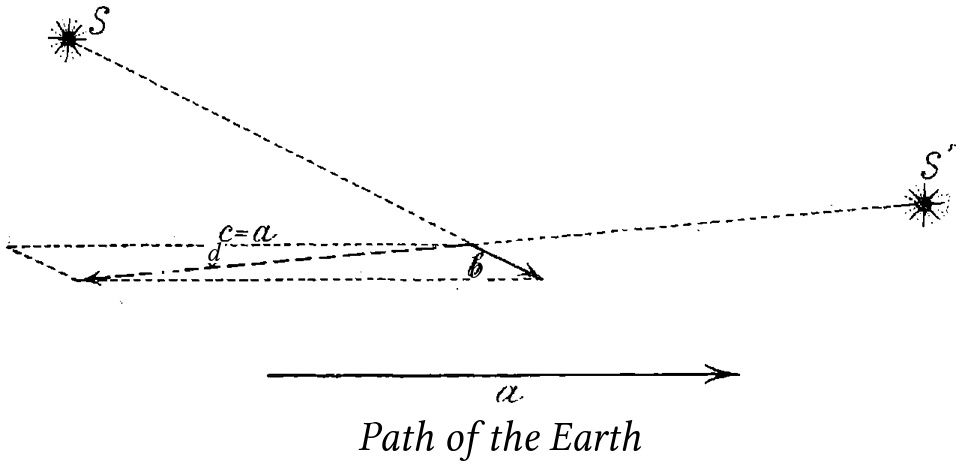
Let the arrow a stand for this new speed of the Earth, and the arrow b for the speed of the light given off by some star S that lies behind us. To find out where we, hurtling along with the Earth, will see this star, we must construct a parallelogram on the speeds b and c (= a); its diagonal d shows the direction from which the star's rays will seem to us to come. Clearly, we'll see the star not behind us, at the point S, but in front of us, at the point S'.
If you now imagine that the angle between the arrows a and b is very close to zero, you'll understand why, moving away from a star faster than light, we would see it at the diametrically opposite point.
The Sunrise Problem
Someone watched the sun rise at exactly 7 o'clock. At what time would he have seen that same sunrise if light traveled instantaneously?
Knowing that light takes 8 minutes to travel from the sun to the Earth, people usually answer that if light traveled instantaneously, the observer would see the sunrise 8 minutes earlier, that is, at 6:52.
But this answer is wrong: the distance from the sun to the Earth, and the speed of light, have nothing whatever to do with it.
The sun comes up over the horizon because the globe turns, and not because the sun really moves. The globe turns one point of its surface after another into space that is already lit. If light traveled instantaneously, therefore, the observer would notice the sunrise at the very same physical moment as when it does not, that is, at exactly 7 o'clock.
Things change, though, if we take into account what is called atmospheric refraction. Refraction bends the path of the rays in the air, and by doing so lets us see the sunrise before the sun has appeared above the geometrical horizon.
If light traveled instantaneously there would be no refraction, since the bending of light comes from the difference in its speed in different media. And without refraction the observer would see the sunrise a little later than he does when light takes time to travel. The difference depends on the latitude of the place, the temperature of the air and other conditions, and ranges from 2 minutes to several days and even more (in polar latitudes).
We arrive in this way at a paradox: if light traveled instantaneously (that is, infinitely fast), we'd see the sun rise later than we do now!
Chapter 10: The Reflection and Refraction of Light
Rays of Light Take a Detour
With mirrors you can make light travel along a broken line instead of a straight one, and go around opaque objects. Practical life has so far found no use for this property of light, unless we count toys and conjuring tricks.
A curious gadget has lately appeared in the toy shops, where it goes by the grand name of an "X-ray apparatus." It earned the title by letting you see, or seem to see, through opaque bodies. The toy can baffle the sharpest mind at first, but its construction is plain from our Figure 99, which shows its old forerunner, the "enigmatic tube." Four mirrors, tilted at 45°, reflect the rays several times over and lead them, so to speak, on a detour around the opaque body.
Another toy worked on the same principle. It was sold at the Petersburg fairground booths a quarter of a century ago, during the Russo-Turkish War, and it was called the "transparent Turk." One half of the tube was fastened to the chest of a toy Turk and the other half to his back; a cleverly hidden roundabout tube with mirrors let you see, as it seemed, straight through the doll.
It has lately come to light that the ancient Egyptians already knew this way of sending light by a roundabout path. An American archaeologist was puzzled to find, on the walls of the darkest underground chambers of the Nile valley, a great many ancient drawings and bas-reliefs, finished with extraordinary fineness and care. No one could conceivably have done such delicate work by torchlight, and the archaeologist was so struck by the fact that he could find no halfway plausible explanation for it. The German magazine Kosmos pointed out that everything becomes clear once we suppose that the Egyptians used a system of metal mirrors like the one just described.
The Talking Severed Head
This marvel is still exhibited by the traveling "museums" and "panopticons" that tour the provinces, and on the uninitiated its effect is simply stunning. You see before you a small table with a plate on it, and on the plate lies... a live human head, which moves its eyes, eats, and talks. The space under the table is empty, and there is positively nowhere to hide a body. You can't go right up to the table, it's true, for a low barrier keeps you back; but you can see clearly, all the same, that there's nothing whatever underneath.
If you ever witness such a "marvel," try tossing a tightly crumpled ball of paper into the empty space under the table.
The riddle is solved at once: the paper will bounce off... a mirror! And even if it falls short of the table, you'll guess that there is a mirror, because you'll see the paper reflected in it.
A mirror set between each pair of table legs is in fact all it takes to make the space beneath look empty from a distance, provided, of course, that neither the furnishings of the room nor the audience are reflected in it. That's why the room must be bare, its walls all exactly alike, its floor painted one uniform color without a pattern, and the public kept far enough from the mirrors.
The secret is as simple as can be, but until you learn it you're quite lost for an explanation.
Sometimes the trick is staged to still greater effect. The conjuror first shows an empty table, with nothing beneath it and nothing on top. Then from behind the scenes he brings out a closed box, supposed to contain the "living head without a body" (it is of course empty). He sets the box on the table, lets down its front, and presents to the astonished public a talking human head (see Figure 100). The table top, needless to say, has a flap in it that covers an opening, and when the box is put on the table, the person sitting underneath pokes his head up through the hole.
The "living half of a woman," shown in our Figure 101, has an equally artless secret with an equally simple explanation.
Feminine Logic
Do ladies know how to use a mirror? If they don't, you'd think, who does? They ought to know the laws of reflection better than any physicist. And yet notice where they put the lamp when they want a good look at themselves: they set it behind them, so as to "light up their reflection," when they should be lighting up themselves! Ninety-nine ladies in 100 do exactly this; but our own lady reader, of course, is not among them.
Whom Do We See When We Look in a Mirror?
"Ourselves, of course," anyone will tell you. "Our image in the mirror is a perfect copy of us, like us in every detail."
Well, kindly take a look at this likeness. You have a mole on your right cheek; your double's right cheek is perfectly clear, but there's a mole on his left, where you haven't a trace of one. You comb your hair to the right; the person facing you, as if on purpose, combs his to the left. Your right eyebrow is higher and thicker than your left; his is lower and thinner. You carry your watch in the right-hand pocket of your waistcoat and your wallet in the left-hand pocket of your jacket. Your double in the mirror has other habits entirely: he keeps his wallet on the right side of his jacket, and his watch on the left side of his waistcoat. While you're at it, look at that watch of his. You've never owned one like it. The arrangement and the shape of its figures are most unusual: the eight, for instance, is written as nobody anywhere ever writes it, IIX, and stands where twelve should be, while there's no twelve at all; after six comes V; and so on. What's more, the hands go around the wrong way.
Finally, your double in the mirror has a serious physical failing from which you, presumably, are free: he is left-handed. He writes, drinks, and eats with his left hand, and if you thought of shaking hands with him, it's his left that he would hold out.
The description in your passport, you see, doesn't fit your double at all.
It's hard to say whether your double can read and write. If he can, he does it in some peculiar fashion of his own. You'd hardly manage to read a single line of the book he's holding, or a single word of those he traces with that left hand.
And this is the man who claims to be exactly like you! Why, the first person you meet in the street is probably more like you than this left-hander, who does everything contrary to the way you do it. And you were naive enough to judge your own appearance by that impostor!
Joking aside, if you think that when you look in the mirror you're seeing yourself, you are mistaken. The human face, to say nothing of our bodies and our clothes, isn't strictly symmetrical: its right half is not quite like its left. In a mirror all the features of the right half pass to the left, and vice versa, and the face that appears before you makes a quite different impression from your own.
Here is how to convince yourself that the two halves of a human face are not identical. You photograph someone full face, and from the negative you make an ordinary print and then a second one, its mirror image, by turning the film over. Now you cut each print in two lengthwise. By putting the matching halves together you get two portraits of the same face: a "right" one, made of two right halves, and a "left" one, made of two left halves. In this way we can get to know separately the "right" and the "left" expression of anyone's face.
The two expressions are noticeably different, even in cases where, looking straight at the face, you'd refuse to admit any difference between its halves. And, curiously, in almost every case the "right" face seems more intelligent, energetic, and expressive than the "left." Compare the two artificial faces with the original, and the "right" one is always the better likeness. This shows that in the mixed impression we get from any face it is the features of the right half that predominate: being more expressive and intelligent, they stamp themselves more sharply on the memory.
We advise amateur photographers to try such experiments on their friends. The necessary skill comes very quickly, and the results are curious enough to be worth the trouble.
Haste with Good Reason
Probably few of our readers know that light chooses the shortest path even when it bounces off a mirror, and not only when it travels in a straight line. Let's follow its route. In Figure 105, let the letter A stand for the source of light and the line MN for the mirror, and let the straight lines AB and BC be the path of the ray from the candle to the eye.
By the laws of optics, the angle of incidence ABK is equal to the angle of reflection KBC. Once we know this, it's easy to prove that of all the possible paths from A to C that touch the mirror MN on the way, the path ABC is the shortest.
Let's compare the ray's path ABC with some other, such as ADC (Figure 106). From the point A we drop the perpendicular AE to MN, and extend it until it meets the extension of the ray BC at the point F. We also join the points F and D. We begin by proving that the triangles ABE and EBF are equal. They are right-angled, and they share the side BE; moreover, the angles EFB and EAB are equal, because they are equal respectively to the angles KBC and KBA (the lines KB and AE being parallel). Hence AE = EF. It follows that the right-angled triangles AED and EDF are equal, having two equal sides about the right angle, and therefore that AD equals DF.
We can now replace the path ABC by its equal, the path CBF (since AB = FB), and the path ADC by the path CDF. When we compare the lengths of CBF and CDF, we see that CBF, a straight line, is shorter than CDF, a broken line drawn between the same ends. Therefore the broken line ABC is also shorter than ADC, which is what we had to prove.
This proof holds good wherever we put the point D, and light does indeed choose the shortest of all the possible paths between source, mirror, and eye.22
The Problem of the Burning Barn
In everyday life, too, a knowledge of the shortest path can sometimes do us good service. Imagine, for example, that a man in his house on a riverbank (Figure 107) notices that the hay stored in his barn has caught fire. He must grab a bucket, run to the river, scoop up some water, and hurry to the barn.
Which path should he take to get to the fire as soon as possible?
The problem resembles the one we've just examined, but turned, so to speak, inside out. Its solution is simple. The owner of the barn must imitate a ray of light: he must run to the bank in such a way that angle 1 is equal to angle 2 (Figure 108). Then, as we've already proved, his path will be the shortest.
Drawing in Front of a Mirror
Stand a mirror upright on the table before you, lay a sheet of paper in front of it, and try to draw some figure on the paper (a rectangle with its diagonals, say) while following the movements of your hand by its reflection.
You'll find that this apparently easy task is almost impossible. Over the years what our eyes see and what our muscles feel have settled into a definite agreement, and the mirror upsets this familiar harmony by showing the eyes a distorted picture of our hand's movements. Your habits will protest, so to speak, at your every stroke. You want to draw the line down, and your hand, as if to spite you, goes up; and so on.
For the experiment to succeed, it helps to screen your hand and the drawing from your eyes with something, but in such a way that you can still see their reflection clearly.
You'll meet even more unexpected oddities if you give up plain geometrical figures and try to draw more complicated ones in front of the mirror, or even just to write while watching the lines in the glass.
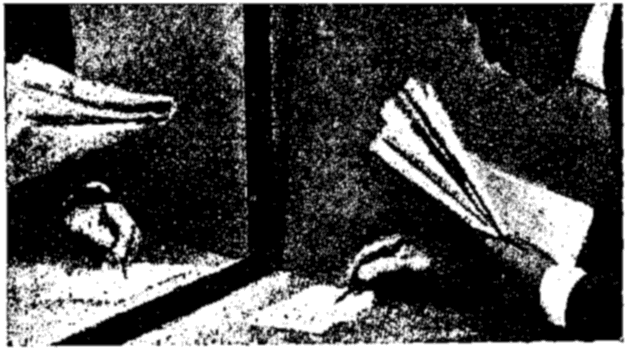
The marks left on blotting paper are mirror images too. Examine the writing scattered over your blotter and try to read it. You won't make out a single word, not even the clearest. The letters have an unaccustomed slant, and, above all, their strokes don't follow one another in the order you're used to.
But don't imagine that there's no way of reading them. An extremely simple method will decipher these hieroglyphics: hold a mirror against the paper at right angles. In the mirror you'll see the same blotter, but with all the letters written as you're accustomed to see them. The mirror gives you a symmetrical image of a pattern that is itself a symmetrical image of normal writing. You can try the same thing with the "mirror" inscription in Figure 104.
What Do Animals Make of Their Reflections?
Here is what a German scholar, Professor T. Zell, well known for his works on the mental life of animals, writes on the subject.
"Sight is the chief external sense in many animals as well as in man. When animals of this class come up to a mirror, they always take an interest in their reflection. But animals for whom one of the chief senses is smell, and not sight, pay the mirror no attention at all.
"This difference in attitude toward one and the same object is easily understood. A man tries to get close to an object that interests him, so as to see it better; so do monkeys, cats, and birds, which recognize things by sight and not by smell. The dog, the pig, and the elephant rely more on their sense of smell, and so, naturally, a reflection in a mirror interests them little. True, a dog that finds itself before a mirror and sees its reflection begins to bark and growl; but when it has sniffed at the mirror and its nose has assured it that no such enemy is there, it turns away from its image at once and pays it no further attention. A horse does just the same, and that is why the Arabs have no cause to marvel at the cleverness of their steeds, which no mirage, it's said, can deceive. The explanation is far simpler: in a mirage the horse's keen nose detects no water or trees nearby, and the horse is not taken in."
How Our Grandfathers Sang the Praises of the Kaleidoscope
The elegant toy known as the kaleidoscope is now going out of fashion, and we can't imagine how our grandfathers doted on it. They sang its praises in prose and in verse. The instrument was invented in England in 1816, and within a year or a year and a half it had made its way to Russia, where it met with rapture. The well-known fabulist A. Izmailov wrote of the kaleidoscope in his magazine The Well-Intentioned (June 1818) in these terms:
"Having read the advertisements for the kaleidoscope, I procure this marvelous instrument.
	I look, and what should meet my eyes?
	In stars and shapes of every guise
	Are sapphires, rubies, topaz bright,
	And emeralds, and diamonds' light,
	And nacre, pearl, and amethyst,
	All in one glance, and nothing missed!
	I barely move my hand, and lo!
	A new sight sets my eyes aglow!
"Neither in verse nor even in prose can one describe what one sees in the kaleidoscope. The figures change with every movement of the hand, and no two are alike. What charming patterns! Ah, if only one could embroider from them! But where would one find such brilliant silks? Here is the pleasantest of occupations for the idle and the bored. It is much better to look into a kaleidoscope than to lay out a grand patience. One can tell fortunes by the kaleidoscope as one does by cards.
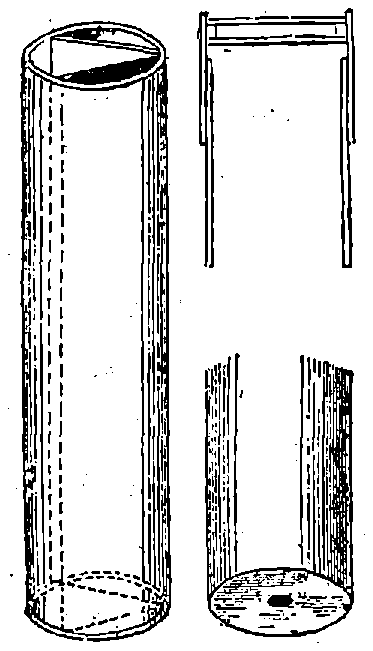
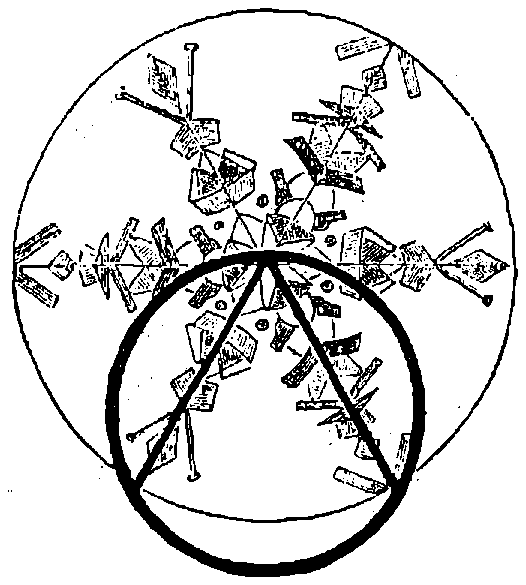
"It is asserted that the kaleidoscope was known as long ago as the seventeenth century. It has lately been revived and perfected in England, and from there, about two months ago, it crossed to France. One of the rich men of that country has ordered a kaleidoscope costing 20,000 francs. In place of bits of colored glass and beads, he had pearls and precious stones put in."
There follows a French anecdote about the kaleidoscope, and finally this melancholy conclusion:
"Mr. Rospini, Physicist and Mechanician to His Imperial Majesty, who is known for his excellent optical instruments, makes kaleidoscopes and sells them at 20 roubles. They will no doubt find many more takers than the lectures on physics and chemistry, from which, to our regret and surprise, the well-intentioned Mr. Rospini has received no profit whatever."
Palaces of Illusions and Mirages
At the Paris World's Fair of 1900 the so-called "Palace of Illusions" was a great success with the public. It was in essence a huge kaleidoscope that stood still, and so huge that hundreds of spectators could fit inside it. Picture a six-sided hall, each of whose walls is an enormous mirror, perfectly polished. In the corners, along the side edges of this mirrored prism, stood architectural ornaments in the form of columns and cornices that merged with the moldings of the ceiling. A spectator inside such a hall saw himself lost in a boundless crowd of people, in an endless succession of halls and columns that surrounded him on every side and stretched away as far as the eye could reach.
The cause will be clear to anyone familiar with the laws of reflection. There are three pairs of parallel mirrors here, and twelve pairs of mirrors set at an angle to each other, and no wonder that they give countless reflections. Figure 113 explains the matter.
It's hard to imagine how overwhelming this endless vista of halls in the "Palace of Illusions" was. But it was nothing beside the extraordinary effects achieved in Paris by the "Palace of Mirages." The builders of this "palace" went still further: to the effect of countless reflections they added the effect of an instantaneous change of the entire scene. They built, in other words, a gigantic kaleidoscope, a moving one this time, but with the spectators inside it, and not outside.
In the "Palace of Mirages" the setting of the hall changes by a more complicated method than in the kaleidoscope you turn in your hand. The mirrored walls are cut through lengthwise, some distance from the edges, and the mirrored corner can then turn in one piece about an axis, giving place to another corner. Figure 114 shows that three such settings are possible, corresponding to the numbers 1, 2, and 3. Now suppose that all the corners marked 1 contain the decorations of an Arab temple, all the corners marked 2 a tropical forest, and the corners marked 3 an Indian temple. Then with a single motion of the hidden mechanism that turns the mirrored corners, the tropical forest is transformed, as if by magic, into a temple or a hall.
Add to this a whole series of marvelous lighting effects, and you'll understand what a striking impression this veritable "palace of mirages" must make on the spectator. You can hardly believe that a slight movement of one man's hand can produce instantly so grand an effect as the change from a whole vast forest landscape to an endless succession of Arab halls, or to the majestic vaults of an Indian temple.
And yet the whole secret of the magic rests on a physical law as simple as the familiar rule for the reflection of light: the angle of incidence equals the angle of reflection. By a fairly easy geometrical construction the reader can work out a diagram of these endless reflections in the "Palace of Mirages."
Palaces of illusions and mirages nowadays serve as entertainment. But there was a time, they say, when the Inquisition made use of the same property of mirrors. It devised a special "torture of mirrors," which the reader may learn about from the story that follows.23
The Torture of Mirrors
A story.
The Inquisitor sat at the head of the table. He said:
"You are stubborn, and you refuse to return to the embrace of Holy Church, which in her mercy calls you. For this we sentence you to spend some time with yourself. May you come to hate yourself, in body and in dust, and may you find the repentance that leads to the salvation of the soul."
I did not understand these words. But then I understood nothing of the rest either. I could only guess that some poor wretch under torture had let my name fall, hoping to soften his own sufferings. I had been seized in a street in Madrid and taken to the prison of the Inquisition. There I lay for many weeks, and when at last they called me for questioning, I was glad: at least the unbearable waiting was over...
After the interrogation they took me to a cell again, much like the last one. It was a room some twelve feet square, lit by a little window just under the ceiling. It even had a bed, though sleep within those walls was seldom rest.
I asked no questions of the masked jailer who led me into my new prison. I had tried that before, without success. The guards of the Inquisition are not talkative; they do not so much as shake their heads.
The heavy door closed behind me. I was alone, and I knew that I was going to suffer, but how, I did not know. "Spend some time with yourself"... What, when all was said, could those words mean? Hadn't I already spent several weeks in solitary confinement?
They had questioned me by day; evening came on, nothing happened, and little by little my fears began to die down. In the end I fell asleep almost easy in my mind.
In the gloom of early morning I woke, and shook with terror. I strained my eyes into the darkness and saw that during the night some strange change had taken place that I could not understand. Directly opposite my bed a light was glimmering where there had been none before. The other walls had taken on an air of mystery; strange shadows wavered on them.
I lay wondering what it could mean. Suddenly there was a light tap above my head, and the room went completely dark. I looked up and saw that something had been put over the window. For several hours I waited, but no ray of dawn made its way into my cell. Then a faint light flared up above me. Fingers appeared through an opening in the middle of the ceiling, and vanished again, leaving a lighted lamp hanging there. Now, at last, I could see...
See what? My first feeling was sheer horror. My head swam. I seemed to be alone in the midst of a wild kaleidoscopic whirl... From every corner frightful faces stared at me. Fantastic little lights swayed wherever I turned my eyes. My cell seemed to have grown, to have become horribly infinite, with nothing in it to hold to and nothing that stayed still...
It was some time before I understood. In the night they had replaced the walls, the ceiling, and the floor of my cell with mirrors. Even the door and the window were now covered with mirrored glass.
The face that looked at me from fifty sides at once was my own. I had not seen it for so long that I had almost forgotten it. I saw it now, but it was wild and terrible. A beard framed it, and my eyes had changed so much that I could not help asking myself how they would change next.
Several hours went by before I found the courage really to look around me. And I cannot convey what a dreadful sight it was! To the right or the left, above or below, I saw myself in a hundred fantastic poses. There were figures that faced me, figures with their backs to me, figures side-on. Here I stood on my head; there I saw myself foreshortened from above. Halves and fragments of my body, sliced off by the edges of the mirrors, met my eyes wherever I turned them.
I was afraid to stir, so terrible was the commotion that my slightest movement set up among the phantoms of the mirrors. If I raised an arm, a crowd of figures repeated the gesture in a thousand ways.
I tried to keep my eyelids closed, but the thought that there were millions of closed eyes all around me, as if in mockery, made me open them again.
In this way the day passed, a day of hideous suffering. I knew that a few more like it would turn me into a raving lunatic. Through the opening in the middle of the ceiling they let food down to me, but I could not touch it.
My tormentors must have realized that the end would come sooner than they wished, and the next morning I woke in an ordinary cell. I don't think the sight of prison walls ever gave such pleasure. I spent an almost happy day, hoping that my torture was over.
But that was not the way of the Inquisition! The following morning the mirrors were back, with this difference: before they had been perfectly flat, and now they had been replaced by slightly concave ones. Anyone who has ever looked into a concave mirror knows what that means. My reflections, which had been merely numberless, were now horribly deformed. Monstrous lips and misshapen eyes leered at me from the walls, and fearful, ill-proportioned creatures changed without warning at the least move I made. No dwelling of the devil's, I thought, could be worse than my cell. I longed to throw myself on the floor, but I knew that some ludicrous and terrible caricature of myself would meet me there.
The day after was a day of rest, although I no longer had any hopes: I tried to look my fate calmly in the face. My persecutors plainly meant to drive me mad, and I knew them well enough to believe that they had not yet reached the limits of their devilish ingenuity. If I had had any sort of weapon, I would have smashed those cursed mirrors into a thousand pieces; but my bed was a bare plank, and I could find nothing else that would serve.
Escape? Impossible! The Inquisition had good locks, and its jailers were loyal. While I was brooding on this, my eye happened to fall on the closed vent in the middle of the ceiling, through which they hung the lamp on those terrible mornings. At those times I had seen only a hand, which lifted a section of mirror, drew it back, and then hung the lamp on a hook attached to it. But the ceiling was at least ten feet up, and it offered me no hope!
Desperate men, however, turn to desperate measures. The next morning I waited eagerly for the hand to appear. When it came through the hatch, I sprang up and seized it. There was a cry of despair; I hung from the wrist I had captured... And then a human body came crashing down through the opening to the floor.
I managed to jump clear, and my jailer landed on his head in the middle of the floor. The lamp, of course, was shattered to bits.
I had planned everything beforehand. Without losing a moment I tore the cloak and mask from my jailer, dead or stunned as he was, and put them on. Then I propped my captive up in a sitting position and, stepping on his shoulder as on a footstool, I sprang for the hatch, which led to the room above.
By good luck I got hold of the trapdoor and climbed safely out of the cell.
There was nobody about. The guard's shriek had gone unnoticed in a place where groans and cries were so often heard. I carefully closed the hatch behind me.
The rest of my escape went more easily than might have been expected, thanks partly to the mask, and partly to the vow of silence kept by the Inquisition's servants. I did meet two or three jailers, but they did not stop me.
I made my way into the garden, and there, in a remote corner, I climbed a tree to the top of the wall, and was soon at liberty.
Only then did I find time to ask myself what my captive would feel when he came to himself among those infernal mirrors. I had certainly dislocated his wrist, and perhaps he had broken his neck as well. And as I thought about it, I was sorry that it was not the Grand Inquisitor himself who had fallen into my hands...
Why Do Rays of Light Refract?
Let's forget about rays of light for a while and take up the following problem, which looks very simple and easy.
A man with a boat at landing A has to reach point B, in the meadow on the far bank, in the shortest possible time. In what direction should he steer across the river, if he moves faster on the water than on foot through the meadow?
The shortest way, it would seem, is AB, since a straight line is always the shortest path. But that's wrong. Remember that we aren't looking for the path that is geometrically shorter than all others, but for the one that can be covered in the shortest time. And in that case the broken line ADB may well bring him to B sooner than the straight line AB. The part of the journey that he must make slowly, on foot through the meadow, is much shorter on the broken line ADB than on the straight line ACB (BC is nearly twice as long as BD). True, the part that goes by water is longer on the broken line, AD, than on the straight one, AC; but here the difference is relatively small, and the boat soon makes it up besides. The upshot is that the route ADB can be covered in less time than the route ACB.
For all its apparent simplicity, this problem can't be worked out in full by elementary mathematics. Higher mathematics comes to our aid with the following answer (Figure 120): the path will be the quickest when this proportion holds:
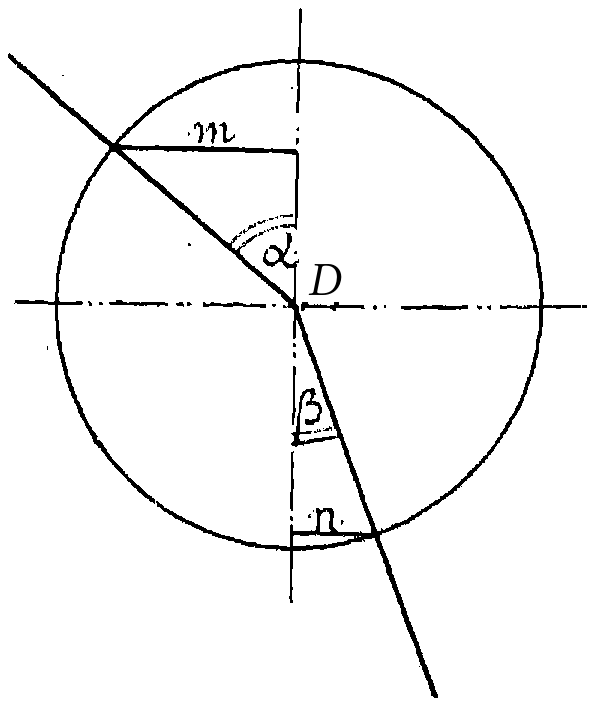
In other words, the path refracts, or bends, in such a way that the ratio of the sine of the angle α to the sine of the angle β (the angles between the parts of the path and the perpendicular) is equal to the ratio of the speeds on the water and in the meadow. This ratio is a constant quantity: it depends neither on the width of the river nor on the position of the points A and B.24
But this is precisely the law of refraction of light! When light passes from one medium into another, it too refracts, and the ratio of the sine of the angle of incidence to the sine of the angle of refraction is a constant quantity, equal to the ratio of the speeds of light in the two media. Now you see that by refracting, light saves time: it makes its run in the shortest period possible. Here again, then, we find the same haste with good reason that we noticed earlier in the reflection of light.
The Coin That Appears and Disappears
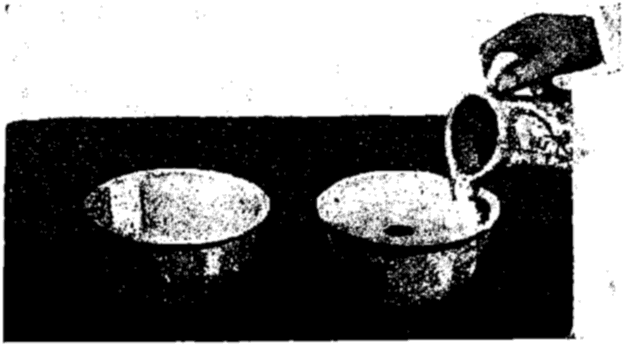
Seat your guest at the table so that he can't see the bottom of a cup in front of him. Put a coin on the bottom, where the side of the cup will of course hide it from your guest's eyes. Now ask him not to turn his head, and pour some water into the cup. The effect is rather unexpected: the coin at once becomes visible to your guest. Draw the water out of the cup with a syringe, and the bottom, coin and all, sinks down again.
This apparent rising and sinking of the bottom is caused by the refraction of light rays, whose course is shown in Figure 123. The bottom rises least when you look at the water from directly above, that is, when the rays that reach your eye leave the water at right angles to its surface. This, incidentally, is why, when you look from a boat through the water at the level bottom of a pond, you always see the deepest spot right beneath you. The level bottom of the pond looks concave to you. If, conversely, you could look up from the bottom of the pond at a bridge thrown across it, the bridge would look convex (as in Figure 126, of which more below). In that case the rays pass from a weakly refracting medium (air) into a strongly refracting one (water), and the effect is therefore the reverse of what happens when rays pass from water into air. We must bear this in mind when we consider how the dwellers in the water live. How fish see, or rather how they would have to see if they had our human eyes, we shall talk about later at more length.
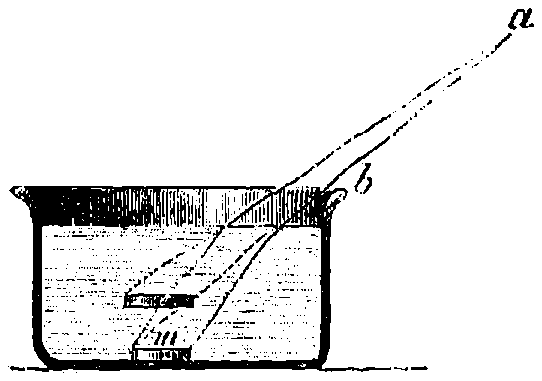
A Warning to Bathers
Everyone who bathes should keep in mind this apparent rising of the bottom of any body of water, and children especially, for whom a wrong estimate of the depth may prove fatal. Refraction raises the bottom by about 1/3: a stream 2 meters deep looks only a meter and a third deep. Conversely, a bottom that seems to us 2 meters down is really 3 meters down, and the difference is enough to drown a bather who can't swim.
How Do You Cut a String Without Touching It?
You bore a hole in a cork and pass a thread through it; at one end you tie a knot, and to the other you fasten a ring, a small nail, or something of the sort. Then you stop an empty bottle with this cork, and the ring is left hanging inside.
You invite your guests to examine the bottle and to seal it with sealing wax and their own initials, and then you announce that you will undertake to cut the string without damaging the seal. And sure enough, you retire with the bottle to the next room for a minute, come back, and show your guests the bottle with the string already cut. The seal is untouched.
The explanation is very simple: the cutting is done with a burning glass. Direct the rays onto the string, and in a few seconds you burn it through.
The trick can of course be performed only on a sunny day.
Curiously enough, something of the kind is mentioned in Aristophanes' comedy The Clouds. Socrates sets Strepsiades a problem: "If somebody were drawing up a bond against you for five talents, how would you get rid of it?"
Strepsiades. I've found a way to wipe out the bond, and such a way that you yourself will own it's as crafty as they come! You've seen, of course, that beautiful clear stone they have in the apothecaries' shops, the one for lighting fires?
Socrates. A burning glass?
Strepsiades. The very thing.
Socrates. And what then?
Strepsiades. While the notary is writing, I'll stand behind him, aim the sun's rays at the bond, and melt away every word of it...
To understand this, we must remember that the Greeks of Aristophanes' day wrote on wax-coated tablets, which heat would easily melt.
How Do Fish See?
Have you ever tried this simple experiment: to lower an ordinary magnifying glass into water and look through it at things below the surface? Try it, and you'll notice something rather unexpected. In water the magnifying glass hardly magnifies. Put a reducing glass (that is, a biconcave one) into water, and you'll find that it loses much of its power to reduce. The result will be stranger still if you do the experiment in vegetable oil instead of water. Here you get the very opposite of what you're used to: the biconvex glass makes things look smaller, and the biconcave one makes them larger.25
Why should this be? Once you recall the basic law of refraction, these marvels will no longer surprise you. A biconvex lens magnifies in air because glass refracts light more strongly than the air around it. If we could make such a lens of diamond, it would magnify even more noticeably, because diamond has a greater refracting power than glass. But between the refracting powers of glass and of water the difference is comparatively small, and if you put a glass lens in water, the rays that pass from water into glass won't be much deflected from their course. That's why a magnifying glass magnifies much more weakly under water than in air, and a reducing glass reduces more weakly. Vegetable oil refracts rays even more strongly than glass does, and that explains what seemed so strange at first sight: in this liquid magnifying glasses reduce, and reducing glasses magnify.
It's enough, then, to dip an optical glass in water for it to lose much of its optical power. If we immerse a complicated combination of glasses, that is, a whole optical instrument, it will prove quite useless there. And since our eye is nothing other than an optical instrument, the eye clearly can't serve its purpose in water as it does in air.
Now you see that the sight of fish must be something quite peculiar, and that there is matter for thought here. The mere fact that fish live in water and not in air, in a medium, that is, that refracts light more strongly, is enough to create special optical phenomena for them that we generally don't even suspect.
More curious still is the question of how fish see us, and what our dry-land world in general looks like to the creatures of the water. An American scientist named Wood has made a serious study of it. He built a device that can photograph objects as they must appear to creatures under water. It's so simple that anyone can make one: it is an ordinary camera (it doesn't even need a lens), but filled with water, and before the rays can reach the photographic plate they have to pass through a layer of water some 10 to 13 centimeters thick. With this very simple device he obtained the three curious photographs reproduced here.
The photograph in Figure 124 shows how a ring of people standing around a small pond looks to fish. The curious thing is that from the bottom of the pond a fish sees the whole of a person from head to foot, and not only the upper part of the body, as we might have expected. Before you have even reached the bank, the fish has already seen you, an interesting circumstance that we don't generally suspect. The explanation of this apparent paradox lies, once again, in the law of refraction. It will become clear if you look at the diagram in Figure 125. If the pond were filled with air and not water, the only objects visible from the point O would be those in the space between OA and OB. When the pond is filled with water, it's another matter. A fish at O can then see the object N, because the ray refracts at the point M, and so the edge of the pond doesn't hide things on the bank from the fish. The horizon of fish, in other words, is far wider than we usually think, and all lovers of angling may find this worth remembering.
Another unexpected consequence of the law of refraction is that everything above the water, and in general everything outside it, looks distorted in shape to the inhabitants of the watery world. The straight lines of a railway bridge, for example, appear to fish as arcs, as the photograph in Figure 126 clearly shows. We won't dwell on the cause of this, having hinted at it when we explained why the flat bottom of a pond looks concave to us (under "The Coin That Appears and Disappears"). For a similar reason a row of people standing beside an aquarium, say, must look to fish as it does in Figure 127: the people seem to be drawn up, not in a straight rank, but in an arc whose bulge is toward the fish.
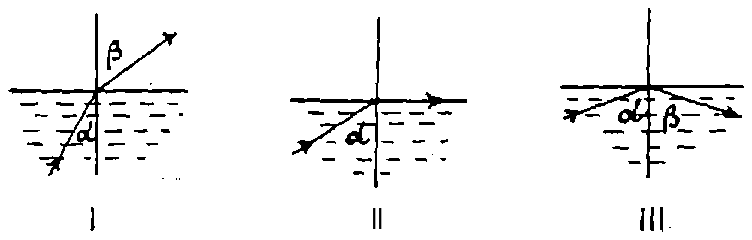
Let's note, finally, one more peculiarity of underwater optics. In calm water a fish, or any other underwater creature, always sees a bright circle above it, and not the outline of the pond, as you might think (except when its eye is close to the bank). This too follows from the laws of refraction: if you trace the course of the rays, and take into account the so-called "limiting angle" and total internal reflection, you'll satisfy yourself that it must be so. And it's curious to note that the closer the fish is to the surface of the water, the smaller is the bright circle above its head, and that as the fish goes deeper, the circle grows.
Through this bright circle, as through a round window, fish see the whole world above the water. And all around this "window" there spreads something like a mirror, through which not a single ray passes. It reflects everything that lies on the bottom or swims in the water. Only here and there on the gleaming surface of the watery mirror can you see strange projections: these are the bottoms of boats sailing on the lake.
Such are some of the peculiarities of underwater optics. Many people don't even suspect them, although the laws of refraction would let anyone predict them in advance, without any experiments. True, photographs like these don't yet give a full idea of how fish see, because they reproduce only the external, physical conditions of sight under water; they leave out the physiological side, which depends on the anatomy of fishes' eyes. But that should call for no important changes, since the eyes of fish are built, by and large, on the plan of a camera.
Since an "underwater" camera is not very hard to make (you can do perfectly well even without a lens), we advise our readers to try repeating the American scientist's experiments. Perhaps they'll manage to observe some peculiarities that escaped him.
Curiously, the passengers of Jules Verne's Nautilus ought to have observed exactly the same things around them. But the author of Twenty Thousand Leagues Under the Sea overlooked it. He nowhere mentions that the inner surface of the water is a mirror, or that strange optical round "window," or the distorted shapes of objects seen from the water.
Chapter 11: Sight and Optical Illusions
Can You See Through Your Hand?
Anyone will tell you that you can't, and yet that isn't quite true. Roll a sheet of paper into a tube, take it in your left hand, hold it to your left eye, and look through it at something far off. At the same time hold your right palm in front of your right eye, with its edge touching the tube. Both hands should be about 15 centimeters from your eyes. You'll find, to your amazement, that your right eye sees straight through your palm, as if someone had cut a round hole in it (Figure 130).
The physiology of sight explains this curious effect. Your left eye was looking through the tube at the distant object, and the lens of that eye, which adjusts itself automatically, had set itself for that distance. But our eyes are so made that whatever setting the lens of one eye takes up, the lens of the other takes up too. In our experiment, then, the right eye was also set for distance, and it saw the palm only as a blur. In short, the left eye sees the distant object clearly, and the right eye sees the hand indistinctly. When the mind joins the two images, it seems to us that we are seeing the distant object through the hand that blocks our view.
What Are Two Eyes For?
When Russians want you to keep your eyes open, they say "Look with both!" The expression seems a mere figure of speech, with nothing real behind it. Is it so very important, after all, to look with two eyes? Do we really see any worse with one?
Instead of answering, I'll suggest an experiment.
Tie a thread to a ring and hang it from the lamp over the dining table; two threads are better, since they'll keep the ring from turning. Arm yourself with a pencil that has a pin stuck into it at right angles. Now stand where you see the ring edge on, close one eye, and try to put the pin through the ring. It doesn't look like much of a task, but you'll be lucky to manage it at the tenth try, or even the twentieth. You'll make the grossest mistakes in judging how far away the ring is. Yet you have only to open your right eye, and you'll do it at once.
This curious experiment, which can be varied in all sorts of ways, shows better than any argument why we need to "look with both." Only when we use both eyes can we judge distances correctly.
But in that case, the reader will ask, why does a marksman always take aim with one eye and shut the other? The answer is very simple. To aim, we need to know exactly the direction, and the distance doesn't matter. The other eye gets in the way of finding the direction, and the marksman is quite right to close it.
The Idea of the Stereoscope
Why do we see things as solid and not flat? After all, the image on the retina of the eye is a flat one. How does it come about that objects appear to us in relief, as bodies of three dimensions, and not as a flat picture?
A whole series of causes is at work here, more psychological than physiological. First, the different lighting of an object's different parts lets us judge its shape. Second, there is the greater or lesser strain that we feel in adjusting our eyes to see clearly things at different distances. But what serves us best of all is that we look with two eyes instead of one, and that the two eyes get different images of the same object. You can easily convince yourself of this by looking at something close to you and shutting first your right eye, then your left.
We usually take little notice of the difference. It seems to us that a second eye merely widens our field of view, and that otherwise seeing with two eyes is much the same as seeing with one. But it isn't, and the simple experiment with the ring has just shown us how much we gain by looking "with both."
The right eye and the left, then, see things differently. Each has its own picture, and it is this difference, as our mind interprets it, that gives us the impression of relief.
Now imagine two drawings of the same object: the first shows it as the right eye sees it, the second as the left eye sees it. Put tubes to your eyes and look at the drawings in such a way that each eye sees only its own. With a certain effort of the imagination, you'll see, in place of two flat pictures, a single solid object standing out in relief.
Here we have the germ of the instrument that is now so popular under the name of the stereoscope.
This simplest of stereoscopes has one serious drawback. To see only one image with each eye takes a certain effort of the eye muscles, and not everyone can manage it. We need, therefore, some way of making it easier for the images to merge. The older stereoscopes did this with mirrors, and the newest do it with prisms of glass with convex faces, which bend the rays so that, when the mind traces them back, the two images fall one on top of the other. That's all there is to a stereoscope. The idea, as you see, is uncommonly simple, and it makes the effect achieved by such simple means all the more striking.
But we can also look through a stereoscope at pictures that don't represent solid objects at all, or that show things which don't normally appear to us in relief. This possibility is what has turned the stereoscope from a mere curious toy into a real instrument of research.
Detecting Forgeries with the Stereoscope
Take two drawings that are exactly alike, say two equal black squares. Looked at through a stereoscope, they'll give us a single square, just like each of the two. If there is a white dot at the center of each square, it too, of course, will appear on the square we see in the stereoscope. But shift the dot on one of the squares a little way off center, and something rather unexpected happens. In the stereoscope you'll still see one dot, only now it's no longer on the black square but in front of it, or behind it. The most trifling difference between the two pictures is enough for the stereoscope to give us the impression of perspective and relief, even when there's none there. This is quite understandable. Our eye has grown used, as it were, to putting all such differences down to solidity, and it sees three dimensions even where there are really only two.
This gives us a simple way of detecting counterfeit banknotes and the like. Put the suspect note in a stereoscope beside a genuine one, and you'll discover the forgery at once, however skillful it may be. A trifling difference in one letter, in one stroke, will leap to the eye, because that letter will plainly stand out above the rest of the background.
How Giants See
There's more. With a stereoscope we can see in relief even those things that are usually too far away for it. When an object is very distant, the normal separation of our eyes is too small to make any difference between what the one sees and what the other does. That's why distant buildings, mountains and landscapes look flat to us. It's also why all the stars in the sky seem equally far away, although the Moon is much nearer than the planets, and the planets are immeasurably nearer than the fixed stars.
Beyond about 400 meters, in general, we lose all power of perceiving relief. Objects look the same to the right eye and the left, because the six or seven centimeters between our eyes are far too little compared with four hundred meters. Stereoscopic drawings and photographs made under such conditions will clearly be identical too, and will give no illusion of relief.
But this is easily mended. We need only photograph distant objects from two points farther apart than our eyes. Looking at these photographs in a stereoscope, we'll see the landscape in relief, just as we would see it if our eyes were set much wider apart than they are. That is the whole secret of stereoscopic landscape views. People usually look at them through magnifying prisms (with bulging faces), and then these views in relief often appear life-size into the bargain. The effect is almost magical!
You have probably guessed already that one could build a pair of telescopes that would let us see a real landscape in relief directly, without any photographs. Such instruments do in fact exist. The two tubes are set farther apart than a person's eyes normally are, and prisms that bend the rays bring both images to the observer's eyes. What one feels on looking through such an instrument is so extraordinary that it's hard to describe. All nature is transformed. The distant mountains take on relief, and every sapling, crag, building and ship at sea rounds itself out and stands clear; everything is set out in boundless space instead of lying on a flat picture. You can actually see a distant ship moving that seems motionless in the most powerful telescope. This is just how the landscapes of our Earth would look to the giants of fairy tales.
To surveyors, sailors, strategists and travelers these binocular telescopes are quite indispensable, especially when they're fitted with a scale for measuring the distances of faraway objects and for drawing maps.
The Universe in the Stereoscope
Point such an instrument at the heavenly bodies, however, and you'll get no illusion whatever. That was only to be expected. Distances in the heavens are far too vast for any change of position on the Earth's surface to affect the look of what we see there. What, after all, are the 25 centimeters or so between the two tubes of our instrument, compared with the distance from the Earth to the Moon? Even if we could build one with its tubes tens or hundreds of kilometers apart, it would still have no effect when turned on the planets, which are tens of millions of kilometers away.
Here too stereoscopic photography comes to the rescue. Suppose we photograph some planet today, and then again tomorrow. Both pictures will have been taken from the same place on the Earth, yet from different points in space, because in twenty-four hours the Earth will have moved 380,000 kilometers along its orbit.26 The two photographs, therefore, won't be quite identical. It only remains to put them into a stereoscope, and we'll see the planet in relief.
By making use of the Earth's motion in its orbit, then, we can photograph the heavenly bodies from two points in space very far apart, and treat the pictures as a stereoscopic pair. Imagine a giant with a head so gigantic that the distance between his eyes is the diameter of the Earth's orbit, 300 million kilometers, and you'll understand what extraordinary, almost miraculous results astronomers achieve with celestial stereography. What that cosmic giant would see, we now see too, insignificant specks of dust on a heavenly splinter called the Earth.
All the objects in the heavens appear to us in a new guise. Jupiter stands out round, with its satellites, in front of a background of stars that lies far behind the planet. Saturn's rings are plainly solid and clearly separate from the planet. The mountains of the Moon,27 whose height we usually judge only indirectly, from their shadows, rise bold and sculptural from its surface, while the Moon itself no longer looks like a flat disk and is visibly round. It's as if some titan of a sculptor had brought flat, lifeless blocks of stone to life with a magic chisel.
Celestial stereography can catch even the motions of the so-called fixed stars. Photograph the same patch of starry sky twice, with a long enough interval between, and the two pictures won't be quite alike, because in the meantime some stars will have had time to move and change their position. The stereoscope will point these stars out to us at once, since they'll stand out in front of the general background. (To see why, you need only recall the example of the two black squares in "Detecting Forgeries with the Stereoscope.")
The same method is now used for discovering asteroids, those small planets that circle in great numbers between the orbits of Mars and Jupiter. Until recently, finding them was a matter of luck. It was only by chance that an astronomer, looking over a whole cloud of star dust, came upon the one among all those bright points that had a motion of its own and was therefore a planet rather than a star. Now it's enough to compare two photographs of a given patch of sky in the stereoscope, and the asteroids stand forward and catch the eye at once, if there are any in the sample.
The stereoscope detects differences in the brightness of points as well as differences in their position. This gives the astronomer a simple way of finding what are called variable stars, which periodically change their brilliance. If some star has come out brighter on one of the two photographs than on the other, the stereoscope will immediately show the astronomer which star it is.
Attempts have also been made to photograph shooting stars stereoscopically, and the effect was astonishing. The whole path of the meteor stood out with perfect clearness in front of the celestial sphere, and the eye plainly saw that the meteor was flying much nearer to us than the stars, and that it really belonged to the Earth and not to the heavens.
Still more wonderful is the stereoscopic photograph of the Andromeda nebula shown here. Seen in the stereoscope, the nebula clearly reveals its relief and stands out like a sculpture, hanging in space against a background of star dust. It's a landscape, you'd have thought, that mere mortal eyes were never meant to see.
And indeed the stereoscope in this case makes us, as it were, into giants of improbable, unimaginable size. Our whole solar system is far too small to give us the room we need for a stereoscopic photograph of this nebula. A giant whose eyes were at the two ends of a diameter of the Earth's orbit would see the nebula flat, without any relief, because it lies so far from our world.
And yet the stereogram of this nebula has been made. The astronomers took advantage of the fact that our Sun doesn't stand still in space but rushes along among the stars, carrying with it the Earth and all the other planets. This means that we are always seeing the starry sky from new points of view, and that after a long enough time the difference may become noticeable even to a camera. The two photographs of the Andromeda nebula were taken four and a half years apart. In that time we had moved billions of kilometers through space, and the photographs, taken from the two ends of that journey, are noticeably different from each other.28 When we look at them in the stereoscope, we become like a giant who could hold our whole solar system in the palm of his hand.
Astronomers are now laying in photographs from various corners of the universe, so that in 10, 20 or 30 years, when our wanderings through space in the company of the Sun have carried us far enough, they can photograph the same objects again. In this way we'll one day accumulate a whole collection of stereoscopic photographs from different corners of the universe, and we'll be able to enjoy cosmic landscapes in relief.
The men who first succeeded in applying the stereoscope to astronomy deserve to have their names known and remembered. They are Professor Wolf of Heidelberg and Dr. Pulfrich of Jena.
How the Recruit Was Found Out
At his medical examination, a recruit declares that he can see nothing with his right eye. How are we to make sure that he isn't shamming? To all the doctor's questions he stubbornly repeats that he sees nothing with his right eye, and no trick will catch him out. Yet the doctor outwitted him, and here is how he did it.
If you look through a red glass at an inscription written in red on white, you'll see an even red field and nothing more. Not a trace of the writing will be visible, because the red letters merge with the background, which is red as well. But look through the same glass at an inscription in blue on white, and you'll distinctly see black letters on a red field. It's easy to see why they're black. The red glass doesn't let blue rays through (it is red precisely because it passes only red rays), and therefore where the blue letters are, you must see an absence of light: in other words, black letters.
Finally, if you look through a green glass, you'll see both inscriptions, the red and the blue. They'll both seem black, because green glass stops red rays and blue ones alike.
This is the property of colored glasses that the doctor made use of. On both sides of a white card he wrote the word ROUNDED. The letters R, U, the first D, and E he wrote in blue, and the rest (O, N, and the last D) in red.29
He also prepared a pair of spectacles with one green glass and one red.
He put the spectacles on the recruit with the green glass in front of the good left eye, and showed him the card. The recruit read "rounded," as was to be expected. Then the doctor turned the spectacles around, so that the green glass came in front of the supposedly blind right eye, turned the card over, and showed him the same word. If the right eye had really been blind, the recruit, looking at the word through the red glass, would have seen only the blue letters, and would have read "rude." But, never suspecting the trap, he once more read "rounded," and so gave himself away. For that matter, he'd have been found out even if he had known about this property of colored glasses, because he couldn't know which letters were written in which color: the card was shown to him only when the spectacles were on.
Anaglyphs
The same property of colored glasses is behind what are called anaglyphs, pictures printed in a special way that give the same effect as stereoscopic photographs. In an anaglyph the two images, one for the right eye and one for the left, are printed one on top of the other, but in different colors, blue and red.
To see a single black image in relief instead of two colored ones, you need only look at them through colored spectacles. The right eye, through the red glass, sees only the blue print, which is exactly the one meant for the right eye (and which looks black to it, and not blue). The left eye, through the blue glass, sees only the red print that is meant for it. Each eye sees only one image, and precisely the one that belongs to it. The conditions here are the same as in the stereoscope, and the result must therefore be the same: we get an impression of relief.30
Why Do We Look at Paintings with One Eye?
One seldom hears a full and correct answer to this question. Objects, after all, gain in relief when we look at them with two eyes; the astonishing effects of the stereoscope depend on it. Paintings, on the contrary, take on depth precisely when we look at them with one.
Yet there is no contradiction here. One thing, in fact, follows from the other. When we look with both eyes at a real landscape, the images on our two retinas are not quite alike. But when we look at a flat picture, the two eyes receive exactly the same impression. The sameness of the two images exposes the forgery, so to speak: we feel unconsciously that something is wrong, and that this is no real landscape before us. When we close one eye, we have only a single image to go by, and nothing left to expose the "forgery" with. No wonder that we then give in more easily to the illusion.
The illusion grows stronger still if we can see nothing in front of us except the picture: no ceiling, no floor, no people standing about, no frame. That's why, having closed one eye, we often look with the other through a hand curled into a tube.
How Do the Nearsighted See?
The world of the nearsighted is a world all its own, and it's strange how little attention anyone has paid to the peculiarities of what they see. We know that a nearsighted man sees badly; but what it is that he sees, and how exactly things appear to him, is something we don't usually discuss. Yet the number of nearsighted people keeps growing, and it's time we got to know the world as it looks to them.
To begin with, a nearsighted man never sees sharp contours. All objects have soft, spreading outlines for him. Someone with normal sight, looking at a tree, makes out every separate leaf and every twig, drawn distinctly against the sky. The nearsighted man sees only a shapeless green mass with vague, fantastic outlines, and all the small details are lost to him.
That's why all human faces look, on the whole, younger and more attractive to nearsighted people than to the rest of us. They don't notice wrinkles, pimples and little blemishes. A coarse red complexion (natural or artificial) seems to them a tender flush, and at a ball or the theater heavily powdered elderly women look to them like young beauties with faces of pale marble. Sometimes we marvel at the innocence of acquaintances who are wrong by almost 20 years in guessing people's ages; we're struck by their bad taste in judging beauty; we accuse them of rudeness when they look us straight in the face and seem unwilling to recognize us. Often all this comes simply from nearsightedness, and because we don't know the peculiarities of their sight, we blame them for faults of which they're quite innocent. When a nearsighted man talks to you (without his spectacles), he doesn't see your face at all, or at any rate doesn't see what you suppose he does. What he has before him is a dim, blurred apparition, and it's no wonder that when he meets you again an hour later he doesn't know you. For the most part, nearsighted people recognize others by the sound of their voice rather than by how they look; sharpened hearing usually makes up for what they lack in sight.
A curious metamorphosis takes place for a nearsighted man every time he puts his spectacles on. Everyone around him suddenly grows 10 or 20 years older, handsome old gentlemen turn into decrepit ancients, and most of the women instantly lose their looks.
It's interesting, too, to follow how the world appears to nearsighted people at night. By artificial light, anything at all bright, such as street lamps, house lamps and lighted windows, swells to incredible proportions for them and turns the scene into a chaos of shapeless bright blots and dark, misty silhouettes. Instead of a row of lamps along the street, they see two or three enormous blots that hide all the rest of it. They can't make out an approaching carriage; they see only two bright halos touching each other (the lamps), and in front of them some kind of swaying mass (the horse). From such vague clues they can form no idea of how far away these things are from one another, and on busy streets at night the danger they run is far greater than people generally suppose.
Even the night sky looks quite different to the nearsighted than it does to the normal eye. A nearsighted person sees only stars of the first three magnitudes, or at most four; in other words, instead of several thousand stars he has only a few hundred. But these few stars, on the other hand, seem to him large, bright clots of light. The Moon likewise looks enormous to a nearsighted person, and very close, while the crescent moon takes on some intricate, fantastic shape.
The Height of Your Hat
Ask a friend to point to the spot on the wall that his own hat would reach if it stood on the floor. When he has done so, actually put the hat on the floor. It turns out to be little more than half as high as he showed you!
The experiment works especially well if the hat's owner doesn't bend down to point, but simply tells you where on the wall to make the mark. You can do it, of course, with other things besides a hat: a desk lamp, a book, or any other object that we usually see at eye level.
The reason for the mistake will be clear if you remember how lines shorten when we look along them.
Stretched-Out Inscriptions and Pictures
Here is another example of the same kind of shortening. What is the meaning of the strange pattern in Figure 140? It seems to be just a row of lines, spattered with black blots. But try looking at it from below, so that your gaze slides along the lines, and you'll have no trouble in reading a word in Russian letters: FIZIKA, which is to say, physics.
If such an inscription stood high up on some very tall building, people passing in the street would easily read "physics," without ever suspecting how odd the lettering looks from straight in front.
One practical conclusion you can draw from this is that signs on the upper floors of buildings should have stretched-out letters; otherwise foreshortening will flatten them until they become hard to read. The same goes for statues, pictures and all kinds of molded ornament. Architects know this peculiarity of our sight, and in decorating very tall buildings they take it into account and deliberately exaggerate all the vertical dimensions of statues and pictures. If they want a landscape high on a wall to look to the observer like Figure 142, for example, they have to give it a rather misshapen appearance, something like Figure 141.
The Size of Tower Clocks
The mistake your friend made about the height of his hat is one that we make all the time in judging the size of things placed very high up. We always underestimate statues that stand on tall columns or adorn the fronts of tall buildings. Our mistake about the size of tower clocks is particularly telling. We know that they are very large, and even so the idea we have of their size falls far short of the truth. The picture here shows the famous clock of Westminster Abbey31 set down in a London street. As you see, two streetcars, one on top of the other, don't come up to the height of this clock. People look like tiny insects beside it. And when you glance at the Abbey's tower, outlined in the distance, you refuse to believe that the little white square you see on it is this very clock.
Very curious illusions sometimes come from judging a distance wrongly. Of two images that take up the same room in the eye, we take for the larger object the one that seems to us farther away. Usually, it's true, we judge the distance of an object by its apparent size. But it can happen the other way round, and if for some reason we involuntarily exaggerate the distance, the object too will seem to us correspondingly larger.
The story by Edgar Allan Poe that I give below is based on just such a mistake. For all its seeming improbability, there is nothing fantastic in it. I myself once fell victim to exactly the same kind of illusion, and many of my readers will probably remember similar cases from their own lives.
The Sphinx
"The Sphinx" is a story by Edgar Allan Poe.32
During the dread reign of the cholera in New York, I had accepted the invitation of a relative to spend a fortnight with him in the retirement of his cottage ornée on the banks of the Hudson. We had here around us all the ordinary means of summer amusement; and what with rambling in the woods, sketching, boating, fishing, bathing, music, and books, we should have passed the time pleasantly enough, but for the fearful intelligence which reached us every morning from the populous city. Not a day elapsed which did not bring us news of the decease of some acquaintance. Then as the fatality increased, we learned to expect daily the loss of some friend. At length we trembled at the approach of every messenger. The very air from the South seemed to us redolent with death. That palsying thought, indeed, took entire possession of my soul. I could neither speak, think, nor dream of any thing else. My host was of a less excitable temperament, and, although greatly depressed in spirits, exerted himself to sustain my own. His richly philosophical intellect was not at any time affected by unrealities. To the substances of terror he was sufficiently alive, but of its shadows he had no apprehension.
His endeavors to arouse me from the condition of abnormal gloom into which I had fallen, were frustrated, in great measure, by certain volumes which I had found in his library. These were of a character to force into germination whatever seeds of hereditary superstition lay latent in my bosom. I had been reading these books without his knowledge, and thus he was often at a loss to account for the forcible impressions which had been made upon my fancy.
A favorite topic with me was the popular belief in omens—a belief which, at this one epoch of my life, I was almost seriously disposed to defend. On this subject we had long and animated discussions—he maintaining the utter groundlessness of faith in such matters,—I contending that a popular sentiment arising with absolute spontaneity—that is to say, without apparent traces of suggestion—had in itself the unmistakable elements of truth, and was entitled to as much respect as that intuition which is the idiosyncrasy of the individual man of genius.
The fact is, that soon after my arrival at the cottage there had occurred to myself an incident so entirely inexplicable, and which had in it so much of the portentous character, that I might well have been excused for regarding it as an omen. It appalled, and at the same time so confounded and bewildered me, that many days elapsed before I could make up my mind to communicate the circumstances to my friend.
Near the close of an exceedingly warm day, I was sitting, book in hand, at an open window, commanding, through a long vista of the river banks, a view of a distant hill, the face of which nearest my position had been denuded by what is termed a land-slide, of the principal portion of its trees. My thoughts had been long wandering from the volume before me to the gloom and desolation of the neighboring city. Uplifting my eyes from the page, they fell upon the naked face of the hill, and upon an object—upon some living monster of hideous conformation, which very rapidly made its way from the summit to the bottom, disappearing finally in the dense forest below. As this creature first came in sight, I doubted my own sanity—or at least the evidence of my own eyes; and many minutes passed before I succeeded in convincing myself that I was neither mad nor in a dream. Yet when I describe the monster (which I distinctly saw, and calmly surveyed through the whole period of its progress), my readers, I fear, will feel more difficulty in being convinced of these points than even I did myself.
Estimating the size of the creature by comparison with the diameter of the large trees near which it passed—the few giants of the forest which had escaped the fury of the land-slide—I concluded it to be far larger than any ship of the line in existence. I say ship of the line, because the shape of the monster suggested the idea—the hull of one of our seventy-fours might convey a very tolerable conception of the general outline. The mouth of the animal was situated at the extremity of a proboscis some sixty or seventy feet in length, and about as thick as the body of an ordinary elephant. Near the root of this trunk was an immense quantity of black shaggy hair—more than could have been supplied by the coats of a score of buffaloes; and projecting from this hair downwardly and laterally, sprang two gleaming tusks not unlike those of the wild boar, but of infinitely greater dimensions. Extending forward, parallel with the proboscis, and on each side of it, was a gigantic staff, thirty or forty feet in length, formed seemingly of pure crystal and in shape a perfect prism,—it reflected in the most gorgeous manner the rays of the declining sun. The trunk was fashioned like a wedge with the apex to the earth. From it there were outspread two pairs of wings—each wing nearly one hundred yards in length—one pair being placed above the other, and all thickly covered with metal scales; each scale apparently some ten or twelve feet in diameter. I observed that the upper and lower tiers of wings were connected by a strong chain. But the chief peculiarity of this horrible thing was the representation of a Death's Head, which covered nearly the whole surface of its breast, and which was as accurately traced in glaring white, upon the dark ground of the body, as if it had been there carefully designed by an artist. While I regarded the terrific animal, and more especially the appearance on its breast, with a feeling of horror and awe—with a sentiment of forthcoming evil, which I found it impossible to quell by any effort of the reason, I perceived the huge jaws at the extremity of the proboscis suddenly expand themselves, and from them there proceeded a sound so loud and so expressive of woe, that it struck upon my nerves like a knell and as the monster disappeared at the foot of the hill, I fell at once, fainting, to the floor.
Upon recovering, my first impulse, of course, was to inform my friend of what I had seen and heard—and I can scarcely explain what feeling of repugnance it was which, in the end, operated to prevent me.
At length, one evening, some three or four days after the occurrence, we were sitting together in the room in which I had seen the apparition—I occupying the same seat at the same window, and he lounging on a sofa near at hand. The association of the place and time impelled me to give him an account of the phenomenon. He heard me to the end—at first laughed heartily—and then lapsed into an excessively grave demeanor, as if my insanity was a thing beyond suspicion. At this instant I again had a distinct view of the monster—to which, with a shout of absolute terror, I now directed his attention. He looked eagerly—but maintained that he saw nothing—although I designated minutely the course of the creature, as it made its way down the naked face of the hill.
I was now immeasurably alarmed, for I considered the vision either as an omen of my death, or, worse, as the fore-runner of an attack of mania. I threw myself passionately back in my chair, and for some moments buried my face in my hands. When I uncovered my eyes, the apparition was no longer apparent.
My host, however, had in some degree resumed the calmness of his demeanor, and questioned me very rigorously in respect to the conformation of the visionary creature. When I had fully satisfied him on this head, he sighed deeply, as if relieved of some intolerable burden, and went on to talk, with what I thought a cruel calmness, of various points of speculative philosophy, which had heretofore formed subject of discussion between us. I remember his insisting very especially (among other things) upon the idea that the principle source of error in all human investigations lay in the liability of the understanding to under-rate or to over-value the importance of an object, through mere misadmeasurement of its propinquity. "To estimate properly, for example," he said, "the influence to be exercised on mankind at large by the thorough diffusion of Democracy, the distance of the epoch at which such diffusion may possibly be accomplished should not fail to form an item in the estimate. Yet can you tell me one writer on the subject of government who has ever thought this particular branch of the subject worthy of discussion at all?"
He here paused for a moment, stepped to a book-case, and brought forth one of the ordinary synopses of Natural History. Requesting me then to exchange seats with him, that he might the better distinguish the fine print of the volume, he took my armchair at the window, and, opening the book, resumed his discourse very much in the same tone as before.
"But for your exceeding minuteness," he said, "in describing the monster, I might never have had it in my power to demonstrate to you what it was. In the first place, let me read to you a schoolboy account of the genus Sphinx, of the family Crepuscularia of the order Lepidoptera, of the class of Insecta—or insects. The account runs thus:
"'Four membranous wings covered with little colored scales of metallic appearance; mouth forming a rolled proboscis, produced by an elongation of the jaws, upon the sides of which are found the rudiments of mandibles and downy palpi; the inferior wings retained to the superior by a stiff hair; antennæ in the form of an elongated club, prismatic; abdomen pointed. The Death's-headed Sphinx has occasioned much terror among the vulgar, at times, by the melancholy kind of cry which it utters, and the insignia of death which it wears upon its corslet.'"
He here closed the book and leaned forward in the chair, placing himself accurately in the position which I had occupied at the moment of beholding "the monster."
"Ah, here it is," he presently exclaimed—"it is reascending the face of the hill, and a very remarkable looking creature I admit it to be. Still, it is by no means so large or so distant as you imagined it,—for the fact is that, as it wriggles its way up this thread, which some spider has wrought along the window-sash, I find it to be about the sixteenth of an inch in its extreme length, and also about the sixteenth of an inch distant from the pupil of my eye."
White Is Bigger Than Black
Look at the drawing (Figure 144) from a distance, and say how many of the black disks would fit between the points D and C. Would it be four or five? You'll answer, of course, that four would go in easily, but that there might not be room for a fifth.
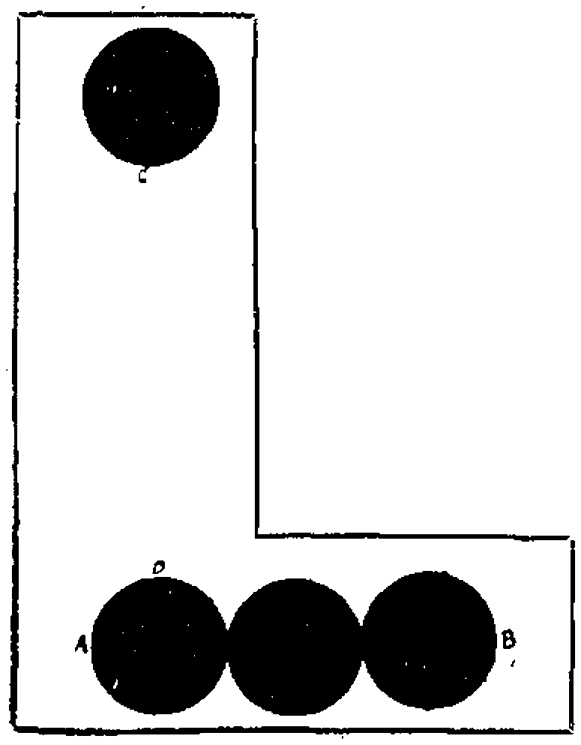
And when you're told that exactly three disks fit between C and D, you won't believe it. Then take a slip of paper or a pair of compasses, and convince yourself that the distance CD is exactly equal to AB.
This strange illusion, which makes black areas look smaller to us than white ones of the same size, is called "irradiation." It comes from an imperfection of our eye, which, as a piece of optical apparatus, doesn't quite satisfy the strict demands of physics. Its refracting lenses don't throw on the retina the sharp contours that we get on the ground glass of a well-focused camera. Owing to what is called "spherical aberration," every bright contour is surrounded by a bright fringe, which enlarges it on the retina of our eye. That's why bright areas always seem larger to us than black ones equal to them.
The farther you move Figure 144 from your eye, the stronger the illusion grows; far enough away, CD will look almost twice as long as AB. Irradiation in general increases with distance. The reason is that the extra fringe always keeps the same width. If close up it added only 1/10 to the width of the bright area, then farther off, when the image of that area has shrunk, the same addition will amount to 1/3 of its width, or to 1/2.
The same peculiarity of our eye explains a strange property of Figure 145. Looking at it close up, you see a great many white disks on a black field. But move the book away and look at the figure from a distance of about two meters, and its appearance changes noticeably: instead of disks, you'll see quite distinct white hexagons.
Which Letter Is Blackest?
Figure 146 lets us make the acquaintance of another imperfection of our eye, "astigmatism." The four letters of this English word don't all look equally black to you. Notice which of them is the blackest, and then turn the picture on its side. An unexpected metamorphosis takes place: the blackest letter turns gray, and now a different letter looks blacker than the rest.

In fact all four letters are equally black. They are merely hatched in different directions: E vertically, A horizontally, and R and D on the slant. If our eye were as perfectly made as an expensive glass lens, the direction of the hatching would have no effect on the blackness of the letters. But the curvature of our eye isn't quite the same in different directions, and so it can't see vertical, horizontal and slanting lines all equally sharply at once.
Very few people have eyes entirely free from this defect, and in some it is so pronounced that it seriously interferes with their sight, and they have to wear special spectacles.
Figure 147 will also reveal astigmatism. If you look at it steadily without moving your head, not all the sectors will seem equally black. Turn the circle through 90°, and the black sectors go gray, while those that were gray turn deep black.
Our eye has other built-in defects as well, which opticians know how to avoid when they make their instruments. The famous Helmholtz had this to say about them:
"If some optician took it into his head to sell me an instrument with such defects, I should feel entitled to speak in the sharpest terms of the carelessness of his work, and to send him back his instrument with a protest."
Besides these illusions, which arise from particular faults in its construction, our eye is subject to a whole series of other deceptions, and those have a different explanation.
Living Portraits
You've probably noticed that a portrait sometimes seems to follow the viewer, turning its eyes wherever he goes. This curious trait of "living portraits" strikes people as mysterious, and even frightens the nervous. Yet it's nothing more than another optical illusion. The explanation is that in such portraits the pupils are painted in the middle of the eyes, where they are only when a person is looking straight at you.
When you move aside, the pupils of course stay where they were, in the center of the eyes; and since you go on seeing the whole face in its former position, it seems to you that the portrait has turned its head to follow you.
The marksman in Figure 148 is aiming straight at you. Go as far as you like to the right or the left, and he'll turn his revolver your way. The illusion is the same. Wherever you look from, the muzzle of the revolver hides the barrel, and that's possible only when the gun is pointed right in your face. That's why the man seems to keep you covered wherever you go.
The Mysterious Cross
On the left of Figure 149 you see a raised cross, and on the right the same cross, but sunken. Now turn the book upside down. A metamorphosis takes place: the raised cross becomes a sunken one, and the other way round. Look closely at the figure, and you'll see that the raised cross and the sunken one are drawn exactly alike, except that one is upside down with respect to the other.
This curious illusion comes from our habit of seeing things lit from above. We take it that both crosses are lit from above too, and interpret the shadows accordingly. When we turn the picture over, we change, as it were, the position of the shadows relative to the imaginary source of light, and the raised cross becomes a sunken one.
We could get the same effect without turning the picture. We'd only have to look at the left-hand drawing and imagine the source of light below it, and we'd see a sunken cross instead of a raised one. But the force of habit is so great that our imagination can't overcome it. Only by turning the picture gradually can we get to see the left-hand cross as sunken, and even then only for a short time.
Lines Stuck in Paper, and Other Optical Illusions
At first sight there's nothing special about the group of straight lines in Figure 150. But close one eye and try looking at them so that your line of sight slides along them (for this you must hold the book at eye level). It will seem to you that the lines aren't drawn on the paper but stuck upright in it, like pins in a cushion.
The laws of perspective explain the illusion. The lines are drawn as needles stuck in the paper would be projected on it, if you looked at them in the way just described.
If our eye could never be deceived, there would be no painting, and we'd be deprived of all the pleasures of the pictorial arts. Artists make wide use of optical illusions, and every picture is really one complex optical illusion.
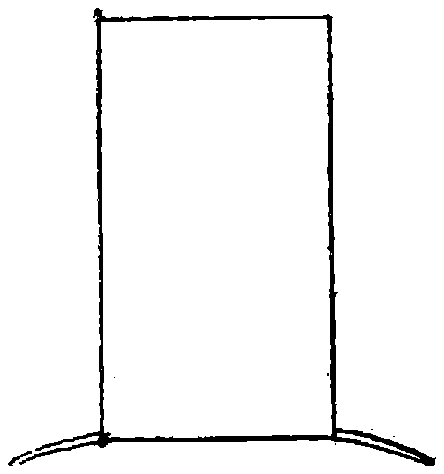
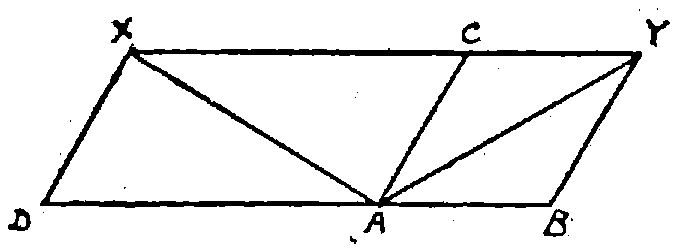
In Figure 158 you see a spiral, don't you? Then put the point of a pencil on one of its branches and follow it along. You'll go round and round, without getting any nearer to the center or any farther from it! What you have before you is a set of circles.
Figure 159 likewise shows concentric circles that are almost perfect, though the eye sees something quite different.
Chapter 12: Sound
How to Hunt for an Echo
Among Mark Twain's shorter pieces there is a hilarious story about the misadventures of a gentleman whose uncle left him a magnificent collection of... what would you think? Echoes! The eccentric uncle had been systematically buying up plots of land wherever an echo could easily be raised. For a clear, ringing echo, and above all for one that repeated many times, this peculiar Yankee would pay hundreds and thousands of dollars.
I won't repeat here the fantastic comedy that the gifted "king of laughter" managed to make out of this. I'll only remark that finding a "good" echo isn't as easy as it seems.
We Russians may consider ourselves privileged in this respect. Our country has plenty of plains surrounded by forests, and plenty of clearings within them. Just give a loud shout in such a clearing, and the wall of trees will send back a more or less distinct echo that can be heard far away.
Our neighbors abroad, most of whom live in hilly, mountainous country, are not so lucky in the matter of echoes. It's harder to hear an echo among mountains than on a plain bordered by forest.
A short excursion into the theory of sound will make clear why. An echo is simply the return of sound waves that have been reflected from some obstacle; and, just as in the reflection of light, the angle at which a "ray of sound" (that is, the direction in which the sound waves travel) strikes the obstacle is equal to the angle at which it is reflected.
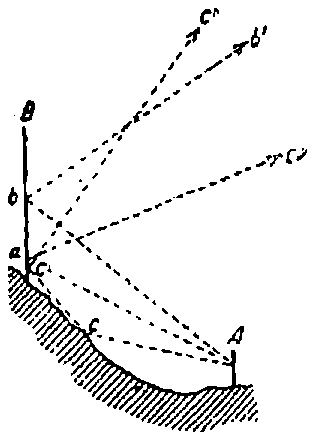
With this in mind, imagine that you're standing at the point A (Figure 160) at the foot of a mountain, and that the obstacle that is to reflect the sound is above you, at B. It's easy to see that the sound waves traveling along the lines Acc', Aa and Ab will not reach your ear when they're reflected, but will scatter into space along aa', c'c'' and bb'. You'll be much better placed if you stand on a level with the obstacle, or even slightly above it (Figure 161). A gentle hollow in the ground between the two points makes the echo clearer still. The sound that travels along Aa or Ab will come back to you along the broken lines aa'A or bb'b''A, after bouncing off the ground once or twice. If, on the contrary, the ground between A and B bulges upward, the echo will be faint, or may not reach the listener's ear at all.
In short, hunting for echoes in hilly country takes a certain art and a certain knack (so that the idea of Twain's collector isn't entirely crazy). And even when you've found a favorable spot, you still have to know how to call the echo up. Above all, you mustn't stand too close to the obstacle. The sound has to travel a fairly long way; otherwise the echo comes back too soon and merges with the sound itself, and you won't hear it separately. Sound travels 340 meters in a second, and it's easy to see from this that if you stand 85 meters from the obstacle, you'll hear the echo exactly half a second after the sound.
The sharper and more abrupt the sound, the clearer the echo. The best way of all to call one up is to clap your hands. The human voice is less suitable, especially a man's; the high notes of women's and children's voices give a more distinct echo.
Mirrors for Sound
The wall of trees that sent back the echo is really nothing other than a mirror for sound. It acts on sound just as a flat mirror acts on light.
Mirrors for sound can be spherical as well as flat. A concave one acts like a reflector: it concentrates the "rays of sound" at its focus.
Two deep plates will let you perform one of the most curious experiments in acoustics. Stand one plate on the table, and hold a pocket watch a little way above the bottom of it. Hold the other plate at your head, a little way from your ear, as in Figure 162. If you've found the right positions for the watch, the ear and the plates (which takes a number of tries), you'll hear the ticking of the watch as though it came from the plate in your hand. The illusion is stronger if you close your eyes. Then you simply can't tell by ear which hand the watch is in, the right or the left.
The same experiment can be done on a large scale with two umbrellas. Wet cloth reflects sound well and lets almost none of it through, and therefore a wet open umbrella makes a fairly good reflector of sound. Place two wet umbrellas some distance apart, with their hollow sides facing each other, so that they have a common "acoustic axis," or, to put it simply, so that their handles lie in one straight line. Stand at the principal focus of one umbrella, and put a friend at the focus of the other. Now you can talk to each other in a whisper that is barely audible, and a third person standing between you won't hear a thing.
This peculiar telephone will work only until the cloth of the umbrellas dries. Dry cloth doesn't reflect sound.
The Oracle
You can make this last experiment far more effective, and even mysterious, by staging it a little differently. Put the two umbrellas at opposite ends of a large room, and divide the room with a light curtain of perfectly dry cloth. Dry cloth conducts sound well and doesn't reflect it, and the partition therefore won't interfere with your telephone. In fact you need only disguise the presence of one of the umbrellas and of the confederate standing beside it, and the very lightest drapery will do.
At the focus of the other umbrella, put a statuette. This will be your "oracle." Your guests, who of course have not been let into the secret, may go up to the "oracle" one after another and put their questions to it in a whisper. To their utter amazement, the statuette will whisper back perfectly sensible answers, and sometimes very biting and witty ones, depending on how resourceful your confederate is.
A Word to the Shy
When a shy man is a guest at someone's house and has to eat the hard rusks that are served with the tea, he usually becomes visibly embarrassed. The terrible noise he makes as he gnaws his rusk throws him into confusion. What makes it worse is that his neighbors are gnawing the same rusks without any noticeable noise, and the shy man can't understand how they contrive to avoid the racket that embarrasses him so.
We can reassure these shy people. The terrible noise and racket exist only in their own ears, and don't trouble their neighbors' ears in the least. The fact is that the bones of the skull, like all solid bodies, have the power of strengthening sounds, sometimes to an extraordinary degree. The crack of a breaking rusk, when it reaches the ear through the air, is perceived as a slight noise; but the same crack becomes a deafening crash if it comes to us through the thickness of something solid (the jaws and the bones of the skull).
You can easily convince yourself of this by an experiment. Tie a spoon to the middle of a piece of string, and press the two free ends to your ears. Now swing the spoon and let it knock against the table, and you'll hear a boom like that of a church bell.
Why Does Thunder Roll?
Ever since Franklin we have known that lightning is a gigantic electric spark, and that thunder is the crack that accompanies it. Yet anyone who has watched electric sparks has probably noticed that the crack of a spark isn't much like thunder: it has none of the rolling that is so typical of thunder. Why does thunder last so long (5 to 8 seconds, when the lightning lasts less than a thousandth of a second), and why does it rumble, now louder, now softer? These are questions worth looking into.
The cause lies in two circumstances, the great length of the lightning and the slowness with which sound travels. A lightning flash is often several kilometers long. If its nearer end is one kilometer away from you and its farther end five kilometers, you'll hear the first clap of thunder three seconds after the flash (for sound travels a third of a kilometer in a second). And when will the thunder die away? When the sound reaches you from the farthest end, which is 5 kilometers off: that is, after 15 seconds. You'll be hearing thunder, then, for 15 − 3 = 12 seconds, although in reality it lasted, perhaps, only 1/10 of a second.
(It's curious to note how much this resembles what was described in the section "On the Waves of Infinity." The difference is that here the observer isn't the one who moves. It's the source of the sound vibrations itself that recedes from him, as it were, with the speed of sound.)
Now we understand why thunder lasts so long. What remains unexplained is its rolling, the way the sound swells and fades by turns. But this too will become clear if we remember that lightning doesn't have the form of a straight line, but breaks into a great many bends. Figure 163 shows a flash of lightning (from a photograph), and we'll use it to find out what an observer at the point B ought to hear, if every point of the branching lightning is a source of sound. To do this we draw a series of concentric arcs about B, cutting across the lightning. The first sounds to reach the observer's ear, all together, will be those from the points , , and ; the four sounds will merge into a single loud one. Then the observer will hear the sum of 5 sounds, from , , , and , which won't be of the same loudness as the first. Next will come the sound , then the sound , and so on. If you follow the process further, you'll see that the sounds will vary irregularly in strength, now growing, now weakening again, until at last they die away altogether.
Echoes from the clouds, and the action of the sound waves on one another, vary the rolling of thunder still more.
If sound traveled faster, thunder would last a much shorter time; if its speed were equal to the speed of light, for example, thunder would last a single instant.
A Water Microphone
Instruments that strengthen very faint sounds are called microphones. They play the same part in acoustics that microscopes play in optics. Everyone probably knows the electric microphone that is used with telephones. But not many people can know that you can make an amplifier of sound out of a jet of water, with no electric current at all. This water microphone is much simpler than the electric one, though not so convenient. Here is how it's made.
A rubber tube ends in a nozzle with a narrow opening (1/2 a millimeter), and water spurts out of it with great force, straight at a rubber membrane stretched over the end of an upright glass tube (1 centimeter thick). As long as the opening of the nozzle is close to the springy membrane, you hear nothing. But raise the nozzle above the membrane, and so lengthen the jet, and you'll hear a distinct noise. The cause of this sound is easy to understand. A long jet consists of a series of swellings and narrowings, and it therefore presses on the membrane now harder, now more gently, and makes it vibrate. A short jet, being unbroken, doesn't make the membrane vibrate but only stretches it. You can strengthen the noise by holding a small piece of wood against the nozzle of the rubber tube.
If you take the piece of wood away, and put an ordinary pocket watch against the nozzle of the rubber tube instead, its ticking will cause corresponding breaks in the jet; and the jet, striking the membrane, will pass on the same vibrations to it, but greatly strengthened. The faint ticking of the watch is so magnified that you can hear it at the other end of a fairly large hall.
Instead of the cone, shown in Figure 164, you may fit on a rubber tube and put it to your ear, and then the sounds become positively deafening; the ticking, in the words of the physicist Boys, "is more like a hammer striking an anvil than the tick of a watch."
It remains to add a few technical remarks. The water must come out of the upper tube with great force, as I said; for this the reservoir that feeds the tube is placed very high, if possible four or five meters above the tube's opening. Then the water must be perfectly clean, and it's best therefore to filter it through cotton wool. A good membrane for the glass tube can be made from the rubber skin of a child's toy balloon.
The experiment I've described is the work of the American physicist Chichester Bell, a cousin of Graham Bell, the inventor of the telephone. I have taken the description from Boys, whose book Soap-Bubbles we have had occasion to cite before. According to him, the water microphone can even be made to play a tune. A long rod is placed against the nozzle, with its other end resting on a musical box that is wrapped in a double covering of felt. When the jet strikes the membrane, the whole audience hears the musical box.
Deceptions of the Ear
Can our ears be deceived in the way that our eyes are in Poe's story "The Sphinx"? They certainly can. If we imagine that the source of some slight noise is not close by but a good deal farther off, the sound will seem to us much louder. Illusions of this kind happen to us quite often; it's just that we don't always pay attention to them.
Here, for example, is a curious incident that the American philosopher William James described in his Psychology: Briefer Course:
"Sitting reading, late one night, I suddenly heard a most formidable noise proceeding from the upper part of the house, which it seemed to fill. It ceased, and in a moment renewed itself. I went into the hall to listen, but it came no more. Resuming my seat in the room, however, there it was again, low, mighty, alarming, like a rising flood or the avant-courier of an awful gale. It came from all space. Quite startled, I again went into the hall, but it had already ceased once more. On returning a second time to the room, I discovered that it was nothing but the breathing of a little Scotch terrier which lay asleep on the floor.
"The noteworthy thing is that as soon as I recognized what it was, I was compelled to think it a different sound, and could not then hear it as I had heard it a moment before."
Probably every reader can recall similar incidents from his own life.
Where Is the Grasshopper?
The distance of a sounding object isn't the only thing we often get quite wrong. We make the same kind of mistake about its direction.
Here is an experiment from which we can learn a great deal. Seat someone blindfolded in the middle of the room, and ask him to sit quietly without turning his head. Then take two coins and knock them together at various places in the room, keeping all the time in the vertical plane that passes between your guest's eyes and cuts his head in half.
He, for his part, must point to the place where the coins clinked. The result is simply incredible. The sound is made in one corner of the room, and he points in exactly the opposite direction, and so on.
If you move out of this plane of symmetry, the mistakes are no longer so gross. That's natural enough: the sound is now louder in the nearer ear than in the other, and this gives him some indication of where it's coming from. (The experiment was first performed in 1874, at a meeting of the British Association for the Advancement of Science.)
Now we can understand why it's so hard to spot a grasshopper chirping in the grass. The shrill sound comes from a couple of steps away, right there, to the right of the path. You look that way, and see nothing. Meanwhile the sound is now coming distinctly from the left. You turn your head to the left, and before you've finished, the same sound is already coming from some third place. The grasshopper's astonishing agility may well bewilder you, and the more quickly you turn toward the sound, the more quickly the grasshopper leaps about.
In reality, however, the insect is sitting quietly in one spot, and its amazing leaps are a product of your imagination, the result of a deception of the ear. Your mistake lies in turning your head toward the sound, for that puts the grasshopper in your head's plane of symmetry. In that position, as you already know, it's very easy to go wrong about the direction of a sound: the grasshopper is chirping in front of you, but you mistakenly place it on exactly the opposite side.
From this we may draw a practical conclusion. If you want to find out where a grasshopper's chirping, a cuckoo's call or any such elusive sound is coming from, don't turn your head toward it, but, on the contrary, turn your head away to the side. That is actually what we do when, as people say, we "cock an ear."
The Streetcar as Barometer
Humid air, as we know, conducts sound much better than dry, and we hear sounds better in it. This is the basis of an original way of using the noise of a streetcar to make a rough estimate of the humidity. If you hear the noise of a speeding streetcar when it's still far away, there is a great deal of moisture in the air, and you have reason to expect rain. If you catch the clatter of the wheels only when the car is nearer, the air is dry, and the longer you have to wait for a distinct clatter, the drier it is: a sign that the fine weather will last a long time.
Crude as these signs are, an observant person can use them with fair success. If your town has no streetcar, you may try predicting the weather from the noise of an ordinary horse cab.
Book Two
Preface to Book Two
This book stands on its own and is not a continuation of the first Physics for Entertainment; it is called the "second" only because it was written later. The success of the first collection encouraged me to work up the rest of the material I had gathered, and the result is this second, or rather this other, book, which covers the same branches of school physics.
Like its predecessor, it is meant to be read and not to be studied. Its aim is less to give the reader new knowledge than to help him "know what he already knows": to deepen and enliven the basic physics he possesses, to teach him to handle it consciously, and to prompt him to apply it in all sorts of ways. As in the first collection, the means is a motley procession of brain-teasers, tricky questions, entertaining problems, amusing paradoxes, and unexpected comparisons from the realm of physics, some belonging to everyday life and some drawn from popular works of fiction, scientific romance included. I have made especially wide use of material of this last kind, thinking it best suited to the purpose of the book, and have brought in passages from the well-known novels of Jules Verne, Wells, Kurd Lasswitz, and others. Imaginary experiments, quite apart from their charm, can do good service in teaching as living illustrations, and have found a place even in school textbooks. "Their aim," writes the well-known Russian teacher V. L. Rosenberg,33 "is to free the mind from the shackles of habit and to bring out one side of a phenomenon which is hard to understand because ordinary conditions obscure it, conditions that force themselves on the student's mind against his will, through habit."
I have tried, as best I could, to make the telling lively and the subject attractive, and have not always stopped short of borrowing interest from outside. My guide was the psychological axiom that interest in a subject heightens attention, that attention makes understanding easier, and that it therefore helps the reader to absorb the subject more consciously.
Contrary to the custom established for collections of this kind, Physics for Entertainment gives very little space to amusing and showy physical experiments. We already have enough collections of those, and the educational value of such material is not always beyond dispute. Experiments, to begin with, usually succeed only for the most enterprising and patient readers, and leave the rest with a sense of disappointment and some vexation over things spoiled. Besides, the center of attention shifts, whether we like it or not, from the activity of the mind to the work of the hands, and this often prepares the ground for an unreflecting, purely formal attitude to the physical explanation. The chief aim of Physics for Entertainment, however, is to stir the scientific imagination into activity, to accustom the reader to think in the spirit of physical science, and to create in his memory a host of links between what he knows of physics and the most varied happenings of life, everything with which he ordinarily comes in contact.
To enliven interest in physical calculations, I have put numerical data into some of the problems in this collection, a thing I avoided in the first book.
On the whole, the material here was chosen for a slightly better prepared reader than that of the first Physics for Entertainment. The difference is so small, though, that the two books can be read in either order and independently of each other.34
Y. P.
Chapter 1: The Laws of Motion
The Cheapest Way to Travel
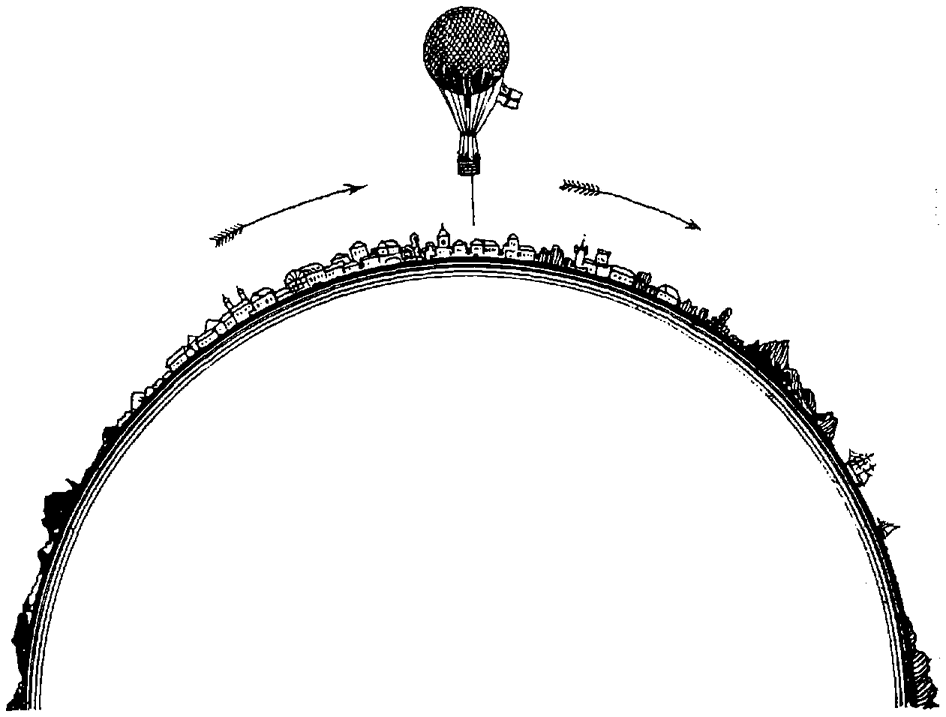
Cyrano de Bergerac, the witty French writer of the seventeenth century, tells in his satirical Voyage to the Moon of a remarkable thing that, he would have us believe, happened to him. One day, in the middle of some physical experiments, he was mysteriously lifted high into the air, flasks and all. When he managed to get down to earth again a few hours later, he found to his amazement that he was no longer in his native France, or even in Europe. He was in America, in Canada! Cyrano has an explanation for this unplanned flight across the Atlantic. While the reluctant traveler was parted from the ground, our planet went on turning from west to east as usual, and when he came down, there under his feet, in place of France, lay the continent of America.
You see what a cheap and simple way to travel this is! Just rise above the ground, stay up in the air if only for a few minutes, and you'll come down in a different place, far to the west. Why undertake long and tiring journeys across continents and oceans, when you can hang motionless above the Earth and wait for the globe itself, like a good servant, to bring your destination to you?
It's a pity that this marvelous method is pure fantasy. For one thing, when we go up into the air we haven't really parted from the globe. We're still attached to the gaseous envelope of our planet; we're hanging in its atmosphere, and the atmosphere shares in the Earth's rotation. The air turns together with the Earth, and carries along everything in it: clouds, balloons, aeroplanes, every flying bird, every insect.
If the air did not share in the Earth's rotation, we would feel, standing on the ground, a perpetual wind so violent that the most terrible hurricane would be a gentle breath beside it. After all, it makes no difference whether we stand still and the air moves past us or the air stays still and we move through it: either way we feel just as strong a wind. A motorist doing 85 kilometers an hour feels a tremendous wind on a perfectly calm day.
But suppose we could climb beyond the atmosphere, or suppose the Earth had no air around it. Even then the French poet's cheap way to travel would fail us. When we leave the surface of the turning Earth, we go on moving, by inertia, at the speed we had before, which is the speed of the Earth moving beneath us. And when we come down again, we land on the very spot we left, just as when you jump in a moving train you come down where you were.
Earth, Stand Still!
H. G. Wells, the English novelist of our own day, has a fantastic tale, "The Man Who Could Work Miracles," about a clerk who does just that. A rather dim young man of little education, he unexpectedly turns out to possess an astonishing gift: he has only to wish a thing aloud, and it happens at once. Tempting as it sounds, the gift brings nothing but trouble, to him and to everyone else. For us the instructive part is the end of the story.
After a night's carousing that had gone on far too long, the miracle-working clerk, whose name was Fotheringay, was afraid to show himself at home at dawn, and took it into his head to use his gift to make the night longer. But how? By ordering the heavenly bodies to halt in their courses. He didn't make up his mind to such a feat right away, and when his friend Maydig urged him to stop the Moon:
"Mr. Fotheringay looked at the moon.
"'That's a bit tall,' he said, after a pause.
"'Why not?' said Mr. Maydig. 'Of course it doesn't stop. You stop the rotation of the earth, you know. Time stops. It isn't as if we were doing harm.'
"'H'm!' said Mr. Fotheringay. 'Well,' he sighed, 'I'll try. Here!'
"He buttoned up his jacket and addressed himself to the habitable globe, with as good an assumption of confidence as lay in his power. 'Jest stop rotating, will you?' said Mr. Fotheringay.
"Incontinently he was flying head over heels through the air at the rate of dozens of miles a minute. In spite of the innumerable circles he was describing per second, he thought; for thought is wonderful—sometimes as sluggish as flowing pitch, sometimes as instantaneous as light. He thought in a second, and willed. 'Let me come down safe and sound. Whatever else happens, let me down safe and sound.'
"He willed it only just in time, for his clothes, heated by his rapid flight through the air, were already beginning to singe. He came down with a forcible, but by no means injurious, bump in what appeared to be a mound of fresh-turned earth. A large mass of metal and masonry, extraordinarily like the clock-tower in the middle of the market square, hit the earth near him, ricochetted over him, and flew into stonework, bricks, and cement, like a bursting bomb. A hurtling cow hit one of the larger blocks and smashed like an egg. There was a crash that made all the most violent crashes of his past life seem like the sound of falling dust, and this was followed by a descending series of lesser crashes. A vast wind roared throughout earth and heaven, so that he could scarcely lift his head to look. For a while he was too breathless and astonished even to see where he was or what had happened. And his first movement was to feel his head and reassure himself that his streaming hair was still his own.
"'Lord!' gasped Mr. Fotheringay, scarce able to speak for the gale, 'I've had a squeak! What's gone wrong? Storms and thunder. And only a minute ago a fine night. It's Maydig set me on to this sort of thing. What a wind! If I go on fooling in this way I'm bound to have a thundering accident!...
"'Where's Maydig?
"'What a confounded mess everything's in!'
"He looked about him so far as his flapping jacket would permit. The appearance of things was really extremely strange. 'The sky's all right anyhow,' said Mr. Fotheringay. 'And that's about all that is all right. And even there it looks like a terrific gale coming up. But there's the moon overhead. Just as it was just now. Bright as midday. But as for the rest——Where's the village? Where's—where's anything? And what on earth set this wind a-blowing? I didn't order no wind.'
"Mr. Fotheringay struggled to get to his feet in vain, and after one failure, remained on all fours, holding on. He surveyed the moonlit world to leeward, with the tails of his jacket streaming over his head. 'There's something seriously wrong,' said Mr. Fotheringay. 'And what it is—goodness knows.'
"Far and wide nothing was visible in the white glare through the haze of dust that drove before a screaming gale but tumbled masses of earth and heaps of inchoate ruins, no trees, no houses, no familiar shapes, only a wilderness of disorder, vanishing at last into the darkness beneath the whirling columns and streamers, the lightnings and thunderings of a swiftly rising storm."
The author of the catastrophe had, of course, no idea what had happened. Yet the explanation is very simple. When Fotheringay stopped the Earth dead, he forgot about centrifugal force.35 Halt a circular motion suddenly, and that force is bound to fling everything off the surface of the Earth. Houses, people, trees, animals, anything not bound fast to the main mass of the globe flew off along a tangent to its surface, faster than a cannonball just out of the muzzle. And then it all came down again and was smashed to bits.
"These things," Wells goes on, "Mr. Fotheringay did not, of course, fully appreciate. But he perceived that his miracle had miscarried, and with that a great disgust of miracles came upon him." He promised himself to work no more of them. First, though, he had to undo the harm he had done, and there was no small amount of it. To his horror, it was growing.
"He was in darkness now, for the clouds had swept together and blotted out his momentary glimpse of the moon, and the air was full of fitful struggling tortured wraiths of hail. A great roaring of wind and waters filled earth and sky, and peering under his hand through the dust and sleet to windward, he saw by the play of the lightnings a vast wall of water pouring towards him.
"'Maydig!' screamed Mr. Fotheringay's feeble voice amid the elemental uproar. 'Here!—Maydig!
"'Stop!' cried Mr. Fotheringay to the advancing water. 'Oh, for goodness' sake, stop!'"
No answer came from Maydig. Fotheringay would have to act on his own responsibility, with no wiser head to consult, and that made him resolute.
"'Just a moment,' said Mr. Fotheringay to the lightnings and thunder. 'Stop jest a moment while I collect my thoughts... And now what shall I do?' he said. 'What shall I do? Lord! I wish Maydig was about.'"
The wind had the same order, and everything fell quiet. Fotheringay squatted down to think, anxious above all to make no fresh muddle.
"'I know,' said Mr. Fotheringay. 'And for goodness' sake let's have it right this time.... In the first place, when all I've got to say is done, let me lose my miraculous power, let my will become just like anybody else's will, and all these dangerous miracles be stopped. I don't like them. I'd rather I didn't work 'em. Ever so much. That's the first thing. And the second is—let me be back just before the miracles begin; let everything be just as it was before that blessed lamp turned up. It's a big job, but it's the last. Have you got it? No more miracles, everything as it was—me back in the Long Dragon just before I drank my half-pint. That's it! Yes.'"
A Letter from a Balloon
You're in the basket of a balloon, speeding over the countryside. Below you the landmarks are familiar: in a moment you'll pass over a friend's country house. "I really ought to send him a line," you think. You scribble a few words on a page of your notebook, tie it to a stone, wait for the moment when the garden you know so well is right beneath your feet, and let go.
You're quite sure, of course, that the stone will drop straight into the garden. It doesn't come down there at all.
Why not? Wasn't the garden directly under the basket?
That's just why it misses. Watch the stone fall, and you'll see a curious thing: down it goes, and yet all the while it stays underneath the balloon, as though sliding down an invisible rope tied to it. By the time it reaches the ground, it's far ahead of the spot you were aiming at. Here is that same law of inertia which keeps us from taking up Cyrano de Bergerac's tempting advice and traveling on the cheap. As long as the stone was in the basket, it was moving along with the basket at a certain speed. You let it go; but although it has left the balloon and is falling, it doesn't lose the speed it had, and goes on moving through the air in the same direction as it falls. The two motions, the vertical and the horizontal, add together, and as a result the stone flies down along a curve, remaining below the balloon all the way (unless, of course, the balloon itself suddenly changes course or speed). It flies exactly like a body thrown horizontally, a bullet, say, from a rifle held level: pushed sideways and pulled down by the Earth's attraction, it traces an arc that ends at the ground.
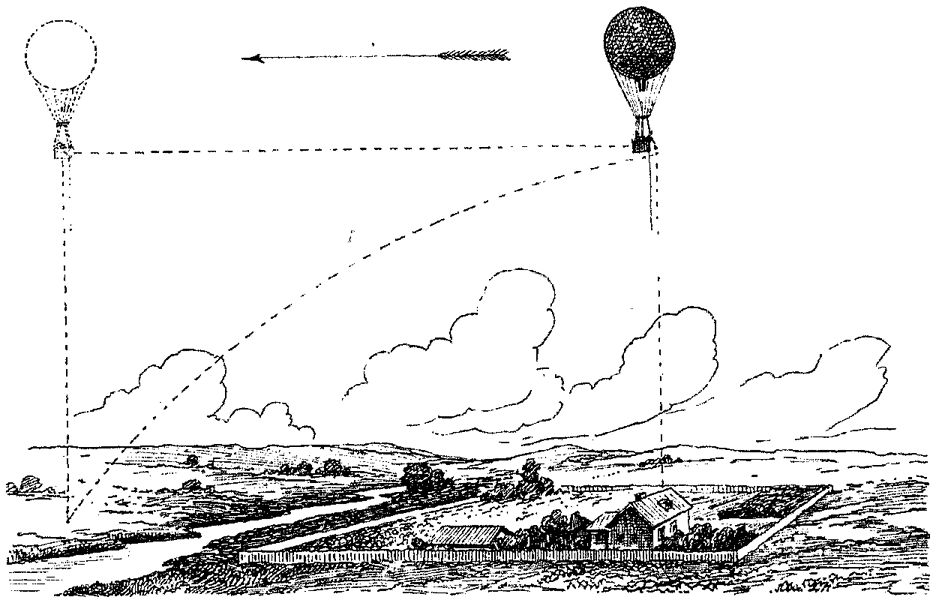
The Railway That Never Stops
To jump aboard an express as it tears past the platform where you're standing is, of course, no easy matter. But imagine that the platform is moving under you too, at the same speed as the train and in the same direction. Would it be hard to board then?
Not in the least. You would walk into the carriage as calmly as if it were standing still. Since you and the train are moving the same way at the same speed, relative to you the train is completely at rest. Its wheels are turning, it's true, but to you they'll seem to be spinning in place.
It's perfectly conceivable, then, to have a train pick up and set down passengers at its stations at full speed, without stopping.
Devices of this sort are often built at exhibitions, so that the public can get quickly and comfortably around sights scattered over a huge area. At the international building exhibition held in Leipzig in the autumn of 1913, for instance, a railway ran like an endless ribbon between the far ends of the grounds, and passengers could get on and off whenever and wherever they liked, with the train going at full speed.
The drawings show how this curious system works. In Figure 4 the letters A and B mark the end stations. Each station has a round, motionless platform, surrounded by a large revolving disk in the shape of a ring. Around the two revolving disks runs a cable, with the carriages hitched to it. Now see what happens when the disks turn. The carriages go around them at exactly the speed of the disks' outer edges, so that passengers can step from disk to carriage, or leave the train for the disk, without the slightest danger. Once off the train, a passenger walks toward the center of the circle until he comes to the motionless platform; and stepping onto it from the inner edge of the moving disk is easy, because where the radius is small, the speed is small too.36 Once he is on the inner, motionless platform, he has only to cross a footbridge to the ground outside the railway (Figure 5).
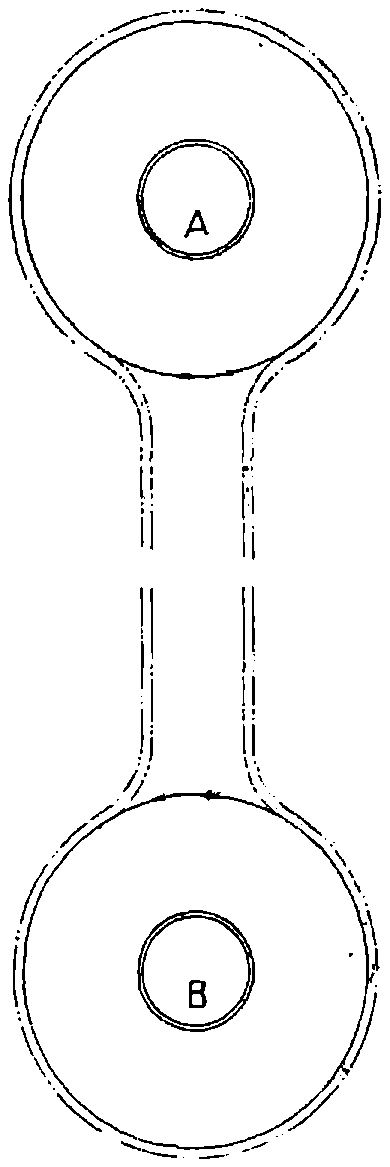
Figures 4 and 5 make this clear. The size of the circles and the speed at which they turned had been chosen so that the outer edges covered 4 meters a second (about 15 kilometers an hour), while the inner edge moved at only 1 meter a second. At that speed, or rather at that slowness, passengers could of course cross to the platform in perfect safety.
Doing away with frequent stops saves an enormous amount of time and energy. Any streetcar spends most of its time, and nearly two-thirds of all its energy, on gathering speed as it leaves each stop and on slowing down and braking for the next.
At railway stations one could even manage without special moving platforms, and still take on and let off passengers with the train at full speed. Imagine an express flying past an ordinary, motionless station, and suppose we want it to pick up new passengers there without stopping. Let those passengers take their seats for the time being in another train, waiting on a parallel siding, and let this train start forward and work up to the same speed as the express. It must be so arranged that by the time the two trains are running side by side, their speeds have become equal. At that moment the trains will be, as it were, motionless relative to each other. One need only lay gangways from the carriages of one to the carriages of the other, and the passengers in the "temporary" train can stroll across into the express. Stops at stations, as you see, become unnecessary.
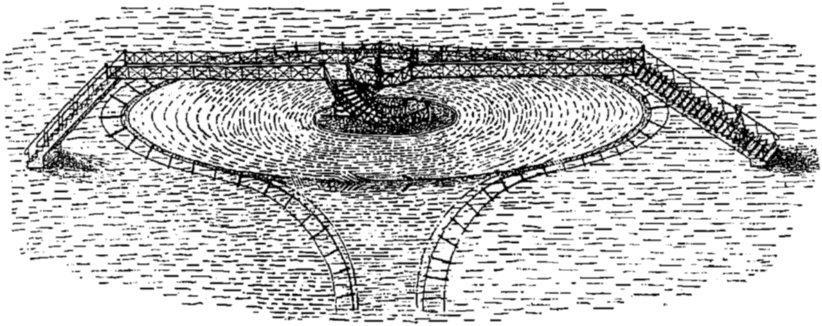
Such is the theory. Putting the scheme into practice would probably be a great nuisance, and that's why nothing of the kind has yet been built anywhere.
The Streets of the Future
Another device based on the same law of relative motion has yet to be put into practice: the "moving sidewalk."
Figure 6 shows the plan of one. You see five endless belts, or sidewalks, one inside another, all kept in motion by a special mechanism, but each at its own speed. The outermost belt creeps along quite slowly, at only 5 kilometers an hour. That's an ordinary walking pace, and even a child or an old man would have no trouble stepping onto so slow a belt. Beside it, on the inner side, runs the second belt, at 10 kilometers an hour. To jump onto this one straight from the stationary street would be very dangerous, but to step across to it from the first belt is nothing at all. Relative to the first belt, after all, which is creeping along at 5 kilometers an hour, the second, running at 10, is itself doing only 5. It's no harder, then, to cross from the first to the second than from the ground to the first. The third belt is already moving at 15 kilometers an hour, but from the second there is of course no difficulty in getting onto it. It's just as easy to step from the third to the next, the fourth, which runs at 20 kilometers an hour, and finally from that one onto the fifth, racing along at 25. This fifth belt carries the passenger to wherever he needs to go. There he calmly makes his way back from belt to belt, and steps off onto the stationary ground.
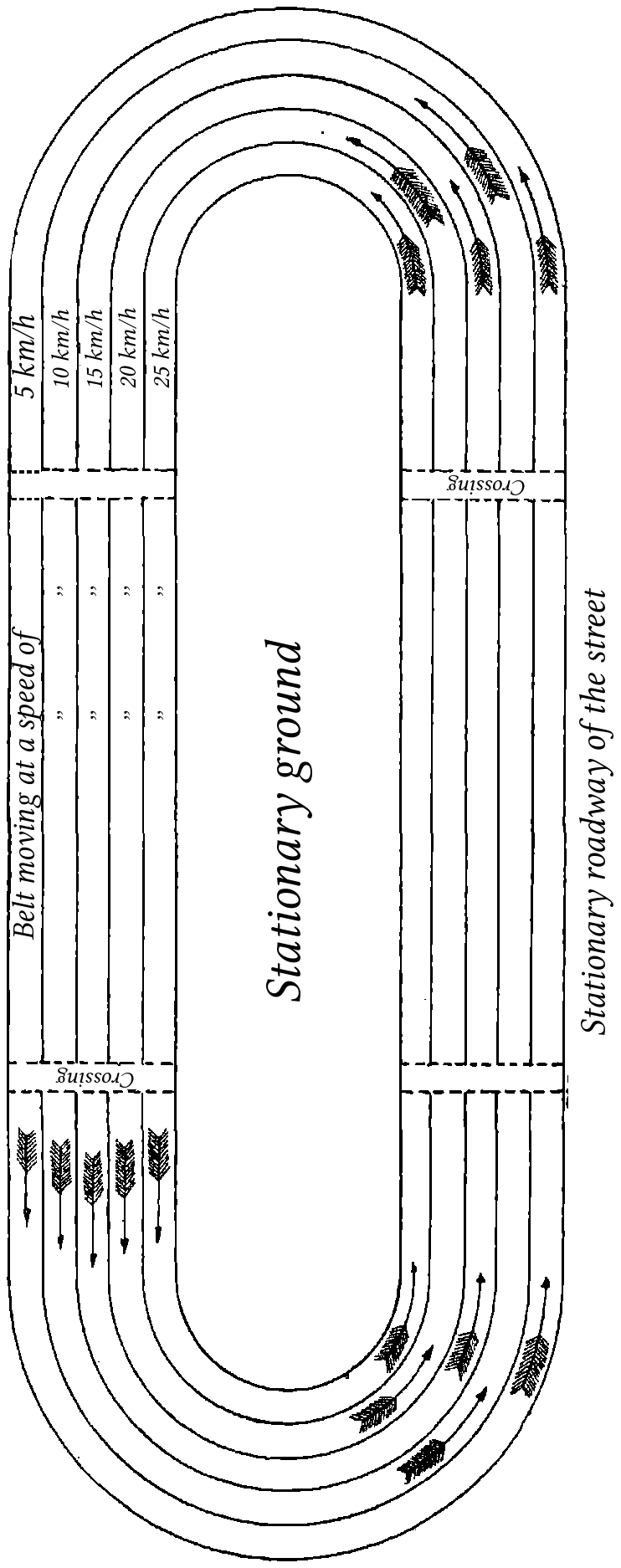
There was a plan to build a street of this kind, a train forever on the move, in a tunnel under New York. The railway was to be one continuous circular belt, fitted with seats for passengers and traveling, according to the plan, at 22 kilometers an hour. Beside it were to run three auxiliary belts, to help people across from the stationary ground to the train, at 17, 11, and 5 1/2 kilometers an hour. A passenger who wanted to board would have no trouble stepping from the fixed floor onto the first belt (holding on to one of its upright poles); it would be just as easy to move from there to the second, then to the third, and finally to take a seat in the train.
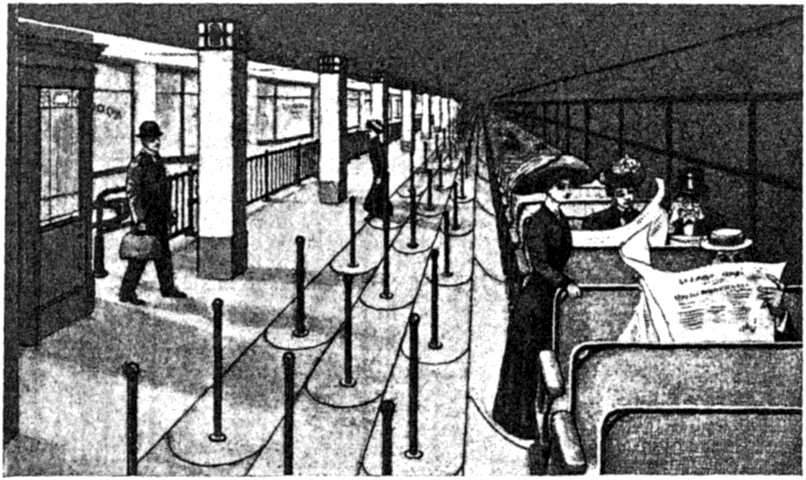
A Law Past Understanding
Probably no law of mechanics causes as much bewilderment as Newton's famous "third law," the law of the equality of action and reaction. Everyone knows it, people can even apply it correctly when they have to, and yet hardly anyone believes it's true. Perhaps you, reader, had the good luck to understand it at once. I must confess that I grasped it only many years after we were first introduced. I've questioned various people who have more or less to do with mechanics, and found that most of them are ready to accept this law only with some rather weighty reservations. They gladly admit that it holds for bodies at rest, but they can't see how it can be applied to the interaction of bodies that are moving.
"Action," says the law, "is always equal and opposite to reaction." This means that when a horse, for example, pulls a cart, the cart pulls the horse backward with exactly the same force as the horse pulls the cart forward. But if that's so, the cart ought to stay where it is. Why does it move all the same? Why does the horse carry the cart along, instead of the cart dragging the horse back? They are pulling each other equally hard. And why don't these forces cancel, if they're equal?
The puzzle is solved quite simply. The forces don't cancel because they're applied to different bodies, one to the cart and the other to the horse. They are equal, yes; but do equal forces always produce equal effects? Do equal forces give all bodies equal speeds? Doesn't the effect of a force on a body depend also on the body itself, on how much resistance it offers to the force?
Think this over, and you'll see at once why the horse does carry the cart along, although the cart pulls it back with the same force. The force acting on the cart and the force acting on the horse are equal; but since it's much easier to set a cart rolling than to drag a walking horse backward, it's perfectly understandable that the cart rolls toward the horse, and the horse isn't pulled up against the cart. Let's make this clear with numbers. Suppose the horse pulls the cart with a force of 300 kilograms; the cart, then, also pulls the horse toward itself with a force of 300 kilograms. A force of 300 kilograms is enough to give the cart a certain speed, but it's far from enough to give a backward speed to the horse, which has already got itself moving forward. Straining at the traces and thrusting its feet against the ground, the horse develops altogether a force greater than 300 kilograms: 450, let us say. Part of this, 150 kilograms, sets the horse itself moving forward, while the rest, 300 kilograms, overcomes the resistance of the cart and sets that in motion. The law of the equality of action and reaction isn't broken here: the force of 300 kilograms applied to the cart calls forth an equal opposing force from the cart, and the force of 150 kilograms with which the horse pushes off from the ground calls forth an equal reaction from the ground.37
Even falling bodies strictly obey the law of the equality of action and reaction. An apple falls to the ground because the Earth attracts it. But the apple attracts our planet with exactly the same force. Strictly speaking, the apple and the Earth fall toward each other, only at different speeds. One and the same force of mutual attraction gives the apple an acceleration of 10 meters a second every second, and gives the Earth one that is smaller by as many times as the Earth's mass is greater than the apple's. The mass of the globe is of course an inconceivable number of times greater than the mass of an apple, and the Earth is therefore displaced by so little that for practical purposes we may call it nothing. That's why we say that the apple falls to the Earth, instead of saying that the apple and the Earth fall toward each other.
What Killed the Giant Svyatogor?
Do you remember Svyatogor, the giant in the old Russian heroic songs, who took it into his head to lift the Earth? Archimedes, if tradition is to be believed, was no giant, but he too meant to perform this feat, and lacked only a fulcrum for his lever. Later on we'll talk about the surprise that would have awaited that mathematician of genius had he been given the fulcrum he longed for. But Svyatogor was strong enough without a lever. All he wished for was something to take hold of, something to lay his mighty hands on. The chance came: on the ground he found a "little saddlebag," in which was gathered up "all the weight of the Earth." Svyatogor seized it and began to pull upward with all his might. The bag didn't budge, but Svyatogor himself sank into the earth up to his knees. "And there he met his end."
Had Svyatogor known the law of the equality of action and reaction, he would have realized that his giant's strength, applied to the Earth, would call forth an equal and therefore equally colossal reaction, which might drag him down into the ground.
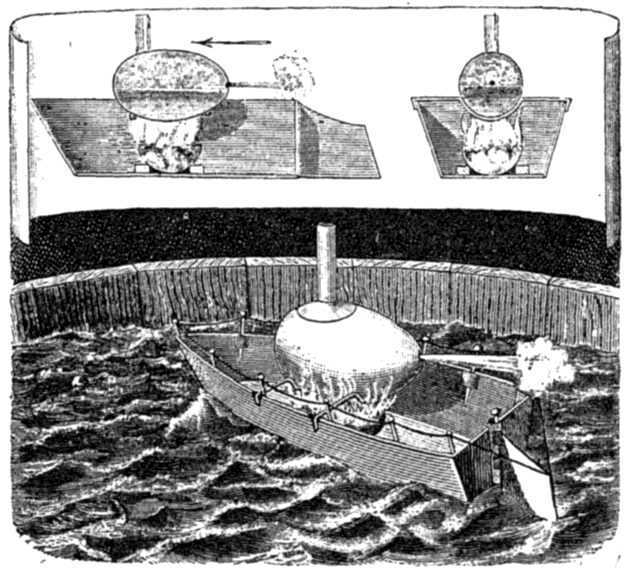
In any case, the song shows that the observant eye of the people noticed long ago how the ground pushes back when something presses on it. People were using the law of the equality of action and reaction, without knowing it, thousands of years before Newton first stated it in his immortal Mathematical Principles of Natural Philosophy (that is, of physics).
Can You Move with Nothing to Push Against?
When we walk, we push off with our feet from the ground or the floor; everyone knows that you can't walk on a very smooth floor, which gives the foot nothing to push against. A moving locomotive pushes against the rails with its wheels: grease the rails, and it will stay where it is. A steamer pushes against the water with the blades of its screw. An aeroplane pushes against the air, and it too does so with a screw, its propeller. Whatever element an object moves in, in short, it presses on that element as it goes. But can a body move with no support at all outside itself?
Such motion seems impossible; you might as well try to lift yourself by your own hair. Yet it only seems so. Motion of just this supposedly impossible kind often takes place before our eyes. A body can't, it's true, set the whole of itself in motion by internal forces alone, but it can make some part of its mass move one way and the rest the opposite way. How many times have you seen a rocket in flight, and have you ever stopped to ask why it flies? The rocket is a perfect example of the kind of motion that interests us now.
What Sends a Rocket Up?
Even from people of science one often hears the flight of a rocket explained all wrong. It flies, they say, because with its gases (which come from the powder burning inside it) it pushes against the air. But if you fired a rocket where there was no air, it would fly not a bit worse, and perhaps even better. The real cause of its motion is that when the powder gases rush downward out of it, the tube of the rocket is itself pushed upward, by the law of the equality of action and reaction. Essentially the same thing happens when a cannon is fired: the shell flies forward, and the cannon is pushed back. Remember the "kick" of a rifle, and of firearms in general! If the cannon were hanging in the air, resting on nothing, it would move backward after the shot with a speed as many times smaller than the shell's as the shell is lighter than the cannon. When a 12-inch gun in the turret of a modern dreadnought hurls a 500-kilogram shell from its muzzle at 850 meters a second, the whole enormous ship, weighing more than 16,000 metric tons, is pushed back at 2 1/2 centimeters a second. Relying on this same rule of mechanics, the heroes of Jules Verne's novel Topsy-Turvy set out to "straighten" the Earth's axis by firing a colossal cannon. A rocket is a cannon too, only what it throws out is powder gases in place of shells.
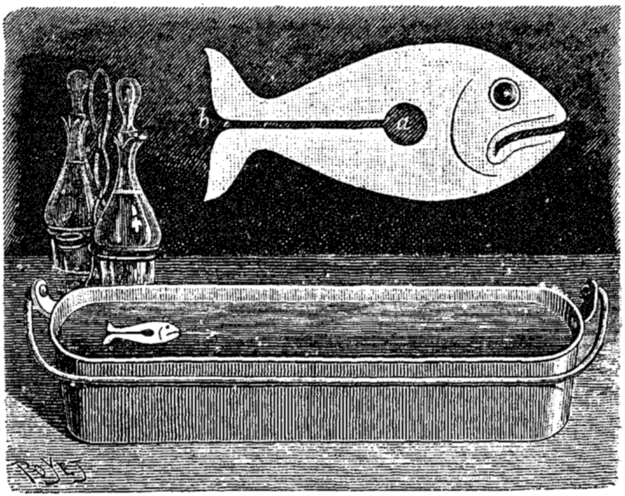
The firework called a "Chinese wheel," or pinwheel, turns for the same reason. Powder burns in tubes fixed to the wheel, the gases stream out one way, and the tubes (and the wheel with them) are driven the other.
Plenty of toys are built on this principle. The toy steamer in Figure 8, invented by the ingenious Tom Tit, moves because the steam that streams out one way pushes the whole steamer the other. If you lay a cardboard fish on the water and put a drop of oil into the slot cut in it (see Figure 9), it will swim the opposite way to the spreading film of oil.38 And finally, we know that the oldest steam engine in the world, invented by Hero of Alexandria as long ago as the third century B.C., was made on the same principle. Steam from the boiler αβ (Figure 10) passed along the tube εξη into a ball that could turn on a horizontal axis; streaming out again through tubes bent at an angle, the steam pushed those tubes the opposite way, and the ball began to spin. Unfortunately, Hero's steam turbine remained in antiquity nothing more than a curious toy. The labor of living engines, the slaves, was so cheap that nobody felt any need to put dead machines to use.
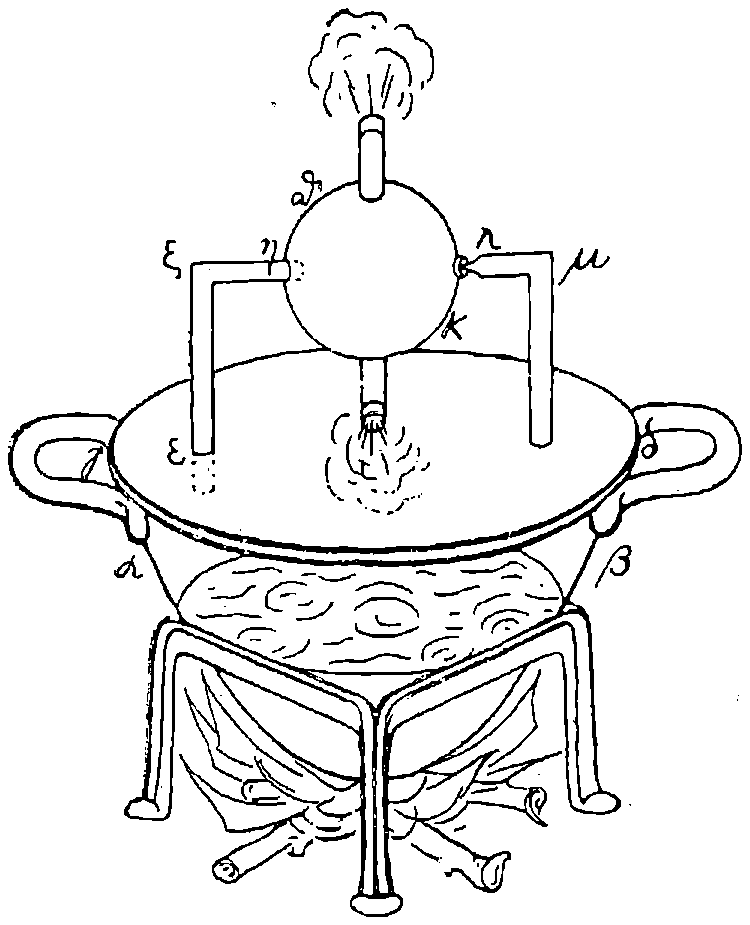
How Does a Cuttlefish Move?
You'll probably think it strange to hear that for a great many living creatures this imaginary "lifting yourself by your own hair" is a perfectly ordinary way of getting about.
The cuttlefish, like most of the cephalopod mollusks, moves through the water in this way. It draws water into its gill cavity through a slit at the side and a special funnel at the front of its body, and then vigorously squirts the water out through the funnel. This gives it a backward push, strong enough to send it swimming along quite fast, hind end first. It can also, however, turn the tube of its funnel sideways or backward, and by squeezing the water out hard it can then move in any direction.
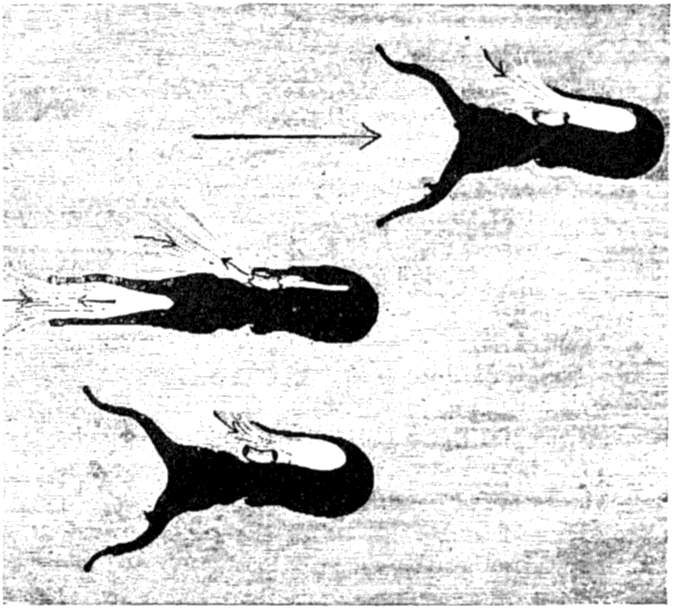
The motion of a jellyfish works the same way: by contracting its muscles it drives the water out from under its bell-shaped body, and receives a push in the opposite direction. The salps, the larvae of dragonflies, and many other water animals move by a similar method. And here we were, doubting whether one could move like that!
To the Stars by Rocket
What could be more alluring than to leave the globe and travel through the boundless universe, flying from planet to planet, from star to star? How many fantastic novels have been written on this theme! Who hasn't carried us off on an imaginary journey among the heavenly bodies? Voltaire in Micromegas, Jules Verne in A Journey to the Moon and Hector Servadac, Wells in The First Men in the Moon, and a host of imitators have all made imaginary journeys to other worlds, in dreams, of course. In reality we are still, alas, prisoners of the globe.
Is there really no way of making this age-old dream of mankind come true? Are all the ingenious projects that the novels describe with such tempting plausibility really impossible to carry out? Later on we'll have more to say about the fantastic projects for travel between the planets. For now, let's look at the only serious one, proposed by the Russian scientist K. E. Tsiolkovsky.
Could one fly to the Moon in an aeroplane? Of course not. Aeroplanes and airships move only because they press on the air and push off from it, and there is no air between the Earth and the Moon. Nowhere in interplanetary space is there any material medium for an "interplanetary airship" to press on. We must therefore think up a craft that can move with nothing to press on at all.
We already know one such craft, as a toy: the rocket. Why not build a huge rocket, with a special compartment for people, provisions, supplies of air, and everything else? Imagine that the people in this rocket carry with them a large stock of explosives, and, like the cuttlefish, can direct the stream of gases any way they please. What you get is a real celestial ship that can be steered, in which to sail the boundless ocean of space and fly to the Moon, to the planets, to the stars... By a series of small separate explosions the passengers can increase the speed of this interplanetary airship as gradually as they need to, so that the gain in speed does them no harm. If they want to land on some planet, they can gradually reduce the speed of their craft and so soften the fall. And by the same means, finally, they can return to the Earth. All they need for this is to take along a large enough stock of explosives.

"Then what's the holdup?" you'll ask. "Why doesn't somebody build a giant rocket like that and set off to explore the depths of interstellar space?"
What holds us up is that we don't yet have a powerful enough explosive. To give a gigantic rocket the speed it needs to overcome gravity takes an explosive 10 to 15 times as powerful as guncotton. We know of no such substance yet; nor do we have strong enough materials for a "celestial rocket."
But what is impossible today may be done tomorrow. Mankind has been in this position once before. When the principle of soaring flight had been discovered, all that was lacking to build an aeroplane was a powerful enough engine and strong enough materials. Fifteen years went by, and what happened? Aeroplanes soar high in the air, flying over mountains and seas, and we have already witnessed a war in the air. Why, then, shouldn't we suppose that one day people will fly to the stars in a huge craft built like a rocket?
Chapter 2: Forces, Work, Friction
The Problem of the Swan, the Crayfish, and the Pike
Everyone in Russia knows Krylov's fable of how "a Swan, a Crayfish, and a Pike agreed to haul a loaded cart." But have you ever tried checking the story against the laws of mechanics? The result, contrary to expectation, is nothing like the fable's conclusion.
Let's go about it as though we had before us an ordinary problem in adding several forces that act at an angle to one another. The fable tells us the directions of the forces:
	. . . The Swan strains up, on cloudland firmly set;
	The Crayfish backs; the Pike pulls for the wet.
This means that one force, the pull of the Swan (A), is directed upward; another, the pull of the Pike (B), to the side; and a third, the pull of the Crayfish (C), backward. Let's not forget that there is also a fourth force, the weight of the cart, directed straight down. Krylov assures us that "the cart is there to this day"; in other words, that the resultant of all four forces comes in this case to zero.
Is that so? Let's see. The Swan, straining up to the clouds, doesn't hinder the work of the Crayfish and the Pike. It even helps them: its pull, directed against gravity, lightens the weight of the cart, and may even balance it completely, for the load is a small one ("to them the load would have seemed light"). That leaves only two forces, the pull of the Crayfish and the pull of the Pike. The fable says of their directions that "the Crayfish backs; the Pike pulls for the wet." The water, it goes without saying, was not in front of the cart but to one side of it. (Krylov's workers weren't setting out to sink the cart, after all!) But if the forces of the Crayfish and the Pike are at an angle to each other, their resultant cannot possibly be zero.
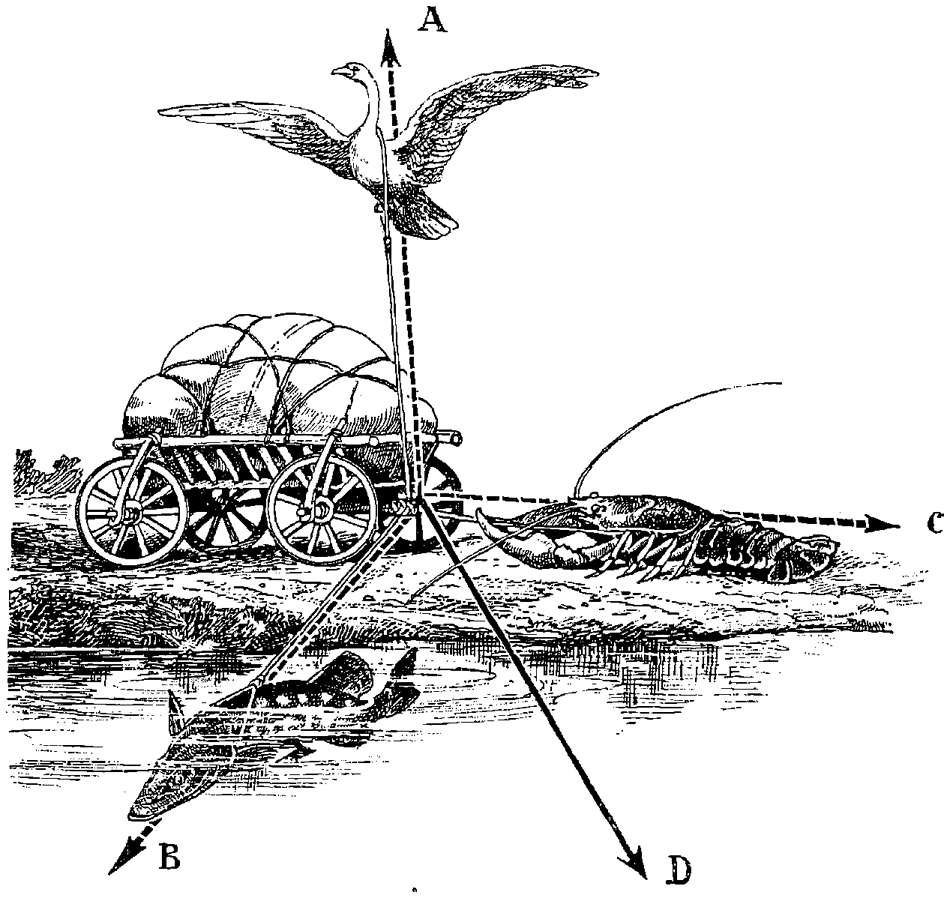
Following the rules of mechanics, we construct a parallelogram on the forces B and C. Its diagonal, D, gives the direction and size of the resultant. This force must clearly move the cart from the spot, all the more since the weight of the cart is wholly or partly canceled by the pull of the Swan (for simplicity we leave friction out of account). Which way the cart will move, forward, backward, or sideways, is another question; the answer depends on the ratio of the forces and the size of the angle between them.
In any case, as you see, Krylov had hardly any right to say for certain that "the cart won't go," that "the cart is there to this day."
In Defiance of Krylov
As we've just seen, the worldly rule that Krylov draws from his fable, "when partners don't agree, their work will not go well," doesn't apply in mechanics. Forces may point in different directions and nevertheless produce a certain result.
Few people know that ants, those zealous laborers whom Krylov himself holds up as model workers, work together by the very recipe he made fun of. And still their work, on the whole, goes well. It's the law of adding forces that once again saves the day. If you watch ants closely at their work, you'll very soon be convinced that their intelligent cooperation is only apparent. In fact each ant works for itself, without a thought of helping its fellows.
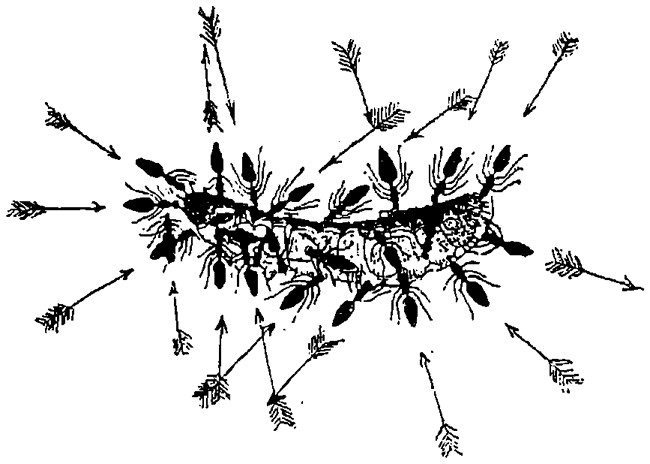
Here is how one investigator describes the work of ants:39
"If ten ants or so are dragging a large prize over level ground, they all act alike, and it looks like cooperation. But now suppose that the prize, a caterpillar, let us say, has caught on some obstacle, a stalk of grass or a pebble. It can't be dragged farther forward; it has to be taken around. And here it becomes quite plain that each ant is trying to deal with the obstacle in its own way, without regard to any of its 'comrades' (see Figures 14 and 15). One drags to the right, another to the left; one pushes forward, while another standing next to it pulls back. They move from place to place and take hold of the caterpillar somewhere else, and each one pushes or pulls in its own fashion. When it happens that the workers' forces so add up that 4 ants are moving the caterpillar one way and 6 the other, then in the end the caterpillar does move, and moves the way of the 6, despite the resistance of the 4."
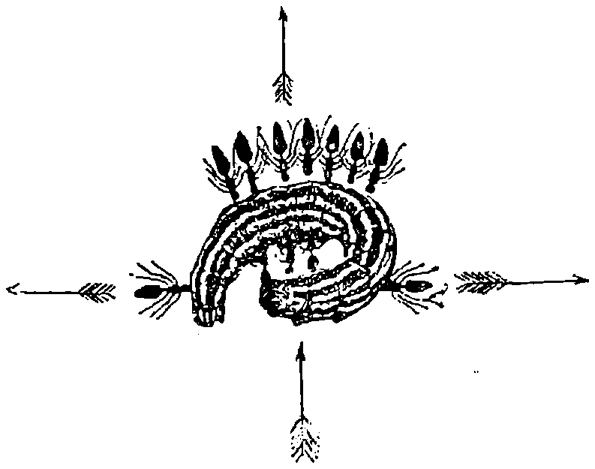
Here is another instructive example, which shows this imaginary cooperation very plainly. Figure 16 pictures a rectangular piece of cheese with 25 ants holding on to it. The cheese was moving slowly in the direction shown by the arrow, and you might have thought that the front rank of ants was pulling the load toward itself, the rear rank was pushing it forward, and the ants at the sides were helping both. Nothing of the kind, as you can easily find out: cut away the whole rear rank with a knife, and the load will crawl along much faster! These 11 ants, clearly, were pulling backward and not forward; each was trying to turn the load so that it could back away and haul it to the nest. The ants behind, then, gave the ones in front no help in dragging the load. They zealously hindered them, and brought their efforts to nothing. Four ants would have been quite enough to drag this bit of cheese, but because they don't act in concert and get in one another's way, 25 ants can barely drag it along!
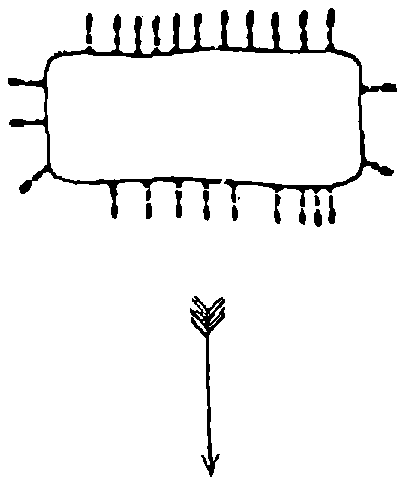
Is It Easy to Break an Eggshell?
If you think of an eggshell as a very fragile, delicate thing, try crushing an egg between your palms, pressing on its pointed ends. You won't find it nearly so easy as you imagine; it takes no small effort to break the shell in this way.
The shell owes this extraordinary strength entirely to its convex shape, and the explanation is exactly the same as for the strength of vaults and arches of every kind.
The drawing (Figure 17) shows a section through a small stone arch over a window. The load S (that is, the weight of the masonry above) presses on the wedge-shaped stone at the middle of the arch, and pushes down with a force that the arrow A marks in the drawing. But the stone can't move down, because it narrows toward the bottom, and it presses on its neighbors instead. The force A, in other words, resolves by the rule of the parallelogram into two side forces, marked by the arrows C and B; and these are canceled by the resistance of the adjoining stones, which are themselves gripped between their neighbors. A force pressing on the arch from outside, therefore, can't destroy it. A force acting from inside destroys it with comparative ease. And no wonder, since the wedge shape that keeps the stones from sinking does nothing to keep them from rising.
An eggshell is just such an arch, only all in one piece and not made up of separate parts. When the pressure comes from outside, it doesn't break down nearly so easily as one might expect of such brittle stuff. Theory proves that the vault that best resists pressure is not a strict hemisphere but has the very shape of the bulge at the pointed end of an egg. You can stand the legs of a fairly heavy table on four raw eggs, and they won't be crushed. (To steady the eggs and increase the area that takes the pressure, you must provide their ends with broad caps of plaster; plaster sticks readily to the chalky shell.)
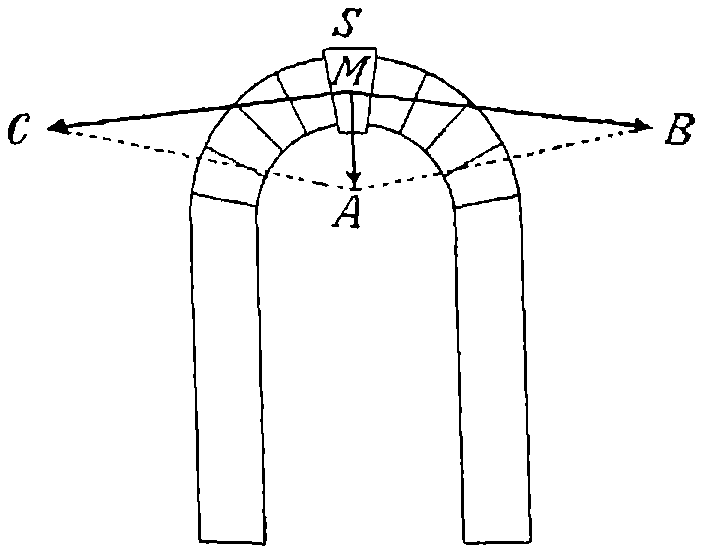
Now you understand why a sitting hen needn't be afraid of breaking the shells with the weight of her body. And yet the feeble chick, when it wants to leave its natural prison, breaks through the shell with its little beak and no trouble at all: the thin chalky vault can't withstand pressure from inside.
We crack an eggshell so easily with a blow to its side that we don't suspect how strong it is when a force acts on it under natural conditions, or what trusty armor nature has given the living creature that is growing inside.
Electric light bulbs seem so delicate and fragile, and yet they have a mysterious, almost miraculous strength, which is explained in exactly the same way as the strength of an eggshell. It becomes still more striking if we remember that they are almost absolutely empty, and that inside there is nothing to oppose the pressure of the outer air; on the porous wall of a hen's egg, by contrast, atmospheric pressure has of course no effect. And the pressure of the air on an electric bulb is by no means small. A spherical bulb with a diameter of 20 centimeters, for example, has a surface of 1,260 square centimeters. On each square centimeter, as you know, the air presses with a force of 1 kilogram, and that gives a pressure on the whole bulb of 1,260 kilograms, or more than a metric ton and a quarter! Such is the enormous pressure that the thin glass skin of an electric bulb withstands all the time! A quarter of that pressure, acting from inside, would be enough to blow the bulb to smithereens.
Sailing Against the Wind
To anyone who isn't a sailor, it is past understanding how sailing ships can go "against the wind." A sailor, it's true, will tell you that under sail you can't go dead against the wind, but only at a very sharp angle to its direction. Yet this angle is so small (12°) that to sail straight into the wind and to sail at 12° to it may well seem equally incomprehensible.
In theory, however, it does make a difference, and we'll now explain how the force of the wind can take a ship toward it, at a small angle. First let's consider how wind acts on a sail in general, that is, which way it pushes the sail when it blows on it from any direction. If you're not a sailor, you probably think that the wind always pushes the sail the way it is blowing. That isn't so. Whichever way the wind blows, it pushes the sail at right angles to the plane of the sail. Let the wind blow in the direction shown by the arrows in Figure 18, where the line AB represents the sail. Since the wind presses evenly on the whole surface of the sail, we can replace its pressure with a force R applied at the middle of the sail. We resolve this force into two: a force Q, perpendicular to the sail, and a force P, directed along it. The second of these will slip along the sail without pushing it, since the friction of the wind against the canvas is very slight. There remains only the force Q, which pushes the sail at right angles to itself.
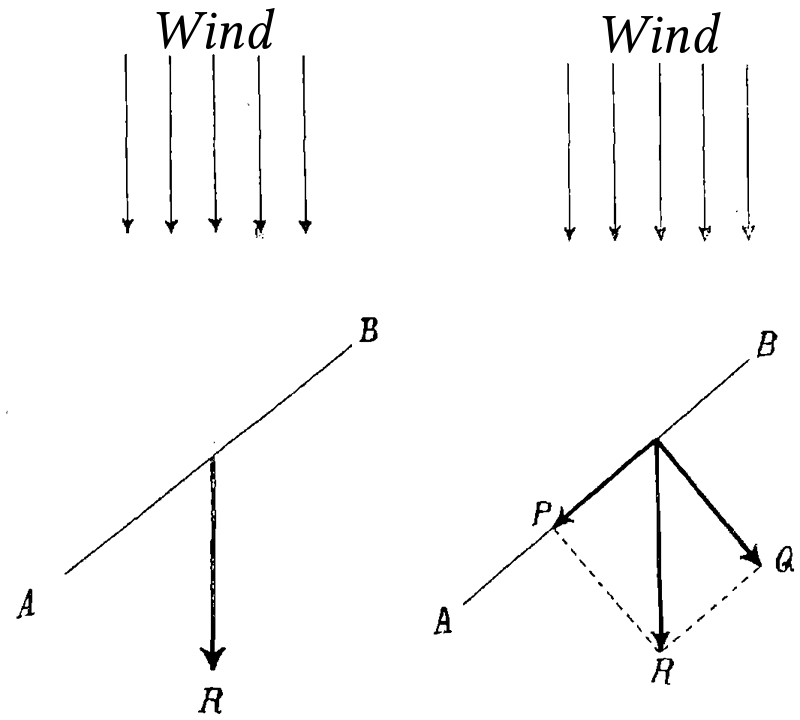
At whatever angle the wind blows on a sail, then, it always presses on it at right angles.
Knowing this, we'll have no trouble understanding how a sailing ship can head into the wind at a very sharp angle. Let the line KK (Figure 19) represent the line of the ship's keel. The wind is blowing at a sharp angle to this line, in the direction shown by the row of arrows. The line AB represents the sail, which is set so that its plane bisects the angle between the direction of the keel and the direction of the wind. Follow the resolving of the forces in Figure 19. We represent the thrust of the wind on the sail by the force Q, which, as we know, must be perpendicular to the sail. We resolve this force into two: a force R, perpendicular to the keel, and a force S, directed forward along the line of the keel. Since the water strongly resists any motion of the ship in the direction R (the keel of a sailing ship is made very deep), the force R is almost entirely canceled. There remains only the force S, which, as you see, is directed forward, and therefore drives the ship on at an angle, against the wind, as it were.
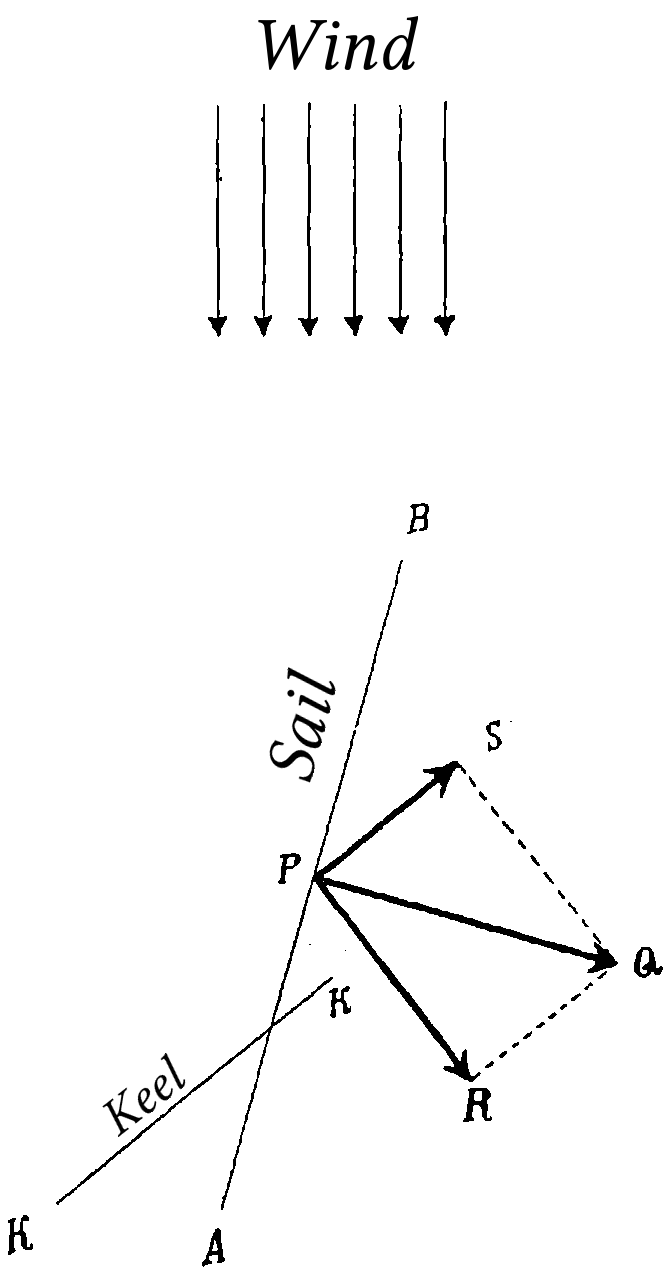
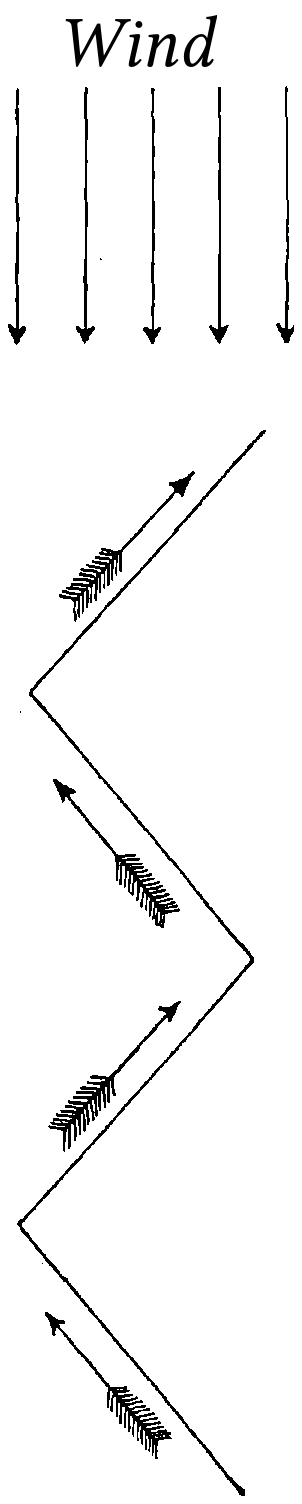
Sailors have found that the smallest angle BPS at which one can sail against the wind is 11 or 12 degrees.40 It's clear from the drawing that the speed of such a motion is very small (considering the strength of the wind), since only a part of the wind's full thrust on the sails is used. But however that may be, it's possible to go against the wind. Usually it is done in zigzags, as Figure 20 shows. In the language of sailors, a ship that moves in this way is "tacking."
Could Archimedes Have Lifted the Earth?
"Give me a fulcrum, and I will lift the whole Earth," said Archimedes, if tradition is to be believed, when he discovered the law of the lever. And indeed there is no weight that can't be lifted by the feeblest force with the help of a lever: you need only apply the force to a very long arm and let the short arm act on the load. It would seem, then, that Archimedes was quite right to make his bold claim. By pressing on an extremely long arm of a lever, he could have lifted with the strength of his hands a weight equal to that of the whole globe.
But if the great mechanician of antiquity had known how enormous the weight of the globe is, he would probably have held back his proud exclamation. Let's imagine for a moment that he has been given the fulcrum he sought in vain, and let's imagine further that he has made a lever of the necessary length. Do you know how long he would have needed to lift the globe by a single centimeter? Over ten trillion years! A hundred billion centuries!
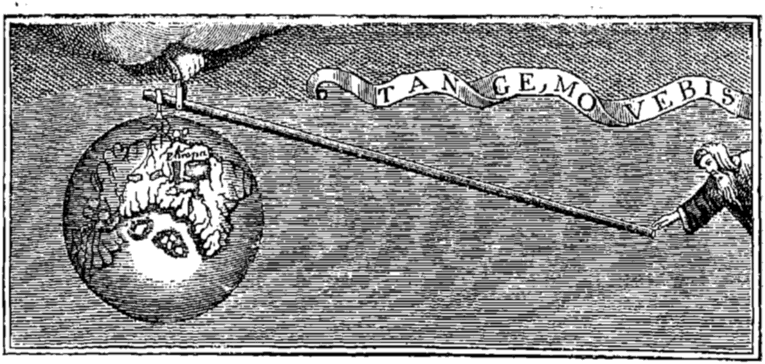
Here's why. The Earth weighs, in round numbers,
6,000,000,000,000,000,000,000 tons.
If a man can lift only 80 kilograms directly, then to lift the Earth he will have to lay his hands on a lever whose long arm is greater than the short one by a factor of
75,000,000,000,000,000,000,000!
A simple calculation will convince you that while the end of the short arm rises 1 centimeter, the other end will sweep out a huge arc through the universe, 750,000,000,000,000,000 kilometers long!
Such is the unimaginably long path that the hand of Archimedes would have to travel to lift the globe by only one centimeter. How much time would he need to perform this feat? Suppose he could raise an 80-kilogram weight two meters in a second. Then to travel the 750,000 trillion kilometers, and so lift our planet one centimeter, he would need more than ten trillion years!
It follows that even if Archimedes had leaned on his lever for a whole million years, he would not have lifted the Earth by so much as the thickness of a hair. And if his hand had run over that path at the greatest speed we observe in nature, the speed of light (300,000 kilometers a second), then even so it would have taken about eighty thousand years to lift the Earth one centimeter! In his whole lifetime, even working at that fantastic rate, Archimedes could have raised the globe by barely a tenth of the thickness of a hair.
And none of the great man's ingenuity would have helped him shorten the time. The "golden rule of mechanics" says that in every machine a gain in force is inevitably accompanied by a corresponding loss in speed, that is, in time.
Jules Verne's Strong Man and Euler's Formula
Do you remember Matifou, the strong man in Jules Verne? "A magnificent head, in proportion to his gigantic height; a chest like the bellows of a forge; legs like stout logs; arms that were regular lifting cranes, with fists like hammers." Of all his feats described in the novel Mathias Sandorf, the one you remember best is probably the astonishing affair at the launching of the Trabacolo, when the giant Matifou, by the strength of his mighty arms, held back a whole ship on its way into the water.
Here is how the novelist tells it:
"The ship, already freed from the props that had supported it at the sides, was ready for launching. Though it displaced no more than 50 tons, it was a considerable mass, and every precaution had to be taken. Everything was prepared and in place, and they were waiting only for the signal. It was enough to take off the mooring rope, and the ship would begin to slide down. Half a dozen carpenters were already busy under the keel, trying to raise the ship, set it rocking, and guide it on its way to the sea. Amid a general silence, the onlookers followed the operation with lively curiosity. At this moment a pleasure yacht appeared, rounding the point of land that shelters the port of Gravosa on the south. To enter the port, the yacht had to pass in front of the yard where the launching of the Trabacolo was being prepared; and as soon as it signaled, the launching had to be put off, to avoid any accident, and taken up again once the yacht had passed into the channel. Had the vessels collided, one lying broadside on and the other advancing at high speed, the yacht would have been lost.
"The workmen stopped hammering, and the one who was to take off the mooring rope was ordered to wait. All eyes were fixed on the graceful vessel, whose white sails seemed gilded in the slanting rays of the sun. Soon the yacht was directly opposite the yard, where a crowd of a thousand curious people stood stock-still. Suddenly there was a cry of horror. The Trabacolo had rocked and begun to move, at the very moment when the yacht turned its starboard side toward it! The two vessels were about to collide; there was neither time nor means to prevent it. The yacht's crew shouted in answer to the frightened cries of the onlookers. Meanwhile the Trabacolo was sliding swiftly down the slope. A puff of white smoke, raised by the friction, curled up before its bow, while the stern had already plunged into the water of the bay (the ship was being launched stern first).
"Suddenly a man appears, seizes the mooring rope that hangs at the bow of the Trabacolo, and tries to hold it, crouching to the ground. In an instant he has wound the rope around an iron bollard driven into the earth, and at the risk of being crushed he holds the line in his hands, with superhuman strength, for 10 seconds. At last the rope snaps. But those 10 seconds were enough: the Trabacolo, plunging into the water, only grazed the yacht and swept on.
"The yacht was saved. As for the man, to whose aid no one had even had time to come, so quickly and unexpectedly had it all happened, it was Matifou."
I can easily imagine how astonished the gifted author of Mathias Sandorf would have been to learn that a feat like this doesn't call for a giant at all, nor for someone who possesses, like Matifou, "the strength of a tiger." Anyone resourceful, with muscles of the most ordinary kind, could have done the same without trouble!
Mechanics teaches that when a rope wound around a bollard slips, the friction mounts to an extraordinary degree. The more turns the rope makes, the greater the friction; and the rule of its growth is that as the number of turns increases in arithmetical progression, the friction grows in geometrical progression. Even a weak child, therefore, holding the free end of a rope that has been wound 3 or 4 times around a fixed post, can balance an enormous weight. This is exactly how the boys who work at river landings stop the steamers as they come in with a hundred passengers aboard. What helps them is no phenomenal strength of arm. It's the way friction depends on the number of turns a rope makes around a post, which the famous mathematician Euler worked out.
For those readers who aren't frightened by the concise language of algebra, here is this instructive formula of Euler's:
Here F is the force against which our own effort, f, is directed. The letter e stands for the base of natural logarithms, which is 2.718...; k is the coefficient of friction between the rope and the bollard. The letter α stands for the "angle of winding," that is, the ratio of the length of the arc covered by the rope to the radius of that arc.
Let's try applying the formula to the case described by Jules Verne. The result will be astonishing. The force F, in this case, is the pull of the ship as it slides down the slipway. The weight of the ship is known to us: 50 tons. Suppose the slope of the slipway is 1/10; then what acted on the rope was not the full weight of the ship but 1/10 of it, that is, 5,000 kilograms. We have, then, F = 5,000 kilograms.
Next, let's take k, the coefficient of friction of the rope against the iron bollard, to be 1/3. The quantity α is easy to find if we assume that Matifou wound the rope around the bollard just three times. Then:
Putting all these values into Euler's formula, we get the equation:
The unknown f (that is, the effort required) can be found from this equation with the help of logarithms:
which gives:
To perform his feat, then, the giant Matifou had only to pull on the rope with a force of less than ten kilograms!
Don't suppose that this figure, less than ten kilograms, is only theoretical, and that in practice a much greater effort would be needed. On the contrary, our result is if anything too large: with a hemp rope and a wooden pile, the effort would be ridiculously small. As long as the rope was strong enough to stand the strain, even a child who had wound it around 3 or 4 times could, thanks to Euler's formula, not only repeat the feat of Jules Verne's giant but outdo it.
What Makes a Knot Hold?
In everyday life we often enjoy the advantage that Euler's formula points out to us. What is any knot, for instance, if not a string wound around a post, with another part of the same string playing the part of the post? The strength of every kind of knot, common knots, bowlines, sailors' knots, and of every sort of tie and bow, depends entirely on friction, which is here multiplied many times over because the cord is wound around itself like the rope around the bollard. It's easy to convince yourself of this by following the bends of the cord in a knot. The more bends there are, and the more times the string is wound around itself, the greater the "angle of winding" in Euler's formula, and consequently the firmer the knot.
A tailor sewing on a button uses Euler's formula too, without knowing it. He winds the thread many times around the bit of cloth caught up in the stitch, and then breaks it off. He needn't worry about the strength of his sewing: if only the thread is strong, the button won't come off. The rule at work is one we know already. As the number of turns of the thread increases in arithmetical progression, the strength of the sewing grows in geometrical progression.
If there were no friction, we couldn't tie two strings together or lace up our shoes. We couldn't use buttons either: the threads would unwind under their weight, and our clothes would be left without a single button.
Chapter 3: Rotary Motion and Centrifugal Force
Why Doesn't a Spinning Top Fall Over?
It's no exaggeration to say that of a thousand people who amused themselves with a top as children, hardly one could answer this question correctly. And isn't it strange, when you think of it, that a spinning top set upright, or even at a slant, should defy all expectation and refuse to topple? What force holds it up in so precarious a position? Doesn't gravity act on this little object?
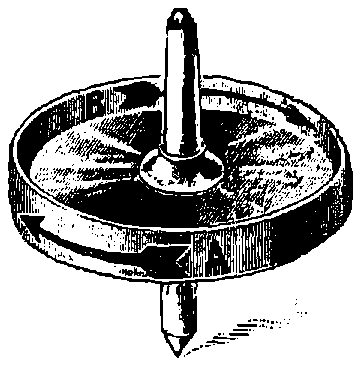
The laws of nature make no exception for tops, of course. What we have here is simply a very curious interplay of forces.
Figure 22 shows a top spinning in the direction of the black arrows. Look at the part marked A, at the front, and at B, diametrically opposite. Part A is trying to move from right to left, and part B from left to right. Now see what motion these parts are given when you push the top's axis away from you. Your push makes A move up and B move down; each of them, that is, gets a push at right angles to its own motion. But in a top that is spinning fast the parts of the disk already have a very great speed, and so it's quite understandable that the top should seem to resist your attempt to tip it over. The more massive the top and the faster it spins, the more stubbornly it resists.
We now know what keeps a top from falling over, unstable as its position looks. It is our old friend inertia, the basic property of matter by which every particle tends to keep the direction of its motion unchanged. We won't examine here all the movements a top makes when some outside force acts on it. That would call for very detailed explanations, which most readers would probably find dull. All we wanted was to explain the fundamental tendency of any rotating body to keep the direction of its axis unchanged, for this tendency accounts for a whole series of things we meet in everyday life.
The most skillful cyclist couldn't stay on his steel horse for a minute if its fast-spinning wheels didn't tend to keep their axes horizontal.41 The wheels are tops too, only with horizontal axes instead of vertical ones. And that's why it is so hard to ride a bicycle slowly: the wheels stop being tops. A child bowling a hoop makes unconscious use of the same property of rotating bodies; as long as the hoop is turning fast, it won't fall. The game of diabolo rests entirely on the same principle. First we use the string to set the diabolo's double cone spinning fast, and then we fling it high into the air. Going up and then coming down again, the spinning diabolo keeps its axis horizontal the whole time, and that's why it is so easy to catch on the outstretched string, throw up again, catch once more, and so on. If the diabolo didn't spin, even the cleverest juggler couldn't do any of this.
The Juggler's Art
Speaking of jugglers, nearly all the most astonishing numbers in their varied program depend, once again, on the tendency of rotating bodies to keep the direction of their axis. Let me quote here from a fascinating book, Spinning Tops, by an English physicist of our own day, Professor John Perry:
"I once showed some experiments on spinning tops to a coffee-drinking, tobacco-smoking audience in that most excellent institution, the Victoria Music Hall in London.... Now, I impressed my audience as strongly as I could with the above fact, that if one wants to throw a quoit with certainty as to how it will alight, one gives it a spin; if one wants to throw a hoop or a hat to somebody to catch upon a stick, one gives the hoop or hat a spin; the disinclination of a spinning body to let its axis get altered in direction can always be depended upon. I told them that this was why smooth-bore guns cannot be depended upon for accuracy; that the spin which an ordinary bullet took depended greatly on how it chanced to touch the muzzle as it just left the gun, whereas barrels are now rifled, that is, spiral grooves are now cut inside the barrel of a gun, and excrescences from the bullet or projectile fit into these grooves, so that as it is forced along the barrel of the gun by the explosive force of the powder, it must also spin about its axis. Hence it leaves the gun with a perfectly well-known spinning motion about which there can be no doubt, and we know too that Figure 26 shows the kind of motion which it has afterwards, for, just like the hat ... its spinning axis keeps nearly parallel to itself.
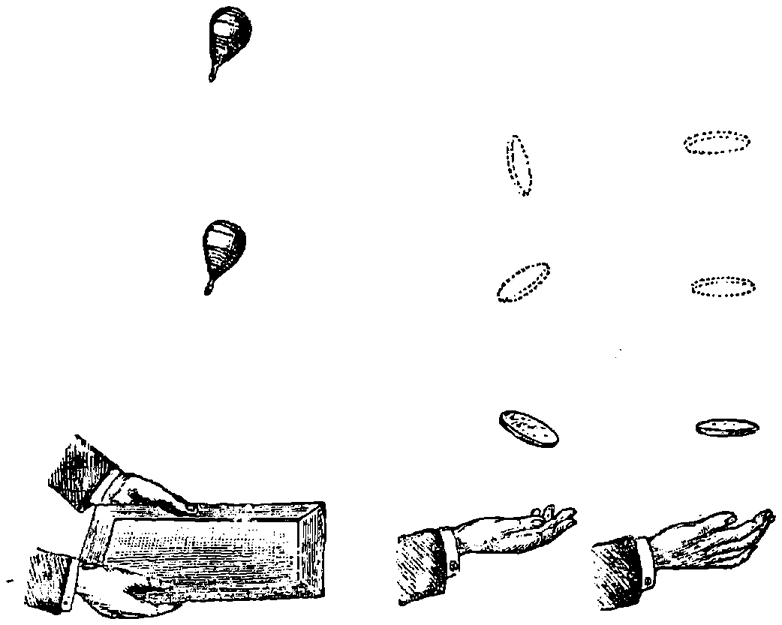
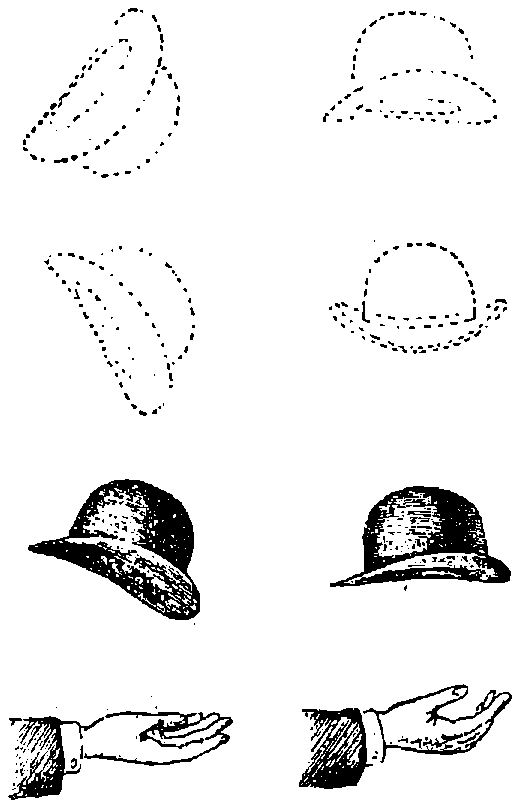
"Well, this was all I could do, for I am not skilful in throwing hats or quoits. But after my address was finished, and after a young lady in a spangled dress had sung a comic song, two jugglers came upon the stage, and I could not have had better illustrations of the above principle than were given in almost every trick performed by this lady and gentleman. They sent hats, and hoops, and plates, and umbrellas spinning from one to the other. One of them threw a stream of knives into the air, catching them and throwing them up again with perfect precision and my now educated audience shouted with delight, and showed in other unmistakable ways that they observed the spin which that juggler gave to every knife as it left his hand, so that he might have a perfect knowledge as to how it would come back to him again. It struck me with astonishment at the time that, almost without exception, every juggling trick performed that evening was an illustration of the above principle."
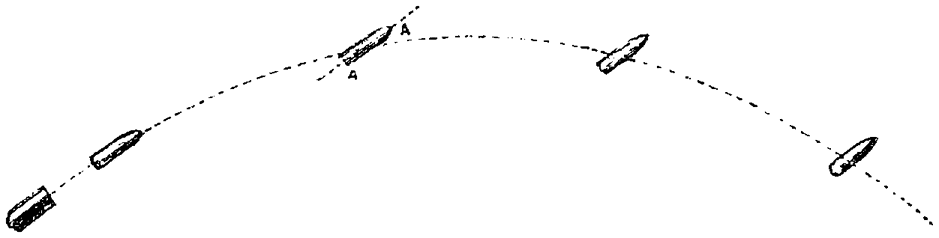
A New Solution to Columbus's Problem
Columbus's way of making an egg stand on end was a little too simple: he cracked the shell.
Strictly speaking, that's no solution. In cracking the shell Columbus changed the egg's shape, and what he stood up was therefore not an egg but some other body. The whole point lies in the egg's shape; alter it, and you have in effect put a different body in the egg's place. Columbus solved the problem, but not for the body it was set for.
You, however, can solve the great navigator's problem without changing the egg's shape in the least, if you make use of the property of the top. Just set the egg spinning about its long axis, and for some time it will stand, without toppling, on its blunt end or even on its pointed one. The drawings show how it's done: you roll the egg quickly between your fingers to make it spin. Take your hands away, and you'll see the egg go on spinning upright for a while. Columbus's problem is solved!
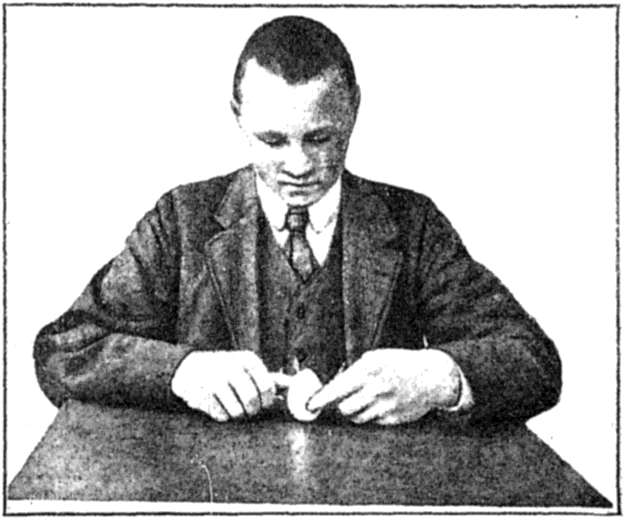
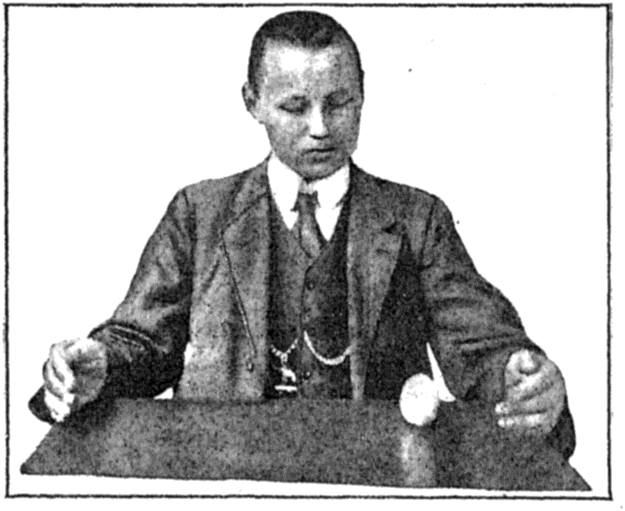
For this experiment you must use boiled eggs.42 Try as you may, you'll hardly get a raw egg to spin, because the liquid inside acts as a brake. This, incidentally, gives us a simple way to tell raw eggs from hard-boiled ones, a secret many housewives don't know.
Weight Abolished
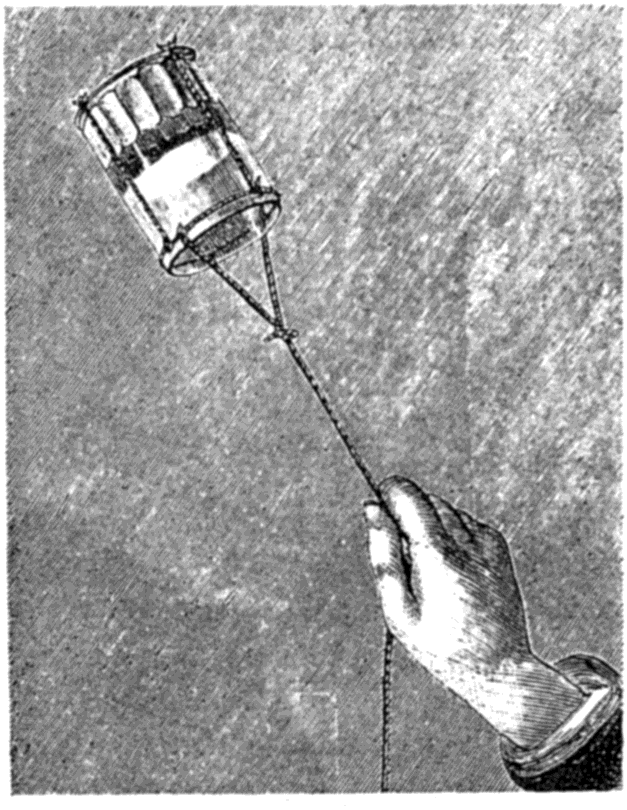
Figure 29 shows an experiment you certainly know. Whirl a glass of water fast enough in the way the drawing shows, and the water won't spill, even in the part of the path where the glass is upside down.
Strange as this looks at first sight, you'll probably have no difficulty explaining it. Centrifugal force, which tries to carry a whirling body away from the center, is here so large that it outweighs the force of gravity, and naturally the water stays put.
I bring up this familiar experiment because I have a problem for the reader. How fast must you whirl the glass to develop the centrifugal force you need for the experiment to succeed?
The calculation is very easy, once we know that the acceleration of centrifugal force is equal to , where v is the speed and R the radius of the circle. We want this acceleration to be no less than the one gravity gives a body, that is, no less than 9.8 meters. Suppose, for simplicity, that the string on which our glass whirls is 1 meter long. Then we have the equation
from which it's clear that the speed we are looking for is meters a second. A circle with a radius of 1 meter is 6.28 meters around, and so, to keep the water from spilling, our glass must make a full turn every 2 seconds. You can easily whirl it that fast, and the experiment usually comes off without trouble.
Notice that as the glass goes around at this rate, its weight changes all the time. At the top of its path, centrifugal force abolishes its weight completely. At the bottom, on the other hand, the weight is doubled, because there centrifugal force is added to the body's normal weight.
You Play the Part of Galileo
At one time, lovers of strong sensations were offered a most peculiar entertainment called the "Devil's Swing." Fedo's collection of scientific amusements describes it this way:
"The swing is hung from a strong horizontal beam that crosses the room at a certain height above the floor. When everyone is seated, a special attendant shuts the entrance door, takes away the plank by which the passengers came aboard, announces that he is about to give the spectators a chance to make a short journey through the air, and begins, as it seems, to rock the swing gently. Then he takes a seat at the back of it, like a coachman on a hansom cab, or leaves the hall altogether.
"Meanwhile the swing sweeps wider and wider. It seems to rise as high as the beam, then past it, higher and higher, until at last it describes a full circle. The motion grows faster and faster, and although most of the passengers have been warned beforehand, they have the unmistakable sensations of swinging and of rapid motion. They feel they are rushing through space head downward, and they can't help clutching the backs of their seats to keep from falling.
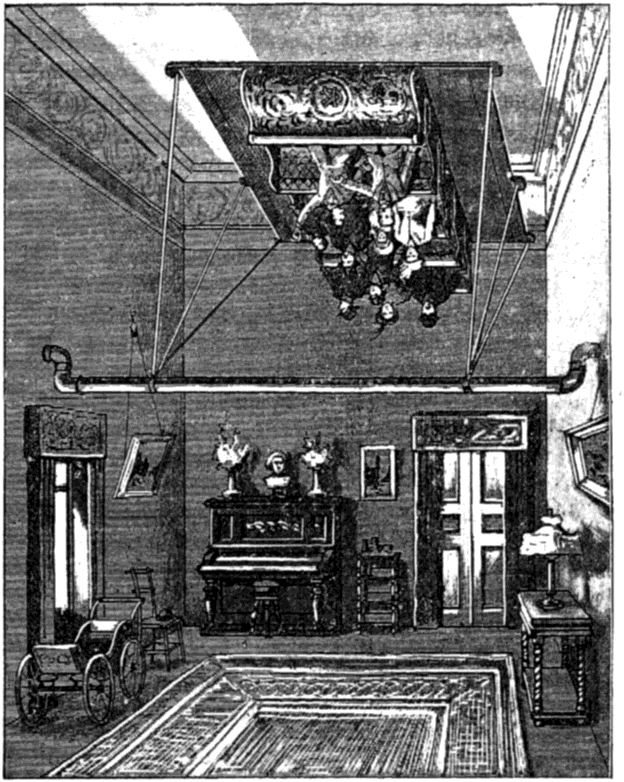
"But now the sweeps begin to shorten. The swing no longer rises as high as the beam, and in a few more seconds it comes to a complete stop.
"In fact the swing was hanging motionless the whole time, while the room itself, worked by a very simple mechanism, was turning around the spectators, or, more exactly, around a horizontal axis. The furniture of every kind is firmly fixed to the floor or the walls of the hall. The lamp, which looks as if it could easily tip over, is soldered to the table, and consists of a small electric bulb hidden under a large shade. The attendant who seemed to be rocking the swing with gentle pushes was really timing them to slight rockings of the hall, and only pretending to push. Everything in the room helps to make the deception a complete success."
The secret of the illusion, as you see, is ridiculously simple. And yet I'm convinced that if you found yourself on the Devil's Swing now, when you know how the trick is done, you would inevitably fall for it all the same. You would know that you were hanging motionless, and in spite of that you would feel that you were being whirled head over heels. Such is the power of illusion! Do you remember Pushkin's poem "Motion"?
	"There is no motion," so a graybeard43 taught.
	Another,44 silent, strolled before his eyes.
	No stronger answer could a man devise,
	And everyone admired so shrewd a thought.
	But, gentlemen, this droll affair has quite
	Reminded me of one I know as well:
	Each day the Sun walks over us, they tell,
	Yet Galileo, stubborn man, was right.
Among neighbors on the swing who hadn't been let into its secret, you would be a sort of Galileo, only in reverse. Galileo argued that the sky is motionless and that, whatever our eyes may tell us, we ourselves are the ones going around; you'll be arguing that we are motionless and that the whole room is turning around us. You might even have to suffer Galileo's sad fate: nobody would believe you, and they would heap ridicule on you as a man who disputes the most obvious things.
My Argument with You
Here's a problem for you. Imagine that you really are on the Devil's Swing, and that you want to prove to your neighbors that they're mistaken. Don't suppose it will be very easy. I invite you to have this argument with me. Let's sit down together on the Devil's Swing, wait for the moment when it has swung high enough to begin, as it seems, to make full circles, and start a learned debate: which is turning, the swing or the whole room? I ask you only to remember that while we argue, neither of us may leave the swing. Please bring everything you need with you.
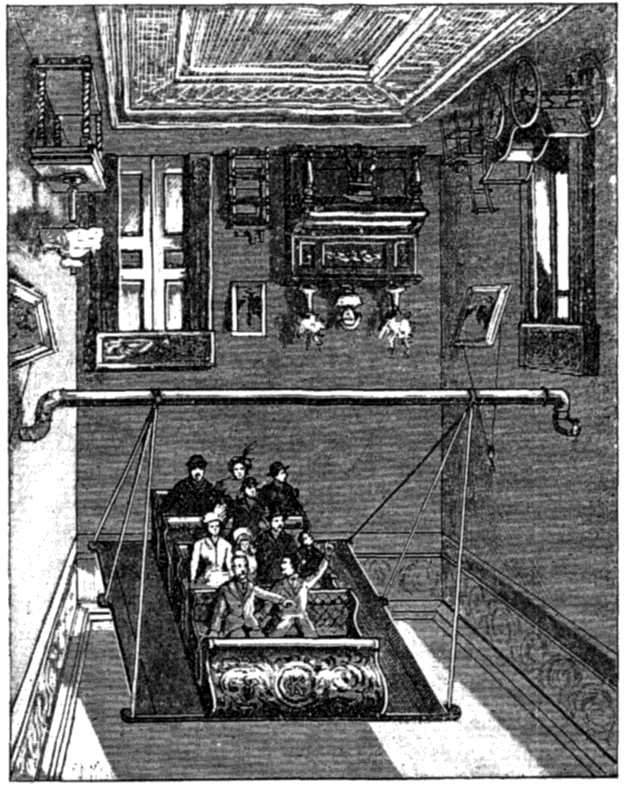
You. How can anyone doubt that we're motionless and the room is turning? If our swing were turned upside down, you and I wouldn't hang here head downward, we'd fall out of it. But we aren't falling, thank God. Therefore the room is turning, and not the swing.
I. Remember, though, that water doesn't spill from a glass that is whirled fast, even when the glass goes upside down, as we saw in "Weight Abolished." A cyclist in the Devil's Loop, as we shall see in the section of that name, doesn't fall either, though he rides head downward. Centrifugal force holds both the water and the cyclist. Perhaps we too are going around fast enough for centrifugal force to abolish our weight.
You. But we can easily calculate the centrifugal force and see whether it's enough to abolish gravity. Knowing our distance from the axis and the number of turns a second, we easily find from the formula...
I. Don't trouble to calculate. The owner of the Devil's Swing knows about our argument, and he warned me that the number of turns will be quite enough for my explanation to work. The calculation, therefore, will prove nothing this time, and each of us will have every right to keep his own opinion.
You. I haven't lost hope of changing your mind. Look, the water in this glass isn't spilling on the floor... But then you'll appeal to centrifugal force here too. Very well: here's a plumb line. It points toward our feet all the time; down, that is. If we were turning and the room were standing still, the plumb line would always point to the floor, and would stretch now toward our heads, now sideways.
I. You're mistaken. If we were turning fast enough, so that the centrifugal acceleration was greater than that of gravity, the plumb line would always be stretched along the radius of rotation, toward our feet. And that's just what we see.
You. Well then, here at last is the decisive experiment: I drop my cigarette case over the side of the swing, and it falls straight onto the ceiling! Clearly the ceiling is now where the floor was, because objects, as far as anyone knows, don't fall up.
I. You've forgotten centrifugal force again! It can overcome the force of gravity. Your cigarette case, therefore, didn't have to land on the floor at all. In defiance of gravity, centrifugal force can fling it at the ceiling, or at the walls.
You. In that case I've caught you with your own centrifugal force. You say the room isn't turning, do you? Then why does my cigarette case go on lying quietly on the ceiling, instead of dropping from it to the floor?
I. It surprises me, too, that the cigarette case you dropped on the ceiling has stayed there. But if you were right, if the room were turning around us, the case ought to be tumbling from the ceiling to the floor and the walls.
You. But excuse me, that's just what proves that the room is turning: the same centrifugal force that helped you dispute with me for so long is holding the case to the ceiling. Now it has spoken up for me!
I. Yes, but are you certain that the floor, the ceiling, and all the walls aren't coated with sticky glue, which holds on to anything that falls on it? The obliging owner of the Devil's Swing, knowing of our argument, has of course thought of that, and has taken care that it should drag on as long as possible. As you see, this point doesn't prove anything yet either.
How Our Argument Ends
Now let me advise you how to win. Bring a spring balance with you on the swing, put a weight in its pan, one kilogram, say, and watch the pointer. It will show the same weight all the time, exactly one kilogram. And there you have indisputable proof that the swing is motionless.
For if we and the spring balance were describing circles around the axis, the weight would be acted on by centrifugal force as well as by gravity. At the lowest points of our path this force would be added to the weight, and at the highest it would be subtracted. We would notice the weight growing heavier at one moment (more than twice as heavy) and weighing almost nothing at the next. And since we notice nothing of the kind, the room is turning, and we are not.
Inside the Enchanted Sphere
A certain showman (an American, of course) built for the public's amusement a very entertaining and even instructive merry-go-round in the form of a revolving spherical room. The people inside it have such extraordinary sensations as we believe possible only in a dream or a fairy tale.
To understand how this enchanted sphere works, let's first recall what a person feels when he stands on a round platform that is turning fast. The centrifugal force that arises as it turns tries to throw him outward, and the farther you stand from the center, the harder it tips and pulls you out. If you close your eyes, you'll think you're standing on a slope, where you can barely keep your balance, instead of on a level floor. You'll understand why if we look at the forces acting on your body here (Figure 32). Centrifugal force pulls you horizontally, and gravity pulls you down. Added by the rule of the parallelogram, the two give a resultant force that pulls the body down at a slant. The faster the platform turns, the larger this resultant becomes and the less steeply it slopes.
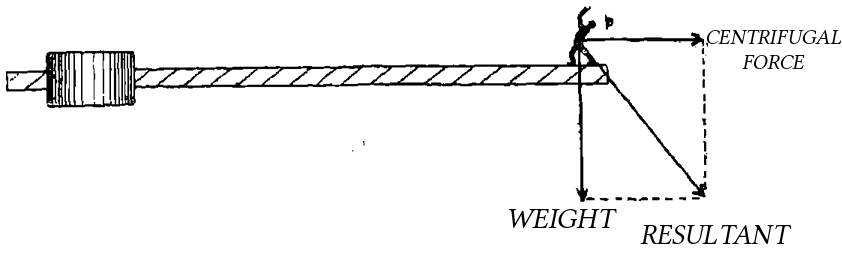
Now imagine that the edge of the platform has been bent upward, and that you're standing on this sloping part. If the platform is at rest, you won't be able to hold your position; you'll slide off, or even fall over. It's quite another matter if the platform is turning. At a certain speed the slope will become, for you, practically horizontal, because the resultant of your weight and the centrifugal force will slant too, at right angles to the bent part of the platform.45
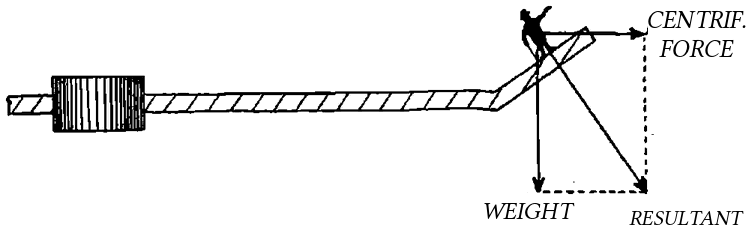
Clearly, the larger the centrifugal force, the more steeply the platform must slope if a person on it is not to fall, and the reverse. And centrifugal force, as we know, increases with distance from the axis. Suppose we give the revolving platform such a curve that, at a given speed, its slope at every point matches the direction of the resultant. Then anyone standing on it will feel, wherever he may be, as if he were on a horizontal surface. Mathematicians have calculated that this curved surface is the inner surface of a special geometrical solid, the paraboloid. You can produce it by quickly spinning a half-full glass of water about its axis. The water will rise at the edges and sink in the center, and its surface will take the form of a paraboloid.
If you pour melted wax into the glass instead of water, and keep it spinning until the wax has cooled, the hardened surface will be an exact paraboloid. At a certain speed of rotation, such a surface is, as far as heavy bodies are concerned, horizontal. Put a little ball anywhere on it, and the ball won't roll down, but will stay balanced there (Figure 35).
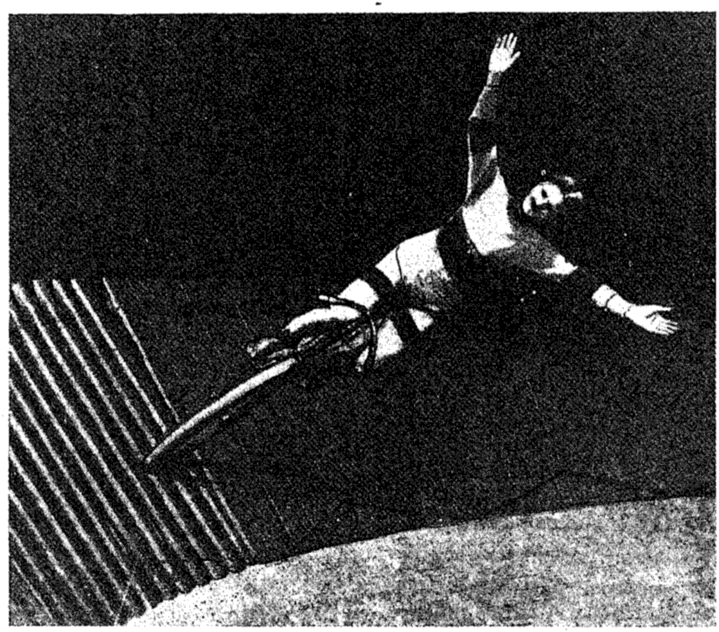
It's now easy to understand how the enchanted sphere is built. Its floor (see Figure 36) is a large revolving platform curved into a paraboloid. A mechanism hidden beneath it turns it with extreme smoothness, but even so the people on the platform would feel dizzy if everything around them didn't move with them. To prevent this, and to keep an observer from guessing that he is moving, the platform is placed inside a large sphere, whose opaque walls move at the same speed as the platform itself.
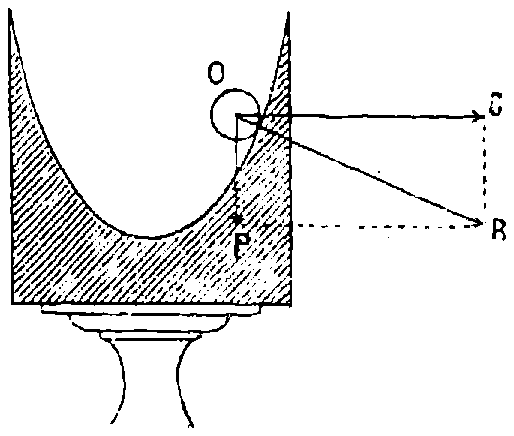
Such is the construction of the "magic sphere." And what do you feel when you're on the platform inside it? While the sphere is turning, the floor under your feet seems horizontal, wherever on the curved platform you may be: at the axis, where the floor really is horizontal, or at the edge, where it slopes at 45 degrees. If you walk from one edge of the platform to the other, you'll think the whole huge sphere has rolled over on its other side under the weight of your body, as lightly as a soap bubble. After all, at every point you feel as if you were on a horizontal surface! The other people, who stand at a slant, are bound to look most extraordinary to you. You will literally think they're walking on the walls, like flies.
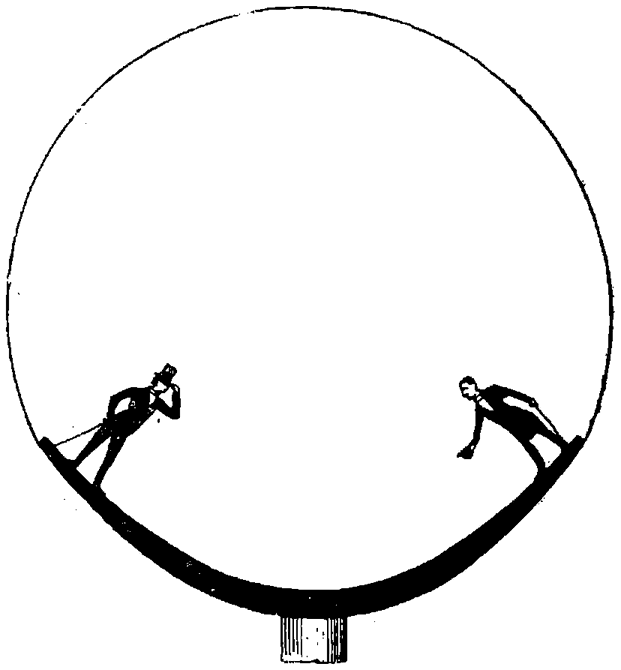
Water poured on the floor of the enchanted sphere would spread in an even layer over its curved surface. The people inside would think the water stood before them in a slanting wall.
A cyclist riding inside the sphere can produce still more astonishing effects. If he begins to circle the platform fast in the direction in which it's turning, the centrifugal force he develops will be added to that of the sphere. The bicycle becomes so stable that he can ride up onto the inner walls of the sphere without tipping over, and circle them parallel to the edge of the floor. To observers at the edge of the platform, he'll seem to be riding on the ceiling! In this truly enchanted sphere the laws of gravity we're used to seem to have been repealed, and we're carried off to a fairy-tale world of wonders.
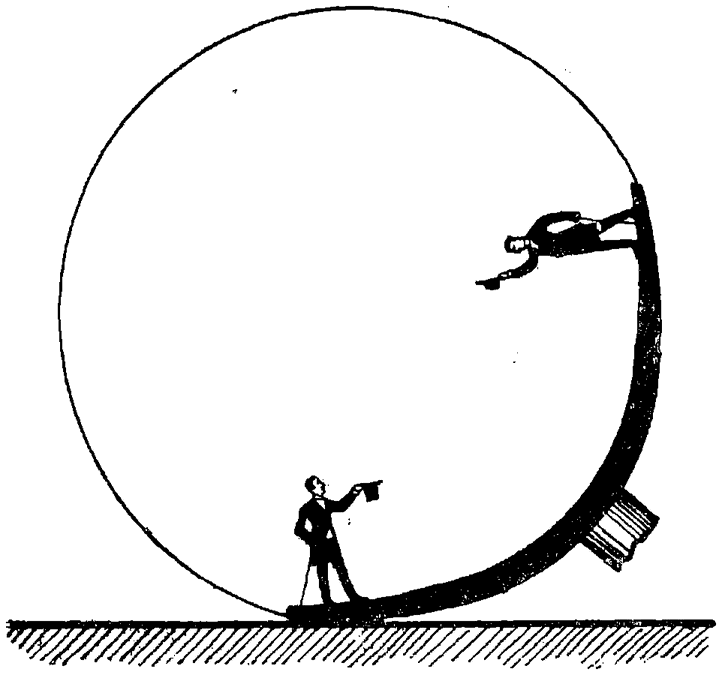
The Devil's Loop
This is the name of a dizzying bicycle trick often performed in circuses. The bicycle rides up a spiral from bottom to top and describes a full circle, even though on the upper part of the circle the rider has to travel head downward. A wooden track is set up in the ring, in the form of a loop with one or more coils, as our drawings show. The performer rides his bicycle down the sloping part of the track, shoots up the circular part on his steel horse, makes a full turn, literally hanging head downward, and rides safely down to the ground. Nowadays this circus trick is common enough, but sixty or seventy years ago it was still a novelty. We reproduce here an old poster from a London circus, dating from the 1840s, and very likely the first announcement of the Devil's Loop (Figure 38).
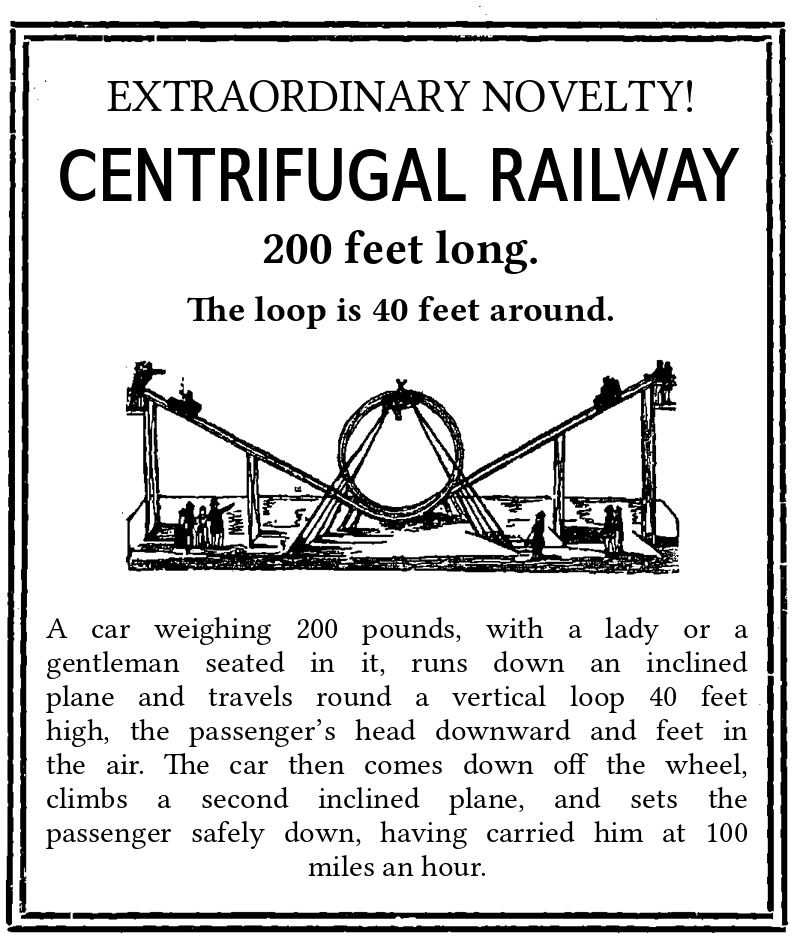
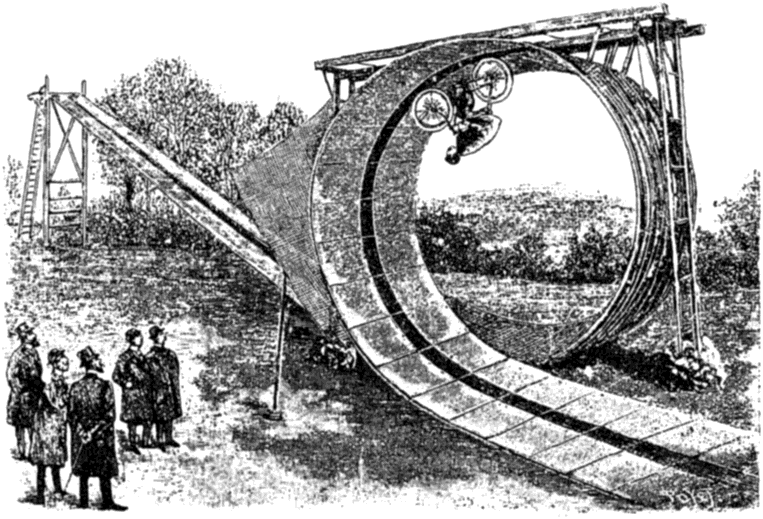
To the spectators, this hair-raising bicycle trick is the height of the acrobat's art. The bewildered audience wonders what mysterious force holds the daredevil up, head downward. The more suspicious are ready to see some clever deception here, cunningly hidden ropes that support the cyclist, or something of the kind.
In fact there is nothing supernatural about the trick. The laws of mechanics explain it all.
The performer needs no special skill and no secret knowledge. A billiard ball rolled down the track would do the trick just as well. What you see in the old picture on the English poster isn't a bicycle at all; it's a plain car running on rails.
Our reader can guess, of course, what force it is that abolishes the weight of the cyclist and his steel horse here, and presses him, head downward, to the track of the Devil's Loop. It's the same centrifugal force that has already explained several puzzling things to us. The trick doesn't always succeed, however. The height from which the cyclist starts must be calculated exactly. Otherwise the centrifugal force may prove too weak to abolish his weight, and then the trick may end very sadly.
Mathematics at the Circus
I know that long rows of "soulless" formulas frighten away a great many lovers of physics. But really, by refusing to make the acquaintance of the mathematical side of things, these enemies of mathematics rob themselves of an enormous pleasure, that of foreseeing how a thing will go and working out all its conditions in advance. In this case, for example, two or three "soulless" formulas will help us determine exactly under what conditions a trick as astonishing as the Devil's Loop can be brought off.
Let's begin our calculations, then, by giving letters to the various quantities we'll have to deal with.
Let h be the height from which the cyclist rides down.
Let r be the radius of the loop.
Let m be the total mass of the performer and his bicycle; their weight will then be mg.
Let g be the acceleration of gravity at the Earth's surface; it is equal to 9.8 meters.
Let be the speed of the bicycle at the moment when it reaches the end of the sloping track and begins to describe the circle.
Let be the speed of the bicycle at the very top of the circle.
We can connect all these quantities by two equations. First, we know that the speed of a body at the bottom of a slope is
Second, we'll make use of what the old books call the equation of living forces, living force being their name for kinetic energy: the work done by a force acting on a body along some path is equal to the change in the body's kinetic energy over that path. The change in kinetic energy on the way from point A to point B of the Devil's Loop (Figure 40) is equal to the difference
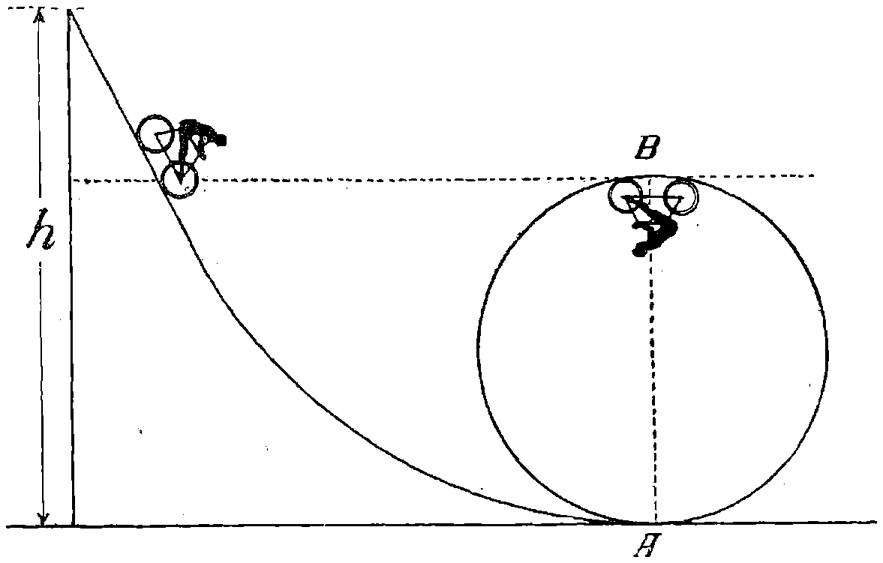
And the work done over this path is equal to the work of gravity when the load mg (the weight of the performer and his bicycle) is raised through the height 2r (the diameter of the loop). This work is given by the product mg × 2r = 2mgr. We can therefore write the equation
If the cyclist is not to fall when he reaches the highest point of the circle, the centrifugal force developed there must be greater than the weight of the performer and his bicycle. In other words, we must have
In the second equation (2) we replace with its equal, 2gh (see equation 1), and have
whence
Putting this value of into the inequality (3), we have
whence , and therefore .
Our calculations have taught us, then, that to bring off this breakneck trick the Devil's Loop must be built so that the diameter of its circular part (of the loop, that is) is no greater than 4/5 of the height of the sloping part. The steepness of the slope, as you see, makes no difference. All that's needed is for the point from which the cyclist starts to stand above the top of the loop by more than 1/4 of its diameter. (In the double Devil's Loop shown in Figure 41, the top of the second loop must be lower than that of the first.) If the loop is 16 meters across, for example, the performer must start from a height of at least 20 meters. If he doesn't meet this condition, no skill will get him around the Devil's Loop. When he reaches the upper part, he'll be sure to come crashing down, because the centrifugal force won't be great enough to counteract the force of gravity.
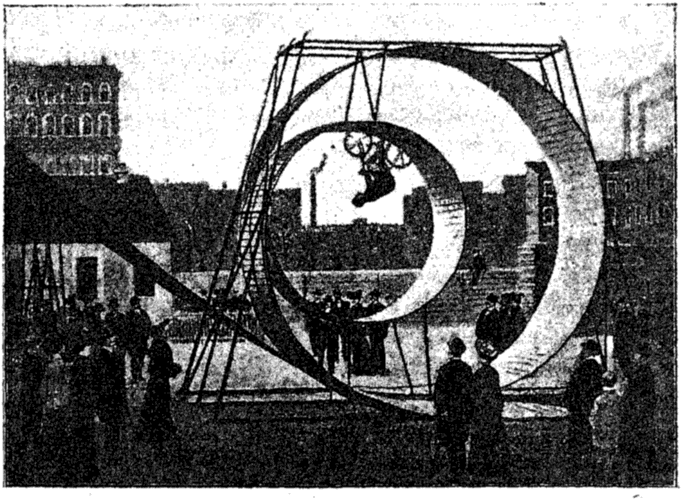
That, incidentally, is why the Devil's Loop on the old poster we reproduced (Figure 38) is drawn wrong: the top of the loop is much too high. On such a loop, disaster is certain.
I should add that in performing this trick the cyclist rides without a chain, leaving his machine to the action of gravity; he can neither speed up nor slow down. His whole art lies in keeping to the middle of the wooden track. At the slightest deviation, he risks leaving it and being flung violently aside. He goes around the circle very fast: if it is 16 meters across, he makes the circuit in 3 seconds, which works out at 60 kilometers an hour.46 At such a speed, of course, steering a bicycle is unthinkable. But there's no need to steer. You can safely rely on the laws of mechanics.
Where Did Eighty Tons Go?
Some joker once announced that he knew a perfectly legal and honest way of giving his customers short weight. The secret is to buy goods in equatorial countries and sell them nearer the poles. It has long been known that, because of centrifugal force and the flattening of the globe, the Earth attracts bodies less strongly near the equator than near the poles. A kilogram carried from the equator to the pole will gain about five grams. For this, of course, you must use a spring balance instead of ordinary scales, or there'll be no profit in it: the goods will get heavier, but the weights in the other pan will get heavier by just as much. If you buy a kilogram of gold somewhere in Peru and dispose of it in Iceland, let's say, you may make a few roubles on the deal, provided, of course, that the enterprising merchant can get his freight carried free.
I doubt whether the trade would be very profitable, but in principle the joker is right, for weight really does decrease toward the equator. There are two reasons for it. In the first place, as the Earth turns, bodies on the equator describe the largest circles, and there the centrifugal force (which opposes gravity) is therefore greatest. In the second place, the globe is, so to speak, swollen at the equator, so that bodies there are farther from its center than anywhere else, and the farther a body is from the center of attraction, the more weakly it's attracted.
For small bodies, the difference in weight from one latitude to another is trifling. But for heavy, massive objects, it can reach quite a respectable figure. You probably never suspected, for example, that a locomotive that weighs 160 metric tons in Moscow becomes 160 kilograms heavier on arriving in Archangel, in the far north, and as much lighter in Odessa, on the Black Sea. A cargo of 5,000 tons of coal, shipped from Spitsbergen to some equatorial port, would shrink by 20 tons, if the man receiving it took a fancy to check the load on a spring balance. A dreadnought that weighed 20,000 tons in Archangel becomes 80 tons lighter by the time it reaches equatorial waters. Nobody feels the difference, however, since all other bodies become lighter in proportion, including, of course, the water in the ocean.
Who then stole the twenty metric tons of coal and the dreadnought's eighty? The chief thief was centrifugal force. Near the equator it reduces the weight of every body by 1/290 of what the same body weighs near the poles.
The World Turned Inside Out
If the globe turned on its axis faster than it does now, if the day were, let's say, 4 hours long instead of 24, then the difference between a body's weight at the equator and at the poles would be very marked. With a four-hour day, for instance, a kilogram weight would weigh only 875 grams at the equator. Conditions on Saturn are roughly like this: near the poles of that planet, all bodies are 1/6 heavier than they are at its equator.
The most curious part is still to come. We know that centrifugal force increases in proportion to the square of the speed, and so it's easy to calculate how fast the Earth would have to turn for the centrifugal force at its equator to become 290 times greater, and equal the force of attraction. This would happen at a speed 17 times the present one (for 17 × 17 is nearly 290). In other words, if the Earth turned 17 times faster, objects at the equator would have no weight at all! (For Saturn, this would happen at only 2 1/2 times its present speed of rotation.)
And what if the Earth turned faster still, 20 times faster than now, for instance? Most likely the monstrous centrifugal force would burst it to pieces, like a millstone spun too fast. But let's suppose the Earth is hard enough to keep its present shape, without even flattening into a disk. Then in the equatorial belt the enormous centrifugal force would make bodies fall up instead of down!
You need the imagination of a Jules Verne or a Wells to picture clearly the extraordinary state of things such conditions would bring about. The world would be turned inside out, as it were. People would have to walk, in the full sense of the words, on their heads, or rather on their hands, clutching at objects fixed to the ground. Everything would have to be tied to posts or buried deep in the earth to save it from falling up, into outer space. Buildings would have to be built upside down, with the floor where the ceiling should be and the ceiling where the floor should be. Tables, chairs, and beds would rest with their legs up, planted on the ceiling, which in this world would serve as the floor. Liquids would have to be kept in vessels turned bottom up. At the least carelessness, people would risk falling into the void, into the bottomless sky, from which there is no return.
And a few hundred or a few thousand kilometers to the north or south, everything would still be normal: gravity, though considerably weakened, it's true, would make bodies fall toward the Earth instead of away from it. If the Earth had such an equatorial belt of "negative gravity," it would be incomparably harder to explore than our polar regions. People couldn't even live in such a country, because it would have no air. With no attraction to hold it in, the air would escape into outer space.
It's quite possible that among the several hundred "minor planets," or asteroids, that circle between Mars and Jupiter, there are worlds with just such "negative gravity" in their equatorial belt, or even over the whole planet.
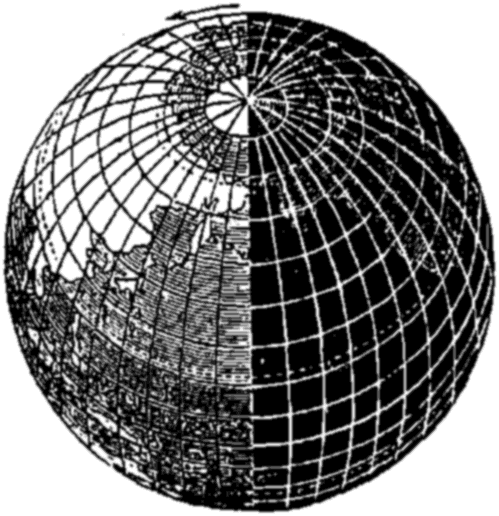
Chapter 4: Universal Gravitation: Weight and Mass
Is the Force of Attraction Very Great?
Nobody disputes that the Earth attracts every object on it. But when we're told that these objects attract each other too, we aren't much inclined to believe it, since in ordinary life we notice nothing of the kind. Why, indeed, doesn't the law of universal attraction make itself felt all the time in our everyday surroundings? Because for small objects the force of attraction is extraordinarily small. Two people standing two meters apart undoubtedly attract each other, but the force is trifling. For people of average weight it comes to 1/100 of a milligram. Two people, that is, attract each other with the force with which a weight of 1/100 of a milligram presses on the pan of a balance, and only the most sensitive balance can detect so slight an addition! Such a force, of course, can't budge us, because the friction of our soles against the floor prevents it. To budge us on a wooden floor, for example (where the coefficient of friction between soles and floor is 3 percent), takes a force of at least 3/100 of our body's weight, or about two kilograms. Now compare this with the trifling force of attraction, 1/100 of a milligram. A milligram is a thousandth of a gram, and a gram is a thousandth of a kilogram, which makes 1/100 of a milligram one two-hundred-millionth of the force it takes to move us from the spot! Is it any wonder that under ordinary conditions we don't notice so much as a hint of the mutual attraction of earthly bodies?
It would be a different matter if there were no friction. Then nothing would prevent even a very weak attraction from bringing bodies together. But with a force of 1/100 of a milligram, the speed at which bulky bodies moved would have to be tiny. It has been calculated that, without friction, two people one meter apart would in the first hour move toward each other by only 1 1/2 centimeters. In the next hour each of them would travel 4 1/2 centimeters, and in the third hour 9. The motion would grow faster and faster, but it would be at least five hours before the two came right up against each other.
That is how insignificant the force of gravitation is between small masses. For large masses it increases in proportion to the product of the masses. But here many people tend to exaggerate it. One scientist (a zoologist, it's true, and not a physicist) assured me that the strange mutual attraction often observed between ships at sea is due to the force of universal gravitation! A simple calculation easily shows that gravitation has nothing to do with it: two of the heaviest ships, 100 meters apart, attract each other with a force of only 300 grams, which of course isn't enough to shift them even a little.
We'll explain later, in the chapter on the properties of liquids, what really makes ships attract each other. For now, let's go on with universal gravitation. The force that is so trifling for small masses becomes very noticeable when we come to the colossal masses of the heavenly bodies. Although the distance that separates us from the Sun is unimaginably vast, gravitation alone keeps the Earth in its orbit; without it, our planet would move in a straight line. If the force of attraction should suddenly vanish for some reason, the Earth would fly off along a line tangent to its orbit and speed away forever into the bottomless depths of space.
A Steel Cable from the Earth to the Sun
Imagine that the mighty attraction of the Sun has suddenly vanished for some reason, and that the Earth faces the sad prospect of withdrawing forever into the cold and gloomy wastes of the universe. Naturally, the human race wouldn't wish to resign itself to an icy grave, and engineers would begin looking for ways to avert the catastrophe. You can imagine (we're free to dream of anything, after all) that they decided to replace the invisible chains of attraction with material ones, simply by tying the Earth to the Sun with strong steel cables. What could be stronger than steel, which can withstand a pull of 5,000 kilograms on every square centimeter? A steel bar 28 centimeters on a side has a cross section of 784 square centimeters, and can therefore withstand a pull of about 4,000 metric tons. How many steel bars of this thickness do you suppose we would have to stretch between the Earth and the Sun to replace their mutual attraction? A thousand, perhaps, or a hundred thousand? You're wrong. Our planet would hardly have room for the ends of all the bars, because we would need one for every 30-centimeter square of the side that faces the Sun! All the continents and oceans would be covered with a forest of these steel columns, and so thick a forest that nobody could walk between them. Only two centimeters would separate one from the next!47
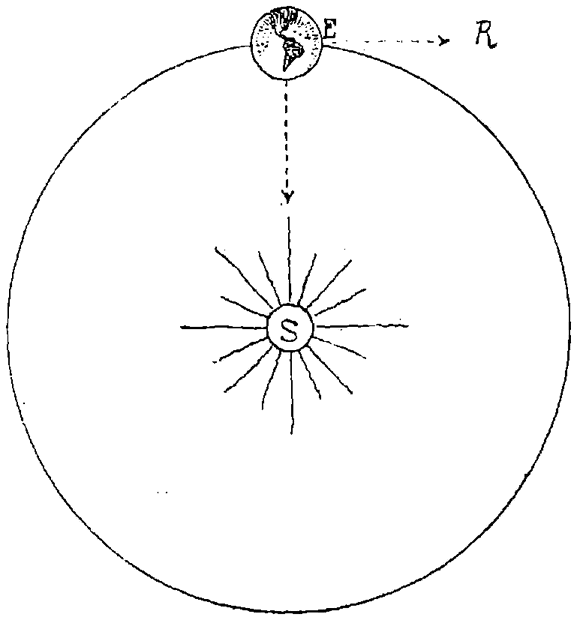
Such is the unimaginable might of the invisible force that draws our planet to the Sun.
And all that this colossal force does is to bend the Earth's path. Every second the Earth is pulled 3 millimeters away from the tangent to its orbit, and that makes our planet's path a circle (or, more exactly, an ellipse). Does it astonish you that so gigantic a force should be needed to move the Earth 3 millimeters, the height of this line of print, in a second? It only shows how huge the mass of the globe is, if even a force as monstrous as this can shift it only the tiniest distance.
Can We Take Shelter from Gravity?
We've just been imagining what would happen if the mutual attraction of the Sun and the Earth vanished: freed from its invisible chains, the Earth would speed away into the endless expanse of the universe. And what would become of all the objects on the Earth if there were no gravity? Nothing would tie them to our planet any longer, and at the slightest push they would be carried off into interplanetary space.
The English novelist Wells made use of an idea of this kind to describe an imaginary voyage to the Moon. In his novel The First Men in the Moon this witty writer suggests a very original way of traveling from planet to planet. His hero, a man of science, invents a special alloy with a remarkable property: the force of gravitation can't pass through it. Slip a layer of this alloy under any body, and that body will be freed from the Earth's attraction and become weightless. Wells calls this fantastic substance "Cavorite," after the inventor, his hero Cavor.
"The object of Mr. Cavor's search," he writes, "was a substance that should be 'opaque' ... to 'all forms of radiant energy.'"
We can make plates that stop light, heat, electricity, and so on, but it isn't in our power to screen any body from the influence of gravitation, that is, of weight. Still, there's no sound reason to say the thing is altogether impossible, and anyone can see what a revolution so miraculous a substance would bring about. "If one wanted to lift a weight, however enormous, one had only to get a sheet of this substance beneath it, and one might lift it with a straw."
The reader will now have no trouble understanding how the novelist uses such a substance to send his heroes to the Moon in a special vehicle. The novel describes its construction like this:
"'Imagine a sphere,' he explained, 'large enough to hold two people and their luggage. It will be made of steel lined with thick glass; it will contain a proper store of solidified air, concentrated food, water distilling apparatus, and so forth....
"'The inner glass sphere can be air-tight, and, except for the manhole, continuous, and the steel sphere can be made in sections, each section capable of rolling up after the fashion of a roller blind....
"'... the Cavorite exterior of the sphere will consist of windows or blinds, whichever you like to call them. Well, when all these windows or blinds are shut, no light, no heat, no gravitation, no radiant energy of any sort will get at the inside of the sphere, it will fly on through space in a straight line, as you say. But open a window, imagine one of the windows open. Then at once any heavy body that chances to be in that direction will attract us....
"'Practically we shall be able to tack about in space just as we wish. Get attracted by this and that.'"
How Wells's Heroes Flew to the Moon
The novelist gives an interesting account of the very moment when the interplanetary car sets out. The thin layer of Cavorite that covers the outside of the vehicle makes it, so to speak, completely weightless. Now a weightless body, you understand, can't lie quietly at the bottom of the ocean of air. The same thing must happen to it as to a cork held down at the bottom of a lake, which quickly floats to the surface. In just the same way the weightless vehicle, which the centrifugal force of the turning globe is flinging off besides, ought to shoot upward and, on reaching the outermost limits of the atmosphere, continue by inertia on its way through space. And that's how the heroes of the novel flew. Once they were far beyond the atmosphere, they opened some shutters and closed others, exposing their vehicle to the attraction now of the Sun, now of the Earth, now of the Moon, and so made their way to the surface of our satellite. Later one of the travelers returned safely to the Earth in the same vehicle.
At first sight this scheme seems very tempting and plausible. Why, after all, shouldn't someone invent a substance that is impervious to gravitation? And why not steer a vehicle in the way Wells describes?
Let's look at the idea closely. It hides a good many curious and instructive surprises.
What force moves and steers Wells's vehicle? The attraction of the heavenly bodies, the author answers. But at great distances, in the first few hours, this force can give a light body only a very moderate speed. A simple calculation would show that, under the attraction of the Moon, an object as far from it as the Earth is would take 43 days to fall there! And if we bear in mind that Wells's sphere didn't fly straight to the Moon, but zigzagged, yielding to the attraction now of the Sun, now of the Earth, and so on, it becomes clear that the flight would last even longer. At the distance of the Earth, the Moon's attraction can make an object move in the first second only about a hundredth of a millimeter. The Sun would shift the same body 3 millimeters in the first second. The far-off planets and stars have an immeasurably smaller effect on our fantastic vehicle. It's true that the vehicle's speed grows with every second that follows, but it would still take hours and even days to work up a speed at all comparable with the gigantic distances that Wells's celestial airship has to cover.
As you see, the invention of the miraculous Cavorite would let us travel through space much too slowly. The voyage to the Moon, for example, would take at least two months, and to reach Mars we would have to travel for the better part of a year.48
That, however, would hardly stop bold travelers; the great navigators, after all, set out on voyages that lasted for years. Besides, they can take along all the provisions they like, since the sphere, protected by its gravity-proof shell of Cavorite, wouldn't become the least bit heavier. On the contrary, as you're about to see, it would even become lighter!
The Weightless Cargo
If we look more closely at the working of this fantastic gravity-proof substance, we come upon an astonishing paradox, which brings out very vividly the profound difference between the notions of mass and weight.
Suppose that a substance that the force of attraction can't penetrate really has been invented. Clearly, all bodies protected by a layer of this substance must be weightless. But it's still a question whether the substance itself will be weightless. Doesn't matter that is opaque to heat rays grow hot itself? It's opaque to the rays precisely because it takes their whole heating effect upon itself. Let's take another example. We know of a screen that shuts out magnetic forces, soft iron: a compass protected by a ring of soft iron isn't attracted by the iron objects around it. If you make a hollow ball of iron, the objects inside it will be beyond the reach of outside magnetic forces; you can bring the ball up to the strongest magnet, and the attraction won't get through to the inside. But the ball itself will be attracted by the magnet and will, of course, carry along everything in it.
We must suppose, therefore, that the Cavorite shell of the sphere won't be weightless either; only the objects inside it will be. And this presents us with a curious problem in physics. How must gravity act on a body whose inner parts are weightless and whose shell has weight? The answer isn't difficult. Such a body falls more slowly than usual, by as many times as the mass of the whole body is greater than the mass of the part that has weight. For only that part (the shell of the sphere) is attracted, while the force of attraction has to carry along the whole sphere, with its weightless contents; and the speed of fall must decrease accordingly.49
But if the sphere falls more slowly than usual, it will also show a smaller weight on the scales. And here is the most striking thing of all: the more cargo and passengers there are in such a vehicle (the more weightless mass it contains, that is), the more slowly it will fall, and the smaller, consequently, the weight it will show on the scales.50
Therefore our interplanetary vehicle will be lighter the more cargo it carries!
This lightness, however, is of a very special kind, unlike the one we're used to. A Cavorite sphere loaded with 1,600 kilograms of cargo may show a weight of only 400 grams on the scales. But don't imagine that you can toss it about like a big football. Try to push this sphere during its unimaginably slow fall (four thousand times slower than usual), and you'll feel that, for all that, you're up against a mass of 1,600 kilograms. The sphere comes down with the mighty slowness of a massive steam hammer. Why? Because Cavorite can lessen only a body's weight, and can't lessen its mass. And what a push, or any force, does to a body depends on its mass, and not on its weight.
We would run into a paradox of the same kind if we were carried to some planet where the strength of gravity is less than on the Earth.
Half an Hour on the Moon
If you'd like a vivid idea of how it would feel to find yourself in a world where gravity is weaker than on Earth, read this passage from Wells's novel The First Men in the Moon. The story is told by one of two men from Earth who have just landed there.
"I lifted the circular operculum from its place and laid it carefully on the bale. A flake or so of snow whirled and vanished as that thin and unfamiliar air took possession of our sphere. I knelt, and then seated myself at the edge of the manhole, peering over it. Beneath, within a yard of my face, lay the untrodden snow of the moon...
"He [Cavor, the narrator's companion] stretched out his hand for his blanket, thrust his head through its central hole, and wrapped it about him. He sat down on the edge of the manhole, he let his feet drop until they were within six inches of the lunar ground. He hesitated for a moment, then thrust himself forward, dropped these intervening inches, and stood upon the untrodden soil of the moon...
"He stood for a moment looking this way and that. Then he drew himself together and leapt.
"The glass distorted everything, but it seemed to me even then to be an extremely big leap. He had at one bound become remote. He seemed twenty or thirty feet off. He was standing high upon a rocky mass and gesticulating back to me. Perhaps he was shouting—but the sound did not reach me. But how the deuce had he done this? I felt like a man who has just seen a new conjuring trick.
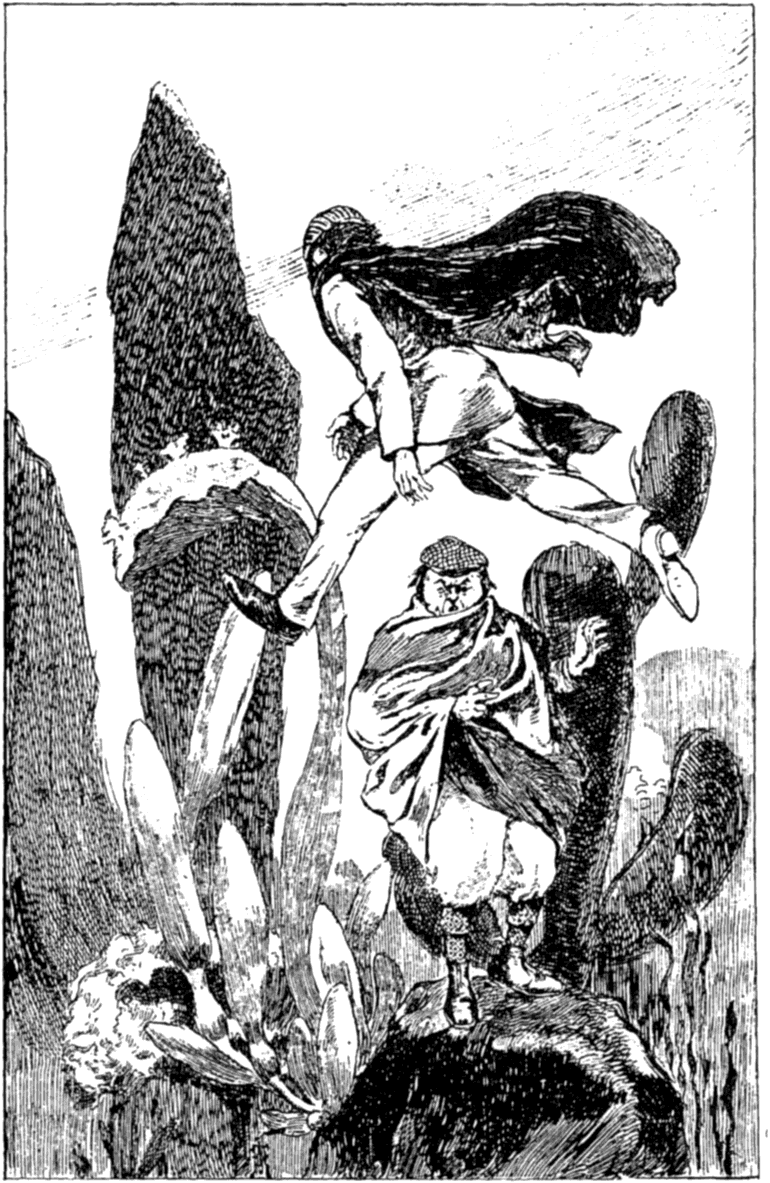
"In a puzzled state of mind I too dropped through the manhole. I stood up. Just in front of me the snowdrift had fallen away and made a sort of ditch. I made a step and jumped.
"I found myself flying through the air, saw the rock on which he stood coming to meet me, clutched it and clung in a state of infinite amazement.
"I gasped a painful laugh. I was tremendously confused. Cavor bent down and shouted in piping tones for me to be careful.
"I had forgotten that on the moon, with only an eighth part of the earth's mass51 and a quarter of its diameter, my weight was barely a sixth what it was on earth. But now that fact insisted on being remembered.
"'We are out of Mother Earth's leading-strings now,' he said.
"With a guarded effort I raised myself to the top, and moving as cautiously as a rheumatic patient, stood up beside him under the blaze of the sun...
"A sudden blaze of pink had crept up a ragged pillar of crag. It was a most extraordinary pink, a livid magenta.
"'Look!' said I, turning, and behold Cavor had vanished.
"For an instant I stood transfixed. Then I made a hasty step to look over the verge of the rock. But in my surprise at his disappearance I forgot once more that we were on the moon. The thrust of my foot that I made in striding would have carried me a yard on earth; on the moon it carried me six—a good five yards over the edge. For the moment the thing had something of the effect of those nightmares when one falls and falls. For while one falls sixteen feet in the first second of a fall on earth, on the moon one falls two, and with only a sixth of one's weight. I fell, or rather I jumped down, about ten yards I suppose. It seemed to take quite a long time, five or six seconds, I should think.52 I floated through the air and fell like a feather, knee-deep in a snow-drift in the bottom of a gully of blue-grey, white-veined rock.
"I looked about me. 'Cavor!' I cried; but no Cavor was visible...
"I turned fiercely to the rocks and clambered to the summit of them. 'Cavor!' I cried. My voice sounded like the voice of a lost lamb...
"Then I saw him. He was laughing and gesticulating to attract my attention. He was on a bare patch of rock twenty or thirty yards away. I could not hear his voice, but 'jump' said his gestures. I hesitated, the distance seemed enormous. Yet I reflected that surely I must be able to clear a greater distance than Cavor.
"I made a step back, gathered myself together, and leapt with all my might. I seemed to shoot right up in the air as though I should never come down.
"It was horrible and delightful, and as wild as a nightmare, to go flying off in this fashion. I realised my leap had been altogether too violent. I flew clean over Cavor's head and beheld a spiky confusion in a gully spreading to meet my fall. I gave a yelp of alarm. I put out my hands and straightened my legs.
"I hit a huge fungoid bulk that burst all about me, scattering a mass of orange spores in every direction, and covering me with orange powder...
"I became aware of Cavor's little round face peering over a bristling hedge. He shouted some faded inquiry. 'Eh?' I tried to shout, but could not do so for want of breath. He made his way towards me, coming gingerly among the bushes.
"'We've got to be careful,' he said. 'This moon has no discipline. She'll let us smash ourselves.'
"He helped me to my feet. 'You exerted yourself too much,' he said, dabbing at the yellow stuff with his hand to remove it from my garments.
"I stood passive and panting, allowing him to beat off the jelly from my knees and elbows and lecture me upon my misfortunes. 'We don't quite allow for the gravitation. Our muscles are scarcely educated yet. We must practise a little, when you have got your breath.'...
"We found that beyond a few abrasions I had received no serious injuries from my tumble, and at Cavor's suggestion we were presently looking round for some safe and easy landing-place for my next leap. We chose a rocky slab some ten yards off, separated from us by a little thicket of olive-green spikes.
"'Imagine it there!' said Cavor, who was assuming the airs of a trainer, and he pointed to a spot about four feet from my toes. This leap I managed without difficulty, and I must confess I found a certain satisfaction in Cavor's falling short by a foot or so and tasting the spikes of the scrub. 'One has to be careful, you see,' he said, pulling out his thorns, and with that he ceased to be my mentor and became my fellow-learner in the art of lunar locomotion.
"We chose a still easier jump and did it without difficulty, and then leapt back again, and to and fro several times, accustoming our muscles to the new standard. I could never have believed had I not experienced it, how rapid that adaptation would be. In a very little time indeed, certainly after fewer than thirty leaps, we could judge the effort necessary for a distance with almost terrestrial assurance."
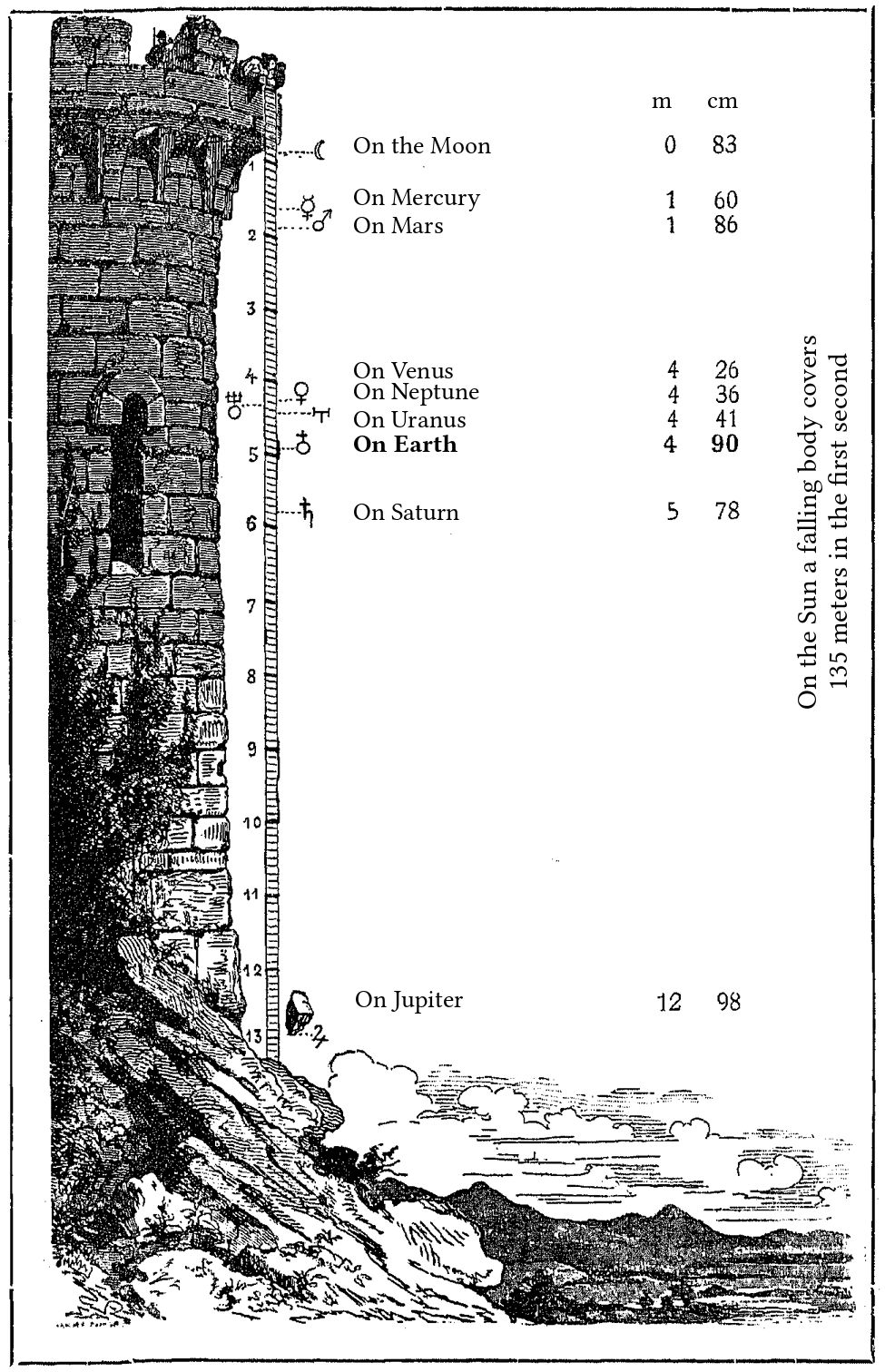
Another Ten Minutes on the Moon
Let me add a little to these scenes, to clear up one curious point. Suppose that our two heroes, once on the Moon, fell to arguing. Had they really become six times lighter there, as they had so often read in books? The spring balance hadn't convinced one of them. True, it showed 12 kilograms instead of 72, but who could swear that it was in working order?
"If you doubt it," said his companion, "here's indisputable proof. You saw for yourself: all this time we've been jumping six times as high as on Earth."
"That's just what makes me suspicious!" the doubter replied. "If we really had become six times lighter here, we ought to be jumping 36 times as high, not six."
"Why? I don't follow you."
"When you throw a one-kilogram weight and a six-kilogram weight into the air on Earth, which of them do you send up faster?"
"The one-kilogram weight, of course. Six times as fast.53 Acceleration is inversely proportional to mass, after all."
"Excellent. And the formula tells us that the height h to which a body rises when thrown upward is proportional to the square of its speed v. If we'd become six times lighter here, then, with the usual effort of our muscles we ought to be jumping 36 times as high, and not six!"
"Then how many times lighter do you say we are?"
"Don't be in a hurry to conclude. Let me suggest an experiment. Here is a six-kilogram weight from Earth. According to you, it has turned into a one-kilogram weight here?"
"Yes. And when it slipped out of my hands straight onto my foot, the blow, I'm sorry to say, felt exactly like the blow of a one-kilogram weight on Earth, and hurt exactly as much."
"But notice the difference. On Earth, if you drop a weight, you'll hardly have time to pull your foot away; here, if you hadn't been daydreaming, you could have done it easily, because the weight falls much more slowly. And yet if the weight had merely become lighter, the speed of its fall ought not to have changed. Galileo proved long ago that heavy bodies and light ones fall at the same speed. But let's go back to the experiment I wanted you to try. Throw this six-kilogram weight up in the air as hard as you can. How high do you think it will go, here on the Moon?"
"As high, I should think, as a one-kilogram weight would go on Earth with the same effort."
"Try it, then... You see? It goes up only a very little way here, a sixth as high as a one-kilogram weight on Earth. If we reason your way, we shall have to admit that bodies don't get any lighter on the Moon at all!"
"I confess you've got me thoroughly muddled now. What does happen to bodies on the Moon? Do they become six times lighter, as the spring balance shows, or 36 times lighter, as our jumps prove, or no lighter at all, as follows from your experiment? I'm completely at a loss..."
A Special Kind of Lightness
The reader is probably at a loss too. Let me hurry to explain where these contradictions come from.
The trouble is the word "lighter," which in its ordinary sense doesn't fit the case. It fails to say exactly what happens to heavy bodies when they are carried to the Moon, or to any other planet.
Let's look into it more closely. We know that the weight (p) of a body is its mass (m) multiplied by the acceleration (g) due to gravity: p = mg.
When a body on Earth gets lighter (when, that is, it presses less on the pan of the scales), the usual cause is a decrease in its mass, the factor m. On the Moon it's the other way around: the weight has gone down because the other factor, g, has changed, for at the surface of our satellite the acceleration due to gravity is a sixth of what it is on Earth. As a result the product mg, and with it the weight p, becomes six times smaller. But we can't use one and the same expression, "to become lighter," for both these things. Strictly speaking, bodies on the Moon don't become lighter; they merely fall less headlong. They are "less fallish," if I may put it that way. In any case, I repeat, two decreases of weight that arise from such different causes mustn't share the one word "lighter." We've just seen what misunderstandings follow when people use that word without thinking for the weakening of gravity on the Moon.54
To see clearly where the difference lies, let's call in the help of mathematics and consider these two equations:
Weight of a one-kilogram weight on Earth = mg = p.
Weight of a six-kilogram weight on the Moon = .
Clearly, whenever a phenomenon depends on the mass of a body alone, or on the acceleration alone, or on both factors but to different powers, a difference between the two weights is bound to show up, even though they weigh the same on the spring balances of Earth and Moon.
The time (t) that a weight takes to fall from a height h on the Moon, for example, is
which is 2 1/2 times longer than on Earth. On Earth a weight dropped from a height of one meter takes less than half a second (0.45) to reach the floor; on the Moon it takes 2 1/2 times as long, more than a full second.55 In that time you can easily pull back your foot before the weight crushes it. And yet a simple calculation will convince you that the blow of a six-kilogram weight on the floor, or on your foot, will be the same on the Moon as the blow of a one-kilogram weight on Earth. That is because the two strike with the same kinetic energy, or, as the old books call it, living force, which they measure by the product of the mass and the square of the speed.
How high a six-kilogram weight, thrown by hand, will rise on the Moon by comparison is also easily worked out, once we know that its initial speed is six times less than that of a one-kilogram weight on Earth.
On Earth the height (h) for the one-kilogram weight is . And on the Moon, for the six-kilogram weight, , which is six times less than on Earth.
In a Bottomless Shaft
Science still knows very little about what goes on deep inside our planet. We don't even know whether the globe is solid down there or molten. Some suppose that beneath a solid crust a hundred kilometers thick lies a mass of liquid fire; others think the whole globe has hardened right to the center. It's a difficult question to settle: the deepest mine goes down no farther than two kilometers, and the Earth's diameter is 12,700. If we could only drill a shaft clean through our planet, along a diameter, all our questions would be answered, of course...
Nothing of the kind has been done yet. But let's use this imaginary bottomless shaft to work on a curious problem. What do you think would happen to you if you fell into it? (Forget for the moment about the resistance of the air.) You can't be smashed on the bottom, since there isn't one. Where, then, will you stop? At the center of the Earth?
No. By the time you reach the center, you'll be moving at such a colossal speed (about 8 kilometers a second) that stopping there is out of the question. You'll rush on past it, and, as calculation shows, go on flying, slower and slower, until you are level with the rim at the opposite end. Here I advise you to catch hold of the edge, and tightly, or you'll have the same trip to make all over again, through the whole shaft to the other end. If there too nobody helps you to grab hold of something, down you'll go again, and you'll swing back and forth like that forever. Mechanics teaches that in these conditions (provided, I repeat, that we neglect the friction of the air in the shaft, which would in fact be enormous) any heavy body must swing to and fro eternally. The flight one way should take a mere forty minutes. Throw yourself into such a shaft, and in one hour and twenty minutes you'd be back again.
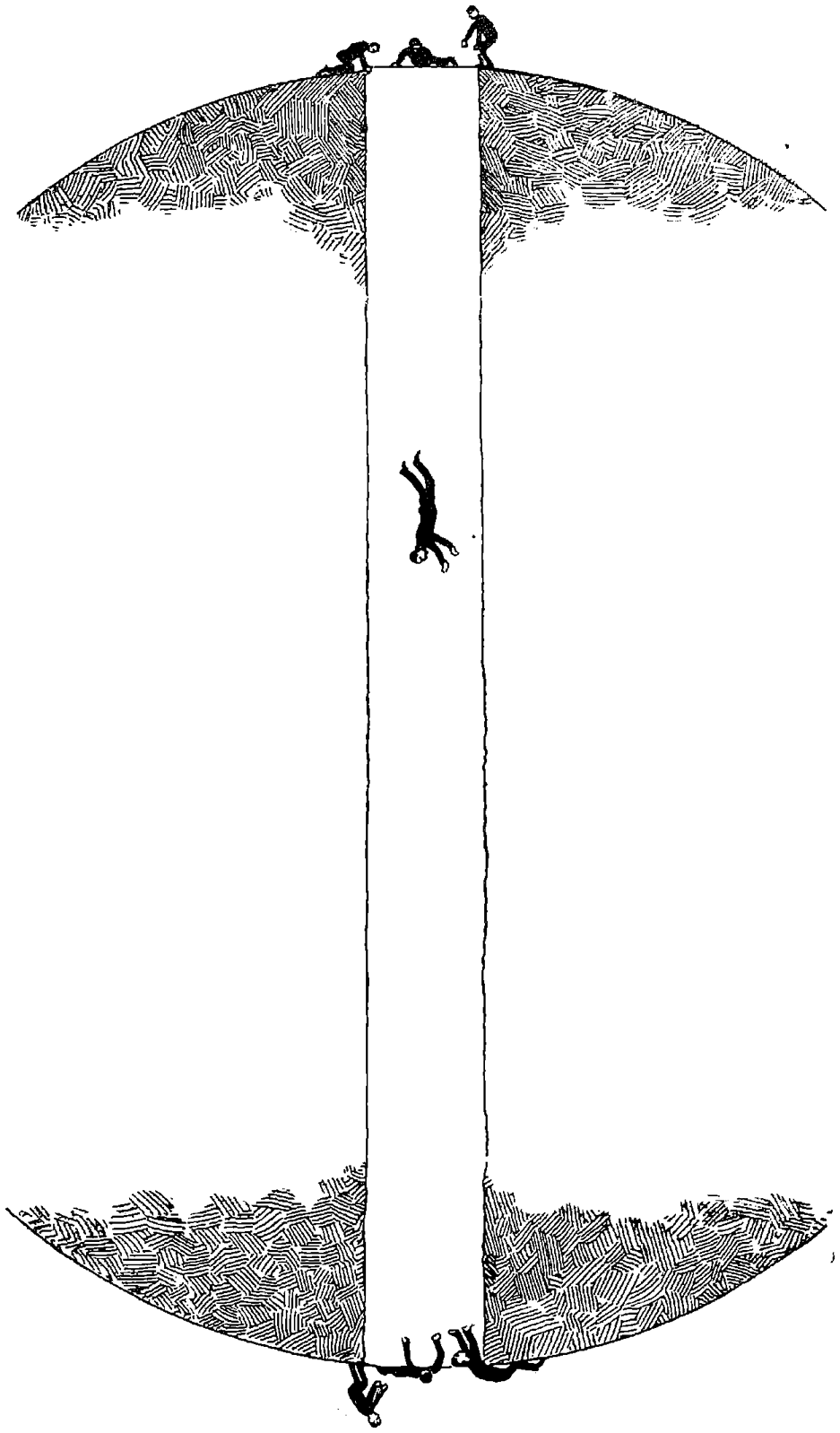
That's how it would be if the bottomless shaft were drilled through the poles. In a shaft with any other direction the rotation of the Earth would make itself felt, since it turns falling bodies a little aside from the vertical. You would fall, that is, along a slanting line instead of straight down, and would soon hit the side of the shaft. For a body to swing freely back and forth, the shaft would have to be several hundred kilometers wide (a body dropped from the surface at the equator will pass 230 kilometers from the center).
The Self-Rolling Underground Railway
About ten years ago there appeared in Petrograd a pamphlet with an odd title: A Self-Rolling Underground Railway Between St Petersburg and Moscow: A Fantastic Novel, So Far in Three Chapters, and Those Unfinished. The gifted author of this unfinished novel, A. A. Rodnykh, puts forward an ingenious project that every lover of physical paradoxes should know.
The project is "nothing more or less than the construction of a 640-kilometer tunnel to join our two capitals along a perfectly straight underground line. Mankind would thus have for the first time a chance of traveling by the straight way, instead of going by crooked ones as it has done hitherto." The author is hinting that all our roads follow arcs, whereas his tunnel would run in a straight line, along a chord.
Such a tunnel, if it could be dug, would have one astonishing, almost magical property, possessed by no other road in the world: any vehicle in it would have to move by itself, with nothing to pull it! Remember our bottomless shaft, bored through the globe. The tunnel from Petrograd to Moscow is the same shaft, drilled along a chord instead of a diameter. True, when you look at Figure 47 the tunnel may seem to be horizontal, and you may see no reason why gravity should make a train roll along it. But this is only an optical illusion. In your mind, draw the radii to the two ends of the tunnel (a radius points the way a plumb line hangs), and you'll understand that our tunnel isn't at right angles to the plumb line. In other words, it isn't horizontal; it slopes downward. In a slanting shaft like this, gravity must make any body swing back and forth of its own accord, pressing against the floor all the while. Lay rails in the tunnel, and a railway carriage will roll along them by itself: its weight will do the work of a locomotive. At first the train will move very slowly. With every second the self-rolling train will go faster, and soon its speed will become so unimaginable that the air in the tunnel will noticeably hinder it. But let's forget for a while this vexing obstacle, which stands in the way of so many tempting projects, and follow the train farther. By the time it reaches the middle of the tunnel, it will have such an enormous speed, faster than a cannonball, that its own momentum will carry it almost to the far end. But for friction, even that "almost" would go: without a locomotive, the train would travel by itself from Petrograd to Moscow in 40 minutes.
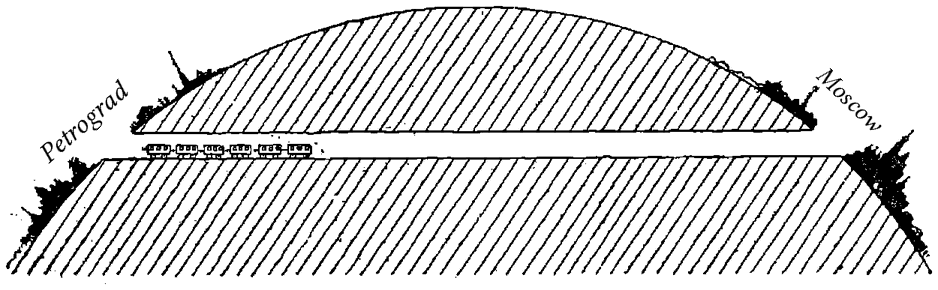
Any other vehicle would do the same: a handcar, a coach, an automobile, and so on. It's truly a road out of a fairy tale: motionless itself, it whirls every vehicle from one end to the other, and at an unimaginable speed!
Millions of Years Ago
According to the theory of the well-known geologist Suess, the mountains of the globe were formed because our planet shrank as it cooled, and its crust wrinkled like the skin of a dried-up apple. The wrinkles in the crust are the mountains. It follows that once, millions of years ago, the globe was larger than it is now. We can even calculate by how much. Smooth out in your mind all the folded mountains of the world, and you'll find how much greater the surface of our planet once was; and from the difference between the surfaces of two spheres it's easy to find the difference between their radii.
Calculations of this sort have shown that in the most ancient geological era (the Algonkian) the Earth's radius was greater by than it is now. The consequence is unexpected: at one time gravity at the surface of our planet was much weaker than it is today! The strength of gravity, after all, falls off quickly as we move away from the center, in proportion to the square of the distance. The Earth's surface was then 5/4 as far from the center as it is now; gravity must therefore have been changed in the ratio , and so was roughly of what it is at present!56
Gravity on Earth, then, hasn't always been what it is now. Millions of years ago our kilogram weighed only some 650 grams! Rivers flowed less swiftly then, and rain fell more slowly; volcanic dust was thrown up higher and took longer to settle; water rose higher in thin tubes and narrow cracks, and so on.
The animals and plants of past geological eras grew up under a weaker gravity than ours, and some scientists even think that the gradual strengthening of gravity was part of the reason why the giants we know as fossils died out.
Chapter 5: A Journey in a Cannon Shell
To round off our talks about the laws of motion and the force of attraction, let's examine a fantastic journey that all of us know well, the voyage to the Moon so entertainingly described by Jules Verne in his novel Around the Moon. You remember, of course, how the members of the Baltimore Gun Club, condemned to idleness by the end of the American Civil War, decided to cast a gigantic cannon, load it with an enormous hollow shell, put passengers inside, and fire this combined shell and railway carriage at the Moon.
Is the idea fantastic in itself? And to begin with, can a body be given such a speed that it leaves the Earth's surface never to return?
Newton's Mountain
Let's give the floor to the genius who discovered the law of universal gravitation. In his Mathematical Principles57 Newton writes:
"A stone, when thrown, is turned by gravity from its straight path and falls to the ground along a curve. Throw it faster, and it will fly farther; it may happen, therefore, that it will describe an arc of ten, a hundred, or a thousand miles, and that at last it will pass beyond the bounds of the Earth and return to it no more. Let AFB (Figure 48) represent the surface of the Earth, C its center, and VD, VE, VF the curves described by a body thrown horizontally from a very high mountain with greater and greater speed. We leave the resistance of the atmosphere out of account; that is, we suppose that there is none whatever. At a smaller initial speed the body describes the curve VD, at a greater one the curve VE, and at greater speeds still the curves VF and VG. At a speed yet greater than these the body will go around the whole Earth and come back to the top of the mountain from which it was thrown. And since on returning to its starting point it will have no less speed than at the outset, it will go on moving along the same curve."
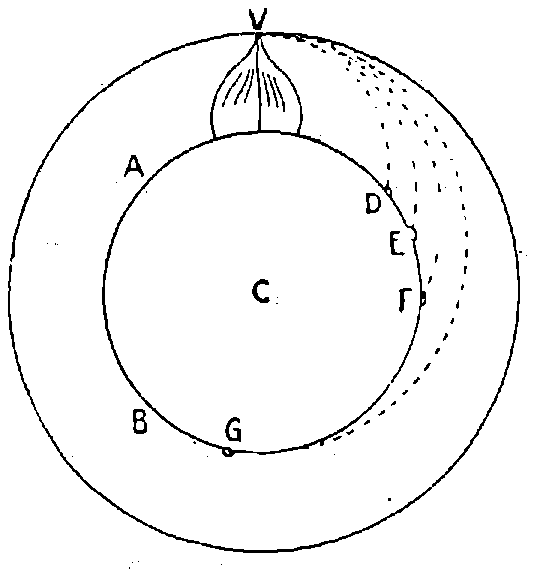
If there were a cannon on this imaginary mountain of Newton's, a ball fired from it at a certain speed would never fall to the ground, and would circle the globe without stopping. A fairly simple calculation shows that this will happen at a speed of eight kilometers a second. A ball that leaves the cannon at eight kilometers a second, in other words, quits the surface of the globe forever and becomes a kind of satellite of our planet. The centrifugal force that its motion calls up is exactly equal to the force of the Earth's attraction. The ball will race along 17 times faster than any point on the equator, and will make a complete circuit of our planet in 1 hour 23 minutes. Give it a greater speed, and it will revolve around the Earth in a more or less elongated ellipse instead of a circle, traveling out to an enormous distance from the Earth. Finally, at a still greater initial speed, it will go off for good into the boundless space of the universe. Mechanics proves that this must happen at an initial speed of 11 kilometers a second.
In all this, needless to say, we have in mind balls that move through empty space, and not through air.
If there were no atmosphere, then, there would be nothing impossible in the idea of sending a body from the Earth to the Moon. Now let's see whether it can be done by the means that Jules Verne offers us. Modern cannons give their shells a speed of about a kilometer in the first second. That's only some ten times less than the speed at which a body can fly to the Moon. Verne thought that if one built a gigantic cannon and filled it with an enormous quantity of explosive, it would be easy to send shells there.
The Fantastic Cannon
Jules Verne's heroes cast a gigantic cannon, 270 meters long, sunk upright in the ground. They make a shell of matching size, with a small room inside it for the passengers. The shell weighs 8 metric tons. They load the cannon with ordinary guncotton, or pyroxylin, 160 tons of it. The explosion, if we are to believe the novelist, gives the shell a speed of 16 kilometers a second as it leaves the muzzle, but friction with the air reduces this to 11 kilometers. By the time it is beyond the atmosphere, Verne's shell thus has quite enough speed to fly to the Moon.
That's how the novel tells it. What does physics say?
Verne's project does have a weak spot, though readers usually look for it in quite the wrong place. True, artillerymen assert that even the huge charge in Verne's cannon is quite inadequate to give the shell the speed it needs. The speed of a shell does increase with the quantity of explosive, of course, but only up to a certain limit. It's therefore very doubtful that the shell of this fantastic cannon would get a speed of more than 1 or 1 1/2 kilometers a second, instead of the sixteen expected.
But that isn't the point. Let's hope that the chemists will one day provide us with an explosive that meets the requirements of the Baltimore Gun Club.
The fate of the passengers is a far greater worry. And don't imagine that the danger threatens them on the flight from the Earth to the Moon. If they managed to be still alive when they left the muzzle of the cannon, they would have nothing more to fear for the rest of the journey. The enormous speed at which they and their carriage would race through space is as harmless to them as the 30 kilometers a second at which our planet races around the Sun is to us who live on it.
A Sixteen-Ton Hat
The most dangerous moment for our travelers is the fraction of a second, a few tenths at most, during which the shell that serves as their cabin moves along the barrel of the cannon. In this insignificant scrap of time the speed of the passengers in the shell must grow from zero to 16 kilometers a second! No wonder the passengers in the novel waited for the shot with such dread. And Mr. Barbicane was quite right in saying that the moment when the shell took off would be as dangerous for them as if they were standing in front of it instead of sitting inside. At the moment of firing, the floor of the cabin will indeed strike the passengers from below as hard as the shell would strike any object that stood in its way. The passengers, if we are to believe the author, took this danger much too lightly, imagining that at worst they would get off with a bad rush of blood to the head...
Alas, the matter is far more serious. A few fairly simple calculations will make this plain. Remember that the shell speeds up as it moves along the barrel: its speed keeps growing under the constant pressure of the gases from the explosion. In a tiny fraction of a second it rises from 0 to 16 kilometers a second. The acceleration needed to bring the shell up to 16 kilometers a second in so short a time comes, in round figures, to 640 kilometers per second per second! (The calculations are given below, in the section called "For the Friends of Mathematics.")
To feel how deadly this figure is, recall that the ordinary acceleration of gravity at the Earth's surface is only 10 meters per second per second. It follows that at the moment of firing, every object inside the shell would press on its floor 64,000 times more strongly than its own weight! The passengers, in other words, would feel that they had become tens of thousands of times heavier. And under a weight as colossal as that, they would of course be instantly flattened into a thin sheet. The worthy Mr. Barbicane's top hat would weigh at least sixteen tons at the moment of firing, and a hat like that is more than enough to crush its owner.
True, certain measures are taken in Verne's novel to soften the blow: the shell has spring buffers and a double bottom, with water filling the space between. This does draw the blow out a little, and the speed therefore grows less abruptly. But with the stupendous figures we have to deal with here, these devices bring only a paltry gain. The force that pins the passengers to the floor is lessened by no more than a few hundredths, and what difference does it make whether you are crushed by a hat of sixteen tons or of fifteen?
Another Dangerous Moment
But this isn't all that awaits the passengers in the brief instant while they fly along the barrel of the cannon. If by some miracle they were left alive by the explosion, death would be waiting for them at the way out. Remember the resistance of the air! In ordinary conditions it hardly occurs to us that so light a medium as air could seriously interfere with the motion of a body. But that's only because ordinary speeds are comparatively low. As the speed increases, the resistance of the air grows rapidly. Cyclists know from their own experience what a hindrance air is. It has been calculated that even at a modest 10 kilometers an hour a cyclist spends about 1/7 of his energy on overcoming the resistance of the air; at 16 kilometers an hour this work takes 1/6 of the energy he develops, and at 21 kilometers it takes 1/4 of it! No wonder a cyclist riding very fast bends down over the handlebars: he thereby makes the surface of his body smaller and so weakens the resistance of the air.
A shell leaving Verne's cannon at sixteen kilometers a second would certainly meet an incredible resistance from the air, almost the same as from a solid body. This second blow the unhappy passengers would of course not survive. The shell would be instantly slowed, while the passengers inside it would by inertia go on moving at sixteen kilometers a second. They would hit the ceiling of their cabin with monstrous speed, and be shaken almost as badly as by the first blow, against the floor. Even at the moderate speed of a streetcar, after all, we fall forward if an inexperienced driver stops it too sharply. And Verne's shell is racing along five thousand times faster than a streetcar!
You see how complicated Jules Verne's handsome project turns out to be in the light of mechanics, when at first glance it looked so easy to carry out!
How Can the Shock Be Avoided?
Physics can tell us how these dangers might conceivably be avoided. We could escape the resistance of the air, for example, if we managed to place the cannon so high that its muzzle lay above the dense part of the atmosphere.
But how can we make the speed grow less fatally fast? By making the barrel of the cannon many times longer.
A very considerable lengthening is called for, however, if we want the relative gravity inside the shell at the moment of firing to equal ordinary gravity on Earth. Calculation shows that for this we would have to make a cannon no less than 6,000 kilometers long! Verne's "Columbiad," in other words, would have to reach down into the globe to its very center... Then the passengers really would be spared all unpleasantness: their usual weight would merely be joined by a small additional, apparent weight, due to the slow growth of the speed, and they would feel that they had become only twice as heavy.
It should be said, though, that for a short time the human body can stand a severalfold increase in weight without any harm. When we come down an ice hill on a sled and make a sharp turn at the bottom, our weight increases for that brief instant 10 or 20 times; that is, our body is pressed against the sled ten or twenty times harder than usual.
If we suppose that a man can safely bear a twentyfold increase in his weight for a short time, then a cannon only three hundred kilometers long will be enough. For us, however, even this is small comfort, because such a structure lies beyond anything technology can achieve.
Physics points to yet another way of softening the blow. The most fragile thing can be saved from breaking in a shock if it is immersed in a liquid of the same specific gravity. Put it in a vessel of liquid of exactly its own density, seal the vessel hermetically, and the vessel can fall from a height and suffer the most violent shocks (provided, of course, that it stays whole) without the slightest harm to what is inside. We could therefore carry out the daring scheme of Verne's artillerymen if we filled the inside of the shell with salt water, as dense as the human body, and immersed our passengers in this liquid, wearing diving helmets and with a supply of air. A second after the shot, when the speed has stopped growing and the passengers have acquired the speed of the shell, they can let the water out and settle down in their cabin without fear, just as Jules Verne described.58
Such are the conditions in which we could conceive of carrying out Jules Verne's tempting project of flying to the Moon in a cannon shell.
For the Friends of Mathematics
Among the readers of this book there will no doubt be some who wish to check for themselves the calculations mentioned above. Here are the sums, which are quite simple.
We shall need only two formulas of accelerated motion:
1) The speed v at the end of the t-th second is equal to at, where a is the acceleration:
2) The distance S covered in t seconds is given by the formula:
With these formulas let's find, for example, the acceleration of the shell as it slid along the barrel of the "Columbiad."
We know from the novel the length of the cannon above the charge, which is 210 meters: this is S, the distance the body covered. We also know the final speed of the shell: v = 16,000 meters a second. These data allow us to find, first of all, t, the time the shell spent moving along the barrel (treating the motion as uniformly accelerated). Indeed:
It turns out that the shell slid along inside the cannon for only 1/40 of a second!
Putting into the formula v = at, we have:
The acceleration of the shell as it moves along the barrel, then, is 640,000 meters per second per second, which is 64,000 times the acceleration of gravity!
How long would the cannon have to be, for the acceleration of the shell to be only 20 times greater than that of a freely falling body (that is, to equal 200 meters per second per second)?
This is the converse of the problem we have just solved. Our data are a = 200 meters per second per second and v = 11,000 meters a second (a speed that is enough if the atmosphere offers no resistance).
From the formula v = at we have 11,000 = 200t, whence t = 55 seconds.
From the formula , we find that the length of the cannon must be meters, or in round figures about 300 kilometers.
Such are the simple calculations that yield the figures which so mercilessly wreck the tempting plans of Jules Verne's heroes.
Chapter 6: Properties of Liquids and Gases
A Sea in Which You Cannot Drown
There is such a sea, in a country mankind has known since the remotest antiquity: the famous Dead Sea of Palestine. This biblical lake of a sea is so extraordinarily salty that no living creature can survive in it. Under Palestine's scorching, rainless sky, water evaporates rapidly from the surface. But only pure water evaporates. The dissolved salts all stay behind and make the lake saltier still. That is why the water of the Dead Sea holds not the 2 or 3 percent of salt found in most seas and oceans, but 25 percent! In other words, a quarter of everything in the Dead Sea is salt dissolved in its water.
This dense brine has a curious property: it is considerably heavier than ordinary sea water. In a liquid so heavy you cannot drown, because the human body is lighter. We weigh less than an equal volume of strong brine, and so, by Archimedes' principle, a man cannot sink in the Dead Sea.
The famous humorist Mark Twain visited the biblical sea, and in The Innocents Abroad he describes with comic thoroughness the remarkable sensations that he and his companions experienced while bathing in its heavy waters:
"It was a funny bath. We could not sink. One could stretch himself at full length on his back, with his arms on his breast, and all of his body above a line drawn from the corner of his jaw past the middle of his side, the middle of his leg and through his ancle bone, would remain out of water. He could lift his head clear out, if he chose... You can lie comfortably, on your back, with your head out, and your legs out from your knees down, by steadying yourself with your hands. You can sit, with your knees drawn up to your chin and your arms clasped around them, but you are bound to turn over presently, because you are top-heavy in that position. You can stand up straight in water that is over your head, and from the middle of your breast upward you will not be wet. But you can not remain so. The water will soon float your feet to the surface. You can not swim on your back and make any progress of any consequence, because your feet stick away above the surface, and there is nothing to propel yourself with but your heels. If you swim on your face, you kick up the water like a stern-wheel boat. You make no headway. A horse is so top-heavy that he can neither swim nor stand up in the Dead Sea. He turns over on his side at once."
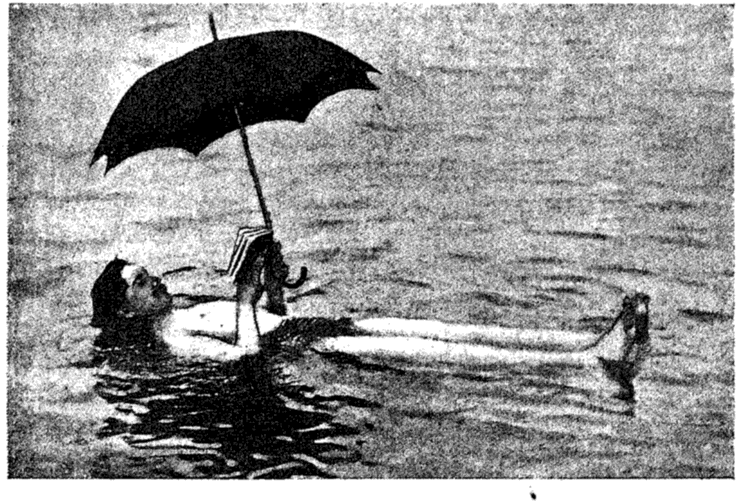
In the photograph you see a tourist who has made himself quite comfortable on the surface of the Dead Sea. Thanks to the high specific gravity of the brine, he can recline there and read his book at leisure, sheltering under an umbrella from the burning Palestinian sun.
Patients whose doctors prescribe salt baths have to go through something similar. If the water is very salty, as it is at the mineral springs of Staraya Russa, south of Petrograd, the patient has to struggle to stay on the bottom of the tub. I once heard a lady who was taking the cure at Staraya Russa complain indignantly that the water "positively pushed her out of the bath." She seemed inclined, however, to blame the management of the springs, and not Archimedes' principle.
The Water-Driven Perpetual Motion Machine
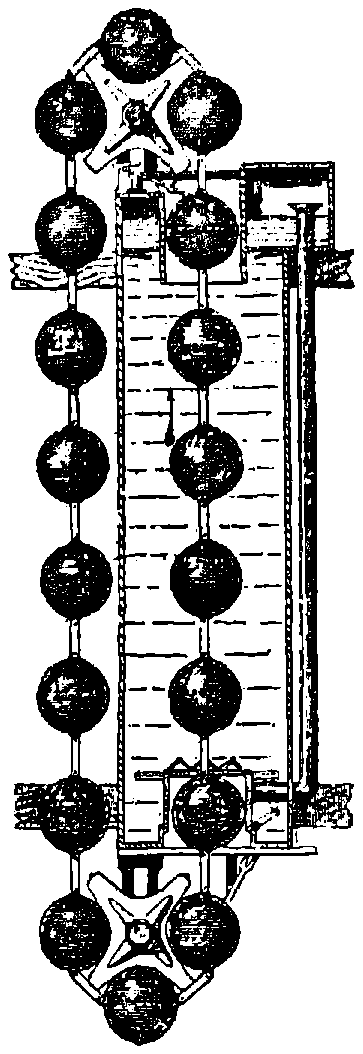
The countless schemes for a perpetual motion machine include this "invention." An endless chain of wooden balls passes over two toothed wheels in such a way that part of the chain runs through a tank of water (Figure 51). Wood floats up in water; the right-hand part of the chain must therefore be much lighter than the left, and the left will outweigh it. And since, however far the chain moves, its left half will always outweigh its right, the machine must go around by itself without ever stopping!
A simple, cheap perpetual motion machine.
The unknown inventor probably never tried to build it. If he had, he would have found that, contrary to his expectations, the machine doesn't show the slightest inclination to move.
And if you look into this "machine" carefully, you can easily predict that the chain won't budge.
By Archimedes' principle, the balls in the water do indeed push upward, with a force equal to the difference between their own weight and the weight of the same volume of water. But as they try to rise, the submerged balls are also pulling up the balls still below, outside the water. And each time one of these new balls enters the vessel from below, it has to overcome the pressure of the column of water standing above it, a column as tall as the whole vessel. The rising balls do pull the new one upward, but they can't overcome that pressure, because the volumes of all the submerged balls together add up to less than the volume of a solid cylinder resting on the lowest ball. No wonder the machine stays where it is.
New Versions of Hero's Fountain
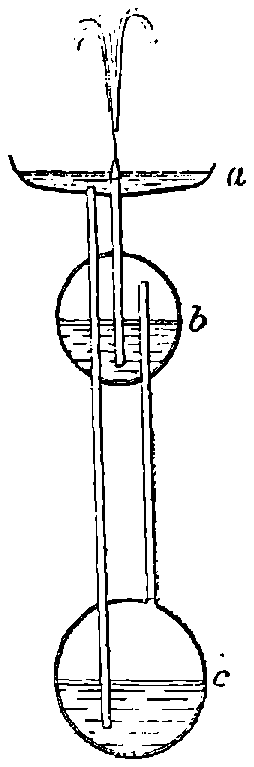
The usual form of Hero's fountain is probably familiar to everyone. Still, let me remind you how this curious device is built before I go on to its latest variations. It consists of three vessels: an open one at the top (a) and two spherical ones, b and c, hermetically sealed. Three tubes connect them, arranged as in Figure 52. When there is a little water in a, and the globe b is full of water and the globe c full of air, the fountain begins to play. Water runs down the tube from a into the lower globe, c, and drives the air out of it into b; under the pressure of the incoming air, the water in b rushes up its tube and spouts above a. When the globe b is empty, that is, when all its water has passed into c, the fountain stops. The greater the distance between a and c, the higher the jet. In theory its height above the level in b should exactly equal the difference between the levels in a and c, but friction against the walls of the tubes keeps it from doing so.
Such is the fountain in its old form. Recently a schoolteacher in Italy, driven to invention by the meager equipment of his physics laboratory, simplified it and devised variations that anyone can put together from the simplest materials. In place of globes he uses ordinary medicine bottles, and in place of glass tubes, rubber ones. There is no need to make holes in the upper vessel: you can simply lead the ends of the tubes into it as shown in Figure 53.
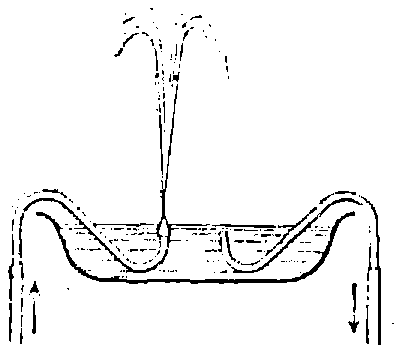
In this form the device is much handier to use. When all the water in bottle b has run over into bottle c, you merely change the bottles' places, lowering b and raising c, and the fountain plays again. (Don't forget, of course, to move the nozzle to the other tube as well.)
The new fountain has another advantage: it lets you arrange the vessels as you please and study how the difference in their levels affects the height of the jet.
If you want to make the jet many times higher, you can do it by putting mercury in place of the water in the lower bottles, and water in place of the air (Figure 55). It's clear how this works: the mercury, running from bottle c into bottle b, drives out the water there and makes it spout. Knowing that mercury is 13 1/2 times as heavy as water, we can easily calculate how high the jet should rise. If we call the differences in level , and , as in the figure, the height of the jet is:
( × 1) + ( × 13 1/2) ( × 1).
Rearranging this, and bearing in mind that , we find that the height of the fountain is 12 1/2 : the distance between the levels of mercury in the two vessels, multiplied by 12 1/2. Friction in the tubes cuts this theoretical height down a little. Even so, the jet goes some ten times higher than it would without mercury. In an ordinary Hero's fountain you would have to set the vessels a good two meters apart, or more, to get a jet two meters high. In the version just described, you need only raise one bottle 18 centimeters above the other to get the same result. Moreover, as our calculation shows, the height of the dish a above the lower bottles has no effect on the height of the jet.
A Problem That Only Looks Simple
A samovar that holds 30 glasses is full of water. You put a glass under its tap and, watch in hand, follow the second hand to see how long the glass takes to fill to the brim. It takes exactly half a minute. Now I ask you: how long will the whole samovar take to empty if we leave the tap open?
A simple sum in arithmetic, it would seem. One glass runs out in 1/2 minute, and therefore 30 glasses will run out in 15.
But try it. You'll find that the samovar takes not the quarter of an hour you expected, but half an hour!
What's the matter? The calculation is so simple!
Simple, but wrong. We mustn't suppose that the speed of the outflow stays the same from beginning to end. Once the first glass has run out, the water flows under less pressure and therefore more slowly, so the second glass will naturally take longer than half a minute to fill; the third will run out more lazily still, and so on.
The speed at which any liquid flows from a hole in an open vessel depends on the height of the column of liquid standing above the hole. Torricelli, Galileo's pupil, was the first to point this out, and he expressed it in a formula:
where v is the speed of outflow, g the acceleration of gravity, and h the height of the liquid's surface above the hole.
If, once 20 glasses have run out of the samovar, the water has fallen to a quarter of its original height above the tap, then the 21st glass will take twice as long to fill as the 1st. And if the water then falls to a ninth of its height, the last glasses will take three times as long as the first. Everyone knows how slowly and feebly water dribbles from the tap of a samovar that is almost empty.
From this law it can be proved that a vessel takes twice as long to empty completely as the same volume of liquid would take to run out if the level stayed where it was at the start.
An Astonishing Vessel
You can easily make a vessel from which water will flow at a steady rate all the while, even though the level inside is falling. Figure 56 shows one. It's an ordinary narrow-necked bottle with a glass tube pushed through the cork. If you open the tap C, which lies below the end of the tube, the liquid will pour out in an unslackening jet until the level of the water in the vessel drops to the tube's lower end. Push the tube almost to the bottom, and you can make all the liquid run out in a steady, though very weak, stream.
Why does this happen? Follow closely what goes on in the vessel when tap C is opened. First the water in the glass tube runs out, and the level inside it falls to the end of the tube. As more water leaves, it is the level in the vessel itself that begins to fall. Outside air now enters through the glass tube, bubbles up through the water, and collects above it in the upper part of the vessel. From now on the pressure everywhere at level B equals that of the atmosphere. The water therefore flows out of tap C only under the pressure of the layer of water BC, because the pressure of the atmosphere inside the vessel balances the pressure outside. And since the thickness of the layer BC never changes, it's no wonder that the jet flows at the same speed all the time.
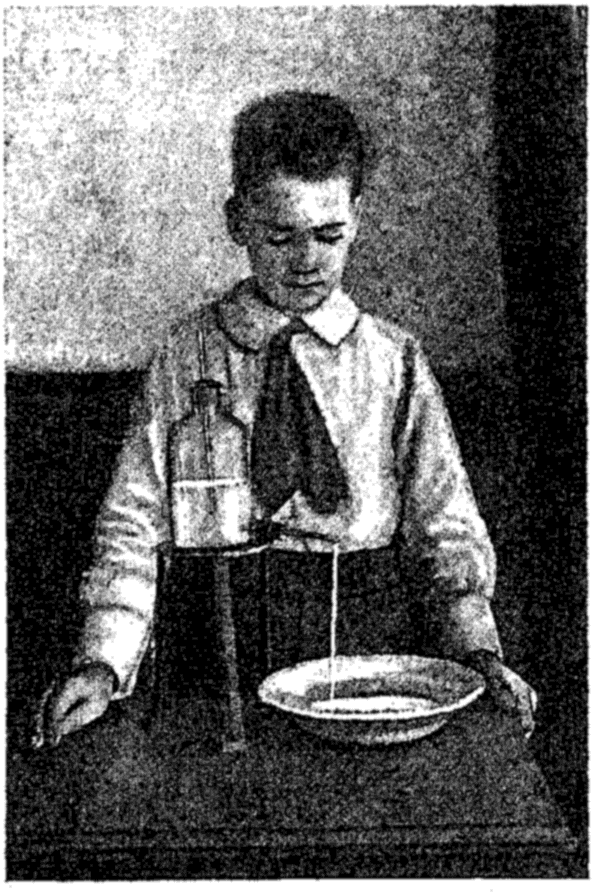
Now try to answer this question: how fast will the water run out if we pull the little plug B, on a level with the end of the tube?
It turns out that the water won't run out at all (provided, of course, the hole isn't too large). Here the pressure is the same inside and out, equal to that of the atmosphere, and nothing drives the water to leave.
And if you pulled plug A, above the lower end of the tube, not only would no water come out, but outside air would come in, because in that part of the vessel the pressure is less than atmospheric.
This vessel with such extraordinary properties was invented by the famous physicist Mariotte, and after him it is called "Mariotte's vessel."
The Man Who Weighed Nothing
To be as light as down, lighter than air, and fly freely high above the ground wherever we like: it's a dream that has charmed us since childhood. But we usually forget one thing. People can move freely on the ground only because they are heavier than air. We live, in effect, at the bottom of an ocean of air, and if for some reason we suddenly became 1,000 times lighter (lighter, that is, than air), we would inevitably float up toward the surface of that ocean. Up we'd go, for some kilometers perhaps, until we came to a region where the specific gravity of the air equals that of our bodies. All our dreams of soaring freely over hill and valley would crumble to dust. We would have thrown off the chains of gravity only to become captives of another force, the pressure of the atmosphere.
H. G. Wells, in one of his humorous stories, "The Truth About Pyecraft," gives a vivid picture of the inconveniences that would await us.
A very stout gentleman wanted, at any cost, to be rid of his stoutness. The narrator, so the story goes, happened to possess a recipe that came from some Hindu magician, and it had the power to relieve fat people of their excess weight. The fat man begged it from him and took the medicine, and here are the surprises that met the narrator when he came to visit his acquaintance and knocked at his door.
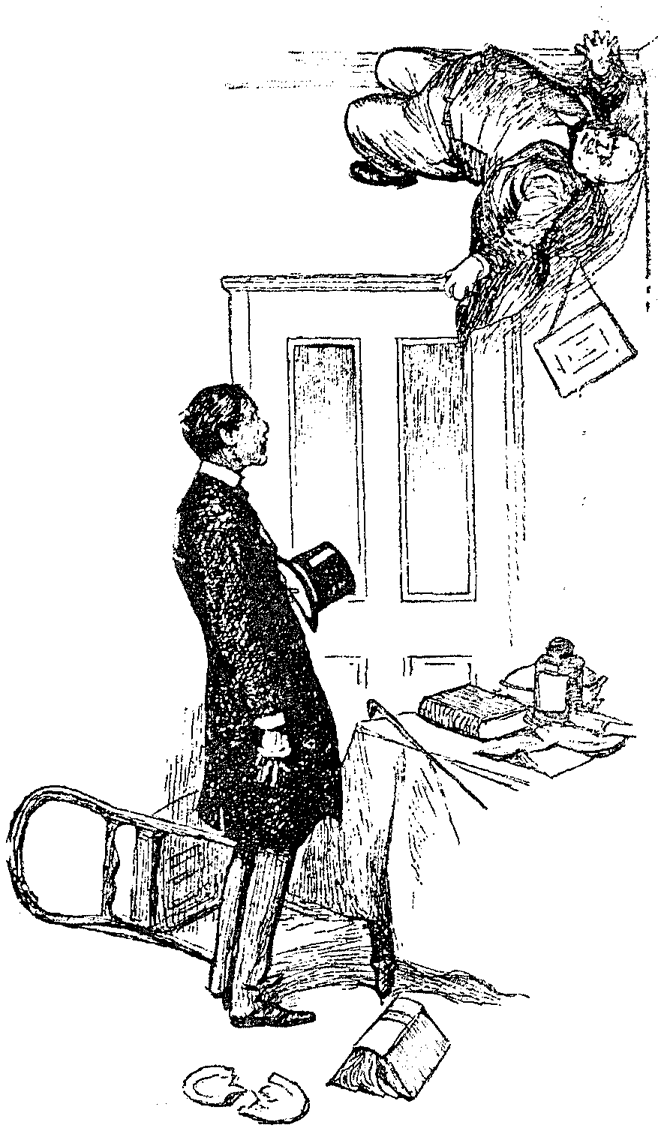
"But for a long time the door didn't open.
"I heard the key turn. Then Pyecraft's voice said, 'Come in.'
"I turned the handle and opened the door. Naturally I expected to see Pyecraft.
"Well, you know, he wasn't there!
"... There was his sitting-room in a state of untidy disorder, plates and dishes among the books and writing things, and several chairs overturned, but Pyecraft—
"'It's all right, o' man; shut the door,' he said, and then I discovered him.
"There he was right up close to the cornice in the corner by the door, as though some one had glued him to the ceiling. His face was anxious and angry...
"I shut the door, and went and stood away from him and stared.
"'If anything gives way and you tumble down,' I said, 'you'll break your neck, Pyecraft.'
"'I wish I could,' he wheezed.
"'A man of your age and weight getting up to kiddish gymnastics—'
"... 'How the deuce,' said I, 'are you holding on up there?'
"And then abruptly I realised that he was not holding on at all, that he was floating up there—just as a gas-filled bladder might have floated in the same position. He began a struggle to thrust himself away from the ceiling and to clamber down the wall to me...
"He took hold of a framed engraving rather carelessly as he spoke and it gave way, and he flew back to the ceiling again, while the picture smashed onto the sofa. Bump he went against the ceiling, and I knew then why he was all over white on the more salient curves and angles of his person. He tried again more carefully, coming down by way of the mantel.
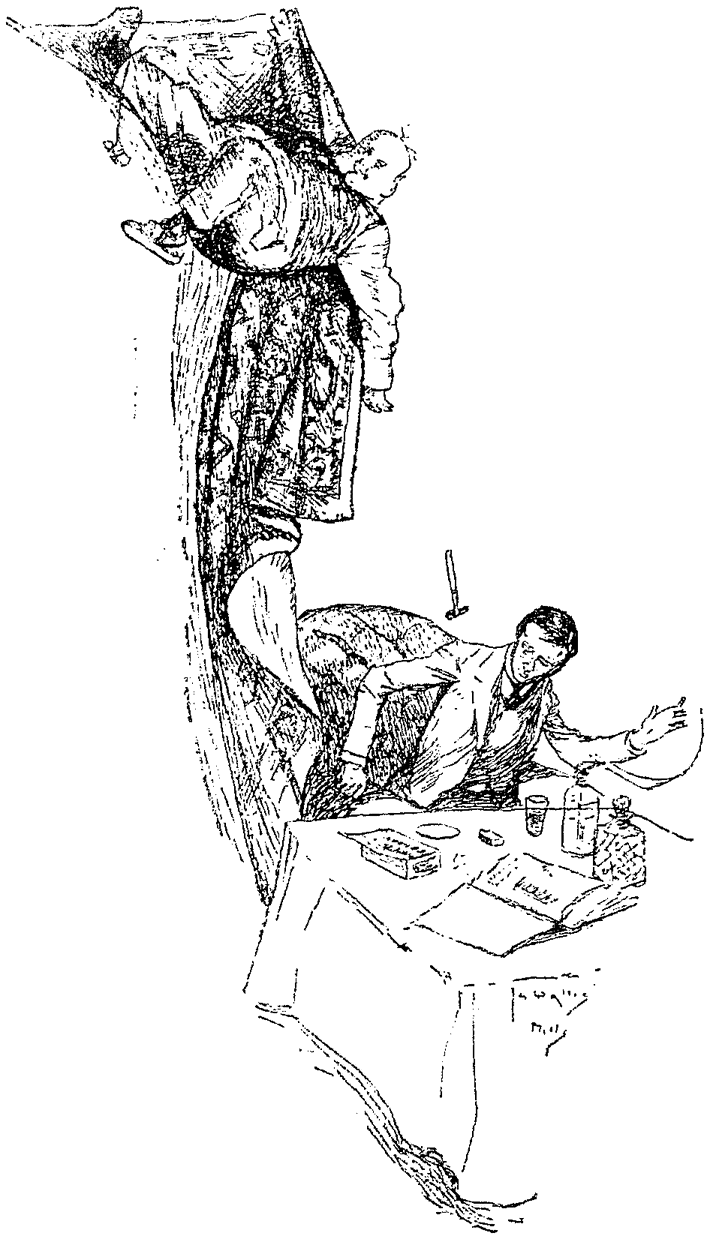
"... 'That prescription,' he said. 'Too successful.'
"'How?'
"'Loss of weight—almost complete.'
"And then, of course, I understood.
"'By Jove, Pyecraft,' said I, 'what you wanted was a cure for fatness! But you always called it weight. You would call it weight.'
"... 'Let me help you!' I said, and took his hand and pulled him down. He kicked about, trying to get a foothold somewhere. It was very like holding a flag on a windy day.
"'That table,' he said, pointing, 'is solid mahogany and very heavy. If you can put me under that—'
"I did, and there he wallowed about like a captive balloon...
"He gave way to a sudden burst of passion. 'What the goodness am I to DO?' he said.
"'There's one thing pretty evident,' I said, 'that you mustn't do. If you go out of doors, you'll go up and up...'
"I suggested he should adapt himself to his new conditions... I suggested that it would not be difficult for him to learn to walk about on the ceiling with his hands—
"'I can't sleep,' he said.
"But that was no great difficulty. It was quite possible, I pointed out, to make a shake-up under a wire mattress, fasten the under things on with tapes, and have a blanket, sheet, and coverlet to button at the side...
"He could have a library ladder in his room, and all his meals could be laid on the top of his bookcase. We also hit on an ingenious device by which he could get to the floor whenever he wanted, which was simply to put the British Encyclopaedia (tenth edition) on the top of his open shelves. He just pulled out a couple of volumes and held on, and down he came...
"In fact, I spent two whole days at his flat. I am a handy, interfering sort of man with a screw-driver, and I made all sorts of ingenious adaptations for him—ran a wire to bring his bells within reach...
"... I was sitting by his fire drinking his whisky, and he was up in his favourite corner by the cornice, tacking a Turkey carpet to the ceiling, when the idea struck me. 'By Jove, Pyecraft!' I said, 'all this is totally unnecessary.'
"... 'Lead underclothing,' said I, and the mischief was done.
"Pyecraft received the thing almost in tears...
"'Buy sheet lead,' I said, 'stamp it into discs. Sew 'em all over your underclothes until you have enough. Have lead-soled boots, carry a bag of solid lead, and the thing is done! Instead of being a prisoner here you may go abroad again, Pyecraft; you may travel... You need never fear a shipwreck. All you need do is just slip off some or all of your clothes, take the necessary amount of luggage in your hand, and float up in the air—'"
A Load of Air
In the middle of the seventeenth century the people of Magdeburg witnessed an astonishing sight. Sixteen horses strained with all their might to pull apart two copper hemispheres that had been set one against the other. What bound the two together? Nothing: air. And yet eight horses pulling one way and eight pulling the other could not part them. In this way Burgomaster Otto von Guericke showed for all to see that air is not "nothing," that it has weight and presses with considerable force on everything on Earth.
Every physics textbook describes the famous experiment of the "Magdeburg hemispheres." Still, I think the reader will be interested to learn how Guericke described it himself. The book in which he reports a whole series of his experiments came out in Latin, in Amsterdam, in 1672, under a long title:
OTTO VON GUERICKE'S so-called new Magdeburg experiments on EMPTY SPACE, first described by Kaspar Schott, Professor of Mathematics at the University of Würzburg. Published by the author himself, in greater detail, and enlarged by various new experiments.
Chapter XXIII of this book is devoted to the experiment that interests us. Here it is in translation:
"An experiment proving that the pressure of the air joins two hemispheres so firmly that the efforts of 16 horses cannot part them."
"I ordered two copper hemispheres, a and b (see the engraving), 3/4 of a Magdeburg ell59 in diameter. In reality their diameter came to only 67/100, since the craftsmen, as usual, could not make exactly what was asked of them. The two hemispheres matched each other perfectly. One of them had a stopcock, H (Fig. IV), by means of which the air inside could be removed and the air outside kept from entering. To the hemispheres were also attached 4 rings, through which we passed ropes tied to the harness of the horses. I further had a ring of leather sewn (D). It was steeped in a mixture of wax and turpentine, and when squeezed between the hemispheres, it let no air into them. Into the stopcock we fitted the tube of an air pump, and we drew off the air from inside the sphere. It then became apparent with what force the two hemispheres were pressed together against the leather ring. The pressure of the outside air squeezed them so tightly that 16 horses either could not part them at all or did so only with difficulty. And when the hemispheres, yielding to the horses' full strength, did come apart, there was a report like a gunshot.
"But one had only to turn the stopcock and let the air in freely, and it was not hard to pull the two hemispheres apart by hand."
A simple calculation will explain why it takes so enormous a force (16 horses) to separate the halves of an empty ball. Air presses with a force of about 1 kilogram on every square centimeter, and the area of a circle60 67/100 of an ell across (37 centimeters) is about 1,060 square centimeters. The pressure of the atmosphere on each hemisphere must therefore be more than 1,000 kilograms, and to overcome it each team of eight horses had to pull with a force of 1,000 kilograms.
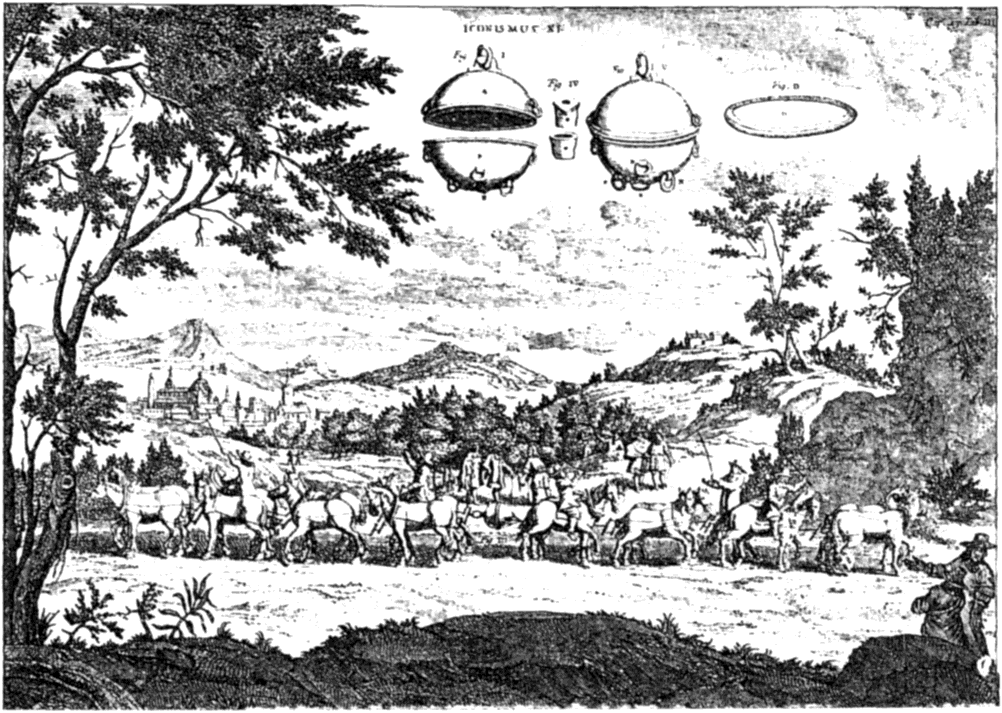
For 8 horses that would seem a very small load. After all, 8 strong horses can draw a cart carrying 16 metric tons! Don't forget, however, that in moving a load of 16 tons the horses are overcoming a much smaller force than 16 tons, namely the friction of the wheels against the roadway. And this comes to only 2 to 5 percent: for a 16-ton load, 320 to 800 kilograms, depending on the state of the paving. A pull of 1,000 kilograms therefore corresponds to a cart loaded with 20 to 50 tons. There you have the load of air that the Burgomaster of Magdeburg's horses were asked to haul!
Measurements show that an average draft horse pulls a wagon with a force of only 80 kilograms (at 4 kilometers an hour). To tear the Magdeburg hemispheres apart by a steady pull would therefore have taken not 8 horses on each side, but 12!
The reader will probably be astonished to learn that some of the joints in our own bodies hold together for the same reason as the Magdeburg hemispheres. Our hip joint is just such a pair. You can strip the joint of all its ties of muscle and cartilage, and still the thighbone won't fall out of its socket: atmospheric pressure holds it there, because there is no air in the space between the joint's surfaces. Yet if you merely drill a channel through the pelvic bone and let the air into the joint, the bone drops out, even though all the cartilage and muscle is intact.
Here, as you see, "emptiness" proves a stronger bond than muscle and cartilage.
Why Do Ships Attract Each Other?
In the autumn of 1912 a strange accident befell the ocean liner Olympic, one of the largest ships in the world. The Olympic was steaming in the open sea, and on a nearly parallel course, 100 meters away, another and much smaller vessel, the Hawke, was passing at a fair speed. When the two ships had reached the positions shown in Figure 63, something unexpected happened. The smaller one swerved abruptly off its course as though obeying some invisible force, turned its bow toward the big liner, and, no longer answering its helm, headed almost straight for it. They collided. The Hawke drove its bow into the Olympic's side with such violence that it tore a large hole there.
When this strange case came before an admiralty court, the captain of the giant Olympic was found to be at fault, "because," the judgment ran, "he gave no orders to make way for the Hawke, which was crossing his course."
The court, then, saw nothing unusual here: mere negligence on the captain's part, and nothing more. And yet a quite unforeseen circumstance had been at work: the mutual attraction of ships at sea.
Things of this kind had probably happened more than once before, when two ships were sailing parallel. But as long as no very large ships were built, the effect was never so strong. Only in the last few years, since colossal leviathans began to plow the oceans, has the attraction between ships become much more noticeable.
The giant liner Titanic, which was to perish so tragically, came near to causing a disaster through this mysterious attraction not long before its end. The Titanic and the steamer New York were berthed side by side in Southampton harbor. When the Titanic got under way, the New York, which until then had lain perfectly still, suddenly lurched from its place with such force that it broke its anchor chain, and moved straight toward the Titanic. A collision was inevitable, and it would have ended tragically for both ships had tugs not come to the rescue in time.
The many accidents to small craft passing near large liners and warships were probably also due to the "attraction of ships."
But how is this attraction to be explained? Newton's law of universal gravitation has, of course, nothing to do with it. The cause is of quite another kind, and lies in the laws that govern the flow of liquids in tubes and channels. It can be proved that if a liquid runs through a channel with narrow and wide stretches, then in the narrow parts it flows faster and presses more weakly on the walls of the channel than in the wide places, where it flows more calmly and presses on the walls more strongly. This is known as Bernoulli's principle.
Knowing this, we can easily see the real reason why ships attract each other. When two steamers travel parallel to each other at sea, their sides form a kind of channel of water between them. In an ordinary channel the walls stand still and the water moves; here, on the contrary, the water stands still and the walls move. But that makes no difference to the forces: in the narrow places of this moving channel, the water presses on the walls more weakly than it does in the space around the ships. In other words, the sides that the steamers turn to each other feel less pressure from the water than their outer sides do. What must come of that? Clearly the pressure of the water outside must move the ships toward each other, and naturally the smaller ship moves more swiftly, while the more massive one stays almost where it is. That's why the attraction is especially strong when a large ship rushes past a small one.
A Journey into the Depths of the Earth
No one has yet gone down into the Earth deeper than two kilometers, and the radius of the globe is 6,400 kilometers. There is still a very long way to go to the center. Nevertheless the inventive Jules Verne, as you of course remember, sent his heroes, the eccentric Professor Lidenbrock and his nephew Axel, deep into the Earth. He described the remarkable adventures of these underground travelers in his novel A Journey to the Center of the Earth. Among the surprises they met in their wanderings below ground was a rapid increase in the density of the air. As we climb, the air thins out very quickly: its density falls in geometric progression as the height rises in arithmetic progression. When we go down below the ordinary level, on the other hand, the air, compressed by the layers above it, must by the same law become denser and denser. And Verne's underground travelers could not, of course, fail to notice it.
Here is a conversation between the learned uncle and his nephew at a depth of twelve leagues (48 kilometers) inside the Earth:
"'Look at the pressure gauge. What does it show?' asked my uncle.
"'Quite a strong pressure.'
"'Excellent. Now you see that by going down little by little we gradually get used to the compressed air, and it does us no harm.'
"'Except for the pain in our ears.'
"'A trifle!'
"'Very well,' I answered, having made up my mind not to contradict my uncle. 'It's even pleasant to be in compressed air. Have you noticed how loud sounds are in it?'
"'I have. In this atmosphere even a deaf man could hear.'
"'But will the air keep getting denser?'
"'Yes. Weight, on the other hand, will diminish as we go down. At the Earth's surface things weigh much more than they do here, and at the center of the globe they have no weight at all.'
"'I know. But tell me, won't the air in the end become as dense as water?'
"'Certainly, under a pressure of 770 atmospheres.'
"'And lower down?'
"'Lower down it will be denser still.'
"'How are we to go down then?'
"'By filling our pockets with stones.'
"'Well, Uncle, you have an answer for everything!'
"I ventured no further into the realm of conjecture, since I might well have come up with yet another obstacle, and that would have made my uncle angry.
"It was clear, however, that under a pressure of 1,000 atmospheres the air might pass into the solid state, and then, even supposing that we could bear it, we would have to stop all the same. Against that, no amount of clever reasoning would help."
Fantasy and Mathematics
Would the reader care to check the facts given in this passage? We won't have to descend into the depths of the Earth to do it: for our little excursion into physics, a pencil and some paper will be quite enough.
First let us try to find how far down we must go for the pressure of the atmosphere to increase by 1/1000. Normal atmospheric pressure equals the weight of a column of mercury 760 millimeters high. If we were immersed in mercury instead of air, we would need to go down only = 0.76 millimeter for the pressure to increase by 1/1000. In air, of course, we must go down much farther: as many times farther as air is lighter than mercury, which is 10,500 times. For the pressure to rise by 1/1000 of its normal value, then, we have to go down not 0.76 millimeter, as in mercury, but 0.76 × 10,500 millimeters, or almost exactly 8 meters. When we have gone down another 8 meters, we'll find that this increased pressure has grown by another 1/1000 of its own value, and so on. The result is this table:
| At ground level | the pressure is normal, | = 760 mm |
| At a depth of 8 meters | it is | = 1.001 of normal |
| At a depth of 2 × 8 meters | it is | = of normal |
| At a depth of 3 × 8 meters | it is | = of normal |
| At a depth of 4 × 8 meters | it is | = of normal |
And in general, at a depth of × 8 meters the pressure of the atmosphere is times the normal. The density of the air will increase just as many times.
Now we can easily calculate how great was the "quite strong pressure" felt by Verne's underground travelers at a depth of 48 kilometers (48,000 meters). In our formula, is equal to = 6,000. It remains to work out . Multiplying 1.001 by itself 6,000 times is a rather tedious occupation; it would probably swallow up at least a year of our time. But we can turn for help to logarithms, of which an astronomer once rightly said that by shortening our labor they lengthen a calculator's life. Taking logarithms, we have:
logarithm of the unknown = 6,000 × log 1.001 = 6,000 × 0.0004 = 2.4.
From the logarithm 2.4 we find the number we want: it is 251.61
At a depth of 48 kilometers, then, the pressure of the atmosphere will be 251 times the normal, and the air will be as many times denser. It's doubtful, therefore, that our underground travelers came to no harm whatever beyond a "pain in the ears"...
By the same formula it's not hard to calculate how deep we must go for the air to become as dense as water. This will happen at a pressure of 770 atmospheres, because air is just that many times lighter than water. To find the depth where the pressure reaches such a value, we must solve the problem we solved before in reverse, that is, solve the equation
The unknown number in this equation tells us how many times 8 meters goes into the depth at which the pressure of the atmosphere is 770 times the normal. Solving the equation (with the help of logarithms, of course), we get = 7,000; the depth, therefore, is 8 meters × 7,000 = 56 kilometers. And since our underground travelers were 48 kilometers down at the moment of their conversation, they had only 8 kilometers farther to go to reach the region where the air is as dense as water.
Finally, if you want to know how deep the pressure reaches 1,000 atmospheres, the same formula will give you the answer: 60 kilometers. Axel was wrong, however, in expecting that the air would pass into the solid state here. No pressure, neither a thousand atmospheres nor even a million, can make air solid unless it has been cooled enough, namely below what is called its "critical temperature." For oxygen and nitrogen the critical temperature lies very low, near minus 200°, and at any temperature above this no pressure can turn air solid, or even liquid.62 Under a pressure of 1,000 atmospheres, air at ordinary temperature becomes about 1 1/2 times denser than water, but it doesn't turn into a liquid. Its viscosity increases, and moving about in air so dense will be very difficult, but it's still not a liquid. And under no pressure, however great, can a gas turn into a liquid or a solid unless it is cooled below its "critical point."
Chapter 7: Heat
The Legend of the Boot in the Bathhouse
"Why is the day short in winter and the night long, and in summer the other way about? The day is short in winter because, like all other objects visible and invisible, it contracts from the cold, whereas the night, from the lighting of lamps and lanterns, expands, for it is warmed."
This curious piece of reasoning, by a "retired sergeant of the Don Cossack Host" in a humorous story by Chekhov, makes everyone smile at its obvious absurdity. Yet the same people who laugh at such "learned" arguments often make up theories every bit as ridiculous. Who hasn't heard or read about the boot in the bathhouse, the one that won't go on over a steaming foot because, we're told, "the foot has expanded with the heat"? This famous example has become almost a classic, and yet it would be hard to think of a sillier explanation.
First of all, bear firmly in mind that the temperature of the human body doesn't rise in the bathhouse in the least. It's naive to imagine that everyone there has a fever! The human organism successfully resists the heat of its surroundings and keeps its own temperature at a strictly fixed point.
But even if the body's temperature did rise by a few degrees (no more than 5, of course, for death comes at 42°), the increase in volume would be far too tiny to notice when pulling on boots. The coefficient of expansion of the solid and soft parts of the human body is no more than a few ten-thousandths. The width of the foot and the thickness of the calf could therefore grow by only a hundredth of a centimeter or so, even if the foot really did become a few degrees warmer in the bathhouse. Surely boots aren't made to an accuracy of 0.01 centimeter?
Really, Chekhov could safely have given this explanation to his homespun philosopher! The fact, of course, remains a fact: boots are hard to put on after a bath. That's as true as that the days are shorter in winter than in summer. But the reason is not thermal expansion at all. It is the rush of blood, the swelling of the outer skin, its damp surface, and other such things, which have little to do with physics.
Barometer or Thermometer?
"You can't have your bath today, sir," the manservant announces unexpectedly, though the bath is standing ready.
"Why not?"
"It's dangerous. I put the barometer in the bath, and it showed a storm! You mustn't."
To my shame I have to confess that I was once in the position of this legendary servant myself: I bought a thermometer, imagining that I was buying an inexpensive barometer.
The instrument I bought is sold under the name of "water barometer." It is a closed vessel half filled with water, with air above the water. From the lower part of the vessel runs a tube that bends upward and is open at the end. On the tube is pasted a strip of paper with divisions and the words "dry," "fair," "change," "rain," "storm," and so on. The level of the water in this tube is supposed to show the pressure of the atmosphere and the weather to expect. The public buys the instrument eagerly, and most of the buyers are truly convinced that they're getting a barometer sensitive to the slightest changes in the pressure of the air.
In fact it isn't a water barometer at all, but an air thermometer! What lifts the water in the narrow tube is not a fall in atmospheric pressure but the warming of the air above the water in the wide vessel. As the air is warmed it tries to expand, presses on the water, and of course raises the level in the tube. This instrument is dozens of times more sensitive to changes of temperature than to changes in the pressure of the air.
You can make such a sham barometer yourself from an ordinary bottle and a glass tube. Fill the bottle (of clear glass) half full of water and insert the tube in the neck, so that its lower end almost touches the bottom and its upper end sticks up far above the neck. Seal the neck around the tube with sealing wax, and your "barometer" is ready for use: the level of the water in the tube will go up and down continually as the weather changes. Use this homemade instrument if you like, but know that when you consult it about the pressure of the atmosphere, you're not so very far from that servant you were laughing at just now.
The first thermometer in the world, invented by Galileo, was built exactly like our sham barometer: what expanded in it was air, instead of mercury. Such thermometers have the drawback that the level of the water in the tube depends not on temperature alone but partly on atmospheric pressure too. Still, the instrument is of course far more sensitive to changes of temperature, and Galileo was quite right to regard it as a thermometer (or, more accurately, a thermoscope). The first real barometer was invented by Galileo's pupil Torricelli.
Hero of Alexandria had already described a device much like this sham barometer (see Figure 68). When the Sun's rays warm the globe, the air in its upper part expands, presses on the water, and drives it out through the tube; the water then begins to drip from the end of the tube into the funnel. In cold weather the elastic pressure of the air in the globe drops, and water rushes up the tube from the box below into the globe.
Egyptian Miracles
Here are two more curious devices that Hero describes. They too work by the expansion of heated air. In Figure 69 you see a hollow metal altar, and beneath it, hidden in the temple vault, the mechanism that moves the doors. When a fire is lit on the altar, the air inside expands with the heat and presses on the water in a caldron concealed under the floor. From the caldron the water passes through a tube into a neighboring vessel, and there it sets in motion the machinery that turns the doors. The astonished onlookers, who suspect nothing of what is under the floor, see a miracle before their eyes: no sooner does the fire blaze up on the altar than the temple doors swing open as if of their own accord...
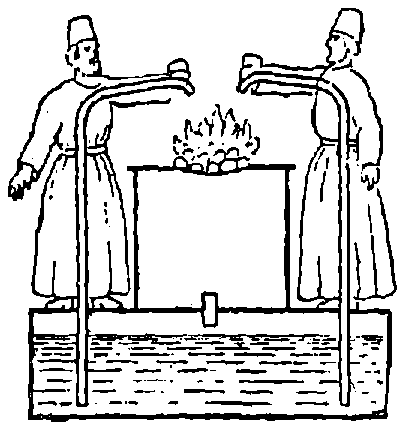
Figure 70 shows another sham miracle of the Egyptian priests. When the flame blazes up on the altar, the air forces oil out of the lower reservoir into tubes hidden inside the figures of the priests, and the oil miraculously pours itself on the fire... But the priest in charge of the altar had only to slip the plug out of the reservoir's lid, unobserved, and the flow of oil would stop, because the excess air escaped through the hole. This was done, no doubt, when the worshipers' offerings were in the priest's view too meager.
A Clock That Never Needs Winding
A clock of this kind was invented several years ago, and its mechanism is extremely interesting. At first glance you seem to be looking at a successful attempt to create the notorious perpetual motion machine, over which many generations of luckless inventors racked their brains in vain. But the resemblance is only outward. The clock doesn't create energy "out of nothing"; it has an external source of power, though admittedly a rather peculiar one.
The drawing shows the mechanism of this self-winding clock. Its main parts are the rods and , made of a metal with a large coefficient of expansion. Rod rests against the teeth of wheel X, so that when the rod lengthens with heat, the toothed wheel turns a little. Rod hooks onto the teeth of wheel Y when it shortens with cold, and turns that wheel in the same direction. Both wheels are mounted on the shaft , and when the shaft turns, so does a large wheel with scoops. The scoops pick up mercury from the lower trough; from here the mercury flows down a trough to the left-hand wheel, which is also fitted with scoops. As it fills them, the mercury makes this wheel turn, and the wheel drives the chain KK, which passes around the wheels (on , the shaft of this same wheel) and ; this last wheel winds the mainspring of the clock. And what becomes of the mercury that spills from the scoops of the left-hand wheel? It runs down the sloping trough , back to the right-hand wheel, to begin its travels all over again.
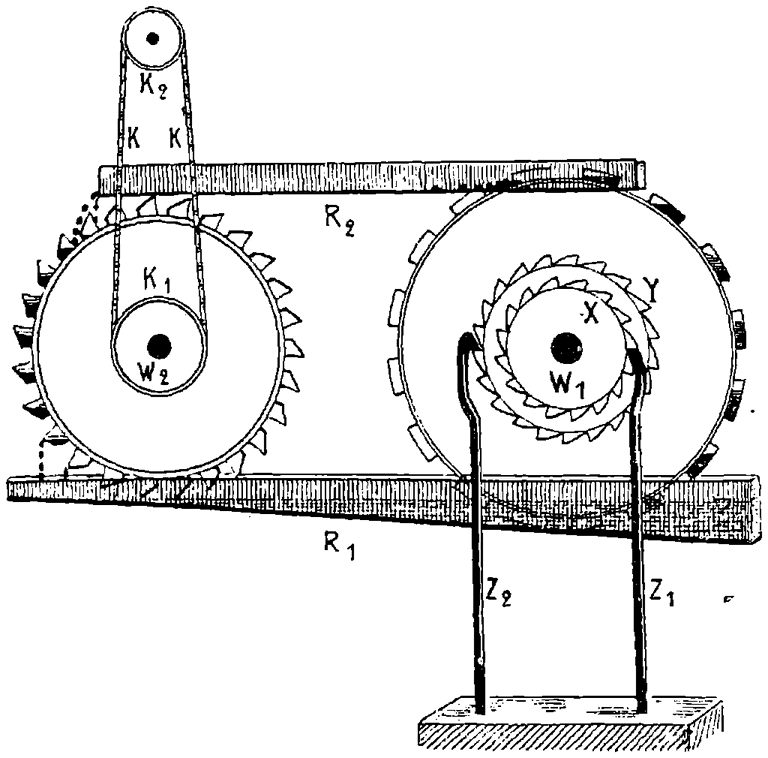
The mechanism, as we see, must keep moving by itself, without stopping, as long as the rods and go on lengthening and shortening. To keep the clock wound, then, nothing is needed except that the temperature of the air should alternately rise and fall. And that is just what happens of itself, with no trouble on our part: every change in the temperature of the surrounding air lengthens or shortens the rods, and so the clock's spring is slowly being wound all the time.
Can we call this clock a perpetual motion machine in the usual sense of the term? Of course not. True, the clock will run indefinitely, until its mechanism wears out, but the source of its energy is the heat of the surrounding air. The clock stores up the work of thermal expansion in small portions, and spends it continuously on moving its hands. It's not a "perpetual" machine but a "free" one, since it needs no care or expense to keep it running. The ultimate source of its energy is, of course, the heat of the Sun, which warms the Earth.
Physics at the Ball
When ladies at a ball fan themselves, they naturally feel cooler. The occupation seems quite innocent, and the gentlemen, you'd think, can only be grateful to the ladies for cooling the air in the room.
But let's see whether this is so. Why do we feel cool when we fan ourselves? The air right next to our face is warmed, and this mask of warm air, invisibly covering the face, "warms" it, in the sense that it slows the further loss of heat. If the air around us is still, the layer that has been warmed near the face rises only very slowly (being lighter), and only just as slowly is it replaced by unwarmed air. But when we whisk the warm mask away with a fan, the face comes into contact with one fresh portion of unwarmed air after another, and continually gives up its heat to them. That's why we feel cool.
When they fan themselves, then, the ladies are continually driving the warmed air from their faces and replacing it with unwarmed air; this is warmed and driven away in its turn, a new portion takes its place, and so on. In other words, the work of the fans helps to warm the air of the whole room more quickly. From the standpoint of physics, therefore, one ought to protest against ladies' fans: while they bring temporary relief to their owners, they add to the general stuffiness of the ballroom.
Does a Veil Keep You Warm?
Here is another problem in the physics of everyday life. Ladies declare that a veil is warm, and that without one the face gets chilled. Men, looking at the flimsy fabric, often with a fairly coarse mesh, aren't much inclined to believe this, and think that the veil's warmth is pure "imagination."
But if you remember what has just been said, you'll be less skeptical. However coarse the mesh of a veil, air still passes through it with some delay. The layer of air right next to the face, which once warmed acts as a kind of mask of warm air, isn't blown away so quickly by the wind when there's a veil to hold it. We have no reason, therefore, to doubt the ladies when they say that in a light frost and a gentle wind the face gets less chilled on a walk with a veil than without one.
Why Is It Colder in the Wind?
Everyone knows that frost is much easier to bear in still weather than in a wind. But not everyone has a clear idea why. The cold we feel in the wind is subjective: only living things sense it, and a thermometer, for instance, doesn't drop when the wind blows on it. The sharp cold of a windy, frosty day comes, first of all, from the fact that our face (and our whole body) loses much more heat than in calm weather, when the air warmed by the body isn't so quickly replaced by fresh cold air. The stronger the wind, the more air comes into contact with our skin every minute, and so the more heat our body loses every minute. This alone would be enough to make us feel cold.
But there is another reason too. Our skin is always giving off moisture, even in cold air. Evaporation takes heat, and it takes it from our body and from the layer of air next to the body. If the air is still, evaporation goes slowly, since the layer next to the skin is soon saturated with vapor (and in saturated air there is no evaporation). But if the air is moving, and one fresh portion after another streams past the skin, evaporation remains abundant all the time, and that calls for a large expenditure of heat, which has to come from the body.
This is how physics explains the simple everyday fact that it's always colder in the wind than in calm weather.
The Hot Breath of the Desert
"Then in hot places the wind ought to bring coolness too," the reader may say. "Why, then, do travelers talk of the hot breath of the desert?"
The apparent contradiction is explained by the fact that in a tropical climate the air is sometimes warmer than our body. It's no wonder that there the wind makes people hotter instead of cooler. Heat no longer passes from the body to the air but the other way, and the air warms the human body. The more air, therefore, that manages to come into contact with the body in a minute, the stronger the feeling of heat. True, the wind speeds up evaporation here too, but the first cause outweighs it.
Jugs That Cool Water
If you have never happened to see such jugs yourself, you've probably heard or read about them. These vessels of unbaked clay have a curious property: water poured into them becomes cooler than the things around it. The jugs are widely used by southern peoples and go by various names: in Spain an alcarraza, in Egypt a goolah, and so on.
The secret of their cooling is very simple. The liquid seeps out through the thickness of the clay walls and slowly evaporates there, and as it does so it takes heat (the "latent heat of evaporation") from the vessel and from the liquid inside.
It's wrong to think, however, that the liquid in such vessels cools to a very low temperature, as one often reads in descriptions of travels in southern lands. The cooling can't be great. It depends on various conditions. The hotter the air, the faster and more abundantly the moisture on the outside of the vessel evaporates, and so the more the water inside is cooled. It depends, too, on the humidity of the surrounding air: if the air holds a great deal of moisture, evaporation goes slowly and the water cools only slightly; in dry air, on the contrary, evaporation is vigorous and the cooling more noticeable. Wind also speeds evaporation and so helps the cooling, as everyone knows from the unpleasant chill of wet clothes even on a warm but windy day. On the whole, as observations have shown, the drop in temperature in cooling jugs is never more than 5 degrees Celsius. On a sweltering southern day, when the thermometer sometimes stands at 33°, the water in a cooling jug has the temperature of a warm bath, 28°. As cooling, you see, this is of no practical use. But the jug does keep cold water cold very well, and that is what it's chiefly used for.
We can try to calculate how far the water in an alcarraza is cooled. Suppose we have a jug that holds 5 liters of water (about 5 bottles), and suppose that one-fiftieth of this water has evaporated. To evaporate 1 liter of water (1 kilogram) at the temperature of a hot day (33°) takes about 580 large calories of heat, each enough to warm a kilogram of water by one degree. We have evaporated 1/10 kilogram, which took 58 calories. If all this heat had come only from the water in the jug, its temperature would have fallen by 58/5, or almost 12 degrees. But that, of course, isn't what happens. Most of the heat needed for evaporation is taken from the walls of the jug itself and from the air around it; and besides, while the water in the jug is being cooled, it is all the while being heated by the warm air next to the jug. The cooling, therefore, barely reaches half the figure we found.
It's another matter if the vessel was filled from the start with cold water, drawn, say, from an underground spring: then it warms up extremely slowly, and the water keeps its low temperature for a long time.
It's hard to say whether a jug cools better in the sun or in the shade. The sun speeds up evaporation, but it also increases the inflow of heat. The best plan is probably to keep cooling jugs in the shade, in a light breeze.
How Much Heat Can We Stand?
Human beings can stand much more heat than is usually thought. In southern countries they are able to endure temperatures almost twice as high as those we in our temperate zone consider barely tolerable. Summer temperatures of 46 degrees in the shade and 60 in the sun are fairly common in Central Australia, and readings of 55 in the shade and 67 in the sun have even been recorded there (all Celsius). On ships crossing the Red Sea and the Persian Gulf the thermometer very often shows 50 to 60 degrees, even with constant ventilation.
Two English scientists made experiments to find the highest temperature that the human organism can bear. They shut each other up in a specially built oven and gradually raised the temperature. It turned out that if the oven was heated very gradually, in dry air, their bodies could endure almost the temperature of boiling water (100 degrees), and sometimes an even higher one!
Such endurance is explained by increased perspiration: the evaporating sweat absorbs a considerable quantity of heat from the layer of air next to the skin, and so lowers its temperature enough. The only necessary condition is that the body should not be in direct contact with the source of heat.
The Riddle of the Icicles
Have you ever wondered how icicles form, the ones we so often see hanging from roofs?
There's nothing to wonder about, you'll say: an icicle is obviously water that was running off the roof and froze as it was.
Very well, but in what weather did it form, in a thaw or in a frost?
If in a thaw, how could water freeze at a temperature above zero?
If in a frost, where could the water running off the roof have come from?
The problem isn't as simple as you thought at first. For icicles to form, we must have two temperatures at the same time: one above zero for melting, and one below zero for freezing.
It sounds absurd, and yet that is how things really are. The snow on the slope of the roof melts because the Sun's rays warm it above zero, while under the eaves the dripping water freezes because the temperature there is below zero.
Picture a scene like this. It's a clear day, with only 1 or 2 degrees of frost. The Sun shines brightly, but its slanting rays don't warm the ground enough to melt the snow; the temperature of the air, as we said, is a little below zero. On the slope of the roof that faces the Sun, however, the heating goes better, because the Sun's rays fall on it less obliquely than on the ground, at an angle nearer a right angle. And we know that rays light and heat a surface more strongly, the greater the angle they make with it. (Their effect is proportional to the sine of this angle. In the case shown in Figure 72, the snow on the roof receives 40% more heat than an equal area of snow on level ground, since the sine of 90° is 1.4 times as great as the sine of 45°.) That's why the snow on the slope of the roof is heated more strongly and begins to melt. The melted water runs down, gathers at the eaves, and hangs in drops from the edge of the roof. But here, under the roof, the temperature is below zero, and the drop freezes. The next drop flows onto the frozen one and freezes too, then a third, and so on, until little by little a small knob of ice has formed. The next time the weather is like this, these knobs grow a little more, and in the end they become long, thick icicles.
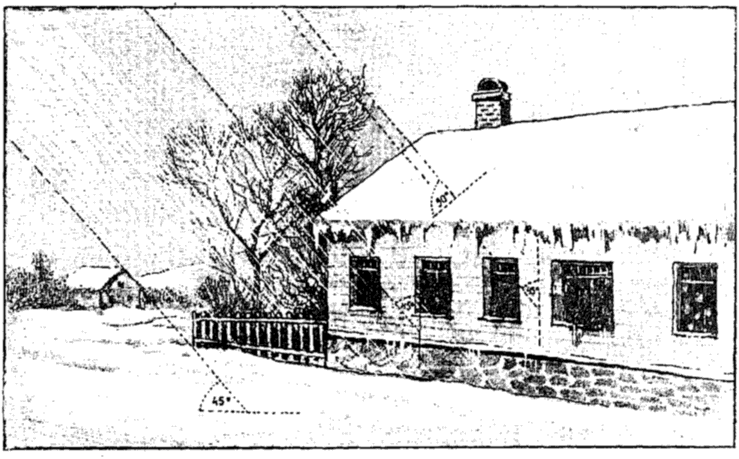
This, then, is what the icicles tell us: they prove that two kinds of weather can exist, as it were, at one and the same time, frost under the roof and thaw on its slope. The reason is that the heating effect of the Sun's rays differs with the angle at which they fall. The same cause produces grander effects before our eyes: remember that the whole difference between climatic zones and between the seasons is due, in essence, to nothing but the changing angle of the Sun's rays. The Sun is equally far from us in winter and in summer, and it's always equally distant from the poles and the equator (the differences are too slight to matter here). But the rays strike the Earth's surface less obliquely near the equator than near the poles, and in summer they make a larger angle with it than in winter. That's enough to bring about such important differences in temperature and in the life of all nature.
Figuratively speaking, we might say that the tropics lie on the slope of a sunlit roof and the polar region under its eaves; the snow melts in the "tropics" and freezes when it gets to the "polar region."
What Is a Lamp Chimney For?
We have no idea what a long road our ordinary lamp chimney traveled before it became the thing we know today. For thousands of years people used flames for light and never thought of calling in glass to help. It took the genius of Leonardo da Vinci to make this important improvement to the lamp; and even Leonardo surrounded the flame with a pipe of tin, not glass. Nearly three more centuries went by before anyone thought of replacing the tin pipe with a transparent glass cylinder. The lamp chimney, as you see, is an invention of some substance, and whole generations worked on it.
And what does it do? Simple and natural as the question is, hardly everyone will have the right answer ready. Shielding the flame from the wind is only a secondary duty. The chimney's main effect is to make the flame brighter by speeding up combustion. It does the same work as the chimney of a stove: it increases the flow of air to the flame, or improves the "draft."
Let's look into this more closely. The column of air inside the chimney heats up much faster than the air around the lamp. Once heated it is lighter, and so it rises, while unheated, heavier air comes in to take its place from below, through the openings in the burner. This sets up a constant current from the bottom upward, which carries off the products of combustion without a break and brings fresh air. The taller the chimney, the greater the difference in weight between the heated column of air and the unheated one; the more vigorously fresh air flows in, and the faster the burning goes.
Tall factory chimneys do the same job as lamp chimneys: thanks to them, far more fresh air reaches the furnace every minute than low chimneys would bring.
Why Doesn't a Flame Go Out by Itself?
Think hard enough about combustion and you can't help asking why every flame doesn't go out by itself. After all, the products of combustion are, as we know, carbon dioxide and water vapor, substances that don't burn and can't support burning. From the very first moment, then, a flame ought to be surrounded by incombustible matter that keeps the air from reaching it; without air the burning can't go on, and the flame must die.
Why doesn't this happen? Why does the burning continue for as long as there is something left to burn? Only because gases expand when they're heated and become lighter. Thanks to this alone, the hot products of combustion don't stay where they were formed, right up against the flame, but rise at once and make way for clean air. If Archimedes' principle didn't apply to gases, or if there were no gravity, every flame would burn for a little while and then go out by itself.
It's very easy to convince yourself how deadly a flame's own products are to it. I'm sure you often make use of the fact without suspecting it, to put out a lamp. Remember how you blow out a kerosene lamp: you blow into it from above. You drive the incombustible products of its own burning down onto the flame, and the flame, cut off from the air, goes out.
The Chapter Missing from Jules Verne's Novel
Jules Verne has told us in detail how three daring men spent their time inside the shell as it sped to the Moon. But he didn't tell us how Michel Ardan performed his duties as cook in those extraordinary surroundings. Verne probably supposed that there was nothing about cooking inside a flying shell that deserved describing. He was mistaken. Inside a flying shell, all things become weightless, and this Verne overlooked. Yet cooking in a weightless kitchen, you'll agree, is a subject quite worthy of a novelist's pen, and we can only regret that the gifted author of A Journey to the Moon never gave it his attention. I'll try, as best I can, to supply the missing chapter, and to give the reader some notion of how striking it might have been had Verne written it himself.
As you read it, please keep constantly in mind that inside the shell, as I've said, there is no gravity, and everything in it is weightless.63
Breakfast in a Weightless Kitchen
"But my friends, we haven't had breakfast yet," Michel Ardan announced to his fellow travelers through interplanetary space. "We may have lost our weight in this cannonball, but it by no means follows that we've lost our appetites. I undertake, my friends, to prepare you a weightless breakfast, and it will certainly consist of the lightest dishes the world has ever known!"
And without waiting for his comrades to reply, the Frenchman set about his cooking. They had decided to begin the breakfast with bouillon, made by dissolving some of Liebig's tablets in warm water.
"Our water bottle is pretending to be empty," Ardan grumbled to himself, as he struggled to uncork the big flask. "You don't fool me: I know why you're so light... There, the cork's out. Now, my treasure, be so kind as to pour your weightless contents into the saucepan!"
But tip the bottle as he might, not a drop came out.
"Don't wear yourself out, my dear Ardan," said Nicholl, coming to his rescue. "You must understand that in our projectile, where there's no gravity, water can't pour. You'll have to knock it out of the bottle, as if it were a thick, sticky syrup."
Ardan wasted no time on reflection, but turned the bottle upside down and slapped the bottom with his palm. At once a perfectly round ball of water, the size of a fist, swelled out at the neck.
"What's happened to our water?" cried Ardan in amazement. "Now there, I confess, is a surprise we could have done without! Explain to me, my learned friends, what's going on."
"That's a drop, my dear Ardan, a simple drop of water. In a world without gravity, drops can be as big as you please... Remember that it's only under the influence of gravity that liquids take the shape of the vessels they're in, pour in streams, and so on. Here there's no gravity; the liquid is left to its own internal molecular forces, and must take the shape of a ball, like the oil in Plateau's famous experiment."
"I don't care a straw for this Plateau and his experiments! I have water to boil for bouillon, and I swear that no molecular forces are going to stop me!" the Frenchman exclaimed hotly.
He set furiously about beating the water out over the saucepan, which was hovering in the air; but everything seemed to be in league against him. The big balls of water, when they reached the saucepan, quickly spread out over the bottom. Nor did it end there: from the inner walls the water crossed to the outer ones and spread over those, and soon the whole saucepan was wrapped in a thick layer of water. There was no possible way of boiling it in that state.
"Here's an interesting experiment, which shows how great the force of cohesion is," the unruffled Nicholl calmly explained to the enraged Ardan. "Don't upset yourself. This is nothing but the ordinary wetting of solids by liquids; only, in this case, there's no gravity to keep the phenomenon from developing to the full."
"And a great pity there isn't!" retorted Ardan. "Wetting or whatever it may be, I need to have the water inside the saucepan, and not around it. Whatever next! No cook in the world would agree to make bouillon under such conditions!"
"You can easily prevent the wetting, if it's such a trouble to you," Mr. Barbicane put in soothingly. "Remember that water doesn't wet bodies covered with even the thinnest layer of grease. Grease the outside of your saucepan, and you'll keep the water inside."
"Bravo! Now that's what I call true learning," said Ardan, delighted, and did as he was advised.
"But I must warn you," Barbicane added, "that if you grease the inside of the saucepan too, the water in it will take the shape of one large drop. I'm afraid that in that form you won't manage to bring it to a boil. Remember the famous experiment with water in the spheroidal state, where it stays liquid on a red-hot plate."
But Ardan was no longer listening: he was wholly absorbed in heating the water over the flame of a gas burner.
Everything was positively conspiring against him. Now even the gas burner turned temperamental: after burning with a dull flame for half a minute, it went out for no reason that he could explain. Ardan fussed over the burner and nursed the flame patiently, but all his pains came to nothing. The flame refused to burn.
"Barbicane! Nicholl! Is there really no way to make this accursed flame burn as it's supposed to, by the laws of your physics and the regulations of the gas companies?" the disheartened Frenchman appealed to his friends.
"But there's nothing extraordinary here, and nothing unexpected," explained Nicholl. "This flame is burning exactly as it should, according to the laws of physics. As for the gas companies... I believe they'd all be ruined if there were no gravity. Combustion, as you know, forms carbon dioxide and water vapor, in a word, gases that won't burn. Ordinarily these products don't stay beside the flame: being warm, and therefore lighter, they rise, and fresh air flows in to take their place. But here we have no gravity, and so the products of combustion stay where they were formed, wrap the flame in a layer of incombustible gas, and bar the way to fresh air. That's why the flame here burns so dimly and goes out so fast. Why, fire extinguishers work on just that principle: they surround the flame with a gas that won't burn..."
"According to you, then," the Frenchman broke in, "if there were no gravity on Earth, we wouldn't need fire brigades? Every fire would put itself out; it would choke, so to speak, on its own breath?"
"Perfectly true. And meanwhile, to help matters, light the burner again and let's fan the flame. I hope we'll manage to drive off the gases around it and make it burn as it does on Earth."
And that's what they did. Ardan lit the burner once more and went back to his cooking, not without a certain malicious pleasure as he watched Nicholl and Barbicane take turns blowing on the flame and fanning it with all their might, to keep the products of combustion constantly moving away from it. In the depths of his soul the Frenchman held his learned friends and their science to blame for "this whole mess."
"In a manner of speaking, gentlemen," Ardan rattled on, "you're performing the duties of a factory chimney, and keeping up the draft. I'm very sorry for you, my learned friends, but if we want a hot breakfast, we'll have to submit to the decrees of your physics."
A quarter of an hour passed, however, then half an hour, then an hour, and the water in the saucepan showed no intention of boiling.
"Can the flame have lost its heat along with its weight?" Ardan wondered. "It looks to me as if I'll never see this water boil."
"You will, my dear Ardan; Nicholl and I guarantee it. But you'll have to arm yourself with patience. You see, ordinary water, water with weight, heats up quickly only because its layers keep mixing. The lower layers, once they're heated, are lighter, and they rise; the cold upper layers sink to take their place; and as a result the whole liquid soon reaches a high temperature. Have you ever happened to heat water from above and not from below? Then there's no mixing, because the heated upper layers stay where they are. And water conducts heat so poorly that you can even bring the upper layers to a boil while lumps of unmelted ice are lying in the lower ones. In our world without gravity it makes no difference from which side you heat the water. No circulation can arise in the saucepan, and the water is bound to heat very slowly..."
It wasn't easy to cook under such conditions, and Ardan was right when he claimed that the most skillful of chefs would have thrown up his hands. Frying the steak gave him no little trouble too. He had to hold the meat down with a fork the whole time; otherwise the elastic vapor of the butter that formed under the steak pushed it out of the pan, and the half-cooked meat went flying "up," if one may use such an expression in a place that had neither an "up" nor a "down."
The meal itself made a strange picture in that world without gravity. The friends hung in the air in a great variety of poses, which were not, for that matter, unpicturesque, and every other minute they bumped heads. Sitting, of course, was out of the question. Such things as chairs, sofas, and benches are perfectly useless in a world where there's no gravity. Indeed, they wouldn't have needed the table either, but for Ardan's stubborn insistence on breakfasting "at table."
Hard as it had been to cook the bouillon, eating it proved harder still. To begin with, there was no way to pour out weightless bouillon into cups. The attempt very nearly cost Ardan his whole morning's work. Forgetting that the bouillon had no weight, he turned the saucepan over and gave its bottom a vexed slap, to drive out the stubborn broth. Out of the pan flew one enormous round drop: bouillon in the form of a sphere. Ardan needed all the skill of a juggler to catch the bouillon he'd been at such pains to cook, and get it safely back in the saucepan.
Spoons were no help. The bouillon wetted the whole spoon, right up to the fingers, and hung from it in an unbroken film. They greased the spoons to prevent the wetting, but that made matters no better: the bouillon turned into a little ball on the spoon, and there was no possible way to bring this weightless pill safely to the mouth.
In the end they hit on the idea of making tubes out of waxed paper, and drank the bouillon by sucking it up through them. And that was how our friends had to drink water, wine, and every other liquid in this peculiar world without gravity.
How to Put Out Fire with Fire
You've probably heard that the best way, and sometimes the only way, to fight a forest or prairie fire is to set the forest or prairie alight from the opposite side. The new flames go out to meet the raging sea of fire, and as they consume whatever will burn, they rob it of its food. When the two walls of fire meet, both go out in an instant, as if each had devoured the other.
You have of course read the description of how this is done in a fire on the American prairies, in Cooper's novel The Prairie. Who could forget the dramatic moment when the old trapper saves a party of travelers, overtaken by a prairie fire, from a terrible death? Here is the passage:
"... the old man... suddenly assumed a decided air...
"'It is time to be doing,' he said...
"'You have come to your recollections too late, miserable old man,' cried Middleton; 'the flames are within a quarter of a mile of us, and the wind is bringing them down in this quarter with dreadful rapidity.'
"'Anan! the flames! I care but little for the flames.... Come, lads, come; 'tis time to be doing now, and to cease talking... Put hands upon this short and withered grass where we stand, and lay bare the 'arth.'
"... A very few moments sufficed to lay bare a spot of some twenty feet in diameter. Into one edge of this little area the trapper brought the females, directing Middleton and Paul to cover their light and inflammable dresses with the blankets of the party. So soon as this precaution was observed, the old man approached the opposite margin of the grass, which still environed them in a tall and dangerous circle, and selecting a handful of the driest of the herbage he placed it over the pan of his rifle. The light combustible kindled at the flash. Then he placed the little flame in a bed of the standing fog, and withdrawing from the spot to the centre of the ring, he patiently awaited the result.
"The subtle element seized with avidity upon its new fuel, and in a moment forked flames were gliding among the grass...
"'Now,' said the old man, holding up a finger, and laughing in his peculiarly silent manner, 'you shall see fire fight fire!...'
"'But is this not fatal?' cried the amazed Middleton; 'are you not bringing the enemy nigher to us instead of avoiding it?'
"... As the fire gained strength and heat, it began to spread on three sides, dying of itself on the fourth, for want of aliment. As it increased, and the sullen roaring announced its power, it cleared every thing before it, leaving the black and smoking soil far more naked than if the scythe had swept the place. The situation of the fugitives would have still been hazardous had not the area enlarged as the flame encircled them.... in a very few moments the flames began to recede in every quarter, leaving them enveloped in a cloud of smoke, but perfectly safe from the torrent of fire that was still furiously rolling onward.
"The spectators regarded the simple expedient of the trapper with that species of wonder, with which the courtiers of Ferdinand are said to have viewed the manner in which Columbus made his egg stand on its end..."
This way of putting out prairie and forest fires is not, however, as simple as it looks. Only a very experienced person should use a backfire against a blaze; anyone else may only make the disaster worse.
You'll see what skill it takes if you ask yourself why the fire lit by the trapper ran toward the blaze, and not the other way. After all, the wind was blowing from the blaze and driving the flames straight at the travelers. The fire the trapper started ought, it would seem, to have headed away from the sea of flame and off across the prairie. Had that happened, the travelers would have found themselves inside a ring of fire and would certainly have perished.
What was the trapper's secret? He knew a simple law of physics. The wind did indeed blow from the burning prairie toward the travelers; but farther forward, close to the fire, there must have been a current of air the other way, toward the flames. The air over the sea of fire is heated, grows lighter, and rises, and from all sides fresh, still unheated air flows in to take its place from the prairie the flames haven't reached. Near the edge of the fire, therefore, there arises a draft of air toward the flames. The backfire must be lit at exactly the moment when the blaze has come near enough for this draft to be felt. That's why the trapper, who lived on the prairies, was in no hurry to begin, but calmly waited for the right moment. If he had set light to the grass a second too early, before the draft toward the blaze had arisen, his fire would have spread the other way and left them no escape. But delay might have been no less deadly for them: the blaze would have come too close.
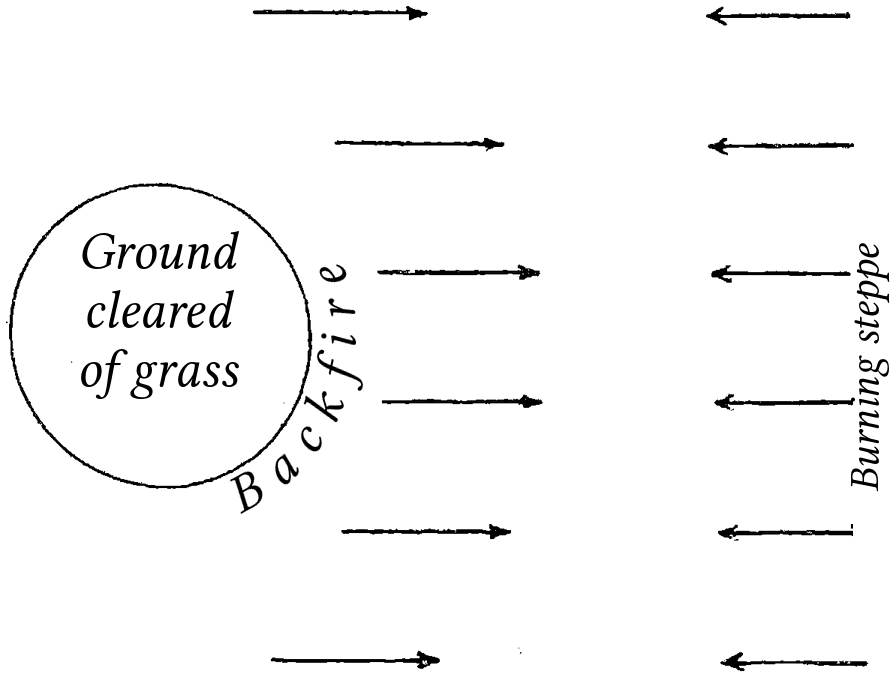
Is Boiling Water Always Hot?
The gallant orderly Ben-Zoof, whom the reader has no doubt met long ago in Jules Verne's novel Hector Servadac, was deeply convinced that boiling water is equally hot always and everywhere. He would probably have gone on thinking so all his life, if chance hadn't been pleased to fling him, along with his officer, Servadac, onto... a comet! That wayward body had collided with the Earth, sliced from our planet the very piece on which our two heroes happened to be, and carried it off along an elliptical path. And it was then that the orderly first learned by his own experience that boiling water is not equally hot everywhere. He made this discovery unexpectedly, while cooking his master's breakfast.
"Ben-Zoof poured water into a saucepan, set it on the stove, and waited for it to boil so that he could put in the eggs, which seemed to him empty, they weighed so little.
"In less than two minutes the water was boiling.
"'The devil! How hot the fire is now!' exclaimed Ben-Zoof.
"'It isn't that the fire is hotter,' answered Servadac, when he had thought about it. 'The water is boiling sooner.'
"And he took down the centigrade thermometer from the wall and dipped it in the boiling water.
"The thermometer showed only sixty-six degrees.
"'Oho!' cried the officer. 'The water is boiling at sixty-six degrees instead of a hundred!'
"'What then, Captain?...'
"'Then, Ben-Zoof, I advise you to keep those eggs in boiling water for a quarter of an hour.'
"'But they'll be hard!'
"'No, my friend, they'll be barely cooked.'
"The cause of this phenomenon was evidently a reduction in the height of the atmosphere. The column of air above the surface of the ground had decreased by about a third, and that was why the water, under a lower pressure, was boiling at sixty-six degrees instead of a hundred. The same thing happens on mountains 1,100 meters high. And if the captain had had a barometer, it would have shown him that the layer of air had shrunk."
We don't presume to question what our heroes observed. If they say that the water boiled at 66 degrees, we must accept it as a fact. But it's very doubtful whether they can have felt altogether well in the thin air that surrounded them.
The author of Hector Servadac would have us believe that "the same thing happens on mountains 1,100 meters high." It does not: at a height of 1,100 meters water boils at 94°, not at 66°. To get water that boils at 66° you would have to climb ten times as high, and stand some two kilometers above the top of the highest mountain. Only at 11,000 meters does water boil at 66°.64 The pressure of the atmosphere is then 190 millimeters of mercury, exactly a quarter of the normal. In air as thin as that it's almost impossible to breathe! We know that balloonists who reached such heights lost consciousness from want of air; and yet Servadac and his orderly feel tolerably well... It's just as well that Servadac had no barometer on hand. Otherwise Verne would have had to make the instrument show quite a different figure from the one it ought to show by the laws of physics: 640 millimeters, instead of 190.
If our heroes had landed, not on an imaginary comet, but on Mars, say, where the pressure of the atmosphere is no more than 60 millimeters,65 their boiling water would have been cooler still, a mere 44 degrees! To get a glass of properly hot tea on Mars, they would have had to turn to Papin's digester, the ancestor of the pressure cooker, in which the pressure is artificially kept high.
Chapter 8: Magnetism and Electricity
The Loving Stone
Such is the poetic name the Chinese gave the natural magnet. "The loving stone" (tsu-shih), they say, draws iron to itself as a tender mother draws her children to her. It is remarkable that among the French, who live at the opposite end of the Old World, we meet the same name again: the French word aimant means both "magnet" and "loving."
The force of this "love" in natural magnets is very slight, and that makes the Greek name for the magnet, "the stone of Hercules," sound very naive. If the people of ancient Hellas were so struck by the modest pull of a natural magnet, what would they have said at the sight of the magnets in a modern ironworks, which lift huge blocks weighing six and a half metric tons! True, these aren't natural magnets. They are "electromagnets," that is, iron bars magnetized by an electric current passing through a winding around them. But the same force of nature is at work here as in the natural magnet: magnetism.
Powerful electromagnets do priceless service in steel mills and similar works, where masses of iron must be lifted and moved. These magnetic cranes easily carry solid blocks of iron, or huge machine parts weighing several tons, without the help of chains. In the same way, and without any boxes or packing, they carry sheet iron, wire, nails, scrap, and other such materials, which would be a good deal of trouble to move by any other means.
It would be handier still, wouldn't it, reader, to use magnets for carrying red-hot ingots and plates? Unfortunately it can't be done, for the simple reason that red-hot iron can't be magnetized. A magnet heated to redness loses its magnetic properties forever. If you don't mind sacrificing a ten-kopeck magnet, throw it into the stove, onto the hot coals. What you take out a few minutes later will no longer be a magnet, but plain iron.
Like Mohammed's Coffin
A curious thing was once seen while an electromagnetic crane was at work. One of the workmen noticed that the electromagnet had attracted a heavy iron ball fastened to a short chain, and that the chain kept the ball from getting right up to the magnet. The result was an extraordinary picture: a chain sticking straight up in the air! The magnet turned out to be so strong that the chain stayed vertical even when the workman hung from it! A photographer who happened to be nearby hurried to capture so interesting a moment on a plate, and here we reproduce his photograph of a man hanging in the air, like Mohammed's legendary coffin.
Speaking of Mohammed's coffin: devout Muslims, the story goes, are convinced that the coffin with the remains of the great Prophet rests in midair, hanging in its tomb between floor and ceiling with nothing whatever to hold it up.66
Is such a thing possible? Many people imagine that it's quite possible, provided that the coffin is of iron and that a very powerful magnet is hidden in the ceiling to balance the force of gravity. But this explanation won't do. Even if such a balance were achieved for a moment, the slightest jolt, the slightest breath of air, would be enough to upset it, and the coffin would either fall to the floor or be drawn up to the ceiling. To keep it motionless under these conditions is as impossible in practice as to stand a cone on its point, though in theory you could perfectly well do that.
But if a motionless body can't be kept in such a balance, it is quite conceivable for a moving one. This idea is the basis of a remarkable plan for an electromagnetic railway without friction, put forward not long ago by the well-known Russian physicist Professor B. P. Weinberg. Even if the plan is never carried out, it is so instructive and ingenious that anyone interested in physics will profit by getting acquainted with it.
Motion Without Friction
In the railway that Professor Weinberg proposes to build, the cars will be completely weightless; their weight is cancelled by electromagnetic attraction. You won't be surprised, therefore, to learn that under his plan the cars don't roll on rails, don't float on water, don't even glide on air. They fly with no support at all and touch nothing, hanging by the invisible threads of mighty magnetic forces. They meet not the slightest friction, and consequently, once set in motion, they keep their colossal speed by inertia, with no need of a locomotive to do any work.
Here is how it's all done. The cars are to move inside a wide tube from which the air has been pumped out, so that their sides have no air to rub against. There is no friction with the floor, because the cars travel without touching the walls of the tube, held up in the vacuum by the force of electromagnets. For this purpose very powerful electromagnets are set above the tube, at definite distances from one another, along the whole length of the line. They attract the iron cars that move inside the tube and keep them from falling. The strength of the magnets is so calculated that an iron car flying through the tube always stays between its "ceiling" and its "floor" and touches neither. An electromagnet pulls the car up as it flies beneath; but the car has no time to hit the ceiling, for gravity drags it down. It is just about to touch the floor when the attraction of the next electromagnet catches it... In this way, caught by one electromagnet after another, the car speeds along a wavy line, without friction, without jolts, in empty space, like a planet among the stars (Figure 77).
And what are the cars themselves like? They are cigar-shaped cylinders, a little taller than a man and about four meters long. A car is of course hermetically sealed, since it moves in airless space, and like a submarine it is fitted with apparatus that purifies the air automatically. The way the cars are started on their journey is also quite unlike anything used before: it can be compared only to a cannon shot. And indeed these cars are literally "fired," like cannonballs, except that here the "cannon" is electromagnetic. The departure station makes use of a property of wire wound in a spiral to form a coil (a "solenoid"): when a current passes through the coil, it pulls an iron rod into itself, and so suddenly that, if the winding is long enough and the current strong enough, the rod can acquire an enormous speed. On the new magnetic railway it's this force that will fling out the cars. And since there is no friction in the tunnel, they don't lose speed; they rush on by inertia until the solenoid of the station they're bound for holds them back.
In theory the speed of the cars can be as great as you like: a thousand kilometers an hour, or ten thousand for that matter. The inventor has settled for the present on the comparatively modest figure of about 770. But even that speed will take us from Petrograd to Moscow in 50 minutes,67 and whisk us right across the Old World, from Finland to the Pacific, in 10 or 11 hours.
We have described Professor Weinberg's plan in its most perfect form. But it can also be carried out in a simplified form, and keep its essential advantages. We can, for example, give up the demand for an absolute vacuum, and let the cars move in air. This would make the line considerably cheaper and not cut the planned speed too much. Further, we can strengthen the electromagnets and make the cars roll along the ceiling of the tube, with the friction reduced to an extreme degree; or, on the contrary, we can weaken the magnets and let the lightened cars race along the floor of the tube with the most trifling friction. We shall not, of course, then have all the benefits of the plan in full, but we shall have a considerable part of them.
A Battle Between Martians and Earthlings
Pliny, the naturalist of ancient Rome, passes on a story current in his time of a magnetic rock, somewhere in India by the edge of the sea, that attracted everything made of iron with extraordinary force. Woe to the sailor who dared bring his ship near it! The rock would draw out all the nails, the screws, the iron clamps, and the ship would fall apart into separate planks...
This is of course no more than a legend. We know now that magnetic mountains, that is, mountains rich in magnetic iron ore, really do exist (we have one in the Urals, Mount Blagodat); but their attraction is extremely small, next to nothing. Mountains or rocks like the one Pliny wrote of have never existed on the globe.
Kurd Lasswitz, a writer of scientific romances, has nevertheless used the idea of this legend to devise a formidable weapon of war. The visitors from Mars use it, in his novel On Two Planets, in their struggle with the armies of Earth. With such a magnetic (or rather, electromagnetic) weapon at their command, the Martians don't even do battle with the earthlings, but disarm them before the fight has begun.
Here is how the novelist describes this episode of the battle between Martians and earthlings:
"With a deafening 'Hurrah!' the glittering ranks of horsemen surged irresistibly forward. It was a shattering moment! An icy horror gripped everyone who chanced to be watching. And it seemed as though the army's selfless resolve had at last forced the mighty enemy [that is, the Martians] to give way, for a new kind of movement began among their airships. They rose into the air, as if preparing to make room. At the same time, however, some dark, wide-spreading mass, which only now appeared over the field, came down from above. Like a broadly billowing veil, and surrounded on all sides by the airships, the mass quickly unfurled over the field. Now the first rank of horsemen came within its range, and the next moment the strange machine had spread itself over the entire regiment. Its effect was so unexpected and so monstrous that the throng of princes and generals, who had set out to meet the regiment, stopped as if rooted to the ground. From the field came a piercing scream of terror. Not one mount had kept its feet; horses and riders lay on the ground in one monstrous tangle, while the air was filled with a dense cloud of lances, sabers, and carbines, flying upward with thunder and crashing toward the machine that drew them, to which they stuck fast. The machine slid a little to one side and dropped its iron harvest on the ground. Twice more it returned, and as it were mowed down every weapon on the field. No hand was found strong enough to hold on to a saber or a lance; and where a rider did not let go, the machine lifted him too into the air, and his horse with him. The horseshoes were carried off as well, and this was what had brought all the horses to the ground.
"The machine was a powerful new invention of the Martians, a device for disarming men, which attracted with irresistible force everything wrought of iron and steel. It was a magnetic field of colossal strength and vast extent. With the help of this magnet hovering in the air, the Martians tore the weapons from their opponents' hands without doing them any harm, apart from the few bruises that could not be avoided.
"While the cavalry was trying to recover itself a little and get back into order, the magnet in the air had already swept on and was nearing the infantry. In vain the soldiers strained with all their might, in vain they tried to keep hold of their rifles with both hands: an irresistible force wrenched them away; and many who still would not let go were themselves carried up into the air, only to come crashing heavily to the ground. In a few minutes the First Regiment of Guards was disarmed. The machine sped on, in pursuit of the regiments that were marching in the city, and prepared the same end for them. The strongest army was bound to become, in a short time, quite incapable of fighting. A similar fate befell the artillery."
Watches and Magnetism
When you read that extract, the question naturally comes to mind: is there no way to protect ourselves from magnetic forces, to take shelter from them behind some barrier that they can't pass through? There is, and the Martians' fantastic invention could have been rendered harmless, if the proper measures had been taken in advance.
Strange as it may sound, the substance impenetrable to magnetic forces is... iron, the same iron that is so easily magnetized! Inside a ring of iron, a compass needle isn't deflected by a magnet placed outside the ring.
An iron case can protect the steel mechanism of a pocket watch from magnetic forces. If you lay a gold watch on the poles of a strong horseshoe magnet, all the steel parts of the mechanism will be magnetized, and the watch will stop. You won't restore the watch to its former state by taking the magnet away: the steel parts will still be magnetized, and the watch will need the most drastic repairs, with new parts in place of many of the old. It's best, therefore, not even to try this experiment with a gold watch. It would come too expensive.
But with a watch whose works are tightly shut in by covers of iron or steel, you may boldly make the experiment, for magnetic forces don't penetrate iron and steel. Bring such a watch up to the open poles of the most powerful dynamo, and its timekeeping won't suffer in the least. For electrical engineers these cheap iron watches are quite ideal, whereas gold or silver ones are soon ruined by the constant nearness of electromagnets.
A Magnetic Perpetual Motion Machine
In the history of attempts to invent a perpetual motion machine, the magnet has played no small part. Luckless inventors tried in all sorts of ways to use a magnet in building a mechanism that would go forever by itself. Here is one design for such a mechanism, proposed in the seventeenth century by a certain John Wilkins, Bishop of Chester, who spent much time on the insoluble problem of perpetual motion.
On a small column stands a magnetized iron ball, A. Against the column lean two sloping troughs, one beneath the other; the upper has a small hole near its top, and the lower is curved. If, the inventor reasoned, we put a small iron ball, B, on the upper trough, then the attraction of the magnet A will make the ball roll upward. When it reaches the hole, however, it will drop through to the lower trough, roll down, run up the curve at the end of this trough, and come out on the upper one. From here, attracted by the magnet, it will again roll upward, again drop through the hole, again roll down, and again find itself on the upper trough, ready to begin all over again. In this way the ball will run back and forth without stopping, and we shall have perpetual motion.
What is absurd about this "invention"? It isn't hard to point out, and the bishop would probably have noticed his blunder himself, if he'd tried to carry out his invention in practice. But simple reasoning too will prove the absurdity of this "perpetual motion machine." For if the magnetized ball on the column is strong enough to attract the little ball from the end of the trough, it will be all the more able to keep it from falling through the hole; and, the other way round, if the magnetized ball can't prevent the little ball from falling through the hole right beside it, it will be still less able to draw it up from far away. Evidently there can be no perpetual motion here.
Obvious as the absurdity is, the scheme has since surfaced again and again in every possible variation. It's a curious fact that one such scheme is said actually to have been patented in Germany in 1878, that is, thirty years after Robert Mayer proclaimed the law of the conservation of energy! The wily inventor had so complicated and disguised the absurd basic idea of his "perpetual magnetic motor" that he misled the technical commission that issues the patents. And although, by its rules, no patent may be issued for an invention whose idea contradicts the laws of nature, this one was patented all the same. It consisted of a pendulum, kept swinging "without stopping" by the attraction of a whole row of magnets, which drove the entire mechanism... The happy owner of this patent, the only one of its kind, was probably soon disappointed in his brainchild, for after only two years he stopped paying the fee, and the curious patent lapsed.
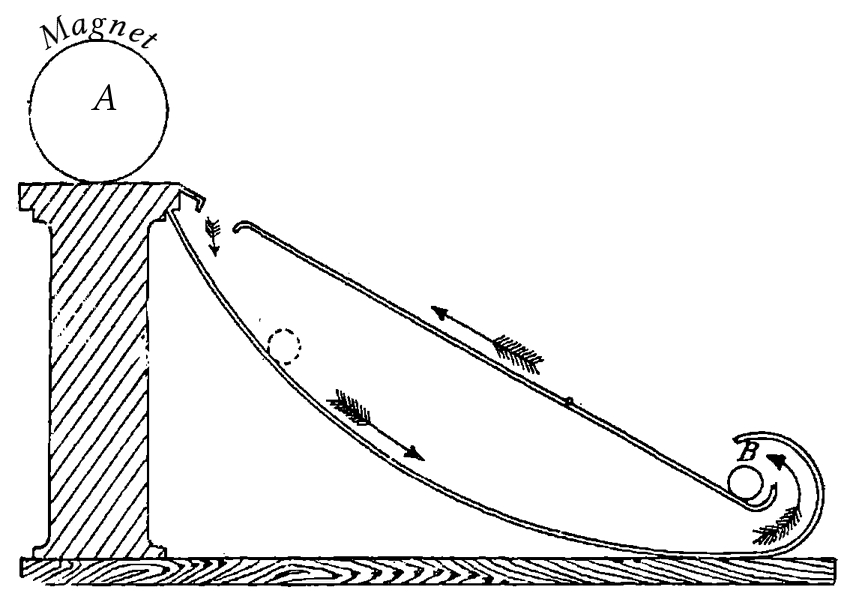
Another Tempting Hope
Here is another idea for a magnetic perpetual motion machine, put forward quite recently (in 1912) by the Russian engineer V. V. Ryumin the elder. He published it in the form of a little story, "The Fate of the Russian Bogatyr," named for the mighty heroes of Russian legend, and I give it here in extracts.
The inventor, who is called Petrov in the story, explains to his friends what the motor he has devised consists of:
"I want to tell you how I came to build my free source of energy. I was in charge of the electric station at a factory. I turned six thousand horsepower of steam engines into current and sent it through my enormous works, where it gave light, melted metal, and drove machines. One day a small dynamo of mine turned stubborn. I struggled with it for a long time, and at last I found what was behind its whims. My fitter, when he was repairing it, had picked up a different material from the one normally used for the job, and from time to time the machine stopped working because the magnetic field disappeared, although the machine was still turning. I had found a material opaque to magnetism! Until then, magnets had acted on iron in spite of every obstacle, and I had found a substance that did not let magnetic forces through.
"Now look at my model. Two strong magnets (electromagnets or permanent, natural or steel, it's all the same) are placed facing each other. An iron armature with no winding at all, in the shape of the spokes of a wheel, turns between them. But when I set it turning, it is bound to stop, because the magnet attracts it. The attraction makes it turn toward the magnets, but that same attraction brings it to a halt. And now, look: when a spoke has begun to move toward the magnet, I put my little screen between the pole and the end of the spoke. The magnet has given its push, but once the spoke has been drawn up to it, the magnet no longer holds it back, and the spoke goes on past. I take the screen away, and the next spoke is pulled in; the screen again; and so on without end."
Such is the idea of the machine. After a while the inventor is supposed to have built a real perpetual motion machine, which was given the name of the Russian Bogatyr.
"About half a year went by, and the people of St Petersburg were excited by notices in the newspapers of a boat that had appeared on the Neva, with a motor that needed no gasoline and no charging of batteries, and yet easily developed up to 10 horsepower.
"Then an automobile with the same motor was seen in the streets of the city, and an aeroplane took to the air..."
The author paints us a rosy picture of the future of the motor he is planning.
"The significance of such a motor is truly immense. The cost of acquiring it, once paid, assured its owner of mechanical energy for almost nothing, and therefore of every other kind of energy: light, heat, electricity. Steam engines were done away with; seagoing ships could now sail for an unlimited time. There was no longer any need to mine coal as a source of energy, and it was used only for obtaining chemical products. Agriculture gained a source of power so cheap that fields could be watered from the most distant rivers and lakes. Travel and the transport of goods became incredibly cheap.
"In a word, there was no side of life that the wide adoption of the new motor would not have touched.
"Petrov was flooded with offers. A substantial company was formed to build the motors. But just when the setting up of the factory was in full swing, Petrov fell ill with typhus. At first this caused no difficulties, but the material of the screens was known only to the sick man, who soon became delirious and then died.
"The brilliant hopes of individuals, and of all mankind, were shattered at a blow. Only a sure path to the solution of the problem remained."
Another Disappointment
The perpetual motion machine whose idea we've just met doesn't seem to resemble the childish contrivances of those who sought a magnetic perpetuum mobile in former times. There is an immense difference between this scheme and, say, the motor of the Bishop of Chester. There the mistake leaps to the eye; here the whole course of the reasoning seems to be correct. Only find a substance absolutely impenetrable to magnetic forces, and you will have solved the centuries-old problem of perpetual motion.
Is that so? Can this really be the way to invent a perpetual motion machine, and consequently to abolish the law of the conservation of energy? For what we have here is no mere "free" motor, one that uses the inexhaustible stores of energy spread through nature, but a true perpetual motion machine, creating energy out of nothing! Can such a thing be? And if not, where is the mistake?
The mistake lies in supposing that it takes no force to move the impenetrable screen, that the work spent in moving it back and forth is insignificant beside the work the motor gives out. Right there is the whole error in the inventor's train of thought! There is no need, by the way, to search for a "screen" impenetrable to magnetism, or to invent one. We've already said that soft iron lets hardly any magnetic force through and can serve very well as such a screen. But try moving an iron plate back and forth near the pole of a strong magnet, and you'll find that it by no means happens without the spending of energy! If we used an iron "screen" of this kind to build a motor like the fantastic Russian Bogatyr, we would have to spend on moving the screen exactly as much work as we got from the machine itself. There would be no gain at all. And it will be the same with "screens" of any other substance, if one is ever found. For what the screen does is not to destroy the force but to take the whole action of the force upon itself, and let it go no farther; and, that being so, moving the screen must take an amount of energy exactly equal to what is gained in another part of the machine.
This road to perpetual motion, you see, is as deceptive as all the other fantastic ways of getting energy without spending it in some other form.
Almost Perpetual Motion
To a strict mathematician there is nothing tempting in the expression "almost perpetual." Motion can be either perpetual or not perpetual; "almost perpetual" really means "not perpetual." But in practical life it isn't like that. In New Zealand, they say, the law lets no one buy a piece of land to own in perpetuity, but only lease it for 999 years, after which the land becomes the property of the state. But doesn't the "tenant" of such a piece of land think of it as his forever?
Many people would probably be quite satisfied to be given, in place of a machine that moved forever, one that moved "almost forever," able to run for, say, a thousand years. Human life is short, and a thousand years is the same to us as eternity. People of a practical turn would surely consider the problem of perpetual motion solved, with nothing left to rack our brains over.
I have good news for such people: the thousand-year motor has already been invented, and anyone prepared to spend the money can have a small likeness of perpetual motion at home. No one has taken out a patent on the invention, and there is no secret about it.
The device, thought up by Professor Strutt and usually called the "radium clock," is very simple in its construction. Inside a glass vessel from which the air has been pumped out, a small glass tube, A, hangs on a quartz thread, B (quartz doesn't conduct electricity). The tube holds a few thousandths of a gram of a radium salt. From the end of the tube hang two little gold leaves, as in an electroscope. Radium, as we know, gives off rays of three kinds, called α, β, and γ. The most important part here is played by the β-rays, which pass easily through glass and consist of a vast multitude of negatively charged particles (electrons). These particles, which the radium flings out in all directions, carry off a negative charge, and the tube with the radium therefore gradually acquires a positive one. The positive charge passes to the gold leaves and makes them move apart. As they do, the leaves touch the walls of the vessel, lose their charge there (strips of foil are glued to the walls at the right places, for the electricity to escape by), and close again. Soon a new charge builds up, the leaves part again, again give up their charge to the walls, and close, only to be electrified once more. Every two or three minutes the gold leaves make one swing, as regularly as the pendulum of a clock; hence the name "radium clock." It will go on like that for years, decades, centuries, for as long as the radium goes on giving off its rays.
And how long does radium give off its rays? We know the time it takes for radium's power of emitting rays to be exhausted: it is about 3000 years. But after 1500 years that power will already have fallen by half.68 The radium clock will therefore go without stopping for no less than 1000 years, and only gradually swing more slowly, as the electric charge grows weaker. If such a radium clock had been made in the days of Rurik, who founded the first Russian dynasty in the ninth century, it would be working still!
Can we use this "almost perpetual motion machine" for some practical purpose? Unfortunately not. The power of this motor, that is, the amount of work it does in a second, is so minute that it can't drive any mechanism. To obtain results in any way tangible, we would need a much larger supply of radium. If we remember that radium is tens of thousands of times more expensive than gold, we'll agree that a perpetual motion machine of this sort would be altogether too ruinous. This doesn't take away the radium clock's right to be considered the nearest approach to perpetual motion that has been thought of so far.
By the Light of the Lightning
Have you ever happened to watch a busy city street during a thunderstorm, by the brief flashes of the lightning? You must have noticed one strange thing about it: the street, full of movement a moment ago, seems at those instants to have suddenly frozen. Horses stop in strained poses, with their legs in the air; the carriages are motionless too; you can clearly see every spoke of a wheel...
Things seem motionless because the lightning lasts for an unimaginably short time. Like any electric spark, it is over in an extremely small interval, one so small that our usual means can't even measure it. By indirect methods, however, it's been established that lightning lasts only a few millionths of a second! In so minute an interval nothing has time to move by any amount the eye can notice. It's no wonder, therefore, that a street full of motion of every kind appears perfectly still by the light of the lightning: we are watching it, after all, for less than one hundred-thousandth of a second! In that time each spoke in the wheels of a speeding automobile can move only a tiny fraction of a millimeter; and to the eye that is the same as complete stillness.
What Does Lightning Cost?
In our day, when electrical energy has become a commodity, measured and priced like any other, there should be nothing senseless in asking what lightning costs. The problem is to reckon up the electrical energy needed for the discharge in a thunderstorm, and price it, let us say, at the rates of the electric light companies in the capital.
Here is the calculation. The voltage in a lightning discharge is estimated at 50 million volts, and the current at 10,000 amperes. We know that the power of a current, in watts, is the product of the voltage and the current; when we multiply 50 million by 10,000 we get, for lightning, an expenditure of 500,000,000,000 watts.
At the sight of such a huge number you naturally expect the "cost" of lightning to come to a colossal sum of money. In reality, however, the cost turns out to be truly paltry for so formidable a phenomenon of nature. This is because lightning lasts for an unimaginably short time. Electric light companies reckon the cost of energy by the number of watt-hours; that is, they multiply the number of watts by the number of hours the lamps are lit. For a thousand watt-hours they charge 32 kopecks, in Petrograd for example. Let's do the same sum for lightning, which lasts no longer than 1/500,000 of a second. For the cost of a lightning discharge we get:
Here is a truly startling result, which hardly anyone could have expected: the cost of lightning, at the rates of present-day electric companies, is no more than a ten-kopeck piece!69 For some two or three roubles you could put on the most spectacular thunderstorm... if, of course, you had at your disposal a dynamo of 50 million volts. That is a very substantial "if."
The Electric Fountain
It's very easy to set up a small fountain at home with an ordinary rubber tube. Put one end in a bucket standing on something high, or slip it over a water tap. The outlet of the tube must be very small, so that the fountain breaks up into fine jets; the simplest way to manage this is to put into the free end of the tube a bit of pencil from which the lead has been pushed out. To make the fountain easier to handle, fix this free end in an upturned funnel, as shown in Figure 82.
Start the fountain, about seventy centimeters high or a little less, with the jet pointing straight up, and bring near it a stick of sealing wax or a hard-rubber comb that you've rubbed with woolen cloth. At once you'll see something rather unexpected: the separate jets in the falling part of the fountain merge into one solid stream, which strikes the bottom of the plate below with a noticeable noise. It sounds very like the characteristic noise of a downpour in a thunderstorm. Take away the sealing wax, and the fountain immediately scatters into spray again, and the characteristic drumming gives place to the soft patter of a broken jet.
In front of the uninitiated you can wield your stick of sealing wax as a conjurer wields his magic wand.
This unexpected effect of an electric charge on a fountain has a rather complicated explanation. It rests on the fact that an electrified liquid tends to increase its surface. You can easily observe this by electrifying a soap bubble: it swells a little; that is, the total surface of its film grows larger. The consequence is a decrease in what physicists call the "surface tension" of the liquid.
You'll now be able to follow an explanation of the electric fountain taken from the course on electricity by Professor Gustav Mie, an outstanding physicist of our day:
"If we examine a jet of water coming out of a small opening (a fountain), we can see that it begins as a long, smooth, cylindrical column of water, which at a certain height first ceases to be smooth (constrictions appear) and then breaks up into drops. What causes the constrictions to form, and the column to break up into drops, is surface tension. If we carefully bring a rubbed ebonite rod near the jet, the jet becomes charged by induction, and under the influence of the charge its surface tension decreases. The column of water then stays unbroken over a much greater length than before; and only later, when the constrictions of the jet become especially marked, does it break up, into a small number of comparatively large drops."
There's a simpler way, too, to show the action of electricity on a stream of water. Just run a hard-rubber comb through your hair and bring it near a thin stream flowing from a water tap. The stream becomes unbroken and curves noticeably toward the comb, swerving sharply to one side (Figure 83).
The Magic Jets
You can vary the fountain experiment a little, by arranging it as follows. Fit rubber caps with small holes over the necks of two ordinary bottles, fill the bottles with clean, filtered water, and tilt them so that the jets coming out of them collide at an acute angle. The jets don't unite, as you might have expected. On the contrary, they bounce off each other. But you have only to hold a rubbed stick of sealing wax some distance away, and the two jets merge at once.
The weakest charge of electricity is enough to produce this striking effect. The sensitivity of the jet is amazing: it responds to the approach of the stick of sealing wax even when only negligible traces of electricity are left on it. It follows, incidentally, that a jet of water can be used as an electroscope.
Boys, the English physicist of our day, has an interesting remark about these experiments. They are, he says, "so like magic, so wonderful are they and yet so simple, that if they had been performed a few hundred years ago, the rash person who showed them might have run a serious risk of being burnt alive."
Chapter 9: Light and Sight
The Invisible Man
You remember, of course, the cap of invisibility from the Russian folk tales: whoever put it on could not be seen at all. Science has discovered X-rays, with which we seem to see through opaque bodies. Engineering has invented the flying carpet, in the form of the aeroplane, and many other things straight out of fairy tales. But nobody has yet invented the cap of invisibility.
Is such a thing even conceivable? Doesn't it contradict the laws of nature?
In his novel The Invisible Man, the English writer H. G. Wells sets out to persuade us that a person could perfectly well become invisible. His hero (introduced to us as "the most gifted physicist the world has ever seen") has found a way to make the human body invisible, and this is how he explains the principle of his fantastic discovery to a doctor of his acquaintance, whose name is Kemp:
"'But consider, visibility depends on the action of the visible bodies on light. Either a body absorbs light, or it reflects or refracts it, or does all these things. If it neither reflects nor refracts nor absorbs light, it cannot of itself be visible. You see an opaque red box, for instance, because the colour absorbs some of the light and reflects the rest, all the red part of the light, to you. If it did not absorb any particular part of the light, but reflected it all, then it would be a shining white box. Silver! A diamond box would neither absorb much of the light nor reflect much from the general surface, but just here and there where the surfaces were favourable the light would be reflected and refracted, so that you would get a brilliant appearance of flashing reflections and translucencies—a sort of skeleton of light. A glass box would not be so brilliant, nor so clearly visible, as a diamond box, because there would be less refraction and reflection. See that? From certain points of view you would see quite clearly through it. Some kinds of glass would be more visible than others, a box of flint glass would be brighter than a box of ordinary window glass. A box of very thin common glass would be hard to see in a bad light, because it would absorb hardly any light and refract and reflect very little. And if you put a sheet of common white glass in water, still more if you put it in some denser liquid than water, it would vanish almost altogether, because light passing from water to glass is only slightly refracted or reflected or indeed affected in any way. It is almost as invisible as a jet of coal gas or hydrogen is in air. And for precisely the same reason!'
"'Yes,' said Kemp, 'that is pretty plain sailing.'
"'And here is another fact you will know to be true. If a sheet of glass is smashed, Kemp, and beaten into a powder, it becomes much more visible while it is in the air; it becomes at last an opaque white powder. This is because the powdering multiplies the surfaces of the glass at which refraction and reflection occur. In the sheet of glass there are only two surfaces; in the powder the light is reflected or refracted by each grain it passes through, and very little gets right through the powder. But if the white powdered glass is put into water, it forthwith vanishes. The powdered glass and water have much the same refractive index; that is, the light undergoes very little refraction or reflection in passing from one to the other.
"'You make the glass invisible by putting it into a liquid of nearly the same refractive index; a transparent thing becomes invisible if it is put in any medium of almost the same refractive index. And if you will consider only a second, you will see also that the powder of glass might be made to vanish in air, if its refractive index could be made the same as that of air; for then there would be no refraction or reflection as the light passed from glass to air.'
"'Yes, yes,' said Kemp. 'But a man's not powdered glass!'
"'No,' said Griffin. 'He's more transparent!'
"'Nonsense!'
"'That from a doctor! How one forgets! Have you already forgotten your physics, in ten years? Just think of all the things that are transparent and seem not to be so. Paper, for instance, is made up of transparent fibres, and it is white and opaque only for the same reason that a powder of glass is white and opaque. Oil white paper, fill up the interstices between the particles with oil so that there is no longer refraction or reflection except at the surfaces, and it becomes as transparent as glass. And not only paper, but cotton fibre, linen fibre, wool fibre, woody fibre, and bone, Kemp, flesh, Kemp, hair, Kemp, nails and nerves, Kemp, in fact the whole fabric of a man except the red of his blood and the black pigment of hair, are all made up of transparent, colourless tissue. So little suffices to make us visible one to the other. For the most part the fibres of a living creature are no more opaque than water.'"
Working from these ideas, the hero of the novel found a way to make every tissue of the human body transparent, its coloring matter, the pigments, included. He tried the discovery on his own body, and the experiment was a brilliant success: the inventor became completely invisible.
What happened to this invisible man afterward, we are about to learn.
The Power of the Invisible Man
With remarkable wit and consistency, the author of The Invisible Man shows that a man who has become transparent and invisible acquires, by that very fact, almost unlimited power. He can slip unnoticed into any building and carry off whatever he likes without being punished. No one can catch what no one can see, and he fights whole crowds of armed men and wins. By threatening everyone who can be seen with a terrible punishment that none of them can escape, the invisible man keeps the population of an entire town in fear and complete submission. He cannot be caught or wounded, and all the while he is perfectly free to harm everybody else: however cleverly people try to protect themselves, sooner or later the invisible enemy overtakes them and strikes them down. From this unique position the hero of the English novel can issue orders to the terrified inhabitants of his town. Here is one of them:
"Port Burdock is no longer under the Queen, tell your Colonel of Police, and the rest of them; it is under me—the Terror! This is day one of year one of the new epoch—the Epoch of the Invisible Man. I am Invisible Man the First. To begin with the rule will be easy. The first day there will be one execution for the sake of example—a man named Kemp. Death starts for him to-day. He may lock himself away, hide himself away, get guards about him, put on armour if he likes—Death, the unseen Death, is coming. Let him take precautions; it will impress my people. ... Death starts. Help him not, my people, lest Death fall upon you also."
And at first the invisible man does triumph. Only with the greatest difficulty does the frightened population manage to deal with the unseen enemy who had dreamed of becoming its master.
The author has foreseen everything and thought it all through so carefully that we give in, in spite of ourselves, to the flawless logic of the story. It seems that an invisible man really must be the most powerful of mortals...
He isn't. There is one small circumstance that the witty and learned author of The Invisible Man overlooked. It is the question:
Can the Invisible Man See?
Had Wells asked himself this before he wrote his novel, the amazing story of the Invisible Man would never have been written...
For here the whole illusion of the invisible man's power collapses. An invisible man must be blind!
The unbending laws of optics say that it cannot be otherwise. Why is the hero of the novel invisible? Because every part of his body, his eyes included, has become transparent, and has the same refractive index as air.
Now recall what an eye does. Its lens, its vitreous humor and its other parts refract the rays of light in such a way as to form an image of the objects outside on the retina. But if the eye and the air refract light equally, the one cause that produces refraction is gone. In passing from one medium to another of equal refractive index, rays of light don't change direction, and therefore cannot come together at a point. They must go straight through the eyes of an invisible man with nothing to hinder them, neither bent nor (since there is no pigment) stopped on the way, and consequently they can call up no image in his mind.
The invisible man himself, then, can see nothing at all. All his advantages turn out to be useless to him. Far from being the most powerful of mortals, Wells's hero would be a helpless invalid who couldn't even beg in the street, because nobody would notice him...
The Human Eye Under Water
Imagine that you can stay under water as long as you please, and can keep your eyes open while you're there. Would you be able to see anything?
It seems an odd question. Water is transparent, after all, and you would think nothing could stop us from seeing as well under water as in the air. And yet it's not so.
Remember the blindness of the invisible man. He too is in a transparent medium, and still he cannot see, because the lens of his eye has the same refractive index as the air. Under water we are in roughly the position of Wells's invisible man in air. Some figures will make this clearer. The refractive index of water is 1.34. And what are the refractive indices of the transparent parts of the human eye? Here they are:
| Cornea and vitreous humor | 1.34 |
| Lens | 1.43 |
| Aqueous humor | 1.34 |
You see that the index of the lens exceeds that of water by only about 1/10, and that in the other parts of the eye it is the same as in water. Under water, therefore, the rays entering a human eye come to a focus far behind the retina, and on the retina itself the image must be so dim and blurred that it is almost impossible to make anything out. All we can do is tell light from dark.
If you'd like to see for yourself how things look under water, put on a pair of spectacles with strongly diverging, biconcave lenses. The focus of the rays refracted in your eye will move back far behind the retina, and the world will appear before you in vague and misty shapes.
Could a man under water help his sight by using strongly refracting lenses?
He could, but the ordinary glass used for spectacles would be of little use. The refractive index of common glass is 1.4, only very slightly more than that of water (1.34), and spectacles made of it will bend the rays very feebly under water. You need a special kind of glass with extremely strong refraction (so-called heavy flint glass has a refractive index of almost 2). With spectacles like that we might perhaps see a few things under water more or less distinctly.
By now you probably understand why the lens in a fish's eye bulges so much that it is a perfect ball, and why its refractive index is the highest known in the eyes of any animal. Without such a lens, eyes would be almost useless to fish, condemned as they are to live in a transparent medium that refracts light so strongly.
How Do Divers See?
Many readers will probably ask: if our eyes hardly refract light at all in water, how can divers see anything when they work in their diving suits? The windows of diving helmets are always flat, after all, and not convex... And how could the passengers of Jules Verne's Nautilus admire the scenery of the undersea world through the window of their underwater cabin?
Here is a new puzzle, though not a hard one. The answer comes clear once we consider that when we're under water without a diving suit, the water is in direct contact with the eye, while in a diving helmet or the cabin of a submarine a layer of air (and glass) separates the eye from the water. That changes everything. Rays of light coming out of the water pass through the glass, arrive first in air, and only from there enter the eye. Rays that strike the flat glass at right angles leave it without changing direction; but when they pass on from the air into the eye they are refracted, of course, and in these conditions our eye works exactly as it does on dry land. There lies the answer to the contradiction that puzzled us.
The New Robinsons
You have no doubt read in Jules Verne's novel The Mysterious Island how the heroes, cast away in an uninhabited land, got fire without matches or flint and steel. Robinson Crusoe was helped by lightning, which set fire to a tree. Jules Verne's new Robinsons were helped by the resourcefulness of the engineer Smith and by his firm grasp of the laws of optics. He found a simple and reliable way to get fire almost directly from the Sun. You remember how astonished the simple-hearted sailor Pencroft was, when he came back from hunting and found the engineer and the journalist beside a blazing campfire:
"'But who lit the fire?' asked the sailor.
"'The Sun,' answered Spilett.
"The journalist wasn't joking. It was indeed the Sun that had provided the fire which so delighted the sailor. He couldn't believe his eyes, and in his amazement he even forgot to ask how the engineer had put the Sun to work.
"'You had a burning glass, then, Mr. Smith?' asked Herbert.
"'No, but I made one.'
"And he showed it. It was simply two glasses that the engineer had taken from his own watch and from Spilett's. He had filled them with water and then joined their edges, and the result was a real burning lens, with which he had concentrated the Sun's rays on some dry moss and got fire."
I think the reader will want to know why the space between the watch glasses had to be filled with water. Isn't an empty biconvex lens (one filled with air, that is) a burning glass?
That's just it: it isn't. An ordinary watch glass is bounded by two parallel (more exactly, concentric) surfaces, an outer and an inner; and we know from physics that a ray of light passing through a medium bounded by parallel surfaces does not change direction. Passing next through the second watch glass, the rays once again keep to their original path, and consequently they do not come together in a focus. The space between the glasses must therefore be filled with some transparent substance, no matter which, so long as it refracts the rays more strongly than air. And that's what Jules Verne's engineer did.
An ordinary carafe of water, if it is round as a ball, can also serve as a burning lens. The ancients knew this already, and had noticed besides that the water itself stays cold. There have even been cases of a carafe of water on an open window setting the curtains on fire. The enormous bottles of water that by old custom adorn the windows of pharmacies have sometimes caused real catastrophes, by making inflammable substances explode.
Lately, though, as a precaution, pharmacies have begun to put vessels of another kind in their windows, flat ones with a pattern of facets. Such a vessel does not gather the Sun's rays to a point, and therefore cannot start a fire.
An Unusual Cause of a Fire
The causes of fires are sometimes strange and unexpected, as this very curious story by an eyewitness shows.70
"This was long ago, in 1877, I think, in Arkhangelsk. Dropping in one day on an acquaintance, I couldn't help noticing that the sideboard in his dining room had been moved to a new place, against another wall, and that across its lower door ran a distinct stripe, completely charred, in the form of a shallow arc about as wide as a finger.
"I asked my host what it meant.
"'Well, you see,' he answered, 'I nearly had a fire here yesterday.'
"'How was that?'
"'Here, come and admire it.'
"With these words he led me to the window, which faced south, and pointed out a noticeable flaw in it. The glass wasn't expensive, just the plainest window glass, and in one place it had a sort of bubble about five centimeters across. By a freak of chance this flaw had taken the form of a biconvex lens, and the focal length of the lens was exactly equal to the distance from the window to the sideboard, in the place where it used to stand.
"And on one clear day the Sun, making its daily journey very low above the horizon (at Arkhangelsk in December the noon height of the Sun is only 4°), had sent its rays through this accidental lens and burned a furrow across the lower door of the sideboard. If there was no fire, perhaps it was only because the sideboard was made of a hard wood, Karelian birch; had it been spruce or cedar or some other soft and resinous wood, it might very well have gone up in flames.
"It occurred to me then and there how many fires must be possible from the same cause in our villages, where the windowpanes are abominable, all bumps and ripples, and the cottages are full of rags, shavings and other rubbish that catches fire easily. And it may very well be that a good many fires whose causes were never cleared up, and remained a mystery, owed their origin to nothing but bad window glass."
Let me add for my own part that such bubbles in window glass can set fire only to things that stand fairly near the window, because the focal length of these lenses is short, no more than seventy centimeters or a meter.
How Can You Get Fire from Ice?
Ice, if it's clear enough, can serve as the material for a biconvex lens, and consequently for getting fire; and while it refracts the heat rays, the ice itself does not warm up and melt. The refractive index of ice is only a little less than that of water. And if, as we have seen, we can get fire with a ball filled with water, we can certainly get it with a lens made of ice.
A lens of this kind did good service in Jules Verne's The Adventures of Captain Hatteras. This was how Doctor Clawbonny lit a campfire when the travelers had lost their flint and steel and found themselves with no fire in a terrible frost of 48 degrees below zero.
"'This is a bad business,' Hatteras said to the doctor.
"'Yes,' he answered.
"'We haven't even a telescope, so that we could take out the lens and get fire with it.'
"'I know,' answered the doctor, 'and it's a great pity we haven't. The Sun's rays are strong enough to light tinder.'
"'We shall have to satisfy our hunger with raw bear meat,' remarked Hatteras.
"'Yes,' said the doctor thoughtfully, 'if the worst comes to the worst. But why shouldn't we...'
"'What have you in mind?' inquired Hatteras.
"'An idea has occurred to me...'
"'An idea?' exclaimed the boatswain. 'If you've thought of something, we're saved.'
"'Heaven knows whether it will work,' said the doctor doubtfully.
"'What is it that you've thought of?' asked Hatteras.
"'We have no lens, but we'll make one.'
"'How?' the boatswain wanted to know.
"'We'll grind it out of a piece of ice.'
"'Do you really suppose...'
"'Why not? All we need is for the rays to meet at one point and form a focus, and for that purpose ice will do as well as the best crystal. Only I'd prefer a piece of freshwater ice; it's stronger and clearer.'
"'That block over there,' said Johnson, pointing to a mass of ice about a hundred paces from the travelers, 'looks from its color to be just what you need.'
"'You're right. Bring your axe, Johnson. Come, my friends.'
"All three set off for the block he had pointed out. The ice did indeed prove to be fresh.
"The doctor had a piece of ice a foot across chopped off, and began to trim it with the axe. Then he worked it over with a knife, and at last polished it simply with his hand. The result was a lens as transparent as if it were made of the finest crystal instead of ice.
"The Sun was fairly bright. The doctor held the ice lens in its rays and directed them onto the tinder. A few hours later the tinder caught fire.71"
Jules Verne's story is no fantasy: wood has been set on fire with a lens of ice many times, and with complete success. It's a little hard, of course, to make a transparent ice lens with tools as primitive as an axe, a knife and "simply the hand" (at 48 degrees below zero!), but it can be done.
If you want to try this experiment, don't forget that it works only on a clear day and out of doors: window glass holds back the heat rays.
The Green Ray
"Have you ever watched the Sun setting below the horizon of the sea? Yes, no doubt you have. Did you follow it to the moment when the upper edge of its disk touches the line of the water and then disappears? Probably yes. But have you noticed what happens at the very instant when the radiant body sends out its last ray, if the sky is then clear of haze and perfectly pure? Perhaps not. If so, then on the first occasion (and it comes very rarely) when you manage to make such an observation, the ray that strikes your eye will be a green one, and not a red: a green so wonderful and so peculiar that no painter can get it on his palette, and nature herself does not reproduce it, either in the varied tints of plants or in the color of the clearest seas. If there is green in paradise, it can surely be of no other shade than this, the true green of hope."
A paragraph of this kind in an English newspaper throws the young heroine of Jules Verne's well-known novel The Green Ray into raptures, and sends her off on a whole series of journeys with the single object of seeing the green ray with her own eyes. The young Scottish girl, we learn from the novel, never did get to see this curious natural phenomenon. But the green ray exists all the same. It is no myth, for all the legends attached to it. Any lover of nature can enjoy the green ray, if he looks for it with the proper patience.
Why Does the Green Ray Appear?
You'll easily understand the cause of it if you remember how things look when we see them through a glass prism. Try the experiment: hold a prism level before your eye, with one of its edges upward, and look through it at a sheet of paper on the wall. You'll see, first, that the paper has risen above its true position, and second, that it has a blue rim at the top and a yellowish red one at the bottom. The first effect comes from refraction. The second comes from dispersion, that is, from the way a prism refracts rays of different colors unequally. Blue rays are refracted more strongly than the rest, and that's why we see a blue rim at the top; red rays are refracted less than any others, and that's why we see a red rim at the bottom.72
To our eye the Earth's atmosphere is a sort of enormous prism of air, with its base turned downward. When we look at the Sun, we see it as if through a prism. Its disk too acquires a blue-green rim at the top and a reddish yellow one at the bottom. While the Sun stands above the horizon, the light of the disk drowns the colored rims with its brightness, and therefore we don't notice them. But at the moments of sunrise and sunset, when almost the whole disk is hidden below the horizon, the lower red rim along with it, we can see the blue rim. It is a double rim: above lies blue, and below it light blue, produced by the mixing of blue rays and green. When the air at the horizon is perfectly pure and transparent (this happens very, very rarely), we see the blue rim, a "blue ray." More often the blue rays are absorbed by the atmosphere; then only the green rim remains, and we see the green ray. Still more often, finally, the atmosphere absorbs both the blue rays and the green; then no rim is to be seen, and the Sun sets as a crimson ball.
How to Look for the Green Ray
To see the green ray, then, we must watch the Sun at the moment when it sets or rises, with a very clear sky and in favorable atmospheric conditions. In southern countries the sky is more transparent than it is in Russia, but there the Sun moves faster as it rises and sets, because it goes down more steeply below the horizon (in our latitudes its path is more slanting), and naturally the blue rim vanishes sooner there than it does with us. In the tropics the green ray lasts no more than half a second. In the latitude of Petrograd it can be seen for a whole second in spring and autumn, and for up to 1 1/2 seconds in summer and winter. The farther north we go, the longer this rare phenomenon can last. Near the Arctic Circle, where at midnight at the summer solstice and at noon at the winter one the Sun's edge glides along the horizon, the green ray can be seen for as long as several minutes.
If you'd like to enjoy the sight, be in Tornio (a border town between Finland and Sweden) or in the town of Mezen, in Arkhangelsk province, by June 9 (June 22 by the Western calendar), and follow the Sun's motion attentively around midnight. If the weather is kind to you, your trouble will be repaid with a rare spectacle: a green ray of striking purity and wonderful beauty.
G. A. Tikhov, the astronomer at the Pulkovo Observatory whose article73 is the source of the directions I give here, has this advice for seekers of the green ray:
"If it turns out that the Sun does not quite hide below the horizon, you must quickly move off to the south; if on the other hand it sinks too deep, you must quickly go north; and then, in favorable atmospheric conditions, you can enjoy the green ray to your heart's content.
"If you cannot move quickly, it is better to station yourself 10 to 20 kilometers south of the latitude mentioned; then the green ray will be seen twice, with a short interval between, namely when the Sun sets and when it rises. But even if you place yourself a little to the north of that latitude, you need only wait a few days until the Sun comes slightly closer to the celestial equator, and then you can see a prolonged green ray."
The same investigator gives some signs by which to judge whether the green ray will be seen: "If the Sun is red when it sets, and is easy to look at with the naked eye, you can say with certainty that there will be no green ray. If, on the contrary, the Sun has changed little from its usual whitish yellow and is very bright as it sets, the green ray may be expected with great probability. But here it is important that the horizon should be a sharp line, without any unevenness, with no woods, buildings and so on nearby. These conditions are best met at sea, and that is why sailors know the green ray so well."
The Red Ray
When the Sun is near the horizon, the green ray is not the only one we might see. It's conceivable that we could observe a "red ray" too, the red strip that borders the Sun's disk on its lower side. But how can we keep the glare of the whole disk from drowning it?
The astronomer G. A. Tikhov considers it possible in circumstances like these:
"At sunrise the sky near the horizon is perfectly clear, and very close above it are clouds with a sharp, dark lower edge, as thunderclouds have. As the Sun rose and hid behind such a cloud, it would give the red ray at the last moment. The same phenomenon would occur in reverse order if the Sun, near sunset, came out from behind the sharp edge of a cloud. The first ray would be red; it would then turn to yellow, and finally to white. Lastly, one can imagine regular observations of the red ray in the following conditions. The observer takes up his position at such a distance from a large bridge, a triumphal arch, an open colonnade with a roof, or the like, that the horizontal upper part of the structure can completely cover the Sun when it is near the horizon, while some sky can still be seen between the lower edge of that part and the horizon. Then in the evening, at the moment when the Sun comes out from under the structure, he can see the red ray. If the observation is made in the morning, as the Sun climbs, then as it hides behind the structure its last ray will be red."
The Art of Looking at Photographs
You wouldn't think there was much to it: pick up the picture, bring it to your eyes, and look. And yet not only the public but even most photographers, professional and amateur, usually look at photographs in quite the wrong way. Without exaggeration, far fewer people know how to look at a photograph correctly than know how to make one. The art of photography has been known for three quarters of a century. Photographs have become the most commonplace objects of our daily life, and still, strange to say, most people don't know how one should actually look at them.
If a photograph is to give an impression of depth and naturalness, it must be placed correctly in relation to the eye. Everyone readily admits this of stereoscopic pictures, but few people know that the same condition must be met for ordinary photographs.
In its construction a camera is a large eye. What is drawn on its ground glass depends on the distance between the lens and the things being photographed. The camera fixes on the plate the view, in perspective, that would appear to our eye (to one eye!) if it were put in the place of the lens. It follows that if we want a photograph to make the same impression on our sight as the original scene, we must:
1) look at the picture with one eye only, and
2) hold it at the proper distance from the eye.
When Is It Useful to Look with One Eye?
It isn't at all hard to see why, when we look at a photograph with both eyes, we are bound to see a flat picture before us, and not an image with depth. This follows necessarily from the way our sight works.
When we look at a solid object, the images on the retinas of our two eyes are not the same: what the right eye sees is not quite what the left one does (Figure 88). This difference between the images is, at bottom, the main reason why things look solid to us. Our mind fuses the two unlike impressions into a single image in relief (as you know, the stereoscope is built on this). It's another matter when we have a flat object before us, such as the surface of a wall. Then both eyes receive exactly the same impressions, and the mind takes this sameness as a sign that the object is flat.
Now we can see what a gross mistake we make when we look at photographs with both eyes. By doing so we ourselves force on our mind the unwelcome conviction that what it has before it is precisely a flat picture, with no perspective whatever. When we offer to both eyes a picture intended for only one, it's as if we were deliberately keeping ourselves from seeing what the photograph ought to show us. The whole illusion, which the camera creates to such perfection, is destroyed by this comical blunder.
How often we scold photographs for being lifeless and flat, when the fault is our own, because we don't know the right way to look at them.
How Far Away Should You Hold a Photograph?
The second rule, to hold the picture at the proper distance from the eye, is just as important; otherwise the perspective is thrown out.
And what should this distance be?
Everyone will agree, no doubt, that to get the proper impression we must look at the picture under the same visual angle as the one under which the camera's lens "saw" the things photographed. It follows that the picture must be brought closer to the eye than the object was to the lens, as many times closer as the image is smaller than the object itself. The distance this gives is approximately equal to the focal length of the lens (or to the depth of the camera, which is the distance from the center of the diaphragm to the ground glass).74
If we bear in mind that most amateur cameras have a focal length of 12 to 15 centimeters, we'll realize that we never look at such photographs from the required distance: the distance of clear vision for a normal eye is nearly twice as great (25 centimeters).
Only nearsighted people, whose distance of clear vision is short, can give themselves the pleasure of admiring the effect of an ordinary photograph when it's correctly viewed (with one eye). Holding the photograph 12 to 15 centimeters from the eye, they see before them no flat picture but an image in relief, in which the foreground stands out distinctly from the background, almost as it does in a stereoscope.
I hope the reader will now agree that in most cases it's only through our own ignorance that we fail to get from photographs all the pleasure they can give us, and that we often complain for no good reason of their lifelessness. It all comes down to this: we don't place our eye at the proper point in relation to the picture, and we look with two eyes at an image intended for only one.
The Strange Effect of a Magnifying Glass
Nearsighted people, as I've just explained, can easily see ordinary photographs in relief. But what are the rest of us to do, people whose eyes are normal or farsighted? We can't bring pictures very close to the eye, but nothing prevents us from resorting to magnifying glasses. Looking at a photograph through a lens that magnifies two times, we can easily put ourselves in the position of the nearsighted and see clearly, without straining our eyes, how a flat photograph takes on relief and depth. The difference between this impression and what we see when we look at a photograph with both eyes from 35 centimeters away is enormous. Viewed in this way, ordinary photographs very nearly give the effects of a stereoscope.
Now it's clear why photographs acquire relief when you look at them with one eye through a magnifying glass. The fact itself is generally known, but the correct explanation is seldom heard, even from specialists. One of the critics of the first book of Physics for Entertainment wrote to me on this very subject:
"In the second edition, examine the question: why does a photograph appear in relief through an ordinary magnifier? This is of particular interest because the whole complicated explanation of the stereoscope does not stand up to criticism. Try looking into a stereoscope with one eye: the relief remains, in spite of the theory."
It's now perfectly clear to my readers, I hope, that the theory of the stereoscope isn't shaken in the least by this fact.
The curious effect of the so-called "panoramas" sold in toyshops rests on the same principle. In these little devices you look at an ordinary photograph of a landscape or a group with one eye through a magnifying glass. That's enough in itself to give fairly complete relief, but the illusion is usually strengthened by one thing more: some of the objects in the foreground are cut out separately and set in front of the photograph. Our eye is very sensitive to the relief of things close at hand and less responsive to that of things farther away.
Enlarged Photographs
Here a question naturally arises. Couldn't photographs be made in such a way that a normal eye could view them correctly without the help of a glass? It turns out that they certainly can; we need only use cameras with lenses of long focal length. After all that has been said, you'll readily understand that a picture taken with a lens whose focal length is 25 to 30 centimeters can be viewed (with one eye) at the usual distance, and will appear sufficiently in relief.
More than that: it is possible to make photographs that won't seem flat even when viewed with both eyes. Let me explain how it's done.
We've already said that when both eyes receive two identical images of an object, the mind fuses them into one flat picture. But this tendency weakens rapidly as the distance increases. Practice shows that photographs taken with a lens whose focal length is 70 centimeters can be viewed directly with both eyes and lose none of their perspective.
Having to own a long-focus lens is again an inconvenience. I therefore recommend another way: enlarge a photograph taken with an ordinary camera. The point is that such an enlargement increases the "perspective distance" in proportion. If a photograph taken with a 15-centimeter lens is enlarged 4 or 4 1/2 times, that's enough to produce the effect we want: the enlarged photograph can be viewed with both eyes from a distance of 60 to 70 centimeters. A certain haziness in the picture doesn't spoil the impression, because at a long distance it can't be noticed. And in relief the picture undoubtedly gains.
The Secret of the Stereopan and the Plastoscope
The stereopans (or, as they are sometimes clumsily called, "mirrorloupes") on sale in opticians' shops are instruments based on the same principle. The photograph is placed so that we see its enlarged reflection in a concave mirror. The illusion of relief that results is explained simply by the increase in the picture's "perspective distance." A photograph enlarged in a stereopan can be viewed even with both eyes, and it doesn't lose its relief. For the same reason photographs take on solidity when they are viewed with both eyes through a large biconvex lens (instruments of this kind, called plastoscopes, can often be seen at opticians'). In both cases the enlargement brings the "perspective distance" up to a size at which we can look at the photograph directly with both eyes and lose nothing of the impression of relief.
The Depth of Cinema Pictures
Many readers have probably noticed that the pictures on a cinema screen, too, often stand out in quite noticeable relief. The reason, once again, is that here we have before us greatly enlarged photographs. If, for example, the pictures on the film were taken with a focal length of 10 centimeters, and on the screen they are enlarged 100 times, then the distance at which the perspective is correct also increases 100 times and becomes 10 × 100 = 1,000 centimeters, or ten meters. It's useful to be guided by this in choosing a seat at the cinema. The owners of cinemas know it well and set their prices accordingly: the seats at the back cost more than those at the front.
Advice to Readers of Illustrated Magazines
Photographs reproduced in books and magazines (as halftones) have of course the same properties as the originals: they too stand out more in relief if you look at them with one eye and from the proper distance. If you apply this method to the pictures given here (Figures 90, 91 and 922), you'll be convinced that what I say is true. I have deliberately chosen photographs with different subjects and different focal lengths. The proper distance isn't hard to find. Close one eye and hold the illustration at arm's length, with its surface at right angles to your line of sight and your open eye opposite the middle of the picture. Now bring the picture gradually closer, looking at it intently all the while, and you'll easily catch the moment when its relief is greatest.75
Many photographs that are indistinct and flat when viewed in the usual way gain depth and clarity if you look at them as I've described. The gleam of water and other purely stereoscopic effects often become visible too.
But there's one thing here that is worth bearing in mind. If photographs gain in liveliness when they are enlarged, they lose it when they are reduced. Reduced photographs, true, come out sharper and more distinct, but they're flat and give no impression of relief. After all that has been said, the reason should be clear: as the photograph gets smaller, so does the correct "perspective distance," which is usually much too short as it is. Readers of illustrated magazines (and their publishers even more) would do well to keep this always in mind.
What we have said about photographs applies to some extent to pictures made by an artist's hand: these too should always be viewed from the proper distance. Only then will you feel the perspective, and see the picture as deep and in relief instead of flat. It helps to look with one eye and not with two, especially at pictures of small size. Curiously, reduced photographs of large paintings often give a more complete illusion of relief than the originals do. You'll see why if you remember that for reduced pictures the distance from which the image should be viewed is shortened too.
Seeing with Three Eyes
With three eyes? Isn't that a slip of the tongue? Is it conceivable that anyone should look with three eyes?
Piano music can be played by four hands, the missing pair being borrowed, so to speak, from someone else. But can we see with somebody else's eye?
You'll soon be convinced that the title contains no slip. Seeing with three eyes is exactly what we're going to talk about.
We already know that things appear to us in relief because the images of one object in our two eyes are not quite the same; the two unlike impressions are fused in our mind into one solid image. If we had three eyes, the relief of the things we see would probably be stronger still, since their image would be fused from three unlike impressions, corresponding to three different points of view.
That's the theory. And what does experiment show?
It isn't in our power, of course, to give a man a third eye, but we can still arrange an experiment so that the mind receives three impressions at once, corresponding, as it were, to three eyes. The way to do it is fairly simple. Three photographs are taken of one object, from three different points, as if by three eyes. Two of these photographs are then made to act, in rapid alternation, on one of the observer's eyes; when they alternate quickly, the impressions from them fuse into one composite image in relief. To this image a third impression is added, the one from the other eye, which looks at the third photograph. In these conditions we are using only two eyes, but the impression we get is exactly what it would be if we were looking with three.
Here human skill has achieved what seemed to us quite impossible: it has endowed us, you might say, with a third eye.
It's easy to see that a stereoscope for a one-eyed person could perfectly well be built on the same principle, though only, of course, for someone who wasn't one-eyed from birth. Otherwise the two images won't fuse into one solid image, because such fusion takes a certain practice.
An Improvement in the Cinema
We have just learned that a stereoscope can be made for a one-eyed person. In theory, a stereoscopic cinema is quite conceivable on the same principle. Just think what will happen if images intended now for the right eye, now for the left, appear by turns on the screen (the images having been taken, of course, with a stereoscopic camera). It isn't hard to foresee that the two kinds of image, rapidly alternating, must fuse in the viewer's mind and give a single image in relief.
There you have the idea of the stereoscopic cinema. In theory it's very simple, but it is probably hard to carry out in practice; otherwise "stereokinemas" would long ago have been showing everywhere.
Many readers of this book have no doubt noticed at the cinema that the pictures sometimes stand out in striking relief. Possibly the circumstance just mentioned plays a part here, besides the cause we spoke of in "The Depth of Cinema Pictures." This is how. Throughout the filming of a scene, the operator keeps turning the drum that moves the film through the camera. If he does not turn it smoothly, the apparatus trembles and sways a little, and the camera's lens keeps shifting slightly to the right and left. And what is the result on the film? The images recorded there correspond not to one but to two points of view. The pictures alternate on it as if they had been taken not with an ordinary camera but with a stereoscopic one (a camera with two lenses), some of them answering to the right eye and others to the left. Then, when the film is shown in a theater, the viewer fuses the two rapidly alternating series of images, and a stereoscopic image rises up before him.
The relief in such pictures is very faint, of course, because the movements of the apparatus are very small and the difference between the pictures is consequently trifling. But here is a task for cinema technicians: to produce on purpose, and to a more marked degree, what has come about here only by accident and imperfectly. If they succeed, the problem of the stereoscopic cinema will be solved.
The Blind Spot of the Eye
If you are told that there's a region in your field of vision which you don't see at all, although it lies straight in front of you, you probably won't believe it. Is it really possible that all our lives we should fail to notice so large a defect in our sight? And yet there is such a gap in our vision, and here is a simple experiment that can convince you of it.
Hold Figure 93 at a distance of 30 centimeters from your right eye (having closed the left one), and look at the little cross on the left. Slowly bring the figure closer to your eye, and a moment is sure to come when the large black spot where the two circles intersect disappears without a trace! You won't see it, although it's still within the region you can see, and the two circles to the right and left of it will be distinctly visible.
This experiment, first made in 1668 (in a different form) by the famous physicist Mariotte, greatly amused the courtiers of Louis XIV.
Mariotte performed it like this. He placed two noblemen opposite each other, two meters apart, and asked them each to look with one eye at a certain point off to the side; then it seemed to each of them that the man facing him had no head.
Strange as it is, only in the seventeenth century did people learn that there is a "blind spot" on the retina of their eyes, which nobody had ever thought of before. This blind spot is the place on the retina where the optic nerve enters the eyeball and has not yet divided into the fine branches that are furnished with elements sensitive to light.
True, we don't notice a black hole in our field of vision, but that's the result of long habit. Our imagination can't help filling the gap with various details of the surrounding background. In Figure 93, for example, when we don't see the spot, we mentally continue the lines of the two circles, and we're even convinced that we clearly see the place where they cross.
If you wear spectacles, you can easily try this experiment: stick a bit of paper to one of the lenses (not right in the middle, but off to the side). For the first few days the paper will get in the way of your seeing; but a week will pass, then another, and you'll grow so used to it that you'll stop noticing it altogether. In just the same way, from long habit, we don't notice the blind spot of our eye.
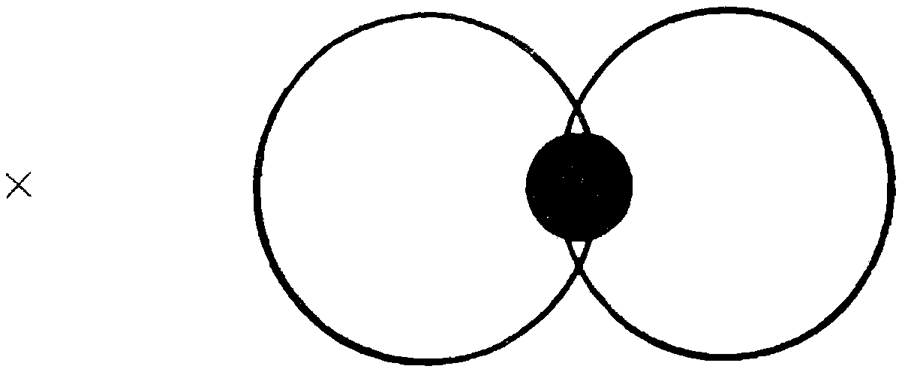
Don't suppose that the blind spot in our field of vision is something quite negligible. As you already know, it's large enough to swallow a rather sizable detail of a drawing, or even the whole head of the man facing you. When you look (with one eye) at a house twenty meters away, there is, because of the blind spot, a fairly extensive part of its front, more than two meters across, that you don't see. And in the starry sky the patch our eye cannot see is equal in area to 120 full moons!
How Big Does the Moon Look to You?
Speaking of the apparent size of the Moon: if you ask your friends how big the Moon looks to them, you'll get all sorts of answers. Most will say that the Moon is the size of a plate, but to others it will seem the size of a jam saucer, a silver rouble or an orange. And there was one boy, they say, to whom the Moon always looked "as big as a round table for twelve."
Where does such a difference in people's ideas come from?
It depends on the different distances at which, without knowing it, they judge the Moon to be. Someone who sees it as big as an orange imagines it to be much farther away than do those to whom it seems the size of a plate. The boy who compared the Moon to a table must have put it very near, somewhere just behind the roof of the house next door...
Quite a few illusions of sight rest on mistaken judgments of distance. I remember well one optical illusion that I experienced in early childhood, in the days, as Pushkin says in "The Demon," "when all the impressions of existence were new to me." I was born in a town, and one spring, on an outing in the country, for the first time in my life I saw a herd of cows grazing in a meadow. I misjudged the distance, and the cows looked to me like pygmies. Such tiny cows I have never seen since, and of course never shall... Very instructive too is Edgar Allan Poe's story of how he took a small insect crawling on the windowpane for a monster such as no one had ever seen, striding through a distant forest at the edge of the horizon.
Similar causes explain the illusion in Figure 94. Looking at it, we're ready to swear that the gentleman walking ahead has been drawn as a giant, nearly twice as tall as the boy. But measure the two figures, and you'll find them strictly equal. We are taken in here only because we're used to seeing distant things made smaller, so that figures in the background of a picture must be drawn smaller than those in the foreground if they are to seem the same size.
How Big Do the Heavenly Bodies Look?
Astronomers measure the apparent size of a heavenly body by the angle under which we see it. Draw two straight lines to the eye from the opposite edges of the body, and the angle between them is what they call its "angular size" (Figure 95). Angles, as you know, are measured in degrees, minutes and seconds. Ask an astronomer how big the Moon's disk looks, and he won't tell you that it's the size of an orange or a plate. He'll tell you that it's about half a degree, by which he means that straight lines drawn to our eye from the edges of the disk make an angle of half a degree. This is the only proper way to state apparent size, and the only one that leaves no room for misunderstanding.
Geometry teaches that an object seen from 57 times its own width must appear under an angle of 1 degree. An orange 7 centimeters across, for instance, will have an angular size of one degree if you hold it 57 times that far from your eye, at 4 meters. Twice as far off it will look half as big, 1/2 a degree, which is exactly the size we see the Moon. You may say, if you like, that the Moon looks to you as big as an orange, but only on condition that the orange is 114 of its own diameters away (8 meters). If you'd rather compare the Moon with a plate, you'll have to move the plate off to some 25 meters. Most people refuse to believe that the Moon looks so small to them. But try putting a kopeck coin, 2.2 centimeters across, at 114 times its diameter from your eye, which is 2 1/2 meters: it will just cover the Moon.
If someone asked you to draw a circle on paper to represent the Moon's disk as the naked eye sees it, the problem would strike you as indefinite: the circle may be large or small, depending on how far it is from the eye. But the conditions become definite at once if we settle on the distance at which we usually hold books, drawings and the like, the distance of distinct vision. For the normal eye it is 25 centimeters.
Let us work out, then, how big a circle we'd have to draw, in the margin of this book for example, to make its apparent size equal to that of the Moon's disk. The sum is simple: divide the distance of 25 centimeters by 114. The answer is tiny, a mere 2.2 millimeters! It's hard to believe that the Moon (and the Sun too, whose apparent size is the same) looks so small to us.
If we kept to this scale and drew the constellation of the Great Bear on paper, the result would be the drawing in Figure 96. Look at it from the distance of distinct vision and you see the constellation exactly as it appears on the vault of the sky. It is, so to speak, a map of the Great Bear at its natural angular scale. If you know well the look of this constellation, by which I mean the actual visual impression as well as the shape, gaze at the map and you'll seem to live through that impression over again. Once you know the angular distances between the chief stars of all the constellations (they're given in astronomical almanacs and similar works of reference), you can draw yourself a whole atlas of the heavens at "natural scale." All you need is some millimeter graph paper, on which you count every 4.4 millimeters as a degree. (The area of the circles that stand for the stars should be in keeping with their brightness.)
Now for the planets. Like the stars, they look so small that to the unaided eye they are mere radiant points. That's only to be expected, because no planet (except perhaps Venus, when she is at her brightest) appears to the naked eye under an angle of more than 1 minute, and 1 minute is the limit at which we can still make out that an object has any extent. Under a smaller angle every object looks to us like a point.
Here are the angular sizes of the planets in seconds. Each planet has two figures: the first is for its least distance from the Earth, the second for its greatest.
| Mercury | 13 to 4 1/2 |
| Venus | 65 to 9 1/2 |
| Mars | 26 to 3 1/2 |
| Jupiter | 51 to 31 |
| Saturn | 20 to 15 |
| Saturn's ring | 48 to 35 |
| (seconds of arc) | |
We can't possibly draw these on paper at "natural scale." At the distance of distinct vision even a whole minute of arc, 60 seconds, comes to only 0.07 of a millimeter, which the naked eye cannot make out. Let's draw the planets' disks, therefore, as they look in a telescope that magnifies 100 times. Figure 97 is a chart of the apparent sizes of the planets under that magnification. The arc at the bottom is the edge of the disk of the Moon (or the Sun) as seen in a telescope magnifying a hundredfold.
Above it is Mercury, at its least, mean and greatest distance from the Earth. Higher still is Venus in her various phases. When this planet is nearest us we can't see her at all, because she turns her unlit half to the Earth. Then her narrow crescent becomes visible, the largest of all the planetary disks. Through her later phases Venus keeps shrinking, and her full disk is one sixth as wide as the narrow crescent.
Next above comes Mars. On the left you see it at its closest approach to the Earth, as a telescope magnifying 100 times shows it to us. What can anyone make out on so small a disk? Imagine this little circle magnified ten times more, and you'll have an idea of what the astronomer sees who studies Mars in a mighty telescope with a magnification of 1,000. In so cramped a space, can he be certain of catching such fine details as the notorious "canals," or of noticing a slight change of tint said to come from vegetation on the floor of that world's "seas"? No wonder the reports of some observers flatly contradict those of others, and what some see distinctly others take for an optical illusion...
The giant Jupiter and his satellites occupy a very prominent place in our chart. His disk is much larger than that of any other planet except Venus, and his four chief satellites are strung out along a line nearly half as long as the Moon's disk is wide. Jupiter is shown here at his closest to the Earth. Last of all, Saturn, with its rings and the largest of its moons, is also a fairly conspicuous object when it is nearest to us. But of course Jupiter and Saturn look large because they are enormous, and the details that escape us on the surface of these planets are incomparably coarser than those we miss on Mars.
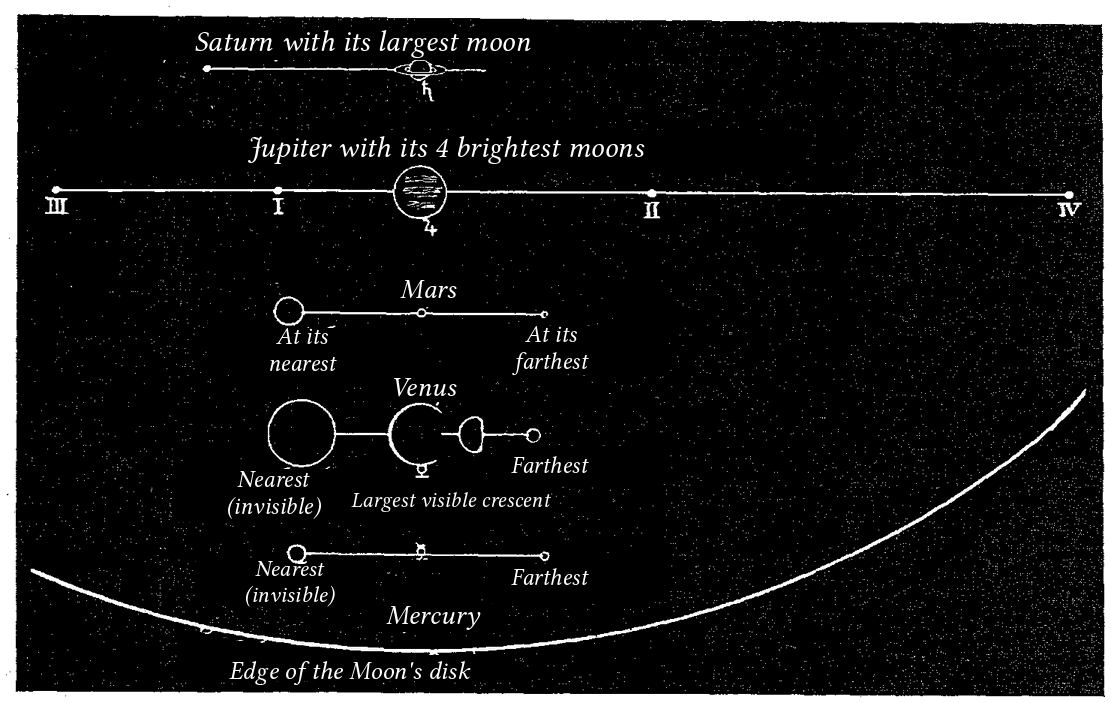
Self-Deceptions of Sight
We often speak of "deceptions of sight" or "deceptions of hearing," but these expressions are wrong. There are no deceptions of the senses. The philosopher Kant put it very aptly: "The senses do not deceive us, not because they always judge correctly, but because they do not judge at all."
Who is it, then, that deceives us in these so-called deceptions of the senses? Whoever does the judging, of course, and that is ourselves, our own mind. Most optical illusions do in fact arise solely because, besides seeing, we also unconsciously reason, and in doing so we mislead ourselves without meaning to.
Take an optical illusion that everyone knows. Figure A (Figure 98) seems taller and narrower than figure B, though both fit exactly the same square. The reason is that we arrive at the height of A by unconsciously adding up its separate gaps, and it therefore seems to us greater than the equal width of the same figure. In B, by the same unconscious reasoning, the width seems greater than the height.
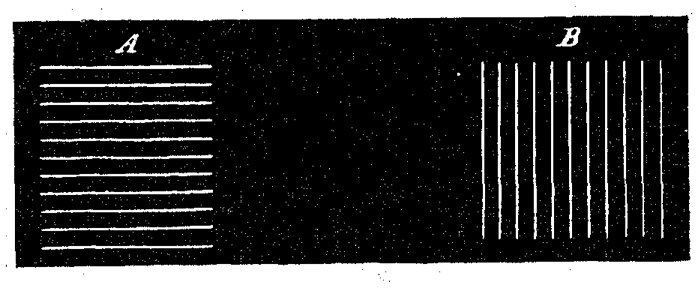
An Illusion Useful to Tailors
If you try to apply this illusion to larger figures, too large for the eye to take in at once, you'll be disappointed. A short, stout man in a suit with stripes across it will look no thinner. On the contrary, he'll look wider still. And stout people who put on clothes with lengthwise stripes and folds can, to some extent, conceal their stoutness.
This illusion comes about because, as we look at such clothes, our eyes involuntarily travel along the stripes, and the effort of the eye muscles makes us unconsciously exaggerate the size of the thing in the direction of the stripes. We are used, after all, to associating an effort of the muscles that move our eyes with large objects, the kind that don't fit into the field of view. When we look at a small striped drawing, on the other hand, our eyes stay still, and the muscles therefore don't tire.
Which Is Larger?
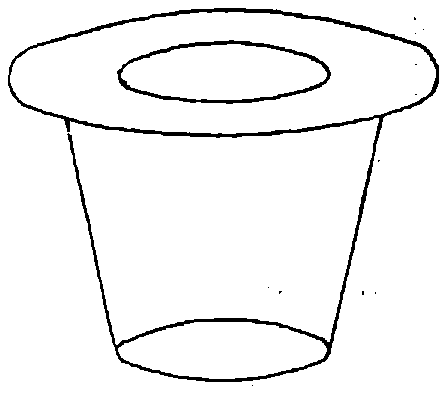
Which oval in Figure 99 is larger, the lower one or the inner one at the top? It's hard to shake off the idea that the lower is bigger than the upper. And yet the two ovals are equal, and it's only the outer oval that creates the illusion that the one enclosed in it is smaller than the one below. The illusion is strengthened because we see the whole figure as solid rather than flat, as a bucket, say: without meaning to, we turn the ovals into circles foreshortened by perspective, and the straight lines at the sides into the walls of the bucket.
The same peculiarity of our sight shows most strikingly in Figure 100. Two equal circles are drawn between the sides of an angle, but the eye refuses to admit that they're equal. You can see plainly that the left-hand circle, the one nearer the vertex, is larger than the right. Turn the drawing any way you like, and the illusion remains. The sharper the angle, the stronger the deception.
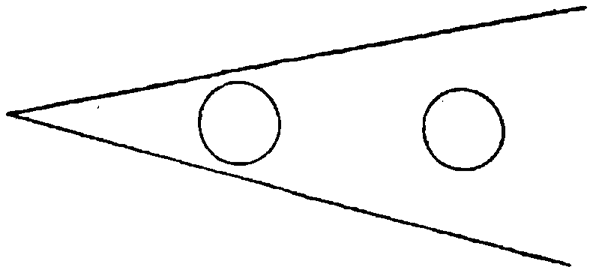
We seem in general to be inclined to exaggerate the size of figures enclosed between diverging straight lines, close to the vertex of the angle. Just as in Figure 100 the circle pushed closer to the vertex looks larger, in Figure 101 the distance between the points X and Y seems greater than the distance between M and N. A third line drawn from the same vertex strengthens the illusion further.
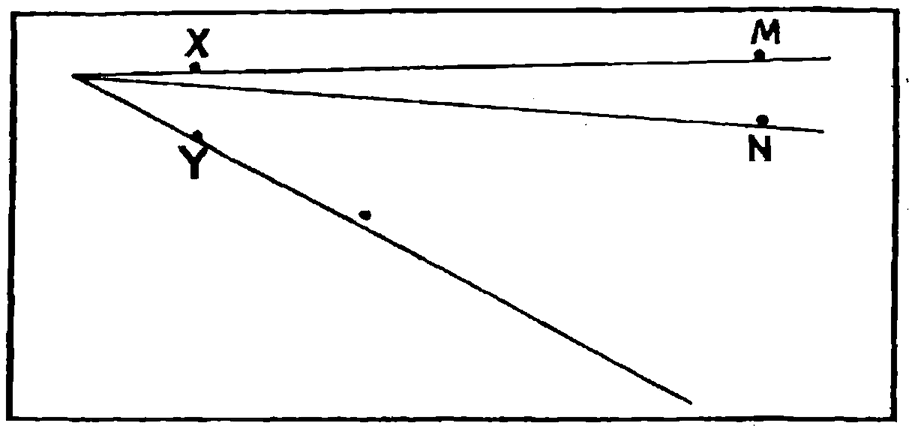
Some people suppose that the well-known illusion by which the heavenly bodies look larger near the horizon is a deception of just this kind. When we look at the Moon, the Sun or some constellation near the horizon, it seems to us to be wedged into a dihedral angle, the angle between two planes: one side of it is the surface of the ground, and the other is the part of the sky's vault that leans over it. From what we've just seen, a body placed in this way ought to look larger to us than when it is near the zenith. This new explanation must be about the tenth attempt to account for the famous "astronomical illusion," which has been known since the time of Ptolemy.
The Power of Imagination
Most optical illusions, as we have said, arise because, besides looking, we unconsciously reason as we look. "We see with our brain, not with our eyes," the physiologists say. You'll readily agree with them when you meet illusions in which the viewer's imagination takes a conscious part in the act of seeing.
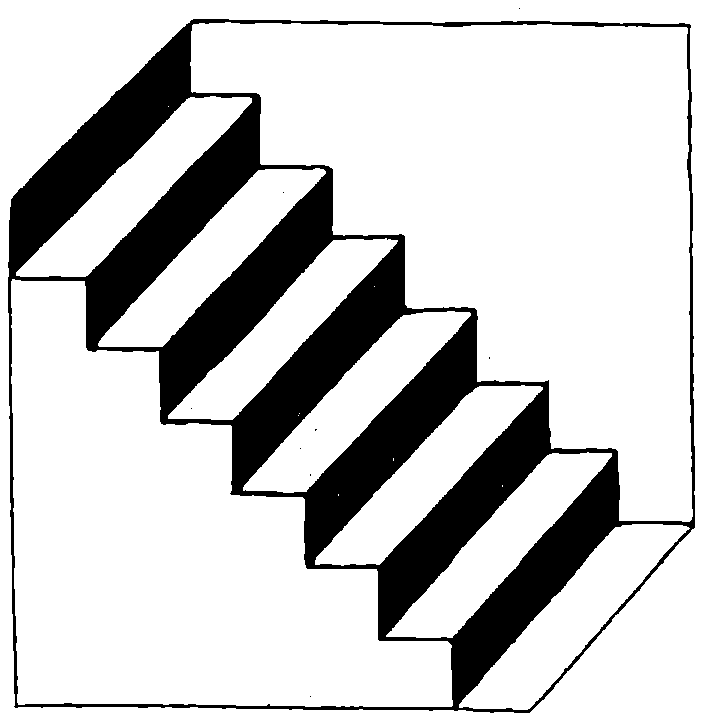
Take Figure 102.
If you show it to your friends, you'll get three different answers to the question of what it represents. Some will say it's a staircase; others, a niche sunk in a wall; and others again will see a strip of paper folded like an accordion and stretched diagonally across the gray field of the square.
And strange as it is, all three answers are right! You can see all these things for yourself if you direct your gaze in different ways. As you look at the drawing, try first turning your eyes to its left-hand part, and you'll see a staircase. Next, let your gaze slide across the drawing from right to left, and you'll see a niche. Finally, let your gaze slide along the diagonal, from the lower right corner to the upper left, and you'll see a strip of paper folded like an accordion.
If you look at the drawing for a long time, however, your attention will tire, and you'll see now one thing, now another, now the third, whether you wish to or not.
Figures 103 and 104 have the same peculiarities.
More Optical Illusions
But we are far from being able to explain every optical illusion. Often we can't even guess what kind of inference our mind is unconsciously making to produce this or that deception. Why, for example, does a square standing on its corner look larger to us than the same square resting on one of its sides (Figure 105)? Why, in Figure 106, does the eye refuse to admit that the middle parts of these broken lines are parallel to one another? The drawing seems clear enough!
In Figure 107 you distinctly see two arcs bulging toward each other. It doesn't even occur to you to doubt it. Yet you have only to lay a ruler along these supposed arcs, or hold the figure level with your eyes and look along them, to be convinced that they're straight.
Here is another curious illusion. Look at Figure 108 and tell me which lines are longer, the vertical or the slanting ones. The vertical ones look longer, though the two sets are equal.
More striking still is the illusion in Figure 109. In the top drawing, compare the length of the strokes on the left with those on the right: the first look longer than the second, though they are equal. The illusion is sharper in the middle drawing, which differs from the top one only in having its lines closer together; you simply don't want to believe that the strokes on the left are no longer than those on the right. The bottom drawing of the same figure, lastly, gives the outline of the first two filled in with black, and it looks like a simplified silhouette of a tobacco pipe. The horizontal sections of the pipe's two parts are strictly equal, though our eye refuses to agree.
Many explanations have been offered for these curious illusions, but they aren't very convincing, and we won't go into them here. One thing seems beyond doubt: the cause of these illusions lies in unconscious reasoning, in the mind's involuntary "cleverness," which keeps us from seeing what is really there.
What Is It?
When you look at Figure 110 you'll hardly guess at once what it represents. "Just a black mesh and nothing more," you'll say. But stand the book upright on the table, step back three or four paces, and look from there. You'll clearly see a human eye. Come closer, and once again there's nothing before you but a meaningless mesh...
You'll think, of course, that this is some ingenious engraver's clever trick. No: it's only a crude example of the illusion we fall under every time we look at "halftone" illustrations, or "autotypes," as they're called. In books and magazines the background of a picture always looks solid to us. But examine it through a magnifying glass, and you'll find exactly the same kind of mesh as in Figure 110. The drawing that puzzled you so much is simply a greatly enlarged piece of an ordinary halftone illustration. The only difference is that when the mesh is fine, it merges into a solid background even close up, at the distance where we usually hold a book to read. When the mesh is coarse, it takes a correspondingly greater distance to merge.
Extraordinary Wheels
Have you ever watched, through the slats of a fence or, better still, on a movie screen, the spokes of the wheels of a fast-moving carriage or automobile? You've probably noticed a strange thing: the automobile is tearing along at dizzying speed, and yet its wheels are barely turning, or not turning at all. What's more, they sometimes turn the opposite way!
This is only an optical illusion, of course, but so extraordinary a one that it positively bewilders everyone who notices it for the first time.
The explanation of this odd deception is as follows. When we watch a wheel turning through the gaps in a fence, we don't see its spokes continuously. We see them at equal intervals of time, because again and again the slats hide them from us for a moment. In just the same way a strip of movie film records the wheels with interruptions, at separate moments. Three cases are possible here, and we'll now take them one by one.
In the first place, it may happen that during the interruption the wheel has time to make a whole number of turns. It doesn't matter how many, 2 or 20, as long as the number is whole. The spokes of the wheel will then be in the same position in the new picture as in the last. In the next interval the wheel again makes a whole number of turns (since neither the length of the interval nor the speed of the automobile changes), and the position of the spokes again stays the same. Seeing the spokes in one and the same position all the time, we naturally conclude that the wheel isn't turning at all.
The second case: in each interval the wheel has time to make a whole number of turns plus a small fraction of a turn (1/100, say). As we watch one such picture follow another, we have no way of guessing at the whole turns, and will see only that the wheel is turning slowly (by 1/100 of a turn each time). It will seem to us, accordingly, that although the automobile is moving fast, its wheels are turning with extreme laziness.
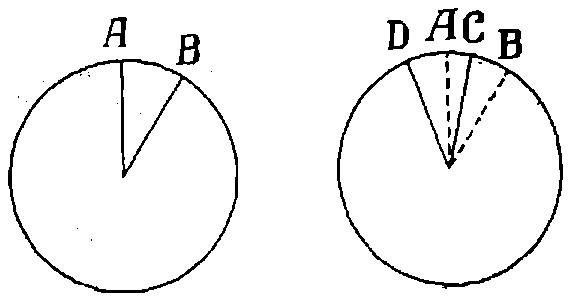
The third case is easier to consider from a drawing (see Figure 111). Two neighboring spokes A and B were at first in the position shown in the left-hand drawing. By the next picture the wheel has made a number of turns to the left, and the same spokes have taken up the positions marked D and C. Since the arc AC is smaller than the arc AD, it will seem that spoke A has turned back to the point C, instead of forward to the point D. In other words, we take spoke B for a spoke A that has moved backward (all the spokes, after all, look alike). As a result it will seem to us that the wheel is turning in the opposite direction. And this false impression will last until the automobile changes its speed enough for the arc AC to become larger than the arc AD.
It only remains to make a small correction in our explanation. In the first case, for the sake of simplicity, we spoke of complete turns of the wheel. But since the spokes are all alike, it's enough for the wheel to turn through a whole number of the spaces between spokes. The same applies to the second case.
When the movies show ordinary scenes, this illusion, of course, does little harm to the naturalness of the impression. But when someone wants to use the screen to explain the working of a machine, the deception may give rise to very serious misunderstandings, and may even convey a completely false notion of how the machine works.
Why Is the Hare Cross-Eyed?
Man is one of the few creatures in the world whose eyes are adapted to looking at one and the same object together. The field of view of his right eye differs only slightly from that of his left. Most animals look with each eye separately. The things they see don't stand out in the relief that we're accustomed to, but on the other hand their field of view is far wider than ours. Figure 112 shows man's field of view: each eye sees within an angle of 120 degrees, and the two angles almost cover each other.
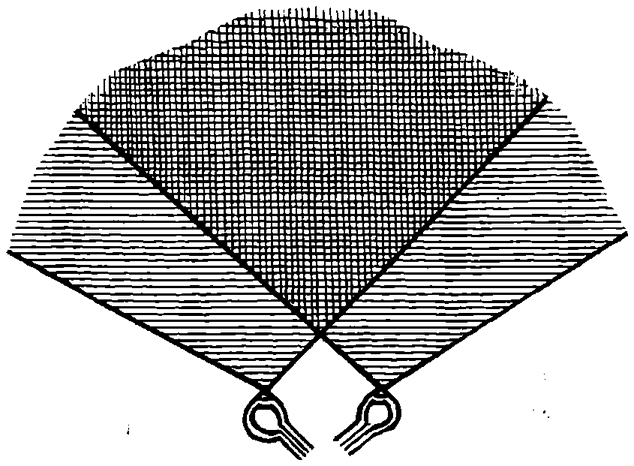
Compare this drawing with Figure 113, which shows the field of view of the hare, "cross-eyes" to every Russian.76 Without turning its head, the hare, with its eyes set wide apart on the two sides, sees what is in front of it and what is behind it as well. The fields of its two eyes meet both before and behind! Now you understand why it's so hard to creep up on a hare without startling it. In exchange, though, the hare doesn't see at all what lies right in front of its muzzle. To see a thing very close to it, it has to turn its head to one side.
Almost all defenseless hoofed and cud-chewing animals also have this ability to see "all round." Their images, it's true, are less distinct, but not the slightest movement anywhere around it escapes the animal. Agile beasts of prey, which more often have to be the attackers themselves, lack this ability to see all round. They have "two-eyed" vision instead, which lets them judge accurately the distance of a leap.
The Pressure of Light
"When we see the havoc wrought on a sea-wall by a storm," says an English physicist,77 "it is easy to believe that ocean waves exert a pressure against the shore on which they beat. But it is not easy to think that the tiny ripples of light also press against every body on which they fall, to think that when a lamp is lighted waves of pressure are sent out from it — pressing against the source from which they start, pressing against every surface which they illuminate. Yet we now know certainly that light does exercise such pressure."
I hasten to add that this pressure is extremely slight: the Sun's rays press on the Earth's surface with a force of one milligram to the square meter. On the whole of the side of the globe that faces the Sun they exert a pressure of about 100,000 tons.78 This figure seems colossal, of course, but it will lose much of its grandeur when I tell you that it is 50 trillion times (50 million million times) smaller than the force with which the Sun attracts the Earth!
For small bodies the ratio of light pressure to attraction is a larger fraction than it is for the globe. That's natural, because the pressure of light is proportional to a body's surface, and attraction to its mass. If the Earth's diameter were halved, for example, its volume and mass would be 8 times smaller, and its surface 4 times smaller. Attraction would therefore fall to an eighth, but the pressure of the rays only to a quarter.
A curious consequence follows from this. Since the repelling force of the Sun's rays falls off more slowly, as the diameter of the illuminated body shrinks, than the attracting force does, it's clear that for some very small size of body the two forces must become equal. It has been calculated that for a microscopically small droplet of water, 3/4 of a micron79 across, the pressure of sunlight equals the Sun's attraction. Such a droplet behaves, in other words, as if the Sun did not attract it. For droplets smaller still, the force of light pressure must actually exceed the Sun's attraction, and such a droplet will be repelled by the rays of the Sun. The excess of light pressure over attraction is, to be sure, a trifling force in this case. But don't forget that the weight of the droplet is also immeasurably small. It isn't surprising, therefore, that the speed light imparts to such a droplet may reach an enormous value: several hundred or even several thousand kilometers a second!
You won't think it strange now that the tiniest inhabitants of the globe, certain bacteria and especially their spores (their germs), may, once they have reached the limits of the atmosphere, leave our planet and be swept off into boundless space at an enormous and ever-growing speed of hundreds and thousands of kilometers a second. The well-known Swedish scientist Svante Arrhenius even allows that in this way the germs of life may be carried from planet to planet... Such a speed is more than enough to overcome the Earth's attraction, for at a mere 11 kilometers a second a body must leave the Earth's surface forever. With a speed of 500 kilometers a second, for example, a bacterium would cover in one day a distance equal to the diameter of the Earth's orbit, would reach Neptune in a few weeks, and within a few centuries could be carried into the neighborhood of the nearest fixed stars.80
Across the Ocean of the Universe
If you have a lively imagination, you surely thought as you read those last lines: couldn't man, too, use the same method for traveling between the planets? The idea is so tempting that it's worth dwelling on for a little.
In essence, the question comes down to building a vessel whose ratio of surface to mass would be as favorable as that of the tiniest bacteria. Calculation shows that a mirror with an area of one square meter must weigh only two grams if the pressure of light is to carry it off into space at hundreds of kilometers a second. If this sheet of metal were made of silver, we would have to flatten it, to bring its weight down to 2 grams, to a thickness of 0.1 micron, or one ten-thousandth of a millimeter.81 Gold (though not silver) we can beat out to precisely that thickness. But metal leaf as thin as this becomes to some extent transparent to light, and the pressure of the rays on it is therefore considerably weakened.
But let us suppose for a moment that engineers have overcome this obstacle. Say we have at our disposal a metal alloy fully ten times lighter than silver, which can be beaten out to a thickness of one tenth of a micron and still reflect light completely. How large a mirror of this metal do you think we would need, if under the blows of the light rays it were to carry off into space a cabin with passengers and all the necessary supplies? It's easy to calculate that the mirror would have to have an area of no less than several square kilometers!
Even the imagination of novelists stops short of building so gigantic a mirror, to serve as a kind of sail for journeys between the planets. In one Russian astronomical novel, for instance, the author preferred to suppose that physicists are mistaken about the true size of the pressure of light, and that in reality it is 1,000 times greater than we think. On this assumption (which, by the way, would badly upset the motion of the planets and especially of the comets) the novelist does of course manage to build an interplanetary ship that fully meets the needs of a fantastic novel but, alas, cannot possibly be built in real life...
Chapter 10: Sound and Wave Motion
Sound and the Bullet
When the passengers in Jules Verne's shell flew off to the Moon, they didn't hear the report of the colossal cannon that had hurled them from its muzzle. It couldn't have been otherwise. However deafening the roar, it traveled (like any sound in air) at only 330 meters a second, and the heroes of the novel were racing along inside it at 11,000. Naturally the sound of the shot could never catch up with the shell and reach its passengers' ears.
You'll probably want to know how things stand with real shells and bullets. Do they move faster than sound? Or does sound overtake them and warn the victim that the deadly missile is coming?
When a modern rifle is fired, it gives the bullet a speed nearly twice that of sound in air, about 600 meters a second (the speed of sound at 0 degrees Celsius is 332 meters a second). Sound, it's true, travels uniformly, and the bullet slows down all through its flight. For the greater part of its path, however, the bullet still moves faster than sound. It follows directly that if, during an exchange of fire, you hear the report of a shot or the whistle of a bullet, you needn't worry: that bullet has already passed you. The bullet outruns the sound of the shot, and it outruns its own whistle too. If you are fated to be its victim, the bullet will hit you before the sound of the shot or the whistle of its flight can reach you.
The Imaginary Explosion
The race between a flying body and the sound it makes sometimes leads us, without our meaning it, to mistaken conclusions that have nothing to do with what really happened.
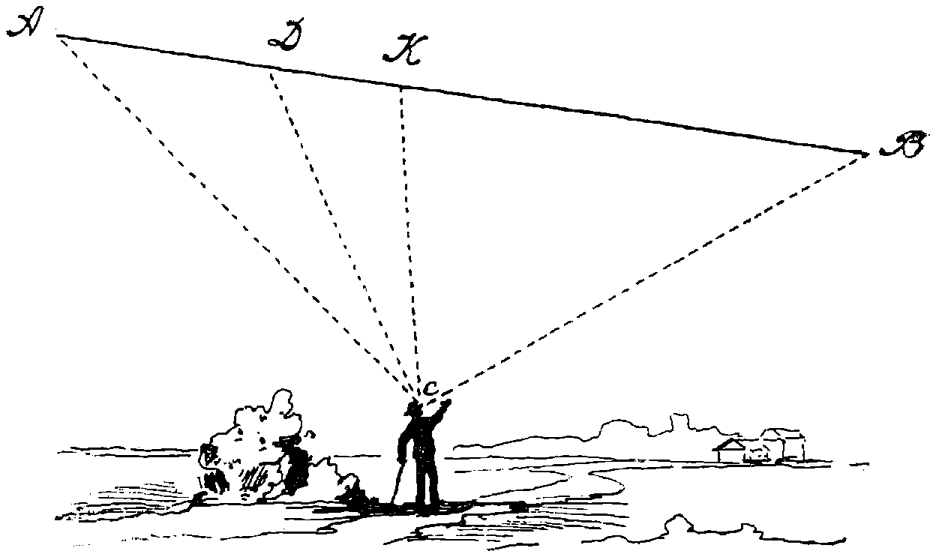
A curious example is a bolide, one of those great meteors, flying high above our heads. The bolides that enter our planet's atmosphere from outer space have an enormous speed, which, even when the resistance of the atmosphere has reduced it, is still tens of times faster than sound. As they plow through the air and heat it white-hot, bolides often make a noise like thunder.
Imagine that we are at the point C, and that up above us a bolide is flying along the line AB (Figure 114). The sound the bolide makes at A will reach us at C only when the bolide itself has had time to move on to B. Since it flies much faster than sound, it can get to some point D and from there send us a sound that reaches us before the sound from A does. We'll therefore hear the sound from D first, and only afterward the sound from A. And since the sound from B will also reach us later than the sound from D, there must be a point K, somewhere above our heads, from which the bolide gives us its very earliest signal.
Here is the result: what we hear will be quite unlike what we see. To the eye, the bolide appears first at A, and from there it flies along the line AB. But to the ear, the bolide appears first somewhere at K, over our heads, and then we hear two sounds at the same time, dying away in opposite directions, from K toward A and from K toward B. We hear the bolide, in other words, break into two parts that fly off opposite ways. And in reality no explosion took place. That's how deceptive our impressions of sound can be!
A Happy Accident
If sound traveled through the air a good deal more slowly than 330 meters a second, we'd meet all kinds of deceptive sounds much more often.
Imagine, for example, that in a second sound covered 330 millimeters instead of 330 meters, so that it moved more slowly than a man on foot. You're sitting in an armchair, listening to a story told by a friend who has the habit of pacing up and down the room as he talks. Ordinarily his pacing doesn't stop you listening in the least. But with the speed of sound cut down, you'll understand absolutely nothing your guest is saying. The sounds he uttered earlier will mix with the new ones, and the result will be a jumble without any sense.
What's more, at the moments when your guest is walking toward you, the sounds of his words will reach you in reverse order. First you'll hear the sounds he has only just uttered, then those he uttered earlier, then those earlier still, and so on, because the speaker outpaces his own sounds and stays ahead of them all the time while he goes on producing new ones. Of all the sentences spoken under such conditions, you could perhaps make out only one of the kind that reads the same in both directions. With such a sentence an overgrown seminary student once astonished the young Karas, as the writer Pomyalovsky calls himself in his tales of seminary life.82 In English the sentence would be the one put into the mouth of Napoleon:83
ABLE WAS I ERE I SAW ELBA.
We should be grateful to fate for the happy accident that sound covers hundreds of meters in the air every second. If its speed were much smaller, we might have had to give up talking aloud altogether...
The Slowest Conversation
If you think that the actual speed of sound in air, a third of a kilometer a second, is always fast enough, you're about to change your mind.
Imagine that Moscow and Petrograd are joined by an ordinary speaking tube in place of the electric telephone, a tube like those that connect the separate rooms of big shops. You stand at the Petrograd end of this 640-kilometer tube, and the person you're talking to is at the Moscow end. You ask him a question and wait for an answer. Five minutes go by, ten, fifteen: no answer. You begin to worry, and think that something dreadful has happened to your friend. But your fears are groundless. Your question hasn't reached Moscow yet; by now it's only halfway there. Another quarter of an hour will pass before your friend in Moscow hears the question and can reply. But his reply, too, will take no less than half an hour to travel from Moscow to Petrograd, so that you'll get the answer to your question only after an hour.
You can check the sum yourself. From Petrograd to Moscow is 640 kilometers; sound covers 1/3 of a kilometer in a second; it will therefore cross the distance between the two capitals in 1,920 seconds, or about half an hour.
You can see that under these conditions, talking all day from morning to evening, you'd hardly manage to exchange ten sentences.
By the Quickest Route
There was a time when sending news in this way was thought very fast. A hundred years ago nobody yet dreamed of the electric telegraph and telephone, and to pass a piece of news across 640 kilometers in a few hours was considered the ideal of speed.
They say that at the coronation of the Emperor Paul I, word of the moment when the ceremony began in Moscow was sent to Petrograd as follows. Soldiers were stationed all along the road between the two capitals, 200 meters apart. At the first stroke of the bell of the Cathedral of the Assumption, the nearest soldier fired into the air; his neighbor, on hearing the signal, at once fired his own gun; after him the third sentry fired, and in this way the signal was passed to Petrograd in no more than three hours. Three hours after the first stroke of the bell in Moscow, the guns of the Peter and Paul Fortress were already thundering.
If people in Petrograd could have heard the ringing of the Moscow bells directly, the sound, as we know by now, would have reached the northern capital only half an hour late. Of the three hours spent in passing the signal, therefore, 2 1/2 went on the soldiers' taking in the sound and making the movements needed to fire. Each of these delays was trifling, but thousands of such little intervals added up to 2 1/2 hours.
The Drum Telegraph
Sending news by sound signals is still very common among the native peoples of Africa, Central America and Polynesia. They use special drums for the purpose, and with them they send sound signals over enormous distances. An agreed signal, heard in one place, is repeated in another and so passed on farther, and in a short time the people of a vast region learn of some important event.
During Italy's war with Abyssinia, the Emperor Menelik quickly learned of every movement of the Italian troops. This baffled the Italian army staff, who had no suspicion that the enemy possessed a sound telegraph.
The same thing was observed during the Boer War. Thanks to the "telegraph" of the African peoples of the region, all the news of the war spread with extraordinary speed among the inhabitants of Cape Colony, running several days ahead of the official dispatches carried by courier.
Soundless Sounds
There are people who cannot hear at all such shrill sounds as the song of a cricket or the squeak of a bat. Don't imagine that they're deaf. Their organs of hearing are in perfect order, and yet they don't hear very high tones. Tyndall, the famous English physicist, maintained that some people cannot even hear the chirping of a sparrow!
Our ear, in general, is far from picking up all the vibrations that take place around us. If a body makes fewer than 16 vibrations a second, we hear no sound. If it makes more than 40,000, again we hear nothing. The upper limit for hearing tones differs from person to person, and this gives rise to the strange situation in which a piercing, high-pitched tone that one person hears distinctly seems not to exist for another. Many insects (the cricket, for example) make sounds whose tone answers to 40,000 vibrations a second.84 For some ears these tones exist, for others they don't, and people insensitive to high tones enjoy perfect silence where others hear a whole chaos of piercing sounds. Tyndall tells how he once observed such a case while out walking in Switzerland with a friend: "The grass at each side of the path swarmed with insects, which to me rent the air with their shrill chirruping. My friend heard nothing of this, the insect-music lying quite beyond his limit of audition."
The bat's squeak is a whole octave lower than the piercing song of insects; in other words, its vibrations of the air are half as frequent. But there are people for whom the limit of hearing lies lower still, and to them bats are voiceless creatures.
For Whom Does a Daily Paper Come Out Twice a Day?
We'll now take up a problem that seems to have nothing to do with sound, or with physics at all. All the same, I'll ask you to give it a minute of your attention, since it will make some of what follows easier to understand.
You've probably met this problem before in one of its many variations. Every noon a train leaves Petrograd for Vladivostok (it doesn't, but let's imagine that it does). And every noon a train also leaves Vladivostok for Petrograd. Let's say the journey takes 20 days. The question is: how many long-distance trains will you meet on your way from Vladivostok to Petrograd?
The usual answer is 20. Even some scholars gave that answer when, at a congress of mathematicians, one of them put the problem to his colleagues over lunch. But the answer is wrong. You'll meet the 20 trains that leave Petrograd after your departure, and besides these the 20 that were already on their way when you set out. The right answer, therefore, is 40 and not 20.
To go on: every Petrograd train carries fresh copies of the capital's newspapers. If you take an interest in the news from Petrograd, you'll of course be busily buying papers at the stations. How many fresh issues of each newspaper will you buy in your 20 days on the road?
You'll have no trouble now in giving the right answer: 40. Every train you meet brings new issues, and since you meet 40 trains, you'll also read 40 issues of the paper. But you're traveling for only 20 days, which means that you'll be reading a daily paper twice a day!
The conclusion is a little unexpected, and you probably wouldn't have believed it at once if you hadn't had occasion to see in practice that it's true. Remember, for instance, how on the two-day journey from Kiev to Petrograd you had time to read the Petrograd papers for four days instead of two: the two issues that had already come out in Petrograd when you left, and the two more that came out during your two days on the way.
You know now for whom the capital's daily papers come out twice a day: for the passengers of all the mail trains traveling to the capital.
Give rein to your fancy, and you can picture some extremely naive provincial who for the first time in his life is making the long journey to Petrograd. What will he think of the pace of Petrograd life, if he judges it by the papers and quite forgets that he's reading them in a moving train? He might think that time in Petrograd flows twice as fast as in his home town, that there are 14 days in a week there, that a day and night last only 12 hours, and that when someone from the capital says "yesterday" he means "this morning"...
Nobody, of course, could deceive himself so far. But in another field, as you'll now see, we quite often fall victim to just this illusion.
The Problem of the Locomotive Whistles
If you have a good ear for music, you've probably noticed how the pitch of a locomotive's whistle (its pitch, not its loudness) changes when an oncoming train rushes past your own. While the two trains were drawing together, the tone was noticeably higher than the one you hear when they are moving apart. If the trains are going fast (50 kilometers an hour), the difference in pitch amounts to nearly a whole tone.
Why does this happen?
You'll have no trouble guessing the reason if you remember that the pitch of a tone depends on the number of vibrations. Set this beside what you learned from the problem we've just discussed. The whistle of the oncoming locomotive gives out one and the same sound all the time, with a definite number of vibrations. But the number of vibrations your ear receives depends on whether you are traveling toward their source, standing still, or moving away from it.
Just as, on your way to Petrograd, you read the daily paper more than seven times a week, so here, as you approach the source of the sound, you catch the vibrations more often than they leave the locomotive's whistle. But now you don't reason about it as you did before. Your ear receives a greater number of vibrations, and you hear a higher tone. As you move away you receive fewer vibrations, and you hear a lower tone.
If this explanation hasn't entirely convinced you, try following directly (in thought, of course) how the sound waves spread from the whistle. Look first at the locomotive standing still (Figure 116b, above). Its whistle makes waves in the air, and for simplicity we'll consider only 4 of them. From a locomotive at rest, these waves will in any given interval of time spread the same distance in all directions. Wave No. 0 will take just as long to reach observer A as to reach observer B. Then wave No. 1 will reach both observers at the same moment, and No. 2, and then No. 3, and so on. The ears of both observers receive the same number of impulses in a second, and both therefore hear one and the same tone.
It's another matter if the whistling locomotive is moving from B toward A (the lower drawing). Suppose that at some moment the whistle is at the point C, and that in the time it takes to send out four waves it has got to the point D. Now compare how the sound waves will spread. Wave No. 0, which left the point C, will reach the two observers A and B at the same time. But the fourth wave, formed at the point D, will no longer reach them together: the path DA is shorter than the path DB, and the wave will therefore arrive at A earlier than at B. The waves in between, No. 1 and No. 2, will also come to B later than to A, though with less delay. And the result? The observer at A will receive the sound waves at shorter intervals than the observer at B, and will hear a higher tone. At the same time, as you can easily see from the drawing, the waves running toward A will be correspondingly shorter than those going toward B.85
Doppler's Principle
The effect we've just described was discovered some 70 years ago by the physicist Doppler, and has been linked ever since with his name. The law by which the frequency of waves changes as observer and source approach or recede is called in physics "Doppler's principle." It applies to light as well as to sound, because light, too, travels in waves. When the waves come more often (which in sound we perceive as a rise in pitch), the eye sees a change of color. Doppler's principle gives astronomers a marvelous power: they can discover whether a star is approaching us or receding, and can even measure how fast it does so.
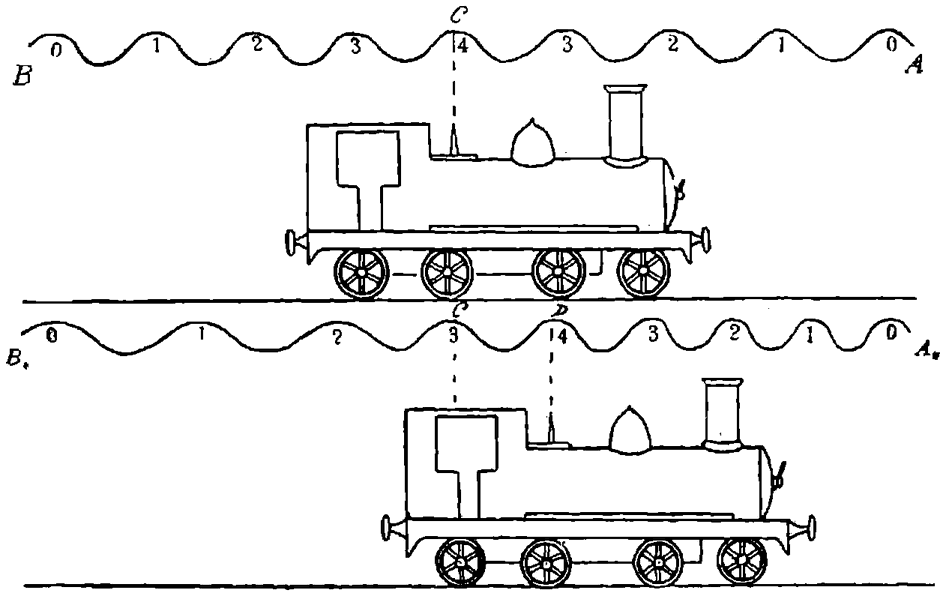
What helps the astronomer here is the sideways shift of the dark lines that cut across the band of the spectrum. By studying attentively which way, and how far, these dark lines have shifted in the spectrum of a heavenly body, astronomers have made a whole series of amazing discoveries. Thanks to "Doppler's principle," for example, we now know that the bright star Sirius is moving away from us by 35 kilometers every second!86 This star is at so unimaginably vast a distance from us that even when it recedes by trillions of kilometers, its apparent brightness doesn't change.
"With every year," says Camille Flammarion, "the distance that separates us from Sirius grows by 1,000 million kilometers, by more than 2 1/2 million kilometers in a single day! And yet in the four thousand years that have gone by since human eyes first rested on this beautiful star, its brilliance has not altered! In these thousands of years of observation the star has traveled hundreds of thousands of millions of kilometers, or even trillions. Between the present position of Sirius and its position four thousand years ago the difference must be no less than 4 trillion kilometers; and in spite of such a difference Sirius has not, so far as we can see, lost any of its brightness, and to this day keeps its kingly place among all the stars!"
We should probably never have found out about the motion of this star if Doppler's principle hadn't helped us.
This example shows with striking clarity that physics is truly an all-embracing science. Having discovered a law for waves of sound, which are up to several meters long, it confidently applies that law to the unimaginably small waves of light, only a few ten-thousandths of a millimeter in length. And then, with extraordinary precision, it uses this knowledge to measure the mighty motions of gigantic suns.
At the Speed of Sound
What would you hear if you were moving away from a playing orchestra at the speed of sound?
A man traveling from Petrograd by mail train sees the same issues of the papers with the newsvendors at every station, namely those that came out on the day he left. That's natural, because these issues travel along with the passenger, and the fresh papers are carried by trains a long way behind. On these grounds we might perhaps conclude that, if we moved away from the orchestra at the speed of sound, we would hear one and the same note all the time, the one it was playing at the moment we set off.
But the conclusion is wrong. If you are moving away at the speed of sound, the sound waves don't strike your eardrum at all, and you therefore cannot hear any sound whatever. You'll think that the orchestra has suddenly stopped playing.
Why, then, did the comparison with the newspapers lead to a different answer? Simply because in this case we misapplied our reasoning by analogy. The passenger who meets the same issues everywhere will imagine (or rather would imagine, if he forgot that he was moving) that the capital has stopped bringing out new issues altogether since the day he left. For him the newspapers would have ceased to exist, just as sound would cease to exist for the moving listener.
The Rebirth of an Old Mistake
Curiously enough, even scientists can sometimes get confused over this question, though it isn't really so complicated. In an argument with me, one astronomer (no longer living) disagreed with this solution to the last problem and insisted that, if we move away at the speed of sound, we must hear one and the same tone all the time. He defended his view with the following reasoning (I quote a passage from his letter):
"Let a note of a certain pitch be sounding. It has sounded so for a long time and will go on sounding indefinitely. Observers placed here and there in space hear it one after another and, let us suppose, undiminished. Why then could you not hear it, if with the speed of sound or even of thought you were carried to the place of any one of these observers?"
In just the same way he argued that an observer moving away from a flash of lightning at the speed of light would go on seeing the flash without interruption:
"Imagine," he wrote to me, "an unbroken row of eyes in space. Each of them will receive the impression of light after the one before. Imagine that in thought you can be in the place of each of these eyes in turn, and obviously you will see the lightning all the time."
Neither statement, of course, is true: in the circumstances described we won't hear the sound and won't see the lightning. I dwell on these mistaken arguments because, unfortunately, we come across them even in books by well-known scientists. Flammarion, for example, makes the very same mistake in his scientific romance Lumen.87
Such arguments are remarkably like Zeno's famous sophism that a flying arrow is motionless. The root of the mistake is the same in all these cases. If at every point of space a motionless observer sees the lightning and hears the sound, we have no right to claim that he will also see and hear them while he is moving through space... Once the observer moves, he is no longer motionless, and what is true only of a motionless observer can no longer be applied to him.
Light and Time
Let us make use once more of our talk about trains and newspapers, and draw attention to a curious fact in the realm of light. Waves of light are just like those issues of the paper: if we move swiftly toward them, we'll meet them more often than they left their source. And here we are exactly like that imaginary provincial who thinks that time flows faster in Petrograd than in his home town.
Remember how the speed of light was first determined. One of Jupiter's satellites, which goes around the planet in 42 hours, plunges into its shadow at every revolution. We can easily observe this eclipse from the Earth; and, knowing how long the satellite takes to go around, we can calculate beforehand the moments when the eclipse begins and ends. It turned out, however, that the calculations and the observations disagreed. When the Earth is nearer to Jupiter, the eclipses come earlier than they do when the Earth is farther from that planet. From this astronomers concluded that light needs a certain time to cover the extra distance.
That's one conclusion. But notice a second, which is also very curious: when we are approaching Jupiter's system, the motion of the satellite looks to us faster than it really is! For if the satellite's eclipse comes too soon, that can only mean that its revolution has been speeded up. And when, on the contrary, we are moving away from Jupiter's system, it begins for us to turn more slowly. If a gigantic clock face stood in place of Jupiter's system, with a hand moving instead of the satellite, we would see the hand of this celestial clock move now faster, now slower, depending on the speed with which we approached it or drew away. It would seem to us that time flows differently there than it does here...
To develop this unexpected thought any further would take us into a realm of theories so abstract that this book is no place to examine them. But you can already see what extraordinary things sometimes come to light when we think deeply about phenomena that seem the simplest of all.
Physics for Entertainment is finished. If it has awakened in the reader a wish for closer acquaintance with the boundless realm of the science from which this motley handful of the simplest facts was drawn, then the author's task is done and his goal is reached, and with a feeling of complete satisfaction he sets the last period after the words THE END.