
On Old Age
	Titus, if I help you, if I ease the care
	that burns you now and turns you over, lodged in your heart,
	what will my reward be?
I can address you, Atticus, in the same lines that Ennius's shepherd uses to address Flamininus,
that man not rich in goods, but rich in faith,
though I know for certain that you are not, like Flamininus,
worried, Titus, like this, by night and day.
I know how even and level your temper is, and I understand that what you brought home from Athens was not only your surname but a cultivated mind and good sense. And yet I suspect you are troubled at times by the same things that trouble me, rather more heavily; but consolation for those is a larger matter, and must wait for another time.1
For now I have decided to write you something on old age. It is a burden we share, already pressing on us or at any rate on its way, and I want to lighten it for both of us, though I am sure you carry it, and will go on carrying it, as you carry everything, with moderation and good sense. But when I wanted to write about old age, you kept coming to mind as the one who deserved a gift that both of us could use. Writing this book has been such a pleasure to me that it has not only wiped away all the annoyances of old age but has made old age itself soft and agreeable. Philosophy can never be praised enough, then: whoever obeys her can pass every season of life without distress.
But I have said much about the other subjects, and will often say more; this book, on old age, I am sending to you. I have not given the whole conversation to Tithonus, the man the gods gave eternal life but not eternal youth, as Aristo of Ceos did, since a myth would carry too little authority. I have given it to Marcus Cato in his old age, so that the argument would carry more. I imagine Laelius and Scipio at his house, wondering how he bears his age so easily, and Cato answering them. If he seems to argue more learnedly than he usually does in his own books, put it down to Greek literature, which everyone knows he studied eagerly in his old age. But why say more? Cato's own words will now set out everything I think about old age.2
Scipio: Laelius and I often marvel, Marcus Cato, at your wisdom in general, which is outstanding and complete, but most of all at this: I have never noticed that old age weighs on you at all, though most old men find it so hateful that they say they are carrying a load heavier than Mount Etna.
Cato: It's not a very hard thing you're marveling at, Scipio and Laelius. People with no resources in themselves for living well and happily find every age a burden; but people who look to themselves for every good thing can't find anything bad in what nature makes inevitable. And old age is first among those things. Everyone wants to reach it, and everyone complains about it once they have: that's how inconsistent and perverse foolishness is. It crept up on them, they say, sooner than they expected. Well, first, who told them to expect wrong? How does old age creep up on youth any faster than youth crept up on childhood? And second, how would old age be any lighter for them if they were in their eight-hundredth year instead of their eightieth? Once the past has run out, however long it was, there would be no comfort in it to soothe a foolish old age.
So if you're in the habit of admiring my wisdom (and I wish it deserved your opinion of it, and my nickname), I am wise in this: I follow nature, the best of guides, as if she were a god, and I obey her. She has written all the other acts of life's play well, and it isn't likely that she'd have neglected the last act like a lazy playwright. Still, there had to be an end, something that, like the berries on a tree and the fruits of the earth, ripens in its season and then withers and drops; and the wise man must take it gently. To fight nature, after all, is to wage the giants' war against the gods.
Laelius: But Cato, you'd do us the greatest kindness (I can promise for Scipio too) if you taught us, long before we need it, how we can best bear the weight of the years as they grow heavier. We hope to grow old, or at least we want to.
Cato: I'll do it, Laelius, all the more if it will please you both, as you say.
Laelius: We do want it, Cato, if it isn't a bother: you've traveled a long road, the one we too have to set out on, and we'd like to see what the place you've come to is like.
Cato: I'll do what I can, Laelius. I've often sat through the complaints of men my own age (birds of a feather flock together, as the old proverb says), the things Gaius Salinator and Spurius Albinus used to lament, both of them former consuls and about my age. Sometimes it was that they had lost their pleasures, without which they thought life was no life at all; sometimes that they were snubbed by the people who used to court them. They didn't seem to me to be blaming what deserved the blame. If this happened because of old age, the same things would happen to me and to every other older man, and I have known plenty of them who grew old without complaint, who were not sorry to be let out of the chains of desire, and who were not looked down on by their families. No, the fault in all complaints of that kind lies in character, not in age. Old men who are moderate, and neither difficult nor unkind, have a bearable old age; ill temper and unkindness are a trouble at any age.
Laelius: That's true, Cato. But someone might say that it's your wealth and resources and rank that make your old age seem bearable, and that this can't be the lot of many.
Cato: There's something in that, Laelius, but it's far from everything. There's the story of Themistocles quarreling with some man from Seriphos, a nothing of an island, who told him he owed his fame to his country's glory, not his own. "Quite right," said Themistocles. "If I were from Seriphos I'd never have been famous, and neither would you if you were from Athens." The same can be said of old age. In utter poverty old age can't be light, not even for a wise man; and for a fool it can't be anything but heavy, even in utter plenty.
The best weapons against old age, Scipio and Laelius, are the arts and the practice of the virtues. Cultivate them all your life, and when you have lived long and fully they bear astonishing fruit: not only because they never desert you, not even at the very end (though that is a great thing in itself), but because the knowledge of a life well lived and the memory of many good deeds are the sweetest things there are.
When I was a young man I loved Quintus Maximus, the one who recaptured Tarentum, as if he were my own age, old as he was. He had a gravity seasoned with kindness, and age had not changed his ways. Mind you, when I began to attach myself to him he wasn't very old, though already well on in years. He had been consul for the first time the year after I was born; in his fourth consulship I went with him as a very young soldier to Capua, and five years later to Tarentum. Four years after that I was elected quaestor, an office I held in the consulship of Tuditanus and Cethegus, when he, by then a very old man, was speaking in favor of the Cincian law on gifts and fees. He waged war like a young man when he was plainly old, and with his patience he wore down Hannibal in all his youthful swagger. Our friend Ennius put it finely:
	One man, by delaying, restored our state to us.
	He did not set what people said above our safety;
	so now his glory shines brighter and brighter still.3
And Tarentum: how watchful he was in retaking it, how shrewd! I was there when Salinator, who had lost the town and fled into the citadel, boasted, "It was thanks to me, Quintus Fabius, that you got Tarentum back." "Of course," said Fabius, laughing. "If you hadn't lost it, I'd never have got it back." Nor was he any greater in war than in peace, in armor than in the toga. In his second consulship, while his colleague Spurius Carvilius sat still, he resisted the tribune Gaius Flaminius as long as he could when Flaminius was dividing the land of Picenum and Gaul among individual settlers against the Senate's authority. And though he was an augur, one of the priests who read the signs of the gods' will, he dared to say that whatever was done for the safety of the state was done under the best of auspices, and whatever was proposed against the state was proposed against the auspices.
I saw many fine things in that man, but nothing more admirable than the way he bore the death of his son, a distinguished man who had been consul. The eulogy he gave is still read, and when we read it, what philosopher doesn't seem small beside him? And he wasn't great only in public, in the eyes of his fellow citizens: he was finer still at home, in private. What talk, what precepts! How much he knew of the past, and of augural law! He was well read, too, for a Roman, and he remembered everything, not only our own wars but foreign ones. I drank in his talk as greedily as if I already guessed what came true: that once he was gone there would be no one left to learn from.
Why so much about Maximus? Because you can surely see that it would be a sin to call an old age like that miserable. Not everyone can be a Scipio or a Maximus, of course, and look back on cities stormed, battles on land and sea, wars waged and triumphs won. But there is also the calm and gentle old age of a life lived quietly, cleanly and with taste. Plato's was like that: he died at eighty-one with a pen in his hand. So was Isocrates', who says he wrote the book called the Panathenaicus in his ninety-fourth year, and he lived five years more. His teacher, Gorgias of Leontini, completed a hundred and seven years and never once stopped his studies and his work. When someone asked him why he wanted to stay alive so long, he said, "I have no reason to find fault with old age."
A fine answer, and worthy of a learned man! Fools blame their own failings and their own faults on old age. Ennius, whom I mentioned just now, didn't:
	Like a brave horse, who often on the final lap
	won at Olympia, and now, worn out with age, takes his rest.
He compares his old age to that of a brave and winning horse. You can remember him well, in fact: the present consuls, Titus Flamininus and Manius Acilius, were elected in the nineteenth year after his death, and he died in the consulship of Caepio and Philippus (Philippus's second), the year I spoke for the Voconian law, at sixty-five, with a loud voice and sound lungs. At seventy (for that is how long Ennius lived), he bore the two burdens people think the heaviest, poverty and old age, in such a way that he almost seemed to enjoy them.
When I think it over, I find four reasons why old age seems miserable: first, that it takes us away from active affairs; second, that it weakens the body; third, that it robs us of nearly all pleasures; fourth, that it is not far from death. Let us look, if you like, at how much there is in each of these reasons and how fair each one is.
Old age takes us away from active affairs. Which affairs? The ones carried on by youth and strength? Are there no old men's affairs, then, run by the mind and the intellect even when the body is weak? So Quintus Maximus did nothing? Nor Lucius Paullus, Scipio, your father, the father-in-law of my excellent son? The other old men, the Fabriciuses, the Curiuses, the Coruncaniuses, did nothing when they defended the state with their counsel and authority?
On top of old age, Appius Claudius was blind. Yet when the Senate was leaning toward making peace and a treaty with Pyrrhus, he did not hesitate to say what Ennius set in verse:
	Where have your minds, that used to stand so straight,
	turned now, so madly, off the road?
and the rest of it, with the greatest weight. You know the poem, and Appius's own speech still survives. He did this seventeen years after his second consulship; there had been ten years between his two consulships, and he had been censor before the first. You can tell from that how old he was at the time of the war with Pyrrhus; and yet this, our fathers tell us, is what he did.4
Those who deny that old age has any part in affairs have no case, then. They're like people who say that the pilot does nothing on a voyage, while some climb the masts, some run up and down the gangways, some bail out the bilge, and he sits quietly in the stern holding the tiller. He doesn't do what the young men do; but what he does is much greater and better. Great things are done not by strength or speed or quickness of body, but by counsel, authority and judgment, and old age is not usually robbed of these. It usually has more of them.
Unless, perhaps, I seem idle to you now, I who have been a soldier, a military tribune, a general's deputy and a consul, and have fought in every kind of war, because I don't wage wars any more. But I tell the Senate what wars to wage and how. Carthage has long been plotting harm, and I am declaring war on her well in advance; I won't stop fearing her until I know she has been wiped out. May the immortal gods keep that prize for you, Scipio, so that you finish your grandfather's work! It is thirty-three years now since he died, but every year to come will keep that man's memory. He died the year before I was censor, nine years after my consulship, and he had been elected consul for the second time while I was consul. If he had lived to a hundred, would he have regretted his old age? He wouldn't be making sallies or leaps, or using spears at a distance or swords hand to hand; he'd be using counsel, reason and judgment. If those weren't found in old men, our ancestors would never have called their highest council the Senate, the council of elders. Among the Spartans, too, the men who hold the highest office are called what they are: the elders. And if you care to read or hear the history of other nations, you'll find that the greatest states were shaken by young men and propped up and restored by old ones.
Tell me, how did you lose so great a state so soon?
So someone asks in the poet Naevius's play The Wolf. Among the answers given, this comes first:
New speakers kept turning up, foolish young men.
Rashness, evidently, belongs to the age of bloom, and good sense to the age of growing old.
But the memory weakens, they say. No doubt it does, if you don't exercise it, or if you were slow to begin with. Themistocles had learned the names of all his fellow citizens; do you think that when he grew old he used to greet Aristides by his father's name, as Lysimachus? As for me, I know not only the people who are alive now, but their fathers and grandfathers, and I am not afraid of what they say, that reading gravestones will make me lose my memory: reading them is just how I bring the dead back into it. I've never heard of an old man forgetting where he buried his treasure. They remember everything they care about: the dates their cases come to court, who owes them money and whom they owe.
What about old lawyers, priests, augurs and philosophers? How much they remember! Old men keep their wits, provided they keep their interest and their energy, and not only famous men who have held high office, but men who have lived quiet private lives. Sophocles wrote tragedies into extreme old age. Because of this passion he seemed to be neglecting the family property, and his sons took him to court to have the judges remove him from its management as feeble-minded, the way our own custom takes their property out of the hands of fathers who mismanage it. The story goes that the old man then read the judges the play he had in hand and had just written, the Oedipus at Colonus, and asked them whether that poem seemed the work of a feeble mind. When he had finished reading it, the jury acquitted him.
Did old age, then, force this man to fall silent in his work? Or Homer, or Hesiod, Simonides, Stesichorus, or the men I named before, Isocrates and Gorgias? Or the first among the philosophers, Pythagoras and Democritus, or Plato and Xenocrates, or later Zeno and Cleanthes, or the one you saw yourselves in Rome, Diogenes the Stoic? Didn't every one of them keep at his work exactly as long as he kept at living?
But leave those godlike studies aside. I can name Roman farmers from the Sabine country, neighbors and friends of mine, who are never missing when any of the bigger jobs on a farm is done: the sowing, the harvesting, the getting in of the crop. With the crops that's less surprising, since nobody is so old that he doesn't think he has another year in him. But the same men toil just as hard at things they know can never be of any use to them:
He plants trees for the generation to come,
as our comic poet Caecilius Statius says in The Young Comrades. And ask a farmer, however old, whom he's planting for, and he won't hesitate to answer: "For the immortal gods, who meant me not only to receive these things from my forefathers, but to hand them on to those who come after me."
Caecilius did better with that old man looking ahead to another generation than with this:
	By Pollux, old age, if you brought no other fault
	along with you when you come, this one would be enough:
	that by living long a man sees much he doesn't want to see.
And much, perhaps, that he does want to see; and youth, too, often runs into what it doesn't want. But the same Caecilius gets this one even more wrong:
	And this, I think, is the most wretched thing in old age:
	to feel, at that age, that you are tiresome to others.
Delightful, I'd say, not tiresome! Wise old men take pleasure in young men of good character, and an old man whom the young look up to and love finds his age the lighter for it; and in just the same way young men enjoy the lessons of their elders, which lead them on toward virtue. I can tell that you enjoy me no less than I enjoy you.
You see, then, how far old age is from being limp and idle: it is busy, always doing something and working at something, whatever, naturally, each man cared for earlier in life. And what of those who even go on learning? There is Solon, boasting in his verses that he grows old learning something new every day. I have done the same: I learned Greek as an old man, and fell on it as greedily as if I were trying to slake a long thirst, which is how I came to know the very things you see me using as examples. When I heard that Socrates had taken up the lyre in old age, I'd have liked to do that too (the ancients did learn the lyre), but at any rate I worked hard at the books.
Nor do I miss the strength of a young man now (that, you'll remember, was the second charge against old age), any more than as a young man I missed the strength of a bull or an elephant. Use what you have, and whatever you do, do it within your strength. What could be more contemptible than the words of Milo of Croton, the wrestler? When he was already old, the story goes, he was watching the athletes training on the track, and he looked at his own arms and said through his tears, "But these are dead now." Not they so much as you, you idiot: it was never you that made your name, only your chest and your arms. Sextus Aelius never said anything like that, nor, many years before him, Tiberius Coruncanius, nor, just lately, Publius Crassus: men who laid down the law to their fellow citizens, and whose practical wisdom kept growing to their last breath.
As for the orator, I'm afraid he may flag with age, for his work needs not only talent but lungs and strength. And yet that ringing note in the voice somehow grows brighter in old age. I haven't lost it yet, and you can see how old I am. All the same, the style that suits an old man is quiet and easy, and very often the calm, gentle talk of an eloquent old man wins its own hearing. And if you can't manage it yourself any more, you can still teach it to a Scipio and a Laelius. For what is more delightful than an old age surrounded by the eagerness of the young?
Or won't we leave old age even the strength to teach the young, to train them, to equip them for every duty? And what work could be finer than that? Gnaeus and Publius Scipio, and your two grandfathers, Lucius Aemilius and Publius Africanus, always seemed to me fortunate in the crowd of young noblemen around them. And no teacher of the liberal arts should be thought anything but happy, however much his strength has aged and failed.
Though that very failure of strength is more often the work of a young man's vices than of old age: a lustful, intemperate youth hands old age a body already spent.
In Xenophon, Cyrus, speaking on his deathbed as a very old man, says he never felt himself any weaker in old age than he had been in youth. I remember as a boy Lucius Metellus, who was made pontifex maximus, the chief priest of Rome, four years after his second consulship and held that priesthood for twenty-two years: he was so strong at the very end of his life that he never missed his youth. I needn't say anything about myself, though that is an old man's habit, and allowed at my age.
You see how often in Homer Nestor sings his own praises? He was already seeing a third generation of men, and he had no need to fear that, telling the truth about himself, he would seem too vain or too talkative. As Homer says, speech sweeter than honey flowed from his tongue, and for that sweetness he needed no strength of body at all. And yet Agamemnon, the leader of the Greeks, never once wishes for ten men like Ajax, but for ten like Nestor; and if he got them, he has no doubt that Troy would soon fall.
But back to me. I am in my eighty-fourth year. I wish I could boast as Cyrus did; but this much I can say: I don't, of course, have the strength I had as a soldier in the Punic War, or as quaestor in the same war, or as consul in Spain, or four years later, when I fought as a military tribune at Thermopylae under the consul Manius Glabrio. Still, as you see, old age hasn't quite unstrung me or knocked me down. The Senate house doesn't miss my strength, nor the speaker's platform, nor my friends, nor my clients, nor the friends from abroad who stay under my roof. I have never agreed with that old and much-praised proverb that tells you to become an old man early if you want to be an old man long. For my part, I would rather be old for a shorter time than be old before my time. And so far no one who wanted to see me has ever found me too busy.
"But you have less strength than either of us." And you haven't got the strength of Titus Pontius the centurion: is he the better man for it? Only let a man use his strength with measure and strain no further than he can, and he won't pine much for the strength he hasn't got. They say Milo walked the length of the stadium at Olympia with an ox on his shoulders. Which would you rather be given, then, that strength of body, or the strength of mind of Pythagoras? In short: use that good thing while you have it, and when it's gone, don't cry for it, unless you think young men ought to miss their boyhood, and men a little further on their youth. The course of life is fixed. Nature has one road, and it runs one way, and each part of life has been given its own proper season: the weakness of children, the high spirits of young men, the seriousness of the settled middle years and the ripeness of old age all have something natural in them that ought to be gathered in its own time.
You hear, I suppose, Scipio, what Masinissa, the king of Numidia, your family's friend since your grandfather's day, does today at ninety. When he sets out on a journey on foot, he won't get on a horse at all; when he sets out on horseback, he won't get off. No rain, no cold can make him cover his head. His body is perfectly spare and hard, and so he carries out all the duties and functions of a king. Exercise and self-control, then, can keep something of a man's old vigor even in old age.
Suppose there is no strength in old age: none is even asked of it. Law and custom excuse men of our age from the duties that need strength. Far from being made to do what we can't, we aren't even made to do as much as we can.
"But many old men are so feeble that they can't carry out any duty, or any of life's business at all." That isn't a failing peculiar to old age, though: it belongs to ill health. How feeble the son of Publius Africanus was, the man who adopted you, Scipio; how frail his health, or rather how little health he had at all! Otherwise he would have been the second great light of our city, for to his father's greatness of spirit he had added a fuller learning. Is it any wonder, then, if old men are sometimes weak, when even young men can't escape it?
We must stand up to old age, Laelius and Scipio, and make up for its failings by taking pains. We must fight old age as we would fight a disease: look after our health, take moderate exercise, eat and drink enough to restore our strength, not to smother it. And it is not only the body we must help, but the mind and the spirit, much more. For they too go out with old age, like a lamp, unless you keep dripping oil into them. Bodies grow heavy when exercise tires them; minds grow lighter with exercise. When Caecilius talks about "the foolish old men of comedy," he means the credulous, the forgetful and the slack, and those are the failings not of old age but of an old age that is idle, lazy and half asleep. Just as wantonness and lust belong more to young men than to old, and not to all young men, only to the bad ones, so the foolishness of old age that people call dotage belongs to flighty old men, not to all of them.
Appius, blind and old as he was, ruled four sturdy sons, five daughters, a great household and a great host of clients. He kept his mind strung tight like a bow, and never went slack and gave in to old age. Over his family he held not only authority but command: his slaves feared him, his children revered him, they all loved him. In that house the ways and discipline of our forefathers were alive and strong.
For old age is honored on these terms: if it stands up for itself, if it keeps its rights, if it is no one's dependent, if it rules its own household to its last breath. For just as I like a young man with something of the old man in him, so I like an old man with something of the young man; and whoever follows that rule may be an old man in body, but he will never be one in mind.
I have the seventh book of my Origins in hand. I am collecting all the records of our ancient past, and just now I am working up the speeches I made in the famous cases I defended. I am studying augural, pontifical and civil law. I read a good deal of Greek, too; and, in the manner of the Pythagoreans, to exercise my memory I go over in the evening everything I've said, heard and done each day. These are my mind's gymnastics, the racecourse of my wits; sweating and toiling at them, I don't much miss the strength of my body. I stand by my friends; I come often to the Senate, and of my own accord I bring up matters I have thought about long and hard, and I defend them with strength of mind, not of body. And if I couldn't do those things, my couch would still give me pleasure as I lay thinking about the very things I could no longer do. But the life I have led keeps me able to do them. A man who lives always among such studies and labors never notices old age creeping up on him. Life grows old little by little, without our feeling it; it doesn't snap all at once, but goes out slowly, from having lasted long.
Next comes the third charge against old age: that it has no pleasures. What a splendid gift of age, if it takes away from us the thing that is most vicious in youth! Listen, my fine young men, to an old speech of Archytas of Tarentum, a great man and a famous one, which was passed on to me when I was a young man at Tarentum with Quintus Maximus. Nature, he used to say, has given human beings no plague more deadly than the pleasure of the body, for the appetites greedy for it rush blindly and without a bridle to seize it. From this spring betrayals of one's country, from this the overthrow of states, from this secret meetings with the enemy. There is, in short, no crime, no wicked deed, that the lust for pleasure will not drive a man to; and rape, adultery and every outrage of that kind have no other lure but pleasure. Nature, or some god, has given human beings nothing finer than the mind; and to that divine gift and present nothing is so hostile as pleasure. When lust is master there is no room for self-control, and in the kingdom of pleasure virtue cannot stand at all.
To make this clearer, he would ask you to picture a man in the grip of the greatest bodily pleasure anyone could feel. No one, he thought, would doubt that for as long as the man was enjoying it like that, he could think about nothing, and get nowhere by reason or reflection. And so there was nothing so detestable, nothing so ruinous, as pleasure, since when it was stronger and lasted longer it put out all the light of the mind. My old host at Tarentum, Nearchus, who had stayed loyal in friendship to the Roman people, used to say he had heard from his elders that Archytas said all this in a conversation with Gaius Pontius the Samnite, the father of the man who beat the consuls Spurius Postumius and Titus Veturius at the Caudine Forks; and that Plato of Athens was there for the conversation. I find that Plato did come to Tarentum, in the consulship of Lucius Camillus and Appius Claudius.
What is the point of all this? To make you see that if reason and wisdom could not teach us to spurn pleasure, we should be very grateful to old age for making us not want what we ought not to want. Pleasure gets in the way of good counsel, it is the enemy of reason, it dazzles, so to speak, the eyes of the mind, and it has no dealings at all with virtue.
It was against my will that I expelled Lucius Flamininus, brother of that bravest of men Titus Flamininus, from the Senate, seven years after his consulship; but I thought his lust deserved the censor's mark. When he was consul in Gaul, a courtesan at a dinner party coaxed him into beheading with the axe one of the prisoners in chains, a man condemned on a capital charge. While his brother Titus was censor, just before me, he slipped through; but Flaccus and I could in no way pass over lust so outrageous and so depraved, which added to private shame the disgrace of a Roman command.5
I have often heard from my elders, who said they in turn had heard it as boys from old men, that Gaius Fabricius, when he was an envoy to King Pyrrhus, was astonished by something he heard. Cineas of Thessaly told him that there was a man in Athens who professed to be wise and said that everything we do should be measured by pleasure. When Manius Curius and Tiberius Coruncanius heard this from Fabricius, they used to wish the Samnites and Pyrrhus himself could be converted to it, since they would be all the easier to beat once they had given themselves up to pleasure. Manius Curius had been a contemporary of Publius Decius, who five years before Curius's consulship, in his own fourth, had vowed his life to the gods below for the republic and ridden to his death. Fabricius knew him too, and so did Coruncanius; and from their own lives, and from that deed of Decius's, they judged that there surely is something by nature fine and glorious, sought for its own sake, which every good man pursues, spurning and despising pleasure.6
Why have I said so much about pleasure? Because far from being a reproach to old age, it is its highest praise that it doesn't much long for any pleasures. It goes without banquets, without heaped-up tables and cups filled again and again. And so it goes without drunkenness, indigestion and sleepless nights. But if something must be granted to pleasure, since we don't easily resist its charms (Plato, in a godlike phrase, calls pleasure "the bait of evil," because men are evidently caught by it like fish), then, though old age goes without lavish feasts, it can still enjoy a moderate dinner party. As a boy I often saw Gaius Duilius, son of Marcus, the first man to beat the Carthaginians at sea, coming home from dinner when he was old, delighted to have a wax torch and a flute player go before him, things he had taken for himself, though a private citizen, without any precedent: so much license did his glory give him.
But why talk about other people? Let me come back to myself. To begin with, I have always belonged to a dining club. The clubs were founded in my quaestorship, the year the rites of the Great Mother came to Rome from Mount Ida, and I used to dine with my fellow members: quite moderately, though I had a certain heat in me at that age, and as the years go on everything grows milder by the day. Even then I didn't measure the pleasure of those dinners by the pleasures of the body so much as by the company of friends and the talk. Our ancestors did well to call friends reclining together at dinner a convivium, a "living together," because it joins lives. That's better than the Greeks, who call the same thing now a "drinking together" and now a "dining together," as if they prized most what matters least in it.
For my part, because I love the talk, I enjoy even the long dinners that start in the afternoon, and not only with men of my own age, very few of whom are left, but with men of yours, and with you. I am very grateful to old age, which has sharpened my appetite for conversation and taken away my appetite for food and drink. And if anyone does enjoy those things (I don't want to seem to have declared war on pleasure altogether, since there is perhaps a natural measure in it), I don't see that old age has lost its taste even for those very pleasures. I enjoy the old custom of choosing a master of the feast, and the talk that, as our ancestors laid down, goes round over the wine starting from the head of the table; and the cups, as in Xenophon's Symposium, small ones that give out the wine in a dew; and the cool in summer, and in winter the sun or the fire. I keep all this up even on my Sabine farm. Every day I fill my table with neighbors, and we stretch the dinner out with talk of every kind as late into the night as we can.
"But old men don't get the same tingle of pleasure, so to speak." I believe it; but they don't miss it either, and nothing you don't miss can bother you. Sophocles answered well, when he was already old and someone asked him whether he still made love. "Heaven forbid!" he said. "I've run away from all that as from a savage, raving master." To men who want such things it may be hateful and galling to go without them; but to men who have had their fill and more, going without is pleasanter than having. Though a man who doesn't want a thing can't really be said to go without it: so what I'm saying is that not wanting is the pleasanter thing.
And if the prime of life does enjoy these pleasures with more relish, first, they are trifles, as I've said; and second, old age, even if it doesn't have them in plenty, isn't entirely without them. A man in the front rows enjoys the actor Ambivius Turpio more, but a man in the back rows enjoys him too; and in the same way youth, looking at pleasures from close by, perhaps takes more delight in them, but old age, watching them from a distance, enjoys them too, as much as is enough.
But what a thing it is for the mind, its service done, as it were, discharged from the campaigns of lust and ambition, of rivalry and quarrels and every kind of craving, to be its own company and, as the saying goes, to live with itself! And if it has some fodder of study and learning to feed on, nothing is more delightful than an old age of leisure. We used to watch Gaius Gallus, Scipio, your father's friend, toiling to measure almost the whole of the sky and the earth. How often the dawn surprised him at work on some figure he had begun in the night, how often night overtook him at work he'd begun in the morning! How he loved to tell us of eclipses of the sun and moon long before they came!
And what about lighter studies, which still call for sharp wits? How Naevius enjoyed his epic of the Punic War, and Plautus his comedies Truculentus and Pseudolus! I even saw Livius in his old age, the first poet to stage a play in Rome: he had put on a play six years before I was born, in the consulship of Cento and Tuditanus, and he lived on into my youth. Why should I speak of Publius Licinius Crassus's study of pontifical and civil law, or that of the present Publius Scipio, who was made pontifex maximus a few days ago? Every one of the men I have named we have seen, in old age, on fire with these pursuits. And Marcus Cethegus, whom Ennius rightly called "the marrow of Persuasion": how keenly we saw him working at his speaking, even as an old man! What are the pleasures of feasts, or shows, or harlots, beside pleasures like these? And these are pursuits of the mind, which in men of sense and good training grow along with their years; which does Solon credit for that little verse of his I mentioned, that he grows old learning something new every day. And surely no pleasure can be greater than that pleasure of the mind.
I come now to the pleasures of farming, which I enjoy beyond belief. Old age is no obstacle to them at all, and they seem to me to come closest to the life of the wise man. A farmer has an account with the earth, which never refuses an order and never pays back what it has been lent without interest, sometimes at a low rate but mostly at a high one. And yet what delights me is not only the yield but the power and nature of the earth itself. When it has taken the scattered seed into its softened, broken lap, it first keeps it hidden (which is why our word for harrowing, occatio, comes from the word for hiding); then, when its warmth and its embrace have heated the seed, it splits it open and coaxes out of it the green of the blade. Held up by the fibers of its roots, the blade grows little by little, rises on a jointed stalk and is enclosed in sheaths, as if it were coming of age; and when it has broken out of them, it pours out its grain, built in ordered rows in the ear, and defended against the pecking of small birds by a palisade of beards.
Why should I tell you about vines, how they begin, how they are planted, how they grow? I can never have enough of them (I tell you this so you may know what rest and amusement my old age has). I say nothing of the force that lives in everything the earth brings forth, that can raise such great trunks and branches from a fig's tiny seed, or a grape's pip, or the smallest seeds of other crops and plants. The mallet-shoots, the slips, the cuttings, the rooted sets, the layers: who could see them without delight and wonder? The vine droops by nature and falls to the ground unless it is propped up; but to raise itself it clasps whatever it finds with its tendrils, as if with hands; and as it creeps along in its many winding, wandering coils, the farmer's art reins it in, cutting it back with the knife, so that it won't run to wood and sprawl in every direction.
And so at the beginning of spring, on the shoots that were left, at the knuckles, so to speak, there appears what we call the bud, and from it the young grape shows itself. Fed by the earth's juice and the sun's warmth it swells, very sour to the taste at first; then it ripens and grows sweet, and in its cloak of leaves it gets warmth enough and is shaded from the sun's worst heat. What could be richer in fruit, or lovelier to look at?
And, as I said before, it isn't only the vine's usefulness that delights me, but the tending of it and its very nature: the rows of stakes, the tops tied across to the crossbars, the binding and layering of the vines, the pruning I mentioned, some shoots cut back and others let run. Why should I bring up irrigation, the digging of the field and the trenching over that make the soil much more fertile? Why speak of the usefulness of manuring? I've said all that in my book on farming.
The learned Hesiod didn't say a single word about it, though he wrote about farming. But Homer, who lived, as it seems to me, many generations earlier, shows Laertes easing his longing for his son by tilling his land and manuring it. And country life takes its joy not only in grain fields and meadows and vineyards and plantations, but in gardens too, and orchards, in grazing flocks, swarms of bees, flowers of every kind. Nor is it only planting that delights, but grafting too, the cleverest thing farming ever invented.
I could go on through a great many more of the delights of country life, but I realize I've already run on rather long. You'll forgive me, though: I was carried away by my love of farming, and old age is by nature a little talkative (I wouldn't want to seem to acquit it of every fault). Well, it was in this life that Manius Curius spent his last years, after he had celebrated his triumphs over the Samnites, the Sabines and Pyrrhus. When I look at his country house (it isn't far from mine), I can't admire enough either the self-restraint of the man himself or the discipline of his times.
When the Samnites brought Curius a great weight of gold as he sat by his hearth, he sent them packing. Owning gold, he told them, didn't seem glorious to him; ruling the people who owned it did. Could a spirit like that fail to make old age pleasant?
But let me come back to farmers, so as not to stray from my own subject. In those days the senators, the senes, the old men, lived on their farms: Lucius Quinctius Cincinnatus, they say, was at the plow when the news came that he had been made dictator; and it was on that dictator's orders that his master of the horse, Gaius Servilius Ahala, caught Spurius Maelius trying to make himself king and killed him. Curius and the other old men were summoned from their farms to the Senate, which is why the men who summoned them were called viatores, "roadmen." Was the old age of these men miserable, then, men who loved working the land? For my part, I doubt any old age could be happier: not only for the service it does, since farming is a blessing to the whole human race, but for the delight I've spoken of, and for the plenty and abundance of everything that goes to feed men and to worship the gods. And since some people do miss these things, let us now make our peace with pleasure. A good and hard-working master always has his wine cellar, his oil store and his larder full, and his whole house is rich: it abounds in pork, kid, lamb, poultry, milk, cheese and honey. The farmers themselves call the kitchen garden their second side of bacon. And in spare hours fowling and hunting add the spice.
Why should I say more about the green of the meadows, or the rows of trees, or the look of the vineyards and olive groves? I'll cut it short. Nothing can be more fruitful in use or lovelier to look at than a well-farmed field, and old age, far from keeping us from it, positively invites and entices us there. For where can a man of my years better warm himself in the sun or by the fire, or, in the heat, cool himself more healthily in the shade or by the water? Let the young keep their weapons, then, their horses and spears, their wooden swords and their ball, their swimming and their running. Out of all their games let them leave us old men the knucklebones and the dice; and even those as we please, since old age can be happy without them.
Xenophon's books are useful for a great many things; go on reading them carefully, please, as you do. How richly he praises farming in his book on running an estate, the Oeconomicus! And to show you that he thought nothing so kingly as a love of farming, Socrates in that book tells Critobulus about Cyrus the Younger, king of the Persians, a man of outstanding mind and glorious rule. When Lysander of Sparta, a man of the highest excellence, came to him at Sardis with gifts from the allies, Cyrus was courteous and friendly to him in every way, and among other things showed him a walled garden, carefully planted. Lysander admired the height of the trees, and the rows set out in quincunx, like the five on a die, the soil well worked and clean, and the sweet scents that breathed from the flowers, and he said that what he admired was not only the care but the skill of whoever had measured it all out and laid it out. And Cyrus answered: "But I measured it all myself. The rows are mine, the plan is mine; many of these trees I planted with my own hand." Then Lysander, looking at his purple robe, the elegance of his person, and his Persian finery of gold and many jewels, said: "They are right to call you happy, Cyrus, for your good fortune is joined to your virtue."
Old men, then, may enjoy that good fortune, and age does not stop us keeping up our other pursuits, and farming above all, to the very end of old age. We are told that Marcus Valerius Corvinus kept it up to his hundredth year, living on his land and farming it after his active life was over; and between his first consulship and his sixth there were forty-six years. His career in office, in other words, lasted as long as the whole span of life our ancestors counted before old age begins; and the end of his life was happier than the middle in this, that it had more authority and less labor.
The crown of old age is authority, the standing that an old man's word carries. How much of it there was in Lucius Caecilius Metellus, how much in Aulus Atilius Calatinus! On Calatinus's tomb it says:
	Many peoples agree that this one man
	was the foremost of the nation.
The whole inscription is well known. He was a man of weight, and rightly, when everyone spoke with one voice in his praise. What a man we saw lately in Publius Crassus, the pontifex maximus, and after him in Marcus Lepidus, who held the same priesthood! What should I say of Paullus, or Africanus, or, as before, of Maximus? Their authority lay not only in what they said but in a nod of the head. Old age, especially when it has held high office, has so much authority that it is worth more than all the pleasures of youth.
But remember, in everything I say, that I am praising the old age that is built on the foundations of youth. That is why I once said, to everyone's warm approval, that it is a wretched old age that has to defend itself with speeches. Gray hair and wrinkles cannot seize authority all of a sudden; it is an earlier life lived honorably that gathers authority as its final fruit.
For the very things that seem trivial and ordinary are marks of honor: being greeted, being sought out, being made way for, having people rise when you come in, being escorted to the Forum and home again, being asked for your advice. Here and in other states, the better a place's morals, the more carefully these are observed. They say that Lysander of Sparta, whom I mentioned just now, used to say that Sparta was the most honorable place in the world to grow old in; nowhere is so much deference paid to age, nowhere is old age more honored. There is even a story that at Athens, during the games, an old man came into the theater, and in that great crowd his own fellow citizens nowhere gave him a seat. But when he came to the Spartans, who as envoys were sitting together in a place set apart, they all rose, it is said, and took the old man in to sit with them; and when the whole audience had applauded them again and again, one of them said that the Athenians knew what was right but didn't care to do it.
Our college of augurs has many fine customs, but this one above all, since it is our subject: the older a man is, the earlier he gives his opinion, and the older augurs are placed ahead not only of those who outrank them in office but even of those who hold military command. What, then, are the pleasures of the body compared with the rewards of authority? The men who have made splendid use of those rewards seem to me to have played the drama of life through to the end, and not to have collapsed in the last act like actors who never learned their parts.
"But old men are crabbed and anxious and quick-tempered and difficult." Even greedy, if we're looking. But those are faults of character, not of old age. And yet crabbiness and the faults I've named have some excuse: not a just one, but one that might pass. Old men think they are scorned, looked down on, mocked; and in a frail body every knock hurts. Good character and the liberal arts sweeten all of it, though, as you can see both in life and on the stage, in the two brothers of Terence's comedy The Brothers. How harsh the one is, how genial the other! That is how it is: not every wine turns sour with age, and not every nature does either. I approve of strictness in old age, but, like everything else, in moderation; harshness, not at all. As for the greed of old men, I can't see what it is for.
For could anything be more absurd than to pack more provisions for the journey the less of the road there is left?
That leaves the fourth reason, the one that seems to torment men of my age most and keep them anxious: the approach of death, which certainly cannot be far off in old age. Pity the old man who in so long a life has not learned that death is nothing to fear! Either we can ignore it entirely, if it snuffs out the soul altogether, or we should even wish for it, if it leads the soul somewhere it will live forever. There is no third possibility. What should I be afraid of, then, if after death I am going to be either not unhappy or actually happy?
And yet who is such a fool, however young, as to be sure he will live till evening? In fact youth runs far more risks of death than we do: young men fall ill more easily, fall more gravely ill, and are harder to cure. That is why few of them reach old age; if more did, life would be lived better and more wisely. For intelligence and reason and judgment are found in old men; and if there had never been any old men, there would never have been any states at all.
But back to death hanging over us. What sort of charge is that against old age, when you can see that youth faces it too? I learned that death comes to every age when I lost the best of sons, and you, Scipio, when you lost your brothers, who were marked out for the highest honors.7
"But a young man hopes to live a long time, and an old man can't hope for that." Then the young man's hope is foolish. What could be more stupid than to take the uncertain for the certain, the false for the true? "An old man hasn't even anything left to hope for." No, but he is better off than the young man for that very reason: what the young man hopes for, the old man has already got. The one wants to live long; the other has lived long.
And yet, good gods, what in a human life is long? Grant the longest span there is; say we can look forward to the age of the king of the Tartessians (there was, I read, a certain Arganthonius at Gades, in Spain, who reigned for eighty years and lived to a hundred and twenty). To me nothing that has an end seems long at all. For when the end comes, all that went before has run out, and nothing is left but what you have earned by virtue and right action. Hours pass, and days and months and years; time gone by never comes back, and what is to follow no one can know. Whatever time we are each given to live, we ought to be content with it.
An actor doesn't have to play the whole drama through to please the audience, only to win approval in whatever act he appears in; and the wise man doesn't have to stay on stage until the last line, "Your applause, please!" A short span of life is long enough to live well and honorably. And if it goes on longer, there is no more reason to grieve than farmers have to grieve that the sweetness of springtime is over and summer and autumn have come. Spring stands for youth and shows the fruits to come; the other seasons are suited to reaping and gathering them in.
The fruit of old age, as I have often said, is the memory of the good things laid up earlier, and their abundance. And everything that happens according to nature should be counted good; and what is more according to nature than for old men to die? When the same thing happens to the young, nature fights and struggles against it. To me, then, the young seem to die as a blazing fire is smothered under a flood of water, and the old as a fire goes out of its own accord, burnt down, with no force applied. Green apples have to be wrenched from the tree; ripe and mellow ones drop. In the same way force takes life from the young, and ripeness from the old. And to me that ripeness is so welcome that the nearer I come to death, the more I seem to be sighting land, and to be about to come into harbor at last after a long voyage.
Old age has no fixed term, and a man lives it rightly as long as he can carry out and keep up the duties of his station, and think nothing of death. That is how old age comes to be even bolder and braver than youth. This is the meaning of the answer Solon gave the tyrant Pisistratus. When the tyrant asked him what on earth he was relying on to oppose him so boldly, he is said to have answered: "On my old age." But the best end of life is when, with the mind sound and the senses clear, the same nature that put her work together takes it apart. A ship or a building is pulled down most easily by the man who built it, and in the same way a human being is best taken apart by the nature that glued him together. And anything freshly glued is hard to pull apart, but when the glue is old it comes apart easily.
So old men should neither clutch greedily at the little of life that is left nor give it up without good reason. Pythagoras forbids us to leave our post, our sentry duty in life, without the order of our commander, that is, of god. Solon the wise has an epitaph for himself in which he says he does not want his death to go without the grief and mourning of his friends. He wants, I suppose, to be dear to his own people. But I rather think Ennius put it better:
Let no one grace my death with tears, or weep at my funeral.
He thinks a death followed by immortality is nothing to mourn.
Now, there may be some feeling in the act of dying, and only for a short time, especially for an old man; after death, either the feeling is one to wish for, or there is none. But this is something we should practice from youth: to think nothing of death. Without that practice no one can have a quiet mind. For die we certainly must, and for all we know it may be today. If a man fears death, which hangs over us every hour, how can he keep his mind steady?
There seems no need for a long argument on this, when I remember, not Lucius Brutus, who was killed freeing his country from its kings; not the two Decii, who spurred their horses to a death they chose; not Marcus Atilius Regulus, who went back to his execution to keep his word to the enemy; not the two Scipios, who were ready to block the Carthaginians' road with their own bodies; not your grandfather Lucius Paullus, Scipio, who paid with his life for his colleague's rashness in the disgrace of Cannae; not Marcus Marcellus, whom even the cruelest of enemies would not leave unburied; but our ordinary legions, which, as I wrote in my Origins, have often marched off with high and eager hearts to places from which they never expected to return. Shall learned old men be terrified of a thing that young men, and not only unlearned ones but country boys, despise?
In general, it seems to me, when we have had our fill of all our pursuits, we have had our fill of life. Childhood has its own pursuits: do young men miss them? Early youth has its own: does the settled age we call middle age want them back? That age has its pursuits too, and old age doesn't look for them either. And there are some last pursuits that belong to old age; and as the pursuits of the earlier ages fall away, so in time do those. When that happens, we have had our fill of life, and the time is ripe for death.
I don't see why I shouldn't venture to tell you what I myself think about death, since the nearer I come to it the more clearly I seem to see it. I believe, Publius Scipio, and you, Gaius Laelius, that your fathers, very famous men and very dear friends of mine, are alive, and alive with the only life that deserves the name. For as long as we are shut up in this frame of the body, we are serving a kind of forced and heavy labor. The soul is heavenly: it has been brought down from its home on high and sunk, as it were, into the earth, a place at odds with its divine and eternal nature. But I believe the immortal gods scattered souls in human bodies so that there would be beings to care for the earth, who, as they contemplated the order of the heavens, would imitate it in the measure and constancy of their lives. And it isn't only reason and argument that have led me to believe this, but the renown and authority of the greatest philosophers.
I used to hear that Pythagoras and the Pythagoreans, almost our own countrymen, who were once called the Italian philosophers, never doubted that our souls were drawn off from the universal divine mind. I was shown, besides, the arguments on the immortality of the soul that Socrates gave on the last day of his life, Socrates whom the oracle of Apollo had judged the wisest of all men. In short, this is what I have come to believe, and what I feel. The soul is so swift, it has so great a memory of the past and so much foresight of the future, so many arts, so many sciences, so many discoveries, that the nature which holds all these things cannot be mortal. Since the soul is always in motion, and has no beginning of motion, because it moves itself, neither will it have an end of motion, because it will never abandon itself. And since the nature of the soul is simple, and has nothing mixed into it unlike or different from itself, it cannot be divided; and if it cannot be divided, it cannot perish. And it is strong evidence that we know most things before we are born that children learning difficult subjects grasp countless things so fast that they seem not to be learning them for the first time but to be remembering them. That is more or less what Plato says.
And in Xenophon, the elder Cyrus says this as he is dying:
"My dearest sons, do not think that when I have left you I shall be nowhere, or nothing. Even while I was with you, you did not see my soul, but you understood from the things I did that it was in this body. Believe, then, that it is still the same, even if you see nothing of it.
"The honors of famous men would not last after their deaths if their souls did nothing to make us keep their memory longer. I have never been able to persuade myself that souls are alive while they are in mortal bodies and die when they have left them; nor that the soul becomes senseless when it has escaped from a senseless body. No: when it has been set free of all mixture with the body and begun to be pure and whole, then it is wise. And when a human being is dissolved by death, it is plain where each of the other parts goes, for they all go back to where they came from; but the soul alone is not seen, either while it is there or when it has gone. You see, too, that nothing is so like death as sleep. And it is the souls of sleepers that most clearly show their divinity: when they are relaxed and free, they see much of the future in advance, which lets us understand what they will be like when they have released themselves entirely from the chains of the body. If this is how things are, then, honor me as you would a god. But if the soul is to perish along with the body, still, in reverence for the gods, who guard and govern all this beauty, you will keep my memory faithfully and unbroken."
That is what Cyrus said as he was dying. Let us, if you like, look at examples of our own.
No one will ever persuade me, Scipio, that your father Paullus, or your two grandfathers, Paullus and Africanus, or Africanus's father or his uncle, or many other outstanding men whom I needn't list, would have attempted such great things, things for the memory of later ages, unless they saw in their minds that later ages had something to do with them. Or do you think (to boast a little about myself, as old men do) that I would have taken on such great labors, day and night, at home and in the field, if the boundaries of my glory were to be the same as the boundaries of my life? Wouldn't it have been much better to live out a quiet life of leisure, free of labor and struggle? But somehow my soul always lifted itself and looked ahead to later ages, as if it would truly live only once it had left this life. And if souls were not immortal, it would not be the souls of the best men that strive hardest for an immortal glory. And what of this: that the wisest man always dies the most calmly and the greatest fool the least? Doesn't it seem to you that the soul that sees further and more clearly sees that it is setting out for something better, and the soul whose sight is duller does not?
For my part, I am carried away with longing to see your fathers, whom I honored and loved. And it isn't only the men I knew myself that I long to meet, but those I have heard of and read of and written about myself. Once I have set out for that place, no one will find it easy to pull me back, or to boil me young again, the trick Medea promised to play on old Pelias. And if some god offered to let me be a baby again at my age and wail in my cradle, I would flatly refuse; now that I have run the course, I wouldn't want to be called back from the finishing line to the starting gates.
What does life have to offer, after all? Or rather, what does it have but toil? But grant that it has its rewards: still, there comes a point where we have had enough of it, or an end. I don't care to lament life, as many men, and learned men too, have often done, and I am not sorry to have lived, since I have lived in such a way that I don't think I was born for nothing. And I leave life as one leaves an inn, not a home. Nature has given us a lodging for a stay, not a house to live in.
O glorious day, when I shall set out for that divine council and assembly of souls, and leave this mob and its filth behind! For I shall be going not only to the men I spoke of, but to my own Cato, the best man ever born, and the most devoted son. I laid his body on the pyre, when it should have been the other way round, he laying mine; but his soul did not desert me: looking back at me, it has surely gone on to the place where he saw that I too must come. People thought I bore my loss bravely. It was not that I bore it calmly; I comforted myself with the thought that our parting would not be for long.
That, Scipio, is why old age sits lightly on me (you said you and Laelius often wondered at it), and is not only no burden but a delight. I believe that the souls of men are immortal; and if I am wrong in this, I am glad to be wrong, and I don't want this mistake, which gives me such delight, wrung from me while I live. And if, when I am dead, I shall feel nothing, as certain petty philosophers think, I needn't be afraid that dead philosophers will laugh at my mistake. And even if we are not going to be immortal, it is still a thing to wish for, that a man should go out at his proper time. For nature sets a measure to living, as to everything else. Old age is the closing act of life's drama, and we ought to leave before it wearies us, especially when we have had our fill.
That is what I had to say about old age. I hope you both reach it, so that you can test by experience what you have heard from me.
On Friendship
Quintus Mucius Scaevola, the augur, used to tell a great many stories about his father-in-law Gaius Laelius, from memory and with real charm, and whenever he spoke of him he never hesitated to call him "the Wise." When I put on the toga of manhood, my father took me to Scaevola and settled me with him, so that, as far as I could and as far as I was allowed, I never left the old man's side. I stored away many of the arguments he worked through so shrewdly, and many of his sayings too, brief and to the point, and I tried to grow wiser on his wisdom. When he died I attached myself to Scaevola the pontifex, who I venture to say stood first in our state, in intellect and in justice alike. But of him another time; I return now to the augur.
I remember many occasions, but one in particular. He was sitting at home on his semicircular garden bench, as he often did, with me there and only a very few close friends, when the talk turned to the subject that was then on almost everyone's lips. You surely remember, Atticus, and all the better because you were often in the company of Publius Sulpicius, how people marveled or complained when Sulpicius, as tribune of the plebs, broke with the consul Quintus Pompeius in deadly hatred, though the two had lived together on the closest and most affectionate terms.
It was this that led Scaevola to tell us of a conversation on friendship that Laelius had held with him and with his other son-in-law, Gaius Fannius, son of Marcus, a few days after the death of Africanus. I fixed the substance of it in my memory, and I have set it out in this book in my own way. I have brought the speakers on as if in a play, so that "I said" and "he said" should not keep coming in, and so that the talk should seem to be happening in front of us, among the men themselves.
You had often urged me to write something on friendship, and the subject seemed to me worthy both of everyone's attention and of our own long intimacy; so I was glad, at your request, to do many people a service. In my Cato the Elder, the book on old age that I wrote to you and the companion to this one, I brought on Cato, in his old age, to do the arguing, because no one seemed a fitter person to speak of that time of life than the man who had been old longer than anyone and had flourished in his old age beyond all others. In the same way, since we had heard from our fathers that the friendship of Gaius Laelius and Publius Scipio was the most memorable of all, Laelius seemed to me the right person to discuss friendship, saying the very things Scaevola remembered him saying. Somehow conversations like these carry more weight when they rest on the authority of men of old, and famous men at that. Reading my own book, I am sometimes so moved that I think it is Cato speaking, not I.
As I wrote then, an old man to an old man, on old age, so in this book I write, the dearest of friends to a friend, on friendship. Then the speaker was Cato, who had hardly an elder in his day and no one wiser; now it is Laelius, a wise man (so he was held to be) and famous above all for his friendship, who will speak about friendship. Please turn your thoughts away from me for a while, and imagine that Laelius himself is speaking. Gaius Fannius and Quintus Mucius come to their father-in-law after the death of Africanus. They open the conversation, and Laelius answers them. His whole discussion is about friendship, and as you read it you will recognize yourself.8
Fannius: That's so, Laelius: there was never a better man than Africanus, or a more famous one. But you ought to realize that all eyes are turned on you alone. You are the one they call wise, and the one they think wise. That title used to be given to Marcus Cato, and we know that in our fathers' day Lucius Acilius was called "the Wise," but each of them in a different way: Acilius because he was thought learned in the civil law; Cato because he had experience of so many things, and so many of his acts in the Senate and the Forum were reported, things he had foreseen shrewdly or carried through steadily or answered sharply, that by his old age "the Wise" was practically his surname.
You, they say, are wise in another way: not only by nature and character, but by study and learning; and not in the sense the crowd gives the word, but in the sense learned men give it, the sense in which we hear of no one wise in the rest of Greece (for those who examine these matters more strictly don't count the famous Seven among the wise at all) and only one man in Athens, Socrates, and he was judged the wisest of men by the oracle of Apollo. This is the wisdom people believe is yours: that you think everything that matters to you lies within yourself, and that the accidents of human life count for less than virtue. That is why they ask me (and I believe they ask Scaevola too) how you are bearing Africanus's death; all the more because on the last Nones, when we came as usual to the gardens of Decimus Brutus the augur for our discussions, you were not there, though you have always kept that day and that duty most faithfully.
Scaevola: They do ask, Gaius Laelius, and often, just as Fannius says. But I answer them with what I have observed: that you are bearing with moderation the grief you feel at the death of so great a man and so dear a friend; that you could not help being moved, and that to feel nothing would not have been like you, humane as you are; and as for your absence from our college on the Nones, I tell them the reason was your health, not sorrow.
Laelius: You're right, Scaevola, and you told them the truth. No private trouble of mine ought to have kept me from a duty I have always performed when I was well, and I don't think any misfortune could make a steady man break off a duty.
As for you, Fannius, when you say that I'm credited with so much (more than I either acknowledge or claim), you speak as a friend; but it seems to me you misjudge Cato. Either no one was ever wise, which I think the more likely, or, if anyone was, he was. Leaving everything else aside, think how he bore the death of his son! I remembered Paullus, and I had seen Gallus; but their sons died as boys. Cato's was a grown man, and a proven one.
Be careful, then, not to set above Cato even the man whom Apollo, as you say, judged the wisest of all. Socrates is praised for what he said; Cato for what he did.
But about myself (and now I'm speaking to you both), here is how things stand. If I were to deny that I miss Scipio, the wise could judge whether I was right to; but I should certainly be lying. I do miss him: I have lost a friend such as I believe no one will ever have again, and such as, I can say for certain, no one ever had before. But I do not need any medicine. I console myself, and above all with this comfort, that I am free from the mistake that torments most people when their friends die. I believe nothing bad has happened to Scipio. If anything bad has happened, it has happened to me; and to be deeply distressed by one's own losses is the mark of a man who loves not his friend but himself.
As for him, who would deny that all went splendidly? Short of wishing for immortality, which was the last thing he would have done, what did he not get that a man may rightly wish for? As a boy he raised the highest hopes in his fellow citizens, and as a young man he at once surpassed them by his extraordinary merit. He never sought the consulship and was made consul twice: the first time before the legal age, the second at the right time for himself, though almost too late for the republic. By overthrowing the two cities most hostile to our empire, Carthage and Numantia, he did away not only with the wars of the present but with the wars of the future. What shall I say of his easy, gracious manners, his devotion to his mother, his generosity to his sisters, his kindness to his own people, his justice toward everyone? You know them. And how dear he was to his country was shown by the grief at his funeral. What, then, could the addition of a few more years have done for him? Old age, even if it is not a burden (I remember Cato arguing that with Scipio and me the year before he died), still takes away the freshness that Scipio had even now.
His life, then, in its fortune and its glory, was such that nothing could be added to it; and his death came so quickly that he cannot have felt it. About the manner of that death it is hard to speak; you see what people suspect. But this much can truly be said: of all the many days, crowded and happy, that Publius Scipio saw in his life, the most glorious was the day before he left it, when the Senate rose and he was escorted home at evening by the senators, by the Roman people, by the allies and the Latins. From so high a step of honor he seems to have gone up to the gods above rather than down to the shades.9
For I do not agree with those who have lately begun to argue that the soul perishes with the body and that death wipes out everything. The authority of the ancients counts for more with me: of our own ancestors, who paid the dead such reverent rites, which they would surely never have done if they had thought the dead were past caring; of the men who lived in this land of ours and schooled Great Greece (the Greek cities of southern Italy, ruined now but flourishing then) with their institutions and their teaching; or of the man the oracle of Apollo judged the wisest, who did not say now this and now that, as he did on most questions, but always the same thing: that the souls of men are divine, and that when they leave the body the way back to heaven lies open to them, and easiest of all to the best and most just.
Scipio thought the same. Only a few days before his death, as if he had a foreboding, with Philus and Manilius present and several others, and you too, Scaevola, who had come with me, he talked for three days about the republic, and almost the last part of that discussion was on the immortality of the soul, which he said he had heard from the elder Africanus in a dream. If it is true that the souls of the best men fly away most easily at death, as if from the prison and chains of the body, whose way to the gods do we think was easier than Scipio's? To grieve at the way he went, then, would be, I'm afraid, more like envy than friendship. If, on the other hand, the truth is rather that soul and body perish together and no sensation remains, then just as there is nothing good in death, there is certainly nothing bad. With sensation gone, it is just as if he had never been born at all; and yet we rejoice that he was born, and this state, as long as it stands, will be glad of it.10
As I said before, then, all has gone splendidly for him, and less well for me. It would have been fairer for me, who came into life first, to leave it first. And yet I so enjoy the memory of our friendship that I feel I have lived a happy life, because I lived it with Scipio. With him I shared my cares for the state and my private ones; with him I shared a home, and service in the field; and with him I shared the thing in which the whole strength of friendship lies, a complete agreement in our wishes, our pursuits and our opinions. And so the reputation for wisdom that Fannius mentioned just now, false as it is, gives me less pleasure than the hope that the memory of our friendship will last forever. That matters to me all the more because in all the ages hardly three or four pairs of friends are named, and among them I have some hope that the friendship of Scipio and Laelius will be known to posterity.
Fannius: That's bound to be so, Laelius. But since you've mentioned friendship and we have time on our hands, you would do me a great kindness (and Scaevola too, I hope) if you would do what you usually do on other subjects when you're asked, and give us your views on friendship: what you think it is, what it is like, and what rules you would lay down for it.
Scaevola: It would certainly be a kindness to me. I was just trying to ask you that very thing, and Fannius got in first. You'll be doing us both a great kindness.
Laelius: I shouldn't refuse if I had confidence in myself, for it's a splendid subject and, as Fannius says, we have time. But who am I, and what ability have I got? It's the habit of the professors, and Greek professors at that, to take any subject you set them and hold forth on it with no warning at all. That's a great undertaking and takes no small practice. For the arguments about friendship, I suggest you go to the people who profess these things. All I can do is urge you to put friendship ahead of everything else in human life; for nothing is so suited to our nature, or so fitting, whether things are going well or badly.
But this I feel first of all: that friendship cannot exist except among good men. I don't cut this to the bone, as the people who argue these things more subtly do. They may be right, but it does little for ordinary use: they say that no one is a good man unless he is a wise man. Very well, let it be so; but the wisdom they mean is one that no mortal has ever yet attained. We ought to be looking at what exists in practice and in everyday life, not at what is imagined or wished for. I shall never say that Gaius Fabricius, Manius Curius and Tiberius Coruncanius, whom our ancestors judged wise, were wise by these men's standard. Let them keep the name of wisdom for themselves, invidious and obscure as it is, and grant that those men were at least good men. They won't do even that; they'll say that "good" can be granted to no one but the wise man.
Let's go at it, then, with plain homespun wits, as the saying goes. Take men who so conduct themselves and so live that their loyalty, integrity, fairness and generosity are proved; who have in them no greed, no lust, no recklessness; and who are thoroughly steady, as the men I just named were. They were held to be good men, and good men we should call them, because they follow, as far as human beings can, nature, the best guide to living well.
For this, I think, I see clearly: we are so made that there is a kind of fellowship among all men, but a closer one the nearer each comes to us. That is why fellow citizens count for more than foreigners, and relatives for more than strangers; with these nature herself has created a friendship, but it is not strong enough. This is where friendship is better than kinship: goodwill can be taken out of kinship, but not out of friendship. Take away goodwill and friendship loses its very name; kinship keeps its name still.
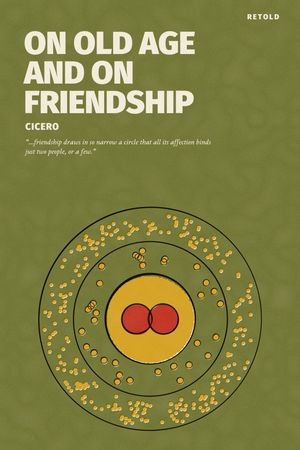
How great the power of friendship is can best be seen from this: out of the boundless fellowship of the human race, which nature herself has formed, friendship draws in so narrow a circle that all its affection binds just two people, or a few.
For friendship is nothing other than agreement on all things divine and human, joined with goodwill and affection; and I am not sure that, wisdom excepted, the immortal gods have given man anything better. Some put riches ahead of it, some good health, some power, some honors, many even pleasures. That last belongs to beasts; and the others are frail and uncertain, depending not so much on our own counsel as on the whims of fortune. Those who put the highest good in virtue are perfectly right, of course; but it is this very virtue that both begets friendship and holds it together, and without virtue friendship cannot exist at all.
Now let us interpret virtue by the usage of our own lives and our own speech, and not measure it, as some learned men do, by grand words; and let us count as good men those who are held to be good, men like Paullus, Cato, Gallus, Scipio and Philus. Everyday life is content with them. As for the men who are never to be found anywhere, let us leave them aside.
Between men like these, then, friendship has more advantages than I can well describe. First of all, how can life be "a life worth living," as Ennius says, if it does not find rest in the mutual goodwill of a friend? What is sweeter than to have someone you dare say everything to as you would to yourself? How could good fortune bring so much enjoyment if you had no one to rejoice in it as much as you do yourself? And bad fortune would be hard to bear without someone to bear it even more heavily than you. Then again, the other things men seek are each good, by and large, for one thing apiece: riches, to be spent; power, to be courted; honors, to be praised; pleasures, to be enjoyed; health, to be free of pain and to have the full use of the body. Friendship holds a great many things in itself. Wherever you turn, it is there at hand; it is shut out of no place; it is never out of season, never in the way. As the saying goes, we use neither water nor fire in more places than friendship. And I am not talking now of the common or ordinary kind (though even that gives pleasure and does good), but of true and perfect friendship, the kind that belonged to the few pairs of friends whose names are known. For friendship makes good fortune brighter, and bad fortune lighter, by dividing and sharing it.
And among all its many advantages, great ones, friendship surely has this best of all: it shines a bright hope ahead into the future, and never lets the spirit weaken or fall. Whoever looks at a true friend looks, as it were, at an image of himself. That is how the absent are present, the poor are rich, the weak are strong, and (harder to say) the dead are alive, so much honor, remembrance and longing from their friends goes with them; and this is why the deaths of the one seem happy and the lives of the others praiseworthy. Take the bond of goodwill out of the world, and no house, no city will be able to stand; not even the tilling of the fields will go on. If that is not clear enough, the power of friendship and harmony can be seen from quarrels and discord. What house is so stable, what state so firm, that hatred and division could not overthrow it from the ground up?
From this you can judge how much good there is in friendship.
They say that a learned man of Agrigentum, Empedocles, taught in Greek verses, like a prophet, that whatever in nature and in the whole universe holds still and whatever moves is drawn together by friendship and scattered by discord. And this is something all mortals understand and prove by what they do. Whenever some act of a friend's devotion comes to light, in facing dangers or in sharing them, who does not praise it to the skies? What shouts there were through the whole theater not long ago at the new play by my friend Marcus Pacuvius, a guest of my house! The king did not know which of the two was Orestes; Pylades kept saying that he was Orestes, so that he might be put to death in his friend's place, while Orestes, as was the truth, kept insisting that he was Orestes. The audience was on its feet applauding, and for a story made up; what would they have done for a true one? Nature showed her power plainly enough, when people cheered as right in another a thing they could not have done themselves.
That, I think, is as much as I can tell you of what I feel about friendship. If there is anything more (and I believe there is a good deal), ask it, if you like, of the people who make these discussions their business.
Fannius: We'd rather ask you. I have often asked those people too, and I've listened to them gladly enough; but the thread of your talk is of a different kind.
Scaevola: You'd say that all the more, Fannius, if you had been with us the other day in Scipio's gardens when the republic was being discussed. What a champion of justice he was against Philus's carefully worked speech!
Fannius: Well, it was easy for the most just of men to defend justice.
Scaevola: And what about friendship? Wouldn't it be easy for a man to defend it who has won the greatest glory by keeping it with perfect loyalty, constancy and justice?
Laelius: This is force; what does it matter how you compel me? Compel me you certainly do. And when one's sons-in-law are eager, especially for something good, it is hard to resist them, and not even fair.
Well, then. When I think about friendship, as I very often do, the question that usually seems to me most worth considering is this: was friendship wanted because of weakness and need, so that by giving and receiving services each might get from another what he could not manage by himself, and repay it in turn? Or, though this is indeed a feature of friendship, is there another cause, older, finer, and springing more directly from nature itself? For friendship, amicitia, takes its name from love, amor, and it is love that leads the way in binding men together in goodwill. Advantages, after all, are often had even from people who are courted and flattered with a show of friendship for the sake of the moment; but in friendship there is nothing feigned, nothing pretended, and whatever there is in it is genuine and freely given.
That is why friendship seems to me to spring from nature rather than from need, from a leaning of the heart joined with a feeling of love, rather than from a calculation of how much profit it would bring. What this feeling is can be seen even in certain animals, which love their young for a certain time and are loved by them in a way that makes their feeling plain. In man it is much more evident: first, in the affection between children and parents, which nothing but a monstrous crime can break; and then when a like feeling of love arises, once we have found someone whose character and nature suit our own, because we seem to see in him a kind of light of goodness and virtue.
For nothing is more lovable than virtue, nothing draws us more to care for someone; virtue and goodness make us love, in a way, even people we have never seen. Who does not call up the memory of Gaius Fabricius and Manius Curius with a kind of warm affection, though he never saw them? And who does not hate Tarquinius Superbus, Spurius Cassius and Spurius Maelius, the king we drove out and the men who wanted to be kings? We fought for empire in Italy against two commanders, Pyrrhus and Hannibal. Toward the first, because of his decency, we feel no great hostility; the second, because of his cruelty, this state will always hate.
If the power of goodness is so great that we love it in men we have never seen, and, what is more, even in an enemy, why wonder that men's hearts are moved when they think they see virtue and goodness in those they can be joined with in daily life? Love, of course, is strengthened by a kindness received, by devotion seen, and by the habit of each other's company; and when these are added to that first stirring of the heart and of love, a goodwill of wonderful greatness blazes up.
If anyone thinks friendship comes from weakness, so that each may have someone through whom to get what he wants, he gives it a lowly and, if I may say so, a thoroughly ignoble birth, since he would have it born of want and need. If that were so, the less a man thought there was in himself, the fitter he would be for friendship; and the truth is far otherwise.
For the more a man trusts himself, and the more he is so fortified by virtue and wisdom that he needs no one and believes that everything that is his lies within himself, the more he excels in seeking and keeping friendships. Well? Did Africanus need me? Not in the least, by heaven! Nor did I need him. But I loved him out of a kind of admiration for his virtue, and he in turn loved me, perhaps, for some good opinion he had of my character; and our intimacy increased our goodwill. And though many great advantages followed from it, the reasons for our love did not spring from any hope of them.
We are kind and generous not in order to call in a debt of gratitude (we don't lend out our kindnesses at interest); we are generous because our nature leans that way. In the same way, we think friendship worth seeking not because we are drawn by the hope of reward, but because all its profit lies in the love itself.
The people who, like cattle, measure everything by pleasure disagree with all this entirely; and no wonder. Men who have sunk all their thoughts into a thing so low and contemptible cannot lift their eyes to anything lofty, anything grand and divine. Let us leave them out of this conversation, and see for ourselves that the feeling of love and the warmth of goodwill are born of nature, once goodness has given some sign of itself. Those who are drawn to it attach themselves and come closer, so that they may enjoy the company and the character of the one they have begun to love. They become equals and peers in love, readier to do a kindness than to ask one back, and between them there is this honorable rivalry. In this way the greatest advantages will be won from friendship, and its origin in nature, rather than in weakness, will be the more dignified and the more true. For if advantage glued friendships together, a change in it would pull them apart; but because nature cannot change, true friendships are everlasting.
There you have the origin of friendship, unless you have something to add.
Fannius: No, go on, Laelius. I'll answer for Scaevola, since he's the younger; I have the right.
Scaevola: Quite right. Let's listen.
Laelius: Listen, then, my excellent friends, to what Scipio and I very often used to say to each other about friendship. He, to be sure, used to say that nothing was harder than for a friendship to last to the last day of life. It often happened, he said, that the same thing did not suit both friends, or that they did not think alike about politics; and he often said that men's characters change, sometimes through misfortune, sometimes as the years grow heavier. He found a picture of it in early youth: the warmest loves of boys are often laid aside along with the boy's purple-bordered toga.
And if they carried them on into young manhood, they were still sometimes broken off by rivalry over a marriage, or over some advantage that both could not have. And friends who had come further still were often shaken if they found themselves rivals for office. There was no greater plague for friendships, he said, than the greed for money in most men, and in the best of men the struggle for office and glory, which had often turned the dearest of friends into the bitterest of enemies.
Great breaches, he said, and generally justified ones, arose when something not right was asked of friends: that they should serve someone's lust, or help him do an injury. Those who refused, however honorably they did so, were accused of abandoning the claims of friendship by the people they would not oblige; while those who would dare ask anything at all of a friend were declaring, by the very asking, that they would do anything at all for a friend's sake. When their grievance had festered, not only were intimacies usually snuffed out, but hatreds were born that lasted forever. So many of these dangers hang over friendships, like so many fates, that to escape them all, he said, seemed to him to need not only wisdom but good luck.
Let us first see, then, if you like, how far love ought to go in friendship. If Coriolanus had friends, ought they to have taken up arms with him against their country? Ought the friends of Spurius Cassius Vecellinus to have helped him when he aimed at a kingship, or the friends of Maelius?
We saw Tiberius Gracchus, when he was throwing the republic into turmoil, abandoned by Quintus Tubero and the friends of his own age. But Gaius Blossius of Cumae, an old friend of your family's, Scaevola, came to plead with me, since I sat on the advisory council of the consuls Laenas and Rupilius; and his excuse, the reason I should pardon him, was that he had thought so highly of Tiberius Gracchus that he believed he must do whatever Gracchus wanted. "Even," I said, "if he wanted you to set fire to the Capitol?" "He never would have wanted that. But if he had, I'd have obeyed." You see what a wicked thing to say. And, by heaven, he did just that, or even more than he said: he did not obey Tiberius Gracchus's recklessness, he led it; he made himself not the companion of that madness but its chief. And so, in his frenzy, terrified by the special inquiry, he fled to Asia, went over to the enemy, and paid the republic a heavy and a just penalty.
There is no excuse, then, for doing wrong if you do it for a friend's sake. Since what brought the friendship about was the belief in each other's virtue, it is hard for friendship to last once you have abandoned virtue.11
Now if we were to decide that it was right to grant our friends whatever they want, or to get from them whatever we want, there would be no harm in it, provided we were perfectly wise. But we are talking about the friends before our eyes, the ones we see or have heard of, the ones everyday life knows. It is from among these that we must take our examples, and above all from those who come nearest to wisdom.
We know that Papus Aemilius was the intimate friend of Gaius Luscinus, the Fabricius I spoke of (so our fathers have told us): they were consuls together twice, and colleagues in the censorship. And it has come down to us that Manius Curius and Tiberius Coruncanius were very closely bound to them and to each other. We cannot even suspect, then, that any of these men ever pressed a friend for anything against good faith, against his oath, against the state. What is the use of saying, about such men, that if one had pressed, he would not have succeeded? They were men of the highest integrity, and it is as wicked to ask for a thing of that kind as to do it when asked. But Tiberius Gracchus had his followers: Gaius Carbo, Gaius Cato, and his brother Gaius, hardly at all then, though now he is the most zealous of them.
Let this law, then, be laid down for friendship: that we neither ask for shameful things nor do them when asked. "For a friend's sake" is a shameful excuse, and not to be accepted for any wrongdoing, least of all when a man confesses that he acted against the state. We are placed, Fannius and Scaevola, where we must look far ahead to what may befall the republic. The custom of our ancestors has already swerved a little from its track and its course.
Tiberius Gracchus tried to seize a kingship, or rather he actually reigned for a few months. Had the Roman people ever heard or seen anything like it? And what his friends and kinsmen, who followed him even after his death, have done to Publius Scipio I cannot say without tears. As for Carbo, we held out against him as best we could, because Tiberius Gracchus's punishment was so recent. But what I expect from Gaius Gracchus's tribunate I would rather not foretell. Things creep on, and once they have begun they slide downhill to ruin. You see what a breach has already been made by the secret ballot: first the Gabinian law brought it into elections, and two years later the Cassian law into trials before the people. I seem to see already the people cut off from the Senate, and the greatest matters settled at the whim of the crowd. For more people will learn how these things are done than how they are resisted.
Why do I say all this? Because nobody attempts anything of the kind without allies. Good men, then, must be taught that if by some chance they have stumbled unawares into friendships of that kind, they should not think themselves so bound that they cannot break with friends who are doing some great wrong against the state; and the wicked must be punished, and the followers no more lightly than the ringleaders of the treason. Who in Greece was more famous than Themistocles, or more powerful? As commander in the Persian War he freed Greece from slavery, and when envy drove him into exile he would not bear the injury done him by his ungrateful country, as he ought to have borne it: he did what Coriolanus had done among us twenty years before. Neither of them found anyone to help him against his country, and so each of them took his own life.
Such a conspiracy of the wicked, then, must not only not be sheltered under the excuse of friendship; it must be punished with every penalty, so that no one may think himself permitted to follow a friend even when he makes war on his country. And the way things have begun to go, I'm not sure that day won't come. But I care no less what the republic will be after my death than what it is today.
Let this, therefore, be established as the first law of friendship: that we ask of friends only what is honorable, and do for friends only what is honorable. Let us not even wait to be asked; let our zeal always be ready and hesitation absent; let us dare to give true advice freely. In friendship let the authority of friends who give good advice carry the greatest weight; let it be used to warn, not only frankly but, if the case demands it, sharply; and when it is used, let it be obeyed.
For I gather that certain people, who I hear were thought wise in Greece, held some astonishing views (though there is nothing they won't chase down with their quibbles). Some say we should avoid friendships that are too close, so that one man need not be anxious for many; that each of us has enough and more than enough with his own affairs; that it is a nuisance to be too much entangled in other people's; that the most convenient thing is to hold the reins of friendship as loosely as possible, so that you can draw them in or let them out as you please; for the chief thing in living happily is freedom from care, and the mind cannot enjoy it if it is in labor, as it were, for many people at once.
Others, I am told, say something much less humane still, a point I touched on briefly a little while ago: that friendships should be sought for the sake of protection and help, not for goodwill and affection; and so, the less strength and the fewer resources a man has, the more eagerly he seeks friendships. That is why, they say, poor weak women seek the shelter of friendships more than men do, the poor more than the rich, and the unfortunate more than those who are thought happy.
What splendid wisdom! They take the sun out of the world who take friendship out of life; and the immortal gods have given us nothing better, nothing more delightful. What is this freedom from care of theirs? Attractive at first sight, but in reality to be rejected on many counts. For it makes no sense to refuse any honorable task or course of action, or to drop it once begun, just to spare yourself anxiety. If we run away from care, we must run away from virtue, which cannot help feeling some care as it spurns and hates its opposites, as kindness hates malice, self-control lust, and courage cowardice. That is why you see the just most grieved by injustice, the brave by cowardice, the decent by vice. It is the mark of a well-ordered mind, then, both to be glad at what is good and to grieve at the opposite.
If grief can touch the wise man (and it certainly can, unless we think that every human feeling has been torn out of his heart by the roots), what reason is there to take friendship out of our lives altogether, to spare ourselves the troubles it brings? Take away the feelings, and what difference is there, I won't say between a beast and a man, but between a man and a tree trunk or a stone or anything of that kind? We ought not to listen to the people who want virtue to be hard and, as it were, made of iron. In many things, and in friendship above all, it is tender and pliant, so that it expands, so to speak, at a friend's good fortune and contracts at his troubles. The anguish we must often suffer for a friend is no more a reason to take friendship out of life than the cares and troubles the virtues bring are a reason to reject the virtues.
Now since, as I said before, what draws a friendship together is some sign of virtue shining out, to which a like mind attaches and joins itself, whenever that happens, love is bound to follow.
For what is so absurd as to take delight in many empty things, office, glory, a fine house, clothes and grooming, and to take little delight in a living being endowed with virtue, one that can love, or, if I may coin the word, love back? Nothing is more delightful than goodwill repaid, than an exchange of devotion and kindness.
And what if we add, as we rightly may, that nothing pulls things toward it as strongly as likeness pulls men toward friendship? Then everyone will surely grant that good men love good men and take them to themselves as if bound to them by kinship and by nature. For nothing reaches more eagerly, or more greedily, for its like than nature does. Let this at least be settled, then, Fannius and Scaevola: that good men feel a goodwill toward the good that is all but inevitable, and that this is the spring of friendship that nature has set flowing. But this same goodness reaches out to the multitude as well. Virtue is not inhuman, or unobliging, or proud; it makes a habit of protecting whole peoples and looking after their interests as well as it can, which it certainly would not do if it shrank from loving ordinary people.
Besides, it seems to me that those who imagine friendships are made for advantage take away the loveliest knot that ties them. For it is not so much the advantage gained through a friend that delights us as the friend's love itself; and what comes from a friend is a pleasure when it comes with real devotion. Far from friendships being cultivated out of need, the most generous people, the readiest to do good, are those who need others least, thanks to their wealth and resources and above all to virtue, which is the strongest defense of all. And I'm not even sure that it's good for friends never to lack anything at all. Where would my devotion have had any scope if Scipio had never needed my advice or my help, at home or in the field? It was not friendship, then, that followed advantage, but advantage that followed friendship.
We shall not listen, then, to men dissolved in luxury if ever they hold forth on friendship, which they know neither by experience nor by reason. In the name of gods and men, is there anyone who would choose to be awash in every kind of wealth and to live in abundance of everything, on condition that he love no one and no one love him? That is the life of tyrants, to be sure: a life in which there can be no trust, no affection, no confidence in a goodwill that will last, where everything is always suspect and anxious, and there is no room for friendship.
For who could love a man he fears, or a man by whom he thinks himself feared? Still, tyrants are courted, with a show of friendship, as long as their luck lasts. And if they fall, as they generally do, then it becomes clear how poor in friends they were. They say Tarquinius remarked in his exile that he had found out which of his friends were loyal and which were not, now that he could no longer repay either.
Though I'm surprised, arrogant and harsh as he was, that he could have had a single friend. And just as his character could not win him true friends, so the wealth of many powerful men shuts out loyal friendships. Not only is Fortune blind herself; she usually makes those she embraces blind as well. They are carried away, as a rule, by disdain and stubbornness, and nothing can be more insufferable than a fool in luck. You can see it happen: men who were agreeable before are changed by command, by power and by success; they spurn their old friendships and indulge new ones.
And what is more foolish than for men who can do so much with their wealth, their means and their power to acquire the other things that money can buy, horses, servants, splendid clothes, costly plate, and not to acquire friends, the best and most beautiful furniture, so to speak, that life has? For when they acquire those other things, they do not know for whom they are acquiring them, or for whose sake they are working, since every one of them belongs to whoever is strongest; but a man's friendships stay his, a sure and secure possession. Even if the rest should last, the gifts of fortune, as it were, a life untended and deserted by friends can never be a pleasant one. But enough of this.
Now we must settle what the limits of friendship are, the boundary stones, so to speak, of love. On this I see three opinions put forward, and I approve none of them. The first is that we should feel toward a friend as we feel toward ourselves; the second, that our goodwill toward our friends should match their goodwill toward us exactly and equally; the third, that a man should be valued by his friends at the value he sets on himself.
I agree with none of these three. The first is not true, that each of us should feel toward a friend as he feels toward himself. How many things we do for our friends' sake that we would never do for our own! To beg favors from a man unworthy of them, to plead with him; or again, to attack someone bitterly and pursue him hard: things not quite honorable in our own affairs become entirely honorable in our friends'. And there are many matters in which good men give up a great deal of their own advantage, or let it be taken from them, so that their friends may have the enjoyment of it rather than themselves.
The second opinion is the one that limits friendship to an equal exchange of services and good wishes. That is calling friendship to account far too narrowly and meanly, as if the ledger of what is received and what is given had to balance. True friendship seems to me richer and more abundant than that, and does not keep a strict watch that it never gives back more than it got. There is no need to fear that something will be lost, that a little will spill on the ground, or that more than a fair share will be heaped into a friendship.
But the third limit is the worst: that a man should be valued by his friends at the value he sets on himself. For often a man's spirit is too low, or his hope of bettering his fortune is broken. It is not a friend's part, then, to think of him as he thinks of himself; rather, he should strive and work to rouse his friend's fallen spirit and lead him to hope and to better thoughts. We must set another limit, then, for true friendship, once I have told you what Scipio used to find most fault with. He said that no saying more hostile to friendship could be found than that of the man who said we should love as if one day we were going to hate. Nor could he be brought to believe that this was said, as people supposed, by Bias, who was counted wise, one of the Seven. It was the maxim, he said, of some vile or self-seeking man, or someone who measured everything by his own power. For how can anyone be a friend to a man he thinks may become his enemy? He will even have to wish and pray that his friend may go wrong as often as possible, to give himself more handles, so to speak, for finding fault; and, on the other hand, his friends' good deeds and good fortune will be bound to pain him, hurt him and make him envious.
This maxim, whoever made it, is a recipe for destroying friendship. What ought to have been taught instead is that we should take such care in forming friendships as never to begin loving someone we might one day hate. And even if we had been less lucky in our choice, Scipio thought we should put up with it rather than plan for a time of enmity.
These, then, are the limits I think we should keep to: when the friends' characters are without fault, let them share everything, their affairs, their plans and their wishes, without any exception; so that if by some chance we have to help a friend in a wish that is not altogether just, where his life or his good name is at stake, we should turn aside from the straight road, provided that utter disgrace does not follow. Friendship deserves indulgence, up to a point. Nor should we neglect our good name, or think the goodwill of our fellow citizens a small weapon for getting things done; though to gather it by flattery and fawning is shameful. Virtue, which affection follows, is by no means to be spurned.
But (for I keep coming back to Scipio, whose whole talk was of friendship) he used to complain that men were more careful in everything else: that anyone could tell you how many goats and sheep he had, but could not tell you how many friends; that they took pains in acquiring the one, but were careless in choosing friends, and had no marks or signs, as it were, by which to judge who were suited to friendship. We must choose men, then, who are firm, stable and steady, and there is a great shortage of the kind. And it is very hard to judge a man without testing him; but the testing has to be done in the friendship itself. Friendship, in short, runs ahead of judgment and takes away the chance to test.
A sensible man, then, will rein in the rush of his goodwill as he would a horse at the gallop, and will try out a friend's character a little first, as we try out a horse, before he trusts himself to the friendship. Some men show how unreliable they are over a small sum of money; others, whom a small sum could not move, are found out over a large one. And even if some are found who think it base to put money ahead of friendship, where shall we find those who do not put honors, magistracies, military commands, power and wealth ahead of friendship, so that when these are offered on one side and the claims of friendship on the other, they would not much prefer the former? Human nature is too weak to despise power; and if men have won it at the cost of a friendship, they expect the betrayal to be forgotten, because the friendship was not thrown over without a strong reason.
True friendships, therefore, are very hard to find among men who spend their lives in office and public affairs. Where will you find the man who puts his friend's advancement ahead of his own? And, to leave that aside, how heavy, how hard most people find it to share a friend's misfortunes! It is not easy to find men who will go down into them with him. Ennius is right:
A sure friend is known in unsure times.
Yet it is these two things that convict most men of fickleness and weakness: either they look down on a friend when they themselves are doing well, or they desert him when he is doing badly. The man who has proved himself serious, constant and steady in friendship in both conditions we must count among a very rare kind of men, almost divine.
Now the foundation of that steadiness and constancy we look for in friendship is loyalty; for nothing is steady that is not loyal. We ought also to choose a man who is straightforward, sociable and in sympathy with us, that is, one who is moved by the same things; all of which bears on loyalty. For a complicated and twisted nature cannot be loyal; nor can a man be loyal or steady who is not moved by the same things as we are and is not in sympathy with us by nature. To this we must add that he should take no pleasure in bringing accusations, and not believe them when others bring them; all this bears on that constancy I have been discussing for some time now. What I said at the beginning, then, turns out to be true: that friendship cannot exist except among good men.
For it is the part of a good man, whom we may also call a wise man, to keep to two rules in friendship. First, that there be nothing feigned or pretended in it; for it is more honest even to hate openly than to hide one's feelings behind a smiling face. Second, not only to reject accusations brought by someone else, but not to be suspicious himself, always thinking that his friend has done him some wrong.
To this must be added a certain sweetness of talk and manner, by no means a small seasoning of friendship. Gloom and severity in everything have a certain dignity, no doubt; but friendship ought to be more relaxed, freer and gentler, and more inclined to every kind of good fellowship and ease.
At this point there arises a rather difficult question: whether new friends who are worthy of friendship are ever to be preferred to old ones, as we usually prefer young horses to old. A question unworthy of a human being! We ought never to tire of friendships, as we tire of other things. The oldest ought to be the sweetest, like wines that keep well; and the proverb is true that you must eat many pecks of salt together before the work of friendship is complete.
New friendships, if they hold out promise, like green shoots that do not cheat us of the harvest, are certainly not to be rejected; but the old must keep its own place, for the power of long acquaintance and habit is very great. Indeed, with the very horse I mentioned just now, if nothing prevents it, there is no one who would not rather ride the one he is used to than one untried and new. Nor does habit hold only for a living creature; it holds for lifeless things too, since we love the very places where we have lived a long time, even rough and wooded mountain country.
But the greatest thing in friendship is for the superior to put himself on a level with the inferior. There are often men who stand out, as Scipio did in what I may call our little flock. He never put himself above Philus, never above Rupilius, never above Mummius, never above friends of lower rank. His brother Quintus Maximus was an excellent man, certainly, but in no way his equal; yet because he was the elder, Scipio deferred to him as his superior, and he wanted all his people to rise in the world through him.
This is what everyone should do, following his example: anyone who has won some eminence in virtue, talent or fortune should share it with his own people and give those nearest him a part in it. If he was born of humble parents, if he has relatives weaker in spirit or in fortune, he should increase their means and bring them honor and standing. It is like the stories in the plays: those who have been in service for a long time because no one knew their family and parentage, when they are recognized and found to be the sons of gods or kings, still keep their affection for the shepherds they believed for many years were their fathers. How much more should this be done for one's real and certain fathers! For the fruit of talent and virtue and every kind of excellence is gathered most richly when it is bestowed on those closest to us.
Just as those who stand higher in a close friendship ought to put themselves on a level with those below them, so those below ought not to be pained at being surpassed by their friends in talent, fortune or rank. Most of them are always complaining about something, or even throwing it in their friends' faces, and all the more if they think they have something they can claim to have done dutifully, as friends, and at some trouble to themselves. A hateful kind of person, the kind who throws his services in your face. A service ought to be remembered by the man who received it, not brought up by the man who gave it.
As those who are superior, then, ought to lower themselves in friendship, so in a way they ought to raise up those below them. For there are some who make their friendships a trouble because they think they are looked down on; which rarely happens except to those who think themselves worth looking down on. They need to be relieved of that opinion, not only by words but by deeds.
Now you should give to each friend, first, as much as you yourself can manage, and then as much as the one you love and help can bear. For you could not, however eminent you were, bring all your friends to the highest offices. Scipio was able to make Publius Rupilius consul, but could not do it for his brother Lucius. And even if you can confer whatever you like on another man, you must still look at what he can bear.
As a rule, friendships should be judged only when character and age have grown strong and settled. If men were keen on hunting or ball games in their youth, they need not keep as their intimates the people they loved then for sharing that keenness. On that reasoning, nurses and tutors would claim the largest share of goodwill by right of long acquaintance. They are not to be neglected, of course, but valued in some other way; otherwise friendships cannot last and stay firm. Different characters follow different pursuits, and the unlikeness of these pulls friendships apart; and there is no other reason why good men cannot be friends with bad, or bad with good, than that the distance between them in character and pursuits is as great as it can be.
It is also a sound rule in friendship not to let a kind of unrestrained goodwill, as very often happens, stand in the way of a friend's great interests. Neoptolemus, to go back to the old stories, could never have taken Troy if he had been willing to listen to Lycomedes, in whose house he had been brought up, when Lycomedes tried with many tears to stop him going. Great matters often arise that require us to part from our friends; and the man who wants to prevent this because he cannot easily bear missing them is weak and soft by nature, and for that very reason not fair in friendship.
In everything, in short, we must consider both what we ask of a friend and what we allow to be got from us.
Sometimes, too, there is the unavoidable misfortune of breaking off a friendship; for now our talk is sliding down from the intimacies of wise men to ordinary friendships. Friends' faults often break out, sometimes against their friends themselves, sometimes against others, though the disgrace still spills over onto the friends. Such friendships should be washed out by seeing less of each other and, as I heard Cato say, unstitched rather than torn apart; unless some really intolerable wrong has blazed up, so that it is neither right nor honorable, nor even possible, not to break away and part at once.
But if some change of character or pursuits takes place, as often happens, or a disagreement over political parties comes between friends (I am speaking now, as I said a moment ago, not of the friendships of the wise but of ordinary ones), we must take care that it does not look as though we had not only laid down a friendship but taken up an enmity. For nothing is more shameful than to make war on a man you have lived with as a friend. Scipio, as you know, had withdrawn from his friendship with Quintus Pompeius on my account; and because of a disagreement in politics he became estranged from our fellow augur Metellus. He handled both with dignity and moderation, and without bitterness of heart.12
Our first care, then, must be that friends should never fall out at all; and if something of the kind does happen, that the friendship should seem to have burned out rather than been stamped out. And we must take care that friendships do not turn into bitter enmities, from which come quarrels, abuse and insults. If these can be borne, they should be, out of respect for the old friendship, so that the blame falls on the one who does the wrong, not the one who suffers it.
Against all these faults and troubles there is, in short, one precaution and one provision: not to begin loving too quickly, and not to love the unworthy.
Those are worthy of friendship who have in themselves a reason to be loved. A rare breed! But then everything splendid is rare, and nothing is harder to find than something perfect of its kind in every part. Most people, though, recognize nothing as good in human life unless it pays, and they love their friends as they love their cattle, choosing above all the ones from which they hope to get the greatest return.
They miss, then, the most beautiful and most natural friendship of all, the kind sought in and for itself, and never learn from their own case what the power of friendship is, and how great. For a man loves himself not to collect some payment from himself for his affection, but because he is dear to himself for his own sake. Unless the same feeling is carried over into friendship, a true friend will never be found; for a true friend is, as it were, a second self.
We can see in animals, in birds, fish and beasts, tame or wild, that they love themselves first (that is born in every living thing), and then that they seek out and long for others of their own kind to attach themselves to, and do so with yearning and with something like human love. How much more naturally, then, does this happen in man, who both loves himself and looks for another whose soul he may so mingle with his own as to make almost one out of two!
But most people, perversely, not to say shamelessly, want a friend such as they themselves cannot be, and expect from their friends what they do not give them. The right thing is first to be a good man yourself, and then to look for another like you. Among such men the stability of friendship I have been talking of all this while can take firm hold: men joined by goodwill will first master the desires that other men are slaves to; then they will delight in fairness and justice, and each will take on anything for the other; neither will ever ask anything of the other but what is honorable and right; and they will not only cherish and love each other but also respect each other. For whoever takes respect out of friendship takes away its finest ornament.
Those make a ruinous mistake, therefore, who think that friendship opens the way to every kind of lust and wrongdoing. Nature gave us friendship as the helper of the virtues, not the companion of the vices, so that virtue, which could not reach the heights alone, might reach them joined and allied with another. If such a partnership exists, or has existed, or will exist between any people, theirs must be counted the best and happiest company on the road to nature's highest good.
This, I say, is the partnership in which all the things men think worth seeking are found: honor, glory, peace of mind and joy; so that where these are present, life is happy, and without them it cannot be.
And since this is the best and greatest thing there is, if we want it we must work at virtue, without which we can gain neither friendship nor anything else worth seeking. Those who neglect virtue and think they have friends discover their mistake only when some heavy blow forces them to put those friends to the test.
That is why, and it must be said again and again, you should love once you have judged, not judge once you have loved. We pay for our carelessness in many things, but above all in choosing and keeping friends. We take our decisions back to front and, against the old proverb, try to undo what is done. Bound up with each other by long acquaintance or by services back and forth, we suddenly break off friendships in mid-course over some quarrel.
Such carelessness about a thing so necessary is all the more to blame. Friendship is the one thing in human life whose usefulness everyone agrees on with one voice. Virtue itself is despised by many, who call it a kind of advertising and showing off. Many look down on riches, content with little, delighting in plain food and plain dress. As for public office, which some men burn to hold, how many despise it so heartily that they think nothing emptier, nothing more trivial! And so with the other things that seem marvelous to some: there are a great many people who count them as nothing. About friendship, everyone to a man thinks the same: those who have given themselves to public life, those who delight in knowledge and learning, those who mind their own business in private; and finally those who have given themselves wholly to pleasure. All of them think that without friendship life is no life at all, if they want to live in any way like gentlemen.
For friendship somehow creeps through everyone's life, and allows no way of spending one's days to be without it.
Even if someone is of so harsh and savage a nature that he shuns and hates the company of men, as we are told a certain Timon was at Athens, still he cannot help looking for somebody to pour out the venom of his bitterness on. The best test would be this, if such a thing could happen: suppose some god took us out of this crowd of men and set us down in some solitary place, and there gave us an abundance and plenty of everything nature needs, but took away altogether the chance of ever seeing a human being. Who would be so made of iron that he could bear that life? From whom would solitude not take away the enjoyment of every pleasure?
That is why Archytas of Tarentum, I think, was right in what he used to say; I have heard our old men repeat it, having heard it from other old men: that if a man went up into heaven and saw the nature of the universe and the beauty of the stars, the wonder of it would give him no pleasure, though it would have been the greatest delight if he had someone to tell it to. Nature loves nothing solitary, and always reaches out for some support, as it were; and the sweetest support is the dearest friend.
But though nature declares by so many signs what she wants, seeks and longs for, we somehow grow deaf and do not hear her warnings. The dealings of friendship are many and various, and many occasions arise for suspicion and offense, which it is the wise man's part sometimes to avoid, sometimes to make light of, and sometimes to bear. There is one kind of offense we must risk, to keep friendship both useful and loyal: friends must often be warned, and scolded too, and this ought to be taken in a friendly spirit when it is done with goodwill.
But somehow it is true, what my friend says in his Andria:
Compliance makes friends; truth makes enemies.
Truth is troublesome, if it breeds hatred, which is the poison of friendship; but compliance is much more troublesome, because by indulging a friend's faults it lets him rush headlong to his fall. The greatest blame, though, belongs to the man who both spurns the truth and lets compliance push him into ruin.13
In this whole matter, then, we must take thought and care: first, that our warnings be free of harshness, and then that our rebukes be free of insult. In compliance, since I am glad to borrow Terence's word, let there be kindliness, but let flattery, the accomplice of vice, be kept far away; it is unworthy not only of a friend but even of a free man. Living with a tyrant is one thing, and living with a friend is another.
The man whose ears are so closed to the truth that he cannot hear it from a friend is past saving. Cato said it neatly, as he said many things: some people are better served by bitter enemies than by friends who seem sweet, because the enemies often tell the truth and the friends never do. And it is absurd that people who are warned do not feel the distress they ought to feel and do feel what they ought to be free of. They are not pained at having done wrong; they are annoyed at being rebuked. It ought to be the other way round: grief at the fault, and gladness at the correction.
Since, then, to warn and be warned is the mark of true friendship, the one done frankly but not harshly, the other taken patiently and without resistance, we must hold that there is no greater plague in friendships than flattery, cajolery and fawning. Call it by as many names as you like, it is the vice of shallow and deceitful men who say everything to please and nothing to tell the truth.
Pretense is a vice in everything, since it destroys our power to judge the truth and corrupts it; but it is most of all the enemy of friendship, since it wipes out the truth, without which the name of friendship means nothing. For since the power of friendship lies in making, as it were, one soul out of several, how can that happen if there is not even one soul, always the same, in each single man, but one that is changeable, shifting and many?
What can be so pliant, so wayward, as the soul of a man who turns not only with another's feelings and wishes but with his very look and nod?
	Someone says no, I say no; says yes, I say yes. In short,
	I've given myself orders to agree with everything,
as the same Terence says, though he puts it in the mouth of Gnatho, the parasite; and to take on that kind of friend at all is pure folly.
There are many like Gnatho, though, who are far above him in position, fortune and reputation; and their flattery does more harm, since authority has been added to emptiness.
But with care a flattering friend can be told from a true one, just as everything painted and pretended can be told from what is sincere and genuine. A public meeting, made up of the least informed people there are, can still usually judge the difference between a demagogue, that is, a flatterer and a shallow citizen, and a man who is steady, truthful and serious.
What flattery Gaius Papirius Carbo poured into the ears of the assembly not long ago, when he proposed his law to let tribunes of the plebs be re-elected! Scipio and I spoke against it; but I'll say nothing of myself, and gladly speak of Scipio. What gravity he had, immortal gods, what majesty in his speech! You would easily have called him the leader of the Roman people, not one of their followers. But you were there, and the speech is in everyone's hands. And so a law made to please the people was rejected by the people's votes.
And, to come back to myself, you remember, in the consulship of Quintus Maximus, Scipio's brother, and Lucius Mancinus, how popular Gaius Licinius Crassus's law on the priesthoods seemed. It would have transferred the filling of the priestly colleges from the colleges themselves, who chose their own members, to the gift of the people. (He was the first, by the way, to turn and face the Forum when he addressed the people.) Yet his crowd-pleasing speech was easily beaten by reverence for the immortal gods, when I spoke in their defense. That was done when I was praetor, five years before I was made consul. That cause, then, was carried by its own merits more than by any great authority of its speaker.
Now if on the stage of a public meeting, where invention and make-believe have the most room, the truth still prevails, once it is laid open and made clear, what ought to happen in friendship, which is weighed entirely in the scales of truth? In friendship, unless, as the saying goes, you see an open heart and show your own, you can have nothing reliable, nothing certain; not even loving or being loved, since you do not know how truly it is done. And yet this flattery, however ruinous, can harm no one except the man who welcomes it and enjoys it. And so it comes about that the man who opens his ears widest to flatterers is the one who flatters himself and is most pleased with himself.
Virtue, to be sure, loves herself; for she knows herself best, and understands how lovable she is. But I am not speaking now of virtue, but of the reputation for virtue. Fewer people want to have virtue itself than want to seem to have it. These are the people flattery delights. When someone serves them talk made up to suit their wishes, they take the empty words as testimony to their merits. There is no friendship at all, then, when one will not hear the truth and the other is ready to lie. Nor would the flattery of the parasites in comedies seem funny to us if there were no braggart soldiers.
Thais thanks me very much, you say?
It would have been enough to answer, "Very much." "Enormously," says the parasite. The flatterer always enlarges what the man he is pleasing wants to be large.
That coaxing emptiness works, of course, on those who court it and invite it; but even the more serious and steady people must be warned not to be caught by flattery of the cunning kind.
Open flattery anyone but a complete fool can see; it is the cunning, hidden kind we must work hard to keep from creeping in. It is not easily recognized, since it often flatters even by disagreeing, wheedles while pretending to quarrel, and at last throws up its hands and lets itself be beaten, so that its dupe may think he saw further. And what is more shameful than to be made a fool of? We must take all the more care that it does not happen to us, and that no one can say to us:
	Today, beyond all the foolish old men in the comedies,
	you've twisted me round and fooled me splendidly!
For even in the plays the most foolish character of all is the old man who sees nothing coming and believes everything.
But somehow our talk has slipped down from the friendships of perfect men, that is, of the wise (I mean the kind of wisdom that seems possible for a human being), to shallow friendships. Let us go back to where we began, and at last bring it to an end.
It is virtue, I tell you, Gaius Fannius, and you, Quintus Mucius, virtue that both wins friendships and keeps them. In virtue there is harmony, in virtue stability, in virtue constancy. When it has lifted itself up and shown its light, and seen and recognized the same light in another, it moves toward it and in turn takes in the light of the other; and from this there blazes up love, or friendship, for both words, amor and amicitia, come from amare, to love. And to love is nothing else but to cherish the very person you love, out of no need, seeking no advantage. Yet advantage itself blossoms out of friendship, even when you were not looking for it.
It was with this goodwill that we, when we were young, loved those old men, Lucius Paullus, Marcus Cato, Gaius Gallus, Publius Nasica, and Tiberius Gracchus, our Scipio's father-in-law. It shines out even more brightly among men of the same age, as between me and Scipio, Lucius Furius, Publius Rupilius and Spurius Mummius. And we old men in our turn find rest in the affection of the young, as in yours, and in Quintus Tubero's; and I take delight, too, in the friendship of Publius Rutilius and Aulus Verginius, who are very young. And since life and nature are so ordered that one generation rises after another, the thing most to be wished is to reach the finishing line, as they say, with the friends of your own age, the same ones you left the starting gates with.
But since human things are frail and fleeting, we must always be looking for people to love and to be loved by; for take away affection and goodwill, and all the joy is taken out of life. For me, Scipio, though he was snatched away so suddenly, lives still and will always live. It was his virtue I loved, and that has not been put out. And it is not only before my eyes, who always had it close at hand; it will shine bright and famous for those who come after us too. No one will ever set out on anything great, in courage or in hope, without feeling that he must keep that man's memory and image before him.
For my part, of all the things that fortune or nature has given me, I have nothing I can compare with Scipio's friendship. In it I found agreement on public affairs; in it, counsel in my private ones; in it, too, a rest full of delight. Never once did I offend him, so far as I know, in the smallest thing; never did I hear a word from him that I would rather not have heard. We had one house, and ate the same food at the same table; we shared not only our campaigns but our travels and our holidays in the country.
What shall I say of our zeal for always finding something out and learning something, in which we spent all our leisure, far from the eyes of the people? If the memory of all this had died with him, I could never bear the loss of the man who was closest to me and loved me most. But these things have not died. They are fed, rather, and they grow, by my thinking of them and remembering them; and even if I were wholly robbed of them, my age itself would bring me great comfort, for I cannot be left much longer with this longing. And anything short ought to be bearable, however great.
That is what I had to say about friendship. And I urge you both to give virtue, without which friendship cannot exist, so high a place that, virtue alone excepted, you think nothing in the world better than friendship.