
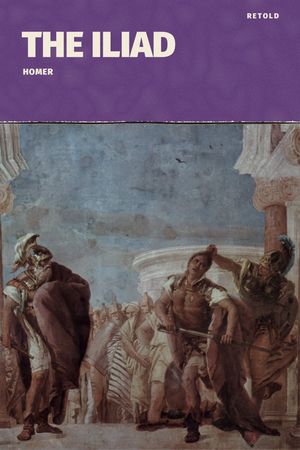
Book One
Sing, goddess, of the rage of Achilles, son of Peleus, the ruinous rage that brought the Achaeans sorrows past counting. It hurled the strong spirits of many heroes down to Hades and left their bodies as carrion for the dogs and for every bird; and the will of Zeus was being done. Begin where the two of them first quarrelled and broke apart: the son of Atreus, lord of men, and godlike Achilles.
Which of the gods set them at each other's throats? The son of Leto and Zeus. He was angry with the king, and he loosed a deadly plague through the army, and the men were dying, all because the son of Atreus had dishonoured Chryses, his priest. Chryses had come down to the swift ships of the Achaeans to buy his daughter back. He brought a ransom past counting, and in his hands, wound about a golden staff, he carried the sacred ribbons of Apollo who shoots from afar. He pleaded with all the Achaeans, and most of all with the two sons of Atreus, the marshals of the people:
"Sons of Atreus, and all you well-greaved Achaeans, may the gods who live on Olympus grant you the sack of Priam's city and a safe journey home. Only give me back my dear child, and take this ransom, out of reverence for the son of Zeus, Apollo who shoots from afar."
All the other Achaeans shouted their approval: honour the priest, they said, and take the splendid ransom. But that did not please Agamemnon, son of Atreus. He sent the old man packing with a hard word:
"Old man, don't let me catch you by the hollow ships again, loitering now or coming back later, or that staff and the god's ribbons won't save you. I'm not letting her go. She'll grow old first, in my house in Argos, far from her own country, walking up and down at my loom and sharing my bed. Now get out, and don't provoke me, if you want to leave here alive."
He spoke, and the old man was afraid and did as he was told. He walked away in silence along the shore of the roaring sea, and when he was well away from the camp he prayed and prayed to lord Apollo, the son of Leto of the lovely hair:
"Hear me, god of the silver bow, who stand guard over Chryse and holy Cilla, and rule Tenedos in power, Smintheus: if ever I roofed a temple to your liking, if ever I burned for you the fat thigh-pieces of bulls and goats, grant me this one prayer. Make the Danaans pay for my tears with your arrows."
That was his prayer, and Phoebus Apollo heard him. Down he came from the peaks of Olympus with fury in his heart, his bow on his shoulders and his quiver capped at both ends. The arrows rattled on the shoulders of the angry god as he strode, and he came on like the night. He sat down some way off from the ships and let an arrow go, and the silver bow gave a terrible twang. First he went for the mules and the swift dogs; then he aimed his sharp arrows at the men themselves, and shot, and shot again. And the pyres of the dead burned on and on, crowded close together.
For nine days the god's arrows rained on the army. On the tenth, Achilles called the people to an assembly. White-armed Hera had put the thought into his mind, because she cared for the Danaans and it hurt her to see them dying. When they were all gathered in one body, swift-footed Achilles stood up among them and spoke:
"Son of Atreus, I think we'll be beaten back and sail for home, if we even escape with our lives, now that war and plague together are cutting down the Achaeans. Come on, let's ask a seer, or a priest, or even a reader of dreams, since a dream too comes from Zeus. Someone who can tell us why Phoebus Apollo is so furious: is it a vow he blames us for, or a hecatomb? He might somehow accept the savour of lambs and full-grown goats, and keep this ruin away from us."
With that he sat down, and up rose Calchas son of Thestor, far the best of those who read the flight of birds. He knew what is, what will be and what was before, and it was his gift of prophecy, given him by Phoebus Apollo, that had guided the ships of the Achaeans to Ilios. He meant them well, and he spoke to the assembly:
"Achilles, dear to Zeus, you ask me to explain the rage of Apollo, the lord who shoots from afar. Very well, I'll tell you. But first think it over, and swear to me that you'll stand by me, ready with words and with your hands. Because I think I'm about to anger a man who rules all the Argives with great power, a man the Achaeans obey. A king has the upper hand when he is angry with a lesser man. He may swallow his anger for the day, but he keeps the grudge in his chest afterwards, until he has paid it off. Decide, then, whether you will keep me safe."
Swift-footed Achilles answered him: "Take heart, and tell us what the god has shown you, whatever you know. By Apollo, dear to Zeus, the god you pray to, Calchas, when you reveal the gods' will to the Danaans: while I live and see the light on this earth, no one beside the hollow ships will lay heavy hands on you, not one of all the Danaans. Not even if you mean Agamemnon, who boasts now that he is far the best of the Achaeans."
At that the blameless seer took courage and spoke out: "It isn't a vow he blames us for, then, or a hecatomb. It's his priest, whom Agamemnon dishonoured: he would not free his daughter, and he would not take the ransom. That is why the god who shoots from afar has given us grief, and will give us more. He will not lift this shameful ruin from the Danaans until the bright-eyed girl is given back to her father, with no price paid and no ransom, and a sacred hecatomb is taken to Chryse. Then, if we appease him, we might win him over."
With that he sat down, and up rose the hero son of Atreus, wide-ruling Agamemnon, in a black mood. His dark heart was brimming with fury, and his eyes were like blazing fire. He rounded on Calchas first, with a look that promised trouble:
"Prophet of doom, you have never once told me anything I wanted to hear! You love foretelling disaster; you have never yet spoken one good word, or made one come true. And now here you are, prophesying to the Danaans that the god who shoots from afar is hurting them for this: because I refused the splendid ransom for the girl Chryseis. Yes, I'd much rather keep her at home. I prefer her to Clytemnestra, my own wedded wife, because she's every bit her equal, in body and build, in mind and in the work of her hands. Even so, I'm willing to give her back, if that's the better course. I want my people safe, not dead. But you will get a prize ready for me, and at once, so that I'm not the only one of the Argives left without a prize of honour. That would not be right. You can all see it: my prize is going elsewhere."
Swift-footed noble Achilles answered him: "Most glorious son of Atreus, greediest of all men, how are the great-hearted Achaeans supposed to give you a prize? We don't know of any great hoard lying about in common. What we took from the cities we sacked has been shared out, and it isn't decent to make the men pile it all up again. No: give the girl up to the god now, and we Achaeans will pay you back three and four times over, if Zeus ever lets us sack the strong walls of Troy."
Lord Agamemnon answered him: "Don't try to outwit me like that, godlike Achilles, good as you are. You won't slip past me and you won't talk me round. You want to keep your own prize, then, while I sit here empty-handed? Is that why you tell me to give her up? If the great-hearted Achaeans give me a prize to suit me, one worth as much as hers, well and good. If they won't, I'll come and take one myself: yours, or the prize of Ajax, or I'll go to Odysseus and carry his away. And the man I come to will be furious. But we can settle all that later. For now, let's drag a black ship down to the shining sea, gather oarsmen for it, enough of them, put a hecatomb on board, and bring Chryseis of the lovely cheeks aboard herself. And let one of the counsellors take command, Ajax or Idomeneus or godlike Odysseus, or you, son of Peleus, most violent of all men, so that you can make the sacrifice and win back the favour of the god who shoots from afar."
Swift-footed Achilles glared at him from under his brows: "You shameless, scheming profiteer! How can any of the Achaeans be willing to take your orders, to march out on a raid for you, or fight men with all his strength? It wasn't the Trojan spearmen that brought me here to fight. They've done nothing to me. They never drove off my cattle or my horses, they never wrecked a harvest in rich-soiled Phthia, nurse of men. There's too much in between: shadowy mountains and the echoing sea. No, it was you we followed, you great shameless man, to make you happy, to win redress from the Trojans for Menelaus, and for you, you dog-face! And you don't care, you don't give it a thought. Now you threaten to take my prize from me yourself, the prize I sweated for, the prize the sons of the Achaeans gave me. I never get a prize equal to yours when the Achaeans sack some prosperous Trojan town. My hands do most of the grinding work of war, but when it comes to the share-out your prize is far bigger, and I go back to my ships with some small thing, but dear to me, when I'm worn out with fighting. Well, now I'm going home to Phthia. It's far better to sail home with my curved ships, and I don't mean to stay here without honour, piling up riches and wealth for you."
The lord of men Agamemnon answered him: "Run, then, if that's what your heart wants. I won't beg you to stay on my account. I have others at my side who will honour me, and above all Zeus the counsellor. Of all the kings Zeus cherishes, you are the one I hate most. You're always in love with quarrels and wars and fighting. If you're very strong, a god gave you that, I suppose. Go home with your ships and your companions and lord it over the Myrmidons. I don't care about you. I don't give a fig for your anger. But here is my threat to you. Since Phoebus Apollo is taking Chryseis from me, I'll send her off in my ship with my own companions; and then I'll come to your hut myself and take Briseis of the lovely cheeks, your prize, so that you know very well how much greater I am than you, and any other man will think twice before he calls himself my equal and stands up to me to my face."
He spoke, and pain stabbed the son of Peleus. The heart in his shaggy chest was torn two ways: should he draw the sharp sword from beside his thigh, scatter the others and kill the son of Atreus, or check his anger and hold his spirit back? While he was weighing it in his mind and in his heart, and drawing the great sword from its sheath, Athena came down from the sky. White-armed Hera had sent her, because she loved both men alike and cared for them both. She stood behind the son of Peleus and caught him by his fair hair, seen by him alone; none of the others could see her. Achilles was startled and spun round, and he knew Pallas Athena at once: her eyes blazed terribly. He spoke to her with winged words:
"Why have you come now, child of Zeus who holds the aegis? To see the arrogance of Agamemnon, son of Atreus? I tell you this, and I think it will come true: those overbearing ways of his will soon cost him his life."
The goddess grey-eyed Athena answered him: "I came from the sky to stop your fury, if you will listen. White-armed Hera sent me, because she loves you both alike and cares for you both. Come, let this quarrel go; take your hand off your sword. Lash him with words instead, and tell him how it will be. For I tell you this, and it will be done: one day you will be offered splendid gifts three times over for this insult. Hold back, and obey us."
Swift-footed Achilles answered her: "Goddess, when you two speak, a man must do as you say, however angry he is. That is the better way. The man who obeys the gods is the man the gods listen to."
He spoke, and he checked his heavy hand on the silver hilt and drove the great sword back into its sheath, and did not disobey Athena's word. And she was already gone to Olympus, to the house of Zeus who holds the aegis, among the other gods.
But the son of Peleus turned on the son of Atreus again with savage words, for his anger had not let go:
"You wine-sodden drunk, with the eyes of a dog and the heart of a deer! You've never once had the nerve to arm for battle alongside the army, or to go out on an ambush with the best of the Achaeans. That looks like death to you. It's far easier, isn't it, to go up and down the broad camp of the Achaeans robbing the gifts of any man who speaks against you. A king who feeds on his own people! You rule over nobodies, or else, son of Atreus, this outrage would be your last.
"But I tell you this, and I swear a great oath on it. By this staff, which will never again put out leaves or shoots, now that it has left its stump behind in the mountains, and will never grow green again, because the bronze has stripped it of leaf and bark; and now the sons of the Achaeans carry it in their hands when they give judgement, the men who uphold the laws that come from Zeus. This will be a great oath for you. The day will come when the sons of the Achaeans, every last one of them, will long for Achilles. And then, grieve as you may, you will be powerless to help them, when they fall dying in their numbers at the hands of man-killing Hector. And you will tear the heart inside you in fury that you gave no honour to the best of the Achaeans."
The son of Peleus spoke, and he flung the staff, studded with golden nails, to the ground, and sat down; and across from him the son of Atreus raged. Then up sprang Nestor, sweet of speech, the clear-voiced orator of the Pylians, whose voice flowed from his tongue sweeter than honey. He had already seen two generations of mortal men pass away, the men who had been born and raised with him long ago in sacred Pylos, and now he was king among the third. He meant them well, and he spoke to the assembly:
"This is a great grief come upon the land of Achaea! How Priam would gloat, and Priam's sons, and how all the other Trojans would rejoice in their hearts, if they heard the whole story of you two quarrelling, you who are first among the Danaans in counsel and first in battle. But listen to me. You are both younger than I am. In my time I have kept company with better men than you, and they never once brushed me aside. I have never seen such men since, and never will: Peirithous, and Dryas, shepherd of the people, Caeneus and Exadius and godlike Polyphemus, and Theseus son of Aegeus, a man like the immortals. They were the strongest men ever reared on this earth. The strongest they were, and they fought with the strongest, the wild beast-men of the mountains, the Centaurs, and they destroyed them terribly. I kept company with those men. I came a long way from Pylos, from a distant land, because they themselves sent for me, and I fought on my own account. No one of all the mortals now on earth could fight with them. And yet they listened to my advice and took my word. You listen too, then: listening is the better way. You, Agamemnon, great as you are, do not take the girl from him. Let her be, since the sons of the Achaeans gave her to him first as his prize. And you, son of Peleus, do not set yourself to quarrel with a king, force against force, because a sceptred king whom Zeus has given glory is granted no common honour. You may be strong, and a goddess may be your mother, but he is the greater, because he rules over more men. Son of Atreus, check your fury. And I beg you, let go your anger against Achilles, who is a great wall for all the Achaeans against the evil of war."
Lord Agamemnon answered him: "Yes, old man, every word you have said is right and fair. But this man wants to be above everyone else. He wants to rule over all, lord it over all, give orders to all, and there is one, I think, who won't obey. If the gods who live for ever made him a spearman, does that give him licence to keep hurling insults?"
Godlike Achilles cut in and answered him: "Yes, and I'd deserve to be called a coward and a nobody if I gave way to you in everything, whatever you said. Give your orders to other men, not to me, because I don't think I'll obey you any longer. And here's something else for you to take to heart. I will not fight with my hands over the girl, not with you or with anyone else, since you are all taking back what you gave. But of everything else I have beside my swift black ship, you will take nothing, nothing at all, against my will. Come on, just try it, so these men can see too: your dark blood will gush out round my spear in an instant."
When the two of them had fought it out with words of open war, they rose and broke up the assembly beside the ships of the Achaeans. The son of Peleus went off to his huts and his balanced ships with the son of Menoetius and his companions. The son of Atreus had a swift ship dragged down to the sea. He picked twenty oarsmen for her, put a hecatomb aboard for the god, and brought Chryseis of the lovely cheeks and sat her in the ship; and Odysseus of the many tricks went aboard to take command.
They embarked and sailed off over the watery roads. Meanwhile the son of Atreus ordered the army to purify itself, and the men washed themselves clean and threw the filth into the sea. Then they offered perfect hecatombs of bulls and goats to Apollo on the shore of the restless sea, and the savour rose to the sky, curling in the smoke.
While the camp was busy with all this, Agamemnon did not let go of the quarrel or the threat he had made to Achilles. He called Talthybius and Eurybates, his two heralds and willing attendants, and said to them:
"Go to the hut of Achilles, son of Peleus. Take Briseis of the lovely cheeks by the hand and bring her here. If he won't give her up, I'll come myself with more men and take her, and that will be all the worse for him."
He sent them off with that harsh order ringing in their ears. The two men went unwillingly along the shore of the restless sea until they came to the huts and the ships of the Myrmidons. They found Achilles sitting beside his hut and his black ship, and the sight of them gave him no joy. They stood there, frightened and full of awe before the king, and said nothing, and asked him nothing. But he understood in his heart, and spoke to them:
"Welcome, heralds, messengers of Zeus and of men. Come closer. You're not the ones I blame. Agamemnon is, who sent you here for the girl Briseis. Come, Patroclus, sprung from Zeus, bring the girl out and give her to them to take away. But let these two be my witnesses before the blessed gods and before mortal men, and before that brute of a king, if the day ever comes when they need me to keep shameful ruin off the rest of them. The man is raging, and his mind is poisoned. He has no idea how to look before and after, so that the Achaeans can fight in safety beside their ships."
He spoke, and Patroclus did as his dear friend told him. He led Briseis of the lovely cheeks out of the hut and gave her to them to take away, and the heralds went back along the line of the Achaean ships, and the woman went with them, unwilling. Then Achilles burst into tears. He drew away from his companions at once and sat down alone on the shore of the grey sea, looking out over the endless water, and he stretched out his hands and prayed and prayed to his dear mother:
"Mother, since you bore me to so short a life, Zeus the Olympian, who thunders on high, owed me honour at least. Now he hasn't given me even a little. The son of Atreus, wide-ruling Agamemnon, has dishonoured me: he has taken away my prize with his own hands, and keeps it."
He spoke, weeping, and his queenly mother heard him where she sat in the depths of the sea beside her old father. Quickly she rose from the grey sea like a mist and sat down in front of him as he wept. She stroked him with her hand and spoke to him, calling him by his name:
"My child, why are you crying? What grief has reached your heart? Tell me, don't hide it away, so that we both know."
Swift-footed Achilles answered her with a heavy groan: "You know. Why should I tell you all this, when you know it already? We went to Thebe, the sacred city of Eetion, and sacked it and brought everything here, and the sons of the Achaeans shared it out fairly among themselves. For the son of Atreus they picked out Chryseis of the lovely cheeks. Then Chryses, priest of Apollo who shoots from afar, came to the swift ships of the bronze-clad Achaeans to buy his daughter back. He brought a ransom past counting, and in his hands, wound about a golden staff, he carried the sacred ribbons of Apollo who shoots from afar. He pleaded with all the Achaeans, and most of all with the two sons of Atreus, the marshals of the people. All the other Achaeans shouted their approval: honour the priest, they said, and take the splendid ransom. But that did not please Agamemnon, son of Atreus. He sent the old man packing with a hard word. The old man went home in anger, and Apollo heard his prayer, because he loved him dearly, and he shot a deadly arrow at the Argives. The men began to die, one after another, as the god's arrows flew everywhere through the wide camp of the Achaeans. Then a seer who knew the truth told us what the god who shoots from afar wanted.
"I was the first to say at once that we must make peace with the god. Then anger seized the son of Atreus. He leapt to his feet and made a threat, and now he has carried it out. The bright-eyed Achaeans are taking the one girl to Chryse in a swift ship, with gifts for the lord Apollo, and the heralds have just this moment come to my hut and led away the other, the daughter of Briseus, the girl the sons of the Achaeans gave me. Now you, if you can, stand by your son. Go to Olympus and beg Zeus, if ever you did anything, by word or deed, to warm his heart. Many times I've heard you in my father's halls, boasting that you alone of the immortals saved the son of Cronos, god of the dark clouds, from shameful ruin, on the day the other Olympians wanted to put him in chains: Hera and Poseidon and Pallas Athena. But you came, goddess, and freed him from his chains. You were quick to call the hundred-handed one to high Olympus, the one the gods call Briareus and all men call Aegaeon, who is stronger even than his father. He sat down beside the son of Cronos, glorying in his strength, and the blessed gods were afraid of him and gave up their binding. Remind Zeus of that now. Sit beside him and take hold of his knees, and see if he might be willing to help the Trojans, and to pen the Achaeans in among the sterns of their ships and along the sea, dying as they go, so that they all get the good of their king, and so that the son of Atreus, wide-ruling Agamemnon, sees his own blindness in giving no honour at all to the best of the Achaeans."
Thetis answered him, and the tears ran down her face: "Oh, my child, why did I ever raise you, when I bore you to such misery? If only you could sit by the ships with no tears and no grief, since your share of life is short, not long at all. But now you are doomed to an early death and wretched beyond all men, both at once. It was an evil hour when I bore you in our halls. I'll go myself to snowy Olympus and tell all this to Zeus who delights in the thunderbolt, and see if he will listen. You, meanwhile, stay by your swift ships, keep up your rage against the Achaeans, and keep right out of the war. Zeus went off yesterday to Oceanus, to feast with the blameless Ethiopians, and all the gods went with him. On the twelfth day he will be back on Olympus. Then I'll go to the house of Zeus with its floor of bronze and clasp his knees, and I think I'll win him over."
With that she went away and left him there, angry at heart over the fair-girdled woman they had taken from him by force, against his will.
Meanwhile Odysseus reached Chryse with the sacred hecatomb. When they were inside the deep harbour they furled the sails and stowed them in the black ship, lowered the mast quickly by the forestays into its crutch, and rowed her in to the anchorage. They threw out the mooring stones and made the stern cables fast, and stepped out themselves onto the shore of the sea. They brought out the hecatomb for Apollo who shoots from afar, and Chryseis stepped off the seafaring ship. Then Odysseus of the many tricks led her to the altar, put her into her dear father's arms, and said to him:
"Chryses, the lord of men Agamemnon has sent me to bring your child back to you, and to offer a sacred hecatomb to Phoebus on behalf of the Danaans, so that we can appease the lord who has sent such grief and groaning on the Argives."
He spoke, and gave her into his arms, and the old man took his dear daughter with joy. Quickly they set out the god's sacred hecatomb in order round the well-built altar, washed their hands and took up the barley grains. And Chryses lifted his hands and prayed aloud on their behalf:
"Hear me, god of the silver bow, who stand guard over Chryse and holy Cilla, and rule Tenedos in power: once before you heard my prayer. You honoured me, and struck the army of the Achaeans hard. Now grant me this wish too: keep this shameful ruin away from the Danaans now."
That was his prayer, and Phoebus Apollo heard him. When they had prayed and scattered the barley grains, they drew back the victims' heads, cut their throats and flayed them. They cut out the thigh-pieces, wrapped them in a double fold of fat and laid raw meat on top. The old man burned them on split wood and poured bright wine over them, while the young men beside him held five-pronged forks. When the thigh-pieces were burned up and they had tasted the inner parts, they cut up the rest, spitted it, roasted it carefully, and drew it all off the spits. When the work was over and the meal was ready, they feasted, and no one's heart went without his fair share. When they had eaten and drunk as much as they wanted, the young men filled the mixing bowls to the brim and served everyone, pouring the first drops into each cup for the god. All day long the young men of the Achaeans sang to win the god's favour, singing a beautiful paean, a hymn to the god who shoots from afar, and he listened and was glad at heart.
When the sun set and darkness came on, they lay down to sleep by the stern cables of the ship. When the early dawn appeared, rosy-fingered, they put out to sea for the wide camp of the Achaeans, and Apollo who shoots from afar sent them a following wind. They stepped the mast and spread the white sail, and the wind filled the belly of the sail, and the dark wave hissed loud round the stem as the ship ran on, cutting her way through the swell. When they reached the wide camp of the Achaeans, they hauled the black ship up on land, high on the sand, and set long props under her, and then they scattered to their huts and ships.
But he sat on beside his swift ships, nursing his rage, the son of Peleus, sprung from Zeus, swift-footed Achilles. He never went to the assembly where men win glory, and never to the war. He stayed where he was, eating his heart out, and he longed for the war cry and the fighting.
When the twelfth dawn came after that, the gods who live for ever went back to Olympus all together, with Zeus leading the way. Thetis had not forgotten what her son had asked. She rose up from the wave of the sea, and early in the morning she climbed to the great sky and Olympus. She found the far-seeing son of Cronos sitting apart from the others on the highest peak of many-ridged Olympus. She sat down in front of him, took hold of his knees with her left hand, reached up with her right to touch his chin, and pleaded with lord Zeus, son of Cronos:
"Father Zeus, if ever among the immortals I helped you by word or deed, grant me this wish. Honour my son, whose life is shorter than any other man's. And now the lord of men Agamemnon has dishonoured him: he has taken away his prize with his own hands, and keeps it. But you, Olympian Zeus, the counsellor, give him his due. Let the Trojans have the upper hand until the Achaeans pay my son what they owe him and heap honour on him."
She spoke, but Zeus the cloud-gatherer gave her no answer. He sat a long while in silence. But Thetis, who had taken hold of his knees, kept hold of them, clinging close, and asked him again:
"Promise me truly, and nod your head to it, or else refuse me, since you have nothing to fear. Then I'll know for certain how far I am the least honoured goddess of them all."
Zeus the cloud-gatherer was deeply troubled, and said to her: "This will be ruinous work, if you set me quarrelling with Hera, when she provokes me with her taunts. Even as it is she is forever picking fights with me in front of the immortal gods, and says I help the Trojans in the fighting. Go back now, before Hera notices anything. I'll take care of all this and see it done. Here, I'll nod my head to you, so that you can be sure. Among the immortals this is the greatest pledge I can give: nothing I nod my head to can be taken back, or prove false, or go unfulfilled."
The son of Cronos spoke, and bowed his dark brows; the ambrosial locks of the lord streamed forward from his immortal head, and he made great Olympus shake.
Their plan made, the two of them parted. She plunged from gleaming Olympus into the deep sea, and Zeus went to his own house. All the gods rose together from their seats to meet their father. Not one of them dared to stay seated as he came in; they all stood up to face him. He sat down there on his throne. But Hera had not missed it. She had seen that Thetis of the silver feet, daughter of the old man of the sea, had been making plans with him. At once she turned on Zeus, son of Cronos, with mocking words:
"Which of the gods has been plotting with you this time, you schemer? You always love to go behind my back and settle things in secret. Not once have you been willing to tell me frankly what you have in mind."
The father of gods and men answered her: "Hera, don't hope to know all my thoughts. They would be hard for you, even though you are my wife. What it's right for you to hear, no one, god or man, will hear before you. But what I choose to think out alone, apart from the gods, don't question me about it, and don't pry."
Ox-eyed queen Hera answered him: "Most terrible son of Cronos, what a thing to say! I've never questioned you too much before, or pried. You plan whatever you like, in perfect peace. But now I'm dreadfully afraid that Thetis of the silver feet, daughter of the old man of the sea, has talked you round. She sat beside you at dawn and took hold of your knees, and I think you nodded your solemn promise to her that you would honour Achilles and destroy many men beside the ships of the Achaeans."
Zeus the cloud-gatherer answered her: "Strange lady, you are always suspecting, and I can never get anything past you. But for all that you'll achieve nothing, except to put yourself further from my heart, and that will be all the worse for you. If it is as you say, then that is how I want it. Sit down and be quiet, and do as I tell you, or all the gods on Olympus won't be able to help you when I come close and lay on you these hands that no one can resist."
He spoke, and ox-eyed queen Hera was afraid. She sat in silence, forcing her heart to submit, and all through the house of Zeus the gods of heaven were troubled. Then Hephaestus, the famous craftsman, began to speak, to comfort his dear mother, white-armed Hera:
"This will be ruinous work, and past bearing, if you two quarrel like this over mortals and set the gods brawling. There'll be no pleasure in a good feast, when the worse side wins. I advise my mother, sensible as she is herself, to keep on the right side of our dear father Zeus, so that he doesn't scold her again and spoil our feast. What if the Olympian, the lord of the lightning, wanted to blast us all out of our seats? He is far the strongest. No, you talk to him gently, and the Olympian will be kind to us again in no time."
He spoke, and jumped up and put a two-handled cup into his dear mother's hand, and said to her:
"Be patient, mother, and bear it, however much it hurts. I don't want to see you beaten in front of me, dear as you are to me. Then, for all my grief, I couldn't help you. The Olympian is a hard one to stand up to. Once before, when I tried to protect you, he caught me by the foot and hurled me from the threshold of heaven. All day long I fell, and at sunset I came down on Lemnos with hardly any life left in me. There the Sintian men took care of me at once, where I had fallen."
He spoke, and the goddess white-armed Hera smiled, and smiling she took the cup from her son's hand. Then he went round all the other gods from left to right, drawing sweet nectar from the mixing bowl and pouring it out for them. And laughter that would not stop broke out among the blessed gods at the sight of Hephaestus bustling and puffing through the house.
All that day until sunset they feasted, and no one's heart went without his share of the feast, or of the beautiful lyre that Apollo held, or of the Muses, who sang in turn with their lovely voices. When the bright light of the sun had set, they went home to sleep, each to his own house, which the famous god of the two strong arms, Hephaestus, had built for every one of them with his skill and cunning. And Zeus the Olympian, the lord of the lightning, went to his bed, where he always lay when sweet sleep came over him. There he climbed in and slept, and beside him lay Hera of the golden throne.
Book Two
All the other gods, and the men who fight from chariots, slept the whole night through, but sweet sleep would not take hold of Zeus. He was turning it over in his mind, how he could honour Achilles and destroy many men beside the ships of the Achaeans. And this seemed to him the best plan: to send a deadly Dream to Agamemnon, son of Atreus. He called it and spoke to it with winged words:
"Off with you, deadly Dream, to the swift ships of the Achaeans. Go into the hut of Agamemnon, son of Atreus, and tell him everything exactly as I command. Tell him to arm the long-haired Achaeans, every last man, at once, because now he can take the city of the Trojans with its wide streets. The immortals who have their homes on Olympus are no longer of two minds. Hera has bent them all with her pleading, and sorrows hang over the Trojans."
He spoke, and the Dream went off once it had heard its orders. It came quickly to the swift ships of the Achaeans and made for Agamemnon, son of Atreus, and found him asleep in his hut, wrapped in ambrosial sleep. It stood over his head in the likeness of Nestor, son of Neleus, the elder Agamemnon honoured most, and in his shape the Dream from heaven spoke:
"Asleep, son of wise-hearted Atreus, tamer of horses? A man who sits in council has no business sleeping the whole night through, a man the people have been entrusted to, with so many cares on his mind. Now listen to me, and quickly. I am a messenger to you from Zeus, who far away as he is cares for you greatly and pities you. He tells you to arm the long-haired Achaeans, every last man, at once, because now you can take the city of the Trojans with its wide streets. The immortals who have their homes on Olympus are no longer of two minds. Hera has bent them all with her pleading, and sorrows hang over the Trojans by the will of Zeus. Keep this in your mind, and don't let it slip away when honey-sweet sleep lets you go."
With that it went, and left him there, his heart full of things that were never going to happen. He thought he would take the city of Priam that very day, the fool. He had no idea what Zeus was planning: more pain and groaning still for Trojans and Danaans alike, through the hard-fought battles.
He woke from his sleep with the god's voice still ringing all round him. He sat up and pulled on his soft tunic, fine and new, and threw his great cloak round him, bound his beautiful sandals under his shining feet, and slung his silver-studded sword over his shoulder. Then he took up the staff of his fathers, which will never decay, and went with it down among the ships of the bronze-clad Achaeans.
The goddess Dawn was climbing high Olympus to announce the light to Zeus and the other immortals when Agamemnon ordered the clear-voiced heralds to summon the long-haired Achaeans to assembly. The heralds cried the summons, and the men came together very quickly. But first he held a council of the great-hearted elders beside the ship of Nestor, the king born in Pylos, and when he had them gathered he laid out a cunning plan:
"Listen, my friends. A Dream from heaven came to me in my sleep, through the ambrosial night, and it looked most like godlike Nestor, in face and height and build. It stood over my head and spoke to me: 'Asleep, son of wise-hearted Atreus, tamer of horses? A man who sits in council has no business sleeping the whole night through, a man the people have been entrusted to, with so many cares on his mind. Now listen to me, and quickly. I am a messenger to you from Zeus, who far away as he is cares for you greatly and pities you. He tells you to arm the long-haired Achaeans, every last man, at once, because now you can take the city of the Trojans with its wide streets. The immortals who have their homes on Olympus are no longer of two minds. Hera has bent them all with her pleading, and sorrows hang over the Trojans by the will of Zeus. Keep this in your mind.' With that it flew away, and sweet sleep let me go. Come, then, let us see if somehow we can arm the sons of the Achaeans. But first I'll test them with words, as is the custom, and tell them to run for home in their many-benched ships. Then all of you, each from where he stands, hold them back with words."
With that he sat down, and up rose Nestor, king of sandy Pylos. He meant them well, and he spoke to the assembly:
"My friends, leaders and rulers of the Argives, if any other Achaean had told us this dream, we would call it a lie and turn our backs on it. But the man who saw it is the one who claims to be far the best of the Achaeans. Come, then, let us see if somehow we can arm the sons of the Achaeans."
He spoke, and led the way out of the council, and the other sceptred kings rose and followed the shepherd of the people, and the army came pouring in. As bees go out in swarm after swarm from a hollow rock, always fresh ones coming, and fly in clusters to the flowers of spring, some winging their crowds this way and some that, so the many tribes of men marched company by company from the ships and the huts along the front of the deep shore to the assembly. Rumour, the messenger of Zeus, blazed up among them, driving them on, and they gathered.
The meeting place was in an uproar. The earth groaned under them as the men sat down, and there was a din. Nine heralds were bellowing, trying to restrain them, if they would ever stop their clamour and listen to the kings brought up by Zeus. At last, with great effort, the men were seated and kept in their places, and the shouting stopped. Then lord Agamemnon stood up, holding the staff that Hephaestus had laboured to make. Hephaestus gave it to lord Zeus, son of Cronos; Zeus gave it to the messenger, the slayer of Argus; lord Hermes gave it to Pelops, the driver of horses; Pelops in his turn gave it to Atreus, shepherd of the people; Atreus, dying, left it to Thyestes, rich in sheep; and Thyestes in his turn left it to Agamemnon to carry, and to be lord of many islands and all Argos. Leaning on it, he spoke to the Argives:
"My friends, Danaan heroes, servants of Ares, great Zeus, son of Cronos, has bound me fast in a heavy blindness of heart. He is cruel. Once he promised me, and nodded his head to it, that I would sack well-walled Ilios before I went home. Now he has hatched an evil deceit, and tells me to go back to Argos in disgrace, after I've lost so many men. That, I suppose, is what pleases Zeus in his great power, who has toppled the high towers of many cities and will topple more, since his strength is the greatest of all. It's a shameful thing, one that men will hear of in years to come, that an army of Achaeans this fine and this large should be fighting like this for nothing, waging a war that goes nowhere against fewer men than themselves, with still no end in sight. Suppose we wanted, Achaeans and Trojans both, to swear a solemn truce and be counted: the Trojans to gather everyone who has a hearth in the city, and we Achaeans to be ranged in tens, and each ten of us to pick a Trojan to pour our wine. Many tens would go without a wine-pourer. That's how far, I tell you, the sons of the Achaeans outnumber the Trojans who live in the city. But they have allies from many cities, men who wield the spear, and those allies throw me badly off course and won't let me sack the well-peopled citadel of Ilios, however much I want to. Nine years of great Zeus have gone by. The timbers of our ships have rotted, the ropes have come loose. Our wives, I suppose, and our little children sit in our halls waiting for us, and the work we came here to do is as far from done as ever. Come, then, let us all do as I say. Let's run with our ships to our own dear country. We will never take Troy of the wide streets now."
He spoke, and he stirred the heart in the breast of every man in the crowd who had not heard the council. The assembly heaved like the long waves of the sea, the Icarian sea, when the east wind and the south wind come rushing down on them out of the clouds of father Zeus. As the west wind comes and stirs a deep field of grain, swooping down on it in fury, and the ears all bow, so the whole assembly was stirred. With a great cry they rushed for the ships, and the dust rose from under their feet and hung in the air. They shouted to one another to lay hold of the ships and drag them down into the bright sea, and they cleared out the launching channels. Their shouting went up to the sky as they longed for home, and they began pulling the props from under the ships.
Then the Argives would have had their homecoming, against what was fated, if Hera had not spoken to Athena:
"For shame, child of Zeus who holds the aegis, Atrytone, unwearied one! Are the Argives really going to run like this to their own dear country over the wide back of the sea? And leave Priam and the Trojans a thing to boast of, Argive Helen, for whose sake so many Achaeans have died in Troy, far from their own dear country? Go now through the army of the bronze-clad Achaeans. Hold back every man with your gentle words, and don't let them drag their curving ships down into the sea."
She spoke, and the goddess grey-eyed Athena did not disobey. Down she went darting from the peaks of Olympus and came quickly to the swift ships of the Achaeans. There she found Odysseus, a match for Zeus in counsel, standing still. He had not laid a hand on his black, well-benched ship, because grief had reached his heart and spirit. Grey-eyed Athena came and stood close beside him and said:
"Son of Laertes, sprung from Zeus, Odysseus of the many tricks, are you all really going to run like this to your own dear country, tumbling into your many-benched ships? And leave Priam and the Trojans a thing to boast of, Argive Helen, for whose sake so many Achaeans have died in Troy, far from their own dear country? Go now through the army of the Achaeans, and don't hang back any longer. Hold back every man with your gentle words, and don't let them drag their curving ships down into the sea."
She spoke, and he knew the goddess's voice. He set off at a run, throwing off his cloak, and his herald, Eurybates of Ithaca, who went everywhere with him, picked it up. Odysseus went straight up to Agamemnon, son of Atreus, and took from him the staff of his fathers, which will never decay, and with it he went down among the ships of the bronze-clad Achaeans.
Whenever he came on a king or a man of rank, he would stand beside him and hold him back with gentle words:
"Sir, it isn't right to scare you as if you were a coward. Sit down yourself, and make the rest of your men sit down. You don't yet know what the son of Atreus really has in mind. Now he's testing us, but soon he'll come down hard on the sons of the Achaeans. Not all of us heard what he said in the council. I'm afraid he may lose his temper and do the sons of the Achaeans some harm. Kings brought up by Zeus have great pride. Their honour comes from Zeus, and Zeus the counsellor loves them."
But whenever he saw a man of the common people and caught him shouting, he would strike him with the staff and tell him off:
"You there, sit still and listen to what others say, men who are better than you. You're no fighter, you're a weakling, you count for nothing in war or in council. We Achaeans can't all be kings here, not by any means. Many masters are a bad thing. Let there be one master, one king, the one to whom the son of crooked-counselling Cronos has given the staff and the laws, to take counsel for his people."
That was how he took command and went through the army, and they came rushing back to the assembly from the ships and the huts with a roar, as when a wave of the roaring sea booms on a long beach and the whole sea thunders.
The rest sat down and kept their places. Only Thersites, a man who never knew when to stop talking, was still squalling away. His head was full of words, plenty of them and all out of order, for picking fights with the kings, wildly and with no sense of what was fitting, anything he thought would make the Argives laugh. He was the ugliest man who came to Ilios. He was bandy-legged and lame in one foot, his two shoulders were humped and hunched in over his chest, and above them his head came to a point, with a thin fuzz sprouting on it. Achilles and Odysseus hated him most, because those two were the ones he was always abusing, but now he was screeching insults at godlike Agamemnon. The Achaeans were furious with him and indignant in their hearts. But he went on at the top of his voice, abusing Agamemnon to his face:
"Son of Atreus, what are you complaining about now? What more do you want? Your huts are full of bronze, and full of women too, the pick of the spoils, which we Achaeans give you first of all whenever we take a town. Or is it gold you're still short of, gold some horse-taming Trojan will bring out of Ilios to ransom his son, after I've tied him up and dragged him in, me or some other Achaean? Or a young woman to sleep with and keep for yourself, all to yourself? It's not right for a man who's our leader to lead the sons of the Achaeans into misery. You soft fools, you disgraces, you women of Achaea, not men of Achaea any more! Let's go home with our ships and leave this man here in Troy to stew over his prizes, so that he finds out whether we're any help to him or not. Look at him, he's just dishonoured Achilles, a far better man than he is: he has taken away his prize with his own hands, and keeps it. But there's no anger in Achilles' heart. He lets things go. Otherwise, son of Atreus, this outrage would be your last."
That was Thersites, abusing Agamemnon, shepherd of the people. But godlike Odysseus was at his side in a moment, gave him a black look from under his brows, and rounded on him harshly:
"Thersites, you babbler, clear-voiced speaker though you are, stop it. Don't you dare quarrel single-handed with kings. I tell you there's no lower man than you of all who came to Ilios with the sons of Atreus. You've no business standing up in the assembly with the kings' names in your mouth, throwing insults at them and watching for your chance to go home. We don't yet know how this will turn out, whether we sons of the Achaeans will go home well or badly. And here you sit abusing Agamemnon, son of Atreus, shepherd of the people, because the Danaan heroes give him so very much, while you stand up and sneer. I will tell you this plainly, and it will be done. If I catch you playing the fool again the way you are now, then let the head of Odysseus no longer sit on his shoulders, and let me no longer be called the father of Telemachus, if I don't take you and strip off your clothes, your cloak and your tunic that cover your nakedness, and send you howling off to the swift ships, beaten out of the assembly with shameful blows."
He spoke, and struck him with the staff across the back and shoulders. Thersites doubled up, and a big tear rolled down his face, and a bloody welt rose on his back under the golden staff. He sat down, frightened, and in his pain, with a helpless look, he wiped away the tear. And the others, miserable as they were, laughed at him with real pleasure, and this is what a man would say, looking at the man next to him:
"Well, well! Odysseus has done a thousand good things before now, leading the way with good plans and marshalling the battle, but this is far the best thing he has ever done for the Argives, shutting up this foul-mouthed abuser and his speeches. I don't think his lordly heart will send him back to abuse the kings with his insults again."
That was what the crowd said. Then Odysseus, sacker of cities, stood up with the staff in his hand, and beside him grey-eyed Athena, in the likeness of a herald, ordered the army to be silent, so that the sons of the Achaeans, front ranks and back alike, could hear what he said and weigh his advice. He meant them well, and he spoke to the assembly:
"Son of Atreus, my lord, the Achaeans now want to make you the most disgraced of all mortal men. They won't keep the promise they made you while they were still on their way here from Argos, the pasture of horses, that you would sack well-walled Ilios before you went home. Like little boys or widowed women they wail to each other about going home. And it's true, the hardship here is enough to make a man go home in disgust. A man who is kept away from his wife for just one month, with his many-benched ship, gets restless when the winter storms and the heaving sea pen him in. And for us this is the ninth year coming round as we wait here. I don't blame the Achaeans for growing restless beside the curved ships. But all the same, it's a disgrace to stay this long and go home empty-handed. Hold out, my friends, and stay a little longer, so that we can find out whether what Calchas prophesies is true or not.
"We know this well in our hearts, and you are all witnesses, all of you whom the fates of death have not carried off. It seems only yesterday or the day before, when the ships of the Achaeans were gathering at Aulis to bring evil on Priam and the Trojans. We were round a spring at the holy altars, offering perfect hecatombs to the immortals under a beautiful plane tree, where the bright water flowed, and there a great sign appeared. A snake, blood-red down its back, a terrible thing, which the Olympian himself had sent out into the light, darted from under the altar and shot up the plane tree. On the topmost branch, crouching under the leaves, were the chicks of a sparrow, helpless little things, eight of them, and the mother who had hatched them made nine. The snake gobbled them up as they cheeped pitifully, while the mother fluttered round and round, crying for her chicks, until he coiled himself and caught her by the wing as she shrieked about him. When he had eaten the chicks and the mother too, the god who had brought him into the light made him a sign for all to see: the son of crooked-counselling Cronos turned him to stone. And we stood there amazed at what had happened. When those terrible portents of the gods broke in on our hecatombs, Calchas at once spoke out his prophecy: 'Why have you gone silent, long-haired Achaeans? Zeus the counsellor has shown us this great sign, late to come and late to be fulfilled, and its glory will never die. As this snake ate the sparrow's chicks and the mother too, eight, and the mother who hatched them made nine, so we will fight there for as many years, and in the tenth we will take the city of the wide streets.' That is what he said, and now it is all coming true. Come, then, stay, all you well-greaved Achaeans, stay right here, until we take the great city of Priam."
He spoke, and the Argives gave a great shout, and the ships all round them echoed terribly to the shouting of the Achaeans as they cheered the speech of godlike Odysseus. And the horseman Nestor of Gerenia spoke to them too:
"Shame on you! You're holding an assembly like little boys who know nothing about the work of war. What's to become of our compacts and our oaths? Into the fire, then, with all the counsels and plans of men, the libations of unmixed wine and the right hands we pledged and trusted! We bicker with words like this, for nothing, and can't find any way out, though we've been here so long. Son of Atreus, keep your purpose firm, as you always have, and lead the Argives through the hard-fought battles. Let these one or two rot, the ones who plot apart from the Achaeans to go back to Argos before we've learned whether the promise of Zeus who holds the aegis is a lie or not. They won't get anywhere. I tell you the son of Cronos in his great power gave us his nod on the day the Argives boarded their swift-sailing ships to bring death and doom to the Trojans: he flashed his lightning on our right and showed us signs of good omen. Let no one be in a hurry to go home, then, until he has slept with some Trojan's wife and paid them back for all the struggling and groaning over Helen. And if any man is desperate to go home, let him lay a hand on his black, well-benched ship, and he will meet death and his doom before the rest. But you, my lord, think things out well yourself, and listen to another man as well. What I say is not to be thrown away. Divide the men by tribes and by clans, Agamemnon, so that clan stands by clan and tribe by tribe. If you do this, and the Achaeans obey you, you'll know which of the leaders is a coward and which of the men, and which of them is brave, because each group will be fighting on its own. And you'll know whether it is heaven's will that keeps you from sacking the city, or the cowardice of the men and their folly in war."
Lord Agamemnon answered him: "Once again, old man, you beat the sons of the Achaeans in the assembly. Father Zeus, and Athena, and Apollo, if only I had ten counsellors like you among the Achaeans! Then the city of lord Priam would soon bow its head, taken and sacked under our hands. But Zeus who holds the aegis, the son of Cronos, has given me sorrows, flinging me into pointless quarrels and squabbles. Achilles and I fought over a girl, with angry words, and I was the one who started it. But if ever we're of one mind again, the Trojans' doom won't be put off, not for a moment. Now go to your meal, so that we can join battle. Let every man sharpen his spear well and set his shield in order well, give his swift-footed horses a good feed, look well all round his chariot and keep his mind on the fighting, so that all day long we can fight it out in hateful war. There'll be no rest in between, not for a moment, until night comes and parts the fury of men. Many a man's shield strap will be soaked with sweat across his chest, and his hand will grow weary on his spear, and many a man's horse will be lathered as it strains at the polished chariot. And any man I see wanting to hang back from the battle beside the curved ships, nothing will save him then from the dogs and the birds."
He spoke, and the Argives gave a great shout, like a wave crashing on a high shore when the south wind comes and drives it against a jutting rock, a rock the waves never leave alone, whatever wind is blowing, from this side or from that. They stood up and hurried off, scattering among the ships, lit fires in the huts and ate their meal. Each man sacrificed to one of the gods who live for ever, each to his own, praying to escape death and the turmoil of war. But the lord of men Agamemnon sacrificed a fat bull, five years old, to the son of Cronos in his great power, and he called the elders, the best of all the Achaeans: Nestor first of all, and lord Idomeneus, then the two Ajaxes and the son of Tydeus, and sixth Odysseus, a match for Zeus in counsel. Menelaus, good at the war cry, came of his own accord, because he knew in his heart how hard his brother was labouring. They stood round the bull and took up the barley grains, and lord Agamemnon prayed among them:
"Zeus, most glorious, most great, god of the dark clouds, who live in the upper air, don't let the sun go down and the darkness come until I have thrown the hall of Priam headlong to the ground, black with smoke, and burned its doors with blazing fire, and torn the tunic of Hector to rags on his chest with the bronze; and may many of his companions fall headlong round him in the dust and bite the earth with their teeth."
That was his prayer, but the son of Cronos was not going to grant it yet. He accepted the offerings, and he made the toil grow, toil that no one would envy. When they had prayed and scattered the barley grains, they drew back the victims' heads, cut their throats and flayed them. They cut out the thigh-pieces, wrapped them in a double fold of fat and laid raw meat on top. These they burned on split wood stripped of its leaves, and they spitted the inner parts and held them over the flame of Hephaestus. When the thigh-pieces were burned up and they had tasted the inner parts, they cut up the rest, spitted it, roasted it carefully, and drew it all off the spits. When the work was over and the meal was ready, they feasted, and no one's heart went without his fair share. When they had eaten and drunk as much as they wanted, the horseman Nestor of Gerenia was the first to speak:
"Most glorious son of Atreus, lord of men Agamemnon, let's not stand here talking any longer, or put off any longer the work the god is putting into our hands. Come, let the heralds of the bronze-clad Achaeans call out the army and gather it along the ships, and let us go together, just as we are, through the wide camp of the Achaeans, so that we can wake the sharp war god all the sooner."
He spoke, and the lord of men Agamemnon did not disobey. At once he ordered the clear-voiced heralds to call the long-haired Achaeans to war. The heralds cried the summons, and the men came together very quickly. The kings brought up by Zeus who stood round the son of Atreus hurried here and there, sorting the men into their ranks, and grey-eyed Athena went among them carrying the precious aegis, ageless and immortal. A hundred tassels of pure gold flutter from it, every one finely woven and every one worth a hundred oxen. With it she flashed through the army of the Achaeans, driving them forward, and in every man's heart she roused the strength to make war and fight without rest. All at once war was sweeter to them than going home in the hollow ships to their own dear country.
As a ruinous fire sets a boundless forest blazing on a mountain's peaks, and the glare is seen far off, so as they marched the dazzling gleam of their marvellous bronze rose through the bright air to the sky.
As the many flocks of winged birds, geese or cranes or long-necked swans, fly this way and that over the Asian meadow by the streams of the Caystrius, glorying in their wings, and keep settling with loud cries, each a little ahead of the last, until the whole meadow rings, so their many tribes poured out from the ships and the huts onto the plain of the Scamander, and the ground rang terribly under the feet of men and horses. They took their stand in the flowering meadow of the Scamander, thousands upon thousands, as many as the leaves and the flowers that come in their season.
Like the many swarms of buzzing flies that dart all over a shepherd's farmyard in springtime, when the milk splashes the pails, so many were the long-haired Achaeans who stood on the plain facing the Trojans, eager to tear them apart.
As goatherds easily sort out their wide flocks of goats when the herds have mixed in the pasture, so their leaders marshalled them this way and that for battle. And among them was lord Agamemnon, his eyes and head like Zeus who delights in the thunderbolt, his waist like Ares, his chest like Poseidon. As a bull stands out far above the whole herd, finest among the gathered cattle, so Zeus made the son of Atreus that day: outstanding among many, and first among the heroes.
Tell me now, you Muses who have your homes on Olympus, since you are goddesses, and are present, and know everything, while we hear only the rumour and know nothing: who were the leaders and the lords of the Danaans? The rank and file I could never tell or name, not even if I had ten tongues and ten mouths, a voice that would never break and a heart of bronze inside me, unless the Muses of Olympus, the daughters of Zeus who holds the aegis, were to call to mind all those who came to Ilios. But the commanders of the ships I will tell, and all the ships.
Peneleos and Leitus led the Boeotians, and Arcesilaus and Prothoenor and Clonius with them. Theirs were the men who lived in Hyria and rocky Aulis, in Schoenus and Scolus and Eteonus of the many ridges, in Thespeia and Graea and spacious Mycalessus; the men who lived round Harma and Eilesium and Erythrae; who held Eleon and Hyle and Peteon, Ocalea, and Medeon the well-built citadel, Copae and Eutresis and Thisbe, the haunt of doves; who held Coroneia and grassy Haliartus; who held Plataea, and lived in Glisas; who held Lower Thebes, the well-built citadel, and sacred Onchestus, the bright grove of Poseidon; who held Arne, rich in grapes, and Mideia, and holy Nisa, and Anthedon at the edge of the land. Fifty ships of theirs came, and on each of them sailed a hundred and twenty young Boeotians.
Those who lived in Aspledon and in Orchomenus of the Minyae were led by Ascalaphus and Ialmenus, the sons of Ares. Astyoche bore them in the house of Actor son of Azeus. She was a modest girl, and she went up to the upper room, and mighty Ares lay with her there in secret. Thirty hollow ships came in line with them.
Schedius and Epistrophus led the Phocians, the sons of great-hearted Iphitus son of Naubolus. Theirs were the men who held Cyparissus and rocky Pytho, holy Crisa, Daulis and Panopeus; who lived round Anemoreia and Hyampolis; who lived beside the divine river Cephisus; and who held Lilaea at the springs of the Cephisus. Forty black ships came with them. Their leaders went busily about, setting the ranks of the Phocians in order, and they armed for battle next to the Boeotians, on the left.
The Locrians were led by swift Ajax son of Oileus, the lesser Ajax, nowhere near the size of Telamonian Ajax, but much smaller. He was a small man in a corselet of linen, but with the spear he outdid all the Hellenes and the Achaeans. His were the men who lived in Cynus and Opus and Calliarus, in Bessa and Scarphe and lovely Augeiae, in Tarphe and Thronium round the streams of the Boagrius. Forty black ships came with him, the ships of the Locrians who live across from sacred Euboea.
The Abantes, breathing fury, held Euboea: Chalcis and Eretria and Histiaea, rich in grapes, Cerinthus by the sea and the steep citadel of Dios; they held Carystus too, and lived in Styra. Their leader was Elephenor, offshoot of Ares, son of Chalcodon and commander of the great-hearted Abantes. The swift Abantes followed him, their hair worn long at the back, spearmen eager to thrust with their outstretched spears of ash and break the corselets on their enemies' chests. Forty black ships came with him.
Those who held Athens, the well-built citadel, the people of great-hearted Erechtheus, were led by Menestheus, son of Peteos. Erechtheus was born of the grain-giving earth long ago, and Athena, daughter of Zeus, brought him up and gave him a home in Athens in her own rich temple, where the young men of the Athenians win his favour with bulls and rams as the years come round. No man on earth had ever been born who could match Menestheus at marshalling horses and shield-bearing men. Only Nestor could rival him, because he was older. Fifty black ships came with him.
Ajax brought twelve ships from Salamis and stationed them where the battalions of the Athenians stood.
Those who held Argos and Tiryns of the great walls, Hermione and Asine, which lie along the deep gulf, Troezen and Eionae and Epidaurus of the vines, and the young Achaeans who held Aegina and Mases, were led by Diomedes, good at the war cry, and by Sthenelus, the dear son of glorious Capaneus. With them came a third, Euryalus, a man equal to the gods, the son of lord Mecisteus son of Talaus. But Diomedes, good at the war cry, was leader of them all. Eighty black ships came with them.
Those who held Mycenae, the well-built citadel, wealthy Corinth and well-built Cleonae; who lived in Orneiae and lovely Araethyrea, and in Sicyon, where Adrastus was once king; who held Hyperesia and steep Gonoessa and Pellene; who lived round Aegium and all along Aegialus and round broad Helice: their hundred ships were led by lord Agamemnon, son of Atreus. With him came far the most men, and the best. He himself had put on the gleaming bronze and wore it proudly, and he stood out among all the heroes, because he was the greatest, and he led far the most men.
Those who held the hollow land of Lacedaemon with its many ravines, Pharis and Sparta and Messe, the haunt of doves; who lived in Bryseiae and lovely Augeiae; who held Amyclae and Helus, a citadel by the sea; who held Laas and lived round Oetylus: these were led by his brother, Menelaus, good at the war cry, with sixty ships, and they armed apart from the rest. He went among them himself, trusting in his own ardour and driving them on to war, and more than any man he longed in his heart to take revenge for the struggles and the groans of Helen.
Those who lived in Pylos and lovely Arene, in Thryum, the ford of the Alpheus, and well-built Aepy; who made their homes in Cyparisseis and Amphigeneia, in Pteleos and Helus and Dorium: these were led by the horseman Nestor of Gerenia, and ninety hollow ships came in line with him. It was at Dorium that the Muses met Thamyris the Thracian, on his way from Oechalia and the house of Eurytus of Oechalia, and put an end to his singing. He had boasted that he would win even if the Muses themselves, the daughters of Zeus who holds the aegis, sang against him. In their anger they maimed him. They took away his marvellous song and made him forget his playing on the lyre.
Those who held Arcadia under the steep mountain of Cyllene, beside the tomb of Aepytus, where the men fight hand to hand; who lived in Pheneos and in Orchomenus, rich in flocks, Rhipe and Stratia and windy Enispe; who held Tegea and lovely Mantineia; who held Stymphalus and lived in Parrhasia: these were led by the son of Ancaeus, lord Agapenor, with sixty ships. Many Arcadian men went aboard each ship, men who knew how to fight. The lord of men Agamemnon, son of Atreus, had given them the well-benched ships himself to cross the wine-dark sea, because the work of the sea meant nothing to them.
Those who lived in Buprasium and fine Elis, all the land shut in by Hyrmine and Myrsinus at the edge of the country, the rock of Olen and Alesium, had four commanders, and ten swift ships followed each man, and many Epeans went aboard them. Amphimachus and Thalpius led some, grandsons of Actor, one the son of Cteatus, the other of Eurytus. Mighty Diores, son of Amarynceus, led others. The fourth company was led by godlike Polyxeinus, son of lord Agasthenes son of Augeias.
Those who came from Dulichium and the sacred Echinae, the islands that lie across the sea facing Elis, were led by Meges, a match for Ares, son of the horseman Phyleus, dear to Zeus, who long ago had left home for Dulichium in anger with his father. Forty black ships came with him.
Odysseus led the great-hearted Cephallenians, who held Ithaca and Neriton with its waving forests and lived in Crocyleia and rugged Aegilips; who held Zacynthus and lived round Samos; who held the mainland and lived on the coast across from the islands. Odysseus, a match for Zeus in counsel, led them, and twelve ships came with him, their bows painted red.
Thoas son of Andraemon led the Aetolians, who lived in Pleuron and Olenus and Pylene, Chalcis by the sea and rocky Calydon. The sons of great-hearted Oeneus were no longer living, nor was Oeneus himself, and fair-haired Meleager was dead, and so the whole command of the Aetolians had been given to Thoas. Forty black ships came with him.
Idomeneus, the famous spearman, led the Cretans, who held Cnosus and Gortyn of the great walls, Lyctus and Miletus and gleaming white Lycastus, Phaestus and Rhytium, thriving cities all, and all the others who lived in Crete of the hundred cities. All these were led by Idomeneus, the famous spearman, and by Meriones, a match for Enyalius the war god, the killer of men. Eighty black ships came with them.
Tlepolemus son of Heracles, a brave man and a tall one, brought nine ships of the proud Rhodians from Rhodes, where they lived in three divisions: in Lindos and Ialysus and gleaming white Cameirus. Tlepolemus the famous spearman led them, the son whom Astyocheia bore to mighty Heracles. Heracles had carried her off from Ephyre, from the river Selleis, after sacking many cities of strong young men brought up by Zeus. But when Tlepolemus had grown up in the well-built palace, he killed his own father's dear uncle, Licymnius, offshoot of Ares, who was already growing old. At once he built ships, gathered a great many people and fled across the sea, because the other sons and grandsons of mighty Heracles had threatened him. He came to Rhodes after long wandering and many hardships. There his people settled in three parts, by tribes, and Zeus who is king over gods and men loved them, and the son of Cronos poured marvellous wealth on them.
Nireus brought three balanced ships from Syme: Nireus, son of Aglaia and lord Charops; Nireus, the most beautiful man who came to Ilios, of all the Danaans after the blameless son of Peleus. But he was a weakling, and few men followed him.
Those who held Nisyrus and Crapathus and Casus, and Cos, the city of Eurypylus, and the Calydnian islands, were led by Pheidippus and Antiphus, the two sons of lord Thessalus son of Heracles. Thirty hollow ships came in line with them.
Now all those who lived in Pelasgian Argos, who lived in Alos and Alope and Trachis, who held Phthia and Hellas of the lovely women, and were called Myrmidons and Hellenes and Achaeans: Achilles was commander of their fifty ships. But they had no thought now of harsh-sounding war, since there was no one to lead them into the ranks. Swift-footed noble Achilles lay idle among the ships, angry over the girl, Briseis of the lovely hair. He had taken her from Lyrnessus after hard labour, when he sacked Lyrnessus and the walls of Thebe and struck down Mynes and Epistrophus, famous with the spear, the sons of lord Evenus son of Selepus. He lay there grieving for her; but soon he was to rise again.
Those who held Phylace, and flowery Pyrasus, the sacred ground of Demeter, and Iton, mother of flocks, Antron by the sea and Pteleos deep in grass, had been led by warlike Protesilaus while he lived; but by now the black earth held him. His wife was left behind in Phylace with her cheeks torn in mourning, and his house half built. A Dardanian had killed him as he leapt from his ship, far the first of the Achaeans to land. Even so his men were not without a leader, though they longed for the one they had lost. Podarces, offshoot of Ares, marshalled them, the son of Iphiclus, rich in flocks, son of Phylacus. He was the full brother of great-hearted Protesilaus, younger in years; the elder and the better man was the hero, warlike Protesilaus. The men did not lack a leader, though they longed for the brave one they had lost. Forty black ships came with him.
Those who lived in Pherae beside Lake Boebeis, in Boebe and Glaphyrae and well-built Iolcus, were led, with eleven ships, by the dear son of Admetus, Eumelus, whom Alcestis bore to Admetus, queenly among women, the most beautiful of the daughters of Pelias.
Those who lived in Methone and Thaumacia, and held Meliboea and rugged Olizon, were led, with seven ships, by Philoctetes, who knew the bow well, and on each ship went fifty oarsmen, skilled with the bow and strong in the fight. But Philoctetes lay on an island in terrible pain, on sacred Lemnos, where the sons of the Achaeans had left him, tormented by the foul wound of a deadly water snake. There he lay grieving; but soon the Argives beside their ships were going to remember lord Philoctetes. Even so his men were not without a leader, though they longed for the one they had lost. Medon marshalled them, the bastard son of Oileus, whom Rhene bore to Oileus, sacker of cities.
Those who held Tricca and craggy Ithome, and Oechalia, the city of Eurytus of Oechalia, were led by the two sons of Asclepius, both good healers, Podaleirius and Machaon. Thirty hollow ships came in line with them.
Those who held Ormenius and the spring of Hypereia, who held Asterium and the white peaks of Titanus, were led by Eurypylus, the shining son of Euaemon. Forty black ships came with him.
Those who held Argissa and lived in Gyrtone, Orthe and Elone and the white city of Oloosson, were led by Polypoetes, steadfast in battle, the son of Peirithous, whom immortal Zeus fathered. Glorious Hippodameia bore Polypoetes to Peirithous on the day Peirithous took his revenge on the shaggy beast-men, drove them out of Pelion and pushed them off to the Aethices. He was not alone. With him was Leonteus, offshoot of Ares, son of high-hearted Coronus son of Caeneus. Forty black ships came with them.
Gouneus brought twenty-two ships from Cyphus, and with him came the Enienes and the Peraebi, steadfast in battle, who had made their homes round wintry Dodona and farmed the fields along the lovely Titaressus. The Titaressus pours its fair-flowing water into the Peneius, but never mixes with the silver eddies of the Peneius. It runs along on top like olive oil, because it is a branch of the Styx, the dread water of oaths.
Prothous son of Tenthredon led the Magnetes, who lived round the Peneius and Pelion with its waving forests. Swift Prothous led them, and forty black ships came with him.
These were the leaders and the lords of the Danaans. But tell me, Muse, who was much the best of them, of the men and of the horses that came with the sons of Atreus? Of the horses, much the best were the mares of the grandson of Pheres, which Eumelus drove. They were swift as birds, matched in coat and matched in age, their backs as level as a builder's line could make them. Apollo, god of the silver bow, had reared them in Pereia, both of them mares, and they carried the terror of war with them. And of the men, much the best was Telamonian Ajax, while Achilles kept up his rage; for Achilles was far the strongest, and so were the horses that carried the blameless son of Peleus. But he lay among his curved, seafaring ships, raging at Agamemnon son of Atreus, shepherd of the people, and his men amused themselves along the shore of the sea with the discus and the javelin and the bow. The horses stood each beside its own chariot, munching clover and marsh parsley, and their masters' chariots stood in the huts, well covered. The men missed their leader, dear to Ares, and wandered here and there through the camp, and did not fight.
On went the army, as if the whole earth were being swept by fire, and the ground groaned beneath them as it groans for Zeus who delights in the thunderbolt when in his anger he lashes the earth round Typhoeus, in the country of the Arimi, where they say Typhoeus has his bed. The earth groaned loud like that under their feet as they marched, and very quickly they crossed the plain.
To the Trojans came wind-footed swift Iris, a messenger from Zeus who holds the aegis, with grievous news. They were holding an assembly at Priam's doors, all gathered together, young and old alike. Swift-footed Iris came and stood near them and spoke, making her voice like the voice of Polites, son of Priam. He used to sit as the Trojans' lookout, trusting in his speed of foot, on top of the tomb of old Aesyetes, watching for the moment the Achaeans would set out from their ships. In his likeness swift-footed Iris spoke to Priam:
"Old man, you always love endless talk, as you did once in peacetime; but war has broken out, and there's no escaping it. I've gone into men's battles many times before, but never yet have I seen an army like this one, or so big. They are like the leaves, or the sands, as they come over the plain to fight against the city. Hector, it's you above all I'm telling, and this is what you must do. There are many allies throughout the great city of Priam, and one tongue differs from another among these scattered peoples. Let each man give orders to those he leads, and let him marshal his own countrymen and lead them out."
She spoke, and Hector knew it was the goddess. At once he broke up the assembly, and they rushed to arms. All the gates were thrown open, and the army poured out, foot soldiers and charioteers, and a great uproar went up.
In front of the city, out on the plain, there is a steep mound standing apart, with open ground on every side. Men call it Batieia, but the immortals call it the tomb of light-footed Myrine. There the Trojans and their allies were sorted into their companies.
Great Hector of the shining helmet, son of Priam, led the Trojans. With him far the most men, and the best, were arming, eager with their spears.
The Dardanians were led by the brave son of Anchises, Aeneas, whom beautiful Aphrodite bore to Anchises in the glens of Ida, a goddess lying with a mortal man. He was not alone. With him were the two sons of Antenor, Archelochus and Acamas, who knew every kind of fighting well.
Those who lived in Zeleia under the lowest foot of Ida, wealthy men who drink the dark water of the Aesepus, Trojans too, were led by Pandarus, the shining son of Lycaon, to whom Apollo himself had given his bow.
Those who held Adrasteia and the land of Apaesus, Pityeia and the steep mountain of Tereia, were led by Adrastus and by Amphius of the linen corselet, the two sons of Merops of Percote. Merops was a better prophet than any other man, and he tried to stop his sons going to the war that destroys men; but they would not listen to him, because the fates of black death were leading them on.
Those who lived round Percote and Practius, and held Sestus and Abydus and fine Arisbe, were led by the son of Hyrtacus, Asius, a leader of men: Asius son of Hyrtacus, whom his great tawny horses had carried from Arisbe, from the river Selleis.
Hippothous led the tribes of the Pelasgians, famous with the spear, the Pelasgians who lived in rich-soiled Larisa. Hippothous and Pylaeus, offshoot of Ares, led them, the two sons of Lethus the Pelasgian, son of Teutamus.
Acamas and the hero Peirous led the Thracians, all those whom the strong-flowing Hellespont shuts in.
Euphemus commanded the Ciconian spearmen, the son of Troezenus son of Ceas, brought up by Zeus.
Pyraechmes led the Paeonians with their curved bows, from far away in Amydon, from the wide-flowing Axius, the Axius, whose water is the loveliest that spreads over the earth.
Pylaemenes of the shaggy heart led the Paphlagonians from the land of the Eneti, where the wild mules come from. They held Cytorus and lived round Sesamon, and had their famous homes along the river Parthenius, and in Cromna and Aegialus and lofty Erythini.
Odius and Epistrophus led the Halizones from far away in Alybe, where silver is born.
Chromis led the Mysians, and so did Ennomus the augur. But his birds did not keep black fate away from him. He was struck down by the hands of the swift-footed grandson of Aeacus in the river, where Achilles cut down the Trojans and others besides.
Phorcys and godlike Ascanius led the Phrygians from far away in Ascania, and they were eager to fight in the crush of battle.
Mesthles and Antiphus led the Maeonians, the two sons of Talaemenes, whose mother was the nymph of the Gygaean lake. They led the Maeonians, who were born under Tmolus.
Nastes led the Carians, men of foreign speech, who held Miletus and the mountain of Phthires with its countless leaves, the streams of the Maeander and the steep peaks of Mycale. Amphimachus and Nastes led them, Nastes and Amphimachus, the shining children of Nomion. One of them came to the war all decked in gold, like a girl, the fool. It did nothing to keep grim destruction off him. He was struck down by the hands of the swift-footed grandson of Aeacus in the river, and wise-hearted Achilles carried off the gold.
And Sarpedon and blameless Glaucus led the Lycians, from far away in Lycia, from the eddying Xanthus.
Book Three
When both sides had been marshalled, every company with its leaders, the Trojans came on with a clamour and a shouting, like birds: like the clamour of cranes high up under the sky, when they have escaped the winter and its endless rain and fly clamouring towards the streams of Oceanus, bringing slaughter and death to the Pygmy men, and at dawn they open their cruel battle. But the Achaeans came on in silence, breathing fury, set in their hearts on standing by one another.
As when the south wind pours a mist over the peaks of a mountain, a mist the shepherds hate but a thief likes better than night, and a man can see only as far as he can throw a stone, so a thick cloud of dust rose under their feet as they came, and very quickly they crossed the plain.
When they had come close, advancing on each other, out in front of the Trojans stepped godlike Alexander, the man also called Paris, with a panther skin on his shoulders, his curved bow and his sword. He was brandishing two spears tipped with bronze, and challenging all the best of the Argives to fight him face to face in deadly combat.
Menelaus, dear to Ares, saw him striding out in front of the crowd, and he was glad, glad as a hungry lion that comes upon a great carcass, a horned stag or a wild goat, and devours it greedily even while swift dogs and strong young men are rushing at him. That was how glad Menelaus was when his eyes fell on godlike Alexander, because he thought he would have his revenge on the man who had wronged him. At once he leapt from his chariot to the ground in his armour.
But when godlike Alexander saw him appear among the front fighters, his heart was struck with terror, and he drew back into the crowd of his companions, avoiding his fate. As a man who comes on a snake in a mountain glen starts back, and trembling takes hold of his limbs, and he retreats, his cheeks gone pale, so godlike Alexander slipped back into the crowd of the proud Trojans, terrified of the son of Atreus.
Hector saw him, and lashed him with words of shame:
"Paris, evil Paris, so handsome, so mad for women, you seducer! I wish you had never been born, or had died unmarried. I'd want that, and it would be far better than having you a disgrace like this, a man the others look at with contempt. I suppose the long-haired Achaeans are cackling now. They thought our champion was a prince because he's good to look at, and there's no strength in his heart and no courage. Was this the man you were when you gathered your trusty companions and sailed over the sea in your seafaring ships, mixed with foreigners and brought back a beautiful woman from a far-off land, the daughter-in-law of spearmen? A great sorrow to your father and the city and the whole people, a joy to our enemies, and a shame to yourself! Won't you stand up to Menelaus, dear to Ares? You'd find out then what kind of man he is whose lovely wife you have. Your lyre would be no help to you, or the gifts of Aphrodite, your hair and your looks, when you were rolling in the dust. But the Trojans are great cowards, or you'd have been wearing a tunic of stone long ago for all the harm you've done."
Godlike Alexander answered him: "Hector, you're right to rebuke me, and you've said no more than I deserve. Your heart is always unyielding, like an axe driven through a beam by a man who skilfully shapes a ship's timber, and it adds force to his stroke. That is how fearless the mind in your chest is. But don't throw the lovely gifts of golden Aphrodite in my face. The glorious gifts of the gods are not to be tossed aside, whatever they choose to give, and no man could have them just by wanting them. Now, if you want me to fight it out, make the other Trojans sit down, and all the Achaeans, and set me and Menelaus, dear to Ares, in the middle to fight for Helen and all her possessions. Whichever of us wins and proves the stronger, let him take the possessions, every one, and the woman, and carry them home. And let the rest of you swear friendship and solemn oaths over the victims. You will live on in rich-soiled Troy, and they will go back to Argos, the pasture of horses, and Achaea, the land of lovely women."
He spoke, and Hector was delighted to hear it. He went out into the middle and held back the ranks of the Trojans, gripping his spear by the middle, and they all sat down. But the long-haired Achaeans kept drawing their bows on him, aiming their arrows and throwing stones, until the lord of men Agamemnon gave a great shout:
"Hold back, Argives! Stop shooting, sons of the Achaeans! Hector of the shining helmet wants to say something."
He spoke, and they held off from the fighting and quickly fell silent, and Hector spoke between the two armies:
"Hear me, Trojans and well-greaved Achaeans, hear the word of Alexander, the cause of this whole quarrel. He asks the other Trojans and all the Achaeans to lay their fine armour down on the bountiful earth, while he and Menelaus, dear to Ares, fight alone in the middle for Helen and all her possessions. Whichever of them wins and proves the stronger, let him take the possessions, every one, and the woman, and carry them home. And let the rest of us swear friendship and solemn oaths over the victims."
He spoke, and they were all hushed and silent. Then Menelaus, good at the war cry, spoke to them:
"Now listen to me too, because this grief cuts deepest into my heart. I think the time has come for the Argives and the Trojans to part, since you've suffered so much because of my quarrel and what Alexander began. Whichever of us two death and fate are waiting for, let him die, and the rest of you part as quickly as you can. Bring two lambs, a white ram and a black ewe, for Earth and the Sun, and we'll bring another for Zeus. And bring mighty Priam here to swear the oaths himself, because his sons are arrogant and not to be trusted, so that no one can trample on the oaths of Zeus. Young men's minds are always blowing in the wind. But when an old man takes a hand, he looks both before and after, to see how things will turn out best for both sides."
He spoke, and Achaeans and Trojans alike were glad, hoping for an end to the miserable war. They reined in their horses along the ranks, climbed down, took off their armour and laid it on the ground, close together, with little space between. Hector sent two heralds hurrying to the city to bring the lambs and summon Priam, and lord Agamemnon sent Talthybius off to the hollow ships with orders to bring a lamb, and he did not disobey godlike Agamemnon.
Meanwhile Iris came as a messenger to white-armed Helen, in the likeness of her sister-in-law Laodice, the most beautiful of Priam's daughters, the wife of lord Helicaon, son of Antenor. She found her in the hall. Helen was weaving a great web, a double-folded purple cloth, and working into it the many struggles of the horse-taming Trojans and the bronze-clad Achaeans, all they were suffering for her sake at the hands of Ares. Swift-footed Iris stood close beside her and said:
"Come here, dear bride, and see the wonderful things the horse-taming Trojans and the bronze-clad Achaeans are doing. A little while ago they were carrying tearful war against each other across the plain, hungry for deadly battle. Now they're sitting in silence, and the fighting has stopped. They're leaning on their shields, with their long spears planted beside them. But Alexander and Menelaus, dear to Ares, are going to fight for you with their long spears, and you'll be called the dear wife of the one who wins."
With these words the goddess filled her heart with a sweet longing for her former husband, her city and her parents. At once Helen veiled herself in shining white linen and hurried from her room, the soft tears falling. She did not go alone. Two of her women went with her, Aethra, daughter of Pittheus, and ox-eyed Clymene, and quickly they came to the Scaean gates.
Priam and his company were sitting there at the Scaean gates, the elders of the people: Panthous and Thymoetes, Lampus and Clytius, Hicetaon, offshoot of Ares, and Ucalegon and Antenor, both clear-headed men. Old age had ended their fighting, but they were fine speakers, like cicadas that sit on a tree in a wood and pour out their delicate voices. Such were the leaders of the Trojans, sitting on the tower. When they saw Helen coming up onto the tower, they spoke winged words to one another, softly:
"Small wonder that the Trojans and the well-greaved Achaeans have suffered so long for a woman like this. She is terribly like the immortal goddesses to look at. But even so, beautiful as she is, let her go home in the ships, and not stay here to be a curse on us and on our children after us."
That was what they said, and Priam called out to Helen: "Come here, dear child, and sit in front of me, so that you can see your former husband and your kinsmen and your friends. I don't blame you. It's the gods I blame, who stirred up this tearful war of the Achaeans against me. Sit here and tell me the name of that huge man, who that Achaean is, so fine and so tall. There are others, it's true, taller by a head, but I've never seen with my eyes a man so handsome, or so noble. He looks like a king."
Helen, loveliest of women, answered him: "Dear father-in-law, I honour you and stand in awe of you. I wish I had chosen an evil death when I followed your son here and left behind my bridal room and my kinsmen, my darling daughter and the lovely friends of my girlhood. But it did not happen, and so I waste away in weeping. But I'll tell you what you ask me. That is the son of Atreus, wide-ruling Agamemnon, a good king and a strong spearman both. And he was my brother-in-law, dog-faced thing that I am, if that life was ever real."
She spoke, and the old man gazed at him in wonder and said: "Happy son of Atreus, child of fortune, blessed by the gods! How many young Achaeans serve under you! Once I went to Phrygia, rich in vines, and there I saw the Phrygians in their thousands with their quick horses, the people of Otreus and godlike Mygdon, encamped along the banks of the Sangarius. I was among them as an ally on the day the Amazons came, who fight like men. But not even they were as many as the bright-eyed Achaeans."
Next the old man saw Odysseus, and asked: "Come, dear child, tell me who this one is too. He's shorter by a head than Agamemnon, son of Atreus, but broader in the shoulders and the chest, by the look of him. His armour is lying on the bountiful earth, and he goes up and down the ranks of men like a ram. I'd liken him to a thick-fleeced ram making his way through a great flock of white sheep."
Helen, daughter of Zeus, answered him: "That is the son of Laertes, Odysseus of the many tricks, who was raised in the land of Ithaca, rocky as it is. He knows every kind of trick and cunning plan."
Then clear-headed Antenor turned to her and said: "Lady, what you say is very true. Godlike Odysseus came here once before, on an embassy about you, with Menelaus, dear to Ares. I was their host and made them welcome in my halls, and I came to know the build of both of them, and their cunning minds. When they mingled with the Trojans gathered in assembly, Menelaus stood taller with his broad shoulders, but when both were seated Odysseus was the more commanding. When they began to weave their words and plans before us all, Menelaus spoke fluently, few words but very clear, because he was not a man of long speeches or one to wander off the point; and he was the younger too. But whenever Odysseus of the many tricks sprang up, he would just stand there, looking down with his eyes fixed on the ground, and he did not move the staff backward or forward but held it stiff, like a man who knows nothing. You would have said he was a sullen fellow, and a fool as well. But when he let the great voice out of his chest, and the words came down like the snowflakes of winter, then no mortal man could rival Odysseus. After that we stopped wondering so much at how Odysseus looked."
Third, the old man saw Ajax, and asked: "Who is this other Achaean, then, so fine and so tall, standing out above the Argives by his head and his broad shoulders?"
Long-robed Helen, loveliest of women, answered him: "That is huge Ajax, the bulwark of the Achaeans. And over there among the Cretans Idomeneus stands like a god, with the Cretan captains gathered round him. Menelaus, dear to Ares, often made him welcome in our house when he came from Crete. Now I can see all the other bright-eyed Achaeans, the ones I know well and could tell you by name. But there are two marshals of the people I can't see, Castor, tamer of horses, and Polydeuces, good with his fists, my own brothers, whom one mother bore with me. Either they never came with the rest from lovely Lacedaemon, or they did come here in the seafaring ships but now won't go into the battle of men, for fear of the shame and the many reproaches that are mine."
She spoke; but the life-giving earth already held them fast, back in Lacedaemon, in their own dear native land.
Meanwhile the heralds were carrying through the city the offerings for the solemn oaths of the gods, two lambs, and wine that gladdens the heart, the fruit of the earth, in a goatskin. The herald Idaeus carried a shining mixing bowl and golden cups. He came and stood beside the old man and urged him on:
"Rise, son of Laomedon. The best of the horse-taming Trojans and of the bronze-clad Achaeans are calling you to come down to the plain and swear the solemn oaths. Alexander and Menelaus, dear to Ares, are going to fight with their long spears for the woman, and the woman and the possessions will go with the one who wins. And the rest of us will swear friendship and solemn oaths over the victims. We will live on in rich-soiled Troy, and they will go back to Argos, the pasture of horses, and Achaea, the land of lovely women."
He spoke, and the old man shuddered, but he told his companions to yoke the horses, and they quickly obeyed. Priam mounted and drew back the reins, and Antenor mounted the beautiful chariot beside him, and the two of them drove the swift horses out through the Scaean gates onto the plain. When they reached the Trojans and the Achaeans, they stepped down from the chariot onto the bountiful earth and walked into the space between the two armies.
At once the lord of men Agamemnon rose, and Odysseus of the many tricks rose too. The noble heralds brought together the offerings for the solemn oaths of the gods, mixed the wine in the bowl, and poured water over the kings' hands. The son of Atreus drew the knife that always hung beside the great sheath of his sword and cut hair from the lambs' heads, and the heralds handed it round to the best of the Trojans and the Achaeans. Then the son of Atreus lifted his hands and prayed aloud on their behalf:
"Zeus, father, who rule from Ida, most glorious, most great, and you, Sun, who see everything and hear everything, you rivers, and you earth, and you two below the earth who punish dead men for false oaths: be our witnesses, and guard these solemn oaths. If Alexander kills Menelaus, let him keep Helen and all the possessions himself, and we will sail home in our seafaring ships. But if fair-haired Menelaus kills Alexander, let the Trojans give back Helen and all the possessions, and pay the Argives a fitting price besides, one that men will remember in years to come. And if Priam and the sons of Priam refuse to pay me that price when Alexander has fallen, then I'll stay here and fight on for the penalty until I reach the end of the war."
He spoke, and cut the lambs' throats with the pitiless bronze and laid them on the ground, gasping, their life ebbing away, because the bronze had taken their strength. Then they drew wine from the mixing bowl in their cups and poured it out and prayed to the gods who live for ever, and this is what one Achaean or Trojan or another would say:
"Zeus, most glorious, most great, and all you other immortal gods, whichever side is first to break these oaths, may their brains spill out on the ground like this wine, theirs and their children's, and may other men take their wives."
They prayed, but the son of Cronos was not going to grant it yet. Then Priam, of the line of Dardanus, spoke to them:
"Hear me, Trojans and well-greaved Achaeans. I'm going back now to windy Ilios. I can't bear to watch with my own eyes while my dear son fights with Menelaus, dear to Ares. Zeus knows, I suppose, and the other immortal gods, which of the two is fated to die."
He spoke, and the godlike man put the lambs into his chariot, mounted it himself and drew back the reins, and Antenor mounted the beautiful chariot beside him. And the two of them drove back to Ilios.
Hector, son of Priam, and godlike Odysseus first measured out the ground. Then they took the lots and shook them in a bronze helmet, to decide which of the two should throw his bronze spear first. And the people prayed and lifted their hands to the gods, and this is what one Achaean or Trojan or another would say:
"Zeus, father, who rule from Ida, most glorious, most great, whichever of the two brought all this on both our peoples, let him die and go down to the house of Hades, and let there be friendship and solemn oaths for us."
That was their prayer, and great Hector of the shining helmet shook the lots, looking away, and the lot of Paris jumped out at once. The men sat down in their ranks, each where his high-stepping horses stood and his inlaid armour lay. And godlike Alexander, husband of Helen of the lovely hair, put on his beautiful armour. First he fastened the greaves round his legs, beautiful greaves fitted with silver ankle-pieces. Next he put on round his chest the breastplate of his brother Lycaon, and fitted it to himself. Over his shoulders he slung his bronze sword, studded with silver, and then his shield, great and heavy. On his strong head he set a well-made helmet with a horsehair crest, and the plume nodded terribly above it. Last he took up a strong spear that fitted his grip. And in the same way warlike Menelaus put on his armour.
When they had armed on either side of the crowd, they strode out into the space between the Trojans and the Achaeans with a terrible look in their eyes, and amazement held all who watched, the horse-taming Trojans and the well-greaved Achaeans. They took their stand close together on the measured ground, shaking their spears, each furious with the other. Alexander threw first, and his long-shadowed spear struck the son of Atreus on his shield, balanced on every side, but the bronze did not break through, and the point bent back in the strong shield. Then the son of Atreus, Menelaus, rose to throw in his turn, praying to father Zeus:
"Lord Zeus, let me pay back the man who wronged me first, godlike Alexander, and beat him down under my hands, so that any man, even among those born hereafter, will shudder to do wrong to a host who has shown him friendship."
He spoke, and drew back his long-shadowed spear and threw it, and struck the son of Priam on his shield, balanced on every side. Clean through the shining shield went the heavy spear, forced its way through the elaborate breastplate, and drove straight on beside his flank, slashing his tunic; but Paris swerved aside and escaped black fate. Then the son of Atreus drew his silver-studded sword, raised it high and brought it down on the ridge of the helmet; but the sword shattered on it into three and four pieces and fell from his hand. And the son of Atreus groaned aloud, looking up into the wide sky:
"Zeus, father, no other god is more cruel than you! I thought I would make Alexander pay for his wickedness, and now my sword has broken in my hands, and my spear flew from my grip for nothing, and I never hit him."
He spoke, and sprang at him and seized him by the helmet with its thick horsehair crest, swung him round and began dragging him towards the well-greaved Achaeans. The embroidered strap under his soft throat was choking him, the strap pulled tight under his chin to hold the helmet on. And now Menelaus would have dragged him off and won glory past telling, if Aphrodite, daughter of Zeus, had not been quick to see it. She snapped the strap, cut from the hide of a slaughtered ox, and the helmet came away empty in his strong hand. The hero whirled it round and flung it among the well-greaved Achaeans, and his trusty companions picked it up. Then he sprang back at Paris, longing to kill him with his bronze spear. But Aphrodite snatched him away, very easily, as a god can, hid him in a thick mist, and set him down in his fragrant bedroom, sweet with incense.
Then she went herself to call Helen. She found her on the high tower, with the Trojan women crowding round her. She took her fragrant robe in her hand and tugged it, and spoke to her in the likeness of an old woman, a wool-worker of many years, who used to card fine wool for her when she lived in Lacedaemon and who loved her dearly. In her likeness divine Aphrodite said:
"Come here. Alexander is calling you home. He's there in the bedroom, on the inlaid bed, shining with beauty and fine clothes. You'd never think he had come from fighting a man. You'd think he was off to a dance, or had just stopped dancing and sat down."
She spoke, and stirred the heart in Helen's breast. And when Helen saw the goddess's beautiful neck, her lovely breasts and her flashing eyes, she was amazed, and spoke to her and called her by name:
"Strange goddess, why are you so eager to deceive me? Are you going to take me further off still, to some well-peopled city of Phrygia or of lovely Maeonia, because there's some mortal man there too who is dear to you? Is it because Menelaus has beaten godlike Alexander and wants to take me home, hateful as I am, that you've come here now with your scheming? Go and sit beside him yourself. Give up the road of the gods, never turn your feet back to Olympus, but fret over him for ever and look after him, until he makes you his wife, or his slave. I won't go there. It would be a shameful thing to go and share his bed. All the Trojan women would blame me afterwards. I have griefs enough in my heart already, past counting."
Divine Aphrodite answered her in anger: "Don't provoke me, you wretch, or I may lose my temper and abandon you, and hate you as much as I've loved you till now. I'll stir up bitter hatred against you on both sides, Trojans and Danaans, and you will die an evil death."
She spoke, and Helen, daughter of Zeus, was afraid. She wrapped herself in her shining white robe and went in silence, unseen by any of the Trojan women; and the goddess led the way.
When they reached the beautiful house of Alexander, the serving women quickly turned to their work, while she, loveliest of women, went up to the high-roofed bedroom. Laughter-loving Aphrodite took a chair and carried it herself, goddess as she was, and set it down facing Alexander. There Helen sat, the daughter of Zeus who holds the aegis, with her eyes turned away, and she rounded on her husband:
"You've come back from the fighting. I wish you had died there, beaten by the strong man who was my husband before you. You used to boast you were better than Menelaus, dear to Ares, in strength and hands and spear. Go on, then, challenge Menelaus, dear to Ares, to fight you face to face again. No. I tell you to stop. Don't make war on fair-haired Menelaus, don't fight him man to man so recklessly, or you'll soon be beaten down by his spear."
Paris answered her: "Woman, don't wound my heart with your harsh taunts. This time Menelaus beat me with Athena's help. Another time I'll beat him, because we have gods on our side too. But come, let's go to bed and make love. Never before has desire so wrapped my mind, not even when I first carried you off from lovely Lacedaemon and sailed away in my seafaring ships and lay with you in love on the island of Cranae, as I love you now, and sweet longing takes hold of me."
He spoke, and led the way to the bed, and his wife followed him.
The two of them lay down together on the inlaid bed. But the son of Atreus was prowling through the crowd like a wild beast, looking everywhere for godlike Alexander. Not one of the Trojans or their famous allies could point Alexander out to Menelaus, dear to Ares. And it wasn't love that would have made them hide him, if any of them had seen him, because they all hated him like black death. Then the lord of men Agamemnon spoke to them:
"Hear me, Trojans and Dardanians and allies. The victory clearly belongs to Menelaus, dear to Ares. Give back Argive Helen, then, and the possessions with her, and pay a fitting price besides, one that men will remember in years to come."
The son of Atreus spoke, and the other Achaeans shouted their approval.
Book Four
The gods sat with Zeus on the golden floor, holding their assembly, and queenly Hebe went among them pouring nectar, and they pledged one another in golden cups as they looked out over the city of the Trojans. At once the son of Cronos set about provoking Hera with mocking words, slyly, with a sidelong meaning:
"Menelaus has two goddesses on his side, Argive Hera and Alalcomenean Athena. But those two sit far off, watching and enjoying the view, while that other one, laughter-loving Aphrodite, is always at her man's side, keeping death away from him. Just now she rescued him when he thought he was finished. Still, the victory belongs to Menelaus, dear to Ares. Let us think, then, how all this is to turn out: whether we stir up evil war and grim battle again, or make friendship between the two sides. If somehow that pleased everyone and suited us all, the city of lord Priam could go on being lived in, and Menelaus could take Argive Helen home."
He spoke, and Athena and Hera muttered under their breath. They were sitting side by side, plotting trouble for the Trojans. Athena held her tongue and said nothing, sulking at father Zeus, and a savage anger gripped her; but Hera's chest could not contain her anger, and she burst out:
"Most terrible son of Cronos, what a thing to say! How can you want to make all my labour useless and come to nothing, all the sweat I sweated? My horses wore themselves out while I gathered that army, to bring ruin on Priam and his sons. Do it, then. But don't expect the rest of us gods to approve."
Zeus the cloud-gatherer was deeply angered, and said to her: "Strange lady, what great wrong have Priam and the sons of Priam done you, that you're so furiously set on sacking the well-built citadel of Ilios? If you could go in through the gates and the long walls and eat Priam raw, and the sons of Priam, and all the other Trojans, then perhaps you might cure your anger. Do as you like. I don't want this quarrel to become a great source of strife between the two of us in time to come. But I'll tell you something else, and you take it to heart. Whenever it's my turn to want to sack a city, one where men dear to you were born, don't try to stand in the way of my anger. Let me have my way. I've given in to you willingly, though my heart was unwilling. Of all the cities under the sun and the starry sky where men who live on the earth have their homes, sacred Ilios was the one my heart honoured most, and Priam, and the people of Priam of the good ash spear. My altar there never lacked its fair share of the feast, the libation and the savour of sacrifice, the honour that is our portion."
Ox-eyed queen Hera answered him: "There are three cities dearer to me than any: Argos and Sparta and Mycenae of the wide streets. Sack them whenever your heart comes to hate them. I won't stand up for them against you, or grudge them to you. Even if I did grudge them and tried to stop you sacking them, grudging would get me nowhere, since you are far the stronger. But my labour too must not be left to come to nothing. I am a god as well, and my birth is the same as yours. Crooked-counselling Cronos fathered me first in honour among his daughters, on two counts, by my birth and because I am called your wife, and you are lord of all the immortals. Come, then, let's give way to each other in this, I to you and you to me, and the other immortal gods will follow. And be quick, tell Athena to go to the grim battle of the Trojans and the Achaeans, and see to it that the Trojans are the first to break the oaths and do harm to the Achaeans in their glory."
She spoke, and the father of gods and men did not disobey. At once he spoke winged words to Athena:
"Go to the army now, quickly, among the Trojans and the Achaeans, and see to it that the Trojans are the first to break the oaths and do harm to the Achaeans in their glory."
With these words he urged on Athena, who was eager already, and down she went darting from the peaks of Olympus. As when the son of crooked-counselling Cronos sends a shooting star as a sign to sailors or to a wide army of men, a bright star throwing off a shower of sparks, so Pallas Athena flashed down to earth and leapt into the middle of the armies. Amazement took hold of all who saw it, the horse-taming Trojans and the well-greaved Achaeans, and this is what a man would say, looking at the man next to him:
"Either evil war and grim battle are coming back, or Zeus is making friendship between the two sides. Zeus is the one who deals out war to men."
That was the talk among the Achaeans and the Trojans. But Athena, in the likeness of a man, slipped into the crowd of the Trojans. She looked like Laodocus, son of Antenor, a strong spearman, and she was searching for godlike Pandarus, to see if she could find him. She found the son of Lycaon, blameless and strong, standing among the strong ranks of shield-bearing men who had followed him from the streams of the Aesepus. She came and stood close beside him and spoke winged words:
"Will you listen to me now, wise-hearted son of Lycaon? You might dare to let a swift arrow fly at Menelaus, and win thanks and glory from all the Trojans, and from lord Alexander most of all. He'd be the first to shower you with splendid gifts, if he saw Menelaus, the warlike son of Atreus, brought down by your arrow and laid on the bitter pyre. Come, then, shoot at glorious Menelaus, and vow to Apollo the wolf-born, the famous archer, a splendid hecatomb of firstling lambs when you get home to your city of sacred Zeleia."
That was what Athena said, and she talked the fool round. At once he uncovered his polished bow, made from the horns of a wild ibex, a leaping goat he had shot himself under the chest as it came down from a rock. He had lain in wait for it in a hide, and struck it in the breast, and it toppled backwards onto the rock. The horns on its head had grown sixteen palms long, and a horn-worker had shaped them and fitted them together, smoothed the whole bow well and capped it with a tip of gold. Pandarus strung it, bending it against the ground, and laid it down carefully, while his good companions held their shields in front of him, so that the warlike sons of the Achaeans would not spring up before Menelaus, the warlike son of Atreus, was hit. Then he took the lid off his quiver and drew out an arrow, feathered, never yet shot, a bringer of black pains. Quickly he fitted the bitter arrow to the string, and vowed to Apollo the wolf-born, the famous archer, a splendid hecatomb of firstling lambs when he got home to his city of sacred Zeleia. He gripped the notched end of the arrow and the oxgut string and drew them back together, bringing the string to his breast and the iron head to the bow. When he had bent the great bow into a circle, the bow twanged, the string sang out loud, and the sharp arrow leapt away, eager to fly into the crowd.
But the blessed gods, the immortals, did not forget you, Menelaus, and first of all the daughter of Zeus, driver of the spoil. She stood in front of you and turned the sharp arrow aside. She brushed it away from your skin as a mother brushes a fly from her child when he lies in sweet sleep, and she guided it herself to the place where the golden buckles of the belt held fast and the breastplate overlapped to make a double layer. The bitter arrow struck the close-fitted belt. It drove through the finely worked belt, forced its way through the elaborate breastplate and through the metal guard he wore to protect his skin, his fence against spears, which shielded him best of all; and it went through that too. The arrow just grazed the outermost skin of the man, and at once the dark blood came flowing from the wound.
As when a woman of Maeonia or Caria stains ivory with crimson, to make a cheekpiece for horses, and it lies in a storeroom, and many horsemen pray to be allowed to wear it, but it lies there as a king's treasure, an ornament for the horse and a glory for the driver, so, Menelaus, your thighs were stained with blood, your shapely thighs and your shins and your fine ankles below.
Then the lord of men Agamemnon shuddered when he saw the black blood running down from the wound, and Menelaus, dear to Ares, shuddered too. But when he saw that the binding and the barbs were still outside the flesh, the spirit in his chest came back to him. Lord Agamemnon groaned heavily and spoke among them, holding Menelaus by the hand, and his companions groaned with him:
"Dear brother, it was your death I was swearing to when I cut those oaths and set you out alone in front of the Achaeans to fight the Trojans. The Trojans have shot you and trampled on the oaths they swore. But an oath isn't wasted, not the blood of lambs, not the libations of unmixed wine, not the right hands we pledged and trusted. Even if the Olympian doesn't bring it to pass at once, he brings it to pass in the end, late as it may be, and they pay a heavy price, with their own heads and their wives and their children. I know this well in my mind and in my heart. A day will come when sacred Ilios will fall, and Priam, and the people of Priam of the good ash spear, and Zeus the son of Cronos, throned on high, who lives in the upper air, will himself shake his dark aegis over them all in anger at this treachery. All this will come to pass. But it will be a terrible grief to me, Menelaus, if you die and fill up the measure of your life. I'd go back to thirsty Argos the most disgraced of men, because the Achaeans will think of their own country at once, and we'd leave Priam and the Trojans a thing to boast of, Argive Helen. And the earth will rot your bones as you lie in Troy, with the work unfinished. And some arrogant Trojan will say, as he leaps on the tomb of glorious Menelaus: 'I wish Agamemnon could work out his anger like this every time, the way he brought an army of Achaeans here for nothing, and now he's gone home to his own dear country with empty ships, and left good Menelaus behind.' That's what some man will say one day. On that day let the wide earth open and swallow me."
Fair-haired Menelaus gave him courage: "Take heart, and don't frighten the army of the Achaeans. The sharp arrow didn't strike a deadly place. My glittering belt stopped it first, and under it the kilt and the guard the bronze-smiths made."
Lord Agamemnon answered him: "I pray it's so, dear Menelaus. The healer will probe the wound and lay salves on it to stop the black pains."
He spoke, and said to Talthybius, the godlike herald: "Talthybius, call Machaon here as fast as you can, the son of Asclepius the blameless healer, to look at Menelaus, the warlike son of Atreus. Somebody who knows the bow well has shot him, some Trojan or Lycian: glory for him, and grief for us."
He spoke, and the herald heard him and did not disobey. He went off through the army of the bronze-clad Achaeans, peering about for the hero Machaon, and he caught sight of him standing among the strong ranks of shield-bearing men who had followed him from Tricca, the pasture of horses. He came and stood close beside him and spoke winged words:
"Up, son of Asclepius. Lord Agamemnon is calling you to look at Menelaus, the warlike leader of the Achaeans. Somebody who knows the bow well has shot him, some Trojan or Lycian: glory for him, and grief for us."
He spoke, and stirred the heart in Machaon's breast, and they went off through the crowd across the wide army of the Achaeans. They came to where fair-haired Menelaus lay wounded, with all the best men gathered in a circle round him, and the godlike healer stepped into the middle and at once drew the arrow out of the close-fitted belt; and as it came out the sharp barbs bent back. He undid the glittering belt, and under it the kilt and the guard the bronze-smiths made. When he saw the wound where the bitter arrow had struck, he sucked out the blood and skilfully spread on it the soothing salves that Cheiron in his friendship had once given to his father.
While they were busy round Menelaus, good at the war cry, the ranks of the shield-bearing Trojans came on, and the Achaeans put on their armour again and turned their minds to the fighting.
Then you would not have seen godlike Agamemnon dozing, or cowering, or reluctant to fight. He was in a great hurry to get to the battle where men win glory. He left his horses and his bronze-inlaid chariot, and his squire Eurymedon, son of Ptolemaeus son of Peiraeus, kept the snorting horses to one side, with strict orders to keep them close at hand for when weariness took hold of his limbs as he gave his commands through all the ranks. Then Agamemnon went on foot along the ranks of men. Whenever he saw Danaans with their swift horses eager for battle, he would stand beside them and give them heart:
"Argives, don't let your furious courage slacken now. Father Zeus will be no helper to liars. The men who were first to break the oaths and do harm, the vultures will eat their own soft flesh, and we'll carry off their dear wives and little children in our ships when we have taken the citadel."
But whenever he saw any holding back from hateful war, he lashed them with angry words:
"Argives, you who fight only with arrows, you disgraces, have you no shame? Why are you standing here dazed like fawns? When fawns have tired themselves out running across a wide plain, they just stand there, with no fight left in their hearts. That's how you stand here, dazed, and don't fight. Are you waiting for the Trojans to come right up to where our ships with their fine sterns are drawn up on the shore of the grey sea, to see if the son of Cronos will hold his hand over you?"
That was how he took command, going along the ranks of men, and as he went through the crowd he came to the Cretans. They were arming round wise-hearted Idomeneus. Idomeneus was among the front fighters, like a wild boar in his strength, while Meriones was urging on the rearmost ranks for him. The lord of men Agamemnon was glad at the sight, and at once he spoke warmly to Idomeneus:
"Idomeneus, I honour you above all the Danaans with their swift horses, in war and in every other kind of work, and at the feast, when the best of the Argives mix the bright wine of the elders in the bowl. The other long-haired Achaeans may drink their measured share, but your cup always stands full, like mine, to drink whenever your heart tells you. Up, then, to the war, and be the man you've always claimed to be."
Idomeneus, the leader of the Cretans, answered him: "Son of Atreus, I'll be a trusty companion to you, just as I promised at the start and nodded my head to it. But go and stir up the other long-haired Achaeans, so that we can fight as soon as possible, since the Trojans have thrown the oaths away. Death and sorrow will be theirs in the end, since they were first to break the oaths and do harm."
He spoke, and the son of Atreus passed on, glad at heart. As he went through the crowd of men he came to the two Ajaxes. They were arming, and a cloud of foot soldiers came with them. As a goatherd from his lookout sees a cloud coming over the sea before the blast of the west wind, and to him, far off as he is, it looks blacker than pitch as it moves across the sea, bringing a great storm with it, and he shudders at the sight and drives his flock into a cave, so with the two Ajaxes the close-packed ranks of young men brought up by Zeus moved off to the deadly war, dark ranks bristling with shields and spears. Lord Agamemnon was glad at the sight, and called out to them with winged words:
"Ajax and Ajax, leaders of the bronze-clad Argives, I give you two no orders. It wouldn't be right to urge you on, since you're urging your men to fight with all their strength yourselves. Father Zeus, and Athena, and Apollo, if only every man had a spirit like that in his breast! Then the city of lord Priam would soon bow its head, taken and sacked under our hands."
With these words he left them there and went on to others. Next he came on Nestor, the clear-voiced speaker of the Pylians, setting his companions in order and urging them to fight, round tall Pelagon, Alastor and Chromius, lord Haemon and Bias, shepherd of the people. He put the horsemen first, with their horses and chariots, and behind them the foot soldiers, many and brave, to be a wall in the war, and he drove the cowards into the middle, so that every man would have to fight whether he wanted to or not. His orders were for the horsemen first. He told them to keep their horses in hand and not to get tangled in the crowd:
"Let no man trust so much in his horsemanship and his courage that he's eager to fight the Trojans alone, out in front of the others; and let no man fall back either, because then you'll be weaker. When a man can reach an enemy chariot from his own, let him lunge with his spear. That's far the best way. That's how the men of old sacked cities and walls, with this mind and this spirit in their breasts."
That was how the old man urged them on, who had long known all there was to know about war. Lord Agamemnon was glad at the sight, and called out to him with winged words:
"Old man, I wish your knees could keep up with the spirit in your breast, and your strength were still firm. But old age, which comes to everyone alike, wears you down. I wish some other man had your years, and you were one of the young."
The horseman Nestor of Gerenia answered him: "Son of Atreus, I'd dearly like to be the man I was when I killed godlike Ereuthalion. But the gods never give men everything at once. Then I was young, and now old age has come for me. Even so, I'll be there among the horsemen and command them with advice and with words, because that is the privilege of the old. The spears will be wielded by younger men, born after me, who trust in their strength."
He spoke, and the son of Atreus passed on, glad at heart. He found Menestheus, son of Peteos, driver of horses, standing still, with the Athenians round him, masters of the war cry. Close by stood Odysseus of the many tricks, and round him the ranks of the Cephallenians, no weaklings, stood waiting too. Their men had not yet heard the war cry, because the ranks of the horse-taming Trojans and the Achaeans had only just begun to stir and move. They stood waiting for some other column of the Achaeans to come up, charge the Trojans and start the battle. The lord of men Agamemnon saw them and rebuked them, and called out to them with winged words:
"Son of Peteos, king brought up by Zeus, and you, master of dirty tricks, with your mind always on the main chance, why are you standing apart, cowering, waiting for others? It's your place to stand among the front fighters and meet the blazing battle face to face. You two are the first to hear my invitation to the feast whenever we Achaeans lay on a feast for the elders. Then you're happy to eat roast meat and drink cups of honey-sweet wine for as long as you like. But now you'd be happy to stand and watch if ten columns of Achaeans were fighting in front of you with the pitiless bronze."
Odysseus of the many tricks gave him a black look from under his brows and said: "Son of Atreus, what a word has slipped through the fence of your teeth! How can you say we hang back from war, whenever we Achaeans wake sharp Ares against the horse-taming Trojans? You'll see, if you want to and if you care at all, the dear father of Telemachus in among the front fighters of the horse-taming Trojans. What you're saying is so much wind."
Lord Agamemnon smiled at him, seeing that he was angry, and took back his words: "Son of Laertes, sprung from Zeus, Odysseus of the many tricks, I don't rebuke you more than is right, and I don't give you orders. I know that the heart in your breast is kindly disposed, since you think the way I do. Come, we'll make all this good later, if anything harsh has been said now, and may the gods blow it all away."
With these words he left them there and went on to others. He found the son of Tydeus, high-hearted Diomedes, standing among his horses and his well-joined chariot, and beside him stood Sthenelus, son of Capaneus. Lord Agamemnon saw him and rebuked him too, and called out to him with winged words:
"Oh, son of wise-hearted Tydeus, tamer of horses, why are you cowering? Why are you peering at the gaps in the battle lines? Tydeus never liked cowering like this. He liked to fight the enemy far out in front of his companions, so the men who saw him at work say. I never met him or saw him myself, but they say he was the best of them all. Once he came to Mycenae, not in war but as a guest, with godlike Polyneices, raising an army. They were marching then against the sacred walls of Thebe, and they begged hard for famous allies to be given them. The people of Mycenae were willing to give them and agreed to what they asked, but Zeus turned them from it by showing them ill omens. The two set off, and when they were well on their way and had come to the Asopus, deep in rushes and lush with grass, the Achaeans sent Tydeus ahead with a message. Off he went, and he found a crowd of Cadmeians feasting in the house of mighty Eteocles. Even there Tydeus the horseman was not afraid, a stranger alone among so many Cadmeians. He challenged them to contests and won every one of them easily, such a helper Athena was to him. But the Cadmeians, drivers of horses, were angry, and on his way back they laid a strong ambush for him with fifty young men. There were two leaders, Maeon, son of Haemon, like the immortals, and the son of Autophonus, Polyphontes, steadfast in battle. On these too Tydeus brought a shameful doom. He killed them all and let only one go home: he sent Maeon away, in obedience to the signs of the gods. That was the kind of man Tydeus of Aetolia was. But the son he fathered is a worse man than he was in battle, though a better one in the assembly."
He spoke, and mighty Diomedes said nothing at all in answer, out of respect for the rebuke of the king he revered. But the son of glorious Capaneus answered him:
"Son of Atreus, don't tell lies when you know how to speak the truth. We claim to be far better men than our fathers. We took the seat of seven-gated Thebe, though we led a smaller army against a stronger wall, because we trusted in the signs of the gods and the help of Zeus. Our fathers died by their own reckless folly. Don't ever put our fathers on a level with us."
Mighty Diomedes gave him a black look from under his brows and said: "Friend, sit quiet and do as I say. I don't blame Agamemnon, shepherd of the people, for urging the well-greaved Achaeans to fight. The glory will be his if the Achaeans kill the Trojans and take sacred Ilios, and the great grief will be his if the Achaeans are killed. Come, let's you and I turn our minds to furious courage too."
He spoke, and leapt from his chariot to the ground in his armour, and the bronze on the prince's chest rang terribly as he moved. Fear would have gripped even a stout-hearted man.
As on an echoing beach the waves of the sea rise one after another, driven by the west wind, and out on the open sea a wave first rears its crest, then breaks on the land with a great roar, and round the headlands it arches and swells to a peak and spits out the salt foam, so the ranks of the Danaans moved one after another, without pause, into the war. Each leader gave orders to his own men, and the rest marched in silence. You would never have thought that so great an army following them had a voice in their breasts, they were so silent for fear of their commanders, and on every man the inlaid armour he wore flashed as they marched in their columns. But the Trojans were like ewes in a rich man's fold, standing in their thousands to be milked of their white milk and bleating without pause as they hear their lambs, so the clamour of the Trojans rose throughout the wide army. They did not all have the same speech or one language. Their tongues were mixed, and the men had been called from many lands. Ares drove the one side on, and grey-eyed Athena the other, and Terror and Rout, and Strife whose fury never rests, the sister and companion of man-killing Ares. She is small when she first rears her head, but afterwards she plants her head in the sky as she strides the earth. Now too she threw strife that spares no one into the middle of them as she went through the crowd, swelling the groans of men.
When they met and came together in one place, they dashed together shields of hide and spears and the fury of men in bronze breastplates. The bossed shields jammed against each other, and a great roar went up. Then the groans and the triumph of men rose together, the killers and the killed, and the earth ran with blood. As when two winter torrents run down the mountains from their great springs and hurl their heavy water together where two valleys meet, in a deep ravine, and far off in the mountains a shepherd hears the roar, so from the armies as they clashed came the shouting and the struggle.
Antilochus was the first to kill a Trojan in his armour, a good man among the front fighters, Echepolus, son of Thalysius. He was first to strike him, on the ridge of his horsehair-crested helmet, and the spear stuck in his forehead and the bronze point went on into the bone. Darkness covered his eyes, and he fell as a tower falls in the fierce fighting. As he fell, lord Elephenor caught him by the feet, the son of Chalcodon, leader of the great-hearted Abantes, and dragged him out from under the missiles, eager to strip off his armour as fast as he could. But his effort did not last long. Great-hearted Agenor saw him dragging the body away, and as he stooped his side was left bare beside his shield; there Agenor stabbed him with his bronze-tipped spear, and his limbs were loosened. The life left him, and over his body grim work was done by Trojans and Achaeans. They sprang at each other like wolves, and man threw man to the ground.
Then Telamonian Ajax struck the son of Anthemion, Simoeisius, a young man in the bloom of his youth. His mother had borne him beside the banks of the Simois as she came down from Ida, where she had gone with her parents to see to their flocks, and that was why they called him Simoeisius. He never repaid his dear parents for raising him. His life was short, cut down by the spear of great-hearted Ajax. As he came forward, Ajax struck him in the chest beside the right nipple, and the bronze spear went clean through his shoulder. He fell to the ground in the dust like a poplar that has grown in the low wet ground of a great marsh, smooth, with its branches growing only at the very top. A chariot-maker has felled it with the shining iron to bend it into a wheel rim for a beautiful chariot, and it lies drying by the riverbank. Like that was Simoeisius, son of Anthemion, whom Ajax, sprung from Zeus, killed and stripped.
At Ajax Antiphus of the glittering breastplate, son of Priam, threw his sharp spear through the crowd. He missed him, but struck Leucus, the good companion of Odysseus, in the groin as he was dragging the body away to his own side. Leucus fell across it, and the body slipped from his hands. Odysseus was furious at heart at the killing of his companion. He went out through the front fighters, armed in flaming bronze, came up very close and stood, glaring all round him, and threw his shining spear, and the Trojans shrank back before the man's throw. He did not let it fly for nothing. He struck a bastard son of Priam, Democoon, who had come to him from Abydus, where he kept his swift mares. Odysseus, angry for his companion, struck him with the spear on the temple, and the bronze point came out through the other temple. Darkness covered his eyes, and he fell with a thud, and his armour clanged about him.
The front fighters gave ground, and glorious Hector with them, and the Argives gave a great shout, dragged away the bodies, and pushed on much farther forward. But Apollo looked down from Pergamus and was angry, and he shouted to the Trojans:
"Up, horse-taming Trojans, don't give ground to the Argives in the fighting! Their skin isn't stone or iron, to stand up to the bronze that cuts the flesh when it hits them. And Achilles, son of Thetis of the lovely hair, isn't fighting either. He's beside the ships, nursing the anger that eats at his heart."
That was the terrible god, shouting from the city. But the Achaeans were driven on by the daughter of Zeus, most glorious Tritogeneia, Athena herself, who went through the crowd wherever she saw them giving ground.
Then fate bound Diores, son of Amarynceus, fast. He was struck by a jagged stone on the right leg beside the ankle. It was Peiros who threw it, son of Imbrasus, leader of the Thracian men, who had come from Aenus. The pitiless stone utterly crushed both tendons and bones, and he fell on his back in the dust, stretching out both hands to his dear companions, breathing out his life. And the man who had struck him, Peiros, ran up and stabbed him with his spear beside the navel, and all his bowels poured out on the ground, and darkness covered his eyes.
As Peiros sprang away, Thoas of Aetolia struck him with his spear in the chest above the nipple, and the bronze stuck fast in his lung. Thoas came up close, pulled the heavy spear out of his chest, drew his sharp sword, and struck him full in the belly with it, and took his life. But he did not strip off his armour. Peiros' companions stood round him, men of Thrace with their hair tied up on top, holding their long spears in their hands, and big and strong and proud as Thoas was, they pushed him away from them, and he fell back, shaken.
The two of them lay stretched in the dust side by side, the one a leader of the Thracians, the other of the bronze-clad Epeans, and many others were killed round them.
No man who came into that fighting could have made light of the work any longer, even a man still unhit and unwounded by the sharp bronze, turning this way and that in the thick of it, with Pallas Athena leading him by the hand and keeping off the rush of missiles. For many Trojans and Achaeans lay that day face down in the dust, stretched out side by side.
Book Five
Then Pallas Athena gave strength and daring to Diomedes, son of Tydeus, so that he would stand out among all the Argives and win himself noble glory. She made a tireless fire blaze from his helmet and his shield, like the star of late summer that shines brightest of all when it has bathed in the stream of Oceanus. Such was the fire she kindled from his head and shoulders, and she drove him into the thick of the fighting, where the crowds were struggling hardest.
Among the Trojans there was a man called Dares, rich and blameless, a priest of Hephaestus, and he had two sons, Phegeus and Idaeus, skilled in every kind of fighting. These two broke away from the rest and charged at Diomedes, they in their chariot, he on foot. When they had come close, advancing on each other, Phegeus threw his long-shadowed spear first, and its point passed over the left shoulder of the son of Tydeus and missed him. Then the son of Tydeus came at him with the bronze in his turn, and the weapon did not leave his hand for nothing. It struck Phegeus in the chest between the nipples and hurled him from the chariot. Idaeus leapt down and abandoned the beautiful chariot, and did not dare to stand over his dead brother. He would not have escaped black fate himself, either, if Hephaestus had not guarded him and saved him, hiding him in darkness, so that the old man would not be utterly crushed with grief. The son of great-hearted Tydeus drove off the horses and gave them to his companions to take down to the hollow ships.
When the great-hearted Trojans saw the two sons of Dares, one running for his life and the other lying dead beside the chariot, every heart among them was shaken. But grey-eyed Athena took furious Ares by the hand and said to him:
"Ares, Ares, bane of mortals, blood-stained stormer of walls, why don't we leave the Trojans and the Achaeans to fight it out, and let father Zeus give the glory to whichever side he likes, while the two of us draw back and keep clear of the anger of Zeus?"
With these words she led furious Ares out of the battle and sat him down on the sandy banks of the Scamander. The Danaans turned the Trojans back, and each of the leaders killed his man. First the lord of men Agamemnon hurled great Odius, chief of the Halizones, from his chariot. As Odius turned to run, Agamemnon planted his spear in his back between the shoulders and drove it out through his chest, and he fell with a thud, and his armour clanged about him.
Idomeneus killed Phaestus, son of Borus the Maeonian, who had come from rich-soiled Tarne. Idomeneus, the famous spearman, stabbed him with his long spear through the right shoulder just as he was mounting his chariot. He toppled from the chariot, and hateful darkness took him, and the squires of Idomeneus stripped him of his armour.
Menelaus, son of Atreus, killed Scamandrius, son of Strophius, a skilled huntsman, with his sharp spear. He was a fine hunter. Artemis herself had taught him to shoot every wild thing the forest breeds in the mountains. But Artemis the archer was no help to him then, and neither was the long-range shooting at which he had once excelled. Menelaus, son of Atreus, the famous spearman, caught him with his spear as he fled in front of him, in the back between the shoulders, and drove it out through his chest, and he fell face down, and his armour clanged about him.
Meriones killed Phereclus, son of Tecton, son of Harmon, a man whose hands knew how to make every kind of intricate thing, because Pallas Athena loved him above all others. It was he who had built the balanced ships for Alexander, the ships that began all the trouble, the ruin of all the Trojans and of himself, since he knew nothing of the oracles of the gods. Meriones chased him down, caught him, and struck him in the right buttock, and the spear point drove straight through under the bone into the bladder. He fell to his knees with a groan, and death covered him.
Meges killed Pedaeus, son of Antenor. He was a bastard, but noble Theano had brought him up with care, like her own children, to please her husband. The son of Phyleus, the famous spearman, came up close and struck him with his sharp spear at the back of the head, and the bronze went straight through between the teeth and cut away the tongue at its root. He fell in the dust and bit the cold bronze with his teeth.
Eurypylus, son of Euaemon, killed godlike Hypsenor, son of high-hearted Dolopion, who had been made priest of the Scamander and was honoured by the people like a god. Eurypylus, the splendid son of Euaemon, ran after him as he fled, and as he ran he lunged with his sword and struck him on the shoulder and sliced off his heavy arm. The bloody arm fell to the plain, and dark death and mighty fate took hold of his eyes.
That was how they toiled in the fierce battle. But the son of Tydeus you could not have placed, whether he belonged with the Trojans or with the Achaeans. He stormed across the plain like a river in winter flood, running high, that races along and sweeps the dykes away. The close-built dykes cannot hold it back, and the walls of the flourishing orchards cannot stop it when it comes on suddenly as the rain of Zeus pours down, and many fine works of strong young men are laid in ruins before it. Just so the close-packed ranks of the Trojans were thrown into turmoil before the son of Tydeus, and for all their numbers they could not stand up to him.
But when the splendid son of Lycaon saw him storming across the plain, driving the ranks before him, he quickly bent his curved bow at the son of Tydeus, and as Diomedes charged he hit him on the right shoulder, on the plate of his breastplate. The bitter arrow flew in and went clean through and out the other side, and the breastplate was spattered with blood. The splendid son of Lycaon gave a great shout over him:
"Up, great-hearted Trojans, goaders of horses! The best of the Achaeans is hit, and I don't think he'll hold out long against my mighty arrow, if it really was the lord, the son of Zeus, who sent me on my way when I set out from Lycia."
That was his boast. But the swift arrow did not bring Diomedes down. He drew back and stood by his horses and chariot, and said to Sthenelus, son of Capaneus:
"Come on, my friend, son of Capaneus, get down from the chariot and pull this bitter arrow out of my shoulder."
He spoke, and Sthenelus leapt from the chariot to the ground, stood beside him, and drew the swift arrow right through and out of his shoulder, and the blood spurted up through the woven tunic. Then Diomedes, good at the war cry, prayed:
"Hear me, child of Zeus who holds the aegis, Atrytone, unwearied one! If ever you stood by my father with kind thoughts in the heat of war, be kind to me now in turn, Athena. Let me kill this man. Bring him within the cast of my spear, the man who hit me first and is boasting over it, and says I won't see the bright light of the sun much longer."
That was his prayer, and Pallas Athena heard him. She made his limbs light, his feet and his hands above them, and she came and stood close beside him and spoke winged words:
"Take heart now, Diomedes, and fight the Trojans. I have put into your chest your father's strength, the fearless strength of the horseman Tydeus, wielder of the shield. And I've taken the mist from your eyes that was over them before, so that you can tell a god from a man. If a god comes here to test you, don't fight face to face with the immortal gods, none of the others. But if Aphrodite, daughter of Zeus, comes into the war, strike her with the sharp bronze."
With these words the goddess grey-eyed Athena went away, and the son of Tydeus went back and joined the front fighters. Eager as his heart had been before to fight the Trojans, now a fury three times as great took hold of him. He was like a lion that a shepherd out in the fields, guarding his woolly sheep, has grazed as it leapt into the fold, but has not killed. He has only roused its strength, and after that he does not stand up to it but slips away among the farm buildings, and the flock, left unguarded, runs in panic. The sheep lie piled in heaps, one on another, and the lion in its fury leaps back out of the high fold. In just such a fury mighty Diomedes went in among the Trojans.
Then he killed Astynous and Hypeiron, shepherd of the people. One he struck with his bronze-tipped spear above the nipple. The other he hit with his great sword on the collarbone beside the shoulder, and cut the shoulder clean away from the neck and the back. He left them there and went after Abas and Polyidus, sons of the old man Eurydamas, the reader of dreams. But the old man read them no dreams when they went off to war, and mighty Diomedes killed them and stripped their armour. Then he went after Xanthus and Thoon, the two sons of Phaenops, both late-born and dearly loved. Their father was worn down by miserable old age, and he had fathered no other son to leave his possessions to. There Diomedes killed them and took the dear life of both, and left their father only lamentation and bitter grief, since he never welcomed them home alive from the battle; and distant kinsmen divided up his property.
Next he took two sons of Priam, of the line of Dardanus, riding in one chariot, Echemmon and Chromius. As a lion leaps in among the cattle and breaks the neck of a heifer or a cow grazing in a woodland pasture, so the son of Tydeus threw them both from their chariot, roughly, for all their struggling, and then stripped their armour, and he gave the horses to his companions to drive back to the ships.
Aeneas saw him wrecking the ranks of men, and he went off through the battle and the clash of spears looking for godlike Pandarus, to see if he could find him. He found the son of Lycaon, blameless and strong, and stood in front of him and spoke to him face to face:
"Pandarus, where are your bow and your winged arrows now, and your fame? No man here can rival you at that, and no man in Lycia claims to be better. Come, lift your hands to Zeus and shoot an arrow at this man, whoever he is, who is so strong and has done the Trojans so much harm already, loosening the knees of so many good men. Unless he's some god angry with the Trojans over a sacrifice. A god's anger is a hard thing to bear."
The splendid son of Lycaon answered him:
"Aeneas, counsellor of the bronze-clad Trojans, he looks to me in every way like the wise-hearted son of Tydeus. I know him by his shield and his crested helmet, and when I look at his horses. But I can't tell for certain whether he's a god. If he's the man I think he is, the wise-hearted son of Tydeus, he isn't raging like this without a god. One of the immortals is standing close beside him with his shoulders wrapped in cloud, and he turned my swift arrow aside just as it reached him. I've already shot at him once and hit him in the right shoulder, straight through the plate of his breastplate, and I thought I'd send him down to Aidoneus, to Hades; and still I didn't bring him down. It must be some angry god. And I've no horses here, no chariot to climb into. Yet in Lycaon's halls, I suppose, there are eleven chariots, beautiful, new-made, just finished, with cloths spread over them, and beside each one stands its pair of horses, munching white barley and spelt. The old spearman Lycaon gave me plenty of advice in our well-built house as I was leaving. He told me to mount my horses and chariot and lead the Trojans into the fierce battles. But I didn't listen, and it would have been far better if I had. I wanted to spare the horses. I was afraid they'd go short of fodder with the men penned up in the city, when they were used to eating their fill. I left them behind, then, and came to Ilios on foot, trusting in my bow; and my bow, it seems, was going to do me no good at all. I've already shot at two of the best men, the son of Tydeus and the son of Atreus, and hit them both and drawn real blood, and only roused them more. It was an evil hour when I took my curved bow down from its peg on the day I led my Trojans to lovely Ilios to please godlike Hector. If ever I get home and see with my own eyes my country and my wife and my great high-roofed house, let some stranger cut my head off on the spot if I don't snap this bow in my hands and throw it on the blazing fire. It's no more use to me than the wind."
Aeneas, leader of the Trojans, answered him face to face:
"Don't talk like that. Nothing will change until the two of us go out against this man with horses and chariot and try him in arms. Come, get up into my chariot, and see what the horses of Tros are like, how well they know the plain, how fast they can race this way and that, in pursuit or in flight. They'll carry the two of us safely back to the city if Zeus gives the glory to Diomedes, son of Tydeus, again. Here, take the whip and the shining reins, and I'll get down from the chariot to fight. Or else you take him on, and I'll see to the horses."
The splendid son of Lycaon answered him:
"Aeneas, you hold the reins yourself and drive your own horses. They'll pull the curved chariot better under the driver they know, if we have to run from the son of Tydeus. I don't want them to panic and stand there stupid, missing your voice, and refuse to carry us out of the fighting, and then the son of great-hearted Tydeus charges us and kills us both and drives off the single-hoofed horses. No, you drive your own chariot and your own horses, and I'll meet him with my sharp spear when he comes."
With that they mounted the painted chariot and drove the swift horses hard at the son of Tydeus. Sthenelus, the splendid son of Capaneus, saw them, and at once he spoke winged words to the son of Tydeus:
"Diomedes, son of Tydeus, dearest to my heart, I can see two strong men eager to fight you, men of boundless strength. One knows the bow well, Pandarus, who claims to be the son of Lycaon. And Aeneas claims to be the son of blameless Anchises, and his mother is Aphrodite. Come, let's pull back in the chariot. Don't go storming through the front fighters like this, or you may lose your life."
Mighty Diomedes gave him a black look from under his brows and said:
"Don't talk to me of running. I don't think you'll persuade me. It isn't in my blood to fight dodging, or to cower. My strength is as steady as ever. I won't bother with the chariot. I'll go against them just as I am. Pallas Athena won't let me be afraid. As for those two, their swift horses won't carry them both back from us again, even if one of them escapes. And I'll tell you something else, and you take it to heart. If Athena of many counsels gives me the glory of killing them both, you hold our swift horses here, tying the reins tight to the chariot rail, and don't forget to rush at the horses of Aeneas and drive them away from the Trojans to the well-greaved Achaeans. They come of the breed that far-seeing Zeus gave Tros in payment for his son Ganymede, because they were the best horses under the dawn and the sun. Anchises, lord of men, stole some of that breed by putting his mares to them without Laomedon knowing, and six foals were born to him in his halls. Four he kept and reared at his own manger, and the other two he gave to Aeneas, horses that strike panic into an enemy. If we could take those two, we'd win noble glory."
While they were talking together like this, the other two came on fast, driving their swift horses. The splendid son of Lycaon called out first:
"Strong-hearted son of noble Tydeus, my swift arrow didn't bring you down after all, my bitter arrow. Now I'll try with the spear, and see if I can hit you."
He spoke, and drew back his long-shadowed spear and threw it, and struck the shield of the son of Tydeus, and the bronze point flew right through it and reached the breastplate. The splendid son of Lycaon gave a great shout over him:
"You're hit, clean through the flank! I don't think you'll hold out much longer. You've given me great glory."
Mighty Diomedes answered him, unafraid:
"You missed. You didn't touch me. But I don't think the two of you will stop until one or other of you has fallen and glutted Ares with his blood, Ares, the warrior with the tough shield of hide."
He spoke, and threw, and Athena guided the weapon onto his nose beside the eye, and it went through his white teeth. The unyielding bronze sheared off his tongue at the root, and the point came out under the base of his chin. He toppled from his chariot, and his armour clanged about him, shimmering and gleaming, and the swift-footed horses shied away. There his spirit and his strength were loosened.
Aeneas leapt down with his shield and long spear, afraid the Achaeans might somehow drag the body away. He stood over it like a lion trusting in its strength, holding his spear and his shield, balanced on every side, in front of it, ready to kill any man who came to face him, and he gave terrible shouts. But the son of Tydeus picked up a stone, a huge thing that two men could not carry, men such as mortals are now, but he swung it easily by himself. With it he struck Aeneas on the hip, where the thigh turns in the hip joint, the place men call the cup. It crushed the cup and snapped both tendons as well, and the jagged stone tore away the skin. The hero sank to his knees and stayed there, propping himself with his strong hand on the ground, and black night covered his eyes.
And now Aeneas, lord of men, would have died there, if Aphrodite, daughter of Zeus, had not been quick to see it, his mother, who had borne him to Anchises as he herded his cattle. She threw her white arms round her dear son and spread a fold of her shining robe in front of him as a shelter from the weapons, so that none of the Danaans with their fast horses could drive the bronze into his chest and take his life.
She was carrying her dear son out of the battle. But the son of Capaneus did not forget the orders Diomedes, good at the war cry, had given him. He held his own single-hoofed horses away from the din, tying the reins tight to the chariot rail, and rushed at the horses of Aeneas with their beautiful manes and drove them away from the Trojans to the well-greaved Achaeans. He gave them to Deipylus, his dear companion, whom he valued above all the men of his age because they thought alike, to drive to the hollow ships. Then the hero mounted his own chariot, took up the shining reins, and at once drove his strong-hoofed horses eagerly after the son of Tydeus.
But Diomedes had gone after Cypris, the goddess Aphrodite, with the pitiless bronze. He knew she was a weakling goddess, not one of those who rule the warfare of men, not Athena, not Enyo, sacker of cities. When he had caught up with her, chasing her through the great crowd, the son of great-hearted Tydeus lunged out and leapt at her and stabbed the tip of her soft hand with his sharp spear. At once the spear pierced the skin, through the ambrosial robe that the Graces themselves had worked for her, at the base of the palm, just above the wrist. Out flowed the immortal blood of the goddess, ichor, the kind that flows in the blessed gods. They eat no bread and drink no bright wine, and so they are bloodless, and are called immortals. She gave a great scream and dropped her son, and Phoebus Apollo caught him up in his arms and hid him in a dark cloud, so that none of the Danaans with their fast horses could drive the bronze into his chest and take his life. And Diomedes, good at the war cry, gave a great shout after her:
"Keep out of war and battle, daughter of Zeus! Isn't it enough for you to lead weak women astray? If you come prowling into war again, I think you'll shudder at the very name of war, even if you hear it from far away."
He spoke, and she went off, beside herself, in terrible pain. Wind-footed Iris took her and led her out of the crowd, sick with pain, her lovely skin turning dark. Then she found furious Ares sitting to the left of the battle, his spear and his swift horses resting against a bank of mist. She fell on her knees and begged her dear brother again and again for his horses with their golden frontlets:
"Dear brother, help me, and give me your horses, so that I can get to Olympus, where the immortals live. The wound hurts terribly. A mortal man gave it to me, the son of Tydeus, who would fight even father Zeus now."
She spoke, and Ares gave her his horses with their golden frontlets. She climbed into the chariot, heartsick, and Iris climbed in beside her and took the reins and whipped the horses on, and they flew off willingly. Quickly they reached the home of the gods, steep Olympus. There wind-footed swift Iris halted the horses, unyoked them and threw ambrosial fodder before them. And noble Aphrodite fell into the lap of Dione, her mother. Dione took her daughter in her arms and stroked her with her hand, and spoke to her, calling her by her name:
"Which of the gods of heaven has done this to you, dear child, so wantonly, as if you'd been caught doing something wicked in the open?"
Laughter-loving Aphrodite answered her:
"The son of Tydeus wounded me, high-hearted Diomedes, because I was carrying my dear son out of the war, Aeneas, who is dearer to me than anyone. This is no longer the terrible battle of Trojans and Achaeans. Now the Danaans are fighting even the immortals."
Dione, the beautiful goddess, answered her:
"Bear it, my child, and endure it, though it hurts. Many of us who have our homes on Olympus have suffered at the hands of men, bringing hard pains on one another. Ares suffered, when Otus and mighty Ephialtes, the sons of Aloeus, bound him in strong chains, and he lay chained in a bronze jar for thirteen months. And Ares, who never has enough of war, would have perished there, if their stepmother, the beautiful Eeriboea, had not told Hermes; and Hermes stole Ares away when he was already worn out, because the cruel chains were wearing him down. Hera suffered, when the mighty son of Amphitryon hit her in the right breast with a three-barbed arrow, and pain past healing took hold of her then. And monstrous Hades suffered too, along with them, a swift arrow, when this same man, the son of Zeus who holds the aegis, shot him in Pylos among the dead and gave him over to pain. He went up to the house of Zeus on high Olympus, grieving at heart, pierced through with pain, because the arrow had been driven into his massive shoulder and was tormenting his spirit. Paeeon spread pain-killing herbs on the wound and healed him, since he was not made to die. That reckless man, that doer of violent deeds, who never cared what wickedness he did, who hurt the gods who hold Olympus with his bow! And now the goddess grey-eyed Athena has set this one on you. The fool. The son of Tydeus doesn't know in his heart that the man who fights the immortals doesn't live long. No children climb on his knees calling him Papa when he comes home from the war and the terrible fighting. Let the son of Tydeus, however strong he is, beware that someone better than you doesn't fight him, or wise Aegialeia, daughter of Adrastus, will wake her household from their sleep with her weeping, longing for the husband she married, the best of the Achaeans, the strong wife of Diomedes, tamer of horses."
She spoke, and with both hands wiped the ichor from the wrist. The hand was healed, and the heavy pains were soothed. But Athena and Hera were watching, and they began to tease Zeus, son of Cronos, with mocking words. The goddess grey-eyed Athena spoke first:
"Father Zeus, will you be angry with me for what I'm going to say? It must be that Cypris has been coaxing one of the women of Achaea to run off with the Trojans she's so wild about these days, and while she was stroking one of those fair-robed women of Achaea she scratched her delicate hand on a golden brooch."
She spoke, and the father of gods and men smiled, and called golden Aphrodite to him and said:
"The work of war isn't for you, my child. You see to the lovely work of marriage, and leave all this to swift Ares and Athena."
While they were talking together like this, Diomedes, good at the war cry, leapt at Aeneas, though he knew that Apollo himself was holding his hands over him. He had no respect even for the great god, but kept at it, eager to kill Aeneas and strip off his glorious armour. Three times he leapt at him, raging to kill, and three times Apollo beat back his shining shield. But when he charged a fourth time, like something more than human, Apollo who shoots from afar gave a terrible shout and said to him:
"Think, son of Tydeus, and give way! Don't try to make your mind a match for the gods'. The race of the immortal gods and the race of men who walk on the ground will never be the same."
He spoke, and the son of Tydeus gave back a little way, keeping clear of the anger of Apollo who shoots from afar. Apollo set Aeneas down away from the crowd, in sacred Pergamus, where his temple stood, and there in the great inner shrine Leto and Artemis the archer healed him and made him glorious. Meanwhile Apollo, god of the silver bow, made a phantom in the likeness of Aeneas himself, armoured just like him, and round the phantom the Trojans and the noble Achaeans hacked at the oxhide shields on each other's chests, the round shields and the light, fluttering targets. Then Phoebus Apollo spoke to furious Ares:
"Ares, Ares, bane of mortals, blood-stained stormer of walls, won't you go into the battle and drag this man out of it, this son of Tydeus, who would fight even father Zeus now? First he came up close and wounded Cypris on the hand at the wrist, and then he rushed at me myself, like something more than human."
He spoke, and sat down himself on the heights of Pergamus. And deadly Ares went among the ranks of the Trojans and spurred them on, in the likeness of swift Acamas, leader of the Thracians. He called to the sons of Priam, brought up by Zeus:
"Sons of Priam, king brought up by Zeus, how much longer will you let the Achaeans slaughter your people? Until they're fighting round the well-made gates? A man is down whom we honoured as much as godlike Hector, Aeneas, son of great-hearted Anchises. Come, let's save our good companion from the din of battle."
He spoke, and roused the strength and the spirit of every man. Then Sarpedon in his turn lashed godlike Hector with harsh words:
"Hector, where has the strength gone that you used to have? You thought, I suppose, you'd hold the city without an army and without allies, all on your own, with your brothers-in-law and your brothers. I can't see a single one of them now, can't catch sight of one. They cower like dogs round a lion, while we who are only allies do the fighting. I'm an ally, and I've come from very far away. Lycia is far off, by the eddying Xanthus. There I left my dear wife and my baby son, and great wealth, which any man who lacks it longs for. Even so I drive the Lycians on, and I'm eager myself to fight my man, though there's nothing of mine here that the Achaeans could carry off or drive away. But you just stand there, and you don't even tell the rest of your people to hold their ground and defend their wives. Take care you're not caught, as if in the meshes of a net that sweeps up everything, and become the prey and the plunder of your enemies. They'll soon sack your well-peopled city. All this ought to be on your mind night and day. You ought to be begging the leaders of your far-famed allies to hold on without flinching, and so put an end to this bitter reproach."
That was Sarpedon's speech, and his words stung Hector to the heart. At once he leapt from his chariot to the ground in his armour, and brandishing two sharp spears he went everywhere through the army, urging them to fight, and he woke the terrible battle. They rallied and stood facing the Achaeans, and the Argives held together and stood their ground and did not run. As the wind carries the chaff across the sacred threshing floors when men are winnowing, when fair-haired Demeter parts the grain from the chaff in the rushing winds, and the heaps of chaff grow white beneath, so the Achaeans grew white from above with the dust that the horses' hooves beat up through the middle of them into the bronze sky, as the fighting closed again and the charioteers wheeled round. They drove straight on with all the strength of their hands. And furious Ares drew a veil of night over the battle to help the Trojans, ranging everywhere, carrying out the orders of Phoebus Apollo of the golden sword, who had told him to rouse the Trojans' spirit when he saw that Pallas Athena had gone, since she was the Danaans' helper. And Apollo himself sent Aeneas out from the rich inner shrine and put strength into the chest of the shepherd of the people. Aeneas took his place among his companions, and they were glad to see him come back to them alive and unhurt and full of fight. But they asked him no questions. There was no time, with all the other work the god of the silver bow had stirred up, and Ares, bane of mortals, and Strife, whose fury never rests.
On the other side the two Ajaxes and Odysseus and Diomedes urged the Danaans to fight, and the Danaans for their part feared neither the violence of the Trojans nor their charges, but held firm like clouds that the son of Cronos settles on the mountaintops on a windless day, motionless, while the strength of the north wind and the other raging winds is asleep, the winds that scatter the shadowy clouds with their shrill blasts. Just so the Danaans stood up to the Trojans steadily and did not run. And the son of Atreus went up and down through the crowd, shouting orders again and again:
"My friends, be men, and take a brave heart, and feel shame before one another in the fierce fighting. When men feel shame, more are saved than killed. When men run, there's no glory in them and no help either."
He spoke, and quickly threw his spear and struck a man in the front rank, Deicoon, son of Pergasus, a companion of great-hearted Aeneas, whom the Trojans honoured as much as the sons of Priam because he was quick to fight among the front fighters. Lord Agamemnon struck him on the shield with his spear, and the shield did not stop it. The bronze went straight through and drove on through the belt into the pit of his belly. He fell with a thud, and his armour clanged about him.
Then Aeneas killed two of the best men of the Danaans, the sons of Diocles, Crethon and Orsilochus. Their father lived in well-built Pherae, a man of great wealth, and his line came from the river Alpheus, which flows wide through the land of the Pylians. The river fathered Ortilochus, lord of many men, and Ortilochus fathered great-hearted Diocles, and to Diocles twin sons were born, Crethon and Orsilochus, skilled in every kind of fighting. When they had grown to manhood they followed the Argives on the black ships to Ilios of the fine horses, to win honour for the sons of Atreus, Agamemnon and Menelaus; and there the end of death covered them. Like two lions on the mountaintops, reared by their mother in the thickets of a deep forest, that carry off cattle and fat sheep and wreck the farmsteads of men, until they themselves are killed by men's hands with the sharp bronze, so these two were brought down by the hands of Aeneas and fell like tall fir trees.
Menelaus, dear to Ares, pitied them as they fell, and he went out through the front fighters, armed in flaming bronze, shaking his spear; and Ares stirred up his strength, meaning him to die by the hands of Aeneas. But Antilochus, son of great-hearted Nestor, saw him and strode through the front fighters, very much afraid for the shepherd of the people, that something would happen to him and their whole labour would come to nothing. The two of them were already holding out their hands and sharp spears against each other, eager to fight, when Antilochus came and stood right beside the shepherd of the people. And Aeneas, swift fighter though he was, did not stand his ground when he saw two men standing side by side. They dragged the bodies back to the Achaean army and laid the two poor men in the arms of their companions, and then turned and fought among the front fighters.
Next they killed Pylaemenes, a match for Ares, leader of the great-hearted Paphlagonian shieldmen. Menelaus, son of Atreus, the famous spearman, stabbed him with his spear as he stood there, striking him on the collarbone. And Antilochus hit Mydon, his charioteer and squire, the brave son of Atymnius, just as he was wheeling the single-hoofed horses. He hit him square on the elbow with a stone, and the reins, white with ivory, fell from his hands to the ground in the dust. Antilochus sprang at him and drove his sword into his temple, and he fell gasping from the well-made chariot, head first into the dust, onto his head and shoulders. There he stuck for a long time, because he had landed in deep sand, until the horses kicked him and knocked him flat in the dust, and Antilochus whipped them on and drove them off to the Achaean army.
Hector saw them across the ranks and rushed at them with a shout, and the strong ranks of the Trojans came with him. Ares and queen Enyo led them, she bringing shameless Tumult of battle, while Ares wielded a monstrous spear in his hands and ranged now in front of Hector and now behind him.
Diomedes, good at the war cry, shuddered at the sight of him. As a helpless man crossing a great plain stops short at a swift river running down to the sea, and sees it roaring with foam, and runs back, so the son of Tydeus drew back then, and said to the army:
"My friends, how we used to marvel at godlike Hector, what a spearman he was, what a bold warrior! But there's always one of the gods beside him keeping destruction away, and now it's Ares beside him, in the likeness of a mortal man. Come, keep your faces to the Trojans and keep giving way. Don't be eager to fight the gods by force."
He spoke, and the Trojans came very close to them. Then Hector killed two men who knew the joy of battle, riding in one chariot, Menesthes and Anchialus. Great Telamonian Ajax pitied them as they fell. He came up and stood very close and threw his shining spear and struck Amphius, son of Selagus, who lived in Paesus, rich in possessions and in cornland; but fate had led him to come as an ally to Priam and his sons. Telamonian Ajax struck him on the belt, and the long-shadowed spear stuck fast in the pit of his belly, and he fell with a thud. Glorious Ajax ran up to strip off his armour, but the Trojans rained their spears on him, sharp and gleaming, and his shield caught many of them. He set his heel on the body and pulled out his bronze spear, but he could not get the rest of the beautiful armour off the shoulders, because the missiles pressed him hard. And he was afraid of the strong ring of proud Trojans standing over the dead man, many and brave, holding their spears. Big and strong and splendid as he was, they pushed him back from them, and he gave ground, shaken.
That was how they toiled in the fierce battle. Then mighty fate drove Tlepolemus, son of Heracles, a big man and a brave one, against godlike Sarpedon. When they had come close, advancing on each other, the son and the grandson of Zeus the cloud-gatherer, Tlepolemus spoke first:
"Sarpedon, counsellor of the Lycians, what makes you cower here, a man who knows nothing of battle? They're lying when they call you the son of Zeus who holds the aegis, since you fall far short of the men who were born of Zeus in the days of men before us. Think what a man they say mighty Heracles was, my father, bold and lion-hearted, who came here once for the horses of Laomedon with only six ships and fewer men, and sacked the city of Ilios and left its streets empty. But you have a coward's heart, and your people are dying off. I don't think you'll be any defence to the Trojans now that you've come from Lycia, not even if you're very strong. No, I'll bring you down, and you'll pass through the gates of Hades."
Sarpedon, leader of the Lycians, answered him face to face:
"Tlepolemus, it's true he destroyed sacred Ilios, through the folly of one man, noble Laomedon, who repaid his good service with harsh words and refused him the horses he had come so far for. But for you, I tell you, death and black fate will come from my hand here. Brought down by my spear, you'll give me glory, and give your spirit to Hades of the famous horses."
That was Sarpedon's answer, and Tlepolemus raised his ash spear, and the long spears flew from their hands at the same instant. Sarpedon struck him in the middle of the neck, and the cruel point went right through, and murky night covered his eyes. And Tlepolemus had hit Sarpedon in the left thigh with his long spear, and the point drove through in its fury, grazing the bone; but his father still kept death away from him.
His noble companions carried godlike Sarpedon out of the battle, and the long spear weighed him down as it dragged. In their haste none of them thought of it or noticed it, to draw the ash spear out of his thigh so that he could stand, such was the labour they had looking after him. On the other side the well-greaved Achaeans carried Tlepolemus out of the battle. Godlike Odysseus, with his enduring heart, saw it, and his heart raged within him. He pondered in his mind and in his heart whether to go after the son of loud-thundering Zeus, or to take the lives of more of the Lycians. But it was not fated for great-hearted Odysseus to kill the strong son of Zeus with the sharp bronze, and so Athena turned his fury against the mass of the Lycians. Then he killed Coeranus and Alastor and Chromius, Alcandrus and Halius, Noemon and Prytanis. And godlike Odysseus would have killed still more of the Lycians, if great Hector of the shining helmet had not been quick to see it. He went out through the front fighters, armed in flaming bronze, bringing terror to the Danaans. Sarpedon, son of Zeus, was glad to see him come, and spoke to him piteously:
"Son of Priam, don't leave me lying here as prey for the Danaans. Help me. Then let life leave me in your city, since I was never to go home after all to my own dear country and make my dear wife and my baby son glad."
He spoke, but Hector of the shining helmet gave him no answer. He rushed past, eager to drive back the Argives as fast as he could and take many lives. Then Sarpedon's noble companions set him down under the beautiful oak of Zeus who holds the aegis, and strong Pelagon, his dear companion, pushed the ash spear out through his thigh. His spirit left him, and a mist poured over his eyes. Then he breathed again, and the breath of the north wind blowing round him brought back the spirit he had so painfully gasped away.
The Argives, under the onslaught of Ares and of Hector in his bronze armour, never turned and ran for the black ships, and never charged back into the fight either. They kept giving way, step by step, once they knew that Ares was among the Trojans.
Who then was the first and who the last to be killed by Hector, son of Priam, and bronze Ares? Godlike Teuthras, and after him Orestes, driver of horses, Trechus the Aetolian spearman, and Oenomaus, and Helenus, son of Oenops, and Oresbius of the glittering belt, who lived in Hyle on the shore of the Cephisian lake, and cared greatly for his wealth, and near him lived other Boeotians, who held a very rich land.
When the goddess white-armed Hera saw them destroying the Argives in the fierce battle, at once she spoke winged words to Athena:
"For shame, child of Zeus who holds the aegis, Atrytone, unwearied one! It was an empty promise we made to Menelaus, that he would sack well-walled Ilios before he went home, if we let deadly Ares rage like this. Come, let's you and I turn our minds to furious courage too."
She spoke, and the goddess grey-eyed Athena did not disobey. Hera, the honoured goddess, daughter of great Cronos, went and harnessed the horses with their golden frontlets. Hebe quickly fitted the curved wheels to the chariot at either end of the iron axle, bronze wheels with eight spokes. Their rims are of gold that never decays, and over them are fitted tyres of bronze, a wonder to see, and the hubs that spin on either side are of silver. The car is strung with straps of gold and silver, and two rails run round it. From it the pole stood out, of silver, and at its end Hebe bound the beautiful golden yoke and fixed to it the beautiful golden breast straps, and Hera led the swift-footed horses under the yoke, eager for strife and the war cry.
Athena, daughter of Zeus who holds the aegis, let her soft robe fall on her father's floor, the embroidered robe she had made and worked with her own hands, and she put on the tunic of Zeus the cloud-gatherer and armed herself for tearful war. Round her shoulders she threw the tasselled aegis, a terrible thing, ringed all round with Rout. On it is Strife, on it is Valour, on it is Onslaught that freezes the blood, and on it is the head of the Gorgon, that terrible monster, terrible and grim, a portent of Zeus who holds the aegis. On her head she set her golden helmet, double-ridged and four-plated, worked with the fighting men of a hundred cities. She stepped into the flaming chariot and took up her spear, heavy, huge and strong, with which she breaks the ranks of heroes when she is angry with them, she, the daughter of a mighty father.
Hera quickly touched the horses with the whip, and the gates of heaven groaned open of their own accord, the gates the Hours keep, to whom great heaven and Olympus are entrusted, to roll back the thick cloud or to close it. Through them the goddesses drove the horses, urged on by the goad. They found the son of Cronos sitting apart from the other gods on the highest peak of many-ridged Olympus. There the goddess white-armed Hera halted the horses and questioned Zeus most high, son of Cronos:
"Father Zeus, aren't you angry with Ares for these violent deeds, for the number of fine Achaeans he has destroyed, and what men, recklessly and against all order, to my grief? And Cypris and Apollo, god of the silver bow, sit at their ease enjoying it, after letting loose this madman who knows no law. Father Zeus, will you be angry with me if I strike Ares hard and chase him out of the battle?"
Zeus the cloud-gatherer answered her:
"Go on, then. Set Athena, driver of the spoil, on him. She's the one who's best at bringing him bitter pain."
He spoke, and the goddess white-armed Hera did not disobey. She whipped up the horses, and they flew off willingly between the earth and the starry sky. As far as a man can see into the haze, sitting on a lookout and gazing over the wine-dark sea, so far the loud-neighing horses of the gods leap at a single bound. When they reached Troy and its two flowing rivers, where the Simois and the Scamander join their streams, the goddess white-armed Hera halted the horses, unyoked them and poured a thick mist round them, and the Simois made ambrosia spring up for them to graze on.
The two goddesses went on their way, stepping like timid doves, eager to help the Argive men. When they came to where the most and the bravest were standing, crowded round mighty Diomedes, tamer of horses, like lions that eat raw flesh or wild boars, whose strength is no small thing, the goddess white-armed Hera stood and shouted in the likeness of great-hearted Stentor of the bronze voice, who could shout as loud as fifty other men:
"Shame, Argives, you sorry disgraces, fine only to look at! As long as godlike Achilles went into battle, the Trojans never came out beyond the Dardanian gates, they were so afraid of his mighty spear. Now they're fighting far from the city, at the hollow ships."
With these words she roused the strength and the spirit of every man. And the goddess grey-eyed Athena sprang to the side of the son of Tydeus. She found the prince beside his horses and his chariot, cooling the wound that Pandarus had given him with his arrow. The sweat was chafing him under the broad strap of his round shield. It chafed him, and his arm was tired, and he was lifting the strap and wiping away the dark blood. The goddess laid her hand on the yoke of his horses and said:
"Tydeus fathered a son little like himself. Tydeus was a small man, but he was a fighter. Even when I wouldn't let him fight or show off, when he went alone, without the Achaeans, as a messenger to Thebes among all those Cadmeians, and I told him to feast in their halls in peace, even then, with the strong spirit he always had, he challenged the young men of the Cadmeians and beat them all, easily, such a helper I was to him. And I stand beside you too, and guard you, and urge you with all my heart to fight the Trojans. But either the weariness of all those charges has got into your limbs, or some spiritless fear has hold of you. Then you're no son of Tydeus, the wise-hearted son of Oeneus."
Mighty Diomedes answered her:
"I know you, goddess, daughter of Zeus who holds the aegis. I'll tell you my mind freely, then, and hide nothing. No spiritless fear has hold of me, and no reluctance. I still remember the orders you gave me. You wouldn't let me fight face to face with the blessed gods, none of the others; but if Aphrodite, daughter of Zeus, came into the war, I was to strike her with the sharp bronze. That's why I'm giving way now myself, and I've told all the other Argives to gather here, because I can see Ares lording it over the battle."
The goddess grey-eyed Athena answered him:
"Diomedes, son of Tydeus, dearest to my heart, don't be afraid of Ares or of any other of the immortals, such a helper I am to you. Come, drive your single-hoofed horses at Ares first, strike him at close quarters, and have no respect for furious Ares, this madman, this ready-made evil, this turncoat, who only the other day promised me and Hera that he'd fight the Trojans and help the Argives. Now he's among the Trojans and has forgotten us."
With these words she pulled Sthenelus back with her hand and pushed him from the chariot to the ground, and he leapt down quickly. And the goddess stepped into the chariot beside godlike Diomedes, burning for battle. The oak axle groaned loud under the weight, carrying a terrible goddess and the best of men. Pallas Athena took the whip and the reins, and at once drove the single-hoofed horses at Ares first.
Ares was stripping huge Periphas, far the best of the Aetolians, the splendid son of Ochesius. Blood-stained Ares was stripping him; and Athena put on the cap of Hades, so that mighty Ares would not see her. When Ares, bane of mortals, saw godlike Diomedes, he left huge Periphas lying where he had first killed him and taken his life, and went straight for Diomedes, tamer of horses. When they had come close, advancing on each other, Ares lunged first over the yoke and the reins with his bronze spear, eager to take his life. But the goddess grey-eyed Athena caught it in her hand and pushed it up and away over the chariot to fly off for nothing. Next Diomedes, good at the war cry, drove at him with his bronze spear, and Pallas Athena drove it home into the bottom of his belly, where he wore his belt. There Diomedes struck and wounded him, tore his fair skin, and pulled the spear out again. And bronze Ares bellowed as loud as nine thousand or ten thousand men shout in war when they join the strife of Ares. Trembling took hold of Achaeans and Trojans alike, they were so afraid, so loud was the bellow of Ares, who never has enough of war.
As a dark haze shows from the clouds after heat, when a stormy wind springs up, so bronze Ares looked to Diomedes, son of Tydeus, as he went up with the clouds into the wide sky. Quickly he reached the home of the gods, steep Olympus, and sat down beside Zeus, son of Cronos, grieving at heart, and showed him the immortal blood running down from the wound, and lamented in winged words:
"Father Zeus, aren't you angry when you see such violence? We gods are always suffering the most terrible things by one another's will, when we do men a favour. We're all at war with you, because you fathered that mad girl, that destructive thing, whose mind is always on lawless deeds. All the other gods on Olympus obey you, and each of us is subject to you; but her you never check, by word or deed. You let her do as she likes, because you fathered the destructive child yourself. Now she has set the son of Tydeus, arrogant Diomedes, raging against the immortal gods. First he came up close and wounded Cypris on the hand at the wrist, and then he rushed at me myself, like something more than human. But my swift feet got me away, or I'd have suffered agony there for a long time among the horrible heaps of the dead, or lived on, strengthless, from the blows of the bronze."
Zeus the cloud-gatherer gave him a black look from under his brows and said:
"Don't sit beside me whining, you turncoat. You're the most hateful to me of all the gods who hold Olympus. You always love quarrelling and wars and battles. You have your mother's temper, unbearable and unyielding, Hera's. I can hardly keep her down with words, and it's by her prompting, I think, that you're suffering this. Still, I won't let you go on in pain any longer, since you're my child, and it was to me your mother bore you. If you'd been born to any other god, destructive as you are, you'd long ago have been thrown down lower than the sons of Heaven."
He spoke, and told Paeeon to heal him, and Paeeon spread pain-killing herbs on the wound and healed him, since he was not made to die. As fig juice stirred quickly into white milk sets it, liquid as it is, and it curdles at once as a man stirs, so quickly he healed furious Ares. And Hebe bathed him and dressed him in lovely clothes, and he sat down beside Zeus, son of Cronos, glorying in his strength.
Then the two goddesses went back to the house of great Zeus, Argive Hera and Alalcomenean Athena, now that they had stopped Ares, bane of mortals, from his killing of men.
Book Six
The gods had gone, and the grim battle of the Trojans and the Achaeans was left to itself. Again and again it surged this way and that across the plain, as they aimed their bronze-tipped spears at one another between the Simois and the streams of Xanthus.
Telamonian Ajax, the bulwark of the Achaeans, was the first to break a Trojan battalion and bring a light of rescue to his companions. He struck the best man among the Thracians, Acamas, son of Eussorus, a brave man and a big one. Ajax was the first to hit him, on the ridge of his helmet with its thick horsehair crest. He drove the spear into his forehead, the bronze point went through into the bone, and darkness covered his eyes.
Then Diomedes, good at the war cry, killed Axylus, son of Teuthras, who lived in well-built Arisbe. He was a rich man and loved by everyone, because his house stood beside the road and he welcomed all who came by. But not one of them came out in front of him then to meet the enemy and keep grim destruction off him. Diomedes took the lives of both of them, Axylus himself and his squire Calesius, who was driving his horses that day, and the two of them went down under the earth.
Euryalus killed Dresus and Opheltius, and went after Aesepus and Pedasus, whom the water nymph Abarbarea once bore to blameless Bucolion. Bucolion was the son of proud Laomedon, his eldest, but his mother bore him in secret. While he was herding his sheep he lay with the nymph in love, and she conceived and bore twin sons. Now the son of Mecisteus loosened their strength and their shining limbs, and stripped the armour from their shoulders.
Polypoetes, steadfast in battle, killed Astyalus. Odysseus killed Pidytes of Percote with his bronze spear, and Teucer killed godlike Aretaon. Antilochus, son of Nestor, cut down Ablerus with his shining spear, and the lord of men Agamemnon killed Elatus, who lived in steep Pedasus by the banks of the fair-flowing Satnioeis. The hero Leitus caught Phylacus as he ran, and Eurypylus killed Melanthius.
Then Menelaus, good at the war cry, took Adrastus alive. His two horses, bolting in terror over the plain, tangled themselves in a tamarisk branch and snapped the curved chariot at the end of the pole. Off they ran by themselves towards the city, where the others too were fleeing in terror, but Adrastus rolled out of the chariot beside the wheel, flat on his face in the dust. And Menelaus, son of Atreus, stood over him, holding his long-shadowed spear. Adrastus caught him by the knees and begged:
"Take me alive, son of Atreus, and accept a ransom worth having. There's treasure lying in plenty in my rich father's house, bronze and gold and hard-wrought iron, and out of it my father would gladly give you a ransom past counting, if he heard I was alive at the ships of the Achaeans."
He spoke, and he was winning over the heart in Menelaus' breast. Menelaus was just about to hand him to his squire to take down to the swift ships of the Achaeans, when Agamemnon came running up and shouted at him:
"Menelaus, my soft-hearted brother, why do you care so much about these men? Did the Trojans treat you so wonderfully in your own house? No, let not one of them escape sheer destruction at our hands, not even the boy his mother is carrying in her womb, not even he. Let them all be wiped out of Ilios together, unmourned, without a trace."
With these words the hero turned his brother's mind, since what he urged was just. Menelaus pushed the hero Adrastus away from him with his hand, and lord Agamemnon stabbed him in the flank. He toppled over on his back, and the son of Atreus set his heel on his chest and pulled out the ash spear.
Then Nestor shouted far and wide to the Argives: "My friends, Danaan heroes, servants of Ares, let no one hang back now, throwing himself on the spoils so that he can come back to the ships carrying the most. Let's kill men. Afterwards, at your leisure, you can strip the corpses all over the plain."
With these words he roused the strength and the spirit of every man. And now the Trojans would have gone back up into Ilios before the Achaeans dear to Ares, beaten by their own weakness, if Helenus, son of Priam, far the best of those who read the birds, had not come and stood beside Aeneas and Hector and said:
"Aeneas, and Hector, the labour of the war rests on you two above all the Trojans and the Lycians, because you're the best in everything we set our hands to, at fighting and at thinking. Stand your ground here, and go round everywhere and hold the people back in front of the gates, before they run and throw themselves into the arms of their women and give the enemy something to gloat over. When you've roused all the battalions, we'll stay here and fight the Danaans, worn down as we are, since need presses hard on us. But you, Hector, go to the city, and speak to our mother, yours and mine. Tell her to gather the old women at the temple of grey-eyed Athena on the citadel and open the doors of the holy house with the key. Then let her take the robe that seems to her the loveliest and the largest in her hall, the one she herself loves far the best, and lay it on the knees of Athena of the lovely hair, and promise to sacrifice twelve heifers to her in her temple, yearlings that have never felt the goad, if she will take pity on the city and on the wives of the Trojans and their little children, and keep the son of Tydeus away from sacred Ilios, that savage spearman, that mighty master of rout, who I say has become the strongest of the Achaeans. We never feared even Achilles like this, the leader of men, though they say he's the son of a goddess. This man rages beyond all measure, and no one can match his strength."
He spoke, and Hector did not disobey his brother. At once he leapt from his chariot to the ground in his armour, and brandishing two sharp spears he went everywhere through the army, urging them to fight, and he woke the grim battle. They rallied and stood facing the Achaeans, and the Argives gave ground and stopped their killing. The way the Trojans had rallied, they thought some immortal had come down from the starry sky to help them. And Hector shouted far and wide to the Trojans:
"High-hearted Trojans, and you far-famed allies, be men, my friends, and remember your furious courage, while I go to Ilios and tell the elders of the council, and our wives, to pray to the gods and promise them hecatombs."
With these words Hector of the shining helmet went away, and as he went, the black leather rim that ran round the outer edge of his bossed shield knocked against his ankles and his neck.
Then Glaucus, son of Hippolochus, and the son of Tydeus came together in the space between the two armies, eager to fight. When they had come close, advancing on each other, Diomedes, good at the war cry, spoke first:
"Who are you, my brave friend, among mortal men? I've never seen you before in the battle where men win glory. But now you've come out far ahead of everyone in your daring, since you've stood up to my long-shadowed spear. It's the sons of unhappy fathers who come up against my strength. But if you're one of the immortals come down from the sky, then I won't fight with the gods of heaven. Even the son of Dryas, mighty Lycurgus, didn't live long once he took on the gods of heaven. He once chased the nurses of raving Dionysus down over sacred Nysa, and they all dropped their holy wands on the ground as man-killing Lycurgus struck at them with an ox-goad. Dionysus ran in terror and plunged under the wave of the sea, and Thetis took him, frightened, to her breast, since a violent trembling had hold of him at the man's shouting. Then the gods who live at ease were angry with Lycurgus, and the son of Cronos struck him blind, and he didn't live long after that, since all the immortal gods hated him. No, I wouldn't want to fight with the blessed gods. But if you're one of the mortals who eat the fruit of the field, come closer, and you'll reach the end of destruction all the sooner."
Then the glorious son of Hippolochus answered him: "Great-hearted son of Tydeus, why do you ask about my birth? As the generations of leaves are, so are the generations of men. The wind scatters some leaves on the ground, and the forest bursts into bud and puts out others when the season of spring comes round. It's the same with the generations of men: one springs up and another passes away. But if you want to learn this too, and know my descent well, plenty of men know it already. There is a city, Ephyre, in a corner of Argos, the pasture of horses, and there lived Sisyphus, the craftiest of men, Sisyphus, son of Aeolus. He had a son, Glaucus, and Glaucus was the father of blameless Bellerophon. To Bellerophon the gods gave beauty and a manliness that made him loved. But Proetus plotted evil against him in his heart, and since he was far the stronger, he drove him out of the land of the Argives, because Zeus had made them subject to the staff of Proetus. Proetus' wife, noble Anteia, was mad with desire to lie with Bellerophon in secret love, but she couldn't win him over at all, wise-hearted Bellerophon, whose mind was set on what was right. She lied instead, and said to king Proetus: 'Die, Proetus, or else kill Bellerophon, who wanted to lie with me in love against my will.'
"That was what she said, and anger took hold of the king when he heard it. He shrank from killing him, since his heart recoiled from that; but he sent him off to Lycia, and gave him murderous signs, many of them, scratched on a folded tablet, signs to destroy a life, and told him to show them to his wife's father, so that he would be killed. Bellerophon went to Lycia under the blameless escort of the gods. When he came to Lycia and the flowing Xanthus, the king of wide Lycia honoured him with all his heart. For nine days he entertained him and sacrificed nine oxen. But when the tenth rosy-fingered Dawn appeared, then at last he questioned him, and asked to see the sign he had brought from his son-in-law Proetus. Once he had received his son-in-law's evil sign, first he ordered him to kill the raging Chimaera. She was of the race of the gods, not of men: a lion in front, a serpent behind, a she-goat in the middle, and she breathed out the terrible strength of blazing fire. He killed her, trusting in the portents of the gods. Next he fought the glorious Solymi, and that, he used to say, was the fiercest battle with men he ever entered. Third, he killed the Amazons, women who were a match for men. And as he was coming back, the king wove another cunning trap for him. He picked the best men in wide Lycia and set an ambush; but not one of them came home again, because blameless Bellerophon killed them all.
"When the king came to know that he was the brave son of a god, he kept him there and gave him his daughter, and gave him half of all his royal honour. The Lycians cut out an estate for him, better than all the rest, fine land for orchards and for ploughing, to be his own. And she bore wise-hearted Bellerophon three children, Isander and Hippolochus and Laodameia. Zeus the counsellor lay with Laodameia, and she bore godlike Sarpedon, armed in bronze. But when Bellerophon too came to be hated by all the gods, he wandered alone over the Aleian plain, eating his heart out and keeping away from the paths of men. Ares, who never has his fill of war, killed his son Isander as he fought the glorious Solymi, and Artemis of the golden reins was angry with his daughter and killed her. But Hippolochus was my father; I'm his son. He sent me to Troy, and he gave me orders over and over again, always to be the best and to stand out above the rest, and not to bring shame on the line of my fathers, who were far the best in Ephyre and in wide Lycia. That is the descent and the blood I'm proud to claim."
He spoke, and Diomedes, good at the war cry, was glad. He drove his spear into the bountiful earth, and spoke to the shepherd of the people with gentle words:
"Then you're an old friend of my family, a guest-friend from my father's time! Godlike Oeneus once entertained blameless Bellerophon in his halls and kept him there twenty days, and they gave each other fine gifts of friendship. Oeneus gave a belt shining with crimson, and Bellerophon a golden two-handled cup, and I left it in my house when I came here. Tydeus I don't remember, since I was still small when he left me, when the army of the Achaeans was destroyed at Thebes. Now, then, I'm your dear guest-friend in the heart of Argos, and you're mine in Lycia, whenever I come to that country. Let's keep clear of each other's spears, even in the thick of the crowd. There are plenty of Trojans and famous allies for me to kill, any a god puts in my way and my feet can catch, and plenty of Achaeans for you to kill, any you can. And let's exchange armour, so that these men too can see that we're proud to be guest-friends from our fathers' time."
With these words they leapt down from their chariots, took each other by the hand and pledged their faith. But then Zeus, son of Cronos, took away Glaucus' wits, because he exchanged armour with Diomedes, son of Tydeus, gold for bronze, the worth of a hundred oxen for the worth of nine.
When Hector came to the Scaean gates and the oak tree, the wives and daughters of the Trojans came running round him, asking after their sons and their brothers, their kinsmen and their husbands. He told them all, one after another, to pray to the gods; and for many of them grief was already waiting.
Then he came to the splendid house of Priam, built with polished colonnades. In it were fifty rooms of polished stone, built close to one another, where the sons of Priam slept beside their wedded wives; and facing them, on the other side of the courtyard, were his daughters' twelve roofed rooms of polished stone, built close to one another, where Priam's sons-in-law slept beside their modest wives. There his generous mother came to meet him, bringing in Laodice, the most beautiful of her daughters. She clasped his hand and spoke to him, calling him by his name:
"My child, why have you left the bold fighting and come here? Those cursed sons of the Achaeans must be pressing you hard, fighting round the city, and your heart has sent you here to lift your hands to Zeus from the height of the citadel. But wait while I bring you honey-sweet wine, so that you can pour an offering to father Zeus and the other immortals first, and then you'll feel the good of it yourself, if you drink. Wine builds up great strength in a weary man, and you're weary with defending your kinsmen."
Then great Hector of the shining helmet answered her: "Don't bring me honey-sweet wine, my queenly mother, or you'll take the strength out of my limbs and I'll forget my courage. And I shrink from pouring out bright wine to Zeus with unwashed hands. It isn't right for a man spattered with blood and filth to pray to the son of Cronos, god of the dark clouds. No, you go to the temple of Athena, driver of the spoil, with offerings to burn, when you've gathered the old women. Take the robe that's the loveliest and the largest in your hall, the one you yourself love far the best, and lay it on the knees of Athena of the lovely hair, and promise to sacrifice twelve heifers to her in her temple, yearlings that have never felt the goad, if she will take pity on the city and on the wives of the Trojans and their little children, and keep the son of Tydeus away from sacred Ilios, that savage spearman, that mighty master of rout. Go to the temple of Athena, driver of the spoil, and I'll go after Paris, to call him out, if he's willing to listen to what I say. If only the earth would open and swallow him where he stands! The Olympian raised him to be a great curse to the Trojans, and to great-hearted Priam and his sons. If I could see that man going down into the house of Hades, I think my heart would forget its joyless misery."
He spoke, and she went to the hall and called to her maids, and they gathered the old women from all over the city. She herself went down into the fragrant storeroom, where her robes were, embroidered all over, the work of Sidonian women whom godlike Alexander himself had brought from Sidon, sailing over the wide sea on the same voyage on which he carried off Helen, the daughter of a noble father. Hecuba lifted out one of them to take as a gift for Athena, the most beautiful in its embroidery and the largest. It shone like a star, and it lay beneath all the others. Then she set out, and many old women hurried after her.
When they came to the temple of Athena on the citadel, Theano of the lovely cheeks opened the doors for them, the daughter of Cisseus, the wife of Antenor, tamer of horses, whom the Trojans had made Athena's priestess. With a loud cry they all lifted up their hands to Athena, and Theano of the lovely cheeks took the robe and laid it on the knees of Athena of the lovely hair, and prayed to the daughter of great Zeus:
"Lady Athena, guardian of the city, bright among goddesses, break the spear of Diomedes now, and let him fall headlong himself in front of the Scaean gates, and here and now we'll sacrifice twelve heifers to you in your temple, yearlings that have never felt the goad, if you will take pity on the city and on the wives of the Trojans and their little children."
That was her prayer, but Pallas Athena shook her head.
While they were praying to the daughter of great Zeus, Hector went to the house of Alexander, a beautiful house that Alexander had built himself with the men who were the best builders in rich-soiled Troy in those days. They had made him a bedroom and a hall and a courtyard close to the houses of Priam and of Hector, on the citadel. Hector went in there, dear to Zeus, holding a spear sixteen feet long. The bronze point of the spear shone in front of him, and a ring of gold ran round its neck. He found Paris in the bedroom, busy with his beautiful armour, his shield and his breastplate, fingering his curved bow; and Argive Helen was sitting among her slave women, setting her maids to their splendid work. When Hector saw him, he tore into him with shaming words:
"Strange man, it does you no credit to nurse this anger in your heart. The people are dying round the city and the steep wall, fighting, and it's because of you that the war cry and the war are blazing all round this city. You'd pick a quarrel yourself with any other man you saw hanging back from hateful war. Up, then, before the city goes up in destroying fire."
Then godlike Alexander answered him: "Hector, since you scold me fairly and not beyond what's fair, I'll tell you. Take it in and listen to me. It wasn't so much anger against the Trojans, or resentment, that kept me sitting in my room. I wanted to give myself up to my grief. But just now my wife was talking me round with gentle words and urging me back to the war, and I think myself it'll be better that way. Victory comes to one man and then to another. Come, wait while I put on my armour of war; or go, and I'll follow, and I think I'll catch you up."
He spoke, and Hector of the shining helmet said nothing to him. But Helen spoke to him with gentle words:
"Brother-in-law, brother to me, the dog, the schemer of evil, the horror everyone shudders at, I wish that on the day my mother first gave birth to me an evil gust of wind had come and carried me off to a mountain, or into the waves of the roaring sea, where the waves would have swept me away before all this happened. But since the gods have ordained these evils this way, I wish I'd at least been the wife of a better man, one who could feel the anger of other people and all their reproaches. This man's mind isn't steady now and it never will be, and I think he'll reap the fruit of it. But come in now, and sit down on this chair, brother-in-law, since the labour has fallen on your heart most of all, because of me, the dog, and because of Alexander's folly. Zeus has laid an evil fate on the two of us, so that in time to come we'll be a song for men who are still to be born."
Then great Hector of the shining helmet answered her: "Don't ask me to sit, Helen, kind as you are. You won't persuade me. My heart is already hurrying me on to help the Trojans, who miss me badly when I'm away. But you rouse this man, and let him hurry himself too, so that he catches up with me while I'm still inside the city. I'm going home myself, to see the people of my household, and my dear wife, and my little son. I don't know if I'll ever come back to them again, or whether the gods will bring me down this time at the hands of the Achaeans."
With these words Hector of the shining helmet went away. Soon he came to his own well-built house, but he did not find white-armed Andromache in the halls. She had gone with her child and a fair-robed maid and was standing on the tower, weeping and wailing. When Hector did not find his blameless wife inside, he went and stood on the threshold and spoke to the slave women:
"Come, women, tell me the truth. Where has white-armed Andromache gone from the hall? Has she gone to one of my sisters, or to my brothers' fair-robed wives? Or has she gone to the temple of Athena, where the other Trojan women with the lovely hair are trying to win over the dread goddess?"
Then the busy housekeeper answered him: "Hector, since you tell us to speak the truth, she hasn't gone to any of your sisters, or to your brothers' fair-robed wives, or to the temple of Athena, where the other Trojan women with the lovely hair are trying to win over the dread goddess. She's gone to the great tower of Ilios, because she heard that the Trojans were hard pressed and that the Achaeans had the upper hand. She's gone hurrying to the wall like a woman out of her mind, and the nurse is carrying the child with her."
When the housekeeper had spoken, Hector hurried out of the house and went back the same way down the well-built streets. He came through the great city and reached the gates, the Scaean gates, where he meant to go out onto the plain, and there his richly dowered wife came running to meet him, Andromache, daughter of great-hearted Eetion. Eetion lived under wooded Placus, in Thebe under Placus, and ruled over the Cilicians, and it was his daughter who was married to Hector of the bronze armour. She came to meet him now, and with her came a maid holding the child against her breast, a tender little thing, only a baby, the beloved son of Hector, like a beautiful star. Hector called him Scamandrius, but everyone else called him Astyanax, Lord of the City, because Hector alone was the defender of Ilios.
Hector smiled as he looked at his son in silence. Andromache came and stood close beside him, in tears, and she clasped his hand and spoke to him, calling him by his name:
"Strange man, this strength of yours will destroy you. You have no pity for your little son, or for me, unlucky as I am, who will soon be your widow. Soon the Achaeans will all rush at you together and kill you. And for me it would be better, if I lose you, to go down under the earth. There'll be no other comfort for me once you've met your fate, only sorrows. I have no father now, and no queenly mother. Godlike Achilles killed my father, when he sacked the well-built city of the Cilicians, Thebe of the high gates. He killed Eetion, but he didn't strip him of his armour. His heart shrank from that. He burned him with all his fine-worked armour and heaped a mound over him, and the mountain nymphs, daughters of Zeus who holds the aegis, planted elm trees round it. And I had seven brothers in our halls, and all of them went down into the house of Hades on a single day, because swift-footed godlike Achilles killed them all, among their shambling cattle and their white sheep. And my mother, who was queen under wooded Placus, he brought here with the rest of his plunder, and then he set her free again for a ransom past counting; but Artemis the archer struck her down in her father's halls.
"Hector, you're my father, and my queenly mother, and my brother, and you're my husband in the strength of your youth. Come, now, have pity on me and stay here on the tower, or you'll make your child an orphan and your wife a widow. Station the army by the fig tree, where the city is easiest to climb and the wall is open to attack. Three times the best of them have come there and tried it, with the two Ajaxes and famous Idomeneus, and the sons of Atreus and the brave son of Tydeus. Maybe someone who knows the oracles well told them, or maybe their own hearts urge them on and drive them to it."
Then great Hector of the shining helmet said to her: "All this is on my mind too, my wife. But I'd feel terrible shame before the Trojans, and the Trojan women with their trailing robes, if I skulked like a coward away from the fighting. And my own heart won't let me, since I've learned to be brave always and to fight among the foremost of the Trojans, winning great glory for my father and for myself. I know this well, in my mind and in my heart. A day will come when sacred Ilios will fall, and Priam, and the people of Priam of the good ash spear. But it isn't so much the pain to come of the Trojans that troubles me, not even of Hecuba herself, or of lord Priam, or of my brothers, so many and so brave, who will fall in the dust at the hands of their enemies, as your pain, when one of the bronze-clad Achaeans leads you away in tears and takes away your day of freedom. And then you'll be in Argos, maybe, weaving at the loom at another woman's orders, and carrying water from the spring of Messeis or Hypereia, much against your will, with hard necessity lying heavy on you. And some day someone will see you crying, and say: 'That's the wife of Hector, who was the best fighter of the horse-taming Trojans, back when they fought round Ilios.' That's what someone will say, and it will be a fresh pain for you, to have no such man to keep the day of slavery away from you. But may I be dead, and the heaped-up earth cover me, before I hear you scream as they drag you away."
With these words glorious Hector reached out for his son, but the child shrank back crying against the breast of his fair-girdled nurse, frightened at the sight of his own father, afraid of the bronze and the horsehair crest, as he saw it nodding dreadfully from the top of the helmet. His dear father laughed out loud, and his queenly mother too. At once glorious Hector took the helmet off his head and laid it on the ground, all shining, and he kissed his dear son and swung him in his arms, and prayed to Zeus and to the other gods:
"Zeus, and all you other gods, grant that this boy, my son, may be as I am, the first among the Trojans, as strong as I am, and rule Ilios in power. And some day may someone say of him, as he comes back from the war, 'He's far better than his father.' May he carry home the bloody spoils of an enemy he has killed, and may his mother's heart be glad."
With these words he laid his son in the arms of his dear wife, and she took him to her fragrant breast, laughing through her tears. Her husband saw it and was moved with pity, and he stroked her with his hand and spoke to her, calling her by her name:
"Strange lady, don't grieve too much for me in your heart. No man will send me down to Hades before my time. But no man, I tell you, has ever escaped his fate, coward or brave, once he's been born. Go home now and see to your own work, the loom and the distaff, and tell your maids to get on with theirs. War will be the men's business, all the men who were born in Ilios, and mine most of all."
With these words glorious Hector took up his helmet with its horsehair plume, and his dear wife went home, turning back again and again, the big tears running down her face. Soon she came to the well-built house of man-killing Hector, and found many maids inside, and she set them all lamenting. They mourned for Hector in his own house while he was still alive, because they did not think he would ever come back from the war again, escaping the strength and the hands of the Achaeans.
Paris did not linger in his high house either. When he had put on his famous armour, inlaid with bronze, he went rushing through the city, sure of his quick feet. As when a stalled horse, well fed at the manger, breaks his halter and gallops thundering over the plain to bathe in the fair-flowing river, as he always does, glorying in himself; he holds his head high, his mane streams about his shoulders, and sure of his own splendour his knees carry him lightly to the haunts and pastures of the horses: so Paris, son of Priam, came striding down from the height of Pergamus, his armour blazing like the shining sun, laughing aloud, and his quick feet carried him on. Soon he caught up with his brother, godlike Hector, just as he was turning away from the place where he had been talking with his wife. Godlike Alexander spoke to him first:
"My dear brother, I must be holding you back with my dawdling when you're in a hurry, and I haven't come in good time, as you told me to."
Then Hector of the shining helmet answered him: "Strange man, no fair-minded man could think little of your work in battle, because you're brave. But you hang back on purpose, and you don't want to fight. And my heart aches inside me when I hear the shameful things the Trojans say about you, who have so much hard labour because of you. But let's go. We'll put all this right later, if Zeus ever lets us set up the mixing bowl of freedom in our halls to the gods of heaven who live for ever, when we've driven the well-greaved Achaeans out of Troy."
Book Seven
With these words glorious Hector rushed out through the gates, and his brother Alexander went with him, both of them burning in their hearts for war and battle. As a god sends a fair wind to sailors who have been longing for it, when they are worn out with driving the sea before their polished oars of fir and their limbs are slack with weariness, so the two of them came to the Trojans who had been longing for them.
Then each of them killed his man. Alexander killed the son of lord Areithous, Menesthius, who lived in Arne, the son of Areithous the Mace-man and ox-eyed Phylomedusa. Hector struck Eioneus with his sharp spear in the neck, under the rim of his helmet of good bronze, and his limbs were loosened. And Glaucus, son of Hippolochus, leader of the Lycian men, hit Iphinous, son of Dexius, with his spear in the fierce fighting, just as he was leaping up behind his swift mares. He struck him on the shoulder, and he fell from the chariot to the ground, and his limbs were loosened.
When the goddess grey-eyed Athena saw them killing the Argives in the fierce fighting, she came darting down from the peaks of Olympus to sacred Ilios. Apollo rose up to meet her, since he was looking down from Pergamus and wanted the victory for the Trojans. The two of them met beside the oak tree, and lord Apollo, son of Zeus, spoke to her first:
"Why have you come from Olympus again, daughter of great Zeus, in such a passion? What great impulse has sent you? Is it to swing the battle and give the Danaans the victory? You've no pity at all for the Trojans as they die. But if you'd listen to me, it would be far better. Let's stop the war and the fighting now, for today. Later they'll fight again, until they reach the end appointed for Ilios, since that's what pleases the hearts of you two goddesses, to lay this city waste."
Then the goddess grey-eyed Athena answered him: "Let it be so, you who strike from afar. I had the same thing in mind myself when I came down from Olympus among the Trojans and the Achaeans. But tell me, how do you mean to stop this war of men?"
Then lord Apollo, son of Zeus, answered her: "Let's rouse the mighty fury of Hector, tamer of horses, and see whether he'll challenge one of the Danaans to fight him alone, man to man, in deadly combat. And the bronze-greaved Achaeans, stung by it, may send out one man alone to fight godlike Hector."
He spoke, and the goddess grey-eyed Athena did not disobey. And Helenus, the dear son of Priam, understood in his heart the plan the gods had settled on in their counsel. He went and stood beside Hector and said to him:
"Hector, son of Priam, a match for Zeus in counsel, will you do as I say? I'm your brother. Make the other Trojans sit down, and all the Achaeans, and then challenge the best of the Achaeans, whoever he is, to fight you man to man in deadly combat. It isn't yet your fate to die and meet your doom. I heard it from the voice of the gods who live for ever."
He spoke, and Hector was delighted to hear it. He went out into the middle and held back the Trojan ranks, gripping his spear by the middle, and they all sat down. Agamemnon made the well-greaved Achaeans sit down. And Athena and Apollo of the silver bow perched in the likeness of vultures on the tall oak of father Zeus who holds the aegis, enjoying the sight of the men. The ranks sat packed together, bristling with shields and helmets and spears. As the ripple of the west wind spreads over the sea when it first rises, and the water darkens under it, so the ranks of the Achaeans and the Trojans sat on the plain. And Hector spoke between the two armies:
"Hear me, Trojans and well-greaved Achaeans, while I say what the heart in my breast commands. The son of Cronos, throned on high, didn't let our oaths come true. He means evil for both sides, and he's set the end of it: either you take Troy of the fine towers, or you're beaten yourselves beside your seafaring ships. Among you are the best men of all the Achaeans. Whichever of them his heart urges to fight me, let him come out here from all the rest to be your champion against godlike Hector. And here's what I say, and let Zeus be our witness. If that man kills me with the long-edged bronze, let him strip off my armour and carry it to the hollow ships, but let him give my body back to be taken home, so that the Trojans and the Trojans' wives can give me my share of fire when I'm dead. But if I kill him, and Apollo gives me the glory, I'll strip off his armour and carry it to sacred Ilios and hang it up in front of the temple of Apollo who shoots from afar. His body I'll give back to be taken to the well-benched ships, so that the long-haired Achaeans can give him burial and heap up a mound for him beside the broad Hellespont. And some day one of the men who are not yet born will say, as he sails his many-benched ship over the wine-dark sea: 'That is the mound of a man who died long ago, a champion, whom glorious Hector killed.' That's what someone will say one day, and my glory will never die."
He spoke, and they were all hushed and silent. They were ashamed to refuse him and afraid to take him on. At last Menelaus stood up and spoke among them, lashing them with reproaches and groaning deeply in his heart:
"Oh, you braggarts, you women of Achaea, not men of Achaea any longer! This will be a disgrace, a dreadful, dreadful disgrace, if not one of the Danaans goes out now to face Hector. May you all turn to water and earth, sitting there every one of you, gutless, without glory, just as you are! I'll arm myself against this man. The ends of victory are held on high, in the hands of the immortal gods."
With these words he began to put on his beautiful armour. And then, Menelaus, the end of your life would have come at the hands of Hector, since he was far the stronger, if the kings of the Achaeans had not sprung up and caught hold of you. The son of Atreus himself, wide-ruling Agamemnon, took him by the right hand and spoke to him, calling him by his name:
"You're out of your mind, Menelaus, brought up by Zeus, and there's no call for this madness. Hold back, for all your grief, and don't try, out of rivalry, to fight a better man than you, Hector, son of Priam, whom others shudder at too. Even Achilles shudders to meet this man in the battle where men win glory, and Achilles is a far better man than you. No, go and sit down among your companions now, and the Achaeans will put up some other champion against this man. Fearless as he is, and never tired of battle, I tell you he'll be glad to bend his knees and rest, if he gets out of this deadly war and this terrible fighting alive."
With these words the hero turned his brother's mind, since what he urged was just, and Menelaus obeyed. His squires gladly took the armour from his shoulders. And Nestor stood up and spoke among the Argives:
"Oh, what a great grief is coming on the land of Achaea! How Peleus would groan, the old horseman, the noble counsellor and speaker of the Myrmidons! Once in his own house he questioned me and was so pleased as he asked about the families and the fathers of all the Argives. If he heard that they were all cowering now before Hector, he would lift up his hands to the immortals again and again, praying that his spirit might leave his limbs and go down into the house of Hades.
"Father Zeus, and Athena, and Apollo, if only I were young again, as I was when the Pylians and the Arcadians, famous spearmen, gathered and fought beside the swift Celadon, under the walls of Pheia, round the streams of the Iardanus! Ereuthalion stood out as their champion, a man like a god, with the armour of lord Areithous on his shoulders, godlike Areithous, whom men and fair-girdled women called by his nickname, the Mace-man, because he didn't fight with bows or the long spear but broke the ranks with a mace of iron. Lycurgus killed him, by a trick and not by strength at all, in a narrow lane, where his iron mace couldn't save him from destruction. Lycurgus got in first and ran him through the middle with his spear, and he was thrown flat on his back on the ground, and Lycurgus stripped off the armour that bronze Ares had given him. He wore it himself after that in the toil of war; but when he grew old in his halls, he gave it to Ereuthalion, his dear squire, to wear. And in that armour Ereuthalion challenged all the best men. They trembled and were badly afraid, and not one of them dared. But my enduring heart drove me on to fight him, in my boldness, though I was the youngest of them all. I fought him, and Athena gave me the glory. He was the tallest and the strongest man I ever killed. He lay there, a huge bulk, sprawled out this way and that. If only I were as young as that now, and my strength still firm! Hector of the shining helmet would soon find someone to fight him. But you, who are the best men of all the Achaeans, not even you are eager to go out and face Hector."
That was how the old man scolded them, and nine men in all stood up. First by far rose the lord of men Agamemnon, and after him rose the son of Tydeus, mighty Diomedes, and after them the two Ajaxes, clothed in furious courage, and after them Idomeneus and his companion Meriones, a match for Enyalius, the killer of men, and after them Eurypylus, the shining son of Euaemon, and up rose Thoas, son of Andraemon, and godlike Odysseus. All of them were willing to fight with godlike Hector. Then the horseman Nestor of Gerenia spoke among them again:
"Now shake the lots, all of you, one after another, and see who wins. He'll do the well-greaved Achaeans good, and he'll do his own heart good too, if he gets out of this deadly war and this terrible fighting alive."
He spoke, and each of them marked his own lot, and they threw them into the helmet of Agamemnon, son of Atreus. The people prayed and lifted up their hands to the gods, and this is what men would say, looking up into the wide sky:
"Father Zeus, let the lot fall to Ajax, or to the son of Tydeus, or to the king of Mycenae, rich in gold, himself."
That was their prayer, and the horseman Nestor of Gerenia shook the helmet, and out leapt the very lot they had wanted, the lot of Ajax. The herald carried it everywhere through the crowd, showing it from left to right to all the best of the Achaeans, and none of them recognised it, and each one disowned it. But when, carrying it everywhere through the crowd, he came to the man who had marked it and thrown it into the helmet, glorious Ajax, Ajax held out his hand, and the herald stood close and dropped it in. He looked at the mark on the lot and knew it, and he was glad in his heart. He threw it down on the ground by his foot and said:
"My friends, the lot is mine, and I'm glad in my heart myself, because I think I'll beat godlike Hector. Come, while I'm putting on my armour for battle, you pray to lord Zeus, son of Cronos, quietly to yourselves, so the Trojans don't hear it. Or out loud, for that matter, since we're not afraid of anyone. No one will drive me back against my will by force, or by skill either. I don't think I was born and raised in Salamis such a fool as that."
He spoke, and they prayed to lord Zeus, son of Cronos, and this is what men would say, looking up into the wide sky:
"Father Zeus, who rule from Ida, most glorious, most great, give Ajax the victory and let him win shining glory. But if you love Hector too, and care for him, then give the two of them equal strength and glory."
That was their prayer, and Ajax armed himself in gleaming bronze. When he had put all his armour on round his body, he strode out like huge Ares going to war among men whom the son of Cronos has brought together to fight in the fury of heart-devouring strife. Just so huge Ajax rose up, the bulwark of the Achaeans, smiling with his grim face, and below him his feet went with long strides as he shook his long-shadowed spear. The Argives were glad as they watched him, but a terrible trembling crept into the limbs of every Trojan, and Hector's own heart pounded in his breast. But there was no running now, no slipping back into the crowd of his people, since he was the one who had made the challenge.
Ajax came near, carrying his shield like a tower, a shield of bronze and seven oxhides that Tychius had laboured over for him, by far the best of leather-workers, who lived in Hyle. He had made him the gleaming shield of seven hides from well-fed bulls, and over them he had hammered an eighth layer, of bronze. Telamonian Ajax carried it in front of his chest, and he came and stood very close to Hector, and spoke to him threateningly:
"Hector, now you'll know for certain, man to man, what kind of champions the Danaans have, even without Achilles, the lion-hearted breaker of men. He lies beside the curved seafaring ships, raging against Agamemnon, shepherd of the people. But we're men who can stand up to you, and plenty of us. Come on, then, begin the fight."
Then great Hector of the shining helmet answered him: "Ajax, son of Telamon, sprung from Zeus, commander of the people, don't try me out as if I were some feeble boy, or a woman who knows nothing about the work of war. I know all about battles and the killing of men. I know how to swing my shield of dried oxhide to the right, and how to swing it to the left, and that's what I call holding my own in a fight. I know how to charge into the scrum of swift horses. And I know how to tread the dance of grim Ares hand to hand. But I don't want to hit a man like you by watching for my chance on the sly. No, in the open, if I can."
He spoke, and drew back his long-shadowed spear and threw it. It struck the terrible shield of Ajax, the shield of seven oxhides, on the outermost bronze, the eighth layer, which lay on top of the rest. The unyielding bronze went cutting through six of the folds, but in the seventh hide it stopped. Then Ajax, sprung from Zeus, threw his long-shadowed spear in his turn, and struck the son of Priam on his shield, balanced on every side. The heavy spear went right through the shining shield and forced its way on through the elaborate breastplate, and straight on beside his flank it ripped through his tunic. But he swerved aside and escaped black fate.
Then both of them pulled the long spears out with their hands at the same moment and fell on each other like raw-flesh-eating lions or wild boars, whose strength is no small thing. The son of Priam stabbed at the middle of Ajax's shield, but the bronze didn't break through, and the point was bent back. Ajax sprang at him and stabbed at his shield, and the spear went right through, stopped him in his charge, and grazed his neck and cut it, and the dark blood welled up. But even so Hector of the shining helmet did not give up the fight. He stepped back, and with his heavy hand he picked up a stone that lay on the plain, black and jagged and huge, and with it he struck Ajax's terrible shield of seven oxhides full in the middle, on the boss, and the bronze rang all round. Then in his turn Ajax lifted a far bigger stone, swung it round and hurled it, leaning measureless strength into the throw. That stone, as big as a millstone, smashed the shield inwards, and Hector's knees gave way beneath him. He was stretched out on his back, crushed against his shield. But Apollo quickly set him on his feet.
And now they would have been hacking at each other hand to hand with their swords, if the heralds had not come, messengers of Zeus and of men, one from the Trojans and one from the bronze-clad Achaeans, Talthybius and Idaeus, both of them wise men. They held out their staffs between the two, and the herald Idaeus, a man of wise counsel, said:
"Fight no more, dear boys, don't go on with the battle. Zeus the cloud-gatherer loves you both, and you're both spearmen. We all know that. And now night is coming on, and it's good to give way to the night."
Then Telamonian Ajax answered him: "Idaeus, tell Hector to say so. He was the one who challenged all our best men to fight. Let him say it first, and I'll gladly do as he does."
Then great Hector of the shining helmet answered him: "Ajax, since a god has given you size and strength and good sense, and with the spear you're the best of the Achaeans, let's stop the battle and the fighting now, for today. Later we'll fight again, until a god decides between us and gives the victory to one side or the other. Now night is coming on, and it's good to give way to the night. That way you'll make all the Achaeans beside the ships glad, and most of all your own kinsmen and companions, and I'll make the Trojan men glad throughout the great city of lord Priam, and the Trojan women with their trailing robes, who will go into the gods' assembly to pray for me. But come, let's give each other glorious gifts, so that people will say, Achaeans and Trojans alike: 'Those two fought in heart-devouring strife, and then they made friends and parted in friendship.'"
With these words he brought a silver-studded sword and gave it to him, with its scabbard and its well-cut strap, and Ajax gave him a belt, bright with crimson. Then they parted. One went back to the army of the Achaeans, and the other went to the throng of the Trojans. The Trojans were overjoyed to see him coming to them alive and unhurt, escaped from the fury and the invincible hands of Ajax, and they led him to the city, scarcely believing he was safe. On the other side the well-greaved Achaeans led Ajax, exulting in his victory, to godlike Agamemnon.
When they came to the huts of the son of Atreus, the lord of men Agamemnon sacrificed a bull for them, a male five years old, to the almighty son of Cronos. They flayed it and dressed it and jointed it, cut it skilfully into pieces and spitted them, roasted them carefully and drew them all off the spits. When they had finished their work and got the meal ready, they feasted, and no one's heart went without a fair share of the feast. And the hero son of Atreus, wide-ruling Agamemnon, honoured Ajax with the whole long chine.
When they had eaten and drunk as much as they wanted, the old man was the first to begin weaving a plan for them, Nestor, whose advice had always seemed the best before. He meant them well, and he spoke to the assembly:
"Son of Atreus, and you other best men of all the Achaeans, many of the long-haired Achaeans are dead, and fierce Ares has spilled their dark blood round the fair-flowing Scamander, and their spirits have gone down to the house of Hades. You should stop the Achaeans' fighting at dawn, and we'll gather and wheel the bodies here with oxen and mules, and burn them a little way off from the ships, so that each man can carry their bones home to their children when we sail back to our own country. Round the pyre let's heap one mound, raising it from the plain for all of them together, and close against it let's quickly build high towers, a defence for the ships and for ourselves. In them let's make well-fitted gates, so that there's a road through them for driving chariots. And outside, close by, let's dig a deep ditch all round, to hold back horses and men, so that the proud Trojans' onslaught never crushes us."
He spoke, and all the kings approved.
The Trojans too held an assembly, in the city of Ilios, on the citadel, by Priam's doors, a fierce assembly and a stormy one. Wise Antenor was the first to speak among them:
"Hear me, Trojans and Dardanians and allies, while I say what the heart in my breast commands. Come, let's give Argive Helen back, and the possessions with her, for the sons of Atreus to take away. As it is, we're fighting after breaking our solemn oaths, and I don't expect anything good to come of it for us unless we do this."
With that he sat down, and up rose godlike Alexander, the husband of Helen of the lovely hair, and answered him with winged words:
"Antenor, what you're saying no longer pleases me. You know how to think of better advice than this. But if you really mean it in earnest, then the gods themselves have destroyed your wits. Now I'll speak out among the horse-taming Trojans. I say no to it, straight out. The woman I won't give back. But the possessions I brought from Argos to our house, all of them, I'm willing to give, and add more of my own."
With that he sat down, and up rose Priam, son of Dardanus, a match for the gods in counsel. He meant them well, and he spoke to the assembly:
"Hear me, Trojans and Dardanians and allies, while I say what the heart in my breast commands. For now, take your supper throughout the city as you always have, and remember to keep watch, and each of you stay awake. At dawn let Idaeus go to the hollow ships and tell the sons of Atreus, Agamemnon and Menelaus, what Alexander says, the man this whole quarrel began with. And let him put this sensible proposal to them too, whether they're willing to stop the harsh-sounding war until we've burned the dead. Later we'll fight again, until a god decides between us and gives the victory to one side or the other."
He spoke, and they listened closely to him and obeyed. They took their supper through the army, company by company, and at dawn Idaeus went to the hollow ships. He found the Danaans, servants of Ares, in assembly beside the stern of Agamemnon's ship, and the loud-voiced herald stood in the middle of them and said:
"Son of Atreus, and you other best men of all the Achaeans, Priam and the other noble Trojans told me to tell you, in the hope that you'll be glad to hear it, what Alexander says, the man this whole quarrel began with. The possessions Alexander brought to Troy in his hollow ships, and I wish he'd died first, all of them he's willing to give, and add more of his own. But the wedded wife of glorious Menelaus he says he won't give, though the Trojans certainly urge him to. And they told me to put this proposal to you too, whether you're willing to stop the harsh-sounding war until we've burned the dead. Later we'll fight again, until a god decides between us and gives the victory to one side or the other."
He spoke, and they were all hushed and silent. At last Diomedes, good at the war cry, spoke among them:
"Let no one take Alexander's possessions now, or Helen either. Anyone can see, even a complete fool, that the ropes of destruction are already fastened on the Trojans."
He spoke, and all the sons of the Achaeans roared their approval, delighted with what Diomedes, tamer of horses, had said. Then lord Agamemnon spoke to Idaeus:
"Idaeus, you hear for yourself what the Achaeans say, how they answer you, and that's what pleases me too. But as for the dead, I don't begrudge you burning them. No one should hold back from the bodies of the dead, once they've died, the quick comfort of the fire. Let Zeus be witness to this oath, the loud-thundering husband of Hera."
With these words he lifted up his staff to all the gods, and Idaeus went back to sacred Ilios. The Trojans and the Dardanians were sitting in assembly, all of them gathered together, waiting for Idaeus to come back. He came, and stood in the middle of them and gave his message. And they made ready very quickly, some to bring in the bodies, and others to fetch wood. On the other side the Argives hurried from their well-benched ships, some to bring in the bodies, and others to fetch wood.
The sun was just striking the fields, climbing the sky out of deep, quietly flowing Oceanus, when the two sides met. It was hard then to tell one man from another. They washed the clotted blood off them with water, and shedding hot tears they lifted them onto the wagons. Great Priam would not let his people wail aloud, and in silence they heaped the bodies on the pyre, grieving at heart, and when they had burned them they went back to sacred Ilios. In the same way, on the other side, the well-greaved Achaeans heaped the bodies on the pyre, grieving at heart, and when they had burned them they went back to the hollow ships.
When it was not yet dawn, but still the grey half-light of night, a picked body of the Achaeans gathered round the pyre. Round it they made one mound, raising it from the plain for all of them together, and close against it they built a wall and high towers, a defence for the ships and for themselves. In them they made well-fitted gates, so that there was a road through them for driving chariots. And outside it they dug a deep ditch, wide and great, and planted stakes in it.
That was how the long-haired Achaeans toiled. And the gods, sitting beside Zeus, the lord of the lightning, gazed at the great work of the bronze-clad Achaeans, and Poseidon the earth-shaker was the first to speak among them:
"Father Zeus, is there any mortal left on the boundless earth who will still share his mind and his plans with the immortals? Don't you see that the long-haired Achaeans have built a wall in front of their ships now, and driven a ditch round it, and never gave the gods glorious hecatombs? Its fame will spread as far as the dawn spreads, and men will forget the wall that Phoebus Apollo and I laboured to build for the hero Laomedon."
Then Zeus the cloud-gatherer, deeply troubled, said to him: "What a thing to say, earth-shaker, wide in strength! Some other god might be frightened of this contraption, one far weaker than you in his hands and his strength. But your fame will spread as far as the dawn spreads. Listen, when the long-haired Achaeans have gone with their ships to their own dear country, break down the wall and sweep it all into the sea, and cover the great beach with sand again, and the great wall of the Achaeans will be wiped out for you."
While they were talking together like this, the sun went down, and the work of the Achaeans was finished. They slaughtered oxen throughout the huts and took their supper. And many ships had come in from Lemnos, carrying wine, sent by Jason's son Euneus, whom Hypsipyle bore to Jason, shepherd of the people. For the sons of Atreus, Agamemnon and Menelaus, Jason's son had sent a thousand measures of wine apart from the rest. From those ships the long-haired Achaeans bought their wine, some with bronze, some with shining iron, some with hides, some with live cattle, and some with slaves, and they set out a rich feast. All night long the long-haired Achaeans feasted, and the Trojans and their allies in the city; and all night long Zeus the counsellor plotted evil for them, thundering terribly, and pale fear took hold of them. They poured the wine out of their cups onto the ground, and no one dared to drink until he had poured an offering to the almighty son of Cronos. Then they lay down to rest and took the gift of sleep.
Book Eight
Dawn in her saffron robe was spreading over all the earth, and Zeus, who delights in the thunderbolt, called an assembly of the gods on the highest peak of many-ridged Olympus. He spoke to them himself, and all the gods listened:
"Hear me, all you gods and all you goddesses, while I say what the heart in my breast commands. Let no goddess, and no god either, try to cut across my word. All of you, agree to it together, so that I can bring these things to an end as quickly as possible. Any god I catch going off on his own, away from the others, meaning to help either the Trojans or the Danaans, will come back to Olympus thrashed and in disgrace. Or I'll take him and hurl him down into misty Tartarus, far, far away, where the deepest pit under the earth lies, where the gates are of iron and the threshold of bronze, as far below the house of Hades as the sky is above the earth. Then he'll know how far I am the strongest of all the gods. Come on, gods, try it, and you'll all find out. Hang a golden chain from the sky, and take hold of it, all you gods and all you goddesses together. You could never drag Zeus most high, the master of counsel, down out of the sky to the ground, however hard you laboured. But whenever I chose, and meant it, to pull, I'd pull you up, earth and sea and all. Then I'd tie the chain round a peak of Olympus, and everything would dangle there in the air. That's how far above the gods I am, and how far above men."
He spoke, and they were all hushed and silent, stunned by his words, he had spoken so forcefully. At last the goddess grey-eyed Athena spoke among them:
"Father of us all, son of Cronos, highest of the powers, we know well enough that your strength can't be resisted. Even so we grieve for the Danaan spearmen, who will fill up the measure of an evil fate and die. We'll keep out of the fighting, as you tell us. But we'll put some advice into the minds of the Argives that may help them, so that they don't all die because of your anger."
Then Zeus the cloud-gatherer smiled at her and said: "Take heart, Tritogeneia, dear child. I don't mean this in earnest, with all my heart. I want to be kind to you."
With these words he yoked to his chariot his two bronze-hoofed horses, swift in flight, with their flowing golden manes, and put on gold himself, round his body, and took up his well-made golden whip and stepped into his chariot. He lashed the horses to start them, and the pair flew off willingly between the earth and the starry sky. He came to Ida of the many springs, the mother of wild beasts, to Gargarus, where he has a sacred precinct and an altar fragrant with offerings. There the father of gods and men halted his horses, unyoked them from the chariot and poured a thick mist round them. And he sat himself down on the peaks, exulting in his glory, looking out over the city of the Trojans and the ships of the Achaeans.
The long-haired Achaeans took a quick meal among the huts and armed themselves straight after it. On the other side the Trojans were arming throughout the city, fewer in number, but even so eager to fight in the battle, driven by hard necessity, for their children and their wives. All the gates were thrown open, and the army poured out, men on foot and men in chariots, and a great roar went up.
When they came together and met in one place, they clashed their shields of hide and their spears and the fury of men in bronze breastplates. The bossed shields ground against one another, and a great roar went up. Then the groans and the boasts of men rose together, the killers and the killed, and the earth ran with blood.
All through the morning, while the sacred day was growing, the weapons of both sides found their mark, and the people fell. But when the sun stood astride the middle of the sky, the father lifted up his golden scales. In them he set two fates of death that lays men low, one for the horse-taming Trojans and one for the bronze-clad Achaeans, and he took hold of the scales by the middle and lifted them, and the fated day of the Achaeans sank down. The fates of the Achaeans settled on the bountiful earth, and the fates of the Trojans rose up towards the wide sky. Then he thundered loudly from Ida himself, and sent a blazing flash among the army of the Achaeans. When they saw it they were stunned, and pale fear took hold of them all.
Then Idomeneus could not bear to stand his ground, nor Agamemnon, nor did the two Ajaxes stay, servants of Ares. Only Nestor of Gerenia stayed, the guardian of the Achaeans, and not because he wanted to: one of his horses was crippled. Godlike Alexander, the husband of Helen of the lovely hair, had hit it with an arrow on the crown of the head, where a horse's forelock grows out of the skull and a wound is most deadly. It reared in agony as the arrow sank into its brain, and it threw the other horses into confusion as it writhed round the bronze. While the old man was slashing with his sword at the traces of the trace-horse, Hector's swift horses came on through the rout, carrying a bold charioteer, Hector himself. And the old man would have lost his life there and then, if Diomedes, good at the war cry, had not been quick to see it. He gave a terrible shout, calling on Odysseus:
"Son of Laertes, sprung from Zeus, Odysseus of the many tricks, where are you running, with your back turned like a coward in the crowd? Look out that no one plants a spear in your back as you run. Stay, and let's push this savage man off the old man."
He spoke, but much-enduring godlike Odysseus did not hear him and went darting past on his way to the hollow ships of the Achaeans. The son of Tydeus, alone as he was, plunged in among the front fighters and stood in front of the old son of Neleus' horses, and spoke winged words to him:
"Old man, these young fighters are giving you a hard time. Your strength is spent, and hard old age is on you. Your squire is a weakling and your horses are slow. Come, get up into my chariot, and you'll see what the horses of Tros' breed are like, how well they know the plain, how fast they can race this way and that, chasing or running. I took them from Aeneas, those two masters of rout. Let our squires look after your horses, and the two of us will drive these straight at the horse-taming Trojans, and Hector will find out whether my spear too rages in my hands."
He spoke, and the horseman Nestor of Gerenia did not disobey. Their two squires, mighty Sthenelus and kindly Eurymedon, took charge of Nestor's horses, and the two men climbed into Diomedes' chariot. Nestor took the shining reins in his hands and lashed the horses, and soon they were close to Hector. The son of Tydeus threw his spear at him as he came straight on. He missed him, but hit his squire and charioteer, Eniopeus, son of high-hearted Thebaeus, as he held the horses' reins, in the chest beside the nipple. He toppled from the chariot, the swift-footed horses shied away, and there his spirit and his strength were loosened.
Terrible grief for his charioteer darkened Hector's mind. Even so, for all his grief for his companion, he left him lying there and went looking for another bold charioteer, and his horses did not lack a driver for long. He soon found Archeptolemus, the bold son of Iphitus, and set him up behind the swift-footed horses and put the reins into his hands.
Then there would have been havoc and deeds past mending, and the Trojans would have been penned up in Ilios like lambs, if the father of gods and men had not been quick to see it. He thundered terribly and let fly a white-flashing thunderbolt, and sent it crashing to the ground in front of Diomedes' horses. A terrible flame shot up from the burning sulphur, and the two horses cowered in terror against the chariot. The shining reins slipped from Nestor's hands, and he was afraid in his heart and said to Diomedes:
"Son of Tydeus, come, turn your single-hoofed horses and run again. Don't you see that Zeus is not giving you his help? Today Zeus, son of Cronos, is granting the glory to that man. Later he'll give it to us too, if he wishes. No man can hold back the mind of Zeus, however mighty he is, since Zeus is far stronger."
Then Diomedes, good at the war cry, answered him: "Yes, old man, everything you say is right. But this is the terrible grief that comes over my heart and my spirit. Hector will say one day, speaking among the Trojans, 'The son of Tydeus ran from me to his ships.' That's how he'll boast one day, and then let the wide earth open and swallow me."
Then the horseman Nestor of Gerenia answered him: "Oh, son of wise-hearted Tydeus, what a thing to say! Even if Hector calls you a coward and a weakling, the Trojans won't believe him, nor the Dardanians, nor the wives of the great-hearted Trojan shieldmen, whose young husbands you've thrown down in the dust."
With these words he turned the single-hoofed horses to flight, back through the rout, and the Trojans and Hector, with an unearthly din, rained down their weapons on them, their weapons that bring groaning. And great Hector of the shining helmet gave a great shout after him:
"Son of Tydeus, the Danaans with their fast horses used to honour you above all the rest, with the seat of honour and the best meat and cups always full. Now they'll despise you. It turns out you're no better than a woman. Off with you, you cowardly doll! You won't climb our towers because I gave way to you, and you won't carry our women off in your ships. I'll deal you your death before that."
He spoke, and the son of Tydeus was torn two ways, whether to wheel his horses round and fight him face to face. Three times he turned it over in his mind and in his heart, and three times Zeus the counsellor thundered from the mountains of Ida, giving the Trojans a sign that the victory in the battle had swung their way. And Hector gave a great shout and called to the Trojans:
"Trojans and Lycians and Dardanians, you who fight hand to hand, be men, my friends, and remember your furious courage. I know that the son of Cronos has nodded his assent to me, and meant it: victory and great glory for me, and ruin for the Danaans. The fools, to dream up these walls, flimsy things, not worth a thought! They won't hold back my fury, and our horses will leap the ditch they've dug with ease. But when I come to the hollow ships, let someone remember to bring blazing fire, so that I can burn the ships and kill the Argives themselves beside their ships, blinded and bewildered by the smoke."
With these words he called to his horses:
"Xanthus, and you, Podargus, and Aethon, and godlike Lampus, now pay me back for all the care Andromache, daughter of great-hearted Eetion, has lavished on you. She always set the honey-sweet wheat before you, and mixed wine for you to drink whenever your hearts wanted it, before she served me, and I'm her young husband. Come, follow hard and hurry, so that we can take Nestor's shield, whose fame reaches the sky, that it's solid gold, the crossbars and the shield itself; and from the shoulders of Diomedes, tamer of horses, the elaborate breastplate that Hephaestus laboured over and made. If we could take those two, I'd hope to make the Achaeans board their swift ships this very night."
That was his boast, and queenly Hera was indignant. She shook on her throne and made high Olympus tremble, and she spoke to Poseidon, the great god, face to face:
"For shame, earth-shaker, wide in strength! Not even your heart grieves in your breast for the Danaans as they die. And yet they bring you gifts at Helice and Aegae, many and pleasing. Wish them the victory, then! If all of us who stand by the Danaans were willing to drive back the Trojans and hold off far-seeing Zeus, he'd sit there sulking, all alone on Ida."
Then the lord earth-shaker, deeply troubled, said to her: "Hera, reckless in your words, what a thing to say! I wouldn't want the rest of us to fight with Zeus, son of Cronos, since he's far the stronger."
While they were talking together like this, the whole space that the ditch fenced off in front of the wall, out from the ships, was packed with horses and shield-bearing men, all crowded in together; and the one who crowded them in was Hector, son of Priam, a match for swift Ares, now that Zeus had given him glory. And he would have burned the balanced ships with blazing fire, if queenly Hera had not put it into Agamemnon's mind to bestir himself and quickly rouse the Achaeans. He went off along the huts and the ships of the Achaeans, holding a great purple cloak in his strong hand, and stood by the huge black ship of Odysseus, which lay in the middle, so that a shout could carry both ways, as far as the huts of Ajax, son of Telamon, and as far as the huts of Achilles, who had hauled their balanced ships up at the far ends, trusting in their courage and the strength of their hands. And he gave a piercing shout, calling out to the Danaans:
"Shame, Argives, you sorry disgraces, fine only to look at! What's become of our boasts, when we said we were the best, the empty boasts you made on Lemnos, as you ate plenty of the meat of straight-horned cattle and drank mixing bowls brimming with wine, that each of you would stand up in the war to a hundred Trojans, or two hundred? Now we're not a match for one of them, Hector, who will soon burn the ships with blazing fire. Father Zeus, did you ever strike one of the mighty kings with such blindness as this before, and take his great glory away from him? And yet I tell you I never passed a beautiful altar of yours in my many-benched ship on my way here to my ruin, but on every one I burned the fat and the thigh-pieces of oxen, in my eagerness to sack well-walled Troy. Zeus, grant me this wish at least. Let us at least escape and get away, and don't let the Achaeans be beaten down like this by the Trojans."
He spoke, and the father pitied him as he wept, and nodded his promise that his people would be saved and not destroyed. At once he sent an eagle, the surest of all birds of omen, holding in its talons a fawn, the young of a swift deer. It dropped the fawn beside the beautiful altar of Zeus, where the Achaeans used to sacrifice to Zeus, the source of all omens. When they saw that the bird had come from Zeus, they sprang on the Trojans all the harder and remembered the joy of battle.
Then not one of the Danaans, many as they were, could claim to have driven his swift horses ahead of the son of Tydeus across the ditch to fight face to face. Diomedes was far the first to kill a Trojan, an armoured warrior, Agelaus, son of Phradmon. Agelaus had turned his horses to flight, and as he turned, Diomedes planted his spear in his back between the shoulders and drove it out through his chest. He toppled from his chariot, and his armour clanged about him.
After him came the sons of Atreus, Agamemnon and Menelaus, and after them the two Ajaxes, clothed in furious courage, and after them Idomeneus and his companion Meriones, a match for Enyalius, the killer of men, and after them Eurypylus, the shining son of Euaemon. Teucer came ninth, stretching his curved bow, and took his stand under the shield of Ajax, son of Telamon. Ajax would lift the shield a little aside, and the hero would peer about him, and when he had shot and hit someone in the crowd, and that man fell where he stood and lost his life, back he would go to Ajax, like a child running to its mother, and Ajax would hide him with his shining shield.
Which of the Trojans did blameless Teucer kill first? Orsilochus first, and Ormenus and Ophelestes, and Daetor and Chromius and godlike Lycophontes, and Amopaon, son of Polyaemon, and Melanippus. All of them, one after another, he brought down to the bountiful earth. And the lord of men Agamemnon was glad to see him destroying the Trojan ranks with his mighty bow, and went and stood beside him and said:
"Teucer, my dear friend, son of Telamon, commander of the people, keep shooting like that, and you may become a light of rescue to the Danaans, and to your father Telamon, who raised you when you were little and took care of you in his own house, bastard though you were. Bring him glory, far away as he is. And I'll tell you this plainly, and it will be done. If Zeus who holds the aegis and Athena grant me to sack the well-built citadel of Ilios, I'll put a gift of honour into your hands first after my own, a tripod, or two horses with their chariot, or a woman to go up into your bed with you."
Then blameless Teucer answered him: "Most glorious son of Atreus, why are you urging me on, when I'm eager myself? I'm not stopping, as far as my strength goes. From the moment we pushed them back towards Ilios I've been lying in wait with my bow and killing men. Eight long-barbed arrows I've let fly already, and every one is stuck in the flesh of some young man quick in battle. But this one I can't hit, this mad dog."
He spoke, and let fly another arrow from the string straight at Hector, longing in his heart to hit him. He missed him, but he hit blameless Gorgythion in the chest with the arrow, the brave son of Priam, whose mother, beautiful Castianeira, a bride from Aesyme, was like the goddesses in her form. As a poppy in a garden lets its head drop to one side, heavy with its seed and the rains of spring, so his head drooped to one side under the weight of his helmet.
Teucer let fly another arrow from the string straight at Hector, longing in his heart to hit him. But he missed that time too, since Apollo turned it aside. Instead he hit Archeptolemus, Hector's bold charioteer, as he was charging into the war, in the chest beside the nipple. He toppled from the chariot, the swift-footed horses shied away, and there his spirit and his strength were loosened. Terrible grief for his charioteer darkened Hector's mind. Even so, for all his grief for his companion, he left him lying there, and told his brother Cebriones, who was close by, to take the reins, and Cebriones heard him and did not disobey. Hector himself leapt down from the gleaming chariot to the ground with a terrible cry, snatched up a stone, and went straight for Teucer, his heart bent on hitting him.
Teucer had taken a bitter arrow out of his quiver and set it on the string, but as he was drawing it back to his shoulder, Hector of the shining helmet hit him with the jagged stone, just where the collarbone parts the neck from the chest, where a wound is most deadly. There he hit him, as he took aim at him so eagerly, and snapped his bowstring. His hand went numb at the wrist, he dropped to his knees and stayed there, and the bow fell from his hand. But Ajax did not abandon his fallen brother. He ran and stood over him and covered him with his shield. Then two trusty companions stooped and got under him, Mecisteus, son of Echius, and godlike Alastor, and carried him, groaning heavily, to the hollow ships.
Then once again the Olympian roused the fury of the Trojans, and they drove the Achaeans straight back to the deep ditch, and Hector went among the foremost, exulting in his strength. As when a hound, chasing a wild boar or a lion on his swift feet, snaps at him from behind, at his flanks and his haunches, and watches for him as he wheels round, so Hector hounded the long-haired Achaeans, always killing the hindmost, and they ran. But when they had crossed the stakes and the ditch in their flight, and many of them had gone down at the hands of the Trojans, they stopped and held their ground beside the ships, calling to one another and lifting up their hands to all the gods, each of them praying aloud. And Hector wheeled his horses with the beautiful manes this way and that, with the eyes of the Gorgon, or of Ares, bane of mortals.
When the goddess white-armed Hera saw them she pitied them, and at once she spoke winged words to Athena:
"For shame, child of Zeus who holds the aegis! Aren't we two going to care about the Danaans as they die, even now, at the very last? They will fill up the measure of an evil fate and die, under the onslaught of one man; and he rages past all bearing, Hector, son of Priam, and he has done a great deal of harm already."
Then the goddess grey-eyed Athena answered her: "Yes, and I'd gladly see this man lose his fury and his life, killed at the hands of the Argives in his own country. But my father's mind rages, and not for good, cruel as he is, always in the wrong, the wrecker of my plans. He doesn't remember at all how many times I saved his son when he was worn out by the labours of Eurystheus. He would cry out to the sky, and Zeus would send me darting down from the sky to help him. If I'd known all this in my shrewd mind when Eurystheus sent him down to the house of Hades, the keeper of the gates, to bring the hound of hateful Hades up out of Erebus, he would never have escaped the sheer-falling water of the Styx. Now Zeus hates me, and he has carried out the plans of Thetis, who kissed his knees and took his chin in her hand, begging him to honour Achilles, sacker of cities. Well, a day will come when he calls me his dear grey-eyed girl again. But now you get our single-hoofed horses ready for us, while I go into the house of Zeus who holds the aegis and arm myself for war. I want to see whether Hector of the shining helmet, son of Priam, will be glad when the two of us appear along the lanes of battle, or whether some Trojan too will glut the dogs and the birds with his fat and his flesh, fallen beside the ships of the Achaeans."
She spoke, and the goddess white-armed Hera did not disobey. Hera, the honoured goddess, daughter of great Cronos, went bustling about to harness the horses with their golden frontlets. And Athena, daughter of Zeus who holds the aegis, let her soft robe fall on her father's floor, the embroidered robe she had made and worked with her own hands, and she put on the tunic of Zeus the cloud-gatherer and armed herself for tearful war. She stepped into the flaming chariot and took up her spear, heavy, huge and strong, with which she breaks the ranks of heroes when she is angry with them, she, the daughter of a mighty father. Hera quickly touched the horses with the whip, and the gates of heaven groaned open of their own accord, the gates the Hours keep, to whom great heaven and Olympus are entrusted, to roll back the thick cloud or to close it. Through them the goddesses drove the horses, urged on by the goad.
But when father Zeus saw them from Ida he was terribly angry, and he sent Iris of the golden wings off with a message:
"Off you go, swift Iris. Turn them back, and don't let them come face to face with me. It'll be no pretty sight if we meet in war. I'll tell you this plainly, and it will be done. I'll lame their swift horses under the chariot, and throw the two of them out of it, and smash the chariot to pieces, and not in ten rolling years will they heal the wounds my thunderbolt tears in them. That will teach the grey-eyed one what it means to fight her father. With Hera I'm not so offended or so angry, since she always makes a habit of thwarting whatever I say."
He spoke, and storm-footed Iris rose up with the message, and went from the mountains of Ida to high Olympus. At the outermost gates of Olympus of the many folds she met them and held them back, and gave them the word of Zeus:
"Where are you rushing off to? What madness is raging in your hearts? The son of Cronos won't let you help the Argives. This is what the son of Cronos has threatened, and he'll do it. He'll lame your swift horses under the chariot, and throw the two of you out of it, and smash the chariot to pieces, and not in ten rolling years will you heal the wounds his thunderbolt tears in you. That will teach you, grey-eyed one, what it means to fight your father. With Hera he's not so offended or so angry, since she always makes a habit of thwarting whatever he says. But you're the most terrible of all, you shameless bitch, if you really dare to lift your huge spear against Zeus."
With these words swift-footed Iris went away, and Hera said to Athena:
"For shame, child of Zeus who holds the aegis! I won't let the two of us fight against Zeus any longer for the sake of mortals. Let one of them die and another live, as chance falls. And let him follow his own mind and judge between the Trojans and the Danaans, as is only right."
With these words she turned the single-hoofed horses back. The Hours unyoked the horses with the beautiful manes for them and tied them at their ambrosial mangers, and leaned the chariots against the shining walls; and the goddesses sat down on golden chairs among the other gods, sick at heart.
Father Zeus drove his well-wheeled chariot and his horses from Ida to Olympus, and came to the seats of the gods. The famous earth-shaker unyoked his horses for him, and set the chariot on its stand and spread a cloth over it; and far-seeing Zeus sat down on his golden throne, and great Olympus shook under his feet. Only Athena and Hera sat apart from Zeus, and they did not speak a word to him or ask him anything. But he knew it in his mind, and said:
"Why are you so downcast, Athena and Hera? You can hardly have worn yourselves out in the battle where men win glory, killing the Trojans you hate so terribly. Whatever happens, such is my fury and so invincible are my hands, all the gods on Olympus together couldn't turn me back. But trembling took hold of your glorious limbs, both of you, before you ever saw the war and the grim work of war. I'll tell you this plainly, and it would have been done. Struck by my thunderbolt, you would never have ridden your chariot back to Olympus, where the seat of the immortals is."
He spoke, and Athena and Hera muttered at it. They were sitting close together, plotting evil for the Trojans. Athena kept quiet and said nothing, sullen with father Zeus, and a savage anger had hold of her. But Hera's breast could not contain her anger, and she spoke out:
"Most dread son of Cronos, what a thing to say! We know well enough that your strength is no feeble thing. Even so we grieve for the Danaan spearmen, who will fill up the measure of an evil fate and die. We'll keep out of the fighting, if you tell us to. But we'll put some advice into the minds of the Argives that may help them, so that they don't all die because of your anger."
Then Zeus the cloud-gatherer answered her: "At dawn, ox-eyed queen Hera, if you care to look, you'll see the almighty son of Cronos destroying the great army of the Argive spearmen even more. Mighty Hector won't stop fighting until the swift-footed son of Peleus rises up beside the ships, on the day when they're fighting at the sterns, in the most terrible crush, over the dead Patroclus. That is what's decreed. And I don't care about your anger, not even if you go to the lowest limits of the earth and the sea, where Iapetus and Cronos sit and have no joy in the rays of Helios Hyperion, or in the winds, and deep Tartarus lies all round them. Not even if you go wandering as far as that will I care about your sulking, since there's nothing more shameless than you."
He spoke, and white-armed Hera answered him not a word.
Then the bright light of the sun dropped into Oceanus, drawing black night over the grain-giving earth. The light went down against the Trojans' will, but for the Achaeans the dark night came welcome, thrice prayed for.
Then glorious Hector called an assembly of the Trojans, leading them away from the ships to the bank of the eddying river, in an open space where the ground showed clear of the dead. They got down from their chariots onto the ground and listened to the speech that Hector, dear to Zeus, made. In his hand he held a spear sixteen feet long. The bronze point of the spear shone in front of him, and a ring of gold ran round its neck. Leaning on it, he spoke to the Trojans:
"Hear me, Trojans and Dardanians and allies. I thought just now that I'd destroy the ships and all the Achaeans and then go back to windy Ilios. But darkness came first, and that, more than anything, has saved the Argives and their ships on the shore of the sea. For now, then, let's give way to the black night and make our supper ready. Unyoke your horses with the beautiful manes from the chariots and throw fodder down beside them. Bring oxen and fat sheep from the city, quickly, and get honey-sweet wine and bread from your houses, and gather plenty of wood, so that all night long until the early dawn we can burn many fires and their glare can reach the sky, in case the long-haired Achaeans try to make a dash for it over the broad back of the sea, even in the night. Don't let them board their ships at their ease, without a struggle. No, let many a one of them have a wound to nurse even at home, hit by an arrow or a sharp spear as he leaps onto his ship, so that anyone else will think twice before bringing tearful war on the horse-taming Trojans.
"And let the heralds, dear to Zeus, go through the city and proclaim that the boys in their first youth and the old men, grey at the temples, are to camp round the city on the god-built towers. Let the women, each in her own hall, burn a great fire. And let a steady watch be kept, in case raiders slip into the city while the army is away. Let it be as I say, great-hearted Trojans. That's my sound advice for now, and enough of it; the rest I'll tell the horse-taming Trojans at dawn. I pray to Zeus and the other gods, and I hope to drive these dogs out of here, carried in by the fates, the dogs the fates have carried here on their black ships. For the night, let's guard ourselves; and early, at daybreak, let's arm ourselves in our armour and wake sharp Ares beside the hollow ships. Then I'll know whether the son of Tydeus, mighty Diomedes, will push me back from the ships to the wall, or whether I'll kill him with the bronze and carry off his bloody spoils. Tomorrow he'll find out what his courage is worth, if he stands up to my spear as it comes at him. But I think he'll lie among the first of them, wounded, with many of his companions round him, when the sun rises tomorrow. I wish I were as surely immortal and ageless all my days, and honoured as Athena and Apollo are honoured, as surely as this day brings evil to the Argives."
That was Hector's speech, and the Trojans roared their approval. They unyoked their sweating horses and tied them with straps, each man beside his own chariot. They brought oxen and fat sheep from the city, quickly, and got honey-sweet wine and bread from their houses, and gathered plenty of wood. They offered perfect hecatombs to the immortals, and the winds carried the savour from the plain up into the sky, a sweet savour; but the blessed gods took no share of it, and did not want to, since sacred Ilios was utterly hateful to them, and Priam, and the people of Priam of the good ash spear.
All night long they sat along the lanes of battle in high confidence, and many fires burned among them. As when in the sky the stars shine out round the bright moon, brilliant, when the upper air is windless, and all the lookouts show, and the high headlands, and the glens, and from heaven the boundless upper air breaks open and every star can be seen, and the shepherd is glad at heart: so many were the fires the Trojans burned between the ships and the streams of Xanthus, shining out in front of Ilios. A thousand fires were burning on the plain, and beside each one sat fifty men in the glare of the blazing fire. And the horses, munching white barley and spelt, stood beside the chariots and waited for Dawn on her lovely throne.
Book Nine
That was how the Trojans kept their watch. But the Achaeans were in the grip of a panic sent from heaven, the companion of chilling fear, and all the best of them were stricken with a grief past bearing. As when two winds stir up the sea where the fish swarm, the north wind and the west wind, blowing out of Thrace, swooping down all of a sudden, and at once the dark wave rears up in a crest and flings a mass of seaweed along the shore, so the hearts in the breasts of the Achaeans were torn.
The son of Atreus, stricken to the heart with great grief, went up and down telling the clear-voiced heralds to summon every man to the assembly by name, but not to shout, and he worked among the foremost himself. They sat in the assembly, sick at heart, and Agamemnon stood up, shedding tears like a spring of dark water that pours its black stream down the face of a cliff so sheer that not even goats will climb it. Groaning heavily, he spoke among the Argives:
"My friends, leaders and rulers of the Argives, great Zeus, son of Cronos, has bound me fast in heavy blindness. He's cruel. Once he promised me, and nodded his head to it, that I would sack well-walled Ilios before I went home. Now he's planned an evil deceit, and tells me to go back to Argos in disgrace, after I've lost so many of my people. That, I suppose, is what pleases Zeus in his great power, who has brought down the high towers of many cities, and will bring down more, since his strength is the greatest of all. Come, then, let us all do as I say. Let's run with our ships to our own dear country, since we'll never take Troy of the wide streets now."
He spoke, and they were all hushed and silent. For a long time the sons of the Achaeans sat without a word in their distress. At last Diomedes, good at the war cry, spoke among them:
"Son of Atreus, you're the first man I'll fight, for your folly, as is my right in the assembly, my lord. Don't be angry about it. My courage was the first thing you sneered at among the Danaans, when you said I was no fighter and a coward, and all this the Argives know, young and old alike. But the son of crooked-counselling Cronos gave you only half his gifts. He gave you the staff, to be honoured above all men; but courage he didn't give you, and courage is the greatest power there is. Sir, do you really think the sons of the Achaeans are as unwarlike and as cowardly as you say? If your own heart is so set on going home, then go. The road is there in front of you, and your ships are standing beside the sea, all the many ships that followed you from Mycenae. But the rest of the long-haired Achaeans will stay here until we've sacked Troy. And if they want to go too, let them run with their ships to their own dear country! The two of us, Sthenelus and I, will fight on until we reach the end appointed for Ilios. We came here with a god."
He spoke, and all the sons of the Achaeans roared their approval, delighted with what Diomedes, tamer of horses, had said. Then the horseman Nestor stood up and spoke among them:
"Son of Tydeus, you're mighty in war above all others, and in counsel you're the best of all the men your age. Not one of all the Achaeans will find fault with what you've said, or speak against it; but you haven't come to the end of the matter. It's true you're young. You could be my own son, the youngest of my children. And yet you speak wisely to the kings of the Argives, since what you said was right. But come, let me, who can claim to be older than you, speak out and go through it all, and no one will slight what I say, not even lord Agamemnon. A man without a clan, without law, without a hearth, is the man who loves war among his own people, that chilling thing. For now, though, let's give way to the black night and get our supper ready, and let the guards each take their places along the ditch we dug, outside the wall. That's my charge to the young men. After that, son of Atreus, you take the lead, since you're the most kingly of us all. Give a feast for the elders. It's fitting for you, and no disgrace. Your huts are full of wine, which the ships of the Achaeans bring every day from Thrace over the wide sea. You have everything you need to entertain them, and you rule over many. When many are gathered together, you'll follow the man who gives the best counsel. All the Achaeans have great need of counsel, good counsel and shrewd, with the enemy burning their many fires close to the ships. Who could be glad of that? This night will either shatter the army or save it."
He spoke, and they listened closely to him and obeyed. The guards hurried out in their armour, round the son of Nestor, Thrasymedes, shepherd of the people, and round Ascalaphus and Ialmenus, sons of Ares, and round Meriones and Aphareus and Deipyrus, and round the son of Creon, godlike Lycomedes. There were seven leaders of the guards, and with each of them went a hundred young men holding long spears. They went and sat down midway between the ditch and the wall, and there they lit a fire, and each man got his supper ready.
The son of Atreus led the elders of the Achaeans all together to his hut and set before them a feast to satisfy the heart, and they reached out for the good things lying ready before them. When they had eaten and drunk as much as they wanted, the old man was the first to begin weaving a plan for them, Nestor, whose advice had always seemed the best before. He meant them well, and he spoke to the assembly:
"Most glorious son of Atreus, lord of men Agamemnon, with you I'll end and with you I'll begin, since you're lord over many peoples, and Zeus has put into your hands the staff and the laws, for you to take counsel for them. That's why you above all must speak your word, and listen too, and carry out another man's word as well, whenever his heart moves him to speak for the good. Whatever he starts, it will rest with you. Now I'll tell you what seems to me the best. No one will think of a better plan than the one I have in mind, and have had in mind for a long time, and still have now, ever since the day, sprung from Zeus as you are, when you went and took the girl Briseis from the hut of the angry Achilles, and not at all with our approval. I did my very best to talk you out of it. But you gave way to your proud heart, and dishonoured the bravest of men, a man the immortals themselves have honoured, since you've taken his prize and you keep it. Even now, though, let's think how we can make amends to him and win him over, with kindly gifts and with gentle words."
Then the lord of men Agamemnon answered him: "Old man, there's nothing false in your account of my blindness. I was blind; I don't deny it myself. A man whom Zeus loves in his heart is worth many armies, and Zeus has honoured this man now and beaten down the army of the Achaeans. But since I was blind, and gave way to my wretched heart, I'm willing to make amends and pay a ransom past counting. Here, in front of you all, I'll name the glorious gifts. Seven tripods that have never been on the fire, and ten talents of gold, and twenty gleaming cauldrons, and twelve strong horses, prize-winners, that have won prizes with their speed. A man would not be poor in plunder, or short of precious gold, if he had as much as the prizes my single-hoofed horses have won for me. And I'll give seven women skilled in fine work, women of Lesbos, whom I picked out for myself when he took well-built Lesbos himself, and who outshone all the tribes of women in beauty. These I'll give him, and among them will be the one I took from him then, the daughter of Briseus. And I'll swear a great oath besides that I never went up into her bed or lay with her, as is the way of human beings, men and women. All these things will be his at once. And if the gods grant us later to sack the great city of Priam, let him come in when we Achaeans are sharing out the spoils and load his ship full of gold and bronze, and let him choose twenty Trojan women for himself, the most beautiful after Argive Helen. And if we come home to Achaean Argos, the richest of lands, he can be my son-in-law, and I'll honour him as much as Orestes, my late-born son, who is being brought up in great plenty. I have three daughters in my well-built hall, Chrysothemis and Laodice and Iphianassa. Let him take whichever of them he wants to the house of Peleus as his own, without paying any bride-price, and I'll give a dowry with her, a very large one, such as no man ever yet gave with his daughter. And I'll give him seven well-peopled cities, Cardamyle and Enope and grassy Hire, and holy Pherae, and Antheia with its deep meadows, and lovely Aepeia, and Pedasus rich in vines. They're all near the sea, at the farthest edge of sandy Pylos, and the men who live in them are rich in sheep and rich in cattle. They'll honour him with gifts as if he were a god, and under his staff they'll bring his decrees to rich fulfilment. All this I'll do for him, if he gives up his anger. Let him yield. Hades, after all, can't be softened or tamed, and that's why, of all the gods, mortals hate him most. And let him submit to me, since I'm the more kingly, and I can claim to be the elder in years."
Then the horseman Nestor of Gerenia answered him: "Most glorious son of Atreus, lord of men Agamemnon, no one can scorn the gifts you're offering lord Achilles now. Come, then, let's send out picked men, to go as fast as they can to the hut of Achilles, son of Peleus. Better still, I'll choose them, and let them do as I say. First let Phoenix, dear to Zeus, lead the way, and then great Ajax and godlike Odysseus; and of the heralds let Odius and Eurybates go with them. Now bring water for our hands, and call for holy silence, so that we can pray to Zeus, son of Cronos, and see if he will have pity on us."
He spoke, and what he said pleased them all. At once the heralds poured water over their hands, and the young men filled the mixing bowls to the brim with drink and served it out to everyone, first pouring a few drops into each cup for the offering. When they had poured their offerings and drunk as much as they wanted, they set out from the hut of Agamemnon, son of Atreus. And the horseman Nestor of Gerenia gave them many instructions, catching the eye of each of them, and of Odysseus most of all, telling them to do their utmost to win over the blameless son of Peleus.
The two of them went along the shore of the roaring sea, praying hard to the earth-shaker, who holds the earth, that they might easily win over the great heart of the grandson of Aeacus. They came to the huts and the ships of the Myrmidons, and there they found him delighting his heart with a clear-toned lyre, a beautiful thing, finely made, with a silver crossbar, which he had picked out of the spoils when he destroyed the city of Eetion. With this he was delighting his heart, singing of the famous deeds of men. Patroclus sat facing him, alone, in silence, waiting for the grandson of Aeacus to finish his song. The two of them came forward, with godlike Odysseus leading the way, and stood in front of him. Achilles sprang up in amazement, the lyre still in his hand, and left the seat where he had been sitting, and Patroclus too stood up when he saw the men. Then swift-footed Achilles greeted them and said:
"Welcome! You've come as friends, and the need must be great indeed, you who are the dearest of the Achaeans to me, angry as I am."
With these words godlike Achilles led them further in and sat them on chairs spread with purple rugs, and at once he called to Patroclus, who was close by:
"Set out a bigger mixing bowl, son of Menoetius, and mix the wine stronger, and get a cup ready for each man. These are the dearest of men to me, here under my roof."
He spoke, and Patroclus did as his dear companion told him. He threw a big chopping block down in the light of the fire and laid on it the back of a sheep and the back of a fat goat and the chine of a fatted hog, rich with fat. Automedon held them for him, and godlike Achilles carved. He cut the meat up neatly and threaded it on the spits, and the son of Menoetius, a man like a god, made the fire blaze high. When the fire had burned down and the flame had died away, he raked out the embers and laid the spits over them, lifting them onto the firedogs, and sprinkled the meat with holy salt. When he had roasted it and heaped it on platters, Patroclus took bread and set it round the table in beautiful baskets, while Achilles served the meat. He sat down himself facing godlike Odysseus, against the other wall, and told Patroclus, his companion, to make an offering to the gods, and Patroclus threw the first portions into the fire. They reached out for the good things lying ready before them. When they had eaten and drunk as much as they wanted, Ajax nodded to Phoenix. But godlike Odysseus saw it, and he filled a cup with wine and drank to Achilles:
"Your health, Achilles! We're not short of a fair share of the feast, either in the hut of Agamemnon, son of Atreus, or here now, since there's plenty here to feast on to our hearts' content. But the pleasures of a lovely feast aren't what's on our minds. No, you who were brought up by Zeus, we're looking at a disaster far too great, and we're afraid. It's touch and go whether we save the well-benched ships or lose them, unless you put on your strength. The high-hearted Trojans and their far-famed allies have pitched their camp close to the ships and the wall, and lit many fires throughout their army, and they say nothing will hold them back any longer; they'll fall on our black ships. Zeus, son of Cronos, is flashing lightning on their right, showing them good omens. And Hector, glorying hugely in his strength, rages terribly, trusting in Zeus, and has no respect for men or for gods. A mighty madness has come into him. He prays for bright Dawn to appear as soon as she can, because he boasts that he'll hack the high sternposts off the ships and burn the ships themselves with raging fire, and slaughter the Achaeans beside them as they stumble about in the smoke. All this I terribly fear in my heart, that the gods will make his threats come true, and that it will be our fate to die here in Troy, far from Argos, the pasture of horses. Up, then, if you mean, even this late, to rescue the sons of the Achaeans, worn down under the Trojans' onslaught. It will be a grief to you yourself afterwards, and once the harm is done there's no way to find a cure for it. No, think long before that how you'll keep the evil day off the Danaans.
"My friend, your father Peleus surely gave you this charge, on the day he sent you from Phthia to Agamemnon: 'My child, Athena and Hera will give you strength, if they want to; but you, keep that proud heart of yours in check inside your breast, since kindness is the better way. Keep out of quarrels, which only make mischief, so that the Argives, young and old, will honour you all the more.' That was the old man's charge, and you're forgetting it. But even now, stop, and let go of the anger that eats at your heart. Agamemnon is offering you worthy gifts, if you give up your anger. Come, listen to me, and I'll list for you all the gifts that Agamemnon promised you in his hut. Seven tripods that have never been on the fire, and ten talents of gold, and twenty gleaming cauldrons, and twelve strong horses, prize-winners, that have won prizes with their speed. A man would not be poor in plunder, or short of precious gold, if he had as much as the prizes Agamemnon's horses have won with their speed. And he'll give seven women skilled in fine work, women of Lesbos, whom he picked out for himself when you took well-built Lesbos yourself, and who outshone all the tribes of women in beauty in those days. These he'll give you, and among them will be the one he took from you then, the daughter of Briseus. And he'll swear a great oath besides that he never went up into her bed or lay with her, as is the way, my lord, of men and women. All these things will be yours at once. And if the gods grant us later to sack the great city of Priam, you can come in when we Achaeans are sharing out the spoils and load your ship full of gold and bronze, and choose twenty Trojan women for yourself, the most beautiful after Argive Helen. And if we come home to Achaean Argos, the richest of lands, you can be his son-in-law, and he'll honour you as much as Orestes, his late-born son, who is being brought up in great plenty.
"He has three daughters in his well-built hall, Chrysothemis and Laodice and Iphianassa. You can take whichever of them you want to the house of Peleus as your own, without paying any bride-price, and he'll give a dowry with her, a very large one, such as no man ever yet gave with his daughter. And he'll give you seven well-peopled cities, Cardamyle and Enope and grassy Hire, and holy Pherae, and Antheia with its deep meadows, and lovely Aepeia, and Pedasus rich in vines. They're all near the sea, at the farthest edge of sandy Pylos, and the men who live in them are rich in sheep and rich in cattle. They'll honour you with gifts as if you were a god, and under your staff they'll bring your decrees to rich fulfilment. All this he'll do for you, if you give up your anger. But if the son of Atreus is too hateful to your heart, himself and his gifts, then at least have pity on all the other Achaeans, worn down throughout the army, who will honour you like a god. You'd win great glory in their eyes. Now you could kill Hector, because in his deadly madness he would come right up to you, since he says there's no one his equal among the Danaans the ships brought here."
Then swift-footed Achilles answered him: "Son of Laertes, sprung from Zeus, Odysseus of the many tricks, I have to give you my answer bluntly, just as I mean it and just as it will be done, so that you don't sit round me one after another, cooing at me from this side and that. I hate that man like the gates of Hades who hides one thing in his heart and says another. I'll tell you what seems to me best. I don't think Agamemnon, son of Atreus, will win me over, or the rest of the Danaans either, since it seems there was no thanks for fighting the enemy on and on, without rest. The man who hangs back gets the same share as the man who fights his hardest. The coward and the brave are held in the same honour. The man who does nothing dies just the same as the man who has done a great deal. And there's nothing left over for me, for all the pain I've suffered in my heart, forever staking my life in the fighting. As a bird brings every morsel she finds to her unfledged chicks, and goes hungry herself, so I've lain awake through many sleepless nights and spent bloody days in battle, fighting men for the sake of their women.
"Twelve cities of men I've sacked from my ships, and eleven, I tell you, on foot across the rich-soiled land of Troy. Out of all of them I took a great store of fine treasure, and all of it I brought and handed to Agamemnon, son of Atreus. And he, staying behind beside the swift ships, would take it and share out a little and keep a lot. Some of it he gave as prizes of honour to the chiefs and the kings, and they keep theirs safe; but from me alone of the Achaeans he has taken her, and he keeps the wife dear to my heart. Let him lie beside her and enjoy her. But why must the Argives fight the Trojans? Why did the son of Atreus gather an army and bring it here? Wasn't it for the sake of Helen of the lovely hair? Are the sons of Atreus the only men on earth who love their wives? Any man who is good and sensible loves his own wife and cares for her, as I loved that woman with all my heart, captive of my spear though she was. But now that he's snatched my prize out of my hands and cheated me, let him not try me. I know him too well. He won't win me over.
"No, Odysseus, let him work out with you and the other kings how to keep the enemy's fire off the ships. He's done a great deal of work without me, it's true. He's built a wall, and driven a ditch along it, wide and great, and planted stakes in it; but even so he can't hold back the strength of man-killing Hector. As long as I was fighting among the Achaeans, Hector had no wish to carry the battle far from the wall. He'd come only as far as the Scaean gates and the oak tree. There he once waited for me alone, and only just escaped my charge. But now, since I have no wish to fight with godlike Hector, tomorrow I'll make sacrifices to Zeus and to all the gods, and load my ships well once I've dragged them down to the sea, and you'll see, if you care to look, and if it matters to you, my ships sailing at first light over the Hellespont where the fish swarm, with men in them eager at the oars. And if the famous earth-shaker gives me a good voyage, on the third day I'll reach rich-soiled Phthia. I have a great deal there that I left behind when I came here to my ruin, and I'll take more home from here, gold and red bronze, and fair-girdled women, and grey iron, all that fell to me by lot. But my prize, the man who gave it to me has taken it back again to insult me, lord Agamemnon, son of Atreus. Tell him everything, just as I charge you, and tell it in public, so that the other Achaeans can be angry too, if he still hopes to cheat some other man among the Danaans, wrapped as he always is in shamelessness. But he wouldn't dare to look me in the face, dog that he is.
"I won't join him in any plan, or in any action. He's cheated me and wronged me, and he won't trick me with words ever again. Once is enough for him. Let him go to ruin in peace, since Zeus the counsellor has taken away his wits. I hate his gifts, and I value him at no more than a splinter. Not if he gave me ten times as much, or twenty times, as everything he has now, and more besides from somewhere else, not all the wealth that comes in to Orchomenus, or to Thebes in Egypt, where the greatest treasures lie stored in the houses, Thebes of the hundred gates, where through each gate two hundred men drive out with their horses and chariots, not if he gave me as much as there is sand and dust, not even then would Agamemnon win my heart over, until he has paid me back in full for all the outrage that eats at my heart. And I won't marry the daughter of Agamemnon, son of Atreus, not if she rivalled golden Aphrodite in beauty and matched grey-eyed Athena in her handiwork. Not even then will I marry her. Let him choose some other Achaean, one who suits him and is more kingly than I am. If the gods keep me safe and I come home, Peleus himself, I'm sure, will find me a wife. There are many Achaean girls throughout Hellas and Phthia, daughters of the chiefs who guard the cities, and whichever of them I want, I'll make my dear wife. Back there my proud heart has often urged me to marry a lawful wife, a fitting partner, and enjoy the possessions old Peleus won.
"Nothing is worth as much to me as my life, not all the wealth they say Ilios held, that well-peopled city, in the old days of peace before the sons of the Achaeans came, not all that the stone threshold of the archer, Phoebus Apollo, holds inside it in rocky Pytho. Cattle can be raided, and fat sheep, and tripods can be won, and the chestnut heads of horses; but a man's life can't be raided or won back once it has passed the barrier of his teeth. My mother, the goddess Thetis of the silver feet, tells me that two fates are carrying me toward the end of death. If I stay here and fight round the city of the Trojans, my homecoming is lost, but my glory will never die. But if I go home to my own dear country, my fine glory is lost, but my life will be long, and the end of death won't come on me quickly.
"And I'd advise the rest of you to sail home too, since you'll never reach the end appointed for steep Ilios now. Far-seeing Zeus has held his hand over her, and her people have taken heart. You go back to the chiefs of the Achaeans and give them my message, since that's the privilege of elders, so that they can think of some other, better plan, one that will save the ships for them, and the army of the Achaeans beside the hollow ships, since this plan they've thought of is no use to them while I keep up my rage. But let Phoenix stay here with us and sleep, so that he can come with me in my ships to our own dear country tomorrow, if he wants to. I won't take him by force."
He spoke, and they were all hushed and silent, stunned by his words, he had refused them so fiercely. At last the old horseman Phoenix spoke among them, bursting into tears, because he was terribly afraid for the ships of the Achaeans:
"If you've really set your mind on going home, glorious Achilles, and you won't lift a hand to keep the destroying fire off the swift ships, because anger has fallen on your heart, then how could I be left here without you, dear child, alone? The old horseman Peleus sent me with you on the day he sent you from Phthia to Agamemnon, a mere child, who knew nothing yet of war, where all men are equal, or of assemblies, where men make their name. That's why he sent me, to teach you all these things, to make you a speaker of words and a doer of deeds. No, I wouldn't want to be left behind without you, dear child, not even if a god himself promised to scrape my old age off me and make me young again, in my prime, as I was when I first left Hellas, the land of lovely women, running from the quarrel with my father Amyntor, son of Ormenus. He was furious with me over his concubine, the one with the lovely hair, whom he loved himself, while he slighted his wife, my mother. And she kept begging me, clasping my knees, to sleep with the concubine first, so that the girl would come to loathe the old man. I listened to her and did it. My father found out at once, and cursed me again and again, and called on the hateful Erinyes that no dear son of mine should ever sit on his knees; and the gods made his curses come true, Zeus of the underworld and dread Persephone.
"After that the heart in my breast could no longer bear to go on living in my father's halls while he was angry. Many of my kinsmen and cousins round about pleaded with me and tried to keep me there in the halls. They slaughtered many fat sheep and shambling cattle with twisted horns, and many hogs rich with fat were stretched out to singe over the flame of Hephaestus, and a great deal of wine was drunk from the old man's jars. For nine nights they slept round me, all night long. They kept watch by turns, and the fires never went out, one under the colonnade of the well-fenced courtyard, the other in the porch, in front of the doors of my room. But when the tenth dark night came on, I broke through the close-fitted doors of my room and got out, and jumped the courtyard fence with ease, unseen by the watchmen and the slave women. Then I ran far away through Hellas with its wide dancing floors, and came to rich-soiled Phthia, the mother of flocks, to lord Peleus. He took me in gladly, and loved me as a father loves his son, his only son, born late, the heir to great possessions. He made me rich and gave me many people to rule, and I lived on the far edge of Phthia as king of the Dolopians.
"And I made you what you are, godlike Achilles, loving you with all my heart. You wouldn't go to a feast with anyone else, or eat anything in the hall, until I had sat you on my knees and cut up your meat for you first and given you your fill of it, and held the wine to your lips. Many a time you soaked the tunic on my chest, spluttering the wine out, the way helpless babies do. I suffered a great deal for you and worked hard for you, always thinking that the gods would never let a child of my own be born to me. It was you, godlike Achilles, I tried to make my son, so that some day you'd keep shameful ruin away from me.
"Achilles, master your proud spirit. You shouldn't have a pitiless heart. Even the gods themselves can be bent, and they are greater than we are in excellence and honour and strength. Even them men turn aside with sacrifices and humble prayers, with drink-offerings and the savour of burning fat, when they beg them, whenever someone has overstepped the mark and done wrong. Prayers, you see, are the daughters of great Zeus. They're lame, and wrinkled, and their eyes look aside, and they take care to follow along behind Ate, the goddess Ruin. But Ruin is strong and sound of foot, and she runs far ahead of all of them and gets in first all over the earth, bringing men to harm, and the Prayers come after her and heal the harm. A man who respects the daughters of Zeus when they come near, him they help greatly, and they hear him when he prays. But if a man refuses them and stubbornly says no, they go to Zeus, son of Cronos, and pray that Ruin may follow him, so that he'll be hurt and pay the price. No, Achilles, you too must grant the daughters of Zeus the respect that bends the minds of other men, good men as they are.
"If the son of Atreus weren't bringing you gifts, and naming more to come, but were still raging furiously, I'd be the last to tell you to throw your rage aside and help the Argives, however badly they needed it. But now he's giving you many things at once and has promised more to come, and he's sent the best men to plead with you, chosen out of the army of the Achaeans, the men dearest to you of all the Argives. Don't put their words to shame, or their coming here. Until now no one could blame you for being angry. That's how we've heard it told in the famous deeds of the men of old, the heroes, whenever a furious anger came over one of them: they could be won over by gifts and talked round with words.
"I remember this story myself, from long ago, not from yesterday, how it happened, and I'll tell it among you, since you're all my friends. The Curetes and the Aetolians, firm in the fight, were fighting round the city of Calydon and killing each other, the Aetolians defending lovely Calydon, the Curetes eager to sack it in war. Artemis of the golden throne had brought this evil on them, in her anger that Oeneus had not offered her the first-fruits of his vineyard on the hill. The other gods feasted on hecatombs, but to her alone, the daughter of great Zeus, he made no offering. Either he forgot, or it never crossed his mind, and it was a great blindness in his heart. Then the archer goddess, the child of Zeus, in her anger sent a savage wild boar against him, a white-tusked brute, which did a great deal of damage, ravaging Oeneus' orchards. It tore up many tall trees and threw them to the ground, roots and blossoms and all. But Meleager, son of Oeneus, killed it, once he had gathered huntsmen from many cities, and hounds, since a few men could never have killed it, it was so huge, and it put many men on the painful pyre. But the goddess stirred up a great uproar and clamour round it, over the head of the boar and its shaggy hide, between the Curetes and the great-hearted Aetolians.
"As long as Meleager, dear to Ares, was fighting, it went badly for the Curetes, and they couldn't hold their ground outside their wall, many as they were. But when anger came into Meleager, the anger that swells in the breasts of other men too, however sensible they are, then, angry at heart with his dear mother Althaea, he lay at home beside his wedded wife, beautiful Cleopatra. She was the daughter of Marpessa of the lovely ankles, daughter of Evenus, and of Idas, who was the strongest man on earth in those days and took up his bow against lord Phoebus Apollo for the sake of the girl with the lovely ankles. In those days her father and her queenly mother called Cleopatra by another name in their halls, Alcyone, after the halcyon, because her mother, sharing the fate of the halcyon, the bird of many sorrows, had wept when Phoebus Apollo who shoots from afar snatched her away. Beside her Meleager lay, nursing the anger that ate at his heart, enraged by his mother's curses. She had prayed to the gods again and again, grieving over the killing of her brother, and again and again she beat the bountiful earth with her hands, calling on Hades and dread Persephone, down on her knees, the folds of her dress wet with tears, to give death to her son. And the Erinys who walks in the darkness, whose heart cannot be softened, heard her out of Erebus.
"Soon there was a din of fighting round their gates, and a thudding as the towers were battered. Then the elders of the Aetolians pleaded with him, and sent the best priests of the gods, begging him to come out and defend them, and they promised him a great gift. Where the plain of lovely Calydon was richest, there they told him to choose a beautiful estate of fifty acres, half of it vineyard and half open ploughland, to be cut out of the plain. And the old horseman Oeneus begged him again and again, standing on the threshold of his high-roofed room, rattling the close-fitted doors, on his knees to his son. Again and again his sisters and his queenly mother begged him, and he refused all the more. Again and again his companions begged him, the truest and dearest to him of all. But even so they could not move the heart in his breast, until his room was being battered hard and the Curetes were climbing up on the towers and setting fire to the great city. Then at last his fair-girdled wife begged Meleager, weeping, and went through for him all the sorrows that come to people whose city is taken: the men are killed, fire levels the city to the ground, and strangers carry off the children and the deep-girdled women. His heart was stirred when he heard of those evil things, and he went out and put on his shining armour. That was how he kept the evil day off the Aetolians, giving way to his own heart. But they never paid him the gifts after that, the many lovely gifts, and he kept the evil off them all the same.
"Don't think like that in your heart, my friend, and don't let a god steer you that way. It would be a worse thing to come to the defence of the ships when they're already burning. No, come while the gifts are on offer, and the Achaeans will honour you like a god. But if you go into the war that destroys men without the gifts, you won't be held in the same honour, even if you do beat back the fighting."
Then swift-footed Achilles answered him: "Phoenix, old father, brought up by Zeus, I have no need of that honour. I think I'm honoured by the will of Zeus, which will keep me beside the curved ships as long as there is breath in my breast and my knees can move. And I'll tell you something else, and you take it to heart. Don't muddle my heart with your weeping and grieving, to do a favour for the hero son of Atreus. You shouldn't love him, or you'll become hateful to me, who love you. It's right for you to join me in hurting the man who hurts me. Be king equally with me, and take half my honour. These men will carry my message, but you stay here and sleep in a soft bed, and at first light we'll decide whether to go home or stay."
He spoke, and nodded silently to Patroclus with his eyebrows to spread a thick bed for Phoenix, so that the others would think about leaving the hut as soon as possible. Then Ajax, the godlike son of Telamon, spoke among them:
"Son of Laertes, sprung from Zeus, Odysseus of the many tricks, let's go. I don't think we'll get what we came for, not this way. We must take the message back to the Danaans as fast as we can, bad as it is. They're sitting there now, I suppose, waiting for it. But Achilles has made the proud heart in his breast savage, the hard man, and he cares nothing for the love of his companions, with which we honoured him beside the ships above everyone else. Pitiless! A man will take the blood-price from the killer of his brother, or of his own son; and the killer stays on among his own people, once he has paid a great deal, and the other man has his heart and his proud spirit held in check once he has taken the price. But in you the gods have put a heart that is stubborn and cruel, all for the sake of one girl. And now we're offering you seven, far the best there are, and many other things besides. Come, soften your heart, and respect your own roof. We're under it, we who have come from the whole host of the Danaans, and we want, more than anyone else, to be the closest to you and the dearest of all the Achaeans."
Then swift-footed Achilles answered him: "Ajax, sprung from Zeus, son of Telamon, lord of the people, everything you say seems to come from my own heart. But my heart swells with anger whenever I remember how the son of Atreus treated me like dirt in front of the Argives, as if I were some vagrant with no rights. You go and give them my message. I won't think of bloody war until the son of wise-hearted Priam, godlike Hector, reaches the huts and the ships of the Myrmidons, killing the Argives, and sets the ships smouldering with fire. But round my own hut and my black ship I think Hector will be stopped, however eager he is for battle."
He spoke, and each of them took a two-handled cup and poured an offering, and they went back along the ships, with Odysseus leading the way. Patroclus told his companions and the slave women to spread a thick bed for Phoenix as quickly as they could, and they did as he told them and spread the bed with fleeces and a blanket and the fine soft nap of linen. There the old man lay down and waited for the bright Dawn. Achilles slept in the inner part of the well-built hut, and beside him lay a woman he had brought from Lesbos, the daughter of Phorbas, Diomede of the lovely cheeks. Patroclus lay down on the other side, and beside him too lay fair-girdled Iphis, whom godlike Achilles had given him when he took steep Scyros, the city of Enyeus.
When the others came to the huts of the son of Atreus, the sons of the Achaeans stood up all round and drank to them with golden cups and questioned them, and the lord of men Agamemnon was the first to ask:
"Come, tell me, famous Odysseus, great glory of the Achaeans, is he willing to keep the enemy's fire off the ships, or has he refused, and does anger still hold his proud heart?"
Then much-enduring godlike Odysseus answered him: "Most glorious son of Atreus, lord of men Agamemnon, that man has no wish to put out his anger. He's filled with fury even more than before, and he rejects you and your gifts. He tells you to work out for yourself, among the Argives, how you're to save the ships and the army of the Achaeans. And he threatens that at first light he'll drag his well-benched, curving ships down to the sea. And he said he'd advise the rest of you too to sail home, since you'll never reach the end appointed for steep Ilios now. Far-seeing Zeus has held his hand over her, and her people have taken heart. That's what he said, and these men who came with me are here to tell you so too, Ajax and the two heralds, both of them wise men. But old Phoenix lay down to sleep there, as Achilles told him to, so that he can go with him in his ships to their own dear country tomorrow, if he wants to. He won't take him by force."
He spoke, and they were all hushed and silent, stunned by his words, he had spoken so fiercely. For a long time the sons of the Achaeans sat without a word in their distress. At last Diomedes, good at the war cry, spoke among them:
"Most glorious son of Atreus, lord of men Agamemnon, I wish you'd never begged the blameless son of Peleus and offered him countless gifts. He's proud enough as it is, and now you've driven him much further into his pride. But let's leave him alone, whether he goes or stays. He'll fight again when the heart in his breast tells him to and a god stirs him up. Come, then, let us all do as I say. Go to your beds now, once you've satisfied your hearts with food and wine, since that's where strength and courage come from. But as soon as lovely rosy-fingered Dawn appears, quickly draw up the army and the horses in front of the ships and urge them on, and fight among the front fighters yourself."
He spoke, and all the kings approved, delighted with what Diomedes, tamer of horses, had said. Then they poured their offerings and went each man to his hut, and there they lay down to rest and took the gift of sleep.
Book Ten
All the other chieftains of the Achaean army slept beside the ships the whole night through, overcome by soft sleep. But sweet sleep did not take hold of Agamemnon, son of Atreus, shepherd of the people, because his mind was churning over many things. As when the husband of Hera of the lovely hair flashes his lightning, making ready a vast rain past telling, or hail, or snow, when the flakes sprinkle the fields white, or somewhere the great gaping mouth of bitter war, so thick and fast did Agamemnon groan in his breast, from deep down in his heart, and his mind trembled within him. Whenever he looked out over the Trojan plain, he marvelled at the many fires burning in front of Ilios, and the sound of flutes and pipes, and the hubbub of men. But whenever he looked towards the ships and the army of the Achaeans, he tore out handfuls of hair by the roots, appealing to Zeus on high, and his proud heart groaned deeply. And this seemed to him in his heart the best plan: to go first of all to Nestor, son of Neleus, and see whether he could work out with him some sound plan that would ward off evil from all the Danaans. He stood up and pulled on his tunic over his chest, and bound his fine sandals under his shining feet, and threw round him the tawny skin of a great fiery lion, a skin that reached to his feet, and he took up his spear.
Menelaus too was gripped by the same trembling. Sleep would not settle on his eyelids either, for fear that something would happen to the Argives, who had come for his sake over the wide waters to Troy with bold war in their hearts. First he covered his broad back with a dappled leopard skin, then lifted a bronze helmet and set it on his head, and took up a spear in his strong hand. Then he went off to wake his brother, who ruled with great power over all the Argives and was honoured by the people like a god. He found him beside the stern of his ship, putting his fine armour round his shoulders, and his brother was glad to see him come. Menelaus, good at the war cry, spoke to him first:
"Why are you arming like this, brother? Are you going to send one of your companions to spy on the Trojans? I'm terribly afraid no one will take on this work for you, to go out alone through the ambrosial night and spy on the enemy. That man would need a very bold heart."
Then lord Agamemnon answered him: "You and I both need counsel now, Menelaus, brought up by Zeus, shrewd counsel that will protect and save the Argives and the ships, since the mind of Zeus has turned. It's Hector's sacrifices, it seems, that he's set his heart on now, more than ours. I've never seen, or heard anyone tell, of one man contriving so many terrible things in a single day as Hector, dear to Zeus, has done to the sons of the Achaeans, all by himself, and he isn't the dear son of any goddess or any god. He's done things that I think the Argives will remember with sorrow for long years to come, so much harm has he planned against the Achaeans. But go now, run quickly along the ships and call Ajax and Idomeneus, and I'll go to godlike Nestor and urge him to get up, in case he's willing to go to the sacred company of the sentries and give them their orders. They would listen to him above anyone, because it's his son who commands the sentries, together with Meriones, the squire of Idomeneus. It was to those two, most of all, that we gave this charge."
Then Menelaus, good at the war cry, answered him: "What exactly are your orders? What do you want me to do? Shall I stay there with them, waiting until you come, or run back to you once I've given them your orders properly?"
The lord of men Agamemnon answered him again: "Stay there, in case we miss each other on the way, since there are many paths through the camp. Wherever you go, call out and tell the men to stay awake. Name every man by his father and his family, and give them all honour, and don't be proud in your heart. No, we must take on the work ourselves. This, it seems, is the heavy trouble Zeus laid on us when we were born."
With these words he sent his brother off with clear orders, and went himself to find Nestor, shepherd of the people. He found him beside his hut and his black ship, in his soft bed, and beside him lay his inlaid armour, a shield and two spears and a shining helmet. Beside him too lay the glittering belt the old man used to put on whenever he armed himself for the war that destroys men and led his people out, since he did not give in to grim old age. He raised himself on his elbow, lifted his head, and spoke to the son of Atreus and questioned him:
"Who are you, going about alone among the ships, through the camp, in the dark of night, when other mortals are asleep? Are you looking for one of your mules, or one of your companions? Speak up. Don't come at me without a word. What do you want?"
Then the lord of men Agamemnon answered him: "Nestor, son of Neleus, great glory of the Achaeans, you'll know Agamemnon, son of Atreus, whom Zeus has thrust into troubles beyond all men, and without end, for as long as breath stays in my breast and my knees can move. I wander about like this because sweet sleep won't settle on my eyes. The war and the troubles of the Achaeans are on my mind. I'm terribly afraid for the Danaans. My heart won't keep steady. I'm beside myself, my heart is leaping out of my chest, and my glorious limbs are trembling under me. But if you want to do something, since sleep won't come to you either, let's go down to the sentries and see whether they've fallen asleep, worn out with toil and drowsiness, and forgotten their watch altogether. The enemy is camped close by, and for all we know they may be planning to fight even in the night."
Then the horseman Nestor of Gerenia answered him: "Most glorious son of Atreus, lord of men Agamemnon, Zeus the counsellor will surely not bring about for Hector everything he's hoping for now. No, I think Hector will struggle with more troubles still, if Achilles ever turns his heart away from his bitter anger. But I'll gladly come with you, and let's wake the others too, the son of Tydeus, the famous spearman, and Odysseus, and swift Ajax, and the brave son of Phyleus. And I wish someone would go and call these men as well, godlike Ajax and lord Idomeneus, since their ships are the farthest away of all, and not at all close by. But Menelaus, dear and respected as he is, I'll blame, even if you're angry with me, and I won't hide it. He's asleep, and he's left you to do the work alone. He ought to be going round all the chieftains now, working hard and begging them, because a need has come on us that can no longer be borne."
The lord of men Agamemnon answered him again: "Old man, at other times I'd even tell you to blame him, since he often hangs back and doesn't want to do the work, not because he gives in to laziness or thoughtlessness, but because he looks to me and waits for me to make the first move. But this time he woke long before me and came to me himself, and I sent him on ahead to call the very men you're asking about. Let's go. We'll find them in front of the gates, among the sentries, because that's where I told them to gather."
Then the horseman Nestor of Gerenia answered him: "In that case none of the Argives will resent him or disobey him, whenever he urges a man on and gives him orders."
With these words he pulled on his tunic over his chest, bound his fine sandals under his shining feet, and pinned round him a purple cloak, double and wide, with a thick woollen nap on it. He took up a strong spear tipped with sharp bronze and went off among the ships of the bronze-clad Achaeans. First the horseman Nestor of Gerenia woke Odysseus, a match for Zeus in counsel, out of his sleep with a call, and at once the cry rang round his mind, and he came out of his hut and spoke to them:
"Why are you wandering about alone like this among the ships, through the camp, in the ambrosial night? What need has come on you, so great as this?"
Then the horseman Nestor of Gerenia answered him: "Son of Laertes, sprung from Zeus, Odysseus of the many tricks, don't be angry. Such a grief has overwhelmed the Achaeans. Come with us, and we'll wake another man too, one of those whose business it is to make plans, whether to run or to fight."
He spoke, and Odysseus of the many tricks went into his hut, put his inlaid shield round his shoulders, and went along with them. They came to Diomedes, son of Tydeus, and found him outside his hut with his armour. His companions were asleep round him with their shields under their heads, and their spears were driven upright into the ground on their butt-spikes, and the bronze flashed far off like the lightning of father Zeus. The hero himself was asleep on the hide of a field ox, with a bright rug spread under his head. The horseman Nestor of Gerenia went up and stood beside him, woke him with a nudge of his foot, and urged him on and scolded him to his face:
"Wake up, son of Tydeus! Why are you sleeping the whole night through? Haven't you heard that the Trojans are sitting on the rise of the plain, close to the ships, with only a little space still keeping them off?"
He spoke, and Diomedes sprang up out of his sleep very quickly and spoke winged words to him: "You're a hard man, old sir. You never stop working. Aren't there other sons of the Achaeans, younger men, who could go round everywhere and wake each of the kings? There's no managing you, old sir."
Then the horseman Nestor of Gerenia answered him: "Yes, my friend, everything you say is right. I have sons, blameless ones, and I have people, many of them, and any one of them could go round and call the others. But a very great need has overwhelmed the Achaeans. Now it stands on a razor's edge for every one of us, grim ruin for the Achaeans, or life. Go now, you're younger, and wake swift Ajax and the son of Phyleus, if you feel sorry for me."
He spoke, and Diomedes threw round his shoulders the skin of a great fiery lion, a skin that reached to his feet, and took up his spear. He went off, and the hero woke the others where they lay and brought them back with him. When they came among the gathered sentries, they did not find the leaders of the sentries asleep. They were all sitting wide awake with their armour on. As dogs keep an uneasy watch round the sheep in a fold when they hear a fierce-hearted beast coming down through the woods in the mountains, and a great din goes up round him of men and dogs, and all sleep is lost to them, so sweet sleep was lost from these men's eyelids as they kept watch through that evil night. They kept turning towards the plain every time they thought they heard the Trojans coming.
The old man was glad to see them and cheered them with winged words: "Keep watch like this now, dear children, and don't let sleep take any of you, or we'll give our enemies something to gloat over."
With these words he hurried across the ditch, and the kings of the Argives, all who had been called to the council, went with him. Meriones and the splendid son of Nestor went with them too, since the kings had called them to share in their counsel. They crossed the ditch and sat down in an open space where the ground showed clear of the fallen dead. It was the place where mighty Hector had turned back from killing the Argives, when night closed round him. There they sat down and talked with one another, and the horseman Nestor of Gerenia was the first to speak:
"My friends, is there no man here who would trust his own daring heart enough to go among the great-hearted Trojans? He might catch some straggler of the enemy on the edge of their camp, or he might hear some talk among the Trojans, what plans they're making among themselves, whether they mean to stay here by the ships, far from home, or go back again to the city, now that they've beaten the Achaeans. He could learn all this and come back to us unhurt. His glory would be great under heaven, among all men, and he'll have a fine gift as well. Every one of the best men who command the ships will give him a black ewe with a lamb at her udder, and there's no possession like it, and he'll always have his place at the feasts and the banquets."
He spoke, and they were all hushed and silent. Then Diomedes, good at the war cry, spoke among them:
"Nestor, my heart and my proud spirit urge me to slip into the camp of the enemy, the Trojans, so close at hand. But if some other man would come with me, there'd be more comfort in it, and more confidence. When two go together, one sees before the other where the advantage lies; but one man alone, even if he sees it, has a shorter reach of mind, and his schemes are thin."
He spoke, and many wanted to go with Diomedes. The two Ajaxes, servants of Ares, wanted to go. Meriones wanted to go. The son of Nestor wanted it badly. The son of Atreus, Menelaus, the famous spearman, wanted to go. And enduring Odysseus wanted to slip into the crowd of the Trojans, because the heart in his breast was always daring. Then the lord of men Agamemnon spoke among them:
"Diomedes, son of Tydeus, dear to my heart, choose the companion you want, the best of those offering, since many are eager. And don't, out of deference, leave the better man behind and take a worse one with you, giving way to respect and looking at a man's birth, not even if he's more of a king."
That was what he said, because he was afraid for fair-haired Menelaus. Then Diomedes, good at the war cry, spoke among them again:
"If you're really telling me to choose my companion myself, how could I forget godlike Odysseus, whose heart and proud spirit are eager beyond any other man's in every kind of toil? And Pallas Athena loves him. With him beside me, the two of us could come home even out of blazing fire, because he knows better than anyone how to use his wits."
Then much-enduring godlike Odysseus answered him: "Son of Tydeus, don't praise me too much, and don't find fault with me either. You're speaking among Argives who know all this already. But let's go. The night is far gone, and dawn is near. The stars have moved on, more than two parts of the night have passed, and only the third part is left."
With these words the two of them put on their terrible armour. Thrasymedes, steadfast in battle, gave the son of Tydeus a two-edged sword, since his own had been left behind at his ship, and a shield, and he set on his head a helmet of bull's hide, without horn or crest, the kind they call a skull-cap, which protects the heads of strong young men. Meriones gave Odysseus a bow and a quiver and a sword, and set on his head a helmet made of leather. Inside, it was strung tight with many straps, and outside, the white teeth of a white-tusked boar were set thick, this way and that, well and skilfully, and a felt lining was fitted in the middle. Autolycus had once stolen it out of Eleon, from Amyntor, son of Ormenus, when he broke into his solid house, and he gave it to Amphidamas of Cythera at Scandeia, and Amphidamas gave it to Molus as a guest-gift, and Molus gave it to his son Meriones to wear. And now it sat on the head of Odysseus and covered it.
When the two of them had put on their terrible armour, they set off and left all the chieftains there. Pallas Athena sent them a heron on their right, close to the road. They could not see it with their eyes in the dark night, but they heard it cry. Odysseus was glad of the bird, and prayed to Athena:
"Hear me, child of Zeus who holds the aegis, you who always stand beside me in all my toils, and I never make a move without your knowing it. Now, Athena, love me more than ever, and grant that we come back to the ships with glory, having done some great deed that the Trojans will remember with sorrow."
Next Diomedes, good at the war cry, prayed: "Hear me now as well, child of Zeus, Atrytone, unwearied one. Come with me as you once went with my father, godlike Tydeus, to Thebes, when he went ahead of the Achaeans as their messenger. He left the bronze-clad Achaeans by the Asopus and carried a gentle message to the Cadmeians there; but on his way back he worked very terrible deeds with you, divine goddess, because you stood by him gladly. Be willing to stand by me now in the same way, and guard me. And in return I'll sacrifice to you a broad-browed heifer, a yearling, unbroken, that no man has yet led under the yoke. I'll sacrifice her to you with gold laid over her horns."
That was their prayer, and Pallas Athena heard them. When they had prayed to the daughter of great Zeus, they went on their way like two lions through the black night, through the slaughter, through the dead, through the armour and the black blood.
Hector did not let the proud Trojans sleep either. He called together all the best of them, all who were leaders and rulers of the Trojans, and when he had called them together he laid a shrewd plan before them:
"Who will promise me this deed and carry it out, for a great gift? His reward will be ample. I'll give him a chariot and two horses with proud arching necks, the best there are at the swift ships of the Achaeans, to any man who will dare it, and win glory for himself besides: to go close to the swift-sailing ships and find out whether the swift ships are being guarded as before, or whether the enemy, beaten down now under our hands, are planning among themselves to run, and don't want to keep watch through the night, worn out with terrible weariness."
He spoke, and they were all hushed and silent. Now there was among the Trojans a man called Dolon, son of Eumedes, the godlike herald, a man rich in gold and rich in bronze. He was ugly to look at, but swift on his feet, and he was the only son among five sisters. He spoke up now to the Trojans and to Hector:
"Hector, my heart and my proud spirit urge me to go close to the swift-sailing ships and find out. But come, hold up your staff and swear to me that you'll give me the horses and the bronze-inlaid chariot that carry the blameless son of Peleus. I'll be no useless scout for you, and I won't disappoint your hopes. I'll go right through the camp until I reach Agamemnon's ship, where I suppose the best men will be holding their council, whether to run or to fight."
He spoke, and Hector took the staff in his hands and swore to him: "Now let Zeus himself be my witness, the loud-thundering husband of Hera, no other Trojan will ride behind those horses. It's you, I tell you, who will glory in them for ever."
That was his oath, and it was a false one, but it spurred Dolon on. At once he slung his curved bow round his shoulders, put on over it the skin of a grey wolf, and a cap of ferret skin on his head, took up a sharp javelin, and set off from the army towards the ships. But he was never going to come back from the ships and bring his news to Hector. When he had left behind the crowd of horses and men, he went eagerly on along the road. But Odysseus, sprung from Zeus, spotted him coming and said to Diomedes:
"Here comes someone from their camp, Diomedes. I don't know whether he means to spy on our ships or strip one of the corpses of the dead. Let's first let him get past us a little way across the plain, and then we can rush out and catch him quickly. And if he's too quick on his feet for us, keep driving him away from the camp and towards the ships, coming at him with your spear, so that he doesn't somehow get away to the city."
With these words they lay down off the road among the dead, and Dolon ran quickly past them, never suspecting. But when he was as far off as the width of a strip ploughed by mules, since mules are better than oxen at dragging the jointed plough through the deep fallow, the two of them ran after him. He stood still when he heard the sound, because he thought in his heart that they were his own companions, coming from the Trojans to turn him back, because Hector had sent them. But when they were a spear's throw away, or even less, he knew them for enemies, and set his quick knees moving to run away, and they rushed off at once in pursuit. As when two sharp-toothed hounds that know the hunt hound a fawn or a hare without letting up, through wooded country, and it runs on ahead of them, crying out, so the son of Tydeus and Odysseus, sacker of cities, cut him off from his people and chased him without letting up.
But when he was just about to run in among the sentries as he fled towards the ships, Athena put strength into the son of Tydeus, so that none of the bronze-clad Achaeans could boast of striking the man first and leave Diomedes to come second. And mighty Diomedes rushed at him with his spear and shouted:
"Stop, or my spear will catch you. And I tell you, you won't escape sheer destruction at my hand for long."
He spoke, and threw his spear, but he missed the man on purpose. The point of the polished spear flew over his right shoulder and stuck in the ground, and Dolon stood still in terror, stammering, his teeth chattering in his mouth, green with fear. The two of them came up to him, panting, and caught hold of his hands, and he burst into tears and said:
"Take me alive, and I'll ransom myself. There's bronze in my house, and gold, and hard-wrought iron. My father would give you a ransom past counting out of it, if he heard I was alive at the ships of the Achaeans."
Then Odysseus of the many tricks answered him: "Take heart, and don't let death be on your mind. But come, tell me this, and tell it truly. Where are you going like this, alone, from the camp towards the ships, in the dark of night, when other mortals are asleep? Is it to strip one of the corpses of the dead? Or did Hector send you out to spy on everything at the hollow ships? Or did your own heart drive you?"
Then Dolon answered him, his limbs trembling under him: "Hector led me out of my senses with all his delusions. He promised to give me the single-hoofed horses of the noble son of Peleus and his bronze-inlaid chariot, and he told me to go through the swift black night close to the enemy and find out whether the swift ships are being guarded as before, or whether the enemy, beaten down now under our hands, are planning among themselves to run, and don't want to keep watch through the night, worn out with terrible weariness."
Then Odysseus of the many tricks smiled at him and answered: "Well, your heart was certainly set on great rewards, the horses of the wise-hearted grandson of Aeacus! But they're hard horses for mortal men to master or to drive, for anyone but Achilles, whose mother is immortal. But come, tell me this, and tell it truly. Where did you leave Hector, shepherd of the people, when you came here? Where is his war gear lying, and where are his horses? And how are the watches and the sleeping places of the other Trojans arranged? What plans are they making among themselves? Do they mean to stay here by the ships, far from home, or go back again to the city, now that they've beaten the Achaeans?"
Then Dolon, son of Eumedes, answered him again: "Yes, I'll tell you all this, and tell it truly. Hector is holding council with all those who are counsellors, by the tomb of godlike Ilus, away from the din. As for the guards you ask about, hero, there's no picked guard protecting the army or watching over it. At all the Trojans' hearth fires, those who have to stay awake are awake, and they call on one another to keep watch. But the allies, called in from many lands, are asleep. They leave the watch to the Trojans, since their own children and wives aren't close by."
Then Odysseus of the many tricks answered him: "How do they sleep, then, mixed in with the horse-taming Trojans, or apart? Tell me plainly, so that I know."
Then Dolon, son of Eumedes, answered him: "Yes, I'll tell you this too, and tell it truly. Towards the sea lie the Carians, and the Paeonians with their curved bows, and the Leleges and the Caucones and the godlike Pelasgians. Towards Thymbre the lot fell to the Lycians and the proud Mysians, and the Phrygians who fight from horses, and the Maeonians who fight from chariots. But why are you asking me about all this, one thing after another? If you two want to get into the crowd of the Trojans, here are the Thracians, newly come, apart from the rest, on the far edge of them all, and among them is their king, Rhesus, son of Eioneus. His horses are the finest and the biggest I've ever seen, whiter than snow, and they run like the winds. His chariot is finely worked with gold and silver, and he came with golden armour, huge, a wonder to see. It isn't fit for mortal men to wear, only for the immortal gods. Now take me to the swift-sailing ships, or else tie me up here with a cruel knot and leave me, so that you can go and test me, and see whether I've told you the truth or not."
Then mighty Diomedes gave him a black look from under his brows and said: "Don't put any thought of escape into your heart, Dolon, good as your news is, now that you've fallen into our hands. If we let you go now, or set you free, you'll come back to the swift ships of the Achaeans later on, either to spy or to fight us face to face. But if you go down under my hands and lose your life, you'll never be any trouble to the Argives again."
He spoke, and Dolon was about to touch his chin with his strong hand and beg for his life, but Diomedes swung his sword and struck him full in the middle of the neck, and cut through both the tendons, and Dolon's head was rolling in the dust while he was still speaking. They took the cap of ferret skin from his head, and the wolf skin, and the back-bent bow and the long spear, and godlike Odysseus held them up high in his hand to Athena, who brings the spoil, and prayed aloud:
"Rejoice in these, goddess. To you first of all the immortals on Olympus we'll give our offerings. But guide us again, now, to the horses and the sleeping places of the Thracian men."
With these words he lifted the spoils high and set them away from him on a tamarisk bush, and he put a mark beside them that was easy to see, gathering up reeds and the spreading branches of the tamarisk, so that they wouldn't miss the place as they came back through the swift black night. The two of them went on, through the armour and the black blood, and soon they came to the company of the Thracian men. They were asleep, worn out with weariness, and their fine armour lay beside them on the ground, all in good order, in three rows, and beside each man stood his pair of horses. Rhesus was asleep in the middle, and beside him his swift horses were tied by the reins to the top rail of the chariot. Odysseus saw him first and pointed him out to Diomedes:
"Here's the man, Diomedes, and here are the horses that Dolon told us about, the man we killed. Come on now, show your mighty strength. There's no call for you to stand about idle with your weapons. Untie the horses; or else you kill the men, and I'll see to the horses."
He spoke, and grey-eyed Athena breathed strength into Diomedes, and he killed them, turning this way and that. A hideous groaning rose from them as the sword struck them, and the earth ran red with blood. As a lion comes on flocks with no shepherd, goats or sheep, and leaps in among them with evil in his heart, so the son of Tydeus went at the Thracian men until he had killed twelve. And Odysseus of the many tricks, whenever the son of Tydeus stood over a man and struck him with his sword, would take him by the foot from behind and drag him out of the way, thinking in his heart that the horses with their beautiful manes must get through easily and not be frightened when they stepped over dead men, since they were not used to them yet. When the son of Tydeus came to the king, he was the thirteenth that Diomedes robbed of honey-sweet life as he lay there breathing hard. That night, by Athena's plan, an evil dream stood over his head: the grandson of Oeneus. Meanwhile enduring Odysseus untied the single-hoofed horses, tied them together with the reins, and drove them out of the crowd, hitting them with his bow, since he had not thought to take the shining whip out of the inlaid chariot, and he whistled as a signal to godlike Diomedes.
But Diomedes stayed where he was, wondering what was the boldest thing he could do: whether to take the chariot, where the inlaid armour lay, and drag it out by the pole, or lift it up high and carry it out, or take the lives of still more Thracians. While he was turning this over in his mind, Athena came and stood close beside him and spoke to godlike Diomedes:
"Think about getting back now, son of great-hearted Tydeus, back to the hollow ships, or you may get there running for your life, if some other god wakes up the Trojans."
She spoke, and he knew the voice of the goddess, and quickly mounted the horses, and Odysseus hit them with his bow, and they flew towards the swift ships of the Achaeans. But Apollo, god of the silver bow, was keeping no blind watch, and he saw Athena going with the son of Tydeus. Angry with her, he went down into the great crowd of the Trojans and woke Hippocoon, a counsellor of the Thracians, the noble cousin of Rhesus. He leapt up out of his sleep, and when he saw the place empty where the swift horses had stood, and the men gasping in the terrible slaughter, he cried out and called his dear companion by name. A clamour went up from the Trojans, and an uproar past telling, as they came running together, and they stared at the terrible deeds the men had done before they made off to the hollow ships.
When the two came to the place where they had killed Hector's spy, Odysseus, dear to Zeus, reined in the swift horses, and the son of Tydeus jumped to the ground, put the bloodstained spoils into Odysseus' hands, and mounted the horses again. He lashed the horses, and the pair flew on willingly towards the hollow ships, because that was where their hearts wanted to go. Nestor was the first to hear the sound, and he said:
"My friends, leaders and rulers of the Argives, am I wrong, or am I right? My heart tells me to speak. The sound of swift-footed horses is beating on my ears. If only it were Odysseus and mighty Diomedes, driving single-hoofed horses out of the Trojans' camp as fast as this! But I'm terribly afraid in my heart that the best of the Argives have come to some harm in the uproar of the Trojans."
He had not yet finished speaking when they arrived themselves. They got down to the ground, and the others welcomed them joyfully with handclasps and kind words, and the horseman Nestor of Gerenia was the first to question them:
"Come, tell me, famous Odysseus, great glory of the Achaeans, how you two got these horses. Did you slip into the crowd of the Trojans? Or did some god meet you and give them to you? They're terribly like the rays of the sun. I'm always in among the Trojans in battle, I don't hang back by the ships, I tell you, old warrior though I am, but I've never yet seen or imagined horses like these. No, I think some god met you and gave them to you, since Zeus the cloud-gatherer loves you both, and so does the daughter of Zeus who holds the aegis, grey-eyed Athena."
Then Odysseus of the many tricks answered him: "Nestor, son of Neleus, great glory of the Achaeans, a god who wanted to could easily give us even better horses than these, since the gods are far stronger than we are. But these horses you ask about, old sir, are newly come from Thrace. Brave Diomedes killed their master, and beside him twelve of his companions, all of them the best. And a thirteenth, a scout, we caught near the ships, a man Hector and the other noble Trojans had sent out to spy on our camp."
With these words he drove the single-hoofed horses across the ditch, laughing aloud, and the other Achaeans went with him, glad at heart. When they came to the well-built hut of the son of Tydeus, they tied the horses with well-cut straps at the manger, where Diomedes' swift-footed horses stood eating honey-sweet wheat. And Odysseus put Dolon's bloodstained spoils on the stern of his ship, until they could make ready a sacred offering to Athena. Then the two of them waded into the sea and washed the heavy sweat off their shins and their necks and their thighs. When the waves of the sea had washed the heavy sweat from their skin and their hearts were refreshed, they stepped into polished baths and washed. When they had bathed and rubbed themselves richly with oil, they sat down to their supper, and drawing honey-sweet wine from the brimming mixing bowl, they poured it out to Athena.
Book Eleven
Now Dawn rose from her bed beside lordly Tithonus, to bring light to the immortals and to mortal men. And Zeus sent Strife down to the swift ships of the Achaeans, cruel Strife, holding in her hands the portent of war. She took her stand on the huge black ship of Odysseus, which lay in the middle of the line, where a shout could carry to either end, to the huts of Ajax, son of Telamon, and to those of Achilles; for these two had hauled their balanced ships up at the very ends, trusting in their courage and the strength of their hands. There the goddess stood and gave a great and terrible cry, high and shrill, and into the heart of every Achaean she put great strength to make war and fight without rest. And at once war grew sweeter to them than going home in the hollow ships to their own dear country.
Then the son of Atreus shouted aloud and ordered the Argives to arm, and he himself put on the gleaming bronze. First he fastened the greaves round his legs, beautiful greaves fitted with silver ankle-pieces. Next he put on the breastplate round his chest, the one Cinyras had once given him as a guest-gift. For the great rumour had reached Cyprus that the Achaeans were about to sail for Troy, and Cinyras gave it to him to win the king's favour. It had ten bands of dark blue enamel, twelve of gold and twenty of tin, and on each side three snakes of blue enamel reared up towards the neck, like the rainbows that the son of Cronos fixes in the clouds as a sign for mortal men. Round his shoulders he slung his sword, studded with gleaming gold, in a silver scabbard hung on golden straps. And he took up his fierce shield, richly worked, that covered a man all round, a beautiful thing. Ten circles of bronze ran round it, and on it were twenty bosses of tin, gleaming white, and in the middle one boss of dark blue enamel. And set on it like a crown was the Gorgon, grim-faced, glaring terribly, and round her were Terror and Rout. From the shield hung a silver strap, and on the strap coiled a snake of blue enamel with three heads that turned this way and that, growing out of one neck. On his head he set his helmet with its two ridges and four plates and its horsehair crest, and the plume nodded terribly above it. And he took two strong spears tipped with sharp bronze, and the bronze flashed far off from him, up into the sky. And Athena and Hera thundered in answer, to honour the king of Mycenae, rich in gold.
Then each man ordered his own charioteer to hold the horses there at the ditch, in good order, while they themselves, on foot and in full armour, swept forward, and an unquenchable roar went up before the dawn. They were drawn up at the ditch well ahead of the horsemen, and the horsemen followed a little way behind. And among them the son of Cronos stirred up an evil turmoil, and from high in the upper air he sent down dew that dripped with blood, because he was about to send many strong heads down to Hades.
On the other side, on the rise of the plain, the Trojans gathered round great Hector and blameless Polydamas, and Aeneas, whom the people of Troy honoured like a god, and the three sons of Antenor, Polybus and godlike Agenor and young Acamas, who looked like one of the immortals. Hector carried his round shield among the front fighters. As a baleful star shows itself, blazing, from among the clouds, and then sinks again behind the shadowy clouds, Hector would appear now among the front fighters, now among the rearmost, giving his orders; and he was all bronze, and flashed like the lightning of father Zeus who holds the aegis.
And as reapers facing one another drive their swathes down a rich man's field of wheat or barley, and the cut handfuls fall thick and fast, the Trojans and Achaeans sprang at one another and cut each other down, and neither side gave a thought to deadly flight. The battle held their heads level, and they raged like wolves. And Strife, who brings many groans, was glad as she watched; for she alone of the gods was there among the fighters. The other gods were not with them, but sat at their ease in their own halls, where each of them had a beautiful house built in the folds of Olympus. And all of them blamed the son of Cronos, god of the dark clouds, because he meant to give glory to the Trojans. But the father paid them no attention. He had withdrawn and sat apart from the rest, exulting in his glory, looking out over the city of the Trojans and the ships of the Achaeans, and the flash of bronze, and the killers and the killed.
As long as it was morning and the sacred day was growing, the weapons of both sides found their mark, and the people fell. But at the hour when a woodcutter gets his meal ready in a mountain glen, when his arms are worn out with felling tall trees, and weariness has come into his heart, and the longing for sweet food takes hold of his mind, at that hour the Danaans by their courage broke the Trojan lines, calling to their companions all along the ranks. Agamemnon was the first to charge in, and he killed Bienor, shepherd of the people, and then his companion Oileus, the driver of horses. Oileus had leapt down from the chariot and stood to face him, and as he came straight on in his fury Agamemnon stabbed him in the forehead with his sharp spear. The rim of his helmet, heavy with bronze, did not stop it. The spear went through the bronze and through the bone, and all the brain inside was spattered; and so he brought him down in mid-charge.
The lord of men Agamemnon left them lying there, their chests gleaming bare, for he had stripped off their tunics. Then he went on to kill and strip Isus and Antiphus, two sons of Priam, one a bastard and one born in wedlock, riding in a single chariot. The bastard held the reins, and glorious Antiphus stood beside him to fight. Achilles had once caught these two on the spurs of Ida as they herded sheep, and tied them up with supple willow shoots, and let them go for a ransom. Now the son of Atreus, wide-ruling Agamemnon, hit Isus in the chest above the nipple with his spear, and struck Antiphus beside the ear with his sword and threw him out of the chariot. Then he hurried to strip the beautiful armour from the pair, and he knew them well, for he had seen them once before beside the swift ships, when swift-footed Achilles brought them in from Ida. As a lion easily crushes the little fawns of a swift deer, seizing them in his strong teeth when he has come into their lair, and takes their tender life away, and the mother, even if she happens to be close by, cannot help them, because a terrible trembling comes on her too, and she darts off through the thick brush and the woods, racing and sweating, before the onset of the mighty beast: just so not one of the Trojans could save these two from death, for they themselves were running from the Argives.
Then he went after Peisander and Hippolochus, firm in the fight, the sons of wise-hearted Antimachus. That was the man who, more than anyone, had taken gold from Alexander, splendid gifts, and would not let Helen be given back to fair-haired Menelaus. Lord Agamemnon caught his two sons together in one chariot, both struggling to hold the swift horses; for the shining reins had slipped out of their hands, and the horses were running wild. The son of Atreus rose up against them like a lion, and from the chariot the two of them begged him on their knees:
"Take us alive, son of Atreus, and you'll have a ransom worth having! There are treasures piled up in the house of Antimachus, bronze and gold and hard-wrought iron, and our father would gladly pay you a ransom past counting out of them, if he heard that we were alive beside the ships of the Achaeans."
That was how the two of them pleaded with the king, weeping, in gentle words; but the voice they heard in answer was not gentle:
"If you really are the sons of wise-hearted Antimachus, who once stood up in the Trojan assembly, when Menelaus had come there as an envoy with godlike Odysseus, and urged them to kill him on the spot and never let him go back to the Achaeans, then now you'll pay for your father's foul outrage."
He spoke, and struck Peisander in the chest with his spear and knocked him out of the chariot, and he crashed flat on his back on the ground. Hippolochus leapt down, and Agamemnon killed him and stripped him where he stood on the earth: he cut off his arms with the sword and lopped off his head, and sent the trunk rolling through the crowd like a log.
He left them there, and charged in where the ranks were being driven in the greatest confusion, and with him the other well-greaved Achaeans. Foot soldiers killed foot soldiers as they were forced to flee, and horsemen killed horsemen, and the dust rose up from the plain beneath them, kicked up by the thundering hooves of the horses, as they cut men down with the bronze. And lord Agamemnon kept up the pursuit, killing all the time, and urging on the Argives. As when consuming fire falls on a thick wood where no axe has been, and the whirling wind carries it everywhere, and the thickets fall roots and all as the rush of the fire bears down on them, just so under Agamemnon, son of Atreus, the heads of the fleeing Trojans fell. And many horses with arching necks rattled their empty chariots along the lanes of battle, missing their blameless charioteers; and the charioteers lay on the ground, far dearer now to the vultures than to their wives.
But Zeus drew Hector out of the missiles and the dust, out of the killing and the blood and the turmoil; and the son of Atreus followed, fiercely calling on the Danaans. The Trojans streamed past the tomb of Ilus, son of Dardanus, of long ago, across the middle of the plain, past the wild fig tree, making for the city; and the son of Atreus kept after them, shouting, his invincible hands spattered with gore. But when they reached the Scaean gates and the oak tree, they halted there and waited for one another. Some were still running in panic across the middle of the plain, like cattle that a lion has stampeded, coming on them in the dead of night. He scatters them all, but sheer destruction shows itself to one alone: he seizes her neck in his strong teeth and breaks it first, and then he gulps down the blood and all the innards. Just so lord Agamemnon, son of Atreus, hounded the Trojans, always killing the hindmost man, and they ran. And many fell from their chariots, face down or on their backs, under the hands of the son of Atreus; for he raged ahead of all with his spear.
But when he was just about to reach the city and its steep wall, the father of gods and men came down from the sky and sat on the peaks of Ida of the many springs, holding the lightning in his hands. And he sent off Iris of the golden wings to carry a message:
"Off you go, swift Iris, and tell Hector this. As long as he sees Agamemnon, shepherd of the people, raging among the front fighters and cutting down the ranks of men, let him hold back and order the rest of the army to fight the enemy in the fierce battle. But when that man is wounded by a spear or hit by an arrow and leaps into his chariot, then I'll put the power in Hector's hands to kill, until he reaches the well-benched ships, and the sun goes down, and sacred darkness comes on."
He spoke, and wind-footed swift Iris did not disobey, but went down from the mountains of Ida to sacred Ilios. She found the son of wise-hearted Priam, godlike Hector, standing among his horses and his well-built chariot, and swift-footed Iris came close and said to him:
"Hector, son of Priam, a match for Zeus in counsel, father Zeus has sent me to tell you this. As long as you see Agamemnon, shepherd of the people, raging among the front fighters and cutting down the ranks of men, keep out of the fighting yourself, and order the rest of the army to fight the enemy in the fierce battle. But when that man is wounded by a spear or hit by an arrow and leaps into his chariot, then Zeus will put the power in your hands to kill, until you reach the well-benched ships, and the sun goes down, and sacred darkness comes on."
With these words swift-footed Iris went away; and Hector leapt from his chariot to the ground in his armour, and brandishing his two sharp spears he went everywhere through the army, urging them to fight, and he woke the grim battle. They rallied and stood facing the Achaeans, and the Argives on their side made their ranks firm. The battle was set in order and they stood face to face; and Agamemnon was the first to charge in, eager to fight far out in front of them all.
Tell me now, you Muses who have your homes on Olympus, who was the first to come and face Agamemnon, either of the Trojans themselves or of their famous allies.
It was Iphidamas, son of Antenor, a good man and a tall one, who had been brought up in rich-soiled Thrace, mother of flocks. Cisseus had raised him in his house from a little boy, his mother's father, the father of Theano of the lovely cheeks. And when he reached the full measure of glorious youth, Cisseus tried to keep him there, and gave him his own daughter. But no sooner was he married than he left the bridal chamber and went off after the news of the Achaeans, with twelve curved ships that followed him. Those balanced ships he had left at Percote, and he himself had come to Ilios on foot. It was he who now came to face Agamemnon, son of Atreus.
When they had come close, advancing on each other, the son of Atreus missed, and his spear swerved past; but Iphidamas stabbed him on the belt, below the breastplate, and leaned his whole weight on the spear, trusting in his heavy hand. Yet he did not pierce the glittering belt. Long before that the point struck the silver and bent back like lead. Then wide-ruling Agamemnon caught the spear in his hand and dragged it towards him, furious as a lion, and wrenched it out of the other's grip; and he struck him on the neck with his sword, and his limbs were loosened. There he fell, and slept the sleep of bronze, poor man, helping his townsmen, far from the bride he had wooed, his wedded wife, from whom he had known no joy, though he had given much for her. First he gave a hundred cattle, and then he promised a thousand goats and sheep together, out of the countless flocks his herdsmen kept. Now Agamemnon, son of Atreus, stripped him and went off through the crowd of the Achaeans carrying his beautiful armour.
But when Coon saw him, Coon, outstanding among men, the eldest son of Antenor, a heavy grief clouded his eyes for his fallen brother. He took his stand off to one side with his spear, unseen by godlike Agamemnon, and stabbed him in the middle of the forearm, below the elbow, and the point of the shining spear went clean through. The lord of men Agamemnon shuddered; but even so he did not give up the battle and the war. He sprang at Coon with his wind-toughened spear. Coon was eagerly dragging Iphidamas, his own brother by the same father, away by the foot, and calling out to all the best men; and as he dragged him through the crowd Agamemnon stabbed him under his bossed shield with his bronze-tipped spear, and his limbs were loosened; and he stood over him and cut off his head across the body of Iphidamas. There, at the hands of the king, the son of Atreus, the sons of Antenor filled up the measure of their fate and went down into the house of Hades.
Then Agamemnon ranged through the ranks of the other men with his spear and his sword and great stones, as long as the blood still welled up warm from his wound. But when the wound dried and the blood stopped, sharp pains went into the strength of the son of Atreus. As when the sharp dart takes hold of a woman in labour, the piercing dart that the Eileithyias send, the goddesses of childbirth, the daughters of Hera, who have the bitter pangs in their keeping, just so sharp pains went into the strength of the son of Atreus. He sprang into his chariot and ordered his charioteer to drive to the hollow ships, for he was sick at heart. And he gave a piercing shout, calling out to the Danaans:
"My friends, leaders and rulers of the Argives, now it's up to you to keep the cruel fighting off our seafaring ships, since Zeus the counsellor won't let me fight the Trojans all day long."
He spoke, and the charioteer whipped the long-maned horses towards the hollow ships, and they flew on, not unwilling. Their chests were flecked with foam, and their bellies spattered with dust underneath, as they carried the exhausted king away from the battle.
But when Hector saw Agamemnon leaving the field, he called to the Trojans and the Lycians with a great shout:
"Trojans and Lycians and Dardanians, who fight hand to hand, be men, my friends, and remember your furious courage! Their best man is gone, and Zeus, the son of Cronos, has handed me a great triumph. Come on, drive your single-hoofed horses straight at the mighty Danaans, and win a greater triumph still!"
With these words he roused the strength and the spirit of every man. As a hunter sets his white-toothed hounds on a wild boar or a lion, Hector, son of Priam, a match for Ares, the bane of mortals, set the great-hearted Trojans on the Achaeans. He himself strode among the front fighters with his heart high, and fell on the battle like a howling squall that swoops down and churns the violet sea.
Who then was the first and who the last that Hector, son of Priam, killed and stripped, when Zeus gave him glory? First Asaeus, and Autonous and Opites, and Dolops, son of Clytius, and Opheltius and Agelaus, and Aesymnus and Orus, and Hipponous, firm in the fight. These were the leaders of the Danaans he killed, and after them he fell on the common soldiers. As when the west wind batters the clouds of the bright south wind, striking them with a deep squall, and many a swollen wave rolls on, and the spray flies high under the blast of the wandering wind, just so thick and fast the heads of the people fell under Hector.
Then there would have been ruin and deeds past mending, and the Achaeans would have fled and fallen among their ships, if Odysseus had not called out to Diomedes, son of Tydeus:
"Son of Tydeus, what's happened to us, that we've forgotten our furious courage? Come here, my friend, and stand by me. It'll be a disgrace if Hector of the shining helmet takes the ships."
Mighty Diomedes answered him: "I'll stay, I promise you, and hold out. But we won't enjoy it for long, since Zeus the cloud-gatherer clearly wants to give the victory to the Trojans and not to us."
He spoke, and hit Thymbraeus in the left nipple with his spear and knocked him out of his chariot to the ground; and Odysseus struck down Molion, that lord's godlike squire. They left them there, since they had put an end to their fighting, and the two of them went on through the crowd, wreaking havoc, as two boars with their hearts high fall on the hunting dogs. That was how they turned back and killed the Trojans; and the Achaeans, who had been running from godlike Hector, were glad to get their breath back. Then they took a chariot and two men, the best of their people, the two sons of Merops of Percote. He was skilled beyond all men in prophecy, and he had tried to stop his sons from going to the war that destroys men; but they would not listen to him at all, because the fates of black death were leading them on. The son of Tydeus, Diomedes, the famous spearman, robbed them of spirit and life and stripped off their glorious armour; and Odysseus killed and stripped Hippodamus and Hypeirochus.
Then the son of Cronos, looking down from Ida, stretched the battle tight and even between them, and they went on killing each other. The son of Tydeus wounded the hero Agastrophus, son of Paeon, in the hip with his spear. His horses were not near enough for him to escape, and that was a great blunder of his heart; for his squire was holding them some way off, while he raged on foot through the front fighters, until he lost his own life.
But Hector was quick to see them across the ranks, and he rushed at them shouting, and the Trojan ranks came on with him. When he saw him, Diomedes, good at the war cry, shuddered, and at once he said to Odysseus, who was close by:
"Here it comes rolling down on the two of us, this disaster, mighty Hector. Come on, let's stand our ground and beat him off."
He spoke, and drew back his long-shadowed spear and threw it, and he did not miss. He hit him on the head where he aimed, on the top of the helmet; but bronze glanced off bronze, and never reached his fair skin, for the helmet stopped it, three-layered, with its long eye-holes, the gift of Phoebus Apollo. Hector ran back at once a long way and mingled with the crowd, and he dropped to his knee and stayed there, propping himself on the ground with his strong hand; and black night covered his eyes. But while the son of Tydeus was going after his spear far through the front fighters, to where it had come down into the earth, Hector got his breath back, and leapt into his chariot again and drove off into the crowd, and escaped black fate. And mighty Diomedes rushed after him with his spear and shouted:
"Escaped death again, you dog! Disaster came close enough to you, it did. Now Phoebus Apollo has saved you again, the god you must pray to whenever you walk into the thud of spears. I'll finish you off yet, when I meet you later, if some god is on my side too. For now I'll go after the others, whoever I can catch."
He spoke, and set about stripping the son of Paeon, the famous spearman. But Alexander, the husband of Helen of the lovely hair, was bending his bow at the son of Tydeus, shepherd of the people, leaning against a pillar on the mound that men's hands had raised for Ilus, son of Dardanus, an elder of the people long ago. Diomedes was taking the glittering breastplate off the chest of mighty Agastrophus, and the shield from his shoulders, and his heavy helmet, when Alexander drew back his bow by its middle and shot; and the arrow did not fly from his hand in vain. It hit the flat of the right foot, and went clean through and stuck in the ground. And with a delighted laugh he leapt out of his hiding place and boasted over him:
"You're hit! My arrow didn't fly for nothing. If only I'd hit you low in the belly and taken your life! Then the Trojans would have had some rest from their misery too, the Trojans who shudder at you like bleating goats at a lion."
Mighty Diomedes answered him, not in the least afraid: "You archer, you foul-mouthed thing, so proud of your curl, you ogler of girls! If you tried me face to face, in armour, your bow and your showers of arrows wouldn't do you any good. As it is, you've scratched the flat of my foot, and you boast like this about nothing. I don't care, any more than if a woman had hit me, or a silly child. The arrow of a weakling and a nobody is blunt. It's a different thing with me. If my weapon touches a man even a little, it's sharp, and it soon leaves him lifeless; and then his wife tears both her cheeks, and his children are orphans, and he reddens the earth with his blood and rots there, with more birds round him than women."
He spoke, and Odysseus, the famous spearman, came up close and stood in front of him, and Diomedes sat down behind him and pulled the swift arrow out of his foot, and a cruel pain shot through his flesh. He sprang into his chariot and ordered his charioteer to drive to the hollow ships, for he was sick at heart.
Odysseus, the famous spearman, was left alone, and not one of the Argives stayed beside him, since fear had taken hold of them all. And in his distress he said to his own great spirit:
"What is to become of me? It'll be a great evil if I run, afraid of their numbers; but it'll be worse if I'm caught here alone, since the son of Cronos has scattered the rest of the Danaans. But why does my heart argue these things with me? I know that it's cowards who leave the battle. The man who means to be the best in battle, he above all must stand his ground hard, whether he's hit or hits another."
While he was turning this over in his mind and in his heart, the ranks of the shield-bearing Trojans came on and hemmed him in, in the middle of them, and they were shutting their own doom in with them. As when hounds and lusty young men rush round a boar on every side, and he comes out of a deep thicket, whetting the white tusk in his curving jaws, and they dart in at him all round, and there is a gnashing of teeth, and they stand up to him at once, terrible as he is: just so the Trojans rushed round Odysseus, dear to Zeus. First he leapt at blameless Deiopites and wounded him in the shoulder, striking down from above with his sharp spear; and then he killed and stripped Thoon and Ennomus. Then Chersidamas, as he leapt down from his chariot, he stabbed with his spear in the navel, under the bossed shield, and he fell in the dust and clutched the earth in his palm. He left them there, and wounded Charops, son of Hippasus, with his spear, the brother of wealthy Socus. And Socus came to help him, a man like a god, and came up very close and stood and spoke to him:
"Odysseus, famous Odysseus, never tired of tricks and toil, today either you'll boast over both the sons of Hippasus, for killing two such men and stripping off their armour, or you'll be struck by my spear and lose your life."
With these words he stabbed at Odysseus' round shield. Right through the shining shield went the heavy spear, and it forced its way through the elaborate breastplate and tore all the skin from his side; but Pallas Athena would not let it reach the man's guts. Odysseus knew that the stroke had come nowhere near a deadly place, and he drew back and said to Socus:
"Poor wretch, sheer destruction has caught up with you now. You've stopped me fighting the Trojans, I grant you; but I tell you that here and on this day death and black fate will come to you, and brought down by my spear you'll give me glory, and give your soul to Hades of the famous horses."
He spoke, and Socus had already turned to run; but as he turned Odysseus planted the spear in his back between the shoulders and drove it out through his chest, and he fell with a thud. And godlike Odysseus boasted over him:
"Socus, son of wise-hearted Hippasus, tamer of horses, the end of death was too quick for you and caught you, and you couldn't get away. Poor wretch, your father and your queenly mother won't close your eyes in death. The birds that eat raw flesh will tear at you, beating their wings thick about you. But if I die, the noble Achaeans will give me a proper burial."
With these words he pulled the heavy spear of wise-hearted Socus out of his flesh and out of the bossed shield, and as it came out the blood spurted up, and it pained him sorely. When the great-hearted Trojans saw the blood of Odysseus, they called to one another through the crowd and all came at him together. He gave ground and shouted for his companions. Three times he shouted, as loud as a man's head can hold, and three times Menelaus, dear to Ares, heard him calling; and at once he said to Ajax, who was close by:
"Ajax, son of Telamon, sprung from Zeus, commander of the people, I can hear the cry of Odysseus, who endures everything, and it sounds as though the Trojans have cut him off alone in the fierce battle and are overpowering him. Come on, let's go through the crowd. It's better to help him. I'm afraid he'll come to some harm, left alone among the Trojans, brave as he is, and the Danaans will miss him sorely."
With these words he led the way, and Ajax followed, a man like a god. They found Odysseus, dear to Zeus, and the Trojans were pressing round him as tawny jackals in the mountains press round a wounded stag with branching horns, one that a hunter has hit with an arrow from his bowstring. The stag has got away from him, running on its feet, as long as its blood is warm and its knees are quick; but when the swift arrow has finally brought it down, the jackals that eat raw flesh tear it apart in the mountains, in a shadowy glade. And then some god brings a ravaging lion on the scene, and the jackals scatter in fear, and the lion does the tearing. Just so the Trojans pressed round Odysseus, wise-hearted and cunning-minded, many of them and brave; but the hero lunged out with his spear and held off the pitiless day. Then Ajax came up close, carrying his shield like a tower, and stood beside him, and the Trojans scattered in fear, every man in a different direction. And warlike Menelaus took Odysseus by the hand and led him out of the crowd, until his squire drove the horses up close.
But Ajax sprang at the Trojans and killed Doryclus, a bastard son of Priam, and then he wounded Pandocus, and wounded Lysander and Pyrasus and Pylartes. As when a river in flood comes down onto the plain, a winter torrent from the mountains swollen by the rain of Zeus, and sweeps along with it many dry oaks and many pines, and throws a great mass of driftwood into the sea, just so glorious Ajax swept over the plain, throwing it into chaos, cutting down horses and men. Hector knew nothing of it yet, since he was fighting on the far left of the whole battle, along the banks of the river Scamander, where the heads of men were falling thickest, and an unquenchable roar had gone up round great Nestor and warlike Idomeneus. Hector was in among them there, doing terrible work with his spear and his horsemanship and laying waste the ranks of young men. Even so the noble Achaeans would not have given ground, if Alexander, the husband of Helen of the lovely hair, had not put a stop to Machaon, shepherd of the people, in the middle of his finest fighting, hitting him on the right shoulder with a three-barbed arrow. The Achaeans, breathing fury, were terribly afraid for him, that the battle might turn and the enemy take him. At once Idomeneus spoke to godlike Nestor:
"Nestor, son of Neleus, great glory of the Achaeans, quick, get up into your chariot, and let Machaon get up beside you, and drive your single-hoofed horses to the ships as fast as you can. A healer is worth a host of other men, for cutting out arrows and spreading soothing salves on wounds."
He spoke, and the horseman Nestor of Gerenia did not disobey. At once he mounted his chariot, and Machaon, the son of Asclepius the blameless healer, got up beside him; and he lashed the horses, and the pair flew on, not unwilling, to the hollow ships, for that was where their hearts wanted to go.
But Cebriones, standing beside Hector in the chariot, saw the Trojans being driven in confusion, and he said to him:
"Hector, here we are, the two of us, mixing it with the Danaans at the far edge of this harsh-sounding war, while the rest of the Trojans are being driven in confusion, horses and men together. It's Ajax, son of Telamon, who's driving them. I know him well enough, by that broad shield round his shoulders. Come on, let's drive our horses and chariot over there too, where the horsemen and the foot soldiers are flinging themselves into the worst of the strife and killing each other, and the roar has gone up, unquenchable."
With these words he lashed the long-maned horses with the whistling whip, and they felt the stroke and carried the swift chariot quickly in among the Trojans and Achaeans, trampling the dead and the shields. The whole axle underneath was spattered with blood, and the rails round the chariot, from the drops thrown up by the horses' hooves and by the rims of the wheels. And Hector was eager to plunge into the press of men, to leap in and smash it open; and he brought evil turmoil on the Danaans, and hardly rested his spear at all. He ranged through the ranks of the other men with his spear and his sword and great stones; but he kept clear of a fight with Ajax, son of Telamon.
But father Zeus, who sits on his high throne, put fear into Ajax. He stood there stunned, and swung his shield of seven oxhides round behind him, and glared about him at the crowd and trembled and gave ground, like a wild beast, turning to look back again and again, moving back slowly, knee past knee. As when dogs and country men drive a tawny lion away from the cattle yard, and will not let him carry off the fattest of the herd, keeping watch all night long; and he, hungry for meat, charges straight in, but gets nothing for it, since the javelins fly thick against him from bold hands, and the blazing torches, which he dreads for all his eagerness; and at dawn he slinks off, sullen at heart: just so Ajax went back then from the Trojans, sullen at heart and much against his will, for he was very afraid for the ships of the Achaeans.
As when a donkey going past a field gets the better of the boys who are with him, a stubborn donkey that has had many sticks broken across his back, and he goes in and crops the deep corn, and the boys beat him with their sticks, but their strength is only a child's, and they barely manage to drive him out when he has eaten his fill: just so the high-hearted Trojans and their allies, gathered from many lands, kept after great Ajax, son of Telamon, jabbing at the middle of his shield with their spears. And Ajax would sometimes remember his furious courage and wheel round and hold back the ranks of the horse-taming Trojans, and sometimes he would turn to retreat. But he stopped every one of them from getting through to the swift ships, and he himself stood raging between the Trojans and the Achaeans. Of the spears thrown from bold hands, some stuck in his great shield as they sped forward, and many stopped halfway, before they could taste his white flesh, standing fixed in the ground and longing to glut themselves on it.
But when Eurypylus, the splendid son of Euaemon, saw him overwhelmed by the thick-flying missiles, he went and stood beside him and threw his shining spear, and hit Apisaon, son of Phausius, shepherd of the people, in the liver under the midriff, and at once loosened his knees beneath him. Eurypylus sprang on him and began taking the armour off his shoulders. But when godlike Alexander saw him stripping Apisaon, at once he drew his bow at Eurypylus and hit him with an arrow in the right thigh; and the shaft broke off, and the thigh grew heavy with pain. He drew back into the crowd of his companions, avoiding his fate, and gave a piercing shout, calling out to the Danaans:
"My friends, leaders and rulers of the Argives, turn and stand, and keep the pitiless day away from Ajax! He's overwhelmed with missiles, and I don't think he'll get out of this harsh-sounding war alive. Come on, stand and face them, round great Ajax, son of Telamon!"
That was the cry of the wounded Eurypylus, and they came and stood close beside him, sloping their shields against their shoulders and holding up their spears; and Ajax came towards them, and turned and stood when he reached the crowd of his companions.
That was how they fought on, like blazing fire. Meanwhile the mares of Neleus, sweating, carried Nestor out of the battle, and with him Machaon, shepherd of the people. Swift-footed noble Achilles saw him and took note, for he was standing on the stern of his huge ship, watching the sheer toil and the tearful rout. At once he called to his companion Patroclus, shouting from beside the ship; and Patroclus heard him from inside the hut and came out, like Ares; and that was the beginning of evil for him. The brave son of Menoetius spoke first:
"Why are you calling me, Achilles? What do you want me for?"
Swift-footed Achilles answered him: "Godlike son of Menoetius, dearest to my heart, now I think the Achaeans will come and stand round my knees and beg, since a need has come on them past all bearing. But go now, Patroclus, dear to Zeus, and ask Nestor who this is he's bringing in wounded from the battle. From behind he looked exactly like Machaon, the son of Asclepius, but I didn't see the man's face, because the horses shot past me, racing on ahead."
He spoke, and Patroclus obeyed his dear companion, and went off running past the huts and the ships of the Achaeans.
When the others reached the hut of the son of Neleus, they stepped down onto the bountiful earth, and Eurymedon the squire unyoked the old man's horses from the chariot. The two of them dried the sweat from their tunics, standing in the breeze by the seashore, and then they went into the hut and sat down on chairs. Hecamede of the lovely hair made them a potion. The old man had won her at Tenedos when Achilles sacked it; she was the daughter of great-hearted Arsinous, and the Achaeans had picked her out for him because he was always the best of them all in counsel. First she pushed a table in front of them, a beautiful table, well polished, with feet of dark blue enamel, and on it she set a bronze basket, and an onion to relish with the drink, and pale honey, and sacred barley meal; and beside them a splendid cup that the old man had brought from home, studded with golden nails. It had four handles, and at each of them two golden doves were feeding, and underneath it stood on two bases. Another man could hardly have shifted it from the table when it was full, but old Nestor lifted it without effort. In it the woman, who looked like a goddess, mixed them a potion of Pramnian wine, and grated goat's cheese over it with a bronze grater, and sprinkled white barley meal on top; and when she had the potion ready she told them to drink. The two of them drank and drove off their parching thirst, and they were enjoying themselves, talking together, when Patroclus appeared at the door, a man like a god.
When he saw him the old man sprang up from his shining chair, and took him by the hand and led him in, and asked him to sit down. But Patroclus refused and said:
"No time to sit, old man brought up by Zeus, and you won't persuade me. The man who sent me to find out who this is you're bringing in wounded is a man to respect and to fear. But I know him myself: I can see it's Machaon, shepherd of the people. Now I'll go back and take word to Achilles. You know well enough yourself, old man brought up by Zeus, what kind of man he is. He's a terrible man, and he'd be quick to blame even someone who wasn't to blame."
The horseman Nestor of Gerenia answered him: "Why is Achilles suddenly so sorry for the sons of the Achaeans, for every man who's been hit? He knows nothing of the grief that has risen through the army. The best men are lying among the ships, hit by arrows or wounded by spears. The son of Tydeus, mighty Diomedes, is hit; Odysseus, the famous spearman, is wounded, and Agamemnon; and Eurypylus too has been hit, with an arrow in the thigh; and here's another one I've just brought in from the battle, hit by an arrow from a bowstring. But Achilles, brave as he is, doesn't care for the Danaans, and has no pity. Is he waiting until the swift ships beside the sea are blazing with enemy fire, for all the Argives can do, and we ourselves are killed one after another? For my strength isn't what it used to be in my supple limbs.
"I wish I were young, and my strength as firm as it was when a quarrel broke out between the Eleans and us over a cattle raid, when I killed Itymoneus, the brave son of Hypeirochus, who lived in Elis, as I was driving off his cattle in reprisal. He was fighting for his cows when a spear from my hand hit him among the front fighters, and he fell, and the country people round him ran in terror. And we drove a huge haul of plunder together out of the plain: fifty herds of cattle, as many flocks of sheep, as many droves of pigs, as many wide herds of goats, and a hundred and fifty chestnut horses, all of them mares, and many with foals at foot. All these we drove into Neleian Pylos by night, into the town; and Neleus was glad at heart that I had done so well, young as I was when I went to war. At dawn the heralds cried out that everyone who was owed a debt in fine Elis should come; and the leading men of the Pylians gathered and divided the spoil. The Epeans owed debts to many of us, since we in Pylos were few and had been badly used. Mighty Heracles had come and done us harm in the years before, and all our best men had been killed. We were twelve sons of blameless Neleus, and of them I alone was left; all the others were dead. And the bronze-clad Epeans, swollen with pride at this, had treated us with insolence and planned reckless outrages against us.
"The old man chose for himself a herd of cattle and a great flock of sheep, picking out three hundred, with their herdsmen. For a great debt was owed to him too in fine Elis: four prize-winning horses with their chariot, which had gone to the games to race for a tripod; but Augeias, lord of men, kept them there, and sent the driver home grieving for his horses. The old man was angry at those words and those deeds, and took for himself a share past telling; and the rest he gave to the people to divide, so that no one should go away cheated of his fair share. We were seeing to all this, and making sacrifices to the gods round the city; and on the third day the Epeans came, all of them together, men in their numbers and single-hoofed horses, in full force; and among them the two Moliones put on their armour, still boys, not yet much skilled in furious courage.
"There is a city, Thryoessa, a steep hill far off on the Alpheus, the last town of sandy Pylos. They camped round it, eager to raze it to the ground. But when they had overrun the whole plain, Athena came running down from Olympus to us by night with the message to arm; and the people she gathered throughout Pylos were not unwilling, but very eager to fight. Neleus wouldn't let me arm, and he hid my horses away, because he said I knew nothing yet of the work of war. But even so I stood out among our horsemen, though I was on foot, for that was how Athena steered the fight. There is a river Minyeius that flows into the sea near Arene, where we horsemen of the Pylians waited for bright Dawn, and the companies of foot soldiers came streaming in. From there, in full force and armed in our armour, we came at midday to the sacred stream of the Alpheus. There we made fine sacrifices to Zeus, mighty beyond all, and a bull to the Alpheus and a bull to Poseidon, and to grey-eyed Athena a cow from the herd; and then we took our supper through the army, company by company, and lay down to sleep, each man in his own armour, by the streams of the river. The great-hearted Epeans had already surrounded the city, eager to raze it. But first a great work of Ares showed itself to them. For when the shining sun rose above the earth, we joined battle, praying to Zeus and to Athena.
"When the battle between the Pylians and the Epeans began, I was the first to kill my man and take his single-hoofed horses: Mulius the spearman. He was the son-in-law of Augeias, married to his eldest daughter, fair-haired Agamede, who knew every drug the wide earth grows. As he came at me I hit him with my bronze-tipped spear, and he went down in the dust; and I leapt into his chariot and took my place among the front fighters. The great-hearted Epeans ran in terror, every man in a different direction, when they saw him fall, the leader of their horsemen and the best of them in battle. But I swooped on them like a black whirlwind, and took fifty chariots, and beside each of them two men bit the dust, brought down by my spear. And I would have killed the two Moliones, the sons of Actor, if their father, the wide-ruling earth-shaker, had not saved them out of the war, hiding them in a thick mist. Then Zeus gave great strength into the hands of the Pylians. We chased them across the wide plain, killing the men and gathering up their fine armour, until we drove our horses to Buprasium, rich in wheat, and to the rock of Olen, and the place called the hill of Alesium, where Athena turned the army back. There I killed the last man and left him; and the Achaeans drove their swift horses back from Buprasium to Pylos, and all of them gave glory to Zeus among the gods, and to Nestor among men.
"That was the man I was, among men, if ever I was. But Achilles means to enjoy his courage all by himself. I think he'll weep bitterly for it afterwards, when the army has been destroyed.
"My friend, this is surely what Menoetius told you, on the day he sent you from Phthia to Agamemnon. The two of us were inside, godlike Odysseus and I, and we heard every word in the hall, all he told you. We had come to the well-built house of Peleus, gathering an army through Achaea, the bountiful land. There we found the hero Menoetius inside, and you, and Achilles with you; and the old horseman Peleus was burning the fat thigh-pieces of an ox to Zeus who delights in the thunderbolt, in the enclosure of the courtyard, holding a golden cup and pouring the bright wine over the burning offerings. The two of you were busy with the meat of the ox, and then we stood in the doorway. Achilles sprang up in surprise, and took us by the hand and led us in, and asked us to sit down, and set out the hospitality that is a stranger's right. When we had had our fill of food and drink, I began to speak, and urged you two to come with us; and you were both very willing, and the two old men gave you a great many instructions. Old Peleus told his son Achilles always to be the best and to stand out above the rest; and Menoetius, son of Actor, gave you this charge: 'My child, Achilles is above you in birth, but you are the elder; and he is far the stronger. But speak to him well, and give him wise advice, and guide him; and he will listen to you, for his own good.'
"That's what the old man told you, and you're forgetting it. Even now, though, you could say these things to wise-hearted Achilles, and see if he'll listen. Who knows whether, with some god's help, you might move his heart by your persuading? The persuasion of a friend is a good thing. But if in his heart he's steering clear of some prophecy, and his queenly mother has told him something from Zeus, then let him send you out at least, and let the rest of the Myrmidon army follow you, in the hope that you may be a light of rescue to the Danaans. And let him give you his beautiful armour to wear into the war, in the hope that the Trojans may take you for him and keep away from the fighting, and the warlike sons of the Achaeans, worn out as they are, may get their breath back; for there's little breathing space in war. You men who are fresh could easily drive men worn out with the battle back to the city, away from the ships and the huts."
He spoke, and stirred the heart in Patroclus' chest, and he set off running along the ships to the grandson of Aeacus, Achilles. But when Patroclus came running to the ships of godlike Odysseus, where the Achaeans held their assembly and their courts of judgement, and where their altars to the gods had been built, there Eurypylus met him, the son of Euaemon, sprung from Zeus, limping out of the battle with the arrow in his thigh. The sweat was streaming down from his shoulders and his head, and the black blood was welling from the cruel wound; but his mind was steady. When he saw him the brave son of Menoetius was sorry for him, and he spoke winged words in his grief:
"Poor wretches, leaders and rulers of the Danaans, so this was how you were to glut the swift dogs at Troy with your white fat, far from your friends and your own country! But come, tell me this, Eurypylus, hero brought up by Zeus: will the Achaeans still somehow hold back huge Hector, or will they die now, brought down by his spear?"
The wounded Eurypylus answered him: "There's no defence left for the Achaeans, Patroclus, sprung from Zeus. They'll fall among their black ships. All of them, all who used to be the best, are lying among the ships, hit by arrows or wounded by spears at the hands of the Trojans, whose strength keeps rising. But save me, take me to my black ship, and cut the arrow out of my thigh, and wash the dark blood from it with warm water, and spread on it the good soothing salves which they say you learned from Achilles, whom Cheiron taught, the most just of the Centaurs. As for the healers, Podaleirius and Machaon, the one, I think, is lying among the huts with a wound, needing a blameless healer himself, and the other is out on the plain, standing up to the sharp Ares of the Trojans."
The brave son of Menoetius answered him again: "How can this end? What are we to do, hero Eurypylus? I'm on my way to give wise-hearted Achilles the message that Nestor of Gerenia, the guardian of the Achaeans, has charged me with. But even so I won't leave you in your pain."
He spoke, and took the shepherd of the people under the chest and helped him to the hut; and his squire saw them and spread oxhides on the ground. There Patroclus laid him out and cut the sharp, piercing arrow out of his thigh with a knife, and washed the dark blood from it with warm water, and put on it a bitter root, rubbing it between his hands, a root that kills pain, and it stopped all his pains; and the wound dried, and the blood stopped.
Book Twelve
While the brave son of Menoetius was tending the wounded Eurypylus in the huts, the Argives and the Trojans fought on in a mass. And the ditch of the Danaans was not going to hold the Trojans back much longer, nor the wide wall above it, which they had built to guard their ships, with the ditch driven round it. They had not given the gods glorious hecatombs, so that the wall might keep safe the swift ships and the great plunder it held inside. It had been built against the will of the immortal gods, and for that reason it did not stand firm for long. As long as Hector was alive, and Achilles kept his rage, and the city of lord Priam stood unsacked, for so long the great wall of the Achaeans stood firm too. But when all the best of the Trojans were dead, and of the Argives many had been beaten down and some were left, and the city of Priam was sacked in the tenth year, and the Argives had gone home in their ships to their own dear country, then Poseidon and Apollo made a plan to wipe the wall away. They brought against it the force of all the rivers that flow down from the mountains of Ida to the sea: Rhesus and Heptaporus, Caresus and Rhodius, Granicus and Aesepus, and noble Scamander, and Simois, where many shields of oxhide and many helmets fell in the dust, and the race of men who were half gods. Phoebus Apollo turned the mouths of all these rivers together, and for nine days he sent their flood against the wall; and Zeus rained without a break, to wash the wall out to sea all the sooner. The earth-shaker himself led the way with his trident in his hands, and swept off on the waves all the foundations of logs and stones that the Achaeans had laid with such labour, and made it all smooth along the strong-flowing Hellespont; and when he had wiped the wall away he covered the great beach with sand again, and turned the rivers back to flow in their own channels, where they had sent their lovely streams before.
That was what Poseidon and Apollo were to do in time to come. But now the battle and the war cry blazed round the well-built wall, and the timbers of the towers rang as they were struck; and the Argives, beaten down by the whip of Zeus, were penned in beside their hollow ships and held there, in terror of Hector, that mighty master of rout. And he fought on as before, like a whirlwind. As when a wild boar or a lion turns this way and that among the dogs and the huntsmen, exulting in his strength, and they form up in a body like a wall and stand facing him and hurl spear after spear from their hands, but his glorious heart never trembles or runs, and his own courage is what kills him; and again and again he wheels, testing the ranks of men, and wherever he charges the ranks of men give way: just so Hector went up and down through the crowd and begged his companions to cross the ditch. But his swift-footed horses did not dare. They stood on the very lip of it and neighed loudly, for the ditch scared them off. It was wide, not easy to leap from close by or to drive across, for overhanging banks ran all along it on both sides, and the top was fitted with sharp stakes that the sons of the Achaeans had planted there, close together and huge, a defence against their enemies. A horse pulling a well-wheeled chariot could not easily get in there; but the men on foot were eager to see if they could manage it. Then Polydamas came up beside bold Hector and said:
"Hector, and all you other leaders of the Trojans and the allies, it's madness to try to drive our swift horses through the ditch. It's very hard to cross. There are sharp stakes standing in it, and right up against them is the wall of the Achaeans, and there's no way for men in chariots to get down there and fight. It's a narrow place, and I think we'd be cut to pieces there. If Zeus who thunders on high means to crush them completely, with nothing but evil in his mind, and wants to help the Trojans, then I'd certainly want it to happen at once myself, that the Achaeans should die here, far from Argos, without a name. But if they turn on us, and we're driven back from the ships and tangled up in the ditch they've dug, then I don't think a single one of us will get back to the city even to bring the news, once the Achaeans rally. Come, then, let us all do as I say. Let the squires hold the horses here by the ditch, and let us arm ourselves and all follow Hector on foot, in one body. The Achaeans won't stand up to us, if the ropes of destruction are really tied round them now."
That was the speech of Polydamas, and his sound advice pleased Hector, and at once he leapt from his chariot to the ground in his armour. Nor did the other Trojans stay gathered on their chariots, but all leapt down when they saw godlike Hector. Then each man told his own charioteer to hold his horses there by the ditch, in good order, and they split up and formed themselves into five companies, and followed their leaders.
Some went with Hector and blameless Polydamas, and these were the most numerous and the best, and the most eager to break the wall and fight beside the hollow ships; and Cebriones went with them as a third leader, for Hector had left another man by the chariot, a poorer fighter than Cebriones. The second company was led by Paris and Alcathous and Agenor. The third was led by Helenus and godlike Deiphobus, two sons of Priam, and with them as a third was the hero Asius, Asius son of Hyrtacus, whom his great tawny horses had carried from Arisbe, from the river Selleis. The fourth was led by the noble son of Anchises, Aeneas, and with him the two sons of Antenor, Archelochus and Acamas, both skilled in every kind of fighting. And Sarpedon led the famous allies, and he chose Glaucus and warlike Asteropaeus to go with him, since these seemed to him clearly the best of the rest, after himself; but he stood out above them all. When they had locked their shields of worked oxhide together, they went straight at the Danaans, full of eagerness, and they thought nothing would stop them now, and that they would fall on the black ships.
The rest of the Trojans and their far-famed allies followed the advice of blameless Polydamas. But Asius son of Hyrtacus, a leader of men, would not leave his horses there, or the squire who drove them, but drove right up to the swift ships with them, the fool. He was never to escape the evil fates and come back from the ships to windy Ilios, glorying in his horses and his chariot. Before that, the fate of the evil name wrapped him round, by the spear of Idomeneus, the proud son of Deucalion. He made for the left of the ships, where the Achaeans used to come back from the plain with their horses and chariots. That way he drove his horses and chariot through, and at the gates he did not find the doors shut and the long bar across them. Men were holding them wide open, in case they could save any of their companions running from the battle towards the ships. He held his horses straight for it, set on his purpose, and his men followed him with shrill cries; for they thought the Achaeans would not stop them now, and that they would fall on the black ships, the fools. In the gateway they found two of the best of men, high-hearted sons of the Lapith spearmen: one was strong Polypoetes, son of Peirithous, and the other Leonteus, a match for Ares, the bane of mortals. The two of them stood in front of the high gates as oak trees with lofty crowns stand in the mountains and hold out against wind and rain all their days, gripping the ground with their great long roots. Just so these two, trusting in their hands and their strength, waited for great Asius as he came on, and did not run.
The Trojans came straight at the well-built wall with a great shout, holding their shields of dry oxhide up high, round lord Asius and Iamenus and Orestes, and Adamas son of Asius, and Thoon and Oenomaus. For a while the two Lapiths had stayed inside the wall, urging the well-greaved Achaeans to fight for the ships. But when they saw the Trojans rushing at the wall, and a cry of panic rose among the Danaans, the two of them darted out and fought in front of the gates, like wild boars in the mountains that wait for the rabble of men and dogs coming on, and charge slantwise and smash the wood round them, snapping it off at the root, and the gnashing of their tusks rings out, until some man hits them and takes their life. Just so the shining bronze rang on the chests of the two as they were struck face on. For they fought very hard, trusting in the men on the wall above them and in their own strength.
And the men above were hurling stones from the well-built towers, defending themselves and the huts and the swift-sailing ships. The stones fell to the ground like snowflakes that a fierce wind, driving the shadowy clouds before it, pours down thick and fast on the bountiful earth. Just so the missiles streamed from their hands, from the Achaeans and from the Trojans too, and the helmets and the bossed shields rang harshly as the great stones struck them. Then Asius son of Hyrtacus groaned and struck both his thighs, and in his fury he said:
"Father Zeus, so you're a lover of lies too, through and through! I never thought the Achaean heroes could hold back our strength and our invincible hands. But they're like wasps with their flickering waists, or bees, that have made their home beside a rocky road, and won't leave their hollow house, but stand their ground and fight off the men who come hunting them, to save their young. Just so these men, though there are only two of them, won't give way from the gates until they kill or are killed."
That was his speech, but it did not move the mind of Zeus, for his heart was set on giving the glory to Hector.
Others were fighting their battle round the other gates. It would be hard for me to tell all of it, as if I were a god. For everywhere round the wall of stone the fighting blazed up like a wondrous fire; and the Argives, for all their anguish, had no choice but to defend their ships; and all the gods who helped the Danaans in battle were sick at heart. And the Lapiths threw themselves into the war and the killing. The son of Peirithous, strong Polypoetes, struck Damasus with his spear through his helmet with its bronze cheek-pieces. The bronze helmet did not stop it; the bronze point went right through and broke the bone, and the brain inside was all spattered; and he brought him down in mid-charge. After that he killed and stripped Pylon and Ormenus. And Leonteus, offshoot of Ares, struck Hippomachus, son of Antimachus, with his spear, hitting him at the belt. Then he drew his sharp sword from its sheath and rushed through the crowd, and struck Antiphates first, hand to hand, and he was flung on his back on the ground. After that he brought down Menon and Iamenus and Orestes, one after another, to the bountiful earth.
While they were stripping the shining armour from these men, the young men who followed Polydamas and Hector, the most numerous and the best, and the most eager to break the wall and burn the ships with fire, were still standing by the ditch, unable to make up their minds. For a bird had appeared to them as they were eager to cross: a high-flying eagle, skirting the army on the left, carrying in its talons a blood-red snake, a monstrous one, still alive and writhing. And the snake had not given up the fight. It twisted back and struck the eagle that held it on the breast beside the neck, and the eagle, stung with pain, let it go and dropped it to the ground in the middle of the crowd, and flew off with a scream on the gusts of the wind. And the Trojans shuddered when they saw the glittering snake lying in the middle of them, a portent of Zeus who holds the aegis. Then Polydamas came up beside bold Hector and said:
"Hector, somehow you always find fault with me in the assemblies, even when my advice is good, since it isn't fitting, of course, for a commoner to speak against you, in council or in war, but only ever to make your power greater. But now again I'll tell you what seems to me the best. Let's not go on and fight the Danaans for the ships. This is how I think it will end, if this bird really came to the Trojans as they were eager to cross, a high-flying eagle, skirting the army on the left, carrying in its talons a blood-red snake, a monstrous one, still alive. It let it go at once, before it reached its own dear home, and never managed to carry it back and give it to its young. That's how it will be with us. Even if we break the gates and the wall of the Achaeans with our great strength, and the Achaeans give way, we won't come back from the ships by the same road in good order. We'll leave many Trojans behind, whom the Achaeans will cut down with the bronze as they defend their ships. That's how a seer would read it, a man who truly understood portents and whom the people trusted."
Hector of the shining helmet gave him a black look from under his brows and said: "Polydamas, what you're saying no longer pleases me. You know how to think of a better speech than this. But if you really mean this in earnest, then the gods themselves have destroyed your wits, since you tell me to forget the plans of loud-thundering Zeus, which he himself promised me and nodded his head to. And you tell me to put my trust in birds with their long wings! I pay no attention to them, and I don't care whether they fly to the right, towards the dawn and the sun, or to the left, towards the misty dark. No, let's trust in the plan of great Zeus, who is king over all mortals and immortals. One omen is best of all: to fight for your country. Why are you afraid of war and battle? Even if all the rest of us are killed round the ships of the Argives, there's no fear that you'll die, since you haven't the heart to stand fast or to fight. But if you hold back from the fighting, or talk anyone else round and turn him away from the war, you'll be struck by my spear on the spot and lose your life."
With these words he led the way, and they followed him with an unearthly roar. And Zeus who delights in the thunderbolt raised a blast of wind from the mountains of Ida that carried the dust straight at the ships; and he bewitched the minds of the Achaeans, and gave the glory to the Trojans and to Hector. Trusting in his portents and in their own strength, they set about breaking the great wall of the Achaeans. They tore down the ledges of the towers and wrecked the battlements, and levered up the jutting posts that the Achaeans had sunk in the earth first of all to prop up the towers. They pulled these out, hoping to break the wall. But even now the Danaans did not give ground. They fenced the battlements with oxhides, and from behind them they pelted the enemy as they came up under the wall.
And the two Ajaxes went everywhere along the towers, giving orders and rousing the fury of the Achaeans. They rebuked the men, one with gentle words and another with harsh ones, whenever they saw a man shirking the fight altogether:
"Friends, all you Argives, the outstanding and the middling and the poorer men, since men aren't all equal in war, now there's work for every one of you, and you can see that for yourselves. Let no one hear the shouting and turn back towards the ships. Press forward, and call out to each other, in the hope that Olympian Zeus, lord of the lightning, will let us beat off the attack and chase the enemy back to the city."
That was how the two of them shouted out ahead of the rest, and roused the Achaeans to battle. As snowflakes fall thick on a winter day, when Zeus the counsellor has set out to snow on men, showing them these arrows of his; and he lulls the winds and pours the snow down without stopping, until he has covered the peaks of the high mountains and the jutting headlands, and the clover plains and the rich farms of men; and it lies spread over the harbours and the shores of the grey sea, though the waves that wash against it hold it back; but everything else is wrapped over in it, when the storm of Zeus comes down heavily: just so the stones flew thick on both sides, some at the Trojans, and some from the Trojans at the Achaeans, as they pelted each other, and the din rose all along the wall.
Yet not even then would the Trojans and glorious Hector have broken the gates of the wall and the long bar, if Zeus the counsellor had not roused his own son Sarpedon against the Argives, like a lion against the shambling cattle. At once he held his round shield in front of him, a beautiful shield of hammered bronze that the bronzesmith had beaten out, and inside it he had stitched layer on layer of oxhide, with golden rods running all round the rim. He held it before him, and brandished two spears, and went on like a lion bred in the mountains that has long gone without meat, and his proud heart tells him to go into the close-built fold itself to try for the sheep. Even if he finds the herdsmen there, guarding the sheep with dogs and spears, he has no mind to be driven from the fold without making an attempt. Either he leaps in and seizes one, or he is hit himself among the first, by a spear from a quick hand. Just so his heart drove godlike Sarpedon to rush at the wall and break down the battlements. At once he said to Glaucus, son of Hippolochus:
"Glaucus, why is it that the two of us are honoured above all men in Lycia, with the best seats and the best cuts of meat and cups always full, and everyone looks up at us as if we were gods? And we hold a great estate beside the banks of the Xanthus, fine land, orchard and wheat-bearing ploughland. That's why we must take our stand now in the front ranks of the Lycians and meet the blazing battle head on, so that one of the Lycians in their close-fitting armour may say: 'They're not without glory, these kings of ours who rule in Lycia, who eat the fat sheep and drink the choice honey-sweet wine. There's noble strength in them too, since they fight in the front ranks of the Lycians.' My friend, if the two of us could escape this war and then live for ever, never growing old and never dying, I wouldn't fight in the front ranks myself, and I wouldn't send you into the battle where men win glory. But as it is, the fates of death stand over us all the same, ten thousand of them, and no mortal can run from them or slip past them. Let us go, then, and either give the glory to another man, or another man will give it to us."
He spoke, and Glaucus did not turn away or disobey; and the two of them went straight forward, leading the great host of the Lycians. Menestheus, son of Peteos, shuddered when he saw them, for it was against his tower that they were coming, bringing ruin with them. He looked anxiously along the Achaean wall, hoping to see one of the leaders who might keep disaster off his companions; and he caught sight of the two Ajaxes, never sated with war, standing there, and Teucer, who had just come from his hut, close by. But there was no way to shout and make them hear, so great was the din, and the noise went up to heaven, of shields being struck, and of helmets with horsehair crests, and of the gates; for the gates were all shut, and the enemy stood at them, trying to break them down by force and get in. At once he sent the herald Thootes to Ajax:
"Go, noble Thootes, run and call Ajax, or better still both of them, since that would be the best thing of all, because sheer destruction will soon be done here. The leaders of the Lycians are bearing down on us so hard, and they've always been ferocious in the fierce fighting. But if there's toil and struggle over there too, then let brave Telamonian Ajax come alone, at least, and let Teucer come with him, who knows the bow well."
He spoke, and the herald heard him and did not disobey. He set off at a run along the wall of the bronze-clad Achaeans, and came and stood beside the two Ajaxes, and at once he said:
"Ajaxes, leaders of the bronze-clad Argives, the dear son of Peteos, brought up by Zeus, asks you to go over there and face the toil of war, if only for a little while, both of you, better still, since that would be the best thing of all, because sheer destruction will soon be done there. The leaders of the Lycians are bearing down on them so hard, and they've always been ferocious in the fierce fighting. But if there's war and struggle here too, then let brave Telamonian Ajax go alone, at least, and let Teucer go with him, who knows the bow well."
He spoke, and great Telamonian Ajax did not disobey. At once he spoke winged words to the son of Oileus:
"Ajax, the two of you, you and strong Lycomedes, stay here and urge the Danaans to fight with all their might. I'm going over there to face the fighting, and I'll be back quickly, once I've given them the help they need."
With these words Telamonian Ajax went off, and Teucer went with him, his brother by the same father; and with them went Pandion, carrying Teucer's curved bow. They went along on the inside of the wall, and when they reached the tower of great-hearted Menestheus, they found men hard pressed. The enemy were climbing onto the battlements like a black whirlwind, the mighty leaders and rulers of the Lycians; and the two sides clashed face to face, and the war cry went up.
Telamonian Ajax was the first to kill his man: great-hearted Epicles, the companion of Sarpedon. He hit him with a jagged block of marble that lay huge on top of the pile, inside the wall by the battlements. A man could not easily hold it in both hands, not even a man in the prime of youth, such as mortals are now. But Ajax lifted it high and hurled it down on him, and smashed his four-ridged helmet and crushed all the bones of his head together; and he dropped from the high tower like a diver, and his spirit left his bones. And Teucer hit Glaucus, the strong son of Hippolochus, with an arrow as he rushed at the high wall, where he saw his arm uncovered, and put a stop to his fighting. Glaucus leapt back down from the wall without a word, so that none of the Achaeans would see that he had been hit and boast over him.
Grief came over Sarpedon as soon as he saw Glaucus going. But even so he did not forget the fight. He caught Alcmaon, son of Thestor, with a thrust of his spear, and pulled the spear out again; and Alcmaon followed the spear and fell face down, and his armour, bright with bronze, rang about him. Then Sarpedon gripped the battlement with his strong hands and pulled, and the whole length of it came away; and the wall was stripped bare along the top, and he had made a path for many.
But Ajax and Teucer went for him together. Teucer hit him with an arrow on the shining strap round his chest, the strap of the shield that covers a man; but Zeus kept the fates away from his son, so that he would not be beaten down beside the sterns of the ships. And Ajax leapt at him and stabbed at his shield. The spear did not go right through, but it jolted him back in his eagerness. He gave a little ground from the battlement, but he did not draw back altogether, since his heart still hoped to win glory. He wheeled round and called to the godlike Lycians:
"Lycians, why are you letting your furious courage slip like this? It's hard for me, strong as I am, to break through alone and make a path to the ships. Come on, follow me! The more of us there are, the better the work goes."
He spoke, and they were afraid of their lord's rebuke, and pressed on harder round their king, the counsellor. On the other side the Argives strengthened their ranks inside the wall, and they could see they had a mighty task before them. For the mighty Lycians could not break the wall of the Danaans and make a path to the ships, and the Danaan spearmen could not drive the Lycians back from the wall, once they had come close. But as two men quarrel over the boundary stones in a field they share, with measuring rods in their hands, fighting for a fair share in a narrow strip of ground, just so the battlements held the two sides apart. And over them they hacked at each other's oxhide shields held round their chests, the round shields and the light fluttering targets. Many were wounded in the flesh by the pitiless bronze, whenever a man turned as he fought and left his back bare, and many right through the shield itself. Everywhere the towers and the battlements were spattered with the blood of men on both sides, Trojans and Achaeans alike.
But even so the Trojans could not put the Achaeans to rout. They held, as an honest working woman holds the scales, the weight on one side and the wool on the other, and lifts them until they balance, to earn a pitiful wage for her children. Just so evenly was their battle and their war stretched tight, until the moment when Zeus gave the greater glory to Hector, son of Priam, who was the first to leap inside the wall of the Achaeans. He gave a piercing shout, calling out to the Trojans:
"Up, horse-taming Trojans! Break the wall of the Argives, and throw fierce-blazing fire on the ships!"
That was his cry, urging them on, and they all heard it with their own ears, and charged straight at the wall in a mass. They climbed up onto the ledges of the towers with their sharp spears in their hands. And Hector seized a stone that stood in front of the gates, thick at the base but sharp at the top, and carried it. Two men, the best in a town, could not easily have levered it up from the ground onto a wagon, such men as mortals are now; but he swung it easily on his own. The son of crooked-counselling Cronos made it light for him. As a shepherd easily carries the fleece of a ram, taking it in one hand, and the weight hardly troubles him at all, just so Hector lifted the stone and carried it straight at the planks that guarded the gates. They were fitted close and strong, double gates and high, and two crossbars held them on the inside, overlapping each other, fastened by a single bolt. He came and stood very close, and planted himself with his feet set well apart, so that his throw would lose none of its force, and struck them in the middle. He smashed both the hinges, and the stone fell inside with its weight, and the gates groaned loudly all round; the bars did not hold, and the planks were split apart this way and that under the force of the stone. And glorious Hector leapt in, his face like the swift night. He shone with the terrible bronze he wore on his body, and he held two spears in his hands. No one who met him could have held him back, except the gods, when he leapt in through the gates; and his eyes blazed with fire. He wheeled round in the crowd and called to the Trojans to climb over the wall, and they obeyed his urging. At once some of them swarmed over the wall, and others poured in through the well-made gates themselves; and the Danaans fled among the hollow ships, and an uproar rose that would not stop.
Book Thirteen
When Zeus had brought the Trojans and Hector up to the ships, he left them there to go on with their toil and misery without rest, and turned his shining eyes away, looking far off over the land of the Thracian horsemen, and of the Mysians who fight hand to hand, and of the proud Hippemolgi who drink mares' milk, and of the Abii, the most just of men. He no longer turned his shining eyes towards Troy at all, for he did not expect in his heart that any of the immortals would go down to help either the Trojans or the Danaans.
But the lord earth-shaker kept no blind watch. He was sitting high on the topmost peak of wooded Samos, Thracian Samos, the island of Samothrace, marvelling at the war and the battle; for from there all of Ida could be seen, and the city of Priam, and the ships of the Achaeans. He had come up out of the sea and sat down there, and he pitied the Achaeans as they were beaten down by the Trojans, and he was furiously angry with Zeus.
At once he came down from the rugged mountain, striding swiftly, and the tall mountains and the forest trembled under the immortal feet of Poseidon as he went. Three strides he took, and with the fourth he reached his goal, Aegae, where his famous palace is built in the depths of the sea, golden and gleaming, imperishable for ever. There he harnessed to his chariot his two bronze-hoofed horses, swift in flight, with flowing manes of gold; and he dressed himself in gold, and took up his golden whip of fine work, and stepped into his chariot and set off to drive over the waves. The creatures of the sea came frolicking up from their hiding places on every side and played beneath him, for they knew their lord well; and the sea parted for him in gladness. The horses flew on very swiftly, and the bronze axle beneath was never wet; and the bounding horses carried him to the ships of the Achaeans.
There is a wide cave in the depths of the deep sea, halfway between Tenedos and rugged Imbros. There Poseidon the earth-shaker halted his horses, unharnessed them from the chariot, and threw ambrosial fodder before them to eat; and round their feet he put golden hobbles that could not be broken or loosed, so that they would stay there fast, waiting for their lord's return. And he went off to the army of the Achaeans.
The Trojans, massed together like a flame or a storm wind, were following Hector, son of Priam, in their unrelenting fury, roaring and shouting. They expected to take the ships of the Achaeans and to kill all the best of them right there. But Poseidon the earth-shaker, who holds the earth, came up out of the deep sea and urged on the Argives, taking the likeness of Calchas in his build and his tireless voice. First he spoke to the two Ajaxes, who were eager enough already:
"Ajaxes, you two will save the army of the Achaeans, if you remember your courage and forget chilling rout. Anywhere else I'm not afraid of the invincible hands of the Trojans who've swarmed over the great wall, because the well-greaved Achaeans will hold them all. But here I'm terribly afraid that something will happen to us, here where that madman is leading them like a flame, Hector, who boasts that he's the son of mighty Zeus. May some god put it into your hearts to stand firm yourselves and tell the others to do the same. Then you might hold him back from the swift-sailing ships, however hard he charges, even if the Olympian himself is urging him on."
He spoke, and Poseidon the earth-shaker, who holds the earth, struck both of them with his staff and filled them with mighty strength, and made their limbs light, their feet and their hands above. And as a swift-winged hawk starts up to fly, and rising from a high sheer rock swoops across the plain to chase some other bird, Poseidon the earth-shaker darted away from them.
Of the two, swift Ajax son of Oileus knew him first, and at once he said to Ajax, son of Telamon: "Ajax, that's one of the gods who hold Olympus telling us to fight beside the ships, in the likeness of the seer. That isn't Calchas, the prophet who reads the birds. I knew him easily from behind, from the tracks of his feet and his legs as he went away; the gods are easy to recognise. And my own heart in my breast is all the more eager now to make war and do battle, and my feet below and my hands above are itching for it."
Telamonian Ajax answered him: "It's the same with me. My invincible hands are itching round my spear, and my strength is roused, and both my feet are carrying me forward; and I'm eager to fight Hector, son of Priam, even alone, for all his unrelenting fury."
While they were talking together like this, glad in the joy of battle that the god had put into their hearts, the one who holds the earth was rousing the Achaeans behind them, who were beside the swift ships, getting their breath back. Their limbs were slack with grievous weariness, and grief rose in their hearts as they watched the Trojans who had swarmed over the great wall. As they watched them, tears fell from under their brows, for they did not think they would escape disaster. But the earth-shaker came easily among them and roused the strong ranks. To Teucer first he came with his urging, and to Leitus, and the hero Peneleos, and Thoas and Deipyrus, and Meriones and Antilochus, masters of the war cry; and he spoke winged words to urge them on:
"Shame, Argives, you boys! I trusted you to fight and save our ships. But if you're going to hold back from grim war, then the day has surely come for us to be beaten down by the Trojans. Here's a great wonder that I see with my own eyes, a terrible thing that I said would never come to pass: the Trojans coming at our ships! Before this they were like panicky deer that wander through the forest, the prey of jackals and leopards and wolves, running about helplessly, cowards with no fight in them. That's how the Trojans used to be. They'd never stand and face the strength and the hands of the Achaeans, not even for a moment. And now they're fighting far from their city, at the hollow ships, because of the failings of our leader and the slackness of the people, who've quarrelled with him and won't defend the swift-sailing ships, but are being killed among them. But even if it really is all the fault of the hero son of Atreus, wide-ruling Agamemnon, because he dishonoured the swift-footed son of Peleus, still there's no way we can hold back from the war. Let's mend it, and quickly; the hearts of good men can be mended. It's not right for you to slacken your furious courage any longer, all of you, the best men in the whole army. I wouldn't quarrel with a man who shirked the war if he were a poor creature; but with you I'm angry to the heart. You softies, you'll soon make the trouble worse with this slackness of yours. Come, let each of you take shame and indignation to heart, since a great struggle has risen up. Hector, good at the war cry, is fighting at the ships in his strength, and he's broken the gates and the long bar."
That was how the holder of the earth urged on the Achaeans with his commands. And round the two Ajaxes strong ranks took their stand, ranks that Ares could not have faulted if he came among them, nor Athena, rouser of armies. The best men, chosen out, stood waiting for the Trojans and godlike Hector, fencing spear with spear and shield with overlapping shield. Shield pressed on shield, helmet on helmet, man on man; the horsehair crests on the bright ridges of the helmets touched as the men nodded their heads, so close they stood; and the spears overlapped as they were shaken in their bold hands. Their minds were set straight ahead, and they were eager to fight.
The Trojans pushed forward in a mass, and Hector led them, charging straight on, like a boulder that a river swollen with winter rain has pushed down from the crest of a cliff, when it has broken the hold of the stubborn rock with its enormous flood. The boulder leaps high and flies, and the forest crashes under it, and it runs on steadily, without stopping, until it reaches the level ground; and then it rolls no farther, for all its speed. For a while Hector threatened to cut his way easily to the sea through the huts and the ships of the Achaeans, killing as he went. But when he ran into the close-packed ranks, he came to a dead stop, pressed hard against them; and the sons of the Achaeans facing him thrust at him with swords and double-pointed spears and pushed him off, and he gave ground, reeling. Then he gave a piercing shout, calling out to the Trojans:
"Trojans and Lycians and Dardanians who fight hand to hand, stand by me! The Achaeans won't hold me back for long, though they've built themselves up like a tower. They'll give way before my spear, I think, if it's really the highest of the gods who has roused me, the loud-thundering husband of Hera."
With these words he roused the strength and the spirit of every man. Among them Deiphobus, son of Priam, strode forward in high pride, holding his round shield in front of him, stepping lightly on his feet as he advanced under its cover. Meriones aimed at him with his shining spear, and threw, and did not miss. He hit the round shield of bull's hide, but the spear did not drive through it at all. Long before that the long shaft snapped at the socket. Deiphobus held the bull's-hide shield well out from himself, for in his heart he was afraid of the spear of wise-hearted Meriones. But that hero drew back into the crowd of his companions, furious on two counts, at the victory he had lost and at the spear he had broken. And he set off along the huts and the ships of the Achaeans to fetch a long spear that he had left in his hut. The others fought on, and an unquenchable roar went up.
Teucer, son of Telamon, was the first to kill his man: the spearman Imbrius, son of Mentor, who was rich in horses. Imbrius had lived in Pedaeum before the sons of the Achaeans came, and he had married a bastard daughter of Priam, Medesicaste. But when the curving ships of the Danaans arrived, he went back to Ilios, and stood out among the Trojans, and lived in the house of Priam, who honoured him like one of his own children. The son of Telamon stabbed him under the ear with his long spear and pulled the spear out again, and he fell like an ash tree on the top of a mountain that is seen from far off on every side, when it is cut down with the bronze and lays its tender leaves on the ground. He fell like that, and his armour, bright with bronze, rang about him.
Teucer rushed forward, eager to strip off his armour; but as he rushed Hector threw his shining spear at him. Teucer saw it coming and dodged the bronze spear, only just; and Hector hit Amphimachus, son of Cteatus, the son of Actor, in the chest as he was coming into the battle, and he fell with a thud, and his armour clanged about him. Then Hector rushed forward to tear the helmet, fitted close to his temples, from the head of great-hearted Amphimachus. But as Hector rushed, Ajax lunged at him with his shining spear. He could not reach his flesh anywhere, for Hector was covered all over in terrible bronze; but he struck the boss of his shield and pushed him back with great force, and Hector gave ground from both the bodies, and the Achaeans dragged them away.
Amphimachus was carried back into the Achaean army by Stichius and godlike Menestheus, leaders of the Athenians; and the two Ajaxes, eager in their furious courage, carried off Imbrius. As two lions snatch a goat away from sharp-toothed dogs and carry it through the thick brushwood, holding it high above the ground in their jaws, just so the two armoured Ajaxes held him high and stripped off his armour. And the son of Oileus, angry over the death of Amphimachus, cut the head from the tender neck and sent it spinning through the crowd like a ball, and it fell in the dust at the feet of Hector.
Then Poseidon was angry to the heart, because his grandson had fallen in the terrible fighting, and he went off along the huts and the ships of the Achaeans to rouse the Danaans, and he was making sorrows for the Trojans. Idomeneus, the famous spearman, met him on his way back from a companion who had only just come out of the battle wounded behind the knee by the sharp bronze. His companions had carried the man off, and Idomeneus had given his orders to the healers and was going to his hut, for he was still eager to go and meet the battle. The lord earth-shaker spoke to him in the voice of Thoas, son of Andraemon, who ruled over the Aetolians in all of Pleuron and steep Calydon, and was honoured by his people like a god:
"Idomeneus, counsellor of the Cretans, where have all the threats gone, the ones the sons of the Achaeans used to make against the Trojans?"
Idomeneus, leader of the Cretans, answered him: "Thoas, no man is to blame now, as far as I know, since we all know how to fight. No one is held back by spiritless fear, and no one gives in to shrinking and slips out of the evil war. No, it must somehow be the pleasure of the almighty son of Cronos that the Achaeans should die here, far from Argos, without a name. But Thoas, since you were always steadfast in battle before, and you urge on any man you see hanging back, don't stop now, and call on every man."
Poseidon the earth-shaker answered him: "Idomeneus, may that man never go home from Troy, but stay here and be a plaything for the dogs, whoever on this day holds back from fighting of his own will. Come on, get your armour and come with me. We must hurry at this together, in case we can be of some use, even though we're only two. Courage counts when it's joined together, even in very poor men; and we two would know how to fight even beside good ones."
With these words he went back again, a god, into the toil of men. And when Idomeneus reached his well-made hut, he put on his beautiful armour and took up two spears, and set off like the lightning that the son of Cronos takes in his hand and shakes from gleaming Olympus, showing a sign to mortals, its flashes bright to see. Just so the bronze shone round his chest as he ran.
Meriones, his good squire, met him while he was still near the hut, for he was on his way to fetch a bronze spear; and mighty Idomeneus said to him: "Meriones, son of Molus, swift of foot, dearest of my companions, why have you come here, leaving the war and the fighting? Are you wounded somewhere, and is the point of an arrow tormenting you? Or have you come to me with some message? I've no wish to sit in the huts myself. I want to fight."
Clear-headed Meriones answered him: "Idomeneus, counsellor of the bronze-clad Cretans, I'm going to fetch a spear, if you have one left in your hut. I broke the one I had when I hit the shield of that arrogant Deiphobus."
Idomeneus, leader of the Cretans, answered him: "Spears, if you want them, you'll find, one or twenty, standing in my hut against the shining wall by the entrance, Trojan spears, which I take from the men I kill. I don't believe in fighting my enemies from far off. That's why I have spears, and bossed shields, and helmets, and breastplates gleaming bright."
Clear-headed Meriones answered him: "I have plenty of Trojan spoils too, by my hut and my black ship, but they aren't close at hand. I don't think I've forgotten my courage either. I stand among the first in the battle where men win glory, whenever the quarrel of war breaks out. Some other bronze-clad Achaean might not notice me fighting, but you, I think, have seen it for yourself."
Idomeneus, leader of the Cretans, answered him: "I know what you're made of. Why do you need to tell me this? Suppose all the best of us were being picked out now beside the ships for an ambush, where the courage of men shows most clearly, and the coward and the brave man come to light. The coward's colour keeps changing, this way and that, and the spirit in his heart won't let him sit still. He fidgets, shifting his crouch from one foot to both, and his heart pounds loudly in his chest as he thinks of the fates of death, and his teeth chatter. But the brave man's colour doesn't change, and he isn't unduly afraid once he has taken his place in the ambush; he prays to be in the grim fighting as soon as he can. Even there no one would make light of your strength and your hands. If you were hit by an arrow, or struck by a thrust, as you toiled in the battle, the weapon wouldn't land on the back of your neck or on your back. It would meet your chest or your belly as you pressed forward into the close company of the front fighters. But come, let's not stand here talking like this any longer, like children, or someone may be outrageously angry with us. Go to the hut and get yourself a heavy spear."
He spoke, and Meriones, a match for swift Ares, quickly took a bronze spear from the hut and went after Idomeneus, his mind set hard on war. As Ares, the bane of mortals, goes out to war, and Rout, his dear son, goes with him, strong and fearless, who puts even a steadfast warrior to flight; the two of them arm themselves and go out from Thrace to join the Ephyri or the great-hearted Phlegyes, but they do not listen to both sides, and give the glory to one: like them, Meriones and Idomeneus, leaders of men, went into the war, armed in flaming bronze. Meriones was the first to speak:
"Son of Deucalion, where do you mean to go into the crowd? On the right of the whole army, or in the middle, or on the left? Because nowhere, I think, are the long-haired Achaeans so short of fighting men as there."
Idomeneus, leader of the Cretans, answered him: "There are others to defend the ships in the middle: the two Ajaxes, and Teucer, who is the best of the Achaeans with the bow, and a good man too in the stand-up fight. They'll give Hector, son of Priam, his fill of war, however hard he charges and however strong he is. It'll be steep work for him, for all his eagerness, to overcome their strength and their invincible hands and set fire to the ships, unless the son of Cronos himself throws a blazing brand onto the swift ships. Great Telamonian Ajax wouldn't give way to any man who is mortal and eats the grain of Demeter and can be cut by the bronze or broken by great stones. He wouldn't give way even to Achilles, who breaks the ranks of men, not in a stand-up fight at least; though in speed of foot no one can compete with Achilles. But you and I, make for the left of the army, so that we may soon know whether we'll give glory to someone, or someone to us."
He spoke, and Meriones, a match for swift Ares, led the way, until they came to the part of the army where Idomeneus had told him. When the Trojans saw Idomeneus, like a flame in his strength, and his squire with him in their richly worked armour, they called to one another through the crowd and all went for him; and beside the sterns of the ships the struggle closed on both sides at once. As when gusts of storm rush on under shrill winds, on a day when the dust lies thickest on the roads, and the winds raise a great cloud of dust all together, just so their battle came together, and they were eager at heart to kill one another in the crowd with the sharp bronze. The battle that destroys men bristled with the long spears they held, spears that cut the flesh; and their eyes were dazzled by the gleam of bronze from the shining helmets, and the newly polished breastplates, and the bright shields, as they came on together. He would have been bold-hearted indeed who could have looked on that toil and been glad, and not grieved.
The two mighty sons of Cronos, divided in purpose, were making bitter sorrows for heroes. Zeus wanted victory for the Trojans and Hector, to give glory to swift-footed Achilles; but he did not want the Achaean army destroyed altogether before Ilios. He only wanted to give glory to Thetis and her strong-hearted son. But Poseidon went among the Argives and stirred them up, having slipped secretly out of the grey sea; for he was grieved to see them beaten down by the Trojans, and he was furiously angry with Zeus. The two of them were of one race and one parentage, but Zeus was born first and knew more. That was why Poseidon avoided helping them openly, but always roused them secretly through the army, in the likeness of a man. Between them these two knotted together the ends of the rope of mighty strife and of the war that falls on all alike, and pulled it tight over both armies, a rope that could not be broken or untied, and that loosened the knees of many men.
Then, though his hair was going grey, Idomeneus called out to the Danaans, and leaping in among the Trojans he put them to flight. For he killed Othryoneus, a man from Cabesus who was staying in Troy and had only lately come, following the rumour of war. He had asked for the most beautiful of the daughters of Priam, Cassandra, without a bride-price, and had promised a great deed instead: that he would drive the sons of the Achaeans out of Troy against their will. Old Priam had promised and nodded his head that he would give her, and he fought trusting in those promises. Idomeneus aimed at him with his shining spear, and threw, and hit him as he came striding proudly on. The bronze breastplate he wore did not save him, and the spear fixed itself in the middle of his belly. He fell with a thud, and Idomeneus boasted over him:
"Othryoneus, I'll praise you above all mortal men, if you really do carry out everything you promised to Priam, son of Dardanus; and he promised you his own daughter. We'd make you the same promise, and keep it. We'd give you the most beautiful of the daughters of the son of Atreus, and bring her from Argos for you to marry, if you'll join us and sack the well-peopled city of Ilios. Come along with us, then, and we'll settle the marriage beside the seafaring ships. We don't drive a hard bargain over a bride."
With these words the hero Idomeneus dragged him by the foot through the fierce fighting. But Asius came to his defence, on foot in front of his horses, and his squire who drove them kept them always so close that they breathed on his shoulders. He was eager at heart to hit Idomeneus; but Idomeneus was quicker, and hit him with his spear in the throat under the chin, and drove the bronze straight through. He fell as an oak falls, or a poplar, or a tall pine that carpenters fell in the mountains with their newly sharpened axes, to be timber for a ship. Just so he lay stretched out in front of his horses and his chariot, groaning, clutching at the bloody dust. And his charioteer was struck out of what wits he had. He did not dare to turn the horses and escape from the hands of the enemy; and Antilochus, firm in the fight, hit him and pierced him through the middle with his spear. The bronze breastplate he wore did not save him, and the spear fixed itself in the middle of his belly. He fell gasping from the well-made chariot; and Antilochus, son of great-hearted Nestor, drove the horses away from the Trojans to the well-greaved Achaeans.
Then Deiphobus came very close to Idomeneus, grieving for Asius, and threw his shining spear at him. But Idomeneus saw it coming and dodged the bronze spear. He hid under the round shield he always carried, made of oxhides and gleaming bronze and fitted with two crossbars. He crouched under it, all of him, and the bronze spear flew over, and his shield gave out a harsh dry ring as the spear grazed across it. But Deiphobus had not thrown it in vain from his heavy hand. He hit Hypsenor, son of Hippasus, shepherd of the people, in the liver under the midriff, and at once loosened his knees beneath him. And Deiphobus boasted terribly over him, shouting aloud:
"Asius doesn't lie unavenged after all! I think that as he goes down to the house of Hades, the strong gatekeeper, he'll be glad at heart, since I've sent him someone to see him on his way."
He spoke, and his boasting brought grief to the Argives, and above all it stirred the heart of wise-hearted Antilochus. But grieving though he was, he did not forget his companion. He ran and stood over him and covered him with his shield. Then two loyal companions stooped down and lifted him, Mecisteus, son of Echius, and godlike Alastor, and carried him, groaning heavily, to the hollow ships.
But Idomeneus did not let his great fury slacken. He was always eager either to shroud some Trojan in murky night or to fall himself with a thud, keeping ruin from the Achaeans. Then came the dear son of Aesyetes, brought up by Zeus, the hero Alcathous. He was the son-in-law of Anchises, married to the eldest of his daughters, Hippodameia, whom her father and her queenly mother loved with all their hearts in their hall; for she surpassed all the girls of her age in beauty and handiwork and good sense, and that was why the best man in wide Troy had married her. Now Poseidon brought him down at the hands of Idomeneus. He cast a spell on his shining eyes and bound his glorious limbs, so that he could neither run back nor dodge. He stood there motionless, like a pillar or a tall leafy tree, and the hero Idomeneus stabbed him full in the chest with his spear and split the bronze tunic round him, which had always kept destruction from his body before; and now it gave a harsh dry cry as it was torn round the spear. He fell with a thud, and the spear stuck in his heart, and the heart, still beating, made the butt of the spear quiver; and there at last mighty Ares let its fury rest.
And Idomeneus boasted terribly over him, shouting aloud: "Deiphobus, shall we call it a fair exchange, then, three killed for one, since you boast like this? Strange man, come and stand against me yourself, and see what kind of son of Zeus has come here. Zeus first fathered Minos, to be a guardian over Crete; and Minos in turn fathered a son, blameless Deucalion; and Deucalion fathered me, to be lord over many men in wide Crete. And now the ships have brought me here, to be a bane to you and your father and the rest of the Trojans."
He spoke, and Deiphobus was torn two ways: whether to fall back and find one of the great-hearted Trojans to stand with him, or to try it alone. And as he thought it over, this seemed the better way: to go to Aeneas. He found him standing at the back of the crowd, for he was always angry with godlike Priam, because Priam gave him no honour at all, brave as he was among men. Deiphobus stood close beside him and spoke winged words:
"Aeneas, counsellor of the Trojans, now you must stand up for your sister's husband, if you care for your kin at all. Come with me, and let's help Alcathous, your sister's husband, who brought you up in his house when you were small. Idomeneus, the famous spearman, has killed him."
He spoke, and stirred the heart in his breast, and Aeneas went for Idomeneus, his mind set hard on war. But fear did not take hold of Idomeneus, as if he were some pampered child. He stood his ground like a wild boar in the mountains, trusting in its strength, that waits in a lonely place for a great noisy rabble of men coming at it, with the bristles rising along its back; its eyes blaze with fire, and it whets its tusks, eager to fight off dogs and men alike. Just so Idomeneus, the famous spearman, stood his ground and did not give way as Aeneas came on to the rescue. He called to his companions, looking towards Ascalaphus and Aphareus and Deipyrus, and Meriones and Antilochus, masters of the war cry, and spoke winged words to urge them on:
"Here, my friends, and help me! I'm alone, and I'm terribly afraid of swift-footed Aeneas coming at me. He's very strong at killing men in battle, and he has the flower of youth, which is the greatest strength there is. If we were the same age, with the spirit I have now, one of us would soon carry off a great victory, him or me."
He spoke, and they all, with one spirit in their hearts, stood close beside him, sloping their shields against their shoulders. On the other side Aeneas called to his companions, looking towards Deiphobus and Paris and godlike Agenor, who were leaders of the Trojans with him; and after them came the troops, as sheep follow the ram from the pasture to drink, and the shepherd is glad at heart. Just so the heart in the breast of Aeneas was glad when he saw the mass of troops following him.
Then they rushed at one another over Alcathous, at close quarters, with their long pikes, and the bronze rang terribly on their chests as they aimed at one another through the crowd. And two warlike men above all the rest, Aeneas and Idomeneus, both a match for Ares, were eager to cut each other's flesh with the pitiless bronze. Aeneas threw first at Idomeneus; but he saw it coming and dodged the bronze spear, and Aeneas' point went quivering down into the ground, for it had flown in vain from his strong hand. But Idomeneus hit Oenomaus in the middle of the belly and broke the plate of his breastplate, and the bronze let out his bowels through it, and he fell in the dust and clutched at the earth with his hand.
Idomeneus pulled the long-shadowed spear out of the body, but he could not strip the rest of the beautiful armour from the shoulders, for he was hard pressed by missiles. The joints of his legs were no longer steady when he charged, whether to rush after his own spear or to dodge another man's. In the stand-up fight he could still beat off the pitiless day, but his feet no longer carried him quickly out of the battle. As he was going back step by step, Deiphobus threw his shining spear at him, for he had always nursed a grudge against him that never let go. But this time too he missed him, and hit Ascalaphus, son of Enyalius, and the heavy spear went through his shoulder, and he fell in the dust and clutched at the earth with his hand. Loud-voiced mighty Ares had heard nothing yet of his son's fall in the fierce fighting. He was sitting on the peak of Olympus under golden clouds, held there by the will of Zeus, where the other immortal gods were sitting too, shut out of the war.
Then they rushed at one another over Ascalaphus, at close quarters. Deiphobus tore the shining helmet off Ascalaphus, but Meriones, a match for swift Ares, leapt at him and struck his arm with his spear, and the crested helmet fell from his hand and clanged on the ground. Meriones swooped on him again like a vulture and pulled the heavy spear out of the top of his arm, and drew back into the crowd of his companions. And Polites, his own brother, put both arms round his waist and led him out of the harsh-sounding war, until he reached his swift horses, which were waiting for him behind the battle and the fighting with their charioteer and the inlaid chariot. They carried him back to the city, groaning heavily, in pain, and the blood ran down from his newly wounded arm.
The others fought on, and an unquenchable roar went up. Then Aeneas sprang at Aphareus, son of Caletor, who was turned towards him, and struck him in the throat with his sharp spear. His head dropped to one side, and his shield and his helmet went with it, and death that destroys the spirit poured round him.
Antilochus watched for Thoon as he turned away, and sprang at him and stabbed him, and cut right through the vein that runs all the way up the back until it reaches the neck. He cut it right through, and Thoon fell on his back in the dust, stretching out both his hands to his dear companions. Antilochus sprang on him and began to strip the armour from his shoulders, glancing round him as he did; and the Trojans, standing round him on every side, stabbed at his broad shining shield, but they could not get through it to graze the tender flesh of Antilochus with the pitiless bronze. For Poseidon the earth-shaker kept close guard over the son of Nestor, even among so many missiles. Antilochus was never clear of the enemy, but turned this way and that among them; and his spear was never still, but always shaking and swinging, and he was aiming in his mind either to throw it at someone or to rush at him close up.
But as he aimed into the crowd he did not escape the eye of Adamas, son of Asius, who charged in close and stabbed him in the middle of the shield with the sharp bronze. But dark-haired Poseidon took the strength out of the point, begrudging Adamas the life of Antilochus. Half of the spear stayed there in the shield of Antilochus, like a stake hardened in the fire, and the other half lay on the ground. And Adamas drew back into the crowd of his companions, avoiding his fate; but Meriones went after him and hit him with his spear between the genitals and the navel, where Ares is most painful for wretched mortals. There he fixed the spear; and Adamas, bent over the spear, writhed round it like a bull that herdsmen in the mountains have tied with twisted ropes and drag along by force against its will. Just so he writhed when he was hit, for a little while, not long, until the hero Meriones came close and pulled the spear out of his flesh; and darkness covered his eyes.
Helenus struck Deipyrus at close quarters on the temple with a great Thracian sword and knocked off his helmet. It flew off and fell to the ground, and one of the Achaeans picked it up as it rolled about among the feet of the fighters; and over the eyes of Deipyrus came murky night.
Grief took hold of the son of Atreus, Menelaus, good at the war cry, and he went at the hero, the prince Helenus, with a threat, brandishing his sharp spear; and Helenus drew back the grip of his bow. The two of them let fly at the same moment, one eager to throw his sharp spear, the other to shoot an arrow from the string. The son of Priam hit him in the chest with his arrow, on the plate of the breastplate, and the bitter arrow glanced off. As on a great threshing floor the dark-skinned beans or the chickpeas leap from a broad shovel, under the whistling wind and the swing of the winnower, just so from the breastplate of glorious Menelaus the bitter arrow glanced off and flew far away. But the son of Atreus, Menelaus, good at the war cry, hit the hand in which Helenus held his polished bow, and the bronze spear was driven straight through the hand and into the bow. Helenus drew back into the crowd of his companions, avoiding his fate, his hand hanging at his side and the ash spear trailing from it. Great-hearted Agenor pulled the spear out of his hand, and bound the hand up with a band of well-twisted sheep's wool, a sling that his squire carried for him, the shepherd of the people.
Then Peisander went straight at glorious Menelaus; and an evil fate was leading him on to the end of death, to be brought down by you, Menelaus, in the terrible fighting. When they had come close, advancing on each other, the son of Atreus missed, and his spear swerved aside; but Peisander stabbed the shield of glorious Menelaus, and could not drive the bronze right through, for the broad shield held it, and the spear snapped at the socket. Still he was glad in his heart and hoped for victory. But the son of Atreus drew his silver-studded sword and leapt at Peisander; and Peisander took out from under his shield a fine axe of good bronze on a long, well-polished handle of olive wood, and they reached each other at the same moment. Peisander struck the ridge of the helmet, thick with horsehair, at the very top, just below the crest; but Menelaus struck him on the forehead as he came on, above the base of the nose. The bones cracked, and his two eyes fell, bloody, to the ground in the dust at his feet, and he doubled up and fell. And Menelaus set his heel on his chest and stripped off his armour, and boasted over him:
"This is how you'll leave the ships of the Danaans with their swift horses, you arrogant Trojans, who can never get enough of the terrible war cry! Nor are you short of other outrages and shame you've done to me, you vile dogs. You had no fear in your hearts of the harsh anger of Zeus who thunders loud, the god of hosts and guests, who will one day destroy your steep city for you. You carried off my wedded wife and a pile of treasure with her, for no reason, after she had made you welcome; and now again you're eager to throw deadly fire on our seafaring ships and kill the Achaean heroes. But you'll be stopped somewhere, however eager you are for war. Father Zeus, they say you're wiser than all others, men and gods alike, and all this comes from you. How you favour these insolent men, the Trojans, whose fury is always reckless, who can never get their fill of the din of the war that falls on all alike! There's a fill of everything, of sleep and of love, of sweet song and the blameless dance, things a man would much rather have his fill of than war; but the Trojans can never get enough of battle."
With these words blameless Menelaus stripped the bloody armour from the body and gave it to his companions, and went back himself and mingled with the front fighters again. Then the son of king Pylaemenes sprang at him: Harpalion, who had followed his dear father to Troy to fight, and never came home again to his own country. He stabbed the son of Atreus in the middle of the shield with his spear, at close quarters, but he could not drive the bronze right through; and he drew back into the crowd of his companions, avoiding his fate, looking round on every side in case anyone should reach his flesh with the bronze. But as he went Meriones let fly a bronze-tipped arrow at him, and hit him in the right buttock, and the arrow went straight through under the bone into the bladder. He sat down where he was, in the arms of his dear companions, breathing out his life, and lay stretched on the ground like a worm; and the black blood flowed out and soaked the earth. The great-hearted Paphlagonians tended him, and lifted him into a chariot and took him to sacred Ilios, grieving; and his father went with them, shedding tears. But there was no blood-price to be had for his dead son.
Paris was very angry at heart over his death, since Harpalion had been his host among the many Paphlagonians; and in his anger he let fly a bronze-tipped arrow. There was a man called Euchenor, son of Polyidus the seer, rich and brave, whose home was in Corinth. He had gone on board his ship knowing well his deadly fate; for good old Polyidus had often told him that he would either die of a painful sickness in his own halls, or be brought down by the Trojans among the ships of the Achaeans. He chose to avoid both at once, the heavy fine the Achaeans would have laid on him and the hateful sickness, so as not to suffer pain in his heart. Paris hit him under the jaw and the ear, and at once his spirit left his limbs, and hateful darkness took him.
That was how they fought on, like blazing fire. But Hector, dear to Zeus, had not heard, and did not know at all that on the left of the ships his men were being cut down by the Argives. And soon the glory would have gone to the Achaeans, so hard was Poseidon the earth-shaker, who holds the earth, urging on the Argives and helping them with his own strength besides. But Hector held on where he had first leapt through the gates and the wall, breaking the close ranks of the Danaan shieldmen. That was where the ships of Ajax and of Protesilaus were drawn up on the shore of the grey sea, and above them the wall had been built at its lowest, and there men and horses fought most fiercely.
There the Boeotians and the Ionians with their trailing tunics, the Locrians and the Phthians and the glorious Epeans could barely hold him back from the ships as he charged, and could not drive godlike Hector, like a flame, away from them. There were the chosen men of the Athenians, with Menestheus, son of Peteos, in command, and with him went Pheidas and Stichius and brave Bias. The Epeans were led by Meges, son of Phyleus, and by Amphion and Dracius; and at the head of the Phthians were Medon and Podarces, steadfast in battle. Medon was a bastard son of godlike Oileus and the brother of Ajax; but he lived in Phylace, far from his own country, because he had killed a man, a brother of his stepmother Eriopis, the wife of Oileus. And Podarces was the son of Iphiclus, son of Phylacus. These two, in their armour, at the head of the great-hearted Phthians, were fighting alongside the Boeotians to defend the ships.
But Ajax, the swift son of Oileus, would not stand apart from Telamonian Ajax at all, not even a little way. As two wine-dark oxen with one heart between them pull the jointed plough in fallow land, and round the roots of their horns the sweat pours out in streams; only the polished yoke keeps them apart as they strain along the furrow, and the plough cuts its way to the end of the field: just so the two of them stood shoulder to shoulder. With the son of Telamon went many brave men of his people, his companions, who would take his shield from him whenever weariness and sweat came into his knees. But the Locrians did not follow the great-hearted son of Oileus, for their hearts would not hold steady in the stand-up fight. They had no bronze helmets thick with horsehair, no round shields and no ash spears. They had followed him to Ilios trusting in their bows and in slings of well-twisted sheep's wool, and with these they shot thick and fast and broke the ranks of the Trojans. And now the one group fought in front, in their richly worked armour, against the Trojans and bronze-armoured Hector, and the others shot from behind, out of sight; and the Trojans forgot the joy of battle, because the arrows threw them into confusion.
Then the Trojans would have fallen back miserably from the ships and the huts to windy Ilios, if Polydamas had not come up beside bold Hector and said:
"Hector, there's no making you listen to advice. Because a god has given you the work of war above other men, you want to know more than others in counsel too. But you can't possibly take everything for yourself at once. To one man a god gives the work of war, to another dancing, to another the lyre and song; and in the breast of another far-seeing Zeus puts a good mind, and many men profit by it, and he saves many, and he knows its worth best of all himself. Now I'll tell you what seems best to me. All round you the ring of war is blazing. And the great-hearted Trojans, now that they've crossed the wall, some of them are standing back with their armour, and others are fighting, fewer against more, scattered among the ships. Fall back and call all the best men here. Then we can weigh every plan well, whether we should fall on the many-benched ships, if the god is willing to give us the victory, or whether we should come away from the ships unharmed. For I'm afraid the Achaeans will pay us back yesterday's debt, since beside the ships there waits a man who never has enough of war, and I don't think he'll keep out of the fighting altogether much longer."
That was the speech of Polydamas, and his sound advice pleased Hector, and at once he leapt from his chariot to the ground in his armour and spoke winged words to him: "Polydamas, you keep all the best men back here. I'll go over there and face the fighting, and be back quickly, once I've given them my orders."
He spoke, and set off like a snowy mountain, shouting, and flew through the Trojans and the allies. And they all hurried to the son of Panthous, kindly Polydamas, when they heard the voice of Hector. But Hector went up and down among the front fighters, looking for Deiphobus and the mighty prince Helenus, and Adamas, son of Asius, and Asius, son of Hyrtacus, to see if he could find them anywhere. He found them no longer unharmed or out of danger. Some were lying by the sterns of the Achaean ships, having lost their lives at the hands of the Argives, and others were inside the wall, hit by arrows or wounded by spears. But one he soon found, on the left of the tearful battle: godlike Alexander, the husband of Helen of the lovely hair, encouraging his companions and urging them to fight. He stood close to him and rebuked him with words of shame:
"Paris, evil Paris, so handsome, so mad for women, you seducer! Where's Deiphobus, and the mighty prince Helenus, and Adamas, son of Asius, and Asius, son of Hyrtacus? And where's Othryoneus? Now all of steep Ilios is finished, from top to bottom; now your sheer destruction is certain."
Godlike Alexander answered him: "Hector, you have a mind to blame a man who isn't to blame. There have been other times when I was more likely to hang back from the war than now, since my mother didn't bear me a complete coward either. Ever since you roused our companions to battle beside the ships, we've been here, grappling with the Danaans without a pause. The companions you ask about are dead. Only Deiphobus and the mighty prince Helenus have gone, both wounded in the arm by long spears; but the son of Cronos kept death away from them. Now lead on wherever your heart and your spirit tell you, and we'll follow you eagerly; and I don't think we'll be short of courage, as far as our strength goes. But beyond his strength no man can fight, however eager he is."
With these words the hero won his brother round, and they went where the battle and the fighting were thickest, round Cebriones and blameless Polydamas, Phalces and Orthaeus and godlike Polyphetes, Palmys and Ascanius and Morys, son of Hippotion, who had come from rich-soiled Ascania the morning before to take their turn; and now Zeus stirred them to fight. They went like the blast of cruel winds that comes down on the plain under the thunder of father Zeus and mixes with the sea in an enormous roar, and in it are many surging waves of the roaring sea, arching and white with foam, some in front and others behind. Just so the Trojans, some in front and others behind them, in close order, flashing with bronze, followed their leaders.
And Hector, son of Priam, led them, a match for Ares, the bane of mortals. He held his round shield in front of him, thick with hides, with much bronze beaten on over them, and round his temples his shining helmet shook. He went this way and that, testing the ranks everywhere, stepping forward under the cover of his shield, to see if they would give way before him; but he could not shake the spirit in the hearts of the Achaeans. And Ajax, striding out with long steps, was the first to challenge him:
"Strange man, come closer! Why are you trying to frighten the Argives like this, for nothing? We're not ignorant of battle at all. It's the cruel whip of Zeus that has beaten us Achaeans down. Your heart hopes, I suppose, to sack the ships; but we have hands too, ready to defend them. Long before that your well-peopled city will be taken and sacked under our hands. And for you yourself, I tell you, the time is near when you'll run, and pray to father Zeus and the other immortals for your long-maned horses to be swifter than hawks, as they carry you to the city, raising the dust over the plain."
As he spoke, a bird flew by him on the right, a high-flying eagle; and the army of the Achaeans shouted aloud, cheered by the omen. But glorious Hector answered:
"Ajax, you blundering talker, you braggart, what have you said! I wish I were as surely the son of Zeus who holds the aegis, all my days, and born of queen Hera, and honoured as Athena and Apollo are honoured, as this day is surely bringing evil to the Argives, every one of them. And you'll be killed among them, if you dare to stand up to my long spear, which will tear your lily-white skin. Then you'll glut the dogs and birds of Troy with your fat and your flesh, fallen beside the ships of the Achaeans."
With these words he led the way, and they followed with an enormous din, and the army behind them shouted. On the other side the Argives shouted back, and did not forget their courage, but stood waiting for the best of the Trojans as they came on. And the roar of both armies went up to the upper air and the radiance of Zeus.
Book Fourteen
The shouting did not escape Nestor, though he was at his wine, and he spoke winged words to the son of Asclepius:
"Think, godlike Machaon, how this business is going to end. The shouting of the strong young men is louder now beside the ships. You sit here for now and drink the bright wine, until Hecamede of the lovely hair has heated a warm bath for you and washed the clotted blood away. I'll go at once to some lookout and find out."
With these words he took up the well-made shield of his son, Thrasymedes, tamer of horses, which was lying in the hut, all gleaming with bronze; for his son had his father's shield. And he picked up a strong spear tipped with sharp bronze, and stood outside the hut, and at once he saw a shameful sight: the Achaeans in confusion, the high-hearted Trojans driving them in rout from behind, and the wall of the Achaeans thrown down. As when the great open sea heaves dark with a silent swell, sensing the swift paths of the shrill winds, but goes nowhere, and does not roll forward one way or the other until some settled wind comes down from Zeus: just so the old man pondered, his heart torn two ways, whether to go into the crowd of the Danaans with their swift horses, or to go after the son of Atreus, Agamemnon, shepherd of the people. And as he thought it over, this seemed the better way: to go to the son of Atreus. Meanwhile the others were fighting and killing one another, and the unyielding bronze rang about their bodies as they thrust with swords and double-pointed spears.
Then the kings brought up by Zeus met Nestor as they came up from the ships, all of them who had been wounded by the bronze: the son of Tydeus, and Odysseus, and Agamemnon, son of Atreus. Their ships were drawn up far away from the fighting, on the shore of the grey sea. For they had hauled the first ships up onto the plain and built the wall along their sterns; the beach, wide as it was, could not hold all the ships, and the army was cramped for room. That was why they had drawn them up row behind row, and filled the long mouth of the whole shore, all the stretch that the two headlands shut in between them. The kings were coming all together, leaning on their spears, eager to see the battle and the fighting, and the hearts in their chests were heavy. And when old Nestor met them, the hearts of the Achaeans shrank still further. Lord Agamemnon spoke to him:
"Nestor, son of Neleus, great glory of the Achaeans, why have you left the war that destroys men and come here? I'm afraid mighty Hector will make his word come true against me, the threat he once made when he was speaking among the Trojans: that he wouldn't go back from the ships to Ilios until he had burned the ships and killed the men themselves as well. That's what he said, and now it's all coming true. Oh, it's too much! Can it be that the other well-greaved Achaeans too are storing up anger against me in their hearts, just as Achilles is, and won't fight beside the sterns of the ships?"
The horseman Nestor of Gerenia answered him: "Yes, all this is here now and done, and not even Zeus who thunders on high could shape it any other way. The wall has fallen, the wall we trusted would be an unbreakable defence for the ships and ourselves; and at the swift ships they keep up a fight that never lets up and never pauses. You could no longer tell, however hard you looked, from which side the Achaeans are being driven in confusion, they're being killed in such a tangle, and the war cry goes up to the sky. But let's think how this business is going to end, if thinking can do any good. I don't advise going into the war ourselves. A wounded man can't fight."
The lord of men Agamemnon spoke to him again: "Nestor, since they're fighting at the sterns of the ships, and the wall we built has been no help, nor the ditch either, which the Danaans laboured so hard over, hoping in their hearts it would be an unbreakable defence for the ships and themselves, I suppose this is what pleases almighty Zeus: that the Achaeans should die here without a name, far from Argos. I knew it when he was helping the Danaans with all his heart, and I know it now, when he gives these men glory as if they were the blessed gods, and has tied up our strength and our hands. Come, then, let us all do as I say. Let's drag down the ships that are drawn up first, nearest the sea, and haul them all into the bright sea, and moor them out on their anchor-stones until immortal night comes, in case the Trojans hold off from the war even then; and then we could drag down all the ships. There's no shame in running from ruin, not even by night. Better to run from ruin and escape than to be caught."
Odysseus of the many wiles gave him a black look from under his brows and said: "Son of Atreus, what a word has slipped through the barrier of your teeth! You ruinous man, I wish you were in command of some other, sorry army, and not king over us, us to whom Zeus has given it, from our youth right on into old age, to wind out hard wars to the end of the skein, until we die, every one of us. Are you really so eager to abandon the city of the Trojans with its wide streets, for whose sake we've suffered so much? Be quiet, in case some other Achaean hears this talk, talk that no man should ever let pass his lips at all, no man who had the sense to speak to the purpose and was a sceptred king, with as many people obeying him as the Argives you rule. Now I utterly despise your wits, after what you've said. You tell us, when the war and the war cry are on us, to drag the well-benched ships down to the sea, so that the Trojans, who are winning already, may get what they pray for even more, and sheer destruction may come down on us. The Achaeans won't keep up the fight while the ships are being dragged down to the sea. They'll keep looking over their shoulders and lose their appetite for battle. Then your plan will be the death of us, leader of the people."
The lord of men Agamemnon answered him: "Odysseus, you've struck me hard, right to the heart, with that harsh rebuke. But I'm not telling the sons of the Achaeans to drag the well-benched ships down to the sea against their will. Now let someone, young or old, tell us a better plan than this. I'd be glad of it."
Then Diomedes, good at the war cry, spoke among them: "The man is close by. We won't have to look for him long, if you're willing to listen, and none of you takes offence because I'm the youngest of you in years. I too can claim to come of a good father, Tydeus, whom the heaped-up earth covers at Thebes. Portheus had three blameless sons, and they lived in Pleuron and steep Calydon: Agrius and Melas, and the third was the horseman Oeneus, my father's father, and in courage he was the best of them. He stayed there; but my father wandered, and settled in Argos, since that, I suppose, was what Zeus and the other gods wanted. He married one of the daughters of Adrastus, and lived in a house rich in all that life needs, with wheat-bearing fields in plenty and many orchards of trees round about, and many sheep; and with the spear he outdid all the Achaeans. You must have heard all this, and whether it's true. You can't say, then, that my family is low-born and cowardly, and despise the advice I give you, if it's good. Come, let's go to the war, wounded as we are, since we must. Once there, let's keep out of the fighting ourselves, out of range of the missiles, so that no one takes wound on wound. But we'll urge the others on and send them in, the men who until now have been humouring their grudges and standing apart, and won't fight."
He spoke, and they listened closely to him and obeyed. They set off, and the lord of men Agamemnon led them.
But the famous earth-shaker was keeping no blind watch. He went among them in the likeness of an old man, and took hold of the right hand of Agamemnon, son of Atreus, and spoke winged words to him:
"Son of Atreus, now, I think, the deadly heart of Achilles is rejoicing in his chest as he watches the slaughter and the rout of the Achaeans, since there's no sense in him, not even a little. Well, let him perish that way, and may a god strike him down! But the blessed gods aren't utterly angry with you yet. I think the leaders and rulers of the Trojans will still raise the dust over the wide plain, and you'll see them yourself, running for the city, away from the ships and the huts."
With these words he gave a great shout as he sped across the plain. As loud as nine thousand or ten thousand men shout in war when they join in the strife of Ares, so loud was the voice that the lord earth-shaker sent out from his chest; and he put great strength into the heart of every Achaean, to make war and fight without rest.
Now Hera of the golden throne stood on a peak of Olympus and looked out, and at once she knew him, bustling about in the battle where men win glory, her own brother and her husband's brother too, and she was glad in her heart. And she saw Zeus sitting on the topmost peak of Ida of the many springs, and the sight of him was hateful to her. Then ox-eyed queen Hera pondered how she might trick the mind of Zeus who holds the aegis. And this seemed to her the best plan: to make herself beautiful and go to Ida, in the hope that he might long to lie beside her and hold her body in love, and she might pour a gentle, warm sleep over his eyelids and his shrewd mind.
She went to her bedroom, which her dear son Hephaestus had built for her. He had fitted close-set doors to the doorposts with a secret bolt that no other god could open. There she went in, and closed the shining doors behind her. First she washed every stain from her lovely body with ambrosia, and anointed herself richly with olive oil, ambrosial and soft, that had been scented for her. If that oil was so much as stirred in the house of Zeus with its floor of bronze, its fragrance would reach all the way to earth and sky. With it she anointed her beautiful body, and she combed her hair, and with her hands she plaited the shining braids, beautiful and ambrosial, that flowed from her immortal head. Then she put on an ambrosial robe that Athena had smoothed and worked for her with all her skill, setting many embroideries in it; and she fastened it at her breast with golden pins. Round her waist she tied a girdle hung with a hundred tassels, and in her pierced ears she put earrings, each with three clustered drops like mulberries, and grace shone from them in plenty. Over all of it the shining goddess drew a veil, beautiful and new, as white as the sun; and under her gleaming feet she bound her beautiful sandals.
When she had put all this finery on her body, she went out of her bedroom, and called Aphrodite aside from the other gods, and said to her:
"Will you do something for me, dear child, if I ask you? Or will you refuse me, angry in your heart because I'm helping the Danaans and you the Trojans?"
Aphrodite, daughter of Zeus, answered her: "Hera, honoured goddess, daughter of great Cronos, say what you have in mind. My heart tells me to do it, if I can do it, and if it's a thing that can be done."
Then queenly Hera answered her, with deceit in her heart: "Give me love now, and desire, the power you use to overcome all the immortals and mortal men. I'm going to the ends of the generous earth, to visit Oceanus, from whom the gods are sprung, and mother Tethys, who brought me up and cared for me lovingly in their house, when they took me from Rhea, at the time when far-seeing Zeus thrust Cronos down beneath the earth and the restless sea. I'm going to visit them, and I'll settle their endless quarrel. For a long time now they've kept away from each other's bed and from love, since anger came into their hearts. If I could talk the two of them round and bring them back to bed to be joined in love, they'd call me their dear and honoured friend for ever."
Laughter-loving Aphrodite answered her: "I can't refuse what you ask, and it wouldn't be right to, since you sleep in the arms of Zeus, the greatest of the gods."
She spoke, and from her breast she untied the embroidered band, richly worked, in which all her enchantments were fashioned. In it was love, in it desire, in it the sweet talk of lovers, the coaxing that steals the wits even of the wise. She put it into Hera's hands, and spoke to her and called her by her name:
"Here, take this band and tuck it into the fold of your dress, this embroidered band that holds everything. I don't think you'll come back with your purpose unaccomplished, whatever it is you're planning in your heart."
She spoke, and ox-eyed queen Hera smiled, and smiling she tucked it into the fold of her dress.
Then Aphrodite, daughter of Zeus, went home to her house; but Hera darted down and left the peak of Olympus. She set foot on Pieria and lovely Emathia, and sped over the snowy mountains of the Thracian horsemen, over their topmost peaks, and her feet never touched the ground. From Athos she went down over the swelling sea, and came to Lemnos, the city of godlike Thoas. There she met Sleep, the brother of Death, and she clasped his hand and spoke to him and called him by his name:
"Sleep, lord of all gods and all men, if ever you listened to me before, do as I ask now as well, and I'll be grateful to you all my days. Put the shining eyes of Zeus to sleep for me under his brows, as soon as I've lain down beside him in love. And I'll give you gifts: a beautiful golden throne that will last for ever. My own son Hephaestus, the god of the two strong arms, will make it with all his skill, and he'll put a footstool under it, where you can rest your shining feet while you feast."
Sweet Sleep answered her: "Hera, honoured goddess, daughter of great Cronos, any other of the gods who live for ever I could easily put to sleep, even the streams of the river Oceanus, from whom all of them are sprung. But I wouldn't go near Zeus, son of Cronos, or put him to sleep, unless he told me to himself. Once before an order of yours taught me a lesson, on the day when that high-hearted son of Zeus was sailing from Ilios, after he had sacked the city of the Trojans. That time I lulled the mind of Zeus who holds the aegis, pouring myself sweetly all round him; and you planned evil for his son in your heart, and stirred up the blasts of cruel winds over the sea, and then swept him off to well-peopled Cos, far from all his friends. And Zeus woke up in a fury and went flinging the gods about all over his house, and it was me above all he was looking for. He'd have thrown me out of the upper air into the sea, never to be seen again, if Night, who overpowers gods and men, hadn't saved me. I fled to her, and he stopped, angry as he was, because he shrank from doing anything that would displease swift Night. And now you're telling me to do this other impossible thing."
Ox-eyed queen Hera answered him again: "Sleep, why are you turning these things over in your mind? Do you think far-seeing Zeus will stand by the Trojans as fiercely as he raged over Heracles, his own son? Come, I'll give you one of the younger Graces to marry and to be called your wife."
She spoke, and Sleep was glad, and answered her: "Come on, then, swear it to me by the inviolable water of the Styx. Take hold of the bountiful earth with one hand and the shimmering sea with the other, so that all the gods below, the gods who are with Cronos, may be our witnesses: swear that you'll give me one of the younger Graces, Pasithea, whom I've longed for all my days."
He spoke, and the goddess white-armed Hera did not disobey. She swore as he told her, and named all the gods below Tartarus who are called the Titans. And when she had sworn and finished the oath, the two of them left the cities of Lemnos and Imbros, and went wrapped in mist, quickly making their way. They came to Ida of the many springs, the mother of wild beasts, at Lectum, where they first left the sea; and the two of them went on over the dry land, and the treetops of the forest shook under their feet. There Sleep stopped, before the eyes of Zeus could see him, and climbed a towering fir, the tallest that grew on Ida in those days, which reached up through the misty air into the bright upper air. There he sat, hidden by the branches of the fir, in the likeness of a clear-voiced mountain bird, which the gods call Chalcis and men call Cymindis.
But Hera went swiftly up to Gargarus, the peak of high Ida; and Zeus the cloud-gatherer saw her. As soon as he saw her, desire wrapped itself round his shrewd heart, just as on that first time when they had gone to bed together and made love, behind their dear parents' backs. He stood in front of her, and spoke to her and called her by her name:
"Hera, what are you after, coming down here from Olympus like this? Your horses aren't here, and no chariot for you to ride in."
Queenly Hera answered him, with deceit in her heart: "I'm going to the ends of the generous earth, to visit Oceanus, from whom the gods are sprung, and mother Tethys, who brought me up and cared for me lovingly in their house. I'm going to visit them, and I'll settle their endless quarrel. For a long time now they've kept away from each other's bed and from love, since anger came into their hearts. My horses are standing at the foot of Ida of the many springs, ready to carry me over dry land and water. But I've come down here from Olympus now because of you, so that you wouldn't be angry with me afterwards, if I went off without a word to the house of deep-flowing Oceanus."
Zeus the cloud-gatherer answered her: "Hera, you can go there later on. Come, let the two of us go to bed and enjoy our love. Never yet has desire for any goddess or any woman so flooded the heart in my chest and overpowered it: not when I fell in love with the wife of Ixion, who bore Peirithous, a match for the gods in counsel; nor with Danae of the lovely ankles, daughter of Acrisius, who bore Perseus, the most glorious of all men; nor with the daughter of far-famed Phoenix, who bore me Minos and godlike Rhadamanthus; nor with Semele, nor with Alcmene in Thebes, who bore Heracles, my strong-hearted son, while Semele bore Dionysus, the joy of mortals; nor with Demeter, the queen of the lovely hair; nor with glorious Leto; nor even with you yourself, as I love you now, and sweet desire takes hold of me."
Queenly Hera answered him, with deceit in her heart: "Most terrible son of Cronos, what a thing to say! If you want to lie down in love now on the peaks of Ida, where everything is in plain view, what would happen if one of the gods who live for ever saw the two of us sleeping and went and told all the gods? I could never get up out of that bed and go back to your house; it would be a scandal. If you really want it, and your heart is set on it, you have a bedroom that your dear son Hephaestus built for you, with close-set doors fitted to the doorposts. Let's go there and lie down, since bed is what you fancy."
Zeus the cloud-gatherer answered her: "Hera, don't be afraid that any god or any man will see. I'll wrap such a cloud round us, a golden cloud, that not even Helios could see us through it, and his light is the sharpest of all for seeing."
With these words the son of Cronos took his wife in his arms. And under them the bright earth sent up fresh new grass, and dewy clover, and crocus, and hyacinth, thick and soft, that held them up off the ground. On this they lay down, and wrapped themselves in a cloud, beautiful and golden, and drops of glittering dew fell from it.
That was how the father slept peacefully on the peak of Gargarus, overcome by sleep and love, with his wife in his arms. And sweet Sleep ran off to the ships of the Achaeans to take the news to the earth-shaker, who holds the earth. He stood close by him and spoke winged words:
"Now, Poseidon, help the Danaans with all your heart, and give them glory, if only for a little while, while Zeus is still sleeping. I've wrapped him in soft sleep, and Hera has tricked him into lying down with her in love."
With these words he went off to the famous tribes of men; but he had spurred Poseidon on to help the Danaans even more. At once he sprang far out in front among the front fighters and called out to them:
"Argives, are we going to hand the victory to Hector, son of Priam, yet again, so that he takes the ships and wins glory? That's what he says, and what he boasts of, because Achilles is staying beside the hollow ships, angry at heart. But we won't miss him very much, if the rest of us rouse ourselves to stand by one another. Come, then, let us all do as I say. Let's put on the best and biggest shields in the army, and hide our heads in helmets that gleam all over, and take the longest spears in our hands, and go. I'll lead the way myself, and I don't think Hector, son of Priam, will stand his ground any longer, however eager he is. And any man who is firm in the fight but has a small shield on his shoulder, let him give it to a poorer man and put on a bigger shield himself."
He spoke, and they listened closely to him and obeyed. The kings themselves, wounded as they were, put the men in order, the son of Tydeus, and Odysseus, and Agamemnon, son of Atreus. They went round them all and had them exchange their armour of war: the good man put on the good armour, and they gave the worse to the worse. And when they had put the gleaming bronze about their bodies, they set off; and Poseidon the earth-shaker led them, with a terrible long-edged sword in his strong hand, like lightning. No one may close with it in grim battle; terror holds men back from it.
On the other side glorious Hector set the Trojans in order. Then dark-haired Poseidon and glorious Hector pulled tight the most terrible strife of war, one helping the Trojans and the other the Argives. The sea surged up against the huts and the ships of the Argives, and the two sides came together with a great war cry. Not so loud does the wave of the sea roar against the land, rising from the deep under the cruel blast of the north wind; not so loud is the roar of a blazing fire in the glens of a mountain, when it leaps up to burn the forest; not so loud does the wind howl round the high-crowned oaks, the wind that roars the loudest in its rage: as loud as the cry of the Trojans and Achaeans, shouting terribly as they rushed at one another.
Glorious Hector threw first at Ajax, who was turned straight towards him, and he did not miss. He hit him where the two straps crossed on his chest, one for his shield and one for his silver-studded sword, and these saved his tender skin. And Hector was angry that his swift spear had flown from his hand for nothing, and he drew back into the crowd of his companions, avoiding his fate. Then, as he was going away, great Telamonian Ajax struck him with a stone. There were many of them, props for the swift ships, rolling about among the feet of the fighters; he lifted one and hit Hector on the chest over the rim of his shield, close to the neck, and the blow sent him spinning like a top, round and round. As when an oak falls under the stroke of father Zeus, torn up by the roots, and a terrible smell of sulphur rises from it, and the man who stands near and sees it has no courage left, for the thunderbolt of great Zeus is a fearful thing, just so the mighty Hector crashed to the ground in the dust. The spear dropped from his hand, and his shield and his helmet fell on top of him, and his armour, inlaid with bronze, rang round him.
Then the sons of the Achaeans ran up with loud shouts, hoping to drag him away, and threw their spears thick and fast. But none of them could wound the shepherd of the people with a thrust or a throw, for the best of them had already stood round him: Polydamas, and Aeneas, and godlike Agenor, and Sarpedon, leader of the Lycians, and blameless Glaucus. And of the rest, not one neglected him; they held their round shields in front of him. Then his companions lifted him in their arms and carried him out of the struggle, until he reached his swift horses, which were standing behind the fighting and the battle with his charioteer and his inlaid chariot; and they carried him towards the city, groaning heavily. But when they came to the ford of the fair-flowing river, the eddying Xanthus, whose father was immortal Zeus, they lifted him down from the chariot onto the ground and poured water over him. He got his breath back and opened his eyes, and, sitting back on his knees, he vomited dark blood. Then he sank back again on the ground, and black night covered his eyes; the blow still had his spirit in its grip.
When the Argives saw Hector leaving the field, they leapt at the Trojans all the harder and remembered the joy of battle. Far the first, swift Ajax, son of Oileus, sprang at Satnius and wounded him with his sharp spear, Satnius son of Enops, whom a blameless Naiad nymph bore to Enops as he herded his cattle beside the banks of the Satnioeis. The son of Oileus, famous spearman, came close and wounded him in the flank, and he fell on his back; and round him the Trojans and Danaans came together in a hard fight. Polydamas the spearman, son of Panthous, came to defend him, and hit Prothoenor, son of Areilycus, on the right shoulder; the heavy spear went right through the shoulder, and he fell in the dust and clutched the earth with his hand. And Polydamas boasted over him terribly, shouting aloud:
"I don't think the spear leapt for nothing this time either, out of the strong hand of the great-hearted son of Panthous. One of the Argives has caught it in his body, and I think he'll lean on it like a staff as he goes down into the house of Hades."
He spoke, and grief came over the Argives at his boasting; and he stirred the heart of wise-hearted Ajax, son of Telamon, most of all, since the man had fallen closest to him. Quickly he threw his shining spear at Polydamas as he drew back. Polydamas himself escaped black fate with a leap to one side; but Archelochus, son of Antenor, caught the spear, for the gods had planned his destruction. It hit him where the head joins the neck, on the topmost bone of the spine, and cut through both the tendons; and as he fell his head and mouth and nose hit the ground long before his shins and knees. Then Ajax shouted in his turn to blameless Polydamas:
"Think, Polydamas, and tell me truly: isn't this man worth killing in exchange for Prothoenor? He doesn't look to me like a low man, or born of low men, but a brother of Antenor, tamer of horses, or a son; he's the image of him."
He spoke, knowing very well who it was, and grief took hold of the hearts of the Trojans. Then Acamas, standing astride his brother, wounded Promachus the Boeotian with his spear, as he was trying to drag the body away by the feet. And Acamas boasted over him terribly, shouting aloud:
"Argives, you archers, never sated with threats, the toil and the misery won't be ours alone; one day you'll be killed like this too. Think how your Promachus sleeps, brought down by my spear, so that the price for my brother won't go long unpaid. That's why a man prays to leave a kinsman behind him in his halls, to avenge his fall."
He spoke, and grief came over the Argives at his boasting; and he stirred the heart of wise-hearted Peneleos most of all. He rushed at Acamas; but Acamas did not wait for the charge of lord Peneleos. And Peneleos wounded Ilioneus, son of Phorbas, rich in sheep, whom Hermes loved most of all the Trojans and gave wealth; and Ilioneus was the only child his mother bore him. Peneleos struck him under the brow, at the roots of the eye, and pushed the eyeball out; and the spear went right through the eye and through the nape of the neck, and he sat down, stretching out both his hands. Then Peneleos drew his sharp sword and drove it through the middle of his neck, and struck the head, helmet and all, to the ground; and the heavy spear was still in the eye. He held it up like the head of a poppy, and showed it to the Trojans, and spoke, boasting:
"Trojans, tell the dear father and mother of lordly Ilioneus, from me, to raise the lament for him in their halls; for the wife of Promachus, son of Alegenor, won't be welcoming her dear husband home either, when we young men of the Achaeans come back with our ships from Troy."
He spoke, and trembling took hold of the limbs of them all, and every man looked round for a way to escape sheer destruction.
Tell me now, you Muses who have your homes on Olympus, who was the first of the Achaeans to carry off bloody spoils from men, when the famous earth-shaker had turned the battle? Telamonian Ajax was the first: he wounded Hyrtius, son of Gyrtius, leader of the strong-hearted Mysians. And Antilochus killed and stripped Phalces and Mermerus; and Meriones killed Morys and Hippotion; and Teucer killed Prothoon and Periphetes. Then the son of Atreus wounded Hyperenor, shepherd of the people, in the flank, and the bronze tore through and let out his bowels; and his soul rushed out in haste through the open wound, and darkness covered his eyes. But Ajax, the swift son of Oileus, killed the most; for there was no one like him for chasing men on foot when they ran in terror, whenever Zeus sent panic among them.
Book Fifteen
But when the Trojans in their flight had crossed the stakes and the ditch, and many had gone down at the hands of the Danaans, they halted and waited beside their chariots, pale with fear and panic-stricken. And Zeus woke on the peaks of Ida, at the side of Hera of the golden throne. He sprang to his feet and saw the Trojans and the Achaeans: the Trojans in rout, the Argives behind them driving them in confusion, and lord Poseidon among the Argives. And he saw Hector lying on the plain, with his companions sitting round him. He was gripped by a painful gasping, his mind was dazed, and he was vomiting blood, for it was not the weakest of the Achaeans who had hit him. The father of gods and men pitied him at the sight, and he gave Hera a terrible black look from under his brows and said to her:
"Hera, you impossible woman, it was your trickery, your evil scheming, that stopped godlike Hector fighting and put his men to rout. I'm not sure you won't be the first to reap the reward of your wretched plotting, and feel my whip on your back. Don't you remember the time you hung from on high, when I fastened two anvils to your feet and bound a golden chain round your wrists that no one could break? There you hung in the upper air and the clouds; and the gods were indignant all over high Olympus, but they couldn't come near and set you free. Any of them I caught, I'd seize and hurl from the threshold, so that he reached the earth with hardly any strength left in him. Even so the ceaseless pain I felt for godlike Heracles never left my heart. You won over the north wind and its storms, and sent him off over the restless sea, plotting evil, and then you swept him away to well-peopled Cos. I rescued him from there and brought him back to Argos, the pasture of horses, after all his labours. I'll remind you of all this again, so that you give up your deceptions, and see whether your lovemaking and your bed are any help to you, the bed you lay in with me, when you came away from the gods and deceived me."
He spoke, and ox-eyed queen Hera shuddered, and she spoke winged words to him:
"Let Earth be my witness in this, and the wide sky above, and the down-flowing water of the Styx, which is the greatest and most dreadful oath for the blessed gods; and your own sacred head, and the bed of our marriage, which I would never swear by falsely: it isn't through my will that Poseidon the earth-shaker is harming the Trojans and Hector and helping the others. It must be his own heart that urges him on and drives him. He saw the Achaeans hard pressed beside their ships, and pitied them. Why, I'd even advise him myself to go wherever you lead, god of the dark clouds."
She spoke, and the father of gods and men smiled, and answered her with winged words:
"If only you, ox-eyed queen Hera, would sit among the immortals from now on thinking as I do, then Poseidon, however much he wants things otherwise, would quickly turn his mind round to follow your heart and mine. But if you're really speaking frankly and truly, go now among the tribes of the gods and call Iris here, and Apollo, the famous archer. Let her go among the army of the bronze-clad Achaeans and tell lord Poseidon to stop his fighting and go home to his own house; and let Phoebus Apollo rouse Hector to battle, and breathe strength into him again, and make him forget the pains that are wearing down his heart now. Then let him turn the Achaeans back once more, stirring up a cowardly panic in them, so that they run and fall among the many-benched ships of Achilles, son of Peleus. And Achilles will send out his companion Patroclus; and glorious Hector will kill him with the spear in front of Ilios, after Patroclus has killed many other young men, and among them my own son, godlike Sarpedon. Godlike Achilles, in his anger for Patroclus, will kill Hector. From then on I'll have the Trojans driven back from the ships, steadily, without a break, until the Achaeans take steep Ilios through the plans of Athena. But until then I won't give up my anger, and I won't let any other immortal help the Danaans here, not until the wish of the son of Peleus is fulfilled, as I first promised him, and nodded my head to it, on the day when the goddess Thetis clasped my knees, begging me to honour Achilles, sacker of cities."
He spoke, and the goddess white-armed Hera did not disobey, but went from the mountains of Ida to high Olympus. Queenly Hera flew in her eagerness as fast as a man's mind darts, when he has travelled over much of the earth and thinks in his shrewd heart, "If only I were there, or there," and longs for many things. She came to steep Olympus and found the immortal gods gathered together in the house of Zeus; and when they saw her they all sprang up and held out their cups to greet her. She passed the others by, but she took the cup from Themis of the lovely cheeks, since she was the first to come running to meet her; and Themis spoke winged words to her:
"Hera, why have you come? You look distraught. The son of Cronos, your husband, must have given you a bad fright."
The goddess white-armed Hera answered her: "Don't ask me about it, goddess Themis. You know yourself what his heart is like, how overbearing and how harsh. But you, start the equal feast for the gods in the hall. You'll hear, with all the immortals, what evil deeds Zeus is announcing. I don't think it will gladden every heart alike, mortal or god, if anyone is still feasting now in good spirits."
With these words queenly Hera sat down, and the gods were troubled all through the house of Zeus. She laughed with her lips, but her forehead above her dark brows did not relax; and in her indignation she spoke among them all:
"Fools that we are, to rage against Zeus without thinking! We still want to go near him and stop him, by words or by force. But he sits apart, and doesn't care or give it a thought; for he says that among the immortal gods he is plainly the best, in might and in strength. Take whatever evil he sends each of you, then. Already, I think, grief has been made ready for Ares; for his son has died in the battle, the dearest of men to him, Ascalaphus, whom mighty Ares says is his own."
She spoke, and Ares struck his sturdy thighs with the flat of his hands, and said, lamenting:
"Don't blame me now, you who have your homes on Olympus, if I go to the ships of the Achaeans and avenge the killing of my son, even if it's my fate to be struck by the thunderbolt of Zeus and lie among the dead in the blood and the dust."
With these words he told Terror and Rout to yoke his horses, and he put on his gleaming armour himself. Then a still greater and more grievous anger and rage would have come from Zeus against the immortals, if Athena, afraid for all the gods, had not sprung up and gone out through the porch, leaving the throne where she sat. She took the helmet off his head and the shield off his shoulders, and she took the bronze spear out of his strong hand and stood it up; and she rounded on furious Ares:
"Madman, out of your wits, you're done for! It seems your ears are no use to you for hearing, and your sense and your shame are lost. Don't you hear what the goddess white-armed Hera says, who has just come from Olympian Zeus? Or do you want to fill up your measure of trouble yourself, and then come back to Olympus in grief, because you must, and plant a great evil for all the rest of us? At once he'll leave the high-hearted Trojans and the Achaeans and come to Olympus to throw us into confusion, and he'll seize us one after another, the guilty and the innocent alike. Now I tell you, let go of your anger for your son. Before now many a man better than he was in strength and in the work of his hands has been killed, or will be killed hereafter; and it's hard to save the race and offspring of all mankind."
With these words she sat furious Ares down on his throne. And Hera called Apollo outside the house, and Iris, who is the messenger of the immortal gods, and she spoke winged words to them:
"Zeus tells you both to go to Ida as fast as you can. And when you've come and looked upon the face of Zeus, do whatever he urges and commands."
With these words queenly Hera went back and sat down on her throne; and the two of them darted off and flew. They came to Ida of the many springs, the mother of wild beasts, and found the far-seeing son of Cronos sitting on the peak of Gargarus, with a fragrant cloud wreathed round him like a crown. The two of them came and stood before Zeus the cloud-gatherer; and when he saw them he was not angry at heart, since they had been quick to obey the words of his dear wife. He spoke first to Iris, with winged words:
"Off you go, swift Iris, and take all this news to lord Poseidon, and don't be a false messenger. Tell him to stop the fighting and the war, and go among the tribes of the gods, or into the bright sea. And if he won't obey my words, but ignores them, then let him consider in his mind and in his heart whether, strong as he is, he will really dare to stand up to me when I come at him. For I say I'm far greater than he is in strength, and the elder by birth. Yet his heart doesn't shrink from calling himself my equal, when even the others shudder at me."
He spoke, and wind-footed swift Iris did not disobey, but went down from the mountains of Ida to sacred Ilios. Swift Iris flew in her eagerness as fast as snow or cold hail flies down from the clouds under the blast of the north wind that is born in the bright upper air. She came and stood close to the glorious earth-shaker and said:
"I've come here with a message for you, holder of the earth, dark-haired god, from Zeus who holds the aegis. He tells you to stop the fighting and the war, and go among the tribes of the gods, or into the bright sea. And if you won't obey his words, but ignore them, he threatens that he too will come here to fight you face to face; and he warns you to keep out of his hands, since he says he's far greater than you are in strength, and the elder by birth. Yet your heart doesn't shrink from calling yourself his equal, when even the others shudder at him."
The glorious earth-shaker, deeply angered, said to her: "This is outrageous! Great as he is, he has spoken arrogantly, if he means to hold me back by force against my will, when I'm his equal in honour. We are three brothers, sons of Cronos, whom Rhea bore: Zeus, and I, and the third is Hades, who rules over the dead below. Everything was divided in three, and each of us was given his share of honour. When we shook the lots, I won the grey sea, to live in for ever, and Hades won the misty dark, and Zeus won the wide sky, in the upper air and the clouds. But the earth is still common to all of us, and high Olympus. I won't live by the mind of Zeus, then. Let him stay quietly in his third share, strong as he is. And let him not try to frighten me with his hands, as if I were a coward through and through. He'd do better to bully his daughters and sons with his fierce words, the children he fathered himself. They'll have to listen to his orders, whether they like it or not."
Wind-footed swift Iris answered him: "Am I really to carry this word to Zeus, holder of the earth, dark-haired god, as harsh and as hard as this? Or will you change it a little? The hearts of good men can be turned. You know how the Erinyes always side with the elder."
Poseidon the earth-shaker answered her in turn: "Goddess Iris, what you've said is very right. It's a good thing too when a messenger knows what is proper. But this terrible grief comes over my heart and my spirit, whenever he chooses to rebuke with angry words one whose share is equal to his own, and whose lot fate has made the same. Still, for now I'll give way, for all my indignation. But I'll tell you something else, and I make this threat from my heart. If, against my will, and the will of Athena, driver of the spoil, and of Hera, and Hermes, and lord Hephaestus, he spares steep Ilios, and won't sack it, or give great victory to the Argives, let him know this: there will be anger between the two of us that nothing can cure."
With these words the earth-shaker left the army of the Achaeans and went and plunged into the sea; and the Achaean heroes missed him. Then Zeus the cloud-gatherer spoke to Apollo:
"Go now, dear Phoebus, to Hector, armed in bronze. The earth-shaker, who holds the earth, has gone into the bright sea now, to escape my sheer anger. Otherwise our fight would have reached the ears of others too, even the gods below who are round Cronos. But it was far better, for me and for him as well, that he gave way to my hands beforehand, for all his indignation, since it wouldn't have been settled without sweat. But you, take the tasselled aegis in your hands, and shake it hard to frighten the Achaean heroes. And you yourself, god who shoots from afar, take care of glorious Hector. Rouse great strength in him for as long as it takes the Achaeans to run back to their ships and the Hellespont. From there I'll think out myself what to do and what to say, so that the Achaeans may get their breath again from their toil."
He spoke, and Apollo did not disobey his father. He went down from the mountains of Ida like a swift hawk, the killer of doves, the swiftest of winged things. He found the son of wise-hearted Priam, godlike Hector, sitting up, no longer lying down. He was just gathering his spirit again, and recognised the companions round him; and the gasping and the sweat had stopped, since the mind of Zeus who holds the aegis was reviving him. Apollo who shoots from afar came and stood close to him and said:
"Hector, son of Priam, why are you sitting here apart from the others, with so little strength in you? Has some trouble come to you?"
Hector of the shining helmet answered him faintly: "Who are you, best of the gods, who question me face to face? Haven't you heard how Ajax, good at the war cry, hit me on the chest with a stone by the sterns of the Achaean ships, as I was killing his companions, and stopped my furious courage? I really thought I'd see the dead and the house of Hades this very day, for I was gasping out my life."
Lord Apollo who shoots from afar said to him in turn: "Take heart now: see what a helper the son of Cronos has sent you from Ida, to stand beside you and defend you: Phoebus Apollo of the golden sword, I who have protected you before now, you yourself and your steep citadel. Come now, urge your many charioteers to drive their swift horses at the hollow ships; and I'll go on ahead and make the whole road smooth for the horses, and turn the Achaean heroes to flight."
With these words he breathed great strength into the shepherd of the people. Once he had heard the voice of the god, Hector plied his feet and his knees quickly and went urging on the charioteers, like a stalled horse that has fed his fill at the manger and breaks his halter and gallops stamping over the plain, used as he is to bathing in the fair-flowing river, glorying in himself: he holds his head high, his mane streams about his shoulders, and sure of his own splendour his knees carry him lightly to the haunts and pastures of the horses. For a while the Danaans kept following on in a mass, thrusting with their swords and double-pointed spears, as dogs and country men go chasing after a horned stag or a wild goat that a sheer rock or a shadowy wood has saved, since it was not their fate to catch it; and then at their shouting a lion with a great mane shows himself in their path and at once turns them all back, eager as they are. When the Danaans saw Hector going up and down the ranks of men, they were afraid, and the hearts of all of them sank to their feet.
Then Thoas, son of Andraemon, spoke among them. He was far the best of the Aetolians, skilled with the javelin and good in the stand-up fight, and in the assembly few of the Achaeans could beat him when the young men contended in speeches. He meant them well, and he addressed them:
"What a great wonder this is that I see with my own eyes, how Hector has stood up again, escaping the fates! Every one of us surely hoped in his heart that he had died at the hands of Ajax, son of Telamon. But one of the gods has rescued and saved Hector again, the man who has loosened the knees of so many Danaans, and I think he'll do it now too, since it isn't without loud-thundering Zeus that he stands out in front like this, so eager. Come, then, let us all do as I say. Let's order the main army back to the ships; but let us ourselves, all of us who claim to be the best in the army, make a stand, in the hope that we can meet him first and hold him off with our spears raised. And I think, eager as he is, he'll be afraid in his heart to plunge into the crowd of the Danaans."
He spoke, and they listened closely to him and obeyed. Ajax and lord Idomeneus, Teucer, Meriones and Meges, a match for Ares, called up the best men and set the battle in order against Hector and the Trojans; and behind them the main army went back to the ships of the Achaeans.
The Trojans pushed forward in a mass, and Hector led them, taking long strides. In front of him went Phoebus Apollo, his shoulders wrapped in cloud, holding the furious aegis, terrible, shaggy-fringed, magnificent to see, which Hephaestus the bronzesmith gave to Zeus to carry, to put men to rout. With this in his hands Apollo led the army.
The Argives waited for them in a mass, and a shrill war cry rose on both sides, and the arrows leapt from the bowstrings; and of the many spears thrown by bold hands, some stuck fast in the flesh of young men quick in battle, but many stood fixed in the ground halfway, before they could reach the white flesh, longing to glut themselves on it. As long as Phoebus Apollo held the aegis still in his hands, the weapons of both sides found their mark, and the people fell. But when he looked the Danaans with their swift horses in the face and shook it, and gave a great shout himself, he bewitched the hearts in their breasts, and they forgot their furious courage. The Achaeans ran in terror with no courage left in them, like a herd of cattle or a great flock of sheep that two wild beasts throw into confusion in the dead of the black night, coming on them suddenly when the herdsman is not there; for Apollo had sent panic among them, and was giving the glory to the Trojans and Hector.
Then, as the battle scattered, man killed man. Hector killed Stichius and Arcesilaus, one a leader of the bronze-clad Boeotians, the other a trusty companion of great-hearted Menestheus. And Aeneas killed and stripped Medon and Iasus. Medon was a bastard son of godlike Oileus and the brother of Ajax; but he lived in Phylace, far from his own country, because he had killed a man, a brother of his stepmother Eriopis, the wife of Oileus. Iasus was a commander of the Athenians, and was called the son of Sphelus, son of Bucolus. Polydamas killed Mecisteus, and Polites killed Echius in the front of the fighting, and godlike Agenor killed Clonius. And Paris hit Deiochus from behind, at the base of the shoulder, as he fled among the front fighters, and drove the bronze clean through.
While they were stripping the armour from these men, the Achaeans, tangled in the ditch they had dug and in the stakes, ran this way and that, and were forced back inside the wall. And Hector gave a great shout and called to the Trojans to rush at the ships and leave the bloody spoils:
"Any man I see hanging back somewhere away from the ships, I'll see to his death on the spot. His kinsmen and kinswomen won't give him his share of fire when he's dead. The dogs will tear him in front of our city."
With these words he swung the whip down from his shoulder and lashed his horses, calling to the Trojans along the ranks; and they all shouted with him and drove their chariot horses on with an unearthly din. In front of them Phoebus Apollo easily kicked down the banks of the deep ditch with his feet and threw them into the middle, and bridged it with a road, long and wide, as far as a spear flies when a man throws it to test his strength. Over it they poured in their ranks, and Apollo in front of them with the precious aegis. And he knocked down the wall of the Achaeans very easily, as a boy does with sand beside the sea, when he has built toys of it in his childish play, and then, still playing, scatters it all again with his feet and his hands. Just so you, archer Phoebus, scattered the long labour and toil of the Argives, and stirred up panic among them.
The Danaans, for their part, were checked beside the ships and held their ground there, calling out to one another; and each man lifted up his hands to all the gods and prayed aloud. Nestor of Gerenia, the guardian of the Achaeans, prayed most of all, stretching out his hand to the starry sky:
"Father Zeus, if ever anyone in Argos, rich in wheat, burned the fat thigh-pieces of an ox or a sheep for you and prayed to come home, and you promised and nodded your head to it, remember it now, Olympian, and keep the pitiless day away from us. Don't let the Achaeans be beaten down like this by the Trojans."
That was his prayer, and Zeus the counsellor thundered loudly, hearing the prayers of the old son of Neleus. But when the Trojans heard the thunder of Zeus who holds the aegis, they leapt all the harder on the Argives and turned their minds to the fighting. The Trojans came down over the wall with a great shout, like a great wave of the wide-wayed sea sweeping down over the sides of a ship when the force of the wind drives it, for the wind more than anything makes the waves swell. They drove their horses in and fought at the sterns of the ships hand to hand with two-edged spears, the Trojans from their chariots, and the Achaeans from high up on the black ships they had climbed, with the long pikes that lay on board for fighting at sea, jointed pikes, their heads clad in bronze.
As long as the Achaeans and the Trojans were fighting round the wall, away from the swift ships, Patroclus sat in the hut of brave Eurypylus, cheering him with talk, and spreading healing drugs on his painful wound to soothe the black pains. But when he saw the Trojans rushing at the wall, and heard the cry and the rout rising among the Danaans, he groaned, and struck both his thighs with the flat of his hands, and said, lamenting:
"Eurypylus, I can't stay here with you any longer, much as you need me, for a great struggle has broken out. Let your squire cheer you; I'll hurry to Achilles and urge him to fight. Who knows? With some god's help I may persuade him and stir his heart. A friend's persuasion is a good thing."
With these words he was off, as fast as his feet would carry him. The Achaeans stood firm against the Trojans as they came on, but they could not push them back from the ships, though the Trojans were fewer; and the Trojans could never break the ranks of the Danaans and get in among the huts and the ships. The battle and the war were stretched between them as tight and as even as a chalk line that makes a ship's timber straight in the hands of a skilled carpenter, who knows his whole craft well by the teaching of Athena. Some fought round one ship and some round another; but Hector went straight for glorious Ajax. The two of them were labouring round one and the same ship: Hector could not drive Ajax off and burn the ship with fire, nor could Ajax push Hector back, now that a god had brought him there.
Then glorious Ajax hit Caletor, son of Clytius, in the chest with his spear as he carried fire to the ship; and he fell with a thud, and the torch dropped from his hand. When Hector saw his cousin fallen in the dust in front of the black ship, he gave a great shout and called to the Trojans and the Lycians:
"Trojans and Lycians and Dardanians, who fight hand to hand, don't give ground from the fighting yet, in this tight place! Save the son of Clytius, or the Achaeans will strip him of his armour, now that he has fallen where the ships are gathered."
With these words he threw his shining spear at Ajax. He missed him, but he hit Lycophron, son of Mastor, the squire of Ajax, a man of Cythera who had come to live with him after killing a man in sacred Cythera. Hector hit him on the head above the ear with the sharp bronze as he stood close to Ajax, and he fell from the stern of the ship to the ground, on his back in the dust, and his limbs were loosened. Ajax shuddered, and said to his brother:
"Teucer, my friend, our trusty companion has been killed, the son of Mastor. He came to us from Cythera and lived in our house, and we honoured him in our halls as much as our own dear parents. And now great-hearted Hector has killed him. Where are your arrows of swift death now, and the bow that Phoebus Apollo gave you?"
He spoke, and Teucer understood, and ran and stood beside him, with his back-bent bow in his hand and the quiver that held his arrows; and very quickly he began to shoot at the Trojans. He hit Cleitus, the splendid son of Peisenor, the companion of Polydamas, the noble son of Panthous, as he held the reins in his hands. He was busy with his horses, driving them to the place where the ranks were being thrown into the greatest confusion, to please Hector and the Trojans. But evil came on him quickly, and none of them could keep it off, much as they wanted to: the arrow that brings so much groaning struck him in the back of the neck. He tumbled from the chariot, and his horses shied, rattling the empty chariot. Lord Polydamas saw it at once, and was the first to come out and face the horses. He gave them to Astynous, son of Protiaon, and told him again and again to keep them close at hand and to keep his eyes on him; and he himself went back and mixed with the front fighters.
Then Teucer took another arrow, meant for Hector, armed in bronze; and he would have put an end to his fighting beside the ships of the Achaeans if he had hit him then, while he was the best man on the field, and taken his life. But he did not escape the watchful mind of Zeus, who was guarding Hector, and who robbed Teucer, son of Telamon, of that glory. Zeus broke the well-twisted string on the blameless bow as Teucer was drawing it at Hector; and the arrow, heavy with bronze, went wide, and the bow dropped from his hand. Teucer shuddered, and said to his brother:
"This is too much! Some god is cutting short every plan of our fighting. He's knocked the bow out of my hand and broken the new-twisted string, and I tied it on only this morning, so that it would bear the arrows springing thick and fast from it."
Then great Telamonian Ajax answered him: "My friend, let your bow and your many arrows lie, since a god has wrecked them, out of spite against the Danaans. Take a long spear in your hands instead, and a shield on your shoulder, and fight the Trojans, and urge on the rest of the people. Even if they've beaten us, don't let them take our well-benched ships without a struggle. Let's turn our minds to the fighting."
He spoke, and Teucer put the bow away in the hut, and slung a shield of four layers round his shoulders; on his strong head he set a well-made helmet with a horsehair crest, and the plume nodded terribly above it. He took up a strong spear, tipped with sharp bronze, and set off, running very fast, and stood beside Ajax.
When Hector saw that the arrows of Teucer had been thwarted, he gave a great shout and called to the Trojans and the Lycians:
"Trojans and Lycians and Dardanians, who fight hand to hand, be men, my friends, and remember your furious courage among the hollow ships. I've seen with my own eyes how Zeus has thwarted the arrows of a great warrior. It's easy to see the help Zeus gives men, both those he hands the greater glory and those he weakens and won't defend, as he weakens the strength of the Argives now and helps us. Fight beside the ships, all together! And whoever of you is hit or stabbed and meets his death and his fate, let him die. It's no disgrace for a man to die defending his country. His wife is safe, and his children after him, and his house and his land are untouched, if the Achaeans go away with their ships to their own dear country."
With these words he roused the strength and the spirit of every man. And on the other side Ajax called out to his companions:
"Shame, Argives! Now it's settled: either we die, or we're saved and push the evil back from the ships. Do you expect, if Hector of the shining helmet takes the ships, that you'll each walk home to your own country? Don't you hear Hector urging on his whole army, Hector who is mad to burn the ships? It isn't to a dance he's calling them; it's to a fight. For us there's no plan or thought better than this: to close with them hand to hand and match our hands and our strength against theirs. Better to settle it once and for all, to die or to live, than to be squeezed for a long time in grim battle like this, for nothing, beside the ships, by worse men than we are."
With these words he roused the strength and the spirit of every man. Then Hector killed Schedius, son of Perimedes, the leader of the Phocians; and Ajax killed Laodamas, the leader of the foot soldiers, the splendid son of Antenor; and Polydamas killed and stripped Otus of Cyllene, a companion of the son of Phyleus, a leader of the great-hearted Epeans. Meges saw it and leapt at him; but Polydamas crouched away beneath the spear, and Meges missed him, since Apollo would not let the son of Panthous be beaten down among the front fighters. But Meges stabbed Croesmus in the middle of the chest with his spear, and he fell with a thud; and Meges began stripping the armour from his shoulders.
Meanwhile Dolops, a skilled spearman, leapt at him. He was the bravest of the sons of Lampus, son of Laomedon, and skilled in furious courage. He stabbed the son of Phyleus in the middle of the shield with his spear, rushing at him from close by; but Meges was saved by the thick breastplate he wore, fitted with its curved plates. Phyleus had brought it once from Ephyre, from the river Selleis; a guest-friend of his, the lord of men Euphetes, had given it to him to wear in war, to keep off enemy men; and now it kept destruction from the body of his son. Then Meges stabbed with his sharp spear at the very top of the helmet of Dolops, the bronze helmet with its thick horsehair, where the crest is set; and he broke the horsehair crest clean off, and the whole of it fell to the ground in the dust, bright with its new scarlet dye. While Dolops stood his ground and fought him, still hoping for victory, warlike Menelaus came to help Meges. He stood to one side with his spear, unseen, and hit Dolops from behind on the shoulder; and the spear point drove through his chest, raging, eager to press on, and he pitched face down. And the two of them moved in to strip the bronze armour from his shoulders.
But Hector called to all his kinsmen, and first of all he rebuked the son of Hicetaon, strong Melanippus. As long as the enemy were far away, Melanippus had grazed his shambling cattle in Percote; but when the curving ships of the Danaans came, he went back to Ilios, and he stood out among the Trojans, and lived with Priam, who honoured him like one of his own children. Hector rebuked him, and spoke to him and called him by his name:
"Are we going to slacken like this, Melanippus? Doesn't your own heart turn at all, now that your cousin is killed? Don't you see how busy they are round the armour of Dolops? Come on! We can't fight the Argives from a distance any more, not until we've killed them, or they take steep Ilios from top to bottom and kill its people."
With these words he led the way, and Melanippus, a man like a god, followed him. And great Telamonian Ajax urged on the Argives:
"My friends, be men, and set shame in your hearts, and respect one another in the fierce fighting. When men have shame, more are saved than killed; but when men run, there's no glory in them and no help either."
He spoke. They were eager to defend themselves already, but they laid his words to heart and fenced the ships with a wall of bronze; and Zeus roused the Trojans against them. Then Menelaus, good at the war cry, urged on Antilochus:
"Antilochus, none of the other Achaeans is younger than you, or faster on his feet, or as brave as you are in a fight. If only you'd leap out and hit one of the Trojans!"
With these words he hurried back again himself, but he had stirred Antilochus on. He leapt out from the front fighters and threw his shining spear, glancing round about him; and the Trojans shrank back as the man threw. It was no wasted cast. He hit the son of Hicetaon, high-hearted Melanippus, as he was coming into the battle, in the chest beside the nipple; and he fell with a thud, and darkness covered his eyes. Antilochus, firm in the fight, sprang at you, Melanippus, to strip your armour, like a dog darting at a wounded fawn that a hunter has hit as it leapt from its lair, loosening its limbs. But godlike Hector saw him, and came running to face him through the fighting. Antilochus did not stand his ground, swift fighter though he was. The son of Nestor ran, like a wild beast that has done some harm, killing a dog or a herdsman beside his cattle, and runs before a crowd of men can gather; and the Trojans and Hector, with an unearthly din, poured their groaning missiles after him; and he turned and stood when he reached the band of his companions.
But the Trojans, like lions that eat raw flesh, rushed at the ships, carrying out the commands of Zeus. He kept rousing great strength in them, and bewitched the heart of the Argives and took away their glory, and spurred the Trojans on. For his heart wanted to give the glory to Hector, son of Priam, so that he would throw tireless, fierce-blazing fire on the curved ships, and fulfil the whole of that outrageous prayer of Thetis. Zeus the counsellor was waiting for this, to see with his own eyes the blaze of a burning ship. From then on he meant to have the Trojans driven back from the ships, and to give the glory to the Danaans. With this in his mind he roused Hector, son of Priam, against the hollow ships, though Hector was very eager himself. He raged like Ares who shakes the spear, or like deadly fire raging in the mountains, in the thickets of a deep wood. Foam came round his mouth, and his eyes blazed under his grim brows, and as he fought, the helmet shook terribly about his temples. For Zeus himself was his helper from the upper air, and gave him honour and glory, alone as he was among so many men, since he was to have a short life. Already Pallas Athena was driving on the day of his doom, at the hands of the mighty son of Peleus.
He kept testing the ranks of men, trying to break them wherever he saw the biggest crowd and the best armour; but eager as he was, he could not break them even so. They held, fitted together like a tower: the Danaans stood firm against the Trojans and did not run, like a great sheer rock close to the grey sea that stands up to the swift paths of the shrill winds and the swollen waves that break roaring against it. But Hector, blazing with fire all over, leapt into the crowd and fell on them as a wave falls on a swift ship, a violent wave bred by the winds under the clouds: the whole ship is hidden in foam, the terrible blast of the wind roars in the sail, and the sailors tremble in their hearts with fear, carried only a hair's breadth out from under death. The hearts in the breasts of the Achaeans were torn like theirs.
He came on like a lion with murder in his heart that attacks cattle, cattle grazing in their thousands in the low wet ground of a great marsh; and among them is a herdsman who does not yet know well how to fight a wild beast over the carcass of a crooked-horned cow. He keeps walking alongside the first of the cows, or the last, but the lion leaps into the middle and eats a cow, and all the rest run in terror. That was how all the Achaeans were put to rout then, in a panic past telling, by Hector and father Zeus. Yet Hector killed only one man, Periphetes of Mycenae, the dear son of Copreus, who used to carry the messages of lord Eurystheus to mighty Heracles. He was the son of a far worse father, but better than him in every kind of excellence, at running and at fighting alike, and in mind he was among the first of the men of Mycenae; and now it was he who handed Hector the greater glory. As he turned back he tripped on the rim of the shield he carried, which reached to his feet, a wall against javelins. He stumbled over it and fell on his back, and the helmet about his temples rang terribly as he fell. Hector was quick to see it, and ran and stood close to him, and drove his spear into his chest, and killed him close to his own dear companions; and grieved as they were for their companion, they could not help him, they were so terribly afraid of godlike Hector themselves.
Now they had come face to face with the ships, and the outermost ships, the ones drawn up first, closed round them; and the Trojans poured in. The Argives were forced to give way from the first ships; but they stayed there beside the huts in a body, and did not scatter through the camp, for shame and fear held them; and they kept calling to one another without a pause. Nestor of Gerenia, the guardian of the Achaeans, begged them most of all, imploring each man by his parents:
"My friends, be men, and set in your hearts shame before other men; and remember, each of you, your children and your wives, your property and your parents, whether yours are still alive or dead. For their sake, though they aren't here, I beg you to stand firm. Don't turn to run."
With these words he roused the strength and the spirit of every man. And Athena pushed the wondrous cloud of mist away from their eyes, and the light came clearly to them on both sides, towards the ships and towards the war, which falls on all alike. They saw Hector, good at the war cry, and his companions, both those who stood back behind and were not fighting, and those who were fighting the battle beside the swift ships.
Then it no longer pleased the heart of great-hearted Ajax to stand where the other sons of the Achaeans had drawn back; he strode up and down the decks of the ships with long strides, and swung in his hands a great pike for fighting at sea, joined with bands, thirty-three feet long. He ranged over the decks of many swift ships with long strides, like a man skilled at riding horses who picks out four from many and couples them together, and drives them galloping from the plain towards a great city along a highway, while many men and women gaze at him, and steadily, safely, all the time, he leaps from one horse to another as they fly along. His voice went up to the upper air, and shouting terribly all the time he called on the Danaans to defend the ships and the huts. Nor did Hector stay in the crowd of the Trojans in their close-fitting armour, but made straight for a dark-prowed ship, rushing at it head on, as a tawny eagle swoops on a flock of winged birds feeding beside a river, geese, or cranes, or long-necked swans; and Zeus pushed him from behind with his very great hand, and roused the army along with him.
Then once again a bitter battle rose beside the ships. You would have said they met each other in the war unwearied and untiring, so furiously did they fight. And this was their thinking as they fought: the Achaeans believed they would never escape from the evil, but would die; and the heart in the breast of every Trojan hoped to burn the ships and kill the Achaean heroes. With these thoughts they stood against one another. And Hector took hold of the stern of a seafaring ship, a beautiful ship, swift on the sea, which had carried Protesilaus to Troy and never brought him back to his own country. Round his ship the Achaeans and the Trojans were cutting each other down hand to hand. They no longer stood apart and waited for the rush of arrows and of javelins; standing close, with one spirit, they fought with sharp axes and hatchets, and with great swords and two-edged spears. Many beautiful swords, bound with black, with heavy hilts, fell to the ground, some from the hands and some from the shoulders of the men as they fought; and the black earth ran with blood. Once Hector had taken hold of the stern he would not let it go; he kept the ornament of the stern in his hands and called to the Trojans:
"Bring fire, and raise the war cry all together! Now Zeus has given us a day worth all the rest, to take the ships that came here against the will of the gods and brought us so many sorrows, all through the cowardice of the elders, who held me back when I wanted to fight at the sterns of the ships, and kept the army back. But if far-seeing Zeus was blinding our wits then, now he's urging us on and driving us himself."
He spoke, and they leapt all the harder on the Argives. Ajax could no longer hold his ground, so hard was he pressed by the missiles; thinking he would die, he drew back a little, onto the seven-foot bench, and left the deck of the balanced ship. There he stood on the watch, and with his spear he kept any Trojan who brought the tireless fire away from the ships; and shouting terribly all the time he called on the Danaans:
"My friends, Danaan heroes, servants of Ares, be men, my friends, and remember your furious courage. Do we think we have helpers somewhere behind us, or some stronger wall to keep ruin off men? There's no city near, fitted with towers, where we could defend ourselves, with a people to turn the battle. No, we're sitting in the plain of the Trojans in their close-fitting armour, with our backs to the sea, far from our own country. The light of our safety is in our hands, not in going softly in war."
He spoke, and pressed on furiously with his sharp spear. Whenever a Trojan came at the hollow ships with burning fire, to please Hector, who urged them on, Ajax would wait for him and stab him with his long spear; he wounded twelve in front of the ships, hand to hand.
Book Sixteen
While they fought round the well-benched ship, Patroclus came and stood beside Achilles, shepherd of the people, shedding hot tears, like a spring of dark water that pours its black stream down the face of a rock so sheer that even goats will not climb it. When swift-footed noble Achilles saw him, he pitied him, and he spoke to him with winged words:
"Why are you in tears, Patroclus, like a little girl who runs along beside her mother and begs to be picked up? She clutches at her dress and holds her back as she hurries, and looks up at her in tears until her mother picks her up. That's what you're like, Patroclus, letting the soft tears fall. Have you something to tell the Myrmidons, or me myself? Or have you heard some news from Phthia that no one else has heard? They say Menoetius, son of Actor, is still alive, and Peleus, son of Aeacus, is alive among the Myrmidons, and those are the two men we would grieve for most bitterly if they were dead. Or are you weeping for the Argives, because they're dying beside the hollow ships for their own arrogance? Speak out, don't hide it in your mind, so that we both know."
Then, with a heavy groan, you answered him, Patroclus, horseman:
"Achilles, son of Peleus, far the mightiest of the Achaeans, don't be angry with me, so great is the grief that has overpowered the Achaeans. All of them, all who were the best before, are lying among the ships, hit by arrows or wounded by spears. The son of Tydeus, mighty Diomedes, is hit; Odysseus, the famous spearman, is wounded, and Agamemnon; and Eurypylus too is hit, with an arrow in the thigh. The healers, who know many drugs, are busy over them, tending their wounds; but there's no dealing with you, Achilles. May no such anger as this that you nurse ever take hold of me. Your courage is a curse! What good will any other man have of you, even one born in days to come, if you don't keep shameful ruin away from the Argives? Pitiless man, the horseman Peleus was never your father, then, and Thetis was never your mother: the grey sea bore you, and the towering rocks, since your mind is so hard. But if in your heart you're avoiding some prophecy, and your queenly mother has told you something from Zeus, then at least send me out, and quickly, and let the rest of the army of the Myrmidons go with me, in the hope that I may be a light of rescue to the Danaans. And give me your armour to put on my shoulders, in the hope that the Trojans may take me for you and hold off from the war, and the warlike sons of the Achaeans, worn out as they are, may get their breath back; there's little breathing space in war. We who are fresh could easily push men worn out with the battle back to the city, away from the ships and the huts."
That was his plea, the great fool; for it was his own evil death and his own fate that he was begging for. Then, deeply troubled, swift-footed Achilles said to him:
"Ah, Patroclus, sprung from Zeus, what a thing to say! I care nothing for any prophecy I know of, and my queenly mother has told me nothing from Zeus. But this is the bitter grief that comes into my heart and my spirit, when a man wants to rob his equal and take his prize back from him, because he's the greater in power. That's the bitter grief I have, for I've suffered pains in my heart. The girl the sons of the Achaeans picked out for me as my prize, the girl I won with my own spear when I sacked a well-walled city, lord Agamemnon, son of Atreus, took her back out of my hands, as if I were some wanderer without honour. But let's leave all that in the past. It was never possible, I suppose, to be furious in my heart for ever. And yet I did say I wouldn't end my rage until the war cry and the fighting reached my own ships. Put my famous armour on your shoulders, then, and lead the war-loving Myrmidons into battle, if a dark cloud of Trojans has really closed round the ships in its strength, and the Argives are pressed back against the shore of the sea, with only a little piece of ground still left to them, and the whole city of the Trojans has come out against them, full of confidence, because they don't see the face of my helmet blazing close at hand. They'd soon run, and fill the gullies with their dead, if lord Agamemnon were kind to me; but as it is they're fighting round our camp. The spear doesn't rage in the hands of Diomedes, son of Tydeus, to keep ruin away from the Danaans; and I haven't yet heard the voice of the son of Atreus shouting out of that hateful head of his. It's the voice of man-killing Hector that breaks round me like a wave, calling on the Trojans; and they hold the whole plain with their war cry, beating the Achaeans in battle. But even so, Patroclus, fall on them in your strength and keep ruin away from the ships, or they'll burn the ships with blazing fire and take away the homecoming we long for.
"But listen, and let me plant in your mind the whole sum of what I say, so that you may win me great honour and glory from all the Danaans, and they send the lovely girl back to me, and give me splendid gifts besides. When you've driven them away from the ships, come back. And even if the loud-thundering husband of Hera grants you to win glory, don't long to fight the war-loving Trojans without me: you'll make me less honoured. And don't let the joy of war and of the fighting carry you on to lead the way to Ilios, killing Trojans as you go, in case one of the gods who live for ever comes down from Olympus against you; Apollo who shoots from afar loves the Trojans very much. No, turn back, once you've brought light to the ships, and let the others fight it out on the plain. Father Zeus, and Athena, and Apollo, how I wish that not one of the Trojans, of all there are, might escape death, and not one of the Argives either, but that the two of us might come out of the destruction, so that we alone could loosen the sacred veil of Troy!"
While they were talking together like this, Ajax could no longer hold his ground, so hard was he pressed by the missiles. The will of Zeus was beating him down, and the lordly Trojans with their throwing; round his temples his shining helmet rang terribly as it was hit, and it was hit again and again on its well-made cheek-pieces. His left shoulder was tired from holding his shimmering shield steady all the time; but for all their pressing with their missiles they could not shake it from round him. All the time a painful gasping held him, and the sweat ran down in streams from all his limbs, everywhere, and he had no way at all to get his breath back; on every side evil was piled on evil.
Tell me now, you Muses who have your homes on Olympus, how fire first fell on the ships of the Achaeans.
Hector came up close to Ajax and struck his ash spear with his great sword, behind the head, just at the socket of the point, and sheared it clean off; and Telamonian Ajax was left brandishing a docked spear in his hand to no purpose, while far away from him the bronze point fell clanging to the ground. Ajax knew in his blameless heart, and shuddered at it, that this was the work of the gods: that Zeus who thunders on high was cutting short every plan of his fighting, and wanted victory for the Trojans. He drew back out of the missiles. The Trojans threw tireless fire on the swift ship, and at once the unquenchable flame poured over it.
The fire was licking round the stern. And Achilles struck his thighs and said to Patroclus:
"Up, Patroclus, sprung from Zeus, master of horses! I can see the rush of destroying fire beside the ships. They mustn't take the ships, and leave us no way to escape. Put on the armour, quickly, and I'll gather the army."
He spoke, and Patroclus armed himself in the gleaming bronze. First he put the greaves round his legs, beautiful greaves, fitted with silver ankle-pieces. Next he put on round his chest the breastplate of the swift-footed grandson of Aeacus, richly worked and spangled with stars. Over his shoulders he slung his bronze sword, studded with silver, and then his shield, great and heavy. On his strong head he set a well-made helmet with a horsehair crest, and the plume nodded terribly above it. And he took up two strong spears that fitted his grip. The one thing he did not take was the spear of the blameless grandson of Aeacus, heavy, huge and strong. None of the other Achaeans could wield it; Achilles alone knew how to wield it, the Pelian ash spear, which Cheiron had given to his dear father from the peak of Pelion, to be death to heroes.
He told Automedon to yoke the horses quickly. After Achilles, who breaks the ranks of men, he honoured Automedon most, and trusted him most to stand by him in battle and wait for his call. Automedon led the swift horses under the yoke for him, Xanthus and Balius, who flew with the breath of the winds. The Harpy Podarge had borne them to Zephyrus, the west wind, as she grazed in a meadow beside the stream of Oceanus. And in the side-traces he put blameless Pedasus, whom Achilles had brought away once, when he took the city of Eetion; mortal as he was, he kept pace with immortal horses.
Achilles went up and down among the huts of the Myrmidons and armed them all with their armour. They were like wolves that eat raw flesh, with strength past telling in their hearts, who have killed a great horned stag in the mountains and are tearing it apart, and all their jaws are red with blood; and they go in a pack to lap the black water from the top of a spring of dark water with their thin tongues, belching up the blood and gore, and the heart in their chests is fearless, and their bellies are swollen full: such were the leaders and the rulers of the Myrmidons as they swarmed round the brave squire of the swift-footed grandson of Aeacus. And among them stood warlike Achilles, urging on the horses and the men who carry shields.
There were fifty swift ships that Achilles, dear to Zeus, had led to Troy, and in each of them were fifty men, his companions, at the rowing benches. He had made five leaders, whom he trusted to give the orders, and he himself, in his great power, was king over them all. The first company was led by Menesthius of the shimmering breastplate, the son of the Spercheius, the river that falls from Zeus. Lovely Polydora, the daughter of Peleus, had borne him to the tireless Spercheius, a woman lying with a god; but in name he was the son of Borus, son of Perieres, who married her openly, giving bride-gifts past counting.
The second company was led by warlike Eudorus, whom Polymele, lovely in the dance, the daughter of Phylas, bore while she was still unmarried. The strong slayer of Argus fell in love with her when he saw her with his own eyes among the girls who were singing in the dance of Artemis of the golden arrows, the goddess of the echoing hunt. At once the helper Hermes went up to her upper room and lay with her in secret, and she gave him a splendid son, Eudorus, outstanding at running fast and as a fighter. And when Eileithyia, who brings on the pains of birth, had brought him out into the light, and he saw the rays of the sun, then Echecles, son of Actor, in his mighty strength, gave bride-gifts beyond number and led her home to his house; and old Phylas brought the boy up well and cherished him, loving him as if he were his own son.
The third company was led by warlike Peisander, son of Maemalus, the best spearman among all the Myrmidons after the companion of the son of Peleus. The fourth was led by the old horseman Phoenix, and the fifth by Alcimedon, the blameless son of Laerces.
When Achilles had set them all in their places with their leaders, choosing them well, he laid a strong command on them:
"Myrmidons, let none of you forget the threats you used to make against the Trojans beside the swift ships, all through the time of my rage, when every one of you blamed me: 'Cruel son of Peleus, it was on gall that your mother nursed you, pitiless man, keeping your companions here beside the ships against their will. Let's go home again, then, with our seafaring ships, since such an evil anger has fallen on your heart.' That's what you used to say to me, so often, gathering together. And now here it is in front of you, the great work of battle you used to long for. Let every man with a brave heart in him fight the Trojans!"
With these words he roused the strength and the spirit of every man; and the ranks closed up all the tighter when they heard their king. Their helmets and their bossed shields fitted as close as the stones a man sets in the wall of a high house to keep out the force of the winds. Shield pressed on shield, helmet on helmet, man on man; and the horsehair crests on the bright ridges of the helmets touched as the men nodded their heads, so close they stood to one another. And in front of them all two men were arming, Patroclus and Automedon, with one spirit between them, to fight in front of the Myrmidons.
But Achilles went into his hut, and lifted the lid of a chest, a beautiful chest, richly worked, which Thetis of the silver feet had put on board his ship for him to take, when she had filled it well with tunics, and cloaks to keep off the wind, and thick woollen rugs. In it he kept a cup of fine workmanship. No other man ever drank the bright wine from it, and he never poured offerings from it to any god but father Zeus. He took it out of the chest then, and first cleaned it with sulphur, and then rinsed it in clear running water; and he washed his own hands, and drew the bright wine. Then he stood in the middle of the courtyard and prayed, and poured out the wine, looking up into the sky; and Zeus who delights in the thunderbolt did not fail to see him:
"Lord Zeus, Dodonaean, Pelasgian, who live far away, ruler of wintry Dodona, where the Selli live round you, your interpreters, men who never wash their feet and who sleep on the ground: as you heard my word once before, when I prayed, and honoured me, and struck hard at the army of the Achaeans, so now too grant me this wish. I myself will stay here in the gathering of the ships, but I'm sending my companion out with many Myrmidons to fight. Send glory with him, far-seeing Zeus, and make the heart in his chest bold, so that Hector too may find out whether our squire knows how to fight even on his own, or whether his hands rage invincible only when I go into the toil of Ares myself. But when he has driven the fighting and the din of battle away from the ships, then let him come back to me unhurt at the swift ships, with all his armour and with his companions who fight hand to hand."
That was his prayer, and Zeus the counsellor heard him. The father granted him one thing, and refused him the other. He granted that Patroclus would push the war and the fighting back from the ships; but he refused to let him come back safe from the battle. When Achilles had poured the offering and prayed to father Zeus, he went back into the hut and put the cup away in the chest; and he came out and stood in front of the hut, for he still wanted in his heart to watch the grim battle of the Trojans and the Achaeans.
And the men who had armed with great-hearted Patroclus marched out in order, until in high spirits they charged at the Trojans. At once they came pouring out like wasps by the roadside, which boys are always provoking, as boys will, teasing them all the time in their nests beside the road, the little fools, and they make a common evil for many people. If some traveller going by on the road disturbs them without meaning to, they fly out at him, every one of them, with brave hearts, and fight for their young. With a heart and a spirit like theirs the Myrmidons came pouring out from the ships, and an unquenchable shout went up. And Patroclus called out to his companions in a great voice:
"Myrmidons, companions of Achilles, son of Peleus, be men, my friends, and remember your furious courage, so that we may win honour for the son of Peleus, who is far the best of the Argives beside the ships, he and his squires who fight hand to hand; and so that the son of Atreus too, wide-ruling Agamemnon, may know his own blindness, in giving no honour at all to the best of the Achaeans."
With these words he roused the strength and the spirit of every man, and they fell on the Trojans in a body; and all round them the ships echoed terribly as the Achaeans shouted. When the Trojans saw the brave son of Menoetius, himself and his squire with him, flashing in their armour, the hearts of all of them were shaken, and their ranks wavered. They thought that the swift-footed son of Peleus had thrown away his rage beside the ships and chosen friendship; and every man looked round for a way to escape sheer destruction.
Patroclus was the first to throw his shining spear, straight into the middle, where most of them were milling in confusion, beside the stern of the ship of great-hearted Protesilaus. He hit Pyraechmes, who had led the Paeonians, men who fight from chariots, from Amydon, from the wide-flowing Axius. He hit him on the right shoulder, and he fell on his back in the dust with a groan, and his companions, the Paeonians, ran in terror all round him; for Patroclus had sent panic into all of them by killing their leader, who was the best of them in battle. He drove them away from the ships and put out the blazing fire. The ship was left there half-burned. And the Trojans ran in terror with an unearthly din, and the Danaans poured in among the hollow ships, and a din rose up that would not stop.
When the Danaans had pushed the destroying fire back from the ships, they got their breath back for a little while, as when Zeus who gathers the lightning moves a thick cloud from the high peak of a great mountain, and all the lookout places show, and the high headlands, and the glens, and from heaven the boundless upper air breaks open. But there was no pause in the war. The Trojans were not yet running headlong from the black ships before the Achaeans, dear to Ares; they still stood up to them, and gave ground from the ships only because they had to.
Then, as the fighting scattered, man killed man among the leaders. First the brave son of Menoetius hit Areilycus in the thigh with his sharp spear, just as he turned, and drove the bronze right through. The spear broke the bone, and he fell face down on the ground. And warlike Menelaus stabbed Thoas in the chest, where it was left bare beside the shield, and his limbs were loosened. The son of Phyleus watched Amphiclus charge, and got in first, stabbing at the top of his leg, where a man's muscle is thickest; and round the point of the spear the sinews were torn apart, and darkness covered his eyes. Antilochus, one of the sons of Nestor, stabbed Atymnius with his sharp spear, and drove the bronze spear through his flank, and he fell forward. Then Maris came at Antilochus with his spear, close up, angry for his brother, standing in front of the body; but godlike Thrasymedes got in first, reaching out before he could stab, and did not miss. He hit him straight on the shoulder, and the point of the spear tore the top of his arm away from the muscles and broke the bone clean through. He fell with a thud, and darkness covered his eyes. These two, then, beaten down by two brothers, went down to Erebus: the good companions of Sarpedon, spearmen, the sons of Amisodarus, who reared the raging Chimaera, an evil for many men.
Ajax, son of Oileus, sprang at Cleobulus and took him alive, caught as he stumbled in the rout; but there and then he loosed his strength, striking him on the neck with his hilted sword. The whole sword grew warm with his blood, and dark death and mighty fate took hold of his eyes.
Peneleos and Lycon ran at each other. They had missed each other with their spears, and both had thrown for nothing; and now they ran at each other again with their swords. Lycon struck the ridge of the horsehair helmet, but his sword snapped off at the hilt; and Peneleos struck him on the neck under the ear, and the whole sword sank in, and only the skin held, and the head hung to one side, and his limbs were loosened.
Meriones ran Acamas down on his swift feet as he was mounting behind his horses, and stabbed him in the right shoulder; and he fell from the chariot, and a mist poured down over his eyes.
Idomeneus stabbed Erymas in the mouth with the pitiless bronze, and the bronze spear went right through, up under the brain, and split the white bones. His teeth were shaken out, and both his eyes filled with blood, and gaping he blew the blood up through his mouth and his nostrils; and the black cloud of death covered him round.
These were the leaders of the Danaans, and each of them killed his man. The Danaans fell on the Trojans as wolves fall on lambs or kids, ravaging them, picking them out from the flocks when the flocks have been scattered in the mountains through the carelessness of the shepherd; the wolves see them and at once tear them to pieces, since they have no courage in their hearts. And the Trojans remembered rout and its ugly din, and forgot their furious courage.
Great Ajax kept trying all the time to throw his spear at Hector, armed in bronze. But Hector, with his skill in war, his broad shoulders covered by his shield of bull's hide, watched out for the whirr of the arrows and the thud of the spears. He knew well that the victory in the battle was turning the other way; but even so he held his ground, and tried to save his trusty companions.
The cry and the rout came from the ships like a cloud coming from Olympus into the sky, out of the bright upper air, when Zeus stretches out a storm, and the Trojans crossed back over the ditch in no good order. Hector's swift-footed horses carried him off with his armour, and he left behind the Trojan people, held back against their will by the dug ditch. In the ditch many swift horses that pull chariots snapped the poles off at the tip and left the chariots of their masters behind. And Patroclus followed, calling fiercely on the Danaans, his mind set on evil for the Trojans; and they filled all the roads with their crying and their rout, once they had been split apart; and high up under the clouds a whirlwind of dust spread out, and the single-hoofed horses strained back towards the city, away from the ships and the huts. Wherever Patroclus saw the most men in confusion, there he drove, shouting; and men fell face down from their chariots under the axles, and the chariots went clattering over. Straight over the ditch leapt the swift horses, immortal horses, the splendid gifts the gods gave to Peleus, straining forward; and his heart urged him on against Hector, for he longed to hit him; but his swift horses carried Hector off.
The Trojan mares groaned loudly as they ran, like the whole black earth weighed down under a storm on an autumn day, when Zeus pours down the rain most violently, angry and furious with men who give crooked judgements by force in the assembly and drive out justice, and care nothing for the watchful eye of the gods; then all their rivers run in flood, and the torrents cut away many hillsides, and they groan loudly as they rush down headlong from the mountains into the purple sea, and the works of men are wasted.
When Patroclus had cut off the first battalions, he penned them back again towards the ships, and would not let them climb up to the city, much as they longed to; but between the ships and the river and the high wall he rushed at them and killed them, and took vengeance for many.
There he first hit Pronous with his shining spear, in the chest, where it was left bare beside the shield, and his limbs were loosened, and he fell with a thud. Next he rushed at Thestor, son of Enops. He was sitting huddled in his polished chariot, for he had lost his wits, and the reins had slipped out of his hands. Patroclus came up beside him and stabbed him with his spear in the right jaw, and drove it in through his teeth; then he caught hold of the spear and dragged him gaping out over the rail on the shining spear, as a man sitting on a jutting rock drags a sacred fish out of the sea with a line and a gleaming bronze hook, and threw him down on his face; and as he fell his life left him.
Then he hit Erylaus with a stone as he rushed at him, full on the middle of the head, and the whole head was split in two inside the heavy helmet; and he fell face down on the ground, and death that destroys the spirit poured round him. Then Erymas, and Amphoterus, and Epaltes, and Tlepolemus, son of Damastor, and Echius, and Pyris, and Ipheus, and Euippus, and Polymelus, son of Argeas: all of them, one after another, he brought down to the bountiful earth.
When Sarpedon saw his companions, who wore no belts under their tunics, beaten down at the hands of Patroclus, son of Menoetius, he called out to the godlike Lycians, rebuking them:
"Shame, Lycians! Where are you running? Now's the time to be quick. I'll go and face this man myself, and find out who he is that's winning here, and has done the Trojans so much harm, since he has loosened the knees of many good men."
He spoke, and leapt from his chariot to the ground in his armour. On the other side Patroclus saw him and sprang down from his chariot. They rushed at each other, shrieking, like vultures with crooked talons and curved beaks fighting on a high rock, screaming loudly. The son of crooked-counselling Cronos saw them and pitied them, and said to Hera, his sister and his wife:
"Alas for me, that it's fated for Sarpedon, the dearest of men to me, to be beaten down at the hands of Patroclus, son of Menoetius! My heart is torn two ways as I turn it over in my mind: whether to snatch him up alive out of the tearful battle and set him down in the rich land of Lycia, or to beat him down now at the hands of the son of Menoetius."
Then ox-eyed queen Hera answered him: "Most terrible son of Cronos, what a thing to say! A man who is mortal, doomed by his fate long ago, and you want to set him free again from harsh-sounding death? Do it; but not all the rest of us gods will approve. And I'll tell you something else, and you take it to heart. If you send Sarpedon home alive to his own house, think whether some other god may then want to send his own dear son away out of the fierce fighting too. Many sons of the immortals are fighting round the great city of Priam, and you'll rouse a terrible resentment in them. But if he is dear to you, and your heart grieves for him, let him be beaten down in the fierce fighting at the hands of Patroclus, son of Menoetius; and when his spirit and his life have left him, send Death and sweet Sleep to carry him away, until they come to the land of wide Lycia, where his brothers and his kinsmen will give him burial, with a mound and a gravestone; for that is the honour that belongs to the dead."
She spoke, and the father of gods and men did not disobey. But he poured down drops of blood on the earth, honouring his dear son, whom Patroclus was about to destroy in rich-soiled Troy, far from his own country.
When they had come close, advancing on each other, Patroclus hit glorious Thrasymelus, the brave squire of lord Sarpedon, in the lower belly, and his limbs were loosened. Sarpedon, rushing in second, missed Patroclus himself with his shining spear, but he wounded the horse Pedasus with the spear in the right shoulder; and the horse screamed as he gasped out his life, and fell in the dust, moaning, and his spirit flew from him. The other two horses sprang apart, and the yoke creaked, and the reins were tangled together, since the trace horse lay in the dust. But Automedon, the famous spearman, found a way out of it. He drew his long sword from beside his strong thigh, and sprang and cut the trace horse free, and did not fail; and the two horses righted themselves and pulled straight in the reins. And the two men came together again in heart-devouring strife.
Once again Sarpedon missed with his shining spear, and the point of the spear went over the left shoulder of Patroclus and did not hit him. Then Patroclus rushed in, second, with the bronze; and the shaft did not fly from his hand for nothing, but hit him where the midriff closes round the throbbing heart. He fell as an oak falls, or a poplar, or a tall pine that carpenters cut down in the mountains with their newly sharpened axes, to be timber for a ship: just so he lay stretched out in front of his horses and his chariot, groaning, clutching at the bloody dust. Killed by Patroclus, the leader of the shield-bearing Lycians raged as he died, like a tawny, great-hearted bull among the shambling cattle when a lion comes among the herd and kills it, and it dies groaning under the lion's jaws; and he called his dear companion by his name:
"Glaucus, my friend, fighter among men, now you must be a spearman and a bold fighter indeed; now let evil war be what you long for, if you're quick. First go everywhere among the leaders of the Lycians and urge them to fight round Sarpedon; and then fight for me yourself with the bronze. I'll be a shame and a disgrace to you for ever after, all your days, if the Achaeans strip me of my armour, now that I've fallen where the ships are gathered. Hold on hard, and urge on all the people."
As he said this, the end of death covered his eyes and his nostrils. And Patroclus set his heel on his chest and pulled the spear out of his flesh, and the midriff came out after it; he drew out the point of the spear and the man's life together. There the Myrmidons held the snorting horses, which were eager to run, now that they had left the chariot of their masters.
A bitter grief came on Glaucus when he heard that voice, and his heart was shaken, because he could not help him. He took hold of his arm with his hand and pressed it, for the wound was wearing him down, the wound that Teucer had given him with an arrow as he rushed at the high wall, while Teucer was keeping off ruin from his companions. And he prayed to Apollo who shoots from afar:
"Hear me, lord, wherever you are, in the rich land of Lycia or in Troy; for you can hear from anywhere a man who is in trouble, as trouble has come on me now. I have this cruel wound, and all round it my arm is shot through with sharp pains, and my blood won't dry, and my shoulder is heavy with it. I can't hold my spear steady, or go and fight the enemy. And the best of men is dead, Sarpedon, the son of Zeus; and Zeus doesn't protect even his own son. But you, lord, heal me of this cruel wound, and put my pains to sleep, and give me strength, so that I can call to my companions, the Lycians, and urge them to fight, and fight myself round the body of the dead."
That was his prayer, and Phoebus Apollo heard him. At once he stopped his pains, and dried the black blood from his painful wound, and put strength into his heart. Glaucus knew it in his mind, and was glad that the great god had heard his prayer so quickly. First he went everywhere among the leaders of the Lycians and urged them to fight round Sarpedon; and then he went with long strides among the Trojans, to Polydamas, son of Panthous, and to noble Agenor, and he went after Aeneas and Hector, armed in bronze; and standing close, he spoke to Hector with winged words:
"Hector, now you've quite forgotten your allies, who are wasting away their lives for your sake, far from their friends and their own country; and you won't help them. Sarpedon is lying dead, the leader of the shield-bearing Lycians, who kept Lycia safe by his judgements and his strength. Bronze Ares has beaten him down with the spear of Patroclus. Stand by him, my friends, and let your hearts be angry at the shame of it, or the Myrmidons will strip off his armour and do outrage to his body, in their anger for all the Danaans who have died, whom we killed with our spears beside the swift ships."
He spoke, and grief took hold of the Trojans from head to foot, a grief they could not bear and could not hold back, for he had been a pillar of their city, foreigner though he was. Many people came with him, and he himself was the best of them in battle. They went straight for the Danaans, full of eagerness, and Hector led them, angry for Sarpedon. But the shaggy heart of Patroclus, son of Menoetius, roused the Achaeans. First he spoke to the two Ajaxes, who were eager already themselves:
"Ajaxes, now let it be your pleasure to fight back, and be the men you were before, or better still. Sarpedon lies dead, the man who was first to leap inside the wall of the Achaeans. If only we could take him and do outrage to him, and strip the armour from his shoulders, and beat down with the pitiless bronze one of his companions too as they defend him!"
He spoke, and they were eager themselves to fight them off. When they had made their ranks strong on both sides, Trojans and Lycians, Myrmidons and Achaeans, they clashed together to fight round the body of the dead man, with a terrible shout; and the armour of the men rang loudly. And Zeus stretched deadly night over the fierce fighting, so that there would be deadly toil of battle round his dear son.
First the Trojans pushed back the bright-eyed Achaeans. For a man was hit who was far from the worst of the Myrmidons: noble Epeigeus, son of great-hearted Agacles. He had once been king in well-settled Budeum; but then he killed a good man, his cousin, and came as a suppliant to Peleus and to Thetis of the silver feet; and they sent him to go with Achilles, who breaks the ranks of men, to Ilios of the fine horses, to fight the Trojans. Glorious Hector hit him on the head with a stone as he was taking hold of the body, and the whole head was split in two inside the heavy helmet; and he fell face down on the body, and death that destroys the spirit poured round him.
Grief came on Patroclus for his dead companion, and he darted straight through the front fighters like a swift hawk that sends the jackdaws and the starlings flying in terror. Straight at the Lycians and the Trojans you darted, Patroclus, master of horses, angry at heart for your companion. And he hit Sthenelaus, the dear son of Ithaemenes, on the neck with a stone, and broke the tendons in it. The front fighters gave ground, and glorious Hector with them. The Trojans gave ground, with the Achaeans pushing them back, as far as the cast of a long javelin carries when a man throws it trying his strength, in the games or in war against enemies who destroy the spirit.
Glaucus, the leader of the shield-bearing Lycians, was the first to turn, and he killed great-hearted Bathycles, the dear son of Chalcon, who had his home in Hellas and stood out among the Myrmidons for his prosperity and his wealth. Glaucus stabbed him with his spear in the middle of the chest, turning suddenly just as Bathycles caught up with him in the chase; and he fell with a thud. A heavy grief took hold of the Achaeans at the fall of a good man; but the Trojans were very glad, and they came and stood round him in a body. Even so the Achaeans did not forget their courage, and they carried their fury straight at them.
Then Meriones killed a helmeted Trojan warrior, Laogonus, the bold son of Onetor, who was the priest of Idaean Zeus and was honoured by the people like a god. He hit him under the jaw and the ear, and at once his spirit went from his limbs, and hateful darkness took him. Then Aeneas threw his bronze spear at Meriones, for he hoped to hit him as he came on under the cover of his shield. But Meriones saw it coming and dodged the bronze spear: he stooped forward, and the long spear fixed itself in the ground behind him, and the butt of the spear quivered; and there at last mighty Ares let its fury rest. The point of the spear of Aeneas went quivering into the ground, since it had sprung from his strong hand for nothing. And Aeneas was angry at heart, and said:
"Meriones, dancer though you are, my spear would soon have stopped your dancing for good, if I'd hit you."
Then Meriones, the famous spearman, answered him in turn: "Aeneas, it would be hard for you, strong as you are, to quench the fury of every man who comes to face you and defend himself. You're made mortal too. If I could hit you full in the middle with the sharp bronze, then, strong as you are and sure of your hands, you'd soon give me glory, and give your spirit to Hades of the famous horses."
He spoke, but the brave son of Menoetius rebuked him: "Meriones, good man as you are, why do you talk like this? My friend, the Trojans won't give way from the body for insulting words; the earth will hold many a man first. The end of war is in our hands, and the end of words is in the council. There's no need to pile up talk. We need to fight."
With these words he led the way, and Meriones, a man like a god, went with him. A thudding rose from the wide-wayed earth, from the bronze and the leather and the well-made oxhide shields, as they thrust at one another with swords and two-edged spears, like the din of woodcutters rising in the glens of a mountain, heard far off. Not even a man who knew him well could have known godlike Sarpedon any longer, for he was wrapped in spears and blood and dust from his head to the soles of his feet. They kept crowding round the body like flies buzzing in a farmyard round the pails brimming with milk in the springtime, when the milk splashes the pails. And Zeus never once turned his shining eyes away from the fierce fighting, but kept looking down at them all the time and turning things over in his heart, pondering long about the killing of Patroclus: whether glorious Hector should now kill him too with the bronze, there in the fierce fighting, over godlike Sarpedon, and take the armour from his shoulders, or whether he should make the sheer toil still greater for more of them. And as he thought it over, this seemed the better way: that the brave squire of Achilles, son of Peleus, should once more push the Trojans and Hector, armed in bronze, back towards the city, and take the lives of many. First of all he put a coward's heart into Hector. Hector climbed into his chariot and turned to run, and called to the other Trojans to run; for he knew the sacred scales of Zeus. Then not even the mighty Lycians stood their ground, but all of them ran in terror, when they saw their king struck to the heart, lying in the heap of the dead; for many had fallen on top of him, when the son of Cronos stretched out the fierce strife. Then the Achaeans took the armour from the shoulders of Sarpedon, the flashing bronze armour; and the brave son of Menoetius gave it to his companions to carry to the hollow ships.
And then Zeus the cloud-gatherer said to Apollo:
"Come now, dear Phoebus, go and clean the dark blood from Sarpedon, out of range of the missiles, and then carry him far away and wash him in the streams of a river, and anoint him with ambrosia, and put immortal clothes on him; and send him with swift escorts to carry him, the twin brothers Sleep and Death, who will quickly set him down in the rich land of wide Lycia, where his brothers and his kinsmen will give him burial, with a mound and a gravestone; for that is the honour that belongs to the dead."
He spoke, and Apollo did not disobey his father. He went down from the mountains of Ida into the grim battle, and at once he lifted godlike Sarpedon out of range of the missiles, and carried him far away and washed him in the streams of a river, and anointed him with ambrosia, and put immortal clothes on him; and he sent him with swift escorts to carry him, the twin brothers Sleep and Death, who quickly set him down in the rich land of wide Lycia.
But Patroclus called to his horses and to Automedon and went after the Trojans and the Lycians, and in that he made a terrible blunder, the fool. If he had kept the word of the son of Peleus, he would have escaped the evil fate of black death. But the mind of Zeus is always stronger than the mind of men. He puts even a brave man to flight and takes away his victory easily, and at other times he himself rouses him to fight; and it was Zeus who now put the fury in his heart.
Then who was the first and who the last that you killed, Patroclus, when the gods called you to your death? Adrastus first, and Autonous, and Echeclus, and Perimus, son of Megas, and Epistor, and Melanippus, and after them Elasus, and Mulius, and Pylartes: these he killed, and the rest of them each thought only of running.
Then the sons of the Achaeans would have taken high-gated Troy at the hands of Patroclus, for he raged all round with his spear, if Phoebus Apollo had not taken his stand on the well-built tower, with deadly thoughts for him, and help for the Trojans. Three times Patroclus set foot on the angle of the high wall, and three times Apollo beat him back, thrusting at his shining shield with his immortal hands. But when he rushed at it a fourth time, like something more than human, Apollo shouted terribly and spoke to him with winged words:
"Give way, Patroclus, sprung from Zeus! It isn't your fate that the city of the proud Trojans should be sacked by your spear, nor even by Achilles, who is a far better man than you."
He spoke, and Patroclus drew back a long way, keeping clear of the rage of Apollo who shoots from afar.
Hector was holding his single-hoofed horses at the Scaean gates, for he was wondering whether to drive back into the turmoil and fight, or to call to the people to gather inside the wall. While he was thinking this over, Phoebus Apollo came and stood beside him, in the likeness of a man young and strong, Asius, who was the uncle of Hector, tamer of horses, the own brother of Hecuba, and the son of Dymas, who lived in Phrygia by the streams of the Sangarius. In his likeness Apollo, son of Zeus, spoke to him:
"Hector, why have you stopped fighting? You've no business to. I wish I were as much stronger than you as I am weaker; then you'd soon be sorry you had held back from the war. Come, drive your strong-hoofed horses at Patroclus, in the hope that somehow you may kill him, and Apollo may give you glory."
With these words the god went back again into the toil of men; and glorious Hector told wise-hearted Cebriones to lash the horses into the war. But Apollo went off into the crowd, and threw the Argives into evil confusion, and gave glory to the Trojans and to Hector. Hector let the other Danaans be, and did not kill them; he drove his strong-hoofed horses at Patroclus. And on the other side Patroclus leapt down from his chariot to the ground, holding his spear in his left hand; and with the other he picked up a stone, jagged and gleaming, that his hand covered. He set his feet and threw it; he did not hold back from his man for long, and he did not throw for nothing: he hit the charioteer of Hector, Cebriones, a bastard son of glorious Priam, on the forehead with the sharp stone as he held the reins of the horses. The stone smashed both his eyebrows together, and the bone did not hold, and his eyes fell to the ground in the dust, there at his feet; and he fell like a diver from the well-made chariot, and his spirit left his bones. And mockingly you spoke to him, Patroclus, horseman:
"Well, well, what a nimble man he is! How easily he dives! If he were ever out on the sea where the fish swarm, this man would feed a crowd, diving for oysters, jumping off a ship even in rough weather, as easily as he dives now from his chariot on the plain. Who knew the Trojans had divers too!"
With these words he went at the hero Cebriones with the spring of a lion that is wounded in the chest as it ravages the cattle yards, and its own courage destroys it. That was how you sprang on Cebriones, Patroclus, in your fury. And on the other side Hector leapt down from his chariot to the ground. The two of them fought over Cebriones like two lions fighting over a killed deer on the peaks of a mountain, both hungry, both in high spirits: Patroclus, son of Menoetius, and glorious Hector, two masters of the war cry, were eager to cut each other's flesh with the pitiless bronze over his body. Hector took hold of the head and would not let it go; and on the other side Patroclus held on to the foot; and the other Trojans and Danaans joined in the fierce fighting.
The Trojans and the Achaeans leapt at one another and cut each other down, as the east wind and the south wind strive with each other to shake a deep wood in the glens of a mountain, beech and ash and smooth-barked cornel, and the trees beat their long branches against one another with an unearthly roar, and there is a crash as they break; and neither side thought of deadly rout. Many sharp spears were fixed round Cebriones, and many winged arrows that sprang from the bowstring, and many great stones battered the shields of the men as they fought round him; and he lay in the whirl of dust, mighty in his mightiness, forgetful of his horsemanship.
As long as the sun stood astride the middle of the sky, the weapons of both sides found their mark, and the people fell; but when the sun moved on to the hour for unyoking oxen, then the Achaeans were stronger, beyond their fate. They dragged the hero Cebriones out from among the missiles, out of the din of the Trojans, and took the armour from his shoulders; and Patroclus leapt at the Trojans, his mind set on evil for them.
Three times then he leapt at them, a match for swift Ares, shouting terribly, and three times he killed nine men. But when he rushed at them a fourth time, like something more than human, then, Patroclus, the end of your life appeared. For Phoebus came to meet you in the fierce fighting, a terrible god. Patroclus did not see him coming through the turmoil, since he met him wrapped in a thick mist. He stood behind him, and struck his back and his broad shoulders with the flat of his hand, and his eyes spun. And Phoebus Apollo knocked the helmet from his head, and it went rolling with a clang under the feet of the horses, the helmet with its eye-holes and its four ridges, and the plumes were fouled with blood and dust. Never before had that helmet with its horsehair crest been allowed to be fouled with dust; it had guarded the head and the handsome forehead of a godlike man, Achilles. But now Zeus gave it to Hector to wear on his head; and his own destruction was close. The long-shadowed spear, heavy, huge and strong, and tipped with bronze, was shattered to pieces in his hands; and from his shoulders the shield with its tassels fell to the ground, strap and all; and lord Apollo, son of Zeus, loosened his breastplate. Blindness took hold of his wits, and his shining limbs were loosened under him, and he stood there stunned.
Then a Dardanian came up close behind him and struck him in the back, between the shoulders, with a sharp spear: Euphorbus, son of Panthous, who outdid all the men of his age with the spear and in horsemanship and in running. Already he had brought twenty men down from their chariots, the first time he came out with his chariot, learning the ways of war. He was the first to throw a weapon at you, Patroclus, horseman, but he did not beat you down. He snatched the ash spear out of the flesh and ran back to mix with the crowd, and he did not stand up to Patroclus, unarmed as he was, in the fighting. And Patroclus, beaten down by the blow of the god and by the spear, drew back into the crowd of his companions, avoiding his fate.
But when Hector saw great-hearted Patroclus drawing back, hit by the sharp bronze, he came up close to him through the ranks, and stabbed him with his spear in the lowest part of the belly, and drove the bronze right through. He fell with a thud, and he brought great grief to the army of the Achaeans. Hector, son of Priam, took the life of the brave son of Menoetius, who had killed so many, stabbing him close up with his spear, as a lion overpowers a tireless boar in battle when the two of them fight in high spirits on the peaks of a mountain over a little spring, and both want to drink, and the lion beats the boar down by force as it gasps for breath. And he boasted over him and spoke to him with winged words:
"Patroclus, I suppose you said you'd sack our city, and take away the day of freedom from the Trojan women and carry them off in your ships to your own dear country. You fool! In front of them the swift horses of Hector are stretching their legs to fight; and with the spear I myself stand out among the war-loving Trojans, I who keep the day of bondage away from them; but as for you, the vultures will eat you here. Poor wretch, not even Achilles, good as he is, could help you, though I suppose he gave you many orders as he stayed behind and you set out: 'Don't come back to me, Patroclus, master of horses, to the hollow ships, until you've torn the bloody tunic round the chest of man-killing Hector.' That, I suppose, is what he said to you, and he persuaded your foolish heart."
Then, with his strength almost gone, you answered him, Patroclus, horseman:
"Go on, Hector, boast loudly now. Zeus, son of Cronos, and Apollo have given you the victory; they beat me down easily, since they took the armour from my shoulders themselves. If twenty men like you had come against me, all of them would have died here, beaten down by my spear. No: it was deadly fate and the son of Leto that killed me, and among men Euphorbus; you come only third, to finish me off. And I'll tell you something else, and you take it to heart. You yourself won't live long. Already death and mighty fate are standing close beside you, to beat you down at the hands of Achilles, the blameless grandson of Aeacus."
As he said this, the end of death covered him, and his spirit flew from his limbs and went down to the house of Hades, wailing its fate, leaving manhood and youth behind. And glorious Hector spoke to him, dead as he was:
"Patroclus, why do you prophesy sheer destruction for me? Who knows whether Achilles, the son of Thetis of the lovely hair, may not be struck by my spear first, and lose his life?"
With these words he set his heel on him and pulled the bronze spear out of the wound, and pushed him over on his back off the spear. And at once he went with the spear after Automedon, the godlike squire of the swift-footed grandson of Aeacus; for he longed to hit him. But his swift horses carried him off, the immortal horses, the splendid gifts the gods gave to Peleus.
Book Seventeen
The son of Atreus, Menelaus, dear to Ares, did not fail to see that Patroclus had been beaten down by the Trojans in the fighting. He went out through the front fighters, armed in flaming bronze, and stood astride the body like a cow lowing plaintively over her first calf, a mother who has never known birth before. He held his spear and his shield, balanced on every side, out in front of him, ready to kill any man who came to face him.
Nor had the son of Panthous, of the good ash spear, forgotten the fall of blameless Patroclus. He came and stood close by, and spoke to Menelaus, dear to Ares:
"Menelaus, son of Atreus, brought up by Zeus, leader of the people, give way. Leave the body, and leave the bloody spoils. No one of the Trojans or their famous allies hit Patroclus with his spear in the fierce fighting before I did. Let me win my fine glory among the Trojans, or I'll hit you and take away your honey-sweet life."
Then fair-haired Menelaus, deeply troubled, said to him: "Father Zeus, it's no fine thing to boast beyond all measure. No leopard has fury to match the pride of these sons of Panthous, of the good ash spear, no lion, no wild boar with murder in its mind, though the boar has the greatest spirit of them all, swelling in its chest as it exults in its strength. And yet mighty Hyperenor, tamer of horses, got no joy of his youth when he made light of me, stood up to me, and called me the most worthless fighter among the Danaans. He didn't go home on his own feet, I tell you, to gladden his dear wife and his loving parents. In the same way I'll break your strength too, if you stand up against me. No, I tell you, go back into the crowd, and don't stand up against me, before some harm comes to you. When a thing is done, even a fool can see it."
He spoke, but he did not persuade him, and the other answered: "Now, Menelaus, brought up by Zeus, now you'll certainly pay for my brother, whom you killed, and you boast about it. You made his wife a widow in the depths of her new bridal chamber, and you brought a curse of grief and mourning on his parents. I might put an end to the weeping of those poor people, if I brought your head and your armour and laid them in the hands of Panthous and of noble Phrontis. But this struggle won't stay untried much longer, or unfought, whether it ends in courage or in rout."
With these words he struck him on his shield, balanced on every side; but the bronze did not break through, and the point bent back in the strong shield. Then it was the turn of Menelaus, son of Atreus. Praying to father Zeus, he rushed in with the bronze, and as the other drew back he stabbed him at the base of the throat, leaning his own weight on the spear and trusting his heavy hand, and the point went straight through the soft neck. He fell with a thud, and his armour clanged about him. His hair, like the hair of the Graces, was soaked with blood, and so were his braids, pinched tight with gold and silver. It was as when a man raises a flourishing young olive tree in a lonely place where plenty of water wells up, a fine tree, thriving; the breezes of every wind shake it, and it bursts out in white blossom; then suddenly a wind comes with a great storm, wrenches it out of its trench and lays it full length on the earth. Such was the son of Panthous, Euphorbus of the good ash spear, when Menelaus, son of Atreus, killed him and began stripping off his armour.
Not one of the Trojans had the heart in his chest to come and face glorious Menelaus. He was like a mountain-bred lion, trusting his own strength, that snatches the best cow from a grazing herd: first he catches her neck in his strong teeth and breaks it, then he tears her open and gulps down the blood and all the inner parts, and round him the dogs and the herdsmen raise a great clamour but keep their distance and will not come to face him, because pale fear has hold of them.
Then the son of Atreus would easily have carried off the famous armour of the son of Panthous, if Phoebus Apollo had not grudged it him. He roused Hector, a match for swift Ares, to stand against him, taking the likeness of a man, Mentes, the leader of the Cicones, and he spoke to him with winged words:
"Hector, here you are running after what can't be caught, the horses of the wise-hearted grandson of Aeacus. They're hard for mortal men to master or to drive, for anyone but Achilles, whom an immortal mother bore. And meanwhile Menelaus, the warlike son of Atreus, standing over Patroclus, has killed the best of the Trojans, Euphorbus, son of Panthous, and put an end to his furious courage."
With these words the god went back again into the toil of men; and a terrible grief wrapped round the dark heart of Hector. Then he looked along the ranks, and at once he saw the one man taking off the famous armour, and the other lying on the ground, and the blood flowing from the open wound. He went out through the front fighters, armed in flaming bronze, shouting shrilly, like the unquenchable flame of Hephaestus. Nor did the son of Atreus fail to hear his shrill shout; and in his distress he said to his own great spirit:
"What's to become of me? If I leave this beautiful armour behind, and Patroclus, who lies here for the sake of my honour, I'm afraid some one of the Danaans will hold it against me, if he sees it. But if I fight Hector and the Trojans alone, out of shame, I'm afraid they'll surround me, many against one; and Hector of the shining helmet is bringing all the Trojans here. But why does my heart argue these things with me? When a man is willing to fight against the power of heaven with a man whom a god honours, great disaster soon comes rolling down on him. No one of the Danaans who sees it, then, will hold it against me if I give way before Hector, since he fights with the help of the gods. But if I could only hear where Ajax is, Ajax good at the war cry, the two of us would go back and put our minds on the fighting, even against the power of heaven, to see if we could somehow drag the body back for Achilles, son of Peleus. That would be the best we could make of a bad business."
While he was turning this over in his mind and in his heart, the ranks of the Trojans came on, and Hector led them. And Menelaus drew back and left the body, turning about again and again, like a bearded lion that dogs and men drive away from a farmstead with spears and shouts: the brave heart in his chest turns cold, and he leaves the cattle yard much against his will. Just so fair-haired Menelaus went away from Patroclus. When he reached the crowd of his companions he turned and stood, looking everywhere for great Ajax, the son of Telamon, and he saw him very quickly, on the left of the whole battle, cheering on his companions and urging them to fight; for Phoebus Apollo had thrown a wondrous terror into them. He went running, and at once stood beside him and said:
"Ajax, come here, my friend. Let's hurry to fight for the dead Patroclus, to see if we can at least carry the body back to Achilles, naked as it is; for Hector of the shining helmet has his armour."
He spoke, and stirred the heart of wise-hearted Ajax; and he went out through the front fighters, and fair-haired Menelaus with him. Hector had stripped the famous armour from Patroclus by now, and he was dragging him off, to cut the head from his shoulders with the sharp bronze, and to drag the body away and give it to the dogs of Troy. But Ajax came close, carrying his shield like a tower; and Hector drew back into the crowd of his companions, and leapt into his chariot, and gave the beautiful armour to the Trojans to carry to the city, to be a great glory for himself. And Ajax covered the son of Menoetius with his broad shield and stood over him like a lion over his cubs when hunters come on him as he leads his little ones through the forest: he exults in his strength and draws all the skin of his brow down over his eyes. Just so Ajax stood over the hero Patroclus. And on the other side stood the son of Atreus, Menelaus, dear to Ares, with a great grief growing in his chest.
Then Glaucus, son of Hippolochus, leader of the Lycian men, gave Hector a black look from under his brows, and rebuked him with harsh words:
"Hector, best in looks, you fall far short in battle. That fine fame of yours is empty, for you're a man who runs away. Think now how you'll save your city and your town by yourself, alone with the people who were born in Ilios. Not one of the Lycians will go out to fight the Danaans for your city, since it seems there was never any thanks for fighting enemy men without rest, for ever. How would you save a lesser man in the crowd, you heartless man, when you left Sarpedon, your guest and your companion both, to become the prey and the plunder of the Argives? Sarpedon was of great use to you, to your city and to yourself, while he was alive; and now you didn't dare to keep the dogs off him. Now, then, if any of the Lycian men will listen to me, we'll go home, and Troy will see sheer destruction plainly. If the Trojans had in them now the daring, unshaking strength that comes into men who take on toil and battle with enemy men for the sake of their own country, we'd quickly drag Patroclus into Ilios. And if he came, dead as he is, into the great city of lord Priam, and we dragged him out of the battle, the Argives would quickly give back the beautiful armour of Sarpedon, and we could bring Sarpedon himself into Ilios. For the man whose squire has been killed is far the best of the Argives beside the ships, and so are the squires who fight hand to hand beside him. But you didn't dare to stand up to great-hearted Ajax and look him in the eye amid the war cry of the enemy, or to fight him straight, since he's a better man than you."
Then Hector of the shining helmet gave him a black look from under his brows and said: "Glaucus, why has a man like you said such an arrogant thing? Well! I thought you were the best in good sense of all the men who live in rich-soiled Lycia; but now I find fault with your sense entirely, for what you've said, when you say I didn't stand up to huge Ajax. I'm not afraid of battle, I tell you, or of the thunder of horses. But the mind of Zeus who holds the aegis is always stronger. He puts even a brave man to rout, and takes his victory away from him easily, and at another time he himself rouses him to fight. Come here, my friend, stand beside me, and watch my work, and see whether I'll be a coward all day long, as you say, or whether I'll stop some of the Danaans, however eager for fighting, from defending the dead Patroclus."
With these words he called out to the Trojans with a great shout:
"Trojans and Lycians and Dardanians, who fight hand to hand, be men, my friends, and remember your furious courage, while I put on the beautiful armour of blameless Achilles, which I stripped from the mighty Patroclus when I killed him."
With these words Hector of the shining helmet went away out of the furious battle; and running after his companions on his swift feet he quickly caught them up, for they were not yet far off, carrying the famous armour of the son of Peleus to the city. He stood apart from the tearful battle, and changed his armour. He gave his own to the war-loving Trojans to carry to sacred Ilios, and he put on the immortal armour of Achilles, son of Peleus, which the gods of heaven had given to his dear father; and Peleus, when he grew old, had given it to his son. But the son did not grow old in his father's armour.
When Zeus the cloud-gatherer saw him from far off, arming himself in the armour of the godlike son of Peleus, he shook his head, and said to himself:
"Poor wretch, death is nowhere in your thoughts, and yet it's coming close to you now. You're putting on the immortal armour of the best of men, a man the others tremble at too. It's his companion you killed, gentle and strong, and you took the armour from his head and his shoulders, as you should never have done. But for now I'll put great strength in your hands, to make up for what is coming: you'll never come home from the battle, and Andromache will never take from your hands the famous armour of the son of Peleus."
The son of Cronos spoke, and nodded his dark brows. He made the armour fit Hector's body, and Ares, the terrible war god Enyalius, entered into him, and his limbs filled with courage and strength. He went among the famous allies with a great shout, and to every one of them he seemed to flash in the armour of the great-hearted son of Peleus. He went about among them and urged on each man with words, Mesthles and Glaucus and Medon and Thersilochus, and Asteropaeus and Deisenor and Hippothous, and Phorcys and Chromius and Ennomus the reader of birds; and urging them on he spoke winged words:
"Listen to me, you countless tribes of allies who live round about. It wasn't for want of a crowd, or because I needed one, that I looked for you and gathered each of you here from your own cities, but so that you'd defend the wives of the Trojans and their little children from the war-loving Achaeans, with all your hearts. That's what I'm thinking of when I wear down my own people with the gifts and the food I give you, and make the spirit of every one of you grow strong. Now let each man turn straight at the enemy, and die, or be saved; that's the way war and men keep company. And whoever drags Patroclus, dead as he is, among the horse-taming Trojans, and makes Ajax give way before him, I'll give him half the spoils and keep half myself; and his glory will be as great as mine."
He spoke, and they went straight at the Danaans, bearing down with all their weight, holding their spears up high; and their hearts were full of hope that they would drag the body away from Ajax, son of Telamon. The fools! Over that body he took the lives of many of them. And then Ajax said to Menelaus, good at the war cry:
"My friend, Menelaus, brought up by Zeus, I've no hope left that the two of us will come home out of the war ourselves. I'm not so much afraid for the body of Patroclus, which will soon glut the dogs and the birds of the Trojans, as for my own head, in case something happens to it, and for yours; for Hector, a cloud of war, is covering everything round us, and sheer destruction is showing itself plainly to us. Come, call the best of the Danaans, in case one of them hears."
He spoke, and Menelaus, good at the war cry, did not disobey, but gave a piercing shout, calling out to the Danaans:
"My friends, leaders and rulers of the Argives, you who drink the wine of the people at the side of the sons of Atreus, Agamemnon and Menelaus, and each give orders to your own men, and honour and glory from Zeus go with you: it's hard for me to pick out each of the leaders, so fiercely is the strife of war blazing. But let each man come of his own accord, and be angry in his heart that Patroclus should become a plaything for the dogs of Troy."
He spoke, and swift Ajax, son of Oileus, heard him clearly, and he was the first to come running to meet him through the fighting; and after him came Idomeneus, and the companion of Idomeneus, Meriones, a match for Enyalius, the killer of men. And the others, all who came after them and roused the battle of the Achaeans: who could tell all their names out of his own head?
The Trojans charged forward in a body, and Hector led them. They came on with a shout like the roar of a great wave against the current at the mouth of a heaven-fed river, when the headlands of the shore boom on either side as the salt sea is belched out on them. But the Achaeans stood round the son of Menoetius with one spirit, fenced in with their bronze-plated shields; and round their shining helmets the son of Cronos poured a thick mist, for he had never hated the son of Menoetius while he was alive and the squire of the grandson of Aeacus, and he hated the thought that he should become the prey of the dogs of his enemies, the dogs of Troy; and so he roused his companions to defend him.
At first the Trojans pushed back the bright-eyed Achaeans; they left the body and shrank back in fear. Yet the high-hearted Trojans, eager as they were, did not kill any of them with their spears; they began dragging the body away instead. But the Achaeans were not going to be away from it long; for Ajax very quickly rallied them, Ajax, who in looks and in deeds was beyond all the other Danaans, after the blameless son of Peleus. He went straight through the front fighters with the strength of a wild boar in the mountains that wheels on the dogs and the strong young men in the glens and easily scatters them. Just so the son of proud Telamon, glorious Ajax, went in among them and easily scattered the ranks of the Trojans who had taken their stand round Patroclus and had set their hearts above all on dragging him to their city and winning glory.
Hippothous, the glorious son of Lethus the Pelasgian, had tied a shield strap round his ankle, round the tendons, and was dragging him by the foot through the fierce fighting, to please Hector and the Trojans. But evil came to him quickly, and no one could keep it from him, eager as they were. The son of Telamon sprang at him through the crowd and struck him close at hand through his helmet with its cheek-pieces of bronze; and under the blow of the great spear and the heavy hand the helmet with its horsehair crest split round the point, and the brain spurted from the wound along the socket of the spear, all bloody. His strength was loosened there, and he let the foot of great-hearted Patroclus fall from his hands to lie on the ground; and he himself fell face down beside it, on top of the body, far from rich-soiled Larisa. He never paid his dear parents back for raising him, and his life was cut short by the spear of great-hearted Ajax.
Then Hector threw his shining spear at Ajax; but Ajax saw it coming and only just dodged the bronze spear; and Hector hit Schedius, son of great-hearted Iphitus, far the best of the Phocians, who lived in a house in famous Panopeus and ruled over many men. He hit him under the middle of the collarbone, and the bronze point went right through and came out at the bottom of the shoulder. He fell with a thud, and his armour clanged about him. And Ajax in turn struck wise-hearted Phorcys, son of Phaenops, in the middle of the belly, as he stood over Hippothous; he broke the plate of his breastplate, and the bronze let out his bowels; and he fell in the dust and clutched at the earth with his hand. The front fighters gave way, and glorious Hector with them; and the Argives gave a great shout, and dragged away the dead, Phorcys and Hippothous, and began loosening the armour from their shoulders.
Then once again the Trojans, overcome by their own cowardice, would have been driven back up into Ilios by the Achaeans, dear to Ares, and the Argives would have won glory even beyond the portion of Zeus by their own power and strength; but Apollo himself roused Aeneas. He took the likeness of Periphas the herald, son of Epytus, who had grown old as a herald in the service of the old father of Aeneas, a man with kindly thoughts in his mind, and in that likeness Apollo, son of Zeus, spoke to him:
"Aeneas, how could you ever save steep Ilios, even against the will of a god? I've seen other men do it, men who trusted in their power and their strength and their courage and their own numbers, and who had a people who knew no fear. But Zeus wants victory for us far more than for the Danaans; and yet you're terrified beyond telling, and you won't fight."
He spoke, and Aeneas looked him in the face and knew him for Apollo who shoots from afar, and he gave a great shout and called to Hector:
"Hector, and all you other leaders of the Trojans and the allies, now this is a shame, to be driven back up into Ilios by the Achaeans, dear to Ares, overcome by our own cowardice. Why, one of the gods came and stood beside me just now and says that Zeus, the highest of counsellors, is our helper in the battle. Let's go straight at the Danaans, and not let them take the dead Patroclus back to the ships at their ease."
He spoke, and he leapt far out in front of the front fighters and stood there; and they rallied and stood facing the Achaeans. Then Aeneas stabbed Leocritus, son of Arisbas, the brave companion of Lycomedes, with his spear. Lycomedes, dear to Ares, pitied him as he fell, and he came and stood very close, and threw his shining spear, and hit Apisaon, son of Hippasus, shepherd of the people, in the liver under the midriff, and at once loosened his knees beneath him. He had come from rich-soiled Paeonia, and after Asteropaeus he was the best of them in fighting. Warlike Asteropaeus pitied him as he fell, and he too rushed forward, eager to fight the Danaans; but he could not get through any longer, for they were fenced in all round with their shields as they stood round Patroclus, and held their spears out in front of them.
Ajax went round among all of them, giving them many orders. He told no one to draw back behind the body, and no one to go out and fight in front of the other Achaeans, but to stand close round it and fight hand to hand. That was the order of huge Ajax; and the earth ran wet with dark-red blood, and they fell close together, dead, Trojans and their mighty allies, and Danaans too; for they did not fight without bloodshed either, but far fewer of them died, since they always remembered to keep sheer death off one another in the crowd.
They fought on like fire; and you would not have said that the sun was still safe, or the moon, for all the best men who stood fighting round the dead son of Menoetius were covered in mist. But the other Trojans and well-greaved Achaeans fought at their ease under the clear sky. The sharp brightness of the sun was spread over them, and no cloud showed over all the earth or the mountains; and they fought with pauses, standing far apart and keeping clear of each other's arrows, which bring groans. But in the middle all the best men suffered from the mist and the war, worn down by the pitiless bronze. Two men, glorious warriors, Thrasymedes and Antilochus, had not yet heard that blameless Patroclus was dead; they thought he was still alive, fighting the Trojans in the front of the throng. The two of them were fighting apart, watching for death and rout among their companions, as Nestor had ordered them when he sent them out to the war from the black ships.
All day long the great struggle of that cruel strife went on; and with the unending toil and sweat every man's knees and legs and feet, his hands and his eyes, were spattered as the two sides fought round the good squire of the swift-footed grandson of Aeacus. A man gives the hide of a great bull, soaked through with fat, to his people to stretch; they take it, stand apart in a circle and stretch it, and as many hands pull, the moisture goes out of it at once and the fat sinks in, and it is stretched right through every way. Just so the two sides dragged the body this way and that in a narrow space, their hearts full of hope, the Trojans of dragging it to Ilios, the Achaeans to the hollow ships. Round it a savage struggle rose. Not Ares, rouser of armies, nor Athena, could have made light of it if they saw it, not even if great anger came on them. Such was the evil toil of men and horses that Zeus stretched tight over Patroclus on that day.
And godlike Achilles knew nothing yet of the death of Patroclus. They were fighting far off from the swift ships, under the wall of the Trojans; and he never imagined in his heart that Patroclus was dead; he thought he would push up to the gates and come back alive. For he did not expect at all that Patroclus would sack the city without him, or with him either; he had often heard that from his mother, listening to her in private, when she brought him news of the mind of great Zeus. But this time his mother did not tell him how great an evil had been done: that the dearest of his companions by far had been killed.
All the time they kept their sharp spears pointed round the body, and pressed on without rest, and killed each other; and this is how one of the bronze-clad Achaeans would speak:
"My friends, there's no glory for us in going back to the hollow ships. No, let the black earth gape for us all, here and now. That would be far better for us at once, if we're going to let the horse-taming Trojans drag this man to their city and win glory."
And in the same way one of the great-hearted Trojans would say:
"My friends, even if it's our fate to be beaten down beside this man, all of us together, still let no one draw back from the war."
That was how one would speak, and rouse the strength of every man. They fought on, and the iron din went up through the restless upper air to the bronze sky.
But the horses of the grandson of Aeacus, standing apart from the battle, had been weeping ever since they first learned that their charioteer had fallen in the dust at the hands of man-killing Hector. Automedon, the brave son of Diores, kept lashing them with the swift whip again and again, and again and again he spoke to them with gentle words, and again and again with threats; but the two of them would not go back to the ships by the broad Hellespont, or into the battle among the Achaeans. They stood as fixed as a pillar on the grave mound of a dead man or a dead woman, holding the beautiful chariot unmoving, their heads bowed down to the ground. Hot tears flowed down from their eyelids to the ground as they mourned in their longing for their charioteer; and their thick manes were soiled, streaming down from under the yoke-pad on both sides of the yoke.
When the son of Cronos saw them mourning, he pitied them, and he shook his head, and said to himself:
"Poor wretches, why did we give you to lord Peleus, a mortal, when you yourselves are ageless and immortal? Was it so that you could have sorrows among unhappy men? Of all the things that breathe and move on the earth, there's nothing, I think, more miserable than man. But Hector, son of Priam, won't ride behind you in your elaborate chariot; I won't allow it. Isn't it enough that he has the armour, and boasts of it as he does? I'll put strength into your knees and into your hearts, so that you can bring Automedon too safe out of the war to the hollow ships. For I'll still give the Trojans the glory of killing until they reach the well-benched ships, and the sun goes down, and sacred darkness comes on."
With these words he breathed noble strength into the horses. They shook the dust from their manes to the ground, and quickly carried the swift chariot among the Trojans and the Achaeans. And behind them Automedon fought, grieving as he was for his companion, swooping with his horses like a vulture among geese; he would easily escape out of the din of the Trojans, and easily charge again, chasing them through the great crowd. But he could not kill any men when he rushed after them; there was no way, alone as he was in the sacred chariot, to attack with the spear and to hold the swift horses too. At last a companion of his saw him, Alcimedon, son of Laerces, son of Haemon, and he stood behind the chariot and said to Automedon:
"Automedon, which of the gods has put this useless plan in your chest, and taken away your good sense? Here you are fighting the Trojans in the front of the throng, alone; and your companion has been killed, and Hector himself is wearing the armour of the grandson of Aeacus on his shoulders, and glorying in it."
Then Automedon, son of Diores, answered him: "Alcimedon, which other of the Achaeans is your equal at holding in the immortal horses and letting out their strength? Only Patroclus, a match for the gods in counsel, while he was alive; but now death and fate have overtaken him. You take the whip and the shining reins, and I'll get down from the chariot, so that I can fight."
He spoke, and Alcimedon leapt up into the chariot, quick to the rescue, and swiftly took the whip and the reins in his hands, and Automedon leapt down. Glorious Hector saw it, and at once he said to Aeneas, who was close by:
"Aeneas, counsellor of the bronze-clad Trojans, I see these two horses of the swift-footed grandson of Aeacus come out into the battle with poor charioteers. I'd hope to capture them, if you're willing in your heart; for if the two of us charge at them, they wouldn't dare to stand up against us and fight it out."
He spoke, and the brave son of Anchises did not disobey. The two of them went straight on, their shoulders covered with shields of tough, dry oxhide, with plenty of bronze beaten over it. And with them went Chromius and godlike Aretus, both of them; and their hearts were full of hope that they would kill the two men and drive off the horses with their arching necks. The fools! They were not going to come back from Automedon again without bloodshed. He prayed to father Zeus, and his dark heart was filled with courage and strength; and at once he said to Alcimedon, his trusted companion:
"Alcimedon, don't keep the horses far off from me; keep them breathing right on my back. I don't think Hector, son of Priam, will hold back from his fury until he has killed us both and mounted behind the horses of Achilles with the beautiful manes, and put the ranks of the Argive men to rout, or else is killed himself among the front fighters."
With these words he called to the two Ajaxes and Menelaus:
"Ajaxes, leaders of the Argives, and Menelaus, leave the body to the best men, to stand round it and keep off the ranks of men, but keep the pitiless day off us, who are still alive. Hector and Aeneas, the best of the Trojans, are bearing down on us here through the tearful war. But all this lies on the knees of the gods. I'll throw too, and Zeus will see to all the rest."
He spoke, and drew back his long-shadowed spear and threw it, and hit Aretus on his shield, balanced on every side. It did not stop the spear, and the bronze went right through, and he drove it through the belt into the bottom of the belly. As an ox of the fields leaps forward and falls when a strong young man strikes it behind the horns with a sharp axe and cuts right through the sinew, so Aretus leapt forward and fell on his back, and the spear, quivering very sharply in his bowels, loosened his limbs. Then Hector threw his shining spear at Automedon; but he saw it coming and dodged the bronze by bending forward, and the long spear stuck in the ground behind him, its butt quivering, until mighty Ares let its fury rest. And now they would have rushed at each other with their swords hand to hand, if the two Ajaxes had not parted them in their eagerness, coming through the crowd when their companion called. In fear of them Hector and Aeneas and godlike Chromius drew back again, and left Aretus lying there, his heart torn. And Automedon, a match for swift Ares, stripped off his armour and boasted, and said:
"Well, I've eased my heart of a little of its grief for the dead son of Menoetius, even though the man I killed was a worse man than he."
With these words he took the bloody spoils and put them in the chariot, and climbed in himself, bloody from his feet up to his hands, like a lion that has eaten a bull.
Once more the fierce fighting was stretched tight over Patroclus, painful, full of tears; and Athena roused up the strife, coming down from the sky; for far-seeing Zeus had sent her to urge on the Danaans, since his mind had turned. Athena wrapped herself in a purple cloud, like the purple rainbow Zeus stretches out of heaven for mortals as a sign of war, or of a cold winter storm that stops men's work on the earth and harms the flocks, and she went into the crowd of the Achaeans and roused each man. First she urged on the son of Atreus, mighty Menelaus, since he was close to her, taking the likeness of Phoenix, his build and his tireless voice:
"Menelaus, it will be a shame and a disgrace for you, if the swift dogs tear the trusted companion of proud Achilles under the wall of the Trojans. Come, hold on hard, and urge on the whole army."
Then Menelaus, good at the war cry, answered her: "Phoenix, old father, man of long ago, if only Athena would give me strength, and keep off the rush of the missiles! Then I'd be willing to stand beside Patroclus and defend him, for his death has touched me deeply in my heart. But Hector has the terrible fury of fire, and he doesn't stop killing with the bronze; for Zeus is giving him glory."
He spoke, and the goddess grey-eyed Athena was glad, because he had prayed to her first of all the gods. She put strength into his shoulders and his knees, and into his chest she put the daring of a fly that keeps on trying to bite, however often it is brushed away from a man's skin, because human blood is sweet to it: with such daring she filled his dark heart. And he went to stand over Patroclus, and threw his shining spear. There was a man among the Trojans, Podes, son of Eetion, rich and brave; and Hector honoured him most of all the people, since he was his dear companion at the feast. Fair-haired Menelaus hit him on the belt as he darted away in flight, and drove the bronze right through; and he fell with a thud. Then the son of Atreus, Menelaus, dragged the body out from among the Trojans into the crowd of his companions.
Then Apollo came and stood close to Hector and urged him on, in the likeness of Phaenops, son of Asius, the dearest to him of all his guest-friends, who lived in a house at Abydus. Taking his likeness, Apollo who shoots from afar said to him:
"Hector, what other man of the Achaeans would be afraid of you now? See how you've shrunk back before Menelaus, who was a soft spearman before; and now he's going off alone, carrying a body out from among the Trojans, and he has killed your trusted companion, a brave man among the front fighters, Podes, son of Eetion."
He spoke, and a black cloud of grief covered Hector, and he went out through the front fighters, armed in flaming bronze. And then the son of Cronos took up his tasselled aegis, gleaming bright, and covered Ida with clouds; and he flashed his lightning and thundered very loudly, and shook the aegis; and he gave victory to the Trojans and put the Achaeans to rout.
The first to begin the rout was Peneleos the Boeotian. He was still facing the enemy when a spear hit him on the shoulder, a glancing blow on the top of it; but the point grazed him right to the bone, for Polydamas had come up close to throw it. And Hector, close at hand, stabbed Leitus, son of great-hearted Alectryon, on the wrist and put him out of the fighting, and Leitus looked about him and shrank back, since he no longer hoped in his heart to fight the Trojans with a spear in his hand. As Hector went after Leitus, Idomeneus hit him on the breastplate, on the chest beside the nipple; but the long spear broke off at the socket, and the Trojans shouted. And Hector threw at Idomeneus, son of Deucalion, as he stood in his chariot, and missed him by a little; but he hit Coeranus, the squire and charioteer of Meriones, who had followed him from well-built Lyctus. Idomeneus had come on foot at first, when he left the curving ships, and he would have handed the Trojans a great triumph, if Coeranus had not quickly driven up the swift-footed horses. He came to him as a light of safety, and kept off the pitiless day, and he himself lost his life at the hands of man-killing Hector. Hector hit him under the jaw and the ear, and the spear knocked his teeth out by the roots and cut his tongue through the middle. He fell from the chariot, and let the reins pour down to the ground. And Meriones stooped and gathered them up from the plain in his own hands, and said to Idomeneus:
"Lash them now, until you reach the swift ships. You can see for yourself the Achaeans don't have the upper hand any more."
He spoke, and Idomeneus lashed the horses with the beautiful manes to the hollow ships; for fear had fallen on his heart.
Nor did great-hearted Ajax and Menelaus fail to see that Zeus was giving the Trojans the victory that turns a battle. Great Telamonian Ajax was the first of them to speak:
"Ah, now even a complete fool could see that father Zeus himself is helping the Trojans. Their missiles all strike home, whoever throws them, coward or brave man; Zeus guides them all the same. But ours all fall to the ground like this, for nothing. Come, let's think out the best plan ourselves, both how we're to drag the body away, and how we ourselves can come home and be a joy to our dear companions, who are grieving, I suppose, as they look this way, and saying that the fury and the invincible hands of man-killing Hector won't be held back any longer, but will fall upon the black ships. I wish there were some companion to take the news to the son of Peleus as fast as he can, since I don't think he has even heard the sad news, that his dear companion has been killed. But I can't see any such man of the Achaeans anywhere, since they're all held in the mist alike, the men themselves and the horses. Father Zeus, save the sons of the Achaeans from this mist; make the sky clear, and let us see with our eyes; and kill us in the light, if that's what pleases you."
He spoke, and the father pitied him as he wept; and at once he scattered the mist and pushed away the haze, and the sun shone out, and the whole battle could be seen. Then Ajax said to Menelaus, good at the war cry:
"Look now, Menelaus, brought up by Zeus, and see if you can see Antilochus, the son of great-hearted Nestor, still alive; and tell him to go quickly to wise-hearted Achilles and tell him that the dearest of his companions by far has been killed."
He spoke, and Menelaus, good at the war cry, did not disobey, but went off like a lion leaving a cattle yard, worn out with provoking the dogs and the men who keep watch all night long and will not let him take the fattest of the cattle. Longing for meat, he charges straight in, but gets nothing for it: the spears fly thick at him from bold hands, and the blazing torches, which he shrinks from for all his eagerness, and at dawn he goes off by himself, sullen at heart. Just so Menelaus, good at the war cry, went away from Patroclus, much against his will, for he was very afraid that the Achaeans would leave him behind in their painful rout, as a prey for the enemy. And he gave many orders to Meriones and the two Ajaxes:
"Ajaxes, leaders of the Argives, and Meriones, now let each of you remember the gentleness of poor Patroclus; he knew how to be kind to everyone while he was alive. But now death and fate have overtaken him."
With these words fair-haired Menelaus went away, looking all round him like an eagle, the bird they say has the sharpest sight of all under heaven: even from high up he does not miss the swift-footed hare crouching under a leafy bush, but swoops down on it, quickly seizes it and takes its life. Just so, Menelaus, brought up by Zeus, your shining eyes turned everywhere through the crowd of your many companions, to see if you could find the son of Nestor still alive. He saw him very quickly, on the left of the whole battle, cheering on his companions and urging them to fight; and fair-haired Menelaus came and stood close by him and said:
"Antilochus, brought up by Zeus, come here and hear sad news, which I wish had never happened. You can see for yourself, I think, as you look, that a god is rolling disaster on the Danaans, and that victory belongs to the Trojans. The best of the Achaeans has been killed, Patroclus, and a great longing for him has come on the Danaans. Run quickly to the ships of the Achaeans and tell Achilles, in case he can very quickly bring the body safe to his ship, naked as it is; for Hector of the shining helmet has his armour."
He spoke, and Antilochus was horror-struck when he heard the words. For a long time he could not speak; his eyes filled with tears and the flow of his voice was checked. Even so he did not neglect the order of Menelaus. He set off running, and gave his armour to his blameless companion Laodocus, who was wheeling his single-hoofed horses close by him. His feet carried him out of the war in tears, to bring the evil news to Achilles, son of Peleus.
Nor, Menelaus, brought up by Zeus, did your heart want to stay and defend the hard-pressed companions Antilochus had left behind, though the Pylians sorely missed him. Instead he sent godlike Thrasymedes to them, and went himself to stand over the hero Patroclus again; and running he came and stood beside the two Ajaxes, and said at once:
"I've sent him off to the swift ships, to go to Achilles, swift of foot. But I don't think he'll come out now, however angry he is with godlike Hector; he couldn't fight the Trojans without his armour. Let's think out the best plan ourselves, both how we're to drag the body away, and how we ourselves can escape death and fate out of the war cry of the Trojans."
Then great Telamonian Ajax answered him: "Everything you've said is right, glorious Menelaus. You and Meriones get under the body quickly, and lift it and carry it out of the fighting; and behind you the two of us will fight the Trojans and godlike Hector, with one spirit as we have one name, we who have always stood up to sharp Ares before now, standing side by side."
He spoke, and they took the body in their arms and lifted it high off the ground with a great heave. The Trojan army behind them shouted when they saw the Achaeans lifting the body. They charged like dogs that dart at a wounded boar ahead of the young huntsmen: for a while they run at him, eager to tear him to pieces, but when he wheels round among them, trusting his strength, they shrink back and scatter in terror, one this way and one that. Just so for a while the Trojans kept following on in a mass, thrusting with their swords and their two-edged spears; but when the two Ajaxes turned round and stood against them, their colour changed, and no one dared to rush forward and fight for the body.
They carried the body eagerly out of the war towards the hollow ships; and the battle was stretched tight over them, savage as a fire that rushes on a city of men and suddenly blazes up, and the houses sink down in the great glare while the force of the wind roars over it: so the ceaseless din of horses and spearmen came on them as they went. They strained like mules that put out all their mighty strength to drag a beam or a great ship's timber down a rugged mountain path, their hearts worn down with toil and sweat together: so they carried the body on, eagerly. And behind them the two Ajaxes held the Trojans back the way a wooded ridge that happens to stretch right across a plain holds back water: it stops even the painful streams of mighty rivers and at once turns all their currents aside to wander over the plain, and for all the force of their flowing they cannot break it down. Just so the two Ajaxes kept holding back the battle of the Trojans behind them. But the Trojans kept following, two of them above all, Aeneas, son of Anchises, and glorious Hector. Before Aeneas and Hector the young men of the Achaeans went screaming wildly, like a cloud of starlings or jackdaws that see a hawk coming, the bringer of slaughter to small birds, and they forgot the fighting. And many beautiful pieces of armour fell round and about the trench as the Danaans fled; and there was no pause in the war.
Book Eighteen
While they fought on, like blazing fire, Antilochus, swift of foot, came to Achilles with the news. He found him in front of his straight-horned ships, brooding in his heart over the very things that had already come to pass; and in his distress he said to his own great spirit:
"Oh, what is this? Why are the long-haired Achaeans being driven back again towards the ships, routed in terror across the plain? I hope the gods haven't brought about the bitter sorrow my heart dreads, as my mother once told me plainly, when she said that while I was still alive the best of the Myrmidons would leave the light of the sun at the hands of the Trojans. Surely the brave son of Menoetius is dead now, the stubborn fool. And yet I told him to come back to the ships once he had driven off the consuming fire, and not to try his strength against Hector."
While he was turning this over in his mind and in his heart, the son of noble Nestor came up close to him, shedding hot tears, and gave him the bitter news:
"Oh, son of wise-hearted Peleus, you're going to hear terrible news, news I wish had never happened. Patroclus is lying dead, and they're fighting round his body, his naked body, for Hector of the shining helmet has his armour."
He spoke, and a black cloud of grief covered Achilles. He took up the sooty dust in both his hands and poured it down over his head, and fouled his handsome face, and the black ashes settled all over his fragrant tunic. And he himself lay stretched out in the dust, mighty in his mightiness, and with his own hands he tore at his hair and fouled it. The slave women whom Achilles and Patroclus had taken as plunder cried aloud, grieving in their hearts, and ran out of doors and gathered round wise-hearted Achilles, and all of them beat their breasts with their hands, and the knees of every one of them gave way beneath her. On the other side Antilochus wept and mourned, shedding tears, holding the hands of Achilles as he groaned in his glorious heart; for he was afraid that Achilles would cut his own throat with the iron. Then Achilles gave a terrible cry, and his queenly mother heard him where she sat in the depths of the sea beside her old father, and she wailed aloud in answer. And the goddesses gathered round her, all the Nereids who lived in the depths of the sea.
Glauce was there, and Thaleia and Cymodoce, Nesaea and Speio and Thoe and ox-eyed Halie, Cymothoe and Actaea and Limnoreia, and Melite and Iaera and Amphithoe and Agave, Doto and Proto and Pherousa and Dynamene, Dexamene and Amphinome and Callianeira, Doris and Panope and famous Galatea, Nemertes and Apseudes and Callianassa; and Clymene was there, and Ianeira and Ianassa, Maera and Orithyia and Amatheia with the lovely hair, and the other Nereids who lived in the depths of the sea. The silvery cave was filled with them, and all together they beat their breasts, and Thetis led them in the lament:
"Listen, my sisters, daughters of Nereus, so that you may all hear and know well how many sorrows are in my heart. Oh, I'm wretched! Oh, mother of the best of sons, to my sorrow! I bore a son, blameless and strong, the finest of heroes, and he shot up like a young sapling. I raised him like a plant on the richest ground of an orchard, and sent him off in the curved ships to Ilios to fight the Trojans; and I'll never welcome him back again, come home to the house of Peleus. And as long as he lives and looks on the light of the sun, he has sorrow, and I can't go to him and help him at all. But I'll go, to see my dear child, and to hear what grief has come to him, though he is staying out of the war."
When she had said this she left the cave, and the others went with her in tears, and round them the wave of the sea broke apart. When they came to rich-soiled Troy, they climbed up onto the shore one after another, where the ships of the Myrmidons were drawn up close together round swift Achilles. His queenly mother came and stood beside him as he groaned heavily, and with a shrill cry she took her son by the head, and mourning over him she spoke to him with winged words:
"My child, why are you crying? What grief has come into your heart? Speak out, don't hide it. All this has been brought about for you by Zeus, just as you prayed before, when you lifted up your hands: that all the sons of the Achaeans should be penned in among the sterns of their ships for want of you, and suffer shameful things."
Then swift-footed Achilles answered her with a heavy groan: "Mother, it's true, the Olympian has brought all that about for me. But what pleasure is there in it for me now, since my dear companion is dead, Patroclus, whom I honoured above all my companions, as much as my own life? I've lost him. And Hector killed him and stripped him of the armour, that huge armour, a wonder to see, so beautiful, the splendid gift the gods gave Peleus on the day they put you in the bed of a mortal man. If only you had stayed where you were, living among the immortal goddesses of the sea, and Peleus had married a mortal wife! As it is, there must be grief past counting in your heart too, for your son who will die, whom you'll never welcome back again, come home. For my heart doesn't tell me to live, or to stay among men, unless Hector is struck by my spear first and loses his life, and pays for making a prey of Patroclus, the son of Menoetius."
Then Thetis answered him, shedding tears: "Then your life will be short, my child, from what you say; for straight after Hector your own death is ready for you."
Then swift-footed Achilles, deeply troubled, answered her: "Then let me die at once, since I wasn't there to help my companion when he was killed. He died far from his own country, and he needed me to keep ruin off him. I'm not going home to my own dear country. I was no light of safety to Patroclus, or to my other companions, the many who have been brought down by godlike Hector. I sit here beside the ships, a mere burden on the earth, I, who am such a man in war as no other of the bronze-clad Achaeans, though others are better in the assembly. Oh, let strife perish from among gods and men, and anger, which drives even a wise man to rage, anger that is far sweeter than trickling honey and swells up like smoke in the chests of men; just as the lord of men Agamemnon has angered me now! But we'll let all that be done with, for all our grief, and force down the heart in our chests, because we must. Now I'll go, to find the destroyer of the man I loved, to find Hector. And I'll accept my death whenever Zeus and the other immortal gods choose to bring it about. Not even the mighty Heracles escaped death, though he was the dearest of all men to lord Zeus, son of Cronos; fate brought him down, and the cruel anger of Hera. I too, then, if the same fate has been fashioned for me, will lie still when I'm dead. But now let me win noble glory, and make some woman of Troy, some deep-bosomed Dardanian woman, wipe the tears from her soft cheeks with both her hands and groan aloud, and let them know that I've been away from the war a long time. Don't keep me from the fighting, though you love me. You won't persuade me."
Then the goddess Thetis of the silver feet answered him: "Yes, my child, that's true, and it's no bad thing to keep sheer destruction away from your companions when they are hard pressed. But your beautiful armour is in the hands of the Trojans, your bronze armour, flashing; Hector of the shining helmet wears it on his own shoulders and glories in it. I don't think he'll glory in it for long, since his own death is close to him. But you, don't go down into the toil of Ares yet, not until you see me come back here with your own eyes. I'll come at dawn, at the rising of the sun, bringing you beautiful armour from lord Hephaestus."
When she had said this she turned away from her son, and turning to her sisters of the sea she said to them:
"You go down now into the wide bosom of the sea, to see the old man of the sea and the house of our father, and tell him everything. And I'll go to high Olympus, to Hephaestus, the famous craftsman, to see if he'll be willing to give my son famous armour, shining all over."
She spoke, and at once they plunged down under the wave of the sea; and the goddess Thetis of the silver feet went on her way to Olympus, to bring famous armour to her dear son.
Her feet carried her towards Olympus. But the Achaeans, with an unearthly clamour, were fleeing before man-killing Hector, and they reached the ships and the Hellespont. And the well-greaved Achaeans could not have dragged Patroclus, the squire of Achilles, out from under the missiles; for once again the army and the horses came up with the body, and Hector, son of Priam, like a flame in his strength. Three times glorious Hector caught it by the feet from behind, eager to drag it away, and shouted loud to the Trojans; and three times the two Ajaxes, clothed in furious courage, beat him back from the body. But he held firm, trusting in his strength, and now he would charge into the thick of the fighting, and now again he would stand his ground and shout aloud; but he never gave way at all. As shepherds out in the fields cannot drive off a tawny lion, ravenous with hunger, from a carcass, just so the two Ajaxes, warriors as they were, could not frighten Hector, son of Priam, away from the body. And now he would have dragged it off and won glory past telling, if wind-footed swift Iris had not come running from Olympus as a messenger to the son of Peleus, to tell him to arm, without the knowledge of Zeus and the other gods; for Hera had sent her. She came and stood close beside him and spoke winged words:
"Up, son of Peleus, most fearsome of all men! Go and defend Patroclus. It's over him that this dreadful fighting has broken out in front of the ships. They're killing one another, the Achaeans defending the dead body, and the Trojans pressing on to drag it away to windy Ilios; and glorious Hector is the most eager of them all to drag it off. His heart tells him to cut the head from the tender neck and fix it on the stakes of the wall. Up, then, don't lie here any longer. Let shame reach your heart at the thought that Patroclus should become a plaything for the dogs of Troy. The disgrace will be yours, if the body comes back to you mutilated."
Then swift-footed noble Achilles answered her: "Iris, goddess, which of the gods sent you to me with this message?"
Then wind-footed swift Iris spoke to him again: "Hera sent me, the glorious wife of Zeus. And the son of Cronos, throned on high, doesn't know it, nor does any other of the immortals who live round snowy Olympus."
Then swift-footed Achilles answered her and said: "But how am I to go into the fighting? They have my armour. And my dear mother told me not to arm myself until I see her come back here with my own eyes; she promised to bring me beautiful armour from Hephaestus. I don't know of anyone else whose famous armour I could put on, unless it were the shield of Ajax, son of Telamon. But he himself, I expect, is out among the front fighters, making havoc with his spear over the dead Patroclus."
Then wind-footed swift Iris spoke to him again: "We know well enough they have your famous armour. But go just as you are to the ditch, and show yourself to the Trojans, in case they take fright and hold off from the fighting, and the warlike sons of the Achaeans can get their breath, worn out as they are. There's little breathing space in war."
When she had said this, swift-footed Iris went away. And Achilles, dear to Zeus, rose up; and Athena threw the tasselled aegis round his mighty shoulders, and the goddess, bright among goddesses, wreathed his head with a golden cloud, and from it she made a flame blaze out, shining all round. As when smoke goes up from a city and reaches the upper air, far off, from an island that enemies are fighting round, where all day long the men inside fight in hateful war from their own city; but at sunset the beacon fires blaze out one after another, and the glare shoots up high for the people who live round about to see, in the hope that they may come in their ships to save them from ruin: just so the blaze from the head of Achilles reached the upper air. He went out from the wall and stood at the ditch, but he did not join the Achaeans, because he kept the strict command of his mother. There he stood and shouted, and away from him Pallas Athena raised her voice too; and she stirred up panic past telling among the Trojans. As clear as the voice of a trumpet, when it sounds out round a city beset by enemies who destroy lives, so clear then was the voice of the grandson of Aeacus. When they heard the brazen voice of the grandson of Aeacus, the hearts of all of them were shaken, and the horses with their beautiful manes turned their chariots back, because they foresaw sorrow in their hearts. The charioteers were stunned when they saw the tireless fire blazing terribly over the head of the great-hearted son of Peleus; the goddess grey-eyed Athena kept it blazing. Three times godlike Achilles gave a great shout across the ditch, and three times the Trojans and their famous allies were thrown into confusion. And there and then twelve of their best men died among their own chariots and spears. But the Achaeans gladly dragged Patroclus out from under the missiles and laid him on a bier; and his dear companions stood round him, mourning, and swift-footed Achilles went along with them, shedding hot tears, when he saw his faithful companion lying on the bier, torn by the sharp bronze. He had sent him out to the war with horses and chariot, and never welcomed him back again, come home.
Then ox-eyed queen Hera sent the tireless sun, unwilling, back down into the streams of Oceanus; and the sun set, and the noble Achaeans rested from the fierce fighting and the war that falls on all alike.
On the other side the Trojans drew back out of the fierce fighting, and unyoked their swift horses from the chariots, and gathered in assembly before they gave any thought to supper. They held the assembly standing on their feet, and no one dared to sit down; for trembling had taken hold of them all, because Achilles had appeared, after keeping away so long from the bitter fighting. Clear-headed Polydamas, son of Panthous, began to speak to them; for he alone could look ahead and behind. He was the companion of Hector, and the two of them had been born on the same night; but one was far better with words, and the other with the spear. He meant it kindly, and he spoke to the assembly and said:
"Think it over carefully, my friends, from every side. For my part I urge you to go back to the city now, and not to wait for the bright dawn here on the plain beside the ships. We're a long way from our wall. As long as this man was angry with godlike Agamemnon, the Achaeans were easier to fight. I too was glad then to spend the night beside the swift ships, hoping we'd take the curving ships. But now I'm terribly afraid of the swift-footed son of Peleus. His heart is so overbearing that he won't be content to stay on the plain, where the Trojans and the Achaeans meet in the middle and share out the fury of Ares between them; it's for our city and our women that he'll fight. Let's go back to the city. Believe me, this is how it will be. For now ambrosial night has stopped the swift-footed son of Peleus. But if he comes on us here tomorrow, rushing out in his armour, then a man will know him well. Whoever escapes will be glad to reach sacred Ilios, and the dogs and the vultures will eat many of the Trojans. May that never come to my ears! But if we do as I say, though it hurts us, tonight we'll keep our strength together in the place of assembly, and the towers and the high gates, and the doors fitted to them, long and well-polished and bolted tight, will guard the city. Early in the morning, at dawn, we'll arm ourselves and stand on the towers. Then it will be all the worse for him, if he chooses to come from the ships and fight us round the wall. He'll go back again to the ships, once he has worn out his horses with their proud arching necks with running every way, driving to and fro below the city. But his heart won't let him burst in, and he'll never sack it. The swift dogs will eat him first."
Then Hector of the shining helmet gave him a black look from under his brows and said: "Polydamas, what you are saying no longer pleases me, when you tell us to go back and be penned up in the city. Haven't you all had enough of being shut up inside the towers? Once all mortal men used to talk of the city of Priam as rich in gold and rich in bronze. But now the fine treasures have all gone out of our houses, and many possessions have been sold and gone to Phrygia and lovely Maeonia, since great Zeus became angry with us. And now, when the son of crooked-counselling Cronos has granted me to win glory at the ships and to pen the Achaeans in against the sea, you fool, don't put such thoughts before the people any more. Not one of the Trojans will listen to you; I won't allow it. Come, then, let us all do as I say. Now take your supper throughout the army, company by company, and remember to keep watch, and let every man stay awake. And any Trojan who is too much troubled about his possessions, let him gather them up and give them to the people, to eat up in common; it's better that one of them should have the good of them than the Achaeans. Early in the morning, at dawn, we'll arm ourselves and wake sharp Ares beside the hollow ships. If it's true that godlike Achilles has risen up beside the ships, it will be all the worse for him, if he chooses. I won't run from him out of the harsh-sounding war; I'll stand up to him face to face, to see whether he wins great glory, or I do. Enyalius is the same for both sides, and he kills the man who would kill."
That was Hector's speech, and the Trojans shouted their approval, the fools; for Pallas Athena had taken away their wits. They praised Hector, though his counsel was evil, but no one praised Polydamas, who gave them good advice. Then they took their supper throughout the army. But all night long the Achaeans mourned for Patroclus with groans and weeping. And the son of Peleus led them in the loud lament, laying his man-killing hands on the chest of his companion, groaning over and over, like a lion with a fine mane whose cubs a hunter of deer has snatched away out of the thick wood; and the lion comes back too late and grieves, and goes through glen after glen, following the tracks of the man, in the hope of finding him somewhere, for a bitter anger has taken hold of him. Just so Achilles, groaning heavily, spoke among the Myrmidons:
"Oh, it was an empty word I let fall that day, when I tried to cheer the hero Menoetius in his halls. I told him I'd bring his famous son back to him in Opus, when he had sacked Ilios and been given his share of the plunder. But Zeus doesn't bring all the plans of men to pass. It's fated that we both must redden the same earth, here in Troy, since I too will never come home and be welcomed in his halls by the old horseman Peleus, or by Thetis my mother; the earth will hold me here. But now, Patroclus, since I'm going under the earth after you, I won't give you your funeral until I've brought here the armour and the head of Hector, the great-hearted man who killed you. And in front of your pyre I'll cut the throats of twelve splendid sons of the Trojans, in my anger at your death. Until then you'll lie as you are beside the curved ships, and round you Trojan women and deep-bosomed Dardanian women will weep for you night and day, shedding tears, the women we won ourselves by hard work, with our strength and the long spear, when we sacked rich cities of mortal men."
With these words godlike Achilles told his companions to set a great tripod on the fire, so as to wash the clotted blood from Patroclus as quickly as they could. They set a tripod for bath water on the blazing fire, and poured water into it, and took wood and kindled it underneath. The fire played round the belly of the tripod, and the water grew warm. When the water had boiled in the bright bronze, they washed him and anointed him richly with olive oil, and filled his wounds with ointment nine years old. They laid him on a bed, and covered him with a soft linen cloth from head to foot, and over that with a white cloak. Then all night long, round swift-footed Achilles, the Myrmidons mourned for Patroclus with groans and weeping.
And Zeus spoke to Hera, his sister and his wife: "You've had your way after all, ox-eyed queen Hera: you've roused swift-footed Achilles. Surely the long-haired Achaeans must be your own children, born of you."
Then ox-eyed queen Hera answered him: "Most terrible son of Cronos, what a thing to say! Even a man, I suppose, will do what he can for another man, though he is only mortal and doesn't know so many plans. I say I'm the highest of the goddesses on both counts, by birth and because I'm called your wife, and you are king among all the immortals. How then should I not have stitched together trouble for the Trojans, when I'm angry with them?"
While they were talking together like this, Thetis of the silver feet came to the house of Hephaestus. It was imperishable, starry, made of bronze, shining out among the houses of the immortals, and the god with the crooked feet had built it for himself. She found him sweating as he bustled about his bellows, hard at work; for he was making tripods, twenty in all, to stand round the wall of his well-built hall, and he had fitted golden wheels under the base of each one, so that they could go of their own accord into the gathering of the gods, and come back again to his house, a wonder to see. They were finished so far, but the finely made handles were not yet fitted on; he was getting those ready, and cutting the rivets. While he was labouring at this with his skill and cunning, the goddess Thetis of the silver feet came close. And Charis of the shining veil came out and saw her, the lovely Charis, whom the famous god of the two strong arms had married. She clasped her hand, and spoke to her and called her by her name:
"Why have you come to our house, long-robed Thetis, an honoured guest and a welcome one? You haven't been in the habit of coming before. But come further in and let me set something before you."
When she had said this, the goddess, bright among goddesses, led her in. She sat her down on a silver-studded chair, beautiful and finely made, with a footstool below for her feet; and she called to Hephaestus, the famous craftsman, and said to him:
"Hephaestus, come out here. Thetis needs you for something."
Then the famous god of the two strong arms answered her: "Then truly there's a goddess I fear and honour in our house: the one who saved me when pain came on me after my long fall, by the will of my dog-faced mother, who wanted to hide me away because I was lame. I'd have suffered agony in my heart then, if Eurynome and Thetis hadn't taken me into their bosom, Eurynome, the daughter of backward-flowing Oceanus. With them I worked bronze for nine years, making many finely worked things, brooches and spiral bracelets and rosettes and necklaces, in their hollow cave; and round it the stream of Oceanus flowed on endlessly, murmuring with foam. No one else knew of it, of the gods or of mortal men; only Thetis and Eurynome knew, who saved me. And now she has come to our house; I must certainly pay Thetis of the lovely hair the full price for saving my life. You, set fine gifts of hospitality before her now, while I put away my bellows and all my tools."
He spoke, and the huge god rose up from the anvil block, panting and limping, but his thin legs moved nimbly beneath him. He set the bellows away from the fire, and gathered all the tools he worked with into a silver chest; and with a sponge he wiped his face and both his hands, and his sturdy neck and his shaggy chest. Then he put on his tunic, and took up a thick staff, and went out at the door, limping. And maids made of gold moved quickly to support their lord, like living girls. There is understanding in their hearts, and speech in them, and strength, and they have learned their skills from the immortal gods. They bustled about to support their lord; and he came, limping, close to where Thetis was, and sat down on a shining chair, and he clasped her hand, and spoke to her and called her by her name:
"Why have you come to our house, long-robed Thetis, an honoured guest and a welcome one? You haven't been in the habit of coming before. Say what's in your mind. My heart tells me to do it, if I can do it, and if it's a thing that can be done."
Then Thetis answered him, shedding tears: "Hephaestus, is there any goddess, of all the goddesses on Olympus, who has endured in her heart as many bitter sorrows as Zeus, the son of Cronos, has given me, above all of them? Of all the goddesses of the sea he made me alone subject to a man, Peleus, the son of Aeacus, and I endured the bed of a man, much against my will. Now he lies in his halls, worn out with miserable old age; but now I have other troubles. He gave me a son to bear and to raise, the finest of heroes, and he shot up like a young sapling. I raised him like a plant on the richest ground of an orchard, and sent him off in the curved ships to Ilios to fight the Trojans; and I'll never welcome him back again, come home to the house of Peleus. And as long as he lives and looks on the light of the sun, he has sorrow, and I can't go to him and help him at all. The girl the sons of the Achaeans picked out for him as his prize, lord Agamemnon took her back out of his hands. He was wasting his heart away in grief for her. But the Trojans penned the Achaeans in among the sterns of their ships and wouldn't let them come out; and the elders of the Argives begged him, and named many splendid gifts. Then he himself refused to keep ruin off them; but he put his own armour on Patroclus, and sent him into the war, and gave many men to go with him. All day long they fought round the Scaean gates, and they'd have sacked the city that same day, if Apollo hadn't killed the brave son of Menoetius among the front fighters, after he had done a great deal of harm, and given the glory to Hector. That's why I've come now to your knees, in the hope that you'll be willing to give my son, whose life is short, a shield and a helmet, and fine greaves fitted with ankle-pieces, and a breastplate. For the armour he had, his faithful companion lost when he was brought down by the Trojans; and my son lies on the ground, grieving at heart."
Then the famous god of the two strong arms answered her: "Take courage, and don't let these things trouble your heart. I wish I could hide him away from harsh-sounding death when his grim fate comes to him, as surely as he'll have beautiful armour, such armour that men in their numbers will wonder at it, whoever sees it."
With that he left her there and went to his bellows, and turned them towards the fire and told them to set to work. The bellows, twenty of them in all, blew on the crucibles, sending out a blast of every strength to make the fire blaze, now to help him as he hurried, now again more gently, just as Hephaestus wanted and as the work went on. And he threw unyielding bronze into the fire, and tin, and precious gold, and silver; and then he set a great anvil on the anvil block, and took a strong hammer in one hand, and the tongs in the other.
First of all he made a shield, huge and strong, decorating it all over, and round it he put a shining rim, triple and gleaming, and from it a silver strap. There were five layers to the shield itself, and on it he made many intricate designs with his skill and cunning.
On it he made the earth, and the sky, and the sea, and the tireless sun, and the moon at the full, and all the constellations with which the sky is crowned, the Pleiades and the Hyades and mighty Orion, and the Bear, which men also call the Wain, which wheels round in the same place and keeps watch on Orion, and alone has no share in the baths of Oceanus.
On it he made two cities of mortal men, beautiful ones. In one there were weddings and feasts. They were leading the brides from their rooms through the city under the light of blazing torches, and the wedding song rose loud. Young men were whirling in the dance, and among them pipes and lyres kept up their sound; and the women stood each at her own door, watching in wonder. And the people were gathered in the place of assembly; for a quarrel had broken out there, and two men were quarrelling over the blood price for a man who had been killed. One claimed that he had paid it all, and was declaring it to the people; the other refused to accept anything; and both were eager to have the matter settled before a judge. The people were shouting for both of them, taking sides, and heralds were holding the people back. And the elders sat on polished stones in a sacred circle, holding in their hands the staffs of the heralds, whose voices carry far; with these they would spring up and give their judgements, one after another. And two talents of gold lay in the middle, to be given to whichever of them should speak the straightest judgement.
Round the other city sat two armies of men, gleaming in their armour. They were of two minds, whether to sack it utterly, or to divide in two all the wealth that the lovely town held inside it. But the people of the city would not give in yet, and were arming themselves in secret for an ambush. Their dear wives and their little children stood on the wall to guard it, and with them the men whom old age held; and the others went out. Ares led them, and Pallas Athena, both of them made of gold, and golden were the clothes they wore, beautiful and tall in their armour, as gods should be, standing out clearly above the rest; and the people beneath them were smaller. When they came to the place where it seemed good to them to lay their ambush, in a river bed, where there was a watering place for all the herds, there they sat down, wrapped in gleaming bronze. And two scouts sat apart from the troops, watching for the moment they would see the sheep and the crooked-horned cattle. Soon the herds came on, and two herdsmen came with them, enjoying themselves with their pipes, and with no thought at all of any trick. The men in ambush saw them and ran at them, and quickly cut off the herds of cattle and the beautiful flocks of white sheep, and killed the herdsmen as well. But the besiegers, sitting in front of their places of assembly, heard the great uproar among the cattle, and at once they mounted behind their high-stepping horses and went after them, and quickly reached them. They drew up their lines and fought a battle along the banks of the river, and struck at one another with bronze-tipped spears. And Strife and Tumult joined in among them, and deadly Fate, holding one man alive with a fresh wound, another unwounded, and another dead she dragged through the fighting by the feet; and the cloak on her shoulders was red with the blood of men. They joined in and fought like living mortals, and dragged away the bodies of one another's dead.
On it he put a soft fallow field, rich ploughland, wide, being ploughed for the third time; and many ploughmen were in it, wheeling their teams and driving them this way and that. Whenever they turned and reached the end of the field, a man would come up and put a cup of honey-sweet wine into their hands; and they would turn back along the furrows, eager to reach the end of the deep fallow land. And the field went black behind them, and looked like ploughed earth, though it was made of gold. That was the great wonder of the work.
On it he put the estate of a king, where hired labourers were reaping, with sharp sickles in their hands. Some handfuls were falling to the ground along the swath, thick and fast, and the binders were tying others with twisted straw. Three binders stood over them, and behind them boys gathered up the handfuls and carried them in their arms, and kept handing them on without stopping; and among them the king, holding his staff, stood in silence by the swath, glad at heart. And heralds, apart under an oak tree, were getting a feast ready; they had sacrificed a great ox and were busy over it; and the women were sprinkling plenty of white barley for the dinner of the labourers.
On it he put a vineyard heavy with clusters of grapes, beautiful, all of gold; the bunches on it were black, and it was propped up all through with silver poles. Round it he ran a ditch of dark enamel, and round that a fence of tin; and there was only one path into it, which the carriers used whenever they gathered the vintage. And girls and young men, light of heart, were carrying the honey-sweet fruit in woven baskets. In the middle of them a boy played lovely music on a clear-toned lyre, and sang the beautiful song of Linus in his delicate voice; and they kept time with him, stamping their feet together, with singing and shouts of joy, and followed him skipping.
On it he made a herd of straight-horned cattle. The cows were made of gold and tin, and they hurried out lowing from the dung of the farmyard to their pasture, beside a roaring river, beside the swaying reeds. Golden herdsmen walked along with the cattle, four of them, and nine swift-footed dogs followed them. But two terrible lions, among the foremost cows, had caught a bellowing bull, and he was being dragged away, bellowing loudly; and the dogs and the young men went after him. The two lions had torn open the hide of the great bull and were gulping down his guts and his black blood; and the herdsmen kept trying, for nothing, to set the swift dogs on them, urging them on. But the dogs shied away from biting the lions, and stood close by them and barked, and kept out of their way.
On it the famous god of the two strong arms made a pasture in a beautiful glen, a great pasture of white sheep, and farmsteads, and roofed huts, and pens.
On it the famous god of the two strong arms worked a dancing floor, like the one that Daedalus once built in wide Cnosus for Ariadne of the lovely hair. There young men, and young women whose bride-price would be many oxen, were dancing, holding one another by the wrist. The girls wore fine linen dresses, and the young men wore well-woven tunics, glistening softly with oil; the girls had beautiful garlands, and the young men had golden daggers hanging from silver belts. Now they would run round on their skilful feet, very lightly, as when a potter sits and tries the wheel that fits his hands, to see if it will run; and now again they would run in lines towards each other. A great crowd stood round the lovely dance, enjoying it; and among them a divine singer sang to the lyre, and two tumblers, leading the song and dance, whirled up and down through the middle of them.
On it he put the great might of the river Oceanus, round the outermost rim of the strongly made shield.
When he had made the shield, huge and strong, he made him a breastplate brighter than the blaze of fire, and he made him a heavy helmet fitted to his temples, beautiful and finely worked, and set a golden crest on top; and he made him greaves of pliant tin. And when the famous god of the two strong arms had finished all the armour, he lifted it and laid it before the mother of Achilles. And she sprang down like a hawk from snowy Olympus, carrying the flashing armour from Hephaestus.
Book Nineteen
Now Dawn in her saffron robe rose up out of the streams of Oceanus, to bring light to the immortals and to mortal men; and Thetis came to the ships, carrying the gifts from the god. She found her dear son lying with his arms round Patroclus, weeping aloud, and many of his companions round him were weeping too. Then she, bright among goddesses, came and stood beside him in the middle of them, and she clasped his hand, and spoke to him and called him by his name:
"My child, we must let this man lie, for all our grief, since it was by the will of the gods that he was brought down once and for all. But you, take this glorious armour from Hephaestus, armour more beautiful than any man has ever worn on his shoulders."
When she had said this the goddess laid the armour down in front of Achilles, and all its finely worked pieces rang aloud. Trembling took hold of all the Myrmidons, and not one of them dared to look straight at it; they shrank back. But Achilles, when he saw it, felt his anger sink deeper into him, and under his lids his eyes blazed terribly, like a flame; and he was glad as he held in his hands the shining gifts of the god. When he had delighted his heart with looking at the fine work, at once he spoke winged words to his mother:
"Mother, the god has given me armour such as the work of the immortals ought to be, such as no mortal man could make. Now I'll arm myself. But I'm terribly afraid that meanwhile the flies will get into the brave son of Menoetius, into the wounds the bronze cut in him, and breed worms there, and defile his body, now that the life has been killed out of him; and all his flesh will rot."
Then the goddess Thetis of the silver feet answered him: "My child, don't let these things trouble your heart. I'll try to keep off him the savage swarms, the flies that feed on men killed in battle. Even if he lies here for the whole round of a year, his flesh will always be sound, or even better than it is. But you, call the Achaean heroes to the assembly, and renounce your rage against Agamemnon, shepherd of the people, and then arm yourself for war at once, and put on your strength."
When she had said this she filled him with bold courage; and into Patroclus, through his nostrils, she dripped ambrosia and red nectar, so that his flesh would stay sound.
But godlike Achilles went along the shore of the sea, shouting a terrible shout, and roused the Achaean heroes. Even those who until then had always stayed in the gathering of the ships, the steersmen, who handled the steering oars of the ships, and the stewards beside the ships, who gave out the bread, even they came to the assembly then, because Achilles had appeared, after keeping away so long from the painful fighting. Two servants of Ares came limping, the son of Tydeus, steadfast in battle, and godlike Odysseus, each leaning on his spear, because their wounds were still painful; and they came and sat down in the front of the assembly. And last came the lord of men Agamemnon, with his wound; for he too had been wounded in the fierce fighting, by Coon, son of Antenor, with his bronze-tipped spear.
When all the Achaeans were gathered together, swift-footed Achilles stood up among them and said:
"Son of Atreus, was this really any better for the two of us, for you and for me, when we two, grieving at heart, raged at each other in a quarrel that eats the heart out, for the sake of a girl? I wish Artemis had killed her with an arrow beside the ships, on the day I took her for myself, when I destroyed Lyrnessus! Then not so many Achaeans would have bitten the boundless earth with their teeth at the hands of the enemy, while I kept up my rage. It was better for Hector and for the Trojans; but the Achaeans, I think, will remember the quarrel between you and me for a long time. But we'll let all that be, as done and past, for all our grief, mastering the dear heart in our chests, because we must. Now I put an end to my anger. I shouldn't go on raging stubbornly for ever. Come, quickly rouse the long-haired Achaeans to the fighting, so that I can go out against the Trojans and test them again, to see whether they still want to sleep beside the ships. No, I think many of them will be glad to bend their knees and rest, whoever escapes from the deadly fighting and from my spear."
He spoke, and the well-greaved Achaeans were glad that the great-hearted son of Peleus had renounced his rage. Then the lord of men Agamemnon spoke among them too, from where he sat, not standing up in the middle:
"My friends, Danaan heroes, servants of Ares, it's right to listen to a man who is standing up to speak, and it isn't fitting to interrupt him; that makes it hard even for a man who knows how. And in a great uproar of men, how could anyone hear, or speak? Even a clear-voiced speaker is put off. I'll make my mind plain to the son of Peleus; but the rest of you Argives, take note, and mark my words, each one of you. The Achaeans have often said this to me, and blamed me for it. But I'm not the one to blame. It was Zeus and Fate and the Erinys who walks in the darkness, who threw a savage blindness into my mind in the assembly, on the day when I myself took away the prize of Achilles. But what could I do? It's a god who brings everything to its end. Ate is the eldest daughter of Zeus, Ate who blinds everyone, the accursed one. Her feet are soft, for she doesn't walk on the ground: she treads on the heads of men instead, bringing men to harm, and catches one man or another in her snares. Why, once she blinded Zeus himself, though they say he is the greatest of men and gods. But Hera, a female though she was, tricked even him with her cunning, on the day when Alcmene was to give birth to the mighty Heracles in Thebe of the lovely crown. Zeus spoke out among all the gods, boasting:
"'Hear me, all you gods and all you goddesses, so that I can tell you what the heart in my chest is urging me to say. Today Eileithyia, who brings the pangs of birth, will bring a man into the light who will rule over all those who live round about, one of the race of the men who are of my blood.'
"But queenly Hera, with cunning in her heart, said to him: 'You'll prove a liar, and you won't make good your word. Come, then, Olympian, swear me a mighty oath now that he will indeed rule over all those who live round about, the one who falls between the feet of a woman on this day, of the men who are of the blood of your line.'
"That was what she said; and Zeus noticed nothing of her cunning, but swore a great oath, and in that he was badly blinded. For Hera darted away and left the peak of Olympus, and came quickly to Achaean Argos, where she knew the strong wife of Sthenelus, son of Perseus, was carrying a dear son, and it was the seventh month. Hera brought that child out into the light before his time, though the months were not complete, and she stopped Alcmene from giving birth, and held back the Eileithyias. And she went herself to tell Zeus, son of Cronos, the news:
"'Father Zeus, lord of the bright lightning, I have something to tell you. A noble man has been born already, who will rule over the Argives: Eurystheus, the son of Sthenelus son of Perseus, of your own race. It isn't unfitting for him to rule over the Argives.'
"She spoke, and a sharp grief struck him deep in his heart. At once he took Ate by her head with its shining braids, in the anger of his heart, and swore a mighty oath that never again would Ate, who blinds everyone, come to Olympus and the starry sky. With these words he whirled her round in his hand and flung her from the starry sky, and she soon came down among the tilled fields of men. And he would always groan over her, whenever he saw his dear son doing some shameful labour under the tasks of Eurystheus. It was the same with me. When great Hector of the shining helmet was killing the Argives at the sterns of the ships, I couldn't forget Ate, who blinded me in the first place. But since I was blind, and Zeus took away my wits, I'm willing to make amends, and to give a ransom past counting. Up, then, to the fighting, and rouse the rest of the people too. And here I am, ready to give you all the gifts that godlike Odysseus came and promised you yesterday in your hut. Or, if you like, wait, eager as you are for war, and my squires will fetch the gifts from my ship and bring them to you, so that you can see that what I give you will satisfy your heart."
Then swift-footed Achilles answered him and said: "Most glorious son of Atreus, lord of men Agamemnon, the gifts are yours to give, if you want to, as is fitting, or to keep. But now let's think of the fighting, and quickly. We shouldn't stand here wasting time in talk, or delaying, for a great work is still not done. Let men see Achilles once again among the front fighters, destroying the ranks of the Trojans with his bronze spear. Let each of you remember that, and fight his man."
Then Odysseus of the many tricks answered him and said: "No, godlike Achilles, good as you are, don't send the sons of the Achaeans against Ilios fasting like this, to fight the Trojans, since the battle won't be a short one, once the ranks of men have met and the god breathes fury into both sides. No, tell the Achaeans to take their fill of food and wine beside the swift ships, for that's where fury and strength come from. No man will be able to fight face to face with the enemy the whole day long until the sun goes down, without tasting food. However much his heart may be set on fighting, still his limbs grow heavy without his knowing it, and thirst and hunger catch up with him, and his knees fail him as he goes. But the man who has had his fill of wine and food fights the enemy all day long, and the heart in his chest is bold, and his limbs don't tire until all the others have drawn back from the fighting. Come, then, dismiss the army, and tell them to get their meal ready. As for the gifts, let the lord of men Agamemnon bring them into the middle of the assembly, so that all the Achaeans can see them with their own eyes, and your heart may be warmed. And let him stand up among the Argives and swear you an oath that he never went up into her bed or lay with her, as is the custom, my lord, between men and women. And you, too, let the heart in your chest be gracious. After that, let him make it up to you in his hut with a rich feast, so that you have nothing lacking of what is your due. And you, son of Atreus, will be more just to others too from now on. There's nothing wrong in a king making amends to a man, when it was he who lost his temper first."
Then the lord of men Agamemnon spoke to him in turn: "I'm glad, son of Laertes, to have heard what you said, for you've gone through it all, and set it all out, as it should be done. I'm willing to swear this oath, and my heart tells me to, and I won't swear falsely before the god. But let Achilles stay here a while, eager as he is for war, and let all the rest of you stay here together, until the gifts come from my hut and we cut trustworthy oaths. And to you yourself I give this charge, and this order: choose young men, the best of all the Achaeans, and bring the gifts from my ship, all that we promised Achilles yesterday that we would give him, and bring the women. And let Talthybius quickly get a boar ready for me in the wide camp of the Achaeans, to sacrifice to Zeus and to the Sun."
Then swift-footed Achilles answered him and said: "Most glorious son of Atreus, lord of men Agamemnon, you should busy yourselves with all this at some other time, when there's some break in the war, and the fury in my chest isn't so great. Now the men whom Hector, son of Priam, killed when Zeus gave him glory are lying there torn, and you two are urging us to eat! I'd tell the sons of the Achaeans to fight now, fasting and unfed, and at sunset to make a great supper, once we've paid back the outrage. Until then neither drink nor food will go down my own throat, now that my companion is dead, who lies in my hut torn by the sharp bronze, with his feet turned towards the doorway, and round him our companions are mourning. That's why none of this means anything to my heart, but only killing, and blood, and the terrible groaning of men."
Then Odysseus of the many tricks answered him and said: "Achilles, son of Peleus, far the mightiest of the Achaeans, you're stronger than I am, and better with the spear, and not by a little; but I might well go far beyond you in judgement, since I was born before you and know more. Let your heart be patient, then, with what I say. Men quickly have their fill of battle, where the bronze strews the most straw on the ground, and the harvest is smallest, once Zeus tips his scales, Zeus who is the steward of war for men. The Achaeans can't mourn a dead man with their bellies. Far too many of them, one after another, are falling every day. When would anyone get a breath of rest from the toil? No, we must bury the man who dies, with pitiless hearts, weeping for him for one day; but all who are left alive after the hateful war must remember drink and food, so that we can fight the enemy all the harder, without rest, for ever, with the unyielding bronze on our bodies. And let none of the people hang back waiting for another call to battle. This is the call: it will go badly for any man who is left behind at the ships of the Argives. No, let's all rush out together and rouse sharp Ares against the horse-taming Trojans."
He spoke, and took with him the sons of glorious Nestor, and Meges, son of Phyleus, and Thoas and Meriones, and Lycomedes, son of Creon, and Melanippus; and they went to the hut of Agamemnon, son of Atreus. No sooner was the word spoken than the deed was done. They carried out of the hut the seven tripods he had promised him, and twenty gleaming cauldrons, and twelve horses; and at once they led out the women, skilled in fine work, seven of them, and the eighth was Briseis of the lovely cheeks. Odysseus weighed out ten talents of gold in all, and led the way back, and with him the other young men of the Achaeans carried the gifts. They set them down in the middle of the assembly; and Agamemnon stood up, and Talthybius, whose voice was like a god's, stood beside the shepherd of the people, holding the boar in his hands. Then the son of Atreus drew with his hand the knife that always hung beside the great sheath of his sword, and he cut the first hairs from the boar, and lifted up his hands to Zeus and prayed; and all the Argives sat there in silence, listening to their king, as was right. He prayed, and looked up at the wide sky, and said:
"Let Zeus be my witness first, the highest and best of the gods, and Earth, and the Sun, and the Erinyes, who under the earth punish men, whoever has sworn a false oath: I never laid a hand on the girl Briseis, either wanting her for my bed or for anything else, but she stayed untouched in my huts. And if any of this is a false oath, may the gods give me pains, a great many of them, all the pains they give to any man who sins against them in his swearing."
He spoke, and cut the throat of the boar with the pitiless bronze; and Talthybius whirled it round and threw it into the great gulf of the grey sea, as food for the fishes. But Achilles stood up and spoke among the war-loving Argives:
"Father Zeus, truly you give men great blindness. The son of Atreus would never have stirred up the heart in my chest so thoroughly, or led the girl away against my will, beyond all reason, if Zeus hadn't wanted death for many of the Achaeans. But now go to your meal, so that we can join battle."
With these words he quickly broke up the assembly. They scattered, each man to his own ship; but the great-hearted Myrmidons saw to the gifts, and they carried them off to the ship of godlike Achilles. They stored them in the huts, and sat the women down there, and proud squires drove the horses off to the herd.
But Briseis, like golden Aphrodite, when she saw Patroclus torn by the sharp bronze, threw herself down round him and wailed aloud, and with her hands she tore at her breasts, and her soft neck, and her beautiful face. And weeping, the woman who looked like the goddesses said:
"Patroclus, dearest by far to my heart, unhappy as I am, I left you alive when I went away from the hut, and now I come back and find you dead, leader of the people. For me one evil always follows another. The husband my father and my queenly mother gave me to, I saw torn by the sharp bronze in front of our city, and my three brothers, whom one mother bore with me, my dear brothers, who all met their day of destruction. But when swift Achilles killed my husband, and sacked the city of godlike Mynes, you wouldn't even let me weep. You said you'd make me the wedded wife of godlike Achilles, and take me in the ships to Phthia, and give me a wedding feast among the Myrmidons. That's why I weep for you without end, now that you're dead, you who were always gentle."
That was her lament, and the women wailed in answer, for Patroclus, so it seemed, but each of them for her own sorrows.
Round Achilles himself the elders of the Achaeans gathered, begging him to eat; but he refused, groaning:
"I beg you, if any of my dear companions will listen to me, don't tell me to satisfy my heart with food or drink before it's time, since a terrible grief has come on me. I'll wait until the sun goes down, and endure it all the same."
With these words he sent the other kings away; but the two sons of Atreus stayed, and godlike Odysseus, and Nestor, and Idomeneus, and the old horseman Phoenix, trying hard to comfort him in his grief. But his heart would take no comfort until he went into the mouth of bloody war. And as he remembered, he sighed deeply and spoke:
"Once, you too, poor unlucky man, dearest of my companions, used to set a tasty meal before me yourself in the hut, quickly and nimbly, whenever the Achaeans were hurrying to carry tearful war against the horse-taming Trojans. But now you lie here torn, and my heart will have no drink and no food, though they're here in the hut, for longing for you. Nothing worse than this could happen to me, not even if I heard that my father was dead, who in Phthia, I suppose, is shedding soft tears now for want of a son like me, while I'm in a foreign land fighting the Trojans for the sake of Helen, who makes men shudder; nor if I heard it of my dear son who is being brought up for me in Scyros, if godlike Neoptolemus is still alive at all. Until now the heart in my chest had hoped that I alone would die here in Troy, far from Argos, the pasture of horses, and that you would go back to Phthia, so that you could bring my child from Scyros in your swift black ship, and show him everything, my possessions, my slaves, and my great high-roofed house. For by now I think Peleus is either dead and gone, or, if he's still barely alive, he is grieving under hateful old age and always waiting for the bitter news of me, to hear that I'm dead."
That was his lament, and the elders groaned in answer, each remembering what he had left at home. And the son of Cronos saw them mourning and pitied them, and at once he spoke winged words to Athena:
"My child, you've quite abandoned your own man. Is Achilles nothing to your mind any more? There he sits in front of his straight-horned ships, mourning for his dear companion. The others have gone off to their meal, but he is fasting and has eaten nothing. Go, then, and drip nectar and lovely ambrosia into his chest, so that hunger doesn't come on him."
With these words he urged on Athena, who was eager already; and she, like a falcon with long wings and a shrill cry, leapt down out of the sky through the upper air. Now the Achaeans were arming at once throughout the camp; and she dripped nectar and lovely ambrosia into the chest of Achilles, so that no joyless hunger would come on his knees. Then she went away to the solid house of her mighty father, and the Achaeans poured out away from the swift ships. As when the snowflakes fly thick and fast from Zeus, cold, under the blast of the north wind, born in the bright upper air: just so then, thick and fast, the helmets, shining brightly, were carried out from the ships, and the bossed shields, and the breastplates with their strong plates, and the ash spears. The gleam of them went up to the sky, and all the earth round about laughed under the flash of the bronze, and a thunder of feet rose up from under the men. And in the middle of them godlike Achilles armed himself.
His teeth were grinding, and his two eyes blazed like a flame of fire, and a grief past bearing sank into his heart. Raging against the Trojans, he put on the gifts of the god, which Hephaestus had laboured to make for him. First he put the greaves round his legs, beautiful greaves, fitted with silver ankle-pieces. Next he put on round his chest the breastplate. Over his shoulders he slung his bronze sword, studded with silver, and then he took up his shield, great and heavy, and the light shone from it far off, like the light of the moon. As when out at sea the light of a burning fire shows to sailors, a fire burning high up in the mountains in a lonely farmstead, while the storm winds carry them against their will over the sea where the fish swarm, far from their friends: just so from the shield of Achilles the light went up into the upper air, from that beautiful, finely worked shield. He lifted the heavy helmet and set it on his head, and the helmet with its horsehair crest shone like a star, and round it waved the golden plumes that Hephaestus had set thick along the crest. And godlike Achilles tested himself in his armour, to see whether it fitted him and whether his shining limbs moved freely in it; and it was like wings to him, and lifted up the shepherd of the people.
Then from its stand he drew out his father's spear, heavy, huge and strong. None of the other Achaeans could wield it; Achilles alone knew how to wield it, the Pelian ash spear, which Cheiron had given to his dear father from the peak of Pelion, to be death to heroes. And Automedon and Alcimus busied themselves with the horses and yoked them. They put the beautiful breast-straps round them, and set the bits in their jaws, and drew the reins back to the jointed chariot. Then Automedon took the shining whip, that fitted his hand, and sprang up behind the horses; and behind him Achilles stepped up, armed for battle, gleaming in his armour like the shining sun, Hyperion. And he called terribly to the horses of his father:
"Xanthus and Balius, far-famed children of Podarge, this time think of some better way to bring your charioteer back safe to the crowd of the Danaans, when we've had enough of war, and don't leave him lying dead out there, as you left Patroclus."
Then from under the yoke the horse Xanthus of the flashing feet spoke to him. At once he bowed his head, and all his mane streamed down from the yoke pad beside the yoke and reached the ground; and the goddess white-armed Hera had given him a voice:
"Yes, mighty Achilles, this time we'll still bring you back safe. But the day of your destruction is near, and it isn't we who will be the cause of it, but a great god and mighty fate. Nor was it through any slowness or laziness of ours that the Trojans took the armour from the shoulders of Patroclus. No, it was the best of the gods, the son whom Leto of the lovely hair bore, who killed him among the front fighters and gave the glory to Hector. As for us two, we could run as fast as the breath of the west wind, which they say is the swiftest there is; but it's your own fate to be brought down by force, by a god and a man."
When he had said this, the Erinyes stopped his voice. And deeply troubled, swift-footed Achilles said to him:
"Xanthus, why do you prophesy my death? There's no need for you to do it. I know well enough myself that it's my fate to die here, far from my dear father and my mother. But all the same I won't stop until I've given the Trojans their fill of war."
He spoke, and with a shout he drove his single-hoofed horses on among the front fighters.
Book Twenty
Beside the curved ships the Achaeans armed themselves around you, son of Peleus, you who never have enough of battle, and on the other side the Trojans armed themselves on the rise of the plain. Meanwhile Zeus told Themis to call the gods to an assembly from the peak of Olympus of the many folds, and she went everywhere, from one to the next, and told them to come to the house of Zeus. Not one of the rivers stayed away except Oceanus, and not one of the nymphs who live in the lovely groves and at the springs of the rivers and in the grassy meadows. They came to the house of Zeus the cloud-gatherer and sat down in the polished colonnades that Hephaestus had built for father Zeus with his skilful mind.
While they were gathering inside the house of Zeus, the earth-shaker did not ignore the goddess's call either. He came up out of the sea to join them, sat down in the middle of them, and asked Zeus what he had in mind:
"Lord of the bright lightning, why have you called the gods to an assembly again? Are you pondering something about the Trojans and the Achaeans? Their battle and their war are very close now to blazing up."
Then Zeus the cloud-gatherer answered him and said: "You've seen it, earth-shaker, the purpose in my breast, and why I've gathered you here. I care about them, even as they die. But I myself will stay here, sitting in a fold of Olympus, where I can look on and delight my heart. The rest of you, go down among the Trojans and the Achaeans, and help one side or the other, as each of you has a mind to. If Achilles fights the Trojans alone, they won't hold off the swift-footed son of Peleus even for a little while. Even before this they used to tremble at the sight of him, and now that his heart is so terribly angry over his companion, I'm afraid he may tear down the wall as well, beyond what is fated."
With these words the son of Cronos roused a war that would not let up. The gods went off to the war with their hearts divided. To the gathering of the ships went Hera and Pallas Athena, and Poseidon, who holds the earth, and the helper Hermes, who outdoes them all in his shrewd mind; and Hephaestus went with them, exulting in his strength, limping, his thin legs moving nimbly beneath him. To the Trojans went Ares of the shining helmet, and with him Phoebus of the unshorn hair, and Artemis the archer, and Leto, and Xanthus, and laughter-loving Aphrodite.
As long as the gods kept away from mortal men, the Achaeans exulted greatly, because Achilles, who had kept away from the painful battle for so long, had appeared; and every Trojan's limbs shook with a terrible trembling, in their fear, when they saw the swift-footed son of Peleus blazing in his armour, a match for Ares, the bane of mortals. But when the Olympians came into the crowd of men, up sprang mighty Strife, rouser of armies. Athena raised her long cry, standing now beside the ditch dug outside the wall, now on the loud-roaring shore. On the other side Ares shouted like a dark whirlwind, calling shrilly to the Trojans, now from the top of the citadel, now as he ran along the Simois over Callicolone.
In this way the blessed gods urged both sides on and brought them together, and among themselves too they let loose a heavy strife. The father of gods and men thundered terribly from on high, and from below Poseidon shook the boundless earth and the steep peaks of the mountains. All the foothills of Ida of the many springs were shaken, and all its summits, and the city of the Trojans, and the ships of the Achaeans. Down below, Aidoneus, lord of the dead, took fright and leapt from his throne with a cry, afraid that Poseidon the earth-shaker would split the earth open above him and lay bare to mortals and immortals his house, that grim and mouldering house that even the gods hate. That was how great the din was that went up as the gods came together in strife.
For against lord Poseidon stood Phoebus Apollo with his winged arrows, and against Enyalius stood the goddess grey-eyed Athena. Against Hera stood Artemis of the golden arrows, goddess of the echoing hunt, the archer, sister of the god who shoots from afar. Against Leto stood the strong helper Hermes, and against Hephaestus stood the great deep-eddying river whom the gods call Xanthus and men call Scamander.
That was how the gods went out to meet gods. But Achilles longed above all to plunge into the crowd to meet Hector, son of Priam, since his heart told him above all to glut Ares, the warrior with the tough shield of hide, with the blood of Hector. Apollo, rouser of armies, sent Aeneas straight against the son of Peleus instead, and put noble strength into him. Taking the voice and the likeness of Lycaon, son of Priam, Apollo, son of Zeus, spoke to Aeneas:
"Aeneas, counsellor of the Trojans, where are your threats now? Where are the promises you made to the kings of the Trojans over your wine, that you'd fight face to face with Achilles, son of Peleus?"
Then Aeneas answered him in turn: "Son of Priam, why do you tell me to fight face to face with the high-hearted son of Peleus, when I have no wish to? It won't be the first time I've stood up to swift-footed Achilles. Once before he drove me off Ida with his spear, when he came after our cattle and sacked Lyrnessus and Pedasus. Zeus saved me then; he roused my strength and made my knees quick. Otherwise I'd have gone down under the hands of Achilles and of Athena, who went ahead of him and lit his way, and told him to kill the Leleges and the Trojans with his bronze spear. No man can fight face to face with Achilles, because there's always one of the gods beside him who keeps ruin away. And even without that, his spear flies straight and doesn't stop until it has gone through a man's flesh. But if a god would only hold the outcome of the war even, he wouldn't beat me very easily, not even if he claims to be made all of bronze."
Then lord Apollo, son of Zeus, spoke to him again: "Come, hero, you pray to the gods who live for ever too. They say you were born of Aphrodite, daughter of Zeus, and he comes from a lesser goddess: your mother is the daughter of Zeus, and his is the daughter of the old man of the sea. Carry the unyielding bronze straight at him, and don't let him turn you back at all with his ugly words and his threats."
He spoke, and breathed great strength into the shepherd of the people, and Aeneas went out through the front fighters, armed in flaming bronze. But white-armed Hera saw the son of Anchises going through the throng of men to meet the son of Peleus, and she gathered the gods together and spoke among them:
"Think it over now in your minds, the two of you, Poseidon and Athena, how all this is going to turn out. Here is Aeneas, gone out armed in flaming bronze to meet the son of Peleus, and it was Phoebus Apollo who sent him. Come, let's turn him back, here and now; or else let one of us stand beside Achilles and give him great strength, and let him lack nothing in his heart, so that he knows the best of the immortals love him, and that the gods who have kept war and slaughter off the Trojans all this time are as useless as the wind. All of us have come down from Olympus to take our part in this battle, so that he may come to no harm among the Trojans today. Later on he'll suffer whatever Fate spun for him with her thread when his mother bore him. But if Achilles doesn't learn this from the voice of a god, he'll be afraid when some god comes against him in the fighting. The gods are hard to face when they show themselves plainly."
Then Poseidon the earth-shaker answered her: "Hera, don't be angry beyond reason; there's no need for it. I wouldn't want to drive the gods into strife with one another, we others against them, since we're far the stronger. No, let's go off the path and sit down at a lookout, and leave the war to men. But if Ares or Phoebus Apollo starts the fighting, or holds Achilles back and won't let him fight, then the quarrel of battle will rise between us there too, at once. And very soon, I think, they'll break off and go back to Olympus, to the gathering of the other gods, beaten down by force under our hands."
That was his answer, and the dark-haired god led the way to the high wall of godlike Heracles, the wall of heaped-up earth that the Trojans and Pallas Athena had built for him, so that he could run from the sea monster and escape it whenever it chased him up from the shore onto the plain. There Poseidon and the other gods sat down and wrapped an unbreakable cloud round their shoulders. The others sat down on the other side, on the brows of Callicolone, round you, archer Phoebus, and round Ares, sacker of cities.
There they sat on either side, turning over their plans, and both sides shrank from beginning the grim war, though Zeus, sitting on high, urged them to it.
The whole plain was filled with them, men and horses, and blazed with bronze, and the earth rang under their feet as they charged together. Two men, far the best of all, came together into the space between the armies, eager to fight: Aeneas, son of Anchises, and godlike Achilles. Aeneas came out first, threatening, his heavy helmet nodding on his head. He held his fierce shield in front of his chest and brandished his bronze spear. From the other side the son of Peleus rushed to meet him like a lion, a ravager, that a whole village has turned out to kill. At first the lion goes on his way and pays the men no attention; but when one of the young men, quick in battle, hits him with a spear, he crouches with his jaws wide, foam gathers round his teeth, and his brave heart groans in his chest. He lashes his ribs and his flanks on both sides with his tail, working himself up to fight, then charges straight in, glaring, in all his fury, to kill one of the men or be killed himself in the front of the crowd. That was how his fury and his proud heart drove Achilles out against great-hearted Aeneas.
When they had come close, advancing on each other, swift-footed noble Achilles was the first to speak:
"Aeneas, why have you come out so far in front of the crowd to take your stand? Does your heart tell you to fight me because you hope to be lord over the horse-taming Trojans, with the honour Priam has? Even if you kill me, Priam won't put that prize into your hand for it. He has sons, and he is sound, and no fool. Or have the Trojans marked out an estate for you, finer than all the rest, a lovely one of orchard and ploughland, for you to have if you kill me? You'll find that hard to do, I think. I tell you I've made you run from my spear once before. Don't you remember how I chased you down the mountains of Ida, fast, on swift feet, when you were alone, away from your cattle? You never once looked back that time as you ran. From there you escaped to Lyrnessus, but I went after you and sacked it, with the help of Athena and father Zeus, and took the women captive, robbing them of their day of freedom, and led them away. Zeus saved you then, and the other gods. They won't save you now, I think, as you imagine in your heart. No, I tell you to go back into the crowd and not to stand up against me, before you come to some harm. Even a fool learns once the thing is done."
Then Aeneas answered him and said: "Son of Peleus, don't think you'll frighten me with words, as if I were a child, since I know well enough myself how to speak taunts and insults. We know each other's descent, and we know each other's parents, from hearing the old tales men tell, though you've never set eyes on mine, nor I on yours. They say you're the son of blameless Peleus, and that your mother is Thetis of the lovely hair, the daughter of the sea. And I claim to be the son of great-hearted Anchises, and my mother is Aphrodite. One pair or the other will be weeping for their dear son today, because I don't think the two of us will settle it with childish words like these, and part, and go home from the battle.
"But if you want to learn this too, so that you know our descent well, and plenty of men know it, then hear it. First Zeus the cloud-gatherer fathered Dardanus, and he founded Dardania, since sacred Ilios had not yet been built on the plain to be a city of mortal men, and they still lived on the slopes of Ida of the many springs. Dardanus in turn fathered a son, king Erichthonius, who became the richest of mortal men. He had three thousand mares grazing in the marshland, delighting in their tender foals. Boreas, the north wind, fell in love with them as they grazed, and took the shape of a dark-maned stallion and lay with them, and they conceived and bore twelve foals. When these went bounding over the grain-giving earth, they would run along the tips of the ears of grain and not break them; and when they went bounding over the broad back of the sea, they would run along the tops of the breakers of the grey sea. Erichthonius fathered Tros, to be lord of the Trojans, and from Tros were born three blameless sons, Ilus and Assaracus and godlike Ganymede, who was the most beautiful of mortal men. The gods carried him off to be the cup-bearer of Zeus, for the sake of his beauty, so that he might live among the immortals. Ilus in turn fathered a son, blameless Laomedon; and Laomedon fathered Tithonus and Priam, and Lampus and Clytius, and Hicetaon, offshoot of Ares. Assaracus fathered Capys, and Capys fathered a son, Anchises; and Anchises fathered me, and Priam fathered godlike Hector. That is the descent and the blood I claim.
"But it's Zeus who makes the courage of men grow or dwindle, just as he pleases, since he is the strongest of all. Come, let's not talk of these things any longer, like children, standing here in the middle of the battle and the fighting. There are insults enough for both of us to speak, a great many of them, more than a ship of a hundred benches could carry. The tongue of mortals is a twisting thing, with many words on it of every kind, and the pasture of words is wide, this way and that. Whatever kind of word you speak, that's the kind you'll hear back. But why do the two of us have to bandy quarrels and abuse face to face, like women who have lost their tempers in some heart-eating quarrel and go out into the middle of the street to abuse each other, with much that's true and much that isn't, because their anger tells them to say that too? You won't turn me back with words from the fight I'm eager for, not until we've fought face to face with the bronze. Come, quickly, let's taste each other with our bronze-tipped spears."
He spoke, and drove his mighty spear into the dreadful, terrible shield, and the shield bellowed loud round the point of the spear. The son of Peleus held the shield away from himself with his strong hand, afraid, for he thought the long-shadowed spear of great-hearted Aeneas would easily go through it. The fool, he did not understand in his mind and in his heart that the glorious gifts of the gods are not easily beaten by mortal men, and do not give way. This time too the mighty spear of wise-hearted Aeneas did not break the shield, since the gold stopped it, the gift of the god. It drove through two layers, but there were still three, since the crook-footed god had made five: two of bronze, and two inside of tin, and one of gold, and it was in the gold that the ash spear was stopped.
Then Achilles in his turn threw his long-shadowed spear and struck the shield of Aeneas, balanced on every side, under the outer rim, where the bronze ran thinnest round it and the bull's hide on it was thinnest; and the Pelian ash spear darted straight through, and the shield cracked under it. Aeneas crouched down and held the shield up away from himself, afraid, and the spear, after tearing through both circles of the shield that covered the man, flew over his back and stood fixed in the earth, still straining. Aeneas had escaped the long spear, but he stood there with a boundless grief pouring down over his eyes, terrified that the weapon had stuck so close to him. But Achilles drew his sharp sword and sprang at him furiously with a terrible yell, and Aeneas took up a rock in his hand, a huge thing that two men, as mortals are now, could not carry, but he swung it easily, alone. Then Aeneas would have hit Achilles with the rock as he rushed in, on the helmet or on the shield that had kept grim destruction from him, and the son of Peleus would have closed in and taken his life with the sword, if Poseidon the earth-shaker had not been quick to see it. At once he spoke among the immortal gods:
"Oh, I'm grieved for great-hearted Aeneas, who will soon go down to Hades, beaten by the son of Peleus, because he listened to the words of Apollo who shoots from afar. The fool! Apollo won't keep grim destruction from him at all. But why should he suffer pains now, when he's not to blame, for nothing, for the sake of other people's sorrows, when he always gives pleasing gifts to the gods who hold the wide sky? Come, let's bring him out of death ourselves, or the son of Cronos may somehow be angry if Achilles kills him. It is fated for him to escape, so that the race of Dardanus may not perish without seed and vanish: Dardanus, whom the son of Cronos loved above all the children born to him from mortal women. The son of Cronos has come to hate the race of Priam now, and now mighty Aeneas will be king over the Trojans, and the sons of his sons, who will be born in days to come."
Then ox-eyed queen Hera answered him: "Earth-shaker, think it over yourself, in your own mind, about Aeneas, whether you'll save him or let him be beaten by Achilles, son of Peleus, good man though he is. The two of us, Pallas Athena and I, have sworn many oaths before all the immortals never to keep the evil day off the Trojans, not even when all Troy burns in raging fire, set burning by the warlike sons of the Achaeans."
When Poseidon the earth-shaker heard that, he went off through the battle and through the clash of spears, and came to where Aeneas was, and glorious Achilles. At once he poured a mist over the eyes of Achilles, son of Peleus, and drew the ash spear with its good bronze head out of the shield of great-hearted Aeneas, and laid it down in front of the feet of Achilles; and he lifted Aeneas high off the ground and sent him flying. Over many ranks of heroes, and many ranks of horses too, Aeneas went leaping, sped by the hand of the god, and came to the far edge of the furious war, where the Caucones were arming for battle. Poseidon the earth-shaker came up close to him and spoke to him with winged words:
"Aeneas, which of the gods is telling you to be so blind, to fight face to face with the high-hearted son of Peleus, who is both stronger than you and dearer to the immortals? No, draw back whenever you meet him, or you may go down to the house of Hades before your fate. But once Achilles has met his death and his doom, take heart and fight among the front fighters, since no other man of the Achaeans will kill you."
When he had told him all of it, he left him there. At once he scattered the wondrous mist from the eyes of Achilles, and Achilles stared hard, and in his distress he said to his own great spirit:
"Oh, this is a great wonder I see with my own eyes! Here's my spear lying on the ground, and I can't see the man I threw it at, when I was so eager to kill him. Aeneas too was dear to the immortal gods, then, and I thought his boasting was idle and empty. Let him go! He'll have no heart to try me again, since even now he was glad to escape death. Come, I'll call to the war-loving Danaans and go out against the other Trojans and try them."
He spoke, and leapt along the ranks, and called to each man:
"Don't stand back from the Trojans any longer, noble Achaeans. Come, let man go against man, and let each be eager to fight. It's hard for me, strong as I am, to deal with so many men and fight them all. Not even Ares, immortal god as he is, nor Athena, could take on the jaws of a battle as big as this and keep up the toil. But as far as I can with my hands and my feet and my strength, I tell you I won't slacken now, not even a little. I'll go straight through their ranks, and I don't think any Trojan who comes near my spear will be glad of it."
That was how he urged them on. And glorious Hector shouted to the Trojans and called on them, and said he would go out against Achilles:
"High-hearted Trojans, don't be afraid of the son of Peleus. I too could fight even the immortals with words; with the spear it's hard, since they're far the stronger. Achilles won't bring all his words to fulfilment either: one he'll fulfil, and another he'll cut short halfway. I'll go out to meet him, even if his hands are like fire, yes, even if his hands are like fire, and his fury like blazing iron."
That was how he urged them on, and the Trojans raised their spears to face him. Their fury met and mingled, and the war cry went up. And then Phoebus Apollo came and stood beside Hector and said to him:
"Hector, don't go out in front to fight Achilles at all. Wait for him in the crowd and out of the din, or he may hit you with a spear, or strike you close up with his sword."
He spoke, and when Hector heard the voice of the god speaking he was afraid, and went back into the throng of men.
But Achilles leapt in among the Trojans, his heart clothed in courage, with a terrible yell, and first he took Iphition, the noble son of Otrynteus, a leader of many people, whom a Naiad nymph bore to Otrynteus, sacker of cities, under snowy Tmolus, in the rich land of Hyde. As he came straight on, eager, godlike Achilles hit him with his spear full on the head, and the whole head split in two. He fell with a thud, and godlike Achilles exulted over him:
"Lie there, son of Otrynteus, most fearsome of all men. Here is your death; but your birthplace is on the Gygaean lake, where the estate of your fathers is, on the Hyllus full of fish and the eddying Hermus."
That was his boast, and darkness covered the other's eyes. The horses of the Achaeans cut him to pieces with the tyres of their wheels in the front of the battle. Next Achilles struck Demoleon, son of Antenor, a good defender in battle, through the helmet with its cheek-pieces of bronze, in the temple. The bronze helmet did not stop the spear: the point drove straight through it and broke the bone, and the brain inside was all spattered, and he brought him down for all his fury. Then Hippodamas leapt down from his chariot and ran away in front of him, and Achilles stabbed him in the back with his spear. Hippodamas breathed out his life with a bellow, the way a bull bellows when young men drag it round for the lord of Helice, and the earth-shaker delights in them; so he bellowed as his proud spirit left his bones.
Then Achilles went with his spear after godlike Polydorus, son of Priam. His father would never let him fight, because he was the youngest of his sons and the dearest to him, and he could beat them all at running. And now, in his childish folly, showing off the speed of his feet, he was racing through the front fighters, until he lost his own dear life. Swift-footed noble Achilles hit him with a javelin full in the back as he darted past, where the golden clasps of his belt fastened and the two plates of his breastplate overlapped, and the point of the spear went straight on through and came out beside the navel. He fell to his knees with a groan, a dark cloud covered him, and as he sank down he caught his bowels to him with his hands.
When Hector saw his brother Polydorus holding his bowels in his hands and sinking to the ground, a mist poured over his eyes, and he could not bear to keep his distance any longer. He went out to meet Achilles, brandishing his sharp spear, like a flame. When Achilles saw him, he leapt up, and spoke, exulting:
"Here's the man, close by, who has struck deepest into my heart, who killed the companion I honoured. We won't shrink from each other much longer along the bridges of war."
He spoke, and gave godlike Hector a black look from under his brows and said: "Come closer, so you reach the end of destruction the sooner."
Then Hector of the shining helmet answered him, unafraid: "Son of Peleus, don't think you'll frighten me with words, as if I were a child, since I know well enough myself how to speak taunts and insults. I know you're a great fighter, and that I'm far weaker than you. But whether I, the weaker man, may yet take your life with a cast of my spear lies on the knees of the gods, since my weapon too has been sharp before now."
He spoke, and poised his spear and threw it; and Athena turned it back from glorious Achilles with a breath, blowing very gently, and it came back to godlike Hector and fell there in front of his feet. Achilles sprang at him furiously, eager to kill him, with a terrible yell. But Apollo snatched Hector away, very easily, as a god can, and hid him in a thick mist. Three times then swift-footed noble Achilles leapt at him with his bronze spear, and three times he struck the thick mist. But when he rushed at him a fourth time, like something more than human, he shouted terribly at him and spoke winged words:
"You've escaped death again, you dog. Evil came close to you, it did. But now Phoebus Apollo has saved you again, the god you must pray to whenever you go into the thud of spears. I'll finish you off yet, when I meet you later, if some god is a helper to me too. Now I'll go after the others, whoever I can catch."
With these words he stabbed Dryops in the middle of the neck with a javelin, and he fell down in front of his feet. Achilles left him there, and stopped Demuchus, son of Philetor, a good man and a big one, with a spear thrown at the knee, and then he struck him with his great sword and took his life. Then he went after Laogonus and Dardanus, the two sons of Bias, and charged at them both and threw them from their chariot to the ground, one with a cast of the spear, the other with a sword stroke close up. Then there was Tros, son of Alastor. He came to clasp the knees of Achilles, in the hope that he would spare him, take him alive and let him go, and not kill him, pitying a man of his own age. The fool, he did not know that Achilles was never going to listen. He was no gentle-hearted man, no soft-minded one, but fierce and furious. Tros was reaching for his knees with his hands, eager to beg him, but Achilles struck him in the liver with his sword, and the liver slid out, and the dark blood from it filled the fold of his tunic, and darkness covered his eyes as his life failed him. Then Achilles went up to Mulius and stabbed him with his spear in the ear, and the bronze point came straight out through the other ear. Then he struck Echeclus, son of Agenor, full on the head with his hilted sword, and the whole sword grew warm with the blood, and dark death and mighty fate took hold of his eyes. Next was Deucalion. Achilles pierced him through the arm with his bronze point, where the tendons of the elbow join, and Deucalion waited for him, his arm weighed down, seeing death in front of him; and Achilles struck his neck with his sword and sent his head flying far away, helmet and all, and the marrow spurted from the spine, and he lay stretched out on the ground. Then he went after Rhigmus, the blameless son of Peires, who had come from rich-soiled Thrace. He hit him full in the middle with a javelin, and the bronze stuck fast in his belly, and he fell from his chariot. And as Areithous, his squire, was turning the horses back, Achilles stabbed him in the back with his sharp spear and threw him from the chariot, and the horses ran wild.
Achilles stormed everywhere with his spear the way a monstrous fire rages through the deep glens of a parched mountain, and the deep forest burns, and the wind drives the flame and whirls it everywhere; like something more than human he hounded the men he was killing, and the black earth ran with blood. Under great-hearted Achilles his single-hoofed horses trampled the dead and the shields alike, as broad-browed bulls tread out white barley when a man yokes them on a well-laid threshing floor, and the grain is quickly husked under the feet of the bellowing bulls. The axle underneath was all spattered with blood, and so were the rails round the chariot, struck again and again by the drops thrown up from the hooves of the horses and from the tyres. And the son of Peleus pressed on to win glory, his invincible hands spattered with gore.
Book Twenty-One
But when they came to the ford of the fair-flowing river, the eddying Xanthus, whom immortal Zeus fathered, Achilles split them in two. One half he chased across the plain towards the city, where the Achaeans had been fleeing in panic the day before, when glorious Hector was raging. That way they poured in flight, and Hera spread a thick mist in front of them to hold them back. The other half were penned into the deep-flowing river with its silver eddies, and they fell into it with a great crash. The steep streams roared, and the banks all round rang loudly, and the men swam this way and that with shouts, whirled round and round in the eddies. As locusts take to the air before the blast of a fire and make for a river, and the tireless fire flares up suddenly and burns them, and they huddle down into the water, so the roaring stream of deep-eddying Xanthus filled up before Achilles with a tangle of horses and men.
Then the hero sprung from Zeus left his spear on the bank, leaning against the tamarisk bushes, and leapt into the river like a god with nothing but his sword; and he planned evil deeds in his heart. He struck out on every side, and an ugly groaning went up from the men as the sword hacked them, and the water turned red with blood. As fish flee a huge dolphin and crowd in terror into the corners of a sheltered harbour, because he eats up any he catches, so the Trojans cowered under the overhanging banks in the streams of that terrible river. When his hands were tired with killing, he picked out twelve young men alive from the river, as the blood-price for the death of Patroclus, son of Menoetius. He led them out, dazed like fawns, and tied their hands behind them with the well-cut straps they wore themselves on their supple tunics, and gave them to his companions to take down to the hollow ships. Then he sprang back again, eager to cut men down.
There, as he was escaping from the river, Achilles met Lycaon, a son of Priam, the descendant of Dardanus. He had captured Lycaon once before and carried him off against his will, coming on him by night in his father's orchard. Lycaon was cutting the young shoots of a wild fig tree with the sharp bronze, to make the rails of a chariot, when godlike Achilles came on him, an evil he never looked for. That time Achilles took him in his ships to well-built Lemnos and sold him there, and the son of Jason paid the price for him. From there a friend of his family, Eetion of Imbros, bought his freedom and paid a great deal for it, and sent him to fine Arisbe; and from there he slipped away and came home to his father's house. For eleven days he enjoyed himself among his friends, home from Lemnos. On the twelfth a god threw him once again into the hands of Achilles, who was to send him to the house of Hades, though he had no wish to go.
Swift-footed noble Achilles saw him unarmed, with no helmet and no shield, and without a spear either. He had thrown all of them down on the ground, because the sweat wore him out as he escaped from the river, and weariness was breaking his knees under him. In his distress Achilles said to his own great spirit:
"Oh, this is a great wonder I see with my own eyes! The great-hearted Trojans I've killed will surely rise up again from under the misty dark, if this man can come back like this, escaping the pitiless day, after he was sold into sacred Lemnos. The expanse of the grey sea didn't hold him, though it holds back many men against their will. Come, then, he shall taste the point of my spear too, so that I can see and know in my heart whether he'll come back from there just the same, or whether the life-giving earth will hold him, the earth that holds even the strong."
He was turning this over as he waited, and Lycaon came up close to him, dazed, desperate to clasp his knees, and wanting with all his heart to escape evil death and black fate. Godlike Achilles raised his long spear high, eager to stab him, but Lycaon ran in under it, stooping, and caught him by the knees, and the spear passed over his back and stood fixed in the ground, still longing to glut itself on the flesh of men. With one hand Lycaon held his knees and begged him, and with the other he held on to the sharp spear and would not let it go, and he spoke to him with winged words:
"I beg you by your knees, Achilles. Have respect for me, and have pity on me. You who are brought up by Zeus, I stand before you as a suppliant, and a suppliant must be respected, since it was at your table that I first ate the grain of Demeter, on the day you caught me in the well-ordered orchard, and took me away from my father and my friends and sold me in sacred Lemnos; and I fetched you the price of a hundred oxen. Now I've bought my freedom by paying three times as much, and this is the twelfth morning since I came home to Ilios, after all my sufferings. And now deadly fate has put me in your hands again. Father Zeus must hate me, I think, to have given me back to you. My mother bore me to a short life: Laothoe, the daughter of old Altes, the Altes who rules over the war-loving Leleges and holds steep Pedasus on the Satnioeis. Priam had his daughter for a wife, and many others besides. Two of us were born to her, and you'll cut both our throats. One of us, godlike Polydorus, you've already struck down with your sharp spear among the foot soldiers at the front; and now it's my turn for evil, here. I don't think I'll escape your hands, since a god has brought me close to them. But I'll tell you something else, and you take it to heart. Don't kill me. I wasn't born from the same womb as Hector, who killed your companion, so gentle and so strong."
That was how the glorious son of Priam spoke to him, begging him with words; but the voice he heard in answer was without pity:
"Fool, don't offer me ransom, and don't make speeches. Before Patroclus met his day of fate, it pleased my heart to spare the Trojans, and many I took alive and sold overseas. But now not one of them will escape death, not one of all the Trojans a god puts into my hands in front of Ilios, and least of all the sons of Priam. Come, friend, you die too. Why do you wail like this? Patroclus died too, and he was a far better man than you. And don't you see what kind of man I am, how handsome and how tall? My father is a good man, and the mother who bore me is a goddess. But over me too hang death and mighty fate. There will come a dawn, or an evening, or a midday, when some man will take my life too in battle, with a cast of his spear or with an arrow from the string."
He spoke, and Lycaon's knees went slack and his heart melted where he was. He let go of the spear and sat down with both his arms spread wide. Achilles drew his sharp sword and struck him on the collarbone beside the neck, and the whole two-edged sword sank into him. He lay stretched face down on the earth, and the dark blood flowed out of him and soaked the ground. Then Achilles took him by the foot and flung him into the river to be carried away, and he boasted over him and spoke winged words:
"Lie there now among the fish, who will lick the blood from your wound and give no thought to you. Your mother won't lay you on a bier and mourn for you. No, the eddying Scamander will carry you into the broad lap of the sea. Many a fish, leaping along the waves, will dart up under the dark ripple to eat the white fat of Lycaon. Die, all of you, until we reach the city of sacred Ilios, you running and I behind you, cutting you down. Not even the river will help you, for all its fair flowing and its silver eddies, though you've sacrificed many bulls to it for so long, and thrown single-hoofed horses alive into its eddies. Even so you'll die an evil death, until every one of you has paid for the killing of Patroclus and for the slaughter of the Achaeans, whom you killed beside the swift ships while I was away."
At these words the river grew angrier still, and he pondered in his heart how to stop godlike Achilles from his work and keep ruin away from the Trojans. Meanwhile the son of Peleus, with his long-shadowed spear, leapt at Asteropaeus, eager to kill him. Asteropaeus was the son of Pelegon, and Pelegon was the son of the wide-streaming Axius and Periboea, the eldest of the daughters of Acessamenus, for the deep-eddying river had lain with her. Achilles charged at him, and Asteropaeus came up out of the river and stood facing him, holding two spears. Xanthus put courage into his heart, angry for the young men Achilles was cutting down without pity along his stream in the fighting. When they had closed on each other, swift-footed noble Achilles was the first to speak:
"Who are you among men, and where from, that you dare to come out against me? It's the sons of unhappy fathers who come up against my strength."
Then the glorious son of Pelegon answered him: "Great-hearted son of Peleus, why do you ask about my birth? I come from rich-soiled Paeonia, a land far away, and I lead the Paeonians with their long spears, and this is the eleventh morning now since I came to Ilios. My line comes from the wide-flowing Axius, the Axius whose water is the most beautiful that flows over the earth, who fathered Pelegon, the famous spearman; and Pelegon, men say, was my father. Now let's fight, glorious Achilles."
That was his threat, and godlike Achilles raised high his Pelian ash spear. But the hero Asteropaeus threw both his spears at once, since he could use either hand. With one spear he hit the shield, but it did not break right through, because the gold, the gift of the god, held it back. With the other he struck Achilles on the forearm of his right hand, a grazing blow, and the dark blood spurted out; but the spear went on past him and stuck fast in the ground, still longing to glut itself on flesh. Then Achilles in his turn threw his straight-flying ash spear at Asteropaeus, eager to kill him. He missed him and hit the high bank, and drove the ash spear into the bank up to half its length. Then the son of Peleus drew the sharp sword from beside his thigh and leapt at him furiously, and Asteropaeus could not pull the ash spear of Achilles out of the bank with his heavy hand. Three times he shook it, straining to pull it out, and three times his strength gave out. The fourth time he meant to bend and break the ash spear of the grandson of Aeacus, but before he could, Achilles came close and took his life with the sword. He struck him in the belly beside the navel, and all his guts poured out on the ground, and darkness covered his eyes as he lay gasping. Achilles sprang onto his chest and stripped off his armour, and boasted over him and said:
"Lie there like that. It's hard to quarrel with the children of the mighty son of Cronos, even for one born of a river. You say you're the offspring of a wide-flowing river, but I claim to be of the line of great Zeus. The man who fathered me rules over the many Myrmidons, Peleus, son of Aeacus, and Aeacus was the son of Zeus. As Zeus is stronger than the rivers that run murmuring to the sea, so the line of Zeus is made stronger than the line of a river. Why, there's a great river right beside you, if he can be of any help to you. But there's no fighting with Zeus, the son of Cronos. Not even lord Achelous is his match, nor the great strength of deep-flowing Oceanus, from whom all the rivers flow, and all the sea, and all the springs and the deep wells. Even he is afraid of the lightning of great Zeus, and his terrible thunder, when it crashes down from the sky."
He spoke, and pulled his bronze spear out of the bank, and left Asteropaeus lying lifeless in the sand, where the dark water washed over him. The eels and the fish swarmed round him, tearing at him and nibbling the fat about his kidneys. But Achilles went after the Paeonian charioteers, still huddled in panic along the eddying river, for they had seen their best man beaten down in the fierce fighting by the hands and the sword of the son of Peleus. There he killed Thersilochus and Mydon and Astypylus, and Mnesus and Thrasius and Aenius and Ophelestes. Swift Achilles would have killed still more of the Paeonians, if the deep-eddying river had not grown angry and spoken to him, taking the likeness of a man, and calling out from a deep eddy:
"Achilles, you're stronger than other men, and you do more wicked deeds than other men, since the gods themselves are always helping you. If the son of Cronos has given you all the Trojans to destroy, at least drive them out of me, and do your grim work on the plain. My lovely streams are full of dead men, and I can't pour my water out into the bright sea anywhere, I'm so choked with the dead; and still you go on killing, wiping them out. Come, leave off. I am horrified, leader of the people."
Then swift-footed Achilles answered him and said: "It will be as you say, Scamander, brought up by Zeus. But I won't stop killing the arrogant Trojans until I've penned them up in their city and tried my strength with Hector face to face, and either he kills me or I kill him."
With these words he rushed at the Trojans like a god. And then the deep-eddying river spoke to Apollo: "Shame on you, god of the silver bow, child of Zeus! You haven't kept to the will of the son of Cronos, who told you again and again to stand by the Trojans and help them, until the late-setting evening comes and darkens the rich-soiled ploughland."
He spoke, and Achilles, the famous spearman, sprang down from the bank and leapt into the middle of him. The river rushed at him in a swelling flood, churned up all his streams, and swept along the dead who lay thick in him, the many Achilles had killed. These he threw out onto the dry land, bellowing like a bull; but the living he saved in his lovely streams, hiding them in his deep, wide eddies. Round Achilles a terrible wave rose up, churning, and the current fell on his shield and pushed him back, and he could not keep his footing. He caught hold of a fine tall elm, but it came out by the roots and tore away the whole bank, and falling right into the river it dammed the lovely streams with its thick branches and bridged the river from bank to bank. Achilles leapt up out of the eddy and ran in terror, flying across the plain on his swift feet. But the great god did not stop. He rose up after him, darkening at the crest, to stop godlike Achilles from his work and keep ruin away from the Trojans.
The son of Peleus sprang away as far as a spear can be thrown, with the swoop of a black eagle, the hunter, the strongest and the swiftest of all the birds. Like it he darted away, and on his chest the bronze rang terribly. He swerved out from under the river and ran, and the river came flowing behind him with a great roar. Think of a man digging a channel, leading a stream of water from a spring of dark water among his plants and his garden plots, with a mattock in his hands, clearing the dams out of the ditch: as it flows on, all the pebbles under it are swept along, and it runs down quickly, murmuring, in a sloping place, and outruns even the man who is guiding it. Just so the wave of the river kept catching up with Achilles, for all his speed, for the gods are stronger than men. Every time swift-footed noble Achilles tried to stand and face it, and to find out whether all the immortals who hold the wide sky were driving him in flight, the great wave of the heaven-fed river beat down on his shoulders from above. Then he would leap high, sick at heart, while the river wore out his knees, rushing violently under him and snatching the ground from under his feet.
Then the son of Peleus cried out aloud, looking up into the wide sky: "Father Zeus, won't one of the gods take pity on me and save me from the river? After that, let anything happen to me. No other god of heaven is as much to blame for this as my dear mother, who charmed me with lies. She told me I would die under the wall of the armoured Trojans, by the swift arrows of Apollo. I wish Hector had killed me, the best man ever raised here; then a brave man would have done the killing, and it would have been a brave man he stripped. But now it was my fate to be caught by a miserable death, shut in by a great river, like a boy who herds pigs, swept away by a torrent when he tries to cross it in winter."
That was his cry, and at once Poseidon and Athena came and stood close beside him, looking like men, and they took his hand in their hands and gave him their word. Poseidon the earth-shaker was the first to speak:
"Son of Peleus, don't be too afraid, and don't be alarmed at all. We two are your helpers among the gods, with the approval of Zeus, I and Pallas Athena. It isn't your fate to be beaten by a river. He'll soon calm down, and you'll see it for yourself. But we'll give you good advice, if you'll listen to us. Don't let your hands rest from the war that falls on all alike until you've penned up inside the famous walls of Ilios every Trojan who escapes. And when you've taken the life of Hector, go back to the ships. We grant you the glory."
When the two of them had said this, they went away to the immortals. Achilles went on towards the plain, for the command of the gods had stirred him greatly. The whole plain was full of the flood of water, and the fine armour of many young men killed in the fighting was floating there, and their bodies too. But his knees leapt high as he rushed straight on against the current, and the wide-flowing river could not hold him back, because Athena had put great strength into him. Yet Scamander did not let up in his fury either. He grew even angrier at the son of Peleus, lifted himself up high and raised the wave of his flood into a crest, and called with a shout to Simois:
"Dear brother, let the two of us together check the strength of this man, since he'll soon sack the great city of lord Priam, and the Trojans won't stand up to him in the battle. Come and help me, quickly. Fill your streams with water from your springs, and stir up all your torrents. Raise a great wave, and set up a great roar of tree trunks and stones, so that we can stop this savage man, who is winning now and thinks himself the equal of the gods. I tell you, his strength won't help him, and his looks won't help him, nor that fine armour, which will lie somewhere deep at the bottom of the pool, covered over with mud. I'll roll the man himself in sand and pour a heap of shingle over him past counting, and the Achaeans won't know where to gather up his bones, so deep is the silt I'll bury him in. His tomb will be made right here, and he'll have no need of a mound heaped up for him when the Achaeans hold his funeral."
He spoke, and rushed upon Achilles, churning, rearing up high, seething with foam and blood and dead men. The dark wave of the heaven-fed river rose up and stood towering, and was about to bring down the son of Peleus. But Hera gave a great cry, afraid that the great deep-eddying river would sweep Achilles away, and at once she spoke to Hephaestus, her dear son:
"Up, crook-foot, my child! We always took eddying Xanthus for your match in battle. Come and help, quickly, and show your flame in all its strength. I'll go and raise from the sea a fierce storm of the west wind and the clearing south wind, to carry the evil blaze and burn up the Trojans, their heads and their armour. You burn the trees along the banks of Xanthus, and set the river himself on fire, and don't let him turn you back at all with soft words or with threats. Don't stop your fury until I give a shout and call to you; then hold back your tireless fire."
She spoke, and Hephaestus made ready his fierce-blazing fire. First the fire blazed up on the plain and burned the dead who lay thick there, the many Achilles had killed, and the whole plain dried up, and the bright water was stopped. As the north wind in autumn quickly dries out a freshly watered orchard, to the joy of the man who tends it, so the whole plain dried up, and the fire burned the dead. Then he turned his shining flame on the river. The elms were burning, and the willows and the tamarisks, and the lotus was burning, and the rushes, and the galingale, which grew in plenty all round the lovely streams of the river. The eels and the fish in the eddies were in torment, and they tumbled this way and that through the lovely streams, tormented by the blast of resourceful Hephaestus. The mighty river himself was burning, and he cried out to Hephaestus by name:
"Hephaestus, not one of the gods can stand up to you, and I wouldn't fight you, blazing with fire like this. Stop this strife. As for the Trojans, let godlike Achilles drive them out of their city this very moment. What do I care for strife, or for helping anyone?"
He spoke, burning with fire, and his lovely streams were boiling up. As a cauldron boils inside over a great fire, melting down the fat of a fattened hog and bubbling up all over, with dry logs laid under it, so the lovely streams of the river burned with the fire, and the water boiled. He would not flow on but stood still, worn out by the blast of mighty, clever Hephaestus. Then he begged Hera hard, and spoke to her with winged words:
"Hera, why has your son singled out my stream to torment, out of all the others? Surely I'm not as much to blame in your eyes as all the others who help the Trojans. Still, I'll stop, if you tell me to, and let him stop too. And I'll swear this oath besides: never to keep the evil day away from the Trojans, not even when all Troy is burning in raging fire, and the warlike sons of the Achaeans are setting it alight."
When the goddess white-armed Hera heard this, at once she spoke to Hephaestus, her dear son: "Hephaestus, hold back, my glorious child. It isn't right to batter an immortal god like this for the sake of mortals."
She spoke, and Hephaestus put out his fierce-blazing fire, and the wave flowed back down into the lovely streams.
When the fury of Xanthus was beaten, those two stopped, since Hera held them back, angry though she was. But among the other gods strife fell, heavy and painful, and the hearts in their chests blew two different ways. They clashed together with a great crash, and the wide earth roared, and the great sky all round rang out like a trumpet. Zeus heard it as he sat on Olympus, and the heart inside him laughed for joy when he saw the gods coming together in strife.
Then they stood apart no longer. Ares, the piercer of shields, began it. He was the first to rush at Athena, holding his bronze spear, and he spoke an insulting word:
"Why, you dog-fly, are you driving the gods together in strife again, with your boundless daring, as your proud spirit sets you on? Don't you remember the time you set Diomedes, son of Tydeus, on to wound me, and you yourself took hold of the spear in plain sight of everyone and thrust it straight at me, and tore my fair skin? Now, I think, you're going to pay me back for all you've done."
With these words he stabbed at her tasselled aegis, the terrible aegis, which not even the thunderbolt of Zeus can break; there blood-stained Ares stabbed at her with his long spear. But she gave ground, and with her heavy hand she picked up a stone lying on the plain, black and jagged and huge, which men in earlier days had set up as the boundary mark of a field. With it she struck furious Ares on the neck, and his limbs were loosened. He covered seven hundred feet of ground as he fell, his hair was dirtied with dust, and his armour clanged about him. Pallas Athena laughed, and boasted over him, and spoke winged words:
"You fool, haven't you learned yet how much stronger than you I can claim to be, that you try to match your strength with mine? This is how you'll pay in full what the Erinyes of your mother demand, for she is angry with you and plans evil for you, because you've deserted the Achaeans and are helping the arrogant Trojans."
When she had said this she turned her shining eyes away. Aphrodite, the daughter of Zeus, took Ares by the hand and led him away, groaning over and over; he could hardly gather his spirit back. But when the goddess white-armed Hera saw her, at once she spoke winged words to Athena:
"This is too much, child of Zeus who holds the aegis, Atrytone, unwearied one! There goes that dog-fly again, leading Ares, the bane of mortals, out of the deadly war, through the press of battle. Go after her!"
She spoke, and Athena went after her, glad at heart. She rushed at her and struck her on the breast with her heavy hand, and Aphrodite's knees went slack and her heart melted where she was. The two of them lay there on the bountiful earth, and Athena boasted over them and spoke winged words:
"I wish all who help the Trojans were like this now, when they fight against the armoured Argives, as bold and as enduring as Aphrodite was when she came to help Ares and stood up to my strength. Then we'd have finished this war long ago and sacked the well-built city of Ilios."
She spoke, and the goddess white-armed Hera smiled. Then the lord earth-shaker spoke to Apollo:
"Phoebus, why do the two of us stand apart? It isn't right, when the others have begun. It would be all the more shameful if we went back to Olympus, to the house of Zeus with its floor of bronze, without a fight. You begin, since you're the younger; it wouldn't be proper for me to begin, since I was born first and know more. You fool, what a senseless heart you have! You don't even remember all the evil we suffered round Ilios, we two alone of the gods, when Zeus sent us to work for a year for proud Laomedon at a fixed wage, and he gave us our orders and set us to work. I built the Trojans a wall round their city, wide and very beautiful, so that the city could never be broken into; and you, Phoebus, herded his shambling cattle with twisted horns in the glens of wooded Ida of the many folds. But when the glad seasons brought round the end of our term, terrible Laomedon robbed us of all our hire by force and sent us off with threats. He threatened to tie up our feet and our hands and sell us off to islands far away, and he swore he would lop off the ears of both of us with the bronze. The two of us went back with anger in our hearts, furious over the wage he had promised and never paid. And now it's his people you favour, instead of trying with the rest of us to make the arrogant Trojans perish, utterly and miserably, with their children and their modest wives."
Then lord Apollo who shoots from afar answered him: "Earth-shaker, you wouldn't say I was in my right mind if I fought you for the sake of mortals, miserable creatures, who are like leaves: one day they are full of blazing life, eating the fruit of the ploughland, and another day they waste away and die. No, let's stop this fighting as quickly as we can, and let them fight it out themselves."
With these words he turned away, because he was ashamed to come to blows with his father's brother. But his sister, Artemis of the wild places, the queen of wild beasts, scolded him fiercely and spoke an insulting word:
"Running away, are you, you who shoot from afar? You've handed Poseidon the whole victory, and given him glory for nothing! You fool, why do you carry that bow, as useless as the wind? Let me never hear you again in the halls of our father, boasting among the immortal gods as you used to, that you'd fight Poseidon face to face."
She spoke, and Apollo who shoots from afar said nothing to her. But the honoured wife of Zeus was angry, and she scolded the archer goddess with insulting words:
"How dare you think of standing up to me now, you shameless dog? I'm a hard one to match in strength, for all your bow, since Zeus made you a lion to women, and granted you to kill whichever of them you like. Surely it's better to go killing beasts in the mountains and wild deer than to fight with those stronger than you. But if you want to learn what war is, then learn it, so that you know well how much stronger I am, since you set your strength against mine."
She spoke, and caught both her hands by the wrist with her left hand, and with her right she took the bow and quiver off her shoulders, and with them, smiling, she boxed her ears as she twisted this way and that, and the swift arrows fell out. The goddess slipped from under her and fled in tears, like a dove that flies from a hawk into a hollow rock, a cleft, since it was not her fate to be caught: so Artemis fled in tears, and left her bow and arrows there.
Then the messenger, the slayer of Argus, spoke to Leto: "Leto, I won't fight you. It's a hard thing to come to blows with the wives of Zeus the cloud-gatherer. No, you may boast as freely as you like among the immortal gods that you beat me by your mighty strength."
He spoke, and Leto gathered up the curved bow and the arrows that had fallen this way and that in the whirling dust. When she had taken up the bow and arrows of her daughter, she went back. But the girl came to Olympus, to the house of Zeus with its floor of bronze, and sat down in tears on her father's knees, and her ambrosial robe trembled round her. Her father, the son of Cronos, drew her to him, and asked her, laughing gently:
"Which of the gods of heaven has done this to you, dear child, for no reason, as if you'd been caught doing something wicked in front of everyone?"
Then the goddess of the lovely crown, of the echoing hunt, answered him: "It was your wife who beat me, father, white-armed Hera, who is the cause of all the strife and quarrelling that have fastened on the immortals."
While they were talking together like this, Phoebus Apollo went into sacred Ilios, because he was anxious for the wall of the well-built city, afraid the Danaans might sack it that day, beyond what was fated. The other gods who live for ever went to Olympus, some of them angry and some exulting greatly, and they sat down beside their father, god of the dark clouds. But Achilles went on killing the Trojans, the men themselves and their single-hoofed horses alike. As smoke rises from a burning city into the wide sky, sent up by the rage of the gods, bringing toil on everyone and loosing sorrows on many, so Achilles brought toil and sorrows on the Trojans.
Old Priam was standing on the god-built tower, and he caught sight of Achilles, huge as he was, and saw the Trojans driven headlong before him in panic, with no one making a stand. With a groan he went down from the tower to the ground, urging on the famous guards of the gates along the wall:
"Hold the gates wide open with your hands, until the people come running to the city in their panic, because here's Achilles, close at hand, driving them in rout. Now I think there will be ruinous work. But as soon as they're crowded inside the wall and can get their breath, shut the doors again, the close-fitting doors. I'm afraid this deadly man will leap inside the wall."
He spoke, and they undid the gates and pushed back the bars, and the gates, flung open, made a light of safety. Apollo leapt out to face Achilles, to keep ruin away from the Trojans. They were running straight for the city and the high wall, parched with thirst and grimed with dust from the plain, and Achilles pressed on after them fiercely with his spear, for a mighty madness held his heart all the time, and he was eager to win glory.
Then the sons of the Achaeans would have taken Troy of the high gates, if Phoebus Apollo had not stirred up godlike Agenor, the son of Antenor, a man blameless and strong. He put courage into his heart, and stood beside him himself, leaning against the oak tree, to keep the heavy hands of death away from him; and he was hidden in a thick mist. When Agenor saw Achilles, sacker of cities, he stood still, and his heart was very troubled as he waited, and in his distress he said to his own great spirit:
"What will become of me? If I run from mighty Achilles, the way the others are being driven in panic, he'll catch me just the same, and cut my throat for a coward. But what if I leave these men to be driven in rout by Achilles, son of Peleus, and run away from the wall on my feet in another direction, towards the Ilean plain, until I come to the glens of Ida and hide in the thickets? Then in the evening, when I've bathed in the river and cooled off my sweat, I could make my way back to Ilios. But why is my heart arguing like this with me? I'm afraid he may see me making off from the city towards the plain, and dart after me, and catch me with his swift feet. Then there'll be no more escaping death and the fates, since he's too strong, far stronger than all men. But what if I go out to meet him in front of the city? His flesh too can surely be pierced by the sharp bronze, and there's only one life in him, and men say he's mortal. It's only that Zeus, the son of Cronos, gives him glory."
With these words he gathered himself and waited for Achilles, and the brave heart in him was eager to make war and to fight. A leopard comes out of a deep thicket to face a hunter, and is not afraid in her heart and does not run when she hears the baying of the hounds; for even if the man is quicker and wounds her, with a thrust or with a throw, still, even with the spear through her, she does not give up her fury until she has closed with him or is brought down. Just so the son of proud Antenor, godlike Agenor, would not run until he had made trial of Achilles. He held out in front of him his shield, balanced on every side, aimed his spear at Achilles, and shouted aloud:
"I suppose you were hoping with all your heart, glorious Achilles, to sack the city of the proud Trojans today. You fool! Many sorrows will be suffered over it yet. There are many of us inside it, and brave men, who defend Ilios for our dear parents and our wives and sons. No, it's you who will meet your fate here, terrible as you are, and a bold man in war."
He spoke, and let the sharp javelin fly from his heavy hand, and hit him on the shin below the knee, and did not miss. The greave of newly worked tin rang terribly round his leg, but the bronze sprang back from him where it struck and did not get through, for the gift of the god held it back. Then the son of Peleus charged at godlike Agenor in his turn; but Apollo would not let him win glory. He snatched Agenor away and hid him in a thick mist, and sent him quietly off out of the war. Then by a trick he kept the son of Peleus away from the army. The god who shoots from afar took on the likeness of Agenor in every way and stood right in front of Achilles, and Achilles went chasing after him. He chased him over the wheat-bearing plain, turning him towards the river, the deep-eddying Scamander, while the god ran only a little ahead, luring him on by a trick, so that Achilles always hoped to catch him with his swift feet. All that while the other Trojans came in a crowd in their panic, glad to reach the city, and the town filled with them as they packed in. They did not dare to wait for one another any longer outside the city and the wall, and find out who had escaped and who had died in the fighting. No, they poured eagerly into the city, every one whose feet and knees could save him.
Book Twenty-Two
All through the city the Trojans, who had fled like fawns, were drying off their sweat and drinking and quenching their thirst, leaning on the fine battlements, while the Achaeans came on close to the wall with their shields sloped against their shoulders. But deadly fate bound Hector fast to stay where he was, in front of Ilios and the Scaean gates.
Then Phoebus Apollo spoke to the son of Peleus: "Son of Peleus, why are you chasing me on your swift feet, you a mortal and I an immortal god? Even now you haven't recognised that I'm a god, and you keep on raging after me without rest. You don't care at all, it seems, about the business of the Trojans you put to flight. They've crowded into the city, and you've turned aside here. You'll never kill me. I'm not one who is fated to die."
Then swift-footed Achilles, deeply angered, said to him: "You've tricked me, you who shoot from afar, most destructive of all the gods, turning me away from the wall to this place. Otherwise many more of them would have bitten the earth with their teeth before they ever got into Ilios. Now you've robbed me of great glory, and saved them easily, since you had no vengeance to fear afterwards. I'd take my revenge on you, if only I had the power."
With these words he went off towards the city, full of proud thoughts, rushing on like a prize-winning horse with its chariot that runs easily at full stretch across the plain. That was how swiftly Achilles plied his feet and his knees.
Old Priam was the first to see him with his eyes, as he sped across the plain, blazing like the star that comes up at harvest time, whose rays shine out brightest among the many stars in the dead of night, the star that men call the Dog of Orion. It is the brightest of them all, but it is made to be an evil sign, and it brings much fever to wretched mortals. Just so the bronze shone on the chest of Achilles as he ran. The old man groaned, and lifted his hands high and beat his head with them, and with a great groan he called out, begging his dear son; but Hector stood in front of the gates, fiercely set on fighting Achilles. The old man stretched out his hands to him and spoke to him pitifully:
"Hector, my dear child, don't wait for that man, I beg you, alone and away from the others, or you'll soon meet your doom, brought down by the son of Peleus, since he's far the stronger, the cruel man. If only the gods loved him as much as I do! Then the dogs and the vultures would soon eat him where he lay, and the terrible grief would go from my heart. He has robbed me of many sons, and good ones, killing them, or selling them off to islands far away. Even now there are two of my sons, Lycaon and Polydorus, whom I can't see among the Trojans who have crowded into the city, the sons Laothoe bore me, a princess among women. If they're alive in the camp of the enemy, then later we'll ransom them with bronze and gold, for there's plenty of it in the house: old Altes, of the famous name, gave a great deal with his daughter. But if they're dead already and in the house of Hades, there will be grief for my heart and for their mother, we who brought them into the world; but for the rest of the people the grief will be shorter, if you don't die too, brought down by Achilles. Come inside the wall, my child, so that you can save the men of Troy and the women of Troy, and not hand great glory to the son of Peleus, and lose your own dear life. And have pity on me too, wretched as I am, while I still have my wits, ill-fated as I am, whom father Zeus, son of Cronos, will destroy with a hard fate on the threshold of old age, after I've seen evils past counting: my sons killed, and my daughters dragged away, and their bedrooms ransacked, and little children dashed to the ground in the terrible fighting, and the wives of my sons dragged away by the deadly hands of the Achaeans. Last of all the dogs will tear at me myself, the eaters of raw flesh, at my own front door, when someone has struck me or thrown at me with the sharp bronze and taken the life from my limbs: the dogs I reared in my halls at my own table to guard my door. They'll drink my blood, and lie there in the gateway, maddened at heart. For a young man it is all fitting, when he is killed in battle, to lie there torn by the sharp bronze; dead as he is, everything about him is beautiful, whatever is seen. But when the dogs disfigure the grey head and the grey beard and the nakedness of an old man who has been killed, that is the most pitiful thing that ever happens to wretched mortals."
That was the old man's plea, and he took hold of his grey hair and tore it from his head with his hands; but he could not persuade the heart of Hector. On the other side his mother was wailing and shedding tears. She loosened the fold of her robe, and with her other hand she held up her breast, and shedding tears she spoke winged words to him:
"Hector, my child, have respect for this, and have pity on me, if ever I gave you this breast to soothe away your cares. Remember it, dear child. Fight off that enemy from inside the wall, and don't stand out in front to face him, the cruel man. If he kills you, I'll never lay you on a bier and weep for you, my own dear sapling, whom I bore myself, and neither will your richly dowered wife; far away from the two of us, beside the ships of the Argives, the swift dogs will eat you."
The two of them wept and spoke to their dear son like this, begging him over and over; but they could not persuade the heart of Hector, and he stood his ground, waiting for huge Achilles as he came closer. As a snake of the mountains waits for a man at its hole, when it has fed on poisonous herbs and a terrible rage has gone into it, and it glares dreadfully as it coils itself round its hole, just so Hector, his fury unquenched, would not give ground, and he leaned his shining shield against a jutting tower. In his distress he said to his own great spirit:
"What is to become of me? If I go in through the gates and behind the walls, Polydamas will be the first to heap the blame on me, since he told me to lead the Trojans back to the city during this deadly night, when godlike Achilles rose up. But I wouldn't listen, and it would have been far better if I had. Now that I've destroyed my people by my own recklessness, I feel shame before the men of Troy and the Trojan women with their trailing robes, in case someone worse than I am should say, 'Hector trusted in his own strength, and destroyed his people.' That's what they'll say. Then it would be far better for me to meet Achilles face to face, and kill him and come home, or else be killed by him myself, with glory, in front of the city.
"Or suppose I put down my bossed shield and my heavy helmet, and lean my spear against the wall, and go out myself to meet blameless Achilles, and promise him Helen, and all the treasure with her, everything Alexander brought in his hollow ships to Troy, which was the beginning of the quarrel, to give to the sons of Atreus to take away; and besides that, to share out with the Achaeans everything else this city holds; and suppose that afterwards I take an oath from the Trojans, sworn by the elders, that they'll hide nothing, but will divide everything in two, all the wealth the lovely city keeps inside it. But why is my heart arguing these things with me? I might go up to him, and he'd have no pity for me and no respect for me at all, but kill me there unarmed, just like a woman, once I'd taken off my armour. There's no way now to sit chatting with him from an oak tree or a rock, the way a girl and a young man do, a girl and a young man chatting with each other. Better to come together in the fight as quickly as we can. Let's see which of us the Olympian will give the glory to."
He pondered like this as he waited, and Achilles came close to him, like Enyalius, the warrior of the tossing helmet, brandishing the terrible Pelian ash spear over his right shoulder; and all round him the bronze blazed like the gleam of a burning fire or of the rising sun. Trembling took hold of Hector when he saw him, and he could not bear to stay there any longer. He left the gates behind him and ran in fear, and the son of Peleus sprang after him, trusting in his quick feet. As a hawk in the mountains, the swiftest of all birds, swoops easily after a trembling dove, and she slips away from under him and flees, and he, close behind her, shrieking shrilly, darts at her again and again, and his heart drives him on to take her, just so Achilles flew straight at him in his fury, and Hector ran in terror under the wall of the Trojans, plying his knees swiftly.
They ran past the lookout place and the wind-shaken fig tree, always away from under the wall, along the wagon road, and they came to the two fair-flowing springs where the two fountains of eddying Scamander rise. One of them flows with warm water, and steam rises from it all round, as if from a blazing fire; the other runs out, even in summer, as cold as hail, or cold snow, or the ice that water turns into. There beside them are the broad washing troughs, fine ones, made of stone, where the wives of the Trojans and their beautiful daughters used to wash their shining clothes in the old days, in peace, before the sons of the Achaeans came. Past these they ran, one fleeing and the other chasing behind. A good man ran in front, but a far better man was chasing him, fast; for it was not for a beast for sacrifice or an oxhide that they were competing, the kind of prizes men win for running. No, they were running for the life of Hector, tamer of horses.
As prize-winning horses, single-hoofed, race fast round the turning posts, when a great prize is set out, a tripod or a woman, at the games for a man who has died, just so these two circled three times round the city of Priam on their swift feet, and all the gods were watching. The father of gods and men was the first to speak among them:
"Look at this: a man I love, being chased round the wall, before my own eyes! My heart grieves for Hector, who has burned many thigh-pieces of oxen for me on the peaks of Ida of the many folds, and at other times on the height of the citadel. And now godlike Achilles is chasing him on his swift feet round the city of Priam. Come, then, you gods, think it over and decide: shall we save him from death, or shall we let him be brought down now by Achilles, son of Peleus, good man as he is?"
Then the goddess grey-eyed Athena answered him: "Father, lord of the bright lightning, god of the dark clouds, what a thing to say! A man who is mortal, doomed by his fate long ago, and you want to set him free again from harsh-sounding death? Do it; but not all the rest of us gods will approve."
Then Zeus the cloud-gatherer answered her: "Take heart, Tritogeneia, dear child. I don't say this in earnest, with all my heart; I want to be kind to you. Do whatever your mind is set on, and hold back no longer."
With these words he urged on Athena, who was eager already, and down she went darting from the peaks of Olympus.
Swift Achilles kept after Hector, driving him on without rest. As when a dog in the mountains starts the fawn of a deer from its lair and chases it through the glens and through the valleys, and even if it gets away from him for a while, crouching under a thicket, the dog tracks it down and runs on steadily until he finds it, just so Hector could not get away from the swift-footed son of Peleus. As often as he made a dash for the Dardanian gates, to rush in under the well-built towers, in the hope that the men above might protect him with their missiles, so often Achilles would get in ahead of him and turn him back towards the plain, while he himself kept always flying on the side nearest the city. As in a dream a man cannot chase another who runs from him, and the one cannot escape and the other cannot catch him, just so Achilles could not catch Hector on his feet, and Hector could not get away. And how could Hector have escaped the fates of death, if Apollo had not come close to him, for the last time and the very last, and roused his strength and made his knees quick?
Godlike Achilles shook his head at his people, and would not let them throw their bitter weapons at Hector, in case someone else won the glory by hitting him, and he himself came second.
But when they came to the springs for the fourth time, the father lifted up his golden scales, and in them he set two fates of death that lays men low, one for Achilles and one for Hector, tamer of horses. He took hold of the scales by the middle and lifted them, and the fated day of Hector sank down, and went down to Hades; and Phoebus Apollo left him.
The goddess grey-eyed Athena came to the son of Peleus, and she came and stood close to him and spoke winged words: "Now at last, glorious Achilles, dear to Zeus, I hope the two of us will carry great glory back to the ships for the Achaeans, when we've killed Hector, for all that he can never have his fill of battle. There's no way now for him to escape us, not even if Apollo who shoots from afar should go to a great deal of trouble for him, grovelling before father Zeus who holds the aegis. You stand still now and get your breath, and I'll go to this man and persuade him to fight you face to face."
That was what Athena said, and he obeyed, glad at heart, and stood leaning on his ash spear with its bronze barbs. She left him and came up with godlike Hector, taking the likeness of Deiphobus, in his build and in his tireless voice; and she came and stood close to him and spoke winged words:
"My dear brother, swift Achilles is pressing you very hard, chasing you on his swift feet round the city of Priam. Come, let's stand and hold our ground here, and fight him off."
Then great Hector of the shining helmet answered her: "Deiphobus, you were always far the dearest to me before, of all my brothers, the sons Hecuba and Priam had. But now I mean to honour you in my heart even more, since you've dared, for my sake, when you saw me with your own eyes, to come out of the wall, while the others stay inside."
Then the goddess grey-eyed Athena answered him: "My dear brother, it's true that our father and our queenly mother begged me over and over, clasping my knees one after the other, and my companions round me begged me too, to stay there, they're all so afraid of him. But my heart inside me was worn down with bitter grief. Now let's go straight at him and fight, and let there be no sparing of spears, so that we may find out whether Achilles will kill the two of us and carry our bloody spoils off to the hollow ships, or whether he'll be brought down by your spear."
With these words and with her cunning Athena led him on. When they had come close, advancing on each other, great Hector of the shining helmet was the first to speak:
"I won't run from you any more, son of Peleus, as I did before, when I ran three times round the great city of Priam and never dared to wait for you as you came on. Now my heart urges me to stand and face you: I'll kill you, or I'll be killed. But come, let's call the gods to witness, for they'll be the best witnesses and the best guardians of agreements. I'll do you no terrible shame, if Zeus grants me to outlast you and I take your life; when I've stripped you of your famous armour, Achilles, I'll give your body back to the Achaeans. And you do the same."
Then swift-footed Achilles gave him a black look from under his brows and said: "Hector, you whom I can never forgive, don't talk to me of agreements. As there are no faithful oaths between lions and men, and wolves and lambs have no hearts that think alike, but are set on evil against each other all the time, so it isn't possible for you and me to be friends, and there will be no oaths between us, until one or the other of us has fallen and glutted Ares with his blood, Ares, the warrior with the tough shield of hide. Remember every kind of courage you have. Now you need to be a spearman indeed, and a bold warrior. There's no escape for you any longer. Soon Pallas Athena will bring you down by my spear, and now you'll pay me back all at once for all the sorrows of my companions, the men you killed in the fury of your spear."
He spoke, and drew back his long-shadowed spear and threw it. But glorious Hector saw it coming straight at him and avoided it, for he saw it in time and crouched, and the bronze spear flew over him and stuck in the ground. Pallas Athena snatched it up and gave it back to Achilles, and Hector, shepherd of the people, did not see it. Then Hector spoke to the blameless son of Peleus:
"You missed! It seems, godlike Achilles, that you knew nothing from Zeus about my doom after all, though you said you did. You were only a glib talker, a cheat with words, to make me afraid of you and forget my strength and my courage. You won't plant your spear in my back as I run from you. Drive it straight through my chest as I charge at you, if a god has given you that. Now dodge my bronze spear in your turn. I wish you'd take the whole of it into your flesh! The war would be lighter for the Trojans if you were dead, for you're the greatest bane they have."
He spoke, and drew back his long-shadowed spear and threw it, and he hit the son of Peleus in the middle of his shield, and did not miss; but the spear bounced far away off the shield. Hector was angry that his swift weapon had flown from his hand for nothing, and he stood there dismayed, since he had no second ash spear. He called out in a great voice to Deiphobus of the white shield and asked him for a long spear, but Deiphobus was nowhere near him. Then Hector knew the truth in his heart, and spoke:
"Oh, it's true: the gods have called me to my death. I thought the hero Deiphobus was beside me; but he's inside the wall, and Athena has tricked me. Now evil death is close to me, no longer far away, and there's no escape. This, I see, was long ago the pleasure of Zeus and of the son of Zeus who shoots from afar, who used to be so ready to protect me; but now my fate has caught up with me. Still, let me not die without a struggle and without glory, but do some great thing, for men who are still to come to hear of."
With these words he drew the sharp sword that hung by his flank, great and heavy, and he gathered himself and swooped, like a high-flying eagle that drops to the plain through the dark clouds to snatch a tender lamb or a cowering hare. Just so Hector swooped, brandishing his sharp sword. Achilles charged, and his heart was filled with savage fury. He held his shield in front of his chest, beautiful and finely worked, and he nodded his shining helmet with its four plates, and the beautiful plumes of gold tossed all round it, which Hephaestus had set thick about the crest. As a star goes among the stars in the dead of night, the evening star, the most beautiful star that stands in the sky, so the light flashed from the sharp point of the spear that Achilles brandished in his right hand, planning evil for godlike Hector, as he looked over his fine flesh to see where it would give way best.
All the rest of his flesh was covered by the bronze armour, the beautiful armour he had stripped from mighty Patroclus when he killed him; but it showed where the collarbones part the neck from the shoulders, at the throat, where the destruction of life comes quickest. There, as he charged, godlike Achilles drove at him with his spear, and the point went right through the soft neck. But the ash spear, heavy with bronze, did not cut the windpipe, so that he could still say something and answer him. He fell in the dust, and godlike Achilles exulted over him:
"Hector, I suppose you thought, when you were stripping Patroclus, that you'd be safe, and you never gave a thought to me, far away as I was. You fool! Far away from him, a far greater helper was left behind at the hollow ships: I, who have loosened your knees. The dogs and the birds will tear you shamefully; but him the Achaeans will bury with all the rites."
Then, with his strength almost gone, Hector of the shining helmet said to him: "I beg you, by your life and your knees and your parents, don't let the dogs devour me beside the ships of the Achaeans. Take bronze and gold, as much as you want, the gifts my father and my queenly mother will give you; but give my body back to go home, so that the Trojans and the wives of the Trojans can give me my share of fire when I'm dead."
Then swift-footed Achilles gave him a black look from under his brows and said: "Don't beg me, you dog, by my knees or by my parents. I wish my fury and my heart would drive me to cut your flesh off and eat it raw myself, for what you've done to me, as surely as there's no one who will keep the dogs off your head, not even if they bring ten and twenty times the ransom here and weigh it out, and promise more besides, not even if Priam, son of Dardanus, tells them to pay your own weight in gold. Not even then will your queenly mother lay you on a bier and mourn for you, the son she bore herself. No, the dogs and the birds will eat up every part of you."
Then, dying, Hector of the shining helmet said to him: "I know you well, as I look at you, and I see what is coming. I was never going to persuade you. The heart in your chest is iron. Think now, in case I bring the anger of the gods down on you, on the day when Paris and Phoebus Apollo destroy you, brave as you are, at the Scaean gates."
As he said this, the end of death covered him, and his spirit flew from his limbs and went down to the house of Hades, wailing its fate, leaving manhood and youth behind. Godlike Achilles spoke to him, dead as he was:
"Die. As for my own death, I'll take it whenever Zeus and the other immortal gods want to bring it about."
He spoke, and pulled the bronze spear out of the corpse and laid it aside, and stripped the bloodstained armour from the shoulders. The other sons of the Achaeans came running up round him, and they gazed at the build and the wonderful looks of Hector; and not one of them stood beside him without giving him a wound. This is what a man would say, looking at the man next to him:
"Well, well: Hector is much softer to handle now than when he set the ships alight with blazing fire."
That was what one would say, and step up and stab him. But when swift-footed noble Achilles had stripped him, he stood up among the Achaeans and spoke winged words:
"My friends, leaders and rulers of the Argives, now that the gods have granted us to bring this man down, who did more harm than all the rest of them together, come, let's go round the city in our armour and test them, so that we may find out what the Trojans have in mind: whether they'll leave their high citadel now that this man has fallen, or whether they're set on staying, even though Hector is no more. But why is my heart arguing these things with me? There's a dead man lying by the ships, unwept and unburied: Patroclus. I won't forget him, as long as I'm among the living and my knees can move. And even if in the house of Hades the dead forget their dead, still even there I'll remember my dear companion. Come, young men of the Achaeans, let's go back to the hollow ships singing the paean, the song of victory, and take this man with us. We've won great glory: we've killed godlike Hector, to whom the Trojans prayed all through their city as if he were a god."
He spoke, and he devised shameful things for godlike Hector. He pierced the tendons at the back of both his feet, from the heel to the ankle, and threaded thongs of oxhide through them, and tied them to his chariot, and left the head to drag. Then he climbed into the chariot and lifted the famous armour in, and whipped the horses to start them, and the pair flew on, not at all unwilling. A cloud of dust rose round him as he was dragged, and his dark hair spread out on either side, and all of his head lay in the dust, that was so handsome before; but now Zeus had given him to his enemies to treat shamefully in his own native land.
His whole head was covered in dust. His mother tore her hair, and flung her shining veil far away from her, and screamed aloud when she saw her son; and his dear father groaned pitifully, and all round them the people were caught up in wailing and groaning through the city. It was most like what it would be if all of steep-browed Ilios were smouldering with fire from top to bottom. The people could hardly hold the old man back in his frenzy, he was so set on going out through the Dardanian gates. He rolled in the dung and begged them all, calling each man by his own name:
"Let me be, my friends, and for all your care for me, let me go out of the city alone and come to the ships of the Achaeans. I'll beg this reckless man, this doer of violent deeds, in the hope that he may feel shame before my age and pity an old man. He too has a father, a man like me: Peleus, who fathered him and raised him to be a bane to the Trojans; and to me above all others he has brought pain, so many of my sons he has killed in the bloom of their youth. But for all of them I don't mourn so much, grieved as I am, as for one, and the sharp grief for him will bring me down into the house of Hades: for Hector. If only he had died in my arms! Then we'd have had our fill of weeping and wailing, the mother who bore him to an evil fate and I myself."
That was his lament, and the townspeople groaned with him. Among the Trojan women Hecuba led the loud lament:
"My child, I'm wretched. Why should I live, now that I've suffered so terribly, with you dead? Night and day you were my pride throughout the city, and a blessing to them all, to the men and the women of Troy throughout the city, who greeted you as if you were a god; for you were a great glory to them too, while you were alive. Now death and fate have caught up with you."
She spoke, weeping. But the wife of Hector had heard nothing yet, for no true messenger had come to tell her that her husband had stayed outside the gates. She was weaving at the loom in the inner room of the high house, a double-width purple cloth, working flowers of many colours into it. She had called to her maids with the lovely hair through the house to set a great tripod on the fire, so that there would be a hot bath for Hector when he came home from the battle. Poor innocent, she did not know that far from all baths grey-eyed Athena had brought him down at the hands of Achilles. Then she heard the shrieking and the groaning from the tower, and her limbs shook, and the shuttle fell from her hand to the ground. She spoke again to her slave women with the lovely hair:
"Come here, two of you, and follow me; I want to see what has happened. That was the voice of my husband's honoured mother I heard, and my own heart is leaping in my breast up into my mouth, and the knees beneath me are frozen stiff. Some evil is close upon the children of Priam. May the word be far from my ear! But I'm terribly afraid that godlike Achilles has cut bold Hector off from the city by himself and is chasing him over the plain, and has put an end by now to that grim courage of his that always had hold of him; for he would never stay back in the crowd of men, but always ran out far in front, yielding to no one in his fury."
With these words she rushed out through the hall like a woman out of her mind, her heart pounding, and her maids went with her. When she came to the tower and the crowd of men, she stood on the wall and looked about, and she saw him being dragged in front of the city, and the swift horses dragging him without pity towards the hollow ships of the Achaeans. Murky night covered her eyes, and she fell backwards, and the breath went out of her. Far from her head she threw the shining things that bound her hair, the diadem and the cap and the woven band, and the veil that golden Aphrodite had given her on the day when Hector of the shining helmet led her from the house of Eetion, after he had given bride-gifts past counting. Round her stood her husband's sisters and the wives of his brothers, crowding close, and they held her up among them, dazed as if she would die. When at last she came to herself, and her spirit gathered back into her breast, she spoke among the Trojan women, wailing in gasps:
"Hector, I'm wretched! We were born to one fate, then, the two of us, you in Troy, in the house of Priam, and I in Thebe under wooded Placus, in the house of Eetion, who raised me when I was little, an ill-fated father of a child with a cruel fate. I wish he had never fathered me. And now you're going down to the house of Hades, under the depths of the earth, and you leave me behind in bitter grief, a widow in your halls; and the boy is still only a baby, the son we had, you and I, ill-fated both of us. You'll be no help to him, Hector, now that you're dead, and he'll be none to you. Even if he escapes the tearful war of the Achaeans, there will always be labour and sorrows for him afterwards, since other men will take away his lands. The day that makes a child an orphan cuts him off from all the friends of his own age. He goes about with his head always bowed, and his cheeks wet with tears; and in his need the boy goes up to the companions of his father, tugging one by his cloak and another by his tunic; and of those who pity him, one holds out his cup to him for a moment. He wets his lips, but he doesn't wet the roof of his mouth. And some boy whose father and mother are both alive pushes him away from the feast, hitting him with his fists and abusing him with insults: 'Get out, just as you are! Your father doesn't feast with us.' And the boy comes back in tears to his widowed mother, Astyanax, who before, on the knees of his father, used to eat nothing but marrow and the rich fat of sheep; and when sleep came over him, and he stopped his childish play, he would sleep in a bed, in the arms of his nurse, in his soft cot, his heart full of good things. But now he'll suffer a great deal, now that he has lost his dear father, Astyanax, as the Trojans call him, because you alone guarded their gates and their long walls. And now beside the curved ships, far from your parents, the wriggling worms will eat you, when the dogs have had their fill of you, naked as you are. And yet there are clothes lying in your halls, fine and lovely, made by the hands of women. I'll burn every one of them in blazing fire. They're no use to you, since you'll never lie in them; let them be an honour to you from the men and the women of Troy."
She spoke, weeping, and the women wailed in answer.
Book Twenty-Three
While they mourned throughout the city, the Achaeans came to the ships and the Hellespont and scattered, each man to his own ship. But Achilles would not let the Myrmidons scatter. He spoke among his war-loving companions:
"Myrmidons of the swift horses, my trusty companions, let's not unyoke our single-hoofed horses from the chariots yet. Let's drive up close with the horses and the chariots themselves and weep for Patroclus, for that is the honour due to the dead. Then, when we've taken our fill of grim lament, we'll unyoke the horses and all have our supper here."
He spoke, and they all wailed together, and Achilles led them. Three times they drove their fine-maned horses round the body, mourning, and Thetis stirred in them the longing to lament. The sands were wet, and the armour of the men was wet with their tears, such a master of rout was the man they longed for. The son of Peleus led them in their loud lament, laying his man-killing hands on the chest of his companion:
"I greet you, Patroclus, even in the house of Hades. Now I'm doing for you everything I promised you before: to drag Hector here and give him to the dogs to tear raw, and to cut the throats of twelve glorious children of the Trojans in front of your pyre, in my anger at your killing."
He spoke, and he devised shameful things for godlike Hector: he stretched him out face down in the dust beside the bier of the son of Menoetius. The others each took off their armour of gleaming bronze, and unyoked their loud-neighing horses, and sat down beside the ship of the swift-footed grandson of Aeacus, thousands of them; and he gave them a funeral feast to satisfy their hearts. Many sleek bulls bellowed round the iron as they were slaughtered, and many sheep and bleating goats; and many white-tusked hogs, thick with fat, were stretched out to singe over the flame of Hephaestus; and all round the dead man the blood ran so deep that it could have been drawn off in cups.
Then the kings of the Achaeans brought the lord, the swift-footed son of Peleus, to godlike Agamemnon, and they had hard work to persuade him, so angry was his heart over his companion. When they had come to the hut of Agamemnon, at once they told the clear-voiced heralds to set a great tripod on the fire, in the hope that they could persuade the son of Peleus to wash off the bloody gore. But he refused them stubbornly, and swore an oath on it:
"No, by Zeus, who is highest and best of the gods, it isn't right for water to come near my head until I've laid Patroclus on the fire, and heaped up a tomb for him, and cut off my hair, since no second grief like this will ever reach my heart again, as long as I'm among the living. For now, let's give in to this hateful meal. And at dawn, lord of men Agamemnon, give the order to bring wood, and to provide everything that is fitting for a dead man to have when he goes down under the misty dark, so that the tireless fire may burn him out of our sight the sooner, and the people may turn back to their work."
He spoke, and they listened closely to him and obeyed. Quickly each of them made his supper ready, and they feasted, and their hearts lacked nothing of the equal feast. When they had eaten and drunk as much as they wanted, they went off to rest, each to his own hut. But the son of Peleus lay on the shore of the roaring sea, groaning heavily, among the many Myrmidons, in an open place where the waves washed up on the beach. Sleep took him at last, loosening the cares of his heart, sweet sleep poured all round him, for his glorious limbs were very weary from chasing Hector to windy Ilios. Then the spirit of poor Patroclus came to him, like him in everything, in his height and his beautiful eyes and his voice, and wearing the same clothes on his body. It stood over his head and spoke to him:
"You're asleep, and you've forgotten me, Achilles. You never neglected me while I was alive, but now that I'm dead you do. Bury me as quickly as you can, so that I may pass through the gates of Hades. The spirits keep me far off, the phantoms of those whose labours are over, and they won't let me join them beyond the river yet, and I wander aimlessly up and down the wide-gated house of Hades. And give me your hand, I beg you in my sorrow, for never again will I come back from Hades, once you've given me my share of fire. Never again, alive, will we sit apart from our dear companions and make our plans together. No: the hateful fate that was allotted to me when I was born has opened its jaws for me. And it's your fate too, godlike Achilles, to die under the wall of the wealthy Trojans. I'll tell you another thing, and charge you with it, if you'll listen. Don't lay my bones apart from yours, Achilles, but together, just as we were brought up together in your house, when Menoetius brought me from Opus to your country, still a small boy, because of a wretched killing, on the day I killed the son of Amphidamus, a foolish child myself, not meaning to, in a temper over a game of knucklebones. Then the horseman Peleus took me into his house and brought me up kindly, and named me your squire. Let one vessel hold the bones of us both, then, the golden two-handled urn your queenly mother gave you."
Then swift-footed Achilles answered him: "Why have you come here to me, dear heart, and why do you give me all these charges, one by one? I'll do every one of them for you, and I'll obey you, as you tell me. But come and stand closer to me. Let's put our arms round each other, if only for a little while, and take our fill of grim lament."
He spoke, and reached out with his hands, but he could not take hold of him. The spirit went down under the earth like smoke, gibbering. Achilles leapt up in amazement, and struck his hands together, and spoke a word of grief:
"Oh, there is something, then, even in the house of Hades, a spirit and a phantom, though there's no mind in it at all. All night long the spirit of poor Patroclus has stood over me, weeping and wailing, and giving me charges, one thing after another; and it looked marvellously like him."
At these words he stirred in all of them the longing to lament, and rosy-fingered Dawn appeared to them as they mourned round the pitiful body. Then lord Agamemnon sent out mules and men from every hut, from all sides, to bring wood; and a good man was in charge of them, Meriones, the squire of manly Idomeneus. They went out with woodcutting axes in their hands and well-twisted ropes, and the mules went ahead of them. Uphill and downhill, sideways and slantwise they went, a long way; and when they came to the spurs of Ida of the many springs, at once they set to cutting the high-leafed oaks with the long-edged bronze, hurrying, and the oaks fell with a great crash. The Achaeans split them and tied them behind the mules, and the mules ate up the ground with their feet as they pushed on towards the plain through the thick brushwood. All the woodcutters carried logs as well, for that was what Meriones, the squire of manly Idomeneus, had ordered. They threw them down on the shore, one after another, where Achilles had planned a great tomb for Patroclus and for himself.
When they had thrown down the endless wood on every side, they sat down there all together and waited. Achilles at once ordered the war-loving Myrmidons to buckle on their bronze, and each man to yoke his horses to his chariot. They rose and put on their armour, and the fighters and the charioteers mounted their chariots. The men in the chariots went in front, and behind them followed a cloud of men on foot, thousands of them; and in the middle his companions carried Patroclus. They covered the whole body with their hair, which they cut off and threw on it; and behind them godlike Achilles held his head, grieving, for it was a blameless companion he was sending on his way to Hades. When they came to the place Achilles had shown them, they set him down, and quickly heaped up plenty of wood for him.
Then swift-footed noble Achilles thought of something else. He stood apart from the pyre and cut off his fair hair, which he had let grow long and thick for the river Spercheius; and deeply troubled, he looked out over the wine-dark sea and said:
"Spercheius, it was for nothing that my father Peleus vowed to you that when I came home there, to my own dear country, I'd cut my hair for you and make you a sacred hecatomb, and sacrifice fifty uncut rams there and then into your springs, where your precinct is and your altar sweet with incense. That was the old man's vow, but you didn't do what he wished. Now, since I'm not going home to my own dear country, let me give my hair to the hero Patroclus to take with him."
With these words he laid the hair in the hands of his dear companion, and stirred in all of them the longing to lament. The light of the sun would have gone down on them as they mourned, if Achilles had not quickly gone to stand beside Agamemnon and said:
"Son of Atreus, it's your word, above all, that the army of the Achaeans will obey. They can take their fill of lament later. Now send them away from the pyre and tell them to get their meal ready. We'll see to all this here, we to whom the dead man is closest and dearest; and let the leaders stay here with us too."
When the lord of men Agamemnon heard this, at once he sent the army off to the balanced ships; but the mourners who were closest stayed there and heaped up the wood, and made a pyre a hundred feet each way, and on the top of the pyre they set the dead man, grieving at heart. In front of the pyre they flayed and dressed many fat sheep and shambling cattle with twisted horns; and great-hearted Achilles took the fat from all of them and wrapped the body in it from head to foot, and heaped the flayed carcasses round it. On it he set two-handled jars of honey and oil, leaning them against the bier, and groaning aloud he quickly threw on four horses with arching necks. The lord had nine dogs that fed from his table; he cut the throats of two and threw them onto the pyre, and he threw on twelve brave sons of the great-hearted Trojans, cutting them down with the bronze; and he planned evil deeds in his heart. Then he let loose the iron strength of the fire to feed on them. He groaned, and called his dear companion by name:
"I greet you, Patroclus, even in the house of Hades. Now I'm doing for you everything I promised you before. The fire is eating twelve brave sons of the great-hearted Trojans along with you, all of them; but Hector, son of Priam, I won't give to the fire to devour. I'll give him to the dogs."
That was his threat. But no dogs busied themselves with Hector. Aphrodite, daughter of Zeus, kept the dogs off him by day and by night, and anointed him with ambrosial oil, scented with roses, so that Achilles would not tear his skin as he dragged him. And Phoebus Apollo drew a dark cloud down from the sky to the plain over him, and covered all the place where the dead man lay, so that the heat of the sun would not shrivel the flesh on his sinews and limbs too soon.
But the pyre of dead Patroclus would not burn. Then swift-footed noble Achilles thought of something else. He stood apart from the pyre and prayed to the two winds, Boreas, the north wind, and Zephyrus, the west wind, and promised them beautiful offerings; and pouring many libations from a golden cup, he begged them to come, so that the bodies would quickly blaze up in the fire, and the wood would hurry to burn. Iris heard his prayers, and went quickly to the winds with the message. They were all gathered together in the house of Zephyrus, the stormy west wind, feasting at a banquet, and Iris came running and stood on the stone threshold. When they saw her with their eyes they all jumped up, and each of them called her to sit beside him. But she would not sit down, and she said:
"No sitting for me. I'm going back over the streams of Oceanus, to the land of the Ethiopians, where they're offering hecatombs to the immortals, so that I can have my share of the sacrifices too. But Achilles is praying to Boreas and to roaring Zephyrus to come, and he promises beautiful offerings, if you'll rouse the pyre to burn where Patroclus lies, mourned by all the Achaeans."
When she had said this she went away, and they rose with an unearthly noise, driving the clouds in confusion before them. Quickly they reached the sea to blow on it, and the waves rose under the shrill blast; and they came to rich-soiled Troy and fell on the pyre, and the fire roared out, a marvellous blaze. All night long, together, they beat on the flame of the pyre, blowing shrilly; and all night long swift Achilles took a two-handled cup and drew wine from a golden mixing bowl and poured it on the ground, soaking the earth, calling on the spirit of poor Patroclus. As a father mourns as he burns the bones of a son newly married, whose death has brought grief to his poor parents, so Achilles mourned as he burned the bones of his companion, dragging himself round the pyre and groaning deeply.
At the hour when the morning star goes out to announce the light over the earth, and after it Dawn in her saffron robe spreads over the sea, the pyre burned low and the flame died down. The winds went back home over the Thracian sea, which groaned as it swelled and surged. The son of Peleus moved away from the pyre to one side and lay down, worn out, and sweet sleep leapt on him. But the men round the son of Atreus gathered together, and the noise and the tramp of them as they came woke him; and he sat up and spoke to them:
"Son of Atreus, and you other chiefs of all the Achaeans, first put out the burning pyre with bright wine, all of it, as far as the strength of the fire has reached. Then let's gather up the bones of Patroclus, son of Menoetius, picking them out carefully. They're easy to tell apart, for he lay in the middle of the pyre, and the others burned apart at the edges, horses and men mixed together. Let's put them in a golden bowl, in a double layer of fat, until I myself am hidden in Hades. I don't ask you to labour over a very great tomb, only a fitting one, like this; but later on you Achaeans can make it broad and high, those of you who are left after me among the many-benched ships."
He spoke, and they obeyed the swift-footed son of Peleus. First they put out the burning pyre with bright wine, as far as the flame had gone, and the ash had fallen deep. Weeping, they gathered up the white bones of their gentle companion into a golden bowl and a double layer of fat, and set it in the hut, and covered it with a soft linen cloth. Then they marked out the circle of the tomb and laid its foundations round the pyre, and at once they heaped up the loose earth; and when they had heaped up the tomb they went back. But Achilles kept the army there and made them sit down in a broad gathering, and he brought prizes out of his ships: cauldrons and tripods, and horses and mules and the strong heads of oxen, and fair-girdled women, and grey iron.
First, for the swift charioteers, he set out splendid prizes: a woman to take away, skilled in fine work, and a tripod with handles that held twenty-two measures, for the winner; for the second he set out a mare, six years old, unbroken, carrying a mule foal; for the third he set out a beautiful cauldron that had never been on the fire, which held four measures, still bright as it was made; for the fourth he set out two talents of gold; and for the fifth a two-handled bowl that had never been on the fire. Then he stood up and spoke among the Argives:
"Son of Atreus, and you other well-greaved Achaeans, these prizes lie in the gathering, waiting for the charioteers. If we Achaeans were holding games now in honour of someone else, I'd certainly carry off the first prize to my hut myself. You know how far my horses surpass the rest in excellence. They're immortal; Poseidon gave them to my father Peleus, and he handed them on to me. But I'll stay out, I and my single-hoofed horses. Such a charioteer they have lost, and such glory with him, so gentle a man, who very often poured soft olive oil over their manes, after washing them in clear water. They stand there mourning him, with their manes trailing on the ground, and they stand there grieving at heart. But the rest of you, get ready throughout the army, any of the Achaeans who trusts in his horses and his well-jointed chariot."
That was what the son of Peleus said, and the swift charioteers gathered. Far the first to rise was the lord of men Eumelus, the dear son of Admetus, who excelled at horsemanship. After him rose the son of Tydeus, mighty Diomedes, and he led under the yoke the horses of the breed of Tros, which he had once taken from Aeneas, though Apollo had saved Aeneas himself. After him rose the son of Atreus, fair-haired Menelaus, sprung from Zeus, and he led under the yoke a pair of swift horses, Aethe, the mare of Agamemnon, and his own Podargus. Echepolus, son of Anchises, had given her to Agamemnon as a gift, so that he would not have to follow him to windy Ilios but could stay at home and enjoy himself; for Zeus had given him great wealth, and he lived in Sicyon of the wide dancing floors. She was the one Menelaus led under the yoke, and she was wild to run.
Fourth to harness his fine-maned horses was Antilochus, the splendid son of the high-hearted lord Nestor, son of Neleus; and swift-footed horses bred in Pylos drew his chariot. His father came and stood beside him and gave him advice, meaning him well, a wise man to one who understood things himself:
"Antilochus, young as you are, Zeus and Poseidon have loved you, and taught you every kind of horsemanship, and there's no great need for me to teach you. You know well how to wheel round the turning post. But your horses are the slowest of all at running, and that's why I think it will go badly for you. The horses of the others are faster, but the men themselves don't know how to plan any better than you. Come, then, my dear son, put every kind of cunning into your heart, so that the prizes don't slip away from you. It's by cunning, far more than by strength, that a woodcutter is the better man; it's by cunning that a helmsman on the wine-dark sea steers a swift ship that is battered by the winds; and it's by cunning that one charioteer beats another.
"A man who trusts in his horses and his chariot swings wide, carelessly, this way and that, and his horses wander over the course, and he doesn't hold them in. But the man who knows the tricks, though he drives worse horses, always keeps his eye on the post and turns close to it, and doesn't forget how to hold them from the start with the oxhide reins: he keeps them steady, and watches the man ahead. Now I'll tell you a sign, a very clear one, and you won't miss it. There's a dry stump standing about six feet above the ground, of oak or of pine, that doesn't rot in the rain; and two white stones are propped against it, one on either side, where the track narrows, and there's smooth ground for driving all round it. Either it's the tomb of some man who died long ago, or it was made a turning post by men of earlier times; and now swift-footed noble Achilles has set it as the turn. Drive your chariot and horses close to it, hugging it, and lean a little to the left of the pair yourself, in your well-woven chariot; and touch up the right-hand horse with the goad, shouting to him, and give him rein from your hands. But let your left-hand horse hug the post, so that the hub of the well-made wheel seems to graze the edge of it. Only keep clear of touching the stone, or you may hurt your horses and smash your chariot; that would be a joy to the others and a disgrace to you. Be sensible, my dear son, and on your guard. If you can get past the others at the post as you drive, there's no one who will catch you with a burst of speed or pass you, not even if he were driving noble Arion behind you, the swift horse of Adrastus, who came of the race of the gods, or the horses of Laomedon, the fine breed raised here."
With these words Nestor, son of Neleus, sat down again in his place, when he had told his son the heart of every matter.
Fifth, Meriones harnessed his fine-maned horses. They mounted their chariots and threw in their lots. Achilles shook them, and out jumped the lot of Antilochus, son of Nestor; after him lord Eumelus drew his place, and after him the son of Atreus, Menelaus, the famous spearman; after him Meriones drew his place to drive; and last of all the son of Tydeus, far the best of them, drew his place to drive his horses. They stood in a line, and Achilles showed them the turning post, far off on the smooth plain; and beside it he set as umpire godlike Phoenix, the follower of his father, to keep note of the running and report the truth.
Then all together they raised their whips over their horses, and lashed them with the reins, and shouted to them, urging them on; and the horses sped quickly over the plain, away from the ships. Under their chests the dust rose and hung like a cloud or a whirlwind, and their manes streamed out on the blasts of the wind. The chariots ran now close along the bountiful earth, and now bounded high into the air; and the drivers stood in the chariots, and the heart of each one was pounding as they strained for victory, and each man called to his horses, and they flew over the plain in the dust.
But when the swift horses were running the last stretch, back towards the grey sea, the quality of each one showed, and at once the horses stretched out to the full. Quickly the swift-footed mares of the grandson of Pheres pulled ahead, and after them came the stallions of Diomedes, of the breed of Tros, not far behind but very close; for they always seemed about to climb into the chariot, and their breath warmed the back and the broad shoulders of Eumelus, for they flew with their heads laid right over him. He would have passed him then, or made it a dead heat, if Phoebus Apollo had not been angry with the son of Tydeus, and knocked the shining whip out of his hands. Tears of anger poured from his eyes, because he saw the mares going even faster than before, while his own horses were held back, running without the goad.
But Athena did not fail to see Apollo cheating the son of Tydeus. Very quickly she sped after the shepherd of the people, and gave him back his whip, and put strength into his horses; and then she went after the son of Admetus in her anger, and the goddess broke the yoke of his horses. His mares ran off the course, one each way, and the pole was dashed to the ground, and he himself was rolled out of the chariot beside the wheel. The skin was torn from his elbows and his mouth and his nose, and his forehead was bruised above the brows; his eyes filled with tears, and his strong voice was stopped. The son of Tydeus swerved round him and drove his single-hoofed horses on, leaping far ahead of the others, for Athena had put strength into his horses and given the glory to him. After him came the son of Atreus, fair-haired Menelaus. But Antilochus shouted to the horses of his father:
"Get on, you two as well! Stretch out as fast as you can! I'm not telling you to race those two there, the horses of the wise-hearted son of Tydeus, to whom Athena has now given speed, and given him the glory. But catch the horses of the son of Atreus, and quickly, and don't be left behind, or Aethe will pour shame on you both, and she only a mare. Why are you falling behind, my fine fellows? I'll tell you this plainly, and it will be done: you'll get no more care from Nestor, shepherd of the people. He'll kill you on the spot with the sharp bronze, if we slacken and carry off a worse prize. Go after them, then, and hurry as fast as you can. I'll work it out myself, and find a way to slip past him where the track is narrow, and it won't escape me."
He spoke, and they were afraid of the shout of their master, and ran harder for a little while. Soon Antilochus, firm in the fight, saw where the hollow road narrowed. There was a gully in the ground, where winter water had collected and broken away part of the road, and hollowed out the whole place. Menelaus was driving there, keeping clear of any wheels running beside his own. But Antilochus turned his single-hoofed horses out, off the road, and swerved a little to one side, and drove after him. The son of Atreus was afraid, and shouted to Antilochus:
"Antilochus, you're driving like a madman! Hold your horses in! The road is narrow here; soon it'll be wider for passing. Don't wreck us both by running into my chariot."
He spoke; but Antilochus drove on even harder, plying the goad, as if he had not heard. As far as a discus flies, swung from the shoulder, when a young man throws it to test his strength, so far they ran side by side; but the mares of the son of Atreus fell back, for he himself let up on them of his own accord, afraid that the single-hoofed horses would crash into each other on the road and overturn the well-woven chariots, and the men themselves fall in the dust in their hurry for victory. Fair-haired Menelaus reproached him and said:
"Antilochus, there's no other mortal more destructive than you. Go to ruin! We Achaeans were wrong to say you had sense. But even so, you won't carry off the prize without an oath."
With these words he called to his horses and shouted to them: "Don't hold back, I tell you, and don't stand there grieving at heart. Their feet and their knees will tire before yours do; they're both past their youth."
He spoke, and they were afraid of the shout of their master, and ran harder, and quickly they came up close to the others.
The Argives sat in the gathering and watched the horses, and the horses flew over the plain in the dust. Idomeneus, the leader of the Cretans, was the first to make them out, for he was sitting outside the gathering, highest of all, in a place with a wide view. He heard the driver shouting, far off as he was, and knew him; and he made out a horse showing clearly in the lead, chestnut all over, except that on its forehead there was a white mark, round like the moon. He stood up and spoke among the Argives:
"My friends, leaders and rulers of the Argives, am I the only one who can make out the horses, or can you see them too? It seems to me that other horses are in front now, and another charioteer is coming into view. The mares must have come to harm somewhere out there on the plain, the ones that were leading on the way out. I certainly saw them turning the post first, but now I can't see them anywhere, though my eyes are searching all over the Trojan plain. Perhaps the reins slipped from the driver, and he couldn't hold them well round the post, and failed to make the turn. That's where I think he fell out and smashed his chariot, and the mares swerved off, when their wild spirit seized them. But stand up and look for yourselves as well. I can't make it out clearly; but it seems to me the man is an Aetolian by birth, and he's a lord among the Argives, the son of Tydeus, tamer of horses, mighty Diomedes."
Then swift Ajax son of Oileus rebuked him shamefully: "Idomeneus, why are you always blustering before the time? Those high-stepping mares are still far off, racing over the wide plain. You're not so very young among the Argives, and the eyes in your head don't see so very sharply. But you're always blustering with words. You have no business being a loudmouth; there are better men here than you. The mares in front are the same as before, the mares of Eumelus, and there he is in the chariot, holding the reins."
Then the leader of the Cretans was angry and answered him to his face: "Ajax, best at quarrelling, with your bad judgement, in everything else you're the least of the Argives, because your mind is harsh. Come on, then, let's wager a tripod or a cauldron, and both make Agamemnon, son of Atreus, the judge of which horses are in front, so that you'll learn when you pay."
He spoke, and swift Ajax son of Oileus at once got up in anger to answer him with harsh words; and the quarrel between the two of them would have gone further, if Achilles himself had not stood up and said:
"Stop answering each other with harsh words, Ajax and Idomeneus, ugly words; it isn't fitting. You'd be angry yourselves at anyone else who behaved like this. Sit in the gathering and watch for the horses. They'll soon be here themselves, racing for victory, and then each of you will know the horses of the Argives, which are second and which are in front."
He spoke, and the son of Tydeus came driving up very close, lashing his horses all the time with the whip from the shoulder, and his horses lifted their feet high as they sped lightly along the way. The spatters of dust kept striking the charioteer, and the chariot, overlaid with gold and tin, ran close behind the swift-footed horses, and the rims of the wheels left hardly any track behind them in the fine dust, so fast the pair of them flew. He stopped in the middle of the gathering, and the sweat poured streaming to the ground from the necks and the chests of the horses. He himself leapt from his gleaming chariot to the ground, and leaned his whip against the yoke. Mighty Sthenelus was not slow either. Quickly he took the prize, and gave the woman to his high-hearted companions to lead away and the tripod with handles to carry, and he unyoked the horses.
After him Antilochus, of the line of Neleus, drove his horses in, having passed Menelaus by trickery, not by speed; but even so Menelaus kept his swift horses close behind him. Think how near a horse is to the wheel when it pulls its master over the plain, straining with the chariot: the tips of the hairs of its tail brush the rim, and the wheel runs very close behind it, with not much space between as it races over the wide plain. That was how far Menelaus was behind blameless Antilochus. At first he had been left behind as far as a discus is thrown, but he quickly caught up with him, for the fine strength of Aethe, the mare of Agamemnon, with her lovely mane, was rising. If the course had been any longer for the two of them, he would have passed him, and not left it in doubt.
But Meriones, the good squire of Idomeneus, was a spear-cast behind famous Menelaus, for his horses with their lovely manes were the slowest, and he himself was the worst at driving a chariot in a race. The son of Admetus came in last of all, dragging his fine chariot and driving his horses in front of him. When swift-footed noble Achilles saw him, he pitied him, and he stood up among the Argives and spoke winged words:
"The best man is driving his single-hoofed horses in last. Come, let's give him a prize, as is fitting: the second; and let the son of Tydeus take the first."
He spoke, and they all approved of what he told them. He would have given him the mare then, since the Achaeans approved, if Antilochus, son of great-hearted Nestor, had not stood up and answered Achilles, son of Peleus, claiming his right:
"Achilles, I'll be very angry with you if you do what you say. You mean to take my prize away from me, thinking of how his chariot and his swift horses came to grief, and he himself, good man as he is. But he ought to have prayed to the immortals; then he wouldn't have come in last of all. If you're sorry for him and he's dear to your heart, there's plenty of gold in your hut, and bronze, and sheep, and you have slave women and single-hoofed horses. Take something from them afterwards and give him an even bigger prize, or give it to him now, at once, so that the Achaeans will praise you. But the mare I won't give up. Let any man who wants to fight me for her with his hands come and try."
He spoke, and swift-footed noble Achilles smiled, pleased with Antilochus, because he was his dear companion; and he answered him with winged words:
"Antilochus, if you tell me to give Eumelus something else from my own house as an extra, I'll do that too. I'll give him the breastplate I took from Asteropaeus, made of bronze, with a casting of bright tin running round it. It'll be worth a great deal to him."
He spoke, and told Automedon, his dear companion, to bring it from the hut; and he went and brought it, and put it in the hands of Eumelus, and he took it gladly.
Then Menelaus too stood up among them, grieved at heart, furiously angry with Antilochus; and a herald put the staff in his hand, and called on the Argives to be silent. Then the godlike man spoke among them:
"Antilochus, you who used to have sense, what a thing you've done! You've shamed my skill and hampered my horses by throwing your own in front of them, though yours were far worse. Come, leaders and rulers of the Argives, judge between the two of us fairly, and favour neither, so that none of the bronze-clad Achaeans may ever say, 'Menelaus got the better of Antilochus with lies, and went off with the mare, because his horses were far worse, but he himself was the better man in worth and in strength.' Come, I'll judge it myself, and I don't think any other of the Danaans will find fault with me, for the judgement will be straight. Antilochus, brought up by Zeus, come here, as is the custom. Stand in front of your horses and your chariot, and take in your hand the slender whip you drove with before, and with your hand on your horses swear by the earth-shaker, who holds the earth, that you didn't mean to hinder my chariot by a trick."
Then clear-headed Antilochus answered him in turn: "Bear with me now. I'm much younger than you, lord Menelaus, and you're older and the better man. You know how a young man oversteps: his mind is quicker, but his judgement is thin. Let your heart be patient, then. I'll give you the mare I won myself. And if you asked me for something else from my own house, something bigger, I'd rather give it to you at once than fall out of your favour for all my days, you who are brought up by Zeus, and be a sinner against the gods."
With these words the son of great-hearted Nestor led the mare and put her in the hands of Menelaus. His heart was gladdened, as the ears of grain are gladdened by the dew on a growing crop, when the fields are bristling. Just so, Menelaus, the heart in your chest was gladdened. He spoke and addressed him with winged words:
"Antilochus, now I'll give way to you myself, angry as I am, since you were never flighty or empty-headed before; this time your youth got the better of your sense. Another time, keep clear of cheating your betters. Any other man of the Achaeans wouldn't have talked me round so quickly. But you've suffered a great deal and toiled a great deal for my sake, you and your good father and your brother. I'll give in to your plea, then, and I'll give you the mare as well, though she's mine, so that these men here may know too that my heart is never overbearing or harsh."
He spoke, and gave the mare to Noemon, the companion of Antilochus, to lead away; and then he himself took the gleaming cauldron. Meriones took up the two talents of gold, fourth, as he had finished. The fifth prize was left, the two-handled bowl, and Achilles gave it to Nestor, carrying it to him through the gathering of the Argives, and he stood beside him and said:
"Here, old man, let this be a treasure for you too, to remind you of the funeral of Patroclus, for you won't see him among the Argives again. I give you this prize as it is, without a contest, for you won't box, or wrestle, or enter for the javelin, or race on your feet. Hard old age is already weighing on you."
With these words he put it in his hands, and Nestor took it gladly, and spoke and addressed him with winged words:
"Yes, my child, all this you've said rightly. My limbs aren't steady any more, my friend, nor my feet, and my arms no longer swing out lightly from my shoulders on either side. If only I were young, and my strength were firm, as it was when the Epeans were burying lord Amarynceus at Buprasium, and his sons set out prizes in honour of the king. There no man was a match for me, not of the Epeans, nor of the Pylians themselves, nor of the great-hearted Aetolians. In boxing I beat Clytomedes, son of Enops; in wrestling, Ancaeus of Pleuron, who stood up against me; in running I outran Iphiclus, good as he was; and with the spear I outthrew Phyleus and Polydorus. Only in the chariot race the two sons of Actor beat me, crowding in front of me by their numbers, grudging me the victory, because the greatest prizes had been left for that race. They were twins: one held the reins steady, always held the reins steady, and the other urged the horses on with the whip. That's how I was once. Now let younger men take up such work; I must give way to grim old age. But then I stood out among the heroes. Go now, and honour your companion with games. I accept this gladly, and my heart is happy that you always remember me as your friend, and don't forget the honour that is right for me to have among the Achaeans. May the gods give you a fine reward for it, to satisfy your heart."
That was Nestor's answer, and the son of Peleus went off through the great crowd of the Achaeans, when he had heard all the praise of the son of Neleus.
Then he set out the prizes for the painful boxing. He led out a hard-working mule and tied it up in the gathering, six years old, unbroken, the hardest kind to break; and for the loser he set out a two-handled cup. He stood up and spoke among the Argives:
"Son of Atreus, and you other well-greaved Achaeans, for these prizes we call on two men, the best there are, to put up their fists and hit each other. The one Apollo grants endurance to, and all the Achaeans can see it, let him lead the hard-working mule away to his hut; and the loser will take away the two-handled cup."
He spoke, and at once a man rose up, good and big, skilled at boxing, Epeius, son of Panopeus; and he laid his hand on the hard-working mule and said:
"Let him come up, whoever is going to take away the two-handled cup. The mule, I say, no other of the Achaeans will lead away by beating me with his fists, since I claim to be the best. Isn't it enough that I fall short in battle? It seems a man can't be skilled in every kind of work. I'll tell you this plainly, and it will be done: I'll smash his flesh open and crush his bones. Let his mourners stay here all together, to carry him out when he's been beaten down under my hands."
At these words they were all hushed and silent. Only Euryalus stood up to face him, a man like a god, son of lord Mecisteus, son of Talaus, who had once gone to Thebes for the funeral of Oedipus, when he had fallen, and there he had beaten all the Cadmeians. The son of Tydeus, the famous spearman, busied himself about him, encouraging him with words, and he wanted very much to see him win. First he put the loincloth on him, and then he gave him the well-cut thongs of the hide of an ox of the field. When the two of them were girded they stepped into the middle of the gathering, and lifting up their heavy hands, both at once, they fell on each other, and their heavy fists met. There was a terrible grinding of jaws, and the sweat poured from every limb. Then noble Epeius rushed in and hit the other on the cheek as he peered about for an opening, and he could not stand up any longer, for his glorious limbs gave way under him there. As a fish leaps up under the ripple stirred by the north wind on a beach full of seaweed, and then the black wave covers it, so he leapt up when he was hit. But great-hearted Epeius took him in his hands and set him on his feet; and his dear companions stood round him, and led him through the gathering with his feet trailing, spitting thick blood, his head lolling to one side; and they brought him and sat him down among them, dazed, and went themselves and fetched the two-handled cup.
Then the son of Peleus quickly set out a third set of prizes, showing them to the Danaans, for the painful wrestling: for the winner a great tripod to stand on the fire, which the Achaeans among themselves valued at twelve oxen; and for the loser he set a woman in the middle, who knew many kinds of work, and they valued her at four oxen. He stood up and spoke among the Argives:
"Get up, you two who will try for this prize too."
He spoke, and then great Telamonian Ajax rose, and up stood Odysseus of the many tricks, who knew every crafty move. The two of them girded themselves and stepped into the middle of the gathering, and they gripped each other in their arms with their heavy hands, like the rafters that a famous builder fits together for the roof of a high house, to keep out the force of the winds. Their backs creaked, pulled hard by their bold hands, and the sweat ran down in streams, and thick welts, red with blood, sprang up along their ribs and their shoulders; and they kept straining for victory, for the well-made tripod. Odysseus could not trip Ajax and bring him to the ground, and Ajax could not do it either, for the strength of Odysseus held firm. But when they were beginning to weary the well-greaved Achaeans, great Telamonian Ajax said to him:
"Son of Laertes, sprung from Zeus, Odysseus of the many tricks, either you lift me, or I lift you. The rest will be up to Zeus."
With these words he lifted him; but Odysseus did not forget his cunning. He kicked him from behind in the hollow of the knee, hitting it squarely, and loosened his limbs, and threw him down backwards, and Odysseus fell on his chest; and the people watched and marvelled. Then much-enduring noble Odysseus tried in his turn to lift him. He moved him a little off the ground, but could not lift him, and he hooked his knee in behind; and they both fell on the ground, side by side, and were fouled with dust. They would have jumped up and wrestled a third time, if Achilles himself had not stood up and held them back:
"Don't strain any more, and don't wear yourselves out and hurt each other. Victory goes to you both. Take equal prizes and go, so that the other Achaeans can compete as well."
He spoke, and they listened closely to him and obeyed; and they wiped off the dust and put on their tunics.
Then the son of Peleus quickly set out other prizes, for speed: a mixing bowl of silver, finely made. It held six measures, and in beauty it beat everything on the whole earth, by far, for Sidonians, skilled in fine work, had made it well, and Phoenician men had carried it over the misty sea, and put in at harbours, and given it as a gift to Thoas; and Euneus, son of Jason, had given it to the hero Patroclus as the price of Lycaon, son of Priam. Achilles set it out as a prize in honour of his companion, for whoever was the lightest on his swift feet. For the second he set out an ox, big and rich with fat, and for the last half a talent of gold. He stood up and spoke among the Argives:
"Get up, you who will try for this prize too."
He spoke, and at once swift Ajax son of Oileus rose, and up stood Odysseus of the many tricks, and then the son of Nestor, Antilochus, for he beat all the young men at running. They stood in a line, and Achilles showed them the turning post. The course was stretched out for them from the start, and quickly the son of Oileus shot ahead, and noble Odysseus ran close behind him, very close, as close as the weaving rod is to the breast of a fair-girdled woman, when she draws it skilfully with her hands, pulling the spool past the warp, and holds it near her breast. Just so close Odysseus ran, and behind him his feet struck the footprints before the dust could settle round them; and noble Odysseus poured his breath on the head of Ajax, always running fast; and all the Achaeans shouted for him as he strained for victory, and urged him on as he raced. But when they were running the last stretch, at once Odysseus prayed in his heart to grey-eyed Athena:
"Hear me, goddess, be kind, and come to help my feet."
That was his prayer, and Pallas Athena heard him, and she made his limbs light, his feet and his hands above them. Just as they were about to dash in for the prize, Ajax slipped as he ran, for Athena tripped him, where the dung was spread from the loud-bellowing oxen that swift-footed Achilles had killed in honour of Patroclus, and his mouth and his nostrils were filled with cow dung. Much-enduring noble Odysseus took up the mixing bowl, since he came in first, and glorious Ajax took the ox. He stood holding the horn of the ox of the field in his hands, spitting out the dung, and he spoke among the Argives:
"Oh, look at that: the goddess tripped my feet, the one who always stands beside Odysseus like a mother and helps him."
He spoke, and they all laughed at him happily.
Then Antilochus carried off the last prize, smiling, and he spoke among the Argives: "I'll tell you something you all know already, my friends: that even now the immortals honour older men. Ajax is a little older than I am; but this man is of an earlier generation, of earlier men. A green old man, they call him. It's hard for the Achaeans to race him on foot, except for Achilles."
With these words he gave glory to the swift-footed son of Peleus. Achilles answered him and said: "Antilochus, your praise won't have been spoken for nothing. I'll add half a talent of gold for you."
With these words he put it in his hands, and he took it gladly.
Then the son of Peleus brought into the gathering and set down a long-shadowed spear, and a shield and a helmet, the armour of Sarpedon, which Patroclus had stripped from him. He stood up and spoke among the Argives:
"For these we call on two men, the best there are, to put on their armour and take up the bronze that cuts the flesh, and try each other out in front of the crowd. Whichever of them first reaches the fine skin of the other and touches the flesh inside, through the armour and the dark blood, to him I'll give this silver-studded sword, a fine Thracian one, which I took from Asteropaeus. Let both of them carry off this armour, to share; and we'll set a good feast before them in my hut."
He spoke, and then great Telamonian Ajax rose up, and the son of Tydeus rose, mighty Diomedes. When they had armed themselves on either side of the crowd, the two of them came together into the middle, eager to fight, glaring terribly, and amazement held all the Achaeans. When they had come close, advancing on each other, three times they sprang at each other, and three times they closed. Then Ajax stabbed at the shield of the other, balanced on every side, but did not reach his skin, for the breastplate inside protected it. But the son of Tydeus, over the top of the great shield, kept reaching for the neck of Ajax with the point of his shining spear. Then the Achaeans, fearing greatly for Ajax, told them to stop and take equal prizes. But the hero gave the son of Tydeus the great sword, bringing it with its scabbard and its well-cut strap.
Then the son of Peleus set out a lump of pig iron, rough as it was cast, which the mighty Eetion used to throw; but swift-footed noble Achilles had killed him, and brought the lump away in his ships with the rest of his possessions. He stood up and spoke among the Argives:
"Get up, you who will try for this prize too. Even if the man who wins it has his rich fields very far away, he'll have it to use for five rolling years, for his shepherd or his ploughman won't have to go to the city for lack of iron. This will supply him."
He spoke, and up rose Polypoetes, steadfast in battle, and the mighty strength of godlike Leonteus, and Ajax son of Telamon, and noble Epeius. They stood in a row, and noble Epeius took the weight, and whirled it and threw it, and all the Achaeans laughed at him. Second, Leonteus, offshoot of Ares, threw; and third, great Telamonian Ajax hurled it from his heavy hand, and threw it past the marks of all of them. But when Polypoetes, steadfast in battle, took up the weight, as far as a herdsman throws his staff, and it flies whirling over the cattle of the herd, so far he threw it past the whole gathering, and they shouted aloud. The companions of mighty Polypoetes stood up and carried the prize of their king to the hollow ships.
Then for the archers he set out dark iron: he set down ten double axes and ten single axes. He set up the mast of a dark-prowed ship far off on the sand, and tied a timid dove to it by the foot with a thin cord, and told them to shoot at it:
"Whoever hits the timid dove, let him pick up all the double axes and take them home. And whoever hits the cord and misses the bird, as the lesser man, he'll take away the single axes."
He spoke, and then up rose the mighty lord Teucer, and up rose Meriones, the good squire of Idomeneus. They took the lots and shook them in a bronze helmet, and Teucer drew the first place by lot. At once he shot an arrow with all his strength, but he did not vow to the lord a splendid hecatomb of firstling lambs. He missed the bird, for Apollo grudged him that; but he hit the cord beside its foot, where the bird was tied, and the bitter arrow cut clean through the cord. The dove shot up towards the sky, and the cord dropped slack towards the ground, and the Achaeans roared. Then Meriones in a hurry snatched the bow out of his hand. He had been holding an arrow ready all the while Teucer was aiming, and at once he vowed to Apollo who shoots from afar a splendid hecatomb of firstling lambs. High up under the clouds he saw the timid dove, and as she circled he hit her in the middle, under the wing, and the arrow went clean through, and came back down and stuck in the ground in front of the foot of Meriones. The bird settled on the mast of the dark-prowed ship, and her neck hung down, and her thick feathers drooped. The swift life flew from her limbs, and she fell far from the mast; and the people watched and marvelled. Meriones picked up all ten double axes, and Teucer carried the single axes to the hollow ships.
Then the son of Peleus brought into the gathering and set down a long-shadowed spear and a cauldron that had never been on the fire, worth an ox, embossed with flowers. The spear-throwers stood up: up rose the son of Atreus, wide-ruling Agamemnon, and up rose Meriones, the good squire of Idomeneus. Then swift-footed noble Achilles spoke among them:
"Son of Atreus, we know how far you surpass everyone, and how far you're the best in strength and in throwing. Take this prize, then, and go back to the hollow ships; and let's give the spear to the hero Meriones, if you're willing in your heart. That's what I propose."
He spoke, and the lord of men Agamemnon did not disobey. He gave the bronze spear to Meriones; and the hero gave his beautiful prize to Talthybius, the herald.
Book Twenty-Four
The games were over, and the people scattered, each man going off to his own swift ship. The others turned their thoughts to supper and to taking their fill of sweet sleep. But Achilles wept, remembering his dear companion, and sleep, that masters all things, did not take hold of him. He kept turning this way and that, longing for Patroclus, for his manhood and his brave strength, and for everything he had gone through with him, and all the pains they had suffered together, passing through the wars of men and the cruel waves. As he remembered all this he shed big tears, lying now on his side, and now again on his back, and now on his face; and then he would get up and wander, distraught, along the shore of the sea. The dawn never escaped his notice as it appeared over the sea and the beaches. Then he would yoke his swift horses to his chariot, and tie Hector behind the car to be dragged, and when he had hauled him three times round the tomb of the dead son of Menoetius he would rest again in his hut, and leave Hector lying stretched out face down in the dust. But Apollo kept all disfigurement away from his flesh, pitying the man even in death, and he covered him all over with the golden aegis, so that Achilles would not tear his skin as he dragged him.
That was how Achilles in his fury treated godlike Hector shamefully. But the blessed gods pitied him as they watched, and kept urging the sharp-eyed slayer of Argus to steal him away. This pleased all the rest of them, but never Hera, nor Poseidon, nor the grey-eyed maiden. They held to the hatred they had first conceived for sacred Ilios, and for Priam and his people, because of the blindness of Alexander, who insulted the goddesses when they came to his sheepfold, and praised the one who offered him the lust that brought such grief.
But when the twelfth dawn after that had come, Phoebus Apollo spoke among the immortals:
"You're cruel, you gods, and destructive. Did Hector never burn the thigh-pieces of bulls and of goats without blemish for you? And now you don't have the heart to save him, dead as he is, for his wife to look on, and his mother, and his child, and his father Priam, and his people, who would burn him in the fire at once and give him his funeral rites. No, it's ruinous Achilles you gods choose to help, a man whose mind is not right, and the purpose in whose chest cannot be bent. His thoughts are savage, like a lion that gives way to his great strength and his proud spirit and goes out among the flocks of men to get himself a meal. Just so Achilles has lost all pity, and he has no shame, that shame which does men great harm and great good. A man may lose someone dearer than this, a brother born of the same mother, or even a son. But when he has wept and mourned, he lets it go, for the Fates have given men an enduring heart. But this man, when he has robbed godlike Hector of his life, ties him behind his horses and drags him round the tomb of his dear companion. That's no finer for him, and no better. Let him beware that we don't grow angry with him, good as he is; for in his fury it's the senseless earth that he is outraging."
Then white-armed Hera spoke to him in anger: "What you say might be true, god of the silver bow, if you gods are going to give Achilles and Hector the same honour. Hector is a mortal, and he sucked at a woman's breast. But Achilles is the child of a goddess, one I nursed and raised myself and gave as a wife to a man, to Peleus, who was dear to the immortals beyond all others. All of you gods came to the wedding; and you sat among them at the feast, with your lyre in your hand, you friend of the wicked, faithless always."
Then Zeus the cloud-gatherer answered her: "Hera, don't be so utterly angry with the gods. The two of them won't have one and the same honour. But Hector too was the dearest to the gods of all the mortals who are in Ilios. He was to me, at least, because he never failed in the gifts I love. My altar never went without its fair share of the feast, the drink-offering and the savour of the sacrifice: the honour that is our portion. As for stealing bold Hector away, we'll let that go; it can't be done without Achilles knowing, for his mother is always at his side, night and day alike. But I wish one of the gods would call Thetis to come close to me, so that I can give her a word of wise counsel, that Achilles may take gifts from Priam and give Hector back."
He spoke, and storm-footed Iris rose up to carry the message. Halfway between Samos and rocky Imbros she leapt into the dark sea, and the water groaned over her. Down she plunged into the depths like a lead sinker that goes down, set in a horn of an ox of the fields, carrying death to the ravenous fish. She found Thetis in her hollow cave, and round her sat the other goddesses of the sea, gathered together; and she, in the middle of them, was weeping for the fate of her blameless son, who was to die in rich-soiled Troy, far from his own country. Swift-footed Iris came and stood close beside her and said:
"Rise, Thetis. Zeus, whose counsels never fail, is calling you."
Then the goddess Thetis of the silver feet answered her: "Why does the great god call me? I'm ashamed to mix with the immortals, since I have griefs past counting in my heart. But I'll go, and whatever he says, his word won't be spoken in vain."
When she had said this, the goddess, bright among goddesses, took a dark veil, and there was no blacker garment than that. She set out, and in front of her wind-footed swift Iris led the way, and the wave of the sea parted round them. They came up onto the shore and darted up into the sky, and they found the far-seeing son of Cronos, and round him sat all the other blessed gods who live for ever, gathered together. Thetis sat down beside father Zeus, and Athena made room for her. Hera put a beautiful golden cup into her hand and spoke kind words to her, and Thetis drank and handed it back. Then the father of gods and men began to speak among them:
"You've come to Olympus, goddess Thetis, for all your sorrow, with a grief in your heart that will not be forgotten. I know it myself. But even so I'll tell you why I called you here. For nine days a quarrel has been going on among the immortals over the body of Hector and over Achilles, sacker of cities. They keep urging the sharp-eyed slayer of Argus to steal him away. But I'm giving Achilles this glory, and keeping your respect and your love for me in time to come. Go quickly to the camp, and give your son my orders. Tell him the gods are angry with him, and that I above all the immortals am filled with anger, because in the madness of his heart he is keeping Hector beside the curved ships and hasn't given him back. Perhaps then he'll fear me and give Hector back. And I'll send Iris to great-hearted Priam, to tell him to go to the ships of the Achaeans and ransom his dear son, and to bring gifts to Achilles that will warm his heart."
He spoke, and the goddess Thetis of the silver feet did not disobey. Down she went darting from the peaks of Olympus, and came to the hut of her son. There she found him, groaning heavily, and round him his dear companions were busy, hurrying to get their morning meal ready; a great shaggy ram had been slaughtered for them in the hut. His queenly mother sat down close beside him, and stroked him with her hand, and spoke to him and called him by his name:
"My child, how long will you go on eating your heart out with weeping and grieving, remembering neither food nor bed? It's a good thing to lie with a woman in love. You won't live long for me; already death and mighty fate are standing close beside you. But listen to me now, quickly: I'm a messenger to you from Zeus. He says the gods are angry with you, and that he above all the immortals is filled with anger, because in the madness of your heart you're keeping Hector beside the curved ships and haven't given him back. Come, then, give him up, and take a ransom for the dead."
Then swift-footed Achilles answered her: "Let it be so. Let the man who brings the ransom take the body away, if the Olympian himself truly wants it so with all his heart."
Among the gathered ships, mother and son spoke many winged words to each other. Meanwhile the son of Cronos sent Iris off to sacred Ilios:
"Go now, swift Iris, leave this seat of Olympus, and take a message to great-hearted Priam inside Ilios: he is to go to the ships of the Achaeans and ransom his dear son, and bring gifts to Achilles that will warm his heart. He is to go alone, and no other man of the Trojans is to go with him. A herald may go with him, an older man, to drive the mules and the smooth-running wagon, and to bring the dead man back to the city, the man godlike Achilles killed. Let him have no thought of death in his mind, and no fear; such a guide we'll send with him, the slayer of Argus, who will lead him until he brings him close to Achilles. And when he has led him into the hut of Achilles, Achilles himself won't kill him, and he'll hold back all the others. He isn't a fool, nor heedless, nor a sinner, and he'll spare a man who comes to him as a suppliant, with all kindness."
He spoke, and storm-footed Iris rose up to carry the message. She came to the house of Priam, and found crying and mourning there. His sons were sitting round their father inside the courtyard, soaking their clothes with their tears, and in the middle of them sat the old man, wrapped tight in his cloak; and all over the head and neck of the old man lay the dung that he had gathered up in his hands as he rolled on the ground. His daughters and the wives of his sons were wailing through the house, remembering all the men, many and brave, who lay dead at the hands of the Argives, having lost their lives. The messenger of Zeus stood beside Priam and spoke to him softly, and trembling took hold of his limbs:
"Take heart, Priam, son of Dardanus, and don't be afraid. I haven't come here to bring you news of evil, but with good will towards you. I'm a messenger to you from Zeus, who, far off as he is, cares for you greatly and pities you. The Olympian tells you to ransom godlike Hector, and bring gifts to Achilles that will warm his heart. You're to go alone, and no other man of the Trojans is to go with you. A herald may go with you, an older man, to drive the mules and the smooth-running wagon, and to bring the dead man back to the city, the man godlike Achilles killed. Have no thought of death in your mind, and no fear; such a guide will go with you, the slayer of Argus, who will lead you until he brings you close to Achilles. And when he has led you into the hut of Achilles, Achilles himself won't kill you, and he'll hold back all the others. He isn't a fool, nor heedless, nor a sinner, and he'll spare a man who comes to him as a suppliant, with all kindness."
When she had said this, swift-footed Iris went away. Priam told his sons to get the smooth-running mule wagon ready, and to tie the wicker body onto it. He himself went down into the fragrant store-room, made of cedar, with its high roof, which held a great many treasures, and he called to Hecuba his wife and said:
"Strange lady, an Olympian messenger has come to me from Zeus: I'm to go to the ships of the Achaeans and ransom my dear son, and bring gifts to Achilles that will warm his heart. Come, tell me this: what does your heart think of it? My own strength and my own heart are urging me terribly to go there, to the ships, into the wide camp of the Achaeans."
He spoke, and his wife cried out aloud and answered him: "Oh, where has your good sense gone, that you were once famous for among strangers and among the people you rule? How can you want to go to the ships of the Achaeans alone, before the eyes of the man who has killed your sons, so many and so brave? Your heart must be made of iron. If he gets you in his hands and sets eyes on you, that eater of raw flesh, that faithless man, he won't pity you, and he'll have no respect for you at all. No, let's weep for him now, far away, sitting here in the hall. This is how mighty Fate spun the thread for him when he was born, when I myself gave birth to him: that he should glut the swift dogs, far from his parents, in the house of a violent man. I wish I could fasten my teeth in the middle of his liver and eat it! Then there would be some revenge for what he did to my son. He wasn't playing the coward when Achilles killed him. He was standing up for the Trojan men and the deep-girdled Trojan women, with no thought of flight or of shelter."
Then the old man, godlike Priam, answered her: "Don't try to hold me back when I want to go, and don't be a bird of evil omen in my halls yourself. You won't persuade me. If anyone else on earth had told me to do this, one of the seers who read the smoke of sacrifice, or one of the priests, we'd call it a lie and turn our backs on it all the more. But now I heard the goddess myself, and looked her in the face, and I'll go, and her word won't be spoken in vain. And if it's my fate to die beside the ships of the bronze-clad Achaeans, then I want it so. Let Achilles kill me at once, as soon as I've taken my son in my arms and had my fill of weeping."
He spoke, and he opened the beautiful lids of his chests. From them he took out twelve lovely robes, and twelve cloaks of a single fold, and as many rugs, and as many white mantles, and as many tunics besides. He weighed out gold and carried it off, ten talents in all; and two shining tripods, and four cauldrons, and a beautiful cup that the men of Thrace had given him when he went to them on an embassy, a great treasure. Not even this did the old man spare in his halls, so much did he want in his heart to ransom his dear son. Then he drove all the Trojans out of the colonnade, attacking them with shameful words:
"Get out, you miserable disgraces! Don't you have weeping enough at home, that you come here to trouble me? Or do you think it's a small thing that Zeus, son of Cronos, has given me this pain, to lose the best of my sons? You'll find out too. You'll be all the easier for the Achaeans to kill, now that he's dead. As for me, before my eyes see the city sacked and laid waste, may I go down into the house of Hades."
He spoke, and he went at the men with his staff, and they went out, as the old man drove them on. Then he shouted at his sons, rebuking Helenus and Paris and godlike Agathon, and Pammon and Antiphonus, and Polites, good at the war cry, and Deiphobus and Hippothous and godlike Agauos. To these nine the old man shouted his orders:
"Hurry up, you bad children, you disgraces! I wish you'd all been killed together at the swift ships instead of Hector. Oh, I'm the unluckiest of men! I fathered the best sons in wide Troy, and I say that not one of them is left: godlike Mestor, and Troilus, who fought from the chariot, and Hector, who was a god among men, and didn't seem to be the son of a mortal man but of a god. Ares has destroyed them, and all these disgraces are left: liars and dancers, the best of men at beating out the dance on the floor, robbers of lambs and kids from their own people. Won't you get the wagon ready for me, and quickly, and load all these things on it, so that we can be on our way?"
He spoke, and they were afraid of their father's shouting, and they brought out the smooth-running mule wagon, a fine one, newly made, and tied the wicker body onto it. They took the mule yoke down from its peg, a yoke of boxwood with a knob in the middle, well fitted with guide rings; and they brought out the yoke strap, thirteen feet long, along with the yoke. They set the yoke carefully on the polished pole, at its front end, and slipped the ring over the pin; and they lashed it three times round the knob on either side, and then wound the strap round and round in order and tucked the end under. Then they brought the countless ransom for the head of Hector out of the store-room and heaped it on the polished wagon; and they yoked the strong-hoofed mules that work in harness, which the Mysians once gave to Priam, a splendid gift. For Priam they led under the yoke the horses that the old man kept for himself and cared for at the polished manger.
The herald and Priam were having the horses yoked in the high palace, both of them with wise thoughts in their minds, when Hecuba came near them, sick at heart, with honey-sweet wine in a golden cup in her right hand, so that they could pour an offering before they went. She stood in front of the horses, and spoke to him and called him by his name:
"Here, pour an offering to father Zeus, and pray that you come home again from among your enemies, since your heart is driving you on to the ships, though I don't want you to go. Then pray to the son of Cronos, god of the dark clouds, the god of Ida, who looks down over all the land of Troy, and ask for a bird of omen, the swift messenger that is dearest of all birds to him, and the strongest of all, on the right, so that you can see it with your own eyes and trust in it and go to the ships of the Danaans with their swift horses. But if far-seeing Zeus won't give you his own messenger, then I wouldn't urge you on, or tell you to go to the ships of the Argives, however much you long to."
Then godlike Priam answered her: "Lady, I won't refuse you in this. It's a good thing to lift up one's hands to Zeus, and see if he will have pity."
He spoke, and the old man told the housekeeper who waited on him to pour pure water over his hands; and the slave woman came and stood beside him, holding a basin and a jug. When he had washed, he took the cup from his wife, and then he stood in the middle of the courtyard and prayed, and poured out the wine, looking up into the sky, and spoke aloud:
"Zeus, father, who rule from Ida, most glorious, most great, grant that I come to the hut of Achilles welcome and pitied; and send a bird of omen, the swift messenger that is dearest of all birds to you, and the strongest of all, on the right, so that I can see it with my own eyes and trust in it and go to the ships of the Danaans with their swift horses."
That was his prayer, and Zeus the counsellor heard him. At once he sent an eagle, the surest omen of all winged things, the dusky hunter that men also call the spotted one. As wide as the door of the high-roofed store-room of some rich man, well fitted with bolts, so wide were his wings on either side. He appeared to them on the right, darting across the city; and when they saw him they were glad, and the hearts in all their chests were warmed.
The old man stepped up quickly into his chariot and drove out through the gateway and the echoing colonnade. In front the mules drew the four-wheeled wagon, and wise-hearted Idaeus drove them; and behind came the horses, which the old man urged on with the whip, quickly, through the city. All his family went with him, mourning loudly for him, as if he were going to his death. When they had come down out of the city and reached the plain, the others turned back to Ilios, his sons and his sons-in-law; and the two of them, as they came out onto the plain, did not escape the notice of far-seeing Zeus. He saw the old man and pitied him, and at once he spoke to Hermes, his dear son:
"Hermes, since you love above all others to be a companion to a man, and you listen to anyone you choose, go now, and lead Priam to the hollow ships of the Achaeans in such a way that no one sees him or notices him, none of the other Danaans, until he comes to the son of Peleus."
He spoke, and the messenger, the slayer of Argus, did not disobey. Straight away he bound the beautiful sandals under his feet, immortal and golden, which carry him over the water and over the endless land as fast as a gust of wind. He took up the wand with which he lulls the eyes of whoever he likes to sleep, and wakes others again out of their slumber. With this in his hand the strong slayer of Argus flew. Quickly he came to Troy and the Hellespont, and he went on his way in the likeness of a young prince with the first down on his lip, at the age when the charm of youth is loveliest.
When the others had driven past the great tomb of Ilus, they stopped the mules and the horses at the river to let them drink, for darkness had come down over the earth by now. Then the herald looked and saw Hermes close by, and he spoke to Priam and said:
"Watch out, son of Dardanus! This needs a careful mind. I see a man, and I think he'll soon cut us to pieces. Come, let's get away on the horses, or else take hold of his knees and beg him, and see if he'll have pity."
At these words the mind of the old man was confounded, and he was terribly afraid; the hair stood up on end on his bent limbs, and he stood there stunned. But the helper himself came up close, and took the old man by the hand, and questioned him and said:
"Where are you driving these horses and mules like this, father, through the ambrosial night, when other mortals are asleep? Aren't you afraid of the Achaeans, breathing fury, your bitter enemies, merciless, who are so close to you? If one of them saw you bringing so many treasures through the swift black night, what would you do then? You're not young yourself, and this companion of yours is old, too old to fight a man off if someone picks a quarrel. But I'll do you no harm. I'd even protect you from anyone else, for you look to me like my own dear father."
Then the old man, godlike Priam, answered him: "Yes, dear child, it's all just as you say. But some god has held his hand over me even so, since he has sent a traveller like you to meet me, a good omen, so admirable in your build and your looks, and wise in your mind as well. You come of blessed parents."
Then the messenger, the slayer of Argus, said to him: "Yes, old man, all this you've said rightly. But come, tell me this, and tell me the truth. Are you sending away these many fine treasures to some foreign people, so that they'll be safe for you there? Or are you all leaving sacred Ilios already, in fear? Such a man has died, the best of you, your son; he never held back from fighting the Achaeans."
Then the old man, godlike Priam, answered him: "Who are you, my good friend, and who are your parents, that you speak so fittingly of the fate of my unhappy son?"
Then the messenger, the slayer of Argus, said to him: "You're testing me, old man, asking about godlike Hector. I've seen him many times with my own eyes in the battle where men win glory, and when he drove the Argives back to the ships and kept killing them, cutting them down with the sharp bronze. We stood there and wondered at it, because Achilles wouldn't let us fight, since he was angry with the son of Atreus. I'm his squire; the same well-built ship brought us here. I'm one of the Myrmidons, and my father is Polyctor. He's a rich man, and old, just as you are, and he has six sons, and I'm the seventh. I shook lots with the others, and the lot fell on me to come here. And now I've come out to the plain from the ships, for at dawn the bright-eyed Achaeans will set battle in array round the city. They're chafing at sitting still, and the kings of the Achaeans can't hold them back, so eager are they for war."
Then the old man, godlike Priam, answered him: "If you really are a squire of Achilles, son of Peleus, then come, tell me the whole truth. Is my son still lying beside the ships, or has Achilles already hacked him limb from limb and thrown him to his dogs?"
The messenger, the slayer of Argus, said to him: "Old man, the dogs have not eaten him yet, and neither have the birds. He is still lying beside the ship of Achilles, among the huts, just as he was. This is the twelfth dawn he has lain there, and his flesh has not rotted at all, and the worms that feed on men killed in battle have not touched him. It is true that every time the bright dawn shows itself Achilles drags him without mercy round the tomb of his dear companion, but he does not disfigure him. You would marvel at it yourself if you went and saw him: he lies there fresh as the dew, the blood washed away from him, with no filth on him anywhere, and every wound has closed where he was struck, and many men drove their bronze into him. That is how the blessed gods care for your son, dead as he is, because he was dear to their hearts."
At this the old man was glad, and he answered: "My child, it is a good thing, truly, to give the immortals the gifts that are their due. For as surely as there ever was such a man, my son never forgot in his halls the gods who hold Olympus, and now they have remembered him for it, even in his doom of death. But come, take this beautiful goblet from me, and protect me, and with the gods' help guide me until I reach the hut of the son of Peleus."
The messenger, the slayer of Argus, said to him: "You are testing me, old man, because I'm young, but you won't persuade me. You are asking me to take gifts from you behind Achilles' back. I'm afraid of him, and I would be ashamed in my heart to rob him, for fear some harm might come to me afterwards. But as your guide I would go with you, and take good care of you, all the way to famous Argos, in a swift ship or walking at your side, and no one would make light of your guide and attack you."
With that the helper sprang onto the chariot behind the horses, quickly took the whip and the reins in his hands, and breathed fine strength into the horses and the mules. When they reached the wall and the ditch that guarded the ships, the sentries had just begun to busy themselves with their supper, and the messenger, the slayer of Argus, poured sleep over every one of them. At once he opened the gates, pushed back the bars, and brought in Priam and the splendid gifts on the wagon.
Then they came to the hut of the son of Peleus. It was a tall one, which the Myrmidons had built for their lord out of fir beams they had cut, and roofed with shaggy thatch they had mown from the meadows. Round it they had made him a great courtyard fenced with close-set stakes, and its gate was held by a single bar of fir. It took three Achaeans to drive that great bolt home and three to draw it back, three of the others, that is; Achilles could drive it home by himself. Now Hermes the helper opened the gate for the old man and brought in the famous gifts for the swift-footed son of Peleus. Then he stepped down from the chariot to the ground and said:
"Old man, it is an immortal god who has come to you. I am Hermes. The Father sent me to be your guide. But now I'm going back, and I won't come before the eyes of Achilles. It would give offence for an immortal god to make so much of mortal men, face to face. You go in, though, and clasp the knees of the son of Peleus, and beg him by his father, and by his mother of the lovely hair, and by his child, and so move his heart."
With these words Hermes went away to high Olympus. Priam leapt down from the chariot to the ground and left Idaeus there; he stayed behind, holding the horses and the mules. The old man went straight to the house where Achilles, dear to Zeus, used to sit, and he found the man himself inside. His companions were sitting apart, and only two, the hero Automedon and Alcimus, offshoot of Ares, were busy waiting on him. He had just finished eating and drinking, and the table still stood beside him. Great Priam came in unseen by them, stood close to Achilles, clasped his knees in his hands, and kissed his hands, the terrible man-killing hands that had killed so many of his sons.
When a man is gripped by blind ruin, and has killed someone in his own country, and fled to another people, to the house of some rich man, wonder takes hold of all who see him. Just so Achilles was struck with wonder when he saw godlike Priam, and the others were struck with wonder too, and looked at one another. Then Priam began to plead with him:
"Remember your father, godlike Achilles, a man as old as I am, on the grim threshold of old age. No doubt the people who live round him are pressing him hard, and he has no one to keep ruin and destruction away from him. And yet as long as he hears that you are alive he is glad in his heart, and every day he hopes to see his dear son coming home from Troy. But I am the most unlucky of men. I fathered the best sons in wide Troy, and I tell you not one of them is left. I had fifty when the sons of the Achaeans came. Nineteen were born to me from one mother's womb, and the women of my household bore me the rest. Furious Ares has loosened the knees of most of them. And the one who was all I had, who alone guarded the city and its people, you killed only the other day as he fought for his country: Hector. It is for his sake that I have come now to the ships of the Achaeans, to win him back from you, and I bring a ransom past counting. Respect the gods, Achilles, and have pity on me, remembering your own father. I am more to be pitied even than he is, for I have endured what no other man on earth has ever endured: I have raised to my lips the hand of the man who killed my sons."
His words stirred in Achilles a longing to weep for his father. He took the old man by the hand and gently pushed him away, and the two of them gave themselves up to remembering. Priam, huddled at the feet of Achilles, wept long and loud for man-killing Hector, and Achilles wept for his own father, and then again for Patroclus, and the sound of their mourning rose through the house. But when godlike Achilles had had his fill of weeping, and the longing for it had gone out of his heart and his limbs, he sprang up at once from his chair and raised the old man by the hand, pitying his grey head and his grey beard, and he spoke to him with winged words:
"Poor man, you have truly borne many sorrows in your heart. How did you dare to come to the ships of the Achaeans alone, and face the eyes of the man who killed so many of your brave sons? Your heart must be made of iron. But come, sit down on this chair, and let's leave our griefs to lie quiet in our hearts, for all our pain. Nothing comes of cold weeping. This is the thread the gods have spun for wretched mortals: that we should live in sorrow, while they themselves are free from care. Two jars stand on the floor of Zeus, holding the gifts he gives, one full of evils and the other of blessings. When Zeus who delights in the thunderbolt mixes the two for a man, he meets now with evil and now with good. But when he gives a man only the sorrowful kind, he makes him an outcast, and cruel hunger drives him over the bright earth, and he wanders honoured by neither gods nor men. That is how it was with Peleus. From his birth the gods gave him splendid gifts. He outshone all men in good fortune and wealth, he was king over the Myrmidons, and though he was mortal they gave him a goddess for his wife. But on him too the god laid evil, for no family of princely sons was born to him in his halls. He fathered one son, doomed to an early death, and I'm not even there to care for him as he grows old, since I sit here in Troy, far from my own country, bringing grief to you and to your children. And you, old man: we hear that once you were fortunate. Of all the land that Lesbos bounds out in the sea, where Macar ruled, and Phrygia inland, and the boundless Hellespont, they say that you, old man, stood first in wealth and in sons. But ever since the gods of heaven brought this misery on you, there has been nothing but fighting round your city, and the killing of men. Bear up, and don't grieve endlessly in your heart. You'll do no good by mourning your son, and you won't bring him back to life. You will suffer some other evil first."
Then the old man, godlike Priam, answered him: "Don't ask me to sit on a chair yet, you whom Zeus has brought up, while Hector lies uncared for among the huts. Give him back to me quickly, so that I can see him with my own eyes, and accept the ransom, the great ransom we bring you. May you have joy of it, and come home to your own country, since you have spared me and let me live and see the light of the sun."
Swift-footed Achilles gave him a black look from under his brows and said: "Don't provoke me any further, old man. I mean to give Hector back to you myself. A messenger came to me from Zeus: my mother, who bore me, the daughter of the old man of the sea. And I know you too, Priam, I see it plainly: some god led you to the swift ships of the Achaeans. No mortal would dare to come into the camp, not even a man in the prime of his youth. He could never get past the sentries, and he could not easily lever back the bar of our gates. Then stir my heart no further in its grief, old man, or I may not spare even you here in my hut, suppliant though you are, and I may sin against the commands of Zeus."
The old man was afraid, and did as he was told. The son of Peleus leapt out of the door of the house like a lion, and not alone: his two squires went with him, the hero Automedon and Alcimus, whom Achilles honoured most of all his companions now that Patroclus was dead. They unyoked the horses and the mules, led in the herald, the old man's crier, and sat him down on a chair. From the polished wagon they unloaded the countless ransom for the head of Hector, but they left two mantles there and a finely woven tunic, so that Achilles could wrap the body and give it to be carried home. Achilles called the slave women out and told them to wash the body and anoint it, carrying it first to one side, so that Priam would not see his son. He was afraid that Priam in his grief would not be able to hold back his anger at the sight of his son, and that his own heart would be roused, and he would kill the old man and sin against the commands of Zeus. When the slave women had washed the body and anointed it with olive oil, and wrapped it in a beautiful mantle and a tunic, Achilles himself lifted it and laid it on a bier, and his companions helped him lift it onto the polished wagon. Then he groaned aloud and called his dear companion by name:
"Don't be angry with me, Patroclus, if you hear, even in the house of Hades, that I have given godlike Hector back to his dear father. The ransom he paid me is not unworthy, and I will give you your share of it too, all that is fitting."
With that godlike Achilles went back into the hut and sat down on the richly carved chair he had risen from, by the far wall, and he said to Priam:
"Your son has been given back to you, old man, as you asked, and he is lying on a bier. At first light you will see him yourself as you take him away. But now let's think about supper. Even Niobe of the lovely hair thought about food, though twelve of her children died in her halls, six daughters and six sons in the prime of youth. Apollo killed the sons with arrows from his silver bow, in his anger against Niobe, and Artemis the archer killed the daughters, because Niobe had set herself up as an equal to Leto of the lovely cheeks. Leto had borne only two, she said, while she herself had borne many, and those two, though they were only two, destroyed them all. For nine days they lay in their blood, and there was no one to bury them, because the son of Cronos had turned the people into stones, but on the tenth day the gods of heaven buried them. And Niobe thought about food, once she was worn out with weeping. Now, somewhere among the rocks of the lonely mountains, on Sipylus, where they say the nymphs have their beds, the goddesses who dance along the Achelous, there, stone though she is, she broods over the sorrows the gods sent her. Come then, noble old man, let the two of us think about food as well. Afterwards you can weep for your dear son again, when you have brought him home to Ilios. He will be wept for with many tears."
At this swift-footed Achilles sprang up and slaughtered a white sheep, and his companions skinned it and dressed it well and in good order. They cut it up skilfully, threaded the pieces on spits, roasted them carefully and drew them all off. Automedon took the bread and set it round the table in fine baskets, and Achilles served out the meat. They reached out their hands to the good things laid ready before them. When they had eaten and drunk all they wanted, Priam, son of Dardanus, gazed in wonder at Achilles, at how tall he was and how splendid, for he looked like the gods face to face. And Achilles gazed in wonder at Priam, son of Dardanus, looking at his noble face and listening to his words. When they had had their fill of looking at each other, the old man, godlike Priam, spoke first:
"Let me go to bed now, quickly, you whom Zeus has brought up, so that we can lie down at last and enjoy sweet sleep. My eyes have not closed under their lids since the day my son lost his life at your hands. I have done nothing but groan and brood over my countless sorrows, rolling in the dung in the pens of my courtyard. Now at last I have tasted food and let bright wine go down my throat. Until now I had tasted nothing."
Achilles told his companions and the slave women to set bedsteads in the portico, lay fine purple rugs on them, spread blankets over those, and put woolly cloaks on top for covering. The women went out of the hall with torches in their hands and quickly made up two beds, working fast. Then swift-footed Achilles said to Priam, half teasing:
"You'd better sleep outside, dear old man, in case one of the counsellors of the Achaeans comes in here. They are always coming to sit beside me and make their plans, as is their right. If one of them saw you in the swift black night, he would go straight to Agamemnon, shepherd of the people, and then the giving back of the body might be delayed. But come, tell me this, and tell me truly: how many days do you mean to spend on the funeral of godlike Hector? For that long I'll hold off myself and keep the army back."
Then the old man, godlike Priam, answered him: "If you are willing to let me give godlike Hector his funeral, Achilles, you would do me a great kindness by doing it this way. You know how we are penned inside the city, and the wood has to be fetched from far off in the mountains, and the Trojans are badly afraid. For nine days we would mourn him in our halls, on the tenth we would bury him and the people would feast, on the eleventh we would heap a mound over him, and on the twelfth we will fight, if we must."
Swift-footed noble Achilles said to him: "This too shall be as you ask, old Priam. I will hold back the war for as long as you say."
As he said this he took the old man's right hand by the wrist, so that he would not be afraid in his heart. Then the herald and Priam lay down to sleep there in the porch of the house, their minds full of careful thoughts, while Achilles slept in the inner room of the well-built hut, and beside him lay Briseis of the lovely cheeks.
All the other gods, and the men who fight from chariots, slept the whole night through, overcome by soft sleep. But sleep did not take Hermes the helper, as he turned over in his mind how he might bring King Priam away from the ships unseen by the sacred keepers of the gates. He stood above Priam's head and spoke to him:
"Old man, you have no thought of danger, sleeping on like this among your enemies, just because Achilles has spared you. You have ransomed your dear son now, and paid a great deal for him. But the sons you have left behind would have to pay three times as much for you alive, if Agamemnon, son of Atreus, finds out you are here, and all the Achaeans find out."
The old man was afraid, and got the herald up. Hermes yoked the horses and the mules for them and drove them himself, quickly, through the camp, and no one noticed them. But when they came to the ford of the fair-flowing river, eddying Xanthus, whom immortal Zeus fathered, Hermes went away to high Olympus, and Dawn in her saffron robe was spreading over all the earth. They drove the horses towards the city, wailing and groaning, and the mules drew the dead man. No one else, no man and no fair-girdled woman, saw them coming, except Cassandra, as beautiful as golden Aphrodite. She had climbed up to Pergamus, and she saw her dear father standing in the chariot, and the herald whose voice carried through the city. Then she saw the other, lying on the bier in the mule wagon. She gave a shriek and cried out through the whole city:
"Come, men of Troy and women of Troy, come and see Hector, if ever you were glad when he came home alive from the battle. He was the great joy of the city and of all its people."
At her cry not one man was left in the city, and not one woman, for grief past bearing had come over them all. Close by the gates they met Priam bringing the dead man home. First his dear wife and his queenly mother rushed to the well-wheeled wagon and tore their hair for him, touching his head, while the crowd stood round them weeping. And they would have stayed there in front of the gates the whole day long, until the sun went down, weeping and mourning for Hector, if the old man had not spoken to the people from the chariot:
"Make way for the mules to get through. Afterwards you can weep your fill, once I have brought him home."
The crowd stood back and made way for the wagon. When they had brought him into the famous house, they laid him on an inlaid bed and set singers beside him to lead the dirge. The singers sang the song of mourning, and the women wailed in answer. Among them white-armed Andromache led the lament, cradling the head of man-killing Hector in her hands:
"Husband, you were lost from life young, and you leave me a widow in your halls. Our son is still only a baby, the son that you and I had, ill-fated as we are, and I don't think he will ever reach manhood. Before that this city will be sacked from top to bottom, for you are dead, its guardian, who used to protect it and keep its loyal wives and little children safe. They will soon be carried off in the hollow ships, and I among them. And you, my child, will either go with me, to some place where you will do degrading work, toiling for a harsh master, or else some Achaean will take you by the arm and hurl you from the wall to a miserable death, in his anger because Hector killed his brother, perhaps, or his father, or his son. A great many of the Achaeans bit the vast earth at the hands of Hector, for your father was not gentle in the misery of battle. That is why the people are mourning him through the city. You have brought grief and mourning past words on your parents, Hector, but to me most of all you have left bitter pain. You did not stretch out your hands to me from your bed as you died, and you did not say to me some word to treasure, that I could have remembered always, night and day, as I weep."
She wept as she spoke, and the women wailed in answer. Then Hecuba in her turn led them in loud lament:
"Hector, far the dearest to my heart of all my children, while you were alive the gods loved you, and now they have cared for you even in your doom of death. My other sons, whichever he caught, swift-footed Achilles would sell across the restless sea, to Samos and to Imbros and to misty Lemnos. But when he had taken your life with the long-edged bronze, he dragged you again and again round the tomb of his companion Patroclus, whom you killed, and even so he did not bring him back to life. And now you lie in my halls fresh as the dew, as if you had just been killed, like a man whom Apollo of the silver bow has visited with his gentle arrows and killed."
She wept as she spoke, and stirred up endless lament. Then Helen, the third, led the lament among them:
"Hector, far the dearest to my heart of all my brothers-in-law, my husband is godlike Alexander, who brought me to Troy. I wish I had died before that! This is the twentieth year now since I went away from there and left my own country, but I have never once heard a harsh word from you, or a spiteful one. If anyone else in the house ever spoke harshly to me, one of your brothers or your sisters, or your brothers' well-dressed wives, or your mother (your father was always as gentle with me as my own), you would talk them round and hold them back with your gentleness and your gentle words. That is why I weep for you, and for my wretched self, with grief in my heart. There is no one left to me in all wide Troy who is gentle or kind to me. They all shudder at me."
She wept as she spoke, and the countless people groaned. Then the old man Priam spoke among the people:
"Now, you Trojans, bring wood into the city, and don't fear any cunning ambush of the Argives. When Achilles sent me away from the black ships, he promised me that he would do us no harm until the twelfth dawn comes."
At his word they yoked oxen and mules to the wagons and quickly gathered in front of the city. For nine days they brought in wood past counting. But when the tenth dawn appeared, bringing light to mortals, they carried out bold Hector, weeping, laid the dead man on the top of the pyre, and set fire to it.
When early-born Dawn appeared, rosy-fingered, the people gathered round the pyre of famous Hector. When they had all come together, they first put out the pyre with bright wine, all of it, wherever the fire's strength had reached. Then his brothers and his companions gathered up his white bones, mourning, and the big tears ran down their cheeks. They took the bones and laid them in a golden chest, and wrapped them in soft purple robes. Quickly they set it in a hollow grave and covered it over with great stones laid close together. Quickly they heaped up the mound, and lookouts sat all round it, in case the well-greaved Achaeans attacked before the time. When they had heaped up the mound they went back, gathered together in good order and feasted a glorious feast in the house of Priam, the king brought up by Zeus. So they held the funeral of Hector, tamer of horses.