
Part One: On the Motion of the Heart and Blood in Animals
Dedication: To King Charles
To the most serene and unconquerable Charles, King of Great Britain, France, and Ireland, Defender of the Faith.
Most serene King,
The heart of animals is the foundation of their life, the ruler of everything in them, the sun of their microcosm, the little world of the body. On the heart all growth depends, and from it all vigor and strength flow out. In the same way the King is the foundation of his kingdoms and the sun of his own microcosm, the heart of the commonwealth, from whom all power flows out and all grace comes.
I have dared to offer Your Majesty what I have written here on the motion of the heart, as the custom of this age is, and I have dared it all the more because almost everything human is modeled on the pattern of man, and most things in a king on the pattern of the heart. A knowledge of his own heart, then, will not be useless to a king, for it is a kind of divine pattern of his actions. (This, as the poet says, is how great things are compared with small.) At the very least, best of kings, standing as you do at the summit of human affairs, you can contemplate in one work both the first principle of the human body and the image of your own royal power.
Accept, then, most serene King, I humbly beg you, with your usual kindness and mercy, these new things about the heart. For you are yourself the new splendor of this age, and truly its whole heart: a prince overflowing with virtue and grace, to whom we rightly owe whatever good our England has and whatever happiness our lives hold.
Your Most August Majesty's most devoted servant, William Harvey.
Dedication: To Dr. Argent and the College of Physicians
To that most excellent and accomplished man, Doctor Argent, President of the College of Physicians of London, his special friend, and to the other most learned physicians, his dearly loved colleagues: William Harvey sends his warmest greetings.
My view of the motion and use of the heart, and of the circuit of the blood, is a new one, most excellent Doctors, and I have often laid it out before in my anatomical lectures. For nine years and more I have confirmed it in front of you with many demonstrations you could see with your own eyes, backed it with reasons and arguments, and freed it from the objections of the most learned and skillful anatomists. Everyone has asked for it again and again, and some have demanded it. Now, in this little book, I bring it out into the light for everyone to see.
I would have less hope of the book coming out whole and safe if it did not go out through you. For almost every observation I use, whether to gather the truth or to refute an error, I can call many of you as trustworthy witnesses. You have seen my dissections, and when I demonstrated before your eyes what I state openly here as plain to the senses, you used to stand by me and honestly bear me out.
This book alone claims that the blood travels a new road of its own and turns back on itself, against the accepted way, worn smooth and made famous over so many centuries by countless men, and the most famous and learned of them. I was therefore very much afraid of seeming arrogant. The little book was in fact finished some years ago, but I dreaded letting it go out in public, or sending it across the sea to be printed, until I had first put it before you, confirmed it in front of your eyes, answered your doubts and objections, and won the judgment of our most accomplished President to my side.
Of one thing I was fully convinced. If I could defend my case before you and our College, made noble by so many great and learned men, I would have much less to fear from anyone else. And the one comfort I have had from you, through your love of the truth, I could hope for just as much from everyone else who has thought about these things the way you have.
For true philosophers, who burn with the love of truth and wisdom, never find themselves so wise, so full of wisdom, or so pleased with their own opinions, that they will not make room for the truth, from whomever and whenever it comes. Nor are they so narrow-minded as to believe that any art or science has come down from the ancients so complete and perfect in every part that nothing is left for the hard work and care of others. Very many of them declare, in fact, that the greatest part of what we know is the smallest part of what we do not know. Nor are philosophers so bound to the traditions and rules of anyone at all that they let themselves become slaves to them and lose the freedom to trust their own eyes. Nor do they swear so faithfully by the words of Antiquity, their teacher, that they leave Truth, their friend, out in the open and abandon her in full view of everyone.
To admit and believe everything at first sight, they think, is for the gullible and the empty-headed; but not to see what is plain to the senses, not to recognize daylight at noon, they think just as stupid and senseless. On the road of philosophy they teach us to steer clear of the fables of the poets and the ravings of the crowd, and just as clear of the Skeptics' refusal to judge anything at all.
In the same way, all who are studious, good, and honest never let their minds be so swamped by anger or envy that they cannot listen fairly to what is said for the truth, or understand a thing that has truly been proved. They do not think it shameful to change their opinion when the truth and a plain demonstration persuade them, nor dishonorable to give up an error, however ancient. For they know very well that to err and to be deceived is human, and that many things happen to be discovered by chance, which anyone can learn from anyone: an old man from a young one, a clever man from a fool.
But in this treatise, my dear colleagues, I did not want to show off my memory, my late-night study, my wide reading, and a fat volume by listing and attacking the names, works, and opinions of the writers on anatomy. First, because I profess to learn and to teach anatomy not from books but from dissections; not from the teachings of philosophers, but from the fabric of nature. Second, because I do not think it fair, and would not try, to cheat any of the ancients of the honor they are owed, or to provoke any of the moderns; nor do I think it honorable to come to blows with those who have excelled in anatomy and who taught me.
Besides, I would not willingly brand anyone who loves the truth with the charge of falsehood, or accuse anyone of the stain of error. I follow the truth alone, and I have spent all my labor, and all my lamp oil, on this one aim: to bring forward something that will please good men, help learned ones, and be useful to the world of learning.
Farewell, most excellent Doctors, and look kindly on your anatomist, William Harvey.
Introduction: What Has Been Written About the Heart So Far Does Not Hold Up
Anyone setting out to think about the motion, pulse, action, use, and benefits of the heart and arteries should first go through what others have already written and take note of what is commonly said and handed down. Then whatever has been said rightly can be confirmed, and whatever is false can be corrected by anatomical dissection, by repeated experience, and by careful and exact observation.
Up to now almost all anatomists, physicians, and philosophers have assumed, with Galen, the Greek physician whose teaching has ruled medicine since the second century, that the pulse has the same use as breathing. On this view the two differ in one thing only. Breathing comes from the animal faculty, the soul's power of feeling and of moving at will; the pulse comes from the vital faculty, the power of life that has its seat in the heart. In everything else, both in what they are for and in the way they move, the two behave alike. From this they conclude that because the beating of the heart and arteries is not enough to fan and cool the body, nature built the lungs around the heart. Hieronymus Fabricius of Aquapendente, the great anatomist of Padua, says exactly this in his book On Respiration, published very recently. Plainly, then, whatever earlier writers said about systole and diastole, the beat's contraction and its widening, and about the motion of the heart and arteries, they said with their eyes on the lungs.
But the heart moves and is built differently from the lungs, and the arteries differently from the chest. Other uses and benefits are likely to come from them, and the pulse and use of the heart, and of the arteries too, are likely to differ a great deal from those of the chest and lungs.
Suppose the pulse and breathing did serve the same uses. Suppose that in diastole the arteries drew air into their hollows, as people commonly say; that in systole they sent out sooty vapors, the smoky waste the heart was thought to breathe out, through the same pores of the flesh and skin; that between systole and diastole they held air; and that at every moment they held either air, or sooty vapors, or spirits. (Spirits are the fine, airy vapors that Galen's medicine supposed the blood to carry: natural spirits made in the liver, vital spirits made in the heart, and animal spirits in the brain and nerves.) What, then, would these people answer Galen? He wrote a whole book to show that the arteries naturally contain blood and nothing but blood, no spirits and no air, as anyone can easily gather from the experiments and reasons in that same book.
Again, if the arteries are filled in diastole by air drawn in, with more air coming in when the pulse is bigger, then take someone with a strong pulse and plunge his whole body into a bath of water or of oil. His pulse would at once have to grow smaller, or much slower, since the bath surrounding his body would make it hard, if not impossible, for air to get into his arteries.
Then too, all the arteries, the deep ones as well as those just under the skin, swell at the same moment and with the same speed. How could air pass through the skin, the flesh, and the tissues of the body into the deep ones as freely and as quickly as it passes through the thin outer skin alone? How could the arteries of an unborn child draw air into their hollows from outside, through the mother's belly and the body of the womb? How could seals, whales, dolphins, the whole whale family, and all the fishes in the depths of the sea draw air in and send it out, with the quick diastole and systole of their arteries, through that enormous mass of water? To say that they soak up the air contained in the water, and give their sooty vapors back to it, is not far from a fairy tale.
And if in systole the arteries drive sooty vapors out of their hollows through the pores of the flesh and skin, why not the spirits as well, which these people say the arteries also hold? Spirits, after all, are much finer than sooty vapors. And if the arteries take in air and give it back, in systole and in diastole, as the lungs do in breathing, why don't they do the same through a wound made by arteriotomy, the surgeon's opening of an artery? When the windpipe is cut, air plainly goes in and comes out through the wound, in two opposite movements. When an artery is cut, blood is just as plainly forced out at once in one continuous movement, and no air goes in or comes out.
If the pulse of the arteries cools and fans the parts of the body, as the lungs cool and fan the heart, how can people commonly say that the arteries carry vital blood from the heart to every single part, packed full of vital spirits, which keep up the heat of the parts, wake it when it sleeps, and restore it, as it were, when it is used up? And why, if you tie off the arteries, do the parts at once not only grow numb and cold and look pale, but at last stop being nourished at all? According to Galen, it is because they have lost the heat that flowed down into all the parts from the heart above. Which makes it plain that the arteries carry heat to the parts rather than cooling and fanning them. Besides, how could diastole draw spirits from the heart to warm the parts and at the same moment draw coolness in from outside?
Further, though some claim that the lungs, the arteries, and the heart all serve the same uses, they also say that the heart is the workshop of the spirits and that the arteries hold the spirits and pass them along, while the lungs, they deny, either make spirits or hold them, against the opinion of Realdo Colombo, the Italian anatomist. And they insist, with Galen and against Erasistratus, the ancient anatomist of Alexandria, that the arteries contain blood and not spirits. These opinions fight each other and refute each other so thoroughly that every one of them is rightly suspect.
That the arteries contain blood, and carry nothing but blood, is plain from Galen's experiment, from arteriotomy, and from wounds. Galen himself says in many places that if a single artery is cut open, the whole mass of blood can be drained out of the entire body within half an hour, in a great and violent gush. His experiment goes like this. "If you tie an artery with a cord in two places," he says, "and slit it lengthwise between the two ties, you will find nothing but blood in the stretch of artery between them." And so he proves that the arteries contain only blood.
We may reason the same way. Tie some veins in the same manner and cut them open. If you find in the arteries the same blood that is in the veins, as I have very often found, in dead bodies and in other animals, then by the same reasoning we can conclude that the arteries contain the same blood as the veins, and nothing but that same blood.
Some try to get around the difficulty by calling the blood in the arteries "spirituous" and "arterial" blood. In saying so they quietly admit that the job of the arteries is to carry blood from the heart into the whole body, and that the arteries are full of blood: spirituous blood is still blood. Nor does anyone deny that blood as such, even the blood flowing in the veins, is soaked with spirits. And if the blood in the arteries swells with a richer supply of spirits, we must still suppose that these spirits can no more be separated from the blood than those in the veins can. Blood and spirits make up a single substance, like whey and butter in milk, or heat in hot water. That substance fills the arteries, the arteries hand it out from the heart, and that substance is nothing but blood.
But if they say that this blood is drawn from the heart into the arteries by the arteries' diastole, they seem to claim that the arteries are filled, as they swell, with this blood, and not with the surrounding air as before. For if they say the arteries are filled with air from outside as well, how and when will the arteries receive blood from the heart? If it happens in systole, we get something impossible: the arteries would fill while they contract, or fill without swelling. If it happens in diastole, then the arteries would take in at one and the same time two things meant for two opposite uses, blood and air, heat and cold, and that is not believable.
Again, they claim that the heart and the arteries have their diastole at the same time and their systole at the same time. That is a second absurdity. Here are two bodies joined to each other. When both swell at once, how can one draw anything out of the other? When both contract at once, how can one receive anything from the other? It may even be impossible for a thing to draw another body into itself in such a way that it swells, since being swollen is something that happens to a thing, not something it does. The one exception is a sponge that has first been squeezed by some outside force, as it springs back to its natural shape, and it is hard to imagine anything of the kind in the arteries.
I believe I can show, easily and plainly, that the arteries swell because they are filled, like bags or wineskins, and are not filled because they swell, like bellows; and I have shown it in public before now.
In his book That Blood Is Naturally Contained in the Arteries, though, Galen gives an experiment that points the other way. He lays bare an artery, cuts it open lengthwise, and puts into it a reed, or some other hollow tube open at both ends, so that the blood cannot leap out and the wound is closed. "As long as things stay like this," he says, "the whole artery will beat. But as soon as you draw a thread into a noose around the artery and the tube, and squeeze the walls of the artery tight against the reed, you will no longer see the artery beating beyond the noose."
I have not done Galen's experiment myself, nor do I think it could be done properly in a living body, because of the violent burst of blood from the arteries. The tube will not close the wound without a ligature, and I have no doubt that the blood would spurt on out through the hollow of the tube itself. Yet by this experiment Galen seems to prove two things: first, that a pulse-making power flows out from the heart through the walls of the arteries; and second, that the arteries, as they swell, are filled by that pulse-making power, because they swell like bellows, and do not swell because they are filled, like wineskins.
But in arteriotomy and in wounds the opposite is plain to see. The blood leaps out of the arteries with force, spurting now farther, now nearer, by turns, and the spurt always comes in the artery's diastole, never in its systole. This shows clearly that the artery is swollen by the push of the blood. An artery that was itself swelling could not throw the blood out with such force; if what is commonly said about the use of the arteries were true, it ought instead to be drawing air into itself through the wound.
Nor should the thickness of the artery's walls fool us into thinking that the pulse-making power comes from the heart along those walls. In some animals the arteries are no different from the veins; and at the far ends of the human body, where the arteries branch out small, as in the brain, the hand, and elsewhere, no one could tell an artery from a vein by its walls, which are the same in both. Besides, an aneurysm, a swelling that forms where an artery has been cut or eaten away, beats exactly as the other arteries do, and yet it has no arterial wall. The most learned Jean Riolan bears me out on this in his seventh book.
Nor should anyone think that the pulse and breathing have the same use because he sees the same causes make both of them more frequent, bigger, and quicker: running, anger, a hot bath, or anything that heats the body, as Galen says. For one thing, there is an experience that points the other way, which Galen struggles to explain away: after overeating, the pulse grows bigger while the breathing grows smaller. For another, in children the pulse is frequent while the breathing is slow. It is the same in fear, in worry, and in anxiety of mind, and even in some fevers: the pulse is quick and frequent, the breathing slower.
These troubles, and others like them, follow from the accepted opinions about the pulse and use of the arteries. And the claims made about the use and beat of the heart are perhaps no less tangled in difficulties, many of them past untangling. People commonly say that the heart is the fountain and workshop of the vital spirits, through which it gives life to every part. And yet they deny that the right ventricle, one of the heart's two main chambers, makes spirits at all; it only supplies food to the lungs, they say. That is why, they say, fishes have no right ventricle (indeed, every animal without lungs lacks one), and why the right ventricle of the heart exists for the sake of the lungs.1
1. Why, I ask, should we think the two ventricles were meant for such different uses? They are built almost alike, with the same fabric of fibers, of little muscles, of valves, of vessels, and of atria, the heart's two upper chambers. In dissections both are found stuffed with the same blood, darkish in both and clotting in both. Why, I say, when they have the same action, the same motion, and the same beat, should we think them made for such different uses? There are three tricuspid valves, flaps with three points, at the entrance of the right ventricle, and they block the blood from flowing back into the vena cava, the great vein. There are three semilunar valves, flaps shaped like half-moons, at the mouth of the pulmonary artery, the vessel the anatomists call the vena arteriosa, the "arterial vein," which runs from the right ventricle to the lungs, and they were made to stop the blood flowing back. If so, why should we deny that the valves of the left ventricle, which are just like them, were made in the same way, to stop the blood going out in the one place and coming back in the other?
2. On the left side these valves are almost exactly the same as on the right, in size, in shape, and in position. Why, then, do people say that here, on the left, they block spirits from going out and coming back, but on the right they block blood? The same kind of structure hardly seems fit to block the motion of blood and the motion of spirits in the same way.
3. The passages and vessels on the two sides answer to each other in size: the pulmonary artery on one side, and on the other the pulmonary vein, the vessel the anatomists call the arteria venosa, the "venous artery," which runs from the lungs to the left ventricle. Why should one be meant for a private use, namely feeding the lungs, and the other for a public one?
4. And how likely is it, as Colombo pointed out, that so much blood is needed just to feed the lungs? For this vessel, the pulmonary artery, is bigger than both of the branches into which the descending vena cava divides to go down into the legs.
5. And tell me this. The lungs are so close, the vessel to them is so wide, and the lungs themselves are always moving. What need is there for the beat of the right ventricle at all? And why should nature have had to add a second ventricle to the heart just to feed the lungs?
They say that the left ventricle draws the materials for making spirits, namely air and blood, from the lungs and from the right side of the heart, and that it likewise sends spirit-filled blood out into the aorta; that from it sooty vapors go back into the lungs through the pulmonary vein, while spirits go the other way, into the aorta. What keeps the two apart? How do spirits and sooty vapors pass back and forth, this way and that, without mixing or getting confused? If the mitral valves, named for their shape, like a bishop's miter, don't stop the sooty vapors from leaving for the lungs, how will they stop the air? And how will the semilunar valves keep the spirits from coming back out of the aorta when the heart's next diastole follows? Above all, how can these people say that spirit-filled blood is handed out from the left ventricle to the lungs through the pulmonary vein, with the mitral valves never getting in the way, when they have also claimed that air comes into the left ventricle from the lungs through that very vessel, and wanted those same valves to stop the air from going back? Good God! How do the mitral valves stop air from going back, and not blood?
Further, they assign the pulmonary artery, a wide, large vessel built with the wall of an artery, to just one private use, feeding the lungs. Why, then, do they claim that the pulmonary vein, hardly as large, and built with the soft, loose wall of a vein, was made for many uses, three or four of them? For they want air to pass through it from the lungs into the left ventricle; they want sooty vapors to pass back through it from the heart into the lungs; and they want a share of the spirit-filled blood to be handed out through it from the heart to the lungs, to refresh them.
If they want sooty vapors and air, the vapors coming from the heart and the air going to it, to travel along one and the same little tube, I answer that nature is not in the habit of building one vessel and one road for such opposite motions and uses, and no one has ever seen such a thing anywhere.
If they argue that sooty vapors and air pass back and forth along this road, as they do through the bronchi, the airways of the lungs, then why can we find neither air nor sooty vapors when we cut out the pulmonary vein, or cut it open, in dissection? And why do we always see this vessel full of thick blood and never of air, while in the lungs we can see air still left behind?
Suppose someone did Galen's experiment. He cuts open the windpipe of a dog that is still alive, fills its lungs with air by force with a pair of bellows, and ties the windpipe tight while they are full. When he opens the chest soon afterward, he will find a great deal of air in the lungs, right out to their outermost covering, but none at all in the pulmonary vein or in the left ventricle of the heart. If the heart drew air from the lungs in a living dog, or the lungs passed it on, they ought to do it all the more in this experiment. Indeed, when the lungs of a dead body are blown up in an anatomy demonstration, who would doubt that the air would rush straight in here, if there were any passages for it? Yet people think this use of the pulmonary vein, carrying air from the lungs to the heart, so important that Fabricius of Aquapendente argues that the lungs were made for the sake of this vessel, and that it is the chief part of the lungs.
But tell me, please: if the pulmonary vein was made to carry air, why is it built like a vein? Nature would have needed pipes made of rings, like the bronchi, which always stay open and never collapse, and which stay completely empty of blood, so that no liquid can block the passage of the air. We see plainly how liquid does block it when the lungs are troubled by phlegm, whether the bronchi are clogged with it or have let in only a little: a whistling and rattling starts up as we breathe.
Even less tolerable is the opinion that two materials, one of air and one of blood, are needed to make the vital spirits, and that the blood seeps from the right ventricle into the left through the blind pores of the septum, the wall between the ventricles, while the air is drawn from the lungs through the large vessel, the pulmonary vein. On this opinion there must be many pores in the septum of the heart, made to let the blood through. But, by heaven, there are no pores, and no one can show any. The substance of the septum is denser and more compact than any other part of the body, except the bones and sinews.
And even if there were holes, how could one ventricle draw anything out of the other, the left draw blood from the right, when both ventricles swell and widen at the same moment? Why should I not rather believe that the right ventricle calls spirits out of the left through those same holes, than that the left calls blood out of the right? It is surely strange and absurd that blood should be drawn more easily through blind, dark channels at the very instant that air is drawn through wide-open ones. And why, I ask, do they run to blind, invisible pores, uncertain and dark, for the blood's passage into the left ventricle, when there is so open a road through the pulmonary vein? It certainly amazes me that they preferred to make, or rather to imagine, a road through the septum of the heart, thick, hard, dense, and as compact as can be, rather than through the open pulmonary vein, or even through the substance of the lungs, which is loose, soft, and spongy.
Besides, if blood could pass through the substance of the septum, or be soaked up from the ventricles, what need would there be for the little branches of the coronary artery and vein spread out to feed the septum itself? And here is the point most worth noticing. In the unborn child, when everything is looser and softer, nature was forced to bring the blood from the vena cava into the left ventricle through the foramen ovale, an oval opening between the right and left sides, and so by way of the pulmonary vein. How, then, could it be likely that in the adult nature passes the blood across through the septum of the heart, so easily and with no trouble at all, when age has by now made the septum denser?
Andreas Laurentius, physician to the King of France, relying on Galen's authority and on the experience of the physician Hollerius, asserts and proves that the watery fluids and the pus of empyema, pus collected in the chest, can be absorbed from the chest cavity into the pulmonary vein, and from there expelled through the left ventricle of the heart and the arteries, with the urine or with the stools. To confirm it he tells the case of a man who suffered from melancholy. The man often fainted, and was freed from each attack by passing cloudy, foul-smelling, sharp urine, and in the end the disease wore him out and killed him. When the body was opened, nothing like what he had been passing showed up anywhere in the bladder or the kidneys, but there was a great deal of it in the left ventricle of the heart and in the chest cavity; and Laurentius boasts that he had foretold that this was the cause of the man's illness. I, for my part, cannot help wondering. He had guessed and foretold that foreign matter could be emptied out along this route. Why, then, could he not see, or would he not say, as would have made sense, that blood is naturally carried from the lungs into the left ventricle by these same roads?2,3
From these considerations and many more like them it is plain that what earlier writers have said about the motion and use of the heart and arteries looks, to anyone who weighs it carefully, inconsistent, or obscure, or impossible. It will therefore be very useful to look into the matter a little more deeply: to study the motions of the arteries and of the heart not only in man but in all the other animals that have a heart, and by frequent dissection of living animals, and a great deal of seeing for ourselves, to sort out and track down the truth.
Chapter 1: The Author's Reasons for Writing
When I first set my mind to observation, by dissecting many living animals, whichever came to hand, I meant to discover the motion, use, and benefits of the heart by seeing for myself, and not from books and the writings of others. At once I found the task truly hard and full of difficulties, so much so that I almost came to believe, with Girolamo Fracastoro, the physician of Verona, that the motion of the heart was known to God alone.
For I could not properly make out how systole and diastole happened, or when and where the widening and the tightening took place, because the motion was so fast. In many animals it showed itself in the blink of an eye, like a flash of lightning, and was gone again at once, so that I thought I saw systole now here and diastole there, and then the other way round, and the motions seemed now varied, now all jumbled together. My mind was tossed this way and that. I did not know what to decide for myself or what to believe from others, and I was not surprised that Andreas Laurentius had written that the motion of the heart was what the ebb and flow of the Euripus, the narrow Greek strait whose current keeps reversing, had been to Aristotle.
At last, searching harder and more carefully every day, looking often into many different kinds of living animals, and comparing many observations, I believed I had reached the truth, found my way out of this maze, and discovered what I wanted: the motion and use of the heart and of the arteries. From then on I did not hesitate to put forward my view on the subject, not only in private to my friends but also in public, in my anatomical lectures, as is the custom in the universities.
As usually happens, my view pleased some people and others less. Some tried to tear it down, slandered me, and blamed me for having parted from the teaching and the belief of all the anatomists. Others said the thing was new, worth looking into, and likely to be very useful, and asked me to explain it to them more fully.
In the end my friends' requests that everyone should share in my work moved me, and partly, too, the envy of others, who took what I said in bad spirit, understood it poorly, and tried to hold me up to public scorn. I was forced to put these things into print, so that everyone could form a judgment of me and of the matter itself. But I did it all the more gladly because Hieronymus Fabricius of Aquapendente, who had described almost every part of animals carefully and learnedly, each in a treatise of its own, had left the heart alone untouched.
Finally, if my work brings anything useful and helpful to the world of learning on this subject, it may perhaps be agreed that I did the right thing, and others will not see me as having lived an altogether idle life. As the old man says in the comedy, in Terence's play The Brothers:
"No one has ever had his life so well worked out that events, the years, and experience do not bring him something new, and teach him something, so that he finds he does not know what he thought he knew, and, when he puts it to the test, throws out what he had ranked first."
Perhaps that will happen now with the motion of the heart. Or at least others, now that the way has been opened, may set out from here, and with happier talents take the chance to handle the matter better and look into it more deeply.
Chapter 2: The Motion of the Heart, as Seen in Living Animals
First, then. Open the chest of any animal while it is still alive and cut through the sac that closely encloses the heart, and in every one of them you can see that the heart sometimes moves and sometimes rests: there is a time when it moves, and a time when it is without motion. These things are plainer in the hearts of cold animals, such as the toad, snakes, frogs, snails, crayfish, crabs and other hard-shelled creatures, shrimps, and all small fishes. They also become plainer in the hearts of warmer animals, such as the dog and the pig, if you watch closely until the heart begins to die, to move more feebly, and to go out, as it were. For then you will see, openly and clearly, that its motions grow slower and rarer and its pauses longer, and you can study the motion at leisure and judge what kind of motion it is and how it is made. In the pause, as in death, the heart lies slack, limp, and drained of strength, sagging, as it were.
In the motion, and while the heart is moving, three things above all are to be noticed.
1. The heart rises up and lifts itself into a point at its tip, so that at this moment it strikes against the chest and the beat can be felt from outside.
2. It draws itself in on every side, but more at the sides, so that it looks smaller, rather longer, and gathered together. The heart of an eel shows this plainly when it is taken out and laid on a table or on your hand. It shows just as clearly in the heart of small fishes, and of those colder animals whose heart is cone-shaped or rather long.
3. If you hold the heart in your hand at the moment it moves, it becomes somewhat harder. The hardness comes from tension, just as when you grip the muscles of your forearm while you move your fingers, and feel them tighten and push back harder against your grip.
4. Notice besides that in fishes, and in the colder animals that have blood, such as snakes, frogs, and the rest, the heart is a paler color at the moment it moves, and when it rests it is seen to be a deep blood-red.
From these things it seemed plain to me that the motion of the heart is a kind of tension in every part, along the line of all its fibers, and a drawing-in on every side; for in every motion it is seen to rise up, grow firm, get smaller, and harden. Its motion is the same as that of the muscles, when they contract along the line of their sinewy parts and their fibers. Muscles at work grow firm and tense, turn from soft to hard, lift up, and thicken. And the heart does the same.
From these observations it is reasonable to conclude that at the moment it moves, the heart is squeezed in on every side, its walls grow thicker and its ventricles narrower, and it drives out the blood it holds. The fourth observation shows this clearly enough. In its very tension the heart turns pale, because it has squeezed out the blood it held before; then, as it slackens and rests, fresh blood steals back into the ventricle and the heart's purple, blood-red color returns. And no one could doubt it any longer who has made a wound right into the hollow of a ventricle and seen the blood inside leap out with force at each motion, each beat of the heart, at the very moment of its tension.
These things, then, happen together, at the same moment: the heart tightens; its tip beats, which is felt from outside because the tip strikes against the chest; the walls thicken; and the ventricles squeeze together and drive out with force the blood they hold.
This is the opposite of the opinions commonly accepted. People think that at the moment the heart strikes the chest and the beat is felt from outside, the heart is widening in its ventricles and filling with blood. You can see that the truth is the reverse: the heart, which here, as mostly in this book, means its ventricles, the chambers that do the work, empties while it contracts. The motion commonly taken for the heart's diastole is really its systole. In the same way, the heart's own motion, its working stroke, is not diastole but systole, and the heart grows strong not in diastole but in systole, for that is when it tightens, moves, and grows strong.
Nor should we accept at all the claim, though the divine Andreas Vesalius, the great anatomist of the last century, supported it with the example of a wicker hoop made of many rushes bound together into a pyramid, that the heart moves only along its straight fibers. On this view, while the tip of the heart is drawn toward its base, the sides bulge out into a round and the hollows widen; the ventricles take on the shape of a cupping glass, the little bell-shaped glass that doctors set on the skin to draw up blood, and suck the blood in. But along every line its fibers run, the heart is tightened and squeezed at the same moment. It is the walls and the substance of the heart that thicken and widen, rather than the ventricles. And while the fibers that run from the tip to the base tighten and draw the tip toward the base, they do not make the sides of the heart bend outward into a round, but rather the opposite, since every fiber laid in a circle tends to straighten out when it contracts. Just as all the fibers of a muscle grow shorter in length as they contract, so they spread out at the sides and thicken, as they do in the bellies of the muscles.
Add this as well. In the motion of the heart the ventricles are narrowed not only by the straightening and thickening of the walls. Certain fibers, or little muscles, run inside the ventricles. These alone hold straight fibers, for in the wall all the fibers run in circles. Aristotle called them nerves, and in the ventricles of the larger animals they take many forms. When they all contract together, by a wonderful arrangement they pull all the inner sides of the ventricles toward one another, as if with a noose, so that the blood inside is driven out with greater force.
Nor is it true, as people commonly believe, that the heart draws blood into the ventricles by any motion or widening of its own. While it moves and tightens, it drives the blood out; while it slackens and sinks together, it takes the blood in, in the way that will be shown later.
Chapter 3: The Motion of the Arteries, as Seen in Living Animals
There is more to observe in the motion of the heart, and these further points concern the motion and the beating of the arteries.
1. At the moment the heart tightens, contracts, and strikes the chest, in short at the moment of its systole, the arteries widen, give their beat, and are in their diastole. In the same way, at the moment the right ventricle contracts and drives out the blood it holds, the pulmonary artery beats and widens, together with all the other arteries of the body.
2. When the left ventricle stops moving, beating, and contracting, the pulse of the arteries stops; indeed, when the ventricle tightens only feebly, the pulse in the arteries can hardly be felt. In the same way, when the right ventricle stops, so does the pulse in the pulmonary artery.
3. Again, cut or pierce any artery you like, and at the very moment the left ventricle tightens, the blood is driven out of the wound with force. In the same way, cut the pulmonary artery, and at the moment the right ventricle tightens and contracts you will see the blood leap out of it with force.
It is the same in fishes. Cut the tube that leads from the heart to the gills, and at the moment you see the heart tighten and contract, you will see the blood driven out of the tube with force.
Finally, in every arteriotomy the blood comes leaping out, now farther, now nearer, and you will find that the leap comes in the arteries' diastole, at the moment the heart strikes the chest: at exactly the moment, that is, when the heart is seen to tighten and contract, to be in its systole and lifted up. The blood is driven out by that same motion.
From all this it seems plain, against the common teaching, that the arteries' diastole comes at the same moment as the heart's systole, and that the arteries are filled and stretched because blood is sent and forced into them when the ventricles of the heart squeeze together. What is more, the arteries swell because they are filled, like wineskins or a bladder, and are not filled because they swell, like bellows. All the arteries of the whole body beat for the same cause, the tightening of the left ventricle of the heart, just as the pulmonary artery beats from the tightening of the right.
Last of all, the pulse of the arteries is made by the push of the blood from the left ventricle, just as when someone blows into a glove and sees all the fingers stretch out at once and imitate a pulse. The pulses follow the heart's tension: as it tightens harder, they grow larger, stronger, more frequent, and quicker, keeping its rhythm, its size, and its order. Nor should we expect that, because the blood has to travel, some time must pass between the heart's contraction and the widening of the arteries, especially the more distant ones, so that the two do not happen together. The case is the same as when you blow up a glove or a bladder: through something full, as through a drum, or along a long beam of wood, the stroke and the motion arrive at both ends at once. And Aristotle says: "The blood of all animals throbs inside the veins," by which he means the arteries, "and is moved by the pulse everywhere at once." And again: "Thus all the veins beat, and at the same time as one another, because they all hang from the heart; and the heart is always moving, and therefore they are always moving too, and all together, whenever it moves." We should note, with Galen, that the old philosophers called the arteries veins.4,5
Once I happened to see a case, and had it in my own hands, that confirmed this truth for me as plainly as anything could. A man had a huge, beating swelling, the kind called an aneurysm, on the right side of his neck, near the place where the subclavian artery goes down into the armpit. It had grown from the eating-away of the artery itself and grew larger every day, because the artery sent blood into it and swelled it at every beat, as was found when the body was opened after his death. In this man the pulse of the same arm was very weak, because most of the blood flowing to it was turned aside into the swelling and caught there.
Wherever the motion of the blood through the arteries is held back, then, whether by pressure, by a blockage, or by being caught on the way, the arteries beyond that point beat less. For the pulse of the arteries is nothing but the push of the blood into the arteries.
Chapter 4: The Motion of the Heart and Its Atria, as Seen in Living Animals
Besides all this, there are things to watch in the motion of the heart that bear on the use of the atria: the two thin-walled upper chambers of the heart, the auricles, as they are called, "little ears", from their shape.
Caspar Bauhin and Jean Riolan, very learned men and highly skilled anatomists, report and advise that if you carefully watch the motion of the heart while dissecting a living animal, you will see four motions, distinct in place and in time, two belonging to the atria and two to the ventricles. With all respect to such great men, the four motions are distinct in place, but not in time. Both atria move together, and both ventricles move together, so that there are four motions distinct in place, but only two times. And it goes like this.6
There are two motions happening almost at the same time, one of the atria and the other of the ventricles themselves. They do not happen exactly together: the motion of the atria comes first and the motion of the heart follows, so that the motion seems to begin in the atria and travel on into the ventricles. When everything is already growing sluggish as the heart dies, and also in fishes and in the colder-blooded animals, a short pause comes between the two motions, and the heart seems to answer the motion as if it had been woken up, sometimes faster, sometimes slower. At last, sinking toward death, it stops answering with a motion of its own, and only nods its head a little, as it were, moving so faintly that it seems rather to be giving a sign of motion to the beating atrium than to be moving itself.
The heart, then, stops beating before the atria do, and the atria can be said to outlive it. The left ventricle stops beating first of all, then its atrium, then the right ventricle; and last of all, when everything else has stopped and is dead, the right atrium still goes on beating, as Galen also noticed, so that life seems to linger last in the right atrium. And while the heart is dying little by little, you can sometimes see it, after two or three beats of the atria, answer as if it had woken up, and make one beat, slowly and with difficulty, struggling through it.
But here is something especially worth noting. After the heart has stopped beating, while the atrium is still beating, lay a finger on a ventricle, and you will feel each separate beat in the ventricles, exactly as, I said before, the beats of the ventricles are felt in the arteries: by the stretching that the push of the blood makes. And if at this point, while only the atrium is beating, you cut off the tip of the heart with scissors, you will see blood flow out at each beat of the atrium. This makes it plain how blood gets into the ventricles: not by being drawn in, or by the heart's widening, but by being sent in by the beat of the atria.
Everything I call a beat, in the atria and in the heart alike, is a contraction, and you will plainly see the atria contract first and the heart itself after them. While the atria move and beat they turn paler, especially where they hold only a little blood. (They fill like a storeroom or a reservoir of blood, as the blood runs down into them of its own accord and is pressed toward the center by the motion of the veins.) At their edges and tips, in fact, this paleness shows most clearly of all that it comes from contraction. Fishes, frogs, and animals like them have only one ventricle in the heart, and in place of an atrium a kind of bladder, set at the base of the heart and packed full of blood. You will see this bladder contract first, and then, very plainly, the contraction of the heart follow it.
But I think I should also set down here some things I have observed that go the other way. The heart of an eel, and of certain fishes and other animals too, goes on beating after it has been taken out, without its atria; indeed, if you cut it into pieces, you will see the separate pieces contract and relax on their own. In these animals, then, the body of the heart still beats and throbs after the atria have stopped moving. But is this perhaps peculiar to animals that cling harder to life, whose radical moisture, the root fluid of life that the old physiology placed in every living body, is stickier, or fattier and more sluggish, and does not break down so easily? The same thing shows in the flesh of eels, which keeps moving even after it has been skinned, gutted, and cut into pieces.
I certainly made an experiment on a pigeon. After its heart had stopped moving altogether, and even the atria had now given up their motion, I kept my finger, warm and wet with saliva, on the heart for a little while. Under this warm application the heart and its atria seemed to win back their strength and life, as if coming home from exile: they moved, contracted and relaxed, and were called back, as it were, from the underworld.
Besides this, I have observed several times that after the heart itself, and even its right atrium, had stopped beating, as if at the very point of death, a faint motion plainly lingered in the blood held in the right atrium, a kind of rising and flowing, a throbbing, which lasted for as long as the blood seemed to be filled with heat and spirit.
Something of the same kind can be seen very clearly at the first beginning of an animal, in a hen's egg, within seven days of the start of incubation. First, before anything else, there is a drop of blood, and it throbs (as Aristotle also noted). Out of it, as it grows and the chick takes shape in some part, the atria of the heart are made, and as long as they beat, life is there. Later, a few days on, when the body has begun to be outlined, the body of the heart is made too; for some time it looks pale and bloodless, like the rest of the body, and gives no beat and no motion. I have also seen the heart formed the same way in a human fetus, around the beginning of the third month: pale and bloodless, while its atria held plenty of purple blood. In the egg, once the chick has grown and become firmer, the heart grows along with it and gets its ventricles, and from then on it begins to take in blood and send it on.
Anyone who wants to look more deeply into this, then, will not say that the heart is the first part to live and the last to die, but the atria (and, in snakes, fishes, and animals of that kind, the part that stands in for the atria), which live before the heart itself and die after it.
Indeed, I find myself doubting whether the blood itself, or the spirit, does not have a faint throbbing in it even earlier, since it seemed to me to keep one after death; and whether we should say that life begins with a throbbing. For the seed of all animals, as Aristotle noted, and the life-giving spirit in it, comes out throbbing, like a kind of living creature. At death nature is like a runner who has run the course and turns back, as Aristotle says, retracing her way from the finishing post to the starting gates, to the place she set out from. The generation of an animal goes from what is not an animal to an animal, as if from not being to being; and decay rolls back by the same steps, from being to not being. That is why, in animals, what comes into being last fails first, and what came first fails last.7
I have also observed that almost all animals truly have a heart: not only, as Aristotle says, the larger animals that have blood, but the smaller, bloodless ones too, the crusted and shelled kinds, such as slugs, snails, shellfish, lobsters, crayfish, shrimps, and many others. With the help of a magnifying glass for seeing the tiniest things, I have even seen a beating heart in wasps, hornets, and flies, at the top of the little part that is called the tail, and I have shown it to others.
In the bloodless animals the heart beats very slowly, with few strokes, and contracts sluggishly, as happens in other animals when they are dying. You can easily see this in snails. You will find a snail's heart at the bottom of that opening on its right side which seems to open and close to let air in and out, and from which it spits out slime; make the cut at the top of the body, near the part that corresponds to the liver.
But note this as well. In winter and in colder weather some bloodless animals, the snail among them, have nothing that beats at all, and seem to live more the life of a plant, like the other creatures that are called plant-animals for that reason.
Note, moreover, that every animal that has a heart also has atria, or something that corresponds to atria, and that wherever the heart has two ventricles there are always two atria beside it; the reverse does not hold. And if you watch the chick take shape in the egg, at first, as I said, there is only a little bladder, or an atrium, or a throbbing drop of blood, and the heart is completed later as it grows. In the same way some animals, as if they never reached any further perfection, have only a kind of throbbing bladder, like a red or white dot, as the beginning of their life: bees, wasps, snails, shrimps, crayfish, and others.
Here in our country there is a very small creature of the shrimp kind (the English call it a shrimp, the Dutch een garneel), usually caught in the sea and in the Thames, whose whole body is transparent. I have often put one in water and shown it to some of my closest friends, so that we could watch the motion of the little creature's heart very clearly. The outer parts of its body did nothing to block our view, and we watched the heart's throbbing as if through a window.
In a hen's egg, four or five days after incubation began, I have shown others the first beginning of the chick, like a little cloud, by taking the shell off the egg and putting it in clear, lukewarm water. In the middle of the little cloud was a throbbing point of blood, so tiny that when it contracted it vanished and escaped the eye, and when it relaxed it showed up red, like the point of a needle. Between being seen and not being seen, as it were between being and not being, it acted out its throbbing and the beginning of life.
Chapter 5: The Motion, Action, and Work of the Heart
From these observations, then, and others like them, I am confident it will be found that the motion of the heart happens in the following way.
First the atrium contracts, and as it contracts it throws the blood it holds into the ventricle of the heart. (It is full of blood, being the head of the veins, and the storeroom and cistern of the blood.) Once the ventricle is filled, the heart raises itself up, at once tightens all its fibers, contracts the ventricles, and makes a beat; and with that beat it drives the blood sent in by the atrium straight on into the arteries. The right ventricle drives it into the lungs, through the vessel called the "arterial vein" (our pulmonary artery), which in its build, in its job, and in every way is really an artery. The left ventricle drives it into the aorta, and through the arteries into the whole body.
These two motions, one of the atria and the other of the ventricles, follow each other so closely, keeping a kind of harmony and rhythm, that both seem to happen at once and only a single motion appears, especially in warmer animals, where the motions run fast. It is just as in machines, where one wheel moves another and yet they all seem to move at once; or in that mechanical device they fit to guns, where you press a little lever and the flint falls, strikes the steel and pushes it forward, a spark is struck and falls into the powder, the powder catches fire, the flame creeps inside, the charge explodes, the ball flies out and hits the target, and all these motions, because of their speed, seem to happen together in the blink of an eye.
So too in swallowing. The root of the tongue rises and the mouth presses together, and the food or drink is pushed down into the throat. The larynx, the voice box, is closed by its own muscles and by the epiglottis, the little lid over it, and is raised, and then opened. The top of the gullet is lifted by its own muscles, just like a sack held up for filling, and widened to receive the mouthful; then it pushes the food or drink down with its crosswise muscles and draws it along with its lengthwise ones. And yet all these motions, made by different and separate organs, happen with such harmony and order that while they happen they seem to make one motion and one action, which we call swallowing.
That is exactly what happens in the motion and action of the heart, which is a kind of swallowing: the passing of blood out of the veins into the arteries. And if someone keeps all this in mind and carefully watches the motion of the heart while dissecting a living animal, he will see not only what I have described, the heart raising itself and making one continuous motion with its atria, but also a kind of rippling, and a faint leaning to one side along the line of the right ventricle, as if the heart twisted itself slightly as it did its work. When a horse drinks, you can see the water drawn in and sent down into the stomach with each pull of the gullet, and that motion makes a sound, and a kind of beat you can hear if you listen and feel if you touch. In the same way, when these motions of the heart carry a portion of blood out of the veins into the arteries, a beat happens, and it can be heard in the chest.
This, then, is entirely how the motion of the heart works. The one action of the heart is to pass the blood across and to drive it on, by way of the arteries, all the way out to the farthest parts, so that the pulse we feel in the arteries is nothing but the push of blood from the heart. Whether the heart adds anything else to the blood besides moving it from place to place and handing it out, whether heat, or spirit, or perfection, must be looked into later and worked out from other observations. For the present let this be enough: it has been shown well enough that in the beat of the heart the blood is passed across and led out of the veins into the arteries, through the ventricles of the heart, and handed out to the whole body.
Everyone, in fact, grants this much in some way, gathering it from how the heart is built and from the design, position, and use of the valves. But they seem like people stumbling about half blind in a dark place. They put together varied, half-contradictory views that do not hang together, and announce a great many things on guesswork, as I showed earlier.
To my mind the chief cause of all the hesitation and error on this point has been one thing: the way the heart and the lungs are woven together in man. People saw the pulmonary artery lose itself in the lungs, and the pulmonary vein too, and it was very unclear to them how, or by what route, the right ventricle could hand blood out to the body, or the left draw it out of the vena cava. Galen's own words bear witness to this, where he attacks Erasistratus on the origin and use of the veins and on the concoction of the blood, the body's cooking of food into blood. "You will answer," he says, "that it has been so arranged that the blood is prepared in the liver, and carried from there to the heart, to receive there the rest of its proper form and its final perfection. That certainly does not seem unreasonable. For no great and perfect work can be done all at once, in a single effort, or get its whole finish from a single tool. But if that is so, then show us another vessel that carries the fully perfected blood out of the heart and hands it out to the whole body, as the arteries do the spirit." There you have it: Galen did not accept a reasonable opinion, and dropped it, because, besides not seeing the way across, he could not find a vessel that hands blood out of the heart to the whole body.
But suppose someone had stood up then and there for Erasistratus, or for that opinion which is now ours (and which Galen himself admits is otherwise reasonable), and pointed his finger at the aorta, handing blood out of the heart to the whole body. I wonder what that divine man, so brilliant and so learned, would have answered. If he said that the artery hands out spirits and not blood, he would certainly have answered Erasistratus well enough, since Erasistratus thought the arteries held nothing but spirits. But he would be contradicting himself, and shamefully denying what he argues hard for in a book of his own against that same Erasistratus, where he proves with many strong arguments, and shows by experiments, that the arteries contain blood by nature, and not spirits.8
Or suppose the divine man granted, as he often does in that same place, "that all the arteries of the body arise from the great artery, and that it arises from the heart"; granted, too, that all of them by nature hold and carry blood; declared that "the three semilunar valves, set at the opening of the aorta, stop the blood from flowing back into the heart," and that "nature would never have placed them beside the noblest of the organs unless they were going to do some very great service." If, I say, the father of physicians granted all this, in these very words, as he does in the book I have cited, I do not see how he could deny that the aorta is just such a vessel, one that hands out blood, now that it has reached its full perfection, from the heart to the whole body. Or would he perhaps still hesitate, as everyone after him has done to this very day, because, as I said, the heart and the lungs are woven together, and he could not see the routes by which the blood could pass from the veins into the arteries?
This doubt troubles the anatomists too, and not a little. In their dissections they always find the pulmonary vein and the left ventricle of the heart full of blood, and that blood thick, clotted, and dark, and they have been forced to claim that it sweats through the septum of the heart from the right ventricle into the left. But I have already refuted that route. A route must now be prepared and laid open; and once it is found, I believe nothing would be left to stop anyone from readily granting and accepting what I have put forward above, on the beat of the heart and the arteries, on the passing of blood out of the veins into the arteries, and on its handing out to the whole body through the arteries.
Chapter 6: How the Blood Gets from the Vena Cava into the Arteries, or from the Right Ventricle into the Left
The likely cause of the mistakes on this point, as I have said, is the close connection between the heart and the lungs that people see in man. And here is where they go wrong. They want to speak about the parts of animals, to prove things about them and understand them, as almost all anatomists do, and yet they look inside one creature only, man, and a dead one at that. They are like someone who has studied a single form of government and sets out to write a whole science of politics, or who knows the nature of a single field and believes he understands farming. They do no better than a man who tries to argue to a general conclusion from one particular statement.
If they were as much at home in the dissection of animals as they are practiced in the anatomy of the human corpse, this question, which keeps them all puzzled and in doubt, would in my opinion come out into the open with no difficulty at all.
Take fishes first. They have only one ventricle in the heart, having no lungs, and in them the matter is plain enough. At the base of the heart sits a bag of blood, which plainly answers to the atrium. This bag sends blood into the heart, and the heart in its turn openly sends it on through a pipe, an artery or something that answers to an artery. All of this can be confirmed with your own eyes, by simply looking, and by cutting the artery, from which the blood then spurts out at every single beat of the heart.
After that, the same thing is not hard to see in all the animals that have only one ventricle, or as good as one: the toad, the frog, snakes, and lizards. These animals are said to have lungs of a sort, since they have a voice. (I have a great many observations of my own on the wonderful construction of their lungs, and on other things of the kind, but this is not the place for them.) Even so, seeing for myself shows plainly that in them too the blood is carried from the veins into the arteries in the same way, by the beat of the heart. The road is open, clear, and in full view; there is no difficulty, and no room for hesitation. In these animals things stand just as they would in man if the septum of his heart were pierced or taken away, or his two ventricles made into one; and then, I think, no one would doubt by what road the blood could pass from the veins into the arteries.
Now, there are more animals without lungs than with them, and more with only one ventricle in the heart than with two. We may readily conclude, then, that in animals, for the most part and taken as a whole, the blood is sent from the veins into the arteries by an open road, through the hollow of the heart.
I also considered that the same thing is perfectly clear even in the embryos of the animals that do have lungs.
In the unborn young, the four vessels of the heart, the vena cava, the pulmonary artery, the pulmonary vein, and the aorta or great artery, are joined to each other differently than in the adult, as every anatomist knows well enough.
The first meeting and joining is between the vena cava and the pulmonary vein. It happens a little above the place where the vena cava leaves the liver, before the vena cava opens into the right ventricle of the heart or sends off the coronary vein. It is a side junction, an anastomosis, as anatomists call a direct opening of one vessel into another: a wide, open hole, cut in an oval shape, passing through from the vena cava into the pulmonary vein, so that through it, as if through one single vessel, blood can stream very freely and in great quantity from the vena cava into the pulmonary vein and the left atrium of the heart, and on into the left ventricle. Furthermore, in this foramen ovale, on the side that faces the pulmonary vein, there is a thin, tough membrane like a lid, bigger than the hole, which later, in adults, covers the hole, grows fast to it all around, and blocks it off completely, almost wiping it out. This membrane, I say, is so arranged that while it lies loosely folded over on itself, it is easily pushed back toward the lungs and the heart and gives way to the blood flowing in from the vena cava, but stops it from flowing back into the vena cava. We may judge, then, that in the embryo the blood must pass continually through this hole from the vena cava into the pulmonary vein, and from there into the left atrium of the heart, and that once in, it can never come back.
The second joining belongs to the pulmonary artery, after that vessel leaves the right ventricle and divides into two branches. It is like a third trunk added to those two, a kind of arterial canal (anatomists now call it the ductus arteriosus), which runs slantwise from there into the aorta and opens into it, so that when you dissect embryos there seem to be two aortas, as it were, or two roots of the great artery rising from the heart. In adults this canal likewise gradually narrows and wastes away, and at last dries up and disappears completely, like the umbilical vein.
This arterial canal has no membrane inside it to block the movement of the blood one way or the other. At the mouth of the pulmonary artery, of which the canal, as I said, is an offshoot, there are three semilunar valves. They face from the inside outward, and give way easily to the blood flowing by this road from the right ventricle into the aorta; but they close exactly, and prevent anything at all from going back from the artery, or from the lungs, into the right ventricle. Here too, then, it is reasonable to judge that in the embryo, whenever the heart contracts, blood is continually carried by this road from the right ventricle into the aorta.
People commonly say that these two junctions, so large, wide, and open, were made only to nourish the lungs, and that in adults they are wiped out and grow solid, at the very time when the lungs, because of their heat and their motion, would need more nourishment. That is an unlikely invention, and it does not hang together. Just as false is their saying that the heart in the embryo takes a holiday, does nothing, and does not move, so that nature was forced to make these passages to feed the lungs. In an egg that a hen has been sitting on, and in embryos freshly cut from the womb, seeing for myself shows both that the heart moves just as it does in adults and that nature is under no such necessity. These eyes of mine have often witnessed that motion, and Aristotle himself bears witness to it too: "The pulse," he says, "appears from the very beginning, as soon as the heart is formed, as is found both in the dissection of living animals and in the formation of the chick from the egg." We observe, besides, that in human beings as well as in other animals these passages stay open and clear not only up to the time of birth, as the anatomists have noted, but for many months afterward; and in some animals for several years, not to say for the whole course of life, as in the goose, the snipe, many other birds, and especially the smaller animals. Perhaps this is what misled Botallo, the Italian surgeon, into claiming that he had found a new passage for the blood from the vena cava into the left ventricle of the heart. And I confess that when I first came upon this myself, in a full-grown rat, I at once thought something of the same kind.9
From this we understand that in the human embryo, and in other animals in which these junctions are not wiped out, exactly the same thing happens: the heart, by its motion, carries the blood quite openly from the vena cava into the aorta by wide-open roads, passing it through both ventricles. The right ventricle receives the blood from its atrium and drives it through the pulmonary artery, and that vessel's offshoot called the arterial canal, into the aorta. At the same moment the left ventricle, helped by the motion of its atrium, receives the blood brought into the left atrium from the vena cava through the foramen ovale, and by tightening and contracting drives it through the root of the aorta into the great artery as well.
In embryos, then, while the lungs lie idle, with no action or motion of their own, as if they were not there at all, nature uses the two ventricles of the heart as if they were one to send the blood through. And embryos that have lungs, as long as they do not yet use them, are in the same condition as animals that have no lungs at all.
In these too, then, the truth shines out just as clearly: the heart, by its beat, carries the blood across and pours it from the vena cava into the aorta, by roads as wide and open as if, in man, as I said, the septum were taken away and the two ventricles opened into each other. Since most animals have these wide-open roads for sending the blood through the heart, and all animals have them at some time, two questions remain to be asked. First, why should we not believe that in some animals, such as man, the warmer and full-grown ones, the same thing is done through the substance of the lungs, which nature did earlier in the embryo by those open roads, at a time when the lungs had no use, and which she seems to have been forced to make because there was no passage through the lungs? Or second, why would it be better (for nature always does what is better) for nature to shut off entirely, in the young once grown, the open roads she had used before in the embryo and the unborn young, and still uses in all other animals, and to open no other roads at all for the blood, but block its passage altogether?
The matter has now come to this. Those who look in man for the roads by which the blood gets from the vena cava into the left ventricle and the pulmonary vein would find it better worth their trouble, and would go about it more rightly, if they tracked down the truth through the dissection of animals, and asked why, in the larger and more perfect animals, once full-grown, nature chose to strain the blood through the spongy substance of the lungs rather than through wide-open roads, as she does in all the others (since they could see that no other road or passage could be thought of). Perhaps it is because the larger and more perfect animals are warmer, and when full-grown their heat is more fired up, so to speak, and inclined to be smothered, and the blood must therefore swim across and be carried through the lungs, to be tempered by the air breathed in and saved from boiling over and being smothered. Or perhaps it is something else of the kind. But to settle these things and give the whole reason for them would be nothing other than to inquire why the lungs were made. I have found out a great deal through a great many observations about the lungs, their use and their motion, the whole business of ventilation, the need for air and its use, and the various different organs made in animals for this purpose. Still, I do not want to wander too far here from my purpose, which is the motion and use of the heart, and seem to be doing something else, leaving my post, muddling the subject and dodging it. I will leave these things to be set out more fittingly in a treatise of their own, and, returning to the goal I set myself, go on to confirm what remains.
In the more perfect and warmer animals, I mean, once they are full-grown, as in man, I hold that the blood passes from the right ventricle of the heart through the pulmonary artery into the lungs, from there through the pulmonary vein into the left atrium, and from there into the left ventricle of the heart. I will show, first, that this can happen, and then that it is in fact what happens.
Chapter 7: The Blood Passes Through the Lungs from the Right Ventricle into the Pulmonary Vein and the Left Ventricle
That this can happen, and that nothing stands in its way, is clear when we consider how water seeps through the substance of the earth and gives rise to streams and springs, or how sweat flows through the skin and urine through the substance of the kidneys. Look at people who take the waters at Spa, or the waters of the Madonna, as they call them, in the country around Padua, or other acid or vitriol waters, or who simply gulp down drink by the gallon: within an hour or two they pass all of it out through the bladder. All that quantity must stop a while to be concocted. It must flow through the liver, as everyone admits the juice of the food we take twice a day does, and then through the veins, through the substance of the kidneys, and down the ureters into the bladder.
What, then, of those I hear denying that blood, indeed the whole mass of the blood, can pass through the substance of the lungs as the juice of our food passes through the liver, as though it were impossible and not to be believed at all? They are the kind of people, to speak with the poet, who readily grant that a thing is possible when they want to, and not at all when they don't; who are afraid to affirm it where there's need, and not afraid where there's none.
The substance of the liver is much denser, and so is that of the kidneys; the lungs are of a much looser texture, spongy compared with the kidneys and the liver. In the liver there is nothing to drive the juice, no force to push it. In the lungs the blood is driven in by the beat of the right ventricle of the heart, and the push must stretch the vessels and the pores of the lungs. Besides, the lungs rise and fall in breathing, and that motion must open and close their pores and vessels, as happens in sponges, and in everything built like a sponge, when they are squeezed and let swell again. The liver, by contrast, stays still, and no one has seen it widen and contract like this.10
Lastly, there is no one who does not insist that all the juice of what we eat can pass through the liver into the vena cava, in man as well as in the ox or in the largest animals. They are forced to affirm it, because some nourishment must pass through and get into the veins if there is to be any nourishment at all, and there is no other road. Why, then, won't they trust the same arguments just as much for the passage of the blood through the lungs in full-grown animals, and affirm and believe the same thing as Colombo, that most skillful and learned anatomist? He argued it from the width and the build of the lung vessels, and from the fact that the pulmonary vein, and likewise the left ventricle, are always filled with blood, which must have come there from the veins, and by no other path than through the lungs. Colombo thought this plain, and so do we, from what I have said already, from seeing for myself, and from other arguments.
But since there are some who accept nothing unless it comes with authorities attached, let them know that this truth can be confirmed from the words of Galen himself: not only that blood can be sent from the pulmonary artery into the pulmonary vein, and from there into the left ventricle of the heart and afterward into the arteries, but that this happens through the continual beat of the heart and the motion of the lungs in breathing.
At the mouth of the pulmonary artery there are three valves, called sigmoid, or semilunar, which do not let the blood sent into that vessel go back into the heart at all. Everyone knows this. Galen explains why these valves are needed and what they are for in these words: "Throughout the whole body the arteries and the veins have anastomoses with each other, and their mouths open into one another; and they pass blood and spirit back and forth between them through certain invisible and very narrow passages. Now if the mouth of the 'arterial vein' (our pulmonary artery) had always stood open in the same way, and nature had found no contrivance to close it when the time was right and open it again, it could never have happened that blood was passed through those invisible, tiny mouths into the arteries when the chest contracts. For not everything is drawn in, or sent out, from just anywhere in the same way. As what is light is drawn in more easily than what is heavy when the organs widen, and pressed out more easily when they contract, so a thing is drawn in, and sent out again, faster through a wide road than through a narrow one. Now when the chest contracts, the 'venous arteries' in the lung (our pulmonary veins) are struck and squeezed inward from every side, and press out as fast as they can the spirit that is in them, and through those fine mouths take in a portion of blood. That would certainly never have happened if the blood could have gone back into the heart through a mouth as large as that of the pulmonary artery. But as things are, its way back through the large mouth is shut off, and when it is squeezed from every side, some of it trickles into the arteries through those tiny openings."11
And a little later, in the next chapter: "The harder the chest strains as it squeezes the blood out, the more tightly the membranes" (that is, the semilunar valves) "close the mouth itself, and they let nothing go back." He says the same a little earlier, in that same tenth chapter: "If there were no valves, three troubles would follow. The blood would run this long course over and over again for nothing, flowing in during the lung's diastole and filling all the veins in it, while in its systole, like a tide of the sea, like the Euripus, it would swing back and forth, this way and that, again and again, a motion that does not suit blood at all. This might seem a small matter. But that it should meanwhile spoil the usefulness of breathing itself can no longer be counted small," and so on. And a little later: "And a third trouble, not at all to be despised, would have followed, since the blood would have traveled backward whenever we breathe out, if our Maker had not built these membranes onto the vessels." From which he concludes, in the eleventh chapter: "They all" (that is, the valves) "have one use in common, to keep material from traveling backward; but each kind has a use of its own. Those that lead material out of the heart keep it from coming back to the heart; those that lead material in keep it from flowing out of the heart again. For nature did not want the heart worn out with useless labor, sometimes sending material toward the place it had better draw from, or drawing again and again from the place it needed to send to. There are four openings in all, then, two in each ventricle, one leading in and the other leading out." And a little later: "Further, since one vessel, made of a single coat, is planted into the heart, and the other, made of a double coat, leads out of it, a place common to both had to be provided, a kind of reservoir, into which both open, so that through the one the blood is drawn in and through the other sent out." By that common place Galen means the right ventricle, and by the same reasoning I take the left ventricle of the heart in the same way.
The argument Galen brings for the passage of the blood through the right ventricle, from the vena cava into the lungs, we may use more rightly, changing only the terms, for the passage of the blood from the veins through the heart into the arteries. From the passages and words of Galen, that godlike man, the father of physicians, it is clear, then, that the blood passes through the lungs from the pulmonary artery into the little branches of the pulmonary vein, both because of the beat of the heart and because of the motion of the lungs and the chest; and clear too that the heart continually receives the blood into its ventricles, as into a reservoir, and sends it out again. For this four kinds of valves serve it, two for bringing the blood in and two for sending it out, so that the blood is not tossed unsuitably this way and that, like the Euripus, nor goes back to the place it had better be drawn from, nor flows back out of the place it needed to be sent to; for then the heart would be worn out with useless labor and the breathing of the lungs hindered. Lastly, our own claim comes out clearly: the blood passes continually and without a break through the pores of the lungs, from the right ventricle into the left, from the vena cava into the aorta. Since blood is continually sent from the right ventricle into the lungs through the pulmonary artery, and continually drawn from the lungs into the left ventricle, as is plain from what I have said and from the position of the valves, it cannot fail to pass through continually.12
In the same way, since blood always and continually enters the right ventricle of the heart and continually leaves the left, as is likewise plain both to reason and to the senses, it is impossible that it does not pass continually from the vena cava into the aorta.
In most animals, then, and in absolutely all of them until they grow up, dissection shows that this happens by wide-open roads; and in the full-grown, as both Galen's words and what I have said already show, it is just as plain that it happens through the hidden pores of the lungs and the tiny mouths of their vessels. From this it is clear that although one ventricle of the heart, the left, would have been enough to hand the blood out through the body and to draw it out of the vena cava, as indeed happens in all the animals that have no lungs, nature, wanting the blood itself to be strained through the lungs, was forced to add the right ventricle, whose beat would drive the blood from the vena cava through the lungs into the place of the left ventricle. In this way we must say that the right ventricle was made for the sake of the lungs, to carry the blood across, and not merely to feed them. For it is entirely unreasonable to think that the lungs need so great a supply of provisions, delivered with a pulse, and a food so much purer and more spirit-filled, coming as it does straight from the ventricles of the heart, more than the very pure substance of the brain does, or the most brilliant and divine make of the eyes, or the flesh of the heart itself, which is more fittingly fed through the coronary artery.
Chapter 8: How Much Blood Passes Through the Heart, and the Circular Motion of the Blood
So far I have spoken of how the blood passes from the veins into the arteries, by what routes it gets across, and how the beat of the heart sends it on and hands it out. On these points there may be some who will tell me they agree, won over before now by the authority of Galen or by the reasoning of Colombo and others. But what remains, how much blood passes across and how fast the supply of it comes, though it is well worth thinking about, is so new and unheard of that when I have said it I fear harm to myself from the envy of a few, and dread that I may have all mankind for my enemies. So strong in everyone is custom, or a teaching once drunk in and sunk deep by its roots, a kind of second nature; and so hard does reverence for antiquity press us. Still, the die is now cast. My hope lies in the love of truth and in the fairness of learned minds.
I thought often and seriously about how great the quantity was, and turned it over in my mind for a long time. I weighed what I had learned from dissecting living animals for the sake of experiment, from opening arteries, and from study of every kind; from the symmetry and size of the ventricles of the heart and of the vessels going into them and coming out of them (for nature, which does nothing in vain, would not have given these vessels so great a size, in proportion, for nothing); from the neat and careful workmanship of the valves and the fibers and the rest of the heart's fabric; and from many other things besides. How great, I asked, was the quantity of blood sent across, and in how short a time was the crossing made? And I saw that the juice of the food we take in could not possibly keep up the supply. We would have the veins emptied and drained dry on the one side, and on the other the arteries burst by the blood forced into them, unless the blood somehow found its way back out of the arteries into the veins and returned to the right ventricle of the heart.
I began to think whether there might not be a motion, as it were, in a circle. Afterward I found that this was true: that the beat of the left ventricle pushes and drives the blood out of the heart, through the arteries, into the tissues of the body and into all its parts, just as the beat of the right ventricle drives it into the lungs through the pulmonary artery; and that it comes back again through the veins into the vena cava, and on as far as the right atrium, just as it comes back out of the lungs, through the pulmonary vein, to the left ventricle, as I have described already.
We may call this motion circular in the same way that Aristotle said the air and the rain imitate the circular motion of the heavens above. The wet earth, warmed by the sun, gives off vapor; the vapors, carried upward, thicken; once thickened, they come down again as rain and soak the earth. In this way things are brought into being here below, and in the same way storms and the other things that happen in the sky arise from the circular motion of the sun, as it comes nearer and goes farther away.
Very likely the same thing happens in the body, through the motion of the blood. All the parts are nourished, kept warm, and quickened with life by blood that is warmer, perfected, full of vapor and of spirits, and, if I may put it so, full of nourishment. In the parts, on the other hand, the blood is cooled and thickened and made, as it were, worn out and spent, and from there it goes back to its source, the heart, as to its fountain, or to the hearth and household gods of the body, to have its perfection restored. There, by the natural heat, strong and glowing, a kind of treasure-house of life, it is melted down again and made fluid, filled with spirits and, if I may put it so, with balm; and from there it is sent out again. All this depends on the motion and the beat of the heart.
The heart, then, deserves to be called the beginning of life and the sun of the microcosm, just as the sun, in proportion, deserves to be called the heart of the world. By the heart's power and beat the blood is moved, perfected, and quickened with life, and kept from corruption and from clotting. This household god does its duty to the whole body by nourishing it, warming it, and quickening it: the foundation of life, the author of everything. But of these things I shall speak more fittingly when I come to think about the final cause of this motion.
It follows that, since the veins are roads, as it were, and vessels that carry the blood, there are two kinds of them, the vena cava and the aorta: two kinds not by the side of the body they lie on, as Aristotle held, but by their duty; and told apart not, as people commonly say, by their build (for in many animals, as I have said, a vein does not differ from an artery in the thickness of its wall), but by their office and their use. The ancients, as Galen noted, called both the vein and the artery "veins," and not without reason. The one, the artery, is a vessel that carries blood out of the heart into the tissues of the body; the other carries blood back out of the tissues into the heart. The artery is the road from the heart, the vein the road to it. The vein holds blood that is rawer and spent, already made unfit for nourishment; the artery holds blood that is concocted, perfected, and full of nourishment.
Chapter 9: The Circulation Confirmed from the First Proposition
But someone may say that I am only playing with words, making showy claims with no foundation, and bringing in something new without good cause. Three things, then, have to be confirmed; and once they are established, I believe this truth follows of necessity and the matter is plain to see.
First, the beat of the heart sends blood out of the vena cava into the arteries continually and without a break, in such quantity that it cannot be supplied from what we eat and drink, and so fast that the whole mass passes through in a short time. Second, the beat of the arteries drives blood into every limb and every part, continually, evenly, and without a break, in much greater quantity than is needed to nourish them, or than the whole mass of blood could supply. And third, the veins themselves are always bringing this blood back from every limb to the region of the heart.
Once these are established, I think it will be plain that the blood goes round: that it is turned back, driven on, and returns, from the heart to the extremities and from there into the heart again, making a kind of circular motion.
The weights that follow are the apothecaries': eight drachms to the ounce, twelve ounces to the pound, the ounce a shade heavier than ours. Let us suppose, either in thought or by experiment, how much blood the left ventricle holds when it is widened and full: 2 ounces, say, or 3 ounces, or 1½ ounces. (In a dead body I have found more than 2 ounces in it.) Let us suppose, in the same way, how much less it holds in the contraction itself, how far the heart draws itself in and how much smaller the ventricle's room becomes in that contraction, or in those contractions; how much blood, that is, it pushes into the aorta. For it always pushes something out, as I showed earlier, in Chapter 3, and as everyone admits of systole, convinced by the build of the valves. And we may set down, as a likely guess, that a quarter of the blood, or a fifth, or a sixth, or at the least an eighth, is sent into the artery.
Let us suppose, then, that in a man each beat of the heart pushes out ½ ounce, or 3 drachms, or 1 drachm of blood, which because the valves stand in the way cannot flow back into the heart. In half an hour the heart makes more than 1,000 beats; indeed in some people, and at some times, it makes 2,000, 3,000, or even 4,000. Now multiply the drachms. You will see that in half an hour 3,000 drachms, or 2,000 drachms, or 500 ounces (in today's weights, about 26, 17, or 34 pounds), or some such proportional quantity of blood, has been poured through the heart into the arteries: always more than is ever found in the whole body. In the same way, in a sheep or a dog, suppose that 1 scruple, the third part of a drachm, passes in one contraction of the heart. Then in half an hour 1,000 scruples pass, about 3½ pounds of blood (a little under 3 of our pounds); and yet that body usually holds no more than 4 pounds of blood (about 3¼ of ours). This I have found by experiment in the sheep.
When the reckoning is made, then, as far as we can guess at the blood sent across, and the beats are counted, it seems that the whole quantity of the mass of blood passes from the veins into the arteries, through the heart, and likewise through the lungs.
But grant that this happens not in half an hour, but in an hour, or in a day. Either way it is plain that more blood is sent continually through the heart by its beat than the food we take in could supply, or than the veins could hold at once.
Nor may anyone say that the heart in its contraction sometimes pushes blood out and sometimes does not, or pushes out next to nothing, a mere imaginary something. That has been refuted already, and it goes against both the senses and reason. If, when the heart widens, the ventricles must be filled with blood, then when it contracts they must always push blood out, and not a little either, since the passages are not small and the contraction is not slight. The amount must be in some proportion, a third, a sixth, or an eighth; and the blood driven out must stand to the blood held before, the blood that filled the ventricle as it widened, as the room of the contracted ventricle stands to the room of the widened one. And since in widening the ventricle is never filled with nothing, or with something imaginary, in contracting it never drives out nothing, or something imaginary, but always something, in proportion to the contraction.
We must conclude, therefore, that if in a man, or a sheep, or an ox, the heart sends out 1 drachm at one beat, and there are 1,000 beats in half an hour, then in that time 10 pounds 5 ounces have been sent across (about 8½ of our pounds). If it sends out 2 drachms at a beat, 20 pounds 10 ounces (about 17 of our pounds); if half an ounce, 41 pounds 8 ounces (about 34 of our pounds); if an ounce, 83 pounds 4 ounces (about 69 of our pounds), poured, I say, from the veins into the arteries in half an hour. How much is pushed out at each beat, though, and when more and when less, and for what reason, I may perhaps make known more exactly later, from many observations.
Meanwhile this much I know, and I would like everyone to take note of it: sometimes the blood passes across in greater quantity and sometimes in less, and the circuit of the blood is made sometimes faster and sometimes slower, according to temperament and age, causes outside the body and inside it, and the things the physicians call the naturals and the non-naturals: sleep, rest, diet, exercise, the passions of the mind, and the like. But even if only the smallest quantity of blood passes through the lungs and the heart, a far greater supply is carried off into the arteries and the whole body than could possibly be furnished by the food we take in, or indeed at all, unless the blood came back by way of a circuit.
This becomes plain to the senses, too, of anyone who watches the dissection of living animals. Open the aorta, or, as Galen confirms in man himself, cut any artery at all, even the smallest, and the whole mass of blood is drained out of the whole body, from the veins as well as the arteries, in about half an hour. Butchers can bear ample witness to this for everyone: when they slaughter an ox and cut through the arteries of the neck, they drain the whole mass of blood and leave all the vessels empty in less than a quarter of an hour. And when limbs are cut off, or tumors removed, we sometimes find the same thing happening in a short time, from the great flood of blood.
Someone may say that when an animal's throat is cut, or a limb cut off, the blood flows out through the veins just as much as through the arteries, if not more. That does not weaken the argument, for the truth is the other way round. The veins give out very little, because they collapse, because there is no force in them driving the blood out, and because the position of their valves stands in the way, as will be clear later; while the arteries, driven by their thrust, pour the blood out more plentifully and more violently, as if it were shot from a syringe. Try it for yourself. Leave the vein alone and cut the jugular artery in a sheep or a dog, and you will be amazed at the force, the thrust, and the speed with which all the blood is emptied out of the whole body, veins and arteries alike. Now, it is clear from what I said before that the arteries never receive blood from the veins anywhere except by its being passed on through the heart. Tie off the aorta at the root of the heart and open the jugular or some other artery, and if you see only the arteries emptied and the veins still full, you will have no room left for doubt.
From this you will plainly see why, in dissection, so much blood is found in the veins and so little in the arteries, and so much in the right ventricle and so little in the left, which perhaps gave the ancients cause for doubt, and led them to think that only spirits were held in those hollows while the animal was alive. The reason, perhaps, is that there is no passage from the veins into the arteries anywhere except through the heart itself and through the lungs. When an animal has breathed its last and its lungs have stopped moving, the blood is kept from passing out of the little branches of the pulmonary artery into the pulmonary vein, and from there into the left ventricle of the heart. (So it was in the unborn child, as I noted before, where the lungs did not move to open and close their little mouths and their blind, invisible pores.) But the heart does not stop moving with the lungs; it goes on beating afterward and outlives them. The left ventricle and the arteries therefore go on sending blood out into the veins, to the tissues of the body, while they receive none through the lungs, and they are left almost empty. And this too adds no little weight to our case, since no other cause can be given for it except the one we put forward from our proposition.
It is clear from this, besides, that the more strongly and violently the arteries beat, the faster the body will be emptied in any hemorrhage. From this, too, it comes that in every fainting fit, in every fright, and in states of that kind, when the heart beats more feebly and weakly, with no thrust, all bleeding slows and stops. And from this it comes that once the body is dead and the heart has stopped beating, you cannot draw out more than half of the mass of blood, however hard you try, even by opening the jugular or the thigh veins and arteries. Nor can a butcher who has struck an ox on the head and stunned it drain all its blood, unless he cuts its throat before the heart stops beating.
Finally, from this we may begin to suspect where the anastomoses of the veins and arteries are, how they are made, and why no one has yet said anything right about them. I am already at work on that inquiry.
Chapter 10: The First Proposition Defended Against Objections and Confirmed by Experiment
So far the first proposition has been confirmed, whether we put the matter to calculation or test it by experiment and by seeing for ourselves: that blood passes into the arteries continuously, and in greater quantity than the food could ever supply, so that, since the whole mass of it passes through in a short time, there must be a circuit, and the blood must come back.
But someone may say here that a great quantity could pass through without any circuit, because it could all be made good from what we eat and drink, and offer as an example the supply of milk in the breasts. A cow gives three, four, or seven gallons of milk in a single day, or even more; a woman nursing one baby or two likewise gives two or three pints every day; and plainly all of it is restored from what they eat and drink. The answer is that the heart, once you do the calculation, is shown to send out as much as that, or more, in an hour or two.
If he is not yet persuaded and still insists, he may say that when an artery is cut, a road is, as it were, laid open, and it is no wonder that the blood pours out with force, against nature; but that in a whole body, where no outlet has been made, and where the arteries are full and in their natural state, it does not follow that so great a quantity passes in so short a time that it must come back. The answer is that from the calculation already made, once the reckoning is added up, it is clear that however much more the full heart holds when widened than when contracted, that much, for the most part, is sent out at every beat; and that great quantity therefore does pass through, even in a body that is whole and in its natural state.
Now take snakes and certain fishes. Tie off the veins some way below the heart, and you will see the space between the ligature and the heart empty very quickly, so that unless you deny what you see with your own eyes you will have to say that the blood comes back. The same thing will also be clear later on, when the second proposition is confirmed.
Let us confirm all of this with one example, and so conclude, so that everyone can trust his own eyes. Cut open a living snake, and you will see the heart beat quietly and distinctly for more than a whole hour. You will see it, long as it is, draw itself together lengthwise like a worm as it contracts, and drive its contents onward; you will see it paler in systole and the opposite in diastole; and almost every other thing by which, as I said, this truth would be plainly confirmed, for here everything happens more slowly and more distinctly.
But one thing in particular you can test here, clearer than the light of noon. The vena cava enters the heart at its lower end, and the artery leaves at its upper end. Take hold of the vena cava, with forceps or between finger and thumb, and stop the flow of blood some way below the heart, and you will see the stretch between your fingers and the heart empty almost at once as the heart's beat drains the blood out of it. At the same moment the heart turns much paler, even when it is widened, grows smaller for lack of blood, and at last beats more feebly, so that it seems at the point of dying. Let the vein go, and at once the color and the size come back to the heart.
Next, leave the vein alone, and tie or squeeze the arteries in the same way some distance from the heart, and you will see the opposite. The arteries swell hard in the stretch you have closed off; the heart is stretched beyond measure, takes on a purple color that deepens almost to blue-black, and at last is so crushed with blood that you would think it about to be choked. Loosen the binding, and it goes back to its natural state in color, size, and beat.
Here, then, are the two kinds of death: dying out from lack, and choking from excess. You can see an example of each with your own eyes, and confirm the truth I have spoken of by seeing it for yourself in the heart.
Chapter 11: The Second Proposition Confirmed
To make the second proposition clearer to anyone who looks for himself, I must set down certain experiments. They show that blood enters every limb through the arteries and goes back through the veins; that the arteries are the vessels that carry blood away from the heart, and the veins the vessels and roads by which it returns to the heart itself; and that in the limbs and the outer parts the blood passes from the arteries into the veins, either directly, through anastomoses, or indirectly, through the pores of the flesh, or in both ways, just as earlier, in the heart and chest, it passed from the veins into the arteries. From this it becomes plain that the blood moves in a circuit, from there to here and from here to there: from the center out to the extremities, and from the extremities back again to the center. Later, too, once a calculation has been made in the same way, the quantity will be plain as well, a quantity that neither could be supplied by what we eat and drink nor is needed for nourishment.
At the same time the truth about ligatures will become plain: why ligatures draw blood to a part, and that they do it not by heat, nor by pain, nor by the force of a vacuum, nor by any cause known before now. It will be clear, likewise, what benefit and use ligatures can bring in medicine; how they stop bleeding and how they bring it on; why they cause gangrene and the death of limbs; and why they are useful in castrating certain animals and in removing fleshy tumors and warts. Because no one has rightly grasped the causes and reasons of all these things, almost everyone, following the ancients, recommends and prescribes ligatures in treating disease, and yet few, by applying them properly, bring any real help to their cures.
One ligature is tight, another moderate. I call a ligature tight when the limb is bound so closely all round, with a bandage or a cord, that the arteries cannot be felt to beat anywhere beyond it. We use a ligature like this in cutting off a limb, to guard against the flow of blood, and people use the same kind in castrating animals and removing tumors: the inflow of nourishment and heat is cut off completely, and we see the testicles, and huge fleshy growths, waste away and die, and afterward drop off. I call a ligature moderate when it presses the limb all round, but without pain, and lets the artery beat a little beyond it. A ligature like this is used to draw blood to a part, and in bloodletting; for though it is made above the elbow, you can still feel the arteries at the wrist beating a little, if the ligature is made properly for opening a vein.
Now let the experiment be made on a man's arm, either with a bandage of the kind used in bloodletting or simply by gripping the arm hard with your hand. It works best in a lean person whose veins are fairly large, and when the body has been warmed, so that the extremities are warm, there is more blood in them, and the pulse is stronger; then everything will show more clearly.
Make a tight ligature, then, as tight as the person can bear. You can observe, first, that beyond the ligature, toward the hand, the artery will not beat at the wrist or anywhere else. Next, just above the ligature, the artery begins to have a higher diastole and to beat harder, higher, and more strongly, and close to the ligature it swells as if with a kind of surge, as though it were trying to break through and reopen the flow that has been stopped and the passage that has been blocked; there the artery looks fuller than it should. Last, the hand keeps its color and its condition. Only, as time goes on, it begins to grow a little cold. Nothing is drawn into it.
When the ligature has stayed on like this for a while, suddenly loosen it a little, to a moderate one of the kind used, as I said, in bloodletting. You will observe that the whole hand at once takes on color and fills out, and that its veins grow swollen and knotted. Within ten or twelve beats of the artery you will see the hand crammed full, as a great deal of blood is driven and packed into it, a great quantity drawn in all at once by that moderate ligature, without pain, or heat, or the flight from a vacuum, or any other cause mentioned before now.
If someone carefully lays a finger on the artery close to the ligature, at the very moment it is loosened and the artery begins to beat again, he will feel the blood, as it were, slipping past underneath. And the person on whose arm the experiment is made will feel something too. The moment the tight ligature is loosened to a moderate one, he will plainly feel heat and blood coming in with the pulse, as if an obstacle had been taken away, and something running along the course of the arteries, as if suddenly blown in and sent out here and there through the hand; and straight away his hand grows warm and fills out.
With the tight ligature, the arteries swell and beat above the ligature and not below it. With the moderate ligature it is the other way round: the veins swell below the ligature and grow hard to the touch, but not at all above it, and the arteries grow smaller. In fact, if you press on the swollen veins, unless you press very hard, you will hardly see any blood forced out above the ligature, or any veins swell there.
From all this it is easy for anyone who watches carefully to see that blood comes in through the arteries. When they are tightly bound, nothing is drawn in: the hand keeps its color, nothing flows in, and nothing fills out. When they are loosened a little, as with the moderate ligature, the blood is plainly driven in all at once, with force and impulse, and the hand swells. Where the arteries beat, that is, as with the moderate ligature, the blood flows on into the hand; where they do not, as with the tight ligature, it does not, except above the ligature. Meanwhile, since the veins are squeezed shut, nothing can flow through them. The signs of this are that below the ligature they are much more swollen than above it, and than they usually are once it is taken off, and that while they are squeezed they pass nothing on to the veins above. It is clear, then, that the ligature stops the blood from going back up through the veins and keeps them swollen below it.
The arteries, on the other hand, keep driving blood out from the inner parts of the body to the parts beyond the ligature, in spite of the moderate ligature, by the force and impulse of the heart, and for a good reason. This is the difference between the tight ligature and the moderate one: the tight ligature cuts off the passage of blood not only in the veins but in the arteries as well, while the moderate one does not stop the pulse-making power from reaching on beyond the ligature and driving the blood out to the outermost parts of the body.
We may reason like this. With the moderate ligature we have seen the veins grow swollen and stretched, and the hand fill up with a great deal of blood. Where does it come from? The blood must reach the part below the ligature through the veins, or through the arteries, or through hidden pores. It cannot come from the veins; still less through hidden channels; it must come, then, as I have said, through the arteries.
That it cannot be flowing in through the veins is plain, because the blood cannot be pressed back above the ligature unless the whole ligature is taken away. When it is, all the veins are suddenly seen to go down and empty themselves into the parts above, the hand turns pale, and everything that had gathered there, the swelling and the blood together, vanishes upward all at once.
What is more, take someone whose wrist or arm has been bound like this for a long time, so that his hands have grown swollen and, from that, a little cold. When the moderate ligature is loosened, he will feel, I say, something cold creeping upward as far as the elbow or the armpit, along with the returning blood. For my part, I would judge that this return of cold blood all the way to the heart, when the binding is loosened after bloodletting, is what causes the fainting we have seen come on sometimes even in strong people, and above all when the ligature is loosened, which people commonly put down to the turning of the blood.
Besides this, the moment the tight ligature is loosened to a moderate one, the blood is sent in through the arteries, and we see the veins enclosed below the ligature swell at once, but not the arteries. This is a sign that the blood passes from the arteries into the veins, and not the other way round, and that either the vessels have anastomoses or the pores of the flesh and of the solid parts let the blood through. It is a sign, too, that the veins communicate widely with one another: with a moderate ligature made above the elbow, many veins rise and swell at the same time, but if a single small vein is opened with the lancet to give the blood a way out, they all go down at once, emptying themselves into that one, and almost all of them sink together.
From this anyone can understand the causes of the drawing of blood that ligatures bring about, and perhaps of every kind of flux, every flow of humors into a part. Just as in the hand, with the ligature I call moderate, the veins are squeezed and the blood cannot get out, so in any part where blood is driven in through the arteries, by the force of the heart, and cannot get out, the part must fill up and be stretched. How else could it happen? Heat, pain, and the force of a vacuum do draw, it is true, but only so far as to fill a part, not so as to stretch it or swell it beyond its natural state, nor to cram it so violently and so suddenly with blood packed tight by force that the flesh is seen to tear and the vessels to burst. That heat, or pain, or the force of a vacuum could ever do this is neither believable nor capable of proof.
Moreover, with a ligature the drawing of blood happens without any pain, heat, or force of a vacuum at all. And if it were pain of some kind that drew the blood, how is it that when the arm is bound at the elbow, the hand and fingers swell below the ligature and the veins grow knotted, when the blood cannot get there through the veins, because the ligature presses on them? And why does no sign of swelling or filling appear above the ligature, no swelling of the veins, no trace at all of drawing or inflow? But the cause of the drawing below the ligature, and of the swelling beyond nature's measure in the hand and fingers, is plain: the blood comes in with force and all at once, and cannot get out.
Is this, then, the cause of every swelling, as Avicenna, the great Persian physician, holds, and of every crushing overload in a part: that the roads in are open and the roads out closed, so that the part must overflow and rise into a swelling? Is this also why, in inflamed lumps, as long as the swelling is still growing and has not reached its final stage, a full pulse is felt in that spot, especially in the hotter swellings, which usually grow suddenly? But these things belong to a later inquiry.
So does this question: is it also why something happened that I experienced in my own case? Once I fell out of a carriage and struck my forehead, at the spot where a small branch of the artery creeps up from the temple, and at once, within about twenty beats of the blow, I had a swelling the size of an egg, without heat and without much pain. The reason, clearly, was that the artery was so close by, and the blood was driven into the bruised place all at once, in greater quantity and more quickly.
From here, too, it is clear why, in opening a vein, when we want the blood to spurt farther and come out with greater force, we tie the ligature above the cut and not below it. If so great a quantity flowed out through the veins from the parts above, that ligature would not only fail to help but would get in the way; it would make more sense to tie below the cut, so that the blood, held back, would come out more freely, if it ran down there through the veins from the parts above. But in fact the blood is driven from elsewhere, through the arteries, into the veins below the ligature, and there the ligature blocks its way back. The veins swell, and being stretched they can force the blood out through the opening with greater force and throw it farther. Loosen the ligature and open the road back, and look: the blood no longer falls except drop by drop. And, as everyone knows, if in opening a vein you loosen the binding, or tie below the cut, or bind the limb too tightly, the blood comes out without force: because the tight ligature on the arteries has cut off the road by which the blood enters and flows in through them, or else because, with the ligature loosened, the blood is given a freer way back through the veins.
Chapter 12: The Circulation Proved from the Second Proposition
Since all this is so, something else I said earlier is now confirmed as well: that blood passes through the heart without a break. We see that blood seeps from the arteries into the veins, and not from the veins into the arteries. We see, besides, that almost the whole mass of the blood can be drawn off from the arm alone, through a single vein of the skin opened with a lancet, provided a proper ligature is applied. And we see that it pours out with such force and in such quantity that it soon empties not only the blood that was held in the arm below the ligature before the cut was made, but the blood of the whole arm and of the whole body, from the arteries and the veins alike.
We must therefore admit two things. First, that this blood is supplied with force and impulse: it is driven in below the ligature with force, since it comes out with force and impulse, and the force must come from the beat and the strength of the heart, since the force and drive of the blood come from the heart alone. Second, and just as surely, that this flow comes from the heart, and pours out here after passing through the heart from the great veins. Below the ligature the blood enters through the arteries, not through the veins, and the arteries never receive blood from the veins anywhere except from the left ventricle of the heart. Nor could so much blood possibly have been drawn from one vein, with the ligature made above it, and above all so forcefully, so plentifully, so easily, and so suddenly, unless it were delivered by the force and drive of the heart, in the way I have described.
And if these things are so, we can go on from here to reckon up the quantity, and to argue very plainly for the circular motion of the blood. If in a bloodletting someone let the blood go on flowing for half an hour, with the gush and force with which it usually bursts out, no one doubts that the greater part of the blood would be drained, that fainting and collapse would follow, and that not only the arteries but the great veins too would be nearly empty. It is reasonable, then, that in that half hour just as much blood passes from the great vein through the heart into the aorta. Next, if you counted how many ounces flow through one arm, or how much blood is pushed in under a moderate ligature in twenty or thirty beats, you would surely have a basis for estimating how much passes in the meantime through the other arm, through both legs, through both sides of the neck, and through all the other arteries and veins of the body; and the flow through the lungs and the ventricles of the heart must keep supplying fresh blood to all of these. A circuit must therefore be made from the veins, since this blood cannot be supplied from what we eat and drink, and is far more than the nourishment of the parts would call for.
It is worth noting, too, that this truth is sometimes confirmed in the course of a bloodletting. You may have tied the arm correctly, cut it with the lancet in the proper way, made the opening the right size, and done everything as it should be done. Yet if fear sets in, or a fainting comes on from some other cause or from some passion of the mind, and the heart beats more feebly, the blood will not come out at all except drop by drop, and all the more if the ligature has been made a little too tight. The reason is that a feebler beat and a weaker driving force cannot open the squeezed artery and push the blood in below the ligature; still less can a weakened, feeble heart carry the blood through the lungs, or pass it in plenty from the veins into the arteries. In the same way, and for the same reasons, a woman's monthly flow, and every kind of bleeding, can come to a stop. The opposite case shows it too. When the patient's courage comes back, the fear is gone, and he comes to himself again, the pulse-making power grows stronger, and you will see the arteries at once beat more strongly, even in the tied part, and move at the wrist, and the blood spurt farther from the opening, in a steady stream.
Chapter 13: The Third Proposition Confirmed, and the Circulation Proved from It
So far I have dealt with the quantity of blood that passes through the heart and lungs at the center of the body, and likewise from the arteries into the veins out in the tissues of the body. It remains to explain how the blood makes its way back through the veins from the limbs to the heart, and how the veins are vessels that carry blood in one direction only, from the limbs to the center. Once that is done, I believe the three foundations I set down for the circulation of the blood will stand open, true, and firm, enough to win belief. And this will be made clear enough by the valves found inside the hollows of the veins themselves, by what those valves are for, and by experiments anyone can see with his own eyes.
The famous Hieronymus Fabricius of Aquapendente, a most skillful anatomist and a venerable old man, or, as the most learned Riolan would have it, Jacobus Silvius, the Paris anatomist, was the first to draw the membrane valves in the veins. They are sigmoid, or semilunar, in shape: very thin little pieces of the vein's inner coat that stand up from it. They sit at intervals, placed differently in different people, and grow out from the sides of the vein, facing upward, toward the roots of the veins, and into the middle of the vein's hollow. There are usually two, and the two face each other and touch, their edges made to meet and join, so that they completely block anything trying to pass from the root of the veins into the branches, or from the bigger veins into the smaller. And they are set so that the horns of each pair face the middle of the curved side of the pair before it, and so on, turn and turn about.
The man who discovered these valves did not grasp their true use, and the others have added nothing. Their use is not to stop the blood from rushing all the way down into the lower parts under its own weight, for in the jugular veins of the neck they face downward and stop the blood from being carried upward. They do not face upward everywhere, then, but always toward the roots of the veins, and everywhere toward the place of the heart. I, like others, have sometimes found them in the emulgent veins, the veins of the kidneys, and in the branches of the mesentery, the membrane that carries the gut's vessels, facing toward the vena cava and the portal vein. Add to this that there are none in the arteries; and that dogs and oxen all have valves where the veins of the thigh divide, at the top of the sacrum, the bone at the base of the spine, or in the branches near the hip, where nothing of the kind is to be feared, since these animals do not stand upright. Nor are there valves in the jugular veins for fear of apoplexy, the stroke, as others say, since in sleep the matter that causes it would be more likely to flow into the head through the carotid arteries, the "arteries of sleep." Nor are the valves there to make the blood stop in the thin branches where the veins divide, so that it does not all rush into the wider and roomier ones; for they are placed where there are no divisions at all, though I admit they are seen more often where there are. Nor are they there only to slow the motion of the blood from the center of the body, since the blood is likely to go slowly enough of its own accord in pushing from bigger branches into smaller ones, in leaving the main mass and its source, and in moving from warmer places into colder.
No: the valves were made for this one thing, to keep the blood from moving from the big veins into the smaller ones, where it would tear them or make them varicose, swollen and knotted, and from going out from the center of the body to the limbs, and to make it go instead from the limbs to the center. The thin valves open easily to this motion and stop the opposite one completely. And they are placed and ordered so that if anything were not quite stopped by the horns of the valves above, and slipped through as if through cracks, the curved side of the next valves, set crosswise, would catch it and hold it there, so that it could go no farther.
I have found this out very often when dissecting veins. If I started at the root of the veins and pushed a probe toward their thin branches, then with all the skill I had I could not push it any distance, because the valves were in the way; but from outside, from the small branches toward the root, it went in very easily. In many places two valves are so placed and fitted to each other that, when they are raised, they meet and join exactly in the middle of the vein's hollow, their edges joined, so that you could neither see a crack or a seam nor find one by probing. But when the probe was pushed in from outside toward the center, they gave way, folding back very easily, like the sluice gates that hold back the flow of rivers. They block the motion of blood that sets out from the heart and the vena cava, and where they meet exactly, rising and closing against each other, as they do in many places, they stop it and hold it back completely. They are built so as never to let the blood move from the heart anywhere, whether up to the head, down to the feet, or out to the sides of the arm. Every motion of the blood that starts in the bigger veins and ends in the smaller they oppose and resist; every motion that starts in the thin veins and ends in the bigger they favor, and leave it a free and open road.
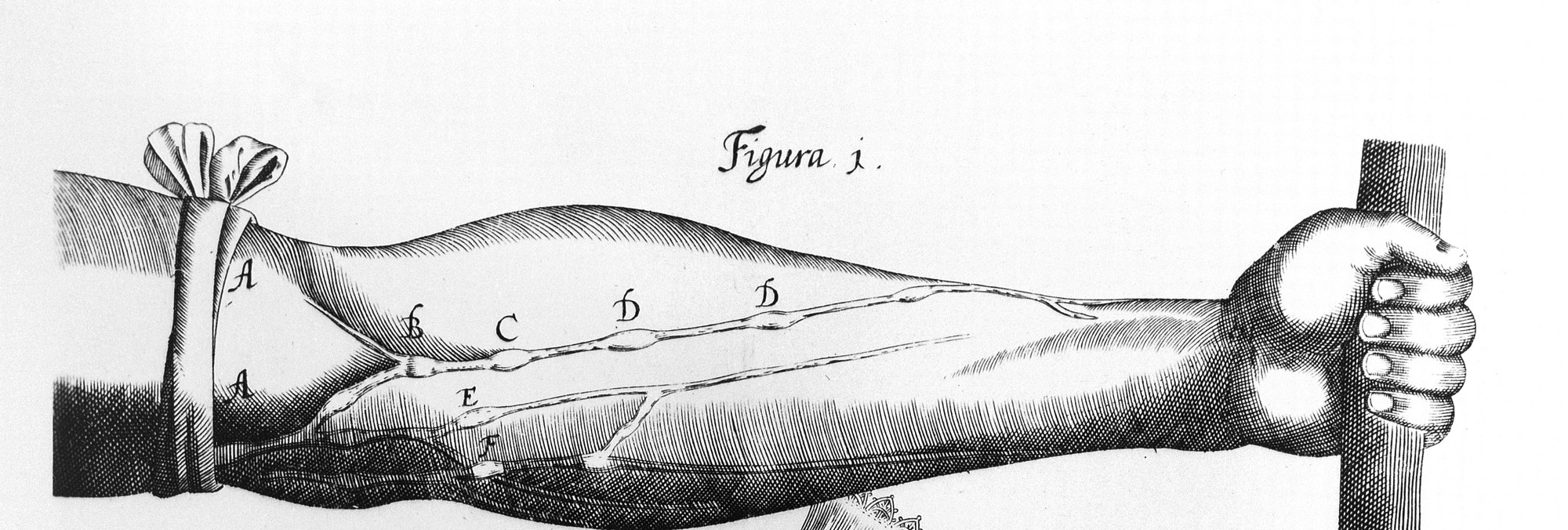
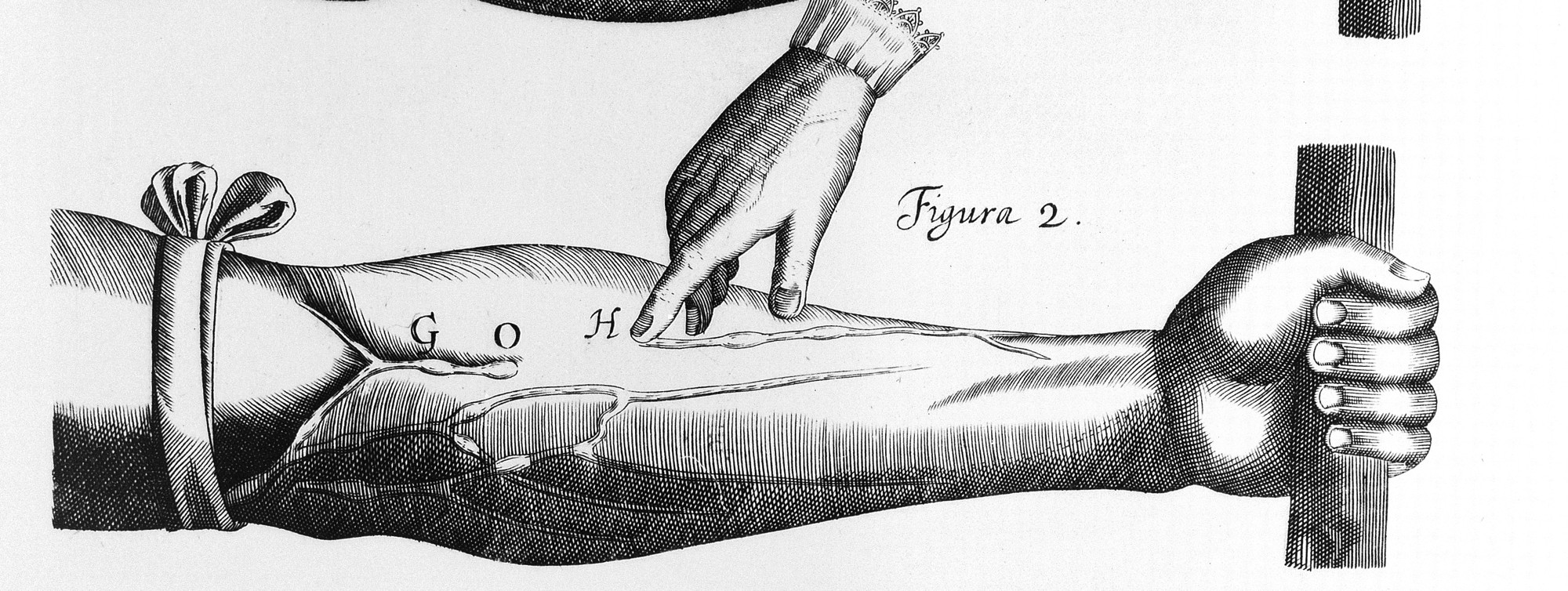
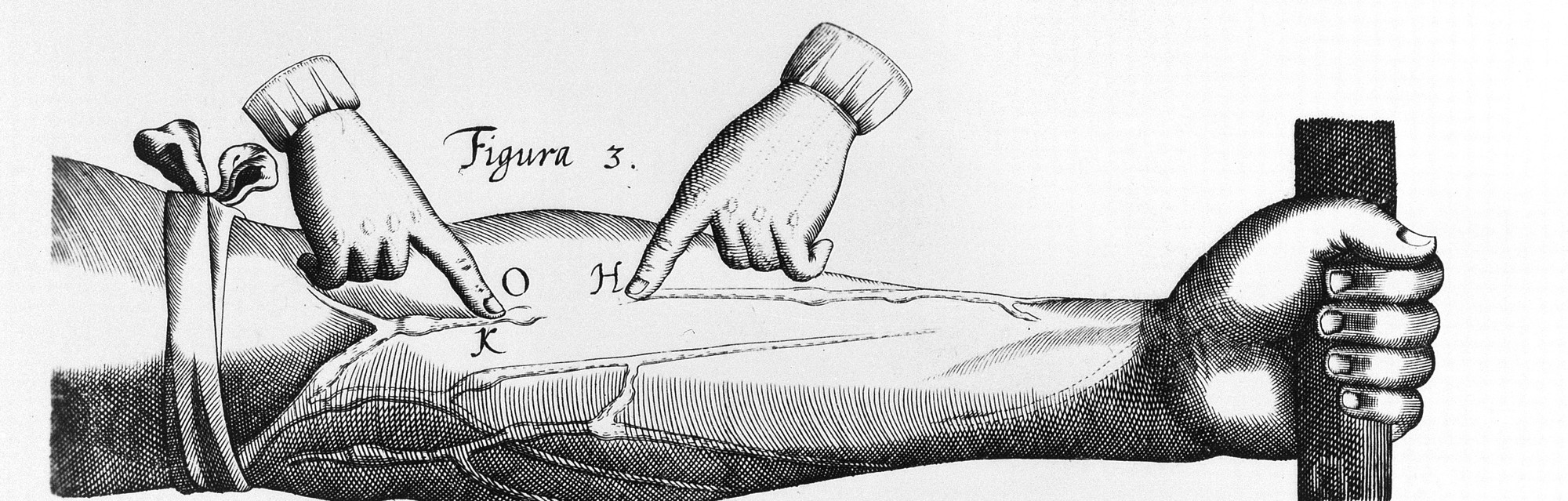
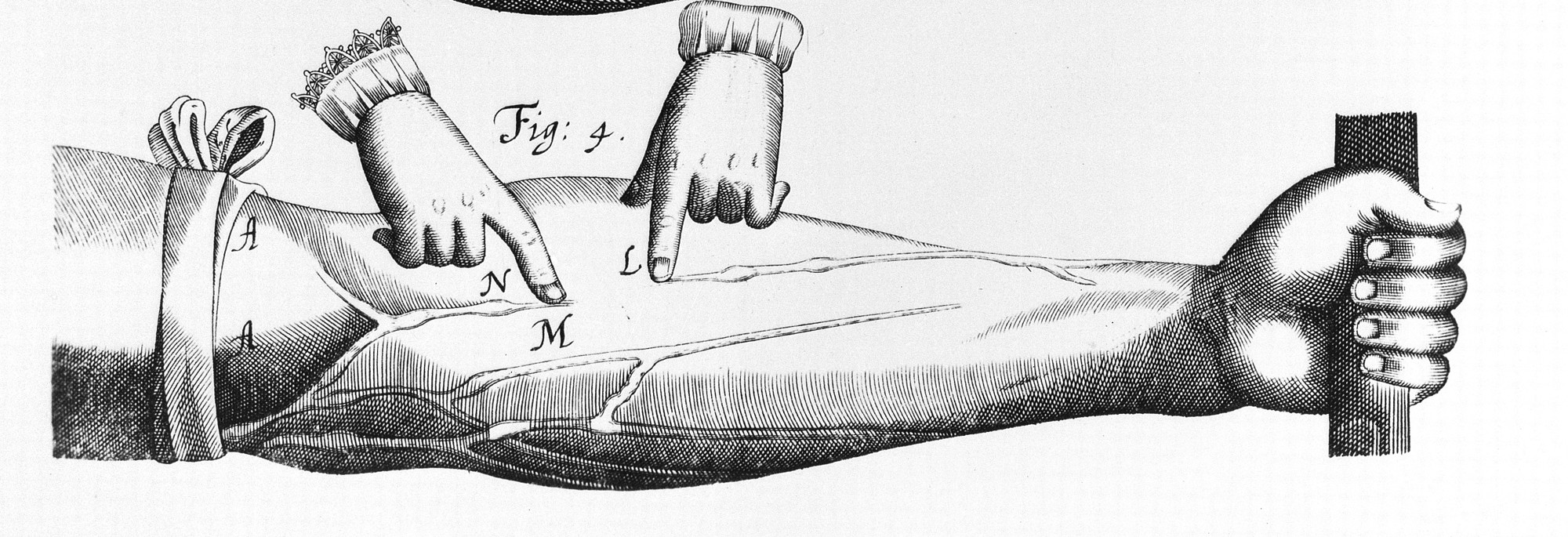
But to make this truth shine out more clearly, tie a ligature round the arm of a living person above the elbow, at A A, as if for letting blood. At intervals, especially in country laborers and people with varicose veins, you will see what look like knots and swellings, at B, C, D, D, E, F, not only where a vein divides, at E F, but also where it does not, at C D. These knots are made by the valves, which show themselves in this way on the outside of the hand or forearm. Now press with your thumb or finger below a knot, and so draw the blood out of that knot, or valve, at H, in the second figure. You will see that no blood can follow from above, because the valve stops it completely; the stretch of vein between the swelling and the finger you drew down, H O, in the second figure, is flattened out of sight; and yet above the swelling, or valve, the vein is well swollen, at O G. More than that: keep the blood drawn off in this way at H, and the vein emptied, and with your other hand press downward on the swollen upper part above the valve at O, in the third figure, pressing at K, in the third. You will see that no amount of pressure can force or push the blood past the valve at O; and the harder you try, the more you will see the vein swell and stretch toward the valve, or swelling, at O, in the third, and yet stay empty below it, at H O, in the third figure.
Since anyone can try this in many places, it is plain that the job of the valves in the veins is the same as that of the three semilunar valves built into the openings of the aorta and the pulmonary artery: to close exactly, so that the blood that has passed them cannot flow back.
Again, tie the arm as before, at A A, so that the veins are swollen. Press on the vein some distance below one of the swellings, or valves, at L, in the fourth figure, and then with a finger, M, push the blood upward until it is past the valve at N. You will see that this part of the vein, L N, stays empty, and that the blood cannot come back down through the valve, just as at H O, in the second figure. But take away the finger at H, in the second, and the vein fills again from below and looks like D C, in the first figure. From this it is plainly established that the blood in the veins moves upward, from the lower parts to the higher ones and to the heart, and not the other way. In some places the valves do not close so exactly, or there is only a single valve, and there they do not seem to block the passage of blood from the center entirely. In most places, though, it does appear so; or at least, where something seems to have been made less carefully in one place, it seems to be made up for by the number or the good work of the valves that follow in order, or in some other way. The veins, then, are open, unblocked roads for blood going back to the heart, but completely shut to blood going out from it.
And note this as well. Tie the arm as before in a living person, so that the veins swell and the knots, or valves, show. Put your thumb on a vein below some valve, where the next valve below it lies, and let it hold the vein so that no blood comes up from the hand. Then with a finger press the blood out of that stretch of vein, upward past the valve, at L N, as I said before. Take away the finger at L and let the vein fill again from below, as at D, C; then press with the thumb again, and again press the blood upward, at L N, in the fourth figure, and at H O, in the third or second figure; and do this a thousand times in a short time. Now reckon it up. Take how much goes up past the valve at one pressing and multiply it by a thousand, and you will find that so much blood is sent this way, through a part of one vein, in no long time, that the speed of its motion will, I think, leave you wholly convinced of the circulation of the blood.
But in case you say that this experiment does violence to nature, try it on valves that lie far apart, and watch how quickly, how swiftly, once the thumb is taken away, the blood runs upward and fills the vein from below. I have no doubt that you will find this very thing proved to you.
Chapter 14: Conclusion of the Proof of the Circulation
At last, then, I may be allowed to give my view of the circuit of the blood, and to put it before everyone.
All of this has now been confirmed, both by reasoning and by experiments seen with the eyes: that the blood passes through the lungs and the heart, driven by the beat of the ventricles; that it is forced out and sent into the whole body, and there creeps into the veins and the pores of the flesh; that through those same veins it flows back from every side, from the edges of the body to the center, from the small veins into the larger ones, and from them into the vena cava and at last to the atrium of the heart; and that it moves in such a quantity, with such a flow and return, out there through the arteries and back here again through the veins, that it cannot be supplied by what we eat and drink, and in a far greater amount than nourishment would ever need.
We must conclude, therefore, that in animals the blood is driven round in a circuit, with a kind of circular motion, and that it is in perpetual motion; that this is the action, or function, of the heart, which it carries out by its beat; and that this is the one and only cause of the motion and the beat of the heart.
Chapter 15: The Circulation Confirmed by Likely Reasons
But it will not be beside the point to add that by certain common lines of reasoning it is both fitting and necessary that things should be this way. First, death is a decay that comes about through a lack of heat, as Aristotle says in On Respiration, in the second and third books of On the Parts of Animals, and elsewhere; and all living things are warm, all dying things cold. There must therefore be a place and a source of heat, a kind of home and hearth, in which the kindling of nature and the first beginnings of the inborn fire are held and kept safe; from which heat and life flow out into every part, as from their source, and nourishment comes; and on which concoction, nourishment, and all growth depend. That this place is the heart, that the heart is this beginning of life, and that it works in the way I have described, I would wish no one to doubt.
The blood, then, needs motion, and motion of such a kind that it comes back to the heart again; for sent out to the outer parts of the body, far from its source, it would stand still and clot, as Aristotle says in the second book of On the Parts of Animals. We see that in all things heat and spirits are made and kept up by motion, and fade away in rest. Then again, the blood grows thick, or even frozen, from the cold of the limbs and of the air around them, and loses its spirits, as in the dead; and it had to go back to its fountain and source to get its heat and its spirits again, and everything that keeps it sound, and by returning be made whole again.
We see that the limbs sometimes grow numb with cold from outside, so that the nose, the hands, and the cheeks look blue, like those of the dead, and the blood in them takes on that purple color, the way the blood of a corpse settles in the parts that lie lowest; and the limbs become so stiff and hard to move that they seem almost to have lost their life. They could never get back their heat, their color, and their life, certainly not so quickly, unless they were warmed by a fresh flow and onrush of heat from its source. For how can parts in which heat and life are almost put out draw anything in? How could parts whose passages have closed up and filled with frozen blood let in the food and blood that come to them, unless they first let go of what they hold? And how could any of this happen unless there truly were a heart, a beginning of this kind, in which life and heat remain when these parts have grown cold, as Aristotle says in On Respiration; from which new blood, warm and filled with spirits, is sent out through the arteries, to drive on the blood that has grown cold and worn out, so that all the small parts revive their failing heat and their almost extinguished spark of life?
That is why, as long as the heart is unharmed, life can be given back and health recovered in all the other parts, while if the heart is chilled, or struck by some serious disease, the whole animal must suffer and decay, since its beginning is decaying and suffering. There is nothing, as Aristotle says in the third book of On the Parts of Animals, that can bring help either to the beginning itself or to the things that depend on it. And here, by the way, is perhaps the reason why grief, love, envy, worry, and the like bring on wasting and thinness, or cacochymia, a corruption of the body's juices, and a crop of crudities, matter left uncooked by concoction, which bring on every kind of disease and wear people down. Every passion of the mind that stirs up human minds, with pain or joy, with hope or anxiety, reaches all the way to the heart, and there changes it from its natural state, in its temper, its pulse, and the rest. Since it taints all the nourishment at its source and weakens the body's strength, it should not seem at all surprising that it brings about, over time, many kinds of incurable disease in the limbs and the body; for in that case the whole body is suffering from spoiled nourishment and from a lack of innate heat, the body's inborn life-heat.
Besides this, since all animals live on food that is concocted inside them, the concoction and the distribution must be complete, and there must be a place, a receptacle, where the food is perfected and from which it is sent out to each of the limbs. This place is the heart. Of all the parts, the heart alone holds blood for public use, not only in its coronary artery and vein, for its own private use, but in its hollows, the atria and the ventricles, as in cisterns and a storehouse; all the other parts hold blood only for their own sake and private use, and only in their vessels. And the heart alone is so placed and so built that by its beat it can share out and distribute the blood to all the parts evenly, fairly, in proportion to the hollows of the arteries that serve each part, giving freely to those in need, as from a treasury and a fountain.
Further, this distribution and motion of the blood needs force and violence, and something to drive it, such as the heart is; and for two reasons. First, the blood of its own accord easily draws together and gathers into one, as if toward its beginning, or as a part toward the whole, or as drops of water spilled on a table run together into one pool, and it usually does this very quickly and from slight causes, such as cold, fear, horror, and others like them. Second, the blood is squeezed out of the hair-fine veins into the small branches, and from there into the larger ones, by the motion of the limbs and the squeezing of the muscles, and it is therefore more inclined and ready to move from the edges to the center than the other way, even if there were no valves to stop it. If the blood is to leave its source, then, go into narrow and colder places, and move against its own natural tendency, it needs force, and something to drive it: and only the heart is such a driver, and in the way I have described.
Chapter 16: The Circulation Proved from Its Consequences
There are, besides, certain problems that follow from this truth, once it is assumed, as its consequences, and they are not useless for winning belief, working back, as it were, from effects to cause. Elsewhere they seem wrapped in a great deal of doubt and obscurity, but from this starting point they readily give up their reasons and causes. Take what we see in contagion, in a poisoned wound, in the bite of a snake or of a mad dog, in the venereal pox, and the like: how the spot that was touched stays unharmed, and yet the whole body is corrupted. The venereal pox sometimes leaves the genitals unharmed and shows itself first of all by pains in the shoulders or the head, or by other symptoms; and we have known the wound from a mad dog's bite to heal, and fever and the rest of the dreadful symptoms to come on all the same. The reason is now plain. The contagion, first planted in one small part, can be carried with the returning blood to the heart, and from there afterward infect the whole body.
In a tertian fever, the kind that comes back every other day, the cause of the sickness makes for the heart at the start, lingers around the heart and the lungs, and makes the patient short of breath, sighing, and sluggish, because the source of life is weighed down and the blood is forced into the lungs, where it thickens and cannot get through. (I speak from experience, from dissecting people who died at the start of an attack.) At that stage the pulse is always rapid and small, and sometimes irregular. But as the heat grows, the matter of the disease is thinned, the passages open, and the blood gets through, the whole body grows hot, the pulse becomes bigger and stronger, and the fit of fever begins; for the unnatural heat kindled in the heart spreads from there through the arteries into the whole body, along with the matter of the disease, and in this way nature overcomes it and breaks it down.
This also explains why medicines applied to the outside of the body work inside it, just as if they had been swallowed. Colocynth, the bitter apple, and aloes loosen the bowels; cantharides, the blister beetles called Spanish fly, make the urine flow; garlic tied to the soles of the feet helps bring up phlegm from the chest; cordials, the heart medicines, give strength; and there are countless examples of the kind. It is perhaps not unreasonable, then, to say that the veins, through their open mouths, soak up something from what is put on the outside and carry it inward with the blood, just as the veins of the mesentery suck the chyle, the milky juice of digested food, out of the intestines and carry it, along with the blood, to the liver.
In the mesentery the blood comes in through the arteries, the celiac artery and the upper and lower mesenteric arteries, and goes on to the intestines; and from the intestines it comes back, along with the chyle drawn into the veins, through the very many branches of those veins into the portal vein of the liver, and through the liver into the vena cava. That is how the blood in these veins comes to have the same color and thickness as in all the rest, whatever many people think; nor need we suppose the awkward and unlikely thing that has been supposed, two opposite motions in every hair-fine branch, the chyle going up and the blood coming down.
But is this not, in fact, the work of nature's highest foresight? If the chyle were mixed with the blood in equal parts, the raw with the cooked, the result would not be concoction, transformation, and the making of blood; since each acts on the other and is acted on by it, the union of the two would rather give a mixture, something halfway between them, as when wine is mixed with water, or in oxycrate, the drink of vinegar and water. But since only a tiny portion of chyle is mixed in this way with a great deal of blood flowing past, in no proportion worth mentioning, the thing happens more easily that Aristotle describes: add one drop of water to a cask of wine, or the other way round, and the whole is not a mixture, but simply wine, or simply water. In the same way, when the mesenteric veins are cut open, you find neither chyme, the half-digested pulp, nor chyle and blood, separate or mixed, but to the senses the same blood as in all the other veins, in color and in thickness. Even so, there is something undigested from the chyle in it, though too little to see, and nature has therefore set the liver in its path, so that in the liver's winding channels the blood is held back and more fully transformed, and does not reach the heart too early and raw and overwhelm the source of life.
That is why the liver has almost no use in the embryo. The umbilical vein plainly passes straight through the liver whole, and there is an opening, or anastomosis, from the portal vein of the liver, so that the blood coming back from the intestines of the fetus does not go through the liver, but passes into that umbilical vein and makes for the heart, along with the mother's blood coming back from the placenta in the womb. That is also why the liver is made late in the first shaping of the fetus. In a human fetus we have ourselves seen all the limbs perfectly outlined, even the genitals distinct, while hardly the first beginnings of a liver had been laid down. And indeed, as long as all the limbs look white, as the heart itself does at the beginning, and hold no redness anywhere except in the veins, you will see nothing where the liver should be but a rough sort of pool of blood spilled outside the veins, which you would take for a bruise or a burst vein.
In the egg, though, there are two umbilical vessels, as it were: one from the white, which passes whole through the liver and runs straight to the heart, and the other from the yolk, which ends in the portal vein. For in the egg the chick is first formed and fed from the white alone, and fed from the yolk only after it is complete and has hatched. Many days after hatching you can still find yolk inside the intestines in the chick's belly; the yolk is the chick's equivalent of the milk of other animals.
But these things belong more properly to my observations on the formation of the fetus, where a great many problems of this kind can be raised. Why is this part made or finished first, and that one later? On the rank of the parts: which part exists for the sake of which? And a great many about the heart: why, as Aristotle says in Book 3 of On the Parts of Animals, is it the first part to take solid shape, and why does it seem to have life, motion, and feeling in itself before anything else in the body is finished? Likewise about the blood: why does it come before everything else? How does it hold within it the beginning of life and of the animal itself? And why does it want to be moved and driven this way and that, which seems to be the reason the heart was made? In the same way in the study of the pulse: why are some pulses deadly and others the opposite? And, looking into the causes and the warnings of every kind of pulse, what does this one mean, what does that one, and why? So too with crises, the turning points of a disease, and with nature's ways of purging itself; with nutrition, and above all the distribution of food; and with every kind of flux. Finally, in every branch of medicine, physiology, pathology, the study of signs, and therapy, when I count up how many problems can be settled by this truth and its light once it is granted, how many doubts resolved, how many dark places made clear, I find a field of the widest extent. I could run on so far, and roam so widely in it, that this work would not only swell into a volume, beyond what I set out to do, but my life might run out before I could finish it.
In this place, then, that is, in the following chapter, I will try only to take what shows itself about the structure of the heart and the arteries in the practice of dissection and connect it with its uses and its true causes. Wherever I turn I find a great many things that take light from this truth and in turn make it shine brighter; and above everything else I would like it confirmed and set out by anatomical arguments.
There is one thing that ought really to have its place among our observations on the use of the spleen, but it will not be out of place to note it here as well, in passing. From the splenic branch, where it runs into the pancreas, three veins rise from its upper side: the posterior coronary vein, the gastric vein, and the gastroepiploic vein, all of which spread over the stomach in a great many shoots and branches, as the mesenteric veins do over the intestines. In the same way, from the lower side of that splenic branch, the hemorrhoidal vein runs down into the colon and as far as the rectum. Through these veins, on both sides, blood comes back, bringing from the stomach on the one side a rawer juice, watery and thin, not yet fully turned into chyle, and from the other a thick and earthier juice, as from the waste in the bowel; and in this splenic branch the two are suitably tempered by the mixing of opposites. Each of these juices would be hard to concoct, just because of their opposite faults. But nature mixes them, pours over them a great quantity of warmer blood, which streams from the spleen very richly because of its many arteries, and brings them better prepared to the gates of the liver; and by this arrangement of the veins she makes good what each extreme lacks.
Chapter 17: The Motion and Circulation of the Blood Confirmed from the Structure of the Heart and from Dissection
I do not find that the heart is a distinct and separate part in every animal. Some animals, which you might call plant-animals, have no heart at all, because certain animals are colder, small in bulk, soft in texture, and made all of one uniform stuff: caterpillars and earthworms, for instance, and a great many of the creatures that arise from rotting matter and do not keep to a fixed kind. These have no heart, since they need nothing to drive their food out into the far parts. Their body is all of a piece, one thing, without separate limbs, so that by contracting and relaxing the whole of it they take their food in and push it out, move it on and move it back. The so-called plant-animals, oysters, mussels, sponges, and every sort of zoophyte, have no heart; they use the whole body in place of one, and an animal of this kind is, as it were, all heart. In most kinds of insects, almost all of them, we cannot make it out properly because they are so small. But in bees, flies, hornets, and the like you can see something beating, sometimes with the help of a magnifying glass; and in lice as well, in which, since the louse is transparent, you can also see clearly with that same magnifying glass the food passing through the intestines like a black spot.
But in certain bloodless and colder animals, such as snails, shellfish, shrimps, and crabs, there is in every one of them a beating part, like a little bladder, or an atrium without a heart, which contracts and beats rather slowly and can be made out only in summer or in warmer weather. In these animals this part is there because some driving force is needed to distribute the food, given the variety of their organs or the density of their substance; but the beats come rarely, and sometimes not at all, because of the cold. This suits them, being of a doubtful nature, so that they seem sometimes to live and sometimes to die, and lead now the life of an animal, now that of a plant. The same seems to happen with insects when they hide away in winter and lie hidden as if dead, or lead only the life of a plant. And one may fairly wonder whether the same thing happens in certain animals that have blood, such as frogs, tortoises, snakes, and swallows.
In the larger and warmer animals, since they have blood, there is need of something to drive the food, and perhaps with greater force. Fishes, snakes, lizards, tortoises, frogs, and others of this kind therefore have both an atrium and one ventricle of the heart. That is why it is perfectly true that no animal with blood lacks a heart: by this stronger and sturdier driver the food is not merely stirred along by an atrium, but pushed farther and faster. In animals that are larger still, warmer and more perfect, abounding in blood that is hotter and full of spirit, the food must be pushed more strongly, faster, and with a greater rush, because of the size of the body or the density of its tissues, and a sturdier and fleshier heart is needed. And further, since the more perfect animals need a more perfect food, and a richer innate heat to concoct it and bring it to a further perfection, it was fitting for them to have lungs, and a second ventricle to drive the food through the lungs.13
Wherever there are lungs, then, there are two ventricles in the heart, a right and a left; and wherever there is a right ventricle, there is a left one too, but not the reverse: where there is a left ventricle, there is not always a right. I call the left ventricle the one marked out by its use, not by its position: the one that sends the blood out into the whole body, and not into the lungs only. The left ventricle, in fact, seems to make up the heart by itself. It sits in the middle, carved with deeper pits and built with greater care, so that the heart seems to have been made for its sake and the right ventricle to be its servant. The right ventricle does not reach all the way to the tip; its wall is three times thinner; and it sits over the left one, as Aristotle says, like something jointed onto it. But it holds more, since it supplies not only material to the left ventricle but food to the lungs as well.
All this is different in the embryo, though. There the ventricles do not differ so much: like the twin kernels in a nut, they are almost equal, and the tip of the right reaches as far as the top of the left, so that in the embryo the heart has, as it were, a double point at its tip. The reason is that in the embryo, as I have said, the blood does not pass through the lungs from the right cavity of the heart to the left; both ventricles do the same job equally, through the foramen ovale and the arterial canal, as was explained, carrying the blood across from the vena cava into the aorta and driving it equally into the whole body; and so they are built alike. But when the time comes for the lungs to be used and for those connections to close, the ventricles begin to differ in strength and in everything else, since the right now drives the blood only through the lungs, and the left through the whole body.
Besides this, there are in the heart little muscles, so to speak, or fleshy rods, and a great many fibrous cords, which Aristotle, in his book On Respiration and in Book 3 of On the Parts of Animals, calls nerves. Some stretch out separately, in various ways; others lie buried in grooves in the walls and in the middle partition, where they make deep pits, like little muscles. They are added on to the heart like reserve troops, to give a sturdier and stronger drive to the blood and a tighter squeeze to the heart, and to help expel the blood more completely. Like the careful and skillful rigging of ropes on a ship, they help the heart on every side as it contracts on every side, and expel the blood from the ventricles more fully and more strongly. This is clear from the following facts. Some animals have them and some do not; in all that have them, they are more numerous and stronger in the left ventricle than in the right; some animals have them in the left ventricle and none at all in the right; in human beings there are more in the left ventricle than in the right, more in the ventricles than in the atria, and in some people almost none in the atria. Brawny, muscular country people, of a hardier build, have more of them; delicate bodies, and women, fewer.
In those animals whose ventricles are smooth inside, with no fibers or little muscles at all and not cut by pits, such as almost all the smaller birds, like the partridge and the hen, snakes, frogs, tortoises, and the like, and for the most part fishes, there are neither the so-called nerves, or fibers, in the ventricles, nor tricuspid valves. In some animals the right ventricle is smooth inside while the left has those fibrous cords, as in the goose, the swan, and the heavier birds. The reason in these is the same as in all the rest. The lungs are spongy, loose, and soft, so that no great force is needed to push the blood through them, and the right ventricle either has none of those fibers, or fewer and weaker ones, not so fleshy and not so like muscles; while in the left ventricle they are sturdier, more numerous, fleshier, and muscular, because the left ventricle needs greater strength and force to drive the blood farther, through the whole body. That is also why the left ventricle holds the middle of the heart, and why its wall is three times thicker and sturdier than the right one's. In all animals, then, and among human beings as well, the denser, harder, and more solid the build of the flesh, and the fleshier and more muscular the limbs at the ends of the body, far from the heart, the more fibrous, thick, sturdy, and muscular is the heart; which is both plain and necessary. Those, on the other hand, of a looser texture, a softer build, and a smaller bulk have a heart that is limper, softer, and less fibrous inside, or not fibrous at all, and without sinews.
Consider, too, the use of the valves. Those at the mouths of the pulmonary artery and the aorta were made so that blood once sent out should not be driven back into the ventricles of the heart. When they are raised and meet one another, they form a three-cornered line, like the mark a leech leaves when it bites, and shut more tightly so as to hold back the backflow of the blood. The tricuspid valves stand as doorkeepers at the entrance from the vena cava and from the pulmonary vein, so that the blood does not slip back when it is being driven hardest. For that reason, as I have said, not every animal has them, and in the animals that have them they do not all seem made with the same skill of nature, but some more exactly and others more loosely and carelessly, so that they close according to the greater or lesser drive that the contraction of the ventricles produces. In the left ventricle, therefore, so that the closing may be more careful against the greater drive, there are only two, shaped like a bishop's miter, which close very exactly and reach far down through the middle toward the tip. This perhaps misled Aristotle, when he cut the heart across, into thinking this ventricle double. In the same way, surely, so that the blood should not slip back into the pulmonary vein and the strength of the left ventricle in driving it through the whole body be wasted, these mitral valves outdo those on the right in size, in strength, and in the exactness of their closing.
Hence, too, of necessity, no heart is ever seen without a ventricle, since it has to be the pool, the spring, and the storehouse of the blood. The same is not always true of the brain. Almost all kinds of birds have no ventricle in the brain, as you can see in the goose and the swan, whose brains are almost as big as a rabbit's; yet the rabbit has ventricles in its brain, and the goose has none. Likewise, wherever the heart has one ventricle, one atrium hangs on it, limp, skin-like, hollow inside, and full of blood; where there are two ventricles, there are two atria. On the other hand, some animals have only an atrium and no ventricle of the heart, or at least a bladder like an atrium; or else the vein itself, widened at one place, makes the beat, as you can see in hornets, bees, and other insects. I think I can show by certain experiments that these not only have a pulse but also breathe, in the part that people call the tail, which is why they stretch it out and draw it in, now more often and now less, according to how out of breath they seem and how much they need air. But of this in my treatise on respiration.
It is clear, too, that the atria beat. They contract, as I said before, and throw the blood into the ventricles, so that wherever there is a ventricle an atrium is needed: not only, as people commonly believe, to be a receptacle and storehouse for the blood (what need is there of beating to hold something?), but because the atria are the first movers of the blood, above all the right atrium, the first to live and the last to die, as was said before. They are needed to serve the ventricle by pouring blood into it, so that the ventricle, at once contracting, can strike out more easily and drive on more forcefully blood that is already in motion; just as at ball you can drive the ball harder and farther by hitting it on the rebound than by simply throwing it. Moreover, against the common opinion, neither the heart nor anything else can widen itself so as to draw anything into itself by its diastole, unless it is like a sponge that has first been squeezed by force and is springing back to its own shape. All movement from place to place in animals, rather, plainly happens first through, and takes its beginning from, the contraction of some part. The blood is thrown into the ventricles by the contraction of the atria, as I showed before, and from there, by the contraction of the ventricles, thrown out and carried on.
There is more to this truth about movement from place to place. The immediate organ of movement, in every motion of every animal, the part in which the spirit of movement first resides, as Aristotle says in his book On Breath and elsewhere, is a part that contracts; the Greek word neuron, "nerve" or "sinew", is said to come from neuo, "I nod", that is, I draw together; Aristotle knew the muscles, and was not wrong to trace all motion in animals to the nerves, that is, to what contracts, which is why he called those little muscles in the heart nerves. All this would be plain, I think, if I were ever allowed to show it from my own observations on the organs of movement in animals and the structure of the muscles.
But to get on with what I set out to show, the use of the atria in filling the ventricles with blood, as was proved above: the denser and more compact the heart, and the thicker its wall, the more sinewy and muscular the atria, to drive the blood in and fill the ventricles. Where the opposite is true, the atrium looks like a bladder of blood, a membrane holding blood, as in fishes, where the bladder that stands in place of the atrium is very thin and so large that the heart seems to float on top of it. And in those fishes in which that bladder is a little fleshier, as in the carp, the barbel, the tench, and others, it imitates the lungs very prettily and passes itself off as them.
In some people, brawny ones of a harder build, I have found the right atrium so sturdy, and so skillfully put together inside with little muscles and a varied weave of fibers, that it seemed to equal other people's ventricles in strength; and I truly wondered at how great a difference there was between one person and another. Note, though, that in the fetus the atria are far larger than in proportion, because they are there before the heart is made or does its work, as was shown before, and in the fetus they do the heart's job, as it were. But what I have observed in the formation of the fetus, which I reported before, and which Aristotle confirms in the egg, brings the greatest proof and light to this point. While the fetus is still like a soft little worm, still, as people say, in the milk, there is only a blood-red point, a beating bladder, like a part of the umbilical vein widened at its beginning, or base. Later, when the fetus is outlined and begins to have a somewhat firmer body, this bladder grows fleshier and stronger, changes its make-up, and turns into the atria, on top of which the body of the heart begins to sprout, though it does no public work as yet. But when the fetus is fully formed, the bones distinct from the flesh, the animal complete and felt to move, then it has a heart beating inside it as well, which, as I said, carries the blood across with both its ventricles from the vena cava into the artery.
Nature, then, perfect and divine, doing nothing in vain, has neither added a heart to any animal where there was no need for one nor made it before there was a use for it; but in the formation of every animal she passes by the same stages, so to speak, through the make-up of all the animals, egg, worm, fetus, and reaches perfection in each. These things are to be confirmed elsewhere, by many observations, in my work on the formation of the fetus.
Finally, it was not without reason that Hippocrates, in his book On the Heart, called it a muscle, since its action and its job are the same as a muscle's: to contract itself and to move something else, namely the blood it holds. You can see the heart's action and use, besides, from the arrangement of its fibers and its moving structure, just as in the muscles themselves. All the anatomists, with Galen, have noted that the body of the heart is built of fibers running in various directions, straight, across, and slanting. But in a heart that has been boiled, the structure of the fibers turns out to be different. All the fibers in the walls and the septum run in circles, as in a sphincter, while those in the little muscles stretch out lengthwise and slanting; so that when all the fibers contract together, the tip is pulled up toward the base by the little muscles, the walls are drawn in all around, the heart is contracted on every side, and the ventricles are narrowed. Since its action is contraction, then, we must conclude that its function is to push the blood into the arteries.
Nor should we agree any less with Aristotle about the heart's rule over the body: whether it receives motion and feeling from the brain, or blood from the liver, whether it is the source of the veins and of the blood, and so on. Those who try to refute him leave out, or do not understand, his main argument: that the heart is the first part to exist, and has blood, life, feeling, and motion in it before the brain or the liver has been made, or has plainly appeared as distinct, or at least could do any work at all. The heart, built with its own organs of motion, stands there before the rest, like a kind of animal within the animal; and nature willed that, once it was made, the whole animal should afterward be made, fed, kept, and finished by it, as its work and its dwelling. And the heart, like the ruler of a commonwealth, who holds the first and highest command, governs everywhere; from it, as from the origin and the foundation in the animal, all power is derived, and on it all power depends.
A great many things about the arteries, too, shed light on this truth and confirm it. Why does the "venous artery" (our pulmonary vein) not beat, though it is counted among the arteries? Or why is a pulse felt in the "arterial vein" (our pulmonary artery)? Because the pulse of the arteries is the drive of the blood. Why do the arteries differ so much from the veins in the thickness and strength of their coats? Because they bear the shock of the heart as it drives, and of the blood as it bursts out. And since perfect nature does nothing in vain and is sufficient in everything, the closer the arteries are to the heart, the more they differ from the veins in their make-up, and the sturdier and more like ligaments they are; while in their farthest branches, as in the hand, the foot, the brain, the mesentery, and the spermatic vessels, they are so like the veins that it is hard to tell one from the other by looking at their coats. There are good reasons for this. The farther the arteries are from the heart, the much smaller the force that strikes them, since the heart's blow is broken over a long distance. Add to this that the heart's drive, which has to be enough for the blood in all the trunks and branches of the arteries, is weakened at each division, as if shared out; so that the last hair-fine branches of the arteries look like veins, not only in their make-up but in their work as well. They give no pulse you can feel, or not always: only when the heart beats harder than usual, or when the small artery in some part is widened or more open than usual. That is why we can sometimes feel a pulse in the teeth, in swellings, and in the fingers, and sometimes not. In children, whose pulses are always quick and frequent, I have learned by this one sign to tell for certain that they have a fever; and in tender and delicate people I have easily felt the pulse in the fingers by pressing them, when the fever was at its height. On the other hand, when the heart beats more weakly, the pulse sometimes cannot be felt in the fingers, nor even at the wrist or the temples: so it is in fainting, in hysterical fits, and in asphyxia, when the pulse all but stops, and in the very weak and the dying.
Here surgeons should be warned, so that they are not misled. In the cutting off of limbs, in the removal of fleshy tumors, and in wounds, blood that leaps out with force always comes from an artery, but it does not always come out in spurts, because the small arteries do not beat, especially if they have been squeezed by a ligature.
The same reason explains why the pulmonary artery not only has the make-up and coat of an artery, but also why it does not differ so much from the veins in the thickness of its coat as the aorta does. The aorta bears a greater drive from the left ventricle than the pulmonary artery does from the right; the pulmonary artery's coats are softer than the aorta's by as much as the right ventricle of the heart is weaker than the left in its wall and its flesh; and by as much as the lungs differ in texture and softness from the tissues and the flesh of the body, so much does the coat of the pulmonary artery differ from that of the aorta. All these things everywhere keep the same proportion. In human beings, the brawnier and more muscular they are, and the harder their build, and the sturdier, thicker, denser, and more fibrous their heart, the more their atria and arteries match it in proportion in every way, in thickness and in strength. And in those animals whose ventricles are smooth inside, without fibers or valves, and with a thinner wall, as in fishes, birds, snakes, and a great many kinds of animals, the arteries differ little or not at all from the veins in the thickness of their coats.
Further, why do the lungs have such large vessels, both vein and artery, so that the trunk of the pulmonary vein is bigger than both the crural branches, which go to the legs, and the jugular branches, which go to the neck? And why are the lungs so full of blood, as we know from experience and from seeing for ourselves? (Here we took Aristotle's warning, and were not misled by looking at lungs taken out of animals dissected after all their blood had run out.) Because in the lungs and the heart are the storehouse, the spring, and the treasury of the blood, and the workshop of its perfection. Why, likewise, in anatomical dissection, do we see the pulmonary vein and the left ventricle full of so great a quantity of blood, and of the same blood that fills the right ventricle and the pulmonary artery, just as dark and just as clotted? Because the blood passes without a break from the one side to the other through the lungs. Why, finally, does the vessel commonly called the "arterial vein" (our pulmonary artery) have the make-up of an artery, and the "venous artery" (our pulmonary vein) that of a vein? Because in truth, in its job, in its make-up, and in everything, the first is an artery and the second a vein, whatever is commonly believed. And why does the pulmonary artery have so wide a mouth? Because it carries far more blood than is needed to feed the lungs.
All these things to be observed in dissection, and a great many others, if they are rightly weighed, seem to shed a clear light on the truth I have set out and to confirm it plainly, and at the same time to stand against the common opinions. For it would be very hard for anyone to explain why all these things are built and made as they are, except in the way we have done.
Part Two: The Letters to Riolan
The First Letter to Riolan
Two anatomical essays on the circulation of the blood, addressed to Jean Riolan the Younger, of Paris: a most skillful physician, the leader of the anatomists, the distinguished Royal Professor of Anatomy and Botany in the University of Paris and its Dean, and first physician to the Queen Mother of Louis XIII. Here follows the first of them.
A few months ago the most famous Riolan brought out a little book on anatomy and pathology, and sent it to me by his own hand, for which I am truly grateful, and say so. I congratulate him, too, on his good fortune in having taken up a plan so worthy of the highest praise and carried it through. To set the seats of all diseases before our eyes is a load only a godlike mind could carry, and a man takes on a heavy task indeed when he sets out to show to the eye diseases that almost escape the sharpest understanding. Such efforts suit the prince of anatomists. For there is no science that does not grow out of knowledge that came before it, and no sure and fully known piece of knowledge that did not take its start from the senses.
The subject itself, then, and the example of so great a man, called for my own labor as well, and persuaded me to put into writing, and add to his, my Medical Anatomy, an anatomy fitted as closely as possible to the uses of medicine. Not as he has done, only pointing out the places of diseases from the corpses of healthy people and listing, after the opinions of others, the kinds of disease that ought to be seen in those places. I would take up a different task. From the many bodies of sick people I have dissected, worn out by grave and strange illnesses, I would tell how the inner parts were changed from their natural form and look, the one all anatomists commonly describe, in their position, size, makeup, shape, substance, and every other quality the senses can perceive, and in how many different and strange ways they are damaged. For as the dissection of healthy, well-built bodies does the most for philosophy and a sound physiology, so the examination of diseased and wasted bodies does the most for a philosophical pathology. The study of things as they are by nature is physiology, and physicians must learn it first; for what is according to nature is straight, the ruler that measures both itself and what is crooked. By its light we can define the errors and the conditions that go against nature, and pathology becomes clearer; and from pathology come the use and the art of healing, and the chance to find a great many new remedies. No one would easily believe how far the inner parts are twisted out of shape in diseases, especially long-lasting ones, or what monsters among the inner parts those diseases breed. I would even dare to say that opening one body wasted by consumption, or killed by some long-standing or poisonous disease, has done more for medicine than dissecting ten hanged men.
I do not find fault, then, with the plan of Riolan, that most learned and most experienced anatomist. I think it should be celebrated with the highest praise, since in shedding light on the physiological part of medicine it is very useful to medicine. All the same, I thought it would be no less useful to the art of healing if I showed to the eye not only the places but what goes wrong in them, or described them as I had observed and examined them, and so set down the experience of my many dissections.
But first comes the one thing in that little book that seemed to concern me alone: what it says about the circuit of the blood, which I discovered. That I above all must weigh. On so great a matter the judgment of so great a man, held to be easily the prince and leader of all the anatomists of this age, is not to be taken lightly; the opinion of this one man must count for more toward glory than that of all the others, whether they applaud or oppose, and his criticism must be looked at and weighed with more care.
In the eighth chapter of the third book of his Handbook, then, he accepts our motion of the blood in animals, and comes over to our side and our opinion about the circuit of the blood. But he doesn't do it completely or openly. In the twenty-first chapter of the second book he says that the blood held in the portal vein, the vein that carries blood from the bowels to the liver, does not circulate the way the blood in the vena cava does. And in the eighth chapter of the third book he says that there is blood that circulates, and that there are circulating vessels, namely the aorta and the vena cava; but he denies that their branches receive the circulation out in what he calls the second and third regions of the body. (The old division counted the stomach, the bowels, and the liver as the first region of the body, the veins and arteries as the second, and the flesh and limbs they feed as the third.) "Because," he says, "the blood poured out into all the parts of the second and third regions stays there to nourish them. It does not flow back to the larger vessels unless it is drawn back by force, in a very great shortage of blood in the larger vessels, or, stirred up by a violent rush and frenzy, it flows to the larger circulating vessels." And a little later: "So the blood of the veins always rises naturally, that is, it goes back to the heart; and the blood of the arteries goes down, that is, it goes away from the heart. Yet if the smaller veins of the arms and legs have been emptied, the blood of the veins can go down, filling them one after another. I have shown this clearly," he says, "against Harvey and Walaeus," meaning Johannes Walaeus, the professor at Leiden. And since Galen and daily experience both confirm the anastomoses of the veins and arteries, and the need for the blood to circulate, "you see," he says, "how the circulation of the blood takes place without any upsetting or mixing up of the humors, and without destroying the old medicine."
These words make it plain what moved this most famous man to accept the circuit of the blood in part and deny it in part, and why he tries to build a shaky, changeable opinion about it: so as not to destroy the old medicine. It isn't the truth that leads him, which he couldn't have failed to see. It is caution: he is afraid to speak openly, for fear of offending the old medicine, or perhaps of seeming to take back the physiology he taught in his Anthropology, his large book on the anatomy of man. But the circuit of the blood does not destroy the old medicine; it advances it. What it offends is the physicians' physiology and their theories about natural things, and what it proves wrong is the anatomists' teaching on the use and action of the heart, the lungs, and the other organs. That this is so will easily appear, partly from his own words and admissions and partly from what I shall add here: that all the blood, wherever it is in the living body, moves and changes its place, the blood in the larger veins and their branches and fibers as much as the blood held in the pores of the parts of every region; that it flows from the heart and back to the heart, continuously and without a break; and that it nowhere stays still without harm, even though (I don't deny it) its motion is sometimes faster or slower in certain places.14
First, then, the most learned man only denies that the blood held in the branches of the portal vein circulates; he does not disprove it. Nor could he have denied it, if he had not hidden from himself the force of his own argument. For he says, in the eighth chapter of the third book, "If at each beat the heart takes in a drop of blood and drives it out into the aorta, and makes 2,000 beats within an hour, then a large amount of blood must pass through." He is bound to say the same about the mesentery, the membrane that carries the gut's vessels, since through the celiac artery and the mesenteric arteries more than a drop of blood is pushed into the mesentery and its veins at every beat, and driven hard into them. Either the blood must go out somewhere, in proportion to what comes in, or the branches of the portal vein would at last burst.
Nor can anyone settle the difficulty by saying, with any likelihood, that the blood of the mesentery flows in and flows back through the same arteries, like the Euripus, in idle and useless labor. Nor is it likely that it falls back out of the mesentery by the same ways, in that transfer by which he would have the mesentery unload itself into the aorta; a flow moving the opposite way could never overcome the force of the blood coming in. There's no back-and-forth where the inflow certainly goes on continuously, steadily, and without a pause. The blood driven into the mesentery is forced to go out somewhere else, by the same necessity his argument proves for the heart. And that is plain, for otherwise he could overturn the whole circulation with the same argument and the same dodge, by saying the same thing, with the same likelihood, about the ventricles of the heart: that in the heart's systole the blood is driven into the aorta and in its diastole comes back, the aorta unloading itself into the ventricles as the ventricles in their turn unload themselves into the aorta. Then there would be no circulation either in the heart or in the mesentery, only a flowing in and a flowing back by turns, with useless labor. If his argument, which he himself approves, proves that the blood must circulate in the heart, then, the same argument has the same force in the mesentery; and if there is no circuit of the blood in the mesentery, there is none in the heart either. The two claims, the one about the heart and the other about the mesentery, differ only in their words: they hang on the force of the same argument, and they stand or fall together.
He says that in the heart the semilunar valves stop the blood from going back, but that there are no valves in the mesentery. My answer is that this isn't true either: a valve has been found in the splenic branch, the vein from the spleen, and sometimes in other branches as well. Besides, veins don't need valves everywhere. They are not found in the deep veins of the limbs, but rather in the veins under the skin. Where the blood flows naturally out of the smaller branches into the larger, which is its natural slope, the pressure of the muscles around it is enough, and more than enough, to stop it from going back, and it is forced on wherever the way lies open. What need is there for valves there?
As for how much blood is pushed into the mesentery at each beat, you can reckon it just as you would if you bound the veins leaving the hand, and the arteries entering it, with a moderate ligature at the wrist; and the arteries of the mesentery are larger than those of the wrist. Count how many beats it takes for the vessels of the hand to be stretched and the whole hand to swell up into a mass, then divide and work it out, and you will find that much more than a drop of blood comes in at each beat, in spite of the ligature, and that it cannot go back, but fills the hand and stretches the whole of it by force, swelling it into a mass. By analogy we may gather that blood enters the mesentery in the same amount, if not more, by as much as the arteries of the mesentery are larger than those of the wrist.
Again, anyone who has seen and thought about how hard it is, and what effort it takes, with pressure, ligatures, and all kinds of dressings, to hold back the blood that leaps out of the smallest artery when it is cut or broken, and with what force it throws off, pushes away, or soaks through all the dressings, as if shot from a syringe, would hardly believe, I think, that anything could go back against such a strong inflow and push of blood, when nothing drives it back with equal force. Turning these things over in his mind, he would never, I think, be brought to believe that the blood of the portal vein creeps back out of the mesentery by the same ways, against an inflow through the arteries so violent and strong, and so unloads the mesentery.
What is more, if the most learned man thinks that the blood is not moved and changed by a circular motion, but that the same blood always stands still in the branches of the mesentery, he seems to suppose that there are two kinds of blood, different from each other and serving different uses and ends, and that the blood in the portal vein and the blood in the vena cava are of different natures, since the one needs circulation to keep itself in good condition and the other does not. But this neither appears to be so, nor does he show that it is true.
Further, in the eighteenth chapter of the second book of his Handbook, the most learned man adds a fourth kind of vessel to the mesentery, the ones called the milky veins, the lacteals, discovered by Gaspare Aselli, the anatomist of Pavia. With these in place he seems to argue that all the nourishment drawn from the bowels is carried through them to the liver, the workshop of the blood, where it is concocted and changed into blood, and then (as he says in the eighth chapter of the third book) "the blood, carried away from the liver, is brought over to the right ventricle of the heart." "With these things in place," he says, "all the difficulties that used to be raised about the chyle and the blood being distributed through the same channel come to an end. For the milky veins carry the chyle," the milky juice of digested food, "to the liver; these are separate channels, and they can be blocked separately." But tell me, how is that milk poured into the liver and passed through it, and from there through the vena cava to the ventricle of the heart, when the most learned man denies that the blood held in the very many branches of the portal vein, spread through the hollow underside of the liver, can pass through it so as to make a circulation? I'd like to know what shows his own idea to be likely; all the more so since the blood seems to be more spirit-filled and more penetrating than the chyle, or the milk held in those milky vessels, and is driven on, besides, by the beat of the arteries to find a way out somewhere.15
The most learned man mentions a treatise of his own on the circulation of the blood. I wish I could see it; perhaps it would bring me to my senses. And yet, if the most learned man had chosen, I don't see why, once the circular motion of the blood is granted, all the difficulties that used to be raised about the distribution of the chyle and the blood through the same channels should not come to an end just as well; and he does grant it, saying in the eighth chapter of the third book that "in the veins the blood always and naturally rises to the heart, that is, goes back to the heart, just as in all the arteries the blood goes down, that is, goes away from the heart." Then he would have no need to look for separate vessels for the chyle, or to set them up. For as the umbilical veins soak up the nourishing juice from the fluids of the egg and carry it off to feed the chick and make it grow while it is still an embryo, so the mesenteric veins suck up the chyle from the bowels and carry it to the liver; and what is to stop us from saying they do the same work in the grown animal? All the difficulties people raised come to an end once we stop supposing two opposite motions in the same vessels at the same time, and suppose instead one continuous motion in the mesenteric veins, from the bowels to the liver.
What we should think about the milky veins I shall say elsewhere, when I deal with the milk found in various parts of newborn animals, and especially of newborn humans: it is found in the mesentery and all its glands, in the thymus too, in the armpits, and in the breasts of infants. The midwives squeeze this milk out, believing it good for the baby's health.
But beyond this, the most learned Riolan is not content to rob the blood held in the mesentery of circulation. He also declares that neither the branches of the vena cava, nor those of the aorta, nor any parts of the second or third region receive the circulation, and he names and counts as circulating vessels only the vena cava and the aorta. In the eighth chapter of the third book he gives a very weak reason for this: "Because," he says, "the blood poured out into all the parts of the second and third regions stays there to nourish them, and does not flow back to the larger vessels unless it is drawn back by force, in a very great shortage of blood in the larger vessels, or, stirred up by a violent rush, it flows to the circulating vessels."
It is true that the portion that has to go to nourishment must stay behind; otherwise it would not nourish, since it must be changed into the part's own substance in place of what was lost, and cling to it, and become one with it. But it is not necessary for all the blood that flows in to stay there just so that so small a portion may be changed. No part uses for its food as much blood as it holds everywhere in its arteries, veins, and pores; nor does blood that flows in and out necessarily leave nothing behind to feed the part. To nourish a part, then, the blood doesn't need to stay there whole.
But the most learned man himself, in the same little book where he says this, seems almost everywhere to say the opposite, especially where he describes the circulation in the brain and says that the brain sends blood back to the heart by the circulation, and so the heart is cooled. In the same way all the distant parts could be said to cool the heart. That is why, in fevers, when the chest around the heart is scorched and seething with the heat of the fever, the sick bare their limbs, throw off the bedclothes, and look for some relief for the heart: the blood, as the most learned man says of the brain, is cooled and its heat tempered, and then travels through the veins to the heart and cools it. The most learned man seems, then, to hint at a kind of necessity, that there is a circulation from all the parts, as from the brain: the opposite of what he had said before in plain words.
And yet he says it cautiously, and with a double meaning. The blood, he says, does not flow back from the parts of the second and third regions unless "it is drawn back by force, in a very great shortage of blood in the larger vessels, or, stirred up by a violent rush, it flows to the larger circulating vessels." This is very true, if the words are understood in their true sense. By the "larger vessels," in which a shortage makes the blood flow back, I think he means the vena cava, or the circulating veins, and not the arteries. The arteries are never emptied except into the veins or into the pores of the parts; they are kept stuffed full all the time by the beat of the heart. But the vena cava and the circulating vessels, into which the blood slips quickly and in which it hurries on to the heart, would at once be very short of blood if all the parts did not pour back, without stopping, the blood poured out into them.
Add to this that the blood held in the parts is forced out of the pores into the little veins, and out of the branches into the larger vessels, by the push of the blood driven hard into every part of the second and third regions at every beat; and by the motion and pressure of the parts around it, too, since whatever holds something, when it is squeezed and pressed together, squeezes out what it holds. In this way the motions of the muscles and limbs squeeze and press the branches of the veins that creep among them, and push the blood from the smaller vessels into the larger.
Now there should be no doubt that the arteries drive blood into every part continuously and without a break, that it presses hard there, and that it does not flow back. Grant three things: that at every beat all the arteries are stretched at once by the blood pushed into them; that the diastole of the arteries is caused by the systole of the heart, as the most learned man himself admits; and that blood, once it has gone out, never goes back into the ventricles of the heart, because the valves are shut. If the learned man accepts these things, as he seems to, it will be plain that in every part of every region the blood held there is driven down and pushed along by the crowding and the push of the blood behind it. As far as the arteries beat, so far the inflow and the push reach; and it is felt in every part of every region, for there is a pulse everywhere, even at the tips of the fingers and under the nails. There isn't a little part in the whole body which, when it is sore with an inflammation or a boil, doesn't feel the stabbing, throbbing motion of the beating arteries, as if it were trying to tear the flesh apart.
More than this, the skin of the hands and feet makes it plain that the blood itself goes back out of the pores of the parts. Sometimes in hard frost and cold weather we see the hands and limbs, especially children's, so chilled that they feel almost as cold as ice to the touch, so numb and stiff that they hardly keep any feeling and cannot move; and yet all the while they are seen to be full of blood, red or purple. These parts can never grow warm again except by the circulation: the chilled blood, robbed of its spirits and heat, is driven out, and new, warm, spirit-filled blood flows in from the arteries to take its place, warms the parts again, heats them through, and gives them back motion and feeling. Fire or any outside heat could no more restore them and make them whole than it could the limbs of the dead, unless they were revived by a warmth flowing in from within.
And this, in truth, is one chief use and end of the circulation, the reason the blood is turned round and driven in a circuit, in its continuous course and its never-ending inflow: so that all the parts, which depend on it as their first innate heat, the body's inborn life-heat, may be kept alive in their living and growing being, and carry out all their work, while (as the physiologists put it) they are kept going and set to work by the inflowing heat and the vital spirits. By the help of two extremes, cold and heat, the temperature of the bodies of animals is kept at its middle point. As the air breathed in tempers the too-great heat of the blood in the lungs, at the center of the body, and carries off the choking sooty vapors, so in turn the hot blood, thrown out through the arteries into the whole body, warms all the outer parts, feeds them, keeps them alive, and saves them from being put out by the force of the cold outside.
It would be unfair, then, and strange, if every little part of every region did not enjoy the change of blood and the benefit of the circulation, since it seems to be chiefly for their sake that nature set up the circulation. I shall conclude, then: you see how the circulation of the blood takes place without mixing up or upsetting the humors, in the whole body and in every little part, in the larger vessels and the smaller; and it happens out of necessity, for the benefit of all the parts, without which chilled and helpless parts would never be restored, nor stay alive. For it is clear enough that all the inflow of the heat that preserves us comes through the arteries, and is the work of the circulation.
That is why it seems to me that the most learned Riolan, when he denies that certain parts have a circulation, speaks in his Handbook more out of politeness than out of truth, wanting to please as many as possible and to attack no one; he has written more courteously than with the gravity a zeal for truth demands. He seems to act the same way when he would rather have the blood reach the left ventricle through the septum of the heart, by some uncertain, hidden passages, than through the very wide and open vessels of the lungs, built with the skill of valves that stop the blood from going back. He says that elsewhere he has set out the reason why the passage through the lungs is impossible and unfit. I should like to see it. It would be strange, since the aorta and the pulmonary artery have the same size, makeup, and structure, if they did not have the same work. And it is very unlikely indeed that the great river of the whole mass of the blood should reach the left ventricle through the tiny, hidden windings of the septum, in an amount large enough to match both the inflow from the vena cava into the right side of the heart and the outflow from the left, which both call for such wide openings.
But here, too, he has spoken inconsistently. He makes the lungs a kind of drain and outlet for the heart, and says, "The lung is affected by this blood passing through it, since its filth flows there along with the blood." He also says, "The lungs pick up their disorder from ill-tempered and ill-behaved organs, which supply the heart with impure blood, whose fault the heart cannot correct except through many circulations." In the same place he speaks against Galen about bloodletting in pneumonia, the inflammation of the lungs, and about the connection of the veins with the vessels of the lungs: "If it is true that the blood naturally passes from the right ventricle of the heart to the lung, so as to be led into the left ventricle and from there into the aorta, and if the circulation of the blood is accepted, who does not see that in diseases of the lungs the blood flows there in greater amount and overwhelms the lungs, unless it is drawn off, first freely and then a little at a time, to relieve them? That was the advice of Hippocrates, who, when the lung is swollen, draws blood from every part of the body, the head, the nose, the tongue, the arms, and the feet, so as to lessen its amount and draw it away from the lung, and lets out blood until the body is drained of it." "Once the circulation is granted," he says in the same place, "the lungs are more easily emptied by opening a vein. If it is rejected, I do not see how the blood can be drawn away from them. For if it flows back through the pulmonary artery into the right ventricle, the semilunar valves stand in the way; and the tricuspid valves stop it from going back out of the right ventricle into the vena cava. It is by the circulation, therefore, that the blood is drained off when the veins of the arm and foot are opened. At the same time the opinion of Fernel is overthrown, that in diseases of the lungs blood should be drawn from the right arm rather than the left, because the blood cannot travel back into the vena cava unless the two locks and bolts set in the heart are broken."16,17
He adds besides, in the same place: "If the circulation of the blood is accepted, and if the blood often passes through the lungs and not through the middle wall of the heart, then we must name a double circulation of the blood. One is carried out by the heart and the lungs: the blood, leaping out of the right ventricle of the heart, is brought through the lungs so as to arrive at the left ventricle, leaping out of an organ and running back to the same one. The other is a second, longer circulation, in which the blood, flowing out of the left ventricle of the heart, goes round the whole body through the arteries and runs back through the veins to the right ventricle of the heart."18
Here the most learned man could have added a third circulation, the shortest of all, from the left ventricle of the heart to the right, carrying a portion of the blood round through the coronary arteries and veins, whose little branches are spread through the body of the heart, its walls, and its septum.
"Whoever accepts one circulation," he says, "cannot reject the other." He could just as well have added, "and cannot deny the third." For why would the coronary arteries in the heart beat, if not to drive the blood on by beating? And why the coronary veins, whose work and purpose, like that of all veins, is to receive the blood brought in by the arteries, unless to draw the blood out of the heart? Add that a valve is very often found at the mouth of the coronary vein, as the learned man himself admits in the ninth chapter of the third book, a valve that blocks the way in and gives way to the way out. The man who accepts the one universal circulation, and accepts that the blood also passes through the lungs and the brain, certainly can't help accepting a third. Nor does he deny that in every part of every region the blood comes in the same way, by the beat, and goes back through the veins; and so he cannot deny that every little part receives the circulation.
From these very words of the most learned man it is clear, then, what he really thinks, both about the circuit of the blood through the whole body and about its circuit through the lungs and all the other parts; for a man who accepts the first circulation plainly does not reject the others. How could a man who has so many times declared a circulation through the whole body, and through the larger circulating vessels, himself resist the idea that the universal circulation is present in any branches, or any parts, of the second or third region? As if all the veins, and what he calls the larger circulating vessels, were not counted by everyone, himself included, as lying in the second region of the body! Can there be a circulation through the whole that doesn't run through all the parts? Where he denies it, then, he goes about it shakily, wavers in his denials, and gives us only words; where he affirms it, he speaks with heart and adds firm reasons, as a philosopher should. And on the strength of this opinion, as an experienced physician and an honest man, he advises that in the most dangerous diseases of the lungs the last remedy is bloodletting, against Galen and against his own dearly loved Fernel. If he had any doubt here, far be it from so learned a man, and a Christian, to recommend to later generations experiments paid for with deaths and with danger to human life, or to depart without clear reason from Galen or Fernel, who carry the highest authority with him. Whatever he has denied to the circuit, then, in the mesentery or in other parts, whether as a favor to the milky veins, or to the old medicine, or out of some other regard, must be put down to his courtesy and modesty, and forgiven.19
So far, I think, it is plain enough from the very words and arguments of that most famous man that there is a circulation everywhere, and that the blood, wherever it may be, changes its place and makes for the heart through the veins; and the most learned man seems to think the same as I do. There is no need, then, indeed it would be pointless, to bring over here, to confirm this truth more fully, the reasons I published in my little book on the motion of the blood, drawn from the structure of the vessels, the position of the valves, and other experiments and observations; all the more since I have not yet seen the most learned man's treatise on the circulation of the blood, nor do I yet find any argument of his, beyond a bare denial, that leads him to reject in most of the parts, regions, and vessels a circulation which he accepts as universal.
It is true that he has come up with something, as a kind of escape route: the anastomosis of the vessels, on the authority of Galen and of daily experience. But a man so great, an anatomist so experienced, so curious, and so careful, should first have laid open and shown us anastomoses running from the larger arteries to the larger veins, open and visible ones, whirlpools in proportion to such a torrent and flood of the mass of the blood, and wider than the openings of the branches from which he takes the circulation away, before rejecting the known channels, which are both more likely and more open. And he was bound to show and explain where these anastomoses are and how they are built: whether they are fitted only to let the blood into the veins and not to let it go back, as we see in the way the ureters join the bladder, or are made in some other way. But (perhaps I speak too boldly) neither the most learned man himself, nor Galen himself, nor any experience has ever seen anastomoses that the senses can perceive, or been able to show them to the senses.
For my part, I have searched with all the care I could, and spent no small amount of lamp oil and labor in exploring the anastomosis, but I could never find vessels, arteries and veins, joined to one another by their openings. I'd gladly learn it from others, those who give Galen so much credit that they have dared to swear by his words. There is no anastomosis in the liver, the spleen, the lungs, the kidneys, or any other organ. I have boiled these organs until the whole spongy substance became crumbly, shaken it off like dust from all the fibers of the vessels, and picked it away with a needle, and then I could plainly see all the fibers of every branching and all the hairlike threads. I have dared, then, to declare boldly that there is no anastomosis of the portal vein with the vena cava, nor of the arteries with the veins, nor of the hairlike branches of the bile duct, which are spread through the whole hollow side of the liver, with the veins. Only this can be seen in a fresh liver: all the branches of the vena cava that creep through the rounded side of the liver have coats riddled with countless tiny holes like a sieve, made, like a sump, to receive the blood settling down into them. The branches of the portal vein are not like this, but simply divide into branches; and each of these two vessels spreads out, the portal vein on the hollow side and the vena cava on the rounded side, all the way to the outer edge of the organ, without any anastomosis.
I find something that amounts to an anastomosis in only three places. In the brain, frequent, tangled fibers rise from the carotid arteries, the "sleep arteries," as they creep along its base; these afterward form the choroid plexus, and after crossing the ventricles of the brain they finally end, joined together, in the third sinus, which does the work of a vein. In the spermatic vessels, commonly called the "preparing vessels," little arteries brought down from the aorta cling to the veins of the same name that they travel with, and at last are so taken into the coats of those veins that they seem to have the same endings; so that where they end at the upper part of the testicles, in the cone-shaped growth called the varicose or vine-tendril body, it is quite uncertain whether we should take their endings for veins, or arteries, or both. In the same way, too, the last threads of the arteries that go to the umbilical vein are lost in the coats of that vein.
What doubt could there be, if through such gulfs the great arteries, stretched and stuffed full by the push of the blood, were emptied of so great and visible a torrent? If nature had wanted to turn the whole flow of the blood that way, and so rob the smaller branches and the solid parts of all the benefit of the inflow, she would at least not have refused us passages, whirlpools, and gulfs that the senses can perceive and the eye can see.
Finally, I shall mention this one experiment, which seems enough to settle the question of the anastomoses and their use, if there are any, and to overthrow the idea that blood passes from the veins into the arteries by any route or by flowing back.
Open the chest of any animal and tie off the vena cava next to the heart, so that nothing can pass that way into the heart. Then at once cut the arteries of the neck on both sides, leaving the veins unharmed. If, once an outlet has been given, you see the arteries emptied, and not the veins in the same way, it will be plain, I think, that the blood nowhere passes from the veins into the arteries except through the ventricles of the heart. Otherwise, by the outflow from those arteries, as Galen noted, we would see the veins drained of blood in a very short time just as the arteries are.
It remains, Riolan, for me to congratulate both myself and you: myself on the opinion with which you have adorned the circulation, and you on your book, learned, polished, and concise, than which nothing is more elegant. For sending it to me I give you my fullest thanks, and I owe it, and wish it, the praise it deserves; but I confess that I am not equal to so great a task, for I know that the name of Riolan signed on the Handbook will bring it more honor than my praises, however great I should like them to be. Your famous little book will live forever, and even when marble perishes it will tell later generations the glory of your name. You have joined anatomy to pathology with the greatest grace, and enriched it, to great profit, with a new and most useful account of the bones. Go on and prosper in your excellence, most distinguished man; and love the man who wishes you happiness and a long life, and wishes that all your celebrated writings may bring you everlasting praise.
William Harvey.
The Second Letter to Riolan
The second essay, addressed to Jean Riolan, in which many objections against the circulation of the blood are refuted.
Many years ago now, most learned Riolan, I brought part of my work into the light, with the printing press for a midwife; and since the day the circulation of the blood was born there has hardly been a day, or the smallest stretch of time, in which I haven't heard my discovery both praised and attacked. Some tear the little infant apart with insults, as if it weren't fit to see the light. Others decide that the newborn ought to be raised, and nurse it and protect it in their writings. The one party fights it with great disgust, the other champions it with loud applause. One side thinks I have proved the circulation of the blood beyond question, by experiments, by observations, and by seeing for myself, against all the force and weight of argument; the other thinks it hardly yet explained well enough, and not yet cleared of objections. And there are some who keep shouting that I chased an empty glory in dissecting living animals, who sneer at me and mock me, as for a piece of childish silliness, for bringing frogs, snakes, flies, and other lowly animals onto the stage, and who don't hold back from abuse.
But to pay back abuse with abuse is, I judge, unworthy of a philosopher and of anyone searching for the truth. I think it better and wiser to wash away so many signs of bad manners with the light of true and clear observations. That dogs bark, and vomit up their drunken binges, and that Cynics, those snarling "dog philosophers," are counted among the philosophers, can't be helped. What we must take care of is that they don't bite, or infect us with their mad rage, or gnaw with their dogs' teeth at the very bones and foundations of truth.
Detractors, mockers, and writers fouled with the stain of abuse I have resolved never to read, since nothing solid, nothing excellent, nothing but abuse can be expected from them; still less have I judged them worth an answer. Let them enjoy their own bad nature. I hardly think they will ever have friendly readers; and God, who is best of all, does not give wisdom to the wicked, the most excellent thing there is and the most to be wished for. Let them go on with their abuse until they are sorry for it, if they aren't ashamed, or at least until they are tired of it.
As for looking into the lowlier animals: if you are willing to enter the bakehouse, so to speak, with Heraclitus, as Aristotle tells the story, come in; for the immortal gods are here too. And the greatest, almighty Father is sometimes seen in the smallest things, and more clearly seen in the lowlier.
In my little book on the motion of the heart and blood in animals I used, out of my many other observations, only those by which I thought errors could be refuted or the truth firmly enough established. Very many others, which dissection made plain to the senses, I left out as more than was needed and of no use. Now, for the sake of the students who keep asking for them, I will add a few of these in a few words.
Galen's great authority counts for so much with everyone that I see several people still hesitating over his experiment of tying an artery over a tube slipped inside it. It is supposed to show that the pulse of the arteries comes from a power sent out from the heart through the walls of the arteries, and not from the push of the blood inside them, so that the arteries widen like bellows, not like wineskins. Andreas Vesalius, a highly skilled anatomist, mentions this experiment. But neither Vesalius nor Galen says he tested it, as I have. Vesalius merely prescribes it, and Galen recommends it to those eager to track down the truth, so that they may be more certain, without thinking how hard the operation is, or understanding how useless it is once done. For however carefully it is carried out, it does nothing to support the opinion that the walls of the artery cause the pulse; it shows instead that the pulse is set going by the push of the blood. Here is why. As soon as you have tied the artery tight over the reed or tube, the part of the artery above the ligature swells out at once, past the rim of the tube, under the push of the blood driven down into it from above, which holds back the flow and breaks the force of the stroke; so the artery below the tie beats only very faintly, without the force of the blood passing through, because the blood is thrown back above the ligature. But cut the artery through below the tube, and you will see the opposite, from the leap of the blood shot out and driven through the tube. The same thing usually happens, as I noted in my little book on the motion of the blood, with an aneurysm, where the walls of the artery have been eaten away and the blood is held among the membranes, in a container formed not from the stretched walls of the artery but, against nature, from the membranes and flesh around it. The arteries beyond such an aneurysm you will feel beating very weakly, while above it, and especially in the aneurysm itself, the pulses are large and violent; and yet we can't pretend that the beating and widening there come from the walls of the arteries, or from a power passed on to the pouch. They plainly come from the push of the blood.
To make the error of Vesalius, and the inexperience of the others, still plainer: they claim, as they think, that the part of the artery below the tube does not beat once the tie is made. I have tried it, and I say that the part below will beat if the experiment is done right. And where they claim that the arteries below start beating again when you undo the tie, I say that the part below beats less with the tie undone than with it tight. But the blood spurting from the wound throws everything into confusion and makes the experiment useless and empty, so that, because of the force of the blood, as I said, nothing certain can be shown. If, though, as I know from experience, you lay the artery bare again and hold the cut end shut between your fingers, you can try many things at will, and the truth will shine out plainly. First, with every pulse you will feel the blood strike down into the artery below, and see the artery widen from it. You can also squeeze the blood out and let it go as you please, by loosening a small part of the opening; and anyone looking closely will see that it leaps out in a spurt with every pulse, and, as I said about opening an artery or piercing the heart, that blood is thrown out with every contraction of the heart, as the artery widens. Let it run out in a whole and continuous stream, bursting out either through a small tube or through the open end, and in the stream itself, by sight and also by touch if you put your hand there, you will sense every stroke of the heart, its rhythm, its order, its force, and its pauses. It is just as if water were shot from a syringe into the palm of your hand in different, changing squirts: you will sense the blood leaping out with a changing and uneven force, both by sight and by its motion. I have sometimes seen blood burst from a cut jugular artery with such force that, when it struck my hand, it bounced back four or five feet.
But I can make the point in question clearer still: that the pulse-making power does not flow out from the heart through the walls of the arteries. I have, from the body of a most noble gentleman, a piece of the descending aorta with its two branches to the legs, a span long, about nine inches, taken out of him after death and turned into a hollow bone. While this most noble gentleman was alive, the arterial blood came down through its hollow into his feet and by its push set the arteries below beating. In this case the artery was in the same state as if it had been tied tight over a hollow tube, as in Galen's experiment: at that spot it could not widen, nor narrow like a bellows, nor carry a pulse-making power from the heart on to the arteries below, nor pass along through solid bone a power it had never received. And yet I remember very well that while he lived I very often noted the pulse beating in the arteries of his legs and feet; for I was his regular physician, and he was my friend, bound to me by the closest ties. In this most noble gentleman, then, the arteries below must have been widened by the push of the blood, like wineskins, and not by the walls spreading out, like bellows. An artery's wall turned completely into a reed or a little bony tube must suffer the same obstacle, the same cutting-off of the pulse-making power, as walls tied tight over a reed or a bony tube, and that should have kept the arteries below from beating.
I also knew another man, most noble and very strong, whose aorta, the part of the great artery next to the heart, had turned into a round bone. Galen's experiment, then, or at least something like it, found by chance and not made on purpose, shows clearly enough that the pulse-making force is not blocked by squeezing or tying the walls of an artery in a way that would stop the arteries below from beating; and if anyone carried out the experiment properly, as Galen prescribes, it would refute the very opinion Vesalius hoped it would confirm. Still, we don't on that account deny the walls of the arteries every motion. We grant them the same motion we give the heart: the narrowing, the systole, the return from being stretched to their natural state, which the walls do themselves. But note that they are not widened and narrowed by the same things, but by different causes and instruments, as you can see in the motion of every part, and in the heart itself. The heart is stretched by its atrium and contracts by itself; in the same way the arteries are widened by the heart and settle back by themselves.20
You can do another experiment at the same time. Fill two bowls of the same size, one with blood spurting from an artery, the other with venous blood drawn from a vein of the same animal, and you will be able to see at once, and again later when both bloods have cooled and clotted, what differences there are between them. This answers those who imagine one kind of blood in the arteries and another in the veins: brighter in the arteries, they think, and somehow boiling over with plenty of spirit, puffed up, filling a larger space, like milk or honey foaming and swelling over the fire. If the blood driven from the left ventricle of the heart into the arteries really fermented into something so frothy and puffed up that one drop or two could stretch the whole hollow of the aorta, then without doubt, when the fermentation died down, it would shrink back to the size of a few drops (some give this as the reason why the arteries are found empty in dead bodies), and the same thing would be seen in the bowl of arterial blood, as we find happens with milk and with honey when they cool. But if the blood in both bowls clots to almost the same color, with a consistency not much different, squeezes out its serum, the watery part, in the same way, and fills its measure equally, hot and cold alike, that will be argument enough, I think, for anyone to believe it, and to throw out certain people's dreams. The blood in the left ventricle of the heart is not of another kind from the blood in the right, as you can find out both by your senses and by reason. For by the same proportion we would have to agree that the pulmonary artery is stretched by one frothing drop as well, and so to have the same foaming, fermenting blood in the right side as in the left, since the way into the pulmonary artery and the way out through the aorta are equal and of matching size.
Three things above all lead people to this opinion that the blood differs: first, in opening an artery they see that the blood drawn is brighter; second, in dissecting dead bodies they find the left ventricle of the heart and all the arteries so very empty; third, they suppose that arterial blood is more full of spirit, filled with spirits, and so imagine it takes up much more space. Why all these things look as they do, simply looking will show.
First, the color. Whenever and wherever blood comes out through a narrow opening, it is strained, as it were, and the thinner and lighter part, which usually floats on top and gets through things more easily, is squeezed out. In opening a vein, blood that bursts out in a bigger stream or with more force, from a bigger opening, and leaps farther, is thicker, has more body, and is darker in color; but if it runs out of a tiny, narrow hole, drop by drop, as it usually does from a vein once the tie is loosened, it is brighter, because it is strained through, as it were, and only the thinner, more penetrating part gets out. That is why, in a nosebleed, or blood drawn by leeches or by cupping glasses, or blood that seeps out through the vessel walls in any way, it is seen to be brighter: the thickness and toughness of the walls make the opening narrower, and don't give way easily enough to leave the escaping blood an open road. The same happens in fat people: when the fat under the skin presses on the opening in the vein, the blood looks thinner and brighter, almost arterial. Blood flowing freely from a cut artery and caught in a bowl, on the other hand, will look venous. And blood in the lungs, and blood squeezed out of them, is far brighter than any found in the arteries.
Second, the emptiness of the arteries in dead bodies, which perhaps misled Erasistratus into thinking that the arteries hold only airy spirits. It comes about like this. When the lungs collapse, their passages close and they breathe no more, so that the blood cannot pass freely through them; but the heart keeps on driving blood out for a while. That is why the left atrium of the heart is found more shrunken, and the left ventricle too, and the arteries likewise emptied: they look empty because no blood comes along after to fill them. But if the heart stops beating at the same moment as the lungs stop breathing and letting blood through, as in people drowned and suffocated in cold water, or who die of a faint or a sudden death, you will find the veins and the arteries equally full.
As for the third point, the spirits: what they are, how they exist in the body, how thick or thin they are, whether separate and distinct from the blood and the solid parts or mixed in with them, there are so many opinions, and so much at odds, that it is no wonder the spirits, whose nature is left so uncertain, serve as the common hiding place of ignorance. Half-taught people, when they don't know how to give a cause, say at once that the spirits do it, and bring in the spirits as the workers who make everything; like bad poets who, to untangle the plot and bring the play to its ending, call a god from the machine down onto the stage.
Jean Fernel and others suppose the spirits to be airy and invisible substances. Fernel proves there are animal spirits in the same way that Erasistratus proved there were spirits in the arteries: hollow cells are found in the brain, and since there is no such thing as a vacuum, he concludes that in the living they are filled with spirit. The whole school of physicians, though, lays down three kinds of spirits: natural spirits that swim through the veins, vital spirits through the arteries, and animal spirits through the nerves. That is why physicians say, following Galen, that parts of the brain sometimes suffer by sympathy because the faculty is held back together with its essence, that is, the spirit, and sometimes without the essence. Besides these three orders of spirits that flow in, Fernel seems to claim just as many that are implanted and stay put; but we have found none of them by exploring in our dissections, in the veins, the nerves, the arteries, or any part of living animals. Some make the spirits bodily, others bodiless. Those who want them bodily sometimes take the blood itself, or its thinnest part, to be the link with the soul; sometimes they take the spirits to be held in the blood, kept going by its continual flow, as flame is held in smoke; sometimes they set them apart from the blood. Those who say the spirits are bodiless have no ground to stand on, and treat spirits as powers instead, a concocting spirit (concoction being the body's cooking of food into blood), a chyle-making spirit, a procreating spirit, counting as many spirits as there are faculties or parts.
And the scholars of the Schools count up besides a spirit of courage, of prudence, of patience, and of all the virtues, the most holy spirit of wisdom, and every divine gift. They suppose, too, that bad and good spirits stand by us, possess us, desert us, and wander about, and they believe diseases are caused by a cacodemon, an evil spirit, just as by cacochymia, a corruption of the humors. And yet, though nothing is more uncertain and doubtful than the teaching handed down about spirits, most physicians seem to agree with Hippocrates, who held that our body is made of three parts: the parts that contain, the parts that are contained, and the parts that set things in motion; and by the parts that set things in motion they understand the spirits. But if spirits are to be understood as whatever sets things in motion, then anything in a living body that has the power and drive to act would be called spirit. Not all spirits, then, are airy substances, nor all powers, nor all habits, nor all bodiless either.
But to come to what chiefly concerns our purpose, and spare you the tedium of all the other meanings: the spirits that run through the veins or the arteries are no more separate from the blood than flame is from the burning vapor. Blood and spirits mean one and the same thing in two modes of being, like a strong wine and its spirit. Wine that has lost all its spirit is no longer wine, but flat dregs or vinegar; and in the same way blood without spirit is not blood, except in name, but gore. As a stone hand, or a dead hand, is no longer a hand, so blood without its vital spirit is not blood, and must be counted as spoiled the moment it is robbed of its spirit. The spirit, then, that is present above all in the arteries and in arterial blood is either its activity, like the spirit of wine in wine and the spirit in brandy; or it is like a little flame lit in spirit of wine, living by feeding on itself. Blood soaked through with spirits, therefore, is not puffed up by them, or fermented, or inflated, so as to need and demand more room, as you can settle with complete certainty by the experiment I gave, measuring with the bowls. It is to be understood rather as strong, like wine, in its powers, and in its drive to act and to do, in the sense Hippocrates meant.
The blood in the arteries, then, is the same as in the veins. It may be granted to be more full of spirit and stronger in vital power; but it is not turned into something airier, or made more vaporous, as if there were no spirits but airy ones, and no cause of motion but breaths and winds. Nor should we suppose that the animal, natural, and vital spirits that dwell in the solid parts, in the ligaments and nerves (especially if there are so many kinds of them), held in hidden channels, are so many different airy forms or kinds of vapor. Some people grant that the spirits in the bodies of animals are bodily, but airy in substance, or vaporous, or fiery, and from them I'd gladly learn this. Can these spirits travel here and there, flow back, and wander about without the blood, as separate bodies? Or do they follow the motion of the blood, as parts of it, or tied to it by an unbreakable bond and an unbroken breathing-off, so that they can neither leave the parts nor travel without the blood flowing in, flowing back, and passing through? If the spirits come from the blood like the vapors of water thinned by heat, in a continual flow and succession, and serve as food for the parts, it must follow that they don't stay away from that food, but are always vanishing; and so they can't flow in, or flow back, or travel anywhere, or stay put, without the blood flowing in, flowing back, and passing through, as their subject, their vehicle, or their food.
Next I'd like to learn from those who teach that the spirits are made in the heart, building them up by mixing the vapors or breathings-off of the blood, stirred up by the heart's heat or by its shaking, with the air breathed in: mustn't such spirits be thought much colder than the blood, since both the things they are made of, air and vapor, are much colder? The steam of boiling water is much more bearable than the water itself; any flame burns less than the glowing coal of a wick, and a coal of wood less than red-hot iron or bronze. It would seem, then, that spirits of this kind owe their heat to the blood they get it from, rather than that the blood is warmed by the spirit, and that such spirits ought to be counted as sooty vapors, the waste fumes of the blood and of the body, given off like smells, rather than as nature's workmen; all the more because, being so fragile and fleeting, they would so quickly lose whatever power they have, if they have any, and that got from their source, the blood. It would also be likely, then, that breathing out is what lets the blood, once these are blown off, be aired and cleaned, and that breathing in is for this: so that the blood, as it passes between the two ventricles of the heart, is tempered by the cold of the surrounding air, and doesn't grow too hot and swell, puffed up by a kind of fermentation, like honey and milk boiling over, and stretch the lungs so far that the animal suffocates. We have often seen this in dangerous asthma, and Galen too gives this as its cause, when he says it happens when the smooth arteries of the lungs are blocked, that is, the venous and the arterial vessels. I have found by experience that a good many people have been rescued from the gravest danger of suffocating in an asthma attack by applying cupping glasses and suddenly pouring plenty of icy water over them. That is perhaps more than enough here about the spirits; to define them, and teach what they are and of what kind, we owe to a treatise on physiology.
I will add only this. Some writers treat innate heat as nature's common instrument for everything, teach that heat must flow in to warm all the parts and keep them alive, and grant that this heat cannot exist without something to carry it. But because the heat flows in and back so quickly, above all in the passions of the mind, and moves so fast, they find no moving body to match it, and so they bring in the spirits, as the most subtle bodies, the most penetrating and the most mobile. They see the wonderful, divine character of nature's workings coming from that common instrument, the innate heat, and in the same way make up the idea that those spirits are lofty, shining, ethereal, of a heavenly nature, divine, the bonds of the soul; just like the ignorant crowd, who, when they can't grasp the causes of things that happen, believe and declare that gods are their direct authors. That is how they decide that the heat flowing into each part comes forever by the inflow of spirits, arriving through the arteries, as if the blood could not have moved so fast, or worked its way in so deep, or warmed so well. Trusting this opinion, they have gone so far as to deny that what the arteries contain is blood, and with the flimsiest arguments they try to make out that arterial blood is of a different kind, or that the arteries are filled with airy spirits of this sort and not with blood, against everything Galen brought, from experience and from reason, against Erasistratus. But that arterial blood does not differ in that way is plain enough from the experiment above, and to the senses.
The senses can make it just as plain that the blood flows in through the arteries, and the spirit with it, not separated from the blood but as one and the same body. You can observe it whenever the hands, the feet, or the ears grow stiff and cold and are brought back by heat flowing into them. They take on color, grow warm, and fill out all at the same time, and the veins, which before were thin and had vanished, appear and swell up; which is why the parts sometimes hurt when they warm up suddenly. From this it is clear that what brings the heat by flowing in is the same thing that fills them and colors them, and that can be nothing other than blood. It was shown earlier; and anyone can see it plainly with his own senses, especially when a fairly long artery and vein are cut through. He will see that the near part of the vein, toward the heart, lets out no blood, while the far part pours out plenty, and nothing but blood, as in the experiment of mine on the internal jugular veins that I shall describe later. With a cut artery it is the other way round: little blood flows from the far part of the cut, while the near part shoots out pure blood with a violent push, as if from a syringe. This experiment settles which way the blood passes in each kind of vessel, this way or that; and settles, too, how fast it moves, with a motion the senses can see, not little by little and drop by drop, and with what violence besides. And so that no one may wriggle out by pleading invisible spirits, lower the opening of the cut vessel into water or oil: if anything airy came out, it would burst out in visible bubbles. Hornets, wasps, and insects of that kind, plunged and drowned in oil, give off little bubbles of air from the tail at the last, as they die, so that it is not unlikely they breathe that way while alive; for all animals plunged and drowned in water, when at last they sink and slip to the bottom, usually give off little bubbles from the mouth and lungs, and give up their breath. Finally, the same experiment settles that the valves in the veins close so exactly that air blown in doesn't get through, much less blood: it settles by the senses, I say, that blood does not travel away from the heart through the veins, either in a way the senses can see or in a way they cannot, either little by little or drop by drop.
At last someone may take refuge in saying that these things happen so only when nature is disturbed and put into an unnatural state, not when she is left to herself and acts freely, since in a sick and unnatural condition things don't look as they do in the natural and healthy state. To this we must say, and believe, that though so much blood flowing from the far part of a cut vein may seem, or be said, to be against nature, because nature is disturbed, the cut does not close the near part, so that nothing comes out of it and nothing can be squeezed out, whether nature is disturbed or not. Others argue in a similar way: although blood bursts out at once in such quantity with every pulse when an artery is cut near the heart, they say, it doesn't follow that the whole heart and the whole artery drive blood with their pulse. It is more likely, though, that every pulse drives something along, and that there can't be a pulse of the container without a push given to something it contains. Still, to defend themselves and dodge the circulation, some people are not afraid to state and insist that in living creatures in their natural state the arteries are so full that they cannot take in so much as a grain more of blood; and they say the same of the ventricles of the heart. But there is no doubt that whenever, and as far as, the arteries and ventricles are granted to widen and contract, they can take in some more blood pushed into them, and a good deal more than a few grains. For if the ventricles are so stretched (as we have sometimes seen in the anatomy of living animals) that they take in no more blood, the heart stops beating, stays tense and resisting, and brings on death by suffocation.
Whether the blood, when it moves, is drawn, or pushed, or moves itself by its own inner nature, I have said enough in my little book on the motion of the heart and blood, as I have about the action, function, widening, and contraction of the heart, and how they happen, and about the diastole of the arteries at the same time; so that those who take their arguments for contradicting me from there seem either not to understand what was said, or not to want to look into the matter with their own eyes.21
I don't think anything in the body can be shown to be drawn in except nourishment, as the parts gradually take it up in turn into the places where something has been lost, the way the flame draws up the oil of a lamp. That is why the first, common organ of all attraction and pushing that the senses can see is anything that has the nature of a sinew, a fiber, or a muscle: something contractile, that is, which can shorten by contracting itself, and so stretch, draw in, or push forward. But these things must be explained more fully and more clearly elsewhere, in the organs of motion of animals.
Then there are those who reject the circulation because they see neither its efficient nor its final cause, and ask, "What good is it?" (I have added nothing about that yet; it is still to be shown.) To them I say: we must first agree that a thing is, before we ask why it is, since it is from what happens in the circulation, once it is granted, that its uses and benefits must be searched out. Meanwhile, how many things are accepted in physiology, in pathology, and in treatment whose causes we don't know, and yet no one doubts that they are? Putrid fevers, for example, and revulsion, the drawing of the blood away from a diseased part by bleeding elsewhere, and the purging of waste. Some set themselves against the circulation because, with the circulation standing, they can't solve medical problems, or work out from it the causes of what they see in curing diseases and using drugs; or because they don't see that the causes their teachers taught them are false; or think it unworthy to give up approved opinions; or think it wicked to call into question a teaching handed down through so many centuries, and the authority of the ancients. To all of these I'd answer: facts plain to the senses wait on no opinions, and the works of nature wait on no antiquity. Nothing is more ancient than nature, or of greater authority.
Then there are those who throw in the way of the circulation, as obstacles, problems drawn from medical observations that they think can't be solved, and set up against it their own errors, which must be pointed out. If the circulation stands, they say, bleeding cannot draw the blood away from a part, since the blood is driven into the diseased part just the same. It is to be feared, they say, that waste and bad humors would pass through the heart, that noble and princely organ. And they point to discharges and the flowing-out of waste, since sometimes bad and corrupt blood comes out of the same body from different parts, even from the same opening at the same time, though if the blood were stirred about in a continuous flow, they say, it would be shaken up and mixed together as it passed through the heart. They doubt how these things can happen, and many things of this kind from the school of the physicians seem to them to stand in the way of admitting the circulation; nor do they think it enough, as in astronomy, to set up new systems unless they solve every appearance. To them I will answer here only this: the circulation is not the same everywhere and always. Much depends on the blood moving faster or more slowly, on the strength or weakness of the heart that drives it, on the quantity, condition, or makeup of the blood, on the density of the parts, on blockages, and the like. Thicker blood passes with more difficulty through narrow passages, and is strained more passing through the spongy substance of the liver than through that of the lungs.
It doesn't swim at the same pace through the looser weave of the flesh and the spongy organs as through the close, compact substance of the sinewy parts. The thinner, purer, more spirit-filled part gets through faster; the thicker, earthier part, spoiled by bad humors, is held back longer and refused. The nourishing part, the final nourishment, which physicians call the dew or the cambium, is the most penetrating, since it has to be laid down everywhere, even in horns, feathers, nails, and hair, all over, if they are nourished all over and grow in every dimension. That is why waste is separated out in certain places, and builds up, and becomes a burden, or is concocted. Nor do I think that waste or bad humors, once separated out, need to circulate again with the blood, nor the milk, the phlegm, the seed, nor the final nourishment, the dew and cambium: what nourishes must stick to a part, so as to be glued into it. All these things and very many others are to be settled and explained in their proper places, in physiology and the other parts of the art of medicine, as are the consequences of the circulation, what it gets wrong or gets right; and it isn't fitting to argue about any of them until the circulation itself is established as a fact and granted. The model of astronomy is not one to copy here. In astronomy, causes and the reason why must be hunted out from the appearances alone, from the bare fact that a thing is so. But as someone looking for the cause of an eclipse, if he were set above the moon, would make out the cause by his senses and not by reasoning, so for things perceptible to the senses, things that fall under the senses, no proof more certain could be brought to win belief than the senses and seeing for oneself.
There is another remarkable experiment that I want every lover of truth to try, by which you can see and make clear that the pulse of the arteries comes from the push of the blood. Take the intestines of a dog, or a wolf, or any animal, blown up and dried, such as we have seen at the druggists'. Cut off a piece of any length, fill it with water, and tie it at both ends, so that it is like a sausage. Strike and flick it at one end with your finger, and put your fingers on the opposite end, as we usually do on the artery above the wrist to take the pulse, and you will clearly feel every stroke and every difference of motion. In this way, and with any swollen vein of the body, living or dead, anyone could imitate for beginners every difference of pulse to the touch, in size, frequency, force, and rhythm, and teach them and point them out; for, as in a long full bladder or a long drum, every stroke at one end is felt at the other at the same moment. That is also how we usually tell anasarca, the waterlogged swelling of the flesh, from tympanites, the drum-tight belly, in a dropsy of the belly, as in any abscess full of liquid matter. If every push and shake made on one side is clearly felt by touch on the other, we judge it tympanites: not, as people wrongly think, because it gives back the sound of a drum and is made only of wind (which never happens), but because, as in a drum, every slightest stroke passes through and every shake runs across. It shows that there is a watery, thin substance underneath, like urine, and not a sticky or slimy one, as in anasarca, which keeps the marks of a stroke or a push pressed into it and does not pass them on.
Bringing this experiment forward raises a very powerful objection against the circulation of the blood, one that no one who has written against me has noticed or raised. In this experiment we have seen that the systole and diastole of a pulse can happen without any liquid going out; and someone will suspect that the same can happen in the arteries from the stroke of the heart, with no need for a circulation, the blood being shaken there and back, from there to here and back again from here to there, like the Euripus. I have answered this difficulty well enough elsewhere, and now too I say that this cannot be so in the arteries of living animals. The right atrium of the heart fills the right ventricle with blood continually and without a break, and the tricuspid valves refuse it a way back, while at the same time the left atrium fills the left ventricle; and each ventricle in its systole throws out and drives on the blood, which the semilunar valves don't let come back. Either it must keep moving out somewhere, from the lungs and likewise from the arteries, continually and without a break, then, or else it would at last stand still and be crammed in somewhere, and burst the vessels that hold it, or suffocate the heart itself by stretching it, as we noted happening plainly to the senses in the dissection of a living snake, in my little book on the motion of the blood. To clear up this doubt I will mention two experiments among many others. The first, which I have reported before, shows clearly that the blood in the veins always runs toward the heart, in a continual flow and with great force. In a living fallow deer, with many noblemen standing by, and my master, the most serene King, the internal jugular vein was laid bare and cut through in the middle. From the lower part, rising from the collarbone, hardly a few drops of blood came out, while from the other cut end, the one coming down from the head, blood gushed out in great quantity, bursting forth with great force in a round stream. You can see the same every day in bleeding a patient while the blood runs: press the vein with one finger a little below the opening, and the flow stops at once; let go the pressure, and it flows out again freely, as before.
Take any long vein you can see in the forearm. Hold the hand up high, and press all the blood down out of the hand as far as you can: you will see the vein collapse, leaving a sort of groove in the skin. But as soon as you press on it with the tip of one finger, you will see the part toward the hand fill up at once, grow full, and swell, as blood arrives from the hand. And what about this? When you hold your breath, and the lungs are squeezed by all the air taken in, the vessels of the chest are squeezed at the same time, and that is why the blood is driven into the face and eyes, which turn very red. And this? As Aristotle notes in his Problems, all our actions are done with more force and strength when we hold our breath than when we let it go. In the same way, more blood is drawn from a vein in the forehead or the tongue when the neck is pressed and the breath is held.
I once opened the chest and the pericardium, the sac around the heart, of the body of a man newly strangled, within two hours of his hanging, before the redness had faded from his face, and showed many witnesses the right atrium of the heart and the lungs, greatly stretched and crammed with blood. The atrium above all was swollen to the size of a big man's fist, so that you would have thought it was going to burst. By the next day, when the body had grown completely cold and the gore had drained away by other paths, that great bulk had shrunk and disappeared. From these and other experiments, then, it is clear enough that the blood runs through all the veins to the base of the heart, and that, unless it were given a way through, it would be crowded back into other passages, or the heart itself would be overwhelmed by it; just as, on the other side, if it did not flow out through the arteries but were found flowing back, it would be plain how heavily it would press.
I will add another observation. Sir Robert Darcy, a nobleman and a knight, was related by marriage to that most learned man, my very dear friend, the celebrated physician Doctor Argent. In the prime of life Sir Robert often complained of a certain crushing pain in the chest, especially at night, so that, fearing now a faint and now suffocation from these attacks, he led a restless and anxious life. He tried many things in vain and took the advice of every physician. At last, as the disease grew worse, he became wasted and dropsical, and finally, gravely oppressed in one of his attacks, he died. His body was opened in the presence of Doctor Argent, who was then President of the College of Physicians, and of Doctor Gorge, an outstanding theologian and preacher, who was the pastor of that parish. Because the passage of the blood from the left ventricle into the arteries had been blocked, the wall of the left ventricle of the heart itself (which is seen to be thick and strong enough) had burst and been pierced through by a wide tear, and the hole that poured out the blood was so wide that it would easily have taken any one of my fingers.
I knew another man, a man of good sense, who had suffered an injury and an insult from someone more powerful than he was. He burned with such anger and indignation, his envy and hatred growing day by day because he was kept from taking revenge, and he showed this violent passion of the mind, which festered in him terribly, to no one. At last he fell into a strange kind of disease, and was wretchedly tormented with a heavy, crushing weight and pain in the heart and chest. The help of the most experienced physicians was tried, and none of it did any good; after some years he fell into a wasting sickness like scurvy, pined away, and died. He got a little relief only when, and for as long as, the whole region of his chest was pressed by a very strong man, and kneaded and pounded, the way a baker kneads bread. His friends thought he had been bewitched with poison by a witch, or possessed by an evil demon. In him, too, the jugular arteries were swollen to the thickness of a thumb, as if each of them were the aorta itself or the great descending artery; they beat high and hard, and looked like two long aneurysms. We tried opening an artery at the temples for this reason, but it brought no relief. When I dissected the body, I found the heart and the aorta so stretched and so stuffed with blood that the bulk of the heart and the hollows of its ventricles matched those of an ox's heart in size. That is how great the power of blood held back or shut in is, and how great its force.
Although, then, by the experiment I described earlier, a push can be given without anything going out, in the sausage I mentioned, with the water shaken back and forth inside it, the same cannot happen to the blood in the vessels of living animals without the greatest and most serious obstructions and dangers. Still, it is plain from this that the blood in its circuit does not pass everywhere at the same speed and pace, nor with the same force in every place, in every part, and at every time, but varies a great deal according to age, sex, temperament, the build of the body, and the other things that happen to it, inside or outside, natural or not natural. It does not pass through closed, blocked, or obstructed paths and windings at the same speed as through open, unlocked, and clear ones, nor through dense, tight, crammed bodies or parts as it does through loose, relaxed, and unblocked ones. Nor, when the push is given weakly, slowly, and gently, does it run on or get through as readily as when it is driven with force and strength, and pressed on by violence and quantity. Nor is the blood itself, when it is thick, or has become more solid or earthier, as penetrating as when it is more watery, thinner, and more liquid. It is reasonable to think, therefore, that the blood in its circuit passes more slowly through the kidneys than through the substance of the heart, faster through the liver than through the kidneys, faster through the spleen than through the liver, and faster through the lungs than through the flesh or any other organ, in proportion as each is of a looser texture.
We may think the same way about age, sex, temperament, and the build of the body, soft or hard; about the cold of the surrounding air, which tightens bodies, so that the veins hardly show in the limbs, and no blood color is seen, and no warmth is felt; and about blood made more liquid after a meal by the food coming in. In the same way the veins pour out blood more visibly and freely in bleeding when the body has been warmed than when it is chilled. We see the effect of a passion of the mind when a fearful person faints while being bled: the flow of blood stops at once, a bloodless pallor spreads over the whole surface of the body, the limbs stiffen, the ears ring, and the eyes go dark and roll. I find here a field where I could run on a long way and roam wide in speculation. Such a light of truth shines out from this, by which so many problems could be explained, so many doubts solved, and the causes of so many disorders and diseases, and ways of curing them, searched out, that they would seem to demand a treatise of their own; and about all of these I will hand on things worth wondering at in my Medical Observations. For what could be more wonderful than the way that in every feeling, desire, hope, or fear our body is affected in different ways, the face itself changes, and the blood seems to slip away here or there? In anger the eyes go red and the pupil narrows. In bashfulness the cheeks are flooded with blushes. In fear, disgrace, and shame the face goes pale, but the ears go red, as if they were about to hear something bad. In young men touched by desire, how quickly the penis fills with blood, rises, and stiffens! And there is something that happens to physicians that is most worth observing and most useful: why is it that letting blood, cupping glasses, and the skillful pressing and squeezing of the artery that carries blood to a part soothe away and take away all pain, as if by a spell, especially while they are being done? These things, I say, belong to my Medical Observations, where they are clearly unraveled.
Things that must be confirmed by anatomical dissection and believed by seeing for oneself are wrongly attacked or defended by clumsy and inexperienced men with logic-chopping and far-fetched arguments. Whoever wants to know whether the thing in question can be seen and perceived by the senses or not is bound to look for himself, or else to believe those who have tried it; he can't be taught or instructed with any clearer certainty than that. Who will persuade people who have never tasted wine that it is sweet, and far better to drink than water? By what arguments will anyone prove to the blind from birth that the sun is bright, and shines above all the stars? It is the same with the circulation of the blood. For so many years now everyone has had it, confirmed by so many experiments the senses can perceive, there to be seen for oneself, and no one has been found who could refute this thing of the senses (its motion, its flow, and its flowing back) with observations equally of the senses, or break down the experience I brought with experiments. No one has even tried to build up the opposite from seeing for himself.
Meanwhile there's no lack of people who, out of inexperience and crude ignorance of anatomy, have nothing at all from the senses to bring against it, and so make a racket with certain empty and made-up assertions taken on the authority of their teachers, or with plausible suppositions, or with hollow little quibbles. And some of them bark besides with many words, and unworthy ones, often abusive, and not without insults and slander. By all this they do nothing more than take pains to expose their own emptiness, their silliness, their bad manners, and their lack of arguments (which ought to be drawn from the senses), so that they seem to rave against the senses with false, sophistical reasoning. The waves of the Sicilian sea, whipped up by a whirlwind, crash roaring against the rocks at Charybdis, and break, and are thrown back, and foam: just so does reasoning crash against the senses.
If nothing were accepted through the senses without the testimony of reason, or sometimes even against the dictates of reason, there would be no problems left to argue about. If our belief through the senses were not the most certain of all, and then made firm by reasoning (as geometers do in their constructions), we would surely accept no science at all; for geometry is a rational proof about things beyond the senses, drawn from things the senses perceive, and on its model things hidden and far from the senses become known from appearances that are plainer and better known. Aristotle advises us much better, in discussing how bees are generated. "We must put our faith in reason," he says, "if what is proved agrees with what the senses perceive; and when these things are well enough known, then we must trust the senses more than reason." We ought, then, to approve, or disapprove, or reject everything only after examining it point by point; and to examine whether things have been said rightly or wrongly, and to test them, we must bring them to the senses, and confirm and settle them by the judgment of the senses, where nothing made up can stay hidden. That is why Plato, in the Critias, says it is hard to give an account of the things we are able to have experience of; and listeners who have no experience are not fit for knowledge.22
How hard and difficult it is to teach people who have no experience, or to teach them things they have no experience of, no knowledge through the senses! And how unfit, how hard to teach, and how inexperienced such listeners are for true knowledge! The judgments of the blind about colors, and of the deaf about harmonies, show it plainly. Who will ever teach the blind the ebb and flow of the sea, or teach them, from a geometrical diagram, the sizes of angles or the ratios of sides? Or teach those who have seen neither the sea nor diagrams? A man without experience in anatomy must be thought, to some degree, blind in it, so far as he does not grasp the thing with his own eyes and form his own idea of it from there, and unfit to be taught. He knows nothing properly of the things the anatomist argues about, or of the facts, rooted in the nature of the thing itself, from which the anatomist takes his arguments; everything is equally unknown to him, both what is concluded and gathered and what it is gathered from. But no knowledge is possible except from knowledge that comes before it and is better known, and this is the chief reason why our knowledge of the heavenly bodies is so uncertain and full of guesswork. I'd like to learn from those who so confidently claim to know the causes and reasons of everything how it is that both eyes move together, this way and that, looking in every direction, and one eye doesn't turn off by itself, this one there and that one here; and the same with the two atria of the heart, and the rest. People don't know the causes of fevers, or of the plague, or the wonderful properties of certain drugs and their causes: must these things be denied on that account? Why does the fetus in the womb, not breathing air until the tenth month, not suffocate for lack of breath, when a baby born in the seventh or eighth month, once it has breathed air, will suffocate for lack of air if its breathing is stopped afterward? Why can it keep its life without breathing while it is in the womb, or still inside the afterbirth and not yet come out, but cannot keep its life without breathing once it has been exposed to the air?23
Since I see many people hesitating and doubting the circulation, and some attacking it, because they have not fully understood me, I will briefly sum up, for their sake, what I meant to say in my little book on the motion of the heart and blood. The blood held in the veins, in its storehouse, as it were, where it is most plentiful (that is, in the vena cava, next to the base of the heart and the right atrium), gradually grows warm from its own inner heat and thins out, and swells and rises, the way fermenting things do. That widens the atrium, which then, contracting by its own pulse-making power, drives the blood again and again, quickly, into the right ventricle of the heart. The ventricle, once filled, next frees itself of that blood by its systole, with that push, and since the tricuspid valves block the way back, it drives the blood into the pulmonary artery, where an open door is given it, and so stretches that vessel. Now the blood in these arterial vessels cannot run back against the semilunar valves; and at the same time the lungs, stretched, widened, and narrowed by breathing in and breathing out, and their vessels with them, give this blood a road and a passage into the pulmonary vein. From these the left atrium (keeping the same motion, rhythm, order, and function as the right atrium, at the same time and in the same way) sends the blood into the left ventricle, just as the right atrium sends it into the right. Then the left ventricle, at the same time and in the same way as the right, since the way back to where the blood came from is barred by the same resisting valves, drives it into the hollow of the aorta, and so on into all the branches of the arteries. The arteries, filled by this sudden push, cannot empty themselves so suddenly, and are therefore stretched, pushed, and undergo their diastole. And since the same thing is repeated continually and without a break, I conclude that the arteries, both in the lungs and throughout the body, would in the end be so stretched and crammed by so many strokes of the heart and pushes of the blood that one of three things would happen: either the push would stop altogether, or the arteries would burst, or they would widen so far that they held the whole mass of the blood, drained from the veins, unless they were emptied by the blood flowing out somewhere.
The same reasoning holds for the ventricles of the heart, filled and crammed with blood by the atria: unless the arteries emptied themselves in the same way, the ventricles would end up stretched to the limit, robbed of all motion, and fixed in place. And this conclusion of mine is a proof, true and necessary, if the premises are true. But whether those are true or false, the senses must make us sure, not reason; seeing for oneself, not the busy working of the mind.
Further, I state that the blood in the veins always and everywhere runs from smaller veins into larger ones, and hurries toward the heart from every little part. From this I conclude that the quantity the arteries have received, sent in continually, is handed on by the veins and at last comes back and flows back to the place it was first driven from; and that in this way the blood moves in a circuit, flowing out and back: out from the heart by its push, by whose force it is driven through all the fibers of the arteries, and afterward back from all the parts, in a continued flow, through the veins, one after another, which soak it up, drain it off, and carry it on. The senses themselves teach that these things are true, and the necessary conclusion drawn from what the senses perceive takes away every handle for doubt. In short, this is what I was trying to tell and to lay open by observations and experiments: I did not want to prove it from probable causes and principles, but to make it confirmed by the senses and by experience, in the anatomists' way, as by a greater authority.
From this we should note how much force and violence, how much driving vehemence, we perceive by touch and sight in the heart and the larger arteries. As for the systole and diastole of the pulse (in the larger, warmer animals), I don't say it is the same in all the vessels that hold blood, or in all animals that have blood; but I do say that in all of them it is of such a kind and so great that from it there must follow a flow of blood, and a fairly quick course, through the small arteries, the pores of the parts, and all the branches of the veins, and from that a circulation.
For neither the small arteries nor the veins beat. Only the larger arteries beat, the ones nearer the heart, because they do not let the blood out as quickly as it is driven in. You can test this. Cut an artery, so that the blood leaps out in a full flood and goes out freely, as fast as it is sent in, and in that artery, through which it is passing, you will hardly feel a pulse, because once a door is opened the blood runs straight through and does not stretch the vessel. In fish, snakes, and the colder animals the heart beats slowly and weakly, so that you can hardly feel a pulse in the arteries, and it sends the blood on at a very slow pace. That is why in them, as also in the smaller fibers of the arteries in man, there is no difference between arteries and veins, either in their walls or in their blood: they are not jolted by the push of the blood.24
Blood passing through a cut and open artery, as I said, does not push it and does not make it beat. From this you can clearly see that the arteries undergo their diastole not by an inborn pulse-making power, nor by one sent from the heart, but only by the push of the blood. For then, in the full stream itself as it runs out a long way, you will be able to make out a kind of systole and a diastole and feel them by touch, as I said before, and you will clearly recognize in the flowing stream, as in a mirror, all the differences of the heart's beat: its rhythm, its order too, its force, and its pauses. Think of water driven high up through lead pipes by the force and push of a water engine: in the very flow of the water coming out, even many hundreds of yards away, we can observe and tell apart each squeeze of the machine, the order of each stroke, its beginning, its build, its end, and its force. It is the same with the opening of a cut artery. And note here that, as in the water example the outflow is continuous, though it leaps out now farther, now nearer, so in the arteries, besides the jolt of the blood, the pulse or shake (which is not seen equally in all of them), there is a continuous stream and motion of the blood onward from there, until the blood comes back to where it first began, that is, to the right atrium.25
You can explore these things in any fairly long artery that has been cut, such as the jugular, so that they are clearly made out. Take it between your fingers, and you can control the escape of the blood as you please, and make the artery beat more or less, lose its pulse, and get it back. And just as these things are made plain in this way with the chest intact, so, with the chest opened, and the lungs collapsed as a result, and the motion of breathing lost, you can soon find this out: the left atrium contracts, empties, grows paler, and at last, together with the left ventricle, falters in its beat, skips beats, and gives up; and in the same way the blood rushes out of the hole in the cut artery less and less, in a thinner thread and with a weaker pulse, until at last, once the blood and the push of the left ventricle fail, nothing more will flow out. You can find out the same by tying the pulmonary artery: you can take away the beat of the left atrium, and give it back by undoing the tie, as you please. This experiment, then, plainly shows the same thing that is seen in the dying: first the left atrium stops its motion and beat, then the left ventricle, then the right ventricle, and last of all the right atrium. The place where the vital power and the pulse begin first is where they fail last.
Once these things have been explored by the senses, it is plain that the blood passes only through the lungs (and not through the septum of the heart), and only when the lungs are moved by breathing, not when they have collapsed and lie still. From this we can see the likely reason why, in the embryo, which does not yet breathe, nature opened the foramen ovale for the blood to cross into the pulmonary vein, so that material is supplied to the left ventricle and the left atrium, and why she closes it in the young who have grown and breathe freely. It is plain, too, why it is so dangerous, and a deadly sign, when the vessels of the lungs are choked and crammed, or when breathing has been damaged by a serious disease. It is no less plain why the blood of the lungs is so bright red: it is thinner, since it is strained through there.
From the summary I have just given, there is more to note. Some people press me for the causes of the circulation. They suppose that the power of the heart makes everything. With Aristotle, they believe the heart is the author not only of the pulse that sends the blood on, but also of drawing the blood in and of making it. They think the spirits are made by the heart, and the vital heat that flows in, and this by the innate heat of the heart, as the direct instrument of the soul, or the common bond, and the first organ for carrying out all the works of life; and so they think the blood and the spirits borrow their motion, their perfection, and their heat too, from the heart, as from their source. They think the same of every property of the blood (which Aristotle says is in the blood, as heat is in hot water and in boiling porridge), and that the heart is the first cause of the pulse and of life. If I'm to speak openly, I don't believe these things are so, as they are commonly accepted. There are many things to be observed in the generation of the parts that lead me to the same opinion, which it would not be useful to go through here. Perhaps soon I will bring out in public things still more wonderful, which will bring a greater light to natural philosophy.
Meanwhile I will only say this, and put it forward without proof, with the kind permission of the most learned men and with reverence for antiquity. The heart, in the sense in which it is the beginning, author, fountain, and origin of everything in the body, and the first cause of life, must be understood together with the veins, all the arteries, and the blood they contain; just as the brain, taken together with all its nerves, its sense organs, and the spinal cord, is the one complete organ of sensation, as they say. But if by the word "heart" they mean only the body of the heart, with its ventricles and atria, then I do not think it is the maker of the blood, nor does the blood have its power, its virtue, its properties, its motion, or its heat as a gift from the heart. Next, I do not think the cause of the diastole, the stretching, is the same as the cause of the systole, the contraction, whether in the arteries, in the atria, or in the ventricles of the heart. Rather, the part of the pulse called diastole has another cause, different from the systole, and it must always and everywhere come before every systole. I think the first cause of the stretching is the innate heat, and that the first stretching happens in the blood itself, which thins and swells little by little, the way fermenting things do, and that it is in the blood that it is last put out. And I agree with Aristotle's example of porridge or milk to this extent: the rising and falling of the blood does not come from vapors, or exhalations, or spirits stirred up into some vaporous or airy form, and it is not caused by an outside agent, but by an inner principle, with nature in control.
Nor is the heart, as some think, a sort of glowing coal, a hearth (like a hot cauldron), the source of the heat and of the blood. Rather the blood gives heat to the heart, as to all the other parts, more than it takes heat from it, since the blood is the hottest thing in the body. That is why the heart is given coronary arteries and veins, for the same uses as the other parts: for heat to flow in, to warm and preserve it. That is why, too, all parts are called warmer the more full of blood they are, and the more blood they hold, the warmer they are said to be, and the other way round. In this sense the heart, remarkable for its hollows, is to be counted the workshop, the fountain, the everlasting hearth, like a hot cauldron: not because of its own flesh, but because of the blood it holds; and in the same sense the liver, the spleen, the lungs, and the other parts are thought hot, because they have many veins, or vessels holding blood. And in this way I think that the native heat, the innate heat, as the common instrument of all the body's workings, is also the first efficient cause of the pulse. I do not yet assert this firmly; I only put it forward as a thesis. I would gladly learn what learned and honest men can object to it, without scurrilous words, insults, or slander, and whoever does so will have done me a great kindness.
These, then, are, as it were, the stages and the footprints of the passage and circuit of the blood: from the right atrium into the ventricle; from the ventricle through the lungs into the left atrium; from there into the left ventricle and into the aorta; from the heart through all the arteries, through the pores of the parts, into the veins; and through the veins back to the base of the heart, to which the blood returns so quickly.
Anyone who likes can see this in the veins with a single experiment. Tie the arm, in the usual way, with a moderate ligature, and leave it tied, moving the arm meanwhile, until all the veins swell up hard and the whole skin below the ligature turns a striking red. Then plunge the hand into ice-cold water or snow until the blood gathered below the ligature has cooled well, and undo the ligature all at once. From the cold blood coming back you will feel how fast it hurries up to the heart, and what change it makes in the heart when it gets there, so that you won't be surprised that some people have fainted when the ligature was undone after bleeding. This experiment shows that the veins below the ligature swell not with blood that has been thinned and puffed up with spirit or vapors (for plunging the hand into cold would have put down any such boiling), but with blood alone, and with blood that cannot be thrown back into the arteries, either through anastomoses or through hidden channels. It teaches us, besides, how people wandering over high snowy mountains are often struck down by death without warning, and many other things of this kind.26
It may seem hard to believe that the blood can pass through all the pores of the parts and travel in every direction; so that it does not, I will add one experiment. The same thing happens to people strangled and hanged by a noose as to the tied arm. Beyond the cord, that is, the face, eyes, lips, tongue, and all the upper parts of the head are crammed with a great deal of blood and flooded with a deep red, swelling until they turn purple. Take such a body, undo the noose, and place it in whatever position you like, and within not many hours you will see all the blood leave the face and head. It sinks from the parts lying uppermost into the parts lying lowest, through the pores of the skin, the flesh, and the other parts, drawn, as it were, by its own weight, and fills all those lower parts, and above all the skin, and stains them dark with gore. Living, spirit-filled blood in a living body, with its pores open, gets through far more readily than dead, clotted gore, especially through the tissues of the body tightened by the cold of death, with their paths packed and squeezed shut; and by just that much, the passage through any parts at all is easier and readier in the living.
Some people, among them René Descartes, a man of powerful mind and the sharpest wit (to whom I owe thanks for his honorable mention of my name), see the heart taken out of a fish and laid on a flat board imitating its beat by gathering itself together, and when it rises, lifts itself up, and grows firm, they think it widens and opens, and that its ventricles then hold more. In my view they don't observe correctly. For it is certain that at that moment, when it gathers itself, all its hollows are rather narrowed, and it is in its systole, not its diastole. Nor, on the other hand, when it sinks down and goes slack as if worn out, is it in its diastole and stretching, with its ventricles made larger by it. Just as we don't say that the heart is in diastole in death, so a heart that has fallen slack after its systole, collapsed, robbed of all motion, and at rest, is not stretched. It is stretched, and is properly in its diastole, when it is filled by the push of the blood through the contraction of the atria, as is plain enough in the anatomy of living animals. He misses, then, how far the slackening and sinking back of the heart and the arteries differs from their stretching, their diastole, and misses, too, that the cause of stretching, of slackening, and of tightening is not one and the same: contrary effects have contrary causes, rather, and different motions different causes, just as all anatomists know well enough that drawing in a limb and stretching it out are done by opposite muscles, working against each other, and that for contrary or different motions nature has necessarily built contrary and different organs to act. Nor am I happy with the efficient cause of the pulse that he has laid down, following Aristotle, as the same for the systole and the diastole: the blood seething, as if by boiling. These motions are sudden strokes and quick blows, but nothing rises and falls in the blink of an eye by fermenting or boiling; a thing that can be knocked flat at once still swells up slowly. Besides, by seeing for oneself in dissections one can see that the ventricles of the heart are both stretched and filled by the contraction of the atria, and grow larger as they are filled more or less, and that the stretching of the heart is a forced motion, made by a push, not by any drawing in.
There are some who think that, just as in plants the food needs no push to nourish them, but is drawn in little by little by the parts that need it, to the place where something has been lost, in the same way no push is needed in animals either, since the vegetative power, the power of nourishment and growth, does its work alike in both. But the case is different. In animals a continual inflow of heat is needed to warm the limbs, to keep them alive by life-giving heat, and to restore them when they have been damaged from outside, and not just to nourish them.
So much for the circuit. If it is hindered, or turned aside, or driven too hard, how many dangerous kinds of disease follow, and how many astonishing symptoms! In the veins: varicose veins, abscesses, pains, hemorrhoids, hemorrhages. In the arteries: swellings, inflammations, the most intense stabbing pains, aneurysms, fleshy growths, fluxes, sudden suffocations, asthma, numbness, strokes, and countless others. And how certain disorders, otherwise past curing, are sometimes taken away and cured all of a sudden, as if by a spell, this is not the place for me to tell. In my Medical Observations and in my pathology I will be able to hand on things which, as far as I know, no one has ever observed until now.
To give you fuller satisfaction, most learned Riolan, since you think there is no circulation in the veins of the mesentery, I will end with this. In a living dissection, tie the portal vein near the hollow underside of the liver; you can easily try it. From the swelling of the veins below the ligature you will see the same thing happen as happens with the ligature on the arm when someone is bled, and that lays open the passage of the blood there. And since you seem to think that the blood can go back from the veins into the arteries through anastomoses, tie the great descending vein, the vena cava, in a living dissection, near where it divides into the branches for the legs. Then, as soon as an artery is cut and a door is opened, you will see that the whole mass of the blood in all the veins (even in the ascending vena cava) is soon drained by the beating of the heart, while beyond the ligature the leg veins (and only the lower parts) stay full. That could never happen if the blood could anywhere go back into the arteries through anastomoses.