
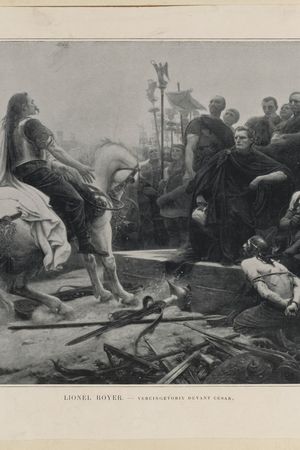
Book One
All of Gaul is divided into three parts. The Belgae live in one, the Aquitani in another, and in the third a people who call themselves Celts in their own language and whom we call Gauls. The three differ from one another in language, customs, and laws. The Garonne River divides the Gauls from the Aquitani; the Marne and the Seine divide them from the Belgae.
Of all these peoples the Belgae are the bravest. They live farthest from the culture and refinement of our Province, merchants seldom reach them with the luxuries that soften men's spirits, and they are next door to the Germans across the Rhine, with whom they are continually at war. For the same reason the Helvetii, in what is now Switzerland, also surpass the rest of the Gauls in courage: they fight the Germans almost every day, either keeping them out of their own territory or carrying the war into German land.
The part held by the Gauls begins at the Rhone. It is bounded by the Garonne, the Ocean, and the territory of the Belgae; on the side of the Sequani and the Helvetii it also reaches the Rhine; and it faces north. The Belgae begin at the far frontier of Gaul, extend to the lower Rhine, and face north and east. Aquitania runs from the Garonne to the Pyrenees and to the part of the Ocean that lies off Spain, and faces northwest.
Among the Helvetii, by far the noblest and richest man was Orgetorix. In the consulship of Marcus Messala and Marcus Piso (61 BC), driven by a desire to be king, he formed a conspiracy of the nobility and persuaded the people to leave their territory with everything they owned. Since they surpassed everyone in courage, he told them, it would be very easy to make themselves masters of all Gaul.
He persuaded them the more easily because the Helvetii are hemmed in on every side by the lie of the land. On one side the Rhine, very wide and very deep, divides their territory from the Germans; on another the Jura, a very high range, stands between them and the Sequani; on the third, Lake Geneva and the Rhone divide them from our Province. In consequence they could roam less widely and could less easily make war on their neighbors, and as men who loved war they took this very hard. For their numbers and their reputation for war and courage, they thought their territory too narrow, though it stretched 240 miles in length and 180 in breadth.
Moved by these considerations and swayed by the authority of Orgetorix, they resolved to prepare everything they needed for the march: to buy up as many draft animals and wagons as they could, to sow as much grain as possible so that supplies would hold out on the road, and to confirm peace and friendship with their nearest neighbors. Two years, they judged, would be enough to complete these arrangements, and they fixed their departure for the third year by law.
Orgetorix was chosen to carry the arrangements through, and he took on himself the embassy to the other states. On this journey he persuaded Casticus, son of Catamantaloedes, a Sequanian, to seize the kingship in his own state that his father had held before him; the father had reigned among the Sequani for many years and had been named a friend of the Roman people by the Senate. He likewise persuaded Dumnorix the Aeduan, brother of Divitiacus, to attempt the same thing; Dumnorix at that time held the leading position in his state and was a great favorite with the common people. Orgetorix gave him his daughter in marriage.
He proved to them that the attempt would be very easy to carry out, since he himself was about to take power in his own state. There was no doubt that the Helvetii were the strongest people in all Gaul, and he assured them that with his own resources and his own army he would win them their thrones. Won over by this speech, the three exchanged pledges and oaths, and hoped that once they held the kingship, three of the most powerful and steadfast peoples in Gaul would make them masters of the whole country.
The plot was reported to the Helvetii by informers. Following their custom, they made Orgetorix plead his case in chains; if he was condemned, the penalty was to be burned alive. On the day fixed for the trial, Orgetorix gathered his whole household from every quarter, some ten thousand people, and brought along all his clients and debtors as well, of whom he had a great number. With their help he got away without pleading.
The state, angered by this, set out to enforce its rights by arms, and the magistrates were gathering a host of men from the countryside, when Orgetorix died. There is some suspicion, as the Helvetii believe, that he took his own life.
Even after his death the Helvetii pressed on with their plan to leave their territory.
When they thought they were ready, they burned all their towns, about twelve of them, some four hundred villages, and every farmstead besides. They burned all their grain except what they meant to carry, so that with no home to go back to they would be readier to face any danger. Every man was told to take three months' supply of flour with him.
They persuaded their neighbors the Rauraci, the Tulingi, and the Latobrigi to follow the same plan, burn their towns and villages, and set out with them. They also took in the Boii as allies. The Boii had once lived beyond the Rhine, had crossed into Noricum (modern Austria), and were besieging the town of Noreia.
There were only two roads by which they could leave home.
One ran through the land of the Sequani, between the Jura Mountains and the Rhone. It was narrow and difficult, so tight that wagons could barely pass in single file, and a towering mountain hung over it, so that a handful of men could easily block it.
The other ran through our Province, and was much easier and quicker. The Rhone flows between the Helvetii and the Allobroges, a people only recently brought under Roman rule, and in several places it can be forded. Geneva, the last town of the Allobroges and the nearest to the Helvetii, has a bridge running across to the Helvetian side.
The Helvetii expected either to talk the Allobroges into letting them through, since they still seemed to bear the Roman people no goodwill, or to force them to.
When everything was ready for the journey, they named a day for the whole people to gather on the bank of the Rhone: March 28, in the consulship of Lucius Piso and Aulus Gabinius (58 BC).
When Caesar heard that they were trying to march through our Province, he left Rome at once, pressed toward Transalpine Gaul as fast as he could march, and reached Geneva. He ordered the whole Province to raise as many soldiers as it could (there was only one legion in all of Transalpine Gaul), and he had the bridge at Geneva torn down.
When the Helvetii learned that he had come, they sent him envoys, the noblest men of their state, led by Nammeius and Verucloetius. They had no other road, the envoys said, and they meant to cross the Province without doing any harm; they asked his permission.
Caesar did not think he should allow it. He remembered that the Helvetii had killed the consul Lucius Cassius, routed his army, and sent it under the yoke, and he did not believe that a hostile people, once given a road through the Province, would keep from violence and damage.
Still, he needed time for the soldiers he had called up to arrive. He told the envoys that he would take time to think it over; if they wanted anything, they should come back on April 13.
Meanwhile, with the legion he had and the troops who had come in from the Province, he built a wall sixteen feet high, with a trench in front of it, for nineteen miles, from Lake Geneva, which drains into the Rhone, to the Jura Mountains, which divide the Sequani from the Helvetii. When the work was finished he posted garrisons and built forts along it, so that he could stop them more easily if they tried to cross without his leave.
When the day came and the envoys returned, he told them that the custom and precedent of the Roman people did not allow him to give anyone a road through the Province, and he made it plain that he would stop them if they tried to force their way.
Their hope dashed, the Helvetii lashed boats together and built rafts, while others tried the fords where the Rhone ran shallowest. Sometimes by day and more often by night they tried to break through, and every time they were driven back by the fortifications, the soldiers who rushed to meet them, and our missiles. In the end they gave up.
That left only the road through Sequanian land, and it was so narrow that they could not use it without the Sequani's consent. Unable to win the Sequani over by themselves, they sent envoys to Dumnorix the Aeduan, hoping he would plead their case.
Dumnorix had great power among the Sequani because of his popularity and his lavish gifts, and he was friendly to the Helvetii because he had married Orgetorix's daughter, a Helvetian. He wanted to be king, and that made him eager for a revolution and anxious to put as many states in his debt as he could.
He took the matter up. He got the Sequani to let the Helvetii pass through their territory, and he arranged for the two peoples to exchange hostages: the Sequani as a pledge that they would not block the march, the Helvetii that they would pass through without doing harm or violence.
Caesar was told that the Helvetii meant to march through the lands of the Sequani and the Aedui into the territory of the Santoni, who live not far from the Tolosates, a people inside the Province. He saw that if this happened the Province would be in great danger: warlike men, enemies of the Roman people, would be living next to open country with no natural defenses and some of the best grain land there was.
He therefore put Titus Labienus, his legate, or senior deputy, in charge of the wall and hurried by forced marches into northern Italy. There he enrolled two new legions, brought three more out of their winter quarters around Aquileia, and with these five legions took the shortest road over the Alps into Transalpine Gaul.
In the mountains the Ceutrones, the Graioceli, and the Caturiges seized the heights and tried to block his march. He drove them off in several battles, and on the seventh day after leaving Ocelum, the last town of Cisalpine Gaul, he reached the territory of the Vocontii in the Transalpine Province. From there he led his army through the land of the Allobroges and on into the Segusiani, the first people outside the Province across the Rhone.
By now the Helvetii had brought their forces through the pass and across Sequanian land into the territory of the Aedui, and were laying waste their fields.
The Aedui could not defend themselves or their property, and they sent envoys to Caesar to ask for help. They had always served the Roman people so well, they said, that they did not deserve to have their fields ravaged, their children carried off into slavery, and their towns stormed, almost within sight of our army.
At the same time the Ambarri, close friends and kinsmen of the Aedui, told Caesar that their fields had been stripped and that they could hardly keep the enemy away from their towns.
The Allobroges who had villages and estates across the Rhone fled to Caesar as well, and told him that they had nothing left but the bare ground.
All this convinced Caesar that he could not wait until the Helvetii had eaten up everything the allies owned and arrived among the Santoni.
There is a river called the Saone, which flows through the territory of the Aedui and the Sequani into the Rhone so incredibly slowly that the eye cannot tell which way it runs.
The Helvetii were crossing it on rafts and boats lashed together. When Caesar's scouts told him that three quarters of their forces were already across, and that the remaining quarter was still on the near bank, he left camp around midnight with three legions and came up with the part that had not yet crossed.
He fell on them while they were weighed down with baggage and not expecting an attack, and cut a large part of them to pieces. The rest ran and hid in the nearest woods.
This canton was called the Tigurini; the whole Helvetian nation is divided into four cantons. In our fathers' time this same canton, on a march away from home, had killed the consul Lucius Cassius and sent his army under the yoke. Whether by chance or by the design of the immortal gods, the part of the Helvetian nation that had dealt the Roman people a famous defeat was the first to pay for it.
Caesar avenged a private wrong here as well as a public one. In the battle in which they killed Cassius, the Tigurini had also killed his legate Lucius Piso, the grandfather of Caesar's father-in-law, Lucius Piso.
After this battle Caesar had a bridge built over the Saone and took his army across to go after the rest of the Helvetii. His sudden arrival alarmed them. It had taken them twenty days of hard labor to cross the river, and he had done it in one. They sent envoys to him.
The embassy was led by Divico, who had commanded the Helvetii in the war against Cassius. He told Caesar:
"If the Roman people make peace with the Helvetii, the Helvetii will go and live wherever you choose to settle them. But if you insist on war, remember the old disaster of the Roman people and the old courage of the Helvetii. You fell on one canton by surprise, when those who had already crossed the river could not come to help it. Don't make much of your own courage because of that, and don't look down on us. Our fathers and ancestors taught us to fight with courage, not to rely on tricks and ambushes. Don't let this place where we stand take its name from a Roman disaster and the destruction of an army, and go down in memory for it."
Caesar replied:
"What your envoys have reminded me of makes me hesitate all the less, and I resent it all the more because the Roman people did nothing to deserve it. If they had known themselves guilty of any wrong, it would not have been hard to be on their guard. They were caught unprepared because they knew they had done nothing to fear, and did not think they ought to be afraid without a reason. And even if I were willing to forget that old insult, could I also forget your new crimes: that you tried to force your way through the Province against my will, and that you have harassed the Aedui, the Ambarri, and the Allobroges? Your arrogant boasting about your victory, and your surprise that you have gone unpunished for so long, tell the same story. The immortal gods often let those they mean to punish for their crimes prosper for a while and go long unpunished, so that the change of fortune hurts them all the more. All the same, if you give me hostages, so that I can be sure you will do what you promise, and if you make amends to the Aedui for the wrongs you have done them and their allies, and to the Allobroges too, I will make peace with you."
Divico answered: "The Helvetii learned from their ancestors to take hostages, not to give them. The Roman people know that better than anyone."
With that reply he left.
The next day the Helvetii broke camp and moved on. Caesar did the same, and sent ahead all his cavalry, about four thousand men he had raised from the whole Province and from the Aedui and their allies, to see which way the enemy were heading.
Chasing the enemy's rear too eagerly, the horsemen took on the Helvetian cavalry on bad ground, and a few of our men were killed. The success went to the Helvetii's heads, since five hundred of their horsemen had driven off so large a body of cavalry. From then on they began now and then to turn and make a bolder stand, and to pick fights with our men from their rear guard.
Caesar held his men back from battle. For the moment he was content to stop the enemy from plundering, foraging, and laying waste the country.
The two armies marched like this for about fifteen days, with no more than five or six miles between the enemy's rear and our front.
Meanwhile Caesar pressed the Aedui every day for the grain their government had promised. Because of the cold, not only was the grain in the fields still unripe, but there was not even enough fodder. He could make little use of the grain he had brought up the Saone by boat, because the Helvetii had turned away from the river and he did not want to lose touch with them.
The Aedui put him off day after day. The grain was being collected, they said, it was being brought in, it was on its way.
When Caesar saw that they were stringing him along, and that the day was close on which the soldiers' grain had to be handed out, he called together their chiefs, many of whom were in his camp. Among them were Divitiacus and Liscus. Liscus held the Aedui's highest office, which they call the vergobret: the holder is elected for a year and has the power of life and death over his people.
Caesar came down on them hard. He could neither buy grain nor take it from the fields, he said, and at so critical a moment, with the enemy so close, they were giving him no help, though it was largely at their request that he had taken on the war.
Caesar's words finally moved Liscus to reveal what he had kept to himself until then:
"There are certain men who carry great weight with the common people, men who as private citizens have more power than the magistrates themselves. With wicked, seditious talk they are scaring the people out of handing over the grain they owe. If the Aedui can no longer lead Gaul, they say, it is better to live under Gauls than under Romans, and if the Romans beat the Helvetii they will certainly take away the freedom of the Aedui along with the rest of Gaul. These same men are passing your plans, and everything that happens in the camp, to the enemy, and I cannot stop them. I know, too, how dangerous it is for me to have told you this, though I had no choice, and that is why I kept quiet as long as I could."
Caesar sensed that Liscus meant Dumnorix, the brother of Divitiacus. Since he did not want the matter discussed with so many present, he quickly dismissed the council and kept Liscus behind. Alone with him, he asked about what he had said in the meeting, and Liscus now spoke more freely and boldly.
Caesar asked others the same questions in private and found that it was all true. The man was Dumnorix: utterly daring, popular with the common people for his generosity, and hungry for revolution.
For years he had held the contract for the tolls and all the other taxes of the Aedui at a low price, because whenever he bid, no one dared bid against him. This had made him rich and given him plenty to give away. He kept a large force of cavalry at his own expense, always around him, and his influence was great not only at home but among the neighboring peoples. To widen it he had married his mother to a man of the highest rank and power among the Bituriges; he had a Helvetian wife himself; and he had married off his half sisters and his kinswomen into other states.
Those family ties made him favor the Helvetii and want them to succeed. He also hated Caesar and the Romans on his own account, because their arrival had cut down his power and restored his brother Divitiacus to his old place of favor and honor. If anything went wrong for the Romans, he had high hopes of making himself king with the help of the Helvetii; under Roman rule he had no hope of the throne, or even of keeping the influence he had.
Caesar's questions also brought out that in the cavalry fight that had gone against us a few days before, the flight had been started by Dumnorix and his horsemen (Dumnorix commanded the cavalry the Aedui had sent to help Caesar), and their flight had panicked the rest.
There were suspicions, and there were also hard facts. Dumnorix had led the Helvetii through the territory of the Sequani; he had arranged the exchange of hostages between them; he had done all this not only without orders from Caesar or from his own state but without their knowledge; and the chief magistrate of the Aedui was accusing him. Caesar judged this reason enough to punish him himself or to order his state to do it.
Against all this stood one thing. Caesar knew Divitiacus's devotion to the Roman people, his goodwill toward Caesar himself, and his outstanding loyalty, fairness, and self-control, and he was afraid that punishing Dumnorix would hurt his brother.
Before taking any step, therefore, he sent for Divitiacus. He dismissed the usual interpreters and spoke with him through Gaius Valerius Troucillus, a leading man of the Province and a friend of his whom he trusted completely. He reminded Divitiacus of what had been said about Dumnorix at the council in his own hearing, and told him what each man had said about him to Caesar in private. Then he asked Divitiacus, and urged him, not to take offense if Caesar either heard the case and passed judgment on Dumnorix himself or ordered the Aeduan state to do so.
In floods of tears, Divitiacus embraced Caesar and begged him not to deal harshly with his brother.
"I know these things are true," he said, "and no one is more hurt by them than I am. When I had great influence at home and in the rest of Gaul, and he, being young, had very little, he rose through me; and now he uses that wealth and strength to undermine my influence and very nearly to destroy me. Even so, I am moved by love for my brother and by what people will think. If you deal severely with him, no one will believe it was done without my consent, since I stand so high in your friendship, and all of Gaul will turn against me."
As he went on pleading at length, in tears, Caesar took his right hand, comforted him, and asked him to say no more. He valued him so highly, he told him, that for his sake, and because he asked it, he would overlook both the wrong done to the Republic and his own resentment.
He then sent for Dumnorix and had his brother present. He showed him what he found to blame in him, and set out what he himself had learned and what the state complained of. He warned him to avoid all suspicion in the future, and said that he forgave him the past for the sake of his brother Divitiacus.
He put Dumnorix under watch, so that he would know what he did and whom he talked to.
That same day Caesar's scouts told him that the enemy had camped at the foot of a mountain eight miles from his own camp, and he sent men to find out what the mountain was like and how hard it was to climb from every side. They reported that it was easy.
Around midnight he ordered Titus Labienus, his second in command, to climb to the top of the ridge with two legions, taking as guides the men who had scouted the route, and explained his plan to him. Around three in the morning he himself hurried toward the enemy by the road they had taken, sending all his cavalry ahead of him.
Publius Considius, who was thought to be a highly experienced soldier and had served under Lucius Sulla and later under Marcus Crassus, was sent forward with the scouts.
At first light Labienus held the summit, and Caesar was no more than a mile and a half from the enemy camp. Neither his approach nor that of Labienus had been noticed, as he learned afterward from prisoners.
Then Considius came galloping up to tell him that the mountain he had meant Labienus to take was held by the enemy. He had recognized their Gallic weapons and crests, he said.
Caesar drew his forces back to the nearest hill and formed his battle line.
Labienus had orders from Caesar not to engage until he saw Caesar's forces close to the enemy camp, so that the enemy would be attacked from every side at once. He held the mountain and waited for our men, keeping out of the fight.
At last, late in the day, Caesar learned from his scouts that the mountain was in his own men's hands, that the Helvetii had moved on, and that Considius, in his panic, had reported seeing what he had not seen.
That day Caesar followed the enemy at his usual distance and camped three miles from them.
The next day only two days were left before the army's grain had to be handed out, and Caesar was no more than eighteen miles from Bibracte, by far the largest and richest town of the Aedui. He decided he must see to his supplies, turned away from the Helvetii, and made for Bibracte.
Some runaways from the troop of Lucius Aemilius, an officer of the Gallic cavalry, carried the news to the enemy.
The Helvetii changed their plan, turned round, and began to follow our rear guard and harass it. Perhaps they thought the Romans were pulling away from them out of fear, all the more because the day before they had held the high ground and still not offered battle; or perhaps they were confident that they could cut the Romans off from their grain.
When Caesar saw this, he drew his forces back to the nearest hill and sent his cavalry to hold off the enemy's attack. Meanwhile, halfway up the hill, he drew up his four veteran legions in three lines. On the top he placed the two legions he had recently raised in Cisalpine Gaul, together with all the auxiliaries, so that the whole hill above him was filled with men. He had the baggage and packs brought together in one place and set the troops of the upper line to fortify it.
The Helvetii, following with all their wagons, gathered their baggage in one place. Then, packed in a dense mass, they drove back our cavalry, formed a phalanx, and came up the slope against our front line.
Caesar had his own horse sent out of sight first, and then everyone else's, so that all faced the same danger and no one could hope to escape. Then he encouraged his men and began the battle.
Hurling their javelins from the higher ground, the soldiers easily broke the enemy phalanx, and once it had come apart they drew their swords and charged.
The Gauls were badly hampered, because a single javelin often went through several of their shields and pinned them together. The iron bent, so they could not pull it out, and with their left arms weighed down they could not fight properly. Many of them, after jerking their arms about for a long time, preferred to drop the shield and fight unprotected.
At last, worn out by their wounds, they began to give ground and to fall back toward a mountain about a mile away.
They had reached the mountain and our men were coming up after them when the Boii and the Tulingi, about fifteen thousand men who brought up the rear of the enemy column and guarded it, came straight off the march, struck our men on their exposed flank, and began to surround them. Seeing this, the Helvetii who had retreated to the mountain began to press forward again and renewed the battle.
The Romans turned and advanced in two directions: the first and second lines against the men they had already beaten and driven back, the third to meet the newcomers.
The battle was fought on two fronts, long and fiercely.
When the enemy could no longer stand up to our attacks, one group withdrew to the mountain, as they had begun to do, and the other fell back to their baggage and wagons.
In all this fighting, which lasted from about one in the afternoon until evening, no one saw an enemy turn his back. The fighting at the baggage went on far into the night, because they had set up their wagons as a rampart. From that higher position they hurled missiles down on our men as they came on, and some of them thrust spears and javelins out from between the wagons and the wheels and wounded our men.
After a long fight our men took the baggage and the camp. Orgetorix's daughter and one of his sons were captured there.
About 130,000 people survived that battle. They marched without a break all that night and reached the territory of the Lingones on the fourth day. Our men could not follow them, having been held up for three days by the soldiers' wounds and the burial of the dead.
Caesar sent letters and messengers to the Lingones ordering them not to help the Helvetii with grain or anything else; if they did, he would treat them as he treated the Helvetii.
After the three days he set out after them with all his forces.
Having run out of everything, the Helvetii sent envoys to Caesar to offer their surrender. The envoys met him on the march, threw themselves at his feet, and begged in tears for peace. He ordered the Helvetii to wait for him where they were, and they obeyed.
When Caesar arrived, he demanded hostages, their weapons, and the slaves who had run away to them.
While these were being searched out and brought in, about six thousand men of the canton called the Verbigeni slipped out of the Helvetian camp at nightfall and hurried toward the Rhine and the land of the Germans. Either they were afraid that once they had handed over their weapons they would be put to death, or they hoped to get away, thinking that among so many thousands who had surrendered their flight could be hidden or go entirely unnoticed.
When Caesar found out, he ordered the peoples through whose lands they had passed to hunt them down and bring them back, if they wanted to clear themselves with him. When they were brought back, he treated them as enemies. All the rest he accepted in surrender once they had handed over their hostages, their weapons, and the runaways.
He ordered the Helvetii, the Tulingi, and the Latobrigi to go back to the lands they had left. Since they had lost all their crops and had nothing at home to live on, he ordered the Allobroges to supply them with grain, and he ordered the Helvetii themselves to rebuild the towns and villages they had burned.
His main reason was that he did not want the land the Helvetii had left to lie empty, in case the Germans who live beyond the Rhine were drawn by its good farmland to cross into Helvetian territory and become neighbors of the Province and the Allobroges.
The Aedui asked to settle the Boii, who were known for their remarkable courage, in their own territory, and Caesar agreed. The Aedui gave them land, and later admitted them to the same rights and freedom as their own people.
In the Helvetian camp tablets were found, written in Greek letters, and brought to Caesar. They listed by name everyone who had left home: those able to bear arms, and separately the boys, the old men, and the women.
The totals were: Helvetii, 263,000; Tulingi, 36,000; Latobrigi, 14,000; Rauraci, 23,000; Boii, 32,000. Of these, about 92,000 could bear arms. The grand total was about 368,000.
When a census was taken of those who went home, as Caesar had ordered, the number came to 110,000.
When the war with the Helvetii was over, envoys from nearly all of Gaul, the leading men of their states, came to congratulate Caesar. They understood, they said, that he had made war on the Helvetii to punish them for their old wrongs against the Roman people, but the result had served Gaul as well as it had Rome. The Helvetii had left their homes at the height of their prosperity meaning to make war on all Gaul and rule it, to pick out from the whole country the place they thought best and most fertile to live in, and to make every other state pay them tribute.
They asked leave to call a council of all Gaul for a set day, with Caesar's consent, since there were certain requests they wanted to put to him jointly. Caesar gave his permission. They fixed a day for the council and bound themselves by oath that no one would reveal what was said there except those whom the council chose to send.
When that council broke up, the same leading men came back to Caesar and asked to speak with him in secret about their own safety and the safety of all Gaul. When he agreed, they all threw themselves at his feet in tears. Keeping what they said secret, they told him, mattered to them as much as getting what they asked for, because if it got out they knew they would be tortured in the cruelest way.
Divitiacus the Aeduan spoke for them.
"There are two factions in Gaul," he said. "We Aedui lead one, the Arverni the other. For many years the two fought hard for supremacy, until in the end the Arverni and the Sequani hired Germans to fight for them. At first about fifteen thousand crossed the Rhine. But these wild barbarians came to love the land of the Gauls, their way of life and their wealth, and more were brought over, until now there are about a hundred and twenty thousand of them in Gaul.
"We Aedui and our dependents fought them more than once, and were beaten with terrible losses: we lost all our nobles, all our senate, all our cavalry. We had once been the most powerful people in Gaul, through our own courage and through our ties of hospitality and friendship with the Roman people. Broken by those battles, we were forced to give the Sequani our noblest men as hostages, and to bind our state by oath never to ask for them back, never to call on the Roman people for help, and never to refuse to live forever under Sequanian rule.
"I am the only man in the whole Aeduan state who could not be made to take the oath or give my children as hostages. That is why I fled and went to the Senate in Rome to ask for help, since I alone was bound neither by oath nor by hostages.
"But the Sequani, who won, have fared worse than we who lost. Ariovistus, king of the Germans, has settled in their territory and seized a third of their land, which is the best land in all Gaul. Now he is ordering them out of a second third, because a few months ago twenty-four thousand Harudes joined him and he must find them land to settle. In a few years all the Gauls will be driven out of Gaul and all the Germans will cross the Rhine, for German land cannot compare with ours, nor their way of life with ours.
"Ever since Ariovistus beat the Gauls in a single battle, at Magetobriga, he has ruled with arrogance and cruelty. He demands the children of all the noblest men as hostages, and if anything is not done at his nod and exactly as he wishes, he puts them to every kind of torture as an example. He is a savage, hot-tempered, reckless man, and we cannot bear his rule any longer.
"Unless you, Caesar, and the Roman people can help us, all the Gauls will have to do what the Helvetii did: leave home, look for other homes and other land far from the Germans, and take whatever fortune comes.
"If what we have said reaches Ariovistus, I have no doubt that he will punish every hostage in his hands as cruelly as he can. You, by your own standing and your army's, by your recent victory, or by the name of the Roman people, can stop any more Germans from being brought across the Rhine, and you can protect all of Gaul from Ariovistus and his outrages."
When Divitiacus had finished, everyone present burst into tears and began begging Caesar for help.
Caesar noticed that the Sequani alone were doing none of this. They sat with their heads bowed, staring miserably at the ground. Puzzled, he asked them why. They gave no answer and went on sitting there in silence. He asked again and again, and could not get a single word out of them.
At last Divitiacus answered for them. "The Sequani have it worse than any of us," he said. "They alone do not dare to complain or ask for help, even in secret. Ariovistus is far away, and still they dread his cruelty as if he were standing in front of them. The rest of us can at least run. But the Sequani took Ariovistus in within their own borders, all their towns are in his hands, and they have to endure whatever torments he chooses."
Caesar reassured the Gauls. He promised to take the matter in hand, and said he had high hopes that Ariovistus, out of regard for the kindness Caesar had shown him and for Caesar's authority, would stop his abuses. Then he dismissed the assembly.
There were many reasons for him to take the matter up. Above all, the Aedui, whom the Senate had many times called brothers and kinsmen of the Roman people, were being held as slaves and subjects of the Germans, and their hostages were in the hands of Ariovistus and the Sequani. For an empire as great as Rome's, he thought, that was a disgrace to himself and to the Republic.
He also saw the danger to Rome in the Germans' growing habit of crossing the Rhine and pouring into Gaul. Savage barbarians like these, once they had taken all of Gaul, would not hold back. Like the Cimbri and Teutones before them, they would break out into the Province and push on into Italy, all the more easily because only the Rhone separated the Sequani from our Province. He thought this had to be stopped as soon as possible.
And Ariovistus himself had grown so proud and arrogant that he was not to be tolerated.
Caesar therefore sent envoys to Ariovistus to ask him to choose some place halfway between them for a conference. Caesar wanted, they said, to discuss public business and matters of the greatest importance to them both.
Ariovistus replied: "If I needed anything from Caesar, I would have gone to him. If he wants something from me, he should come to me. Besides, I do not dare go into the parts of Gaul that Caesar holds without my army, and I cannot gather my army in one place without a great deal of supplies and trouble. And I fail to see what business Caesar, or the Roman people at all, has in my Gaul, which I won in war."
When this answer came back, Caesar sent envoys to him a second time with this message: "In my consulship the Senate named Ariovistus king and friend, a great kindness from me and from the Roman people. He repays it by refusing to come to a conference when invited and by thinking our common affairs not worth discussing. Here, then, are my demands.
"First, he is to bring no more men across the Rhine into Gaul.
"Second, he is to give back the hostages he holds from the Aedui, and let the Sequani give back theirs with his consent.
"Third, he is to stop harassing the Aedui, and make no war on them or their allies.
"If he does this, he will have the lasting gratitude and friendship of myself and the Roman people. If not, I will not ignore the wrongs done to the Aedui. In the consulship of Marcus Messala and Marcus Piso the Senate decreed that whoever governed the province of Gaul should protect the Aedui and Rome's other friends, as far as the interests of the Republic allowed."
Ariovistus answered: "By the right of war, the winner rules the loser as he likes. The Roman people rule the nations they have conquered in just the same way, as they see fit, without taking orders from anyone. I don't tell the Roman people how to use their rights. They have no business getting in the way of mine.
"The Aedui tried their luck in war, fought me, and lost, and so they pay me tribute. Caesar does me a great wrong by coming here: he is cutting into my revenues.
"I will not give the Aedui their hostages back. But I will not attack them or their allies without cause, as long as they keep to our agreement and pay their tribute every year. If they don't, their title of 'Brothers of the Roman People' won't help them much.
"Caesar warns me that he will not ignore the wrongs of the Aedui. No one has ever fought me and not been destroyed. Let him come whenever he likes. He will find out what the Germans can do: undefeated, trained to arms above all men, and for fourteen years without a roof over their heads."
Just as this answer was being brought to Caesar, envoys arrived from the Aedui and from the Treviri. The Aedui complained that the Harudes, newly brought over into Gaul, were laying waste their lands, and that even giving hostages had not bought them peace from Ariovistus. The Treviri reported that a hundred cantons of the Suebi had settled along the Rhine and were trying to cross it, led by two brothers, Nasua and Cimberius.
This news alarmed Caesar badly. He had to move fast, before the new Suebian band joined Ariovistus's existing forces and became much harder to resist. He gathered grain as quickly as he could and marched against Ariovistus by forced marches.
After three days on the road he learned that Ariovistus, with all his forces, was hurrying to seize Vesontio (modern Besançon), the largest town of the Sequani, and was already three days' march out of his own territory.
Caesar was determined to stop him. The town was stocked with everything an army needs, and its natural position would let it hold out a long time. The river Doubs runs around it almost completely, as if drawn with a compass. The gap the river leaves, no more than sixteen hundred feet across, is closed by a high hill whose base touches the riverbank on both sides, and a wall around the hill makes it a citadel joined to the town.
Caesar raced there by forced marches, night and day, took the town, and put a garrison in it.
He spent a few days at Vesontio gathering grain and supplies. Meanwhile our men asked questions, and the Gauls and traders told them stories. The Germans, they said, were enormous, unbelievably brave and highly skilled with weapons. Gauls who had met them in battle often could not even bear the look on their faces or the glare in their eyes. A sudden panic seized the whole army and badly shook every man's nerve.
It started with the military tribunes, the prefects, and the others who had come out from Rome with Caesar as friends and had little experience of war. One after another they gave some reason they had to leave, and asked his permission to go. Some, ashamed and not wanting to look afraid, stayed. But they could not keep a straight face, and at times they could not hold back their tears. They hid in their tents and lamented their fate, or sat with their friends mourning the danger they all faced. All over the camp men were signing and sealing their wills.
Little by little their talk and their fear unnerved even the men with long experience: soldiers, centurions, and cavalry commanders. Those who wanted to seem less frightened said it was not the enemy they feared, but the narrow road and the vast forests between them and Ariovistus, or whether grain could be brought up in time. Some even told Caesar that when he gave the order to break camp and march, the soldiers would refuse out of fear.
When Caesar saw this, he called a council, summoned the centurions of every rank to it, and tore into them.
"First of all, it is not your business to ask, or even to wonder, where you are being led or why. When I was consul, Ariovistus was eager for the friendship of the Roman people. Why should anyone think he will throw it away so rashly? I am convinced that once he knows my demands and sees how fair they are, he will not turn down my goodwill or Rome's.
"But suppose rage and madness drive him to war. What are you afraid of? Why have you lost faith in your own courage, or in my care for you? We have faced this enemy before. In our fathers' day Gaius Marius drove out the Cimbri and Teutones, and the army was thought to have earned as much glory as its general. We faced them again recently in Italy, in the slave revolt, and those slaves had some help from the training and discipline they had learned from us. That shows what steadiness is worth. For a long time men feared them for no reason when they were unarmed, and afterward beat them when they were armed and victorious.
"These are the same Germans the Helvetii have often fought, in their own country and in the Germans', and usually beaten. And the Helvetii were no match for our army. If the defeat and flight of the Gauls worries any of you, look into it. The Gauls were worn out by a long war. Ariovistus stayed in his camp and his marshes for months and gave them no chance to fight. Then, when they had given up hope of a battle and scattered, he fell on them without warning. He won by cunning, not by courage. Tricks like that work on untrained barbarians. Not even Ariovistus expects them to catch a Roman army.
"Those of you who disguise your fear as worry about the grain supply and the narrow roads are being insolent. You seem either to doubt that your general will do his job or to be telling him how to do it. Those things are my concern. The Sequani, the Leuci, and the Lingones are supplying grain, and the crops are already ripe in the fields. As for the road, you will soon see it for yourselves.
"They say the men will not obey orders or march. That does not worry me in the least. Whenever an army has refused to obey, I know, it was because its general had failed and his luck had run out, or because some crime had come to light and proved him greedy. My whole life shows my integrity, and the war with the Helvetii shows my luck.
"I will therefore do at once what I meant to put off. I will break camp tonight, around three in the morning, and find out right away whether honor and duty mean more to you than fear.
"And if no one else follows me, I will go with the tenth legion alone. I have no doubts about them, and they will be my bodyguard."
Caesar had always favored this legion above the others and trusted its courage most.
The speech changed everyone's mind as if by magic, and the whole army became eager to fight.
The tenth legion led the way. Through its military tribunes it thanked Caesar for his high opinion and assured him it was ready for war.
Then the other legions, through their military tribunes and senior centurions, set about making their peace with Caesar. They had never doubted or been afraid, they said, and they had never thought that running the war was their job rather than their general's.
Caesar accepted their apology. Divitiacus, the Gaul he trusted most, scouted the route and found a detour of more than fifty miles that would take the army through open country. Caesar set out around three in the morning, as he had said.
On the seventh day of unbroken marching, his scouts reported that Ariovistus's forces were twenty-four miles from ours.
When Ariovistus heard that Caesar was coming, he sent envoys to say that the conference Caesar had asked for earlier could now go ahead, since Caesar was closer and he thought he could meet him safely.
Caesar did not turn the offer down. He thought Ariovistus was coming to his senses, since he was now offering on his own what he had refused when asked. Caesar had real hope that once Ariovistus heard his demands, and remembered all that Caesar and the Roman people had done for him, he would drop his stubbornness. The conference was set for five days later.
Meanwhile, as envoys went back and forth, Ariovistus demanded that Caesar bring no infantry to the conference. He was afraid, he said, of being ambushed. Each of them should come with cavalry only, or he would not come at all.
Caesar did not want to give him an excuse to call the meeting off, but he did not dare trust his life to the Gallic cavalry. He decided the best course was to take all the horses from the Gallic horsemen and put soldiers of the tenth legion, the one he trusted most, on them instead, so that he would have a guard he could rely on if it came to a fight.
As they were mounting, one soldier of the tenth made a nice joke: "Caesar's doing more than he promised. He promised to make the tenth his bodyguard, and now he's making us knights."
On a large plain stood a good-sized mound of earth, about the same distance from both camps. There, as agreed, they met. Caesar stationed his mounted legion two hundred paces from the mound, and Ariovistus's horsemen halted the same distance away. Ariovistus asked that they talk on horseback and each bring ten men besides himself.
When they arrived, Caesar began by reminding Ariovistus of the favors he and the Senate had done him. The Senate had named him king and friend and sent him lavish gifts. Few men had ever received such honors, Caesar said, and they were usually given for great services. Ariovistus had no right of approach to the Senate and no good reason to ask, yet he had received them through the kindness and generosity of Caesar and the Senate.
Caesar explained, too, how old and how well founded Rome's close ties with the Aedui were, how often the Senate had passed decrees in their honor and how flattering those decrees had been, and how the Aedui had always been the leading people of all Gaul, even before they sought our friendship.
"It is the custom of the Roman people," he said, "to want their allies and friends not only to lose nothing of their own, but to gain in influence, standing, and honor. Who could stand by while they were robbed of what they brought with them into Rome's friendship?"
Then he repeated the demands his envoys had delivered. Ariovistus was not to make war on the Aedui or their allies; he was to give back the hostages; and if he could not send any of his Germans home, he was at least to let no more cross the Rhine.
Ariovistus gave a short answer to Caesar's demands and talked at length about his own merits:
"I did not cross the Rhine on my own account. The Gauls asked me and sent for me. I did not leave my home and my family without great hopes and great rewards in view. The land I hold in Gaul the Gauls themselves gave me. The hostages they handed over of their own free will. I take tribute by the right of war, the tribute winners always impose on losers.
"I did not make war on the Gauls; the Gauls made war on me. Every state in Gaul came out to attack me and camped against me, and I beat all their forces in a single battle. If they want to try again, I am ready to fight again. If they want peace, it is unfair of them to refuse the tribute they have paid willingly until now.
"The friendship of the Roman people ought to bring me honor and protection, not loss, and that is what I hoped for when I sought it. If Rome means to cancel my tribute and take my subjects away from me, I will give up its friendship as gladly as I asked for it.
"If I bring Germans into Gaul in large numbers, it is to protect myself, not to attack Gaul. The proof is that I came only when invited, and that I did not start the war but defended myself.
"I came into Gaul before the Roman people did. Never before now has a Roman army set foot outside the borders of the province of Gaul. What do you want? Why are you coming into my lands? This part of Gaul is my province, just as that part is yours. You would be right to stop me if I invaded your territory; in the same way, you are in the wrong to interfere with my rights.
"You say the Senate has called the Aedui brothers. I am not so barbarous or so ignorant of the world as not to know that the Aedui gave Rome no help in the last war with the Allobroges, and got no help from Rome in their own wars with me and the Sequani. I can only suspect that your friendship is a sham, and that you keep an army in Gaul to crush me.
"Unless you leave and take your army out of this country, I will treat you not as a friend but as an enemy. And if I kill you, I will be doing a favor to many nobles and leading men in Rome. I have that from them directly, through their own messengers. Your death would buy me the gratitude and friendship of every one of them.
"But if you go away and leave Gaul to me, I will reward you handsomely, and I will fight any wars you want fought, with no effort or risk to you."
Caesar said a great deal to explain why he could not drop the matter. Neither his own principles nor Rome's allowed him to abandon allies who had served Rome so well, and he did not accept that Gaul belonged to Ariovistus any more than to the Roman people. Quintus Fabius Maximus had conquered the Arverni and the Ruteni in war, and the Roman people had pardoned them, without making them a province or imposing tribute. If the oldest claim counted, then Rome had the best right to rule in Gaul. If the Senate's judgment counted, then Gaul should be free, since after conquering it the Senate had chosen to let it keep its own laws.
While they were still talking, Caesar was told that Ariovistus's horsemen were coming closer to the mound, riding up to our men, and throwing stones and spears at them. Caesar broke off the talk, went back to his own men, and ordered them not to throw a single weapon in return. He knew his picked legion could fight the cavalry without any risk at all. But he would not let it happen, because once the enemy were beaten, people could say he had lured them to a conference under a promise of safety and then attacked them.
When the soldiers heard how arrogantly Ariovistus had behaved at the conference, ordering the Romans out of all Gaul, and how his horsemen had attacked our men and broken up the talks, the whole army grew far keener to fight.
Two days later Ariovistus sent envoys to Caesar. He wanted, he said, to finish discussing the matters they had begun on. Caesar should either set another day for a conference or, if he would rather not, send one of his officers to him.
Caesar saw no point in another conference, especially since the day before the Germans could not be stopped from throwing weapons at our men. To send one of his officers would be to put him in great danger and hand him over to savages. He decided it was best to send Gaius Valerius Procillus, son of Gaius Valerius Caburus, a brave and well-educated young man whose father had been made a Roman citizen by Gaius Valerius Flaccus. Procillus was loyal, he spoke Gallic, which Ariovistus by now spoke fluently after so long in Gaul, and the Germans would have no reason to harm him. With him Caesar sent Marcus Metius, who had ties of hospitality with Ariovistus. They were to hear what Ariovistus had to say and report back.
When Ariovistus saw them in his camp, he shouted in front of his whole army: "Why have you come here? To spy?" When they tried to speak, he cut them off and had them put in chains.
That same day Ariovistus moved his camp forward and settled at the foot of a hill six miles from Caesar. The next day he marched his forces past Caesar's camp and camped two miles beyond it, to cut Caesar off from the grain and supplies coming up from the Sequani and the Aedui.
For the next five days Caesar led his army out in front of his camp and kept it in battle order, so that Ariovistus could fight if he wanted to. Every day Ariovistus kept his army in camp, though his cavalry skirmished daily.
The Germans had trained for a special kind of fighting. They had six thousand horsemen, and as many foot soldiers, the fastest and bravest in the army, each picked by one of the horsemen as his own protector. The horsemen fought alongside them and fell back on them when pressed. If things got hard, the foot soldiers ran in to help. If a horseman was badly wounded and fell, they gathered around him. If they had to advance a long way or retreat in a hurry, they were so fast from practice that, hanging on to the horses' manes, they kept up with them.
When Caesar saw that Ariovistus would not leave his camp, he refused to stay cut off from his supplies any longer. He chose a good site for a camp beyond the Germans' position, about six hundred paces from them, and marched there with his army in three lines. He ordered the first and second lines to stand to arms while the third built the camp.
Ariovistus sent about sixteen thousand light troops and all his cavalry to frighten our men and stop the work. Caesar stuck to his plan: two lines drove off the enemy while the third finished the camp. Once it was fortified, he left two legions and part of the auxiliaries there and took the other four legions back to the larger camp.
The next day, as had become his practice, Caesar led his forces out of both camps, advanced a little from the larger one, formed his line, and offered battle. When even then the enemy would not come out, he took the army back into camp around noon. Only then did Ariovistus send part of his forces to attack the smaller camp. The fighting was fierce on both sides until evening. At sunset Ariovistus pulled his forces back, with many wounded on both sides.
Caesar asked his prisoners why Ariovistus would not fight a full battle, and learned the reason. Among the Germans it was the custom for the married women to decide, by lots and by prophecy, whether or not to fight. These women had declared that heaven would not let the Germans win if they fought before the new moon.
The next day Caesar left enough men to guard each camp and lined up all his auxiliaries in front of the smaller camp, in full view of the enemy, for show, since he had fewer legionaries than the enemy had men. He himself formed the army in three lines and marched right up to the enemy's camp.
Now the Germans had no choice but to come out. They drew up by tribes, at equal intervals: the Harudes, Marcomanni, Triboci, Vangiones, Nemetes, Sedusii, and Suebi. They ringed their whole line with carts and wagons so that no one could hope to escape by running. On these they put their women, who wept and stretched out their hands to the men marching into battle, begging them not to let them be made slaves of the Romans.
Caesar put a legate or the quaestor in command of each legion, so that every man would have them as witnesses to his courage. He himself opened the battle on the right wing, where he had noticed the enemy was weakest.
At the signal our men charged so fiercely, and the enemy rushed forward so suddenly and fast, that there was no time to throw javelins. Our men dropped them and fought hand to hand with swords. But the Germans quickly formed a phalanx, as is their custom, and took the sword strokes on their shields. A good many of our men leaped up onto the phalanx, wrenched the shields away with their hands, and stabbed down from above.
The enemy's left wing was beaten and fled, but on their right the Germans were pushing our line back hard by sheer numbers. The young Publius Crassus, son of Marcus Crassus, who commanded the cavalry, saw this, since he was freer to move than the officers caught up in the line, and sent the third line to help our men where they were struggling.
That restored the battle. The whole enemy army turned and fled, and did not stop running until they reached the Rhine, about fifty miles away. There a very few trusted their strength and swam across, or found boats and got away. Among them was Ariovistus, who found a small boat tied to the bank and escaped in it. All the rest our cavalry caught and killed.
Ariovistus had two wives. One was a Suebian whom he had brought with him from home; the other, from Noricum, was the sister of King Voccio, who had sent her to Gaul to marry him. Both died in the rout. Of his two daughters, one was killed and the other captured.
Gaius Valerius Procillus, bound in triple chains, was being dragged along by his guards in the flight when he ran into Caesar himself, pursuing the enemy with the cavalry. This gave Caesar as much pleasure as the victory itself. He had his close friend and guest, the most respected man in the province of Gaul, back safe from the enemy's hands, and fortune had not spoiled the joy of the day by taking him. Procillus said the Germans had cast lots over him three times, before his eyes, to decide whether to burn him alive at once or keep him for later, and the lots had saved him.
Marcus Metius was found as well and brought back to Caesar.
When news of the battle crossed the Rhine, the Suebi who had come to the riverbank began to go home. The peoples living nearest the Rhine saw how frightened they were, went after them, and killed a great many.
Having finished two great wars in a single summer, Caesar took his army into winter quarters among the Sequani a little earlier than the season required. He put Labienus in command there and set off himself for Cisalpine Gaul to hold the assizes.
Book Two
While Caesar was in winter quarters in Cisalpine Gaul, as described above, frequent reports reached him, and letters from Labienus confirmed them: the Belgae, who, as noted above, make up a third of Gaul, were conspiring against the Roman people and exchanging hostages among themselves.
They had several reasons for conspiring. First, they feared that now that all the rest of Gaul had been pacified, our army would be led against them. Second, they were being stirred up by a number of Gauls. Some of these had not wanted the Germans to stay on in Gaul, and liked it no better that a Roman army was wintering there and settling in. Others were simply fickle and restless and wanted new masters. And some were driven by the fact that in Gaul the more powerful men, and anyone with the money to hire followers, commonly made themselves kings, which under our rule would be much harder.
Alarmed by these reports and letters, Caesar raised two new legions in Cisalpine Gaul and, at the beginning of summer, sent his legate Quintus Pedius to lead them into Further Gaul. He joined the army himself as soon as there was enough forage. He charged the Senones and the other Gauls who bordered on the Belgae to find out what was happening among them and report it. All of them reported, consistently, that forces were being raised and an army gathered in one place. Caesar now saw no reason to wait and decided to march against them. Having provided for his grain supply, he broke camp and in about fifteen days reached the territory of the Belgae.
He arrived unexpectedly and sooner than anyone had thought possible, and the Remi, the Belgae nearest to the rest of Gaul (around modern Reims), at once sent two of their leading men, Iccius and Andebrogius, as envoys. They said that the Remi placed themselves and everything they had under the protection and authority of the Roman people. They had not joined the other Belgae and had not conspired against the Roman people. They were ready to give hostages, carry out his orders, receive him in their towns, and help him with grain and everything else. All the other Belgae were in arms, they said, and the Germans living on this side of the Rhine had joined them. They were all in such a frenzy that the Remi had not even been able to keep the Suessiones out of it, though the Suessiones were their brothers and kinsmen, lived under the same rights and laws, and shared one government and one set of magistrates with them.
Caesar asked them which states were in arms, how large they were, and what they could do in war, and this is what he learned. Most of the Belgae were descended from the Germans. Long ago they had been brought across the Rhine, had settled there for the fertility of the land, and had driven out the Gauls who lived in those parts. In our fathers' day, when all Gaul was ravaged, they alone had kept the Teutones and the Cimbri out of their territory. The memory of it gave them great prestige and a high opinion of themselves as soldiers.
As for their numbers, the Remi said they had full information, because, being bound to them by kinship and marriage, they knew how many men each state had promised for this war at the general council of the Belgae.
The Bellovaci were the strongest among them in courage, in influence, and in numbers. They could raise 100,000 armed men, had promised 60,000 picked men from that number, and were demanding command of the whole war. The Suessiones, neighbors of the Remi, held a very wide territory with very fertile fields. Within our own memory their king had been Divitiacus (not the Aeduan of that name), the most powerful man in all Gaul, who ruled not only a great part of these regions but Britain as well. Their present king was Galba, and everyone had agreed to give him command of the whole war for his fairness and good sense. They had twelve towns and promised 50,000 armed men. The Nervii, who were thought the fiercest of all the Belgae and lived farthest off, promised as many. The Atrebates promised 15,000; the Ambiani, 10,000; the Morini, 25,000; the Menapii, 7,000; the Caleti, 10,000; the Veliocasses and the Veromandui as many; the Aduatuci, 19,000. The Condrusi, Eburones, Caeraesi, and Paemani, who are known collectively as Germans, would, they thought, send about 40,000.
Caesar reassured the Remi and answered them warmly. He ordered their whole senate to come to him and the children of their leading men to be brought to him as hostages. They did all of this promptly, on the day set.
He also gave Divitiacus the Aeduan strong encouragement, explaining how much it mattered to the Republic and to their common safety that the enemy's forces be kept apart, so that they would not have to fight so great a host all at once. This could be done if the Aedui led their forces into the territory of the Bellovaci and began to lay waste their lands. With these instructions he sent him off.
When Caesar saw that the Belgae had gathered all their forces and were coming toward him, and heard from his scouts and from the Remi that they were already close, he hurried his army across the Aisne River, which runs along the far edge of the Remi's territory, and camped there. The position protected one side of the camp with the riverbanks, made his rear safe from the enemy, and let supplies come to him without danger from the Remi and the other states. There was a bridge over the river. He posted a guard on it and left his legate Quintus Titurius Sabinus on the other bank with six cohorts. He ordered the camp to be fortified with a rampart twelve feet high and a trench eighteen feet wide.
Eight miles from this camp lay a town of the Remi called Bibrax. The Belgae, coming straight off the march, began to attack it with great force, and it barely held out that day. The Gauls and the Belgae besiege a town in the same way. They surround the whole circuit of the walls with a mass of men and begin hurling stones at the wall from every side; once the wall has been stripped of defenders, they lock their shields into a tortoise, come up to the gates, and undermine the wall. Here it was easy, for with so many men throwing stones and javelins, no one could keep a footing on the wall. When night ended the assault, the commander of the town sent Caesar a message. This was Iccius, a Reman of the highest rank and influence among his people, and one of the envoys who had come to Caesar to make peace: "Unless reinforcements are sent, I cannot hold out any longer."
Around midnight Caesar sent Numidians, Cretan archers, and Balearic slingers to help the townspeople, using as guides the same men who had come as messengers from Iccius. Their arrival put fresh heart into the Remi, who now believed they could hold the town, and for the same reason the enemy lost hope of taking it. The Belgae lingered near the town for a short while, laid waste the fields of the Remi, and burned every village and building they could reach. Then they marched with all their forces on Caesar's camp and pitched their own less than two miles away. Their camp, as the smoke and the fires showed, stretched more than eight miles across.
At first, because the enemy were so many and had such a reputation for courage, Caesar decided to put off a battle. Every day, though, he used cavalry skirmishes to test what the enemy could do and what our men would dare. When he saw that our men were not their inferiors, he prepared the ground in front of the camp, which was naturally suited for drawing up a battle line. The hill on which the camp stood rose a little above the plain, and its front was just wide enough for an army drawn up in line. It fell away steeply on either side, while in front it sloped gently and gradually down to the plain. On each side of this hill he dug a trench at right angles to it, about four hundred paces long, and at the ends of the trenches he built small forts and placed artillery in them. This was so that the enemy, who were so strong in numbers, could not take his men in the flank once the line was drawn up and fighting. When this was done, he left the two legions he had most recently raised in camp, to be brought up as reserves wherever they were needed, and drew up the other six in line in front of the camp. The enemy led out their forces and drew them up too.
Between our army and the enemy's lay a marsh, not a large one. The enemy waited to see whether our men would cross it; our men stood under arms, ready to fall on them if they tried to cross first and got bogged down. Meanwhile the cavalry fought between the two lines. When neither side began to cross, and the cavalry fight had gone in our favor, Caesar led his men back into camp.
The enemy immediately set out from there for the Aisne, which, as described above, lay behind our camp. There they found fords and tried to bring part of their forces across. They meant, if they could, to storm the fort commanded by Quintus Titurius and break down the bridge; failing that, to lay waste the lands of the Remi, which were very useful to us for the war, and cut off our supplies.
When Titurius sent word, Caesar led all his cavalry, the lightly armed Numidians, the slingers, and the archers across the bridge and hurried toward them. The fighting there was hard. Our men attacked the enemy while they were struggling in the river and killed a great number of them. The rest, who tried with great daring to cross over the bodies of the fallen, were driven back by a mass of missiles, and those who had already crossed were surrounded by the cavalry and killed.
The enemy now saw that their hopes of storming the town and of crossing the river had both failed. They saw that our men would not advance onto unfavorable ground to fight, and their own grain was beginning to run out. They called a council and decided that it was best for each man to return home, and that they would all gather from every side to defend whichever people the Romans first invaded. That way they would fight in their own territory rather than in someone else's and could draw on their own stores of grain at home. One reason in particular pushed them to this decision: they had learned that Divitiacus and the Aedui were approaching the borders of the Bellovaci. Nothing could persuade the Bellovaci to stay any longer and leave their own people without help.
Once this was settled, they left their camp around ten at night, with great noise and confusion, in no fixed order and under no command. Every man pushed for a place at the front and hurried to get home, so that the departure looked very like a flight. Caesar's spies told him at once, but since he did not yet know why they were leaving, he feared an ambush and kept the army and the cavalry in camp. At first light, when his scouts had confirmed the news, he sent all the cavalry ahead to hold up the enemy's rear and put his legates Quintus Pedius and Lucius Aurunculeius Cotta in command of it. He ordered his legate Titus Labienus to follow with three legions. They attacked the rear of the column, pursued it for many miles, and cut down a great number of the fugitives. The men at the very end of the column, when our troops reached them, halted and bravely withstood the attack; but those ahead of them, who thought they were out of danger and had neither need nor orders to hold them together, broke ranks at the sound of the shouting and ran for their lives. Our men killed as many of them as the daylight allowed, without any risk to themselves. At sunset they gave up the pursuit and returned to camp, as they had been ordered.
The next day, before the enemy could recover from their panic, Caesar led his army into the territory of the Suessiones, who were the next neighbors of the Remi, and after a long march reached the town of Noviodunum. He had heard that it had no garrison and tried to storm it straight off the march; but the trench was so wide and the wall so high that even with few men defending it, he could not take it. He fortified a camp and began to push siege sheds forward and prepare whatever else was needed for a siege. The next night the whole mass of the Suessiones, fleeing from the rout, crowded into the town. The sheds were quickly brought up to the town, a siege ramp was thrown up, and towers were set in place. The Gauls had never seen or heard of works on this scale, and, shaken by their size and by the speed of the Romans, they sent envoys to Caesar to surrender. The Remi pleaded for them, and their lives were spared.
Caesar took as hostages the leading men of the state and the two sons of King Galba himself, took over every weapon in the town, and accepted the surrender of the Suessiones. Then he led his army against the Bellovaci.
The Bellovaci had shut themselves and everything they owned inside the town of Bratuspantium. When Caesar and his army were about five miles from the town, all the older men came out, stretched out their hands to Caesar, and called out that they were placing themselves under his protection and authority and were not fighting against the Roman people. Then, when he had come up to the town and was pitching camp, the boys and women held out their hands from the wall, as is their custom, and begged the Romans for peace.
Divitiacus spoke for them. After the Belgae dispersed he had sent home the forces of the Aedui and come back to Caesar. "The Bellovaci," he said, "have always been loyal friends of the Aedui. Their leaders drove them to it by telling them that the Aedui had been reduced to slavery by Caesar and were suffering every kind of indignity and insult, and so they broke with the Aedui and made war on the Roman people. The men behind that policy have fled to Britain, knowing what a disaster they have brought on their state. The Bellovaci beg you, and the Aedui beg you on their behalf, to treat them with your usual clemency and mildness. If you do, you will raise the standing of the Aedui among all the Belgae, whose help and resources we have always counted on whenever war came."
Caesar said that out of regard for Divitiacus and the Aedui he would take the Bellovaci under his protection and spare them. But because their state had great influence among the Belgae and the largest population, he demanded six hundred hostages. When these had been handed over and all the weapons in the town collected, he moved on into the territory of the Ambiani, who surrendered themselves and everything they had without delay.
Next to the Ambiani lived the Nervii. When Caesar asked about their character and customs, this is what he learned. They let no merchants into their country. They allowed no wine or any other luxury to be brought in, believing that such things made men's spirits slack and weakened their courage. They were fierce and very brave. They railed at the other Belgae and condemned them for surrendering to the Roman people and throwing away the courage of their ancestors, and they declared that they would neither send envoys nor accept any terms of peace.
When Caesar had marched for three days through their territory, he learned from prisoners that the Sambre River was not more than ten miles from his camp. The whole Nervian nation had taken up a position across that river and was waiting there for the Romans, together with their neighbors the Atrebates and the Veromandui, whom they had persuaded to share the fortunes of the war. They were also expecting the Aduatuci, whose army was on its way. They had sent their women, and everyone too old or too young to fight, to a place that the marshes made impossible for an army to reach.
Caesar sent scouts and centurions ahead to choose a suitable place for a camp. A good many of the Belgae who had surrendered, and other Gauls, were following Caesar and marching with him. Some of these, as prisoners later revealed, had watched how our army marched during those days, and went to the Nervii by night. They explained that a large baggage train came between each legion and the next. When the first legion reached the camp and the others were still far behind, they said, it would be easy to attack it while the soldiers were still loaded with their packs. Once it was routed and the baggage plundered, the rest would not dare to stand against them.
The plan had another point in its favor. From early times the Nervii had had no strength in cavalry (even now they take no interest in it, and whatever power they have lies in their infantry). To stop their neighbors' cavalry when it came raiding, they had cut into young trees and bent them over; the branches grew out thickly sideways, brambles and briars were woven in between, and the hedges became a barrier like a wall, which no one could get through or even see through. With these hedges to slow our column, the Nervii decided the plan was too good to pass up.
This was the ground our men had chosen for the camp. A hill sloped evenly from its top down to the Sambre, the river named above. From the river a second hill rose with the same slope, opposite and facing it. Its lowest two hundred paces or so were open, and its upper part was wooded, so that it was not easy to see into it. The enemy lay hidden in those woods. On the open ground along the river only a few cavalry pickets could be seen. The river was about three feet deep.
Caesar sent the cavalry ahead and followed with all his forces. But the column was not arranged the way the Belgae had told the Nervii. Because he was nearing the enemy, Caesar, as was his custom, led six legions in light order. Behind them came the baggage of the whole army, and the two newest legions brought up the rear and guarded it. Our cavalry, with the slingers and archers, crossed the river and engaged the enemy's cavalry. Again and again the enemy horsemen fell back into the woods to their own people and then charged out at our men, and our men did not dare to follow them past the edge of the open ground. Meanwhile the six legions that had arrived first measured out the camp and began to fortify it.
The enemy had agreed to attack the moment the first of our baggage came into sight. They had already formed their line and ranks inside the woods and urged one another on, and as soon as they saw it, they suddenly rushed out with all their forces and charged our cavalry. They routed and scattered it with ease, then ran down to the river with incredible speed, so that almost at the same moment the enemy seemed to be at the edge of the woods, in the river, and upon us. With the same speed they made their way up the hill toward our camp and the men busy at the works.
Caesar had everything to do at once. The banner had to be raised, the signal to run to arms; the trumpet call had to be sounded; the soldiers had to be recalled from the works, and those who had gone a little farther off to look for material for the rampart had to be sent for; the line had to be drawn up, the soldiers encouraged, the signal for battle given. The shortness of the time and the enemy's onrush prevented most of this.
Two things helped him out of these difficulties. One was the skill and experience of the soldiers: earlier battles had trained them, and they could work out for themselves what had to be done as well as anyone could have told them. The other was that Caesar had forbidden his legates to leave the works and their own legions until the camp was fortified. Because the enemy was so close and so fast, these legates no longer waited for orders from Caesar but did on their own authority whatever seemed best.
Caesar gave the orders that were essential, then ran down to encourage the soldiers wherever chance took him, and came first to the tenth legion. His speech was no longer than this: "Remember your old courage. Keep your heads. Stand up bravely to their charge." The enemy were already within javelin range, and he gave the signal to engage. Then he set out for another part of the field to encourage the men there, and found them already fighting. The time was so short, and the enemy so ready to fight, that there was no chance to fit on the badges of rank, or even to put on helmets and pull the covers off shields. Wherever each man happened to arrive from the works, he took his stand by the first standards he saw, rather than waste fighting time hunting for his own.
The line had formed to suit the ground, the slope of the hill and the needs of the moment, not as military science would have it. The legions were holding off the enemy in separate places, and the very dense hedges described above blocked the view between them. No fixed reserves could be posted, no one could foresee what was needed in each part of the field, and no single man could give all the orders. With everything against them, the luck of the day also ran differently in different places.
The soldiers of the ninth and tenth legions had taken position on the left of the line, facing the Atrebates. They threw their javelins, and quickly drove the Atrebates, who were breathless from running and exhaustion and worn down by wounds, from the higher ground into the river. As the Atrebates tried to cross, the legionaries pursued them and killed a great part of them with their swords while they struggled in the water. They crossed the river themselves without hesitating, pushed on up the unfavorable ground beyond, and when the enemy turned to fight again, routed them a second time. In the same way, in another part of the field, two other legions, the eleventh and the eighth, had routed the Veromandui and were fighting from the higher ground right on the riverbank.
But nearly the whole camp was now left exposed in front and on the left. The twelfth legion had taken its stand on the right wing, with the seventh not far from it. Toward that spot all the Nervii now made in a very dense column, led by Boduognatus, who held the supreme command. Some of them began to surround the legions on their open flank, while others made for the highest point of the camp.
At the same time our cavalry and the light infantry with them, routed, as described above, by the enemy's first charge, were making their way back into camp when they ran straight into the enemy and fled again in another direction. The camp followers, who from the rear gate and the top of the ridge had seen our men crossing the river in victory, had gone out to plunder; when they looked back and saw the enemy moving about in our camp, they fled headlong. At the same time a shouting and uproar rose from the men coming up with the baggage, and they rushed off in terror, some one way and some another. All this shook the cavalry of the Treviri, whose reputation for courage is unique among the Gauls and who had been sent to Caesar by their state as auxiliaries. They saw our camp filled with masses of the enemy, the legions hard pressed and almost surrounded, and the camp followers, cavalry, slingers, and Numidians scattered and fleeing in every direction. Despairing of our cause, they made for home and reported to their state that the Romans had been routed and defeated and that the enemy had taken their camp and baggage.
Caesar, after encouraging the tenth legion, went to the right wing. There he saw his men under heavy pressure. The standards of the twelfth legion had been crowded together, and the soldiers were packed so tight that they got in each other's way. In the fourth cohort every centurion had been killed, the standard-bearer was dead, and the standard lost. In the other cohorts nearly all the centurions had been either wounded or killed, among them the chief centurion, Publius Sextius Baculus, a very brave man, who was so worn out by many severe wounds that he could no longer stand. The rest were losing their edge, and some at the rear had left the fight and were trying to get out of range. In front the enemy kept coming up from the lower ground without a pause, and they pressed hard on both flanks. Caesar saw that the situation was critical and that there was no reserve he could send in.
He took a shield from a soldier at the rear, since he had come there without one himself, and went forward into the front line. He called on the centurions by name, encouraged the rest of the soldiers, and ordered them to advance the standards and open out the ranks so that they could use their swords more easily. His arrival gave the soldiers hope and renewed their spirit. Every man wanted to do his best with his general watching, desperate as his own case was, and the enemy's attack slowed a little.
Caesar saw that the seventh legion, which stood next to them, was also hard pressed by the enemy. He told the military tribunes to bring the two legions gradually together, face about, and carry the attack to the enemy. Once this was done, the men could support one another and no longer feared being taken from behind, and they began to stand more boldly and fight harder.
Meanwhile the soldiers of the two legions that had been guarding the baggage at the rear of the column heard of the battle, came on at a run, and the enemy saw them appear on the crest of the hill. And Titus Labienus, who had taken the enemy's camp, saw from the higher ground what was happening in ours and sent the tenth legion to help our men. The fleeing cavalry and camp followers had told them how things stood and what danger the camp, the legions, and their commander were in, and they came as fast as they could.
Their arrival changed things so completely that even those of our men who had fallen exhausted by wounds propped themselves on their shields and fought again. The camp followers, seeing the enemy terrified, ran at armed men without weapons of their own. And the cavalry, determined to wipe out the disgrace of their flight, threw themselves into the fight ahead of the legionaries everywhere on the field.
But the enemy, with hardly any hope of survival left, fought with such courage that when their front ranks fell, the men behind stood on the bodies and fought from on top of them. When these were cut down too and the corpses piled up, the survivors stood on the heap as if on a mound, hurled their weapons at our men, and caught our javelins and threw them back. Men of such courage, one has to conclude, were not fools to have dared to cross a very wide river, climb very high banks, and charge up onto very bad ground: their greatness of spirit had made those hard things easy.
The battle ended with the Nervian nation, and its very name, almost wiped out. Their old men, who, as described above, had been sent with the boys and women into the tidal inlets and marshes, heard the news. Believing that nothing could stop the victors and nothing could save the defeated, they sent envoys to Caesar with the consent of all who had survived and surrendered to him. Describing the disaster, they said that their senators had been reduced from six hundred to three, and their men able to bear arms from sixty thousand to barely five hundred.
Caesar, wanting it seen that he showed mercy to the wretched and to suppliants, took great care to protect them. He told them to keep their territory and their towns, and ordered their neighbors to keep themselves and their people from doing them any harm.
The Aduatuci, mentioned above, were coming with all their forces to help the Nervii. When they heard of the battle, they turned round and went home. They abandoned all their other towns and forts and brought everything they owned into a single town with superb natural defenses. It was ringed on every side by very high cliffs and steep drops, except for one gently rising approach not more than two hundred feet wide. This they had fortified with a very high double wall, and they were setting heavy stones and sharpened beams along its top.
The Aduatuci were descended from the Cimbri and Teutones. When those peoples marched on our Province and Italy, they left behind on this side of the Rhine the baggage they could neither drive nor carry with them, with six thousand of their own men to guard it. After the Cimbri and Teutones were destroyed, these men were harried for many years by their neighbors, sometimes attacking and sometimes defending themselves. At last all sides agreed to make peace, and they chose this place for their home.
When our army first arrived, the Aduatuci made frequent sallies from the town and fought small skirmishes with our men. Later, when Caesar had shut them in with a rampart twelve feet high and fifteen thousand feet (about three miles) around, with forts at close intervals, they kept inside the town. When our siege sheds had been pushed forward and a ramp built, and they saw a tower being set up some way off, they at first laughed at it from the wall and jeered at us for building such a contraption so far away.
"What hands are going to move that?" they shouted. "What strength? You little men" (for most of the Gauls, being so large themselves, look down on our shortness) "think you can set a tower that heavy against our wall?"
But when they saw it moving and coming close to the walls, the strange new sight alarmed them, and they sent envoys to Caesar to ask for peace. The envoys said: "We do not believe the Romans make war without the help of the gods, since they can move machines that tall so fast. We place ourselves and everything we have in your power. We ask and beg one thing only. If, in the clemency and mildness that we hear of from others, you have decided that the Aduatuci are to be spared, do not strip us of our weapons. Nearly all our neighbors are our enemies and envy our courage, and if we hand over our arms we cannot defend ourselves against them. If it comes to that, we would rather suffer any fate at the hands of the Roman people than be tortured to death by those over whom we used to rule."
Caesar replied: "I will spare your state, more because it is my custom than because you deserve it, if you surrender before the battering ram touches your wall. But there are no terms of surrender unless you hand over your weapons. I will do what I did for the Nervii, and order your neighbors to do no wrong to those who have surrendered to the Roman people."
When the envoys reported this, the Aduatuci said they would do as they were told. They threw a great mass of weapons from the wall into the trench in front of the town, so that the heaps of arms nearly reached the top of the wall and the ramp. Even so, as was found later, they hid about a third of them and kept them in the town. They opened the gates, and for that day they had peace.
Toward evening Caesar had the gates shut and his soldiers withdrawn from the town, so that the townspeople would come to no harm from them during the night. But the Aduatuci, it was learned later, had planned this all along. They believed that once they had surrendered, our men would withdraw their guards or at least keep a looser watch. Some of them had the weapons they had kept back and hidden; others had shields made of bark or woven wicker, which they had hastily covered with hides in the little time they had. Around midnight they suddenly burst out of the town with all their forces at the point where the climb up to our fortifications looked least steep.
Fire signals went up at once, as Caesar had ordered in advance, and men ran to the spot from the nearest forts. The enemy fought as fiercely as brave men must when their last hope is at stake: they were on bad ground, against men throwing missiles down from the rampart and the towers, and courage was all they had to hope in. About four thousand of them were killed, and the rest were driven back into the town.
The next day our men broke open the gates, which no one was defending any longer, and the soldiers went in. Caesar sold the whole town, people and goods, at auction as a single lot. The buyers reported the number of people as 53,000.
At about the same time word came from Publius Crassus. Caesar had sent him with a single legion against the Veneti, Unelli, Osismii, Curiosolitae, Esuvii, Aulerci, and Redones, maritime states on the Ocean (in what is now Brittany and Normandy), and Crassus reported that all of them had been brought under the rule and authority of the Roman people.
With this done and all Gaul pacified, the fame of the campaign spread so far among the barbarians that the nations living beyond the Rhine sent envoys to Caesar, promising to give hostages and carry out his orders. Because Caesar was hurrying to Italy and Illyricum, he told these embassies to come back to him at the beginning of the following summer. He put his legions into winter quarters among the Carnutes, the Andes, the Turones, and the other states near the regions where he had been fighting, and set out for Italy himself. When Caesar's dispatches reached Rome, a thanksgiving of fifteen days was decreed for these achievements, an honor never before granted to anyone.
Book Three
When Caesar left for Italy, he sent Servius Galba with the twelfth legion and part of the cavalry against the Nantuates, the Veragri, and the Seduni, Alpine peoples whose lands run from the borders of the Allobroges, Lake Geneva, and the Rhone up to the summits of the Alps. He wanted to open the road through the Alps, which merchants had been using at great risk and on payment of heavy tolls.
He told Galba he could winter the legion there if he thought it necessary. Galba won several battles and stormed a number of their strongholds. Envoys came to him from every side, hostages were handed over, and peace was made. He then decided to post two cohorts among the Nantuates and to winter himself, with the rest of the legion, in a village of the Veragri called Octodurus.
The village lies in a valley with a small plain beside it, closed in on every side by very high mountains. A river cuts it in two. Galba let the Gauls winter in one half and gave his cohorts the other, which the Gauls had cleared for them. He fortified it with a rampart and a ditch.
Several days into the winter, after he had ordered grain brought in, his scouts suddenly reported that the Gauls had all left their half of the village in the night, and that the mountains above it were held by a huge force of Seduni and Veragri.
The Gauls had several reasons for suddenly deciding to go back to war and crush the legion. First, they looked down on it for being so small. It was a single legion, and not even at full strength, since two cohorts had been posted elsewhere and a number of men had gone off one by one to fetch supplies. Second, the ground was steep and uneven, and they believed that when they charged down from the mountains into the valley, hurling their weapons, the Romans could not stand up to even the first rush. They also resented having their children taken from them as "hostages," and they were sure the Romans meant to seize the Alpine heights not just to secure the roads but to keep them for good and add them to the neighboring Province.
When the news reached Galba, the camp and its defenses were not finished, and he had not laid in enough grain and other supplies, since after the surrender and the hostages he had not expected any more fighting. He quickly called a council and asked for opinions.
The danger had come on suddenly and against all expectation. Nearly all the high ground could already be seen swarming with armed men, and with the roads cut, no help or supplies could reach them. With almost no hope left, some in the council proposed leaving the baggage behind, breaking out, and escaping by the road they had come in on.
Most, however, decided to keep that as a last resort, and for now to see what happened and defend the camp.
They had hardly had time to arrange and carry out what they had decided when, at a signal, the enemy came running down from every side and hurled stones and javelins at the rampart.
At first our men fought back hard while they were still fresh, and from their higher position not one of their missiles missed. Whenever a part of the camp was left without defenders and seemed in trouble, they ran there to help. But the enemy had one advantage they could not overcome: whenever Gauls tired in the long fight, they dropped out and fresh men took their places. Our men were too few to do the same. A tired man could not leave the fight; even a wounded man could not leave his post to recover.
The fighting had now gone on without a break for more than six hours. Our men were running out of strength and of missiles. The enemy pressed harder, and as our men weakened they began tearing down the rampart and filling in the ditch. It had come to the very last moment.
Then Publius Sextius Baculus, the legion's chief centurion, who, as described above, had been disabled by many wounds in the battle with the Nervii, ran to Galba, and with him Gaius Volusenus, a military tribune of great judgment and courage. They told him the only hope of survival was to break out and risk everything on it.
Galba called the centurions together and quickly passed the orders to the soldiers. They were to stop fighting for a little while, just catching the missiles thrown at them, and get their breath back. Then, at the signal, they were to burst out of the camp and stake their survival on their own courage.
They did as they were told. Bursting out suddenly from every gate, they gave the enemy no time to see what was happening or to pull themselves together. The tables were turned. The men who had come hoping to take the camp were surrounded and cut off. Of the more than 30,000 known to have come against the camp, our men killed over a third. They put the rest to flight in terror and would not let them make a stand even on the high ground. With the whole enemy force routed and stripped of its weapons, our men went back inside their defenses.
After this battle Galba did not want to try his luck again. He remembered that he had come into winter quarters for one purpose and could see that he had met something quite different, and above all he was worried by the shortage of grain and supplies. The next day he burned every building in the village and hurried back toward the Province. No enemy stopped him or held him up, and he brought the legion safely into the country of the Nantuates and then into that of the Allobroges, where he wintered.
After all this Caesar had every reason to think Gaul was at peace: the Belgae had been beaten, the Germans driven out, and the Seduni defeated in the Alps. At the start of winter he had therefore gone to Illyricum, because he wanted to visit the peoples there as well and get to know the region. Then war suddenly broke out in Gaul.
It started like this. The young Publius Crassus was wintering with the seventh legion among the Andes, close to the Ocean. Grain was short in that area, so he sent a number of prefects and military tribunes to the neighboring states to get it. Titus Terrasidius went to the Esuvii, Marcus Trebius Gallus to the Curiosolitae, and Quintus Velanius with Titus Silius to the Veneti.
The Veneti are by far the most powerful people on that whole stretch of coast. They have more ships than anyone, and sail them to Britain; they know more about the sea and handling ships than any of their neighbors; and on that wild, open sea, with only a few harbors, all of them in their hands, they make nearly everyone who sails those waters pay them tolls.
The Veneti made the first move, holding on to Silius and Velanius, since they thought they could trade them for the hostages they had given Crassus. Their neighbors followed their lead, with the sudden, hasty decisions typical of the Gauls, and held Trebius and Terrasidius for the same reason. They quickly sent envoys back and forth, and through their chiefs they swore to act only together and to share the same fate, whatever it was. They also urged the other states to keep the freedom they had inherited from their ancestors rather than live as slaves of Rome.
The whole coast quickly came over to their side. They then sent Publius Crassus a joint message: "If you want your men back, return our hostages."
When Crassus told Caesar what had happened, Caesar, who was too far away to come at once, ordered warships to be built on the Loire, which flows into the Ocean, rowers to be raised from the Province, and sailors and pilots to be found. All this was done quickly, and as soon as the season allowed, he hurried to the army.
When the Veneti and the other states heard that Caesar was coming, they also realized how serious a crime they had committed. They had held envoys, whose persons all nations have always treated as sacred and untouchable, and put them in chains. They began to prepare for a war as large as their danger, above all fitting out their ships. They were all the more hopeful because they trusted heavily in the nature of their country.
They knew the roads by land were cut by tidal inlets, and that we would have trouble sailing, since we did not know the coast and there were few harbors. They were sure our armies could not stay long because of the grain shortage. And even if everything went wrong, they were still far stronger at sea. The Romans had no ships to speak of and did not know the shallows, harbors, and islands where they would have to fight, and the Veneti could see that sailing a closed sea like ours is nothing like sailing the vast open Ocean.
With these plans made, they fortified their towns, moved the grain from the fields into them, and gathered as many ships as they could in Venetia, where everyone knew Caesar would strike first. They brought in the Osismii, the Lexovii, the Nannetes, the Ambiliati, the Morini, the Diablintes, and the Menapii as allies, and sent for help from Britain, which lies opposite that coast.
The war would be hard for the reasons described above, but Caesar had many reasons to fight it: Roman knights had been unlawfully held; the Veneti had rebelled after surrendering and broken faith after giving hostages; so many states had conspired together; and above all, if he let this region go, the other nations would think they could do the same.
He knew that nearly all the Gauls loved a revolt and were quickly stirred up to war, and that every human being naturally wants to be free and hates being a slave. He decided to split up his army and spread it more widely before more states could join in.
He sent his legate Titus Labienus with the cavalry to the Treviri, who live next to the Rhine. His orders were to visit the Remi and the other Belgae and keep them loyal, and to stop the Germans, whom the Belgae were said to have called in to help, if they tried to force their way across the river in boats. He ordered Publius Crassus into Aquitania with twelve legionary cohorts and a large force of cavalry, to keep those peoples from sending help into Gaul and so large a nation from joining the war. He sent his legate Quintus Titurius Sabinus with three legions to the Unelli, the Curiosolitae, and the Lexovii, to keep their forces apart.
He gave the young Decimus Brutus command of the fleet, along with the Gallic ships he had ordered from the Pictones, the Santoni, and the other regions at peace, and told him to set out against the Veneti as soon as he could. Caesar himself marched there with the infantry.
Most of the Veneti towns stood at the tips of spits of land or on headlands. When the tide came rushing in from the open sea, as it does every twelve hours, they could not be reached on foot, and they could not be reached by ship either, because when the tide went out again the ships would be left stranded and battered in the shallows. Either way, attacking the towns was hard.
Sometimes our siege works were too much for them. When we had held back the sea with an embankment and dikes built up as high as a town's walls, and they began to give up hope, they would bring in a large number of ships, of which they had plenty, load up everything they owned, and move to the nearest town. There they could defend themselves all over again with the same natural advantages. For much of the summer this was all the easier for them because storms kept our ships in port, and sailing was extremely hard on that vast, open sea, with its high tides and few harbors, or almost none.
Their own ships were built and rigged like this. Their keels were rather flatter than ours, so they could handle shallows and low tide more easily. Their bows and sterns stood very high, to meet the huge waves and storms. The ships were made entirely of oak, to take any amount of force and rough handling. The cross-beams were timbers a foot thick, fastened with iron spikes as thick as a man's thumb. Their anchors hung on iron chains instead of ropes. Their sails were hides and thin leather, either because they had no flax and did not know how to use it, or, more likely, because they thought cloth sails could not stand up to the Ocean's great storms and winds or drive such heavy ships.
When our fleet met these ships, ours were better only in speed and oar power. In everything else, given the coast and the storms, theirs were better suited. Our rams could not hurt them, they were built so solidly. They were too tall for us to throw missiles up into them easily, and for the same reason too tall to hold with grappling hooks. On top of that, when the wind rose and they ran before it, they rode out the storm more easily, sat more safely in shallow water, and when the tide left them aground they had nothing to fear from rocks and reefs. Our ships had to fear all of these things.
Caesar took a number of their towns, but he saw that all this work was wasted. Taking towns did not stop the enemy escaping and did them no harm. He decided to wait for his fleet.
When it had gathered and the enemy first caught sight of it, about 220 of their ships, fully ready and armed with every kind of weapon, sailed out of harbor and lined up facing ours.
Brutus, who commanded the fleet, and the tribunes and centurions who had each been given a ship, could not decide what to do or how to fight. They knew the ram was useless against these ships. Even when turrets were built on our decks, the enemy's high sterns still towered over them, so we could not throw well from below, while the Gauls' missiles came down on us all the harder.
One thing our men had prepared turned out to be very useful: sharp hooks fixed to long poles, much like the hooks used to pull down walls. With these they caught the ropes that held the yards to the masts, pulled them tight, and then rowed hard, and the ropes snapped. Once the ropes were cut, the yards had to come down, and since the Gallic ships depended entirely on their sails and rigging, losing them made the ships useless at a stroke.
From then on it was a matter of courage, and here our soldiers were easily better, especially since the battle was fought in full view of Caesar and the whole army, so that no act of real bravery could go unseen. The army held all the hills and high ground that looked down on the sea close by.
With the yards down, two or three of our ships would surround each of theirs, and our soldiers would fight their way on board with all their strength. When the barbarians saw this, and had lost a number of ships, they could find no answer to it and tried to escape. They had already turned their ships to run with the wind when suddenly the wind died away into such a dead calm that they could not move.
Nothing could have suited us better for finishing the job. Our men chased them down and took them one by one, and only a very few of the whole fleet reached land as night came on. The battle had lasted from about ten in the morning until sunset.
This battle ended the war with the Veneti and the whole coast. All their young men, and every older man of any judgment or rank, had gathered there, and they had brought together every ship they had. With all that lost, the survivors had nowhere to go and no way to defend their towns. They surrendered themselves and everything they had to Caesar.
Caesar decided to punish them especially harshly, so that in future the barbarians would take more care to respect the rights of envoys. He put their whole senate to death and sold the rest of the people as slaves.
While this was happening among the Veneti, Quintus Titurius Sabinus reached the country of the Unelli with the troops Caesar had given him. Their leader was Viridovix, who was also supreme commander of all the states in revolt, and had raised an army from them. In the last few days, too, the Aulerci Eburovices and the Lexovii had killed their own senate for refusing to back the war, shut their gates, and joined Viridovix. A great crowd of desperate men and bandits had also flocked in from all over Gaul, lured away from farming and their daily work by the hope of loot and the love of fighting.
Sabinus stayed in his camp, which was well placed in every way. Viridovix camped two miles away facing him and led out his forces every day to offer battle. Before long Sabinus was despised by the enemy and even somewhat mocked by our own soldiers. He gave such an impression of fear that the enemy now dared to come right up to the camp's rampart.
He had his reason. He did not think that a legate, especially with the commander-in-chief away, should fight so huge a force unless he had good ground or some special chance.
Once the enemy were sure he was afraid, he picked a suitable and clever man, a Gaul, from among his auxiliaries. With big rewards and promises he talked him into going over to the enemy, and told him what to do.
The man arrived as a deserter. He told them how frightened the Romans were and how hard pressed Caesar himself was by the Veneti, and said that Sabinus was about to slip out of camp with his army the very next night and go to Caesar's help.
When they heard this, they all shouted that they must not miss the chance: they must attack the camp. Many things pushed the Gauls toward this plan: Sabinus's hanging back in the days before, the deserter's word, their own shortage of food, which they had not taken enough care to stock, their hopes from the Veneti war, and the universal human tendency to believe what you want to believe.
Fired by all this, they would not let Viridovix and the other leaders leave the council until they agreed to arm and march on the camp. Once they had their way, they gathered brushwood and bundles of sticks to fill the Roman ditches and set off for the camp, as happy as if they had already won.
The camp stood on high ground, with a gentle slope of about a mile up from the bottom. The Gauls ran up it as fast as they could, to give the Romans as little time as possible to form up and arm, and arrived out of breath.
Sabinus encouraged his men, who were eager to go, and gave the signal. While the enemy were still weighed down by the loads they carried, he ordered a sudden charge out of two gates.
The good ground, the enemy's inexperience and exhaustion, and our soldiers' courage and experience in earlier battles all told. The enemy could not stand even one charge and at once turned and ran. Our soldiers, still fresh, caught them as they struggled with their loads and killed a great many. The cavalry hunted down the rest, and few got away.
As it happened, Sabinus heard about the sea battle and Caesar heard about Sabinus's victory at the same moment, and all the states at once surrendered to Titurius. The Gauls are quick and eager to start wars, but they have no staying power when things go against them.
At about the same time, Publius Crassus reached Aquitania, which, as noted above, counts as a third of Gaul, both for its size and for its population. He knew he would be fighting where, a few years before, the legate Lucius Valerius Praeconinus had been defeated and killed, and from where the proconsul Lucius Manlius had fled after losing his baggage. He knew he would need to be unusually careful.
He arranged his grain supply, gathered auxiliaries and cavalry, and also called up by name many brave men from Tolosa, Carcaso, and Narbo, towns of the Province of Gaul near this region. Then he led his army into the country of the Sotiates.
When the Sotiates heard he was coming, they gathered a large army, with cavalry, their strongest arm, and attacked our column on the march. First they fought with their cavalry. When their horsemen had been driven off and ours went after them, they suddenly brought out infantry they had hidden in a valley. These fell on our scattered men and started the battle again.
The fighting was long and hard. The Sotiates, confident from past victories, thought the safety of all Aquitania depended on their courage. Our men wanted to show what they could do without their commander-in-chief and the other legions, under a very young general. At last, worn out by their wounds, the enemy ran.
Many of them were killed, and Crassus went straight from the march to attack the Sotiates' town. When they fought back bravely, he brought up siege sheds and towers. They tried sallies, and they tried digging tunnels toward our siege ramp and sheds, something the Aquitani are better at than anyone, because they have copper mines and diggings in many places. When they saw that our men's watchfulness made all this useless, they sent envoys asking Crassus to accept their surrender. He agreed, and when told to hand over their weapons they did.
While all our men's attention was on this, Adiatunnus, their supreme commander, tried to break out from another part of the town with 600 sworn followers, whom they call soldurii.
These men live under a strict bond. They share all the good things of life with the man they have pledged themselves to, and if he meets a violent end, they either share it or kill themselves. No one can remember any of them refusing to die when the man he was sworn to was killed.
With these men Adiatunnus made his attempt. A shout went up from that part of the defenses, the soldiers rushed to arms, and there was fierce fighting. He was driven back into the town, but he still got the same surrender terms from Crassus as the rest.
After taking their weapons and hostages, Crassus moved on to the country of the Vocates and the Tarusates. Now the barbarians really were alarmed, for they had learned that a town strong by nature and by its defenses had fallen within a few days of his arrival. They sent envoys in every direction, swore alliances, exchanged hostages, and raised troops. They also sent to the states of Nearer Spain that border Aquitania and brought in auxiliaries and commanders from there.
With these new arrivals they went to war with great confidence and in great numbers. The commanders they chose had fought alongside Quintus Sertorius through all his years in Spain and were thought to know more about war than anyone. They began, the Roman way, to take strong positions, fortify a camp, and cut off our supplies.
Crassus saw the problem. His force was too small to split up easily, while the enemy could roam freely and block the roads and still leave a strong guard in their camp. As a result his grain and supplies were getting through less easily, and the enemy's numbers were growing every day. He decided he must fight a decisive battle without delay. He put it to a council, and when he saw that everyone agreed, he set the battle for the next day.
At dawn he led out all his troops, drew them up in two lines with the auxiliaries in the middle, and waited to see what the enemy would do.
The enemy thought they could safely fight, given their numbers, their old fame in war, and how few we were. Still, they thought it safer to hold the roads, cut off our supplies, and win without a wound. If the Romans ran short of grain and began to pull back, they planned to fall on them on the march, when they would be loaded down with their packs and low in spirit.
Their commanders agreed to this plan, and when the Roman forces came out, they stayed in their camp. Crassus saw this. The enemy's hanging back and apparent fear had made our soldiers all the keener to fight, and everywhere men were saying they should wait no longer but attack the camp. He encouraged his men, and with all of them eager, he marched on the enemy's camp.
There some of our men filled in the ditches, while others drove the defenders off the rampart and walls with showers of missiles. The auxiliaries, whom Crassus did not trust much in battle, brought up stones and missiles and carried turf for the ramp, and so looked like fighting men. The enemy, for their part, fought steadily and without fear, and their missiles, thrown from above, found their mark. Meanwhile the cavalry rode around the enemy camp and reported to Crassus that it was less carefully fortified at the back gate and easy to get into.
Crassus urged the cavalry commanders to stir up their men with big rewards and promises, and explained what he wanted. Following orders, they took the cohorts that had been left to guard the camp, who had done none of the fighting and were fresh, and led them the long way round so they could not be seen from the enemy camp. While every eye and mind was on the battle, they quickly reached the defenses mentioned above, tore them down, and were standing inside the enemy's camp before anyone could clearly see them or tell what was going on.
Then our men heard the shouting from that side. Their strength came back, as it usually does when victory is in sight, and they attacked harder. Surrounded on every side and with no hope left, the enemy tried to jump down over their walls and run for it. The cavalry chased them across the wide open plains. Of the 50,000 known to have come from Aquitania and from the Cantabri, barely a quarter were left alive. It was late at night when the cavalry got back to camp.
When news of this battle spread, most of Aquitania surrendered to Crassus and sent hostages without being asked. Among them were the Tarbelli, the Bigerriones, the Ptianii, the Vocates, the Tarusates, the Elusates, the Gates, the Ausci, the Garumni, the Sibusates, and the Cocosates. A few of the most remote peoples did not bother, trusting to the season, since winter was coming.
At about the same time, although summer was nearly over, Caesar marched against the Morini and the Menapii. With the rest of Gaul at peace, they alone were still in arms and had never sent envoys to ask for peace, and he thought the war could be finished quickly.
These peoples fought in a very different way from the rest of the Gauls. They had seen the greatest nations meet us in open battle and be beaten, and since they had unbroken forests and marshes, they took themselves and everything they owned into them.
Caesar reached the edge of these forests and began to fortify a camp. No enemy had been seen so far, but while our men were scattered at their work, the enemy suddenly poured out of the forest on every side and attacked. Our men quickly grabbed their weapons and drove them back into the trees, killing a good many, but chasing them too far over rough ground, they lost a few of their own.
Over the next few days Caesar began cutting down the forest. To keep the soldiers from being attacked on the flank while they were unarmed and off guard, he had all the felled timber stacked up on both sides, facing the enemy, as a wall. With amazing speed a large area was cleared in a few days. Our men had already taken the enemy's cattle and the tail of their baggage train, and the enemy were retreating into the thicker forest, when storms set in that forced the work to stop, and the rain went on so long that the soldiers could no longer be kept in their tents.
Caesar therefore laid waste all their fields, burned their villages and farms, and led his army back. He put it into winter quarters among the Aulerci, the Lexovii, and the other states that had most recently been at war with us.
Book Four
The following winter, the year Gnaeus Pompey and Marcus Crassus were consuls (55 BC), two German peoples, the Usipetes and the Tenchtheri, crossed the Rhine in great numbers, not far from where it flows into the sea. They crossed because for several years the Suebi had harried them with war and kept them from farming.
The Suebi are by far the largest and most warlike of all the Germans. They are said to have a hundred cantons, and every year each canton sends a thousand armed men off to war. Those who stay at home feed themselves and the men on campaign; the next year they take up arms in turn, and the others stay home. In this way neither farming nor the practice of war is ever interrupted.
No one among them owns land of his own, and no one may farm the same place for more than a year. They eat little grain, living mostly on milk and the meat of their herds, and they spend much of their time hunting. Their diet, their daily exercise, and the freedom of their lives (from boyhood they are trained to no duty or discipline, and they never do anything at all against their will) make them strong and enormously big. They have so hardened themselves that even in the coldest regions they wear nothing but skins, which are so small that much of the body is left bare, and they bathe in the rivers.
They let merchants in, but chiefly to have buyers for their plunder, not because they want anything brought in. They do not even use imported draft animals, in which the Gauls take great delight and for which they pay high prices; instead they take the small, ugly beasts bred at home and, by working them every day, make them capable of the hardest labor. In cavalry fights they often leap down from their horses and fight on foot, and they train their horses to stand exactly where they are left, so that they can quickly get back to them when they need to. By their customs nothing is thought more shameful or more unmanly than to use a saddle. As a result, however few they are, they will charge any number of saddled horsemen. They do not allow wine to be brought in at all, because they believe it makes men soft and unfit to endure hardship.
As a nation they count it their highest glory to have the land around their borders lie empty for as far as possible, since it shows that many peoples cannot stand up to them. On one side of the Suebi, accordingly, the land is said to lie empty for about a hundred miles. On the other side their neighbors are the Ubii, whose state was once large and prosperous, by German standards. Though of the same race, the Ubii are a little more civilized than the other Germans, because they live on the Rhine, merchants come to them often, and their nearness to the Gauls has made them familiar with Gallic customs. The Suebi had fought them in many wars without being able to drive them out, because their state was so large and strong; but they had made them pay tribute and left them much humbler and weaker.
The Usipetes and Tenchtheri, mentioned above, were in the same position. For several years they withstood the power of the Suebi, but in the end they were driven from their lands, and after wandering through many parts of Germany for three years they reached the Rhine, in the region where the Menapii lived. The Menapii had fields, buildings, and villages on both banks of the river, but, alarmed by the arrival of so many people, they had abandoned the buildings they owned across the river, stationed guards along the near bank, and were preventing the Germans from crossing.
The Germans tried everything. Since they could not force a crossing for lack of boats, and could not slip across in secret because of the Menapian guards, they pretended to be returning to their own homes and country. After three days' march they turned back again; their cavalry covered the whole distance in a single night, and they fell on the Menapii, who suspected nothing. The Menapii, told by their scouts that the Germans had gone, had moved back across the Rhine to their villages without fear. The Germans killed them, seized their boats, and crossed the river before the Menapii on the near side could learn of it. Then they took over all their buildings and lived on their stores for the rest of the winter.
When Caesar heard of this, he feared the fickleness of the Gauls, who change their minds easily and are generally eager for revolution, and he decided that nothing could be left to them. It is a Gallic habit to stop travelers, even against their will, and ask what each of them has heard or learned about anything; and in the towns a crowd surrounds the merchants and makes them say where they have come from and what news they bring. On such hearsay they often decide the gravest matters on the spot, and must regret it at once, since they are slaves to rumor and most people make up answers to please them.
Knowing this habit, and wanting to head off a more serious war, Caesar left to join the army earlier than usual. When he arrived, he found that what he had suspected had happened. Some states had sent embassies to the Germans, inviting them to leave the Rhine and promising that everything they asked for would be ready for them. Drawn on by this hope, the Germans were now ranging more widely and had reached the territory of the Eburones and the Condrusi, who are clients of the Treviri.
Caesar summoned the leading men of Gaul. He thought it best to keep what he knew to himself; he calmed and reassured them, ordered them to supply cavalry, and resolved to make war on the Germans.
Having secured his grain and picked his cavalry, he marched toward the country where he heard the Germans were. When he was a few days away, envoys came from them and spoke as follows: "We Germans do not make war on the Roman people first, but neither do we refuse to fight if we are provoked, because our ancestors taught us to fight whoever attacks us and never to beg for mercy. But this much we will say: we have come here against our will, driven from our homes. If the Romans want our goodwill, we can be useful friends to them. Either assign us land, or let us keep what we have won with our arms. We yield to the Suebi alone, whom not even the immortal gods could match; there is no one else on earth whom we cannot conquer."
Caesar answered as he saw fit, but his answer came down to this: "There can be no friendship between us as long as you remain in Gaul. It is not right that men who could not defend their own territory should seize other people's. There is no empty land in Gaul that could be given away, least of all to so many people, without wronging someone. But you may, if you wish, settle in the territory of the Ubii. Their envoys are with me now, complaining of the wrongs the Suebi have done them and asking for my help. I will order the Ubii to allow it."
The envoys said they would report this to their people, consider the matter, and return to Caesar in three days; in the meantime they asked him not to move his camp any nearer to them. Caesar refused even this. He had learned that a large part of their cavalry had been sent across the Meuse some days earlier to the Ambivariti, to plunder and to gather grain; he believed they were stalling until these horsemen came back.
The Meuse rises in the Vosges mountains, in the territory of the Lingones. After receiving a branch of the Rhine called the Waal, it forms the island of the Batavi and flows on toward the Ocean, joining the Rhine not more than eighty miles from the sea. The Rhine rises among the Lepontii, who live in the Alps, and runs swiftly for a long distance through the lands of the Nantuates, the Helvetii, the Sequani, the Mediomatrici, the Triboci, and the Treviri. As it nears the Ocean it divides into several channels, forming many large islands, a great part of which are inhabited by savage, barbarous peoples, some of whom are believed to live on fish and birds' eggs; and it flows into the Ocean by many mouths.
When Caesar was no more than twelve miles from the enemy, the envoys returned to him as had been arranged. They met him on the march and begged him earnestly not to advance any farther. When he refused, they asked him to send word to the cavalry who had gone ahead of the column and forbid them to fight, and to allow them to send envoys to the Ubii. If the chiefs and senate of the Ubii gave them a sworn pledge, they would accept Caesar's terms; and they asked for three days to settle it. Caesar believed it all had the same aim: three days' delay, to let their absent cavalry return. Nevertheless he said that he would advance no more than four miles that day, to reach water, and told them to meet him there the next day, as many of them as could come, so that he could hear their demands. Meanwhile he sent messengers to the cavalry officers who had gone ahead with all the cavalry, ordering them not to attack the enemy, and if they were attacked themselves, to hold their ground until he came up closer with the army.
But as soon as the enemy saw our cavalry, five thousand strong, they charged, though they had no more than eight hundred horsemen themselves, since the foragers across the Meuse had not yet returned, and they quickly threw our men into confusion. Our men were expecting nothing, because the enemy's envoys had left Caesar only a short time before and the enemy had asked for that very day as a day of truce. When our men rallied and resisted, the Germans leapt down to fight on foot, as their custom is, stabbed many of our horses from beneath, threw their riders, and put the rest to flight, driving them in such terror that they did not stop running until they came in sight of our column. In that fight seventy-four of our cavalrymen were killed. Among them was Piso the Aquitanian, a very brave man of the noblest family, whose grandfather had held the kingship in his own state and had been named a friend by our Senate. When his brother was cut off by the enemy, Piso rode to his aid and got him out. His own horse was wounded and threw him, and he fought on with great courage as long as he could; when he fell, surrounded and covered in wounds, his brother, who had already left the fight, saw it from a distance, spurred his horse, threw himself on the enemy, and was killed.
After this fight Caesar decided he would hear no more envoys and accept no terms from men who had asked for peace as a trick and then attacked unprovoked. To wait while the enemy grew stronger and their cavalry returned would be sheer madness; and knowing the fickleness of the Gauls, he saw how much prestige the enemy had already won among them by a single battle. They must be given no time to make plans.
He had settled on this and told his legates and his quaestor that he would not let a single day for battle slip, when a most fortunate thing happened. Early the next morning the Germans, with the same treachery and pretense as before, came to him in camp in great numbers, bringing all their chiefs and elders. They came, so they said, partly to clear themselves of blame for having fought the day before, contrary to what had been agreed and to what they themselves had asked for, and partly to obtain by deceit whatever truce they could. Caesar was delighted that they had been delivered into his hands and ordered them held. He then led all his forces out of the camp and ordered the cavalry, which he thought had been shaken by the recent fight, to follow in the rear.
He formed the army in three lines, quickly covered the eight miles, and reached the enemy's camp before the Germans could tell what was happening. Everything terrified them at once: the speed of our approach and the absence of their own leaders. With no time to think or to arm, they could not decide whether to lead their forces out against us, defend the camp, or run for their lives. Their fear showed in the uproar and confusion, and our soldiers, roused by the treachery of the day before, burst into the camp. Those who could arm quickly held our men off for a little while and fought among the carts and baggage. The rest, a crowd of women and children (for they had left home and crossed the Rhine with all their people), began to flee in every direction, and Caesar sent the cavalry to hunt them down.
When the Germans heard the shouting behind them and saw their families being killed, they threw away their arms, abandoned their standards, and rushed out of the camp. When they reached the confluence of the Meuse and the Rhine, they could flee no farther. Many had already been killed; the rest threw themselves into the river and died there, overcome by fear, exhaustion, and the force of the current. Our men returned to camp without the loss of a single man and with very few wounded, relieved of the fear of so great a war: the enemy had numbered 430,000.
Caesar told the men he had held in his camp that they were free to go. But they feared torture and death at the hands of the Gauls whose lands they had ravaged, and said they wanted to stay with him. Caesar let them stay, as free men.
With the German war finished, Caesar decided for many reasons that he must cross the Rhine. The best of them was this: since the Germans were so easily drawn into Gaul, he wanted them to fear for their own lands too, once they saw that an army of the Roman people could and would cross the Rhine. Besides, the cavalry of the Usipetes and Tenchtheri that, as mentioned above, had crossed the Meuse to plunder and forage and missed the battle had fled, after the rout, across the Rhine into the territory of the Sigambri and joined them. When Caesar sent messengers demanding that they hand over to him the men who had made war on him and on Gaul, the Sigambri replied: "The Rhine is the limit of the Roman people's power. If you think it unjust for Germans to cross into Gaul against your will, why do you claim any authority or power across the Rhine?"
The Ubii, meanwhile, the only people beyond the Rhine who had sent envoys to Caesar, made friends with him, and given hostages, were begging him to help them against the Suebi, who were pressing them hard. "Or if the business of the Republic prevents you," they said, "simply bring your army across the Rhine. That will be enough to help us now and give us hope for the future. Since the defeat of Ariovistus and this latest battle, your army's name and reputation are so great, even among the remotest German nations, that we can be safe under the reputation and friendship of the Roman people." They promised a great number of boats to carry the army over.
For the reasons given above, Caesar had decided to cross the Rhine; but he thought crossing in boats neither safe enough nor fitting for his own dignity or that of the Roman people. A bridge would be extremely hard to build, the river being so wide, fast, and deep; but he judged that he must attempt it, or not take the army across at all.
He built the bridge on this plan. He joined together, two feet apart, a pair of timbers a foot and a half thick, sharpened a little at the lower end and cut to lengths matched to the depth of the river. These he lowered into the river with machines, fixed them in place, and drove them home with rammers, not straight up and down like an ordinary pile, but leaning forward at a slant, so that they inclined with the current. Opposite them, forty feet away on the downstream side, he set another pair joined in the same way, slanting against the force and rush of the current. The two pairs were held apart by beams two feet thick, as wide as the gap between the joined timbers, laid in on top from one pair to the other and fastened at each end by two braces, one on either side. Because the pairs were held apart by the beams and clamped toward each other by the braces, the structure was so strong, and so designed, that the harder the water pushed, the tighter it held.
These beams were linked by timber laid across them lengthwise, and covered over with poles and wickerwork. Besides this, piles were driven in at a slant on the downstream side, set under the bridge like buttresses and joined with the whole structure, to take the force of the river; and others were set a moderate distance above the bridge, so that if the barbarians sent down tree trunks or boats to wreck it, these barriers would lessen their force and keep them from damaging the bridge.
Ten days after they began hauling the timber, the bridge was finished and the army marched across. Caesar left a strong guard at each end of the bridge and hurried into the territory of the Sigambri. Meanwhile envoys came to him from several states asking for peace and friendship; he answered them generously and ordered hostages brought to him. The Sigambri, however, had been preparing to flee from the moment the bridge was begun, and on the advice of the Tenchtheri and Usipetes who were with them, they had left their territory, carried off all their possessions, and hidden themselves in the wilderness and the forests.
Caesar stayed a few days in their territory, burned all their villages and buildings, and cut down their grain. Then he withdrew into the territory of the Ubii, promised them his help if the Suebi pressed them, and learned from them the following. When the Suebi had found out through their scouts that the bridge was being built, they had held a council according to their custom and sent messengers in every direction, telling the people to leave their towns, to put their children, their wives, and all their possessions in the forests, and telling all who could bear arms to assemble in one place. The place chosen was roughly in the middle of the lands the Suebi held, and there they had resolved to wait for the Romans and fight it out.
When Caesar learned this, he considered that he had done everything he had crossed the river to do: to strike fear into the Germans, to punish the Sigambri, and to free the Ubii from the pressure of a siege. He had spent eighteen days in all beyond the Rhine, enough, he judged, for both honor and advantage; he withdrew into Gaul and cut down the bridge behind him.
Only a small part of the summer was left, and in that region winters come early, because all Gaul faces north. Nevertheless Caesar pressed ahead with an expedition to Britain, because he knew that in almost all the Gallic wars help had been sent to our enemies from there. Even if the season was too short for a campaign, he thought it would be well worth his while just to visit the island, see what kind of people lived there, and learn about its regions, harbors, and landing places, which were nearly all unknown to the Gauls. No one goes there without good reason except merchants, and even they know nothing beyond the coast and the regions facing Gaul. Caesar therefore summoned merchants from every quarter, but he could not discover how large the island was, which peoples lived there or how numerous they were, what methods of war they used, what customs they followed, or what harbors could hold a large fleet.
To find out before he risked the crossing, he sent Gaius Volusenus, whom he judged the right man, ahead in a warship, with orders to explore everything and report back as soon as possible. He himself set out with all his forces for the territory of the Morini, because the crossing to Britain was shortest from there. He ordered ships from all the neighboring regions to gather there, along with the fleet he had built the previous summer for the war with the Veneti.
Meanwhile merchants carried word of his plan to the Britons, and envoys came to him from several states of the island, promising to give hostages and to submit to the authority of the Roman people. Caesar heard them, made generous promises, urged them to hold to their resolve, and sent them home. With them he sent Commius, whom he had made king of the Atrebates after conquering that people, a man whose courage and judgment he respected, whom he believed loyal to him, and whose influence in those regions was great. He ordered Commius to visit as many states as he could, urge them to place themselves under the protection of the Roman people, and announce that Caesar would soon be coming there himself. Volusenus saw as much of the country as he could without daring to leave his ship and trust himself to the barbarians, and on the fifth day he returned to Caesar and reported what he had seen.
While Caesar waited there for his ships, envoys came from a large part of the Morini to apologize for their past conduct. They had made war on the Roman people, they said, as barbarians who knew nothing of our ways, and they promised to do whatever he ordered. Caesar thought this had come at a very good moment. He did not want to leave an enemy behind him, the season left him no chance to make war, and he did not think that matters so trivial should take precedence over Britain. He ordered them to give a large number of hostages, and when these were brought, he took them under his protection.
He gathered about eighty transport ships, enough, he thought, to carry two legions across, and distributed the warships he had besides among his quaestor, his legates, and his cavalry officers. There were also eighteen transports, which the wind was keeping in a harbor eight miles away; these he assigned to the cavalry. He gave the rest of the army to his legates Quintus Titurius Sabinus and Lucius Aurunculeius Cotta, to lead against the Menapii and against those cantons of the Morini that had not sent envoys to him. He ordered his legate Publius Sulpicius Rufus to hold the harbor with a garrison he judged sufficient.
These arrangements made, he found suitable weather for sailing and put to sea around midnight, ordering the cavalry to go on to the farther harbor, embark, and follow him. They were rather slow about it, but Caesar himself reached Britain with the first ships around ten in the morning, and there he saw the enemy's armed forces drawn up on all the hills. Steep heights came down so close to the sea that a spear could be thrown from them onto the beach. Judging this no place to land, he waited at anchor until mid-afternoon for the rest of the ships to arrive. Meanwhile he called together his legates and military tribunes, told them what he had learned from Volusenus and what he wanted done, and warned them that military practice, and above all fighting at sea, where things move fast and change without warning, demanded that every order be carried out at a nod and on the instant. Having dismissed them, and finding both wind and tide in his favor at the same time, he gave the signal, weighed anchor, advanced about seven miles from that spot, and stationed his ships off an open, level shore.
But the barbarians saw what the Romans intended. They sent their cavalry and their charioteers ahead (chariots are the arm they usually use in battle), followed with the rest of their forces, and tried to stop our men from landing. It was very difficult. The ships were so big that they could only ride in deep water. Our soldiers, on unknown ground, with their hands full and weighed down by their heavy armor and weapons, had all at once to jump down from the ships, keep their footing in the waves, and fight the enemy; while the enemy, either on dry ground or advancing a little way into the water, unencumbered and on ground they knew well, boldly hurled their weapons and spurred on horses trained to the work. Alarmed by all this, and wholly inexperienced in this kind of fighting, our men did not fight with the dash and eagerness they showed in battles on land.
When Caesar noticed this, he ordered the warships, whose appearance was less familiar to the barbarians and which moved more readily, to pull a little away from the transports, row hard, and take position on the enemy's open flank, and from there to drive the enemy back with slings, arrows, and artillery. This helped our men a great deal. The barbarians, unsettled by the shape of the ships, the motion of the oars, and the unfamiliar kind of artillery, halted and drew back a little.
Our soldiers were still hesitating, chiefly because of the depth of the water, when the man who carried the eagle of the Tenth Legion, after praying to the gods that what he did might turn out well for the legion, called out: "Jump, soldiers, unless you want to hand your eagle over to the enemy! I, at any rate, will have done my duty to the Republic and to my general." He said this in a loud voice, threw himself from the ship, and began to carry the eagle toward the enemy. Then our men, urging one another not to allow so great a disgrace, all leapt down from the ship together. When the men in the nearest ships saw them, they followed and closed with the enemy.
Both sides fought fiercely. But our men were in great confusion: they could not keep their ranks, or get a firm footing, or follow their standards, and men from different ships gathered around whatever standard they happened upon. The enemy, who knew all the shallows, would watch from the shore, and whenever they saw a few men leaving a ship one by one, they spurred their horses and attacked them while they were still struggling; many surrounded a few, and others hurled weapons from the open flank at the whole body. When Caesar noticed this, he ordered the boats of the warships and the scouting vessels to be filled with soldiers, and sent help wherever he saw men in difficulty. As soon as our men stood on dry land, and all their comrades had caught up, they charged the enemy and put them to flight. They could not pursue far, however, because the cavalry had not been able to keep their course and reach the island. This was the one thing missing from Caesar's usual good fortune.
As soon as the beaten enemy had recovered from their flight, they sent envoys to Caesar to ask for peace, promising to give hostages and to do whatever he ordered. With these envoys came Commius the Atrebatian, whom Caesar, as described above, had sent ahead to Britain. The Britons had seized him as soon as he stepped off his ship, while he was delivering Caesar's message as an envoy, and had thrown him in chains. Now, after the battle, they sent him back, and in asking for peace they laid the blame for this on the common people and asked to be pardoned for their ignorance. Caesar complained that after sending envoys to the continent of their own accord to ask him for peace, they had made war on him without cause; but he said he would pardon their ignorance, and he demanded hostages. Some of these they gave at once; the rest, they said, had to be fetched from farther away and would be handed over in a few days. Meanwhile they ordered their people back to the fields, and the chiefs began to gather from every side and place themselves and their states in Caesar's hands.
Peace was made on these terms. Four days after the landing, the eighteen ships mentioned above, which had taken the cavalry aboard, set sail from the upper harbor with a gentle breeze. As they were nearing Britain and could be seen from the camp, so violent a storm suddenly arose that none of them could hold its course. Some were carried back to the place they had started from; others were driven, at great risk, to the lower part of the island, nearer the west. There they cast anchor, but they began to fill with water, and had to put out to sea into the night and make for the continent.
That same night the moon was full, which brings the highest tides in the Ocean, a fact our men did not know. At the same time the tide was filling the warships, which Caesar had hauled up on the beach, and the storm was battering the transports riding at anchor, and our men had no means of handling them or helping. Several ships were wrecked, and the rest, having lost their cables, anchors, and the rest of their tackle, were useless for sailing. Inevitably, the whole army was badly shaken. There were no other ships to carry them back, everything needed to repair the ships was lacking, and since everyone understood that the army was to winter in Gaul, no grain had been stored in Britain for the winter.
When they learned of this, the chiefs of Britain who had gathered at Caesar's headquarters after the battle conferred among themselves. They saw that the Romans had no cavalry, no ships, and no grain, and they judged how few the soldiers were from the small size of the camp, which was all the smaller because Caesar had brought the legions over without their baggage. They decided their best course was to rise again, cut our men off from grain and supplies, and drag things out into the winter, because they were confident that if this force were defeated or cut off from returning, no one would ever again cross to Britain to make war on them. They formed a conspiracy once more, began to leave the camp a few at a time, and secretly gathered their men from the fields.
Caesar did not yet know their plans, but from what had happened to his ships, and from their having stopped handing over hostages, he suspected what was coming, and prepared for anything. Every day he brought grain from the fields into the camp; he used the timber and bronze of the most badly damaged ships to repair the others; and he ordered whatever was needed for the work to be brought from the continent. The soldiers worked with the greatest zeal, and with the loss of twelve ships he made the rest reasonably seaworthy.
While this was going on, one legion, the Seventh, had been sent out to gather grain as usual. No suspicion of war had yet arisen, since some of the Britons were still in the fields and some were even coming and going in the camp, when the men on guard before the gates of the camp reported to Caesar that more dust than usual could be seen in the direction the legion had taken. Caesar suspected, rightly, that the barbarians were up to something new. He ordered the cohorts on guard to set out with him in that direction, two of the others to take their place on guard, and the rest to arm and follow him at once. When he had gone a little way from the camp, he saw that his men were hard pressed by the enemy and barely holding out, and that the legion, crowded together, was under a hail of weapons from every side. Since the grain had been reaped everywhere else and only one field was left, the enemy had guessed that our men would come there, and had hidden in the woods during the night. Then, when our men were scattered, with their arms laid down and busy reaping, they had suddenly attacked, killed a few, thrown the rest into confusion before they could form their ranks, and surrounded them with cavalry and chariots.
Their way of fighting from chariots is this. First they drive in every direction and hurl their weapons, and the terror of the horses and the noise of the wheels alone usually throw the enemy's ranks into disorder. When they have worked their way in among the squadrons of cavalry, they leap down from the chariots and fight on foot. The drivers meanwhile withdraw a little from the fighting and place the chariots so that, if the warriors are hard pressed by the enemy's numbers, they have a ready retreat to their own side. In this way they combine in battle the mobility of cavalry with the steadiness of infantry. By daily use and practice they become so skilled that they can check their horses at full gallop on a steep slope, control and turn them in a moment, run out along the pole, stand on the yoke, and get back into the chariot again with great speed.
These tactics had shaken our men, and Caesar's help came at just the right moment: on his arrival the enemy halted, and our men recovered from their fear. Judging it the wrong moment to attack and bring on a battle, he held his ground, and after a short while led the legions back to camp. While this was going on, and all our men were occupied, the Britons who were still in the fields went away. Several days of continuous storms followed, which kept our men in camp and kept the enemy from fighting. Meanwhile the barbarians sent messengers in every direction, told their people how few our soldiers were, and pointed out what a chance they had to win plunder and free themselves forever if they drove the Romans from their camp. In this way a great host of infantry and cavalry was quickly gathered, and they came to the camp.
Caesar saw that the same thing would happen as before: if the enemy were beaten, their speed would carry them out of danger. Nevertheless, having about thirty horsemen whom Commius the Atrebatian, mentioned above, had brought over with him, he drew up the legions in line of battle in front of the camp. When battle was joined, the enemy could not withstand our soldiers' attack for long and turned and fled. Our men pursued them as far as their speed and strength allowed, killed a good many of them, then set fire to every building far and wide and returned to camp.
That same day envoys sent by the enemy came to Caesar to ask for peace. Caesar doubled the number of hostages he had demanded before and ordered them brought to the continent, because the equinox was near and he did not want to take damaged ships across in winter weather. He found suitable weather and set sail a little after midnight, and all the ships reached the continent safely; but two of the transports could not make the same harbor as the rest and were carried a little farther down the coast.
About three hundred soldiers landed from these two ships and set out for the camp. The Morini, whom Caesar had left at peace when he sailed for Britain, saw a chance for plunder. At first with only a small force, they surrounded the soldiers and ordered them to lay down their arms if they did not want to be killed. When the soldiers formed a circle and defended themselves, the shouting quickly brought about six thousand more. When this was reported, Caesar sent all the cavalry from the camp to help his men. Meanwhile our soldiers withstood the enemy's attack and fought very bravely for more than four hours, receiving few wounds and killing a good many of the enemy. As soon as our cavalry came in sight, the enemy threw down their arms and fled, and a great number of them were killed.
The next day Caesar sent his legate Titus Labienus with the legions he had brought back from Britain against the Morini who had rebelled. The marshes that had sheltered them the year before had dried out, so they had nowhere to retreat to, and almost all of them fell into Labienus's power. The legates Quintus Titurius and Lucius Cotta, who had led their legions into the territory of the Menapii, laid waste all their fields, cut down their grain, and burned their buildings, since the Menapii had all hidden in their densest forests, and then returned to Caesar.
Caesar established winter quarters for all the legions among the Belgae. Only two British states sent hostages there; the rest did not bother. When Caesar's dispatches reported these achievements, the Senate decreed a thanksgiving of twenty days.
Book Five
In the consulship of Lucius Domitius and Appius Claudius (54 BC), Caesar left his winter quarters for Italy, as he did every year. Before going, he told the officers in command of his legions to build as many ships as they could over the winter and to repair the old ones.
He specified their size and design. He had them built a little lower than our Mediterranean ships, so they would be quicker to load and easier to haul up on a beach; he had learned that the tides there turn so often that the waves run smaller. He also had them built a little wider than ships in other seas, to carry cargo and large numbers of horses. All of them were to be rowed as well as sailed, which their low build made much easier. Their rigging and gear he had brought from Spain. Then he finished the court sessions in Nearer Gaul and left for Illyricum, where he had heard that the Pirustae were raiding the part of the Province along their border.
On arriving he ordered the local communities to raise troops and gather them at a set place. As soon as the Pirustae heard of it, they sent envoys to say that the raids had not been ordered by their state, and that they were ready to make full amends. Caesar accepted this but demanded hostages by a set date, warning that if they failed to appear he would make war on the Pirustae. The hostages arrived on time, and he appointed arbitrators between the communities to assess the damage and set the penalty.
With that settled and the court sessions done, Caesar went back to Nearer Gaul and on to the army. He toured all the winter camps and found that his soldiers, working hard despite a severe shortage of everything, had built about six hundred ships of the new kind and twenty-eight warships, nearly ready to launch within a few days. He praised the soldiers and their supervisors, gave his instructions, and ordered the whole fleet to gather at Portus Itius. From that port, he had learned, the crossing to Britain was easiest, about thirty miles.
He left enough troops for the job. With four legions in light marching order and eight hundred cavalry, he set out for the Treviri, who had been staying away from the councils, ignoring his orders, and reportedly stirring up the Germans across the Rhine.
The Treviri have by far the strongest cavalry in Gaul and a large infantry, and their land, as described above, reaches the Rhine. Two men were competing to lead them, Indutiomarus and Cingetorix.
As soon as Cingetorix heard that Caesar and his legions were coming, he went to him, promised that he and all his followers would stay loyal and keep faith with Rome, and told him what was going on among the Treviri. Indutiomarus, meanwhile, began gathering cavalry and infantry and preparing for war. He hid those too old or too young to fight in the Ardennes, a huge forest that runs through the middle of Treviran territory from the Rhine to the border of the Remi.
But some of the Treviran chiefs, drawn by friendship with Cingetorix and frightened by our army's arrival, came to Caesar and began asking favors for themselves, since they could do nothing for their state. Afraid of being abandoned by everyone, Indutiomarus sent envoys to Caesar. He had stayed with his people, they said, only to keep the state loyal: if all the nobles left, the ignorant common people might go astray. The state was in his hands, and if Caesar allowed it he would come to the camp and put himself and his people under Caesar's protection.
Caesar understood why Indutiomarus was saying this, and what was holding him back from his plans. But he did not want to spend the summer among the Treviri with everything ready for Britain, so he ordered Indutiomarus to come with two hundred hostages. They were handed over, including his son and all his relatives, whom Caesar had named.
Caesar reassured Indutiomarus and urged him to stay loyal. All the same, he called in the Treviran chiefs and won them over to Cingetorix one at a time. Cingetorix had earned it, and Caesar thought it mattered a great deal that a man who had shown him such goodwill should carry as much weight as possible among his own people.
Indutiomarus resented losing influence among his people. He had been hostile to us before; now his anger burned far hotter.
With these matters settled, Caesar went with the legions to Portus Itius. There he learned that sixty ships built in the territory of the Meldi had been blown off course by a storm and had gone back to where they started. He found the rest ready to sail and fully equipped. Four thousand cavalry from all over Gaul gathered there, along with the leading men of every state. Caesar had decided to leave in Gaul only a very few of them, men whose loyalty he trusted, and to take the rest as hostages, because he feared a rising in Gaul while he was away.
Among them was Dumnorix the Aeduan, mentioned above.
Caesar was set on taking Dumnorix above all, because he knew him to be eager for revolution and for power, bold, and very influential among the Gauls. Dumnorix had also told the Aeduan council that Caesar was offering him the kingship. The Aedui hated this, but did not dare send envoys to Caesar to object or to plead with him. Caesar had heard about it from his own hosts there.
At first Dumnorix begged with every plea he could to be left in Gaul. He was not used to sailing and was afraid of the sea, he said, and religious duties kept him at home. When he saw that the answer was a firm no and he had no hope left, he began to work on the Gallic chiefs, taking them aside one at a time and urging them to stay behind. He tried to frighten them. Gaul was being stripped of its nobles for a reason, he said: Caesar meant to take to Britain and kill there all the men he was afraid to kill in sight of Gaul. He gave the others his word and made them swear to act together in whatever they judged to be in Gaul's interest.
Several people reported all this to Caesar.
Because Caesar valued the Aeduan state so highly, he decided that Dumnorix had to be restrained and deterred by any means available; the man's madness was growing, and Caesar had to make sure he could do no harm to him or to Rome. Caesar was held at Portus Itius for about twenty-five days by the northwest wind, which blows there most of the year. In that time he tried hard to keep Dumnorix in line, while keeping track of everything he planned.
At last the weather turned, and Caesar ordered the infantry and cavalry to board the ships.
While everyone was busy with this, Dumnorix rode out of camp for home with the Aeduan cavalry, without Caesar's knowledge. When Caesar was told, he stopped the embarkation, dropped everything else, and sent a large part of the cavalry after him with orders to bring him back, and to kill him if he resisted. A man who ignored his orders to his face, Caesar reasoned, would do nothing sensible behind his back.
When they caught him and ordered him back, Dumnorix fought them off with his own hands and called on his men to stand by him, shouting again and again: "I am a free man, of a free state!"
As ordered, they surrounded him and killed him. The Aeduan cavalry all came back to Caesar.
Caesar then left Labienus on the continent with three legions and two thousand cavalry to guard the ports, look after the grain supply, keep track of events in Gaul, and act as circumstances required. He himself set sail at sunset with five legions and two thousand cavalry.
A light southwest breeze carried him out, but around midnight it died, and he could not hold his course. The tide carried him too far, and at dawn he saw Britain behind him on his left. When the tide turned he rowed for the stretch of coast where, he had found the summer before, the landing was best. The soldiers deserve real credit here: rowing heavy transports without a break, they kept pace with the warships. The whole fleet reached Britain around midday.
No enemy was in sight. Caesar later learned from prisoners that large forces had gathered there, but the sight of over eight hundred ships at once, counting last year's and the private boats men had built for their own use, had frightened them off the shore and into hiding on the high ground.
Caesar landed the army and chose a site for the camp. Prisoners told him where the enemy had taken up position. Leaving ten cohorts and three hundred cavalry by the sea to guard the ships, under Quintus Atrius, he set out against the enemy around midnight. He worried less about the ships because they were at anchor off a soft, open beach.
After a night march of about twelve miles, he sighted the enemy. They came down to a river with their cavalry and chariots and attacked from the higher ground, trying to hold our men back. Driven off by our cavalry, they hid in the woods, in a place strong by nature and by work that they had apparently prepared earlier for one of their own wars: every way in was blocked with felled trees. They came out in small groups to fight and kept our men from getting inside. But the seventh legion formed a "tortoise" with their shields, built a ramp against the defenses, took the place, and drove the enemy out of the woods, with only a few men wounded. Caesar did not let them chase the fugitives far, because he did not know the country and because the day was mostly gone and he wanted time to fortify the camp.
Early next morning he sent infantry and cavalry out in three columns after the fugitives. They had gone some distance and could already see the enemy's rear when horsemen arrived from Quintus Atrius. A violent storm the night before, they reported, had damaged nearly all the ships and thrown them up on the beach: the anchors and cables would not hold, and the sailors and helmsmen could not cope with the gale. The ships had crashed into each other, and the damage was severe.
Caesar recalled the legions and cavalry, ordering them to fend off the enemy as they came back, and went back to the ships himself. He found things much as the messengers and the letter had said: about forty ships were lost, but the rest could be repaired, though with a great deal of work.
He picked out craftsmen from the legions and sent to the continent for more. He wrote to Labienus to build as many ships as he could with the legions he had. And though it meant enormous labor, he decided it was best to haul every ship up on the beach and enclose ships and camp inside a single fortification. This took about ten days, and the soldiers kept working through the nights.
Once the ships were hauled up and the camp well fortified, he left the same guard as before and marched back to where he had been. By then larger British forces had gathered there from all sides. By common agreement they had given the supreme command to Cassivellaunus, whose lands are separated from the coastal states by the Thames, about eighty miles from the sea. He had been at war with the other states for years, but our arrival had frightened the Britons into putting him in charge of the whole war.
The people of inland Britain say, by their own tradition, that they are native to the island. The coast is held by people who came over from Belgic Gaul to raid and make war, then stayed and took up farming. Nearly all of them still go by the names of the states they came from.
The population is enormous, the farmsteads are thick on the ground and much like those in Gaul, and there are great numbers of cattle. For money they use bronze, gold coins, or iron bars of a set weight. Tin is found inland and a little iron on the coast; their bronze is imported. They have every kind of timber found in Gaul except beech and fir. They consider it wrong to eat hare, chicken, or goose, but they keep them as pets. The climate is milder than in Gaul, and the winters less cold.
The island is a triangle, with one side facing Gaul. The corner of this side at Kent, where nearly all ships from Gaul land, points east; the other corner points south. This side is about five hundred miles long. The second side faces Spain and the west. On that side lies Ireland, thought to be half the size of Britain and as far from it as Britain is from Gaul. Midway across is an island called Mona, and several smaller islands are thought to lie nearby; some writers say that there it is night for thirty days running at midwinter. We could learn nothing about that by asking, but exact measurements with a water clock showed us that the nights were shorter than on the continent. This side, the natives think, is seven hundred miles long. The third side faces north, with no land opposite it, though its corner points roughly toward Germany. It is reckoned at eight hundred miles. The whole island is therefore about two thousand miles around.
By far the most civilized Britons are those of Kent, a wholly coastal region, whose customs are much like those of the Gauls. Most of the inland people grow no grain; they live on milk and meat and dress in skins. All the Britons dye themselves with woad, which turns them blue and makes them look more frightening in battle. They wear their hair long and shave the whole body except the head and the upper lip. Groups of ten or twelve men share wives, especially brothers with brothers and fathers with sons, but any children count as the children of the man who first married the mother.
On the march, the enemy's cavalry and charioteers clashed fiercely with our cavalry. Our men won everywhere and drove them into the woods and hills, killing many, but chased too eagerly and lost some of their own. After a while, when our men were off guard and busy fortifying the camp, the Britons suddenly charged out of the woods and attacked the outposts in front of the camp, fighting hard. Caesar sent two cohorts to help, the first cohorts of two legions, which took up position with only a small gap between them. Our men were rattled by the unfamiliar way of fighting, and the Britons boldly broke through the gap and got away safely. Quintus Laberius Durus, a military tribune, was killed that day. More cohorts were sent in, and the enemy were driven off.
This fighting took place right in front of the camp, where everyone could see it, and it made clear that our heavily armed infantry were poorly suited to this kind of enemy, since they could not chase men who fell back and did not dare leave their standards. Our cavalry fought at great risk too. The Britons often retreated on purpose, and once they had drawn our horsemen a little away from the legions, they jumped down from their chariots and fought on foot, on unequal terms. Whether our cavalry pursued or retreated, the danger was the same. The Britons also never fought in close formation, only in small groups far apart, with reserves posted so that fresh men kept taking the place of tired ones.
The next day the enemy halted on hills well away from the camp. They showed themselves only in small groups and harassed our cavalry less boldly than before. But at midday, when Caesar had sent three legions and all the cavalry out foraging under his legate Gaius Trebonius, they suddenly swooped on the foragers from every direction, pressing right up to the standards and the legions. Our men charged hard, drove them back, and kept after them. With the legions behind them for support, the cavalry drove the enemy headlong and killed a great many, giving them no chance to regroup, make a stand, or jump down from their chariots. After this rout, the allied forces that had gathered from everywhere went home at once, and the Britons never again fought us with their full strength.
Learning of their plan, Caesar led the army to the Thames and into Cassivellaunus's territory. The river can be forded at only one point, and only with difficulty. When he got there, he saw a large enemy force drawn up on the far bank. The bank was lined with sharp stakes, and more stakes were driven into the riverbed, hidden under the water.
Caesar learned this from prisoners and deserters. He sent the cavalry ahead and ordered the legions to follow immediately. The soldiers went in so fast and so hard, with only their heads above water, that the enemy could not stand up to the legions and cavalry. They left the bank and ran.
Cassivellaunus, as described above, had given up hope of a pitched battle. He sent most of his army home, kept about four thousand charioteers, and shadowed our march. He stayed just off the road in thick woods, and wherever he knew we were heading, he drove the cattle and people off the fields into the forest. Whenever our cavalry ranged out over the fields to plunder and burn, he sent his charioteers out of the woods along every road and path to attack them, putting our horsemen in great danger, and this fear kept them from ranging far. Caesar therefore kept the cavalry close to the legions, and the damage done to the enemy by burning and plundering was limited to what the infantry could manage on the march.
Meanwhile the Trinobantes, nearly the strongest state in that region, sent envoys offering to surrender and obey. Young Mandubratius had come from this state to Caesar on the continent to seek his protection. His father had been their king and had been killed by Cassivellaunus; he himself had escaped by running away. The Trinobantes asked Caesar to protect Mandubratius from Cassivellaunus and send him home to rule them. Caesar demanded forty hostages and grain for the army, and sent Mandubratius back. They quickly sent the hostages and the grain.
Once the Trinobantes had been protected and kept safe from any harm by our soldiers, the Cenimagni, Segontiaci, Ancalites, Bibroci, and Cassi sent envoys and surrendered. From them Caesar learned that Cassivellaunus's stronghold was not far away, protected by woods and marshes, and that many people and cattle had gathered there. The Britons call a thick wood a "town" once they have fortified it with a rampart and ditch; they gather in such places to escape enemy raids.
Caesar marched there with the legions. He found the place very strong, by nature and by work, but attacked it from two sides anyway. The Britons held out briefly, then broke before our soldiers' assault and fled out the other side. A great many cattle were found there, and many of the enemy were caught as they fled and killed.
While this was going on, Cassivellaunus sent messengers to Kent, which, as described above, lies on the coast. Kent was ruled by four kings, Cingetorix, Carvilius, Taximagulus, and Segovax, and he ordered them to gather all their forces and make a surprise attack on our naval camp. When they reached it, our men charged out, killed many of them, captured a noble leader named Lugotorix, and came back without loss.
When Cassivellaunus heard of this battle, after so many defeats, with his lands ravaged and, above all, the states deserting him, he sent envoys to Caesar through Commius the Atrebatian to arrange a surrender. Caesar had already decided to winter on the continent because of sudden unrest in Gaul. Little of the summer was left, and he saw that the enemy could easily drag things out. He demanded hostages, fixed the tribute Britain was to pay Rome each year, and strictly forbade Cassivellaunus to harm Mandubratius or the Trinobantes.
Once he had the hostages, he took the army back to the sea and found the ships repaired. He launched them, and since he had many prisoners and had lost some ships in the storm, he decided to bring the army back in two trips. In all those voyages, this year and last, with so many ships, not one ship carrying soldiers was lost. But very few of the ships sent back to him empty from the continent reached him, whether those from the first trip or the sixty that Labienus had since built; nearly all the rest were driven back. Caesar waited for them for some time, in vain. With the equinox close and the sailing season about to end, he had no choice but to crowd the soldiers in more tightly. A dead calm set in. He sailed at about nine in the evening, reached land at dawn, and brought every ship in safely.
After the ships were hauled up, Caesar held a council of the Gauls at Samarobriva. Drought had made the harvest poor in Gaul that year, so he had to arrange the army's winter quarters differently from earlier years and spread the legions among more states. He gave one legion to his legate Gaius Fabius to take to the Morini, a second to Quintus Cicero for the Nervii, and a third to Lucius Roscius for the Esuvii. A fourth was to winter among the Remi with Titus Labienus, on the Treviran border. Three he stationed among the Belgae, under his quaestor Marcus Crassus and his legates Lucius Munatius Plancus and Gaius Trebonius. One legion, his most recent recruits from north of the Po, and five cohorts he sent to the Eburones, who live mostly between the Meuse and the Rhine and were ruled by Ambiorix and Catuvolcus. He put these troops under his legates Quintus Titurius Sabinus and Lucius Aurunculeius Cotta.
He thought this arrangement the easiest way to deal with the grain shortage. Even so, all the camps except Roscius's, which was in the most peaceful and quiet region, lay within a hundred miles of each other. Caesar decided to stay in Gaul himself until he knew the legions were in place and their camps fortified.
Among the Carnutes lived Tasgetius, a man of the highest birth whose ancestors had been kings of his state. Caesar had restored him to his ancestors' throne as a reward for his courage and goodwill, having relied on his exceptional service in all his wars. In the third year of his reign his enemies killed him, with many of his own people openly supporting them. When Caesar heard of it, he feared that with so many involved the state might be led into revolt. He ordered Lucius Plancus to march his legion quickly from the Belgae to the Carnutes, winter there, and arrest and send him the men he found responsible for the killing. Meanwhile all the legates, and the quaestor, reported that they had reached their winter quarters and fortified their camps.
About fifteen days after the legions settled into winter quarters, a sudden revolt broke out, led by Ambiorix and Catuvolcus. They had met Sabinus and Cotta at the border of their kingdom and brought grain to the camp. But now, urged on by messages from Indutiomarus of the Treviri, they roused their people, overwhelmed a party of our men gathering firewood, and came with a large force to attack the camp.
Our men quickly armed and manned the rampart. Spanish cavalry sent out on one side won the cavalry fight, and the enemy gave up and called off the attack. Then, as is their custom, they shouted for someone from our side to come out and talk. They had something to say about the interests of both sides, they said, which they hoped would settle the quarrel.
Gaius Arpineius, a Roman knight and a friend of Sabinus, was sent out to talk to them, along with Quintus Junius, a Spaniard who had already made trips to Ambiorix on Caesar's business. Ambiorix spoke to them as follows:
"I owe Caesar a great deal for his kindness to me. Thanks to him I no longer pay tribute to my neighbors, the Aduatuci. He sent back my son and my nephew, whom the Aduatuci had been holding as hostages in slavery and chains. And when I attacked your camp, it was not my judgment or my wish; my people forced me. My power is such that the people have as much authority over me as I have over them.
"My people went to war because they could not stand against the sudden conspiracy of the Gauls. My own weakness proves it, for I am not so foolish as to think my forces can defeat the Roman people. But this is a plan of all Gaul. Today is the day set for attacking all of Caesar's winter camps at once, so that no legion can help another. Gauls could hardly say no to Gauls, especially when the aim seemed to be winning back their common freedom.
"I have done my duty to my country. Now I must think of what I owe Caesar for his kindness. I warn you, and I beg Titurius, as my guest and friend, to look to his own safety and his soldiers'. A large force of German mercenaries has crossed the Rhine and will be here in two days. It is up to you whether to take your soldiers out of winter quarters, before your neighbors notice, and join Cicero or Labienus. One is about fifty miles away, the other a little farther. This I promise you on oath: I will give you safe passage through my land. In doing so I serve my own people, who will be rid of a winter camp, and I repay Caesar for his kindness."
With that, Ambiorix withdrew.
Arpineius and Junius reported what they had heard to the two legates. The suddenness of it threw them into confusion. The warning came from an enemy, but they felt they could not ignore it. What weighed most with them was that it seemed barely credible that a small, obscure people like the Eburones would dare to make war on Rome by themselves.
They put the question to a council of war, and a fierce argument broke out.
Lucius Aurunculeius Cotta, with several military tribunes and the senior centurions, argued that they should do nothing rash and should not leave winter quarters without Caesar's orders. "We can hold off any number of enemies, even Germans, behind our fortifications," he said. "We've proved it: we beat off their first attack bravely and wounded many of them. We aren't short of grain. Meanwhile help will come from the nearest camps and from Caesar. And what could be more reckless or more shameful than to make life-and-death decisions on an enemy's advice?"
Sabinus kept shouting him down. "We'll act too late, when the enemy has gathered more troops and the Germans have joined them, or when some disaster has hit the nearest camps. There's very little time to decide. I believe Caesar has gone to Italy. Otherwise the Carnutes would never have dared to kill Tasgetius, and the Eburones would never have come at our camp with such contempt if he were here. I'm not going by what the enemy says; I'm going by the facts. The Rhine is close. The Germans are bitter about the death of Ariovistus and our earlier victories. Gaul is burning over all its humiliations, forced under Roman rule, its old military glory gone. And who could believe that Ambiorix would do this without being sure of his ground? My plan is safe either way. If nothing serious is happening, we reach the nearest legion without danger. If all Gaul has joined the Germans, our only hope is speed. And what does Cotta's plan, and the plan of those who agree with him, lead to? Maybe no immediate danger, but certainly starvation in a long siege."
The argument went back and forth, with Cotta and the senior centurions holding out hard against him, until Sabinus raised his voice, loud enough for a large part of the soldiers to hear.
"Have it your way, then, if that's what you want," he said. "I'm not the man here most afraid of dying. These men will understand. If anything terrible happens, they'll hold you to account. If you allowed it, they could join the nearest camp the day after tomorrow and face the fortunes of war together with the rest, instead of dying alone, cast off far from everyone else, by the sword or by hunger."
The council rose. The officers took hold of both commanders and begged them not to bring everything into the gravest danger by their quarrel and their stubbornness. "Either way is easy, staying or marching," they said, "as long as we all agree on it and back it. If we are divided, we see no hope of saving ourselves."
The argument dragged on until midnight. At last Cotta, shaken, gave in, and Sabinus's plan carried. The order went out that they would march at first light. The rest of the night was spent awake, as every soldier went through his belongings to see what he could carry and what part of the winter camp's equipment he would have to leave behind. Every reason was found why staying would be dangerous, and the danger grew with the men's exhaustion and lack of sleep. At first light they marched out of camp like men convinced that the advice had come not from an enemy but from Ambiorix, their closest friend: in a very long column, with a huge baggage train.
The enemy, however, had gathered from the noise and the wakefulness of the night that the Romans were leaving. They had laid an ambush in two divisions in the woods, in a well-chosen and hidden spot about two miles away, and were waiting for the Romans to come. When the greater part of the column had gone down into a deep valley, they suddenly appeared on both sides of it, began to harass the rear guard and stop the vanguard from climbing out, and forced our men to fight on the worst possible ground.
Only then did Titurius, who had foreseen nothing, begin to panic, rush about, and post the cohorts, and even this he did so timidly that he seemed at a loss in everything, as usually happens to men who have to make their plans in the middle of the action. Cotta, on the other hand, had thought that this might happen on the march, which was why he had opposed leaving. He neglected nothing that could save them all. In calling on the men and encouraging them he did a general's duty, and in the fighting a soldier's.
Because the column was so long, the two commanders could not easily see to everything themselves or foresee what had to be done at each point, so they passed the order to abandon the baggage and form a circle. In a crisis like this the decision is not to be blamed, but it turned out badly. It lowered our soldiers' hopes and made the enemy keener to fight, since it looked like the act of men in great fear and despair. Besides, as was bound to happen, soldiers everywhere left their standards and rushed to the baggage to find and grab whatever each of them valued most, and the whole place was filled with shouting and weeping.
The barbarians, by contrast, kept their heads. Their leaders had it announced along the whole line: "No one leaves his place. Whatever the Romans have left behind is ours, and it is being kept for us. Everything depends on victory." The two sides were equal in courage and in eagerness to fight. Our men had been deserted by their commander and by fortune, but they still put all their hope of survival in their courage, and every time a cohort charged out, large numbers of the enemy fell on that side.
When Ambiorix saw this, he had it announced that his men were to throw their weapons from a distance and not come any closer; wherever the Romans charged, they were to give way (their light equipment and daily training meant they could come to no harm), and then follow the Romans as they fell back to their standards.
His men carried out these orders exactly. Whenever a cohort left the circle and charged, the enemy fell back at top speed. Meanwhile that part of the circle was necessarily left bare, and the cohort took missiles on its unprotected flank. When it began to return to where it had started, it was surrounded both by the men who had given way and by those standing nearest. If, on the other hand, our men tried to hold their ground, there was no room to show their courage, and packed close together they could not dodge the missiles thrown by so great a crowd. Yet for all these disadvantages, and with many wounds taken, they held out. Most of the day was gone, for they had been fighting from dawn until about two in the afternoon, and they had done nothing unworthy of themselves.
Then Titus Balventius, who the year before had been chief centurion, a brave man with great authority, had both thighs pierced by a javelin. Quintus Lucanius, of the same rank, was killed fighting with great courage as he went to the help of his son, who had been surrounded. The legate Lucius Cotta, while he was encouraging every cohort and company, was hit full in the face by a sling stone.
Shaken by all this, Quintus Titurius caught sight of Ambiorix in the distance urging on his men, and sent his interpreter, Gnaeus Pompeius, to ask him to spare Titurius and his soldiers.
Ambiorix replied: "If he wishes to talk with me, he may. I hope I can get my people to agree to spare the soldiers' lives. As for Sabinus himself, no harm will come to him; I give my word on that."
Sabinus put this to the wounded Cotta. "If you agree, let's leave the battle and talk with Ambiorix together," he said. "I hope we can get him to spare us and the men."
"I will not go to an armed enemy," Cotta said, and he would not be moved.
Sabinus ordered the military tribunes he had around him at that moment and the senior centurions to follow him. When he came near Ambiorix, he was told to throw down his arms. He obeyed, and ordered his men to do the same. While they were discussing terms, and Ambiorix was deliberately drawing out the talk, Sabinus was gradually surrounded and killed.
Then the enemy shouted "Victory!" in their fashion, raised a howl, charged our men, and broke their ranks. There Lucius Cotta was killed fighting, along with the greater part of the soldiers. The rest retreated to the camp they had left that morning. One of them, Lucius Petrosidius, the eagle-bearer, hard pressed by a great crowd of the enemy, threw the eagle inside the rampart and was himself killed fighting with great courage in front of the camp. The others barely held off the attack until nightfall. That night, with all hope gone, every last one of them killed himself.
A few who had slipped away from the battle made their way by uncertain paths through the woods to the legate Titus Labienus in his winter camp, and told him what had happened.
Elated by this victory, Ambiorix set out at once with his cavalry for the Aduatuci, whose territory bordered his kingdom, and rode on without stopping night or day, ordering his infantry to follow. He told the Aduatuci what had happened and roused them, and the next day he reached the Nervii.
"Don't throw away this chance to free yourselves forever and to take revenge on the Romans for the wrongs they've done you," he urged them. "Two of their legates have been killed, and a large part of their army is dead. It would be no trouble at all to surprise the legion wintering with Cicero and wipe it out. I'll help you do it."
He easily persuaded the Nervii with this speech. They at once sent messengers to the Ceutrones, Grudii, Levaci, Pleumoxii, and Geiduni, all peoples under their rule, raised the largest forces they could, and swooped down without warning on Cicero's winter camp before the news of Titurius's death had reached him.
Here too, as was bound to happen, some soldiers who had gone into the woods for timber to build fortifications were cut off by the sudden arrival of the cavalry. With these men surrounded, a great host of Eburones, Nervii, and Aduatuci, with all their allies and dependents, began to attack the legion. Our men ran to arms and manned the rampart. They barely held out that day, because the enemy were staking everything on speed and were confident that if they won this victory, they would be victors forever.
Cicero at once sent letters to Caesar, promising great rewards to whoever got them through, but all the roads were blocked and the messengers were caught. That night, with incredible speed, the soldiers used the timber they had collected for the fortifications to put up about a hundred and twenty towers, and finished whatever seemed to be missing from the defenses. The next day the enemy, with much larger forces, attacked the camp and filled in the ditch. Our men fought them off as they had the day before, and the same thing happened on each day that followed.
No part of the night was taken off from work. Neither the sick nor the wounded were given any chance to rest. Everything needed for the next day's fighting was made ready during the night: many stakes hardened in the fire, a great number of heavy javelins for throwing from the wall, floors put into the towers, and battlements and breastworks woven from wicker. Cicero himself, though his health was very poor, would not leave himself even the night to rest, until the soldiers crowded round him and with their protests made him spare himself.
Then those Nervian leaders and chiefs who knew Cicero and had some claim to his friendship asked to talk with him. When he allowed it, they repeated what Ambiorix had told Titurius: all Gaul was in arms, the Germans had crossed the Rhine, and the winter camps of Caesar and the others were under attack. They added the news of Sabinus's death, and pointed to Ambiorix to make him believe it.
"You're mistaken if you expect any help from men who have given up on their own situation," they said. "Still, our feelings toward Cicero and the Roman people are such that we object to nothing but the winter camp, and we don't want it to become a permanent custom. As far as we are concerned, you may leave the camp unharmed and go wherever you like without fear."
Cicero gave them only one answer: "It is not the custom of the Roman people to accept terms from an armed enemy. If you are willing to lay down your arms, you may use me as your advocate and send envoys to Caesar. Knowing his justice, I expect you will get what you ask."
Disappointed in this hope, the Nervii surrounded the winter camp with a rampart nine feet high and a fifteen-foot ditch. They had learned these methods from us over the past years, and they had some prisoners from our army who were teaching them. But they had no iron tools fit for the work, and had to cut the turf with their swords and scoop out the earth with their hands and their cloaks. That alone showed how many of them there were: in less than three hours they completed a fortification fifteen thousand feet around. Over the following days they began to prepare and build towers as high as our rampart, along with siege hooks and protective sheds, which the same prisoners had taught them to make.
On the seventh day of the siege a very strong wind rose, and the enemy began to sling red-hot balls of molded clay and throw blazing javelins onto the huts, which were thatched with straw in the Gallic way. These quickly caught fire, and the force of the wind spread the flames to every part of the camp. With a tremendous shout, as if victory were already won and certain, the enemy began to push their towers and sheds forward and to climb the rampart on ladders.
But the soldiers' courage and presence of mind were such that, though they were scorched by flames on every side and pressed by a huge mass of missiles, and knew that all their baggage and everything they owned was burning, not one man left the rampart to get away, and hardly anyone even looked back; all of them fought at that moment with the greatest fury and courage. This was by far the hardest day for our men, but it had this result: on that day more of the enemy were wounded and killed than on any other, because they had packed themselves in right under the rampart and the men behind left the men in front no way back.
When the fire died down a little, and at one point a tower had been pushed up against the rampart, the centurions of the third cohort drew back from where they stood and moved all their men back too. Then, with gestures and shouts, they invited the enemy in: "Come on in, if you want to!" Not one of them dared to step forward. Stones were thrown at them from every side until they were driven off, and the tower was set on fire.
In that legion there were two very brave men, centurions who were close to reaching the first rank: Titus Pullo and Lucius Vorenus. They were forever disputing which of them deserved to be ranked first, and every year they competed for promotion with the fiercest rivalry. While the fighting at the fortifications was at its height, Pullo said, "What are you waiting for, Vorenus? What better chance to prove your courage are you looking for? This day will settle our quarrel."
With that he went out beyond the fortifications and charged where the enemy looked thickest. Vorenus did not stay on the rampart either; afraid of what everyone would think of him, he followed.
At a short distance Pullo hurled his javelin at the enemy and ran through one man who was charging out ahead of the rest. As the man fell dead, the others covered him with their shields, and all of them threw their weapons at Pullo and left him no way back. Pullo's shield was pierced, and a dart stuck fast in his sword belt. This knocked his scabbard out of place and held up his right hand as he tried to draw his sword, and while he was hampered the enemy surrounded him.
His rival Vorenus ran up and came to his rescue. At once the whole crowd turned from Pullo to Vorenus, thinking Pullo had been killed by the dart. Vorenus fought them hand to hand with his sword, killed one, and drove the rest back a little; but pressing on too eagerly, he lost his footing in a hollow and fell. Now it was Vorenus who was surrounded, and Pullo brought him help. Both of them, unhurt, after killing several of the enemy, made it back inside the fortifications, to great acclaim.
Fortune had so turned the two of them about in their contest that each rival had saved the other, and no one could decide which of them was the braver.
The heavier and harsher the siege grew from day to day, the more often letters and messengers were sent to Caesar, especially now that so many soldiers had been disabled by wounds that the defense had come down to a few men. Some of the messengers were caught and tortured to death in full view of our soldiers.
Inside the camp there was a Nervian named Vertico, a man of good family, who had fled to Cicero at the very start of the siege and had proved his loyalty to him. With the hope of freedom and the promise of great rewards he persuaded a slave of his to carry a letter to Caesar. The slave carried it out tied to a javelin, moved among the Gauls without arousing any suspicion, since he was a Gaul himself, and reached Caesar. From him Caesar learned of the danger Cicero and the legion were in.
Caesar received the letter at about five in the afternoon. He at once sent a messenger into the country of the Bellovaci to his quaestor, Marcus Crassus, whose winter camp was twenty-five miles away, with orders for the legion to set out at midnight and come to him quickly. Crassus left with the messenger. Caesar sent another messenger to the legate Gaius Fabius, telling him to bring his legion into the territory of the Atrebates, through which Caesar knew he would have to march. He wrote to Labienus to come with his legion to the borders of the Nervii, if he could do so without harm to the public interest. He did not think he should wait for the rest of the army, which was a little farther off, and gathered about four hundred cavalry from the nearest camps.
At about nine in the morning his advance riders told him Crassus was coming, and that day he marched twenty miles. He put Crassus in command at Samarobriva and gave him the legion, because he was leaving there the army's baggage, the hostages from the various states, the official records, and all the grain he had brought in to last the winter. Fabius, as ordered, met him on the march with his legion, after very little delay.
Labienus had learned of Sabinus's death and the slaughter of the cohorts, and the whole Treviran army had come against him. He was afraid that if he left his winter camp in what looked like flight, he would not be able to withstand an attack by the enemy, especially as he knew they were elated by their recent victory. He wrote back to Caesar explaining how dangerous it would be to lead the legion out of winter quarters, reported in full what had happened among the Eburones, and told him that all the Treviran infantry and cavalry had encamped three miles from his own camp.
Caesar approved his decision. He had hoped for three legions and was down to two, but he still placed the one hope of saving everyone in speed. He reached the territory of the Nervii by forced marches, and there he learned from prisoners what was happening at Cicero's camp and how great the danger was. Then, with the promise of great rewards, he persuaded one of the Gallic cavalrymen to carry a letter to Cicero. He wrote it in Greek letters, so that if it was intercepted the enemy could not learn our plans. If the man could not get into the camp, Caesar told him, he was to tie the letter to the strap of a javelin and throw it inside the fortifications. The letter said: "I have set out with the legions and will be with you soon. Keep up the courage you have always shown."
The Gaul, afraid of the danger, threw the javelin as he had been told. By chance it stuck in a tower, and for two days our men did not notice it. On the third day a soldier saw it and took it down, and it was brought to Cicero. He read it through, then read it aloud to an assembly of the soldiers, and filled them all with the greatest joy. Then, in the distance, they saw the smoke of fires, which removed all doubt that the legions were coming.
When the Gauls learned of this through their scouts, they abandoned the siege and hurried with all their forces against Caesar. There were about sixty thousand armed men. Cicero, now that he could, asked the same Vertico, mentioned above, once more for a Gaul to carry a letter to Caesar, and warned the man to travel carefully and cautiously. In the letter he reported that the enemy had left him and turned their whole host against Caesar.
The letter reached Caesar around midnight. He told his men the news and steadied them for battle. At first light the next day he broke camp, and after about four miles he saw the enemy host on the far side of a valley and a stream. It was very dangerous to fight on bad ground with such a small force. Besides, since he knew Cicero had been freed from the siege, he thought he could calmly slacken his pace. He halted and fortified a camp on the best ground he could find. The camp was small in any case, since there were barely seven thousand men and no baggage at all, but he made it smaller still by narrowing its lanes as much as he could, so that the enemy would despise him as much as possible. Meanwhile he sent scouts out in every direction to find the most convenient route across the valley.
That day there were small cavalry skirmishes by the stream, but both sides kept to their positions: the Gauls because they were waiting for larger forces that had not yet arrived; Caesar in case, by pretending to be afraid, he could lure the enemy onto his own ground and fight on his side of the valley in front of his camp, or, if he could not, so that he could explore the routes and cross the valley and the stream with less danger.
At first light the enemy cavalry came up to the camp and engaged our cavalry. Caesar deliberately ordered his horsemen to give way and fall back into the camp. At the same time he ordered the rampart raised higher on every side and the gates blocked, and had the men do all this with as much running about as possible and a show of fear.
Lured on by all this, the enemy brought their forces across and drew up their line on bad ground. When our men had even been withdrawn from the rampart, they came closer, threw their weapons into the fortifications from every side, and sent heralds around to announce: "Any Gaul or Roman who wishes to come over to us before nine in the morning may do so safely. After that there will be no chance." They despised our men so much that, since the gates had been blocked for show with only a single layer of turf and it seemed they could not break in that way, some began to tear down the rampart with their hands and others to fill in the ditches.
Then Caesar sallied out from every gate at once and sent out the cavalry. He quickly put the enemy to flight, so completely that not one man stood his ground to fight, killed a great number of them, and stripped them all of their arms.
He was wary of pursuing farther, because there were woods and marshes in the way and he saw no chance of doing them even slight damage. He reached Cicero that same day with all his forces unharmed. He was amazed at the towers, sheds, and fortifications the enemy had built. When the legion was paraded, he learned that not one soldier in ten was left without a wound. From all of this he could judge how great the danger had been and how great the courage with which it had been met. He praised Cicero as he deserved, and the legion, and addressed by name the centurions and military tribunes whose outstanding courage he had learned of from Cicero's report. From the prisoners he learned more exactly what had happened to Sabinus and Cotta.
The next day he held an assembly and set out what had happened. He consoled and encouraged the soldiers. He told them that they should bear the loss, which had come through the fault and rashness of a legate, all the more calmly because, by the kindness of the immortal gods and their own courage, the setback had been made good, leaving the enemy no lasting joy and themselves no longer grief.
Meanwhile the news of Caesar's victory reached Labienus through the Remi with incredible speed. He was about sixty miles from Cicero's winter camp, and Caesar had arrived there after three in the afternoon; yet before midnight a shout rose at the gates of Labienus's camp, as the Remi announced the victory and congratulated him. When the news reached the Treviri, Indutiomarus, who had decided to attack Labienus's camp the next day, fled in the night and led all his forces back into the country of the Treviri.
Caesar sent Fabius back to his winter quarters with his legion. He himself decided to winter around Samarobriva with three legions in three camps, and because such great disturbances had broken out in Gaul, he resolved to stay with the army the whole winter. Once the disaster of Sabinus's death became known, almost every state in Gaul was talking of war, sending messengers and embassies in every direction, finding out what the others planned and where the war would begin, and holding councils at night in deserted places. Hardly any time passed all winter without some anxiety for Caesar, or without some report reaching him of the Gauls' plans and unrest. Among other reports, he learned from Lucius Roscius, whom he had put in command of the thirteenth legion, that large Gallic forces from the states called Armorican, along the Atlantic coast, had gathered to attack him and had come within eight miles of his camp, but that when the news of Caesar's victory arrived, they had left, so hurriedly that it looked like flight.
Caesar summoned the leading men of every state to him, and by frightening some, telling them he knew what was going on, and encouraging others, he kept a large part of Gaul loyal. Even so, the Senones, one of the strongest states in Gaul and one of great authority among the Gauls, tried by public decision to kill Cavarinus, whom Caesar had made their king. Cavarinus's brother Moritasgus had held the kingship when Caesar arrived in Gaul, and his ancestors before that. Cavarinus saw it coming and fled; they chased him to their borders and drove him from his kingdom and his home. They then sent envoys to Caesar to make amends, but when he ordered their whole senate to come to him, they refused to obey.
Among these barbarians it counted for a great deal that some men had now been found to lead a war, and it brought about such a change in everyone's attitude that, apart from the Aedui and the Remi, there was hardly a state we did not suspect. These two Caesar always held in special honor, the Aedui for their old and unbroken loyalty to the Roman people, the Remi for their recent services in the Gallic war. I am not sure this is much to be wondered at. There were many reasons, but above all, men who had once been ranked above every other people for courage in war took it bitterly that they had lost so much of that name as to be taking orders from the Roman people.
The Treviri and Indutiomarus, for their part, let no time pass all winter without sending envoys across the Rhine, stirring up the states there, promising money, and claiming that a large part of our army had been killed and that much the smaller part survived. But no German state could be persuaded to cross the Rhine. "We tried it twice," they said, "in the war of Ariovistus and when the Tenchtheri crossed. We won't tempt fortune any further."
Disappointed in this hope, Indutiomarus nonetheless began to raise and train troops, buy horses from his neighbors, and lure exiles and condemned men from all over Gaul with great rewards. By these means he had already won so much authority in Gaul that embassies came to him from every side, seeking his favor and friendship, both for their states and for themselves.
He saw that people were coming to him of their own accord; that on one side the Senones and Carnutes were spurred on by their guilty consciences, while on the other the Nervii and Aduatuci were preparing war on the Romans; and that he would have no lack of volunteers if he began to advance beyond his own borders. He therefore proclaimed an armed council. Among the Gauls this marks the start of a war: by common law all grown men must assemble in arms, and the man who arrives last is tortured to death in front of the whole crowd.
At this council Indutiomarus declared his son-in-law Cingetorix, the leader of the opposing faction, a public enemy and confiscated his property. Cingetorix, as described above, had put himself under Caesar's protection and had never deserted him. Then Indutiomarus announced to the council that the Senones, the Carnutes, and several other states of Gaul had called on him to come; he would go there through the country of the Remi, laying waste their fields, but before that he would attack Labienus's camp. He gave orders for what he wanted done.
Labienus was keeping inside a camp made very strong by nature and by hand, and had no fear for himself or his legion; his concern was not to miss any chance of striking a blow. When he learned from Cingetorix and his relatives of the speech Indutiomarus had made at the council, he sent messengers to the neighboring states and called up cavalry from every side, fixing a day for them to assemble. Meanwhile Indutiomarus rode about near the camp almost every day with all his cavalry, sometimes to study its layout, sometimes to talk or to frighten the garrison, and his horsemen, nearly all of them, would throw their weapons over the rampart. Labienus kept his men inside the fortifications and did everything he could to strengthen the impression that he was afraid.
Indutiomarus came up to the camp with more contempt every day. Then, one night, Labienus brought in the cavalry of all the neighboring states that he had sent for, and kept all his men inside the camp under such careful guard that the news could not possibly get out or reach the Treviri. Meanwhile Indutiomarus came up to the camp as he did every day and spent a large part of the day there. His horsemen threw their weapons and, with a stream of insults, challenged our men to come out and fight. Our men gave no reply, and toward evening, when they felt like it, the enemy rode off, scattered and straggling.
Suddenly Labienus sent all his cavalry out through two gates at once. He had given them strict orders: once the enemy were panicked and put to flight, which he foresaw would happen, as it did, every man was to go after Indutiomarus alone, and no one was to wound anyone else until he had seen Indutiomarus killed, since Labienus did not want him to gain time while they dealt with the others and get away. He offered great rewards to whoever killed him, and sent the cohorts out to support the cavalry.
Fortune bore out his plan. With every rider after one man, Indutiomarus was caught right in the ford of a river and killed, and his head was brought back to the camp. On their way back the cavalry hunted down and killed all the enemy they could. When this became known, all the forces of the Eburones and Nervii that had assembled went home, and for a little while after this Caesar found Gaul quieter.
Book Six
For many reasons Caesar expected a more serious rising in Gaul, and he set three of his legates, Marcus Silanus, Gaius Antistius Reginus, and Titus Sextius, to raise troops. At the same time he made a request of Gnaeus Pompey, the proconsul. Pompey was staying near Rome, holding a military command on public business, and Caesar asked him to order the men he had sworn in as consul in Cisalpine Gaul to report to their standards and set out to join him. He thought it mattered a great deal, for the future as well, that the Gauls should believe Italy's resources so vast that any loss in war could be made good quickly and even replaced by a larger army.
Pompey agreed, out of both public duty and friendship. Caesar's officers completed the levy quickly, and before the winter was over three legions had been formed and brought to him, doubling the number of cohorts he had lost with Quintus Titurius. By this speed and these numbers he showed what the discipline and the resources of the Roman people could do.
After the killing of Indutiomarus, described above, the Treviri gave the chief power to his relatives. These men never stopped working on the neighboring Germans and promising them money. When they could get nothing from the nearest, they tried those farther off. They found some states willing, bound themselves to one another by oaths, gave hostages as security for the money, and brought Ambiorix into their league and alliance.
When Caesar learned of this, he saw war being prepared on every side. The Nervii, the Aduatuci, and the Menapii were in arms, and all the Germans on this side of the Rhine had joined them. The Senones had not come when ordered and were sharing their plans with the Carnutes and the neighboring states. The Treviri were urging the Germans with embassy after embassy. Caesar concluded that he must turn his mind to the war earlier than usual.
Accordingly, while the winter was not yet over, he gathered the four nearest legions and marched without warning into the territory of the Nervii. Before they could either assemble or flee, he captured a large number of cattle and people, gave this plunder to the soldiers, laid waste their fields, and forced them to surrender and give him hostages.
With that business quickly finished, he led the legions back into winter quarters.
At the beginning of spring he summoned a council of Gaul, as had become his practice. All the rest came except the Senones, the Carnutes, and the Treviri. He took this for the beginning of war and revolt, and to show that he put everything else second to it, he moved the council to Lutetia, the town of the Parisii. The Parisii bordered the Senones and within their fathers' memory had united their state with them, but they were thought to have taken no part in this plan.
Caesar announced the change from the platform and set out that same day with the legions against the Senones, reaching them by forced marches.
When Acco, the ringleader of the plot, learned of his coming, he ordered the people to gather in the towns. Before they could do it, word came that the Romans were already there. They were forced to abandon their plan and sent envoys to Caesar to beg for pardon, approaching him through the Aedui, under whose protection their state had been since ancient times.
At the Aedui's request Caesar readily pardoned them and accepted their excuse, since he thought the summer was the time for the war in front of him, not for an inquiry. He ordered a hundred hostages and handed them over to the Aedui to keep.
The Carnutes sent envoys and hostages to the same place, using as their intercessors the Remi, whose clients they were, and received the same answer.
Caesar finished the business of the council and ordered the states to supply cavalry.
With this part of Gaul pacified, Caesar threw himself, heart and mind, into the war against the Treviri and Ambiorix. He ordered Cavarinus to go with him with the cavalry of the Senones, to prevent trouble breaking out, either from the man's quick temper or from the hatred he had earned among his own people.
Caesar took it as certain that Ambiorix would not fight a pitched battle, and he considered what else the man might do. Next to the territory of the Eburones lived the Menapii, protected by continuous marshes and forests. They alone of all Gaul had never sent envoys to Caesar about peace. Caesar knew that Ambiorix had ties of hospitality with them, and he had learned too that Ambiorix had come into friendship with the Germans through the Treviri.
He decided to strip Ambiorix of these allies before attacking him, so that, once his position was desperate, Ambiorix could neither hide among the Menapii nor be driven to throw in his lot with the Germans across the Rhine.
With this plan settled, he sent the baggage of the whole army to Labienus in the country of the Treviri and ordered two legions to go to him. He himself set out against the Menapii with five legions in light marching order.
The Menapii gathered no force. Relying on the protection of the ground, they fled into their forests and marshes and carried their belongings there too.
Caesar divided his forces with Gaius Fabius, his legate, and Marcus Crassus, his quaestor. Bridges were built quickly, and they advanced in three columns, burned buildings and villages, and took a large number of cattle and people.
This forced the Menapii to send envoys to ask for peace.
Caesar received their hostages and gave them his firm assurance: "If you receive Ambiorix or his envoys into your territory, I will count you among my enemies."
He left Commius the Atrebatian with cavalry among the Menapii to keep watch on them, and set out himself against the Treviri.
While Caesar was doing this, the Treviri had gathered large forces of infantry and cavalry and were preparing to attack Labienus and the single legion that had wintered in their territory. They were already no more than two days' march from him when they learned that two legions had arrived on Caesar's orders.
They pitched camp fifteen miles away and decided to wait for German reinforcements.
Labienus learned of the enemy's plan and hoped that their rashness would give him some chance of fighting. Leaving five cohorts to guard the baggage, he advanced against the enemy with twenty-five cohorts and a large force of cavalry, and fortified a camp a mile from them.
Between Labienus and the enemy ran a river with steep banks, difficult to cross. He had no intention of crossing it himself, and he did not think the enemy would cross it either.
The enemy's hope of reinforcements grew every day. Labienus spoke openly in a council of war: "Since the Germans are said to be approaching, I will not put my own fortunes and the army's at risk. We move camp at first light tomorrow."
This was quickly carried to the enemy, since in so large a body of Gallic cavalry some naturally favored their own people.
During the night Labienus called together the military tribunes and the senior centurions and explained what his plan was. To give the enemy a stronger impression of fear, he ordered the camp to be struck with more noise and confusion than is the custom of the Roman people. In this way he made the departure look like a flight.
The camps were so close that the enemy's scouts reported this too before dawn.
Our rear guard had scarcely passed outside the fortifications when the Gauls began urging one another on:
"Don't let the prize we hoped for slip out of our hands! With the Romans this terrified, it would take far too long to wait for the Germans. Our honor will not stand it if, with forces this large, we don't dare attack so small a band, and one that is running away and loaded down with baggage!"
They did not hesitate to cross the river and give battle on unfavorable ground.
Labienus had suspected this would happen. To draw them all across to his side of the river, he kept up the same pretense of a march and went on quietly. Then he sent the baggage a little way ahead, placed it on a mound, and spoke to his men.
"Soldiers, you have the chance you asked for. You hold the enemy on encumbered and unfavorable ground. Show us, your leaders, the same courage you have often shown your commander, and imagine that he is here and sees this with his own eyes."
At the same time he ordered the standards turned toward the enemy and the line drawn up. He sent a few troops of cavalry to guard the baggage and posted the rest on the wings.
Our men quickly raised a shout and hurled their javelins at the enemy. When the Gauls, against all expectation, saw the men they believed were fleeing coming at them with standards leveled, they could not even withstand the charge. They were routed at the first clash and made for the nearest woods. Labienus pursued them with his cavalry, killed a great number, and took many prisoners.
A few days later the Treviri submitted to him again. The Germans who had been coming to help them learned of the rout and went home, and the relatives of Indutiomarus, who had been the authors of the revolt, went with them and left their country. The chief power and command were given to Cingetorix, who, as described above, had remained loyal from the beginning.
After arriving from the Menapii among the Treviri, Caesar decided to cross the Rhine, for two reasons. One was that the Germans had sent help to the Treviri against him; the other was to keep Ambiorix from finding refuge among them.
He began building a bridge a little above the place where he had taken the army across before. The method was known and established, the soldiers worked with great zeal, and the work was finished in a few days.
He left a strong garrison at the bridge on the Treviran side, so that no sudden rising should break out among them, and led the rest of his forces and the cavalry across.
The Ubii, who had earlier given hostages and surrendered, sent envoys to him to clear themselves: "No help was sent from our state to the Treviri, and we have not broken faith. We beg and pray you to spare us, and not to let the innocent pay for the guilty out of a general hatred of the Germans. If you want more hostages, we will give them."
On looking into the matter, Caesar found that the help had been sent by the Suebi. He accepted the Ubii's explanation and inquired into the approaches and routes into the country of the Suebi.
A few days later the Ubii informed him that the Suebi were gathering all their forces in one place and ordering the nations under their rule to send help in infantry and cavalry.
On learning this, Caesar arranged his grain supply and chose a suitable site for a camp. He ordered the Ubii to drive off their cattle and bring all their belongings in from the fields to their towns, hoping that hunger would drive these untrained barbarians to fight on unfavorable terms. He instructed them to send scouts often into the country of the Suebi and find out what was happening there.
The Ubii did as they were ordered, and after a few days they reported. As soon as reliable news of the Roman army reached them, the Suebi had withdrawn with all their own forces and those of their allies to the farthest edge of their territory. There a forest of boundless size, called Bacenis, extended far into the interior and stood like a natural wall between the Cherusci and the Suebi, protecting each from the other's raids and injuries. The Suebi had decided to wait for the Romans at the edge of this forest.
Since we have reached this point, it seems a good place to describe the customs of Gaul and Germany and the ways in which these nations differ from each other. In Gaul there are factions not only in every state and in every canton and part of a canton, but almost in every household. The leaders of these factions are the men thought to have the greatest authority in their followers' judgment, and the final decision on all matters and plans rests with them. The custom seems to be an ancient one, meant to ensure that no common man should lack help against someone more powerful, for no leader allows his own people to be oppressed or cheated, and if he did otherwise he would have no authority among them. The same principle holds in Gaul as a whole: all the states are divided into two parties.
When Caesar came into Gaul, the Aedui were the leaders of one faction and the Sequani of the other. The Sequani, being the weaker on their own, since the highest authority had long rested with the Aedui and their clients were many, had attached Ariovistus and his Germans to themselves and brought them over at great cost and with great promises. After several successful battles, in which they killed the whole nobility of the Aedui, they became so much stronger that they drew a large part of the Aedui's clients over to themselves, took the sons of the Aeduan chiefs as hostages, compelled the Aedui to swear publicly that they would make no plans against the Sequani, kept part of the neighboring land, which they had seized by force, and held the leadership of all Gaul. It was this desperate situation that had sent Divitiacus to Rome to ask the Senate for help, and he had come back with nothing.
Caesar's arrival changed everything: the Aedui had their hostages returned and their old clients restored, and through Caesar they gained new ones, because those who joined in friendship with them found that they were better off and governed more fairly; in every other respect their influence and standing increased, and the Sequani lost the leadership. The Remi took the Sequani's place. Because it was understood that they stood as high as the Aedui in Caesar's favor, those whose old feuds kept them from ever joining the Aedui gave themselves to the Remi as clients. The Remi protected them carefully, and in this way held an authority that was both new and suddenly acquired. At that time the Aedui were held to be by far the leading state, and the Remi held second place.
Throughout Gaul there are two classes of men who count for anything and are held in any honor. The common people are treated almost as slaves: they dare nothing on their own and are called into no council. Most of them, when they are weighed down by debt, by heavy tribute, or by the injustice of the powerful, give themselves into servitude to the nobles, who then have over them all the rights that masters have over slaves. Of the two classes, one is the Druids and the other the knights.
The Druids are in charge of religion: they conduct public and private sacrifices and interpret religious questions. A great number of young men flock to them for instruction, and they are held in great honor among the Gauls. They decide nearly all disputes, public and private. If a crime has been committed, if there has been a killing, if there is a dispute about an inheritance or a boundary, the Druids decide it and fix the rewards and penalties. If any person or people does not abide by their decision, they bar them from the sacrifices. This is the heaviest penalty among the Gauls. Those who are barred in this way are counted among the impious and the criminal. Everyone shuns them and avoids meeting or speaking with them, for fear of taking some harm from the contact; they are refused justice if they seek it, and no office is shared with them.
All the Druids are under one head, who has the highest authority among them. When he dies, the most distinguished of the rest succeeds him; if several are equal, the Druids vote on it, and sometimes the rivals fight for the leadership with weapons. At a fixed time of year the Druids hold a session at a consecrated place in the territory of the Carnutes, a region thought to be the center of all Gaul. All who have disputes come there from every quarter and obey their decrees and judgments. Their system is thought to have been discovered in Britain and carried from there into Gaul, and even now those who want to learn it more thoroughly generally go there to study it.
The Druids usually take no part in war and do not pay tribute along with the rest; they are exempt from military service and free of all other obligations. Drawn by such rewards, many enter their training of their own accord, and many are sent by their parents and relatives. There, it is said, they learn by heart a great number of verses, and for this reason some remain in training for twenty years.
They do not think it right to commit these teachings to writing, although for almost everything else, in public and private accounts, they use the Greek alphabet. They seem to me to have adopted this practice for two reasons: they do not want their teaching spread among the common people, and they do not want those who learn it to rely on writing and give less attention to memory. Most people, once they have writing to lean on, work less hard at learning by heart and let their memory slacken.
Above all they want to convince men that souls do not perish but pass after death from one body to another, and they think this the greatest spur to courage, since the fear of death is then set aside. Besides this they discuss a great deal, and hand on to the young, about the stars and their motion, the size of the universe and of the earth, the nature of things, and the strength and power of the immortal gods.
The other class is the knights. When there is need and some war breaks out (and before Caesar's arrival this used to happen almost every year, as they either inflicted wrongs or fought off wrongs done to them), they all take part in the war, and the greater a man is in birth and wealth, the more retainers and clients he has around him. This is the only kind of influence and power they recognize.
The whole Gallic nation is greatly devoted to religious observances. For this reason those who are afflicted with serious illness, and those engaged in battles and dangers, either sacrifice human beings as victims or vow to do so, and they use the Druids to perform these sacrifices. They believe that unless a man's life is given for a man's life, the power of the immortal gods cannot be appeased, and they have sacrifices of this kind established by the state. Some have figures of enormous size, whose limbs, woven of wicker, they fill with living men; the figures are set on fire, and the men, surrounded by the flames, are killed. They believe that the execution of those caught in theft or robbery or some other offense is more pleasing to the immortal gods, but when the supply of such men runs short, they resort even to killing the innocent.
Of the gods they worship Mercury most. There are a great many images of him: they call him the inventor of all the arts and the guide of roads and journeys, and they believe he has the greatest power over the getting of money and over trade. After him they worship Apollo, Mars, Jupiter, and Minerva. About these they hold much the same views as other peoples: that Apollo drives away disease, that Minerva teaches the first principles of works and crafts, that Jupiter holds rule over the gods of heaven, and that Mars governs war.
When they have decided to fight a battle, they usually vow to Mars whatever they capture in the war, and when they have won, they sacrifice the captured animals and gather everything else into one place. In many states one can see heaps of these things piled up in consecrated places. Hardly anyone ever defies religion by hiding spoils at home or taking from the piles, and the punishment for it is the heaviest there is, death by torture.
The Gauls all declare that they are descended from Father Dis, and say the Druids taught them so. For this reason they measure every span of time not by the number of days but by nights, and they keep birthdays and the beginnings of months and years so that the day follows the night. Among their other customs, the chief difference from other peoples is this: they do not allow their sons to approach them in public until they have grown up enough to bear military service, and they think it disgraceful for a son still a boy to stand in public in his father's sight.
Whatever sum the husbands receive from their wives as dowry, they set aside the same amount from their own property, after a valuation, and add it to the dowry. A joint account is kept of all this money and the profits are saved: whichever of the two survives receives both shares together with the profits of the years before. Husbands have the power of life and death over their wives, as over their children, and when the head of a family of distinguished birth has died, his relatives gather, and if there is anything suspicious about his death, they question the wives under torture, as slaves are questioned. If the charge is proved, they put them to death by fire and every kind of torture.
By the standards of Gallic life, their funerals are splendid and costly. They throw onto the fire everything they believe the dead man cared for while he lived, even animals. Shortly before our own time, slaves and clients who were known to have been dear to him were burned along with him once the regular funeral rites were completed.
The states with the best reputation for good government have a law that if anyone hears anything about public affairs from neighbors, by rumor or report, he must take it to a magistrate and not share it with anyone else. For it is known that rash and inexperienced men are often frightened by false rumors, driven to crime, and led to make decisions on the gravest matters. The magistrates conceal what they think fit and disclose to the people what they judge useful. Speaking about public affairs is not permitted except in a council.
The Germans differ greatly from these customs. They have no Druids to preside over divine things, and they care little for sacrifices. They count as gods only those they can see and by whose power they are plainly helped: the Sun, Vulcan, and the Moon; of the others they have not heard even by report.
Their whole life is spent in hunting and in the pursuits of war, and from childhood they devote themselves to toil and hardship. Those who remain chaste the longest win the greatest praise among their people, for they believe that this increases a man's height and strengthens his muscles and sinews. To have known a woman before the age of twenty they count among the most shameful things. Yet there is no concealment in the matter, for men and women bathe together in the rivers and wear skins or small cloaks of hide, leaving a great part of the body bare.
The Germans do not devote themselves to farming, and most of their food consists of milk, cheese, and meat. No one has a fixed amount of land or boundaries of his own; instead, each year the magistrates and chiefs assign to the clans and kindreds who have settled together as much land as they think fit, in the place they think fit, and the next year compel them to move elsewhere. They give many reasons for this practice: so that settled habits do not lead the people to trade their zeal for war for farming; so that they may not be eager to acquire broad estates, with the more powerful driving the humbler from their holdings; so that they may not build too carefully to keep out cold and heat; so that no love of money may arise, from which factions and quarrels are born; and so that they may keep the common people contented, when each man sees that his wealth is equal to that of the most powerful.
The greatest glory for their states is to have the widest possible wastelands around them, with the borders laid waste. They regard it as the mark of courage that their neighbors are driven from their lands and withdraw, and that no one dares to settle near them; at the same time they think they will be safer for it, with the fear of a sudden raid removed. When a state either defends itself in war or makes war on others, magistrates are chosen to lead in that war, with the power of life and death. In peacetime there is no common magistrate, but the chiefs of the regions and cantons give justice among their own people and settle their disputes. Robbery carries no disgrace if it is done outside the borders of the state, and they say it is done to train the young men and reduce idleness. When one of the chiefs has said in an assembly that he will lead and that those who want to follow should declare it, the men who approve both the cause and the man rise and promise their help, and are praised by the crowd; those of them who then do not follow are counted as deserters and traitors, and afterward no one believes them about anything. They think it wrong to harm a guest: those who have come to them for any reason they protect from injury and hold sacred; every house is open to them, and food is shared with them.
There was once a time when the Gauls surpassed the Germans in courage, carried war to them unprovoked, and sent colonies across the Rhine because of their great numbers and lack of land. In this way the Volcae Tectosages seized the most fertile parts of Germany, around the Hercynian forest, which I see was known by report to Eratosthenes and certain other Greeks, who call it Orcynia, and settled there; the tribe keeps to that land to this day, with the highest reputation for justice and for courage in war. Now, while the Germans remain in the same want, poverty, and endurance as before, with the same food and the same way of life, the Gauls have been given much in the way of wealth and comfort by the nearness of our provinces and their acquaintance with goods from overseas; little by little they have grown used to being beaten, and after defeat in many battles they no longer even compare themselves with the Germans in courage.
The Hercynian forest mentioned above takes a lightly equipped traveler nine days to cross in breadth: it cannot be measured in any other way, for the Germans do not know measures of distance. It begins at the borders of the Helvetii, the Nemetes, and the Rauraci, and runs straight along the Danube to the borders of the Daci and the Anartes; from there it bends to the left, through regions away from the river, and because of its size it touches the borders of many nations. There is no one in this part of Germany who says he has reached its end, even after traveling sixty days, or has heard where it begins. It is known that many kinds of wild animals are born in it that have not been seen elsewhere, and those that differ most from the rest and seem worth recording are these.
There is an ox shaped like a stag. From the middle of its forehead, between the ears, rises a single horn, taller and straighter than the horns known to us, and from its top branches spread out wide like the palm of a hand. The female and the male are alike, with horns of the same shape and size.
There are also animals called elk. They are like goats in shape and in their dappled hides, but somewhat larger; their horns are stunted and their legs have no joints or knuckles. They do not lie down to rest, and if some accident knocks them down, they cannot get up or raise themselves. Trees serve them as beds: they lean against them, and in that way, reclining only a little, they take their rest. When hunters have noticed from their tracks where they usually go, they undermine all the trees in that place at the roots, or cut into them just enough that they still look as if they are standing firm. When the elk lean against them as usual, their weight brings down the weakened trees, and they fall with them.
The third kind are the animals called aurochs. They are a little smaller than elephants, with the appearance, color, and shape of a bull. Their strength and speed are great, and they spare neither man nor beast once they have caught sight of it. The Germans take great pains to catch them in pits and kill them. The young men harden themselves by this labor and practice this kind of hunting, and those who have killed the most bring the horns into public as proof and win great praise. But even those caught very young cannot be made used to people or tamed. The horns differ greatly in size, shape, and appearance from the horns of our cattle. The Germans seek them out eagerly, rim them with silver, and use them as drinking cups at their grandest feasts.
When Caesar learned through Ubian scouts that the Suebi had withdrawn into their forests, he feared a shortage of grain, because, as described above, the Germans care very little for farming, and he decided not to advance any farther. But he did not want to free the barbarians entirely from the fear that he might return, and he wanted to delay their reinforcements. After leading the army back, therefore, he cut away the last two hundred feet of the bridge, the part that touched the bank of the Ubii. At the end of the bridge he built a tower four stories high, posted a garrison of twelve cohorts to guard the bridge, and strengthened the place with heavy fortifications. He put the young Gaius Volcatius Tullus in command of the post and its garrison.
When the grain was beginning to ripen, Caesar himself set out for the war against Ambiorix through the Ardennes forest, which is the largest in all Gaul and runs from the banks of the Rhine and the borders of the Treviri to the Nervii, a length of more than five hundred miles. He sent Lucius Minucius Basilus ahead with all the cavalry, in case a fast march and good timing could win him some advantage. He warned him to forbid fires in camp, so that there should be no sign of his approach from a distance, and said that he would follow close behind.
Basilus did as he was ordered. He made the march quickly and against everyone's expectation, and caught many people off guard in the fields. On their information he hurried toward Ambiorix himself, at the place where he was said to be with a few horsemen.
Fortune has great power in all things, and above all in war.
It was a great stroke of chance that Basilus came upon Ambiorix himself unguarded and unprepared, and that his arrival was seen by everyone before any rumor or messenger had brought news of it. In the same way it was great good fortune for Ambiorix that, although all the military equipment he had about him was taken and his carriages and horses were seized, he himself escaped death.
This happened because his house was surrounded by woods, as the dwellings of the Gauls generally are, since to avoid the heat they usually seek the nearness of woods and rivers. In that narrow space his companions and household held off the force of our cavalry for a short time. While they fought, one of his men put him on a horse, and the woods hid him as he fled.
In this way fortune had great power both in bringing him into danger and in getting him out of it.
Whether Ambiorix did not gather his forces by design, because he judged that he should not fight a battle, or whether he was cut off by lack of time and prevented by the sudden arrival of the cavalry, believing the rest of the army to be close behind, is uncertain. What is certain is that he sent messengers through the countryside and told every man to look out for himself.
Some of them fled into the Ardennes forest, some into the continuous marshes. Those nearest the Ocean hid on the islands that the tides usually form. Many left their own country and entrusted themselves and all they had to complete strangers.
Catuvolcus, king of half the Eburones, who had joined Ambiorix in his plan, was by now worn out with age and could not bear the toil of either war or flight. He cursed Ambiorix with every kind of imprecation as the author of the plan, and poisoned himself with yew, which grows in great quantity in Gaul and Germany.
The Segni and the Condrusi, who are Germans by race, and who live between the Eburones and the Treviri, sent envoys to Caesar. They begged him not to count them among his enemies, nor to judge that all the Germans on this side of the Rhine had a single cause. They had made no plans for war and had sent no help to Ambiorix.
Caesar established the facts by questioning prisoners and ordered them to return to him any Eburones who had come to them in their flight. If they did so, he said, he would not violate their territory.
He then divided his forces into three parts and brought the baggage of all the legions to Aduatuca. This is the name of a fort. It lies almost in the middle of the territory of the Eburones, where Titurius and Aurunculeius had settled for the winter. Caesar approved of the place for other reasons, and especially because the fortifications of the year before were still intact, which would spare the soldiers labor.
To guard the baggage he left the fourteenth legion, one of the three he had recently enrolled and brought from Italy. He put Quintus Tullius Cicero in command of the legion and the camp and assigned him two hundred cavalry.
Having divided the army, Caesar ordered Titus Labienus to go with three legions toward the Ocean, into the parts that border the Menapii. He sent Gaius Trebonius with the same number of legions to lay waste the region next to the Aduatuci. He himself decided to go with the remaining three to the river Scheldt, which flows into the Meuse, and to the farthest parts of the Ardennes, where he heard that Ambiorix had gone with a few horsemen.
On leaving, he gave his word that he would return on the seventh day, the day on which he knew that grain was due to the legion left on guard. He urged Labienus and Trebonius to return by the same day, if they could do so without harm to the public interest, so that they could take counsel together again, examine the enemy's plans, and make a fresh start in the war.
There was, as described above, no regular force anywhere, no town, no garrison that would defend itself by arms, but a multitude scattered in every direction. Wherever a hidden valley, a wooded spot, or an impassable marsh offered any hope of protection or safety, people had settled. These places were known to the people of the neighborhood, and the situation called for great care. The danger was not to the army as a whole, for no harm could come to the whole from men who were terrified and scattered, but to individual soldiers, though that too mattered in some measure to the safety of the army. For the desire for plunder drew many men too far afield, and the woods, with their uncertain and hidden paths, made it impossible to advance in close order.
If Caesar wanted to finish the business and wipe out that race of criminals, he had to send out many detachments and spread his soldiers widely. If he wanted to keep the companies at their standards, as the established method and custom of the Roman army required, the ground itself protected the barbarians, and individuals among them did not lack the boldness to lay ambushes from cover and surround our men when they were scattered.
In these difficulties every possible precaution was taken. It was better to let slip some chance of hurting the enemy, though every man was burning for revenge, than to hurt them at the cost of Roman lives.
Caesar sent messengers to the neighboring states and called on all of them, with the hope of plunder, to come and pillage the Eburones. In this way the lives of Gauls rather than of legionaries would be risked in the forests, and at the same time a great multitude would surround the Eburones and wipe out the stock and the very name of their state for so great a crime.
A great number quickly gathered from every side.
This was going on in every part of the territory of the Eburones, and the seventh day was approaching, the day by which Caesar had decided to return to the baggage and the legion.
Here one could see how much fortune controls the outcome of war, and how great the reverses she brings.
The enemy had been scattered and terrified, as described above, and there was no force anywhere to cause even slight fear. But word reached the Germans across the Rhine that the Eburones were being plundered and that everyone was being invited to the spoils. The Sigambri, who live nearest the Rhine and who, as mentioned above, had taken in the Tenchtheri and Usipetes after their flight, gathered two thousand cavalry. They crossed the Rhine in boats and on rafts thirty miles below the place where the bridge had been built and Caesar had left a garrison.
They entered the nearest part of the territory of the Eburones, picked up many who were scattered in flight, and took a great number of cattle, which barbarians covet above everything. Lured on by plunder, they advanced farther; neither marsh nor forest held back men born to war and raiding. They asked their prisoners where Caesar was, and learned that he had gone far off and that the whole army had left.
Then one of the prisoners said: "Why are you chasing this wretched, meager plunder when you could be the luckiest men alive? In three hours you can reach Aduatuca. The Roman army has brought everything it owns there. The garrison is so small that it cannot even man the wall, and no one dares to go outside the fortifications."
At this prospect the Germans hid the plunder they had taken and hurried to Aduatuca, using as their guide the same man who had told them this.
On all the days before, Cicero had followed Caesar's instructions with the greatest care, keeping the soldiers in camp and not allowing even a single camp servant outside the fortifications. On the seventh day, however, he began to doubt that Caesar would keep to the number of days, because he heard that Caesar had advanced a long way, and no report of his return had come. At the same time he was moved by the words of those who called his patience almost a siege, since they were not allowed to leave the camp. He did not expect that anything could go wrong within three miles of the camp, with nine legions and a very large cavalry force in the field and the enemy scattered and almost destroyed.
He sent five cohorts to forage in the nearest grain fields, which were separated from the camp by a single hill. Many men from the legions had been left sick in the camp; those who had recovered in the meantime, about three hundred, were sent out together under one banner. A great crowd of camp servants also followed, given leave to go, with a great number of the pack animals that had stayed in camp.
At that very moment, by chance, the German cavalry arrived. Riding on at the same speed with which they had come, they tried at once to break into the camp by the rear gate. Because of the woods on that side they were not seen until they were close to the camp, so that the traders who had their tents under the rampart had no chance to get back inside.
Our men, taken by surprise, were thrown into confusion by the sudden attack, and the cohort on guard barely withstood the first assault. The enemy spread around the other sides to see whether they could find a way in. Our men had difficulty holding the gates; the other approaches were protected by the ground itself and by the fortifications.
Alarm ran through the whole camp. Men asked each other what the uproar was, and no one worked out where the standards should go or where each man should assemble. One declared that the camp was already taken; another insisted that the army and its commander had been destroyed and that the barbarians had come as victors. Most, because of where they were, were seized by superstitious fears and pictured the disaster of Cotta and Titurius, who had fallen in that same fort.
With everyone so terrified, the barbarians were confirmed in the belief they had taken from the prisoner, that there was no garrison inside. They tried to force their way in and urged one another not to let such a prize slip out of their hands.
Among those left sick with the garrison was Publius Sextius Baculus, who had served under Caesar as chief centurion and whose part in earlier battles has been described above. He had now gone five days without food.
Despairing of his own safety and everyone else's, he came out of his tent unarmed. He saw that the enemy were close at hand and that everything hung in the balance. He took arms from the men nearest him and stationed himself at the gate. The centurions of the cohort on guard followed him, and together they kept up the fight for a short time.
Sextius received severe wounds and fainted, and was saved with difficulty by being passed from hand to hand. This interval gave the rest time to recover their courage enough to dare to take their places on the fortifications and present the appearance of defenders.
Meanwhile our soldiers had finished foraging and heard the shouting. The cavalry hurried ahead and found out how great the danger was.
Here there were no fortifications to shelter the terrified men. The recently enrolled soldiers, who had no experience of war, turned their eyes to the military tribune and the centurions and waited for their orders. Even the bravest were shaken by the suddenness of it.
When the barbarians saw the standards in the distance, they broke off the attack on the camp. At first they believed that the legions had returned, which they had learned from the prisoners had gone far off. Then, seeing how few the men were and despising them, they attacked from every side.
The camp servants ran forward to the nearest mound. They were quickly driven off it and threw themselves among the standards and companies, and made the already frightened soldiers more frightened still. Some proposed to form a wedge and break through quickly, since the camp was so near; even if some were surrounded and killed, they were confident that the rest could be saved. Others proposed to make a stand on the ridge and all share the same fate.
The veteran soldiers who, as described above, had set out together under one banner did not approve of this. Encouraging one another, and led by Gaius Trebonius, a Roman knight who had been put in charge of them, they broke through the middle of the enemy and reached the camp safely, every one of them. The camp servants and the cavalry followed close behind them in the same rush and were saved by the soldiers' courage.
But those who had made their stand on the ridge, still green in war, could neither hold to the plan they had approved and defend themselves on the higher ground, nor imitate the force and speed they had seen help the others. Trying to get back to the camp, they came down onto unfavorable ground. Their centurions, some of whom had been promoted for their courage from the lower ranks of other legions to the higher ranks of this one, fought with the greatest bravery and fell, so as not to lose the military glory they had already won. Because of their courage the enemy were pushed back, and part of the soldiers reached the camp safely, beyond all hope. The rest were surrounded by the barbarians and killed.
The Germans gave up hope of taking the camp, since they saw that our men had now taken up their positions on the fortifications, and they withdrew across the Rhine with the plunder they had hidden in the woods.
Even after the enemy had gone, the terror was so great that when Gaius Volusenus, who had been sent ahead with the cavalry, reached the camp that night, he could not make them believe that Caesar was near with his army safe. Fear had so completely taken hold of their minds that, almost out of their senses, they said that all the other forces had been destroyed and that the cavalry alone had escaped. They insisted that the Germans would never have attacked the camp if the army had been safe.
Caesar's arrival removed this fear.
On his return Caesar, who knew well the chances of war, made only one complaint: that the cohorts had been sent out from their post and garrison duty, when no room should have been left for even the slightest mishap. He judged that fortune had had great power in the sudden arrival of the enemy, and much greater still in turning the barbarians away almost from the rampart and gates of the camp.
Of all these events the most remarkable seemed to be this: the Germans had crossed the Rhine with the purpose of laying waste the territory of Ambiorix, but by being drawn to the Roman camp they did Ambiorix the greatest service he could have wished for.
Caesar set out again to harass the enemy. He gathered a great number of men from the neighboring states and sent them out in every direction.
Every village and every building that anyone came upon was set on fire, and plunder was driven off from every quarter. The grain was not only being consumed by so great a multitude of animals and men, but had also been beaten down by the season and the rains, so that even if any of the Eburones had hidden themselves for the present, it seemed they would surely starve once the army withdrew.
Often, with the cavalry spread out in every direction, things came to the point where prisoners looked around for Ambiorix, whom they had just seen in flight, and insisted that he was not yet quite out of sight. The hope of catching him was raised, and men who thought they would win Caesar's highest favor took on endless labor and almost overcame nature by their zeal. Each time they seemed to fall just short of complete success, and each time Ambiorix escaped through hiding places or wooded glens and, hidden by night, made for other parts of the country, with no larger escort than four horsemen, the only men to whom he dared entrust his life.
After laying waste the country in this way, Caesar led the army back, with the loss of two cohorts, to Durocortorum of the Remi (Reims). He summoned a council of Gaul to that place and began an inquiry into the conspiracy of the Senones and Carnutes.
He pronounced a severe sentence on Acco, who had been the leader of the plot, and put him to death in the ancestral Roman manner, by flogging.
Some, fearing trial, fled. Caesar banned them from fire and water, the Roman form of outlawry.
He then placed two legions in winter quarters on the borders of the Treviri, two among the Lingones, and the remaining six at Agendicum in the territory of the Senones. Having provided grain for the army, he set out, as was his practice, for Italy to hold the assizes.
Book Seven
With Gaul quiet, Caesar left for Italy to hold the provincial courts, as he had planned. There he learned of the murder of Publius Clodius, and of the Senate's decree that every man of military age in Italy should take the military oath, and he began raising troops throughout his province.
The news quickly reached Transalpine Gaul, and the Gauls embroidered the rumors with what the situation seemed to call for: that Caesar was held back by the unrest in Rome and, with such bitter conflict there, could not come to his army. Spurred by the opportunity, those who already resented Roman rule began to plan war more openly and boldly.
The leading men of Gaul called councils among themselves in remote places in the woods. They complained of the death of Acco, whom Caesar had executed the year before, and pointed out that the same fate could fall on any of them. They lamented the common misfortune of Gaul, and with every kind of promise and reward they called for men who would start the war and free Gaul at the risk of their own lives.
Above all, they said, before their secret plans got out, Caesar must be cut off from his army. That would be easy, since the legions would not dare to leave their winter quarters while their commander was away, and the commander could not reach the legions without an escort. Finally, it was better to die in battle than fail to win back their ancient glory in war and the freedom they had inherited from their ancestors.
After this discussion the Carnutes declared that they would face any danger for the common safety and promised to be the first to make war. Since for the moment they could not exchange hostages without the plan getting out, they asked for an oath instead, sworn over the military standards gathered together, which is the Gauls' most solemn ceremony: that once they had started the war, the rest would not desert them. The Carnutes were warmly praised, everyone present took the oath, a date was fixed for the rising, and the council broke up.
When the day came, the Carnutes, led by two desperate men, Cotuatus and Conetodunus, rushed at a signal to Genabum (modern Orleans). They killed the Roman citizens who had settled there to trade, among them Gaius Fufius Cita, a respected Roman knight whom Caesar had put in charge of the grain supply, and plundered their property.
The news spread quickly to every state in Gaul. Whenever something important happens, the Gauls pass the word by shouting it across fields and districts; others take up the cry in turn and hand it on to their neighbors, and that is what happened now. What was done at Genabum at sunrise was heard in the territory of the Arverni before nine that evening, a distance of about a hundred and sixty miles.
Among the Arverni, Vercingetorix son of Celtillus, a young man of great power, followed the same course: he called his clients together and easily fired them up. His father had once held the leadership of all Gaul and had been put to death by his own state for trying to make himself king.
When his plan became known, men ran to arms. His uncle Gobanitio and the other leading men, who thought the gamble too dangerous, stopped him and drove him out of the town of Gergovia. He did not give up, but raised a force in the countryside from the poor and the desperate. With this band he won over every Arvernian he approached, urging them to take up arms for the freedom of all, and once he had large forces he drove out the opponents who had expelled him shortly before. His followers proclaimed him king.
He sent embassies in every direction, imploring the states to keep their word. He quickly brought over the Senones, the Parisii, the Pictones, the Cadurci, the Turones, the Aulerci, the Lemovices, the Andes, and all the other peoples on the Ocean coast, and by common consent they gave him the supreme command.
With this power in his hands, he demanded hostages from all these states and ordered a fixed number of soldiers brought to him quickly. He set how many weapons each state was to make at home, and by what date. Above all he gave his attention to the cavalry.
He was tireless, and as a commander he was utterly severe: he forced waverers into line with savage punishments. For a serious offense he had men burned alive or put to death with every kind of torture; for a lesser one he cut off their ears or gouged out an eye and sent them home, to stand as a lesson to the rest and to frighten others with the severity of the punishment.
These punishments quickly gave Vercingetorix an army. He sent Lucterius, a Cadurcan of the greatest daring, with part of his forces into the territory of the Ruteni, and set out himself against the Bituriges.
When he arrived, the Bituriges sent envoys to the Aedui, under whose protection they were, to ask for help in holding out against the enemy. On the advice of the legates Caesar had left with the army, the Aedui sent forces of cavalry and infantry to help the Bituriges. These reached the Loire, which divides the Bituriges from the Aedui, waited there a few days without daring to cross, and went home. They told our legates that they had turned back for fear of treachery: they had learned that the Bituriges planned, once they had crossed, to close in on them from one side while the Arverni closed in from the other.
Whether that was their real reason or they were acting out of treachery of their own, we do not know, and it should not be stated as fact. As soon as they left, the Bituriges joined the Arverni.
This news reached Caesar in Italy. By then he knew that the situation in Rome had been much improved by the energy of Gnaeus Pompey, and he set out for Transalpine Gaul. When he arrived, he faced a hard problem: how to reach his army.
If he summoned the legions into the Province, he knew they would have to fight a battle on the march without him. If he made for the army himself, he could not safely trust his life even to the peoples who seemed quiet for the moment.
Meanwhile Lucterius the Cadurcan, sent into the territory of the Ruteni, won that state over to the Arverni. He moved on into the territory of the Nitiobriges and the Gabali, took hostages from both, and having gathered a large force, set out to break into the Province in the direction of Narbo (modern Narbonne).
When he heard this, Caesar decided that Narbo must come before everything else. He went there, reassured the frightened inhabitants, and posted garrisons among the Ruteni of the Province, the Volcae Arecomici and the Tolosates, and around Narbo, all places that bordered the enemy. He ordered part of the forces from the Province, together with the reinforcements he had brought from Italy, to assemble in the territory of the Helvii, who border the Arverni.
By now Lucterius had been checked and had pulled back, since he thought it dangerous to push in among the garrisons, and Caesar set out for the Helvii.
The Cevennes, the mountains that shut off the Arverni from the Helvii, lay under very deep snow, for it was the harshest season of the year. Even so, the soldiers cleared snow six feet deep and opened up the roads with enormous effort, and Caesar came down into the territory of the Arverni.
The Arverni were caught completely off guard, for they believed the Cevennes protected them like a wall, and at that season the paths had never been open even to a single traveler. Caesar ordered the cavalry to range as widely as they could and to spread as much terror among the enemy as possible. Rumor and messengers quickly carried the news to Vercingetorix. The frightened Arverni crowded around him and begged him to save their property from the enemy's plunder, especially now that, as he could see, the whole war had been turned against them. Moved by their pleas, he marched his army out of the territory of the Bituriges toward the Arverni.
Caesar, however, stayed in that area only two days, for he had foreseen that Vercingetorix would do exactly this. Then he left the army, on the pretext of gathering reinforcements and cavalry, and put young Brutus in command, with instructions to send the cavalry ranging as widely as possible in every direction; he himself would try not to be away from camp more than three days.
With these arrangements made, he rode for Vienne as fast as he could, to the surprise of his own men. There he found the fresh cavalry he had sent ahead many days before, and without stopping day or night he hurried through the territory of the Aedui to the Lingones, where two legions were wintering, so that if the Aedui were plotting anything even against his life, his speed would forestall it. Once there, he sent to the other legions and had them all concentrated in one place before the Arverni could hear of his arrival.
When Vercingetorix learned of this, he led his army back into the territory of the Bituriges, and from there set out to attack Gorgobina, a town of the Boii, whom Caesar had settled there after defeating them in the battle against the Helvetii and had placed under the Aedui.
This left Caesar with a hard choice. If he kept the legions in one place for the rest of the winter, the tributaries of the Aedui might be overwhelmed, and then all Gaul might revolt, since it would be clear that his friends could find no protection in him. If he led the legions out of winter quarters too early, he might be short of grain, because moving supplies was so difficult.
Still, it seemed better to endure every hardship than to swallow so great an insult and lose the loyalty of all his allies. He therefore urged the Aedui to bring up supplies and sent messengers ahead to the Boii to tell them he was coming and to urge them to stay loyal and stand up bravely to the enemy's attack. Leaving two legions and the baggage of the whole army at Agendicum (modern Sens), he set out for the Boii.
On the second day he reached Vellaunodunum, a town of the Senones. To leave no enemy behind him and to make his grain supply easier, he laid siege to it, and in two days had surrounded it with a line of works. On the third day envoys came out of the town to surrender, and he ordered them to hand over their weapons, bring out their pack animals, and give six hundred hostages. He left his legate Gaius Trebonius to carry this out, and, to make his march as quickly as possible, set out himself for Genabum, the town of the Carnutes.
The Carnutes had only just heard of the siege of Vellaunodunum, and thinking it would drag on longer, they were preparing a garrison to send to protect Genabum. Caesar reached the town in two days.
He camped in front of it, but it was too late in the day for an assault, so he put it off until the next morning and had the soldiers prepare for it. Because a bridge over the Loire ran from the town, he was afraid the inhabitants would escape in the night, and he ordered two legions to keep watch under arms.
A little before midnight the people of Genabum left the town in silence and began to cross the river. When scouts reported this, Caesar set fire to the gates, sent in the legions he had ordered to be ready for action, and took the town. Nearly all the enemy were captured, because the narrow bridge and roads blocked the escape of so great a crowd. Caesar plundered and burned the town, gave the spoils to his soldiers, led the army across the Loire, and came into the territory of the Bituriges.
When Vercingetorix learned that Caesar was coming, he abandoned the siege and set out to meet him. Caesar had begun to besiege Noviodunum, a town of the Bituriges that lay on his route. Envoys came from the town to beg him to pardon them and spare their lives. Wanting to finish the rest with the speed that had won him most of his successes, he ordered them to hand over their weapons, bring out their horses, and give hostages.
Part of the hostages had been handed over, and the rest of the terms were being carried out, with centurions and a few soldiers sent into the town to collect the weapons and pack animals, when the enemy's cavalry, riding ahead of Vercingetorix's column, was seen in the distance. As soon as the townspeople caught sight of it and began to hope for rescue, they raised a shout and started to take up their weapons, shut the gates, and man the wall. The centurions in the town, seeing from the Gauls' behavior that something was afoot, drew their swords, seized the gates, and got all their men out safely.
Caesar ordered the cavalry out of camp and engaged the enemy's horse. When his men were in trouble, he sent in about four hundred German horsemen whom he had kept with him from the start. The Gauls could not withstand their charge; they were routed and fell back on their column with heavy losses.
At this rout the townspeople took fright again. They arrested the men they believed had stirred up the common people, brought them to Caesar, and surrendered.
With this done, Caesar set out for Avaricum (modern Bourges), the largest and best-fortified town in the territory of the Bituriges, in a very fertile region, confident that once he had taken it, the whole state of the Bituriges would be his.
After so many reverses in a row, at Vellaunodunum, Genabum, and Noviodunum, Vercingetorix called his people to a council. He told them the war had to be fought in a completely different way from before. Every effort must go into keeping the Romans from fodder and supplies.
That would be easy, he said, because the Gauls had plenty of cavalry and the season was on their side. The grass could not yet be cut; the enemy would have to scatter and look for fodder in the farmhouses, and the cavalry could pick all of them off every day.
"Besides," he said, "our safety matters more than our private property. We must burn the villages and farmhouses in every direction from the road, as far as the Romans could go to forage. We ourselves will have plenty, because we are supplied by the people in whose territory the war is fought. The Romans will either be unable to bear the shortage or will have to go far from their camp at great risk. It makes no difference whether we kill them or strip them of their baggage, since without it they cannot fight a war. We must also burn every town that is not made completely safe by its fortifications and its natural position, so that it cannot be a refuge for our own men who want to dodge service, or lie open to the Romans as a store of supplies and plunder."
"If this seems hard and bitter," he concluded, "consider how much harder it would be to see your wives and children dragged off into slavery and to be killed yourselves. That is what must happen to the conquered."
Everyone approved, and in a single day more than twenty towns of the Bituriges were set on fire. The same was done in the other states, and fires could be seen in every direction. Everyone bore this with great grief, but they consoled themselves with the thought that victory was all but certain and that they would quickly recover what they had lost.
In the common council they debated whether Avaricum should be burned or defended. The Bituriges threw themselves at the feet of all the Gauls and begged not to be forced to set fire with their own hands to very nearly the most beautiful city in all Gaul, the protection and the pride of their state. The ground itself, they said, would make it easy to defend, since it was surrounded almost entirely by a river and a marsh and had only one approach, and that a very narrow one.
Their request was granted. Vercingetorix argued against it at first, but later gave way to their pleas and to the pity of the crowd. Suitable men were chosen to defend the town.
Vercingetorix followed Caesar by shorter marches and chose a site for his camp, protected by marshes and woods, sixteen miles from Avaricum. There, through trusted scouts, he learned hour by hour what was happening at Avaricum and sent orders for what he wanted done. He watched all our parties going out for fodder and grain, and when they had to go too far and scattered, he attacked them and did us heavy damage, although our men took every precaution they could, setting out at irregular times and by different routes.
Caesar pitched his camp on the side of the town where, as described above, a gap in the river and the marshes left a narrow approach. He began to build a siege ramp, to move up siege sheds, and to set up two towers, for the nature of the ground made it impossible to surround the town with a wall.
He kept pressing the Boii and the Aedui for grain. The Aedui were not much help, because they acted without any enthusiasm; the Boii had few resources, since their state was small and weak, and quickly used up what they had. Between the poverty of the Boii, the slackness of the Aedui, and the burning of the farmhouses, the army was desperately short of grain. For several days the soldiers had no grain at all and kept off starvation with cattle driven in from distant villages. Yet not a word was heard from them unworthy of the greatness of the Roman people or of their own past victories.
In fact, when Caesar spoke to each legion at its work and told them he would give up the siege if the shortage was too hard to bear, they all begged him not to.
"We have served under you for many years," they told him, "and in all that time we have never suffered a disgrace or left a job unfinished. We would count it a disgrace to abandon a siege once we had begun it. Better to bear every hardship than fail to avenge the Roman citizens who died at Genabum through the treachery of the Gauls."
They gave the same message to their centurions and military tribunes, to be passed on to Caesar.
The towers were already close to the wall when Caesar learned from prisoners that Vercingetorix, having used up the fodder, had moved his camp closer to Avaricum, and that he himself had gone off with the cavalry and the light infantry who usually fought among the horsemen to lay an ambush where he expected our men to come foraging the next day.
On learning this, Caesar set out in silence at midnight and reached the enemy's camp in the morning. The enemy, warned of his approach by their scouts, quickly hid their wagons and baggage in the thicker part of the woods and drew up all their forces on high, open ground. When this was reported, Caesar quickly ordered the packs piled and the weapons made ready.
The hill rose gently from its foot. Almost all the way around it ran a marsh, treacherous and hard to cross, though no more than fifty feet wide. The Gauls had broken down the causeways and stayed on the hill, trusting in the ground. They were drawn up by states and held every ford and thicket of the marsh, ready to fall on the Romans from the higher ground if they tried to force their way across and got stuck. Anyone who saw how close the armies were would have thought the Gauls ready to fight on nearly equal terms; anyone who saw how uneven the ground was would have recognized their display for an empty show.
The soldiers were indignant that the enemy could bear to face them across so small a space, and they demanded the signal for battle. Caesar explained how much loss victory would cost, and how many brave men's lives.
"I see you so ready that you would refuse no danger to win me glory," he said, "and for that very reason I would deserve to be condemned for the greatest injustice if I did not hold your lives dearer than my own advantage."
With these words he calmed the soldiers and led them back to camp the same day, then turned to the rest of the preparations for the siege.
When Vercingetorix returned to his men, he was accused of treason: he had moved the camp closer to the Romans, he had gone off with all the cavalry, he had left such large forces without a commander, and the moment he left, the Romans had arrived at exactly the right time and with great speed. All this, they said, could not have happened by chance or without design. He would rather be king of Gaul by Caesar's grant than by their favor.
He answered the charges:
"I moved the camp because of the lack of fodder, and you yourselves urged it. I moved closer to the Romans because I was persuaded by the advantages of a position that defends itself. No one should have missed the cavalry on marshy ground, and they had been useful where they went. When I left, I deliberately handed the supreme command to no one, so that no commander would be pushed into battle by the eagerness of the crowd; I could see you all wanted one, because you are soft and cannot stand hard work any longer.
"If the Romans turned up by chance, thank fortune; if someone informed them and called them in, thank him. From the higher ground you could see how few they were and despise the courage of men who did not dare to fight and slunk back to their camp in disgrace.
"I want no power from Caesar through treachery, when I can have it through victory, and victory is now certain for me and for all the Gauls. In fact I will give the command back to you, if you think you are doing me an honor rather than receiving your safety from me.
"To show you that I am telling you the truth, listen to some Roman soldiers."
He brought forward some slaves whom he had captured while they were foraging a few days before and had tortured with hunger and chains. They had been coached beforehand in what to say when they were questioned.
"We are legionaries," they said. "Hunger and want drove us to slip out of camp to see whether we could find any grain or cattle in the fields. The whole army is suffering the same shortage. No one has the strength left to stand the work. The general has decided that if the siege makes no progress, he will withdraw the army in three days."
"These are the services you have had from me," said Vercingetorix, "the man you accuse of treason. Thanks to me, you see this great victorious army wasted by hunger without the loss of any of your blood. And I have made sure that when it retreats in disgraceful flight, no state will let it into its territory."
The whole crowd shouted its approval and clashed their weapons, as the Gauls do when they approve a speech. Vercingetorix, they declared, was the greatest of leaders; there was no doubting his loyalty, and the war could not be run with better judgment.
They resolved to send ten thousand men, picked from all their forces, into the town. They decided the common safety must not be left to the Bituriges alone, because they saw that the whole victory very nearly hung on holding this town.
Against the extraordinary courage of our soldiers the Gauls set every kind of device, for they are a very ingenious people, quick to copy and make anything anyone shows them.
They caught our wall hooks with nooses, and once they had them fast, hauled them inside with windlasses. They undermined the ramp with tunnels, and all the more skillfully because they have large iron mines and know and use every kind of tunnel. They had built towers along the whole wall on every side and covered them with hides. Day and night they made frequent sallies, either to set fire to the ramp or to attack the soldiers at work. As our towers grew taller each day with the ramp, they raised their own towers to the same height by splicing on new uprights. Wherever our tunnels lay open they blocked them with sharpened stakes hardened in the fire, with boiling pitch, and with stones of great weight, and kept them from reaching the walls.
All Gallic walls are built roughly as follows. Straight beams, each in one piece, are laid on the ground at right angles to the line of the wall, at equal intervals two feet apart. They are tied together on the inside and covered with plenty of earth, and the two-foot gaps between them are packed at the front with large stones.
When these are laid and fixed, another row is set on top, keeping the same interval, so that the beams do not touch one another but are separated by equal spaces, each one held firmly in place by the stones set between. In this way the whole work is built up until the wall reaches the proper height.
This work, with its alternating beams and stones keeping their rows in straight lines, is not unsightly or monotonous to look at, and it is also extremely well suited to the use and defense of towns, since the stone protects it from fire and the timber from the battering ram. Tied in on the inside with continuous beams, usually forty feet long, it can be neither broken through nor pulled apart.
All this hampered the siege, and the cold and constant rain slowed the soldiers the whole time, yet by unbroken labor they overcame everything, and in twenty-five days they built a ramp three hundred and thirty feet wide and eighty feet high.
It was almost touching the enemy's wall, and Caesar, as was his custom, was spending the night at the works and urging the soldiers not to stop work for a moment, when, a little before midnight, the ramp was seen to be smoking: the enemy had set fire to it through a tunnel. At the same moment a shout went up along the whole wall, and the enemy sallied from two gates on either side of the towers. Others threw torches and dry wood from the wall onto the ramp and poured on pitch and anything else that would feed a fire, until it was hard to know where to run first or where to send help.
But because, on Caesar's standing orders, two legions always kept watch in front of the camp and more men worked on the siege in shifts, the response came quickly. Some fought off the sallies, others drew back the towers and cut a gap in the ramp, and the whole crowd from the camp ran to put out the fire.
The fighting went on everywhere for the rest of the night, and the enemy's hope of victory kept reviving, all the more because they saw that the protective screens of our towers had burned away and noticed that our men could not easily come up to help without cover. Fresh men kept relieving the tired ones, and they thought the whole safety of Gaul hung on that moment.
Then, before our eyes, something happened that seemed too memorable to pass over.
A Gaul stood in front of the town gate, opposite one of our towers, throwing into the fire lumps of tallow and pitch that were passed to him from hand to hand. A bolt from a scorpion, a Roman bolt-thrower, pierced his right side, and he fell dead. One of the men next to him stepped over his body and took up the same task. When he too was killed by a scorpion bolt in the same way, a third took his place, and a fourth took the third's. The spot was not left empty of defenders until the fire on the ramp had been put out, the enemy had been driven back on every side, and the fighting was over.
Having tried everything and succeeded at nothing, the Gauls decided the next day to escape from the town, as Vercingetorix urged and ordered. They hoped to manage it in the silence of the night without heavy losses, because Vercingetorix's camp was not far from the town and the unbroken marsh between them would slow the Romans in pursuit.
They were already getting ready to go that night when the married women suddenly ran out into the streets. Weeping, they threw themselves at the feet of their men and begged them not to leave them and their children to the enemy's vengeance, since women and children were too weak to run. When they saw that the men were set on going (for in extreme danger fear usually leaves no room for pity), they began to shout and signal to the Romans that an escape was under way. The Gauls, terrified that the Roman cavalry would now seize the roads, gave up the plan.
The next day Caesar moved a tower forward and finished the works he had begun. A heavy rainstorm came up, and Caesar saw that the weather might serve a plan, because the guards on the wall were posted rather carelessly. He ordered his own men to go about their work more slowly than usual and explained what he wanted done.
He had the legions get ready for action out of sight behind the siege sheds and spoke to them:
"The time has come, at last, to reap the fruit of victory for all your hard work."
He offered rewards to the first men to climb the wall and gave the soldiers the signal. They suddenly rushed out from every side and quickly filled the wall.
Terrified by the surprise, the enemy were driven off the wall and the towers. They formed up in wedges in the marketplace and the more open spaces, intending to fight it out in battle order if anyone came at them from any direction. But when they saw that no one was coming down to the level ground, and that the Romans were spreading around the whole wall on every side, they feared that all hope of escape would be cut off. They threw down their weapons and ran without stopping to the farthest parts of the town. There some, crowding one another in the narrow gateways, were killed by the soldiers, and others, who had already got out through the gates, were killed by the cavalry. Not one man was interested in plunder.
Provoked by the massacre at Genabum and the labor of the siege, our men spared neither the old, nor the women, nor the infants. Of the whole population, about forty thousand, barely eight hundred reached Vercingetorix safely: those who had rushed out of the town at the first shout.
He took in the fugitives quietly, late at night. Afraid that if they streamed in together, the crowd's pity might start a mutiny, he posted his friends and the leading men of the states far out along the road, to separate them and lead each group to its own people, in the part of the camp that each state had been given from the start.
The next day Vercingetorix called a council and comforted and encouraged his people:
"Do not lose heart or be thrown into confusion by this setback. The Romans did not win by courage or in open battle, but by a kind of skill and science in siegecraft that we did not know. Anyone who expects every outcome in war to go his way is mistaken.
"I never wanted Avaricum defended, and you yourselves are my witnesses. This defeat happened because of the folly of the Bituriges and because the rest of you gave in to them too easily. But I will soon make up for it with greater gains. The states that are holding back from the rest of the Gauls I will bring in by my own efforts, and I will make all Gaul of one mind, and against that unity not even the whole world could stand. I have it almost done already.
"In the meantime, it is only fair to ask you, for the common safety, to start fortifying your camp, so that we can more easily withstand sudden attacks."
The Gauls liked the speech, above all because Vercingetorix himself had not lost heart after so great a defeat and had not hidden away or avoided the eyes of the crowd. He was also thought to have seen further than the rest, since while there was still time he had advised first burning Avaricum and then abandoning it.
Other commanders lose authority through defeat; his standing, after this one, grew day by day. At the same time his assurances made them hope that the other states would join them. For the first time the Gauls began to fortify their camps, and they were so heartened that, though they were men unused to hard work, they thought they must put up with whatever they were ordered to do.
Vercingetorix worked as hard as he had promised to bring in the remaining states, and he tried to win them with gifts and promises. He chose suitable men for the task, each of whom could most easily win people over by crafty speech or by friendship.
He saw to it that those who had escaped from the capture of Avaricum were armed and clothed. At the same time, to bring his weakened forces back to strength, he ordered the states to supply a fixed number of soldiers, stating how many he wanted brought to the camp and by what date, and he ordered all the archers, of whom there were a very great number in Gaul, to be searched out and sent to him. By these measures the losses at Avaricum were quickly made good.
Meanwhile Teutomatus, son of Ollovicon and king of the Nitiobriges, whose father had been called a friend by our Senate, came to him with a large number of his own cavalry and men he had hired from Aquitania.
Caesar stayed several days at Avaricum, and with the great store of grain and other supplies he found there, he let the army recover from its hard work and short rations. Winter was now nearly over, the season itself was calling him to campaign, and he had resolved to march against the enemy, either to draw Vercingetorix out of his marshes and woods or to press him with a blockade.
At this point the leading men of the Aedui came to him as envoys, begging him to help their state in its hour of greatest need. The situation was critical, they said. From ancient times it had been their custom to elect a single magistrate, who held royal power for one year; now two men held the office, and each claimed to have been elected according to law.
One was Convictolitanis, a prosperous and distinguished young man; the other was Cotus, born of a very ancient family, himself a man of great power and wide connections, whose brother Valetiacus had held the same office the year before. The whole state was in arms. The senate was divided, the people were divided, and each man had his own following of clients. If the dispute were allowed to run on, one part of the state would come to blows with the other. Only Caesar's care and authority could prevent it.
Caesar thought it would cost him dearly to leave the war and the enemy. But he knew how much harm such quarrels usually do, and he would not let so great a state, so closely tied to the Roman people, one he had always supported and honored in every way, slide into violence, with the weaker side calling in Vercingetorix. This had to come first. Aeduan law forbade the holder of the supreme magistracy to leave the country, and since Caesar did not want to seem to infringe their rights or laws in any way, he went to the Aedui himself, and he summoned the whole senate and the two claimants to meet him at Decetia.
Almost the entire state gathered there. Caesar learned that a few men had been called together in secret, at the wrong place and the wrong time, and that one brother had been declared elected by the other, although the laws forbade two members of one family, while both were alive, not only to be elected magistrates but even to sit together in the senate. He forced Cotus to resign and confirmed Convictolitanis, who had been elected by the priests in the traditional way while the office stood vacant.
After issuing this decision he urged the Aedui to forget their quarrels and dissensions, to set everything else aside and give themselves to this war, and to look to him for the rewards they had earned once Gaul was conquered. He asked them to send him promptly all their cavalry and ten thousand infantry, whom he would station in garrisons to protect the grain supply.
He then divided his army in two. He gave Labienus four legions to lead against the Senones and the Parisii, and himself led six into the country of the Arverni, toward the town of Gergovia, along the river Allier. He assigned part of the cavalry to Labienus and kept part for himself.
When Vercingetorix learned of this, he broke down all the bridges over the river and began to march along its other bank.
The two armies marched on either bank and camped in sight of each other, nearly opposite. Vercingetorix posted scouts along the bank so that the Romans could not build a bridge anywhere and bring their forces across. Caesar was in serious difficulty, for he risked being held up by the river for the greater part of the summer, since the Allier is not usually fordable before autumn.
To prevent this, he pitched camp in a wooded spot opposite one of the bridges Vercingetorix had had destroyed. The next day he stayed behind in concealment with two legions and sent the rest of the forces on with all the baggage, as usual, with some of the cohorts spread out so that the number of legions would appear complete. He ordered them to march as far as they could, and when he judged from the time of day that they had reached camp, he began to rebuild the bridge on the old piles, whose lower parts were still intact. The work was quickly done; he brought the legions across, chose a suitable site for a camp, and recalled the rest of the forces.
When Vercingetorix learned what had happened, he went on ahead by forced marches, so as not to be compelled to fight against his will.
From there Caesar reached Gergovia in five days' march. On the day he arrived there was a minor cavalry skirmish. He studied the position of the city, which stood on a very high mountain where every approach was difficult, and gave up hope of taking it by storm; he decided not to begin a blockade until he had secured his grain supply.
Vercingetorix had pitched his camp on the mountain near the town and had placed the forces of each state separately around himself at moderate intervals. He had occupied every hill of that range from which one could look down, and the sight was a fearsome one. He ordered the chiefs of those states, whom he had chosen as his council, to come to him every day at first light, in case there was news to share or business to settle. Scarcely a day passed without a cavalry engagement, with archers mixed among the horsemen, to test the nerve and courage of each of his own men.
Opposite the town, at the very foot of the mountain, stood a hill, exceptionally strong and steep on every side. If our men held it, they could evidently cut the enemy off from a great part of their water and from foraging freely. But its garrison was not very strong. Caesar left camp in the silence of the night, drove off the garrison before help could come from the town, took possession of the position, and posted two legions there. He ran a double trench, twelve feet wide, from the larger camp to the smaller, so that men could pass between them safely, even one at a time, against any sudden attack by the enemy.
While these operations were going on at Gergovia, the Aeduan Convictolitanis, to whom, as described above, Caesar had awarded the magistracy, was bribed by the Arverni.
He held talks with certain young men, chief among them Litavicus and his brothers, young men of a most distinguished family. He shared the bribe with them and urged them to remember that they were free men, born to rule:
"The Aedui are the one state that is holding back the Gauls from a victory that is otherwise certain. It is our authority that keeps the others in check. Bring us over, and the Romans will have no ground left to stand on in Gaul.
"I have received some kindness from Caesar, I admit, though only in this, that he upheld a case that was entirely just. But I put the common liberty first. Why should the Aedui go to Caesar to have him decide on their own rights and laws, rather than the Romans come to the Aedui?"
The young men were quickly won over by the magistrate's speech and by the money, and they declared themselves ready even to take the lead in the plan. The question was how to carry it out, for they were not confident that the state could be talked lightly into war. They agreed that Litavicus should be given command of the ten thousand being sent to Caesar for the war and should take charge of leading them, while his brothers hurried ahead to Caesar. They worked out the rest of the plan between them.
Litavicus took over the army. When he was about thirty miles from Gergovia, he suddenly called the soldiers together and, weeping, said:
"Soldiers, where are we going? All our cavalry and all our nobility have perished. Eporedorix and Viridomarus, the leading men of our state, have been accused of treason and put to death by the Romans without a hearing. Learn it from these men, who escaped from the slaughter itself. My brothers and all my kinsmen have been killed, and grief keeps me from telling what was done."
Then the men he had coached were brought forward, and they told the crowd the same story Litavicus had told: many of the Aeduan cavalry had been killed because they were said to have conferred with the Arverni; they themselves had hidden among the mass of soldiers and escaped from the midst of the slaughter.
The Aedui raised a great shout and begged Litavicus to think of their safety.
"As if this were a matter for debate," he replied, "and we had any course but to hurry to Gergovia and join the Arverni! Or do we doubt that the Romans, having committed this crime, are already rushing to kill us too? If there is any spirit in us, let us avenge the deaths of those who perished so shamefully, and kill these brigands."
He pointed to the Roman citizens who were traveling with the column, trusting in his protection. He plundered a great quantity of their grain and supplies, and had the men themselves cruelly tortured and put to death. He sent messengers throughout the whole Aeduan state, stirred the people with the same lie about the slaughter of the cavalry and the leading men, and urged them to avenge their wrongs as he himself had done.
Eporedorix the Aeduan, a young man of the highest birth and of great power at home, had come to join the cavalry, summoned by Caesar by name, and with him Viridomarus, his equal in age and influence but not in birth, whom Caesar, on Divitiacus's recommendation, had raised from a humble position to the highest rank. The two were rivals for the first place in the state, and in the dispute over the magistracy they had fought with all their resources, one for Convictolitanis, the other for Cotus.
Eporedorix learned of Litavicus's plan and brought the matter to Caesar at about midnight. He begged Caesar not to let their state be led away from its friendship with the Roman people by the wicked counsels of young men. That was what would happen, he said, if so many thousands of men joined the enemy, since their families could not abandon them and the state could not shrug off the fate of so many.
The news filled Caesar with deep anxiety, because he had always shown the Aedui special favor. Without a moment's hesitation he led four legions out of camp in light marching order, together with all the cavalry. There was no time to contract the camp, since everything seemed to hang on speed. He left his legate Gaius Fabius with two legions to guard the camp.
He ordered Litavicus's brothers arrested, but found that they had fled to the enemy shortly before. He urged the soldiers not to be troubled by the hardship of the march at so critical a time. All of them were eager, and after advancing twenty-five miles he sighted the Aeduan column. He sent the cavalry against it to hold up its march, and forbade them all to kill anyone.
He ordered Eporedorix and Viridomarus, whom the Aedui believed dead, to ride among the cavalry and call out to their countrymen. When the two were recognized and Litavicus's fraud was exposed, the Aedui began to stretch out their hands, to signal surrender, and to throw down their arms and beg for their lives.
Litavicus fled to Gergovia with his clients, for whom, by Gallic custom, it is a sacrilege to desert their patrons even in the last extremity.
Caesar sent messengers to the Aeduan state to explain that by his kindness he had spared men whom by the law of war he could have put to death. He gave the army three hours of the night to rest, then marched back toward Gergovia.
About halfway there, horsemen sent by Fabius met him and reported how great the danger had been. The camp had been attacked in full force. Fresh men had kept relieving the weary, and our men were worn out by constant toil, for the camp was so large that the same men had to stay on the rampart without relief. Many had been wounded by the mass of arrows and missiles of every kind; the artillery had been of great service in holding out. Now that the enemy had drawn off, Fabius was blocking up all the gates but two, adding screens to the rampart, and preparing for a similar attack the next day.
On hearing this, Caesar pressed on, the soldiers giving everything they had, and reached the camp before sunrise.
While these things were happening at Gergovia, the Aedui, on receiving the first reports from Litavicus, left themselves no time to find out the truth. Some were driven by greed, others by anger and the rashness that comes most naturally to that race and makes them take an idle rumor for established fact.
They plundered the property of Roman citizens, massacred some, and dragged others away into slavery. Convictolitanis pushed on what was already in motion and drove the common people to a frenzy, so that once they had committed the crime they would be ashamed to return to their senses. Marcus Aristius, a military tribune on his way to his legion, was induced to leave the town of Cabillonum under a pledge of safe conduct, and those who had settled there to trade were forced to do the same. They attacked these men on the road at once and stripped them of all their baggage. Those who resisted they besieged for a day and a night, and after many had been killed on both sides, they roused a greater number to arms.
Meanwhile news arrived that all their soldiers were in Caesar's power. They hurried to Aristius and assured him that nothing had been done by public decision. They ordered an inquiry into the plundered property, confiscated the estates of Litavicus and his brothers, and sent envoys to Caesar to clear themselves.
They did this to recover their own men. But they were stained by the crime and enticed by the profit from the plundered goods, since a great many of them had shared in it; and in their fear of punishment they began to lay secret plans for war and to sound out the other states through envoys.
Caesar understood all this, yet he addressed their envoys as mildly as he could: "I shall not judge your state more harshly because of the ignorance and fickleness of the mob, nor shall my goodwill toward the Aedui be any less."
He himself expected a greater rising in Gaul, and to avoid being surrounded by all the states at once, he began to consider how to withdraw from Gergovia and concentrate his whole army again, without letting a departure prompted by fear of revolt look like flight.
While he was considering this, a chance of striking a successful blow seemed to appear. He had gone to the smaller camp to inspect the works when he noticed that a hill held by the enemy, which on previous days could hardly be seen for the number of men on it, was stripped of defenders. Surprised, he asked the reason of the deserters, who were coming over to him in large numbers every day.
They all agreed on what Caesar himself had already learned from his scouts. The ridge of that height was almost level, but wooded and narrow where it gave access to the far side of the town. The Gauls were very much afraid for this place. With one hill already occupied by the Romans, they felt that if they lost the other they would be all but surrounded and cut off from every way out and from foraging. Vercingetorix had called all his men away to fortify it.
On learning this, Caesar sent out several squadrons of cavalry around midnight, with orders to range over the whole area making rather more noise than usual. At first light he ordered a large number of pack animals and mules brought out of camp, their packsaddles removed, and the muleteers, wearing helmets so as to pass for cavalry, to ride around the hills. He added a few real horsemen, who were to range more widely for show, and ordered them all to make for the same area by a long circuit.
Gergovia looked down on the camp, so all this could be seen from the town, but at that distance no one could make out exactly what it was. He sent one legion along the same ridge, and after it had gone a short way he halted it on lower ground and hid it in the woods.
The Gauls' suspicion grew, and all their forces were moved over to work on the fortifications there.
Seeing the enemy's camps empty, Caesar had his men cover their insignia and conceal their standards, and moved them in small groups from the larger camp to the smaller, so that they would not be noticed from the town. He explained to the legates he had put in command of each legion what he wanted done. Above all he warned them to keep the soldiers in hand, so that eagerness for battle or hope of plunder would not carry them too far. He pointed out the disadvantages of the ground: speed alone could make up for them. This was a matter of seizing an opportunity, not of fighting a battle.
Having explained this, he gave the signal, and at the same moment sent the Aedui up by another ascent on the right.
The town wall was twelve hundred paces from the plain and the foot of the ascent in a straight line, if there had been no bends; whatever winding was added to ease the climb lengthened the route. About halfway up the hill, running along it as the shape of the mountain allowed, the Gauls had built a wall of great stones six feet high to slow our attack. They had left all the lower ground empty and had filled the upper part of the hill, right up to the town wall, with camps packed close together.
At the signal our soldiers quickly reached this wall, crossed it, and took three of the camps. They took them so fast that Teutomatus, king of the Nitiobriges, who had been resting in his tent at midday, was caught by surprise and barely escaped from the hands of the plundering soldiers, stripped to the waist and on a wounded horse.
Having gained what he intended, Caesar ordered the retreat sounded and at once halted the standards of the tenth legion, which was with him. The soldiers of the other legions did not hear the trumpet, because a fairly wide valley lay between, but the military tribunes and legates were trying to hold them back, as Caesar had instructed.
But they were carried away by the hope of a quick victory, by the enemy's flight, and by their successes in earlier battles, and they thought nothing too hard for their courage. They did not end the pursuit until they had come close to the wall and the gates of the town.
Then a shout went up from every part of the city, and those who were farther off, terrified by the sudden uproar and believing the enemy were inside the gates, rushed out of the town. The married women threw clothing and silver down from the wall, and leaning out with their breasts bare and their hands outstretched, begged the Romans to spare them and not to do as they had done at Avaricum, where they had spared not even women and children. Some were lowered from the walls by others' hands and gave themselves up to the soldiers.
Lucius Fabius, a centurion of the eighth legion, was known to have told his men that day that he was spurred on by the rewards of Avaricum and would let no one climb the wall before him. He found three men of his company, was hoisted up by them, and climbed the wall; then he took hold of each of them in turn and pulled them up onto it.
Meanwhile those who had gathered on the other side of the town to work on the fortifications, as described above, heard the shouting first, and then, roused by repeated reports that the town was in Roman hands, sent their cavalry ahead and hurried there in a great mass. Each man, as he arrived, took his place under the wall and added to the number of those fighting.
When a great multitude had gathered, the women who a little earlier had been stretching their hands out to the Romans from the wall began to appeal to their own men, displaying their loosened hair in the Gallic fashion and holding up their children for them to see.
For the Romans it was an unequal contest in both ground and numbers. Worn out by the run uphill and the length of the fighting, they could not easily hold off men who were fresh and unhurt.
Caesar saw that the fighting was on unfavorable ground and that the enemy's forces were growing. Fearing for his men, he sent word to his legate Titus Sextius, whom he had left to guard the smaller camp, to bring the cohorts out of the camp quickly and post them at the foot of the hill on the enemy's right flank, so that if he saw our men driven from their position, he could deter the enemy from pursuing freely. Caesar himself advanced a short way with the legion from the place where he had halted and awaited the outcome of the battle.
The fighting was hand to hand and very fierce, the enemy trusting in their position and numbers, our men in their courage, when the Aedui suddenly appeared on our exposed flank. Caesar had sent them up by another ascent on the right to draw off part of the enemy's forces. Their arms looked so like the enemy's that they badly frightened our men, and although they could be seen to have their right shoulders bare, which was the agreed sign, the soldiers thought that this was a trick of the enemy's to deceive them.
At the same time Lucius Fabius the centurion and those who had climbed the wall with him were surrounded, killed, and hurled from the wall. Marcus Petronius, a centurion of the same legion, had been trying to hack down the gate when he was overwhelmed by numbers. Despairing of his own life, and with many wounds already, he said to the men of his company who had followed him:
"Since I cannot save myself along with you, I will at least look after your lives, for it was my desire for glory that led you into this danger. When you get the chance, look to your own safety."
With that he burst into the midst of the enemy, killed two of them, and drove the rest back a little from the gate.
When his men tried to help him, he said, "You are trying to save my life in vain. My blood and my strength are failing me. Go now, while you can, and get back to the legion."
He fell fighting a moment later, and his men owed their lives to him.
Hard pressed on every side, our men were driven from their position with the loss of forty-six centurions. But the tenth legion, posted in reserve on somewhat more level ground, checked the Gauls as they pursued too recklessly. It was supported in turn by the cohorts of the thirteenth legion, which had been brought out of the smaller camp with the legate Titus Sextius and had taken the higher ground. As soon as the legions reached the plain, they halted and faced the enemy. Vercingetorix led his men back from the foot of the hill within their fortifications.
On that day a little less than seven hundred soldiers were lost.
The next day Caesar called an assembly and rebuked the soldiers for their rashness and greed:
"You decided for yourselves where you should advance and what you should do. You did not halt when the signal to retreat was given, and your tribunes and legates could not hold you back.
"I have explained to you what unfavorable ground can do. Remember what I decided at Avaricum. I had caught the enemy without their general and without their cavalry, and victory was assured, but I gave it up rather than suffer even a small loss in the fighting because of the ground.
"Neither the fortifications of the camps nor the height of the mountain nor the wall of the town could stop you, and I admire that greatness of spirit. But I condemn your indiscipline and your presumption just as much, for you thought you knew better than your commander how to win and how the day should end.
"I want restraint and self-control from a soldier no less than courage and spirit."
At the end of the speech he heartened the soldiers: they were not to be discouraged by this, or to credit the enemy's courage with what the unfavorable ground had done.
His mind was still set on withdrawal, as before. He led the legions out of camp and drew them up in battle line on a suitable position. Vercingetorix would still not come down to level ground. After a minor cavalry engagement that went in our favor, Caesar led the army back into camp. He did the same the next day, and judging that he had done enough to humble the boasting of the Gauls and restore the confidence of his soldiers, he moved camp toward the country of the Aedui. Not even then did the enemy pursue. On the third day he reached the river Allier, rebuilt the bridge, and took the army across.
There the Aeduans Viridomarus and Eporedorix came to see him, and he learned from them that Litavicus had set out with all the cavalry to stir up the Aedui. They needed to go ahead themselves, they said, to keep the state loyal.
Caesar had already seen the treachery of the Aedui plainly in many things, and he believed that the departure of these two would hasten the state's revolt. All the same, he decided not to detain them, so that he would not seem either to do them an injury or to give any hint of fear. As they were leaving, he briefly set out what he had done for the Aedui:
"Remember how low you had fallen when I took you in hand. You had been driven into your towns, fined with the loss of your lands, and stripped of all your forces; tribute had been imposed on you, and hostages extorted from you with the utmost insult.
"Remember the fortune and the greatness to which I have raised you. You have not only recovered your former position, but stand higher in rank and influence than you have ever stood."
With these instructions he sent them away.
Noviodunum was a town of the Aedui in a convenient position on the banks of the Loire. Caesar had brought there all the hostages of Gaul, the grain, the public funds, and a large part of his own baggage and the army's, and had sent there a great number of horses bought in Italy and Spain for this war.
Eporedorix and Viridomarus arrived there and learned how matters stood in their state. Litavicus had been received at Bibracte by the Aedui; it is the town of greatest importance among them. Convictolitanis the magistrate and a large part of the senate had gone to meet him, and envoys had been sent officially to Vercingetorix to make peace and an alliance. The two decided that so great an advantage must not be let slip.
They killed the garrison at Noviodunum and those who had gathered there to trade, and divided the money and the horses among themselves. They had the hostages of the states taken to the magistrate at Bibracte. The town, which they judged they could not hold, they burned, so that it would be of no use to the Romans. What grain they could load at short notice they carried off in boats; the rest they spoiled by throwing it into the river or setting it on fire.
They then began to gather forces from the neighboring districts, to post garrisons and guards along the banks of the Loire, and to show their cavalry everywhere to spread fear, in the hope of cutting the Romans off from their grain supply, or of driving them by hunger into the Province. They were greatly helped in this hope by the Loire, which had risen with the melting snows until it seemed impossible to ford at all.
When Caesar learned of this, he decided he must act quickly, so that if he had to risk building bridges, he could fight before larger forces gathered there. Even fear, in his view, could not justify changing his plan and turning back toward the Province. The disgrace and indignity of it, the Cevennes mountains barring the way, and the difficulty of the roads all stood against it; and above all he was gravely anxious for Labienus, who was cut off from him, and for the legions he had sent with him.
He made very long marches by day and by night and reached the Loire, to everyone's surprise. The cavalry found a ford that served well enough in the emergency, so deep that the men could keep only their arms and shoulders above water to hold up their weapons. He posted the cavalry across the river to break the force of the current, and since the enemy were thrown into confusion at the first sight of him, he brought the army across without loss. Finding grain and plenty of cattle in the fields, he supplied the army and began to march into the territory of the Senones.
While Caesar was thus occupied, Labienus left the reinforcements that had recently arrived from Italy at Agendicum to guard the baggage and set out with four legions for Lutetia. This is a town of the Parisii, standing on an island in the river Seine, where Paris is now.
When the enemy learned of his approach, large forces gathered from the neighboring states. The supreme command was given to Camulogenus, one of the Aulerci, who, though nearly worn out with age, was called to that honor for his exceptional knowledge of war. He observed that there was a continuous marsh draining into the Seine which made the whole area very difficult to cross; he encamped there and set about keeping our men from getting through.
Labienus first tried to bring up mantlets, fill the marsh with hurdles and earth, and build a road across it. When he found this too difficult, he left camp in silence around midnight and returned by the way he had come to Melodunum. This is a town of the Senones which, like Lutetia, stands on an island in the Seine. He seized about fifty boats, quickly lashed them together, and put soldiers aboard. The townspeople, a large part of whom had been called away to the war, were terrified by the surprise, and he took the town without a fight.
He repaired the bridge the enemy had cut a few days before, led the army across, and began to march downstream toward Lutetia. The enemy learned of this from those who had fled from Melodunum, and they ordered Lutetia burned and its bridges cut. They themselves left the marsh and took up position on the banks of the Seine opposite Lutetia, facing Labienus's camp.
By now it was being reported that Caesar had withdrawn from Gergovia, and rumors arrived of the Aeduan revolt and of a successful rising in Gaul. In their talk the Gauls asserted that Caesar had been cut off from his route and from the Loire and, forced by lack of grain, had hurried away to the Province.
The Bellovaci, already disloyal on their own account, learned of the Aeduan revolt and began to gather troops and openly prepare for war. Labienus understood that so great a change of circumstances called for a plan very different from the one he had formed before. He no longer thought of making gains or of provoking the enemy to battle, but of bringing his army back safe to Agendicum.
On one side the Bellovaci, who have the highest reputation for courage of any state in Gaul, were pressing on him; Camulogenus held the other side with an army ready and in battle order; and a very great river separated the legions from their garrison and their baggage. Faced so suddenly with such difficulties, he saw that his only resource was his own boldness.
Toward evening he called a council and urged his officers to carry out his orders with care and energy. He assigned each of the boats he had brought from Melodunum to a Roman knight, and ordered them, at about nine in the evening, to go four miles downstream in silence and wait for him there.
He left the five cohorts he considered least steady in battle to guard the camp. The other five cohorts of the same legion he ordered to set out upstream around midnight with all the baggage, making a great uproar. He also collected some skiffs and sent them off in the same direction, their oars splashing loudly. A little later he himself marched out in silence with three legions toward the place where he had ordered the boats to put in.
When they arrived, the enemy scouts, who were posted along every part of the river, were taken off guard, because a great storm had suddenly arisen, and were overpowered by our men. The infantry and cavalry were quickly ferried across under the direction of the Roman knights he had put in charge.
Almost at the same moment, toward dawn, the enemy received reports that there was an unusual uproar in the Roman camp, that a large column was moving upstream and the sound of oars could be heard in the same direction, and that a little way downstream soldiers were being ferried across in boats. On hearing this, they concluded that the legions were crossing at three places and that all of them, shaken by the Aeduan revolt, were preparing to flee, and they too divided their forces into three. They left a guard opposite the camp, sent a small force toward Melodunum to advance as far as the boats had gone, and led the rest against Labienus.
By first light all our men had been taken across, and the enemy's battle line was in sight. Labienus urged his soldiers:
"Remember your old courage and your many victories. Imagine that Caesar himself, under whose command you have so often defeated the enemy, is here watching you."
Then he gave the signal for battle.
At the first clash on the right wing, where the seventh legion stood, the enemy were driven back and put to flight. On the left, which the twelfth legion held, the front ranks of the enemy fell pierced by javelins, but the rest resisted fiercely, and not one of them gave any sign of fleeing. The enemy's general, Camulogenus, was there in person, urging his men on.
The outcome was still in doubt when the tribunes of the seventh legion were told what was happening on the left wing. They brought their legion around behind the enemy and charged. Even then not a man gave ground; all were surrounded and killed. Camulogenus met the same fate.
The troops left to guard the position opposite Labienus's camp heard that battle had been joined, went to the aid of their comrades, and occupied a hill, but they could not withstand the charge of our victorious soldiers. They were swept up among their own fleeing men, and all whom the woods and hills did not hide were cut down by the cavalry.
When this was done, Labienus returned to Agendicum, where the baggage of the whole army had been left, and from there came to Caesar with all his forces.
With the revolt of the Aedui known, the war spread. Embassies were sent out in every direction. With all the influence, authority, and money they had, the Aedui worked to win over the other states. They had in their hands the hostages Caesar had left with them, and they terrified the hesitant by putting these hostages to death.
The Aedui asked Vercingetorix to come to them and plan the conduct of the war together. When he agreed, they demanded that the supreme command be given to them. This led to a dispute, and a council of all Gaul was summoned to Bibracte.
They came there in great numbers from every quarter. The decision was left to the vote of the whole assembly, and to a man they approved Vercingetorix as commander-in-chief.
The Remi, the Lingones, and the Treviri were absent from this council: the first two because they held to their friendship with Rome, the Treviri because they lived farther off and were hard pressed by the Germans. That was why they stayed out of the whole war and sent help to neither side.
The Aedui bitterly resented being thrust from the leadership. They complained of the change in their fortunes and missed Caesar's indulgence toward them; yet, having taken up the war, they did not dare to break away from the rest. Eporedorix and Viridomarus, young men of the highest hopes, submitted to Vercingetorix against their will.
Vercingetorix demanded hostages from the remaining states and set a day for them. He ordered all the cavalry, fifteen thousand of them, to assemble quickly. He said he would make do with the infantry he already had. He would not try his luck or fight a pitched battle. Since he was so strong in cavalry, it would be very easy to keep the Romans from their grain and forage, provided the Gauls themselves were willing to destroy their own crops and burn their own buildings. They should see that by sacrificing their private property they would win sovereignty and freedom for all time.
With this settled, he ordered ten thousand infantry from the Aedui and the Segusiani, who border the Province, and added eight hundred cavalry. He put Eporedorix's brother in command of them and ordered him to make war on the Allobroges. On the other side he sent the Gabali and the nearest cantons of the Arverni against the Helvii, and the Ruteni and Cadurci to lay waste the lands of the Volcae Arecomici. At the same time he worked on the Allobroges themselves with secret messengers and embassies, hoping that their resentment from the last war had not yet died down. He promised their leading men money, and their state the rule of the whole Province.
To meet all these threats, twenty-two cohorts had been raised from the Province itself, and Caesar's legate Lucius Caesar posted them wherever an attack might come. The Helvii, engaging their neighbors on their own initiative, were beaten. Their leading man, Gaius Valerius Donnotaurus, son of Caburus, was killed along with several others, and they were driven back inside their towns and walls. The Allobroges stationed guard posts at close intervals along the Rhone and watched their borders with great care and vigilance.
Caesar knew the enemy were stronger in cavalry, and with every road cut he could get no help from the Province or from Italy. He therefore sent across the Rhine into Germany, to the states he had subdued in earlier years, and called for cavalry and for the light infantry who were used to fighting among them. When they came, their horses were not fit for the work, so he took horses from the military tribunes, from the other Roman knights, and from the veteran volunteers, and gave them to the Germans.
Meanwhile the enemy's forces from the Arverni and the cavalry levied from all Gaul were gathering. A great host had assembled when Caesar was marching into the country of the Sequani through the edge of the Lingones' territory, so that he could more easily bring help to the Province. Vercingetorix encamped in three camps about ten miles from the Romans.
He called his cavalry commanders to a council and told them the hour of victory had come:
"The Romans are running for the Province and leaving Gaul. That is enough to keep us free for now, but it does little for peace and quiet in the years ahead. They will come back with a bigger army and never stop making war.
"Attack them on the march, then, while they are weighed down with baggage. If their infantry stop to help their comrades, they cannot march. If they abandon the baggage to save their own skins, which I think more likely, they lose their supplies and their honor together.
"As for the enemy cavalry, you should not doubt for a moment that not one of them will dare even to step outside the column. To make you bolder still, I will draw up the whole army in front of the camp and terrify the enemy."
The cavalry shouted that they should bind themselves with the most sacred of oaths: no man who had not ridden twice through the enemy's column would be let under a roof again, or come near his children, his parents, or his wife.
The plan was approved and every man took the oath. The next day the Gallic cavalry was divided into three bodies. Two appeared on our two flanks, and the third began to block the head of the column.
When this was reported, Caesar too divided his cavalry into three and sent it against the enemy. The fighting went on in every quarter at once. The column halted, and the baggage was taken inside the ring of legions. Wherever our men seemed to be in trouble or hard pressed, Caesar had the standards advanced there and the line formed for battle. This slowed the enemy's pursuit and gave our men heart with the hope of support.
At last, on the right flank, the Germans gained the top of a ridge and drove the enemy off it. They chased them as far as the river where Vercingetorix had taken position with his infantry, and killed a good many. Seeing this, the rest were afraid of being surrounded and fled. There was slaughter everywhere.
Three Aeduans of the highest birth were captured and brought to Caesar: Cotus, the cavalry commander, who had disputed the last election with Convictolitanis; Cavarillus, who had commanded the infantry after Litavicus's revolt; and Eporedorix, who had led the Aedui in their war with the Sequani before Caesar came to Gaul.
With all his cavalry routed, Vercingetorix withdrew his forces from where he had drawn them up in front of the camps and at once set out for Alesia, a town of the Mandubii, ordering the baggage brought out of camp quickly to follow him.
Caesar moved his own baggage to the nearest hill, left two legions to guard it, and followed as long as daylight allowed. He killed about three thousand of the enemy's rear guard and the next day encamped at Alesia.
He studied the position of the town. The enemy were badly shaken, because their cavalry, the arm they relied on most, had been beaten. Caesar urged his men on to the work ahead and began to surround the town with a wall.
The town of Alesia stood on the top of a hill, very high up, so that it seemed impossible to take except by blockade. Two rivers washed the foot of the hill on two sides. In front of the town a plain stretched for about three miles. On every other side the town was ringed by hills of the same height, a short distance off.
Under the wall, on the side of the hill that faced east, the Gallic forces had filled all the ground and run a ditch and a six-foot dry-stone wall in front of it. The circuit of the works the Romans were starting measured eleven miles. Camps had been placed at suitable points, and twenty-three redoubts built, which held pickets by day in case of a sudden sortie and were manned at night by sentries and strong garrisons.
While the work was under way, a cavalry battle was fought on the plain described above, which stretched three miles between the hills. Both sides fought with all their strength. When our men were struggling, Caesar sent in the Germans and drew up the legions in front of the camp, to guard against a sudden attack by the enemy infantry.
With the legions behind them, our men took fresh heart. The enemy were put to flight. Their own numbers got in their way, and they piled up at the gates, which they had left too narrow. The Germans pursued them hotly right up to their fortifications, and there was great slaughter. Some left their horses and tried to cross the ditch and climb the wall.
Caesar ordered the legions he had drawn up in front of the rampart to advance a little. The Gauls inside the fortifications were thrown into just as much confusion. Thinking they were about to be attacked, they shouted the call to arms, and some fled in terror into the town. Vercingetorix ordered the gates shut, so that the camp would not be left empty. After killing many and taking a good number of horses, the Germans withdrew.
Before the Romans could finish their works, Vercingetorix decided to send all his cavalry away by night. As they left, he gave them his orders:
"Each of you, go to your own state and bring every man of an age to bear arms to the war. Remember what I have done for you. Think of my safety, and do not hand me over to the enemy to be tortured, after all I have done for our common freedom. If you are careless, eighty thousand picked men will die with me.
"I have counted our grain. We have barely thirty days' supply, though by rationing we can hold out a little longer."
With these orders given, he sent the cavalry out in silence, at about ten at night, through a gap where our works were not yet joined. He ordered all the grain brought to him and set the penalty of death for anyone who disobeyed. The Mandubii had driven in a great many cattle, and these he shared out man by man. He began to issue the grain sparingly and a little at a time, and he brought all the forces he had posted in front of the town inside it. With these measures he prepared to wait for help from Gaul and carry on the war.
Caesar learned all this from deserters and prisoners, and he laid out his works in the following way.
He dug a trench twenty feet wide with vertical sides, so that the bottom was as wide as the top. He set all the other works four hundred feet back from this trench. He had been forced to enclose so large an area that the whole circuit could not easily be manned by an unbroken ring of soldiers, and he wanted to keep the enemy's masses from rushing the works unexpectedly or by night, and from hurling missiles by day at our men busy on the construction.
Behind this open space he dug two trenches fifteen feet wide and of the same depth. Where the ground was flat and low he filled the inner one with water channeled from the river. Behind these he built an earthen rampart topped by a palisade, twelve feet high. To this he added a breastwork and battlements, with large forked branches, like antlers, projecting where the screens met the rampart, to slow any enemy climbing it. He set towers all around the works, eighty feet apart.
At the same time our men had to fetch timber, gather grain, and build these huge works, while our numbers were reduced by the troops who went farther and farther from camp. The Gauls also tried our works from time to time, making sorties from the town through several gates with great force. Caesar therefore decided to add still more to the works, so that they could be defended by fewer soldiers.
Tree trunks or very stout branches were cut, and their tops stripped of bark and sharpened. Then continuous trenches five feet deep were dug. The stakes were sunk in them and fastened at the bottom so they could not be pulled out, with the branches sticking up above. There were five rows, joined and interlaced, and anyone who went in among them would impale himself on the sharpest of points. The soldiers called these "gravestones."
In front of them, in diagonal rows set out in a quincunx, like the five on a die, pits three feet deep were dug, narrowing gradually toward the bottom. In each was sunk a smooth stake as thick as a man's thigh, sharpened and hardened in the fire at the top, so that it stuck out of the ground no more than four fingers' breadth. To hold each stake firm, earth was trodden down hard for a foot at the bottom of the pit, and the rest of the pit was covered with twigs and brushwood to hide the trap. There were eight rows of these, three feet apart. They called them "lilies," from their likeness to the flower.
In front of these, blocks of wood a foot long with iron hooks fixed in them were buried entirely in the ground and scattered everywhere at short intervals. These they called "spurs."
When all this was finished, Caesar followed the most level ground the terrain allowed and enclosed a circuit of fourteen miles. Along it he built works of the same kind facing the other way, against an enemy from outside, so that even a great host, if one came, could not surround the garrisons of the works. And so that no one would have to leave camp at risk, he ordered every man to have thirty days' fodder and grain collected.
While this was going on at Alesia, the Gauls called a council of their leading men. They decided not to call up everyone who could bear arms, as Vercingetorix had proposed, but to require a fixed number from each state. With so vast a crowd thrown together, they feared, they could neither control it, nor tell their own men apart, nor keep it fed.
They demanded thirty-five thousand men from the Aedui and their dependents, the Segusiani, Ambivareti, Aulerci Brannovices, and Blannovii; the same number from the Arverni together with the Eleuteti, Cadurci, Gabali, and Vellavii, who were long accustomed to Arvernian rule; twelve thousand each from the Sequani, Senones, Bituriges, Santoni, Ruteni, and Carnutes; ten thousand from the Bellovaci, and the same from the Lemovices; eight thousand each from the Pictones, Turones, Parisii, and Helvetii; five thousand each from the Suessiones, Ambiani, Mediomatrici, Petrocorii, Nervii, Morini, and Nitiobriges, and the same from the Aulerci Cenomani; four thousand from the Atrebates; three thousand each from the Veliocasses, Lexovii, and Aulerci Eburovices; two thousand each from the Rauraci and Boii; and thirty thousand from all the states that border the Ocean and in their own usage are called Armorican, among them the Curiosolitae, Redones, Ambibarii, Caleti, Osismii, Veneti, Lemovices, and Unelli.
Of these the Bellovaci did not send their full number. They said they would make war on the Romans in their own name and at their own discretion, and would take orders from no one. All the same, at the request of Commius, with whom they had ties of hospitality, they sent two thousand.
Caesar, as described above, had found this Commius faithful and useful in Britain in earlier years. In return for his services Caesar had exempted his state from tribute, restored its rights and laws, and put the Morini under him. Yet so united was all Gaul in its resolve to win back its freedom and its old renown in war that no kindness and no memory of friendship could move them, and they all threw their hearts and their resources into the war.
Eight thousand cavalry and about two hundred and fifty thousand infantry were gathered. They were reviewed and counted in the territory of the Aedui, and officers were appointed. The supreme command was given to Commius the Atrebatian, Viridomarus and Eporedorix the Aeduans, and Vergasillaunus the Arvernian, a cousin of Vercingetorix. Men chosen from the states were assigned to them as a council to direct the war.
They all set out for Alesia eager and full of confidence. Not one of them thought the Romans could withstand even the sight of so vast a host, above all in a battle on two fronts, with a sortie fighting from the town and such great forces of cavalry and infantry seen outside.
Inside Alesia, meanwhile, the day on which the besieged had expected help from their people had passed. Their grain was all gone, and they knew nothing of what was happening among the Aedui. They called a council to decide how to meet their fate. Various views were offered. Some proposed surrender; others proposed a sortie while they still had the strength.
The speech of Critognatus should not be passed over, for its singular and monstrous cruelty. He came of the highest rank among the Arverni and was held to have great authority. He said:
"I will say nothing about the view of those who give the name of surrender to the most shameful slavery. In my opinion they should not be counted as citizens or allowed into this council.
"My business is with those who favor a sortie. In their plan, as all of you agree, something of our old courage seems to survive. But to be unable to bear hunger for a short while is softness of spirit, not courage. Men who will throw themselves at death are easier to find than men who will bear pain with patience.
"I would vote for this plan myself, so much does honor weigh with me, if I saw that nothing but our own lives would be lost. But in making our decision, let us think of all Gaul, which we have called to our aid. If eighty thousand men are killed in one place, what heart do you think our kinsmen and blood relations will have, when they are forced to fight almost on top of our corpses? Do not abandon the men who have ignored their own danger to save you. Do not, by folly and rashness or weakness of spirit, bring all Gaul to the ground and subject it to slavery forever.
"Or do you doubt their loyalty and resolve because they have not come on the day? What then? Do you suppose the Romans drill in those outer works every day for amusement? If you cannot be reassured by messages from our people, since every approach is blocked, take the Romans as your witnesses that they are coming. It is fear of their coming that keeps the Romans at their digging day and night.
"What, then, is my advice? To do what our ancestors did in the war with the Cimbri and the Teutones, a far less serious war than this one. Driven into their towns and pressed by hunger as we are, they kept themselves alive on the bodies of those whose age made them useless for war, and did not give themselves up to the enemy. Even if we had no precedent for this, I would think it a very noble thing to set one for freedom's sake and hand it down to those who come after us.
"And what did that war have in common with this one? The Cimbri laid Gaul waste and brought great disaster on it, but in the end they left our territory and went off to other lands. They left us our rights, our laws, our fields, and our freedom. But the Romans: what else do they want or seek, driven by envy, than to settle in the fields and states of peoples they know by reputation to be noble and strong in war, and to lay on them slavery forever? They have never made war on any other terms. If you do not know what happens among distant nations, look at the part of Gaul next door. It has been made a province, its rights and laws changed, put under the axes of Roman magistrates, and it lies crushed in slavery forever."
When all had spoken, they decided that those whose health or age made them useless for war should leave the town, and that they would try everything else before turning to Critognatus's plan. But if circumstances forced it and help was slow to come, they would use that plan rather than accept terms of surrender or of peace.
The Mandubii, who had taken them into their town, were forced to leave it with their wives and children. When they reached the Roman works, they wept and begged with every kind of plea to be taken as slaves and given food. But Caesar posted guards on the rampart and would not let them in.
Meanwhile Commius and the other commanders who held the supreme command reached Alesia with all their forces. They seized a hill outside the works and encamped no more than a mile from our fortifications. The next day they led their cavalry out of camp and filled the whole three-mile plain described above, and they posted their infantry a little way back, out of sight, on higher ground.
From the town of Alesia there was a view down onto the plain. At the sight of these reinforcements the besieged ran together, congratulated one another, and were all filled with joy. They led out their forces and took position in front of the town. They covered the nearest trench with hurdles, filled it with earth, and made ready for a sortie and for whatever might come.
Caesar posted the whole army along both lines of his works, so that if the need arose every man would know his place and hold it. Then he ordered the cavalry out of camp to begin the battle.
From all the camps, which held the top of the ridge on every side, there was a view down onto the field, and all the soldiers watched intently for the outcome of the fight.
Among their cavalry the Gauls had placed scattered archers and light-armed infantry, to help their own men when they gave ground and to check our cavalry's charges. Several of our men were wounded by them without warning and left the fight. Confident that their side was winning and seeing our men hard pressed by numbers, the Gauls on every side, both those shut in by the works and those who had come to help, cheered their men on with shouting and howling. Because the fight was in view of everyone, no brave or shameful act could be hidden, and on both sides the desire for glory and the fear of disgrace drove men to courage.
The fighting went on from midday nearly to sunset, with victory in doubt. Then the Germans, in close squadrons, charged the enemy at one point and drove them back. When the cavalry fled, the archers were surrounded and killed. On the other fronts too, our men pursued the retreating enemy as far as their camp and gave them no chance to rally. Those who had come out from Alesia went back into the town, downcast and almost despairing of victory.
The Gauls let one day pass, and in that time they made a great number of hurdles, ladders, and grappling hooks. At midnight they left their camp in silence and approached our works on the plain. Suddenly they raised a shout, so that the besieged in the town would know they had come. They began to throw down hurdles, to drive our men off the rampart with slings, arrows, and stones, and to do everything else that belongs to an assault.
At the same moment Vercingetorix heard the shouting, gave his men the signal by trumpet, and led them out of the town.
Our men went to the works, each to the post assigned him on the previous days. They kept the Gauls off with slings, stones of a pound's weight, stakes they had laid ready along the works, and lead shot. With darkness cutting off their view, many were wounded on both sides, and many missiles were discharged by the artillery. The legates Marcus Antonius and Gaius Trebonius, whose sectors these were to defend, brought troops from the redoubts farther off and sent them in wherever they learned our men were hard pressed.
While the Gauls were some distance from the works, their mass of missiles gave them the advantage. Once they came closer, they impaled themselves unawares on the spurs, or fell into the pits and were run through, or were struck down by wall pikes hurled from the rampart and the towers. They took wounds everywhere and broke through nowhere. As day drew near, they were afraid of being caught on their exposed flank by a sortie from the camps on the heights, and they fell back to their own.
The Gauls inside, meanwhile, were bringing forward what Vercingetorix had prepared for the sortie and filling in the first trenches. They spent too long at this, and learned that their comrades had withdrawn before they even reached the works. They went back into the town with nothing done.
Twice beaten back with heavy losses, the Gauls held a council on what to do. They called in men who knew the ground and learned from them the position and defenses of the upper camp.
On the north side there was a hill which our men had not been able to take into the works, because of its great circumference. They had been forced to put the camp on a gentle downward slope, a position very nearly at a disadvantage. This camp was held by the legates Gaius Antistius Reginus and Gaius Caninius Rebilus with two legions.
The enemy commanders had their scouts survey the ground. Then they chose sixty thousand men from their whole number, from the states with the greatest reputation for courage. They agreed in secret what was to be done and how, and fixed the time of the attack for noon. They put Vergasillaunus the Arvernian, one of the four commanders and a kinsman of Vercingetorix, in charge of this force.
He left camp early in the night and had almost finished his march by dawn. He hid behind the hill and ordered his men to rest after their night's labor. When noon seemed near, he made for the camp described above. At the same time their cavalry began to approach our works on the plain, and the rest of their forces showed themselves in front of their camp.
From the citadel of Alesia Vercingetorix saw his people and came out of the town, bringing hurdles, long poles, mantlets, hooks, and everything else he had prepared for the sortie. There was fighting everywhere at once, and every point was tried; wherever our line looked weakest, the enemy massed there. The Roman force was spread thin along such long works and could not easily meet attacks in several places at once.
The shouting that rose behind the backs of our men as they fought did much to frighten them, because they saw that their own danger depended on others holding firm. As a rule, it is what is out of sight that most disturbs men's minds.
Caesar found a good vantage point and from it followed what was happening in every sector, sending help where men were struggling. Both sides understood that this was the moment to make their greatest effort. The Gauls had no hope at all of survival unless they broke through the works. The Romans, if they held, could look for an end to all their labors.
The hardest fighting was at the upper works, where Vergasillaunus, as described above, had been sent. The downward slope of the ground counted for a great deal. Some of the enemy threw missiles; others formed a tortoise with their shields and came on underneath. Fresh men kept relieving the tired. The earth that all of them heaped against the works gave the Gauls a way up and buried the traps the Romans had hidden in the ground. Our men had neither weapons nor strength left.
When Caesar learned this, he sent Labienus with six cohorts to relieve them. He ordered him, if he could not hold, to draw off the cohorts and fight his way out with a sortie, but not to do this unless he had to. He himself went to the rest of the men and urged them not to give way under the strain. The fruit of all their earlier battles, he told them, depended on that day and that hour.
The Gauls inside, giving up hope of the level ground because of the size of the works there, tried the steep places and brought up there what they had prepared. They drove the defenders from the towers with showers of missiles, filled the trenches with earth and hurdles, and tore down the rampart and breastwork with hooks.
Caesar first sent young Brutus with some cohorts, and then the legate Gaius Fabius with others. Finally, as the fighting grew fiercer, he led up fresh troops himself. With the battle restored and the enemy driven back, he hurried to the place where he had sent Labienus. He took four cohorts from the nearest redoubt and ordered part of the cavalry to follow him and part to ride around the outer works and attack the enemy from behind.
When neither ramparts nor trenches could hold back the enemy's onslaught, Labienus gathered forty cohorts, drawn from the nearest posts as chance offered, and sent messengers to tell Caesar what he thought should be done. Caesar hurried to take part in the battle.
The enemy knew he had come by the color of his cloak, which he always wore in battle to mark him out, and they saw the cavalry squadrons and cohorts he had ordered to follow him, since these slopes and hollows could be seen from the heights. They joined battle. A shout went up on both sides, and an answering shout came from the rampart and all along the works.
Our men threw aside their javelins and fought with swords. Suddenly our cavalry was seen behind the enemy, and other cohorts were coming up. The enemy turned and ran, and the cavalry met them as they fled. There was great slaughter.
Sedulius, commander and chief of the Lemovices, was killed. Vergasillaunus the Arvernian was taken alive in the rout. Seventy-four military standards were brought in to Caesar. Of that huge force, few got back to their camp unhurt.
From the town the besieged saw the slaughter and flight of their people. Despairing of rescue, they drew their forces back from the works.
As soon as the news reached the Gallic camp, its men fled. If our soldiers had not been worn out by going to so many sectors in support and by the whole day's effort, the entire enemy army could have been destroyed. Around midnight the cavalry was sent out and overtook the rear of the column. A great number were captured or killed. The rest got away and scattered to their own states.
The next day Vercingetorix called a council.
"I did not undertake this war for my own ends," he said, "but for the freedom of us all. Since fortune has turned against us, I offer myself to you for either course: put me to death to satisfy the Romans, or hand me over to them alive."
Envoys were sent to Caesar about this. He ordered the weapons handed over and the chiefs brought out. He took his seat on the fortification in front of the camp, and the leaders were brought before him there. Vercingetorix was surrendered, and the weapons were thrown down.
Caesar kept back the Aedui and the Arverni, to see if he could win back their states through them. Of the other captives he gave one to every man in the whole army as booty.
With this done, Caesar set out for the Aedui and received the submission of their state. Envoys sent there by the Arverni promised to do whatever he ordered. He required a large number of hostages.
He sent the legions into winter quarters. He returned about twenty thousand prisoners to the Aedui and the Arverni. He ordered Titus Labienus to go to the Sequani with two legions and the cavalry, and attached Marcus Sempronius Rutilus to him. He stationed the legate Gaius Fabius and Lucius Minucius Basilus with two legions among the Remi, to protect them from any harm at the hands of their neighbors the Bellovaci. He sent Gaius Antistius Reginus to the Ambivareti, Titus Sextius to the Bituriges, and Gaius Caninius Rebilus to the Ruteni, each with one legion. He stationed Quintus Tullius Cicero and Publius Sulpicius at Cabillonum and Matisco, towns of the Aedui on the Saone, to see to the grain supply.
Caesar himself decided to winter at Bibracte.
When his dispatches made these events known at Rome, a thanksgiving of twenty days was decreed.