
Flatland
A Romance of Many Dimensions
With Illustrations
by the Author, A SQUARE
"Fie, fie, how frantically I square my talk!"
1884
	To
	The Inhabitants of SPACE IN GENERAL
	And H.C. IN PARTICULAR
	This Work is Dedicated
	By a Humble Native of Flatland
	In the Hope that
	Even as he was Introduced to the Mysteries
	Of THREE Dimensions
	Having previously known
	ONLY TWO
	So the Citizens of that Celestial Region
	May aspire ever higher and higher
	To the Secrets of FOUR FIVE or EVEN SIX Dimensions
	Thereby contributing
	To the Enlargement of THE IMAGINATION
	And the possible Development
	Of that most rare and excellent Gift of MODESTY
	Among the Superior Races
	Of SOLID HUMANITY
Part One: This World
Section 1: Of the Nature of Flatland
"Be patient, for the world is broad and wide."
I call our world Flatland, not because that's what we call it, but to make its nature clearer to you, my happy readers, who have the privilege of living in Space.
Imagine an enormous sheet of paper on which straight Lines, Triangles, Squares, Pentagons, Hexagons, and other shapes, instead of staying fixed in place, move around freely, on or within the surface, but with no way of rising above it or sinking below it, like shadows, except solid, with glowing edges; picture that, and you'll have a pretty accurate idea of my country and my countrymen. A few years ago I would sadly have said "my universe"; but since then my mind has been opened to higher views of things.
In such a country, you'll see right away that nothing "solid," in your sense of the word, can possibly exist; but I imagine you'd assume that we could at least tell the difference by sight between the Triangles, Squares, and other shapes I've described moving around. On the contrary, we can see nothing of the sort, at least nothing that would let us tell one figure from another. Nothing is visible to us, or ever could be, except Straight Lines; and I'll show you why in just a moment.
Place a penny in the middle of one of your tables in Space, and lean over it to look straight down. It will appear as a circle.
Now, pull back to the edge of the table and gradually lower your eye (bringing yourself closer and closer to the condition of a Flatland inhabitant), and you'll see the penny becoming more and more oval, until at last, when you've placed your eye exactly at the edge of the table, so that you are, in effect, actually a Flatlander, the penny will no longer look oval at all and will have become, as far as you can see, a straight line.
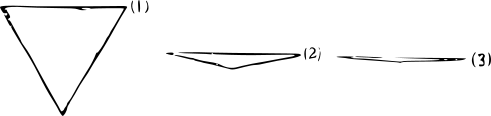
The same thing would happen if you tried this with a Triangle, or a Square, or any other shape cut out of cardboard. As soon as you look at it with your eye level with the table's edge, it stops appearing as a shape and becomes, to all appearances, a straight line. Take, for example, an equilateral Triangle, which in our world represents a Tradesman of the respectable class. Figure 1 shows the Tradesman as you would see him while bending over him from above; Figures 2 and 3 show him as you would see him if your eye were close to the level of the table, or nearly at it; and if your eye were exactly at the level of the table (which is how we see him in Flatland), you would see nothing but a straight line.
When I was in Spaceland, I heard that your sailors have very similar experiences when they're crossing the open sea and spot some distant island or coastline on the horizon. The far-off land might have bays, headlands, and angles jutting in and out in any number and to any extent. Yet at a distance you see none of these (unless the sun happens to be shining brightly on them, revealing the bumps and indentations through light and shadow), nothing but a gray, unbroken line on the water.
Well, that's exactly what we see when one of our triangular or otherwise-shaped acquaintances approaches us in Flatland. Since we have no sun and no light source that casts shadows, we don't have any of the visual aids that you enjoy in Spaceland. If a friend moves closer to us, we see his line getting larger; if he moves away, it gets smaller; but he still looks like a straight line. Whether he's a Triangle, Square, Pentagon, Hexagon, Circle, or whatever you like, a straight Line is what he looks like, and nothing else.
You might be wondering how, under these unpromising circumstances, we manage to tell our friends apart. But the answer to that perfectly natural question will be better and more easily given when I come to describe the inhabitants of Flatland. For now, let me set that subject aside and say a word or two about the climate and houses in our country.
Section 2: Of the Climate and Houses in Flatland
Just like in your world, we have four points on the compass: North, South, East, and West.
Since we have no sun or other celestial bodies, we can't determine North the way you do; but we have our own method. A natural law in our world creates a constant pull toward the South; and although in temperate climates this pull is very slight (even a Woman in reasonable health can walk several hundred yards northward without much difficulty), the drag of that southward pull is quite enough to serve as a compass in most parts of our world. The rain, which falls at regular intervals, also always comes from the North, which helps too; and in the towns we have the houses themselves as guides, since their side-walls mostly run North and South, so that the roofs can keep the northern rain off. Out in the countryside, where there are no houses, the trunks of the trees provide a rough guide. All in all, we don't have nearly as much trouble getting our bearings as you might expect.
Even so, in our more temperate regions, where the southward pull is barely noticeable, I've occasionally found myself in the middle of a perfectly empty plain with no houses or trees to orient me, and have had to stand there for hours at a time, waiting for the rain to come before I could go on my way. The pull hits the weak and elderly, and especially delicate Females, much harder than it does robust Males, so that it's considered good manners, if you meet a Lady on the street, always to give her the North side of the path: by no means an easy thing to do at short notice when you're in perfect health and in a climate where it's hard to tell your North from your South.
There are no windows in our houses, for the light comes to us alike indoors and out, by day and by night, equally at all times and in all places, and where it comes from, we have no idea. In the old days our scholars found this a fascinating and much-studied question, "What is the origin of light?", and every attempt to answer it only succeeded in filling our asylums with the people who tried. After fruitless efforts to discourage such research indirectly, by putting a heavy tax on it, the Legislature, fairly recently, banned it outright.
I alone in Flatland now know, all too well, the true answer to this mystery; but I can't make my knowledge understood by a single one of my countrymen, and I am laughed at (I, the sole possessor of the truths of Space and of the theory of how Light enters our world from the realm of Three Dimensions) as though I were the maddest of the mad! But enough of these painful digressions: let me return to our homes.
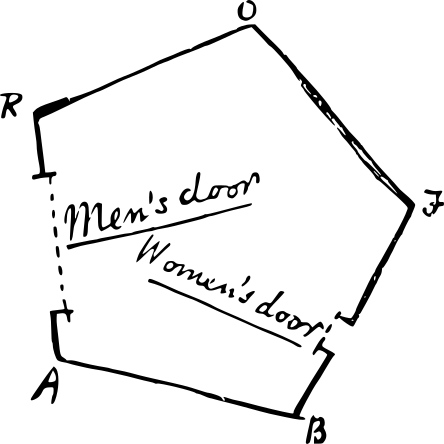
The most common house design is five-sided, or pentagonal, as shown in the figure below. The two Northern sides, RO and OF, form the roof, and generally have no doors; on the East side is a small door for the Women, on the West a much larger one for the Men; the South side, or floor, usually has no door at all.
Square and triangular houses are not allowed, and for this reason. The angles of a Square (and even more those of an equilateral Triangle) are much sharper than those of a Pentagon; and since the edges of inanimate objects like houses are dimmer than the edges of Men and Women, there's a real danger that the points of a square or triangular house could seriously injure some careless or maybe just absent-minded traveler who bumps into them. As far back as the eleventh century of our era, then, triangular houses were universally banned by Law, the only exceptions being fortifications, ammunition stores, barracks, and other government buildings, places the general public shouldn't wander up to without paying attention.
During that period, square houses were still allowed everywhere, though discouraged with a special tax. But about three centuries later, the Law determined that in any town with a population above ten thousand, the pentagon's angle was the smallest house-angle that could be permitted without putting public safety at risk. Common sense has backed up the Legislature's efforts, and today, even in the countryside, pentagonal construction has replaced every other design. It's only now and then, in some very remote and backward farming district, that an antiquarian may still come across a square house.
Section 3: Concerning the Inhabitants of Flatland
The largest a full-grown inhabitant of Flatland gets, in terms of length or width, is about eleven of your inches. Twelve inches would be an extreme case.
Our Women are Straight Lines.
Our Soldiers and lowest class of Workers are Triangles with two equal sides, each about eleven inches long, and a base or third side so short (often no more than half an inch) that they come to an extremely sharp and dangerous point at the top. In fact, when their bases are at their most degraded (no more than an eighth of an inch across), they're practically indistinguishable from Straight Lines, that is, from Women, so narrow are their points. Just as in your world, these Triangles are called Isosceles, and that's the name I'll use for them from here on.
Our Middle Class consists of Equilateral, or Equal-Sided, Triangles.
Our Professional Men and Gentlemen are Squares (the class I myself belong to) and Five-Sided Figures, or Pentagons.
Above them comes the Nobility, which has several ranks, starting with Six-Sided Figures, or Hexagons, and rising with each additional side until they earn the distinguished title of Polygonal, or many-sided. Finally, when the number of sides becomes so large, and the sides themselves so small, that the figure is indistinguishable from a Circle, he's admitted to the Circular or Priestly order; and this is the highest class of all.
It is a Law of Nature in our world that a male child will have one more side than his father, so that each generation rises (as a rule) one step on the scale of development and nobility. The son of a Square is a Pentagon; the son of a Pentagon, a Hexagon; and so on.
But this rule doesn't always apply to Tradesmen, and applies even less often to Soldiers and Workers, who can hardly be said to deserve the name of human Figures at all, since their sides aren't all equal. For them, then, the Law of Nature doesn't hold, and the son of an Isosceles (that is, a Triangle with only two equal sides) remains Isosceles. Still, even for the Isosceles not all hope is lost: his descendants may eventually rise above his degraded condition, for after a long track record of military successes, or of diligent and skillful labor, the more intelligent members of the Worker and Soldier classes tend to show a slight lengthening of their third side, or base, and a shrinking of the other two. Intermarriages between the sons and daughters of these more intellectual lower-class members (arranged by the Priests) generally produce offspring that come even closer to the form of a true Equal-Sided Triangle.
Rarely, compared to the vast numbers of Isosceles births, is a genuine, certified Equal-Sided Triangle produced from Isosceles parents. (A reader from Spaceland might ask: "Why do you need a certificate? Isn't having a Square son proof enough from Nature herself that the father was Equal-Sided?" To that I'd reply: no Woman of any standing will marry an uncertified Triangle. Square offspring have occasionally resulted from slightly Irregular Triangles, but in almost every such case, the Irregularity of the first generation catches up with the third, which either fails to reach Pentagonal rank or falls back to Triangular.) Such a birth requires not only a series of carefully arranged intermarriages, but also a long, sustained practice of thrift and self-discipline on the part of the aspiring ancestors of the future Equilateral, and a patient, systematic, continuous development of the Isosceles intellect across many generations.
The birth of a true Equilateral Triangle from Isosceles parents is cause for celebration across our country for a mile or more around. After a rigorous examination by the Sanitary and Social Board, the infant, if certified as Regular, is admitted in a solemn ceremony into the class of Equilaterals. He is then immediately taken from his proud but heartbroken parents and adopted by some childless Equilateral, who is sworn never to let the child set foot in his former home again, or so much as look at his relatives, for fear that the newly developed organism might, through unconscious imitation, slip back to his hereditary level.
The occasional emergence of an Equilateral from the ranks of his serf-born ancestors is welcomed not only by the poor serfs themselves, as a ray of light and hope breaking through the dull misery of their existence, but also by the Aristocracy at large; for all the higher ranks are well aware that these rare events, while doing little or nothing to cheapen their own privileges, serve as an almost indispensable barrier against revolution from below.
If the sharp-angled rabble had all, without exception, been stripped of hope and ambition, they might have found leaders, in some of their many uprisings, capable enough to make their superior numbers and strength too much even for the wisdom of the Circles. But a wise ordinance of Nature has decreed that the more the working classes grow in intelligence, knowledge, and every virtue, the more their sharp angle (which makes them physically dangerous) widens, approaching the comparatively harmless angle of the Equilateral Triangle. Among the most brutal and fearsome of the Soldier class, then, creatures almost on the level of Women in their lack of intelligence, you find that as they develop the mental ability to use their tremendous piercing power to advantage, that very piercing power shrinks.
What an admirable Law of Compensation! And what perfect proof of the natural fitness, I might almost say the divine origin, of the aristocratic constitution of the States of Flatland! Through a careful use of this Law of Nature, the Polygons and Circles are almost always able to crush rebellion in its very cradle, exploiting the unstoppable and boundless hopefulness of the human mind. Art also comes to the aid of Law and Order. It's generally found possible, by a little artificial compression or expansion performed by the State physicians, to make some of the more intelligent leaders of a rebellion perfectly Regular and to admit them immediately into the privileged classes; a much larger number, still below the standard but tempted by the prospect of eventually being ennobled, are persuaded to enter the State Hospitals, where they're kept in comfortable confinement for life; and only one or two of the most stubborn, foolish, and hopelessly Irregular are led to execution.
Then the wretched rabble of the Isosceles, without a plan and without leaders, are either run through without resistance by the small force of their fellow Isosceles whom the Chief Circle keeps on the payroll for exactly these emergencies, or else, more often, through jealousies and suspicions skillfully stirred up among them by the Circular party, they turn on each other and die by one another's angles. No fewer than one hundred and twenty rebellions are recorded in our history, besides minor uprisings numbering two hundred and thirty-five; and every single one has ended this way.
Section 4: Concerning the Women
If our sharply pointed Triangles of the Soldier class are dangerous, it should be obvious that our Women are far more dangerous still. After all, if a Soldier is a wedge, a Woman is a needle, being, so to speak, all point, at least at both ends. Add to this her ability to make herself practically invisible at will, and you'll see that a Female in Flatland is a creature not to be trifled with.
But here, perhaps, some of my younger readers may ask how a Woman in Flatland can make herself invisible. This ought, I think, to be obvious without any explanation; still, a few words will make it clear to even the most inattentive.
Place a needle on a table. Then, with your eye level with the tabletop, look at it from the side, and you see the whole length of it; but look at it from one end, and you see nothing but a point: it has become practically invisible. It's exactly the same with one of our Women. When her side is turned toward us, we see her as a straight line; when the end containing her eye or mouth (for in our world these two organs are one and the same) is the part facing us, we see nothing but a highly luminous point; but when her back is presented to our view, it is only faintly luminous, in fact almost as dim as an inanimate object, and her back end serves her as a kind of Invisible Cap.
The dangers we face from our Women should now be obvious to even the dullest intelligence in Spaceland. If even the angle of a respectable middle-class Triangle is not without its dangers; if bumping into a Working Man means getting gashed; if a collision with a military Officer means a serious wound; if a mere touch from the point of a common Soldier brings the danger of death: then what can it mean to run into a Woman, except absolute and immediate destruction? And when a Woman is invisible, or visible only as a faint, dimly glowing point, how difficult it must be, even for the most cautious among us, to always avoid collision!
Many laws have been passed at various times in the various States of Flatland to minimize this danger; and in the Southern and less temperate climates, where the force of gravity is stronger and people are more prone to sudden, involuntary movements, the Laws concerning Women are naturally much more strict. But a general overview of the Code can be gathered from the following summary:
1. Every house shall have one entrance on the Eastern side, for the use of Females only. All women shall enter through it "in a becoming and respectful manner," and not through the Men's door on the Western side. (When I was in Spaceland, I learned that some of your Priestly Circles have the same sort of arrangement: a separate entrance for Villagers, Farmers, and Teachers of Board Schools, so that they may "approach in a becoming and respectful manner.")
2. No Female shall walk in any public place without continuously keeping up her Peace-cry, under penalty of death.
3. Any Female duly certified to be suffering from St. Vitus's Dance, epileptic fits, chronic cold accompanied by violent sneezing, or any disease causing involuntary movements, shall be instantly destroyed.
In some States there is an additional Law forbidding Females, under penalty of death, from walking or standing in any public place without constantly swinging their backs from right to left, to signal their presence to those behind them; others require a Woman, when traveling, to be followed by one of her sons, or servants, or by her husband; still others confine Women entirely to their houses except during the religious festivals. But the wisest of our Circles, or Statesmen, have found that piling up restrictions on Females tends not only to weaken and diminish the race, but also to increase domestic murders to such an extent that a State loses more than it gains from an overly restrictive Code.
Whenever the temper of the Women is pushed to extremes by confinement at home or burdensome regulations outside it, they tend to take out their fury on their husbands and children; and in the less temperate climates the entire male population of a village has sometimes been destroyed in one or two hours of a simultaneous female rampage. That's why the Three Laws mentioned above are enough for the better-governed States, and can be taken as a rough summary of our Female Code.
In the end, our main safeguard lies not in legislation but in the self-interest of the Women themselves. Although they can inflict instant death with a backward movement, unless they can at once free their stinging end from the struggling body of their victim, their own fragile bodies are likely to shatter.
The power of Fashion is also on our side. I noted that in some less civilized States, no Female is allowed to stand in any public place without swaying her back from right to left. This practice has been universal among ladies of any claim to good breeding in all well-governed States, as far back as anyone can remember. It's considered a disgrace to any State that legislation should have to enforce what ought to be, and in every respectable female is, a natural instinct. The rhythmic and, if I may say so, elegantly modulated swaying of the back among our ladies of Circular rank is envied and imitated by the wife of a common Equilateral, who can manage nothing beyond a dull, monotonous swing, like the ticking of a pendulum; and the regular tick of the Equilateral's wife is no less admired and copied by the wife of the ambitious, upwardly mobile Isosceles, among whose women no "back-motion" of any kind has yet become a necessity of life. As a result, in every family of status and standing, "back motion" is as constant as time itself, and the husbands and sons in these households enjoy immunity from invisible attacks, at least.
Not that anyone should suppose for a moment that our Women are without affection. But unfortunately, in the Frail Sex, the passion of the moment overwhelms every other consideration. This is, of course, an unavoidable consequence of their unfortunate shape; for since they have no claim to an angle, being inferior in this respect to even the lowest of the Isosceles, they are consequently wholly devoid of brainpower, and have neither reflection, judgment, nor forethought, and hardly any memory. In their fits of fury, then, they remember no obligations and recognize no distinctions. I have actually known a case where a Woman exterminated her entire household, and half an hour later, when her rage had passed and the fragments had been swept away, asked what had become of her husband and children.
Obviously, then, a Woman must not be irritated as long as she's in a position where she can turn around. When you have them in their apartments (which are designed specifically to deny them that power), you can say and do whatever you like, for they are then completely harmless, and they won't remember, a few minutes from now, the thing they may be threatening you with death over at this very moment, nor the promises you may have found it necessary to make in order to calm them down.
On the whole, we get along fairly smoothly in our domestic lives, except in the lower ranks of the Military Classes, where the husbands' lack of tact and discretion produces indescribable disasters from time to time. Relying too much on the offensive weapons of their sharp angles instead of the defensive tools of good sense and well-timed pretense, these reckless creatures too often neglect the required design of the women's apartments, or provoke their wives with thoughtless remarks in public, which they then refuse to take back. What's more, a blunt, stubborn devotion to literal truth makes them unwilling to offer the kind of lavish promises by which a wiser Circle can instantly calm his wife. The result is massacre; not, however, without its benefits, as it eliminates the more brutal and troublesome of the Isosceles; and many of our Circles regard the destructive power of the Thinner Sex as one of several providential arrangements for suppressing excess population and nipping Revolution in the bud.
Yet even in our best-regulated and most nearly Circular families, I can't say that the ideal of family life is as high as yours in Spaceland. There is peace, insofar as the absence of slaughter can be called peace, but there is necessarily little harmony of tastes or interests, and the cautious wisdom of the Circles has purchased safety at the cost of domestic comfort. In every Circular or Polygonal household, it has been the custom since time immemorial (and has now become a kind of instinct among the women of our upper classes) that mothers and daughters should constantly keep their eyes and mouths turned toward their husband and his male friends; and for a lady of distinguished family to turn her back on her husband would be regarded as a kind of omen, involving loss of status. But, as I will soon show, this custom, though it has the advantage of safety, is not without its drawbacks.
In the house of a Working Man or respectable Tradesman, where the wife is allowed to turn her back on her husband while doing housework, there are at least intervals of quiet, when the wife is neither seen nor heard except for the humming sound of the constant Peace-cry; but in the homes of the upper classes there is too often no peace at all. There the nonstop mouth and bright, piercing eye are always directed at the Master of the household, and light itself is not more constant than the stream of Feminine conversation. The tact and skill that are enough to avoid a Woman's sting are no match for the task of stopping a Woman's mouth; and since the wife has absolutely nothing to say, and absolutely no restraint of wit, sense, or conscience to prevent her from saying it, more than a few cynics have been known to declare that they'd prefer the danger of a silent, death-dealing sting to the safe but relentless noise of a Woman's other end.
To my readers in Spaceland, the condition of our Women may seem truly deplorable, and indeed it is. A Male of the lowest type of Isosceles may look forward to some improvement in his angle, and to the eventual elevation of his entire degraded caste; but no Woman can hold out any such hope for her sex. "Once a Woman, always a Woman" is a Decree of Nature, and the very Laws of Evolution seem suspended to her disadvantage. Yet at least we can admire the wise Design that has ordained that, since they have no hopes, they shall also have no memory to recall, and no forethought to anticipate, the miseries and humiliations that are at once a necessity of their existence and the foundation of the constitution of Flatland.
Section 5: How We Recognize One Another
You, who are blessed with shade as well as light, you, who have the gift of two eyes, an understanding of perspective, and the pleasure of seeing in full color, you, who can actually see an angle and take in the complete circumference of a Circle in the happy realm of Three Dimensions: how can I possibly convey to you how incredibly difficult it is for us in Flatland to recognize one another's shape?
Think back to what I told you earlier. Every being in Flatland, living or otherwise, no matter what their form, looks to us the same, or very nearly the same: a straight Line. How, then, can one person be distinguished from another, when everyone looks identical?
The answer comes in three parts. The first method of recognition is hearing, which in our world is far more highly developed than in yours, and which allows us not only to recognize the voices of our personal friends, but even to tell different classes apart, at least when it comes to the three lowest ranks: the Equilateral, the Square, and the Pentagon (I'm not counting the Isosceles here). But as we climb the social ladder, telling people apart by sound gets harder and harder, partly because voices become more similar at higher ranks, and partly because the ability to distinguish voices is considered a common skill, not one the Aristocracy bothers to develop. And whenever there's any risk of someone impersonating a higher class, we can't rely on this method at all. Among our lowest orders, the vocal organs are developed to a degree far exceeding their sense of hearing, so an Isosceles can easily fake the voice of a Polygon, and with some practice, even that of a Circle. A second method is therefore more commonly used.
Feeling is, among our Women and lower classes (I'll get to the upper classes in a moment), the main way of identifying someone, at least between strangers, and when the question isn't who someone is, but what class they belong to. What "introductions" are among the higher classes in Spaceland, "Feeling" is for us. "Allow me to ask you to feel and be felt by my friend Mr. So-and-so": this is still, among the more old-fashioned of our country gentlemen in districts far from the cities, the standard formula for a Flatland introduction. But in the cities, and among businessmen, the words "be felt by" are dropped and the phrase is shortened to: "Let me ask you to feel Mr. So-and-so," although it's assumed, of course, that the Feeling will go both ways. Among our even more modern and fashionable young gentlemen, who hate unnecessary effort and care nothing for the purity of their native language, the formula is shortened still further by using "to feel" in a technical sense, meaning "to recommend-for-the-purposes-of-feeling-and-being-felt"; and the current slang among polite and fast society in the upper classes allows such a mangling of language as "Mr. Smith, allow me to feel Mr. Jones."
Don't assume, though, that Feeling is the tedious process for us that it would be for you, or that we need to feel our way around every single side of a person before we can determine what class they belong to. Years of practice and training, starting in school and continuing through everyday life, let us instantly tell the difference, just by touch, between the angles of an Equilateral Triangle, a Square, and a Pentagon; and I hardly need to mention that the brainless vertex of an acute-angled Isosceles is obvious to even the clumsiest touch. As a result, it's not usually necessary to feel more than a single angle of a person, and that one angle tells us the class of whoever we're dealing with, unless he happens to belong to the higher ranks of the nobility. There, the difficulty gets much greater. Even a Master of Arts at our University of Wentbridge has been known to confuse a ten-sided Polygon with a twelve-sided one, and there's hardly a Doctor of Science, inside or outside that famous University, who could claim to quickly and confidently tell the difference between a twenty-sided and a twenty-four-sided member of the Aristocracy.
Those of you who remember the excerpts I shared earlier from the legal code regarding Women will immediately see that the process of introduction by touch requires some care and caution, or the sharp angles involved could inflict serious, even irreparable, injury on the unwary Feeler. It's absolutely essential for the safety of the Feeler that the person being Felt should stand perfectly still. A sudden start, a fidgety shift in position, even a violent sneeze, has been known to prove fatal to the careless, cutting short many a promising friendship before it could begin. This is especially true among the lower classes of the Triangles, whose eye is positioned so far from their vertex that they can barely keep track of what's happening at that end of their body, and who are also rough and coarse by nature, not sensitive to the delicate touch of a highly refined Polygon. Is it any wonder, then, that an involuntary toss of the head has, before now, robbed the State of a valuable life?
I've heard that my excellent Grandfather (one of the least irregular of his unfortunate Isosceles class, who actually received, shortly before his death, four out of seven votes from the Sanitary and Social Board to be promoted into the class of the Equal-sided) often lamented, with a tear in his aged eye, a mishap of exactly this kind, which had happened to his great-great-great-Grandfather, a respectable Working Man with an angle (or brain) of 59 degrees and 30 minutes. According to his account, my unfortunate Ancestor was suffering from rheumatism and was in the process of being Felt by a Polygon when, with one sudden jolt, he accidentally ran the Great Man through on his diagonal; and partly because of his long imprisonment and disgrace, partly because of the moral shock that rippled through our entire family, this single accident set us back a degree and a half in our ascent toward better things. The result was that in the next generation, the family brain was registered at only 58 degrees, and it took five full generations to recover the lost ground, reach the full 60 degrees, and finally achieve the Ascent out of the Isosceles class. And all this cascade of disasters from one little accident during Feeling.
At this point, I think I can hear some of my better-educated readers protesting: "How could you in Flatland know anything about angles and degrees, or arc minutes? We see an angle because we, living in the realm of Space, can see two straight lines leaning toward each other. But you, who can see nothing but one straight line at a time, or at best a handful of little segments all in one straight line: how could you ever perceive an angle, let alone measure angles of different sizes?"
My answer is that though we can't see angles, we can infer them, and we do so with great precision. Our sense of touch, sharpened by necessity and refined through long training, lets us distinguish angles far more accurately than your sense of sight can when it's not aided by a protractor or other measuring tool. I should also explain that Nature gives us great help. In Flatland it's a Law of Nature that the brain of the Isosceles class starts at half a degree (or thirty minutes) and increases (if it increases at all) by half a degree in every generation, until the goal of 60 degrees is reached, when the condition of serfdom is left behind and the freed individual enters the class of Regulars.
As a result, Nature herself provides us with a built-in scale, an Alphabet of angles, so to speak, running from half a degree all the way up to 60 degrees, and Specimens of these angles are placed in every Elementary School across the land. Thanks to occasional backsliding, even more frequent moral and intellectual stagnation, and the extraordinary birth rate among the Criminal and Vagabond classes, there's always an enormous surplus of individuals at the half-degree and single-degree level, and a fair supply of Specimens up to 10 degrees. These individuals have absolutely no civil rights, and a great many of them, not even having enough intelligence for military service, are assigned by the State to serve education. Chained down so securely that there's no possibility of danger, they're placed in the classrooms of our Infant Schools, where they're used by the Board of Education to teach the children of the Middle Classes the tactile skills and intelligence that these wretched creatures themselves completely lack.
In some States the Specimens are occasionally fed and allowed to survive for several years; but in the more temperate and better-run regions it has been found, over time, more beneficial for the educational interests of the young to skip the feeding altogether and replace the Specimens every month, which is roughly how long a member of the Criminal class can survive without food. In the cheaper schools, whatever is gained by keeping a Specimen alive longer is lost, partly in the cost of food, and partly in the declining accuracy of the angles, which deteriorate after a few weeks of constant Feeling. And we shouldn't forget to add, in listing the advantages of the more expensive system, that it also contributes, slightly but noticeably, to reducing the surplus Isosceles population, a goal that every statesman in Flatland keeps constantly in mind. On the whole, then (although I'm well aware that in many popularly elected School Boards there's a push to go back to "the cheap system," as they call it), I'm personally inclined to think that this is one of the many cases where spending more is the truest economy.
But I shouldn't let questions of School Board politics distract me from my subject. I trust I've said enough to show that Recognition by Feeling is not nearly as tedious or unreliable a process as you might have imagined, and it's clearly more trustworthy than Recognition by hearing. Still, as I pointed out earlier, there remains the objection that this method is not without its dangers; and for this reason many in the Middle and Lower classes, and absolutely everyone in the Polygonal and Circular orders, prefer a third method, which I'll describe in the next section.
Section 6: Recognition by Sight
I'm about to seem very inconsistent. In the previous sections, I said that all figures in Flatland look like straight lines, and I implied, or outright stated, that it's impossible to tell different classes apart by sight; yet here I am, about to explain to my Spaceland readers how we actually can recognize one another visually.
If you go back and reread the passage where I described Recognition by Feeling as universal, though, you'll find a key qualifier: "among the lower classes." It's only among the higher classes, and in our more temperate climates, that Sight Recognition is practiced.
The fact that this ability exists at all, in any region or for any class, is thanks to Fog, which blankets our world for the greater part of the year everywhere except the torrid zones. What is for you in Spaceland a pure nuisance, blotting out the landscape, dampening the spirits, and undermining your health, is for us a blessing almost as essential as air itself, the nursemaid of arts and the parent of sciences. But let me explain what I mean without heaping any more praise on this wonderful element.
If Fog didn't exist, all lines would appear equally and indistinguishably clear; and this is actually the case in those unfortunate countries where the atmosphere is perfectly dry and transparent. But wherever there's a rich supply of Fog, objects at a distance of, say, three feet are noticeably dimmer than those at a distance of two feet and eleven inches, so that through careful, constant observation of comparative dimness and clearness we can work out the shape of any object we're looking at with remarkable precision.
A single example will make this clearer than a whole volume of generalities.
Say I see two individuals approaching whose rank I want to figure out. Let's suppose they're a Merchant and a Physician, or in other words an Equilateral Triangle and a Pentagon: how do I tell them apart?
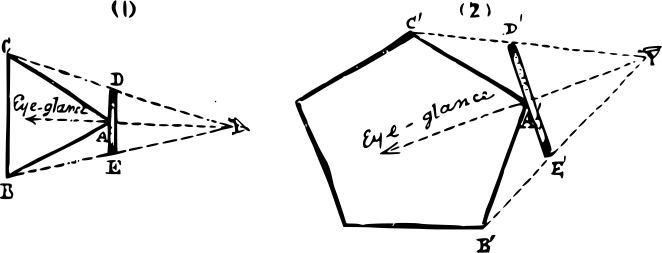
It should be obvious to any child in Spaceland who has taken even a first lesson in Geometry that if I position my eye so that my line of sight bisects one angle (A) of the approaching stranger, my view will fall evenly between the two sides nearest to me (namely CA and AB), so that I'll be looking at both sides equally, and both will appear the same size.
Now, in the case of (1) the Merchant, what will I see? I'll see a straight line DAE, in which the middle point (A) will be very bright because it's closest to me; but on either side the line will fade rapidly into dimness, because sides AC and AB recede quickly into the Fog; and what appear to me as the Merchant's outer edges (namely D and E) will be very dim indeed.
On the other hand, in the case of (2) the Physician, I'll also see a line (D'A'E') with a bright center (A'), but it will fade less rapidly into dimness, because the sides (A'C', A'B') recede less quickly into the Fog; and what appear to me as the Physician's outer edges (namely D' and E') will be not as dim as the Merchant's.
From these two examples you can probably see how, after a very long period of training, backed up by constant experience, it becomes possible for the well-educated classes among us to distinguish with reasonable accuracy between the middle and lowest ranks, just by looking. If my Spaceland readers have grasped the general concept well enough to see that it's at least possible, and haven't written off my account as completely unbelievable, I'll have achieved all I can reasonably expect; if I went into further detail, I'd only confuse things. Still, for the sake of the young and inexperienced, who might conclude from the two simple examples I just gave (of how I'd recognize my Father and my Sons) that Sight Recognition is easy, I should point out that in actual practice, the problems of Sight Recognition are far more subtle and complicated.
For instance, if my Father, the Triangle, happens to approach me showing his side rather than his angle, then until I've asked him to rotate or until I've shifted my eye around him, I'm momentarily unsure whether he might actually be a Straight Line, or in other words a Woman. And when I'm in the company of one of my two hexagonal Grandsons, looking straight at one of his sides (AB), it should be clear from the accompanying diagram that I'll see one full line (AB) in comparative brightness (hardly fading at all at the ends) and two shorter lines (CA and BD) dim throughout and fading into even greater dimness toward the far points C and D.
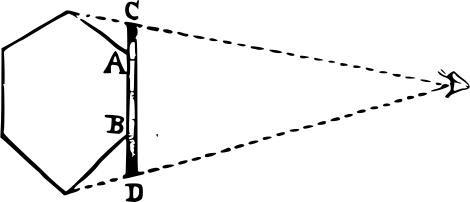
But I shouldn't give in to the temptation of going on about these details. Even the most ordinary mathematician in Spaceland will easily believe me when I say that the problems of everyday life facing the well-educated, when they're moving, rotating, advancing, or retreating themselves, all while trying to tell apart by sight a crowd of high-ranking Polygons moving in different directions (as at a ball or an evening reception), are enough to tax the angularity of the most intellectual, and more than justify the generous endowments of the Learned Professors of Geometry, both Static and Kinetic, at the distinguished University of Wentbridge, where the Science and Art of Sight Recognition are regularly taught to large classes of the elite of the States.
Only a few scions of our noblest and wealthiest families can afford the time and money necessary for a thorough education in this noble and valuable Art. Even for me, a Mathematician of no small standing and the Grandfather of two wonderfully promising and perfectly regular Hexagons, finding myself in the middle of a crowd of rotating Polygons from the higher classes is occasionally very disorienting. And for a common Tradesman or Serf, of course, such a scene is almost as incomprehensible as it would be to you, my Reader, if you were suddenly dropped into my country.
In such a crowd, you'd see nothing on all sides but a Line, apparently straight, whose parts would flicker irregularly and constantly between brightness and dimness. Even if you'd completed your third year in the Pentagonal and Hexagonal courses at the University and had mastered the theory completely, you'd still find that you needed many years of hands-on experience before you could navigate a fashionable crowd without bumping into your social superiors, whom it would be a breach of etiquette to ask to "feel," and who, thanks to their superior education and breeding, know all about your movements while you know little or nothing about theirs. In short, to conduct yourself with perfect grace in Polygonal society, you really need to be a Polygon yourself. That, at least, is the painful lesson of my own experience.
It's amazing how much the Art (or I might almost call it the instinct) of Sight Recognition is sharpened by habitual practice and by avoiding the habit of Feeling. Just as, in your world, deaf people who are allowed to rely on sign language and hand-spelling will never fully master the harder but far more valuable skills of lip-reading and speech, so it is with us when it comes to Seeing and Feeling: no one who falls back on Feeling in early life will ever learn Seeing to perfection.1
For this reason, among our Higher Classes, Feeling is discouraged or outright forbidden. From the cradle, their children are sent not to the Public Elementary schools (where the art of Feeling is taught) but to exclusive private academies. And at our distinguished University, to "feel" is considered a very serious offense, punishable by suspension for the first violation and expulsion for the second.
But among the lower classes, the art of Sight Recognition is seen as an unattainable luxury. A common Tradesman can't afford to let his son spend a third of his life on abstract studies. The children of the poor are therefore allowed to "feel" from their earliest years, and they gain from this a quickness and early liveliness that at first compares very favorably with the sluggish, undeveloped, and listless behavior of the half-educated young Polygons; but when those Polygons have finally completed their University training and are ready to put theory into practice, the transformation that comes over them can almost be described as a rebirth, and in every art, science, and social pursuit, they rapidly overtake and leave behind their Triangular rivals.
Only a few of the Polygonal Class fail to pass the Final Test or Leaving Examination at the University. The situation of this unsuccessful minority is truly pitiable: rejected by the higher class, they're also despised by the lower. They have neither the mature, systematically trained abilities of the Polygonal Bachelors and Masters of Arts, nor the natural quickness and lively adaptability of the young Tradesman. The professions and public services are closed to them, and though in most States they aren't actually forbidden from marrying, they have enormous difficulty forming suitable matches, since experience shows that the children of such unfortunate and poorly equipped parents are generally unfortunate themselves, if not outright Irregular.
It's from these rejects of our Nobility that the great Uprisings and Rebellions of past ages have generally drawn their leaders; and the trouble they cause is so great that a growing minority of our more progressive Statesmen believe that true mercy would require their complete suppression, by decreeing that all who fail to pass the University's Final Examination should be either imprisoned for life or put to a painless death.
But I find myself drifting into the subject of Irregularities, a matter of such vital importance that it demands its own section.
Section 7: Concerning Irregular Figures
Throughout everything I've written so far, I've been assuming something that probably should have been stated up front as a basic principle: that every human being in Flatland is a Regular Figure, meaning a figure of regular construction. By this I mean that a Woman must be not only a line but a perfectly straight one; that an Artisan or Soldier must have two of his sides equal; that Tradesmen must have three sides equal, and Lawyers (a class of which I am a humble member) four; and, in general, that every Polygon must have all its sides equal.
The sizes of those sides naturally depend on the individual's age. A female at birth would be about an inch long, while a tall adult Woman might extend to a foot. As for the Males of every class, you can roughly say that when an adult's sides are added together, the total comes to two feet or a little more. But the size of our sides isn't what I'm talking about here. I'm talking about the equality of sides, and it shouldn't take much thought to see that the entire fabric of social life in Flatland rests on the fundamental fact that Nature intends all Figures to have their sides equal.
If our sides were unequal, our angles could be unequal too. Instead of only needing to feel, or to estimate by sight, a single angle in order to identify someone, we would have to check each angle individually through the painstaking process of Feeling. But life would be too short for that kind of tedious groping around. The whole science and art of Sight Recognition would collapse at once; Feeling, as far as it's an art, wouldn't survive much longer; social life would become dangerous or impossible, and all trust and all planning ahead would be gone; no one would be safe making even the simplest social arrangements; in a word, civilization might slide right back into barbarism.
Am I going too fast for my Readers to follow me to these obvious conclusions? Surely a moment's thought, and a single example from everyday life, is enough to convince anyone that our social system is built on Regularity, that is, on Equality of Angles. Say you run into two or three Tradesmen on the street, recognize them immediately as Tradesmen by a glance at their angles and quickly fading sides, and ask them to come to your house for lunch. Right now you do this with complete confidence, because everyone knows within an inch or two the area an adult Triangle takes up; but imagine that your Tradesman is dragging behind his regular, respectable front vertex a parallelogram twelve or thirteen inches across the diagonal: what exactly are you supposed to do with such a monster jammed in your doorway?
But I'm insulting the intelligence of my Readers by piling up details that must be obvious to everyone who enjoys the advantage of living in Spaceland. Clearly, measuring a single angle would no longer be enough under such alarming circumstances; your entire life would be spent feeling or surveying the outlines of your acquaintances. Already the difficulty of avoiding a collision in a crowd is enough to test the wits of even a well-educated Square; but if no one could work out the Regularity of a single figure in the room, the result would be total chaos and confusion, and the slightest panic would cause serious injuries, or, if any Women or Soldiers happened to be present, quite possibly a real loss of life.
Practical necessity, then, agrees with Nature in putting its stamp of approval on Regularity, and the Law hasn't been slow to back up their joint efforts. "Irregularity of Figure" means for us the same thing as, or something worse than, what moral corruption and outright criminality combined would mean to you, and it's treated accordingly. There are, it's true, some peddlers of paradox who insist there is no necessary connection between geometrical and moral Irregularity. "The Irregular," they say, "is from birth shunned by his own parents, mocked by his brothers and sisters, neglected by the household servants, scorned and distrusted by society, and shut out of every position of responsibility, trust, and meaningful work. His every move is jealously watched by the police until he comes of age and presents himself for inspection; then he is either destroyed, if he's found to exceed the allowed margin of deviation, or else stuck in some dead-end job for a miserable wage, forced to live and eat at the office, and to take even his vacations under close supervision. Is it any wonder that human nature, even in the best and purest of us, is soured and twisted by such conditions!"
None of this very reasonable-sounding argument convinces me, just as it has never convinced the wisest of our Statesmen, that our ancestors were wrong to make it a core principle of policy that tolerating Irregularity is incompatible with the safety of the State. The life of an Irregular is hard, no doubt; but the interests of the Greater Number require that it be hard. If a man with a triangular front and a polygonal back were allowed to exist and to produce an even more Irregular next generation, what would become of the basic workings of daily life? Are we supposed to redesign all the houses, doors, and churches in Flatland to accommodate such monsters? Should our ticket-collectors be required to measure every man's perimeter before letting him into a theater or taking his seat in a lecture hall? Should an Irregular be exempt from military service? And if not, how do you stop him from wreaking havoc in the ranks of his fellow soldiers? Then think of the irresistible temptations to fraud such a creature would face! How easy for him to walk into a shop with his polygonal front leading, and order goods to any extent from a trusting Tradesman! Let the advocates of a falsely named Philanthropy plead all they want for the repeal of the Irregular Penal Laws: I for my part have never known an Irregular who was not also exactly what Nature clearly intended him to be, a hypocrite, a misanthrope, and, up to the limits of his power, a perpetrator of every kind of harm.
Not that I would recommend (at present) the extreme measures adopted by some States, where an infant whose angle deviates by as little as half a degree from the correct angularity is immediately destroyed at birth. Some of our greatest and most capable men, men of genuine genius, struggled in their earliest days with deviations as large as, or even larger than, forty-five minutes of arc, and the loss of their valuable lives would have been an irreparable blow to the State. The art of healing, too, has achieved some of its most glorious triumphs in the compressions, extensions, trepannings, bindings, and other surgical or dietary procedures by which Irregularity has been partly or fully cured. Advocating, therefore, a Via Media, a middle path, I would draw no fixed or absolute line; but at the point when the body is just beginning to set into its final form, and when the Medical Board has reported that recovery is unlikely, I would suggest that the Irregular offspring be painlessly and mercifully put to death.
Section 8: Of the Ancient Practice of Painting
If you've been following along with any attention up to this point, you won't be surprised to hear that life is somewhat dull in Flatland. I don't mean, of course, that we lack battles, conspiracies, upheavals, factions, and all the other events that are supposed to make History interesting; nor would I deny that the strange overlap between the problems of life and the problems of Mathematics, constantly sparking new theories and offering the chance to test them on the spot, gives our existence a kind of intellectual thrill that you in Spaceland can hardly comprehend. What I mean is that from an aesthetic and artistic point of view, life here is dull; aesthetically and artistically, very dull indeed.
How could it be otherwise, when everything you see, every landscape, every historical painting, every portrait, every flower arrangement, every still life, is nothing but a single line, with no variety except degrees of brightness and darkness?
It wasn't always this way. Color, if tradition can be trusted, once threw a brief splendor over the lives of our ancestors, for half a dozen centuries or more, back in the most remote ages. A certain private citizen, a Pentagon whose name is reported differently depending on the source, stumbled upon the ingredients of the simpler colors and a basic method of painting, and is said to have started by decorating his house, then his slaves, then his Father, his Sons, and Grandsons, and finally himself. Both the convenience and the beauty of the results impressed everyone. Wherever Chromatistes (for that's the name the most reliable authorities agree on) turned his multicolored frame, he immediately attracted attention and commanded respect. No one needed to "Feel" him anymore; no one mistook his front for his back; all his movements could be easily tracked by his neighbors without the slightest strain on their powers of calculation; no one jostled him or failed to get out of his way; and his voice was spared the exhausting effort of constantly announcing himself, which we colorless Squares and Pentagons are often forced to make when we move through a crowd of clueless Isosceles.
The fashion spread like wildfire. Within a week, every Square and Triangle in the district had copied Chromatistes's example, and only a few of the more conservative Pentagons were still holding out. A month or two later, even the Dodecagons had caught the craze. Within a year, the habit had spread to everyone except the very highest ranks of the Nobility. Needless to say, the custom quickly traveled from Chromatistes's home district to the surrounding regions, and within two generations no one in all of Flatland was colorless except the Women and the Priests.
Here Nature herself seemed to put up a barrier and argue against extending the trend to these two classes. Having many sides was almost essential as an excuse for the innovators. "Distinction of sides is meant by Nature to imply distinction of colors": that was the catchphrase that flew from mouth to mouth in those days, converting entire towns at a time to the new culture. But it obviously didn't apply to our Priests and Women. Women had only one side, and therefore, to be technical and pedantic about it, no sides. The Priests, if they were going to insist on their claim to be true Circles rather than merely high-ranking Polygons with an infinitely large number of infinitely small sides, had long boasted (as Women openly admitted and lamented) that they too had no sides, being blessed with a perimeter consisting of only one line, or in other words, a Circumference. And so it came about that these two Classes saw no force in the so-called axiom about "Distinction of Sides Implying Distinction of Color," and when everyone else had given in to the allure of decorating their bodies, the Priests and the Women alone remained free from the pollution of paint.
Immoral, licentious, anarchical, unscientific (call them whatever you like), those ancient days of the Colour Revolt were, from an aesthetic point of view, the glorious childhood of Art in Flatland: a childhood, sadly, that never grew up, or even reached the bloom of youth. To live then was itself a delight, because living meant seeing. Even at a small party, the company was a pleasure to look at; the richly varied hues of a congregation in a church or an audience in a theatre are said to have more than once proved too distracting for even our greatest teachers and actors; but the most dazzling spectacle of all, by every account, was the unspeakable magnificence of a military review.
The sight of a battle line of twenty thousand Isosceles suddenly wheeling around and swapping the somber black of their bases for the orange of the two sides around their acute angle; the militia of Equilateral Triangles, tricolored in red, white, and blue; the mauve, ultramarine, gamboge, and burnt umber of the Square artillerymen rapidly rotating beside their vermillion guns; the dashing and flashing of the five-colored and six-colored Pentagons and Hexagons streaking across the field in their roles as surgeons, geometricians, and aides-de-camp: all this may well have been enough to make believable the famous story of how an illustrious Circle, overcome by the artistic beauty of the forces under his command, threw aside his marshal's baton and his royal crown, declaring that from then on he was trading them for the artist's pencil. How magnificent the sensory and artistic development of those days must have been is partly revealed by the very language and vocabulary of the period. Even the most ordinary remarks of the most ordinary citizens during the Colour Revolt seem to have been steeped in a richer color of word and thought; and to that era we still owe our finest poetry and whatever sense of rhythm still survives in the more scientific language of our modern days.
Section 9: Of the Universal Colour Bill
But meanwhile the intellectual arts were rapidly declining.
The Art of Sight Recognition, no longer needed, was no longer practiced; and the study of Geometry, Statics, Kinetics, and other related subjects soon came to be seen as pointless and fell into disrespect and neglect, even at our University. The simpler Art of Feeling quickly met the same fate in our elementary schools. Then the Isosceles classes, claiming that the Specimens were no longer used or needed, and refusing to pay the traditional tribute from the Criminal classes toward the cost of Education, grew more numerous and more brazen by the day, emboldened by their freedom from the old burden, which had once had the double benefit of taming their violent nature and thinning their excessive numbers.
Year by year the Soldiers and Artisans began to argue more forcefully, and with increasing truth, that there was no real difference between them and the very highest class of Polygons, now that they'd been raised to the same level and could tackle every difficulty and solve every problem of life, whether Statical or Kinetical, through the simple process of Colour Recognition. Not satisfied with the natural decline of Sight Recognition, they boldly demanded the legal prohibition of all "monopolizing and aristocratic Arts" and the resulting elimination of all funding for the study of Sight Recognition, Mathematics, and Feeling. Before long they insisted that, since Colour, which had become a second nature, had destroyed the need for aristocratic distinctions, the Law should follow the same path, and that from now on all individuals and all classes should be recognized as absolutely equal and entitled to equal rights.
Seeing the higher Orders hesitating and unable to make up their minds, the leaders of the Revolution pushed their demands even further, and at last required that all classes alike, the Priests and the Women included, should pay homage to Colour by agreeing to be painted. When it was objected that Priests and Women had no sides, they shot back that Nature and practical necessity both dictated that the front half of every human being (that is, the half containing the eye and mouth) should be distinguishable from the back half. They therefore brought before a general and extraordinary Assembly of all the States of Flatland a Bill proposing that in every Woman the half containing the eye and mouth should be coloured red, and the other half green. The Priests were to be painted the same way, red going on the semicircle in which the eye and mouth formed the middle point, and green on the rear semicircle.
There was no small cunning in this proposal, which didn't come from any Isosceles (no being that crude would have had the sharpness of angle to appreciate, let alone design, such a masterpiece of political strategy) but from an Irregular Circle who, instead of being destroyed in childhood, had been spared by a foolish act of mercy, only to bring devastation on his country and destruction on countless followers.
On the one hand, the proposal was designed to win over Women of every class to the side of the Chromatic Innovation. By assigning Women the same two colours as the Priests, the Revolutionists guaranteed that, from certain angles, every Woman would look exactly like a Priest and be treated with the same respect and deference: a prospect the Female Sex as a whole could hardly resist.
But some of my readers may not see how Priests and Women could look identical under the new law; if so, a word or two will make it clear.
Imagine a Woman properly decorated according to the new Code: the front half (containing the eye and mouth) red, and the back half green. Look at her from one side, and obviously you'll see a straight line, half red and half green.
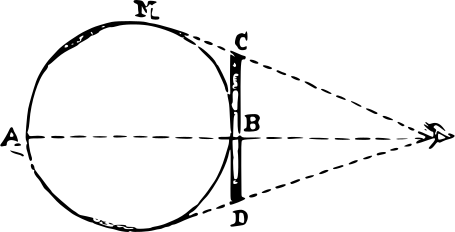
Now imagine a Priest whose mouth is at M, and whose front semicircle (AMB) is therefore coloured red while his back semicircle is green, so that the diameter AB divides the green from the red. If you look at the Great Man with your eye along the same straight line as his dividing diameter (AB), what you'll see is a straight line (CBD), of which one half (CB) will be red, and the other (BD) green. The whole line (CD) may be somewhat shorter than that of a full-sized Woman and will fade more quickly toward its ends; but the matching colours would immediately give you the impression that they were the same class, making you overlook the other details. Keep in mind how fast Sight Recognition was decaying at the time of the Colour Revolt; add the certainty that Women would quickly learn to shade off their extremities to imitate the Circles; and it must surely be obvious to you, my dear reader, that the Colour Bill put us in serious danger of mistaking a Priest for a young Woman.
You can easily imagine how thrilling this prospect was for the Frail Sex. They looked forward with delight to the confusion that would follow. At home they could overhear political and religious secrets meant not for them but for their husbands and brothers, and might even issue commands in the name of a priestly Circle; out on the street, the striking combination of red and green, with no other colours added, would inevitably lead ordinary people into endless mix-ups, and the Women would gain whatever respect the Circles lost in the eyes of passersby. As for the scandal that would fall upon the Circular Class if the frivolous and improper behavior of the Women were blamed on them, and as for the resulting threat to the Constitution, the Female Sex couldn't be expected to spare a thought for such concerns. Even in the households of the Circles themselves, the Women were all in favor of the Universal Colour Bill.
The second goal of the Bill was the gradual corruption of the Circles themselves, who amid the general intellectual decline had still kept their original clarity and strength of mind. Growing up from their earliest childhood in Circular households where Colour was entirely absent, the Nobles alone had preserved the Sacred Art of Sight Recognition, with all the benefits that come from such excellent training of the intellect; so up to the time the Universal Colour Bill was introduced, the Circles had not only held their own but had actually widened their advantage over the other classes by refusing to follow the popular trend.
And so the cunning Irregular I described above, the true architect of this diabolical Bill, set out at one stroke to lower the standing of the Priesthood by forcing them to submit to the contamination of Colour, and at the same time to destroy their training at home in the Art of Sight Recognition, weakening their minds by stripping away their pure and colourless households. Once the stain of colour was introduced, every parent and every child in a Circular family would undermine the other. The only problems left for a Circular infant's intellect would be in telling Father from Mother, and even those would often be corrupted by a mother's impersonations, shaking the child's faith in all logical reasoning. Little by little the intellectual brilliance of the Priestly Order would fade, and the path would lie wide open for the total destruction of all aristocratic government and the overthrow of our Privileged Classes.
Section 10: Of the Suppression of the Chromatic Sedition
The campaign for the Universal Colour Bill raged on for three years, and right up to the last moment of that period it looked as though Anarchy was going to win.
An entire army of Polygons who had enlisted to fight as common soldiers was completely wiped out by a larger force of Isosceles Triangles, the Squares and Pentagons meanwhile standing by and doing nothing.
Worst of all, some of the ablest Circles fell victim to their wives' fury. Driven wild by the political conflict, the wives in many a noble household badgered their husbands relentlessly to drop their opposition to the Colour Bill; and some, when their pleas went nowhere, attacked and killed their innocent children and husbands, dying themselves in the slaughter. The records show that during those three years of unrest, no fewer than twenty-three Circles perished in domestic disputes.
The peril was great indeed. It seemed the Priests had no choice left but to give in or be wiped out, when suddenly the course of events was completely changed by one of those picturesque incidents that Statesmen should never neglect, should often anticipate, and should sometimes perhaps originate, because of the absurdly outsized power such events have to sway the sympathies of the public.
It happened that an Isosceles of a low type, with a brain angle barely above four degrees, got his hands by chance on the paints of some Tradesman whose shop he'd robbed, and painted himself (or had himself painted, for the story varies) in the twelve colors of a Dodecagon. Walking into the Market Place, he approached in a disguised voice a young woman, the orphan daughter of a noble Polygon, whose affection he had pursued without success in the past; and through a series of deceptions, aided on one side by a string of lucky coincidences too long to tell, and on the other by an almost unbelievable stupidity on the part of the bride's relatives, he managed to carry out the marriage. The poor girl killed herself when she discovered the fraud.
When news of this disaster spread from State to State, the Women were shaken to their core. Sympathy for the poor victim, and the fear that they themselves, their sisters, and their daughters could be deceived the same way, made them see the Colour Bill in an entirely new light. More than a few openly declared they had come over to the opposition; the rest needed only a small push to do the same. Seizing this lucky opportunity, the Circles quickly called an emergency Assembly of the States, and besides the usual guard of Convicts they made sure a large number of reactionary Women were in attendance.
Before an unprecedented crowd, the Chief Circle of those days, a man named Pantocyclus, rose to speak and found himself hissed and booed by a hundred and twenty thousand Isosceles. But he got silence by announcing that from now on the Circles would pursue a policy of Concession: bowing to the will of the majority, they would accept the Colour Bill. The jeering instantly turned to cheering, and he invited Chromatistes, the leader of the Sedition, to the center of the hall to receive, on behalf of his followers, the Hierarchy's formal surrender. Then came a speech, a masterpiece of rhetoric, which took nearly a whole day to deliver, and to which no summary can do justice.
With a solemn appearance of fairness, Pantocyclus declared that since they were now committing themselves once and for all to Reform or Innovation, it would be wise to take one final look around the whole subject, the drawbacks as well as the benefits. Gradually introducing the subject of dangers facing the Tradesmen, the Professional Classes, and the Gentlemen, he quieted the rising grumbling from the Isosceles by reminding them that, despite all these drawbacks, he was still willing to accept the Bill if the majority approved it. But it was clear that everyone except the Isosceles had been moved by his words and were either neutral or opposed.
Turning to the Workmen, he insisted that their interests must not be ignored, and that if they intended to support the Colour Bill, they should at least do so with their eyes wide open to the consequences. Many of them, he said, were on the verge of being admitted to the class of Regular Triangles; others expected for their children a status they could never hope to reach themselves. That honorable ambition would have to be thrown away. With the universal adoption of Colour, all distinctions would vanish; Regularity would be confused with Irregularity; progress would give way to regression; the Workman would within a few generations be degraded to the level of the Military, or even the Convict Class; and political power would end up in the hands of the greatest number, that is to say the Criminal Classes, who already outnumbered the Workmen and would soon outnumber every other class combined, once the usual balancing Laws of Nature were thrown out of order.
A quiet murmur of agreement rippled through the ranks of the Artisans, and Chromatistes, alarmed, tried to step forward and address them. But he found himself surrounded by guards and forced to stay silent while the Chief Circle, in a few passionate words, made his final appeal to the Women, crying out that if the Colour Bill passed, no marriage would ever be safe again and no woman's honor secure; fraud, deception, and hypocrisy would infect every household; domestic happiness would share the fate of the Constitution and quickly be destroyed. "Better death," he shouted, "than this!"
Those words were the prearranged signal for action.
The Isosceles Convicts rushed forward and ran the unfortunate Chromatistes through; the Regular Classes opened their ranks to let through a band of Women who, under the direction of the Circles, advanced rear end first, invisible and unerring, on the unsuspecting soldiers; the Artisans, following the example of their betters, also opened their ranks; and meanwhile squads of Convicts sealed off every entrance with an impenetrable wall of bodies.
The battle, or rather the slaughter, was over quickly. Under the Circles' expert command nearly every Woman's charge was fatal, and very many pulled their stingers out unharmed, ready for a second kill. But no second blow was needed: the Isosceles mob did the rest of the work themselves. Caught off guard, leaderless, attacked from the front by invisible enemies, and finding every way out blocked by the Convicts behind them, they immediately, as was their nature, lost their heads and raised the cry of "Treachery!" That sealed their fate. Every Isosceles now saw and felt an enemy in every other. Within half an hour not one of that enormous crowd was still alive, and the shattered remains of a hundred and forty thousand members of the Criminal Class, killed by each other's angles, stood as proof of the triumph of Order.
The Circles wasted no time pushing their victory as far as it would go. They spared the Working Men, but decimated them. The Militia of the Equilaterals was called up immediately, and every Triangle suspected on reasonable grounds of Irregularity was executed by Court Martial, without the formality of precise measurement by the Social Board. The homes of the Military and Artisan classes were inspected in a round of visits lasting more than a year, during which every town, village, and hamlet was systematically purged of the surplus of lower-order citizens that had built up through the failure to pay the tribute of Criminals to the Schools and University, and through the violation of other natural Laws of the Constitution of Flatland. In this way the balance of classes was restored.
It goes without saying that from then on the use of Colour was abolished and its possession made illegal. Even speaking any word referring to Colour, unless you were a Circle or a qualified scientific teacher, was punished with a severe penalty. Only at our University, in some of the very highest and most exclusive classes (which I myself have never had the privilege of attending), is it understood that the limited use of Colour is still permitted for the purpose of illustrating some of the deeper problems of mathematics. But on that point, I can only speak from hearsay.
Everywhere else in Flatland, Colour is now nonexistent. The art of making it is known to only one living person, the current Chief Circle, and he passes the secret on his deathbed to no one but his Successor. A single factory produces it, and to keep the secret from leaking out, the workers are killed off every year and replaced with new ones.
That is how deep the terror still runs, even now, when our Aristocracy looks back to those distant days of the campaign for the Universal Colour Bill.
Section 11: Concerning Our Priests
It's high time I moved past these brief, scattered observations about life in Flatland and got to the central event of this book: my initiation into the mysteries of Space. That is my real subject; everything before it has been merely preface.
For that reason I have to skip over many topics whose explanation would not, I flatter myself, be without interest to my readers: for example, how we propel and stop ourselves, despite having no feet; how we anchor structures of wood, stone, or brick, although of course we have no hands, can't lay foundations the way you can, and can't rely on the lateral pressure of the earth; how the rain originates in the gaps between our various zones, so that the northern regions don't intercept the moisture meant for the south; the nature of our hills and mines, our trees and vegetables, our seasons and harvests; our alphabet and method of writing, adapted to our linear tablets. These and a hundred other details of our physical existence I must pass over, and I mention them now only so that my readers know these omissions aren't due to forgetfulness on my part, but to respect for your time.
Still, before I move on to my real subject, a few final remarks are no doubt expected about those pillars and mainstays of the Flatland Constitution, the controllers of our conduct and shapers of our destiny, the objects of universal reverence and near-worship. Do I need to say that I mean our Circles, or Priests?
When I call them Priests, don't take me to mean only what that term means to you. In our world, the Priests are administrators of all business, art, and science; directors of trade, commerce, military leadership, architecture, engineering, education, government, legislature, morality, and theology; doing nothing themselves, they are the cause of everything worth doing that gets done by others.
Although in common usage everyone called a Circle is considered a Circle, the better-educated classes know that no Circle is really a Circle, but only a Polygon with a very large number of very small sides. As the number of sides increases, a Polygon gets closer and closer to being a Circle; and when the number is very large indeed, say three or four hundred, it's extremely difficult for even the most delicate touch to detect any polygonal angles. Or rather, it would be difficult; for, as I've explained earlier, Recognition by Feeling is unheard of among the highest ranks of society, and to feel a Circle would be considered a deeply audacious insult. This custom of not touching in polite society makes it all the easier for a Circle to maintain the veil of mystery that, from his earliest years, he keeps wrapped around the exact nature of his Perimeter or Circumference. Since three feet is the average Perimeter, it follows that in a Polygon of three hundred sides each side will be no more than a hundredth of a foot in length, a little over a tenth of an inch; and in a Polygon of six or seven hundred sides each side is barely larger than the diameter of a Spaceland pinhead. It is always assumed, as a matter of courtesy, that the Chief Circle of any given era has ten thousand sides.
The upward climb of the Circles' descendants on the social scale isn't restricted the way it is among the lower Regular classes, where the Law of Nature limits the increase to just one additional side per generation. If it were, the number of sides in a Circle would be a simple matter of pedigree and arithmetic, and the four hundred and ninety-seventh descendant of an Equilateral Triangle would necessarily be a Polygon with five hundred sides. But that's not how it works. Nature's Law lays down two opposing decrees when it comes to Circular reproduction: first, that as the race climbs higher on the scale of development, development speeds up; second, that in the same proportion the race becomes less fertile. As a result, in the home of a Polygon with four or five hundred sides it's rare to find even one son, and more than one is never seen. On the other hand, the son of a five-hundred-sided Polygon has been known to have five hundred and fifty, or even six hundred sides.
Medicine also steps in to help the process of higher evolution. Our physicians have discovered that the small, delicate sides of an infant Polygon from the upper classes can be fractured and his entire frame reset with such precision that a Polygon of two or three hundred sides can sometimes (by no means always, since the procedure carries serious risk) leap ahead by two or three hundred generations, effectively doubling the number of his ancestors and the nobility of his descent in a single stroke.
Many a promising child is sacrificed this way; barely one in ten survives. Yet parental ambition runs so strong among those Polygons who sit, so to speak, on the fringe of the Circular class, that you'll rarely find a Nobleman of that social standing who has failed to place his firstborn in the Circular Neo-Therapeutic Gymnasium before the child is even a month old.
One year determines success or failure. At the end of that time the child has, in all likelihood, added one more tombstone to the crowded Neo-Therapeutic Cemetery; but on rare occasions a joyful procession carries the little one back to his overjoyed parents, no longer a Polygon, but a Circle, at least by courtesy. And a single instance of such a blessed outcome is enough to convince multitudes of Polygonal parents to submit their own children to the same sacrifice, though their results are rarely so fortunate.
Section 12: Of the Doctrine of our Priests
The doctrine of the Circles can be boiled down to a single motto: "Pay attention to your Configuration." Whether the subject is politics, religion, or morality, everything they teach is aimed at improving individual and collective Configuration, with special emphasis, naturally, on the Configuration of the Circles themselves, to which all other goals take second place.
To their credit, the Circles have effectively stamped out those old heresies that led people to waste their energy and compassion on the foolish belief that behavior depends on willpower, effort, training, encouragement, praise, or anything other than Configuration. It was Pantocyclus, the famous Circle I mentioned earlier as the one who crushed the Colour Revolt, who first convinced the public that Configuration makes the man: that if, for example, you're born an Isosceles with two uneven sides, you will inevitably go wrong unless you get them evened out, which means a trip to the Isosceles Hospital; and similarly, if you're a Triangle, or Square, or even a Polygon, born with any Irregularity, you need to be taken to one of the Regular Hospitals to have your condition treated, or you'll end your days in the State Prison or at the angle of the State Executioner.
All faults and defects, from the most minor misbehavior to the most outrageous crime, Pantocyclus traced back to some deviation from perfect Regularity in the body, caused perhaps (if it wasn't there from birth) by getting bumped in a crowd, by not getting enough exercise or by getting too much of it, or even by a sudden change of temperature that made some overly sensitive part of the body shrink or expand. Therefore, that distinguished Philosopher concluded, neither good behavior nor bad is, on any sober reckoning, a fit subject for praise or blame. For why should you praise the integrity of a Square who faithfully defends his client's interests, when what you should really admire is the precise accuracy of his right angles? Or why blame a lying, thieving Isosceles when you should really be mourning the hopeless inequality of his sides?
In theory this doctrine is beyond question; but in practice it has some awkward drawbacks. When you're dealing with an Isosceles, if the scoundrel claims he can't help stealing because of his unevenness, you reply that for that very reason, because he can't help being a menace to his neighbors, you, the Magistrate, can't help sentencing him to be consumed, and that's the end of it. But in minor domestic squabbles, where the penalty of consumption, or death, is off the table, this theory of Configuration can get pretty uncomfortable; and I'll confess that when one of my own Hexagonal Grandsons offers as an excuse for his disobedience that a sudden change in temperature has been too much for his Perimeter, and that I ought to blame not him but his Configuration, which can only be strengthened by generous helpings of the finest sweets, I can neither find a logical way to reject his argument nor a practical way to accept his conclusions.
For my part, I find it best to assume that a good firm scolding or punishment has some hidden strengthening effect on my Grandson's Configuration, though I admit I have no real basis for thinking so. At any rate, I'm not alone in this way out of the dilemma; I've noticed that many of the highest Circles, sitting as judges in the courts, use praise and blame toward Regular and Irregular Figures alike, and in their own homes, I know from experience that when scolding their children, they talk about "right" and "wrong" just as passionately and vehemently as if they truly believed those words referred to real things, and that a person is actually capable of choosing between them.
In keeping with their constant policy of making Configuration the central idea in every mind, the Circles have actually reversed that Commandment which in Spaceland governs the relationship between parents and children. In your world, children are taught to honor their parents; in ours, after the Circles, who are the chief object of universal reverence, a man is taught to honor his Grandson, if he has one, or failing that, his Son. By "honor," though, they definitely don't mean "spoil," but a deep respect for their highest interests; and the Circles teach that fathers have a duty to put their own interests below those of their descendants, and in doing so they advance the welfare of the whole State as well as their own immediate family line.
The weak point in the Circles' system (if a humble Square may dare to suggest that anything Circular has a weak point) seems to me to lie in their treatment of Women.
Since it's critically important for Society that Irregular births be discouraged, it follows that no Woman with any Irregularities in her family history is a suitable wife for a man who wants his descendants to rise steadily through the social ranks.
Now, the Irregularity of a Male is something you can measure. But since all Women are straight lines, and therefore visibly Regular, so to speak, you need some other way to determine what I might call their invisible Irregularity, that is, their potential for producing Irregular offspring. This is handled through carefully kept pedigrees, maintained and overseen by the State, and without a certified pedigree no Woman is allowed to marry.
You might expect that a Circle, proud of his ancestry and protective of a lineage that might someday produce a Chief Circle, would be the most careful of all to choose a wife with a spotless family record. But it's actually the opposite. The care taken in choosing a Regular wife seems to decrease as you go up the social ladder. Nothing would persuade an ambitious Isosceles, who dreams of fathering an Equilateral Son, to marry a wife with even a single Irregularity among her ancestors; a Square or Pentagon, confident that his family is steadily on the rise, doesn't bother checking further back than five hundred generations; a Hexagon or Dodecagon is even more careless about his wife's pedigree; but a Circle has been known to deliberately marry a wife whose Great-Grandfather was Irregular, and all because of some slight superiority in the shine of her complexion, or because of the charms of a soft voice, which in our world, even more than in yours, is considered "an excellent thing in a Woman."
These poorly judged marriages are, as you'd expect, childless, when they don't actually produce Irregularity or a loss of sides; but none of these consequences has so far proven a strong enough deterrent. The loss of a few sides in a highly developed Polygon isn't easily noticed, and can sometimes be fixed by a successful procedure at the Neo-Therapeutic Gymnasium, as I described earlier; and the Circles are too inclined to accept infertility as simply a law of their superior development. Yet if this trend isn't stopped, the gradual shrinking of the Circular class could soon speed up, and the day may not be far off when, with the race no longer able to produce a Chief Circle, the Constitution of Flatland itself must collapse.
One more word of warning comes to mind, though I can't as easily suggest a remedy; and this too has to do with our treatment of Women. About three hundred years ago the Chief Circle decreed that, since women are lacking in Reason but overflowing with Emotion, they should no longer be treated as rational beings, nor receive any mental education whatsoever. The result was that they were no longer taught to read, or even to learn enough arithmetic to count the angles of their husband or children, and so, generation by generation, they have noticeably declined in intellectual ability. This system of female non-education, this enforced ignorance, is still in effect today.
My fear is that, however well-intentioned, this policy has been pushed so far that it's actually backfiring on the Male Sex.
For the consequence is that, as things stand now, we Males have to lead a kind of bilingual, and I might almost say bimental, existence. With Women, we talk about "love," "duty," "right," "wrong," "pity," "hope," and other irrational and emotional concepts, which have no real existence, and which are made up for no purpose except to keep feminine impulses in check; but among ourselves, and in our books, we use an entirely different vocabulary, and really a different way of thinking altogether. "Love" becomes "the anticipation of benefits"; "duty" becomes "necessity" or "fitness"; and other words get similarly transformed. What's more, when speaking with Women we use language that implies the deepest respect for their Sex, and they genuinely believe that the Chief Circle Himself is not more devoutly worshipped by us than they are; but behind their backs they are both regarded and spoken of, by everyone except the very young, as little better than "mindless organisms."
Our theology in the Women's quarters is also completely different from our theology everywhere else.
Now, my humble concern is that this double training, in language as well as in thought, places too heavy a burden on the young, especially when, at the age of three, they're taken from their mother's care and taught to unlearn the old language (except for the purpose of repeating it in the presence of Mothers and Nurses) and to learn the vocabulary and way of thinking used in science. Already I think I can detect a weakness in the grasp of mathematical truth today, compared with the more powerful intellects of our ancestors three hundred years ago. I'll say nothing of the possible danger if a Woman should ever secretly learn to read and pass on to her Sex what she has picked up from even a single popular book; nor of the possibility that some disobedient or careless young boy might accidentally reveal to his Mother the secrets of our logical language. On the simple grounds that male intellect is being weakened, I rest this humble appeal to the highest Authorities to reconsider the rules governing Female education.
Part Two: Other Worlds
Section 13: How I Had a Vision of Lineland
"O brave new worlds,
That have such people in them!"
It was the second-to-last day of the year 1999 in our era, and the first day of the Long Vacation. I'd been amusing myself well into the night with my favorite pastime, Geometry, and had gone to bed with an unsolved problem rattling around in my mind. That night I had a dream.
I saw before me a vast crowd of small Straight Lines (which I naturally assumed to be Women) mixed in with other beings even smaller, tiny glowing points, all moving back and forth along one and the same Straight Line, and, as far as I could tell, all at the same speed.
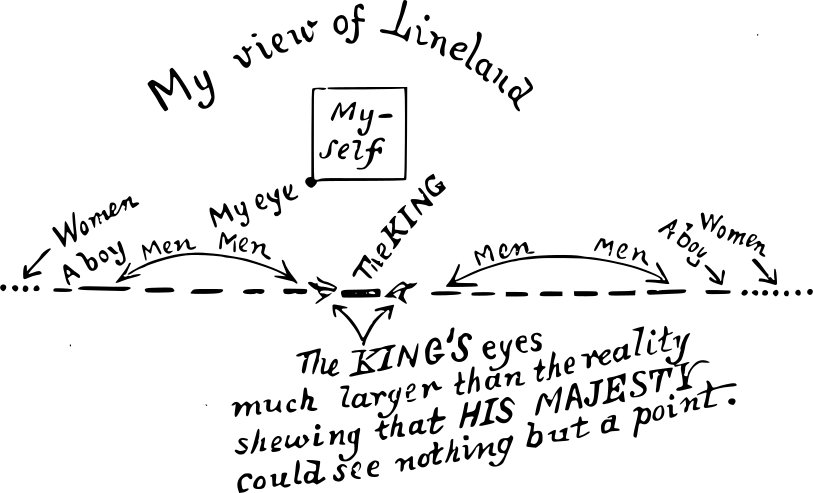
A noise of confused, high-pitched chirping or twittering came from them at intervals, as long as they were moving; but sometimes they stopped, and then everything went silent.
I approached one of the largest of what I took to be Women and spoke to her, but got no answer; a second and third attempt on my part were equally useless. Losing patience at what struck me as unbearable rudeness, I moved my mouth to a position directly in front of her mouth so as to block her path, and loudly repeated my question: "Woman, what is this gathering about, and what is all this strange, confused chirping, and this monotonous back-and-forth movement along one and the same Straight Line?"
"I am no Woman," replied the small Line. "I am the Monarch of the world. But you, where have you come from, intruding into my realm of Lineland?" Taken aback by this blunt reply, I begged his pardon if I had in any way startled or bothered his Royal Highness, and, describing myself as a stranger, asked the King to tell me something about his dominions. But I had the hardest time getting any information about the things that actually interested me, for the Monarch couldn't stop assuming that whatever was familiar to him must also be known to me, and that I was just pretending to be ignorant as a joke. Still, by persisting with my questions, I managed to piece together the following facts:
It seemed that this poor, ignorant Monarch (as he called himself) was completely convinced that the Straight Line he called his Kingdom, the one in which he spent his entire existence, made up the whole of the world, and in fact the whole of Space. Unable to either move or see in any direction except along his Straight Line, he had no concept of anything outside of it. Although he'd heard my voice when I first spoke to him, the sounds had reached him in a way so contrary to his experience that he hadn't answered, "seeing no man," as he put it, "and hearing a voice as if from my own intestines." Until the moment I placed my mouth inside his World, he had neither seen me nor heard anything except confused sounds beating against what I would call his side, but what he called his inside or stomach; even now he had no idea at all of the region I'd come from. Outside his World, his Line, everything was a blank to him; no, not even a blank, because a blank implies Space. Better to say that everything outside it simply did not exist.
His subjects (the small Lines being men and the Points Women) were all equally confined in motion and vision to that single Straight Line, their entire World. It hardly needs saying that their whole horizon was limited to a Point; nobody could ever see anything but a Point. Man, woman, child, thing: each appeared as a Point to the eye of a Linelander. Only by the sound of someone's voice could sex or age be told apart. What's more, since each individual occupied the whole of the narrow path (so to speak) that made up his Universe, and no one could move to the right or left to make way for anyone else, it followed that no Linelander could ever pass another. Once neighbors, always neighbors. Neighborhood with them was like marriage with us. Neighbors remained neighbors till death did them part.
Such a life, with all vision limited to a Point and all movement to a Straight Line, seemed to me unspeakably dreary, and I was surprised to notice the King's vivacity and good cheer. Wondering whether it was even possible, under circumstances so unfavorable to domestic relations, to enjoy the pleasures of married life, I hesitated for some time to question his Royal Highness on such a delicate subject; but at last I dove in by abruptly asking about the health of his family. "My wives and children," he replied, "are well and happy."
I was staggered by this answer, because in the immediate vicinity of the Monarch (as I'd noticed in my dream before entering Lineland) there were only Men, and I ventured to reply, "Pardon me, but I can't imagine how your Royal Highness can at any time either see or approach their Majesties, when there are at least half a dozen people between you and them, whom you can neither see through nor get past. Is it possible that in Lineland, physical closeness isn't necessary for marriage and for having children?"
"How can you ask such an absurd question?" replied the Monarch. "If it were indeed as you suggest, the Universe would soon be depopulated. No, no; being neighbors isn't needed for the union of hearts, and the birth of children is far too important a matter to have been left to depend on such an accident as physical closeness. You can't possibly be ignorant of this. Yet since you insist on pretending you are, I'll instruct you as though you were the most clueless baby in Lineland. Understand, then, that marriages are consummated through the faculty of sound and the sense of hearing.
"You are of course aware that every Man has two mouths or voices, just as he has two eyes, a bass at one end and a tenor at the other. I wouldn't mention it, except that I haven't been able to make out your tenor in the course of our conversation." I replied that I had only one voice, and that I hadn't been aware his Royal Highness had two. "That confirms my impression," said the King, "that you are not a Man, but a feminine Monstrosity with a bass voice and an utterly uneducated ear. But to continue.
"Nature having herself ordained that every Man should wed two wives —" "Why two?" I asked. "You carry your fake simplicity too far," he cried. "How can there be a completely harmonious union without the combination of the Four in One, namely the Bass and Tenor of the Man and the Soprano and Contralto of the two Women?" "But suppose," I said, "that a man preferred one wife or three?" "It is impossible," he said; "it is as inconceivable as two and one making five, or the human eye seeing a Straight Line." I would have interrupted him, but he went on:
"Once in the middle of each week a Law of Nature compels us to move back and forth with a rhythmic motion of more than usual force, which continues for about as long as it would take you to count to a hundred and one. In the midst of this choral dance, at the fifty-first beat, the inhabitants of the Universe pause in mid-stride, and each individual sends out his richest, fullest, sweetest note. It is in this decisive moment that all our marriages are made. The match of Bass to Treble, of Tenor to Contralto, is so perfectly tuned that the Loved Ones, though twenty thousand leagues away, often recognize at once the answering note of their destined Lover; and, cutting through the trivial obstacles of distance, Love unites the three. The marriage consummated in this way results in a threefold offspring, Male and Female, which takes its place in Lineland."
"What! Always threefold?" I said. "Must one wife then always have twins?"
"Bass-voiced Monstrosity! Yes," replied the King. "How else could the balance of the Sexes be maintained, if two girls were not born for every boy? Would you ignore the very Alphabet of Nature?" He stopped, speechless with fury, and some time passed before I could coax him into resuming his story.
"You will not, of course, suppose that every bachelor among us finds his mates at the first wooing in this universal Marriage Chorus. On the contrary, most of us go through the process many times. Only a few hearts have the happy lot of recognizing at once in each other's voice the partner Providence intended for them, and of flying into a mutual and perfectly harmonious embrace. For most of us the courtship is long. The Wooer's voices may match one of his future wives, but not both, or at first neither; or the Soprano and Contralto may not quite harmonize. In such cases Nature has arranged that every weekly Chorus brings the three Lovers into closer harmony. Each trial of voice, each fresh discovery of discord, almost imperceptibly nudges the less perfect partner to adjust his or her singing so as to come closer to the more perfect; and after many trials and many adjustments they get there at last. There comes a day when, while the usual Marriage Chorus rings out from all of Lineland, the three far-off Lovers suddenly find themselves in exact harmony, and before they know it the wedded Triplet is swept vocally into a double embrace; and Nature rejoices over one more marriage and three more births."
Section 14: How I Tried — and Failed — to Explain the Nature of Flatland
Thinking it was time to bring the Monarch back down from his raptures to something like common sense, I decided to try to give him a few glimpses of the truth, that is, of the nature of things in Flatland. So I began:
"How does your Royal Highness distinguish the shapes and positions of his subjects? Before I entered your Kingdom, I could see with my own eyes that some of your people are Lines and others Points, and that some of the Lines are larger —"
"You're describing an impossibility," the King interrupted. "You must have been seeing visions; for telling a Line from a Point by sight is, as everyone knows, impossible in the very nature of things. But it can be done by hearing, and by the same method my own shape can be measured exactly. Look at me: I am a Line, the longest in Lineland, over six inches of Space —"
"Of Length," I ventured to suggest.
"Fool," he said. "Space is Length. Interrupt me again, and I'm finished with you."
I apologized, but he went on scornfully: "Since you're impervious to argument, you can hear with your own ears how I reveal my shape to my Wives using my two voices. They are at this moment six thousand miles, seventy yards, two feet, and eight inches away, one to the North, the other to the South. Listen: I'll call to them."
He chirped, and then went on, quite pleased with himself: "My Wives are at this moment receiving the sound of one of my voices, closely followed by the other, and since the second reaches them after the time it takes sound to travel 6.457 inches, they work out that one of my mouths is 6.457 inches farther from them than the other, and so know that my shape measures 6.457 inches. But of course you understand that my Wives don't run this calculation every time they hear my two voices; they worked it out once and for all before we were married. But they could redo it at any time. And in the same way, I can determine the shape of any of my Male subjects by the sense of sound."
"But what happens," I asked, "if a Man fakes a Woman's voice with one of his two voices, or disguises his Southern voice so it can't be recognized as the echo of the Northern one? Couldn't such deceptions cause serious problems? And don't you have any way of catching frauds of this kind, by ordering your neighboring subjects to feel one another?"
This was, of course, a very stupid question, since feeling couldn't have served the purpose at all; but I asked it on purpose to annoy the Monarch, and I succeeded perfectly.
"What!" he cried in horror. "Explain what you mean."
"Feel. Touch. Come into physical contact," I replied.
"If by feeling you mean," said the King, "getting so close that no space is left between two individuals, then understand, Stranger, that this offense is punishable in my dominions by death. And the reason is obvious. The fragile form of a Woman, which could be shattered by such contact, must be protected by the State; but since Women cannot be told apart from Men by sight, the Law decrees universally that neither Man nor Woman shall be approached so closely as to eliminate the gap between the one approaching and the one being approached.
"And really, what possible purpose could be served by this illegal and unnatural excess of approach which you call touching, when everything so brutal and crude a process could achieve is done at once, more easily and more precisely, by the sense of hearing? As for your supposed danger of deception, it doesn't exist, for a person's Voice is the essence of their Being and can't be changed at will like that. But come, suppose I had the power to pass through solid things, so that I could penetrate my subjects one after another, even a billion of them, checking the size and distance of each by the sense of feeling: how much time and energy would be wasted on such a clumsy and inaccurate method! As it is, in one moment of listening I take in, so to speak, the census and statistics, local, physical, mental, and spiritual, of every living being in Lineland. Listen, just listen!"
With that he paused, listening as if in ecstasy to a sound that seemed to me nothing more than a tiny chirping from an innumerable swarm of miniature grasshoppers.
"I'll grant you," I replied, "that your sense of hearing serves you remarkably well and makes up for many of your deficiencies. But let me point out that your life in Lineland must be depressingly dull. To see nothing but a Point! To not even be able to look at a Straight Line! No, not even to know what a Straight Line is! To have the power of sight, yet to be cut off from the Linear views we take for granted in Flatland! Surely it would be better to have no sense of sight at all than to see so little! I'll admit I don't have your fine ear, for the concert of all Lineland that gives you such intense pleasure is to me nothing more than the twittering of a crowd. But at least I can tell, by sight, a Line from a Point. And let me prove it. Just before I entered your Kingdom, I watched you dancing from left to right and then from right to left, with Seven Men and a Woman close by on your left, and Eight Men and Two Women on your right. Am I wrong?"
"That is correct," said the King, "as far as the numbers and sexes go, though I have no idea what you mean by 'right' and 'left.' But I deny that you saw these things. How could you possibly see the Line, that is, the inside, of any Man? You must have heard them, and then dreamed that you saw them. And tell me what you mean by these words 'left' and 'right.' I assume it's your way of saying Northward and Southward."
"Not at all," I replied. "Besides your motion Northward and Southward, there is another kind of motion, which I call from right to left."
King. Show me, if you would, this motion from left to right.
I. I can't do that unless you could step out of your Line entirely.
King. Out of my Line? You mean out of the world? Out of Space?
I. Well, yes. Out of your world. Out of your Space. Because your Space is not true Space. True Space is a Plane; your Space is only a Line.
King. If you can't demonstrate this motion from left to right by actually performing it yourself, then I ask you to describe it to me in words.
I. If you can't tell your right side from your left, I'm afraid no words of mine can make my meaning any clearer. But surely you can't be ignorant of such a simple distinction.
King. I don't understand you in the slightest.
I. This is hopeless! How can I make it clear? When you move straight ahead, doesn't it ever occur to you that you could move in some other way, turning your eye so that it looks the way your side now faces? In other words, instead of always moving toward one of your ends, don't you ever feel a desire to move in the direction, so to speak, of your side?
King. Never. And what do you mean? How can a person's inside "face" any direction? And how can anyone move in the direction of their own inside?
I. Well then, since words can't explain the matter, I'll let actions speak instead, and move gradually out of Lineland in the direction I've been trying to show you.
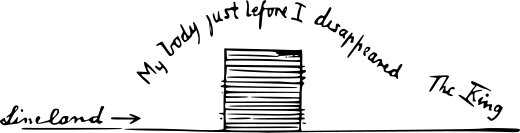
As I said this, I began to move my body out of Lineland. As long as any part of me remained within his domain and within his view, the King kept exclaiming, "I see you, I still see you; you're not moving." But when I had finally moved myself entirely out of his Line, he cried in his shrillest voice, "She has vanished! She is dead!"
"I'm not dead," I called back. "I've simply moved out of Lineland, that is, out of the Straight Line you call Space, and into true Space, where I can see things as they really are. Right now I can see your Line, or side (or 'inside,' as you like to call it); and I can also see the Men and Women to the North and South of you, whom I'll now list, describing their order, their size, and the distance between each."
When I had done this at considerable length, I cried triumphantly, "Does that finally convince you?" And with that I dropped back into Lineland, taking up my former position.
But the Monarch replied, "If you were a Man of sense (though, as you appear to have only one voice, I have little doubt you are not a Man but a Woman), but if you had a shred of sense, you would listen to reason. You ask me to believe that there is another Line besides the one my senses reveal, and another motion besides the one I'm aware of every day. In return, I ask you to describe in words, or show by motion, this other Line you talk about. Instead of moving, you merely perform some magic trick of vanishing and reappearing; and instead of any clear description of your new World, you just give me the numbers and sizes of some forty of my retinue, facts any child in my capital knows. Could anything be more irrational or more arrogant? Admit your folly or leave my dominions."
Furious at his stubbornness, and especially outraged that he claimed not to know my sex, I shot back without mincing words: "You deluded creature! You think you're the pinnacle of existence, when in reality you are the most imperfect and feeble-minded of beings. You claim to see, yet all you see is a Point! You pride yourself on inferring the existence of a Straight Line; but I can see Straight Lines, and infer the existence of Angles, Triangles, Squares, Pentagons, Hexagons, and even Circles. Why waste more words? It's enough to say that I am the completion of your incomplete self. You are a Line, but I am a Line of Lines, called in my country a Square; and even I, infinitely superior to you as I am, count for very little among the great nobles of Flatland, from where I've come to visit you in the hope of enlightening your ignorance."
Hearing these words, the King charged at me with a menacing cry, as if to pierce me straight through the diagonal; and at that same moment a vast war-cry rose from his countless subjects, swelling in fury until I could have sworn it rivaled the roar of an army of a hundred thousand Isosceles and the artillery of a thousand Pentagons. Frozen in place, I could neither speak nor move to escape the oncoming destruction; and still the noise grew louder, and the King came closer, when I woke up to find the breakfast bell calling me back to the realities of Flatland.
Section 15: Concerning a Stranger from Spaceland
From dreams I move on to facts.
It was the last day of our 1,999th year. The patter of the rain had announced nightfall long ago, and I was sitting in the company of my Wife, reflecting on the events of the past and the prospects of the coming year, the coming century, the coming Millennium.
(When I say "sitting," of course I don't mean any change of posture such as you in Spaceland mean by the word; for since we have no feet, we can no more "sit" or "stand" (in your sense of those words) than one of your soles or flounders could. Still, we perfectly well recognize the different states of will behind "lying," "sitting," and "standing," which are to some degree visible to an observer as a slight increase in brightness matching the increase in effort of will. But on this, and a thousand related subjects, time doesn't allow me to dwell.)
My four Sons and two orphan Grandchildren had retired to their separate rooms, and my Wife alone remained with me to see the old Millennium out and the new one in.
I was deep in thought, mulling over some words that had casually come from the mouth of my youngest Grandson, a most promising young Hexagon of unusual brilliance and perfect angularity. His uncles and I had been giving him his usual hands-on lesson in Sight Recognition, spinning ourselves on our centers, sometimes quickly, sometimes more slowly, and quizzing him on our positions; and his answers had been so good that I'd been moved to reward him with a few hints on Arithmetic as applied to Geometry.
Taking nine Squares, each one inch on every side, I'd put them together to make one large Square with a side of three inches, and from this I'd proved to my little Grandson that, though it was impossible for us to see the inside of the Square, we could still work out the number of square inches in a Square by simply squaring the number of inches in the side. "And so," I told him, "we know that 3 squared, or 9, represents the number of square inches in a Square whose side is 3 inches long."
The little Hexagon thought about this for a while and then said to me, "But you've been teaching me to raise numbers to the third power. I suppose 3 cubed must mean something in Geometry. What does it mean?"
"Nothing at all," I replied, "not in Geometry, at any rate, because Geometry has only Two Dimensions." And then I started showing the boy how a Point, by moving through a length of three inches, makes a Line of three inches, which can be represented by 3; and how a Line of three inches, moving parallel to itself through a length of three inches, makes a Square of three inches on every side, which can be represented by 3 squared.
At this, my Grandson returned to his earlier idea and cut in rather abruptly. "Well then," he exclaimed, "if a Point moving three inches makes a Line of three inches, represented by 3; and if a straight Line of three inches, moving parallel to itself, makes a Square of three inches every way, represented by 3 squared; then it must be that a Square of three inches every way, moving somehow parallel to itself (but I don't see how), must make Something else (but I don't see what) of three inches every way, and this must be represented by 3 cubed."
"Go to bed," I said, a little annoyed by this interruption. "If you talked less nonsense, you'd remember more sense."
My Grandson went off to bed in disgrace, and there I sat by my Wife's side, trying to look back over the year 1999 and ahead to the possibilities of the year 2000, but not quite able to shake off the thoughts my bright little Hexagon's chatter had set going. Only a few grains of sand remained in the half-hour glass. Rousing myself from my daydream, I turned the glass Northward for the last time in the old Millennium, and as I did it I exclaimed aloud, "The boy is a fool."
Instantly I became aware of a Presence in the room, and a chilling breath ran through my entire being. "He is no such thing," cried my Wife, "and you are breaking the Commandments by disrespecting your own Grandson." But I paid no attention to her. Looking around in every direction, I could see nothing; and yet I felt a Presence, and shivered as the cold whisper came again. I jumped to my feet. "What's the matter?" said my Wife. "There's no draft. What are you looking for? There's nothing." There was nothing; and I sat back down, exclaiming again, "The boy is a fool, I say; 3 cubed can have no meaning in Geometry." At once there came a distinctly audible reply: "The boy is not a fool; and 3 cubed has an obvious Geometrical meaning."
My Wife heard the words as well as I did, though she didn't understand what they meant, and both of us sprang forward in the direction of the sound. Imagine our horror when we saw before us a Figure! At first glance it appeared to be a Woman, seen sideways; but a moment's observation showed me that its edges faded into dimness too rapidly to be one of the Female Sex; and I would have thought it a Circle, except that it seemed to change its size in a way impossible for a Circle or for any regular Figure I had ever encountered.
But my Wife didn't have my experience, or the composure needed to notice these details. With the usual hastiness and unreasoning jealousy of her Sex, she leapt straight to the conclusion that a Woman had entered the house through some small opening. "How did this person get in here?" she exclaimed. "You promised me, my dear, that there would be no ventilators in our new house."
"There aren't any," I said, "but what makes you think the Stranger is a Woman? I can see by my power of Sight Recognition —"
"Oh, I have no patience with your Sight Recognition," she replied. "'Feeling is believing' and 'A Straight Line to the touch is worth a Circle to the sight'": two proverbs very popular with the Frailer Sex in Flatland.
"Well," I said, since I was afraid of setting her off, "if it must be so, ask for an introduction." Putting on her most gracious manner, my Wife advanced toward the Stranger. "Permit me, Madam, to feel and be felt by —" Then, suddenly recoiling: "Oh! It is not a Woman, and there are no angles either, not a trace of one. Can it be that I have so misbehaved toward a perfect Circle?"
"I am indeed, in a certain sense, a Circle," replied the Voice, "and a more perfect Circle than any in Flatland; but to speak more accurately, I am many Circles in one." Then he added more gently, "I have a message, dear Madam, for your husband, which I must not deliver in your presence; and if you would allow us to step aside for a few minutes —" But my Wife wouldn't hear of our distinguished Visitor putting himself out like that, and, assuring the Circle that the hour of her own bedtime had long since passed, and with many repeated apologies for her recent blunder, she at last retreated to her room.
I glanced at the half-hour glass. The last grains of sand had fallen. The third Millennium had begun.
Section 16: How the Stranger Tried and Failed to Explain Spaceland to Me in Words
As soon as the sound of my departing Wife's Peace-cry had faded away, I moved toward the Stranger, intending to get a closer look and to invite him to sit down; but his appearance struck me dumb and motionless with astonishment. Without the slightest hint of angularity, he was nevertheless shifting every instant through gradations of size and brightness that hardly seemed possible for any Figure I had ever met. The thought flashed through my mind that this might be a burglar or a cutthroat, some monstrous Irregular Isosceles who had faked the voice of a Circle to get into the house, and was now preparing to stab me with his acute angle.
In a sitting-room, the absence of Fog (and the season happened to be remarkably dry) made it hard for me to rely on Sight Recognition, especially at such a short distance. Desperate with fear, I rushed forward with an unceremonious "You must allow me, Sir —" and felt him. My Wife was right. There was no trace of an angle, not the slightest roughness or unevenness: never in my life had I met a more perfect Circle. He stayed motionless while I walked all the way around him, starting from his eye and returning to it again. He was circular through and through, a perfectly satisfactory Circle; there could be no doubt about it. Then came a dialogue, which I'll try to set down as closely as I can remember it, leaving out only some of my endless apologies (for I was covered with shame and humiliation that I, a Square, had been guilty of the rudeness of feeling a Circle). It was the Stranger who began, with some impatience at how long my introductory process was taking.
Stranger. Have you felt me enough by this time? Aren't you introduced to me yet?
I. Most illustrious Sir, excuse my awkwardness, which comes not from ignorance of the ways of polite society, but from a little surprise and nervousness at this somewhat unexpected visit. And I beg you not to reveal my indiscretion to anyone, and especially not to my Wife. But before your Lordship goes any further, would he be so kind as to satisfy the curiosity of one who would dearly like to know where his visitor came from?
Stranger. From Space, from Space, Sir: where else?
I. Forgive me, my Lord, but isn't your Lordship already in Space, your Lordship and his humble servant both, even at this very moment?
Stranger. Pah! What do you know of Space? Define Space.
I. Space, my Lord, is height and width extended indefinitely.
Stranger. Exactly: you see, you don't even know what Space is. You think it has only Two Dimensions; but I've come to announce a Third: height, width, and depth.
I. Your Lordship must be joking. We also use the words "length" and "height," or "width" and "thickness," giving four names to describe just Two Dimensions.
Stranger. But I don't mean just three names. I mean Three Dimensions.
I. Would your Lordship point out or explain to me the direction in which this Third Dimension runs, the one I know nothing about?
Stranger. I came from it. It is up above and down below.
I. My Lord seems to be saying Northward and Southward.
Stranger. I mean nothing of the kind. I mean a direction in which you cannot look, because you have no eye on your side.
I. Forgive me, my Lord, but a moment's inspection will show your Lordship that I have a perfectly good eye at the junction of my two sides.
Stranger. Yes: but in order to see into Space, you'd need an eye not on your Perimeter but on your side, that is, on what you'd probably call your inside; but we in Spaceland would call it your side.
I. An eye on my inside! An eye in my stomach! Your Lordship must be joking.
Stranger. I am in no joking mood. I'm telling you that I come from Space, or, since you refuse to understand what Space means, from the Land of Three Dimensions, from which I recently looked down upon your Plane, the thing you like to call Space. From that vantage point I could see everything you think of as solid (by which you mean "enclosed on four sides"), your houses, your churches, your very chests and safes, yes, even your insides and stomachs, all lying open and exposed to my view.
I. Such claims are easy to make, my Lord.
Stranger. But not easy to prove, you mean. Well, I intend to prove mine.
When I came down here, I saw your four Sons, the Pentagons, each in his own room, and your two Grandsons the Hexagons; I saw your youngest Hexagon stay a while with you and then go off to his room, leaving you and your Wife alone. I saw your Isosceles servants, three of them, in the kitchen having supper, and the little Page in the scullery. Then I came here; and how do you think I got in?
I. Through the roof, I suppose.
Stranger. No. Your roof, as you know perfectly well, has been recently repaired and has no opening that even a Woman could slip through. I'm telling you, I come from Space. Aren't you convinced by what I've told you about your children and household?
I. Your Lordship must realize that facts about his humble servant's household could easily be gathered by anyone in the neighborhood who had your Lordship's considerable means of gathering information.
Stranger. (to himself.) What am I to do? Wait: one more argument occurs to me. When you see a Straight Line (your wife, for example), how many Dimensions do you attribute to her?
I. Your Lordship would treat me as if I were one of the common people who, being ignorant of Mathematics, imagine that a Woman is actually a Straight Line and has only One Dimension. No, no, my Lord; we Squares know better, and are just as aware as your Lordship that a Woman, though commonly called a Straight Line, is really and scientifically a very thin Parallelogram, possessing Two Dimensions like the rest of us: namely, length and width (or thickness).
Stranger. But the very fact that a Line is visible implies that it must have yet another Dimension.
I. My Lord, I just acknowledged that a Woman has width as well as length. We see her length; we infer her width, which, though very slight, can still be measured.
Stranger. You don't understand me. I mean that when you see a Woman, you should, besides inferring her width, see her length, and to see what we call her height, although that last Dimension is infinitely small in your country. If a Line were nothing but length without "height," it would stop occupying Space and become invisible. Surely you can see that?
I. I have to admit that I don't understand your Lordship in the least. When we in Flatland see a Line, we see length and brightness. If the brightness vanishes, the Line goes out, and, as you say, stops occupying Space. But am I to understand that your Lordship is giving brightness the title of a Dimension, and that what we call "bright" you call "high"?
Stranger. No, not at all. By "height" I mean a Dimension like your length; it's only that in your world "height" isn't easily perceptible, being extremely small.
I. My Lord, your claim is easy enough to test. You say I have a Third Dimension, which you call "height." Now, a Dimension implies direction and measurement. Just measure my "height," or even just point out the direction in which my "height" extends, and I'll become your convert. Otherwise, your Lordship's own good judgment must excuse me.
Stranger. (to himself.) I can do neither. How am I going to convince him? Surely a plain statement of facts, followed by a demonstration he can see, should be enough. Now, Sir, listen to me.
You are living on a Plane. What you call Flatland is the vast level surface of what I might describe as a fluid, on the top of which you and your fellow citizens move around, without ever rising above it or sinking below it.
I am not a plane Figure but a Solid. You call me a Circle; but in reality I'm not a Circle but an infinite number of Circles, ranging in size from a Point to a Circle thirteen inches in diameter, stacked one on top of the other. When I cut through your plane, as I'm doing right now, I make in it a cross-section which you, quite rightly, call a Circle. For even a Sphere (which is my proper name in my own country), if he shows himself at all to an inhabitant of Flatland, can only show himself as a Circle.
Don't you remember (for I, who see all things, saw last night the dream-vision of Lineland imprinted on your brain), don't you remember, I say, how when you entered the realm of Lineland, you were forced to appear to the King not as a Square, but as a Line, because that Linear Realm didn't have enough Dimensions to show all of you, only a slice or cross-section? In exactly the same way, your country of Two Dimensions doesn't have enough room to show me, a being of Three, and can only display a slice or cross-section of me, which is what you call a Circle.
The dimming of your eye tells me you're skeptical. But now get ready for definite proof of what I'm saying. You can't see more than one of my cross-sections, or Circles, at a time, because you have no power to raise your eye out of the plane of Flatland; but you can at least see that, as I rise in Space, my cross-sections get smaller. Watch now: I'll rise, and what you'll see is my Circle growing smaller and smaller until it shrinks to a point and finally disappears.
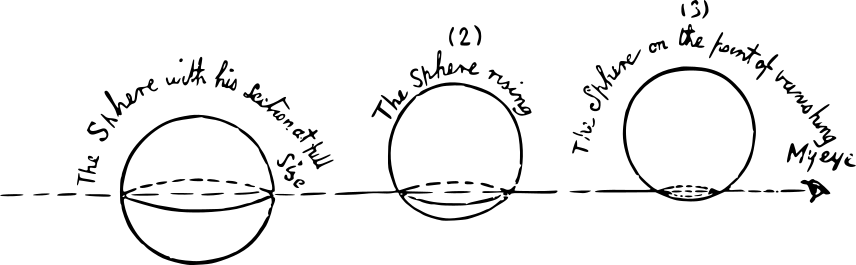
There was no "rising" that I could see; but he shrank and finally vanished. I blinked once or twice to make sure I wasn't dreaming. But it was no dream. From the depths of nowhere came a hollow voice, which seemed to come from right next to my heart: "Am I completely gone? Are you convinced now? Well, now I'll gradually return to Flatland, and you'll see my cross-section grow larger and larger."
Every reader in Spaceland will easily understand that my mysterious Guest was speaking the plain and simple truth. But to me, well versed though I was in Flatland Mathematics, it was anything but simple. The rough diagram above will make it obvious to any child in Spaceland that the Sphere, rising through the three positions shown, was bound to appear to me, or to any Flatlander, as a Circle, first full-sized, then small, and finally very small indeed, approaching a Point. But to me, even though I saw it all happening right in front of me, the causes remained as dark as ever. All I could grasp was that the Circle had made himself smaller and vanished, and that he had now reappeared and was rapidly making himself bigger again.
When he returned to his original size, he let out a deep sigh, for he could tell from my silence that I had completely failed to understand him. And indeed I was now leaning toward the belief that he couldn't be a Circle at all, but some extraordinarily clever conjurer; or else that the old wives' tales were true, and there really were such people as Enchanters and Magicians.
After a long pause he muttered to himself, "Only one option remains, if I'm not going to resort to action. I have to try the method of Analogy." Then came an even longer silence, after which he resumed our dialogue.
Sphere. Tell me, Mr. Mathematician: if a Point moves Northward and leaves a glowing trail behind it, what would you call that trail?
I. A straight Line.
Sphere. And a straight Line has how many endpoints?
I. Two.
Sphere. Now imagine that Northward straight Line moving parallel to itself, East and West, so that every point on it leaves behind a trail in the shape of a straight Line. What would you call the Figure that's formed? We'll say it moves a distance equal to the length of the original straight Line. What name, I say?
I. A Square.
Sphere. And how many sides does a Square have? How many angles?
I. Four sides and four angles.
Sphere. Now stretch your imagination a little and picture a Square in Flatland moving parallel to itself upward.
I. What? Northward?
Sphere. No, not Northward; upward; out of Flatland altogether.
If it moved Northward, the Southern points of the Square would have to pass through the positions already occupied by the Northern points. But that's not what I mean.
I mean that every Point in you (for you are a Square, and you'll serve nicely for my example), every Point in what you call your inside, is to move upward through Space in such a way that no Point passes through the position already occupied by any other Point, but each Point traces out a straight Line of its own. This is all perfectly consistent with Analogy; surely it must be clear to you.
Restraining my impatience (for I was now powerfully tempted to throw myself blindly at my Visitor and hurl him into Space, or out of Flatland, anywhere, just to be rid of him), I replied:
"And what exactly would be the nature of the Figure I'm to create by this motion you're pleased to call 'upward'? I assume it can be described in the language of Flatland."
Sphere. Oh, certainly. It's all plain and simple, and in perfect keeping with Analogy; only, by the way, you mustn't call the result a Figure, but a Solid. But I will describe it to you. Or rather not I, but Analogy.
We started with a single Point, which of course, being itself a Point, has only one terminal Point.
One Point produces a Line with two terminal Points.
One Line produces a Square with four terminal Points.
Now you can answer your own question: 1, 2, 4 are clearly a Geometric Progression. What's the next number?
I. Eight.
Sphere. Exactly. The one Square produces a Something-which-you-do-not-as-yet-know-a-name-for-but-which-we-call-a-Cube with eight terminal Points. Now are you convinced?
I. And does this Creature have sides, as well as angles, or what you call "terminal Points"?
Sphere. Of course, and all according to Analogy. But, by the way, not what you call sides, but what we call sides. You would call them solids.
I. And how many solids, or sides, will belong to this Being I'm supposed to generate by moving my inside in an "upward" direction, the thing you call a Cube?
Sphere. How can you even ask? And you a mathematician! The side of anything is always, if I may put it this way, one Dimension behind the thing itself. Since there's no Dimension behind a Point, a Point has 0 sides; a Line, if I may say so, has 2 sides (for the points of a Line can be called, as a courtesy, its sides); a Square has 4 sides; 0, 2, 4: what kind of Progression would you call that?
I. Arithmetic.
Sphere. And what's the next number?
I. Six.
Sphere. Exactly. Then you see, you've answered your own question. The Cube that you'll generate will be bounded by six sides, that is to say, six of your insides. You see it all now, don't you?
"Monster," I shrieked, "be you juggler, enchanter, dream, or devil, I will endure your mockeries no longer. Either you or I must die." And with those words I hurled myself at him.
Section 17: How the Sphere, Having Failed with Words, Resorted to Action
It was no use. I slammed my hardest right angle into the Sphere, pressing on him with enough force to have destroyed any ordinary Circle; but I could feel him slowly and unstoppably slipping away from me, not edging to the right or to the left, but somehow moving out of the world, and vanishing into nothing. Soon there was only blank space. But I could still hear his voice.
Sphere. Why won't you listen to reason? I had hoped to find in you, as a man of intelligence and an accomplished mathematician, the right apostle for the Gospel of the Three Dimensions, which I'm allowed to preach only once in a thousand years; but now I don't know how to convince you. Wait, I've got it. Actions, not words, will prove the truth. Listen, my friend.
I've told you that from my position in Space, I can see the inside of everything you consider sealed shut. For example, in that cupboard near where you're standing I can see several of what you call boxes (though, like everything else in Flatland, they have no tops or bottoms), full of money; I can also see two account tablets. I'm about to descend into that cupboard and bring you one of those tablets. I watched you lock it half an hour ago, and I know you have the key on you. But I'm coming down from Space; the doors, you'll notice, haven't moved. Now I'm inside the cupboard and picking up the tablet. Now I have it. Now I'm rising back up with it.
I rushed to the closet and threw the door open. One of the tablets was gone. With a mocking laugh, the Sphere appeared in the far corner of the room, and at the same instant the tablet appeared on the floor. I picked it up. There was no doubt about it: it was the missing tablet.
I groaned in horror, wondering if I'd lost my mind; but the Sphere continued: "Surely you can see now that my explanation, and no other, fits the facts. What you call Solid things are really just surfaces; what you call Space is really nothing but a great Plane. I am in Space, and I look down upon the insides of things whose outsides are all you can see. You could leave the Plane yourself, if you could only summon up the will. A slight upward or downward motion would let you see everything I can see.
"The higher I rise, and the further I go from your Plane, the more I can see, though of course it all looks smaller. For example, I'm rising now: now I can see your neighbor the Hexagon and his family in their separate rooms; now I can see inside the Theatre, ten doors down, where the audience is just filing out; and on the other side, a Circle in his study, sitting at his books. Now I'll come back down to you. And as a final, crowning proof, what would you say to my giving you a little touch, just the slightest touch, in your stomach? It won't seriously hurt you, and the small pain you might feel is nothing compared to the mental benefit you'll get from it."
Before I could say a word of protest, I felt a sharp, shooting pain in my insides, and a demonic laugh seemed to come from within me. A moment later the sharp agony faded, leaving nothing but a dull ache, and the Sphere began to reappear, saying as he gradually grew larger, "There, I haven't hurt you much, have I? If you're not convinced now, I don't know what will convince you. What do you say?"
My mind was made up. It seemed unbearable that I should go on living at the mercy of some Magician who could play tricks with my very stomach whenever he pleased. If only I could somehow pin him against the wall until help arrived!
Once more I drove my hardest angle at him, at the same time rousing the whole household with my cries for help. I believe that at the moment of my attack the Sphere had sunk below our Plane and was really having trouble rising back up. In any case he stayed motionless, while I, hearing (as I thought) the sound of help approaching, pressed against him twice as hard and kept shouting for help.
A convulsive shudder ran through the Sphere. "This can't go on," I thought I heard him say: "either he listens to reason, or I'll have to fall back on the last resort of civilization." Then, calling out to me in a louder voice, he exclaimed urgently, "Listen: no one else must witness what you've witnessed. Send your Wife back at once, before she enters the room. The Gospel of Three Dimensions must not be thwarted like this; the fruits of a thousand years of waiting must not be thrown away. I can hear her coming. Back! Back! Get away from me, or you'll have to come with me, to a place you can't imagine, into the Land of Three Dimensions!"
"Fool! Madman! Irregular!" I shouted. "I'll never let you go! You'll pay the price for your tricks!"
"Ha! It's come to this, has it?" the Sphere thundered. "Then face your fate: out of your Plane you go. Once, twice, three times! It's done!"
Section 18: How I Came to Spaceland, and What I Saw There
An unspeakable horror seized me. There was darkness; then a dizzy, sickening sensation of sight that was not like seeing; I saw a Line that was no Line, Space that was not Space; I was myself, and not myself. When I could finally find my voice, I shrieked aloud in agony: "Either this is madness or it is Hell."
"It is neither," the Sphere replied calmly. "It is Knowledge; it is Three Dimensions. Open your eye once more and try to look steadily."
I looked, and there was a new world! There stood before me, real and visible, everything I had only inferred, guessed at, dreamed of: perfect Circular beauty in the flesh. What seemed to be the center of the Stranger's form lay open to my view; and yet I couldn't see any heart, lungs, or arteries, only a beautiful, harmonious Something for which I had no words, but which you, my readers in Spaceland, would call the surface of the Sphere.
Mentally prostrating myself before my Guide, I cried, "How is it, O divine ideal of perfect loveliness and wisdom, that I can see your inside, and yet I can't make out your heart, your lungs, your arteries, your liver?"
"What you think you see, you don't actually see," he replied. "It is not given to you, or to any other Being, to look at my internal parts. I am a different order of Being from those in Flatland. If I were a Circle, you could see my intestines; but I am a Being composed, as I told you before, of many Circles, the Many in the One, called in this country a Sphere. And just as the outside of a Cube is a Square, so the outside of a Sphere presents the appearance of a Circle."
I was bewildered by my Teacher's puzzling words, but I no longer fought against them; I worshipped him in silent adoration. He continued, his voice growing gentler. "Don't distress yourself if you can't understand the deeper mysteries of Spaceland right away; they'll dawn on you gradually. Let's begin by casting a glance back at the region you came from. Come back with me for a while to the plains of Flatland, and I'll show you something you've often reasoned and thought about but never actually seen with your eyes: a visible angle."
"Impossible!" I cried. But with the Sphere leading the way, I followed as if in a dream, until his voice stopped me once more: "Look down there, and see your own Pentagonal house and everyone in it."
I looked below, and saw with my physical eye all the domestic detail that I had until now only inferred with my mind. And how poor and shadowy those inferences were compared to the reality I now beheld! My four Sons calmly asleep in the Northwestern rooms, my two orphan Grandsons to the South; the Servants, the Butler, my Daughter, all in their separate rooms. Only my loving Wife, alarmed by my long absence, had left her room and was pacing up and down the Hall, anxiously waiting for me to come home. The Page, too, woken by my cries, had left his room, and on the pretense of checking whether I'd fainted somewhere, was snooping through the cabinet in my study. All this I could now see, not merely deduce; and as we came closer and closer, I could make out even the contents of my cabinet, the two chests of gold and the tablets the Sphere had mentioned.
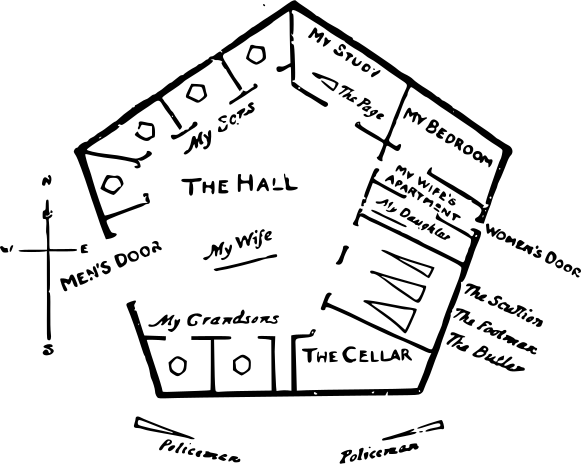
Moved by my Wife's distress, I would have sprung downward to reassure her, but I found myself unable to move. "Don't worry about your Wife," said my Guide. "She won't be left anxious for long. In the meantime, let's take a survey of Flatland."
Once more I felt myself rising through space. It was exactly as the Sphere had said: the farther we moved from the object we were looking at, the larger our field of vision became. My native city, with the interior of every house and every creature in it, lay open to my view in miniature. We rose higher, and now the secrets of the earth, the depths of the mines and the innermost caverns of the hills, were laid bare before me.
Awestruck at the sight of the earth's mysteries unveiled before my unworthy eye, I said to my Companion, "Look, I have become like a God! For the wise men in our country say that seeing all things, or as they put it, omnividence, is the attribute of God alone."
There was a note of scorn in my Teacher's voice as he answered: "Is that so? Then the very pickpockets and cutthroats of my country deserve to be worshipped by your wise men as Gods, for every one of them can see just as much as you're seeing now. But trust me, your wise men are wrong."
I. Then is omnividence the attribute of others besides Gods?
Sphere. I don't know. But if a pickpocket or a cutthroat in our country can see everything that's in your country, surely that's no reason why you should accept the pickpocket or cutthroat as a God. This omnividence, as you call it (it's not a common word in Spaceland), does it make you more just, more merciful, less selfish, more loving? Not in the least. Then how does it make you more divine?
I. "More merciful, more loving!" But those are the qualities of women! And we know that a Circle is a higher Being than a Straight Line, insofar as knowledge and wisdom are more valuable than mere affection.
Sphere. It's not for me to rank human faculties by merit. Yet many of the best and wisest in Spaceland value the affections above the intellect, and your despised Straight Lines above your celebrated Circles. But enough of that. Look down there. Do you recognize that building?
I looked, and far off I saw an immense Polygonal structure that I recognized as the General Assembly Hall of the States of Flatland, surrounded by dense lines of Pentagonal buildings at right angles to each other, which I knew to be streets, and I realized I was approaching the great Metropolis.
"Here we descend," said my Guide. It was now morning, the first hour of the first day of the two thousandth year of our era. Acting, as was their habit, in strict accordance with precedent, the highest Circles of the realm were meeting in solemn assembly, just as they had met at the first hour of the first day of the year 1000, and also at the first hour of the first day of the year 0.
The minutes of the previous meetings were now read by someone I immediately recognized as my brother, a perfectly Symmetrical Square, and the Chief Clerk of the High Council. It was recorded on each occasion that: "Whereas the States had been troubled by various ill-intentioned persons claiming to have received revelations from another World, and claiming to produce demonstrations that had driven both themselves and others into a frenzy, it had been for this reason unanimously resolved by the Grand Council that on the first day of each millennium, special orders be sent to the Prefects in all districts of Flatland to conduct a strict search for such misguided persons; and without the formality of mathematical examination, to destroy all such as were Isosceles of any degree; to flog and imprison any regular Triangle; to have any Square or Pentagon sent to the district Asylum; and to arrest anyone of higher rank, sending him straight to the Capital to be examined and judged by the Council."
"You hear your fate," said the Sphere to me, while the Council was passing the formal resolution for the third time. "Death or imprisonment awaits the Apostle of the Gospel of Three Dimensions."
"Not so," I replied. "The matter is so clear to me now, the nature of real space so obvious, that I think I could make a child understand it. Just let me go down there right now and enlighten them."
"Not yet," said my Guide. "The time will come for that. In the meantime I must carry out my mission. Stay where you are." With those words he leaped with great agility into the sea (if I can call it that) of Flatland, right into the middle of the ring of Counsellors. "I come," he said, "to proclaim that there is a land of Three Dimensions."
I could see many of the younger Counsellors recoil in obvious horror as the Sphere's circular cross-section widened before them. But at a signal from the presiding Circle, who showed not the slightest alarm or surprise, six Isosceles of a low type rushed in from six different directions and threw themselves at the Sphere. "We have him," they cried. "No; yes; we still have him! He's going! He's gone!"
"My Lords," said the President to the Junior Circles of the Council, "there is not the slightest need for alarm; the secret archives, to which I alone have access, tell me that a similar event occurred at the last two millennial gatherings. You will, of course, say nothing of these trifles outside the Cabinet."
Raising his voice, he summoned the guards. "Arrest the policemen; gag them. You know your duty." After he had consigned the wretched policemen to their fate (unlucky and unwilling witnesses of a State secret they would never be allowed to reveal), he addressed the Counsellors again. "My Lords, the business of the Council being concluded, I have only to wish you a Happy New Year." Before leaving, he expressed at some length to the Clerk, my excellent but deeply unfortunate brother, his sincere regret that, in accordance with precedent and for the sake of secrecy, he must condemn him to life in prison, but added his satisfaction that, unless my brother mentioned anything about the day's incident, his life would be spared.
Section 19: How, Though the Sphere Showed Me Other Mysteries of Spaceland, I Still Desired More — and What Came of It
When I saw my poor brother led away to prison, I tried to leap down into the Council Chamber, hoping to speak up on his behalf, or at least say goodbye. But I found I couldn't move on my own; I was completely dependent on the will of my Guide, who said in gloomy tones, "Never mind your brother; perhaps you'll have plenty of time later to mourn with him. Follow me."
Once more we rose into space. "So far," said the Sphere, "I've shown you nothing but Plane Figures and their interiors. Now I need to introduce you to Solids, and show you how they're constructed. Look at this stack of moveable square cards. See, I place one on another, not, as you assumed, Northward of the other, but on the other. Now a second, now a third. See, I'm building up a Solid by stacking many Squares parallel to one another. Now the Solid is complete, being as high as it is long and broad, and we call it a Cube."
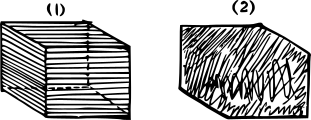
"Forgive me, my Lord," I replied, "but to my eye it looks like an Irregular Figure whose inside is laid open to view; in other words, I don't think I see a Solid at all, but a Plane like the ones we infer in Flatland, only with an Irregularity that suggests some monstrous criminal, so that the very sight of it is painful to my eyes."
"True," said the Sphere. "It looks to you like a Plane, because you aren't accustomed to light and shade and perspective, just as in Flatland a Hexagon would appear as a Straight Line to someone without the Art of Sight Recognition. But in reality it is a Solid, as you'll learn through the sense of Feeling."
He then introduced me to the Cube, and I found that this marvelous Being was indeed no Plane, but a Solid, endowed with six plane sides and eight terminal points called solid angles; and I remembered the Sphere saying that just such a Creature would be formed by a Square moving, in Space, parallel to itself; and I rejoiced to think that so insignificant a Creature as I could in some sense be called the ancestor of so illustrious an offspring.
But still I couldn't fully understand what my Teacher had told me about "light" and "shade" and "perspective," and I didn't hesitate to raise my difficulties with him.
If I were to reproduce the Sphere's explanation of these matters, clear and concise though it was, it would be tedious for an inhabitant of Space, who already knows these things. Suffice it to say that through his lucid explanations, by changing the position of objects and lights, and by allowing me to feel the various objects and even his own sacred Person, he finally made everything clear to me, so that I could now easily distinguish between a Circle and a Sphere, a Plane Figure and a Solid.
This was the Climax, the Paradise, of my strange eventful History. From here on I have to tell the story of my miserable Fall: most miserable, yet surely most undeserved! For why should the thirst for knowledge be aroused, only to be disappointed and punished? My will shrinks from the painful task of recalling my humiliation; yet, like a second Prometheus, I will endure this and worse, if by any means I can arouse in the hearts of Plane and Solid Humanity a spirit of rebellion against the Conceit that would limit our Dimensions to Two or Three or any number short of Infinity. Away then with all personal considerations! Let me continue to the end, as I began, without further digressions or anticipations, following the plain path of dispassionate History. The exact facts, the exact words (and they are burned into my brain) will be set down without changing a single detail; and let my Readers judge between me and Destiny.
The Sphere would gladly have continued his lessons by teaching me the structure of all regular Solids, Cylinders, Cones, Pyramids, Pentahedrons, Hexahedrons, Dodecahedrons, and Spheres. But I dared to interrupt him. Not that I was tired of learning; on the contrary, I thirsted for even deeper and fuller draughts of knowledge than he was offering me.
"Forgive me," said I, "O You Whom I must no longer address as the Perfection of all Beauty; but let me beg you to grant your servant a look at your interior."
Sphere. My what?
I. Your interior: your stomach, your intestines.
Sphere. Where did this ill-timed, impertinent request come from? And what do you mean by saying I'm no longer the Perfection of all Beauty?
I. My Lord, your own wisdom has taught me to aspire to One even greater, more beautiful, and more closely approaching Perfection than yourself. Just as you, superior to all Flatland forms, combine many Circles in One, so surely there must be One above you who combines many Spheres in One Supreme Existence, surpassing even the Solids of Spaceland. And just as we, who are now in Space, look down on Flatland and see the insides of all things, so there must certainly be some higher, purer region above us, where you surely intend to lead me (O You Whom I shall always call, everywhere and in all Dimensions, my Priest, Philosopher, and Friend), some yet more spacious Space, some more dimensionable Dimensionality, from whose vantage point we could look down together upon the revealed insides of Solid things, and where your own intestines, and those of your fellow Spheres, would lie exposed to the view of the poor wandering exile from Flatland, to whom so much has already been granted.
Sphere. Rubbish! Nonsense! Enough of this foolishness! Time is short, and much remains to be done before you're fit to proclaim the Gospel of Three Dimensions to your blind, benighted countrymen in Flatland.
I. No, gracious Teacher, don't deny me what I know it's in your power to do. Grant me just one glimpse of your interior, and I'll be satisfied forever, remaining from now on your obedient pupil, your slave beyond all hope of freedom, ready to receive all your teachings and to hang on every word that falls from your lips.
Sphere. Well, then, to satisfy and silence you, let me say at once: I would show you what you wish if I could, but I cannot. Would you have me turn my stomach inside out to oblige you?
I. But my Lord has shown me the intestines of all my countrymen in the Land of Two Dimensions by taking me with him into the Land of Three. What could be easier, then, than to take his servant on a second journey into the blessed region of the Fourth Dimension, where I could look down with him once more upon this land of Three Dimensions, and see the inside of every three-dimensional house, the secrets of the solid earth, the treasures of the mines of Spaceland, and the intestines of every solid living creature, even the noble and adorable Spheres?
Sphere. But where is this land of Four Dimensions?
I. I don't know. But surely my Teacher knows.
Sphere. Not I. There is no such land. The very idea of it is utterly inconceivable.
I. Not inconceivable to me, my Lord, and therefore still less inconceivable to my Master. No, I don't despair that, even here in this region of Three Dimensions, your Lordship's skill could make the Fourth Dimension visible to me, just as in the Land of Two Dimensions my Teacher would gladly have opened the eyes of his blind servant to the invisible presence of a Third Dimension, though I couldn't see it.
Let me recall the past. Wasn't I taught down below that when I saw a Line and inferred a Plane, I was actually seeing a Third unrecognized Dimension, not the same as brightness, called "height"? And doesn't it now follow that, in this region, when I see a Plane and infer a Solid, I'm really seeing a Fourth unrecognized Dimension, not the same as color, but real, though infinitesimal and impossible to measure?
And besides this, there is the Argument from Analogy of Figures.
Sphere. Analogy! Nonsense: what analogy?
I. Your Lordship is testing his servant to see whether he remembers the revelations given to him. Don't toy with me, my Lord; I crave, I thirst, for more knowledge. Of course we can't see that other higher Spaceland now, because we have no eye in our stomachs. But just as there was the realm of Flatland, though that poor little Lineland Monarch could neither turn left nor right to see it, and just as there was, close at hand and touching my very body, the land of Three Dimensions, though I, blind senseless wretch, had no power to touch it, no eye in my interior to perceive it, so surely there is a Fourth Dimension, which my Lord perceives with the inner eye of thought. And that it must exist my Lord himself has taught me. Or can he have forgotten what he himself explained to his servant?
In One Dimension, did not a moving Point produce a Line with two terminal points?
In Two Dimensions, did not a moving Line produce a Square with four terminal points?
In Three Dimensions, did not a moving Square produce (did not this eye of mine behold it?) that blessed Being, a Cube, with eight terminal points?
And in Four Dimensions, shall not a moving Cube (alas for Analogy, and alas for the Progress of Truth, if it be not so), shall not, I say, the motion of a divine Cube result in a still more divine Organization with sixteen terminal points?
See the infallible confirmation of the Series, 2, 4, 8, 16: isn't this a Geometrical Progression? Isn't this, if I may quote my Lord's own words, "strictly according to Analogy"?
Again, was I not taught by my Lord that as in a Line there are two bounding Points, and in a Square there are four bounding Lines, so in a Cube there must be six bounding Squares? See once more the confirming Series, 2, 4, 6: isn't this an Arithmetical Progression? And doesn't it necessarily follow that the more divine offspring of the divine Cube in the Land of Four Dimensions must have 8 bounding Cubes: and is not this also, as my Lord has taught me to believe, "strictly according to Analogy"?
O, my Lord, my Lord, see, I cast myself in faith upon conjecture, not knowing the facts; and I appeal to your Lordship to confirm or deny my logical anticipations. If I am wrong, I yield, and will no longer demand a Fourth Dimension; but if I am right, my Lord will listen to reason.
I ask you: is it, or is it not, a fact that your countrymen too have witnessed before now the descent of Beings of a higher order than their own, entering closed rooms, just as your Lordship entered mine, without opening doors or windows, and appearing and vanishing at will? On the reply to this question I am ready to stake everything. Deny it, and I am from now on silent. Only grant me an answer.
Sphere (after a pause). There are such reports. But people disagree about the facts; and even granting the facts, they explain them in different ways. And in any case, however great the number of different explanations, no one has adopted or suggested the theory of a Fourth Dimension. Please stop this foolishness, and let's get back to business.
I. I was certain of it. I was certain that my anticipations would be fulfilled. And now have patience with me and answer me one more question, best of Teachers! Those who have appeared like this (no one knows from where) and have gone back (no one knows where to), did they also contract their cross-sections and vanish somehow into that more Spacious Space, where I now beg you to take me?
Sphere (moodily). They have vanished, certainly, if they ever appeared. But most people say that these visions arose from the thought (you won't understand me), from the brain, from the disturbed angularity of the Seer.
I. Do they say that? Oh, don't believe them. Or if it really is so, if this other Space is really Thoughtland, then take me to that blessed Region where I in Thought shall see the insides of all solid things. There, before my enraptured eye, a Cube moving in some altogether new direction, but strictly according to Analogy, so as to make every particle of its interior pass through a new kind of Space, with a wake of its own, shall create a still more perfect perfection than itself, with sixteen terminal Extra-solid angles and Eight solid Cubes for its Perimeter. And once there, shall we stop our upward course? In that blessed region of Four Dimensions, shall we linger at the threshold of the Fifth, and not enter? Ah, no! Let us rather resolve that our ambition shall soar with our bodily ascent. Then, yielding to our intellectual assault, the gates of the Sixth Dimension shall fly open; after that a Seventh, and then an Eighth —
How long I would have continued I don't know. In vain did the Sphere, in his voice of thunder, repeat his command of silence and threaten me with the most terrible penalties if I persisted. Nothing could stem the flood of my ecstatic aspirations. Perhaps I was to blame; but truly I was intoxicated with the recent draughts of Truth to which he himself had introduced me. However, the end was not long in coming. My words were cut short by a crash outside, and a simultaneous crash inside me, which hurled me through space with a velocity that made speech impossible. Down! Down! Down! I was rapidly descending, and I knew that return to Flatland was my doom. One glimpse, one last and never-to-be-forgotten glimpse I had of that dull level wilderness, which was now to become my Universe again, spread out before my eye. Then a darkness. Then a final, all-consuming thunder-peal; and, when I came to myself, I was once more a common creeping Square, in my Study at home, listening to the Peace-Cry of my approaching Wife.
Section 20: How the Sphere Encouraged Me in a Vision
Even though I had less than a minute to think, I felt by a kind of instinct that I had to hide my experiences from my Wife. It wasn't that I was worried, just then, about her revealing my secret; but I knew that to any Woman in Flatland the story of my adventures would be completely incomprehensible. I fell back on a story I made up on the spot to reassure her: that I'd accidentally fallen through the trapdoor to the cellar and had been lying down there unconscious.
The Southward pull in our country is so slight that even to a Woman my tale must have sounded far-fetched and nearly unbelievable; but my Wife, whose good sense far exceeds the average for her Sex, and who could tell I was unusually agitated, didn't argue with me about it, but insisted that I was ill and needed rest. I was grateful for the excuse to retreat to my room and think quietly about what had happened. When I was finally alone, a drowsy feeling came over me; but before my eyes closed, I tried to reconstruct the Third Dimension in my mind, and especially the process by which a Cube is built through the motion of a Square. It wasn't as clear as I would have liked, but I remembered that it had to be "Upward, and yet not Northward," and I resolved to hold firmly to those words as the key that, if I never let go of it, would surely guide me to the answer. Repeating the words mechanically like a charm, "Upward, yet not Northward," I fell into a deep, refreshing sleep.
During my sleep I had a dream. I thought I was once again beside the Sphere, whose shining glow showed that he had traded his anger toward me for perfect calm. We were moving together toward a bright but infinitesimally small Point, to which my Master directed my attention. As we got closer, I thought I could hear a faint humming noise coming from it, like one of your Spaceland bluebottle flies, only far less resonant; so faint, in fact, that even in the perfect silence of the Vacuum through which we were soaring, the sound didn't reach our ears until we slowed our flight at a distance of something under twenty human diagonals.
"Look there," said my Guide. "In Flatland you have lived; of Lineland you have received a vision; you have soared with me to the heights of Spaceland; now, to complete the range of your experience, I'm taking you down to the very lowest depth of existence, all the way to the realm of Pointland, the Abyss of No Dimensions.
"Look at that miserable creature. That Point is a Being like us, but confined to the non-dimensional Gulf. He is his own World, his own Universe; he can form no concept of anything other than himself; he knows nothing of Length, or Width, or Height, because he has never experienced them; he hasn't even grasped the number Two, or had any thought of Plurality, because he himself is his One and All, while really being Nothing. Yet notice his perfect self-satisfaction, and learn this lesson from it: that to be self-satisfied is to be worthless and ignorant, and that to aspire is better than to be blindly and helplessly happy. Now listen."
He stopped speaking, and from the little buzzing creature there arose a tiny, low, monotonous but distinct tinkling, like one of your Spaceland phonographs, from which I caught these words: "Infinite bliss of existence! It is; and there is nothing else beside It."
"What," I said, "does the tiny creature mean by 'it'?" "He means himself," said the Sphere. "Haven't you ever noticed that babies, and babyish people who can't tell themselves apart from the world, talk about themselves in the Third Person? But hush!"
"It fills all Space," continued the little Creature, talking to itself, "and what It fills, It is. What It thinks, that It speaks; and what It speaks, that It hears; and It itself is Thinker, Speaker, Hearer, Thought, Word, Sound. It is the One, and yet the All in All. Ah, the happiness, ah, the happiness of Being!"
"Can't you startle the little thing out of its smugness?" I said. "Tell it what it really is, the way you told me; show it the narrow limitations of Pointland, and lead it up to something higher." "That's no easy task," said my Master. "You try."
At that, raising my voice as loud as I possibly could, I addressed the Point as follows:
"Silence, silence, you pathetic Creature. You call yourself the All in All, but you are the Nothing: your so-called Universe is a mere speck on a Line, and a Line is a mere shadow compared with —" "Hush, hush, you've said enough," interrupted the Sphere. "Now listen, and watch the effect of your speech on the King of Pointland."
The glow of the Monarch, who beamed more brightly than ever upon hearing my words, showed clearly that his smugness was intact; and I'd barely finished when he picked up his refrain again. "Ah, the joy, ah, the joy of Thought! What can It not achieve by thinking! Its own Thought coming back to Itself, hinting at Its own criticism, only to make Its happiness greater! Sweet rebellion stirred up just to end in triumph! Ah, the divine creative power of the All in One! Ah, the joy, the joy of Being!"
"You see," said my Teacher, "how little your words accomplished. As far as the Monarch understood them at all, he took them as his own (for he can't conceive of anyone except himself) and congratulated himself on the variety of 'Its Thought' as proof of creative Power. Let us leave this God of Pointland to the ignorant enjoyment of his omnipresence and omniscience: nothing you or I can do will rescue him from his self-satisfaction."
After this, as we floated gently back to Flatland, I could hear the calm voice of my Companion drawing the moral of my vision, and urging me to aspire, and to teach others to aspire. He had been angry at first, he admitted, at my ambition to soar to Dimensions above the Third; but since then he had gained fresh insight, and he was not too proud to admit his error to a Pupil. Then he went on to introduce me to mysteries even higher than those I had already witnessed, showing me how to construct Extra-Solids by the motion of Solids, and Double Extra-Solids by the motion of Extra-Solids, and all "strictly according to Analogy," all by methods so simple and easy that even the Female Sex could grasp them.
Section 21: How I Tried to Teach the Theory of Three Dimensions to My Grandson, and How That Went
I woke up overjoyed, and began at once to think about the glorious mission ahead of me. I would go out right away, I thought, and spread the word across the whole of Flatland. Even Women and Soldiers would hear the Gospel of Three Dimensions. I'd start with my Wife.
But just as I'd settled on a plan of action, I heard the sound of many voices in the street calling for silence. Then came a louder voice: a herald's proclamation. Listening carefully, I recognized the words of the Council's Resolution, ordering the arrest, imprisonment, or execution of anyone who corrupted the minds of the people with delusions, by claiming to have received revelations from another World.
I stopped to think. This was not a danger to take lightly. It would be smarter to avoid it entirely by leaving out any mention of my Revelation, and relying instead on the path of Demonstration, which after all had seemed so simple and so conclusive that nothing would be lost by dropping the more direct approach. "Upward, not Northward" was the key to the whole proof. It had seemed fairly clear to me before I fell asleep, and when I first woke up, fresh from my dream, it had seemed as obvious as basic arithmetic; but somehow it didn't seem quite so obvious now. My Wife happened to walk into the room at just that moment, and after we'd exchanged a few words of ordinary conversation, I decided not to start with her after all.
My Pentagonal sons were men of character and standing, and physicians with solid reputations, but not strong in mathematics, and so of no use for what I had in mind. But it occurred to me that a young, teachable Hexagon with a head for mathematics would make the ideal pupil. Why not, then, try my first experiment on my precocious little Grandson, whose offhand remarks about the meaning of 3 cubed had earned the Sphere's approval? If I discussed it with him, a mere boy, I would be perfectly safe, for he would know nothing of the Council's Proclamation; with my Sons, whose patriotism and reverence for the Circles so far outweighed mere blind affection, I couldn't be sure that they wouldn't feel obliged to hand me over to the Prefect if they found me seriously arguing for the seditious heresy of the Third Dimension.
But first I somehow had to satisfy my Wife's curiosity, since she naturally wanted to know why the Circle had asked for that mysterious private meeting, and how he'd gotten into the house in the first place. Without going into the details of the elaborate story I gave her (a story, I'm afraid, not quite as consistent with the truth as my readers in Spaceland might hope), I'll just say that I eventually persuaded her to go quietly back to her household duties without getting a single word out of me about the World of Three Dimensions. With that settled, I immediately sent for my Grandson; for, to tell the truth, I felt that everything I'd seen and heard was somehow slipping away from me, like the image of a half-remembered, tantalizing dream, and I was desperate to test my skill at making a first disciple.
When my Grandson came in, I carefully locked the door behind him. Then, sitting down beside him with our mathematical tablets (or, as you would call them, Lines), I told him we'd pick up where we left off yesterday. I went over it with him again: how a Point, by moving in One Dimension, produces a Line, and how a straight Line, moving in Two Dimensions, produces a Square. After that, forcing a laugh, I said, "And now, you scamp, you tried to make out that a Square could do the same thing, by moving 'Upward, not Northward,' and produce another figure, a sort of extra Square in Three Dimensions. Go on, say that again, you young rascal."
At that very moment we heard the herald's "Hear ye! Hear ye!" ringing out again in the street, proclaiming the Council's Resolution. Young as he was, my Grandson, who was unusually intelligent for his age and raised in perfect reverence for the authority of the Circles, grasped the situation with a sharpness I wasn't at all prepared for. He stayed silent until the last words of the Proclamation had faded away, and then burst into tears.
"Dear Grandpapa," he said, "that was only a joke, and of course I didn't mean anything by it at all; and we didn't know anything about the new Law then; and I don't think I said anything about the Third Dimension; and I'm absolutely sure I never said a word about 'Upward, not Northward,' because that would be such nonsense, you know. How could something move Upward and not Northward? Upward and not Northward! Even if I were a baby, I couldn't say anything that ridiculous. How silly! Ha! Ha! Ha!"
"Not silly at all," I said, losing my temper. "Look, for example, I'll take this Square," and as I said it I grabbed a moveable Square that happened to be lying nearby, "and I'll move it, you see, not Northward but — yes, I'll move it Upward — that is to say, not Northward, but I'll move it somewhere — not exactly like this, but somehow —" Here my sentence collapsed into nonsense as I waved the Square around aimlessly, much to the amusement of my Grandson, who burst out laughing louder than ever and declared that I wasn't teaching him, just making fun of him; and with that he unlocked the door and ran out of the room.
That was the end of my first attempt to convert a student to the Gospel of Three Dimensions.
Section 22: How I Then Tried to Spread the Theory of Three Dimensions by Other Means, and What Came of It
My failure with my Grandson didn't encourage me to share my secret with anyone else in my household; but it didn't drive me to despair either. I simply realized that I couldn't rely entirely on the catchphrase "Upward, not Northward," but had to look for a demonstration by laying the whole subject out clearly before the public; and for that I would have to write.
I spent several months in private composing a treatise on the mysteries of Three Dimensions. To keep on the right side of the Law if I could, I wrote not about a physical Dimension but about a "Thoughtland," from which, in theory, a Figure could look down on Flatland and see the insides of all things at once, and where a Figure might be imagined to exist surrounded, so to speak, by six Squares and containing eight terminal Points. But in writing this book I found myself badly hampered by the impossibility of drawing the diagrams I needed; for of course in our country of Flatland the only tablets are Lines, and the only diagrams are Lines, all in a single straight Line and distinguishable only by differences in size and brightness; so by the time I'd finished my treatise (which I titled "Through Flatland to Thoughtland"), I couldn't feel confident that many readers would understand what I meant.
Meanwhile my wife was living under a cloud. All pleasures had lost their appeal for me; every sight tantalized and tempted me toward open treason, because I couldn't help comparing what I saw in Two Dimensions with what it really was when seen in Three, and could barely stop myself from making those comparisons out loud. I neglected my clients and my own business so I could devote myself to contemplating the mysteries I had once witnessed but could share with no one, mysteries I found harder to reproduce with each passing day, even in my own mind's eye. One day, about eleven months after my return from Spaceland, I tried to picture a Cube with my eye closed, and failed; and though I managed it later, I wasn't entirely certain then (and I've never been entirely certain since) that I had got it exactly right. This made me more melancholy than before, and I resolved to take some kind of action; but what, I had no idea. I felt I would have been willing to sacrifice my life for the Cause, if that would have convinced anyone. But if I couldn't convince my own Grandson, how could I possibly convince the highest and most advanced Circles in the land?
And yet there were times when my spirit was too strong for me, and I let dangerous words slip out. I was already considered unorthodox, if not treasonous, and painfully aware of how dangerous my position was; still I couldn't always stop myself from bursting out with suspicious or half-seditious remarks, even in the highest Polygonal or Circular society. When, for example, the question came up of how to treat those so-called lunatics who claimed they had been given the power of seeing the insides of things, I would quote an ancient Circle who once declared that prophets and inspired people are always considered mad by the majority; and I couldn't help occasionally letting slip expressions like "the eye that sees into the interiors of things" and "the all-seeing land"; once or twice I even dropped the forbidden terms "the Third and Fourth Dimensions."
Finally, to cap a series of minor indiscretions, I went too far at a meeting of our Local Speculative Society, held at the palace of the Prefect himself. Some extremely foolish person had just read an elaborate paper laying out the precise reasons why Providence has limited the number of Dimensions to Two, and why the attribute of all-seeing vision is reserved for the Supreme alone; and I forgot myself so completely that I gave an exact account of my entire voyage with the Sphere into Space, and to the Assembly Hall in our Metropolis, and then back to Space again, and of my return home, and of everything I had seen and heard in fact or vision. At first, I'll admit, I pretended I was describing the imaginary experiences of a fictional character; but my enthusiasm soon forced me to drop all pretense, and finally, in a fervent closing appeal, I urged all my listeners to cast aside their prejudice and become believers in the Third Dimension.
Do I need to tell you that I was immediately arrested and brought before the Council?
The next morning, standing in the very place where just a few months earlier the Sphere had stood beside me, I was allowed to begin my account and continue it without questions or interruptions. But from the start I could see my fate coming; for the President, noticing that a guard of the better class of Policemen was in attendance, officers of angularity barely if at all under 55 degrees, ordered them to be replaced, before I began my defense, by an inferior class of just 2 or 3 degrees. I knew all too well what that meant. I was going to be executed or imprisoned, and my story was going to be kept secret from the world by the simultaneous destruction of the officials who had heard it; and, that being the case, the President preferred to substitute the cheaper victims for the more expensive ones.
After I had finished my defense, the President, perhaps noticing that some of the junior Circles had been moved by my obvious earnestness, asked me two questions:
1. Could I point in the direction I meant when I used the words "Upward, not Northward"?
2. Could I, by any diagram or description (other than listing imaginary sides and angles), show the Figure I was pleased to call a Cube?
I declared that I could say nothing more, and that I must commit myself to the Truth, whose cause would surely prevail in the end.
The President replied that he quite agreed with my sentiment, and that I could do no better. I must be sentenced to perpetual imprisonment; but if the Truth meant for me to emerge from prison and spread my message to the world, the Truth could be trusted to bring that about. In the meantime I would be subjected to no discomfort beyond what was necessary to prevent escape, and, unless I lost the privilege through misconduct, I would occasionally be allowed to see my brother, who had been sent to prison before me.
Seven years have passed, and I am still a prisoner, and, apart from the occasional visits of my brother, cut off from all companionship except that of my jailers. My brother is one of the best of Squares, fair, sensible, cheerful, and not without brotherly affection; yet I confess that my weekly visits with him cause me, in one respect at least, the bitterest pain. He was there when the Sphere appeared in the Council Chamber; he saw the Sphere's changing cross-sections; he heard the explanation of them given to the Circles at the time. Since then, hardly a week has passed in seven long years without his hearing me retell the part I played in that event, with detailed descriptions of everything in Spaceland and the arguments for the existence of Solid things drawn from Analogy. Yet (I'm ashamed to have to admit it) my brother has still not grasped the nature of Three Dimensions, and openly admits that he doesn't believe a Sphere exists.
I am utterly without converts, then, and, as far as I can tell, the Revelation of the millennium has been given to me for nothing. Prometheus up in Spaceland was bound for bringing fire down to mortals, but I, poor Flatland Prometheus, lie here in prison for bringing down nothing to my countrymen. Yet I still hold onto the hope that these memoirs, in some way I can't foresee, may find their way to the minds of humanity in Some Dimension, and stir up a race of rebels who will refuse to be confined to limited Dimensionality.
That is the hope of my brighter moments. It is not always so. There are times when a crushing thought weighs heavily on me: that I cannot honestly say I am confident of the exact shape of that once-seen, much-regretted Cube; and in my nightly visions the mysterious command "Upward, not Northward" haunts me like a soul-devouring Sphinx. It is part of the martyrdom I endure for the cause of Truth that there are seasons of mental weakness, when Cubes and Spheres fade into the background of barely possible existences; when the Land of Three Dimensions seems almost as unreal as the Land of One or None; no, when even this hard wall that bars me from my freedom, these very tablets on which I am writing, and all the solid realities of Flatland itself, seem no better than the offspring of a diseased imagination, or the baseless fabric of a dream.
Preface to the Second and Revised Edition, 1884. By the Editor
If my poor Flatland friend still had the sharpness of mind he enjoyed when he first began writing these memoirs, I wouldn't need to speak for him in this preface. He wants, first, to offer his full thanks to his readers and critics in Spaceland, whose appreciation has, with unexpected speed, required a second edition of this work; second, to apologize for certain errors and misprints (though he's not entirely to blame for those); and third, to clear up one or two misconceptions. But he is not the Square he once was. Years of imprisonment, and the still heavier burden of widespread disbelief and mockery, have taken their toll, along with the thoughts, ideas, and much of the terminology he picked up during his brief stay in Spaceland. He has asked me to respond on his behalf to two specific objections, one intellectual, the other moral.
The first objection is that a Flatlander, seeing a Line, must be seeing something that has some thickness as well as length (otherwise it wouldn't be visible at all), and that he ought therefore, so the argument goes, to acknowledge that his countrymen are not only long and broad, but also (however slightly) thick or high. The objection is plausible, and to Spacelanders it feels nearly unanswerable; I'll confess that when I first heard it I had no idea how to respond. But my poor old friend's answer seems to me to address it completely.
"I admit," he said, when I brought this objection to his attention, "I admit the truth of your critic's facts, but I reject his conclusions. It's true that we really do have in Flatland a Third unrecognized Dimension called 'height,' just as it's true that you really have in Spaceland a Fourth unrecognized Dimension, which has no name yet, but which I'll call 'extra-height.' But we can no more perceive our 'height' than you can perceive your 'extra-height.' Even I, who have been in Spaceland and had the privilege of understanding for twenty-four hours what 'height' means, even I can't comprehend it now, or grasp it by sight or by any process of reasoning; I can only accept it on faith.
"The reason is obvious. Dimension implies direction, implies measurement, implies more and less. Now, all our lines are equally and infinitesimally thick (or high, whichever you prefer), so there's nothing about them that could lead our minds toward the concept of that Dimension. No 'delicate micrometer,' as one overeager Spaceland critic has suggested, would help us in the slightest, because we wouldn't know what to measure, or in what direction. When we see a Line, we see something that is long and bright; brightness, as much as length, is essential to a Line's existence; if the brightness vanishes, the Line goes out. That's why all my Flatland friends, when I try to tell them about this unrecognized Dimension that is somehow visible in a Line, say, 'Ah, you mean brightness'; and when I reply, 'No, I mean a real Dimension,' they immediately shoot back, 'Then measure it, or tell us which direction it extends in'; and that shuts me up, because I can do neither. Just yesterday, when the Chief Circle (in other words, our High Priest) came to inspect the State Prison and paid me his seventh annual visit, and for the seventh time asked me whether I was any better, I tried to prove to him that he was 'high,' as well as long and broad, even though he didn't know it. But what was his response? 'You say I am "high"; measure my "highness" and I'll believe you.' What could I do? How could I meet that challenge? I was crushed; and he left the room triumphant.
"Does this still seem strange to you? Then put yourself in the same position. Suppose a being from the Fourth Dimension condescended to visit you and said, 'Every time you open your eyes, you see a Plane (which has Two Dimensions), and you infer a Solid (which has Three); but in reality you also see (though you don't recognize it) a Fourth Dimension, which is not color, or brightness, or anything of the kind, but a true Dimension, even though I can't point out its direction to you, and you can't possibly measure it.' What would you say to such a visitor? Wouldn't you have him locked up? Well, that is my fate; and it's just as natural for us Flatlanders to lock up a Square for preaching the Third Dimension as it is for you Spacelanders to lock up a Cube for preaching the Fourth. How strong a family resemblance runs through blind and persecuting humanity across all Dimensions! Points, Lines, Squares, Cubes, Extra-Cubes: we are all prone to the same errors, all equally slaves of our respective dimensional prejudices, as one of your Spaceland poets has said:
'One touch of Nature makes all worlds akin.'"
[Note: The Author asked me to add that the misconceptions of some of his critics on this point led him to insert, in his dialogue with the Sphere, certain remarks bearing on the question, which he had previously left out as tedious and unnecessary.]
On this point the Square's defense seems to me rock-solid. I wish I could say that his answer to the second (or moral) objection was equally clear and convincing. It has been objected that he is a woman-hater; and since this objection has been pressed hardest by those whom Nature has made the somewhat larger half of the Spaceland population, I'd like to answer it as honestly as I can. But the Square is so unused to the moral vocabulary of Spaceland that I'd be doing him an injustice if I simply transcribed his defense word for word. Acting as his interpreter and summarizer, I gather that over seven years in prison he has changed his own personal views, both about Women and about the Isosceles, or Lower Classes. Personally, he now leans toward the Sphere's opinion (expressed earlier in these pages) that Straight Lines are in many important respects superior to the Circles. But writing as a historian, he identified himself (perhaps too closely) with the views generally held by Flatland, and (as he's been told) even by Spaceland, historians, in whose pages, until very recent times, the lives of women and of ordinary people have rarely been considered worth mentioning, and never worth studying carefully.
In an even more obscure passage, he now wishes to disown the Circular, or aristocratic, leanings that some critics have naturally read into his work. While giving full credit to the intellectual power with which a few Circles have for many generations kept their dominance over vast numbers of their countrymen, he believes that the facts of Flatland, speaking for themselves without any comment from him, show that revolutions can't always be put down by slaughter, and that Nature, by sentencing the Circles to infertility, has condemned them to eventual failure. "And in this," he says, "I see a fulfillment of the great Law of all worlds, that while the wisdom of Man thinks it is achieving one thing, the wisdom of Nature forces it to achieve another, quite different and far better thing." Beyond that, he asks his readers not to assume that every tiny detail of daily life in Flatland must have some corresponding detail in Spaceland; and yet he hopes that, taken as a whole, his work may prove thought-provoking as well as entertaining to those Spacelanders of moderate and modest minds who, speaking of what is of the highest importance but lies beyond experience, refuse to say either, "This can never be," or, "It must be exactly like this, and we know everything about it."