
Proem
Here begins the book called Decameron, also known as "Prince Galahalt," containing one hundred stories told over ten days by seven ladies and three young men.
It is only human to feel compassion for people who are suffering, and though it becomes everyone, it is expected above all of those who once needed comfort themselves and found it in others; and if anyone has ever needed comfort, cherished it, and taken pleasure in it, I am one of them.
For from my earliest youth up to the present day I burned with a love so high and noble that it was more, perhaps, than would seem fitting for someone of my humble station, if I were to tell the whole of it; and though people of good judgment who came to know of it praised me for it and thought the better of me, it was agonizing to bear: not because the lady I loved was cruel, but because of the excessive fire that an ill-governed appetite had kindled in my mind, which, since it would never let me rest content within any reasonable bounds, often made me suffer far more than I had any need to.
In that distress, the pleasant conversation and admirable consolations of a friend gave me such relief that I firmly believe they are the reason I did not die. But as it pleased Him who, being Himself infinite, has set it as an unchangeable law that all earthly things must come to an end, my love, which had burned beyond every other, and which no strength of resolve, no good advice, no open shame, and no danger that might come of it had been able to break or even bend, faded of its own accord with time, until now it has left in my mind only the pleasure it usually grants to those who do not sail too far out into its deepest seas, so that what once was painful has shed all its distress, and I find that what remains is sweet.
Yet though the pain has ceased, I have not forgotten the kindness I received from those whose goodwill toward me made my troubles weigh on them too. That memory, I believe, will never leave me until I die. And since gratitude, to my mind, is to be praised above all the other virtues, and its opposite condemned, I have resolved, so as not to seem ungrateful and now that I can call myself free, to give something back in return for what I received: some small relief, as much as lies in my power. If I cannot give it to those who helped me, who thanks to their own good sense or good fortune may have no need of it, then at least I can give it to those who do.
And however modest my support, or comfort as we might call it, may be, it seems to me it should go where the need is greatest, both because it will do more good there and because it will be more gratefully received.
And who could deny that this comfort, whatever it may be worth, is far more fitting a gift for lovely ladies than for men? In fear and in shame, women keep the fires of love hidden in their tender hearts, and anyone who has felt them knows how much fiercer hidden flames are than open ones. Constrained by the wishes, the whims, and the commands of fathers, mothers, brothers, and husbands, they spend most of their time shut up in the small confines of their rooms, sitting nearly idle, wanting something and not wanting it in the same breath, turning over all kinds of thoughts, and not all of them can be happy ones. If some melancholy, stirred by burning desire, settles in their minds, there it must stay and weigh on them, unless new conversation comes along to drive it away. And on top of everything, women have far less strength to endure it than men do.
For men in love, it is different, as anyone can plainly see. If some sadness or heavy thought weighs on them, they have many ways to ease it or shake it off, since, if they wish, nothing stops them from going out, seeing and hearing many things, hawking, hunting, fishing, riding, gaming, or trading. Every one of these has the power, in whole or in part, to draw the mind to itself and away from painful thoughts, at least for a while, and after that, one way or another, either consolation comes or the pain grows smaller.
Therefore, to make amends in some small part for this fault of Fortune, which has been stingiest with its support precisely where there is the least strength, as we see in delicate ladies, I intend, for the aid and refuge of women who love (for the rest, the needle, the spindle, and the reel are enough), to tell one hundred stories, or fables, or parables, or histories, whatever we choose to call them, told over ten days by an honorable company of seven ladies and three young men in the pestilent time of the recent great mortality, along with a number of songs that these ladies sang for their own delight.
In these stories you will find love affairs both pleasant and bitter, and other strokes of fortune, from the present day as well as from times long past. The ladies who read them may take pleasure in the entertaining things they show, and draw useful counsel from them as well, learning what to avoid and, likewise, what to pursue; and I do not believe that can happen without their troubles easing.
If it does, and God grant that it may, let them give their thanks to Love, who, by releasing me from his chains, has given me the freedom to devote myself to their pleasure.
The First Day
Day 1 — Introduction
Here begins the first day of the Decameron, in which, after the author has explained how it came about that the people you are about to meet gathered to talk together, the company, under the rule of Pampinea, speaks of whatever pleases each of them most.
Most gracious ladies, whenever I stop to think how naturally compassionate you all are, I realize that you will find this book has a grim and wearisome opening, for it bears on its brow the painful memory of the recent deadly plague, a memory grievous and pitiful to everyone who saw it or knew of it in any other way. But I do not want that to frighten you off from reading further, as though every page ahead had to be read through sighs and tears. Think of this dreadful beginning as nothing more than the steep, rugged mountain that travelers have to climb, beyond which lies a beautiful and delightful plain, which pleases them all the more the harder the climb and the descent have been. Just as sorrow lies in wait at the far edge of happiness, so suffering is ended by the joy that follows it. This brief unpleasantness (brief, I say, because it fills only a few pages) will soon be followed by the sweetness and pleasure I have already promised you, which you might not expect from such a beginning if you had not been told. And in truth, if I could decently have led you where I want to take you by any other way than this rough path, I would gladly have done so; but since without this account of our past miseries there would be no way to show what brought about the events you are about to read, I set myself to write it as one compelled by necessity.
I say, then, that the years of the fruitful Incarnation of the Son of God had reached the number of thirteen hundred and forty-eight when the death-dealing plague arrived in the noble city of Florence, finest of all the cities of Italy. Whether it came through the influence of the heavenly bodies, or was sent down upon mortals by the just wrath of God for the correction of our wicked ways, the pestilence had begun some years earlier in the East, where it wiped out countless lives, and spreading without pause from place to place, it had now, to our misery, reached the West.
No human wisdom or foresight availed against it: not the cleaning of much of the city's filth by officials appointed for the task, nor the ban on any sick person entering its gates, nor all the advice given on how to stay healthy, nor the humble prayers offered to God by the devout, not once but many times, in formal processions and in every other way. Around the beginning of spring that year, the plague began, horribly and in an astonishing manner, to show its dreadful effects.
It did not behave as it had in the East, where a nosebleed was a sure sign of inevitable death. Instead, in men and women alike, it began with certain swellings, either in the groin or under the armpits, some of which grew to the size of an ordinary apple, others to the size of an egg, some larger, some smaller; the common people called them gavoccioli, plague-boils. From those two places these deadly swellings soon began to spring up anywhere on the body, and after that the disease changed its appearance: black or livid blotches appeared on the arms, the thighs, and everywhere else, large and scattered on some people, small and densely clustered on others. And just as the plague-boil had been and still was a sure sign of approaching death, so too were these blotches for anyone on whom they appeared.
No doctor's advice and no virtue in any medicine seemed to help or do any good. Whether the nature of the disease simply defied treatment, or whether the physicians (whose ranks, besides the trained ones, had swelled enormously with men and women who had never studied medicine in their lives) did not understand what caused it and so could not take the proper measures against it, the result was the same: not only did few recover, but nearly all died within three days of the first signs appearing, some sooner, some later, most without fever or any other complication.
This plague was all the more vicious because it leaped from the sick to the healthy through ordinary contact, the way fire leaps to anything dry or oily when it is brought very close. And the evil went further still: it was not just that talking to or spending time with the sick could infect the healthy or bring them to the common death: merely touching the clothes or anything else the sick had touched or used seemed enough to carry the disease to whoever touched them.
What I have to tell you next is so extraordinary that if I had not seen it with my own eyes, and many others with theirs, I would hardly dare believe it, let alone write it down, even if I had heard it from a trustworthy person. I say that the plague was so ferociously contagious that it did not just pass from person to person: what is much more, it plainly happened many times that if an animal other than a human being touched something that had belonged to a person sick or dead of the plague, it did not just catch the disease but died of it, and very quickly. Of this my own eyes, as I said a moment ago, had proof more than once, and one day in particular: the rags of a poor man who had died of the plague had been thrown into the public street, and two pigs came along and, as pigs do, first rooted at the rags with their snouts, then took them in their teeth and shook them against their cheeks; a short while later, after writhing about a little, as if they had taken poison, both of them dropped dead on the ground, on the rags they had so unluckily dragged about.
These things, and many others like them or worse, gave rise to all kinds of fears and fancies among the survivors, and nearly all of them tended toward one rather cruel end: to shun and flee the sick and everything that belonged to them, and by doing so each person believed he was saving himself.
Some believed that living moderately and avoiding all excess would go a long way toward resisting such a calamity, and so they formed their own little companies and lived apart from everyone else, shutting themselves up in houses where no one had fallen ill and where they could live best; there they ate the most delicate foods and drank the finest wines, but in strict moderation, shunned every indulgence, refused to speak to anyone from outside or hear any news of the dead and the sick, and passed the time with music and whatever other pleasures they could have.
Others were drawn to the opposite opinion. They maintained that the surest medicine against so great an evil was to drink heavily, enjoy themselves, go around singing and carousing, satisfy every appetite as far as they could, and laugh and jeer at whatever happened. And they put their words into practice as well as they could, going day and night from one tavern to the next, drinking without restraint or measure, and doing it even more in other people's houses, whenever they caught wind of anything there that appealed to them. That was easy enough, because everyone, as if he had no more time to live, had abandoned his possessions as he had abandoned himself, so that most houses had become common property, and a stranger who happened upon one used it as freely as its rightful owner might have. And for all their beastly resolve, these people still fled the sick as best they could.
In the midst of so much suffering and misery in our city, the revered authority of the laws, divine and human alike, had all but collapsed and dissolved, because their ministers and officers, like everyone else, were either dead or sick or left so short of men that they could not do their duty. The result was that everyone was free to do exactly as he pleased.
Many others steered a middle course between these two. They did not restrict their diet as severely as the first, nor did they throw themselves into drinking and other debauchery like the second, but ate and drank enough to satisfy their appetites, and instead of shutting themselves away they went about carrying flowers in their hands, or fragrant herbs, or various kinds of spices, which they pressed to their noses frequently, thinking it an excellent thing to comfort the brain with such scents, since the whole air seemed thick and foul with the stench of dead bodies, of sickness, and of medicines.
Some were harsher in their thinking, though perhaps safer, and declared that against the plague no medicine was better, or even as good, than running away from it. Moved by this argument and caring for nothing but themselves, great numbers of men and women abandoned their own city, their own homes, their lands, their relatives, and their possessions, and sought out other people's places, or at least their own countryside, as though God's wrath, roused to punish human wickedness with this plague, would not follow them wherever they went, but meant to strike only those found within their city's walls; or as if they believed that no one was meant to remain in the city and that its final hour had come.
Not everyone who held these various views died, but not all of them escaped, either: on the contrary, many from every camp and in every place fell sick, and since they themselves, while they were healthy, had set that example to the healthy, they languished, abandoned on almost every side.
Let us leave aside that citizen shunned citizen, that hardly any neighbor cared for another, and that relatives rarely or never visited each other, and then only from a distance: this scourge had struck such terror into the hearts of men and women that brother abandoned brother, uncle abandoned nephew, sister abandoned brother, and often wife abandoned husband. And, what is more and almost beyond belief, fathers and mothers refused to visit or care for their own children, as though they were not theirs.
Because of all this, those who fell sick, and there were uncountable numbers of them, men and women alike, had no help left except the charity of friends (and those were few) or the greed of servants, who were drawn by huge and unseemly wages, and even so there were not many of them. The few there were, men and women of coarse wits, most of them unused to such work, did little more than hand the sick whatever they asked for and watch them die. And in that service, many of them lost their own lives along with their earnings.
From this abandonment of the sick by neighbors, relatives, and friends, and from the shortage of servants, there arose a practice almost unheard of before. No woman, however lovely, beautiful, or wellborn she might be, when she fell ill, minded being attended by a man, whoever he was, young or otherwise, or showing him without any shame every part of her body, just as she would have shown it to a woman, if her illness required it. This was perhaps the reason why the women who recovered were less modest in the time that followed.
Beyond this, many died who might have survived if they had been helped; and between the lack of the care the sick could not get and the sheer force of the plague, the number of people dying in the city day and night was so great that it stunned one to hear of it, let alone to see it. Out of all this, almost by necessity, customs arose among the survivors that were contrary to the old ways of the citizens.
It had been the custom, as we still see it practiced today, for the female relatives and neighbors of the dead man to gather in his house and weep there with the women closest to him, while in front of the house his neighbors and many other citizens gathered with his nearest kin. The clergy would come, according to the dead man's rank, and with a funeral pomp of candles and chants, he would be carried on the shoulders of his peers to the church he had chosen before his death.
But as the plague grew fiercer, these customs ceased altogether or for the most part, and new ones took their place. People no longer died with a crowd of women around them; many departed this life with no witness at all, and very few were granted the tender laments and bitter tears of their kin. Instead, what took their place, more often than not, was laughter, jokes, and merrymaking in company, a practice that women, setting aside their womanly tenderness for the sake of their own health, had learned very well.
Few bodies were escorted to church by more than ten or twelve of their neighbors, and it was not honored and beloved citizens who took up the bier but a kind of corpse-carrier that had sprung up from the lowest of the people, men who called themselves becchini and did the work for pay; they carried it off with hurried steps, not to the church the dead person had chosen before his death, but most often to the nearest one, behind four or six clerics with a few candles, and sometimes none at all. And with the help of these becchini, the clerics put the body into the first empty grave they could find, without troubling themselves over any long or solemn office.
The plight of the common people, and probably of much of the middle class too, was far more pitiful still. Most of them, kept in their homes by hope or by poverty, stayed in their own neighborhoods, fell sick by the thousands every day, and, being neither served nor helped in any way, died almost without exception and without recourse. Many breathed their last in the public street, by day or by night, and many others died in their houses, where it was the stench of their rotting bodies, more than anything else, that told the neighbors they were dead; and with these and with the others dying all around, the whole city was full of corpses.
The neighbors mostly followed the same routine, driven less by any charity toward the dead than by fear that the corrupting bodies would harm them. Either on their own or with the help of whatever bearers they could find, they dragged the bodies of the dead out of the houses and laid them in front of their doors, where anyone going about, especially in the morning, could have seen them beyond counting. Then they sent for biers, and some, for lack of biers, laid the bodies on planks. And it happened not once but many times that a single bier carried two or three corpses together: wife and husband on the same bier, two or three brothers, a father and his son, and so on.
Countless times it happened that two priests would set out with a cross to bury someone, only to have three or four biers, carried by bearers, fall in behind them, and where the priests had expected to bury one body, they had six or eight, and sometimes more. Nor were the dead honored with any tears or candles or company. Things had reached such a point that people cared no more for the human beings who died than they would now for goats, so that it became quite plain that what the natural course of things, with its small and occasional blows, had failed to teach the wise, namely to bear such things with patience, the very greatness of these evils had taught even the simple, who now took it all for granted and shrugged it off.
The consecrated ground was not enough to bury the vast numbers of corpses brought to every church every day and almost every hour, especially if everyone was to have a grave of his own according to the old custom. When every space was full, enormous trenches were dug in the churchyards, and the new arrivals were put in them by the hundreds, stowed layer upon layer like cargo in the hold of a ship, each layer covered with a little earth, until the trench was filled to the top.
Rather than go on searching out every detail of the miseries our city suffered, let me say only this: while such a hostile time raged in Florence, it spared the surrounding countryside not a bit. Leaving aside the walled towns, which were like the city in their small way, out across the scattered villages and fields the poor, wretched farmhands and their families died not like human beings but almost like animals, along the roads, in their fields, and in their houses, by day and by night alike, with no doctor to tend them and no servant to help them. As a result, they grew as dissolute in their ways as the city-dwellers, and stopped caring about their possessions or their work. Instead, as though each of them expected death that very day, they gave no thought to helping along the future yield of their beasts and their lands and their past labors, and put all their ingenuity into consuming whatever was at hand.
And so the oxen, the donkeys, the sheep, the goats, the pigs, the chickens, and even the dogs, most faithful of all to humankind, were driven out of their homes and wandered as they pleased through the fields, where the grain stood abandoned, not just unharvested but not even cut. And many of them, almost as if they were rational creatures, grazed well all day and then went home at night, full, with no herdsman to guide them.
But to leave the countryside and return to the city, what more can be said? The cruelty of heaven was so great, and perhaps in part that of men as well, that between March and the following July, what with the force of the plague and the number of sick people poorly cared for or abandoned in their need out of the fear of the healthy, it is believed for certain that more than a hundred thousand human beings were taken from life within the walls of Florence alone, a city that, before this deadly calamity, might not have been thought to hold so many.
How many grand palaces, how many fine houses, how many noble dwellings, once full of families, of lords and ladies, were left empty down to the least servant! How many memorable lineages, how many vast inheritances, how many famous fortunes were left without a lawful heir! How many brave men, how many beautiful women, how many graceful young people, whom even Galen, Hippocrates, or Aesculapius would have pronounced in perfect health, ate breakfast in the morning with their family, their companions, and their friends, and that same evening dined with their ancestors in the next world!
It grieves me to wander so long among so many miseries. And so, wishing to leave aside whatever part of them I reasonably can, let me tell you this: with our city in this state, nearly empty of inhabitants, it happened one Tuesday morning, as I later heard from a person I trust, that in the venerable church of Santa Maria Novella, when almost no one else was there, seven young women who had just heard the divine office, dressed in the mourning that such a season demanded, found themselves together, all of them connected to one another by friendship, by being neighbors, or by family ties.
None of them was older than twenty-eight, and none younger than eighteen. Each was sensible, of noble blood, beautiful in form, and graced with good manners and a charming modesty.
I would give you their real names, but I have good reason not to, which is this: I would not want any of them to feel ashamed in the future because of the stories that follow, which they told and heard, since the rules on pleasure are somewhat stricter these days than they were then, when, for the reasons I have just described, they were as loose as could be, not just for women their age but for women far older. Nor do I want to give the envious, who are always ready to bite at any praiseworthy life, the chance to tarnish the good name of these worthy ladies in any way with their foul talk.
Therefore, in order that what each one says can be followed later without confusion, I will give them names that suit, wholly or in part, the qualities of each.
The first, and the eldest, we will call Pampinea. The second, Fiammetta. The third, Filomena. The fourth, Emilia. The fifth will be Lauretta, the sixth Neifile, and the last, not without reason, we will call Elisa.
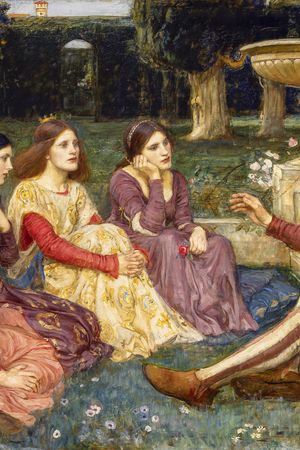
These seven women, drawn together not by any plan but by chance in one part of the church, sat down almost in a circle. After many sighs, they left off saying their paternosters and began talking among themselves about many and various things concerning the times. After a while, when the others had fallen silent, Pampinea began to speak:
"My dear ladies, you've surely heard, as I have, many times, that anyone who honestly exercises his rights does no one any wrong. It's the natural right of everyone born into this world to help, preserve, and defend his own life as best he can, and this is granted so far that men have sometimes killed others to protect it, without any blame. If even the laws, whose concern is the well-being of every mortal, allow this much, then how much more must it be lawful for us, or for any decent person, to take whatever remedies we can to preserve our lives, without harming a soul?
"Every time I think about the way we've behaved this morning, and many mornings before it, and about the kinds of conversations we've been having, I can tell, and you can tell just as well, that every one of us is afraid for herself. I don't wonder at that in the least; what does astonish me is that, though each of us has a woman's good sense, we're doing nothing at all to find a remedy for what each of us rightly fears.
"We sit here, it seems to me, as if we wanted or were obliged to bear witness to how many corpses are brought in for burial, or to listen for whether the friars here, whose numbers have dwindled almost to nothing, are still chanting their offices at the proper hours, or to display to anyone who happens by, in our clothes, the kind and the size of our miseries. And if we step outside the church, either we see dead bodies or sick people being carried about, or we see people who were once banished from the city for their crimes rampaging through the town in an ugly fury, mocking the law, because they know that those who were supposed to enforce it are dead or sick, or we see the dregs of our city, fattened on our blood and calling themselves 'becchini,' go riding and running about everywhere to spite us, taunting us with our losses in filthy songs.
"All we hear is 'So-and-so is dead' and 'So-and-so is dying.' And if there were anyone left to mourn them, we'd hear weeping everywhere. When we go back to our houses, I don't know if it's the same for you as it is for me, but when I find that out of a large household, no one is left but my maid, I'm terrified and feel every hair on my body stand on end, and wherever I go or stay in the house, I seem to see the shades of the departed, and they frighten me, not with the faces I knew but with some horrible new look that has come over them from I don't know where.
"Because of all this, I feel wretched here, outside, and at home, and all the more so because it seems to me that no one with any means and anywhere to go, as we have, is left in the city except us. And if anyone else has stayed, I've heard and seen more than once that they make no distinction between what's decent and what isn't, so long as their appetite asks for it, and alone or in company, day and night, do whatever gives them the most pleasure. And not just people free of vows: even the nuns shut up in their convents have convinced themselves that what suits other women and isn't forbidden to them is just as fitting for themselves, and so, breaking the rules of obedience and giving themselves over to the pleasures of the flesh, thinking that way to escape, they've become wanton and dissolute.
"If that's how things are, and we can plainly see that it is, then what are we doing here? What are we waiting for? What are we dreaming about? Why are we lazier and slower to look after our own safety than all the rest of the citizens? Do we think we're worth less than every other woman? Or do we imagine our lives are chained to our bodies more tightly than theirs, so that we needn't worry about anything that could harm them? We're wrong, we're deceiving ourselves, it's sheer folly in us if we believe that, and every time we care to remember what kind of young men and women this cruel plague has struck down, we'll see the plainest proof of it.
"And so, to keep ourselves from falling, through squeamishness or carelessness, into a disaster we might perhaps escape if we chose to, I don't know whether you'll think what I think, but it seems to me the best thing we could do is to leave this city, just as we are, as many have done before us and are still doing, and, shunning the shameful example of others as we'd shun death itself, go decently to stay on our country estates, of which each of us has plenty, and take there whatever amusement, gladness, and pleasure we can, without ever crossing the bounds of reason.
"Out there, we can hear the little birds sing. We can see the hills and plains turning green, and the fields of grain rippling like the sea, and a thousand kinds of trees. And we can see the sky more openly, and though heaven is angry with us, it doesn't deny us its eternal beauties, which are far lovelier to look at than the empty walls of our city. The air is much fresher out there, there's more of what we need to live in these times, and fewer things to trouble us: for though the farmhands are dying there just as the citizens are dying here, the grief is that much less, since the houses and the people are fewer and farther between than in the city.
"And if we leave, if I see things rightly, we're not abandoning anyone. We can truthfully say that we are the ones who have been abandoned, since our families, by dying or by fleeing death, have left us alone in this great affliction, as if we were nothing to them. No one, then, can blame us for following this plan, whereas grief and trouble, and perhaps death, may come to us if we don't.
"If you agree, then, I think we'd do well to take our maids, have them follow us with whatever we need, and spend today in this place and tomorrow in that, taking whatever pleasure and merriment the season has to offer, and to keep this up until we see, unless death overtakes us first, what end heaven has in store for these troubles. And let me remind you: it's no more improper for us to go away decently than it is for so many other women to stay behind indecently."
The other ladies listened to Pampinea and not only praised her plan, but were so eager to follow it that they had already begun working out the details among themselves, as though they meant to get up from their seats and set off then and there.
But Filomena, who was exceptionally level-headed, said: "Ladies, though what Pampinea says is very well put, there's no need to rush into it the way you seem to want to. Remember that we're all women, and none of us is so young that she doesn't know how badly women get along when they try to manage things among themselves, and how poorly they order their affairs without a man's guidance. We're changeable, quarrelsome, suspicious, fainthearted, and easily frightened, and for all these reasons I'm very much afraid that if we don't take some guide besides ourselves, this company of ours will fall apart far sooner, and with less honor to us, than it should; so we'd better see to this before we start."
"That's true enough," said Elisa. "Men are the heads of women, and without their ordering, our undertakings rarely come to any praiseworthy end. But how are we to get these men? Every one of us knows that most of our own men are dead, and the ones still alive have gone off in different companies, here and there, we don't know where, fleeing the same thing we're trying to flee. And it wouldn't be proper to invite strangers, so if we're going to look after our safety, we have to find a way to arrange things so that wherever we go for pleasure and rest, no trouble or scandal follows."
While the women were having this discussion, who should walk into the church but three young men, though not so young that the youngest was under twenty-five. Neither the hardship of the times, nor the loss of friends and family, nor even fear for themselves had been able to put out the love in their hearts, or even to cool it.
The first was called Panfilo, the second Filostrato, and the last Dioneo. All three were charming and well-mannered, and in the midst of all this turmoil, they had come looking for their greatest comfort: the sight of the women they loved. As it happened, all three of their ladies were among the seven, and some of the other women were close relatives of one or another of the young men.
The moment the ladies spotted the young men, and the young men the ladies, Pampinea smiled and said: "See how Fortune favors our beginnings: she's put in front of us these sensible and worthy young men, who'll gladly be both our guides and our servants, if we're willing to take them on for the task."
But Neifile, whose whole face had turned crimson with embarrassment, because she was one of the women loved by one of the young men, said: "For God's sake, Pampinea, think about what you're saying! I know perfectly well that nothing but good can be said of any one of them, and I believe they're equal to far greater things than this. I also think they'd be good and honorable company not just for us but for women far more beautiful and precious than we are. But since it's quite plain that some of them are in love with some of us, I'm afraid that if we take them along, scandal and blame may follow, through no fault of ours or theirs."
"That doesn't matter in the least," said Filomena. "As long as I live decently and my conscience doesn't trouble me about anything, let anyone who likes say otherwise. God and the truth will take up arms for me. Now if only they were willing to come! Then we really could say, as Pampinea did, that fortune favors our going."
When the other women heard her speak so firmly, they not only fell silent but all agreed with one accord that the young men should be called over, told what the ladies intended, and asked whether they would be pleased to keep them company on such a journey. Without another word, Pampinea, who was related by blood to one of them, stood up and went over to the three men, who stood still watching the women. She greeted them with a cheerful face, explained the plan, and asked them, on behalf of all the ladies, whether they would be willing to keep them company in a pure and brotherly spirit.
At first the young men thought they were being made fun of. But when they saw that the lady was speaking in earnest, they answered happily that they were ready. Without any delay, before they even left the church, they arranged what had to be done for the departure.
Everything they needed was prepared in good order and sent ahead to where they meant to go. The next morning, a Wednesday, at daybreak, the ladies, with a few of their maids, and the three young men, with three of their servants, left the city and set out on their way.
They had gone no more than two short miles from the city when they arrived at the place they had chosen. It stood on a little hill, somewhat away from our roads on every side, covered with shrubs and plants of every kind, all thick with green leaves and lovely to look at. On the top of the hill stood a palace, with a handsome, spacious courtyard in its center, and galleries and halls and bedrooms, each one beautiful in its own right and adorned with cheerful paintings. Around it lay little lawns and marvelous gardens, wells of the coolest water, and vaults of precious wines, things better suited to connoisseurs of drink than to sober and modest ladies.
When the company arrived, they found, to their no small pleasure, that the whole place had been swept, the beds made up in the bedrooms, and everything filled with whatever flowers the season offered and strewn with rushes.
As soon as they had sat down, Dioneo, who was the most charming young man of them all and full of witty remarks, spoke up: "Ladies, it was your good sense more than our foresight that brought us here. I don't know what you plan to do with your worries, but I left mine inside the city gate when I walked out with you a little while ago. Either get ready, then, to amuse yourselves and laugh and sing with me (as far, I mean, as your dignity allows), or give me leave to go back for my worries and stay in that afflicted city."
Pampinea answered cheerfully, as though she too had driven away all her own cares: "Well said, Dioneo! We should live merrily; it was to escape our sorrows that we fled. But since things without order can't last long, and since it was I who began the conversation that brought this lovely company together, I think, if we want our happiness to continue, we need to have someone at our head, whom we'll honor and obey as our superior, and whose whole thought will be to arrange for us to live merrily.
"And so that each of us may feel the weight of the responsibility along with the pleasure of being in charge, and so that, having tasted both, no one who hasn't had a turn can envy anyone else, I propose that each of us be given the burden and the honor for one day. We'll all choose the first one together. After that, as the hour of vespers draws near, whoever has ruled that day will choose the next, man or woman, as he or she likes. And each ruler, at his discretion, will order and decide where and how we're to live for as long as the reign lasts."
Everyone was delighted with this, and with one voice they chose Pampinea for the first day. Filomena ran quickly to a laurel tree, for she had often heard how much honor its leaves deserved and how much honor they conferred on anyone deservedly crowned with them, and plucked several sprays, from which she made a fine, handsome wreath. Placed on Pampinea's head, it was, for as long as their company lasted, the plain sign to everyone of royal rule and authority.
Once she had been made queen, Pampinea had the three young men's servants and the ladies' maids, who were four, called before her, and commanded everyone to be silent. When all were quiet, she spoke:
"To set you all a first example, by which our company, going on from good to better, may live in good order and pleasure and without reproach for as long as we wish, I first appoint Parmeno, Dioneo's servant, as my steward, and entrust to him the care and management of our whole household, and everything that has to do with the service of the hall. Sirisco, Panfilo's servant, will be our buyer and treasurer, and will follow Parmeno's orders. Tindaro will wait on Filostrato and the other two gentlemen in their rooms whenever the others are kept from it by their own duties.
"My own maid, Misia, and Filomena's Licisca will stay in the kitchen and diligently prepare whatever dishes Parmeno orders. Lauretta's Chimera and Fiammetta's Stratilia will look after the ladies' rooms and keep clean every place where we stay.
"And we wish and command every one of you, if you value our good favor, to take care that wherever you go and wherever you come from, whatever you hear and whatever you see, you bring us no news from outside that isn't cheerful."
When she had briefly given these orders, which everyone praised, Pampinea rose cheerfully to her feet and said: "Here are gardens, here are meadows, here are plenty of other delightful places. Let everyone go and amuse himself as he pleases. And when the bell rings for tierce, in the mid-morning, everyone be back here, so we can eat while it's still cool."
The happy company, dismissed by their new queen, set off at a leisurely pace through a garden, the young men together with the lovely ladies, talking of pleasant things, making themselves lovely garlands of all kinds of leaves, and singing love songs. When they had stayed there as long as the queen had allowed, they returned to the house and found that Parmeno had diligently begun his duties. Entering a ground-floor hall, they saw the tables laid with the whitest cloths and goblets that looked like silver, and everything strewn with yellow broom flowers.
They washed their hands and, as the queen wished, took their seats in the order Parmeno had arranged. Delicately prepared dishes were brought, and the finest wines were ready, and without more ado the three serving-men quietly waited at the tables. Everyone was delighted by how lovely and orderly it all was, and they ate merrily, with plenty of pleasant banter.
When the tables were cleared, since all the ladies knew how to dance, as did the young men, and some of them could play and sing very well, the queen called for the instruments. At her command, Dioneo took up a lute and Fiammetta a viol, and they began to play a soft dance tune. The queen and the other ladies, with the two other young men, sent the servants off to eat, formed a ring, and began to dance with slow steps; and when the dance was done, they began to sing pretty, merry songs.
They carried on like this until the queen decided it was time to go to sleep. She dismissed them all, and the three young men went off to their rooms, which were apart from the ladies' quarters, and found the beds neatly made and the rooms as full of flowers as the hall had been. The ladies found theirs the same, and they undressed and went to rest.
The bell for nones, in the afternoon, had not long rung when the queen got up and roused all the other ladies and the young men as well, declaring that too much sleep in the daytime was harmful. They went to a little meadow where the grass grew tall and green and the sun could not reach from any side. There, feeling a gentle breeze, they all sat down in a circle on the green grass, as their queen wished. And she spoke to them like this:
"As you can see, the sun is high and the heat is fierce, and there's no sound but the cicadas in the olive trees, so it would be foolish to go anywhere right now. This spot is cool and pleasant, and as you can see, there are game boards and chessboards, and everyone can amuse himself as he likes. But if you'll take my advice, we won't spend this hot part of the day playing games, which can't help but upset one of the players without giving much pleasure to the other or to the people watching. Instead, let's tell stories, where one person telling can delight the whole company listening. By the time each of us has told a little story, the sun will be going down, the heat will have broken, and we can go and amuse ourselves wherever we like. If this idea appeals to you (and I'm ready to go along with whatever you prefer), let's do it. And if it doesn't appeal to you, let everyone do as he pleases until the hour of vespers."
The ladies and the men alike all praised storytelling.
"Then," said the queen, "since you like the idea, I want everyone on this first day to be free to tell a story on whatever subject pleases him most."
She turned to Panfilo, who was sitting on her right, and pleasantly asked him to begin with one of his stories. Hearing her command, Panfilo promptly began, while everyone listened.
Day 1, Story 1
Ser Cepparello deceives a holy friar with a false confession and dies; and though in life he was the worst of men, after his death he is reputed a saint and called Saint Ciappelletto.
"It is only right, dearest ladies, that whatever a man does, he should begin with the holy and wonderful name of Him who made all things; and so, since I am the first to tell a story, I intend to start with one of His marvels, so that when you've heard it, our hope may rest firmly on Him as on the one thing that never changes, and His name be praised by us forever.
It's clear enough that everything in this world is fleeting and mortal, and that all of it, inside and out, is full of trouble, anguish, and toil, and exposed to dangers without end. We who live tangled up in it, and who are in fact part and parcel of it, could never endure it or protect ourselves unless God's special grace gave us strength and foresight. Nor should we think that this grace comes down to us because of any merit of our own: it is moved by His own goodness and won for us by the prayers of those who were once mortal like us, and who, having followed His will faithfully in their lives, now dwell with Him in eternal blessedness. To these we bring our prayers for the things we think we need, as to advocates who know our frailty from their own experience, perhaps because we don't dare lay our prayers before so great a Judge ourselves.
And we can see God's compassionate generosity toward us in something more wonderful still: since no mortal eye can pierce the secrets of the divine mind, it sometimes happens that we are fooled by false opinion into choosing as our advocate before Him someone He has cast out of His presence in eternal exile. And yet God, from whom nothing is hidden, pays more attention to the sincerity of the one who prays than to his ignorance or to the exile of the one he prays to, and He answers those prayers just as if that advocate stood blessed in His sight.
All of which will become perfectly clear from the story I'm about to tell you: clear, I mean, by the judgment of men, not of God.
The story goes that Musciatto Franzesi, who had risen from being a very rich and important merchant in France to the rank of knight, was obliged to travel to Tuscany with Messer Charles Lackland, brother of the King of France, whom Pope Boniface had summoned and urged to come. Musciatto found his affairs tangled up in a hundred directions, the way merchants' affairs usually are, and he couldn't sort them out quickly or easily. He decided to hand them over to various agents and found someone for everything, except for one problem: he couldn't think whom to leave behind who was fit to collect the debts owed him by a number of Burgundians.
The reason for his doubt was that he knew the Burgundians to be quarrelsome, ill-natured, faithless people, and he couldn't think of a single man wicked enough to match their wickedness whom he could also trust. After mulling it over for a long time, he remembered a certain Ser Cepparello of Prato, who often stayed at his house in Paris. This fellow was small and very dapper, and the French, not knowing what "Cepparello" meant and thinking it must be "cappello," which in their language means a chaplet or little garland, called him, since he was so small, not Ciappello but Ciappelletto. As Ciappelletto he was known everywhere, while hardly anyone knew him as Ser Cepparello.
Now, this Ciappelletto led the following sort of life. He was a notary, and he considered it a terrible disgrace if any of his legal documents, few as he drew up, was found to be anything other than false. He would have drawn up as many false ones as anyone asked for, and done it for nothing more willingly than another man would for a handsome fee. He gave false testimony with the greatest delight, whether asked or not. And since oaths were trusted absolutely in France in those days, and he had no qualms at all about swearing falsely, he wickedly won every lawsuit in which he was called to swear on his faith to tell the truth.
He took enormous pleasure, and went to great lengths, in stirring up trouble, hatred, and scandal between friends, between relatives, between anyone at all, and the worse the harm that followed, the happier he was. If you invited him to a murder or any other crime, he never once said no, and went along eagerly; and more than once he was glad to find himself wounding and killing men with his own hands.
He was a tremendous blasphemer of God and the saints, and over the smallest trifle, since he had the worst temper of any man alive. He never set foot in a church and mocked all its sacraments in disgusting terms as worthless things. Taverns and other disreputable places, on the other hand, he visited gladly and often.
As for women, he was about as fond of them as dogs are of a beating with a stick. But when it came to the opposite, well, he enjoyed that more than any degenerate who ever lived.
He would steal and rob with as clear a conscience as a holy man making an offering. He was a tremendous glutton and a heavy drinker, sometimes to the point of being disgustingly ill, and on top of everything else a notorious gambler with loaded dice.
But why go on at such length? He was quite possibly the worst man ever born. For years his wickedness had been shielded by the power and position of Messer Musciatto, on whose account he was often spared, both by the private people he so frequently wronged and by the court, which he wronged all the time.
When this Ser Cepparello came to Musciatto's mind, Musciatto, who knew perfectly well what kind of life he led, decided he was exactly the man the wickedness of the Burgundians called for. He sent for him and spoke to him like this:
"Ser Ciappelletto, as you know, I'm about to withdraw from here altogether. Among the people I have business with are the Burgundians, men full of tricks, and I can't think of anyone better suited than you to collect what they owe me. And since you're not doing anything at the moment, if you'll take this on, I'll get you the favor of the court and give you a fair share of whatever you recover."
Ser Ciappelletto, who was out of work and short of worldly goods, and who saw the man who had long been his prop and shield about to leave, didn't hesitate a moment and, driven by something close to necessity, said he'd gladly do it.
Once they'd come to an agreement and Musciatto had left, Ser Ciappelletto took the power of attorney and the king's letters of favor and went off to Burgundy, where almost no one knew him. There, quite against his nature, he began to collect the debts and do what he had come for in the mildest and kindliest manner, as if he were saving his temper for the end.
While he was going about it this way, he lodged in the house of two Florentine brothers who lent money at interest there and who treated him with great honor for Messer Musciatto's sake. And there he fell ill.
The two brothers promptly brought in doctors and servants to tend him and provided everything that might help him recover. But none of it did any good, for the good man was already old and had lived a disorderly life, and, as the doctors said, he went from bad to worse every day, like a man with a fatal illness.
This worried the two brothers enormously. One day, close by the room where Ser Ciappelletto lay sick, they began talking it over between themselves.
"What are we going to do about this man?" said one to the other. "We've got a terrible problem on our hands: if we throw him out of our house this sick, it would bring us great blame and show we have no sense at all. People would see that first we took him in, then had him nursed and doctored with such care, and now, when he's dying and couldn't possibly have done anything to offend us, we suddenly toss him out into the street.
"On the other hand, he's been such a wicked man that he'll never agree to confess or receive any sacrament of the Church. And if he dies without confession, no church will take his body, and he'll be thrown in a ditch like a dog. And even if he does confess, his sins are so many and so horrible that it will come to the same thing, because there won't be a friar or priest who will or can absolve him. Unabsolved, then, he'll end up in the ditch all the same.
"And if that happens, the people of this town, who hate our trade because they think it the most wicked in the world, and speak ill of it all day long, and would love to rob us, will see it and rise in a riot. They'll be shouting, 'These Lombard dogs that the Church won't take, why should we put up with them any longer?' They'll come running to our houses, and they may not stop at stealing our goods; they may take our lives as well. Either way, if this man dies, we're in trouble."
Now Ser Ciappelletto, who, as we said, was lying near the spot where they were talking, had the sharp hearing that sick people so often have, and he heard what they said about him. He called them in and said to them:
"I don't want you to worry about me in the least, or to be afraid you'll come to any harm on my account. I heard what you said about me, and I'm quite sure things would go exactly as you say if matters took the course you expect. But it's going to go differently.
"I've done the Lord God so many wrongs in my lifetime that doing Him one more at the point of death will make no difference either way. Find me the holiest and most able friar you can get, if there is such a man here, and leave the rest to me. I promise you I'll arrange your affairs and mine so that everything will be fine and you'll be well satisfied."
The two brothers didn't have much hope of this, but they went off to a house of friars and asked for some holy and learned man to hear the confession of a Lombard who was sick in their house. They were given an aged friar of holy and upright life, a great master of Scripture and a most venerable man, for whom all the townspeople had a very great and special devotion. They brought him home.
When the friar came to the room where Ser Ciappelletto lay and sat down beside him, he began by gently comforting him. Then he asked how long it had been since he had last confessed.
Ser Ciappelletto, who had never confessed in his life, replied, "Father, my habit is to confess at least once a week, and there are plenty of weeks when I confess more often. But it's true that since I fell ill, about eight days ago, I haven't confessed at all, the sickness has been so hard on me."
"My son," said the friar, "you've done well, and you should keep it up. And I can see that since you confess so often, I'll have little trouble listening or asking."
"Oh, Father, don't say that," answered Ser Ciappelletto. "I've never confessed so many times or so often that I didn't want to make a general confession of every sin I could remember from the day I was born to the day of that confession. I beg you, then, good Father, question me about everything, point by point, as if I'd never confessed before. Don't spare me because I'm sick. I'd far rather displease this flesh of mine than pamper it and do something that might be the ruin of my soul, which my Savior redeemed with His precious blood."
These words greatly pleased the holy man and seemed to him a sign of a well-disposed mind. After warmly commending Ser Ciappelletto for this habit, he began by asking whether he had ever sinned in lust with any woman.
"Father," Ser Ciappelletto replied with a sigh, "on this point I'm ashamed to tell you the truth, for fear of sinning by vainglory."
"Speak freely," said the holy friar. "No one ever sinned by telling the truth, in confession or anywhere else."
"Well then," said Ser Ciappelletto, "since you assure me of that, I'll tell you. I am as much a virgin as the day I came out of my mother's womb."
"Oh, God bless you!" cried the friar. "How well you have done! And the merit is all the greater because, if you'd wanted to, you had far more freedom to do otherwise than we have, or anyone else bound by a religious rule."
After this he asked whether he had offended God by the sin of gluttony.
Ser Ciappelletto heaved a sigh and said yes, many times. Besides the Lenten fasts that devout people keep every year, he explained, he was in the habit of fasting on bread and water at least three days every week, and he had drunk the water with all the pleasure and appetite of a great drinker drinking wine, especially when he had worn himself out with praying or going on pilgrimage. And many times he had longed for the little salads of greens that women make when they go out to the country, and sometimes eating had seemed better to him than he thought it ought to seem to a man fasting out of devotion, as he was.
"My son," said the friar, "these sins are natural and very slight, and I don't want you to burden your conscience with them more than you need to. It happens to every man, however holy, that food tastes good after a long fast, and drink after hard work."
"Oh, Father," said Ser Ciappelletto, "don't tell me that just to comfort me. You know very well that I know that things done in God's service must all be done purely, without the least rust on the soul, and anyone who does otherwise sins."
The friar, delighted, said, "I'm glad you take it to heart that way, and your pure and good conscience pleases me very much. But tell me, have you sinned by avarice, desiring more than was proper, or keeping what you ought not to have kept?"
"Father," replied Ser Ciappelletto, "I wouldn't want you to think ill of me because I'm in the house of these usurers. I have nothing to do with their business. In fact I came here to warn them and rebuke them and turn them from this abominable trade, and I believe I would have managed it if God hadn't visited me like this.
"But you should know that my father left me a rich man, and when he died I gave the greater part of his wealth to God. Since then, to support myself and to be able to help Christ's poor, I've done a little trading, and in it I have wanted to make a profit. But whatever I've earned I've always split down the middle with God's poor, keeping my half for my own needs and giving them the other. And my Creator has helped me so well in this that my affairs have gone from good to better."
"You did well," said the friar. "But tell me, have you often been angry?"
"Oh!" cried Ser Ciappelletto. "That, I must tell you, I've done very often. And who could help it, seeing men do disgusting things all day long, ignoring God's commandments, with no fear of His judgments? There have been many days when I'd rather have been dead than alive, watching young men chase after vanities, hearing them swear and forswear themselves, haunt the taverns, never visit the churches, and follow the ways of the world instead of the way of God."
"My son," said the friar, "that is a righteous anger, and for my part I couldn't give you any penance for it. But has your anger ever led you to commit murder, or to insult anyone, or to do any other wrong?"
"Oh, dear me, sir!" exclaimed Ser Ciappelletto. "You seem to me a man of God; how can you say such things? If I'd had so much as a passing little thought of doing any of the things you mention, do you think I believe God would have borne with me so long? Those are the doings of cutthroats and criminals, and whenever I've seen one of them, I've always said, 'Go your way, and may God convert you.'"
"Now tell me, my son, and God bless you," the friar continued, "have you ever borne false witness against anyone, or spoken ill of others, or taken other people's things without the owner's leave?"
"Why yes, sir," replied Ser Ciappelletto, "I have spoken ill of others. I once had a neighbor who, with no reason in the world, did nothing but beat his wife, and once I spoke ill of him to her relatives, I felt so sorry for the poor creature. Every time he'd had too much to drink, he'd beat her black and blue, God only knows how."
"Well, now," said the friar, "you tell me you've been a merchant. Have you ever cheated anyone, the way merchants do?"
"Goodness, yes, sir," answered Ser Ciappelletto. "But I don't know who it was. A man once brought me money he owed for cloth I'd sold him, and I put it in a chest of mine without counting it. A good month later I found it was four pennies more than it should have been. I never saw the man again, and after keeping the money a whole year to give it back to him, I gave it away for the love of God."
"That was a small matter," said the friar, "and you did well to do what you did with it."
The holy friar then asked him about many other things, and he answered every one in the same fashion. And when the friar was about to go on to the absolution, Ser Ciappelletto said, "Sir, there's still a sin I haven't told you."
The friar asked what it was.
"I remember," said Ser Ciappelletto, "that one Saturday after nones, in the afternoon, I had my servant sweep the house, and I didn't show the holy Sunday the reverence I should have."
"Oh, my son," said the friar, "that's a slight thing."
"No," said Ser Ciappelletto, "don't call it a slight thing. Sunday can never be honored enough, since it was on that day that our Lord rose from death to life."
"Well," said the friar, "have you done anything else?"
"Yes, sir," said Ser Ciappelletto. "Once, without thinking, I spat in God's church."
The friar began to smile and said, "My son, that's nothing to worry about. We who are in holy orders spit in it all day long."
"And you are very wrong to do it," said Ser Ciappelletto, "because nothing ought to be kept as clean as the holy temple in which sacrifice is offered to God."
In short, he told him a great many things of this kind. And at last he began to sigh, and then to weep bitterly, which he knew very well how to do whenever he liked.
"My son," said the holy friar, "what's the matter?"
"Oh, sir," answered Ser Ciappelletto, "there's one sin left that I've never confessed, I'm so ashamed to tell it. Every time I remember it, I weep as you see me weeping now, and I feel quite certain that God will never have mercy on me for this sin."
"Come now, my son, what are you saying?" said the holy friar. "If all the sins that all men ever committed, or ever will commit as long as the world lasts, were in one single man, and he repented of them and was as contrite as I see you are, God's goodness and mercy are so great that if he confessed them, He would freely forgive him. Tell it, then, without fear."
"Oh, Father," said Ser Ciappelletto, still weeping bitterly, "mine is too great a sin, and I can hardly believe God will ever forgive me for it unless your prayers help."
"Tell it without fear," said the friar, "for I promise you I'll pray to God for you."
Still Ser Ciappelletto wept and would not say it, and still the friar urged him to speak. And when he had kept the friar hanging on his tears for a good long while, he heaved a great sigh and said, "Father, since you promise to pray to God for me, I'll tell you. Know, then, that when I was a little boy, I once cursed my mother." And with that he burst out weeping again.
"Oh, my son," said the friar, "does that seem such a great sin to you? Why, men curse God all day long, and He gladly forgives anyone who repents of it. Don't you believe He'll forgive you this? Don't weep; take comfort. Truly, if you had been one of those who nailed Him to the cross, He would forgive you, seeing the contrition I see in you."
"Oh, Father, what are you saying?" cried Ser Ciappelletto. "My sweet mother, who carried me in her body nine months, day and night, and carried me in her arms more than a hundred times! It was too wicked of me to curse her, and it is too great a sin. And unless you pray to God for me, it will never be forgiven."
The friar, seeing that Ser Ciappelletto had nothing more to say, gave him absolution and his blessing, holding him for a most holy man, since he fully believed that everything Ser Ciappelletto had said was true. And who wouldn't have believed it, hearing a man say such things at the point of death?
After all this, he said to him, "Ser Ciappelletto, with God's help you'll soon be well. But if it should happen that God calls your blessed and well-prepared soul to Himself, would you like your body to be buried in our house?"
"Yes, sir," replied Ser Ciappelletto. "In fact I wouldn't want to be anywhere else, since you've promised to pray to God for me. Besides, I've always had a special devotion to your order. And so I beg you, when you get back to your house, have that most true Body of Christ that you consecrate on the altar every morning brought to me. Unworthy as I am, I mean to receive it with your leave, and after it the holy last anointing, so that if I've lived as a sinner, at least I may die as a Christian."
The holy man said that it pleased him greatly and that he spoke well, and that he would have it brought at once. And so it was.
Meanwhile the two brothers, who were very much afraid that Ser Ciappelletto would trick them, had planted themselves by a wooden partition that divided the room where he lay from the next, and listening there they could easily hear and follow everything he said to the friar. At times, hearing the things he confessed to having done, they wanted to laugh so badly they nearly burst, and now and then they said to each other:
"What kind of man is this? Not old age, not sickness, not the fear of the death he sees so close, not even the fear of God, before whose judgment he expects to stand within the hour, none of it has been able to turn him from his wickedness or keep him from wanting to die just as he lived!"
Still, since he had said enough to be received for burial in a church, they didn't care about the rest.
Shortly afterward Ser Ciappelletto took communion, and growing rapidly worse, received the last anointing; and a little after vespers, on the very day he had made his fine confession, he died.
The two brothers, using his own money, arranged for him to be buried with honor. They sent word to the friars' house, asking them to come that evening to keep the customary vigil and in the morning to fetch the body, and they made all the necessary preparations.
The holy friar who had heard his confession, learning that he had died, went to the prior of the house and had the bell rung for chapter. When the friars were assembled, he showed them that Ser Ciappelletto had been a holy man, as he had gathered from his confession, and since he hoped God would work many miracles through him, he persuaded them to receive the body with the greatest reverence and devotion. The prior and the other friars, credulous as they were, agreed.
That evening they all went to where Ser Ciappelletto's body lay and held a great and solemn vigil over it. The next morning, all dressed in albs and copes, with books in their hands and crosses carried before them, they went chanting to fetch the body and bore it to their church with the greatest pomp and ceremony, followed by almost the whole population of the city, men and women alike.
Once the body had been set down in the church, the holy friar who had confessed him climbed into the pulpit and began to preach marvels about him and his life: his fasts, his virginity, his simplicity, his innocence and holiness. Among other things, he told what Ser Ciappelletto had confessed in tears as his greatest sin, and how he had barely been able to get it into his head that God would forgive him.
From there he turned to scold the people listening. "And you, God curse you," he said, "for every wisp of straw that catches between your feet, you blaspheme God and His Mother and the whole court of Paradise!" He said many other things besides about the dead man's honesty and purity.
In short, with his words, which the people of the place believed entirely, he planted the man so deeply in the minds and devotion of everyone there that the moment the service was over, they all crowded forward in the greatest crush in the world to kiss his hands and feet. They tore all the clothes off his body, each counting himself blessed to carry off even a scrap of them. And he had to be left lying there all day long so that everyone could see him and visit him.
The following night he was buried with honor in a marble tomb in one of the chapels, and from the very next day people began coming to light candles and to pray to him, and then to make vows and hang up wax images as they had promised. The fame of his holiness, and their devotion to him, grew so great that there was hardly anyone in trouble who would make a vow to any saint but him. They called him, and still call him, Saint Ciappelletto, and they swear that God has worked many miracles through him and works them still every day for anyone who devoutly commends himself to him.
Thus lived and died Ser Cepparello of Prato, and became a saint, as you have heard. I won't deny that he may be among the blessed in God's presence, for wicked and depraved as his life was, he may have felt such contrition at the very end that God took pity on him and received him into His kingdom. But since that is hidden from us, I speak by what we can see, and on that basis I say he is more likely in the hands of the devil in perdition than in Paradise.
And if that is so, we can see how very great God's kindness is toward us. It looks not at our mistake but at the purity of our faith, and when we make one of His enemies our go-between, believing him His friend, God hears us just as if we had turned to a truly holy man to plead for His grace.
And so, that by His grace we may be kept safe and sound in the present troubles and in this happy company, let us praise His name, in which we have begun, and hold Him in reverence, and commend ourselves to Him in our needs, quite certain of being heard."
And there he fell silent.
Day 1, Story 2
Abraham the Jew, urged on by Jehannot de Chevigny, goes to the court of Rome; and having seen the wickedness of the clergy, he returns to Paris and becomes a Christian.
Panfilo's story had made the ladies laugh in places and won their praise throughout. When they had listened to it attentively to the end, the queen commanded Neifile, who was sitting beside him, to tell one of her own and so keep to the order of the entertainment they had begun. Neifile, as gracious in manner as she was beautiful, answered cheerfully that she would gladly do so, and began like this:
"Panfilo has shown us in his story that God's goodness does not look at our errors when they come from what we cannot see; in mine, I mean to show you how that same goodness, patiently bearing the failings of those who ought to bear true witness to it in word and deed and who do the very opposite, gives us from those failings a proof of its infallible truth, so that we may follow what we believe with a firmer heart.
As I once heard tell, gracious ladies, there was in Paris a great merchant and a good man named Jehannot de Chevigny, a man of great honesty and integrity who did a large trade in cloth. He had a close friendship with a very rich Jew named Abraham, also a merchant, and also a thoroughly upright and trustworthy man. Jehannot could see how upright and honest Abraham was, and it began to trouble him deeply that the soul of such a worthy, wise, and good man should go to perdition for want of the true faith. And so he began, in a friendly way, urging Abraham to abandon the errors of the Jewish faith and turn to the truth of Christianity, which, as Abraham could see for himself, being holy and good, was always prospering and growing, while his own, on the contrary, was plainly dwindling and coming to nothing.
Abraham replied that as far as he was concerned, no faith was holy or good except the Jewish one. He'd been born into it, he intended to live and die in it, and nothing would ever change his mind.
But that didn't stop Jehannot: a few days later he was at it again, laying out, in the rough-and-ready way most merchants argue, all the reasons why our faith was better than the Jewish one. And although Abraham was a great master of the Jewish law, whether it was his deep affection for Jehannot that moved him or perhaps words that the Holy Spirit was putting on this unlearned man's tongue, he began to be greatly taken with his friend's arguments; still, he clung stubbornly to his own beliefs and wouldn't let himself be turned.
But however stubbornly he held out, Jehannot never once let up, until finally, worn down by such relentless persistence, Abraham said: "All right, Jehannot. You want me to become a Christian, and I'm ready to do it, on one condition. First I want to go to Rome and see this man you say is God's Vicar on Earth, and observe his ways and his conduct, and those of his brothers the cardinals too. If they seem to me such that, between your words and their example, I can see that your faith is better than mine, as you've done your best to show me, then I'll do what I've told you. But if not, I'll stay a Jew, just as I am."
When Jehannot heard this, his heart sank. "I've wasted all the effort I thought I'd spent so well," he said to himself, "believing I'd converted him. Because if he goes to the court of Rome and sees the wicked, filthy lives the clergy lead, not only will he never turn from a Jew into a Christian, but if he'd already become a Christian, he'd turn Jew again without fail."
Turning to Abraham, he said: "Come now, my friend, why put yourself through all the trouble and expense of going from here to Rome? Not to mention that for a rich man like you, the whole way is full of dangers, by sea and by land. Don't you think you can find someone here to baptize you? And if you have any doubts about the faith I've shown you, where will you find greater masters and wiser men in it than right here, people who can explain whatever you want or ask? For all these reasons, this trip of yours seems quite unnecessary to me. Believe me, the prelates there are just like the ones you've been able to see here, only more so, and all the better for being closer to the Chief Shepherd. Take my advice and save this trouble for some other time, for a pilgrimage to earn a pardon, and maybe I'll come along with you."
Abraham replied: "I'm sure it's just as you say, Jehannot. But to put it in a word: if you want me to do what you've been begging me to do all this time, I'm going to Rome. Otherwise, I'll never do it at all."
Jehannot saw there was no changing his mind, so he said, "Well then, go, and good luck to you." But privately he was certain that once Abraham had seen the court of Rome, he would never become a Christian. Still, since he stood to lose nothing by it, he let it be.
Abraham mounted his horse and rode to the court of Rome as quickly as he could. When he arrived, his fellow Jews received him with great honor. He stayed there without telling anyone why he had come and began, cautiously, to observe the ways of the Pope, the cardinals, the other prelates, and all the courtiers.
And what he found, partly from noticing things for himself, being a very sharp man, and partly from what others told him, was that from the highest to the lowest, all of them alike sinned most shamelessly in lust, and not only in the natural kind but in sodomy too, without the slightest check of remorse or shame, so much so that the power of harlots and boys counted for no little when it came to getting any great favor.
On top of that, he could plainly see they were all gluttons, tipplers, and drunkards, and, after lust, served their bellies more than anything else, like brute beasts. Looking further, he found them all so greedy and grasping for money that they bought and sold human blood, Christian blood at that, just as readily as they sold sacred things of every kind, whether belonging to the sacraments or to church benefices. They did more trade in these things, and kept more brokers for it, than Paris had for cloth or anything else. They had given open simony the name of "procurement," and their gluttony the name of "sustenance," as if God, never mind the meaning of the words, could not see the intent of their wicked minds, and could be fooled by the names of things the way people are.
All of this, along with much else best left unsaid, thoroughly disgusted Abraham, who was a sober and modest man. Feeling he had seen enough, he decided to go back to Paris, and so he did.
As soon as Jehannot heard his friend had returned, he went to see him, though nothing seemed less likely to him than that Abraham would become a Christian, and the two of them gave each other a joyful welcome. After Abraham had rested for a few days, Jehannot asked him what he thought of the Holy Father, the cardinals, and the rest of the courtiers.
Abraham answered at once: "I think ill of them, and may God serve every last one of them as ill. I'll tell you this: as far as I could judge, I didn't see a shred of holiness, devotion, good works, or decent example of life or anything else in a single one of the clergy. What I saw instead was lust, greed, and gluttony, fraud, envy, and pride, and things like them and worse, if anything can be worse, held in such favor by them all that the place struck me as a forge of devilish works, not of divine ones. As far as I can tell, your Shepherd, and so all the rest of them, are working with every care, every ounce of ingenuity, and every art they have to bring the Christian religion to nothing and drive it from the world, when they ought to be its foundation and support.
"And since I see that what they're working for doesn't happen, and that your religion keeps growing and shines brighter and clearer all the time, I believe I can rightly see that the Holy Spirit is its foundation and support, as of the religion truer and holier than any other. And so, whereas before I stood stiff and hard against your urging and wouldn't become a Christian, now I'm telling you plainly: nothing in the world could stop me from becoming one. Let's go to church, then, and have me baptized according to the proper rites of your holy faith."
Jehannot, who had been expecting exactly the opposite conclusion, was the happiest man who ever lived when he heard this. He went with Abraham to Notre-Dame in Paris and asked the clergy there to baptize him. When they heard that Abraham himself was asking for it, they did so at once. Jehannot lifted him from the sacred font and gave him the name Giovanni, and afterward had him thoroughly instructed in our faith by men of great learning. Abraham learned it quickly, and was ever after a good and worthy man, and of holy life."
Day 1, Story 3
Melchizedek the Jew escapes a dangerous trap set by Saladin by telling him the parable of the three rings.
When Neifile finished her story and everyone had praised it, Filomena spoke up next, at the queen's invitation:
"The story Neifile just told reminds me of a dangerous situation that once befell a Jew; and since we've already spoken so well about God and the truth of our faith, no one should object if we now come down to the doings and fortunes of men. And so I'll tell you this story, and once you've heard it, perhaps you'll be more careful about how you answer tricky questions.
"You should know, loving companions, that just as foolishness often drags people from happiness down into total misery, good sense can rescue a wise person from the worst dangers and set him down in great and secure peace. That foolishness leads to ruin we can see from any number of examples, and there's no need to go into them now, since a thousand turn up plainly every single day. But that good sense brings comfort, as I said, I'll show you briefly with a little story.
Saladin was a man of such ability that it not only raised him from humble origins to be Sultan of Babylon (that is, Cairo) but won him countless victories over both Saracen and Christian kings. Having spent his entire treasury on his many wars and his extraordinary magnificence, he found himself, when something unexpected came up, in need of a large sum of money and with no way to raise it as quickly as he needed it; and then he remembered a wealthy Jew named Melchizedek, who lent money at interest in Alexandria. This man, he thought, certainly had the means to help him if he were willing, but he was so tight-fisted that he would never part with his money of his own free will, and Saladin didn't want to take it by force. And since necessity was pressing him, he set his whole mind to finding a way to make the Jew serve him, and hit on the idea of forcing him with some pretext that had at least the color of reason.
He summoned Melchizedek and received him warmly, inviting him to sit beside him. Then he said: "My good man, I've heard from many people that you are very wise and deeply learned in the things of God. Tell me, then: which of the three laws do you consider the true one, the Jewish, the Saracen, or the Christian?"
Now, Melchizedek really was a wise man, and he saw all too clearly that Saladin was trying to trap him with his own words in order to pick a quarrel with him, and that if he praised any one of the three faiths above the others, the Sultan would have exactly what he was after. Needing an answer that couldn't catch him, he sharpened his wits, and the right words came to him quickly.
"My lord," he said, "the question you've asked is a fine one. But to tell you what I think, I need to tell you a little story.
"If I'm not mistaken, I remember hearing many times about a great and wealthy man who possessed, among the most precious jewels in his treasury, a ring of extraordinary beauty and value. Wanting to honor this ring for its worth and its beauty and keep it in his family forever, he declared that whichever of his sons was found with it, as left to him by his father, should be recognized as his heir and honored and revered by all the others as the head of the family.
"The son who received that ring laid down the same rule for his own children, and did exactly as his father had done. In short, the ring passed from hand to hand through many generations until it came to a man who had three sons, all of them handsome, virtuous young men, and all very obedient to their father, and so he loved all three the same. The young men each knew the custom of the ring, and each one, wanting to be the most honored of his family, privately begged his father, who was already old, to leave the ring to him when the time came to die.
"The good man loved them all equally and couldn't decide himself which of them should have it, and since he had promised the ring to each of them, he wanted to find a way to satisfy all three. And so he secretly had a fine craftsman make two more rings, so like the original that even he, who had ordered them, could barely tell which was the real one.
"When he was on his deathbed, he privately gave each son a ring. After his death, each one claimed the inheritance and the position of honor and denied it to the others, and each produced his ring as proof of his right; but the three rings were found to be so perfectly alike that no one could tell which was the original. And so the question of who was the father's true heir was left hanging, and it hangs there still.
"And that, my lord, is what I say about the three laws given by God the Father to three peoples, which is the subject of your question. Each people believes it holds the true inheritance, the true law and the true commandments, and keeps them; but as to which one actually does, just as with the rings, that question still hangs."
Saladin recognized that the Jew had slipped very neatly out of the snare he had laid at his feet. And so he decided to tell Melchizedek plainly what he needed and see whether he would be willing to help him. He did, and he admitted frankly what he had meant to do if Melchizedek hadn't answered him so shrewdly.
Melchizedek freely lent him every sum he asked for. Saladin later repaid him in full, and on top of that gave him magnificent gifts, kept him as a friend for the rest of his life, and maintained him at his court in great and honorable state."
Day 1, Story 4
A monk falls into a sin that deserves severe punishment, and escapes it by politely reproaching his abbot with the very same offense.
When Filomena had finished her story and fallen silent, Dioneo, who was sitting next to her and knew by the established order that it was his turn, didn't wait for any further instructions from the queen but began like this:
"Loving ladies, if I've understood everyone correctly, we're here to entertain ourselves with stories, and so, as long as we don't go against that, I think each of us should be free to tell whatever story we think will be the most fun, as our queen herself told us a little while ago. Now, since we've heard how Abraham saved his soul through Jehannot's good advice, and how Melchizedek used his wits to protect his wealth from Saladin's schemes, I'll expect no scolding from you if I briefly tell you how cunningly a certain monk saved his body from a very severe punishment.
In Lunigiana, not far from here, there was once a monastery that used to be far richer in holiness and in monks than it is today. Among its members was a young monk whose vigor and freshness couldn't be worn down by fasting or by vigils. One day around noon, while all the other monks were sleeping, he happened to be walking alone around his church, which stood in a very isolated spot. There he caught sight of a very attractive young woman, probably some farmer's daughter from the area, gathering herbs in the fields. The instant he laid eyes on her, he was fiercely seized by lust.
He went over and struck up a conversation. One thing led to another, and before long they'd reached a very agreeable understanding. He brought her back to his cell without anyone noticing. But while he was frolicking with her, carried away by too much eagerness and less careful than he should have been, the abbot happened to get up from his nap. Passing quietly by the monk's cell, he heard the racket the pair were making inside. He crept up to the door to make out the voices better, and realized beyond any doubt that there was a woman in there. His first impulse was to order the door opened, but then he thought better of it, deciding to handle the matter differently. He went back to his own room and waited for the monk to come out.
The monk, as wrapped up as he was in his pleasure and delight with the girl, was still on his guard. When he thought he heard a shuffle of feet in the dormitory, he put his eye to a little chink and saw, plain as day, the abbot standing there listening. He understood perfectly well that the abbot must know there was a woman in his cell, and since he knew severe punishment would follow, he was terribly upset. But without letting any of his distress show to the girl, his mind raced through one possibility after another, searching for something that might save him. Then he hit on a new piece of cunning that would get him exactly where he meant to go.
Pretending he felt he'd been with the girl long enough, he said to her: "I'm going to find a way to get you out of here without your being seen. Stay here quietly until I come back."
He stepped out, locked the cell door behind him, and went straight to the abbot's chamber. There he handed over his key, as every monk did when he went outside, and said with an easy face: "Sir, I wasn't able to have all the firewood I'd had cut brought in this morning. With your permission, I'd like to go out to the woods now and bring back the rest."
The abbot, who believed the monk had no idea he'd been seen, was delighted at this stroke of luck, a chance to find out more about the offense. He gladly took the key, granted permission, and watched the monk leave. Then he began to consider his options. Should he open the cell in front of all the other monks and let them see the fault, so that later they'd have no grounds to grumble against him when he punished the offender? Or should he first hear from the girl herself how the whole thing had happened?
It occurred to him that she might be the wife or daughter of someone whom he wouldn't want to have shamed by putting her on show before all the monks. He decided to see who she was first and then make up his mind. He went quietly to the cell, opened it, stepped inside, and shut the door behind him.
When the girl saw the abbot walk in, she was terrified and began to cry, afraid of being disgraced. But the abbot, getting a good look at her and seeing how pretty and fresh she was, suddenly felt the prick of the flesh, old as he was, every bit as hotly as his young monk had. And he began reasoning with himself:
"Well now, why shouldn't I take a little pleasure when I can? Trouble and grief are always ready for me whenever I want them. This is a beautiful girl, and nobody in the world knows she's here. If I can bring her round to doing what I like, I don't see any reason not to. Who's going to find out? Nobody will ever know, and a sin that's hidden is half forgiven. An opportunity like this might never come again. I say it's only wise to take a good thing when the Lord God sends it your way."
Having completely changed the purpose he'd come with, he went closer to the girl and gently began to comfort her, begging her not to cry. One word led to another, and before long he'd made his desire perfectly clear. The girl, who was made of neither iron nor diamond, bent quite easily to the abbot's pleasure. The abbot embraced her and kissed her again and again, then climbed up onto the monk's little bed. Perhaps out of regard for the heavy weight of his dignity and the tender age of the girl, and fearing that too much gravity might hurt her, he didn't climb onto her chest but set her on his. And in that fashion he sported with her for quite a while.
Meanwhile the monk, who had only pretended to go to the woods and had actually hidden himself in the dormitory, was completely reassured when he saw the abbot go into his cell alone, and felt sure his plan would work; and when he saw the abbot lock himself in, he was certain of it. He crept out of his hiding place and went quietly to a chink through which he both heard and saw everything the abbot did and said.
Eventually the abbot decided he'd spent long enough with the girl. He locked her in the cell and returned to his own room. A little while later, hearing the monk and believing he'd come back from the woods, the abbot decided to come down hard on him and have him locked up, so that he alone could enjoy the prize they'd won. He sent for the monk, gave him a severe tongue-lashing with a black look on his face, and ordered him thrown in prison.
The monk answered without missing a beat: "Sir, I haven't been in the Order of Saint Benedict long enough to have learned every detail of the rule. And until now you hadn't shown me that monks are supposed to mortify themselves under the weight of women, the way they do with fasts and vigils. But now that you've shown me, I promise you, if you'll forgive me this one time, I'll never sin that way again. Instead, I'll always do exactly as I've seen you do."
The abbot, who was a sharp man, understood at once that the monk had not only outwitted him but seen what he had done; and stung by his own guilt, he was ashamed to inflict on the monk a punishment he deserved every bit as much himself. And so he pardoned him, swore him to silence about what he'd seen, and together they discreetly put the girl outside.
And one has to believe they had her back many times after that."
Day 1, Story 5
The Marchioness of Monferrato, with a dinner of nothing but chicken and a few well-chosen words, curbs the King of France's foolish passion.
Dioneo's story at first pricked the hearts of the listening ladies with a touch of embarrassment, and the modest blush that rose to their faces showed it; but then, exchanging glances and barely able to keep from laughing, they listened to the rest of it smirking. When it was over, they gave him a few gentle little nips with their words, to show that such tales weren't the kind to tell among ladies. Then the queen turned to Fiammetta, who was sitting next to him on the grass, and told her to take her turn. Fiammetta began gracefully and with a cheerful expression:
"We've begun, and I'm glad of it, to show through our stories just how powerful a quick and handsome answer can be. And just as it's a mark of great good sense in a man always to seek the love of a woman of higher birth than his own, it's a mark of great wisdom in a woman to know how to keep herself from being caught by the love of a man of higher rank than hers, which is why it has come into my mind, my lovely ladies, to show you in the story that falls to me how a noble lady, by her deeds and by her words, both guarded herself against this and steered someone else away from it.
The Marquis of Monferrato, a man of great distinction and a standard-bearer of the Church, had gone overseas on one of the general crusades the Christians made in arms, and one day his merits happened to come up in conversation at the court of King Philippe le Borgne, who was then preparing to leave France on the same crusade. A knight declared that there wasn't a couple under the stars to match the Marquis and his wife: for just as the Marquis was celebrated among knights for every virtue, his lady was the most beautiful and most worthy of all the women in the world. These words lodged themselves so deeply in the King of France's mind that, though he had never once laid eyes on the Marchioness, he fell instantly and passionately in love with her. He decided that when he sailed for the crusade, he would embark from Genoa and nowhere else, so that by traveling overland he'd have a perfectly respectable excuse to visit the Marchioness, reckoning that with the Marquis away he might manage to get what he wanted.
He carried out this plan exactly as he'd conceived it: he sent all his people on ahead and set out with only a small company of gentlemen. As he drew near the Marquis's lands, he sent word a day ahead to tell the lady to expect him for dinner the following morning. The Marchioness, who was as wise as she was shrewd, sent back a cheerful reply that this was the greatest honor she could imagine and that he would be most welcome. But then she asked herself what it could mean that a king like this would come to visit her while her husband was away. And she wasn't wrong in the conclusion she reached: it was the fame of her beauty that drew him there. Still, like the worthy lady she was, she resolved to receive him with full honors. She summoned several of the good men who had stayed behind and, with their advice, made arrangements for everything the visit required. But the dinner and the dishes she kept entirely to herself. She immediately had every hen in the countryside rounded up, and she ordered her cooks to prepare the entire royal dinner from those hens alone, in every kind of dish.
The king arrived on the appointed day and was received by the lady with great honor and celebration. When he saw her, she struck him as even lovelier, worthier, and more gracious than the knight's words had suggested. He was amazed, and he praised her lavishly, his desire growing hotter by the minute, since the real woman so far surpassed the picture he'd formed of her. After he had rested for a while in chambers furnished with everything fitting for a guest of his stature, the dinner hour arrived. The king and the Marchioness sat together at one table, while the rest of the company were honored at other tables according to their rank.
The king was served course after course, with the finest and most precious wines, and all the while he gazed with pleasure at the lovely Marchioness, thoroughly delighted. But after a while, as one dish followed another, he began to notice something peculiar: however varied the preparations were, every single dish was made of chicken. He knew perfectly well that a place like this ought to have plenty of game of every kind, and he had given the lady advance notice of his visit, plenty of time to send out a hunt. Still, however much this puzzled him, he chose to draw her into conversation on nothing but her hens.
Turning to her with a cheerful face, he said, "Madame, are only hens born in these parts, and never a rooster?"
The Marchioness understood the king's question perfectly, and since it seemed to her that God had sent her, exactly as she had wished, the right moment to make her mind clear, she turned to him and answered boldly: "No, my lord. But women here, though they may differ somewhat from others in their clothing and their rank, are made the same way as they are everywhere else."
When the king heard this, he understood perfectly well what the all-chicken banquet meant and what virtue lay hidden in her words, and realized that words would be thrown away on a woman like this and that force was out of the question. And so, just as he had foolishly caught fire for her, he now had to be wise, for the sake of his own honor, and put out that ill-conceived fire. He teased her no further, fearing her replies, and finished his dinner without a shred of hope. When the meal was over, so that a quick departure might cover up the unseemly purpose of his visit, he thanked her for the honor she had shown him, and she commended him to God, and he left for Genoa."
Day 1, Story 6
A worthy man, with one well-turned remark, puts to shame the wicked hypocrisy of the men of religion.
After everyone had praised the Marchioness's worth and the elegant way she'd put the King of France in his place, Emilia, who was sitting next to Fiammetta, boldly began to speak at the queen's invitation:
"I won't keep quiet either, and I'll tell you about a bite that a worthy layman gave a greedy friar, with a remark every bit as funny as it was praiseworthy.
Not so very long ago, dear young ladies, there was a Franciscan friar in our city who served as an inquisitor of heretical depravity. Now, he worked very hard to look like a saint and a tender lover of the Christian faith, as they all do, but he was every bit as good at sniffing out who had a full purse as at tracking down anyone weak in the faith. Thanks to this diligence of his, he happened upon a good man who was far richer in coin than in wit, who, from no fault in his faith but simply speaking without thinking, warmed perhaps by wine or by too much good cheer, had happened one day to tell some friends that he had a wine so fine that Christ himself would drink it.
When this got back to the inquisitor, and the inquisitor heard that the man's estates were large and his purse well stuffed, he came rushing in cum gladiis et fustibus, with swords and clubs, like the mob that came for Christ in the garden, to bring a very grave prosecution against him, not to lighten the man's unbelief but to fill his own hand with florins, which is exactly what happened. He had the man summoned and asked whether the accusation against him was true.
The good man said it was and explained how it had come about. At which the most holy inquisitor, devoted as he was to Saint John Goldenbeard, the saint on the florin, thundered at him: "Then you've made Christ out to be a drinker with a taste for fine vintages, as if he were Cinciglione or one of your other drunken tavern sots! And now you come here speaking humbly and try to make it sound like a trifle! It is not what you think it is! You've earned yourself the fire, if we chose to deal with you as we ought!" With these words and plenty more like them, delivered with a face as grim as if the man had been Epicurus himself denying the immortality of the soul, the friar terrified him so badly that the good man, through certain go-betweens, had the inquisitor's palms greased with a generous dose of Saint John Goldmouth's ointment, which is a sovereign remedy for the pestilential greed of the clergy, especially the Franciscans, who don't dare touch money, so that he would deal mercifully with him.
This ointment, being of extraordinary potency (though Galen doesn't mention it anywhere in his medical writings), worked so well that the threatened fire was graciously commuted to a cross. And to make it a finer banner, as though the man were heading off on a crusade overseas, the inquisitor had it put on him yellow on black. What's more, once he had the money in hand, the inquisitor kept the man by him for several days, giving him as penance to hear mass every morning at Santa Croce and to present himself before the friar at dinnertime. After that, he was free to do as he pleased for the rest of the day. The man obeyed all of this dutifully.
Now one morning it happened that at mass he heard a passage from the Gospel in which these words were sung: "You shall receive a hundred for every one, and you shall possess eternal life." He fixed this firmly in his memory, and following his orders, presented himself at mealtime before the inquisitor, whom he found at dinner.
The friar asked if he'd heard mass that morning.
"I certainly have, sir," he answered promptly.
"And did you hear anything in it that you doubt, or that you'd like to ask about?" said the inquisitor.
"Well," the good man replied, "I don't doubt a single thing I heard. I believe it all firmly to be true. But I did hear something that made me feel, and still makes me feel, the deepest compassion for you and your brother friars, thinking of the terrible state you're all going to be in over there in the next life."
"And what was it," asked the inquisitor, "that moved you to such compassion for us?"
"Sir," answered the man, "it was the verse from the Gospel that says: 'You shall receive a hundred for every one.'"
"That is indeed true," said the inquisitor. "But why did those words move you so?"
"Sir, I'll tell you," the good man replied. "Every day since I've been coming here, I've seen them hand out to a crowd of poor people one and sometimes two enormous cauldrons of broth, the leftovers taken away from in front of you and the other friars of this convent. And if for every one of those cauldrons you get a hundred back over there, you're going to have so much broth that you'll all drown in it."
Everyone else at the inquisitor's table burst out laughing, but the inquisitor himself, feeling the jab at their broth-guzzling hypocrisy, was furious, and if he hadn't already drawn blame for what he'd done, he would have brought another prosecution against the man for mocking him and his lazy brothers with that little joke. Instead, out of pure pique, he told the man to go and do whatever he pleased and not come before him again."
Day 1, Story 7
Bergamino tells a story about Primasso and the Abbot of Cluny to politely shame Messer Can Grande della Scala out of a sudden fit of stinginess.
Emilia's charm and her story set the queen and all the rest laughing and praising the new crusader's fresh wit; but after the laughter died down and silence settled again, it was Filostrato's turn to speak, and he began:
"It's a fine thing, worthy ladies, to hit a target that never moves, but it's practically a marvel when something unexpected suddenly appears and an archer strikes it on the spot. The vicious and filthy life of the clergy, which in so many ways stands there like a fixed target of wickedness, gives anyone with a mind to talk about it, to bite or to rebuke, plenty of easy material; and so, while the good man who skewered the inquisitor over the friars' hypocritical charity (giving to the poor what they ought to feed to the pigs or throw away) certainly did well, I think the man the previous story has brought to my mind deserves even more credit. With a clever tale he rebuked Messer Can Grande della Scala, a magnificent lord, for a sudden and uncharacteristic fit of stinginess, telling of someone else what he really meant of himself and Can Grande. It goes like this.
As his well-established reputation proclaimed throughout practically the whole world, Messer Can Grande della Scala, a man whom fortune favored in many things, was one of the most distinguished and most magnificent lords Italy had known since the days of the Emperor Frederick the Second. He had planned to hold a spectacular, truly extraordinary festival in Verona, and many people had come from all over for it, above all court entertainers of every kind, when suddenly, for whatever reason, he called the whole thing off, gave the people who had already arrived some compensation and sent them on their way, all except one. This was a man named Bergamino, a speaker so quick and polished that no one who hadn't heard him would believe it. Bergamino had received neither a gift nor a dismissal, so he stayed on, hoping that his patience would eventually pay off. But Messer Can Grande had gotten it into his head that anything he might give this man would be worse wasted than if it were thrown into a fire, and he didn't say a word to him about it, or have anyone else tell him either.
After a few days, finding himself neither called upon nor asked to perform anything related to his craft, and burning through his own money all the while at the inn on his horses and his servants, Bergamino began to grow gloomy; but he waited, thinking it wouldn't be right to leave. Now, he had brought with him three fine, rich robes that other lords had given him, so that he could make a handsome showing at the festival. When his innkeeper wanted paying, Bergamino gave him the first robe. He stayed on a good while longer, and if he wanted to keep lodging with his host he had to hand over the second. And then he started eating his way through the third, determined to wait and see as long as it lasted, and then leave.
While he was eating his way through the third robe, he happened one day to show up in front of Messer Can Grande at dinnertime, looking thoroughly miserable. Messer Can Grande spotted him and, more to needle him than because he actually wanted to hear any of his performances, said: "What's wrong with you, Bergamino? You look miserable. Tell us something."
Without a moment's thought, as though he'd been thinking it over for days, Bergamino immediately told this story, perfectly fitted to his own situation.
"My lord," he said, "you should know that Primasso was a man of great learning in grammar and, beyond anyone else, a great and quick maker of verses, talents that made him so famous that even if not everyone could recognize his face, there was hardly a soul alive who didn't know him by name and reputation. It happened that he once found himself in Paris in rather poor shape, which was actually his usual condition, since talent is little valued by those who have the most power. While he was there, he heard about the Abbot of Cluny, who is believed to be, after the Pope, the richest prelate in the Church of God. People told him marvelous and magnificent things about this Abbot: that he always kept open court, and that food and drink were never denied to anyone who came where he was, provided only that he asked for it while the Abbot was eating. Primasso, hearing this and being a man who loved to see worthy men and great lords, decided to go and see the Abbot's magnificence for himself. He asked how far from Paris the Abbot was staying just then, and was told about six miles, at one of his houses. Primasso reckoned he could get there by dinnertime if he set out early in the morning.
"He asked the way, but finding no one heading there, he worried that he might take a wrong turn and end up somewhere without any food readily to hand; and to make sure he wouldn't go hungry if that happened, he decided to take three loaves of bread with him, reckoning that water, though not much to his taste, he could find anywhere. He tucked the bread inside his shirt and set out, and was lucky enough to reach the Abbot's residence before the dinner hour.
"He went inside and looked around at everything, the enormous number of tables set, the great preparations in the kitchen, all the things being readied for dinner, and he said to himself: 'This Abbot really is as magnificent as people say.' He spent a while taking it all in. Then, when dinnertime arrived, the Abbot's steward ordered water brought for washing hands, and after that, everyone was seated. As it happened, Primasso was placed at a seat directly facing the door through which the Abbot would have to pass to enter the dining hall.
"Now, it was the custom of the house that no wine, no bread, no food or drink of any kind would be placed on the tables until the Abbot himself had come to sit at his own table. When the tables were laid, the steward sent word to the Abbot that whenever he pleased, dinner was ready. The Abbot had the door of his chamber opened to pass through into the hall, and as he came out, looking ahead, the very first person his eyes fell on was Primasso, who was very shabbily dressed and a stranger to him by sight. The moment the Abbot saw him, a mean thought sprang into his mind, one he'd never had before, and he said to himself: 'Look who I'm giving my food to!' Then he turned back, ordered his chamber door shut, and asked the people around him if anyone recognized that ragged fellow sitting across from his door. Everyone said no.
"Meanwhile, Primasso, who had worked up quite an appetite from the journey and wasn't accustomed to fasting, waited a while. When the Abbot didn't appear, he pulled one of the three loaves out of his shirt and started eating. The Abbot, after waiting a while himself, sent a servant to check if Primasso was gone. 'No, my lord,' the servant reported. 'In fact, he's eating bread, and it looks as if he brought it with him.' 'Well then,' said the Abbot, 'let him eat his own food, if he has any. He won't be eating ours today.' The Abbot would have preferred that Primasso leave on his own, since it didn't seem right to send him away. But Primasso, having finished the first loaf and the Abbot still not appearing, started on the second. This, too, was reported to the Abbot, who had sent someone to check whether he'd gone.
"At last, with the Abbot still not coming, Primasso finished the second loaf and started on the third. This was reported to the Abbot as well, and it gave him pause. He began to reflect. 'Well! What has gotten into my soul today?' he thought. 'What is this avarice? What is this disdain? And for whom? For years I've given my food to anyone who wanted it, without caring whether they were highborn or common, poor or rich, merchant or swindler. I've watched countless scoundrels tear into it before my very eyes, and never once did a thought like this enter my mind. Greed can't have overtaken me on account of some nobody. This man who looks like a beggar to me must be someone of real importance, since my heart has so balked at honoring him.'
"With that, the Abbot wanted to know who the man was. When he discovered it was Primasso, a man he had long known by reputation as a man of great worth, come to see with his own eyes the magnificence he'd heard so much about, the Abbot was ashamed. Eager to make amends, he went out of his way in every possible manner to show Primasso honor. After dinner, he had him dressed in splendid clothes befitting his stature, gave him money and a palfrey, and left it to Primasso's own choice whether to stay or go. Primasso, well content, thanked the Abbot as warmly as he could and rode back on horseback to Paris, which he had left on foot."
Messer Can Grande, who was a lord of quick understanding, grasped Bergamino's meaning perfectly without needing any further explanation. He smiled and said: "Bergamino, you've laid out your grievances and your worth very neatly, along with my stinginess and exactly what you'd like from me. And truthfully, I've never been struck by a fit of stinginess before, until now, on your account. But I'll drive it off with the very same stick you've shown me." Then he had Bergamino's innkeeper paid in full, dressed him magnificently in one of his own robes, gave him money and a palfrey, and told him he was free, for the time being, to stay or go as he pleased."
Day 1, Story 8
Guglielmo Borsiere, with a few graceful words, pierces the avarice of Messer Ermino de' Grimaldi.
Sitting next to Filostrato was Lauretta, who, having heard Bergamino's cleverness praised, realized it was her turn to say something. Without waiting to be called on, she cheerfully began: "Dear companions, the last story makes me want to tell you how another worthy court entertainer, in much the same way and not without fruit, stung the greed of a very rich merchant; and though it turned out much as the last one did, it should be no less welcome to you for that, since good came of it in the end.
There was once in Genoa, a good while ago, a gentleman named Messer Ermino de' Grimaldi, who was believed by everyone to be far richer in great estates and money than any other rich citizen then known in Italy. And just as he surpassed everyone in riches, he also surpassed every other miser and skinflint in the entire world when it came to sheer stinginess, for not only did he keep his purse shut when it came to honoring others, but in the things his own person needed he put up with the most dismal shabbiness rather than spend, quite against the custom of the Genoese, who like to dress handsomely; and he did the same with his food and drink. Because of this, and deservedly, everyone had dropped the 'de' Grimaldi' from his name and simply called him 'Messer Ermino Avarice.'
Now, while Ermino was busy multiplying his fortune by never spending any of it, a worthy entertainer named Guglielmo Borsiere arrived in Genoa. He was a well-bred, well-spoken man, nothing at all like the entertainers of today, who, to the great shame of the corrupt and disgraceful manners of the men who now want to be called and thought gentlemen and lords, deserve to be called jackasses raised in the filth and depravity of the lowest of men rather than in courts. In those days an entertainer's job, and the work he spent himself on, was to make peace where wars or feuds had broken out between gentlemen, to arrange marriages, kinships and friendships, to refresh weary spirits with fine and graceful witticisms and amuse the courts, and to bite at the faults of the wicked with sharp, fatherly rebukes, all for quite modest pay; nowadays they spend their time carrying tales from one man to another, sowing discord, talking filth and wickedness and, even worse, doing it in front of everyone, throwing in each other's faces wrongs, shames and miseries, true and invented, and luring gentlemen into base and shameful things with false flattery. The one who says and does the most despicable things is the one who gets the most praise, honor, and lavish rewards from the sorry, ill-mannered nobles of our age. It's a great and blameworthy shame on the world we live in, and clear proof that the virtues have left this world below and abandoned us wretched mortals to the dregs of vice.
But let me get back to my story, since righteous anger carried me a bit further off track than I intended. As I was saying, this Guglielmo was honored and warmly received by all the gentlemen of Genoa. After spending a few days in the city and hearing story after story about Messer Ermino's staggering cheapness, he decided he had to see this man for himself.
Messer Ermino had already heard what a worthy fellow Guglielmo was, and since, miser though he was, he still kept some tiny spark of good breeding, he received him with friendly words and a pleasant expression. They fell into a wide-ranging conversation, and in the course of it, Ermino led Guglielmo and several other Genoese gentlemen through a splendid new house he'd recently had built. After showing them every room, he said, "Well now, Messer Guglielmo, you're a man who has seen and heard a great many things. Can you suggest something that has never been seen before, something I could have painted in the great hall of this house?"
Guglielmo, hearing this clumsy question, replied, "Sir, I doubt I could think of anything that's truly never been seen, unless maybe sneezes, or something like that. But if you'd like, I can suggest something that I believe you yourself have never laid eyes on."
"Oh?" said Messer Ermino, not expecting the answer he was about to get. "Please, tell me what it is."
And Guglielmo answered without missing a beat: "Have Generosity painted here."
When Messer Ermino heard this, he was seized at once by such shame that it had the power to turn his character almost entirely into the opposite of what it had been until that hour. "Messer Guglielmo," he said, "I will have it painted here in such a fashion that neither you nor anyone else will ever again have cause to say I've never seen it or known it."
And from that day forward, such was the power of Guglielmo's words, Ermino was the most generous and gracious gentleman in Genoa in his time, and the one who did most honor to strangers and citizens alike."
Day 1, Story 9
The King of Cyprus, stung by a lady of Gascony, turns from a sorry weakling into a man of valor.
The queen's last command was left for Elisa, who, without waiting for it, began in high spirits: "Young ladies, it has often happened that what all sorts of rebukes and many punishments couldn't accomplish in a person has been achieved by a single remark, often spoken by chance rather than on purpose. Lauretta's story shows this perfectly, and I mean to show it to you again with another, a very short one, since good words can always do some good and so deserve to be taken to heart, whoever says them.
In the days of the first King of Cyprus, after Godfrey of Bouillon had conquered the Holy Land, a gentlewoman from Gascony went on a pilgrimage to the Holy Sepulchre. On her way home, she landed in Cyprus, where some villains shamefully abused her. Grieving past all comfort, she thought of going to the king to ask for justice, but someone told her she'd be wasting her time, for the king was such a weak and worthless man that far from punishing wrongs done to others, he put up with endless insults to himself with a shameful lack of spirit, so much so that anyone who was annoyed about anything would simply vent it by doing the king some fresh insult or humiliation.
The lady, hearing this and giving up all hope of getting justice, decided that she could at least get some small comfort for her trouble by giving the king a bite for his sorry spinelessness. She went before him in tears and said: "My lord, I don't come before you expecting any justice for the wrong that's been done to me; but in satisfaction for it, I beg you, teach me how you endure the insults I hear are heaped on you, so that I may learn from you to bear my own with patience. And God knows, if I could, I'd gladly hand my own injury over to you, since you carry them so well."
The king, who until that moment had been sluggish and passive, woke as if from sleep, and beginning with the wrong done to the lady, which he avenged harshly, he became from that day on a fierce enforcer of justice against anyone who dared offend the honor of his crown."
Day 1, Story 10
Master Alberto of Bologna gracefully puts to shame a lady who meant to shame him for being in love with her.
With Elisa now silent, the last labor of the storytelling was left to the queen, who began with womanly grace: "Worthy young ladies, just as the stars are the jewels of a clear night sky, and flowers are the glory of a green meadow in spring, so too are praiseworthy manners and pleasant conversation adorned by flashes of wit; and these, being brief by nature, are even more becoming to women than to men, because long-winded speech, when it can be done without, is more unseemly in women than in men. And yet these days there are few women left, or none, who can recognize a clever remark when they hear one, or answer it if they do: a shame on us and on every woman alive.
For the quality of mind that lived in the women of the past, the women of today have turned into decoration for the body, and the woman who sees herself in the most dappled, the most striped, the most heavily trimmed clothes believes she ought to be thought far more of than the others and honored above them. She doesn't stop to consider that if it were simply a matter of loading someone's back with finery, a donkey could carry far more of it than she can, and nobody would honor a donkey any the more for that.
I'm ashamed to say it, since I can't criticize other women without criticizing myself: these women, all done up and painted and dappled, either stand around mute and lifeless as marble statues, or, if someone speaks to them, they give answers so dim-witted they'd have been better off staying silent. And they persuade themselves that not knowing how to talk with other women or with men of worth comes from purity of mind. They call their dullness 'propriety,' as if the only truly modest woman were the one who speaks to no one but her maid, her laundress, or her baker woman. If that were what Nature had intended, as they like to believe, she would have found some other way to limit their chatter.
It's true that in these matters, as in everything, one must consider the time, the place, and the audience, because it sometimes happens that a man or a woman, thinking to embarrass someone with a clever jab, hasn't measured his strength against the other's and feels the blush he meant to raise in someone else come back onto his own face. And so, to help you guard against this, and so that the saying you hear everywhere, that women always pick the worst of everything, won't be proved by you, I want the last story of today's session, which falls to me, to serve as a lesson: that just as you are distinguished from other women by nobility of mind, you should also set yourselves apart by excellence of manners.
Not many years ago there was in Bologna (and he may even still be alive) a very great physician, famous throughout nearly the entire world. His name was Master Alberto, and though he was close to seventy years old and nearly all the natural warmth had left his body, his spirit was so noble that he didn't shrink from taking in the flames of love, having seen at a feast a very beautiful widow, Madonna Malgherida de' Ghisolieri, as some say; and she pleased him so much that he took those flames into his seasoned heart no differently than a young man would, until he couldn't sleep well at night unless he'd gazed upon the lady's lovely, delicate face during the day. And so he began making a habit of passing by her house, sometimes on foot, sometimes on horseback, whenever an occasion presented itself.
She and several other ladies soon saw the reason for his constant appearances, and many times they joked among themselves at the sight of a man so ripe in years and wisdom being in love, as though they believed the sweet passion of love could only take root in the foolish minds of the young and nowhere else.
This went on for a while. Then one holiday, as the lady was sitting outside her door with a group of other women, they spotted Master Alberto approaching from a distance. They hatched a plan together: they would welcome him graciously, entertain him with all due honor, and then tease him about his infatuation. Which is exactly what they did. They all stood up to greet him, invited him inside, and led him into a cool, shady courtyard where fine wines and sweets were brought out. Then, in the most polite and pleasant terms, they asked him how it was possible that he'd fallen in love with this beautiful lady, when he knew she was loved by many handsome, well-born, and graceful young men.
The physician, feeling himself so courteously needled, put on a cheerful expression and replied: "Madonna, that I'm in love should come as no surprise to anyone with any sense, and least of all that I'm in love with you, because you deserve it. And though old men are denied by nature the physical vigor required for the acts of love, they're not denied the good will, nor the understanding of what deserves to be loved; in fact, they know it all the better, since they have more knowledge than the young.
"As for the hope that moves me, an old man, to love you, whom so many young men love, it's this: I've often been where I've watched ladies having their afternoon snack, and I've seen them eat lupins and leeks. Now, no part of a leek is particularly good, but the head is the least offensive and the most pleasant to the taste. Yet you ladies, driven by some perverse instinct, typically hold the head in your hand and chew on the leaves instead, which are not only good for nothing but taste awful. How do I know, Madonna, that you don't do the same thing when choosing your lovers? And if you do, then I'd be the one you'd choose, and all the others would be tossed aside."
The lady, a little ashamed, and her companions with her, said: "Master, you have very neatly and graciously put us in our place for our presumptuous little scheme. Still, your love is dear to me, as the love of a wise and worthy man ought to be. Saving only my honor, you may command me in whatever you please, as something of your own."
The physician rose with his companions, thanked the lady, and amid laughter and good spirits, took his leave. And so the lady, who hadn't looked at whom she was teasing, set out to win and was beaten. If you're wise, you'll be very careful not to make the same mistake."
The sun had begun its descent toward evening, and the heat had largely faded, when the young women and the three young men finished their stories for the day. The queen spoke cheerfully: "Now, dear companions, there's nothing left for me to do in my reign for today except to give you a new queen, who will arrange her life and ours for the coming day as she sees fit, for our honest pleasure. The day may seem to last from here until nightfall, but since anyone who doesn't take a little time in advance can't properly provide for what's to come, and so that whatever the new queen decides on for tomorrow morning can be got ready, I think the days that follow should begin at this hour. And so, in reverence of Him in whom all things live, and for our own comfort, Filomena, a most discerning young woman, shall rule our little kingdom as queen for the coming day."
With that, she rose to her feet, took off the laurel wreath, and placed it reverently on Filomena's head. First the queen herself, then all the other ladies and the young men saluted Filomena as their new ruler, cheerfully pledging themselves to her governance.
Filomena blushed a little at finding herself crowned queen, but remembering the words Pampinea had spoken a little before, and not wanting to appear foolish, she took heart again, and first confirmed all the appointments Pampinea had made, then gave orders for the next morning and for that evening's supper, which they would take there where they were; after which she spoke:
"Dearest companions, although Pampinea has made me your queen more out of her own kindness than for any merit of mine, I don't intend to follow my judgment alone in deciding how we live, but yours together with mine. And so that you know what I have in mind, and can add to it or take from it as you please, I'll lay it out in a few words.
"It seems to me that the way Pampinea organized today was both praiseworthy and delightful, and unless it grows tiresome from going on too long or for some other reason, I don't think we should change it. We'll keep, then, to what we've already begun. We'll get up from here, go enjoy ourselves for a while, and when the sun starts to set, we'll have supper in the cool of the evening. After some songs and other entertainment, we'll go to bed. Tomorrow morning we'll rise early in the cool air and go off somewhere to amuse ourselves, as each of us likes best. We'll come back to eat at the usual hour, then dance, and after our afternoon rest, we'll come back here to tell our stories, where, to my mind, a great part of our pleasure and our profit lies.
"Now, there's one thing Pampinea didn't have time to do, since she was elected so late in the day, and I'd like to introduce it now: I want to set a theme for our stories, announced in advance, so each of you has time to think of a good tale on the subject. And if it pleases you, here's the theme I propose: since the beginning of the world, people have been tossed about by all kinds of turns of fortune, and will be until the end of time, and so each of us shall tell a story about someone who, after being beset by various troubles, came beyond all hope to a happy end."
The ladies and the young men all praised this plan and agreed to follow it. Only Dioneo, once everyone else had fallen silent, spoke up: "Madonna, I'll say the same as everyone else: your plan is delightful and commendable. But I'd like to ask a special favor, and I'd like it to stand for as long as our group stays together: that I not be forced to tell a story on the assigned theme if I don't feel like it, and that I'm always free to tell whatever story pleases me most. And so nobody thinks I'm asking this because I'm short on material, I'm perfectly content to always go last."
The queen, who knew Dioneo for a witty and fun-loving fellow, saw very well that he was asking this privilege only so that he could cheer the company with a funny story whenever they grew tired of talking, and with the others' consent she cheerfully granted it.
Then they all rose and strolled at a leisurely pace toward a stream of crystal-clear water that ran down from a small hill, running between living rocks and green grass into a valley shaded by many trees. There the ladies, barefoot and bare-armed, waded in the water and amused themselves with various games until suppertime drew near. Then they returned to the villa and ate a merry supper.
When supper was over, the queen called for musical instruments and asked Lauretta to lead a dance while Emilia sang a song, accompanied by Dioneo on the lute. Lauretta promptly started up a dance and led it off, while Emilia sang this song with tender feeling:
	I burn for my own beauty with such fire
	That I believe I'll never
	Feel need of any other love's desire.
	Each time I see myself within my glass
	I find that perfect good
	That leaves the mind content, with joy to spare;
	No new mischance or old thought ever has,
	Or ever will or could,
	Deprived me of delight so dear and rare.
	What other pleasing sight, then, anywhere,
	Could kindle in me ever
	Another flame to rival this desire?
	It never flees, this good, when I would gaze
	Anew upon it for my consolation,
	But comes to meet my pleasure, and it lays
	Such sweetness on the sense, such delectation,
	That words could never give its explanation,
	Nor mortal grasp it ever,
	Unless he too should burn with equal fire.
	And I, more kindled with each passing hour,
	The closer that I fix my eyes upon it,
	Surrender all myself unto its power,
	Already tasting what it vowed before,
	And hope for greater joy, now near, and more,
	So great that never ever
	Was such a bliss felt here from such desire.
When the little ballad was finished, with all of them joining merrily in the refrain, though its words gave some of them a good deal to think about, they danced several more rounds. By now a good portion of the short night had passed, and it pleased the queen to bring the first day to an end. She ordered the torches lit and sent everyone off to rest until morning. And so they all retired to their rooms and did just that.
Here ends the First Day of the Decameron.
The Second Day
Day 2 — Introduction
Here begins the second day of the Decameron, in which, under the rule of Filomena, the company tells stories of people who were knocked around by misfortune of every kind but, beyond all their hopes, found their way to a happy ending.
The sun had already brought the new day to every corner of the world with its light, and the birds were singing cheerfully among the green branches, their bright songs announcing the morning to anyone within earshot, when the ladies and the three young men all rose and made their way into the gardens, where for a good long while they wandered here and there through the dewy grass at a leisurely pace, weaving themselves lovely garlands.
They followed the same routine as the day before: they ate in the cool of the morning, danced a little, then went to rest. Rising after nones, in the afternoon, they came at their queen's pleasure to the fresh little meadow and seated themselves in a circle around her. Filomena, who was beautiful and wonderfully pleasant to look at, sat for a moment crowned with her laurel wreath, looking her companions one by one in the face, and then called on Neifile to begin the day's storytelling. Without making any excuses, Neifile cheerfully began.
Day 2, Story 1
Martellino pretends to be a cripple and makes a show of being cured on the body of Saint Arrigo. When his trick is discovered, he is beaten; then he is arrested and comes within a hair of being hanged by the neck, but in the end he escapes.
"It has often happened, dearest ladies, that someone who sets out to make fools of other people, and above all of things that deserve reverence, has found himself left with nothing but the mockery, and sometimes the harm as well. And so, to obey the queen's command and make a start on today's theme with a story of my own, I mean to tell you what happened to a fellow citizen of ours: something that began with terrible luck and ended, beyond anything he could have imagined, quite happily.
Not so long ago, there was a German named Arrigo living in Treviso. He was a poor man who made his living hauling loads for whoever would hire him, and with all that, everyone regarded him as a man of the holiest and best of lives. Because of this, whether it was true or not, the Trevisans swear that when Arrigo died, at the very hour of his death, all the bells of the great cathedral of Treviso began ringing by themselves, with no one pulling the ropes. The townsfolk took this as a miracle and promptly declared Arrigo a saint. Everyone rushed to the house where his body lay and carried it to the cathedral as the body of a saint, and they started bringing in the lame, the crippled, and the blind, anyone afflicted with any sort of ailment or disability, as if a single touch of the body would cure them all.
Right in the middle of this uproar and chaos, three of our Florentines happened to arrive in Treviso. One was called Stecchi, another Martellino, and the third Marchese. These were men who made the rounds of the courts of lords, entertaining the company by disguising and contorting themselves and mimicking anyone you could name with ever new tricks of gesture. They'd never been to Treviso before, and seeing everyone running through the streets, they were curious. When they heard the reason, they were eager to go see for themselves. They dropped off their bags at an inn, and Marchese said, "We should go have a look at this saint, but I don't see how we'll get near the place. I hear the square is packed with German soldiers and other men-at-arms the lord of the city stationed there to prevent a riot. On top of that, the church itself is supposed to be so crammed with people that practically no one else can squeeze in."
"Don't let that stop you," said Martellino, who was dying to see the spectacle. "I'll find us a way to get to the holy body."
"How?" asked Marchese.
Martellino said, "I'll tell you. I'll pretend to be a cripple, and you'll hold me up on one side and Stecchi on the other, as if I can't walk on my own, acting like you're bringing me to the saint so he can heal me. Everyone who sees us will step aside and let us through."
Marchese and Stecchi loved the idea, and the three of them left the inn without a moment's delay. When they reached a quiet spot, Martellino twisted up his hands, his fingers, his arms, his legs, and on top of that his mouth and eyes and his whole face, until he was a fearful thing to look at; anyone who saw him would have sworn he was truly wrecked and paralyzed from head to toe. Marchese and Stecchi took hold of him in this state and headed straight for the church, putting on a great show of pity, humbly begging everyone in their path to make way for the love of God, which people were happy to do.
In short, with everyone staring at them and nearly the whole crowd shouting "Make way! Make way!" they reached the spot where Saint Arrigo's body lay. Several gentlemen standing nearby immediately lifted Martellino up and placed him on the body so that through it he might receive the blessing of health. Martellino lay there for a while as the entire crowd held its breath, waiting to see what would happen. Then, because he knew exactly what he was doing, he began to make a show of straightening one finger. Then the hand. Then the arm. And so, little by little, the whole of him came uncurling. When the people saw this, they erupted in such a deafening roar of praise for Saint Arrigo that you couldn't have heard a thunderclap over the noise.
But as luck would have it, there was a Florentine standing nearby who knew Martellino quite well. He hadn't recognized him when they brought him in, twisted up as he was, but the moment he saw him straightened out again, he knew exactly who it was. He burst out laughing and said, "God damn him! Who wouldn't have thought he was really paralyzed, the way he looked coming in?"
Some Trevisans overheard this and immediately demanded, "What? You mean he wasn't actually crippled?"
"God forbid!" the Florentine replied. "He's always been as straight as any of us. He's just better than anyone alive, as you've seen for yourselves, at these tricks of twisting himself into whatever shape he wants."
That was all the crowd needed to hear. People shoved their way forward by brute force, shouting, "Seize this traitor who mocks God and His saints! There's nothing wrong with him, and he came here got up as a cripple to make fools of our saint and of us!" They seized Martellino and dragged him down from where he lay. Then they grabbed him by the hair, tore every stitch of clothing off his back, and started pounding him with punches and kicks. There seemed to be no one in the place who wasn't running up to join in. Martellino screamed, "Mercy! For God's sake!" and tried to defend himself as best he could, but it was useless: the mob just kept piling on, growing thicker by the second.
Stecchi and Marchese, watching all this, started saying to each other that things had gone very badly indeed; but they were afraid for their own skins and didn't dare come to his rescue, and instead shouted along with the rest of the crowd that he should be killed, while all the time racking their brains for a way to pull him out of the mob's clutches. And the crowd would certainly have killed him if not for a quick-thinking move by Marchese. The lord's whole guard was posted outside the church, so Marchese rushed as fast as he could to the man who was standing in for the podestà, the city's chief magistrate, and said, "Help! For God's sake! There's a villain in there who cut my purse, and it had a good hundred gold florins in it! I beg you, arrest him so I can get my money back!"
Hearing this, a dozen officers charged off to where the wretched Martellino was being carded like wool, no comb required. With enormous difficulty they fought through the crowd and dragged him out, bruised and battered, and hauled him off to the palace. A good number of people followed, furious at having been mocked by him. When they heard he'd been arrested as a pickpocket, they thought it as good a pretext as any for bringing him to grief, and they all started chiming in that he'd stolen their purses too.
The podestà's judge, a harsh, rough man, heard these accusations, promptly took Martellino aside, and began interrogating him. But Martellino answered with jokes, as though his arrest were nothing at all. This infuriated the judge, who had him strung up on the strappado, hoisted by his wrists tied behind his back, and given several good yanks, meaning to make him confess to the charges so he could then have him hanged.
When they let him down, the judge asked him again whether the accusations were true. Martellino, realizing that denials were getting him nowhere, said, "My lord, I'm ready to confess the truth. But first, make each of my accusers say when and where I cut his purse, and then I'll tell you what I did and what I didn't do."
"Fair enough," said the judge, and he called several of the accusers forward. One of them said Martellino had stolen his purse eight days ago, another said six days, another four, and some even said that very day.
Hearing this, Martellino said, "My lord, every one of them is lying through his teeth, and I can prove it. I'd never set foot in this town until a little while ago, and I wish to God I never had! The minute I got here, I went, to my everlasting regret, to see that holy body, where I got the combing you can see for yourself. The lord's officer who registers arriving strangers can confirm everything I'm saying, and so can his book, and so can my innkeeper. If you find that what I'm telling you is true, I beg you, don't let these scoundrels have me tortured and killed."
While things stood like this, Marchese and Stecchi heard that the judge was going hard after Martellino and had already given him the strappado. They were terrified and said to each other, "We've really made a mess of this. We pulled him out of the frying pan and dropped him straight into the fire." They went looking for their innkeeper as quickly as they could, and when they found him and told him the whole story, he had a good laugh. Then he took them to see a man named Sandro Agolanti, who lived in Treviso and had considerable influence with the city's lord. The innkeeper laid out the entire situation, and the three of them together begged Sandro to take up Martellino's case. Sandro laughed heartily at the tale, then went to the lord and persuaded him to send for Martellino.
The lord's messengers found Martellino still standing before the judge in nothing but his shirt, bewildered and shaking with fear, because the judge refused to hear a word in his defense. In fact, the judge happened to have some grudge against Florentines, and he was absolutely determined to hang Martellino by the neck. He flatly refused to hand him over to the lord until he was forced to do so against his will.
When Martellino was finally brought before the lord of the city, he told him everything that had happened from start to finish and begged, as the greatest of favors, to be allowed to leave, because, he said, until he was safely back in Florence, he was going to feel the noose around his neck. The lord laughed long and hard at the whole misadventure and gave each of the three a new suit of clothes. And so, beyond all their hopes, they came out of that great danger and made it home safe and sound."
Day 2, Story 2
Rinaldo d'Asti is robbed on the road and comes to Castel Guglielmo, where a widow gives him lodging. His losses made good, he returns home safe and sound.
The ladies laughed without end at Martellino's misfortunes as Neifile told them, and among the young men Filostrato laughed hardest of all. Because he was sitting next to Neifile, the queen told him to go next, and he began without hesitation.
"Lovely ladies, I find myself drawn to tell a story in which matters of religion, misfortune, and love are mixed together. It may well prove useful to have heard it, especially for those of you who travel the uncertain roads of love, where anyone who has not said his Our Father to Saint Julian, the patron of travelers and their lodgings, often sleeps badly, even when he has a good bed.
In the days of the Marquis Azzo of Ferrara, a merchant named Rinaldo d'Asti had come to Bologna on business. Having wrapped up his affairs, he was heading home, and as he rode out of Ferrara toward Verona, he fell in with some men who looked like merchants but were actually highwaymen, men of wicked life and character. Rinaldo, not suspecting a thing, struck up a conversation and joined their company. For their part, the robbers could see he was a merchant and supposed he was carrying money, so they agreed among themselves to rob him at the first good opportunity. To keep him unsuspecting, they chatted with him like perfectly modest, respectable people, talking of nothing but honest, upright topics and loyalty, and treating him with all the humility and kindness they could muster, so that Rinaldo counted himself lucky to have met them, since he was traveling with only a single servant on horseback.
As they rode along, the conversation drifted from one subject to another, as it tends to do, and eventually they got to talking about the prayers people offer up to God. One of the three highwaymen turned to Rinaldo and asked, "And you, sir, what prayer do you usually say when you're traveling?"
Rinaldo answered, "To tell the truth, I'm a plain, rough sort of man in these matters, and I don't have many prayers at my fingertips. I live the old-fashioned way: two soldi make twenty-four pennies, and that's as deep as I go. But one thing I've always done when I'm on the road: every morning when I leave the inn, I say an Our Father and a Hail Mary for the souls of Saint Julian's father and mother, and then I pray to God and the saint to grant me a good night's lodging. And I have to tell you, many times in my life I've been in serious danger while traveling, and I've come through every single time and still found myself in a good place and well lodged by nightfall. And so I firmly believe that Saint Julian, in whose honor I say that prayer, has won me this favor from God. And honestly, I don't think I'd have a good day's journey or arrive anywhere decent that night if I hadn't said it in the morning."
"And did you say it this morning?" asked the man who'd raised the subject.
"I certainly did," said Rinaldo.
At which the robber, who knew perfectly well what was about to happen, thought to himself, "You'll be needing it, because unless our plan goes wrong, I'd say you're in for a bad night's lodging all the same." Then, turning back to Rinaldo, he said, "You know, I've traveled a lot too, and I've never once said that prayer, though I've heard plenty of people praise it, and I've never found anything but good lodging for all that. Maybe this evening you'll see which of us lodges better, you who said it or me who didn't. Although it's true that instead of your prayer, I say the Dirupisti, or the Intemerata, or the De Profundis, which, as an old grandmother of mine used to tell me, are terrifically powerful."
And so they went on along their road, chatting about this and that, the three robbers biding their time and watching for the right moment and place. Late in the day, at a river crossing beyond Castel Guglielmo, the three men saw their chance: the hour was late, the spot deserted and hemmed in on all sides. They fell on Rinaldo and robbed him, and leaving him standing there on foot in nothing but his shirt, they called back as they rode off, "Go and see whether your Saint Julian gives you good lodging tonight, because ours is sure to give it to us!" And with that they crossed the river and disappeared.
Rinaldo's servant, the worthless coward, did absolutely nothing to help when he saw his master attacked. He just wheeled his horse around and rode without stopping all the way to Castel Guglielmo, and since it was evening by then, he went in and took lodging there without troubling himself any further.
Left standing in his shirt, barefoot, in bitterly cold weather with the snow still coming down hard, Rinaldo had no idea what to do. Night was already falling. Shivering, his teeth chattering, he looked around for any kind of shelter where he could spend the night without freezing to death. But he couldn't see one: there'd been a war in that country not long before, and everything had been burned. Driven by the cold, he set off at a trot toward Castel Guglielmo. He had no idea whether his servant had fled there or somewhere else, but he thought that if he could just get inside the walls, God would send him some kind of help.
But dark night caught up with him when he was still about a mile from the town. He arrived so late that the gates were shut and the drawbridges raised, and there was no getting in. Desperate and miserable, he looked around through his tears for someplace, anyplace, where at least the snow wouldn't fall on him. He spotted a house that jutted out a little from the top of the town walls and decided to shelter under the overhang until morning. He made his way there and found a door under it, locked, of course. He scraped together some straw that was lying nearby, settled himself at the foot of the door, and sat there, wretched and dejected, complaining over and over to Saint Julian that this was no reward for the faith he'd placed in him.
But Saint Julian was looking out for him, and before long he had good lodging ready.
Now, in the town there lived a widow, as beautiful a woman as any alive, whom the Marquis Azzo loved as dearly as his own life and kept there for his own convenience. She happened to live in that very house, the one whose overhang Rinaldo was sheltering beneath. As it happened, the Marquis had come to town that day planning to spend the night with her, and had quietly arranged for a bath and a splendid supper to be prepared in her own house. Everything was ready, and the lady was waiting for nothing but the Marquis, when a messenger arrived at the gate with news that obliged him to ride off at once. He sent word to her not to expect him, and departed in a hurry.
The lady, a little disappointed and not knowing what else to do with herself, decided to get into the bath that had been made ready for the Marquis, then have supper and go to bed.
She stepped into the bath, which happened to be right next to the door where the miserable Rinaldo was huddled outside the town. As she sat in the water, she could hear him weeping and shivering; his teeth were clattering so hard he seemed to have turned into a stork. She called her maid and said, "Go up and look over the wall, down at the foot of this door. See who's there, and who he is, and what he's doing."
The maid went up, and with the help of the clear night air she could see him sitting there in his shirt, barefoot, shaking hard, just as I described. She asked him who he was. Rinaldo, trembling so badly he could barely get the words out, told her as briefly as he could who he was and how and why he'd ended up there. Then he began begging her piteously not to leave him out there to freeze to death in the night, if there was any way she could help it.
The maid, moved to pity, went back to her mistress and told her everything; and the lady, feeling the same compassion and remembering that she had the key to that door, the one the Marquis sometimes used for his secret visits, said, "Go quietly and let him in. Here's this supper with no one to eat it, and there's plenty of room to put him up."
The maid warmly praised her mistress's kindness, then went and opened the door. She brought him inside, and the lady, seeing him nearly frozen stiff, said, "Quick, good man, get into this bath. It's still warm."
Rinaldo didn't need to be asked twice. He climbed in gladly, and the heat of the water revived him so thoroughly that he felt he'd come back from death to life. The lady sent for a set of clothes that had belonged to her husband, who had died not long before. When Rinaldo put them on, they fit as if they'd been made for him. While he waited to see what the lady would bid him do, he began thanking God and Saint Julian for rescuing him from the terrible night he'd been expecting and bringing him, as far as he could tell, to good lodging.
After the lady had rested a while, she had a great fire built in her hall. She went in and asked how the good man was doing.
"Madonna," the maid replied, "he's dressed now, and he's a handsome man. He looks like a very decent person, and well-mannered."
"Go call him, then," said the lady. "Tell him to come here by the fire and have supper. I know he hasn't eaten."
Rinaldo entered the hall and, seeing the lady, judged her to be a woman of quality. He greeted her with deep respect and thanked her for her kindness as warmly as he knew how. The lady looked at him and listened to him, found him just as her maid had said, and received him gladly. She had him sit down beside her by the fire as if he were one of the family, and asked him what misadventure had brought him there. Rinaldo laid out the whole story in order. The lady had already heard something of it when his servant arrived in town, so she believed every word. She told him what she knew about his servant and assured him the man would be easy to find in the morning.
Then the table was set, as the lady wished, and Rinaldo washed his hands and sat down to eat with her. He was tall and well-built, with a handsome, pleasant face and fine, gracious manners, a young man in the prime of life. The lady found herself glancing at him again and again, and liking more and more what she saw. Her desires had already been roused by the Marquis, who was supposed to have come to lie with her that night, and now she had taken Rinaldo into her thoughts.
After supper, when they'd risen from the table, she took her maid aside and asked her whether it seemed a good idea, since the Marquis had let her down, to make use of the good thing Fortune had sent her. The maid, knowing perfectly well what her mistress wanted, urged her on as best she could.
The lady went back to the fireside where she'd left Rinaldo sitting alone, began to gaze at him lovingly, and said, "Come now, Rinaldo, why so thoughtful? Don't you believe you can be made good for a horse and a few clothes you've lost? Cheer up and be happy, you're in your own house. In fact, I'll tell you something more. Seeing you in those clothes that belonged to my late husband, you look so like him that I've wanted, maybe a hundred times tonight, to throw my arms around you and kiss you. And if I hadn't been afraid you'd mind, I certainly would have done it."
Rinaldo was no fool. Hearing these words and seeing the sparkle in her eyes, he stepped toward her with open arms and said, "Madonna, considering that from now on I can say I'm alive thanks to you, and considering what you rescued me from, it would be the worst kind of rudeness if I didn't do my best to please you in everything. By all means, have your pleasure and embrace me and kiss me, and I'll embrace and kiss you more than willingly."
No more words were needed. The lady, burning with desire, threw herself into his arms. She pressed him hungrily to her and kissed him a thousand times, and he kissed her just as many times in return. Then they went to her bedroom, and without any further delay they got into bed, where they satisfied their desires, fully and many times over, before the day came.
When the first light of dawn appeared, they got up, as the lady wished. She didn't want anyone to guess what had happened, so she gave him some rather shabby clothes and filled his purse with money, begging him to keep the whole thing a secret. Then, having first shown him which way to go to get into the town and find his servant, she let him out through the same little door he'd come in by.
When it was full daylight and the gates were open, Rinaldo walked in, pretending he was arriving from farther off, and found his servant. He changed into his own clothes from his saddlebag and was about to mount the servant's horse when, almost as if by a divine miracle, the three highwaymen who'd robbed him the night before were brought into the town, having been arrested shortly afterward for another crime. On their own confession, Rinaldo's horse, clothes, and money were all returned to him. He lost nothing but a pair of garters, which the robbers couldn't say what they'd done with.
And so Rinaldo gave thanks to God and Saint Julian, climbed onto his horse, and rode home safe and sound, and the next day the three highwaymen went off to kick their heels in the north wind at the end of a rope."
Day 2, Story 3
Three young men squander their wealth and end up poor. A nephew of theirs, heading home in despair, falls in with an abbot, who turns out to be the daughter of the King of England. She takes him as her husband and makes good all his uncles' losses, setting them back on their feet.
The ladies and the young men listened with admiration to the adventures of Rinaldo d'Asti; they commended his devotion and thanked God and Saint Julian for coming to his rescue in his hour of greatest need. Nor, though this was said only half under their breath, was the lady thought a fool for knowing how to take the good thing God had sent right to her house. And while they were still talking and grinning about the pleasant night she'd had, Pampinea, who saw that she sat right next to Filostrato and guessed (correctly, as it turned out) that her turn would come next, collected herself and began thinking what she would say. At the queen's command she spoke up, as bold as she was cheerful:
"Worthy ladies, the more we talk about the doings of Fortune, the more remains to be said, for anyone willing to look closely at what she does. Nobody should be surprised at this who stops to think that all the things we foolishly call ours are really in her hands, and that she shuffles them around without rest, from one person to another and back again, by a hidden judgment of her own and in no order that we can make out. This truth shows itself every day and in everything, and several of our earlier stories have shown it already; but since it pleases our queen that we speak of it, I will add a story of my own to theirs, perhaps not without profit to those who hear it, and I think it will please you.
There was once in our city a knight named Messer Tebaldo who, according to some, was of the Lamberti family, though others insist he was one of the Agolanti, going more, perhaps, on the trade his sons later took up than on anything else, since it was the same one the Agolanti have always practiced and practice still. But leaving aside which of the two houses he belonged to, I say that in his day he was an extremely rich knight, and that he had three sons, the eldest named Lamberto, the second Tedaldo, and the third Agolante, all handsome, graceful young men, though the oldest was not yet eighteen, when this very rich Messer Tebaldo died and left them everything he had, land and goods alike, as his lawful heirs.
Finding themselves very rich in both cash and land, with nothing to govern them but their own pleasure, the young men began spending without any check or restraint. They kept a huge household, many fine horses, dogs and hawks, kept open house all the time, gave lavish gifts, held jousts, and did not only everything that befitted gentlemen, but everything else their youthful appetites could dream up besides.
They hadn't been living this way very long before the fortune their father had left them melted away completely. Their regular income alone wasn't enough to cover their expenses, so they started selling off and mortgaging their properties. One estate went today, another tomorrow, and before they even realized it, they were left with almost nothing, and poverty opened their eyes, which wealth had kept firmly shut.
At that point, Lamberto called the other two together one day and reminded them how honored their father had been and how honored they had been, how great their wealth was once, and what poverty their reckless spending had brought them to. He urged them, as strongly as he knew how, to sell what little was left and get out of town before their ruin became public knowledge. They took his advice. Without saying goodbye to anyone or making any fuss, they left Florence and didn't stop until they reached England, where they rented a small house in London, cut their expenses to the bone, and threw themselves into moneylending. Fortune smiled on them in this venture, and within a few years they'd amassed a huge sum. One by one, they returned to Florence, bought back most of their old estates and plenty of new ones besides, and took wives.
But even after all that, they kept up the lending business in England, sending a young nephew of theirs, a man named Alessandro, to manage things over there. Meanwhile, back in Florence, all three brothers, though they were family men now, promptly forgot where reckless spending had landed them before and began living more extravagantly than ever. Every merchant in town gave them credit for any amount, no matter how large. For some years the money Alessandro sent them helped keep up this spending; he'd been lending to English barons against their castles and properties, and the returns were excellent. But then, just as the three brothers were borrowing more and more and confidently counting on the money from England, something no one expected happened: war broke out between the King of England and one of his sons, splitting the whole island, some siding with one and some with the other. All the barons' castles were taken from Alessandro, and not one of his other revenues brought him in a thing.
Day after day, Alessandro held on, hoping that peace would come and everything would be restored to him, principal and interest alike, and so he stayed on the island, while the three brothers in Florence didn't slow down one bit, borrowing more every day. But when years passed and their hopes came to nothing, the brothers not only lost their credit entirely but, when their creditors demanded payment, were suddenly arrested. Their assets didn't come close to covering what they owed, so they stayed in prison for the rest, while their wives and small children scattered, some to the countryside, some here, some there, in desperate straits, expecting nothing but misery for the rest of their lives.
Meanwhile, Alessandro had been waiting in England for a peace that never came. Realizing that staying was not only pointless but a danger to his life, he decided to return to Italy. He set out alone, and as luck would have it, coming out of Bruges, he spotted an abbot in white robes also leaving the city, accompanied by a large retinue of monks, a great number of servants, and a long train of baggage. Behind him rode two elderly knights who were kinsmen of the King. Alessandro joined them as old acquaintances, and they gladly took him into their company.
As they traveled together, he politely asked them who the monks up ahead were, with such a grand entourage, and where they were headed. One of the knights replied, "The one riding up there is a young relative of ours, recently elected abbot of one of the most important abbeys in England. But he's younger than the law allows for such a position, so we're accompanying him to Rome to ask the Holy Father for a dispensation regarding his youth and to confirm him in the office. But this needs to stay between us."
The new abbot, riding sometimes ahead of his retinue and sometimes behind, the way we see great lords do on the road every day, happened to notice Alessandro nearby. He was quite young, strikingly handsome in face and figure, and as well-mannered, agreeable, and graceful as anyone could be. At first sight the abbot was taken with him, more than he'd ever been taken with anything, and calling Alessandro to his side, struck up a pleasant conversation, asking who he was, where he'd come from, and where he was going. Alessandro told him the whole story openly and offered his services in whatever small way he could.
The abbot, hearing his polished and orderly speech, took careful note of his manners and judged him to be a gentleman, despite the menial trade he had followed. He grew still more taken with him and, full of compassion for his troubles, spoke to him with genuine warmth, urging him to keep his hopes up: if he was a man of true worth, God would yet restore him to the position from which fortune had cast him down, and perhaps even raise him higher. The abbot also asked Alessandro, since he was heading toward Tuscany, to please travel with him, as he too was bound in that direction. Alessandro thanked him for the encouragement and said he was entirely at the abbot's disposal.
And so the abbot continued his journey, stirred by new feelings that the sight of Alessandro had awakened in him. After some days of travel, they arrived at a village with poor accommodations. Since the abbot wanted to spend the night there, Alessandro arranged for him to stay at the home of an innkeeper he knew well, setting up a bedroom for him in the least uncomfortable room in the house. By now Alessandro had become something like the abbot's steward, being a very practical man, and he found lodgings for the rest of the company around the village as best he could.
After the abbot had eaten supper and the night was well advanced and everyone had gone to bed, Alessandro asked the innkeeper where he himself could sleep.
"Honestly, I don't know," the innkeeper said. "You can see every spot is taken. My own family will be sleeping on benches tonight. But there are some grain bins in the abbot's room. I could take you there and put a little bed on top of them, and you could sleep there as best you can tonight, if you like."
"How am I supposed to go into the abbot's room?" said Alessandro. "You know how small it is; it was too tight for even one of his monks to sleep there. If I'd thought of this when the curtains were hung, I'd have put his monks on the grain bins and slept where the monks are sleeping."
"Well, that's how things stand," the innkeeper said. "But if you're willing, you can sleep in there perfectly well. The abbot's asleep and the curtains are drawn. I'll slip a little mattress in there quietly, and you can sleep on that."
Seeing that this could be done without disturbing the abbot, Alessandro agreed and settled himself there as quietly as he could.
The abbot, however, was not asleep at all, but was thinking hard about his new desires. He'd heard the whole exchange between Alessandro and the innkeeper and noticed where Alessandro had lain down. Thoroughly pleased, he began thinking: "God has sent me exactly the opportunity I've been wishing for. If I don't take it, it may be a long time before another one comes along."
Resolved to seize the moment, and satisfied that all was quiet in the inn, the abbot called to Alessandro in a low voice and told him to come lie beside him. After refusing many times, Alessandro undressed and lay down next to him. The abbot placed a hand on Alessandro's chest and began caressing him exactly the way amorous girls caress their lovers. Alessandro was completely astonished and began to fear that the abbot was in the grip of some shameful love. Whether by guesswork or from some movement Alessandro made, the abbot saw the fear at once, and smiled. Then, quickly pulling off the shirt he was wearing, he took Alessandro's hand and placed it on his own chest.
"Alessandro," he said, "put your foolish thoughts aside. Feel what I'm hiding, and you'll understand."
Alessandro pressed his hand against the abbot's chest and found there two little breasts, round, firm, and delicate, as if carved from ivory. In that instant he understood: the abbot was a woman. Without waiting for any further invitation, he took her in his arms and moved to kiss her, but she stopped him.
"Before you come any closer," she said, "listen to what I have to tell you. As you can now see, I'm a woman, not a man. I left home a virgin and was on my way to the Pope to arrange my marriage. Whether it's your good fortune or my misfortune, the moment I saw you the other day, love blazed up in me so fiercely that no woman has ever loved a man as I love you. I've decided to take you as my husband before anyone else. But if you don't want me as your wife, leave right now and go back to your own bed."
Alessandro didn't know who she was, but judging from the company she kept, he concluded she must be both noble and rich, and he could see that she was very beautiful. Without thinking it over too long, he replied that if this was what pleased her, it was enormously agreeable to him.
She sat up in bed before a little painted panel of Our Lord, put a ring in his hand, and had him wed her. After that, they embraced and spent what was left of the night in sport, to the immense satisfaction of both parties.
Having agreed between them how to manage their affairs, when day came Alessandro got up and left the room the same way he'd entered, without anyone knowing where he'd spent the night. Then, overjoyed beyond measure, he took to the road again with the abbot and the rest of the company. After many days of travel, they arrived in Rome.
They stayed there for a few days, and then the abbot, with the two knights and Alessandro and no one else, went before the Pope. After paying the proper respects, the abbot addressed him:
"Holy Father, as you must know better than anyone, whoever wants to live well and honestly should avoid, as far as he can, every occasion that might lead him to do otherwise. It was to do exactly that, since I wish to live honestly, that I fled in secret, in the dress you see me in and with a great part of my father's treasure, and set out to come here so that Your Holiness might arrange my marriage: for my father, the King of England, meant to give me as wife to the King of Scotland, a very old lord, while I, as you can see, am young.
"It wasn't so much the King of Scotland's age that made me run as the fear that, if I married him, the frailty of my youth might lead me to do something contrary to God's laws and to the honor of my father's royal blood. And as I came here with that intention, God, who alone knows perfectly what each of us needs, placed before my eyes, by His mercy as I believe, the man it pleased Him to make my husband. That man is this young man" (and she pointed to Alessandro) "whom you see beside me, and whose character and worth are fit for any lady of the highest rank, even if his birth may not be as illustrious as royal blood.
"Him I have taken, then, and him I want, and I will never have any other, whatever my father or anyone else may think of it; so the chief reason I set out is gone. But I wished to finish my journey, both to visit the holy and venerable places this city is full of, and Your Holiness as well, and so that through you I might declare, in your presence and therefore before all the world, the marriage that Alessandro and I contracted in the presence of God alone. I humbly pray that what has pleased God and me may also find favor with you, and that you will grant us your blessing, so that with it, as with a surer sign of the favor of Him whose Vicar you are, we may live together, and at last die, to the honor of God and of you."
Alessandro was astonished to learn that the young woman was the daughter of the King of England, and he was flooded with a wonderful secret joy. But the two knights were even more astonished, and so furious that, had they been anywhere other than in the Pope's presence, they might have done Alessandro serious harm, and possibly the lady too.
The Pope himself was greatly surprised, both by the lady's disguise and by her choice. But seeing that what was done could not be undone, he agreed to grant her request; and having first calmed the two knights, who he could see were livid, and reconciled them with the lady and Alessandro, he made the necessary arrangements.
On the appointed day, before all the cardinals and a great many other distinguished guests who had been invited to a magnificent feast he'd prepared, the Pope presented the lady, now dressed in royal finery. She looked so beautiful and so radiant that everyone praised her. Alessandro, too, was splendidly dressed, and in his bearing and appearance he looked not at all like a young man who'd been lending money at interest, but like a prince. The two knights now treated him with full honors. There the Pope had the marriage solemnly celebrated afresh, and after a grand and magnificent wedding feast, he gave them his blessing and sent them on their way.
It pleased both Alessandro and his bride to go to Florence, where news of the marriage had already arrived. The citizens received them with the highest honors. The lady had the three brothers released from prison, having first paid off every one of their debts, and restored them and their wives to their properties; and with everyone's goodwill she and her husband then left Florence, taking Agolante with them. They traveled to Paris, where the King of France received them with great ceremony.
From there, the two knights crossed over to England and worked on the King so effectively that he forgave his daughter, and with enormous rejoicing received both her and his new son-in-law. Shortly after, he knighted Alessandro with the highest honors and granted him the Earldom of Cornwall.
In this role, Alessandro proved himself so capable and so skilled that he made peace between the King and his son, which brought enormous benefit to the whole island and won him the love and favor of all its people.
Agolante, meanwhile, recovered every penny that was owed to the family and returned to Florence fabulously rich, having been knighted by Count Alessandro himself.
The Count lived gloriously with his lady ever after. And some say that, through his own wits and courage and with the help of his father-in-law, he afterward conquered Scotland and was crowned its King."
Day 2, Story 4
Landolfo Rufolo, having lost his fortune, turns pirate. Captured by the Genoese, he's shipwrecked at sea but saves himself by clinging to a chest full of precious jewels. Taken in by a woman on Corfu, he returns home a wealthy man.
Lauretta, who sat next to Pampinea, saw her reach the glorious end of her story and began without waiting to be asked:
"Most gracious ladies, in my judgment there is no greater feat of Fortune to be seen than someone raised from the lowest misery to royal estate, as Pampinea's story has just shown us happening to her Alessandro. And since from here on whoever tells a story on our theme must stay within these bounds, I shall not be ashamed to tell one that holds even greater hardships, though it does not end so splendidly. I know well that, set beside the last one, mine will be heard with less attention; but since I can do no better, I shall be forgiven.
The coastline from Reggio to Gaeta is generally considered one of the most beautiful stretches in all of Italy, and along it, not far from Salerno, there's a hillside overlooking the sea that the locals call the Amalfi Coast. It's dotted with small towns, gardens, and springs, and its people are as rich and enterprising in trade as any. Among these little towns is one called Ravello, and though there are rich men there today, there once lived a man named Landolfo Rufolo who was extraordinarily rich; but his wealth wasn't enough for him, and in trying to double it he nearly lost everything, himself included.
After laying his plans the way merchants do, Landolfo bought a large ship, loaded it entirely with his own money's worth of merchandise, and sailed for Cyprus. When he arrived, he found that several other ships had come with the exact same kind and quality of goods he'd brought, so that not only was he forced to sell his cargo at a steep discount, but he practically had to give it away just to move it, and it came close to ruining him.
Sick with frustration and not knowing what to do, seeing himself turned in no time from a very rich man into a nearly poor one, he decided he would either die or make back his losses through plunder, rather than go home poor to the place he had left rich. He found a buyer for his big ship, and with the proceeds from that and from his bargain-sale goods, he bought a small, fast vessel perfect for raiding. He armed and outfitted it with everything needed for the job and set about helping himself to everybody's goods, and above all the Turks'.
In this line of work, Fortune was far kinder to him than she'd been in legitimate trade. Within about a year, he'd plundered and captured so many Turkish ships that he'd not only recovered everything he'd lost as a merchant, but more than doubled his original fortune. Schooled by the sting of his earlier loss, and calculating that he now had enough, he talked himself into being satisfied with what he had rather than risking another disaster, and resolved to take his profits and head home; and, wary of trade by now, he didn't bother reinvesting the money, but simply put his oars in the water and set sail for home in the same little raiding vessel that had made him rich.
He'd already reached the Aegean when one evening a sirocco, a southeast wind, blew up, not only dead against his course but raising such mountainous seas that his little ship couldn't take it. He ducked into a sheltered cove formed by a small island and anchored there to wait for better weather. He hadn't been there long when two large Genoese merchant ships, coming from Constantinople, struggled into the same little harbor to escape the same storm.
The Genoese spotted the small ship and learned it belonged to Landolfo, whom they already knew by reputation to be very wealthy. Being the sort of men who are rapacious and greedy by nature, they blocked his way out and prepared to seize his vessel. They landed a group of well-armed men with crossbows and positioned them so that no one could leave the little ship without being shot. Then the rest of them, towed by their longboats and helped by the current, pulled alongside Landolfo's vessel and took it in short order, crew and all, without losing a single man. They hauled Landolfo aboard one of the big ships, leaving him nothing but a wretched little jacket, and after stripping everything from his vessel, they scuttled it.
The next morning the wind shifted and the two ships made sail westward, enjoying fair weather all day. But toward evening a violent storm blew up, driving the waves to terrifying heights and separating the two ships from each other. The wind drove the ship carrying the wretched, penniless Landolfo with tremendous violence onto a shoal off the island of Cephalonia, and it burst open and shattered like a glass thrown against a wall.
The sea was already full of floating bales of merchandise, chests, and planks, the way it always is in such disasters, and the poor souls aboard, those who could swim, began grabbing at whatever came within reach in the pitch darkness and the towering waves. Among them was Landolfo. Though he'd called for death many times the day before, preferring to die rather than go home as poor as he now was, now that death was actually staring him in the face, he was terrified of it. Like everyone else, he grabbed hold of a plank that drifted his way, hoping that if he could just keep from drowning a little while longer, God might send him some way out.
Straddling the plank, he kept himself afloat as best he could, tossed back and forth by the sea and the wind. When daylight finally came, he looked around and saw nothing but clouds and water, and a chest bobbing on the waves. Every now and then it drifted dangerously close to him, and he was terrified it would slam into him and hurt him. Whenever it floated near, he shoved it away with his hand, though he had barely any strength left.
But then a sudden squall broke out of the sky, struck the sea, and drove the chest straight into Landolfo's plank with such force that the plank flipped over and Landolfo, forced to let go, went under. He kicked and clawed his way back to the surface, helped more by terror than by strength, and saw the plank now far away. Realizing he might never reach it again, he made for the chest instead, which was close by, and threw himself chest-down across its lid, holding it steady with his arms as best he could.
And so, tossed by the sea this way and that, without a bite to eat, since he had nothing, but drinking far more than he would have liked, not knowing where he was, seeing nothing but ocean, he drifted all that day and all the following night. The next day, whether by the will of God or the force of the wind, he came ashore on the island of Corfu, by now as sodden as a sponge and gripping the edges of the chest with both hands the way we see drowning men grip whatever they catch hold of. There, a poor woman happened to be scrubbing her pots and pans, polishing them with sand and seawater.
She saw him drifting toward shore but couldn't make out any human shape in him, and drew back with a cry of fright. He couldn't speak and could barely see, so he said nothing. But as the sea carried him closer to land, the woman made out the shape of the chest and, looking more carefully, recognized first the arms stretched across it, then the face, and finally understood what she was seeing.
Moved by compassion, she waded out a little way into the sea, which was calm by now, grabbed Landolfo by the hair, and dragged him ashore, chest and all. With some difficulty she pried his hands from the chest, set it on the head of her young daughter to carry, and carried Landolfo himself into the village like a small child. She put him in a hot room and rubbed him and washed him with hot water until the warmth returned to his body along with some of his lost strength. When she thought the time was right, she brought him out, revived him with some good wine and sweetmeats, and nursed him for several days as best she could. Eventually he recovered his strength and knew where he was, and she judged it was time to give him back his chest, which she'd kept safe, and to tell him it was time to go and seek his fortune.
Landolfo had no memory of the chest at all. Still, when the good woman handed it to him, he took it, thinking it couldn't be so worthless that it wouldn't at least cover his expenses for a few days. But when he picked it up and found it very light, his hopes sank considerably. Nevertheless, while his hostess was out, he broke it open to see what was inside, and found in it a great many precious stones, both set and unset. He knew something about gems, and when he saw these, he recognized immediately that they were worth a fortune.
He praised God for not having abandoned him after all, and his spirits soared. But having been shot down by Fortune twice in a short time, he was wary of a third blow and judged that he'd need to be extremely careful if he wanted to get these treasures home safely; so he wrapped the stones as well as he could in some rags, told the good woman he had no more use for the chest, and asked if she'd give him a sack and keep the chest for herself. She was happy to oblige.
Having thanked her as warmly as he could for all her kindness, he slung the sack over his shoulder, boarded a boat, and crossed over to Brindisi. From there he made his way up the coast to Trani, where he ran into some fellow townsmen who were cloth merchants. He had told them the whole story of his adventures, minus the part about the chest, and almost out of charity they gave him clothes, and even lent him a horse and arranged an escort back to Ravello, where he said he wanted to go.
Back home at last, feeling safe and thanking God for guiding him there, he opened his sack and examined everything more carefully than he'd been able to before. He found that the quantity and quality of the stones were such that, selling them at a fair price or even less, he'd be twice as rich as when he'd left.
Having found a way to sell the jewels, he sent a generous sum of money to the good woman in Corfu who had pulled him from the sea, in repayment for her kindness, and another sum to the men in Trani who had given him clothes. The rest he kept for himself, and he lived out the rest of his days in honor, with no wish ever to try his hand at trade again."
Day 2, Story 5
Andreuccio of Perugia comes to Naples to buy horses and in a single night is hit with three terrible misadventures, but escapes them all and goes home with a ruby.
"The jewels that Landolfo found," began Fiammetta, whose turn it was to tell the next story, "have reminded me of a tale nearly as full of dangerous scrapes as the one Lauretta just told, but different from it in this: hers unfolded over what may have been several years, while mine happened in the space of a single night, as you'll hear.
There once lived in Perugia, so I've heard, a young man named Andreuccio di Pietro who dealt in horses. When he heard that horses were selling cheap in Naples, he stuffed five hundred gold florins into his purse and went there with some other merchants, though he had never been away from home before. He arrived on a Sunday evening around vespers, and after getting some advice from his innkeeper, he went out the next morning to the horse market. He saw plenty of horses, liked a good many, and haggled over one after another but couldn't close a deal on any of them. And the whole time, to show that he was a serious buyer, raw and incautious as he was, he kept pulling out his fat purse of gold florins in front of every passerby.
While he was going about his business with his purse on display, a young Sicilian woman happened to walk past. She was very beautiful, and perfectly willing, for a modest fee, to make any man happy. He didn't notice her, but she noticed the purse, and immediately thought to herself: "Who'd be better off than me if that money were mine?" And she walked on.
Now, there was an old woman with her, also Sicilian. When the old woman spotted Andreuccio, she let her companion go ahead, ran up to him, and threw her arms around him in a warm greeting. The young woman saw this, stepped aside, and waited without saying a word. Andreuccio turned, recognized the old woman, and made a great fuss of her. She promised to come visit him at his inn, then left without chatting too long, and he went back to his bargaining, though he didn't buy anything that morning.
The young woman, who had first noticed Andreuccio's purse and then noticed her old companion's familiarity with him, began carefully questioning the old woman, looking for a way to get her hands on all or part of that money. She asked who Andreuccio was, where he was from, what he was doing in Naples, and how the old woman knew him. The old woman laid out Andreuccio's whole story nearly as completely as he could have done himself, since she'd lived with his father for years, first in Sicily and then in Perugia. She also told the young woman where he was staying and why he'd come.
Armed with this thorough intelligence, his family and every one of their names, the young woman built on it a cunning trick to get what she wanted. When she got home, she kept the old woman busy with errands for the rest of the day so she couldn't go back to visit Andreuccio. Then, toward evening, she sent a little maid of hers, a girl she'd trained well in this kind of work, to the inn where Andreuccio was staying.
As luck would have it, the maid found the man himself, alone at the door, and asked for Andreuccio. When he said yes, she drew him aside and said: "Sir, if you'd be willing, a gentlewoman of this city would like a word with you."
Andreuccio heard this and immediately gave himself a thorough once-over. Concluding that he was a pretty good-looking fellow, as if there weren't another handsome young man in all of Naples, he decided the lady in question must have fallen in love with him. Without a moment's hesitation, he said he'd be glad to come, and asked the maid when and where her mistress wanted to see him.
"Sir, she's waiting for you at her house whenever you'd like to come," the girl replied.
"Lead the way," Andreuccio said at once, without bothering to tell anyone at the inn where he was going.
The maid led him to her mistress's house, which was in a quarter called Malpertugio, the Bad Hole, and how respectable a quarter it was, the name itself tells you. But Andreuccio, suspecting nothing, thought he was heading to a perfectly respectable place to meet a fine lady, and he followed the maid straight into the house without a qualm, and as he climbed the stairs, the maid having already called up to her mistress, "Here's Andreuccio!", he saw the young woman come to the top of the staircase to greet him.
She was still quite young, tall, with a beautiful face, and very handsomely dressed and adorned. As he approached, she came down three steps to meet him with open arms, threw them around his neck, and held him for a long moment, as though too overcome with emotion to speak. Then, weeping, she kissed him on the forehead and said in a broken voice, "Oh, my Andreuccio, welcome!"
He was bewildered by such tender affection and answered, completely flustered, "Madonna, it's a pleasure to meet you."
She took his hand and led him up into her sitting room, and from there, without another word, into her bedroom. It was fragrant with roses, orange blossoms, and other perfumes. He saw a magnificent curtained bed, rows of beautiful dresses hung on poles, as they do in that part of the world, and all manner of other fine, expensive things. Being the greenhorn that he was, he became firmly convinced that she was nothing less than a great lady.
She sat him down beside her on a chest at the foot of the bed and began:
"Andreuccio, I'm quite sure you're wondering about these embraces and my tears. You'd have every right to wonder, since you don't know me, and you may never have heard of me. But I have something to tell you that's going to amaze you even more: I am your sister. And I want you to know that since God has granted me the grace of seeing one of my brothers before I die, though I long to see all of you, I shall die comforted whenever my hour comes. But since you may never have heard this story, let me tell it to you.
"Pietro, my father and yours, as I believe you may know, lived for a long time in Palermo, and for his goodness and pleasant ways he was greatly loved there, and still is, by all who knew him. But among everyone who loved him, my mother, a woman of noble birth and a widow at the time, loved him most, so much that, setting aside all fear of her own father and brothers, and her honor too, she became intimate with him, and I was born of it, and here I am as you see me. Then, when he had reason to leave Palermo and return to Perugia, he left me behind as a small child with my mother, and from what I can tell, he never thought of either of us again. If he weren't my father, I'd judge him harshly for that, for the ingratitude he showed my mother, to say nothing of the love he owed me as his daughter, born not of some servant girl or nobody but of a woman who, moved by the deepest love and knowing nothing of who he really was, had entrusted him with everything she had, and herself besides. But what good does it do to complain? Things badly done and long past are easier to criticize than to fix. That's just how it was.
"He left me as a small child in Palermo. When I'd grown to about the size I am now, my mother, who was a wealthy woman, married me to a fine gentleman from Agrigento. For love of my mother and me, he moved to Palermo, and there, being a staunch Guelph, he entered into a secret plot with our King Charles. But King Frederick discovered the plot before it could be carried out, and we were forced to flee Sicily, just when I expected to be the greatest lady that island ever had. Taking what few things we could (few, I say, beside all the many we had), and leaving our lands and palaces behind, we took refuge in this city. Here we found King Charles so grateful for our loyalty that he partly made up for the losses we'd suffered on his account, giving us both lands and houses. He still provides my husband, your brother-in-law, with a generous allowance, as you'll see for yourself. And that is how I come to be here, where, thanks be to God and no thanks to you, my sweet brother, I see you at last."
With that, she embraced him all over again and kissed his forehead once more, still weeping tenderly.
Andreuccio heard this fable told so smoothly and so neatly, without a word ever dying in her teeth or a stammer on her tongue, and remembered that his father really had lived in Palermo; he knew from himself the ways of young men, who fall in love readily in their youth; and seeing the tender tears, the embraces, the chaste kisses, he took everything she said for more than the truth.
When she'd finished, he replied: "Madonna, it shouldn't surprise you that I'm astonished. The truth is, whether my father never spoke of you and your mother for some reason, or whether he did and it just never reached me, I had no more knowledge of you than if you'd never existed. And that makes finding a sister here all the more precious to me, since I'm completely alone in this city and never expected anything of the kind. Honestly, I can't think of a man so high-ranking that you wouldn't be dear to him, let alone me, a small merchant. But I'd like you to clear up one thing: how did you know I was here?"
"A poor woman who visits me often told me this morning," she said. "She tells me she lived a long time with our father, both in Palermo and in Perugia. And if it hadn't seemed more proper that you should visit me in my own house rather than me visiting you in someone else's, I'd have come to you ages ago."
After that, she began asking about all his relatives by name, and he answered every question, which only made him believe all the more firmly the very thing he should have believed least.
Their conversation was long and the heat was fierce, so she called for Greek wine and sweets and had Andreuccio served. After a while, since it was suppertime, he made to leave, but she would absolutely not hear of it. Putting on a show of being deeply hurt, she threw her arms around him.
"Oh, poor me!" she cried. "I can see how little I mean to you! Here you are with a sister you've never seen, in her own house, where you ought to have stayed from the moment you arrived, and you want to leave to go eat at the inn? No, you're having supper with me. My husband is away, which I'm very sorry about, but I know how to show you a little hospitality, even if it's only what a woman can manage."
Not knowing what else to say, Andreuccio replied, "I care about you as much as anyone should care about a sister. But if I don't go back, they'll be waiting for me at supper all evening, and it'll be rude."
"Good Lord!" she exclaimed. "As if I had no one in the house to send with a message! Though really, you'd be doing a much greater kindness, and your plain duty, if you sent for your companions and had them come here for supper. Then, if you absolutely insist on leaving, you could all go back together."
Andreuccio said he didn't want his companions that evening, but since she insisted, she could do with him as she pleased. She made a show of sending word to the inn that he shouldn't be expected for supper. Then, after a long stretch of conversation, they sat down to eat and were served an elaborate meal of many courses while she cleverly dragged the dinner out until it was fully dark.
When they finally rose from the table and Andreuccio tried to leave, she declared she would absolutely not allow it. Naples was no place to be wandering around at night, she said, especially for a stranger; and when she'd sent the message about supper, she'd also let them know he wouldn't be sleeping at the inn tonight.
Andreuccio believed all of this, and since, taken in by a false belief, he was enjoying her company, he stayed. After supper they talked at great length, and not without purpose on her part, until a good portion of the night had passed. Then she withdrew to another room with her maids, leaving Andreuccio in her bedroom with a small boy to attend him if he needed anything.
The heat was stifling. As soon as Andreuccio found himself alone, he stripped down to his doublet, took off his hose, and laid them at the head of the bed. Then nature required him to set down the superfluous burden of his belly, and he asked the boy where that was done. The boy pointed to a door in one corner of the room and said, "In there."
Andreuccio opened the door and walked through without a second thought, but he happened to step on a plank that had come loose from the beam at the far end. The plank flipped up and down they went, plank and Andreuccio together, into the alley below.
God must have been looking out for him, because despite falling from a good height, he didn't hurt himself. He was, however, absolutely covered from head to toe in the filth that filled the place. And so that you can better picture both what I've already described and what comes next, let me explain how this spot was set up. In a narrow alley, the kind you often see between two buildings, a pair of beams had been laid across from one house to the other. Some planks were nailed on top, and a privy seat was set up on them. The plank that gave way under Andreuccio was one of these.
Finding himself at the bottom of the alley, wretched at what had happened, Andreuccio started yelling for the boy. But the boy, the instant he heard the crash, had run to tell his mistress. She rushed to Andreuccio's room and quickly checked whether his clothes were still there. She found them, and with them the money, which the fool, trusting no one, had been carrying on his person the whole time. Having now got exactly what she'd laid her snare for when she, a woman of Palermo, passed herself off as the sister of a Perugian, she cared no more about him and hurried to shut the door through which he'd fallen.
Getting no answer from the boy, Andreuccio began calling louder, but it was useless. Suspicious now, and beginning, far too late, to see the trick for what it was, he scrambled over a low wall that separated the alley from the street, dropped down to the road, and went up to the front door of the house, which he recognized perfectly well. He pounded on it, shook it, and shouted for a long time, all to no effect.
Seeing his situation clearly at last, he cried out in anguish: "Oh, poor me! In no time at all I've lost five hundred florins and a sister!"
After a good deal more of this kind of talk, he started hammering on the door and screaming again, and kept it up so long and so loudly that many of the neighbors, unable to stand the racket, got out of bed. One of the woman's servants came to the window, looking convincingly half asleep, and said scornfully: "Who's banging down there?"
"What do you mean, who?" cried Andreuccio. "Don't you know me? I'm Andreuccio, brother of Madonna Fiordaliso!"
"My good man," she said, "if you've had too much to drink, go sleep it off and come back in the morning. I don't know any Andreuccio, and I don't know what you're rambling about. Please go away and let us sleep."
"What!" Andreuccio shot back. "You don't know what I'm talking about? Oh, you know perfectly well! But if this is how Sicilian family ties work, forgotten in a matter of hours, then at least give me back my clothes and I'll gladly be on my way."
"My good man," she said with what sounded like a laugh, "I think you must be dreaming." And with that, she pulled her head in and slammed the shutters in one smooth motion.
Andreuccio, now quite certain of what he'd lost, was so furious and so grieved that his anger nearly turned to madness, and he decided to take back by force what he couldn't get with words. Picking up a large stone, he began battering the door even harder than before.
At this point, many of the neighbors who'd already been woken up, assuming he was some troublemaker who'd invented the whole story to harass that good woman, and fed up with his banging, came to their windows and started in on him the way all the dogs in a neighborhood bark at a stray:
"It's a disgrace, coming to good women's houses at this hour with these ridiculous stories! For the love of God, man, clear off and let us sleep. If you've got business with her, come back tomorrow and spare us this nonsense tonight."
Emboldened perhaps by these words, someone inside the house appeared at the window: the good woman's pimp, whom Andreuccio hadn't seen or heard before. In a deep, terrifying growl of a voice, the man demanded: "Who's down there?"
Andreuccio looked up and could just make out, as far as he could tell in the dark, a great swaggering bully with a thick black beard on his face, yawning and rubbing his eyes as if he'd just been dragged from a deep sleep.
Not without fear, Andreuccio answered: "I'm the brother of the lady who lives here."
The man didn't wait for him to finish. More ferociously than before, he snarled: "I don't know what's stopping me from coming down there and giving you a whack for every twitch I see, you pestering drunken jackass. You're not going to let anyone sleep tonight!" Then he pulled back inside and slammed the window shut.
Some of the neighbors, who were better acquainted with this particular character, said quietly to Andreuccio: "For God's sake, man, get out of here. Don't stay and get yourself killed tonight. Go, for your own good."
Terrified by the man's voice and appearance and moved by the neighbors' warnings, which seemed to come from genuine charity, Andreuccio, as miserable as any man ever was and despairing of his money, started back toward his inn. He struck out in the direction from which the maid had led him that day, though he had no real idea where he was going.
Disgusted with himself by the stench coming off him, and wanting to get down to the sea to wash himself off, he turned left and followed a street called the Ruga Catalana, which led toward the upper part of the city. As he walked, he noticed two men coming toward him carrying a lantern. Afraid they might be officers of the watch or some other men up to no good, he ducked into a run-down hovel nearby to hide.
But the two men, as if they'd been heading there on purpose, walked straight into the same hovel. Once inside, one of them set down a bundle of iron tools from his shoulder, and they began examining the tools together, talking over this and that.
While they talked, one of them suddenly said: "What's that? I swear that's the worst stench I've ever smelled in my life." He raised the lantern a little higher, spotted the wretched Andreuccio, and exclaimed in surprise: "Who's there?"
Andreuccio didn't answer. But the two men came closer with the light and asked him what he was doing there in that state, and Andreuccio told them everything that had happened.
Guessing where it must have taken place, they said to each other: "That had to be at the house of that bruiser Buttafuoco."
Then one of them turned to Andreuccio: "Listen, friend, you've lost your money, but you've got a lot to thank God for. If you hadn't fallen when you did, you can bet that once you'd fallen asleep up there, you'd have been murdered, and you'd have lost your life along with your money. But what's the use of crying about it now? You've got about as much chance of getting a penny of that money back as you do of plucking the stars out of the sky. You could well get yourself killed, though, if that fellow hears you've breathed a word about it."
The two men conferred briefly, then said to him: "Look, we feel sorry for you. If you want to join us in a little job we're about to do, we're pretty sure your share will be worth a lot more than what you lost."
Andreuccio, in his desperation, said he was ready.
Now, that very day an Archbishop of Naples named Messer Filippo Minutolo had been buried. He'd been buried in the richest vestments and with a ruby on his finger worth more than five hundred gold florins. These two were planning to rob his tomb, and they explained the whole scheme to Andreuccio. More greedy than wise, he agreed to come along.
Off they went toward the cathedral. As they walked, the smell coming off Andreuccio was still overpowering, and one of the thieves said: "Can't we find somewhere for this fellow to wash up? Even a little? He stinks to high heaven."
"Sure," said the other. "There's a well near here that always has a pulley and a big bucket. Let's take him there and clean him up quick."
They reached the well and found the rope still there, but the bucket had been removed. They decided to tie Andreuccio to the rope, lower him down into the well to wash, and have him shake the rope when he was clean so they could pull him back up.
They'd barely lowered him in when, as luck would have it, some of the watch came by. The officers were thirsty from the heat and from chasing someone, and they headed straight for the well to get a drink. The two thieves spotted them coming and ran for it before the watch could see them.
Down at the bottom of the well, Andreuccio finished washing and gave the rope a shake. The thirsty officers, setting down their shields, weapons, and surcoats, started hauling on the rope, thinking there was a full bucket of water on the other end. The moment Andreuccio got close enough to the top, he let go of the rope and grabbed the rim of the well with both hands.
When the officers saw a man's hands appear instead of a bucket, they were so terrified that they dropped the rope without a word and took off running as fast as their legs would carry them.
Andreuccio was baffled. If he hadn't been gripping that rim for dear life, he'd have fallen all the way back down and possibly killed himself. He hauled himself out and found a pile of weapons lying there that he knew his two companions hadn't brought. Now he was even more confused. Afraid of he didn't know what, he decided to leave everything where it was and get out of there. He hurried off, with no idea where he was going, lamenting his terrible luck.
He hadn't gone far when he ran into his two associates, coming back to fish him out of the well. When they saw him out and walking around, they were amazed and asked who'd pulled him up. Andreuccio said he didn't know and described exactly what had happened, including the weapons he'd found by the wellside. Putting the pieces together, the two men told him, laughing, why they'd fled and who it was that had hauled him up.
Then, without any more delay, since it was already midnight, they headed for the cathedral. They got in easily enough and went to the tomb, which was of marble and very large. Using their iron tools, they levered up the massively heavy lid and propped it open just wide enough for a man to squeeze through.
When it was open, one of them said: "Who's going in?"
"Not me," said the other.
"Not me either," the first one said. "Andreuccio can go."
"Not a chance," said Andreuccio.
At that, both thieves turned on him and said: "What do you mean, not a chance? By God, if you don't get in there, we'll crack your skull with one of these iron bars and leave you dead on the floor."
Terrified, Andreuccio climbed into the tomb. But as he lowered himself in, he was thinking: "These two are making me go in so they can cheat me. Once I hand them everything, they'll take off while I'm stuck trying to climb out, and I'll be left with nothing."
He decided, then, to secure his own share in advance. The moment he got to the bottom, remembering the valuable ruby they'd told him about, he slipped it off the Archbishop's finger and onto his own. Then he passed up the crozier, the mitre, and the gloves, and stripped the dead man down to his shirt, handing everything out. He told them there was nothing left.
The thieves insisted the ring had to be there and told him to keep looking. He said he couldn't find it and made a big show of searching around, stalling for time. But the two of them were every bit as cunning as he was. Telling him to keep searching, they seized their moment, yanked away the prop holding up the lid, and took off, leaving Andreuccio shut inside the tomb.
You can imagine for yourselves what Andreuccio felt when he realized what had happened. Again and again he tried to heave the lid up with his head and shoulders, but it was hopeless; he only exhausted himself. Overcome by despair and anguish, he passed out cold on top of the Archbishop's body. Anyone who saw the two of them lying there would have had a hard time telling which was the deader, the Archbishop or Andreuccio.
When he came to, he burst into a fit of sobbing, because he could see only two possible endings for himself: either no one would come to open the tomb, and he'd die of hunger and the stench among the worms of the corpse, or someone would come, find him there, and hang him as a thief.
He was sitting there in this miserable state when he heard people moving around in the church and the sound of many voices, people who, as far as he could tell, had come to do exactly what he and his companions had already done; and his fear doubled.
But after the newcomers forced open the tomb and propped up the lid, a debate broke out over who would go in. Nobody wanted to. After a long argument, a priest finally spoke up:
"What are you all afraid of? You think he's going to eat you? Dead men don't bite. I'll go in myself."
He laid his chest on the edge of the tomb, turned his head outward, and put his legs in to let himself down. Andreuccio saw him coming, leaped up, and grabbed the priest by one of his legs, making as if to drag him down into the tomb.
The priest felt himself seized, let out a blood-curdling scream, and flung himself back out of the tomb in a flash. The others, terrified, left the tomb wide open and fled as if a hundred thousand devils were after them.
Andreuccio, overjoyed beyond all hope, scrambled out of the tomb and made his way out of the church by the way he'd come in. Day was already breaking as he walked along at random with the ring on his finger, until he reached the waterfront and eventually found his way back to the inn. There he found his traveling companions and the innkeeper, who'd been worried about him all night.
He told them everything that had happened, and on the innkeeper's advice they agreed he had better get out of Naples at once. He did so promptly and went back to Perugia. He had gone to buy horses, and he came home having put his money into a ring."
Day 2, Story 6
Madonna Beritola, having lost her two sons, is found on an island with two roe deer and goes to Lunigiana. There one of her sons takes service with her lord, lies with his daughter, and is thrown into prison. Sicily rebels against King Charles; the son is recognized by his mother, marries his lord's daughter, and finds his brother, and they all return to high estate.
The ladies and the young men alike had laughed heartily over Andreuccio's adventures as Fiammetta told them, when Emilia, seeing that the story was done, began at the queen's command:
"The twists and turns of Fortune are painful, wearisome things; and yet, since every time we talk about them it shakes awake our minds, which so easily fall asleep under her flattery, I don't think hearing of them should ever be tiresome to the lucky or the unlucky: it makes the first more careful and comforts the second. Even though we've already heard some remarkable tales on this theme, then, I'd like to tell you one more that's every bit as true as it is heartbreaking. It did have a happy ending, but the bitterness was so great and lasted so long that I can scarcely believe any joy that followed ever sweetened it.
You should know, dearest ladies, that after the death of the Emperor Frederick the Second, Manfred was crowned King of Sicily. One of the men who stood highest in his favor was a Neapolitan nobleman named Arrighetto Capece, who had married a beautiful, highborn Neapolitan woman called Madonna Beritola Caracciola. Arrighetto had the government of the island in his hands, and when he heard that King Charles the First had defeated and killed Manfred at Benevento, and that the whole kingdom was going over to Charles, he, who had little faith in the short-lived loyalty of the Sicilians, made ready to flee rather than become a subject of his lord's enemy. The Sicilians found out, however, and at once he and many other friends and servants of King Manfred were handed over to King Charles as prisoners, and the island itself after them.
In this great upheaval, Madonna Beritola had no idea what had become of Arrighetto. Fearing the worst at every turn, and afraid of being shamed, she abandoned everything she owned and fled in a little boat to Lipari, pregnant, penniless, and with her son Giuffredi, a boy of about eight. There she gave birth to another boy, whom she named Scacciato, "the Outcast." She found a wet nurse and boarded a small vessel with all of them, meaning to go back to her family in Naples.
But things didn't go as she planned. The wind drove the ship, which should have gone to Naples, to the island of Ponza, where they put into a little cove to wait for weather to continue their voyage. Madonna Beritola went ashore like everyone else, found a remote, solitary spot, and there, all alone, began to weep for her Arrighetto.
She kept to this every day, and one day, while she was off by herself grieving, a pirate galley came upon them without a single sailor or anyone else noticing, took them all without a fight, and sailed away. When Madonna Beritola finished her day's lament and came back down to the shore to see her children, as she always did, she found no one there. At first she was puzzled; then, suspecting at once what had happened, she looked out to sea and saw the galley, not yet very far off, towing the little ship behind it, and from that she understood perfectly that she had lost her children just as she had lost her husband.
Seeing herself there poor, alone, and abandoned, with no idea where she would ever find any of them again, she fell fainting on the shore, calling for her husband and her sons. There was no one to bring her round with cold water or any other remedy, so her spirit could wander wherever it pleased; but when at last her strength came back into her wretched body, and with it tears and wailing, she called for her children again and again and searched for them in every cave. When she saw that all her effort was useless and night was coming on, she began, hoping for she knew not what, to take some thought for herself, and leaving the shore she went back to the cave where she usually went to weep and grieve.
When the night had passed in great fear and unspeakable grief, and morning had come and the hour of tierce was gone, she, who had eaten nothing the evening before, was driven by hunger to graze on the wild grasses; and when she had eaten what she could, she gave herself over, weeping, to thoughts of what her life would become.
While she sat there brooding, she saw a roe doe come and go into a cave close by, and after a while come out again and go off into the woods. She got up, went into the cave the doe had left, and found two fawns, born that very day, it seemed, the sweetest, prettiest little things in the world. Her milk hadn't yet dried up from her own recent delivery, so she tenderly picked them up and put them to her breast. They didn't refuse the service, but suckled from her just as they would have from their mother, and from then on they made no distinction between her and the doe.
And so the gentle lady, feeling she had found some company in that desolate place, made up her mind to live and die there, grazing on grasses, drinking water, and weeping as often as she remembered her husband, her children, and the life she had lost; and she grew as tame with the doe as with the fawns.
The gentlewoman had been living there like a wild creature for some months when it happened that a small Pisan vessel, driven by bad weather, put in at the same place where she had first landed and stayed for several days. On board was a nobleman named Currado, of the family of the Malaspina marquises, with his wife, a worthy and devout woman. They were on their way home from a pilgrimage to all the holy places in the kingdom of Apulia.
To shake off his boredom, Currado set out one day to explore the island with his wife, some of his servants, and his dogs. Not far from where Madonna Beritola was, the dogs started chasing the two fawns, which by now were fairly big and were out grazing. The fawns, chased by the dogs, fled nowhere but into the cave where Madonna Beritola was. Seeing this, she leapt to her feet, grabbed a stick, and beat the dogs back.
Currado and his wife, who had been following their dogs, came up and stared at her in amazement. She had become dark, thin, and shaggy, and she was even more astonished to see them than they were to see her. After Currado called off his dogs at her pleading, they begged and coaxed until she told them who she was and what she was doing there. She laid out her whole story: her rank, everything that had happened to her, and her fierce resolve to stay on the island.
Currado had known Arrighetto Capece well. Hearing all this, he wept with pity and did everything he could to talk her out of so harsh a resolve, offering to take her back to her own home or to keep her with him, treating her with the same honor he would show his own sister, until God sent her better fortune. When the lady would not bend, Currado left his wife with her, telling her to have food brought, to dress the lady, who was all in rags, in some of her own clothes, and to do whatever it took to bring her away with them.
The gentlewoman stayed with Madonna Beritola, first weeping a long while with her over her misfortunes, then sending for clothes and food. It took the greatest effort in the world to get the poor woman to put them on and eat.
Finally, after much pleading, Madonna Beritola, who insisted she would never go anywhere she might be recognized, agreed to go with her to Lunigiana, along with the two fawns and the doe, which had come back in the meantime and greeted her with the warmest affection, much to the gentlewoman's amazement. When fair weather came, Madonna Beritola boarded their ship with Currado and his wife, and the doe and the two fawns with her, and a good wind soon brought them to the mouth of the Magra, where they landed and went up to their castles. There she lived in widow's clothes as one of the ladies attending Currado's wife, modest, humble, and obedient, always loving her fawns and seeing that they were well fed.
Because not everyone knew her name, the deer gave her one: she became known as "Cavriuola," the Doe.
Meanwhile, the pirates who had seized the ship at Ponza, leaving Madonna Beritola behind because they hadn't seen her, sailed to Genoa with all the other people. When the spoils were divided among the galley's owners, the nurse and the two boys with her happened, among other things, to fall to the lot of a certain Messer Guasparrino d'Oria, who sent all three to his house to be kept as servants and put to household work.
The nurse was grief-stricken beyond measure at the loss of her mistress and at the wretched condition she and the two boys had fallen into, and she cried long and hard. But though she was a poor woman, she was sensible and shrewd, and once she saw that tears did no good and that she was a servant along with them, she pulled herself together as best she could. Considering where they had ended up, she reasoned that if anyone found out who the boys were, they could easily come to harm. Besides, she hoped that fortune might one day turn and that they, if they were still alive, might return to their lost estate. She decided, therefore, to reveal who they were to no one until she saw the time was right, and whenever anyone asked, she told them the boys were her own sons.
She called the older boy not Giuffredi but Giannotto di Procida, and she didn't bother to change the younger one's name. She explained to Giuffredi with the greatest care why she had changed his name and what danger he could be in if he were recognized, and she reminded him of it not once but many times and very often. The boy, who was quick to understand, followed his wise nurse's teaching to the letter.
The two boys and their nurse, then, lived patiently in Messer Guasparrino's house for years, poorly clothed and worse shod, put to every kind of menial work. But Giannotto, who by now was sixteen and had more spirit than suited a servant, scorned the baseness of his servile condition. He signed on with some galleys bound for Alexandria, left Messer Guasparrino's service, and traveled all over without managing to get ahead anywhere.
At last, some three or four years after he left Messer Guasparrino, now a tall, handsome young man, he heard that his father, whom he had believed dead, was still alive, though held in prison by King Charles. Almost despairing of his luck, he wandered on until he came to Lunigiana, and there, as chance would have it, he took service with Currado Malaspina, serving him very capably and to his liking.
He seldom saw his mother, who was with Currado's wife, and when he did he never once recognized her, nor she him, so completely had the years changed them both from what they had been when they last saw each other.
Now, while Giannotto was in Currado's service, it happened that a daughter of Currado's named Spina, left a widow by one Niccolò of Grignano, came back to her father's house. She was very beautiful and charming, a girl just past sixteen. As chance would have it, she cast her eyes on Giannotto, and he on her, and they fell passionately in love. Their love was not long without results, and it went on for several months before anyone noticed.
This made them overconfident, and they began to be less careful than such affairs require. One day the girl was out walking with Giannotto in a beautiful wood thick with trees, and the two of them pushed on ahead, leaving the rest of the company behind. Thinking they had got well ahead of the others, they lay down together in a lovely spot, thick with grass and flowers and closed in by trees, and began to take their pleasure of one another.
They had been together a long while, though their great delight made it seem very short, when they were caught, first by the girl's mother and then by Currado himself. Currado, grieved beyond measure at the sight, said not a word about why, but had three of his servants seize them both and lead them bound to one of his castles, and he went along shaking with rage and fury, determined to have them put to a shameful death.
The girl's mother was deeply upset too, and she thought her daughter deserved any cruel punishment for her fault. But when she gathered from something Currado said what he meant to do with the guilty pair, she couldn't bear it. She hurried after her furious husband and begged him not to rush madly into becoming the murderer of his own daughter in his old age, and not to soil his hands with the blood of a servant. Let him find some other way to satisfy his anger, she said: he could throw them in prison and let them suffer there and weep for the sin they had committed.
With these and many other words, the saintly lady worked on him until she turned his mind from killing them. He ordered them locked up in separate places, well guarded, and kept on little food and in great discomfort until he decided otherwise. And so it was done. What their life was like in captivity, in constant tears and in fasts far longer than they needed, anyone can imagine.
While Giannotto and Spina were living in this misery, and had already spent a full year there without Currado giving them a thought, it happened that King Pedro of Aragon, through the plotting of Messer Gian di Procida, raised the island of Sicily in revolt and took it from King Charles. Currado, as a Ghibelline, rejoiced greatly.
Giannotto heard the news from one of his guards and heaved a deep sigh. "Ah, wretched me!" he said. "For fourteen years now I've been wandering the world like a beggar, waiting for nothing but this. And now that it's finally come, as if to make sure I never hope for anything good again, it finds me in a prison I don't expect ever to leave except dead."
"What's that?" said the jailer. "What do you care what great kings do to each other? What business did you have in Sicily?"
"It breaks my heart," said Giannotto, "to remember what my father once was there. I was only a little boy when I fled, but I still remember seeing him a lord there while King Manfred was alive."
"And who was your father?" the jailer went on.
"My father," said Giannotto, "I can safely name now, since I'm already in the danger I feared from telling it. He was called, and still is, if he's alive, Arrighetto Capece, and my name isn't Giannotto but Giuffredi; and I have no doubt at all that if I were out of here and went back to Sicily, I'd still hold a very high place there."
The good man, without pressing any further, told the whole thing to Currado at the first chance he got. Currado made a show to the jailer of not caring about it, but he went to Madonna Beritola and gently asked her whether she'd had a son by Arrighetto named Giuffredi. The lady, weeping, said that if the older of the two sons she'd had were alive, that would be his name, and he would now be twenty-two.
Hearing this, Currado concluded that the prisoner must be he. And it occurred to him that if so, he could at one stroke perform a great act of mercy and wipe away his own shame and his daughter's, by giving her to the young man as his wife.
He secretly sent for Giannotto and questioned him point by point about his whole past life. When he found from clear enough signs that he truly was Giuffredi, the son of Arrighetto Capece, he said to him: "Giannotto, you know how great a wrong you've done me in my own daughter, when I treated you well and like a friend, and you, as a servant should, ought always to have sought and served my honor and my interests; and there are many men who, if you'd done to them what you did to me, would have had you put to a shameful death, which my compassion wouldn't allow.
"Now, since it is as you tell me, and you're the son of a gentleman and a gentlewoman, I mean to put an end to your sufferings, if you wish it yourself, to bring you out of the misery and captivity you're in, and at one stroke to restore your honor and mine to their proper place. As you know, Spina, whom you took in a loving friendship that was hardly fitting for you or for her, is a widow, and her dowry is large and good; you know her character, and her father and her mother; of your present condition I say nothing.
"And so, if you're willing, I'm prepared to have her, who was dishonorably your lover, become honorably your wife, and to have you live here with me and with her, as my own son, for as long as you like."
Prison had wasted Giannotto's flesh, but it hadn't diminished one bit the noble spirit he had from his birth, nor the whole love he bore his lady. And though he burned to have what Currado was offering, and knew he was in Currado's power, he did not bend in the least from what his greatness of spirit told him he must say.
"Currado," he answered, "neither lust for power, nor desire for money, nor any other motive ever led me to plot against your life or your property, like a traitor. I loved your daughter, I love her, and I always will, because I hold her worthy of my love. If what I did with her was less than honorable in the opinion of vulgar minds, I committed the sin that youth always carries with it, and if you wanted to do away with it, you'd have to do away with youth itself; and if old men would only remember that they were once young, and measure other people's faults by their own and their own by other people's, it wouldn't seem as grave as you and many others make it. I committed it as a friend, not as an enemy.
"What you're offering me is something I've always wanted, and if I'd thought it would be granted, I would have asked for it long ago. It will be all the dearer to me now because my hope of it was so small. But if you don't really mean what your words suggest, don't feed me on empty hope. Send me back to my cell, and torment me there as much as you like; for as long as I love Spina, I will love you too, for her sake, whatever you do to me, and I will hold you in reverence."
Currado was amazed at what he heard; he judged the young man great of soul and his love ardent, and held him all the dearer for it, and so he stood up, embraced him, kissed him, and without further delay ordered Spina brought there quietly.
She had grown thin, pale, and weak in prison and seemed almost a different woman from the one she used to be, and Giannotto a different man. There, in Currado's presence, the two of them exchanged their marriage vows by mutual consent, according to our custom.
For several days, without anyone hearing a word of what had been done, Currado had them supplied with everything they needed and enjoyed. Then, thinking it was time to make their mothers happy, he called his wife and Cavriuola and said to them: "What would you say, Madonna, if I were to give you back your elder son, as the husband of one of my daughters?"
Cavriuola answered: "I can only say that if it were possible for me to be more beholden to you than I am, I would be all the more so, because you'd be giving me back something dearer to me than I am to myself. And giving him back to me in the way you describe would rekindle in me a little of the hope I've lost." And weeping, she fell silent.
Then Currado said to his wife: "And you, my lady, what would you think if I gave you a son-in-law like that?"
"Not just one of their family, who are gentlefolk," she replied, "but even a good-for-nothing would please me, if he pleased you."
"Then," said Currado, "I hope within a few days to make you both happy women."
When he saw the two young people restored to their old looks, he dressed them handsomely and asked Giuffredi: "How glad would you be, on top of the happiness you already have, to see your mother here?"
"I can hardly believe," Giuffredi answered, "that the grief of all her misfortunes has left her alive this long. But if she is alive, nothing would make me gladder, especially since I think that with her counsel I might still recover a good part of my estate in Sicily."
Then Currado sent for both ladies. They both gave the new bride a marvelous welcome, wondering not a little what inspiration could have moved Currado to such kindness as to join Giannotto with her.
Madonna Beritola, because of what she had heard Currado say, began to study Giannotto's face. Some hidden power awakened in her a memory of her son's boyish features, and without waiting for any further proof, she ran to him with open arms and threw them around his neck. The overflowing love and joy of a mother would not let her speak a word; in fact, they shut off her senses so completely that she fell as if dead into her son's arms.
Giuffredi was amazed. He remembered having seen her many times before in that very castle without ever recognizing her. But now he knew at once the scent of his mother, and blaming himself for his long blindness, he took her in his arms, weeping, and kissed her tenderly.
With the loving help of Currado's wife and Spina, and with cold water and their other remedies, Madonna Beritola came back to her senses. She embraced her son again with many tears and many sweet words and, full of a mother's tenderness, kissed him a thousand times or more, and he received her with great reverence. After these glad and gracious greetings had been repeated three and four times, to the great delight of everyone watching, and each had told the other everything that had happened, Currado, who had already announced the new marriage to his friends to everyone's pleasure, was arranging a splendid celebration when Giuffredi said to him:
"Currado, you've made me happy in many ways, and you've honored my mother for a long time. Now, so that nothing within your power is left undone, I beg you to make my mother, and my wedding feast, and me happy with the presence of my brother. Messer Guasparrino d'Oria keeps him in his house as a servant; as I told you, he took both of us as prizes. And I beg you, too, to send someone to Sicily to find out all about the state and condition of the country, and to learn what has become of my father, Arrighetto, whether he's alive or dead, and if alive, in what state, and to come back to us fully informed of everything."
Currado was pleased with Giuffredi's request, and without delay he sent very discreet men both to Genoa and to Sicily.
The man who went to Genoa found Messer Guasparrino and earnestly begged him, on Currado's behalf, to send him Scacciato and the nurse, telling him in order everything Currado had done for Giuffredi and his mother.
Messer Guasparrino was astonished to hear it. "It's certainly true," he said, "that I'd do anything in my power to please Currado. And I have indeed had in my house, these fourteen years, the boy you're asking for and his mother, and I'll gladly send them to him. But tell him from me to beware of having believed, or believing now, the tall tales of Giannotto, who you say now calls himself Giuffredi. He's a far bigger scoundrel than Currado realizes."
That said, he had the good man honorably entertained, and then secretly sent for the nurse and carefully questioned her about the whole business. Now, the nurse had heard about the revolt in Sicily and learned that Arrighetto was alive, and putting aside the fear she'd had, she told him everything in order and showed him her reasons for doing as she had done.
Messer Guasparrino, seeing that the nurse's story matched the words of Currado's envoy perfectly, began to believe it. Being a very shrewd man, he looked into the affair one way and another, and as he found more and more that confirmed it, he grew ashamed of how basely he had treated the boy. To make amends, and knowing who Arrighetto had been and still was, he gave the young man his own lovely eleven-year-old daughter as a wife, with a great dowry.
After a great wedding celebration, Guasparrino boarded a well-armed small galley with the boy, his daughter, Currado's envoy, and the nurse, and came to Lerici. There Currado received him, and he went with his whole party to one of Currado's castles not far off, where the great feast had been prepared.
The joy of the mother at seeing her son again, the joy of the two brothers, the joy of all three in their faithful nurse, the welcome everyone gave Messer Guasparrino and his daughter and he gave everyone, and the rejoicing of all of them together with Currado and his wife and children and friends: no words could describe it. And so, ladies, I'll leave it to your imagination.
And to make it complete, it pleased the Lord God, who is the most generous of givers once He begins, to add the happy news of the life and good fortune of Arrighetto Capece. For while the feast was in full swing, and the guests, ladies and men, were still at table over the first course, the man who had been sent to Sicily arrived. Among other things, he reported that when the uprising against King Charles broke out in the city, the people had run in fury to the prison where Arrighetto was held by King Charles, killed the guards, and brought him out. As King Charles's mortal enemy, they made him their captain and followed him in hunting down and killing the French. Through this he had come into the highest favor with King Pedro, who had restored him to all his property and all his honors, so that he was now in great and good estate.
The messenger added that Arrighetto had received him with the highest honor and had rejoiced beyond measure at news of his wife and son, of whom he had heard nothing since his capture. What's more, he was sending a brigantine for them with several gentlemen, who were following close behind.
The messenger was received and listened to with great joy and celebration. Currado at once went out with some of his friends to meet the gentlemen who were coming for Madonna Beritola and Giuffredi, welcomed them warmly, and brought them in to his banquet, which wasn't yet half over. The lady and Giuffredi, and everyone else besides, greeted them with a happiness the like of which was never heard of. Before sitting down to eat, the gentlemen gave Currado and his wife Arrighetto's greetings and thanked them, as well as they knew how and as warmly as they could, for the honor shown to his wife and son, and they placed Arrighetto and everything in his power at their service. Then, turning to Messer Guasparrino, whose kindness had been unexpected, they said they were quite certain that when Arrighetto learned what he had done for Scacciato, he would render him thanks as great or greater.
After that, they all feasted joyfully, celebrating the two new brides and the two new bridegrooms. And Currado didn't entertain his son-in-law and the rest of his family and friends only that one day, but many more.
When the celebrations had finally settled down and it seemed time for Madonna Beritola and Giuffredi and the others to leave, they took a tearful farewell of Currado and his wife and Messer Guasparrino. They boarded the brigantine, taking Spina with them, and with a fair wind they soon reached Sicily, where Arrighetto welcomed them all, sons and ladies alike, in Palermo with a joy beyond all telling.
And there, it is believed, they all lived happily for a long time afterward, mindful of the kindness they had received, and friends of the Lord God."
Day 2, Story 7
The Sultan of Babylon sends his daughter to be married to the King of Algarve. Through a series of misadventures over the course of four years, she passes through the hands of nine men in various places. Finally restored to her father as a virgin, she goes on to marry the King of Algarve, just as originally planned.
If Emilia's story had gone on much longer, the compassion the young ladies felt for Madonna Beritola's misfortunes might well have brought them to tears. But since it was done, the queen asked Panfilo to follow with his, and he, always most obliging, began like this:
"It is hard for us to know what is truly good for us, charming ladies, for, as we have often been able to see, many people have imagined that if only they were rich they could live safe and free of care, and have not merely prayed to God for wealth but chased it eagerly, refusing no labor and no danger; and some of them, who loved their lives perfectly well before they grew rich, once they got what they wanted found someone who murdered them out of greed for so large an inheritance. Others, born low, have climbed to the summit of kingdoms through a thousand perilous battles and through the blood of their brothers and friends, believing they would find supreme happiness there; and quite apart from the endless cares and fears they saw and felt it to be full of, they learned, at the cost of their lives, that poison is drunk from golden cups at royal tables. Many have longed with the most burning appetite for bodily strength, or beauty, and some for fine adornments, and only realized they had wished for something harmful when those very things became the cause of their death or of a miserable life.
"In short, without going through every human desire one by one, I will say this: there is not one of them that the living can choose with full foresight as safe from the chances of fortune. And so, if we wanted to act rightly, we should be ready to take and possess whatever is given us by Him who alone knows what we need and is able to give it.
"But while men sin by desiring all sorts of things, you, gracious ladies, sin above all in one, the wish to be beautiful, so much so that, not content with the looks nature has granted you, you go to astonishing lengths to add to them; and so I would like to tell you how unluckily beautiful a certain Saracen lady was, who in about four years, all on account of her beauty, had to celebrate new nuptials some nine times.
It was a good while ago that there was a Sultan of Babylon named Beminedab, to whom in his day many things fell out as he wished. Among his many children, both sons and daughters, was one called Alatiel, who, by the account of everyone who saw her, was the most beautiful woman to be seen in the world at that time. Because the King of Algarve had helped him marvelously in a great victory he won over a huge army of Arabs who had attacked him, the Sultan, when the King asked for Alatiel's hand as a special favor, gave her to him in marriage; and he put her aboard a well-armed, well-equipped ship with an honorable escort of men and ladies and many rich and noble furnishings, commended her to God, and sent her on her way.
The sailors, seeing good weather, set their sails to the wind and departed from the port of Alexandria. For many days the voyage went smoothly. They had already passed Sardinia and were thinking the end of the journey was near when, one day, several contrary winds sprang up out of nowhere. Each one was violent beyond measure, and together they battered the ship carrying the lady so brutally that the sailors gave themselves up for dead more than once. But they were brave men, and using every skill and all their strength, they held out for two days against a boundless sea. When the third night of the storm came on, and the storm did not let up but kept growing worse, they had no idea where they were and could not tell either by their seamen's reckoning or by sight, since the sky was black with clouds and the night was pitch dark. They were, in fact, not far off Majorca when they felt the ship break open.
Seeing no other way to save themselves, each man thinking only of his own skin, the masters lowered a boat into the water and jumped into it, choosing to trust the little boat rather than the broken ship. After them, one after another, every other man on the ship jumped in too, though those already in the boat tried to fight them off with knives in their hands. In trying to escape death, they ran straight into it: the boat, unable to carry so many in such weather, went under, and every last one of them drowned.
As for the ship, driven by a furious wind, broken open and nearly full of water, with no one left aboard but the lady and her women, who lay all over it half dead from the storm and from terror, it ran at great speed onto a beach on the island of Majorca. It struck so hard that it drove almost wholly into the sand, about a stone's throw from shore, and there it stayed all night, pounded by the sea but no longer able to be moved by the wind.
When full day came and the storm had eased somewhat, the lady, who was half dead, raised her head. Weak as she was, she began calling for her servants, one after another. But she called in vain: the people she was calling were too far away. Hearing no answer from anyone and seeing no one, she was astonished and began to be terribly afraid. She pulled herself up as best she could and saw the ladies of her retinue and all the other women lying there. She tried rousing them one by one, calling for a long time, and found very few with any life in them; most had died from seasickness and sheer fright together. This only made her fear worse.
Still, she needed counsel, finding herself all alone and without any notion of where she was, so she prodded those who were alive until she got them on their feet. When it was clear that none of them knew where the men had gone, and they could see the ship was beached and full of water, they all began to weep together miserably.
It was already the hour of nones before they saw anyone on the shore or anywhere else who might take pity on them and help. Around that hour, a gentleman named Pericone of Visalgo happened to pass by on his way home from one of his estates, with several of his servants on horseback. He saw the ship and immediately guessed what had happened, and he ordered one of his men to find some way to climb aboard without delay and report what he found.
The servant managed to get on board, though it wasn't easy, and found the young lady hiding, terrified, with her few remaining women under the beak of the ship's prow. When they saw him, they begged for mercy again and again, weeping all the while. But realizing that he couldn't understand them and they couldn't understand him, they tried to show their misfortune through gestures.
The servant looked everything over as best he could and reported to Pericone what was aboard. Pericone immediately had the women brought down, along with the most valuable things aboard that could be got off, and took them all to one of his castles. There the women were restored with food and rest. From the richness of her belongings, Pericone could see that the lady he had found must be a great lady, and the respect the other women showed her, and her alone, quickly confirmed it. Although she was pale and in a sorry state from the ordeal at sea, her features still struck him as extraordinarily beautiful. At once he decided that if she had no husband, he would have her as his wife, and if he couldn't have her as his wife, he would have her love.
Pericone was a man of fierce looks and great physical strength. For several days he had the lady cared for superbly, and once she had fully recovered, he saw that she was beautiful beyond anything he could have imagined. It pained him enormously that they couldn't understand each other, so that he couldn't learn who she was. But inflamed beyond all measure by her beauty, he tried with pleasant, loving gestures to bring her to do his pleasure without a struggle. It was no use: she refused his attentions entirely, and that only made his passion burn hotter.
The lady saw this. After spending a few days there, she had gathered from the people's customs that she was among Christians, in a place where, even if she could make herself known, it would do her little good; and seeing that sooner or later, whether by force or by love, she would have to give in to Pericone's desires, she resolved, with greatness of spirit, to trample on the wretchedness of her fortune. She commanded her women, of whom no more than three were left, never to reveal who they were to anyone, unless they found themselves in a place where they could clearly see help toward their freedom. She also urged them with all her heart to guard their chastity, declaring that she herself had resolved that no man but her husband would ever enjoy her. They praised her for this and promised to obey her command as best they could.
Meanwhile, Pericone's desire grew hotter by the day, all the more because the thing he longed for was so near and so denied. When he saw that his flattery was getting him nowhere, he turned to cunning and craft, keeping force in reserve for the end. He had noticed once or twice that the lady liked wine, as one would who was not used to drinking it, since her religion forbade it, and he thought he could catch her with it, as with a minister of Venus.
One evening, showing no concern for her coyness, he gave a splendid dinner in the manner of a grand feast, and the lady came. The evening was merry with many things, and he had arranged with the servant attending her to ply her with a variety of mixed wines. The man did his job perfectly. She, not on her guard, and lured on by the pleasant taste, drank more than her modesty would have allowed. She forgot all her past troubles and grew merry, and when she saw some women dancing in the Majorcan style, she danced in the Alexandrian fashion.
Pericone, seeing this, felt he was close to what he wanted. He kept the supper going with more and more food and drink, drawing it out deep into the night. Finally the guests departed, and he went alone with the lady into the bedroom. She, more heated by wine than tempered by modesty, undressed in front of him without a trace of shame, as if he were one of her women, and got into bed. Pericone lost no time in following her: he put out every light, slipped in beside her from the other side, took her in his arms with no resistance from her at all, and began to enjoy himself with her amorously.
Once she had felt that, having never before known what horn men butt with, she was almost sorry she hadn't given in to Pericone's coaxing sooner. From then on, without waiting to be invited to such sweet nights, she often did the inviting herself: not with words, since she couldn't make herself understood, but with deeds.
But in the midst of this great pleasure for Pericone and for her, Fortune, not content with having made her from a king's wife into a castellan's mistress, had a crueler love in store for her. Pericone had a brother named Marato, twenty-five years old and as fresh and handsome as a rose. He saw her and liked her enormously, and since from what he could tell by her behavior he seemed to stand very well in her good graces, and reckoned that the only thing standing between him and what he wanted was the close watch Pericone kept on her, he fell into a cruel scheme; and the wicked deed followed the scheme without delay.
As it happened, there was a ship in the city's harbor, loaded with merchandise and bound for Chiarenza in the Morea, owned by two young Genoese, which had already hoisted sail, ready to leave at the first favorable wind. Marato struck a deal with them: the following night, he and the lady would be taken aboard.
When darkness fell, having already planned out exactly what he was going to do, Marato went in secret to Pericone's house with some of his most trusted companions, whom he had asked to help him. Pericone suspected nothing from him. Marato hid inside, according to plan, and when part of the night had passed, he let his companions in and led them to the room where Pericone lay sleeping with the lady.
They opened it, killed Pericone in his sleep, and seized the lady, who was weeping and wretched, threatening her with death if she made a sound. With a great many of Pericone's most valuable possessions, they rushed down to the shore without being heard. There Marato and the lady boarded the ship without delay, while his companions went back.
The sailors had a good fresh wind and set sail on their voyage. The lady wept bitterly over this second disaster, on top of the first. But Marato, with the help of the blessed Saint Grow-in-Hand whom God gave us, set about comforting her so effectively that she soon grew familiar with him and forgot Pericone. She was just beginning to feel quite at ease when Fortune, as if not satisfied with what had gone before, prepared yet another sorrow for her.
She was, as has been said more than once, extraordinarily beautiful, and her manners were most charming. The two young masters of the ship fell so hard in love with her that they forgot everything else and thought only of serving and pleasing her, always careful not to let Marato notice why. But each one discovered the other's passion, and after talking it over in secret, they agreed to win this love together and share it, as if love could be split like merchandise or profit.
Seeing that Marato kept a close watch on her, which stood in the way of their plan, they waited for their chance. One day, while the ship was racing along under sail and Marato stood at the stern looking out to sea, not guarding himself against them at all, they went up behind him together, grabbed him, and threw him overboard. The ship had sailed more than a mile before anyone even realized Marato had gone over the side.
When the lady heard it and saw there was no way to rescue him, she began a new lament aboard the ship. The two lovers rushed to comfort her with sweet words and lavish promises, though she understood little of them, for she was weeping not so much over the husband she had lost as over her own bad luck. After speaking with her at length, time and again, and feeling they had more or less consoled her, they turned to the question between them: which of them would take her to bed first.
Each one insisted on going first. Unable to reach any agreement, they started with harsh, angry words, and, inflamed by them, drew their knives and threw themselves at each other in a fury. Before anyone on board could separate them, they had traded several blows, and one fell dead on the spot while the other was left alive but badly wounded in many places.
This greatly upset the lady, who found herself alone, with no help or counsel from anyone, and terrified that the kinsmen and friends of the two masters might turn their anger on her. But the wounded man's pleas, and their swift arrival at Chiarenza, saved her from the danger of death. She went ashore with the wounded man and stayed with him at an inn, and word of her great beauty quickly ran through the city and reached the ears of the Prince of the Morea, who happened to be in Chiarenza at the time.
He wanted to see her, and once he had, she seemed to him even more beautiful than rumor had claimed, and he fell so desperately in love with her that he could think of nothing else. When he heard how she had come there, he reckoned he could get her for himself. While he was looking for a way, the wounded man's kinsmen got wind of it and, without waiting for anything else, sent her straight to him, which delighted the prince enormously and the lady too, since she felt she had escaped a great danger.
The prince, seeing that besides her beauty she had royal manners, and unable to learn in any other way who she was, concluded she must be some noblewoman, and so his love for her doubled; he kept her in great honor and treated her not as a mistress but as his own wife.
Comparing this with her past troubles, the lady felt she was very well off. She took heart and grew cheerful again, and her beauty blossomed so that all of Greece, it seemed, could talk of nothing else.
And so it came about that the Duke of Athens, a young, handsome, and valiant man, a friend and kinsman of the prince, was seized by a desire to see her. He made a show of paying the prince one of the visits he sometimes paid him, and came to Chiarenza with a fine and honorable company. He was received with great honor and rejoicing.
After a few days, the two of them got to talking about the lady's beauty, and the duke asked whether she was really as marvelous as people said. "Far more so," the prince replied. "But I'd rather your own eyes convinced you than my words."
At the duke's urging, they went together to where she was. She had been told they were coming and received them with great courtesy and a cheerful face. They seated her between them, but could take no pleasure in talking with her, since she understood little or nothing of their language. Instead, each of them simply gazed at her as at some marvel, the duke most of all. He could hardly believe she was a mortal creature. And thinking he was only satisfying his pleasure by looking at her, he never noticed the amorous poison he was drinking in through his eyes, and so he wretchedly ensnared himself, falling most ardently in love with her.
After he had left her with the prince and had time to think, he decided the prince was the luckiest man alive to have such a beauty at his pleasure. After much and varied deliberation, his fiery love outweighing his honor, he resolved that, come what may, he would rob the prince of this happiness and make himself happy with it if he could. Determined to move fast, and setting all reason and justice aside, he bent his every thought to deception.
One day, following the wicked plan he had devised with a most confidential chamberlain of the prince named Ciuriaci, he very secretly had all his horses and belongings made ready for departure.
That night, he and one companion, both armed, were quietly let into the prince's chamber by Ciuriaci. The duke found the prince standing stark naked at a window that faced the sea, catching a little breeze that came from that side, for the night was very hot, while the lady slept. Having already told his companion what to do, the duke crept across the room to the window, stabbed the prince in the back with a knife so that it went clean through him, then quickly picked him up and threw him out of the window.
The palace stood over the sea and was very high, and the window where the prince had been standing looked down on some houses that the force of the sea had brought down, where people seldom or never went. And so, just as the duke had foreseen, the fall of the prince's body was not and could not be heard by anyone.
The duke's companion, seeing it done, quickly took out a noose he had brought for the purpose and, pretending to give Ciuriaci a friendly hug, threw it around his neck and pulled it tight so that he couldn't make a sound. The duke came over, and together they strangled him and threw him where the prince had gone.
With this done, and quite sure that neither the lady nor anyone else had heard them, the duke took a lamp in his hand, carried it to the bed, and quietly uncovered the lady, who was sound asleep. He looked her over from head to foot and admired her enormously; if she had pleased him clothed, she pleased him beyond all comparison naked. Burning with even hotter desire, and not frightened in the least by the crime he had just committed, he lay down beside her with his hands still bloody and lay with her, while she, still drowsy, thought he was the prince.
After he had stayed with her a while in the greatest pleasure, he got up, called in some of his men, and had the lady seized so that she couldn't cry out. He took her out through a secret door, the one he had come in by, and put her on a horse, and with all his men he set off as quietly as he could and went back toward Athens. But since he had a wife, he didn't bring the lady, the most sorrowful of women, into Athens. Instead, he put her in a beautiful place of his on the sea, a little outside the city, where he kept her in secret and saw that she was honorably provided with everything she needed.
The next morning, the prince's courtiers waited until nones for him to rise. Hearing nothing, they pushed open the doors of the rooms, which had only been pulled shut, and found no one inside. They assumed he had gone off somewhere in secret to spend a few pleasant days with that beautiful lady of his, and they troubled themselves no further.
Things stood this way until the following day, when a madman wandered into the ruins where the bodies of the prince and Ciuriaci lay, pulled Ciuriaci out by the noose, and went off dragging him along behind. Many people recognized the dead man, to their great astonishment, and coaxing the madman to lead them back to where he had found him, they found the prince's body there too, to the enormous grief of the whole city, and gave him an honorable burial.
Inquiring into who could have committed so monstrous a crime, and seeing that the Duke of Athens was not there but had stolen away, they concluded, correctly, that he must have done it and taken the lady with him. They immediately put a brother of the dead prince in his place and urged him with all their might to take revenge. The new prince, confirmed by further evidence that things were as they had imagined, called on friends, kinsmen, and followers from many places, quickly gathered a large, fine, and powerful army, and set out to make war on the Duke of Athens.
The duke, hearing of this, likewise mustered all his forces in his own defense. Many lords came to his aid, among them, sent by the Emperor of Constantinople, his son Constantius and his nephew Manuel, with a large and handsome company. The duke received them with honor, and the duchess even more warmly, since she was their sister.
As things drew closer to war by the day, the duchess seized her moment. She had both of them come to her room and there, with many tears and many words, told them the whole story, explaining the causes of the war. She laid out the insult the duke was doing her with this woman he thought he was keeping in secret, and complaining bitterly of it, she begged them to find whatever remedy they could for the duke's honor and her own comfort.
The two young men already knew the whole story as it had happened, so without asking many questions, they comforted the duchess as best they could and filled her with good hope. Then, having learned from her where the lady was staying, they took their leave.
They had heard the lady's marvelous beauty praised so many times that they wanted to see her, and they asked the duke to show her to them. Forgetting what had happened to the prince for showing her to him, the duke promised to do it. He had a magnificent dinner prepared in a lovely garden at the place where the lady lived, and the next morning he brought the two of them and a few others there to eat with her.
Constantius sat beside her and began to gaze at her, full of wonder. He told himself he had never seen anything so beautiful in his life, and that the duke, and anyone else for that matter, should certainly be forgiven for committing treason or any other foul deed to possess such a beautiful thing. He looked at her again and again, admiring her more each time, and what happened to him was exactly what had happened to the duke. He left her presence in love, abandoned all thought of the war, and gave his whole mind to how he might take her from the duke, while carefully hiding his love from everyone.
While he burned in this fire, the time came to march out against the prince, who was already approaching the duke's lands. The duke, Constantius, and all the rest rode out of Athens according to plan and went to hold certain frontier positions, so that the prince could advance no further.
They stayed there for several days, and Constantius, whose heart and mind were always on the lady, reckoned that now, with the duke no longer near her, he had an excellent chance of getting what he wanted. To have a reason to go back to Athens, he pretended to be seriously ill, and with the duke's permission, leaving all his command to Manuel, he returned to Athens and to his sister.
There, after a few days, he steered her into talking about the insult she felt the duke was doing her by keeping this woman, and told her that if she wished, he would be glad to help her with it by having the lady taken from where she was and carried away. The duchess, thinking he was doing this out of love for her and not for the lady, said she would like that very much, provided it was done in such a way that the duke would never learn she had consented to it. Constantius promised her this faithfully, and so the duchess agreed that he should go about it as he thought best.
He secretly fitted out a light, fast boat and one evening sent it to lie near the garden where the lady was staying, after telling his men aboard what to do. Then he went with some others to the palace where the lady was, where her attendants welcomed him cheerfully, and so did the lady herself. At his wish, she went with him into the garden, accompanied by her servants and by his companions. As though he wanted to speak with her on the duke's behalf, he walked alone with her toward a gate that opened onto the sea, which one of his companions had already unlocked. There he called in the boat with the agreed signal, had her seized in an instant and put aboard, and turned to her household.
"Nobody move, and nobody say a word, unless you want to die," he said. "I don't mean to steal the duke's woman. I mean to take away the shame he's doing my sister."
No one dared answer. Constantius boarded with his men, went over to the weeping lady, and ordered the oars into the water. They didn't row so much as fly, and almost at daybreak the next day they reached Aegina. There they landed to rest, and Constantius took his pleasure with the lady, who wept over her ill-starred beauty. From there they boarded the boat again and in a few days reached Chios, where Constantius, for fear of his father's reproaches and of having the stolen lady taken from him, decided to stay, as in a safe place.
There the beautiful lady mourned her fate for some days. But then, comforted by Constantius, she began, as she had done before, to take her pleasure in whatever Fortune set before her.
This was how things stood when Osbech, then King of the Turks, who was perpetually at war with the Emperor, happened to come to Smyrna. There he heard that Constantius was living a life of pleasure on Chios with a woman he had stolen, without taking any precautions. He went there one night with a few small armed ships, slipped quietly into the town with his men, and caught many people in their beds before they even knew the enemy had arrived. In the end he killed some who had woken and run to arms, burned the whole town, loaded the plunder and the prisoners onto his ships, and sailed back to Smyrna.
When they arrived, Osbech, who was a young man, was looking over the spoils and found the beautiful lady. Learning that she was the one who had been taken asleep in bed with Constantius, he was delighted beyond measure to see her. Without any delay he made her his wife, celebrated the wedding, and lay with her happily for several months.
Meanwhile, the Emperor had, before all this happened, been negotiating with Bassano, King of Cappadocia, to have him come down on Osbech with his forces from one side while the Emperor attacked from the other. He had not yet been able to conclude it, because he had refused some of Bassano's demands as unbecoming. But when he heard what had happened to his son, he was grieved beyond measure, and without another moment's delay he did everything the King of Cappadocia asked, and urged him to come down on Osbech as fast as he could, while he himself prepared to attack from the other side.
Osbech, hearing of this, assembled his army and marched against the King of Cappadocia before he could be caught between the two powerful lords, leaving his beautiful lady in Smyrna in the care of a trusted servant and friend.
Some time later, Osbech met the King of Cappadocia in battle and fought him, and was killed in the fighting, and his army was routed and scattered. Bassano then advanced freely and victoriously toward Smyrna, with everyone along the way submitting to him as a conqueror.
Meanwhile Osbech's servant, whose name was Antiochus and in whose care the beautiful lady had been left, saw how beautiful she was and, though he was getting on in years, fell in love with her, keeping no faith with his friend and lord. He knew her language, which pleased her enormously, since for several years she had had to live almost like a deaf-mute, unable to understand anyone or make herself understood. Spurred on by love, he became so familiar with her within a few days that before long, with no regard for their lord who was away at war, their friendship turned into something more than friendly, and they took marvelous pleasure in each other under the sheets.
When they heard that Osbech had been defeated and killed and that Bassano was coming and taking everything, they decided together not to wait for him there. Taking a very large share of Osbech's possessions that were there, they fled together in secret to Rhodes. They hadn't been there long before Antiochus fell mortally ill.
As luck would have it, a Cypriot merchant was lodging with him, a man he loved dearly and one of his closest friends. Feeling his end approaching, Antiochus decided to leave this friend both his possessions and his beloved lady. When he was already near death, he called the two of them to him and spoke:
"I can feel myself failing; there's no doubt about it, and it grieves me, because I've never enjoyed living as much as I did just now. But there's one thing that lets me die well content: since I must die, at least I'll die in the arms of the two people I love most in the world, you, my dearest friend, and this lady, whom I've loved more than my own self ever since I first knew her.
"What weighs on me, though, is the thought of her being left here after I'm gone, a stranger, with no one to help or advise her; and it would weigh on me even more if I didn't know you were here, you who I trust will care for her, for my sake, just as you would have cared for me. And so I beg you, as earnestly as I can: if I die, take charge of my belongings and of her, and do with both whatever you think will comfort my soul.
"And you, dearest lady, please don't forget me after I'm dead, so that I can boast in the next world that I was loved in this one by the most beautiful woman nature ever made. If you'll both give me full assurance on these two things, I'll go without a doubt consoled."
His merchant friend and the lady both wept at these words. When he finished, they comforted him and swore on their faith to do what he asked, should he die. He did not last long after that, and when he died they gave him an honorable burial.
A few days later, the merchant had finished all his business in Rhodes and was planning to sail back to Cyprus on a Catalan cog that was in port. He asked the beautiful lady what she wanted to do, since he had to return to Cyprus. She replied that she would gladly go with him, if he was willing, hoping that for the love of Antiochus he would treat her and look after her as a sister. The merchant said he was happy to do whatever she wished, and to protect her from any harm that might come to her before they reached Cyprus, he said she was his wife. They boarded the ship and were given a little cabin in the stern, and so that their deeds wouldn't seem to contradict their words, he slept with her in a rather small bed.
And so there came about what neither of them had intended when they left Rhodes. The darkness, the comfort, and the warmth of the bed, whose powers are not small, egged them on; they forgot both the friendship and the love they owed the dead Antiochus, and drawn by an equal appetite, began to tease each other. By the time they reached Paphos, where the Cypriot came from, they had become very close relations indeed.
She stayed with the merchant in Paphos for some time. Then, as chance would have it, a gentleman named Antigonus came to Paphos on some business of his. He was a man of great age and even greater wisdom, though of small wealth, because in the many affairs he had undertaken in the service of the King of Cyprus, Fortune had been against him.
One day, while the Cypriot merchant had gone off to Armenia with his merchandise, Antigonus happened to walk past the house where the beautiful lady was living and spotted her at a window. Because she was so beautiful, he began to stare at her, and began to feel sure he had seen her somewhere before, though he couldn't for the life of him remember where.
As for the beautiful lady, who had been Fortune's plaything for so long, the time was now drawing near when her troubles were to end. The moment she saw Antigonus, she remembered seeing him at Alexandria, in no small position in her father's service. With a sudden hope that with his advice she might yet return to her royal station, and since her merchant was away, she sent for him as quickly as she could. When he came, she asked him shyly whether he was Antigonus of Famagusta, as she believed.
He said he was, and added: "Madonna, it seems to me that I know you, but I can't for the life of me remember where. Please, if you don't mind, remind me who you are."
When the lady heard that it was truly he, she burst into tears and threw her arms around his neck. Then, after a while, she asked him, as he stood there in astonishment, whether he had ever seen her in Alexandria.
At that question, Antigonus instantly recognized her as Alatiel, the Sultan's daughter, whom everyone believed drowned at sea. He started to pay her the reverence her rank demanded, but she wouldn't allow it and asked him to sit with her for a while.
He sat down and asked her, respectfully, how and when and from where she had come there, since all of Egypt had been certain for years that she had drowned.
"I wish it had been so," she replied, "rather than to have lived the life I've lived. And I believe my father would wish the same, if he ever learned of it."
She began weeping again, harder than ever. Antigonus said to her: "Madonna, don't despair before you need to. If you're willing, tell me what has happened to you and what sort of life you've led. It may be that things have gone in such a way that, with God's help, we can find a good remedy."
"Antigonus," the beautiful lady answered, "when I saw you, it was like seeing my own father. Moved by the love and tenderness I'm bound to feel for him, I revealed myself to you, though I could have kept hidden. There are very few people I could have been so glad to see as I am to have seen and recognized you before anyone else, and so I'm going to tell you, as I would my father, everything I've kept hidden through all my misfortunes.
"If, after hearing it, you see any way to restore me to my former station, I beg you, use it. If you see no way, then I beg you, never tell anyone that you've seen me or heard anything about me."
With that, still weeping, she told him everything that had happened to her from the day of the wreck at Majorca to that very moment.
Antigonus began to weep with pity. After thinking for a while, he said: "Madonna, since in all your misfortunes no one ever learned who you are, I will without fail restore you to your father, dearer to him than ever, and afterward as a wife to the King of Algarve."
She asked him how. He laid out for her in order what was to be done, and so that no delay could let anything else get in the way, he returned at once to Famagusta and went to the king.
"My lord," he said, "if it please you, you can at one stroke do yourself very great honor and do me, who have grown poor in your service, a great good, at no great cost to yourself."
The king asked how.
"The beautiful young daughter of the Sultan has arrived in Paphos," Antigonus said, "the one who was rumored so long to have drowned. To keep her honor, she has suffered very great hardships for a long time; she is now in poor circumstances and wants to return to her father. If you would be pleased to send her to him in my charge, it would be a great honor to you and a great good to me, and I don't believe the Sultan would ever forget such a service."
The king, moved by a royal sense of honor, agreed at once. He sent for her with full honors and brought her to Famagusta, where she was received by him and the queen with boundless joy and magnificent honor. When the king and queen asked her about her adventures, she answered according to the instructions Antigonus had given her and told them everything.
A few days later, at her request, the king sent her back to the Sultan under Antigonus's charge, with a fine and honorable escort of men and women. Let nobody ask whether the Sultan received her with joy, and Antigonus likewise, with all his company.
After she had rested for a while, the Sultan wanted to know how it was that she was alive, and where she had been all this time without ever sending him any word of how she was. The lady, who had kept Antigonus's instructions perfectly in mind, began to speak to her father like this:
"Father, it must have been about the twentieth day after I left you when our ship, broken open by a terrible storm, struck one night on a coast in the West, near a place called Aigues-Mortes. What became of the men on board, I don't know and never knew; all I remember is that when day came and I rose again, as it were, from death to life, the wrecked ship had already been seen by the country people, and they had come running from all around to plunder it. Two of my women and I were set ashore first, and we were immediately seized by young men, who ran off, one this way with one of us and another that way with another. What became of my women I never learned.
"As for me, two young men seized me, though I fought them, and were dragging me along by my braids, while I wept loudly the whole time. But as they were taking a road into a great forest, four men on horseback happened to be passing that way, and the moment my captors saw them, they let me go and ran. The four men, who looked to me like persons of great authority, rode up when they saw this and asked me many questions, and I said a great deal, but they couldn't understand me and I couldn't understand them.
"After a long discussion among themselves, they put me on one of their horses and brought me to a convent of women who were nuns according to their religion. Whatever the men said to them, every woman there received me most kindly and always treated me with honor. And I have served with them, with great devotion, Saint Grow-in-the-Hollow, of whom the women of that country are very fond.
"After I had lived with them for some time and had learned a little of their language, they asked me who I was and where I came from. Knowing where I was, and fearing that if I told the truth they might drive me out as an enemy of their faith, I said I was the daughter of a great nobleman of Cyprus, who had been sending me to be married in Crete when a storm drove our ship there and wrecked us.
"Many times and in many things, for fear of worse, I kept their customs. And when the head of those ladies, whom they call 'abbess,' asked me whether I wished to return to Cyprus, I said there was nothing I wanted more. But she was so tender of my honor that she would never entrust me to anyone traveling toward Cyprus.
"At last, about two months ago, some worthy men of France came there with their wives, among them a kinsman of the abbess. When she heard they were going to Jerusalem to visit the sepulcher where the one they hold to be God was buried after the Jews killed him, she commended me to them and begged them to present me to my father in Cyprus.
"It would be a long story to tell how these gentlemen honored me, and how gladly they and their wives received me. We took ship, then, and after some days arrived at Paphos. There, seeing myself arrived, with no one knowing me and no idea what to say to the gentlemen, who wanted to present me to my father as the venerable lady had charged them, God, who perhaps felt sorry for me, placed Antigonus on the shore at the very hour we were landing at Paphos.
"I called him at once, and in our own language, so that the gentlemen and their ladies wouldn't understand, I told him to receive me as his daughter. He understood me at once and welcomed me warmly. He honored the gentlemen and their ladies as far as his poor means allowed, and brought me to the King of Cyprus, who received me with such honor, and has sent me back here to you with such honor, that I could never describe it. If anything else remains to be told, let Antigonus tell it, since he has heard this fortune of mine from me many times."
Antigonus turned to the Sultan and said: "My lord, she has told you exactly what she has told me many times, and what the gentlemen she came with told me. There is only one part she has left out, which I believe she omitted because it would not be fitting for her to say it herself: how much those gentlemen and ladies she came with praised the chaste life she had led among the religious ladies, and her virtue and her admirable ways, and how the ladies and the men all wept when they gave her into my keeping and parted from her.
"If I wanted to tell you in full everything they said to me, not only this day but the following night would not be long enough. Let it be enough for me to say only this: according to what their words showed, and what I have been able to see for myself, you may boast of having the most beautiful daughter, the most chaste, and the most worthy, of any lord who wears a crown today."
The Sultan rejoiced at this beyond all measure, and again and again he prayed to God to grant him the grace to repay worthily everyone who had honored his daughter, and above all the King of Cyprus, who had sent her back to him with such honor.
After a few days, he had magnificent gifts prepared for Antigonus and gave him leave to return to Cyprus, sending the king his deepest thanks, by letter and by special ambassadors, for everything he had done for his daughter.
Then, wanting what had been begun to be carried through, namely that she should be the wife of the King of Algarve, he wrote to the king and told him everything, adding that if he wished to have her, he should send for her.
The King of Algarve was delighted. He sent for her with honor and received her joyfully. And she, who had lain with eight men perhaps ten thousand times, lay down beside him as a virgin, made him believe she was one, and lived happily with him as his queen for a long time after.
And that is why they say: 'A mouth that's been kissed loses none of its luck; like the moon, it only comes up new again.'"
Day 2, Story 8
The Count of Antwerp, falsely accused, goes into exile and leaves his two children in different places in England. Returning from Scotland unrecognized, he finds them doing well. He serves as a stable boy in the army of the King of France, is found innocent, and is restored to his former estate.
The ladies sighed deeply over the many adventures of the beautiful Saracen woman, though who knows what really prompted those sighs? Perhaps some of them were sighing as much from a longing for so many weddings as from pity for Alatiel. But leaving that aside for now, once they'd had a good laugh at Panfilo's closing words, the queen saw that his story was done and turned to Elisa, bidding her follow the order with one of hers. Elisa was happy to oblige and began:
"The field we're ranging through today is enormous, and any one of us could easily run not one course through it but ten, Fortune has stocked it so richly with her strange and grievous adventures. And of those, which are endless, I'll pick just one to tell you.
When the Roman Empire passed from the French to the Germans, a fierce and unending war broke out between the two nations. To defend their own country and to attack the other, the King of France and his son mustered a massive army, drawing on every resource of their kingdom and on every friend and relative they could call upon, and prepared to march against the enemy. But before they left, so as not to leave the kingdom without a government, they appointed Gautier, the Count of Antwerp, regent over all of France. They knew him to be a noble, wise gentleman and a thoroughly loyal friend and servant, and though he was well trained in the art of war, he struck them as better suited to refinement than to the hardships of a campaign; and so they left him in charge and set off.
Gautier took up his duties with both good sense and good order, consulting regularly on everything with the queen and her daughter-in-law, the prince's wife. Though both women had been left under his authority, he treated them with all the deference due to his sovereign ladies.
Now, Gautier was an exceptionally handsome man, about forty years old, as charming and well-mannered as any gentleman could be. He was also the most elegant and refined knight of his day, and the one who dressed most finely. His wife had died, leaving him two small children, a boy and a girl, and no others.
While the king and his son were away at war, Gautier was constantly at court, speaking with the two ladies about the kingdom's business. And it was during these meetings that the prince's wife cast her eyes on him. She studied his person and his manners with the warmest interest, and found herself secretly burning with desire for him; and feeling herself young and fresh, and seeing him without a wife, she had no doubt she could easily have what she wanted. Since the only thing in her way was her own sense of shame, she resolved to throw that aside and tell him exactly how she felt. One day, finding herself alone and thinking the moment was right, she sent for him, as though she had other matters to discuss.
The count, whose thoughts were far indeed from hers, came without delay. At her invitation he sat down beside her on a bed in a chamber where they were completely alone. Twice he asked her why she'd summoned him, and twice she said nothing. Finally, driven by love, flushed crimson with shame, nearly in tears and trembling all over, she began to speak in a halting voice:
"My dearest, sweet friend and lord, as a wise man you can surely understand how frail both men and women are, and how some are frailer than others, for all sorts of reasons, so that a just judge shouldn't hand down the same punishment for the same sin committed by people of very different kinds. Who would deny that a poor man or woman, forced to work just to earn a living, deserves more blame for following the urges of love than a rich, idle lady who wants for nothing that could please her desires? No one, I think.
"And so it seems to me that wealth and leisure ought to go a long way toward excusing the woman who has them, if she happens to let herself fall in love, and that having chosen a wise and worthy lover should excuse the rest. Both of these apply to me, along with several other things that push me toward love, such as my youth and my husband's absence, and they must now rise up in my defense as I plead my burning love before you; and if they carry the weight with you that they ought to carry with the wise, I beg you: give me your counsel and your help in what I'm about to ask.
"The truth is, with my husband so far away, I haven't been able to resist the goads of the flesh or the force of love, forces so powerful that they have conquered the strongest of men many times, let alone tender women, and conquer them every day, and living in the comfort and leisure you see around me, I've let myself follow the pleasures of love and fall in love; and though I know that if it came to light it wouldn't be proper, as long as it stays hidden I can hardly see the harm. And Love has been kind enough not just to leave me my judgment in choosing a lover, but to sharpen it, by showing me that you are worthy of being loved by a woman like me: for I consider you, unless my eyes deceive me, the most handsome, the most charming, the most elegant, and the wisest knight to be found in the whole kingdom of France. And just as I can say I find myself without a husband, you find yourself without a wife. I beg you, then, by the great love I bear you: don't deny me your love in return. Have pity on my youth, which is melting away for you like ice before the fire."
At these words her tears came pouring down so hard that, although she meant to plead further, she couldn't get another word out. She dropped her head and, sobbing, almost overcome, let it fall against the count's chest.
The count, who was the most loyal of knights, began to rebuke this mad passion in the sternest terms. He held her back as she tried to throw her arms around his neck, and swore to her that he would sooner be torn limb from limb than consent to such an offense against his lord's honor, whether by himself or by anyone else.
The princess, hearing this, instantly forgot her love and flared into a savage fury.
"You churlish knight!" she cried. "Do you think you can scorn my desire like this? So help me God, since you mean to make me die, I'll see you killed or driven from the face of the earth!"
With that, she thrust her hands into her hair, tore it loose and tangled it, and then ripped open the front of her dress. She started screaming at the top of her lungs: "Help! Help! The Count of Antwerp is trying to force me!"
The count saw what she was doing and feared the envy of the courtiers far more than his own conscience, which was clear, since he was afraid that envy would make them more ready to believe the lady's wickedness than his innocence; and he leaped up, got out of the chamber and the palace as fast as he could, and fled to his own house. Without stopping to take anyone's counsel, he put his children on horseback, mounted up himself, and rode as hard as he could toward Calais.
Meanwhile, people came running at the princess's screams. Seeing her in that state and hearing why she was screaming, they not only believed every word but went further: they said the count had long been using his elegance and fine manners to work his way toward exactly this. A mob rushed to his houses to arrest him, but finding him gone, they plundered everything and then razed the buildings to their foundations. The news, in all its ugliest form, reached the king and his son in the field. They were deeply disturbed, and they condemned Gautier and all his descendants to perpetual exile and promised enormous rewards to anyone who brought him to them, dead or alive.
The count, grieving that by fleeing he had made himself look guilty despite his innocence, reached Calais with his children without making himself known or being recognized, crossed quickly into England, and made his way toward London in shabby clothes. Before entering the city, he gave his two little ones a long, careful talk, stressing two things above all. First, they must bear with patience the poverty into which Fortune had brought them along with him, through no fault of their own. Second, if they valued their lives, they must take every care never to reveal to anyone where they came from or whose children they were.
The boy, Louis, was about nine, and the girl, Violante, about seven; young as they were, they understood their father's instructions remarkably well, as they later proved by their actions. To make the secret easier to keep, the count thought it best to change their names: he called the boy Perrot and the girl Jeannette. Then, arriving in London in their ragged clothes, they went around begging for alms, just as we see these French vagabonds do.
One morning, while they happened to be begging at a church, a great lady came out, the wife of one of the King of England's marshals. She saw the count and his two little children asking for charity and asked him where he was from and whether the children were his. He told her he was from Picardy and that, because of the crimes of a worthless older son, he'd been forced to leave home with these two, who were his. The lady, who had a compassionate heart, looked at the little girl and was immediately taken with her, for she was pretty, well-bred, and had an irresistible charm about her.
"Good man," the lady said, "if you'd be willing to leave this little daughter of yours with me, I'd gladly take her in, because she has a lovely way about her. And if she grows up to be a good woman, I'll see to it that she's married well when the time comes."
The count was deeply pleased by this offer. He agreed right away and, with tears in his eyes, handed Jeannette over to the lady, earnestly commending her to her care.
Having placed his daughter, and knowing well with whom, the count decided not to stay there any longer. He begged his way across the island and reached Wales with Perrot, with great difficulty, since he was not used to going on foot. There lived another of the king's marshals, a man who kept a grand household with many servants, and the count and his son often took refuge at his court to get something to eat.
Some of the marshal's sons and other gentlemen's boys were often there, running races, leaping, the usual boyish contests. Perrot started joining in, and he did every one of them as skillfully as any of the others, or more so. The marshal saw this a few times and was so taken with the boy's manner and bearing that he asked who he was. He was told that Perrot was the son of a poor man who came in now and then for alms. The marshal sent to ask the count for the boy, and the count, who prayed to God for nothing else, gave Perrot up freely, even though parting with him was painful.
Now that both his children were provided for, the count decided he would stay in England no longer. He crossed over to Ireland as best he could and made his way to Stamford, where he took a job as a servant to a knight in the service of a local earl. He did all the work that falls to a servant or a stable boy, and there, unknown to anyone, he lived for many years in hardship and toil.
Meanwhile, Violante, now called Jeannette, was growing up in the London household, growing in years, in stature and in beauty, and in such favor with the lady, with her husband, with everyone in the house and everyone who knew her that it was a marvel to see. No one who observed her manners and her bearing would have said she deserved anything less than the greatest good fortune and honor.
The noble lady who had taken her from her father, and who had never been able to learn anything more about him than what he'd told her, had made up her mind to marry the girl off honorably, to a husband suited to the station she supposed was hers. But God, who justly weighs what each of us deserves, knew Jeannette was of noble blood and was bearing, through no fault of her own, the punishment for another person's sin, and He arranged things otherwise. And we must believe that what happened next was His kindness, permitted so that this well-born girl wouldn't fall into the hands of some lowly man.
The noble lady had only one son by her husband, and both parents adored him, not just because he was theirs, but because he deserved it for his virtue and merit, being more courteous, worthy, brave and handsome than anyone. He was about six years older than Jeannette, and seeing how beautiful and graceful she was, he fell so desperately in love with her that he couldn't see anything else. But because he believed she was lowborn, he not only didn't dare ask his parents for her hand but, afraid of being criticized for setting his heart so low, kept his love hidden as best he could, which made it torment him far more than if he had revealed it; and in the end the strain of it made him ill, and seriously so.
Several doctors were called to treat him. They checked one sign after another but couldn't make out what was wrong, and all of them alike gave up hope. His parents were sunk in a grief and melancholy greater than anyone could bear, and they begged him over and over, pitifully, to tell them the cause of his illness. All he would give them was a sigh, or a murmur that he felt himself wasting away.
Then one day a young doctor, young but deeply learned, was sitting by the patient's bedside, holding his arm where doctors feel for the pulse. At that moment Jeannette walked into the room for some reason or other. She'd been looking after him very attentively, out of regard for his mother. The instant the young man saw her, without saying a word or making any gesture, he felt the fire of love blaze up more fiercely in his heart, and his pulse began to beat harder than usual. The doctor noticed immediately and was astonished, and he stayed very still, watching to see how long it would last. As soon as Jeannette left the room, the pulse calmed down. The doctor felt he had found part of the cause of the young man's illness.
He waited a little while, then sent for Jeannette, as though he wanted to ask her something, all the while keeping hold of the patient's arm. She came right in, and no sooner had she entered the room than the pulse came racing back; when she left, it stopped.
The doctor was now quite sure. He stood up, drew the parents aside, and said: "Your son's cure doesn't lie in what doctors can do. It lies in the hands of Jeannette. The young man is passionately in love with her, as I've plainly seen by certain signs, though as far as I can tell, she has no idea. You know what you need to do, if you want him to live."
The gentleman and his lady were relieved to hear there was some way to save him, though it weighed on them heavily that the remedy was the one they feared: giving Jeannette to their son as his wife. When the doctor had gone, they went in to see the patient, and his mother said:
"My boy, I would never have believed you'd keep any wish of yours from me, especially when you can see yourself wasting away for want of it. You should have known, and you should always know, that there's nothing I could do for your happiness, even something less than proper, that I wouldn't do as readily as for myself. But since you have hidden it, God has been more merciful to you than you've been to yourself, and so that you won't die of this illness, He has shown me what's wrong, which is nothing more than an excess of love for some girl, whoever she may be. And truly, you shouldn't have been ashamed to tell me, since it's only natural at your age, and if you weren't in love, I'd think very little of you.
"Then, my son, don't hide things from me. Tell me everything you want, without fear. Throw off this brooding and melancholy that's making you sick. Take heart, and be sure that there's nothing you could ask of me for your happiness that I wouldn't do with all my power, because I love you more than my own life. Set aside your shame and your fear, and tell me: is there something I can do to help this love along? Because if you find me anything less than eager to make it happen, then you may call me the cruelest mother who ever bore a son."
Hearing his mother's words, the young man was ashamed at first; but then, reflecting that nobody could better give him what he wanted, he set aside his shame and said:
"The only reason I've kept my love hidden, Mother, is that I've noticed most people, once they're getting on in years, don't care to remember that they were ever young themselves. But since I see you're more understanding than that, I won't deny what you say you've noticed, and I'll even tell you who it is, on the condition that you do everything in your power to keep your promise. That's how you can make me well again."
The lady, trusting far too much in an outcome that would not come about in the form she already had in mind, told him freely to reveal his wish without fear, and she would set to work at once on getting him what he wanted.
"Mother," the young man said, "the great beauty and the fine character of our Jeannette, and my inability to make her even notice my love, let alone pity it, and the fact that I've never dared tell anyone, are what have brought me to the state you see. And if what you've promised doesn't come about, one way or another, you can be sure my life will be short."
The lady, deciding this was a time for comfort rather than scolding, said with a smile: "Oh, my boy, is this what you've let yourself fall ill over? Cheer up, and once you're well, leave it all to me."
The youth, full of fresh hope, showed signs of great improvement in a very short time. His mother was delighted, and she set about trying to see how she could keep her promise. She called Jeannette in one day and asked her, very courteously and in a joking way, whether she had a lover.
Jeannette turned bright red. "Madonna," she said, "it isn't fitting or proper for a poor girl like me, driven from her home and living in someone else's service, to be thinking about love."
"Well," said the lady, "if you don't have one, we mean to give you one, and you'll live merrily with him and take more delight in your beauty. It isn't right for a girl as beautiful as you to go without a lover."
"Madonna," Jeannette replied, "you took me from my father's poverty and raised me like a daughter, and for that I ought to do whatever you please. But in this I won't please you, and I believe I'm right. If you want to give me a husband, him I mean to love, but no one else. The only thing left to me from the inheritance of my ancestors is my honor, and I intend to keep it and guard it for as long as I live."
This answer ran directly against what the lady was trying to bring about to keep her promise to her son, though privately, being a sensible woman, she thought the better of the girl for it. She tried another approach.
"Come now, Jeannette, suppose our lord the king, who is a young knight, while you're a very beautiful girl, wanted to enjoy your love. Would you turn him down?"
"The king could take me by force," Jeannette replied instantly, "but with my consent, he would never have anything from me that wasn't honorable."
The lady saw what kind of spirit the girl had and dropped the subject, but she decided to put her to the test. She told her son that once he was recovered, she would put Jeannette in a room with him, and he could contrive to have his way with her himself. She said it didn't seem decent for her to act like a procuress, preaching her son's cause and pleading with her own maid.
The young man was not at all happy with this plan, and promptly got much worse. When his mother saw this, she told Jeannette plainly what she intended, but found the girl more resolute than ever. She reported all of this to her husband, and though it was hard for them, the two of them agreed together to give her to him as his wife, preferring their son alive with a wife beneath him to dead without any wife at all. And so, after a great deal of talk, they did.
Jeannette was overjoyed, and with a devout heart she thanked God, who had not forgotten her. But even so, she never called herself anything but the daughter of a man from Picardy. The young man recovered, celebrated his wedding as the happiest man alive, and settled into a merry life with his bride.
Meanwhile, Perrot, who had been left in Wales with the King of England's marshal, was likewise growing up into his lord's favor. He became as handsome and valiant as any man on the island, so that nobody in the land could match him in tournaments, jousts, or any other feat of arms. He was known and famous everywhere under the name they gave him, Perrot the Picard.
And just as God had not forgotten his sister, He showed that He had Perrot in mind too. A deadly pestilence swept through that region and carried off nearly half the people. Most of the survivors fled to other regions in terror, so that the whole country looked deserted. In this plague the marshal, his lord, died, and so did his wife, a son of his, and many others: brothers, nephews, kinsmen, all of them. No one was left of the family but a daughter of marriageable age, and Perrot, along with a handful of other servants.
When the plague had eased a little, the young woman, with the consent and advice of the few local people left alive, took Perrot as her husband, since he was a brave and worthy man, and made him lord of everything she had inherited. Not long afterward, the King of England heard that the marshal had died. Knowing the worth of Perrot the Picard, the king put him in the dead man's place and made him his marshal.
And that, in brief, is what became of the two innocent children of the Count of Antwerp, the ones he had left behind as lost.
Eighteen years had now passed since the count had fled from Paris. He was still in Ireland, where he had suffered a great deal in a wretched life, and seeing himself grown old, he felt a desire to find out, if he could, what had become of his children. Seeing that he was completely changed from the way he used to look, and feeling that years of hard labor had made him sturdier than he'd been as a young man living in idleness, he took his leave, poor and badly equipped, from the man he had served for so long, and made his way to England.
He went first to where he had left Perrot and found him a marshal and a great lord, healthy, sturdy and fine-looking. This delighted him enormously, but he refused to reveal himself until he had also learned how Jeannette was doing. He set out again and didn't stop until he reached London, where he made careful inquiries about the lady he had left his daughter with and about how things stood with her. He discovered that Jeannette was married to the lady's son. This pleased him greatly, and he counted all his past misfortunes as small now that he had found both his children alive and doing well.
Longing to see Jeannette, he began hanging about near her house like any poor man. One day Jamy Lamiens, which was the name of Jeannette's husband, saw him and, seeing how poor and old he was, felt compassion for him. He told one of his servants to bring him inside and give him something to eat, for the love of God. The servant did so gladly.
Now, Jeannette had already given Jamy several children, the oldest no more than eight, and they were the most beautiful, charming little things in the world. When they saw the count sitting there eating, they all came clustering around him and began making much of him, as if some hidden power had told them this was their grandfather. The count, knowing them for his grandchildren, began hugging and doting on them, and the children refused to leave his side, however often the man in charge of them called them.
Jeannette heard the commotion and came out of a room to where the count was sitting, and she threatened the children fiercely with a beating if they didn't do as their tutor said. The children started crying and protesting that they wanted to stay with this good man, who loved them better than their tutor did. Both the lady and the count laughed at that.
Now, the count had risen to his feet, not as a father but as a poor man, to show his respect to his daughter as a lady, and the sight of her had filled his heart with a wonderful joy. But she didn't recognize him at all, not then and not later. He was utterly changed from what he had once been: old, gray, bearded, lean and weathered dark. He looked like some other man entirely, not the count.
Seeing that the children wouldn't leave the old man and wailed whenever anyone tried to take them away, the lady told their tutor to let them be for a while. While the children were staying with the good man, Jamy's father came home and heard from the tutor what had happened.
He had always despised Jeannette, and he said: "Let them be, and bad luck to them from God! They take after the stock they came from. On their mother's side they're descended from a vagabond, so it's no wonder they like keeping company with vagabonds."
The count heard every word and was deeply hurt by it. But he just shrugged his shoulders and bore the insult, as he had borne so many others. Jamy, when he heard how the children were making a fuss over the old man, didn't like it, but he loved his children so much that rather than see them cry, he gave orders that if the old man wanted to stay on in some kind of service there, he should be taken in. The count said he would gladly stay, though the only thing he knew how to do was look after horses, which he'd done all his life. They gave him a horse to look after, and when he had tended it, he spent his time amusing the children.
While Fortune was treating the Count of Antwerp and his children in the way I've described, the King of France died after making several truces with the Germans, and his son, whose wife was the woman who had driven the count into exile, was crowned in his place. When the last truce with the Germans expired, the new king started a bitter war again. The King of England, as his new kinsman by marriage, sent a large force to help him, under the command of Perrot, his marshal, and Jamy Lamiens, the son of his other marshal. The old count went with Jamy, and he stayed with the army for quite a while as a stable boy, unrecognized by anyone. There, being the able man he was, he did a great deal of good, with advice and with deeds, far more than was expected of him.
During the war, the Queen of France fell gravely ill. Knowing that she was dying, and repenting of all her sins, she made a devout confession to the Archbishop of Rouen, who was held by everyone to be a very holy and good man. Among her other sins, she told him how grievously the Count of Antwerp had been wronged through her. Nor was she content to tell him alone: she told the whole story, exactly as it had happened, in the presence of many other worthy men, begging them to prevail on the king to restore the count to his rank if he was still alive, or, if not, one of his children.
Not long after, she passed from this life and was buried with honor.
When her confession was reported to the king, he heaved a few sorrowful sighs over the wrongs done unjustly to a worthy man, and then he had it proclaimed throughout the army and in many other places besides: whoever could find him the Count of Antwerp, or either of his children, would be marvelously rewarded for each one. On the strength of the queen's confession, the king declared, he now held the count innocent of the charge that had sent him into exile, and he intended to restore him to his former rank, and higher.
The count, still a stable boy to all appearances, heard this and found that it was true. He went straight to Jamy and asked him to come with him to Perrot, because he wanted to show them both what the king was looking for.
When all three were together, the count said to Perrot, who was already thinking of making himself known: "Perrot, Jamy here is married to your sister and never received any dowry with her. That your sister may not go without a dowry, I want him, and no one else, to have the great reward the king is promising, by presenting you as the son of the Count of Antwerp, and Violante, your sister and his wife, and me, who am the Count of Antwerp and your father."
Perrot, hearing this, looked at him hard and recognized him at once. With tears streaming down his face, he threw himself at the old man's feet and embraced him, saying: "Father, you are most welcome!"
Jamy, hearing first what the count said and then seeing what Perrot did, was overcome all at once by such astonishment and such joy that he hardly knew what to do. But at last, believing it, and deeply ashamed of the insulting words he had sometimes used to the count when he was a stable boy, he fell weeping at his feet and humbly begged his pardon for every past offense. The count raised him to his feet and very kindly forgave him.
After the three of them had talked over each one's adventures, weeping a great deal and rejoicing a great deal together, Perrot and Jamy wanted to dress the count in proper clothes. But the count would not allow it on any account. He wanted Jamy first to make sure of the promised reward, and then to present him just as he was, in his stable boy's clothes, to shame the king all the more.
Jamy, then, with the count and Perrot behind him, came before the king and offered to produce the count and his children, provided he was rewarded as the proclamation promised. The king at once had a reward brought for all three, marvelous in Jamy's eyes, and told him he could carry it away once he had truly shown him the count and his children, as he promised.
Jamy turned around and pushed forward the count, his own groom, and Perrot. "My lord," he said, "here are the father and the son. The daughter, who is my wife and is not here, you will see soon, God willing."
The king looked at the count, and though the man was greatly changed from what he had once been, after studying him for a while, the king recognized him. With tears almost in his eyes, he raised the count, who was on his knees, to his feet, kissed and embraced him, and received Perrot warmly as well. Then he ordered that the count be fitted out at once with clothes, servants, horses, and equipment befitting his rank, and this was done right away. The king also honored Jamy greatly and wanted to hear every detail of all his past adventures.
When Jamy took the rich rewards for revealing the count and his children, the count said to him: "Take these gifts from the magnificence of our lord the king, and be sure to tell your father that your children, his grandchildren and mine, are not descended from a vagabond on their mother's side."
Jamy took the gifts and sent for his wife and his mother to come to Paris, and Perrot's wife came too. There they all celebrated with enormous joy in the company of the count, whom the king had restored to all his possessions and made greater than he had ever been. Afterward, each of them took leave of him and returned home, and the count lived in Paris until his death, in greater glory than ever."
Day 2, Story 9
Bernabò of Genoa, tricked by Ambrogiuolo, loses his money and orders his innocent wife killed. She escapes and, dressed as a man, serves the Sultan. She finds the deceiver and brings Bernabò to Alexandria, where the deceiver is punished; then, dressed as a woman again, she returns to Genoa with her husband, both of them rich.
When Elisa had done her part with her moving story, Filomena the queen, who was tall and lovely, with a face more pleasing and quicker to smile than any other woman's there, gathered herself and said: "We must keep our agreement with Dioneo. Since he and I are the only ones left, I'll tell my story first, and he, since he asked it as a favor, will be the last to speak."
With that, she began:
"There's a proverb you hear all the time among ordinary people: 'The deceiver ends up at the feet of the deceived,' and it seems to me that no amount of reasoning can prove this true unless actual events demonstrate it. And so, dearest ladies, while sticking to our theme for the day, it's occurred to me to show you at the same time that this saying is every bit as true as people say; nor should you be sorry to have heard it, since it will teach you how to guard yourselves against deceivers.
There were once in Paris, staying at the same inn, a group of prominent Italian merchants, there on business as merchants are, some for one reason, some for another. One evening, after they had all dined merrily together, they fell to talking about this and that, and one topic led to another until they landed on the subject of their wives, whom they'd all left behind at home.
One of them said jokingly: "I've got no idea what mine gets up to. But I know this: whenever some pretty young thing who catches my eye falls into my hands here, I put aside the love I bear my wife and enjoy myself with this one as much as I can."
"Same here," said another. "Because if I believe my wife is out finding her own adventures, she's doing it, and if I don't believe it, she's doing it anyway. Tit for tat, then: the donkey that butts the wall gets butted back."
A third chimed in with more or less the same sentiment. In short, they all seemed to agree that the wives they'd left behind weren't wasting any time.
Only one of them, Bernabò Lomellini of Genoa, took the opposite position. He declared that by the special grace of God he had a wife who was perhaps more perfect than any other woman in Italy in all the virtues a lady should have, and in a good many of those a knight or a squire should have too: she was beautiful, still quite young, and nimble and strong, and there was no womanly craft, such as silk work and the like, at which she didn't excel beyond every other woman. On top of that, he said, no squire, or servant if you like, could wait on a lord's table better or more deftly than she could, because she had perfect manners and was wise and discreet. He went on to praise her for riding a horse, handling a hawk, reading, writing, and keeping accounts better than a merchant.
And then, after a great deal more praise, he arrived at the point they'd all been debating: he swore that you couldn't find a more honest or chaste woman anywhere, and so he was absolutely certain that even if he stayed away from home for ten years, or forever, she would never entertain any such goings-on with another man.
Among the merchants talking this way was a young man named Ambrogiuolo of Piacenza, and this last bit of praise for Bernabò's wife made him laugh as loudly as anyone ever laughed. Mocking him, he asked whether the Emperor had granted Bernabò this privilege above all other men.
Bernabò, slightly irritated, replied that it wasn't the Emperor but God, who could do rather more than the Emperor, who had granted him this grace.
"Bernabò," Ambrogiuolo said, "I have no doubt you believe what you're saying. But it seems to me you haven't paid much attention to the nature of things, for if you had, I don't think you're so dull that you wouldn't have noticed things in it that would make you talk more temperately on this subject. And so that you don't think that we, who talked so freely about our wives, believe we have wives any different from yours or made any differently, and so that you see we spoke from a natural understanding of the matter, let me reason with you a little on this subject.
"I've always understood man to be the noblest animal God created among mortals, and woman to come after him. Man, as everyone generally believes and as his works show, is the more perfect, and being more perfect, he must certainly have more firmness. And so he does, because women, universally, are more changeable, and why that is could be shown by many natural reasons, which I'll leave aside for now. Now man is the firmer, and yet he can't keep himself from giving in, not just to a woman who begs him, but even from wanting one who attracts him, and beyond wanting her, from doing whatever he can to be with her, and this happens to him not once a month but a thousand times a day.
"What, then, do you expect a woman, who is changeable by nature, to do against the pleas, the flattery, the gifts, and the thousand other ways a clever man who loves her will use? Do you really think she can hold out? Surely, however much you insist, you don't believe it yourself. You say yourself that your wife is a woman, made of flesh and blood like every other woman. If that's so, then she must have the same desires as the rest, and the same strength, no more, to resist these natural appetites, so that, however virtuous she may be, it's possible she'll do what other women do; and nothing possible should be denied so harshly, or its opposite affirmed, the way you're doing."
Bernabò answered: "I'm a merchant, not a philosopher, and I'll answer like one. I know that what you're describing can happen to foolish women who have no shame. But women who are wise care so much for their honor that, in guarding it, they become stronger than men, who don't care about such things. And my wife is that kind of woman."
"Truly," said Ambrogiuolo, "if every time a woman had a little fun of that kind a horn sprouted from her forehead to testify to what she'd done, I suspect very few would bother. But far from any horn sprouting, the clever ones don't leave a footprint or a trace, and shame and dishonor lie only in what comes out; and so, when they can, they do it in secret, and when they don't, it's out of foolishness. I'll tell you this for certain: the only chaste woman is one who was never propositioned, or one who propositioned someone and was turned down. And though I know from natural and true reasons that this must be so, I wouldn't speak about it as fully as I do if I hadn't put it to the test many times, with many women. And I'll tell you this: if I could get close to this most saintly wife of yours, I'm confident I could bring her in no time to where I've already brought others."
Bernabò, upset, answered: "Arguing with words could go on forever: you'd say one thing, I'd say another, and in the end it would come to nothing. But since you say all women are that pliable and your cleverness is that great, then to convince you of my wife's honor, I'm ready to have my head cut off if you can ever bring her to do your pleasure in any such thing. And if you can't, all I want you to lose is a thousand gold florins."
"Bernabò," replied Ambrogiuolo, who was now thoroughly heated, "I wouldn't know what to do with your blood if I won. But if you want to see proof of what I've been arguing, put up five thousand gold florins of your own, which ought to be less dear to you than your head, against a thousand of mine. And since you set no time limit, I'll bind myself to go to Genoa and, within three months of the day I leave here, to have had my way with your wife. As proof, I'll bring back some of her most treasured things, along with so many signs of it that you yourself will admit it's true, provided you promise me on your faith not to come to Genoa during that time or write her anything about this."
Bernabò said that suited him perfectly. The other merchants there tried their best to stop the whole affair, knowing great harm could come of it, but both men's blood was up. Against everyone's wishes, they bound themselves to each other in proper documents written in their own hands.
That done, Bernabò stayed in Paris while Ambrogiuolo headed for Genoa as fast as he could. He spent a few days there, very cautiously learning the name of the lady's street and what her ways were. He learned all that Bernabò had told him and more, and he began to feel he'd taken on a mad venture.
All the same, he struck up an acquaintance with a poor woman who was often in the house and of whom the lady was very fond. Unable to win her over any other way, he bribed her with money and got her to have him carried, inside a chest he'd had specially made, not just into the house but into the lady's own bedroom. There, following Ambrogiuolo's instructions, the good woman asked the lady to look after it for a few days, as if she had to go somewhere.
The chest was left in the bedroom. That night, when Ambrogiuolo judged that the lady was asleep, he opened it with certain devices of his own and crept silently out into the room. A lamp was burning there, and by its light he began to study the layout of the room, the paintings, and every other notable thing in it, and to fix them in his memory.
Then he approached the bed, and hearing that the lady and a little girl who was with her were both fast asleep, he gently uncovered her completely and saw that she was every bit as beautiful undressed as she was clothed. He looked for some mark he could report, and found only one: a mole beneath her left breast, with a few fine hairs around it, blond as gold. Having seen it, he quietly covered her up again, though seeing her so beautiful, he was tempted to risk his life and lie down beside her. But he'd heard how harsh and unyielding she was about such things, and he didn't dare.
Instead, he spent most of the night at his ease in the room, and took from one of her chests a purse and a gown, and some rings and belts. He put everything in his own chest, climbed back in himself, and locked it as it had been before. He did this for two nights, and the lady never suspected a thing. On the third day, as arranged, the good woman came back for her chest and carried it back where she'd taken it from. Ambrogiuolo climbed out, paid the woman what he'd promised, and hurried back to Paris with those things as fast as he could, arriving before the deadline.
He called together the merchants who had heard their talk and witnessed the wager and declared, with Bernabò present, that he had won the bet between them, since he had done what he had boasted he would do. To prove it, he first described the layout of the bedroom and its paintings. Then he produced the things he had brought back from her, claiming she had given them to him herself.
Bernabò admitted the bedroom was as Ambrogiuolo described it, and he recognized the things as truly his wife's. But, he said, Ambrogiuolo might have learned what the room was like from one of the servants of the house and gotten the things the same way. Unless he had something more, Bernabò didn't consider that enough to win.
"That ought to be enough," said Ambrogiuolo. "But since you want me to say more, I'll say it. I can tell you that your wife, Madonna Ginevra, has a fairly large mole under her left breast, with about six little hairs around it, blond as gold."
When Bernabò heard this, he felt such pain that it was as though a knife had been plunged into his heart. His whole face changed, and even if he hadn't said a word, that alone was clear enough proof that Ambrogiuolo was telling the truth.
After a while, he said: "Gentlemen, what Ambrogiuolo says is true, and since he has won, let him come whenever he likes, and he will be paid."
The next day Ambrogiuolo was paid in full. Bernabò left Paris and headed for Genoa, his heart full of murderous rage against his wife.
When he neared the city, he refused to enter it. Instead, he stopped at a country estate of his, a good twenty miles from it, and sent one of his servants whom he trusted completely to Genoa with two horses and a letter. The letter told his wife he was back and asked her to come to him. Privately, he ordered the servant that at whatever spot along the road seemed best to him, he was to kill her without mercy and then come back.
The servant went to Genoa, delivered the letter and the message, and was received with great joy by the lady, who the next morning mounted up and set out with him toward the country house. As they rode along, talking of this and that, they came to a deep, lonely valley, hemmed in by high rocks and trees. The servant decided this was a place where he could safely carry out his master's order. He drew his knife, seized the lady by the arm, and said:
"Madonna, commend your soul to God. You must die here, without going a step farther."
The lady, seeing the knife and hearing these words, was terrified. "For the love of God, have mercy!" she cried. "Before you kill me, at least tell me what I've done to you that you must kill me."
"Madonna," the man answered, "you've done nothing to me. What you've done to your husband, I don't know, except that he ordered me to kill you on this road, without any pity. He told me if I didn't, he'd have me hanged by the neck. You know how much I owe him and that I can't refuse anything he commands. God knows I'm sorry for you, but I have no choice."
The lady burst into tears. "Oh, for the love of God, have mercy! Don't become the murderer of a woman who has never wronged you, just to serve someone else! God, who knows all things, knows I never did anything to deserve such a reward from my husband.
"But never mind that now. Listen to me: you can please God, your master, and me, all at the same time, if you will. Here's how. Take these clothes of mine and give me just your doublet and a hood. Then go back with them to my master and yours and tell him you've killed me. I swear to you, by the life you will have given me, that I will disappear and go somewhere from which no word of me will ever reach him or you or these parts."
The servant, who had no wish to kill her, was easily moved to pity. He took her clothes and gave her a shabby old doublet of his and a hood, left her the money she had on her, and begged her to leave that country. Then he left her there on foot in the valley and went back to his master, telling him not only that his order had been carried out, but that he'd left her body to a pack of wolves.
Some time later Bernabò returned to Genoa, and when the story got around, he was harshly condemned.
As for the lady, left alone and heartbroken, she waited until nightfall, then disguised herself as best she could and made her way to a little village nearby. There she got what she needed from an old woman: she altered the doublet to fit her and cut it shorter, made a pair of breeches from her shift, cropped her hair, and transformed herself completely into the appearance of a sailor.
She walked to the seashore, and as luck would have it, she found a Catalan gentleman named Señor Encararch, who had come ashore at Alba from his ship, which lay some way off, to refresh himself at a spring. She struck up a conversation, hired on as his servant, and went aboard the ship under the name Sicurano of Finale. The gentleman fitted her out in better clothes, and she served him so well and so capably that he was delighted with her beyond measure.
Not long after, the Catalan sailed to Alexandria with a cargo and took some peregrine falcons to the Sultan as a gift. The Sultan had him to dinner several times, and noticed the manners of Sicurano, who always came to wait on him there, and liked them so much that he asked the Catalan for him. The Catalan, though it pained him, let him go. In a short time Sicurano won the Sultan's favor and affection by good service every bit as thoroughly as he had won the Catalan's.
Time passed, and the season came around for a great gathering of merchants, Christian and Saracen alike, held like a fair every year in Acre, a city under the Sultan's rule. To keep the merchants and their goods safe, the Sultan always sent, besides his other officials, one of his great men with soldiers to stand guard. When the time came, he decided to send Sicurano, who by now spoke the language perfectly. And so he did.
Sicurano arrived in Acre as lord and captain of the guard over the merchants and their goods, and carried out every duty of the office well and diligently. Going about and looking around, Sicurano saw many merchants there, Sicilians, Pisans, Genoese, Venetians, and other Italians, and gladly made friends with them, for the memory of home.
One day, stopping at a Venetian merchants' warehouse, Sicurano noticed, among other precious things, a purse and a belt that she at once recognized as having been her own, and she was amazed. But without showing anything, she pleasantly asked whose they were and whether they were for sale.
Now, Ambrogiuolo of Piacenza had come to the fair with a large shipment of goods on a Venetian vessel. Hearing the captain of the guard asking whose the things were, he stepped forward and said with a laugh: "Those are mine, sir, and they're not for sale. But if you like them, I'll happily give them to you."
Sicurano, seeing him laugh, suspected for a moment that some gesture had given her away. But keeping a steady face, she said: "You're laughing, I suppose, at the sight of a soldier like me asking about women's things?"
"No, sir, that's not why I'm laughing," said Ambrogiuolo. "I'm laughing at the way I came by them."
"Well then," said Sicurano, "and may God give you good luck, if it isn't improper, tell us how you came by them."
"Sir," said Ambrogiuolo, "a gentlewoman of Genoa, Madonna Ginevra, wife of Bernabò Lomellini, gave me these, along with some other things, one night when I slept with her, and she begged me to keep them for love of her. And the reason I laughed is that it reminded me of the stupidity of Bernabò, who was fool enough to bet five thousand gold florins against one thousand that I couldn't bring his wife to my pleasure. Well, I did, and I won the bet. And Bernabò, who should have punished himself for his own idiocy instead of punishing her for doing what all women do, went home from Paris to Genoa and, from what I've heard since, had her killed."
Sicurano, hearing this, immediately understood what had driven Bernabò's fury against her, and saw plainly that this man was the cause of all her suffering. She resolved that he would not get away with it unpunished.
She pretended to find the story enormously entertaining and craftily struck up a close friendship with Ambrogiuolo, until, at her urging, when the fair ended, he went with her to Alexandria with all his goods. There Sicurano set him up with a warehouse and put a good deal of her own money in his hands. Ambrogiuolo, seeing a great profit in it, was more than happy to stay.
Sicurano, eager to make her innocence plain to Bernabò, never rested until, with the help of some great Genoese merchants then in Alexandria and on invented pretexts, she had brought him there. He arrived in very poor condition, and she had a friend of hers quietly take him in until the time seemed right to do what she meant to do.
She had already had Ambrogiuolo tell his story before the Sultan and had made the Sultan enjoy it. But now that Bernabò was there, she saw no reason to delay. She found the right moment and asked the Sultan to summon Ambrogiuolo and Bernabò before him, so that in Bernabò's presence the truth of Ambrogiuolo's boast about Bernabò's wife could be drawn out of him, by severity if it couldn't be done easily.
Both men were brought before the Sultan, who, in front of many people and with a stern face, commanded Ambrogiuolo to tell the truth about how he had won five thousand gold florins from Bernabò. Sicurano was there too, the person Ambrogiuolo trusted most, and with a far angrier face she threatened him with the most terrible torments if he didn't tell it.
Ambrogiuolo, frightened on both sides and somewhat pressed besides, in front of Bernabò and many others, laid out the whole story plainly, exactly as it had happened. He expected nothing worse than having to give back the five thousand gold florins and the things.
When he had finished, Sicurano, acting as the Sultan's agent in the matter, turned to Bernabò and said: "And what did you do to your wife because of this lie?"
Bernabò answered: "Overcome with rage at losing my money, and with the shame of the dishonor I thought she'd brought on me, I had a servant of mine kill her. He told me her body was quickly devoured by a pack of wolves."
All of this was said in the Sultan's presence, and he heard and understood everything. But he didn't yet know what Sicurano, who had arranged and asked for all this, was driving at.
Sicurano said to him: "My lord, you can see very clearly how much reason that good lady has to boast of her lover and her husband: her lover, at one stroke, robs her of her honor by ruining her good name with lies, and ruins her husband too; and her husband, more willing to believe other people's falsehoods than the truth he could have known from long experience, has her killed and eaten by wolves.
"And on top of all that, the love and devotion both her friend and her husband bear her is so great that, though they have both spent a long time with her, neither of them knows her.
"But since you know very well what each of these men deserves, if you will grant me the special favor of punishing the deceiver and pardoning the deceived, I will have the lady come here before your eyes and theirs."
The Sultan, who was ready to please Sicurano in every way in this matter, said he was willing and told Sicurano to produce the lady.
Bernabò was astounded, since he was certain his wife was dead. Ambrogiuolo, already guessing at his own ruin, was afraid of something worse than paying money; he didn't know whether to hope or to fear more from the lady's coming, and waited for her to appear in utter astonishment.
When the Sultan gave his consent, Sicurano threw herself on her knees before him, weeping, and all at once dropped the man's voice and the wish to seem a man any longer, and said:
"My lord, I am the wretched, unfortunate Ginevra, who has spent six years wandering the world disguised as a man, falsely and wickedly slandered by this traitor Ambrogiuolo, and handed over by this cruel, unjust man to a servant of his to be killed and eaten by wolves."
She tore open the front of her clothes and bared her breast, making it plain to the Sultan and everyone present that she was a woman.
Then she turned on Ambrogiuolo and scornfully demanded to know when he had ever slept with her, as he had bragged. Ambrogiuolo, recognizing her now and struck nearly dumb with shame, said nothing.
The Sultan, who had always taken her for a man, was so astonished at what he saw and heard that more than once he thought it must be a dream rather than the truth. But once the shock subsided and he grasped the truth of it, he praised in the highest terms the life, the constancy, the conduct, and the virtue of Ginevra, who until then had been called Sicurano. He ordered the finest women's clothing brought to her, and women to keep her company. Then, at her request, he pardoned Bernabò the death he had earned.
Bernabò, recognizing her, threw himself at her feet, sobbing, and begged her forgiveness. She granted it graciously, even though he hardly deserved it, and raised him to his feet and embraced him tenderly as her husband.
The Sultan then commanded that Ambrogiuolo be taken at once to some high place in the city, tied to a stake in the sun and smeared with honey, and never be taken down until he fell of his own accord. And so it was done.
After that, the Sultan ordered that everything Ambrogiuolo had owned be given to the lady, and it was no small sum: it came to well over ten thousand doubloons. He then had a magnificent feast prepared, at which he honored Bernabò as the husband of Madonna Ginevra, and Madonna Ginevra as a woman of the greatest worth. He gave her jewels, gold and silver plate, and money worth more than another ten thousand doubloons.
When the feast was over, the Sultan had a ship fitted out for them and gave them leave to return to Genoa whenever they pleased. They went home very rich and very happy, and were received with the highest honors, especially Madonna Ginevra, whom everyone had believed to be dead. For as long as she lived, she was held to be a woman of great virtue and worth.
As for Ambrogiuolo, that very same day he was tied to the stake and smeared with honey, and in terrible agony he was not only killed but devoured to the bone by the flies, the wasps, and the horseflies that swarm in that country. His bones, left white and hanging together by the sinews, stayed there untouched for a long time afterward, a testament to his villainy for anyone who saw them.
And so it was that the deceiver ended up at the feet of the deceived."
Day 2, Story 10
Paganino of Monaco steals the wife of Messer Ricciardo di Chinzica. Ricciardo learns where she is, goes there, and befriends Paganino, then asks for her back. Paganino says she can go if she wants to. She refuses to go back with him. Messer Ricciardo dies, and she becomes Paganino's wife.
Everyone in the worthy company heartily praised the queen's story as a fine one, especially Dioneo, who was the only one left to tell a tale that day. After praising it at length, he said:
"Lovely ladies, one part of the queen's story has made me change my mind about the one I meant to tell you, and I've decided to tell a different one instead. That part is the stupidity of Bernabò, though it turned out well for him, and of every man who believes what he showed he believed: men who go traipsing around the world, amusing themselves now with this woman and now with that one, and imagine that the wives they left behind are sitting at home with their hands folded in their laps, as if we, who are born among women and grow up among them and live among them, didn't know what they're hungry for! By telling you this story, I'll show you at one stroke what fools these men are, and what even greater fools are those who think they're more powerful than Nature herself, believe that with their fanciful reasoning they can do what they can't, and try to drag other people into being what they are themselves, when the nature of the one being dragged won't stand for it.
There was once in Pisa a judge by the name of Messer Ricciardo di Chinzica, a man far better endowed with brains than with bodily strength. Thinking, perhaps, that he could satisfy a wife with the same exertions he gave his law books, and being very rich, he went to considerable trouble to find himself a bride who was both young and beautiful. If he'd been as good at advising himself as he was at advising others, he would have run from both. But he got his wish: Messer Lotto Gualandi gave him his daughter Bartolomea, one of the loveliest and most charming young women in all of Pisa, though to be fair, most of the women there look like scrawny, wriggling lizards.
The judge brought her home with tremendous festivities and threw a splendid, lavish wedding, and on the first night he did manage to touch her once toward consummating the marriage, and he very nearly failed to finish even that one. The next morning, lean and dry and short on vigor as he was, he had to bring himself back to life with Vernaccia wine, restorative sweetmeats, and various other remedies.
From that point on, having become a much better judge of his own strength than he had been before, he began teaching his wife a very fine calendar, the kind that's good for schoolchildren learning to read, and perhaps one made in Ravenna. According to him, there was not a single day that wasn't a holy day, and usually several at once. Out of reverence for these, he explained to her with all sorts of reasons, a man and a woman had to abstain from such couplings. On top of the saints' days, he added fast days, Ember days, the vigils of the Apostles and a thousand other saints, Fridays and Saturdays, the Lord's Sunday, all of Lent, certain phases of the moon, and a whole catalog of other exceptions. He seemed to think, perhaps, that you should keep as many holidays in bed with a woman as he sometimes kept from pleading civil cases in court.
He kept this up for a long time, to the deep gloom of the lady, whose turn came around about once a month, and barely that. And all the while, he watched her like a hawk, in case some other man might teach her to recognize the working days the way he'd taught her the holidays.
One summer, when the heat was fierce, Messer Ricciardo got the idea to take a little holiday at a beautiful country estate he owned near Montenero, where he could enjoy the fresh air for a few days. He brought his lovely wife along. To give her some amusement, he organized a fishing party one day, and they put out in two little boats to watch, he in one with the fishermen, she in another with some other ladies.
The fun drew them on until they had gone several miles out to sea almost without noticing. And while they were all intent on watching, a galley suddenly appeared, belonging to Paganino da Mare, a very famous pirate in those days. Paganino spotted the boats and bore down on them, and they couldn't get away fast enough to keep him from overtaking the one carrying the women. The moment he saw the beautiful lady in it, he wanted nothing else: he put her on his galley, right before the eyes of Messer Ricciardo, who was already back on shore, and sailed away.
How the judge felt at the sight, a man so jealous he was suspicious of the air itself, there's no need to ask. He went around Pisa and everywhere else complaining about the wickedness of pirates, but it did him no good, since he had no idea who had taken his wife or where she'd been carried off to.
Paganino, for his part, seeing how beautiful she was, thought he'd done very well. He had no wife, so he decided to keep her for good, and since she was weeping bitterly, he began to comfort her sweetly. When night came, his calendar having dropped from his belt and every saint's day and holiday having slipped his mind, he began to comfort her with deeds, since words hadn't done much good during the day. And he consoled her so thoroughly that before they reached Monaco, the judge and all his laws had gone clean out of her mind, and she began to live the merriest life in the world with Paganino. He took her to Monaco and there, besides the consolations he gave her day and night, he kept her honorably as his wife.
After a while, word reached Messer Ricciardo where his wife was. Burning with longing, and convinced that no one else could do everything that was needed, he resolved to go for her himself, ready to spend any amount of money on her ransom. He set out by sea, and when he arrived in Monaco, he saw her and she saw him. That evening she told Paganino about it and let him know what was intended.
The next morning, Messer Ricciardo, seeing Paganino, went up to him and in no time struck up a close acquaintance and friendship with him, Paganino pretending not to know who he was and waiting to see what he was after. When Ricciardo judged the moment was right, he revealed the reason for his visit as well and as pleasantly as he could, and begged Paganino to take whatever he liked and give the lady back.
Paganino answered with a cheerful face: "Sir, you're welcome here, and to answer you briefly: it's true there's a young woman in my house. Whether she's your wife or someone else's, I couldn't say, since I don't know you, and I know her only as far as she's been living with me for a while. If you are her husband, as you say, I'll take you to her, because you seem like a pleasant gentleman, and I'm sure she'll recognize you easily enough. If she says it's as you say and wants to go with you, then for the sake of your pleasant manners, you can give me whatever ransom for her you like. But if it isn't so, it would be a churlish thing to try to take her from me, because I'm a young man and as able as the next man to keep a woman, especially her, the most delightful woman I've ever seen."
"Of course she's my wife," said Messer Ricciardo. "Take me to her and you'll see soon enough: she'll throw her arms around my neck the instant she sees me. I don't ask for it to be any other way than you've proposed."
"Then let's go," said Paganino.
They went to Paganino's house, and while they waited in his hall, Paganino sent for the lady. She came out of a room, dressed and groomed, and walked over to where Messer Ricciardo was with Paganino. But she greeted Messer Ricciardo no differently than she would have greeted any other stranger who happened to come home with Paganino.
The judge, who had been expecting her to welcome him with the greatest joy, was dumbfounded. He started thinking to himself: "Maybe all the gloom and the long grief I've suffered since I lost her have changed me so much that she doesn't recognize me."
Then he said to her: "Wife, taking you fishing has cost me dearly, for no one has ever felt grief like what I've suffered since I lost you; and yet you don't seem to know me, you greet me so coldly! Don't you see that I'm your own Messer Ricciardo? I've come here to pay whatever this gentleman wants, in whose house we are, to get you back and take you home. And he, out of the goodness of his heart, is willing to give you back for whatever I choose to pay."
The lady turned to him with the faintest little smile and said: "Are you talking to me, sir? You might want to make sure you haven't mistaken me for someone else, because I certainly don't remember ever seeing you before."
"Watch what you're saying," said Ricciardo. "Look at me carefully. If you'll just think back, you'll see very well that I'm your own Ricciardo di Chinzica."
"Sir," the lady replied, "you'll have to forgive me. It may not be as proper for me to stare at you as you seem to think. But I've looked at you enough to know that I've never laid eyes on you before."
Ricciardo imagined she was doing this out of fear of Paganino, not wanting to admit she knew him in Paganino's presence. After a while, then, he asked Paganino, as a favor, to let him speak with her alone in a room. Paganino agreed, on the condition that he not kiss her against her will, and told the lady to go into the room with him, hear what he had to say, and answer however she pleased.
The lady and Messer Ricciardo went into a room by themselves, and as soon as they had sat down, the judge began:
"Oh, heart of my body, my sweet soul, my hope, don't you know your Ricciardo, who loves you more than himself? How can this be? Am I really that changed? Please, light of my eyes, just look at me a little."
The lady started to laugh, and without letting him say another word, she replied:
"You know very well I'm not so scatterbrained that I don't know you're Messer Ricciardo di Chinzica, my husband. But while I was with you, you showed very poorly that you knew me, for if you were as wise as you want to be thought, or are, you should have had the sense to see that I was young and fresh and lusty, and so to understand what a young woman needs besides clothes and food, even if modesty keeps her from saying so. How well you provided that, you know.
"If studying the law was more to your liking than your wife, you shouldn't have taken one. Though honestly, you never struck me as a judge at all; you seemed more like a town crier announcing church fairs and feast days, you knew them so well, and the fasts and the vigils too. And I'll tell you this: if you'd given the laborers who work your land as many holidays as you gave the man who was supposed to work my little field, you'd never have harvested a single grain of wheat.
"I've fallen in with this man, as God willed in His pity for my youth, and I stay with him in this room, where nobody knows what a holiday is. I mean the kind of holidays you used to celebrate so devoutly, you who were more devoted to God than to the service of ladies. No Saturday, no Friday, no vigil, no Ember day, no Lent, which goes on forever, has ever come through that door. In here we work day and night, and we beat the wool. Since the matins bell rang last night, I know very well it happened more than once.
"And so I intend to stay with him and work while I'm young, and save the saints' days and the pardons and the fasts for when I'm old. And you, good luck to you, go away as fast as you can and keep as many holidays as you like without me."
Messer Ricciardo, listening to all of this, felt an unbearable pain. When he saw she had stopped talking, he said: "Oh, my sweet soul, what are you saying? Don't you care about your family's honor, or your own? Would you rather stay here as this man's whore, living in mortal sin, than be my wife in Pisa? When he gets tired of you, he'll throw you out, to your great disgrace, while I will always cherish you, and whatever happens, even if I didn't want it, you'll always be the lady of my house. Will you give up your honor and me, who love you more than my own life, for this disordered, shameful appetite? Oh, my dearest hope, stop talking like this and come home with me. From now on, since I know what you want, I'll force myself; and so, my sweet treasure, change your mind and come away with me, for I haven't had a moment's happiness since you were taken from me."
The lady replied: "I don't need anyone to be more tender of my honor than I am, now that it's too late. My relatives should have been, when they gave me to you. Since they didn't care about my honor back then, I don't mean to care about theirs now. And if I'm living in mortar sin, then sooner or later I'll be in pestle sin too. Don't you be more tender about it than I am.
"And let me tell you something: here, I feel like Paganino's wife, and in Pisa I felt like your whore, when it took phases of the moon and geometric calculations to bring the planets together between you and me. Here, Paganino holds me in his arms all night, squeezes me tight, and bites me, and how he serves me, let God tell you for me.
"And you say you'll force yourself. To do what? Get it done in three tries and beat it into standing up with a stick? I see you've become quite the doughty knight since I last saw you! Go and force yourself to stay alive, because you look to me as if you were only a lodger in this world, you're so consumptive and puny.
"And one more thing: even when this man leaves me, which he doesn't seem inclined to do as long as I want to stay, I will never come back to you, for I could squeeze you dry and not get enough out of you to fill a little saucer of sauce; I lived with you once, to my very great loss and cost, and so I'd look for my living somewhere else.
"And so I tell you again: here there are no saints' days and no vigils, and here is where I mean to stay. Go, then, in God's name, as quickly as you can, or I'll start screaming that you're trying to force me."
Messer Ricciardo, seeing he was in a bad way, and recognizing only now what a fool he'd been to take a young wife when he was already spent, walked out of the room, sad and miserable. He said a great many things to Paganino that weren't worth a fig. In the end, without having accomplished anything, he left the lady behind and returned to Pisa.
There his grief drove him into such madness that whenever he walked through Pisa and anyone greeted him or asked him anything, all he would answer was: "The wicked hole wants no holidays." He died not long after.
Paganino, hearing of it and knowing how much the lady loved him, married her as his lawful wife. And without ever keeping a single saint's day or vigil or observing Lent, the two of them worked away as long as their legs would carry them and had a fine time together.
"Which is why, dear ladies, it seems to me that Ser Bernabò, in his argument with Ambrogiuolo, was riding the goat downhill."
This story gave the whole company such a laugh that there was no one there whose jaws didn't ache from it. The ladies all agreed together that Dioneo was right and that Bernabò had been an ass.
When the story was over and the laughter had died down, the queen saw that the hour was late and that everyone had told their tale, and that her reign had come to its end. Following the order they had begun with, she took the wreath from her own head and set it on Neifile's, saying with a happy face: "From now on, dear companion, the governance of this little company is yours." And she sat back down.
Neifile blushed a little at the honor, and her face became like a fresh rose of April or May at the break of day, her lovely eyes, sparkling like the morning star, cast slightly down. After the courteous murmur of the others, in which they gladly showed their goodwill toward the queen, had subsided and she had recovered her composure, she sat a little more upright than usual and spoke:
"Since I am to be your queen, I shall not depart from the pattern set by those who came before me, whose rule you have commended by obeying it. I'll tell you my thinking in a few words, and if your counsel approves it, that is what we will follow.
"Tomorrow, as you know, is Friday, and the day after is Saturday, days that most people find somewhat tedious because of the foods that are customary on them. Besides, Friday deserves our reverence, since it was on that day that He who died for our life suffered His passion. And so I would think it right and very fitting if, in God's honor, we turned our attention to prayers rather than to stories.
"As for Saturday, it is customary for ladies to wash their hair on that day and clean away all the dust and grime that the week's work has left on them. Many also fast in reverence of the Virgin Mother of the Son of God, and from then on rest from all labor in honor of the coming Sunday. Since we can't fully follow our usual way of living on that day either, I think we would do well to rest from storytelling then too.
"Then, since by that point we shall have been here four days, I think it is time, if we want to keep new people from coming upon us, that we moved somewhere else; and I have already thought of the place and provided for it.
"When we gather there on Sunday after our afternoon sleep, since we have had plenty of room today to range in our talk, and both to give you more time to think and because it will be pleasanter still to narrow the freedom of our storytelling a little, I want us to speak on one of Fortune's many doings. I have thought it shall be this: people who, by their own efforts, obtained something they deeply desired, or recovered something they had lost. Let everyone think of something to tell that might be useful or at least delightful to the company, always saving Dioneo's privilege."
Everyone praised the queen's speech and her plan, and agreed that it should be just as she had said.
Then, calling for her steward, she gave him full instructions about where to set the tables that evening and what to do throughout the rest of her reign. That done, she rose to her feet with her company and gave them leave to do whatever each one pleased.
The ladies and the gentlemen made their way to a little garden and amused themselves there for a while. When supper time came, they ate with great merriment and pleasure. Afterward, they rose, and at the queen's wish, with Emilia leading the dance, Pampinea sang the following song while the others answered her in the refrain:
	What lady then should sing, if it's not I,
	Who am blessed with all for which a heart can sigh?
	Come then, O Love, the source of all my joy,
	Of every hope and every bright design,
	Sing with me now awhile
	Not of the sighs or bitter pains of old
	That only sweeten now this bliss of mine,
	But only of the fire
	In which I burn and live in joy entire,
	And like a god your name I glorify.
	You set before these eyes of mine, O Love,
	The day I first stepped into your bright flame,
	A youth so finely made,
	With beauty, daring, valor far above
	All others; none could match him, none could claim
	To equal him, I'd say.
	I burned for him so fiercely that today
	I sing it gladly with you, my lord on high.
	And what crowns all my joy beyond compare
	Is this: I please him as he pleases me,
	Thanks to Love's gentle art.
	Thus in this world I hold my heart's desire,
	And in the next I trust at peace to be,
	Through faith that fills my heart
	For him. Surely God sees and will impart
	His kingdom's bliss to us, and not deny.
After this they sang several more songs, danced several dances, and played various tunes. Then, the queen judging it time to go to rest, everyone went to their rooms with torches before them. Over the next two days, they attended to the things the queen had spoken of, all the while looking forward eagerly to Sunday.
Here ends the Second Day of the Decameron.
The Third Day
Day 3 — Introduction
Here begins the third day of the Decameron, in which, under the rule of Neifile, the company tells stories of people who, through cleverness and determination, obtained something they desperately wanted or recovered something they had lost.
The dawn was shifting from deep red to a warm golden orange as the sun drew near, and on that Sunday morning the queen got up and roused her entire company. The steward had long since sent ahead a full supply of everything they would need at their destination, along with servants to prepare the place, and now, seeing the queen already on her way, he quickly had everything else loaded up, as if they were breaking camp, and followed with the baggage and with the servants who had stayed behind to attend the ladies and gentlemen.
The queen, walking at a leisurely pace, accompanied and followed by her ladies and the three young men, let herself be guided by the singing of some twenty nightingales and other birds. She led them westward along a little-used footpath, lush with green herbs and with flowers that were all just beginning to open in the rising sun. They chatted, jested, and laughed as they walked, and well before the middle of the morning, having gone no more than two thousand paces, they arrived at a grand and beautiful villa, set a little above the plain on a gentle rise.
They went inside and explored the place from top to bottom: the great halls, the clean and elegant bedchambers, all thoroughly furnished with everything a bedchamber should have. They were deeply impressed, and they agreed that its lord must be a truly magnificent man. Then they went downstairs and took in the spacious, cheerful courtyard, the cellars stocked with the finest wines, and the wonderfully cold water that welled up there in abundance, and they praised it even more. After that, wanting a rest, they sat down in a loggia that overlooked the entire courtyard, decked everywhere with whatever flowers and greenery the season could offer, and the attentive steward appeared and welcomed and refreshed them with the most exquisite sweets and superb wines.
Afterward he had a walled garden that lay alongside the palace opened to them, and they stepped inside. At first sight, the whole thing struck them as astonishingly beautiful, and they set about examining its features more closely. The garden was laid out with wide pathways, straight as arrows, running all around its edges and crisscrossing through the middle, all shaded by trellises of grapevines that gave every sign of producing a magnificent crop that year. The vines were then in bloom, and their fragrance, mingling with the scent of countless other sweet-smelling plants, made it feel as though they were standing among all the spices that ever grew in the East. The sides of these paths were almost walled in with red and white roses and jasmine, so that not only in the morning but even when the sun was at its highest, one could stroll the entire garden in delicious, fragrant shade, untouched by the sun.
How many plants grew there, and of what kinds, and how beautifully they were arranged, it would take too long to tell; but there is no plant worth praising that our climate will bear that was not there, and in abundance. At the very center of the garden (and this was no less remarkable than anything else there, but far more) there was a lawn of the finest grass, so deep a green that it looked almost black, painted all over with perhaps a thousand different kinds of flowers. This lawn was enclosed by the greenest and most vigorous orange and citron trees, which bore last year's fruit and this year's along with their blossoms, offering not only pleasant shade to the eye but a delight to the nose.
In the middle of the lawn stood a fountain of the whitest marble, wonderfully carved. From a figure standing on a column at its center (whether fed by a natural spring or by some clever piece of engineering, I couldn't say) so much water shot so high into the sky, before falling back with a lovely, musical sound into the crystal-clear basin below, that less would have turned a mill. The overflow from the basin ran out beneath the lawn through a hidden channel, then came to light again in beautifully crafted little waterways that ran all around the lawn. From there, similar channels carried the water through nearly every part of the garden, finally gathering again at a single place where it left the garden, and flowing down toward the plain as the clearest of streams, it turned two mills with great force before it got there, very much to the profit of the lord of the place.
The sight of this garden, its fine design, its plants, its fountain, and the little streams flowing from it, so delighted the ladies and the three young men that they all declared that if Paradise could be made on earth, they could not imagine what form it could take other than this garden, nor what beauty might be added to it. And as they wandered through it with the greatest pleasure, weaving lovely garlands from the branches of its various trees, listening all the while to perhaps twenty different kinds of birds singing as if competing with one another, they became aware of yet another delight that, dazzled as they had been by everything else, they had not yet noticed. The garden, they now saw, was full of perhaps a hundred different kinds of beautiful creatures, and they pointed them out to one another: rabbits popping out on one side, hares running on another, roe deer lying here, young fawns grazing there, and many other harmless animals besides, each going about its pleasure almost as if it were tame; and this added a far greater pleasure to all the others.
After they had wandered to their hearts' content, admiring first one thing and then another, they had the tables set around the beautiful fountain. First, as the queen wished, they sang half a dozen little songs and danced a few dances, then sat down to eat. The meal was served in the finest, most graceful and unhurried order, with good and delicate food, and it put them all in even higher spirits. They rose from the table and gave themselves over once more to music, singing, and dancing, until the queen, as the heat came on, judged it time for anyone who wished to go and sleep.
Some did, while others, too enchanted by the beauty of the place to leave it, stayed behind, some reading romances, some playing chess or backgammon, while the rest slept. But after nones, in the afternoon, once everyone was up and had splashed cold water on their faces, they all gathered at the queen's wish on the lawn near the fountain. There, settling into their usual arrangement, they waited to begin the storytelling on the theme she had set. The first on whom she laid that task was Filostrato, and he began like this:
Day 3, Story 1
Masetto of Lamporecchio pretends to be mute and gets hired as gardener at a convent, where every single nun lines up to sleep with him.
"Loveliest ladies, there are plenty of men and women foolish enough to believe that when a white veil is placed on a girl's head and a black habit draped over her back, she somehow stops being a woman, that she no longer feels any of the desires women feel, as if making her a nun had turned her to stone. And if they ever hear anything that contradicts this belief, they get as upset as if some terrible crime against nature had been committed, never stopping to consider themselves, whom even the complete freedom to do whatever they please cannot satisfy, or how powerfully idleness and brooding can work on a person. There are just as many people who believe that the hoe, the spade, coarse food, and hard living stamp out every carnal desire in farmworkers and leave them thick of wit and slow of understanding. How badly mistaken all who believe these things are, I'd like to show you more clearly, since the queen has bidden me speak, in a little story that keeps to the theme she has set us.
In this very region there was, and still is, a convent of women, quite famous for its holiness, which I won't name, since I'd rather not diminish its reputation in the least. Not long ago, when the convent had just eight nuns and an abbess, all of them young, a good little fellow worked as gardener in their very fine garden. But he grew unhappy with his pay, settled his accounts with the convent's steward, and went back home to Lamporecchio.
Among those who gave him a warm welcome back was a young laborer named Masetto, sturdy, strong, and good-looking, at least by country standards. He asked the gardener, whose name was Nuto, where he'd been all this time. Nuto told him, and Masetto asked what sort of work he'd done at the convent.
"I tended their big, beautiful garden," Nuto said, "and besides that, I'd sometimes go to the woods for firewood, haul water, and do other odd jobs like that. But the nuns paid me so little I could barely keep myself in shoes. On top of that, they're all young, and I swear they've got the devil in them: nothing you do is ever right for them. Whenever I was working in the garden, one would say, 'Put this here,' and another, 'Put that there,' and a third would snatch the hoe right out of my hand and say, 'That's all wrong.' They pestered me so much I'd give up and walk out of the garden entirely. Between one thing and another, I'd had enough, so I left. When I was on my way out, their steward begged me to send him someone suitable if I came across anyone, and I promised I would. And may God give him a bad back if I ever find him anybody or send him a soul!"
When Masetto heard this, such a powerful desire to be with these nuns seized hold of him that it consumed him entirely, for he could tell from Nuto's words that he might well get what he wanted. But he could also see that he'd ruin his chances if he let Nuto in on any of it, so he just said, "Oh, you did right to leave! What's a man doing living among women? You'd be better off with devils. Six times out of seven, they don't even know what they want themselves."
But once their conversation was over, Masetto started scheming about how to get himself in with those nuns. He knew he could handle the work Nuto had described, so he had no worries there, but he was afraid they wouldn't take him on because he was too young and too good-looking. After turning it over in his mind, he hit on a plan: "The place is a long way from here, and nobody knows me there. If I can just pretend to be mute, they'll take me for sure."
Having settled on this scheme, he slung an axe over his shoulder and set off without telling anyone where he was going. He arrived at the convent looking like a poor man, went in, and as luck would have it, found the steward in the courtyard. Using the signs and gestures that mute people use, he begged the man for food for the love of God and let him understand that he'd chop wood in return, if any needed chopping. The steward fed him willingly, then put in front of him some logs that Nuto had never managed to split. Masetto, who was tremendously strong, made short work of them all. Then the steward, who needed to go to the woods, brought Masetto along and had him cut firewood there; after that he put the donkey in front of him and made him understand by signs that he should take the wood back to the house. Masetto did it perfectly, and the steward kept him on for several days to do various jobs that needed doing.
One day the abbess noticed him and asked the steward who he was.
"Madonna," the steward said, "he's a poor deaf-mute who came here the other day begging. I've done him a kindness and had him do plenty of things we needed done. If he knows how to tend the garden and wants to stay on, I think we'd get good service out of him. We need someone, and he's strong, and you could make him do whatever you liked. And besides, you wouldn't have to worry about him getting fresh with your young ladies."
"Upon my faith, you're right," said the abbess. "Find out if he knows how to garden, and try to keep him here. Give him a pair of shoes, some old hood or other, make a fuss over him, pet him a little, feed him well."
The steward said he would. Now, Masetto wasn't far off, pretending to sweep the courtyard, and he heard every word of this and said to himself with glee, "Put me in there, and I'll till your garden like it's never been tilled before."
The steward saw that he worked excellently and asked him by signs whether he wanted to stay there, and Masetto signed back that he'd do whatever the steward wished. The steward took him on, told him to tend the garden, showed him what to do, and then went off to attend to other convent business, leaving Masetto to his work.
As the days went by, the nuns started teasing him and making fun of him, the way people often do with mutes. They said the filthiest things in the world to him, thinking he couldn't understand a word, and the abbess, who perhaps supposed he had no more of a tail than he had a tongue, paid little or no attention.
Then one day it happened that Masetto was resting after a lot of hard work when two young nuns who were strolling through the garden came over to where he lay, pretending to be asleep, and stood looking at him. The bolder of the two said to the other, "If I thought you could keep a secret, I'd tell you something I've been thinking about for a while, something that might do you some good too."
"Go ahead," said the other. "I swear I'll never tell a soul."
The bold one said, "I don't know if you've ever thought about how strictly we're kept here, and how no man ever dares set foot in this place except the steward, who's old, and this mute. But I've heard it said, more than once, by ladies who've come to visit us, that every other sweet thing in the world is a joke compared to what a woman has when she's with a man. And since I can't with anyone else, I've had it in mind more than once to try it out with this mute and see if it's true. Really, he's the best in the world for the purpose: even if he wanted to tell, he couldn't, and wouldn't know how. You can see he's just a big dim-witted lad whose body has outgrown his brains. I'd love to know what you think."
"Oh no!" said the other. "What are you saying? Don't you know we've promised our virginity to God?"
"Oh, please," the first one answered. "How many promises are made to Him every day that nobody keeps? If we promised it to Him, let Him find some other girl, or several, to keep it for Him."
"But what if we get pregnant?" her companion asked. "What then?"
"You're worrying about trouble before it comes," said the first. "If that happens, we'll think about it then. There'll be a thousand ways to handle it so that nobody ever finds out, as long as we don't tell anyone ourselves."
Hearing this, the second nun, who by now was even more eager than her companion to find out what sort of animal a man was, said, "All right, then. How do we do this?"
"Look," said the first, "it's around nones, and I'm pretty sure all the sisters are asleep except us. Let's check whether anybody's in the garden, and if the coast is clear, what's to stop us taking him by the hand and leading him into that hut where he shelters from the rain? One of us goes in with him while the other keeps watch. He's so simple he'll go along with whatever we want."
Masetto heard every word of this, and ready to obey, he waited for nothing but to be taken by one of them. The two nuns looked carefully all around, and when they saw they couldn't be seen from anywhere, the one who had started the conversation went up to Masetto and woke him. He sprang to his feet right away. She took him coaxingly by the hand and, while he put on a foolish laugh, led him into the hut, where Masetto needed no persuading at all to do what she wanted. Then, like a loyal friend, once she'd had what she wanted, she made way for her companion, and Masetto, still playing the simpleton, did her bidding too.
Before they left, each of them insisted on finding out more than once how well the mute could ride. Afterward, talking it over often between themselves, they agreed that it was every bit as sweet as they'd heard, and sweeter. From then on, whenever they found the right moment, they went off to amuse themselves with the mute.
One day, though, one of their fellow nuns spotted what was going on from the little window of her cell and showed two others. At first they talked about reporting the pair to the abbess, but then they changed their minds, struck a deal with them instead, and became partners in Masetto's estate. The remaining three nuns joined the company at various times and through various accidents.
Last of all came the abbess, who still hadn't gotten wind of any of this. One day, walking all alone through the garden in the great heat, she found Masetto stretched out asleep in the shade of an almond tree. After so much riding by night, a little work by day was plenty for him, and the wind had blown his clothes up in front, leaving everything on full display. The lady stood there looking at him, and finding herself alone, she fell prey to the very same appetite that had gotten hold of her little nuns. She woke Masetto and led him to her room, where she kept him for several days, tasting and tasting again the sweetness she had always preached against to the others, while the nuns complained loudly that the gardener never came to tend the garden anymore.
Eventually she sent him back from her room to his own quarters, but she wanted him back very often, and on top of that she wanted more than her share of him. Masetto, unable to satisfy so many women, realized that if he went on playing mute much longer, it could do him serious harm. And so one night, while he was with the abbess, his tongue came untied and he spoke:
"Madonna, I've heard it said that one rooster is enough for ten hens, but that ten men can barely satisfy one woman, and with great effort, and here I am, expected to serve nine of you, which I couldn't keep up for anything in the world. In fact, after everything I've done so far, I've come to such a state that I can't do a thing, little or much. Either let me go in peace, or find some remedy for this."
The abbess was stunned to hear words coming from a man she'd believed was mute. "What is this?" she said. "I thought you were mute!"
"I was, Madonna," Masetto answered, "but not from birth. I lost my speech to an illness, and only tonight, for the very first time, have I felt it come back to me. I thank God with all my heart."
The abbess believed him and asked what he meant about having to serve nine. Masetto told her how things stood, and on hearing it, the abbess realized she hadn't a nun who wasn't a great deal wiser than she was. But she was a sensible woman, and rather than let Masetto go, she decided to work something out with her nuns so that the convent wouldn't be disgraced by him. Their steward had died just then, so with everyone's agreement, after they had all confessed openly to one another what each of them had been doing in secret, they arranged things, to Masetto's satisfaction, so that the people in the surrounding area came to believe that Masetto, mute for so long, had had his speech restored through their prayers and the merits of the saint for whom the convent was named. They made him their steward, and divided up his labors in a way he could actually handle.
And though he fathered quite a few little monks and nuns along the way, the whole thing was managed so discreetly that nothing leaked out until after the abbess died, by which time Masetto was getting on in years and wanted to go home a rich man. Once they knew it, they made it easy for him.
And so Masetto, who had the wit to put his youth to good use, went back in his old age, a father and a rich man, without ever having had the trouble of feeding his children or the expense, to the place he had left with an axe on his shoulder, declaring that this was how Christ treated anyone who put a cuckold's horns on His cap."
Day 3, Story 2
A groom sleeps with King Agilulf's wife, and Agilulf quietly finds out. He tracks the man down and clips his hair; the clipped man clips everyone else's, and so escapes a terrible fate.
The end of Filostrato's story drew both blushes and laughter from the ladies. When it was over, the queen asked Pampinea to follow with a story, and she began with a smile:
"There are people so indiscreet in their need to show that they know and have noticed things it does them no good to know that sometimes, by calling out faults others have committed unawares, they think they're reducing their own shame, when in fact they're multiplying it without end. I'd like to prove this to you, fair ladies, by its opposite, and show you the cunning of a man held perhaps in even less esteem than Masetto, matched against the good sense of a worthy king.
Agilulf, King of the Lombards, established his capital at Pavia, as his predecessors had done, and married Theodolinda, the widow of the former Lombard king Autari, a very beautiful woman, wise and virtuous, but unlucky in a lover. At a time when the Lombard kingdom was prosperous and at peace, thanks to Agilulf's ability and good sense, one of the queen's grooms, a man of the very lowest birth but in every other way fit for far better than so lowly a trade, and as tall and handsome as the king himself, fell hopelessly in love with his mistress.
And since his lowly position hadn't kept him from understanding that this love was completely out of bounds, he was sensible enough never to breathe a word of it to anyone, and he didn't even dare let his eyes betray him to the queen. He lived without the slightest hope of ever winning her favor, yet inwardly he took pride in having set his heart on someone so far above him, and, burning with passion as he was, he threw himself into doing everything he thought would please the queen, more eagerly than any of his fellow servants. The result was that whenever the queen needed to ride somewhere, she preferred to mount the palfrey he looked after over any other; and when this happened, the groom counted it an enormous privilege, never leaving her stirrup and considering himself the luckiest man alive whenever he could so much as touch her clothing.
We often see that the less hope there is, the greater love grows, and so it was with this poor groom, until, with no hope to sustain him, he found it almost more than he could bear to keep so great a desire hidden; and more than once, unable to rid himself of his love, he resolved to die. And thinking about how he might do it, he decided he wanted to die in a way that would make it clear he was dying for the love he had borne and still bore the queen, and he meant it to be an enterprise in which he would try his luck at getting all or part of what he desired. He didn't set about speaking to the queen or declaring his love in letters, since he knew perfectly well that speaking or writing would be pointless, but decided to try, through cunning, to find a way into her bed; and the only way to do it, since he knew the king didn't sleep with her every night, was to pass himself off as the king and so get into her bedchamber.
To learn how the king dressed and behaved when he visited the queen, the groom hid himself several nights running in the great hall of the palace that lay between the king's bedchamber and the queen's. One night he watched the king come out of his room wrapped in a large cloak, carrying a small lit torch in one hand and a little rod in the other. The king walked to the queen's door and knocked once or twice with the rod, without saying a word. The door was immediately opened, the torch was taken from his hand, and he went in. The groom watched him return the same way later.
Having seen all this, he resolved to do exactly the same. He found a way to get a cloak like the one he had seen on the king, along with a small torch and a rod. First he scrubbed himself thoroughly in a bathhouse, in case the smell of manure might offend the queen or alert her to the trick. Then he hid himself in the great hall, as he'd done before.
When he was sure everyone was asleep and the time had come either to fulfill his desire or to find, for a high cause, the death he longed for, he struck a little fire with the flint and steel he had brought, lit his torch, wrapped himself tightly in the cloak, went to the queen's chamber door, and knocked twice with the rod. A very sleepy chambermaid opened the door and took the light and hid it. Without a word, he stepped past the bed curtain, set down his cloak, and climbed into the bed where the queen slept. He took her eagerly in his arms, acting out of sorts, since he knew it was the king's habit, when he was out of sorts, not to want to hear a word; and without speaking or being spoken to, he made love to the queen several times. Painful as it was to leave, he was afraid that staying too long might turn his pleasure into grief, so he got up, took his cloak and the light, and withdrew without a word, hurrying back to his own bed as fast as he could.
He could hardly have gotten there when the king himself rose and went to the queen's chamber. She was thoroughly surprised. As he climbed into bed and greeted her cheerfully, his good mood emboldened her to speak: "My lord, what's gotten into you tonight? You just left me, after taking your pleasure more vigorously than usual, and now you're back already? Watch what you're doing."
The king, hearing these words, instantly understood that the queen had been deceived by the similarity of manner and appearance. But like a wise man, seeing that neither she nor anyone else had noticed, he decided at once not to let her know. Many fools would have blurted out, "That wasn't me! Who was it? What happened? Who was here?" But that could only have led to trouble: it would have needlessly tormented the queen and might even have given her a taste for something she'd want again. Besides, what could bring him no shame if he kept quiet would bring him disgrace if he spoke.
The king, more troubled in his heart than in his face or his voice, answered: "My lady, don't I seem man enough to have been here once and come back for more?"
"Of course you do, my lord," she said. "But still, I beg you, think of your health."
"Then I'll gladly take your advice," said Agilulf, "and this time I'll go back without troubling you further." And with that, his heart seething with rage and indignation over the outrage that had been done to him, he picked up his cloak and left the chamber.
He resolved to find the culprit quietly, reasoning that the man had to be a member of his household and, whoever he was, couldn't have gotten out of the palace. He took a very small light in a tiny lantern and made his way to a long gallery above the palace stables, where nearly all his household slept in a row of beds. He reasoned that whoever had done what the queen described, his pulse and heartbeat from the recent exertion would not yet have had time to settle down. Silently, starting at one end of the gallery, the king began feeling each man's chest to check if his heart was still racing.
Every man was fast asleep except the one who had been with the queen. That man, seeing the king approach and guessing what he was after, was gripped with such terror that the fear piled on top of his already pounding heart made it beat even harder. He was sure the king would kill him on the spot if he noticed, and all sorts of plans raced through his mind. But seeing that the king was unarmed, he decided to pretend to be asleep and wait.
Agilulf checked man after man and found none he judged to be the man, until he reached the groom and felt his heart hammering away. "This is the one," he said to himself. But since he didn't want anyone to know what he intended, all he did was take out a pair of scissors he had brought along and snip a small patch of hair from one side of the man's head. In those days men wore their hair long, so the mark would be easy to spot in the morning. This done, the king withdrew and returned to his own chamber.
The groom, who had felt everything, was sharp enough to understand exactly why he'd been marked. Without a moment's delay, he got up and found a pair of shears (there happened to be several lying around the stables for grooming the horses), and crept silently along the gallery, clipping every sleeping man's hair in exactly the same way, just above the ear. He did it without waking a single soul, then went back to sleep.
When the king rose in the morning, he ordered his entire household to present themselves before him, bareheaded, before the palace gates were opened. They all assembled as commanded. The king began scanning their heads, expecting to spot the man he had clipped, but to his astonishment the great majority of them had their hair clipped in exactly the same way. He marveled, and said to himself, "The man I'm looking for may be low-born, but he certainly shows a high intelligence."
Seeing that he couldn't identify the culprit without causing a scene, and having no desire to bring a great shame on himself for the sake of a petty revenge, the king chose to settle the matter with a single warning. Turning to the whole assembly, he said: "Whoever did it, don't ever do it again. Now go with God."
Someone else would have had them hoisted on the rope, tortured, interrogated and questioned, and in doing so would have made public the very thing everyone ought to try to cover up. And once it was out, even if he had taken his full revenge, his own shame wouldn't have been lessened but greatly increased, and his wife's good name stained.
Those who heard the king's words were puzzled and debated among themselves for a long time about what he could have meant. But no one understood it except the one it was meant for. And that man, wise as he was, never revealed the truth during Agilulf's lifetime, and never again risked his neck on such a venture."
Day 3, Story 3
Under cover of confession and a spotless conscience, a lady in love with a young man gets a solemn friar, without his ever noticing, to show her lover the way to her complete satisfaction.
After Pampinea finished, most of the group praised the groom's daring and caution, as well as the king's good sense. The queen then turned to Filomena and told her to continue, and Filomena charmingly began:
"I'd like to tell you about a trick that a beautiful woman actually pulled on a pompous friar, and it ought to be all the more delightful to laypeople because these friars, who are for the most part utter fools, with their peculiar ways and manners, consider themselves superior to everyone else in every way, when really they're worth far less, being men who lack the spirit to make their own way in the world as other men do, and so take refuge, like pigs at a trough, wherever they can find a free meal. And I'm telling you this story, charming ladies, not only because it follows our assigned theme, but also to show you that even the clergy, in whom we women, far too credulous, place far too much trust, can be, and sometimes are, cleverly made fools of, and not just by men, but by one of us.
In our own city, which is fuller of fraud than of love or loyalty, there lived not many years ago a gentlewoman whom nature had blessed with beauty and fine manners, a noble spirit and a sharp mind, as richly as any woman alive. I know her name, but I won't reveal it, nor any other name connected to this story, because there are people still alive who would take offense at what should really just make them laugh.
This lady, then, seeing that she was of high birth and yet married to a wool manufacturer, could not overcome the contempt she felt because her husband was a tradesman, for in her view no man of low condition, no matter how rich, deserved a woman of noble blood. And seeing that her husband, for all his wealth, was good for nothing more than setting up a loom, planning a weave, or haggling with a spinner over the price of yarn, she resolved to have none of his embraces except when she couldn't refuse them, and instead to find, for her own satisfaction, someone who seemed to her more worthy of them than the wool man. She fell deeply in love with a gentleman of excellent standing and middle age, and her passion was so intense that if a day went by without her seeing him, she couldn't get through the following night without misery.
But the gentleman had no idea any of this was going on and paid her no attention whatsoever, and she was too cautious to risk revealing her feelings through a female messenger or a letter, knowing the dangers that could follow. She had noticed, however, that this man spent a good deal of time in the company of a certain friar, a thick-headed lump of a fellow, really, but one whom nearly everyone considered a most worthy friar because he led so holy a life; and she decided that this friar would make the perfect go-between for her and her beloved.
After working out her plan, she went at a suitable hour to the church where the friar lived and sent for him, saying she would like to make her confession. The friar took one look at her, saw she was clearly a woman of quality, and gave her his full attention. After she had gone through her confession, she said:
"Father, there's a matter I need your help and advice on, and you'll understand when you hear it. Since I've told you who they are, you know my family and my husband. He loves me more than his own life, and there isn't a thing I could want that he wouldn't get for me immediately, since he's a very rich man who can well afford it. For all this I love him more than I love myself, and if I were even to think of doing something against his honor or his wishes, let alone actually do it, no wicked woman ever deserved the stake as much as I would.
"Now, there's a certain man (I honestly don't know his name, but he seems to be a gentleman, and unless I'm mistaken, he's frequently in your company), a good-looking man, tall, and always dressed in fine, sober-colored clothing. This man, apparently not understanding how firm my moral convictions are, seems to have laid siege to me. I can't step out my front door or appear at a window or even leave the house without him popping up right in front of me. I'm amazed he isn't here right now, frankly. This upsets me greatly, because this sort of behavior has a way of giving virtuous women a bad reputation through no fault of their own.
"I've thought about having my brothers send him a message, but then it occurred to me that men sometimes deliver these messages in ways that provoke nasty replies, and from nasty replies come harsh words, and from harsh words come blows. To avoid any trouble or scandal, I've kept quiet about it and decided to tell you rather than anyone else, both because you seem to be this man's friend, and because it's entirely proper for you to correct not just your friends but even strangers about this kind of behavior. I beg you, for the love of God, speak to him about it and ask him to stop. There are plenty of other women who might enjoy being eyed and courted by him, but to me, who has absolutely no inclination for such things, it's a terrible nuisance."
With that, she bowed her head as if she were about to cry. The friar immediately understood who she was talking about, firmly believed every word she said, and heartily commended her righteous attitude, promising her that he would make sure the man never bothered her again. Knowing she was very wealthy, he also took the opportunity to recommend works of charity and almsgiving, and mentioned his own financial needs. The lady said, "I beg you, for God's sake, talk to him. And if he denies it, don't hesitate to tell him that I'm the one who told you and complained." Then, having finished her confession and received her penance, and remembering the friar's encouragement to give alms, she discreetly filled his hand with coins, asking him to say masses for the souls of her departed relatives. She rose from his feet, took her leave, and went home.
Not long after, the gentleman came by the church as he usually did. After they had chatted for a while about one thing and another, the friar drew his friend aside and very politely scolded him for the way he had supposedly been making eyes at the lady and staring at her, based on what she had told him. The gentleman was baffled, as well he might be, since he had never so much as laid eyes on the woman and almost never even walked past her house. He tried to protest, but the friar cut him off:
"Don't act surprised, and don't waste your breath denying it, because you can't. I didn't hear this from the neighbors. She told me herself, and she was very upset about it. And aside from the fact that this sort of thing is beneath a man of your age, let me tell you this much about her: if I've ever met a woman who has absolutely no patience for these games, it's this one. For the sake of your own reputation and her peace of mind, please stop it and leave her alone."
The gentleman, who was quicker-witted than the friar, was not slow to grasp the lady's scheme. Pretending to be somewhat embarrassed, he promised to have nothing more to do with it, then took his leave and headed for the lady's house, where she was always keeping watch at a small window, ready to spot him if he passed that way. When she saw him coming, she showed herself to him with such obvious joy and warmth that he could plainly confirm the meaning of the friar's words. And from that day forward, very cautiously, and pretending other business took him there, he kept walking through her street, to his own pleasure and to the lady's greatest delight and comfort.
Before long, seeing that she pleased him just as much as he pleased her, and wanting both to fan his desire higher and to prove beyond doubt that she returned his love, she went back to the friar. Choosing her moment, she sat down at his feet in the church and burst into tears.
The friar, seeing this, asked her gently what new trouble she had.
"Father," she answered, "my only trouble is that God-cursed friend of yours I complained about the other day. I honestly think he was born to torment me and drive me to do something I'll regret for the rest of my life, something that would make me too ashamed to ever sit at your feet again."
"What?" cried the friar. "Hasn't he stopped bothering you?"
"He most certainly has not," she said. "In fact, ever since I complained to you, he's been worse, maybe out of spite, as if he resented me for reporting him. Where he used to pass by my house once, he now passes seven times. And I wish to God that were all! He's gotten so bold and so brazen that just yesterday he sent a woman to my door with his messages and his trinkets, and sent me a purse and a belt, as if I didn't own any purses and belts! I was so furious that if I hadn't been thinking about the sinfulness of it, and then about my duty to you, I would have raised holy hell. But I held myself back. I didn't want to do or say anything without telling you first.
"In fact, I'd already given the purse and belt back to the wretched woman who delivered them, with a sharp dismissal, and told her to return them to him. But then I was afraid she might keep them for herself and tell him I'd accepted them (which I hear women like that do sometimes), so I called her back and snatched them out of her hands, fuming the whole time. I've brought them to you so you can give them back to him and tell him I've no need of his things, because, thanks to God and my husband, I have so many purses and belts I could drown him in them. And furthermore, I tell you now as my father, so you'll forgive me: if he doesn't stop after this, I will tell my husband and my brothers, come what may. I'd much rather have him suffer an insult, if he has it coming, than have my reputation ruined on his account. And that's that, Father!"
Still weeping profusely, she reached beneath her cloak, pulled out a very handsome and expensive purse and an elegant, costly belt, and tossed them into the friar's lap. The friar, completely taken in by her story and furious beyond measure, accepted them and said:
"My daughter, I'm not at all surprised you're upset by this, and I certainly can't blame you. But I do commend you for following my advice in this matter. I spoke to him the other day and he completely failed to keep his promise. Between what he did then and what he's done now, I intend to give him such a tongue-lashing that I don't think he'll bother you again. But please, God bless you, don't let your anger get the better of you so far that you tell your family, because too much harm could come to him from that. And don't worry that any blame will ever come to you from this: I will always be your most steadfast witness, before God and men, of your virtue."
The lady pretended to be somewhat consoled, and then, dropping the subject, since she knew all about his greed and that of his brethren, said, "Father, the past few nights, several of my departed relatives have been appearing to me in my dreams, and all they ask for is alms. They seem to be in the most terrible torment, especially my mother, who looks so miserable and wretched that it breaks my heart. I think she's suffering extra because she has to see me being persecuted by this enemy of God. I'd like you to say the forty masses of Saint Gregory for their souls, along with some of your own special prayers, so that God might deliver them from that purging fire."
She pressed a gold florin into his hand. The holy friar accepted it gladly, bolstered her devotion with some pious remarks and edifying examples, gave her his blessing, and let her go.
After the lady left, the friar, never suspecting for a moment that he was being gulled, sent for his friend. The gentleman came, and finding the friar in a state, immediately guessed he was about to hear news of the lady. He waited to see what the friar would say.
The friar repeated his earlier warnings, then launched into a harsh, angry scolding, rebuking the gentleman severely for what the lady had reported. The gentleman, not yet seeing what the friar was driving at, made only a halfhearted denial of having sent the purse and belt, since he didn't want to undermine the friar's belief in case the lady really had given him those things. At this the friar grew even angrier.
"You shameless man, how can you deny it? Look, here they are! She brought them to me herself, in tears. Do you recognize them or don't you?"
The gentleman put on a show of deep embarrassment and said, "Yes, I recognize them, and I admit I was wrong. I swear to you, now that I see how she feels about it, you'll never hear another word of this from me."
There was a great deal more talk, and in the end the muttonheaded friar handed over the purse and the belt to his friend and, after lecturing him at length and begging him to give up such things, and getting his promise, sent him on his way. The gentleman was overjoyed, both because the lady's love now seemed certain and because of the handsome gifts. As soon as he left the friar, he went somewhere the lady could see him and cautiously let her see that he had both the purse and the belt. She was thrilled, all the more because her scheme seemed to be working better and better.
All she was waiting for now was for her husband to leave town so she could bring the whole thing to its conclusion. And before long, it happened that her husband had business in Genoa. No sooner had he mounted his horse that morning and ridden off than the lady went straight to the friar, and after a great deal of weeping and lamenting, said to him:
"Father, I'm telling you plainly: I can't take any more. But since I promised you the other day not to do anything without telling you first, I've come to explain myself. And so you'll understand that I have every reason to weep and to complain, let me tell you what your friend, or rather that devil out of hell, did to me this very morning, a little before matins.
"I don't know what rotten luck let him know that my husband left for Genoa yesterday morning, but this morning, at the hour I told you, he got into my garden, climbed a tree up to my bedroom window, which looks out over the garden, and had already opened the window and was about to come into the room when I woke up and jumped out of bed. I had started to scream, and I would have screamed, except that he, still not inside, begged for mercy in God's name and in yours, and told me who he was. When I heard that, I held my tongue for your sake, and naked as the day I was born, I ran and slammed the window shut in his face. After that I suppose he slunk away, and bad luck go with him, because I didn't hear another sound. Now, whether that's a fine thing and something to be endured, you can judge for yourself. I certainly don't intend to put up with it any longer. For your sake I've put up with far too much already."
The friar, hearing this, was the most upset man alive. He didn't know what to say, except to ask her again and again whether she was absolutely sure it had been the same man and not someone else.
"God be praised!" she said. "As if I couldn't tell him from someone else by now! I'm telling you it was him, and even if he tries to deny it, don't you believe him."
"Daughter," the friar said, "there's nothing to say except that this was an outrageous, unforgivable act, and you did exactly right in sending him away the way you did. But I beg you, since God has preserved your honor, just as you followed my advice twice before, please follow it one more time. Don't say anything to your family. Leave it to me to see whether I can put a leash on this devil broken loose, whom I believed to be a saint; and if I can turn him away from this wickedness, well and good, and if not, I give you here and now, with my blessing, leave to deal with him however you see fit."
"Very well," the lady said. "This once I won't vex you or go against your wishes. But see to it that he takes care never to bother me again, because I promise you I won't come back to you about this again."
Without another word, she took her leave and walked away as if very upset. She was barely out of the church when the gentleman appeared, and the friar summoned him over. Taking him aside, the friar gave him the most ferocious dressing-down any man has ever received, calling him a liar, a traitor, and an oath-breaker.
The gentleman, who had already learned twice over what the friar's scoldings really meant, listened closely and tried to draw him out with noncommittal answers. "Why all this anger, Father?" he began. "Have I crucified Christ?"
"Look at this shameless man!" the friar cried. "Listen to what he says! He talks as if a year or two had passed and he'd forgotten all about his crimes! Have you already forgotten that you outraged someone this very morning? Where were you today, just before dawn?"
"I have no idea," the gentleman answered, "but wherever I was, the news got to you awfully fast."
"It certainly did," said the friar. "I suppose you thought that since her husband was away, the lady would throw open her arms and welcome you right in. What a fine fellow! What an honorable man! A prowler in the night! A garden-breaker! A tree-climber! Do you really think you can wear down this lady's virtue by sheer persistence, climbing up to her windows on tree branches? There is nothing in this world she finds more repulsive than you, and yet you keep trying, again and again! Never mind all the ways she's shown you; a lot of good my lectures have done you! But I'll tell you this: up until now, she's kept quiet about what you've done, not because she bears you any love, but only because I begged her to. Well, she won't keep quiet anymore. I've given her permission to do whatever she thinks is best if you bother her one more time. What exactly do you think will happen when she tells her brothers?"
The gentleman, who had by now gathered everything he needed to know, calmed the friar down as best he could with a torrent of lavish promises. Then he took his leave, and the very next night, at the hour of matins, he made his way into the garden and climbed the tree to her window. He found the window open, slipped into the bedroom, and as quickly as he could threw himself into the arms of his beautiful lady, who had been waiting for him with the greatest impatience. She welcomed him joyfully, saying, "A thousand thanks to our dear friar for teaching you the way here so well!"
Then, taking their pleasure in one another, they talked and laughed a great deal over the simplicity of that beast of a friar, cracking jokes about wool-hanks and combs and carding-brushes, the tools of her husband's trade. They also worked out the arrangements for their future meetings, and managed things so well that, without ever needing to trouble the good friar again, they enjoyed many more nights of equal happiness together. And to nights like those I pray God, in His holy mercy, soon to lead me and every Christian soul who desires it."
Day 3, Story 4
Don Felice teaches Friar Puccio a penance that will make him one of the blessed. Friar Puccio performs it, and meanwhile Don Felice has a fine time with Friar Puccio's wife.
When Filomena finished her story, Dioneo, with sweet words, praised the lady's cleverness warmly, and the prayer Filomena had ended with as well. Then the queen turned to Panfilo with a laugh and said, "Now, Panfilo, it's your turn: keep our fun going with some pleasant little thing." Panfilo promptly said he'd be glad to, and began:
"Madonna, there are plenty of people who work hard to get themselves into Paradise and, without noticing, send someone else there instead. As you're about to hear, this is exactly what happened, not too long ago, to a neighbor of ours.
As I've heard tell, near the church of San Pancrazio there lived a good, well-off man named Puccio di Rinieri, who later threw himself entirely into the life of the spirit and became a tertiary of the Franciscan order, which is why everyone called him Friar Puccio. He practically lived at the church, since his household consisted only of a wife and one maid, and he didn't need to work for a living. Being a thick-headed, simple sort of fellow, he said his Our Fathers, went to sermons, attended mass, and never missed the hymns of praise sung by the lay confraternities. He fasted and scourged himself, and word was he'd even joined the Flagellants. His wife, whose name was Monna Isabetta, was still young, somewhere between twenty-eight and thirty, fresh, pretty, and as round and rosy as a country apple. Thanks to her husband's holiness, and perhaps also his age, she was very often put on much longer diets than she would have liked; and when she wanted to sleep, or perhaps have a little fun with him, he'd tell her about the life of Christ, the sermons of Friar Nastagio, or the Lament of Mary Magdalene, and things of that sort.
Around this time a monk named Don Felice, a member of the community at San Pancrazio, came back from Paris. He was quite young, good-looking, sharp-witted, and deeply learned, and Friar Puccio struck up a close friendship with him. Because Don Felice was excellent at resolving all his doubts, and, knowing what sort of man he was, put on a great show of holiness, Friar Puccio started bringing him home now and then for dinner or supper, as the chance arose, and his wife too, for her husband's sake, became friendly with the monk and treated him with great courtesy.
Now, the monk, frequenting the house as he did and seeing what a fresh, plump woman the wife was, guessed exactly what she must be going without. He decided that if he could manage it, he'd take care of that particular need himself, and spare Friar Puccio the trouble. He began casting glances her way, very cunningly, and before long he'd kindled in her the same desire he felt; seeing it, he told her what he wanted at the first opportunity. He found her perfectly willing to see the business through, but there was no way to manage it: she wouldn't trust herself to meet him anywhere in the world except her own house, and in her own house it couldn't be managed, since Friar Puccio never left town.
This frustrated the monk terribly. But after much thought, he came up with a scheme that would let him be with the lady right there in her own home, without arousing suspicion, even with Friar Puccio under the same roof. One day when Friar Puccio had come to spend some time with him, Don Felice said to him:
"Friar Puccio, I've long understood that your one great desire is to become a saint. It seems to me you've been going about it by a very long road, when there's actually a very short one, which the Pope and the other great prelates know and use but don't want shown to anyone, because the clergy, who live mostly on alms, would be ruined overnight: laymen would no longer bother with them, with alms or anything else. But since you're my friend and have done me great honor, I'd teach it to you, if I could trust you never to reveal it to a living soul, and if you wanted to follow it."
Friar Puccio, now desperate to know the secret, immediately began begging with the utmost urgency. He swore up and down that he'd never tell anyone without the monk's permission, and that if it was something he could actually do, he'd throw himself into it. The monk said:
"Since you've given me your word, I'll tell you. The doctors of the Church hold that anyone who wants to achieve blessedness must perform the penance I'm about to describe. But understand me clearly: I'm not saying that after the penance you'll stop being a sinner. What will happen is this: all the sins you've committed up to the start of the penance will be completely purged and forgiven, and any sins you commit afterward won't count against you but will wash away with holy water, the way venial sins do now.
"First, when you begin the penance, you must confess your sins with the greatest thoroughness. After that, you must keep a strict fast and total abstinence for forty days, during which you must keep from touching not only any other woman but even your own wife. On top of that, you need a spot in your house where you can see the sky at night. Go there around the hour of Compline, and there you must have a wide plank set up so that you can stand upright and lean your back against it, with your feet on the ground and your arms stretched out like a crucifix; if you need to rest them on a couple of pegs, that's fine. In this position, you must gaze up at the sky without moving a muscle until Matins. If you were a man of letters, you'd need to recite certain prayers I'd give you, but since you're not, you'll say three hundred Our Fathers and three hundred Hail Marys in honor of the Trinity, always looking up at heaven and remembering that God is the creator of heaven and earth, and meditating on the Passion of Christ while holding yourself in the same posture He held on the cross. When the Matins bell rings, you can, if you like, go to bed in whatever you're wearing and sleep. Then in the morning, go to church, hear at least three masses, and say fifty Our Fathers and fifty Hail Marys. After that, go about your normal business with a pure heart, have your dinner, and be back in church for Vespers to say certain other prayers I'll write out for you, without which it can't be done. Then around Compline, start the whole thing over again. Do this, as I myself have done in the past, and I trust that before you reach the end of the penance, you'll feel something truly marvelous of eternal blessedness, if you've done it devoutly."
"That's not so bad," said Friar Puccio. "It's not too difficult and it's not too long. I can definitely do it. In God's name, I'll start on Sunday."
He left the monk and went straight home to tell his wife every detail, with the monk's permission to do so. The lady understood perfectly well what the monk meant by "stand still without moving until Matins," and, thinking it a very good plan, she told her husband she was pleased with it and with every other good work he did for the health of his soul; she'd even fast along with him, she said, so that God would make his penance profitable, but that was all she'd do.
They were in agreement, then, and when Sunday came, Friar Puccio began his penance. Meanwhile, his reverence the monk, having arranged things with the lady, would come over most evenings for supper at an hour when he couldn't be seen, always bringing plenty of good food and wine. Afterward he'd sleep with her until Matins, then get up and leave, and Friar Puccio returned to bed.
Now, the spot Friar Puccio had picked for his penance was right next to the bedroom where his wife slept, separated by nothing more than a very thin wall. One night, when the monk and the lady were romping a bit too wildly, Friar Puccio thought he felt the floor of the house shaking. Having said a hundred of his Our Fathers, he stopped there and, without moving, called out to his wife to ask what she was doing.
The lady, who was full of fun and was perhaps riding the beast of Saint Benedict at that moment, or rather of Saint Giovanni Gualberto, called back, "Goodness, husband! I'm tossing as hard as I can!"
"Tossing?" said Friar Puccio. "What do you mean, tossing?"
The lady, who was a lively and capable woman, laughed (and perhaps she had good reason to laugh) and answered: "What do you mean, what does it mean? I've heard you say it a thousand times yourself: 'Who skips their supper has to toss all night.'"
Friar Puccio supposed the fasting was keeping her from sleeping, which was why she was rolling around so much. In his innocent simplicity, he said, "Wife, I told you not to fast. But since you insisted on it, stop worrying about it and try to rest. You're thrashing around so much that everything in the place is shaking."
"Don't you worry about that," the lady replied. "I know exactly what I'm doing. You just keep doing your part, and I'll do mine as well as I can."
Friar Puccio kept quiet and went back to his Our Fathers. After that night, the monk and the lady had a bed set up in another part of the house, where they spent the rest of the penance period in the greatest possible joy. At the same hour each night, the monk would leave and the lady would slip back to her own bed, and a little while later Friar Puccio would come in from his penance. In this way, the husband kept doing penance while the wife kept doing her pleasure with the monk.
She said to the monk more than once, teasing him, "You put Friar Puccio on a penance, and we're the ones who've gotten into Paradise."
The lady found herself so well served, after her husband had kept her on a diet for so long, that she developed quite a taste for the monk's provisions, and even after Friar Puccio's penance was over she found ways to keep enjoying them elsewhere, and with proper discretion, she continued to take her pleasure for a good long time after that.
And so, to make my last words agree with my first, while Friar Puccio thought he was putting himself into Paradise by doing penance, he sent the monk there instead, the monk who had shown him the shortcut, along with his own wife, who had lived with him in desperate need of the very thing that his reverence the monk, charitable man that he was, provided her in great abundance."
Day 3, Story 5
Il Zima gives Messer Francesco Vergellesi a palfrey of his, and in return is allowed to speak with his wife. When she stays silent, he answers himself on her behalf; and things turn out exactly as his answer said they would.
Panfilo had finished the story of Friar Puccio, not without laughter from the ladies, when the queen, with ladylike grace, bade Elisa go next. Elisa, whose manner was rather tart than not, not out of malice but from long habit, began like this:
"Plenty of people who know a great deal believe that everyone else knows nothing, and often, while they think they are setting a snare for others, they find out afterward that they were the ones snared. That is why I think it the height of folly to go testing the strength of other people's wits when there is no need. But since perhaps not everyone shares my opinion, I would like, keeping to the order set for our storytelling, to tell you what happened to a knight of Pistoia who tried exactly this.
In Pistoia, there was a knight of the Vergellesi family named Messer Francesco, a man of great wealth, wise and shrewd in everything else, but greedy beyond all measure. He'd been appointed podestà, the chief magistrate, of Milan and had outfitted himself with everything he needed to go there in proper style, except a palfrey handsome enough for him; and since he couldn't find one that satisfied him, this weighed on his mind.
Now, there was also in Pistoia a young man named Ricciardo, of humble birth but great wealth, who always went around so finely dressed and so spruce in his person that everyone called him Il Zima: the Dandy. For a long time he had loved and courted Messer Francesco's wife, who was extraordinarily beautiful and perfectly virtuous, and all his courting had gotten him nowhere. As it happened, he owned one of the finest palfreys in all of Tuscany and loved it dearly for its beauty. Since his passion for Messer Francesco's wife was common knowledge, someone told the knight that if he just asked, he could have the horse for the love Il Zima bore his lady.
Driven by greed, Messer Francesco summoned Il Zima and asked to buy the palfrey, hoping, of course, that Il Zima would offer it to him as a gift. The young man was delighted and said: "Sir, if you gave me everything you own, you couldn't buy this horse from me. But as a gift, you may have it whenever you like, on one condition. Before you take it, I want your permission to speak a few words to your wife, in your presence but so far away from everyone else that no one can hear me but her."
The knight, driven by avarice and expecting to make a fool of the young man, agreed: he could talk to her as long as he wanted. Then, leaving him in the hall of his house, he went to his wife's room, told her how easily he could get the palfrey, and instructed her to come and listen to Il Zima, but charged her strictly not to answer a single word, much or little, no matter what the young man said. The lady thought very poorly of the whole business, but since she had to follow her husband's wishes, she said she would, and followed him out to the hall to hear what Il Zima had to say.
Il Zima, having confirmed his bargain with the knight, sat down with the lady on one side of the hall, well away from everyone else, and began:
"Worthy lady, I'm quite certain that a woman of your intelligence has long since understood how great a love your beauty has led me to bear you, a beauty that surpasses any woman I have ever seen. I say nothing of your gracious manners and your rare virtues, which could capture the loftiest soul of any man alive; and so I needn't prove to you in words that this is the greatest and most passionate love any man has ever borne a woman, and that it will be so as long as my miserable life holds these limbs together, and longer than that, for if the dead love as the living do, I will love you for all eternity.
"You can be sure, then, that you possess nothing, however precious or however cheap, that you can call more entirely yours, or count on more completely, than me, such as I am, and everything I have. And if you want certain proof of that, consider this: I would count it a greater favor for you to command me to do some small thing that pleased you than to have the entire world obey me at once at my command.
"Since I am yours, as you've heard, it's not without reason that I dare bring my prayers before your highness, from whom alone, and from nowhere else, all my peace, all my good, and my very life can come. As the humblest of your servants, I beg you, my dear treasure and the only hope of my soul, which feeds on hope of you even as it burns in love's fire: let your kindness be so great, and let the harshness you've shown me, who am yours, soften so far, that I may be comforted by your compassion and say that, just as your beauty made me fall in love, so through it I may have my life, which, if your proud spirit won't bend to my prayers, will surely fail, and I will die, and you may be called my murderer.
"Setting aside the fact that my death would bring you no honor, I believe your conscience would prick you for it now and then, and you'd be sorry you had done it, and sometimes, in a better frame of mind, you'd say to yourself: 'Oh, how wrong I was not to have pity on my Zima!' And since that regret would come too late to mend anything, it would only cause you greater grief.
"Then, so that it never comes to that, be sorry for me now, while you still have the power to help me, and let yourself be moved to pity before I die, since it rests with you alone to make me either the happiest or the most wretched man alive. I trust your courtesy is so great that you will not allow me to receive death as the reward for so great and so true a love, but that you will answer me gladly and graciously and revive my spirits, which all tremble, terrified, in your presence."
With that, he fell silent, and after heaving the deepest of sighs and shedding a few tears, he waited for the lady's answer.
The lady, whom his long courtship, his jousting, his dawn serenades, and every other thing he'd done for love of her had failed to move, was moved by the tender words of her most ardent lover, and she began to feel something she had never felt before: what love actually was. She kept silent, as her husband had commanded, but she couldn't keep a few soft little sighs from revealing what she would gladly have made plain by answering Il Zima.
Il Zima waited a while, and when no answer came he was puzzled, and then began to see the trick the knight had played. Still, studying her face, he caught a flash of her eyes toward him now and then, and he noticed the sighs she was letting out at less than their full force; this gave him some good hope, and, emboldened by it, he came up with a new plan: he would answer himself, speaking as the lady, while she listened.
"My dear Zima," he began, speaking as the lady, "of course I've long been aware of your great and perfect love for me. Now your words have shown it to me more clearly than ever, and I'm glad of it, as I should be. But if I've seemed hard and cruel to you, I don't want you to think my heart was ever what my face showed: on the contrary, I have always loved you and held you dearer than any other man, but I had to behave as I did, both for fear of others and to protect my good name.
"But now the time is coming when I can show you plainly that I love you, and repay you for the love you've borne me and still bear me. Take comfort, then, and be hopeful, because in a few days Messer Francesco is leaving for Milan to serve as podestà, as you well know, since you gave him your fine palfrey for love of me. Once he's gone, I promise you on my word, and by the true love I bear you, that within a few days you and I will be together, and we'll bring our love to its full and joyful completion.
"And so that I needn't speak to you about this again, let me tell you now: on the day you see two towels hanging in the window of my bedroom, which looks over our garden, come to me that same evening after dark. Use the garden door, and make sure no one sees you. You'll find me waiting for you there, and we'll spend the whole night in delight and pleasure in each other, as we both desire."
Having spoken as the lady, he began again in his own voice and replied:
"Dearest lady, every power I possess is so overcome with joy at your kind answer that I can barely put together a reply to thank you as I should; and even if I could speak exactly as I wished, there's no length of time long enough to let me thank you as fully as I would like and as I ought, so I'll leave it to your discerning judgment to understand what I long to say and can't put into words. Let me say only this: I will do exactly as you've told me, without fail. And then perhaps, more certain of the great gift you've granted me, I'll do everything in my power to give you the greatest thanks I can. For now, there's nothing more to say. And so, my dearest lady, may God give you the greatest happiness and good your heart desires, and I commend you to Him."
Through all of this, the lady didn't say a single word. Il Zima stood up and started back toward the knight, who, seeing him rise, came to meet him and said with a laugh, "Well? Haven't I kept my promise?"
"No, sir," said Il Zima. "You promised I could speak with your wife, and you had me speak to a marble statue."
This answer delighted the knight. He'd already had a high opinion of his wife, and now he thought even better of her. "Well then," he said, "the palfrey that was yours is mine now, fair and square."
"Yes, sir," Il Zima replied. "But if I'd thought this favor of yours would bear the fruit it has, I'd have given you the palfrey without asking for it. And I wish to God I had, because as it stands, you've bought the palfrey and I haven't sold it."
The knight laughed at this and, now that he had his palfrey, set out a few days later for Milan to take up his post.
The lady, left alone and free in her house, thought about Il Zima's words, the love he bore her, and the palfrey he'd given up for her sake. She saw him passing by the house again and again, and she said to herself: "What am I doing? Why am I wasting my youth? My husband has gone off to Milan and won't be back for six months. When is he ever going to give me those months back? When I'm old? Besides, when will I ever find another lover like Il Zima? I'm alone, there's no one to be afraid of. I don't know why I don't take my pleasure while I can. I won't always have the chance I have now. No one will ever know, and even if it did come out, it's better to do a thing and repent than to hold back and repent anyway."
Having counseled herself this way, she hung two towels in the garden window one day, just as Il Zima had said. Il Zima saw them, overjoyed, and as soon as night fell he made his way secretly and alone to the lady's garden door. He found it open, passed through to another door that led into the house, and there was the lady, waiting for him. The moment she saw him coming, she rose to meet him and welcomed him with the greatest joy. He embraced her and kissed her a hundred thousand times and followed her up the stairs, where they went to bed without a moment's delay and came to know the furthest bounds of love.
And this first time was far from the last: the whole time the knight was in Milan, and even after he came back, Il Zima returned there again and again, to the great pleasure of both parties."
Day 3, Story 6
Ricciardo Minutolo is in love with the wife of Filippello Sighinolfo. Learning how jealous she is, he tells her that Filippello is to meet his own wife at a bathhouse the next day, and so gets her to go there herself; and she, believing she has been with her husband, finds that she has been with Ricciardo.
When Elisa had nothing more to say, the queen praised Il Zima's cleverness and then told Fiammetta to go on with a story. Fiammetta answered, all smiles, "Gladly, Madonna," and began:
"I think we should step a little outside our own city, which is as rich in examples on every subject as it is in everything else, and, as Elisa has done, tell something of what has happened elsewhere in the world. Let us cross over to Naples, then, and I will tell you how one of those saintly women who act as though love disgusts them was led by her lover's ingenuity to taste its fruit before she had even known its flowers. The story will at once teach you caution about what may happen and give you pleasure in what already has.
In Naples, a very old city and as delightful as any in Italy, maybe more so, there once lived a young man of illustrious noble blood and great wealth named Ricciardo Minutolo. He already had a beautiful and charming young wife of his own, but he fell in love with a woman who, by general agreement, far outshone every other lady in Naples: her name was Catella, and she was the wife of another young gentleman, Filippello Sighinolfo, whom she, a most virtuous woman, loved and cherished above everything.
Ricciardo loved Catella and did all the things a man is supposed to do to win a lady's love and favor, but since none of it brought him any nearer what he wanted, he was close to despair; unable or not knowing how to shake off his passion, he didn't know how to die and saw no point in living.
While he was in this state, some ladies who were relatives of his strongly urged him one day to give up this love, since he was only wearing himself out for nothing. Catella, they told him, cared for nothing in the world but Filippello, and she was so jealous of him that she suspected every bird in the sky of trying to steal him from her.
The moment Ricciardo heard about Catella's jealousy, he hit on a plan for getting what he wanted. He started pretending that he'd given up on Catella in despair and had set his heart on another lady instead, and in her honor he began jousting and tourneying and doing all the things he used to do for Catella. Before long nearly everyone in Naples, Catella included, was convinced that it was no longer Catella he loved above all, but this second lady. He kept it up so steadily that everyone took it as settled, and Catella herself dropped the coolness she'd always shown him on account of the love he used to bear her, and now, coming and going, she greeted him in the same easy, neighborly way she greeted anyone else.
Then, in the warm season, it happened that many parties of ladies and gentlemen went down to the seashore, as Neapolitans do, to enjoy themselves and to dine and sup by the water. Ricciardo knew Catella had gone with her party, so he went to the same place with his friends. He was invited to join Catella's party of ladies, though he made a show of needing to be persuaded, as if he didn't particularly care to stay. The ladies, Catella among them, began teasing him about his new love. He played along, acting desperately smitten, which only gave them more to talk about.
Eventually, as tends to happen at these outings, the ladies drifted off in different directions, and Catella was left with just a few companions where Ricciardo was. Then Ricciardo let drop a remark about a certain love affair of her husband Filippello's, at which jealousy seized her on the spot, and she burned inside with the need to know what he meant. She held herself in check for a while, but at last, unable to hold back any longer, she begged Ricciardo, for the sake of the lady he loved most, to please explain what he'd said about Filippello.
"You've asked me in the name of someone for whose sake I don't dare refuse you anything," he said. "So I'm ready to tell you. But you have to promise me you'll never say a word about it, either to him or to anyone else, until you've seen with your own eyes that what I tell you is true. And whenever you like, I'll show you how you can see it."
The lady liked his condition, which made her believe him all the more, and she swore she'd never tell. Ricciardo drew her aside where no one could overhear and said:
"Madonna, if I still loved you the way I once did, I wouldn't dare tell you anything I thought might upset you. But since that love has passed, I'll worry less about laying the whole truth before you. I don't know whether Filippello ever resented the love I bore you, or whether he ever believed you returned it. Either way, he never showed me any sign of it. But now, maybe because he's been waiting for a time when he thinks I'll be less on my guard, he seems to want to do to me what I suspect he fears I'd have done to him: he's after my wife.
"From what I can tell, he's been courting her in deepest secret for some time now, sending her message after message. I know about every one of them because she's told me, and she's answered them exactly as I've instructed. But this very morning, before I came out here, I found a woman at my house, deep in private conversation with my wife, and I knew at once what she was. I called my wife over and asked what the woman wanted. She said: 'It's that pest Filippello, whom you've saddled me with by making me answer him and give him hope. He says he absolutely has to know what I mean to do, and that if I'm willing, he'll arrange for me to meet him secretly at a bathhouse here in the city. He's been begging and pressing me about it. And if you hadn't made me keep up this haggling, for what reason I can't imagine, I'd have shaken him off so hard he'd never have looked my way again.'
"At that point, I felt this had gone too far and wasn't to be put up with any longer, and I decided to tell you, so you'd know how your husband rewards that perfect loyalty of yours, the loyalty that once nearly killed me. And so you won't think this is all talk and fairy tales, but can see it and touch it plainly whenever you like, I had my wife give the woman who was waiting this answer: that she'd be at the bathhouse tomorrow at nones, when everyone's asleep. The woman went off very pleased.
"Now, you surely don't think I'd send my wife there. But if I were in your place, I'd make sure he found me there instead of the woman he expects to find. After I'd spent a little while with him, I'd let him know exactly who he'd been with and pay him the honor he deserves. If you do this, I think the shame will be so great that the wrong he means to do to both of us will be avenged in one blow."
Catella, hearing all this, never once stopped to consider who was telling her or what tricks he might have up his sleeve. As jealous people do, she believed every word on the spot and began fitting certain things that had happened before to this story. She flared up with sudden anger and said she'd certainly do it, it was no great effort, and that if Filippello came, she'd shame him so badly that it would run through his head every time he looked at a woman.
Ricciardo was delighted; his plan seemed to be a good one, and it was working. With many more words he confirmed her in it and strengthened her belief, though he begged her never to say she'd heard any of this from him. She swore on her honor that she wouldn't.
The next morning, Ricciardo went to a good woman who ran the bathhouse he'd named to Catella. He explained what he was planning and asked her to help him all she could. The good woman, who was much obliged to him, said she'd be glad to, and they agreed on exactly what she was to do and say. Now, in the house where the bath was, she had a very dark room, with no window at all to let in light. Following Ricciardo's instructions, the good woman got this room ready and made up a bed in it as best she could. After his midday meal Ricciardo lay down on the bed and waited for Catella.
The lady, meanwhile, having heard Ricciardo's words and believed them more than she should have, had gone home that evening full of indignation. Filippello happened to come home with his mind on other things and perhaps wasn't as affectionate as usual. Seeing this, she grew far more suspicious than before. She said to herself: "Of course: his mind is on that woman he thinks he'll be enjoying tomorrow. Well, that is certainly not going to happen." She spent most of the night thinking it over and working out what she'd say to him once she'd been with him.
What more is there to tell? When nones came, Catella took her escort and, without changing her mind, went straight to the bathhouse Ricciardo had named. She found the good woman and asked if Filippello had been there that day.
The good woman, coached by Ricciardo, said: "Are you the lady who's supposed to come and speak with him?"
"I am," said Catella.
"Then go on in to him."
Catella, going in search of what she'd rather not have found, had herself taken to the room where Ricciardo was. She entered with her head covered and locked herself in. Ricciardo, seeing her come in, leaped joyfully to his feet, took her in his arms, and whispered: "Welcome, my darling!"
Catella, the better to pass for someone she wasn't, embraced him and kissed him and made a great fuss over him, all without saying a single word, for fear her voice would give her away. The room was pitch-black, which suited both of them perfectly, and no amount of time spent in it would have helped their eyes see any better. Ricciardo led her to the bed, and there, without speaking in any way that might betray their voices, they stayed together for a long while, with considerably more delight on one side than the other.
Finally, when Catella decided the moment had come to let out the anger she'd been storing up, she burst out in a blaze of rage:
"Oh, how miserable is the lot of women, and how badly wasted is the love so many of us give our husbands! Here I am, poor me, eight years I've loved you more than my own life, and you, as I've heard, are burning and wasting away with love for some other woman, you wicked, worthless man! Who do you think you've just been with? You've been with the woman you've been deceiving for a long while now with your sweet talk, pretending to love her while your heart was somewhere else!
"I'm Catella, not Ricciardo's wife, you disloyal traitor! Listen: don't you know my voice? It's really me! It feels like a thousand years until we're out in the light so I can shame you the way you deserve, you filthy, disgraced dog!
"Oh, poor me! To whom have I given all this love, all these years? To this faithless dog, who thinks he's got another woman in his arms and has heaped more caresses and sweetness on me in this little while I've been here with him than in all the rest of the time I've been his! Oh, you've been plenty vigorous today, haven't you, you renegade dog, you who come home so feeble and worn out and limp! But praise God, it was your own field you were plowing, not someone else's, as you imagined!
"No wonder you didn't come near me last night: you were waiting to unload your burden somewhere else, and you wanted to ride into battle a fresh knight. But thanks to God and my own wits, the water has run downhill, the way water should!
"Why aren't you answering me, you villain? Why don't you say something? Have you gone mute, hearing me? By God, I don't know what's stopping me from sticking my fingers in your eyes and gouging them out! You thought you could pull off this betrayal in perfect secrecy. By God, other people know as much as you do. It didn't work. I had better hounds on your tail than you thought."
Ricciardo was enjoying every word. Without saying anything, he held her and kissed her and caressed her more lovingly than ever. And she kept right on going:
"Oh yes, you think you can sweet-talk me with your fake caresses, you disgusting dog, and calm me down and make it all better. Think again! I will never get over this until I've shamed you for it in front of every relative, friend, and neighbor we have!
"Am I not as beautiful as Ricciardo Minutolo's wife, you wretch? Am I not as much a lady? Why don't you answer, you filthy dog? What does she have that I don't? Get away from me, don't touch me! You've done enough jousting for one day. Oh, I know very well that now you know who I am, anything you did would be done grudgingly. But as God gives me grace, I'll see you go hungry for it yet. And I don't know what's stopping me from sending for Ricciardo, who has loved me more than his own life and has never once been able to boast that I gave him so much as a glance. And I don't see what harm it would do! You thought you had his wife here, and it's as good as if you had, since it's no thanks to you that you didn't. Then if I had him, you could hardly blame me."
She said a great deal more, and her lament was long and loud. But at last Ricciardo, realizing that if he let her go away still believing this a great deal of trouble could come of it, decided to reveal himself and free her from her mistake. He drew her into his arms and held her tight so she couldn't get away, and said:
"My sweet darling, don't be upset. What I couldn't get from you by simply loving you, Love has taught me to win by a trick. I am your Ricciardo."
Catella, hearing this and recognizing his voice, tried to throw herself out of bed, but couldn't. She tried to scream, but Ricciardo covered her mouth with his hand and said:
"Madonna, what's been done can never now be undone, even if you screamed for the rest of your life. And if you do scream, or ever let anyone find out about this in any way, two things will happen. The first, which ought to matter a great deal to you, is that your honor and good name will be ruined. You may say I tricked you into coming here, but I'll say it isn't true: that I got you here with money and gifts I'd promised you, and that you're only making this fuss and this scene because I didn't pay you in full as you'd hoped. You know people are readier to believe the bad than the good, so I'll be believed no less quickly than you.
"The second is that there will be a deadly feud between your husband and me, and things could go so far that I might kill him just as easily as he might kill me, and after that you could never be happy or content again.
"And so, heart of my heart, don't disgrace yourself and put your husband and me in danger and strife all at once. You're not the first woman to be deceived, and you won't be the last. And I didn't deceive you to take anything of yours from you, but out of the overwhelming love I bear you and mean always to bear you, and because I mean always to be your humblest servant. Everything I have, everything I can do and am worth, has been yours and at your service for a long time, and from now on it will be more so than ever. You're a wise woman in all other things, and I'm sure you'll be wise in this."
Catella wept bitterly as Ricciardo spoke. But for all her distress and all her lamenting, her reason gave enough weight to the truth of what he said that she saw it could very well happen just as he described. And she said:
"Ricciardo, I don't know how the Lord God will ever let me bear the wrong and the trick you've played on me. I won't scream here, where my own foolishness and my excessive jealousy brought me. But you can be sure of this: I'll never be happy until I see myself avenged one way or another for what you've done. Now let me go, don't hold me any longer. You've had what you wanted, and you've used me as you pleased. It's time to let me go. Let me go, I beg you."
Ricciardo could see she was still far too upset, and he had made up his mind never to let her go until he'd made his peace with her; so he set about softening her with the sweetest words he could find, and he said so much and pleaded so much and implored so much that at last she gave in and made her peace with him. And with equal goodwill on both sides, they stayed together a long while after that in the greatest delight.
And the lady, discovering then how much sweeter a lover's kisses were than a husband's, turned her old hardness toward Ricciardo into sweet love and from that day on loved him most tenderly, and, managing things with the greatest discretion, they enjoyed their love many times over. May God let us enjoy ours."
Day 3, Story 7
Tedaldo, after a falling-out with his lady, leaves Florence. Some time later he comes back disguised as a pilgrim, speaks with the lady and makes her see her error, saves her husband from death for Tedaldo's own murder, which had been proved against him, and reconciles him with Tedaldo's brothers; and afterward he discreetly enjoys his lady.
Fiammetta had fallen silent, praised by everyone, when the queen, so as not to lose any time, promptly gave the storytelling to Emilia, who began:
"It suits me to bring us back to our own city, since the last two storytellers chose to leave it, and to show you how one of our fellow Florentines won back the lady he had lost.
There was in Florence a noble young man named Tedaldo Elisei, who fell in love beyond all measure with a lady called Monna Ermellina, the wife of one Aldobrandino Palermini, and by his fine qualities he earned the joy he longed for. But Fortune, the enemy of the happy, stood in the way of that pleasure: whatever the reason may have been, the lady, after favoring Tedaldo for a time, refused outright to favor him any longer, and would neither receive his messages nor see him in any way at all. Tedaldo sank into a bitter, agonizing melancholy; but he'd kept this love of his so well hidden that no one guessed it was the cause of his suffering.
After trying everything he could think of to win back the love he felt he'd lost through no fault of his own, and finding it all useless, he resolved to vanish from the world, so that the woman who was the cause of his misery wouldn't have the pleasure of watching him waste away. Without a word to any friend or relative except one close companion who knew the whole story, he took whatever money he could get his hands on, left in secret, and went to Ancona. There, calling himself Filippo di San Lodeccio, he got to know a rich merchant, entered his service, and sailed with him on one of his ships to Cyprus.
His manners and his ways pleased the merchant so much that the man not only gave him a good salary but made him a partner in part, and entrusted a large share of the business to his hands. Tedaldo managed everything so well and so diligently that within a few years he became a rich, successful, and well-known merchant in his own right. Throughout all of this he often thought of his cruel lady, love pierced him fiercely, and he longed to see her again; but he was so steadfast that for seven years he won that battle.
Then one day in Cyprus, he happened to hear someone singing a song he himself had once written, about the love he bore his lady and she bore him and the joy he'd had of her. Judging that she could not possibly have forgotten him, he flared up with such a fierce desire to see her that he couldn't hold out any longer and resolved to go back to Florence.
He put all his affairs in order and traveled to Ancona with just one servant. When all his goods had arrived there, he shipped them on to Florence, to a friend of his partner from Ancona, and then followed after in secret, with his servant, disguised as a pilgrim returning from the Holy Sepulchre. When they reached Florence, he took a room at a little inn run by two brothers, near his lady's house. Before going anywhere else he went straight to her house, hoping to catch a glimpse of her; but the windows, the doors, everything was shut, and he greatly feared she was dead, or had moved away.
Deeply troubled, he made his way to his brothers' house, and outside it he saw four of his brothers, all dressed in black, which astonished him. But knowing how completely changed he was in both his clothing and his person from the man who had left, so that no one could easily recognize him, he walked boldly up to a shoemaker and asked why those men were dressed in black.
The shoemaker said: "They're in black because a brother of theirs named Tedaldo, who hadn't been seen around here for a long time, was murdered not two weeks ago. From what I hear, they've proven in court that a man named Aldobrandino Palermini, who's been arrested, killed him, because Tedaldo was in love with his wife and had come back in disguise to be with her."
Tedaldo was amazed that anyone could resemble him so closely as to be taken for him, and he was sorry for Aldobrandino's misfortune. Having learned that the lady was alive and well, and since it was now dark, he returned to the inn, his mind full of all kinds of thoughts. After supper with his servant, he was put to bed in a room near the very top of the house.
What with the many thoughts that were nagging at him, the wretched bed, and perhaps the meager supper, half the night had passed and Tedaldo still hadn't been able to fall asleep. Lying awake around midnight, he thought he heard people climbing down into the house from the roof. Then, through the cracks in his door, he saw a light coming up. He crept quietly to the crack and peered through to see what this might mean.
He saw a rather pretty young woman holding the light, and three men coming toward her who had climbed down from the roof. After some greetings, one of them said to the young woman: "We can stop worrying now, praise God. We know for certain that Tedaldo Elisei's brothers have proven his death against Aldobrandino Palermini. He's confessed, and the sentence has already been written. But we still need to keep quiet about it, because if it ever came out that we were the ones, we'd be in the same danger Aldobrandino is in now."
Having said this, they went downstairs with the woman, who seemed delighted at the news, and went to bed.
Tedaldo, hearing all of this, began to consider how many and how great are the errors that can fall into men's minds. He thought first of his brothers, who had mourned and buried a stranger in his place; then of the innocent man, accused on a false suspicion and brought by false witnesses to the point of death; and then of the blind severity of laws and magistrates, who often, posing as diligent seekers of the truth, use cruelty to get falsehoods proved, and call themselves ministers of justice and of God when they are really agents of wickedness and the devil.
Then he turned his thoughts to saving Aldobrandino, and worked out what he would do.
In the morning, he left his servant and went alone, when the time seemed right, to his lady's house. By chance he found the door open and went in. There, in a little ground-floor room, sat his lady on the floor, all tears and bitterness.
The sight nearly made him weep for pity. He went up to her and said: "Madonna, don't torment yourself. Your peace is near."
She looked up when she heard him and said through her tears: "Good man, you seem to be a pilgrim from foreign parts. What do you know about peace, or about my troubles?"
"Madonna," the pilgrim replied, "I'm from Constantinople, and I've just arrived here, sent by God to turn your tears into laughter and to deliver your husband from death."
"But if you're from Constantinople and just got here," she said, "how do you know who my husband and I are?"
The pilgrim then told her, from the very beginning, the whole history of Aldobrandino's troubles. He told her who she was, how long she'd been married, and many other things about her affairs that he knew perfectly well, at which she was so astonished that she took him for a prophet, fell on her knees at his feet, and begged him for the love of God, if he had come to save Aldobrandino, to hurry, because time was short.
The pilgrim, putting on the air of a very holy man, said: "Madonna, get up and stop weeping. Listen carefully to what I'm about to say, and make sure you never repeat it to anyone. From what God reveals to me, the trouble you're in has come upon you because of a sin you once committed, which the Lord God has chosen to purge in part through this present suffering; and He wants you to make full amends for it, or you'll fall into far greater sorrow."
"Sir," said the lady, "I have many sins, and I don't know which one the Lord God wants me to make amends for more than another. If you know, then, tell me, and I'll do whatever I can to set it right."
"Madonna," the pilgrim said, "I know very well which one it is. And I'm not asking you about it so I can know it better, but so that, saying it yourself, you'll feel more remorse for it. But let's get to the point. Tell me: do you remember ever having a lover?"
At this the lady heaved a great sigh and was astonished, for she believed no one had ever known about it, though there had been some whispering in the days since the killing of the man who was buried as Tedaldo, thanks to a few unwise words let slip by Tedaldo's companion, who knew. She said:
"I see that God reveals all men's secrets to you, so I won't hide mine. It's true that when I was younger, I loved with all my heart that unfortunate young man whose death has been charged to my husband, and I've wept for his death as bitterly as it grieved me; for though I showed myself harsh and cold to him before he went away, neither his going nor his long absence nor even his unhappy death has ever been able to tear him from my heart."
"The unfortunate young man who was killed, you never loved," said the pilgrim. "But Tedaldo Elisei, yes. Now tell me: what made you turn against him? Did he ever do anything to offend you?"
"He certainly did not," she said. "The cause of my anger was the words of a cursed friar I once went to for confession. When I told him about my love for Tedaldo and the intimacy between us, he raised such a din around my head that it still frightens me. He told me that if I didn't stop, I'd go into the devil's mouth in the deepest pit of hell and be thrown into the fire of punishment. That put such a fear into me that I resolved to have no more intimacy with Tedaldo at all, and so as to give myself no occasion for it, I refused to receive any more of his letters or his messages. Though I believe that if he had persisted a little longer, instead of going off in despair, as I suppose he did, my hard resolve would have given way, because I could see him wasting away like snow in the sun, and I had no greater desire in the world."
"Madonna," said the pilgrim, "that is the sin, and the only one, that is tormenting you now. I know for a fact that Tedaldo never forced you in any way: when you fell in love with him, you did it of your own free will, because he pleased you; he came to you as you yourself wished, and enjoyed your intimacy, and in it you showed him such warmth, in words and in deeds, that if he loved you before, you made his love grow a thousandfold.
"If that's how it was, and I know it was, what reason could possibly have moved you to tear yourself from him so harshly? These things should be thought through in advance, and if you believed you would regret them as wrongdoing, you shouldn't have done them. Just as he became yours, you became his. You could have stopped him being yours whenever you pleased, since he was yours; but to try to take yourself from him, when you were his, without his consent, that was robbery and an unseemly thing.
"Now, you must know that I am a friar myself, and so I know all their ways. If I speak rather freely about them for your benefit, it isn't unbecoming in me as it would be in someone else, and I'm glad to speak of it, so that from now on you'll know them better than it seems you have in the past.
"Friars were once most holy and worthy men; but the ones who call themselves friars today, and want to be taken for friars, have nothing of the friar about them except the habit, and even that isn't a friar's habit anymore. The founders of the orders made their habits narrow, poor, and of coarse cloth, to show a spirit that despised the things of this world when it wrapped the body in such humble dress; but today's friars have them made wide and double-lined and glossy, of the finest cloth, and cut in an elegant style fit for a pope, so that they aren't ashamed to strut like peacocks in them through churches and squares, just as laymen do in their finery. And just as a fisherman casts his net into a river to catch a great many fish in one throw, these friars wrap themselves in their enormous skirts and try to catch as many pious devotees, as many widows, as many other foolish women and men as they can underneath them, and this concerns them more than any other exercise. To speak more truly, then, it isn't friars' habits they wear, but only the colors of friars' habits.
"And where the friars of old wanted men's salvation, today's friars want women and wealth. They have put and still put all their energy into terrifying simple minds with thundering sermons and paintings, and into showing that sins are purged by alms and masses, all so that to them, who fled into the friars' life out of cowardice and not devotion, and to avoid having to work, this one may bring bread, that one send wine, and another pay for a special dinner for them in memory of his dead. Of course it's true that alms and prayers purge sins. But if the people who give them saw or knew whom they were giving them to, they'd sooner keep them for themselves, or throw them before as many pigs.
"And because they know that the fewer the owners of a great treasure, the more comfortably they live, each of them uses noise and terror to drive other people away from what he wants to keep to himself. They thunder against lust in men so that, once the scolded men give up women, the women are left to the scolders. They condemn usury and ill-gotten gains so that they'll be handed the money to make restitution with, and with it they make their habits wider and buy themselves bishoprics and other high offices in the Church, with the very money they've declared would damn whoever kept it.
"And when they're rebuked for these and the many other disgraceful things they do, they think the answer 'Do as we say, not as we do' is enough to unload them of every heavy burden, as though the sheep could more easily be steadfast and made of iron than the shepherds. And how many of the people they give this answer to fail to understand it the way they mean it, most of them know well enough.
"Today's friars want you to do as they say: that is, to fill their purses with money, trust them with your secrets, keep chaste, be patient, forgive injuries, and keep from speaking ill. All good things, all honest, all holy. But why do they want them? That they may do what they couldn't do if laymen did these things. Who doesn't know that idleness can't last without money? If you spend your money on your own pleasures, the friar can't loaf around in his order; if you go chasing women, the friars will have no room; if you aren't patient and forgiving of injuries, the friar won't dare come to your house to corrupt your family.
"But why go through every point? They condemn themselves in the eyes of anyone with sense every time they make that excuse. If they don't believe they can be abstinent and holy, why don't they just stay at home? Or if they insist on taking this up, why don't they follow that other holy saying of the Gospel, 'Christ began to do and to teach'? Let them do first, and then teach others. In my time I've seen thousands of them courting, loving, and visiting not just laywomen but convents, and among them some of those who make the biggest noise in the pulpit. Are these the men we should follow? Whoever does is free to do as he likes, but God knows whether it's wise.
"But even granting what the friar who scolded you said, that breaking the marriage vow is a very grave sin, isn't it a far greater one to rob a man? And far greater still to kill him, or to drive him into exile to wander the earth in misery? Everyone will grant that. For a woman to be intimate with a man is a sin of nature; to rob him or kill him or drive him away comes from a malicious mind.
"I've already shown you that you robbed Tedaldo, by taking yourself away from him when you had freely become his. I also say that, as far as it was in your power, you killed him, because, showing yourself crueler every hour, you did all you could to make him take his own life. And the law says that whoever causes a harm is as guilty as the one who commits it. Nor can anyone deny that you were the cause of his exile and of his seven years of wandering the world. In any one of these three things, then, you committed a far greater sin than you did in your intimacy with him.
"But let's consider: did Tedaldo deserve this? He certainly did not: you've said so yourself. Besides, I know he loves you more than himself. No woman was ever so honored, so praised, so exalted above every other as you were by him, whenever he found himself somewhere he could speak of you honestly and without raising suspicion. Every good thing he had, all his honor, all his freedom, he placed in your hands. Wasn't he a noble young man? Wasn't he handsome among his fellow citizens? Wasn't he accomplished in everything a young man should be? Wasn't he loved, cherished, welcome everywhere? You can't deny any of this.
"How, then, on the say-so of some mad, brutish, envious little friar, could you make such a cruel resolve against him? I don't know what error it is in women that makes them shun men and hold them cheap, when, considering what they themselves are and how great a dignity God has given to man above every other creature, they ought to be proud when a man loves them, and treasure him above all, and do everything in their power to please him, so that he never stops loving them. How you did this, moved by the words of a friar who must surely have been some broth-swilling pie-guzzler, you know yourself. And perhaps he wanted to put himself in the place he was trying to drive another man out of.
"This, then, is the sin that divine justice, which carries out all its works on a true balance, has refused to leave unpunished. Just as you tried without reason to take yourself away from Tedaldo, so your husband has been, and still is, in danger without reason because of Tedaldo, and you are in torment. If you want to be freed from it, here is what you must promise, and far more than promise, do: if Tedaldo should ever come back here from his long exile, you will give him back your favor, your love, your goodwill, and your intimacy, and restore him to the place he held before you foolishly believed that crackbrained friar."
The pilgrim finished speaking. The lady had been taking in every word with the closest attention, for his arguments seemed to her perfectly true, and hearing him say it, she felt certain that she was suffering for that very sin.
"Friend of God," she said, "I know very well that what you say is true. And through your explanation, I see for the most part what kind of men friars are, though until now I took them all for saints. I have no doubt that my wrong against Tedaldo was great, and if I could, I would gladly make amends in exactly the way you've described. But how can it be done? Tedaldo can never come back: he's dead, and so I don't see why I need to promise you something that can't be done."
"Madonna," the pilgrim replied, "from what God shows me, Tedaldo is not dead at all, but alive and well and in a good way, if only he had your favor."
"Be careful what you say!" she said. "I saw him dead in front of my door, stabbed many times. I held him in these arms and bathed his dead face with many tears, which may have been what set people talking so shamefully about it."
"Madonna," the pilgrim said, "whatever you say, I assure you that Tedaldo is alive. If you will make me this promise and mean to keep it, I hope you will see him very soon."
"I'll do it," she said, "and gladly. Nothing could happen that would make me as happy as seeing my husband freed unharmed and Tedaldo alive."
Tedaldo decided the time had come to reveal himself and give the lady surer hope for her husband. He said: "Madonna, to comfort you about your husband, I must show you a great secret. Be sure you never reveal it as long as you live."
They were alone, in quite a secluded spot, and the lady had come to trust completely in the holiness she thought she saw in the pilgrim. Tedaldo then drew out a ring, which he had kept with the greatest care, and which she had given him the last night he had been with her, and showed it to her. "Madonna, do you recognize this?"
The moment she saw it, she knew it. "Yes, sir. I gave it to Tedaldo long ago."
The pilgrim then stood up, quickly threw off his pilgrim's cloak and his hat, and speaking like a Florentine, he said: "And do you recognize me?"
When she saw him and knew him for Tedaldo, she was stunned, as frightened of him as people are of dead bodies seen walking about as if alive. She didn't come forward to welcome him as Tedaldo home from Cyprus; she wanted to run from him in fear, as from Tedaldo come back from the grave.
"Madonna," he said, "don't be afraid. I am your Tedaldo, alive and well. I never died and was never killed, whatever you and my brothers may believe."
The lady, somewhat reassured, recognized his voice, looked at him a little longer, and convinced herself it was certainly Tedaldo. Then she threw her arms around his neck, weeping, and kissed him. "My sweet Tedaldo, welcome home!"
Tedaldo kissed her and held her and said: "Madonna, this isn't the time for a closer welcome. I want to go and see to it that Aldobrandino is returned to you safe and sound, and I hope that before tomorrow evening you'll hear news of it that will please you. In fact, if I have good news of his safety, as I expect to, I mean to come to you tonight and tell you all of it at more leisure than I can now."
He put his cloak and hat back on, kissed her once more, comforted her with good hope, and left. He went straight to the prison where Aldobrandino was being held, more taken up with fear of the death hanging over him than with any hope of rescue. With the jailers' leave, Tedaldo went in to him in the guise of a spiritual comforter, sat down beside him, and said:
"Aldobrandino, I am a friend of yours, sent to you by God for your deliverance; He has taken pity on you because of your innocence. And so, if out of reverence for Him you will grant me one small favor I ask, then without fail, before tomorrow evening, where now you await a sentence of death, you will hear one of acquittal."
"Good sir," Aldobrandino replied, "since you are so concerned for my safety, you must be a friend, as you say, though I don't know you and can't recall ever seeing you before. And the truth is, I never committed the crime they say I'm to be condemned to death for, though I've committed plenty of other sins that may have brought me to this. But I tell you, out of reverence for God: if He has mercy on me now, I would gladly do any great thing, let alone a small one, and not just promise it. Ask whatever you like, then, and if I do escape, I'll keep my word without fail."
"All I want," said the pilgrim, "is for you to pardon Tedaldo's four brothers for bringing you to this pass, since they believed you guilty of their brother's death, and to take them as brothers and friends when they ask your forgiveness for it."
"No one knows how sweet a thing revenge is, or how fiercely it's desired, except the man who has been wronged," said Aldobrandino. "But all the same, so that God will look to my deliverance, I'll gladly pardon them, and I pardon them now. And if I get out of here alive, I'll go about it in whatever way you like."
This pleased the pilgrim, and without saying anything more he urged Aldobrandino to keep up his spirits, promising that before the next day was over, he'd hear quite certain news of his deliverance. Then he left.
He went to the Signoria and spoke privately to the knight who held that office: "My lord, everyone ought gladly to labor to bring the truth of things to light, and most of all those who hold the office you hold, so that those who haven't committed a crime don't suffer the punishment, and the guilty are punished. It is to that end, to your honor and to the harm of those who deserve it, that I've come to you. As you know, you've proceeded severely against Aldobrandino Palermini, and you think you've found it true that he was the man who killed Tedaldo Elisei, and you're about to condemn him. But that is most certainly false, as I believe I'll have shown you before midnight, by putting the young man's murderers in your hands."
The worthy man, who was sorry for Aldobrandino, gladly listened to the pilgrim. After much talk about the matter, acting on the pilgrim's lead, he had the two innkeeper brothers and their servant seized in their first sleep, without a struggle. When he was about to put them to torture to find out how the thing had happened, they didn't wait for it: each of them, first separately and then all together, openly confessed that they had killed Tedaldo Elisei, not knowing who he was. When asked why, they said it was because he had pestered the wife of one of them badly while they were away from the inn, and had tried to force her to do his will.
Having learned this, the pilgrim took his leave of the gentleman and made his way secretly to Madonna Ermellina's house. He found her alone and waiting for him, everyone else in the house having gone to bed, as eager for good news of her husband as for a full reconciliation with her Tedaldo.
He came to her with a joyful face and said: "My dearest lady, be glad: tomorrow you'll certainly have your Aldobrandino back here, safe and sound." And to make her believe it more fully, he told her everything he'd done.
The lady was as happy as any woman has ever been at two such sudden turns of fortune at once: having Tedaldo back alive, when she had truly believed she was mourning him dead, and seeing Aldobrandino freed from danger, when she had expected to be mourning him dead within a few days. She lovingly embraced and kissed her Tedaldo. Then they went to bed together and with goodwill made a sweet and happy peace, taking delight and joy in each other.
As day approached, Tedaldo got up. He had already told the lady what he planned to do, and he asked her again to keep it all a close secret. Still in his pilgrim's dress, he left the lady's house, to see to Aldobrandino's affairs when the hour came. When day came and the Signoria felt it had full knowledge of the affair, it promptly released Aldobrandino, and a few days later it had the evildoers beheaded at the place where they had committed the murder.
Aldobrandino was free, to the great joy of himself, his wife, and all his friends and relatives. Knowing plainly that it had come about through the pilgrim's work, they brought him home to their house to stay for as long as he wished to remain in the city. They couldn't do enough for him in the way of honor and celebration, the lady especially, who knew whom she was doing it for.
After some days, Tedaldo judged it was time to reconcile his brothers with Aldobrandino, for he heard that they were not only humiliated by his escape but had armed themselves for fear of him. He asked Aldobrandino to keep his promise, and Aldobrandino readily answered that he was ready. The pilgrim then had him prepare a fine banquet for the next day, at which, he said, he wanted Aldobrandino, with his relatives and their ladies, to receive the four brothers and their wives, adding that he himself would go at once to invite them, on Aldobrandino's behalf, to his peace and to his banquet. Aldobrandino agreed to everything the pilgrim wished.
The pilgrim went straight to the four brothers and, after using many of the words such a matter called for, at last, with unanswerable arguments, brought them around quite easily to winning back Aldobrandino's friendship by asking his forgiveness. That done, he invited them and their wives to dine with Aldobrandino the following morning. Reassured by his good faith, they freely accepted.
The next morning, then, at the dinner hour, Tedaldo's four brothers came first to Aldobrandino's house, still dressed in black as they were, with several of their friends, and found him waiting for them. There, in front of all the guests Aldobrandino had invited to keep them company, they threw their weapons on the ground, placed themselves in Aldobrandino's hands, and asked his pardon for what they had done against him. Aldobrandino received them with tears of feeling, kissed each of them on the mouth and, keeping his words brief, forgave every wrong he had suffered. After them came their sisters and their wives, all in dark clothing, and they were graciously received by Madonna Ermellina and the other ladies.
The men and the ladies alike were served magnificently at the banquet, and nothing about it was other than admirable, except for one thing: the silence that came from the fresh grief shown in the dark clothing of Tedaldo's relatives. Some had criticized the pilgrim's plan and his banquet for it, and he'd noticed. But, as he had planned all along, when the time came to put an end to it, he rose to his feet while the others were still eating their fruit, and said:
"Nothing has been missing from this banquet to make it joyful except Tedaldo. He's been with you all along, and since you haven't recognized him, I'd like to show him to you."
With that, he threw off his pilgrim's cloak and every other bit of pilgrim's dress and stood before them in a doublet of green silk. Everyone stared at him in the greatest astonishment, and they looked and recognized him for a long time before anyone dared believe it was really him. Seeing this, Tedaldo told them a great deal about their families, about things that had happened between them, and about his own adventures. At that his brothers and the other men, all of them weeping for joy, ran to embrace him, and then the ladies did the same, relatives and strangers alike, all except Monna Ermellina.
Aldobrandino noticed. "What's this, Ermellina?" he said. "Why aren't you welcoming Tedaldo, like the other ladies?"
She answered, so that everyone could hear: "There's no one here who would more gladly welcome him, or has, than I would, since I'm more indebted to him than anyone, considering that it's through him that I've got you back. But the shameful things that were said in the days when we were mourning the man we thought was Tedaldo hold me back."
"Oh, go on," said Aldobrandino. "Do you think I believe those barking dogs? By saving my life, he's shown well enough that it was false. Besides, I never believed it. Get up now, quickly, and go and embrace him."
The lady, who wanted nothing more, was not slow to obey her husband in this. She rose and embraced Tedaldo, just as the others had done, and gave him a joyful welcome. This generosity of Aldobrandino's greatly pleased Tedaldo's brothers and every man and woman there, and any little grudge the earlier talk had bred in anyone's mind was wiped away.
Once everyone had welcomed Tedaldo, he tore the black clothes off his brothers' backs with his own hands, and the dark ones off his sisters and sisters-in-law, and insisted that other clothes be sent for then and there. When they had changed, there was singing and dancing and every other kind of merriment. And so the banquet that had begun in silence ended in a ringing din. Just as they were, in the greatest joy, the whole company went over to Tedaldo's house, where they had supper that evening, and they kept up the celebration in the same way for several days afterward.
For some days the Florentines gazed at Tedaldo almost as a man risen from the dead, a thing of wonder. Many people, his brothers included, still had a faint doubt in their minds whether it was really him or not, and didn't yet firmly believe it, and perhaps wouldn't have for a long time, if not for a chance event that made it clear to them who the murdered man had been. It happened like this.
One day, some soldiers from Lunigiana were passing in front of their house. Seeing Tedaldo, they went up to him and said: "Good day to you, Faziuolo!"
Tedaldo, in front of his brothers, replied: "You've mistaken me for someone else."
Hearing him speak, the soldiers were embarrassed and begged his pardon. "Really, you look more like a comrade of ours than we've ever seen one man look like another. His name is Faziuolo of Pontremoli. He came here maybe fifteen days ago or a little more, and we've never been able to find out what became of him. We were surprised by your clothing, though, because he was a soldier, like us."
Tedaldo's eldest brother stepped forward and asked how this Faziuolo had been dressed. They told him, and it turned out to be exactly as they said. Between this and the other signs, it was established that the murdered man had been Faziuolo and not Tedaldo, and with that, the doubt about Tedaldo left his brothers' minds and everyone else's.
Tedaldo, then, having come home very rich, persevered in his love. The lady never turned against him again, and, handling things discreetly, the two of them enjoyed their love for a long time. May God let us enjoy ours."
Day 3, Story 8
Ferondo swallows a certain powder and is buried for dead. The abbot, who is enjoying his wife, takes him out of the tomb, locks him in a dungeon and makes him believe he's in Purgatory. Later he is "resurrected," and raises as his own a son the abbot fathered on his wife.
When Emilia's long story came to an end (though no one had found it too long; everyone thought it briefly told, given how many and how varied its events were), the queen let Lauretta know her wish with a single nod, and she began: "Dearest ladies, a true story presents itself to me that looks far more like a lie than like what it really was, and it came to mind just now from hearing of one man being mourned and buried in another's place. I will tell you, then, how a living man was buried for dead, and how afterward he himself and many others believed that he had come out of the tomb not as a man who was alive but as one risen from the dead; and how the one who ought rather to have been condemned as guilty was worshipped for it as a saint.
There was once in Tuscany, and there still is, an abbey set, as so many of them are, in a place not much frequented by men. The monk who'd been made abbot there was a very holy man in every respect except when it came to women, and there he went about things so carefully that almost no one even suspected him, let alone knew; and so everyone thought him the most devout and upright of men.
Now, it happened that the abbot struck up a close friendship with a very wealthy farmer named Ferondo, a dense, dull-witted blockhead if ever there was one. The abbot liked his company for no other reason than the amusement Ferondo's simplicity gave him from time to time. In the course of their acquaintance, however, the abbot noticed that Ferondo had a very beautiful wife, and he fell so madly in love with her that he could think of nothing else, day or night. But when he learned that Ferondo, simpleton though he was about everything else, was very wise indeed when it came to loving his wife and guarding her well, the abbot very nearly despaired.
Still, being a shrewd man, he worked on Ferondo until Ferondo began coming with his wife now and then to enjoy themselves in the abbey garden, and there the abbot would talk to them, very demurely, about the blessedness of eternal life and the holy deeds of many men and women gone before. He did this so well that the wife developed a desire to confess to him, and she asked Ferondo's permission, which he gave.
The lady came to make her confession, then, much to the abbot's delight. She sat down at his feet and, before getting into anything else, began like this: "My lord, if God had given me a husband, or hadn't given me one, it might be easy for me, with your teaching, to set out on the road you were telling us about, the one that leads to eternal life. But considering what Ferondo is, and what a fool he is, I might as well call myself a widow even though I'm married, since as long as he's alive I can't have another husband. And fool though he is, he's insanely jealous of me for no reason at all, so that my life with him is nothing but misery and torment. Before I get to the rest of my confession, I'm begging you as humbly as I can to give me some advice about this, because if I can't make a start here on being able to do good, then confession or any other good work won't do me much good."
This speech delighted the abbot enormously, for it seemed to him that fortune had thrown open the road to his dearest wish. "My daughter," he said, "I can well believe it's a terrible burden for a lovely, delicate woman like you to have a half-wit for a husband, but I believe it's far worse to have a jealous one. Since you've got both, I can easily believe what you say about your suffering. But to put it briefly, I see no counsel and no remedy except one: Ferondo must be cured of his jealousy. I know only too well how to make the medicine that will cure him, provided you have the heart to keep what I'm about to tell you a secret."
"Don't worry about that, Father," the lady answered. "I'd sooner die than tell anyone something you told me not to tell. But how can it be done?"
"If we want him cured," said the abbot, "he'll have to go to Purgatory."
"But how can he go there while he's still alive?" she asked.
"He'll have to die," the abbot replied, "and that's how he'll go. And once he's suffered enough to be chastened of this jealousy of his, we'll pray to God with certain prayers to send him back into this life, and He will."
"So I'm to be left a widow?" said the lady.
"Yes, for a time," the abbot answered. "And during that time you must take good care not to let anyone marry you again, because God would take that very badly. And when Ferondo came back you'd have to return to him, and he'd be more jealous than ever."
"Well," she said, "as long as he's cured of this affliction, so that I don't have to spend my whole life in prison, I'm willing. Do as you see fit."
"And so I will," said the abbot. "But what reward am I to have from you for such a service?"
"Whatever you like, Father, as long as it's within my power. But what could a woman like me offer that would be fitting for a man like you?"
"Madonna," the abbot replied, "you can do no less for me than what I'm setting out to do for you, for just as I'm preparing to do what will be for your good and your comfort, you can do what will be the saving and the rescue of my life."
"If that's the case," she said, "I'm ready."
"Then," said the abbot, "you'll give me your love and make me happy with you, for I'm burning up and wasting away for you."
The lady was stunned. "Oh dear, Father, what are you asking? I thought you were a saint! Is it proper for holy men to ask women who come to them for counsel for things like that?"
"Don't be so surprised, my lovely soul," the abbot replied. "Holiness isn't one bit diminished by this, because holiness lives in the soul, and what I'm asking you for is a sin of the body. But be that as it may, your charming beauty has had such power over me that Love compels me to do it. And I'll tell you something: you can take more pride in your beauty than any other woman, knowing that it pleases the saints, who are used to gazing on the beauties of heaven. Besides, abbot though I am, I'm a man like any other, and, as you can see, not old yet. And this shouldn't be a hardship for you; in fact, you ought to want it, because while Ferondo is in Purgatory I'll keep you company at night and give you the comfort he ought to be giving you. And no one will ever notice, because everyone believes of me what you believed a moment ago, and more. Don't refuse the grace God is sending you, for there are plenty of women who long for what you can have, and will have, if you're wise enough to take my advice. Besides, I have beautiful and precious jewels that I mean to belong to no one but you. Come now, my sweet hope, do for me what I so willingly do for you."
The lady hung her head, not knowing how to refuse him, though giving in didn't seem right either. The abbot, seeing that she had listened and was slow to answer, felt she was already half converted, and he went on with a great many more words after the first ones until, before he stopped, he'd put it into her head that this would be a good thing to do. Then she said, blushing, that she was ready to do whatever he commanded, but not before Ferondo had gone to Purgatory.
"We'll see that he goes there right away," said the abbot, delighted. "Just make sure he comes to stay with me here tomorrow or the next day." With that, he secretly slipped a beautiful ring into her hand and sent her off. The lady, pleased with the gift and looking forward to more, rejoined her companions and began telling them marvelous things about the abbot's holiness, and went home with them.
A few days later Ferondo came to the abbey, and the moment the abbot saw him he decided to send him to Purgatory. He found a powder of marvelous power that he'd been given in the East by a great prince, who swore it was what the Old Man of the Mountain used whenever he wanted to send someone, asleep, into his paradise, or bring him back out. Given in a larger or smaller dose, it did no harm at all, but made whoever took it sleep for a longer or shorter time, and so deeply that while it worked no one would ever have said there was any life left in him.
The abbot took enough of it to make a man sleep for three days, put it in a glass of wine that hadn't yet cleared, and gave it to Ferondo to drink in his cell without his noticing a thing. Then he took him out into the cloister and, along with several of his monks, started having fun with him and his foolishness. Before long the powder went to work, and a sudden, overpowering drowsiness rose into Ferondo's head. He fell asleep still standing on his feet, and asleep, he fell down.
The abbot put on a show of being upset at the accident. He had Ferondo's belt loosened, sent for cold water and had it thrown in his face, and had many other remedies tried, as if he wanted to call back the life and senses that some vapor from the stomach or some such thing had driven out of him. When the abbot and the monks saw that for all of this he didn't come round, they felt his pulse, found no sign of life, and all agreed for certain that he was dead.
Word was sent to Ferondo's wife and relatives, who all came quickly. The lady wept over him for a while with her kinswomen, and then the abbot had him put, dressed just as he was, in a tomb. The wife went home and said she never meant to leave the little boy she'd had by him, and so she stayed on in the house and began managing the boy and the wealth that had been Ferondo's.
That night the abbot rose quietly, and with a Bolognese monk he trusted completely, who had arrived from Bologna that very day, he lifted Ferondo out of the tomb and carried him into a vault where no light could be seen, which had been built as a prison for monks who misbehaved. There they took off his clothes, dressed him as a monk, laid him on a bundle of straw, and left him there until he came round. Meanwhile the Bolognese monk, briefed by the abbot on what he had to do, with no one else knowing a thing about it, settled in to wait for Ferondo to wake up.
The next day the abbot, with some of his monks, went to the lady's house as if on a visit of condolence. He found her dressed in black and grief-stricken, and after comforting her for a while he quietly asked her to keep her promise. The lady, finding herself free, with neither Ferondo nor anyone else in her way, and having noticed another fine ring on his finger, said she was ready, and arranged with him that he would come to her the following night.
When night came, then, the abbot disguised himself in Ferondo's clothes and went there with his monk, and he lay with her in the greatest delight and pleasure until matins, then went back to the abbey. After that he made the same trip for the same service very often. Now and then someone would meet him coming or going and believe it was Ferondo wandering those parts doing penance, and afterward all sorts of tales went around about it among the simple country folk; more than once they were even told to his wife, who knew perfectly well what was really going on.
As for Ferondo, when he came round and found himself in a place he didn't recognize, the Bolognese monk came in with a horrible voice and some rods in his hand, grabbed him, and gave him a sound beating. Ferondo, crying and howling, could only ask, "Where am I?"
"You're in Purgatory," the monk told him.
"What?" cried Ferondo. "Then I'm dead?"
"You sure are," said the monk.
At this Ferondo began weeping over himself, his wife and his child, saying the strangest things in the world. Then the monk brought him something to eat and drink. Seeing it, Ferondo said, "What, dead people eat?"
"They do," said the monk. "And what I'm bringing you is what the woman who was your wife sent to the church this morning to have masses said for your soul. God wills that it be passed along to you here."
"God bless her!" said Ferondo. "I loved her dearly before I died, so much that I'd hold her in my arms all night long and do nothing but kiss her, and I did the other thing too, whenever the mood struck me." Then, being very hungry, he fell to eating and drinking, and since the wine didn't seem very good to him, he said, "God rot her! She didn't give the priest the wine from the cask by the wall."
When he'd finished eating, the monk grabbed him again and gave him another sound beating with the same rods. Ferondo howled a good while and then said, "Hey! What are you doing that to me for?"
"Because God has commanded that it be done to you twice a day," said the monk.
"But why?" asked Ferondo.
"Because you were jealous, when you had the best wife in all your parts."
"Oh dear," said Ferondo, "you're right about that. And the sweetest, too: she was more honeyed than candy. But I didn't know God minded a man being jealous, or I never would have been."
"You should have seen that while you were back there," said the monk, "and mended your ways. And if it so happens that you ever go back, make sure you remember what I'm doing to you now well enough that you're never jealous again."
"What, does anyone who dies ever go back?" said Ferondo.
"Yes," said the monk, "whoever God wants."
"Oh!" cried Ferondo. "If I ever go back, I'll be the best husband in the world. I'll never hit her, never say a mean word to her, except about the wine she sent here this morning. And she didn't send any candles either, so I had to eat in the dark."
"Oh, she sent them all right," said the monk, "but they burned at the masses."
"Oh," said Ferondo, "you must be right. And I promise, if I do go back, I'll let her do whatever she wants. But tell me, who are you, that does this to me?"
"I'm dead too," said the monk. "I was from Sardinia. And because I once praised jealousy to a lord of mine, very highly, God has sentenced me to this punishment: I have to give you food and drink and these beatings until God decides otherwise about you and me."
"Is there nobody here but the two of us?" Ferondo asked.
"Oh, thousands," said the monk. "But you can't see or hear them, any more than they can you."
"And how far are we from home?" asked Ferondo.
"Ha!" said the monk. "More miles than you could shit in one sitting."
"Lord," said Ferondo, "that's a good long way! From the sound of it, we must be clean out of the world."
In talk like this, with meals and beatings, Ferondo was kept there some ten months, during which the abbot, with excellent luck, very often visited the beautiful lady and gave himself the finest time in the world with her. But as mishaps will happen, the lady got pregnant. Realizing it quickly, she told the abbot, and they both agreed that Ferondo must be recalled from Purgatory to life without delay and go back to her, and she would tell him she was pregnant by him.
The following night, then, the abbot had someone call to Ferondo in his prison in a disguised voice: "Take heart, Ferondo! It pleases God that you return to the world, and when you're back you'll have a son by your wife. See that you name him Benedict, because it's through the prayers of your holy abbot and of your wife, and for the love of Saint Benedict, that He grants you this favor."
Ferondo was overjoyed to hear it. "That suits me fine! God bless Lord God Almighty, and the abbot, and Saint Benedict, and my cheesy, honey-sweet, sugar-coated wife!"
The abbot had enough of the powder put in the wine he sent him to make him sleep for perhaps four hours. Then he and his monk put Ferondo's own clothes back on him and quietly returned him to the tomb he'd been buried in.
The next morning, at first light, Ferondo came to his senses and saw light through a chink in the tomb, which he hadn't seen in a good ten months. Feeling that he was alive, he started hollering, "Let me out! Let me out!" and butting his head against the lid of the tomb so hard that he shifted it, since it didn't take much shifting, and had started pushing it off when the monks, who had just finished saying matins, came running. They recognized Ferondo's voice and saw him already climbing out of the tomb, and terrified by the strangeness of it, they all ran off to the abbot.
He made a show of rising from his prayers. "My sons, have no fear," he said. "Take up the cross and the holy water and follow me, and let us see what God in His power wishes to show us." And so he did.
Ferondo had come out of the tomb deathly pale, as a man would be who hadn't seen the sky in so long. The moment he saw the abbot he ran and threw himself at his feet and said, "Father, your prayers, as it was revealed to me, and those of Saint Benedict and my wife, have taken me out of the pains of Purgatory and brought me back to life. I pray God gives you a good year and good months, today and always."
"Praised be the power of God!" said the abbot. "Go, then, my son, since God has sent you back here, and comfort your wife, who has done nothing but weep since you passed from this life; and from now on be a friend and servant of God."
"Sir, that's just what I was told," said Ferondo. "Just leave it to me: the second I find her, I'm going to kiss her, I love her so much."
Left alone with his monks, the abbot made a show of great wonder at the whole affair and had them devoutly sing the Miserere. Ferondo went back to his village, where everyone who saw him ran away, the way people do from horrifying things, but he called them back and swore he had risen from the dead. His wife was frightened of him too. But once people had grown a little easier with him and saw that he was alive, they asked him about all sorts of things.
Ferondo, as if he'd come back wise, answered them all, gave them news of the souls of their relatives, and made up out of his own head the finest fables in the world about how things went in Purgatory. In front of the whole village he told them about the revelation that had come to him from the mouth of the Archangel Braggiel before he rose again.
Then he went home to his wife, took possession of his property again, and got her pregnant, or so he thought. As luck would have it, at the proper time (by the reckoning of the fools who think a woman carries a child exactly nine months) the lady gave birth to a boy, who was christened Benedict Ferondi.
Ferondo's return and his talk, since nearly everyone believed he'd risen from the dead, boosted the abbot's reputation for holiness no end. And Ferondo, who had taken a great many beatings for his jealousy, was cured of it, just as the abbot had promised the lady, and was never jealous again. The lady was content with this and lived with him respectably, as she always had, except that whenever she conveniently could, she was glad to meet with the holy abbot, who had served her so well and so diligently in her greatest needs."
Day 3, Story 9
Giletta of Narbonne cures the King of France of a fistula and asks for Beltramo of Roussillon as her husband. He marries her against his will and goes off to Florence in disgust, where he courts a young woman. Giletta lies with him in the young woman's place and has two sons by him; and so in the end he holds her dear and keeps her as his wife.
With Lauretta's story finished, only the queen was left to speak, since she had no wish to break Dioneo's privilege. Without waiting to be urged by her companions, she began, all graciousness: "Who will tell a story now that seems lovely, after hearing Lauretta's? It was certainly lucky for the others that hers wasn't the first, because few of them would have pleased us after it, and I expect the same will happen to those still to be told today. But be that as it may, I'll tell you the one that occurs to me on our theme.
In the kingdom of France there lived a nobleman named Isnard, Count of Roussillon, who, being in poor health, always kept a physician at his side, a man named Master Gerard of Narbonne. The count had one little son and no more, named Beltramo, who was exceptionally handsome and charming, and who was raised alongside other children his age, among them a daughter of the physician, Giletta by name, who fell in love with Beltramo with a boundless passion, more fervent than her tender age would have warranted.
When the count died and left his son in the king's hands, Beltramo had to go to Paris, which left the girl utterly heartbroken. Her own father died not long after, and if she could have found an honorable reason she would gladly have gone to Paris to see Beltramo, but she was closely watched, since she'd been left rich and alone, and she could see no honorable way to go. She'd reached marriageable age by now, but she'd never been able to forget Beltramo, and without giving any reason she'd refused many men her family had wanted her to marry.
Now it happened that while she was burning with love for Beltramo more than ever, having heard he'd grown into a very handsome young man, news reached her that the King of France had been left with a fistula from a swelling in his chest that had been badly treated, which caused him terrible pain and distress; and though many physicians had tried, none had yet been found who could cure it, but all of them had made it worse, so that the king had given up hope and wanted no more advice or help from anyone.
The young woman was overjoyed at this, for she saw that it gave her not only a legitimate reason to go to Paris but, if the illness was what she thought it was, an easy chance of winning Beltramo as her husband. Drawing on the many things she'd learned from her father, she prepared a powder from certain herbs suited to the ailment she believed it to be, mounted a horse, and rode to Paris.
The first thing she did was contrive to see Beltramo. Then she presented herself before the king and asked him as a favor to show her his ailment. The king, seeing that she was a pretty and pleasing young woman, didn't have the heart to refuse, and showed her. The moment she saw it, she felt confident that she could heal it.
"My lord," she said, "if it please you, I hope in God to have you cured of this illness within eight days, without any pain or trouble on your part."
The king laughed at her words inwardly. "What the greatest physicians in the world couldn't do and didn't know how to do, how is a young woman going to know?" He thanked her for her good will and told her he'd resolved to follow no more medical advice.
"My lord," she said, "you scorn my skill because I'm young and a woman; but let me remind you that I don't heal with my own knowledge, but with the help of God and the knowledge of Master Gerard of Narbonne, who was my father and a famous physician while he lived."
The king said to himself, "Perhaps God has sent her to me. Why not test what she can do, since she says she can cure me quickly and painlessly?" He decided to give her a chance.
"Young lady," he said, "and if you don't cure us, after making us break our resolution, what do you want to happen to you?"
"My lord," she replied, "put me under guard, and if I don't cure you within eight days, have me burned. But if I do cure you, what reward will I have?"
"You seem to be still unmarried," said the king. "If you do this, we'll see you married well and nobly."
"My lord," the young woman answered, "I'd truly be pleased for you to marry me off, but I want the kind of husband I shall ask you for, though I won't ask for any of your sons or anyone of the royal house."
The king promised at once to do it. She began her treatment, and in a short time, before the deadline, she had restored him to health.
Feeling himself cured, the king said, "Young lady, you've well earned your husband."
"Then, my lord," she answered, "I've earned Beltramo of Roussillon, whom I began to love when I was still a child and have loved with all my heart ever since."
The king thought it a great deal to give Beltramo to her, but he'd promised and didn't want to break his word, so he sent for him and said, "Beltramo, you're a grown man now and fully accomplished. It's our wish that you return to govern your county and take with you a young lady we've given you for a wife."
"And who is the young lady, my lord?" asked Beltramo.
"She's the one whose medicines have restored us to health," the king replied.
Beltramo knew her and had seen her, and though she seemed very beautiful to him, he knew she wasn't of a lineage that suited his nobility; and he said with great disdain, "My lord, so you want to give me a lady doctor for a wife? God forbid I should ever take such a woman!"
"Then you'd have us break our word?" said the king. "We pledged it to the young lady to get our health back, and she asked for you as her reward."
"My lord," Beltramo replied, "you can take away everything I hold, and give me away, since I'm your man, to anyone you please. But I can assure you of this: I will never be content with such a marriage."
"Oh, yes you will," said the king, "because the young lady is beautiful and wise and loves you dearly, so that we hope you'll have a far happier life with her than you would with a lady of higher lineage."
Beltramo said nothing more, and the king ordered great preparations for the wedding feast.
When the appointed day came, Beltramo, much against his will, married the young lady in the king's presence; and she loved him more than herself. That done, since he'd already decided what he would do, he asked the king's leave to go, saying he wanted to return to his county and consummate the marriage there. But once he'd mounted his horse, he didn't go to his county; he went to Tuscany instead. Learning that the Florentines were at war with the Sienese, he decided to take their side, and there he was gladly received, with honor, made captain of a company of men and given good pay, and he stayed on in their service for a good while.
His new bride, far from happy with this turn of fortune, hoped that by conducting herself well she might call him back to his county, and she went to Roussillon, where everyone received her as their lady. Finding everything there spoiled and run wild after going so long without a count, she set it all in order again with great diligence and care, like the wise woman she was, so that the count's subjects were very pleased with her, held her very dear and grew to love her deeply, and they blamed the count severely for not being content with her.
Once she'd set the whole county to rights, the lady sent word of it to the count by two knights, begging him, if it was because of her that he was staying away from his county, to let her know, and she would leave to please him. He answered them very harshly: "Let her do as she likes. As for me, I'll go back and be with her when she has this ring on her finger and a son of mine in her arms." He prized the ring highly and never let it off him, because of some special power he'd been led to believe it had.
The knights understood how hard the terms were, set as they were on two things that were all but impossible, and seeing that nothing they said could move him from his resolve, they returned to the lady and told her his answer. She was deeply grieved, but after long thought she resolved to find out whether those two things could be brought about anywhere, so that she might in the end have her husband back.
Having worked out what she would do, she called together a number of the greatest and best men of the county and, in an orderly way and with moving words, told them all she had done for the love of the count and showed them what had come of it. Finally she said it was not her intention that her staying there should keep the count in perpetual exile; on the contrary, she meant to spend the rest of her life on pilgrimages and works of mercy for the salvation of her soul. She begged them to take over the guarding and governing of the county and to let the count know that she had left him the possession of it free and clear, and had gone away meaning never to return to Roussillon.
While she spoke, the good men shed many tears and begged her again and again to change her mind and stay, but it did no good. Commending them to God, she set out on her way with a cousin of hers and a chambermaid, all three dressed as pilgrims and well supplied with money and precious jewels, without anyone knowing where she was going, and she didn't stop until she reached Florence. There, as chance would have it, she came to a little inn kept by a good widow, and she settled in quietly, living like a poor pilgrim, eager for news of her lord.
As it happened, the very next day she saw Beltramo ride past the inn with his company. She knew him perfectly well, but she asked the good woman of the inn who he was anyway. The hostess replied, "He's a foreign nobleman called Count Beltramo, a pleasant, courteous man, very well liked in this city. And he's the most lovesick man in the world over a neighbor of ours, a gentlewoman, but poor. She's a very virtuous girl, it's true, and still unmarried because of her poverty, and she lives with her mother, a very wise and good woman; if it weren't for the mother, the girl might already have done what this count would like."
The countess took careful note of all this, and looking more closely into every detail until she understood the whole matter, she formed her plan.
She learned where the lady lived and the names of the lady and of her daughter whom the count loved, and one day she went there quietly in her pilgrim's clothes. She found the mother and daughter living very poorly, and after greeting them she told the mother she'd like a word with her, if she pleased.
The gentlewoman rose and said she was ready to listen, and they went alone into a room of hers and sat down. The countess began: "Madonna, it seems to me that you're one of fortune's enemies, just as I am; but if you're willing, you might perhaps comfort both yourself and me."
The lady said there was nothing she wanted so much as to find comfort by honest means.
"I need your good faith," the countess went on. "If I put myself in your hands and you deceive me, you'll ruin your own affairs and mine."
"Tell me whatever you like with full confidence," the gentlewoman replied. "You'll never find yourself deceived by me."
Then the countess told her who she was and everything that had happened to her up to that day, beginning with how she first fell in love, and she told it in such a way that the gentlewoman, believing her words, since she'd already heard part of the story from others, began to feel compassion for her.
When she'd finished her tale, the countess went on: "You've heard, then, among my other troubles, what the two things are that I have to obtain if I want to have my husband, and I know of no one who can get them for me but you, if what I hear is true, that the count my husband loves your daughter with all his heart."
"Madonna," the gentlewoman answered, "whether the count loves my daughter I don't know, but he makes a great show of it. But what can I do about it to get you what you want?"
"Madonna, I'll tell you," said the countess. "But first I want to show you what I mean to come of it for you, if you'll serve me. I see your daughter is beautiful and grown and ready for a husband, and from what I've heard and can understand, it's not having the means to marry her well that makes you keep her at home. In return for the service you'll do me, I mean to give her at once, from my own money, whatever dowry you yourself judge proper to marry her honorably."
The offer pleased the lady, since she was in need, but she had a noble spirit. "Madonna," she said, "tell me what I can do for you. If it's honorable for me, I'll gladly do it, and afterward you can do as you please."
"What I need," said the countess, "is for you to have someone you trust tell the count my husband that your daughter is ready to do all he desires, provided she can be sure he loves her as much as he shows, which she'll never believe unless he sends her the ring he wears on his hand, the one she's heard he loves so much. If he sends it, you'll give it to me; then you'll send word that your daughter is ready to do as he pleases, and you'll have him come here secretly and put me, hidden, beside him in your daughter's place. Perhaps God will grant me the grace to conceive, and then, with his ring on my finger and the son he fathered in my arms, I'll win him back and live with him as a wife should live with her husband, and you will have been the cause of it."
This struck the gentlewoman as a serious matter, since she was afraid it might bring blame on her daughter. But considering that it was an honorable thing to help the good lady get her husband back, and that she was setting about it for an honorable end, she trusted in the lady's good and honest feeling, and not only promised the countess to do it, but within a few days, with secrecy and caution, following the plan the countess had given her, she got the ring, though it went rather hard with the count to part with it, and she skillfully put the countess in bed with him in her daughter's place.
In those first embraces, which the count sought most ardently, the lady, as it pleased God, conceived two sons, as her delivery made plain when its time came. Nor was it only once that the gentlewoman gave the countess the joy of her husband's embraces, but many times, managing everything so secretly that not a word of it ever got out, the count believing the whole time that he'd been, not with his wife, but with the girl he loved; and whenever he came to leave in the morning, he gave her several beautiful and costly jewels, which the countess carefully kept.
Feeling herself pregnant, she didn't want to burden the gentlewoman with such service any longer, and said to her, "Madonna, thanks to God and to you, I have what I wanted, and so it's time for me to do what will please you, so that I can then be on my way."
The gentlewoman said that if the countess had what pleased her, she was glad of it, but that she hadn't done it in any hope of reward; she'd done it because it seemed to her she ought to, if she meant to do right.
"Madonna, I'm very glad of that," said the countess, "and in the same way, for my part, I don't mean to give you what you ask as a reward, but to do right, because it seems to me that's what ought to be done."
The gentlewoman, forced by necessity, asked with great embarrassment for a hundred pounds to marry off her daughter. The countess, seeing her embarrassment and hearing how modest the request was, gave her five hundred, and so many beautiful and precious jewels that they were worth perhaps as much again. The gentlewoman, more than content, thanked the countess as warmly as she could, and the countess took her leave and returned to the inn. To take away any reason for Beltramo to send to her house or come there again, the gentlewoman went with her daughter to the country, to stay with relatives. Not long after, Beltramo was recalled by his people, and hearing that the countess had gone away, he went home.
When the countess heard that he'd left Florence and returned to his county, she was delighted. She stayed on in Florence until her time came, and gave birth to two boys who looked exactly like their father, and she had them carefully nursed. When she judged the moment right, she set out and, without being recognized by anyone, went to Montpellier. There she rested several days and made inquiries about the count and where he was, and learned that on All Saints' Day he was to hold a great feast of ladies and knights at Roussillon.
She went there, still in the pilgrim's dress in which she had left. Hearing that the ladies and knights were gathered in the count's palace and about to sit down to table, she went up into the hall without changing her clothes, her little sons in her arms, made her way through the crowd to where she saw the count, threw herself at his feet, and said through her tears:
"My lord, I am your unhappy bride, who has long gone wandering in misery so that you might come home and live in your own house. I ask you in God's name to keep to the conditions you set me through the two knights I sent you. Look: here in my arms are not one son of yours but two, and here is your ring. It's time, then, for you to receive me as your wife, as you promised."
The count was thunderstruck. He recognized the ring, and the children too, they looked so much like him. "But how can this have happened?" he said.
The countess then told in order, to the great wonder of the count and everyone else present, everything that had happened and how; and so the count, seeing that she was telling the truth, seeing too her perseverance and her good sense, and two such lovely little sons besides, and wanting to keep his promise and to please all his men and the ladies, who were all begging him now at last to take her in and honor her as his lawful bride, set aside his stubborn harshness. He raised the countess to her feet, embraced her, kissed her, and acknowledged her as his lawful wife and the boys as his sons.
He had her dressed in clothes befitting her, and to the great joy of everyone there and of all his other vassals who heard the news, he held a magnificent celebration, not just that day but for several days afterward. And from that day forward he always honored her as his bride and his wife, and loved her and held her dearest of all."
Day 3, Story 10
Alibech becomes a hermit, and the monk Rustico teaches her to "put the devil back in hell." Later she is taken away from there and becomes the wife of Neerbale.
Dioneo had been listening carefully to the queen's story, and seeing that it was finished and he was the only one left to speak, he didn't wait to be told. With a smile, he began: "Gracious ladies, perhaps you've never heard how one puts the devil back in hell, and so, without straying far from the subject you've been discussing all day, I mean to tell you. Once you've learned it, you may perhaps even save your souls by it; and you'll also come to understand that while Love would rather live in cheerful palaces and soft bedchambers than in poor huts, that doesn't mean he never makes his power felt in thick forests, on harsh mountains, and in desert caves; from which one can see that everything is subject to his might.
Getting down to it, then, I say that in the city of Capsa in Barbary there once lived a very rich man who, among his various children, had a pretty, well-bred little daughter named Alibech. She wasn't a Christian, but she kept hearing the many Christians in the town praise the Christian faith and the service of God, and one day she asked one of them how a person could serve God best and with the fewest hindrances. He told her that the ones who served God best were those who fled farthest from the things of the world, like the hermits who'd gone off into the solitudes of the deserts of the Thebaid in Egypt.
The girl, who was extremely simple and perhaps fourteen years old, moved not by any well-ordered desire but by a sort of childish whim, set off secretly the next morning, all alone, toward the desert of the Thebaid, without saying a word to anyone. After several grueling days, with her whim still holding, she reached those solitudes. Spotting a little hut in the distance, she went up to it and found a holy man at the door, who was amazed to see her there and asked what she was looking for.
She told him she'd been inspired by God and was seeking to enter His service, and was looking, too, for someone to teach her how He ought to be served. The worthy man, seeing how young and lovely she was, and fearing that the devil might deceive him if he kept her there, praised her good intentions, gave her some roots, wild apples and dates to eat and water to drink, and said, "My daughter, not far from here there's a holy man who's a much better teacher of what you're looking for than I am. Go to him." And he set her on her way.
When she reached him, she got the same answer, and she went on farther until she came to the cell of a young hermit, a very devout and good man named Rustico, and made him the same request she'd made the others. Rustico, wanting to put his own steadfastness to a great test, didn't send her away or farther on as the others had, but kept her with him in his cell, and when night fell he made her a little bed of palm fronds off to one side and told her to rest on it.
That done, temptation lost no time in giving battle to his strength, and he, finding he had badly misjudged it, turned tail without many assaults and surrendered. He put aside his holy thoughts, his prayers and his scourgings, and began turning over in his mind the girl's youth and beauty, and beyond that, thinking what road and what method he should take with her so that she wouldn't realize he was a dissolute man getting what he wanted from her.
He tested her first with a few questions and found that she'd never known a man and was every bit as simple as she seemed, and so he decided to bring her around to his pleasures under the guise of serving God.
First, with a great many words, he showed her what an enemy the devil was to the Lord God. Then he gave her to understand that the most pleasing service anyone could do for God was to put the devil back in hell, where the Lord God had condemned him. The girl asked how this was done.
"You'll find out soon enough," said Rustico. "Just do what you see me do."
With that, he began stripping off the few clothes he had and was left stark naked, and the girl did the same. He went down on his knees as if he meant to pray, and had her kneel facing him.
As they knelt there, Rustico's desire was more inflamed than ever at the sight of her beauty, and there came the resurrection of the flesh. Alibech looked at it in wonder and said, "Rustico, what's that thing I see on you, sticking out like that, that I don't have?"
"Oh, my daughter," said Rustico, "that's the devil I was telling you about. See? He's tormenting me terribly right now; I can barely stand it."
"Oh, praise God!" said the girl. "I can see I'm better off than you, since I don't have that devil."
"That's true," said Rustico. "But you have something else that I don't, and you have it instead of this."
"What's that?" asked Alibech.
"You have hell," said Rustico. "And I'll tell you, I believe God has sent you here for the salvation of my soul. Because if this devil keeps tormenting me like this, and you'll take pity on me and let me put him back in hell, you'll be giving me the greatest relief, and doing God the greatest pleasure and service, if that's really what you came to these parts to do, as you say."
"Oh, Father," the girl answered in perfect good faith, "since I have hell, let it be whenever you like."
"Bless you, my daughter," said Rustico. "Let's go and put him back, then, so he'll leave me in peace."
And with that, he led the girl to one of their little beds and showed her how she had to lie in order to imprison this creature accursed of God.
The girl, who had never put any devil in hell before, felt a little discomfort the first time, and she said to Rustico, "This devil really must be a wicked thing, Father, truly an enemy of God, because it hurts even hell, to say nothing of anything else, when he's put back in."
"Daughter," said Rustico, "it won't always be like that."
And to make sure it wasn't, they put him back in six times before they got off the little bed, which knocked the pride out of his head so thoroughly that for the time being he was happy to stay quiet. But his pride came back to him many times after that, and the girl was always obediently ready to take it out of him, until the game began to please her, and she started saying to Rustico, "Now I can see that those worthy men in Capsa were telling the truth when they said serving God was such a sweet thing. I honestly can't remember ever doing anything that gave me as much delight and pleasure as putting the devil back in hell. And so I think anyone who spends time on anything other than serving God is a dumb beast."
She would come to Rustico again and again, saying, "Father, I came here to serve God, not to sit around idle. Let's go put the devil back in hell." And while they were at it, she'd sometimes say, "Rustico, I don't understand why the devil runs away from hell. If he were as glad to stay there as hell is to receive him and hold him, he'd never come out."
With the girl inviting him so often and urging him on to the service of God, she had pulled the stuffing so thoroughly out of his doublet that he felt cold at moments when another man would have been sweating. He began telling her that the devil was only to be chastised and put back in hell when he lifted his head in pride, "and by God's grace, we've so humbled him that he's praying God to be left in peace." This kept her quiet for a while.
But when she saw that Rustico wasn't asking her to put the devil back in hell anymore, she said to him one day, "Rustico, your devil may be chastised and not giving you any more trouble, but my hell won't leave me alone. You'd do well, then, to help calm the rage of my hell with your devil, the way I helped take the pride out of your devil with my hell."
Rustico, who was living on nothing but roots and water, was in poor shape to answer her calls. He told her it would take a great many devils to calm hell, but he'd do what he could. He obliged her now and then, but so rarely that it was like tossing a bean into a lion's mouth, and the girl, feeling she wasn't serving God as much as she wanted to, did a good deal of grumbling.
Now, while this dispute was going on between Rustico's devil and Alibech's hell, too much desire on one side and too little ability on the other, a fire broke out in Capsa and burned Alibech's father in his own house, along with all his children and the rest of the household. This left Alibech heir to everything he had.
A young man named Neerbale, who had spent all his means on lavish living, heard she was alive and went looking for her. He found her before the court could seize her father's estate as that of a man who died without an heir, and, much to Rustico's relief and very much against her will, he brought her back to Capsa, took her for his wife, and became heir along with her to her great fortune.
Before Neerbale had lain with her, the women asked her how she had served God in the desert. She told them she'd served Him by putting the devil back in hell, and that Neerbale had committed a great sin by taking her away from such service.
The women asked, "How does one put the devil back in hell?"
And the girl, partly with words and partly with gestures, showed them, at which they burst into such a fit of laughter that they're still laughing. "Don't be sad, child, no," they told her. "That gets done here too. Neerbale will serve the Lord God with you very well."
Then, as they told it to one another all over the city, it became a popular saying there that the most pleasing service you could do for God was to put the devil back in hell; and the saying crossed the sea to our side and is still in use today. And so all you young ladies who stand in need of God's grace, learn to put the devil back in hell, for it is highly pleasing to God and a pleasure to both parties, and much good may come of it and follow from it."
Dioneo's story had moved the virtuous ladies to laughter a thousand times or more, such were his words to them. When he came to the end of it, the queen, knowing that her reign had come to its close, lifted the laurel wreath from her head and placed it very graciously on Filostrato's, saying, "We'll soon find out whether the wolf knows how to lead the sheep better than the sheep have led the wolves."
Filostrato laughed and said, "If anyone had listened to me, the wolves would have taught the sheep to put the devil back in hell every bit as well as Rustico taught Alibech. And don't call us wolves, since you haven't been sheep. Still, as far as I'm allowed, I'll rule the kingdom entrusted to me."
"Listen, Filostrato," Neifile answered. "If you'd tried to teach us, you might have learned sense the way Masetto of Lamporecchio learned it from the nuns, and got your tongue back only when your bones had learned to whistle without a teacher."
Filostrato, seeing that there were scythes about as well as his arrows, dropped the banter and turned to governing the kingdom entrusted to him. He summoned the steward, found out how everything stood, and gave sensible orders for what he judged would be right and would satisfy the company for as long as his reign lasted.
Then, turning to the ladies, he said, "Loving ladies, to my misfortune, ever since I've known good from evil I've been subject to Love because of the beauty of one or another of you, and neither humility nor obedience nor following him in all his ways, as far as I understood them, has saved me from being first abandoned for someone else and then going always from bad to worse; and so I believe I'll go on until I die. For that reason it pleases me that tomorrow we speak of no other subject than the one that best fits my own case, those whose loves came to an unhappy end, since I expect a most unhappy one myself in the long run; and it was for no other reason that the name you call me by was given me, by someone who knew very well what he was saying."
With that, he rose to his feet and dismissed everyone until supper.
The garden was so beautiful and so delightful that not one of them chose to leave it in search of greater pleasure elsewhere. On the contrary, since the sun had grown mild and made the chase no hardship, some of the ladies set off after the roe deer and rabbits and other animals in the garden, which had pestered them a hundred times, perhaps, while they sat, bounding through their midst. Dioneo and Fiammetta began singing the ballad of Messer Guglielmo and the Lady of Vergiu; Filomena and Panfilo sat down to a game of chess; and so, with one doing this and another that, the time slipped by, and the supper hour came almost before anyone had waited for it. Tables were set around the beautiful fountain, and they dined there in the evening with the greatest pleasure.
When the tables had been cleared, Filostrato, not wanting to leave the path set by the queens before him, commanded Lauretta to lead a dance and sing a song.
"My lord," she said, "I don't know other people's songs, and I can't think of any of my own that would suit so merry a company. But if you'd like one of those I do know, I'll gladly sing it."
"Nothing of yours could be anything but lovely and pleasing," said the king. "Sing it just as you have it."
Then Lauretta, in a very sweet voice but in a somewhat mournful manner, began to sing, and the other ladies answered her on the refrain:
	No woman in despair
	Has cause as great as mine,
	Who sigh in love, alas, in vain, to mourn her fate.
	He who set the heavens and the stars in motion
	Made me for His delight:
	Graceful, bright, gentle, and fair,
	So that even here below each noble mind
	Might glimpse in me some sign
	Of the beauty that stands forever in His sight.
	But mortal failing, blind,
	Not knowing what I'm worth,
	Takes no delight in me, and scorns me as of little weight.
	There was a man who held me dear, and gladly
	Took me, a girl still young,
	Into his arms and deep into his mind.
	My eyes set him all on fire; and time, which flies
	So lightly, pausing for nothing,
	He spent entirely on wooing me.
	And I, being courteous,
	Made him worthy of me.
	But now, ah me, I'm robbed of him, and desolate.
	Then, bold and presumptuous, came forward
	A proud young man who thought himself noble and brave.
	He took me, holds me captive,
	And with false suspicion has grown jealous,
	So that I, alas, am near despair,
	Knowing that I, who came into this world
	For the good of many,
	Am kept by one alone.
	I curse the wretched hour I said "I do,"
	Trading one dress for another.
	In that dark dress I was so lovely and so happy,
	While in this one
	I lead a hard life,
	Thought far less virtuous than before. Oh, bitter
	Wedding feast! Would God
	I had died before I learned what you would be!
	Dear love, whose I was first,
	And happier than any other,
	You who now stand in heaven before the One
	Who made us both, oh, take pity
	On me, who cannot for another's sake
	Forget you. Let me feel
	The flame that burned in you for me
	Is not put out, and win from Him, up there,
	The grace that I may come back home to you.
Here Lauretta ended her song, which everyone had listened to closely and which different people understood differently: some chose to read it the Milanese way, that a good pig is better than a pretty girl; others understood it in a loftier, better and truer sense, which there's no need to recite at present.
After that, the king had a great many torches lit on the grass and among the flowers, and had several more songs sung, until every star that had risen began to set. Then, judging it time for sleep, he bid them all good night and sent them each off to their rooms.
Here ends the Third Day of the Decameron.
The Fourth Day
Day 4 — Introduction
Here begins the fourth day of the Decameron, in which, under the rule of Filostrato, they tell of those whose loves came to an unhappy end.
Dearest ladies, from what I had heard wise men say, and from what I had often seen and read for myself, I always supposed that the fierce, burning blast of envy struck only at tall towers and the highest treetops; but I find I was mistaken. For I have always fled the savage onset of that raging spirit, and done everything I could to flee it, making my way not only across the plains but down into the deepest valleys, as should be plain to anyone who looks at these little stories of mine, which I have written not only in the Florentine vernacular, in prose, and without a title, but also in as humble and unassuming a style as I could manage. And yet, for all that, I have not escaped being violently shaken by that wind, nearly uprooted in fact, and torn all over by the teeth of envy, so that I can see perfectly well the truth of what wise men are fond of saying: that among the things of this world, only misery is free from envy.
Now then, sensible ladies: some people who have read these little stories say that I like you too much, and that it is not seemly for me to take such delight in pleasing and consoling you; and some have said worse, that it is wrong of me to praise you as I do. Others, putting on a show of riper judgment, say that at my age it no longer becomes me to go chasing after such things, that is, talking about women or trying to please them. And a good many, claiming to be terribly concerned for my reputation, say I would be much wiser to stay up on Parnassus with the Muses than to mix with you and these trifles. Then there are those who, speaking more spitefully than wisely, say I would do better to think about where my next loaf is coming from than to go chasing after these frivolities and feeding on wind. And certain others do their best, to the detriment of my labors, to prove that the things I have told you did not happen the way I tell them.
Thus, worthy ladies, by all these blasts, by teeth so savage and arrows so sharp, I am buffeted, harried, and pierced to the quick while I soldier in your service. God knows I hear all this and take it in with good humor; and although my defense belongs entirely to you, I do not intend to spare my own efforts: rather, without answering at the length the matter deserves, I mean to get them out of my ears with some light reply, and to do it without delay. For if they are already this many and this bold when I have not yet come a third of the way through my work, I expect that by the time I reach the end, unless they meet with some rebuff first, they could multiply until the slightest effort on their part would sink me, and all your strength, great as it is, would not be enough to stop them.
But before I answer any of them, I should like to tell a story in my own defense: not a whole story, for I would not want you to think I am trying to mix my own tales with those of the praiseworthy company I have shown you, but part of one, so that its very incompleteness proves it is not one of theirs. Speaking, then, to my assailants, I tell them this.
A good while ago there lived in our city a man named Filippo Balducci. He was of quite modest standing, but rich, well set up, and as capable in affairs as his station required. He had a wife he loved beyond measure, and she loved him just as dearly, and they lived a peaceful life together, caring about nothing so much as pleasing each other completely. But in time, as happens to everyone, the good lady passed out of this life, leaving Filippo nothing of herself but a single son she had borne him, a boy of about two.
The death of his wife left Filippo as grief-stricken as any man who has lost what he loved has ever been. Finding himself alone, without the companion he loved most, he resolved to have nothing more to do with the world and to give himself to the service of God, and to do the same with his little son. He gave away everything he owned for the love of God, and without delay went up onto Monte Asinaio, where he shut himself up with his son in a little cell. There they lived on alms, fasting and praying, and he took great care, whenever the boy was by, never to speak of worldly things or let him see any of them, for fear they might draw him away from God's service. Instead he spoke to him only of the glory of eternal life, of God and the saints, and taught him nothing but holy prayers. He kept him at this life for many years, never letting him out of the cell and never showing him anything but himself.
Now, the good man would come to Florence from time to time, and the friends of God there would help him with what he needed, and then he would go back to his cell. One day, when the boy was eighteen and Filippo was old, the young man asked him where he was going. Filippo told him, and the boy said, "Father, you're old now, and you can't take the hard going the way you used to. Why don't you take me to Florence one time and introduce me to your friends and God's devoted ones? I'm young and can stand the work better than you, so afterward I could go to Florence for whatever we need, whenever you like, and you could stay here."
The good man, considering that his son was grown now, and so used to the service of God that the things of this world could hardly draw him to themselves anymore, said to himself, "The boy has a point." And so, the next time he had to go, he took him along.
There the youth, seeing the palaces, the houses, the churches, and all the other things a city is full of, which he could not remember ever having seen before, was utterly astonished. He kept asking his father what this or that was and what it was called. His father would tell him, and the boy, satisfied, would ask about something else.
As they went along like this, the son asking and the father answering, they happened to meet a party of pretty, finely dressed young women coming from a wedding. The moment the young man saw them, he asked his father what they were.
"My son," said Filippo, "keep your eyes on the ground. Don't look at them. They're a bad thing."
"But what are they called?" the boy asked.
His father, not wanting to wake in the boy's appetite some yearning that would do him no good, wouldn't call them by their proper name, which is women. Instead he said, "They're called goslings."
And here is a marvelous thing to hear! This young man, who had never laid eyes on a single one before, and who hadn't cared a straw for the palaces or the ox or the horse or the donkey or the money or anything else he had seen, said at once, "Father, please, get me one of those goslings."
"Oh dear, my son," said his father, "hush! They're a bad thing."
"Really?" said the youth. "Bad things look like that?"
"Yes," said Filippo.
"I don't know what you're talking about," the boy replied, "or why they should be a bad thing. As far as I'm concerned, I've never seen anything as beautiful or as delightful as these. They're lovelier than the painted angels you've shown me so often. Oh, if you care about me at all, let's take one of these goslings back up there with us, and I'll feed her myself."
"I will not," said his father. "You don't know what they feed on!" And he felt at once that nature was stronger than all his cleverness, and he was sorry he had ever brought the boy to Florence.
But I mean to let what I have told of this story so far suffice, and turn back to those for whom I told it.
Some of my critics, then, say I do wrong, young ladies, in trying so hard to please you, and that you please me too much. These things I confess most openly: yes, you please me, and yes, I try to please you; and I ask them whether that is really so surprising. Leave aside the loving kisses, the pleasant embraces, and the delightful couplings that are so often had of you, sweetest ladies; consider only your graceful manners, your lovely beauty, your elegant charm, and above all your womanly modesty, which we have seen and see every day. A youth reared and grown to manhood on a wild and lonely mountain, within the walls of a little cell, with no company but his father's, had only to see you, and you alone were what he desired, you alone what he asked for, you alone what his longing pursued.
Will they really reproach me, bite me, tear me to pieces, because you please me or because I try to please you, I whose body Heaven made wholly fit to love you, and who from my boyhood gave you my soul, feeling the power of the light of your eyes, the sweetness of your honeyed words, and the flame kindled by your tender sighs? And especially when they see that you, before anything else, pleased a little hermit, a lad without sense, a wild creature, really? Surely it is only someone who neither loves you nor wishes to be loved by you, someone who neither feels nor knows the pleasures or the power of natural affection, who reproaches me for this. And I care very little about him.
As for those who go on about my age, they seem not to know that though the leek has a white head, its tail is green. But setting jokes aside, I answer them that never, to the very end of my life, will I think it shameful to try to please those whom Guido Cavalcanti and Dante Alighieri, already old, and Messer Cino da Pistoia, when he was very old indeed, held in honor and whose favor they cherished. And if it were not a departure from the usual way of speaking here, I would bring out the histories and show them full of worthy men of old who in their ripest years strove above all to please women. If my critics don't know this, let them go and learn it.
That I should stay with the Muses on Parnassus I grant is good advice; but we cannot always dwell with the Muses, nor they with us, and if a man who finds himself away from them takes pleasure in seeing something that resembles them, that is nothing to blame him for. The Muses are women, and though women are not worth what the Muses are worth, still they look like them at first sight, so that even if women pleased me for no other reason, they ought to please me for that one. Besides, women have already been the reason I wrote a thousand lines of verse, whereas the Muses never gave me reason to write a single one. They helped me, to be sure, and showed me how to compose those thousand; and perhaps, in the writing of these things, humble as they are, they have come to sit with me now and then, perhaps in honor of the likeness women bear to them. In weaving these tales, then, I am not straying as far from Mount Parnassus or the Muses as many people may suppose.
But what shall we say to those who feel so sorry for my hunger that they advise me to go and get myself some bread? Truly I don't know, except that when I imagine what they would answer if I came to them in need and asked them for some, I suppose they would say, "Go and look for it among your fables." And yet poets have found more among their fables than many a rich man among his treasures, and a good many, by following their fables, have made their age flourish, while on the other hand many who went after more bread than they needed perished before their time. What more is there to say? Let them turn me away whenever I come asking, though, thanks be to God, I have no need yet; and if the need should come, I know, with the Apostle, how to abound and how to suffer want. Let nobody, then, worry about me more than I do myself.
As for those who say these things did not happen this way, I should be very glad if they would bring out the originals, and if those disagreed with what I write, I would call their criticism fair and try to mend my ways; but until something more than words appears, I will leave them to their opinion and follow my own, saying of them what they say of me.
And since I mean to have answered enough for this time, I say that, armed with God's help and yours, most gentle ladies, in which I put my hope, and with good patience, I will go forward with it, turning my back on this wind and letting it blow. For I don't see that anything can happen to me other than what happens to fine dust in a whirlwind: either the wind doesn't lift it from the ground at all, or if it does, it carries it up high, often over the heads of men and the crowns of kings and emperors, and sometimes leaves it on lofty palaces and soaring towers; and if it falls from there, it cannot go any lower than the place it was lifted from.
And if ever I set myself with all my strength to please you in anything, I will set myself to it now more than ever, for I know that no one can reasonably say anything except that I and the others who love you are acting according to nature; and to set oneself against nature's laws takes too great a strength, a strength that is often spent not only in vain but to the great harm of the one who spends it. I confess I don't have that strength, nor do I wish to have it in this matter; and if I had it, I would sooner lend it to someone else than use it on myself. Let the backbiters, then, hold their tongues, and if they cannot warm themselves, let them go on living frozen; let them keep to their pleasures, or rather their corrupt appetites, and leave me to mine for the brief life we are given.
But now, lovely ladies, since we have wandered far enough, it is time to go back where we started and follow the order we began.
The sun had already chased every star from the sky and the damp shadow of night from the earth when Filostrato rose and had his whole company rise too. They went into the beautiful garden and there began to amuse themselves, and when the hour for eating came they dined in the same place where they had supped the evening before. When they rose from their sleep, the sun being at its highest, they sat down in their usual way near the lovely fountain, and there Filostrato told Fiammetta to begin the storytelling. Without waiting to be told twice, she began with womanly grace, as follows:
Day 4, Story 1
Tancredi, Prince of Salerno, kills his daughter's lover and sends her his heart in a golden cup. She pours poison over it, drinks, and dies.
"Our king has set us a grim topic today, considering that we came here to enjoy ourselves and now we're required to tell of other people's tears, which can't be told without moving both the teller and the listener to pity. Perhaps he's done this to temper the gladness of the past few days; but whatever moved him, since it's not my place to change his pleasure, I'll tell you of a pitiful happening, or rather an ill-fated one, and entirely worthy of our tears.
Tancredi, Prince of Salerno, was a humane and kindly lord, if only, in his old age, he hadn't stained his hands with lovers' blood; in his entire life he had only one daughter, and he would have been happier if he'd had none. He loved her as tenderly as any father has ever loved a daughter, and because of that tender love he couldn't bear to part with her, and so he kept her unmarried for many years past the age when she should have had a husband. Finally he gave her to a son of the Duke of Capua, but she'd been with him only a short while before she was left a widow and came back home to her father.
She was as beautiful in face and figure as any woman who ever lived: young, spirited, and wiser, perhaps, than a woman needed to be. Living with her doting father in great comfort, as befitted a great lady, she saw that out of his love for her he took little trouble to marry her again, and since it didn't seem proper to her to ask him, she decided to find herself a worthy lover in secret, if she could.
She saw plenty of men, both gentlemen and others, who frequented her father's court, as we see in every court, and she studied the manners and habits of many of them. One among them pleased her more than all the rest: a young valet of her father's named Guiscardo, a man of quite humble birth but noble in worth and in bearing. She saw him often, and before long she was secretly, fiercely in love with him, admiring his ways more with every hour. The young man was no fool, either. Once he noticed her, he took her into his heart so completely that his mind had room for almost nothing except loving her.
And so the two of them loved each other in secret. The young lady, wanting nothing so much as to be with him but unwilling to trust anyone with this love, hit upon a novel trick to let him know how they could meet. She wrote him a letter explaining what he had to do the next day to be with her, tucked it into the hollow of a reed, and then handed the reed to Guiscardo as if joking, saying, "Make a blowpipe of this for your serving woman tonight, so she can get the fire going again."
Guiscardo took the reed, and realizing she wouldn't have given it to him or said such a thing without good reason, he went back to his lodgings with it and examined it. Finding the cane split, he opened it, found her letter inside, read it, understood exactly what he had to do, and became the happiest man alive. He immediately set about making arrangements to reach her in the way she'd described.
Beside the prince's palace there was a grotto hollowed out of the hillside long, long before, and a shaft cut by force through the hill let in a little light. Since the grotto had been abandoned, this opening was almost completely choked with briars and weeds growing over it. You could reach the grotto by a secret stairway from one of the ground-floor rooms of the palace, which the lady occupied, though it was shut off by a very strong door. This stairway had been out of use for so long that it had slipped out of everyone's mind, and hardly anyone remembered it was there. But Love, from whose eyes nothing is so secret that it escapes them, had brought it back to the memory of the enamored lady. Working with her own contrivances for many days, so that no one could notice, she had managed to get the door open. Then she went down into the grotto alone, saw the shaft, and sent word to Guiscardo to find a way to come to her through it, giving him her estimate of how far the drop was from the opening to the ground.
To this end Guiscardo promptly prepared a rope with knots and loops that would let him climb up and down. He put on a leather suit to protect himself from the thorns, and the following night, without letting a soul know, he made his way to the shaft. He tied one end of the rope firmly to a stout stump that had grown up at the mouth of the opening, let himself down into the grotto, and waited for the lady.
The next day, pretending she wanted to sleep, she sent her ladies away and shut herself in her room alone. She opened the door, went down into the grotto, and found Guiscardo, and they greeted each other with wonderful joy. Then they went up to her room together, where they spent a good part of the day in the greatest delight. Having made careful arrangements to keep their love secret, Guiscardo went back to the grotto, and she locked the door and went out to rejoin her ladies. When night came, Guiscardo climbed up his rope, came out through the shaft he'd come in by, and went home. Having learned the route, he came back many times after that.
But Fortune, envious of a delight so long and so great, turned the lovers' happiness to bitter weeping through a grievous stroke of chance.
Tancredi had a habit of sometimes going alone to his daughter's room, where he'd sit and talk with her a while before leaving. One day after the midday meal he went down there while the lady, whose name was Ghismunda, was out in her garden with all her ladies. He went in without being seen or heard by anyone, and not wanting to take her away from her pleasure, and finding the windows closed and the bed curtains let down, he sat down on a cushion in a corner at the foot of the bed. He leaned his head against the bed and drew the curtain over himself, almost as if he had hidden there on purpose, and fell asleep.
While he slept, Ghismunda, who as bad luck would have it had arranged for Guiscardo to come that very day, left her ladies in the garden and slipped quietly into the room. She locked it without noticing anyone was there, opened the door for Guiscardo, who was waiting, and they went to bed as usual. And while they were frolicking and taking their pleasure together, Tancredi woke up.
He heard and saw what Guiscardo and his daughter were doing, and grieving beyond measure, he wanted at first to cry out at them; but then he decided to keep silent and stay hidden if he could, so that he could carry out what had already entered his mind to do more cautiously, and with less shame to himself.
The two lovers stayed together for a long while, as they usually did, without ever noticing Tancredi. When they thought it was time, they got down from the bed; Guiscardo went back to the grotto and she left the room. Tancredi, old as he was, let himself down from a window into the garden and went back to his own room unseen, grieved to the point of death.
The following night, at the hour of first sleep, on Tancredi's orders, Guiscardo was seized by two men as he came out of the shaft, still hampered by his leather suit, and taken secretly to Tancredi. When the prince saw him, he said, nearly in tears, "Guiscardo, my kindness to you did not deserve the outrage and the shame you've done me in what is mine, as I saw today with my own eyes."
Guiscardo answered only this: "Love can do far more than either you or I can."
Tancredi then ordered him held quietly under guard in one of the rooms of the palace. And so it was done.
The next day, Ghismunda still knowing nothing of all this, Tancredi, who had turned over all sorts of strange courses in his mind, went to his daughter's room after the meal as usual. He sent for her, locked himself in with her, and then, weeping, began to speak to her like this:
"Ghismunda, I thought I knew your virtue and your modesty, and it never could have crossed my mind, whatever anyone had told me, if I hadn't seen it with my own eyes, that you would ever give yourself to any man who wasn't your husband, not even in thought, let alone in deed; and for the little that's left of the life my old age has in store for me, I will grieve whenever I remember it. If you had to sink to such shamelessness, I wish to God you'd at least taken a man worthy of your rank; but out of all the men who come to my court, you chose Guiscardo, a young man of the lowest condition, raised at our court from a little boy to this day practically out of charity, and so you've put me in the greatest anguish, because I don't know what to do about you. As for Guiscardo, I had him taken last night as he came out of the shaft, and I have him in prison, and I've already decided what to do with him; but with you, God knows I'm at a loss. On one side I'm pulled by the love I've always borne you, greater than any father ever bore a daughter, and on the other by the most righteous anger at your great folly: the one wants me to forgive you, the other wants me to be cruel to you against my nature. But before I make up my mind, I want to hear what you have to say to this."
And with that, he lowered his face and wept like a soundly beaten child.
Ghismunda, hearing her father and understanding that not only had her secret love been discovered, but Guiscardo had been taken, felt a pain beyond telling, and she came close, again and again, to showing it with outcry and tears, as women mostly do. But her proud spirit overcame that weakness, and with wonderful strength she held her face steady; and rather than make any plea for herself, she resolved within herself not to go on living, for she supposed her Guiscardo was already dead.
And so she spoke to her father, not as a grieving woman or one rebuked for her fault, but as someone fearless and resolute, with dry eyes and a face that was open and untroubled in every part:
"Tancredi, I intend neither to deny nor to beg, because denial would gain me nothing, and I don't want begging to gain me anything; and beyond that, I have no intention of doing anything to win over your gentleness or your love. What I mean is to confess the truth, and first to defend my good name with true reasons, and then to follow the greatness of my spirit with deeds, and most resolutely.
"It's true that I have loved Guiscardo and love him still, and for as long as I live, which won't be long, I will love him, and if there is love after death, I will never stop loving him; but it wasn't my woman's frailty that led me to this so much as your own lack of concern about marrying me, and his worth.
"It should have been obvious to you, Tancredi, since you are flesh yourself, that you had fathered a daughter of flesh, not of stone or iron. You should have remembered, and you should remember now, old as you are, what the laws of youth are like, and with what force they come; and though you, as a man, spent part of your best years in feats of arms, you should still have known what idleness and luxury can do even to the old, let alone the young.
"I am flesh, then, born of you, and I've lived so little that I'm still young, and for both reasons full of desire, a desire given wonderful force by my having already known, through marriage, what pleasure it is to satisfy it. Unable to resist that force, I gave way to where it drew me, being young and a woman, and I fell in love. And I did everything in my power, I can tell you, to make sure that no shame would come to you or to me from what natural sin was drawing me to; and to that end compassionate Love and kind Fortune found and showed me a well-hidden way to reach what I desired without anyone knowing. Whoever told you, however you came to know it, I don't deny it.
"I didn't take Guiscardo by chance, the way many women do: I chose him deliberately, after careful thought, above every other man, and with careful planning I brought him to me, and with wise perseverance on my part and his I have long enjoyed my desire. And now it seems that, over and above my having sinned in love, you, following common opinion rather than the truth, reproach me more bitterly for this: that I've taken up with a man of low condition, as though you wouldn't have been upset at all if I'd chosen a nobleman for this; and you don't see that what you're blaming isn't my sin but Fortune's, which very often raises the unworthy on high and leaves the most worthy down below.
"But let's set that aside and look for a moment at the first principles of things. You'll see that all of us have our flesh from one same lump of flesh, and that all our souls were created by the same Maker with equal strength, equal powers, equal virtues. It was virtue that first made distinctions among us, who were all born equal and still are, and those who had the greater share of it and put it to use were called noble, and the rest remained not noble. And though contrary custom has since hidden that law, it still hasn't been rooted out of nature or out of good ways, or spoiled in them; and so anyone who acts with virtue shows himself plainly a gentleman, and if someone calls him otherwise, the fault belongs to the one doing the calling, not the one being called.
"Look at all your noblemen, and examine their lives, their habits, their manners, and then look at Guiscardo's: if you judge without prejudice, you'll say he's the noblest of them all, and every last one of your nobles is a boor. When it came to Guiscardo's virtues and worth, I didn't trust anyone's judgment but your words and my own eyes. Who ever praised him as much as you did, in every quality for which a worthy man ought to be praised? And you were right to do it, for unless my eyes deceived me, there wasn't a single praise you gave him that I didn't see him live up to, more wonderfully than your words could express. And if I was deceived in any of this, it was you who deceived me.
"Will you say, then, that I've taken up with a man of low condition? You won't be telling the truth; though if you said with a poor man, that might be granted, to your shame, since that's how well you've managed to set up a worthy man in your service. But poverty doesn't strip anyone of nobility; wealth does. Many kings and great princes were once poor, and many of those who dig the earth and tend the sheep were once very rich, and some still are.
"As for your last doubt, what to do with me, put it out of your mind entirely. If, in your extreme old age, you're prepared to do what you never did when you were young, namely to be cruel, then use your cruelty on me, for I don't intend to beg you for mercy, since I am the first cause of this sin, if sin it is; for I promise you this: whatever you have done or will do to Guiscardo, if you don't do the same to me, my own hands will do it. Now go, go shed tears with the women, and if you think we deserve it, be cruel and kill us both with the same blow."
The prince recognized the greatness of his daughter's spirit, but he still didn't believe she was as firmly resolved as her words sounded; and so he left her, gave up any thought of being cruel to her in her person, and decided instead to cool her burning love with another's harm. He ordered the two men guarding Guiscardo to strangle him without any noise the following night, and to cut out his heart and bring it to him.
They did exactly as they'd been ordered.
The next day, the prince sent for a large, beautiful golden cup. He placed Guiscardo's heart inside it and had one of his most trusted servants carry it to his daughter, telling him to say as he gave it to her: "Your father sends you this, to console you with the thing you love most, as you consoled him with the thing he loved most."
Now Ghismunda, unshaken in her fierce resolve, had sent for poisonous herbs and roots once her father had gone, and had distilled them into a liquid, so she would have it ready in case what she feared came to pass.
When the servant came to her with the prince's gift and his words, she took the cup with a steady face and uncovered it. The moment she saw the heart and understood the message, she knew with absolute certainty that it was Guiscardo's. She looked up at the servant and said, "No tomb less worthy than gold would have been fitting for such a heart as this. My father has acted wisely in this."
With that she lifted the heart to her lips and kissed it, then said: "In everything, always, right to this last moment of my life, I have found my father's love for me most tender, and now more than ever. Give him, then, on my behalf, the last thanks I owe him for so great a gift."
Then, turning to the cup she held tight and looking at the heart, she said: "Oh, sweetest dwelling of all my joys, cursed be the cruelty of the man who now makes me see you with the eyes in my head! It was enough for me to gaze on you at every hour with the eyes of my mind. You have run your course and finished with the life fortune granted you, such as it was; you've reached the end everyone runs toward; you've left behind the troubles and toils of this world, and from your very enemy you've received the burial your worth deserved. Nothing was missing from your funeral rites but the tears of the woman you loved so dearly while you lived, and so that you might have them, God put it into the mind of my merciless father to send you to me. And I will give them to you, though I had meant to die with dry eyes and a face that nothing could frighten. And once I've given them, I will make sure, with your help, that my soul joins without delay the soul you once kept so dear. With what company could I go more contentedly, or more safely, into the unknown places than with that one? I'm certain it is still in here, looking on the places of its delights and mine, and since I know it still loves me, it waits for mine, by which it is loved above all."
With that, as if she had a fountain of water in her head, and without any womanish wailing, she bent over the cup and began to weep so many tears that it was a marvel to see, kissing the dead heart over and over again. Her ladies, standing around her, didn't understand what heart this was or what her words meant, but they were overcome with pity and all wept too. They asked her tenderly why she was weeping, in vain, and tried still harder, every way they knew and could, to comfort her.
When she had wept as much as seemed right to her, she raised her head, dried her eyes, and said: "Oh much-loved heart, I've done all my duty toward you. All that's left is to come with my soul and keep yours company."
With that she called for the little flask that held the water she'd made the day before, and poured it into the cup where the heart lay, bathed in her many tears. Then, without the slightest fear, she put her lips to it and drank it all. When she had finished, she climbed onto her bed, still holding the cup, and arranged her body on it as modestly as she knew how; she pressed her dead lover's heart against her own and, without a word, waited for death.
Her ladies had seen and heard everything, and though they didn't know what water she had drunk, they'd sent word to Tancredi. He, fearing what in fact came to pass, hurried down to his daughter's room. He arrived just as she was laying herself on the bed, and when, too late, he tried to comfort her with soft words and saw the state she was in, he began to weep bitterly.
"Tancredi," the lady said to him, "save those tears for a fortune less wished-for than this one, and don't give them to me; I don't want them. Who ever saw anyone but you weep over what he himself willed? But if anything of the love you once bore me still lives in you, grant me one last gift: since it didn't please you that I should live quietly and in secret with Guiscardo, let my body lie openly with his, wherever you've had him thrown, dead."
The anguish of his weeping kept the prince from answering. The young woman, feeling her end had come, pressed the dead heart to her breast and said: "God be with you all, for I am leaving."
Then her eyes clouded over, her senses failed, and she departed this sorrowful life.
Such, as you have heard, was the sorrowful end of the love of Guiscardo and Ghismunda. Tancredi, after much weeping, and repenting his cruelty too late, had them both buried with honor in a single tomb, amid the mourning of all the people of Salerno."
Day 4, Story 2
Friar Alberto convinces a woman that the Angel Gabriel is in love with her and, in the angel's shape, sleeps with her many times. Then, afraid of her kinsmen, he throws himself out of her house and takes refuge with a poor man, who the next day leads him into the piazza dressed as a wild man of the woods; there he is recognized and seized by his fellow friars, and locked up.
The story Fiammetta had told brought tears to the eyes of the other ladies more than once. But when it was done, the king said with a hard expression: "I'd think my life a small price to pay for half the pleasure Ghismunda had with Guiscardo, and none of you should find that surprising, since every hour of my life I die a thousand deaths, and for all of them not a particle of delight is granted me. But leaving my own affairs where they stand for now, I want Pampinea to carry on with these grim tales, which are partly like my own misfortunes; and if she follows the path Fiammetta has opened, I'll surely begin to feel some dew fall on my fire."
Pampinea, hearing the command come her way, knew her companions' hearts better through her affection for them than she knew the king's from his words. More inclined to cheer them up a little than to please the king in anything beyond the bare command, she decided to tell a story that would stay within the theme but make them laugh. And she began:
"There's a common proverb that says: a man who's wicked but thought to be good can do evil and nobody believes it, a saying that gives me plenty to work with for today's topic, and at the same time lets me show you just what kind of thing, and how much of it, the hypocrisy of the religious orders really is. These are men in long, flowing robes, with faces artificially pale, with voices soft and humble when they're asking for other people's money, but thunderously harsh when they're scolding others for the very sins they commit themselves, who would have you believe that they reach salvation by taking and you by giving to them; and who, on top of that, act not like the rest of us, who have to earn our way into Paradise, but as though they already owned the place and ran it, assigning every dead man a better or worse spot depending on how much money he left them. In this way they work to deceive first themselves, if they actually believe it, and then everyone who takes them at their word.
"If I were allowed to show you as much of them as I ought, I'd quickly open the eyes of a lot of simple people to what they keep hidden under those enormous cloaks. But would to God it went for all of them, with their lies, the way it went for a certain Franciscan friar, and no young man, either, but one reckoned among the greatest confessors in Venice. His story gives me particular pleasure to tell, since it may lift your hearts a little with laughter and delight after they've been so full of pity for the death of Ghismunda.
There was once, worthy ladies, in the town of Imola, a man of wicked and corrupt life named Berto della Massa. His disgraceful doings were so well known to the people of Imola that nobody there would believe a word out of his mouth, not even the truth; and so, realizing his tricks had run out of road in that town, he moved in desperation to Venice, that receiver of every kind of filth, thinking he'd find a new way to carry on his villainy there, different from any he'd used elsewhere.
As if stricken with remorse for all the evil he'd done in the past, he put on a show of the most extreme humility, became, to all appearances, the most devout man alive, and went and made himself a Franciscan friar, calling himself Friar Alberto of Imola. In his new habit, he made a great display of the austere life, praising penance and abstinence, never eating meat or drinking wine, at least not when he couldn't find any that suited him. Almost before anyone noticed, the thief, pimp, forger and killer had turned into a great preacher, all without actually giving up any of those earlier vices, whenever he could practice them on the sly.
And once he'd become a priest, whenever there was a good crowd watching him say Mass at the altar, he'd weep over the Passion of the Savior, for tears came cheap to him when he wanted them. In short, between his sermons and his tears, he lured in the Venetians so thoroughly that he became the trustee and executor of practically every will made in the city, the keeper of many people's money, and the confessor and counselor of most of the men and women in town. From wolf he'd become shepherd, and his reputation for holiness in those parts was far greater than Saint Francis's had ever been in Assisi.
Now it happened that a silly, empty-headed young woman named Madonna Lisetta da Ca' Quirino, the wife of a great merchant who had gone off to Flanders with the galleys, came with some other ladies to confess to this holy friar. She knelt at his feet, and being a Venetian (and Venetians are all featherbrains), when she had told him part of her business, Friar Alberto asked her whether she had a lover.
She gave him a sour look and said, "Oh, come on, Sir Friar, don't you have eyes in your head? Do my charms look like these other women's to you? I could have lovers by the dozen if I wanted. But beauty like mine isn't for just anybody to love. How many women do you see whose looks compare with mine? I'd be beautiful even in Paradise."
She went on and on about her own beauty until it was exhausting to listen to. Friar Alberto saw at once that she was a bit simple, and since she looked like just the ground for his plow, he fell head over heels in love with her on the spot; but he saved the sweet talk for a better moment and, for now, to keep up his holy-man act, set about scolding her, telling her this was vainglory, and so on and so forth. The lady told him he was a dolt who didn't know one beauty from another, and Friar Alberto, not wanting to upset her too much, finished her confession and let her go with the others.
He waited a few days. Then, taking a trusted companion with him, he went to Madonna Lisetta's house, drew her aside into a room where no one else could see them, dropped to his knees before her, and said:
"Madonna, I beg you, in God's name, forgive me for what I said to you on Sunday, when you spoke to me about your beauty, because that very night I was punished for it so brutally that I haven't been able to get out of bed until today."
"And who punished you like that?" asked Lady Featherbrain.
"I'll tell you," said Friar Alberto. "That night, while I was at my prayers as I always am, I suddenly saw a great brightness in my cell. Before I could even turn to see what it was, I saw standing over me an extraordinarily beautiful young man holding a heavy club. He grabbed me by the cloak, pulled me down at his feet, and gave me such a beating that he broke me all over. I asked him afterward why he had done it, and he said: 'Because today you presumed to find fault with the heavenly beauty of Madonna Lisetta, whom I love above all things except God.' Then I asked, 'Who are you?' And he said he was the Angel Gabriel. 'Oh my lord,' I said, 'please forgive me!' He answered: 'I'll forgive you on one condition: that you go to her as soon as you can and get her to forgive you. And if she doesn't, I'll come back and give you so many more that I'll make you miserable for every day you have left on this earth.' What he told me after that, I don't dare repeat unless you forgive me first."
Lady Pumpkinhead, who was a little short on salt, was overjoyed to hear this, and believed every word of it. After a moment she said, "I told you, Friar Alberto, that my beauty was heavenly. But, so help me God, I'm sorry for you, and so you won't be hurt again, I forgive you right now, on condition that you tell me what the angel said after that."
"Madonna," said Friar Alberto, "since you've forgiven me, I'll gladly tell you. But remember one thing: whatever I tell you, take care never to repeat it to a living soul, if you don't want to spoil your own good luck, for you are the luckiest woman in the world today. The Angel Gabriel told me to tell you that you please him so much that he would have come to spend the night with you many times already, if it weren't for fear of frightening you. Now he sends word through me that he wants to come to you one night and stay with you a while. And since he's an angel, and if he came in an angel's form you couldn't touch him, he says that for your pleasure he means to come in the form of a man. He asks you, then, to send word when you'd like him to come and in whose form, and he'll come. And for that you can count yourself more blessed than any other woman alive."
Lady Gawk said she was very pleased if the Angel Gabriel loved her, since she loved him too, and never failed to light a groat candle before him wherever she saw him painted. He'd be welcome whenever he liked to come, she said, and he'd find her all alone in her room. There was just one condition: he wasn't to leave her for the Virgin Mary, since she'd been told he was very fond of the Virgin, and it certainly seemed so, since everywhere she saw him he was kneeling before her. Otherwise, it was up to him to come in whatever form he liked, as long as he didn't scare her.
"Madonna," said Friar Alberto, "you speak wisely, and I'll arrange everything with him just as you say. But you can do me a great favor, one that won't cost you a thing. It's this: be willing for him to come in this body of mine. And hear what favor you'll be doing me: he'll draw my soul out of my body and put it in Paradise, and he'll enter into me, and as long as he's with you, my soul will be in Paradise."
"Oh, by all means!" said Lady Dimwit. "I want you to have that consolation, to make up for the beating he gave you on my account."
"Then see to it," said Friar Alberto, "that tonight he finds the door of your house so he can get in. Since he'll be coming in a human body, he can only come in by the door."
The lady said it would be done. The friar left, and she was in such a flutter of glee that her shift never touched her bottom, and every minute until the Angel Gabriel came seemed a thousand years.
Meanwhile Friar Alberto, reckoning that tonight he'd need to be a rider, not an angel, began fortifying himself with sweetmeats and other good things, so he wouldn't be easily thrown from the saddle. Having got leave, as soon as it was dark he went with a companion to the house of a woman friend of his, which he had used before as his starting post whenever he went out to ride the mares. From there, when the time seemed right, he made his way in disguise to the lady's house, went in, transformed himself into an angel with the frippery he'd brought along, went upstairs, and entered her bedroom.
The moment she saw this dazzling white figure, she fell to her knees before him. The angel blessed her, raised her to her feet, and motioned for her to get into bed. Eager to obey, she did so at once, and the angel lay down beside his devotee.
Now, Friar Alberto was a handsome, sturdy figure of a man, with a fine pair of legs under him. Finding himself in bed with Madonna Lisetta, who was fresh and soft, he gave her a very different sort of lying-down than her husband did, and many times that night he flew without wings, so that she declared herself thoroughly satisfied. On top of that, he told her all sorts of things about the glories of heaven. Then, as dawn approached, he arranged for his return, went out with his gear, and went back to his companion, to whom the good woman of the house had kept friendly company, so he wouldn't be scared sleeping alone.
As soon as the lady had eaten, she took some company with her and went off to Friar Alberto. She gave him the news of the Angel Gabriel, told him what she'd heard from him about the glory of eternal life, described what he looked like, and threw in a generous helping of marvelous tales of her own.
"Madonna," said Friar Alberto, "I don't know how you got on with him. All I know is that last night, when he came to me and I gave him your message, he instantly carried my soul off among more flowers and more roses than were ever seen down here, and I stayed in one of the most delightful places there ever was until matins this morning. What became of my body, I don't know."
"Didn't I tell you?" said the lady. "Your body spent the whole night in my arms with the Angel Gabriel. If you don't believe me, look under your left breast, where I gave the angel such a big kiss that you'll have the mark for days."
"Well then," said Friar Alberto, "today I'll do something I haven't done in a very long time: I'll strip, to see whether you're telling the truth." After a good deal more chatter, the lady went home, and Friar Alberto went on visiting her many times after that in the form of an angel without the slightest hindrance.
It happened one day, however, that Madonna Lisetta was with a friend of hers, and the two of them got into an argument about beauty. Lisetta, wanting to put hers above everyone else's, and having very little salt in her pumpkin, said: "If you only knew who likes my beauty, you'd stop talking about everyone else's."
Her friend, dying to hear more, and knowing Lisetta well, said, "You may be right, Madonna, but unless I know who it is, I can't exactly change my mind that easily."
"Well, friend, it mustn't be told," said Lisetta, who had about as much rise in her as a flat loaf, "but my lover is the Angel Gabriel. He loves me more than he loves himself, because, as he tells me, I'm the most beautiful woman in the whole world. Or in the Maremma."
Her friend wanted to burst out laughing, but held herself back so she could get more out of her. "In faith, Madonna," she said, "if the Angel Gabriel is your lover and he says so, it must be true. But I didn't think angels did that sort of thing."
"You're wrong there, friend, by God's wounds," said the lady. "He does it better than my husband, and he tells me they do it up there too. But because I seem more beautiful to him than any woman in heaven, he's fallen in love with me and comes to be with me very often. Now do you see?"
When the friend left Madonna Lisetta, it seemed a thousand years before she could get somewhere she could repeat all this. At a party where a large crowd of ladies had gathered, she told them the whole story from beginning to end. Those ladies told their husbands and other ladies, and they told still others, and in less than two days the whole of Venice was full of it.
Among those whose ears it reached were Lisetta's brothers-in-law. Without saying a word to her, they set their hearts on finding this angel and seeing whether he knew how to fly. For several nights they lay in wait.
As chance would have it, some little whisper of the business reached Friar Alberto's ears, and he went to the lady's house one night to scold her for it. But he'd barely gotten undressed when her brothers-in-law, who had seen him arrive, were at the door of her bedroom to open it.
Friar Alberto heard them and understood what was happening. He leaped up, and seeing no other refuge, threw open a window that looked out over the Grand Canal and threw himself into the water. The canal was deep there and he was a good swimmer, so he didn't hurt himself. He swam to the other side, slipped quickly into a house that stood open there, and begged a good man he found inside to save his life for the love of God, spinning some tale to explain why he was there at that hour, and naked. The good man took pity on him, and since he had business to attend to, he put the friar in his own bed and told him to stay there until he got back, locked him in, and went off about his affairs.
Meanwhile Lisetta's brothers-in-law burst into her bedroom and found that the Angel Gabriel had left his wings there and flown away. Feeling thoroughly made fools of, they heaped abuse on the lady, and at last left her alone in her misery and went home with the angel's gear.
When it was broad daylight, the good man was on the Rialto and heard how the Angel Gabriel had gone to lie with Madonna Lisetta the night before, been found there by her brothers-in-law, thrown himself into the canal in fright, and nobody knew what had become of him. He realized at once that this was the man he had at home. He went back, recognized him, and after a good deal of talk, arranged with him that if the friar didn't want to be handed over to the lady's brothers-in-law, he would have fifty ducats brought to him; and so it was done.
After this, when Friar Alberto wanted to get out of there, the good man said: "There's no way out for you, unless you're willing to try one. We're having a festival today, where one man leads a fellow dressed as a bear, another one got up as a wild man of the woods, someone one thing and someone another, and there's a hunt held in the Piazza San Marco, and when it's over the festival ends. Then everyone goes off wherever he likes with the one he brought. If you'll let me lead you there in one of these disguises, before anyone can find out you're here, I can take you wherever you want to go. Otherwise, I don't see how you can get out of here without being recognized. The lady's brothers-in-law think you're somewhere around here, and they've posted guards everywhere to catch you."
Friar Alberto hated the idea of going like that, but his fear of the lady's kinsmen brought him round to it, so he told his host where he wanted to be taken and said he was happy to be led however the man liked. The man smeared him from head to toe with honey, covered him in down feathers, put a chain around his neck and a mask on his face, and handed him a big club for one hand and, for the other, two big dogs he'd brought from the slaughterhouse. Then he sent someone to the Rialto to announce that anyone wishing to see the Angel Gabriel should go to the Piazza San Marco. And that's Venetian good faith for you.
After a while he led him out, put him in front, and held the chain from behind, while a great crowd made a racket around them, everyone asking, "What's that? What's that?" In this way he brought him to the piazza, where, between the people who'd followed them and the people who'd come from the Rialto after hearing the announcement, there was no end of folk. There he tied his wild man to a column on a raised, high spot, making a show of waiting for the hunt, while the flies and horseflies tormented Friar Alberto mercilessly, since he was smeared with honey.
When he saw the piazza good and full, the man made as if to unchain his wild man, but instead pulled off Friar Alberto's mask and said: "Gentlemen! Since the boar isn't coming to the hunt, and there's no hunt today, I don't want you to have come for nothing. I'd like you, then, to see the Angel Gabriel, who comes down from heaven to earth at night to comfort the ladies of Venice."
The moment the mask was off, everyone recognized Friar Alberto. A great roar went up against him, everyone shouting the filthiest insults and the worst abuse ever heaped on any scoundrel, and on top of that throwing filth in his face, one kind and then another. They kept it up for a very long time, until by chance the news reached his fellow friars, and six of them came out, threw a cloak over him, unchained him, and led him off to their house with a great uproar at their heels. There they locked him up, and it's believed he died there after a wretched life.
And so this man, thought good while doing evil and never believed to be doing it, dared to make himself the Angel Gabriel, and from that was turned into a wild man, and in the end, reviled as he deserved, wept in vain for the sins he'd committed. May it please God that the same may happen to all the others."
Day 4, Story 3
Three young men fall in love with three sisters and elope with them to Crete. The eldest sister, out of jealousy, kills her lover. The second gives herself to the Duke of Crete and so saves the eldest from death, but her own lover kills her and flees with the eldest. The third lover and the youngest sister are blamed for the killing and, after confessing, bribe their guards out of fear of death and escape, penniless, to Rhodes, where they die in poverty.
When Filostrato heard the end of Pampinea's story, he sat thinking for a moment, then turned to her and said, "There was a little that was good in the ending of your story, and it pleased me. But there was far too much before it that made people laugh, and I'd rather that hadn't been there." Then, turning to Lauretta, he said, "My lady, follow up with something better, if you can."
"You're too cruel to lovers," Lauretta replied with a laugh, "if the only ending you want for them is a bad one. But to obey you, I'll tell a story about three lovers who all came to equally bad ends, having barely enjoyed their loves at all." And she began:
"Young ladies, as you surely know, every vice can bring serious harm to the person who practices it, and often to other people too. But of all vices, the one that carries us most recklessly toward disaster, it seems to me, is anger, which is nothing more than a sudden, thoughtless impulse set off by some pain we feel, which drives out all reason, blinds the eyes of understanding with darkness, and sets the soul ablaze with the most ferocious fury. And while this happens often enough in men, and more in some than others, it's been known to cause even greater damage in women, because it catches fire more easily in us, burns with a brighter flame, and drives us on with less restraint. Nor should that surprise us, for if you think about it, fire by its nature catches more quickly on light, delicate things than on what's dense and heavy; and we women (don't let the men take offense) are more delicately made than they are, and far more volatile. Seeing, then, that we're naturally inclined to anger, and considering how our gentleness and kindness bring great peace and pleasure to the men we have to live with, while rage and fury bring them great trouble and danger, I want to tell a story, to help us guard ourselves against anger with a stouter heart, about how the loves of three young men and three young women turned, as I said, from happy to utterly wretched, all because of one woman's wrath.
Marseilles, as you know, is a very ancient and noble city on the coast of Provence, and it was once far richer in rich men and great merchants than it is today. Among them was a man named N'Arnald Civada, a man of humble birth but renowned integrity and a loyal merchant, enormously wealthy in both property and cash, who had several children by his wife, the three eldest of whom were daughters. Two of them were twins, fifteen years old, and the third was fourteen; and the only thing their family was waiting for before arranging their marriages was the return of N'Arnald, who had gone to Spain on business. The two older girls were called Ninetta and Maddalena, and the youngest was Bertella. A young gentleman named Restagnone, poor though he was, was desperately in love with Ninetta, and she with him. They had managed things so skillfully that, without anyone knowing, they were already enjoying each other's love.
They had been carrying on happily for quite some time when it happened that two young friends named Folco and Ughetto, whose fathers had died and left them very wealthy, fell in love, Folco with Maddalena and Ughetto with Bertella. When Restagnone noticed this (Ninetta had pointed it out), he saw an opportunity to make up for his own lack of money through the newcomers' wealth. He struck up a friendship with them, and now one, now the other, and sometimes both would go along with him to see their ladies and his. Once he felt the friendship was close enough and the trust was solid, he invited them both to his house one day and said:
"My dear friends, our time together should have convinced you by now how much I care for you, and that I'd do anything for you that I'd do for myself; and because I love you so much, I want to share an idea that's come to me, and then you and I can decide together what to do about it. If your words haven't been lies, and from what I seem to have gathered from your behavior day and night, you're both burning with a fierce passion for the two young women you love, just as I am for their sister. If you're willing, I think I've found a very sweet remedy for that fire of ours. Here's what I have in mind: you're both very rich, while I am not. If you'll agree to pool your wealth and make me an equal third partner, and then pick a place somewhere in the world where we can all go live the good life with our women, I'm confident I can arrange for the three sisters to come with us, along with a good part of their father's fortune, wherever we choose. And there, each man with his lady, like three brothers, we can live as the happiest men on earth. It's for you now to decide whether to take this comfort or leave it."
The two young men, who were burning with desire beyond all measure, didn't need much time to think it over once they heard they'd get their women. They answered that if this was how things would work out, they were ready to do it. A few days after getting their answer, Restagnone managed to see Ninetta, which was never easy, and after spending some time with her, he told her what he'd proposed to the others and laid out all the arguments for why this plan was a good idea. It wasn't hard to convince her, since she was even more eager than he was to be together without fear of being caught. She told him frankly that the plan pleased her, that her sisters would do whatever she asked, especially in this, and that he should get everything ready as quickly as possible. Restagnone went back to the two young men, who were still pressing him hard about the plan, and told them that as far as the women were concerned, everything was settled. Having decided among themselves to go to Crete, they sold certain properties they owned, pretending they wanted to invest in a trading venture. They turned everything else into cash, bought a fast galley, and fitted it out in secret, and very well.
Meanwhile, Ninetta, who knew her sisters' hearts perfectly, worked on them with such persuasive words that they burned with excitement for the adventure and could barely stand the wait. When the night finally came for them to board the ship, the three sisters opened a big chest of their father's and took out a huge amount of money and jewels. They slipped quietly out of the house, following the plan exactly. Their lovers were already waiting. They all boarded the galley at once, put oars to water, and headed out to sea. They didn't stop until the following evening, when they reached Genoa, and there the new lovers enjoyed each other for the first time. After stocking up on provisions, they set sail again, and moving from port to port, they arrived in Crete within eight days without any trouble. There they bought large, magnificent estates near Candia and built themselves beautiful, luxurious houses. There, with plenty of servants, hounds, hawks, and horses, they began to live like barons with their women, in banquets, celebrations and merrymaking, the happiest men in the world.
Living like this, it happened, as we see happen every day (for however much we enjoy a thing, too much of it wearies us), that Restagnone, who had loved Ninetta deeply, began to tire of her now that he could have her whenever he pleased without any fear of discovery, and so his love for her began to fade. He'd been struck by a beautiful, high-born young woman he'd seen at a party, a local girl, and he threw himself into pursuing her with everything he had, showering her with lavish entertainments and every kind of flattery. When Ninetta got wind of this, she fell into such a jealousy that he couldn't take a step without her knowing about it, and she made life miserable for both of them with her accusations and complaints. But just as too much of something breeds disgust, being denied what you want only sharpens the craving: and so Ninetta's reproaches fanned the flames of Restagnone's new infatuation. And in time, whether or not he actually won the other woman's favors, Ninetta, whoever it was that told her, became convinced he had. She sank into such grief, and from grief into such anger, and from anger into such fury, that the love she bore Restagnone turned to bitter hatred, and, blinded by her rage, she made up her mind to avenge the insult she felt she'd suffered with his death.
She sought out an old Greek woman who was an expert in the art of mixing poisons, and through gifts and promises persuaded her to brew a lethal concoction. One evening, without seeking anyone's counsel, she gave it to Restagnone while he was overheated and unsuspecting. The poison was so potent that before matins he was dead. When Folco and Ughetto and their women heard he had died, not knowing it was poison that killed him, they mourned him bitterly, along with Ninetta, and gave him an honorable burial. But not many days later, it happened that the old Greek woman who had made the poisoned drink was arrested for some other crime. Under torture, she confessed to this deed among her others, giving a full account of what had happened. Without saying a word publicly, the Duke of Crete surrounded Folco's house one night and quietly carried Ninetta off as a prisoner. He didn't even need to use torture: she readily told him everything he wanted to know about Restagnone's death.
Folco and Ughetto received secret word from the duke about why Ninetta had been arrested, and their women heard it from them. It grieved them deeply, and they did everything they could to save Ninetta from being burned at the stake, which they were sure would be her sentence, as one who had richly earned it. But nothing came of it, for the duke was determined to see justice done. Maddalena, however, was a beautiful young woman, and the duke had been pursuing her for some time. She had never given him the slightest encouragement, but now, thinking that by giving in to him she might be able to save her sister from the fire, she sent him a message through a trusted go-between. She told him she was his to command, on two conditions: first, that her sister be returned to her safe and unharmed, and second, that the whole thing remain a secret.
The duke was pleased by her message, and after a long internal debate about whether to accept, he ultimately agreed. One night, with Maddalena's consent, he had Folco and Ughetto detained on the pretense of wanting to question them about the case. Then he went secretly to sleep with Maddalena. But first he made a show of having Ninetta put in a sack, as if he meant to have her thrown into the sea that night. Instead, he brought the prisoner with him to her sister. When he left the next morning, he handed Ninetta over in payment for the night, begging Maddalena that this first time together not be the last, and ordering her to send the guilty woman far away so that no blame would fall on him and he wouldn't be forced to take action against her again.
The next morning, Folco and Ughetto were released. They'd been told that Ninetta had been sewn into a sack and drowned in the sea that night, and they believed it. They went home to comfort their women over the loss of their sister. But despite everything Maddalena did to keep Ninetta hidden, Folco soon discovered she was in the house. He was stunned, and suspicion flared up instantly, for he'd already heard about the duke's pursuit of Maddalena. He demanded to know how her sister came to be there. Maddalena launched into an elaborate story she'd prepared, but Folco was too sharp for her and didn't believe a word. He pressed her hard, and after a long struggle she finally told him the truth. Overcome with pain and burning with rage, Folco drew his sword and killed her as she begged uselessly for mercy. Then, fearing the duke's wrath and justice, he left her body in the room and went to find Ninetta.
"Quick, let's go," he told her with a forced smile. "Your sister has arranged for me to take you somewhere safe so you don't fall into the duke's hands again."
Ninetta believed him. Terrified and eager to escape, she left with Folco without even asking to say goodbye to her sister. It was already dark. With what little money he could grab, the two of them made for the coast and boarded a ship. No one ever learned where they ended up.
The next morning, when Maddalena was found murdered, certain people, out of the envy and hatred they bore Ughetto, immediately reported it to the duke. The duke had been deeply in love with Maddalena, and he rushed to the house in a fury. He seized Ughetto and his lady, who still knew nothing about any of it, that is, about Folco and Ninetta's flight, and forced them to confess that they and Folco were guilty of Maddalena's murder. Fearing, with good reason, that this confession meant their death, they cleverly managed to bribe their guards, paying them with a sum of money they'd kept hidden in the house against emergencies. Without even having time to gather their belongings, they boarded a ship with their guards that same night and fled to Rhodes. There they lived in poverty and misery, though not for long.
And that is the end to which Restagnone's reckless love and Ninetta's rage brought themselves and the others."
Day 4, Story 4
Gerbino, breaking the pledge given by his grandfather King Guglielmo, attacks a ship of the King of Tunis to carry off the king's daughter. Those aboard kill her; he kills them, and afterward is beheaded.
When Lauretta finished her story, the company fell to lamenting the fate of those lovers, some to one neighbor and some to another; some blamed Ninetta's temper, and some said one thing and some another, until the king, lifting his head as if roused from deep thought, signaled Elisa to take her turn. She began modestly:
"Charming ladies, there are many who believe that Love only strikes through the eyes, that you can only fall in love with someone you've actually seen, and they laugh at anyone who claims you can fall in love by reputation alone. But these people are wrong, as my story will plainly show. In it, you'll see how rumor alone, without the lovers ever once laying eyes on each other, kindled a passion that brought them both to a miserable death.
Guglielmo the Second, King of Sicily, had, according to the Sicilians, two children: a son named Ruggeri and a daughter named Gostanza. Ruggeri died before his father, leaving behind a son called Gerbino, who was raised with great care by his grandfather and grew into a remarkably handsome young man, famous for both his courage and his courtesy. His reputation didn't stay confined to Sicily, either. It rang out across the world, and nowhere more brilliantly than in Barbary, which in those days paid tribute to the King of Sicily. Among the many who heard of Gerbino's valor and grace was a daughter of the King of Tunis, a young woman who, by all accounts, was one of the most beautiful creatures nature had ever made, as well as the most refined and noble-spirited. She loved hearing tales of brave men, and she listened to the stories about Gerbino's exploits with such keen interest, imagining what sort of man he must be, that she fell passionately in love with him. She talked about him more eagerly than about anyone else and hung on every word spoken about him.
Meanwhile, the great fame of her beauty and worth had traveled to Sicily, as it had elsewhere, and it reached Gerbino's ears to his great delight, and not in vain. He became just as inflamed with love for her as she was for him. Desperate to see her but needing some plausible excuse to get his grandfather's permission to travel to Tunis, he asked every friend who went there to make his secret passion known to her, as skillfully as possible, and to bring him news of her. One of these friends carried out the mission brilliantly. Taking ladies' jewels to show her, the way merchants do, he laid Gerbino's passion fully before her and declared that Gerbino and everything he possessed were at her command. The princess received the messenger and his message with open delight. She replied that she burned with the same love, and as proof she sent him one of her most precious jewels. Gerbino received it with all the joy with which any precious thing can be received. He wrote to her again and again through the same messenger, sending her the most costly gifts, and they made plans to meet, to see each other and touch, if only fortune would allow it.
But while things went on this way, dragging on rather longer than they should have, with the princess burning on one side and Gerbino on the other, it happened that the King of Tunis arranged her marriage to the King of Granada. This grieved her beyond measure, since she saw that not only would she be separated from her lover by an enormous distance, but she'd likely lose him entirely; and if she could have found a way to do it, she would gladly have run from her father and gone straight to Gerbino. Gerbino, for his part, was equally miserable when he heard about the marriage, and he often thought that, if he could find a way, he would take her by force, should she travel to her husband by sea.
The King of Tunis, hearing something of Gerbino's love and his intentions, and fearing the young man's courage and power, sent word to King Guglielmo when the time came to dispatch his daughter to Granada, informing him of his plans and requesting a guarantee that neither Gerbino nor anyone else would interfere. King Guglielmo was an old man who had heard nothing of his grandson's passion and therefore never suspected why such an assurance was being asked for. He freely granted it and, as a token of his word, sent the King of Tunis one of his own gloves. The King of Tunis, having received the guarantee he wanted, had a large and splendid ship outfitted in the port of Carthage, supplied with everything those aboard would need. He had it decorated for the voyage that would carry his daughter to Granada, and then he simply waited for good weather.
The princess, who knew and saw all of this, secretly sent one of her servants to Palermo. She told him to find the handsome Gerbino, greet him on her behalf, and tell him she was to set off for Granada within a few days, so now it would be seen whether he was truly as brave as people said, and whether he loved her as much as he'd so often declared. The servant carried out his mission perfectly and returned to Tunis.
Gerbino heard the message and found himself in an impossible position: he knew his grandfather had pledged his word to the King of Tunis. But love drove him forward, and the thought of looking like a coward drove him harder. He traveled to Messina, where he quickly armed two swift galleys and manned them with proven fighters, then set sail for the coast of Sardinia, expecting the princess's ship to pass that way. His calculation was nearly perfect. He'd been waiting only a few days when the ship appeared, gliding toward him on a light wind, not far from where he lay in ambush.
Seeing it, Gerbino addressed his men: "Gentlemen, if you're the men of courage I believe you to be, then I believe there isn't one of you who hasn't felt love, or doesn't feel it now, for without love, I'm convinced, no mortal man can have any virtue or good in him; and if you have loved, or do love, you'll understand what drives me. I am in love, and love is the reason I've brought you here. The woman I love is on that ship you see out there, and that ship, besides carrying the one thing I desire most in the world, is loaded with treasure, which, if you're brave men, we can take with little difficulty by fighting hard. For my share of the victory, I ask only one thing: the lady, for whose sake I took up arms. Everything else is yours, freely, from this moment. Come, then, and good luck to us as we attack! God favors our venture: He's holding that ship still for us, denying it even a breeze."
The handsome Gerbino didn't need so many words, for the men from Messina, eager for plunder, were already set in their minds on doing exactly what he was urging. They let out a great war cry at the end of his speech, sounded the trumpets, snatched up their weapons, drove the oars into the water, and made straight for the Tunisian ship. The men aboard the ship saw the galleys approaching from a distance and, unable to flee, prepared to defend themselves. When the galleys drew alongside, Gerbino ordered that the ship's masters be sent aboard the galleys, unless they wanted a fight. But the Saracens, having confirmed who they were and what they wanted, declared that this was an attack in violation of the faith pledged by King Guglielmo himself. As proof, they displayed the king's glove. They flatly refused to surrender or hand over anything on the ship, except by force of arms.
Gerbino had caught sight of the princess standing on the raised deck at the stern. She was far more beautiful than he'd ever imagined, and his desire blazed hotter than ever. When they showed the glove, he shot back that there were no falcons here, so gloves were unnecessary, and that if they wouldn't give up the lady willingly, they'd better prepare for battle. And with that, the fighting began in earnest, both sides hurling arrows and stones at each other. They fought this way for a long time, with losses on both sides.
Finally, seeing that he was making little progress, Gerbino took a small boat he'd brought from Sardinia, set it on fire, and rammed it against the ship using both galleys. The Saracens, seeing the flames and knowing they'd have to surrender or die, dragged the king's daughter up from below deck, where she'd been weeping, and brought her to the prow of the ship. Then they called out to Gerbino, and as she screamed for mercy and help, they opened her veins before his eyes and threw her into the sea, shouting: "Take her! We give her to you as best we can, and such as your good faith has earned her!"
Gerbino, witnessing this act of savagery, ordered his men alongside the ship. Caring nothing for the arrows and stones still raining down, he boarded as if he were courting death itself, climbing over the side despite everything the defenders could do. Then, like a starving lion loose among a herd of bullocks, bleeding now this one and now that, and sating its fury with tooth and claw before its hunger, he went sword in hand, cutting down now this Saracen and now that, and cruelly killed a great many of them. When the fire began consuming the ship, he had his sailors salvage whatever they could as their payment, then went back down, having won a joyless victory over his enemies.
He had the princess's body retrieved from the sea. For a long time he wept over her, shedding countless tears. Then he sailed back toward Sicily and buried her with full honors on Ustica, a tiny island almost opposite Trapani. After that, he returned home the most miserable man alive.
When the King of Tunis received the terrible news, he sent ambassadors dressed all in black to King Guglielmo, protesting the broken promise. They told him exactly what had happened. King Guglielmo was deeply troubled, and seeing no way to deny them the justice they demanded, he had Gerbino arrested. Then, though there was not one of his barons who did not beg him to reconsider, he personally condemned his own grandson to death and had him beheaded in his presence, choosing to be left without a grandson rather than be thought a king who didn't keep faith.
And so, as I've told you, these two lovers died violent deaths within a few days of each other, without ever having tasted a single fruit of their love."
Day 4, Story 5
Lisabetta's brothers murder her lover. He appears to her in a dream and shows her where he is buried. She secretly digs up his head and plants it in a pot of basil, weeping over it for a long hour every day. When her brothers take it from her, she dies of grief.
When Elisa's story was done and had received some praise from the king, Filomena was called upon to speak next. Full of compassion for poor Gerbino and his lady, she gave a mournful sigh and began:
"My story, gracious ladies, won't involve people of such high rank as the ones Elisa just told us about. But perhaps it will be no less heartbreaking. What reminded me of it was the mention of Messina a moment ago, because that's where it took place.
There were, then, three young brothers living in Messina, merchants who'd been left very wealthy by their father, a man from San Gimignano. They had a sister named Lisabetta, a beautiful and well-mannered young woman whom, for whatever reason, they hadn't yet married off. The brothers also had a young man from Pisa named Lorenzo working in one of their warehouses, who managed and handled all their business; and since he was very handsome and charming, and Lisabetta looked at him a good many times, it happened that she took a tremendous liking to him. Lorenzo noticed it, once and then again, and before long he dropped whatever other loves he had elsewhere and turned all his thoughts toward her. Things went the way they go when two people please each other equally, and it wasn't long before, having grown sure of each other, they did what each of them most wanted.
They carried on this way, having a fine time and taking great pleasure in each other, but they couldn't keep it secret enough: one night, as Lisabetta was going to where Lorenzo slept, her eldest brother saw her, though she didn't see him. He was a sensible young man, and however much the discovery upset him, he followed the wiser course: he made no sound, said nothing, and let the night pass until morning, turning the matter over in his mind. When day came, he told his brothers what he'd seen of Lisabetta and Lorenzo, and after a long discussion they agreed, so that no disgrace should come of it to them or to their sister, to let the thing pass in silence and pretend they'd seen and heard nothing at all, until the time came when they could wipe this shame from their faces, without harm or trouble to themselves, before it went any further.
Holding to this plan, they kept on chatting and laughing with Lorenzo as they always had. Then one day, pretending that the three of them were going out of the city for pleasure, they brought Lorenzo along. When they reached a remote and lonely spot and saw their chance, they killed Lorenzo, who suspected nothing, and buried him so that no one knew a thing; and back in Messina they put out the story that they'd sent him away on business, which was easily believed, since they often sent him on such errands.
When Lorenzo didn't come back, Lisabetta kept asking her brothers about him, anxiously and persistently, because his long absence weighed on her. One day, when she pressed them very hard, one of the brothers snapped at her: "What is this? What business is it of yours where Lorenzo is, that you keep asking about him? If you ask about him again, we'll give you the answer you deserve." After that the girl, sad and grieving, frightened though she didn't know of what, stopped asking; but many a night she would call to him piteously and beg him to come back, and sometimes she wept bitterly over his long absence, waiting and waiting, without a moment's happiness.
Then one night, after she'd cried a long time over Lorenzo, who never came back, and had finally fallen asleep in tears, he appeared to her in a dream, pale and disheveled, his clothes torn and rotting, and it seemed to her that he spoke these words: "Oh, Lisabetta, you do nothing but call for me, grieving over my long absence, and you bitterly reproach me with your tears. Know, then, that I can never come back to you, because on the last day you saw me, your brothers killed me." He showed her the place where they'd buried him, told her not to call for him or wait for him anymore, and vanished. She woke up, and believing the vision, she wept bitterly.
In the morning she got up, and not daring to say a word to her brothers, she resolved to go to the place she had been shown and see for herself whether what she had seen in her sleep was true. She got permission to go a little way out of the town for a walk, with a maid who had once been in the family's service and knew all her secrets, and went there as quickly as she could. She cleared away the dead leaves that lay there and began digging where the earth seemed softest. She hadn't dug long before she found the body of her poor lover, not yet spoiled or decayed at all. Now she knew beyond any doubt that her vision had been true; and though she was the most wretched woman alive, she knew this was no place for weeping.
She would have taken the whole body away to give it a proper burial if she could, but she saw that was impossible. Instead, with a knife, she cut the head from the body as best she could, wrapped it in a towel, and put it in her maid's lap. She threw the earth back over the rest of the body, and they left that place unseen and went home.
There she shut herself in her room with the head and wept over it long and bitterly, until she had bathed it all in her tears, kissing it a thousand times, every part of it. Then she took a large, handsome pot, the kind used for growing marjoram or basil, and placed the head inside, wrapped in a fine cloth, and covered it with soil, and in that soil she planted several sprigs of the finest Salerno basil, which she never watered with anything but rose water, or orange blossom water, or her own tears. She made a habit of sitting always beside the pot, gazing at it with all the longing in her heart, because it held her Lorenzo hidden within. And after gazing at it a long while, she would lean over it and weep, so hard and so long that her tears soaked the basil through. Between her long and constant care and the richness of the earth, fed by the rotting head inside it, the basil grew extraordinarily lush and wonderfully fragrant.
The girl kept up this routine without fail, and her neighbors saw her at it many times. Her brothers had been wondering at how her beauty was wasting away and how her eyes seemed to have sunk into her skull, and the neighbors told them: "We've noticed that she does the same thing every single day."
The brothers heard this and saw it for themselves, and after scolding her about it once or twice to no effect, they secretly had the pot taken away. When she couldn't find it, she begged for it back again and again, desperately, and when it wasn't returned, she wept without ceasing until she fell sick; and even in her illness, the only thing she asked for was her pot.
The young men wondered greatly at all this asking, so they decided to see what was in the pot. They dumped out the soil and found the cloth, and inside it the head, not yet so decayed that they couldn't recognize it by the curly hair as Lorenzo's. They were stunned, and terrified that the story might get out. They buried the head and, without another word, quietly left Messina, having arranged how to wind up their affairs there, and went to Naples.
Lisabetta never stopped weeping, never stopped asking for her pot, and died weeping. And so her ill-starred love came to its end.
But in time the whole story became known to many, and someone composed the song that is still sung today:
	Who was the wicked Christian, who was he,
	That stole my pot away?" etc.
Day 4, Story 6
Andreuola loves Gabriotto. She tells him about a dream she has had, and he tells her one of his own. Moments later, he dies suddenly in her arms. While she and her maid are carrying his body to his house, they are arrested by the watch, and she tells how things stand. The podestà tries to force himself on her, but she will not have it. Her father hears of it and has her freed as innocent, and she, refusing to live any longer in the world, becomes a nun.
Filomena's story was warmly received by the ladies, since they had all heard the song many times but had never been able to learn the story behind it, no matter how often they asked. When the king had heard it to the end, he told Panfilo to take his turn. Panfilo began:
"The dream in the previous story gives me reason to tell you one that involves two dreams, both of them of things that were about to happen, as hers was of a thing already past. And barely had the dreamers finished describing them before both dreams came true.
You should know, loving ladies, that everyone alive sees all kinds of things in sleep: while we're dreaming it all seems absolutely real, and once we wake we judge some of it true, some of it plausible, and the rest beyond all truth; yet many dreams are found to have come to pass. This is why plenty of people put as much faith in every dream as they would in what they see awake, and they grieve or rejoice over their dreams according to what those dreams make them fear or hope; and on the other hand there are people who believe in no dream at all, right up until they find themselves in the very danger it foretold. I approve of neither camp: dreams aren't always true, but they aren't always false, either. That they're not all true, every one of us has had occasion to learn; and that they're not all false, Filomena's story just showed, and, as I said, I intend to show it again in mine.
My view is this: when it comes to living well and acting virtuously, we shouldn't let any contrary dream frighten us or make us give up our good intentions. But when it comes to wicked and harmful things, no matter how favorable our dreams may seem toward them, no matter how much they encourage us with promising signs, we shouldn't believe a word of them, while every dream that warns us against such things deserves our full trust. But on to the story.
There was once in the city of Brescia a gentleman named Messer Negro of Pontecarraro, who had several children, among them a daughter called Andreuola, young, unmarried, and very beautiful. She happened to fall in love with a neighbor named Gabriotto, a man of humble birth but admirable character, handsome and pleasant in every way. With the help of her household maid, she managed not only to let Gabriotto know he was loved but to have him brought, time and again, into a lovely garden of her father's, to the great delight of both. And so that nothing but death itself could ever part their love, they secretly became husband and wife.
They continued their meetings in stealth, until one night the young woman had a dream. She dreamed she was in her garden with Gabriotto, holding him in her arms, both of them deeply happy. But then she saw something dark and terrible, whose shape she couldn't make out, come out of his body, and this thing seized Gabriotto and, in spite of her, with astonishing force, tore him from her arms and vanished with him into the earth, and she could never see either of them again.
The anguish of that dream, beyond all measure, woke her, and though she was glad to find it had not happened as she had dreamed, a fear of the dream took hold of her all the same. Because of it, when Gabriotto wanted to come to her the following night, she did everything she could to keep him from coming that evening; but seeing how much he wanted to, and so that he wouldn't suspect something else, she received him in her garden the next night. She had gathered armfuls of roses, white and red, since it was the season for them, and she went to sit with him at the foot of a beautiful, clear fountain in the garden.
After they had made merry together a long, sweet while, Gabriotto asked her why she had forbidden him to come the day before. She told him the dream she'd had the night before and the fear it had planted in her.
He laughed it off. "It's foolish to put any stock in dreams," he said. "They come from eating too much or too little, and you can see every day that they mean nothing. If I'd let myself be guided by dreams, I wouldn't have come here, not so much because of yours as because of one I had myself last night. I dreamed I was in a beautiful, pleasant forest, hunting, and I caught a little doe, as lovely and charming as any ever seen, and whiter than snow. In no time she'd become so tame she never left my side. I was so fond of her that, so she'd never leave me, I put a golden collar around her neck and held her in my hands by a golden chain.
"Then, while the doe lay resting once with her head on my chest, out of nowhere came a greyhound bitch, black as coal, starving and savage-looking. She came straight at me, and I didn't seem to put up any fight, so that she thrust her muzzle into my chest, on the left side, and gnawed her way through until she reached my heart, and she seemed to tear it out to carry it away. The pain was so terrible it broke my sleep, and as soon as I woke I put my hand to my side to see if anything was there. Finding nothing wrong, I laughed at myself for looking.
"But what does all that mean? I've had plenty of dreams like that, and much worse ones, and nothing in the world has ever come of them. Let them go, and let's enjoy ourselves."
The girl, who was already badly frightened by her own dream, became far more so hearing his. But she hid her fear as best she could, not wanting to be the cause of any distress to him. She held him close, kissing him and being kissed in return, but she kept looking at his face more than usual, fearing she didn't know what, and every now and then she glanced around the garden to see if something black was coming from anywhere.
While they sat there together, Gabriotto let out a deep sigh. He threw his arms around her and said, "Oh, my love, help me. I'm dying." And with that, he fell back onto the grass of the little lawn.
The girl pulled him into her lap and said, almost in tears, "Oh, my sweet lord, what's wrong with you?"
He didn't answer. He was gasping hard and drenched in sweat, and before long he had passed out of this life.
How devastating, how unbearable this was for the young woman who loved him more than herself, each of you can imagine. She wept over him long and called his name again and again, in vain; but when she had felt every part of his body and found him cold everywhere, and understood that he was truly gone, she did not know what to do or say, and weeping and full of anguish as she was, she went to call her maid, who knew about their love, and showed her the misery and grief she was in.
After they had wept together over Gabriotto's dead face for a while, Andreuola said to the maid, "Since God has taken him from me, I don't intend to go on living. But before I come to killing myself, I want us to find a fitting way to protect my honor and the secret of the love that was between us, and to see that the body his gracious soul has left is buried."
"My dear girl," the maid replied, "don't talk about killing yourself. If you've lost him here, by killing yourself you'd lose him in the other world too, because you'd go to hell, and I'm sure his soul hasn't gone there, because he was a good young man. Much better to take comfort and think of helping his soul with prayers or other good works, in case he needs that for any sin he committed. As for burying him, there's a ready way right here in this garden, and no one would ever know, since no one knows he ever came here. Or, if you'd rather not, let's put him outside the garden and leave him there. He'll be found in the morning, carried home, and buried by his family."
Though Andreuola was full of bitterness and couldn't stop weeping, she listened to her maid's counsel; she would not agree to the first suggestion, and to the second she answered: "God forbid that I should let a young man so dear, so much loved by me, and my husband, be buried like a dog or left lying on the ground in the street. He's had my tears, and as far as it's in my power, he'll have his family's tears too. I already have in mind what we must do."
She quickly sent the maid to fetch a piece of silk cloth she kept in a chest of hers. When the maid brought it, they spread it on the ground and laid Gabriotto's body on it, resting his head on a pillow. With many tears she closed his eyes and his mouth, made him a garland of roses, and heaped all the roses they had picked around him. Then she said to the maid, "His house isn't far from here. You and I will carry him there, just as we've laid him out, and place him at his door. It won't be long before daybreak, and he'll be taken in. It won't console his family at all, but for me, since he died in my arms, it will be some comfort."
She said this, and then flung herself on his face once more with a flood of tears and wept a long time. At last, urged hard by her maid, since day was coming, she stood up, drew from her finger the very ring with which Gabriotto had married her and placed it on his, saying through her tears: "My dear lord, if your soul can see my tears now, and if any knowledge or feeling remains in the body after the soul has gone, receive kindly this last gift from the woman you loved so well in life."
After these words, she fainted and fell across him. When she came to and got up, she and the maid took up the silk cloth on which the body lay, carried it out of the garden, and set off for his house.
But as they went, they ran into the men of the podestà, the city's chief magistrate, who chanced to be out at that hour on some business, and they were seized with the dead body. Andreuola, who now wanted death more than life, recognized the officers of the court and spoke up plainly: "I know who you are, and I know it would be useless to try to run. I'm ready to come with you before the authorities and tell them what this is. But let none of you dare lay a hand on me, so long as I obey you, or take anything from this body, unless he wants me to accuse him."
No one touched her, and she went to the palace with Gabriotto's body. The podestà, hearing of it, got up, had her brought to his room, and questioned her about what had happened. He had several physicians examine the dead man to see whether the good man had been killed by poison or by some other means. They all said no: an abscess near his heart had burst and suffocated him.
Hearing this, and seeing that her guilt was a small matter, the podestà tried to make a show of granting her as a favor what he had no right to sell her: he told her that if she would consent to his pleasure, he would set her free. When words didn't work, he went past all decency and tried to use force. But Andreuola, ablaze with outrage and suddenly very strong, fought him off like a man, driving him back with proud and insulting words.
When full daylight came and all this was told to Messer Negro, he was grieved to death, and he went to the palace with many of his friends, and there, when the podestà had told him the whole story, he protested and demanded his daughter back. The podestà, preferring to accuse himself of the force he'd tried to use on her before she could accuse him of it, first praised the girl and her steadfastness, and then, to prove it, told what he had done, adding that seeing her so admirably firm he had fallen deeply in love with her, and that if it pleased her father and her, he would gladly marry her, despite the fact that her husband had been a man of low birth.
While they were still talking, Andreuola came before her father. She threw herself down before him in tears and said: "Father, I don't think I need to tell you the story of my boldness and my misfortune; I'm sure you've already heard it. I only ask your forgiveness, as humbly as I can, for my fault: marrying, without your knowledge, the man I liked best. And I ask this not so that my life will be spared, but so that I can die as your daughter and not your enemy."
And with that, she fell sobbing at his feet.
Messer Negro, who was an old man by now and kind and loving by nature, began to cry himself at her words, and weeping, he tenderly raised her to her feet and said: "My daughter, I would have liked it very much if you'd had the sort of husband I thought fitting for you; but if you chose the one who pleased you, that ought to have pleased me too. What grieves me is that you hid him from me, trusting me so little, and it grieves me all the more because I see you've lost him before I even knew of him. But since that's how things are, the honor I would gladly have shown him while he lived, to make you happy, as my son-in-law, let it be shown to him in death."
Turning to his sons and relatives, he ordered that Gabriotto be given a great and honorable funeral.
Meanwhile the young man's kinsmen and kinswomen, who had heard the news, had gathered there, along with nearly every man and woman in the city, so that the body was laid out in the middle of the courtyard on Andreuola's silk cloth, with all her roses, and there it was mourned not only by her and by his own kinswomen, but publicly by almost all the women of the city and many of the men. It was carried out of the public courtyard not like a commoner but like a lord, on the shoulders of the noblest citizens, and borne to its grave with the highest honors.
Some days later, the podestà pressed his request, and Messer Negro put it to his daughter, but she refused to hear a word of it. And since her father wished to please her in this, she and her maid became nuns in a convent renowned for its holiness, where they both lived honorably for many years afterward."
Day 4, Story 7
Simona loves Pasquino. While they are together in a garden, he rubs a sage leaf against his teeth and drops dead. She is arrested, and when she tries to show the judge exactly how it happened, she dies the same way.
When Panfilo had finished his story, the king, showing not a trace of sympathy for Andreuola, glanced at Emilia and signaled that it was her turn to follow the others. Without hesitation, she began:
"Dear companions, Panfilo's story puts me in mind of one that is nothing like his in most respects, except for this: just as Andreuola lost her beloved in a garden, so did the woman I'm about to tell you about. And just as Andreuola was arrested, so was she, though she freed herself from the court not by force or by courage, but by an unexpected death. As has been said among us before, Love may gladly set up residence in the houses of the nobility, but that doesn't mean it refuses to rule the houses of the poor; on the contrary, it sometimes shows its power there so forcefully that, like the mightiest of lords, it makes even the rich fear it. This will become clear, if not wholly then largely, from my story, which brings us back to our own city of Florence, from which we've wandered far today, roaming across the world and talking of so many different things.
Not so long ago, then, there lived in Florence a girl named Simona, quite pretty and pleasant, considering her station. She was the daughter of a poor man, and though she had to earn her bread with her own hands by spinning wool, she was not so poor in spirit that she dared not let Love into her heart. Love had been knocking for some time, through the charming words and attentive behavior of a young man no better off than she was, a boy named Pasquino, who delivered wool for his master, a wool merchant, for her to spin.
Once she'd welcomed Love in, along with the pleasing image of this young man who loved her, she longed for him badly but dared go no further, and she heaved a thousand sighs hotter than fire with every hank of yarn she wound around the spindle, thinking of the one who'd given it to her. Pasquino, for his part, developed a remarkably keen interest in making sure his master's wool was well spun, and as if the yarn from her hands alone, and no one else's, would furnish the entire bolt of cloth, he pressed Simona far more often than the other spinners. And so, with him pressing and her delighting in being pressed, it happened that he grew bolder than usual and she shed much of her customary shyness, and they gave themselves to each other with equal enthusiasm. The pleasure they found was so great that neither one waited to be invited by the other; they raced to be the one doing the inviting.
This happiness continued day after day, their desire only growing hotter with time, until one day Pasquino told Simona he'd like her to find a way to meet him at a certain garden, where they could be together more freely and with less risk of being noticed. Simona agreed. One Sunday, after dinner, she told her father she was going to the Church of San Gallo to earn indulgences, and instead she went to the garden Pasquino had named, bringing along a friend of hers called Lagina. There she found Pasquino waiting with a companion of his own, a fellow named Puccino, though everyone called him Stramba. A new little romance struck up on the spot between Stramba and Lagina, and so Simona and Pasquino withdrew to one part of the garden to take their pleasure and left the other pair in another.
In their part of the garden there was a large, magnificent bush of sage. They settled down at its foot and had a long, happy time together, and talked a good deal about a picnic they meant to have in that garden at their ease. After a bit, Pasquino turned to the big sage bush, plucked a leaf from it, and began rubbing it against his teeth and gums, saying sage was excellent for cleaning off whatever was left on them after a meal.
He rubbed for a little while, then went back to talking about their picnic plans. But he hadn't been speaking long before his face began to change all over, and soon after the change he lost his sight and his speech, and in a little while he was dead.
Simona burst into tears and screams, calling for Stramba and Lagina. They came running, and when they saw Pasquino lying there, not just dead but already swelling up, his face and body covered in dark blotches, Stramba shouted: "You wicked woman! You poisoned him!"
He made such a commotion that the people living near the garden heard him and came running. They found Pasquino dead and bloated. Between Stramba's accusations and Simona's inability to explain herself (she was half out of her mind with grief over the sudden death of her lover), everyone concluded that Stramba was right: she must have poisoned him. She was seized and taken off to the palace of the podestà, the city's chief magistrate, still weeping uncontrollably.
There, at the insistence of Stramba and two more of Pasquino's friends who had shown up in the meantime, fellows named Atticciato and Malagevole, a judge immediately began questioning her about what had happened. Since he could find no sign that she'd acted with malice or was guilty of anything, and could not quite follow from her words alone how it had happened, he decided to see the body and the scene for himself, with her there, exactly as she'd described it.
He had her brought, without any fuss, to where Pasquino's body still lay, swollen up like a barrel. He followed her there, marveling at the dead man's appearance, and asked her how it had happened. Simona went up to the sage bush and told him the whole story, and then, to make it perfectly clear how it had all unfolded, she did exactly what Pasquino had done: she rubbed a sage leaf against her teeth.
While Stramba and Atticciato and all of Pasquino's other friends stood there mocking her explanation as frivolous nonsense, denouncing her wickedness with increasing fury and demanding nothing less than that she be burned alive for her crime, the wretched girl, devastated by the loss of her lover and terrified of the punishment they were screaming for, fell, from the sage she'd rubbed against her teeth, into the very same fit that had struck Pasquino down, to the great astonishment of everyone present.
O happy souls, whose fervent love and mortal lives both ended on the same day! Happier still, if you journeyed to the same place! And happiest of all, if there is love in the other life and you love each other there as you did here! But far happier than all, to the judgment of us who remain behind among the living, was Simona's soul: fortune would not allow her innocence to fall beneath the testimony of Stramba, Atticciato, and Malagevole, wool-carders, perhaps, or baser men still, but found her a more honorable way out, by the same death as her lover's, to free herself from their slander and follow the soul of her Pasquino, whom she had loved so dearly.
The judge, as dumbfounded as everyone else there, didn't know what to say and stood silent a long while; then, collecting himself, he said: "It appears this sage is poisonous, which is not something sage normally is. But so that it can't harm anyone else, cut it down to the roots and burn it."
The garden's keeper set about doing this in the judge's presence, and no sooner had he chopped the great bush down to ground level than the cause of the two deaths became clear. Underneath the bush was an enormous toad, and they concluded that its venomous breath had poisoned the sage. No one dared go near the creature, so they piled a great mound of brushwood around it and burned it alive, along with the sage.
And so ended the inquest of his honor the judge into the death of poor Pasquino. He and his Simona, both still swollen, were buried by Stramba, Atticciato, Guccio Imbratta, and Malagevole in the Church of St. Paul, where, as it happened, they were parishioners."
Day 4, Story 8
Girolamo loves Salvestra, but at his mother's urging he is made to go to Paris. When he returns and finds her married, he sneaks into her house and dies of grief beside her in bed. His body is taken to a church, where Salvestra dies beside him.
When Emilia's story came to an end, Neifile began, at the king's command: "There are some people, worthy ladies, in my judgment, who think they know more than everyone else, and know less, and who presume to set their judgment not only against the wisdom of other people but even against the very nature of things; and this presumption has led to the gravest evils in the past, and no good has ever come of it. And since, of all natural forces, love is the one that least tolerates counsel or interference, its nature being such that it will sooner consume itself than be extinguished by anyone's scheming, it occurs to me to tell you the story of a woman who, trying to be cleverer than she was, and cleverer than the situation called for, thought she could tear a love from her son's heart that the stars themselves had probably placed there, and in the end drove love and life out of her son's body at a single stroke.
In our city, as the old people tell it, there once lived a very wealthy merchant named Leonardo Sighieri. He had a son called Girolamo by his wife, and not long after the boy was born, having put his affairs in good order, he passed from this life. The boy's guardians and his mother managed his inheritance faithfully and well. As Girolamo grew up alongside the neighborhood children, he became closer to one girl his own age than to anyone else: a tailor's daughter. As they got older, what had been childhood friendship turned into a love so fierce and consuming that he was never at ease unless he could see her; and she, certainly, loved him no less than he loved her.
His mother noticed this and scolded him about it many times. When Girolamo showed no signs of giving it up, she went to his guardians and complained, as if she thought her son's great wealth could turn a bramble bush into an orange tree: "This boy of ours, barely fourteen years old, is so infatuated with a tailor's daughter, a girl named Salvestra, that if we don't get her out of his sight, he'll probably marry her one day without anyone knowing, and I'll never have a moment's peace again; or else, if he sees her married to someone else, he'll waste away for her. To avoid this, it seems to me, you should send him somewhere far from here on business for the trading house, because once he's away from the sight of her, she'll fade from his mind, and then we can find him a proper wellborn wife."
The guardians agreed that she had a point and said they would do their best. They called the boy into the warehouse, and one of them began speaking to him with great affection: "My boy, you're growing up now, and it's time you started looking after your own affairs. It would please us very much if you went to stay in Paris for a while, where you'll see how a good portion of your wealth is being managed. What's more, you'll become far more refined and worldly than you ever could here, seeing the lords and barons and gentlemen who are plentiful there and learning their ways. After that, you can come back home."
The boy listened carefully and gave a curt reply: he had no interest in going, since he could do just as well in Florence as anyone else. The good men tried again with various arguments, but they couldn't get a different answer out of him, so they told his mother. She was furious, not about his reluctance to go to Paris, but about the love affair behind it. First she gave him a fierce scolding; then, softening him with sweet words, she began to coax him and beg him gently to please do what his guardians wanted. In short, she worked on him so persistently that he finally agreed to go to France, but for one year and no more.
And so, burning with love as he was, Girolamo went off to Paris, where he was kept waiting and put off from one day to the next for two whole years. When he finally returned, more in love than ever, he found his Salvestra married to an honest young man, a tent maker, which grieved him beyond measure; but seeing there was nothing to be done, he tried to resign himself to it. He found out where she lived and began walking past her house, the way lovesick young men do, expecting that she couldn't have forgotten him any more than he had forgotten her.
But it was otherwise: she remembered him no better than if she had never laid eyes on him, or if she did remember, she pretended otherwise. Girolamo realized this soon enough, and not without the deepest pain; but still he did everything he could to win his way back into her heart, and when nothing seemed to work, he resolved to speak to her face to face, even if it killed him.
He learned from a neighbor how her house was laid out. One evening, while she and her husband were out visiting neighbors, he crept inside and hid in her bedroom behind some tent cloths that were stretched there. He waited until the couple came home and went to bed, and then until he was sure the husband was asleep. Then he went to where he'd seen Salvestra lie down, placed his hand on her breast, and whispered, "Are you asleep, my love?"
The girl was awake. She was about to scream, but he said quickly, "For God's sake, don't cry out. It's me, your Girolamo."
Trembling all over, she said, "Please, Girolamo, for the love of God, go away. The days are past when, as children, we could be in love and no one minded; I'm a married woman now, as you can see, and so it's no longer right for me to think of any man but my husband. I'm begging you, then, in God's name, leave, because if my husband heard you, even if nothing worse came of it, I'd never be able to live with him in peace again, whereas now he loves me and we live together in happiness and calm."
Hearing these words was agony for the young man. He reminded her of the time they'd shared and of his love, which absence hadn't diminished one bit, and he mixed pleas with every promise he could think of, but none of it moved her; and so, wanting only to die, he begged her for one last thing: that in return for all the love he had given her, she would let him lie beside her just long enough to warm himself, since he'd grown chilled waiting for her. He promised he wouldn't say a word to her or touch her, and that he'd leave as soon as he'd warmed up a little.
Salvestra, feeling some pity for him, granted this request on the conditions he'd stated. He lay down beside her without touching her, and gathering into a single thought the long years of love he had carried, her present coldness, and the death of all his hopes, he resolved to live no longer; and drawing all his vital forces inward, without a word, he clenched his fists and died there at her side.
After a while, surprised by how still he was being and worried her husband might wake, the girl began to whisper, "Come on, Girolamo, why don't you go?" But getting no answer, she thought he must have fallen asleep, and she reached out a hand to wake him and found him cold as ice, which astonished her; she touched him harder and felt that he didn't move, and after touching him again and again she knew that he was dead.
Stricken with grief beyond measure, she lay there a long time not knowing what to do, until at last she decided to find out what her husband would say should be done by putting it to him as someone else's case: she woke him, told him what had just happened to her as though it had befallen another woman, and then asked what he would advise, if it happened to her.
The good man replied that in his opinion, the dead man should be quietly carried back to his own house and left there, and that no blame should fall on the woman, who seemed to have done nothing wrong.
"Then that's exactly what we must do," said Salvestra, and she took his hand and made him touch the dead youth.
Thunderstruck, the husband got up, and without another word to his wife he lit a lamp and dressed the dead body in its own clothes; then, without any delay, he hoisted it onto his shoulders, his clear conscience giving him strength, and carried it to the door of Girolamo's house, where he set it down and left it.
When morning came and Girolamo was found dead on his own doorstep, there was a great uproar, especially from his mother; and when he had been searched and examined all over and no wound or bruise of any kind was found on him, the doctors generally concluded that he had died of grief, as indeed he had.
The body was carried to a church. His grieving mother went there with a crowd of other ladies, relatives and neighbors, and they all began to weep and wail over him, as our custom is. While the mourning was at its height, the tent maker said to Salvestra, "Listen, throw a cloak over your head and go to the church where they've taken Girolamo. Mix in with the women and listen to what's being said about it. I'll do the same among the men, so we can find out if anyone suspects us."
The girl, whose pity had come too late, was glad to go, since she longed to see in death the man she had not been willing, while he lived, to please with a single kiss; and she went.
It's a remarkable thing, how hard it is to fathom the ways of love. That heart which Girolamo's good fortune had failed to open, his misery opened, and the moment she saw his dead face the old flames all revived in it and turned at once to such pity that, wrapped in her cloak, she worked her way in among the women and never stopped until she reached the body. There she let out a piercing scream and threw herself face-down onto the dead man. She didn't bathe him with many tears, because the moment she touched him, grief took her life just as it had taken his.
The women, not yet knowing who she was, tried to comfort her and told her to get up a little; and when she didn't, they tried to lift her and found her motionless, and raising her up, they saw at one and the same moment that it was Salvestra and that she was dead.
All the women there, overcome by a double grief, began to weep far louder than before. The news spread out of the church among the men, and when it reached her husband, who was among them, he wept a long time, refusing all comfort from anyone; then he told a good many of them what had happened that night between the dead youth and his wife, and so the cause of both their deaths became known to all, which grieved everyone.
They took up the dead girl and adorned her as they do the dead, and laid her on the same bier beside Girolamo. For a long time they mourned the two of them together. Then they were buried in a single tomb; and so death joined forever those whom love had not been able to bring together in life."
Day 4, Story 9
Messer Guglielmo Rossiglione kills his wife's lover, Messer Guglielmo Guardastagno, tears out his heart, and has it cooked and served to his wife. When she learns what she has eaten, she throws herself from a high window to her death, and is buried alongside her lover.
When Neifile finished her story, which had stirred deep compassion in all the ladies, the king, who had no intention of taking away Dioneo's privilege of going last, and with no one left to tell a story but the two of them, began: "Tender-hearted ladies, since stories of ill-fated love move you to such pity, let me tell you one that should stir it no less than the last, since the people in my story were of higher rank than those we've just heard about, and the catastrophe that befell them was even more savage.
You must know, then, that as the Provençals tell it, in Provence there once lived two noble knights, each with castles and vassals of his own. One was called Messer Guglielmo Rossiglione, the other Messer Guglielmo Guardastagno; and because both were renowned warriors, they loved each other dearly and were in the habit of riding out together, wearing matching colors, to every tournament, joust, or feat of arms.
Although they lived in separate castles a good ten miles apart, it happened that Messer Guglielmo Guardastagno fell desperately in love with Rossiglione's wife, who was an exceptionally beautiful and charming woman. Despite the deep friendship between the two men, Guardastagno pursued her by every means he could think of, and before long the lady became aware of his feelings. Knowing him for a truly valiant knight, she liked him, and she began to return his love, until she desired nothing in the world so much as him and waited only for him to ask; and soon he did, and they were together time and again, loving each other passionately.
But they weren't as discreet about their meetings as they should have been, and eventually the husband found out and was so enraged that the great love he had felt for Guardastagno turned to deadly hatred; but he was better at hiding his feelings than the two lovers had been at hiding theirs. He made up his mind in secret: Guardastagno had to die.
While Rossiglione was nursing this intent, a great tournament was announced in France. Rossiglione immediately sent word to Guardastagno, inviting him over so they could discuss whether and how they should attend. Guardastagno replied with delight that he would certainly come and would join him for supper the following day.
When Rossiglione heard this, he knew the time had come. The next day he armed himself, mounted his horse, and with a few of his men rode out to a stretch of woods about a mile from his castle, which Guardastagno would have to pass through, and lay in ambush there.
After a good long while, he saw Guardastagno approaching, unarmed and followed by two servants likewise carrying no weapons, like a man with nothing to fear from a friend. The moment Guardastagno reached the spot Rossiglione had chosen, he burst from the trees on horseback, lance leveled, burning with rage, and shouted: "Traitor, you're a dead man!"
The words and the lance struck at the same instant. The weapon plunged through Guardastagno's chest, and he fell from his horse without even time to speak, let alone defend himself, and a little later he died. His two servants, not knowing who had done it, wheeled their horses around and galloped back toward their lord's castle as fast as they could.
Rossiglione dismounted, opened the dead man's chest with a knife, and tore out the heart with his own hands. He had it wrapped in the pennon of a lance and gave it to one of his men to carry, and when he had ordered them all to say nothing of what had happened, he mounted again and rode home, for it was already night.
His wife had heard that Guardastagno was supposed to come to supper that evening, and she had been waiting for him with the keenest impatience. When he didn't appear, she was puzzled and said to her husband, "How is it that Guardastagno hasn't come?"
"I had word from him," her husband replied. "He can't be here until tomorrow."
The lady was somewhat troubled by this.
Rossiglione dismounted and called for the cook. "Take this wild boar's heart," he said, "and make the finest, most delicious dish you know how to prepare from it. When I'm at table, send it to me in a silver dish."
The cook took the heart and poured all his skill and care into it, mincing it fine, seasoning it with plenty of good spices, and turning it into an exquisite ragout.
When it was time, Messer Guglielmo sat down to dinner with his wife. The food was served, but he ate very little, his mind heavy with the deed he had committed. Then the cook sent in the ragout. Rossiglione had it placed before his wife, claiming he had no appetite that evening, and urged her to try it. The lady, who had no lack of appetite, tasted it and found it delicious, and so she ate every last bite.
When the knight saw that her plate was clean, he said, "Wife, what did you think of that dish?"
"Honestly, my lord," she answered, "I thought it was wonderful."
"God help me," said Rossiglione, "I believe you, and I'm not surprised that you enjoyed it dead, since you enjoyed it more than anything else when it was alive."
The lady froze for a moment. Then she said, "What? What have you made me eat?"
"What you ate," said the knight, "was the actual heart of Messer Guglielmo Guardastagno, the man you loved so dearly, faithless woman that you are; and you may know for certain that it was his, because I tore it from his chest with these two hands, just before I came home."
You hardly need to ask whether the lady was devastated, hearing this about the man she loved more than anything in the world. After a moment, she said: "You've done what a faithless, base knight would do: for if I, unforced by him, made Guardastagno the lord of my love, and in doing so offended you, then the punishment should have fallen on me, not on him. But God forbid that any other food should ever follow a dish so noble as the heart of so brave and courteous a knight as Messer Guglielmo Guardastagno."
She rose to her feet and, without a moment's hesitation, let herself fall backward out of the window behind her. The window was very high above the ground, so that when she fell she not only died but was nearly shattered to pieces.
Messer Guglielmo, seeing this, was shaken to the core and felt he had done wrong; and fearing the local people and of the Count of Provence, he had his horses saddled and fled.
By the next morning, the whole country knew what had happened. The two bodies were taken up with the deepest grief and lamentation by the people of Guardastagno's castle and of the lady's own, and they were laid together in a single tomb in the church of the lady's own castle. Over the grave, verses were inscribed telling who lay buried there and the manner and cause of their deaths."
Day 4, Story 10
A doctor's wife hides her lover, who she believes is dead, in a chest. Two moneylenders steal the chest and carry it home. The lover, who was only drugged, wakes up inside and is arrested as a thief. But the lady's maid tells the authorities that she put him in the chest herself and that the moneylenders stole it; and so he escapes the gallows, and the thieves are fined.
Filostrato had finished his story, and only Dioneo was left to speak. Knowing this, and being told by the king to go ahead, he began: "The sorrows that have been told today about unlucky lovers have saddened not just your eyes and hearts, ladies, but mine as well, so that I've been longing for them to come to an end. Now that, thank God, these sad tales are done with, and since I have no wish to throw a bad makeweight onto a bad bargain (God keep me from it!), I'll leave that gloomy theme behind and start with something lighter and more cheerful, which may be a good omen for what we are to tell tomorrow.
You should know, then, my loveliest young ladies, that not so long ago in Salerno there lived a famous surgeon named Master Mazzeo della Montagna. He'd already reached a very advanced age when he took a young, beautiful, and well-born wife from his own city. He kept her better supplied with gorgeous clothes, jewels, and every luxury a woman could want than any other lady in town. The truth, though, was that she spent most of her time cold in bed, because her husband kept her poorly covered. Just as Messer Ricciardo di Chinzica, whom we've already heard about, used to teach his wife the saints' days and holidays, the good doctor claimed that lying with a woman just once required God knows how many days of recovery and similar nonsense. She was deeply unhappy about this arrangement.
Being a wise and spirited woman, she decided to spare the household stock by taking to the street and wearing out someone else's instead. She looked over various young men and finally found one who suited her perfectly, and she set all her hopes, all her heart and all her fortune on him; and when he realized her interest and found her very much to his liking, he turned all his love to her in return.
The young man in question was called Ruggeri d'Aieroli, noble by birth but of such bad life and disgraceful condition that he had not a relative or friend left who wished him well or cared to see him, and he was notorious throughout Salerno for thefts and other vile misdeeds. But the lady didn't much care about any of that, since she liked him for other things. With the help of her maid, she arranged for them to meet, and they became lovers.
After they'd been enjoying themselves for a while, the lady began to scold him for his past behavior and beg him, for her sake, to give up his criminal ways. To help him do so, she started slipping him money on a regular basis. And so they carried on together, quite discreetly.
Then one day, a patient was brought to the doctor, a man with a badly infected leg. Master Mazzeo examined him and told the man's relatives that unless a certain decayed bone was removed from the leg, the whole limb would have to come off, or he'd die. Removing the bone offered a chance of recovery, but he warned that he'd only take the case on the understanding that the patient might not survive. The family agreed and put the sick man in his care.
The doctor judged that the patient wouldn't be able to endure the pain of the operation without being drugged, and since he was to perform it toward vespers, that morning he had a special sleeping potion distilled from a compound of his own, which would put the man to sleep for as long as he reckoned the operation would take. He brought the bottle home and set it in his bedroom without telling anyone what it was.
When the hour of vespers came, just as the doctor was about to go tend to the patient, an urgent message arrived from close friends of his in Amalfi, telling him to come immediately because there had been a terrible brawl and many people were wounded. Master Mazzeo postponed the leg operation until the next morning, got on a boat, and sailed off to Amalfi.
His wife, knowing he wouldn't be home that night, did what she usually did: she sent for Ruggeri. She brought him to her bedroom and locked him in there while she waited for the rest of the household to go to sleep. Now, Ruggeri was sitting in the bedroom waiting for his lady, and he was desperately thirsty, whether from the day's exertions, or from salty food he'd eaten, or just out of habit. He spotted a bottle of water sitting on the windowsill (the sleeping potion the doctor had made for his patient) and, thinking it was ordinary drinking water, raised it to his lips and drank the whole thing. It wasn't long before an overwhelming drowsiness came over him, and he fell fast asleep.
The lady came to the bedroom as soon as she could. Finding Ruggeri asleep, she nudged him and whispered for him to get up. Nothing. He didn't answer and didn't stir. Annoyed now, she shook him harder: "Get up, sleepyhead! If you wanted to sleep, you should have gone home instead of coming here."
Pushed like that, Ruggeri toppled off the chest he'd been lying on and hit the floor, showing no more signs of life than a corpse. Now the lady was getting scared. She tried to pull him up and shook him roughly, tweaked his nose, yanked his beard: all useless. He'd tied his donkey to a very sturdy post, as they say. She started to fear he might actually be dead. She tried pinching him hard, even holding a lit candle to his skin: nothing. She was no doctor, even if her husband was one, and she became convinced that he really was dead.
She loved him more than anything, so you can imagine her grief. Not daring to make any noise, she wept silently over him, mourning this terrible stroke of bad luck.
After a while, realizing that she couldn't afford to add public disgrace to her private loss, she knew she had to get the body out of the house fast. Not sure how to manage this, she quietly called her maid, told her the whole disaster, and asked for advice. The maid was stunned. She pulled and pinched Ruggeri herself, but when she got no response either, she agreed with her mistress: he was definitely dead. They needed to get him out.
"But where can we put him," asked the lady, "so that when he's found in the morning, no one will suspect he was carried out of this house?"
"Well, Madonna," said the maid, "earlier this evening I noticed a chest, not too big, sitting outside the carpenter's shop across the way. If the carpenter hasn't taken it inside, it'll be perfect for our purposes. We can lay him in it and give him two or three slashes with a knife, then leave him there. When somebody finds him, there's no reason they'd think he was put there from this house rather than anywhere else. In fact, given his reputation, people will probably just assume he was killed by some enemy while he was out up to some mischief, and then stuffed in the chest."
The lady liked this plan, except for the part about slashing him. She said she couldn't bring herself to do that, not for all the world. She sent the maid to check whether the chest was still there. The maid came back: it was.
The maid was young and strong. With the lady's help, she hoisted Ruggeri onto her shoulders. The lady went ahead to make sure the coast was clear, and together they carried him out, put him in the chest, closed the lid, and left him there.
Now, as it happened, just a day or two earlier, two young moneylenders had moved into a house a little farther down the street. Eager to earn a lot and spend little, and needing furniture, they had noticed the chest sitting outside the carpenter's shop the day before and had agreed between themselves that if it was still there at night, they'd steal it. At midnight they crept out and found the chest still there. Without bothering to examine it closely, though it seemed a bit heavy, they hauled it off to their house and set it down beside the room where their women were sleeping. Not worried about positioning it just right, they left it there and went to bed.
Ruggeri, who had slept a very long while, woke toward matins, when the drug had run its course; but though his sleep was broken and his senses had come back, his brain was still foggy, with a stupor that kept him dazed not only that night but for days afterward. He opened his eyes and couldn't see a thing, and reaching out his hands in all directions, he found he was inside a chest and began to lose his bearings, saying to himself:
"What's going on? Where am I? Am I asleep or awake? I remember coming to my lady's bedroom this evening, and now I seem to be in a chest. What does this mean? Did the doctor come home? Did something else happen and my lady hid me while I was sleeping? That must be it. That's got to be it."
He made himself lie still and listen for any sound. After a long uncomfortable stretch (the chest was small, and the side he was lying on ached), he tried to turn over. He did it so deftly that he shoved his backside against one wall of the chest, which hadn't been set on level ground, and tipped the whole thing over. It crashed to the floor with a huge bang.
The women sleeping nearby woke with a start but were too frightened to make a sound.
Ruggeri was badly shaken by the fall, but he discovered that the lid had popped open. Whatever else might happen, he'd rather be out of it than in it. He climbed free and, having no idea where he was, started groping his way through the house, trying to find a stairway or a door.
The women heard him stumbling around. "Who's there?" they called out. Ruggeri didn't recognize the voices and didn't answer. The women started calling for the two young men, who had stayed up late and were sleeping too soundly to hear any of it. Growing more and more frightened, the women got out of bed, threw open the windows, and started screaming: "Thieves! Thieves!"
Neighbors came running from all directions, some over the rooftops, some one way and some another, and broke into the house, and the two young men finally woke up and stumbled out of bed. They grabbed Ruggeri, who was standing there in a daze of complete bewilderment, with no idea how to escape.
They turned him over to the officers of the town's governor, who had arrived on the scene at the commotion. Since Ruggeri was already known as a man of the worst reputation, the governor wasted no time: he had Ruggeri put to the question, and under torture Ruggeri confessed to having broken into the moneylenders' house to rob them. The governor decided to have him hanged without delay.
By morning, the news was all over Salerno: Ruggeri had been caught red-handed burglarizing the moneylenders' house. When the lady and her maid heard this, they were so astonished that they nearly convinced themselves they had only dreamed what they'd done the night before. On top of that, the lady was so distraught at the danger Ruggeri was in that she thought she'd lose her mind.
At tierce, in mid-morning, the doctor returned from Amalfi. Wanting to operate on his patient, he called for his sleeping potion and found the bottle empty. He raised a great uproar, complaining that nothing in his house could ever stay where it was put.
His wife, who was tormented by quite another grief, snapped at him: "What would you say about something that actually mattered, Master, when you carry on like this over a little bottle of water that got knocked over? Is there no more water to be found in the world?"
"Wife," said the doctor, "you think that was ordinary water. It wasn't. It was a sleeping potion I prepared for a patient." And he told her what it was for.
The moment she heard this, the lady understood everything. Ruggeri had drunk the potion, and that's why he had seemed dead. She said to her husband, "Well, we didn't know that, so you'll just have to make some more." The doctor, seeing no alternative, had another batch prepared.
Shortly afterward, the maid, who had been sent out by her mistress to find out what people were saying about Ruggeri, came back with a report: "Madonna, everyone is talking badly about him. As far as I could tell, not a single friend or relative has stepped forward to help him, and it's considered certain the governor will have him hanged tomorrow."
"But I have something strange to tell you," she continued. "I think I've worked out how he ended up in the moneylenders' house. Listen: you know the carpenter, the one whose shop is across from where the chest was? Just now he was having the most heated argument with another man, who seems to have owned the chest. The owner was demanding payment for it, and the carpenter was insisting he hadn't sold it; it had been stolen from him during the night. 'That's not true,' said the other man. 'You sold it to those two young moneylenders. They told me so last night when I saw it in their house, right after Ruggeri was arrested.' 'They're lying,' the carpenter shot back. 'I never sold it to them. They stole it from me last night. Let's go confront them.' Off they went together to the moneylenders' house, and I came back here. As you can see, it's clear enough how Ruggeri was carried to where he was found. But how he came back to life there, that I can't see."
Now the lady understood the full picture. She told the maid what the doctor had said about the sleeping potion and begged for her help in saving Ruggeri, explaining that she had it in her power to rescue him and preserve her mistress's honor at the same time.
"Just tell me what to do, Madonna," said the maid, "and I'll do anything."
The lady's wits, sharpened by desperation, quickly produced a plan. She laid it all out in detail for the maid, who went first to the doctor.
Weeping, the maid said to him: "Sir, I need to ask your forgiveness for a terrible thing I've done."
"What is it?" asked the doctor.
Still crying, she said: "Sir, you know what kind of young man Ruggeri d'Aieroli is. Well, he took a liking to me this year, and partly out of fear and partly for love, I became his lover. Last night, knowing you were away, he coaxed me into bringing him into your house to sleep with me in my room. He was dying of thirst, and I couldn't think of anywhere to quickly get water or wine (I didn't want your lady, who was in the hall, to see me), and I remembered seeing a bottle of water in your bedroom. I ran and got it, gave it to him to drink, and put the bottle back where I found it. And now I hear you've been very upset about this. I admit I did wrong, but who doesn't slip up sometimes? I'm terribly sorry I did it; and yet, because of it and what came of it after, Ruggeri may lose his life. Please, I beg you, forgive me and let me go do what I can to save him."
The doctor, hearing all this, was angry, but he answered with a joke: "Well, you've already handed yourself your penance. You were expecting a young man last night who'd give your pelt a proper shaking, and instead you got a sleepyhead. Go on, then, do what you can to save your lover. But from now on, don't you ever bring him into this house again, or I'll make you pay for both times at once."
The maid, feeling she'd gotten through the first hurdle well enough, hurried straight to the prison where Ruggeri was being held. She coaxed the jailer into letting her speak with the prisoner and coached him on exactly what to say when the governor questioned him. Then she managed to get an audience with the governor himself.
Now, the governor, seeing that she was fresh and sturdy, decided that before he'd listen to her story he'd like, just once, to sink his hook into this poor little Christian soul. The maid, figuring she'd get a better hearing that way, didn't make the least fuss. When the business was done and she'd gotten up off the grindstone, she said: "Sir, you're holding Ruggeri d'Aieroli as a thief. But that's not what happened." Then, starting from the beginning, she told him the whole story: how she, being his lover, had brought him into the doctor's house and given him the drugged water without knowing what it was; how she'd taken him for dead and stuffed him in the chest; and then what she'd overheard about the argument between the carpenter and the chest's owner, which explained how Ruggeri had ended up in the moneylenders' house.
The governor could see that verifying all this would be easy enough. He questioned the doctor first and confirmed the story about the sleeping potion. Then he summoned the carpenter, the owner of the chest, and the two moneylenders. After a good deal of back and forth, it came out that the moneylenders had indeed stolen the chest during the night and brought it into their house.
Finally, he sent for Ruggeri and asked him where he'd slept the night before. Ruggeri said he had no idea. He remembered going to spend the night with Master Mazzeo's maid, in whose room he'd drunk some water because he was terribly thirsty. After that, he couldn't say what had happened to him, except that when he woke up, he found himself in a chest in the moneylenders' house.
The governor was thoroughly entertained by all of this. He had the maid, Ruggeri, the carpenter, and the moneylenders repeat their stories several times over. In the end, finding Ruggeri clearly innocent, he released him and fined the moneylenders ten ounces of gold for stealing the chest.
No one needs to ask how relieved Ruggeri was, and his lady was overjoyed beyond words. She and her lover and the maid, that priceless maid who'd been ready to slash him with a knife, laughed about the whole affair many times afterward, and they carried on with their love and their pleasures, going from strength to strength. Which is something I'd happily wish for myself, minus the part about being stuffed in a chest."
If the earlier stories had weighed on the hearts of the fair ladies, this last one of Dioneo's made them laugh so hard, especially the bit about the governor sinking his hook, that they fully recovered from the melancholy the others had caused.
But the king, seeing that the sun was turning golden and that his reign was at an end, graciously apologized to the lovely ladies for what he had done, that is, for making them spend the day talking about such sorrowful matters as the misfortunes of lovers. Then he rose to his feet, took the laurel wreath from his own head, and while the ladies watched to see who would receive it, placed it gently on Fiammetta's golden head.
"I give this crown to you," he said, "since you, more than anyone, will know how to console our companions tomorrow with cheerful stories, after today's sadness."
Fiammetta, whose long golden curls fell in waves over her white and delicate shoulders, whose soft, rounded face shone with the true color of white lilies and red roses mingled, whose eyes were like a peregrine falcon's, and whose dainty little mouth had lips like twin rubies, smiled and answered: "I accept it gladly, Filostrato. And so that you know exactly what you've done, I hereby declare my will: let each of us prepare to tell stories tomorrow about lovers who, after cruel and unfortunate adventures, found their way to happiness."
Everyone was pleased by this. Fiammetta called the steward, made the necessary arrangements for the evening, and then cheerfully dismissed the group until suppertime.
They all went off to amuse themselves however they liked. Some wandered through the garden, whose beauty never seemed to grow old; others drifted toward the mills that turned just beyond the grounds; and still others went here and there as the mood took them, until the supper hour arrived. They all gathered, as was their custom, by the beautiful fountain, and dined there with great pleasure and excellent service.
After supper, they got up and turned to their usual pastimes of dancing and singing. Filomena led off the dance, and the queen said: "Filostrato, I don't intend to depart from the custom of those who ruled before me. Like them, I command that a song be sung at my bidding. And since I'm quite sure your songs are just like your stories, I'd like you to sing us whichever one you please now, so that no more days than this one need be troubled by your misfortunes."
Filostrato said he'd be happy to, and without delay began to sing:
	Through my tears I make it plain
	How rightly does my heart complain
	Of Love, who pledged his faith, and lied.
	Love, when first you stamped upon my heart
	Her image, she for whom I sigh
	With no hope of relief,
	You made her seem so full of virtue
	That every torment I thought light
	That through you to my breast,
	Now full of sorrow and unrest,
	Might come; but now, I must confess
	My error, and the pain.
	I first saw through the lie
	When she abandoned me completely,
	She in whom I'd placed my only hope;
	For just when I believed myself
	Most firmly rooted in her favor,
	Her devoted servant dear,
	Not seeing the grief that lay ahead,
	I found she'd let another's worth into her heart
	And cast me out of doors.
	When I knew myself exiled,
	A grievous lament grew in my heart
	That still holds power there,
	And often I curse the day and hour
	When first her lovely face met my eyes,
	Shining with such beauty,
	And glowing as never before;
	My dying soul goes on and on
	Cursing my faith, my hope, my ardor.
	How empty of relief my misery is
	You well may feel, my lord, so bitterly I call to you
	With voice all full of woe;
	And I tell you that it burns me so
	That I long for death as a lesser pain.
	Come, death, then; cut the thread
	Of this grief-stricken life,
	And with your stroke relieve my madness too;
	Go where I may, the suffering will be less.
	No other path is left to me but death,
	No other solace for my sorrow;
	Then grant it to me now,
	Love; end my woes, and strip my heart of life.
	Ah, do it, since unjustly
	I'm robbed of joy and delight;
	Make her glad with my death, my lord,
	As you have made her glad with a new lover.
	My song, though no one cares to learn you,
	I mind the less, indeed, for none
	Could sing you quite like me;
	One charge alone I give you, only one:
	Find Love, and unto him alone
	Show fully how unwelcome
	This bitter, dreary life has become,
	And beg him, for his honor, to grant me
	Some better harbor where I might find rest.
	Through my tears I make it plain
	How rightly does my heart complain
	Of Love, who pledged his faith, and lied.
The words of this song made Filostrato's state of mind plain enough, and its cause, which the face of a certain lady in the dance might have made plainer still, had the darkness of the fallen evening not hidden the blush that rose to her cheeks. When his song was done, many others were sung, until the hour for sleep arrived, and at the queen's command each of them went off to bed.
Here ends the Fourth Day of the Decameron.
The Fifth Day
Day 5 — Introduction
Here begins the fifth day of the Decameron, in which, under the rule of Fiammetta, the company tells stories of lovers who found happiness after cruel or unlucky misadventures.
The whole eastern sky was already glowing white, and the rising rays had lit up all our hemisphere, when Fiammetta, roused by the sweet songs of the birds that were singing merrily in the bushes at the first hour of the day, got up and had the other ladies and the three young men called as well. Then, going down at a leisurely pace into the fields, she strolled with her company across the broad plain through the dewy grass, talking of one thing and another, until the sun had climbed a little way. But feeling the sun's rays begin to grow warm, she turned their steps back toward the villa.
Once there, she had them refreshed with excellent wines and sweetmeats after the slight fatigue of their walk, and they amused themselves in the delightful garden until it was time to eat. When that hour came, and everything had been made ready by their most capable steward, they first sang an estampie and a ballad or two, and then, as the queen wished, sat down merrily to their meal. When they had eaten in good order and good cheer, they did not forget their custom of dancing, and danced a few little dances to instruments and song. After that the queen dismissed everyone until the hour of the afternoon rest was past.
Some went off to sleep, while others stayed in the lovely garden at their pleasures. But all of them, a little after nones, in the afternoon, gathered near the fountain in their usual way, as the queen wished. Taking her seat as if on a judge's bench, the queen looked over at Panfilo and, with a smile, bade him begin the day's happy stories. He was more than willing, and began.
Day 5, Story 1
Love makes a wise man of Cimone, and he carries off his lady Iphigenia at sea. He is thrown into prison on Rhodes, Lysimachus frees him, and together they carry off Iphigenia and Cassandra in the middle of their weddings and flee with them to Crete. There the ladies become their wives, and in time both men are called home.
"Delightful ladies, there are plenty of stories that would make a fitting start to such a happy day as this one promises to be, and of them one pleases me more than the rest, because through it you'll see not only the happy ending our stories are setting out toward but also how holy, how powerful, and how full of good the forces of Love are, forces that many people, not knowing what they're saying, condemn and abuse, and very wrongly; and since I believe every one of you is in love, this ought to please you especially.
As we have read in the old histories of the Cypriots, there once lived on the island of Cyprus a very noble gentleman named Aristippus, richer in worldly goods than anyone else in the land. He could have counted himself the most contented of men, if fortune had not grieved him in one thing alone: among his children he had a son who outdid every other young man in height and good looks, but who was all but a simpleton and past all hope. His real name was Galesus; but since no amount of labor from his teachers, no coaxing or beating from his father, and no cleverness of anyone else had managed to get a single letter or a scrap of good manners into his head, and since he had a coarse, ugly voice and ways more fit for a beast than a man, nearly everyone called him Cimone, half in mockery, which in their language meant what "big brute" means in ours.
His father bore this wasted life with the deepest distress. At last, having given up all hope of the boy, and so as not to have the cause of his grief always before his eyes, Aristippus told him to go and live at the country estate among the farmhands. Cimone was perfectly happy with this arrangement, since the rough ways of peasants and laborers suited him far better than anything in the city.
Off Cimone went to the country, then, and busied himself with farm work. One day, a little after noon, he was walking from one farm to another with his staff across his shoulder when he entered a grove, the loveliest in that part of the country, and all in leaf, since it was May. Passing through it, he came, as his fortune led him, upon a little meadow ringed by very tall trees. In one corner of it was a lovely cool spring, and beside it, on the green grass, a very beautiful young woman lay asleep, in a gown so thin it hid almost nothing of her white flesh. From the waist down she was covered only by a light, snow-white coverlet. At her feet two women and a man, her servants, were sleeping too.
When Cimone caught sight of her, he stopped and leaned on his staff, and without a word he began to stare at her, utterly intent and full of wonder, as if he had never seen the shape of a woman before. And somewhere in that rough chest of his, where a thousand lessons had failed to make the slightest impression of civilized feeling, he felt a thought stir, whispering to his dull, earthbound mind that this was the most beautiful thing any living soul had ever seen.
Then he began to pick out each part of her, admiring her hair, which he took for gold, her forehead, her nose and her mouth, her throat and her arms, and above all her breast, which was only just beginning to swell. From a farmhand he had suddenly become a judge of beauty, and he longed with all his heart to see her eyes, which she kept closed, weighed down by deep sleep. Several times he wanted to wake her just to see them. But she seemed so far more beautiful than any woman he had seen before that he wondered whether she might be a goddess; and he had just enough sense to judge that divine things deserve more reverence than earthly ones. And so he held back and waited for her to wake on her own; and though the wait felt far too long, he was gripped by a pleasure he had never known and couldn't bring himself to leave.
At last, after a long while, the young woman, whose name was Iphigenia, woke before any of her servants. She raised her head, opened her eyes, and saw Cimone standing in front of her, leaning on his staff. She was very surprised and said, "Cimone, what are you looking for in this wood at this hour?" Cimone was known to nearly everyone in the countryside, for his looks, for his boorishness, and for his father's rank and wealth.
He made no answer to her words. But the moment he saw her eyes open, he began to gaze fixedly into them, feeling that a sweetness flowed from them that filled him with a pleasure he had never known. Seeing how fixedly he stared, the young woman began to fear that his country ways might lead him to something that would bring her shame. She called her women, got up, and said, "God be with you, Cimone."
"I'll come with you," Cimone answered.
She refused his company, since she was still afraid of him, but she couldn't get rid of him until he had walked her all the way to her own house.
From there he went to his father's house and declared that nothing would make him go back to the country. His father and family found this hard to take, but they let him be, waiting to see what had made him change his mind.
Love's arrow, shot through the beauty of Iphigenia, had entered Cimone's heart, where no teaching had ever found a way in, and in a very short time, as he passed from one thought to the next, he astonished his father, his family, and everyone who knew him.
First, he asked his father to let him go about dressed and fitted out in every way as his brothers did, which his father was overjoyed to do. Then, keeping company with worthy young men and hearing how gentlemen, and lovers above all, ought to behave, he first, to everyone's amazement, not only learned his letters in a very short time but became one of the ablest of philosophers; and after that, with his love for Iphigenia the cause of it all, he not only turned his coarse, rustic voice into a fit and polished one but became a master of singing and playing, and a most skilled and fearless horseman and fighter, at sea as well as on land.
In short, without listing every one of his virtues, before the fourth year was out from the day he first fell in love he had become the most graceful, the best mannered, and the most accomplished young man on the whole island of Cyprus.
What, then, charming ladies, shall we say of Cimone? Only this: the high virtues that heaven had poured into his worthy soul had been bound by envious fortune with the strongest of bonds and shut up in a tiny corner of his heart; and Love, being far mightier than fortune, broke and shattered every one of those bonds. Love is the great awakener of sleeping minds: by its own force it drove those virtues, darkened by a cruel shadow, out into the clear light, showing plainly from what depths it draws the spirits subject to it, and to what heights it carries them with its rays.
Now, although Cimone, loving Iphigenia, sometimes went too far in certain things, as young lovers very often do, Aristippus, considering that love had turned him from a ram into a man, not only bore with him patiently but encouraged him to follow love in all his pleasures. But Cimone, who refused to be called Galesus, remembering that Iphigenia had called him Cimone, wanted to bring his desire to an honorable end, and several times had approaches made to Iphigenia's father, Cipseus, asking him to give her to him as his wife.
But Cipseus always answered that he had promised her to Pasimondas, a young nobleman of Rhodes, and had no intention of breaking his word.
When the time for Iphigenia's promised marriage came, and the bridegroom had sent for her, Cimone said to himself, "Now, Iphigenia, is the time to show how much you are loved by me. Through you I became a man, and if I can have you, I don't doubt I'll become more glorious than any god. One way or another, I will have you, or I will die."
With that, he quietly called on some young noblemen who were his friends, secretly fitted out a ship with everything needed for a sea fight, and put to sea to wait for the ship that was to carry Iphigenia to her husband in Rhodes. After her father had done the bridegroom's friends great honor, Iphigenia went aboard, and they turned their prow toward Rhodes and sailed away.
The next day Cimone, who was wide awake to his chance, overtook them with his ship. Standing at the prow, he shouted across to the people aboard Iphigenia's ship, "Stop! Lower your sails, or expect to be beaten and sunk!"
Cimone's enemies had brought their weapons up on deck and were getting ready to defend themselves; so Cimone, after his warning, took up a grappling iron and threw it onto the stern of the Rhodian ship, which was pulling away fast, and by main force bound it to the prow of his own. Then, fierce as a lion, without waiting for anyone to follow him, he leaped aboard the Rhodian ship as though he counted them all as nothing. Spurred on by love, he threw himself among the enemy with astonishing strength, blade in hand, striking now this one and now that, and cutting them down like sheep.
Seeing this, the Rhodians threw their weapons down and all, almost with one voice, gave themselves up as prisoners.
"Young men," Cimone said to them, "it wasn't greed for plunder or any hatred of you that made me leave Cyprus to attack you in mid-sea with arms in my hands. What moved me is something that is the greatest thing in the world for me to win and a very light thing for you to grant me in peace: Iphigenia, whom I love above everything; and since I couldn't have her from her father as a friend and in peace, Love has forced me to win her from you as an enemy and with arms. And so I intend to be to her what your Pasimondas was meant to be. Give her to me, and go with God's blessing."
The young men, moved more by force than by generosity, handed the weeping Iphigenia over to Cimone. Seeing her tears, he said, "Noble lady, don't be downhearted. I am your Cimone, and by my long love I have deserved you far better than Pasimondas has by a promise."
He had already had her carried aboard his own ship; now he went back to his companions, touched nothing else belonging to the Rhodians, and let them go. More pleased than any man alive at the winning of so dear a prize, he spent some time consoling the weeping lady, and then decided with his companions that this was no time to return to Cyprus. By common consent they turned their prow toward Crete, where nearly all of them, and Cimone most of all, believed themselves safe with Iphigenia because of old and new family ties and many friendships.
But fortune, which had granted Cimone the lady cheerfully enough, is never steady, and she suddenly turned the young lover's boundless joy into bitter grief. Not four full hours had passed since Cimone had let the Rhodians go when night came on, a night Cimone was expecting to be the sweetest he had ever known, and with it rose a savage, raging storm that filled the sky with clouds and the sea with deadly winds, so that no one could see what to do or where to go, or even stay on his feet on deck to do any work.
You needn't ask how Cimone grieved over this. It seemed to him the gods had granted his desire only to make dying more painful, when before he would have cared little about death. His companions grieved as well, but Iphigenia grieved most of all, weeping bitterly and dreading every blow of the waves. Through her tears she bitterly cursed Cimone's love and blamed his daring, declaring that the storm had risen for no other reason than that the gods did not want the man who meant to have her as his bride against their will to enjoy his presumptuous desire: they meant him to see her die first, and then to die miserably himself.
With laments like these and worse, the sailors at a loss what to do and the wind growing fiercer by the hour, the ship drifted, they couldn't tell where, until it came close to the island of Rhodes. Not knowing it was Rhodes, they did everything in their power to reach land there if they could, to save their lives. Fortune favored them in this and brought them into a little inlet of the sea, where the Rhodians Cimone had let go had arrived with their ship a little before them. They didn't realize they had made land on Rhodes until dawn broke and the sky grew a little lighter, and they saw that they were perhaps a bowshot from the ship they had released the day before.
Cimone, beside himself at this and fearing exactly what in fact befell him, ordered every effort made to get out of there and let fortune carry them wherever she pleased, since they couldn't be anywhere worse than here. They tried with all their strength to get out, but in vain: the wind was blowing hard against them, so that far from getting out of the little inlet, they were driven, whether they liked it or not, onto the shore.
As soon as they landed, they were recognized by the Rhodian sailors who had come ashore from their ship. One of them ran at once to a nearby village where the young Rhodian gentlemen had gone and told them that Cimone and Iphigenia had arrived there on their ship, driven by the storm just as they had been. Delighted at the news, the young men gathered many men from the village and hurried down to the sea. Cimone, who had already landed with his men and decided to flee into a nearby wood, was taken with all of them and with Iphigenia and brought to the village.
Then Lysimachus, who held the highest magistracy of the Rhodians that year, came from the city with a great company of armed men and led Cimone and all his companions off to prison, as Pasimondas, when the news reached him, had arranged by laying his complaint before the senate of Rhodes. In this way the wretched, lovesick Cimone lost the Iphigenia he had won so shortly before, without having taken anything from her but a kiss or two. Iphigenia was received by many noble ladies of Rhodes, who comforted her for the grief of her capture and the hardship of the stormy sea, and she stayed with them until the day appointed for her wedding.
Cimone and his companions were granted their lives because of the freedom they had given the young Rhodians the day before, though Pasimondas pressed as hard as he could to have them put to death. They were sentenced instead to prison for life, where, as you can imagine, they lived in misery without hope of any pleasure ever again.
Pasimondas hurried on the preparations for the coming wedding as fast as he could. But fortune, as if sorry for the sudden injury she had done Cimone, brought about a new turn of events for his rescue.
Pasimondas had a brother named Ormisdas, younger than he in years but not in worth, who had long been negotiating to marry a beautiful, highborn girl of the city named Cassandra, whom Lysimachus loved above everything. The match had fallen through several times for one reason or another. Now Pasimondas, seeing that he was about to celebrate his own wedding with a great feast, thought it would be an excellent idea if Ormisdas could take a wife at the same feast, so as not to go to all the expense and feasting a second time. He reopened talks with Cassandra's family and brought them to a conclusion, and he and his brother agreed with them that on the same day Pasimondas took Iphigenia home, Ormisdas would take Cassandra.
When Lysimachus heard this, he was bitterly displeased, because he saw himself robbed of his hope: he had firmly believed that if Ormisdas didn't take her, he would have her himself. But being a wise man, he kept his distress hidden and began to think how he could stop it, and the only way he could see was to carry her off. His office made that easy, but it also made the deed, he felt, far more dishonorable than if he hadn't held it. In short, after long deliberation, honor gave way to love, and he resolved that, come what might, he would carry off Cassandra.
Thinking about whom he should have with him for this and how he should go about it, he remembered Cimone, whom he had in prison with his companions, and he decided he could have no better or more trustworthy partner in the business than Cimone.
The following night, then, he had Cimone brought secretly to his chamber and began to speak to him like this: "Cimone, just as the gods are the best and most generous givers of good things to men, they are also the shrewdest testers of men's worth; and those they find firm and steadfast through every turn of fortune, as the bravest, they make worthy of the highest rewards. They wanted surer proof of your worth than you could have shown within the walls of your father's house, a father I know to be enormously rich: first, as I hear, with the sharp goads of love they brought you from a senseless animal to a man; then, with hard fortune, and now with this wretched prison, they want to see whether your spirit has changed from what it was when, for a little while, you rejoiced in the prize you'd won. If it is the same as it was, they have never given you anything as joyful as what they're preparing to give you now, and I mean to show you what it is, so that you can take back your old strength and your courage.
"Pasimondas, who is glad of your misfortune and has worked hard to have you put to death, is rushing as fast as he can to celebrate his wedding to your Iphigenia, so as to enjoy the prize that fortune, smiling, first granted you and then, turning, suddenly took away; and how much that must grieve you, if you love her as I believe you do, I know from my own case, because on that same day his brother Ormisdas is getting ready to do me the same injury with Cassandra, whom I love above all things.
"To escape so great an injury and such cruelty of fortune, I can see only one way she has left open to us: the courage of our hearts and of our right hands, in which we must take our swords and cut our way to our ladies, you for the second time and I for the first. And so, if you care to have back, I won't say your freedom, which I imagine means little to you without your lady, but your lady herself, the gods have put her in your hands, if you're willing to follow me in my venture."
These words brought all of Cimone's lost spirit back to him, and without taking much time over his answer he said, "Lysimachus, you couldn't have a stronger or more loyal partner than me for a thing like this, if what you say is to come of it. Tell me what you think I should do, and you'll see how mightily I follow you."
"Three days from today," Lysimachus said, "the new brides will enter their husbands' houses for the first time. At nightfall you and your companions, armed, and I with some of my own men whom I trust completely, will go in, snatch the brides from the middle of the feast, and carry them off to a ship I've had secretly made ready, killing anyone who dares to stand in our way."
The plan pleased Cimone, and he kept quiet in prison until the appointed time.
When the wedding day came, the celebration was grand and magnificent, and every part of the two brothers' house was full of merrymaking. Lysimachus, having prepared everything he needed, first fired up Cimone and his companions, and his own friends too, all of them armed beneath their clothes, with a long speech about what they were to do. Then, when the time seemed right, he divided them into three groups. One he prudently sent to the harbor, so that no one could stop them boarding the ship when they needed to. With the other two he went to Pasimondas's house, left one group at the door, so that no one inside could shut them in or block their way out, and with the rest he and Cimone went up the stairs.
They came into the hall where the new brides were already seated in order at table with many other ladies, ready to eat. They stepped forward, threw the tables to the floor, and each man seized his own lady and put her in his companions' arms, with orders to carry them at once to the waiting ship.
The new brides began to weep and scream, and so did the other ladies and the servants, and in an instant the whole house was full of uproar and wailing.
Cimone, Lysimachus, and their companions drew their swords and made for the stairs, and everyone gave way to them without a fight. As they were going down, Pasimondas met them, coming toward the uproar with a big club in his hand. Cimone struck him boldly on the head, cleaving it a good half through, and dropped him dead at his feet. The wretched Ormisdas, running to help him, was killed in the same way by one of Cimone's blows, and some others who tried to come near were wounded and driven back by Lysimachus's and Cimone's companions.
They left the house full of blood and uproar, tears and grief, and, keeping close together with their prizes, reached the ship without any hindrance. They put the ladies aboard and climbed in with all their companions, and with the shore already filling with armed men coming to rescue the ladies, they dipped their oars into the water and went happily on their way.
When they reached Crete, they were joyfully received by many friends and relatives. They married the ladies with a great feast and happily enjoyed what they had carried off.
There was great uproar and turmoil in Cyprus and in Rhodes over what they had done, and it lasted a long time. But in the end their friends and relatives in both places intervened and found a way for Cimone, after some time in exile, to return happily to Cyprus with Iphigenia, and for Lysimachus to return to Rhodes with Cassandra. And each of them lived long and happily with his wife in his own country."
Day 5, Story 2
Costanza loves Martuccio Gomito. Hearing that he is dead, she sets out alone in a boat in despair, and the wind carries it to Susa. She finds him alive in Tunis and makes herself known to him, and he, who stands high with the king for the advice he has given, marries her and returns rich with her to Lipari.
When the queen saw that Panfilo's story was done and had praised it warmly, she called on Emilia to tell one next, and Emilia began:
"Everyone has good reason to delight in stories where they see the heart's desires get the reward they deserve; and since love, in the long run, deserves delight rather than sorrow, I'm going to enjoy obeying the queen on today's theme far more than I enjoyed obeying the king on yesterday's.
You should know, then, gentle ladies, that near Sicily there's a small island called Lipari, and not very long ago there lived on it a very beautiful young woman named Costanza, born into one of the island's respectable families. A young man of the same island named Martuccio Gomito, a charming, well-mannered fellow and good at his trade, fell in love with her. And she burned for him just as fiercely: she was never at ease except when she could see him.
Martuccio wanted to marry her and had someone ask her father for her hand, and the father answered that Martuccio was poor and for that reason he wouldn't give her to him. Stung at being turned down for his poverty, Martuccio swore, together with some friends and relatives, that he would never come back to Lipari until he was rich. He left, turned pirate, and began cruising along the Barbary coast, robbing anyone weaker than himself.
In this, fortune favored him well enough, if only he had known when to stop. But it wasn't enough for him and his companions to have grown very rich in a short time, and while they were trying to get richer still, they were attacked by some Saracen ships and, after a long fight, captured and robbed. The Saracens sank his vessel and drowned most of his men, and Martuccio was carried off to Tunis, thrown into prison, and kept there in misery for a long time.
Back in Lipari the news arrived, not from one or two people but from many different ones, that everyone who had been with Martuccio aboard his little ship had drowned. Costanza, who had grieved beyond measure ever since he left, wept for a long time when she heard he was dead with the others, and she resolved not to go on living. But since her heart wouldn't let her kill herself by violence, she thought of a new way to make her death certain.
One night she slipped secretly out of her father's house and made her way to the harbor. There, as luck would have it, set a little apart from the other boats, she found a fishing smack whose owners had only just come ashore, still fitted with mast, sail, and oars. She climbed quickly aboard and rowed a little way out to sea. Knowing something of seamanship, as the women on that island generally do, she hoisted the sail, threw the oars and the rudder overboard, and gave herself up entirely to the wind, reckoning that the wind must either capsize a boat with no cargo and no one steering it, or drive it onto some rock and smash it, so that even if she wanted to save herself she couldn't, and would surely drown. She wrapped her head in her cloak, lay down in the bottom of the boat, and wept.
But things turned out quite otherwise than she'd imagined. The wind was from the north, and gentle, the sea was nearly calm, and the boat held its course well, so that toward vespers on the day after the night she had set out, it carried her to a beach near a town called Susa, a good hundred miles beyond Tunis. Costanza had no idea she was on land rather than at sea, since nothing had made her lift her head and she had no intention of lifting it.
As it happened, when the boat struck the beach, a poor woman was there by the water, taking in her fishermen's nets from the sun. Seeing the boat, she wondered how anyone could let it run aground with its sail full, and thinking the fishermen aboard must be asleep, she went to look. She found no one in it but the young woman, fast asleep. She called her many times and at last woke her, and seeing from her clothes that she was a Christian, she asked her in Italian how she came to be there in that boat all alone.
Hearing Italian spoken, Costanza feared some other wind might have carried her back to Lipari. She jumped to her feet and looked around, but she didn't recognize the country, and seeing herself on land, she asked the good woman where she was.
"My child," the good woman answered, "you're near Susa, in Barbary."
When Costanza heard this, she was grieved that God hadn't been willing to send her death, and fearing for her honor and not knowing what to do, she sat down at the foot of her boat and began to cry.
The good woman took pity on her and, with much coaxing, brought her to her little hut, and there she coaxed her until Costanza told her how she had come there. Learning that she had eaten nothing, the good woman set out her own hard bread, some fish, and water, and pleaded with her until she ate a little.
Costanza then asked who she was, this good woman who spoke Italian. She answered that she was from Trapani, that her name was Carapresa, and that she worked here for some Christian fishermen. When Costanza heard the name Carapresa, which means "dear prize," she took it, sad as she was and without knowing herself what moved her to, as a good omen. She began to hope, without knowing for what, and her longing for death eased a little. Without saying who she was or where she came from, she begged the good woman earnestly, for the love of God, to take pity on her youth and give her some advice on how she might escape being wronged.
Carapresa, good woman that she was, heard her out, left her in the hut while she quickly gathered up her nets, then came back, wrapped her from head to foot in her own cloak, and took her with her to Susa. When they got there, she said, "Costanza, I'm going to take you to the house of a very kind Saracen lady. I often do jobs for her when she needs them, and she's an old woman and a merciful one. I'll recommend you to her as warmly as I can, and I'm quite sure she'll take you in gladly and treat you like a daughter. And you, while you're with her, must do your best to win her favor by serving her, until God sends you better fortune." And she did just as she had said.
The lady, who was quite old by now, heard Carapresa out, looked into the girl's face, and began to weep. She took her and kissed her on the forehead, and then led her by the hand into her house. She lived there with several other women and no men, and all of them worked with their hands at various crafts, making all sorts of things in silk, palm leaf, and leather. In a few days Costanza learned to make some of them and began working alongside the others, and she won such favor and affection from the good lady and the rest that it was a marvel. In a short time, with their teaching, she learned their language too.
While Costanza was living in Susa, long since mourned at home as lost and dead, a man named Meriabdela was king of Tunis, and a young man of great family and great power who lived in Granada declared that the kingdom of Tunis belonged to him. He raised a huge army and came against the king of Tunis to drive him from his kingdom.
Word of this reached Martuccio Gomito in prison. He knew the Barbary tongue very well, and when he heard that the king of Tunis was making a tremendous effort to defend himself, he said to one of the men who guarded him and his companions, "If I could speak to the king, I'm confident I could give him advice that would win him his war."
The guard repeated this to his master, who reported it at once to the king. The king ordered Martuccio brought before him and asked what his advice was.
"My lord," Martuccio answered, "if I observed correctly in the days when I used to spend time in your lands, your battles rely mainly on archers; and so, if a way could be found for your enemy's archers to run out of arrows while yours had plenty, I believe you'd win your battle."
"No doubt about it," said the king. "If that could be done, I'd count myself the victor."
"My lord," said Martuccio, "if you're willing, it can easily be done. Listen how. Have strings made for your archers' bows that are much thinner than the ones everyone commonly uses, and then have arrows made whose notches will fit nothing but these thin strings. This must be done so secretly that your enemy doesn't learn of it, or he'd find a way around it.
"The reason is this. Once your enemy's archers have shot their arrows and yours have shot theirs, you know that while the battle goes on your enemies will have to gather up the arrows your men have shot, and ours will have to gather up theirs. But the enemy won't be able to use the arrows your men have shot, because the small notches won't take their thick strings, while for our men it will be the other way around with the enemy's arrows, because the thin string will take an arrow with a wide notch perfectly well. And so your men will have arrows in plenty, while the others run short."
The king, who was a wise lord, liked Martuccio's advice. He followed it to the letter and won his war by it, and so Martuccio rose high in his favor, and with that to great rank and wealth.
The fame of these things spread through the region, and word reached Costanza that Martuccio Gomito, whom she had long believed dead, was alive. The love for him that had been cooling in her heart blazed up again in a sudden flame, grew stronger than ever, and brought her dead hope back to life.
She told the good lady she was living with everything that had happened to her, and said she wanted to go to Tunis so that her eyes could have their fill of what the reports reaching her ears had made them long for. The lady praised her wish warmly and, as if she had been her mother, took a boat and went with her to Tunis, where she and Costanza were honorably received in the house of one of her relatives.
Carapresa had come with them, and the lady sent her to find out what she could about Martuccio. When Carapresa came back with word that he was alive and in great estate, the gentlewoman decided she would be the one to tell Martuccio that his Costanza had come to him there. One day she went to where Martuccio was and said, "Martuccio, a servant of yours from Lipari has turned up at my house and would like to speak with you privately there. He didn't want the message trusted to anyone else, so I've come to tell you myself."
Martuccio thanked her and followed her to her house.
When Costanza saw him, she nearly died of happiness. Unable to hold herself back, she ran to him at once with open arms, threw them around his neck, and held him, and for pity of their past misfortunes and for the joy of this moment, she began to weep tenderly, unable to say a word.
Martuccio, seeing her, stood still for a moment in amazement. Then he sighed and said, "Oh, my Costanza, are you alive, then? It's a long while since I heard you were lost, and at home nobody knew anything of you." And with that he embraced and kissed her, weeping tenderly.
Costanza told him everything that had happened to her and the honor she had received from the gentlewoman she had been living with. After they had talked for a long time, Martuccio left her and went to the king, his master, and told him everything, his own adventures and the girl's, adding that with the king's leave he intended to marry her according to Christian law.
The king marveled at all this. He sent for the young woman, heard from her that it was all just as Martuccio had said, and told her, "Then you've earned him as your husband many times over." He had magnificent gifts brought in and gave part to her and part to Martuccio, granting them leave to do between them whatever pleased each of them best.
Martuccio paid great honor to the gentlewoman Costanza had been living with, thanked her for all she had done for her, gave her such gifts as befitted her, and commended her to God; and he took his leave, not without many tears from Costanza.
Then, with the king's leave, they boarded a little ship, and Carapresa with them, and sailed home to Lipari with a fair wind, where the celebration was greater than words could ever tell. There Martuccio married her with a grand and splendid wedding, and afterward the two of them enjoyed their love together for a long time in peace and quiet."
Day 5, Story 3
Pietro Boccamazza runs away with Agnolella and they fall in with brigands. The girl escapes through a forest and is brought to a castle. Pietro is captured, escapes from the brigands' hands, and after some adventures comes to the same castle where Agnolella is; he marries her and returns with her to Rome.
Everyone without exception praised Emilia's story. When the queen saw it was finished, she turned to Elisa and told her to go next, and Elisa, eager to obey, began:
"The story that comes to mind, charming ladies, is about a terrible night spent by a pair of rash young lovers. But since it was followed by many happy days, it fits our theme, and I'm glad to tell it.
Not long ago in Rome, once the head of the world and now its tail, there lived a young man named Pietro Boccamazza, of a family among the most honorable in Rome. He fell in love with a very beautiful and charming girl named Agnolella, the daughter of a man called Gigliuozzo Saullo, a commoner, but one much loved by the Romans. Pietro loved her so well, and went about it so skillfully, that the girl came to love him no less than he loved her.
Driven by his burning love and unable to bear any longer the cruel ache of wanting her, Pietro asked for her hand in marriage. The moment his relatives heard about it, they all descended on him and scolded him roundly for what he wanted to do. At the same time, they sent word to Gigliuozzo Saullo that he should on no account listen to Pietro's proposal, because if he did, they would never have him for a friend or kinsman.
Pietro, seeing the only road he believed could lead him to his desire blocked off, thought he would die of grief; had Gigliuozzo been willing, he would have married the girl in defiance of every relative he had. Even so, he set his heart on making it happen, if the girl was willing; and having learned through a go-between that she was, he agreed with her that she would run away from Rome with him.
When everything was arranged, Pietro got up very early one morning, and he and she mounted their horses and set out for Anagni, where he had some friends he trusted completely. There was no time to hold a wedding, since they were afraid of being followed, so they just rode on, talking about their love and now and then kissing each other.
The trouble was that Pietro didn't know the road very well. About eight miles from Rome, where they should have kept to the right, they took a road to the left. They had ridden hardly more than two miles when they found themselves near a small castle, and they had been seen: a dozen foot soldiers came pouring out at them.
They were almost on top of them when the girl saw them. "Pietro, run!" she screamed. "We're being attacked!" She turned her nag as best she could toward a huge forest, held her spurs tight against its flanks, and clung to the saddlebow, and the nag, feeling itself pricked, carried her off at a gallop through the woods.
Pietro, who had been looking at her face more than at the road, didn't notice the soldiers as quickly as she had, and while he was still trying to see where they were coming from, they caught up with him, seized him, and made him get off his horse. They asked who he was, and when he told them, they began to confer among themselves. "This fellow's a friend of our enemies," they said. "What else should we do but take his clothes and that nag of his and hang him from one of these oaks to spite the Orsini?"
They all agreed, and ordered Pietro to strip. He was undressing, already guessing what was coming to him, when an ambush of a good twenty-five foot soldiers suddenly burst out on them shouting "Kill them! Kill them!" Taken by surprise, the first band left Pietro where he was and turned to defend themselves, but seeing they were far fewer than their attackers, they ran, and the others went after them.
When Pietro saw this, he snatched up his things, jumped on his nag, and fled as fast as he could the way he had seen the girl go. But he could find no road or path through the forest, and no hoofprint he could recognize. As soon as he felt he was safe, out of the hands of the men who had caught him and of the others who had attacked them, and still could not find his girl, he was the most miserable man alive, and he began to weep and to ride this way and that through the woods, calling her, but no one answered. He didn't dare go back, and going forward, he had no idea where he would end up. On top of that, he was afraid of the wild beasts that live in forests, both for himself and for his girl, whom he kept seeing in his mind strangled by a bear or a wolf.
And so unlucky Pietro went all day through that forest, shouting and calling, sometimes going back when he thought he was going forward. What with the shouting and the weeping, the fear, and the long fast, he was so worn out that he could go no farther. Seeing that night had come and not knowing what else to do, he found a huge oak, got off his nag, tied it to the tree, and climbed up into it so as not to be eaten by wild beasts in the night.
A little later the moon rose and the night was very clear. Pietro didn't dare fall asleep for fear of falling, though even if he'd had the chance, his grief and his worry for his girl wouldn't have let him. And so he stayed awake, sighing and weeping and cursing his bad luck.
The girl, fleeing as we said, with no idea where to go except wherever her nag chose to carry her, went so far into the forest that she could no longer see the place where she had entered it. Just as Pietro had, she wandered all day through that wild place, now waiting and now riding on, weeping and calling and lamenting her misfortune.
At last, since Pietro did not come and it was already vespers, she came upon a little path. She turned into it, and her nag followed it, and after riding more than two miles she saw a little house in the distance. She made for it as fast as she could and found there a good old man and his wife, who was old too. When they saw her alone, they said, "Child, what are you doing out here all alone in this country at this hour?"
The girl answered, weeping, that she had lost her company in the forest, and asked how near Anagni was.
"My child," the good man answered, "this isn't the way to Anagni. It's more than twelve miles from here."
"Then are there any houses near enough where I could find a bed?" the girl asked.
"There's no place so near that you could get there by daylight," the good man answered.
"Since I can't go anywhere else," said the girl, "would you be willing, for the love of God, to keep me here tonight?"
"Young lady," the good man replied, "we're glad to have you stay with us tonight. But we must remind you that lawless bands roam these parts by day and by night, friends and enemies alike, and they often do us great harm and great damage. If by bad luck one of them came here while you were with us and saw how young and pretty you are, they'd do you harm and shame, and we couldn't help you. We're telling you now, so that if it happens you can't blame us afterward."
The girl, seeing how late it was, said, though the old man's words frightened her, "If it please God, He'll keep both you and me from that trouble. And even if it did happen to me, it's a much lesser evil to be abused by men than to be torn to pieces by wild beasts in the woods."
With that she got off her nag and went into the poor man's house, shared the poor supper they had, and then lay down fully dressed with them on their little bed. All night long she never stopped sighing and weeping over her misfortune and Pietro's, for whom she could hope for nothing but the worst.
When it was already near matins, she heard a great trampling of people going by. She got up and went out into a big yard behind the little house, and seeing a great deal of hay on one side of it, she hid in it, so that if those people came there she wouldn't be found too quickly.
She had barely finished hiding when they reached the door of the little house: it was a big band of ruffians. They had the door opened and came in, and finding the girl's nag there still with its saddle on, they asked who else was in the house.
The good man, not seeing the girl, answered, "Nobody but us. But this nag, whoever it ran away from, turned up here last night, and we brought it indoors so the wolves wouldn't eat it."
"Then it'll do nicely for us," said the leader of the band, "since it has no other master."
They spread out all through the little house, and some went into the yard, where they put down their lances and their big shields. One of them, with nothing better to do, threw his lance into the hay, and it came very near to killing the hidden girl, and she to giving herself away: the lance went in right beside her left breast, so close that the iron tore her clothes, and she was about to let out a great scream, thinking she was wounded. But remembering where she was, she pulled herself together and kept still.
The band, scattered here and there, cooked their young goats and their other meat, ate and drank, and went on their way, taking the girl's nag with them.
When they had gone some distance, the good man said to his wife, "What became of that girl of ours who turned up last night? I haven't seen her since we got up." The good woman said she didn't know and went looking for her. The girl, hearing that the men had gone, came out of the hay, and the good man was overjoyed to see that she hadn't fallen into their hands.
Day was already breaking, and he said to her, "Now that it's getting light, we'll walk you to a castle five miles from here, if you like, and you'll be somewhere safe. But you'll have to go on foot, because those wicked people who just left have taken your nag."
The girl resigned herself to that and begged them, for God's sake, to take her to the castle. They set out and arrived there at about mid-morning.
The castle belonged to one of the Orsini, named Liello di Campodifiore, and as luck would have it his wife was there, a very good and saintly lady. The moment she saw the girl she recognized her and welcomed her gladly, and wanted to hear from beginning to end how she had come there. The girl told her everything.
The lady, who also knew Pietro as a friend of her husband's, was grieved at what had happened, and hearing where he had been taken, she supposed he had been killed. She said to the girl, "Since you don't know what's become of Pietro, you'll stay here with me until I can find a way to send you safely back to Rome."
Meanwhile Pietro, up in his oak and as wretched as a man could be, saw, at about the hour of first sleep, a good twenty wolves come out, and as soon as they saw the nag they all surrounded it. The nag scented them, threw up its head, broke its halter, and tried to run, but it was hemmed in and couldn't, and for a long time it defended itself with its teeth and its hooves. In the end they dragged it down, strangled it, and at once tore its belly open, and the whole pack fed on it until they had devoured everything but the bones, and then they went away.
Pietro, who had felt the nag was some company for him and a support in his troubles, was terrified, and he began to think he would never get out of that forest. Toward dawn, when he was dying of cold up in the oak and still looking all around him, he saw a huge fire perhaps a mile ahead. As soon as it was fully light, he climbed down, not without fear, and made his way toward it until he reached it. Around it he found some shepherds eating and enjoying themselves, and they took him in out of pity.
When he had eaten and warmed himself, he told them about his misfortune and how he had come there alone, and he asked them whether there was any village or castle in those parts where he could go. The shepherds said there was a castle about three miles off belonging to Liello di Campodifiore, where his lady was at present. Pietro was delighted and begged them to have one of them take him there, which two of them gladly did.
When Pietro arrived at the castle, he found some people he knew there, and he was trying to find a way to have the forest searched for the girl when the lady sent for him. He went to her at once, and when he saw Agnolella with her, there was never joy to equal his. He was dying to go and take her in his arms, but held back out of respect for the lady. And if he was happy, the girl's happiness at seeing him was no less.
The noblewoman welcomed him and made much of him, and when she had heard from him all that had happened to him, she scolded him roundly for what he meant to do against his family's wishes. But seeing that he was set on it and that the girl wanted it too, she said, "What am I wearing myself out for? These two love each other, they know each other, they're both friends of my husband's alike, and what they want is honorable. And I believe it pleases God, since one has escaped the gallows and the other the lance, and both of them the wild beasts. Let it be done, then."
Turning to them, she said, "If your hearts are truly set on being husband and wife, I'm for it too. Let it be done, and let the wedding be held here at Liello's expense. I'll see to it afterward that peace is made between you and your families."
Pietro was overjoyed, and Agnolella more so, and they were married then and there. The lady gave them as fine a wedding as could be managed in the mountains, and there they tasted the first fruits of their love most sweetly.
A few days later the lady mounted with them, and well escorted they rode back to Rome. There she found Pietro's relatives deeply upset at what he had done, and she brought him back into good peace with them. And he lived with his Agnolella in great ease and pleasure until they were old."
Day 5, Story 4
Ricciardo Manardi is found by Messer Lizio da Valbona with his daughter. He marries her and remains on good terms with her father.
When Elisa fell silent and was listening to the praise her companions gave her story, the queen told Filostrato to tell one himself. He began, laughing: "So many of you have nipped at me so many times for setting you cruel stories to cry over that I feel I owe you something to make up for it, something to make you laugh. Let me tell you, then, a quick little story about a love that came to a happy ending after no worse trouble than a few sighs and one brief fright mixed with embarrassment.
Not so long ago, worthy ladies, there lived in Romagna a very decent and well-bred knight named Messer Lizio da Valbona. When he was already close to old age, his wife, Madonna Giacomina, as luck would have it, gave him a daughter, who grew up lovelier and more charming than any other girl in the region. Being the only child left to her father and mother, she was loved and cherished by them beyond measure and watched over like a hawk, since they hoped to make some grand marriage alliance through her.
Now, a young man of the Manardi of Brettinoro, a handsome, fresh-faced fellow named Ricciardo, was a constant visitor at Messer Lizio's house and spent a lot of time in his company, and Messer Lizio and his wife kept no more watch on him than they would have on a son of their own. Seeing the girl again and again, and seeing that she was very beautiful and graceful, with fine manners and ways, and already of an age to marry, Ricciardo fell desperately in love with her, and he took great pains to keep his love a secret. The girl noticed it, though, and far from dodging the blow, she began to love him just as much, which made Ricciardo very happy. He had often wanted to say something to her and had kept quiet out of doubt, but one day, seizing his chance and his courage, he said to her, "Caterina, please don't make me die of love."
She answered at once, "God, I wish you'd stop making me die of it!"
This answer gave Ricciardo a great deal of pleasure and courage. "Nothing you'd like will ever fail on my account," he told her. "But it's up to you to find a way to save your life and mine."
"Ricciardo," she said, "you can see how closely I'm watched, so I can't see any way for you to get to me. But if you can see something I could do without bringing shame on myself, tell me, and I'll do it."
Ricciardo, who had thought of a number of things, answered at once, "My sweet Caterina, I can't see any way, unless you could sleep out on the gallery over your father's garden, or at least come out onto it. If I knew you'd be there at night, I'd certainly find a way to get up to you, however high it is."
"If you've got the nerve to come up there," Caterina replied, "I think I can easily manage to sleep there."
Ricciardo said he had. With that they kissed just once, quickly, and went their ways.
The next day, since it was already near the end of May, the girl started complaining to her mother that she hadn't been able to sleep the night before because of the heat.
"What heat, child?" her mother said. "Why, it isn't hot at all."
"Mother," Caterina answered, "you ought to say 'in my opinion,' and then perhaps you'd be right. But you ought to consider how much hotter young girls are than older women."
"That's true, my child," the lady said. "But I can't make it hot or cold to order, the way you might like. We have to put up with the weather as the seasons bring it. Perhaps tomorrow night will be cooler and you'll sleep better."
"God willing," said Caterina. "But the nights don't usually get cooler as summer comes on."
"Then what do you want done?" said the lady.
"If you and Father were willing," Caterina answered, "I'd love to have a little bed made up on the gallery beside his room, over his garden. I'd sleep there, and with the nightingale singing to me and the place cooler, I'd be much better off than I am in your bedroom."
"Cheer up, child," her mother said. "I'll tell your father, and we'll do whatever he wants."
When Messer Lizio heard all this from his wife, being an old man and perhaps a bit crotchety because of it, he said, "What's this nightingale she wants to sleep to? I'll have her sleeping to the cicadas' song yet."
When Caterina learned this, more from pique than from the heat, she not only didn't sleep the next night but wouldn't let her mother sleep either, complaining the whole time about the dreadful heat. Her mother heard it all, and in the morning she went to Messer Lizio and said, "Sir, you don't care much for that girl. What difference does it make to you if she sleeps out on that gallery? She couldn't find a cool spot all night because of the heat. And besides, are you surprised that she likes to hear the nightingale sing, when she's only a little girl? Young people love things that are like themselves."
Hearing this, Messer Lizio said, "Oh, all right. Have a bed made up for her out there, whatever will fit, and hang some serge curtains around it, and let her sleep there and listen to the nightingale sing to her heart's content!"
As soon as the girl heard this, she had a bed made up there at once. Since she was to sleep in it the following night, she watched until she saw Ricciardo and gave him a signal they had agreed on, by which he understood what he was to do. Messer Lizio, hearing that the girl had gone to bed, shut a door that led from his bedroom onto the gallery and went to sleep himself. When Ricciardo heard that everything was quiet all around, he climbed a wall with the help of a ladder, and then from the top of that wall, clinging to some stones jutting from another wall, he made his way up to the gallery, with great effort and great danger if he'd fallen. There the girl received him quietly and with the greatest joy. After many kisses they lay down together, and for nearly the whole night they took delight and pleasure in each other, making the nightingale sing again and again.
The nights being short and the pleasure great, and dawn already near, though they didn't think so, and both of them still heated by the weather and by their play, they fell asleep without a stitch on them, Caterina with her right arm around Ricciardo's neck and her left hand holding him by that thing which you ladies are most bashful about naming in men's company.
They slept on like that without waking, and day came, and Messer Lizio got up. Remembering that his daughter was sleeping out on the gallery, he quietly opened the door and said, "Let's see how the nightingale has made Caterina sleep tonight." He went softly over, lifted the serge curtain that hung around the bed, and saw Ricciardo and her lying naked and uncovered, asleep in each other's arms just as I described. Having made quite sure it was Ricciardo, he went out again, went to his wife's bedroom, and called her.
"Up, wife, quick!" he said. "Get up and come and see. Your daughter was so taken with the nightingale that she's caught it, and she's holding it in her hand."
"How can that be?" said the lady.
"You'll see, if you come quickly," said Messer Lizio.
The lady hurried into her clothes and quietly followed Messer Lizio, and when they had both reached the bed and the curtain was lifted, Madonna Giacomina could see plainly how her daughter had caught and was holding the nightingale she had so longed to hear sing. The lady, feeling badly deceived by Ricciardo, wanted to scream and call him names, but Messer Lizio said to her:
"Wife, as you value my love, don't say a word. Since she's caught it, it's going to be hers. Ricciardo is well-born and a rich young man; he can only make us a good son-in-law. If he wants to get out of here in one piece, he'll have to marry her first, and then he'll find he has put the nightingale in his own cage and not in someone else's."
This comforted the lady. Seeing that her husband wasn't upset by what had happened, and considering that her daughter had had a good night, had rested well, and had caught the nightingale, she held her tongue.
They didn't have to wait long. Ricciardo woke up, saw that it was broad daylight, and thought he was a dead man. He called to Caterina, "Oh no, my darling, what are we going to do? The day's come and caught me here!"
At these words Messer Lizio stepped forward, lifted the curtain, and answered, "We're going to do just fine."
When Ricciardo saw him, he felt as if his heart had been torn out of his body. He sat up in bed and said, "My lord, I beg your mercy, for God's sake. I know I've deserved death, as a disloyal and wicked man, so do with me whatever you please. But I do beg you, if it's possible, to have mercy on my life and not let me die."
"Ricciardo," said Messer Lizio, "the love I bore you and the trust I had in you didn't deserve this. Still, since it's done, and youth has carried you into so great a fault, then to save yourself from death and me from shame, take Caterina as your lawful wife, so that just as she's been yours tonight, she'll be yours as long as she lives. Do this, and you'll have both my forgiveness and your safety. And if you won't do it, commend your soul to God."
While this was being said, Caterina let go of the nightingale, covered herself up, and began to weep hard and beg her father to forgive Ricciardo, and at the same time she begged Ricciardo to do what Messer Lizio wanted, so that they could have many more nights like this one, safely and for a long time.
Not much begging was needed, since on one side the shame of the fault he had committed and the wish to make amends, on the other the fear of dying and the desire to escape, and besides all this his burning love and his longing to possess the one he loved, made him say freely and without a moment's delay that he was ready to do whatever pleased Messer Lizio. Messer Lizio borrowed one of Madonna Giacomina's rings, and there and then, without either of them stirring, Ricciardo married Caterina in their presence.
When that was done, Messer Lizio and his wife left, saying, "Now get some rest. You probably need that more than getting up."
Once they had gone, the young people took each other in their arms again, and since they had covered no more than six miles in the night, they covered another two before they got up, and so finished their first day's journey.
After they got up, Ricciardo had a more formal conversation with Messer Lizio. A few days later, as was proper, he married the girl again in the presence of friends and relatives, brought her home with great ceremony, and held a fine and honorable wedding. And afterward he went fowling for nightingales with her, day and night, as much as he liked, for a long time in peace and contentment."
Day 5, Story 5
Guidotto da Cremona leaves a young girl in the care of Giacomino da Pavia and then dies. Two young men of Faenza, Giannole di Severino and Minghino di Mingole, both fall in love with her and come to blows over it. She turns out to be Giannole's sister and is given in marriage to Minghino.
Listening to the story of the nightingale, every one of the ladies had laughed so hard that even after Filostrato had stopped, they still couldn't keep from laughing. But when they had laughed a while, the queen said, "Truly, if you made us suffer yesterday, today you've tickled us so much that none of us can rightly complain of you." Then she turned to Neifile and told her to tell a story, and Neifile cheerfully began: "Since Filostrato's story has taken us into Romagna, I'd like to wander about in it a little with mine as well.
I say, then, that there once lived in the city of Fano two Lombards, one named Guidotto da Cremona and the other Giacomino da Pavia. Both were getting on in years, having spent most of their youth as soldiers and men of arms. When Guidotto came to die, having no son, and no friend or relative he trusted more than Giacomino, he left him a girl of his, perhaps ten years old, together with everything he owned in the world, and after telling him a great deal about his affairs, he died.
It happened around that time that the city of Faenza, which had long been plagued by war and hardship, was restored to somewhat better conditions, and anyone who wanted to return there was freely welcome to do so. Giacomino, who had lived there before and had a fondness for the place, moved back with all his belongings and brought the girl Guidotto had left him, loving her and treating her as if she were his own daughter.
The girl grew up to be as beautiful as any young woman in the city, and as virtuous and well-mannered as she was beautiful. Several young men began to court her, but above all two very charming and worthy young men fell equally and violently in love with her, so much so that out of jealousy they came to hate each other beyond all measure: one was called Giannole di Severino and the other Minghino di Mingole. When she was fifteen, either of them would gladly have married her, if their families had allowed it; and so, seeing her refused them on respectable grounds, each one set about getting her by whatever means he could.
Giacomino had in his household an old maidservant and a manservant named Crivello, a cheerful, obliging fellow. Giannole struck up a friendship with Crivello, and when the time seemed right, confessed his feelings and begged for help in winning the girl, promising generous rewards if he did.
"Look," Crivello said, "the only thing I can do for you is bring you to where she is the next time Giacomino goes out to supper. If I tried talking to her on your behalf, she'd never listen to a word of it. But if that arrangement suits you, I'll set it up. After that, you're on your own: do whatever you think best, if you know how."
Giannole said that was all he needed, and they agreed on the plan.
Meanwhile, Minghino had been working on the maidservant. He'd gotten her on his side so thoroughly that she'd already carried several messages to the girl and had practically set her heart on fire for him. On top of that, she'd promised to bring him to the girl as soon as Giacomino happened to go out for the evening.
Not long after, through Crivello's maneuvering, Giacomino went off to have supper with a friend of his. Crivello sent word to Giannole and arranged a signal: when he gave it, Giannole should come to the house and find the door open. The maid, meanwhile, knowing nothing about any of this, separately let Minghino know that Giacomino would be out and told him to wait nearby for her signal so he could come in.
When evening came, the two lovers, each knowing nothing of the other's plan but each suspicious of his rival, went with some armed companions, ready to take possession. Minghino and his men settled in at the house of a friend of his near the girl's to wait for the signal, while Giannole and his companions waited a short distance away. Inside, with Giacomino gone, Crivello and the maid each tried to get rid of the other.
"Why don't you go to bed already?" Crivello said to her. "What are you still doing wandering around the house?"
"And why don't you go find your master?" she shot back. "What are you hanging around here for? You've already had your supper."
Neither one could budge the other. But when the appointed hour arrived, Crivello said to himself, "Why do I care what she does? If she doesn't keep quiet, she's going to regret it."
He gave the signal and opened the door. Giannole rushed in with two companions. They found the girl in the main room and grabbed her to carry her off. She started screaming and struggling, and the maid screamed too. Minghino heard the commotion and came running with his men. Seeing the girl being dragged out through the door, they drew their swords and shouted: "Traitors! You're dead men! It's not going to go like this! What violence is this?"
With that they began to lay into them. The neighbors, roused by the noise, came pouring out with lights and weapons, and began to condemn the business and to help Minghino. After a long fight, Minghino took the girl away from Giannole and put her back in Giacomino's house. But before the brawl had broken up, the officers of the town's captain arrived and arrested a number of them, Minghino, Giannole, and Crivello among them, and hauled them off to prison.
When things settled down and Giacomino came home, he was deeply upset about what had happened. But after looking into it and learning that the girl had done nothing wrong, he calmed down somewhat, resolving to marry her off as quickly as possible so that nothing like this would happen again.
The next morning the families of both young men, who had heard the full story and knew how badly things could go for the prisoners if Giacomino chose to do what he reasonably could, came to see him; and with gentle words they begged him to consider not so much the insult he'd suffered from two reckless youths as the friendship and goodwill they believed he felt for their families, offering to make whatever amends he saw fit, on behalf of themselves and of the young men who had caused all the trouble.
Giacomino, who had seen a good deal of the world in his day and had good sense, answered briefly, "Gentlemen, if I were in my own hometown rather than yours, I consider myself enough of a friend to you that neither in this matter nor any other would I act against your wishes. Beyond that, I'm especially bound to go along with you here, because the person you've wronged is actually one of your own. This girl is not, as many people may think, from Cremona or Pavia, but from Faenza, though neither I, nor she, nor the man who entrusted her to me ever managed to find out whose daughter she was; and so whatever you ask of me in this matter, I'll do."
The gentlemen were astonished to hear this. They thanked Giacomino for his generous response and begged him to tell them how the girl had come into his keeping and how he knew she was from Faenza.
"Guidotto da Cremona was my comrade and my friend," Giacomino said, "and when he was dying he told me that when this city was taken by the Emperor Frederick and everything was given over to looting, he and his companions broke into a house and found it full of valuables but abandoned by its owners, all but this little girl, who was about two years old, and who called him 'Father' as he came up the stairs. Moved by pity, he took her with him to Fano, along with everything else in the house. Dying there, he left her to me, along with all his possessions, and charged me to find her a husband when the time came and give her what had been hers as a dowry. She's now of an age to marry, but I haven't managed to give her to anyone I liked; I'd gladly do it, before anything else like last night happens to me."
Now, among the men gathered there was a certain Guiglielmino da Medicina, who had been with Guidotto during that raid and knew perfectly well whose house he'd plundered. Seeing that man, Bernabuccio, there among the others, Guiglielmino went over to him and said: "Bernabuccio, did you hear what Giacomino just said?"
"I certainly did," said Bernabuccio, "and I was just thinking about it. I remember losing a little daughter, right around the age Giacomino is talking about, during those very same troubles."
"Then this is certainly her," said Guiglielmino, "because I was once where I heard Guidotto describe where he'd done his looting, and I knew it had been your house. Think back, then, to whether there's some mark you'd know her by, and have it looked for, and you'll find for sure that she's your daughter."
Bernabuccio racked his memory and recalled that the girl should have a small cross-shaped scar above her left ear, left by a growth he had had cut away not long before that misfortune. Without wasting another moment, he went to Giacomino, who was still right there, and asked to be taken to his house to see the girl. Giacomino readily agreed and brought him there, and the girl was called out.
When Bernabuccio laid eyes on her, he seemed to see the whole face of her mother, who was still a beautiful woman. But not content with that alone, he asked Giacomino if he might lift the girl's hair above her left ear, and Giacomino was glad to let him.
Bernabuccio walked up to the girl, who stood there bashfully. He lifted her hair with his right hand and saw the cross. Knowing then for certain that she was his daughter, he began to weep tenderly and to embrace her, though she struggled against it.
"Brother," he said, turning to Giacomino, "this is my daughter. It was my house that Guidotto plundered, and in the sudden fury my wife, her mother, forgot this child there, and until now we've believed she burned in the house, which was burned down on me that very day."
The girl, hearing this and seeing that he was a man of years, believed his words, and moved by some hidden force, she let him embrace her and began to weep tenderly with him. Bernabuccio promptly sent for her mother, her sisters and brothers, and other relatives, and presented her to them all, telling the whole story. After a thousand embraces, he brought her home to his house amid great rejoicing, to the deep satisfaction of Giacomino.
When the captain of the city, who was a worthy man, learned of this and realized that Giannole, whom he was holding in prison, was Bernabuccio's son and the girl's own brother, he decided to pass over his offense mildly. He took the matter in hand and, together with Bernabuccio and Giacomino, made peace between Giannole and Minghino, and to the great pleasure of all Minghino's relatives he gave him the girl, whose name was Agnesa, as his wife. Along with the two young men he set free Crivello and the others who had been caught up in the affair. And Minghino, overjoyed, held a grand and splendid wedding, brought her home, and lived with her for many happy, peaceful years afterward."
Day 5, Story 6
Gianni di Procida is discovered with a young woman he loves, who had been kidnapped and given to King Frederick of Sicily. The two of them are bound to a stake and about to be burned alive, but Gianni is recognized by Ruggeri dell'Oria, the king's admiral, and they are set free. Gianni marries the girl.
When Neifile's story was over, and the ladies had liked it a great deal, the queen called on Pampinea to tell the next one. She promptly lifted her bright face and began: "The forces of Love are very great, charming ladies, and they lead lovers into great hardships and into extraordinary, unforeseen dangers, as we can see from many stories told both today and on other occasions; still, it pleases me to prove the point once more, with the daring of a young man in love.
Ischia is an island very close to Naples, and there once lived on it a very beautiful and lighthearted young woman named Restituta, the daughter of a gentleman of the island named Marin Bolgaro; and a young man named Gianni, from the little neighboring island of Procida, loved her more than his life, and she loved him just as much. Not only would he come over from Procida by day to see her, but many a night, when he couldn't find a boat, he would swim the whole way from Procida to Ischia, just to gaze at the walls of her house, if he could do nothing more.
During the height of this passionate love, it happened that one summer day the girl was all alone on the shore, wandering from rock to rock and prying shells off the stones with a little knife, when she came upon a hidden spot among the rocks. There, for the shade and for a spring of ice-cold water, a group of young Sicilian men on their way from Naples had pulled in with their small boat. When they saw how beautiful she was, and that she hadn't seen them, and that she was alone, they agreed among themselves to seize her and carry her off, and the deed followed the decision: though she screamed and screamed, they grabbed her, put her in the boat, and sailed away.
When they reached Calabria, they started arguing about whose she should be, and in no time every last one of them wanted her. Since they couldn't agree, and were afraid they'd come to blows and ruin their whole business over this girl, they settled on presenting her as a gift to Frederick, King of Sicily, who was a young man at the time and delighted in such things. They went to Palermo and did just that. The king, seeing how beautiful she was, was very pleased with her, but since he was in rather poor health, he ordered that until he was stronger she be lodged in some very beautiful buildings in a garden of his called La Cuba, and waited on there. And so it was done.
The kidnapping caused a huge uproar in Ischia, and what troubled everyone most was that nobody could find out who had taken her. But Gianni, who cared more than anyone, didn't wait for the news to reach him in Ischia. Learning which way the boat had sailed, he had a boat of his own fitted out, got aboard, and set off as fast as he could, scouring the whole coast from Minerva to La Scalea in Calabria, asking everywhere for word of the girl. At La Scalea he was told she'd been carried off to Palermo by Sicilian sailors. He had himself taken there as fast as he could, and after a long search, he found out that she'd been given to the king and was being kept under guard at La Cuba.
He was deeply shaken by this and all but lost hope, not just of ever getting her back, but even of seeing her. Still, held there by love, he sent his boat away and, since he saw that nobody in Palermo knew him, he stayed. He passed by La Cuba often, and one day, as luck would have it, he caught sight of her at a window, and she saw him. Both of them were overjoyed.
Seeing that the place was deserted, Gianni crept as close as he could and spoke to her, and she told him what he'd have to do if he wanted to talk to her at closer range. He took his leave, but first he studied the lay of the whole place. He waited for night, let a good part of it go by, and came back. Climbing the wall where a woodpecker would have found no foothold, he got into the garden, found a light pole there, propped it against the window she'd shown him, and went up it easily enough.
The girl felt that her honor was as good as lost by now (she'd been rather standoffish with Gianni in the past to protect it); and since she couldn't think of anyone more worthy to give herself to, and was counting on persuading him to carry her away, she had made up her mind to grant him whatever he desired, and for that reason she'd left the window open, so that he could come straight in. Finding it open, Gianni slipped quietly into the room and lay down beside her. She wasn't asleep, and before they came to anything else, she told him everything she had in mind and begged him with all her heart to take her away from there. Gianni told her that nothing in the world would please him more, and that without fail, as soon as he left her, he'd make such arrangements that the very next time he came back, he would carry her off. Then, embracing each other with the greatest pleasure, they took that delight beyond which Love has none greater to give. They repeated it several times over, and then, without noticing, they fell asleep in each other's arms.
Meanwhile the king, who had been very taken with the girl at first sight, remembered her and, feeling well again, decided to go and spend some time with her, even though it was nearly day. He went quietly to La Cuba with one of his servants, entered the building, and had the door of the room where he knew the girl slept softly opened. Then, with a great blazing torch carried before him, he walked in and looked at the bed. There lay the girl and Gianni, naked and asleep in each other's arms.
The king was instantly seized with a terrible fury, and he grew so enraged that he came within a hair of killing them both right there, without a word, with the knife he wore at his side. But he checked himself, reasoning that it would be a very base thing for any man, let alone a king, to kill two naked people in their sleep, and he decided instead to have them put to death in public, by fire. Turning to the one companion he had with him, he said: "What do you think of this wicked woman I'd set my hopes on?" Then he asked if he knew the young man who'd had the audacity to come into his house and commit such an outrage and insult. The man said he couldn't remember ever having seen him.
The king left the room in a rage. He ordered that the two lovers be seized and bound, naked just as they were, and that as soon as it was full daylight they be taken to Palermo and tied back to back to a stake in the square, and kept there until the hour of tierce, so that everyone could see them, and after that be burned, as they deserved. Having said this, he went back to his rooms in Palermo, still very angry.
As soon as the king was gone, a crowd of men fell on the two lovers. They not only woke them but, without a shred of pity, seized them and tied them up at once. You can easily imagine how the young couple grieved when they saw this, how they feared for their lives, and wept, and cried out. Following the king's orders, they were taken to Palermo and bound to a stake in the square, and the brushwood and the fire were made ready before their eyes, to burn them at the hour the king had set.
Every man and woman in Palermo came running to see the two lovers. The men all pressed forward to look at the girl, and praised her beauty and her fine figure all over; and the women, who all ran to look at the young man, for their part praised him to the skies as handsome and well built. But the unhappy lovers, both deeply ashamed, stood with their heads bowed and wept over their misfortune, waiting from hour to hour for the cruel death by fire.
While they were held there until the appointed hour, their offense was being cried all over the city, and it reached the ears of Ruggeri dell'Oria, a man of inestimable worth and at that time the king's admiral. He went to see them where they were bound. First he looked at the girl and much admired her beauty; then he turned to look at the young man and recognized him without much difficulty, and drawing closer, he asked him whether he was Gianni di Procida.
Gianni raised his face and, recognizing the admiral, answered: "My lord, I was indeed the man you're asking about, but I'm about to be him no longer."
The admiral asked what had brought him to this. Gianni answered: "Love, and the king's anger."
The admiral had him tell the whole story at length, and when he'd heard everything just as it had happened, he was about to leave when Gianni called him back.
"Oh, my lord, if it can be done, get me one favor from the man who has me standing here like this."
"What favor?" asked Ruggeri.
"I can see I'm going to die, and soon," said Gianni. "Here is the favor I ask: I'm tied with my back to this girl, whom I've loved more than my life, as she has loved me, and she with her back to me. Let us be turned to face each other, so that as I die I can look at her face and go comforted."
Ruggeri laughed and said: "Gladly. I'll see to it that you'll see her until you're sick of the sight of her."
Then he left Gianni and ordered the men charged with carrying out the sentence to go no further than they had without another order from the king. Without delay he went to the king, and although he could see he was still furious, he didn't hold back from speaking his mind.
"King," he said, "what have they done to offend you, those two young people you've ordered burned down there in the square?"
The king told him, and Ruggeri went on: "The offense they committed deserves it, true, but not from you: just as faults deserve punishment, so good deeds deserve reward, not to mention grace and mercy. Do you know who they are, these people you want burned?"
The king said he didn't.
"Then I want you to know," said Ruggeri, "so you can see how wisely you let your fits of anger carry you away. The young man is the son of Landolfo di Procida, full brother of Messer Gian di Procida, the very man by whose work you are king and lord of this island. The girl is the daughter of Marin Bolgaro, whose power is the only reason your rule hasn't been thrown out of Ischia today. What's more, these two are young people who have loved each other for a long time, and it was love that drove them, not any wish to insult your lordship, to commit this sin, if we must call it a sin when the young do something for love. Why, then, do you want to put them to death, when you ought to be honoring them with the greatest favors and gifts?"
The king listened, and once he was sure Ruggeri was telling the truth, he not only went no further toward doing worse, but was sorry for what he had already done. He immediately sent orders for the two young people to be untied from the stake and brought before him. And so it was done. When he had learned all about their station, he decided that the wrong he'd done them should be made up with honor and gifts. He had them dressed in fine new clothes, and hearing that they both wished it, he had Gianni marry the girl. Then he gave them magnificent gifts and sent them home happy, where they were welcomed with the greatest celebration, and they lived together long afterward in pleasure and joy."
Day 5, Story 7
Teodoro, in love with Violante, the daughter of his master Messer Amerigo, gets her pregnant and is condemned to the gallows. As he's being whipped on his way to be hanged, he's recognized by his own father and set free, and he takes Violante as his wife.
The ladies had all been hanging in suspense, afraid to hear that the two lovers had been burned, and when they heard of the couple's escape, they praised God and were glad. Hearing the story's end, the queen told Lauretta it was her turn. Lauretta cheerfully began: "Loveliest ladies, back in the days when good King William ruled Sicily, there lived on that island a gentleman named Messer Amerigo Abate of Trapani, who among his many worldly blessings was abundantly supplied with children; and so, needing servants, when some Genoese pirate galleys came through from the Levant, having raided the coast of Armenia and captured a number of boys, he bought several of them, believing they were Turks. All the others looked like little shepherds, but one of them stood out, a boy named Teodoro, who seemed of gentler birth and had a finer appearance than any of the rest.
Although Teodoro was treated as a slave, he grew up in the house alongside Messer Amerigo's own children; and as he grew, his true nature won out over his circumstances, and he became so well-mannered and refined that Messer Amerigo was delighted with him and set him free. Still believing the boy was a Turk, Amerigo had him baptized and named Pietro, put him in charge of all his affairs, and placed great trust in him.
As Messer Amerigo's other children grew up, so did his daughter Violante, a beautiful, delicate young woman. Her father was in no hurry to find her a husband, and in the meantime she happened to fall in love with Pietro. She loved him deeply and thought highly of his manners and his work, but she was too ashamed to tell him. Love, however, spared her the trouble, for Pietro had stolen more than a few careful glances at her and had fallen so much in love that he was happy only when he could see her. But he was terrified that someone might notice, since he felt he was doing something wrong. The girl, who liked looking at him, noticed, and to give him more confidence she let him see how very pleased she was, as indeed she was.
They went on like this for a long time, each of them longing to speak but neither daring to say a word. But while they both burned in the flames of love alike, Fortune, as if she had decided that this was to be, found them a way to drive out the fear that held them back.
Messer Amerigo owned a very beautiful place about a mile outside Trapani, where his wife often went with their daughter and other women and ladies for recreation. One scorching day they had gone out there, taking Pietro with them, and while they were there, the sky suddenly went dark with heavy clouds, the way we sometimes see it do in summer. To keep the storm from catching them there, the lady and her party set off back to Trapani as fast as they could go.
But Pietro, being young, and the girl too, pulled far ahead of her mother and the rest of the party, driven perhaps as much by love as by fear of the weather. They were so far ahead that they could hardly be seen when, suddenly, after a great deal of thunder, a thick, heavy hail came pounding down. The mother and her companions fled into a farmer's house.
Pietro and the girl, having no nearer refuge, ducked into a little old church that was nearly all in ruins, where nobody lived. They huddled together under a small bit of roof that was still standing, and the lack of cover forced them to touch, and that touching gave them both a little courage to reveal what they had been longing for.
Pietro spoke first: "I wish to God this hail would never stop, if I could stay like this."
"I'd like that very much," said the girl.
From those words they came to taking each other's hands and squeezing them, then to embracing, then to kissing, with the hail still coming down all the while. To make a long story short, the weather didn't clear before they had known love's ultimate delights and arranged to take their pleasure of each other in secret. The storm ended, and at the city gate, which was close by, they waited for the lady and went home with her.
After that, with careful and secret arrangements, they met at home now and then, to their great comfort. Things went so far that the girl became pregnant, which was very unwelcome to both of them. She tried many tricks to undo the pregnancy against the course of nature, but nothing worked.
Pietro, fearing for his life, decided to run away and told her so. She answered: "If you leave, I'll kill myself, without fail."
Pietro loved her dearly. "My lady," he said, "how can you want me to stay? Your pregnancy will expose what we've done. You'll be forgiven easily enough, but I'm the wretch who'll pay the price for your sin and mine."
"Pietro," she replied, "my sin will certainly come out. But you can be sure that yours never will, unless you tell it yourself."
"If you promise me that," he said, "then I'll stay. But mind you keep it."
The girl hid her condition as long as she possibly could, but when her belly grew too big to hide, one day, weeping bitterly, she confessed it to her mother and begged her to save her. Her mother, beside herself with grief, scolded her harshly and demanded to know how this had happened. Violante, to keep Pietro from harm, made up a story of her own, twisting the truth into another shape. Her mother believed it, and to cover up her daughter's fault she sent her off to one of their country estates.
The time of delivery came, and the girl was crying out in labor the way women do. Her mother never imagined that Messer Amerigo, who almost never went there, would turn up. But it happened that, coming home from fowling, he passed by the very room where his daughter was crying out. Amazed, he went straight in and demanded to know what was going on.
His wife, seeing her husband come in, got up in distress and told him what had happened to their daughter. But Amerigo, slower to believe than his wife had been, said it couldn't be true that the girl didn't know who had made her pregnant. He meant to know it all, and if she told, she might win back his favor; if not, she could expect to die without any mercy.
The wife did all she could to make her husband content with what she had told him, but it was no use. He flew into a rage and ran at his daughter with his naked sword in his hand. While her mother had been keeping the father talking, she had given birth to a baby boy.
"Either you tell me who fathered this child," he said, "or you die this minute."
The girl, terrified of death, broke her promise to Pietro and told everything that had passed between them. When the gentleman heard it, he became savage with fury and barely held himself back from killing her.
But when he had said to her everything his rage put into his mouth, he got back on his horse and rode to Trapani, where he told a certain Messer Currado, who was the king's captain there, about the wrong Pietro had done him. Currado at once had Pietro arrested before he suspected a thing, and put to torture, and he confessed everything he'd done. A few days later the captain sentenced him to be flogged through the town and then hanged by the neck.
But Messer Amerigo's anger hadn't left him just because he'd brought Pietro to his death, and so that the same hour would take the two lovers and their child from the earth, he poured poison into a goblet of wine. Handing it to a servant along with a naked knife, he said: "Take these two things to Violante and tell her from me that she is to choose one of these two deaths immediately, the poison or the blade. If she won't, I'll have her burned in front of every citizen in this town, as she deserves. Once that's done, take the son she gave birth to a few days ago, smash his head against the wall, and throw him to the dogs to eat."
When the savage father had passed this cruel sentence on his daughter and his grandson, the servant, a man more inclined to evil than to good, went off.
Meanwhile Pietro, under sentence, was being led to the gallows by the officers and whipped along the way. As it pleased those in charge of the procession, the route passed in front of an inn where three Armenian noblemen were staying, whom the king of Armenia had sent as ambassadors to Rome to discuss matters of the greatest importance with the Pope concerning a crusade that was to be made; they had stopped there to rest and refresh themselves for a few days, and had been much honored by the gentlemen of Trapani, and by Messer Amerigo in particular. Hearing the procession pass with Pietro, they came to a window to watch.
Pietro was stripped to the waist, his hands bound behind his back. One of the three ambassadors, an old man of great authority named Fineo, looked at him and saw on his chest a large crimson mark. It wasn't painted on; it was set in the skin by nature, like the ones women here call "roses." The sight of it brought instantly to his mind a son of his who, fifteen years before, had been carried off by pirates on the shore at Laiazzo, the Armenian port, and of whom he had never been able to learn any news. Considering the age of the poor wretch being flogged, Fineo reckoned that his son, if he were alive, would be just the age this young man seemed to be. The mark made him begin to suspect that this was his boy, and he reasoned that if it really was, the young man should still remember his own name, his father's name, and the Armenian language.
When Pietro came near, Fineo called out: "Teodoro!"
Pietro heard the name and immediately lifted his head. Fineo, speaking in Armenian, asked him: "Where were you from? Whose son are you?"
The officers leading him halted out of respect for the worthy man, and Pietro answered: "I was from Armenia, the son of a man named Fineo. I was brought here as a small child by people I don't remember."
Hearing this, Fineo knew beyond any doubt that this was the son he had lost. Weeping, he came down with his companions and ran through all the officers to embrace him. He threw over him a cloak of the richest cloth that he had been wearing, and begged the man who was leading him to his death to be so good as to wait there until orders came to take him back. The man said he would gladly wait.
Fineo had already heard why the young man was being led to his death, since the story had spread everywhere. He went at once, with his companions and their retinue, to Messer Currado.
"Sir," he said, "the man you are sending to die as a slave is a free man and my son, and he is ready to marry the woman whose virginity he is said to have taken. Please delay the execution long enough to find out whether she'll have him as her husband, so that, if she will, you won't find you've acted against the law."
Messer Currado was amazed to hear that the young man was Fineo's son. Rather ashamed of fortune's sin against him, he acknowledged that what Fineo said was true, had Pietro brought back to the house at once, and sent for Messer Amerigo and told him all this.
Messer Amerigo, who by now believed his daughter and grandson were dead, was the most miserable man in the world over what he had done, knowing that if she were not dead, everything could very well have been set right. Even so, he sent a man running to where his daughter was, so that if his order had not been carried out, it would not be.
The messenger found the servant Amerigo had sent standing over her. He had laid the knife and the poison in front of her, and because she wasn't choosing quickly enough, he was abusing her and trying to force her to take one or the other. But when he heard his master's order, he left her alone, went back to him, and told him how matters stood.
Amerigo was relieved. He went to where Fineo was and, close to tears, apologized as best he could for what had happened and begged his pardon, declaring that if Teodoro wanted his daughter for his wife, he would be very glad to give her to him.
Fineo gladly accepted his apologies and said: "It is my intention that my son marry your daughter. And if he won't, let the sentence passed on him take its course."
With Fineo and Messer Amerigo in agreement, they went to Teodoro, who was still shaking with fear of death and overjoyed at having found his father, and asked him what he wanted in the matter. When he heard that he could have Violante as his wife if he wished, his joy was such that he felt he had leapt from hell into paradise. He said it would be the greatest favor to him, if it pleased them both.
They then sent to the girl to ask what she wanted. She had been waiting for death in more misery than any woman alive, and when she heard what had happened to Teodoro and what was about to happen, after a long while she began to put some faith in their words and cheered up a little. She answered that if she could follow her own wish in the matter, nothing in the world could make her happier than to be Teodoro's wife; but all the same, she would do whatever her father commanded.
And so, with everyone in agreement, the young woman was married, and there was a great celebration, to the delight of all the citizens. The young woman took heart and had her little son nursed, and before long she was more beautiful than ever. When she was up from childbed, she came before Fineo, whose return from Rome they had waited for, and paid him the respect due to a father. Fineo, delighted with so lovely a daughter-in-law, had their wedding celebrated with the greatest festivity and rejoicing, and received her as a daughter and always treated her as one. A few days later he took ship with his son, Violante, and his little grandson, and brought them all to Laiazzo, where the two lovers lived in peace and quiet for as long as their lives lasted."
Day 5, Story 8
Nastagio degli Onesti, in love with a lady of the Traversari family, spends his fortune without being loved in return. At his family's urging he goes to Chiassi, and there he sees a knight hunt down a young woman and kill her, and two dogs devour her. He invites his relatives and the lady he loves to a dinner, where she sees the same young woman torn to pieces; and fearing a like fate, she takes Nastagio as her husband.
Lauretta fell silent, and at the queen's command, Filomena began: "Delightful ladies, just as compassion is praised in us, so cruelty in us is sternly avenged by divine justice; and to prove this to you, and to give you reason to drive every trace of it out of yourselves, I'd like to tell you a story as full of pity as it is delightful.
In Ravenna, that most ancient city of Romagna, there were once a great many noblemen and gentlemen. Among them was a young man named Nastagio degli Onesti, who had been left rich beyond reckoning by the deaths of his father and an uncle. Being young and without a wife, as so often happens, he fell head over heels in love with a daughter of Messer Paolo Traversaro, a girl of far nobler birth than his own, hoping that his deeds would win her love. But grand, fine and admirable as his efforts were, not only did they do him no good, they actually seemed to do him harm; for the girl he loved showed herself so cruel, hard and unyielding to him that she couldn't stand him or anything he liked, perhaps because her extraordinary beauty or her noble birth had made her proud and disdainful.
This was so hard for Nastagio to bear that more than once, after much lamenting, his grief made him long to kill himself; then, holding back from that, he would often resolve to give her up altogether, or even, if he could, to hate her the way she hated him. But these resolutions were useless, because the more his hope failed, the more his love seemed to grow. And so he went on loving her and spending without measure, until some of his friends and relatives thought he was going to use up himself and his fortune together.
They begged and advised him, over and over, to leave Ravenna and go live somewhere else for a while, since that would ease both his love and his spending. Nastagio laughed off this advice many times, but in the end, pressed by them and unable to keep saying no, he agreed to go. He made preparations so grand you'd have thought he was heading off to France or Spain or some other faraway place, mounted his horse, rode out of Ravenna with a whole company of friends, and went to a place called Chiassi, about three miles from the city. There he sent for tents and pavilions and told his friends that he meant to stay, and that they should go back to Ravenna. Once he had set up camp, he proceeded to live in the finest and most magnificent style ever seen, inviting now these people and now those to supper and to dinner, just as he'd always done.
Now it happened one day, when it was nearly the beginning of May and the weather was beautiful, that Nastagio fell to brooding about his cruel lady. He ordered all his servants to leave him alone so he could think more at his ease, and he wandered off, one foot in front of the other, lost in thought, until he found himself in the pine forest. It was nearly the fifth hour of the day, late in the morning, and he'd gone a good half mile into the woods, forgetting all about food or anything else, when suddenly he seemed to hear a terrible weeping and the loud, desperate cries of a woman.
His sweet reverie broken, he raised his head to see what it was, and was amazed to find himself among the pines. Then, looking ahead, he saw a beautiful young woman running toward him through a dense thicket of bushes and briars. She was naked, her hair wild, her skin all scratched by the branches and brambles, and she was weeping and crying loudly for mercy. At her sides ran two huge, savage mastiffs that kept close behind her and bit her cruelly whenever they caught her. And behind her rode a dark knight on a black charger, his face full of fury, a short sword in his hand, threatening her with death in terrible, foul words.
The sight filled Nastagio with wonder and terror at once, and finally with pity for the wretched woman, and from the pity came a desire to save her from such agony and death if he could. Finding himself unarmed, he grabbed a tree branch to use as a club and advanced to meet the dogs and the knight. But the knight saw it and called out to him from a distance: "Nastagio, stay out of this! Let the dogs and me do what this wicked woman has earned."
Even as he spoke, the dogs seized the woman hard by her sides and brought her to a halt, and the knight rode up and dismounted. Nastagio approached him and said, "I don't know who you are, though you seem to know me. But I'll say this much: it's a coward's act for an armed knight to try to kill a naked woman and set dogs on her as if she were a wild beast. I'll certainly defend her as best I can."
"Nastagio," the knight replied, "I was from the same city as you, and you were still a small child when I, who was called Messer Guido degli Anastagi, was far more in love with this woman than you are now with your Traversari girl. Her pride and cruelty brought me to such misery that one day I killed myself in despair with this very sword you see in my hand, and I am damned to eternal punishment. Not long after, she, who was glad beyond measure at my death, died too, and for the sin of her cruelty, and for the joy she took in my torments, which she never repented, believing she had earned merit by it and not sinned, she too was condemned, and still is, to the pains of hell.
"The moment she went down there, this was the punishment given to us both: to her, to flee before me, and to me, who had once loved her so dearly, to pursue her, not as the lady I loved but as a mortal enemy. Every time I catch her, I kill her with this sword, the same one I killed myself with, and I split her open down the back, and that hard, cold heart where neither love nor pity could ever find a way in, along with the rest of her entrails, I tear out of her body, as you'll see in a moment, and give to these dogs to eat. And before long, as God's justice and power will have it, she rises again as if she'd never died, and begins the miserable flight all over again, and the dogs and I after her.
"Every Friday, at about this hour, I catch up with her here and carry out the slaughter you're about to see. And don't think we rest on the other days: I overtake her in other places, wherever she once thought or did cruel things against me. Having turned from her lover into her enemy, as you see, I must pursue her like this for as many years as she was cruel to me for months. Let me, then, carry out the justice of God, and don't try to oppose what you have no power to stop."
Nastagio, hearing these words, shrank back in terror, with hardly a hair on his body that wasn't standing on end. He stared at the wretched woman and waited, trembling, to see what the knight would do. The knight, having finished his speech, rushed like a rabid dog, sword in hand, at the woman, who had fallen to her knees, held fast by the two mastiffs, and was screaming to him for mercy, and he drove the blade through the middle of her chest with all his strength, so that it came out the other side. The moment the blow struck, she fell face down, still weeping and crying out. The knight drew a knife, split her open at the back, tore out her heart and everything around it, and threw it to the two mastiffs, who were starving and devoured it at once. But before long, as if none of this had happened, the woman suddenly rose to her feet and began running toward the sea, with the dogs after her, still tearing at her. The knight mounted his horse again, took up his sword, and set off after her, and in a little while they had gone so far that Nastagio could no longer see them.
He stood there for a long time, caught between pity and fear. After a while it occurred to him that this could be of great use to him, since it happened every Friday.
He marked the spot and returned to his servants. When the time seemed right, he sent for several of his kinsmen and friends and said to them: "You've been urging me for ages to stop loving this enemy of mine and put an end to my spending. I'm ready to do it, if you'll get me one favor. It's this: you must arrange for Messer Paolo Traversaro, his wife, his daughter, and all the ladies of their family, plus any others you like, to come to dinner with me here next Friday. You'll see why when the time comes."
This seemed a small enough thing to them. They went back to Ravenna and, when the time came, invited the people Nastagio wanted. Getting the girl Nastagio loved to come was hard work, but she went along with the other ladies. Nastagio had a magnificent meal prepared and had the tables set under the pines, all around the spot where he had seen the cruel woman's slaughter.
He had the gentlemen and ladies seated at table, and arranged it so that the girl he loved was placed directly opposite the spot where the thing would happen. Sure enough, just as the last course was being served, they all began to hear the desperate screams of the hunted woman. Everyone was startled and asked what it was, but nobody could say. They all rose to their feet to see what it could be, and they saw the wretched woman, the knight and the dogs, and before long all of them were right there in their midst.
A great outcry went up against the dogs and the knight, and several people rushed forward to help the woman. But the knight spoke to them just as he had spoken to Nastagio, and not only made them draw back but filled them all with terror and amazement. Then he did exactly what he had done before. Every lady present (and there were many there who had been relatives of both the wretched woman and the knight, and who remembered his love and his death) wept as piteously as if it were being done to her.
When it was over and the woman and the knight had gone, the spectacle set everyone who had seen it talking in all sorts of ways. But among those most terrified was the cruel young woman Nastagio loved, who had seen and heard every detail and understood that this concerned her more than anyone else present, remembering the cruelty she had always shown Nastagio, so that she felt as if she were already fleeing before him in his rage, with the mastiffs at her sides.
Such terror seized her that, to make sure this never happened to her, at the very first chance she could find, which came that same evening, she turned her hatred into love and secretly sent a trusted maid to Nastagio, who begged him on her behalf to be so kind as to come to her, because she was ready to do whatever he pleased.
He had her told in reply that this was very welcome to him, but that, if she was willing, he wished to have his pleasure with honor to her, and that meant marrying her. The girl, who knew that it was nobody's fault but her own that she wasn't already Nastagio's wife, sent word that she was happy to. Then, acting as her own messenger, she told her father and mother that she was glad to be Nastagio's bride, which delighted them greatly.
The following Sunday Nastagio married her, and they celebrated their wedding, and he lived happily with her for a long time. And that terror brought about more good than this alone: all the ladies of Ravenna grew so frightened that from then on they were far more yielding to the pleasures of men than they had ever been before."
Day 5, Story 9
Federigo degli Alberighi loves and is not loved in return. He spends his fortune on gallantry until it is gone, and all he has left is one falcon; and when his lady comes to his house, having nothing else, he serves it to her to eat. When she learns what he's done, her heart changes; she takes him as her husband and makes him rich.
Filomena had stopped speaking, and the queen, seeing that no one was left to tell a story but herself and Dioneo, who had the privilege of going last, spoke up with a cheerful face: "It's my turn now, and I'll gladly take it, dearest ladies, with a story that partly resembles the one before it. My aim is not only to show you how much your charms can do in a noble heart, but also to teach you to be the givers of your own rewards, where it is fitting, rather than always leaving fortune to guide them; for fortune, most of the time, gives not with judgment but as it happens, and without measure.
Now, you should know that Coppo di Borghese Domenichi, who lived in our city and may still be living there, was a man of great and venerable authority in our day, illustrious and worthy of eternal fame far more for his character and his virtues than for his noble blood. In his later years he loved nothing more than sitting with his neighbors and others, reminiscing about the past, and nobody could do it better than Coppo, more methodically, with a sharper memory and a more elegant turn of phrase; and among many fine stories of his, he used to tell this one.
There was once in Florence a young man named Federigo, the son of Messer Filippo Alberighi, celebrated above every other young gentleman in all of Tuscany for his feats of arms and his courtesy. As happens to most gentlemen, he fell in love with a gentlewoman named Monna Giovanna, considered in her day one of the most beautiful and charming ladies in all of Florence. To win her love, he held jousts and tournaments, gave feasts and gifts, and spent his money without the slightest restraint. But she, being as virtuous as she was beautiful, paid no attention to any of this, neither to the things he did for her nor to the man who did them.
As Federigo spent so far beyond his means and got nothing in return, his wealth ran out, as wealth easily does, and he was left poor, with nothing but a tiny farm whose meager income barely kept him alive, and one falcon, one of the finest in the world. More in love than ever, and realizing he could no longer cut the figure in the city that he wanted to, he moved out to Campi, where his little farm was. There he bore his poverty with patience, going hawking when he could, and asking nothing from anyone.
Now, while Federigo had reached this desperate state, it happened that Monna Giovanna's husband fell ill. Seeing death approaching, he drew up his will: being very wealthy, he left everything to his son, who was already a good-sized boy, and after him, because he had deeply loved his wife, he named her as heir in case the boy should die without legitimate children; and then he died.
Monna Giovanna, now a widow, went out to the country for the summer, as our Florentine ladies customarily do, to an estate of hers that happened to be very near Federigo's farm. Her son quickly struck up a friendship with Federigo and developed a passion for hawks and hounds. He had watched Federigo's falcon fly many times and, being wonderfully taken with it, wanted it badly, but didn't dare ask, seeing how precious it was to its owner.
Things stood this way when the boy fell ill. His mother was beside herself: he was her only child, and she loved him with everything she had. She stayed at his side all day, trying to comfort him, and kept asking if there was anything he wanted, anything at all, begging him to tell her, because if it could be gotten, she would get it for him.
After hearing these offers many times over, the boy finally said: "Mother, if you could get me Federigo's falcon, I think I'd get better right away."
The lady paused at this and turned the problem over in her mind. She knew that Federigo had loved her for years and had never received so much as a glance from her in return. "How can I send for, or go and ask for, this falcon?" she said to herself. "From everything I hear, it's the finest bird that ever flew, and more than that, it's the only thing keeping him alive. How can I be so heartless as to take away the one remaining pleasure of a gentleman who has nothing else?"
Caught in this dilemma, and certain as she was that she could have the bird if she asked for it, she didn't know what to say, and gave her son no answer. But in the end her love for the boy so won out that she resolved to satisfy him no matter what, and not to send someone, but to go herself and bring the falcon back.
"Take heart, my son," she told him, "and do your very best to get well. I promise you, first thing tomorrow morning I'll go fetch it for you."
The boy brightened at this, and that very day he showed some improvement.
The next morning, the lady took another woman along for company and went over to Federigo's little house as if she were just out for a stroll, and asked for him at the door. Federigo, since it wasn't the season for hawking and hadn't been for some days, was in his garden, having a few small jobs done. When he heard that Monna Giovanna was asking for him at his door, he could hardly believe it, and ran to meet her, overjoyed and astonished.
Seeing him coming, she stepped forward with a lady's easy grace to meet him, and when he had greeted her respectfully, she said: "Good day to you, Federigo!" Then she continued: "I've come to make up for the harm you've suffered on my account, by loving me more than was perhaps wise. And the way I'll make it up to you is this: I intend to have a simple, friendly dinner here with you this morning, just me and my companion."
"Madonna," Federigo answered humbly, "I don't recall ever having suffered any harm at your hands, but so much good that, if I was ever worth anything, it came from your worth and the love I bore you. And I promise you, this generous visit of yours means far more to me than if I were given all over again as much to spend as I've spent already, though it's a poor host you've come to." With that, he modestly welcomed her into his house and led her out to his garden. Having no one else to keep her company, he said: "Madonna, since there's no one else here, the wife of this good farmer will sit with you while I go see to the table."
Now, extreme as his poverty was, Federigo had never yet realized as fully as he needed to how recklessly he had spent his wealth. But that morning, finding he had nothing at all with which to honor the woman for whose love he had once honored countless guests, he came to see it. Distressed beyond measure, cursing his fortune, he ran this way and that like a man out of his mind, and found neither money nor anything he could pawn; it was getting late, and he desperately wanted to honor the lady with something, yet he couldn't bring himself to ask his own farmhand, let alone anyone else.
Then his eye fell on his good falcon, sitting on its perch in the little parlor, and having nothing else to turn to, he picked up the bird, found it good and fat, and decided it was a dish worthy of such a lady. Without another thought he wrung its neck and had his young serving girl pluck it, truss it, and put it on the spit to roast with care. Then he laid the table with the very white tablecloths he still had a few of, went back out to the garden with a cheerful face, and told the lady that dinner, such as he was able to provide, was ready.
The lady and her companion came in, sat down at the table, and together with Federigo, who served them with the greatest devotion, they ate the excellent falcon, having no idea what they were eating.
After they had risen from the table and spent a little while in pleasant conversation, the lady decided it was time to explain why she had come. She turned to Federigo and spoke graciously:
"Federigo, I have no doubt that when you hear the real reason for my visit, you'll be amazed at my presumption, especially when you think back on your past life and on my virtue, which you may well have taken for hardness and cruelty. But if you had children, or had ever had them, and knew the power of a parent's love, I'm sure you'd at least partly forgive me. You don't have children, but I have one, and I can't escape the common laws that bind all mothers.
"Since I must obey their force, I have to ask you, against my own wishes and against all decency and propriety, for something I know is supremely precious to you, and rightly so, since your hard fortune has left you no other comfort, no other pleasure, no other consolation in the world: your falcon, on which my little boy is so desperately set that I'm afraid, if I don't bring it to him, his illness will take such a turn that I'll lose him. And so I beg you, not by the love you bear me, which binds you to nothing, but by your own nobility of spirit, which has shown itself greater in courtesy than any other man's, to be pleased to give it to me, so that with this gift I can say I've saved my son's life and made him forever in your debt."
Federigo, hearing what the lady was asking, and knowing he couldn't give it to her, because he'd already served it to her for dinner, began to weep right there in front of her, before he could get a single word out.
At first the lady thought his tears came from the grief of parting with his beloved falcon, and she was on the verge of telling him she didn't want it after all. But she held herself back and waited for his reply.
After weeping for some time, Federigo managed to speak: "Madonna, ever since God saw fit that I should set my love on you, I have found fortune against me in a great many things and complained of her, but all of them were light compared to what she's doing to me right now, and I can never be reconciled with her after this: you have come to my poor house, where you never deigned to come while it was rich, and you ask me for a small gift, and she has made it so that I cannot give it to you. Let me tell you why, briefly.
"When I heard that you were graciously willing to dine with me, I thought it only right, given your excellence and your worth, to honor you, as far as I was able, with a dearer dish than people commonly serve; and so I thought of the falcon you're asking about, and how excellent a bird it was, and I judged it a dish worthy of you, and this very morning you had it roasted on your plate. I thought I'd found the best possible use for it; but now that I see you wanted it for another purpose entirely, the grief I feel at not being able to give it to you is so great that I don't think I'll ever be at peace again."
And as proof, he had the falcon's feathers, feet, and beak brought out and laid before her.
The lady, seeing and hearing all this, first reproached him for killing such a magnificent falcon just to serve as a meal for a woman, and then, inwardly, she praised the greatness of his spirit, which poverty had not been able to blunt and never could.
Then, losing all hope of getting the falcon and growing fearful for her son's recovery, she took her leave and went back to the boy, heartsick. The boy, whether from his grief at not getting the bird or because his illness was simply fated to take that course, died within a few days, to his mother's unspeakable sorrow.
After a long period of tears and bitterness, the lady, still young and now extremely wealthy, was urged repeatedly by her brothers to marry again; and though she would have preferred not to, finding herself so pressed, and remembering Federigo's worth and his last act of magnificence, the killing of such a falcon to honor her, she said to her brothers:
"I'd be perfectly happy to stay as I am, if that suited you. But since you insist that I take another husband, I can tell you this much: I will never marry anyone except Federigo degli Alberighi."
Her brothers laughed at her. "Silly woman," they said, "what are you talking about? What do you want with him? He hasn't a thing in the world."
"Brothers," she replied, "I'm well aware of that. But I'd rather have a man who lacks money than money that lacks a man."
Her brothers, hearing where her mind was set and knowing Federigo to be a man of great merit despite his poverty, gave her to him with all her wealth, just as she wished. And Federigo, finding himself married to the woman he had loved so long, and very rich into the bargain, became a far better manager of his fortune than he'd been before, and lived out his days with her in joy and contentment."
Day 5, Story 10
Pietro di Vinciolo goes out to supper, and his wife has a young man come to her. Pietro comes home, and she hides the young man under a chicken coop. Pietro tells her that at the house of Ercolano, where he was having supper, a young man was found whom Ercolano's wife had hidden there, and she condemns Ercolano's wife. A donkey happens to step on the fingers of the one under the coop; he screams; Pietro runs to the spot, sees him, and discovers his wife's trick. In the end, thanks to his own vice, he comes to an understanding with her.
When the queen's story was done and everyone had praised God for rewarding Federigo as he deserved, Dioneo, who never waited to be told it was his turn, began like this:
"I'm not sure whether it's a flaw that crept into human nature through bad habits and corrupt customs, or whether it's a fault in our nature, but we laugh sooner at bad behavior than at good deeds, especially when we're not the ones involved. And since the trouble I've taken in the past, and am about to take again, has no purpose other than to chase away your gloom and give you laughter and good cheer, I'll tell you my next story, my ladies in love, even though its subject may not be entirely proper in places, because it can give you some amusement. And as you listen, do what you always do when you walk through a garden: reach out your delicate hands, pick the roses, and leave the thorns where they are; that is, leave the wicked husband to his bad luck and his indecency, laugh gaily at his wife's amorous tricks, and feel compassion for other people's misfortunes where it's called for.
Not long ago in Perugia, there lived a wealthy man named Pietro di Vinciolo. He took a wife, though probably more to fool people and soften the opinion everyone in Perugia had of him than from any appetite of his own for one. And fortune suited his appetite in this way: the wife he took was a sturdy, red-haired, hot-blooded young woman who would sooner have had two husbands than one, and instead she'd ended up with a man whose mind ran a good deal more to something else than to her.
In time she came to see this, and since she could see that she was beautiful and fresh, and felt herself lusty and full of vigor, at first the discovery made her furious, and now and then she had ugly words with her husband about it, and they lived almost constantly at odds. But eventually, realizing that this was more likely to wear her out than to cure his wickedness, she said to herself:
"This wretch drops me so he can go clopping off in his clogs along the dry road; well, I'll see about taking somebody aboard my boat in the wet. I married him and brought him a big, handsome dowry knowing he was a man, and believing he wanted what men want and ought to want. If I hadn't believed he was a man, I never would have married him. He knew I was a woman: why did he marry me, if women went against his grain? This is intolerable.
"If I hadn't wanted to live in the world, I'd have become a nun. But I do want to live in it, and I do, and if I wait around for delight or pleasure from that one, I may well grow old waiting, and then, when I'm old and see it, I'll weep for nothing over my lost youth. Besides, when it comes to consoling my youth, he's the perfect teacher: he shows me how to take my pleasure in the very thing he takes his in, a pleasure that will be praiseworthy in me, while it's very blameworthy in him. I'll be breaking only the laws; he breaks both the laws and nature."
Having thought all this through, and probably more than once, the good woman, looking to put her plans into secret action, struck up a friendship with an old woman who looked like a walking portrait of Saint Verdiana feeding the serpents. This crone went to every pardon and indulgence going, her beads always in hand, never talking about anything but the lives of the Holy Fathers and the wounds of Saint Francis. Nearly everyone considered her a saint. When the moment seemed right, the young wife candidly told her what she had in mind.
"My dear girl," the old woman replied, "God, who knows all things, knows you're doing exactly the right thing. If for no other reason, you and every other young woman should do it just to avoid wasting the precious time of your youth. Because there's no grief like looking back and realizing you let your best years slip away. And what the devil are we women good for once we're old? Watching the ashes around the fire? If anyone knows this and can testify to it, it's me. Now that I'm old, I recognize, too late and not without bitter, burning regret, all the time I let pass me by. Mind you, I didn't waste it entirely (I wouldn't want you thinking I was a ninny), but I still didn't do everything I could have. And when I remember that, seeing myself the way I look now, the kind of woman you couldn't pay a man to give a second glance, God knows what it does to me.
"With men it's different. They're born useful for a thousand things, not just this one, and most of them are worth more old than young. But women? We're born into this world for one thing: to do this and to bear children. That's what we're valued for. And if nothing else proves it, consider this: we're always ready for it, which isn't so with men. Besides, one woman can wear out a whole troop of men, while a whole troop of men can't wear out one woman. And since that's what we were born for, I'm telling you again: you're absolutely right to pay your husband back in kind, so your soul won't have any reason to blame your body when you're old.
"You only get out of this life what you take for yourself, and that goes double for women. We need to seize our time while we have it, far more than men do. You can see for yourself: when we get old, no husband, no man of any kind will give us a second look. They banish us to the kitchen to tell stories to the cat and count the pots and pans. And worse, they make up songs about us:
"Sweet bites for the young, and for the old, a lump in the throat."
"And plenty more along those lines. But I won't keep you talking any longer. I'll just say this: you couldn't have confided in anyone in the world who can be more useful to you than me. There's no man so polished and refined that I'm afraid to tell him what's what, and none so hard or boorish that I can't soften him up and bring him around to whatever I want. Just point out who you like, and leave the rest to me. But one thing I ask of you, dear girl: remember me, because I'm a poor woman. From now on, I'd like you to share in all my indulgences and in every paternoster I say, so that God may make them a lamp and a candle for your dead."
And there she ended. The young wife came to an understanding with her: whenever the old woman spotted a certain young man who often passed through that neighborhood (and the wife described him in detail, every last feature), she would know what to do. The wife gave her a piece of salt meat and sent her off with God's blessing.
Before many days had passed, the old woman smuggled the young man in question into the wife's bedroom, and a little while later, another one, as different men caught the young lady's fancy. Always fearful of her husband though she was, she never let a chance in that line go by.
Then one evening, when her husband was supposed to be out having supper with a friend of his named Ercolano, she had the old woman bring over a young man, one of the handsomest and most charming in all of Perugia, and the old woman promptly did. The lady and the young man had barely sat down at the table to eat when Pietro's voice was at the door, calling for someone to let him in.
The wife gave herself up for dead. Still, she wanted to hide the young man if she possibly could, and not having the presence of mind to send him away or hide him anywhere else, she made him crawl under a chicken coop on a little gallery next to the room where they'd been eating, and threw the rough canvas cover from a straw mattress she'd emptied that day over the top of it.
That done, she hurried to open the door for her husband.
"Well!" she said as he walked in. "You polished off that supper awfully fast."
"We didn't so much as taste it," he said.
"How's that?" she asked.
"I'll tell you," said Pietro. "We'd barely sat down at the table, Ercolano, his wife, and I, when we heard someone sneeze nearby. We didn't think anything of it the first time, or the second. But then whoever it was sneezed a third time, and a fourth, and a fifth, and kept right on going. We were all baffled. Now Ercolano was already a little irritated with his wife because she'd kept us standing at the door for ages without opening it, and he said, almost in a fury: 'What is this? Who's doing all that sneezing?'
"He got up from the table and went over to a staircase nearby. Underneath it, right at the base, there was a wooden storage closet, the kind you see in every well-appointed house, where people stow away all sorts of things. Since the sneezing seemed to be coming from inside it, he opened a little door, and the second he did, out came the foulest stench of sulfur in the world. We'd already noticed a whiff of it earlier and complained, and his wife had said, 'Oh, that's because I was bleaching my veils with sulfur a little while ago, and then I put the pan I'd sprinkled it on, to give them the fumes, underneath the stairs, so the smell is still coming from it.'
"Once the smoke cleared a bit, Ercolano peered into the closet and there was the sneezer, still sneezing, because the sulfur fumes were forcing it out of him. In fact, they'd tightened his chest so badly that if he'd stayed in there much longer, he wouldn't have been sneezing or doing anything else ever again.
"Ercolano saw him and roared: 'Now I see, wife! Now I understand why we were kept standing outside the door so long before you'd open it! May I never have a thing I like if I don't pay you back for this!'
"The wife, realizing she was caught, didn't bother making excuses. She bolted from the table and vanished, I have no idea where. Ercolano, without even noticing she'd run off, kept yelling at the sneezer to come out. But the man was past it, and whatever Ercolano said, he didn't move. Ercolano grabbed him by one foot, dragged him out, and ran for a knife to kill him. At that point I got scared of the magistrates, for my own sake, so I jumped up and wouldn't let him kill the man or do him any harm. In fact, I made such a racket defending the fellow that some neighbors came running in. They grabbed the half-dead young man and carried him out of the house, I don't know where. With all that, our supper was ruined. I didn't just not finish it; as I said, I never even tasted it."
The wife, hearing all this, realized there were other women in the world just as clever as she was, even if bad luck caught up with some of them now and then. She would have loved to defend Ercolano's wife, but she thought that by piling on someone else's sins, she'd clear a freer road for her own, and so she began:
"Well! What a fine state of affairs! What a holy, virtuous woman she must be! And I would have confessed my sins to her, that's how spiritual she seemed! The worst part is that she's getting on in years, and this is the example she sets for the young! Cursed be the hour she was born, and cursed be the woman herself, for letting herself go on living! The faithless, vile creature she must be! The shame and disgrace of every woman in this city! She threw away her honor, her marriage vows, and her good name in the world, and for another man she wasn't ashamed to disgrace her husband, such a fine man, such a respectable citizen, a man who treated her so well, and herself along with him! So help me God, women like that deserve no mercy. They should be killed. They should be thrown into the fire alive and burned to ashes!"
Then, remembering that her lover was crouching right there under the chicken coop, she started urging Pietro to go to bed, since it was time. But Pietro was more interested in eating than sleeping, and he asked if there was any supper to be had.
"Supper!" she exclaimed. "Oh yes, we always make supper when you're not here! Do I look like Ercolano's wife to you? Why don't you just go to bed tonight? You'd be much better off!"
Now it happened that some of Pietro's farmhands had arrived that evening with various things from the farm, and they'd stabled their donkeys in a little stable right next to the gallery, without watering them. One of the donkeys, desperately thirsty, worked its head free of the halter, wandered out of the stable, and went sniffing around everywhere, hoping to find some water. Nosing along like this, it came right up against the chicken coop, under which the young man was crouching on all fours.
The young man, forced into that position, had his fingers splayed out on the ground beyond the edge of the coop. And such was his luck, or his ill luck, if you like, that the donkey planted a hoof right on them.
In excruciating pain, the young man let out a great scream.
Pietro heard it, was startled, and realized the noise was coming from somewhere inside the house. He went out of the room and heard the young man still howling, since the donkey hadn't lifted its hoof from his fingers and was still grinding down on them. "Who's there?" Pietro shouted. He ran to the chicken coop, lifted it up, and there was the young man, trembling with fear on top of the agony in his crushed fingers, terrified of what Pietro might do to him.
Pietro recognized the young man as someone he had long been chasing for his own wicked purposes. "Well, well, what are you doing here?" he asked. The young man said nothing, but begged him for the love of God not to hurt him.
"Get up," Pietro said. "Don't worry, I'm not going to hurt you. Just tell me how you got here and why."
The young man told him everything.
Pietro, who was no less delighted to have found him than his wife was sorry, took the young man by the hand and led him into the bedroom, where the wife was waiting in a state of absolute terror.
Pietro sat down facing her and said: "Just now you were cursing Ercolano's wife, saying she ought to be burned alive, saying she was a disgrace to all of you women. Why didn't you say the same about yourself? Or if you didn't want to incriminate yourself, how could your conscience let you say those things about her, knowing perfectly well you'd done exactly the same thing? The only thing that drove you to it is that you women are all the same: you try to cover your own sins by attacking everyone else's. I wish fire would rain down from the sky and burn the whole lot of you up, you wicked brood!"
The wife, seeing that in the first heat of discovery he had done her no harm but words, and noticing that he seemed practically giddy with excitement at having such a good-looking young man by the hand, took courage and said:
"Oh, I'm quite sure you'd love fire to rain down and burn up all of us women, seeing as you're about as fond of us as a dog is of a beating. But by God's cross, you won't get your wish. Still, I'd like to have a little talk with you, so I can understand exactly what you're complaining about. It would be a fine thing indeed if you tried to compare me to Ercolano's wife, that breast-beating old sanctimonious hypocrite, who gets everything she wants from her husband, and he holds her dear the way a wife ought to be held. That's not the case with me.
"All right, I'll grant you this: you clothe me well enough and put shoes on my feet. But you know perfectly well how I fare in every other department, and how long it's been since you shared a bed with me. I'd rather go barefoot in rags and be treated well by you in bed than have all these fine things while being treated the way you treat me.
"Get this through your head, Pietro. I'm a woman like any other woman, and I want what other women want. If I go out and get it for myself, since I'm certainly not getting it from you, don't you dare reproach me for it. At least I do you the courtesy of not taking up with stable boys or scabby-headed riffraff."
Pietro could see that she was going to keep this up all night. Since he didn't much care about her anyway, he said: "All right, wife, enough. I'll give you full satisfaction on that score. But do us a favor and find something for supper, because it seems to me this young fellow here, like myself, hasn't eaten yet."
"Of course he hasn't eaten!" said the wife. "We were just sitting down to the table when you came, and bad luck to you."
"Well then," said Pietro, "go get us something to eat, and afterward I'll arrange this whole business in a way that will leave you nothing to complain about."
The wife, seeing that her husband was in an agreeable mood, got up and quickly had the table reset. She brought out the supper she'd prepared, and the three of them sat down to a merry meal together: she, her scoundrel of a husband, and the young man.
What exactly Pietro arranged after supper to satisfy all three of them has slipped my mind. But I can tell you this much: the next morning, when the young man was escorted back to the main square, he wasn't at all sure which he had been more of that night, wife or husband.
And so I say to you, my dear ladies: whoever does it to you, do it right back. And if you can't manage it right away, keep it in mind until you can, so that the donkey that kicks the wall gets the kick back."
Dioneo's story was over, and the ladies had laughed at it less than they might have, out of modesty rather than for want of enjoyment. The queen, seeing that her reign had come to its end, rose to her feet, removed the laurel crown, and placed it cheerfully on Elisa's head, saying: "From now on, Madonna, it rests with you to command."
Elisa accepted the honor and, following the example of her predecessors, first consulted with the steward about everything the company would need during her term of rule. Then, to the satisfaction of everyone present, she announced: "We have heard many times how people, through sharp remarks, clever comebacks, and quick thinking, have managed to deflect someone's barb with an apt retort, or to escape an impending danger. Since this is an excellent topic and could prove instructive, I would like tomorrow's stories, with God's help, to be told on this theme: tales of people who, when attacked by a stinging remark, have defended themselves with a witty response, or who through some quick-witted reply or shrewd move have avoided loss, danger, or humiliation."
This was warmly approved by everyone, and so the queen rose and dismissed the company until suppertime. The whole group, following her lead, stood up, and each of them went off to do whatever pleased them most. But when the cicadas had stopped singing, everyone was called back, and they sat down to supper. When the meal was finished in good spirits, they all turned to singing and music-making. Emilia, at the queen's wish, had started up a dance, and Dioneo was called upon to sing a song. He immediately launched into: "Monna Aldruda, lift up your tail, for I bring you good tidings!"
All the ladies burst out laughing, and the queen most of all. She told him to stop that and sing something else.
"Madonna," said Dioneo, "if I had a tambourine, I'd sing you 'Hike up your petticoats, Monna Lapa,' or 'Under the little olive tree there's grass.' Or would you like 'Oh, the waves of the sea do me such harm'? But I don't have a tambourine, so pick one of these others instead. How about 'Come on out, and be cut down like a May bough in the fields'?"
"No," said the queen. "Give us another."
"All right then," said Dioneo, "I'll sing 'Monna Simona's filling her barrels, and it isn't even October.'"
"Oh, curse you!" the queen said, laughing. "Sing us something decent, would you? We don't want any of those."
"Now, now, Madonna, don't get upset," said Dioneo. "Just tell me which you prefer. I know more than a thousand. Would you like 'This little shell of mine, if I don't tap it,' or 'Easy now, easy, dear husband,' or maybe 'I bought myself a rooster for a hundred pounds'?"
The queen, somewhat exasperated though the rest of the ladies were laughing helplessly, said: "Dioneo, stop joking and sing us something proper. Otherwise you're going to find out what I'm like when I'm angry."
At that, he dropped the nonsense and promptly began to sing:
	O Love, the tender light
	That shines from my fair lady's lovely eyes
	Has made me yours, and hers, in servant's guise.
	The splendor of those lovely eyes first brought
	Your flame to life within my willing breast,
	Passing through mine to find me;
	And how great is your power, I was taught
	By her fair face, that made it manifest;
	And, picturing that face, I felt it bind me:
	Each virtue that defined me
	I gave to her, who now, in this new guise,
	Had come to be the reason for my sighs.
	So, dear my lord, your servant I have grown,
	And humbly from your power I await
	Your mercy for my prayer;
	Yet still I wonder: has she fully known
	The high desire you set in me, how great,
	Or all my faith, laid bare,
	She who has such a share
	Of my whole mind, I'd take no peace, nor prize
	Any but that which from her own may rise?
	And so I pray you, sweet my lord and sire,
	Reveal it to her, and then let her taste
	Some little of your fire
	For my sake, since you see that with desire
	I burn away, and torment lays to waste
	Me, little by little, here;
	Then, when the time is near,
	Commend me to her, as your duty lies;
	And I would gladly come with you likewise.
When Dioneo's silence showed that his song was done, the queen called for several more, though she praised his warmly. Then, with a good part of the night now spent and the queen sensing that the cool of the night had now overcome the day's heat, she told each of them to go and rest until morning.
Here ends the Fifth Day of the Decameron.
The Sixth Day
Day 6 — Introduction
Here begins the sixth day of the Decameron, in which, under the rule of Elisa, the company tells of people who, provoked by some sharp remark, paid it back with a clever one, or who escaped loss, danger, or embarrassment through a quick reply or a bit of shrewdness.
The moon, standing in the middle of the sky, had lost its rays, and every part of our world was already bright with the coming light of the new day, when the queen rose and had her company called. They strolled at a leisurely pace a little way from the lovely villa, wandering over the dew, talking of one thing and another, debating which of the stories told had been finer and which less fine, and laughing all over again at the various adventures recounted in them. At last, as the sun climbed higher and began to grow hot, they all agreed it was time to turn for home, and back they came.
There the tables were already laid and strewn everywhere with fragrant herbs and lovely flowers, and before the heat grew any greater they sat down to eat at the queen's command. The meal went merrily, and afterward, before doing anything else, they sang several pretty, graceful little songs. Then some went off to sleep, while others sat down to chess or backgammon, and Dioneo and Lauretta began to sing together of Troilus and Cressida.
When the hour came to gather again in council, they were all summoned by the queen and took their usual seats around the fountain. But just as she was about to call for the first story, something happened that had never happened there before: the queen and everyone else heard a tremendous uproar coming from the kitchen, where the maids and serving-men were at it.
The steward was called and asked who was shouting and what the uproar was about. He answered that the noise was between Licisca and Tindaro, but the cause he did not know, since he had only just arrived to make them be quiet when he was called away on the queen's behalf.
The queen ordered him to bring Licisca and Tindaro there at once, and when they came, she asked what all the noise was about. Tindaro started to answer, but Licisca, who was getting on in years and more than a little haughty, and thoroughly heated from all the shouting, rounded on him with a furious look and snapped, "Look at this brute of a man who dares speak before me when I'm present! Let me talk!" Then she turned back to the queen.
"Madonna," she said, "this fellow wants to teach me about Sicofante's wife, exactly as if I'd never known her! He wants me to believe that the first night Sicofante lay with her, Messer Mace took Black Mountain by force, with bloodshed. And I say it isn't true: he marched in peacefully, to the great delight of everyone inside. And this brute is fool enough to believe that girls are such idiots that they'd sit around wasting their time waiting on their fathers and brothers, who six times out of seven put off marrying them three or four years longer than they should! Brother, a fine state they'd be in if they waited that long! By the faith of Christ (and I ought to know what I'm saying when I swear), I don't have a single neighbor who went to her husband a virgin. And as for the married ones, I know very well how many tricks they play on their husbands, and what kind. And this muttonhead wants to teach me about women, as if I was born yesterday!"
The whole time Licisca was talking, the ladies laughed so hard you could have pulled every tooth in their heads. The queen told her to be quiet a good six times, but it was no use: she didn't stop until she had said everything she wanted to say.
When she had finally finished, the queen turned to Dioneo with a laugh and said, "Dioneo, this is a question for you. When our stories are done, you shall give the final verdict on it."
Dioneo answered at once: "Madonna, the verdict is given without hearing another word. I say Licisca is right; I believe it's just as she says, and Tindaro is an ass."
Hearing that, Licisca burst out laughing and turned to Tindaro. "I told you so! Go on, God be with you. You think you know more than me, you that are still wet behind the ears? Thank you very much: I haven't lived all these years for nothing, not me!"
And if the queen had not put on a stern face and ordered her to say no more and make no more noise unless she wanted a whipping, and sent her and Tindaro away, they would have had nothing else to do all day but listen to her.
Once the two of them were gone, the queen called on Filomena to begin the stories, and she cheerfully began.
Day 6, Story 1
A knight offers to "carry" Madonna Oretta on horseback with a story, but tells it so badly that she begs him to set her down.
"Young ladies, just as the stars adorn the sky on a clear night, and the flowers the green fields in springtime, and the leafy shrubs the hills, so do clever remarks adorn good manners and fine conversation; and because they're brief, they suit women better than men, by as much as a great deal of talk is less becoming in a woman than in a man. Though to be honest, whatever the reason, whether it's the poverty of our wits or some special grudge the heavens bear against our age, there are few women left nowadays, or none, who can come out with a witty line at the right moment, or understand one properly when it's said to them: a shame on all of us. But Pampinea has already said a good deal on that subject, so I won't go any further; instead, to show you how much beauty a remark holds when it comes at the right time, let me tell you about the courteous way a lady once silenced a knight.
As many of you may know, either from seeing it or from hearing it, there was not long ago in our city a noble, well-bred, and well-spoken lady whose worth deserves to have her name remembered. She was called Madonna Oretta, and she was the wife of Messer Geri Spina. One day she happened to be out in the countryside, as we are now, going from one place to another for pleasure with some ladies and knights she'd had to dinner at her house that day. The way from where they set out to where they all meant to go on foot was perhaps a little long, so one of the knights in the party said to her, 'Madonna Oretta, if you like, I'll carry you on horseback for a good part of the way we have to go, with one of the finest stories in the world.'
'Sir,' the lady replied, 'I beg you to, and I'd like it very much.'
The worthy knight, who was perhaps no better with a story on his tongue than with a sword at his side, heard this and began his tale. The story itself was actually a very fine one, but he made a terrible wreck of it: he'd repeat the same word three, four, even six times, go back and start over, every so often saying, 'No, I didn't put that right,' and keep getting the names wrong, putting one in place of another. And on top of all that, his delivery was dreadful: it never suited the kind of people or the things that happened in it.
Listening to him, Madonna Oretta kept breaking out in a sweat, with a sinking of the heart, as though she were ill and about to breathe her last. Finally, when she couldn't bear it any longer, seeing that the knight had got himself into a tangle he was never going to get out of, she said to him pleasantly:
'Sir, this horse of yours has too hard a trot. Would you kindly set me down?'
The knight, who as it happened was a far better listener than storyteller, understood the hint, took it as the joke it was and in good part, and started on other stories, leaving the one he'd begun and so badly carried on unfinished."
Day 6, Story 2
Cisti the baker, with a single word, makes Messer Geri Spina see that he has made a thoughtless request.
Everyone, ladies and men alike, praised Madonna Oretta's line, and the queen asked Pampinea to go next. She began: "Lovely ladies, I can't decide for myself which does the greater wrong here: nature, when she fits a noble soul into a mean body, or fortune, when she gives a mean trade to a body endowed with a noble soul, as we've seen happen in our fellow citizen Cisti and in many others too; for Cisti was gifted with the loftiest of spirits, and fortune made him a baker.
Now, I'd curse nature and fortune both for this if I didn't know that nature is the wisest of judges and fortune has a thousand eyes, however the fools may paint her as blind. I think that, being very shrewd, they do what we mortals often do: uncertain what the future holds, we bury our most precious things for safekeeping in the meanest corners of our houses, as the places least suspected, and then bring them out in our hour of greatest need, the mean corner having kept them more safely than a fine bedroom would have. In the same way the two ministers of the world often hide their most precious things under the shadow of the trades thought meanest, so that when they bring them out in time of need, their splendor shows all the brighter. How Cisti the baker made this plain in a small matter, by opening again the eyes of Messer Geri Spina's mind, I'd like to show you in a very short story; the tale of Madonna Oretta, who was his wife, is what brought him back to my memory.
I say, then, that Pope Boniface, with whom Messer Geri Spina stood in the very highest favor, had sent certain noble ambassadors of his to Florence on some important business. They were lodged at Messer Geri's house, and while he was dealing with the pope's affairs together with them, it so happened, whatever the reason, that nearly every morning Messer Geri and the pope's ambassadors walked past Santa Maria Ughi, where Cisti the baker had his oven and worked at his trade in person.
Now, fortune may have given Cisti a very humble trade, but she'd been so kind to him in it that he'd grown very rich, and without ever wanting to leave it for any other, he lived in the grandest style, keeping among his many fine things the best white and red wines to be found in Florence or the countryside around it.
Seeing Messer Geri and the pope's ambassadors pass his door every morning, and the weather being very hot, Cisti thought what a fine courtesy it would be to give them a drink of his good white wine. But considering his own station and Messer Geri's, he didn't think it proper to presume to invite him; instead, he thought of a way to get Messer Geri to invite himself.
He always wore a snow-white doublet and a freshly laundered apron, which made him look more like a miller than a baker. Every morning, right around the time he expected Messer Geri and the ambassadors to pass, he had set out in front of his door a brand-new tinned pail of fresh water, a small new Bolognese pitcher of his good white wine, and two cups so clear they looked like silver. Then he would sit down, and when they came by, he'd clear his throat once or twice and start drinking that wine of his with such relish that he could have made the dead thirsty.
Messer Geri watched this for one morning and then a second, and on the third he said, "How is it, Cisti? Is it good?"
Cisti jumped to his feet. "Yes, sir! But how good, I couldn't make you understand unless you tasted it."
Whether it was the weather, or more exertion than usual, or perhaps the relish with which he saw Cisti drinking, Messer Geri had worked up a thirst. He turned to the ambassadors with a smile and said, "Gentlemen, we'd do well to taste this good man's wine. It might just be worth our while." And he went over to Cisti with them.
Cisti at once had a handsome bench brought out from the bakehouse and begged them to sit. When their servants stepped forward to rinse the cups, he said, "Stand back, friends, and leave this job to me: I'm every bit as good at pouring wine as I am at baking bread. And don't you go expecting a drop of it yourselves!"
With that, he washed four fine new cups with his own hands, had a small pitcher of his good wine brought out, and carefully served Messer Geri and his companions. The wine seemed to them the best they had drunk in a long time, and they praised it highly. After that, for as long as the ambassadors stayed, Messer Geri went to drink with them nearly every morning.
When their business was done and they were about to leave, Messer Geri gave a magnificent banquet for them, to which he invited a number of the most honored citizens. He had Cisti invited too, but nothing would make Cisti come. Messer Geri then told one of his servants to go and fetch a flask of Cisti's wine and pour half a cup for each guest at the first tables.
The servant, perhaps annoyed that he'd never once managed to drink any of that wine, took an enormous flask. When Cisti saw it, he said, "Son, Messer Geri doesn't send you to me."
The servant insisted several times that he did, but he couldn't get any other answer, so he went back to Messer Geri and told him.
"Go back," said Messer Geri, "and tell him I do. And if he gives you the same answer again, ask him who I'm sending you to."
The servant went back. "Cisti, Messer Geri really is sending me to you."
"Really, son," Cisti replied, "he isn't."
"Then who's he sending me to?"
"To the Arno," said Cisti.
When the servant brought this answer back, the eyes of Messer Geri's mind opened at once. "Let me see what flask you're taking over there," he said.
One look, and he said, "Cisti is right." He gave the servant a sharp piece of his mind and made him take a proper flask. When Cisti saw it, he said, "Now I know he's sending you to me," and cheerfully filled it up.
Later that same day, Cisti had a small cask filled with the same wine and carried gently over to Messer Geri's house. Then he went after it, found Messer Geri, and said, "Sir, I wouldn't want you to think the big flask this morning frightened me. But it seemed to me that you'd forgotten what I've been showing you these past days with my little pitchers, namely, that this is no wine for the servants, and I wanted to remind you this morning. Now, since I don't mean to be its keeper for you any longer, I've had the whole of it brought to you. From now on, do with it as you please."
Messer Geri was deeply grateful for Cisti's gift and thanked him as he thought fitting, and from that day on he held him in great esteem and treated him as a friend."
Day 6, Story 3
Monna Nonna de' Pulci silences the Bishop of Florence with a quick retort to his less-than-decent joke.
When Pampinea had finished her story and everyone had warmly praised both Cisti's reply and his generosity, the queen asked Lauretta to go next, and she cheerfully began:
"Charming ladies, first Pampinea and now Filomena have said a good deal that is true about our own small merit, and about the beauty of witty sayings. I won't go back over that ground, but I do want to add one thing about witty remarks: by their nature they ought to bite the listener the way a sheep nips, not the way a dog does, because a witticism that bites like a dog isn't wit anymore, it's just rudeness. Madonna Oretta's words and Cisti's reply both did exactly that. It's true, too, that when someone bites back like a dog because he was bitten like a dog first, he's less to blame than he would be otherwise; and so you have to watch how, when, with whom, and where you trade jests. One of our prelates once paid too little attention to all this and got bitten right back, no less sharply than he bit. Let me show you how in a short story.
When Messer Antonio d'Orso, a worthy and wise prelate, was Bishop of Florence, a Catalan nobleman named Messer Dego della Ratta came to the city as marshal for King Robert. He was a very handsome man and an enormous admirer of the ladies, and among the Florentine women one who caught his fancy was a very beautiful lady who was a niece of the bishop's brother.
When he heard that her husband, though he came from a good family, was a terrible miser and a worthless fellow, the marshal struck a deal with him: five hundred gold florins in exchange for letting him lie one night with his wife. Then he had some silver popolini, the coins in use at the time, gilded to look like gold, and after sleeping with the wife (though it was against her wishes), he paid the husband with those. Afterward the whole thing became known everywhere, and the worthless husband was left with both the loss and the ridicule. The bishop, being a wise man, pretended to know nothing about any of it.
The bishop and the marshal spent a good deal of time together, and one St. John's Day, as the two of them were riding side by side looking at the ladies along the street where they run the palio, the bishop spotted a young woman whom this present plague has taken from us. Her name was Monna Nonna de' Pulci, a cousin of Messer Alesso Rinucci, and all of you must have known her. She was then a fresh and lovely young woman, well-spoken and full of spirit, who had come to Porta San Piero as a bride not long before.
The bishop pointed her out to the marshal. Then, when he was close to her, he put his hand on the marshal's shoulder and said, "Nonna, what do you think of this fellow? Think you could win him?"
It seemed to Nonna that those words nipped at her honor a little, or might stain it in the minds of the many people who heard them. Rather than trying to wash out the stain, she decided to hit right back, blow for blow, and she answered at once:
"Perhaps he wouldn't win me, sir. But I'd want good money."
At those words the marshal and the bishop both felt stung to the quick: the one as the man who had done the shameful thing to the niece of the bishop's brother, the other as the man who had suffered it in the niece of his own brother. Without looking at each other, they rode away ashamed and silent, and said nothing more to her that day.
And so, since the young woman had been bitten first, there was nothing unbecoming in her biting back with a jest."
Day 6, Story 4
Chichibio the cook, with one quick-witted answer, turns his master Currado Gianfigliazzi's fury into laughter and saves his own skin.
Lauretta had fallen silent and everyone had praised Nonna to the skies, when the queen called on Neifile to go next. She said:
"Loving ladies, though a ready wit often supplies speakers with words that are quick, useful, and handsome, as the occasion requires, fortune too, who sometimes comes to the aid of the frightened, will suddenly put words on their tongues that they could never have found with a calm mind. That's what I want to show you with my story.
Currado Gianfigliazzi, as each of you may have heard and seen, has always been a notable citizen of our city, generous and magnificent, living the life of a knight and forever delighting in hounds and hawks, to say nothing for now of his greater deeds. One day near Peretola his falcon brought down a crane, and finding it young and plump, he sent it to a good cook of his, a Venetian named Chichibio, with instructions to roast it for supper and make sure it was done right.
Chichibio, who looked every bit the simpleton he was, trussed up the crane, set it over the fire, and started cooking it with real care. When it was nearly done and giving off a magnificent smell, a woman from the neighborhood named Brunetta, with whom Chichibio was desperately in love, walked into the kitchen. She caught a whiff of the crane and laid eyes on it, and immediately started begging him for one of the thighs.
Chichibio answered her in a singsong voice: "You're not getting it from me, Mistress Brunetta, you're not getting it from me!"
This annoyed Mistress Brunetta. "I swear to God," she said, "if you don't give it to me, you will never get anything you want from me again."
In short, a great many words passed between them. In the end, not wanting to make his lady angry, Chichibio carved off one of the crane's thighs and gave it to her.
The crane was then served at the table before Currado and some guests of his, minus one thigh. Currado stared at it, bewildered, and had Chichibio called in.
"What happened to the other thigh?" he demanded.
Without missing a beat, the lying Venetian answered, "Sir, cranes only have one thigh and one leg."
"What the devil?" Currado exploded. "One thigh and one leg? Have I never seen a crane before in my life?"
"Sir," Chichibio went on, "it's exactly as I'm telling you. Whenever you'd like, I'll prove it to you with live ones."
Currado, out of consideration for his guests, decided not to push the argument any further. But he said: "Fine. Since you say you can show me this in living cranes, something I have never once seen or heard of, I want to see it first thing tomorrow morning. But I swear on the body of Christ: if it turns out otherwise, I will have you dealt with in such a way that you'll remember my name, painfully, for as long as you live."
That ended the discussion for the evening. But the next morning, at the crack of dawn, Currado, whose anger had not cooled one bit with sleep, got up still seething and ordered the horses brought around. He had Chichibio mounted on a nag and led him off toward a river where cranes could always be seen on the bank at daybreak.
"We'll see soon enough," he said, "who was lying last night, you or me."
Chichibio, seeing that his master's rage was still going strong and that he now had to somehow back up his lie, rode along in a state of absolute terror. He would have bolted if he could have, but there was no way out. He kept looking around, now ahead, now behind, now to the side, and every shape he saw in the distance looked to him like a crane standing on two legs.
But as they neared the river, Chichibio was the first of them all to spot them: a good dozen cranes standing on the bank, every single one perched on one leg, the way cranes do when they're sleeping.
He promptly pointed them out to Currado. "Now, sir, if you'll look at those cranes over there, you can see perfectly well that I was telling you the truth last night. Cranes have only one thigh and one leg!"
Currado looked, then said, "Just wait. I'll show you they have two."
He rode a little closer to the birds and shouted: "HO! HO!"
At that, the cranes put down their other legs and, after a few running steps, took off in flight.
Currado turned to Chichibio. "Well? What do you say now, you rascal? Do they have two legs or don't they?"
Chichibio, half out of his wits, and with no idea himself where the words came from, answered: "Yes, sir, they do! But you didn't yell 'Ho! Ho!' at last night's crane. If you had, it would have put out the other thigh and the other leg, just like those ones did!"
Currado was so delighted by this answer that all his anger dissolved into laughter. "Chichibio," he said, "you're right. That's just what I should have done."
And so, with his quick and comical reply, Chichibio dodged disaster and made peace with his master."
Day 6, Story 5
Messer Forese da Rabatta and Master Giotto the painter, coming back from the Mugello, poke fun at each other's wretched looks.
When Neifile had finished and the ladies had taken great pleasure in Chichibio's answer, Panfilo, at the queen's bidding, spoke up. "Dearest ladies, it often happens that, just as Fortune sometimes hides the greatest treasures of virtue under the humblest trades, as Pampinea showed us a little while ago, so too Nature has tucked marvelous minds away inside the ugliest of human shapes. This was plainly the case with two of our fellow citizens, of whom I'd like to tell you briefly.
The first, a man named Messer Forese da Rabatta, was short and misshapen, with a flat, squashed face that would have looked hideous even on the most deformed of the Baronci, and yet he was so learned in the law that many able men considered him a walking library of civil law. The other was Giotto, whose genius was so excellent that there was nothing Nature produces, she who is the mother of all things and works through the ceaseless turning of the heavens, that he could not paint with stylus, pen, or brush so like the original that it seemed not a likeness but the thing itself, so much so that people's eyes were many times fooled by his work, taking what was painted for real.
He brought back to light an art that had lain buried for centuries under the errors of painters who aimed more at delighting the eyes of the ignorant than at satisfying the minds of the wise, and so he can rightly be called one of the lights of Florence's glory, and all the more so because he won that glory with great humility: though he was the master of everyone else in his art while he lived, he always refused to be called 'Master.' And that title, refused by him, shone all the more brightly on him, the more greedily it was snatched up by men who knew less than he did, or by his own pupils. Still, for all the greatness of his art, he was not one bit handsomer in figure or face than Messer Forese. But to come to the story.
Messer Forese and Giotto each had property in the Mugello. It was summertime, when the courts are on holiday, and Forese had gone out to look over his. Riding back on a sorry hired nag, he happened to meet Giotto, who'd been to see his own property and was likewise heading back to Florence. Giotto was no better off than Forese in either horse or gear, and the two of them, being old men, joined up and rode along together at a slow pace.
Then, as so often happens in summer, a sudden shower caught them. They escaped it as fast as they could into the house of a farmer who was a friend of both of them. After a while, when the rain showed no sign of letting up and they wanted to be in Florence that day, they borrowed from the farmer two shabby old cloaks of coarse Romagna wool and two hats all eaten away with age, since there were no better ones to be had, and set out again.
They'd been riding for a while, soaked through and spattered all over with the mud their nags kicked up (which never adds anything to a man's dignity), when the weather cleared a little, and the two of them, who had ridden a long way in silence, started to talk. As he rode along listening to Giotto, who was a wonderful talker, Messer Forese began to look him over, from the side, from head to foot, all over. Seeing him so shabby and so disreputable in every way, and without giving a moment's thought to his own looks, he burst out laughing and said, "Giotto, suppose some stranger who'd never seen you before came toward us down this road. Do you think he'd believe you were the best painter in the world, as you are?"
Giotto answered at once: "Sir, I think he'd believe it the moment that, looking at you, he believed you knew your ABCs."
When Messer Forese heard this, he recognized his mistake, and saw that he'd been paid back in exactly the coin his own wares were worth."
Day 6, Story 6
Michele Scalza proves to some young men that the Baronci are the noblest gentlemen in the world, or in the Maremma, and wins a dinner.
The ladies were still laughing at Giotto's quick comeback when the queen told Fiammetta to go next. She began: "Young ladies, Panfilo's mention of the Baronci, whom you perhaps don't know as well as he does, has brought back to my memory a story that shows just how noble they are without straying from our theme, and so I'd like to tell it to you.
Not so very long ago, there was a young man in our city named Michele Scalza, who was the most entertaining and delightful fellow in the world and always had the newest stories at his fingertips, so that the young men of Florence were very glad to have him whenever they got together in company.
One day he was out with some friends at Montughi, and an argument started among them: which were the noblest and oldest families in Florence? Some said the Uberti, others the Lamberti, and one said this and another that, just as it came into his head. Scalza listened to all this and began to grin. "Go on, get out of here, you blockheads! You don't know what you're talking about. The noblest and oldest gentlemen, not just in Florence but in the whole world, or in the Maremma, are the Baronci. Every philosopher agrees on this, and so does anyone who knows them the way I do. And just so we're clear, I'm talking about your neighbors, the Baronci from near Santa Maria Maggiore."
The young men, who'd been expecting him to say something else entirely, all made fun of him. "You're pulling our legs! As if we didn't know the Baronci just as well as you do!"
"By the Gospels," Scalza replied, "I'm not. I'm telling you the plain truth. And if anyone here wants to stake a dinner on it, to be given to the winner and any six companions he likes, I'll gladly stake one too. And I'll go further: I'll let any judge you pick decide."
One of them, a man named Neri Vannini, spoke up. "I'll take that bet." They agreed to make Piero di Fiorentino, at whose house they were gathered, the judge; and they went and told him the whole business, trailed by the rest of the group, all of them eager to see Scalza lose and to rub it in.
Piero was a sharp young man. After hearing Neri's argument first, he turned to Scalza and said, "And how will you prove this claim of yours?"
"How?" said Scalza. "I'll prove it with such airtight reasoning that not just you, but even my opponent here will have to admit I'm right. You all know that the older a man's line is, the nobler it is; that's just what they were all saying a moment ago. Well, the Baronci are older than anyone else, which makes them the noblest. And once I show you how they're the most ancient, I'll have won the argument beyond all doubt.
"You have to know that God made the Baronci back when He was first learning to paint, and made the rest of humanity later, once He knew how. To see that I'm telling the truth, just look at the Baronci and at everyone else. While other people have nicely composed, well-proportioned faces, you'll notice that among the Baronci, one has an absurdly long, narrow face and another has one that's impossibly wide. This one has a nose that goes on forever; that one has a nose like a stub. Some have chins that jut out and curve upward, with great jawbones like a donkey's. Some have one eye bigger than the other, and others have one set lower than the other, like the faces children make when they are first learning to draw.
"And so, as I said, it's perfectly obvious that God made the Baronci when He was still learning to paint. That makes them more ancient than everyone else, and therefore the noblest family of all."
When Piero the judge, and Neri, who had staked the dinner, and all the rest heard Scalza's delightful argument and called the Baronci to mind, they all burst out laughing and agreed that Scalza was absolutely right, that he had won the dinner, and that the Baronci were unquestionably the noblest and most ancient family to be found not just in Florence, but in the world, or in the Maremma.
And that is why Panfilo was quite right, when he wanted to show how ugly Messer Forese's face was, to say that it would have looked hideous on one of the Baronci."
Day 6, Story 7
Madonna Filippa, caught by her husband in bed with her lover, is hauled into court, where a quick and charming answer sets her free and gets the law itself changed.
Fiammetta had finished, and everyone was still laughing at the novel argument Scalza had used to ennoble the Baronci above all others, when the queen told Filostrato to take his turn. He began: "Worthy ladies, it's a fine thing to know how to speak well anywhere, but I think it finest of all to know how to do it where necessity demands it. A certain gentlewoman I'm about to tell you about knew how to do just that, so well that she not only gave her hearers merriment and laughter but slipped free of the noose of a shameful death, as you'll hear.
In the city of Prato, there was once a statute on the books that was, frankly, no less blameworthy than harsh. Without making any distinction whatsoever, it declared that a woman caught by her husband in adultery with a lover should be burned alive, exactly like a woman found with any other man for money. While this law was in force, it happened that a beautiful noblewoman named Madonna Filippa, who was more in love than any woman alive, was discovered one night by her husband, Rinaldo de' Pugliesi, in her own bedroom, in the arms of Lazzarino de' Guazzagliotri, a handsome young nobleman of the same city, whom she loved as much as her own life.
When Rinaldo saw them together, he was so enraged he could barely keep himself from rushing at them and killing them both on the spot, and if he hadn't feared for himself, he would have followed the impulse of his anger and done it. He restrained himself from violence, but he couldn't restrain himself from wanting, through the statute of Prato, what he was not allowed to do himself: his wife's death. Armed, then, with more than enough evidence to prove her guilt, he waited for daybreak and then, without consulting anyone, filed a formal accusation and had her summoned.
Madonna Filippa was a woman of tremendous courage, as women who are truly in love generally are. Though many of her friends and relatives advised her against it, she resolved to appear: she would rather confess the truth and die with a brave heart than run away like a coward, live in exile for failing to answer the summons, and so prove herself unworthy of a lover like the one in whose arms she'd spent the night. She came before the podestà, the city's chief magistrate, with a large company of men and women, every one of whom urged her to deny it, and with a steady face and a firm voice she asked what he wanted of her.
The podestà looked at her, saw that she was very beautiful, of admirable manners, and, as her words showed, of great spirit, and began to feel sorry for her, fearing she would confess to something that would force him, if he meant to keep his honor, to put her to death. But since he couldn't avoid questioning her on the charge, he said, "Madonna, as you can see, your husband Rinaldo is here, and he has filed a complaint against you, claiming that he caught you in the act of adultery with another man; he's demanding that I punish you for it by putting you to death, as a statute here requires. But I can't do that unless you confess, so think very carefully about your answer: is what your husband charges you with true?"
Madonna Filippa, not the least bit daunted, answered in a most pleasant voice: "Sir, it's true that Rinaldo is my husband, and it's true that he found me last night in the arms of Lazzarino, where I have been many times before, because of the good and perfect love I bear him, and I would never deny it.
"But as I'm sure you know, laws ought to apply equally to everyone, and they should be made with the consent of the people they affect. This law fails on both counts, for it binds only us poor women, who could satisfy a great many far better than men can; and what's more, when this statute was made, not only did no woman consent to it, but not one of us was even asked. For all these reasons it fully deserves to be called wicked.
"Now, if you choose to carry out this law at the expense of my body and your own soul, that's up to you. But before you pass any judgment, I ask you to do me one small favor. Simply ask my husband whether or not I have always freely given him all of myself, whenever and as often as he wanted, without ever saying no."
Rinaldo didn't wait for the podestà to put the question. He immediately admitted that yes, she had always given him everything he desired, without ever once turning him down.
"Well then, my lord podestà," the lady went straight on, "if he has always taken as much as he needed and as much as he pleased, what was I supposed to do, what am I to do now, with the leftovers? Throw them to the dogs? Isn't it far better to serve them to a gentleman who loves me more than himself than to let them go to waste or spoil?"
Practically everyone in Prato had flocked to the hearing of so great and so famous a lady, and when they heard so delightful a question, they roared with laughter and then, almost with a single voice, cried out that she was right and had spoken well.
Before they left, at the podestà's own urging, the townspeople amended the cruel statute, so that from then on it applied only to women who were unfaithful to their husbands for money.
Rinaldo, with nothing to show for his harebrained scheme but his own embarrassment, slunk out of court. And Madonna Filippa, joyful and free, as if risen from the flames, went home in glory."
Day 6, Story 8
Fresco advises his vain niece that if she really can't stand the sight of disagreeable people, she should stay away from mirrors.
Filostrato's story at first pricked the listening ladies' hearts with a little shame, and the modest blush that rose in their faces showed it. But then they began exchanging glances and, barely able to keep from laughing, listened through the rest of it grinning. When he finished, the queen turned to Emilia and told her to go next.
Emilia, puffing like someone just getting up from sleep, began: "Lovely young ladies, a long train of thought has kept me far away from here for a good while, so to obey our queen I'll get by with a story that's probably much slighter than I'd have told if my mind had been here: the foolish error of a young woman, which her uncle corrected with a witty remark, if only she'd had the sense to understand it.
A man named Fresco da Celatico had a niece whom everyone called by the pet name Cesca. She had a pretty enough face and figure, though not one of those angelic ones we've so often seen, but she thought so highly of herself and considered herself so superior that she'd gotten into the habit of finding fault with every man and woman and everything she laid eyes on, without ever once turning that critical eye on herself, even though she was, in truth, more irritating, more difficult, and more petulant than any other woman alive, so that nothing could be done to suit her. On top of all this, she was so full of pride that it would have been excessive in a member of the French royal family.
When she walked down the street, she was so disgusted with everything that she did nothing but turn up her nose, as if everyone she saw or met gave off a stink.
Setting aside her many other tiresome and obnoxious habits, one day she came home to where Fresco was sitting, sat down beside him full of affected airs, and did nothing but huff and puff. "Cesca," he asked her, "what's all this? It's a holiday: why are you home so early?"
She answered, practically swooning with affectation, "Well, I came back because I simply cannot believe there have ever been so many disagreeable and tiresome people in this city as there are today, men and women both. Not a single person passes me in the street who doesn't make my skin crawl. I honestly don't think there's a woman in the world who finds the sight of disagreeable people more tiresome than I do, and I came home early just to spare myself the sight."
"My girl," said Fresco, who found his niece's airs absolutely insufferable, "if disagreeable people are really so painful for you to look at, then if you want to live happily, never look in a mirror."
But Cesca, who was emptier than a hollow reed and thought herself a match for Solomon in wisdom, understood Fresco's true remark no better than a ram would have. She said that she intended to look in the mirror just as much as any other woman. And so she went right on being a fool, and as far as I know, she's a fool still."
Day 6, Story 9
Guido Cavalcanti, caught off guard by some Florentine knights, insults them courteously with a witty remark.
The queen, seeing that Emilia had finished and that no one was left to tell a story except herself and Dioneo (who had his usual privilege of going last), began: "Graceful ladies, though you've taken from me today two or more of the stories I'd been thinking of telling, I do still have one left, and it ends with a remark so full of meaning that perhaps none we've heard can match it.
You should know that in the old days, our city had many fine and admirable customs, not one of which is left today, thanks to the greed that has grown there along with wealth and driven them all out. One such custom was this: gentlemen from the various neighborhoods of Florence would form social clubs of a certain number of members, taking care to admit only men who could comfortably bear the expense, and each member would take his turn setting a table for the whole group, today one, tomorrow another, and so on down the line. At these dinners they often honored gentlemen from abroad, when any happened to be in town, and citizens too. At least once a year they'd all dress alike, and on the most notable days they rode through the city together, and sometimes they jousted, especially at the principal feasts or whenever happy news of a victory or anything else reached the city.
One of these clubs belonged to Messer Betto Brunelleschi. He and his companions had tried very hard to recruit Guido Cavalcanti, the son of Messer Cavalcante de' Cavalcanti, and with good reason. Beyond being one of the finest logicians in the world and an outstanding natural philosopher (qualities that didn't matter much to the club), Guido was also tremendously elegant, well-mannered, and eloquent. He excelled at everything a gentleman might undertake, and he was very rich to boot, and knew how to honor anyone he thought deserved it as handsomely as heart could wish.
But Messer Betto had never managed to win him over. He and his friends assumed this was because Guido, absorbed in his philosophical speculations, often became very withdrawn from other people. And since he leaned somewhat toward the views of the Epicureans, it was said among the common people that all his deep thinking amounted to nothing more than trying to prove that God didn't exist.
One day, Guido set out from the church of Orsanmichele and walked along the Corso degli Adimari, which was one of his regular routes, heading toward the church of San Giovanni. Around San Giovanni at that time there stood large marble tombs (the ones now in Santa Reparata), along with many others. Guido was between the porphyry columns that stand there, those tombs, and the door of San Giovanni, which was shut, when Messer Betto and his company came riding through the Piazza di Santa Reparata on horseback. Spotting him among the tombs, they said, "Let's go and give him some trouble."
They spurred their horses and charged down on him in a playful ambush, surrounding him before he knew what was happening. "Guido," they said, "you refuse to join our club. But look here: when you've found that God doesn't exist, what will you have done?"
Guido, seeing himself hemmed in on all sides, answered without missing a beat: "Gentlemen, you may say whatever you like to me in your own house." Then he placed his hand on one of the tall tombs, and being an extremely agile man, he vaulted right over it, landed on the other side, and walked away, leaving them behind.
They stood there staring at each other, then started saying he must be a scatterbrain, and that his answer meant nothing at all, since the spot where they were standing had no more to do with them than with any other citizen, Guido included.
But Messer Betto turned to them and said, "You're the scatterbrains, if you didn't understand him. Courteously and in a few words, he has just told us the greatest insult in the world. Think about it: these tombs are the houses of the dead, since the dead are laid in them and live there; and Guido is telling us that these are our house, to show us that we and the other ignorant, unlettered men like us are, compared with him and other men of learning, worse than dead. Standing here among the tombs, we're right at home."
Once Messer Betto explained it, every one of them understood what Guido had meant. They were thoroughly ashamed of themselves and never bothered him again, and from that day forward they considered Messer Betto a subtle and discerning knight."
Day 6, Story 10
Friar Cipolla promises some country people that he will show them a feather of the Angel Gabriel; finding coals in its place, he tells them these are some of the coals that roasted Saint Lawrence.
Everyone had told a story, and Dioneo knew it was his turn. Without waiting for any formal command, he called for quiet from those who were still praising Guido's remark, and began.
"Charming ladies, even though I have the privilege of talking about whatever I like best, today I don't mean to stray from the subject you've all handled so well; following in your footsteps, I'm going to show you how cleverly, with a remedy found on the spot, one of the friars of Saint Anthony escaped a humiliation two young men had set up for him. And you mustn't mind if I go on at some length to tell the story properly, because if you look at the sun, you'll see it's still in the middle of the sky."
Certaldo, as you may have heard, is a town in the Val d'Elsa, in our own territory, and though it's small, it was once home to noble and well-to-do people. Because the pasture was good there, one of the friars of Saint Anthony made a habit, for a long time, of going there once a year to collect the alms that fools gave them. His name was Friar Cipolla (that is, Friar Onion), and he was welcome there perhaps no less for his name than for any devotion, since that soil grows onions famous all over Tuscany.
Friar Cipolla was a small man, red-haired, with a cheerful face, and the jolliest good fellow in the world. He had no learning whatsoever, but he was such a fine and ready talker that anyone who didn't know him would have taken him not just for a great orator, but for Cicero himself, or maybe Quintilian. And he was godfather, friend, or well-wisher to nearly everybody in the district.
One August, as was his custom, he went there again. On a Sunday morning, when all the good men and women of the villages around had come to mass at the parish church, he stepped forward when the time seemed right and said:
"Ladies and gentlemen, as you know, it's your custom every year to send some of your wheat and other grain to the poor of our lord the Baron Saint Anthony, some a little and some a lot, according to their means and their devotion, so that blessed Saint Anthony will watch over your oxen, your donkeys, your pigs, and your sheep. Besides that, you usually pay, especially those of you enrolled in our confraternity, the small dues that are paid once a year. I've been sent by my superior, that is, by my lord the abbot, to collect all of this. And so, with God's blessing, after nones, in the afternoon, when you hear the little bells ring, come outside the church here, where I'll preach to you in the usual way, and you'll kiss the cross.
"But on top of that, because I know you are all tremendously devoted to our lord the Baron Saint Anthony, as a special favor I'm going to show you a most holy and beautiful relic, one I brought back myself from the holy lands overseas. It is one of the feathers of the Angel Gabriel, which was left behind in the Virgin Mary's bedchamber when he came to bring her the Annunciation in Nazareth."
Having said this, he fell silent and went back to the mass.
Now, among the many people in the church while Friar Cipolla was saying all this were two very crafty young men, one named Giovanni del Bragoniera and the other Biagio Pizzini. After laughing together for a while over Friar Cipolla's relic, they decided, though they were great friends of his and of his company, to play some trick on him with this feather. They found out he was having lunch that morning in the town with a friend of his, and as soon as they knew he was at table, they went down to the inn where he was staying. The plan was this: Biagio would keep Friar Cipolla's servant talking while Giovanni searched the friar's things for the feather, whatever it turned out to be, and took it, just to see what the friar would say to the people afterward.
Friar Cipolla had a servant whom some called Guccio the Whale, others Guccio the Slob, and still others Guccio the Pig. He was so worthless that not even the painter Lippo Topo ever made one half so bad. Friar Cipolla often used to joke about him with his friends, saying: "My servant has nine qualities in him, any one of which, if it were found in Solomon or Aristotle or Seneca, would be enough to spoil all their virtue, all their wisdom, all their holiness. Just imagine, then, what kind of man he must be, with no virtue, no wisdom, and no holiness at all, and all nine of them!"
When people asked what these nine qualities were, he had put them into rhyme, and he'd answer: "I'll tell you. He's slow, he's sloppy, and a liar to boot; he's negligent, disobedient, and maledicent; he's careless, mindless, and mannerless. Not to mention a few other little failings that are best left unsaid. But the funniest thing about him is that wherever he goes, he wants to take a wife and rent a house. He has a big, black, greasy beard, and he thinks himself so handsome and charming that he imagines every woman who sees him falls in love with him, and if you let him loose, he'd chase after all of them till he lost his belt. I'll grant you he's a great help to me, though: nobody can ever speak to me so secretly that he doesn't want to hear his share of it. And if someone happens to ask me a question, he's so afraid I won't know the answer that he answers at once himself, yes or no, as he sees fit."
When he left Guccio at the inn, Friar Cipolla had told him to make sure nobody touched his things, especially his saddlebags, because the sacred objects were in them. But Guccio was fonder of the kitchen than the nightingale is of the green branches, especially if he got wind of a serving girl, and he had spotted one in the innkeeper's kitchen: fat, thick, short, and badly made, with a pair of breasts like two manure baskets and a face straight out of the Baronci, all sweaty, greasy, and smoked. He left Friar Cipolla's room open and all his things to look after themselves, and down he swooped on the kitchen like a vulture on a carcass. Even though it was August, he planted himself by the fire and struck up a conversation with her (her name was Nuta).
He told her he was a gentleman by proxy, that he had more than a zillion and nine florins, not counting what he owed to other people, which was more rather than less, and that he could do and say so many things, Lord-a-mercy, you never heard the like. Never mind his hood, which carried enough grease to season the great cauldron at Altopascio, or his doublet, ripped and patched and glazed with filth around the collar and under the arms, with more spots and more colors than any Tartar or Indian cloth ever had, or his shoes all falling apart and his stockings full of holes: he told her, as if he'd been the Lord of Châtillon, that he meant to dress her up new and set her up properly, and free her from the misery of working for other people, and without any great fortune of her own bring her the hope of a better one, and a great deal more besides. All of which, however tenderly he said it, turned to wind, like most of his enterprises, and came to nothing.
The two young men, then, found Guccio the Pig busy with Nuta, which pleased them, since it saved them half the work. With no one to stop them, they went into Friar Cipolla's room, which they found open, and the first thing they took up to search was the saddlebag with the feather in it. They opened it and found, wrapped in a great bundle of taffeta, a little box, and when they opened that, they found in it one of the tail feathers of a parrot. This, they decided, had to be the one he'd promised to show the people of Certaldo.
And he could easily have made them believe it in those days, because the luxuries of Egypt had only trickled into Tuscany then, though later they poured in, to the ruin of all Italy; and if they were little known elsewhere, in that district people knew almost nothing of them, for the rough honesty of the old days still held there, and far from having seen parrots, most of the people had never even heard one mentioned.
Delighted to have found the feather, the young men took it, and so as not to leave the box empty, they filled it with some coals they saw in a corner of the room. Then they closed it, put everything back just as they'd found it, and slipped out happily with the feather, unseen, to wait and see what Friar Cipolla would say when he found coals instead of the feather.
The simple men and women who were in the church, hearing that they were to see the Angel Gabriel's feather after nones, went home after mass and told it neighbor to neighbor and gossip to gossip. After everyone had eaten lunch, so many men and women poured into the town to see the feather that it could barely hold them, all waiting eagerly.
Friar Cipolla, having eaten a fine lunch and then had a little sleep, got up a little after nones. When he heard that a great multitude of country people had come to see the feather, he sent word for Guccio the Slob to come up with the little bells and bring his saddlebags. Guccio tore himself away from the kitchen and from Nuta with great difficulty and climbed up there with the things he'd been told to bring. He arrived panting, because all the water he'd been drinking had swelled his belly enormously, and at Friar Cipolla's command he went to the church door and started ringing the little bells loudly.
When all the people had gathered, Friar Cipolla, never noticing that any of his things had been moved, began his sermon and said a great deal to suit his own business. Then, when it came time to show the Angel Gabriel's feather, he first made the confession with great solemnity and had two big tapers lit. He pulled back his hood, gently unwound the taffeta, and drew out the box.
After first saying a few little words in praise and commendation of the Angel Gabriel and his relic, he opened the box, and saw that it was full of coals.
He didn't suspect Guccio the Whale of having done it, because he didn't think him capable of it, nor did he curse him for doing such a poor job of keeping others from doing it; instead he silently cursed himself for having trusted his things to a man he knew to be negligent, disobedient, careless, and mindless.
But without changing color, he raised his face and his hands to heaven and said, loud enough for everyone to hear, "O God, praised be Thy power forever!"
Then he closed the box, turned to the people, and said:
"Ladies and gentlemen, you must know that when I was still very young, my superior sent me to those parts where the sun rises, with express orders to search until I found the Privileges of the Porcellana, which, though they cost nothing to seal, are far more use to others than to us.
"Setting out from Venice, then, I went by way of the Greek Quarter, and from there I rode through the Kingdom of Garbo and through Baldacca, and came to Parione, from where, not without a thirst, I came after a while to Sardinia. But why do I go on listing every country I explored?
"After passing the Arm of Saint George, I came to Fraudia and Foolia, very well-peopled countries with great populations, and from there I came to the Land of Lies, where I found a great many of our own brothers and friars of other orders, all of them avoiding hardship for the love of God, caring little for other people's labors wherever they saw their own profit following, and spending no money in those parts but the kind that has no stamp on it. From there I passed into the land of the Abruzzi, where the men and women go up and down the mountains in clogs and dress their pigs in their own guts. A little farther on I found people who carry their bread on sticks and their wine in sacks. And from them I came to the Mountains of the Basques, where all the waters run downhill.
"In short, I went so far inland that I got all the way to Parsnip-India, where I swear to you by the habit I wear that I saw billhooks fly, a thing nobody would believe who hadn't seen it. But Maso del Saggio won't let me lie about it: I found him there as a great merchant, cracking walnuts and selling the shells retail.
"But since I couldn't find what I was looking for, because from there on you have to go by water, I turned back and arrived in those holy lands where in summer cold bread costs four pennies and the hot is free. There I found the venerable father Messer Don't-Blame-Me-If-You-Please, most worthy Patriarch of Jerusalem, who, out of reverence for the habit of our lord the Baron Saint Anthony that I have always worn, wanted me to see all the holy relics he had with him. There were so many that if I tried to count them all for you, I wouldn't reach the end in several miles. But so as not to leave you ladies disconsolate, I'll tell you a few.
"First he showed me the finger of the Holy Ghost, as whole and sound as ever it was, and the forelock of the Seraph that appeared to Saint Francis, and one of the nails of the Cherubim, and one of the ribs of the Word-Made-Flesh-Go-to-the-Window, and some of the vestments of the Holy Catholic Faith, and several of the rays of the star that appeared to the three Magi in the East, and a vial of the sweat of Saint Michael when he fought the devil, and the jawbone of the Death of Saint Lazarus, and others.
"And because I freely gave him copies of the Slopes of Monte Morello in the vernacular and several chapters of the Caprezio, which he had long been looking for, he let me share in his holy relics. He gave me one of the teeth of the Holy Cross, and in a little vial some of the sound of the bells of Solomon's Temple, and the feather of the Angel Gabriel that I've already told you about, and one of the clogs of Saint Gherardo of Villamagna, which not long ago in Florence I gave to Gherardo de' Bonsi, who has the greatest devotion to him. And he gave me some of the coals on which the most blessed martyr Saint Lawrence was roasted. All these things I devoutly brought back here with me, and I have them all.
"It's true that my superior never allowed me to show them until he had made certain whether they were genuine or not. But now that he's sure of it, through certain miracles they've worked and through letters received from the Patriarch, he has given me leave to show them. And I, being afraid to trust them to anyone else, always carry them with me.
"Now, I carry the Angel Gabriel's feather in one box, so it won't get spoiled, and the coals on which Saint Lawrence was roasted in another. And the two boxes are so alike that I often take one for the other, and that's what has happened to me now: thinking I'd brought the box with the feather, I've brought the one with the coals.
"But I don't believe it was a mistake. In fact, I'm certain it was God's will, and that He Himself put the box of coals into my hands, now that I remember the feast of Saint Lawrence is two days from now. God wanted me to rekindle in your souls the devotion you owe him by showing you the coals on which he was roasted, and so He had me take not the feather I meant to bring, but the blessed coals that were quenched by the juices of that most holy body. And so, my blessed children, take off your hoods and come forward devoutly to see them.
"But first I want you to know this: whoever is touched with these coals in the sign of the cross can live safe all that year in the knowledge that no fire will burn him without his feeling it."
Having said this, he sang a hymn in praise of Saint Lawrence, opened the box, and showed the coals. The foolish multitude gazed at them for a while in reverent wonder, and then they all crowded around Friar Cipolla in a great crush, giving better offerings than they usually did, and every one of them begged him to touch them with the coals. Friar Cipolla took the coals in hand and began drawing the biggest crosses there was room for on their white smocks and doublets and on the women's veils, assuring them that however much the coals wore away in making the crosses, they grew back afterward in the box, as he had proved many times.
In this fashion, and not without great profit to himself, he crossed every last person in Certaldo, and by his quick thinking he made fools of the two young men who had thought they would make a fool of him by taking the feather. They had been at his sermon, and when they heard the novel remedy he had found, how far afield he had gone for it, and with what words, they laughed so hard they thought their jaws would come unhinged. After the common folk had gone, they went to him and, with the greatest merriment in the world, told him what they'd done, and then gave him back his feather, which the following year earned him every bit as much as the coals had that day.
This story gave the whole company equal and very great pleasure and amusement, and everyone had a good long laugh about Friar Cipolla, especially his pilgrimage and the relics he had seen as well as those he had brought home. When the queen saw that it was over, and her reign with it, she rose to her feet, took off the crown, and laughing, placed it on Dioneo's head, saying, "It is time, Dioneo, for you to find out a little what a burden it is to have women to rule and guide. Be king, then, and rule us in such a way that at the end we shall have reason to praise your reign."
Dioneo took the crown and replied, laughing, "You've probably seen plenty of kings, chess kings, I mean, worth far more than I am. But if you obey me the way a true king ought to be obeyed, I'll make sure you enjoy the one thing without which no party is ever really complete. But enough of that: I'll rule as best I know how."
Then, following the usual custom, he sent for the steward and gave him orderly instructions about what he was to do for as long as the reign lasted. After that he said:
"Worthy ladies, we have talked in so many ways of human ingenuity and of the various turns of fortune that, if Lady Licisca had not come here a little while ago and found me, with her words, a subject for tomorrow's storytelling, I fear I might have struggled a long while to find a theme. As you heard, she said that she had not a single neighbor who had gone to her husband a virgin, and added that she knew very well how many tricks, and of what kind, married women still play on their husbands. Leaving aside the first part, which is child's play, I think the second should make pleasant matter for talk; and so, since Lady Licisca has given us the occasion, I decree that tomorrow we tell of the tricks that women, whether for love or to save themselves, have played on their husbands, whether the husbands noticed them or not."
Some of the ladies felt that talking on such a subject would hardly become them, and they begged him to change the theme he had set. But the king answered: "Ladies, I know what I have ordered no less than you do, and what you would point out to me could not turn me from ordering it, considering that the times are such that, so long as men and women take care not to act dishonestly, any talk at all is allowed. Don't you know that, because of the wickedness of this season, the judges have abandoned their courts, the laws, divine and human alike, are silent, and everyone has been granted ample license to preserve his life? And so, if your modesty allows itself a little more freedom in speech, not with any thought of following it with anything unseemly in deed, but to give pleasure to yourselves and others, I don't see by what reasonable argument anyone could reproach you for it in the future.
"Besides, this company of ours has been most decorous from the first day until this hour, and it does not seem to me that anything said here has stained it in any act, nor, with God's help, ever will. And then, who does not know your virtue? I don't believe even the terror of death could shake it, let alone a few amusing stories. And to tell you the truth, if anyone knew that you had shied away from talking of these trifles now and then, he might suspect you were guilty in the matter, and that this was why you would not talk of it. Not to mention what a fine honor you would be doing me: I have obeyed every one of you, and now that you have made me your king, you want to put the law into my hands and not talk of what I have set. Put aside, then, this misgiving, which suits wicked minds better than ours, and good luck to you: let each of you think of a fine story to tell."
When the ladies heard this, they said it should be as he pleased, and so the king gave everyone leave to do as they liked until suppertime.
The sun was still high, since the storytelling had been brief, and so, when Dioneo had sat down with the other young men to play backgammon, Elisa called the other ladies aside and said, "Ever since we came here, I have wanted to take you to a place quite near this one, where I don't believe any of you has ever been. It is called the Valley of the Ladies, and until today, with the sun still so high, I have never had a chance to take you there. If you would like to come, then, I have no doubt at all that once you are there, you will be very glad you came."
The ladies answered that they were ready. They called one of their maids and, without letting the young men know anything about it, set out. They had gone not much more than a mile when they came to the Valley of the Ladies. They entered it by a very narrow path, along one side of which ran a crystal-clear little stream, and they found it as lovely and delightful as anyone could imagine, especially at that season, when the heat was great.
As one of them told me afterward, the plain in the valley was as round as if it had been drawn with a compass, though it seemed the work of nature and not of human hands. Its circumference was a little more than half a mile, and it was ringed by six little hills of no great height, and on the top of each stood a palace built almost in the form of a pretty little castle. The slopes of these hills came down toward the plain in steps, the way we see the tiers in a theater ranged one below another from the top to the bottom, the circle always growing narrower. The slopes that faced the south were all full of vines, olive trees, almond trees, cherry trees, fig trees, and many other kinds of fruit trees, without a hand's breadth of ground wasted. Those that looked toward the Wain in the north were all thickets of young oaks, ash trees, and other trees, as green and straight as could be.
The plain, which had no entrance except the one by which the ladies had come, was full of firs, cypresses, laurels, and some pines, so well arranged and so well ordered that the finest master of the art might have planted them. Between them little or no sun reached the ground, even when it stood high, and the ground was one unbroken meadow of the finest grass, full of purple flowers and others. And what gave no less delight than anything else was a little stream that came down from a gorge dividing two of those hills and fell over ledges of living rock, making a most delightful sound as it fell; and as it sprayed, it looked from a distance like quicksilver squeezed out of something in a fine spray.
When it reached the little plain below, it was gathered into a pretty little channel and ran very swiftly to the middle of the plain, and there it made a little lake, like the fishponds that city people who can afford it sometimes make in their gardens. This little lake was no deeper than a man's height up to his chest. Its water was perfectly pure, and it showed its bottom, very clear, to be of the finest gravel, every grain of which anyone who had nothing else to do could have counted if he liked. And looking into the water, you saw not only the bottom but so many fish darting this way and that that it was a marvel as well as a delight. The lake had no bank but the ground of the meadow itself, which was all the lovelier around it the more of its moisture it took in. The water that overflowed it was received by another little channel, which carried it out of the little valley and ran down to the lower ground.
This, then, was where the young ladies came. When they had looked all around and praised the place highly, since the heat was great and they saw the little pool before them with no fear of being seen, they decided to bathe. They told their maid to stay on the path by which one entered, watch whether anyone came, and let them know. Then all seven of them undressed and went into the water, which hid their white bodies no more than a thin glass would hide a red rose. Once they were in, without clouding the water at all, they began going this way and that after the fish, as best they could, trying to catch them with their hands, though the fish had very little room to hide.
When they had spent some time in this merry game and caught a few, they came out of the water and dressed again. Unable to praise the place any more than they already had, and feeling it was time to turn for home, they set off at a gentle pace, talking a great deal of the beauty of the place.
They reached the palace in good time and found the young men still playing where they had left them. Pampinea said to them with a laugh, "Today we have tricked you after all."
"What?" said Dioneo. "Are you starting to do the deeds before you tell of them?"
"Yes, my lord," said Pampinea, and gave him a full account of where they had come from, what the place was like, how far away it was, and what they had done there.
The king, hearing of the beauty of the place and eager to see it, promptly ordered supper. When it had been finished, to everyone's great pleasure, the three young men left the ladies and went with their servants to the valley. None of them had ever been there before, and when they had looked at everything, they praised it as one of the loveliest things in the world. After they had bathed and dressed again, since it was growing too late, they came back to the house, where they found the ladies dancing a carol to a song Fiammetta was leading.
When the carol was over, the young men joined them in talking of the Valley of the Ladies, and said a great deal in its praise. The king then sent for the steward and ordered him to have everything made ready there the next morning, and to have some beds carried there, in case anyone wanted to sleep or lie down at midday. After this he called for lights and wine and sweetmeats, and when they had refreshed themselves a little, he ordered everyone to dance. At his wish Panfilo led off a dance, and then the king turned to Elisa and said pleasantly:
"Lovely young lady, today you did me the honor of the crown, and this evening I want to do you the honor of the song. Sing us, then, whichever one you like best."
Elisa smiled and answered that she would gladly, and in a sweet voice she began:
	Love, if I could break free from your claws,
	I can hardly believe another hook would catch me.
	I entered your wars a young girl,
	Thinking them the highest, sweetest peace.
	I laid all my weapons down on the ground,
	As one does who trusts and feels secure.
	But you, false tyrant, harsh and rapacious,
	Fell on me soon
	With all your arms and your cruel grappling hooks.
	Then, ringed about with your chains,
	Full of bitter tears and of pain,
	You gave me captive to the man who was born
	To be my death, and he holds me in his power,
	And his rule is so harsh and cold
	That no sigh has ever moved him,
	Nor any weeping of mine, though it wastes me away.
	The wind carries all my prayers away.
	He listens to none, and none will hear.
	And so my suffering grows, hour by hour;
	Living is a burden, and I cannot die.
	Lord, take pity on my sorrow;
	Do what I cannot:
	Give him to me, bound in your chains.
	But if you won't do that, at least untie
	The knots that hope once tied.
	Please, Lord, I'm begging you.
	If you would do it, I still believe
	That I could be beautiful again, the way I used to be,
	And with the pain taken away,
	I'd deck myself with flowers, white and red.
Elisa ended her song with a most piteous sigh, and though everyone marveled at the words, no one could guess what had moved her to sing such a song. But the king, who was in excellent spirits, called for Tindaro and had him bring out his bagpipes, and to their music he had the company dance many dances. When a good part of the night had passed, he told everyone to go to sleep.
Here ends the Sixth Day of the Decameron.
The Seventh Day
Day 7 — Introduction
Here begins the seventh day of the Decameron, in which, under the rule of Dioneo, the company tells of the tricks that wives, whether for love or to save themselves, have played on their husbands, with the husbands finding out or never the wiser.
Every star had already fled from the eastern sky, except for the one we call Lucifer, the Morning Star, still shining in the whitening dawn, when the steward got up and set off with a great train of baggage for the Valley of the Ladies, to set everything out there according to the orders and instructions his lord had given him. The king, woken by the noise of the men loading and of the pack animals, didn't linger long after the steward had gone before rising himself, and once he was up, he had all the ladies and the young men roused as well. The sun's rays had not yet fully broken when they all set out on the road. Never yet had the nightingales and the other birds seemed to them to sing as gaily as they did that morning, and with that birdsong for company they walked on to the Valley of the Ladies, where they were received by a great many more birds, which seemed to rejoice at their coming. There, walking all around the valley and taking it in anew from end to end, they found it even more beautiful than the day before, the morning light being especially kind to its charms.
After breaking their fast with good wine and sweetmeats, and not wanting to be outdone by the birds in the matter of song, they began to sing, and the valley sang with them, always giving back the same songs they sang, while all the birds, as if refusing to be bested, added sweet new notes of their own. When the hour for dinner came, the tables were set under the green laurels and the other fine trees, close by the lovely little lake, as the king wished, and there they sat down. While they ate, they watched the fish swimming through the lake in enormous schools, which gave them something to look at and, now and then, something to talk about.
Once dinner was over and the food and tables were cleared away, they began singing again, still more merrily than before. Then, since beds had been made up in several places around the little valley, all curtained and closed in by the thoughtful steward with French serge and canopies, anyone who wished could, with the king's permission, which he gladly gave, go and sleep, while those who had no wish to sleep could take their pleasure in any of their usual pastimes.
Later, when everyone was up and it was time to gather again for storytelling, the king had carpets spread on the grass not far from where they had dined. They all sat down near the lake, and the king called on Emilia to begin. She smiled, and cheerfully started in:
Day 7, Story 1
Gianni Lotteringhi hears a knock at his door one night and wakes his wife, who convinces him it's a ghost. They go to charm it away with a prayer, and the knocking stops.
"My lord, I'd have been very glad, had it pleased you, if someone other than me had made the start on so fine a subject as the one we're to talk about. But since you'd like me to give all the others courage, I'll do it gladly. And I'll try, dearest ladies, to tell you something that may prove useful to you in days to come: because if the rest of you are as easily frightened as I am, and above all of ghosts (though God knows I have no idea what a ghost is, and I've never yet met a woman who knew, even though we're all equally terrified of them), then by paying close attention to my story you'll learn a good and holy prayer, very effective for chasing one away, should it ever come calling.
There was once in Florence, in the San Brancazio quarter, a wool-carder named Gianni Lotteringhi, a man luckier in his trade than wise in anything else. Being something of a simpleton, he was very often made captain of the hymn-singers of Santa Maria Novella and put in charge of their meeting hall, and he was always being handed one little office or another of the same sort, all of which made him think a great deal more of himself; and all this came about because, being comfortably off, he very often gave the friars good dinners. And since they regularly got a pair of stockings out of him, or a cloak, or a scapular, they taught him all sorts of fine prayers and gave him the Lord's Prayer in Italian, the Song of Saint Alexis, the Lament of Saint Bernard, the Hymn of Lady Matilda, and other such twaddle, all of which he treasured greatly and kept very carefully for the good of his soul.
Now, this man had a very beautiful and charming wife named Monna Tessa, the daughter of Mannuccio dalla Cuculia, a woman of real wit and good sense. Knowing her husband for the simpleton he was, and being in love with Federigo di Neri Pegolotti, a handsome, lively young man who loved her in return, she arranged through a maid of hers for him to come and talk with her at a very fine country house her husband owned at Camerata, where she spent the whole summer. Gianni would come out sometimes to have supper and sleep, then head back in the morning to his shop, and now and then to his hymn-singers.
Federigo, who wanted this more than anything, seized his chance on the day she'd set and went up there around vespers. Since Gianni didn't come that evening, Federigo had supper and spent the night with the lady in perfect comfort and delight, and she, lying in his arms that night, taught him a good half dozen of her husband's hymns. Neither she nor Federigo intended this to be the last time as well as the first, and so that the maid wouldn't have to go for him every time, they worked out a system. Every day, as he came and went from a place of his a little farther up the hill, he'd keep an eye on a vineyard next to her house. There he'd see a donkey's skull on one of the vine poles. When he saw its snout pointed toward Florence, he should come to her that night without fail and in perfect safety, and if he found the door shut, he should knock softly three times and she'd let him in. But when he saw the snout turned toward Fiesole, he should stay away, because Gianni would be there. In this way they met many, many times.
But one evening, when Federigo was to have supper with Monna Tessa and she'd had two fat capons cooked, it happened that Gianni, who wasn't supposed to come at all, turned up very late. The lady was very upset. She and her husband ate a bit of salt meat she'd had boiled separately, while she had the maid carry the two boiled capons wrapped in a white napkin, with plenty of fresh eggs and a flask of good wine, out to a garden of hers that could be reached without going through the house, where she sometimes had supper with Federigo. She told the maid to put everything down at the foot of a peach tree beside a little lawn. But she was so vexed that she forgot to tell the maid to wait until Federigo came and let him know that Gianni was there and he should take the food from the garden.
Then she and Gianni went to bed, and the maid went to bed too, and it wasn't long before Federigo came and knocked softly once at the door. The door was so close to the bedroom that Gianni heard it immediately, and so did the lady; but she pretended to be asleep, so that Gianni couldn't suspect her of anything. After a little while, Federigo knocked a second time. Gianni, puzzled, gave his wife a little poke and said, "Tessa, do you hear what I hear? Seems like somebody's knocking at our door."
The lady, who had heard it much better than he had, pretended to wake up and said, "What's that? Eh?"
"I'm saying," said Gianni, "it seems like somebody's knocking at our door."
"Knocking?" said the lady. "Oh, my Gianni, don't you know what that is? It's the ghost! It's had me more frightened these last few nights than anyone's ever been, so that whenever I've heard it, I've stuck my head under the covers and haven't dared bring it out again till broad daylight."
"Come on, wife, don't be scared, if that's what it is," said Gianni, "because I said the Te Lucis and the Intemerata and plenty of other good prayers when we went to bed, and I signed the bed from corner to corner in the name of the Father and of the Son and of the Holy Ghost, so we've nothing to fear. However much power it's got, it can't hurt us."
The lady, afraid that Federigo might start suspecting something else and be angry with her, made up her mind that she absolutely had to get up and let him know Gianni was there. She said to her husband, "That's all very well; you say your words, you. But as for me, I'll never feel safe and sound unless we charm it away, now that you're here."
"And how do you charm it?" said Gianni.
"Oh, I know how to charm it, all right," said the lady. "The other day, when I went to Fiesole for the pardon, one of the holy hermit women there (Gianni, she's the saintliest thing alive; God Himself would have to tell you how holy, I can't), seeing how frightened I was, taught me a good and holy prayer. She said she'd tried it many times before she became a hermit, and it had always done the trick for her. But God knows I'd never have had the nerve to go and try it alone. Now that you're here, though, I want us to go and charm it."
Gianni said he'd like nothing better. They both got up and crept quietly to the door, where Federigo, already suspecting something, was still waiting outside. When they got there, the lady said to Gianni, "Now, you spit when I tell you."
"Right," said Gianni.
Then she began the prayer:
"Ghost, ghost, that walks by night, tail up high you came tonight, tail up high now take your flight! Go to the garden, to the big peach tree: greasy and greasier, there you'll see, and a hundred droppings from my hen; put your mouth to the flask, and off again, and do no harm to my Gianni or me."
And when she'd said it, she told her husband, "Spit, Gianni!" And Gianni spat.
Federigo, who was outside hearing all this, and was already over his jealousy, wanted so badly to laugh, for all his disappointment, that he was fit to burst; and every time Gianni spat, he muttered under his breath, "And your teeth with it!"
When the lady had charmed the ghost three times this way, she went back to bed with her husband. Federigo, who had been counting on having supper with her and hadn't eaten, had understood the words of the prayer perfectly well. He went into the garden, found the two capons, the wine, and the eggs at the foot of the big peach tree, carried them off home, and ate at his leisure. And afterward, the next times he was with the lady, the two of them laughed a great deal over this charm.
Now, it's true that some people say the lady really had turned the donkey's skull toward Fiesole, but a farmhand passing through the vineyard had given it a whack with a stick and spun it round and round, and it had ended up facing Florence, which is why Federigo, thinking he'd been sent for, had come. And they say the lady's prayer went like this: "Ghost, ghost, go with God, and leave me be: the donkey's head was never turned by me, but by another, God give him misery! I'm here with my Gianni, as you see." And so he went away and was left without a bed or a supper.
But a neighbor of mine, a very old woman, tells me that both versions are true, from what she heard when she was a girl, but that the second didn't happen to Gianni Lotteringhi at all but to a man called Gianni di Nello, who lived in the Porta San Piero quarter and was every bit as accomplished a noodle as Gianni Lotteringhi.
And so, my dear ladies, the choice is yours: take whichever of the two prayers you like best, or both, if you'd rather. They're wonderfully effective in situations like these, as you've just heard from experience. Learn them by heart, and they may yet serve you well."
Day 7, Story 2
Peronella hides her lover in a barrel when her husband comes home. The husband has sold the barrel; she says she's already sold it to a man who is inside it right now, seeing whether it's sound. The lover jumps out, has the husband scrape it clean for him, and then has him carry it to his house.
Emilia's story was heard with roars of laughter, and her prayer was praised by everyone as good and holy. When it had come to its end, the king called on Filostrato to follow, and he began:
"My dearest ladies, men play so many tricks on you, and husbands above all, that whenever it happens that some woman plays one on her husband, you should not merely be glad that it happened, or glad to learn of it or hear someone tell it; you should go about telling it everywhere yourselves, so that men come to understand that if they know a thing or two, women, for their part, know a thing or two as well; which can only be to your advantage, because when a man knows that others know, he does not set about deceiving them too lightly. Who can doubt, then, that what we say today on this subject, once men hear of it, would be a powerful check on their tricking you, since they will learn that you too could trick them, if you wished? It is my intention, then, to tell you what a young woman, humble though her station was, did to her husband in almost no time at all, to save herself.
Not long ago in Naples, a poor man took as his wife a beautiful, charming young woman named Peronella. He was a mason by trade, and she spun thread, and on the very little they earned they got by as best they could. One day one of the town's dashing young men saw this Peronella, liked her very much, and fell in love with her, and he courted her one way and another until he got on intimate terms with her. They worked out the following arrangement for being together: since her husband got up early every morning to go to work or to look for it, the young man would place himself where he could watch him go out, and as the street she lived on, called Avorio, was very lonely, the moment the husband was gone he'd slip into her house. And that's what they did, many times.
One morning, after the good man had gone out and Giannello Scrignario (that was the young man's name) had come into the house and was with Peronella, the husband came back home after a while, though he never used to come back at all during the day. Finding the door bolted from inside, he knocked, and after knocking he started talking to himself: "O God, may You be praised forever! You may have made me poor, but at least You've comforted me with a good, honest young wife. Look how quick she was to bolt the door from inside the minute I went out, so nobody could get in and bother her."
Peronella heard her husband and knew him by his knock. "Oh no, my Giannello," she said, "I'm a dead woman! That's my husband, God curse him, back again, and I have no idea what it means, because he's never come back at this hour before. Maybe he saw you when you came in! But whatever it is, for the love of God, get into that barrel you see there, and I'll go open the door for him, and we'll see what this means, his coming home so early this morning."
Giannello got into the barrel in a flash, and Peronella went to the door, opened it for her husband, and greeted him with a scowl.
"Well, what's the news, that you're back home so early this morning? From what I can see, you mean to do nothing at all today, since here you are coming back with your tools in your hand. And if you go on like this, what are we supposed to live on? Where are we going to get our bread? Do you think I'll stand for your pawning my little dress and my other bits of clothes, when I do nothing day and night but spin, till the flesh is coming away from my nails, just to have enough oil to keep our lamp burning? Husband, husband, there isn't a woman in the neighborhood who doesn't marvel at me and make fun of me for all the drudgery I put up with, and you come home to me with your hands dangling when you ought to be at work!"
Having said all that, she burst into tears and started in again: "Oh, poor me, miserable me! What an evil hour I was born in! What an evil moment I came here! I could have had such a fine young man, and I wouldn't have him, so I could come to this one, who never gives a thought to whom he's brought home! Other women have a fine time with their lovers, and there's not one of them who hasn't got two, or three, and they enjoy themselves and make their husbands take the moon for the sun. And I, wretched me, because I'm good and don't go in for that sort of thing, get nothing but grief and bad luck. I don't know why I don't take some of these lovers the way the others do. Get this straight, husband: if I wanted to do wrong, I'd have no trouble finding someone to do it with, because there are some very handsome young men around here who love me and adore me and have sent me offers of plenty of money, or dresses or jewels if I'd rather, and my heart would never let me, because I'm not the daughter of that kind of mother. And you come home to me when you ought to be at work!"
"Come on, wife," said the husband, "for God's sake, don't upset yourself. You can be sure I know what kind of woman you are, and this very morning I've seen a bit more proof of it. It's true I went out to work, but it seems you don't know, any more than I did, that today is the feast of Saint Galeone, and nobody works. That's why I've come home at this hour. But I've seen to things all the same and found a way for us to have bread for more than a month, because I've sold the barrel to this man you see here with me. You know it's been cluttering up the house for ages. He's giving me five silver gigliati for it."
"And that's exactly what's upsetting me," said Peronella. "You, a man, who goes about in the world and ought to know how things work, have sold a barrel for five gigliati, and I, a poor little woman who's hardly ever been past the front door, seeing what a nuisance it was in the house, sold it for seven to a good man who climbed into it, just as you got back, to see whether it's sound."
When the husband heard this, he was more than pleased, and said to the man who'd come for the barrel, "Good man, God be with you, because you heard my wife's sold it for seven, and you were only giving me five."
"So be it, and good luck to you," said the good man, and went away.
And Peronella said to her husband, "Since you're here, you come up and settle our business with him yourself."
Giannello, who had been listening with his ears pricked to hear whether there was anything he needed to fear or to see to, heard Peronella's words and promptly jumped out of the barrel. And as if he'd heard nothing at all of the husband's return, he started calling, "Where are you, my good woman?"
The husband, who was already coming over, said, "Here I am. What do you want?"
"Which one are you?" said Giannello. "I want the woman I made the deal for this barrel with."
"You can deal with me safely enough," said the good man. "I'm her husband."
"Well then," said Giannello, "the barrel seems sound enough to me, but it looks as if you've kept dregs in it, because it's all caked with something or other so dry that I can't get it off with my nails. I won't take it unless I see it clean first."
"Oh no, the deal won't fall through over that," said Peronella. "My husband will clean the whole thing."
"Sure I will," said the husband. He put down his tools, stripped to his shirt, had a lamp lit and a scraper handed to him, climbed into the barrel, and started scraping. And Peronella, as if she wanted to watch what he was doing, put her head through the mouth of the barrel, which wasn't very big, and one of her arms as well, shoulder and all, and started saying, "Scrape there, and there, and over there too," and "Look, you've left a teeny bit here."
And while she was there like that, showing her husband where to go and reminding him, Giannello, who hadn't quite had his fill of his desire that morning when the husband came, seeing that he couldn't have it the way he wanted, contrived to have it the way he could. He came up to her where she stood stopping the whole mouth of the barrel, and in the manner in which, on the wide plains, the unbridled stallions, hot with love, assail the mares of Parthia, he brought his young man's desire to fulfillment; and it reached its perfection at almost the same moment that the barrel was scraped, and he stepped back, and Peronella drew her head out of the barrel, and the husband climbed out.
"Here, my good man," Peronella said to Giannello, "take this lamp and see whether it's clean enough for you."
Giannello looked inside, said it was fine and he was satisfied, gave the husband seven gigliati, and had him carry it to his house."
Day 7, Story 3
Friar Rinaldo sleeps with his godson's mother. When her husband finds him in the bedroom with her, they convince him the friar was charming away the boy's worms.
Filostrato hadn't managed to speak quite obscurely enough about those Parthian mares, because the knowing ladies laughed at it anyway, pretending they were laughing at something else. When the king saw that his story was done, he called on Elisa, who readily obeyed and began:
"Charming ladies, Emilia's charming of the ghost has brought back to my mind a story about another charm. It may not be as fine as hers, but since no other story on our subject occurs to me just now, I'll tell it.
You should know that there was once in Siena a very charming young man of an honorable family, named Rinaldo. He was deeply in love with a neighbor of his, a very beautiful woman and the wife of a rich man, and he hoped that if he could only find a way to speak with her without arousing suspicion, he would get everything he wanted from her. Seeing no way to do it, and since the lady was pregnant, he hit on the idea of becoming the child's godfather. He made friends with her husband and put the idea to him in the most respectable way he could think of, and it was done.
Rinaldo had now become Madonna Agnesa's compare: that is what a godfather and the child's parents call one another, and the Church counted the bond as true kinship. Having a somewhat better excuse for talking to her, he took courage and told her plainly, in words, what she had long since read in the way he looked at her. But it did him little good, even though the lady wasn't at all displeased to hear it.
Not long afterward, for whatever reason, Rinaldo became a friar, and whatever he thought of the pasture, he stuck with it. For a while, around the time he took the habit, he did set aside his love for his comare, along with certain other vanities of his; but as time went on, without ever leaving off the habit, he took them all up again, and started taking pleasure in making a show, in wearing good cloth, in being dainty and elegant in everything about him, in composing songs and sonnets and ballads, and singing them, and he was full of every other pastime of the kind.
But why am I talking about our Friar Rinaldo? Which of them doesn't do the same? Oh, the shame of this corrupt world! They're not the least bit embarrassed to show themselves fat and ruddy-faced, soft in their dress and in everything about them, and they strut about not like doves but like puffed-up roosters, crests raised and chests thrust out. And what's worse (to say nothing of their cells crammed with jars of electuaries and ointments, boxes full of all kinds of sweetmeats, flasks and phials of distilled waters and oils, and casks brimming over with malmsey and Greek wine and every other costly vintage, so that to anyone looking in they seem less like friars' cells than apothecaries' or perfumers' shops), they aren't ashamed to let people know they have gout. They seem to think nobody knows and realizes that plenty of fasting, plain food and not much of it, and sober living make men lean and slender and generally healthy; and that if such a life does make them ill, at least it doesn't give them gout, for which the usual medicine is chastity and everything else that belongs to the life of a modest friar.
And they seem to think nobody knows that, besides thin living, long vigils, prayer and the scourge must make a man pale and worn, and that neither Saint Dominic nor Saint Francis had four cloaks apiece, or dressed in fine dyed cloth, but in coarse wool of its natural color, to keep out the cold and not to make a show. May God provide in these matters as the souls of the simple folk who feed them have need!
And so Friar Rinaldo, gone back to his old appetites, began visiting his comare very often. Growing bolder, he pressed her more insistently than ever for what he wanted from her. The good lady, seeing herself pressed so hard, and finding Friar Rinaldo perhaps handsomer than he used to seem, fell back one day, when he was pestering her hard, on what every woman does who has a mind to grant what's being asked. "What, Friar Rinaldo?" she said. "Do friars do things like that?"
"Madonna," he answered, "the moment I have this habit off my back, and I can take it off very easily, you'll find me a man made like any other, and not a friar at all."
The lady's mouth twitched toward a laugh, and she said, "Oh, dear me! You're my compare; how could we do such a thing? It would be far too wicked, and I've heard many times that it's a terrible sin. Truly, if it weren't for that, I'd do whatever you wanted."
"You're a silly woman if you hold back over that," said Friar Rinaldo. "I'm not saying it isn't a sin, but God forgives worse ones to those who repent. But tell me: who is more closely related to your son, me, who held him at his baptism, or your husband, who fathered him?"
"My husband is more closely related," the lady answered.
"Quite right," said the friar. "And your husband sleeps with you, doesn't he?"
"Of course he does," she said.
"Well then," said the friar, "since I'm less closely related to your son than your husband is, I ought to be allowed to sleep with you just as your husband does."
The lady, who knew no logic and didn't need much of a push, either believed or pretended to believe that the friar was telling the truth, and she answered, "Who could argue with such wise words?" And after that, compare or no compare, she brought herself round to doing what pleased him. Nor was it only the once: under cover of their kinship they had more freedom, since there was less suspicion, and they met again and again.
One day Friar Rinaldo came to the lady's house and found no one there but her and a maid of hers, a very pretty and pleasing young thing. He sent his companion off with the maid to the pigeon loft to teach her the Lord's Prayer, and he and the lady, who had her little boy by the hand, went into the bedroom, locked themselves in, and started amusing themselves on a daybed there.
While they were at it, the husband happened to come home. Without anyone hearing him, he went to the bedroom door, knocked, and called his wife. When Madonna Agnesa heard it, she said, "I'm dead, that's my husband! Now he'll surely see what's behind our friendship."
Friar Rinaldo was undressed, that is, without his habit and scapular, in nothing but his tunic. Hearing this, he said, "You're right. If I were only dressed, there'd be some way out. But if you open the door and he finds me like this, there's no possible excuse."
The lady, helped by a sudden idea, said, "Then get dressed. And once you're dressed, take your godson in your arms and listen carefully to what I tell him, so that what you say afterward matches what I say. Leave the rest to me."
The good man hadn't yet stopped knocking when his wife answered, "Coming!" She got up, went to the bedroom door with a cheerful face, opened it, and said, "Husband, I tell you, Friar Rinaldo, our compare, came by, and God sent him to us, because if he hadn't come, we'd certainly have lost our boy today."
The simple husband went white as a sheet and said, "What do you mean?"
"Oh, husband," said the lady, "just a while ago, all of a sudden, he had a fainting fit, and I thought he was dead. I didn't know what to do or say, but just then Friar Rinaldo our compare walked in. He picked the boy up in his arms and said, 'Comare, it's worms he's got in his body; they're creeping up toward his heart, and they'll kill him for sure. But don't be afraid: I'll charm them and make every one of them die, and before I leave here you'll see the child as healthy as you ever saw him.' And since we needed you to say certain prayers, and the maid couldn't find you, he had his companion say them in the highest room of the house, and he and I came in here. And because no one but the child's mother can be present for this kind of service, we locked ourselves in so no one would get in the way. He still has the boy in his arms now, and I think he's only waiting for his companion to finish saying the prayers, and then it will be done, because the child has already come right round."
The poor simpleton believed every word of this, and was so overcome with concern for his son that it never once crossed his mind to suspect the trick his wife had played on him; instead he heaved a huge sigh and said, "I need to go see him."
"No!" she said. "You'll ruin everything that's been done. Wait here; let me go and check whether you can come in. I'll call you."
Friar Rinaldo, who had heard everything, had got dressed again at his leisure and taken the boy in his arms, and when he had everything arranged to his liking, he called out, "Comare, isn't that our compare I hear out there?"
"Yes, sir," answered the pious simpleton.
"Then come in here," said Friar Rinaldo.
The simpleton went in, and Friar Rinaldo said to him, "Take your son, sound and well by the grace of God, when only a little while ago I didn't think you'd see him alive at vespers. And you must have a wax figure made the size of him and set up, to the praise of God, before the image of our lord Saint Ambrose, by whose merits God has granted you this grace."
The little boy, seeing his father, ran to him and hugged him the way small children do. The father picked him up with tears in his eyes, as though he'd just pulled the child from the grave, and kissed him over and over, thanking his compare for saving the boy's life.
Friar Rinaldo's companion, who by then had taught the little maid not one Lord's Prayer but probably more than four, and had given her a little purse of white thread that a nun had given him, and made her his devotee, had heard the simpleton calling at his wife's door and had quietly crept to a spot where he could see and hear everything that went on. Seeing that matters stood well, he came downstairs, went into the room, and said, "Friar Rinaldo, those four prayers you set me, I've said them all."
"Well done, brother," said Friar Rinaldo. "You've got good lungs! As for me, I'd only gotten through two of them when our compare showed up. But between your labors and mine, the Lord God has granted us the grace of curing the child."
The pious simpleton sent for fine wines and sweetmeats and treated his compare and the companion to exactly what they needed most. Then he walked them to the door, commended them to God's care, and without delay had the wax figure made and sent it to be hung up with all the other offerings before the image of Saint Ambrose, though not the one in Milan."
Day 7, Story 4
Tofano locks his wife out of the house one night. When her pleas to be let back in fail, she pretends to throw herself down a well and drops a big stone into it. Tofano comes out of the house and runs to the well, and she slips inside, locks him out, and shames him with her shouting.
As soon as the king heard that Elisa's story was at an end, he turned without delay to Lauretta and let her see that he would like her to speak; and she, without hesitating, began:
"O Love, how great and how many are your powers, how many your counsels and your stratagems! What philosopher, what master of any art, could ever have taught, or could teach, the tricks, the dodges, the expedients that you show on the instant to whoever follows in your footsteps? Truly, every other teacher is slow beside you, as may be seen well enough in the stories already told. To these, loving ladies, I shall add one more, a trick played by a simple little woman, of such a kind that I do not know who but Love could have shown it to her.
There was once in Arezzo, then, a rich man named Tofano. He was given a very beautiful wife, Monna Ghita, and before long, without knowing why, he became jealous of her. When the lady noticed, she took offense, and she asked him more than once what had made him jealous; and since he could never give her any reasons but vague and feeble ones, she made up her mind to make him die of the very disease he was afraid of without cause.
She'd noticed that a young man, a very fine one in her judgment, had been making eyes at her, and she began, discreetly, to come to an understanding with him. When things between them had gone so far that nothing was left but to turn their words into deeds, she set about finding a way to do that too. She had already observed, among her husband's bad habits, that he loved to drink, and she began not only to praise drinking to him but cunningly to egg him on to it, very often. It became so much his routine that she could get him drunk practically whenever she felt like it. And when she saw he was good and drunk, she'd put him to bed and then meet her lover: she did it the first time, and after that she went on meeting him many times without a worry. In fact, she came to trust so much in his drunkenness that she not only made bold to bring her lover into the house, but sometimes went and spent a good part of the night at his house, which wasn't far away.
The love-struck lady kept this up until her wretched husband began to notice that while she kept urging him to drink, she herself never drank at all. That made him suspect what was in fact the truth: that she was getting him drunk so she could do as she pleased while he slept. Wanting to test whether it was so, one evening, without having drunk a drop all day, he put on a magnificent act, slurring his words and carrying on as if he were the drunkest man alive. The lady believed it, and thinking he needed no more drink to sleep soundly, she quickly put him to bed. That done, she went out of the house, as she sometimes did, to her lover's house, and stayed there until midnight.
As soon as Tofano no longer heard her in the house, he got up, went to the front door, locked it from inside, and stationed himself at the window, so as to see the lady come back and show her that he'd caught on to her ways. He waited there until she came home.
When the lady got back and found herself locked out, she was beside herself, and started trying whether she could force the door open. After Tofano had put up with this for a while, he said, "Wife, you're wasting your effort, because you'll never get back in here. Go on back to wherever you've been until now. And you can be sure you'll never come back here until I've done you the honor you deserve over this business, in front of your family and the neighbors."
The lady began begging him, for the love of God, to be so kind as to open the door, because she wasn't coming from where he thought, but from sitting up with a neighbor of hers, since the nights were long and she couldn't sleep them all through, or sit up alone at home either. Her begging did no good at all, because the brute was set on having every last person in Arezzo learn of their shame, when nobody knew a thing about it.
When the lady saw that begging got her nowhere, she turned to threats. "If you don't open up," she said, "I'll make you the most miserable man alive."
"And what can you do to me?" said Tofano.
The lady, whose wits Love had already sharpened with his counsel, answered, "Rather than put up with the disgrace you want to pin on me when I don't deserve it, I'll throw myself into this well right here. And when they find me dead in it, nobody will believe that anyone but you threw me in, drunk. And then either you'll have to run for it and lose everything you own and be banished, or you'll have your head cut off as my murderer, which is exactly what you'll truly have been."
None of this moved Tofano an inch from his stupid notion; and so the lady said, "Well, there it is: I can't stand any more of your nastiness. May God forgive you. Have this distaff of mine put away; I'm leaving it here."
With that, the night being so dark that you could hardly have seen another person in the street, the lady went over to the well, picked up an enormous stone that lay at its foot, and crying out, "God forgive me!", let it drop into the well. The stone hit the water with a tremendous noise, and when Tofano heard it, he was absolutely certain she'd thrown herself in. He grabbed the bucket and rope, flung himself out of the house to help her, and ran to the well.
The lady, who had hidden near the door of her house, saw him run to the well, slipped inside, locked herself in, went to the window, and called out, "You're supposed to water your wine while you're drinking it, not afterward in the middle of the night!"
Tofano, hearing this, saw he had been made a fool of. He went back to the door and, not being able to get in, started telling her to open up.
She dropped the low voice she'd been using until then and started practically shouting: "By God's cross, you nasty drunk, you're not getting in here tonight! I can't stand your ways any longer. It's time I let everybody see what kind of man you are and what hour of the night you come home!"
Tofano, for his part, flew into a rage and started yelling insults at her, and the neighbors, hearing the racket, got up, men and women alike, came to their windows, and asked what was going on.
The lady started saying, in tears, "It's this wicked man, who comes home to me drunk at night, or falls asleep in the taverns and then comes home at this hour. I've put up with it for ages, and it's done no good, and I can't stand it any longer, so I decided to shame him by locking him out of the house, to see whether he'll mend his ways."
Tofano, the brute, told them how it had really happened and threatened her fiercely. But the lady said to the neighbors, "Now you see what kind of man he is! What would you say if I were out in the street the way he is, and he were in the house the way I am? Before God, I'm afraid you'd believe he was telling the truth. That shows you how much sense he has! He says I've done exactly what I believe he's done himself. He thought he'd frighten me by throwing God knows what into the well. I only wish to God he'd really thrown himself in and drowned, so the wine he's drunk too much of would have got a good watering."
The neighbors, men and women alike, all started scolding Tofano, putting the blame on him, and abusing him for what he was saying against the lady. In short, the uproar went from neighbor to neighbor until it reached the lady's family. They came, heard the story from one neighbor after another, grabbed Tofano, and gave him such a beating that they battered him all over. Then they went into the house, took the lady's things, and went back home with her, threatening Tofano with worse.
Tofano, seeing himself in a sorry state and that his jealousy had brought him to a bad end, and loving his wife with all his heart, got some friends to go between them and worked so hard that he made peace and had his wife back home. He promised her he'd never be jealous again, and what's more, he gave her leave to do whatever pleased her, provided she was wise enough about it that he never noticed. And so, like the foolish peasant in the proverb, he struck his bargain after the damage was done.
Long live Love, and death to war and all its company!"
Day 7, Story 5
A jealous husband disguises himself as a priest and hears his wife's confession. She gives him to believe she's in love with a priest who comes to her every night; and while the husband secretly keeps watch at the door, she has a lover of hers come to her over the roof and stays with him.
When Lauretta had brought her story to an end, and everyone had praised the lady for doing well and giving that wretch exactly what he deserved, the king, so as not to waste time, turned to Fiammetta and graciously laid on her the task of storytelling. She began like this:
"Most noble ladies, the previous story draws me to tell you another about a jealous man, since I consider that whatever their wives do to such men, especially when they're jealous without cause, is well done. If the lawmakers had considered everything, I judge that they ought to have set no other penalty for women in this case than the one they set for a man who harms another in defending himself, which is to say none, since jealous men lie in wait against the lives of young women and seek their deaths with the greatest diligence.
Wives spend the whole week shut up at home, tending to the needs of family and household, and when the holidays come around they'd like, as everyone would, a little comfort and a little rest, and some chance to enjoy themselves, as the laborers in the fields do, and the craftsmen of the cities, and those who govern the courts; as God did, who rested from all His labors on the seventh day; and as the laws both sacred and civil intend, which, with an eye to the honor of God and the common good of all, have set the days of labor apart from the days of rest. But jealous husbands won't consent to any of it; on the contrary, on the very days that are joyful for every other woman, they make their wives more wretched and more sorrowful than ever, by keeping them more tightly shut up and locked away; and how much and in what way this wears the poor things down, only those who have known it can tell. And so, to conclude: whatever a woman does to a husband who is jealous without cause should surely not be condemned, but commended.
There was once in Rimini, then, a merchant very rich in land and money, who had a very beautiful wife and became jealous of her beyond all measure. He had no other cause for it than this: since he loved her very much and thought her very beautiful, and saw that she put all her effort into pleasing him, he supposed that every man must love her, and that she must look beautiful to everyone, and that she must be working as hard to please other men as to please him.
Jealous in this way, he kept such watch over her and held her so tightly that there are plenty of men condemned to death who are not guarded so closely by their jailers. Forget about going to weddings or parties or church, or setting foot outside the house in any way at all: the lady didn't dare so much as stand at a window or look out of the house for any reason. Her life was utterly miserable, and she bore the vexation all the less patiently the less guilty she felt herself to be.
Seeing herself wronged by her husband without cause, she made up her mind, for her own consolation, to find a way, if she could find any, to give him cause for treating her so. Since she couldn't show herself at a window, and so had no way of letting anyone who courted her while passing down her street see that his love pleased her, and knowing that in the house next door there lived a handsome, charming young man, she thought that if there were some chink in the wall between the two houses, she might peek through it often enough to catch the young man where she could speak to him, and give him her love if he would take it; and if some way could be found, she might meet him now and then, and so get through her wretched life until the devil came out of her husband.
Going now to one spot and now to another whenever her husband was out, looking over the walls of the house, she found by chance, in a very out-of-the-way spot, a place where the wall was split open by a crack. Peering through it, though she could make out very little of what was on the other side, she could tell that the crack came out in a bedroom. "If this were Filippo's room," she said to herself (Filippo being the young neighbor), "I'd be halfway there." She had a maid of hers, who felt sorry for her, cautiously find out, and sure enough, the young man slept there all by himself.
From then on she visited the crack often, and whenever she heard the young man there, she'd drop pebbles and bits of straw, until at last he came over to see what it was. She called him softly, and he, recognizing her voice, answered, and she, having her chance, quickly opened her whole heart to him. The young man was delighted, and saw to it that the hole was made bigger on his side, though always in such a way that no one could notice. Through it they talked many a time and touched hands, but they couldn't go any further, because of the jealous man's tremendous watchfulness.
As Christmas drew near, the lady told her husband that, if he would allow it, she'd like to go to church on Christmas morning and confess and take communion, like other Christians.
"And what sins have you committed," said the jealous man, "that you want to confess?"
"What?" said the lady. "Do you think I'm a saint? You may keep me locked up, but you know perfectly well I commit sins like everyone else who lives here. But I won't tell them to you, because you're not a priest."
These words made the jealous man suspicious, and he decided he wanted to know what sins she'd committed, and thought of a way he might manage it. He answered that he was willing, but that he wouldn't have her go to any church but their own chapel, and she was to go there early in the morning and confess either to their chaplain or to some priest the chaplain gave her, and to no one else, and come straight home. The lady felt she half understood, but without saying anything more, she answered that it would be done.
When Christmas morning came, the lady got up at dawn, dressed, and went off to the church her husband had named. The jealous man, for his part, got up and went to the same church and got there before her. Having already settled with the priest there what he meant to do, he quickly put on one of the priest's gowns, with a big hood that came down over the cheeks, the kind we see priests wear, pulled it a little forward, and sat down in the choir.
The lady, arriving at the church, asked for the priest. The priest came, and hearing from her that she wanted to confess, said he couldn't hear her, but would send her a colleague of his. Off he went, and sent the jealous man, bad luck to him. He came up with a very solemn air, but though the daylight wasn't very bright and he'd pulled the hood well down over his eyes, he couldn't hide himself so well that his wife didn't recognize him at once.
Seeing this, she said to herself, "Praise God, this man's gone from jealous husband to priest! Well, let him be: I'll give him what he's looking for."
Pretending not to know him, then, she sat down at his feet. His Honor the jealous husband had put some pebbles in his mouth to thicken his speech a little, so that his wife wouldn't know him by it, since in everything else he thought himself so thoroughly disguised that he believed she couldn't possibly recognize him.
In the course of her confession, after first telling him that she was married, the lady told him among other things that she was in love with a priest who came and lay with her every night.
When the jealous man heard this, he felt as if he'd been stabbed in the heart with a knife, and if he hadn't been gripped by the wish to know more, he'd have abandoned the confession and gone away. Holding still, then, he asked the lady, "What? Doesn't your husband sleep with you?"
"Yes, Father," the lady answered.
"Then how," said the jealous man, "can the priest sleep with you as well?"
"Father," said the lady, "I don't know what art the priest uses to do it, but there isn't a door in the house so firmly locked that it doesn't open the moment he touches it. And he tells me that when he comes to the door of my room, before he opens it, he says certain words that put my husband straight to sleep; and as soon as he hears that he's asleep, he opens the door and comes in and stays with me. And it never fails."
"Madonna," said the jealous man, "this is wickedness, and you absolutely must give it up."
"Father," said the lady, "I don't believe I could ever do that, because I love him too much."
"Then I can't absolve you," said the jealous man.
"I'm sorry for it," said the lady. "I didn't come here to tell you lies. If I thought I could do it, I'd tell you so."
"Truly, Madonna," said the jealous man, "I'm sorry for you, because I see you losing your soul over this. But for your sake I'm willing to take the trouble of saying special prayers of my own to God on your behalf, which may help you. And now and then I'll send you a young clerk of mine, and you'll tell him whether they've helped you or not; and if they help you, we'll go on further."
"Father," said the lady, "whatever you do, don't send anyone to my house, because if my husband found out, he's so terribly jealous that nothing in the world would get it out of his head that whoever came had come for no good, and I'd have no peace with him all year."
"Madonna," said the jealous man, "have no fear of that, because I'll certainly manage it so that you never hear a word about it from him."
"If you're confident you can do that," said the lady, "then I'm content."
Having made her confession and received her penance, she got up from his feet and went off to hear Mass. The jealous man, bad luck to him, went off fuming to take off the priest's clothes and went back home, longing to find a way to catch the priest and his wife together and play a nasty trick on them both.
The lady came back from church and could see plainly in her husband's face that she'd given him a sorry Christmas, though he was trying as hard as he could to hide what he'd done and what he thought he'd learned. Having made up his mind to keep watch that night near the street door and see whether the priest came, he said to her, "I have to have supper and spend the night somewhere else this evening, so lock the street door well, and the one halfway up the stairs, and the one to your room, and go to bed whenever you like."
"Very well," said the lady.
As soon as she had the chance, she went to the hole and made the usual signal, and when Filippo heard it, he came straight to it. She told him what she'd done that morning and what her husband had said to her after dinner, and then she said, "I'm sure he won't leave the house, but will set himself to watch the door. Find a way, then, to come over to me across the roof tonight, so we can be together."
The young man, delighted at this turn of events, said, "Madonna, leave it to me."
When night came, the jealous man, with his weapons, quietly hid himself in a room on the ground floor. The lady had all the doors locked, and especially the one halfway up the stairs, so the jealous man couldn't come up; and when the time seemed right to her, the young man came over by a very cautious route from his side. They went to bed and gave each other pleasure and a good time, and when day came, the young man went back to his own house.
The jealous man, wretched, supperless, and freezing to death, stood with his weapons by the door nearly all night, waiting for the priest to come. Toward daybreak, unable to stay awake any longer, he lay down to sleep in the ground-floor room. Then, getting up around tierce, in mid-morning, when the house door was already open, he made as if he were coming from somewhere else, went up into his house, and had dinner. Shortly afterward he sent a boy to her, as though he were the clerk of the priest who had confessed her, to ask whether the man she knew of had come again. The lady, who knew the messenger perfectly well, answered that he hadn't come that night, and that if he kept that up, she might forget about him, though she didn't want to forget him.
What more need I tell you? The jealous man kept watch many nights, hoping to catch the priest coming in, and the lady kept on having a good time with her lover. At last the jealous man, who couldn't stand it any longer, asked his wife with an angry face what she'd told the priest the morning she went to confession. The lady answered that she wouldn't tell him, because it wasn't a decent or proper thing to do.
"You wicked woman!" said the jealous man. "In spite of you, I know what you told him, and I absolutely must know who this priest is you're so in love with, who sleeps with you every night by his spells, or I'll open your veins!"
The lady said it wasn't true that she was in love with any priest.
"What?" said the jealous man. "Didn't you say such and such to the priest who confessed you?"
"He needn't have repeated it to you," said the lady. "You'd know it no better if you'd been right there yourself. Yes, of course I said it."
"Then tell me who this priest is," said the jealous man, "and quick."
The lady began to smile, and said, "It does me a world of good to see a wise man led by a simple woman the way you lead a ram by the horns to the butcher's. Though you're not wise, and haven't been since the hour you let the evil spirit of jealousy into your breast without knowing why; and the more foolish and brutish you are, the less glory there is in it for me.
"Do you think, husband, that I'm as blind in the eyes of my head as you are in the eyes of your mind? Certainly not. I saw, and I knew who the priest was who confessed me, and I know it was you yourself. But I set my heart on giving you what you were looking for, and I gave it to you; but if you'd been as wise as you think you are, you wouldn't have tried to find out your good wife's secrets that way, and without taking up empty suspicions you'd have seen that what she was confessing to you was true, and that she hadn't sinned in anything.
"I told you I loved a priest: and hadn't you, whom I'm so very wrong to love, made yourself a priest? I told you that no door in my house could be kept locked against him when he wanted to lie with me: and what door in your house was ever kept locked against you when you wanted to come where I was? I told you the priest lay with me every night: and when was there a night you didn't lie with me? And as many times as you sent your clerk to me, which, as you know, were as many times as you weren't with me, I sent you word that the priest hadn't been with me. What witless fool but you, who have let your jealousy blind you, wouldn't have understood all this?
"And there you've been, in the house, keeping watch over the door all night, and you think you've made me believe you'd gone off somewhere else for supper and the night. Come to your senses now and be a man again, the way you used to be. Stop making yourself a laughingstock to anyone who knows your ways as well as I do, and drop this grand watch you keep, because I swear to God, if I ever took a fancy to give you horns, I'd have the heart to take my pleasures so neatly that you wouldn't notice, if you had a hundred eyes instead of two."
The wretched jealous man, who thought he'd so cleverly learned his wife's secret, hearing this, knew he'd been made a fool of. Without another word in reply, he took her for a good and wise woman; and now, just when he needed his jealousy, he stripped it off entirely, just as he had put it on when he had no need of it. And so the wise lady, having more or less been given license for her pleasures, no longer had her lover come over the roof the way cats go, but in through the door; and acting discreetly, she had many a good time and a merry life with him from then on."
Day 7, Story 6
Madonna Isabella is entertaining her lover Leonetto when Messer Lambertuccio, who is also in love with her, comes to visit. When her husband returns, she sends Messer Lambertuccio out of the house with a knife in his hand, and her husband afterward escorts Leonetto home.
Everyone had been wonderfully pleased with Fiammetta's story, and they all agreed that the lady had done very well and given the brute exactly what he deserved. When it was done, the king called on Pampinea to go next. She began:
"There are plenty of people who say, without much thought, that love robs people of their senses and makes anyone who falls in love half witless. I think that's a foolish opinion, as the stories we've already heard have amply shown, and I intend to prove it yet again.
In our own city, which is so well supplied with every good thing, there was once a young gentlewoman, very beautiful, who was married to a worthy and upright knight. And since, as often happens, a man can't eat the same dish forever but sometimes wants a change of diet, this lady, finding that her husband didn't entirely satisfy her, fell in love with a young man named Leonetto, who was charming and well-mannered, even if he wasn't from a particularly distinguished family. He fell in love with her too, and as you know, when both parties want the same thing, it rarely stays unfulfilled for long; and before much time had passed, they became lovers.
Now, because she was both beautiful and appealing, a knight named Messer Lambertuccio also fell desperately in love with her. She couldn't stand the man; she found him disagreeable and tiresome, and nothing in the world could make her love him. But when he had pressed her with message after message and got nowhere, he sent her threats instead: he was a powerful man, and he let her know he would ruin her reputation if she didn't give him what he wanted. And so, frightened, and knowing what he was capable of, she submitted.
The lady, whose name was Madonna Isabella, had gone, as is our custom in summer, to stay at a very fine estate of hers in the country. One morning her husband rode off somewhere, meaning to be away a few days, so she sent for Leonetto to come and keep her company. He was overjoyed and came immediately.
Meanwhile, Messer Lambertuccio heard that her husband was away. He mounted his horse and rode out to her house entirely alone, and knocked at the door. The lady's maid saw who it was and ran straight to her mistress, who was in her bedroom with Leonetto.
"Madonna, Messer Lambertuccio is downstairs, all by himself."
The lady was the unhappiest woman in the world to hear it. But she was terrified of Messer Lambertuccio, and she begged Leonetto not to mind hiding behind the bed curtains for a little while, until the other man left. Leonetto, who feared Lambertuccio every bit as much as she did, hid himself there, and she told the maid to go let him in.
The maid opened the door; he dismounted from his palfrey in the courtyard, hitched it to a hook there, and went upstairs. The lady put on a cheerful face and met him at the top of the stairs, welcoming him as warmly as she could manage in words.
"What brings you here?" she asked.
He took her in his arms, kissed her, and said, "My darling, I heard your husband was away, so I've come to spend a little time with you."
After these words they went into the bedroom and locked themselves in, and Messer Lambertuccio set about enjoying himself with her.
While they were thus engaged, something the lady had never expected happened: her husband came home. The moment the maid saw him near the house, she raced to her lady's bedroom.
"Madonna! The master is back! I think he's already down in the courtyard!"
When the lady heard this, with two men in the house and no way to hide the knight, since his palfrey was standing right there in the courtyard, she gave herself up for dead. But she jumped off the bed at once, her mind made up, and said to Messer Lambertuccio:
"Sir, if you have any regard for me at all and want to save me from being killed, do exactly what I tell you. Draw your knife and go down the stairs with it bare in your hand with a black look, in a towering rage, saying as you go: 'I swear to God, I'll catch him somewhere else!' And if my husband tries to stop you or asks you anything, say nothing except what I've told you. Get on your horse and don't linger with him for any reason."
Messer Lambertuccio said he'd gladly do it. He drew his knife and did exactly as she'd instructed, his face burning red, partly from the exertions he'd been engaged in and partly from anger at the husband's return. The husband had already dismounted in the courtyard and was wondering at the palfrey. He was about to go upstairs when he saw Messer Lambertuccio coming down, and he was amazed both by his words and by his face.
"What's going on, sir?" he asked.
Messer Lambertuccio put his foot in the stirrup, swung up onto his horse, and said nothing except: "By God's body, I'll catch up with him somewhere else!" And he rode off.
The gentleman went upstairs and found his wife at the top of the stairs, looking shaken and frightened.
"What's all this about?" he asked. "Who is Messer Lambertuccio threatening like that, in such a fury?"
The lady moved toward the bedroom, so that Leonetto could hear her, and answered: "Sir, I've never had such a fright in my life! A young man I don't even know came running in here just now with Messer Lambertuccio chasing him, knife in hand. By chance he found this bedroom door open, and he cried out, trembling all over: 'For God's sake, Madonna, help me, or I'll be killed in your arms!' I jumped to my feet and was about to ask him who he was and what was the matter when up came Messer Lambertuccio, shouting: 'Where are you, you traitor?' I planted myself in the bedroom doorway, and when he tried to come in, I held him back. He was courteous enough that, once he saw I didn't want him coming in here, he said a great many things and then went back down, as you saw."
"You did well, wife," said her husband. "It would have been a terrible disgrace to have a man killed in our house, and Messer Lambertuccio behaved very basely, chasing someone who'd taken refuge here."
Then he asked where the young man was. The lady said, "Sir, I don't know where he's hidden himself." The knight called out: "Where are you? Come out; you're safe."
Leonetto, who had heard every word, came out of his hiding place trembling all over, as a man would who had really been frightened.
"What business do you have with Messer Lambertuccio?" the knight asked.
"Sir, none in the world. That's why I'm sure he's either out of his mind or he mistook me for someone else. The moment he spotted me in the road, not far from this house, he put his hand to his knife and shouted: 'Traitor, you're a dead man!' I didn't stop to ask why; I just ran for my life and ended up here, where, thanks to God and this gracious lady, I escaped."
"There, there," said the knight. "Don't be afraid. I'll see you home safe and sound, and then you can find out what quarrel he has with you."
When they had had supper, he mounted the young man on a horse, took him back to Florence, and left him at his own door. That very evening, following the lady's instructions, Leonetto secretly spoke with Messer Lambertuccio and came to such an arrangement with him that, though there was a good deal of talk about the affair afterward, the knight never discovered the trick his wife had played on him."
Day 7, Story 7
Lodovico reveals his love to Madonna Beatrice. She sends her husband Egano out into the garden disguised as herself and lies with Lodovico, who afterward gets up, goes out, and gives Egano a sound beating in the garden.
Everyone agreed that Madonna Isabella's quick thinking, as told by Pampinea, was truly marvelous. But Filomena, whom the king had appointed to go next, said:
"Loving ladies, unless I'm mistaken, I believe I can tell you one just as fine, and I'll be quick about it.
You should know that there was once a Florentine gentleman living in Paris who had turned to trade out of poverty and done so well at it that he'd become very rich. He had one son by his wife, and no more, whom he named Lodovico. Since he wanted the boy to take after his father's noble blood rather than go into commerce, he chose not to place him in any shop or warehouse but instead put him, along with other gentlemen, in the service of the King of France, where he learned a great deal about good manners and fine things.
While Lodovico was living there, it happened that some knights who had just come back from the Holy Sepulchre came upon a conversation among several young men, Lodovico included, who were talking about the beautiful women of France, England, and elsewhere in the world. One of the knights declared that in all the world he'd traveled and among all the women he'd ever seen, he had never seen one to match the beauty of Madonna Beatrice, the wife of Egano de' Galluzzi of Bologna. All his companions, who had seen her with him in Bologna, agreed.
Lodovico, who had never yet been in love with anyone, was seized by such a longing to see this woman that he could think of nothing else. Determined to go all the way to Bologna to see her, and to stay there if she pleased him, he made his father believe he wanted to go on pilgrimage to the Holy Sepulchre, and with great difficulty got his permission.
Taking the name Anichino, he arrived in Bologna. The very next day, as fortune would have it, he saw the lady at a festivity. She seemed far more beautiful to him than he had ever imagined, and he fell passionately in love with her, resolving never to leave Bologna until he'd won her love.
Thinking over how to go about it, he set aside every other approach and decided that if he could manage to become one of her husband's servants (Egano kept many), he might perhaps get what he wanted. He sold his horses, settled his own servants comfortably, with orders to pretend they didn't know him, and then, having made friends with his innkeeper, told him he'd gladly take service with a gentleman of standing, if one could be found.
"You're exactly the kind of servant a certain gentleman in this city would prize," said the innkeeper. "His name is Egano; he keeps a great many, and he wants them all good-looking, the way you are. I'll speak to him about you."
And so he did. Before the innkeeper took his leave of Egano, he had arranged for Anichino to enter his service, which pleased the young man as much as anything could. Living under Egano's roof, with plenty of chances to see the lady, Anichino began serving his master so well and so agreeably that Egano grew so fond of him he couldn't do a thing without him, and he entrusted Anichino with the management not just of himself but of all his affairs.
One day, when Egano had gone hawking and left Anichino at home, Madonna Beatrice, who hadn't yet noticed that he was in love with her, though she had often watched him and his ways and praised him to herself and liked him, sat down to play chess with him. Anichino, wanting to please her, let her win, and did it very neatly, which delighted her enormously. After a while all her women, who had been watching them play, went away and left the two of them alone at the game. That was when Anichino let out an enormous sigh.
She looked at him. "What's the matter, Anichino? Does it hurt that much to have me beat you?"
"Madonna," he replied, "something far greater than that caused my sigh."
"Oh, tell me," she said, "by all the love you bear me."
When Anichino heard himself begged "by all the love you bear me" by the woman he loved more than anything in the world, he heaved a sigh far heavier than the first. She begged him again to please tell her the reason for his sighs, and he said:
"Madonna, I'm terribly afraid it will annoy you if I tell you. And then I'm afraid you'll repeat it to someone else."
"It certainly won't annoy me," she said. "And you can be sure of this: whatever you tell me, I'll never repeat it to anyone, unless you want me to."
"Since you promise me that," he said, "I'll tell you."
Then, almost in tears, he told her who he was, what he had heard about her and where, how he had fallen in love with her, and why he had taken service with her husband. Then he humbly begged her, if it could be, to take pity on him and grant him this secret and burning desire of his; and if she wouldn't do that, to leave him just as he was and be content to let him love her.
Oh, the rare sweetness of Bolognese blood! How you have always deserved praise in moments like these! You never cared for tears and sighs; you were always ready to bend to entreaties and to yield to the desires of love! If I had praises worthy of you, my voice would never tire of them.
The gentle lady kept her eyes on Anichino while he spoke. She believed every word, and his pleading drove his love into her heart with such force that she too began to sigh. After a sigh or two, she answered:
"My sweet Anichino, take heart. Neither gifts nor promises nor the courting of any gentleman or lord or anyone else (and I've been courted by plenty, and still am) has ever moved my heart to love a single one of them; but you, in the little time your words have lasted, have made me far more yours than I am my own. I think you've earned my love handsomely, so I give it to you, and I promise that before this coming night is over, you'll have the enjoyment of it.
"To make it happen, come to my bedroom around midnight. I'll leave the door open. You know which side of the bed I sleep on; come to me there, and if I'm asleep, touch me until I wake up, and I'll console you for this long desire of yours. And so you'll believe me, here's a kiss as a pledge."
She threw her arms around his neck and kissed him lovingly, and he kissed her back. After that he left her and went about some business of his own, waiting for nightfall with the greatest joy in the world.
Egano came home from hawking and, being tired, went to bed after supper, and the lady after him. As she'd promised, she left the bedroom door open. At the appointed hour Anichino came, went softly into the room, shut the door behind him, went to the lady's side of the bed, and put his hand on her breast. She was awake.
The instant she felt that he had come, she seized his hand in both of hers and held it tight, and she tossed and turned in the bed until she woke Egano.
"I didn't want to say anything to you last night," she said to her husband, "because you seemed so tired. But tell me, Egano, so help you God: of all the servants you have in this house, whom do you consider the best, the most loyal, and the one who loves you most?"
"Wife," answered Egano, "what's this you're asking me? Don't you know? I've never had anyone I trusted or loved as much as I trust and love Anichino. But why do you ask?"
Anichino, finding Egano awake and hearing himself talked about, had pulled at his hand again and again to get away, terrified that the lady meant to betray him. But she had held on, and held on still, so tight that he hadn't been able to break loose and couldn't now.
"I'll tell you," she said to Egano. "I thought so too, and that he was more loyal to you than anyone. But he has opened my eyes, because today, while you were out hawking and he stayed behind, he waited until the moment seemed right and then had the nerve to ask me to give in to his pleasures. Now, so that I wouldn't need a lot of proof to show you, and so that you could touch it and see it for yourself, I told him I'd be happy to, and that tonight, after midnight, I'd go down to our garden and wait for him at the foot of the pine tree. I have no intention of going myself. But if you want to know how loyal your servant is, it's easy: put on one of my gowns, with a veil on your head, go down there, and wait to see if he comes, because I'm certain he will."
Egano heard this and said, "I certainly must see this." He got up, put on one of his wife's gowns as best he could in the dark, covered his head with a veil, went down to the garden, and settled himself at the foot of a pine tree to wait for Anichino.
The lady, the instant she heard him get up and leave the room, got up and locked the door from the inside.
Anichino had just had the worst fright of his life: he had struggled with all his might to get out of the lady's hands, and had cursed her and her love and himself for trusting in it a hundred thousand times over; but now, seeing what she had done in the end, he was the happiest man who ever lived.
The lady came back to bed, and at her bidding he undressed and got in with her, and they took their pleasure and delight together for a good long while. Then, when she decided he shouldn't stay any longer, she had him get up and dress and said to him:
"My sweet mouth, take a good stout stick and go down to the garden. Make out that you asked for me only to test me, and, as if he were me, call Egano every name you can think of and play him a good tune with the stick. There'll be marvelous fun and pleasure in this."
Anichino got up and went out to the garden with a length of willow in his hand. As he came near the pine, Egano saw him coming, got up, and came to meet him as though to welcome him with the greatest joy.
"Ah, you wicked woman!" said Anichino. "You came after all, then! And you thought I wanted, or would ever want, to wrong my master like that? You're a thousand times unwelcome!" And he raised the stick and started playing his tune.
Egano, hearing this and seeing the stick, took off running without a word. Anichino chased after him, shouting all the while: "Get out of here, and God send you bad luck, you shameless woman! I'll tell Egano about this in the morning, you can be sure of it!"
Egano, having taken a good many solid blows, got back to the bedroom as fast as he could. When his wife asked him whether Anichino had come to the garden, he said: "I wish to God he hadn't! He thought I was you, and he's beaten me black and blue with a stick and called me the worst names that were ever said to any wicked woman. I really did wonder at him for saying those words to you, as if he meant to do something to shame me. But because he sees you so cheerful and merry, he wanted to test you."
"Then praise God," said the lady, "that he tested me with words and you with deeds! I'd say he can claim I bear his words more patiently than you bear his deeds. But since he's so loyal to you, you ought to hold him dear and do him honor."
"You're absolutely right," said Egano.
And from all this he took it that he had the truest wife and the most faithful servant any gentleman ever had. And so, though he and the lady and Anichino had many a laugh over the affair afterward, Anichino and the lady had far more freedom than they might otherwise have had to do what gave them delight and pleasure, for as long as Anichino chose to stay with Egano in Bologna."
Day 7, Story 8
A man grows jealous of his wife. She ties a string to her toe at night and so knows when her lover has come. The husband discovers it, and while he is chasing the lover, the wife puts another woman in the bed in her place. The husband beats her and cuts off her hair, then goes to fetch his wife's brothers, who find that none of it is true and give him a thorough tongue-lashing.
Everyone thought Madonna Beatrice had been wonderfully crafty in fooling her husband, and all agreed that Anichino must have been terrified out of his mind when the lady held him fast and he heard her say that he had asked for her love. But when the king saw that Filomena had finished, he turned to Neifile and said, "Your turn." She smiled a little first, and began:
"Lovely ladies, I've got a heavy load to carry if I'm going to please you with a story as fine as the ones that came before. But with God's help, I hope to carry it well enough.
You should know that there was once a very wealthy merchant in our city named Arriguccio Berlinghieri, who foolishly, as merchants still do every day, decided to make himself a gentleman by marriage. He took as his wife a young noblewoman named Monna Sismonda, who was badly suited to him; and since he was always traveling on business, as merchants do, and was rarely home with her, she fell in love with a young man named Ruberto, who had been courting her for a long time, and became his lover.
Whether she was a bit careless in the affair, because it gave her such enormous pleasure, or Arriguccio picked up some hint, or however it went, the man became the most jealous husband alive. He gave up his traveling and all his other business, and devoted almost all his attention to keeping close watch on his wife. He would never fall asleep at night unless he had first felt her get into bed. The lady was in agony, because there was simply no way for her to be with her Ruberto.
She racked her brains for some way to be with him, and with Ruberto pressing her all the while, she finally came up with a plan. Her bedroom overlooked the street, and she'd noticed many times that Arriguccio took a very long time to fall asleep, but once he was out, he slept like the dead. She decided to have Ruberto come to the front door around midnight, and she would go down and let him in and spend a little time with him while her husband was sound asleep.
To know when he had arrived, without anyone else noticing, she devised a signal: she would let a length of string down from the bedroom window, with one end hanging nearly to the ground, run the other end low across the floor to her bed, hide it under the covers, and tie it to her big toe once she was in bed. She sent word to Ruberto explaining the system: when he arrived, he should tug on the string; if her husband was asleep, she'd let go of it and come down to open the door, and if he wasn't, she'd hold it tight and pull it toward her, so Ruberto would know not to wait. The scheme pleased Ruberto, and he came often, sometimes managing to be with her and sometimes not.
They kept up this trick until one night, while the lady was asleep, her husband happened to stretch his leg out in bed and came upon the string. He put his hand on it, found it tied to his wife's toe, and said to himself: "This has to be some kind of trick." Then, when he noticed that the string ran out through the window, he was certain.
Carefully he cut the string from his wife's toe and tied it to his own. Then he lay still, waiting to see what it meant. He didn't have to wait long. Ruberto arrived and tugged the string, as was his habit, and Arriguccio felt it. But because he hadn't tied it on firmly, and Ruberto had pulled hard, the string came away in Ruberto's hand. He took this to mean he should wait, and wait he did.
Arriguccio leapt out of bed, grabbed his weapons, and ran to the door to find out who this was and do him some harm, because merchant or not, Arriguccio was a fierce, strong man. But when he got to the door, he didn't open it softly the way his wife always did. Ruberto, waiting outside, heard it and guessed exactly what it was: the man opening the door was Arriguccio. He took off running, and Arriguccio chased after him. After Ruberto had run a long way, with Arriguccio still on his heels, Ruberto, who was armed too, drew his sword and turned to face him, and they went at it, one attacking and the other defending himself.
Meanwhile, the lady had woken up when Arriguccio opened the bedroom door. Finding the string cut from her toe, she knew at once that her trick had been discovered. Hearing that her husband had run off after Ruberto, she got up at once, foreseeing what was likely to happen, and called her maid, who knew everything. It took a good deal of talking, but she persuaded the maid to take her place in the bed, begging her to bear patiently whatever blows Arriguccio might give her without giving herself away, and promising to reward her so well that she'd have nothing to complain about. Then she put out the lamp that was burning in the bedroom, slipped out, and hid herself elsewhere in the house to wait and see what would happen.
The neighbors, hearing the scuffle between Arriguccio and Ruberto, got out of bed and started cursing them. Arriguccio, afraid of being recognized, let the young man go without having found out who he was or landed a blow on him, and went back home, furious and full of spite.
Bursting into the bedroom, he shouted: "Where are you, you wicked woman? You put out the light so I wouldn't find you, but it won't work!" He went to the bed, and thinking he was seizing his wife, he seized the maid, and as hard as he could swing his fists and feet, he gave her so many punches and kicks that he bruised her whole face. Last of all he cut off her hair, all the while calling her the worst names that were ever said to a wicked woman.
The maid wept bitterly, as well she might, and though now and then she cried out "Oh! Mercy, for God's sake!" or "No more!", her voice was so broken with weeping, and Arriguccio so blinded by rage, that he couldn't tell it was another woman's voice and not his wife's.
When he had given her a thorough beating and cut off her hair, as I said, he told her: "Wicked woman, I don't mean to touch you any further. But I'm going to fetch your brothers and tell them all about your fine doings, and then they can come for you and do whatever they think their honor requires, and take you away, because you are certainly never staying in this house again." And with that he left the room, locked it from the outside, and went off alone.
As soon as Monna Sismonda, who had heard everything, knew her husband had gone, she opened the door and relit the lamp, and found her maid battered all over and sobbing. She comforted her as best she could and took her back to her own room, where she quietly had her looked after and cared for, and she rewarded her so handsomely, out of Arriguccio's own money, that the maid declared herself well content.
With the maid back in her room, the lady quickly remade her own bed, tidied the whole room and put everything in order, as if no one had slept there that night. She relit the lamp, dressed herself again and put herself to rights, as though she hadn't gone to bed at all. Then she lit a small lamp, took her sewing, and sat down at the top of the stairs to sew and wait for whatever came next.
Arriguccio, meanwhile, had hurried as fast as he could to his wife's brothers' house and knocked and knocked until someone heard him and let him in. The lady's three brothers and her mother, hearing that it was Arriguccio, all got up, had lamps lit, and came to ask him what he was looking for at this hour, and all alone.
Starting with the string he'd found tied to Monna Sismonda's toe, Arriguccio told them everything he'd discovered and done, right to the end. And to give them full proof of what he'd done, he put in their hands the hair he believed he'd cut from his wife's head, adding that they should come for her and do with her whatever they thought their honor required, because he never meant to keep her in his house again.
The brothers were furious at what they'd heard, and taking it all for certain, and thoroughly set against her, they had torches lit and set out with Arriguccio for his house, meaning to make her pay for it. Seeing this, their mother followed them, weeping, begging first one and then the other not to believe these things so hastily, without seeing or knowing anything more. Her husband, she said, might be angry with her for some other reason and have hurt her, and now be accusing her of this to excuse himself. She added that she was astonished that such a thing could have happened, because she knew her daughter well, having raised her from a little girl, and much more in the same vein.
When they reached Arriguccio's house, they went in and started up the stairs. Monna Sismonda, hearing them coming, called out: "Who's there?"
One of her brothers answered: "You'll find out soon enough who it is, you wicked woman!"
"Now what can this mean?" said Monna Sismonda. "Lord, help us!" Then, rising to her feet, she said: "Brothers! Welcome; but what are all three of you looking for at this hour?"
There sat their sister sewing, with not a sign of a beating on her face, when Arriguccio had told them he'd battered her black and blue. At first they were somewhat taken aback and reined in their fury, and they asked her what was the truth of this thing Arriguccio was complaining about, threatening her fiercely if she didn't tell them everything.
"I don't know what I'm supposed to tell you," she replied, "or what Arriguccio can have been complaining to you about."
Arriguccio stared at her as if he'd lost his wits, remembering that he had landed perhaps a thousand punches on her face, and scratched it, and done her every harm in the world, and here she sat looking as though none of it had happened.
Her brothers told her briefly what Arriguccio had told them: the string, the beating, all of it. She turned to her husband and said:
"Oh, husband, what is this I hear? Why are you making people take me for a wicked woman, to your own great shame, when I'm nothing of the sort, and take you for a wicked, cruel man, which you're not? When were you even in this house tonight, let alone with me? When did you beat me? I certainly don't remember it."
"What do you mean, you wicked woman?" Arriguccio began. "Didn't we go to bed together? Didn't I come back here after chasing your lover? Didn't I give you a good many blows and cut off your hair?"
"You never went to bed in this house last night," the lady replied. "But let's leave that aside, since the only proof I can offer is my own true word. Let's come to what you say, that you beat me and cut off my hair. You've never laid a hand on me: everyone here, and you yourself, take a good look and see if there's a single mark of a beating anywhere on my body. And I wouldn't advise you to be bold enough to lay a hand on me, either, because by God's cross, I'd claw your face to ribbons. And you didn't cut off my hair, not that I felt or saw. But maybe you did it without my noticing. Let me see whether it's cut or not."
She lifted the veils from her head and showed them that her hair was not cut at all, but whole.
Her mother and brothers, seeing and hearing all this, turned on Arriguccio and said: "What do you mean by this, Arriguccio? This isn't what you came and told us you'd done, and we don't see how you're going to prove the rest."
Arriguccio stood there like a man in a dream. He wanted to speak, but seeing that what he'd thought he could show them wasn't so, he didn't dare say a word.
The lady turned to her brothers: "Brothers, I see that he has been looking for a way to make me do what I never wanted to do, that is, tell you about his miseries and his vices. And so I will. I'm quite sure that what he told you really happened to him and that he really did it, and listen how. This fine man, whom you gave me as a husband in an evil hour, who calls himself a merchant and wants to be believed, and ought to be more temperate than a man in holy orders and more chaste than a maiden, hardly lets an evening go by without getting drunk in the taverns and carrying on now with one trollop and now with another; and I'm left to wait up for him until midnight, and sometimes until matins, just the way you found me.
"I'm sure that he got good and drunk and went to bed with some wretch of his, and when he woke up he found the string on her foot, and then he performed all those brave deeds he talks about, and in the end he went back to her, beat her, and cut off her hair. And not having quite come back to his senses yet, he believed, and I'm sure he still believes, that he did all this to me. If you look him in the face, you'll see he's still half drunk.
"But whatever he's said about me, I want you to take it only as a drunkard's words. And since I forgive him, you must forgive him too."
Her mother, hearing this, raised an uproar and said:
"By God's cross, daughter, you mustn't do any such thing! What ought to be done is to kill this disgusting, ungrateful dog! He was never worthy of a girl like you! What a fine thing this is! He couldn't treat you worse if he'd picked you up out of the mud! A curse on him from this day on, if you have to put up with the rotten words of a little dealer in donkey dung! These people come in from the country, out of their pigsties, dressed in homespun, with their bell-bottomed stockings and a pen stuck in their backsides, and the moment they've got three pennies they want the daughters of gentlemen and good ladies for their wives, and they put up coats of arms and say, 'I'm one of the So-and-sos' and 'My family did this and that'! I wish to God my sons had taken my advice. They could have settled you so honorably in the house of the Counts Guidi with nothing but a crust of bread for a dowry! But no, they had to give you to this fine jewel, who, when you're the best and most virtuous girl in Florence, isn't ashamed to come in the middle of the night and call you a whore, as if we didn't know you! By God's faith, if I had my way, he'd get such a hiding he'd rue the day!"
Then she turned to her sons:
"My boys, I told you this couldn't possibly be so. Did you hear how your fine brother-in-law treats your sister, the fourpenny little merchant that he is? If I were you, after what he's said about her and what he does, I'd never be satisfied or content until I'd wiped him off the face of the earth. And if I were a man instead of a woman, I wouldn't want anyone but me meddling in it. Lord, bring him to grief, the miserable, shameless drunk!"
The young men, having seen and heard all this, turned on Arriguccio and gave him the worst tongue-lashing any wretch ever got. In the end they told him: "We'll forgive you this one, since you're drunk. But if you value your life, see that we never hear any such tale again, because if one more word of this kind reaches our ears, we'll pay you back for this time and that one too."
And with that, they left.
Arriguccio stood there in a daze, not knowing whether what he'd done had really happened or whether he'd dreamed it. He never said another word about it and left his wife in peace.
And so the lady, by her cleverness, not only escaped the danger hanging over her but opened the way to doing as she pleased from then on, without ever again having to fear her husband."
Day 7, Story 9
Lydia, wife of Nicostratus, loves Pyrrhus, who asks her for three things so that he can believe it, and she does all three. On top of that, she takes her pleasure with him in Nicostratus's presence and makes Nicostratus believe that what he saw was not real.
Neifile's story had pleased the ladies so much that they couldn't stop laughing and talking about it, even though the king had already told Panfilo to tell his and had called for quiet several times. Finally, when they fell silent, Panfilo began:
"I don't believe, honored ladies, that there's anything, however difficult or risky, that a person passionately in love won't dare to do. This has been shown in a good many stories already, but I think I can show it far better with the one I'm about to tell you, in which you'll hear of a lady whose doings were favored by fortune far more than they were guided by good sense; and so I wouldn't advise any of you to risk following in her footsteps, because fortune isn't always so obliging, and not all the men in the world are equally easy to dazzle.
In Argos, a very ancient city of Achaea, more famous for its kings of old than it is large, there once lived a nobleman named Nicostratus. When he was already getting on toward old age, fortune granted him for a wife a great lady named Lydia, every bit as bold as she was beautiful. Being a nobleman and a wealthy man, Nicostratus kept many servants, hounds, and hawks, and took the greatest pleasure in hunting. Among his servants was a young man named Pyrrhus: graceful, elegant, handsome, and deft at anything he set his hand to. Nicostratus loved and trusted him above all the rest.
Lydia fell so desperately in love with Pyrrhus that she couldn't keep her mind on anything else, day or night. But whether Pyrrhus didn't notice her love or didn't want to, he gave no sign that he cared about it. This caused the lady unbearable distress, and, determined at all costs to make him aware of it, she called in a chambermaid of hers named Lusca, whom she trusted completely.
"Lusca," she said, "the kindnesses you've had from me ought to make you obedient and faithful. Make sure, then, that what I'm about to tell you never reaches anyone's ears except the man I tell you to tell. As you can see, Lusca, I'm a young, fresh woman, well supplied with everything a woman could want. In short, I have only one complaint: my husband's years are far too many measured against my own, which leaves me poorly content in the thing young women enjoy most. But I want it as much as any other woman, and I made up my mind a long time ago that, if fortune was unfriendly enough to give me such an old husband, I would not be my own enemy by failing to find some way to my pleasure and my well-being. And so that I may have all I need in this as I do in everything else, I've decided that our Pyrrhus, as worthier of it than anyone else, should supply it with his embraces. I've set my heart on him so completely that I never feel well except when I'm looking at him or thinking about him, and if I'm not with him soon, I'm quite certain I'll die of it. If you value my life, then, let him know of my love in whatever way seems best to you, and beg him on my behalf to come to me when you go to fetch him."
The chambermaid said she'd gladly do it, and at the first chance she got she took Pyrrhus aside and delivered her mistress's message as well as she could. Pyrrhus was astonished, since he'd never noticed a thing, and he suspected the lady had sent this message only to test him. He answered at once, and roughly:
"Lusca, I can't believe these words come from my lady, so watch what you're saying; and if they do come from her, I don't believe she means you to say them in earnest; and even if she does, my master shows me more honor than I deserve, and I wouldn't do him such an outrage to save my life. See that you never talk to me about such things again."
Lusca, not a bit daunted by his stern words, said: "Pyrrhus, I'll talk to you about this and anything else my lady tells me to, as often as she orders me, whether it pleases you or annoys you. But you're an ass."
A little ruffled, she went back to her mistress with Pyrrhus's answer. When Lydia heard it, she wished she were dead. But a few days later, she spoke to the maid again.
"Lusca, you know the oak doesn't fall at the first stroke, so I think you should go back to this man who has suddenly decided to be loyal, to my cost, and, at a suitable moment, show him the whole of my passion and do everything in your power to make this happen, because if it were dropped now, I'd die of it, and he'd think he had been made a fool of; and where we're looking for his love, we'd end up with his hatred."
The maid reassured her and went looking for Pyrrhus. She found him cheerful and in a good mood, and said:
"Pyrrhus, a few days ago I showed you what a fire your lady and mine is burning in for the love she bears you. Now I'm telling you again: if you stick to the hardness you showed the other day, you can be sure she won't live long; so please be kind enough to comfort her in her desire, and if you keep on being stubborn, I'll take you for a great booby, when I'd always taken you for a very wise man.
"What greater glory could you have than for such a lady, so beautiful and so noble, to love you above everything else? And think how much you owe to fortune, for setting in front of you something so fine and so suited to the desires of your youth, and a refuge in your needs besides! Name one man of your station who'll be better off for pleasure than you, if you've any sense. And what other man will you find who could be as well off as you for arms, horses, clothes, and money, if you'll just grant this lady your love?
"Open your mind, then, to what I'm saying and come back to your senses. Remember: it happens once, and no more, that fortune comes to meet a man with a smiling face and an open lap, and a man who doesn't know how to take her up then, and afterward finds himself poor and begging, has himself to blame, not her.
"And another thing: the loyalty that belongs between friends and relatives isn't the kind to keep between servants and masters. Servants should treat their masters, as far as they can, the way their masters treat them. If you had a beautiful wife, or a mother, or a daughter, or a sister who caught Nicostratus's eye, do you suppose he'd go looking for the loyalty you mean to keep with him over his lady? You're a fool if you believe that: you can be sure that if flattery and pleading weren't enough, he'd use force, whatever you might think about it. Let's treat them and their things the way they treat us and ours. Take what fortune is offering you; don't drive her away. Go to meet her and take her as she comes, because if you don't, then quite apart from the death that will surely follow for your lady, you'll regret it so many times that you'll wish you were dead too."
Pyrrhus had turned over what Lusca had told him many times, and he'd already decided that if she came back, he'd give a different answer and give himself up entirely to pleasing the lady, provided he could be sure it wasn't a test. And so he replied:
"Look, Lusca, I know everything you've told me is true. But on the other hand, I know my master to be very wise and very shrewd, and since he puts all his affairs in my hands, I'm terribly afraid Lydia may be doing this on his advice and with his consent, to test me; and so, if she'll do three things I'll ask of her to set my mind at rest, then I promise she'll never command anything of me afterward that I won't do at once. The three things I want are these: first, that she kill his fine hawk in front of Nicostratus; second, that she send me a tuft of Nicostratus's beard; and last, one of his teeth, one of the good ones."
These conditions seemed hard to Lusca, and very much harder to the lady. But Love, who is a fine encourager and a great master of stratagems, made her resolve to do it, and she sent word back through her maid that she would do everything he had asked, fully and soon. And on top of that, since he thought Nicostratus so wise, she said she would take her pleasure with Pyrrhus in Nicostratus's presence and make Nicostratus believe it wasn't real.
Pyrrhus settled in to wait and see what the lady would do.
A few days later, Nicostratus gave a grand dinner for some gentlemen, as he often did. When the tables had been cleared, Lydia came out of her room dressed in a gown of green silk, richly adorned, and entered the hall where the guests were. There, in full view of Pyrrhus and everyone else, she walked up to the perch where Nicostratus's dearly prized hawk sat. She untied it as though she meant to take it up on her hand, then seized it by the jesses, dashed it against the wall, and killed it.
Nicostratus cried out: "Oh, wife! What have you done?"
She gave him no answer. Instead, she turned to the gentlemen who had dined with him and said:
"Gentlemen, I'd make a poor job of taking revenge on a king who wronged me if I didn't dare take it on a hawk. You should know that this bird has long been robbing me of all the time men ought to give to the pleasure of their wives. At the first light of dawn, Nicostratus is up, on his horse, and off to the open plains with this hawk on his hand to watch it fly, while I, as you see me, am left alone in bed and unhappy; and so I've wanted many times to do what I've just done, and the only thing that held me back was waiting to do it in the presence of men who would be fair judges of my complaint, as I believe you will be."
The gentlemen, hearing this and believing that her feelings for Nicostratus were exactly what her words made them sound, all laughed and turned to Nicostratus, who was upset, and said: "Well! How right the lady was to avenge her wrong with the death of the hawk!" And with various witty remarks on the subject, the lady having already gone back to her room, they turned Nicostratus's anger into laughter.
Pyrrhus, watching all of this, said to himself: "The lady has made a lofty beginning to my happy love. God grant she keeps it up!"
Not many days after Lydia killed the hawk, she was in her room with Nicostratus, caressing him and chattering away with him, and he, in fun, pulled her hair a little, which gave her the opening for the second thing Pyrrhus had asked for. She quickly took hold of a little tuft of his beard and, laughing, pulled it so hard that she tore it right off his chin.
"Now what's the matter," she said when he complained, "that you're making such a face? Because I pulled out maybe six hairs from your beard? You didn't feel what I felt when you were pulling my hair just now!"
And so, as their play went on from one word to the next, she carefully kept the tuft of beard she'd pulled out, and that same day she sent it to her dear lover.
The third thing gave her more to think about. But being very clever, and with Love making her cleverer still, she worked out how to get it done.
Nicostratus had two boys in his household, placed with him by their fathers so that, being of noble birth, they could learn good manners there. Whenever Nicostratus ate, one of them carved for him and the other poured his drink. Lydia had them both called in, made them believe that their breath smelled, and told them that whenever they served Nicostratus they should hold their heads back as far as they could, and never tell anyone about it. The boys believed her and began doing as she'd shown them.
Then one day she asked her husband: "Have you noticed what those boys do when they're serving you?"
"I certainly have," said Nicostratus. "I've been meaning to ask them why they do it."
"Don't," said the lady. "I can tell you the reason. I've kept quiet about it for a long time so as not to upset you, but now that I see other people are starting to notice, it's no use hiding it from you any longer. It's happening for no other reason than that your breath smells dreadful, and I don't know what could be causing it, since it never used to be this way; and it's a very ugly thing, when you have to keep company with gentlemen, and so we ought to find some way to cure it."
"What could it be?" said Nicostratus. "Could I have a bad tooth?"
"Perhaps," said Lydia, and she led him to a window, had him open his mouth, and looked in on one side and the other.
"Oh, Nicostratus!" she said. "How have you put up with this so long? You have one on this side that, as far as I can see, isn't just decayed, it's rotten through. If you keep it in your mouth much longer, it'll certainly ruin the ones next to it. I'd advise you to have it out before things get any worse."
"If you think so," he said, "then I'm for it. Send for a master tooth-drawer right away."
"God forbid any master should come here for this!" said the lady. "It looks to me as though I can pull it out very nicely myself, without any master. Besides, those masters are so cruel at this kind of work that my heart could never bear to see you, or know you were, in anyone's hands. No, I'm going to do it myself, and at least, if it hurts you too much, I'll let go at once, which a master would never do."
She had the instruments for the job brought in, sent everyone out of the room but Lusca, and locked the door. They made Nicostratus lie down on a table, and she put the pincers in his mouth and took hold of one of his teeth; and though he screamed with pain, one of them held him down hard while the other wrenched the tooth out by main force. They kept that one, and showed him, groaning and half dead, another, horribly decayed, that Lydia had ready in her hand.
"Look at what you've been keeping in your mouth all this time!" they said.
Nicostratus believed it. Though he had suffered terribly and complained loudly, now that the tooth was out he felt he was cured, and when they had soothed him with one thing and another and the pain had eased, he left the room. His wife took the tooth and sent it off to her lover at once, and he, now sure of her love, declared himself ready to do anything she pleased.
The lady wanted to make him surer still, and every hour seemed a thousand until she could be with him; so, meaning to keep the promise she had made him, she pretended to be ill, and one day after dinner, when Nicostratus came to visit her with no one but Pyrrhus, she begged them, to ease her discomfort, to help her out to the garden.
Nicostratus took her on one side and Pyrrhus on the other, and they carried her into the garden and set her down on a little lawn at the foot of a beautiful pear tree. After they'd been sitting there for a while, the lady, who had already had Pyrrhus told exactly what to do, said:
"Pyrrhus, I have such a craving for some of those pears. Climb up and throw a few down."
Pyrrhus scrambled up the tree and started throwing down pears, and as he threw them, he began to say:
"Hey, sir! What's this you're doing? And you, Madonna, aren't you ashamed to put up with it in front of me? Do you think I'm blind? You were so terribly ill just a moment ago; how have you got well so fast that you can do such things? If you really want to do them, you have so many fine bedrooms; why not go and do these things in one of them? It would be a lot more decent than doing it in front of me."
The lady turned to her husband and said: "What is Pyrrhus saying? Is he raving?"
"No, Madonna," said Pyrrhus, "I'm not raving. Do you think I can't see?"
Nicostratus was amazed. "Pyrrhus," he said, "I really think you're dreaming."
"My lord," Pyrrhus replied, "I'm not dreaming a bit, and neither are you. In fact, you're jigging about so hard that if this pear tree jigged like that, there wouldn't be a pear left on it."
"What can this be?" said the lady. "Could it be that what he says really looks true to him? So help me God, if I were as well as I used to be, I'd climb up there myself to see these wonders he says he's seeing."
Pyrrhus, up in the pear tree, kept on talking and carrying on with these tales. Finally Nicostratus told him to come down. He came down, and his master asked:
"Now, what is it you say you saw?"
"I think you take me for a lunatic or a dreamer," said Pyrrhus. "I saw you on top of your wife, since I have to say it. And then, as I was coming down, I saw you get up and sit back down there, where you are now."
"You were certainly out of your mind there," said Nicostratus, "because we haven't moved an inch since you climbed the pear tree, except as you see."
"What's the use of arguing about it?" said Pyrrhus. "I did see you. And if I saw you, I saw you on what's your own."
Nicostratus grew more and more astonished, until he said: "I really want to see whether this pear tree is enchanted, and whether whoever's up in it sees wonders!" And up he went.
The moment he was up in the tree, the lady and Pyrrhus began to enjoy themselves together.
Seeing this, Nicostratus began to shout: "Ah, you wicked woman! What are you doing? And you, Pyrrhus, whom I trusted more than anyone?" And with that he started to climb down. The lady and Pyrrhus said, "We're just sitting here," and seeing him coming down, they went back to sitting exactly as he'd left them.
As soon as Nicostratus was on the ground and saw them where he'd left them, he began to rail at them. But Pyrrhus said:
"Nicostratus, now I truly confess that, as you were saying before, I was seeing things falsely while I was up in the pear tree, and the only way I know it is this: I can see, and I know, that you have seen falsely. And if you want proof that I'm telling the truth, nothing will show it better than to stop and think: when would your wife, who is the most virtuous woman there is and wiser than any other, ever bring herself, if she wanted to wrong you that way, to do it before your very eyes? I won't speak for myself; I'd let myself be torn limb from limb before I'd so much as think of it, let alone come and do it in your presence. The fault in all this false seeing must certainly come from the pear tree, because nothing in the world would have made me believe you weren't lying here with your wife in the flesh, if I hadn't heard you say it looked to you as if I were doing what I know for absolute certain I never even thought of, much less did."
Then the lady, who had sprung to her feet as though thoroughly upset, began to say:
"Bad luck to you, if you think so little of my sense that, if I wanted to go in for the wretched things you say you saw, I'd come and do them in front of your eyes! You can be sure of this: whenever I had the urge, I wouldn't come out here; I think I'd know how to be in one of our bedrooms, in such a way and such a manner that it would amaze me if you ever found out."
Nicostratus, who thought they were both right, that they would never have gone so far as to do such a thing there in front of him, dropped his words and reproaches and began talking instead about the strangeness of the thing and the miracle of the eyesight, which changed like that for whoever climbed up.
But the lady, who made a show of being hurt by the opinion Nicostratus had shown he'd had of her, said: "Truly this pear tree will never do such a shameful thing again, to me or to any other woman, if I can help it. Pyrrhus, run and fetch an ax, and avenge us both at once by cutting it down; though it would be a good deal better to bring the ax down on Nicostratus's head, since without the slightest thought he let the eyes of his understanding be dazzled so quickly: for however things may have looked to those eyes in your head, you should never for any reason have allowed the judgment of your mind to believe or accept that it was so."
Pyrrhus fetched the ax in a flash and cut down the pear tree. When the lady saw it fall, she turned to Nicostratus and said: "Now that I see the enemy of my honor laid low, my anger is gone." And when Nicostratus begged her to, she graciously forgave him, charging him never again to presume such a thing of a woman who loved him more than herself.
And so the poor fooled husband went back to the house with his wife and her lover, and there, many a time afterward, Pyrrhus and Lydia took their pleasure and delight in each other more at their ease. God grant us some of the same!"
Day 7, Story 10
Two young men of Siena love the same woman, who is the comare of one of them: the mother of his godchild. The godfather dies and, as he had promised, comes back to his companion and tells him what life is like over there.
It now fell to the king alone to tell a story, and as soon as he saw that the ladies had stopped lamenting the pear tree, which had been cut down though it had done nothing wrong, he began:
"It's perfectly plain that every just king should be the first to keep the laws he makes, and if he doesn't, he ought to be judged a servant who deserves punishment, not a king; and into that sin and that reproach I, your king, am almost forced to fall. It's true that yesterday I set the law for today's stories, meaning not to use my privilege today but to submit to it along with you and talk about what you have all talked about. But not only has someone already told the story I had in mind to tell; so many other and far finer things have been said on the subject that, however hard I search my memory, I can't recall or think of anything I could say on such a theme that would match what we've heard. Since I must break the law I made myself, I declare myself here and now, as one who deserves punishment, ready to make whatever amends I'm ordered to, and I'll go back to my usual privilege.
Dearest ladies, the story Elisa told of the compare and his comare, and after it the simple-mindedness of the Sienese, have such power that they draw me away from the tricks wise wives play on foolish husbands and make me tell you a little story about the Sienese, which, though it has a good deal in it that ought not to be believed, should in part, at least, be pleasant to hear.
There were once in Siena, then, two young men of the common people, one called Tingoccio Mini and the other Meuccio di Tura, who lived near the Porta Salaia. They hardly ever kept company with anyone but each other and, by all appearances, loved each other dearly. Going to church and to sermons, as people do, they had heard many times about the glory and the misery that the souls of the dead are granted in the other world, each according to its deserts. Wanting sure news of these things, and finding no way to get it, they promised each other that whichever of them died first would come back, if he could, to the one still living, and tell him what he wanted to know; and they sealed it with an oath.
Having made this promise, the two went on spending all their time together, as I said. Then it happened that Tingoccio became the compare of one Ambruogio Anselmini, who lived in Camporeggi, and whose wife, Monna Mita, had given him a son. Visiting his comare from time to time, with Meuccio along, Tingoccio fell in love with her, since she was a very beautiful and charming woman, the bond of godparenthood notwithstanding. And Meuccio, who liked her very much himself and heard Tingoccio praising her constantly, fell in love with her too.
Each man hid his love from the other, though not for the same reason. Tingoccio kept it from Meuccio because of the wickedness he felt there was in loving his comare, and he'd have been ashamed for anyone to know. Meuccio's reason was different: he'd already noticed how much Tingoccio liked her, and he thought: "If I tell him, he'll get jealous of me, and since he can talk to her whenever he likes, being her compare, he'll do everything he can to turn her against me, and then I'll never get anything I want from her."
Things went on like this until Tingoccio, who had the better chance of laying all his desire before the lady, managed with deeds and words to have his pleasure of her. Meuccio saw it well enough, and though it annoyed him greatly, he pretended not to notice, hoping he might someday get to the end of his own desire, and not wanting to give Tingoccio any reason or occasion to spoil or hinder his chances.
While the two friends went on loving in this way, one more happily than the other, it happened that Tingoccio found the soil on his comare's estate so soft that he dug and tilled it until an illness came over him, which after some days grew so much worse that he could no longer bear up under it, and he passed from this life.
On the third day after his death, having perhaps been unable to manage it sooner, he came one night to Meuccio's bedroom, as he had promised, and called to his friend, who was sound asleep.
Meuccio woke up. "Who are you?"
"I'm Tingoccio," came the reply, "and I've come back to you, as I promised, to bring you news of the other world."
Meuccio was a little frightened at the sight of him, but he pulled himself together. "Welcome, my brother," he said. Then he asked whether he was lost.
"Things are lost when they can't be found," said Tingoccio. "How could I be here if I were lost?"
"No, no," said Meuccio. "That's not what I mean. I'm asking whether you're among the damned souls in the fiery fire of hell."
"Not that, no," said Tingoccio. "But I am in very grievous and very painful torments for the sins I committed."
Meuccio then asked him in detail what punishments were given over there for each of the sins committed over here, and Tingoccio told him all of them. Then Meuccio asked whether there was anything he could do for him here. Tingoccio said yes: Meuccio should have masses and prayers said for him and give alms, because those things were a great help to the souls over there. Meuccio said he would gladly do it.
As Tingoccio was leaving, Meuccio remembered the comare. He raised his head a little and said:
"Wait, now that I think of it, Tingoccio: the comare you slept with when you were over here, what punishment do they give you for her over there?"
"My brother," said Tingoccio, "when I got there, there was someone who seemed to know all my sins by heart, and he ordered me to go to a place where I wept for my faults in terrible pain, and there I found many companions condemned to the same punishment as me. Standing among them, and remembering what I'd done with my comare, and expecting a far worse punishment for that than the one I'd been given, I was shaking all over with fear, even though I was standing in a great, blazing fire.
"The one next to me noticed it and said: 'What's wrong with you, more than with the rest of us here, that you're shaking while you stand in the fire?'
"'Oh, my friend,' I said, 'I'm terribly afraid of the judgment I'm waiting for over a great sin I once committed.'
"He asked me what sin it was, and I said: 'The sin was this: I used to sleep with a comare of mine, and I slept with her so much that I wore myself raw.'
"Then he laughed at me and said: 'Go on, you fool, don't worry; down here nobody takes any account of comari!' And when I heard that, I was completely reassured."
Having said this, as day was drawing near, he said: "Meuccio, God be with you; I can't stay with you any longer." And he was suddenly gone.
Meuccio, having heard that nobody over there took any account of comari, began to laugh at his own foolishness, because he had already spared several of them; and so, dropping his ignorance, he grew wise in that matter from then on.
If Friar Rinaldo had known all this, he wouldn't have needed to go syllogizing when he won his good comare over to his pleasures."
The west wind had risen, for the sun was drawing near its setting, when the king finished his story; and since there was no one left to tell one, he lifted the crown from his head and placed it on Lauretta's, saying: "Madonna, I crown you with your own laurel, queen of our company. From now on, as our mistress, command whatever you think will bring pleasure and comfort to us all." Then he sat back down.
Lauretta, now queen, summoned the steward and ordered him to have the tables set in the pleasant valley somewhat earlier than usual, so that afterward they could go back to the villa at their leisure. She also told him what he was to do for as long as her reign lasted. Then, turning to the company, she said:
"Yesterday Dioneo wanted us to talk today about the tricks women play on their husbands. If it weren't that I don't want to look as if I came of the breed of snappish little curs that must bite back the moment they're nipped, I'd say that tomorrow we should talk about the tricks men play on their wives. But leaving that aside, I say that each of us should think of a story about the tricks that women play on men, or men on women, or one man on another, every day of the week. I believe this will make for talk no less pleasant than today's."
With that, she rose and dismissed the company until suppertime.
They all got up, ladies and men alike. Some went wading barefoot through the clear water; others strolled for pleasure over the green lawn among the tall, straight, handsome trees. Dioneo and Fiammetta sang together for a long while about Arcite and Palemon. And so, taking their various pleasures, they passed the time with the greatest delight until the supper hour.
When it came, they sat down at tables beside the little lake, and there, to the singing of a thousand birds, refreshed all the while by a gentle breeze that came down from the little hills around, and without a single fly, they dined in peace and good cheer. When the tables were cleared, they strolled for a while around the pleasant valley, the sun still high, at mid-vespers. Then, as their queen wished, they made their way slowly back toward their usual lodging, joking and chattering about a thousand things, the day's stories and others besides, and they arrived at the beautiful villa as night was coming on.
There, with cool wines and sweets, they shook off the weariness of their little walk and soon fell to dancing around the lovely fountain, sometimes to the sound of Tindaro's bagpipe, sometimes to other instruments. At last the queen asked Filomena to sing a song, and she began:
	Alas, my weary heart!
	Will I ever find my way back again
	To where a bitter parting tore us apart?
	I cannot say, so fierce a burning wish
	I carry in my breast
	To be once more where I was before.
	O my dear treasure, my one and only rest,
	You who hold my heart in bonds,
	Tell me, you; I know no one else to ask,
	And I dare not ask another.
	Ah, my love, my lord, give me hope again
	And let me soothe my lost and wandering soul.
	What was the joy, I cannot rightly say,
	That lit in me so fierce
	A flame that day and night alike
	I find no rest? For with a power unknown
	Each sense, hearing, touch, and sight,
	Kindled fresh fires in me,
	And I burn in all of them.
	No one but you can comfort me
	Or bring my stricken strength to life again.
	Oh, tell me if and when
	I'll find you once more there
	Where once I kissed those eyes that struck me dead.
	O my dear love, my soul, tell me
	When you will come there;
	Say "Soon" and comfort my despair
	A little. Let the wait be short
	Until you come, and long the stay;
	I care for nothing else, Love has wounded me so.
	If ever I should hold you close again
	I doubt I'll be such a fool,
	As I was just now, as to let you slip away.
	No, I'll hold you fast, come what may,
	And from your sweet mouth
	I'll take my fill of my desire.
	Of the rest I'll say nothing now.
	Then come quickly, come and hold me in your arms;
	The very thought of it moves me to sing.
The song made the whole company think that Filomena was in the grip of some new and delightful love, and since the words seemed to say she'd tasted more of it than just the sight, there were some who envied her and thought her all the luckier for it. When her song was over, the queen, remembering that the next day was Friday, spoke graciously to them all:
"As you know, noble ladies, and you young men, tomorrow is the day consecrated to the Passion of our Lord. If you remember, when Neifile was queen we observed it devoutly and set aside our pleasant storytelling, and we did the same on the Saturday after. Wishing to follow the good example Neifile set, I think it fitting that tomorrow and the day after, as we did on those past days, we should abstain from our delightful storytelling and call to mind what happened on such days for the salvation of our souls."
The queen's devout words pleased everyone, and since a good part of the night had already passed, she dismissed them, and they all went off to rest.
Here ends the Seventh Day of the Decameron.
The Eighth Day
Day 8 — Introduction
Here begins the eighth day of the Decameron, in which, under the rule of Lauretta, the company tells of the tricks that, every day, women play on men, or men on women, or one man on another.
On Sunday morning the rays of the rising sun were already showing on the tops of the highest mountains; every shadow had melted away, and everything stood out sharp and clear. The queen rose, and with her company she wandered first for a while through the dewy grass; then, toward the middle of tierce, they visited a little church nearby and heard the divine office there. Returning home, they ate in high spirits, sang and danced for a while, and then the queen dismissed them, so that anyone who wished could go and rest.
But when the sun had passed the meridian, they all sat down by the beautiful fountain, as it pleased the queen, for their usual storytelling, and at the queen's command Neifile began.
Day 8, Story 1
Gulfardo borrows money from Guasparruolo, having agreed with the man's wife to pay her that sum for sleeping with her. He gives her the money, then tells the husband, in front of her, that he gave it back to her; and she has to say it's true.
"Since God has arranged that I should be the one to begin this day with my story, I am glad to oblige. And so, loving ladies, since a great deal has been said about the tricks women play on men, I'd like to tell you about one a man played on a woman. Not that I mean to blame what the man did, or to say the woman didn't have it coming; on the contrary, I mean to commend the man and blame the woman, and to show that men, too, know how to trick those who trust them, just as they are tricked by those they trust. Though, to speak more precisely, what I am going to describe shouldn't be called a trick at all, but a just reward; for a woman ought to be wholly virtuous and guard her chastity as she guards her life, and never for any reason let herself be led to stain it; and since, through our frailty, this cannot always be kept as fully as it should, I say that the woman who is brought to it for a price deserves the fire, whereas the one who comes to it for love, knowing love's enormous power, deserves pardon from any judge who is not too severe, as Filostrato showed us only a few days ago in the case of Madonna Filippa at Prato.
There was once in Milan, then, a German mercenary named Gulfardo, a stout fighter and very loyal to those whose service he entered, which is something you rarely see in Germans. And because he was always scrupulous in repaying the loans made to him, he could have found any number of merchants willing to lend him whatever sum he liked at very little interest.
While he was living in Milan, Gulfardo fell in love with a very beautiful woman named Madonna Ambruogia, the wife of a rich merchant called Guasparruolo Cagastraccio, who was a good friend and acquaintance of his. He loved her so discreetly that neither her husband nor anyone else suspected a thing, and one day he sent word to her, begging her to be kind enough to grant him her love, and promising that he, for his part, stood ready to do whatever she commanded.
The lady, after a good deal of back and forth, laid out her terms: she was ready to do what Gulfardo wanted, on two conditions. First, he must never reveal it to a living soul. Second, since she needed two hundred gold florins for some business of her own, she wanted him, being a rich man, to make her a present of them; after that she'd be at his service forever.
Gulfardo, hearing how greedy she was, was so disgusted at the baseness of a woman he had taken for a lady of real worth that his burning love curdled into something close to hatred, and he decided to trick her. He sent back word that he'd be very glad to do this and anything else he could to please her: she had only to let him know when she wanted him to come, and he would bring the money, and no one would ever hear a word about it, except a companion of his whom he trusted completely and who went along with him in everything he did.
The lady, or rather the hussy, was delighted to hear it, and sent word that her husband Guasparruolo was going to Genoa on business in a few days; then she'd let him know and send for him.
When the time seemed right to him, Gulfardo went to Guasparruolo and said, "I've got a piece of business on hand that needs two hundred gold florins, and I'd like you to lend them to me at the same interest you usually charge me on other loans." Guasparruolo said he'd be glad to, and counted out the money on the spot.
A few days later Guasparruolo left for Genoa, just as the lady had said, and she sent word to Gulfardo to come to her and bring the two hundred gold florins. Gulfardo took his companion and went to the lady's house, and finding her waiting for him, the very first thing he did was put the two hundred gold florins into her hands, with his companion looking on, and say, "Madonna, take this money and give it to your husband when he gets back."
The lady took the coins, never guessing why he'd phrased it that way. She assumed he was just being careful, so his companion wouldn't realize the money was payment for her services. "Of course," she said. "But let me just count them first." She poured the coins out on a table, found that there were two hundred, and tucked them away, very pleased with herself. Then she went back to Gulfardo, took him to her bedroom, and gave him the satisfaction of her person, not only that night but many others before her husband came back from Genoa.
As soon as Guasparruolo was back from Genoa, Gulfardo, having watched for a time when he was with his wife, went to him and said, in front of her, "Guasparruolo, I had no use for the money you lent me the other day, because I couldn't carry through the business I borrowed it for. And so I brought it straight back here to your wife and gave it to her, and you can strike out my account."
Guasparruolo turned to his wife and asked, "Did you get the money?"
She saw the witness standing right there and couldn't deny it. "Oh, yes, I had it," she said. "I just hadn't gotten around to telling you yet."
"Gulfardo, we're square," said Guasparruolo. "Go with God; I'll settle your account properly."
Once Gulfardo was gone, the lady, left looking a fool, had to hand over to her husband the shameful price of her wickedness. And that is how the clever lover enjoyed his mercenary mistress without spending a penny."
Day 8, Story 2
The priest of Varlungo sleeps with Monna Belcolore and leaves her his cloak as a pledge. Then he borrows a mortar from her, sends it back, and asks for the cloak he had left "as security." The good woman gives it back with a gibe.
Men and women alike were praising what Gulfardo had done to the greedy Milanese lady, when the queen turned to Panfilo with a smile and told him to go next, and Panfilo began:
"Lovely ladies, it occurs to me to tell you a little story aimed at those who are forever offending us without our being able to offend them back in the same coin: I mean the priests, who have preached a crusade against our wives, and who, whenever they manage to get one of them underneath them, think they've earned a full pardon of sin and penalty, just as if they'd brought the Sultan of Alexandria to Avignon in chains. The poor laymen can't do the same to them, though they take out their wrath on the priests' mothers, sisters, mistresses and daughters, going after them with no less ardor than the priests go after their wives. And so I mean to tell you about a little village love affair, more laughable for its ending than long in the telling, from which you can also gather the useful lesson that a priest isn't to be believed in everything.
I say, then, that at Varlungo, a village quite near here, as each of you either knows or may have heard, there was a worthy priest, a vigorous man in the service of the ladies. He couldn't read very well, but on Sundays, at the foot of the elm, he entertained his parishioners with plenty of good, holy little sayings; and whenever the menfolk went off somewhere, he visited their wives more diligently than any priest who'd been there before him, bringing them a share of the feast-day blessings and holy water, and sometimes a candle end, right to their door, and giving them his blessing.
Now, among the women of his parish who had caught his fancy before, there was one who pleased him above all the rest, a woman called Monna Belcolore, the wife of a farmhand who went by the name of Bentivegna del Mazzo, and truly she was a pleasant, fresh country lass, brown-skinned and sturdily built, and handier at a bit of grinding than any other woman around. What's more, there wasn't a neighbor of hers who could play the tambourine, sing "The Water Runs Down the Gully," or lead the round dance and the jig, when the occasion called for it, half as well as she could, with a pretty handkerchief in her hand. All of which made the priest so smitten with her that he was half out of his mind, and he'd hang about all day long just to catch a glimpse of her. On Sunday mornings, when he knew she was in church, he'd sing a Kyrie and a Sanctus, straining for all he was worth to show himself a great master of song, so that he sounded like a donkey braying; whereas when he didn't see her there, he skipped through them lightly enough. Still, he managed things so that neither Bentivegna del Mazzo nor any of the neighbors noticed a thing.
To get on better terms with Monna Belcolore, he sent her presents from time to time: now a bunch of fresh garlic (he had the finest in the countryside, in a garden he worked with his own hands), now a little basket of beans, and sometimes a bunch of chives or shallots. And when he saw his chance, he'd give her a fierce sidelong look and tease her lovingly; but she, being a bit standoffish, pretended not to notice and sailed past him with a prim air, so that the priest could get nowhere with her.
Then one day, as the priest was wandering here and there about the village in the full heat of noon, he ran into Bentivegna del Mazzo driving a donkey loaded with goods. He greeted him and asked where he was going. "Lord, Father," said Bentivegna, "truth to tell, I'm going into town on some business of mine, and I'm taking these things to Ser Bonaccorri of Ginestreto so he'll help me with I don't know what the judge of the misdemeaners has had served on me by his perpetrator, a summons to a compearance on the preremptory."
The priest was delighted. "Good for you, my son," he said. "Go with my blessing and come back soon. And if you happen to see Lapuccio or Naldino, don't forget to tell them to bring me those thongs for my flails."
Bentivegna said it would be done, and as he went off toward Florence, the priest thought that now was the time to go to Belcolore and try his luck. He set off down the road and didn't stop till he reached her house. He went in and said, "God bless this house! Anyone home?"
Belcolore, who had gone up into the loft, heard him and said, "Oh, Father, you're very welcome! What are you doing traipsing about in this heat?"
"As God's my witness," the priest answered, "I came to spend a little while with you, since I ran into your man on his way to town."
Belcolore came down, sat herself down, and started cleaning some cabbage seed her husband had threshed a little earlier. The priest began, "Well, Belcolore, are you always going to make me die like this?"
Belcolore started laughing. "Why, what am I doing to you?"
"You're not doing anything to me," said the priest, "but you won't let me do to you what I'd like to do and what God commanded."
"Oh, go on, go on!" said Belcolore. "Do priests do that sort of thing?"
"Yes, we do, and better than other men," the priest answered. "And why not? I'll tell you more: we do much better work, and do you know why? Because we only grind when the millpond's full. And truly, it'll be very much worth your while, if you'll just keep still and let me get on with it."
"And how could it be worth my while," said Belcolore, "when you're all of you stingier than the devil?"
"I don't know," said the priest. "You ask. Would you like a pair of little shoes, or a hair ribbon, or a nice skein of fine wool, or whatever you like?"
"Well, that's all very fine, brother!" said Belcolore. "I've got plenty of those things. But if you love me so much, why don't you do me a favor, and I'll do whatever you want?"
"Tell me what you want," said the priest, "and I'll do it gladly."
Belcolore said, "I have to go to Florence on Saturday to take back some wool I've spun and get my spinning wheel mended. If you'll lend me five pounds (and I know you've got them), I'll redeem my dark-blue gown from the moneylender, and my holiday belt that I brought to my husband with me, because you can see I can't go to church or anywhere decent without them; and then I'll always do whatever you want."
"God give me a good year," the priest answered, "I haven't got them on me. But believe me, before Saturday comes I'll see that you have them, and gladly."
"Oh, sure," said Belcolore. "You're all great promisers, and then you never keep a word of it. Do you think you can do to me what you did to Biliuzza, who was sent off whistling for hers? By God's faith, you won't; that's the very reason she ended up a woman of the streets. If you haven't got them on you, go and get them."
"Oh, please," said the priest, "don't make me go all the way home now. Can't you see my luck's standing up straight this very minute, with nobody about? If I came back later, there might be somebody here to get in our way, and I don't know when it'll ever work out as nicely for me as it does now."
"That's fine," she said. "If you want to go, go; if not, do without."
The priest saw that she wasn't ready to do anything he liked except on a salvum me fac, with surety in hand, while he wanted to do it sine custodia, with no keeper at all. "Look," he said, "you don't believe I'll bring them to you. So that you will believe me, I'll leave you this pale-blue cloak of mine as a pledge."
Belcolore raised her head and said, "Oh, yes? That cloak, what's it worth?"
"What do you mean, what's it worth?" said the priest. "I'll have you know it's cloth of Douai, no, better, of Threeai, and there are people in our parish who'd rate it Fourai. It's not two weeks since it cost me a good seven pounds from Lotto the old-clothes dealer, and I got it a good five shillings cheap, from what Buglietto tells me, and you know what a judge he is of these blue cloths."
"Oh, really?" said Belcolore. "God help me, I'd never have believed it. But give it here first."
The good priest, whose crossbow was already cocked, pulled off the cloak and handed it over. She put it away and said, "Father, let's go out here to the barn; nobody ever comes out there."
And so they did. There the priest gave her the sweetest smacking kisses in the world, made her a kinswoman of the Lord God Almighty, and had a long, grand time with her. Afterward he left in nothing but his cassock, looking as if he'd been waiting on tables at a wedding, and went back to his church.
There, reflecting that all the candle ends he collected in offerings in a whole year weren't worth half of five pounds, he felt he'd done badly. He was sorry he'd left the cloak behind and began to think how he could get it back without paying. And being a sly little devil, he hit on exactly the way to do it, and it worked.
The next day was a holiday, and he sent a neighbor's boy over to Monna Belcolore's house to ask if she'd be kind enough to lend him her stone mortar, because Binguccio dal Poggio and Nuto Buglietti were dining with him that morning and he wanted to make a sauce. Belcolore sent it. Then, around dinnertime, the priest watched for the moment when Bentivegna del Mazzo and Belcolore would be sitting down to eat, called his clerk, and said, "Take that mortar back to Belcolore and say: 'The Father says thank you very much, and would you send back the cloak the boy left you as security.'"
The clerk went to Belcolore's house with the mortar and found her at table with Bentivegna, eating their dinner. He set down the mortar and delivered the priest's message. When Belcolore heard herself asked for the cloak, she was about to answer, but Bentivegna, with a scowl, said, "So you take security off the Father now, do you? I swear to Christ I've a mind to give you a good clout on the jaw. Go and give it back to him this minute, and a canker take you! And mind, whatever he ever wants, even if he wanted our donkey, never mind anything else, nobody's to tell him no."
Belcolore got up grumbling, went to the chest at the foot of the bed, took out the cloak and gave it to the clerk. "Tell the Father this from me," she said. "Belcolore says she prays God you'll never pound sauce in her mortar again; you haven't done her such a fine honor with this one."
The clerk went off with the cloak and delivered the message to the priest, who laughed and said, "Tell her, next time you see her, that if she won't lend me her mortar, I won't lend her my pestle. One goes with the other."
Bentivegna thought his wife had said those words because he'd scolded her, and paid no more attention. But Belcolore fell out with the priest and wouldn't speak to him till the grape harvest. Then, when the priest threatened to send her down into the mouth of Lucifer himself, she got a good fright and made her peace with him in the barn, over new wine and hot chestnuts, and many a time after that they feasted together. And instead of the five pounds, the priest had a new skin put on her tambourine and hung a little bell on it, and she was content."
Day 8, Story 3
Calandrino, Bruno, and Buffalmacco go down the Mugnone looking for the heliotrope, a stone that makes its bearer invisible, and Calandrino believes he has found it. He goes home loaded with stones; his wife scolds him, and he, in a rage, beats her, and then tells his friends what they know better than he does.
When Panfilo's story was over (the ladies had laughed so hard at it that they're laughing still), the queen told Elisa to go next, and she, still laughing, began:
"I don't know, charming ladies, whether I'll manage to make you laugh as much with my little story, which is no less true than it is funny, as Panfilo did with his; but I'll do my best.
In our city, which has always been full of colorful characters and eccentric types, there lived not so long ago a painter named Calandrino, a simple man with the strangest ways. He spent most of his time with two other painters, one called Bruno and the other Buffalmacco, very merry fellows, but otherwise shrewd and sharp-witted, who kept company with Calandrino because his ways and his simplicity so often gave them a good laugh.
There was also in Florence at that time a young man of marvelous wit, clever and charming in whatever he set out to do, named Maso del Saggio. Hearing some tales of Calandrino's simplicity, he made up his mind to have some fun at his expense, by playing a trick on him or making him believe some strange new thing.
One day Maso happened to find Calandrino in the church of San Giovanni, intently studying the paintings and carvings on the tabernacle above the altar, which had been put there not long before, and he decided the time and place had been handed to him. He told a friend of his what he meant to do, and the two of them went over to where Calandrino was sitting alone. Pretending not to see him, they struck up a conversation about the virtues of various stones, Maso holding forth on them as authoritatively as if he were a great and famous jeweler.
Calandrino pricked up his ears, and after a while, seeing that it was no secret, he got up and joined them, which pleased Maso enormously. Maso went on with his talk, and Calandrino asked him where these stones of such virtue were to be found.
Maso replied that most of them were found in Berlinzone, in the land of the Basques, in a country called Bengodi, where they tie up the vines with sausages, and you can get a goose for a penny and a gosling thrown in, and there's a mountain made entirely of grated Parmesan cheese. On top of it live people who do nothing all day but make macaroni and ravioli and cook them in capon broth, and then they throw them down the mountainside, and whoever grabs the most gets the most. And close by there runs a little river of Vernaccia, the best wine anyone ever drank, without a drop of water in it.
"Oh!" said Calandrino. "That's a fine country! But tell me, what do they do with the capons they cook?"
"The Basques eat them all," said Maso.
"Have you ever been there?" asked Calandrino.
"Have I ever been there?" said Maso. "If I've been once, I've been a thousand times."
"And how many miles is it?" asked Calandrino.
"Oh, more than a million and one," said Maso, "that sing all night till the night is done."
"Then it must be farther than the Abruzzi," said Calandrino.
"Oh, yes," said Maso, "just a tiny bit."
Calandrino, simple soul that he was, seeing Maso say all this with a straight face and never a smile, gave it as much faith as anyone could give the plainest truth, and took it all for true. "That's too far for the likes of me," he said. "But if it were closer, I tell you, I'd go there with you once, just to see the macaroni come tumbling down and eat my fill. But tell me, bless you, aren't any of these stones of such virtue found in these parts?"
"Yes," Maso answered, "two kinds of stone of the very greatest virtue are found here. One is the sandstone of Settignano and Montisci, by whose virtue, once it's made into millstones, flour gets made; that's why they have a saying in those parts that grace comes from God and millstones from Montisci. But there's such a quantity of this sandstone that we think little of it, the way they think little of emeralds over there, where they have mountains of them higher than Monte Morello, and they shine at midnight, my word they do. And let me tell you, anyone who had millstones finished and set in rings before they were drilled, and took them to the Sultan, could have whatever he asked for.
"The other is a stone that we jewelers call the heliotrope, a stone of the most tremendous virtue, because whoever carries it on him can't be seen by anyone else, as long as he has it, anywhere he isn't."
"Those are great virtues," said Calandrino. "But this second one, where is it found?"
Maso answered that they used to be found in the Mugnone, the stream just outside Florence.
"How big is this stone?" asked Calandrino. "And what color is it?"
"It comes in various sizes," said Maso, "some bigger, some smaller; but they're all a color close to black."
Calandrino made a mental note of all this, pretended he had other business, and took leave of Maso, privately resolved to go looking for this stone. But he decided not to do it without Bruno and Buffalmacco knowing, since he loved the two of them most especially. He set about looking for them, so that they could go searching without delay, before anyone else did, and he spent the whole rest of the morning hunting for them. At last, in the afternoon, when nones had already gone by, he remembered that they were working at the convent of the nuns of Faenza, and though the heat was tremendous, he dropped everything else and all but ran to them.
He called them over and said, "Friends, if you'll just believe me, we can become the richest men in Florence. I've heard from a man you can trust that in the Mugnone there's a stone that makes whoever carries it invisible to everyone else. It seems to me we ought to go looking for it without delay, before anyone else gets there. We'll find it for certain, because I know what it looks like; and once we've found it, what do we have to do but put it in our purse and go to the money changers' tables, which as you know are always piled with groats and florins, and help ourselves to as many as we like? Nobody will see us; and so we'll get rich all at once, instead of daubing walls all day long the way a snail does."
Bruno and Buffalmacco, hearing this, started laughing inwardly; they glanced at each other, put on looks of great astonishment, and praised Calandrino's plan. Then Buffalmacco asked what the stone was called.
Calandrino, whose dough was on the thick side, had already let the name slip clean out of his head. "What do we care about the name," he answered, "when we know what it does? I think we should go and look without wasting any more time."
"All right then," said Bruno, "what does it look like?"
"They come in all shapes," said Calandrino, "but they're all nearly black, so it seems to me we should pick up every black one we see till we hit on the right one. Let's not waste time, then. Come on!"
"Now wait a minute," said Bruno. He turned to Buffalmacco and said, "I think Calandrino's right. But this doesn't seem to me the hour for it, because the sun is high and shining straight into the Mugnone and has dried out all the stones, so that some stones there look white right now that in the morning, before the sun's dried them, look black. Besides, today's a working day, and there are lots of people along the Mugnone for one reason or another, who might see us and guess what we're up to, and maybe do the same; and it might fall into their hands, and we'd have traded the trot for the amble. It seems to me, if it does to you, that this is a job to be done in the morning, when you can tell the black ones from the white better, and on a holiday, when there won't be anyone there to see us."
Buffalmacco praised Bruno's advice, Calandrino agreed to it, and they arranged that all three of them would go together the following Sunday morning to look for the stone. But above everything else Calandrino begged them not to talk about it to a living soul, because it had been told him in confidence. And with that settled, he told them what he'd heard about the land of Bengodi, swearing up and down that it was so.
As soon as Calandrino had left them, the other two arranged between themselves what they were going to do about it. Calandrino waited for Sunday morning in a fever of longing, and when it came, he got up at daybreak and called his companions. The three of them went out through the San Gallo gate, climbed down into the Mugnone, and began working their way downstream, looking for the stone.
Calandrino, as the keenest, went on ahead, darting nimbly here and there, and wherever he saw a black stone he'd pounce on it, pick it up, and stuff it in the front of his shirt. His companions followed behind, picking up one now and another then. But Calandrino hadn't gone far before his shirt front was full; so he hitched up the skirts of his gown, which wasn't cut short in the Hainault fashion, tucked them firmly into his belt all the way round to make a big lap, and before long he'd filled that too; and a little later he made a lap of his cloak and filled that with stones as well.
When Buffalmacco and Bruno saw that Calandrino was fully loaded and dinnertime was drawing near, Bruno said to Buffalmacco, following the plan they'd made, "Where's Calandrino?"
Buffalmacco, who could see him right there close by, turned around and looked here and there. "I don't know," he said, "but he was right here in front of us a moment ago."
"A moment ago or not," said Bruno, "I'm quite sure he's home eating his dinner by now, and he's left us here like lunatics hunting for black stones down the Mugnone."
"Well, he's done the right thing," said Buffalmacco, "tricking us and leaving us here, since we were fool enough to believe him. Tell me, who but the two of us would have been stupid enough to believe that a stone with such virtue was to be found in the Mugnone?"
Calandrino, hearing these words, imagined that the stone had come into his hands, and that by its virtue they couldn't see him, though he was right there in front of them. Overjoyed at such luck, he decided to go home without saying a word to them, and he turned around and started back.
Buffalmacco saw him and said to Bruno, "What shall we do? Why don't we go too?"
"Let's go," said Bruno. "But I swear to God, Calandrino will never pull another one on me. And if I were as close to him as I've been all morning, I'd give him such a crack on the heel with this cobble that he'd remember this trick for a month, maybe!"
And the words, the swing, and the cobble hitting Calandrino's heel were all one. Calandrino, feeling the pain, lifted his foot and started puffing, but he kept his mouth shut and went on.
Buffalmacco took one of the cobbles he'd collected and said to Bruno, "Hey, look at this nice cobble. I wish it would land in Calandrino's back right now!" He let it fly and gave him a great thump in the back with it. And in short, in this way, with now one remark and now another, they went stoning him all the way up the Mugnone to the San Gallo gate. There they threw down the stones they'd collected and stopped for a while with the toll guards, who had been told beforehand, and who pretended not to see Calandrino and let him go by, laughing fit to burst.
Calandrino went straight home without stopping. His house was near the Canto alla Macina, Millstone Corner, and fortune favored the joke so far that, as he came along the river and then through the city, nobody said a word to him, though in fact he met few people, since nearly everyone was at dinner. And so Calandrino walked into his house with his whole load.
As luck would have it, his wife, a beautiful and worthy woman named Monna Tessa, was standing at the top of the stairs, and being rather annoyed at how long he'd been gone, the moment she saw him coming she started scolding: "Well, brother, the devil's brought you home at last! Everybody's already had their dinner when you come home for yours."
When Calandrino heard this and saw that he'd been seen, he was overcome with anger and grief. "Oh, no! You wicked woman, were you there?" he cried. "You've ruined me! But by God's faith, I'll make you pay for it!"
He went up into a little room and unloaded all the stones he'd brought, then ran at his wife in a fury, seized her by the braids, threw her down at his feet, and there, as long as he could swing his arms and legs, he punched and kicked her all over her body, leaving not a hair on her head or a bone in her body that wasn't battered, and it did her no good at all to beg for mercy with her hands crossed.
Buffalmacco and Bruno, after laughing a while with the gate guards, began following Calandrino slowly at some distance, and when they reached the foot of his door, they heard the savage beating he was giving his wife. Pretending they'd only just arrived, they called him.
Calandrino came to the window, all sweaty, red, and out of breath, and asked them to come up. They went up, looking rather put out, and saw the room full of stones, and in one corner the wife, disheveled, her clothes torn, her face all black and blue and cut, weeping pitifully; and on the other side Calandrino sitting with his belt off, panting like a man worn out.
They looked around for a while and said, "What's this, Calandrino? Are you going to build a wall, with all these stones we see here?" And then they added, "And what's wrong with Monna Tessa? It looks as if you've beaten her. What's going on here?"
Calandrino, exhausted from the weight of the stones, from the fury with which he'd beaten his wife, and from grief over the good fortune he thought he'd lost, couldn't gather breath enough to put a whole word together in answer. As he hung back, Buffalmacco began again: "Calandrino, if you were angry about something else, you still shouldn't have made sport of us the way you did. You got us to go looking for the precious stone with you, and then, without saying a word to God or the devil, you left us in the Mugnone like a pair of billy goats and came home, which we take very badly indeed. But you can be sure this will be the last trick you ever play on us."
At this Calandrino forced himself to answer. "Friends, don't be angry; it's not the way you think. I, unlucky wretch, had found that stone! And do you want to hear proof that I'm telling the truth? When you first asked each other about me, I was less than twenty feet from you, and seeing that you were coming away and didn't see me, I went on ahead of you, and I've come all the way back a little in front of you."
And beginning at one end, he told them, right through to the other, everything they had done and said, and showed them his back and his heels and what the cobbles had done to them. Then he went on: "And I tell you, when I came in through the gate with all these stones you see here in my shirt, nobody said a thing to me, and you know how unpleasant and tiresome those guards usually are, wanting to see everything. What's more, on the way I met several of my compari and friends, who always stop to talk to me and ask me in for a drink, and there wasn't one of them who said a word to me, not even half a word, because they couldn't see me. Then at last, when I got home here, this devil of a cursed woman planted herself in front of me and saw me, because, as you know, women make everything lose its virtue. And so I, who could have called myself the luckiest man in Florence, am left the unluckiest, and that's why I beat her for as long as I could swing my fists, and I don't know what's stopping me from opening her veins. Cursed be the hour I first saw her, and the day she ever came into this house!"
And flaring up in his anger again, he was going to get up and start beating her all over again.
Buffalmacco and Bruno, listening to all this, pretended to be astonished and kept confirming what Calandrino said, and they wanted to laugh so badly they nearly burst. But when they saw him jump up in a fury to beat his wife again, they got up and stopped him, saying that the woman was not to blame for any of this; he was, since he knew that women made things lose their virtue and hadn't told her to take care not to show herself to him that day. God had taken that foresight from him, they said, either because the luck wasn't meant to be his, or because he'd intended to cheat his companions, to whom he ought to have revealed it as soon as he realized he'd found the stone.
And after a great deal of talk, they managed, not without great difficulty, to reconcile the poor woman with him, and they went away, leaving him gloomy, with his house full of stones."
Day 8, Story 4
The Provost of Fiesole loves a widow who does not love him. Thinking he is in bed with her, he lies with her maid, and the lady's brothers arrange for his bishop to find him there.
Elisa had come to the end of her story, which she had told to the great pleasure of the whole company, when the queen turned to Emilia and made it clear she wanted her to tell hers next, and Emilia promptly began:
"Worthy ladies, I remember it being shown in several of the stories we've heard how persistently priests and friars and clerics of every kind lay siege to our hearts. But since you could never say so much about it that there wasn't still more to say, I'd like to add one more, about a provost who was determined, in spite of the whole world, that a gentlewoman, a widow, should love him, whether she wanted to or not; and she, being a very sensible woman, treated him exactly as he deserved.
As each of you knows, Fiesole, whose hill we can see from here, was once a very ancient and great city, and though today it lies in ruins, it has never stopped having a bishop, and it has one still. Near the cathedral there, a gentlewoman, a widow named Monna Piccarda, once owned a farm with a house that was not very large; and since she was not the richest woman in the world, she lived there most of the year, and with her lived her two brothers, very decent and courteous young men.
Now, since this lady went regularly to the cathedral, and was still quite young, beautiful and charming, the provost of the church fell so deeply in love with her that he couldn't see anything else, this side or that. After a while he grew so bold that he told her himself what he wanted, and begged her to be content with his love and to love him as he loved her.
This provost was old in years but very young in sense: brash and haughty, with the highest opinion of himself, full of affected airs and nasty little ways, and so cloying and tiresome that nobody could stand him. And if anyone had little love for him, it was this lady, who not only didn't love him at all but hated him worse than a headache.
Being the sensible woman she was, she answered him: "Messer, that you love me may well be very precious to me, and I ought to love you, and I will love you gladly. But between your love and mine nothing improper must ever come. You are my spiritual father, and a priest, and you are already getting on well toward old age, all of which ought to make you both decent and chaste. And I, for my part, am no young girl, for love affairs like this to suit me now; I'm a widow, and you know how much virtue is required of widows. Please excuse me, then: I will never love you in the way you're asking of me, and I don't wish to be loved that way by you."
The provost, unable to get anything more out of her that time, didn't act like a man dismayed or beaten at the first blow. With his heedless boldness he kept after her, many times over, with letters and with messages and even in person, whenever he saw her coming to church, until this goading became so heavy and tiresome to the lady that she decided to get him off her back in the way he deserved, since she couldn't do it any other way. But she wouldn't do anything without first talking it over with her brothers.
She told them how the provost was behaving toward her and what she meant to do, and having their full permission, a few days later she went to church as usual. As soon as the provost saw her, he came over to her, and as he always did, he struck up a conversation with her in his familiar, fatherly way. The lady, seeing him coming, looked at him and gave him a cheerful face; and when they had drawn aside, and the provost had said a great many words to her in his usual fashion, the lady heaved a great sigh and said:
"Messer, I've often heard it said that there's no castle so strong that, if it's attacked every day, it won't be taken in the end; and I can see very well that this is what has happened to me. You've laid siege to me so long, now with sweet words and now with one pleasant attention or another, that you've made me break my resolution, and since I please you so much, I'm ready to be yours."
"Madonna, thank you very much," said the provost, overjoyed. "And to tell you the truth, I've marveled greatly that you held out so long, since that has never happened to me with any woman before. In fact, I've sometimes said that if women were made of silver they wouldn't be worth a penny, because not one of them would stand up to the hammer. But let's leave that now: when and where can we be together?"
"My sweet lord," the lady replied, "the when could be whenever we like best, because I have no husband I need to account to for my nights. But I can't think of the where."
"Why not?" said the provost. "What about your house?"
"Messer," the lady answered, "you know I have two young brothers who come into the house day and night with their friends, and my house isn't very big. It couldn't be done there, unless one were willing to stay like a mute, without a word or a sound, and in the dark like the blind. If we're willing to do that, it could be managed, because they never meddle in my bedroom; but theirs is so close beside mine that you can't say the quietest little word without its being heard."
"Madonna," said the provost, "don't let that stop us for a night or two, while I think of somewhere else where we can be together more at our ease."
"Messer," said the lady, "that's entirely up to you. But I beg you one thing: let this stay secret, so that not a word of it is ever known."
"Madonna, have no doubt about that," said the provost. "And if it can be done, arrange for us to be together tonight."
"Gladly," said the lady, and having told him how and when he should come, she left him and went home.
Now, this lady had a maid who was not very young, but who had the ugliest, most misshapen face ever seen. Her nose was badly squashed, her mouth crooked, her lips thick, her teeth huge and badly set; she had a bit of a squint, and her eyes were never free of some ailment; and her coloring was a green and yellow that made her look as if she'd spent the summer not at Fiesole but down at Sinigaglia, on the fever coast. On top of all that, she was lame in one hip and a little crippled on the right side. Her name was Ciuta, and because her face was such a dog's, everyone called her Ciutazza, Ciuta the Cur. But misshapen as she was in body, she was more than a little sly.
The lady called her and said, "Ciutazza, if you'll do me a favor tonight, I'll give you a lovely new shift."
Ciutazza, hearing a shift mentioned, said, "Madonna, if you give me a shift, I'll throw myself into the fire, never mind anything else."
"Good," said the lady. "I want you to sleep tonight with a man in my bed and make a fuss of him. But be very careful not to make a sound, so that my brothers don't hear you, since you know they sleep right next door. And afterward I'll give you the shift."
"Why, I'll sleep with six, never mind one, if need be," said Ciutazza.
When evening came, then, the provost arrived as he had been told to, and the two young men, as the lady had arranged, were in their room and making sure they were heard. The provost slipped silently into the lady's bedroom in the dark and went to bed, as she had told him to, and on the other side of it was Ciutazza, well instructed by the lady in what she was to do. The provost, believing he had his lady beside him, took Ciutazza in his arms and began kissing her without a word, and Ciutazza kissed him back; and the provost began to take his pleasure with her, taking possession of the goods he had so long desired.
Once the lady had seen to this, she told her brothers to carry out the rest of the plan. They slipped quietly out of their room and went toward the square, and fortune was even kinder to them in what they meant to do than they themselves could have asked, because the heat was great, and the bishop had been asking for the two young men, meaning to stroll over to their house and have a drink with them. As soon as he saw them coming, he told them what he wanted, and set off with them; and coming into a cool little courtyard of theirs, where many lights were burning, he drank some of their good wine with great pleasure.
When he had drunk, the young men said, "My lord, since you've done us such a kindness as to deign to visit this little house of ours, which we were just coming to invite you to, we'd like you to be good enough to look at a little something we want to show you."
The bishop said he'd be glad to. One of the young men took a lighted torch in his hand and went ahead, with the bishop and all the others following, and made for the bedroom where the provost lay with Ciutazza. The provost, in his hurry to arrive, had pushed his mount hard, and before these people got there he had already ridden more than three miles; and so, a little tired, he was resting with Ciutazza in his arms, in spite of the heat.
The young man came into the room with the light in his hand, and the bishop after him, and then all the others, and the bishop was shown the provost with Ciutazza in his arms.
At this the provost woke up, and seeing the light and all these people around him, he was horribly ashamed and frightened and stuck his head under the bedclothes. The bishop gave him a tremendous dressing-down and made him pull his head out and see whom he'd been lying with. The provost, seeing how the lady had tricked him and what a disgrace he'd landed in, instantly became the most miserable man who ever lived.
At the bishop's command he got dressed and was sent home under close guard, to do heavy penance for the sin he had committed. The bishop then wanted to know how it had come about that he'd gone to bed there with Ciutazza, and the young men told him the whole thing in order. When the bishop had heard it, he warmly praised the lady, and the young men too, who without wanting to soil their hands with a priest's blood had treated him as he deserved.
The bishop made him weep for this sin forty days; but love and spite made him weep for it more than forty-nine. Besides, for a long time afterward he could never go down the street without the children pointing at him and saying, "Look, there's the one who slept with Ciutazza!" This galled him so badly that he very nearly went out of his mind.
And in this way the worthy lady got the pushy provost off her back, and Ciutazza earned her shift."
Day 8, Story 5
Three young men pull the breeches off a judge from the Marches, in Florence, while he sits on the bench administering justice.
When Emilia had finished her tale and the widow had been praised by everyone, the queen looked at Filostrato and said, "Now it's your turn." He answered promptly that he was ready, and began:
"Delightful ladies, the young man Elisa named a little while ago, Maso del Saggio, is going to make me set aside the story I meant to tell you, so I can tell one about him and some of his friends. It isn't indecent, though it uses words that you'd be ashamed to use yourselves; all the same, it's so funny that I'm going to tell it anyway.
As you may all have heard, governors from the Marches very often come to our city, and they're generally mean-spirited men, living such pinched and miserable lives that everything they do looks downright lousy. And out of this inborn meanness and stinginess, they bring along judges and notaries who look more like men taken from the plow or pulled out of a cobbler's shop than from the law schools. Now, when one of them had come here as podestà, the city's chief magistrate, among the many judges he brought with him was one who called himself Messer Niccola of San Lepidio, who looked more like a tinker than anything else, and he was placed among the other judges to hear criminal cases.
As often happens, people with no business at all at the palace sometimes wander in anyway, and that's what Maso del Saggio did one morning, looking for a friend of his. He happened to glance over to where this Messer Niccola was sitting, and taking him for some rare new kind of bird, he looked him over from head to foot. He saw the squirrel-fur cap on his head, all black with smoke, the pen case hanging at his belt, the gown longer than the cloak over it, and plenty of other things no well-bred, mannerly man would be seen in. But among these he saw one more remarkable than all the rest, in his opinion, and that was a pair of breeches: as the judge sat there, his clothes standing open in front because they were too tight, Maso saw that the seat of them hung halfway down his legs.
Without staying to stare at them too long, Maso dropped what he'd been looking for and started a new search. He found two companions of his, one named Ribi and the other Matteuzzo, both of them men no less fond of a joke than Maso, and he said to them, "If you care about me at all, come with me to the palace, because I want to show you the oddest booby you ever saw."
He went with them to the palace and showed them this judge and his breeches. They started laughing at the sight from far off, and when they got closer to the platform the judge sat on, they saw that you could get underneath it very easily. What's more, they saw that the board his lordship rested his feet on was broken, so that you could put a hand and arm through it with plenty of room.
"I want us to pull those breeches clean off him," Maso said to his friends, "because it can be done perfectly well."
Each of his companions had already seen how. They agreed between themselves on what to do and say, and came back the next morning. The court was very crowded, and Matteuzzo, without anybody noticing, got under the bench and went to the spot right beneath where the judge rested his feet. Maso went up close to his lordship on one side and took hold of the hem of his cloak, and Ribi went up on the other side and did the same.
"Messer, oh, Messer!" Maso began. "I beg you for God's sake, before that little thief there beside you goes anywhere else, make him give me back a pair of boots he's stolen from me, though he says he hasn't. And I saw him, not a month ago, having them resoled!"
Ribi, on the other side, was shouting at the top of his lungs: "Messer, don't believe him, he's a little rascal! He knows I've come to lodge a complaint against him for a bag he stole from me, so now he comes along and talks about the boots, which I had at home till just the other day! And if you don't believe me, I can give you as witnesses the vegetable woman next door to me, and Fatty the tripe-seller, and a fellow who goes round collecting the sweepings from Santa Maria a Verzaia, who saw him when he was coming back from the country."
Maso, for his part, wouldn't let Ribi speak, and kept on shouting, and Ribi kept shouting too. And while the judge was standing up and leaning closer to them to hear them better, Matteuzzo seized his moment, put his hand through the hole in the board, took hold of the seat of the judge's breeches, and pulled down hard. The breeches came down at once, because the judge was skinny and had no rump to speak of. Feeling this happen and not knowing what it was, he tried to pull his clothes together in front, cover himself, and sit down; but Maso on one side and Ribi on the other kept hold of him and shouted, "Messer, you do me a great wrong not giving me justice and not hearing me and wanting to go off somewhere else! For a little thing like this, nobody in this city has to put in a written plea!" And with these words they held him by his clothes until everyone in the court had seen that his breeches had been pulled off.
Matteuzzo, after holding on to them for a while, let go, crept out, and left without being seen. Ribi, thinking he'd done enough, said, "I swear to God I'll bring this up at your review!" And Maso, letting go of the cloak, said, "No, I'll just keep coming back here until I find you less tied up than you seemed this morning!" And one this way and the other that, they made off as fast as they could.
His lordship the judge pulled up his breeches in front of everybody, like a man getting out of bed, and only then grasping what had happened, asked where the men had gone who were quarreling over the boots and the bag. But when they couldn't be found, he began swearing by God's guts that he must find out and know whether it was the custom in Florence to pull the breeches off judges when they sat on the bench of justice.
The podestà, for his part, hearing of it, made a great uproar. Then his friends pointed out to him that this had been done only to show him that the Florentines knew that, where he ought to have brought judges, he had brought dolts, to get them cheaper; and he thought it best to say nothing, and the matter went no further for that time."
Day 8, Story 6
Bruno and Buffalmacco steal Calandrino's pig, then have him find the thief by a test with ginger pills and Vernaccia wine. They give him two dog pills candied in aloes, one after the other, so that it looks as if he took the pig himself; and they make him pay them off if he doesn't want his wife told.
No sooner was Filostrato's story over, which got plenty of laughs, than the queen told Filomena to go on, and she began:
"Gracious ladies, just as Filostrato was drawn by the name of Maso into telling the story you've just heard, so I, no more and no less, am drawn by the name of Calandrino and his friends into telling you another one about them, which I think you'll enjoy.
I don't need to explain who Calandrino, Bruno and Buffalmacco were; you've heard plenty about them already. Let me get on with the story, then.
Calandrino had a small farm not far from Florence that had come to him as part of his wife's dowry. Among the things he got from it each year was a pig, and every December it was his custom to go out there with his wife, slaughter the pig, and have it salted on the spot. One year his wife happened to be unwell, and Calandrino went alone to do the slaughtering.
Bruno and Buffalmacco heard about this, and knowing that his wife hadn't gone with him, they went to stay for a few days with a priest who was a close friend of theirs and a neighbor of Calandrino's. Calandrino had killed the pig the very morning they arrived, and when he spotted the two of them with the priest, he called out, "Welcome, welcome! Come in, I want you to see what a thrifty householder I am." He brought them into the house and proudly showed them the pig.
They could see it was a very fine pig indeed, and when they heard that Calandrino meant to salt it down for his household, Bruno said, "Oh, don't be so thick! Sell the thing and let's have a good time with the money. Just tell your wife it was stolen."
"No," said Calandrino. "She'd never believe it. She'd throw me out of the house. Don't waste your breath; I'll never do it."
They argued back and forth, but it was useless.
Calandrino invited them to supper, but he did it with such bad grace that they turned him down and went on their way. Once they were out, Bruno said to Buffalmacco, "What do you say we steal that pig from him tonight?"
"And how could we?" said Buffalmacco.
"I've seen exactly how," said Bruno, "as long as he doesn't move it from where it was just now."
"Then let's do it," said Buffalmacco. "Why not? And afterward we'll enjoy it here together with the dominie."
The priest said he'd like nothing better. Then Bruno said, "Now, this calls for a bit of craft. You know how cheap Calandrino is, Buffalmacco, and how happy he is to drink when someone else is paying. Let's take him to the tavern. The priest here will make a show of paying for everything in our honor and won't let Calandrino pay for anything. He'll get sozzled, and then we can manage the rest nicely, since he's home alone."
They did exactly as Bruno said. When Calandrino saw that the priest wouldn't let him pay for a single drink, he threw himself into the wine, and though it never took much to put him under, he took on quite a load. It was well into the night when he left the tavern. He didn't bother with supper; he went straight home, and thinking he'd shut the door behind him, left it wide open and tumbled into bed.
Buffalmacco and Bruno went to have supper with the priest, and afterward, carrying the tools they meant to break in with at the spot Bruno had picked out, they crept over to Calandrino's house. Finding the door standing open, they walked right in, unhooked the pig, and carried it off to the priest's house, where they stashed it and went to bed.
The next morning Calandrino got up with the wine cleared from his head, came downstairs, and found his pig gone and the door standing open. He asked this neighbor and that one if they knew who'd taken it, and when it was nowhere to be found, he started carrying on at the top of his lungs: "Oh, misery! Oh, woe is me! My pig's been stolen!"
As soon as Bruno and Buffalmacco were up, they headed over to Calandrino's to hear what he'd say about the pig. The moment he saw them, he called out, nearly in tears, "Oh, my friends, my pig's been stolen!"
Bruno sidled up to him and said quietly, "Well, wonder of wonders! You've had some sense for once in your life."
"Oh, no!" cried Calandrino. "I mean it for real!"
"That's the way to say it," said Bruno. "Keep it up. Yell louder, so it really looks as if it happened."
Calandrino bawled even louder: "By God's body, I'm telling you for real, it's been stolen!"
"Good, good," said Bruno. "That's perfect. Shout it out, make yourself heard; that's the way to make it sound true."
"You'll make me give my soul to the Devil!" Calandrino shouted. "I'm telling you, and you don't believe me: may I be hanged by the neck if that pig hasn't been stolen!"
"Oh, come on," said Bruno. "How can that be? I saw it here just yesterday. You can't expect me to believe it flew away."
"It's just as I tell you," Calandrino insisted.
"No!" said Bruno. "Really?"
"Really!" said Calandrino. "It's gone, and I'm ruined. I don't know how I can even go home. My wife will never believe me, and even if she does, I won't have a moment's peace with her this year."
"God help me, that's a bad business, if it's true," said Bruno. "But you know, Calandrino, it was I who taught you yesterday to say exactly this. I hope you're not trying to fool your wife and us at one go."
At this Calandrino started shouting: "Oh, why are you trying to drive me to despair and make me curse God and the saints and everything there is? I'm telling you, the pig was stolen from me last night!"
Then Buffalmacco spoke up: "Well, if that's really so, we ought to find some way of getting it back, if we can."
"But how?" asked Calandrino. "What way can we find?"
"Well," said Buffalmacco, "we can be pretty sure nobody came all the way from India to rob you of your pig. It must have been one of your neighbors. If you can get them all together, I know how to do the test of the bread and cheese, and we'll find out straight off who took it."
"Oh, sure," Bruno cut in, "bread and cheese will work wonders with the fine little gentlemen we've got round here! I'm certain one of them took it, and he'd see through the trick and refuse to show up."
"Then what's to be done?" said Buffalmacco.
"We use nice ginger pills and good Vernaccia," said Bruno, "and we invite them all for a drink. They won't suspect a thing, and they'll come. The ginger pills can be blessed the same way as the bread and cheese."
"Now that," said Buffalmacco, "is a real plan. What do you say, Calandrino? Shall we do it?"
"Please, yes, for the love of God," begged Calandrino. "If I could just find out who took it, I'd feel halfway consoled."
"All right, then," said Bruno. "I'm willing to go all the way to Florence to get the things for you, if you'll give me the money."
Calandrino had perhaps forty shillings, which he handed over. Bruno went to Florence, to a friend of his who was an apothecary, and bought a pound of fine ginger pills. He had two made up of the kind they give to dogs, candied in fresh bitter aloes, and had them sugar-coated just like the others; and so as not to lose them or mix them up, he had a little mark put on them that he'd know anywhere. Then he bought a flask of good Vernaccia and headed back to Calandrino in the country.
"Tomorrow morning," he told him, "invite everyone you suspect to come and have a drink with you. It's a holiday, so they'll all come gladly. Tonight Buffalmacco and I will put the charm on the pills, and I'll bring them to your house in the morning, and out of friendship I'll hand them out myself and do and say whatever needs doing and saying."
Calandrino did as he was told, and the next morning a good crowd gathered in front of the church, around the elm: young Florentines who were staying in the village, and farmhands. Bruno and Buffalmacco arrived with a box of pills and the flask of wine, and had everyone stand in a circle.
"Gentlemen," Bruno announced, "I need to explain why you're all here, so that if anything happens that you don't like, you won't blame me. Last night Calandrino here was robbed of a fine pig, and he can't find out who took it. Since nobody but one of us here could have done it, he's giving each of you one of these pills to eat, and wine to drink, to find out who the thief is. And you should know right now that whoever took the pig won't be able to swallow his pill. It'll taste more bitter than poison, and he'll spit it out. Rather than suffer that shame in front of all these people, it might be better for the guilty party to confess it to the priest, and I'll drop the whole thing."
Everyone there said he'd be glad to eat one. Bruno lined them up, with Calandrino among them, and starting at one end, he gave each man his pill. When he got to Calandrino, he put one of the dog pills in his hand.
Calandrino popped it into his mouth and started chewing. The instant his tongue tasted the aloes, he spat it out; the bitterness was unbearable. Meanwhile everyone was watching everyone else to see who would spit, and Bruno, still working his way down the line and pretending to pay no attention, heard someone behind him say, "Hey, Calandrino! What's this?"
He spun around, and seeing that Calandrino had spat out his pill, said, "Hold on, maybe something else made him spit. Here, have another." He put the second pill into Calandrino's mouth and went on handing out the rest.
If the first pill had tasted bitter, the second was bitterest of all. But Calandrino was too ashamed to spit it out, so he kept it in his mouth, chewing, and tears began rolling down his face, tears as big as hazelnuts. At last, unable to hold out any longer, he spat it out, just as he had the first.
Meanwhile Buffalmacco and Bruno were passing the wine around. When they and all the others saw what had happened, everyone declared that Calandrino had obviously stolen his own pig, and some of them gave him a sharp telling-off.
After everyone had gone and the two of them were alone with Calandrino, Buffalmacco said, "I knew it all along. I was sure you'd taken it yourself and wanted us to think it had been stolen, just so you wouldn't have to stand us a drink, for once, out of the money you got for it."
Calandrino, who still had the bitter taste of aloes in his mouth, started swearing up and down that he hadn't taken it.
"Come on, partner," said Buffalmacco. "Tell us honestly, what did you get for it? Was it six?"
Hearing this, Calandrino began to despair. Then Bruno said, "Get this into your head, Calandrino: one of the fellows who was eating and drinking with us today told me you've got a girl up here you keep for your pleasure, and you give her whatever you can scrape together, and he was dead certain you'd sent her that pig: that's how good you've gotten at playing tricks. You took us down the Mugnone once collecting black stones, and when you'd left us stranded, like men sent to sea in a galley without biscuit, you went home and then tried to make us believe you hadn't found it. And now it's the same thing all over again: you think your oaths will convince us that a pig you gave away or sold was stolen. But we're used to your tricks and we know them; you won't fool us again. And to be perfectly frank, since we went to all this trouble working the charm, here's what's going to happen: you're going to give us two pairs of capons. Otherwise we tell Monna Tessa everything."
Calandrino could see that nobody believed him, and he felt he'd suffered enough without adding his wife's fury to the mix, so he gave them two pairs of capons. Bruno and Buffalmacco salted the pig, then headed back to Florence with the capons, leaving Calandrino with his loss and the laugh against him."
Day 8, Story 7
A scholar loves a widow who, being in love with another man, makes him spend a winter's night in the snow waiting for her. Later, by a scheme of his own, he makes her spend a whole day in mid-July naked on top of a tower, exposed to the flies, the horseflies, and the sun.
The ladies had laughed heartily at poor Calandrino, and would have laughed even more, except that it bothered them to see him lose his capons as well to the very men who had stolen his pig. But once the story was over, the queen told Pampinea to tell hers, and she promptly began:
"Dearest ladies, it often happens that craft is outwitted by craft, and so it is a sign of very little wisdom to take pleasure in making fools of other people. For several stories now we have laughed a great deal at tricks that were played, and in none of them did we hear of any revenge being taken; but now I intend to make you feel some pity for a just retribution paid back to a woman of our own city, whose trick, when she was tricked in her turn, came down on her own head and very nearly killed her. Hearing it will not be without profit to you, because it should make you more careful about mocking other people, and in that you will show great good sense.
Not many years ago there lived in Florence a young woman named Elena: beautiful in body, proud in spirit, of quite distinguished family, and well provided for in worldly goods. Having been widowed, she chose never to remarry, because she'd fallen in love with a handsome and charming young man of her own choosing; and free of every other care, with the help of a maid she trusted completely, she often had a wonderfully good time with him.
Around this same time, a young gentleman of our city named Rinieri returned to Florence from Paris, where he had studied for years: not to peddle his learning afterward by the ounce, as many do, but to understand the reasons of things and their causes, which is exactly what befits a gentleman. He lived there as a private citizen, much honored both for his noble birth and for his learning.
But as often happens, the men who see furthest into deep matters are the quickest to be caught in love's halter, and so it was with Rinieri. One day he had gone to a festivity for his amusement, and there before his eyes appeared this Elena, dressed in black as our widows go, and to his mind more beautiful and more charming than any woman he had ever seen. He told himself that the man to whom God granted the grace of holding her naked in his arms could truly call himself blessed. He studied her cautiously, again and again, and knowing that great and precious things are never won without effort, he resolved to devote all his energy and care to pleasing her, so that by pleasing her he might win her love, and through her love have his fill of her.
The young widow was not one to keep her eyes fixed on the floor. Thinking herself every bit what she was and more, she moved them about artfully, looking all around her and taking quick note of anyone who admired her, and she spotted Rinieri right away. She laughed to herself and thought, "I haven't come here for nothing today. Unless I'm mistaken, I've caught a woodcock by the beak." She began to steal glances at him now and then from the corner of her eye, doing her best to let him see she cared for him. Her reasoning was that the more men she lured and caught with her charms, the more valuable her beauty would be, especially to the one she'd given it to along with her love.
The learned scholar, setting his philosophical thoughts aside, turned his whole mind to her. Hoping to please her, he found out where she lived and started walking past her house, coloring his comings and goings with various excuses. The lady, vain about this attention for the reason already mentioned, made a show of being delighted to see him. The scholar then found a way to make friends with her maid, confided his love, and begged her to work on her mistress so that he might win her favor.
The maid made him large promises and told her lady everything. Elena listened with the biggest laugh in the world and said, "Do you see where this man has come to lose the brains he brought back from Paris? Well then, let's give him what he's looking for. When he speaks to you again, tell him I love him far more than he loves me, but that I have to guard my good name so I can hold my head high among the other ladies. If he's really as wise as they say, he should value me all the more for it."
Oh, the poor little fool, the poor little fool! She had no idea, my ladies, what it means to cross swords with scholars.
The maid found Rinieri and did as her mistress had told her. He was overjoyed, and went on to warmer pleas, to writing letters and sending gifts. Everything was accepted, but all he got back were vague, noncommittal replies. And in this way she kept him out to graze for a very long time.
Eventually she told her lover all about it, and he grew upset with her more than once and somewhat jealous. To prove to him that he was wrong to suspect her, and since the scholar was pressing her hard, she sent her maid to tell him on her behalf that she had never yet had a chance to do anything to please him since she'd assured him of her love, but that over the coming Christmas holiday she hoped to be able to be with him. And so, if he liked, he should come into her courtyard on the evening after the feast, at night, and she would come to him there as soon as she could.
The scholar, happier than any man alive, went to her house at the appointed time; the maid let him into a courtyard and locked him in, and there he began to wait for her lady.
That evening, Elena had sent for her lover. After a merry supper together, she told him what she planned to do that night. "And you'll see for yourself," she added, "how much, and what sort of, love I've had and still have for the man you've been so foolishly jealous of."
Her lover heard this with great satisfaction, eager to see in deeds what she was telling him in words.
As it happened, it had snowed heavily the day before, and everything was blanketed in white. The scholar hadn't been in the courtyard long before he started feeling colder than he would have liked. But expecting to be warmed up soon enough, he bore it patiently.
After a while, the lady said to her lover, "Let's go to the bedroom and look out of the little window to see what the man you've grown jealous of is doing, and hear what he says to the maid I've sent down to talk to him."
They went to a little window from which they could see without being seen, and heard the maid talking to the scholar from another window: "Rinieri, my lady is the most miserable woman alive. One of her brothers came by tonight and talked and talked with her, and then he wanted to have supper with her, and he still hasn't left. But I think he'll go soon. That's why she hasn't been able to come to you, but she'll come any minute now. She begs you not to mind the wait."
Rinieri, believing every word, replied, "Tell my lady not to give me a thought until she can come to me at her convenience. But ask her to do it as soon as she can."
The maid went back inside and off to bed. The lady turned to her lover and said, "Well? What do you say now? If I cared for him the way you're afraid I do, would I let him stand down there freezing?"
With that, she went to bed with her lover, who was already partly satisfied, and there they stayed for a very long time, feasting on their pleasure and laughing at the wretched scholar and making fun of him.
Meanwhile, Rinieri paced the courtyard, trying to keep warm with exercise. He had nowhere to sit and no shelter from the open night air. He cursed the brother's long stay with the lady, and took every sound he heard for a door she was opening for him. But he hoped in vain.
The lady, having enjoyed herself with her lover until nearly midnight, said to him, "What do you think of our scholar, my darling? Which seems greater to you, his good sense or the love I bear him? Will the cold I'm putting him through drive out of your heart what my teasing put into it the other day?"
"Heart of my body," he answered, "yes, I know perfectly well that just as you're my treasure, my rest, my joy, and all my hope, so am I yours."
"Then kiss me a thousand times," she said, "so I can see if you mean it." He held her tight and kissed her not a thousand times but more than a hundred thousand.
After they'd gone on talking in this fashion a while longer, the lady said, "Come, let's get up a minute and go see whether the fire has gone out at all in this new lover of mine, who wrote to me every day that he was burning up."
They got up and went to the same little window. Looking down into the courtyard, they saw the scholar dancing a quick-stepping jig in the snow to the music of his own chattering teeth, so fast and so furious that they'd never seen anything like it. The lady said, "What do you say, my sweet hope? Don't you think I know how to make men dance without trumpets or bagpipes?"
"Yes, my great delight," he answered, laughing.
"I want us to go all the way down to the door," she said. "You stay quiet while I talk to him, and we'll hear what he says. Maybe we'll get as much fun out of it as we've had from watching him."
They opened the bedroom quietly and crept down to the door. Without opening it at all, the lady called to him softly through a little hole in it.
Hearing himself called, the scholar praised God, quite sure he was about to be let in. He hurried to the door. "Here I am, Madonna. Open up, for God's sake. I'm dying of cold."
"Oh, yes," she said, "I know what a frozen one you are! And of course it must be terribly cold, with a bit of snow out there! I know the snows are much bigger in Paris. I can't let you in yet, because that wretched brother of mine who came to supper last night still hasn't left. But he will soon, and then I'll come right down and open the door. I could barely slip away from him just now, to come and cheer you up so you wouldn't mind the wait."
"Please, Madonna," said the scholar, "I beg you, for God's sake, let me in so I can at least wait under cover in there! A little while ago the thickest snow in the world started coming down, and it's still snowing. I'll wait for you as long as you like."
"Oh, my sweet," she said, "I wish I could, but this door makes such a terrible noise when it opens that my brother would hear it in a moment if I let you in. But I'll go and tell him to leave, so I can come back and open it for you."
"Then go quickly," said Rinieri. "And please, have them make a good fire so I can warm myself the moment I come in. I've gotten so cold I can barely feel my own body."
"That can't be possible," said the lady, "if what you've written to me so many times is true, that you're burning all over with love for me. But I'm sure you're teasing me. Now I'll go. Wait, and keep your spirits up."
Her lover, who had heard every word and was thoroughly delighted, went back to bed with her, and that night they slept very little. They spent nearly all of it in their pleasure and in mocking the scholar.
The poor scholar, his teeth clacking so hard that he had all but turned into a stork, realized he'd been made a fool of. He tried the door again and again to see if he could open it, and looked for any other way out. Finding none, he paced back and forth like a caged lion, cursing the weather, the woman's wickedness, the length of the night, and his own simplicity. His fury against her was so great that the long, ardent love he'd borne her turned in an instant into fierce and bitter hatred. He turned over a thousand plans in his mind, looking for a way to get his revenge, which he now desired far more than he'd ever desired to be with her.
At last, after a long, long wait, the night drew near to day and dawn began to break. The maid, as instructed by her mistress, came down and opened the courtyard. Putting on a sympathetic face, she said, "Bad luck to the man who came here last night! He's kept us on pins and needles all night and made you freeze. But you know what? Take it in good part. What couldn't happen tonight will happen another time. Believe me, nothing could have happened that would upset my lady more."
The scholar was enraged, but he was a wise man and knew that threats are nothing but weapons for the threatened. He locked away inside his breast everything his unchecked anger was trying to let loose and said in a low voice, without a trace of anger, "Honestly, it was the worst night I've ever had. But I understand perfectly well that the lady isn't to blame for it, since she came all the way down here herself, out of pity for me, to make her excuses and give me comfort. And as you say, what didn't happen tonight will happen another time. Give her my regards, and God be with you."
Nearly frozen stiff, he dragged himself home as best he could. There, worn out and dying for sleep, he threw himself on his bed, and woke up to find he had almost lost the use of his arms and legs. He sent for doctors, told them about the cold he'd endured, and had them see to his health. They applied the strongest and quickest remedies, and even then it was some time before they managed to cure his sinews and get them to stretch again; and if he hadn't been young, and if the warm weather hadn't been coming on, he would have had far more to bear. But he recovered his health and strength, and keeping his hatred locked inside, he made more of a show than ever of being in love with his widow.
After some time, fortune arranged a chance for the scholar to satisfy his desire.
For the young man the widow loved, with no regard for the love she bore him, had fallen for another woman and would say or do nothing at all, large or small, to please her, so that she wasted away in tears and bitterness. Her maid, who pitied her greatly but could find no way to lift her mistress out of the grief her lost lover had caused her, saw the scholar passing through the street as usual and hit upon a foolish idea: that her lady's lover might be brought back to loving her as he used to by some work of necromancy, and that the scholar must be a great master of it. She said as much to her mistress. Elena, who was not very wise, took the maid's words to heart without stopping to consider that if the scholar knew necromancy he'd have used it on his own behalf, and told her at once to find out from him if he'd be willing to do it, and to promise him faithfully that in return she would do whatever he liked.
The maid delivered the message well and carefully. When the scholar heard it, he said to himself with great joy, "Praised be You, God! The time has come when, with Your help, I'll make that wicked woman pay for the injury she did me in return for the great love I bore her."
To the maid, he said, "Tell my lady not to worry about this. Even if her lover were in India, I'll make him come to her quickly and beg her forgiveness for whatever he's done against her wishes. But the method she'll need to follow I'll explain to her myself, whenever and wherever she likes. Tell her that, and give her my encouragement."
The maid carried back his answer, and a meeting was arranged at the church of Santa Lucia del Prato. There the lady and the scholar met and talked alone, and she, not remembering that she had nearly brought him to his death, laid out her whole story and what she wanted, and begged him to save her.
"Madonna," the scholar answered, "it's true that among the other things I learned in Paris was necromancy, and I certainly know all there is to know about it. But because it is supremely displeasing to God, I had sworn never to use it, for myself or anyone else. Still, the love I bear you is so strong that I don't know how to deny you anything you want me to do, and so, even if this alone were to send me to the devil's house, I'm ready to do it, since it pleases you. But I must remind you that it's a harder thing to do than you may imagine, especially when a woman wants to call a man back to loving her, or a man a woman, because it can only be done by the very person it concerns, and whoever does it must have a steady nerve, because it has to be done at night, in lonely places, with no company. I don't know how ready you are to do such things."
The lady, more in love than wise, replied, "Love spurs me on so hard that there's nothing I wouldn't do to get back the man who's wrongfully abandoned me. But still, please, show me what I'll need to be brave about."
The scholar, who had a streak of real malice in him, said, "Madonna, I'll have to make an image of tin in the name of the man you wish to win back. When I've sent it to you, you must go, when the moon is well on the wane, at the hour of first sleep, all alone, and bathe naked with it seven times in a running river. After that, still naked, you must climb a tree or go up on top of some uninhabited house, and, facing north with the image in your hand, say seven times certain words I'll give you in writing. When you've said them, two young ladies will come to you, the most beautiful you've ever seen. They'll greet you and ask you pleasantly what you want done. Tell them your desires clearly and fully, and be careful not to name one person for another. Once you've told them, they'll leave, and you can come back down to where you left your clothes, dress, and go home. And you may be sure that before the middle of the following night, your lover will come to you in tears, begging your mercy and forgiveness. And know this: from that hour on, he will never leave you for any other woman."
The lady, hearing all this and believing every word of it, felt half happy already, as if she had her lover back in her arms.
"Don't worry," she said, "I can do all of this perfectly well. And I have the best place in the world for it. I have a farm up toward the upper Valdarno, quite close to the riverbank, and it's July now, so bathing will be pleasant. What's more, I remember there's a little abandoned tower not far from the river. The only people who ever go up it are shepherds, who sometimes climb the chestnut-wood ladders there up to a platform at the top to look out for their stray animals. It's a very lonely place and out of the way. I'll climb up there, and I hope to do what you tell me better than anyone in the world."
The scholar, who knew the lady's farm and the little tower very well, was delighted to have her intentions confirmed. "Madonna," he said, "I've never been in those parts, so I don't know the farm or the tower. But if it's as you say, there couldn't be a better place in the world. And so, when the time comes, I'll send you the image and the prayer. But I do beg you, when you've gotten what you want and you see how well I've served you, to remember me and keep your promise."
She said she would, without fail, took her leave of him, and went home. The scholar, happy that his scheme looked likely to work, made an image covered with marks of his own and wrote out some nonsense of his own for a prayer. When the time seemed right, he sent them to the lady, with word that she should do what he'd told her the very next night without further delay. Then, in secret, he went with a servant of his to the house of a friend who lived quite near the tower, to carry out his plan.
The lady, for her part, set out with her maid and went to her farm. When night fell, she pretended to go to bed and sent the maid off to sleep. Then, at the hour of first sleep, she slipped quietly out of the house and went to the bank of the Arno near the little tower. She looked carefully all around, and, seeing and hearing no one, she undressed, hid her clothes under a bush, and bathed seven times with the image. Then, still naked, image in hand, she headed for the tower.
The scholar had hidden himself at nightfall with his servant among the willows and other trees near the tower, and had watched the whole performance. She passed almost right beside him, naked as she was, and he saw the whiteness of her body conquer the darkness of the night. Then, as he gazed at her breasts and the other parts of her body, and saw how beautiful they were, and thought to himself what was shortly to become of them, he felt some pity for her. At the same time the goad of the flesh assailed him all of a sudden, got a certain fellow who had been lying down up on his feet, and urged him to leap from his hiding place, seize her, and take his pleasure. Between the one and the other, he very nearly gave in. But then he called to mind who he was, what injury he had received, and why, and from whom, and his rage flared up again; and driving out pity and appetite alike, he held firm to his purpose and let her go by.
The lady climbed the tower, faced north, and began saying the words the scholar had given her. A little later the scholar crept quietly into the tower and, little by little, took away the ladder that led up to the platform where she stood. Then he waited to see what she would say and do.
The lady said her prayer seven times and began waiting for the two young ladies. She waited so long, with the night air turning much cooler than she would have liked, that she saw the dawn appear. Sorry that nothing had happened the way the scholar had said, she told herself:
"I'm afraid he's wanted to give me a night like the one I gave him. But if that's why he's done this, he's chosen his revenge badly. This night hasn't been a third as long as his was, and besides, the cold was of a very different kind."
Then, not wanting daylight to catch her up there, she started to climb down from the tower, and found the ladder gone. It was as if the world had given way under her feet. Her senses left her, and she fell in a faint on the platform of the tower.
When her strength came back, she burst into pitiful weeping and wailing. She understood all too well that this must have been the scholar's work, and she began to regret having wronged him, and then having trusted too much a man she had every reason to consider her enemy. She stayed like that a very long time.
Then she looked around for any way down and, finding none, began weeping again and fell into bitter thoughts, saying to herself: "Oh, unlucky woman! What will your brothers say, and your relatives and your neighbors, and all of Florence, when they find out you were discovered up here naked? Your virtue, which everyone thought so great, will be known for a fraud. And even if you tried to find lying excuses for all this, and there would be some to be had, that cursed scholar, who knows everything about your affairs, won't let you lie. Oh, wretched woman! At a single stroke you'll have lost the young man you loved to your cost, and your honor too!"
With that, she was so overcome with grief that she very nearly threw herself off the tower. But the sun had now risen, and she drew a little closer to the wall on one side of the tower, to see if some boy might come by with his animals, someone she could send for her maid.
As it happened, the scholar had been sleeping a while at the foot of a bush, and as he woke he saw her, and she him. He called up to her, "Good morning, Madonna. Have the young ladies come yet?"
The lady, seeing and hearing him, started weeping hard all over again and begged him to come into the tower so she could speak with him. He was courteous enough to oblige. She lay face down on the platform with only her head at the trapdoor and said through her tears:
"Rinieri, if I gave you a bad night, you've certainly taken your revenge on me, since even though it's July I thought I would freeze up here last night, naked as I am; and besides, I've cried so much over the trick I played on you and over my own stupidity in believing you, that it's a wonder I have any eyes left in my head. And so I beg you, not for love of me, since you have no reason to love me, but for love of yourself, since you're a gentleman: let what you've done so far be enough to avenge the wrong I did you, and have my clothes brought to me and let me come down from here, and don't try to take from me what you could never give back afterward even if you wanted to, I mean my honor; for if I kept you from being with me that night, I can give you many nights for that one whenever you like. Let this be enough, then, and as a man of worth be content that you were able to take your revenge and make me know it. Don't use your strength against a woman: an eagle gets no glory from conquering a dove. And so, for the love of God and for your own honor, have mercy on me."
The scholar, turning over in his fierce heart the injury he'd suffered, and seeing her weep and plead, felt pleasure and pain at the same time: pleasure in the revenge he had wanted more than anything, and pain as his humanity moved him to pity the wretched woman. But his humanity could not overcome the fierceness of his appetite, and he answered:
"Madonna Elena, if my prayers, which, I'll admit, I didn't know how to bathe in tears or coat with honey the way you now know how to offer yours, had won me even a little shelter from you, that night when I was dying of cold in your snow-filled courtyard, it would be an easy thing for me to grant yours now. But if you care so much more about your honor now than you did before, and if it's a hardship to stay up there naked, take those prayers to the man in whose arms you didn't mind lying naked that night, the night you remember so well, while you listened to me stumbling around your courtyard with my teeth chattering, stamping in the snow. Get him to help you, get him to bring you your clothes, get him to put the ladder back for you to climb down, try to make him tender about your honor, the same honor you've never hesitated to put at risk for him, now and a thousand other times. Why don't you call him to come and help you? Whose business is it more than his? You're his. And what will he guard or help, if he won't guard and help you?
"Call him, you fool, and see whether the love you have for him, and your brains and his put together, can free you from my foolishness, the foolishness you asked him about while you were taking your pleasure with him, when you wanted to know which seemed greater to him, my foolishness or the love you bore him. Don't be generous to me now with something I don't want, and that you couldn't refuse me if I did. Keep your nights for your lover, if you happen to get off this tower alive; let them be yours and his. One of them was more than enough for me, and it's plenty to have been made a fool of once.
"And now, being clever with words, you try to win my good will by praising me, calling me a gentleman and a man of worth, and slyly trying to get me to be magnanimous and hold back from punishing your wickedness. But your flattery won't cloud the eyes of my understanding now the way your lying promises did before. I know myself, and I didn't learn as much about myself in my whole time in Paris as you taught me in a single one of your nights.
"But even supposing I were magnanimous, you're not the kind of woman on whom magnanimity should show its effects. For wild beasts like you, the end of penance, and of revenge as well, must be death, whereas among human beings what you said ought to be enough. And so, though I'm no eagle, knowing you to be no dove but a poisonous snake, I mean to pursue you as an ancient enemy, with all my hatred and all my strength. And yet what I'm doing to you can't properly be called revenge; it's more of a chastisement, since revenge ought to go beyond the offense, and this won't even reach it. For if I wanted to avenge myself, considering what a state you put my soul in, your life wouldn't be enough if I took it, nor a hundred more like yours, since I'd only be killing a vile, wretched, wicked little woman.
"Take away that little bit of a face, which a few years will ruin by filling it with wrinkles, and what the devil are you more than any other miserable serving girl? And yet it was no fault of yours that you didn't manage to kill a man of worth, as you called me a moment ago, whose life may in a single day be of more use to the world than a hundred thousand of your kind could be as long as the world lasts.
"Through this suffering of yours, then, I'm going to teach you what it means to mock men who have any sense, and what it means to mock scholars, and I'll give you reason never to fall into such folly again, if you survive this. But if you're really so eager to come down, why don't you just throw yourself off? That way, with God's help, you'd break your neck, get out of the torment you seem to be in, and make me the happiest man in the world, all at once. I won't say any more to you: I was clever enough to get you up there; now you be clever enough to get yourself down, the way you were clever enough to make a fool of me."
All the while the scholar was saying this, the wretched lady wept without stopping, and the time went by, and the sun kept climbing higher. When she heard him fall silent, she said:
"Oh, you cruel man, if that accursed night was so hard on you, and my offense seems so great to you that neither my young beauty nor my bitter tears nor my humble prayers can move you to any pity, then at least let this one act of mine move you a little and lessen your harsh severity: that I trusted you again just now and opened all my secrets to you, which gave you the very means you wanted to make me see my sin, since if I hadn't trusted you, you would have had no way to take this revenge on me that you seem to have wanted so burningly.
"Please, let go of your anger and forgive me now. If you'll pardon me and get me down from here, I'm ready to give up that faithless young man entirely and have you alone as my lover and my lord, even though you run down my beauty and call it short-lived and worth little; but whatever it may be, along with other women's, I know this much: if it's to be valued for nothing else, it's to be valued because it is the delight and the plaything and the pleasure of men in their youth, and you're not old.
"And even though you're treating me cruelly, I can't believe you'd want to see me die such a shameful death as throwing myself down from here in despair, right before your eyes, those eyes which, if you weren't the liar you've since become, once found me so pleasing. Please, have mercy on me, for God's sake and for pity's sake! The sun is starting to get far too hot, and just as the cold hurt me last night, the heat is beginning to torment me terribly now."
The scholar, who was keeping her talking for his own amusement, replied:
"Madonna, you didn't put your trust in my hands now out of any love you bore me, but to get back what you had lost, and so it deserves nothing but worse harm; and you're a fool if you think this was the only way open to me for the revenge I wanted. I had a thousand others: pretending to love you, I'd laid a thousand snares around your feet, and if this hadn't happened you'd have been bound to step into one of them before long; nor could you have stepped into any of them without falling into greater pain and shame than this will bring you. I chose this one not to make things easier for you, but to be happy sooner.
"And even if every one of them had failed me, I'd still have had my pen, with which I would have written such things about you, and in such a way, that when you heard of them, as you would have, you'd have wished a thousand times a day that you'd never been born. The power of the pen is far greater than people imagine who haven't felt it for themselves. I swear to God, and may He make me as glad of this revenge at the end as He has at the beginning, I would have written things about you so shameful that you'd have been ashamed not only before other people but before yourself, and gouged out your own eyes so as not to have to see yourself. Don't reproach the sea, then, for growing, when it was the little brook that swelled it.
"As for your love, or whether you belong to me, I don't care a bit, as I've already said: go on belonging to the man you belonged to before, if you can, for I used to hate him, but now I love him, considering what he's just done to you.
"You women fall in love with young men and crave their love because you see their fresher flesh and their blacker beards, and see them strut and dance and joust. But men who are a little older had all those things once, and they know what the young ones have yet to learn. You also think young men are better riders, and that they cover more miles in a day than older men. I'll grant you they shake the furs harder, but older men, being experienced, know better where the fleas are hiding; and a little that's tasty is far better than a lot that's bland, and hard trotting breaks and tires a rider, however young, while an easy pace, even if it gets you to the inn a little later, at least gets you there rested.
"You don't see, you brainless animals, how much evil hides beneath that little scrap of good looks. Young men aren't satisfied with one woman: they want as many as they see, and think they deserve them all, so their love can't be steady, as you can now testify from your own experience better than anyone. They think they deserve to be worshipped and pampered by their ladies, and their greatest glory is bragging about the women they've had. That one fault has already driven many a woman under the friars, who don't go telling. You may say no one ever knew about your love affairs except your maid and me, but you know very little, and you're wrong if you believe it: his whole neighborhood talks of hardly anything else, and so does yours, but the last person such things reach is usually the one they concern. And young men rob you, too, where older men give you gifts.
"Since you chose badly, then, stay with the man you gave yourself to, and leave me, whom you scorned, to someone else, for I've found a lady worth far more than you, who knew me better than you did. And so that you can carry into the next world a surer knowledge of what my eyes long for than you seem to be getting in this one from my words, just go ahead and throw yourself off right now, and your soul, which I expect will already be in the devil's arms, will be able to see whether my eyes are troubled by watching you go headlong or not.
"But since I don't believe you'll make me that happy, I'll tell you this: if the sun starts to burn you, remember the cold you made me suffer, and if you mix it with that heat, I'm sure you'll find the sun quite mild."
The anguished lady, seeing that the scholar's words kept ending in cruelty, began to weep again.
"Listen," she said, "since nothing about me can move you to pity, then let the love you bear that lady move you, the one you say you've found who's wiser than me and who you say loves you. For her sake, forgive me, and bring me my clothes so I can get dressed, and let me come down from here."
At this, the scholar began to laugh, and seeing that it was already well past tierce, he replied, "Well, I don't see how I can say no now, since you've asked me in the name of such a lady. Tell me where they are, and I'll go get them and help you down from up there."
The lady, believing him, took some comfort and told him where she'd left her clothes. He went out of the tower, ordered his servant not to leave but to stay close by and do his best to keep anyone from going in until he came back, and then went off to his friend's house. There he ate a leisurely dinner, and afterward, when he felt like it, he took a nap.
The lady, left on the tower, was a little comforted by her foolish hope, but still miserable beyond measure. She sat up and pressed herself against the part of the wall where there was a little shade, and began to wait, with the bitterest thoughts for company. Now thinking, now weeping, now hoping and now despairing that the scholar would come back with her clothes, jumping from one thought to another, overcome by grief and having not slept at all the night before, she fell asleep.
The sun, which was blazing hot, had now climbed to midday and was beating down openly and straight on her tender, delicate body and on her uncovered head with such force that it not only cooked her flesh wherever it touched but split it open all over in tiny cracks, and the burning was such that it forced her awake out of her deep sleep. Feeling herself roasting, she moved a little, and as she moved it seemed as though all her scorched skin was splitting and tearing apart, the way we see a scorched sheet of parchment do when someone pulls on it. On top of that, her head ached so violently she thought it would split, which was no wonder. And the platform of the tower was so burning hot that she couldn't find a place on it for her feet or anything else, so she couldn't keep still but kept shifting here and there, weeping.
And on top of everything else, there wasn't a breath of wind, and flies and horseflies had gathered in enormous numbers. They settled on her cracked skin and stung her so savagely that each bite felt like the jab of a pike, so that she never stopped flailing her hands about, cursing herself, her life, her lover, and the scholar the whole time.
Tormented, stung, and pierced by the unimaginable heat, the sun, the flies and horseflies, by hunger, and far more by thirst, and on top of it all by a thousand miserable thoughts, she got to her feet and began to look around to see whether she could see or hear anyone nearby, fully determined, whatever might come of it, to call out and ask for help.
But even this her hostile fortune had taken from her. The farmworkers had all left the fields because of the heat; in fact none had come to work nearby that day, since they were all threshing their grain beside their houses, so that she heard nothing but cicadas, and she could see the Arno, which, stirring her longing for its water, did not lessen her thirst but made it worse. She could see woods and shade and houses in many places too, and each of them, as she longed for it, was one more agony.
What more shall we say of the unfortunate widow? The sun above, the burning platform below, and the stings of the flies and horseflies on every side had so dealt with her all over that where the night before she had conquered the darkness with her whiteness, she was now as red as madder and all spotted with blood, and anyone who saw her would have thought her the ugliest thing in the world.
She stayed there like that, with no plan and no hope, expecting death more than anything else. It was already past the middle of nones when the scholar got up from his nap, remembered his lady, and went back to the tower to see what had become of her, sending his servant, who still hadn't eaten, off to get some food.
The lady, hearing him, weak and in anguish from her terrible ordeal, came over to the trapdoor, sat down, and said through her tears: "Rinieri, you've avenged yourself beyond all measure: if I made you freeze in my courtyard by night, you've made me roast, no, burn, on this tower by day, and die of hunger and thirst into the bargain. And so I beg you, for God's sake alone, come up here, and since I can't find the heart to kill myself, kill me yourself, because I want it more than anything, such is the torment I'm suffering. Or if you won't grant me that favor, at least have a glass of water brought to me so I can wet my mouth, for my tears aren't enough for it, it's so parched and burning inside."
The scholar could tell from her voice how weak she was, and he could see part of her body, all burned by the sun, and all this, with her humble prayers, stirred a little compassion in him; but he answered nonetheless:
"Wicked woman, you won't die by my hands; you can die by your own, if you feel like it. And you'll get as much water from me to relieve your heat as I got fire from you to relieve my cold. The one thing I truly regret is that the sickness from my cold had to be cured with the heat of stinking manure, while the sickness from your heat will be cured with cool, sweet-smelling rosewater. And where I nearly lost my sinews and my life, you, flayed by this heat, will come out of it just as beautiful as a snake does when it sheds its old skin."
"Oh, poor me!" cried the lady. "May God give beauty won this way to the people who wish me harm! But you, crueler than any wild beast, how could you bear to torture me like this? What worse could I have expected from you or anyone else if I'd murdered your whole family with the cruelest torments? Truly, I don't know what greater cruelty could have been used on a traitor who had put a whole city to the sword than the one you've put me to, roasting me in the sun and letting the flies eat me. And on top of that, refusing me even a glass of water, when murderers condemned by the law are often given wine to drink on their way to execution, if only they ask for it.
"But since I see you're immovable in your bitter cruelty, and nothing I suffer can move you at all, I'll prepare myself to meet death with patience, so that God may have mercy on my soul. And I pray Him to look on what you've done with just eyes."
With that, she dragged herself painfully toward the middle of the platform, despairing of surviving such a burning heat, and not once but a thousand times, on top of all her other pains, she thought she would faint from thirst. All the while she wept bitterly and lamented her misfortune.
Finally, when it was already vespers, the scholar decided he'd done enough. He had the lady's clothes picked up and wrapped in his servant's cloak and went to the poor woman's house, where he found her maid sitting at the door, sad and helpless, not knowing what to do.
"Good woman," he said, "what's become of your mistress?"
"Sir, I don't know. I expected to find her in bed this morning, where I thought I saw her go last night. But I didn't find her there or anywhere else, and I don't know what's become of her, and I'm worried sick. But you, sir, can you tell me anything about her?"
"I wish I'd had you along with her," he said, "right where I've had her, so I could have punished you for your part the same way I've punished her for hers. But mark my words: you won't slip out of my hands before I pay you back for your doings so thoroughly that you'll never make a fool of any man without remembering me."
Then he told his servant, "Give her those clothes and tell her she can go to her mistress, if she wants."
The servant did as he was told. The maid took the clothes and recognized them, and hearing what had been said to her, she was terrified that they'd killed her mistress and could barely keep from screaming. As soon as the scholar had gone, she set off at a run for the tower with the clothes, weeping.
As bad luck would have it, one of the lady's farmworkers had lost two of his pigs that day, and while he was out looking for them, he came to the little tower shortly after the scholar had left. Poking around everywhere for his pigs, he heard the pitiful crying the poor lady was making, and he climbed up as far as he could and shouted, "Who's crying up there?"
The lady recognized her farmworker's voice and called him by name. "Please," she said, "go get my maid for me, and see that she can come up here to me."
The man recognized her too. "Oh, dear, Madonna, who carried you up there? Your maid's been looking for you all day long. But who would ever have thought you could be up here?"
He took the poles of the ladder, set them upright as they ought to be, and began lashing the rungs across them with withies. While he was at it, the maid arrived. She rushed into the tower and, unable to hold back her voice any longer, began beating her palms together and screaming, "Oh, my sweet lady! Where are you?"
"Oh, sister, I'm up here," the lady called down as loudly as she could. "Don't cry. Just bring me my clothes, quickly."
When the maid heard her speak, she was greatly comforted. She climbed the ladder, which the farmworker had nearly repaired by now, and with his help reached the platform. When she saw her mistress lying there on the ground naked, utterly spent and worn, looking not like a human body but more like a charred log, she dug her nails into her own face and began weeping over her as if she were dead.
The lady begged her, for God's sake, to be quiet and help her get dressed. She learned from the maid that no one knew where she'd been except the people who'd brought the clothes and the farmworker standing right there. Somewhat comforted by this, she begged them, for God's sake, never to say a word of it to anyone.
After much talk, the farmworker lifted the lady in his arms, since she couldn't walk, and carried her safely out of the tower. But the poor maid, who'd stayed behind, came down the ladder less carefully. Her foot slipped, she fell from the ladder to the ground and broke her thigh, and the pain set her bellowing so loud she sounded like a lion.
The farmworker set the lady down on a patch of grass and went back to see what had happened to the maid. Finding her with her thigh broken, he brought her to the grass too and laid her beside her mistress. The lady, seeing this added to all her other troubles, and that the one person she'd hoped would help her more than anyone now had a broken thigh, was so utterly grief-stricken that she began weeping again, so piteously that not only could the farmworker not console her, but he started weeping too.
But the sun was already low, and so that night wouldn't catch them there, he did as the distraught lady wished and went to his house. He called his two brothers and his wife, and they came back with a plank, laid the maid on it, and carried her to the house. The farmworker comforted the lady with a little cold water and kind words, lifted her in his arms, and carried her to her own bedroom.
His wife gave her some sopped bread to eat, then undressed her and put her to bed, and they arranged for her and the maid to be carried to Florence that night. And so it was done.
Once there, the lady, who had snares in great plenty, made up a story that had nothing whatever to do with what had actually happened, and convinced her brothers, her sisters, and everyone else that it had all come upon her and her maid through the spells of demons. Doctors were called in at once, and they cured her of a raging fever and its other complications, not without great pain and anguish on her part, since more than once she left all her skin stuck to the sheets. They also healed the maid's thigh.
After that, the lady forgot her lover, and from then on she wisely kept herself from mocking and from loving alike. As for the scholar, when he heard the maid had broken her thigh, he considered his vengeance fully complete and went his way content, without another word about it.
That, then, is what came of her pranks to the foolish young woman, who thought she could play games with a scholar the same way she would with any other man, not understanding that scholars, I won't say all of them, but most of them, know where the devil keeps his tail. And so beware, ladies, of making fools of people, and of scholars above all."
Day 8, Story 8
Two men are close friends; one sleeps with the other's wife; the other, finding out, gets his own wife to lock the first man in a chest, and while he is shut up inside it, the other sleeps with his wife right on top of it.
Elena's ordeal had been painful and distressing for the ladies to hear, but since they felt she'd partly brought it on herself, they had passed over it with a more measured pity, though they still thought the scholar fiercely hard and unbending, cruel, even. Once Pampinea had finished her story, the queen called on Fiammetta to go next, and she, glad to obey, began:
"Charming ladies, since the severity of that offended scholar seems to have wounded you somewhat, I think it's time to soften your soured spirits with something more pleasant, and so I'm going to tell you a little story about a young man who took an injury in a much milder spirit and avenged it in a much more moderate fashion. From it you'll see that when a man sets out to avenge a wrong, it ought to be quite enough for him that the donkey gets back from the wall just what it gave it, without going past the bounds of fair revenge and doing a new injury of his own.
In Siena, as I've been told, there once lived two young men of comfortable means and good families of the people. One was named Spinelloccio di Tavena and the other Zeppa di Mino, and they were neighbors in the quarter of Camollia. These two were inseparable: to all appearances, they loved each other like brothers, or better. And each of them had a very attractive wife.
It happened that Spinelloccio, who spent a great deal of time at Zeppa's house whether Zeppa was home or not, grew so familiar with Zeppa's wife that he ended up sleeping with her. This went on for quite a while before anyone found out.
But one day, when Zeppa was at home, though his wife didn't know it, Spinelloccio came calling for him. The wife told him Zeppa was out, so he hurried upstairs. Finding her alone in the hall, he took her in his arms and started kissing her, and she kissed him back.
Zeppa saw everything. He said nothing and stayed hidden, waiting to see where the game would end. Sure enough, he watched his wife and Spinelloccio go arm in arm into the bedroom and lock the door behind them.
He was deeply upset. But he knew that making a scene, or anything of the kind, wouldn't make the injury any smaller; it would only make the shame bigger; and he set himself to thinking what revenge he could take that would satisfy his soul without anyone round about finding out. After turning it over for a long while, he thought he'd found the way, and he stayed hidden as long as Spinelloccio stayed with the lady.
The moment Spinelloccio left, Zeppa went into the bedroom, where he found his wife still fixing the veils on her head, which Spinelloccio had knocked loose in their play. "Wife," he said, "what are you doing?"
"What does it look like?" she answered.
"Oh, I can see," said Zeppa. "I've seen rather more than I'd like."
He began to talk to her about what had happened. She was terrified, and after a lot of back and forth, she confessed what she couldn't very well deny about her intimacy with Spinelloccio, and started crying and begging his forgiveness.
"Look, wife," Zeppa said, "you've done wrong, and if you want me to forgive you, you'll do exactly what I tell you, which is this. I want you to tell Spinelloccio to find some excuse to leave me tomorrow morning, around tierce, in mid-morning, and come over here to you. Once he's here, I'll come back. The moment you hear me, get him into this chest and lock him in. Once you've done that, I'll tell you the rest of what you have to do. And don't be afraid to do it: I promise you I won't hurt him at all."
The wife, to satisfy him, said she would. And she did.
The next morning, Zeppa and Spinelloccio were together when, around tierce, Spinelloccio, who had promised the wife he'd come to her at that hour, said, "I'm dining with a friend this morning and I don't want to keep him waiting. God be with you."
"It's nowhere near dinnertime yet," Zeppa pointed out.
"Doesn't matter. I need to talk to him about some business of mine too, so I've got to be there early."
Off went Spinelloccio, and after a roundabout turn he arrived at Zeppa's house and went into the bedroom with Zeppa's wife. He hadn't been there long when Zeppa came home. The moment the wife heard him, she pretended to be in a great fright, made Spinelloccio take cover in the chest her husband had told her about, locked him in, and came out of the room.
Zeppa came upstairs and said, "Wife, is it time to eat?"
"Just about," she said.
"Spinelloccio has gone off to dine with a friend this morning," he said, "and left his wife all alone. Go to the window and call her, and tell her to come have dinner with us."
The wife, who was frightened for her own skin and so had become extremely obedient, did as she was told. Spinelloccio's wife, pressed hard by Zeppa's wife and hearing that her husband wasn't dining at home, came over.
Zeppa made a great fuss over her. Then, quietly telling his own wife to go to the kitchen, he took Spinelloccio's wife familiarly by the hand and led her into the bedroom. The moment they were inside, he turned around and locked the door.
When she saw him lock the door, she said, "Oh, no! Zeppa, what does this mean? Is this why you had me come here? Is this the love you bear Spinelloccio, the loyal friendship you show him?"
Zeppa moved over to the chest where her husband was locked up, keeping a good hold on her, and said, "Lady, before you complain, hear me out. I've loved Spinelloccio like a brother, and I still do. But yesterday, though he doesn't know it, I discovered that the trust I placed in him had come to this: he sleeps with my wife just as he sleeps with you. Now, because I love him, I don't mean to take any revenge on him beyond what the offense was. He's had my wife, and I mean to have you. If you won't, I'll certainly have to catch him at it here; and since I don't mean to let this offense go unpunished, I'll play him such a trick that neither you nor he will ever be happy again."
The lady, hearing this and believing him after Zeppa had sworn to it over and over, replied, "Zeppa dear, since this vengeance has to fall on me, I'm willing, on one condition: you must arrange things so that, after what we're about to do, I stay at peace with your wife, just as I mean to stay at peace with her, whatever she's done to me."
"I certainly will," said Zeppa. "And what's more, I'll give you a jewel as precious and lovely as any you own."
With that, he embraced her and began kissing her, then laid her down on the chest in which her husband was locked, and up there he enjoyed himself with her to his heart's content, and she with him.
Spinelloccio, locked inside the chest, had heard everything Zeppa said and his wife's reply, and then felt the Treviso jig being danced over his head. For a very long while he was in such anguish he thought he would die, and if he hadn't been afraid of Zeppa, he'd have given his wife a fine piece of his mind, shut up as he was. But then, reflecting that the wrong had started with him, that Zeppa had reason to do what he was doing, and that he had treated him humanely and like a true friend, he resolved inwardly to be a better friend to Zeppa than ever, if Zeppa would have him.
When Zeppa had been with the lady as long as he liked, he climbed down off the chest. She asked for the jewel he'd promised, and he opened the bedroom door and called in his wife, who said nothing except, "Madonna, you've paid me back in my own coin." She said it with a laugh.
"Open this chest," Zeppa told her.
She opened it, and there inside, Zeppa showed the lady her Spinelloccio.
It would take a long time to say which of the two was more ashamed: Spinelloccio, seeing Zeppa and knowing that Zeppa knew what he'd done, or his wife, seeing her husband and knowing he'd both heard and felt everything she had just done over his head.
"Here," Zeppa said to her, "is the jewel I'm giving you."
Spinelloccio climbed out of the chest and said, without making a long story of it, "Zeppa, we're even, square and square. And so it's a good thing, as you were telling my wife just now, that we stay friends the way we were. And since there's nothing between the two of us that isn't shared except our wives, let's share those too."
Zeppa agreed, and all four of them sat down to dinner together in the best peace in the world; and from that day forward, each of the two wives had two husbands, and each of the two husbands had two wives, and there was never a quarrel or a fight between them over it."
Day 8, Story 9
Master Simone the doctor, wanting to be made a member of a company that goes roving, is sent by Bruno and Buffalmacco one night to a certain place, and is thrown by Buffalmacco into a ditch of filth and left there.
After the ladies had chattered for a while about the two Sienese and their sharing of wives, the queen, who alone was left to speak if Dioneo was not to be wronged, began like this:
"Loving ladies, Spinelloccio thoroughly earned the trick Zeppa played on him, and so I don't think, whatever Pampinea tried to show us a little while ago, that anyone should be sharply rebuked for playing a trick on someone who goes looking for it or earns it. Spinelloccio earned his, and now I want to tell you about a man who went looking for his, and I think the men who played it on him deserve praise, not blame. He was a doctor who went off to Bologna a sheep and came home to Florence covered all over in vair.
As we see every day, our fellow citizens come back from Bologna, this one a judge, that one a doctor, another a notary, in long, ample robes, in scarlet and in vair, and with a great many other grand appearances; and how far the substance lives up to them, we see every day as well. Among these, not long ago, a certain Master Simone da Villa, richer in his father's goods than in learning, came back to us dressed in scarlet, with a great doctor's hood, a doctor of medicine, as he himself said, and took a house on the street we now call Via del Cocomero.
This newly returned Master Simone had, among his other remarkable habits, a habit of asking whoever was with him who every man was that he saw passing in the street, as if he had to compound the medicines he gave his patients out of other men's doings. He took note of everyone and stored them all away. Among those his eyes fastened on most keenly were two painters we've already heard about twice today: Bruno and Buffalmacco, who were always together and were his neighbors. It struck him that they cared less about the world and lived more merrily than anyone else, as indeed they did, and he asked a number of people about their circumstances. When everyone told him they were poor men and painters, he got it into his head that they couldn't possibly live so merrily on their poverty; and having heard that they were shrewd men, he concluded that they must be drawing enormous profits from some source nobody knew about, and so conceived a desire to make friends, if he could, with both of them, or at least with one. He managed to strike up a friendship with Bruno.
It didn't take Bruno many visits to realize that the doctor was a complete blockhead, and he began to have the finest time in the world with him, telling him the most outlandish stories, while the doctor, for his part, took a marvelous delight in Bruno.
After a while, having invited Bruno to dinner several times and thinking this entitled him to talk with him freely, the doctor told him how amazed he was that Bruno and Buffalmacco, poor men as they were, lived so merrily, and he begged Bruno to tell him how they did it.
Bruno, hearing this and taking it for one more of the doctor's silly, witless questions, began to laugh, and decided to give him the answer his sheep-headedness deserved. "Master," he said, "there aren't many people I'd tell how we do it. But since you're a friend and I know you won't repeat it to anyone else, I won't hold back. It's true that my friend and I live as merrily and comfortably as you think, and more. But from our trade, and from whatever we get out of a few bits of property, we couldn't pay for so much as the water we use. Not that I'd want you to think we go around stealing, mind you. No: we go roving. And from that, without harming a soul, we get everything we enjoy or need. That's where the merry life you see us leading comes from."
The doctor, hearing this, believed it without having the faintest idea what it was, and was greatly amazed. At once he was burning with desire to know what this going roving might be, and he begged Bruno urgently to tell him, assuring him that he'd certainly never tell a soul.
"Oh dear!" said Bruno. "Master, what are you asking me? What you want to know is far too great a secret. It's the kind of thing that could ruin me and drive me out of the world, or rather get me put into the mouth of the Lucifer at San Gallo, if anyone found out! But such is the love I bear your qualitative melon-headedness of Legnaia, and the trust I have in you, that I can't refuse you anything you want. I'll tell you, then, on condition that you swear to me by the Cross of Montesone that, just as you've promised, you'll never tell anyone."
The master swore he wouldn't.
"Well then, my sugared master," said Bruno, "you should know that not so long ago there lived in this city a great master of necromancy who was called Michael Scott, because he came from Scotland. He received the greatest honor from many gentlemen, few of whom are alive today. When he wanted to leave, at their urgent request he left behind two of his able disciples, and commanded them to stand always ready to do the pleasure of the gentlemen who had honored him.
"These two, then, freely served those gentlemen in certain love affairs and other little matters. Later, liking the city and the ways of its people, they made up their minds to stay here for good, and they struck up great and close friendships with some of the townspeople, without caring whether a man was noble or common, rich or poor, so long as he was a man whose ways suited theirs. To please these friends of theirs, they founded a company of about twenty-five men, who were to meet at least twice a month in some place the two of them appointed. When they're there, each man tells the two his desire, and they promptly fulfill it for that night.
"Buffalmacco and I, being especially close friends with these two, were put into that company by them, and we're in it still. And let me tell you: whenever we gather, it's a marvel to see the hangings around the hall where we eat, the tables laid like a king's, the number of fine and handsome servants, women as well as men, at the pleasure of every member of the company, and the basins, the jugs, the flasks, the cups and all the other vessels of gold and silver we eat and drink from. And on top of that, the many kinds of food, whatever each man wants, set before us each in its turn. I could never describe to you the sweet music of countless instruments and the songs full of melody that you hear there, nor tell you how much wax burns at those suppers, or how many sweetmeats are eaten, or how precious the wines are that we drink.
"And don't go thinking, my little salt-gourd, that we turn up there in these clothes and these rags you see us in. There isn't one of us so shabby there that he wouldn't look to you like an emperor, so richly are we dressed and decked out. But the greatest pleasure of all is the beautiful women, who are brought there instantly, from all over the world, if a man only wants them. You'd see there the Lady of the Beardlings, the Queen of the Basques, the Sultan's wife, Khan Uzbek's Empress, the Chitterchatter of Norroway, the Half-Upright of Berlinzone, and the Scalpwench of Narsia. Why go on listing them? Every queen in the world is there, right down, I tell you, to the Shinkimurra of Prester John. Now there's something for you!
"Then, after they've drunk and had their sweets and danced a round or two, each lady goes off to her chamber with the man who had her sent for. And let me tell you, those chambers are a paradise to look at, they're so beautiful. They smell as sweet as the spice jars in your shop when you're having cumin pounded. And there are beds in them you'd think finer than the Doge of Venice's, and into those they go to rest. Now what treadling and what pulling of the battens those weavers do, to beat the cloth up good and tight, I'll leave to your imagination! But of all the members, the two who fare best, in my opinion, are Buffalmacco and me, because Buffalmacco usually has the Queen of France brought for himself, and I the Queen of England, who are simply the two most beautiful women in the world. And we've managed things so well that they have no eyes in their heads for anyone but us.
"You can judge for yourself, then, whether we can and should live and go about more merrily than other men, considering that we have the love of two such queens; not to mention that whenever we want a thousand florins from them, or two thousand, they never tell us no. This is what we commonly call 'going roving,' because just as the corsairs take everybody's goods, so do we. The only difference between us is that they never give it back, while we give it back once we've used it.
"Now, my worthy master, you've heard what we mean by going roving. But you can see for yourself how secret this has to be kept, so I won't say any more about it or beg you any further."
The master, whose learning probably went no further than treating babies for cradle cap, put as much faith in Bruno's words as any truth would have deserved, and he was fired with as great a longing to be admitted to this company as anyone was ever fired with for the most desirable thing on earth. He told Bruno that it was certainly no wonder they went about so merrily, and he could barely restrain himself from asking on the spot to be got in. But he held back until he'd done Bruno more honor and could make his plea with more confidence.
Having held back, then, he began to keep company with Bruno more and more, having him to eat morning and evening and showing him boundless affection. Their companionship was so great and so constant that the master seemed unable to live without Bruno, or even to know how. Bruno, finding himself well off, and so as not to seem ungrateful for the honor the doctor did him, had painted him a Lent in his hall, an Agnus Dei at the entrance to his bedroom, and over the street door a urine flask, so that people who needed his advice could tell his house from the others. And in a little gallery he had, Bruno had painted him the Battle of the Rats and the Cats, which the doctor thought a thing of great beauty.
Besides this, Bruno would sometimes say to the master, when he hadn't dined with him, "I was at the company last night, and since I'd grown a little tired of the Queen of England, I had them bring me the Gumedra of the Great Khan of Altarisi."
"What does 'Gumedra' mean?" the master would ask. "I don't understand these names."
"Oh, my dear master," Bruno would say, "that doesn't surprise me one bit, because I've heard that Porkocrates and Avi-Supper say nothing about them."
"You mean Hippocrates and Avicenna," said the master.
"Lord, I wouldn't know," said Bruno. "I'm as bad with your names as you are with mine. But 'Gumedra' in the Great Khan's language means the same as 'Empress' in ours. Oh, you'd think her a fine big piece of woman! I can tell you, she'd make you forget your medicines and your clysters and every plaster you ever spread."
He kept saying such things now and then to fire him up further. Then one evening, when they were sitting up late and the master was holding the light for Bruno as he painted the Battle of the Rats and the Cats, the master decided he had won Bruno over thoroughly enough with his honors to open his heart to him; and since they were alone, he said:
"Bruno, as God knows, there's no one alive today I'd do everything for as I would for you. Why, if you told me to walk from here to Peretola, I think I'd very nearly go. Don't be surprised, then, if I ask you something as an intimate friend. As you know, not long ago you told me about the ways of your merry company, and that has given me such a desire to belong to it that I've never wanted anything so much. And not without reason, as you'll see if I ever get in, because I give you leave here and now to make fun of me if I don't have the prettiest serving girl brought there that you've seen in a long while. I saw her only last year at Cacavincigli, and I love her with all my heart. By the body of Christ, I wanted to give her ten fat Bolognese groats to let me have her, and she wouldn't. I beg you, then, as hard as I can to teach me what I have to do to get in, and to do whatever you can to see that I do. And truly, you'll have a good, loyal, and honorable companion in me. You can see for yourself, first of all, what a fine figure of a man I am and how well my legs carry me, and I've got a face like a rose. Besides that, I'm a doctor of medicine, and I don't believe you've got one of those among you, and I know a great many fine things and fine little songs. Let me sing you one!" And straight away he began to sing.
Bruno wanted to laugh so badly that he could hardly contain himself, but he held it in. When the song was over, the master said, "What do you think of it?"
"Truly," said Bruno, "the cornstalk fiddles would lose to you, the way you out-caterwaul them so artagothically."
"I tell you," said the master, "you'd never have believed it if you hadn't heard me."
"You're certainly right about that," said Bruno.
"I know plenty more," said the master, "but let's leave that for now. Such as you see me, my father was a gentleman, though he lived in the country, and on my mother's side I'm born of the Vallecchio family. And as you've been able to see, I have the finest books and the finest gowns of any doctor in Florence. By God's faith, I've got a gown that cost, all told, nearly a hundred pounds in small change, and that was more than ten years ago! I beg you as hard as I can, then: get me in. And by God's faith, if you do, you can be as sick as you know how, and I'll never take a penny from you for my services."
Bruno, listening to him, thought him, as he had many times before, a perfect chickpea-washer, the sort of numbskull you'd set to rinsing beans. "Master," he said, "bring the light a little closer, and be patient until I've finished the tails on these rats, and then I'll answer you."
When the tails were done, Bruno, making a show of being sorely burdened by the request, said, "My dear master, the things you'd do for me are great, I know it. All the same, what you're asking of me, small as it is beside the greatness of your brain, is still very great for me, and there's no one in the world I'd do it for, if I could, unless I did it for you: both because I love you as I ought, and because of your words, which are seasoned with so much good sense that they'd draw a pious church-sister out of her boots, let alone draw me from my purpose. And the more I'm with you, the wiser you seem to me. I'll tell you this too: if nothing else made me fond of you, I'd be fond of you because I see you're in love with such a beautiful creature as you described. But this much I must tell you: I can't do as much in these matters as you suppose, and so I can't do for you what would be needed. But if you'll promise me on your great and well-scabbed faith to keep it secret, I'll tell you the way you'll have to go about it; and with such fine books as you have, and the other things you've told me about, I feel sure you'll pull it off."
"Speak up without fear," said the master. "I can see you don't know me well, and don't yet know how I can keep a secret. There were few things Messer Guasparruolo da Saliceto did, when he was judge to the podestà of Forlimpopoli, that he didn't send to tell me, because he found me such a good secretary. Do you want to see if I'm telling the truth? I was the very first man he told that he was going to marry the Bergamina. There you are!"
"Well, that settles it," said Bruno. "If a man like that trusted you, I can certainly trust you. The way you'll have to go about it is this. Our company always has a captain and two counselors, who are changed every six months, and without fail, at the first of the month, Buffalmacco will be captain and I'll be counselor; it's all settled. And whoever is captain has great power to put in anyone he likes, or have him put in. It seems to me, then, that you should make friends with Buffalmacco as best you can and do him honor. He's the kind of man who, once he sees how wise you are, will fall in love with you at once; and when you've tamed him a little with your good sense and all these good things you have, you can ask him. He won't know how to say no. I've already talked to him about you, and he thinks the world of you. Once you've done that, leave the rest to me."
"I like what you say very much," said the master. "And if he's a man who delights in wise men, let him only talk with me a little, and I'll see to it that he's forever coming to look for me, because I have so much good sense that I could stock a whole city with it and still be the wisest man in it."
With this arranged, Bruno told Buffalmacco everything from start to finish, and Buffalmacco felt that every hour was a thousand years until he could give Master Sap here what he was looking for. The doctor, who longed beyond measure to go roving, didn't let up until he'd become friends with Buffalmacco, which he managed easily, and he began to give him the finest suppers and the finest dinners in the world, and Bruno with him. The two of them took their fill like great lords, and once they'd smelled his excellent wines, his fat capons, and plenty of other good things, they stuck close to him, and they needed little pressing to stay on with him, always saying they wouldn't do it for anyone else.
But eventually, when the moment seemed right to the master, he made the same request of Buffalmacco that he'd made of Bruno. At this Buffalmacco made a show of being very upset, and raised a great row at Bruno.
"I vow to the high God of Passignano," he said, "I can barely keep myself from giving you such a crack on the head that your nose drops into your heels, you traitor! Nobody but you could have let the master in on these things."
But the master defended Bruno stoutly, saying and swearing that he had learned of it from somewhere else, and after many of his wise words he finally calmed Buffalmacco down.
Buffalmacco turned to the master and said, "My dear master, it's plain to see that you've been to Bologna and brought your mouth back shut all the way home. And I'll tell you something else: you never learned your ABCs on the apple, the way a lot of great blockheads like to, no, you learned them on the melon, which is so nice and long. And if I'm not mistaken, you were baptized on a Sunday. Bruno tells me you studied medicine there, but it seems to me you studied how to take people in, which you know how to do better than any man I ever saw, what with your good sense and your stories."
The doctor, breaking in on him mid-sentence, turned to Bruno. "What a thing it is to talk and keep company with wise men! Who else would have grasped every particular of my mind so quickly as this fine man has? You certainly didn't see what I was worth so quickly as he has. But at least admit what I told you when you said Buffalmacco delighted in wise men. Do you think I've done it?"
"And then some!" said Bruno.
Then the master said to Buffalmacco, "You'd have said something else if you'd seen me in Bologna, where there wasn't anyone, great or small, professor or student, who didn't think the world of me, I knew so well how to please them all with my talk and my wit. And what's more, I never said a word there that didn't make everyone laugh, they liked me so much. When I left, they all wept the bitterest tears in the world, and they all wanted me to stay; and it went so far, to keep me there, that they wanted to let me, and me alone, lecture on medicine to every student in the place. But I wouldn't, because I was set on coming here to the very great inheritances I have, which have always been in my family; and so I did."
Bruno said to Buffalmacco, "What do you think now? You didn't believe me when I told you. By the Gospels, there isn't a doctor in this town who knows as much about donkey's piss as this man, and you certainly wouldn't find another one like him from here to the gates of Paris. Now just try not doing what he wants!"
"Bruno's telling the truth," said the doctor, "but I'm not appreciated here. You two are a rather dull sort, but I wish you could see me among the doctors, the way I usually am."
"Truly, master," said Buffalmacco, "you know far more than I'd ever have believed. And so, speaking to you as one ought to speak to wise men like you, I tell you, all in scallops and fringes, that I'll see to it without fail that you're made one of our company."
After this promise, the honors the doctor did them multiplied, and the two of them, enjoying it all, made him ride the goat with the most enormous nonsense in the world. They promised to give him as his lady the Countess of Civillari, who was the most beautiful thing to be found in all the hindquarters of the human race.
The doctor asked who this countess was. Buffalmacco said, "My dear seed-cucumber, she is a very great lady indeed, and there are few houses in the world where she doesn't have some jurisdiction. Not to mention the rest, even the Franciscan friars pay her tribute, to the sound of the kettledrums. And I can tell you that when she goes about, she certainly makes herself felt, though she mostly keeps herself shut away. It wasn't long ago, though, that she passed by your door one night on her way to the Arno to wash her feet and take a little air. But her usual residence is in Privy-land. Her officers often go about, though, and as a token of her sovereignty they all carry the rod and the plumb-line. And you see plenty of her barons everywhere, such as Little Tom of the Gate, Don Turd, Broomhandle, Squitters and others, who I believe are friends of yours, though you don't remember them just now. Into the sweet arms of so great a lady, then, never mind that girl from Cacavincigli, we'll deliver you, if our plans don't play us false."
The doctor, who had been born and raised in Bologna, didn't understand their Florentine words, and so he declared himself well content with the lady. Not long after this talk, the painters brought him word that he had been accepted. When the day came on whose night the company was to gather, the master had them both to dinner, and after they'd eaten, he asked them how he was to go about getting to the company.
Buffalmacco said to him, "Look here, master, you're going to have to be very bold, because if you weren't very bold, you could meet with trouble and do us very great harm. And what you'll have to be very bold about, you're about to hear. You have to find a way to be, this evening, at the hour of first sleep, on one of those raised tombs that were built a little while ago outside Santa Maria Novella, wearing one of your finest gowns, so that you make an honorable showing before the company the first time you appear, and also because (from what we were told, since we weren't there afterward), as you're a gentleman, the countess means to make you a Knight of the Bath at her own expense. And you're to wait there until the one we send comes for you.
"And so that you know everything: a black, horned beast will come for you, not very big. It'll go capering about the piazza in front of you, whistling and leaping like anything to frighten you. But then, when it sees you're not frightened, it'll come up to you quietly; and once it has come up to you, climb down from the tomb without any fear, and without calling on God or the saints, get up on its back; and as soon as you're settled up there, put your hands on your chest, as if you were standing at your manners, and don't touch the beast any more. It will then move off gently and carry you to us.
"But I tell you right now: if you called on God or the saints, or were afraid, it could throw you off or dash you down somewhere you'd find it stinks. And if you haven't the heart to be really bold, don't come, because you'd only do yourself harm without doing us any good."
"You still don't know me," said the doctor. "Maybe you're judging by my gloves in my hand and my long gown. If you knew what I've already done at night in Bologna, when I sometimes went out with my friends after the women, you'd be amazed. By God's faith, there was one night when one of them wouldn't come with us (and she was a wretched little thing, which is worse, no taller than a fist), and first I gave her a good many punches, then I picked her up bodily and carried her, I believe, almost a crossbow-shot, and so I made her come with us after all. And another time, I remember, with nobody along but my servant, I walked past the cemetery of the Franciscan friars a little after the Ave Maria bell, and a woman had been buried there that very day, and I wasn't scared in the least.
"Don't you doubt me on that score, then; I'm bold and hardy to a fault. And I tell you, to make a really honorable showing, I'll put on my scarlet gown, the one I took my doctorate in, and you'll see whether the company rejoices when they see me and whether I'm made captain on the spot. You'll see how things go once I've been there, seeing that this countess, who hasn't even laid eyes on me yet, has fallen so in love with me that she wants to make me a Knight of the Bath. And will knighthood suit me so badly? And will I carry it so badly, or well? Just leave it to me."
"That's very well said," said Buffalmacco. "But mind you don't make fools of us by not coming, or not being there when we send for you. I say this because it's cold, and you gentlemen of medicine are very careful about that."
"God forbid!" said the doctor. "I'm not one of your frostbitten sort. I don't care about the cold. Hardly ever, when I get up at night for a call of nature, as a man does now and then, do I put anything on over my doublet but my fur gown. I'll be there for certain, then."
They took their leave, then, and as night was coming on, the master made his excuses to his wife at home, secretly got out his fine gown, and, when the time seemed right, put it on and went to one of the tombs. Huddled up on the marble, for it was bitterly cold, he began to wait for the beast.
Buffalmacco, who was tall and strongly built, had got hold of one of those masks that used to be worn at certain games they don't play anymore, and putting on a black fur coat inside out, he got himself up in it so that he looked just like a bear, except that the mask had a devil's face and horns. Got up like this, with Bruno following behind to see how the business went, he went to the new piazza of Santa Maria Novella.
As soon as he saw that His Worship the master was there, he began to leap and caper and raise the most tremendous hullabaloo up and down the piazza, whistling and howling and shrieking as if he'd gone raving mad. When the master heard and saw this, every hair on his body stood on end and he began to tremble all over, being more timid than a woman, and right then he'd sooner have been at home than there. Nevertheless, since he'd come, he forced himself to take heart, so strongly did his desire to see the marvels they'd told him of get the better of him.
After Buffalmacco had raged around for a while, as I've said, he made a show of calming down, came up to the tomb the master was sitting on, and stood still. The master, trembling all over with fear, didn't know what to do, whether to get on or stay where he was. In the end, afraid the beast would hurt him if he didn't get on, he drove out his first fear with the second, climbed down from the tomb, and saying softly, "God help me!", got up on its back and settled himself very nicely. Then, still trembling all over, he put his hands to his chest and sat at his manners, as he'd been told.
Then Buffalmacco slowly set off toward Santa Maria della Scala and, going on all fours, carried him almost as far as the nuns of Ripoli. In those parts at that time there were ditches into which the farmers of those fields had the Countess of Civillari emptied, cesspit by cesspit, to fatten their land. When Buffalmacco got near them, he went up to the edge of one, waited for his moment, put his hand under one of the doctor's feet, and with it shoved him off his back and pitched him clean in, headfirst.
Then he began to snarl loudly and leap and rage about, and went off along Santa Maria della Scala toward the meadow of Ognissanti, where he found Bruno, who had run off because he couldn't hold in his laughter. The two of them made merry together, then settled down at a distance to watch what the plastered doctor would do.
His Worship the doctor, finding himself in so abominable a place, struggled to get up and tried to help himself out, and falling back in, now here, now there, plastered from head to foot, miserable and wretched, and having swallowed a few drams of it, he finally got out, leaving his hood behind.
Scraping himself off with his hands as best he could, and not knowing what else to do, he went home and knocked until he was let in. No sooner had he come in, stinking like that, and the door been shut behind him, than Bruno and Buffalmacco were there to hear how the master would be received by his wife.
Standing there listening, they heard the lady give him the worst tongue-lashing ever given to any wretch.
"Well! Serves you right! You'd gone off to some other woman, and you wanted to make a fine showing in your scarlet gown! What, wasn't I enough for you? Brother, I'd be enough for a whole parish, let alone for you! Oh, I wish they'd drowned you, the way they threw you where you deserved to be thrown! Here's an honored physician for you: a wife at home, and out at night after other men's women!"
With these and plenty of other words, while the doctor had himself washed from head to foot, the lady didn't stop tormenting him until midnight.
The next morning Bruno and Buffalmacco, having painted their bodies all over, under their clothes, with livid marks like those a beating leaves, came to the doctor's house and found him already up. Going in, they found the whole place stinking, because it hadn't yet been possible to clean everything well enough to stop the smell. When the doctor heard them coming, he went to meet them, wishing them God's good day.
Bruno and Buffalmacco, just as they'd planned, answered him with angry faces, "That's not what we say to you! No, we pray God sends you so many misfortunes that you die by the knife, as the most faithless and the greatest traitor alive, because it's no thanks to you, when we were doing our best to do you honor and pleasure, that we weren't killed like dogs. Thanks to your faithlessness, last night we took more blows than it takes to drive a donkey to Rome, not to mention that we were in danger of being thrown out of the company we'd arranged to have you received into. If you don't believe us, look at the state of our bodies."
And in the dim light they opened their clothes at the front, showed him their chests all painted, and closed them up again at once.
The doctor tried to excuse himself and tell them about his misfortunes, and how and where he'd been thrown, but Buffalmacco said:
"I wish it had thrown you off the bridge into the Arno! Why did you call on God or the saints? Weren't you told beforehand?"
"By God's faith," said the doctor, "I didn't call on them."
"What," said Buffalmacco, "you didn't? You called on them plenty, because our messenger told us you were trembling like a leaf and didn't know where you were. Well, you've done us a fine turn, but nobody will ever do us another like it, and we'll yet pay you all the honor for it that you deserve."
The doctor began to ask their forgiveness and to beg them for God's sake not to shame him, and he did his best to make peace with them with the finest words he could find. And for fear that they would make his disgrace public, if he had honored them before, from then on he honored them and made much of them far more, with banquets and other things.
And so, as you have heard, good sense is taught to anyone who didn't learn much of it in Bologna."
Day 8, Story 10
A Sicilian woman masterfully relieves a merchant of everything he has brought to Palermo; he, pretending to have come back with far more merchandise than before, borrows money from her and leaves her with water and tow.
There is no need to ask how much the queen's story had made the ladies laugh in one place or another: there was not one of them whose eyes had not filled with tears a dozen times from laughing so hard. But when it was over, Dioneo, who knew that his turn had come, said:
"Gracious ladies, it's a well-known fact that a trick is most satisfying when the person being outwitted is a master trickster herself. And so, while you've all told excellent stories, I intend to tell you one that should please you more than any of the rest, since the woman who got cheated was a far greater artist of deception than any of the men or women who were duped in the stories you've heard today.
In every coastal town with a port, there used to be a custom, and perhaps there still is, that whenever merchants arrive with goods, they unload everything into a warehouse, which in many places is called the customhouse, operated either by the city or by the local lord. There, they submit to the officials a detailed invoice of all their merchandise and its value, and the officials then assign each merchant a storage room where he locks up his goods. They also record everything in the customs ledger under each merchant's name, and the merchant pays his fees either on the full lot or on whatever portion he withdraws. It's from this customs ledger that the local brokers learn what goods are in the warehouse, how much of them there are, and who owns them. Then, as opportunities arise, the brokers negotiate exchanges, trades, sales, and other deals with the merchants.
This was the practice in Palermo, in Sicily, as in many other places; and there, too, there were, and still are, plenty of women very beautiful in body but sworn enemies of virtue, whom anyone who doesn't know them would take, and does take, for great ladies of the highest respectability. Since their business isn't shaving men but skinning them alive, the moment they spot a foreign merchant they check the customs ledger to find out what he's got in storage and what he's worth; then, with their charm and their alluring ways and the sweetest words imaginable, they set about luring the merchant into the trap of their love. They've hooked plenty of men this way, stripping some of the better part of their goods and others of absolutely everything. Some poor devils have left their goods, their ships, their flesh, and their very bones in these women's hands, so skillfully does the barberess know how to ply her razor.
Not long ago a young Florentine of ours, Niccolò da Cignano, though everyone called him Salabaetto, arrived in Palermo, sent there by his masters with a consignment of woolen cloths left over from the Salerno fair, worth about five hundred gold florins. He filed his invoice at the customhouse, locked up the goods in a storeroom, and, being in no particular rush to sell, started going around the city enjoying himself.
He was fair-skinned, blond-haired, and very handsome and charming, and it wasn't long before one of these barberesses, a woman who called herself Madama Iancofiore, caught wind of his affairs and started giving him the eye. He noticed, and since he took her for some grand lady, he assumed she was attracted to him for his good looks, and decided to handle this love affair with the utmost discretion, and without saying a word to anyone, he began strolling back and forth past her house.
She noticed, and after a few days of carefully stoking his interest with smoldering glances and pretending to languish for him, she secretly sent him one of her women, a past master of the go-between's art. This woman, with a great deal of preamble and nearly with tears in her eyes, told Salabaetto that his good looks and charming ways had so captivated her mistress that she could find no rest, day or night, and that more than anything in the world she wanted to meet him in private at a bathhouse, whenever it might please him. Then she pulled a ring from her purse and presented it to him as a gift from her mistress.
Salabaetto, hearing this, was the happiest man alive. He took the ring, rubbed it against his eyes and kissed it, then slipped it on his finger. He told the woman that if Madama Iancofiore loved him, the feeling was more than mutual: he loved her more than life itself and was ready to go wherever she wished, at any hour. The messenger carried back this answer, and Salabaetto was promptly told at which bathhouse to expect the lady the following day, after vespers.
Without saying a word in the world to anyone, he went there promptly at the hour set for him and found that the bathhouse had been taken for the lady. He hadn't waited long when two slave girls arrived, loaded down: one had a big, beautiful cotton mattress on her head, and the other a huge basket full of things. They spread the mattress on a bedstead in one of the rooms of the bathhouse and put on it a pair of the finest sheets, striped with silk, then a snow-white counterpane of Cyprus buckram and two marvelously worked pillows. Then they undressed, got into the bath, and washed and scrubbed it all spotless.
It wasn't long before the lady herself arrived at the bath with two more slave girls. As soon as she had the chance, she made a tremendous fuss of Salabaetto, and after heaving the biggest sighs in the world and hugging and kissing him at length, she said to him, "I don't know who else but you could have brought me to this. You've set a fire burning in my soul, you little Tuscan dog."
Then, as she wished, they both undressed and got into the bath, and two of the slave girls with them. There, without letting anyone else lay a hand on him, she washed Salabaetto all over herself, marvelously well, with soap scented with musk and cloves, and afterward had the slave girls wash and rub her. When this was done, the girls brought two sheets, very white and fine, which gave off such a scent of roses that everything there seemed to be roses. One wrapped Salabaetto in one sheet and the other wrapped the lady in the other, and lifting them in their arms, they carried them both to the bed that had been made.
There, once they had stopped sweating, the slave girls took them out of those sheets and they lay naked in the others. Then out of the basket came beautiful silver flasks, filled some with rosewater, some with orange-flower water, some with jasmine water and some with the scented water called nanfa, and the girls sprinkled them all over with these waters. After that, boxes of sweetmeats and the most precious wines were brought out, and the two of them refreshed themselves for a while.
Salabaetto felt as if he were in paradise. He had gazed at her a thousand times, and she was certainly very beautiful, and every hour seemed a hundred years until those slave girls would go and he would find himself in her arms. When at last, at the lady's command, they had gone out, leaving a little torch burning in the room, she put her arms around Salabaetto, and he around her, and they stayed together a long hour, to the immense pleasure of Salabaetto, who felt she was melting with love for him.
When it seemed to the lady time to get up, she called the slave girls in and they dressed. They refreshed themselves again a little with wine and sweets, and washed their faces and hands with those scented waters, and as they were about to leave, the lady said to Salabaetto, "If it pleased you, it would be the greatest favor to me if you came this evening to have supper with me and stay the night."
Salabaetto, who was already caught by her beauty and her artful charm, and firmly believed that she loved him like the heart in her body, replied, "Madonna, your every pleasure is my greatest pleasure, and so tonight and always I mean to do whatever pleases you and whatever you command me."
The lady went home, then, had her bedroom well decked out with her gowns and furnishings, had a splendid supper made ready, and waited for Salabaetto. As soon as it had grown somewhat dark, he went there, was gladly received, and supped with great festivity and was well served.
Then they went into the bedroom, where he smelled the marvelous fragrance of aloeswood, and saw the bed most richly set out with little Cyprus birds, those scented pastilles made in the shape of birds, and many beautiful gowns hanging on the rails. All of this together, and each thing by itself, made him judge that she must be a great and wealthy lady. And although he had heard whispers to the contrary about the life she led, nothing in the world would make him believe them; and even if he half believed that she might have tricked someone before, nothing in the world could make him believe that it could happen to him.
He lay with her that night in the greatest delight, more on fire all the time. In the morning she fastened a fine, pretty little silver belt around him with a handsome purse on it, and said, "My sweet Salabaetto, I commend myself to you. Just as my body is at your pleasure, so is everything here, and whatever I can do is yours to command."
Salabaetto, overjoyed, embraced and kissed her, then left her house and went to where the other merchants gathered.
He kept seeing her, now and again, without its costing him a thing, and grew more entangled every hour. Then he sold his cloth for cash and made a good profit on it, and the good lady heard about it at once, not from him but from others.
One evening, when Salabaetto had gone to her, she began to chatter and frolic with him, kissing and hugging him, and showing herself so violently in love with him that she seemed about to die of love in his arms. She even wanted to give him two very beautiful silver cups she had, but Salabaetto wouldn't take them, since he had already had from her, one time and another, things worth a good thirty gold florins, without ever managing to get her to take from him so much as a groat's worth.
At last, when she had thoroughly inflamed him by showing herself inflamed, and generous, one of her slave girls called her, just as she had arranged. She went out of the room and, after a while, came back in weeping, threw herself face down on the bed, and began the most heartbroken lament a woman ever made.
Salabaetto, astonished, took her in his arms and began to weep with her, saying, "Oh, heart of my body, what's come over you so suddenly? What's the cause of this grief? Oh, tell me, my soul."
After she had let herself be begged a good long while, the lady said, "Oh, my sweet lord, I don't know what to do or what to say! I've just had letters from Messina, and my brother writes that even if I have to sell and pawn everything here, I must without fail send him a thousand gold florins within eight days, or his head will be cut off. And I don't know what I can do to get it so quickly. If I had even fifteen days, I'd find a way to get it from a place where I'm owed a great deal more, or I'd sell one of our properties. But since I can't, I wish I'd died before this terrible news reached me." And with that, making a great show of distress, she went on weeping and weeping.
Salabaetto, whose fires of love had robbed him of a good part of his proper judgment, took those tears for the truest tears and her words for truer still, and said, "Madonna, I couldn't oblige you with a thousand gold florins, but I can certainly let you have five hundred, if you think you can repay me within fifteen days. And it's your good luck that only yesterday I sold my cloth: otherwise I couldn't lend you a groat."
"Oh no!" said the lady. "Then you've been short of money? Oh, why didn't you ask me? I may not have a thousand, but I had a good hundred, and even two hundred, to give you. Now you've taken away all my boldness to accept the help you're offering me."
Salabaetto, more captivated than ever by these words, said, "Madonna, I don't want you to hold back on that account; if I'd needed it as badly as you do, I would certainly have asked you."
"Oh," said the lady, "my Salabaetto, now I truly see that yours is a true and perfect love for me, when without waiting to be asked you freely help me with so great a sum in such a need. I was all yours without this, and with this I'll be far more so; and I shall never forget that I owe my brother's head to you. But God knows I take it unwillingly, considering that you're a merchant, and merchants do all their business with money. Still, since need presses me and I have firm hope of repaying you soon, I'll take it; and for the rest, if I can't find a quicker way, I'll pawn all these things of mine." And with that, weeping, she let herself fall on Salabaetto's neck.
Salabaetto began to comfort her, and after spending the night with her, to show himself her most generous servant, without waiting for her to ask, he brought her five hundred fine gold florins, which she took laughing in her heart and weeping with her eyes, while Salabaetto was content with her bare promise.
The moment the lady had the money, the tune began to change. Where before he could go to her freely whenever he pleased, now reasons began to crop up why six times out of seven he couldn't get in, and neither that face nor those caresses nor that fuss were made of him as before. And when the day on which he was to have his money back had not merely come but was past by a month, then two, and he asked for it, he was paid in words.
Then Salabaetto saw the wicked woman's art and his own lack of sense, and he knew he could have nothing from her except what she pleased, since he had neither writing nor witness for it. He was ashamed to complain to anyone, partly because he had been warned beforehand and partly because of the mockery he could rightly expect for his folly, and grieving beyond measure, he lamented his stupidity to himself.
He had had several letters from his masters telling him to remit them the money by exchange, and so that his shortfall would not be discovered there if he didn't, he decided to leave. He boarded a small ship and went, not to Pisa, as he should have, but to Naples.
There was in Naples at that time our friend Pietro del Canigiano, treasurer to Madama the Empress of Constantinople, a man of great intelligence and keen wit, and a close friend both of Salabaetto and of his family. After some days, Salabaetto, trusting him as a very discreet man, poured out his troubles and told him what he had done and his wretched misfortune, and asked him for help and advice in finding a way to make his living there, saying he never meant to go back to Florence.
Canigiano was grieved by all this. "You've done badly," he said, "you've behaved badly, you've obeyed your masters badly, you've spent far too much money at one go on sweet things. But what of it? It's done; we have to look to something else."
Being the shrewd man he was, Canigiano quickly worked out what was to be done and told Salabaetto, who liked the plan and resolved to risk carrying it out.
He had a little money, and Canigiano lent him some more, and he made up a great many bales, well tied and well corded, and bought some twenty oil casks and filled them, and having loaded everything, went back to Palermo.
There he gave the customs officers the bill for the bales and likewise the cost of the casks, had everything entered under his name, and put them in the storerooms, saying he didn't mean to touch them until some other merchandise he was expecting had arrived.
Iancofiore, hearing of this, and hearing that what he had brought this time was worth a good two thousand gold florins or more, not counting what he was expecting, which was worth more than three thousand, felt she had aimed too low. She decided to give him back the five hundred so as to get the greater part of the five thousand, and sent for him.
Salabaetto, who had grown crafty, went. Pretending to know nothing of what he had brought, she made a marvelous fuss of him, and said, "Well now, I suppose you were angry with me because I didn't give you your money back on the day?"
Salabaetto began to laugh, and said, "Madonna, it did bother me a little, to tell you the truth, since I'd tear my heart out to give it to you if I thought it would please you. But let me tell you how angry I am with you. So great is the love I bear you, and of such a kind, that I've had most of my property sold, and have now brought merchandise here worth more than two thousand florins, and I'm expecting enough from the West to be worth more than three thousand. I mean to set up a warehouse in this city and stay here, so as to be always near you, since I think I'm better off in your love than I believe any lover is in his."
The lady said to him, "You see, Salabaetto, whatever is good for you pleases me greatly, as the good of the man I love more than my life, and it pleases me greatly that you've come back meaning to stay, because I hope to have plenty more good times with you. But I want to excuse myself a little: for those days before you went away, when sometimes you wanted to come here and couldn't, and sometimes you came and weren't so gladly received as you used to be; and, besides that, for not giving your money back on the day I promised. You have to know that I was in the greatest grief and the greatest distress then, and anyone in such a state, however much she loves someone, can't put on so good a face for him or attend to him all the time as he'd like.
"And then you have to know that it's very hard for a woman to find a thousand gold florins. All day long we're told lies, and what's promised us isn't kept, and so we have to lie to others in turn. That is where it came from, and from no other fault, that I didn't give your money back. But I had it shortly after you left, and if I'd known where to send it, you may be sure I'd have sent it to you; but since I didn't know, I've kept it for you."
She had a purse brought in holding the very same coins he had brought her, put it into his hand, and said, "Count them and see if there are five hundred."
Salabaetto had never been so happy. He counted them, found five hundred, put them away, and said, "Madonna, I know you're telling the truth, and you've done handsomely by me. And I tell you that because of this, and because of the love I bear you, you could never want from me, for any need of yours, any sum I could raise without my obliging you. Once I'm settled here, you can put it to the test."
Their love restored in words in this way, Salabaetto went back to keeping her company, wily as he now was, and she went back to giving him the greatest pleasures and the greatest honors in the world, and showing him the greatest love.
But Salabaetto, wanting to punish her trickery with a trick of his own, went one day, when she had sent to ask him to supper and to stay the night, so melancholy and so gloomy that he looked about to die.
Iancofiore, hugging and kissing him, began to ask him why he was so melancholy. After letting himself be begged a good long while, he said:
"I'm ruined, because the ship carrying the merchandise I was expecting has been taken by the corsairs of Monaco, and it's to be ransomed for ten thousand gold florins, of which my share to pay is a thousand. And I haven't a penny, because the five hundred you gave back to me I sent straight to Naples to be laid out on linen to bring here. If I try to sell the merchandise I have here now, since it's not the season, I'll hardly get a penny for two pennies' worth. And I'm not yet well enough known here to find anyone who would help me out. I don't know what to do or what to say; and if I don't send the money soon, the merchandise will be carried off to Monaco and I'll never get any of it back."
The lady, very much upset at this, since she seemed to be losing it all, considered what way she should go about it so that it shouldn't go to Monaco, and said, "God knows I'm truly sorry for your sake. But what good does it do to fret so? If I had the money, God knows I'd lend it to you at once, but I haven't. It's true there's a certain person who helped me out the other day with the five hundred I was short, but he wants heavy interest: he won't take less than thirty in the hundred. If you wanted it from this person, you'd have to give him security with a good pledge. For my part, I'm ready to pawn all these things of mine and my person for you, for as much as he'll lend on them, so as to be able to help you. But how will you secure him for the rest?"
Salabaetto understood what was moving her to do him this service, and saw that the money lent would be hers; and since this suited him, he first thanked her, and then said that, with need pressing him, he wouldn't hold back because of a greedy rate. Then he said he would secure the lender with the merchandise he had in the customhouse, having it entered in the name of whoever lent him the money; but that he meant to keep the key of the storerooms himself, both so that he could show his merchandise if anyone asked, and so that nothing could be touched or moved or swapped.
The lady said this was well said and very good security. As soon as day came, she sent for a broker she trusted greatly, talked the business over with him, and gave him a thousand gold florins, which the broker lent to Salabaetto; and he had what Salabaetto had in the customhouse entered in his own name. They drew up their writings and counter-writings together, and having come to an agreement, they went about their other affairs.
As soon as he could, Salabaetto boarded a small ship and went back to Naples, to Pietro del Canigiano, with fifteen hundred gold florins. From there he sent a good and full accounting back to Florence to his masters, who had sent him out with the cloth, and when he had paid Pietro and everyone else he owed anything to, he spent several merry days with Canigiano over the trick he had played on the Sicilian woman. Then, not wanting to be a merchant any longer, he went off from there to Ferrara.
Iancofiore, not finding Salabaetto in Palermo, began to wonder, and grew suspicious. After she had waited a good two months and saw that he didn't come, she had the broker have the storerooms opened.
First they tried the casks, which they believed to be full of oil, and found them full of seawater, each with perhaps a barrel of oil on top, near the bunghole. Then, undoing the bales, she found them all, except for two that were cloth, stuffed with tow. In short, everything there was worth no more than two hundred florins.
Iancofiore, seeing she had been made a fool of, wept long over the five hundred she had given back and far longer over the thousand she had lent, often saying:
"If you deal with a Tuscan, you'd best not be cross-eyed."
And so, left with the loss and the laughter, she found that one person knows as much as another."
When Dioneo had finished his story, Lauretta, knowing that the end had come beyond which she was not to reign, praised the advice of Pietro del Canigiano, which had proved good by its result, and the shrewdness of Salabaetto, which was no less in carrying it out. Then she lifted the laurel from her head and set it on Emilia's, saying with ladylike grace, "Madonna, I do not know how pleasant a queen we shall have in you, but at least we shall have a beautiful one. See to it, then, that your deeds answer to your beauty." And she returned to her seat.
Emilia was a little abashed, not so much at being made queen as at hearing herself praised so publicly for the thing women most love to be praised for, and her face became like fresh roses at dawn. But when she had kept her eyes lowered for a while and the blush had faded, she gave her orders to the steward about the company's affairs, and began to speak.
"Delightful ladies, we see plainly enough that when oxen have toiled for part of the day bound under the yoke, they are relieved of it and loosed, and allowed to go freely to pasture wherever they please in the woods. And we see, too, that gardens leafy with all kinds of plants are not less beautiful than woods in which we see only oaks, but much more so. For these reasons, considering how many days we have told our stories bound under a fixed law, I think that for us, as people in need of it, to wander a little, and in wandering to gather strength to go back under the yoke, is not only useful but fitting. And so, for what is to be told tomorrow in continuing your delightful storytelling, I do not intend to bind you to any particular subject, but want each of you to tell whatever you please, holding firmly that the variety of things told will be no less pleasing than if we had spoken of one alone. And when we have done this, whoever comes after me in the kingdom will be able, since we shall be stronger, to bind us again more confidently under our accustomed laws."
With that, she gave everyone leave until suppertime.
Everyone praised the queen for what she had said, as a wise thing. Rising to their feet, they gave themselves to one pleasure or another: the ladies to making garlands and amusing themselves, the young men to games and songs. They passed the time this way until supper, and when it came they supped around the beautiful fountain with festivity and delight, and after supper amused themselves in the usual way with singing and dancing. At last the queen, to follow the custom of those before her, and notwithstanding the songs several of them had already sung of their own accord, commanded Panfilo to sing one, and he readily began:
	So great, O Love, the good
	I feel through you, the gladness and the play,
	That I am happy, burning in your fire.
	The overflowing gladness in my heart
	For the high, precious joy
	To which you've led me,
	Too vast to be contained, spills over
	And shows upon my face
	The happiness I know.
	For being in love
	With one so worthy and so far above
	Makes light to me the burning I endure.
	I cannot show it in my song, O Love,
	Nor trace it with my finger,
	The good I feel;
	And even if I could, I'd have to hide it,
	For once it was perceived
	It would turn to torment.
	Yet I'm so content
	That every word would fall too short and faint
	Before I'd shown the smallest part of it.
	Who would believe these arms of mine
	Could ever reach
	The place where I have held them?
	Or that I'd ever bring my face
	To where I laid it close,
	By grace, and for my healing?
	My fortunes never would
	Have been believed, and so I burn all through,
	Concealing what it is that gives me joy.
Here Panfilo's song came to an end. Although everyone had joined fully in the refrain, there was not one of them who did not attend to its words more closely than was quite their business, trying to guess what it was that he sang he must keep hidden; and though various people imagined various things, none of them hit on the truth. Then the queen, seeing that Panfilo's song was done and that the young ladies and the men would gladly rest, commanded everyone to go to bed.
Here ends the Eighth Day of the Decameron.
The Ninth Day
Day 9 — Introduction
Here begins the ninth day of the Decameron, in which, under the rule of Emilia, each of them speaks as he or she pleases, of whatever suits them best.
The light whose brightness chases away the night had already turned the whole eighth heaven from deep blue to pale azure, and the little flowers were beginning to lift their heads across the meadows, when Emilia rose and sent for her companions and the young men alike. Once they had all come, they set out after the queen's unhurried steps and made their way to a little grove not far from the villa. Entering it, they saw roe deer, red deer, and other animals, which, almost safe from the hunters because of the plague that hung over everything, waited for them as calmly as if they had lost all fear or grown tame. The company amused themselves for a while, drawing close now to this animal and now to that, as though to catch it, and making them run and leap, until the climbing sun made everyone think it was time to go back.
They were all crowned with wreaths of oak leaves, their hands full of fragrant herbs or flowers, and anyone who met them would have been able to say only this: "Either death won't get the better of these people, or it will find them happy when it kills them." Step by step, then, singing, chatting, and trading jests, they came back to the villa, where they found everything set in good order and their servants cheerful and merry.
After resting a while, they wouldn't sit down to eat until half a dozen little songs, each one merrier than the last, had been sung by the young men and the ladies. Then water was given for their hands, and the steward seated everyone at the table as the queen wished. When the food arrived, they all ate happily, and when they rose from it, they gave themselves for a time to dancing and music, and then, at the queen's command, whoever wished went off to rest.
When the usual hour arrived, they all gathered in the usual place to tell their stories. The queen looked at Filomena and told her to begin the day's tales, and she, smiling, began in this way:
Day 9, Story 1
Madonna Francesca, courted by both Rinuccio Palermini and Alessandro Chiarmontesi and loving neither of them, has one of them get into a tomb as a dead man and the other carry him out of it as a dead man; and since neither can finish the task she set, she shrewdly shakes them both off.
"Since it is your pleasure, Madonna, I am happy to be the one who runs the first lap in this open, free field of storytelling that your magnificence has set us in. If I run it well, I have no doubt that those who follow will run as well and better. Many times, charming ladies, our stories have shown how great Love's powers are, and how many; and yet I don't think the subject has been exhausted, nor would it be if we talked of nothing else for a year from today. And since Love not only leads lovers into all kinds of mortal danger but even drags them, as dead men, into the houses of the dead, I would like to add to the stories already told one that will show you not only the power of Love but also the good sense a worthy lady used to shake off two men who loved her against her will.
I say, then, that in the city of Pistoia there once lived a very beautiful widow. Two of our Florentines who were living there in exile, one named Rinuccio Palermini and the other Alessandro Chiarmontesi, had both happened to fall passionately in love with her, each without knowing about the other, and each was doing everything in his power, discreetly, to win her love. The lady in question, whose name was Madonna Francesca de' Lazzari, was constantly besieged by messages and pleas from both of them. She had several times, not very wisely, lent them an ear, and now that she wanted to pull back wisely, she couldn't; and so, to get rid of their pestering, she came up with a plan: she would ask each of them for a service that, while possible, she was sure no one would actually perform, so that when they failed to do it she'd have an honest, or at least a plausible, reason to stop listening to their messages. The plan was this.
On the very day the idea came to her, a man had died in Pistoia who, although his forebears had been gentlemen, was reckoned the worst man alive, and not just in Pistoia but in the entire world. To make matters worse, he had been so misshapen in life, with so monstrous a face, that anyone who didn't know him would have been terrified at first sight. He had been buried in a tomb outside the church of the Franciscan friars. This, the lady realized, could go a long way toward serving her purpose.
She said to her maid, "You know the misery and aggravation I put up with all day long from the messages of those two Florentines, Rinuccio and Alessandro. Well, I have no intention of pleasing either of them with my love, and to get them off my back I've made up my mind, since they make such grand offers, to put them to the test with something I'm sure they won't do. That way I'll be rid of their pestering. Listen to how.
"You know that Scannadio" (for that was the wicked man's name) "was buried this morning at the Franciscan friars', Scannadio, who scared the boldest men in this town when he was alive, let alone now that he's dead; and so you're to go first to Alessandro, secretly, and tell him this: 'Madonna Francesca sends to tell you that the time has come for you to have her love, which you've wanted so much, and to be with her wherever you like, on these terms. Tonight, for a reason you'll learn later, one of her relatives is to bring her the body of Scannadio, who was buried this morning; and since she's afraid of him, dead as he is, she doesn't want it in the house. She begs you, then, as a great service, to go tonight, at the hour of first sleep, into the tomb where Scannadio is buried, put on his clothes, and lie there as if you were he until someone comes for you. Then, without a word or a move, let yourself be taken out and carried to her house, where she'll receive you. After that you can stay with her, and leave whenever you please, and she'll take care of everything else.' If he says he'll do it, fine. But if he says he won't, tell him from me that he should never show his face wherever I am again, and that if he values his life he'd better never send me another messenger or message.
"After that, go to Rinuccio Palermini and tell him: 'Madonna Francesca says she's ready to do whatever you please, if you'll do her one great service. Tonight, around midnight, go to the tomb where Scannadio was buried this morning, gently take him out, and carry him to her house without saying a word about anything you hear or feel. There you'll see why she wants him, and you'll have your pleasure of her. And if you don't care to do it, she commands you from this moment never to send her another messenger or message.'"
The maid went to both of them and delivered each message exactly as instructed. And each of them answered that, if it pleased the lady, he'd go not just into a tomb but into hell itself. The maid brought their replies back to her mistress, who sat back to see if they'd actually be crazy enough to go through with it.
When night came, and the hour of first sleep had arrived, Alessandro Chiarmontesi stripped down to his doublet and set out from his house to take Scannadio's place in the tomb. But on the way a very frightening thought crept into his head, and he started talking to himself: "God, what a fool I am! Where am I going? How do I know her relatives haven't noticed I'm in love with her, jumped to conclusions that aren't true, and had her set this up so they can murder me in that tomb? If that happened, I'd be the one who suffered, and nothing would ever come out that could touch them. Or how do I know some enemy of mine didn't arrange this, somebody she perhaps loves and wants to do a favor for?"
Then he said, "But suppose none of that is true, and her relatives really are going to carry me to her house. Am I supposed to believe they want Scannadio's corpse so they can cuddle it or put it in her arms? No, they obviously want to do something nasty to it, since maybe he wronged them once. She says I'm not to make a sound, whatever I feel. But what if they gouge out my eyes, or pull out my teeth, or chop off my hands, or play some other little game like that? Where would I be then? How could I keep quiet? And if I speak, they'll recognize me and maybe hurt me. And even if they don't, I'll have accomplished nothing, because they won't leave me alone with the lady. And then she'll say I broke her rules and will never do anything for me."
Talking like this, he very nearly turned back home. But his great love pushed him forward with arguments just as powerful, and they brought him all the way to the tomb. He opened it, climbed in, stripped Scannadio of his clothes, put them on, pulled the tomb shut over himself, and lay down in the dead man's place. Then he began to remember what kind of man Scannadio had been, and all the stories he'd heard of things that happened at night, not just in tombs but everywhere, and every hair on his body stood on end. Any moment, it seemed to him, Scannadio would sit up and slaughter him right there. But his burning love won out over these fears and all the rest, and he lay as still as the corpse he was playing, waiting to see what would happen to him.
Meanwhile, as midnight drew near, Rinuccio left his house to do what his lady had asked. On his way, all kinds of dire possibilities ran through his mind: that he might fall into the hands of the Signoria's officers with Scannadio's body on his shoulders and be burned as a sorcerer, or that, if it ever got out, his own family would turn against him, and other worries of the kind that almost stopped him in his tracks. But then he caught himself: "Come on! Am I really going to refuse this gentlewoman, whom I've loved so much and still love, the very first thing she's asked of me? Especially when doing it will win me her favor? Even if it meant certain death, I'd still do what I promised her." And he kept going.
He reached the tomb and opened it easily. Alessandro, hearing it open, held perfectly still despite his terror. Rinuccio climbed in and, thinking he was grabbing Scannadio's body, seized Alessandro by the feet and dragged him out. Then, hoisting him onto his shoulders, he set off toward the lady's house.
As he went, paying his cargo no attention at all, he kept bashing him against the corners of the benches that lined the street, now one, now another, for the night was so overcast and dark that he couldn't see where he was going. He was already at the foot of the gentlewoman's door (she had stationed herself at the window with her maid to see if Rinuccio would bring Alessandro, and had already armed herself with a way to send them both packing) when the officers of the Signoria, who were hiding quietly in that street waiting to catch an outlaw, heard the scuffing of Rinuccio's feet. They suddenly flashed a lantern to see what to do and which way to go, raised their shields and lances, and shouted, "Who goes there?"
Rinuccio knew them at once and, with no time to think it over, dropped Alessandro and ran as fast as his legs would carry him. Alessandro scrambled to his feet and ran off too, for all that he was wearing the dead man's clothes, which were very long.
By the light of the lantern the officers had brought out, the lady had clearly seen Rinuccio with Alessandro on his shoulders, and had also made out that Alessandro was wearing Scannadio's clothes. She was amazed at the sheer nerve of both of them. But for all her amazement, she laughed heartily at the sight of Alessandro dumped on the ground and the pair of them running away. Overjoyed at this stroke of luck and praising God for ridding her of the nuisance of these two, she went back inside to her bedroom, agreeing with her maid that both men must truly love her very much, since, as it appeared, they had done what she'd asked.
Rinuccio, miserable and cursing his rotten luck, still didn't go home. As soon as the officers had cleared off, he went back to the spot where he'd dropped Alessandro and began groping around in the dark, hoping to find him and finish the job. But he found nothing, and supposing the officers must have taken him away, he trudged home in misery. Alessandro, not knowing what else to do, and without ever having found out who had carried him, likewise went home, miserable over his misadventure.
The next morning, when Scannadio's tomb was found open and nobody could be seen inside it (for Alessandro had rolled him to the bottom), all of Pistoia buzzed with theories, and the simple-minded concluded that the devils had carried him off.
All the same, each of the two lovers let the lady know what he had done and what had happened, begged pardon for not having fully carried out her command, and asked for her favor and her love. But she pretended not to believe either of them and got rid of both with a curt reply: since they hadn't done what she'd asked, she would never do a thing for them."
Day 9, Story 2
An abbess rises in haste and in the dark to catch one of her nuns, who has been denounced to her, in bed with a lover. But there is a priest with the abbess herself, and thinking she has put on her head the folded veils they call the psalter, she puts the priest's breeches there instead. The accused nun spots them, points them out, and is let off, and is free to be with her lover from then on.
Filomena had now fallen silent, and everyone had praised the lady's good sense in shaking off two men she didn't want to love, while all agreed, on the other side, that the reckless presumption of the two suitors was not love but madness, when the queen said charmingly to Elisa, "Elisa, you next." And Elisa promptly began:
"Dearest ladies, Madonna Francesca, as we have heard, knew how to free herself wisely from her nuisance; but a young nun, with fortune's help, delivered herself from a danger hanging over her with one deft remark. As you know, there are plenty of very foolish people who set themselves up as teachers and correctors of everyone else, and whom fortune sometimes, and deservedly, puts to shame, as you will see from my story. That is what happened to the abbess under whose rule lived the nun I am about to tell you about.
You should know, then, that there was once a convent in Lombardy, very famous for its holiness and strict religious life. Among the nuns who lived there was a young woman of noble birth and stunning beauty, whose name was Isabetta. One day she came to the convent grille to speak with a relative of hers, and she fell in love with a handsome young man who had come along with him. The young man, seeing how beautiful she was, his eyes already full of desire for her, fell just as hard for her. For a long time they suffered through this love without any way to act on it, to the misery of both. At last, since both of them were bent on it, the young man found a way to visit his nun in complete secrecy. She agreed, and he came to see her, not just once but many times, to the great satisfaction of both.
But as this went on, it happened one night that one of the other nuns saw him leaving Isabetta and going off, without either him or Isabetta noticing. She shared this with several others. At first they were all for reporting Isabetta to the abbess, a woman named Madonna Usimbalda who, in the opinion of the nuns and of everyone who knew her, was a good and holy lady. But on second thought, they decided it would be better to have the abbess catch her with the young man, leaving no room for denial. They kept quiet, then, and secretly shared out the watches and vigils among themselves to catch her.
Now Isabetta, suspecting nothing of this and knowing nothing about it, had her lover come to her one night, and the nuns who were keeping watch knew of it at once. When it seemed the right moment to them, with a good part of the night gone, they split into two groups: one stayed on guard at the door of Isabetta's cell, while the other ran to the abbess's room. They knocked at her door and, as soon as she answered, said, "Get up, Madonna, quick! We've found out that Isabetta has a young man in her cell!"
Now, as it happened, the abbess had company of her own that night: a priest, whom she often had brought to her hidden in a chest. Hearing this, and afraid the nuns might be in such a hurry, or so eager, that they'd push the door until it opened, she leaped out of bed and dressed as best she could in the dark. Reaching for the folded veils that nuns wear on their heads, the ones they call the psalter, she picked up the priest's breeches instead. And she was in such a rush that, without noticing, she threw the breeches over her head in place of the psalter. Then she hurried out, shut the door quickly behind her, and said, "Where is this God-cursed woman?"
Together with the other nuns, who were so fired up and so intent on catching Isabetta in the wrong that they never noticed what the abbess had on her head, she reached the cell door and, with the others' help, knocked it down. They went in and found the two lovers in bed in each other's arms. The couple, utterly stunned by the surprise, lay frozen, not knowing what to do.
The young nun was immediately seized by the other sisters and, on the abbess's orders, led off to the chapter house. Her lover stayed behind, got dressed, and waited to see how the business would end, resolved that if they did his lady any harm, he'd make it go badly for as many nuns as he could lay hands on, and carry her off with him. The abbess took her seat in the chapter house and, in front of all the nuns, who had eyes only for the guilty one, launched into the worst tongue-lashing ever given to any woman. Her filthy, shameful doings, the abbess told her, had defiled the holiness, the honor, and the good name of the convent, if word of them ever got outside. And on top of the abuse she piled the gravest threats.
The young woman, ashamed and frightened, as the guilty are, had no idea what to say, and by keeping silent she made the other nuns feel sorry for her. But as the abbess went on and on, Isabetta happened to raise her eyes and saw what the abbess had on her head, with the drawstrings dangling down on this side and that. Realizing what it was, she was completely reassured.
"Madonna," she said, "so help you God, tie up your bonnet strings. And then you can say whatever you want to me."
The abbess, not understanding her, snapped, "What bonnet, you wicked woman? Have you got the face to crack jokes now? Do you think what you've done is a laughing matter?"
"Madonna," the young woman said again, "please, tie up your bonnet strings. Then say whatever you like to me."
At this, many of the nuns looked up at the abbess's head, and she herself put her hands up to it, and they all saw why Isabetta had said what she said.
The abbess, aware now of her own slip, and seeing that everyone had seen it and that there was no covering it up, changed her sermon. She began speaking in a completely different manner from before, and wound up concluding that it is impossible to defend oneself against the goads of the flesh. And therefore, she said, each of them should have a good time whenever she could, quietly, just as had been done up to that day.
And so the young woman was set free. The abbess went back to bed with her priest, and Isabetta to her lover, whom she had come back many more times after that, to spite the nuns who envied her. As for the others, the ones without lovers, they went after their own luck in secret, as best they knew how."
Day 9, Story 3
At the urging of Bruno, Buffalmacco, and Nello, Master Simone convinces Calandrino that he is pregnant. Calandrino hands over capons and cash for medicine, and is cured without ever giving birth.
After Elisa had finished her story and everyone had given thanks to God for bringing the young nun safely out of the jaws of her envious sisters, the queen told Filostrato to go next, and he, without waiting to be told twice, began:
"Loveliest ladies, that ill-mannered judge from the Marches I told you about yesterday took right out of my mouth a story about Calandrino that I was about to tell you. And since anything we say about him can only add to our merriment, I will tell you now the one I had in mind yesterday, even though a good deal has been said already about him and his friends.
You have already been shown clearly enough who Calandrino was, and who the others are that this story concerns, so without further ado I'll tell you that an aunt of Calandrino's died and left him two hundred pounds in small change. Right away he started saying he wanted to buy a country estate, and he went haggling with every broker in Florence as if he had ten thousand gold florins to spend, but every deal fell through the moment they got to the asking price. Bruno and Buffalmacco, who knew all about this, had told him more than once that he'd do better to enjoy the money with them than to go around buying land as if he needed dirt to make pellets out of. But far from that, they'd never once managed to get so much as a single dinner out of him.
One day, as they were grumbling about this, a friend of theirs named Nello, also a painter, came along, and the three of them decided they had to find a way to grease their snouts at Calandrino's expense. Without much delay they agreed among themselves on what to do, and the next morning they watched for him to come out of his house. He hadn't gone far when Nello walked up to him and said, "Good morning, Calandrino."
Calandrino answered that God give him a good morning, and a good year besides. Then Nello stopped a moment and began to study his face. "What are you staring at?" Calandrino asked.
"Did you feel anything wrong last night?" said Nello. "You don't look like yourself."
Calandrino immediately began to worry. "Oh no! How? What do you think is wrong with me?"
"Oh, I don't mean anything by it," said Nello, "but you look completely changed to me. It's probably something else." And with that he let him go.
Calandrino walked on, worried now, though he didn't feel the least thing wrong. But Buffalmacco, who wasn't far off, saw him leave Nello, came up to him, greeted him, and asked if he felt anything.
"I don't know," said Calandrino. "Nello was just telling me I looked all changed. Could there be anything wrong with me?"
"Anything?" said Buffalmacco. "Never mind anything, you could have everything wrong with you. You look half dead."
Calandrino thought he could feel the fever coming on already. And along came Bruno, who before saying anything else said, "Calandrino, what kind of face is that? You look like a dead man. How do you feel?"
Hearing each of them say the same, Calandrino was now absolutely certain he was ill, and he asked them in a fright, "What should I do?"
"I think you should go home," said Bruno, "get into bed, have yourself covered up well, and send your sample to Master Simone, who's one of us, as you know. He'll tell you right away what you need to do, and we'll come with you, and if anything needs doing, we'll do it."
Nello joined them, and they all walked Calandrino home. He dragged himself into the bedroom, worn out, and said to his wife, "Come and cover me up well, I feel terribly sick." Once he was in bed, he sent a little servant girl to Master Simone with his urine sample. The doctor had his shop at that time in the Old Market, at the sign of the Melon. And Bruno said to his friends, "You stay here with him. I'll go and find out what the doctor says, and bring him here if need be."
"Oh yes, my friend!" said Calandrino. "Go, and come back and tell me how things stand, because I feel something or other inside me."
Bruno went off to Master Simone, got there ahead of the girl with the sample, and filled the doctor in on the whole business. When the girl arrived and the doctor had looked at the sample, he told her, "Go and tell Calandrino to keep himself nice and warm. I'll come to him right away and tell him what he's got and what he needs to do."
The girl reported this back, and it wasn't long before the doctor arrived with Bruno. He sat down beside Calandrino and began to feel his pulse, and after a while, with the patient's wife right there in the room, he said, "Look, Calandrino, speaking to you as a friend, there's nothing wrong with you except that you're pregnant."
When Calandrino heard this, he began to wail in anguish. "Oh no! Tessa, you did this to me, you never want to be anywhere but on top! I told you so!"
His wife, who was a very decent woman, turned scarlet with shame when she heard her husband say this. She hung her head and walked out of the room without a word. Calandrino kept right on lamenting: "Oh, poor me! What am I going to do? How am I going to give birth to this child? Where's it going to come out? I can see I'm a dead man, all because of this wife of mine and her frenzy, and may God make her as miserable as I want to be happy! If I were as well as I'm not, I'd get up and give her such a beating I'd break every bone in her body. Though it serves me right, because I never should have let her climb on top. But I'll tell you this much: if I get out of this one, she can die of wanting before she gets on top again."
Bruno, Buffalmacco, and Nello were so eager to laugh, hearing Calandrino's words, that they were ready to burst, though they managed to hold it in. But Master Simone, or Master Simian rather, laughed with his mouth so wide open you could have pulled every tooth in his head. At long last, Calandrino put himself in the doctor's hands and begged him for advice and help.
"Calandrino," the doctor said, "I don't want you to lose heart, because, God be praised, we caught this so early that I'll deliver you from it in a few days with very little trouble. But it'll cost a bit."
"Oh, Master, yes, for the love of God!" cried Calandrino. "I've got about two hundred pounds here that I was going to buy an estate with. If you need all of it, take it all, as long as I don't have to give birth! I don't know how I'd do it. I hear women make such a racket when they're about to give birth, even though they've got a good big whatsit to do it through, that I think if I had that pain I'd die before I ever gave birth."
"Don't worry about that," said the doctor. "I'll have a certain distilled drink made for you, very good and very pleasant to drink, that will clear the whole thing up in three mornings, and you'll be as fit as a fiddle. But be sensible afterward, and don't stumble into foolishness like this again. Now, for this water we'll need three pairs of good fat capons, and for the other things it needs you'll give one of these friends of yours five pounds in small change to buy them, and have everything brought to my shop. And tomorrow morning, in God's name, I'll send you some of the distilled drink, and you'll start drinking it, a good big glass at a time."
"Master," said Calandrino, "it's all in your hands." He gave Bruno five pounds and money for three pairs of capons, and begged him to go to the trouble of buying it all as a favor to him.
The doctor went off and had a little spiced wine made up, and sent it to him. Bruno bought the capons and everything else needed for a good time, and he ate them up with the doctor and his friends.
Calandrino drank the spiced wine for three mornings. Then the doctor came to see him, and his friends with him, felt his pulse, and said, "Calandrino, you're cured beyond a doubt. You can safely go about your business now, and there's no need to stay home on account of this any longer."
Calandrino got up, overjoyed, and went about his business, praising to everyone he happened to talk to the wonderful cure Master Simone had worked on him, unpregnanting him in three days without the slightest pain. And Bruno, Buffalmacco, and Nello were well pleased at having found a clever way to get the better of Calandrino's stinginess, though Monna Tessa, who saw through it, grumbled at her husband about it a good deal."
Day 9, Story 4
Cecco, son of Messer Fortarrigo, gambles away everything he has at Buonconvento, along with the money of Cecco, son of Messer Angiulieri. Then, running after Angiulieri in his shirt and crying that he has robbed him, he gets the peasants to seize him, puts on his clothes, mounts his palfrey, and rides away, leaving him in his shirt.
What Calandrino had said about his wife set the whole company roaring with laughter; and when Filostrato fell silent, Neifile began, as the queen wished:
"Worthy ladies, if it were not harder for people to show the world their good sense and their virtue than their foolishness and their vice, many would toil in vain to put a bridle on their words. Calandrino's folly has made this plain enough: to be cured of an illness his simplicity made him believe he had, he had no need at all to put his wife's secret pleasures on public display. And this has brought to my mind a story that runs the opposite way: how one man's cunning got the better of another man's good sense, to the heavy loss and humiliation of the one outdone. I would like to tell it to you.
Not many years ago there lived in Siena two grown men, each named Cecco, one the son of Messer Angiulieri and the other the son of Messer Fortarrigo. Though their ways were badly matched in most respects, they agreed so well in one thing, namely that both of them hated their fathers, that it had made them friends, and they spent a good deal of time together.
But Angiulieri, who was a handsome and well-mannered man, felt he was living badly in Siena on the allowance his father gave him, and having heard that a cardinal who was a great patron of his had come to the Marches of Ancona as the Pope's legate, he resolved to go to him, hoping to better his situation. He told his father his plan and arranged to receive all at once what his father would have given him over six months, so he could buy clothes and a horse and travel in style. While he was looking for someone to take along as his servant, word of this reached Fortarrigo.
Fortarrigo went straight to Angiulieri and begged him, as persuasively as he knew how, to take him along. He'd be his footman, his valet, his everything, all without wages beyond his keep. Angiulieri told him he didn't want to take him, not because he didn't know Fortarrigo was capable of any kind of service, but because he gambled, and on top of that he sometimes got drunk. Fortarrigo answered that he would certainly keep himself from both, and swore it with a great many oaths, piling on so many pleas that Angiulieri gave in, beaten, and said he was willing.
One morning the two of them set out and stopped for dinner at Buonconvento. After dinner, the heat being fierce, Angiulieri had a bed made up at the inn and, with Fortarrigo's help, undressed and went to sleep, telling him to wake him when nones rang, in the afternoon.
While Angiulieri slept, Fortarrigo went off to the tavern. After drinking for a while, he started gambling with some men there, who in no time won the little money he had, and then every stitch of clothing he had on as well. Eager to win it back, he went just as he was, in his shirt, to where Angiulieri was sleeping. Seeing him fast asleep, he took every coin from his purse, went back to the game, and lost that money just like the rest.
Angiulieri woke up, got dressed, and asked for Fortarrigo. When he couldn't be found, Angiulieri assumed he was asleep drunk somewhere, as he'd been in the habit of doing before. He decided to leave him there, had the saddle and his bag put on his palfrey, and planned to find himself another servant at Corsignano. But when he went to pay the innkeeper before leaving, he couldn't find a penny. That set off a tremendous uproar, and the innkeeper's whole household was in turmoil, with Angiulieri saying he'd been robbed in their house and threatening to have every one of them arrested and taken to Siena.
At that very moment Fortarrigo showed up in his shirt, coming to take the clothes as he'd taken the money. Seeing Angiulieri ready to ride, he said, "What's this, Angiulieri? Are we leaving already? Come on, wait a little. There's a man coming here any minute who has my doublet in pawn for thirty-eight shillings. I'm sure he'll give it back for thirty-five if we pay him now."
While he was still talking, someone came up who made it certain to Angiulieri that Fortarrigo was the one who had taken his money, by showing him how much Fortarrigo had lost. Angiulieri, furious, heaped abuse on Fortarrigo, and if he had not feared other people more than God, he'd have done more than abuse him. Threatening to have him hanged by the neck or banished from Siena on pain of the gallows, he mounted his horse.
Fortarrigo, as if Angiulieri were talking not to him but to someone else, said, "Oh come on, Angiulieri, let's drop this kind of talk now; it doesn't get us anywhere. Let's think about this: we'll get it back for thirty-five shillings if we redeem it right now, but if we wait even until tomorrow, he won't take a penny less than the thirty-eight he lent me on it. Do me this favor; I let him set the terms. Come on, why don't we save ourselves these three shillings?"
Hearing him talk like this, Angiulieri was at his wits' end, especially since he could see the bystanders eyeing him, apparently believing not that Fortarrigo had gambled away Angiulieri's money, but that Angiulieri was still holding some of Fortarrigo's. He said, "What do I care about your doublet? May you hang by the neck! You've not only robbed me and gambled away what's mine, you've held up my journey on top of it, and now you're making fun of me."
Fortarrigo stood his ground, as if none of this were said to him. "Come on, why won't you save me those three shillings? Don't you think I can do you a good turn for them one day? Come on, do it, if you care about me at all. What's the rush? We'll still get to Torrenieri easily this evening. Go on, get out your purse. I tell you, I could search all of Siena and not find one doublet that fits me as well as this one does. And to think I'd leave it to that fellow for thirty-eight shillings! It's worth forty or more, so you'd be doing me harm twice over."
Angiulieri, stung to the quick at being robbed by this man and now kept there talking, gave him no further answer, turned his palfrey's head, and took the road toward Torrenieri. But Fortarrigo, hatching a sly bit of mischief, started trotting after him just as he was, in his shirt. He kept it up for a good two miles, the whole time pleading about his doublet, while Angiulieri rode on hard to get that nuisance out of his ears. Then Fortarrigo spotted some farmhands working in a field beside the road, up ahead of Angiulieri. He shouted at them at the top of his lungs: "Stop him! Stop him!"
The farmhands, some with spades and some with mattocks, planted themselves in the road in front of Angiulieri. Supposing he must have robbed the man in the shirt who was running after him shouting, they stopped him and seized him, and it did him little good to tell them who he was and how matters stood.
Then Fortarrigo came up and, with an ugly look, said, "I don't know why I don't kill you, you treacherous thief, running off with my things!" He turned to the farmhands. "Look, gentlemen, at the fine shape he left me in at the inn, after gambling away everything he had! I can truly say that by God's help and yours I've got back this much at least, and I'll always be grateful to you for it."
Angiulieri said the same of him, but nobody listened to his words. With the farmhands' help, Fortarrigo pulled him down off the palfrey, stripped him, dressed himself in his clothes, mounted the horse, and, leaving Angiulieri in his shirt and barefoot, went back to Siena, telling everyone that he'd won the palfrey and the clothes from Angiulieri.
And so Angiulieri, who had expected to go rich to the cardinal in the Marches, went back to Buonconvento poor and in his shirt, and for shame he didn't dare return to Siena at that time. Instead he borrowed some clothes, got on the nag Fortarrigo had been riding, and went to his relatives at Corsignano, where he stayed until his father came to his rescue once again.
In this way Fortarrigo's cunning upset Angiulieri's good plans, though Angiulieri did not leave it unpunished when the time and place came round."
Day 9, Story 5
Calandrino falls in love with a young woman, and Bruno writes him a charm. When he touches her with it, she goes off with him; but his wife finds them, and he has a very painful and troublesome row with her.
When Neifile's short story was finished, and the company had passed over it without much laughter or talk, the queen turned to Fiammetta and told her to go next. She answered, all cheerfully, that she would gladly do so, and began:
"Most gentle ladies, as I believe you know, there is nothing so much talked about that it does not please more every time, provided the one who wants to speak of it knows how to choose the time and the place it calls for. And so, when I consider why we are here (to make merry and have a good time, and for nothing else), I judge that anything that can bring merriment and pleasure has its proper time and place here, and that, though it had been talked over a thousand times, it can only delight us as much again. Therefore, although Calandrino's doings have been told among us many times, I will be bold enough, considering that they are all delightful, as Filostrato said a little while ago, to tell you one more story about him; and if I had wanted to stray from the truth of what happened, or wanted to now, I could easily have made it up and told it under other names, but since departing from the truth of things in storytelling greatly lessens the pleasure of those who understand, I will tell it to you in its own true form, trusting to the reason I gave above.
Niccolò Cornacchini was a fellow citizen of ours, and a rich man. Among his other properties he had a fine one at Camerata, where he had a handsome, splendid house built, and he agreed with Bruno and Buffalmacco that they would paint the whole of it. Since the job was a big one, they brought in Nello and Calandrino too, and set to work. Now, there were one or two rooms there furnished with beds and everything else needed, and an old serving woman lived there as caretaker, but there was no other household. And so Niccolò's son Filippo, who was young and unmarried, was in the habit of bringing a woman out there now and then for his pleasure, keeping her a day or two, and then sending her away.
It happened once that he brought along a woman named Niccolosa, whom a scoundrel called Mangione kept at his disposal in a house at Camaldoli and hired out. She had a fine figure, was well dressed, and for one of her sort was quite well-mannered and well-spoken.
One day at midday she came out of the bedroom in a white shift, her hair twisted up on her head, and went to wash her hands and face at a well in the courtyard of the house. It so happened that Calandrino came there for water at that moment and greeted her in a friendly way. She returned the greeting and began to look him over, more because he struck her as an odd specimen than out of any fancy for him. Calandrino began to look her over too, and finding her beautiful, he started inventing reasons to linger, and didn't go back to his friends with the water. But not knowing who she was, he didn't dare say anything to her. She had noticed his staring, and to make a fool of him she glanced at him now and then, letting out a little sigh. That was all it took: Calandrino was smitten with her on the spot, and he didn't leave the courtyard until Filippo called her back into his room.
Calandrino went back to work, but all he did was puff and sigh. Bruno, who always kept an eye on his hands, since he took enormous pleasure in Calandrino's doings, noticed it.
"What the devil's the matter with you, Calandrino, my friend?" he said. "You're not doing anything but sighing."
"My friend," Calandrino answered, "if I had somebody to help me, I'd be fine."
"How's that?" asked Bruno.
"It mustn't get out to anybody," said Calandrino, "but there's a girl down there who's more beautiful than a fairy, and she's so madly in love with me you'd think it was a miracle. I noticed it just now when I went for the water."
"Oh dear!" said Bruno. "Watch out she isn't Filippo's wife."
"I think she is," said Calandrino, "because he called her and she went to him in his room. But what does that matter? In things like this I'd snatch her from Christ himself, let alone from Filippo. I'll tell you the truth, my friend: I like her more than I can say."
"My friend," said Bruno, "I'll find out for you who she is. And if she's Filippo's wife, I'll fix things for you in two words, because she and I are very friendly. But how are we going to keep Buffalmacco from knowing? I can never talk to her without him being with me."
"I don't care about Buffalmacco," said Calandrino, "but let's watch out for Nello. He's a relative of Tessa's, and he'd ruin everything."
"You're right," said Bruno.
Now, Bruno knew perfectly well who she was, since he'd seen her arrive, and Filippo had told him besides. When Calandrino stepped away from work for a moment and went off to look at her, Bruno told Nello and Buffalmacco everything, and together they quietly worked out what they'd do to him over this love of his.
When Calandrino came back, Bruno said softly, "Did you see her?"
"Oh God, yes," said Calandrino. "She's killing me."
"I'm going to go and see if she's the one I think she is," said Bruno, "and if she is, leave the rest to me." He went downstairs, found Filippo and the girl, and told them point by point who Calandrino was and what he'd said about them, and they arranged together what each of them should do and say to get the most fun out of Calandrino's love. Then he went back to Calandrino and said, "It's her all right. This has to be handled very cleverly, because if Filippo noticed it, all the water in the Arno wouldn't wash us clean. But what do you want me to tell her from you, if I get to speak to her?"
"Why, of course," said Calandrino, "first you'll tell her I wish her a thousand bushels of that good stuff that makes girls pregnant, and then that I'm her servant, and does she want anything. Got it?"
"Yes," said Bruno. "Leave it to me."
When suppertime came, the painters stopped work and went down into the courtyard, where Filippo and Niccolosa were, and lingered there a while for Calandrino's benefit. Calandrino began gazing at Niccolosa and making the strangest gestures in the world, so many and so outrageous that a blind man would have noticed. She, for her part, did everything she thought would fan the flames, and, primed by Bruno, had the time of her life with Calandrino's antics. Filippo, meanwhile, pretended to be talking with Buffalmacco and the others and not to notice any of this.
After a while, though, much to Calandrino's annoyance, they left. As they walked back toward Florence, Bruno said to him, "I'm telling you, you're making her melt like ice in the sun. By God's body, if you brought your rebec out there and sang her a few of those love songs of yours, you'd have her throwing herself out the window to get to you."
"You think so, friend?" said Calandrino. "You think I should bring it?"
"Yes," said Bruno.
"You didn't believe me today when I told you," said Calandrino. "But really, friend, I can see I know better than any man alive how to get what I want. Who but me could have made a woman like that fall in love so fast? A fine job those young windbags would have made of it, the ones who strut up and down all day long and couldn't scrape together three handfuls of nutshells in a thousand years! Now I want you to see me with the rebec for a bit: you'll see some fun! And get this straight: I'm not as old as I look to you. She's noticed that, all right, but I'll make her notice it a different way once I get my paws on her, by the true body of Christ! I'll play her such a tune she'll follow me around like a madwoman after her baby."
"Oh!" said Bruno. "You'll gobble her up. I can just see you biting that little red mouth of hers with those teeth of yours like lute pegs, and those cheeks of hers like two roses, and then eating her up whole."
Hearing this, Calandrino felt as if he were already at it, and he went along singing and skipping, so happy he couldn't fit in his skin. The next day he brought the rebec and, to the great delight of the whole company, sang several songs to it. In short, he got into such a frenzy over seeing her often that he did no work at all, but ran a thousand times a day to the window, or the door, or the courtyard, to see her. And she, cleverly following Bruno's coaching, gave him plenty of reason to.
Bruno, for his part, answered his messages, and sometimes brought him some on her behalf. When she wasn't there, which was most of the time, he had letters come to him from her, in which she gave him high hopes of getting what he desired and made out that she was at her relatives' house, where he couldn't see her just then. In this way Bruno and Buffalmacco, who had a hand in the business, got the greatest pleasure in the world out of Calandrino's doings. Every so often they had him give them, as if his lady had asked for it, an ivory comb one time, a purse the next, then a little knife and other such trifles, and in return they brought him cheap fake rings worth nothing at all, over which Calandrino made a marvelous fuss. On top of that, they got many a good meal and other little treats out of him, to keep them diligent about his affairs.
They kept him going like this for a good two months without anything more happening. Then Calandrino, seeing that the job was nearly finished, and reckoning that if he didn't bring his love to its goal before the work was done, he'd never get another chance, began pressing and pestering Bruno hard. And so, the next time the girl came out there, Bruno, having first arranged with Filippo and with her what was to be done, said to Calandrino, "Look, friend, this woman has promised me a good thousand times that she'll do what you want, and then she does nothing about it. I think she's leading you by the nose. And since she won't do what she promises, we'll make her do it, whether she likes it or not, if you want."
"Oh yes!" said Calandrino. "For the love of God, let's do it soon!"
"Have you got the nerve to touch her with a charm I'll give you?" asked Bruno.
"I certainly have," said Calandrino.
"Then bring me a little piece of unborn parchment, a live bat, three grains of incense, and a blessed candle, and leave the rest to me."
Calandrino spent the whole of the next evening rigging up contraptions to catch a bat. When he finally caught one, he brought it to Bruno with the other things. Bruno withdrew to a room, scrawled some nonsense of his own on the parchment, with a few squiggles thrown in, and brought it to him and said, "Calandrino, listen: if you touch her with this writing, she'll follow you straight away and do whatever you want. Now, if Filippo goes off anywhere today, get close to her somehow and touch her, and then go into the straw barn here next door. It's the best place there is, because nobody ever goes in there. You'll see, she'll come in after you. Once she's there, you know very well what you have to do."
Calandrino was the happiest man in the world. He took the writing and said, "Friend, leave it to me."
Now Nello, whom Calandrino was on guard against, was getting as much fun out of all this as the others, and had a hand with them in tricking him. And so, as Bruno had arranged, he went off to Florence to Calandrino's wife and said to her, "Tessa, you know what a beating Calandrino gave you for no reason the day he came back with the stones from the Mugnone. Well, I want you to get your revenge, and if you don't, never count me as your relative or your friend again. He's fallen in love with a woman out there, and she's such a bad lot she shuts herself up with him very often, and just now they've set a date to get together right away. Now I want you to come out there and see him and give him what he deserves."
When Tessa heard this, it didn't seem like a joke to her. She jumped to her feet and cried, "Oh, you public thief, is this what you do to me? By God's cross, you won't get away with it, I'll pay you back!" She grabbed her cloak, took a neighbor woman along for company, and went off out there with Nello at something faster than a walk.
As soon as Bruno saw her coming in the distance, he said to Filippo, "Here comes our friend." Filippo went over to where Calandrino and the others were working and said, "Masters, I have to go to Florence now. Work hard." Then he left, and went and hid where he could see what Calandrino would do without being seen.
As soon as Calandrino thought Filippo had gone a little way off, he went down to the courtyard and found Niccolosa there alone. He struck up a conversation, and she, knowing exactly what she had to do, came up close and treated him a little more familiarly than usual, whereupon Calandrino touched her with the writing. And as soon as he'd touched her, he turned without a word and headed for the straw barn, and Niccolosa followed him. The moment she was inside, she shut the door, threw her arms around Calandrino, tossed him down on the straw on the floor, and climbed on top of him astride. Then, holding his shoulders down with her hands so that he couldn't get near her face, she gazed at him as if he were her heart's great desire.
"Oh, my sweet Calandrino!" she said. "Heart of my body, my soul, my treasure, my rest! How long I've wanted to have you and hold you as I please! You've charmed the very thread out of my shift. You've hooked my heart with your rebec. Can it really be true that I'm holding you?"
Calandrino, who could barely move, said, "Oh, my sweet soul, let me kiss you!"
"My, what a hurry you're in!" said Niccolosa. "Let me look at you first as much as I like. Let me feast my eyes on that sweet face of yours."
Bruno and Buffalmacco had gone to join Filippo, and all three of them were seeing and hearing everything. Just as Calandrino was trying again to kiss Niccolosa, up came Nello with Monna Tessa. As soon as they arrived, Nello said, "I swear to God they're in there together!"
They reached the barn door, and Tessa, in a fury, laid her hands on it and sent it flying open. She went in and saw Niccolosa on top of Calandrino, and Niccolosa, as soon as she saw her, jumped up, ran off, and went to where Filippo was. Monna Tessa flew at Calandrino's face with her nails before he could get up and scratched it all over. Then she grabbed him by the hair and dragged him this way and that.
"You filthy, disgraceful dog!" she screamed. "So this is what you do to me? You crazy old fool, curse all the love I've ever wasted on you! Haven't you got enough to do at home, that you go falling in love in other people's? Some fine lover you are! Don't you know what you are, you wretch? Don't you know, you sorry thing, that if somebody squeezed you all over there wouldn't be enough juice in you for a sauce? By God, it wasn't Tessa getting you pregnant this time, God curse her, whoever she is, because she must be a sorry piece of goods indeed to fancy a jewel as fine as you!"
Calandrino, seeing his wife arrive, was left neither dead nor alive, and didn't dare put up any defense against her. Scratched, plucked, and tousled as he was, he picked up his hood, got to his feet, and began humbly begging her not to shout, unless she wanted him cut to pieces, because the woman who'd been with him was the wife of the master of the house.
"So be it," said Tessa, "and God give her a bad end!"
Bruno and Buffalmacco, who had been laughing their fill at all this with Filippo and Niccolosa, came running over as if drawn by the noise. After a great deal of talk they calmed Tessa down, and they advised Calandrino to go back to Florence and never come out there again, in case Filippo heard something of this and did him harm.
And so Calandrino went back to Florence, miserable and wretched, all plucked and scratched, and never again dared go out there. Plagued and tormented day and night by his wife's reproaches, he put an end to his burning love, having given his friends, and Niccolosa, and Filippo plenty to laugh about."
Day 9, Story 6
Two young men lodge with a man for the night. One of them goes to bed with the host's daughter, while the host's wife unwittingly goes to bed with the other. Then the one who was with the daughter lies down beside her father and tells him everything, thinking he's talking to his friend, and the two of them quarrel. The wife, realizing her mistake, gets into her daughter's bed and with a few words makes peace all round.
Calandrino, who had made the company laugh before, did it again this time, and when the ladies had stopped talking about his doings, the queen called on Panfilo to speak. He began: "Praiseworthy ladies, the name of Niccolosa, Calandrino's beloved, has brought back to my mind a story about another Niccolosa, and I would like to tell it to you, because in it you will see how one good woman's quick thinking did away with a great scandal.
Not long ago, in the plain of Mugnone, there lived a good man who gave travelers food and drink for their money. Though he was a poor man with a small house, now and then, when there was great need, he would put people up for the night: not just anyone, only people he knew. He had a wife, a very attractive woman, and two children by her: one was a pretty, graceful girl of fifteen or sixteen who wasn't yet married, and the other was a little boy not yet a year old, whom his mother was nursing herself.
Now, a charming, pleasant young gentleman of our city, who spent a good deal of time in those parts, had set his eyes on the girl and loved her ardently. She was very proud to be loved by such a young man, and while she did her best to hold him with sweet looks, she fell just as deeply in love with him herself. More than once, with both of them willing, this love would have come to its fulfillment, except that the young man, whose name was Pinuccio, was anxious to spare the girl's good name and his own. But his ardor grew from day to day until Pinuccio was determined to be with her, and it occurred to him to find a way to lodge for the night with her father, since he knew the layout of the girl's house and reckoned that if he did this he might manage to be with her without anyone noticing. And no sooner had the idea come to him than he put it into action.
Late one evening, he and a trusted friend of his named Adriano, who knew all about this love, hired a couple of nags, loaded them with two bags, probably stuffed with straw, and set out from Florence. They rode a roundabout way and reached the plain of Mugnone when it was already night. Then they turned around as if they were coming back from Romagna, rode up to the houses, and knocked at the good man's door. The host, who knew them both well, opened up right away.
"Listen," said Pinuccio, "you'll have to put us up tonight. We thought we'd be able to get into Florence, but we couldn't manage it, and as you can see we've only got this far, at this hour."
"Pinuccio," the host replied, "you know perfectly well how well set up I am for lodging gentlemen like you. But since night has caught you here and there's no time to go anywhere else, I'll gladly put you up as best I can."
The two young men dismounted and came into the little inn. First they saw to their horses, and then, having taken care to bring their own supper, they ate it with their host.
Now, the host had only one quite small bedroom, and in it were three little beds, arranged as best he could manage: two against one wall and the third facing them against the other. Even so, there was barely enough room left to squeeze between them. The host had the least bad of the three made up for the two friends and got them settled in. Then, after a while, with neither of the young men asleep, though both pretended to be, he had his daughter lie down in one of the other two beds and got into the third himself with his wife, who set the cradle with her little son in it beside the bed where she slept.
Pinuccio had seen how everything was arranged. After some time, when he thought everyone was asleep, he got up quietly, went over to the little bed where the girl he loved was lying, and slipped in beside her. And though he did it fearfully, she received him joyfully, and he stayed there with her, taking the pleasure they had both longed for most.
While Pinuccio was with the girl, a cat happened to knock some things over, and the wife woke up and heard it. Fearing it might be something else, she got up just as she was, in the dark, and went to where she'd heard the noise.
Meanwhile Adriano, who had no thought of anything of the kind, happened to get up to answer a call of nature. On his way he came upon the cradle the wife had put there, and since he couldn't get past without moving it, he picked it up and set it down beside the bed where he himself was sleeping. When he'd done what he got up for, he came back and got into bed without giving the cradle another thought.
The wife searched around and found that what had fallen was nothing of the sort she'd feared, so she didn't bother to light a lamp to look at it. She scolded the cat, came back into the little bedroom, and groped her way straight to the bed where her husband was sleeping. But not finding the cradle there, she said to herself, "Oh, silly me! Look what I was doing! Lord, I was going straight into my guests' bed!" She went a little farther, found the cradle, and lay down in the bed beside it, with Adriano, believing she was lying down with her husband.
Adriano, who hadn't fallen asleep again, felt this and welcomed her warmly and gladly. Without a word, he hauled up the sail and set a brisk course, more than once, much to the lady's satisfaction.
Meanwhile Pinuccio, having had the pleasure he wanted and afraid that sleep might overtake him beside his girl, got up from her side to go back to his own bed to sleep. Coming over that way, he found the cradle and thought that bed must be the host's, and he went a little farther and lay down beside the host, who woke up when Pinuccio arrived.
Pinuccio, thinking he was beside Adriano, said, "I'm telling you, there was never anything as sweet as Niccolosa! By God's body, I've had the greatest pleasure with her any man ever had with a woman. And I tell you, I've made the trip up to the village a good six times since I left here."
The host, hearing this news and not much liking it, first said to himself, "What the devil is this fellow doing here?" Then, more angry than wise, he said, "Pinuccio, what you've done is a dirty trick, and I don't know why you had to do this to me. But by God's body, I'll make you pay for it!"
Pinuccio, who wasn't the wisest young man in the world, realized his mistake, but instead of trying to mend it as best he could, he said, "Pay me how? What could you do to me?"
The host's wife, who thought she was with her husband, said to Adriano, "Oh dear, listen to our guests, they're having words about something."
Adriano laughed and said, "Let them be, and bad luck to them. They drank too much last night."
The wife, thinking she'd heard her husband shouting, and hearing Adriano, knew at once where she'd been and with whom. Being a sensible woman, she got up immediately without a word, took her little son's cradle, and, though there wasn't a glimmer of light in the room, carried it by guesswork over beside the bed where her daughter was sleeping, and lay down with her.
Then, as if her husband's noise had just woken her up, she called to him and asked what he and Pinuccio were arguing about.
"Don't you hear what he says he's done tonight to Niccolosa?" her husband answered.
"He's lying through his teeth," she said. "He never lay with Niccolosa, because I lay down here myself at that very moment, and I haven't been able to sleep a wink since. And you're a fool to believe him. You men drink so much in the evening that you dream all night and wander around this way and that without knowing it, and think you've done marvels. It's a great pity you don't break your necks! But what's Pinuccio doing over there? Why isn't he in his own bed?"
Adriano, for his part, seeing how cleverly the wife was covering up her own shame and her daughter's, said, "Pinuccio, I've told you a hundred times not to go wandering around, because this vice of yours, getting up in your sleep and telling the tales you dream as if they were true, is going to get you into real trouble one day. Come back here, God give you a bad night!"
Hearing what his wife was saying and what Adriano was saying, the host began to believe only too well that Pinuccio had been dreaming. He took him by the shoulder and began shaking him and calling him: "Pinuccio, wake up! Go back to your own bed!"
Pinuccio, who had taken in everything that had been said, began rambling on about other things like a man dreaming, which had the host laughing fit to burst. At last, feeling himself shaken, he pretended to wake up, and calling Adriano, said, "Is it day already, that you're calling me?"
"Yes," said Adriano. "Come over here."
Pinuccio, playing his part and acting very sleepy, finally got up from beside the host and went back to bed with Adriano.
When day came and the host got up, he began laughing at Pinuccio and making fun of him and his dreams. And so, from one joke to the next, the two young men saddled their nags, put on their bags, had a drink with the host, mounted again, and came back to Florence, no less pleased with the way the thing had happened than with the thing itself.
After that, Pinuccio found other ways to be with Niccolosa, who kept assuring her mother that he'd certainly been dreaming. And the wife, remembering Adriano's embraces, told herself privately that she, for one, had been wide awake."
Day 9, Story 7
Talano d'Imolese dreams that a wolf tears his wife's whole throat and face. He tells her to be careful; she isn't, and it happens to her.
When Panfilo's story was done and everyone had praised the wife's quick thinking, the queen told Pampinea to tell hers, and she began: "Charming ladies, we have talked before about the truths that dreams reveal, which many women laugh at. And so, though something has already been said on the subject, I will not hold back from telling you, in a very short little story, what happened not long ago to a neighbor of mine for refusing to believe a dream her husband had about her.
I don't know whether you knew Talano d'Imolese, a very respectable man. He had taken as his wife a young woman named Margherita, beautiful beyond all others, but more temperamental, disagreeable, and contrary than any, so much so that she would do nothing as anyone else wished, and no one could do anything to please her; and though this was very hard for Talano to bear, since he could do nothing about it, he put up with it.
One night, while Talano and his Margherita were staying at an estate of theirs in the country, he had a dream. He saw his wife walking through a lovely wood they owned not far from the house, and as he watched, a great fierce wolf came out of the trees, leaped at her throat and dragged her to the ground; she screamed for help while it struggled to haul her away, and when at last she came out of its jaws, her whole throat and face seemed torn to pieces.
When Talano got up the next morning, he said to her, "Wife, though your contrariness has never let me have a single good day with you, it would still grieve me if anything bad happened to you, and so, if you'll take my advice, you won't leave the house today." When she asked him why, he told her his dream from beginning to end.
She shook her head. "Who wishes you ill dreams you ill," she said. "You make a great show of pitying me, but you dream about me what you'd like to see. And you can be sure I'll take care, today and always, never to give you the pleasure of seeing this or any other harm come to me."
"I knew you'd say that," said Talano, "because that's the thanks you get for combing a scabby head. Believe what you like. For my part I'm saying it for your good, and I'll advise you once more: stay home today, or at least keep out of our wood."
"All right, I will," she said. But then she began saying to herself: "Did you see how slyly that man thinks he's scared me off going to our wood today? He's surely set up a meeting with some trollop out there and doesn't want me to find him at it. Oh, he'd do fine dining with the blind, he would, and I'd be a real fool if I didn't see through him and believed him! Well, he certainly won't get away with it. Even if I have to stay out there all day, I'm going to see what sort of business this is he means to do today."
And as soon as she'd said this, her husband went out one side of the house and she went out the other. As secretly as she could, and without a moment's delay, she went to the wood and hid herself in the thickest part of it, keeping alert and looking this way and that for anyone coming.
While she stood there like this, without the slightest fear of a wolf, out of a dense thicket right beside her came a huge, terrible wolf. She saw it, and had barely got out "Lord, help me!" when the wolf sprang at her throat, seized it hard, and began carrying her off as if she were a little lamb. She couldn't scream, her throat was gripped so tight, nor help herself in any other way. As the wolf carried her off, it would certainly have strangled her if it hadn't run into some shepherds, who shouted at it and forced it to let her go.
The shepherds recognized the poor wretch and carried her home, and after long treatment by the doctors she was healed, but not well enough to undo the damage: her whole throat and part of her face were so ruined that, where before she had been beautiful, she looked forever after hideous and disfigured. After that, ashamed to show herself anywhere she might be seen, she wept bitterly many a time over her contrariness, and over her refusal to believe her husband's true dream, when believing it would have cost her nothing."
Day 9, Story 8
Biondello plays a trick on Ciacco over a dinner, and Ciacco cleverly takes his revenge by having him shamefully beaten.
Everyone in the merry company agreed that what Talano had seen in his sleep was no dream but a vision, since it had come true so exactly, without a single detail missing. When they had all fallen silent, the queen told Lauretta to continue, and she said: "Wisest ladies, just as nearly all those who have spoken before me today were moved to their stories by something already told, so the harsh revenge the scholar took, which Pampinea told us about yesterday, moves me to tell of another, quite painful to the man who suffered it, though not nearly so cruel. And so I say that
There was once a man in Florence whom everyone called Ciacco, as great a glutton as any who ever lived; and since his means couldn't support the expense his gluttony demanded, and he was otherwise very well-mannered and full of fine, witty sayings, he made himself, not exactly a court entertainer, but a sharp-tongued sponger, keeping company with the rich who enjoyed eating good things. He went to their dinners and suppers very often, whether or not he had been invited every time.
There was also in Florence in those days a man called Biondello, a dapper little fellow, neater than a fly, with a cap on his head and a little mop of blond hair, not one hair of it out of place, who plied the same trade as Ciacco.
One morning in Lent, Biondello had gone to the fish market and was buying two enormous lampreys for Messer Vieri de' Cerchi when Ciacco spotted him, came over, and said, "What's all this?"
"Last night," said Biondello, "three more, much finer than these, and a sturgeon were sent to Messer Corso Donati. They aren't enough for him to feed some gentlemen he's having, so he's had me buy these two besides. Aren't you coming?"
"You know very well I'm coming," said Ciacco.
When the time seemed right, Ciacco went to Messer Corso's house, and found him with some of his neighbors, not yet sat down to dinner. When Corso asked what he was doing there, Ciacco said, "Sir, I've come to dine with you and your company."
"You're welcome," said Messer Corso. "And since it's time, let's go in."
They sat down at the table and were served chickpeas and salt tuna to start, and after that fried fish from the Arno, and nothing more. Ciacco saw that Biondello had tricked him and, more than a little put out about it, made up his mind to pay him back.
Not many days later he ran into Biondello, who by then had made a good many people laugh with this joke. When Biondello saw him, he greeted him and asked him, laughing, how Messer Corso's lampreys had been.
"Before the week is out," Ciacco replied, "you'll be able to tell that much better than I can."
Without wasting a moment, he left Biondello and agreed on a price with a sharp little rogue. He gave him a glass flask, brought him near the loggia of the Cavicciuli, and pointed out a knight there named Messer Filippo Argenti, a big, brawny, powerful man, more scornful, hot-tempered, and cranky than anyone alive.
"Go up to him with this flask in your hand," said Ciacco, "and say this: 'Sir, Biondello sends me to you, and begs you to be so kind as to ruby up this flask for him with your good red wine, because he wants to have a little fun with his zanies.' And make very sure he doesn't lay hands on you, because he'd give you a bad day of it, and you'd spoil my plan."
"Is there anything else I have to say?" the rogue asked.
"No, just go. And once you've said it, come back here to me with the flask, and I'll pay you."
Off went the rogue and delivered the message. Messer Filippo, who never took much setting off, heard him out and decided that Biondello, whom he knew, was making fun of him. His face went scarlet.
"What 'ruby up' and what 'zanies' are these?" he said. "God damn you and him both!" He jumped to his feet and reached out to grab the rogue, but the man was on his guard, quick, and ran off. He came back by another way to Ciacco, who had seen everything, and told him what Messer Filippo had said.
Ciacco, pleased, paid the rogue, and never rested until he'd found Biondello. "Have you been by the loggia of the Cavicciuli just now?" he asked.
"No, not at all," said Biondello. "Why do you ask?"
"Because I can tell you Messer Filippo is looking for you. I don't know what he wants."
"Well," said Biondello, "I'm going that way. I'll have a word with him."
Biondello set off, and Ciacco followed him to see how things would go.
Meanwhile Messer Filippo, having failed to catch the rogue, had been left in a terrible temper and was eating his heart out, since he could make nothing in the world of the man's words except that Biondello, put up to it by someone or other, was making fun of him. And while he stood there eating his heart out, along came Biondello.
The moment Messer Filippo saw him, he went straight at him and punched him hard in the face.
"Ow! Sir!" cried Biondello. "What's this?"
Messer Filippo grabbed him by the hair, tore the cap on his head, threw his hood on the ground, and kept on hitting him hard, saying, "Traitor, you'll see well enough what this is! What's this 'ruby up' and these 'zanies' you send to tell me? Do I look like a little boy to you, to be made a fool of?"
And as he said it, with fists that seemed made of iron he smashed Biondello's face to pieces, and didn't leave a hair on his head that wished him well. Then he rolled him in the mud and tore all the clothes on his back, and he went at it with such zeal that after the first words Biondello couldn't get out a single one more, or ask why he was doing this to him. He'd heard plainly enough about "ruby up" and "zanies," but he had no idea what any of it meant.
Finally, after Messer Filippo had given him a good beating, the crowd that had gathered managed, with the greatest difficulty in the world, to pull Biondello out of his hands, rumpled and battered as he was. They told him why Messer Filippo had done it, scolded him for the message he'd sent him, and told him he ought to know Messer Filippo by now, and that he was not a man to joke with.
Biondello, in tears, protested that he'd never sent to Messer Filippo for wine. But once he'd pulled himself together a little, he went home, sore and miserable, guessing that this had been Ciacco's work.
Many days later, when the bruises had faded from his face and he'd begun to go out of the house again, Ciacco happened to run into him and asked him, laughing, "Biondello, how did you like Messer Filippo's wine?"
"I hope you liked Messer Corso's lampreys as much!" Biondello replied.
"It's up to you now," said Ciacco. "Whenever you care to give me as good a dinner as you did, I'll give you as good a drink as you had."
Biondello, who knew he could wish Ciacco harm more easily than do him any, prayed God for peace between them, and from then on took good care never to play a trick on him again."
Day 9, Story 9
Two young men ask Solomon's advice: one how he can be loved, the other how he should deal with his contrary wife. Solomon tells the first to "love" and the second to "go to Goose Bridge."
No one was left to tell a story but the queen herself, since she wished to keep Dioneo his privilege, and when the ladies had laughed their fill at poor Biondello, she cheerfully began to speak:
"Amiable ladies, if the order of things is considered with a sound mind, it will be easy to see that the whole multitude of women is made subject to men by nature, by custom, and by law, and that it is fitting for us to be ruled and governed as men judge best. And therefore every woman who wants quiet, comfort, and peace with the men to whom she belongs ought to be humble, patient, and obedient, besides being chaste, which is the highest and most special treasure of every wise woman.
Even if the laws, which in all things look to the common good, did not teach us this, nor usage, or custom as we may call it, whose force is very great and worthy of reverence, nature shows it to us plainly enough. She has made us delicate and soft in body, timid and fearful in spirit, kind and compassionate in mind; she has given us little bodily strength, pleasing voices, and gentle movements of the limbs, all of which testify that we need to be governed by others. And all reason holds that whoever needs to be helped and governed ought to be obedient, submissive, and reverent toward the one who governs. And whom do we have as governors and helpers, if not men? We ought, therefore, to submit to men and honor them above all; and any woman who departs from this deserves, in my opinion, not only a sharp rebuke but harsh punishment.
I was brought back to these reflections, which I have had before, by what Pampinea told us a little while ago about Talano's contrary wife, on whom God sent the punishment her husband had not known how to give. And so, as I said, it is my judgment that all women who depart from being pleasant, kindly, and yielding, as nature, custom, and law would have them, deserve stern and harsh punishment.
It pleases me, therefore, to tell you of a piece of advice given by Solomon, a useful medicine for curing women made that way of that affliction. And let no woman who does not deserve such medicine think it is said for her, though men do have a proverb that goes: 'Good horse and bad horse both need the spur, and good woman and bad woman both need the stick.'
If anyone chose to take those words playfully, every woman would readily grant they were true; but taking them in their moral sense, I say they must be granted all the same. Women are by nature all unstable and prone to give way, and so, to correct the wickedness of those who let themselves go too far beyond the limits set for them, the stick is needed to punish them; and to uphold the virtue of the others, so that they do not let themselves slip, the stick is needed to support them and to frighten them. But leaving off preaching now, and coming to what I have in mind to tell, I say that
Since the towering fame of Solomon's miraculous wisdom had spread through nearly the whole world, together with word of how very generously he displayed it to anyone who wanted proof of it from experience, many people from different parts of the world flocked to him for advice in their most pressing and difficult needs. Among those who went was a young man named Melisso, noble and very rich, who set out from the city of Laiazzo, where he came from and where he lived.
Riding toward Jerusalem, he fell in just outside Antioch with another young man named Giosefo, who was traveling the same road, and the two rode together for some way; and as travelers do, they fell into conversation. Having learned from Giosefo who he was and where he came from, Melisso asked him where he was going and why.
Giosefo said he was going to Solomon for advice on what course to take with his wife, the most contrary and perverse of women, whom he couldn't draw out of her contrariness by pleas, or sweet talk, or any other means. Then he asked Melisso, in turn, where he came from, where he was going, and why.
"I'm from Laiazzo," Melisso said, "and just as you have one misfortune, I have another. I'm a rich young man, and I spend my money keeping open table and doing honor to my fellow citizens, and it's a strange, odd thing to think that for all that, I can't find a single man who wishes me well. And so I'm going where you're going, to get advice on how I can come to be loved."
The two companions traveled on together, and when they reached Jerusalem, they were brought before Solomon through the introduction of one of his barons. Melisso briefly told him what he needed.
Solomon answered: "Love."
And with that, Melisso was promptly shown out.
Then Giosefo said what he was there for, and Solomon answered nothing else but: "Go to Goose Bridge."
With that, Giosefo too was taken without delay from the king's presence. He found Melisso waiting for him and told him what answer he'd received.
The two of them pondered these words, but couldn't get any meaning out of them, or any use for their troubles. Feeling rather made fools of, they set out on the road home.
After traveling for several days, they came to a river crossed by a fine bridge. Since a great caravan of pack mules and horses was crossing, they had to wait until it had passed. When nearly all of it was across, one of the mules happened to shy, as we often see them do, and would not go forward on any account. A muleteer took a stick and began beating it, quite moderately at first, to make it cross. But the mule kept turning crosswise, now to this side of the road, now to that, and sometimes going backward, and would not cross for anything. The muleteer, furious beyond measure, began giving it the hardest blows in the world with the stick, now on the head, now on the flanks, now on the rump, but it was all no use.
Melisso and Giosefo, who stood watching, kept saying to the muleteer, "Hey, you brute, what are you doing? Do you want to kill it? Why don't you try leading it gently and quietly? It'll come sooner that way than by beating it like that."
The muleteer answered: "You know your horses, and I know my mule. Leave him to me."
With that, he went back to beating it, and gave it so many blows on one side and the other that the mule went forward, and the muleteer won the contest.
As the two young men were about to ride on, Giosefo asked a good man who was sitting at the end of the bridge what the place was called.
"Sir," said the good man, "this is called Goose Bridge."
As soon as Giosefo heard this, he remembered Solomon's words. He turned to Melisso and said, "Well, my friend, I tell you the advice Solomon gave me may be good and true after all, because I can see plainly that I didn't know how to beat my wife. But this muleteer has shown me what I have to do."
Some days later they reached Antioch, and Giosefo kept Melisso with him to rest for a few days. His wife received them with very little ceremony, and he told her to have supper made the way Melisso would direct. Melisso, seeing that Giosefo wished it, settled it in a few words.
The wife, as she always had in the past, did not do as Melisso had directed but very nearly the opposite. Giosefo, seeing this, said angrily, "Weren't you told how to have this supper made?"
The wife turned on him haughtily. "Well, what's that supposed to mean? Oh, why don't you just eat, if you want to eat? If I was told otherwise, it seemed best to me to do it this way. If you like it, like it; if not, go without."
Melisso marveled at the woman's answer and blamed her roundly. Giosefo, hearing it, said, "Wife, you're still what you always were. But believe me, I'll make you change your ways." Then he turned to Melisso. "Friend, we'll soon see what Solomon's advice is worth. But please don't mind standing by to watch, and take what I'm going to do as a game. And so you won't get in my way, remember the answer the muleteer gave us when we felt sorry for his mule."
"I'm in your house," said Melisso, "and I don't intend to stand in the way of your pleasure."
Giosefo found a round cudgel cut from a young oak and went into the bedroom, where his wife had gone grumbling after getting up from the table in a huff. He grabbed her by the braids, threw her down at his feet, and began beating her savagely with the cudgel.
At first the wife screamed, then she started making threats. But seeing that none of it stopped Giosefo, she began, already black and blue all over, to beg him for mercy, for God's sake not to kill her, and to swear besides that she'd never go against his wishes again.
For all that, Giosefo didn't let up. Rather, more furiously each time, beating her hard now on the ribs, now on the hips, now across the shoulders, he went looking for every seam she had, and didn't stop until he was tired. In short, there was not a bone or any part of the good woman's back left that wasn't battered.
When he was done, he came back to Melisso and said, "Tomorrow we'll see how well the advice to 'go to Goose Bridge' has worked." He rested a while, washed his hands, had supper with Melisso, and when it was time, they went to bed.
The poor wretch of a wife picked herself up off the floor with great difficulty and threw herself on the bed, where she rested as best she could. The next morning she got up very early and sent to ask Giosefo what he would like made for dinner. He and Melisso laughed together over this, and he gave his instructions, and when they came back at dinnertime, they found everything done excellently and just as ordered. They praised to the skies the advice they had at first understood so poorly.
Some days later, Melisso took his leave of Giosefo and went home, and there he told a man of real wisdom what answer he had received from Solomon.
"He couldn't have given you truer or better advice," the man said. "You know you don't love anyone, and the honors and services you do people, you do not out of love for anyone, but for show. Love, then, as Solomon told you, and you will be loved."
And so the contrary wife was corrected, and the young man, by loving, was loved."
Day 9, Story 10
At the request of Compare Pietro, Don Gianni performs a spell to turn Pietro's wife into a mare. But when he comes to put on the tail, Compare Pietro ruins the whole enchantment by saying he doesn't want a tail.
The queen's story gave the ladies something to murmur about and the young men something to laugh at; and once they had quieted down, Dioneo began:
"Graceful ladies, a black crow among many white doves adds more beauty than a snow-white swan would, and in the same way, among many wise people, one less wise is sometimes apt to add not only luster and beauty to their maturity, but delight and amusement as well. And so, since all of you are most discreet and temperate, I, who lean rather toward the simple-minded, ought to be all the dearer to you for making your virtue shine brighter by my defect than if, with more worth, I made it look dimmer; and it follows that I ought to have wider license to show myself just as I am, and that what I am about to say ought to be borne more patiently by you than if I were wiser.
I will tell you, then, a story that is not too long, in which you will see how carefully one must follow the instructions given by those who work something by the power of a spell, and how the smallest slip in them ruins everything the enchanter has done.
A year or two back there was a priest in Barletta called Don Gianni di Barolo. His church was a poor one, so to support himself he took to carrying goods about with a mare to the fairs of Apulia, buying and selling. In the course of his travels he struck up a close friendship with a man named Pietro da Tresanti, who did the same trade with a donkey of his. As a sign of affection and friendship, he never called him anything but Compare Pietro, as they do in Apulia, where the word for a godfather does duty between close friends. And whenever Pietro came to Barletta, Don Gianni always took him to his church, put him up there with him, and did him what honor he could.
Compare Pietro, for his part, was very poor and had only a little hovel of a house in Tresanti, barely big enough for himself, his young and pretty wife, and his donkey. But whenever Don Gianni turned up in Tresanti, Pietro took him home and did him what honor he could, in return for the honor he received from him in Barletta. When it came to lodging, though, Compare Pietro, who had only one little bed, which he slept in with his pretty wife, couldn't do him the honor he wanted: since Don Gianni's mare was stabled beside Pietro's donkey in a little stable, the priest had to lie down beside her on a heap of straw.
The wife knew what honor the priest did her husband in Barletta, and more than once, when the priest came, she had wanted to go and sleep with a neighbor woman named Zita Carapresa, daughter of Judge Leo, so that the priest could sleep in the bed with her husband. She had told the priest so many times, but he would never hear of it.
"Comare Gemmata," he told her once, "don't trouble yourself about me. I'm perfectly comfortable, because whenever I feel like it, I turn this mare into a pretty girl and stay with her, and then, when I want, I turn her back into a mare. That's why I wouldn't be parted from her."
The young woman was astonished and believed him, and told her husband, adding, "If he's as much your friend as you say, why don't you have him teach you that spell? Then you could turn me into a mare and do your business with the donkey and the mare both, and we'd earn twice as much. And when we got home, you could turn me back into a woman, the way I am now."
Compare Pietro, who was on the thick side, believed it and agreed to the plan, and he began pestering Don Gianni, as best he knew how, to teach him the trick. Don Gianni did his best to talk him out of this foolishness, but when he couldn't, he said, "Very well, since you insist, we'll get up tomorrow morning before dawn, as we usually do, and I'll show you how it's done. The truth is, the hardest part of this business is putting on the tail, as you'll see."
Compare Pietro and Comare Gemmata, who had hardly slept all night, they were so eager for this, got up as soon as day was near and called Don Gianni. He got up in his shirt, came into Compare Pietro's little bedroom, and said, "There's nobody in the world I'd do this for except you. And since you want it so, I'll do it. But you'll have to do just what I tell you, if you want it to work."
They said they'd do whatever he told them. Don Gianni picked up a lamp, put it in Compare Pietro's hand, and told him: "Watch carefully what I do, and keep in mind exactly what I say. And as you value not ruining everything, be sure not to say a single word, whatever you hear or see. And pray God the tail sticks on well."
Compare Pietro took the lamp and said he'd do just that. Then Don Gianni had Comare Gemmata strip as naked as the day she was born and get down on her hands and feet the way mares stand, instructing her likewise not to make a sound whatever happened.
Then, beginning to touch her face and head with his hands, he said, "Let this be a fine mare's head." Touching her hair, he said, "Let this be a fine mare's mane." Then, touching her arms, he said, "And let these be a fine mare's legs and hooves." Then he touched her breast, and finding it firm and round, a certain someone woke up who hadn't been called, and rose to his feet. "And let this be a fine mare's breast," he said. He did the same with her back, her belly, her rump, her thighs, and her legs.
At last, with nothing left to do but the tail, he lifted his shirt, took hold of the dibble he planted people with, slipped it briskly into the furrow made for it, and said: "And let this be a fine mare's tail."
Compare Pietro, who had been watching everything closely up to then, saw this last part, and it didn't seem right to him. "Oh, Don Gianni," he said, "I don't want a tail there! I don't want a tail there!"
The radical moisture by which all plants take root had already come when Don Gianni pulled back and said, "Oh no, Compare Pietro, what have you done? Didn't I tell you not to say a word about anything you saw? The mare was just about made, but by talking you've ruined everything, and now there's no way to make her over again."
"That's fine with me," said Compare Pietro. "I didn't want that tail there. Why didn't you say to me, 'You do it'? Besides, you were putting it on too low."
"Because," said Don Gianni, "the first time you wouldn't have known how to put it on as well as I do."
The young woman, hearing this, got to her feet and said to her husband in all good faith, "Oh, you great beast, why did you have to ruin things for both of us? Whoever saw a mare without a tail? So help me God, you're poor, but it would serve you right to be a lot poorer."
Since Compare Pietro's words had left no way to make a mare of the young woman, she got dressed again, sad and glum. And Compare Pietro went on plying his old trade with a donkey, as he always had, and went off with Don Gianni to the fair at Bitonto, and never asked him for that favor again."
How much they laughed at this story, which the ladies understood better than Dioneo wished, let any lady imagine who will laugh at it still. But since the stories were finished and the sun was already beginning to lose its heat, the queen, knowing that the end of her reign had come, stood up, took off the crown, and placed it on the head of Panfilo, the only one left to be honored in this way, and said with a smile:
"My lord, a heavy burden falls to you, since, being the last, you have to make up for my shortcomings and those of the others who have held the place you now hold. May God grant you the grace for it, as He has granted me the grace to make you king."
Panfilo accepted the honor gladly and replied, "Your virtue and that of my other subjects will see to it that I, like the others before me, shall be worthy of praise." Then, following the custom of his predecessors, he made the necessary arrangements with the steward, turned to the waiting ladies, and said:
"Loving ladies, the wisdom of Emilia, our queen today, gave you leave to speak of whatever pleased you best, to give your strength some rest; and since you are rested now, I judge it well to return to our usual rule, and so I want each of you to think about speaking tomorrow on this theme: of those who have done something with generosity, or indeed with magnificence, in matters of love or anything else. Telling of such things, and doing them, will without doubt kindle your well-disposed spirits to act worthily, so that our life, which can only be brief in this mortal body, will be made lasting in a praiseworthy name; and that is something everyone who does not merely serve his belly, as the beasts do, ought not only to desire but to seek and work for with all his might."
The theme pleased the merry company, and with the new king's leave they all rose and gave themselves to their usual pleasures, each to whatever his or her desire drew them to most, and they carried on this way until suppertime. They came to supper merrily, were served with care and in good order, and after it ended they rose for the customary dances. When they had sung perhaps a thousand little songs, more amusing in their words than masterly in their music, the king told Neifile to sing one in his name. In a clear, bright voice, she began at once, charmingly:
	A young girl full of joy am I,
	Singing gladly in the blooming May,
	All for love and sweet thoughts, light and free.
	Through the green meadows wandering I go,
	Gazing at the white flowers, red, and bright
	Yellow, the roses on their thorns, the lilies white,
	And every flower I liken, as I go,
	Unto the face of him who loves me so,
	Who won me, and will hold me, come what may,
	With no desire but what his pleasure be.
	And when I find among them one that seems,
	To my eye, very like him, then I seize
	And kiss it, speak to it, and tell my dreams,
	And open all my soul to it with ease,
	And all my heart's desire; then, with these
	Others, I twine a garland, bright and gay,
	And bind it with my blond hair, soft and free.
	The pleasure that the eye takes naturally
	In gazing at a flower, that same delight
	It gives me, as if I beheld the sight
	Of him whose sweet love has set fire in me.
	What its sweet fragrance works in me,
	No words of mine could ever say,
	But my sighs bear honest witness, true and free.
	Those sighs, that from my breast both night and day
	Rise up, are never harsh or heavy, wild
	As other ladies' are, but warm and mild,
	And to my love they straightly make their way;
	And he, on feeling them, without delay
	Comes to give me joy, just as I'm like to say,
	"Oh come, lest I despair!" And here is he.
Neifile's song was warmly praised by the king and all the ladies. Then, since a good part of the night had already passed, the king ordered everyone to go and rest until morning.
Here ends the Ninth Day of the Decameron.
The Tenth Day
Day 10 — Introduction
Here begins the tenth and last day of the Decameron, in which, under the rule of Panfilo, the company tells of those who have done something generously or magnificently, in matters of love or in anything else.
A few little clouds in the west were still red, and the edges of those in the east, where the sun's rays were coming close, had already turned to brilliant gold, when Panfilo rose and had the ladies and his companions called. Once everyone had come, he consulted with them about where they might go for their pleasure, and then set out at an easy pace with Filomena and Fiammetta at his side, while all the others followed behind. They strolled for a good while like this, talking of many things about their life to come, asking and answering. When they had made quite a long round and the sun was beginning to grow too hot, they returned to the villa. There, around the clear fountain, they had the glasses rinsed, and whoever wanted to drank a little; then they wandered through the pleasant shade of the garden until it was time to eat. After lunch and a nap, as was their custom, they gathered wherever the king pleased, and there the king called on Neifile for the first story of the day. She cheerfully began.
Day 10, Story 1
A knight in the service of the King of Spain thinks himself poorly rewarded; the king shows him, by a test that leaves no doubt, that the fault is not his own but the knight's bad luck, and then gives him a princely gift.
"I must count it a very great favor, honorable ladies, that our king has put me first on so great a subject as magnificence, which, just as the sun is the beauty and ornament of the whole sky, is the brightness and light of every other virtue. Let me tell you, then, a little story, a rather charming one to my mind, and one that can only do us good to remember.
You should know, then, that among all the worthy knights our city has had over the years, there was one, perhaps the finest of them all, named Messer Ruggieri de' Figiovanni. He was both rich and great-hearted, and seeing that, given the way people lived and behaved in Tuscany, he could show little or nothing of his worth by staying there, he made up his mind to spend some time at the court of Alfonso, King of Spain, whose reputation for valor surpassed that of every other lord in those days. He set out for Spain, very handsomely equipped with arms, horses, and attendants, and was graciously received by the king. He took up residence there, and between his splendid style of living and the marvels he performed in feats of arms, he quickly made himself known as a man of real worth.
But after he'd been there a good while, watching the king's ways closely, it seemed to him that Alfonso handed out castles, cities, and baronies, now to one man and now to another, with very little judgment, giving them to men who didn't deserve them. And since nothing at all had been given to him, a man who knew perfectly well what he was worth, he reckoned that this did great harm to his reputation, and so he decided to leave and asked the king's permission to go.
The king granted it and gave him one of the best and handsomest mules ever ridden, which, given the long journey ahead of him, Messer Ruggieri was glad to have. But the king also quietly instructed a discreet servant of his to find whatever way seemed best to ride along with Messer Ruggieri without appearing to have been sent by the king, to take such careful note of everything the knight said about him that he could repeat it, and then, the following morning, to order him back to the king.
The servant was on the watch, and as soon as Messer Ruggieri left the city he fell in with him very neatly, letting on that he too was heading for Italy. Off they went, Messer Ruggieri riding the mule the king had given him, chatting with his companion about this and that, until, when it was close to tierce, in mid-morning, he said, "I think we'd better give these animals a chance to make water." They went into a stable, and all the animals made water except the mule. They rode on, the servant still listening closely to every word the knight said, and came to a river; and while they were watering their animals, the mule made water in the river. Seeing this, Messer Ruggieri said, "Oh, God give you grief, you beast! You're made just like the lord who gave you to me."
The servant took note of that remark; but though he took note of many more, riding with the knight all that day, he heard him say nothing else about the king that wasn't the highest praise.
The next morning, when they had mounted up and Messer Ruggieri was about to ride on toward Tuscany, the servant delivered the king's command, and Messer Ruggieri turned back at once. The king, who had already heard what he'd said about the mule, had him summoned, received him with a cheerful face, and asked him why he had compared him to his mule, or rather the mule to him.
"My lord," Messer Ruggieri answered frankly, "I compared her to you because, just as you give where you shouldn't and don't give where you should, she didn't make water where she should have and did where she shouldn't."
"Messer Ruggieri," said the king, "if I haven't given to you as I've given to many others who are nothing compared to you, it isn't because I failed to recognize you as a most valiant knight, worthy of every great gift. It's your fortune, which wouldn't let me, that has been at fault here, not I. And I'll show you plainly that I'm telling the truth."
"My lord," replied Messer Ruggieri, "I'm not upset at having received no gift from you, for I didn't want one to make me richer, but at your never once having borne witness to my worth. Still, I accept your explanation as a good and honorable one, and I'm ready to see whatever you please, though I believe you without proof."
The king then led him into a great hall of his where, as he'd arranged beforehand, two large locked chests stood, and in front of many people he said, "Messer Ruggieri, in one of these chests is my crown, the royal scepter and the orb, and many fine belts of mine, brooches, rings, and every precious jewel I own. The other is full of earth. Choose one, and whichever you choose is yours. Then you'll see who has been ungrateful to your worth, I or your fortune."
Messer Ruggieri, seeing that this was the king's pleasure, chose one, and the king ordered it opened. It turned out to be the one full of earth.
The king laughed. "You can see very well, Messer Ruggieri, that what I told you about fortune is true. But your worth surely deserves that I stand up to her power. I know you have no wish to become a Spaniard, so I won't give you a castle or a city here; but the chest that fortune took from you, that one, in spite of her, I want to be yours, so that you can carry it home to your own country and justly glory in your worth before your neighbors, with my gifts to bear witness to it."
Messer Ruggieri took it, gave the king such thanks as so great a gift deserved, and went home with it, happy, to Tuscany."
Day 10, Story 2
Ghino di Tacco captures the Abbot of Cluny, cures him of his stomach trouble, and then lets him go. The abbot, back at the court of Rome, reconciles him with Pope Boniface and has him made a brother of the Knights Hospitaller.
The magnificence King Alfonso had shown the Florentine knight had been duly praised, when the king, who had enjoyed the story greatly, called on Elisa to go next. She began at once:
"Dainty ladies, no one can deny that for a king to be magnificent, and to show his magnificence toward a man who had served him, is a great and praiseworthy thing. But what shall we say when we're told that a churchman showed marvelous magnificence toward someone he could have treated as an enemy without anyone in the world blaming him for it? Surely nothing but this: that the king's magnificence was a virtue and the churchman's a miracle, since the clergy, every one of them, are far more miserly than women, and sworn enemies, sword drawn, of every kind of generosity; and while all men naturally hunger for revenge when they've been wronged, churchmen, as anyone can see, for all their preaching of patience and their high praise for forgiving offenses, rush after it more hotly than anyone else. How a churchman was magnificent, then, you'll plainly see from my story.
Ghino di Tacco, a man very famous for his ferocity and his robberies, had been driven out of Siena and was at war with the Counts of Santa Fiore. He raised the town of Radicofani in revolt against the Church of Rome and settled there, and his band of brigands robbed anyone who passed through the surrounding country.
Now, at the time when Boniface the Eighth was pope in Rome, the Abbot of Cluny came to the papal court. This abbot is believed to be one of the richest prelates in the world. While he was at court his stomach went bad, and his doctors advised him to go to the baths of Siena, assuring him he'd be cured without fail; and so, with the pope's leave, and paying no attention whatever to Ghino's reputation, he set out in grand style, with a great train of baggage, pack animals, horses, and servants.
Ghino di Tacco, hearing of his approach, spread his nets, and without losing so much as a single stable boy, he shut the abbot up in a narrow pass along with all his household and his goods. Then he sent the shrewdest of his men, well attended, to the abbot, and the man told him very courteously, on Ghino's behalf, that Ghino hoped it might please him to come and lodge at his castle.
The abbot, hearing this, answered in a fury that he would do no such thing, since he had no business with Ghino; he intended to ride on, and he'd like to see who would stop him.
The messenger replied humbly, "Sir, you've come into a part of the country where, apart from the power of God, we fear nothing at all, and where excommunications and interdicts have all been excommunicated themselves. And so, if you please, you'd really do best to oblige Ghino in this."
While they were talking, the whole place had been surrounded by brigands, so that the abbot, seeing himself and his people taken, set off toward the castle with the messenger in high indignation, and all his company and his baggage with him. When he had dismounted, he was put, as Ghino wished, all alone in a little room in one of the buildings, very dark and comfortless, while everyone else was lodged quite well about the castle according to his rank, and the horses and all the baggage were put in safekeeping without a thing being touched.
Once this was done, Ghino went to the abbot and said, "Sir, Ghino, whose guest you are, begs you to be so kind as to tell him where you were going and for what reason."
The abbot, who, like a wise man, had by now put his pride aside, told him where he was going and why.
Ghino heard him out, left, and decided to cure him without any baths. He kept a big fire burning in the little room at all times and had it well guarded, and didn't go back to him until the following morning. Then he brought him, in a spotless white napkin, two slices of toasted bread and a large glass of Vernaccia from Corniglia, from the abbot's own supply, and said, "Sir, when Ghino was younger he studied medicine, and he says he learned there that no remedy for a stomach complaint is better than the one he will give you. These things I've brought are the beginning of it, so take them and take heart."
The abbot, whose hunger was greater than his wish to trade jests, ate the bread and drank the Vernaccia, though he did it with disdain. Afterward he said a great many haughty things, asked a great many questions, gave a great deal of advice, and above all demanded to see Ghino. Ghino let some of it pass as idle talk, answered some of it very courteously, and assured him that Ghino would visit him as soon as he could. Then he left.
He didn't return until the next day, with the same amount of toast and the same amount of Vernaccia, and he kept the abbot like this for several days, until he noticed that the abbot had eaten some dried beans that he himself had carefully and secretly brought there and left. At that point he asked him, on Ghino's behalf, how his stomach seemed to be.
"It would seem fine to me," the abbot replied, "if I were out of his hands. And besides that, there's nothing I want more than to eat, his medicines have cured me so well."
Ghino then had the abbot's own servants fit out a handsome room for him with his own furnishings, and had a great banquet prepared, to which the abbot's whole household came along with many men of the castle. The next morning he went to the abbot and said, "Sir, since you're feeling well, it's time to leave the infirmary." He took him by the hand, led him to the room prepared for him, and left him there with his own people while he went off to see that the banquet was a magnificent one.
The abbot relaxed a little with his men and told them what sort of life he had been leading, while they, on the contrary, all said they'd been treated wonderfully well by Ghino. When the hour came to eat, the abbot and all the rest were served good food and good wines in proper order, though Ghino still didn't let the abbot know who he was.
After the abbot had spent several days in this way, Ghino had all his baggage brought into a hall, and all his horses, down to the sorriest nag, into a courtyard below it. Then he went to the abbot and asked how he was feeling and whether he thought himself strong enough to ride.
The abbot said he was quite strong enough, his stomach was well cured, and he'd be perfectly well once he was out of Ghino's hands.
Ghino then brought him into the hall where his baggage and all his household were, and led him to a window from which he could see every one of his horses. "My lord Abbot," he said, "you should know that it was being a gentleman, driven from his home and poor, with many powerful enemies, and not any wickedness of heart, that made Ghino di Tacco, which is who I am, a highway robber and an enemy of the court of Rome, so that he could defend his life and his nobility. But because you seem to me a worthy lord, and since I've cured your stomach as I have, I don't intend to treat you the way I'd treat anyone else who fell into my hands as you have, taking whatever share of his goods I pleased; rather, I want you, bearing my needs in mind, to give me whatever share of your goods you yourself choose. They're all here in front of you, and you can see your horses in the courtyard from that window. Take part or take all of it, just as you please, and from this moment on, to go or to stay is entirely up to you."
The abbot was amazed to hear such generous words from a highway robber, and they pleased him so much that his anger and indignation fell away on the spot and turned instead into goodwill. Now Ghino's friend in his heart, he ran to embrace him, saying, "I swear to God, to win the friendship of such a man as I now judge you to be, I would put up with a far greater wrong than the one I thought, until now, you had done me. Cursed be the fortune that forces you into so damnable a trade!"
Then, having very few of his many things taken, only what he needed, and likewise of his horses, he left all the rest to Ghino and returned to Rome.
The pope had heard about the abbot's capture, and though it had grieved him greatly, when he saw him he asked what good the baths had done him.
"Holy Father," the abbot replied with a smile, "I found a fine physician nearer than the baths, who has cured me perfectly." And he told him how, which made the pope laugh.
The abbot, going on with what he had to say, and moved by a magnificent spirit, asked the pope for a favor. The pope, thinking he would ask for something else, freely offered to do whatever he asked.
"Holy Father," said the abbot, "what I mean to ask is that you restore your favor to Ghino di Tacco, my physician, for of all the worthy and admirable men I've ever met, he is certainly one of the finest, and the wrong he does I hold to be far more fortune's sin than his; if you change that fortune by giving him something to live on according to his station, I have no doubt at all that in a short time you'll think of him as I do."
The pope, who was a man of great spirit and fond of worthy men, said he would gladly do it if Ghino was all the abbot said, and told him to have the man come under safe conduct.
Ghino, then, trusting in that, came to the court as the abbot wished. He hadn't been with the pope long before Boniface judged him a man of worth, took him back into favor, and gave him a great priory of the Hospital, having first had him made a knight of that order. And Ghino held it as long as he lived, a friend and servant of Holy Church and of the Abbot of Cluny."
Day 10, Story 3
Mitridanes, envious of Nathan's courtesy, sets out to kill him. Without knowing him, he comes upon Nathan himself and is told by him how to do it; he finds him in a grove, as Nathan had arranged, and on recognizing him is ashamed and becomes his friend.
Everyone felt they had heard something truly like a miracle, a churchman doing something magnificently. But once the ladies' talk of it had died down, the king called on Filostrato to go on, and he began at once:
"Noble ladies, the King of Spain's magnificence was great, and the Abbot of Cluny's was perhaps something never heard of before; but I think you'll find it no less marvelous to hear of a man who, to be generous to someone who was thirsting for his blood, or rather for his very life, quietly arranged to give it to him, and would have done it too, if the other had been willing to take it, as I mean to show you in a little story of mine.
It's well established, if we can trust the word of certain Genoese and other men who have been to those parts, that there once lived in the region of Cathay a man of noble birth and incomparable wealth named Nathan. His home sat beside a road that almost everyone had to take who wanted to travel from West to East or from East to West, and since he had a great and generous spirit and wanted it known by his deeds, he gathered a crowd of master builders and, in an astonishingly short time, had one of the finest, largest, and richest palaces ever seen built there, furnished with everything needed for receiving and honoring gentlemen. With his large and handsome household, he welcomed and lavishly entertained everyone who came and went, and he kept up this admirable practice for so long that his fame spread not only through the East but across nearly the whole of the West as well.
He was already well along in years, though by no means tired of his courtesies, when his reputation happened to reach the ears of a young man named Mitridanes, from a country not far from his own. Mitridanes knew himself to be every bit as rich as Nathan, and he grew envious of the old man's fame and virtue and resolved to wipe it out, or at least overshadow it, by greater generosity. He built a palace like Nathan's and began showing the most extravagant courtesies imaginable to everyone who came or went that way, and in a short time he too became very famous.
One day, while Mitridanes was alone in the courtyard of his palace, a poor little woman came in through one of the gates and asked him for alms, and got them. She came back in through a second gate and got them again, and so on, one gate after another, up to the twelfth. When she came back a thirteenth time, Mitridanes said, "Good woman, you're certainly persistent in your begging," but gave her something anyway.
The old woman, hearing this, cried out, "Oh, the generosity of Nathan, how marvelous it is! His palace has thirty-two gates, just like this one, and I went in through every one of them and asked him for alms, and he never once let on that he recognized me; I always got them. Here I've come through only thirteen, and I've been recognized and scolded!" And with that she left and never came back.
Mitridanes flew into a rage at the old woman's words, because everything he heard of Nathan's fame felt like a diminishment of his own. "Oh, wretch that I am!" he said. "When am I ever going to match Nathan's generosity in the big things, let alone surpass it, when I can't even come close to him in the smallest ones? I'm wearing myself out for nothing unless I remove him from the face of the earth; and since old age isn't carrying him off, I'll have to do it with my own hands, and without delay."
On this violent impulse he mounted his horse with a small company, telling no one his plan, and on the third day arrived where Nathan lived. He got there toward evening, told his companions to act as though they weren't with him and didn't know him, and to find their own lodging until they heard from him further, and went on alone. Not far from the beautiful palace he came across Nathan himself, all alone, taking his evening stroll and dressed without any pomp at all. Not recognizing him, Mitridanes asked if he could tell him where Nathan lived.
"My son," Nathan answered warmly, "there's no one in these parts better able to show you than I am. I'll take you there whenever you like."
Mitridanes said he'd appreciate that very much, but added that, if possible, he'd rather not be seen or recognized by Nathan.
"I can arrange that too," Nathan said, "since it's what you want."
Mitridanes dismounted and walked with Nathan to the beautiful palace, and his host soon had him deep in the most delightful conversation. There Nathan had one of his servants take the young man's horse, and, putting his lips close to the servant's ear, ordered him to pass the word at once to everyone in the household: no one was to tell the visitor that he was Nathan. And so it was done. He put Mitridanes up in a beautiful room where no one saw him except the servants assigned to wait on him, and had him treated with the highest honor, keeping him company himself.
After Mitridanes had stayed with him like this for a while, he asked his host, whom he had come to revere like a father, who he was.
"I'm a lowly servant of Nathan's," the old man replied. "I've grown old with him since I was a boy, and he's never raised me above what you see, so that though everyone else sings his praises, I have very little to praise him for."
These words gave Mitridanes some hope of carrying out his wicked intention with better planning and more safety. Nathan then very courteously asked him who he was and what business brought him that way, offering his advice and help in anything he could do for him. Mitridanes held off answering for a while, but at last, deciding to trust him, he asked, in a long and roundabout speech, for his pledge of secrecy, and after that for his advice and help; and he revealed to him entirely who he was, why he had come, and what had driven him to it.
Nathan, hearing this and the cruel plan behind it, was shaken to his core, but almost without hesitation, with a steady mind and an unflinching face, he answered, "Mitridanes, your father was a noble man, and you show yourself determined not to fall short of him by undertaking so lofty an enterprise as being generous to everyone. And I warmly commend the envy you bear toward Nathan's virtue, because if there were more envy like it, the world, miserable place that it is, would soon become a good one. The plan you've shared with me will be kept an absolute secret; as for carrying it out, I can offer you useful advice rather than great help, and it's this. From here you can see a little grove, perhaps half a mile off. Nathan walks there alone nearly every morning, strolling for quite a long time, and it will be easy enough for you to find him there and do what you like with him. If you kill him, then, so that you can get home without trouble, don't go back by the road you came, but take the path you see leaving the grove on the left, for though it's a little wilder, it's nearer your home and safer for you."
Mitridanes took in this information, and after Nathan left him, he quietly let his companions, who were also lodged in the palace, know where to wait for him the next day.
When the next day came, Nathan, who had not changed his mind in the least about the advice he had given Mitridanes, went alone to the grove to die.
Mitridanes got up, took his bow and his sword, the only weapons he had, mounted his horse, and rode to the grove, where he saw Nathan from a distance, strolling there all by himself. He decided that before he attacked him he wanted to see him and hear him speak, so he rode up to him, seized him by the band he wore around his head, and said, "Old man, you're dead!"
Nathan answered nothing but this: "Then I have deserved it."
Mitridanes, hearing his voice and looking into his face, instantly recognized him as the man who had received him so kindly, kept him such friendly company, and given him such faithful counsel. His fury fell away at once, and his rage turned to shame, so that he flung away the sword he had already drawn to strike him, leapt from his horse, and ran weeping to throw himself at Nathan's feet.
"Dearest father," he said, "now I see your generosity plainly, when I consider how carefully you came here to give me your life, a life that I, with no reason at all, showed you yourself I wanted. But God, more mindful of my duty than I was myself, has at the moment of greatest need opened the eyes of my understanding, which miserable envy had sealed shut; and so, the readier you have been to please me, the more I know I owe penance for my error. Take, then, whatever vengeance on me you think my sin deserves."
Nathan raised Mitridanes to his feet, embraced and kissed him tenderly, and said, "My son, whatever you choose to call your undertaking, wicked or otherwise, there's no need to ask forgiveness for it or to grant it, because you pursued it not out of hatred but to be thought the better man. Live, then, without any fear of me, and be certain that no man alive loves you as much as I do, considering the loftiness of your spirit, which has given itself not to piling up money, as misers do, but to spending what has been piled up. And don't be ashamed of having wanted to kill me to become famous, or imagine that I'm surprised at it. The greatest emperors and the mightiest kings have enlarged their realms, and so their fame, by almost no other art than killing, not one man, as you meant to, but countless numbers, and burning whole countries and pulling down cities; so if you wanted to kill only me to make yourself more famous, you weren't doing anything marvelous or new, but something very common."
Mitridanes did not excuse his wicked desire, but he praised the honorable excuse Nathan had found for it, and as they talked he came to say that he was amazed beyond measure that Nathan could have brought himself to this, and could even have given him the means and the advice for it.
"Mitridanes," Nathan replied, "I don't want you to marvel at my advice or my resolve, because ever since I became my own master and set out to do the very thing you have undertaken, no one has ever come to my house whom I didn't satisfy, as far as I could, in whatever he asked of me. You came wanting my life; and when I heard you ask for it, so that you wouldn't be the only man ever to leave here without what he asked for, I immediately decided to give it to you; and so that you could have it, I gave you the advice I thought would serve you best for getting mine without losing your own.
"And so I tell you again, and beg you: if you want it, take it and satisfy yourself with it: I don't know how I could spend it better. I've used it for eighty years now, in my pleasures and my comforts, and I know that in the course of nature, as it goes with other men and with all things in general, it can be left to me only a little while longer, and so I judge it much better to give it away, as I have always given and spent my treasures, than to try to keep it until nature takes it from me against my will.
"Giving away a hundred years is a small gift; how much smaller, then, to give away the six or eight I have left? Take it, then, if you like it, I beg you, for in all the years I've lived I've never yet found anyone who wanted it, and I don't know when I'll find another, if you, who are asking for it, don't take it. And even if I did come to find someone, I know that the longer I keep it, the less it will be worth; and so, before it gets any cheaper, take it, I beg you."
Mitridanes, deeply ashamed, said, "God forbid that I should take a thing as precious as your life by cutting it off from you, or even desire it any more, as I did a little while ago. Far from shortening its years, I would gladly add my own to them if I could."
Nathan answered at once, "And if you can, will you add them? Then you'll make me do for you what I've never done for anyone else, that is, take something of yours, I who have never taken anything of anyone's."
"Yes," Mitridanes said immediately.
"Then," said Nathan, "you'll do as I tell you. You will stay here in my house, young as you are, and be called Nathan, and I'll go to yours and have myself called Mitridanes from now on."
"If I knew how to act as well as you know how and always have," Mitridanes replied, "I would take what you're offering me without much deliberation. But since it seems to me quite certain that my deeds would only diminish Nathan's fame, and I don't mean to spoil in another man what I don't know how to set right in myself, I won't take it."
After these and many other pleasant exchanges, they went back together, as Nathan wished, to the palace, where Nathan honored Mitridanes in the highest degree for several days and encouraged him with all his wit and wisdom in his great and lofty purpose. And when Mitridanes wished to go home with his company, Nathan let him go, having made him understand very well that he could never outdo him in generosity."
Day 10, Story 4
Messer Gentile de' Carisendi, coming from Modena, takes from the tomb a lady he loves, who has been buried for dead. Revived, she gives birth to a son, and Messer Gentile restores both her and the child to her husband, Niccoluccio Caccianemico.
Everyone thought it a marvelous thing that a man should be generous with his own blood, and they declared that Nathan had truly surpassed the King of Spain and the Abbot of Cluny. But after a good deal had been said on one side and the other, the king looked toward Lauretta and let her know he'd like her to speak next. Lauretta began at once:
"Young ladies, the things we've heard told have been magnificent and beautiful, and it seems to me there's nothing left for those of us still to speak, no ground where our stories can roam, so thoroughly has the high ground of magnificence been taken, unless we turn our hand to the affairs of love, which supply an abundance of things to say on any subject. And so, for that reason, and because it's what our age should chiefly incline us to, I'd like to tell you of a magnificent deed done by a lover, which, all things considered, you may find no less than any of those we've heard, if it's true that men will give away treasures, forget their enmities, and put their own lives, and their honor and good name, which matter far more, in a thousand dangers in order to possess the one they love.
In Bologna, then, that most noble city of Lombardy, there was a knight much respected for his virtue and his noble blood, called Messer Gentile de' Carisendi. As a young man he fell in love with a gentlewoman named Madonna Catalina, the wife of one Niccoluccio Caccianemico; and because his love was poorly returned, he was almost in despair of it, so that when he was called to be podestà, the chief magistrate, of Modena, he went off there.
Meanwhile, Niccoluccio being away from Bologna, and the lady, who was pregnant, having gone to stay on one of her estates some three miles outside the city, it happened that she was suddenly seized by a violent fit of such force that it put out every sign of life in her, so that even a doctor pronounced her dead. Her closest kinswomen said they had learned from her that she had not been pregnant long enough for the child to be fully formed, and so, without troubling further, they buried her just as she was, after much weeping, in a vault in a church nearby.
A friend of Messer Gentile's sent him the news at once, and though he had never had the least scrap of her favor, he grieved terribly. At last he said to himself, "Well, Madonna Catalina, you're dead; and while you were alive I could never get a single glance from you, so now that you can't defend yourself, I'm certainly going to take a kiss from you, dead as you are."
With that, since it was already night, he arranged things so that his going would be secret, mounted his horse with one servant, and rode without stopping until he reached the place where the lady was buried. He opened the tomb, climbed carefully inside, lay down beside her, put his face to hers, and kissed it again and again, weeping many tears.
But just as we see that men's appetites are never content to stop at any limit, but always want to go further, and lovers' appetites most of all, when he had made up his mind not to stay any longer, he said to himself, "Well, now that I'm here, why don't I touch her breast a little? I'll never touch her again, and I never touched her before." Overcome by this longing, he slipped his hand into her bosom, and after holding it there a while, he thought he felt her heart beating a little; and when he had driven all fear from himself and felt more carefully, he found that she was certainly not dead, though he judged the life in her slight and feeble. As gently as he could, with his servant's help, he lifted her out of the tomb, set her before him on his horse, and carried her secretly to his house in Bologna.
His mother lived there, a worthy and wise lady, and when she had heard the whole story from her son, she was moved to pity, and quietly, with great fires and a bath or two, she called back the life that had strayed from the lady. As soon as it returned, the lady heaved a great sigh and said, "Oh, where am I now?"
"Take heart," the good woman answered. "You're in a good place."
The lady, coming to herself and looking around, not knowing quite where she was and seeing Messer Gentile in front of her, was full of wonder and begged his mother to tell her how she had come there; and Messer Gentile told her everything in order. She grieved at it, but after a while she gave him whatever thanks she could, and then she begged him, by the love he had once borne her and by his own courtesy, not to subject her, in his house, to anything less than what befitted her honor and her husband's, and to let her go home as soon as day came.
"Madonna," Messer Gentile replied, "whatever my desire may have been in the past, since God has granted me this grace of giving you back to me from death to life, and it was the love I've borne you that brought it about, I don't intend, now or ever after, to treat you here or anywhere else as anything but a dear sister. But this service I've done you tonight deserves some reward, and so I want you not to refuse me one favor I'm going to ask of you."
The lady answered graciously that she was ready, provided only that it was in her power and it was honorable.
"Madonna," said Messer Gentile, "every one of your relatives and everyone in Bologna believes, and takes it as certain, that you are dead, so there's no one waiting for you at home any longer. And so the favor I want from you is that you'll be so good as to stay here quietly with my mother until I come back from Modena, which will be soon. My reason for asking this is that I mean to make a precious and solemn gift of you to your husband in the presence of the best citizens of this city."
The lady knew herself to be in the knight's debt, and that his request was an honorable one, and so, much as she longed to gladden her family with the news that she was alive, she made up her mind to do what Messer Gentile asked, and promised it on her word.
She had barely finished speaking when she felt that her time had come, and not long after, tenderly helped by Messer Gentile's mother, she gave birth to a handsome baby boy, which multiplied Messer Gentile's happiness and her own many times over. Messer Gentile gave orders that she should have everything she needed and be cared for as if she were his own wife, and then he went secretly back to Modena.
When his term of office there was over and he was to return to Bologna, he arranged a great and splendid banquet at his house for many gentlemen of Bologna, among them Niccoluccio Caccianemico, on the very morning he was to enter the city. When he had arrived, dismounted, and joined them, and had found the lady, too, more beautiful and healthier than ever, and her little son thriving, with incomparable joy he seated his guests at the table and had them magnificently served with many dishes.
When the meal was nearly over, having already told the lady what he meant to do and arranged with her how she should behave, he began to speak:
"Gentlemen, I remember hearing once that in Persia there is a custom, a charming one in my judgment, that when a man wishes to pay the highest honor to a friend, he invites him to his house and shows him the thing he holds most dear, whether wife or mistress or daughter or whatever it may be, declaring that if he could, he would far more gladly show him his heart, just as he shows him this; and that custom I intend to observe in Bologna.
"You have kindly honored my banquet, and I wish to honor you in the Persian fashion by showing you the dearest thing I have, or ever shall have, in the world. But before I do, I beg you to tell me what you think of a question I'm going to put to you. It's this:
"A man has in his house a good and most faithful servant, who falls gravely ill. This man, without waiting for the sick servant to die, has him carried out into the middle of the street and takes no more care of him. A stranger comes along, is moved to pity for the sick man, takes him home, and with great care and expense brings him back to his former health. Now I'd like to know: if the stranger keeps him and makes use of his services, can his master in fairness complain of the second man or reproach him if, when he asks for him back, the other won't give him up?"
The gentlemen talked it over among themselves, and since they all came to the same opinion, they left the answer to Niccoluccio Caccianemico, because he was a fine and polished speaker. Niccoluccio first praised the Persian custom, then said that he and all the rest were of the opinion that the first master had no further right to his servant, since in such a case he had not merely abandoned him but thrown him away; and that, because of the kindness the second man had shown, the servant seemed justly to have become his, so that by keeping him he did the first master no harm, no violence, and no wrong.
All the others at the tables, and there were worthy men among them, said together that they held with Niccoluccio's answer.
The knight, well pleased with this answer, and that Niccoluccio had been the one to give it, declared that he was of the same opinion, and then said, "Now it's time for me to honor you as I promised."
He called two of his servants and sent them to the lady, whom he'd had superbly dressed and adorned, asking her to be so kind as to come and gladden the gentlemen with her presence. She took her beautiful little son in her arms and came into the hall with the two servants, and, as the knight wished, sat down beside a worthy gentleman.
"Gentlemen," he said, "this is the thing I hold dearer, and mean to hold dearer, than any other. See whether you think I'm right."
The gentlemen paid her much honor and praise, assured the knight that he ought indeed to hold her dear, and began to look at her closely; and there were quite a few who would have said she was the woman she was, if they hadn't believed her dead.
But Niccoluccio looked at her more than anyone. When the knight had stepped away for a little while, Niccoluccio, burning to know who she was, couldn't hold back, and asked her whether she was from Bologna or a stranger. The lady, hearing herself questioned by her own husband, could hardly keep from answering, but to keep to the plan laid down for her, she said nothing. Someone else asked her whether the little boy was hers, and someone else whether she was Messer Gentile's wife or related to him in some other way. She answered none of them.
When Messer Gentile came back, one of his guests said, "Sir, this is a lovely thing of yours, but she seems to be mute. Is she?"
"Gentlemen," said Messer Gentile, "the fact that she hasn't spoken just now is no small proof of her virtue."
"Then you tell us," the man went on, "who she is."
"Gladly," said the knight, "provided you promise me that whatever I say, no one will move from his place until I've finished my story."
Everyone promised, and the tables having been cleared by now, Messer Gentile sat down beside the lady and said:
"Gentlemen, this lady is that loyal and faithful servant I asked you about a little while ago. Little valued by her own people, she was thrown out into the middle of the street as worthless and of no further use, and I took her in, and by my care and the work of my hands I drew her out of death. And God, looking on my good affection, has turned her for me from a frightful corpse into the beautiful woman you see. But so that you'll understand more plainly how this happened to me, I'll explain it briefly."
Then, starting from when he first fell in love with her, he told in detail everything that had happened up to that moment, to the great amazement of his listeners, and then added, "And so, if you haven't changed your opinion since a little while ago, and Niccoluccio especially, this lady is rightfully mine, and no one can ask for her back with any just claim."
No one answered him; they all waited to hear what more he would say. Niccoluccio and the others there, and the lady too, were weeping with emotion.
But Messer Gentile rose to his feet, took the little child in his arms and the lady by the hand, went over to Niccoluccio, and said, "Stand up, compare. I'm not giving you back your wife, whom your relatives and hers threw away, but I do want to give you this lady, my comare, with this little son of hers, who I'm certain was fathered by you, and whom I held at the font and named Gentile. And I beg you not to hold her any less dear because she has been in my house nearly three months, for I swear to you by the God who perhaps made me fall in love with her so that my love might be, as it has been, the cause of her rescue, that she has never lived more chastely, with her father or her mother or with you, than she has lived here in my house beside my mother."
Then he turned to the lady and said, "Madonna, I now release you from every promise you made me, and leave you free to go to Niccoluccio."
And having placed the lady and the child in Niccoluccio's arms, he went back to his seat.
Niccoluccio received his wife and his son eagerly, all the happier for having been so far from any hope of it, and thanked the knight as best he could and knew how; and the others, all of them weeping with emotion, praised Messer Gentile highly for it, and he was praised by everyone who heard of it.
The lady was welcomed home with marvelous rejoicing, and for a long time the people of Bologna gazed at her in wonder, as at a woman raised from the dead. And Messer Gentile lived ever after as a friend of Niccoluccio's, and of his family and of hers.
What will you say to this, then, kind ladies? Will you judge that a king giving away his scepter and his crown, or an abbot reconciling an evildoer with the pope at no cost to himself, or an old man offering his throat to his enemy's knife, can be put on a level with what Messer Gentile did? For he, young and ardent, and thinking he had a just claim to what other people's carelessness had thrown away and his own good fortune had picked up, not only tempered his fire honorably, but, having it in his hands, freely gave back the very thing he had always desired with all his thoughts and sought to steal. Surely none of the stories told so far seems to me the equal of this one."
Day 10, Story 5
Madonna Dianora asks Messer Ansaldo for a garden in January as lovely as one in May. Messer Ansaldo, by binding himself to a magician, gives it to her. Her husband allows her to do Messer Ansaldo's pleasure; Ansaldo, hearing of the husband's generosity, releases her from her promise, and the magician, wanting nothing of his, releases Messer Ansaldo.
Messer Gentile had already been praised to the skies by every member of the merry company, when the king called on Emilia to go next. She began boldly, as if she couldn't wait to speak:
"Tender ladies, no one can reasonably deny that Messer Gentile acted magnificently. But if anyone means to say that more could not be done, it may not be hard to show that more can, as I intend to do in a little story of my own.
In Friuli, a cold country but a cheerful one, with fine mountains, many rivers, and clear springs, there is a town called Udine, where there once lived a lovely and noble lady called Madonna Dianora, the wife of a very rich man named Gilberto, who was a pleasant and good-natured fellow. For her worth, this lady deserved to be loved, and was loved beyond measure, by a great and noble baron named Messer Ansaldo Gradense, a man of high standing, known everywhere for his prowess in arms and his courtesy. He loved her ardently and did everything he could to be loved by her in return, often pressing her with messages, but all his effort was in vain.
His persistence became so tiresome to the lady, who found that no matter how many times she turned him down, he still wouldn't stop loving her or pressing her, that she decided to get rid of him once and for all with an outrageous demand, one she was certain was impossible.
She said to the woman who kept coming to her on his behalf, "Good woman, you've told me over and over that Messer Ansaldo loves me above all things, and you've offered me extraordinary gifts on his behalf. He can keep them, because no amount of gifts will ever persuade me to love him or give him what he wants. But if I could be sure he loves me as much as you say, I would certainly bring myself to love him and do as he wishes; and so, if he's willing to prove it by doing what I ask, I'll be ready to obey his commands."
"And what would that be, Madonna?" asked the good woman.
"Here's what I want," the lady replied. "This coming January, I want a garden near this town, full of green grass, flowers, and trees in full leaf, exactly as if it were May. If he can't manage that, he'd better never send you or anyone else to me again, because if he keeps pestering me, then, just as I've kept all this hidden from my husband and my family until now, I'll complain of it to them and find a way to be rid of him."
When the knight heard his lady's demand and her offer, he knew perfectly well that it was a hard thing, practically impossible, and that she'd asked it only to destroy his hopes; but he made up his mind to try everything in his power, and sent inquiries all over the world looking for someone who could help or advise him, until at last he found a man who offered, if he were well paid, to do it by necromancy.
Messer Ansaldo agreed with him on an enormous sum and waited happily for the appointed time. When it came, in the dead of winter, with everything buried under snow and ice, the magician went to work in a beautiful meadow near the city on the night before the first of January, and by morning (according to everyone who saw it) there stood one of the loveliest gardens anyone had ever laid eyes on, with grass and trees and fruits of every kind.
Messer Ansaldo, overjoyed at the sight, had the finest fruits and the most beautiful flowers picked and sent secretly to his lady, inviting her to come and see the garden she had asked for, so she could judge for herself how much he loved her and, remembering the promise she had sealed with an oath, keep it as a woman true to her word.
The lady, seeing the fruits and flowers and having already heard from many people about this marvelous garden, began to regret her promise. But curiosity got the better of her regret, and she went with many other ladies of the town to see the garden. After admiring it with no small astonishment, she went home the most wretched woman alive, thinking about what it now bound her to do.
Her misery was so great she couldn't hide it, and her husband noticed and insisted on knowing what was wrong. For a long time she said nothing, out of shame, but at last, forced to speak, she told him the whole story from beginning to end.
Gilberto was very angry at first, but then, considering the purity of his wife's intentions, he set his anger aside for wiser counsel and said, "Dianora, it isn't the part of a wise or virtuous woman to listen to that kind of message, or to bargain over her chastity on any condition. Words the heart takes in through the ears have more power than people realize, and to lovers almost anything becomes possible. You did wrong, then, first to listen and then to bargain.
"But since I know the purity of your heart, I'm going to do something to free you from this promise that perhaps no other husband would do. I'm moved partly by fear of the magician, too: if you make a fool of Messer Ansaldo, he might set the magician on us and make us sorry. I want you to go to him and try to find a way to be released from your promise with your honor kept. If there's no other way, then for this once give him your body, but not your heart."
His wife wept at this and refused the favor, but no matter how much she protested, Gilberto insisted.
The next morning, then, at dawn, without bothering to dress up, the lady set out for Messer Ansaldo's house with two servants walking ahead of her and a maid behind.
When Messer Ansaldo heard that his lady had come to him, he was astonished, and getting up, he sent for the magician and said, "I want you to see what a prize your art has won me." Then he went to meet her and, without giving way to any unruly appetite, received her with honor and respect. They all went into a handsome room with a great fire, and when he had her seated, he said:
"Madonna, if the long love I've borne you deserves any reward, I beg you, be so kind as to tell me the true reason that has brought you here at such an hour and in such company."
The lady, her face flushed with shame and her eyes brimming with tears, answered, "Sir, it isn't love for you or the promise I made that brings me here, but the command of my husband, who, caring more about the pains of your unruly love than about his own honor or mine, has made me come; and by his order I am ready, this once, to do whatever you wish."
If Messer Ansaldo had been amazed to see her arrive, he was far more amazed when he heard these words, and, moved by Gilberto's generosity, he felt his ardor begin to give way to compassion.
"Madonna," he said, "since things are as you say, God forbid that I should be the one to ruin the honor of a man who has taken such pity on my love; and so, as long as you wish to stay here, you'll be treated exactly as if you were my sister, and whenever you're ready to leave, you're free to go, provided you give your husband whatever thanks you think fitting for courtesy as great as his, and that you think of me from now on as your brother and your servant."
The lady could hardly contain her joy. "Knowing the kind of man you are," she said, "nothing could have made me believe this visit would end any differently, and I will always be grateful to you for it." Then she took her leave and returned under honorable escort to Gilberto, and told him everything that had happened. From that day on, a deep and loyal friendship grew between Gilberto and Messer Ansaldo.
The magician, to whom Messer Ansaldo was getting ready to pay the promised fee, had seen Gilberto's generosity toward Messer Ansaldo and Messer Ansaldo's toward the lady. "God forbid," he said, "now that I've seen Gilberto generous with his honor and you with your love, that I shouldn't be generous with my fee in the same way. And so, since I know it's in good hands with you, I mean it to be yours."
The knight was embarrassed and did his best to make him take the fee, or at least part of it, but it was no use; and when, after the third day, the magician had made the garden vanish and wished to leave, Messer Ansaldo commended him to God. From then on, the lustful love in his heart put out, he kept for the lady nothing but an honest, honorable affection.
What do you say, loving ladies? Shall we rank the generosity of the other story, where the lady was as good as dead and the love had already cooled as its hope ran out, above this generosity of Messer Ansaldo's, whose love burned hotter than ever, who was warmed by something like a new hope, and who held in his hands the prize he had chased so long? It seems to me it would be foolish to think the one generosity could be compared with the other."
Day 10, Story 6
King Charles the Old, the victor, falls in love with a young girl; ashamed of his foolish fancy, he honorably marries her, and her sister with her, to noble husbands.
Who could ever fully recount all the debate among the ladies over which of them had shown the greater generosity, Gilberto, Messer Ansaldo, or the magician, in the affair of Madonna Dianora? It would take far too long. But after the king had let them argue for a while, he looked at Fiammetta and told her to settle the question for them by telling a story. She didn't hesitate:
"Splendid ladies, I've always believed that in gatherings like ours, we should talk broadly enough that no one turns the fine print of what's been said into something to argue over. That sort of thing belongs among students in the schools far more than among us women, who are barely up to our distaffs and spindles. And since I see you're already at blows over the stories told, I'll set aside the one I had in mind, which might have given you something more to argue about, and tell you instead about no man of small account but a valiant king, and what he did, like a true knight, without in the least going against his honor for the sake of love.
Every one of you must often have heard of King Charles the Old, or Charles the First, whose magnificent campaign, and then his glorious victory over King Manfred, drove the Ghibellines out of Florence and brought the Guelphs back. As a result, a certain knight named Messer Neri degli Uberti left the city with his entire household and a great deal of money, determined to take refuge nowhere except under King Charles's protection. Wanting a secluded place where he could end his days in peace, he went to Castellammare di Stabia, and there, about a crossbow-shot away from the other houses of the town, among the olive trees, hazelnuts, and chestnuts that the countryside is full of, he bought an estate and built a fine, comfortable house. Alongside it he laid out a delightful garden, and in the middle of it, having plenty of running water, he made a lovely clear fishpond, after our own fashion, and easily stocked it with fish.
While he was attending to nothing but making his garden more beautiful every day, it happened that King Charles came to Castellammare for some rest during the hot season. Hearing about the beauty of Messer Neri's garden, he wanted to see it; and when he learned whose it was, he thought that, since the knight belonged to the party opposed to his own, he ought to treat him all the more as a friend, and he sent word that he'd like to come quietly the following evening and have supper with him in his garden, with just four companions.
Messer Neri was delighted. He made magnificent preparations, arranged with his household what each of them was to do, and received the king in his beautiful garden as joyfully as he possibly could. The king looked over the entire garden and the house, admired everything, washed his hands, and sat down at one of the tables set beside the fishpond. He had Count Guy de Montfort, one of his companions, sit on one side of him and Messer Neri on the other, and told the remaining three who had come with them to serve according to the arrangements their host had made. The food was exquisite, the wines were excellent and costly, and the service was handsome and admirable, without the least fuss or bother, all of which the king warmly praised.
As he sat there enjoying his meal and the peaceful setting, two young girls entered the garden, each about fifteen years old, with hair like spun gold, all in ringlets and hanging loose, crowned with light garlands of periwinkle. Their faces were so delicate and lovely they looked more like angels than anything else. Each wore next to her skin a dress of the finest linen, white as snow, very tight from the waist up and falling from there in wide folds like a pavilion all the way to her feet. The one in front carried a pair of hand-nets on her shoulders, holding them with her left hand, and a long pole in her right. The other had a frying pan on her left shoulder, with a bundle of firewood tucked under the same arm, and in that hand she carried a trivet, and in the other a flask of oil and a little lighted torch.
The king stared at them in wonder, waiting to see what this was all about. The girls came forward modestly, blushing, and curtsied to the king. Then they made their way to the place where one went down into the fishpond. The one with the frying pan set it down along with the other things, took the pole her companion had carried, and they both waded into the water, which came up to their chests. Meanwhile one of Messer Neri's servants briskly lit a fire there, set the pan on the trivet, poured in oil, and waited for the girls to toss him some fish.
One of them probed with the pole in the spots where she knew the fish were hiding while the other held the nets ready, and to the great pleasure of the king, who watched them intently, in no time they had caught plenty of fish. They threw some of their catch to the servant, who put them in the pan practically still alive, and then, as they'd been coached, they began picking out the finest fish and tossing them right onto the table in front of the king, Count Guy, and their father. The fish flopped around on the table, which delighted the king to no end. He picked some up himself and courteously tossed them back to the girls, and they kept up this game for a while, until the servant had cooked the fish he'd been given. These were then set before the king, more as an entertainment between courses than as any especially costly or delicious dish, for that was what Messer Neri had intended.
When the girls saw the fish cooked and that they'd caught enough, they came out of the pond. Their thin white dresses clung to their skin and hid almost nothing of their delicate bodies. Each took up again the things she had brought, and they passed shyly before the king and went back into the house.
The king, and the count, and the others who were serving had all studied the two girls closely, and every one of them privately judged them beautiful and well made, and charming and well mannered besides. But they'd pleased the king above all. He had studied every part of their bodies so intently as they came out of the water that if someone had stuck him with a pin right then, he wouldn't have felt it. The more he thought about them, without knowing who or what they were, the more he felt a burning desire stirring in his heart to be pleasing to them, and he could tell very well that he was falling in love if he didn't watch himself. He couldn't even decide which of the two attracted him more, so perfectly alike were they in every way.
After brooding on this for a while, he turned to Messer Neri and asked who the two young ladies were.
"My lord," Messer Neri replied, "they are my daughters, twins born at one birth. One is called Ginevra the Fair and the other Isotta the Blonde."
The king praised them warmly and urged him to see them married, though Messer Neri begged off, saying he no longer had the means.
By this point nothing was left of the supper but the fruit, and the two girls returned in very beautiful tunics of silk, carrying two great silver platters heaped with all the fruits of the season, which they set on the table before the king. Then they stepped back a little and began to sing a song whose words begin:
	Where I have come, O Love,
	Could never be told at length,
They sang with such sweetness and such grace that to the king, who watched and listened with delight, it seemed as if all the orders of angels had come down there to sing. When the song was finished, they knelt and respectfully asked the king's leave to go. Though it pained him to see them leave, he put on a cheerful face and gave it.
Supper over, the king and his companions mounted their horses, took leave of Messer Neri, and returned to the royal lodging, talking of one thing and another. There the king kept his passion hidden, but no matter what great affairs came up, he couldn't forget the beauty and grace of Ginevra the Fair, and for love of her he loved her sister too, who was so like her. He was so limed in love's snares that he could think of almost nothing else. Giving out other reasons, he kept up a close friendship with Messer Neri and visited that beautiful garden again and again, just to see Ginevra.
Finally, unable to bear it any longer, and seeing no other way, he made up his mind to take not one but both of the girls from their father. He revealed both his love and his plan to Count Guy, who, being a worthy man, said to him:
"My lord, I'm astonished at what you're telling me, more so than anyone else would be, because it seems to me I've known your character better than anyone from your childhood to this day. I never saw such a passion in you in your youth, when Love should have sunk his claws into you more easily; and now, to hear that you, so close to old age, have fallen in love, strikes me as so new and so strange that it seems almost a miracle. If it were my place to reprimand you, I know exactly what I'd say, considering that you're still wearing your armor in a newly conquered kingdom, among a people you don't know, full of tricks and treachery, and you're entirely taken up with the gravest cares and the highest affairs of state. You haven't even had the chance to sit down yet, and amid all this you have made room for the flatteries of love. This isn't the act of a great-souled king, but of a faint-hearted boy.
"And what's worse, far worse, you say you've decided to take both daughters from a poor knight who honored you in his own home beyond his means, and who, to honor you still more, showed you these girls practically naked, testifying by that how much faith he has in you and how firmly he believes you to be a king and not a ravening wolf.
"Have you so quickly forgotten that it was Manfred's violence against women that opened the door of this kingdom to you? What treason ever committed could deserve eternal punishment more than this would, to take from the man who honors you his honor, his hope, and his comfort? What would people say of you if you did it?
"Maybe you think it would be excuse enough to say, 'I did it because he's a Ghibelline.' Is this the justice of kings, that those who take refuge in their arms, whoever they may be, should be treated this way?
"I remind you, King: it was a very great glory to have conquered Manfred, but it is a far greater one to conquer yourself. You who must correct others, conquer yourself and rein in this appetite, and don't let such a stain spoil what you have so gloriously won."
These words cut the king to the quick, and they stung all the more because he knew they were true. After heaving several hot sighs, he said: "Count, I believe that for a well-trained soldier every other enemy, however strong, is weak and easy to defeat compared with his own appetite. But great as the struggle is, and immeasurable as the strength it demands, your words have spurred me so that, before many days have passed, I must show you by my actions that just as I know how to conquer others, I also know how to master myself."
Not many days after this conversation, the king returned to Naples. Both to take from himself any occasion of doing something base and to reward the knight for the honor he had received from him, he resolved, hard as it was to make another man the owner of what he desired more than anything in the world, to marry the two girls off, and not as Messer Neri's daughters, but as his own.
With Messer Neri's consent, he gave them magnificent dowries and married Ginevra the Fair to Messer Maffeo da Palizzi and Isotta the Blonde to Messer Guglielmo della Magna, noble knights and great barons both. Then, having handed them over, he went off into Apulia with a grief beyond measure, and there by constant toil he so mortified his fierce appetite that at last he burst and broke the chains of love and was free of that passion for the rest of his life.
Some people might say it was a small thing for a king to have married off two girls, and I'd grant that. But I call it a great thing, a very great thing, when you consider that it was a king in love who did it, who married off the very girl he loved without ever having plucked, or ever plucking, a single leaf or flower or fruit of his love. That is how the magnificent king acted: nobly rewarding the noble knight, honoring the girls he loved as they deserved, and mightily conquering himself."
Day 10, Story 7
King Pedro, learning of the fervent love the sick girl Lisa bears him, comforts her, and afterward marries her to a young gentleman; and having kissed her on the forehead, he calls himself her knight ever after.
Fiammetta had come to the end of her story, and King Charles's manly magnificence had been warmly praised, though one lady present, being a Ghibelline, was unwilling to praise him, when Pampinea, at the king's command, began:
"No sensible person, esteemed ladies, would fail to say what you're saying about good King Charles, except this lady here, who has her own reasons to wish him ill. But since a story has come to my mind about something perhaps no less admirable, done by one of his enemies for a young Florentine girl of ours, I'd like to tell it to you.
At the time the French were driven out of Sicily, there was a Florentine apothecary of ours living in Palermo, a very wealthy man named Bernardo Puccini. By his wife he had just one child, a very beautiful daughter who was already old enough to marry.
Now, when King Pedro of Aragon had become lord of the island, he held a splendid celebration with his barons in Palermo. During the festivities, while the king was jousting in the Catalan fashion, it happened that Bernardo's daughter, whose name was Lisa, saw him from a window where she was standing with some other ladies, as he rode a course; and he pleased her so wonderfully that, looking at him once and then again and again, she fell passionately in love with him.
When the festival was over and she was back in her father's house, she could think of nothing else but this magnificent, lofty love of hers; and what tormented her most was the knowledge of her own lowly station, which left her hardly any hope of a happy ending. Yet she wouldn't hold back from loving the king, though she didn't dare reveal it, for fear of something worse.
The king, meanwhile, had neither noticed nor cared, which caused her pain beyond anything one could reckon; and so it happened that, as love kept growing in her and one melancholy piled on top of another, the beautiful girl, unable to endure it any longer, fell sick, and day by day she visibly wasted away, like snow in the sun.
Her father and mother, grieving at what had befallen her, did all that could be done to help her, with constant encouragement, with doctors and medicines. But nothing worked, for in despair of her love she had chosen not to live any longer.
One day, when her father offered to do anything in the world that might please her, she hit upon an idea: if she could manage it properly, she would let the king know of her love and her resolve before she died. She asked her father to send for Minuccio d'Arezzo.
This Minuccio was considered in those days a very fine singer and player, and King Pedro was always glad to see him. Bernardo assumed Lisa just wanted to hear him play and sing a little, so he sent for the man. Minuccio, who was an agreeable fellow, came to her right away. After cheering her up a bit with some kind words, he played a dance tune or two softly on his viol and then sang her several songs, which, where he thought he was consoling her, were fire and flame to her love.
Then she told him she wanted to say a few words to him alone. When everyone else had left the room, she said:
"Minuccio, I've chosen you as the most faithful keeper of a secret of mine. I'm hoping, first, that you'll never reveal it to anyone except the person I'll name to you, and second, that you'll help me in whatever way you can; and so I beg you.
"You must know, then, Minuccio, that on the day our lord King Pedro held the great celebration of his accession, I happened to see him jousting at so fateful a moment that a fire of love for him was kindled in my soul, and it has brought me to the state you see me in now. I know how ill my love befits a king, and yet I can't drive it away, or even lessen it, and it's more than I can bear; and so, as the lesser pain, I've chosen to die, and die I will.
"But it's true that I would go in terrible desolation if he didn't know of it first; and since I can't think of anyone who could make my resolve known to him more fittingly than you, I want to entrust it to you, and I beg you not to refuse. And when you've done it, let me know, so that I can die consoled and be free of this suffering."
She said this through her tears, then fell silent.
Minuccio marveled at the girl's loftiness of spirit and at her grim resolve, and he was deeply sorry for her. Then, all at once, it came to him how he might serve her honorably.
"Lisa," he said, "I pledge you my word, and you may live assured that you'll never find it broken. And praising you for so high an enterprise as setting your heart on so great a king, I offer you my help. If you'll only take heart, I hope to manage things so that before the third day is out I'll bring you news you'll be very glad to hear. And so as not to waste any time, I'll go and get started."
Lisa begged him again to do it, promised to take heart, and bade him go with God.
Minuccio left and found a certain Mico da Siena, a very good rhymer in those days, and with his pleading prevailed on him to make the following little song:
	Bestir yourself, O Love, and go to my lord,
	And tell him all the torments that I bear;
	Tell him that I shall die,
	Concealing my desire out of fear.
	Love, with clasped hands I beg your mercy: go
	To where my lord abides, and seek him there;
	Tell him how often I long for him and love,
	So sweetly has he made my heart his own;
	And for the fire that sets me all aflame
	I fear to die, and do not know the hour
	I'll be released from pain so sharp and cruel
	As what I suffer, longing, for his sake,
	In shame and fear: ah me,
	For God's sake, let him know what I endure.
	Since first I fell in love with him, O Love,
	You never gave me courage, so I fear,
	That I might even once
	Show him my longing by a look or air,
	Him who has left me grieving bitterly;
	And dying so, I find death hard to bear.
	Perhaps it would not grieve him, could he know
	How great the pain I feel,
	If you had given me the boldness, Love,
	To let him know how I fare.
	Yet since it was not your pleasure, Love,
	To give me confidence enough to show
	My heart to my lord, alas,
	By messenger or sign,
	I beg your mercy, sweet my master: go,
	Go to him, and remind him of that day
	I saw him bear his shield and lance
	Among the other knights in arms; I gazed,
	And gazing fell so deep in love
	That now my heart is perishing away.
Minuccio immediately set these words to a soft, plaintive melody, exactly the kind the subject called for. On the third day he went to court, where King Pedro was still at dinner, and the king asked him to sing something to his viol. He began to play and sing the song so sweetly that everyone in the royal hall seemed spellbound, they all stood so silent and rapt, listening, the king a little more than anyone.
When Minuccio finished, the king asked where the song had come from, for he didn't think he'd ever heard it before.
"My lord," Minuccio replied, "the words and the music were made not three days ago."
The king asked on whose account.
"I don't dare reveal that to anyone but you," Minuccio said.
The king, eager to hear, had the tables cleared and then called Minuccio into his chamber. There Minuccio told him in order everything he had heard.
The king was delighted. He praised the girl warmly and declared that so worthy a young woman deserved his compassion; and so he told Minuccio to go to her on his behalf and comfort her, and to tell her that without fail he would come to visit her that day around vespers.
Minuccio, overjoyed to be carrying such welcome news, went straight to the girl with his viol and, speaking with her alone, told her everything that had happened. Then he sang her the song to his viol. Lisa was so happy, so contented, that great signs of her recovery showed themselves at once, plain for anyone to see. And with no one in the household knowing or guessing what it was about, she began to wait longingly for vespers, when she was to see her lord.
Meanwhile King Pedro, who was a generous and kindly lord, had thought over again and again what Minuccio had told him, and since he knew the girl very well, and her beauty too, he grew even more compassionate toward her than before. Toward vespers he mounted his horse, as if he were just going out for a ride, and made his way to the apothecary's house. There he had them open a very fine garden that the apothecary owned and dismounted in it, and after a while he asked Bernardo what had become of his daughter, and whether he had married her off yet.
"My lord," Bernardo replied, "she isn't married. In fact, she's been very ill, and still is, though I must say that since nones this afternoon she's made a remarkable recovery."
The king understood at once what that recovery meant. "In good faith," he said, "it would be a shame for so lovely a creature to be taken from the world so soon. We will come and visit her."
A little while later, with just two companions and Bernardo, he went to her room. As soon as he was inside, he went over to the bed where the girl, propped up a little, was waiting for him eagerly, and took her by the hand.
"Madonna, what's the meaning of this?" he said. "You're young, you should be cheering up other women, and you let yourself fall ill? We beg you, for our sake, to be pleased to take heart, so that you'll soon be well."
Feeling herself touched by the hands of the man she loved above all things, the girl was a little embarrassed, but felt such joy in her heart that she might as well have been in Paradise. She answered him as best she could:
"My lord, it was my wanting to put my small strength under far too heavy a burden that brought on this illness. But thanks to your kindness, you'll soon see me free of it."
Only the king understood the girl's veiled words, and he thought more highly of her with every moment. More than once he silently cursed fortune for making her the daughter of such a man. He stayed with her for a while, comforted her further, and then took his leave.
The king's humanity was widely praised and counted a great honor to the apothecary and his daughter. And Lisa, as content as any woman ever was with her lover, helped by better hope, recovered in a matter of days and became more beautiful than ever.
Once she was well again, the king, having consulted with the queen about what reward they should give her for such great love, mounted his horse one day and rode with many of his barons to the apothecary's house, entered the garden, and sent for the apothecary and his daughter. Then the queen arrived with many ladies, and they welcomed the girl among them and began a splendid celebration.
After a while, the king and queen called Lisa over to them, and the king said:
"Worthy young lady, the great love you've borne us has won you a great honor from us, and we want you to be content with it for love of us. The honor is this: since you're of an age to marry, we want you to take as your husband the man we will give you. But in spite of this, we intend always to call ourselves your knight, asking nothing more of so great a love than a single kiss."
The girl's face turned scarlet with embarrassment, but making the king's pleasure her own, she replied in a soft voice:
"My lord, I'm quite sure that if it were known I had fallen in love with you, most people would think me mad, believing perhaps that I'd lost my wits and didn't know my own station, let alone yours. But as God knows, who alone sees the hearts of mortals, in the very hour you first pleased me I knew that you were a king and I the daughter of Bernardo the apothecary, and that it ill became me to aim the ardor of my soul so high.
"But as you know far better than I, no one falls in love by proper choice, only by appetite and liking; and against that law my strength fought again and again, until it could fight no more. I loved you, I love you, and I will always love you.
"It's true, though, that from the moment I felt myself taken by love of you, I resolved always to make your will mine. And so I will not only do this, gladly take a husband and hold dear the one it pleases you to give me, who will be my honor and my fortune, but if you told me to live in the fire, believing it pleased you, I would take delight in it.
"To have you, a king, for my knight: you know how well that suits me, so I'll say no more about it. Nor will the kiss you want, the only thing you ask of my love, be granted you without the leave of my lady the queen. But for such kindness toward me as yours and my lady the queen's here, may God give you thanks and reward on my behalf, for I have nothing to repay it with."
There she fell silent. Her answer pleased the queen very much, and she thought her every bit as wise as the king had said.
The king then called for the girl's father and mother, and finding them happy with what he meant to do, he sent for a young man of gentle birth but poor, named Perdicone. He put rings in his hand and had him marry Lisa, which Perdicone did not refuse to do. Then and there, besides the many precious jewels that he and the queen gave the bride, the king gave Perdicone Cefalù and Calatabellotta, two excellent and very profitable estates.
"These," he said, "we give you as the lady's dowry. What we mean to do for you yourself, you will see in time to come."
Then he turned to the girl and said, "Now we will take the fruit we are to have of your love." He took her head in both his hands and kissed her on the forehead.
Perdicone, and Lisa's father and mother, and Lisa herself, all overjoyed, made a great celebration and a merry wedding. And as many people affirm, the king kept his pact with the girl faithfully, for as long as he lived he always called himself her knight, and he never rode into any feat of arms wearing any device but the one she had sent him.
It's by acting this way that a lord wins the hearts of his subjects, gives others cause to do good, and earns a fame that never dies. But few or none today bend the bow of their minds toward that mark, most lords having become cruel tyrants."
Day 10, Story 8
Sophronia, believing herself the wife of Gisippus, is the wife of Titus Quintius Fulvus and goes with him to Rome. Gisippus arrives there in poverty and, believing Titus has scorned him, declares that he has killed a man, so that he may die. Titus recognizes him and, to save him, says that he did the killing himself; seeing this, the man who really did it gives himself up. Octavianus frees them all, and Titus gives Gisippus his sister in marriage and shares everything he owns with him.
After Pampinea had stopped speaking and everyone had praised King Pedro, the Ghibelline lady loudest of all, Filomena began, at the king's command:
"Magnificent ladies, who doesn't know that kings can do any great thing they please, and that magnificence is asked of them above everyone else? A man with that kind of power who does what's expected of him does well, but we shouldn't marvel at it so, or heap on him the praise that would belong to someone else who did the same with less power, and of whom less is asked. If, then, you lavish so many words on the deeds of kings and find them so fine, I have no doubt that the deeds of people like us, when they match a king's or outdo them, ought to please you even more and earn even higher praise. And so I'd like to tell you a story about a praiseworthy and magnificent deed done between two citizens who were friends.
In the days when Octavianus Caesar, not yet called Augustus, ruled the Roman Empire in the office called the Triumvirate, there lived in Rome a gentleman named Publius Quintius Fulvus. He had a son of extraordinary intellect named Titus Quintius Fulvus, and he sent the young man to Athens to study philosophy, commending him as warmly as he could to a nobleman there named Chremes, a very old friend of his. Chremes lodged Titus in his own house, in the company of his son Gisippus, and set both young men alike to study under a philosopher named Aristippus.
Spending so much time together, the two found their characters so well matched that a brotherhood grew between them, a friendship so great that nothing but death would ever part it, and neither of them knew any happiness or peace except when they were together. They had begun their studies, and since both were gifted with the loftiest minds, they climbed side by side and with marvelous distinction to the glorious heights of philosophy. They kept up this way of life for a good three years, to the great delight of Chremes, who could hardly have said which of them was more his son. But at the end of those three years, as happens to all things, Chremes, an old man by then, departed this life. Both young men mourned him equally, as a father they shared, and his friends and relatives couldn't tell which of the two was more in need of consolation.
Some months later, the friends and relatives of Gisippus came to him and, together with Titus, urged him to take a wife, and they found him a young Athenian woman of marvelous beauty and very noble family. Her name was Sophronia, and she was about fifteen years old.
As the wedding day approached, Gisippus asked Titus one day to come with him to see her, since he hadn't seen her yet. They went to her house, and with Sophronia sitting between them, Titus began to study her with the closest attention, as though he were appraising the beauty of his friend's bride. Every part of her pleased him beyond measure, and as he silently praised them to himself, he fell as hotly in love with her as any lover ever fell for a woman, though he showed no outward sign of it.
After they had spent some time with her, they took their leave and went home. Back in his room, alone, Titus started thinking about the girl who had so pleased him, and the longer he dwelled on her, the hotter the fire burned. Realizing what was happening to him, after many hot sighs he began to argue with himself:
"Oh, what a wretched life is yours, Titus! Where are you setting your heart, your love, your hope? Don't you realize that, for the honors Chremes and his family have shown you, and for the perfect friendship between you and Gisippus, whose bride she is, you should hold this girl in the reverence due a sister? What is it you're in love with, then? Where are you letting yourself be carried off, by this deceiving love, this flattering hope? Open the eyes of your mind and know yourself, you wretch; make way for reason, rein in your appetites, temper these unhealthy desires and turn your thoughts elsewhere; fight your lust while it's only beginning, and conquer yourself while there's still time. It isn't fitting for you to want this, it isn't honorable; and what you're setting out to pursue, even if you were sure of getting it, which you're not, you ought to run from, if you cared at all about what true friendship demands and what you owe. What are you going to do, Titus? You're going to give up this unfitting love, if you mean to do what's right."
But then, thinking of Sophronia again, he turned round completely and condemned everything he'd just said:
"The laws of love are more powerful than any others: they break not only the laws of friendship but even the laws of the gods. How many times has a father loved his daughter, a brother his sister, a stepmother her stepson? Things far more monstrous than a friend loving his friend's wife have happened a thousand times. Besides, I'm young, and youth is entirely subject to the laws of Love, and so whatever pleases Love must please me too. Honorable things are for older men; I can want nothing except what Love wills. That girl's beauty deserves to be loved by everyone, and if I love her, young as I am, who could fairly blame me for it? I don't love her because she belongs to Gisippus; I would love her whoever's she was. It's fortune that has sinned here, by granting her to my friend Gisippus rather than to someone else. And if she must be loved, as she must, and deservedly, for her beauty, then Gisippus, if he found out, should be happier that I love her than that someone else does."
Then, mocking himself for this reasoning, he swung back to the other side, and from that to this and from this to that, and he spent not only that day and the following night this way but many more, until he lost his appetite and his sleep and was so weak he had to take to his bed.
Gisippus had seen him sunk in thought for days, and now, seeing him actually sick, he was deeply grieved. With every art and care he tried to comfort his friend, never leaving his side, often and urgently asking him the cause of his brooding and his illness. But after Titus had put him off several times with stories that Gisippus saw right through, at last, feeling himself pressed, he answered him with tears and sighs:
"Gisippus, if it had pleased the gods, death would have been far more welcome to me than living on, now that fortune has brought me to a place where my virtue had to be put to the test, and to my great shame I find it beaten. But I fully expect to receive soon the reward I deserve, which is death, and it will be dearer to me than living with the memory of my baseness; and since I cannot and should not hide anything from you, I'll tell you what that baseness is, though not without blushing deeply."
Starting from the beginning, he laid bare to him the cause of his brooding and the battle of his thoughts, and which side had won at last, and that he was dying of love for Sophronia. He declared that, knowing how wrong this was, he had chosen death as his penance, and he trusted it would come soon.
Gisippus heard this and saw his friend's tears, and for a moment he hesitated, since he too, though more moderately, had been taken with the beautiful girl. But he decided at once that his friend's life should be dearer to him than Sophronia, and so, moved to tears by his friend's tears, he answered, weeping:
"Titus, if you weren't so in need of comfort, I'd be complaining to you about you, as a man who has wronged our friendship by hiding so grievous a passion from me for so long. Even if it didn't seem honorable to you, dishonorable things should no more be hidden from a friend than honorable ones; for a true friend, just as he takes pleasure with his friend in what is honorable, works to clear what is dishonorable out of his friend's heart. But I'll set that aside for now and turn to what I know is more urgent.
"That you love Sophronia, my betrothed, ardently doesn't surprise me in the slightest. In fact, I'd be surprised if you didn't, knowing her beauty and the nobility of your soul, which is all the more apt to suffer passion the more excellent the thing it loves. And the more reason you have to love Sophronia, the more unjust your complaint against fortune is, though you don't put it into words, for granting her to me, as though your loving her would be honorable if she belonged to anyone else but me. But if you're as wise as you usually are, to whom could fortune have granted her that would give you more cause for gratitude than giving her to me? Anyone else who had her, however honorable your love might have been, would have loved her for himself rather than for you. That's something you need not fear from me, if you hold me as much your friend as I am, because in all the time we've been friends, I don't remember having anything that wasn't as much yours as mine.
"Now, if the matter had gone so far that it couldn't be otherwise, I would do with her as I've done with everything else. But things are still at a point where I can make her yours alone, and I will, for I don't know what my friendship should be worth to you if, in a matter that can be done honorably, I couldn't make a wish of my own into yours.
"It's true that Sophronia is my promised bride, and that I loved her very much, and that I was looking forward to our wedding with great joy. But since you, being much more discerning than I am, desire so precious a thing as she is far more ardently, rest assured: it won't be my wife who comes into my bedchamber, but yours. And so put away these thoughts, cast off this melancholy, call back your lost health, your comfort, your happiness, and from this moment on look forward with joy to the reward of your love, a love far worthier than mine ever was."
When Titus heard Gisippus say this, the more the flattering hope it held out pleased him, the more his sense of what was right shamed him, showing him that the greater Gisippus's generosity, the more unfitting it would be for him to take advantage of it. Still weeping, he managed to reply:
"Gisippus, your generous and true friendship shows me clearly enough what mine requires of me. God forbid that I should ever take from you as mine the woman He has given you as the more deserving man. If He had seen that she was right for me, neither you nor anyone else can believe He would ever have granted her to you. Enjoy, then, your choice, the wise counsel of your family, and His gift, and leave me to waste away in the tears He has prepared for me as one unworthy of such a treasure. Either I'll overcome them, and that will make you happy, or they'll overcome me, and I'll be out of pain."
"Titus," Gisippus replied, "if our friendship gives me license enough to make you follow a wish of mine, and can bring you to follow it, this is where I mean to use that license to the fullest. If you won't give in gracefully to my pleading, I will use the kind of force one ought to use for a friend's good, and make Sophronia yours. I know what the power of love can do, and I know it has led lovers to unhappy deaths, not once but many times; and I can see you're so close to that point yourself that you could neither turn back nor master your tears, but would go on until, beaten, you wasted away; and then, without any doubt, I would quickly follow you. Even if I loved you for no other reason, then, your life is dear to me because my own depends on it.
"Sophronia, then, will be yours, since you'd hardly find another woman who'd please you as much, while I can easily turn my love to someone else, and so I'll have made both of us happy. I might not be so generous about this if wives were as rare and as hard to find as friends; but since I can very easily find another wife but not another friend, I'd rather pass her on than lose you. I won't say lose her: in giving her to you I don't lose her, I only pass her to my other self, and from good to better. If my prayers mean anything to you, I beg you: shake off this misery, comfort yourself and me at the same time, and with good hope make ready to take the happiness your burning love craves from the one it loves."
Titus was still ashamed to consent to this, to Sophronia becoming his wife, and he held out a while longer. But with love pulling him on one side and Gisippus's urging pushing him on the other, at last he said:
"Well, Gisippus, I can't tell whether I'm doing what pleases me or what pleases you, in doing what you beg me to do and say you want so much. But since your generosity is great enough to overcome my rightful shame, I'll do it. Only be sure of this: I don't do it as a man who doesn't know that he is receiving from you not only the woman he loves, but his very life along with her. May the gods grant, if it can be, that I may yet show you, with honor and to your good, how grateful I am for what you are doing for me, with more compassion for me than I have for myself."
After these words Gisippus said: "Titus, if this is actually going to work, here's the way I think we should go about it. As you know, after long negotiations between my family and hers, Sophronia has become my betrothed. If I were to go and announce now that I don't want her as my wife, it would cause a terrible scandal and upset both her family and mine, which I wouldn't care about at all if I saw that it meant she'd become yours; but I'm afraid that if I left her in that position, her family would promptly give her to someone else, who very likely wouldn't be you, and then you'd have lost what I hadn't gained. It seems to me, then, if you're agreeable, that I should carry on with what I've started: bring her home as mine and hold the wedding, and then you'll secretly lie with her as your wife, as we'll know how to manage. Afterward, at the right time and place, we'll reveal what has been done: if they're happy about it, well and good, and if not, it will be done all the same, and since it can't be undone, they'll have no choice but to be content."
Titus liked the plan, and so Gisippus received the girl into his home as his own, Titus having by now recovered his health and spirits. A great celebration was held, and when night came, the women left the new bride in her husband's bed and went away.
Now, Titus's room adjoined Gisippus's, and you could pass from one to the other. When Gisippus was in his room with every light put out, he went quietly over to Titus and told him to go and lie with his wife. Seeing this, Titus was overcome with shame and wanted to back out, and refused to go. But Gisippus, who was as ready in his heart as in his words to give his friend his pleasure, after a long argument sent him in after all.
When Titus got into the bed, he took the girl in his arms and, as though in play, whispered, "Will you be my wife?" She, thinking he was Gisippus, answered, "Yes." He slipped a fine, rich ring on her finger and said, "And I will be your husband." Then the marriage was consummated, and he took long and loving pleasure with her, without her or anyone else ever suspecting that the man in her bed was not Gisippus.
This was the state of the marriage between Sophronia and Titus when Publius, his father, died, and word was written to him that he must return to Rome without delay to see to his affairs. He and Gisippus agreed that he would go and take Sophronia with him, but that couldn't properly or conveniently be done without first telling her how things stood.
One day, then, they called her into the room and explained the whole thing to her exactly as it had happened, and Titus confirmed it by recounting many things that had passed between the two of them. Sophronia looked from one to the other a little indignantly, then burst into a flood of tears, lamenting Gisippus's deception. Without saying a word about it in Gisippus's house, she went straight to her father's home and told him and her mother about the trick Gisippus had played on her and on them, insisting that she was the wife of Titus, not of Gisippus, as they believed.
Sophronia's father took this very hard, and he made long and loud complaints about it to his own kin and to Gisippus's, and the talk and uproar were many and great. Gisippus was hated by his own family and by Sophronia's alike, and everyone declared he deserved not just blame but harsh punishment. He, on the other hand, maintained he had done an honorable thing, one Sophronia's family ought to thank him for, since he had married her to a better man than himself.
Titus, for his part, heard all of this and endured it with great annoyance; and knowing it was the way of the Greeks to push forward with noise and threats for as long as no one answered them back, and then to turn not just meek but utterly abject, he decided their talk should go unanswered no longer. Having a Roman spirit and Athenian wits, he contrived, by a fitting means, to have Gisippus's relatives and Sophronia's assembled together in a temple. He walked in with only Gisippus at his side and addressed them as they waited:
"Many philosophers believe that what mortals do is ordered and foreseen by the immortal gods. For this reason some hold that everything that is done or will ever be done happens by necessity, while others apply that necessity only to what has already been done. If you consider these views with any care, you'll see plainly that to find fault with a thing that cannot be undone is nothing but trying to show yourself wiser than the gods, who, we must believe, order and govern us and our affairs by unchanging reason and without any error. And so you can easily see what mad and brutish presumption it is to criticize their work, and what chains, and how heavy, those deserve who let their boldness carry them that far. In my judgment, every one of you is among them, if what I hear is true, that you have said, and keep on saying, that Sophronia has become my wife when you had given her to Gisippus, never stopping to consider that it was ordained from all eternity that she should become mine and not Gisippus's, as the outcome now shows.
"But since talk of the secret providence and intention of the gods strikes many people as hard and heavy to understand, supposing as they do that the gods trouble themselves with none of our doings, I'm willing to come down to the counsels of men; and in speaking of these, I'll have to do two things that are both very much against my habits, praise myself a little and blame or belittle others a little, but since I don't intend to depart from the truth in either, and the matter at hand requires it, I'll do it.
"Your complaints, driven more by rage than reason, keep up a constant grumbling, or rather shouting, as they revile, attack, and condemn Gisippus because by his counsel he gave me as a wife the woman you by yours had given him. But I say he deserves the highest praise for it, and for two reasons: first, because he did what a friend should do; and second, because he acted more wisely than you did.
"I don't intend right now to explain everything the sacred laws of friendship require one friend to do for another. I'll be content with reminding you of this much: the bond of friendship binds far more tightly than that of blood or family, since we have such friends as we choose for ourselves, while our relatives are such as fortune gives us. If, then, Gisippus valued my life above your goodwill, I being his friend, as I consider myself, no one should be surprised.
"But let me turn to the second reason, where I must show you more insistently that he was wiser than you are, since it seems to me you understand nothing of the providence of the gods and know even less of what friendship does. I say this: your judgment, your counsel, and your deliberation had given Sophronia to Gisippus, a young man and a philosopher, and Gisippus's gave her to a young man and a philosopher; your counsel gave her to an Athenian, Gisippus's to a Roman; yours to a young man of good birth, his to one of better birth; yours to a rich young man, his to a very rich one; yours to a young man who not only didn't love her but barely knew her, his to one who loved her above all his happiness and more than his own life.
"And to see that what I say is true, and that what Gisippus did deserves more praise than what you had done, let's go through it point by point. That I, like Gisippus, am a young man and a philosopher, my face and my studies can declare without any longer speech. We're the same age, and we've always advanced through our studies at the same pace. True, he is an Athenian and I am a Roman. But if we're going to debate the glory of our cities, I will say that I come from a free city and he from a tributary one; I will say that mine is mistress of the whole world, and his is subject to mine; I will say that mine flourishes in arms, in empire, and in learning, while he can praise his only for its learning.
"Furthermore, though you see me here looking like a humble enough student, I wasn't born from the dregs of the Roman rabble. My family's houses and the public places of Rome are filled with ancient images of my ancestors, and you'll find the Roman annals full of the triumphs the Quintii have led up to the Roman Capitol. Nor has the glory of our name rotted with age; today it flourishes more than ever. I say nothing of my wealth, out of modesty, keeping in mind that honorable poverty has always been the ancient and most ample patrimony of the noble citizens of Rome. But if common opinion condemns poverty and praises treasure, then I have plenty, not because I'm greedy, but because fortune loves me.
"I know perfectly well that it was dear to you here, and should have been, and should still be, to have Gisippus for a kinsman. But there's no reason I should be any less dear to you in Rome, considering that you will have in me an excellent host there, and a useful, attentive, and powerful patron, in public business as much as in private need.
"Who, then, setting partiality aside and looking at it with reason, will praise your counsel over my Gisippus's? No one, certainly. Sophronia is well married, then, to Titus Quintius Fulvus, a noble, wealthy citizen of Rome of ancient family, and a friend of Gisippus, so that whoever complains or laments about it is not doing what he should, and doesn't know what he's doing.
"Some of you might say you're not complaining that Sophronia is the wife of Titus, but about the way she became his wife: in secret, by stealth, without any friend or relative knowing a thing about it. But that's no miracle, and nothing new. I gladly leave aside the women who have taken husbands against their fathers' wishes, and those who have run off with their lovers, and been mistresses before they were wives, and those who have announced their marriages by pregnancy or childbirth before they did with their tongues, and yet necessity made their families accept them; none of that happened with Sophronia, who on the contrary was given by Gisippus to Titus in an orderly, discreet, and honorable way.
"Others will say she was married off by a man who had no business marrying her off. But these are foolish, womanish complaints, born of little thought. It's nothing new for fortune to use various ways and unexpected instruments to bring things to their appointed ends. Why should I care whether a cobbler rather than a philosopher has settled some business of mine according to his own judgment, in secret or openly, as long as the result is good? If the cobbler isn't discreet, I need only make sure he never handles anything of mine again, and thank him for what's done. If Gisippus has married Sophronia well, it's pointless folly to go complaining about the method and the man; if you don't trust his judgment, make sure he has no more of your daughters to marry off, and thank him for this one.
"But you should know that I never sought, by cunning or by fraud, to put any stain on the honor and luster of your blood in the person of Sophronia. Though I took her as my wife in secret, I didn't come as a ravisher to steal her virginity, nor did I, like an enemy, want to have her dishonorably and spurn your kinship. No: I was burning with love for her lovely beauty and her virtue, and I knew that if I had sought her in the regular way you'll perhaps say I should have, I would never have gotten her, because you love her dearly and would have been afraid I'd take her away to Rome. I used, then, the hidden art that can now be revealed to you, and I had Gisippus consent in my name to what he himself was not disposed to do.
"And however ardently I loved her, I sought her embraces not as a lover but as a husband, and, as she herself can truthfully testify, I didn't come near her until I had first wed her with the proper words and the ring, asking her whether she would have me as her husband, to which she said yes. If she feels deceived, the blame lies not with me but with her, for not asking me who I was.
"This, then, is the great evil, the great sin, the great offense committed by Gisippus as a friend and by me as a lover: that Sophronia has secretly become the wife of Titus Quintius. And for this you tear him to pieces, threaten him, and plot against him. What more would you do if he'd given her to a peasant, a scoundrel, or a slave? What chains, what prisons, what crosses would be enough?
"But let that be for now: the time has come, sooner than I expected, when my father has died and I must return to Rome, and since I mean to take Sophronia with me, I've revealed to you what I might otherwise have kept hidden a while longer. If you're wise, you'll bear it cheerfully, because if I had wanted to deceive or insult you, I could have left her on your hands, scorned. But God forbid that such baseness should ever find lodging in a Roman spirit.
"She, then, by the consent of the gods, by the force of human law, by the praiseworthy good sense of my Gisippus, and by my own loving cunning, is mine. And yet you, holding yourselves, it seems, wiser than the gods and the rest of wise mankind, show that you brutishly condemn it, in two ways that are both very offensive to me: first, by keeping Sophronia, over whom you have no claim beyond what I choose to allow; and second, by treating Gisippus, to whom you are rightly obliged, as an enemy.
"I don't intend to show you any further how foolishly you're behaving in both. I'll just advise you, as friends, to lay down your anger and drop every one of your grievances, and to give Sophronia back to me, so that I may leave you gladly as your kinsman and live as your friend. For you can be sure of this, whether what has been done pleases you or not: if you mean to act otherwise, I will take Gisippus away from you, and once I get to Rome, I will without fail have back the woman who is rightfully mine, however much you resent it; and by making myself your enemy forever, I will teach you by experience what the anger of Roman spirits can do."
When Titus had said this, he rose to his feet, his face all troubled with anger, took Gisippus by the hand, and, showing how little he cared for everyone in the temple, walked out of it, shaking his head and threatening.
Those left behind, partly won over to the kinship and to his friendship by his arguments and partly frightened by his closing words, agreed with one accord that it was better to have Titus as a kinsman, since Gisippus hadn't wanted to be one, than to have lost Gisippus as a kinsman and gained Titus as an enemy. They went and found Titus and told him they were happy for Sophronia to be his, and to have him as a dear kinsman and Gisippus as a good friend. After celebrating together as kinsmen and friends do, they parted and sent Sophronia back to him. Like the wise woman she was, she made a virtue of necessity and promptly turned to Titus the love she'd had for Gisippus, and went with him to Rome, where she was received with great honor.
Gisippus, meanwhile, stayed behind in Athens, held of little account by almost everyone. Not long after, because of certain civic quarrels, he and his entire household were driven out of Athens, poor and wretched, and condemned to perpetual exile. In his exile, having become not just poor but a beggar, he made his way to Rome as best he could, to see whether Titus still remembered him. He learned that Titus was alive and in favor with all the Romans, and found out where his house was, and stationed himself in front of it until Titus came by. Because of the misery he was in, Gisippus didn't dare say a word to him, but tried to put himself where Titus would see him, so that Titus would recognize him and have him called.
But Titus walked past. And Gisippus, thinking that Titus had seen him and avoided him, and remembering everything he had once done for him, went off in anger and despair.
By now it was night, and without money or food, with no idea where he was going, wanting death more than anything else, he came upon a very wild part of the city, where he saw a large cave and went inside to spend the night there; and on the bare ground, in his miserable rags, worn out by long weeping, he fell asleep.
Around matins, before dawn, two men who had gone out robbing together that night came to the cave with their loot. They got into a quarrel, and the stronger one killed the other and went away. Gisippus had heard and seen the whole thing, and it seemed to him that he'd found a way to the death he so desired without killing himself. And so he stayed where he was without moving until the officers of the court, which had already heard of the deed, arrived and furiously dragged him off a prisoner.
Under questioning, he confessed that he had killed the man and had never been able to leave the cave afterward. The praetor, a man named Marcus Varro, therefore ordered him to be put to death on the cross, as was the custom then.
As it happened, Titus came to the praetorium at that very hour. Looking into the face of the poor condemned wretch and hearing why he was condemned, he at once recognized Gisippus, and he marveled at his friend's wretched fortune and at how he had come to be there. Burning to help him, and seeing no other way to save him except to accuse himself and clear his friend, he quickly stepped forward and cried out:
"Marcus Varro, call back the poor man you've condemned, because he's innocent! I have offended the gods enough with one crime, killing the man your officers found dead this morning, without offending them now with the death of another innocent man."
Varro was astonished, and it pained him that the whole praetorium had heard. But since he couldn't, with honor, draw back from doing what the law commanded, he had Gisippus brought back, and in the presence of Titus said to him:
"How could you be so mad as to confess, without any torture, to something you never did, when your life is at stake? You said you were the man who killed that man last night, and now this man comes and says it wasn't you but he who killed him."
Gisippus looked and saw that it was Titus, and he understood very well that Titus was doing this to save him, out of gratitude for the service he had once done him. Weeping with pity, he said:
"Varro, it really was I who killed him, and Titus's pity comes too late now to save me."
Titus, for his part, said: "Praetor, as you see, this man is a foreigner, and he was found unarmed beside the dead man. You can see that his misery gives him reason to want to die. Set him free, then, and punish me, for I'm the one who deserves it."
Varro marveled at how each of them insisted, and he was already beginning to suspect that neither of them could be guilty. He was thinking how he might acquit them, when suddenly a young man stepped forward named Publius Ambustus, a desperate man and a robber known to every Roman, who had in fact committed the murder. Knowing that neither of the two was guilty of what each was accusing himself of, he was so touched in his heart by their innocence that, moved by the greatest compassion, he came before Varro and said:
"Praetor, my fate drives me to settle the hard question between these two, and some god or other inside me is goading and harrying me to confess my crime to you. Know, then, that neither of them is guilty of what each accuses himself of. I am truly the one who killed that man this morning at daybreak. And this poor wretch here, I saw him sleeping there while I was dividing the loot with the man I killed. There's no need for me to clear Titus: his good name is known everywhere, and he is not a man of that sort. Set them both free, then, and give me the punishment the law lays on me."
By this time Octavianus had heard of the affair, and he had all three brought before him and wanted to hear what moved each of them to want to be the condemned man, and each told his story. Octavianus freed the two because they were innocent, and the third for love of them.
Titus took his Gisippus, and after first scolding him roundly for his faintheartedness and his lack of trust, he welcomed him with wonderful joy and brought him to his house, where Sophronia received him with tears of compassion, as a brother. After letting him rest and recover a while, and clothing him again, and restoring him to the state his worth and his birth deserved, Titus first made all his treasure and property common between them, and then he gave Gisippus a young sister of his named Fulvia as his wife, and said to him:
"Gisippus, it's up to you now whether you'd rather stay here with me or go back to Achaia with everything I've given you."
Gisippus, pressed on one side by his exile from his city and on the other by the love he rightly bore for Titus's grateful friendship, agreed to become a Roman. There he and his Fulvia, and Titus and his Sophronia, lived long and happily together in one house, becoming better friends every day, if they could be any better friends than they were.
Friendship, then, is a most sacred thing, worthy not only of singular reverence but of everlasting praise, as the wisest mother of magnificence and honor, the sister of gratitude and charity, the enemy of hatred and avarice, always ready, without waiting to be asked, to do virtuously for others what it would want done for itself; and yet today its most sacred effects are very rarely seen in any two people, through the fault and to the shame of the miserable greed of mortals, which, looking only to its own profit, has banished friendship into perpetual exile beyond the farthest ends of the earth.
What love, what riches, what kinship could have made Gisippus feel the fervor, the tears, and the sighs of Titus in his own heart so powerfully that he let his beautiful, gentle, beloved bride become Titus's, if not friendship? What laws, what threats, what fear could have kept the young arms of Gisippus, in lonely places, in dark places, in his own bed, from embracing the lovely girl, who perhaps at times invited him, if not friendship? What rank, what reward, what advantage could have made Gisippus not care about losing his own family and Sophronia's, not care about the base muttering of the rabble, not care about mockery and scorn, all to satisfy his friend, if not friendship? And on the other hand, who could have made Titus, when he could honorably have pretended not to see, rush without a moment's deliberation to bring about his own death, so as to save Gisippus from the cross he was bringing on himself, if not friendship? Who could have made Titus so generous, without a moment's delay, in sharing his vast fortune with Gisippus, whom fortune had stripped of his own, if not friendship? Who could have made Titus so eager, without the least misgiving, to give his own sister to Gisippus, though he saw him utterly poor and in the depths of misery, if not friendship?
Let men, then, go on wanting crowds of kinsmen, troops of brothers, and hordes of children, and using their money to multiply their servants, never stopping to consider that every one of these, whoever he may be, fears the smallest danger to himself more than he cares to lift the great ones from his father, or brother, or lord, whereas with a friend one sees the very opposite happen."
Day 10, Story 9
Saladin, disguised as a merchant, is honored by Messer Torello. The Crusade sets out, and Messer Torello gives his wife a term to wait before she marries again. He is taken prisoner, and his skill at training hawks brings him to the notice of the Sultan, who recognizes him, makes himself known, and honors him greatly. Messer Torello falls ill and is carried by magic in a single night to Pavia, where, at the wedding being held for his remarried wife, she recognizes him, and he goes home with her.
Filomena had finished, and everyone had praised the magnificent gratitude of Titus, when the king, saving the last place for Dioneo, began to speak:
"Fair ladies, there's no question that Filomena spoke the truth about friendship, and she was right to lament, at the end of her story, how little people value it these days. If we were here to correct the faults of the world, or even just to criticize them, I could follow her words with a long sermon on the subject; but since we have a different purpose, it occurs to me to tell you about one of the magnificent deeds of Saladin, in a story that is long, perhaps, but enjoyable from beginning to end, so that even if our own failings keep us from fully winning anyone's friendship, the things you'll hear in my story might at least make us take delight in doing others a service, trusting that someday, somehow, we'll be rewarded for it.
I say, then, that according to some, in the time of the Emperor Frederick the First, the Christians launched a great Crusade to retake the Holy Land. Saladin, a most valiant lord who was then Sultan of Babylon (that is, Cairo), got wind of this some time in advance and decided to go and see the Christian lords' preparations for himself, in person, so that he could better prepare his own. He settled all his affairs in Egypt, made a show of going on a pilgrimage, and set out in the guise of a merchant, accompanied by just two of his greatest and wisest advisers and three servants.
After they had visited many Christian countries, it happened that as they were riding through Lombardy, on their way to cross the mountains, they met a gentleman on the road between Milan and Pavia, at the hour of vespers. His name was Messer Torello di Strà of Pavia, and he was on his way with his servants, dogs, and falcons to stay at a fine country place he owned on the Ticino River. The moment he laid eyes on Saladin and his companions, he judged them to be foreign gentlemen, and he wanted to do them honor.
Saladin was just asking one of his servants how far it still was to Pavia and whether they could get there in time to be let in, when Messer Torello, not letting the servant answer, spoke up himself: "Gentlemen, you won't make it to Pavia in time to get inside."
"Then perhaps," said Saladin, "you could tell us where we might best find lodging, since we're strangers here."
"I'd be happy to," said Messer Torello. "I was just thinking of sending one of my men here on an errand near Pavia. I'll have him go with you, and he'll take you to a place where you can lodge very comfortably." Then he drew aside the most discreet of his servants, told him what he was to do, and sent him off with the travelers. Torello himself went on to his country house and, as quickly and as well as he could, ordered a fine supper, with the tables set out in his garden. That done, he went to the gate to wait for his guests.
The servant, chatting with the gentlemen about this and that, led them by certain byroads and brought them, without their noticing it, straight to his master's house. When Messer Torello saw them, he came out on foot to meet them, laughing. "Gentlemen, you are most welcome!"
Saladin, who was very shrewd, saw exactly what had happened: the knight had suspected they would not have accepted if he had invited them when he met them on the road, and so, to leave them no way of refusing to spend the evening with him, he had brought them to his house by a trick. He returned the greeting and said, "Sir, if one could complain about men of courtesy, we'd have a grievance against you. Never mind that you've taken us somewhat out of our way: we've done nothing to earn your goodwill beyond a single greeting, and you've all but forced us to accept a courtesy as noble as yours."
"Gentlemen," replied the knight, who was wise and well-spoken, "the courtesy you'll get from me is a poor one compared to what you deserve, as far as I can judge from your looks. But truly, outside Pavia there was nowhere you could have stayed that was any good. Please don't mind the slight detour, then; it has bought you a somewhat better night." While he spoke, his servants came bustling around the travelers, and as soon as they had dismounted, saw to their horses.
Messer Torello led the three gentlemen to the rooms he'd prepared for them, had their boots pulled off, and refreshed them with very cool wines, keeping them in pleasant conversation until it was time for supper. Saladin and his companions and servants all knew Latin, so they understood perfectly and were understood in turn, and every one of them thought this knight the most charming, well-mannered, and well-spoken man they had ever met.
For his part, Messer Torello thought these were magnificent men and of far greater consequence than he'd first supposed, and it privately grieved him that he couldn't honor them that evening with a larger company and a grander feast; and so he resolved to make up for it the next morning, and telling one of his servants what he wanted done, he sent him off to his wife, a woman of great good sense and a great heart, in Pavia, which was close by and whose gates were never locked.
Then he brought the gentlemen into the garden and politely asked who they were. Saladin answered, "We're Cypriot merchants. We've come from Cyprus, and we're on our way to Paris on business."
"I only wish to God," said Messer Torello, "that our country produced gentlemen as fine as the merchants I see Cyprus produces!" They talked of this and other things until it was time for supper. He left it to them to take the places of honor at table, and for a supper thrown together on short notice, they were served very well and in good order. Not long after the tables were cleared, Messer Torello, judging they must be tired, showed them to beautiful beds to rest, and not much later went to sleep himself.
Meanwhile, the servant he'd sent to Pavia delivered his message. His wife, with the spirit not of a woman but of a queen, at once summoned a great many of Messer Torello's friends and servants, ordered everything needed for a magnificent banquet, had many of the noblest citizens invited to it by torchlight, had cloths and silks and furs brought out, and arranged everything her husband had sent word to do, down to the last detail.
When day came, the gentlemen got up, and Messer Torello rode out with them, sent for his falcons, took them to a nearby ford, and showed them how the birds flew. When Saladin asked for someone to take them to Pavia and the best inn, Messer Torello said, "I'll take you myself, since I have to go there anyway."
They believed him and were happy for the company. They set out together and reached the city at tierce, in mid-morning. Thinking they were headed for the best inn, they arrived instead with Messer Torello at his own house, where a good fifty of the city's leading citizens were already waiting to receive them, and at once crowded around to take their bridles and stirrups.
Saladin and his companions saw only too well what this meant. "Messer Torello," they said, "this isn't what we asked you for. You did a great deal for us last night, far more than we're worth. You could perfectly well have let us go on our way."
"Gentlemen," replied Messer Torello, "for what was done for you last night I owe thanks more to Fortune than to you, since she caught you on the road at an hour when you had to come to my little house. For this morning, I'll be in your debt, and so will all these gentlemen around you. If you think it courteous to refuse to dine with them, well, you're free to."
Outmaneuvered once again, Saladin and his companions dismounted. The gentlemen received them gladly and took them to rooms that had been most richly prepared for them. There they laid aside their traveling gear, freshened up, and came to the great hall, where the banquet was laid out in splendor. Water was brought for their hands, they were seated at table with the finest ceremony, and course after magnificent course was served, so lavishly that if the Emperor himself had come, no greater honor could have been done him. And although Saladin and his companions were great lords, used to the grandest sights, they were amazed by all this, and it seemed to them among the greatest they had seen, considering that their host was, as they knew, a citizen and not a lord.
When the meal was over and the tables cleared, they talked a while of lofty matters. Then, since the heat was great, the gentlemen of Pavia all went off to rest, as Messer Torello wished. He stayed behind with his three guests and took them into a private room, and there, so that no precious thing of his should go unseen by them, he sent for his worthy wife. She was a very beautiful woman, tall, and dressed in rich clothes, and she came in between her two little sons, who looked like a pair of angels, and greeted the guests graciously.
The visitors rose to their feet when they saw her, received her with great respect, had her sit among them, and made a great fuss over her two beautiful children. She fell into pleasant conversation with them, and when Messer Torello stepped out for a while, she asked them in a friendly way where they were from and where they were going. They gave her the same answer they'd given her husband.
"Then I see that my womanly idea will come in useful," she said with a bright smile. "I beg you, then, as a special favor, not to refuse or look down on the little gift I'm going to have brought to you. Women, having small hearts, give small gifts; so think more of the goodwill of the giver than of the size of the present."
With that, she had two robes brought for each of them, one lined with silk and the other with fur, not the kind a citizen or a merchant would wear but robes fit for lords, along with three doublets of fine silk and linen underclothes. "Take these," she said. "I've dressed my husband in robes like yours. As for the other things, they're worth little, but they may be welcome to you, considering how far you are from your wives, how long a road you've come and how long a road you still have to go, and that merchants, I know, are dainty men who like to be clean."
The gentlemen marveled, and saw plainly that Messer Torello meant to leave out no part of courtesy in their honor. Looking at the splendor of the robes, which were anything but merchant's wear, they began to fear that he had seen through them. Still, one of them answered the lady: "Madonna, these are very great gifts, and not to be accepted lightly, if your entreaties did not compel us; and to those no one can say no."
When this was done and Messer Torello had come back, the lady commended them to God and took her leave, and she saw to it that their servants were given things of the same kind, suited to their station. Messer Torello begged them so persistently to stay with him the whole day that they agreed, and after they'd slept, they put on their new robes and rode around the city with him a while. When suppertime came, they dined magnificently with many honorable companions, and at the proper hour went to bed. When they got up the next morning, they found that in place of their tired nags there were three stout, fine palfreys, and that their servants too had strong new horses.
When Saladin saw this, he turned to his companions and said, "I swear to God, there was never a more accomplished, courteous, and thoughtful man than this one. If the Christian kings are such kings as this man is a knight, the Sultan of Babylon can't hope to withstand even one of them, let alone all those we see getting ready to fall on him!" Knowing it would be useless to refuse, they thanked Torello very courteously and mounted.
Messer Torello and a large company rode with them a long way outside the city. Though it grieved Saladin to part from Messer Torello, so fond of him had he already grown, his journey pressed him, and at last he asked him to turn back.
Loath as he was to leave them, Torello said, "I will, gentlemen, since you wish it. But let me say this: I don't know who you are, and I don't ask to know any more than you care to tell me. But whoever you are, you won't make me believe this time that you're merchants. And with that, I commend you to God."
Saladin, having already taken leave of all Torello's companions, replied, "Sir, it may yet happen that we'll show you some of our merchandise, and so confirm what you believe. Go with God."
Saladin and his companions rode away, and he was absolutely determined, if his life lasted and the war he was expecting didn't destroy him, to do Messer Torello no less honor than Torello had done him. He talked at length with his companions about the man, about his wife, about everything of his and everything he had said and done, praising it all more and more. Then, after he had toured the whole of the West, at no small pains, he took ship with his companions and returned to Alexandria, and, now fully informed, he set about his defenses.
As for Messer Torello, he went back to Pavia and spent a long time wondering who those three could be, but he never hit upon the truth, nor came anywhere near it.
When the time for the Crusade arrived and great preparations were being made everywhere, Messer Torello resolved to go, despite his wife's tears and pleas. He made all his arrangements, and when he was about to ride out, he said to his wife, whom he loved more than anything in the world: "As you can see, my lady, I'm going on this Crusade, both for my honor in this world and for the salvation of my soul. I leave our affairs and our honor in your hands. And since I can be certain of going but have no certainty of returning, with a thousand things that could happen, I ask you to do me one favor. Whatever becomes of me, if you have no sure news that I'm alive, wait for me a year, a month, and a day before you marry again, counting from today, the day I leave."
His wife, weeping bitterly, answered, "Messer Torello, I don't know how I'll bear the grief you leave me in by going. But if my life proves stronger than my grief, and anything should happen to you, you may live and die assured that I will live and die the wife of Messer Torello and of his memory."
"My lady," Torello replied, "I'm absolutely sure that, as far as it lies with you, you'll keep that promise. But you're a young woman, and beautiful, from a great family, and your virtue is great and known everywhere, so that I have no doubt that if there's the slightest suspicion about me, many great and noble men will come asking your brothers and relatives for your hand, and however much you may want to, you won't be able to hold out against their urging, and you'll be forced to do as they wish. That's why I'm asking for this term and no longer."
"I'll do all I can to keep what I've told you," the lady said, "and if in the end I must do otherwise, I will certainly obey you in what you ask of me. But I pray God brings neither of us to such a pass in these times." Then she embraced Messer Torello, weeping, and drew a ring from her finger and gave it to him. "If I should die before I see you again, remember me when you look at this."
He took the ring, mounted his horse, said farewell to everyone, and set out. He reached Genoa with his company, boarded a galley, and in a short time arrived at Acre, where he joined the rest of the Christian army. Almost at once a terrible sickness broke out in it, and a great dying, and while it lasted, whether through Saladin's skill or his good fortune, nearly all the Christians who had escaped it were taken by him without a blow, divided up, and imprisoned in many different cities.
Messer Torello was one of the prisoners, and he was taken to Alexandria and put in prison. There, unknown and afraid to make himself known, he was driven by necessity to take up training hawks, at which he was a great master, and through this he came to Saladin's notice, so that the Sultan had him brought out of prison and kept him on as his falconer. Saladin called him by no other name than "the Christian," and neither man recognized the other; Torello's thoughts were only in Pavia, and he had tried to escape more than once, but without success.
Then some Genoese came to Saladin as ambassadors to ransom certain of their countrymen, and when they were about to leave, Torello decided to write to his wife that he was alive and would come back to her as soon as he could, and that she should wait for him. He did so, and earnestly begged one of the ambassadors, a man he knew, to see that the letters reached the hands of the Abbot of San Pietro in Ciel d'Oro, who was his uncle.
This was how things stood with Messer Torello when, one day, while Saladin was talking with him about his hawks, Torello began to smile, and made a certain movement of his mouth that Saladin had particularly noticed when he was at his house in Pavia, and at that Messer Torello came back into Saladin's mind. He began to study the man's face intently, and it seemed to him that this was the man; and so, dropping the subject of hawks, he said, "Tell me, Christian: what country of the West are you from?"
"My lord," said Messer Torello, "I'm a Lombard, from a city called Pavia, a poor man of humble station."
When Saladin heard this, he was almost certain of what he had suspected, and he said to himself, with a rush of joy, "God has given me the chance to show this man how much his courtesy pleased me!" Without another word, he had all his robes laid out in a room, brought Torello into it, and said, "Look, Christian, and see whether there's any robe here you've ever seen before."
Torello looked, and he saw the robes his wife had given Saladin. But he didn't think it possible that they could be the same ones, so he said, "My lord, I don't recognize any of them. It's true that those two look like the robes I was once dressed in myself, along with three merchants who came to my house."
At that, Saladin could hold back no longer. He embraced him tenderly and said, "You are Messer Torello di Strà, and I am one of the three merchants your wife gave these robes to. And now the time has come to confirm what you believed, and show you what my merchandise is, just as I told you at our parting might one day happen."
When Messer Torello heard this, he was overjoyed and ashamed at once: overjoyed to have had such a guest, and ashamed because it seemed to him he had received him poorly. Saladin said to him, "Messer Torello, since God has sent you here to me, consider that from now on it is not I but you who are lord here." After they had rejoiced together greatly, Saladin had him dressed in royal robes, led him before all his greatest barons, said many things in praise of his worth, and commanded that everyone who valued his favor should honor Torello as they honored his own person. From then on everyone did so, and above all the two lords who had been Saladin's companions at Torello's house.
The height of this sudden glory drove the affairs of Lombardy somewhat out of Torello's mind, all the more because he firmly hoped that his letters had reached his uncle. Now, on the day the Christians were captured by Saladin, a Provençal knight of little account named Messer Torello de Dignes had died and been buried in the Christian camp. Since Messer Torello di Strà was known throughout the army for his nobility, everyone who heard "Messer Torello is dead" took it to mean Torello di Strà and not the one from Dignes, and the capture that followed left no chance to undeceive the deceived. A number of Italians came home with this news, and some of them were bold enough to claim they'd seen him dead and had been at the burial.
The news, when his wife and family learned it, caused the deepest, most unspeakable grief, not only to them but to everyone who had known him. It would take too long to tell what and how great his lady's sorrow, sadness, and weeping were. After she had mourned for some months in continual misery and had begun to grieve a little less, the greatest men in Lombardy began seeking her hand, and her brothers and other relatives began urging her to remarry. She refused many times, with floods of tears, but in the end she was forced to do what her relatives wanted, on this condition: that she would not go to a husband until the full term she'd promised Messer Torello had passed.
While the lady's affairs in Pavia stood like this, and there were perhaps eight days left before she was to go to her husband, it happened that Messer Torello saw in Alexandria one day a man he'd seen boarding the galley with the Genoese ambassadors when it sailed for Genoa. He had the man called over and asked him what kind of voyage they'd had and when they'd reached Genoa.
"My lord," the man replied, "the galley had a terrible voyage, as I heard in Crete, where I had stayed behind. When she was near Sicily, a dangerous north wind rose and drove her onto the shoals of Barbary, and not a soul survived. Two of my brothers died there among the rest."
Messer Torello believed him, and the report was entirely true; and remembering that the term he'd asked of his wife ran out in a few days, and realizing that nothing of his situation could be known in Pavia, he took it as certain that his wife was remarrying, and fell into such grief that he lost his appetite, took to his bed, and resolved to die.
When Saladin, who loved him dearly, heard of this, he came to him, and after much pleading and pressing, he learned the cause of his grief and illness. He scolded him sharply for not having told him sooner, then begged him to take heart, assuring him that if he did, Saladin would see to it that he was in Pavia by the appointed day. And he told him how.
Messer Torello believed Saladin's words, and since he had often heard that such a thing was possible and had been done many times, he began to take heart and to press Saladin to get on with it. Saladin ordered a necromancer of his, whose art he had tested before, to find a way to carry Messer Torello to Pavia on a bed in a single night. The necromancer replied that it would be done, but that for Torello's own good Saladin should have him put to sleep.
With this arranged, Saladin went back to Messer Torello and found him absolutely determined to be in Pavia by the appointed day if he could, and if he could not, to die. "Messer Torello," Saladin said, "if you love your wife dearly and fear she may become another man's, God knows I can't blame you in the least, for of all the women I've ever seen, she is the one whose ways, whose manners, and whose bearing (to say nothing of her beauty, which is a fading flower) seem to me most worthy of praise and love. Since Fortune had sent you here, nothing would have pleased me more than for the two of us to spend the time we have left to live together, as equal lords, in the government of the kingdom I hold. And if God was not to grant me that, then once you had made up your mind either to die or to be in Pavia by the appointed day, I would have dearly wished to know it in time to send you home with the honor, the grandeur, and the company your worth deserves. Since even that is not granted me, and you want to be there at once, I will send you the only way I can, the way I've described to you."
"My lord," replied Messer Torello, "even without your words, your deeds have shown me more than enough of your goodwill, which I never deserved in so high a degree, and of what you say I would live and die absolutely certain even if you did not say it. But since I've made my decision, I beg you to do quickly what you tell me you'll do, because tomorrow is the last day I'm to be waited for."
Saladin said it was as good as done. The next day, intending to send him off that night, he had the most beautiful, sumptuous bed made up in a great hall, with mattresses all covered, in their fashion, in velvet and cloth of gold. On it he had laid a coverlet worked in roundels of enormous pearls and the costliest precious stones, which was later reckoned here in Italy a treasure beyond price, and two pillows fit for such a bed. Then he ordered that Messer Torello, who was by now quite strong again, be dressed in a robe in the Saracen fashion, the richest and most beautiful thing anyone had ever seen, and had one of their very long turbans wound around his head in their manner.
When the hour was late, Saladin went with many of his barons to the room where Messer Torello was, and sitting down beside him, almost in tears, he began: "Messer Torello, the hour that must part us is coming, and since I can neither go with you nor send anyone with you, because the nature of the journey you have to make won't allow it, I must take my leave of you here in this room, and that is what I've come to do. Before I commend you to God, I beg you, by the love and friendship between us, to remember me. And if it's at all possible, once you have put your affairs in Lombardy in order, come and see me at least once before our days are done, so that I may have the joy of seeing you and make up then for the shortfall your haste now forces on me. Until that happens, don't let it be a burden to visit me with letters and to ask me for whatever you please, for I'll certainly do it more gladly for you than for any man alive."
Messer Torello couldn't hold back his tears, and choked by them, he answered in a few words that it was impossible that Saladin's kindnesses and his worth should ever leave his mind, and that he would certainly do what Saladin asked, if he were given the time.
Saladin embraced him tenderly, kissed him, and said through his tears, "Go with God." Then he left the room, and the other barons all took their leave of Torello in turn and went with Saladin to the hall where he'd had the bed made up.
It was getting late, and the necromancer was waiting to dispatch him and urging haste. A physician came with a potion, gave Torello to understand that it was to strengthen him, and had him drink it, and before long he was asleep. In that state, on Saladin's orders, he was carried to the beautiful bed, and on it Saladin placed a large, beautiful crown of great value, marked in such a way that it was later plainly understood to be his gift to Messer Torello's wife.
Then he slipped onto Torello's finger a ring set with a carbuncle so brilliant that it looked like a lighted torch, its value almost beyond reckoning. He had him girded with a sword whose fittings could not easily have been priced, and on his chest he had pinned a brooch set with pearls the like of which had never been seen, and many other precious stones. On either side of him he had two great golden basins set, full of gold doubloons, and all around him many strings of pearls, rings, belts, and other things that would take too long to tell.
When all this was done, he kissed Messer Torello once more and told the necromancer to make haste. At once, in Saladin's presence, the bed was carried off, Messer Torello and all, and Saladin stayed behind with his barons, talking about him.
Messer Torello had already been set down, as he had asked, in the church of San Pietro in Ciel d'Oro in Pavia, with all the jewels and finery described above, and he was still asleep, when matins had rung and the sacristan came into the church with a light in his hand. Suddenly catching sight of the rich bed, he was not only amazed but terrified, and he turned and ran back. The abbot and the monks, seeing him come running, were amazed and asked him why. The monk told them.
"Oh!" said the abbot. "You're no child anymore, and you're not new to this church, to be so easily frightened. Now let's go and see who's been playing bogeyman with you."
They lit more lights, and the abbot and all his monks went into the church and saw this marvelous, sumptuous bed, and the knight asleep on it. While they stood there, doubtful and fearful, gazing at the splendid jewels without daring to go near the bed, the potion's power wore off, and Messer Torello woke and heaved a great sigh.
When the monks saw this, the abbot among them, they all fled in terror, shouting, "Lord, help us!"
Messer Torello opened his eyes, looked around, and saw clearly that he was exactly where he'd asked Saladin to send him, which pleased him greatly. He sat up and looked over everything around him piece by piece, and although he had known Saladin's magnificence before, it seemed to him greater now, and he knew it better. Without stirring from where he was, though, hearing the monks flee and guessing why, he began to call the abbot by name and begged him not to be afraid, because it was Torello, his nephew.
Hearing this, the abbot grew even more frightened, since he had believed him dead for many months. But after a while, reassured by sound reasons and still hearing himself called, he made the sign of the holy cross and went to him.
"Father," said Messer Torello, "what are you afraid of? I'm alive, thank God, and back here from across the sea."
The abbot, though Torello had a great beard and was in Arab dress, recognized him after a while and was completely reassured. He took him by the hand. "My son, welcome home!" And he went on: "You mustn't wonder at our fright, for there isn't a man in this city who doesn't firmly believe you're dead, so much so that I have to tell you that Madonna Adalieta, your wife, overcome by the pleading and threats of her relatives and against her own will, has married again. She's to go to her new husband this very morning, and the wedding and everything needed for the feast is ready."
Messer Torello got up from the rich bed and greeted the abbot and the monks with marvelous joy, and begged every one of them to say nothing to anyone about his return until he had seen to a certain piece of business. After that, he had the rich jewels put in a safe place and told the abbot everything that had happened to him up to that moment. The abbot rejoiced in his good fortune, and together they gave thanks to God.
Then Messer Torello asked the abbot who his wife's new husband was. The abbot told him. "Before anyone knows I'm back," said Torello, "I mean to see how my wife bears herself at this wedding. I know it isn't the custom for men of religion to go to feasts of this kind, but for love of me, I want you to arrange for the two of us to go."
The abbot said he'd be glad to. As soon as it was day, he sent word to the bridegroom that he'd like to come to the wedding with a companion, and the gentleman replied that he'd be delighted.
When the hour of the meal came, Messer Torello, dressed as he was, went with the abbot to the bridegroom's house. Everyone who saw him stared in wonder, but no one recognized him, and the abbot told everyone he was a Saracen, sent by the Sultan as ambassador to the King of France.
Messer Torello was seated at a table directly facing his wife, and he gazed at her with the greatest pleasure, and it seemed to him from her face that she was unhappy about this wedding. She too looked at him now and then, but not because she recognized him at all: his great beard, his foreign dress, and her firm belief that he was dead kept her from it.
When he judged the moment had come to test whether she remembered him, Torello took in his hand the ring she'd given him at their parting, called over a young man who was serving her, and said, "Tell the new bride from me that in my country, when a stranger like me eats at the wedding feast of a new bride like her, it is the custom for her, as a sign that she's glad he has come to eat there, to send him the cup she drinks from, filled with wine. When the stranger has drunk as much as he likes, he covers the cup again, and the bride drinks the rest."
The young man gave the lady the message, and she, being well-mannered and sensible, and believing the man to be some great dignitary, wished to show she was glad of his coming. She ordered the large gilded cup that stood before her to be washed, filled with wine, and carried to the gentleman, and it was done.
Messer Torello had put her ring in his mouth, and as he drank, he let it drop into the cup without anyone noticing. He left a little wine in it, covered the cup again, and sent it back to the lady.
She took it and, to complete his custom, uncovered it and raised it to her lips. She saw the ring, and without saying a word she studied it for a moment. When she recognized it as the one she'd given Messer Torello when he left, she took it out and stared hard at the man she'd taken for a stranger, and now she knew him.
As if she'd gone mad, she flung the table in front of her to the floor and cried, "This is my husband, this truly is Messer Torello!" She ran to the table where he sat and, with no thought for her clothes or for anything on the table, threw herself across it as far as she could and clasped him tight. Nothing anyone there said or did could pry her from his neck, until Messer Torello told her to restrain herself a little, since there would be plenty of time for embracing later.
Then she stood up. The wedding was now in complete confusion, though in a way more joyful than ever, for having got such a knight back. At Messer Torello's request, everyone fell silent, and he told them all everything that had happened to him from the day he left to that very moment. He concluded that the gentleman who, believing him dead, had taken his wife to be his own surely couldn't be offended if he, being alive, took her back.
The bridegroom, though a little crestfallen, answered freely and like a friend that Messer Torello was free to do whatever he pleased with what was his.
The lady left there the rings and the crown she'd received from her new husband, and put on the ring she'd taken from the cup and the crown the Sultan had sent her. They left that house and, with all the pomp of the wedding, went to Messer Torello's home. There his friends and relatives, who had been inconsolable, and all the townspeople, who looked on him as something close to a miracle, were consoled with a long and joyful celebration.
Messer Torello gave a share of his precious jewels to the man who had paid for the wedding, to the abbot, and to many others. He sent word of his happy homecoming to Saladin by more than one messenger, still counting himself Saladin's friend and servant, and for many years afterward he lived with his worthy wife, practicing courtesy more than ever.
Such, then, was the end of the troubles of Messer Torello and his beloved wife, and the reward of their cheerful and ready courtesies. Plenty of people strive to show courtesy, and though they have the means, they do it so badly that they make you pay far more than it's worth before they've even done it; and so, if no reward comes of it, neither they nor anyone else should wonder."
Day 10, Story 10
The Marquis of Saluzzo, pressed by the entreaties of his vassals to take a wife, and wanting to take one in his own way, marries a peasant's daughter. She bears him two children, and he makes her believe he has had them killed. Then, pretending that he has tired of her and taken another wife, he has his own daughter brought home as if she were his bride, and turns his wife out of the house in her shift. Finding her patient through everything, he takes her home again, dearer to him than ever, shows her their children grown, and honors her, and has her honored, as his marchioness.
The king's long story came to an end, and everyone seemed to have enjoyed it greatly. Then Dioneo said with a laugh, "That good man who was waiting for the next night to bring down the ghost's stiff tail wouldn't have given two pennies for all the praise you're heaping on Messer Torello." Then, knowing he was the only one left to tell a story, he began:
"My gentle ladies, it seems to me that this whole day has been given over to kings and sultans and people of that sort; and so, not to stray too far from you, I'd like to tell you about a marquis: not a magnificent deed but a piece of mad brutality, even though things worked out well for him in the end. I wouldn't advise anyone to follow his example, because it was a great pity that it turned out well for him.
A long time ago, the head of the house of the Marquises of Saluzzo was a young man named Gualtieri, who, having neither wife nor children, spent his time doing nothing but hawking and hunting and had no thought of marrying or having children, which showed what a very wise man he was.
This did not please his vassals, and they begged him again and again to take a wife, so that he wouldn't be left without an heir, nor they without a lord. They even offered to find him a bride from such a father and mother that he could have high hopes of her and be very happy with her.
Gualtieri answered them: "My friends, you're pushing me into something I'd made up my mind never to do. Think how hard it is to find a woman whose ways truly suit your own, and how many there are of the other kind, and how hard a life a man has when he ends up with a woman who doesn't suit him. And when you say you think you can judge the daughters by the ways of their fathers and mothers, and so give me one I'll like, that's nonsense, since I don't see how you could ever know the fathers, or the secrets of the mothers; and even if you did know them, daughters are often nothing like their parents.
"But since you're set on tying me up in these chains, very well, I'll do as you wish; and so that I'll have no one to blame but myself if it turns out badly, I mean to find her myself. And I'm telling you now: whoever I take, if you don't honor her as your lady, you'll learn to your great cost how much I resent having taken a wife against my will, at your pleading."
The worthy men replied that they were content, as long as he brought himself to marry.
Now, for some time Gualtieri had been taken with the ways of a poor girl from a village near his house, and since she seemed very beautiful to him, he thought he could live a very happy life with her; and so, without looking any further, he decided to marry her, and sent for her father, an extremely poor man, and arranged with him to take her as his wife.
That done, he gathered all his friends from the surrounding country and said to them: "My friends, you wanted me to marry, and still want it, and I've agreed to it, more to please you than from any desire of my own for a wife. You remember what you promised me: that you'd be content with whoever I took and honor her as your lady. Well, the time has come for me to keep my promise to you, and I want you to keep yours to me. I've found a young woman after my own heart, very near here, and I mean to marry her and bring her home within a few days. Now think how to make the wedding a fine one, and how to receive her with honor, so that I can call myself satisfied with your promise as you'll be able to call yourselves satisfied with mine."
The good men all answered cheerfully that they were delighted, and that whoever she was, they'd have her as their lady and honor her in every way as their lady. Then they all set about preparing a fine, grand, and joyful celebration, and so did Gualtieri. He arranged an enormous, magnificent wedding and invited many friends and relatives and great gentlemen and others from round about. He also had a number of fine, rich gowns cut and made to fit a girl who seemed to him about the same build as the young woman he planned to marry. And he got ready belts and rings and a rich and beautiful crown, and everything a new bride could need.
On the day he'd fixed for the wedding, Gualtieri mounted his horse at mid-morning, and so did everyone who'd come to do him honor. When everything was ready, he said, "Gentlemen, it's time to go and fetch the bride." Then he rode with his whole company to the little village, and they came to the girl's father's house. They found her hurrying back from the spring with water, rushing so she could go with the other women to watch Gualtieri's bride arrive.
When Gualtieri saw her, he called her by name, Griselda, and asked where her father was. "My lord, he's in the house," she answered shyly.
Gualtieri dismounted, told everyone to wait for him, and went alone into the poor house, where he found her father, whose name was Giannucolo, and said to him, "I've come to marry Griselda. But first I want to ask her a few things, in your presence."
He asked her whether, if he took her as his wife, she would always try to please him and never be upset by anything he said or did; whether she would be obedient; and many other things of the same kind. To every one, she answered yes.
Then Gualtieri took her by the hand and led her outside, and there, in front of his whole company and everyone else, he had her stripped naked. He sent for the clothes he'd had made and had her dressed and shod at once, and he had a crown set on her hair, tousled as it was. While everyone stared in astonishment, he said, "Gentlemen, this is the woman I intend to make my wife, if she'll have me as her husband." Then he turned to her, as she stood there ashamed and bewildered, and said, "Griselda, will you have me as your husband?"
"Yes, my lord," she answered.
"And I will have you as my wife," he said, and married her there in front of them all. He had her mounted on a palfrey and took her home with an honorable escort, and there the wedding was as fine and grand, and the celebration as great, as if he had married the daughter of the King of France.
The young bride seemed to have changed her mind and manners along with her clothes. She was, as we've said, beautiful in face and figure, and as beautiful as she was, she now became so gracious, so charming, and so well-mannered that she seemed not to have been Giannucolo's daughter and a keeper of sheep but the child of some noble lord, which amazed everyone who'd known her before. Besides this, she was so obedient to her husband and so attentive to him that he considered himself the happiest and most contented man in the world; and she was so gracious and kind to her husband's subjects that there wasn't one of them who didn't love her more than himself and gladly honor her. They all prayed for her good, her standing, and her advancement, and where they used to say that Gualtieri had acted foolishly in marrying her, they now said he was the wisest and most perceptive man in the world, because no one else could have recognized the great virtue hidden under her poor clothes and her peasant dress.
In short, before long she had managed things so well that not only in her husband's marquisate but everywhere people talked of her worth and her good deeds, and whatever had been said against her husband for marrying her was turned around.
She hadn't been with Gualtieri long before she became pregnant, and in due time she gave birth to a girl, which made Gualtieri very happy. But soon after, a strange new idea took hold of him: he wanted to test her patience by long trial and by things past bearing. First he stung her with words, pretending to be upset and telling her that his vassals were thoroughly discontented with her because of her low birth, especially now that they saw her bearing children, and that they were miserable about the daughter who had been born and did nothing but grumble.
The lady heard all this without changing her expression or her good resolve in the least. "My lord," she said, "do with me whatever you believe will be best for your honor and your peace of mind. I'll be content with anything, because I know I'm worth less than any of them, and that I was never worthy of the honor you so courteously raised me to."
This answer pleased Gualtieri very much, since he could see she hadn't been puffed up with pride by any honor he or others had done her. A little while later, having told her in general terms that his subjects couldn't bear the daughter she had borne, he coached one of his servants and sent him to her. The servant came to her with a very sorrowful face and said, "Madonna, if I don't want to die, I have to do what my lord commands. He has ordered me to take this daughter of yours and to..." He said no more.
The lady, hearing these words and seeing the servant's face, and remembering what had been said to her, understood that the man had been ordered to kill the child. At once she took the baby from the cradle, kissed her, and blessed her, and though she felt great anguish in her heart, without changing her expression she placed her in the servant's arms. "Here," she said. "Do exactly what your lord and mine has ordered. But don't leave her where the beasts and the birds can devour her, unless he has ordered you to."
The servant took the child and told Gualtieri what the lady had said, and Gualtieri, marveling at her constancy, sent him with the child to Bologna, to a kinswoman of his, asking her to bring the girl up carefully and teach her good manners, without ever saying whose daughter she was.
In time the lady became pregnant again and gave birth to a boy, which delighted Gualtieri. But what he'd already done wasn't enough for him, and he wounded her with a sharper sting. One day, with a troubled look, he said to her, "Wife, ever since you bore this son, I haven't been able to live with these people of mine at all. They complain so bitterly that a grandson of Giannucolo is to be their lord after me that I'm afraid, if I don't want to be driven out, I'll have to do what I did before, and in the end leave you and take another wife."
The lady listened patiently, and her only answer was: "My lord, think of your own contentment and do as you please, and don't give me a thought, because nothing is dear to me except as far as I see it pleases you."
Not many days later, Gualtieri sent for the boy in the same way he'd sent for the girl, and, making the same show of having him killed, sent him to Bologna to be raised, as he had sent the girl. The lady showed no other face and said no other words than she had over the girl. Gualtieri was astonished and told himself that no other woman could do what she was doing; and if he hadn't seen how passionately she loved her children, for as long as he allowed her to have them, he might have thought she did it because she no longer cared about them, whereas he knew she did it because she was wise.
His subjects, believing he'd had the children killed, condemned him harshly and thought him a cruel man, and they felt the deepest pity for his wife. But to the women who came to grieve with her over her children's death, she never said anything except that whatever pleased the man who had fathered them pleased her too.
Several years after the girl's birth, when it seemed to Gualtieri that the time had come for the final test of her endurance, he told many of his people that he could no longer bear to have Griselda as his wife, that he realized he'd acted badly and like a boy when he married her, and that he therefore meant to do all he could to get a dispensation from the Pope, so that he could take another wife and leave Griselda.
Many worthy men rebuked him sharply for this, but he answered them with nothing more than that it had to be so.
The lady, hearing all of it and thinking that she must expect to go back to her father's house, and perhaps tend sheep again as she'd done before, and see another woman have the man to whom she wished all good, grieved bitterly inside; but just as she had borne the other blows of fortune, she resolved to bear this one too, with a steady face.
Before long, Gualtieri had forged letters brought from Rome and made his subjects believe that by them the Pope had given him a dispensation to take another wife and leave Griselda, and so he had her brought before him and said to her, in front of many people: "Wife, by a concession the Pope has made me, I may take another wife and leave you; and since my ancestors have been great gentlemen and lords of this country, while yours have always been laborers, I intend that you shall be my wife no longer, but shall go back to Giannucolo's house with the dowry you brought me, and I'll bring home another woman, one I've found who suits me."
The lady, hearing this, held back her tears, beyond what is in women's nature, though not without terrible effort. "My lord," she said, "I always knew that my low birth was in no way fitting for your nobility, and what I have been with you, I always acknowledged as coming from God and from you; I never made it mine or held it as a gift, but always thought of it as lent to me. It pleases you to have it back, and it must please me, and does please me, to give it back to you.
"Here is the ring you married me with. Take it. You order me to take away the dowry I brought here: to do that, you'll need no paymaster, and I'll need no purse or packhorse, because I haven't forgotten that you took me naked. If you think it decent that this body, in which I carried the children you fathered, should be seen by everyone, I'll go naked. But I beg you, in return for the virginity I brought here and do not take away with me, to let me take at least one single shift over and above my dowry."
Gualtieri, who wanted to weep more than anything, kept a stony face. "Take a shift, then," he said.
Everyone around him begged him to give her a gown, so that the woman who'd been his wife for thirteen years or more wouldn't be seen leaving his house so poorly and so shamefully as to go out in her shift. But their pleas were useless.
The lady, in her shift, barefoot, with nothing on her head, commended him to God and walked out of his house and back to her father, followed by the tears and lamentations of everyone who saw her. Giannucolo, who had never been able to believe it was true that Gualtieri would keep his daughter as his wife, and had expected this to happen any day, had kept the clothes she'd taken off the morning Gualtieri married her. He brought them to her, she put them on again, and she went back to the small chores of her father's house as she used to do, bearing the fierce assault of hostile fortune with a strong heart.
Having done all this, Gualtieri made his people believe that he had chosen a daughter of one of the Counts of Panago, and while great preparations were being made for the wedding, he sent for Griselda to come to him. When she came, he said to her: "I'm bringing home this lady I've just chosen, and I want to do her honor when she first arrives. You know I have no women in the house who know how to prepare the rooms for me or do the many things a celebration like this requires, and so you, who know these household matters better than anyone, put in order whatever needs doing, have whatever ladies you think fit invited, and receive them as if you were the lady of this house. Then, when the wedding is over, you can go back home."
Every word was a knife in Griselda's heart, for she had not been able to put away the love she bore him as easily as she had put away her good fortune. "My lord," she answered, "I am ready and willing."
And so, in her coarse homespun clothes, she went back into the house she had left a little while before in her shift, and began sweeping and tidying the rooms, having hangings and bench covers put up in the halls, getting the kitchen ready, and putting her hand to everything as if she were the least of the household maids. She didn't stop until everything was arranged and in order exactly as it should be. Then she had all the ladies of the region invited in Gualtieri's name and waited for the celebration. When the wedding day came, though she wore poor clothes, she received every lady who came with the spirit and manners of a lady, and with a cheerful face.
Gualtieri had had the children carefully brought up in Bologna by his kinswoman, who had married into the family of the Counts of Panago; and now that the girl was twelve years old and the most beautiful thing ever seen, and the boy six, he had sent word to his kinsman in Bologna, asking him to be so kind as to come to Saluzzo with this daughter and son of his, to bring a fine and honorable company with him, and to tell everyone that he was bringing the girl to be Gualtieri's wife, without revealing to anyone in any other way who she was.
The gentleman did as the marquis asked and set out, and after several days he arrived at Saluzzo around dinnertime with the girl, her brother, and a noble company. There he found all the country people and many others from round about, waiting for Gualtieri's new bride.
The ladies received her, and when she came into the hall where the tables were set, Griselda, dressed just as she was, came cheerfully to meet her and said, "Welcome, my lady!"
The ladies, who had begged Gualtieri earnestly but in vain either to let Griselda stay in a room out of sight or to lend her one of the gowns that had been hers, so that she wouldn't appear like this before his guests, were seated at table, and the meal began to be served. Everyone was looking at the girl, and everyone said that Gualtieri had made a good exchange. And Griselda praised her more than anyone, both her and her little brother.
Gualtieri felt he had now seen all he could wish of his wife's patience: the strangeness of these events had not changed her in the least, and he was certain it wasn't from dullness, since he knew how wise she was; and so he decided the time had come to draw her out of the bitterness he believed she was hiding behind that steady face.
He called her over and said to her, smiling, in front of everyone: "What do you think of our bride?"
"My lord," Griselda answered, "I think very well of her, and if she's as wise as she is beautiful, and I believe she is, I have no doubt you'll live with her the happiest lord in the world. But I beg you with all my heart not to give her the wounds you gave the other one who was once yours, for I hardly think she could bear them, both because she's younger and because she's been brought up in comfort, whereas the other had known nothing but hard work since she was a little girl."
Gualtieri, seeing that she truly believed the girl was to be his wife and still spoke nothing but good of her, had her sit down beside him. "Griselda," he said, "the time has come for you to taste the fruit of your long patience, and for those who have thought me cruel and unjust and brutal to know that what I was doing, I did with an end in view, wanting to teach you how to be a wife, and them how to keep one, and to win for myself lasting peace for as long as I had to live with you, which, when I came to take a wife, I was very much afraid I would not have; and so, to put it to the test, I stung you and wounded you in all the ways you know.
"And since I have never once seen you depart from my wishes in word or deed, and it seems to me that I have from you the happiness I wanted, I mean to give you back in a single hour all that I took from you over many, and to heal the wounds I gave you with the greatest sweetness. With a glad heart, then, take this girl, whom you believe to be my bride, and her brother, as your children and mine: these are the ones you and many others have long believed I had cruelly killed. And I am your husband, who loves you above all things, and who believes he can boast that there is no other man alive who can be as content with his wife as I am."
With that, he embraced her and kissed her. Then he rose and went with Griselda, who was weeping with joy, to where their daughter sat, utterly bewildered by what she was hearing. He embraced her tenderly, and her brother too, and so the truth came home to her and to many others there.
The ladies rose from the table overjoyed and went with Griselda to a room, where, with happier omen, they took off her poor clothes and dressed her in one of her own noble gowns, and they brought her back to the hall as the lady she had looked even in her rags.
There she rejoiced with her children marvelously, and since everyone was overjoyed at what had happened, the feasting and celebrating multiplied and went on for many days. People thought Gualtieri very wise, though they thought the trials he had put his wife through harsh to the point of being intolerable; but wisest of all they held Griselda.
The Count of Panago went back to Bologna after a few days. Gualtieri took Giannucolo away from his labors and set him up as his father-in-law, so that he lived out his old age in honor and great comfort. Gualtieri himself, after marrying his daughter to a man of high rank, lived long and happily with Griselda, honoring her always as much as he could.
What can be said here, except that even into poor houses divine spirits rain down from heaven, just as in royal ones there are those who would be fitter to herd pigs than to rule over men? Who but Griselda could have endured, not just dry-eyed but with a cheerful face, the cruel and unheard-of trials Gualtieri put her through? And perhaps it would have served him right to have met a woman who, when he threw her out of the house in her shift, had found some other man to give her furs a good shaking, and got a nice new gown out of it."
Dioneo's story was finished, and the ladies had talked about it at length, some taking one side and some the other, some criticizing one thing about it and some praising another, when the king, looking up at the sky and seeing that the sun was already low at the hour of vespers, began to speak without rising from his seat:
"Elegant ladies, as I believe you know, the wisdom of mortals does not consist only in remembering things past and understanding things present, but to be able, by means of both, to foresee things to come is held by men of weight to be the greatest wisdom.
"Tomorrow, as you know, it will be fifteen days since we left Florence to take some diversion for the sake of our health and our lives, escaping the gloom and grief and anguish that have been seen continually in our city since this time of plague began. This, in my judgment, we have done honorably, for, if I have watched carefully, although merry stories have been told here, some perhaps apt to stir desire, and we have eaten and drunk well, and played music and sung, all things that can incite weak minds to what is less than virtuous, I have not seen a single act, heard a single word, or found a single thing to criticize, either on your side or on ours. Constant propriety, constant harmony, constant fraternal friendship are what I seem to have seen and felt here, and this, for your honor and service and for mine, is very dear to me.
"And so, lest something tedious should grow out of too long a habit, and lest anyone should find fault with our staying away too long, and since each of us has had his day and his share of the honor that still rests with me, I would judge, if it pleases you, that it is now fitting for us to go back where we came from. Besides, if you think about it, our company is already known to a good many people round about, and it could grow in such a way as to take away all our pleasure.
"If you approve my advice, then, I will keep the crown you gave me until our departure, which I propose for tomorrow morning; if you decide otherwise, I already have in mind whom I should crown for the next day."
The ladies and the young men debated this at length, but in the end they judged the king's advice both useful and right, and decided to do as he had said. He called the steward, discussed with him the arrangements for the next morning, dismissed the company until suppertime, and rose to his feet.
The ladies and the others rose too and, just as they were used to, went off to one pleasure or another. When suppertime came, they ate with the greatest pleasure, and afterward they began to sing and play music and dance. While Lauretta was leading a dance, the king called on Fiammetta to sing a song, and she began very sweetly:
	If love could come without jealousy,
	I know no woman born
	Who'd be as glad as me.
	If joyful youth and beauty
	In a fine lover can content a heart,
	Or virtue's worth, or wit,
	Or daring, gallantry,
	Good sense, fine manners, speech adorned with art,
	Or every grace complete, then, sure of it,
	I am the one who's blessed to see them knit,
	Since I'm in love, all borne
	Together in my hope, the one for me.
	But since I know too well
	That other women are as wise as I,
	I tremble and I fear,
	And, fearing worst, I tell
	Myself they crave the one for whom I sigh,
	Who steals my soul; and here
	What is my highest fortune, held so dear,
	Leaves me instead forlorn,
	Sighing my way through love's own misery.
	If I could trust his faith
	As much as I can see his worth, then I
	Would never jealous be;
	But all around I see
	So many women court a lover's eye
	That all seem false to me;
	And this so wounds my heart that I would die;
	Whoever looks, I'm torn
	With doubt, and fear she'll steal him right from me.
	So let each lady hear
	My plea, by God, and never dare to try
	To bring me such disgrace;
	For if I find one near
	Who, with soft words or signs or flattery,
	Would try to take my place,
	Then, once I learn the case
	(Or let my face be torn!),
	I'll make her weep that folly bitterly.
As soon as Fiammetta finished her song, Dioneo, who was sitting beside her, said with a laugh, "Madonna, you'd do everyone a great courtesy if you told them all who he is, so that nobody takes your property away from you out of ignorance, since you'd be so angry about it!"
After this, several more songs were sung. The night was now nearly half gone, and at the king's pleasure they all went to bed. When the new day dawned, they rose, and with the steward having already sent all their belongings on ahead, they followed the lead of their wise king back to Florence. The three young men left the seven ladies at Santa Maria Novella, where they had set out together, took leave of them, and went off to their other pleasures, and the ladies, when they thought it time, went back to their homes.
Here ends the Tenth and Final Day of the Decameron.
Conclusion of the Author
Most noble young ladies, for whose comfort I set out on this long labor: I believe that, with the help of divine grace (granted, I trust, because of your kind prayers and not for any merit of my own), I have now fully accomplished what I promised at the beginning of this book. And so, giving thanks first to God and then to you, it is time to let my pen and my tired hand rest.
But before I grant them that rest, I mean to answer briefly a few small things that some of you, or others, might perhaps say, as though they were questions silently put to me. For I am quite certain that these stories enjoy no special privilege beyond other things; indeed, I remember showing as much at the beginning of the Fourth Day.
There will be some among you, perhaps, who will say that I took too much license in writing these stories, in that I sometimes had ladies say, and very often hear, things not altogether fit for virtuous ladies to say or hear. This I deny, for there is nothing so indecent that it is unfit for anyone to hear, if it is told in decent words; and that, it seems to me, I have done quite properly here.
But let us suppose it is so (I have no intention of arguing with you, for you would win). I say that plenty of reasons come readily to mind to answer why I did it.
First: if there is anything of the kind in any of the stories, the nature of the stories required it, as anyone of understanding who looks at them with a reasonable eye will plainly see: I could not have told them any other way without wrenching them out of their proper shape. And if perhaps there is some little passage in them, some little word, a bit freer than suits some prudish lady, the kind who weighs words more than deeds and takes more pains to seem good than to be good, I say that I should no more be forbidden to write such words than men and women everywhere are forbidden to say, all day long, "hole" and "peg" and "mortar" and "pestle" and "sausage" and "salami," and a world of similar things.
Besides, my pen should be allowed no less authority than the painter's brush; and the painter, without any blame, or at least any just blame, makes Saint Michael strike the serpent with sword or lance, and Saint George the dragon, wherever he pleases, and not only that: he makes Adam male and Eve female, and nails to the cross the feet of Him who chose to die on it for the salvation of the human race, sometimes with one nail and sometimes with two.
Then, too, it is plain enough that these stories were not told in church, of whose matters one must speak with the purest minds and words (though in its histories you will find a good many stories made very differently from mine); nor in the schools of philosophers, where decency is required no less than anywhere else; nor anywhere among clerics or philosophers, but in gardens, in a place of pleasure, among young people who were nonetheless mature and not to be led astray by stories, at a time when even the most respectable people saw nothing unseemly in going about with their breeches on their heads if it would save their lives.
Such as they are, these stories can do harm or good, as everything else can, depending on who is listening. Who does not know that wine is an excellent thing for the living, according to Cinciglione and Scolaio and plenty of others, and harmful to someone with a fever? Shall we say it is wicked because it harms the feverish? Who does not know that fire is most useful, indeed necessary, to mortals? Shall we say it is wicked because it burns down houses and villages and cities? Weapons, likewise, defend the lives of those who wish to live in peace, and yet they also often kill men, not through any wickedness of their own, but through the wickedness of those who misuse them.
No corrupt mind ever understood a word in a healthy way, and just as decent words do a corrupt mind no good, so words that are not quite so decent cannot contaminate a mind that is well disposed, any more than mud can soil the rays of the sun, or earthly filth the beauty of the heavens.
What books, what words, what letters are holier, worthier, more reverend than those of the Holy Scriptures? And yet there have been many who, by understanding them perversely, have dragged themselves and others to perdition. Everything is good for something in itself, and, badly used, can be harmful in many ways; and so I say of my stories. If anyone wants to draw wicked counsel or wicked deeds from them, they will not stop him, if perhaps the wickedness is in them, or if they are twisted and stretched until it is; and whoever wants profit and fruit from them will not be refused it, nor will they ever be called or thought anything but useful and decent, if they are read at the times and by the people for whom they were told.
Any lady who has paternosters to say, or pancakes and tarts to bake for her confessor, may leave them alone: they will not run after anyone begging to be read, though the pious sisters, too, say and even do a little something of the sort now and then!
There will also be ladies who say that some of these stories would have been much better left out. Granted; but I could not and should not write any but the ones that were told, and so the ladies who told them ought to have told fine ones, and I would have written them fine. But even if one chose to suppose that I was both the inventor and the writer of them, which I was not, I say I would not be ashamed that they were not all fine, for there is no master to be found, except God, who does everything well and perfectly, and even Charlemagne, who was the first maker of paladins, could not create enough of them to make an army of them alone. In a multitude of things, there are bound to be things of different quality. No field was ever so well tilled that no nettles or thistles or brambles were found among the better plants.
Besides, since I was speaking to simple young ladies, as most of you are, it would have been foolish to go searching and toiling for very exquisite matter and to take great pains to speak with great measure. In any case, whoever reads through these may leave alone the ones that sting and read the ones that please: so as to deceive no one, every one of them carries written on its brow what it keeps hidden in its bosom.
And I believe there will also be some who say that some of them are too long. To these I say again that whoever has other things to do is foolish to read them, even if they were short. And though a long time has passed between the day I began writing and this hour when I reach the end of my labor, I have not forgotten that I offered this toil of mine to ladies with time on their hands, and not to others; and for someone who reads to pass the time, nothing can be too long, as long as it does what he uses it for.
Short things suit students far better, who labor not to pass the time but to use it profitably, than they suit you ladies, who have as much time to spare as you do not spend on the pleasures of love. And besides, since none of you goes to study in Athens or Bologna or Paris, things must be told to you at greater length than to those whose wits have been sharpened by study.
Nor do I doubt that there are some who will say that the stories are too full of jests and idle chatter, and that it ill becomes a man of weight and gravity to have written in such a way. To these I am bound to give thanks, and I do, since, moved by good zeal, they are tender of my reputation. But I will answer their objection like this: I confess that I am a man of weight, and have been weighed many times in my day; and so, speaking to those ladies who have not weighed me, I declare that I am not grave at all, but on the contrary so light that I float on water. And considering that the sermons the friars preach these days to make men repent of their sins are mostly full of jests and chatter and buffoonery, I judged that the same would not be out of place in my stories, written to drive away ladies' melancholy. Still, if any lady laughs too much at them, the Lamentations of Jeremiah, the Passion of the Savior, and the Lament of the Magdalene will easily cure her of it.
And who can doubt that there will also be some ladies who say I have a wicked and poisonous tongue, because in some places I write the truth about the friars? Those who say so must be forgiven, since one cannot believe they are moved by anything but a just cause, for the friars are good people: they flee discomfort for the love of God, they grind their grain when the millpond is full, and they don't go telling about it. If it were not that they all smell a little of goat, their company would be a great deal more pleasant.
I confess, nevertheless, that the things of this world have no stability but are always changing, and so it may have happened with my tongue. Not long ago, since I do not trust my own judgment, which I avoid as much as I can in my own affairs, a neighbor of mine told me that I had the best and sweetest tongue in the world; and in truth, when that happened, there were few of the stories above still left to write. And since the ladies who say such things speak in anger, I want what has been said to serve them as answer enough.
And now, leaving each of you to say and believe as she pleases, it is time to put an end to words, humbly thanking Him who with His help has brought me, after so long a labor, to the end I desired.
And you, charming ladies, remain in peace with His grace, and remember me, if any of you has perhaps found some good in reading these stories.
Here ends the book called Decameron, also known as Prince Galahalt.